/
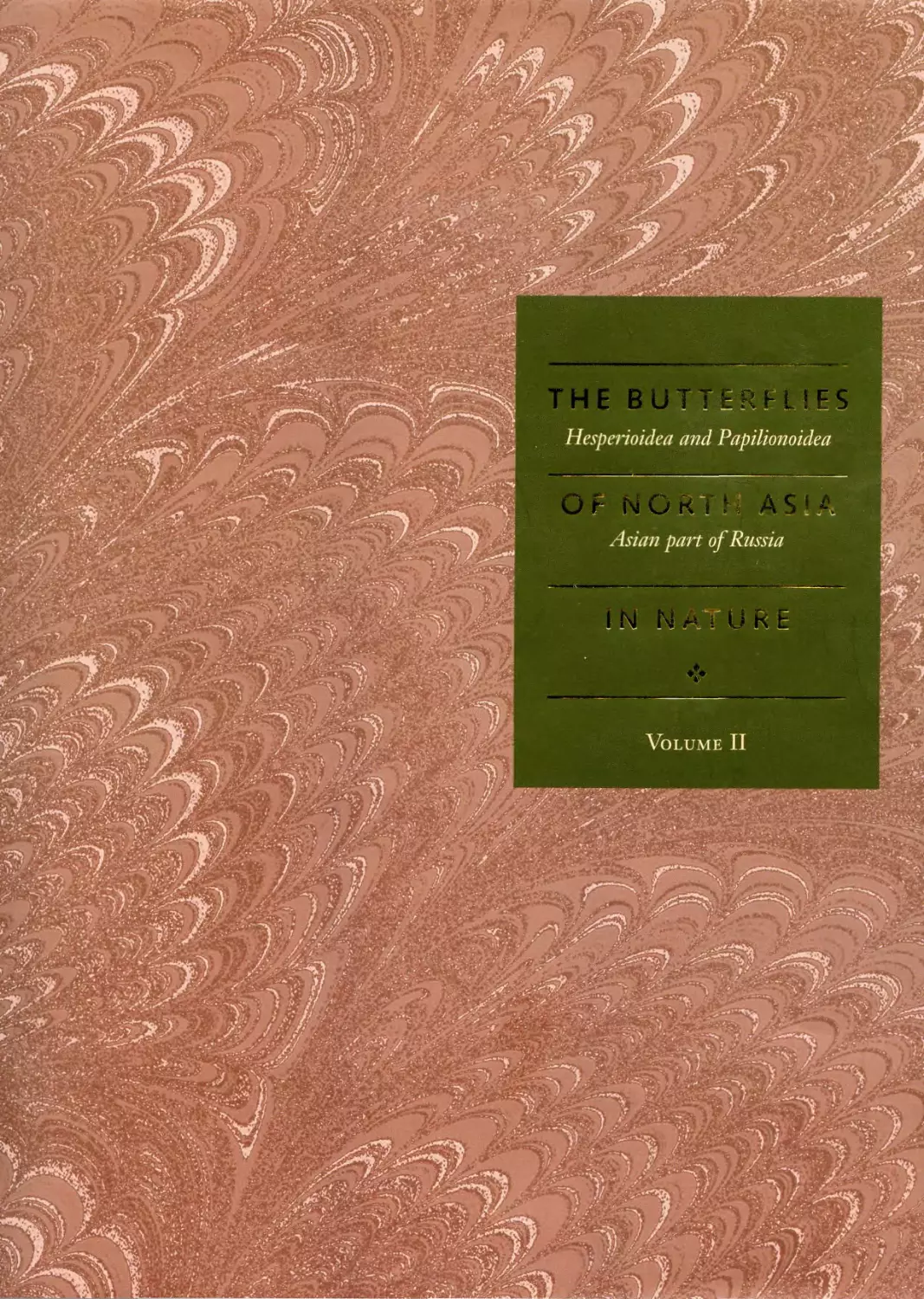


Author: Gorbunov P. Kosterin O.
Tags: biology zoology insects butterflies insect world insect physiology
ISBN: 9986-33-038-6
Year: 2007


Text
A joint work by Pavel Gorbunov and Oleg Koste-
rin entitled “The Butterflies of North Asia in
Nature” has been the primary goal of long-term
scientific investigations by the authors. It records
the results of their numerous expeditions and
photographic works. Hundreds of kilometres of
barely accessible parts of Ural, Siberia and the Far
East have been travelled. Many butterfly species
were observed in Nature, hundreds of rolls of film
were shot, a huge number of museum specimens
and literature sources were examined, numerous
drawings prepared, and distribution maps for all
species compiled.
The authors emphasize the north-eastern cor-
ner of Asia. The fauna of this territory is very
unique, due to the involvement of some taxa of
North American origin; however it has hitherto
remained poorly explored with respect to butter-
flies. As a result, this volume contains descriptions
of twelve new subspecies from Chukotka and
Kamchatka.
The primary advantage and novelty of this two
volume edition is its comprehensiveness combi-
ned with a luxuriant quality of printing that
matches the beauty of the numerous illustrations.
The butterflies of the .Asian Russia have received
the most complete assessment of recent years.
The text is supported by numerous, photographs,
about nine-tenths of which were taken by the
authors themselves, which is very important from
the scientific point of view. Thanks to the high
quality illustrations the book will inevitably
become a thrilling journey with butterflies over
the vast and almost virgin lands of North Asia.
Having opened the page devoted to any species
you will be transported right into the core of its
habitat, and will even make an acquaintance with
the plants on which its life is based. So, you will
just see the butterflies in their natural habitats
through the authors’ eyes. You will visit places
you have hardly even heard about before: the
taigous foothills and highlands of Ural and vast
tundrous plains from Yamal to Chukotka; you will
stand in enormous peat bogs of West Siberia, in
infinite larch forests of East Siberia, and in the
Ussuri Taiga, full of lians and ferns; you will
ascend above the tree line to perennial snows in
Altai, the Sayans, the mountains of Yakutia,
and the Far East. The detailed captions of photo-
graphs contain immense numbers of names of
places, rivers, villages, mountains etc. that pro-
duces unique spirit loci, the sense of a reader’s
presence in those remote places.
The captions also contain Latin names of butter-
flies (and even of the flowers they sit on), the plant
community7 type, the exact geographical position,
and the actual dates of photography that make
them scientific documents. Such an ecologically,
and in parallel scientifically7 weighted way of deli-
very of the material may sen e as a model for popu-
larisation of other groups of animals and plants.
One should bear in mind that the book con-
cerns a vast territory occupying about one-ele-
venth of the total land area of the earth, an area
that still remains almost virgin, relatively little
affected by7 human activity' except for the steppen
regions of West Siberia. But, to our regret, this
will not be so for ever. Siberia possesses enormous
amounts of various natural resources: oil, gas and
metal deposits, vast coniferous forests and numer-
ous rivers full of crystal-clean water, not to men-
tion the great Baikal. All this treasure is now open
to economic exploitation and will inevitably turn
Siberia into a densely populated and flourishing
industrial area. This will be devastating to its vul-
nerable northern Nature, and we must do our
best to make this re-discovery of Siberia as deli-
cate as possible. The unique Siberian fauna and
flora must continue to persist on this land, and
not to proceed its existence only7 in books and
museum collection, as many European butterflies
already do.
Such books as the one you hold are a wonderful
and very useful tool to raise people's awareness of
the beauty7, complexity7 and fragility7 of Nature;
a gift which we hardly deserve and which we spare
so absent-mindedly. And at the same time it pro-
vides a reader with a solid source of reliable infor-
mation on the butterflies, accumulated from
numerous sources (including the authors’ experi-
ence), which is necessary7 for those who aim to pro-
tect them. The face of the Asian Russia will soon
change. We cannot prevent this fact of the near
future, and should not even attempt to do so. But
we, Nature lovers, must make all possible efforts to
ensure that the future face of the land will still be
adorned with butterflies, among Nature's loveliest
creatures, and all other kinds of creatures who are
real Nature’s first-born children.
Academician Vladimir Bolshakov -
director of the Institute of Plant and Animal Ecology
of Russian Academy of Sciences,
the President of the Presidium of the Era Han Branch
of the Russian Academy of Sciences


Volume II
2
THE BUTTERFLIES
(Hesperioidea and Papilionoidea)
OF NORTH ASIA
(Asian part of Russia)
IN NATURE
by Pavel Gorbunov dr Oleg Kosterin
“Rodina & Fodio”, Moscow
Aidis Producer’s House
January
2007
3
Authors Pavel Gorbunov & Oleg Kosterin
Editor of the English text Crispin S. Guppy (Canada)
Designer Konstantin Jouravlev
Colour correction: Vitaly Nazaryev
Art processing of illustrations: Valery Koreshkov,
Denis Slapovsky
Publisher Valery Koreshkov
The project is realized with the assistance
of the Regional Public Foundation for Helping
and Promoting Creative Initiatives
“Creation of the world” /Moscow/
All rights reserved. No part of this publication may be
reproduced, stored in a retrieval system or transmitted
in any form by any means, electronic, mechanical, photo
copying, recording or otherwise, without the prior
written permission of the copyright owner.
The first volume was published in 2003
© Authors Pavel Gorbunov & Oleg Kosterin, 2007
© Designer Konstantin Jouravlev, 2007
© “Rodina & Fodio” Joint-Stock Company,
Moscow, 2007
© Aidis Producer’s House, Moscow, 2007
© Publisher Valery Koreshkov, 2007
ISBN-9986-33-038-6
4
Contents
ABBREVIATIONS	6
PREFACE	7
THE BUTTERFLIES:
Family Nymphalidae	9
Family Satyridae	201
Family Danaidae	364
Family Libytheidae	366
ADDENDA TO VOLUME I	368
REFERENCES	390
INDEX OF LATIN NAMES OF BUTTERFLIES	400
CREDIT OF PHOTOS	404
AUTHORS	406
ACKNOWLEDGMENT	408
5
ABBREVIATIONS
ab. - aberration C - Central E - east, eastern f. - form FP (FPs) - food plant (food plants) FW - fore wing FWL - fore wing length gen. - generation, brood HW - hind wing m - metres N - north, northern NE - north-east NW - north-west	S - south, southern SE - south-east sp./spp. - species (singular)/species (plural) ssp. - subspecies SW - south-west TL - type locality UNF - fore wing underside UNH - hind wing underside UNS - fore wing and hind wing undersides UPF - fore wing upperside UPH - hind wing upperside UPS - fore wing and hind wing upperside W - west, western
6
PREFACE
Here is the second, and last, volume of our book devoted
to the butterflies of the Asian part of Russia in Nature. It
includes four families, which, however, many recent
authors include within a single huge family Nymphalidae.
Two of these four families, Danaidae and Libytheidae, are
each represented by one species with no resident popula-
tions in the Russian territory. The other two families,
Nymphalidae (in the narrow sense) and Satyridae, each
include about an equal number of species. As with the
groups presented in the first volume, there are many
Transpalaearctic and West Palaearctic species well known
to Europeans; there are also many East Asiatic species that
just enter the southeast corner of our territory, most of
which are well known to Japanese, Korean and Chinese
readers. Quite a number of species are Central Asian and
enter the southern regions of Siberia. Concurrently, there
are several groups that are indigenously Siberian, more
precisely north-east Siberian - here they have undergone
most of their adaptive radiation and enjoy the greatest
modern species diversity. Of such butterflies, the largest
genera are Boloria (in the broad sense) of Nymphalidae and
Oeneis of Satyridae; also, NE Asia is a major centre of
species diversity of the genus Erebia of Satyridae. Oeneis is
noteworthy in that the genus includes a great number of
allopatric and sympatric forms of problematic status, and
the species combine a similar dull appearance with great
individual variation. This is mostly an arctic-alpine genus,
and the problems of its taxonomy result from a history full
of expansions and retreats during the cyclic climate
changes of the Pleistocene (the last 1.8 myr). The ranges
of Oeneis species repeatedly split and merged with charac-
teristic time spans that seem to be about the threshold of
the time required for speciation. This genus is as yet insuf-
ficiently explored, and our treatment of it is preliminary
and involves a minimum of definite entities.
During the two years since the first volume was pub-
lished, we have made some interesting new observations,
and obtained news, published and unpublished, from our
colleagues. The most notable items of this miscellaneous
information are included in a concise update at the end of
this volume.
Preparation of this volume was only possible with the
invaluable help of our friends and colleagues enumerated
in the Preface to the previous volume. We are happy to add
to that acknowledgement list our colleagues S. V Churkin
(Reutov, Moscow Propvince), M. V Gulyomin (Snezhinsk,
Chelyabinsk Province), V. A. Lukhtanov (Saint-Peters-
burg), S. L. Nikolaev (Novosibirsk-Moscow), A. A. Poteiko
(Omsk), S. A. Rybalkin (Snezhinsk, Chelyabinsk Province),
Y. A. Shevnin (Ekaterinburg), V O. Zurilina (Chelyabinsk),
who shared with their knowledge and information, and the
additional photographers T. D. Kolesnikova (Novosibirsk),
L. V. Korshikov (Orenburg), V. S. Murzin (Moscow),
M. Omelko (Gornotaezhnoe, Primorski Krai Province),
E. Palents (Ekaterinburg), K. Sun (Beijin), V. I. Troinin
(Vladivostok), and V. Zurilina (Chelyabinsk), who offered
their valuable photographs.
In closing this project, which has been ambitious for at
least the number of photographs included, we humbly
hope that we have let our readers enjoy the wonderful
creatures and magnificent scenery of Ural, Siberia and the
Russian Far East.
7
Family Nymphalidae
Butterflies of various sizes, FWL 13-50 mm. Fore legs reduced to brushes, useless for walking. Wing coloration is usu-
ally mottled with reddish colours predominating, or the wings are dark-brown with light spots and bands. Eggs are quite
variable, but usually globe-shaped, hemispheric or ellipsoid, with vertical ribs. Larvae are often conspicuously coloured,
with a few rows of processes or tubercles set with stiff hairs or spines. They live solitarily or gregariously on various
flowering plants. Only one of our species, Seokia pratti, is associated with a coniferous tree (Pinus koraiensis). Pupae have
angular prominences; suspended head-down from a cremaster hooked into a silken pad. This is a large family that
includes about 3000 species, most of which inhabit the tropics. In Asian Russia there are 105 species. A few colourful
and conspicuous species, such as Aglais urticae, Polygonia c-album, Inachis io, Nymphalis antiopa, and Cynthia cardui, are
migrants; in warm seasons they can move for hundreds of kilometres, often to be found in city gardens and parks.
Species of Neptis, Limenitis, Apatura and related genera are common dwellers of broad-leafed forests of the Far East.
Melitaea are most diverse in steppen and forest-steppen regions, while the numerous species of lesser fritillaries are most
diverse in taiga, forest-tundra and tundra.
1. Argynnis paphia, a congregation - northern bank of Lake Azas
at Ilgi-Chul outpost, Todzha Hollow, Tyva Republic, 23rd July 2000
9
FAMILY NYMPHALIDAE
Sephisa princeps (FIXSEN, 1887)
DESCRIPTION. FWL 29-36 mm in males, 33-40 mm in
females; UPS black-brown without a violet iridescence
and with large spots throughout, ochre-orange in males
and whitish (except orange in FW cell) in females.
DISTRIBUTION IN RUSSIA. Southern and western
Primorye, the Bikin River lower reaches in southernmost
Khabarovsk Province.
RANGE OUTSIDE RUSSIA. NE, E and S China, Korea.
HABITAT. Secondary oak (Quercus mongolica) forests and
mountain broad-leafed forests with the oak as a compo-
nent; in Sinii Range up to 500 m elevation.
FLIGHT-PERIOD. 5-10th July to late August, in one brood.
HABITS. The butterflies spend most of their time in oak
crowns, feeding on tree sap, mating and ovipositing. Males
show territorial behaviour by perching on branch tips in
oak crowns and attacking passing butterflies. Males often
descend to roads and brooks during the day, where they
occur individually within congregations of Purple
Emperors; with, in good locations, an average of one male
per 30-50 m of a road. However, being more cautious than
Apatura, they escape swiftly to tree crowns when fright-
ened.
FOODPLANTS. InS Primorye Quercusmongolica-, in Korea
Quercus variabilis (Dantchenko et al., 1996).
LIFE-HISTORY. Studied in S Primorye in captivity
(Dantchenko et al., 1996). Eggs white, ellipsoid, 1.2-1.3
mm high, with 17-18 vertical ribs and over 60 finer hori-
zontal ribs, which disappear near the micropylar area. A
female in captivity laid a batch of 26 glued together eggs
into a rolled leaf of a young shoot. Larvae hatched after 16
days; they were green with a rounded black head and
bifurcate last segment. During the first 24 hours they
2. Habitat of Sephisa princeps - an oak
forest at Dubovyi Klyuch village,
21nd July 2000
10
FAMILY NYMPHALIDAE
remained together on the same leaf, having spun a silken
net around it, and fed on egg shells. The first moult took
place after 10 days, when the larvae attained a length of
5.5-6 mm. In the second instar they acquired a pair of
short horns on the back of the head, narrow white sub-
dorsal lines and two white dorsal marks on segments 7 and
10. This stage lasted about 5 days, until the larvae reached
10 mm long. The larvae changed little in the 3-4th instars.
They spent up to 30 minutes together on the upper sur-
face of the leaf and then suddenly moved out in groups of
4-6 to one of the leaves on the same branch. After feeding
for 4-6 minutes, they returned to the nest following their
silky track. In the last (5th) instar each larva usually made
a separate nest and went out to eat at a different time. The
larvae very precisely chose a nesting site and always fol-
lowed the same route, covered with silken threads, when
going to feed. Having chosen a leaf on which to feed, a
larva attached it strongly to the branch with many layers of
silk. When a visiting larva tried to enter a nest built by
another larva, both exhibited rather a complex behaviour-
al ritual: both moved their heads synchronously as if the
resident was trying to catch the intruder’s head with his
own. Mature larva 55-60 mm long, green with paired
white round dorsal spots on segments 7 and 10, white sub-
dorsal lines on segments 1-6 and 10-12, and 6-7 transver-
sal light lines on sides of abdominal segments; paired head
horns brownish, 4.8 mm long, with short branches. Pupa
33-36 mm long, green with a yellowish mid-dorsal stripe;
flattened laterally, its dorsal margin resembles the shape of
an oak leaf margin. It is suspended under a leaf from its
midrib. Pupal phase lasts for about 12 days. In captivity,
development from oviposition to adult emergence takes 60
days at 18-20° C, without hibernation; in Korea (Park,
Kim, 1997) hibernation occurs at the larval stage.
VARIATION. In Primorye insignificant. Females are
dimorphic in the southern part of the range: together with
the light form (albimacula Leech), females also occur with
orange spots, only weakly differing from males.
P.G.
4. Sephisa princeps, a male - a road in a
broad-leved forest at Kaimanovka village,
S Primorye, 20th July 2000
5. Sephisa princeps, a male - an oak forest
edge at Dubovyi Klyuch village,
S Primorye, 21st July 2000
6. Sephisa princeps, a female - just
hatched from a pupa - an oak forest edge
at Gornotaezhnyi village, S Primorye, 24th
July 2005
3. Sephisa princeps, a female - just hatched
from a pupa - an oak forest edge at
Gornotaezhnyi village, S Primorye, 24th July
2005
11
FAMILY NYMPHALIDAE
Dilipa fenestra (LEECH, 1891)
DESCRIPTION. FWL 30-35 mm in males, 32-38 mm in
females. Fore wing outer margin concave. UPS orange
with a dark-brown outer border, UPF with dark spots in
discal and postdiscal areas and two round white spots at
apex; UNF with four dark postdiscal spots and a dark
basal area. UNF as UPF but apex and outer border grey-
ish with a brownish streaked pattern; UNH whitish- and
fulvous-grey with a brownish streaked pattern and a
brownish stripe from anterior margin to anal angle. Sexes
differ in UPS pattern - black and narrower in males and
brown and wider in females; also, males have a black outer
border on UPH.
DISTRIBUTION IN RUSSIA. A migrant species, known
from Russian territory only from the report by Matsui and
Inomata (1993) of a single fresh individual observed on
23rd April 1991 at Ussuriisk town (S Primorye).
RANGE OUTSIDE RUSSIA. NE, E and S China, Korea.
HABITAT. Forest cuttings, river banks, hillsides, brook val-
leys (Park, Kim, 1997).
FLIGHT-PERIOD. In Korea from early-April to mid-May
(Shin, 1991, Park, Kim, 1997).
HABITS. A male usually opens its wings on the grass of
Miscanthus and attracts a female with its pheromone patch-
es. Both sexes often sip sap of maple and Actinidia but were
not recorded on flowers. Males also often sip water from
wet ground. Females are mostly active at about 1000 hr
and after 1600 hr and are seldom seen in midday (Shin,
1991).
FOODPLANTS. Celtis spp.; in Korea Celtis sinensis and
C. mongolica (Park, Kim, 1997).
LIFE-HISTORY. The larva spins a web on a leaf to form a
shelter. It has several pairs of processes on its head, the upper
one being branched. It undergoes six instars and pupates.
Hibernation at the pupal stage (Shin, 1991).
7. Di lipa fenestra, a male -
the Beijin environs, China,
19th April 2003
Amuriana schrenckii (MENETRIES, 1859)
DESCRIPTION. FWL 38-50 mm. UPS brownish-black
with white spots, females and some males also with fulvous
spots or suffusion in spaces Cui and Cu2 on UPF. UNF
brown-black with a violet basal area and silvery-white and
dull-fulvous brown-rimmed spots in the outer half. UNH
silvery-white with dull-orange postdiscal and marginal
bands about 3 mm wide. Females differ from males in hav-
ing a somewhat lighter UPS ground colour and enlarged
fulvous postdiscal spots on FW.
DISTRIBUTION IN RUSSIA. Amurland (between the Bu-
reya and Gorin Rivers); Primorye.
RANGE OUTSIDE RUSSIA. NE and C China, Korea.
HABITAT. One of the many species of primary polydomi-
nant broad-leafed and coniferous-broad-leafed forests,
their specificity being remarkable. In the Sinii Range
occurs up to 700 m elevation. Abundance decreases in
many regions after a cold winter.
FLIGHT-PERIOD. Usually from 25-30th June to early
August; in mountains and on coasts from 5-10th July to
mid-August.
HABITS. The butterflies spend the night in tree crowns.
Having basked in the morning sun, they actively fly over
them. Occasionally they get into dewy grass, for a long
12
FAMILY NYMPHALIDAE
time after which they cannot take flight. Males descend to
roads during the day, where they puddle on wet ground
and various rotting organic remnants (dead animals, excre-
ment). They usually rest with open wings during the day,
and with folded wings in overcast weather. During rains,
they shelter on lee trunk sides or congregate in niches on
steep ground bluffs. The flight is fast and high, its trajec-
tory resembling wide arches. Females spend most of their
time in tree crowns and fly under the canopy. Copulating
pairs were observed during the day on bushes, in the lower
part of tree crowns, under the canopy, and at edges.
FOODPLANTS. InS Primorye Ulmusjaponica, U. laciniata
(Kurentzov, 1939; Tuzov, 2000; etc.); Carpinus cordata also
reported (Kurentzov, 1970); other Ulmus spp. in Korea
and China (Koywaya, 1993; Park, Kim, 1997).
LIFE-HISTORY. Studied in Primorye (Graeser, 1888; etc.)
and China (Koiwaya, 1993). Greenish eggs are usually
placed on foodplant leaf upperside, 3-5 m above the
ground. Mature larva light-green with narrow yellowish
lateral lines on abdominal segments; on segments 5, 7 and
10 there are paired curved dorsal processes, set with dark
spinules; head green with small horns; the last segment
forked. Pupa light-green, resembles that of Apatura but
much larger, suspended under an elm leaf from the
midrib.
VARIATION. The butterflies are very variable in the body
size and the size of the white and fulvous spots. In S Pri-
morye, about 70 % of males have the fulvous spots on
UPF entirely missing; most of the rest have just a suffusion
of orange scales in spaces Cui and Cu2; and no more than
5 % have 1-2 distinct orange spots in these spaces. About
1-2 % of males represent the melanic form ab. melanica
Nikitin, in which the whitish colour of spots on UPS and
UNH is replaced by bluish-grey, and on UNF by dark-
violet. Female wings may have a greenish iridescence;
sometimes darker blackish postdiscal spots and a marginal
band are distinct on UPH.
p.G.
9. Amuriana schrenckii, a male - a road in a broad-leafed
forest, Spassk-Dalnii District, S Primorye, 8th July 2001
[8]
[9]
[Ю]
10. Amuriana schrenckii, a copulating pair
(female with wings open) - a broad-leafed
forest edge at Barabash village, S Primo-
rye, 17th July 2001
8. Amuriana schrenckii, males - on a road
in a mixed forest, Spassk-Dalnii District,
S Primorye, 5th July 2001
13
FAMI LY NYMPHALI DAE
Athymodes nycteis (MENETRIES, 1859)
DESCRIPTION. FWL 31-39 mm. Outer FW margin
noticeably concave in the middle. UPS brown-black with
a diffuse white longitudinal stripe in FW cell and white
spots forming rows in postdiscal and submarginal areas of
FW, a postdiscal row and a discal band on HW. UNS
ochre or brownish, with bright whitish spots and bands
corresponding to those on UPS; proximal part of UNF
cell whitish with black dots. Females differ from males by
a less concave FW outer margin and, on average, a lighter
UPS and UNS ground colour.
DISTRIBUTION IN RUSSIA. Amurland (from the junction
of the Shilka and Argun’ Rivers to Tsimmermanovka);
Primorye.
RANGE OUTSIDE RUSSIA. NE, E and C China, Korea.
HABITAT. Polydominant broad-leafed and mixed forests;
mostly in river valleys; open slopes with sparse stands of
Uhmis риттla. In the Sinii Range rises up to 700 m eleva-
tion, as does Armiriana schrenckii.
FLIGHT-PERIOD. Fourth week of June to mid-August;
appears about 5 days earlier than Aimiriana schrenckii.
HABITS. The butterflies spend the night in tree crowns.
In midday, males are active on forest roads, generally with
Amnriana schrenckii] they land on the ground where they
periodically open and close their wings, and, after several
seconds, fly to another place. In the evening the butterflies
can be observed at tree crowns.
FOODPLANTS. In S Primorye Uhmis pumila (Tuzov,
2000; P.G.) and U. japonica (Graeser, 1888; Kurentzov,
1939); in Korea Uhmis davidiana (Park, Kim, 1997).
LIFE-HISTORY. Studied in Primorye. Graeser (1888)
described the early stages as follows. Larva of the shape
usual for Apatura, dark green, with paler oblique streaks
on the sides; there are two pointed wart-like projections,
each furnished with several sharp spiny hairs, on the backs
of segments 6 -12; those on the 6th, 8th, and 11th longer
and thicker; the last segment terminates in two rather long
11. Habitat of Am и riana schrenckii and
Athymodes nycteis - a montane mixed
forest at Kaimanovka village, S Primorye,
10th July 2000
and acute spines. Head marked with reddish-brown
stripes; bearing very long horns ending in rounded tuber-
cles, directed forward; has roundish knobs and bears a few
obtuse accessory spines. Head and body upperside, down
to the bluish-green spiracles, set with a number of short
spinules, which are longest and closest together on the
head sides; the area below spiracles covered with fine yel-
lowish hairs. Pupa whitish green, differing from A. ilia and
A. iris in having a series of blunt projections on a sharply
ridged body upperside.
VARIATION. In some males the white longitudinal stripe
in the UPF cell is reduced or absent. The white submar-
ginal spots may also be partly reduced, rarely they are
enlarged and elongated along veins. Those of UNS are
14
FAMILY NYMPHALIDAE
[12]
[13]
[14]
often fused with the white postdiscal spots (ab. cassiope
Menetries). In some specimens, there is a well expressed
marginal row of white dots on UPS. The UNS ground
colour varies from golden-ochre or greenish-ochre to
brown (in males only). Male UNF may be black-brown; in
this case all the white spots (on UNF) acquire a violet tint.
p.G.
12. Apatura metis and Athymodes nycteis, a congregation -
a road at a valley broad-leafed forest edge at Barabash-Levada
village, S Primorye, 9th July 1999
13. Athymodes nycteis, a male - a road
in a broad-leafed forest, Spassk-Dalnii
District, S Primorye, 8th July 2001
14. Athymodes nycteis, a male - a road in a broad-leafed forest,
Spassk-Dalnii District, S Primorye, 8th July 2001
15
FAMI LY N YMPHALI DAE
Apatura ilia
([DENIS ET SCHIFFERMULLER], [1775])
[15]
DESCRIPTION. FWL 30-40 mm. UPS brown with white
or yellowish spots on FW, a discal band on HW, and a row
or band of whitish or reddish submarginal spots of variable
expression on both wings; HW with outer margin straight
or slightly sinuous; both wings with an ocellus in space
Cui. In males UPS has a strong iridescent violet flush;
females also differ by enlarged light spots and bands.
DISTRIBUTION IN RUSSIA. The Caucasus, European
Part to 58° N, S Ural and, after a tremendous gap, E
Transbaikalia, Amurland, Primorye (including the adja-
cent islands).
RANGE OUTSIDE RUSSIA. Europe to 58° N (in Estonia),
Transcaucasia, NE China, Korea. An amphipalaearctic
species with a huge gap in the centre of Eurasia.
HABITAT. In S Ural, valley forests, usually with a compo-
nent of broad-leafed trees; the same in Amurland and
Primorye, but also glades and sparse stands in mountain
broad-leafed and mixed forests.
FLIGHT-PERIOD. Late June to mid-or late August, usual-
ly in one brood. In Orenburg Province, a few individuals
of the second brood occurred in late August of the very
warm summer of 1994.
HABITS. Males and females are active in tree crowns in
the morning (about 0900-1030 hr) on hot days also near
evening. Their flight is swift, along long arch-like trajec-
tories, they often rest on leaves with half-open wings but
are cautious. In the middle of hot days the males descend
in great numbers to roads and brooks, sip sap from tree
wounds and various organic remnants (excrement, animal
remains, etc.). On such a substrate the butterflies loose
their cautiousness and can be taken by hand; if disturbed
sufficiently to take flight, they soon land nearby.
Korshunov (2002) reported a rare observation by S. V.
Dragan in Primorye of these butterflies feeding on inflo-
rescences of Apiaceae. In overcast weather they tend to
rest on leaves of willows and other trees of forest edges.
Females carefully examine the willow and poplar crowns
to oviposit during the day.
FOODPLANTS. Populus spp. and Salix spp., including
Populus tremula in S Ural (P.G.), Populus maximomczii in S
Primorye (Tuzov et al., 2000).
LIFE-HISTORY. Studied in Europe (Friedrich, 1977; etc.).
Eggs are laid singly on foodplant leaf upperside, usually
1.8-3 m above the ground. Eggs greenish, more or less
hemispheric, with 13-18 lengthwise ribs and a flattened
micropyle area with a cellular structure; about 1.2 mm in
diameter and 0.9 mm high. The larva stays on the leaf
upperside; clings to a silk pad on the midrib. The 1st instar
larva is yellowish-green with a dark head and pointed hind
end. In the 2ncl instar the head acquires a pair of diverging
forward directed horns. The larva hibernates in the 3rcl
instar, and looses its green colour to become greyish or
brownish to resemble bark. The larvae hibernate in bark
crevices or on the ground at trunk bases, and become
active again when the buds open. The 4th and 5th instar
larva is green with two yellow longitudinal lines on tho-
racic segments, starting at head horn bases; has 6 pairs of
slanting yellowish streaks on sides of abdominal segments
1-7, the second pair of which is wider and protrudes to
dorsal side; the last segment has a whitish horizontal streak
on either side and ends with two spikes. Head horns green
but their dorsal side is yellow; there is a dark streak on
their ventral side; apices reddish, usually forked. Pupa:
light-green with a yellowish line along margins of wing
cases, smooth, has a hog back and two small conical horns
on head; usually suspended from the midrib of the food-
plant leaf underside.
15. Habitat of Apatura metis substituta and A. ilia ussuriensis -
floodland thickets of Salix rorida and Alnus hirsuta, Spassk-Dalnii
District, S Primorye, 9th July, 2001
16
FAMILY NYMPHALIDAE
17. Apatura ilia ussuriensis, a male -
a valley broad-leafed forest edge at
Barabash-Levada village, S Primorye
village, 9th July 1999
[16]
[17]
[18]
VARIATION. The nominotypical subspecies reaches
S Ural in the east. The eastern A. i. ussuriensis Kurentzov,
1937 differs by a somewhat more acute FW apex and, on
average, reduced light spots and bands. The morph clytie
[Denis et Schiffermiiller], with a yellowish pattern instead
of white, is so far unknown from Ural. In Primorye, but-
terflies with a yellowish pattern, known as f. praeclara
Moltrecht, 1927, are about as equally abundant as the typ-
ical morph. The yellowish morph has additional yellowish
postdiscal bands or spots and an area of the same colour in
the FW cell. Transitional specimens also occur, in which
some spots are white and others yellowish. In the typical
morph, the HW white band may be reduced to a spot at
the anterior margin.
p.G. & O.K.
18. Apatura ilia ussuriensis, a male -
a road crossing a woody brook valley
between Budyumkan and Uryupino
villages, E Chita Province, 25th July 1997
[19]
16. Apatura ilia ilia, a male - Bryansk,
Bryansk Province, 1991
19. Apatura ilia ussuriensis, a male - a road in a mixed forest at
Kaimanovka village, S Primorye, 24th July 2003
17
FAMI LY NYMPHALIDAE
Apatura metis (FREYER, 1829)
[20]
DESCRIPTION. FWL 26-39 mm. Indistinguishable from
A. ilia in many characters, but the outer margin of HW
light discal band either has an angular prominence at vein
М3 or is very wide (more than 4 mm) and has a diffuse
outer margin (f. heijona Matsumura).
DISTRIBUTION IN RUSSIA. Southern European Part
(the Volga and Don River basins); in West Siberia only the
Irtysh River valley downstream to Tobol’sk; and, after a
second gap, E Transbaikalia, Amurland, Primorye (includ-
ing the adjacent islands), Sakhalin, the S Kuriles.
RANGE OUTSIDE RUSSIA. The Balkans, E Kazakhstan
(the Irtysh River valley), Ukraine, NE and E China,
Korea, Japan.
HABITAT. In W Siberia and Transbaikalia, floodplain
riparian forests (mostly willow and poplars) in valleys of
major rivers, even those flowing through steppes. In
Amurland and Primorye, also forest openings and edges in
broad-leafed and mixed mountain forests, but more con-
fined to floodplains than the previous species.
FLIGHT-PERIOD. In the Far East, late June to mid-
August, usually in one brood. In the Lake Khanka region
(S Primorye), and especially in Manchuria (Nikitin, 1941),
adults of the second brood are recorded from late August
to September. Subspecies A. metis irtyshika Korshunov,
1982, which inhabits the Irtysh River valley, also appeared
to have two broods. At Omsk, the flight starts from mid-
June (earliest record 12 th June) and lasts through July. The
second brood was recorded at least in 1994 and 2005 by
O.K., in 1996 by K. Ponomarev, and in 2002, 2003 and
2004 by A. Poteiko (pers. comm.); according to A. Poteiko,
it is less abundant (although that in 1994 was very abun-
dant) and is on the wing about 15th August - 20th
September.
HABITS. Strongly resemble A. ilia. The species occur
together and the males form mixed congregations in hot
days.
FOODPLANTS. Salix spp. and Populus spp.; including
Populus koreana in Amur Province (Streltzov, Malikova, 1999),
Salix rorida (Kurentzov, 1939; P.G.) S’, viminalis (Kurentzov,
1939) and S. sckwerinii (Tuzov et al., 2000) in S Primorye; in
Omsk of Salix alba.
LIFE-HISTORY. The habits and appearance of the pre-
imaginal phases, as studied in the Balkans (Lorkovic, 1983)
and Japan (Friedrich, 1977; etc.), resemble those of A. ilia.
Eggs as in A. ilia, usually with 12-14 ribs, placed on upper-
side of foodplant leaves, 2-5 m above the ground. Mature
larva reaches 55-60 mm in length (with horns), more slen-
der than that of A. ilia', head horns somewhat longer and
more pointed, with well expressed black stripes beneath.
Pupae as in A. ilia but with longer projections.
VARIATION. In Asian Russia two subspecies. A. m. irtyshi-
ka Korshunov, 1982 is confined to the Irtysh and Tobol
River valleys. The UPS ochre submarginal spots are larg-
er than in the nominotypical subspecies from Europe,
approximately equal in size to the spots of the UPH discal
band, the discal elements of the pattern light yellowish;
the yellow postdiscal spot in UPH space Cui is usually
blind, without a black pupil. The Russian Far East is
20. Apatura metis substituta, a male - the Onon River right bank
floodplain, 7 km upstream of Nizhnii Tsasuchei village, E Chita
Province, 1st July 1995
18
FAMILY NYMPHALIDAE
21. Apatura metis substituta, a male - on a con-
crete pole along a road in a mixed forest at
Kaimanovka village, S Primorye, 14th July 2000
22. Apatura metis irtyshika, a male - a bank of an Irtysh River left
oxbow in Victory Park within the city of Omsk, 30th August 1994
inhabited by A. m. substituta Butler, 1873, which is very
variable. For example, in Primorye, three morphs co-exist
altogether, each morph including both males and females.
A typical morph is common everywhere in Primorye and
occurs in E Transbaikalia to Lower Amur, Sakhalin and
the Kunashir Islands. Its UPS is dark-brown, with a metal-
lic flush in males, with contrasted pale ochre discal, post-
discal and submarginal spots and bands. A dark, grey-
brown morph (krylovi Kurentzov, described as subspecies),
with relatively narrow white spots and bands and usually
without the light submarginal spots and without the spot
in UPF cell, is known from the Lower and Middle
Amurland and Primorye. To this morph should be attrib-
uted f. abramovi Kurentzov, described by A. I. Kurentzov
as a subspecies of A. iris from Lower Amurland. The third
morph (f. heijona Matsumura) probably occurs in Russia
only in S Primorye. Its UPS is ochre-brown with very
wide light ochre-yellow bands, on HW often without a
ledge on the band outer margin. Within each morph, the
butterflies are very individually variable. Individuals occur
that are intermediate between the typical morph and f. hei-
jona.
p.g. & O.K.
[21]
[22]
19
FAMI LY NYMPH ALI DAE
Apatura iris (LINNAEUS, 1758)
[23]
[24]
DESCRIPTION. FWL 33-46 mm. UPS black-brown with
a bright violet iridescent flush in males, brown in females,
with distinct white or, in females, slightly yellowish, spots
on UPF and a discal band on UPH; UPH with an ocellus
in space Cui; reddish submarginal spots weakly expressed.
In contrast to other our Apatura spp., the outer margin of
the light UPH band has a pointed tooth.
DISTRIBUTION IN RUSSIA. The European part to 58° N,
Middle and South Ural, southern Tyumen Province
(Nizhnyaya Tavda, Yarkovo, Tobol’sk and Tyumen’ Districts)
(Korshunov, 2002) and northern Omsk Province (Murom-
tsevo District) (Knyazev, Kosterin, 2003); then, after a
tremendous gap, E Transbaikalia, Amurland, Primorye.
RANGE OUTSIDE RUSSIA. Europe to 62° N (in Finland),
NE and C China, Korea.
HABITAT. River valleys, edges, glades and open stands in
the subtaiga deciduous and mixed forests, bog margins,
road sides.
FLIGHT-PERIOD. July and the first half of August, in one
brood.
HABITS. The butterflies spend most of the day in crowns
of high trees, usually (in Cisuralia) aspen or oaks where
they rest and mate. For this reason, in years with decreased
abundance they may remain unnoticed. Males may
descend to the ground, at forest edges and along roads.
They never feed on flowers but are often found on wet
ground, sometimes in groups, and on injured tree trunks,
fresh excrement, animal remains, rotten fruits or any other
decaying organic remnants. According to observations by S.
L. Nikolaev in European Russia, these butterflies are very
strongly attracted to railroad sleepers (ties), perhaps by the
smell of creosote.
FOODPLANTS. Salix spp. and Populus spp.; including
Salix caprea in Middle Ural (P.G.), Populus maximorwiczii in
Amur Province (Streltzov, Malikova, 1999).
LIFE-HISTORY. Scarcely differs from that of A. ilia\ stud-
ied in Europe (Friedrich, 1977; etc.). Eggs resemble those
of A. ilia but slightly higher (about 1 mm high), approach-
ing a truncated cone in shape, with 13-15 ribs on sides.
The 2nd instar larva is green with a dark head and a white
transversal stripe above segment 7. Mature larva some-
what stouter and shorter, up to 5 cm long, yellowish
streaks narrower; head horns stouter, mostly without a
dark streak below. In the pupa, the paired fore-projections
are somewhat larger than in A. ilia.
VARIATION. Little compared to other our Apatura. The
nominotypical subspecies ranges eastwards to the Tobol
River basin. The Far Eastern butterflies were described as
A. i. amurensis Stichel, [1908], they barely differ from the
European ones in having a somewhat more elongated FW
apex. Both in the western and eastern populations, the white
markings can vary in size and in very rare cases may be
entirely missing. In some males and females there is a ful-
vous postdiscal ocellus in space Cui of UPF. In some
females, the UPH whitish submarginal markings can fuse
into a continuous band. In the Far East a female morph with
pale yellowish, instead of white, spots and band is common.
p.G. & O.K.
23. Apatura iris
iris, a male -
Bryansk, 1991
24. Apatura iris amure-nsis, a male on
a concrete pole - a road in a mixed forest
at Kaimanovka village, S Primorye, 15th
July 2000
20
FAMILY NYMPHALIDAE
Seokia pratti (LEECH, 1890)
DESCRIPTION. FWL 29-38 mm. UPS dark brown with
white spots in discal area, strongly reduced in males, a row
of reddish spots in postdiscal area and bluish-grey sub-
marginal spots. UNS blackish-grey with numerous yel-
lowish-white spots throughout, and also red spots at ante-
rior margin and in cell of UNH and in postdiscal area of
both wings. Females strongly differ from males by a
widened white pattern forming a broad discal band on
UPH.
DISTRIBUTION IN RUSSIA. Primorye: the C and S
Sikhote-Alin’ Mts. north to Terney District, including its
western spurs (Sinii and Przhevalskogo Ranges), Borisov-
skoe (Shufan) Plateau, Chernye Gory Mts.
RANGE OUTSIDE RUSSIA. NE and C China, Korea.
HABITAT. Montane broad-leafed /coniferous and conifer-
ous forests with Pinus koraiensis, especially in windless val-
leys at 300-1000 m above sea level.
FLIGHT-PERIOD. End of June to early September.
HABITS. The males spend most of the day, and females
the entire day, high in tree crowns. In hot weather males
often descend to roads and brooks and sit on moist
ground, stones, and tree trunks. They are not cautious and
so easy to photograph, but when disturbed they immedi-
ately fly high into tree crowns. The flight is strong.
FOODPLANTS. In Primorye Pinus koraiensis (Omelko,
Omelko, 1978).
LIFE-HI STORY. Studied in Primorye (Omelko, Omelko,
1978). Eggs: roundish, ochre-coloured, with rather large
rounded dimples; laid singly in the second half of the day
on the needle tips in lower and middle parts of crowns of
young (5-6 high) or old (up to 17 m high) trees of Korean
stone pine. The larva hatches in 10-11 days; it is 3.7 mm
long, ochre-coloured with a black glossy head, longitudi-
nal rows of short bristles and a forked last segment. For
the first 1.5-3 hours it devours its chorion completely,
then for 2-3 days it eats mesophyl at a needle apex, leaving
the midrib, gradually moving to the base. It feeds in the
evening or at night. The first moult occurs 11-12 days
after hatching, the second moult 15-16 days after the pre-
vious one; after each moult it eats its old skin. The larva
feeds until mid-November; hibernates in third instar on
the pine twigs. In the first half of April it resumes feeding
in the morning and evening. The third and fourth moults
occur in early and late May, respectively. The fifth (last)
instar larva is well camouflaged on a pine branch. It is 37-
40 mm long, speckled with tiny whitish warts, with dark-
brown sides and a dark-sandy back; there is a dorsal stripe
formed by isolate brown strokes, and there are subdorsal
stripes formed by whitish strokes. Segments 2, 3, 5, 7, 9
and 11 dorsally bear pairs of spines 3.5-4 mm long, with
short brown spinules on their apical parts; segments 4, 6,
8 and 10 bear pairs of prominences about 1 mm high;
there are dark-olive spots at spine and prominence bases;
head olive-grey with a pair of short horns. Pupation takes
place in early to mid-June on young branches in close
proximity to the feeding site. Pupa resembles a twig: about
27 mm long, dark-grey with the head and two fore-tho-
racic segments a darker brownish; abdominal segments
4-6 bear dorsal pairs of button-like tubercles; head with
faceted concavities instead of horns; cremaster trapezoid.
The butterfly hatches nineteen days after pupation.
VARIATION. In Primorye, and also in Korea and
Manchuria, occurs subspecies S. p. eximia (Moltrecht,
1909): its UPS light spots are whitish and the UNS light
spots yellowish-white (not yellow), the reddish spots are
paler than in the nominotypical subspecies from Central
China. There are also some differences in the genitalia
structure. There is little individual variation. Melanistic
males rarely occur, with an intensive suffusion of dark
scales over all the white spots.
P.G.
[25]
[26]
25. Seokia pratti eximia, a male - a mixed
forest edge at Kaimanovka village, 20th
July 2000
26. Seokia pratti eximia, a male - a mixed
forest edge at Kaimanovka village, 20th
July 2000
21
FAMI LY NYMPH ALI DAE
Limenitis populi (LINNAEUS, 1758)
DESCRIPTION. FWL 33-45 mm. UPS dark brown with
white spots on UPF and a white band on UPH; on UPH
there is also a submarginal row of orange-red spots outside
of which there are bluish lunules (absent in other our
Limenitis spp.). UNS reddish-brown with the same white
spots and band as on UPS and large blackish (on UNF)
and bluish-grey (on UNH) areas. Females generally differ
from males in having a wider white pattern.
DISTRIBUTION IN RUSSIA. The steppen, forest-steppen
and forest zones to the middle taiga subzone; in Siberia up
to 60-62°N; the mountains of S Siberia. Absent from
Kamchatka and the Pacific islands.
RANGE OUTSIDE RUSSIA. Europe, N Kazakhstan,
Mongolia, NW, NE, and Central China, Korea.
HABITAT. Glades, open stands and river valleys in decidu-
ous, mixed and even coniferous forests with a component
HABITS. One of the most remarkable and largest butter-
flies of the temperate Russia. No one remains unaffected
upon seeing the Poplar Admiral flying powerfully along a
forest road. The butterflies overnight in a tree canopy. In
good weather, the males patrol forest edges from the morn-
ing to 1800-1900 hr, using a powerful soaring flight with
sudden rises and gradual descents, sometimes making
rounds; they often rest on wet ground. Very often, similar
to purple emperors, they sip rotten organic matter such as
dung and dead animals, and also tree wounds, sweaty cloth,
spots of petrol and oil on roads. Rarely, they occur on large
scented inflorescences {Spiraea, Sorbaria, Umbelliferae).
FOODPLANTS. Populus tremula in Middle Ural,
Novosibirsk, Irkutsk, Amur Provinces, Primorye; some
other poplars are also reported: Populus nigra, P. alba in S
Ural (Migranov, 1991); P. nigra in Novosibirsk Province
[27]
27. Limenitis populi
ussuriensis, a con-
gregation - a road in
a valley mixed forest
at Obluchye town,
Khabarovskii Krai
Province, 4th July
1999
of Populus tremula', valleys of major rivers in the steppen
zone.
FLIGHT-PERIOD. Mid-June to late July. In any specific
place the flight period is quite short, only about a fort-
night. Initially mostly males appear, then after a week
females become commonly seen. Abundance varies sub-
stantially from year to year.
(O.K.); P. amurensis, P. koreana, P. maximoviczii in the
southern Ear East (Kurentzov, 1970).
LIFE-HISTORY. Studied in Europe (Porchinskii, 1893;
Riesch, 1964; etc.) and other regions. Eggs: greenish,
hemispheric, with large 6-8-angled facets with a hair ris-
ing from each angle; laid singly, usually on the tip of the
leaf upperside in crowns of young (3-5 m high) aspen
about 2-4 m above the ground. Larva hatches after 8 days.
The larva is effectively and variously (depending on its
age) camouflaged on the substrate. Young larva: brown
with tiny warts on each segment and a whitish girdle on
segments 7-8. At first it feeds on leaf mesophyl, leaving the
veins; later it eats the entire leaf blade leaving only the
midrib, on which the larva often rests. The larva usually
moults twice before hibernation, then makes a shelter of
rolled leaf parts with an opening directed to the branch,
22
FAMILY NYMPHALIDAE
and attaches it tightly to the dormant bud. An over-win-
tered larva is brown, more yellow-fulvous at both ends and
with a white transverse stripe in the middle of the body, it
often rests on twigs and resembles bird excrement. As it
grows it comes to resemble a twig, with its head resem-
bling a bud. It feeds on entire leaves, including most of the
midrib, starting to eat from the leaf tip. When not feeding
it rests on a well-illuminated branch in an S-like posture;
upon being frightened it bends its body backward. The
larva marks its routes with silk threads, perhaps to facili-
tate its hold on the leaf. Mature larva resembles a rolled
leaf: 45-52 mm long, light- or dark-green, the ground
colour is lighter on segments 6-8; with a vague brown dor-
sal line and large brown areas; two rows of fleshy tubercles
set with short hairs on segments 3, 5, 7 and 11; on segment
2 (mesothorax) there is a pair of much larger spiny
processes that protrude forward of the brown head; head
bears small black horns. Before pupation the larva removes
an apical part of a leaf to make a triangular incision, dense-
ly covers the rest of the leaf with silk, and fastens the mar-
gins with silken threads. The resulting tube is opened to
the leaf base, and the larva attaches itself to the midrib for
pupation, with the head oriented to the removed leaf apex;
rarely pupae are found on thin twigs. Pupa: yellowish-
white or yellowish-brown with dark-grey brands of differ-
ent sizes; on the back of the 2ncl abdominal segment there
is a glossy orange drop-like projection, with black and yel-
low spots at its base. Pupal phase lasts for 10-15 days.
VARIATION. The butterflies from Ural and Siberia are
close to the nominotypical subspecies (described from
Scandinavia), and differ from those of Central and
Southern Europe by, on average, widened white pattern
elements and the blackish and bluish-grey areas on UNS.
In Ural and Siberia, males with reduced white pattern ele-
ments (f. tremula Esper) occur much less frequently than
in Europe. Individuals with the widest white bands occur
in Amurland and Primorye, from where subspecies L. p.
ussuriensis Staudinger, 1887 has been described. In males
of these populations the white spots on UPF sometimes
fuse into a contiguous band while the band on HW may
reach 10 mm.
29. Limenitis populi populi - a bank of the Volchikha brook at its
junction with the Koyon River at Nizhnii Koyon village, Iskitim
District, Novosibirsk Province, 4th July 1992
[28]
[29]
[30]
[31]
30. Limenitis populi populi, a male - the Chusovaya River bank at
Staroutkinsk settlement, Ekaterinburg Province, 12th July 2002
p.G. & O.K.
31. Limenitis populi ussuriensis, a male - a mixed forest edge
at Kaimanovka village, S Primorye, 24th June 2000
28. Limenitis populi
populi, a pupa on
Populus nigra -
the Inya River right
floodplain, Novo-
sibirsk suburbs,
8th June 1994
23
FAMILY NYMPHALIDAE
Limenitis helmanni (KINDERMANN, 1853)
[32]
DESCRIPTION. FWL 22-33 mm. UPS velvety black or
blackish-brown, with white spots on UPF and a white dis-
cal band and, sometimes, a row of inconspicuous submar-
ginal spots on UPH. FW cell with two white spots: an
elongated lengthwise basal stroke and a triangular discal
spot. Differs from L. homeyeri in that HW white band is
2.5-5 m wide, noticeably bent at its anterior margin so that
veins М3 and Cui on UPF join in the middle of this band
or closer to its inner margin. In contrast to L. doerriesi, the
white postdiscal spots in spaces М3 and Cui are similar in
size. On UNH, space 2A is light-greyish. Sexual dimor-
phism is weakly expressed.
DISTRIBUTION IN RUSSIA. W and N Altai, the
Kuznetsk Upland west to the Ob’ River, in 2003 unex-
pectedly recorded in the Mongun-Taiga Mts. in SW Tuva
(S. Nikolaev, pers. comm.), the Baikal region (recorded at
Slyudyanka), E Transbaikalia, Amurland, Primorye
(including the adjacent islands).
RANGE OUTSIDE RUSSIA. The mountains of E and SE
Kazakhstan (Altai and Tian Shan), W Mongolia, NW,
NE, С, E China, Korea.
HABITAT. In W Altai occurs, together with L. sydyi, in val-
leys of steppen rivers among shrubbery and in tree stands.
In the Kuznetsk Upland inhabits river and rivulet valleys if
bushes of Lonicera tatarica are present, bushy slopes, open
forests with tall herbage, especially abundant in relic lime
forests. In the Far East occurs everywhere in deciduous
and mixed forests, in the Sikhote-Alin’ rises up to the tree
line at 1200-1300 m (Kurentzov, 1970).
FLIGHT-PERIOD. Mid- (in forest-steppe regions of W
Altai) or late June to late July. In June, one of the most
numerous nymphalids in the forests of Amurland and
Primorye, where specimens of varying degree of wear
occur until early September. On 4th September 1999 a
worn out specimen was encountered by O.K. in Novosi-
birsk Province (at Legostaevo village); P. Ustjuzhanin
(pers. comm.) also, in the very warm August of 2003, col-
lected a series of fresh adults in a forest park within
Novosibirsk. Since in Novosibirsk Province these butter-
flies normally disappear by August, perhaps these repre-
sented an abortive second brood.
HABITS. The flight is swift, with alternation of short peri-
ods of soaring and sharp sideways jerks. The butterflies
tend to sit on broad herb leaves or on bushes at 1.5 m
above the ground; sometimes they exhibit some perch
fidelity. Having landed, a butterfly at first sits with wings
open but soon closes them; when slightly disturbed it
opens them again. The butterflies often sip aphid secre-
tions on aspen leaves
FOODPLANTS. In W Altai (PG.) and Salairskii Kryazh
(O.K.) Lonicera tatarica', the report of L. altaica (Korshu-
nov, Gorbunov, 1995) was in error. In Amurland
L. ruprechtiana, L. maackii (Graeser, 1888); in S Primorye
L. maackii (Kurentzov, 1970).
LIFE-HI STORY. Studied in W Altai (P.G.). Mature larva
resembles that of Limenitis camilia, it is bright-green with
a greenish-white stripe on either side of abdomen and
32. Habitat of Limenitis he Iman ni - a rocky Ik River valley with
open pine stand and flowering bushes of the butterfly's foodplant
Lonicera tatarica, 1 km upstream of Novososedovo village,
Salairskii Kryazh range, Novosibirsk Province, 31st May 1997
24
FAMI LY N YMPHALI DAE
33. Limenitis helmanni helmanni, a larva
on Lonicera tatarica - a brook valley at
Oktyabr'skiy village, W Altai, East Kazakh-
stan, 8th June 1994
34. Limenitis helmanni helmanni, a pupa -
a brook valley at Oktyabr'skiy village,
W Altai, East Kazakhstan, 12th June 1994
whitish-green prolegs and ventral side; segments 2, 3, 5,
10 and 11 bear light-green or reddish spiny processes 2-3
mm long; head set with numerous minute spinules, two of
which, above the eyes, are dark and longer; whitish with
four vertical reddish-brown stripes, the two frontal ones
converging and fusing to each other above. The larva usu-
ally pupates under a leaf on the midrib, rarely on thin
twigs. Pupa: 19 mm long, green, with reddish-brown
stripes on either side of abdomen; there is a drop-like
tubercle on back of the 2nci abdominal segment and horns
on the head; pupal period lasts for 10 days.
VARIATION. The nominotypical subspecies is known in
Russia from Altai and the Kuznetsk Upland. Its UPS
ground colour is blackish-brown; all the light spots are not
large, sometimes have a yellowish tint; the UNH discal
white band at the fore margin is about twice as wide as at
the anal margin. In Amurland and Primorye L. h. duphca-
ta Staudinger, 1892 occurs, its UPS ground colour is vel-
vety black; the white pattern elements are on average
wider than in subspecies helmanni^ the UNH white band at
the fore margin is only slightly wider than at the anal one.
This subspecies differs from L. h.pryeri Moore, 1877 from
Central China by a reduced white submarginal band on
UPH. Generally, the Far Eastern butterflies are very indi-
vidually variable, especially in the width of the light spots
and the HW discal band. Thus, on FW, the length of the
white spots in spaces Ml and М2 may vary from 3 to 7 mm,
while the width of the HW discal band varies from 2.5
to 5 mm. The butterflies with a widened white pattern
predominate in broad-leafed forests of Primorye and
Amurland, while in the mountain mixed forests butterflies
with a narrowed pattern predominate. Females, and rarely
also males, occur with whitish submarginal spots on UPH.
The UNH basal area varies in colour from light-bluish to
muddy-bluish, the basal dark dots vary in number and may
be entirely absent. In NE Altai, P. Malkov (pers. comm.)
found an individual with the UNS white band almost
missing.
p.g. & O.K.
35. Limenitis helmanni helmanni,
a female - a riparian poplar forest,
the Berd' River left bank floodland within
the village of Legostaevo, liskitim District,
Novosibirsk Province, 24th June 1990
36. Limenitis hel-
manni duplicata,
male - a road in
a mountain broad-
leafed forest, Spassk-
Dalnii District, S Pri-
morye, 27th June
2002
37. Limenitis helmanni
duplicata, a male - an
edge of a valley forest,
the Gorin River valley,
Amur Province,
5th September 1989
[33]
[34]
[35]
[36]
[37]
25
FAMILY NYMPHALIDAE
Limenitis doerriesi (STAUDINGER, 1892)
DESCRIPTION. FWL 22-32 mm. UPS coloration gener-
ally as in the previous species, but white spots larger; on
FW the outer white spot in cell is triangular, inner one
elongated lengthwise; white postdiscal spot in space М3
more than twice as large as that in space Cui (in contrast
to L. helmanni). HW white band not less than 3 mm wide.
UNH with black basal dots; greyish postdiscal spots con-
tain dark dots; space 2A light-greyish. Sexual dimorphism
weakly expressed.
DISTRIBUTION IN RUSSIA. Southern and western
Primorye north to Dalnerechensk District, found in Amur-
land at Khabarovsk (Korshunov, 2002).
RANGE OUTSIDE RUSSIA. NE China, Korea.
HABITAT. Edges and bushy slopes in broad-leafed, less fre-
quently mixed, forests, also in floodplain willow/bird cher-
ry thickets; in the mountains do not occur above 500 m.
FLIGHT-PERIOD. Late June to late August. One of the
most common nymphalids in broad-leafed forests of
S Primorye in mid- and late July.
HABITS. In mornings and warm evenings males flutter at
forest edges, descending to bushes and ascending to tree
crowns. In flight these butterflies resemble Neptis rivzdaris,
due to their wide light bands, but their flight is higher and
swifter. Females are less active, mostly hide in bush and
tree crowns while resting on leaves. Mating pairs were
observed at noon. Before mating, the male hovers for
quite a long time in the air several cm above the female.
The butterflies quite often feed on inflorescences of
Sorbaria sorbifolia and Spiraea salicifolia. Males often land at
pools and puddles on roads during the day.
FOODPLANTS. Lonicera spp.: in S Primorye L. ruprechtiana,
L. maackii (P.G.), L. praeflorens (Kurentzov, 1970), in Korea
L. praeflorens and L.japonica (Park, Kim, 1997).
LIFE-HISTORY. Unknown.
VARIATION. The butterflies are individually variable in
the expression of the white pattern. The FW postdiscal
spots may be isolated as well as fused into the band; the
HW band varies in width between 3-6 mm. In many spec-
imens there appear orange transverse streaks in the UPF
cell, from the sides of the white triangle.
P.G.
[38]
38. Habitat of Limenitis doerriesi and Limenitis sydyi latefas-
ciata - a valley broad-leafed forest edge with Lonicera ruprech-
tiana at Barabash-Levada village, S Primorye, 9th July 1999
26
FAMILY NYMPHALIDAE
39. Limenitis doer-
riesi, a female and
a male just before
mating - a broad-
leafed forest,
Spassk-Dalnii
District, S Primorye,
6th July 2001
40. Limenitis doer-
riesi, a female -
a valley broad-
leafed forest edge
at Barabash-Levada
village, S Primorye,
10th July 1999
41. Limenitis doer-
riesi, a male -
a road in a valley
broad-leafed forest
edge at Barabash-
Levada village,
S Primorye, 9th July
1999
[39]
[40]
[41]
27
FAMILY NYMPHALIDAE
Limenitis camilia (LINNAEUS, 1764)
DESCRIPTION. FWL 23-30 mm. UPS in fresh specimens
velvety black or black-brown with white spots forming a
postdiscal band; on UPF the postdiscal band is usually inter-
rupted in space М3 where the white spot is absent or very
small; in contrast to other Limenitis spp., white spots in
spaces Cui and Cu2 are situated one under the other; FW
cell without a white spot or it is very vague. UNS ochre-ful-
vous with white spots and two rows of dark spots along HW
outer margin; UNH with two rows of dark spots in postdis-
cal area. Sexual dimorphism weakly expressed.
DISTRIBUTION IN RUSSIA. The Caucasus, European
Part to 59° N, S Ural, and, after a tremendous gap, Amur-
land from Blagoveshchensk (where very rare) to Sofiisk,
Primorye (including the adjacent islands), Sakhalin, the
S Kuriles.
RANGE OUTSIDE RUSSIA. Europe, Transcaucasia, NE
China, Korea, Japan.
HABITAT. Broad-leafed and mixed forests, in the steppen
zone in river floodplains.
FLIGHT-PERIOD. Mid-June to late July. In the Far East
some specimens are recorded until the end of August. In
Europe and Russia univoltine, although in Japan produces
up to four generations a season (Fukuda et al., 1983). This
is a fragile butterfly; after a week of flight the UPS become
bleached to greyish.
HABITS. In contrast to L. populi and L. doerriesi, these
Admirals prefer to hide under tree canopies and rarely
appear in open places. They glide along bushes and trees,
for a long time resting with open wings on leaves in spots
of light, along forest pathways and in open forest. They
may feed for a long time on large and fragrant inflores-
cences, such as Sorbaria sorbifolia, Spiraea, Umbelliferae. In
the Far East, this small Admiral can be confused with
Araschnia burejana while flying.
FOODPLANTS. Lonicera spp.: in S Ural L. tatarica,
L. xylosteum (Migranov, 1991); in S Primorye L. chrysantha
(P.G.; Kurentzov, 1970), L. maackii (Kurentzov, 1970).
LIFE-HISTORY. Studied in detail in Europe (Riesch, 1964;
Henriksen, Kreutzer, 1982; etc.). Eggs pale-green with 5-6-
sided cells, beset with tiny hairs; laid on leaf upperside on
honeysuckle trees standing openly or under the forest
canopy. Young larva brownish; resides on the midrib at the
leaf tip, from which it begins to eat the leaf. As with L. pop-
uli, the larva attaches its excrements firmly to the vein and
edges of the leaf, and, to complete the camouflage, the excre-
ments is also woven onto the back of the larva to form a kind
of shelter. The third instar larva hibernates within a rolled
leaf section attached to the branch. Mature larva 35-40 mm
long, pale green, speckled with numerous white marks, with
a light spiracular streak containing yellow spots on either
side; with 2 rows of barbed dorsal spines, black on 2, 3, 5 seg-
ments and brown-red on the remaining segments, they are
longer on segments 2, 3, 5, 10 and 11; segment 1 without
spines; on segment 4 there is a pair of bunches of black setae
in place of the spines. Head has minute spines, reddish with
white stripes and barbs. Pupa suspended on thin foodplant
branches, green or olivaceous with silver subdorsal spots and
a brown projection in the middle of the back, from which a
large brown area expands to the sides and even to the ventral
side of the abdomen; head with a pair of brown horns.
42. Habitat and foodplant (Lonicera tatarica) of Limenitis Camilla
camilia - an edge of a broad-leafed forest in the Ural River valley
at Donskoe village, Orenburg Province, 20th May 2001
VARIATION. The nominotypical subspecies occupies the
European range. The Far Eastern butterflies (ssp. L. c.
japonica Menetries, 1857) differ by, on average, narrower
white spots. Individual variation is mostly expressed in the
white spots, some of which may be absent (most frequent-
ly in ssp. Japonica). At the UPF apex and HW anal angle
they may be substituted with vague orange spots (mostly
in females and ssp. japonica).
P.G.
43. Limenitis Camilla Camilla, a male - an
edge of a broad-leafed forest in the Ural
River valley at Donskoe village, Orenburg
Province, 10th June 1998
44. Limenitis camilia japon
a female - a broad-leafed
forest at Kaimanovka village
18th July 2000
28
FAMILY NYMPHALIDAE
Limenitis moltrechti (KARDAKOV, 1928)
DESCRIPTION. FWL 28-38 mm. UPS blackish-brown
with white spots, which on FW are isolated and do not
form a band. FW cell with a single large light discal spot
elongated parallel to anal margin. On UPH, a row of dif-
fuse light submarginal lunules are usually clearly visible.
UNS brownish, with white and greyish spots. UNH with
a bluish-grey basal spot isolated from an area of the same
colour at anal margin; greyish submarginal spots do not
contain dark dots. Sexual dimorphism weakly expressed;
females on average are larger than males.
DISTRIBUTION IN RUSSIA. Primorye (except for north-
eastern part), north to the Bikin River.
RANGE OUTSIDE RUSSIA. NE and Central (Shaanxi)
China, Korea.
HABITAT. An inhabitant of montane mixed forests at
150-600 m elevation.
FLIGHT-PERIOD. Late June to mid-August, emerges sev-
eral days later than Limenitis helmanni, L. homeyeri, L. amp-
hyssa and L. Camilla.
HABITS. The butterflies occur under the forest canopy
and at edges. They visit flowers in forest openings more
often than other Far Eastern Admirals, preferring some
Apiaceae and Sorb aria sorbifolia. They fly powerfully and
high; rest with open wings on large leaves of ferns, herbs,
bushes, and on roads and paths; they are not cautious.
FOODPLANTS. InS Primorye Lonicerapraeflorens, L. chry-
santha (Kurentzov, 1970; Tuzov et al., 2000).
LIFE-HISTORY. No data.
VARIATION. Primorye is inhabited by the nominotypical
subspecies. Individual variation is minor. The UNS
ground colour varies from orange-brown to dark brown.
p.G.
45. Lonicera chrysantha, foodplant of Limenitis moltrechti,
L. amphyssa, L. camilia - a broad-leafed /coniferous forest at
Kaimanovka village, S Primorye, 18th July 2000
46. Limenitis moltrechti - a broad-leafed /coniferous forest at
Kaimanovka village, S Primorye, 19th July 2000
47. Limenitis moltrechti, a male -
a broad-leafed /coniferous forest at
Kaimanovka village, S Primorye,
18th July 2000
48. Limenitis moltrechti, a female -
a broad-leafed /coniferous forest at
Kaimanovka village, S Primorye,
19th July 2000
29
FAMILY NYMPHALIDAE
Limenitis homeyeri (TANCRE, 1881)
DESCRIPTION. FWL 22-29 mm. Very similar to L. helman-
ni but HW white band on average narrower (1.5-3 mm),
almost straight and noticeably shifted to the wing base so
that veins М3 and Cui branch at its outer margin; on
UPH, whitish submarginal strokes usually present; on
UNH, space 2A bluish dark-grey. Sexual dimorphism
weakly expressed.
DISTRIBUTION IN RUSSIA. Amurland from the Small
Khingan Mts. to Tsimmermanovka, Primorye (except for
its south-western part).
RANGE OUTSIDE RUSSIA. NE and Central China, Korea.
HABITAT. Various mountain forests with a component,
from minor to dominant, of dark-needle trees (Pinus
koraiensis, Abies and Picea spp.). In Primorye also readily
inhabits poplar/larch and birch/larch forests. In southern
Sikhote-Alin’ occurs from 250-300 elevation up to tree line.
FLIGHT-PERIOD. Mid- or late June to early August.
HABITS. The butterflies remain at forest edges. Males
often come to roads and rest on the ground or concrete,
usually with half-open wings.
FOODPLANTS. In the Small Khingan Mts. the butterflies
kept to bushes of Lonicera maximo'wiczii (P.G.).
LIFE-HISTORY. No data.
VARIATION. Individual variation is expressed in the gen-
eral size and the size of the white spots. Some, rarely all,
white spots may be small and greyish due to a suffusion of
dark scales. On UPH, the submarginal spots are some-
times not expressed. The UNS ground colour varies from
orange-brown to dark brown.
P.G.
49. Limenitis homey-
eri a male - a road
in a mixed forest on
a Sinii Range slope,
500 m elevation,
Spassk District, S Pri-
morye, 6th July 2001
50. Limenitis homeyeri a male - a road
in a mixed forest on a Sinii Range slope,
500 m elevation, Spassk District, S Primo-
rye, 6th July 2001
51. Habitat of Lime-
nitis sydyi latefasciata,
L. helmanni duplicata
and L. homeyeri -
a valley mixed forest
at Obluchye town,
Amur Province,
4th June 1999
30
FAMILY NYMPHALIDAE
Limenitis amphissa (MENETRIES, 1859)
[52]
[53]
[54]
DESCRIPTION. FWL 25-34 mm. Resembles L. moltrechti
in many characters, from which it differs, as well as from
all our other Limenitis spp., in that, in addition to a large
elongate white discal stroke, UPF cell contains 1-2 small
white basal spots, which may merge to produce an elon-
gate spot of irregular shape. UNH without black basal
dots, greyish submarginal spots usually contain dark dots
inside. Sexual dimorphism weakly expressed.
DISTRIBUTION IN RUSSIA. Amurland from the Small
Khingan Mts. to the Gorin River, Primorye (including the
adjacent islands, but not the north-eastern regions).
RANGE OUTSIDE RUSSIA. NE and C China, Korea.
HABITAT. Various broad-leafed and mixed broad-
leafed/coniferous forests.
FLIGHT-PERIOD. Fourth week of June to mid-August;
emerges simultaneously with L. helmanni.
HABITS. In the morning the butterflies mostly occur
under the forest canopy; during the day males occur on
wet ground of roads, among more numerous L. helmanni
and L. doerriesi. The flight is strong, with alternation of
periods of slow soaring and sharp ascending spurts; more
cautious than L. moltrechti. Both sexes were recorded feed-
ing on large inflorescences (Apiaceae, Sorbaria sorbifolia').
FOODPLANTS. InS Primorye Lonicera ruprechtiana (Ku-
rentzov, 1939), L. maackii (P.G.; Tuzov et al., 2000),
L. chrysantha (P.G.).
LIFE-HISTORY. Studied in Primorye (Kurentzov, 1939)
and China (Wang Ming, Chou Io, 1997). The larvae were
observed in May and June. Pre-imaginal phases resemble
those of L. camilia. Larva with reddish-brown branched
spines; those on segment 3 being forked and larger. Pupa
evenly white, very nacreous, especially on wing cases.
VARIATION. The nominotypical subspecies occurs in
Russia. Some of the white spots on UPF may be reduced in
size and have a suffusion of dark scales. The basal spot(s) in
the UPS cell may sometimes be absent, in this case the
neighbouring discal spot is also substantially narrowed.
P.G.
52. Limenitis amphissa, a female - a small road in a broad-leafed
forest at Kaimanovka village, S Primorye, 18th July 2000
53. Limenitis amphissa, a male - a small road in a broad-leafed
forest at Kaimanovka village, S Primorye, 16th July 2000
54. Limenitis amphissa, a male - a small road in a broad-leafed
forest at Kaimanovka village, S Primorye, 18th July 2000
31
FAMILY NYMPHALIDAE
Limenitis sydyi (KINDERMANN, 1853)
DESCRIPTION. Male FWL 25-32 mm. UPS velvety black
(in fresh specimens with a violet tint) with large white
spots mostly fused into bands. UPF usually with several
brick-red spots at apex. UNS brick-red with white spots
and bands; UNH with a wide whitish band along outer
margin (differing from other our Limenitis spp.) and two
rows of dark spots in postdiscal area. Females differ from
males by a larger size, FWL 29-37 mm, smaller white
postdiscal (on FW) and discal (on HW) spots, and also the
presence of a row of whitish submarginal spots on UPH.
DISTRIBUTION IN RUSSIA. W Altai (Novoaleiskoe vil-
lage; A. Men’shikov, pers. comm.), N Altai (on 27th June
2001 a male, which was certainly this species, was observed
by O.K. and Juan Modolell on the road at Arzhan-Suu on
the Katun’ River right bank); then, after a vast gap,
E Transbaikalia, Amurland, Primorye.
RANGE OUTSIDE RUSSIA. The mountains of NE
Kazakhstan; Mongolia, NW, NE, and C China, Korea.
HABITAT. In W Altai inhabits shrubbery in gorges and
valleys of steppen brooks, forest edges. In E Transbaikalia
and the Far East occur at forest edges and in bushy glades
in broad-leafed and mixed forests.
FLIGHT-PERIOD. In W Altai from the fourth week of
June to late July; in the Far East from 15-25th of June to
mid-August. In W Altai, females seem to appear about a
week later than males (P.G.).
HABITS. The butterflies are active in sunny weather.
Their flight is characterised by longer soaring periods
than in our other Limenitis spp. They rest with open wings
on leaves of bushes and large herbs. In hot weather, males
concentrate on wet ground, together with Purple
Emperors and, more frequently than other Limenitis,
occur on organic material such as excrement and dead ani-
mal remains. Females are quite often observed at forest
edges and roads. Both sexes quite often visit inflorescences
of Sorbaria sorbifolia, Spiraea spp. and Heracleum spp.
FOODPLANTS. In W Altai Lonicera tatarica (P.G.); the
report of Lonicera altaica (Korshunov, Gorbunov, 1995)
was in error. In S Primorye Spiraea salicifolia, S. flexuosa
(Graeser, 1888; Tuzov et al., 2000).
LIFE-HISTORY. Studied in W Altai (P.G. and Y. Shevnin).
Pale yellowish eggs are laid singly on foodplant leaf upper-
side. Mature larva greatly differs from those of our other
Limenitis spp. It is light green with a wide dark-green band
along the back and a pattern of fine black dots and strokes;
there are 10 lengthwise rows of branched spines, consist-
ing of three rows of light-coloured spines on either side
and four rows on the back: the two external rows consist of
long (6-7 mm) dark spines, the two internal rows of short
spinules. Head light-brown with black eyes and a black tri-
angle between them; set with light spinules, head top bears
longer black spines. Thoracic legs black. Pupa: 22-23 mm
long, nacreous with four rows of black spots on abdominal
segments and along outer margins of wing cases; placed on
thin foodplant branches; pupal period 10-12 days.
VARIATION. The nominotypical subspecies is found in
Altai. L. s. latefasciata Menetries, 1859 occurs from
Transbaikalia to the Japanese Sea. As indicated by their
name, these butterflies have on average wider white bands.
This character is, however, very individually variable,
especially in the Far East. Thus, in populations of
S Primorye some males are indistinguishable from Altaian
males in having the white band 3-4 mm wide, while others
have them 8-9 mm wide, occupying up to half the wing
area. The HW submarginal spots and white discal spot in
the UPF cell are variable in expression; these spots are
usually absent in males and present in most females. On
UPS, the fulvous spots, along with those on the UPF apex,
may also appear in the FW cell and at the HW anal angle.
P.G. & O.K.
56. Limenitis sydyi
sydyi, a male -
a brook valley at
Oktyabr'skiy village,
W Altai, NE Kazakh-
stan, 8th June 1994
55. Limenitis sydyi
sydyi, a pupa on
Lonicera tatarica -
a brook valley at
Oktyabr'skiy village,
W Altai, NE Kazakh-
stan, 8th June 1994
57. Limenitis sydyi sydyi, a male - a brook
valley at Oktyabr'skiy village, W Altai,
NE Kazakhstan, 8th June 1994
32
FAMILY NYMPHALIDAE
Neptis thisbe (MENETRIES, 1859)
DESCRIPTION. FWL 32-43 mm. UPS dark-brown with
yellowish spots on UPF and a yellowish band and an
inconspicuous submarginal line on UNH; UPF with a
long straight yellow stripe in cell and some postdiscal
spots, including that at anal margin; there is also a small
diffuse yellow spot at fore margin at the level of the dis-
coidal vein. UNS with a complicated yellowish, bluish,
and brown pattern; UNH with a continuous light bluish
stripe in space Sc and, beneath its outer end, 1-2 small dis-
cal spots of the same colour in space Rs (and Ml); discal
light band on UNH usually starts from the bluish spot in
space Sc. Male UNF without light-grey discal area in
space Cu2, in contrast to N ilos and N. tshetvericovi. Sexual
dimorphism weakly expressed.
DISTRIBUTION IN RUSSIA. E Transbaikalia (in the west-
ernmost small Mongolian oak forests of the lowermost
Argun’ River reaches) (Dubatolov, Kosterin, 1999b),
Amurland (except the uppermost regions), Primorye
(including the adjacent islands, but not including the
north-eastern regions).
RANGE OUTSIDE RUSSIA. China, Korea.
HABITAT. Diverse broad-leafed and mixed forests with a
component of oak.
FLIGHT-PERIOD. Prolonged, from the fourth week of
June to early September.
HABITS. These butterflies have a high and rather strong
flight. As in other Neptis spp., and in contrast to Limenitis
spp., their flight consists of mostly gliding with relatively few
wing beats. In sunny weather, in the first half of the day
the butterflies fly under the canopy of open oak forests or
along edges of denser mixed forests. In the afternoon they
mostly rest on leaves with open wings. Both sexes drink
sap from injured trees; visit wet ground. Females are
observed as frequently as males, unlike Limenitis spp.
FOODPLANTS. Quercus mongolica in Amurland (Graeser,
1888) and E Transbaikalia (Dubatolov, Kosterin, 1999b).
LIFE-HI STORY. The larva hibernates in the 3rcl instar
(Korshunov, 2002). Larva and pupa are described from
E Transbaikalia by V. Dubatolov (Dubatolov, Kosterin,
1999b; Dubatolov, Gordeev, 2002). Mature larva brown
with paired spiny processes on segments 2, 3, 5, 7, 10, 11,
those on segments 5, 7 and 10 being smaller. Those on the
thoracic segments are curved forward and down, on the
thoracic segments backward and down (except for the
smallest pair on segment 7). On other segments in the cor-
responding places there are tiny setaceous projections.
The body is set throughout with small pointed warts bear-
ing setae. Head with two small triangular horns. There is
a narrow light dorsal streak along the body; white stripes
go through the processes on the thoracic segments. On
segments 4-9 there are light wavy lateral lines, which con-
verge on the dorsal side of segment 10; above these lines
segments 7-9 are lighter, light brown. On either side of
segment 10 there is a large contrasted white spot, on seg-
ment 11 a smaller light spot; segments 10-11 are very dark
brown. For pupation, the larva hangs beneath an oak leaf
[58]
58. Habitat of Neptis
thisbe, N. tshetve-
rikovi, N. ilos -
a broad- leafed for-
est at Kaimanovka
village, S Primorye,
12th July 2001
33
FAMI LY NYMPHALI DAE
on the midrib. The pupa is 22 mm long and a maximum of
10 mm wide between the tornal angles of the wing cases,
metallic-golden. It resembles that of N. rivularis in shape,
but has large pointed projections of 2ncI antennal seg-
ments, a high crest-like saggital projection on the protho-
rax, there is an acute tooth on each wing case at its dorsal
margin and on either side of abdominal tergite 1, and
abdominal tergites 1-7 bear lateral keels forming rectan-
gular projections at segment joints.
VARIATION. The nominotypical subspecies occurs in
Russia. Individual variation is minor. In both sexes a
morph occurs with whitish UPS and UNS spots.
P.G.
60. Neptis thisbe,
a larva - collected by
V. V. Dubatolov in the
lower Argun' River
basin, E Chita Province,
photographed in captiv-
ity on 7th June 2001
59. Neptis thisbe, a pupa - a larch/ birch/
oak forest on the Argun River left bank
10 km S of Uryupino village, Gazimurskii
Zavod District, Chita Province, 30th July
1997
61. Neptis thisbe on wet ground -
a road in a valley broad-leafed forest at
Barabash-Levada village, S Primorye,
9th July 1999
62. Neptis thisbe, a female - an edge of
a broad-leafed forest, Spassk-Dalnii
District, S Primorye, 8th July 2001
34
FAMILY NYMPHALIDAE
Neptis tshetvericovi (KURENTZOV, 1936)
DESCRIPTION. FWL 27-36 mm. Resembles N. thisbe, but
in space Sc on UNH, instead of a long continuous bluish
stripe there are two strokes, basal and distal ones, and then
distally 1-2 discal spots of the same colour in space Rs (and
Ml). Male UNF with an oval light-grey discal area in
space Cu2, clearly visible on a dark-grey background.
DISTRIBUTION IN RUSSIA. The eastern half of
Transbaikalia, Amurland, Primorye (including the adja-
cent islands), along the coast north to the Bochi River.
RANGE OUTSIDE RUSSIA. NE and C China, Korea.
HABITAT. In Transbaikalia occurs rarely in valley
birch/larch forests; in Amurland also inhabits various vari-
ants of broad-leafed/coniferous forests; in S Primorye
prefers montane mixed (with Pinus koraiensis) forests. In
southern Sikhote-Alin’ Mts. penetrates to the belt of
spruce/fir taiga up to 1000 m (Kurentzov, 1970).
FLIGHT-PERIOD. Prolonged from mid-June to early
August, some individuals can be observed until early
September; in taigous areas mostly in July. In areas of
coexistence, emerges several days earlier than N. thisbe and
N. ilos.
HABITS. The butterflies are active at forest edges from
morning to 1600-1700 hr. They fly slower than N. thisbe
but faster and higher than N. ilos. Often rest with wings
open on tree and bush leaves; they are cautious.
FOODPLANTS. In Lower Amurland Betula platiphylla
(Korshunov, 2002, from observations by E. Novomodnyi)
[This is the eastern form of Betula pendula, which hardly
deserves species rank].
LIFE-HISTORY. No data.
VARIATION. The nominotypical subspecies occurs in
Russia. Individual variation is minor. In females, the UPS
spots may be whitish. In males from high mountains
(Dalnerechensk District of Primorye), the yellowish pat-
tern is on average narrower.
P.G.
[63]
[64]
63. Neptis tshetverikovi, a male - a valley mixed forest at
Obluchye town, Khabarovskii Krai Province, 4th July 1999
64. Neptis tshetverikovi, a male - a road in a broad-leafed forest
at Kaimanovka village, S Primorye, 24th June 2000
35
FAMILY NYMPHALIDAE
Neptis ilos
(FRU HSTORFER, 1909)
DESCRIPTION. FWL 26-37 mm. Similar to N. thisbe and
N. tshetvericovi, differing in the following characters: on
UPF the yellowish postdiscal spot at anal margin and small
yellow spot at fore margin usually absent; UNH with a
continuous basal bluish stripe in space Sc, without addi-
tional bluish spots at it apex; discal light band on UNH
starts with a whitish spot in space Rs (in females, this spot
is not smaller than that in space Ml). Males clearly differ
from N. thisbe by the presence of a light-grey discal area in
space Cu2 on UNF. Females usually larger than males;
their UNH bluish basal stripe lighter.
DISTRIBUTION IN RUSSIA. Amurland from the Blagove-
shchensk suburbs to the Gorin River, western and south-
ern Primorye.
RANGE OUTSIDE RUSSIA. NE, E and C China, Korea.
HABITAT. Polydominant broad-leafed forests, sometimes
with a moderate component of coniferous trees.
FLIGHT-PERIOD. From the fourth week of June to early
August.
HABITS. The butterflies are active in sunny weather,
mostly before noon; they are cautious. They slowly soar
and flutter along forest edges and under the forest canopy,
landing for a short time on leaves or ground.
FOODPLANTS and LIFE-HISTORY. No data.
VARIATION. The nominotypical subspecies occurs in
Russia. The butterflies are very individually variable. The
UPS yellowish pattern in males is often diffuse and
reduced, in some males most of its elements, except for the
stripe in the cell and the postdiscal spot in space R5, dis-
appear from UPF. The colour of the UPS spots varies
from yellowish-white to ochre; in females all the light
UNS spots may be whitish.
P.G.
65. Neptis ilos, a
male - a small road
in a broad-leafed
forest, Spassk-Dalnii
District, S Primorye,
6th ju|y 2001
66. Neptis ilos, a
male - a small road
in a broad-leafed
forest, Spassk-Dalnii
District, S Primorye,
6th ju|y 2001
67. Neptis ilos, a female - a broad-leafed
forest edge at Kaimanovka village,
S Primorye, 12th July 2001
36
FAMILY NYMPHALIDAE
Neptis а1ичпал BREMER ET GREY, 1852)
DESCRIPTION. FWL 30-41 mm. UPS black-brown; UPF
with numerous isolated white spots, including a stripe with
an uneven fore margin within cell; UPH with a white discal
band and a row of well developed submarginal spots. UNS
brown with white spots and bands reproducing those on
UPS, and with a long (9-14 mm) white stripe in space Sc at
HW base; UNF usually with a white spot at apex, in contrast
to other our Neptis spp. In females, FW apex more rounded,
usually without the white spot in UPS; space Cu2 and ante-
rior area of UNH blackish (females) or grey (males).
DISTRIBUTION IN RUSSIA. Amurland from Blagove-
shchensk to Komsomol’sk-na-Amure, southern (including
the adjacent islands) and western Primorye.
RANGE OUTSIDE RUSSIA. E Mongolia, NE, E, C and
S China, Korea, Japan.
HABITAT. In Amurland the butterflies occur in orchards
in settlements or their surroundings; in S Primorye also in
broad-leafed and pine/apricot forests and bush thickets on
meadows.
FOODPLANTS. In Primorye Armeniaca niandshurica
(Tuzov et al., 2000), Cerasus gran dulosa (P.G.), and cultivat-
ed Primus salicina, Cerasus tornentosa, etc. (Kurentzov, 1970;
Park, Kim, 1997).
FLIGHT-PERIOD. Late June to mid-August.
HABITS. The butterflies slowly glide near tree crowns and
bushes at 1-4 m above the ground, rest within sunlit spots
on leaves, with wings open or folded. Copulating pairs
were observed in the afternoon. According to Fukuda et al.
(1983) males find female pupae, so as to mate immediate-
ly upon female emergence.
68. Neptis alwina, a female - a valley
broad-leafed forest at Barabash-Levada
village, S Primorye, 9th July 1999
69. Neptis alwina, a male - a cutting in
a broad-leafed forest at Kalinovka village,
Spassk-Dalnii District, S Primorye, 7th July
2001
LIFE-HISTORY. Studied in Japan (Fukuda et al., 1983).
Eggs bluish-green, covered with small hairs and white
knobs; laid singly on foodplant leaf margins, mostly on
tips. A young larva eats a leaf leaving midrib; it rests and
moults in a shelter made at the leaf tip from the leaf parts.
The larva over-winters at the third instar near a hibernating
bud; it again constructs a shelter. Mature larva: greenish
with a brown ornament and four pairs of processes on the
back. Pupa: pale-brown; suspended on a foodplant branch.
VARIATION. The nominotypical subspecies occurs in
Russia. Individual variation is expressed in the general size
and white spot size, some of which on UPF may be partly
or completely reduced. The FW white apical spot in
females is sometimes missing.
70. Neptis alwina, a copulating pair -
a valley broad-leafed forest at Barabash-
Levada village, S Primorye, 9th July 1999
71. Neptis alwina, a female - at the Vostok
research station, 15 km S of Dushkino
village, S Primorye, 24th July 2001
37
FAMI LY NYMPHALI DAE
Neptis philyroides (STAUDINGER, 1887)
DESCRIPTION. FWL 28-35 mm. UPS black-brown with
a white pattern: UPF with a row of postdiscal spots, a
straight narrow streak in cell, and two small white spots
adjacent to costal margin next to the end of the streak;
UPH with a white discal band and a row of well developed
submarginal spots. UNS ochre-brown with darker areas
on UNF, white spots reproducing the UPS pattern, and a
row of grey strokes between the submarginal spots and the
outer margin. Sexual dimorphism not expressed.
DISTRIBUTION IN RUSSIA. Amurland from the Zeya
Reserve to Kiselevka village, Primorye (including the adja-
cent islands), along the coast north to Ternei Bay.
RANGE OUTSIDE RUSSIA. NE, E and C China, Korea.
HABITAT. Various broad-leafed and mixed forests; thick-
ets on hills and foothills.
FLIGHT-PERIOD. From 10-15th of June to early or even
mid-August. In S Primorye emerges several days later than
N. philyra.
HABITS. These cautious butterflies fly under the canopy of
open forests, in forest brook valleys, along forest roads and
paths; 1-1.5 m above the ground, alternating periods of flut-
tering and gliding; rest on bush leaves with open wings.
73. Neptis philyroides and N. rivularis,
a congregation - the Bikin River floodplain,
N Primorye, June 1999
[72]
[73]
[74]
FOODPLANTS. Cory his spp.: in Amurland Cory his mand-
shurica (Graeser, 1888) and C. heterophylla (Korshunov,
2002); in S Primorye C. heterophylla (Tuzov et al., 2000). In
Korea also Carpinus cordata (Park, Kim, 1997).
LIFE-HISTORY. No data.
VARIATION. In Russia the nominotypical subspecies is
present. Individual variation is expressed in the size of the
white spots, which rarely have a slight yellow tint. On
UPF, the basal part of the cell stripe and the postdiscal
spot in space М2 may be reduced, in other cases these two
elements are elongated and merge with each other; there
are usually 3-6 white marginal spots on UPF. The UPH
submarginal spots may be small isolated lunules, or
enlarged to fuse into a contiguous band.
P.G.
72. Habitat of Neptis philyroides,
N. philyra, N. andetria, N. speyeri -
a broad-leafed forest at Kaimanovka
village, S Primorye, 24th June 2000
74. Neptis philyroides,
a female - a valley
broad-leafed forest
at Barabash-Levada
village, S Primorye,
9th July 1999
38
FAMILY NYMPHALIDAE
Neptis philyra (MENETRIES, 1859)
DESCRIPTION. FWL 27-36 mm. UPS as in N.philyroides,
but there are no white spots adjacent to FW costal margin
next to the end of the white streak. UNS ground colour
brown, darker than in 2V. philyroides. Sexual dimorphism
weakly expressed; females on average larger than males.
DISTRIBUTION IN RUSSIA. Amurland from the Amur-
Zeya Plain to the Gorin River, Primorye, along the coast
north to Dal’negorsk District.
RANGE OUTSIDE RUSSIA. NE, E, C and S China, Korea,
Japan.
HABITAT. A characteristic inhabitant of montane broad-
leafed and mixed forests of S Primorye. In Amurland it is
more local, inhabiting valley deciduous and larch/birch
forests.
FLIGHT-PERIOD. Fourth week of June to early August.
76. Neptis philyra
and Euphydryas inter-
media - a rivulet
pebble bank at
Kaimanovka village,
S Primorye,
22nd June 2000
75. Neptis philyra, a male - a road in a valley mixed forest at
Obluchye town, Amur Province, 4th July 1999
HABITS. The butterflies are active in sunny weather.
Their flight is not fast, with long periods of gliding; they
fly for long periods without a rest, which usually occurs
with wings open on leaves or heated stones; they are cau-
tious. Females are often observed on wet ground.
FOODPLANTS. In S Primorye Ulmits japonica (Tuzov et
al., 2000); in Korea Acer palmatum (Park, Klim, 1997).
LIFE-HISTORY. Studied in Japan (Fukuda et al., 1983).
Eggs bluish, hairy; laid singly on foodplant leaf tips. Young
larva eats the leaf leaving the midrib, where is sits and
attaches small leaf pieces to its sides; hibernates on a dead
dry leaf after securing the petiole to the twig with silk, usu-
ally in 4th instar. Mature larva green with four pairs of sub-
dorsal projections on segments 2, 3, 5, 11; pupates on a
small foodplant twig. Pupa: contrastingly coloured, with a
pale-brown thorax and abdomen and darker wing cases
with conspicuous light veins.
VARIATION. The nominotypical subspecies occurs in
Russia. Individual variation is expressed in the size of some
elements of the white pattern. The streak in the UPF cell
may be completely reduced. On UPF, up to 5 white mar-
ginal spots are sometimes present.
P.G.
[75]
[76]
[77]
77. Neptis philyra - a road in a broad-
leafed forest at Kaimanovka village,
S Primorye, 22nd June 2000
39
FAMILY NYMPHALIDAE
Neptis rivularis (SCOPOLI, 1763)
[78]
DESCRIPTION. FWL 20-29 mm. UPS black-brown with
white spots on UPF and a discal band on UNH, FW cell
with 3-4 white spots, the outermost being oval and the
largest. UNS brown with a dark-rimmed white pattern
reproducing that on UPS, but there are addition rows of
submarginal and marginal greyish spots. Sexual dimor-
phism weakly expressed.
DISTRIBUTION IN RUSSIA. The Caucasus, European
Part north to Polar Ural, Siberia and the Far East to 60-62°
N, Kamchatka, Sakhalin and the Kuriles.
RANGE OUTSIDE RUSSIA. C and E Europe, N and E
Kazakhstan, Mongolia, China, Korea, Japan.
HABITAT. River valleys, bushy forest edges and glades,
bushy and steppefied mountain slopes, edges of birch-
groves in forest-steppe, shrubbery in ravines in steppes; in
the mountains of S Siberia rises up to 1700 m above sea
level, in the Sikhote-Alin’ Mts. to 1500 m; sometimes,
especially in Kamchatka, follows Spiraea salicifolia to
marshes at lakes and rivers. One of the most common and
abundant Siberian butterflies, but more local in the
steppes and forest-steppes of the West Siberian Lowland
due to a strong association with Spiraea.
FLIGHT-PERIOD. In steppen regions late May to late J uly;
in taiga regions mid-June to early August.
HABITS. The butterflies overnight and hide in bad weath-
er in the depths of shrubbery. In sunny weather they fly
around their foodplant bushes or rest on leaves with wings
open. A butterfly usually spreads its wings just after land-
ing, but then raises them at a certain angle and starts peri-
odically alternating to and fro. They feed on large and fra-
grant white inflorescences of Spiraea, Sorbaria, Viburnum,
Apiaceae, etc. Pairs can frequently be observed in court-
ship with the female sitting on a sunny bush branch and
fluttering with half-open wings, while a male hangs in the
air above her with repeated rapid pounces on her followed
by immediate withdrawals. In NW Tuva these butterflies
were observed (O.K.) greedily drinking aphid secretions,
together with vasps and Camponotus ants.
FOODPLANTS. Spiraea spp.: S. hypericifolia in S Ural
(P.G.); S. crenata, S. hypericifolia and S', media in Novosi-
birsk Province (O.K.); S. salicifolia in N Transbaikalia
(P.G.); S. aquilegifolia in SE Transbaikalia (Dubatolov,
Kosterin, 1999a); S. salicifolia and S. beauverdiana in Kam-
chatka (O.K. & P.G.); S. betulifolia in the S Kuriles
(Konovalova, 1966). In a park in the centre of Omsk a
population was obviously associated with planted decora-
tive bushes of Sorbaria sorbifolia (O.K.), this butterfly was
also observed to be associated with the same plant in the
Vitim Reserve and Primorye (P.G.). In the Tsasucheiskii Bor
pine forest (Onon District, Chita Province) these butterflies
obviously kept to sparse trees of Malus baccata in the under-
storey (O.K.), they flew around them and rested on their
branches. Yet larval development on these plants has not
been so far recorded. In Central Europe, reliably recorded
larval foodplants are also the herbaceous Rosaceae
Filipendida tdmaria and Aruncus dioicus (Tolman, 1997).
LIFE-HISTORY. Studied in Europe (Niculescu, 1965; etc.),
S Ural (P.G.), and S Siberia (Korshunov, 2002; O.K.).
According to Y. P. Korshunov, eggs thimble-shaped, at
first blue, after a day becoming greyish apically and the
sculpture becoming visible; laid singly on leaf edges most-
ly at tip. The larva makes cuts from each margin of the
leaf, 10-15 mm from its tip, to the central vein, fastens the
edges with some silk threads going to the petiole base, and
so forms a shelter in which it lives. The larva moults 1-2
times and hibernates in 3rd instar in this shelter, having
closed it from all sides and spanned it with silk to fasten it
to the twig. Mature larva: up to 50 mm long, brownish-
grey with a yellowish back, lateral stripe on either side, and
slanting streaks on segments 4-11; segments 2,3,5, and 11
bear paired processes. Pupation occurs on thin branches of
the foodplant. Pupae observed by O.K. and O. Berezina in
78. Habitat
of Neptis rivularis
coenobita - Spiraea
crenata thickets on
the western slope
of Sopka Lysaya hill,
Bugotakskie Sopki hill
chain, Toguchin
District, Novosibirsk
Province, 30th May
1998
40
FAMI LY N YMPHALI DAE
SE Transbaikalia and Novosibirsk Province were almost
identical: with two broadenings in the middle part of the
body so that wing case margins are very protruding; light-
brown with a darker reticulate ornament; with a dark brand
in the middle of each wing case and several pairs of dark
dots on the back; there is a sharp crest along the back, dark
in the fore part of the body and white with a brown rim fur-
ther back; abdomen with two darker lengthwise stripes on
the ventral side, a lateral stripe on each side, and with dark
slanting streaks on abdominal segments upperside.
VARIATION. Geographic variation shows a quite intrigu-
ing pattern. It consists of a periodic widening of the white
elements of the wing pattern from west to east: the but-
terflies from Central Europe have relatively narrow white
spots and bands; in specimens from E Europe, Ural and
the West Siberian Lowland, attributed to N. r. coenobita
(Goeze, 1779), they are noticeably wider (HW band -
5-7 mm in width); in Siberia east of Altai they are again
very narrow (N. r. magnata Heyne in Riihl, 1895); and
eventually, the butterflies from Trans-baikalia, S Yakutia,
Amurland, Primorye, Kamchatka, Sakhalin, and the S Ku-
riles resemble the East European ones in general appear-
ance with large white spots and the white band widened to
6 mm (2V. r. bergmanni Bryk, 1942). The described sub-
species require further analysis. Individual variation in any
region may be expressed in reduction of some small spots
on FW, in particular of the basal spots in cell and postdis-
cal spots in spaces М2, Cu2, 2A. On UPH (rarely on UPF)
a row of light submarginal spots may appear; conversely,
the row of grey marginal spots on UNH may disappear.
P.G. & O.K.
80. Neptis rivularis
coenobita, a male -
a broad-leafed forest
edge, 6 km W of
Donskoe village,
Orenburg Province,
20th May 2001
81. Neptis rivularis coenobita, a copulating pair - an edge, with
Spiraea crenata bushes, of a birch grove surrounded by steppe at
Lake Bol'shoe Solenoe, Karasuk District, Novosibirsk Province,
20th June 1994
79. Neptis rivularis bergmanni, a pupa -
Spiraea aquilegifolia bushes in a glade in
a pine forest on the Onon River right bank
5 km W of Nizhnii Tsasuchei village, Chita
Province, 18th June 1995
82. Neptis rivularis bergmanni, a congregation of males -
a bushy rivulet valley, 800 m elevation, 8 km SW of Gusinoe
Ozero village, Buryatia, 10th June 2000
[79]
[80]
[81]
[82]
41
FAMILY NYMPHALIDAE
Neptis andetria (FRUHSTROFER, 1912)
[83]
[84]
DESCRIPTION. FWL 22-31 mm. UPS black-brown with
white spots and bands. White streak in UPF cell split into
4-5 separate spots. UNS brown with a white pattern,
somewhat larger than on UPS. At UNH base there are 8-
11 clearly visible black spots (in contrast to other Neptis
spp., except for N. pryeri). Differs from the very similar
species N. pryeri, which apparently does not occur in
Russia, by the frequent presence of a small white discal
spot at the UPF fore margin, the inner margin of the
white submarginal spots on HW being wave-like curved
but not convex, and in the details of the UNH pattern
where the basal ground colour of space Ml is brownish
and of spaces 2 A and ЗА blackish (see Fukuda et al., 1999).
Sexual dimorphism not expressed.
DISTRIBUTION IN RUSSIA. Amurland from the Amur-
Zeya Plain to Sofiisk settlement, Primorye (including the
adjacent islands) along the coast north to Ternei Bay.
RANGE OUTSIDE RUSSIA. NE and C China, Korea.
HABITAT. Various broad-leafed and mixed forests; in the
S Sikhote-Alin’ Mts. rises up to 700-800 m. In Amurland
prefers valley forests with Ulmus, Populus, Chosenia, etc.
FLIGHT-PERIOD. Mid-June to mid-August.
HABITS. The butterflies slowly glide near tree crowns and
bushes up to 4 m above the ground, rest on leaves with
open or folded wings.
FOODPLANTS. Spiraea spp., including S. media in the
Khabarovsk environs (Fukuda et aL, 1999); in Ussuriisk
District (S Primorye) the butterflies were repeatedly found
at bushes of S. salicifolia (P.G.).
LIFE-HISTORY. Studied in C China (Fukuda et al., 1999).
Eggs greyish and hairy; laid singly on leaf upperside. The
young larva makes a nest by cutting and rolling a part of the
leaf; it hibernates in 3rti instar in such a shelter. Mature
larva brown with light brown patches on dorsal side of tho-
racic segments and on segments 7-10. There are light-
green spots on sides of segments 9-11 and 12. On segments
2, 3, 5, and 11 there are paired subdorsal tubercles, shorter
on segment 5. The pairs of tubercles on segments 2, 3 and
11 are longer and more acutely pointed than in N. pryeri,
the lateral light-green stripe going along segments 9-12 is
more clearly interrupted on segment 11 than in pryeri.
Pupa brownish, with a pair of head horns protruding for-
ward; usually suspended on thin foodplant branches.
VARIATION. The nominotypical subspecies occurs in
Russia. It is characterised by a reduced UPH submarginal
band, up to isolated, often vague and hardly noticeable
light strokes. The butterflies are very individually variable,
especially in southern Primorye. Specimens from the same
locality may differ in wing area by up to 50%. On UPF,
there are often up to 5 small whitish spots proximally of the
postdiscal spots; sometimes also 2-4 marginal white strokes
are also seen. The white discal spots at the UPS fore mar-
gin are usually very small, rarely entirely absent. HW white
submarginal spots vary in size from very narrow to almost
quadrangular, forming a wide band, but their inner margin
is still not convex as in N. pryeri, but wave-like curved.
P.G.
83. Neptis andetria - an edge of a broad-
leafed forest at Dubovyi Klyuch village,
S Primorye, 24th July 2000
84. Neptis andetria - an edge of a broad-
leafed forest at Dubovyi Klyuch village,
S Primorye, 24th July 2000
42
FAMILY NYMPHALIDAE
Neptis speyeri (STAUDINGER, 1887)
DESCRIPTION. FWL 22-29 mm. UPS black-brown with
a white pattern resembling N. philyra and N. sappho, but
UPF cell with a continuous white streak with a noticeable
notch in its fore margin at apex. UPH has a white discal
before hibernation, the larva spins a shelter and fastens it
band and a row of submarginal strokes. UNH ground
colour orange-brown; between the white discal band and
and the petiole with silk to the twig. Before hibernation
the larva is about 5 mm long, brown with a dark head and
with processes on both ends of the body. The larva
the submarginal spots there is a row of brown spots. Sexual
dimorphism weakly expressed.
DISTRIBUTION IN RUSSIA. Amurland (the lower reach-
es of the Zeya and Selemdzha Rivers, the southern moun-
tains of Bureya, Khabarovsk environs), southern and western
resumes activity in late April, after hibernation, when the
hazel buds become swollen. The larva is at first fairly inac-
tive, and feeds on wilted parts of its shelter, then on young
buds, but spends most of the time in the shelter. After the
4th moult the larva becomes light-ochre coloured with
light dashes on the sides of the abdominal segments, which
makes it similar to either a faded shelter or a young pink-
Primorye, on the coast not found north of Lazo District.
RANGE OUTSIDE RUSSIA. NE China, Korea.
HABITAT. A local species inhabiting broad-leafed forests
in foothills, often with a component of Pinus koraiensis. In
Sinii Range recorded up to 150-350 m elevation.
FLIGHT-PERIOD. Fourth week of June to late August.
HABITS. The butterflies fly in open forest and along for-
est roads, both in sunny and slightly overcast weather. The
flight is faster than in N. andetria and most of our other
Neptis spp.
FOODPLANTS. In S Primorye Corylus heterophylla
(Omelko, Omelko, 1975); in Korea Carpinus cordata (Park,
Kim, 1997).
LIFE-HISTORY. Studied in Primorye (Omelko, Omelko,
1981). Eggs: spherical with a complicated knobbly sculp-
ture, laid singly at leaf margins; hatch after 7-10 days.
A young larva, 2-3 mm long, eats the egg chorion and then
constructs a shelter. For this purpose it makes two long
cuts from the leaf margins to the central (or lateral) vein,
which it slightly cuts; then it makes two more cuts on
either side of the almost cut-off apical part of the leaf, fas-
tens its edges with silk and so forms a shelter, which soon
wilts. The larva eats the wilted edges of its shelter for 3-4
ish-violet bud. In mid-May the larva abandons the shelter
for a leaf upperside, where it sits on brown spots, common
on leaves of C. heterophylla at that time, on which it is bare-
ly noticeable. The last (5th) moult occurs on the leaf
upperside in late May; 2-3 days before pupation the larva
moves to the leaf underside, where it pupates. Pupa: gen-
erally nacreous, 19-20 mm; pupal period 13-14 days.
VARIATION. Geographical and individual variation weak-
ly expressed.
86. Neptis
speyeri, a male -
an edge of a broad-
leafed /coniferous
forest at Kalinovka
village, S Primorye,
28th June 2002
days and moults within the shelter on the 9-13 th day. The
larva then eats its shelter and constructs a new one; this
repeats during the 2nc^ and 3 rd moults, so that the larva
moves towards the leaf base. In August there often remains
only a leaf petiole with the shelter on it. In September,
85. Neptis speyeri, a female - an edge of
a broad-leafed forest at Dubovyi Klyuch
village, S Primorye, 24th July 2000
87. Neptis speyeri, a male - a road in
a broad-leafed forest at Kaimanovka village,
S Primorye, 23rd July 2000
[85]
[86]
[87]
43
FAMILY NYMPHALIDAE
Neptis sappho (PALLAS, 1771)
DESCRIPTION. FWL 20-27 mm. UPS black-brown with
white spots and bands; FW cell contains two separate
white spots, the outer of which is triangular (in contrast to
other our Neptis spp.); there are two white bands, discal
and submarginal (the later rarely absent), on UPH. UNS
reddish-brown with white spots and bands that reproduce
those on UPS, but on UNH two additional white lines are
added: in the submarginal area and along the outer mar-
gin. Sexual dimorphism weakly expressed; in females UPH
discal band is on average narrower than in males.
DISTRIBUTION IN RUSSIA. Forest-steppe and southern
forest zones of European Part, Siberia and Far East, north
to the southern taiga belt, but is rather local and avoids
substantial mountains. Generally absent from the Altai
Mts., only recently found in their northernmost part (at
Manzherok village by P. Malkov, and at Lake Aya by R.
Yakovlev; see Korshunov, 2002), the only part where pine
forests are present; not recorded in Tuva.
RANGE OUTSIDE RUSSIA. The Balkans, Ukraine, China,
Korea, Japan, SW Asia.
HABITAT. Open forest, edges and roads, young coppice on
cuttings and burned areas, river valleys. In Ural and
Siberia is invariably associated with pine forests with a
component of birch and sometimes aspen. In the Far East
flies in mixed and entirely broad-leafed forests.
FLIGHT-PERIOD. In Ural and Siberia generally in one
brood from late May or early June to mid-or late July.
Scarce individuals of the second brood were recorded in S
Ural in August. In Amurland and Primorye flies in two
broods, throughout the period from the fourth week of
May to August. The flight of the first brood adults is pro-
longed: in the second half of July one can meet with both
very worn first brood individuals and fresh second brood
ones. The summer brood differs from the spring brood by
on average smaller white spots and narrower bands.
HABITS. The butterflies are most active in the first half of
the day and are rather cautious. They slowly flutter and
glide at forest edges and between well separated trees at 1-
4 m above the ground, restlessly for a long time. The tra-
jectory of an individual each time it takes flight from its
perch and flies around coppice trees and bushes is often
almost identical, with ascents and descents at the same
places. The butterflies rarely visit flowers (Apiaceae, Sor-
baria sorbifolia, Caragana arborescens, etc.), and rest with
wings open on the leaves of trees, bushes, large herbs,
ferns and bracken. On 20th June 2006, O.K. observed at
Novosibirsk several individuals wich greedy sap some-
thing from under withered calycis of young pots of
Caragana arboresiens.
FOODPLANTS. Lathyrus vernus in the European part
(Kumakov, Korshunov, 1979; etc.), S Ural (Migranov,
1991), and W Siberia (O.K.). In S Primorye the first brood
develops on Lathyrus humilis, the second brood on Lespe-
deza bicolor (Tuzov et al., 2000). Also reported for Japan
88. Lathyrus vernus,
foodplant of Neptis
sappho sappho - an
open birch/pine for-
est, vicinity of Novo-
sibirsk Academy
Town, 25th May
1995
44
FAMI LY NYMPHALIDAE
and Korea are many other Fabaceae (Pueraria, Wistaria,
Vicia, Robinia, etc.) and also Ulmaceae (Celtis, Ulrnus, Zel-
kova), Malvaceae (Hibiscus), and Sterculiaceae (Firmian a).
LIFE-HI STORY. Studied in Europe (Niculescu, 1965; etc.)
and Japan (Fukuda et aL, 1983). Eggs: greenish, covered
with hairs and white specks; laid on the surface or tips of
foodplant leaves. Young larva sits on the midrib; eats the
leaf leaving the midrib, and makes ‘curtains’ by hanging
small pieces of the leaf on both sides. Hibernates as a
mature larva among leaf fall. Mature larva greenish,
brownish-grey or yellowish-brown with a whitish-green
“saddle” on the dorsal side of segments 7-9; paired sub-
dorsal spiny processes on segments 1, 2, 3, 5 and 11. Pupa:
short, yellowish with a matt golden bloom, with two
brown spots on the head and numerous ones on the tho-
rax; the wing cases are outlined with a brown line.
VARIATION. Geographic variation in Russia is weakly
expressed. The butterflies from European Part and Siberia
are similar and attributed to the nominotypical subspecies.
The Ear Eastern butterflies are probably N. s. curvata
Matsumura, 1928. They have on average smaller white
spots, and are more individually variable compared to
their western counterparts, both in general size and size of
the spots. In some Far Eastern males of the summer brood
the white submarginal band may be absent on both UPF
and UPH.
p.c;. & o.k.
90. Neptis sappho sappho on a leaf of Aegopodium podagraria -
a woody bank of the pond on the Zyryanka rivulet within
Botanical Garden, Novosibirsk Academy Town, 8th June 1998
91. Neptis sappho sappho on a leaf of Vicia unijuga - an open
montane pine forest, vicinity of Chita, 17th June 1995
89. Neptis sappho curvata - an edge of a broad-
leafed forest at Dubovyi Klyuch village, S Primorye,
20th June 2000
45
FAMILY NYMPHALIDAE
Aldania raddei < BREMER, 1861)
DESCRIPTION. FWL 31-42 mm. Wings elongate, ratio
of FW length to the maximum width is 2:1. Wings both
above and below are greyish with black-brown suffusion
along veins and outer margin; along UNS outer margin
there is a row of double chevrons of the same two colours.
Sexual dimorphism weakly expressed, in females the wings
are somewhat wider.
DISTRIBUTION IN RUSSIA. Amurland from the Blagove-
shchensk environs to the Gorin River, Primorye.
RANGE OUTSIDE RUSSIA. NE China, N and C Korea.
HABITAT. This peculiar glider inhabits various broad-leafed
and mixed forests, preferring dells and valleys of brooks and
rivers; in Sinii Range occurs up to 600 m elevation.
FLIGHT-PERIOD. Early June to late July, some individuals
occur until early August.
HABITS. The butterflies are most active before noon,
when they flutter high in tree crowns and rest for long
periods on leaves. On some days numerous males appear
on forest roads from early morning, where they sit on the
ground with open wings; or slowly flutter low to the
ground and rest on leaves at forest edges. Before mating,
the male hangs in the air above the female for quite a long
time, while the female frequently vibrates her wings.
FOODPLANTS. In S Primorye (Omelko, Omelko, 2001)
mostly Ulmus pumila, less frequently U. propinqua and
U. laciniata; very rarely overwintering caterpillars were
registered on Tilia amurensis.
LIFE-HISTORY. Studied in S Primorye (Omelko et al.,
2001). A female lays eggs singly, both in crowns of tall
elms and on young trees, from 1.5 m and taller. She lands
on leaf edge, gropes for its tip with her abdomen and than
places an egg at the very tip. Egg about 1 mm in diameter;
green, before hatching (after 8-12 days) darkens to brown;
93. Habitat of Aldania raddei - a valley broad-leafed forest at
Kaimanovka village, S Primorye, 21st June 2000
[92]
[93]
[94]
92. Aldania raddei,
a pupa - a secondary
broad-leafed forest
at Gornotaezhnyi
village, S Primorye,
25th May 2004
94. Aldania raddei,
an overwintering fourth
instar larva - a secondary
broad-leafed forest at
Gornotaezhnyi village,
S Primorye, 20th
November 2004
95. Aldania raddei, a
mature larva on Ulmus
pumila - a secondary
broad-leafed forest at
Gornotaezhnyi village,
S Primorye, 11th May
2004
46
FAMILY NYMPHALIDAE
96. Aldania raddei, a female - a secondary broad-leafed forest
at Gornotaezhnyi village, S Primorye, 11th June 2005
97. Aldania raddei, a male - a mixed forest edge at Kaimanovka
village, S Primorye, 17th June 2000
almost spherical with deep 4-7-facetted cells, from angles
of which processes rise, each bearing three smaller process-
es at apex. The larva hatches in the morning; 2.5 mm long.
It eats the egg chorion and then detaches the apical part of
the leaf by two cuts from the sides to the central rib. On
this isolated leaf part, the larva rests and moults. Before
the first moult (on the 6-9th day after hatching) it cuts off
parts of the leaf blade, leaving the central rib, which ends
with the resting plate. The cut-off parts are linked to each
other by silken threads, forming small chains that project
from each side of the rib. The second instar larva is
brownish-grey with indistinct slanting dark streaks on
sides; it bears small processes on the 2nd and 3 rd thoracic
tergites and the 8th abdominal segment. In the 2 nd and 3 rd
instars the larva make further cuts from the leaf blade sides
to the central rib, isolating large wing-like sections that it
eats from the sides. Until the winter diapause, the larvae
hatched from the eggs laid in mid-June moult four times
while those hatched in mid-July moult three times, but
before hibernation these two classes of larvae do not differ
in coloration or size. In early and mid-September the larva
moves to another leaf, on which it is going to hibernate,
and gradually fasten the petiole to the branch with silken
threads. In mid-April, in warm sunny weather, the larvae
start moving on leaves, soon moult and eat their exuviae.
Then they start eating buds entirely. In early May most of
the larvae leave their winter shelters and sit on branches in
a &-like posture. Mature larva 22-30 mm long; head
blackish-brown, thoracic segments brownish-grey. The
2nd and 3rd thoracic segments each bear two long and
down-curved brown processes. The 2nd and 4th abdominal
segments with very small processes, the 8th segments with
two relatively long curved down processes. Abdominal ter-
gites and their processes mostly grey, there is a dark-
brown dorsal stripe and four slanting streaks on the sides
of the same colour; on the 5-8th abdominal tergites on
either side there is a large blackish-brown spot of a drop-
like shape with three white dots inside. The larvae pupate in
mid- and late May, usually they hang themselves from the
very tips of branches. Pupa 20-22 mm long, grey, with
numerous grooves of the dark umbra colour, which makes
it look like a feather; head with dark-brown horns; wing
cases with a blackish outer margin; all three thoracic tergites
and the first abdominal tergite bear a pair of glittering spots;
abdomen with a low blackish dorsal crest which continues
into a blackish dorsal stripe on thorax; on either side of
abdomen on tergites there is an indistinct dark-umbra lat-
eral stripe; two analogous stripes go through abdominal
sternites; antenna and proboscis dark-umbra coloured.
VARIATION. The UPS and UNS ground colour individu-
ally varies from light whitish-grey to dark-ash-grey.
Expression of the UNS marginal chevrons is variable, espe-
cially on UNF from which they may entirely disappear.
P.G.
98. Aldania raddei, a male - a secondary broad-leafed forest at
Gornotaezhnyi village, S Primorye, 28th May 2004
47
FAMILY NYMPHALIDAE
Kaniska canace ai NNAEUS, 1763)
DESCRIPTION. FWL 24-34 mm. Outer wing margin with
rounded projections of different sizes. UPS brownish-
black, often with a violet flush, with a wide blue band at
outer margin and with two whitish spots at UPF anterior
margin - a large postdiscal one and a small submarginal
one. UNS ochre-brownish with a mottled pattern, or
black-brownish.
DISTRIBUTION IN RUSSIA. Southern and western Pri-
morye; reaches Khabarovsk in the north along the Ussuri
River.
RANGE OUTSIDE RUSSIA. China, Korea, Japan, SE Asia
from India to the Malaya Peninsula, Indonesia (Sulawesi),
the Philippines.
HABITAT. Valley broad-leafed forests.
FLIGHT-PERIOD. In Primorye the new brood appears in
late July to mid-August and flies to September and, after
hibernation, these butterflies fly until July, by which time
only ovipositing females occur.
HABITS. The butterflies are active mostly between 1200
and 1700 hr, they range under the canopy of open forests,
often along paths and narrow forest roads; rest with open
wings on the ground or leaves of herbs or low bushes.
Imaginal feeding was recorded on birch sap, dung, and
inflorescences of Sorbaria sorbifolia.
FOODPLANTS. In S Primorye Simlax niaxinioTDiczii
(Kurentzov, 1970; Tuzov et al., 2000; Korshunov, 2002). In
Japan other Smilacaceae (Simlax spp., Heterosimlax') and
also Liliaceae (Liliuni lancifolium, Streptopus aniplexifolius,
TricirtiS) etc.) (Fukuda et al., 1983).
LIFE-HISTORY. Studied in Japan (Fukuda etal., 1983) and
Primorye by S. V. Dragan (see Korshunov, 2002). Eggs
dark-green with nine ribs, laid 1-2 at a time on foodplant
leaf upperside in shaded places; on some plants up to 10
eggs are found. The ovular development lasts for 5 days.
At Dal’nerechensk, larvae were found from 13 th July to
10th August. The first instar lasted 3 days, the larva grew
from 2-2.5 to 5-6 mm long, were positioned on the leaf
underside in a J-like position, and ate leaf mesophyl leav-
ing the vein network or making small holes. The second
instar lasted 3 days and grew to 7-8 mm; the third instar
lasted 2-3 days, grew to 11-12 mm, and started to eat the
entire leaf margin; the fourth instar lasted 3 days and
reached 22 mm; and the fifth instar lasted 3-5 days and
reached 35-40 mm. Mature larva dark with reddish-brown
net-like markings and rows of yellowish-white spines with
black setae; rests on leaf underside. Many larvae suffer
from Apanteles wasp larvae: their development slows down
so that a false “sixth” instar takes place. Pupation occurs
from 8th-20th August; pupa hangs on a stem or leaf under-
side. Pupa brown with golden spots on thorax and a dark
reticulate ornament on abdomen, dorsal side dark-brown,
it bears an acute projection on the thorax. Its phase lasts
for 10-11 days.
VARIATION. In Russia the subspecies K. c. charonides
(Stichel, [1908]) probably occurs. It differs from the
nominotypical subspecies in that the postdiscal spot at the
UPF anterior margin is whitish, much lighter than the
blue band. Individual variation is strongly expressed in the
wing underside coloration. In some specimens it is black-
ish-brown with a weakly expressed pattern, resembling
UNS of hiachis io. In many other cases it is brownish with
a mottled pattern formed by a fractured dark-brown line
in the middle and numerous dark and violet marks, the
apical wing areas being lightened to an ochraceous colour.
p.g.
99. Habitat of Kaniska canace charonides - a mountain broad-
leafed forest at Zanadvorovka village, S Primorye, 28th July 2000
48
FAMILY NYMPHALIDAE
100. Kaniska canace charonides - a valley
broad-leafed forest, Khasan District,
S Primorye, May
[100]
[101]
[102]
[103]
101. Kaniska canace charonides - an open oak forest at
Zanadvorovka village, S Primorye, 28th July 2000
103. Kaniska canace charonides - the
Soraksan National Park, Sokcho, S Korea
23rd April 2005
102. Kaniska canace charonides - the Soraksan National Park,
Sokcho, S Korea 23rd April 2005
49
FAMILY NYMPHALIDAE
Nymphalis antiopa (LINNAEUS, 1758)
DESCRIPTION. FWL 28-37 mm. UPS dark cherry-brown
with a pale yellow or whitish (after hibernation) marginal
band and a row of blue spots along its inner margin. Sexual
dimorphism not expressed.
DISTRIBUTION IN RUSSIA. Forest, forest-steppen and
partly steppen zones of Russia, the mountains of S Siberia,
Sakhalin, the Kuriles. So far there is no data from the
northern E Siberia, Kamchatka and W and S Chukotka.
However, in 2005 they were unexpectedly found in E
Chukotka; two hibernated females were collected in the
Lorino village environs on June 24 and 30 by P.G. They
were probably migrants from Alaska, where the
Camberwell Beauty is distributed throughout (Scott,
1986). An actively migrating species, in the Yamal
Peninsula some specimens were recorded in forest-tundras
and southern tundras. The abundance fluctuates from year
to year. The Camberwell Beauty has become scarce in
West Siberia during the last couple of decades.
RANGE OUTSIDE RUSSIA. Europe, Turkey, Transcau-
casia, Kazakhstan, Tian Shan, China, Mongolia, Korea,
Japan, America from polar regions to Venezuela.
HABITAT. Forest edges, open stands in deciduous and
mixed forests, bogs, river and brook valleys with birches
and willows.
FLIGHT-PERIOD. There is one brood, however, imagines
may be met with throughout the warm season. In most
regions, the butterflies emerge from 10-20th July, in the
northern forest zone in early August, sometimes in abun-
dance. After hibernation they appear during the very first
warm days, when the day temperature reaches 8-10° C, and
occur until mid-or late June, in the north until late July.
HABITS. During the day the butterflies mostly rest with
open wings on coppice leaves or the ground, or range
along the trees. They are usually cautious; upon being
frightened they fly rapidly into tree crowns. However,
freshly emerged butterflies, if abundant, are absolutely
fearless and tend to sit on human beings and sip their
sweat. In spring they often drink sap from injured birch
trees. Bitzer, Shaw (1983) have shown that in spring each
male occupies a large (300-400 square metres) individual
territory, and patrols it from 1100 to 1600 hr waiting for
females and defending it from other males. In the winters
of the 1970s, P. Ustjuzhanin (pers. comm.) found hiber-
nating Camberwell Beauty adults under stones during the
construction of the Novosibirsk Water Reserve dam.
FOODPLANTS. Betula spp. and Salix spp.; in Russia
including Betula pendula, B. platyphylla, B. pubescens, B. fru-
ticosa (= B. toituosa), B. dahurica, B. manshiirica, Salix alba,
S. caprea, S. phylicifolia, rarely Populus tremula (Kurentzov,
1970; Streltzov, Malikova, 1999; Tatarinov, Dolgin, 1999;
Tuzov et al., 2000). Less frequently in various parts of the
range Populus, Alnus, Uhmis, Urtica, Humulus, Acer, Tilia,
Fraxinus and some arboreal Rosaceae have been reported,
as well as many other plants (Higgins, Riley, 1970; Scott,
1974; etc.); of these in Siberia (the Kuznetskii Alatau Mts.)
a group of larvae were found on Urtica dioica by Korshu-
nov (2002).
104. Habitat of
Nymphalis vaualbum
and N. antiopa - the
Izdrevaya rivulet val-
ley, 1 km upstream
of its mouth, vicinity
of Novosibirsk,
22nd June 1996
50
FAMILY NYMPHALIDAE
LIFE-HISTORY. Studied in Europe (Henriksen, Kreutzer,
1982; etc.); in Ural and Siberia by many authors.
Copulation and oviposition take place in spring. Eggs at
first ochre, then reddish-brown, cylindrical with 8 ribs;
laid in batches of 50-150 or more, in a cylinder around
thin foodplant branches. The larvae are gregarious, stay-
ing together on branches spun with their web. The mature
larva is black with 6 rows of long black spines set with tiny
white warts bearing setae; from segment 3-4 to 10 there
are contrasting reddish dorsal spots that make the larva
conspicuous; ventral prolegs reddish. Upon disturbing a
branch with caterpillars, most of them start to convulsive-
ly wave the raised fore-half of the body, so that the entire
branch comes alive. This may provide some defence from
predators such as birds. The larvae wander before pupa-
tion, and occur on the ground, other trees and shrubs.
Pupa greyish or ochre with an indistinct reticulate orna-
ment, with 6 pairs of acute projections on dorsal side of
abdomen; in shady places pupae are much darker
(Korshunov, 2002).
VARIATION. The nominotypical subspecies occurs in
Europe and Siberia. The butterflies from Amurland,
Primorye, Sakhalin, and the Kuriles generally have a
stronger suffusion of dark scales on the light marginal
band, they probably should be attributed to N. a. asopos
(Fruhstorfer, 1909). There is little individual variation,
which is expressed in the width of the marginal band, more
or less suffused with dark scales, and also in the size of the
blue spots. As was experimentally shown in the 19th cen-
tury (Standfuss, 1896), cold temperature applied early in
the pupal stage results in narrowing of the marginal band
and corresponded enlargement of blue spots; high tem-
peratures during the pupal stage results in widening of the
margin and a decrease in the spots.
p.g. & O.K.
106. Nymphalis antiopa - a broad-leafed forest edge at
Kaimanovka village, S Primorye, 21st July 2000
107. Nymphalis antiopa on a concrete
pole - a broad-leafed forest edge at
Kaimanovka village, S Primorye, 23rd July
2000
105. Nymphalis antiopa, a mature larva -
at an edge of a riparian poplar wood
in the valley of the Shivilig-Khem River,
S Tuva, 17th July 1990
51
FAMILY NYMPHALIDAE
Nymphalis xanthomelas (ESPER, [1781])
[108]
[109]
DESCRIPTION. FWL 25-33 mm. Wing outer margin
with rounded projections. UPS fulvous to muddy-fulvous
with large black-brown spots. UPF with 3 small whitish
spots at apex. UPH with a row of dark-blue submarginal
lunules and without a white spot at fore margin (differing
from N. vaualbumY basal area muddy-fulvous (not black-
ish-brown, unlike Aglais urticae). UNS dark-brown with a
dark-bluish dentate submarginal stripe; postdiscal area
more or less lightened, with a dense streaky pattern. Legs
brownish-ochre (differing from N. polychloros). Sexual
dimorphism weakly expressed.
DISTRIBUTION IN RUSSIA. Almost all of Russia exclud-
ing deserts and Arctic tundras; there is no data from
northern Magadan Province and Chukotka. Rather rare in
the European Part. An active migrant, some individuals
may be met with a hundred or more kilometres from
breeding places, such as in steppes or tundras.
RANGE OUTSIDE RUSSIA. Central and E Europe,
Kazakhstan, SW and Central Asia, Mongolia, China,
Korea, Japan.
HABITAT. Open stands, glades and edges in deciduous and
mixed forests, willow stands along river and brook banks;
in the mountains lives up to tree line while fresh migrated
individuals may be found at perennial snow 2500 m or
more above sea level (e. g. in West Sayan).
FLIGHT-PERIOD. From July to autumn, and then in
spring after hibernation. Fresh butterflies are regularly
observable in July but then are scarcely seen until autumn,
perhaps due to some aestivation. The abundance fluctu-
ates from year to year, so that in the western part of the
range N. xanthomelas is not recorded in some years; in
Siberia they are consistently common, and in the taiga
zone of Middle and Eastern Siberia and the Far East occur
regular (each 6-10 years) mass outbreaks.
HABITS. On warm days the butterflies concentrate at for-
est edges, they range along or among trees or rest with
open wings on barren ground or litter (preferably, differ-
ing from the previous species) or on stumps, tree trunks or
branches, sometimes on melting snow. They were
observed to tend to return to the same light spot on a road.
Upon sensing danger they close their wings, the underside
of which camouflages a butterfly on the ground, leaf litter
or bark. In spring these butterflies sip sap from injured
birches, opening buds and young leaves; readily visit flow-
ers, especially of willows and also of dandelions, Lonicera,
etc. These butterflies are sometimes attracted by mercury
vapour lights at night.
FOODPLANTS. Mostly willows (Salix spp.), of which
recorded are Salix phylicifolia in Polar Ural (A. Tatarinov,
pers. comm.), S. viminalis in Novosibirsk Province (O.K.),
Irkutsk environs (Yurinskii, 1907) and N Transbaikalia
(P.G.), S. rorida and S. sachalinensis in the Far East (Ku-
rentzov, 1970), etc. Within the city of Omsk a cluster of
caterpillars was found on Uhmis laevis (O.K.). Korshunov
108. Nymphalis xanthomelas, a female -
willow thickets on the Tes-Khem right bank
floodland 5 km SW of Erzin village, 1150 m
elevation, Tuva, Erzin District, 11th July
2000
109. Habitat of Nymphalis xanthomelas - willow thickets
on the Onon River right floodplain at Kuruntei hill, 15 km
W of Nizhnii Tsasuchei village, Chita Province, 5th July 1996
52
FAMILY NYMPHALIDAE
(2002) recorded one larva on Urtica dioica in the Stolby
Reserve at Krasnoyarsk. For Sakhalin Ulmus davidiana is
reported (Asahi et al., 1999), for Japan Celtis sinensis (Fuku-
da et al., 1983); from Europe there are reliable records of
Populus (Salicaceae) (Tolman, 1997).
LIFE-HISTORY. Studied in Altai, Novosibirsk Province,
N Transbaikalia (P.G. & O.K.). Copulation and oviposi-
tion takes place in spring. Eggs: brownish with vertical
ribs, laid in spring in cylindrical batches of 50-150 at ends
of thin foodplant branches. Throughout their life the lar-
vae live gregariously in nests made of silk-spun leaves.
Mature larva: 42-45 mm long, dark with white or yellow-
ish specks forming wide lengthwise stripes; set with light
thin hairs; there are six rows of black branchy spines, two
upper rows containing largest spines; spines of the lowest
row on segments 4-11 rising from fulvous spots; ventral
prolegs fulvous; head and body set with tiny light hairs.
When disturbed, the larva rises the fore part of the body
112. Nymphalis xanthomelas, a male - a road in a mountain
broad-leafed forest, Spassk District, S Primorye, 6th July 2001
[110]
[111]
[112]
[113]
110. Nymphalis
xanthomelas -
a road in a woody
(pine/birch) valley
of the Zyryanka
rivulet, Novosibirsk
Academy Town,
11th April 1997
111. Nymphalis
xanthomelas,
a pupa - a willow
on the Ursul River
bank between Ulita
and Khabarovka
villages, Ongudai
District, Altai Repu-
blic, 2nd July 2003
and become immovable to resemble a twig. Before pupa-
tion the larvae start wandering and at last suspend them-
selves on bush or tree trunks or on herbs. O. Berezina
(pers. comm.) observed that a larva with yellow stripes
produced a female and one with white stripes produced a
male but no further data was obtained. According to her
description, pupa glaucous-grey, thorax and lateral stripes
on abdomen pinkish or yellowish, wing cases glaucous-
grey with a vague reticulate ornament, abdomen with
seven pairs of spines, black but the last pair glaucous-pink-
ish, 5 th pair the largest; in a row with the latter there are a
pair of small spines on wing cases; on prothorax and
metathorax there are pairs of black knobs and a large pro-
jection between them; head with two horny projections.
Pupal period 15-17 days.
VARIATION. Geographic variation is insignificant relative
to individual variation. UPS dark spots and submarginal
band vary in size; in northern butterflies they are on average
larger. The whitish spots at the UPF apex are sometimes
yellowish; more frequently in southern areas. The UPH
dark-blue submarginal lunules may be small, rarely missing.
The UNS postdiscal area may be ochre-coloured with
sparse dark strokes, rarely very densely specked with dark
marks so that it scarcely differ from the basal wing half.
P.G. & O.K.
113. Nymphalis xanthomelas, a colony
of caterpillars on a willow (Salix viminalis)
branch hanging just above the water -
the Izdrevaya rivulet valley meadow,
vicinity of Novosibirsk, 22nd June 1996
53
FAMILY NYMPHALIDAE
Nymphalis polychloros (LINNAEUS, 1758)
DESCRIPTION. FWL 23-32 mm. In wing shape and col-
oration much resembles N. xanthomelas, but the projec-
tions on wing outer margins are less developed and
smoother, UPS ground colour more yellowish, light spots
at FW apex usually yellowish; legs dark-brown.
DISTRIBUTION IN RUSSIA. The Caucasus; the European
Part with the northern boundary approximately along the
line Petrozavodsk - Vologda - Perm’; S Ural.
RANGE OUTSIDE RUSSIA. Europe, N Africa, SW and
Central Asia.
HABITAT. Open stands in forests, old fruit orchards, gar-
dens close to forests.
FLIGHT-PERIOD. In the European Part from late June to
September and, after hibernation, April-May. Abundance
fluctuates greatly from year to year; in Ural is rarely
recorded, mostly in August and September.
FOODPLANTS. Mostly Ulmus spp. and Salix spp.; Ulmus
glabra (M. Klepikov, pers. comm.) and Salix viminalis
(Tuzov et al., 2000) are recorded from European Russia.
For foreign Europe various Rosaceae (Padus, Prunus,
Pyrus, Malus, Sorbus, Crataegus, etc.), and also Populus
tremula and Celtis glabrata have been reported (Tolman,
1997; etc.); however reduction in abundance of this but-
terfly there in recent decades is associated with an elm dis-
ease which eliminates this tree from stands.
LIFE-HI STORY. Studied in Europe (Henriksen, Kreutzer,
1982; Ebert, 1991; etc.). Oviposition and development as
in N. xanthomelas. Eggs laid in groups of 20-60 on food-
plant branches at about 2.5 m above the ground or higher.
Eggs brown, globular but flattened beneath, with ten ribs.
The youngest larvae are blackish-grey with dense hairs;
yellowish spines appear after the first moult. Throughout
their lives larvae spin silk threads on shoots, creating a new
shelter at each feeding place. These shelters are easily
seen. Mature larva dark (black, brownish- or bluish-grey)
with a yellow longitudinal stripe over each proleg, a later-
al line of yellowish-brown spots through yellow-ringed
spiracles, and a dark line along the back; armed with yel-
low hairy spines with black tips, six rows on thoracic and
seven rows on abdominal segments. Pupation on host tree
branches near the trunk, or on other trunks, sticks, or
fences, at about eye-level or higher; rarely on herbs. Pupa
has spines along back and sides, more jagged than in Aglais
urticae, brown, usually with 6 metallic spots on back and
wing cases; if hanging on a living plant it has a metallic
green colour on back and wing cases.
VARIATION. In populations of European Russia, the UPS
ground colour is on average lighter and more yellowish in
northern populations (e. g. in Yaroslavl’ Province) than in
southern ones (e. g. in Krasnodarskii Krai Province). The
UPS dark submarginal band varies in its width; on UPH
the bluish lunules can be large, rarely small or missing.
Three discal spots can be very small or enlarged, in
extreme case forming a band. The postdiscal spots also vary
in size, and may be missing at the anal angle. On UNH, the
degree of lightening of the postdiscal area is variable.
P.G.
Nymphalis vaualbum ([DENIS ET SCHIFFERMULLER], [1775])
DESCRIPTION. FWL 26-32 mm. Wing outher margin
with rounded projections. UPS yellowish-orange to
muddy-fulvous with large black-brown spots and a white
spot at fore margin of each wing (differing from V. xan-
thomelas, in wich a small white spot is present only on
UPF). UNS varies from ochre to brownish-grey with a
lighter postdiscal area and a dark pattern; UNH with an
“L” - shaped white spot in its centre, or its trace. Sexual
dimorphism not expressed.
DISTRIBUTION IN RUSSIA. The Caucasus, European
Part and Siberia north to the southern border of the mid-
dle taiga subzone; southern Far East, Sakhalin, the S
Kuriles. There is no record from Kamchatka. A migrant
species. West of the Ob’ River it is irregularly observed,
although in some years is very abundant.
RANGE OUTSIDE RUSSIA. C and E Europe, Transcau-
casia, E Turkey, C Asia (local), Kazakhstan, Mongolia,
NW and NE China, Korea, Japan, N America.
HABITAT. Various variants of light deciduous and mixed
forests, edges of coniferous forests, river and brook valleys.
In the mountains it inhabits the lower part of the forest
54
FAMILY NYMPHALIDAE
belt although some specimens may be observed up to tun-
drous highlands.
FLIGHT-PERIOD. One brood flying from early or mid-
July until the autumn and, after hibernation, to early June
or even July. In Transbaikalia in some years becomes very
abundant, forming numerous congregations, up to dozens
of individuals, on the road (Dubatolov et al., 2004).
HABITS. In summer the butterflies usually occur from
0900-1000 hr to 1800-1900 hr, on cold spring days mostly
from 1100-1300 hr. They fly under the canopy of open
forests or along edges, and rest in the spots of light on tree
trunks at 1-2.5 m above the ground or, more rarely, on bare
ground. In this habit TV. vaualbum resembles Polygonia c-
alburn, an enlarged copy of which it generally looks like.
These butterflies rarely visit flowers, being attracted mostly
by organic solutions such as tree sap or excrement. Mating
and oviposition occurs in spring, mostly in May. Before
copulation, the male flies for a long time 20-40 cm behind
the more or less straight-flying female. At last the female,
and then male, lands on a tree trunk, the male crawls to the
female from behind, and either copulation starts or she
takes to the air and the courtship flight resumes.
FOODPLANTS. In Ural and Siberia mostly Salix spp. and
also Populus tremula, in the Far East, including Sakhalin -
Ulmus spp. (U. propinqua, U. laciniatd) and Betula spp. (e. g.
B. manchuricd) (Kurentzov, 1970; Asahi et al., 1999). For
Amur Province Urtica urens was also reported (Streltzov,
Malikova, 1999).
LIFE-HI STORY. Studied by many authors, here we adopt
observations in Novosibirsk Province by Y. Korshunov
(2002). Eggs yellowish-green, later become blue, laid in
cylindrical batches of 35-50 or more on foodplant branch-
es. The young larvae are gregarious and live on branches
with leaves woven with their web. They are dark with a
row of white spots along the back and black spines. With
114. Nymphalis
vaualbum, a male -
an edge of a broad-
leafed forest,
Spassk-Dalnii District,
S Primorye, 20th July
2000
115. Nymphalis
vaualbum, a pupa -
a valley broad-leafed
forest, Spassk-Dalnii
District, S Primorye,
1st July 2001
116. Nymphalis
vaualbum, a male -
an edge of a pine
forest, the Ekaterin-
burg suburbs,
4th April 1986
117. Nymphalis
vaualbum, a female -
an edge of a pine
forest, the Ekaterin-
burg suburbs,
16th July 1985
each moult they become more and more bluish while the
spines become lighter. The mature larva lives solitarily,
usually sitting beneath a leaf. Mature larva: ground colour
varies from black to bluish-grey; body covered with yellow
or reddish dots; its ventral side fulvous-red or brown; a
double yellow line goes along back and a wide yellow
stripe, split by segment divisions, along either side; head
with yellowish dots and two yellow strokes; spines
branched, yellowish with black tips; spiracles reddish or
reddish-yellow; head speckled with yellowish dots and
bearing two yellowish spinules. Pupa: yellowish-ochre
coloured, with pairs of silvery spots on metathorax and the
second abdominal segment and with pointed prominences
on the head, thorax and abdomen. It is suspended on the
trunks and branches.
VARIATION. Geographic variation is weakly expressed.
The nominotypical subspecies seems to occur everywhere
in Eurasia; individual variation is more important. The
dark pattern on UPS may be strongly pronounced to
engulf the light marginal rim and the UPH yellowish
postdiscal spots, the UPH ground colour may strongly
vary as well. In the Far East specimens occur in which the
blackish discal spots on FW are merged into an entire
band. UNS is very variable, from pale ochre with a faint
brownish pattern in the basal half to dark brown or dark
brownish-grey. The white mark in the UNH centre may
resemble not only the letter “L” but also a “C”, or may be
a short straight stroke or be absent.
P.G. & O.K.
55
FAMILY NYMPHALIDAE
Aglais urticae (LINNAEUS, 1758)
[118]
[119]
DESCRIPTION. FWL 20-28 mm. On outer margin of
each wing only one small tooth-like projection is distinct.
UPS orange-red with black and yellow spots and a dark
outer border containing a row of blue submarginal spots;
there is a white spot at UPF apex. UPH with a large black-
ish-brown spot entirely occupying basal and discal areas,
in contrast to Nymphalis spp. and Polygonia spp. UPF
ochre-coloured with blackish-brown basal and apical parts
and two dark spots at fore margin; UNH blackish-brown
with a lighter brownish postdiscal area with a densely
streaked pattern. Sexual dimorphism not expressed.
DISTRIBUTION IN RUSSIA. Almost all Russia including
the eastern islands, north in Ural and W Siberia to the
Polar Circle. There is no record from the north-taiga and
forest-tundra regions of Middle and East Siberia, although
in the Far East it extends to the Anadyr’ River (Markovo).
A migrant, these butterflies are capable of flights of dozens
of kilometres.
RANGE OUTSIDE RUSSIA. Europe, SW and Central
Asia, Kazakhstan, Mongolia, China, Korea, Japan.
HABITAT. Various forests, mostly in river valleys; in the
mountains this species breeds up to the tree line while adults
are common on tops and crests up to the perpetual snow.
One of the most characteristic and familiar synantropic
species of butterflies; the most common one in cities, settle-
ments, orchards, garden allotments and their surroundings.
Thanks to its excellent migratory capabilities it soon colonis-
es areas developed by man, where on disturbed and nitro-
gen-rich soil nettles flourish. One may be surprised to
discover a brood of caterpillars of Small Tortoiseshell at
a lonely railway station in Polar Ural among mountain tun-
dras, or on an abandoned sheep pen among dry steppes.
FLIGHT-PERIOD. Almost throughout the warm season, in
Asian Russia in one or two broods. In summer, fresh but-
terflies begin to appear from early June in steppe regions
to mid-July in polar regions. In the southern part of the
range the imagines of the summer brood appear in July
and, gradually joining those which overwintered, they are
noticeably larger and lighter. It has been shown that long
day and high temperatures induce gonad development in
imagines so that they either escape diapause or have only
a short period of summer dormancy, although the role of
genetic variability as to life cycle peculiarities was also rec-
ognized (Roer, 1978; Voigt, 1985). This makes the annual
118. Aglais urticae urticae, a cluster of sec-
ond last instar larvae - an abandoned cat-
tle pen grown up with Urtica cannabina
among a mountain forest-steppe in a
rivulet valley, 10 km SW of Gusinoe Ozero
village, Buryatia, 27th May 2002
119. Aglais urticae
urticae, a pupa -
Aldan town, S Yaku-
tia, June 2002
life history of the species very complicated. In the south-
ern range of the species a facultative third brood is added
that overlaps with the main two, resulting in the number
of individuals gradually increasing to the mid-summer and
than decreasing. Such an additional brood, however, is not
expected in our territory.
HABITS. The butterflies are active most of the day in sunny
weather. Their flight is impetuous, with sharp deviations in
any direction. After 1600-1700 hr butterflies searching for
shelter often enter through doors, windows and crevices
into houses, sheds, barns, and automobiles. The butterflies
hibernate in shelters, probably mostly in bark crevices, but
are very often seen preparing to hibernate inside human
constructions such as inner porches, between window
frames, etc. The overwintered brood usually starts to mate
in April. At that time the male demonstrates a kind of terri-
torial behaviour (Baker, 1972). In the morning they actively
visit flowering plants (at first mostly Tussilago farfara is avail-
able), while in mid-day they occupy perches, usually spots of
barren ground, on open spots, often on fences, walls or
rocks, where they wait for females. The male pursues the
female in the air for a long time before mating. The actual
courtship behaviour was observed (O.K.) as follows: a
female sat on a birch trunk with wings open for quite a long
time, while a male walked around her with constantly
vibrating forewings and regularly, about once in a second,
struck both his antennae on her abdomen. All this time
another male sat immovable nearby on the trunk. Several
times the pair took to the air but returned to the same place,
then descended to the ground. In another case, a male insis-
tently followed an individual of Nymphalis vauallmm in the
air, and also landed immediately after it had landed. Perhaps,
56
FAMI LY NYMPH ALI DAE
this large butterfly served to him as a hyperoptimal stimu-
lus. During copulation, which is very rarely observed, both
partners sit with their wings closed. In the mountains these
butterflies obviously tend to hilltopping and are often
observed on mountain tops and crests away from suitable
breeding places; perhaps this trend facilitates meeting of
sexes from remote areas.
FOODPLANTS. Urtica spp., in Ural and W Siberia proba-
bly Urtica dioica (P.G., O.K.), in Transbaikalia Urtica angus-
tifolia and U. cannabina (P.G.), in Magadan Province
(O.K.) and Chukotka (PG.) U. angustifolia, in Kamchatka
U. platyphylla (P.G.). In southern Far East, in addition to
Urtica spp., the caterpillars have also been recorded on
Hamulus luptdus (Streltzov, Malikova, 1999) and Cannabis
sativa (PG.) from Cannabaceae.
LIFE-HISTORY. Studied, for example, in Middle Ural
(P.G.) and Novosibirsk Province (O.K.). Eggs green, oval
with paler longitudinal keels; placed in batches of 30-200
on the underside of nettle leaves, most often in sunny
places sheltered from the wind (on slopes, at buildings,
rocks). Small larvae remain together and cover the leaf with
silken threads. They gradually spread to cover the entire
plant or a group of nearby plants with their web. The last
instar larvae may turn to solitary life. Mature larva is black
with numerous yellow markings forming wavy stripes
beneath and above the spiracles and a vague interrupted
double line along back. The branchy spines are set in 6
rows on the thorax and 7 rows on the abdomen (the addi-
tional row along the back), they may be black or, alterna-
tively, light-yellowish, in the latter case the body markings
are large and numerous, forming wide double stripe on the
back and a stripe on either side. These two general morphs
segregate by family; for instance, in Transbaikalia one or
the other morph prevailed in different caterpillar clusters
(P.G.). Locally a lighter form of caterpillars predominates.
Before pupation, the larvae start to wander and suspend
themselves on stems of nettle or other plants, trunks and
wood fences up to 3-4 m above the ground. Pupa may be
yellowish-green, ochre, brownish-grey or golden coloured,
perhaps depending on illumination of the pupation place;
it differs from that of Inach is io by blunter spines.
VARIATION. Geographic variation is mostly clinal. In the
northern part of the range forma polaris Staudinger is not
rare. Its dark pattern is in general wider and the orange
ground colour is duller; UNH is entirely dark, almost not
lightened in the postdiscal area. However, even in Polar
regions this form does not always predominate. Thus, in
N Scandinavia, in 1972, after the very warm summer of
1971, only 15% of Small Tortoiseshells corresponded to
the variant polaris (Henriksen, Kreutzer, 1982). As was
shown in the nineteenth century (Standfuss, 1896), varia-
tion of the wing coloration in this species is determined by
the effect of temperature in the critical early pupal devel-
opment period. Thus, one can rear butterflies close to the
South European ones (forms ichusa Hiibner or turcica
Staudinger) from Central European pupae by heating
them to 37-38°C. On the other hand, from pupae laid on
ice, or, alternatively, briefly heated to even higher temper-
atures (up to 41 °C) butterflies close to forma polaris are
reared (Yakhontov, 1935). Among specimens of the sum-
mer (non-hibernating) brood, especially in steppen
regions, some have diminished black spots, sometimes
completely missing from spaces М3, Gul and/or Cu2 of
FW. In butterflies of both broods, the UPF blue submar-
ginal spots may be reduced. A specific geographical sub-
species A. c. connexa (Butler et Fenton, 1881) may be rep-
resented by the butterflies from Sakhalin, S Kuriles and
Japan, in which UPF postdiscal spots are united into a
transversal band. We should note, however, that butter-
flies with such a band are quite frequent among the hiber-
nating brood of the populations of Amurland and
Primorye, and as a rare deviation may be found in other
regions of Asian Russia. It is noteworthy that in Japan
(Hokkaido, Honshu), this species, represented by the sub-
species connexa, occurs only in mountain forests and, as in
Sakhalin, has only one brood (Fukuda et al., 1983).
P.G. & O.K.
120. Aglais urticae urticae, a male and female - the Zyryanka
rivulet valley Novosibirsk Academy Town, 7th April 1995
[120]
[121]
121. Aglais urticae
urticae - Butomus
umbellatus thickets
on a bank of the
Irtysh River left arm
within the city of
Omsk, 29th July 1998
57
FAMILY NYMPHALIDAE
Polygonia c-album (LINNAEUS, 1758)
[122]
DESCRIPTION. FWL 20-29 mm. Wing outer margin with
elongate projections. UPS brownish-orange with dark-
brown spots and a row of yellowish submarginal spots; with-
out white spots; UPH basal half with 2-3 dark spots. UNS
ochre-brown or dark grey; more or less evenly coloured in
females and with a more mottled pattern in males. UNH
central part with a white mark usually like the letter “C”.
DISTRIBUTION IN RUSSIA. Almost all of Russia, exclud-
ing tundrous and forest-tundrous regions of northern
Siberia and Far East; very scarce in Kamchatka. The but-
terflies are able of migrations for dozens and even hun-
dreds of kilometres.
RANGE OUTSIDE RUSSIA. Europe, N Africa, SW Asia, E
Kazakhstan, W Mongolia, China, Korea, Japan.
HABITAT. Forest edges, moist, open tree stands, river val-
leys, settlements and their surroundings; in NE Siberia
valley deciduous forests.
FLIGHT-PERIOD. In taiga regions from mid- or late July
to autumn and, after hibernation, until mid- or late June;
in a single brood. In southern regions in June and July,
butterflies occur with a light-brownish UNS (f. hutchinsoni
Robson), with the male genitalia having slightly narrower
subunci (Churkin, 2003), which are thought to represent a
summer brood. Their flight continues until mid-or late
July or early August, when the dark butterflies of the typ-
ical morph appear that live until the next spring. In some
localities one can sometimes observe the butterflies of
both forms flying together, although in various ratios. In
Europe some individuals hatching from the eggs laid by
overwintered butterflies develop rapidly to give rise to
additional lighter second brood butterflies, others result in
darker butterflies that appear later (Nylin, 1992). Appe-
arance of the summer morph is determined by the pho-
toperiod (the day and night durations) during larval devel-
opment rather than by temperature (Bailey, 1984). Details
of brood dynamics in Siberia are awaiting investigation.
HABITS. This butterfly strongly prefers tree trunks, stumps,
fences and any timber as perches and less readily lands on the
ground. They regularly fly around rather small areas of a
forest edge or opening, always near trees or
a fence, and then perch on an illuminated trunk or plank at
1-3 m above the ground, regularly changing the angle of
their open wings. In spring the males often chase each other;
in summer they are observable on wet ground. The flight
122. Habitat of Polygonia c-album hamigera and P. c-aureum -
a bushy edge of a valley broad-leafed forest at Barabash-Levada
village, S Primorye, 9th July 1999
pattern of this butterfly is characterised by a considerable
component of soaring, compared to other nymphalines. As
such the flight somewhat resembles that of Neptis, but is
rather fast and irregular, usually not long. The butterflies
actively visit flowers, in late summer they are often numer-
ous at thickets of flowering thistle. Mating takes place in the
first warm days, usually before the trees open their leaves.
FOODPLANTS. A polyphagous species. In addition to its
main foodplant, nettle (Urtica spp.), a number of different
plants has been reported for Russia: Salix spp., Ulmus spp.,
Ribes spp., Grossularia reclinata from the Volga region
(Anikin et al., 1993; etc.); Betula spp. and Ribes nigrum from
Komi Republic (Tatarinov, Dolgin, 1999); Ulmus laevis,
Quercus robur, Salix sp., Rubus plicatus from S Ural (Bartel,
1902; Kuznetsov, Martynova, 1954; etc.); Urtica dioica and
Ribes nigrum in N Altai (Korshunov, 2002); Lonicera sp. in
W Altai (P.G.); Ulmus propinqua in the southern Far East
(Kurentzov, 1939; etc.). In the Ural River valley oviposition
was recorded on Humulus lupulus (P.G.).
LIFE-HISTORY. Studied in Ural (P.G.) and Novosibirsk
Province (Korshunov; 2002). Eggs: greenish, oval with 10
light longitudinal ribs. Differs from Aglais urticae and
Inachis io, in that they are laid singly on foodplant leaves.
Larvae hatch after 5-7 days. Young larva: mottled, with
yellow spots and bluish, white and black dots on a dark
background, and with rows of branched spines. It stays on
the leaf underside and draws the leaf edges together with
silken threads to make a shelter. The caterpillar spends the
entire larval period (15-27 days) inside a frail silken shel-
ter which is re-spun at each feeding spot and only left just
before pupation. Mature larva: blackish with a complicat-
ed mottled pattern; dorsal side bicoloured, with segments
2-5 ochre-coloured and segments 6-11 white, bordered on
either side with a double chain-like reddish stripe; head
and segment 1 dark with a light dorsal streak. Segment 1
lacks spines, on segments 2-3 there are 6 rows of branched
58
FAMI LY NYMPHALIDAE
123. Polygonia c-album c-album, a female -
an edge of a pine forest, the Ekaterinburg
suburbs, 4th April 1986
124. Polygonia c-album c-album,
a male on Arctium tomentosum - an
edge of a pine forest, the Ekaterinburg
suburbs, 15th August 1998
125. Polygonia c-album kultukensis,
a summer brood male - a brook valley
at Oktyabr'skiy village, W Altai, East
Kazakhstan, 8th June 1994
spines, on segments 4-11 there are 7 rows. All spines on
segments 2-5, as well as the spines of the second row from
the bottom on all segments, light-brown; all other spines
white. Pupa: angular, reddish-grey or greyish-brown with
three pairs of brilliant spots in the centre of a strongly bent
back; dorsal hump on thorax rounded in profile and flat-
tened from sides, subdorsal projections on abdominal seg-
ments much smaller than in Nymphalis spp. It usually
hangs on tree trunks or branches; fences. The butterfly
emerges after about a fortnight.
VARIATION. A variable species. One can speak of three
subspecies in Asian Russia. The nominotypical subspecies
ranges east to the Ob’ River; the green postdiscal spots on
UNS are usually well developed and centred with black
spots. The butterflies from Altai, Central and East Siberia
probably should be attributed to subspecies P. c. kultuken-
sis Kleinschmidt, 1929, described from the Baikal region.
Its UNS pattern is on average more contrasted than in the
nominotypical subspecies, and the greenish postdiscal
spots are often absent or not centred with dark points; in
the male genitalia the subunci are much more narrow.
Specimens from the northern Far East (Magadan
Province, Chukotka, Kamchatka) probably represent a
separate subspecies: in particular, females differ in having
shorter teeth on the wing outer margin, a scarcely con-
trasted grey UNS, without brownish areas and greenish
postdiscal spots, and a more or less reduced C-mark. P. c.
hamigera (Butler, 1877) occurs in the southern Far East. In
this subspecies, UPS of the summer and typical forms is
similar, the yellowish submarginal spots are often reduced,
and the genitalia are similar to the previous subspecies.
Individual variation is substantial everywhere. In the
southern region, some individuals occur in mid-summer
of an appearance intermediate between the hibernating
and summer forms. The length of the wing margin pro-
jections and the size of the UPS dark spots are variable.
The UNS coloration in July is so variable that it is difficult
to describe. The UNH central white spot may vary in size,
deviate from the common “C”-shape to “L”-, “G”- or
other shapes; sometime it is missing.	p () K
[123]
[124]
[125]
[126]
[127]
[128]
126. Polygonia c-album hamigera -
a road in a mountain broad-leafed forest,
Spassk District, S Primorye, 6th July 2001
127. Polygonia c-album hamigera - a road
in a mountain broad-leafed forest, Spassk
District, S Primorye, 6th July 2001
128. Polygonia c-album ssp., a female -
a valley Anadyr' River at Markovo settle-
ment, Chukotka Province, 2nd July 2004
59
FAMILY NYMPHALIDAE
Polygonia c-aureum <u NNAEUS, 1767)
[129]
[130]
[131]
DESCRIPTION. FWL 22-29 mm. Wing outer margin
with pointed teeth. UPS varies from ochre to ochre-
brown, with dark-brown spots; one to five UPH dark
postdiscal spots contain small blue centres. UNH with a
light-golden bracket-shaped spot in central part. Sexual
dimorphism is weakly expressed.
DISTRIBUTION IN RUSSIA. The Amur River basin
between the Zeya and Gorin Rivers, western and southern
Primorye with the adjacent islands.
RANGE OUTSIDE RUSSIA. NE, E, C and S China, Indo-
china, Korea, Japan.
HABITAT. Forest edges, bush thickets, mostly in brook
and river valleys; settlements and gardens.
FLIGHT-PERIOD. Late June to late September and, after
hibernation, to late May; in two broods. Emerges about 5
days later than P. c-albuvn. The summer butterflies differ
from the autumn-spring ones by a noticeably lighter col-
oration of both UPS and UNS ground colour.
HABITS. The butterflies are active in summer weather;
their flight is fast and impetuous. Most of the time they
spent on flowers, especially often on inflorescences of
Sorbaria sorbifolia. They are also attracted by sap of injured
trees and rotting organic matter, in search of which they
often visit rubbish dumps.
FOODPLANTS. In Amurland are recorded Urtica livens
and Htiimdus lupulus (Streltzov, Malikova, 1999); in S Pri-
morye Hnrmihis scandens (Kurentzov, 1970), in Japan also
Cannabis sativa (Fukuda et al., 1983).
LIFE-HISTORY. Studied in Japan (Fukuda et al., 1983).
Eggs ellipsoid with lengthwise ribs, green; laid singly on
leaves and buds of foodplants. Larva makes a shelter
through folding a leaf downwards by spinning its edges
and sits on its underside in a J-like posture. Mature larva is
dark brown with yellowish streaks and seven (on abdomen)
rows of orange branched spines. Pupates in the nest or
elsewhere. Pupa: brown with darker streaks along wing
cases and sides of abdomen; on dorsal side it bears sharp
projections and small light knobs.
VARIATION. The coloration of UPS and, especially, UNS
is individually variable. The UPS dark spots vaiy in size.
The UPS marginal area maybe of the main ground colour
(more frequently in females of the summer brood) or occu-
pied by a wide dark band formed by enlarged submarginal
spots. The number of blue postdiscal spots on UPH usual-
ly varies from 1 to 5. In many cases there are analogous
spots on UPF in spaces Cu2, R5, and Ml. UNS varies from
yellowish with a faint pattern of brown lines (typical for the
summer brood) to dark greyish-brown (typical for the
hibernating brood). In both broods, specimens that have a
transitory coloration of UNS are not rare: ochre with large
brown areas or grey-brown with ochre areas.
p.g.
129. Polygonia c-aureum - a herbaceous meadow, Khasan
District, S Primorye, September
130. Polygonia
c-aureum - a broad-
leafed forest edge,
Khasan District,
S Primorye, April
131. Polygonia
c-aureum - a broad-
leafed forest edge at
Kaimanovka village,
S Primorye, 19th July
2000
60
FAMILY NYMPHALIDAE
Vanessa atalanta (LINNAEUS, 1758)
DESCRIPTION. FWL 25-32 mm. UPS black-brown; with
a red band of even width throughout, on FW slanting and
slightly curved, from middle of costal margin to anal
angle, on HW going along outer margin and containing
black dots; at FW apex there is a group of white spots.
Male and female similar. UNF resembles UPF but with a
more irregular red band; UNH dark brownish-grey with a
complicated darker pattern.
DISTRIBUTION IN RUSSIA. V. atalanta is not native to
European Russia and, moreover, not to Ural and Siberia.
It is not capable of hibernating here and migrates irregu-
larly in variable quantities from the south-west, generally
from the Mediterranean, where can withstand the mild
winter. The area of potential occurrence embraces the
entire European part, Ural and southern W Siberia. In
Asian Russia has been recorded north to Polar Ural (A.
Tatarinov, pers. comm.) and east to Krasnoyarsk environs
(Korshunov, 2002). In the 1940s and 1970s these butter-
flies appeared in mass quantities in Omsk Province
(Korshunov, 2002; O.K.)
RANGE OUTSIDE RUSSIA. Europe, N Africa, SW Asia,
N America south to Guatemala, New Zealand and many
other Pacific and Atlantic islands (the Greater Antilles,
Canary, Azores, Haiti, etc.). Known for Central Asia as a
migrant.
HABITAT. Forest edges and glades, settlements and their
environs, very common in flower gardens in cities.
FLIGHT-PERIOD. Scarce individuals have been recorded in
May/early June in S Ural and in late Мау/June in Komi
Republic (Tatarinov, Dolgin, 1999). Much more frequently
these butterflies are observed from mid-July to late
September; they probably represent both vagrants and local
progeny of females that immigrated two month earlier.
HABITS. In S Ural the butterflies fly from about 0900 hr.
They have a strong flight and fly actively. They are often
observed on overripe and rotting fruits, rubbish, and wet
ground; actively visit flowers. According to observations in
S Europe, at about 3 hr before sunset males choose an area
of about 50-250 m2, usually with prominent trees or con-
structions, and defend it from other butterflies (Bitzer,
Shaw, 1980). Two contesting males swiftly rise up to 10-16
m in a wide spiral trajectory, until one of them flies off.
These individual areas are not stable and are changed
almost every day.
FOODPLANTS. From Kirov Province Urtica dioica is
reported (Krulikowsky, 1909); from other parts of the
range many other Urticaceae (Urtica spp., Parietaria spp.,
etc.) and also Hn?nnlns lupulus (Cannabaceae) are known;
and occasionally also Carduus, Cirsiu/m, Helichrysum
(Asteraceae), and Salix (Eckstein, 1913; Scott, 1986; etc.)
LIFE-HISTORY. Studied in Europe (Henriksen, Kreutzer,
1982; Bink, 1991; etc.). Eggs green, oval with 9 raised lon-
gitudinal keels; laid singly usually near foodplant leaf tips.
Larva hatches in about five days and lives inside rolled
leaves. It is dark with an interrupted yellowish line on each
side, and numerous light dots; if the latter are enhanced
the larva becomes greenish-yellow. Head black; yellowish
spines rise from reddish warts, set with black setae. Pupa
usually suspended on a silk pad on leaf underside or leaves
spun together forming a shelter. It is brownish with a large
hump, subdorsal spines and metallic spots; covered with
a blue-green or dark waxy bloom.
VARIATION. Specimens obtained from the northern
range of the species, including South Uralian ones, slight-
ly differ from those originating further south (including
the Caucasian) by on average a narrower UPF red band,
often divided into two parts by a dark gap. Individual vari-
ation weakly expressed.
P.G. & O.K.
132. Vanessa
atalanta - Bryansk,
18th August 1991
133. Vanessa
atalanta on wastes -
the city of Omsk,
3rd September
2000
61
FAMI LY NYMPHALIDAE
Vanessa indica (HERBST ET JABLONSKY, 1794)
DESCRIPTION. FWL 25-34 mm. Resembles V. atalanta
but red band lighter, red-orange, on UPF with extremely
irregular lower margin. Male and female similar.
DISTRIBUTION IN RUSSIA. S and ETransbaikalia, Amur-
land, Primorye, Sakhalin, S Kuriles. A very good migrant;
western vagrants were recorded to the southern Baikal
region (Irkutsk and Slyudyanka environs), and northern
vagrants to South Yakutia (Neryungri District) and
Kamchatka Peninsula (the Kamchatka River valley and
Petropavlovsk-Kamchatski! environs).
RANGE OUTSIDE RUSSIA. Mongolia, China, Korea,
Japan, SW Asia from Pakistan to Indonesia (Sulawesi);
Canary Islands, Madeira.
HABITAT. Forest edges and meadows, river valleys, fields.
A facultatively synantropic species, a common inhabitant
of settlements and gardens.
FLIGHT-PERIOD. Presumed vagrants (from E China,
Korea, or Japan) occur in May and June, and their numer-
ous progeny flies from 5-15th July until early October.
Successful hibernation in Asian Russia seems improbable.
HABITS. Butterflies are active in warm weather through-
out the day; they often rest on roads and stones, although
they are quite cautious, or swiftly fly to and fro. Some
places, such as forest roads or edges, and most of all hill
tops are especially attractive to them. Usually such a place
is occupied by several rival males, which restlessly harass
each other. If all but one male is removed, it begins to
behave much more calmly and rests for long periods of
time. For feeding these butterflies visit various flowers,
rotten organic matter, and damaged trees.
FOODPLANTS. Urtica spp., including U. cannabina in SE
Transbaikalia (Dubatolov, Kosterin, 1999b), U. angustifolia
in S Primorye (Tuzov et al., 2000). From Primorye Populus
maximoviczii (Kurentzov, 1970) and Alnus hirsuta are also
reported (Korshunov, 2002).
LIFE-HISTORY. Studied in Primorye (Korshunov, 2002)
and in many more southerly situated regions (Hannyng-
ton, 1911; Fukuda et al., 1983; etc.). Eggs bluish-green,
laid singly or in small batches on bud or young leaves of
the foodplant. A young larva makes a shelter by binding
together leaf margins and eats the leaf from the inside
until it becomes withered and unpalatable. As it grows
larger it selects a larger leaf, or two or more leaves are
bound together with silken threads, until it finally makes a
tent of several leaves. According to observations by
V. Ivonin (Korshunov, 2002), mature larva is up to 45 mm
in length, black with lateral yellow lines and a muddy-yel-
low back set with small yellow dots; bears yellow spines.
Pupa: light-brown with pale farinaceous bloom and nacre-
ous paired knobs on the back. The caterpillars found in
July 1996 in the environs of Nizhnii Tsasuchei village in
SE Chita Province were all infected by parasites and provid-
ed no adults, so that in August no butterfly was recorded,
although those of the previous brood were very abundant
there in late June/early July; at the same time the larvae
found at Lake Duro-Nur in Mongolian Dauria developed
normally (Dubatolov, Kosterin, 1999a).
VARIATION. Asia is probably inhabited throughout by the
nominotypical subspecies. There is little individual vari-
ability. Intensity of the orange pattern is variable; the
UPH outer band may be dark-suffused.
p.g. & O.K.
134. Habitat of Vanessa indica - Kuruntei hill on the Onon River
right bank, 15 km W of Nizhnii Tsasuchei village, Onon District,
Chita Province, 6th July 1996
[134]
62
FAMILY NYMPHALIDAE
136. Vanessa indica,
a male - a broad leafed
forest edge at Kaimanovka
village, S Primorye,
21st July 2000
135. Vanessa indica on Sorbaria sorbifolia -
a broad leafed forest edge at Kaimanovka village,
S Primorye, 21st July 2000
137. Vanessa indica, a female laying eggs on
Urtica cannabina - a ravine on the Kuku-Khadan
hill southern slope on the N bank of Lake
Zun-Torei, Onon District, Chita Province,
24th June 1995
138. Vanessa indica
a male - Kuruntei
hill on the Onon
River right bank,
15 km W of Nizhnii
Tsasuchei village,
Chita Province,
6th July 1996
[135]
[136]
[137]
[138]
63
FAMILY NYMPHALIDAE
Vanessa cardui (LINNAEUS, 1758)
DESCRIPTION. FWL 24-33 mm. UPS colour apricot or
pale orange, with separate black spots and areas; the
largest occupies the apical one-third of FW and bears
white spots. UNH brown-ochre with a very complicated
whitish pattern and 5 postdiscal ocelli, 3-4 of which have a
blue-green suffusion in a lighter nucleus. UNF mostly
reddish with apical area resembling UNH in coloration
and pattern, and with several black spots and two light
spots at fore margin. Male and female similar.
DISTRIBUTION IN RUSSIA. Occurs throughout the
European Part with irregular abundance; in West Siberia
vagrant specimens have been recorded up to the Polar
Circle; in E Siberia and the Far East to the northern taiga
subzone, including southern Magadan Province and
Kamchatka. In Asian Russia all or nearly all populations
are probably temporary.
RANGE OUTSIDE RUSSIA. Eurasia, Africa, Australia,
America south to Venezuela, many islands.
HABITAT. For larval development, optimal conditions are
found in ruderal meadows, long fallow and waste lands,
settlement surroundings. Imagines occur in any open
habitat, including deserts, steppes, bogs, lowland and
mountain tundras; in Altai up to 2600 m elevation.
FLIGHT-PERIOD. The species has no diapause stage; in
subtropic areas of permanent residence it flies all year. In
the temperate zone in spring, from early or mid-May,
probably only migrated individuals occur. We have a
record of an individual feeding on the earliest flower,
Gagea fedtschenkoan^ as early as 20th April 1995, when the
land was still half-covered by snow, in a remote country-
side about 50 km S of Novosibirsk. This was either an
occasionally hibernated individual or an extremely early
migrant. The earliest fresh butterflies in Asian Russia were
recorded in southern steppes of Orenburg Province in
early June. In the forest regions of Siberia and Far East
they are usually observed in the second half of summer and
in autumn.
HABITS. The Painted Lady is one of the most famous
migrants of the Old World. Its movements usually start
with the warm weather and take place until mid summer.
There are somewhat contradictory data suggesting that its
well-known irregular spring northwards movements in
Europe may be either deliberate directional migrations
[139]
(Tilden, 1962) or, at least in North Europe, wind-assisted
dispersal from densely populated subtropic areas
(Schreeve, 1990). According to repeated reports from W,
C and S Europe (Tilden, 1962), the butterflies often fly
predominantly northwards with almost even speed, often
in tight groups of several individuals of any sex and often
against the wind. Only part of the moving females are fer-
tilised and ready for oviposition, the rest are fertilised and
oviposit further north. However, flock migrations have
not been observed in Asian Russia, the butterflies appar-
ently penetrate into our territory individually, overcoming
distances of many hundreds of kilometres. In Orenburg
Province, in May the migrated butterflies actively fed on
flowering honeysuckle and bird cherry; males often rest
with open wings on barren ground or stones, in midday
expressing territoriality. On hot days the butterflies are
active from early morning to late evening, they concen-
trate in places where large-inflorescenced Asteraceae are
abundant, such as Cirsium, and Carduus. They feed on the
flowers with open or (mostly in midday) closed wings. At
any season and everywhere, these butterflies strongly
demonstrate hilltopping. On a lone hill one will invariably
found several contesting males, often extremely worn out;
in the mountains Painted Ladies are mostly found in high-
lands on mountain tops.
139. Vanessa cardui in Carduus thickets - a tree wind-break strip
in steppe, 30 km S of Pokrovka village, Orenburg Province,
4th June 1998
64
FAMILY NYMPHALIDAE
FOODPLANTS. Polyphagous. As larval foodplants espe-
cially many species of Compositae were recorded, includ-
ing Cirsium, Carduus, Achillea, Sonchus for the Lower Volga
region (Kumakov, Korshunov, 1979; Tuzov et al., 2000);
Cirsium, Carduus, Echin ops, Arctium for W Siberia (Lavrov,
1927; Korshunov, 2000); additionally, for the same regions
also reported are Lappula (Boraginaceae), Lam i um
(Lamiaceae), and Urtica (Urticaceae). Much richer lists of
foodplants have been compiled for Europe (Higgins, Riley,
1980; Ebert, Rennwald, 1991; etc.) and North America
(Scott, 1986), which include species of 20 families.
LIFE-HISTORY. Studied in many regions of several conti-
nents. Females are extremely fertile, laying about 1000
eggs. The eggs are placed singly, usually on the upperside
of young leaves of the foodplant (Bink, 1992). Eggs green-
ish, ellipsoid, with 15-16 lengthwise ribs. Caterpillars
hatch after 5-6 days, they eat the leaf surface, upon which
they spin a few threads. Mature larva: grey or black with a
double yellow stripe on the back and a streak of the same
colour on either side; with yellowish specks, short hairs
and six rows of whitish branched spines; head greyish-
black; lives in a rolled leaf spun with silk threads and usu-
ally fastened to the stem. The larvae often suffer from par-
asites (Braconidae). The second last instar larva was col-
lected at Novosibirsk on Lappula sp. by O. Berezina and
O.K.: dark-grey with a complicated ornament and 9 rows
of spines; those of the 5 upper rows pinkish-red with yel-
low tips, those of the lower two rows on either side red-
dish-yellow (the difference in spine colour is a very vivid
character); with branches yellowish basally and black api-
cally. On 2 nd and 3 rd thoracic segments spines of the medi-
al back row absent; 1st segment lacks spines. Each segment
behind a spine ring with two narrow yellow “belts” mar-
gined with narrow interrupted black lines; also black dots
between the belts, fused together on thoracic segments.
There is a wide double interrupted yellow stripe along
back, divided by a narrow black line; also, on either side,
lengthwise yellow lines through 2 nd and 3 rd spine rows
(counting from the bottom). Below the lower line, colour
evenly light grey. Spines of five upper rows spring from
black semi-rings, on which lengthwise yellow streaks
occur just in front of the spines of 3rd and 4th rows (from
the bottom). Spiracles black, light rimmed. Head black,
with dense light hairs. All legs yellowish. Pupa light brown
with paired golden prominences on back or entirely gold-
glistening, more elongate than in V. atalanta-, pupal period
lasts for about a fortnight.
VARIATION. UPS ground colour often has a strong rose
tinge. Dark elements of the wing pattern may be partly
reduced (mostly in individuals migrated from the south),
or, in contrast, inflated (more frequently in native individ-
uals) so that their total area on UPS prevails over that of
the orange patches
p.g. & o.k.
141. Vanessa cardui, an old, over-wintered and distantly migrated,
very worn out female, on Lonicera tatarica - 6 km W of Donskoe
village, Orenburg Province, 19th May 2001
140. Vanessa cardui - an herbaceous mead-
ow, Ekaterinburg suburbs, 6th August 1986
65
FAMILY NYMPHALIDAE
Inachis io (LINNAEUS, 1758)
DESCRIPTION. FWL 25-33 mm. UPS cherry-reddish-
brown with a greyish outer band, black spots at fore mar-
gin (two on UPF and one on UPH), and a large “peacock-
eye” complex ocellus at apex of each wing. UNS dark,
almost black, with a network of narrow transversal black
lines. Sexual dimorphism not expressed.
DISTRIBUTION IN RUSSIA. Ranges northwards to the
northern limit of the southern taiga subzone. Some
vagrant individuals are irregularly recorded in the middle
taiga subzone where the species mostly fails to establish.
However, this species seems to be expanding northwards
in European Russia (Tatarinov, Dolgin, 1999) and increas-
ing in abundance in West Siberia
RANGE OUTSIDE RUSSIA. Europe, Turkey, the Cauca-
sus, Transcaucasia, Kazakhstan, Mongolia, NW and NE
China, Korea, Japan.
HABITAT. Settlements and their environs, gardens, pas-
tures, river valleys, bog sides, ravines, and other places
where nettle grows.
FLIGHT-PERIOD. In Asian Russia most probably one
brood throughout. Fresh butterflies emerge about 10-15th
of June in the steppen zone and in the first half of July in
the southern taiga subzone; they hibernate and show a
much greater longevity than other hibernating Nympha-
linae, so that they are observed throughout the warm season.
HABITS. Early in the morning, prior starting flight a but-
terfly vibrates with half-opened wings. When disturbed, it
is able to produce a sort of croaking sound while strongly
opening and closing its wings. The butterflies spend most
of sunny weather feeding on various flowers, mostly large
and bright, or resting with open or half-open wings on
herbs. After hibernation they often occur at forest edges;
often sip sap from injured trees. Males may be met with on
wet ground. From about 1200-1800 hr males occupy indi-
vidual alotments, mostly at sunny forest edges of glades
where they wait for females and from which they chase
away other males. Their territoriality was studied by R.
Baker (1972). A male occupies a perch on barren ground,
twig or stump with a good view. Upon appearance of a
rival, both males spiral up to 5-10 m, with each trying to
be above the other, from where both dive sharply down.
Then follows either a new paired rise or one male (more
frequently the intruder) abandons the alotment. A female,
when encountered, is similarly harassed by the male but
for greater distances and to a greater height.
142. Habitat of Inachis io io and Aglais urticae - an edge of a
pine forest at Tokarevo village, Ekaterinburg Province, 14th August
1999
143. Urtica dioica,
a food plant of Inachis
io, Aglais urticae and
Araschcnia I evan a
levana - a pine forest
within Novosibirsk
Academy Town,
15th July 1999
144. Inachis io io, a larva on Urtica
dioica - a bog, Ekaterinburg suburbs,
12th July 1986

FAMILY NYMPHALIDAE
[147]
[148]
145. Inachis io io - an edge of a pine forest, Tokarevo village,
Ekaterinburg Province, 29th July 1998
146. Inachis io io -
an edge of a pine
forest, Tokarevo vil-
lage, Ekaterinburg
Province, 29th July
1998
FOODPLANTS. Ulrica dioica in Middle Ural and Primorye
(P.G.); the same species (usually) and Humulus lupulus
(occasionally) in Novosibirsk Province (Korshunov, 2002;
O.K.); Ulrica urens in Amur Province (Streltzov, Malikova,
1999); Ulrica dioica, U. urens in Sakhalin (Asahi et al., 1999).
LIFE-HI STORY. Studied in many regions. Eggs: greenish,
ellipsoid, with 8-10 lengthwise ribs, laid in large batches of
50-200 on leaf underside. At most, a Peacock Butterfly
female may lay up to 1000 eggs. The larvae hatch after 7-
10 days. The young ones resemble those of Aglais uiricae
in being yellowish with a black head and spines. They live
gregariously in a dense nest made of silk-spun leaves. Only
after the last moult do they disperse in small groups or
individually. Mature larva: black with transverse rows of
tiny white dots that became denser on back but are absent
from its very middle, so leaving an apparent dorsal stripe
free of dots; there are six rows of black branched spines;
ventral prolegs fulvous. If disturbed, a larva raises the fore
body part and sharply shakes while producing from the
mouth a drop of a green liquid (among our larvae, this
habit is especially characteristic of this species). Pupa has
5-6 pairs of acute subdorsal knobs on abdominal segments;
if it hangs on living plants the colour is salad-green, yel-
low-green or golden with sparse dark-grey markings on
wing cases and at spines, with abdomen usually more yel-
lowish and the spines pinkish; if it occurs on withered
grasses, fences etc. the colour is greyish-brown due to a
more expressed dark pattern and so quite resembling dry
leaves. Pupal phase lasts 11-15 days.
VA RI AT IО N. Specimens from Amurland and Primorye may
be attributed to subspecies I. i. geischa (Stichel, 1908) having
a characteristic ochre tint to the light elements of the UPF
pattern. The rest of Russian territory is occupied by the
nominotypical subspecies. Individual variation is insignifi-
cant. The UPS outer border may be darkened to black-grey,
the yellowish rims of the ocellate spots vary in width, the
lilac spots inside may be noticeably diminished. Extremely
rarely, in space Cu2 of UPF appears a black basal spot.
P.G. & O.K.
147. Inachis
io io, a female -
an edge of a pine
forest, environs
of Ekaterinburg,
August 1986
148. Inachis io geischa on a leaf of Pteridium aquilinum -
a meadow in a valley broad leafed forest at Ryazanovka village,
S Primorye, 20th July 1999
67
FAMILY NYMPHALIDAE
[149]
[150]
Araschnia levana (LINNAEUS, 1758)
DESCRIPTION. FWL 15-22 mm. UPS coloration vari-
able: ochre-orange with black-brown spots and bluish sub-
marginal spots on UPH, or black-brown with white,
orange, and/or yellowish spots. UNS coloration very
complicated: brown with cherry and lilac spots and a retic-
ulate pattern of yellowish and/or white lines, bands and
spots. Sexual dimorphism insignificant: in females orange
and/or white elements of pattern somewhat wider than in
males, FW apex more rounded. Differs from the very sim-
ilar Far-Eastern species A. burejana by genitalia and small
pattern details, the primary difference being that on UNF
the light postdiscal spot in space Cui is shifted to the wing
base in relation to the next light spot in space Cu2.
DISTRIBUTION IN RUSSIA. The Caucasus, European
part, Siberia, the Okhot region, Amur River basin,
Primorye, Sakhalin. Absent from the Kuriles. In western
Siberia penetrates north to the forest-tundra, in the east
probably to the northern taiga.
RANGE OUTSIDE RUSSIA. Europe, N and E Kazakhstan,
Mongolia, NW and NE China, Korea, Japan (Hokkaido).
HABITAT. Damp open forests, cuttings, bush thickets, peaty
meadows and bogs with groves, gardens, settlements. In the
mountains locally penetrates to subhighland open tree
stands. Prefers more shaded habitats than other our nettle-
associated nymphalids, often occurs under tree canopy.
FLIGHT-PERIOD. In the southern taiga, forest-steppe and
steppen zones produces two broods flying from late April -
mid-May to late June and in July-August. In middle and
northern taiga subzones, in the mountains (e. g. Central
Altai) and other cool regions (e. g. around Lake Baikal)
mostly one brood occurs with variable flight period: most-
ly flying from late May to early July, but on Katunskii
Range of Altai the latest specimen of the spring form was
recorded on 23 rd August (Kosterin, 1994a). In steppen
regions of S Ural, in years with a hot summer, butterflies
of the facultative third brood have been recorded in
September. Seasonal morphism is strikingly expressed.
UPS of the spring form levana are ochre-orange with
blackish spots and areas, while UPS of the summer form
prorsa Linnaeus are black-brown with white spots on FW
and a white band on HW. The third brood is usually rep-
resented by the intermediate form porima Ochsenheimer,
with UPS black-brown with yellowish postdiscal and
149. Araschnia levana
levana, a spring brood
female - the Izdrevaya
rivulet bank at
Uchebnyi station,
Novosibirsk District
and Province, 8th June
1997
150. Araschnia levana
levana, a summer
brood male - a birch
forest on a peat-moss
bog with Urtica
dioica, the Patru-
shikha Rivulet valley
at Ekaterinburg,
5th August 1986
orange submarginal areas. It appears that there is alterna-
tive development of the pupae that are the progeny of the
spring brood. Kurentzov (1970) claimed that in the Far
East only part of them produce summer brood butterflies,
while others hibernate. Y. Korshunov (2002) also reported
two cases of opportunistic development (on the Mana
River in Krasnoyarsk Province and the Baksa River in
Novosibirsk Province), when some pupae of the same fam-
ily produced butterflies of f. prorsa while others remained
to hibernate. In the first case the caterpillars pupated in
mid-August and some butterflies (f. prorsa) hatched in late
August-early September, while others were reared in cap-
tivity and produced f. levana (in the spring). In the second
case some butterflies had hatched (f. prorsa), but further
hatching was terminated by sudden ground frosts soon fol-
lowed by normal weather. The remaining pupae produced
f. levana in spring.
HABITS. The butterflies are most active from 0900-1000
to about 1800 hr. The flight mode is fast, with frequent
wing flaps, but not long. The butterflies tend to sit on
patches of barren ground amongst grass. In the afternoon
and in overcast weather the butterflies rest with folded
wings for a long time on inflorescences of Asteraceae,
Apiaceae and other plants, in the Far East they obviously
like those of Sorbaria sorbifolia-, at Novosibirsk once two
individuals were observed sipping inflorescences of Ulrica
cannabina. Males of both broods sometimes chase each
other, rising up to 5-8 m. Before copulation, a male per-
suades a female low above vegetation.
FOODPLANTS. In most regions Ulrica dioica-, for the Far
East Ulrica urens has also been reported (Streltzov, Mali-
kova, 1999; Asahi et al., 1999).
68
FAMILY NYMPHALIDAE
LIFE-HISTORY. Studied in many regions from W Europe
to Japan. Eggs pale green with longitudinal ribs; 2-20 laid
in a column one upon another; 2-7 or more columns are
placed underside a nettle leaf; there can be over 100 eggs
on one leaf (Henriksen, Kreutzer, 1984). Larvae live gre-
gariously and disperse only in the last instar. They are
more or less dimorphic: either black covered with fine yel-
lowish markings forming interrupted yellow stripes along
back and sides, with black or orange-yellow branching
spines and fine black hairs, feet yellowish-brown; or
almost black due to a strong reduction of the body yellow
marking and black spines. Characteristic for the genus is a
pair of spines on the head. Mature larva is about 22 mm.
In September, many larvae ready to pupate can be
observed wandering on the ground some distance from
nettle thickets. According to Henriksen, Kreutzer (1984),
the progeny of the summer brood hibernate as pupae
hanging on stems of the foodplant or other herbs nearby.
Hibernating pupa pale or dark brown with a marble orna-
ment and dark brown spots around wing cases, with or
without metallic spots; it has small spines and two pointed
knobs on head. Early summer pupae hang under leaf or on
petioles. They are olive- or brownish-green and have larg-
er metallic spots.
151. Araschnia lev-
ana levana, a
female of summer
brood on Cirsium
setosum - A waste
land in Zatulinskii
estate, Novosibirsk,
17th July 1999
152. Araschnia levana
levana, a copulating
pair - the Shadrikha
rivulet valley, Novosi-
birsk District and
Province, 2nd June
1995
153. Araschnia levana
levana, a summer
brood male - a birch
forest on a peat-moss
bog with Urtica dioica,
environs of Ekaterin-
burg, 5th August 1986
VARIATION. Butterflies from different regions of Russia
generally scarcely deviate from the type. A. I. Tuladimiri
Kardakoff, 1928 known from the southern Far East little
differs, mostly by the larger size of the spring brood.
Individual variation is much greater than geographic vari-
ation. In spring butterflies the UPS ground colour varies
from yellowish to brown-orange; in some males the total
area of the dark elements is greater than that of the light
ones, making them approach form porima\ the UPH bluish
marginal spots are often missing; the UNS yellowish pat-
tern is variable. In the spring brood, the number and size
of the UPF apical white spots and the UPH white band
width are variable; the UPS orange submarginal spots are
sometimes completely missing (more frequently in males)
or well expressed on all wings, sometimes fusing into a
band (in females).
p.g. & O.K.
155. Araschnia levana levana, three caterpillars of two morphs on
a leaf of Urtica dioica - the Dreisbach brook valley, Woldert, Kreis
Neuweld, Westwald, Rheinland-Pfalz, Germany, 21st June 2003
154. Araschnia levana wladimiri, a summer brood male on an
inflorescence of Sorbaria sorbifolia - a broad-leafed forest edge
at Kaimanovka village, S Primorye, 17th July 2000
69
FAMILY NYMPHALIDAE
Araschnia burejana (BREMER, 1861)
[156]
[157]
DESCRIPTION. FWL 17-25 mm. Very similar to A. lev-
ana\ in spring brood the dark pattern on average wider, its
total area usually exceeds that of ochre-orange areas; in
summer brood postdiscal and submarginal orange spots
are on average better expressed. Distinct differences from
A. burejana are in genitalia and small pattern details, the
main difference being that the UPF light postdiscal spots
in spaces Cui and Cu2 are equidistant from wing base.
DISTRIBUTION IN RUSSIA. E Transbaikalia: the Gazi-
mur River lower reaches (Dubatolov, Kosterin, 1999),
Amurland with the adjacent mountain systems, Primorye,
Sakhalin, the S Kuriles.
RANGE OUTSIDE RUSSIA. NE and C China, Korea,
Japan.
HABIT AT. Edges of forests of various types, mostly in river
and brook valleys; in the Sikhote-Alin Mountains common
in coniferous taiga forests up to 1000-1300 m elevation; in
the mountains of Sakhalin up to 800 m. In most regions
occurs together with A. lev ana but, in contrast to it, avoids
ruderal habitats at settlements.
FLIGHT-PERIOD. In Primorye and Amurland from mid-
or late May to late June and from mid-July to early
September, in two broods. In southern Sakhalin also usu-
ally in two broods, flying from June 10-15 to early
September, but the second one is scarce and sometimes
(and in the mountains always) missing; in C Sakhalin a
spring brood only, appearing at the end of June. In
Kunashir (Konovalova, 1966, and collection data) only one
brood is recorded, flying until early August. Everywhere
emergence of butterflies of both broods takes place about
ten days later than in A. levana. As in this species, season-
al dimorphism is strongly, although somewhat less,
expressed; the dark butterflies of the second brood are
known as forma fallax Johnson.
HABITS. Similar to A. levana. In males territoriality was
observed. These butterflies often visit flowers, especially
those with large inflorescences.
FOODPLANTS. In E Transbaikalia - Urtica angustifolia
(Dubatolov, Kosterin, 1999b); in Sakhalin - Urtica dioica,
U. urens (Asahi et al., 1999); and also Boehmeria spp. in
Japan (Fukuda et al., 1983) and Korea (Park, Kim, 1997).
LIFE-HISTORY. Studied in Japan (Fukuda et al., 1983;
etc.), observed in the easternmost Transbaikalia (Duba-
tolov, Kosterin, 1999b); mostly similar to that of A. levana.
Pale green eggs laid in columns on leaf underside. Mature
larva black with subspiracular yellowish to orange spots,
diffuse interrupted double dorsal stripe composed of
marks of the same colour, and rows of yellowish to orange
spines; head with a pair of black projections longer than
those of levana. Pupa brownish, shaped as in levana.
VARIATION. In Russia the nominotypical subspecies
occurs, which is individually variable. In the spring brood
the colour of light pattern elements, sometimes much nar-
rowed, varies from yellowish to orange-brown. A dark
aberration of spring females is known, which lacks orange
areas above. In summer females the UPS ground colour
may be sometimes light brown; the UPF white spots may
be fused into a band.
P.G. & O.K.
156. Araschnia
burejana, a male -
a road in a mixed
coniferous/broad-
leafed forest at
Gornotaezhnoe
village, S Primorye,
27th May 1992
157. Araschnia burejana, a spring brood
male - a birch/larch forest edge at Vaida
Mountain, 40 km E of Pobedino village,
C Sakhalin, 29th June 2000
70
FAMILY NYMPHALIDAE
158. Araschnia
burejana, a male
of summer brood -
a broad-leafed
forest edge at
Kaimanovka village,
S Primorye,
19th July 2000
159. Araschnia
burejana, a male
of summer brood -
a spit on a river,
Khasan District,
S Primorye, July
[159]
[160]
[161]
160. Araschnia burejana, a larva on its
food plant Urtica angusti folia - a shady
brook bank in a larch forest between
Uryupino village and the Gazimur River,
Chita Province, 31th July 1997
161. Araschnia burejana, a pupa - pro-
duced by the larva shown in the previous
photo, photographed in captivity on
10th August 1997
71
FAMILY NYMPHALIDAE
Euphydryas aurinia (ROTTEMBURG, 1775)
DESCRIPTION. FWL 15-25 mm. UPS pale-ochre, ochre-
fulvous or fulvous, with wavy dark-grey transverse bands.
UNF fulvous with more or less expressed light areas or light
suffusion and at least slightly expressed two darker fulvous
spots in cell (a difference from Melitaea spp.). In contrast to
our other Euphydryas spp. (except for E. davidi) UNH mar-
ginal line whitish, of the same colour with submarginal
lunules; UNH postdiscal fulvous band usually includes 6 black
dots between veins. Reliably differs from E. davidi only by
genitalia (Fig. 168). Sexual dimorphism is weak: females on
average larger, their wings slightly wider, dark pattern lighter.
DISTRIBUTION IN RUSSIA. The Caucasus, European
part excluding areas of northern taiga and deserts, S Ural,
the mountains of S Siberia east to the Sokhondo Mt.
(Khentei) in Chita Province but avoids humid regions
such as Kuznetskoe Upland and NE Altai, the Angara
River basin, Prilenskoe Plateau. There is no record from
the West-Siberian Lowland.
RANGE OUTSIDE RUSSIA. NW Africa, Europe, Turkey,
Transcaucasia, NW and NE Kazakhstan, NW China,
Mongolia.
HABITAT. In European Part very locally occurs on mead-
ows on peats, and at bog, lakes, forest edges. In steppen
areas of S Ural, W Altai and Tuva prefers meadowy val-
leys. In the western mountains of S Siberia prefers valley
meadows and reappears in highlands on alpine meadows
and in various mountain tundras, including humid dwarf
birch ones, at 2000-2600 m elevation. On the Sokhondo
Mt. in S Transbaikalia (Khentei Mts.) inhabits open places
in the upper part of the taiga belt, being isolated by the
forest belt as a whole from Euphydryas davidi occurring in
the forest-steppe below (Dubatolov et al., 2004).
FLIGHT-PERIOD. In steppe and forest-steppe regions
from late May or early June to early July. In highlands
from 10-15th June to mid- or late July.
HABITS. The flight is low and very fast, in females slower
and shorter than in males. The small highland form
resembles a moth or a non-skipping Hesperiid while fly-
ing. The butterflies often rest and feed with open wings on
various flowers. Males exhibit territorial behaviour.
During the day the males occupy individual areas on hill
crests (in South Ural competing there with males of M.
robertsi) or slope ledges with low steppen grass; they some-
times occur on wet ground.
FOODPLANTS. In Siberia unknown; in central European
Russia Succisa pratensis (Tuzov et al., 2000); in the Lower
Volga region Scabiosa isetensis (Tuzov et al., 2000); in
Orenburg Province probably Scabiosa ochroleuca (P.G.). For
the West European populations Succisa pratensis, Knautia
arvensis, Lonicera spp., Cephalaria leucantha, Gentiana spp.,
Primula viscosa are known (Tolman, 1997); as well as occa-
sional ovipositions on Centaurea scabiosa, Plantago, Veronica
(Henriksen, Kreutzer, 1982). E. Niculescu (1965) also
reported for Romania Teller rum scorodonia, Digitalis purpurea,
Centrant bus ruber. Many more plants recorded in literature
need confirmation since the peculiarities of caterpillar
behavour may result in erroneous attribution of some plants
as hosts of this species (see ‘Life history’). Thus, in W Altai
mature larvae before noon were recorded on many bushes
(Spiraea, Cotoneaster, Caragana, Salix, Artemisia, Viburnum,
etc.) on which, however, they did not feed (P.G.).
162. Habitat of the low elevation form of Euphydryas aurinia
sibirica - a meadow in the Anui River valley 700 m elevation,
5 km NW of Chernyi Anui, W Altai, 8th July 1999
163. Habitat of Euphydryas aurinia sibirica f. banghaasi -
an alpine meadow patch along the Chikty rivulet left headwater,
2600 m elevation, the Yuzhno-Chuiskii Range southern slope, SE
Altai, 10th July 1998
72
FAMILY NYMPHALIDAE
164. Euphydryas
aurin ia sareptana,
a male - a steppen
hill crest at Krasno-
znamenka village,
Kuvandyk District,
Orenburg Province,
29th May 2003
LIFE-HISTORY. Studied in Europe (Porter, 1984; etc.).
Eggs yellow, later become brownish, truncated conical
with gentle lengthwise ribs, laid in large groups of 30-120
on the surfaces of lower foodplant leaves. The larvae hatch
about a month later. In 1st and 2nd instars they are greyish
with light spinules, black since the 3rd instar. They pass 6
instars, hibernating at the 3 rd one, keeping together in l-4th
instars and living solitarily in 5-6^ ones. They suffer
greatly from Apanteles wasps. Small larvae spin a dense web
to which they remain connected by a thread while feeding.
After hibernation, sun-basking plays an important role in
a caterpillar’s life, taking most of the day. Having eaten
some food, a caterpillar occupies a sunlit place, generally
on barren ground, stones or bush branches. Its black col-
oration provides substantial body heating (up to 35-37°C
at an air temperature of just 5-10°C) and hence accelera-
tion of digestion processes. According to observations in
W Altai (PG.), mature larva is 33-36 mm long, black with
small white dots which concentrate into wide lengthwise
bands on sides and back; 9 rows of black false spines with
black setae; black spiracles white-rimmed; prolegs pale-
brown. It pupates on various grasses, herbs and bushes.
Pupa: stout, white or sand-coloured with two lengthwise
black streaks on very convex wing cases, head black; leg
cases yellowish-orange with black spots, antennal cases
chequered; each abdominal segment with a black streak
interrupted by orange spots on rounded warts.
VARIATION. The species exhibits a very high degree of
variation. Some authors consider some taxa of the azirinia
group as independent species. However, the absence of
even slight differences in the genitalic structures in com-
bination with existence of transitory forms does not pro-
vide grounds to suggest reproductive isolation between
the presumed taxa. In many parts of the Russian range
there exist not less than two morphs for the UPS ground
colour: one with an intense fulvous ground colour and a
more mottled one with an ochre ground colour. In
European Russia the proportion of these morphs seems to
change from north to south. For example, in Yaroslavl’
Province (the southern border of the subtaiga subzone),
fulvous males and females with UPS more or less uniform
in colour (as Swedish ones) prevail, and the mottled form
with an ochre ground colour occurs only as an exception.
In the broad-leafed forest subzone (Moscow Province, the
middle Volga basin), these butterflies usually have an
ochre or ochre-fulvous UPS ground colour approaching
to the type from France; the fulvous form occurring much
less frequently. From the steppe regions of European
Russia, from where E. a. sareptana Staudinger, 1871 has
been described, only specimens with a pale-ochre or
ochre-fulvous UPS ground colour and a very contrasted
UPS pattern are known. Also variable everywhere in
European Russia are the width of the fulvous postdiscal
bands; and the degree of the dark pattern expression,
which can be distinct or diffuse, narrow or broad, some-
times exceeding the background in area (ab. obscurata
Krulikowsky). The dark pattern is usually expanded in
highlands and often reduced in lowlands. Variation is
enormous in the mountain regions of Siberia, where sub-
species E. a. sibirica (Staudinger, 1861) occurs, the main
difference being the blackish (not fulvous) spot in space
Cu2 on UPF. For instance, in C and SE Altai and W
Sayan, in the same regions forms are found with UPS: 1)
evenly fulvous, 2) fulvous with ochre-yellow spots in FW
central part, 3) ochre-yellow with a fulvous postdiscal
band, and 4) a peculiar small (FWL 15-18 mm) form with
an expanded greyish dark pattern, a pale ochre UPS
ground colour and a dull fulvous band, on FW often sup-
planted with spots of the ground colour lying on it. The
latter form, known as f. banghaasi Seitz, 1908 occurs only
in highlands of the mountains of S Siberia from C Altai to
the Khentei Mts. (Some authors have considered it a dis-
tinct highland species with a disjunctive Palaearctic range
or South Siberian oreophylic range, a view that does not
seem to have sufficient grounds).
P.G. & O.K.
[164]
[165]
[166]
165. Euphydryas
aurinia sibirica f.
banghaasi, a male
on Viola altaica- an
alpine meadow patch
in a small ravine on
the Yuzhno-Chuiskii
Range northern
slope, the Akkol River
basin, SE Altai,
5th July 2003
166. Euphydryas au-
rinia sibirica, a male
on Anemon-astrum
crinitum - a meadow
in a mountain larch
forest at 1400 m
elevation, 4 km
E of Mondy village,
Buryatia, 20th June
2001
73
FAMILY NYMPHALIDAE
Euphydryas davidi (OBERTHUR, 1881)
[167]
[168]
DESCRIPTION. FWL 15-26 mm. Very similar in appear-
ance to some forms of E. aurinia; there are reliable differ-
ences in the genitalia (Fig. 168).
DISTRIBUTION IN RUSSIA. S Transbaikalia, Amurland
between the Zeya and Ussuri Rivers, western Primorye. A
local species avoiding humid regions, it replaces E. aurinia
in forest-steppen and steppen regions east of Baikal,
occurring together with it at least at Sokhodno Mt. (part
of the Khentei Mts.) in Chita Province, where E. davidi
inhabits steppen lowland areas while E. aurinia f. banghaasi
occurs in highlands (Dubatolov, Kosterin, 1999a).
RANGE OUTSIDE RUSSIA. C and E Mongolia, NE
China, Korea.
HABITAT. In S Transbaikalia meadow steppes and steppe-
fied meadows, mostly in valleys, up to about 1000 m ele-
vation. In S Primorye valley forest meadows and cutting,
sometimes quite damp.
FLIGHT-PERIOD. From 5-15th June to mid-July; rather
short: no more than 2-3 weeks in any particular region.
HABITS. As for the previous species. The males are often
observed on wet ground. O.K. observed on 25th June 1995
at Lake Betevken in Tsasucheiskii Bor pine forest, SE
Transbaikalia, that for some reason in early evening just
emerged males congregated in very tight groups of sever-
al individuals on the tops of prominent herbs; they were
very active and constantly moving.
FOODPLANTS. The following plants have been recorded:
Veronica incana in SE Transbaikalia (V. Dubatolov, see Kor-
shunov, Gorbunov, 1995), Scabiosa lachnophylla in Amur-
land and Primorye (Tuzov et al., 2000).
LIFE-HISTORY. Insufficiently known. Mature larvae and
pupae were found in Buryatia (PG.) and Chita Province
(V. Dubatolov, pers. comm., see Korshunov, Gorbunov,
1995). Mature larva barely differs from that of E. aurinia;
it reaches 37 mm in length; black with back and spiracular
lines consisting of white spots of different size and shape,
which may be more distinct than in E. aurinia; lateral
stripes split by narrow black winding lines; spiracles black
with wide white rims; false spines with black hairs but
those above prolegs brown. The larva spends most of the
day sun-basking away from the foodplant. Pupa 16-17 mm
in length, weakly differing from E. aurinia although the
black transverse stripes on the dorsal side of abdominal
segments seem wider.
VARIATION. A very variable species, although less than
E. aurinia. Characteristic for Transbaikalia are butterflies,
probably of the nominotypical subspecies, with a bright
ochre-orange UPS ground colour, rows of contrasted yel-
lowish spots and small black spots usually not forming
bands. Individuals with evenly ochre-fulvous UPS ground
colour or with an expanded black pattern are exceptions.
The butterflies from Primorye are probably subspecies
E. d. discalis (Bryk, 1946). In both sexes the UPS ground
colour is generally more even than in Transbaikalian spec-
imens, fulvous, more frequently without pale yellowish
spots; the dark pattern is wider, diffuse and dull; fulvous
elements of the UNH pattern wider. However, it is possi-
ble that this results from a modificational effect of a more
humid environment.
p.g. & O.K
167. Euphydryas davidi davidi, a larva -
an open pine forest, Onon District,
Chita Province, 3rd June 1995
168. The genitalia of Euphydryas davidi
(2 - male genitalia; 3 - female lamella)
and E. aurinia (1 - male gnathos;
4 - female lamella).
74
FAMILY NYMPHALIDAE
169. Euphydryas da-
vidi davidi, a pupa -
a meadowy steppe
in a rivulet valley,
8 km SW of Gusinoe
Ozero village, Burya-
tia, 27th May 2002
170.	Euphydryas
davidi davidi,
a female - a step-
pen rivulet valley,
8 km SW of Gusi-
noe Ozero village,
Buryatia, 10th June
2000
171.	Euphydryas davidi
davidi, a female on Iris
lactea - a steppen rivulet
valley, 8 km SW of Gusinoe
Ozero village, Buryatia,
9th June 2000
[169]
[170]
[171]
[172]
[173]
172.	Euphydryas davidi davidi, a male - an open
pine forest at Nizhnii Tsasuchei village, Onon District,
Chita Province, Chita Province, 22nd June 1995
173.	Euphydryas davidi davidi, a copulating pair
on Oxytropis myriophillum - a meadow at Lake
Betevken in the Tsasucheiskii Bor pine forest,
Onon District, Chita Province, 25th June 1995
75
FAMILY NYMPHALIDAE
Euphydryas maturna (LINNAEUS, 1758)
[174]
DESCRIPTION. FWL 15-25 mm. UPS whitish or light ful-
vous, with yellowish-red discal spots and postdiscal band
and a contrasted blackish reticulate pattern often exceeding
the background in area. UNS resemble UPS but dark pat-
tern much fainter; light elements in UNF hind part having
a strong fulvous tint (in contrast to M. idund), fulvous ele-
ments in UNH basal part wider than in E. iduna, marginal
line fulvous (in contrast to E. aurinidy, black dots in UNH
postdiscal fulvous band absent (differing from E. aurinia
and most of E. intermedia specimens). Sexual dimorphism
weak, in females wings somewhat wider.
DISTRIBUTION IN RUSSIA. The forest, forest-steppe and
steppe zone of the European Part and Siberia east to the
Prilenskoe Plateau and eastern part of Amur Province, the
mountains of S Siberia. In the western part of the territo-
ry considered, reaches the polar regions where is recorded
in Polar Ural (the Sob’ River valley) and the S Yamal
Peninsula (the Khadyta River valley).
RANGE OUTSIDE RUSSIA. The temperate Europe west
to C France, N and E Kazakhstan, NW China, Mongolia.
HABITAT. In steppe and forest steppe inhabits forest edges
and open grassy birch groves (“kolki”). In the forest zone
prefers humid meadowy patches in river valleys, at lakes
and bogs. In Altai recorded up to 1600 m elevation, how-
ever, in mountain taiga is mostly replaced by the very sim-
ilar E. intermedia. In most parts of the range E. maturna is
not abundant, in Siberia (except for the West Siberian
Lowland and forest-steppen lowland Altai) being much
less abundant than E. intermedia. In W Altai occurs in
abundance in bushy valleys of steppen brooks with a rib-
bon of riparian tree and bush vegetation.
FLIGHT-PERIOD. In Orenburg Province from the fourth
week of May to late June. In taigous regions from mid-
June to mid-July. The butterflies soon become worn, the
light patches on their wing becoming semitransparent.
HABITS. In S Ural these butterflies often keep to crowns
of trees of the middle layer and bushes where they rest for
a long time on leaves with open wings; they were attract-
ed by flowering Lonicera and Viburnum. In W Altai, on hot
days the activity started at about 0900-1000 hr, when the
butterflies actively visited various flowers, especially
Ranunculus and Viburnum. During the day males strongly
exhibit territorial behaviour, even in the first days of the
flight period when females had not yet emerged. A male
occupies a perch on a prominent branch about 1-2 m
above the ground at an edge of a valley forest or a bush
thicket and defends the individual area from other males as
well as other fulvous butterflies (Euphydryas aurinia,
Boloria euphrosyne, Polygonia c-album, etc.). Females fly less
rapidly than males. Before mating, a male chases a female
and makes her land. In the afternoon the males were often
recorded on wet ground, together with those of other frit-
illaries. In Novosibirsk Province the behaviour was simi-
lar; as perches the males often chose branches of such low
bushes as Rubus caesia, Rosa spp.
174. Habitat of Euphydryas maturna and E. intermedia - a cutting
in a dark-needle forest, Kuzino settlement, Ekaterinburg Province,
25th June 1993
FOODPLANTS. In Europe this species is remarkable for
changes in its foodplant after hibernation. The primary
foodplants, on which eggs are laid and which the larvae
feed on gregariously before hibernation, are Fraxinus,
Populus tremula, Salix (e. g. S. capred), and Fagus (Henrick-
sen, Kreutzer, 1982; Tolman, 1997), while after hiberna-
tion they either change to herbaceous Plantago (e. g.
P. lanceolata), Veronica (e. g. V. chamaedrys), Scabiosa, Succisa
pratensis, Lonicera periclymenium (Henricksen, Kreutzer,
1982; Tolman, 1997) or continue feeding on F. excelsior or
P. tremula (Tolman, 1997). In Komi Republic oviposition
was recorded on Plantago lanceolata, Veronica longifolia,
Viola canina, V. arvensis while the caterpillars were found
on Plantago major and Populus trennda (K. Tatarinov, pers.
comm.). In Ural and West Siberia the entire larval devel-
opment seems to mostly take place on the same plants of
the genus Veronica spp.: Veronica septentrionalis (based on
imaginal association) in Polar Ural (P.G.); Veronica spuria
(mature larvae) in Chelyainsk and Orenburg Province
(P.G.); Veronica longifolia at Omsk (mature larvae) (O.K.),
Novosibirsk (oviposition and mature larvae) (Korshunov,
2002; O.K.) and Krasnoyarsk environs (Korshunov, 1969).
At the same time, on Salairskii Kryazh Range (at
Novososedovo village, Novosibirsk Province) on the very
76
FAMILY NYMPHALIDAE
late date of 16th June 1996, when the imaginal flight peri-
od started, O.K. found a mature larva feeding on a Salix
cinerea branch hanging above the Berd’ River, which
appeared to be an anomaly. At Yakutsk, mature larvae were
found feeding on willow trees by V. Dubatolov and O. Po-
pova (pers. comm.). Hence, the breeding habits of this
species are variable in Siberia, and its geographic regular-
ities are still to be revealed.
LIFE-HI STORY. Studied in detail in W Europe (Friedrich,
1986; Ebert, Rennwald, 1991; etc.). Eggs ellipsoid with
numerous ribs, yellowish but become brown several days
after they have been laid, in groups up to 15ones, usually
on foodplant leaf underside. The larvae hatch after about
20 days and until September feed in groups inside shelters
made of silk-spun leaves. In Novosibirsk Province (Y. Kor-
shunov) young larvae hatched in early August, they lived
gregariously on Veronica longifolia leaves fastened to the
stem by silk threads and overwintered in these nests.
According to E. Friedrich (1986), in Britain they pass their
first winter at 3 rd or 4th instars; the latter finishing devel-
opment the next season while the former usually hibernate
a second time at 4th instar. Up to 75% of larvae hibernate
twice, and this proportion does not depend on the relative
duration of day and night. Some larvae were observed to
even hibernate three times. According to observations in
S Ural (PG.), at Omsk and Novosibirsk (O.K.), mature
larva about 35 mm long, black with two rows of yellow
marking on back and two on either side, on thoracic seg-
ments sometimes forming wide stripes; there are 9 rows of
black false spines with black setae; spiracles black, rimmed
by yellow rings; ventral side of abdominal segments light-
brown, of thoracic one black. Pupa resembles that of
E. aurinia but the black and orange spots are more numer-
ous; according to Porchinskii (1891) it is silvery-white
with small black and orange-yellow spots, the latter are
fewer in number and always accompany the former; wing
cases black-rimmed, without orange-yellow spots.
175. Euphydryas maturna staudingeri, a male - a damp meadow
at Topuchaya village, Shebalino District, the northern Altai Mts,
8th July 1998
176. Euphydryas
maturna staudin-
geri, a male on
Thaiidrum minus -
a meadow in the
Bolshoy Elbash
rivulet valley, Iskitim
District, Novosibirsk
Province, 5th June
1999
177. Euphydryas
maturna staudin-
geri, a female on
wet ground -
a brook valley at
Oktyabrskii village,
W Altai, 10th June
1994
VARIATION. The butterflies from Urals, Siberia and
Kazakhstan are usually considered E. m. staudingeri Wnuk-
owsky, 1929 differing from the European ones with some-
what more elongate fore wings, reduced fulvous suffusion in
the UPF basal half so that wing ground colour is whitish,
and somewhat narrowed postdiscal fulvous bands. These
characters appear to change clinally in a NW-SE direction.
They reach their maximum expression not in Ural, from
where the taxon staudingeri was described, but in the moun-
tains of E Kazakhstan, where males have the spots on the
discal and postdiscal area clear-white, making their appear-
ance resembling E. iduna. Analogous butterflies with a
whitish UPS ground colour (f. idunides Fruhstorfer, 1917)
are known as a rare deviation in many regions of Europe,
from Scandinavia to the Balkans. The Siberian butterflies
are very individually variable in the size and degree of devel-
opment of the dark pattern, the latter sometimes widening
to result in reduction of many whitish spots.
[175]
[176]
[177]
[178]
p.g. & O.K.
178. Euphydryas maturna, a larva on
Veronica spuria - a meadowy valley on a
steppen NW slope 12 km S of Kuvandyk
town, Orenburg Province, 30th May 2003
77
FAMILY NYMPHALIDAE
Euphydryas intermedia (MENETRIES, 1859)
[179]
DESCRIPTION. FWL 17-25 mm. Similar to E. maturna,
but UPS ground colour fulvous, either unicolor or with
oche or yellowish (f. mongolica Staudinger, 1892), but not
white, spots; HW postdiscal band usually contains black
dots between veins, marginal line fulvous (in contrast to
E. aurinia). Sexual dimorphism weakly expressed: females
on average larger, their UPS ground colour often lighter.
DISTRIBUTION IN RUSSIA. Woody regions from Ural to
Pacific coast, including S Kamchatka (recorded at the
Vachkazhets Mts.) and Sakhalin, but there is no reliable
record from the West Siberian Plain. To the north, reach-
es the northern limit of the middle taiga subzone.
RANGE OUTSIDE RUSSIA. The Alps, NE Kazakhstan,
Mongolia, NW and NE China, Korea.
HABITAT. In Siberia and the Far East this is one of the
most common butterflies of mountain forests, prefers
bushy edges and meadowy openings. In the mountains of
S Siberia occurs up to subhighland parkland (about 1800
m elevation), and by dwarf birch and willow thickets in
brook valleys penetrates higher into the tundra belt, to
about 2200 m.
FLIGHT-PERIOD. Mid-June / mid-July, at any locality the
flight period does not exceed 3 weeks.
HABITS. Before noon the butterflies fly around shrubs
and bushes or rest on their leaves with wings open. Later
they become more active, males perch on low bushes 1-1.5 m
above the ground and are aggressive to other comparable
butterflies, and are often seen on wet ground where they
form puddle groups. The flight is rather gliding. The but-
terflies, especially males, often visit large fragrant inflores-
cences, such as Spiraea, Ledum palustre, Senecio nemoreuse,
Anthriscus aemula and other Apiaceae, etc. These butter-
flies are very fond of various organic remnants, such as
dead tadpoles in just dried out pools or dried blood of ani-
mals killed by hunters. In the Altai Mts. the butterflies
tend to fly mostly around bushes of Lonicera ca er idea, the
most probable larval foodplant.
FOODPLANTS. In the Alps and in the Far East Lonicera
spp.; including Lonicera maackii (oviposition and mature
larvae) in Primorye (Kurentzov, 1970; Tuzov et al., 2000);
Lonicera ca er idea in Sakhalin (Asahi et al., 1999). Pupae
were also found on this plant in S Transbaikalia (Dubato-
lov et al., 2004). The report of Veronica spp. by Korshunov
(2000), without exact locality but just “the upper Ob’ River
basin”, is very dubious.
LIFE-HISTORY. Studied in the Alps (Bourgogne, 1960).
Eggs at first golden yellow, become brownish before
hatching. They are laid in clumps and the larvae live in
common web shelters on the leaves. They take two years
to mature, hibernating twice among leaves bound togeth-
er with silk. After the second hibernation they switch to a
solitary life. There is a report from northern Tomsk
Province about life cycle of “E. maturna”, but the food-
plant being Lonicera edulus suggests that it was E. interme-
dia (Babenko, 1979): young larvae live in family groups of
179. Habitat of Euphydryas intermedia - larch taiga edges, at
2000 m a. s. I., in the Dzhazator River valey 5 km upstream
of its junction with the Zhumaly River, SE Altai, 16th July 1998
78
FAMILY NYMPHALIDAE
180. Euphydryas intermedia, a male -
a road in a valley mixed forest at Obluchye
town, Amurland, 4th July 1999
181. Euphydryas inter-
media, a light form
female on Spiraea beau-
verdiana - an edge of
a dwarf pine thicket,
the Koni Peninsula,
Magadan Province,
12th July 1989
182. Euphydryas intermedia, a female - an open larch/spruce
wood at the Koksu River bank, 3 km upstream of its mouth,
1600 m elevation, SE Altai, 11th July 1988
up to 60, and skeletonize upper leaves while spinning them
with web; in September they make a winter shelter com-
posed of 6-8 half-eaten leaves; after hibernation they live
solitarily, hibernate the second time and pupate the next
year in June. In Europe, larvae and pupae as for E. maturna.
VARIATION. Geographic variation in Russia is expressed
by the prevalence in C and E Siberia of the form mongoli-
ca Staudinger, 1892 with a lightened, ochre ground colour
of the UPS inner half over evenly-coloured specimens.
This form so far is not known from Ural and is less fre-
quent in Altai and southern Far East regions. The propor-
tion of butterflies with even and variegated UPS seems to
fluctuate from year to year, judging by collections of vari-
ous years from the environs of Irkutsk and Bodaibo.
Individual variation is also substantial in the degree of the
dark pattern development, which may be expanded so as to
absorb most of the basal, discal and submarginal light
spots. The dark pattern may be either distinct and con-
trasted or diffuse and lighter (more frequently in northern
individuals). The black dots inside the fulvous postdiscal band
on HW are often partly reduced or completely missing.
P.CJ. & O.K.
183. Euphydryas inter-
media, a male - a mea-
dow in a broad-leafed
forest at Kaimanovka
village, S Primorye,
21st June 2000
[180]
[181]
[182]
[183]
79
FAMILY NYMPHALIDAE
Euphydryas iduna (DALMAN, 1816)
DESCRIPTION. FWL 18-26 mm. Resembles E. maturna
staudingeri, but UPS dark pattern fainter and somewhat
lighter, dark-grey, especially in discal transverse band on
UPF where it is often scarcely expressed; UNS whitish
background usually prevails in area over ochre-orange
bands, on UNF it has no or very slight fulvous tint; UNH
basal fulvous pattern usually narrower than in E. maturna,
UNH postdiscal band without (rarely with) tiny black
dots. Sexual dimorphism very minor: in females wings
slightly wider, dark-grey pattern on average narrower.
DISTRIBUTION IN RUSSIA. The Kola Peninsula, Komi
Republic (Bolshezemel’skaya Tundra, Nibel’), the moun-
tains of Siberia with well expressed highlands (north to
Taimyr), the mountains of the Okhot region, Koraykskoe
Upland, Kamchatka.
RANGE OUTSIDE RUSSIA. N Scandinavia, the mountains
of E Turkey (the Ararat Mt.), the Caucasus Major, NE
Kazakhstan, NW China, W and C Mongolia.
HABITAT. Herbaceous meadow patches in valleys of tun-
drous brooks and rivulets and at lakes, shrubby tundras; in
the eastern mountains descends to subalpine meadow
patches within the dwarf pine and alder thicket belt, rarely
occurs in the upper forest belt. Altitudinal distribution
strongly depends on latitude: occurs from 100 m elevation
in polar regions, at 600-1400 m in E Yakutia and Magadan
Province, 1100-2000 m in N Transbaikalia, 1800-3000 m
in Altai and the Sayans. In Kamchatia (at Mil’kovo village)
was also found in meadowy birch parkland (at about 60 m
elevation) dozens of kilometres from the nearest tundras.
FLIGHT-PERIOD. In most regions from mid- or late June
to mid- or late July, in Kamchatka to mid-August. One of
the earliest highland fritillaries: emerges just after snow
melts, simultaneously with Pieris napi, Papilio machaon, and
Boloria freija, and before alpine Erebia, Oeneis. In the envi-
rons of Anadyr’ (Zolotoi Range, S Chukotka) was very
abundant in early July 2005 while in 2004 not a single but-
terfly was reported. Most likely this is due to a biennial
generation.
HABITS. The butterflies are active in sunny weather, often
in a strong wind. The flight is generally low and very fast,
moth-like, but rather soaring in a strong wind. According
to observations in Altai and Magadan Province, males
exhibit hilltopping behaviour concentrated on crests and
tops, often at edges of bush thickets, at melting snow,
where they sit on the plants, stones or soil, wait for females
and often chase away other butterflies (Boloria, Oeneis). In
overcast weather the butterflies rest for a long time with
open wings on moss, stones or shrub leaves, in rain they
hide in crevices and spaces between stones or in moss.
Upon being captured the butterflies feign death, which
was observed both in C Altai and Magadan Province.
According to observations of a mating flight by Henriksen
and Kreutzer (1982), after flying for about 15 min at 2-3
m above the ground with only a few rests, the female
(which may be just emerged from a pupa) settles and hides,
the male following closely, crawling deeper and deeper
between rocks and plants. Mating occurs at about noon
and is of short duration. The female begins to lay eggs the
same day.
FOODPLANTS. In S Chukotka Vaccinium uliginoswm
(P.G.); in Scandinavia Veronica alpina, V.fruticans, Plantago,
Vaccinium (Henriksen, Kreutzer, 1982).
LIFE-HISTORY. Studied in Scandinavia (Henriksen,
Kreutzer, 1982), in Magadan Province (P.G.) and S
Chukotka (P.G.). In S Chukotka (P.G.), eggs greenish with
many fine longitudinal keels, cone-shaped with a small
funnel at top; laid in small groups on the foodplant. Just
hatched larvae black with numerous warts each bearing a
long straw-colour hair; head glossy black-brown with
sparse long hairs. After the first moult, the warts are
replaced by conical spines covered with short dense hairs,
184. Habitat of Euphydryas iduna - a scree and a dwarf pine
thicket at 1000 m elevation, Nukh Mt, Khasyn District, Magadan
Province, 10th June 1999
light rings become noticeable around spiracles. Young lar-
vae live in groups in small web shelters in which they
hibernate.
VARIATION. Individual variation is enormous. It involves
the degree of dark and yellowish suffusion of the ground
colour and the degree of development of the dark pattern;
these traits are probably environmentally modified by
temperature or humidity. Thus, in Scandinavia, in seasons
80
FAMILY NYMPHALIDAE
with an early and warm summer, butterflies with clear
light background prevail while in years with a long cold
spring there are more individuals with an expanded dark
pattern (Henriksen, Kreutzer, 1982). Rarely melanistic
individuals are encountered with a dark suffusion masking
most of the white and orange spots. Geographic variation
by external characters can barely be identified against the
background of individual variability. The nominotypical
subspecies is known in Russia from the Kola Peninsula and
Komi Republic. The populations of C and E Siberia, up to
the Okhotian coast and Chukotka, are very similar to it
and hardly deserve isolation into the separate subspecies
alpherakyi Korshunov, 1996, characterized by a very con-
trasted pattern and brick-red spots (the HW postdiscal red
band sometimes containing very faint black dots)
(Churkin, Kolesnichenko, 2003a). The Kamchatian but-
terflies were very recently described as E. i. gorodinskii
Churkin et Kolesnichenko, 2003. In this subspecies all the
fulvous bands and spots as well as dark elements of the pat-
tern are somewhat narrower and of a substantially duller
colour. Surprisingly, butterflies with similarly narrowed
pattern but very small, narrow-winged, and with a
bleached fulvous elements inhabit highlands of the
Mongolian and SE Russian Altai; they were described as
E. i. emerita Churkin et Kolesnichenko, 2003, with the
type locality in Gobi Altai (SW Mongolia). Specimens
from the most of the Altai mountain system, the Sayans
and mountains of Tuva are extremely variable, which must
be due to environmental diversity, and seem to form a
cline representing transitions from the southern very
highland small and narrowly patterned variant to the typ-
ical one (Churkin, Kolesnichenko, 2003a). Most individu-
als from the Kuznetskii Alatau Mts. and many of those
from Central and North Altai are the largest within the
species (EW.L. 21-23 mm in males and 23-26 mm in
females), have a strongly widened but bleached fulvous
pattern and a yellowish ting of the background. These
butterflies occupy extremely humid highlands which
185. Euphydryas iduna alpherakyi a female -
a valley meadow, Zoloto; Mt. Range, 20 km
E of Anadyr town, S Chukotka, 7th July 2005
186. Euphydryas
iduna alpherakyi,
a female - a scree
at 800 m altitude,
the Koni Peninsula,
Magadan Province,
23th July 1989
187. Euphydryas
iduna alpherakyi,
a male - a scree at
a dwarf pine thicket
at 1000 m altitude,
Nukh Mt., Khasyn
District, Magadan
Province, 10th June
1999
hence get too little insolation and so are cold during the
frostless period. One can suppose that in these conditions
the larvae need to take an additional season for their devel-
opment and as a consequence grow larger. Y. Korshunov
(see Churkin, Kolesnichenko, 2003 a) provided two names
available for the butterflies from the Russian parts of the
Altai-Sayan Mountain System: sajana Higgins, 1950
(described from Mondy) and semenovi Korshunov, 1996
(described from the Kuznetskii Alatau Mts.), but without
clear geographic borders between the proposed subspecies
their use would be more misleading than helpful. There
are some differences between the northern populations,
those from the southern ranges of Altai and from those of
Kamchatka in the male genitalia as well: in the shape of
the processes of the harpe and the aedeagus tip (Churkin,
Kolesnichenko, 2003a).
p.g. & O.K.
81
FAMILY NYMPHALIDAE
Melitaea phoebe
([DENIS ET SCHIFFERMULLER], 1775)
DESCRIPTION. FWL: 18-28 mm. UPS from pale yellow-
ish to orange-brown, with black markings. UNH with the
complicated pattern characteristic of Melitaea, with the
following peculiarities: fulvuous postdiscal band contains
dark-fulvous spots but no black dots (differing from
M. scotosia and many other Melitaea), at the inner margin
of this band there are two rows of black brackets; black
marginal brackets usually united into a continuous wavy
line (in contrast to M. punica).
DISTRIBUTION IN R U S SIA. The Caucasus, European Part
to 58°N, S Ural, the steppe and forest-steppe zones of W and
C Siberia, the mountains of S Siberia, Prilenskoe Plateau,
Stanovoe Upland, Amurland, Primorye (except for SW part).
RANGE OUTSIDE RUSSIA. N Africa, Europe (except for
Britain and Scandinavia), SW and C Asia, Kazakhstan,
Mongolia, NW and NE China.
HABITAT. Steppefied meadows and meadow steppes,
meadow patches in southern steppes and even deserts, in
the forest zone well heated forest meadows, southern
slopes, river terraces. In Altai rises up to 1600 m elevation.
FLIGHT-PERIOD. In S Ural from late May to mid-July; in
hot weather in August second brood butterflies are possi-
ble. In Siberia and southern Far East univoltine, flies in
June, July and early August.
HABITS. In Khakasia, males were observed to range along
barren rocky slopes as if investigating the rocks. The but-
terflies spend much time on flowers, especially large inflo-
rescences of Phlomis tuberosa, Goniolimon speciosum and
Asteraceae such as Cirsium, Centaurea, Aster etc. In ravines
of dry steppen mountain slopes in Central Tuva, in late
June, old worn females were observed sitting on inflores-
cences of Ph. tuberosa and G. speciosum. They were enduring
constant mating attempts of males, up to several at once, so
that they almost permanently adopted a ‘classic’ rejection
posture, with widespread wings and lifted abdomen. They
kept this pose for a considerable while even after the males
were scared away. In N Altai (at Kamlak village) O.K.
observed as males perched mostly on tall heads of Dactylis
glomerata protruding high above a steppefied meadow,
although they strongly waved in the wind.
FOODPLANTS. Many species of Compositae (mostly of
tribe Centaureae), are recorded: in Orenburg Province
Inula sp. (L. Korshikov, pers. comm.) and Arctium minus
(V. Zurilina, pers. comm.), in Omsk Province Cirsium seto-
sum and Centaurea scabiosa (O.K.), in SE Transbaikalia
Rhaponticum uniflorum and Serratula centauroides (O.K.).
For European populations Centaurea and Cirsium are
reported (Bink, 1992; etc.).
LIFE-HISTORY. Studied in many regions including S Ural,
Novosibirsk Province and Transbaikalia. Preimaginal
phases are described for SE Transbaikalia by O.K. as fol-
lows. Mature larva: white with a fine black reticulate pat-
tern, so that it looks grey; this pattern fuses into a black
line along the back and a more diffuse line on either side
(between 2nd and 3rd rows of false spines from beneath); a
white stripe (without ornament) goes through the 2 nd row;
on ventral side the pattern becomes faint so that it looks
light-greyish. False spines pale fulvous with white apices
and black (on upper ones) or light (on those beneath spir-
acles) setae; on abdomen they are arranged in 11 length-
wise rows, on abdominal segments 2-6 the lowest one (just
beneath prolegs) is formed by double false spines spring-
ing from the same point, on 1st and 2 nd abdominal seg-
ments there are additional false spines the position of
which coincides with that of ventral prolegs on other seg-
ments; on 2 nd and 3 rd thoracic segments there are 10 false
spine rows (those of the medial row on the back being
absent); on 1st thoracic segments there are also 10 false
spines: a “collar” of six small closely set ones and, on either
side, two larger false spines below. Thoracic legs and ven-
tral prolegs yellowish-grey; head greyish-black, set with
188. Habitat of Melitaea phoebe phoebe, M. sutschana,
Parnassius bremeri, etc. - a southern rocky slope at Dalnegorsk
town, 150-200 m, Primorye, 19th June 2002
[188]
tiny black hairs. Pupa: head, thorax, wing and leg cases
black with white spots; on fore wing cases there are fol-
lowing white markings: at base, in cell, at anal angle, a
slanting stripe going from middle costal margin to middle
outer margin, and two rows of dots along outer margin;
veins yellow; visible hind wing cases with a long elongate
white spot. Abdominal segments bicoloured: black in fore
part and white with black dots in hind part, division going
82
FAMILY NYMPHALIDAE
189. Melitaea phoebe phoebe, a male -
a dry meadow in the Ural River valley at
Donskoe village, Orenburg Province,
10th June 1998
190. Melitaea phoebe phoebe, a female -
a desert patch in the I lek River valley
at Pokrovka village, Orenburg Province,
7th June 1998
191. Melitaea phoebe tungusa, a male -
a meadow at a mixed forest edge at the
pond on the Orto-Sala River within the
town of Aldan, S Yakutia. 26th June 2002
through five spinules with orange apices; ventral side of
abdomen with two dark lengthwise stripes.
VARIATION. A very variable species, however, geographic
variation is much less than individual and is environmen-
tally dependent, which raises doubts as to the relevance of
most of the subspecies described from the Russian territo-
ry. Thus, in S Ural the populations of valley desertified
steppes and those of mountain meadow steppes, some-
times separated by just a few kilometres, differ as much as
good species. While imagines from hot and dry habitats of
Orenburg Province in S Ural are characterized by a
reduced UPS dark pattern (see photo 190), which makes
192. Melitaea
phoebe phoebe, on
Campanula sibirica -
a meadow steppe,
2 km NE of Evsino
village, Novosibirsk
Province, 21st June
1997
193. Melitaea
phoebe phoebe,
a larva on Rhapon-
ticum uniflorum -
a meadowy steppe
at Tsagan-Obo Mt.,
7 km NW of
Tasyrkhoi village,
SE Transbaikalia.
20th June 1995
194. Melitaea
phoebe phoebe,
a pupa - ex. larva
found on 20th June
1995 on a meadowy
steppe at the Tsagan-
Obo Mt., 7 km NW
of Tasyrkhoi village,
SE Transbaikalia.
20th June 1995
them similar to the Central Asian butterflies often regard-
ed as the independent species Melitaea sibina Alpheraky,
1881, those from mountain meadow steppes conversely
have an inflated UPS dark pattern that often absorbs many
of the fulvous spots. An analogous situation can be
observed in some regions of Tuva and S Transbaikalia.
A noticeable geographic specificity seems to be expressed
only by the butterflies of the subspecies M. p. tungusa
Herz, 1898 from central parts of E Siberia (the Prilenskoe
Plateau, Stanovoe and Aldan Uplands). They are charac-
terized by the smallest size (FWL 18-22 mm), a steady
widened UPS dark pattern (that often result in a complete
melanization of UPH) and always bicoloured (fulvous and
pale yellow) light spots on UPS (see photo 191). Beyond
this northern subspecies, butterflies from all the popula-
tions of M. phoebe are in general similar from S Ural to
Primorye: in any large population individual deviations are
observed in the degree of development of the UPS dark
pattern or UPS ground colour. This individual variation is
greater in females, among which a form occurs with
whitish ground colour (ab. albina Verity).
195. Melitaea phoebe phoebe, a copulating pair -
the foot of a southern rocky slope at Dalnegorsk
town, Primorye, 18th June 2002
83
FAMILY NYMPHALIDAE
[196]
[197]
[198]
Melitaea punica (OBERTHUR, 1876)
DESCRIPTION. Very similar to M. phoebe, differing by on
average much smaller size (FWL 18-23 mm), UPS and
UNS ground colour much lighter, of ochre tones, UNS
black marginal spots split into separate dots or lunules,
antennal club rounded, shorter than in M. phoebe.
DISTRIBUTION IN RUSSIA. The Caucasus, southern
European Part. The limits of this little-known species are
to be clarified. The easternmost records are known from
steppes of southern Transuralia (Bredy District, southern
Chelyabinsk Province).
RANGE OUTSIDE RUSSIA. N Africa, SW Asia, the Cau-
casus, S Europe.
HABITAT. In Orenburg Province the butterflies were
recorded on steppen slopes and plateaux, often together
with M. arduinna, much less frequently in valleys where
M. phoebe was more abundant.
FLIGHT-PERIOD. In Orenburg Province from 10-15th of
May to mid-June; emerges simultaneously with M. arduin-
na and about 10-15 days earlier than M. phoebe.
HABITS. The butterflies feed on various flowers, more
frequently Asteraceae, such as Centaurea marschalliana,
Carduus uncinatus, Taraxacum. In windy but sunny weather
they concentrate on lee slopes or bask with open wings
among the grass. On hot days some males rarely descend
to brook valleys where they occur on wet ground.
FOODPLANTS. No data. In Orenburg Province probably
Centaurea marschalliana (only some imaginal association
observed).
LIFE-HISTORY. No data. Probably hibernates as a mature
larva.
VARIATION. The South Uralian butterflies probably rep-
resent subspecies M. p. omatd Christoph, 1893 comb. nov.
It differs from the western subspecies punica Oberthiir,
1876 and telona Fruhstorfer, 1908 by more contrasted UPS
with a wider dark pattern and some share of the light spots
being whitish rather than ochre-fulvous, while specimens
with an even ochre-fulvous UPS ground colour are rare in
S Ural. Individual variation is expressed mostly in the
degree of the light pattern development.
TAXONOMIC COMMENT. A little-known species, hither-
to confused with M. phoebe in Hungary (Varga, 1967) and
N Africa (Tennent, 1996). It was first given species status
in the monograph on the butterflies of Turkey by G. Hes-
selbarth et al. (1995).
P.G.
196. Habitat of Melitaea punica ornata, a male - steppen hills at
Krasnozhamenka village, Kuvandyk District, Orenburg Province,
29th May 2003
197. Melitaea punica
ornata, a female -
a steppen slope
of Verblyuzka Mt.
at Donskoe village,
Orenburg Province,
19th May 2001
198. Melitaea punica
ornata, a male - a
steppen hill at Krasno-
zhamenka village,
Kuvandyk District,
Orenburg Province,
30th May 2003
84
FAMILY NYMPHALIDAE
Melitaea scotosia (BUTLER, 1878)
DESCRIPTION. FWL 23-32 mm. Similar to M. phoebe but
UNH ground colour has a more or less expressed yellow-
ish tint, especially in males, while the orange bands are
lighter than in phoebe-, UNH orange postdiscal band most
frequently contains black dots. Some females hardly differ
from males, in others the UPS dark pattern is much heav-
ier while the UPS ground colour may be greyish.
DISTRIBUTION IN RUSSIA. Reliably known from SW
Primorye (Khanka, Pogranichnyi, Khorol, Pokrovka,
Ussuriisk, Nadezhda and Khasan Districts), records for
Amurland need confirmation.
RANGE OUTSIDE RUSSIA. NE China, Korea, Japan
(Chubu-Kanto and Chugoku Districts).
HABITAT. Mesophyte and dry meadows mostly in valleys.
FLIGHT-PERIOD. In S Primorye from late June to late
July; emerges about 10 days later than M. phoebe.
HABITS. During the day the butterflies spend much of the
time on various meadow flowers and fly rapidly for short dis-
tances, generally not leaving sunlit flowery meadow patches.
FOODPLANTS. In Japan (Fukuda et al., 1983), Korea
(Park, Kim, 1997) and China (Chou Io, 1994) Serratula
coronata, and also Saussurea pulchella, S. maximoviczii, many
Japanese species of Cirsium and Synurus excelsus.
LIFE-HISTORY. Studied in Japan (Fukuda et al., 1983).
70-350 eggs are laid side by side on leaf underside. After
hatching, the larvae make a nest by spinning leaves with
web. Groups of 5-40 larvae hibernate at 5th (some at 4th)
199. Habitat of Melitaea scotosia butleri - an herbaceous mead-
ow at Barabash-Levada village, S Primorye, 10th July 1999
200. Melitaea
scotosia butleri, a
male - an herbaceous
meadow at Barabash-
Levada village,
S Primorye, 10th July
1999
[199]
[200]
[201]
[202]
instar among withered leaves or inside dry foodplant
stems. Mature larva lives solitarily, it is blackish, specked
with numerous white dots, with a wide yellowish-brown
back stripe and rows of yellowish-brown false spines bear-
ing light setae. Pupa white with black markings on
abdomen and thorax; wing cases partly rimmed with a
brown margin and contain unfused black spots.
VARIATION. The butterflies from Primorye should prob-
ably be attributed to M. s. butleri Higgins, 1940, which dif-
fers from the nominotypical subspecies (from Honshu) by
an absent or reduced row of black postdiscal spots on UPS.
The butterflies are very individually variable, especially
females. The UPS dark spots in both sexes, but much more
frequently in females, may be enlarged to form transverse
bands. Among females morphs occur with ochre-orange,
yellowish, or light-grey (ab. yagei Nire) UPS ground
colour; and also melanistic individuals with dark-grey UPS,
the light pattern of which retains only light-grey or yel-
lowish spots on UPF. The UNH ground colour varies from
white (in some females) to pale ochre; in many males and
some females the spots in the postdiscal band lack black
scales and are dark-fulvous, as in M. phoebe.
P.G.
201. Melitaea scoto-
sia butleri, a female
- an herbaceous
meadow in the
Komissarovka River
valley at Barabash-
Levada village,
S Primorye, 10th July
1999
202. Melitaea
scotosia butleri,
a male - an herba-
ceous meadow
in the Komissarovka
River valley at
Barabash-Levada
village, S Primorye,
10th July 1999
85
FAMILY NYMPHALIDAE
Melitaea arduinna (ESPER, [1784])
DESCRIPTION. FWL 19-25 mm. Male UPS fulvous with a
black spotted, less frequently reticulate, pattern. UNH
whitish with two fulvous bands, the outer generally contain-
ing 4-5 black spots; there is a long fulvous postdiscal spot at
UNH anal margin (differing from other Melitaea spp.). In
females, the dark pattern usually wider, fused into a network;
[203] the UPS ground colour often with a yellowish tint.
DISTRIBUTION IN RUSSIA. The steppe zone of Euro-
pean Part, S Ural and S Transuralia, N and W Altai
(recorded at Cherga and Manzherok villages, in Tret’ya-
kovsky District).
RANGE OUTSIDE RUSSIA. The Balkans, S Ukraine,
Kazakhstan, SW and C Asia to W China and Afghanistan.
HABITAT. Steppes, preferably on stone (especially lime-
stone) slopes, locally also within the montane forest belt.
FLIGHT-PERIOD. Mid-May to late June, in one brood.
These butterflies appear several days earlier than most
other species of Melitaea (M. didyma, M. phoebe, M. athalia).
HABITS. The earliest butterflies begin basking with open
wings on stones and flowers at about 0800 hr, and become
active at about 0900 hr. Their flight is very fast, especially
in males. Territoriality is weakly expressed, so males range
over slope for long distances. However at hill crests they
attack each other and males of M. robertsi (and win because
of being much larger). Mating pairs were recorded from
1200-1600 hr.
FOODPLANTS. Centaurea spp., including C. behen and
C. nemecii in SW Asia (Wiltshire, 1952; Hesselbarth et al.,
1995), C. marschalliana in Orenburg Province (P.G.).
LIFE-HISTORY. Studied in Iran (Wiltshire, 1952) and
Turkey (Hesselbarth et al., 1995). Eggs laid in large batch-
es on leaf underside. Young larvae hatch after 8-10 days,
203. Foodplant of Melitaea arduinna, Centaurea marschalliana -
a southern steppefied slope of Verbluyzhka Mt. at Donskoe
village, Orenburg Province, 19th May 2001
86
FAMILY NYMPHALIDAE
they live gregariously, suffer greatly from Apanteles wasps
and hibernate at 4th instar in silk nests. They are yellowish
with a brown head and light hairs. Mature larva: velvety-
black with a lighter yellowish-grey ventral side; ochre-grey
false spines. Pupation takes place on plant stems near the
ground; pupa resembles that of M. trivia.
VARIATION. In Russia the nominotypical subspecies
occurs. The butterflies are individually variable: often in
females and less frequently in males the UPS black pattern
is inflated to fuse into a network, in some females from rel-
atively humid habitats in the montane forest belt it
excludes most of the light background. In females, the
light UPS ground colour varies from pale ochre to fulvous,
and may be bicoloured. In males, the black spots on the
UNH outer band are often reduced.
P.G.
205. Melitaea arduinna, a male on Hedysarum argyrophyllum -
a southern steppefied slope of Verbluyzhka Mt. at Donskoe
village, Orenburg Province, 19th May 2001
[204]
[205]
[206]
204. Melitaea arduinna, a male - a southern steppefied slope of
Verbluyzhka Mt. at Donskoe village, Orenburg Province, 19th May
2001
206. Melitaea arduinna, a female - a steppen hill at Krasno-
zhamenka village, Kuvandyk District, Orenburg Province,
29th May 2003
87
FAMILY NYMPHALIDAE
Melitaea cinxia (LINNAEUS, 1758)
[207]
DESCRIPTION. FWL 16-23 mm. UPS usually ochre-ful-
vous with a black reticulate pattern. UNH whitish with
two fulvous bands, the outer containing 4-6 black dots and
being bordered inside with only one row of black brackets;
there is no fulvous spot at UNH anal margin (differing
from M. arduinna). Sexual dimorphism variable: female
UPS ground colour may be either lighter or darker than in
males, dark pattern more variable in females.
DISTRIBUTION IN RUSSIA. The Caucasus, European
Part to 58°N, S Ural, the steppe and forest-steppe zones of
W Siberia, the mountains of S Siberia (except for N
Transbaikalia), the upper Lena River basin (Ust’-Kut), the
Prilenskoe Plateau, Amurland.
RANGE OUTSIDE RUSSIA. NW Africa, Europe (except
for Britain and N Scandinavia), SW and C Asia, Kazakh-
stan, Mongolia, NW and NE China.
HABITAT. Steppes, especially valley meadows in their
zone, long fallow lands, field margins, dry forest meadows
and openings, open southern slopes. In Altai (the Ukok
Plateau) penetrates into the subalpine zone and rarely rises
up to 2500 m elevation (Yakovlev, 2004).
FLIGHT-PERIOD. Late May/early July in one brood.
HABITS. In warm days this is one of the first butterflies to
become active, at 0830-0900 hr and about +13°C. Their
flight is faster and more impetuous than that of other
Melitaea species, excluding M. arduinna. These butterflies
rest for a long time on flowers and leaves, males settle on
roads. The copulated pairs were recorded at about noon.
FOODPLANTS. In Orenburg Province Veronica spicata was
recorded (P.G.); in Europe Veronica teucriwm, Plantago spp.,
Centauree spp., Achillea spp, Hieracium spp. (Niculescu,
1965; Tolman, 1997; Ebert, Rennvald, 1991).
LIFE-HISTORY. Studied in Europe (Henriksen, Kreutzer,
1982; etc.), Turkey (Hesselbarth et al., 1995) and S Ural
(P.G.). Eggs (Doring, 1955): yellowish-white, thimble-
shaped, with 18-20 ribs in upper part, with a deep apical
funnel, laid in batches on leaf underside. Young larvae
light-greyish with black head; live and hibernate gregari-
ously in a dense silk nest uniting several foodplant leaves.
Their colonies are very conspicuous. Hibernation occurs
at 2nd or, usually, 3 rd instar in such a nest; hibernating lar-
vae blackish. In spring, they eat young sprouts until their
207. Habitat of
Melitaea cinxia -
a meadow at the foot
of a southern steppen
slope in the Ural River
valley 6 km W of
Donskoe village,
Orenburg Province,
20th May 2001
shortage makes them separate from each other in search
for food. Mature larva about 25-30 mm long, black with a
lighter ventral side; head and ventral prolegs brownish-
red; each segment ringed by more than two rows of
bluish-white dots, somewhat larger on sides, false spines
short (1.2-2 mm), dark-grey with black setae. Pupation
takes place in dense vegetation. Pupa: whitish-grey or grey
with darker to almost black light-rimmed wing cases with
1-2 rows of light dots, six rows of small yellowish or
88
FAMILY NYMPHALIDAE
209. Melitaea cinxia, a larvae on Veronica
spicata - a steppe rivulet valley, 13 km
S of Kuvandyk town, Orenburg Province,
4rd June 2003
208. Melitaea cinxia, a copulating pair -
a birch grove edge 9 km E of Troitskoe
village, Karasuk District, Novosibirsk
Province. 19th June 1994
[208]
[209]
[210]
[211]
[212]
orange warts and black dots on abdomen, sometimes looks
lighter due to a wax bloom.
VARIATION. In the mountains of S Siberia and on the
Prilenskoe Plateau the butterflies are on average smaller
than the western ones and have a more diffuse dark pat-
tern. They were formerly attributed to subspecies M. c.
tschujaca Elwes, 1899. However, this variation may be
environmentally conditioned, because in steppen low
mountains within the range of tschujaca (in Tuva, S Trans-
baikalia) butterflies prevail which are indistinguishable
from typical ones. The most striking individual deviations
are known in females from the Prilenskoe Plateau and
from highlands, where individuals with a grey, light or
dark UPS ground colour (ab. obscurior Staudinger) are not
rare. The degree of the UPS dark pattern development is
variable, especially in females, in which it can prevail over
the background in area.
p.c;. & o.k.
210. Melitaea cinxia, a male - a steppefied slope, the Bashkirskii
Nature Reserve, Bashkortostan Republic, 3rd June 1991
212. Melitaea cinixia, a female on Carduus
nutans - a southern steppefied slope
of Verbluyzhka Mt. at Donskoe village,
Orenburg Province, 19th May 2001
211. Melitaea cinxia,
a female - a steppe-
fied slope, the Bash-
kirskii Nature Reserve,
Bashkortostan Repub-
lic, 3rd June 1991
89
FAMILY NYMPHALIDAE
Melitaea didyma (ESPER, [1779])
[213]
DESCRIPTION. FWL 18-27 mm. Male UPS orange-red
with mostly separated black spots, fused into a border only
at outer margin. On UNH, marginal black spots oval or
semicircular; postdiscal band not crossed with dark suf-
fused veins (differing from M. trivia), black strokes bor-
dering it do not contact with veins (differing from
M. latonigena)-, in space 2A red scales absent (differing
from M. didymoides and M. sutschana). Sexual dimorphism
variable: in females UPS ground colour either substantial-
ly lighter than in males, or much darker due to replace-
ment of orange scales with grey ones, often only on UPF,
or only slightly paler than in males.
DISTRIBUTION IN RUSSIA. The Caucasus, European
part to 56° N, S Ural, southern W and C Siberia, includ-
ing most of Altai (south-east to Kuraiskii Range), the
Minusinsk Hollow (Khakasia and adjacent regions of
Krasnoyarskii Krai), N and C Tuva.
RANGE OUTSIDE RUSSIA. Europe to 55-56° N, N Africa,
Kazakhstan, SW and C Asia to W China.
HABITAT. Various steppes and long fallow lands, steppe-
fied meadows. In the mountains of Altai and Tuva pene-
trates only to moderate elevations (1400-1600 m), in the
montane forest belt being replaced by a sibling species
M. latonigena.
FLIGHT-PERIOD. In most of the territory considered
from late May to mid-July in one brood. In S Ural, in
warm years in August a scarce second brood was recorded;
these butterflies being smaller and lighter.
HABITS. Already at 0800-0900 hr the butterflies can be
seen sun-basking with vibrating open wings. Until noon
they visit various steppen flowers IfGoniolimn, Phlomis,
Leonurus, Dracocephalum, Trifolium, various Asteraceae).
Males are attracted by dung and other organic residues
rather than by wet ground, on such matters they often
congregate into very dense puddles and lack caution. At
about noon the males patrol steppe patches in search for
females, which are more readily seen in the afternoon fly-
ing for short distances in search of plants for oviposition.
Mating pairs were observed from 1500-1800 hr.
FOODPLANTS. In Novosibirsk Province oviposition was
observed on Linaria vulgaris, Plantago major, P. stepposa,
Veronica incana and Valeriana officinalis (Korshunov, 2000)
and the larvae were found feeding on V. incana (Korshu-
nov, 2000; O.K.), Salvia stepposa (Korshunov, 2000) and,
most frequently, on Phlomis tuberosa (O.K.); in W Altai also
on Phlomis tuberosa (P.G.); from the Volga region Plantago
media and Veronica sp. were reported (Kumakov, Korshu-
nov, 1979). In Europe (Niculescu, 1965; Ebert, Renwald,
1991; Tolman, 1997; etc.) many other plants have been
reported, such as Linaria (a preferred plant), Veronica,
Scrophularia, Digitalis, Verb a scum, Melampyrum, Odontites,
Plantago, Valeriana, Stachys, Linum, Viola, Misopates oron-
tium, Trifolium, Scabiosa, Artemisia dracunculus, Carduus
spp., Centaurea spp., etc.
LIFE-HISTORY. Studied in detail in Europe and SW Asia
(Bink, 1992; Hesselbarth et al., 1995; etc.). Eggs yellowish
or greenish, laid in batches of up to 30 on leaf underside.
The larvae hatch after 8-10 days and keep to silk nests in
which they hibernate in the 3 rd instar. After hibernation
they live solitarily. At hibernation the larvae are black with
light markings forming a lateral line and rows of reddish
and yellowish false spines. Mature larva (according to
observations of P.G. in W Altai and O.K. in Novosibirsk
Province) lives solitarily; it is whitish with numerous black
markings and 9 (on abdomen) rows of whitish false spines
bearing dark setae; head and bases of spines of the 2nd and
213. Habitat of Melitaea didyma - a steppe at the Verblyzhka
Mt., 6 km W of Donskoe village, Orenburg Province,
9th June 1998
4th row from beneath orange; prolegs whitish. Pupa
(according to observations by O. Berezina in Novosibirsk
Province): white with black markings, some of which are
accompanied by small orange spots or contain orange
nuclei: mesothorax and metathorax above have black lines
(with adjacent orange spots) forming X-like structures.
Wing cases with two slanting black bands containing small
white spots, on these bands veins are orange-yellow and
distinct. Antennal cases chequered, black-and-white; there
is a wide black stripe on ventral side of thorax and three
pairs of symmetrical black dots between it and antennae
cases, two slanting black dashes present on lower part of
head. Abdomen with six rows of pointed knobs which rise
90
FAMILY NYMPHALIDAE
from bicoloured spots on fore parts of segments, orange
behind the know and otherwise black, on ventral abdomen
there are four rows (two on either side) of similar
bicoloured spots without knobs; on hind parts of abdomi-
nal segments there are black spots of irregular shape alter-
nating with those bearing knobs.
VARIATION. Geographic variation of didyma in a contem-
porary narrow sense (without such taxa as deserticola, inter-
rupta, latomgena, sutschana, didymoides, and a number of
Cenrtal Asian ones, presently isolated into separate
species) looks moderate. Most geographically distinct
forms were described from mountainous regions and seem
to result from local climatic conditions. Specimens from
E Europe and the West-Siberian Lowland in general are
very similar to the typical ones from C Europe; their sep-
aration into subspecies M. d. neera Fischer de Waldheim,
1840 is problematic. The butterflies from any region are
extremely variable individually in the UPS ground colour
tint and the size of black spots. In females, the UPS
ground colour, other than fulvous, may be cream (ab. livi-
da Klemensiewicz), yellowish (ab. boulei Oberthiir), yel-
lowish-brown (ab. diluta Bramson), or grey-brown (griseo-
fusca Bramson); often UPF are of these colours while
UPH remains fulvous. In all variants UPH always retains
at least remnants of red suffusion, in contrast to M. latoni-
gena. Generally, in Ural and on plains the fulvous female
form predominates while in the mountains other forms
prevail, e. g. in Altai and Tuva. From Central Tuva sub-
214. Melitaea didy-
ma, a female on
Carduus nutans -
a steppefied slope,
30 km S of Pokrovka
village, Orenburg
Province, 4th June
1998
215. Melitaea didy-
ma, a female -
a steppefied slope,
30 km S of Pokrovka
village, Orenburg
Province, 4th June
1998
216. Melitaea didy-
ma, a male on
Goniolimon speco-
sum - a meadow
steppe on the left
bluff of the Novosi-
birsk Water Reserve
at Antonovo village,
Ordynskii District,
Novosibirsk Province,
23rd June 2001
[214]
[215]
[216]
[217]
217. Melitaea didyma, a larva on its food-
plant Phlomis tuberosa - a high steppefied
right bank of the Shipunikha rivulet 3 km
NE of Evsino village, Iskitim District,
Novosibirsk Province, 8th June 1996
species M. d. pseudolatonigena Yakovlev, 2002 has been
described with females consistently dark above with the
least presence of fulvous scales and males with the UPS
dark pattern variable from that typical for didyina to
strongly enhanced. In both sexes, the UPF black discal
spots sometimes inflate to merge into a contiguous band
(f. latefascia Bramson). The UNH ground colour may be
white or yellowish, the latter case is mostly observed in
southern individuals.
P.G. & O.K.
91
FAMILY NYMPHALIDAE
Melitaea didymina (STAUDINGER, 1895)
DESCRIPTION. Resembles M. didyma but UPS dark pat-
tern finer, UNH orange submarginal band narrow, in
males often and in females always split into separate spots
(in females often lightened centrally); black strokes bor-
dering this band from the inside between veins М2 and
Cu2 distinctly convex, UNH basal orange bands narrow
and crossed by veins, in males sometimes and in females
always split into two independent fragments (the charac-
ters mentioned are for the nominotypical subspecies from
the main range). By the male genitalia similar to M. sutchana
but there is a spine between the valva apical part and the
caudal processus, while in M. sutchana the spine arises
from the apical part (Kolesnichenko, Churkin, 2004).
DISTRIBUTION IN RUSSIA. Discovered at Lake Tere-
Khol’ in SE Tuva, the same place where another Mongo-
lian species, Hyponephele narica Hiibner, penetrates. Two
specimens are known so far, collected in 1971 and 2001
(Dubatolov et al., 2005).
RANGE OUTSIDE RUSSIA. W and C Mongolia (the
Khangai, Mongolian and Gobi Altai Mts. foothills border-
ing the Hollow of Great Lakes, Lake valley and Transaltai
Gobi) (Kolesnichenko, Churkin, 2004), ?NW China.
HABITAT. In SE Tuva, found in hilly sands near Lake
Tere-Khol at 1150 m elevation. In Mongolia (Kolesni-
chenko, Churkin, 2004) found in stony semi-desert at
foothills and at shingle river banks at 1500-2600 m elevation.
FLIGHT-PERIOD. The two known specimens are dated
29th June 1971 and 18th June 2001 (Dubatolov et al., 2005)
HABITS. No data available.
FOODPLANTS. Unknown.
LIFE-HISTORY. Pupae found by R. Yakovlev were described
by V Kolesnichenko and S. Churkin (2004). They were
attached low to stones and differ from those of M. didyma by
a continuous longitudinal media black stripe and also con-
tinuous slanting black subapical along wing cases.
VARIATION. No data from our territory. In Mongolia,
males from more elevated and less arid habitats had a more
developed black pattern while females were darker
(Kolesnichenko, Churkin, 2004).
O.K.
[218]
218. Melitaea didymina, a male - S Mon-
golia, Gobi-Altai Aimak, 35 km S of Biger-
Somon, 16.06.2003, S. Churkin (After
Kolesnichenko, Churkin, 2004)
Melitaea latonigena (EVERSMANN, 1847)
DESCRIPTION. FWL 16-27 mm. Most similar to M. didy-
ma, M. didymoides and M. sutschana, but UNH black
strokes bordering postdiscal orange band contact with
veins; veins crossing this band usually contrasted dark. In
contrast to M. sutschana, space 2 A of UNH lacks an orange
spot or reddish scales in discal area. Sexual dimorphism
always substantial, consisting in females having UPS
ground colour greyish, usually completely lacking red suf-
fusion, and an extended dark pattern.
DISTRIBUTION IN RUSSIA. The mountains of S Siberia
east to Nerchinskii Range in SE Transbaikalia (Tshikolovets
et al, 2002); arid regions of Yakutia and western Magadan
Province.
RANGE OUTSIDE RUSSIA. Mountains of NE Kazakh-
stan, NW China, Mongolia.
HABITAT. Mountain meadow steppes and steppefied
meadows, drier variants of subalpine meadows; in taigous
regions on southern slopes of mountains and river ter-
92
FAMILY NYMPHALIDAE
races, in the Altai Mts. from 1200 to 2500 m elevation, in
the Baikal region from 450 to 2000 m, including coastal
mesophyte meadows; in NE Siberia very local, mostly on
slopes of river valleys at elevations of 100-700 m.
FLIGHT-PERIOD. InE Siberia from very late May or early
June to late July. In the mountains of Altai and Sayan the
flight is shifted to the second half of June and July. In the
first days of emergence only males occur, while at the end
of the flight period only females occur.
HABITS. In sunny weather, the butterflies are most active
from 1000-1600 hr. Males fly low and not rapidly, patrolling
a territory via smooth trajectories. Females are easily recog-
nizable by colour and a heavier flight. Both sexes, but espe-
cially females, readily visit flowers. Males sometimes occur
on wet ground and very readily visit organic remnants.
FOODPLANTS. In the Baikal region oviposition and larvae
were reported on Linaria sp. (W. D. Hurter, pers. comm.),
in SW Transbaikalia oviposition was observed on Phlomis
tuberosa (P.G.); preferred habitats elsewhere suggest either
the latter plant or some Veronica as favourites, as in M. didy-
ma. In captivity, larvae reared from Mongolian eggs ate
Plantago and Veronica (Igarashi et al., 2001).
LIFE-HISTORY. Eggs are laid on foodplant leaf underside.
According to observations in C Yakutia, SW Transbaikalia
(P.G.), and in captivity (Mongolian material by Igarashi et
al., 2001) mature larva and pupa does not differ signifi-
cantly from those of M. didyma.
VARIATION. Geographic variation is much weaker than
individual. All the described highland and northern variants
differ from the typical lowland Baikalian form first of all by
a smaller size, paler coloration and decreased dark spots.
They seem to be no more than ecological highland modifi-
cations, as they were considered by L. G. Higgins (1941).
Of individual variants, a male aberration with much reduced
dark pattern (see photo 69 in Vol. I) seems to be more fre-
quent than in similar species. In females, the UPS ground
colour is individually variable from whitish-grey (frequent)
to pale-fulvous (rare), with all possible transitions.
p.g. & O.K.
220. Habitat of Melitaea latonigena - a steppefied meadow with
Phlomis tuberosa, 8 km SW of Gusinoe Ozero village, Buryatia,
10th June 2000
221. Melitaea latonigena, a male on wet sand - 10 km SW
of Gusinoe Ozero village, Buryatia, 10th June 2000
[219]
[220]
[221]
[222]
222. Melitaea latoni-
gena, a copulating
pair - a subalpine
short-herb meadow
in an open larch
forest between the
Chikty and Akbul
rivulets, 2100 m
elevation, Yuzhno-
Chuiskii Range south-
ern slope, SE Altai,
16th July 1998
219. Melitaea latonigena, a female on Phlomis tube-rose -
8 km SW of Gusinoe Ozero village, Buryatia, 10th June 2000
93
FAMILY NYMPHALIDAE
Melitaea sutschana (STAUDINGER, 1892)
DESCRIPTION. FWL 18-26 mm. Very similar to M. didy-
moides and M. latonigena. Differing from the former, in
having the black spots on UPS larger, in particular on
male UPH there are well developed discal and submargin-
al black spots; submarginal spots usually form a band on
both wings. In contrast to M. latonigena, space 2 A of UNH
with an orange spot or reddish scales in discal area. Sexual
dimorphism consists of an extended dark pattern on fe-
male UPS, forming a network.
DISTRIBUTION IN RUSSIA. Forest regions of S and
E Transbaikalia, the Khentei Mts., Malkhanskii Range,
Amurland, Primorye, C Sakhalin.
RANGE OUTSIDE RUSSIA. EMongolia, NE China, Korea.
HABITAT. Meadows in forest cuttings and openings, open
southern slopes, rock outcrops; in S Transbaikalia
(Sokhondo Mt.) occurs in the forest-steppe belt but gen-
erally avoids higher taigous levels.
FLIGHT-PERIOD. From mid-June to early August, in
some regions of S Primorye to late August (probably a
second brood). In Sakhalin from late June to late July.
HABITS. As in the related species. In Amurland both
males and females were recorded on wet sand (P.G.).
FOODPLANTS. In Sakhalin probably Linaria, Misopates,
etc. (Asahi et al., 1999).
LIFE-HISTORY. No data.
VARIATION. Geographic variation is masked by great
individual variation; the subspecies described, in particu-
lar, transb a icalica Bryk, 1940 (from Transbaikalia) and grae-
seri P. Gorbunov, 1995 (from Sakhalin) need corroboration
of their status. In males, UPS varies from ochre-orange to
orange-red; on UPF some or all discal black spots are
often fused into bands or sometimes stretched along veins;
on UPH the discal spots may be reduced. In females, the
UPS ground colour (light spots) is very variable, although
from Transbaikalia we have at our disposal only females
with light grey or pale ochre ground colour. In females of
S Primorye one may find all the transitions from whitish-
grey to fulvous ground colour, in transitory specimens the
fulvous tint may present, for instance, only at the UPH
base, or only along the UPH fore margin, or in all light
223. Habitat of Melitaea sutschana - a steppefied southern slope
of the Budyumkan River valley 5 km from its mouth, easternmost
Chita Province, 26th July 1997
94
FAMILY NYMPHALIDAE
spots on UPH and of on those in the basal half of UPF,
etc. Melanised females, and much less frequently males,
occur (ab. kalugini Kardakoff) in which all UPS light spots
bear a strong suffusion of dark scales. The UNH ground
colour varies from whitish to light ochre-fulvous; the veins
on the postdiscal fulvous band inconspicuous yellow in the
Far East, but may vary to contrasted dark in the Khentei
(Sokhondo Nature Reserve) where the outer characters
demonstrate some variation towards M. latonigena (pers.
comm, by V. Dubatolov and S. Nikolaev) and some speci-
mens, perhaps hybrids, occur with the aedeagus shape
intermediate between M. sutschana and M. latonigena
(Dubatolov et al., 2004). Hence, in this region some intro-
gression between these two species seems to take place.
From S Primorye, ab. robiginosa Kardakoff is known in
which UNH is entirely ochre-fulvous, without bands, and
so resembles UNF. The UNH black spots are often very
narrow, stroke-like, and partly reduced.
p.g. & o.k.
225. Melitaea sutschana, a female on wet sand, a dark form -
a road in a valley mixed forest at Obluchye town, Amurland,
4th July 1999
226. Melitaea sutschana, a male on Silene sp. - a steppefied
southerrn slope of the Budyumkan River valley, easternmost Chita
Province, 26th July 1997
[224]
[225]
[226]
224. Melitaea sutschana, a male on
Leontopodium conglobatum - a steppefied
southern slope of the Budyumkan River
valley, easternmost Chita Province,
26th July 1997
95
FAMILY NYMPHALIDAE
Melitaea didymoides (EVERSMANN, 1847)
[227]
[228]
[229]
DESCRIPTION. FWL 18-26 mm. Most similar to M. didy-
ma, M. latonigena and M. sutschana, but on UPH black mar-
ginal spots well developed and fused into a border 1-2 mm
wide while other black spots on UPH weakly expressed or
missing in both sexes. On UNH, space 2A contains an
orange spot or reddish scales in basal area (a difference from
M. didyma and M. latonigena). Sexual dimorphism generally
consists of an enhanced UPS dark pattern in females.
DISTRIBUTION IN RUSSIA. Forest-steppe regions of
S Siberia from C Tuva and E Sayan (Mondy village envi-
rons) to E Transbaikalia; Amurland (Blagoveshchensk
environs), SW Primorye (Pogranichnyi, Khorol’ and
Khasan Districts). A local species.
RANGE OUTSIDE RUSSIA. C and E Mongolia, northern
China from Gansu Province to Manchuria, N Korea.
HABITAT. Various steppes and steppefied meadows in
foothill areas and intermontane hollows from Tuva to SW
Primorye. In Tuva they tend to concentrate in small flowery
ravines among dry steppes of mountain slopes. In the
Selenga River valley (SW Transbaikalia) and Khasan
District of Primorye these butterflies were most common in
riparian (river banks and sea coasts) meadows on sandy soils.
FLIGHT-PERIOD. In most regions from 15-20^June to late
July. In S Primorye from mid-July to mid-August. Emerges
about a fortnight later than M. latinigena (in Transbaikalia),
M. didyma (in Tuva), M. sutschana (in Primorye).
227. Habitat of Melitaea didymoides - a Daurian type meadow
steppe (with Filifolium sibiricum dominating) on Malyi Batyr hill
on the Onon River left bank, 7 km W of Nizhnii Tsasuchei village,
Chita Province, 29th June 1995
HABITS. Resemble those of M. didyma. In sunny weather
males fly rapidly over steppe or meadow vegetation.
FOODPLANTS. In captivity, the larvae reared from Mon-
golian eggs ate Plantago and Veronica (Igarashi et al., 2001).
LIFE-HI STORY. Studied in captivity using Mongolian
material (Igarashi et al., 2001). The preimaginals strongly
resemble those of M. didyma and other representatives of
its species group.
VARIATION. In Russia, the nominotypical subspecies
occurs from Tuva to Amurland and the Khanka Lake area
(SW Primorye). The individuals from Khasan District of
Primorye differ by larger size and somewhat widened and
diffuse dark pattern, especially in females. These differ-
ences, however, probably result from more humid condi-
tions. Everywhere individual variation is expressed in the
degree of development of black spots, width of the UNH
fulvous bands but most or all in the female UPS ground
colour. Several female morphs are known: orange-red
(indistinguishable from males), yellowish (mostly in step-
pen regions), and bicoloured: with greyish UPF and ful-
vous UNH.
P.G. & O.K.
228. Melitaea
didymoides, a male -
a steppefied meadow
at Lake Betevken in
the Tsasucheiskii
Bor pine forest,
Onon District, Chita
Province, 4th July
1996
229. Melitaea didymoides, a female (a yellowish morph) on
Dianthus versicolor - the Onon River right bank floodland, 12 km
W of Nizhnii Tsasuchei village, Chita Province, 18th July 1997
96
FAMILY NYMPHALIDAE
Melitaea trivia ([DENIS ET SCHIFFERMULLER], [1775])
DESCRIPTION. FWL: 17-22 mm. Resembles M. didyma
but UNH marginal black spots triangular, elongate trans-
versally; postdiscal band usually crossed with black-
rimmed white veins. Compared to the most similar
species, M. robertsi, on average larger, UPS ground colour
usually ochre-red, UNH ground colour yellowish. Sexual
dimorphism insignificant: females on average larger, dark
pattern fainter.
DISTRIBUTION IN RUSSIA. The Caucasus, southern
European part from the northern limit of the forest steppe
zone to the southern steppes (where confined to river val-
leys), S Ural and Transuralia, W and N Altai, S Tuva.
RANGE OUTSIDE RUSSIA. S and SE Europe, Turkey,
Transcaucasia, N Kazakhstan, W Mongolia.
HABITAT. Meadows at forest edges, in steppen ravines and
river and brook valleys.
FLIGHT-PERIOD. In our territory in June and early July,
in one brood.
HABITS. Early in the morning and at sunset the butterflies
sit on plants with open and slightly vibrating wings. During
the day their behaviour is rather modest, they fly slowly
and are not very aggressive to other butterflies, although
males chase each other from their individual areas. The
contesting males often rise very high, to the level of tree
tops, and circle around each other for a long time.
FOODPLANTS. Verbascum spp., in particular Verbascum
thapsus in Bashkiria (Migranov, 1991); in Europe oviposi-
tion was also recorded on Pedicularis and Scrophularia
(Niculescu, 1965).
LIFE-HISTORY. Studied in Turkey and S Europe
(Hesselbarth et al., 1995; Niculescu, 1965, etc.). Eggs are
laid in batches of 3-20 under leaves. The larvae feed inside
clumps of hairs on Verbascum leaves. About noon they hide
from sun heat under lower leaves. Hibernate gregariously
in their webs, usually in the 3rcl instar. Mature larva grey-
ish or bluish-grey with black specks; false spines longer
than in M. didyma^ yellowish with white apices, set with
black setae; ventral prolegs yellow-brown or orange-
230. Habitat of Melitaea trivia - a bushy steppe, 14 km S
of Kuvandyk station, Orenburg Province, 9th June 2001
brown; head of the same colour subdivided by a lengthwise
black line and with two spots on either side. Pupa resem-
bles M. didyma but a bit shorter; yellowish or bluish-grey
with numerous orange and black specks.
VARIATION. Populations from European Russia belong
to the nominotypical subspecies. The butterflies from
northern Altai and Tuva are rare in collections, their sub-
species attribution needs clarification. Everywhere indi-
vidual variation is great. In populations of Volga and Ural
a dark form (f. fascelis Esper) predominates, in which the
UPS fulvous background is more or less replaced by dark-
grey areas, and rarely melanistic individuals occur with
only a row of reddish spots in the postdiscal area. On
UNH, the reddish bands are variable in width, especially
the inner one that is often split into separate spots (f. inter-
rupta Skala). In females, the UPS ground colour varies
from ochre-orange to ochre-red.
P.G.
231. Melitaea trivia, a male - 11 km
S of Kuvandyk, Orenburg Province,
14.06.1995
232. Melitaea trivia, a female - 11 km
S of Kuvandyk, Orenburg Province,
14.06.1995
97
FAMILY NYMPHALIDAE
Melitaea robertsi (BUTLER, 1880)
DESCRIPTION. Closely resembles M. trivia but smaller,
FWL 14-19 mm, UPS ground colour lighter, ochre-
orange, UNH ground colour whitish. Sexual dimorphism
as in M. trivia.
DISTRIBUTION IN RUSSIA. Known from the lower
Volga basin and Orenburg Province. In most recent com-
pilations (Hesselbarth et al., 1995; Tchikolovets, 1998,
etc.), the taxon robertsi is considered a subspecies of
M. trivia that replaces the nominotypical subspecies in the
southern steppe zone and southward. However, observa-
tions have shown that, at least in the Ural-Sakmara inter-
fluve (Orenburg Province), the morphs with characters of
trivia and robertsi occur together and distinctly differ in
flight period and preferred habitats (see below). This pro-
vides evidence for their separate species status.
RANGE OUTSIDE RUSSIA. Kazakhstan, SW and C Asia
from SE Turkey and Iran to Pakistan, Afghanistan and
NW India.
HABITAT. Dry rocky steppen plateaux, tops, crests and
upper parts of slopes of steppen hills.
FLIGHT-PERIOD. In southern Orenburg Province in two
broods, in May/early June and mid-July/mid-August. In
spring this species appears earlier than other Melitaea, fly-
ing together with Zerynthia polyxene, Triphysa phryne,
Proterebia afra, and other species hibernating as pupae.
The first generation of M. robertsi appears about a month
before that of M. trivia. The second brood is usually
scarce; its imagines weakly differ from those of the first.
HABITS. Starting at 0800-0900 hr, the males occupy indi-
vidual areas on hill crests with sparse steppen vegetation
and rock outcrops. They perch on stones, rarely on grass
or barren ground, with wings open to the sun, and attack
intruding males. Two or three contesting males clash and
immediately fly away from each other, not rising above
2-3 m. Density of males may be very high, especially on
rocky hill tops, so that neighbouring males may sit several
dozens of centimetres from each other, or even on the
same stone; but once one gets into the air the other imme-
diately rushes for it. Each male from time to time flies
around its area. The flight is definitely faster than in
M. trivia, and rather low, at grass top level (20-40 cm).
Females keep to hill slopes with denser grass, about 10-50 m
from the crest occupied by males. From 1000-1400 hr
they can be frequently observed flying for short distances;
their flight is more direct and slower than in males. Occa-
sionally they appear on the male-occupied crests and there
233. Habitat of Melitaea robertsi uvarovi - a steppen hill crest
with rock outcrops at Krasnoznamenka village, Orenburg
Province, 29th May 2003
98
FAMILY NYMPHALIDAE
mostly feed on flowers, generally those of yellow
Brassicaceae flowers. Mating pairs were observed near
noon. Before oviposition, a female crawls for a long time
around a Verbascirm leaf rosette in search of a leaf not too
tightly appressed to the ground, under which eggs can be
laid. Activity of the butterflies ceases at about 1800 hr; in
overcast weather they hide in grass.
FOODPLANTS. In Orenburg Province Verbascuwphoenici-
итп (P.G.); Scrophularia was also reported in Iran
(Wiltshire, 1946).
LIFE-HISTORY. According to observation in S Ural (P.G.),
eggs small, about 0.5 mm in diameter; pale yellowish; laid
in batches of 12-50, always under live leaves of the food-
plant at the central vein. According to observations in SW
Iran (Wiltshire, 1946), the larvae stay together in silk tents
for much of their lives. Mature larva and pupa much
resemble those of M. trivia.
VARIATION. The butterflies from Russia and Kazakhstan
probably should be considered as subspecies M. r. uvarovi
P. Gorbunov in Korshunov et Gorbunov, 1995 comb. nov.
They differ from the Central Asian variants by a darker
UPS ground colour and, on average, enlarged black spots.
The spots, however, are very susceptible to individual vari-
ation: they may be small or enlarged to fuse in various
235. Melitaea robert-
si uvarovi, a female -
a steppen hill crest
at Krasno-znamenka
village, Orenburg
Province, 30th May
2003
combinations. The UPS submarginal spots often form
quite a wide border on both wings, the postdiscal ones a
slanting band on UPF, etc. An aberration was found with
strongly reduced UPS discal and postdiscal spots, but with
enlarged UNS black spots. The UPS ground colour may
be bicoloured, with yellowish elements. The UNH post-
discal band is usually contiguous, cut through with veins,
rarely narrowed and split into separate lunules; the discal
band also may be split into separate spots.
P.G.
234. Verbascum phoenicium - the food-
plant of Melitaea robertsi uvarovi -
a mountain steppe at the top of Verb-
lyzhka Mt., 6 km W of Donskoe village,
Orenburg Province, 20th May 2001
236. Melitaea
robertsii uvarovi,
a male on Sisym-
brium polymor-
phum - a mountain
steppe at the top
of Verblyzhka Mt.,
6 km W of
Donskoe village,
Orenburg Province,
20th May 2001
237. Melitaea
robertsi uvarovi,
a female - a step-
pen hill crest at
Krasnoznamenka
village, Orenburg
Province, 30th
May 2003
99
FAMILY NYMPHALIDAE
Melitaea vomanovi (GRUM-GRSHIMAILO, 1891)
[238]
DESCRIPTION. FWL 13-19 mm. Wings more elongate
than in other our Melitaea (FW length more than twice its
width). This results in an appearance that, at first glance,
more resembles a Stamnodes geometrid moth than a fritil-
lary. UPS ochre-orange with black and yellowish mark-
ings. UNH inner fulvous band split into fragments, which
are absent from spaces Cui and Cu2 (in contrast to other
our Melitaea spp.), outer fulvous band usually contains
black dots. Females differ from males through a drastic
reduction of black and yellowish spots and look rather
evenly orange than mottled fulvous-grey, oppositely to
most other fritillaries.
DISTRIBUTION IN RUSSIA. Steppen regions of S Trans-
baikalia.
RANGE OUTSIDE RUSSIA. C and E Mongolia, northern
China from Gansu to Heilongjiang Provinces.
HABITAT. Steppes (not their mesophytic meadowy ver-
sions), including those degraded by excessive livestock
grazing. In S Transbaikalia is especially common at step-
pen lakes, occurs on terraces in wide river valleys but
avoids meadows.
FLIGHT-PERIOD. Mid- or late June to mid- or late July, in
one brood.
HABITS. According to observations by Y. Shevnin at Lake
Gusinoe and O.K. at Torei Lakes, the butterflies are active
in sunny weather from 0800-2000 hr; in windy weather,
which is common in their habitats, they concentrate on lee
slopes. Males restlessly fly along zigzag trajectories just
above grass tips; while flying, with very rapid wing beats,
they appear straw-coloured and so are elusive and hard to
trace over the steppe. Females seldom appear from the
grass, and when they do they fly directly for 10-20 m.
FOODPLANTS. Unknown. In captivity, the larvae ate
Plantago lanceolata (Igarashi et al., 2001).
LIFE-HISTORY. Studied in captivity using eggs obtained
from Mongolian females (Igarashi et al., 2001). They were
yellowish, laid in batches of about a dozen. Hibernating
larvae blackish. Mature larva blackish with numerous
greyish dots which leave black dorsal and subdorsal (below
the row of subdorsal spines) lines; false spines muddy-yel-
lowish, there are small light spots at the bases of the sub-
dorsal ones. Pupa whitish-grey with grey segment joints;
abdominal and thoracic segments with black and yellowish
dots, eyes surrounded with black in front and below, there
are black dots at segment joints on legs and antennae, wing
238. Habitat of Melitaea romanovi - a dry steppe on the north-
ern bank of Lake Zun-Torei, Chita Province, 12th July 1996
100
FAMILY NYMPHALIDAE
239. Melitaea romanovi, a male in a spider web on Limonium
flexuosum - the Lake Zun-Torei northern bank, Chita Province,
13th July 1996
240. Melitaea romanovi, a female - a dry steppe on the
northern bank of Lake Zun-Torei, Chita Province, 12th July 1996
cases with two groups of black and yellowish dots forming
slanting bands at their middle and apex, there is also a row
of vague submarginal dots and a long black spot at the
cubital trunk of cell.
VARIATION. Subspecies M. r. puella Higgins, 1941 occurs
in Transbaikalia; differing from the nominotypical sub-
species (described from Gansu, China) by smaller size and
a less contrasted pattern. On male UPS, the black spots
sometimes expand to form transverse submarginal and
postdiscal bands. On UPS, the light areas vary from yel-
lowish to white, in worn specimens becoming semitrans-
parent. Rarely, in males the total area of the light areas on
UNF and UPF may exceed that of the ground colour,
while in some females these UPS light spots may be com-
pletely missing. On UNH the postdiscal fulvous band is
usually intercrossed with light veins; in males it may be
contiguously fulvous, while in females may be split into
roundish spots between veins.
O.K. & P.G.
241. Melitaea
romanovi, a female -
a dry steppe on the
northern bank of
Lake Zun-Torei, Chita
Province, 12th July
1996
101
FAMI LY NYMPHALIDAE
Melitaea arcesia (BREMER, 1864)
DESCRIPTION. FWL 14-22 mm. UPS from pale-fulvous
to bright fulvous, with rows of black spots often fused into
bands. UNF fulvous with small dark points and 5-6
whitish submarginal lunules of similar size (differing from
M. menetriesi, M. britomartis and M. athalia) at anterior
margin. UNH marginal line fulvous, contrasting with
adjacent submarginal lunules; postdiscal fulvous band con-
tains large fulvous-brownish spots between veins (scarcely
seen in worn specimens). Sexual dimorphism weakly
expressed.
DISTRIBUTION IN RUSSIA. The mountains of S Siberia
(in Russian Altai very abundant in the SE part, but beyond
it found only locally in the Katunskii Range; not recorded
in the Kuznetskoe Upland), Stanovoe and Aldan Uplands,
NE Siberia east to the upper Kolyma River basin (Susu-
man, Seimchan); southern Okhot Sea coast, the mountains
of Amur basin including Sikhote-Alin’, Primorye (Soko-
lovka and Komissarovka Rivers, Dalnegorsk District).
RANGE OUTSIDE RUSSIA. NE Kazakhstan (Narymskii
Range of Altai), Mongolia, N Korea, most of the moun-
tains of China, the Himalaya.
HABITAT. This species decreases its altitudinal limits from
west to east. In Altai it inhabits mostly highlands: alpine
meadows and dry tundras especially with dominance of
Kobresia at 2000-3100 m, rarely occurring below tree line
on dry meadows down to 1400 m. The restricted distribu-
tion of this species in Altai suggests that it avoids humid
regions. In E Sayan and southern East Siberia also inhab-
its mesophyte and dry meadows in montane forests. In the
Sayans it was recorded at 1000-2400 m elevation, in the
Baikal area and southern East Siberia at 500-2000 m; on
Sokhondo Mt. in S Transbaikalia it is very abundant in
meadows in river valleys in the forest belt (1200-1900 m)
and less abundant on grassy slopes (Dubatolov et al.,
2004), while in SE Transbaikalia it occurs on a large plain,
at Nizhnii Tsasuchei village along a pine forest edge also
at about 500 m (Dubatolov, Kosterin, 1999a). In E Yakutia
occurs at larch forest edges and on floodland pebble banks
at elevations of 200-700 m.
FLIGHT-PERIOD. From early June to late July, depending
on elevation and slope orientation.
HABITS. Butterflies are active in sunny weather, which
may be quite windy; under lightly clouded skies often rest
242. Habitat of Melitaea arcesia - a steppe-
fied subalpine meadow, 1800 m elevation,
6 km S of Mondy village, Buryatia, 23rd
June 2001
on flowers and leaves with wings open (often at more than
180°). The flight is direct; while flying these butterflies
clearly differ from other Melitaea by a bright coloration
and rather small size, and instead greatly resemble Boloria
eunomia. They feed on various flowers; males are often
seen on wet ground.
FOODPLANTS. The only report of Linaria vulgaris for
Irkutsk District (Yurinskii, 1908) needs confirmation.
Larvae reared in captivity from Mongolian eggs ate
Plantago and Veronica (Igarashi et al., 2001).
102
FAMILY NYMPHALIDAE
[243]
243. Melitaea arcesia, a male on Matricaria ambigua - an alpine
meadow patch in a small ravine on Yuzhno-Chuiskii Range north-
ern slope, the Akkol River basin, SE Altai. 4th July 2003
[244]
[245]
[246]
LIFE-HISTORY. Studied in captivity by (Igarashi et al.,
2001). Yellowish eggs are laid in large batch. Hibernating
larvae blackish with lighter false spines. Pupa greyish with
a dense and finely elaborated black pattern, with many
black markings on body segments forming rings on
abdomenal segments, and two rows (submarginal and
postdiscal) of longitudinaly elongate black pattern on wing
cases where the cell is also outlined with black spots.
VARIATION. Only the nominotypical subspecies occurs in
Russia. Individual variation in general size, UPS ground
colour and degree of dark pattern expression is substantial
everywhere, but especially in southern E Siberia where
this species encounters the greatest habitat diversity.
Specimens from Altai and also from NE Siberia are rela-
tively small, with FWL not less than 19 mm. A cline seems
to exist within the Altai-Sayan Mt. system of an average
reduction in the degree of UPS dark pattern development,
244. Melitaea arcesia,
a female on Matri-
caria ambigua - an
alpine meadow in the
Chikty rivulet head-
waters, 2500 m,
Yuzhno-Chuiskii
Range, SE Altai,
15th July 1998
245. Melitaea arce-
sia, a female on
Leontopodium
ochroleucum -
an alpine meadow
in the Chikty rivulet
headwaters, 2500 m,
Yuzhno-Chuiskii
Range, SE Altai,
15th July 1998
from the Baikal area through W Sayan, SE Russian Altai
to SW Altai within Kazakhstan (Gurkin, Kolesnichenko,
2003b). In Altai rarely males occur that totally lack the
black pattern on UNF and with a partial reduction of that
on UPS. The largest imagines have been recorded at the
lower forest limit in S Transbaikalia. From various parts of
the range males and females are known with an extended
UPS dark pattern resembling that of M. athalia or even
M. diamina, and also females with bicoloured (yellowish
and fulvous) UPS ground colour.
246. Melitaea arcesia, a male on wet
ground - a larch forest on the Khulugaisha
brook bank, 4 km NE of Mondy village,
E Sayan, 20th June 2001
p.g. & O.K.
103
FAMILY NYMPHALIDAE
Melitaea diamina (LANG, 1789)
DESCRIPTION. FWL 15-23 mm. UPS black-brown with
rows of fulvous and/or yellowish spots, often bicoloured;
usually there is no more than one reddish spot in UPH
basal half, located in cell; space 2A dark, without fulvous
suffusion. On UNH light discal and submarginal areas
whitish or pale yellowish, fulvous dark-rimmed spots of
postdiscal band usually contain black dots. Sexual dimor-
phism insignificant; in females, light spots on UPS on
average lighter and larger. The male genitalia should be
checked for reliable differentiation from M. protomedia, M.
athalia, M. ambigua and M. britomartis (Fig. 248).
DISTRIBUTION IN RUSSIA. The Caucasus, European
Russia, Ural, Siberia north to the northern taiga subzone,
except for its north-eastern part and probably West
Siberian Lowland, from where there are no reliable
records; southern Far East; so far not found in Sakhalin.
RANGE OUTSIDE RUSSIA. Europe (except for the West),
Turkey, Mongolia, NE China, N Korea.
HABITAT. The most common Melitaea on long-herb
meadows within the belt of montane coniferous and mixed
forests, up to subhighlands; especially in brook and rivulet
valleys and near lakes, but some individuals occasionally
penetrate even to steppefied southern slopes. Occurs at
birch and aspen grove edges in hilly forest-steppe of E
Siberia. The species seems to be confined to mountainous
or hilly areas, which perhaps correlates with the occur-
rence of Valerianaceae plants.
FLIGHT-PERIOD. June/early July in most regions; lasts
locally in the mountains until late July.
HABITS. Imagines are most active in the second half of the
day. They are usually confined to a very restricted territo-
ry - a small area of a glade or cutting - where they are
invariably found day after day. Their flight is low and slow,
mostly gliding. The butterflies rest for a long time on
herbs with wings open; males often occur on wet ground.
FOODPLANTS. For Europe only Valeriana spp. are reli-
ably known; natural use of Plantago lanceolata, Filipendula
aim aria, Melampyrum nemorosum, M. pratense, Veronica
chamaedrys, Polygonum bistorta (^Bistorta major) (Niculescu,
1965) requires confirmation (Ebert, Rennwald, 1991). For
247. Habitat of Melitaea diamina and M. plotina - a damp
meadow in a broad-leafed forest at Barabash-Levada village,
S Primorye, 9th July 1999
Ukhta District of Komi Republic (NE European part or
Russia), Polygonum bistorta has also been reported as a
foodplant (A. Tatarinov, pers. comm.).
LIFE-HISTORY. Studied in detail in Europe (Henriksen,
Kreutzer, 1982; Bink, 1992; etc.). Eggs laid in groups of
5-20 or more on foodplant leaf underside. They are pale-
yellow, cone-shaped with on average 24 vertical ribs
(Doring, 1955). Blackish young larvae live gregariously on
a loose net-like silk nest until autumn, when they con-
struct a new and stronger web in which they hibernate in
the 4th instar. After hibernation the larvae spread out and
adopt a solitary life. Mature larva 25-30 mm long, dark-
104
FAMILY NYMPHALIDAE
249. Melitaea diamina, a male -
a cutting in a dark-needle forest
at Kuzino settlement, Ekaterinburg
Province, 25th June 1993
grey, brown or blackish-brown, with darker streaks on the
back, each segment is belted with rows of minute whitish
or blueish spots; false spines short, cone-shaped, reddish
or yellowish, set with dark setae; head black with two blue
spots. It pupates on herbs near the ground. Pupa lichen-
coloured, greyish-white or light blueish-green; there are
large black brands on wing cases that are bordered with
yellow; transverse black streaks, interrupted by orange-
yellow spots, present on abdominal segments. In captive
rearing experiments, a proportion of larvae from Monte
Baldo Mt. (N Italy) required two seasons for full develop-
ment (Tolman, 1997).
VARIATION. A variable species. Geographic variation
needs further study because it is strongly masked by indi-
vidual variation. European Russia, Ural and the West-
Siberian Lowland seem to be inhabited by the nominotyp-
ical subspecies, although local butterflies differ from the
Central European ones by a noticeable reduction of the
UPS light pattern. Specimens from Altai and the Sayans fit
the diagnostic feature of the taxon erycina Lederer, 1853,
which has the greatly reduced and lightly coloured spots
on UPS. Large butterflies with a relatively broad light pat-
tern from SW Transbaikalia were described as erycinides
Staudinger, 1892. However, in S Transbaikalia and south-
ern Far East, neighbouring populations may be represent-
ed by relatively large and small individuals, respectively.
Everywhere coloration is individually variable: in extreme
specimens with an extended light pattern the spots on
UPF may be fused into a common light area, while
melanistic specimens may have very small spots on UPF
and entirely lack the UPH spots. All or some (usually sub-
marginal and inner) UNH light spots may be whitish or
silver-white (mostly in females) or light-yellowish (mostly
in males). The dark dots on the UNS postdiscal band vary
in expression, often being diffuse.
p.g. & O.K.
252. Melitaea diamina, a male - a road
in a birch/larch forest, 12 km N of Obluchye
town, Amurland, 4th July 1999
250. Melitaea dia-
mina, a copulating
pair - an herbaceous
meadow at the Lake
Baikal banks, environs
of Slydyanka town,
Irkutsk Province,
24th June 2001
251. Melitaea diamina,
a female - an herba-
ceous meadow at the
Baikal Lake bank,
environs of Slydyanka
town, Irkutsk Province,
24th June 2001
105
FAMI LY N YMPHALI DAE
Melitaea protomedia (MENETRIES, 1859)
[253]
[254]
[255]
DESCRIPTION. FWL 17-25 mm. Very similar to M. dia-
mina in many characters, but UPS fulvous pattern usually
wider and very uneven (discal elements being the widest);
UPH basal half not as darkened, with fulvous ground
colour clearly visible, including in space 2A; black spots in
fulvous spots of postdiscal band on UNH larger; male
UNH light spots yellowish. Differs from M. diamina by
the shape of the apical valva processus in male genitalia
(Fig. 248).
DISTRIBUTION IN RUSSIA. Southern Amurland from
the Zeya River to Khabarovsk, western Primorye.
RANGE OUTSIDE RUSSIA. Korea, Japan (Chugoku dis-
trict), NE, E and C China.
HABITAT. Meadows in river and brook valleys, at edges of
broad-leafed forests, on coastal terraces.
FLIGHT-PERIOD. July and first half of August. In S Pri-
morye occurs about 10 days later than M. diamina (P.G.).
HABITS. The butterflies are active in sunny days in the
afternoon; their flight is somewhat faster than in M. diami-
na. Males are often recorded on wet sand and mud.
FOODPLANTS. In Japan Valeriana flaccidissima in low-
lands, and Patrinia scabiosaefolia in the mountain (this plant
occurs in Russia) (Fukuda et al., 1983); for Primorye Vero-
nicastrum sibiricum was also reported (Kurentzov, 1970).
LIFE-HI STORY. Studied in Honshu (Fukuda et al., 1983).
80-300 pale yellow eggs are laid side by side on the under-
side of a leaf. Young larvae make a large nest by webbing
neighbouring leaves. They cease activity in mid-August/
early September and hibernate inside dry stems or rolled
dead leaves. Mature larva blackish; lives solitarily. Pupa white
with black markings, found on the foodplant or elsewhere.
254. Melitaea protomedia, a male - a meadow in the Komis-
sarovka River valley at Barabash-Levada village, S Primorye,
9th July 1999
VARIATION. Russia is occupied by the nominotypical
subspecies, which is very individually variable: UPS varies
greatly in the relative expression of the light and dark pat-
tern elements, especially in females, among which, along
with individuals with isolated fulvous spots scarcely differ-
ing from males, there occur females with a reduced light
pattern that strongly resemble M. ambigua. Female UNH
ground colour varies from yellowish to silvery-white (ab.
argentea Fixsen).
P.G.
253. Habitat of Meli-
taea protomedia -
an herb meadow
in the Komissarovka
River valley at Bara-
bash-Levada village,
S Primorye, 9th July
1999
255. Melitaea
protomedia, a male -
a meadow in the
Komissarovka River
valley at Barabash-
Levada village,
S Primorye, 9th July
1999
106
FAMI LY N YMPHALI DAE
Melitaea plotina^ BREMER, 1861)
DESCRIPTION. FWL 13-18 mm. UPS black-brown with
rows of ochre-fulvous spots forming a checkerboard pat-
tern. UNH has a complicated contrasted pattern formed by
a row of roundish pale-yellowish spots in wide dark rims
(differing from the similar species following) in wing centre,
a row of fulvous postdiscal spots, and a row of yellowish sub-
marginal lunules. Sexual dimorphism weakly expressed: in
females the light spots on UPS are relatively larger.
DISTRIBUTION IN RUSSIA. Hilly land east of the Ob’
River in Novosibirsk Province and Altaiskii Krai, includ-
ing the low range of Salairskii Kryazh, NE Altai (recorded
in the Nenya and Sarykoksha River valleys in the Biya
River basin), then, after a large gap, southern Baikal region
(Slyudyanka and Irkut River), S and E Transbaikalia,
Amurland, Primorye.
RANGE OUTSIDE RUSSIA. NE China, Korea, C Mongo-
lia (the Selenga River basin) (Igarashi et al., 2001).
HABITAT. This is perhaps the most hygrophylic among all
our butterflies; it inhabits swampy meadows in brook and
river valleys. In Novosibirsk Province (O.K.) these are tus-
sock swampy meadows or very damp meadows dominated
by Agrostis, with sparse reed plants forming the upper
grass layer and some willow bushes.
FLIGHT-PERIOD. Late June / late July.
HABITS. According to observations by OK in Novosibirsk
Province and P.G. in Primorye, these butterflies are active
in sunny weather. Males have a remarkable habit of restless-
ly flying for a very long time, with a stable slow speed over
their favoured swampy meadows, just above the grass tips
(and beneath prominent highest grasses), as if investigating
them. If they happen to fly above tall herbage of Filipendula
ulmaria, which is obviously not their favourite habitat, they
speed up. Immediately after a cloud hides the sun or upon a
gust of wind, they land mostly on grass leaves and with fre-
quent opening and closing of their wings, being very cau-
tious. The butterflies were also seldom observed to rest for
a long time, always with open wings, on damp meadows sur-
rounding their primary over slow speed overtheirfavuored
swampy meadows, just above the grass tips (and beneath
promorent highestgrasses) as if investigating them mois-
tened habitats. They also visit these surrounding meadows
to feed at flowers of Leuconthemum vidgare, Bupleurum longi-
folium, Filipendula ulmaria etc.
256. Melitaea plotina, a male on Bupleurum longifolium -
a damp long-herb meadow at a swamp in the Shadrikha rivulet
valley, Novosibirsk District and Province, 18th July 1992
[256]
[257]
FOODPLANTS. If it is assumed, by analogy with the other
members of the subgenus Mellicta, that these are some
species of Scrophulariaceae, then, by correlation of the
specific habitat and by relative occurrence in West Siberia
and the Far East, the foodplant might be Scrophularia scep-
trum-carolinum. However, this is so far only a guess.
LIFE-HISTORY. No data.
VARIATION. The nominotypical subspecies probably
reaches as far west as the Baikal region. The butterflies
from the upper Ob’ River basin, described as M. m. standeli
Dubatolov, 1997, differ in the details of the UPH pattern:
in males the light spots of the second row from the margin
are as large as those of the third row, or larger, while in the
nominotyical subspecies they are as small as those of the
marginal row; in females the dark borders between the
spots of the marginal and submarginal rows are narrower.
However, the males from NE Altai look like the nomino-
typical subspecies, which challenges the reality of the
western subspecies. Individual variation can be seen in
general size, the size and tint of UPS light spots (in Pri-
morye they can be more or less reduced), and the shape
and relative size of the UNH light spots and their dark
rims. The fulvous postdiscal spots UNH often contain
dark dots.
O.K. & P.G.
257. Melitaea ploti-
na, a male - a damp
long-herb meadow
at a swamp in the
Shadrikha rivulet
valley, Novosibirsk
District and Province,
29th June 1994
107
FAMILY NYMPHALIDAE
Melitaea athalia (ROTTEMBURG, 1775)
[258]
DESCRIPTION. FWL 14-22 mm. UPS black-brown with
rows of ochre-fulvous spots; those of the second row from
the margin generally not larger (sometimes smaller) than
those of the neighbouring rows (differing from M. men-
etriesi and M. rebel!). UNH ground colour whitish or
slightly yellowish (differing from M. aurelia and most
males of M. ambigua)', spots of submarginal fulvous band
do not contain black kernels (contrary to M. diamina)-, nar-
row bordering line, outlined with dark streaks, light,
whitish or light yellowish. For reliable differentiation from
M. ambigua, M. britomartis and M. menetriesi, examination
of the male genitalia (Fig. 258) is desirable; identification
of females may be problematic.
DISTRIBUTION IN RUSSIA. The steppen, forest-steppen
and most of the forest zone including the adjacent moun-
tains (the Caucasus, Altai, the Sayans, the uplands of C and
E Siberia and the mountains of the Okhot coast). To the
north extends to 63-64° N (that is to the border between
the middle and northern taiga subzones) and crosses the
Polar Circle only on the Kola Peninsula. There are no
reliable records of this species from S Transbaikalia, most
of Amurland, Primorye and Sakhalin where it is probably
replaced with the similar species M. ambigua. For Kam-
chatka is so far known by a single female from Kozyrevsk.
RANGE OUTSIDE RUSSIA. Europe, Turkey, Transcau-
casia, N Kazakhstan, NW China, W Mongolia.
HABITAT. Mesophytic and damp forest meadows, in the
steppen zone in river and brook valleys, in the mountains
reaches the tree line (in SE Altai up to 2200 m elevation).
On the Stanovoe Upland and southern Magadan Province
the species occurs in peat moth larch parklands and on
cuttings with abundant Ericaceae.
FLIGHT-PERIOD. In most of range from mid-June to mid-
July, rarely until the end of July. The earliest emergence,
on 15-2 0th May, is in Orenburg Province, where in warm
summers imagines of a second brood appear in late
August-September.
HABITS. The butterflies usually fly above meadows but in
hot weather were also recorded under the canopy of grassy
birch groves. Males fly slowly at the level of grass tips,
with frequent landings on herbs and flowers, of which in
Novosibirsk Province they seem to prefer Origanum vul-
gare. They are sometimes observed on dung. Females
spend most of their time in grass, often visit flowers; their
flight is heavy and direct, usually from one flowering plant
to another.
FOODPLANTS. Veronica longifolia, Plantago lanceolatum,
P. major, Polygonum bistorta (=B. major) have been record-
ed in Komi Republic (A. Tatarinov, pers. comm.); for
Europe various species of Plantago, Veronica, Melampyrum,
Digitalis, Linaria, Valeriana, Centaurea, Chrysanthemum
(Niculescu, 1965; Tolman, 1997; etc.) have been reported.
LIFE-HISTORY. Studied in European part of the range
(Henriksen, Kreutzer, 1982; Ebert, 1991; Tatarinov,
Dolgin, 1999; etc.). Eggs are laid in large batches of
50-200 on foodplant leaf underside (thus, a female may lay
all her eggs at one time). Eggs greenish-yellow, ellipsoid,
with 24-26 slight ribs in upper part and a small flat funnel
at apex (Doring, 1955). Young larvae live gregariously in a
silk nest and eat leaf mesophyl leaving veins and upper epi-
258. Details of male genitalia of Melitaea spp.:
1. Melitatea athalia (valva and gnathos arms),
Khabarovsk Province
2. Melitatea ambigua (gnathos arms), Irkutsk Province
3. Melitatea britomartis (valva and gnathos arms), Altai
4. Melitatea menetriesi centralasiae (valva and gnathos arms), Altai
5. Melitatea aurelia (valva and gnathos arms), South Ural
108
FAMILY NYMPHALIDAE
259. Melitaea athalia, a male - a forest
meadow in the Ural River valley at Dons-
koe village, Orenburg Province, 20th May
2001
dermis intact. They hibernate in the nest at the 3rcl, rarely
4th instar. In spring they disperse solitarily and are most
frequently seen on withered foodplant leaves. Mature larva
black with a lighter ventral side and transverse rows of
white dots; false spines fleshy, yellow or brownish, with
dark hairs. Pupa: whitish with a complicated pattern of
black spots of different shapes and small fulvous knobs on
dorsal side of abdominal segments; wing cases with dark
areas cut through with light veins; suspended on leaf
underside.
VARIATION. Geographic variation is masked by local
environmental modifications. The Uralian and West
Siberian butterflies are close to the typical from France,
differing only in some inflation of the UPS dark pattern.
Specimens from Altai and the Sayans are on average small-
er and have a noticeably inflated UPS dark pattern; they
are often considered to be subspecies M. a. reticulata
Higgins, 1955. However this is an ecological form rather
than a subspecies, because the butterflies from lowland
areas (e. g. from the environs of Krasnoyarsk or Kyzyl)
strongly resemble European ones in both size and pattern.
The specimens from Amurland available to us are also
close to typical. Representatives of the species from East
Siberian (the Stanovoe Upland and northwards) and
Okhotian populations are the smallest (FWL 14-19 mm)
and differ from South Siberian ones by a somewhat
greater expansion, and at the same time substantial bleach-
ing to grey, of the UPS dark pattern. This geographic vari-
ant, in many respects analogous to the Scandinavian M. a.
noruegica Aurivillius, 1888, was recently described as sub-
species M. a. hyperborea Dubatolov, 1997. Everywhere
individual variation is great, of which many variants
described from Europe occur in Asia as well. Various
melanistics are not rare, with reduction of all or some light
spots on UPS. In rare deviants, the UPS postdiscal spots
may be strongly inflated to form a band while the light
spots in the basal wing area are partly reduced. From
S Ural an aberration is known in which the ochre-fulvous
colour of UPS is replaced by light grey (ab. alba Rehfous),
and there is also an aberration with a very light grey UPS
dark pattern (ab. dorfmeisteri Hellweger).
p.c;. & o.k.
260. Melitaea
athalia, a copulating
pair on Plantago
major - a cutting
in a pine forest,
Novosibirsk
Academy Town,
13th June 1995
[259]
[260]
[261]
261. Melitaea
athalia, a male -
a forest meadow in
the Ural River valley
at Donskoe village,
Orenburg Province,
20th May 2001
109
FAMILY NYMPHALIDAE
Melitaea ambigua (MENETRIES, 1859)
DESCRIPTION. FWL 17-23 mm. UPS black-brown, with
rows of fulvous or ochre-fulvous spots generally prevailing
over the dark background. Closely resembles M. athalia but
UNH in males with a yellowish or ochre tint, absent from
M. athalia, M. britomartis, M. menetriesi, M. diamina', howev-
er, study of the male genitalia (Fig. 258) is desirable for reli-
able identification; identification of females is difficult. They
may differ from males by a somewhat lighter colour of the
UPS spots and a white colour of the UNH light elements.
DISTRIBUTION IN RUSSIA. E Sayan (the Irkut River
basin), southern Baikal region, S and E Transbaikalia, Amur-
land, Primorye, C Sakhalin.
RANGE OUTSIDE RUSSIA. E Mongolia, NE China,
Korea, Japan (the mountains of C Honshu).
HABITAT. Mesophytic meadows in woody regions; in
E Sayan and Sikhote-Alin’ Mts. locally rises to subhigh-
land parklands. M. athalia and M. ambigua are probably
vicariant species, the populations of which contact but
almost do not overlap. In the contact zone (approximately
at the northern border of the southern taiga subzone in
the Baikal region, Transbaikalia and the mountains of
Amur basin), M. ambigua tends to valley meadows, often of
an anthropogenic origin, while populations of M. athalia
are associated with mountain peat-moss larch parklands.
Detailed studies of ecological displacement of these two
taxa would be most welcome.
FLIGHT-PERIOD. From mid-June to late July; in the
Sikhote-Alin’ Mts. and Sakhalin locally to mid-August.
HABITS. The butterflies are active from morning dew
evaporation to about 1900 hr. Their flight is slow and low,
to some extent gliding, they often rest on herbs and feed
on various flowers but seemingly especially often on
Veronica. In S Primorye the butterflies congregate in large
numbers on long inflorescences of Veronicastrum sibiricum,
and even chase each other (P.G.). A mating also was
observed there, not preceded by any ritual: a male landed
beside a female feeding on an inflorescence and crawled
from behind; copulation continued in grass just above the
ground and lasted for more than an hour.
FOODPLANTS. Veronica dahurica in Amur Province
(Streltzov, Malikova, 1999), Veronicastrum sibiricum in
Sakhalin (Asahi et al., 1999). In Japan (Fukuda et al., 1983)
[262]
262. Habitat of Melitaea ambigua - a mesophyte meadow
on the bank of Lake Baikal, 3 km W of Slyudyanka town,
Irkutsk Province, 25th June 2001
110
FAMI LY NYMPHALIDAE
mainly Veronicastrum sibiricum, sometimes Veronica,
Melampyrum, Siphonostegia (Scrophulariaceae), Kalimeris,
Artemisia, Cirsium (Compositae), Plantago asiatica (Planta-
ginaceae).
LIFE-HISTORY. Studied in Japan (Fukuda et al., 1983;
Matsuda, 1996). Light yellowish eggs are laid in large
batches of 100-200 on foodplant leaf underside. Young lar-
vae gregarious, eat the leaf underside leaving veins and the
upper epidermis. In September they spin leaves with web
and hibernate in this nest. Mature larva black with white
and orange markings forming streaks; false spines whitish.
It pupates on the underside of leaves of various plants.
Pupa white with blackish markings; smaller than that of
the European M. athalia.
VA RI AT IО N. Most expressed in the degree of UPS pattern
development; is probably ecologically conditioned. The
darkest variants (f. sayanskalpina Verity) are known from
the Irkut River basin and southern Baikal region: due to
reduction of many fulvous spots on UPS, the local butter-
flies sometimes greatly resemble M. diamina. In contrast,
enlargement of the UPS fulvous spots, along with an
increase in the general size of imagines, is found in south-
ern Primorye, these butterflies often attributed to the sub-
species M. a. mandschzirica Fixsen, 1887. In them, the net-
work of dark pattern is narrowed and often interrupted in
the UPF postdiscal area, although the black discal spots may
be at the same time large and even fuse into a contiguous
band about 3 mm wide. In the rest of the range, from Baikal
to Sakhalin, these dark and light deviations are exceptional.
Noteworthy rare deviations are males and females with a
yellowish colour of the light UPS spots. In females, the
UNH light spots maybe either yellowish or white.
P.G.
263. Melitaea ambigua, a copulating pair - a meadow in
a broad-leafed forest at Barabash-Levada village, S Primorye,
8th July 1999
265. Melitaea ambigua, a male - an open pine forest on the hill
just north of the city of Chita, 28th June 1996
[263]
[264]
[265]
264. Melitaea ambigua, a female on
Lychnis fulgens - a meadow in a broad-
leafed forest, the Ussuriiskii Nature
Reserve, S Primorye, 22nd July 1979
111
FAMILY NYMPHALIDAE
Melitaea britomartis (ASSMANN, 1847)
DESCRIPTION. FWL 15-20 mm. Resembles M. athalia,
M. ambigua and several species presented below; UPS
blackish-brown with rows of brownish-ochre (rarely
ochre-fulvous) spots; on UPH, spots of the second row
from the margin usually not larger (sometimes smaller)
than those of the neighbouring rows and do not differ
substantially from them in colour (differing from most
M. menetriesi and M. rebel})-, on UNH, ochre marginal
line usually substantially darker than neighbouring
whitish submarginal spots (a difference form M. aurelia)-,
UNS black ground white or, in some males, light yellow-
ish. For reliable discrimination from M. athalia and M.
ambi-gua, examination of the male genitalia (Fig. 258) is
desirable (fortunately it is possible for an alive specimen
with the use of a hand lens); female identification diffi-
cult.
DISTRIBUTION IN RUSSIA. The steppe and forest-
steppe regions of the European Part and Siberia, every-
where to about 58° N; the mountains of South Siberia.
Locally recorded in some regions of Upper and Middle
Amurland and Primorye (Spassk-Dalnii, Pokrovka, Parti-
zansk Districts).
RANGE OUTSIDE RUSSIA. Europe from S Sweden to the
Balkans, N and E Kazakhstan, Mongolia, NW and NE
China, Korea.
HABITAT. Meadows, sometimes damp or bushy, in
steppes, river and brook valleys, on mountain slopes, at
forest edges and in parklands. In SE Altai recorded up to
tree line at 2300 m elevation (Korshunov, 2002).
FLIGHT-PERIOD. In steppes from late May to early July,
in the mountains flies locally until late July.
HABITS. In the morning the butterflies are quite inactive;
bask for a long time with open wings. The males are very
active in the afternoon; are often recorded on wet ground.
Their flight is low and relatively direct; the female flight is
fast and short.
266. Habitat of Melitaea britomartis and M. aurelia - a meadow
steppe, 14 km S of Kuvandyk station, Orenburg Province,
29th May 2001
112
FAMI LY N YMPH ALI DAE
267. Melitaea britomartis britomartis, a male - a steppefied
meadow, Shaitan-Tau Range, Bashkortostan Republic, 22nd June
2001
268. Melitaea britomartis britomartis - an herbaceous meadow
in the llzyan River valley, Bashkortostan Republic, 3rd June 1991
FOODPLANTS. In N and C Europe these are species of
Plantago, Veronica (Bink, 1991; Ebert, Tolman; Henriksen,
Kreutzer, 1982), Melampyrum (Henriksen, Kreutzer,
1982), Rhinanthus (Tolman, 1997); in Korea Plantago asiat-
ica was recorded (Park, Kim, 1997).
LIFE-HISTORY. Studied in Europe (Henriksen, Kreutzer,
1982; Bink, 1991; etc.) and S Ural (V. Zurilina). Eggs: yel-
lowish or pale olive-green, barrel-shaped with numerous
fine ribs and a small apical funnel; laid in groups of 30 or
more on foodplant leaf underside. The larvae hatch after
about 18 days and make a dense web shelter “from which
they venture for short distances spinning a thread from the
web, until they move onto a new feeding ground as a
group, building a less dense web around the plant. The
web is reinforced prior to hibernation. It is located deep in
the plant growth, in moist areas. In the spring the larvae
continue for a period of time to live singly in webs, not far
from the plant where hibernation took place.” (Henriksen,
Kreutzer, 1982). Mature larva: black with numerous
rounded white spots (each with a hair in its centre), the
total area of which prevails over that of background; those
below spiracles fused into a stripe. False spines whitish
with dark chetae; those on abdomen and four ones on the
2 nd and 3 rd thoracic segments are disposed on orange
spots. Pupa: whitish with a dark pattern, resembles
M. athalia', it hangs on plant lower parts.
269. Melitaea britomartis, a larva on
Plantago sp. - a rivulet valley at Yantysh
village, Bashkortostan, 28th May 2005
VARIATION. The nominotypical subspecies probably
extends east to the Sayans and Tuva. The butterflies of
subspecies M. b. latefascia Fixsen, 1883 from the Baikal
region, Transbaikalia, Amurland and Primorye are on
average larger (FWL 17-20 mm), their UNH fulvous
postdiscal and whitish central bands are wider at the
expense of their dark rimming, which is narrower.
Individual variation is less than in the similar species M.
aurelia, M. menetriesi, M. athalia, M. ambigua. Specimens
occur with somewhat reduced and diffuse UPS dark retic-
ulate pattern, most frequently in S Primorye. Females
have been recorded with a bicoloured UPS light pattern,
with the spots in the discal or in discal and postdiscal zones
being yellow.
P.G. & O.K.
[267]
[268]
[269]
113
FAMI LY N YMPHALI DAE
Melitaea menetriesi (CARADJA, 1895)
DESCRIPTION. FWL 12.5-18 mm. Resembles the two
previous species; UPS black-brown with rows of ochre-
fulvous or ochre spots. On UPH, spots of the second row
from the margin larger than those of the neighbouring
inner row, which are often more or less of a paler colour
and sometimes are missing (differing from most M. brito-
martis and, to a lesser extent, from M. athaia). UNH
ground colour white or has a slight yellowish tint (differ-
ing from males of M. aurelia)-, marginal line, outlined by a
dark streak, only slightly darker than the submarginal area,
yellowish or light-ochre (differing from M. britomartis).
Midleg tarsus as long as tibia (differing from M. rebeli).
Reliable differentiation from M. athalia and M. britomartis
is through study of the male genitalia (Fig. 258); identifi-
cation of females often problematic.
DISTRIBUTION IN RUSSIA. The eastern West Siberian
Lowland, the mountains of S and E Siberia, the Prilenskoe
Plateau, Kamchatka, Amurland. In NE Siberia and the Far
East occurs locally, avoiding humid coastal areas.
RANGE OUTSIDE RUSSIA. The mountains of E Kazakh-
stan (the south-westernmost known locality is Lake Issyk-
КиГ in Kirghizia, pers. comm, by V. Dubatolov), Mongo-
lia, NW and NE China.
H ABITAT. Mesophytic, dry and bushy meadows and steppe-
fied southern slopes. In SE Altai rises up to 2600 m eleva-
tion, in NE Siberia to 800 m. In Kamchatka, where this is
the most numerous fritillary, it inhabits forest meadows of
various types, down to meadow patches among coastal
woods of Alnus hirsuta and locally up to the belt of bush
thickets of dwarf pine and alder (up to 900 m elevation).
[270]
[271]
[272]
271. Melitaea menetriesi, centralasiae
a copulating pair - an open pine forest on
the Onon River right bank terrace, 5 km W
of Nizhnii Tsasuchei village, Onon District,
Chita Province, 5th July 1995
270. Habitat of Melitaea britomartis,
M. menetriesi, M. athalia - a southern
slope, with lime rocks and alternating stony
steppe patches and larch woods, of the
Belyi lyus River, 2 km SE of Efremkino
village, 500 m elevation, Khakasia,
3rd July 2000
272. Habitat of Melitaea menetriesi - a mesopyte meadow at Milkovo village,
C Kamchatka, 24th June 2003
114
FAMILY NYMPHALIDAE
273. Melitaea men-
etriesi westsibirica,
a male - an herba-
ceous meadow with
bushes on a terrace,
the Koyon River
downstream of
Nizhniy Koen village,
Novosibirsk Province,
4th July 1992
FLIGHT-PERIOD. From early June to late July depending
on the specific locality, elevation and slope aspect. Appears
about a week later than M. athalia. In Kamchatka flies
from 15-2 0th June (in the centre of the peninsula) to mid-
August (in the south).
HABITS. According to observations in Kamchatka, in
sunny weather males flutter slowly at the level of tops of
tall herbs in search of females, which generally rest among
herbage. Having discovered a female, the male lands in
front of her and crawls closely vibrating with his wings.
The female responds with a similar wing vibration; if non-
receptive she lifts her abdomen up vertically. The flight of
females is higher and more straight-forward than in males
but is much shorter. While flying, a female is frequently
attacked by males. In Kamchatka we observed that lighter,
generally yellowish females are more attractive to males
than those with a well developed dark pattern that resem-
ble males. Both sexes often visit flowers, feed and rest usu-
ally with wings open.
FOODPLANTS. Larvae from eggs obtained from C Mon-
golia ate Plantago and Veronica in captivity (Igarashi et al.,
2001)
LIFE-HISTORY. Studied by Igarashi et al. (2001) in C Mon-
golia. Preimaginal phases resemble those of other mem-
bers of the subgenus Mellicta. Yellowish eggs are laid in
large batches (more than 50 together). Larva black with
numerous whitish specks making it looking greyish, false
spines yellowish-grey with lighter tips. Pupa generally
black and whitish, abdominal segments white with uneven
black rings at their fore and hind margins occupying about
half of the segment area; segment joints greyish; thorax
and head black with paired and unpaired whitish spots;
wing cases whitish-grey with irregular black spots occupy-
ing half of their area.
VARIATION. In Kamchatka occurs the nominotypical
subspecies, which is endemic to the peninsula. The conti-
nental subspecies differs mostly by enlarged light submar-
ginal spots on UNH and UPS, and also some differences
in the male genitalia structure (in ssp menetriesi the
gnathos about as long as tegumen, while usually shorter on
the continent). Some authors (Higgins, 1955; Tuzov et al.,
2000; etc.) consider the continental butterflies to be a sep-
arate species. Among these, three subspecies have been
recognized; M. m. ko-lymskya Higgins, 1955 from NE Asia
is on average smaller and has narrowed UNH submargin-
al spots (especially compared to M. m. menetriesi) but a
rather wide white band in the UNH central part, especial-
ly compared to the South Siberian and Amurian sub-
species M. m. centralasiae Wnukowsky, 1929, which is also
larger and in the male genitalia has the gnathos arms set
wider apart than in the two above mentioned subspecies.
The intriguing subspecies M. m. 'westsibirica Dubatolov in
Korshunov, 1996, occurring on the West Siberian Plain
from the western lowland margins of Altai and the
Kuznetsk	Upland	to
N Kazakhstan, has the aedeagus in the male genitalia with
the ostium keel hooked as in M. aurelia (with which it is
sympatric at least in western Novosibirsk Province) while
the gnathos arms are well developed, as in M. menetriesi
(V. Dubatolov, pers. comm.). Individual variation is every-
where expressed in the size of the UPS light spots, which
may be strongly reduced; males quite often occur with the
only spot row on UPH, and also without basal and sub-
marginal spots on UPF. On the other hand, in some other
specimens of both sexes the UPS ochre-fulvous spots are
widened and fused into a large united area on UPF so that
the two spot rows closest to the margin almost merge into
each other. Individuals of both sexes, but especially fre-
quently females, are quite common in which the inner and
submarginal spots (rarely all) are more or less bleached to
ochre or whitish colour while the spots of the second row
from the margin usually retain a fulvous colour. On UNS,
the degree of development and the colour intensity (from
grey to black) of the dark pattern are most variable.
P.G. & O.K.
[273]
[274]
[275]
274. Melitaea men-
etriesi menetriesi,
a male - a meadow
in the Uksichan River
valley at Esso village,
C Kamchatka,
7th July 2003
275. Melitaea men-
etriesi menetriesi,
a female - a meadow
in the Uksichan River
valley at Esso village,
C Kamchatka,
8th July 2003
115
FAMI LY N YMPHALI DAE
Melitaea rebeli (WNUKOWSKY, 1929)
DESCRIPTION. FWL 13-16 mm. Very similar to M. men-
etriesi, from which it cannot be distinguished by male gen-
italia; may be differentiated by the UPS dark pattern being
lighter and fainter than M. menetriesi', on UPS in both sexes
inner (especially on UNH) and submarginal light spots
usually ochre-whitish while spots of the second row from
wing margin ochre-fulvous; midleg tarsus longer than tibia.
DISTRIBUTION IN RUSSIA. Highlands of the mountains
of SE Altai in the Chuya and Argut Rivers basins, SW
Tuva (the Mongun-Taiga massif). Reported for Tunkinskii
Range of E Sayan (Korshunov, 2002). The small range of
M. rebeli is entirely enclosed by the range of the most sim-
ilar species M. menetriesi, an ecological form of which it
was formerly considered. The correlation of the col-
oration and the proportions of the midleg parts makes us
provisionally accept the specific status of rebeli until com-
pletion of a strongly desired detailed study.
RANGE OUTSIDE RUSSIA. NW Mongolia (Uvs-Nor and
BayanUlgiy Aimaks). Reported for the Saur Mts. in NE
Kazakhstan (Tuzov et al., 2000).
HABITAT. Highland steppe-like communities (“tun-
drosteppes”) with domination of Kobresia myosnroides with-
in 2200-3000 m elevation, penetrates into other types of
mountain tundras.
FLIGHT-PERIOD. From mid-June to late July.
HABITS. No data.
FOODPLANTS and LIFE-HISTORY. No data.
VARIATION. A dubious and variable species. UPS light
pattern variable. The UPS dark pattern may be shrunken
and partly reduced; the relative size of the UPS light spots
is also variable - the spots of the third row from the mar-
gin may be wider than those of the second row, which is
not observed in M. menetriesi cetralasiae.
P.G.
[276]
[277]
[278]
276. Habitat of M. rebeli - dwarf
birch mountain tundra, 2500 m a. s. I.,
on a ledge of the Suzhno-Chuiskii Range
southern slope at the Chikty River
headwaters, SE Altai, 14th July 1998
277. Melitaea rebeli, a female on Thymus
serpyllum s. I. - the same locality and date
278. Melitaea rebeli, a female on Thymus serpyllum s. I. -
a highland dwarf birch tundra on of the Yuzhno-Chuiskii Range
southern principle slope at the Chikty Rivulet headwaters,
2400 m elevation, SE Altai, 15th July 1998
116
FAMILY NYMPHALIDAE
Melitaea aurelia (NICKERL, 1850)
DESCRIPTION. FWL 14-19 mm. UPS black-brown with
rows of ochre-fulvous or brownish-ochre spots forming
a chess-board pattern. Male UNH ground colour with
a strong ochre tint (differing from M. athalia, M. men-
etriesi), so that the ochre marginal line, outlined with a
dark streak, scarcely differs from the neighbouring sub-
marginal zone (differing from M. britomartis, M. plotin a)-,
pale ochre or whitish spots inward of fulvous postdiscal
spots more or less quadrangular (without wide dark rims,
differing from M. plotina). In females the spots on UPS
and UNH are lighter than in males, so correct species
identification of females is difficult.
DISTRIBUTION IN RUSSIA. The Caucasus, European Part
to 59° N, S Ural, steppe regions of the West Siberia Lowland.
RANGE OUTSIDE RUSSIA. Europe east to France and
north to Estonia, NE Turkey, Transcaucasia, N Kazakhstan.
HABITAT. The most common fritillary in typical and
northern steppes of S Ural, especially in places of moder-
ate cattle pasturing. Locally also occurs in meadow patch-
es in forest-steppe regions, and also on open southern
slopes within the forest belt.
FLIGHT-PERIOD. Late May / early July.
HABITS. The butterflies are active in sunny weather.
Males fly straight-forwardly at the level of grass tips;
females fly less readily and for shorter distances. Both
279. Melitaea aurelia, a male on Trifolium
arvense - a steppefied slope, 14 km S
of Kuvandyk station, Orenburg Province,
14th June 1998
sexes visit flowers and bask with open wings on grass,
ground or stones. Mating pairs were recorded in the after-
noon. For oviposition, a female crawls over a Plantago leaf
for a long time, and lays groups of eggs on its underside by
bending the abdomen over the leaf margin.
FOODPLANTS. For Europe reported are Plantago lanceo-
lata, P. media, Melampyrum arvense, Rhinantus minor
(Ebert, Rennwald, 1991); for Turkey several species of
Plantago, Melampyrum, Veronica, Digitalis (Hesselbarth et
al., 1995). In Orenburg Province Plantago lanceolata is re-
corded (P.G.).
LIFE-HISTORY. Studied in Europe (Bink, 1991; Ebert,
Rennwald, 1991). Eggs glossy pale yellowish, slightly
pointed oval with many fine keels; laid in batches of one or
two layers of 40-80. Larvae hatch after about 18 days.
They spend most of their time together in silk nests and
hibernate in them in third instar. Mature larva about
18 mm long, darker than that of M. athalia, black with
numerous very small white spots, set with short hairs; false
spines brownish or reddish with white tips, densely cov-
ered with dark setae. Pupation takes place on herbs and
grasses near the ground. Pupa: whitish; with fulvous-
brown stripes along joints of abdominal segments, which
lack the fulvous knobs present in M. athalia and M. brito-
martis', wing cases with isolated dark lengthwise stripes in
central parts and spots at outer margin.
VARIATION. The Uralian and West Siberian specimens
do not show any differences from the Central European
type. The species is very individually variable. From
C Europe about 20 deviations in the wing pattern have
been described, many of which have been recorded in
S Ural. The UPS dark pattern may be bleached to grey-
brown; sometimes it can be extended to absorb many light
spots (ab. melanaurelia Obertiir). In females the UPS light
spots are often yellowish. On UNH, the fulvous spots of
the outer postdiscal band are often narrowed or complete-
ly replaced by dark suffusion. In females, some or all UNS
light spots may be whitish.
p.g. & O.K.
280. Melitaea aurelia, a male -
a steppefied slope at Uzunkul' Lake,
Beloretsk District, Bashkortostan
Republic, 6th June 2005
117
FAMILY NYMPHALIDAE
Childrenia zenobia (LEECH, 1890)
DESCRIPTION. FWL 32-45 mm. Male UPS fulvous with
isolated black spots and sex brands on FW veins Cui, Cu2
and 2A. Female UPS ground colour dark reddish-grey
with a blue iridescence and larger black spots. UNH
greenish; nacreous-white transverse stripes and streaks
along veins forming a net-like pattern; postdiscal area with
diffuse dark ocelli. As seen from above, sexual dimorphism
is profound.
DISTRIBUTION IN RUSSIA. S Primorye north to the
Komissarovka River basin, east to the Lazovkii Nature
Reserve.
RANGE OUTSIDE RUSSIA. NE, E, C and SE China, Korea.
HABITAT. Large rock outcrops within broad-leafed and
coniferous forests, up to about 700 elevation (in S Pri-
morye), coastal terraces. A local species.
FLIGHT-PERIOD. From 10-15th of July to early September.
HABITS. The butterflies are active in sunny weather. The
males are excellent fliers with a fast and powerful flight. In
Nakhodka District they were observed in sunny weather
on barely accessible rocky coastal cliffs; they fly in oak
crowns above them and descend to the shoreline to sit on
stones and wet sand; from time to time they chased each
281. Habitat of Childrenia zenobia pene-
lope - a rocky southern slope of a coastal
terrace, 15 km S of Dushkino village,
S Primorye, 27th July 2001
118
FAMILY NYMPHALIDAE
other. They attack males and females of other large fritil-
laries, which are inferior in size and speed and have to
escape. Females were less apparent; in good weather they
spend most of their time on inflorescences of Dracocepba-
lum multicolor, Sorbaria sorbifolia, etc.
FOODPLANTS. In S Primorye monophagous on Viola
variegata (Omelko, Omelko, 1978).
LIFE-HISTORY. Studied in S Primorye (Omelko, Omelko,
1978). Eggs: ribbed, light-yellow, laid 1-3 at a time on
petioles or the underside of a foodplant leaf or on dry lit-
ter or gravel at a foodplant. The larva hatches on 13 th-15th
day; it is dark with lengthwise rows of long greyish hairs.
It keeps to a leaf underside or petiole and eats the leaf mar-
gins; having been disturbed it rolls into a ring and falls into
the litter. The first moult, at the age of 9-11 days, takes
place on a leaf or in litter. The larva becomes black, with a
glossy black head set with black hairs, there appear six
lengthwise rows of spines set with sparse spiny bristles;
spines of the subdorsal and suprastigmal rows are black
and fulvous, all spines of substigmal spines are fulvous.
The second moult takes place after 12-13 days; the larva
reaches 5 mm in length and retains the same coloration.
The third moult may happen before hibernation, in dry
leaf fall; black spines become brown, fulvous ones become
rust-coloured; the length reaches 7 mm. The larva hiber-
nates at instar 3-4 in dry rolled fallen leaves near the food-
plant; after hibernation it feeds on their leaves and flowers.
Next moult takes place in early May, and the next one
9-11 days after that. The larva at the last (seventh!) instar
is 55-60 mm long, brown-black with a wide (2-3 mm)
brownish-red stripe along the back and six rows of black
spines; on segments 3-10 the spines emerge from reddish
warts. Pupation takes place in late June or early July on
stones, twigs or barren tree roots. Pupa: 26-31 mm long;
brownish-black or brown (depending on illumination)
with glittering golden spots; with two small pointed
282. Childrenia zeno-
bia penelope, a larva -
a rocky slope of a
rivulet valley 8 km
W of Barabash-Levada
village, Primorye
Province, 8th July 1999
283. Viola variegata,
foodplant of Childrenia
zenobia - at Nerchin-
skii Zavod town,
E Chita Province, 6th
August 1997
processes curved outwards on head, a straight and acute
hump on thorax and prominences on abdominal segments,
the largest on segment 3; its stage lasts for 25-29 days.
VARIATION. Our butterflies represent the subspecies
C. z. penelope (Staudinger, 1891), differing from the
nominotypical subspecies of C China by a darker female
UPS ground colour and wider male sex-brand. Individual
variation insignificant. The female UPS ground colour
may be bleached at the FW apex.	p G
284. Childrenia zenobia penelope, a male
on wet ground - a valley broad-leafed for-
est at Barabash-Levada village, S Primorye,
16th July 1999
[282]
[283]
[284]
119
FAMILY NYMPHALIDAE
Damora sagana (DOUBLEDAY, [1847])
DESCRIPTION. FWL 30-41 mm. Male USP orange-ful-
vous with blackish spots forming three rows in postdiscal
and submarginal areas; UPF also with some blackish discal
spots and UPH with a narrow discal band; on FW veins
М3, Cui, Cu2 and 2A there are four clearly visible andro-
conia (sex brands). Male UNS pale ochre-fulvous; UNH
inner half with two darker transverse streaks; UNH outer
half somewhat darker than inner half, has a rose tint and
diffuse darker postdiscal spots; these UNH areas are not
separated by a row of elongate white spots but by a vague
whitish-lilac line. Female UPS black-brown with a green-
blue lustre, with large white spots on FW and a white dis-
cal band on UPH, on both wings there is a row of obscure
white submarginal spots. Female UNH ground colour and
UNF apical part dirty greenish with a silver lustre; the rest
of UNF brownish dark grey. There are large white spots
on UNF and a wide white band on UNH. This species
demonstrates the most striking sexual dimorphism among
our butterflies.
DISTRIBUTION IN RUSSIA. NE Altai (the Biya River
basin), the Kuznetsk Upland including the low range of
Salairskii Kryazh, locally in large forests on the plain east
of the Ob’ River (recorded at Barnaul, Suzun, Tomsk), E
Sayan (at Krasnoyarsk), then a gap seems to exist up to the
southern Baikal region (from where records exists from
Port-Baikal at Listvyanka (unpublished), at Slyudyanka (Y.
Karpov, unpublished), and two records from the Selenga
River lower reaches (see Tshikolovets et al. 2002)),
Transbaikalia (where only one record exists for the west-
ern part, at Kyra (Tshikolovets et al., 2002) and one record
from the SE part at Verkhnii Tsasuchei (Dubatolov, Kos-
terin, 1999a), but the species becomes very common in the
easternmost part (Dubatolov, Kosterin, 1999b)), southern
mountains of Bureya, Amurland, and Primorye including
285. Habitat of Damora sagana - a relic
lime-tree (Jilia sibirica) forest ("linden
island") of the Gornaya Shoriya Upland,
the Bol'shoi Tesh and Malyi Tesh interfluve,
Kuzedeevo village environs, Novokuznetsk
District, Kemerovo Province, 23rd July
1995
286. Viola uni flora,
a foodplant of Damora
sagana - the El bash
and Chem Rivulet
interfluve, Iskitim
District, Novosibirsk
Province, 8th May
1995
the adjacent small islands. Generally, the species is locally
abundant in some piedmont areas of eastern West Siberia
and Central Siberia, but extremely local and rare between
Krasnoyarsk and easternmost Transbaikalia from where it
becomes widespread and abundant to the Pacific.
RANGE OUTSIDE RUSSIA. EMongolia, NE China, Korea,
Japan.
[285]
[286]
120
FAMILY NYMPHALIDAE
287. Damora
sagana, a male on
Rubus idaeus -
a road in a pine
forest, the Stolby
Nature Reserve,
Krasnoyarsk envi-
rons, 11th July 1995
HABITAT. A characteristic species of humid forests with tall
herbage. In Kuznetsk Upland inhabits open coniferous,
mixed, aspen and relic lime-tree forests, where is most abun-
dant in West Siberia. Recorded in humid variants of pine
forests with well developed herbage at Suzun and in Salairskii
Kryazh Range in Novosibirsk Province. More common and
less local in E Transbaikalia, and occupies mosdy valley birch-
larch forests. In the Far East inhabits herbaceous broad-
leafed, mixed and coniferous forests; in the Sikhote-Alin’
Mts. occurs up to tree line (Kurentzov, 1970).
FLIGHT-PERIOD. Prolonged, from late June to September.
HABITS. The butterflies overnight in tree crowns and
remain there in bad weather, when they can be occasion-
ally seen flying from place to place. In sunny or slightly
overcast weather they descend to herbage where both
sexes spend much time on large inflorescences of tall
(often 1.5-2.5 m high) Apiaceae, Filipendula zilmaria,
Cirsium heterophyllum, etc.; in the Far East most frequent-
ly on Sorb aria sorbifolia. Males occupy small openings or
forest edges where they rest with open wings on bush and
tree leaves or patrol within several dozens of metres, often
contesting with rival males. Once a male was observed
288. Damora sagana, a female - an open larch/birch stand on
a southern slope in the Argun' River valley, 13 km S of Uryupino
village, E Chita Province, 28th July 1997
attacking a Neptis rivzdaris, perhaps seeing this small but-
terfly as a conspecific female due to its similar coloration,
and was in turn attacked by a male Boloria thore, also a
small but similarly fulvous butterfly. The males sometimes
descend to wet ground. Females spend more time feeding
on inflorescences or resting on sunny tree crowns.
Copulating pairs were observed in the afternoon on tree
crowns, several metres or more from the ground, often in
flight. These butterflies have an elegant and somewhat
lazy gliding flight that does not look very energetic but,
due to their size and wing area, turns out to be very fast
and powerful, so that a frightened butterfly rapidly disap-
pears into tree crowns.
289. Damora sagana, a female - a relic lime-tree (Tilia sibirica)
forest ("linden island") of the Gornaya Shoriya Upland, the
Bol'shoi Tesh River valley, Novokuznetsk District, Kemerovo
Province, 21st July 1996
121
FAMILY NYMPHALIDAE
[290]
[291]
FOODPLANTS. In Kemerovo Province Viola uniflora
(O.K. & O. Berezina); in Japan - V. glypoceras, V. verecun-
da, V. eizanensis, etc. (Fukuda et al., 1983).
LIFE-HISTORY. Studied in Japan (Fukuda et al., 1983) and
Kemerovo Province (O.K.). Eggs are laid singly on trees,
stumps, and dead branches near foodplants. In Japan, the
larvae, after hatching, do not eat until the next spring
(Fukuda et al., 1983). Mature larva and pupa were
described in detail by O.K. and O. Berezina from
Kemerovo Province (Kuzedeevo village environs): Mature
larva brownish-black with a lighter dark-brown ventral
side; abdomen with six rows of brownish-yellow spines
with short black branches and black tips. Thoracic seg-
ments dorsally each bear a pair of spines, those on the 1st
segment being 1.5 times longer and with blunt tips; also,
two pairs of lateral spines spring from the 1/2 and 2/3 seg-
ment joints. There are several warts set with black setae on
the sides of thoracic segments and bunches of black setae
above the prolegs. Pupa: golden-ochre with a darker
brownish-grey reticulate ornament which, as it becomes
more dense, forms two lengthwise stripes along the sides
of abdomen and a double dark stripe on its ventral side.
There are two lengthwise strokes of the same colour on
the wing cases: in the middle and along anal margin. Five
pairs of short spines on dorsal side of thorax are rainbow-
glittering. In natural conditions, two pupae were found
very close (several cm) to each other on the underside of a
long leaf of the fern Matteucia strutiopteris, in its upper part
about 1 m above ground (see photo 290).
VARIATION. In Russia this species demonstrates little
geographic variation. The taxon relicta Korshunov, 1984,
described from the Kuznetsk Upland, differs somewhat
from the eastern butterflies by an on average extended
male UPS black pattern, but hardly deserves subspecific
recognition. Individual variation is also small; mostly in
the size of white spots in females, especially in expression
of the row of diffuse white submarginal spots on UPS. In
males, UNH may vary from entirely pale to contrastingly
bicoloured, with a brownish-violet outer half.
O.K. & P.G.
290. Dam ora sagan a,
pupae - an aspen/lin-
den forest with tall
herbage on the slope
of the valley of a tribu-
tary brook of the
Bol'shoy Tesh River,
Kuzedeevo village
environs, the Gornaya
Shoriya Upland,
Novokuznetsk District,
Kemerovo Province,
12th June 2004
291. Damora sagana,
a larva on Viola uni-
flora - a relic lime-tree
(Tilia sibirica) forest
("linden island") of
the Gornaya Shoriya
Upland, valley of a left
tributary brook of the
Bol'shoy Tesh River,
Kuzedeevo village
environs, Novokuz-
netsk District,
Kemerovo Province,
21st May 1995
122
FAMILY NYMPHALIDAE
Argyreus hyperbius (LINNAEUS, 1767)
[292]
[293]
DESCRIPTION. FWL 30-42 mm. FW outer margin
strongly concave. Male UPS fulvous or pale fulvous, with
separate blackish spots, UPF without sex-brands. Female
UPS ground colour much darker, UPF apical area black-
ish with a violet-blue tint and a large transverse white area
with a wide dark border. UNF reddish-orange in males,
pale rose in females, with distinct black spots and green-
ish-ochre apical area with white spots; in females this area
is bordered by a white area, corresponding to that on UPF.
UNH pale ochre with a complicated pattern of large
brownish- or greenish-ochre spots, small and narrow
nacreous-yellowish spots, and black strokes bordering
basal area, discal band and forming a submarginal line.
DISTRIBUTION IN RUSSIA. An energetic migrant capa-
ble of flights for hundreds of kilometres. Known for Russia
from two solitary records at Vladivostok (Moltrecht, 1929)
and Lesozavodsk (Bidzilya, 1995) in S Primorye.
RANGE OUTSIDE RUSSIA. A permanent resident in trop-
ical and subtropical areas from Saudi Arabia, across S Asia
and Indonesia, to N Australia; in E Asia north to S Korea
and SW Honshu. A migrant in Ethiopia, NE China,
N Korea, N Honshu and Hokkaido.
HABITAT. In Japan and Korea sunny grassy forest open-
ings, grassy areas in highlands, cultivated fields, suburban
gardens.
FLIGHT-PERIOD. In Japan several broods fly from early
spring to late autumn.
HABITS. These active fliers hilltop and are commonly
found on high open places where they tend to rest on the
ground.
FOODPLANTS. In Japan (Fukuda et al., 1983) - various
Viola spp., such as V. manshurica, V. phalacrocarpa, V. tricol-
or and cultivated V. odorata, V. cornuta, etc.
LIFE-HI STORY. Studied in India (Fraser, 1916), Japan
(Fukuda et al., 1983) and China (Chou Io, 1998: pl. 38).
Eggs straw yellow, dome-shaped; laid singly on foodplants
or elsewhere. Larvae are found on the underside of food-
plant leaves or on the ground. Mature larva black with
rows of orange spines with black apices, spines on seg-
ments 1 and 2 black entirely; ventral prolegs fulvous.
Pupates on foodplants or elsewhere. Pupa with a domed
thorax and bifid head; varies from sooty grey to pale red-
brown in colour, with a fine network of black lines and
with metallic gold spines on the first thoracic and first two
abdominal segments. Hibernates as larva or pupa without
diapause.
p.g. & O.K.
292. Argyreus hyperbius, a male - an opening in a Cryptomeria
forest at the top of Kongo Mt., Temporin temple complex,
the border of Osaka and Nara Prefectures, Honshu, Japan,
3rd August 2002
293. Argyreus hyperbius, a male - an opening in a Cryptomeria
forest at the top of Kongo Mt., Temporin temple complex,
the border of Osaka and Nara Prefectures, Honshu, Japan,
3rd August 2002
123
FAMILY NYMPHALIDAE
Pandoriana pandora
([DENIS ET SCHIFFERMULLER], [1775])
DESCRIPTION. FWL 31-41 mm. UPS greenish-ochre,
lighter in UPF fore part, with black spots; in males with
two FW sex brands on veins Cui and Cu2. UNF rose-red-
dish with yellow-olive apical area and black spots. UNH
olive with narrow silver-white spots and five white post-
discal dots. Females are recognisable by absence of sex
brands.
DISTRIBUTION IN RUSSIA. The Caucasus, Don River
basin, Lower Volga region. There are reports for Orsk
(Eversmann, 1844) and Ilek (Lukhtanov, Lukhtanov, 1994)
Districts of Orenburg Province.
RANGE OUTSIDE RUSSIA. S Europe, N Africa, W, C and
S Asia, east to W China and the Himalaya, north to N
Kazakhstan; the Canary Islands.
HABITAT. Forest edges and meadows, bushy ravines in
mountain and plain steppes. Imagines migrate actively to
diverse biotopes from deserts to anthropogenic landscapes
such as fields, wastelands, orchards and settlements.
FLIGHT-PERIOD. In southern European Part from late
June to early September in one brood.
294. Habitat of
Pandoriana pandora -
a stone steppe on
southern spurs of
Kurchum Range at
Katon-Karagai village,
SW Altai, 14th June
1996
HABITS. The butterflies range along forest edges or tree
groups with a powerful flight and spend much time on
inflorescences, mostly of Asteraceae such as Cirsium,
Centaurea, etc.
FOODPLANTS. Viola spp., in particular V. tricolor in S
Europe (Niculescu, 1965), V. odorata, V. alba in Spain
(Olano et al., 1990), V. cheiranthifolia in Tenerife (Tolman,
1997), V. modesta in Israel (Benyamini, 1994).
LIFE-HISTORY. Studied in S Europe and SW Asia
(Eckstein, 1913; Benyamini, [1994]; etc.). Eggs small, con-
ical, with 22-24 lateral ribs, at first yellowish, several days
later become orange-red, at last dark-grey; laid singly on
or near foodplants. Newly hatched larva whitish with a
brown dorsal line and a glossy black head; it hibernates
without eating. Mature larva purple-brown with large
bluish-black spots on back; head and thoracic legs black.
Spines short, yellowish or brown; set with dark setae. Pupa
varies from greyish-brown to greenish-grey, with glossy
markings on back; wing cases with three dark stripes.
VARIATION. Individual variation occurs in the UPS
ground colour (from pale ochre to green-brown), and the
size of the UNH silver spots, sometimes enlarged and
fused into a contiguous postdiscal band, sometimes almost
completely reduced. Of aberrations, a very rare dark-grey
female morph (ab. melanophylla Stauder) is noteworthy,
analogous to Argynnis paphia f. valezina.
p.G. & O.K.
296. Pandoriana pan-
dora - a coastal forest
edge, Novorossiisk
vicinities, Krasno-
darskii Krai Province,
June 1990
124
FAMILY NYMPHALIDAE
Nephargynnis anadiomene (c. ET R. FELDER,1862)
DESCRIPTION. FWL 31-41 mm. UPS orange-fulvous
with black spots, in males with a sex brand on vein Cu2 of
FW. On UPH, all dark spots isolated and more or less
rounded. UNH pale olive-yellow without a distinct pat-
tern; in both sexes there is a whitish postdiscal spot at fore
margin and traces of other white postdiscal spots. Females
resemble males and are recognizable by lack of sex brands
and presence of a whitish postdiscal spot at fore margin on
both FW surfaces.
DISTRIBUTION IN RUSSIA. Amurland (from the Zeya
River to Kiselevka village), Primorye (including the adja-
cent islands, but not the north-eastern regions).
RANGE OUTSIDE RUSSIA. NE and C China, Korea,Japan.
HABITAT. Mesophyte forest meadows, especially in river
and brook valleys in foothills, They are more local than
such large friti llaries as D. sagana, Argynnis paphia, Argyro-
nome laodice, A. ruslana.
FLIGHT-PERIOD. Mid-June to mid-August, appears
simultaneously with Dam or a sagana or several days earlier.
HABITS. The butterflies are active only in sunny weather.
They have the fastest flight of all our large fritillaries.
They were recorded feeding on Lilium, Veronica, later on
Sorbaria sorbifolia. In Obluchye District (Amurland) at least
a dozen males were observed flying at a small dump,
attracted by rotting waste (P.G.).
FOODPLANTS. No data from Russia. In Japan Viola glypo-
ceras, V. verecunda and other Viola spp. (Fukuda et al., 1983).
LIFE-HISTORY. Studied in Japan (Fukuda et al., 1983).
Eggs yellowish-white with dark spots; laid on various
things near foodplants. After hatching, larva hibernates
without eating. Mature larva brownish with a conspicuous
orange dorsal line and rows of brownish branched spines.
Pupa brown with a greenish-ochre bloom, thorax much
wider than abdomen.
VARIATION. Amurland and Primorye are inhabited by
subspecies N. a. ella (Bremer, 1864), which differs from the
Japanese subspecies N. a. midas (Butler, 1866) in having the
teeth on valva costal process larger and fewer in number.
There is little individual variation. Males have a variable
suffusion of dark scales on UPH and part of UPF. UNH
may be almost evenly coloured (pale olive-yellow), other-
wise on UNH outer half there is a pattern of roundish
greenish spots on a lighter background with a violet tint.
P.G.
297. Nephargynnis
anadiomene midas,
a male - Okayama,
Japan, 14th June 1992
[297]
[298]
[299]
298. Nephargynnis
anadiomene
midas, a male -
Okayama, Japan,
14th June 1992
299. Habitat
of Nephargynnis
anadiomene ella -
a mixed forest edge
8 km N of Obluchye
town, Khabarovskii
Krai Province,
4th July 1999
125
FAMILY NYMPHALIDAE
Argynnis paphia (LINNAEUS, 1758)
DESCRIPTION. FWL 27-37 mm. Male UPS orange-ful-
vous with black spots and four sex brands on FW veins
М3, Cui, Cu2, 2A. UNH greenish with light transverse
silver-white and silver-violet (at outer margin) bands and
diffuse postdiscal spots. Females dimorphic, with UPS
ground colour either pale fulvous or greyish.
DISTRIBUTION IN RUSSIA. Almost the entire Russian
territory south of the northern taiga subzone, excluding
forestless areas of southern steppes and deserts, the moun-
tains of NE Asia and Kamchatka Peninsula. Once, in 1994,
recorded in forest-tundra at Salekhard town in the lover
Ob’ reaches, but this must have been a solitary migrant.
RANGE OUTSIDE RUSSIA. Europe, N Africa, SWAsia to
N Iraq, N and E Kazakhstan, Tian Shan, NW, NE, C and
E China, Mongolia, Korea, Japan.
HABITAT. Light coniferous, mixed and old deciduous
forests; in Siberia seems to prefer pine forests; in the
mountains occurs up to the tree line.
FLIGHT-PERIOD. From late June to late August in south-
ern regions, in the middle taiga zone from mid-July to late
August. In West Siberia appears simultaneously with
D. sagana, in the Far East later than D. sagana and N. ana-
diomene. Females appear several days later than males.
HABITS. In Ural and Siberia this is one of the most com-
mon and conspicuous forest butterflies of the second half
of summer. They overnight in upper tree crowns, on
sunny mornings becoming active when the temperature
reaches 17-19°C. They first descend to large inflores-
cences, such as Tanacetum, Crepis, Chamenerion, Cirsium
and Carduus, various Apiaceae, etc.; in the Far East their
most favourite inflorescence are those of Sorbaria sorbifolia,
on which they congregate in numbers. The sexes have dif-
ferent optima for temperature and humidity: females pre-
fer lower temperatures and high humidity and visit the
inflorescences first thing in the morning, while males are
still sun-basking on leaves with open wings (Magnus,
1950). Moreover, the grey female morph valezina Esper
seems to prefer more shaded environments (Goldsmidt,
Fischer, 1922). On hot (25-30° C) afternoons only males
are seen. From time to time the males take flight and
range about for a while, usually returning to the same
inflorescences. At the same time, in search of flowers both
sexes actively move along forest edges, forest roads, and
above openings; often appearing in orchards and waste-
300. Habitat of
Argynnis paphia -
a pine forest with
an herb ground
layer at Tokarevo
village, Ekaterinburg
Province, 29th July
1998
lands in settlements. The flight is fast and powerful but
very elegant, with periods of gliding, as a rule about 2 m
above ground. Mating pairs are mostly observed in the
afternoon on branches of the understory trees. A compli-
cated courtship ritual was described in detail by D. Magnus
(1950). In the afternoon (1400-1700 hr), females are often
seen ovipositing on tree trunks (usually pine) low above the
ground, mostly on their sunny SW side. As soon as the sun
disappears behind a cloud, the butterflies immediately hide
under leaves and on tree branches and trunks.
FOODPLANTS. Viola epipsila, V. canina, Rubus idaeus in
Komi Republic (A. Tatarinov, pers. comm.); R. saxatilis in
Omsk and Novosibirsk Province (O.K.), Rubus idaeus and
R. saxatilis in the Irkutsk environs (Yurinskii, [1908]); Viola
epipsiloides in N Transbaikalia (P.G.); Viola acuminata in
Primorye (Tuzov et al., 2000).
LIFE-HISTORY. Studied in many regions including Komi
Republic (Tatarinov, Dolgin, 1999) and Novosibirsk
Province (Korshunov, 2002; O.K.), partly in Omsk
Province (O.K.). Eggs: pear-shaped with 20-22 vertical
ribs, at first light yellow, later become brownish; laid
singly, mostly in bark crevices in lower parts of tree trunks.
The young larvae may hibernate inside the egg chorion
(Henriksen, Kreutzer, 1982) but usually hatch after 13-18
days, find shelter in bark crevices, hibernate and start feed-
ing in the spring. Young larva bluish-grey with two white
streaks along back and yellowish-brown spinules. Mature
126
FAMILY NYMPHALIDAE
301. Argynnis paphia, a copulating pair (the female is f. valezina) -
a pine forest edge, Novosibirsk Academy Town, 4th August 1995
larva: 42-45 mm long; brown with a rust-coloured ventral
side, two yellow lines on back and two lines on either side,
and dark dashes and black and yellow dots on the sides;
spiracles ringed with yellow; spines long, brownish-red on
back and brown with dark apices on sides; prothorax bears
two much longer (about 13 mm) spines directed ahead;
head black with white specks. A pupa found on pine bark
at Novosibirsk (O.K.) was very cryptic on the bark, it was
pinkish-grey with a fine reticulate ornament that becomes
denser on dorsal side (from head to a pair of large spines
on the 2nd abdominal segment), on wing cases (to form a
large slanting spot at middle and a smaller spot at apex)
and on sides of abdomen (to form diffuse lines); spine
apices black; there was a pair of nacreous spots on head, a
pair of tiny nacreous dots on prothorax, and pairs of large
nacreous spots on the next three segments, those in pairs
on meso- and metathorax almost touching each other. The
ground colour varies from brown to ochre, as well as the
expression of the nacreous spots on prothorax in relation
to the background (Korshunov, 2002); pupae formed in
captivity were reddish-ochre with much reduced dark pat-
tern (O.K.). Pupae are often found on tree (most fre-
quently pine, where present) trunks or branches of young
pines at about 1-1.5 m above the ground, or on other
branches close to the ground.
VARIATION. Geographic variation in N Asia is insignifi-
cant; butterflies from Ural to Primorye and Sakhalin are
generally very similar to typical specimens from Sweden.
Individual variation everywhere is confined to the UPS
ground colour tint and the area occupied by the dark pat-
tern. The UPS ground colour in males is often bleached to
pale fulvous, in females may be darkened due to suffusion
of dark scales. In some southern specimens (for instance,
from S Ural and southern European Russia), the greenish
UNH ground is mostly replaced with ochraceous, while
the UNH light band may lack silver glistening and (at
outer margin) a violet tint. In Komi Republic, Ural and
Siberia, about 25-30 % of females are represented by the
distinct morph valezina Esper with a greyish UPS ground
colour, in fresh specimens with a strong green-violet lustre.
At Ukhta in Komi Republic (NE European part) this pro-
portion was reported to vary between years from 22 to 67%
(Tatarinov, Dolgin, 1999), that may be ascribed to the
strong fluctuation in general species abundance at its
northern limit. Starting from easternmost Transbaikalia
and further east this morph becomes extremely rare. It is
noteworthy that the UPS ground colour of the morph
valezina may vary from light grey (ab. unei Reuss) to dark
grey, without lightening in the UPF postdiscal and sub-
marginal areas (ab. miranda Fischer).
p.g. & O.K.
302. Argynnis
paphia, a female
f. valezina on
Cirsium setosum -
a pine forest edge
at Tokarevo village,
Ekaterinburg Pro-
vince, 29th July 1998
[301]
[302]
[303]
[304]
303. Argynnis
paphia - a mixed
forest edge,
Khasan District,
S Primorye, July
304. Argynnis
paphia, a female
on Pteridium aquil-
inum - an open
birch/pine forest,
Novosibirsk
Academy Town,
26th July 1992
127
FAMILY NYMPHALIDAE
Argyronome laodice (PALLAS, 1771)
[305]
[306]
DESCRIPTION. FWL 26-36 mm. FW apex not extended,
so that outer margin does not appear concave (differing
from A. rusland). Male UPS orange-fulvous with black
spots and two sex brands on FW veins Cu2 and 2A. UNH
with a row of angular elongate white spots across wing to
anal angle, dividing the wing into two distinct halves: an
ochre-yellow inner half with two fulvous transverse bands,
and a violet-tan outer half with vague greenish-brown
postdiscal ocelli and a diffuse lighter submarginal area
with traces of other greenish-brown spots. Females resem-
ble males and can be recognized by the absence of sex
brands and presence of a whitish postdiscal spot at FW
fore margin on both sides.
DISTRIBUTION IN RUSSIA. The subzones of broad-
leafed and mixed forests of European Russia; South and
Middle Ural, then, after a vast gap, Amurland, western and
southern Primorye with the adjacent islands, S Sakhalin,
the S Kuriles. Scarce in many European regions. Two
females were unexpectedly collected by S. Knyazev (pers.
comm.) on 28th July 2005 at Petropavlovka in Muromt-
sevo District of Omsk Province (in the subtaiga zone)
So A. laodice is the third nemoral species, together with
Apatura iris and Maniolia jurtina (Knyazev, Kosterin,
2003), that has only recently been found in the subtaiga
area of Omsk Province, wich may have been recently set-
tled by them.
RANGE OUTSIDE RUSSIA. Eastern Europe from S Fin-
land across the Baltic countries and Poland, to Romania
and Ukraine; an occasional migrant in SE Sweden; NE, E,
C and S China, Korea, Japan. An amphipalaearctic species.
HABITAT. Wet meadows at forest edges, openings; in river
valleys in pine, mixed and broad-leafed forests. Some indi-
viduals occur in pastures and wastelands at settlements, but
these are likely strays. A temporary population was observed
in 1986-1987 in meadow patches in a peat-moss bog at
Ekaterinburg, but it was not recorded there before or after.
FLIGHT-PERIOD. From 5-10^ July to late August or mid-
September; appears several days later than Argrynnispaphia.
HABITS. Flight mode as in Argynnispaphia, but slower and
more gliding. Along with other large fritillaries, in sunny
weather A. laodice actively feeds on large inflorescences of
Cirsium, Apiaceae, etc.; in the Far East on Sorbaria sorbifolia,
Veronicastruwi sibiricum, etc. Mating was observed among
305. Argynnis laodice,
a female - a valley
broad-leafed forest
at Ryazanovka village,
S Primorye, 20th July
1999
grass. In overcast weather, the butterflies were recorded
on bushes.
FOODPLANTS. There is no data for Russia. In Europe
these are Viola palustris, V. canina (Schwartz, 1948;
Tolman, 1997); in Japan V. glypoceras, V. pumilio, etc., with
occasional feeding recorded on Filipendula kamtschatica
(Fukuda et al., 1983).
LIFE-HISTORY. Studied in N and E Europe (Henriksen,
Kreutzer, 1982; Schwarz, 1948) and in Japan (Fukuda et
al., 1983). Eggs conical with an average of 17 longitudinal
keels, pale yellow with brown marbled effect, later becom-
ing purple; laid on Viola or on dead leaves, twigs, lichens,
etc. (Fukuda et al., 1983). Upon hatching, the young lar-
vae hide among wilted leaves where they hibernate; begin
to feed early in spring. Mature larva reddish-grey with
reddish branched spines, two narrow cream-coloured back
stripes and six coal-black oval spots on either side. Pupae
glossy dark-brown, resembling those of other fritillaries;
hang on vertical wilted stems close to the ground.
VARIATION. Insignificant - the butterflies from the west-
ern and eastern parts of the range are practically identical,
although local taxa have been described from Japan,
Sakhalin, the S Kuriles, and Primorye. Individual variation
is expressed in the UPS ground colour, which in some
females is bleached to pale fulvous, and the colour of the
UNH outer half, which may be lightened to weakly dif-
fering from the inner half ground colour.
P.G.
306. Argynnis laodice,
a male on Veronica-
strum sibiricum -
a damp long-forb
meadow in a broad-
leafed forest at
Dubobyi Klyuch
village, S Primorye,
20th July 2000
128
FAMILY NYMPHALIDAE
Argyronome ruslana (MOTSCHULSKY, 1866)
DESCRIPTION. FWL 29-38 mm. Very similar to A. laodice,
but FW apex appears elongated at the outer margin, so
that outer margin looks noticeably concave; there are
three sex brands on FW veins Cui, Cu2, 2A.
DISTRIBUTION IN RUSSIA. Amurland from Small
Khingan to Troitskoe village on the Anyui River, western
and southern Primorye with the adjacent islands, S Sakha-
lin, the S Kuriles.
RANGE OUTSIDE RUSSIA. NE and C China, Korea,
Japan.
HABITAT. Wet meadows at forest edges, openings; in river
valleys in broad-leafed and mixed forests up to about 700 m
elevation; open herbaceous oak forests.
FLIGHT-PERIOD. From late June or early July to late
August or mid-September, appears simultaneously with
Argynnis paphia.
HABITS. The butterflies overnight in tree crowns, where
they also hide in rainy and misty weather. In sunny weath-
er they actively feed on inflorescences of Sorbaria sorbifolia,
Veronicastrum sibirica, etc., often side-by-side with
A. laodice-, males often sip wet ground or sand. The flight
is somewhat faster and more impetuous than in A. laodice,
but short. These butterflies are very cautious, but when
the sun goes behind a cloud they land on herbs and bush-
es with wings closed and become very easy to photograph.
FOODPLANTS. No data from Russia. In Japan Viola
glypoceras and other Viola spp. (Fukuda et al., 1983).
307. Habitat of
Argynnis ruslana
and A. laodice -
an herb open oak
(Quercus dentata)
forest at Ryaza-
novka village,
S Primorye,
20th July 1999
308. Argynnis ruslana, a male on Veronicastrum sibiricum - an
open oak forest at Ryazanovka village, S Primorye, 20th July 1999
LIFE-HISTORY. Studied in Japan (Fukuda et al., 1983).
Eggs conical, pale yellowish; laid on dead leaves, lichens,
etc. Larva hibernates in the 1st instar and begins to feed
early the next spring, usually hiding in leaf litter. Mature
larva resembles that of A. laodice, greyish-brown with two
narrow yellowish dorsal lines bordered outside with black
spots; branched spines brownish. Pupa dark brown,
resembling that of A. laodice.
VARIATION. The nominotypical subspecies occurs in
Amurland, Primorye and Sakhalin. Specimens from the S
Kuriles are characterized by a wider dark pattern and may
be attributed to A. r. lysippe (Janson, 1877), occurring in
Japan. The USP ground colour varies individually, in
some females and rare males being bleached to pale ful-
vous, as well as in the size of the UPS dark spots (especial-
ly in females) and intensity of the UNH inner half col-
oration (from pale ochre-yellowish with a violet tint to
dark violet).
P.G.
[307]
[308]
[309]
309. Argynnis rus-
lana, a male - an
oak forest edge at
Dubovyi Klyuch vil-
lage, 20th July 2000
129
FAMILY NYMPHALIDAE
Fabriciana a dipper NNAEUS, 1767)
[310]
DESCRIPTION. FWL 24-33 mm. Male UPS orange-ful-
vous with black spots, with the postdiscal spots roundish
and the submarginal spots triangular or bracket-shaped;
two sex brands on FW veins Cui and Cu2 (Fig. 318),
other veins without sex brands (differing from Fabriciana
niobe and F. xipe). UNH pale ochre with a greenish or
brownish suffusion of variable intensity, and with light sil-
ver or pale ochre spots; postdiscal area with a row of brown
ocelli (differing from Fabriciana aglaja)\ light submarginal
spots bordered on the inside by simple (not double-brack-
et, as in Fabriciana nerippe) dark brackets. Females differ
from males mostly in the absence of sex brands.
DISTRIBUTION IN RUSSIA. The Caucasus, European
Part, Ural, West and Middle Siberia north to about 64° N;
the southern Okhot Sea coast, the southern Far East,
including Sakhalin and the S Kuriles.
RANGE OUTSIDE RUSSIA. N Africa, Europe, SW, C and
E Asia to the Himalaya and east to Japan.
HABITAT. Dry and mesophyte meadows in forests and at
their edges, in steppen areas in river valleys and bushy
ravines; in mountains may occur up to tree line, which on
the Ukok Plateau may be up to about 2200 m elevation
(Yakovlev, 2004), but generally avoids high elevations. A
quite familiar butterfly of settlements and city parks. In
most regions occurs together with F. aglaja and F. niobe (or
F. xipe).
FLIGHT-PERIOD. From 15-25th June to mid (locally late)
August.
HABITS. The butterflies are active in sunny weather.
From about 0900-1600 hr they actively visit various, espe-
cially large, meadow flowers and inflorescences. The male
flight is fast and impetuous; in the morning and cold
weather short, mostly from flower to flower. Feeding on
flowers, the butterflies remain very mobile and cautious.
In the hot mid-day the males often range rapidly over
meadows and along forest edges and roads. The female
flight is calmer, with gliding elements.
FOODPLANTS. Viola spp.; including V. canina, V. palustris,
V. arvensis in Komi Republic (A. Tatarinov, pers. comm.),
V. mirabilis and V. canina in the Irkutsk environs
(Yurinskii, [1908]). Polygonum suffultum was also reported
for Japan (Fukuda et al., 1983).
LIFE-HISTORY. Eggs: pear-shaped, yellowish or greenish,
later becoming reddish; with 18 longitudinal light-spotted
ribs, only half of which reach the micropyle area (Doring,
1955). Hibernation occurs at the stage of egg or 1st instar
larva. Mature larva and pupa were described by O.K. from
SE Transbaikalia as follows. Mature larvae in general dark
brown with six rows of spines; on thoracic segments spines
of the lowest row are absent and replaced with light
lengthwise streaks, while spines of the 2nd row are absent
on segment 1 (which have two spines only) and shifted to
hind margins of segments 2 and 3. Dorsal side dark-brown
with a fine reticulate darker ornament. Along the back is a
light-grey stripe interrupted on each segment between the
pair of upper spines; in front of these spines the line
divides a pair of large black irregularly quadrangular spots.
Segment joints on the back are ash-grey, lighter than
ground colour. On either side a black stripe, light bor-
dered above, passes through bases of the 2nd row spines.
Spines, head and sides light brown with tiny lighter dots.
Head with dark stripes along seams forming a double tri-
angular chevron and dark spots at eyes. According to
observations by Y. P. Korshunov (2002) and O.K., the lar-
vae choose concealed places for pupation, such as the base
of grass blades, concavities on tree trunks etc., and make a
loose silken net with large irregular cells. Pupa (according
to O.K.): evenly reddish-brown with two rows of glitter-
ing knobs, of which those on mesothorax and the 1st and
310. Fabriciana adippe vorax, a male - a meadow at Chernyatino
village, S Primorye 21st June 2002
2 nd abdominal segments are the largest; also, these two
abdominal segments bear an additional pair of small glit-
tering knobs lateral to the main pair of knobs.
VARIATION. The butterflies from various regions of
Siberia are similar to the nominotypical subspecies.
However, specimens from the eastern range - Tuva, E
Sayan, the Baikal region and Transbaikalia - are charac-
terized by a darker greenish and/or brownish UNH back-
ground suffusion with the light (silver or ochre) spots
130
FAMILY NYMPHALIDAE
311. Fabriciana adippe adippe - a meadow in the Anui River
valley at the Denisova Peshchera research station, Soloneshnoe
District, Altaiskii Krai Province, 2nd July 2001
312. Habitat of Fabriciana adippe adippe and F. niobe - a cutting
in a pine forest at Tokarevo village, Ekaterinburg Province,
14th August 1999
more distinctly bordered with darker lines, as in F. mobe\
they probably should be considered to be F. a. zarevna
(Fruhstorfer, [1912]). Individual variation is strongly
expressed. Everywhere 40-50 % of individuals represent f.
cleodoxa Ochsenheimer, in which the UNH silver spots are
ochre-coloured. Intermediate variants with partly reduced
silver spots are also quite common, e. g. f. cleodippe
Staudinger which lacks submarginal silver spots. Most
specimens of both subspecies have a brown suffusion in
the UNH basal half, very weakly expressed in some south-
ern specimens (especially in f. cleodoxa). Males and females
often occur with a brownish, transforming into greenish,
suffusion at the UNH anal margin; specimens with a large
greenish suffusion (f. chlorodippe Herrich-Schaffer) cover-
ing almost the entire UNH area are rare. In E Asia, north
Primorye, Amurland and the mountains of Bureya, occurs
subspecies F. a. vorax (Butler, 1871), characterized by the
FW outer margin being noticeably concave at the middle,
the UNH silvery spot at the cell outer margin is transver-
sally elongate (length usually twice its width), and the
UNH background is more frequently greenish than
brownish. Males of this subspecies from Amurland and
Primorye quite resemble the European f. cleodippe in the
UNH pattern (with the submarginal spots non-silver in all
examined specimens); females resemble f. chlorodippe in
having the submarginal spots silver and a very extensive
greenish suffusion, often occupying the entire UNH. In
populations of F. a. vorax, f. cleodoxa is unknown to us
although specimens occur in which the silver on most of
the UNH spots is strongly reduced. Sakhalin and the S
Kuriles are inhabited by the insular subspecies F. a.
pallescens (Butler, 1873), described from Japan and having
the UNH silver spots larger than in F. a. vorax, in particu-
lar a wide silver spot in the cell, and on average longer male
sex brands. However, in northern Sakhalin, variants occur
which are close to ssp. vorax (see Asachi et al., 1998: 247).
P.G. & O.K.
313. Fabriciana adippe
adippe, a pupa - ex. larva
found in the Tsasucheiski
Bor pine forest at Nizhnii
Tsasuchei village, SE Trans-
baikalia, 17th June 1995,
photographed on 23rd June
[311]
[312]
[313]
[314]
314. Fabriciana adippe adippe,
a larva - a southern stony slope
of a hill just north of Aldan town,
S Yakutia, June 2002
131
FAMILY NYMPHALIDAE
Fabriciana niobe NNAEUS, 1758)
[315]
[316]
DESCRIPTION. FWL 23-33 mm. Very similar to F. adippe
but in males androconial scales are present on UPF along
six veins, from Ml to 2A, but not forming distinct sex
brands (Fig. 318), a difference from F. xipe. UNH black
pattern usually finer and more distinct than in F. adippe.
Sexual dimorphism weakly expressed, usually UPS ground
colour paler and UPS dark pattern wider.
DISTRIBUTION IN RUSSIA. The Caucasus, European
Part, Ural, West and Middle Siberia north to the middle
taiga subzone, east to the Lena Plateau (Yakutsk) and the
Angara River basin; Altai. The eastern border needs clari-
fication.
RANGE OUTSIDE RUSSIA. Europe, SW and C Asia east
to W Mongolia, W China and Pakistan.
HABITAT. Dry and mesophyte meadows. In most regions
occurs together with F. adippe and F. aglaja, generally
being less abundant than them. In the mountains, more
readily occupies high elevations than F. adippe and strong-
ly prevails over it in the subalpine belt; in Altai occurs up
2200 m elevation.
FLIGHT-PERIOD. From 15-25th of June to late August.
Appears simultaneously with F. adippe and F. aglaja.
HABITS. Similar to F. adippe and F. aglaja.
FOODPLANTS. Viola spp., in Europe V. canina, V. rivini-
ana, V. tricolor, V. odorata, V. hirta, V. palustris (Henriksen,
Kreutzer, 1982; Bink, 1992).
LIFE-HISTORY. Studied in Europe (Henriksen, Kreutzer,
1982; Bink, 1992; etc.). Eggs yellowish or brownish, coni-
cal with 26-28 longitudinal ribs and numerous vague
transverse ribs, only half of which reach the micropyle area
(Doring, 1955); laid 1-3 at a time on a foodplant or plants
nearby (Niculescu, 1965; Hesselbarth et al., 1995). The
larvae hibernate within the eggs until spring. “The larva
remains in hiding most of its life and appears, only to feed,
for a short time and at a very quick pace” (Henricksen,
Kreutzer, 1982). Mature larva 38-40 mm in length; red-
dish-brown, with a whitish dorsal line with large black
spots on its sides in fore part of each segment; an inter-
rupted light sublateral stripe runs through the upper row
of spines and a similar stripe runs along the sides below
black spiracles; an uneven black line unites the bases of
spines of the second row from above. Head yellowish-
brown and shaggy; spines light-whitish, yellowish or rose,
315. Fabriciana niobe niobe a female (a form with whitish apical
spots) - a birch grove at Fadino village, 10 km S of Omsk,
16th August 1998
with black hairs; a pair of spines just behind head longer
than others; head yellowish-brown. Pupation occurs in
June and takes place within a very loose cocoon suspend-
ed on a stem, branch or trunk close to the ground. Pupa
reddish-brown or brown-green with silver spots on spiny
prominences on dorsal side. The butterfly emerges after
about a fortnight.
VARIATION. The North Asian butterflies are quite close
to the nominotypical subspecies from Scandinavia, a vari-
ant of which may be also be subspecies A. n. barkhatovi
P. Gorbunov, 2001, recently described from elevated SE
Altai, which has a relatively narrow UPS dark pattern and
a strongly developed UNH dark suffusion of greenish and
brownish scales. In E Europe and W Siberia variation is
clinal in nature: in northern populations butterflies prevail
that have a duller (brownish orange) upperside ground
colour and widened black pattern. Females from taigous
316. Fabriciana niobe niobe, a female on Trifolium pratense -
an herbaceous meadow, Ekaterinburg suburbs, 4th July 1986
132
FAMILY NYMPHALIDAE
317. Fabriciana niobe barkhatovi, in copulation on Aster
alpinum - a subalpine short-herb meadow in an open larch
forest on Yuzhno-Chuiskii Range southern principal slope
between the Chikty and Akbul rivulets, 2100 m elevation, SE Altai,
16th July 1998
regions not uncommonly include melanistic individuals
with a dark violet-blackish suffusion covering most of the
UPS area (f. obscura Spuler). Specimens with a fine UPS
and UNH dark pattern are recorded in steppen regions of
Orenburg Province. From most regions, f. eris Meigen is
known, with the UNH light spots lacking silver; of which
f. caeca may be considered a variant with 2-3 silver sub-
marginal spots at UNH apex. Proportions of the typical
form (with silver spots) and forms lacking silver vary
among localities and seem to change in the south in favour
of f. eris. This form is rare in northern limits of the species
range, e. g. in Komi Republic and N Ural (Tatarinov,
Dolgin, 1999; P.G.), but overwhelmingly prevails in many
southern regions from Turkey to Tian Shan. Of other
individual variations, females with whitish spots at UPF
apex are also worth mentioning. In S Ural a male was
recorded with all USP dark spots strongly bleached, light
grey (ab. extin eta Rebel).
P.G.
318. Distribution of male androconial scales
on wings of Fabriciana
1.	F adippe adippe, \N Altai,
Bukhtarma River, 14.06.94
2.	F. adippe vorax, S Primorye,
Barabash, 16.07.01
3.	F. niobe gigantea, NW
Cauca-sus, Anapa Disctrict,
Natukha-evskaya, 18.06.97
4.	F. niobe niobe (dark form),
S Ural, 2070 km station,
7.07.89
5.	F xipe (light form, F xatho-
dippe sensu Tuzov et al,
2000), S Primorye, Putyatin
Island, 23.07.66
6.	F xipe (light form, F core-
dippe sensu Tuzov et al,
2000), C China, Gansu
Province, Datong He River,
07.2001
7.	F xipe (light form, F core-
dippe sensu Tuzov et al,
2000), S Primorye,
Barabash-Levada,
9-14.07.99
8.	F. xipe (dark form, F core-
dippe sensu Tuzov et al,
2000), S Primorye, Khasan
District, Vityaz Bay,
21.071993
I.	an androconial scale of
F adippe;
II.	a long androconial scale
(variant 1) from androconial
spots of F xipe;
III.	an intermediate androconial
scale (variant 2) of F xipe
and F. niobe, and the area
of their distribution on the
wing (along veins);
IV.	a short androconial scale
(variant 3) of F. xipe and
F niobe, and the area of
their distribution on the
wing (along veins).
133
FAMILY NYMPHALIDAE
Fabriciana xipe (GRU N-GRSHIMAILO, 1891)
[319]
[320]
DESCRIPTION. FWL 25-37 mm. Very similar to F. adippe
and F. niobe. In males, androconial scales present along six
UPF veins (from Ml to 2A) (a difference from F. adippe)
form distinct sex brands, that look rather velvety, along
one (Cu2) or, less frequently, two (Cui and Cu2) veins
(Fig. 318) a difference from F. niobe. In contrast to F.
adippe vorax, light discal spot in UNH cell pentagonal, not
extended along transverse vein.
DISTRIBUTION IN RUSSIA. Altai (there is a single male
from Chemal dated 19.07 in SZMNISEA), Tuva, E Sayan
(the Irkut River basin), the Baikal region, Stanovoe Upland,
Transbaikalia, Amurland, Primorye with the adjacent
islands. For many years was confused with F. niobe, the
range limits of which require clarification.
RANGE OUTSIDE RUSSIA. Mongolia, NE, С, Eand S China
(Tuzov, 1993), Korea.
HABITAT. Mesophyte and steppefied meadows, in taigous
regions mostly in river valleys; in E Sayan recorded up to
2000 m elevation (Bogdanov, 2003).
FLIGHT-PERIOD. From 20-30^ June to mid- or late August.
HABITS. During the day males range rapidly over mead-
ows in search of females. According to observation by P.G.
in S Primorye, having found a feeding or resting female, a
male begins to approach and withdraw, repeating this sev-
eral times until he makes her take flight. Then the male
and female rise for a considerable height while circling
around each other, probably exchanging chemical signals.
Then the male gradually makes the female land in herbage
where they start copulation. After a while the copulating
pair crawls onto high and illuminated herbs.
FOODPLANTS, and LIFE-HISTORY. No data.
VARIATION. Strongly expressed and, at least in part,
result from environmental modifications. The butterflies
from taigous regions of N Transbaikalia (the environs of
Bodaibo) have a relatively broad UPS dark pattern and, in
males, a relatively long sex brand on vein Cu2 (rarely also
on Cui). In steppen and forest-steppen regions of
S Transbaikalia the UPS dark pattern is on average nar-
rower in both sexes; the male sex brand shorter and is
present only on vein Cu2. The proportion of specimens
with non-silvered spots on UNH (a form analogous to eris
of F. niobe) seems to be greater in southern regions. An
analogous clinal variation can also be traced in the Far
East. Individual variation is best studied in S Primorye. In
319. Fabriciana xipe,
a male caught by
a Thomisidae
spider on an inflores-
cence of Veronica-
strum sibiricum -
a meadow on the
Adon-Chelon eleva-
tion, Tsagan-Obo
Mountain, Chita
Province, 9th July
1996
males, the sex brand along vein Cu2 is 0.7-1 mm wide and
5-11 mm long (most frequently 8-9 mm). If it is longer
than 10 mm, than a second sex brand 5-7 mm in length
and of the same width appears on the neighbouring vein
Cu2. The presence of silver on the UNH spots varies
greatly. While most of F. niobe individuals have either all
or none of the spots silver, among males of F. xipe from
Primorye transitional variants predominate. The follow-
ing variants could be recognized for convenience,
although connected with all transitions: (1) without any
silver; (2) with only a suffusion of silver spots on three
basal spots; (3) with the three basal spots distinctly silver
and diffuse silver suffusion on discal spots; (4) with three
silver basal spots and diffuse silver suffusion on postdiscal
and submarginal spots; (5) with the basal and discal spots
distinctly silver and postdiscal and submarginal spots with
silver suffusion, except for two spots, the postdiscal and
submarginal one, at the anal margin; (6) with all UNH
spots distinctly silver; and (7) the same with two apical
spots on UNF having silver suffusion. In females, there is
usually a complete set of the UNH silver spots while the
number of silver spots at the UNF apex is variable in num-
ber, and a diffuse silver suffusion may appear even in
spaces М3 and Cu2 of UNF. Females rarely lack silver in
some UNH spots; those lacking silver in all spots are
unknown from Primorye. Females exhibit a greater varia-
tion than males in the UPS ground colour (sometimes
bleached to pale fulvous) and UNS ground colour (from
pale ochre-olive to olive-brown).
P.G.
320. Fabriciana
xipe, a male -
an herbaceous
meadow at
Bara-bash village,
S Primorye,
16th July 2001
134
FAMILY NYMPHALIDAE
Fabriciana nerippe <c. ET R. FELDER,1862)
DESCRIPTION. Male FWL 31-39 mm. UPS pale orange
or orange-fulvous with rather sparse black spots, with large
roundish postdiscal spots in spaces Ml, М3 and Cui, while
in space М2 spots are absent or vestigial on both. In males,
androconial scales form sex brand on UPF vein Cu2. UNH
with rows of silver spots and 2-5 brownish postdiscal spots;
silver submarginal spots bordered from inside with double-
bracket shaped (with an acute incision in centre) dark spots,
in contrast to other Fabriciana spp. Females differ from
males by a larger size (FWL 36-43 mm), absence of sex
brands and a darker UNH ground colour.
DISTRIBUTION IN RUSSIA. Southern and western
Primorye (with the adjacent islands), in the north pene-
trates up to Khabarovsk along the Ussuri valley. There is
a report from the Sikhote-Alin Reserve (Bogdanov, 2003).
RANGE OUTSIDE RUSSIA. NE and C China, Korea, Japan.
HABITAT. Dry, often bushy meadows among oak park-
lands and on southern slopes of hills, coastal and river val-
ley terraces.
FLIGHT-PERIOD. In Khasan District from 20-25th July to
mid-September. F. nerippe appears to be the latest of our
Nymphalidae. On Khanka Lowland it appears in the first
half of July and then disappears until September when it
reappears again (V. Tuzov, pers. comm.).
FOODPLANTS. Viola mandshurica in Japan (Fukuda et al.,
1983) and Primorye (Korshunov, 2002).
LIFE-HISTORY. Studied in Japan (Fukuda et al., 1983;
etc.). Eggs are laid 1-3 at a time on withered leaves, stems
or stones near the foodplants; the larvae hatch after 20-27
days and hibernate on the empty egg shells. Mature larva
grey or blackish-grey with a yellow dorsal streak and rows
of brownish spines. Pupa ochre- or dark brown.
VARIATION. Specimens from our territory are generally
attributed to F. n. coreana (Butler, 1882). The UPS ground
colour in both sexes varies from pale fulvous to bright
orange-fulvous. The male sex brand noticeably varies in
length and width, in some specimens almost unnoticeable.
Females more frequently have a whitish spot or a series of
such spots at UPF apex. The UNH ground colour varies
from pale fulvous (in males) to dark-olive (in females), with
intermediate fulvous-olive being frequent in both sexes. The
UNH silver spots vary in size; the silver may be reduced to
some extent, most frequently in males, among which speci-
mens occur with only three discal spots being silver.
P.G.
321. Fabriciana nerippe, a female - Okayama, Japan,
24th July 1999
322. Habitat of Fabriciana nerippe, F. xipe,
F. adippe - dry meadows and open stands
of Quercus mongolica at Chernyatino
village, S Primorye, 21st June 2002
135
FAMI LY NYMPHALIDAE
Fabriciana aglaja (LINNAEUS, 1758)
DESCRIPTION. FWL 22-36 mm. UPS orange-fulvous
with the pattern of black spots that is common for the
genus; male UPF without noticeable sex-brands. UNH
pale fulvous with a greenish or brownish tint and numer-
ous silver spots; in postdiscal area there is no row of
rounded brown spots (differing from our other Fabriciana
species). Sexual dimorphism insignificant - females are on
average larger and have a more convex FW outer margin.
DISTRIBUTION IN RUSSIA. The Caucasus, European
Part, Ural and Siberia, north locally to the forest-tundra;
the Okhot Sea coast, S Kamchatka (so far only a single
male found by P.G. in 2003), southern Far East including
Sakhalin and the Kuriles.
RANGE OUTSIDE RUSSIA. Europe, Morocco, SW, C and
E Asia south to Pakistan and the Himalaya and east to
Japan.
HABITAT. Wet meadows, grassy open forests, bogs, in the
steppen zones in birch groves, pine woods and bushy valleys
and ravines; often occurs in settlements and their ruderal
surroundings; in the mountains penetrates into highlands
where they may be common in the subalpine belt, while
some individuals can be met with in mountain tundras; in
SE Altai recorded up to 2600 m elevation (Yakovlev, 2004).
FLIGHT-PERIOD. Prolonged from mid- or late June to
late August.
HABITS. One of the most common and widespread fritil-
laries. Active only in sunny weather, as are F. adippe and
F. niobe. Their flight is fast and impetuous but as a rule not
long, although they migrate far from breeding places.
They constantly feed at flowers. Copulating pairs, rather
lacking in caution, are generally seen in the afternoon on
herbs and flowers; in the latter case the female is often sip-
ping nectar.
FOODPLANTS. Viola spp.; including V. tricolor, V. canina,
V. epipsila, V. palustris, V. aruensis in Komi Republic (A. Tata-
rinov, pers. comm.), V. altaica in SE Altai (Korshunov,
2002). In E Sayan two larvae were found on Polygonum
civ ip arum (= Bistorta vivipara) (P.G.).
LIFE-HISTORY. Eggs: truncated conical with 26-28
lengthwise ribs, at first yellowish-white or pale-greenish,
later become reddish-brown; laid 1-3 at a time on leaf
undersides or stems of the foodplant, or on various sub-
strates near it (Niculescu, 1965). Larvae hatch in 2-3 weeks
and hibernate in early instars in litter or turf. From our
territory, the mature larva and pupa were described by
P.G. in 2002 in the Sayans. Mature larva 37-40 mm;
brownish-black with tiny white dots, back of each segment
has a pair of whitish or pale fulvous strokes and a whitish
spot behind them; either side of segments 3-10 has a small
bright-red spot; body covered with sparse black hairs; head
and branched spines black. Pupa blackish-brown with
black areas on thorax and a somewhat lightened abdomen;
wing cases prominent with a marbled pattern, back with
two humps separated by a deep furrow; abdomen strongly
bent. It is enclosed in a shelter made of leaves and silk low
in herbage.
VARIATION. In spite of great individual variability, but-
terflies from different regions of Russia are very similar
and the geographic variants described from Transbaikalia
(kenteana Stichel, 1901), Primorye (graeseri Kardakoff,
1928), Sakhalin (matsumurai Nakahara, 1926), the S Kuri-
les (chishimensis Matsumura, 1928) can be recognized sta-
tistically at best. Geographic variation has a rather clinal
nature. The butterflies from southern plain regions are on
average larger, their UNH ground colour is often saturat-
ed ochre-yellow, while the basal greenish suffusion is
slight and has a brownish tint. Individual variation is
expressed in size of the UPS black spots, many of which
may fuse with each other. The silver spots on UNH vary
in size and shape; the silver may be present on the UNF
apical spots. Females are on average more variable. Their
UPS may be bleached to pale fulvous and acquire a light-
ened area at the FW apex. Melanized females rarely occur
with a wide suffusion of black scales along veins on UPS.
A female aberration with a whitish UPS ground colour is
extremely rare.
P.G. & O.K.
136
FAMILY NYMPHALIDAE
323. Fabriciana aglaja, a female - a ruderal meadow at Kamenka
village, Rezh District, Ekaterinburg Province, 18th August 2001
324. Fabriciana aglaja, a copulating pair - a pine forest edge,
the Ekaterinburg suburbs, 4th July 1986
326. Fabriciana aglaja, a larva - collected
on a damp meadow, with Polygonum
viviparum, 6 km NE of Mondy village,
Buryatia, 5th June 2002
325. Fabriciana aglaja, a copulating pair - a damp meadow
in an oak forest at Barabash-Levada village, S Primorye,
15th July 1999
[323]
[324]
[325]
[326]
137
FAMI LY NYMPHALIDAE
Issoria lathonia (LINNAEUS, 1758)
DESCRIPTION. FWL 17-27 mm. FW outer margin
slightly concave so that wing apex seems elongated, HW
outer margin with a well-expressed angle. UPS ochre-ful-
vous with separate, mostly roundish black spots and a
greenish-grey basal suffusion expanding to anal area on
both wings. UNF ochre-reddish with black spots and a
brownish apical area with several small silver spots. UNH
pale ochre-fulvous with large silver spots occupying about
half of wing area or more, postdiscal area with 7 dark ocel-
li with silver pupils. No sexual dimorphism.
DISTRIBUTION IN RUSSIA. The Caucasus, European
part and Ural to 64°N; West Siberia, Altai, Tuva, the
Angara River basin east to Baikal. A species capable of long
migrations.
RANGE OUTSIDE RUSSIA. N Africa, Europe, Kazakh-
stan, SW and C Asia east to W China, the Himalaya and
Pakistan.
HABITAT. Most preferred habitats of this nearly synan-
thropic species are fields and long fallow lands; occurs in
wastelands at settlements as well as in mesophyte forest
meadows. In Altai rise up to 1600 m elevation along major
river valleys (Kosterin, 1994a).
FLIGHT-PERIOD. A few individuals, which probably man-
aged to hibernate as imagines, appear in early spring; these
butterflies, which may also include migrants from the
south, remain scarce until early summer. They become
numerous from late June to September, as a result of prop-
agation in one or more overlapping local broods, and can
be observed until frosts in early October.
HABITS. This species tends to keep to field roads with
amazing persistence. During the day males sit on sun-
heated roads, or on concrete and timber constructions,
and strongly demonstrate aggressive behaviour, which is
perhaps the best expressed among our fritillaries in this
and the following species. From time to time they range
over the roads extremely rapidly, and vigorously chase
away others. In the morning the butterflies bask for a long
time, lifting their body on their legs to orient their open
and vibrating wings at a right angle to the sun. These but-
terflies actively visit a wide range of available flowers.
With their powerful and impetuous flight, they are capa-
ble of long migrations.
FOODPLANTS. Viola spp.; such as V. arvensis, which is the
favourite due to being a field weed especially abundant on
long fallow lands; also V. tricolor, V. canina, V. biflora etc.
(Tolman, 1997). There are some dubious data on other
genera: Anchusa, Onobrychis, Rubus, etc. (Niculescu, 1965).
LIFE-HISTORY. Studied in detail in Europe (Tolman,
1997). In dry conditions of sparse vegetation (such as on
long fallow lands) the eggs are laid singly on pansy leaves;
in more humid conditions they are often deposited on low
herbage other than foodplants (Tolman, 1997), as was, for
instance, observed in Novosibirsk Province (Korshunov,
2002). Newly laid eggs light yellow, darkening to brown
before hatching; ellipsoid, with 20-22 longitudinal ribs
and also numerous irregular transverse ribs (Niculescu,
1965). Mature larva: about 35 (up to 40) mm in length;
greyish-black with tiny white dots, with two brown lines
on either side and a pair of whitish triangular spots on the
fore part of each segment; spines short, whitish or reddish
with black setae, those of the lower and middle rows
emerging from brick-red warts; head cordate, brown or
yellowish-brown with a dark face and two reddish spots on
forehead, without spines. Larvae often rest exposed to sun
on stones, bark or leaves (Tolman, 1997). Pupates near
ground-level on stems or on leaf undersides. Pupa is of
variable colour: uniformly greyish-green or brownish or
ash-grey with a white transverse patch; each abdominal
segment girdled with a row of 4-6 small warts. In any case,
the pupa resembles bird excrement. Hibernation occurs at
any phase: as egg, small larvae (these cases are most fre-
quent), pupa or imago. Average duration of preimaginal
phases, according to Bink (1992) is shorter than in our
other fritillaries: 6, 19 and 12 days, respectively, which
allows this species to produce several broods each season.
VARIATION. A species with rather little variability.
Individually vary mostly in general size, and less so in the
size of the UPS black spots and the UNH silver spots.
Melanistic individuals (f. melania Spuler) rarely occur
where UPS has large and extensive dark suffusion in the
basal wing halves and fused black spots (except for the
roundish postdiscal spots).
P.G. & O.K.
138
FAMILY NYMPHALIDAE
327. Habitat of Issoria lathonia - an abandoned seeded meadow
in the Opalikha rivulet basin at Nizhnii Koen village, Iskitim
District, Novosibirsk Province, 26th May 1997
328. Issoria lathonia, a copulating pair-
a meadow in the Koyon River valley
at Morozovo village, Iskitim District,
Novosibirsk Province, 25th July 1998
329. Issoria lathonia - a field road at
Nizhnii Koen village, Iskitim Province,
Novosibirsk Province, 4th July 1992
[327]
[328]
[329]
139
FAMILY NYMPHALIDAE
Issoria eugenia (EVERSMANN, 1847)
DESCRIPTION. FWL 16-22 mm. FW outer margin
slightly convex. Male UPS bright fulvous-orange with
greyish-black spots and a black border. UNH reddish-
brown with a more or less pronounced greenish tint, post-
discal area lighter and contains an even row of diffuse dark
spots; there are basal, discal and submarginal silver spots,
the largest of which, the central discal spot, is very long.
Females differ from males by lighter UPS and UNS and a
widened UPS black pattern.
DISTRIBUTION IN RUSSIA. Bolshezemelkaya Tundra
(northern Komi Republic), Polar and Subpolar Ural, the
mountains of Siberia, Okhot Sea coast, Kamchatka.
RANGE OUTSIDE RUSSIA. The mountains of Mongolia,
NW, C and S China, the Himalaya.
HABITAT. In the mountains of S Siberia alpine meadows
and meadowy habitats within mountain tundras of various
types, mostly brook valleys and headwaters, and the
uppermost mountain forest belt (mainly subalpine mead-
ows and parklands); in Altai at 1600-3000 m elevation; in
southern E Siberia at 1500-2500 m. On Polar Ural, the
preferred habitats are meadows within willow, birch and
alder parklands just above sea level, mostly in valleys; also
occurs in oligotrophic bogs. An impression arises that in
Kamchatka this species occupies the niche of large fritil-
laries and demonstrates a quite wide ecological range. It
can be found from the ocean coast to mountain tundras at
elevations up to 1400 m, in birch parklands, in meadowy
patches among alder woods (including those at the coast)
and dwarf alder and birch thickets in the mountains, sub-
alpine and alpine meadows and tundras.
FLIGHT-PERIOD. In most regions from late June or early
July (in the Kamchatian highlands from mid-July) until
late August (in S Kamchatka until early September);
females appear much later than males. Appears later than
all Boloria spp., even several days later than those of the
B. napaea-group.
HABITS. The butterflies are active only in sunny weather.
The males are strongly territorial. A male occupies a more
or less permanent perch, such as a prominent stone, herb
or bush, where it waits for females and from where it flies
330. Habitat of Issoria eugenia - meadow patches in an open
birch (Betula ermani) forest, 70 km WNW of Elizovo town,
S Kamchatka, 17th July 2003
331. Habitat of Issoria eugenia - alternating alpine meadows and
dwarf birch tundras in the Chikty rivulet valley, 2400 m elevation,
the Yuzhno-Chuiskii Range southern principle slope, SE Altai,
13th July 1998
out pursuing all other butterflies flying by, including such
large species as Parruissius apollo. In highlands, a male usu-
ally flies for 10-20 m along a brook valley and then gener-
ally returns to the same perch. The flight of males is high,
impetuous, in a more or less zigzag pattern due to sudden
turns to the sides, without gliding elements. Females fly
more slowly and often land on the grass. According to
observations by A. G. Tatarinov (pers. comm.), in Polar
Ural females ascended to raised interfluves (perhaps to
escape male harassment), while males patrolled mostly in
valleys, and rested on dwarf willows for long periods. In
the afternoon both sexes often visit flowers. In Altai there
were a variety of alpine flowering plants but mostly Aste-
140
FAMILY NYMPHALIDAE
332. Issoria eugenia,
a male on Senecio
resedifolia - dwarf
birch thickets in the
Chikty rivulet valley,
2500 m, Yuzhno-
Chuiskii Range,
SE Altai, 13th July
1998
raceae; in Kamchatka we observed that they obviously pre-
fer inflorescences of Saussuraea (in that case S. pseudotilesii)
over all other flowering plants available. The butterflies
are active until 1900-2000 hrs, when, in highlands, they sit
on protruding sunlit grasses, at first with open wings but
later closing them. A fragment of courtship ritual observed
by O.K. in Kamchatka consisted of a male’s pursuit of a
flying female, she then landed on tundrous vegetation with
her wings open, and the male landed behind her with his
wings frequently vibrating; after a while the female flew
away and all these events repeated. According to observa-
tions by A. G. Tatarinov in Polar Ural, a male just rudely
brings a female down into grass or bushes where he mates
her. A fertilized female flies heavily just above the ground
in search of foodplants. Having found violets, she starts to
nervously crawl on the ground and grass nearby. From
time to time she stands immovable, produces the abdomen
tip and lays an egg on a violet petiole just above the
ground, or on neighbouring grasses or moss. A female may
lay up to five eggs in an area about 50 x 50 cm.
FOODPLANTS. In Polar Ural Viola biflora (A. Tatarinov,
pers. comm.).
LIFE-HISTORY. Studied by A. Tatarinov (pers. comm.).
Eggs straw-yellow, thimble-shaped with longitudinal ribs.
The larva, 1.7-2.1 mm long, hatches on the 7th-10th day;
it does not eat the chorion but immediately starts to per-
forate the foodplant leaves. The 1st instar larvae, having
reached 2.8-3.3 mm long, cease feeding 14-16 days after
hatching and sit immovably on violet petioles and leaf
underside, some in groups. When disturbed, they crawl
for some time; captive observations are still in progress.
The larva has a black glossy head and a greyish-brown
body with an inconspicuous light-grey dorsal line and two
vague interrupted lines on either side, one of which goes
through the spiracles, formed by small light-grey spots;
spiracles black. Each segment is girdled by a row of warts
(four on either side) bearing black chetae (two on each
dorsal wart, three on each wart near a spiracle, and one on
each remaining wart). On the first and last segment of the
body, the warts merge into a corselet.
VARIATION. Geographic variation requires further study.
The butterflies are generally very similar, even from
remote regions such as Polar Ural, Altai and NE Siberia.
Specimens from Altai seem to be on average somewhat
smaller, they have a narrower UPS black pattern and
smaller UNH postdiscal spots. At the same time, ecologi-
cally modified variation can be traced: in Kamchatka the
highland individuals are noticeably smaller than those
from lowland birch parklands and have a narrower dark
border on UPS. Individual variation is most expressed in
female UPS ground colour, which varies from pale ochre-
fulvous to muddy-fulvous. From different regions
melanistic females are known with widened UPS dark pat-
tern and basal suffusion, and also females and males with a
greyish UPS dark pattern. UNH vary in intensity of col-
oration, degree of the greenish tint, and development of
the dark postdiscal spots which may be also more or less
greenish; at these spots some silver tint may appear in the
light postdiscal area.
rg. & O.K.
333. Issoria
eugenia, a female -
an alpine meadow
in the Chikty rivulet
valley, 2500 m,
Yuzhno-Chuiskii
Range, SE Altai,
13th July 1998
334. Issoria euge-
nia, a female -
a meadow patch
in an open birch
(Betula ermani) for-
est, 70 km WNW
of Elizovo town,
S Kamchatka,
18th July 2003
335. Issoria euge-
nia, a male - an
alpine meadow in
the Chikty rivulet
valley, 2500 m,
Yuzhno-Chuiskii
Range, SE Altai,
13th July 1998
141
FAMILY NYMPHALIDAE
Brenthis daphne (BERGSTRASSER, 1780)
DESCRIPTION. Resembles B. ino but on average larger
(FWL 21-29 mm); on UPS veins inconspicuous and dark
marginal spots usually not fused into a band; UNH post-
discal and submarginal areas have a violet tint and diffuse
pattern. This and the next species clearly differ in Siberia,
but, due to geographic variation in B. ino, are very similar
in the Far East.
DISTRIBUTION IN R U S SIA. The Caucasus, European Part
to 55°N, S Ural, Transuralia (very few records; see Kor-
shunov, 2002), then, after a gap, N and C Altai, C Tuva,
E Sayan (the Irkut River basin), Baikal region, Transbaikalia,
Amurland, Primorye, S Sakhalin, the S Kuriles.
RANGE OUTSIDE RUSSIA. Europe (except for the
North), S W Asia, NW Kazakhstan, Mongolia, NE China,
Korea, Japan.
HABITAT. Steppefied and mesophyte meadows (including
bushy valley meadows) in the steppen and forest-steppen
regions; edges and openings in broad-leafed and mixed
forests.
FLIGHT-PERIOD. In most regions from 5-15 June to late
July or early August; in Primorye until late August when
the monsoon is prolonged. In S Ural and SW Transbai-
kalia emerges somewhat earlier than B. ino.
HABITS. The males range over meadows or along forest
edges; both sexes actively visit flowers.
FOODPLANTS. Rubus caesius in the Lower Volga region
(Tuzov et al., 2000), Rubus sachalinensis in Primorye (Tuzov et
al., 2000) and Sakhalin (reported as R. idaeus) (Asahi et al.,
1999); from Europe, in addition to other Rubus species, there
are records of Viola tricolor and V. odorata (Eckstein, 1913).
LIFE-HI STORY. Studied in Europe (Friedrich, 1977; Bink,
1992; etc.) and Japan (Fukuda et al., 1983; etc.). Eggs: coni-
cal with 14-16 lengthwise ribs, at first yellowish, later
become rusty reddish; laid singly or in small groups usually
on foodplant leaf upperside or, less frequently, near the food-
plant. In southern Europe, the larvae either hatch in about
ten days but go into hibernation while still quite small, or the
eggs hibernate. In Japan the 2nd or 3 rd instar larvae hiber-
nate. Mature larva resembles that of B. ino-. 35-38 mm in
length; varies from ochre to dark-brown with a pattern of
darker and whitish lines similar to B. ino', spines ochre-
orange or ochre-brown with black tips; head yellowish-
336. Habitat of
Brenthis daphne -
a forest meadow in
the Ural River valley
at Donskoe village,
Orenburg Province,
30th June 1998
brown with brown spots and two short spinules; pupates
on the underside of a leaf or on twigs. Pupa: from yellow
or pale-ochre to greyish-brown with dark marbled rims of
wing cases; its strongly humped back has golden spots at
spinules, which seem to be larger than in B. ino.
VARIATION. The nominotypical subspecies occurs in the
western part of the range; butterflies from Altai and Tuva
are very similar to it. Transbaikalia, Amurland and
142
FAMILY NYMPHALIDAE
[339]
Primorye are inhabited by subspecies B. d.fitmidia (Butler,
1882), which is on average larger and has UPS ground
colour generally duller and the UNH ground colour dark-
er; UNH violet submarginal area more uneven, noticeably
lightened behind the row of spots. Individual variation is
expressed in size of UPS black spots and saturation of
UNH coloration; its outer half varies from pale-ochre
with lilac spots to brownish-violet. In Primorye, an aber-
ration was collected by P. Ustjuzhanin (pers. comm.) with
UPS evenly brownish-black with only a row of fulvous
submarginal spots.
p.c;. & o.k.
337.	Brenthis daphne daphne, a female - an open riparian poplar
forest on the Kaa-Khem River left bank floodland within the city
park of Kyzyl, Tuva, 9th July 2000
338.	Brenthis daphne daphne, a prepupa -
the Edigan River valley at Edigan village,
Chemal District, Altai Republic, 25th June
2002
[340]
[341]
339.	Brenthis daphne daphne, a female - a forest meadow
in the Ural River valley at Donskoe village, Orenburg Province,
17th July 1998
340.	Brenthis daphne daphne, a female - an open riparian poplar
forest on the Kaa-Khem River left bank floodland within the city
park of Kyzyl, Tuva, 9th July 2000
341 Brenthis daphne fumidia, a male - a road in a valley mixed
forest at Obluchye town, Amurland, 4th July 1999
143
FAMILY NYMPHALIDAE
Brenthis ino (ROTTEMBURG, 1775)
DESCRIPTION. FWL 17-28 mm. UPS fulvous-red or
ochre-fulvous with black spots; veins generally conspicu-
ously dark (differing from B. daphne). UNH pale brown-
ish-ochre with an evenly coloured ochre-yellow discal
band and a basal spot of the same colour in cell, all these
elements as well as veins outlined with distinct light-
brown lines; postdiscal and submarginal areas have diffuse
lilac-violet transverse spots, sometimes fused into two
transverse bands, never occupying the postdiscal area
entirely (in contrast to B. daphne), there are brownish post-
discal ocelli, somewhat reduced in spaces М2 and М3, and
obscure brownish marginal and submarginal lines. Sexual
dimorphism insignificant, females have a somewhat paler
UPS ground colour.
DISTRIBUTION IN RUSSIA. The Caucasus, European
Part, Ural, Siberia and the Far East including Kamchatka,
Sakhalin, the S Kuriles, Cisuralia north to the Polar
Circle, in other parts of the range to 62-64°N.
RANGE OUTSIDE RUSSIA. Europe, Transcaucasia, NE
Turkey, N Iran, Kazakhstan, Tian Shan, Mongolia, NW
and NE China, Korea, Japan.
HABITAT. Forest mesophyte and damp meadows, where
this is one of the most abundant butterflies in Siberia,
especially in valley meadows with Filipendula-, penetrates to
swamps. In the mountains does not extend beyond tree
line. In Kamchatka this butterfly extends to the forestless
areas at the western coast, where it occurs in herbaceous
meadows, but obviously avoids the peculiar and wide-
spread tall thickets of the unique representative of the
genus Filipendula, F. kanitschatica. In NE Siberia, along
with many other usually meadow-inhabiting butterfly
species, prefers open larch stands with a peat-moss ground
(locally called “mari”).
FLIGHT-PERIOD. In southern regions from 10-20^ June to
late July or early August, in taiga regions in July and the first
half of August. In Amurland and Primorye the life of some
females may extend to early September due to the monsoon.
HABITS. Differing from other fritillaries, these butterflies
are active not only in sunny but also in warm overcast
weather, and their flight mode is somewhat slower. In the
morning they are among the first butterflies to become
active; basking and fluttering from plant to plant, which
342. Habitat of Brenthis ino ino, with thickets of its larval food-
plant Filipendula ulmaria - the Koyon River valley 3 km upstream
of its mouth, Novosibirsk Province, 25th July 1998
are usually still covered with heavy dew, feeding on flow-
ers. Males tend to pursue other orange butterflies; one was
seen attacking as huge a fulvous insect as the dragonfly
Aeshna gran dis. In the afternoon in NW Altai these butter-
flies were observed to congregate in masses on inflores-
144
FAMILY NYMPHALIDAE
343. Brenthis ino ino, a male - a pine
forest edge, Dvurechensk District, Ekaterin-
burg Province, 20th June 1998
344. Brenthis ino ino, a copulating pair on Phomis tuberosa -
a birch grove edge on a hilly massif, 12 km NE of Kopyovo village,
Khakasia, 2nd July 2000
cences of Veronica longifolia in Transbakalia and N Altai; in
Primorye on those of Sorbaria sorbifolia and large Apiaceae;
in Kamchatka they visit mostly Filipendula palmata, Spiraea,
and Apiaceae. In SE Altai two individuals were once simul-
taneously collected by O.K. which bore phoretic water
mites.
FOODPLANTS. Mostly Filipendula spp.: Filipendula
ulmaria in S Ural (P.G.), Novosibirsk Province (O.K.), SW
Transbaikalia (P.G.); F. intermedia in Amur Province
(Streltzov, Malikova, 1999); F.palmata in Primorye (Tuzov
et al., 2000), N Transbaikalia (P.G.) and probably in
Magadan Province and Kamchatka; Filipendula kamtschat-
ica in Sakhalin (Asahi et al., 1999). In Komi Republic the
caterpillars were found feeding on Polygonuni bistorta
(= Bistorta major) (A. Tatarinov, pers. comm.); on Katunskii
Range in Central Altai on Rubus saxatilis (O.K.).
Sanguisorba officinalis and Spiraea media were reported for
the Irkutsk environs (Yurinskii, [1908]). These butterflies
were strictly confined to floodland meadows with
Sanguisorba officinalis in S Tuva (Ubsu-Nur Hollow) as well
as forest meadows with the same plant in NE Tuva
(Todzha Hollow), and to mossy larch parklands with the
same plant species in S Yakutia (in all cases there was no
Filipendula) (O.K.). In Kamchatka some association of this
345 Brenthis ino
ат и re ns is - a mixed
forest edge at
Kaimanovka village,
S Primorye, 24th June
2000
butterfly was noticed, beyond with Filipendula palmata,
with meadows with Sanguisorba officinalis and/or S. tenuifo-
lia. European literature also contains reports of larval
feeding on Viola and Prunella.
LIFE-HI STORY. Studied in Komi Republic (Tatarinov,
Dolgin, 1999), Novosibirsk Province (O.K.) and SW
Transbaikalia (P.G.). Eggs are laid singly, but up to 10 per
a plant, on foodplant stems and leaves. They are conical
with 11-12 longitudinal ribs, light yellow (sometimes with
a brownish pattern), becoming orange before hatching. In
S Europe hibernation occurs in the egg phase. In Komi
Republic first instar larvae usually hibernate, often inside
the egg shells, but in warm years some hibernate in second
instar, after a period of feeding (A. Tatarinov, pers.
comm.). Our descriptions of mature larvae from
Novosibirsk Province and SW Transbaikalia coincide in
detail but its ground colour was recognized as pale ochre
in SW Transbaikalia (P.G.), light brown in Novosibirsk
Province (O.K.), and brown at Irkutsk (Berlov, 2001).
Larva has a complicated lengthwise ornament and a dou-
ble white dorsal stripe bordered with a dark-brown line
with a very fine white rim beneath. Two more dark-brown
346. Brenthis ino ino, a female - a forest
meadow at Plast town, Chelyabisk
Province, 26th July 1998
145
FAMILY NYMPHALIDAE
[347]
[348]
[349]
347. Brenthis ino amurensis, a copulating pair - a broad-leafed
forest edge in the Bikin River valley, N Primorye, July 1999
lines with fine white rims run along either side: just
beneath the upper spine row and through the bases of the
2 nd spine row. Also, a white stripe passes through the bases
of the lowest spine row; beneath it the ground colour
becomes dark-brown. Spines are short reddish-yellow
(reported as brown from Irkutsk) with black branches.
Head is of the same colour, with small black specks on
upper part, a dark horseshoe-shaped spot on forehead and
dark spots at eyes; head bears two small knobs and is set
with black bristles. Pupation takes place on the foodplant.
A pupa from Novosibirsk Province (O.K.) was yellowish-
grey with a reticulate ornament, a brownish-grey darken-
ing on ventral side of abdomen, shadows of the same
colour on sides of abdominal segments, and two slanting
brands on wing cases; the latter were dark-rimmed along
the anal margin. There were two rows of glittering gold-
en pointed knobs along the back. Pupae from SW (PG.)
and SE (O.K.) Transbaikalia were ochre or yellow with
9-10 pairs of golden knobs, a narrow brownish dorsal line
along thorax, and in some cases with a pattern of narrow
brownish transverse strokes on wing cases. The differ-
ences observed were probably environmentally induced
rather than geographical.
VARIATION. Quite a variable species. Butterflies close to
the nominotypical range widely in European Russia and
Siberia, except for S Transbaikalia. In this vast territory a
clinal variation can be traced: the dark pattern on both
wing sides grows wider and more contrasted and the gen-
eral size becomes smaller to the north. The Kamchatian
butterflies, representing the local subspecies B. i. siopelus
(Fruhstorfer, 1907) are small (FWL 17-21 mm) and char-
acterized by a narrow UPS dark pattern and a paler, not
contrasted, ochre UNH coloration; postdiscal ocelli are
almost always bleached, and are absent or strongly
reduced in spaces М2 and М3. The butterflies from
S Transbaikalia, attributed to subspecies B. i. achasis
(Fruhstorfer, 1907), are on average larger than other
Siberian specimens (FWL: 21-25 mm); their UPS ground
colour is lighter and the black pattern finer, composed of
narrow spots. Amurland, Primorye and Sakhalin are inhab-
ited by the large (FWL: 21-28 mm) subspecies B. i. m-
rensis (Staudinger, 1887), with the UPS dark pattern
widened, especially in the discal area, and the UNH violet
submarginal spots well developed and often fused into a
contiguous band. The Japanese subspecies B. i. tigroides
(Fruhstorfer, 1907) used to be ascribed to the S Kuriles,
with the UPS dark pattern further enlarged and some dark
spots of the postdiscal and submarginal rows fusing with
each other. Geographic variation in the eastern range is
masked by environmental variation, with larger butterflies
found in more southern regions and a reduction of the
dark pattern in arid areas. Probably the taxa achasis,
amurensis and tigroides are only variants of a cline.
Everywhere the UPS dark pattern is highly variable. The
marginal and even submarginal spots may fuse into a wide
bordering band. Among females, melanistics occur with
UPS strongly suffused with black scales (f. melania
Oberthur), many of those having a strong violet lustre.
The UPS dark pattern especially greatly varies in the east-
ern range, where males quite often occur in which the
UPS discal and basal dark spots may fuse into a united area
(ab. atra Kardakoff). The UNH violet submarginal spots
may be not expressed or may be large and distinct forming
bands (in most individuals in the Far East and in some
females in Siberia as well), expression of postdiscal ocelli is
also variable.
P.G. & O.K.
348 Brenthis ino ino,
a larva on Filipendula ulmaria -
the Shadrikha rivulet valley,
Novosibirsk District and
Province, 3rd June 1995
349. Brenthis ino achasis,
a pupa - a meadow at Lake
Malyi Betevken within the
Tsasucheiskii Bor pine forest,
Onon District, Chita Province
146
FAMILY NYMPHALIDAE
Brenthis hecate ([DENIS ET SCHIFFERMULLER], [1775])
DESCRIPTION. FWL 18-25 mm. UPS fulvous or tan-ful-
vous with black spots, black marginal border, and conspic-
uously dark veins. UNH light-ochre and fulvous-brown,
in pattern somewhat resembles B. ino, but discal band and
basal spots outlined with contrasting blackish lines and in
postdiscal area there are two rows of distinct black spots,
of which the outer spots are elongate; there is a narrow
dark marginal stripe and a brownish submarginal stripe
that is more diffuse and inflated at veins. Sexual dimor-
phism insignificant - the UPS dark pattern in females is on
average wider and may be diffuse.
DISTRIBUTION IN RUSSIA. Steppen regions of the Cau-
casus, S Ural, the steppe zone of European Part and
W Siberia, Altai Mts.
RANGE OUTSIDE RUSSIA. S Europe, SW and C Asia to
W Mongolia, Kazakhstan, W China, Afghanistan.
HABITAT. Steppes and steppefied meadows, mostly with
shrubbery, at forest edges, brook valleys, on mountain
slopes, including open steep southern slopes in the montane
forest belt. In SE Altai recorded up to 2000 m elevation.
FLIGHT-PERIOD. In S Ural and W Altai, early June to
mid-July; in SE Altai, late June to late July.
HABITS. The butterflies are most active in sunny weather.
They feed on various available steppen and meadow flow-
ers (e. g. in W Altai on such dissimilar plants as Viburmim,
Trifolium, Heracleum, Goniolimon etc.).
FOODPLANTS. In the Lower Volga region Spiraea crenata
is recorded (Tuzov et al., 2000). In Europe mostly Filipendula
vulgaris (Tolman, 1997); also Dorycniiem, Rubus, Onobrychis
and Viola etc. (Niculescu, 1965; Olano et al., 1990).
LIFE-HI STORY. Studied in S Europe (Niculescu, 1965;
Hesselbarth et al., 1995). Eggs conical with 9-10 distinct
lengthwise ribs; laid singly or in a small group on food-
plant leaves. Young larvae hibernate. Mature larva about
3 5 mm long, brown with a double whitish dorsal line and
whitish spines set with black setae; head yellowish-brown
with a yellow forehead and blackish spots at its sides.
Pupation takes place on or near the foodplant. Pupa chest-
nut-brown, backs of thoracic and the two first abdominal
segments have paired golden marks with spinules, the rest
of the abdominal segments bear paired short pointed
knobs; pupal phase lasts a fortnight.
VARIATION. S Ural and W Siberia are occupied by the
nominotypical subspecies; butterflies from SE Altai are
350. Habitat of Brenthis hecate - a steppen ravine with Spiraea
crenata, the Alimbet River basin, Orenburg Province,
22nd May 2001
[350]
[351]
[352]
very similar. Individual variation is slightly expressed in the
degree of development of the UPS dark pattern, including
the suffusion of veins. In females, UPS often has a suffusion
of dark scales so that the ground colour acquires a brown-
ish tint and may also have a violet flush. In S Ural occur
rare females with a pale ochre UPS ground colour. UNH
is variable in the intensity of darker fulvous areas and the
expression of the dark marginal and submarginal lines.
P.G. & O.K.
14th June 1998
352. Brenthis hecate on Allium flavi-
dum - a steppen southern slope of small
mountains at the Dzhazator River left
bank facing to its ancient but aban-
doned valley, elevation 2000 m, 5 km
E of the Zhumaly River mouth, SE Altai,
19th July 1998
351. Brenthis hecate on Inula britannica - a steppefied slope,
14 km S of Kuvandyk station, Orenburg Province,
147
FAMILY NYMPHALIDAE
Boloria euphrosyne (LINNAEUS, 1758)
DESCRIPTION. FWL 17-24 mm. UPS orange-red with a
black pattern similar to that in other Boloria species. UNH
ground colour ochre and brownish-fulvous, not very varie-
gated, basal area with 1 -2 silver spots (differing from B. iphi-
genia and B. oscarus), there is a tiny light-rimmed black spot
in cell; the pale ochre discal band contains one silver spot at
middle (differing from many other Boloria spp.); roundish
dark postdiscal spots of similar sizes, without pupils or with
scarce ochre scales. Sexual dimorphism not expressed.
DISTRIBUTION IN RUSSIA. The Caucasus, European
Part, W and C Siberia north to the forest-tundra zone;
E Siberia and the Far East north to the southern bushy
tundras (recorded from the Anadyr’ River basin), includ-
ing Kamchatka, N and C Sakhalin.
[353]
353. V/o/a hirta, a foodplant of Boloria euphrosyne - an open
mixed forest, Novosibirsk Academy Town, 3rd May 1994
RANGE OUTSIDE RUSSIA. Europe, Transcaucasia, N Tur-
key, N Kazakhstan, Mongolia, NW and NE China, N Korea.
HABITAT. Meadow and meadow steppe patches at forest
edges, roads and openings, open forests of various types,
from forest-steppen birch groves and pine woods to peat-
moss bogs with open pine or larch stands and to subalpine
parklands with larch, Siberian stone pine or birch. In the
mountains it reaches tree line and locally extends into
highlands, e. g. in C Altai to dwarf birch tundras (up to
2500 m elevation, see Kosterin, 1994a; Korshunov, 2002);
in Kamchatka deeply penetrates along brook valleys into
the belt of dwarf alder and pine thickets and enters the
tundra zone. Also occur in forestless steppen areas in
bushy ravines.
FLIGHT-PERIOD. In southern regions from 10-20th of
May to late June. In S Ural, butterflies of the second brood
are usually observed in August. In most taigous regions
flies in June and the first half of July, in the lower Ob’
basin, Kamchatka, Sakhalin and in highlands flies locally
until late July. This is one of the early fritillaries, appear-
ing simultaneously with Boloria dia and B. freija and about
10 days earlier than B. selene.
HABITS. On warm sunny days these butterflies may
become active by 0700 hr. At first they make short flights
over tips of dewy grasses and spend long periods on flow-
ers, basking with open wings. During the day the flight of
males is steady, fast and powerful, including periods of
gliding, with sudden turns. Males range along forest
edges, roads and openings, above herbage and along bush-
es. Copulating pairs were observed at about noon, mostly
on herbage. After 1700-1800 hr the butterflies become
scarcely noticeable and hide for the night beneath herb
leaves.
FOODPLANTS. Principally Viola spp.: V. tricolor, V. cani-
na, V. epipsila, V. rupestris, V. palustris, V. arvensis in Komi
Republic (A. Tatarinov, pers. comm.); V. hirta in Novosi-
birsk Province (O.K.) and Transbaikalia (Novomodnyi,
1996). Waldsteinia ternata from the Rosaceae has been
reported for the Khabarovsk environs (Novomodnyi,
1996); for Irkutsk environs there exists a dubious record of
Hyp ericun1 ascyron (Yurinskii, [1908]). Vaccinium uliginosum
and Ledum palustre are reported for Finland (Seppanen,
1970), however other authors claim that the caterpillars
refuse Ledum even in captivity (Tatarinov, Dolgin, 1999).
LIFE-HISTORY. Studied in different regions, including
Komi Republic and Novosibirsk Province. Eggs thimble-
shaped with 22-24 lengthwise ribs and 18-20 vague trans-
verse ribs, at first yellowish then becoming reddish at tip
(Doring, 1955; Hesselbarth et al., 1995); laid 1-2 at a time
on stems and leaf undersides. In Komi Republic
(Tatarinov, Dolgin, 1999) the larva hatches after 1-2 days.
Young larva entirely dark (Bink, 1991). The larva hiber-
nates in the last instar and pupates in spring, mostly on dry
grasses and leaves. A mature larva from Novosibirsk
Province (O.K. & O. Berezina) was black with six rows of
spines; those of the subdorsal row bright-yellow, those of
the suprastigmal and substigmal rows reddish-brown;
spine apices and branches black. On either side of each
segment there were several grey spots of different shades
between the suprastigmal and substigmal spines, which
form a diffuse lighter lateral stripe. Spines on prothorax
did not differ in size from the others. A captive larva
reared from Mongolian eggs had the subdorsal spines
whitish, although also conspicuous (Igarashi et al., 2001).
According to European data (Bink, 1991), pupa has 8 pairs
148
FAMILY NYMPHALIDAE
354. Boloria euphrosyne euphrosyne, a male - a cutting in
spruce/fir forest at Kuzino village, Middle Ural, 3rd June 1986
357. Boloria euphro-
syne euphrosyne, a
female - a pine/larch
forest edge on a hill
NE of Aldan town,
S Yakutia, 19th June
2002
of acute spinules on abdomen, it is grey with numerous
dark and light spots and specks; pupal phase 11-14 days.
VARIATION. The nominotypical subspecies seems to
occur over a vast territory from Europe to the Okhot coast
and Sakhalin, where a cline can be traced: the butterflies
from the northern and middle taiga subzones are smaller,
have a lighter UPS ground colour and extended dark pat-
tern elements, the UNH dark pattern elements are also
enlarged and more contrasted. Noteworthy that these are
taigous regions (the lower Ob’ basin, Stanovoe Upland,
Magadan Province) and highlands (Subpolar Ural, Altai,
the Sayans) from where the most remarkable melanistic
deviations are known. Such specimens can have a trans-
verse band across each wing or a dark basal area extending
to the discal or even postdiscal spots; a wide dark outer
margin is common, often with radial streaks to the post-
discal spots; UPS may bear a wide dark suffusion along the
veins, in females often and in males rarely. Everywhere the
UPS ground colour varies from light fulvous to brownish-
fulvous; the dark pattern on the UNH outer half may be
bleached to brown, mostly in southern butterflies. It seems
that in Asian Russia, it is only in Kamchatka and southern
Chukotka (the Anadyr’ and Penzhina River basins) that a
subspecies occurs that differs from the nominotypical sub-
species - B. e. kamtchadalus (Stichel, 1908), described from
Kamchatka. It differs from the nominotypical by a some-
what lighter UPS ground colour and a relatively narrow
black pattern. Specimens with much widened black mark-
ings, occurring in Magadan Province and the taigous
regions of Siberia, are very rare and not as distinctly
melanised in Kamchatka and Chukotka. Females are
known from various regions that have a row of yellowish
spots at the UPS outer margin.
p.g. & o.k.
[354]
[355]
[356]
[357]
[358]
355. Boloria euphrosyne kamtchadalus, a
male - a meadow in a valley birch forest at
Esso village, C Kamchatka, 28th June 2003
356. Boloria euphrosyne euphrosyne,
a mature larva - an open pine grove, 5 km
NW of Ust'-Chem village, Novosibirsk
region, 9th May 1995
358. Habitat of Boloria euphrosyne - an open birch/larch
forest on the Khulugaisha River bank at Mondy village, 1400 m
elevation, E Sayan, 20th June 2001
149
FAMILY NYMPHALIDAE
Boloria oscarus (EVERSMANN, 1844)
[359]
[360]
DESCRIPTION. FWL 19-27 mm; most similar to Boloria
euphrosyne and B. iphigenia. UNH brownish-fulvous with
an evenly ochre discal band containing no silver or whitish
spots (differing from most Boloria spp.); many of the dark
roundish postdiscal spots contain whitish pupils; silver
marginal spots large, usually semicircular. Sexual dimor-
phism not expressed.
DISTRIBUTION IN RUSSIA. The Upper and Middle Ob’
River basin (north to Oktyabrskoe), C and E Siberia north
to the middle taiga zone, the Okhot Sea coast, southern
Far East. Reported for Middle Ural (Lukhtanov, Lukh-
tanov, 1994) and Nizhnetavda District of Tyumen’
Province (Korshunov, 2002), but seems to be generally
absent from the Irtysh River basin; absent from Kamchatka
but reported for N Sakhalin (Kurentzov, 1970; etc.).
RANGE OUTSIDE RUSSIA. Mongolia, NE China, Korea.
HABITAT. Open stands, edges and valleys in coniferous,
mixed and humid mountain deciduous forests. Very abun-
dant in rich herbage meadows with diverse bushes on river
terraces in Novosibirsk Province; in the Kuzhetskoe Upland
is one of the most abundant butterflies in river valleys in
montane aspen and fir forests; and in the Sayans occurs in
larch forests up to 1700 m. On Koni Peninsula in Magadan
Province occurred in a rather forest-tundrous environment
of meadow patches alternating with high bushes of dwarf
pine and alder. Often occurs together with B. euphrosyne-, in
Salairskii Kryazh and Gornaya Shoriya Mts. flies together
with B. thore and they are equally abundant.
FLIGHT-PERIOD. In the southern part of the range late
May - mid-June in one brood, in Magadan Province (Koni
Peninsula) in July (O.K.). Emerges several days later than
B. euphrosyne.
HABITS. Imagines feed on various flowers but prefer large
Apiaceae. The males fly less irregularly and impetuously
than B. euphrosyne, as if investigating herbage, nevertheless
at quite a fast speed. In the afternoon they occur on wet
ground or sip water drops from stones at brooks or from
leaves.
FOODPLANTS. Viola uniflora is known for E Sayan (ovi-
position observed by P.G.).
LIFE-HI STORY. Eggs thimble-shaped, ribbed, pale yel-
lowish; laid singly on underside of violet leaves (PG.). The
larva and pupa are not described.
359. Boloria oscarus
oscarus, a male -
barren ground on
the Khulugaisha
Rivulet bank at
Mondy village,
1400 m, E Sayan,
20th June 2001
VARIATION. Subspecies B. o. oscarus (Eversmann, 1844)
(= oscaroides (Menetries, 1859)) ranges widely across
E Siberia, E Sayan, the Amur River basin, and the Okhot
Sea coast. In that area, specimens frequently occur that
have an extended UPS pattern, which in basal, discal and
submarginal areas forms a contiguous network. Such vari-
ants are much less frequent in W Siberia, Altai,
Kuznetskoe Upland, and W Sayan, but individuals are
common that have a lightened (up to ochre with a fulvous
suffusion) UNH postdiscal area and without light pupils in
discal ocelli. These characters make many western indi-
viduals of B. oscarus look similar to B. euphrosyne. The west-
ern populations may deserve description as a new sub-
species. A general reduction of the black pattern and large
size (FWL 22-27 mm) is characteristic of butterflies from
S Primorye, known as B. o. maxima (Fixsen, 1887).
Individual variability occurs everywhere in the width of
the UNH discal band, which is often interrupted at vein
Cu2; and the size of the UNH dark postdiscal spots, with
the lunules situated inward of them varying from light-
ochre (often) to dark-violet (rarely), sometimes they are
reduced to scarcely being visible.
P.G. & O.K.
360. Boloria oscarus
maxima, a copulat-
ing pair - a broad-
leafed forest edge,
Khasan District,
S Primorye, July
150
FAMILY NYMPHALIDAE
Boloria iphigenia (GRASER, 1888)
DESCRIPTION. FWL 18-26 mm; most similar to Boloria
euphrosyne and B. oscarus. UNH coloration clear and dis-
tinct, its ground colour brownish-ochre; basal area with-
out silver spots (differing from euphrosyne)', pale ochre dis-
cal band contains one silver spot at middle (differing from
oscarus, etc.); dark round postdiscal spots distinct and con-
tain relatively large silvery pupils. Sexual dimorphism not
expressed.
DISTRIBUTION IN RUSSIA. Lower Amurland, the moun-
tains of the Amur basin west to the Small Khingan Mts.,
the Sikhote-Alin Mts. south to Ternei District, Sakhalin,
the S Kuriles.
RANGE OUTSIDE RUSSIA. N Korea, NE China, Japan
(Hokkaido).
HABITAT. Mountain coniferous and mixed forests - most-
ly edges, open stands, brook valleys, damp meadows
including coastal ones; in the mountains rises up to sub-
highland parklands (800-1000 m elevation). Often occurs
together with B. euphrosyne.
FLIGHT-PERIOD. 10-2 5th June to mid-July, locally in the
mountains to early August.
HABITS. The butterflies are active both in sunny and
slightly overcast weather. The males, together with those of
euphrosyne, range along forest edges and can be recognized
by their slower flight. The females are less often seen.
361. Boloria iphigenia - a meadow in a birch/larch forest at
Chekhova Mt., 8 km NE of Yuzhnosakhalinsk, S Sakhalin, 5th July
2000
362. Habitat of Boloria iphigenia and Boloria euphrosyne
euphrosyne - a coniferous forest edge at Vaida Mt., 40 km
E of Pobedino, C Sakhalin, 29th June 2000
FOODPLANTS. In Hokkaido Viola selkirkii and V. grypo-
ceras (Fukuda et al., 1983).
LIFE-HISTORY. Studied in Hokkaido (Fukuda et al.,
1983). Eggs greenish-white; laid singly on the foodplant
or nearby on faded leaves or twigs. The larvae feed during
the day. Mature larva dark-brown to black with rows of
rosy spines. Pupa slender with a sharp prominence on tho-
rax, brownish, covered with tiny lighter knobs, abdomen
lighter; wing cases with a marble pattern; placed on a leaf
underside or on a twig near the foodplant.
VARIATION. Individually expressed, mostly in the gener-
al size and nature of the UPS dark pattern. The UPS dis-
cal spots may be inflated to form bands on both wings; the
entire UPH inner half may be occupied by a dark area; the
UPF dark marginal spots may be missing; the UPH mar-
ginal and submarginal spots are often merged into a con-
tiguous wavy band.
[361]
[362]
[363]
363. Boloria iphigenia -
a coniferous forest edge
at Vaida Mt., 40 km E of
Pobedino, C Sakhalin,
29th June 2000
151
FAMILY NYMPHALIDAE
Boloria selene ([DENIS ET SCHIFFERMULLER], [1775])
DESCRIPTION. FWL 15-21 mm. UPS fulvous with a pat-
tern similar to that in other Boloria species. On UNH, the
pale-ochre discal band contains three silver spots, that in its
centre being relatively short (no more than twice as long as
its width) and that in space Cu2 split or its inner margin
bent inwards at an angle (differing from B. penyi); postdis-
cal spots black-brown, rather contrasted; submarginal light-
ening in spaces М2 and М3 well expressed; black round spot
in cell relatively large. Sexual dimorphism not expressed.
DISTRIBUTION IN RUSSIA. The W Caucasus, European
Part and W Siberia, from southern tundras to northern
steppes; E Siberia and the Far East north to the southern
bushy tundras (the Anadyr’ River basin); Kamchatka,
Sakhalin, the N Kuriles (Shumshu and Paramushir).
RANGE OUTSIDE RUSSIA. Europe, Mongolia, N Korea,
N America.
HABITAT. Prefers more humid habitats than B. euphrosyne -
mesophytic and damp forest meadows, mostly in rivulet
valleys; penetrates into open oligotrophic bogs (including
forestless bogs and damp meadows in Kamchatka and the
N Kuriles) and bushy and grassy tundras, both zonal and
mountain ones. In the subzone of bushy tundras occurs in
damp meadows, surrounded by willow thickets, along
rivers, brooks, at lake bogs. In SE Altai rises up to 2400 m
elevation (Yakovlev, 1998).
FLIGHT-PERIOD. In Orenburg Province, Primorye and
southern Amurland from late May to early September, in
two broods. In Siberia flies in one brood, which appears
10-15 days later than B. euphrosyne-, in most taigous regions
it flies in the second half of June and throughout July, in
Kamchatka to early August.
HABITS. In the early morning the butterflies bask with
open wings for a long time and visit flowers, during the
day males fly steadily. Their flight is lower and slower than
in B. euphrosyne, but with sudden turns.
FOODPLANTS. Viola spp.; including V. tricolor, V. can in a,
V. epipsila, V. palustris, V. arvensis, V. biflora in Komi Re-
public (A. Tatarinov, pers. comm.); V. uniflora in Irkutsk
Province (Yurinskii, [1908]). At the mouth of Podkaman-
naya Tunguska river, a larva was found on Comarum palus-
tre (Rosaceae) and was fed on this plant to obtain the pupa
and imago (Kuvaev, 2002); Fragaria from the same family
and Vaccinium uliginosum (Vacciniaceae) have also been
reported from Europe.
[364]
364. Habitat of
Boloria selene. -
a patch of bogged
open spruce taiga
at the junction of
the Dzhazator and
Ak-Alakha Rivers,
SE Altai, 27th July
1988
LIFE-HISTORY. Studied in Komi Republic (Tatarinov,
Dolgin, 1999) and in other Russian regions. Eggs: thim-
ble-shaped with 16-18 longitudinal ribs, at first pale-yel-
low, later become greenish; laid singly on foodplant leaf
uppersides; but eventually a plant may accumulate up to a
dozen of eggs. The larvae hatch after 1-2 weeks. Up to
several young larvae may be found per plant. In monovol-
tine populations, a larva ceases feeding when it reaches
152
FAMILY NYMPHALIDAE
365. Boloria selene
selene, a male -
an open larch forest
on Yabaganskii Pass,
C Altai, 11th July
1999
silvery spots. All or some UNH silver spots may be
replaced by a sparse suffusion of silvery scales; some
(mostly basal) silver spots may be missing. A form lacking
all UNH silver spots is known at least from Polar Ural.
The butterflies from Kamchatka and the Kurile islands are
quite peculiar; they are subspecies B. s. chibiana
(Matsumura, 1927), described from the North Kurilian
island of Paramushir. It differs from other subspecies by
somewhat wider wings, a relatively faint UPS dark pattern,
a light UNH ground colour, a relatively wide UNH discal
band, and well expressed silver on UNH (a suffusion of sil-
very scales is often present on all the spots of the discal
band). Populations from Primorye, Amurland and
366. Boloria selene
selene, - a meadow
in a coniferous forest,
the Syktyvkar envi-
rons, Komi Republic,
July 1998
2nd _ 3rd instar, and hibernates in rolled litter leaves or in
moss; sometimes up to ten individuals together. After
hibernation they live solitarily. According to Tatarinov and
Dolgin (1999), there is a considerable difference in the
rate of development of the hibernated larvae, so that they
pupate from mid- to late June and produce imagos from
late June to mid-July. Mature larva grey-brown or reddish-
brown with light spots, it has a double whitish streak along
the back of each segment; spines about 2 mm in length,
ochre to reddish-brown, with black hairs; those of the pair
behind head about twice as long and having blunt black
tips. Pupa brown with yellowish-brown wing cases and
four silver spots on the sides of the thoracic and 1st
abdominal segments; suspended on a stem or petiole close
to the ground. In the southern region where C. selene is
bivoltine, the whole cycle from an egg to butterfly may
take a month in the summer.
VARIATION. The nominotypical subspecies ranges wide-
ly in Ural and Siberia, and only clinal variation is clearly
expressed: butterflies from northern areas are charac-
terised by an on average smaller size, widened and diffuse
dark pattern, and a narrow discal band on UNH. All the
subspecies described need further analysis. Everywhere,
especially in northern and mountainous regions, the UPS
dark pattern is very variable. The spots can merge in many
different variations, e. g. forming a discal band. The veins
may acquire a dark suffusion. The UPS and UNH ground
colour varies from pale-ochre or ochre- yellow to fulvous-
brown. The UNH postdiscal area often bears many diffuse
367. Boloria selene sugitanii, a female - a valley meadow at
Kaimanovka village, S Primorye, 24th June 2000
Sakhalin could be attributed to subspecies B. s. sugitanii
(Seok, 1938), described from the latter, however, its diag-
nostic characters are rather ambiguous: the first brood is
very similar to the nominotypical butterflies, perhaps with,
on average, a slightly wider UNH discal band, while the
second brood resembles ssp. chibiana in having a wider
UNH discal band and larger UNH coloration, although
the UPS dark pattern is wider than in chibiana.
[365]
[366]
[367]
[368]
P.G. & O.K.
368. Boloria selene
chibiana, a male - a
boggy meadow with
dwarf alder (Dushekia
fruticosa) and pine
(Pinus pumila) bushes,
on the Okhotian coast
at Ust' Bol'sheretsk,
Kamchatka, 11th
August, 1992
153
FAMILY NYMPHALIDAE
Boloria perryi (BUTLER, 1882)
DESCRIPTION. FWL 17-20 mm. Very much resembles
B. selene, with which it was confused until recently. May be
identified by the following character: ratio of FW length
to FW width is 2.1-2.4 (in selene - 0.7-2.1); UNH postdis-
cal area of a more reddish tone with postdiscal spots
brown, not contrasting; central silvery spot of UNH discal
band relatively elongate, more than twice as long as its
width; discal silver spot in space Cu2 with a straight inner
margin; UPS pattern looks more mottled and contrasted,
because the discal spots are wider and their row more
twisted and both wings lack basal dark suffusion.
DISTRIBUTION IN RUSSIA. Amurland from the Zeya
River (Dubatolov, Sterlzov, 1999) to Troitskoe, W and
S Primorye.
RANGE OUTSIDE RUSSIA. Korea, NE China.
HABITAT. In Primorye shares with B. selene the same mes-
ophytic and damp meadows, often in settlements and
nearby, exceeding B. selene in abundance only in the south-
ern districts (Khasan and Nadezhdino) of Primorye.
FLIGHT-PERIOD. In S Primorye the butterflies fly from
late May to early July and from mid-July to early
September in two broods, synchronously with B. selene.
HABITS. By diurnal activity and flight indistinguishable
from selene.
FOODPLANTS and LIFE-HISTORY. So far no data.
VARIATION. Individual variation seems to be less sub-
stantial than in B. selene. The UPS ground colour varies
insignificantly in the tint of fulvous. All the UPS dark
spots vary from small and isolated to large and touching
each other.
P.G.
novka village,
S Primorye,
24th June 2000
369. Boloria perryi,
a male - a valley
meadow at Kaima-
Boloria selenis (EVERSMANN, 1837)
[369]
[370]
DESCRIPTION. FWL 17-24 mm. UPS fulvous; black pat-
tern resembles other Boloria species. UNH discal band
ochre-yellow with or without a silver tint in the three
largest spots; postdiscal area variegated, with a row of
light-lilac lunules proximally of diffuse brownish postdis-
cal spots, some of which have light scales inside, and a
clearly defined lightening in spaces М2 and М3; at outer
margin there are no whitish or silvery spots, or their row
is incomplete due to the invariable absence of a spot in
darkened spaces Ml and М2; cell centre has a small black
spot with light scales within. Sexual dimorphism weakly
expressed, females have wings somewhat wider and their
ground colour lighter.
DISTRIBUTION IN RUSSIA. The upper Volga basin, the
Kama basin, Ural, Siberia to the forest-tundra zone, the
Okhot Sea coast, southern Far East including N and C Sak-
370. Boloria selenis
sibirica, a male -
a meadow in mixed
forest at Kaimanovka
village, S Primorye,
19th June 2000
154
FAMILY NYMPHALIDAE
371. Habitat of Boloria perryi, B. selene, B. selenis - a small
meadow in a valley broad-leafed forest at Kaimanovka village,
S Primorye, 24th June 2000
halin but excluding Kamchatka and the Kuriles. Common
in the mountains of S Siberia and southern Far East; very
local in the taiga zone and west of the upper Ob’ River.
RANGE OUTSIDE RUSSIA. N Kazakhstan, Mongolia, NE
China, N Korea.
HABITAT. In the West Siberian Lowland confined to pine
forests, where it is very rare, and raised peat-moss bogs; in
the mountains of S Siberia common in mesophyte and dry
forest meadows, in meadowy steppes, in larch and pine
parklands. In the Far East it occurs in the same habitats
and also in open oak forests and in burnt-over areas pene-
trates into the fir-spruce taiga belt (Kurentzov, 1970). In
SE Altai rises up to 2400 m elevation on steppefied south-
ern slopes (Yakovlev, 1998).
FLIGHT-PERIOD. In Primorye and Amurland from 20-
30th May to mid-September in two broods. In southern
Siberia usually in one brood, from early June to mid-July.
In Magadan Province and probably other northern
regions in July and early August.
HABITS. Generally as in other representatives of the genus.
FOODPLANTS, and LIFE-HISTORY. No data.
VARIATION. The nominotypical subspecies occurs in the
Volga basin and Ural. Subspecies B. s. sibirica (Erschoff,
1870) occurs widely to the east, differing in having a dark-
ened UNH ground colour. Surprisingly the largest butter-
flies are known from Magadan Province, which were
described as B. s. kononovi (Kurentzov, 1970). The UPS
ground colour is duller and the basal darkening noticeably
wider than in more southern butterflies. Individual varia-
tion is everywhere well expressed in the UPS dark pattern
varying from narrow to extended, with a trend to fuse in
the basal and discal area and at the outer margin. The
UNH pattern is no less variable - the discal band varies
substantially in width, the silver suffusion varies from dis-
tinct spots to complete absence; the violet postdiscal
lunules may be reduced in the middle while at the outer
margin they may be bleached; the incomplete (except for
spaces М2 and М3) marginal row of whitish spots may be
expressed or reduced to absence. The black spot in the
UNH cell centre may lack light scales inside and substan-
tially enlarge. In Tuva (at Shuurmak) an aberrant male was
collected with an evenly dark-brown UPS and a dark UNS
with a broken pattern.
P.G. & O.K.
372. Boloria selenis sibirica on Polygala hybrida - an edge of
a larch forest, between the villages of Kuray and Chagan-Uzun,
SE Altai, 7th July 1988
374. Boloria selenis sibirica,
a male on Inula - an open pine
forest on the Onon River right
bank terrace floodland, 5 km
upstream of village Nizhnii
Tsasuchei, Chita Province,
15th July 1997
373. Boloria selenis sibirica,
a male - a meadow in a
mixed forest at Kaimanovka
village, S Primorye, 19th June
2000
155
FAMILY NYMPHALIDAE
Boloria angarensis (ERSCHOV, 1870)
DESCRIPTION. FWL 18-27 mm. Similar to B. selenis but
UNH outer margin has a complete row of elongate silver
marginal spots; postdiscal area less variegated and may be
very dark; discal band variable in coloration, silver suffu-
sion being most frequently present only on its plate at fore
margin (in Sc). Sexual dimorphism not expressed.
DISTRIBUTION IN RUSSIA. The Pechora River basin,
Ural, Siberia north to the tundra zone southern limit and
south to the northern limits of steppes of W Siberia and
SE Transbaikalia, the Okhot Sea coast, the taigous regions
of the Far East, including the upper Anadyr’ River basin,
N and C Sakhalin and the mountain broad-leafed/conifer-
ous forests of Amurland and Primorye.
RANGE OUTSIDE RUSSIA. Mongolia, the mountains of
NE China (Great Khingan Mts.), N Korea.
HABITAT. Open stands in various variants of taiga and
mixed forests, in W Siberia (at least at Novosibirsk) rarely
in pine forests along major rivers, peat-moss pine and
larch open forests, peat-moss mires, southern bushy tun-
dras. In SE Altai and W Sayan occurs at elevations of
1400-2400 m.
FLIGHT-PERIOD. From 10-25th June late July or early
August.
HABITS. As in other representatives of the genus.
FOODPLANTS. Vaccinium, myrtillus in the Khabarovsk
environs (Novomodnyi, 1996); Vaccinium uliginosum in
Magadan Province (P.G.)
LIFE-HISTORY. Data scarce. Eggs light-greenish, laid
singly on the foodplant leaf upperside (P.G.). According to
Novomodnyi (1996), the larva is black and hibernates.
375. Habitat of Boloria angarensis - a larch forest in the
Dzhazator River valley, 5 km upstream of the Zhumaly River
mouth, SE Altai, 12th July 1998
156
FAMILY NYMPHALIDAE
376. Boloria angarensis angarensis, a female on Lactuca - a road
in a larch forest, the Argun River valley between Uryupino village
and the Gazimur River, Gazimurskii Zavod District, Chita Province,
30th July 1997
(Sushkin, 1907), which are usually small (FWL 18-22 mm),
their UPS ground colour is paler, the dark pattern is wider,
and the UNH discal band is narrow. The opposite geo-
graphic extremity is represented by the butterflies from the
southernmost S Primorye, in the Chernye Gory Range in
Khasan District. They are B. a. hakutosana (Matsumura,
1927), described from N Korea (the Hakuto Mt.), which are
the largest (FWL 22-27 mm) and have a fine black pattern.
P.G. & O.K.
VARIATION. Environmental variation in this species is
impressive; hence, isolation of subspecies is complicated
by high individual variation. In the vast territory from
Ural to the Okhot Sea coast and Sakhalin, in the same
places butterflies occur that strongly differ in size and the
degree of the UPS black pattern development. Thus,
UPH may be entirely fulvous, including the basal area,
with distinct and relatively narrow black spots. At the
opposite extreme, the pattern is strongly widened to fuse
into contiguous dark areas in the basal, discal and submar-
ginal areas. An impression arises that the largest specimens
with a fine and distinct UPS black pattern occur more fre-
quently in the valleys of major rivers, such as the Ob’,
Yenisei, Angara, and Amur, while small individuals with a
wide diffuse pattern are found mostly in mountainous
areas. Everywhere UNH is very variable. Its ground
colour varies from ochre-fulvous to blackish violet-brown;
the brownish suffusion may absorb the light basal spots
and violet postdiscal spots and, in rare cases, also the silver
spots at the outer margin. The ochre-yellowish discal band
varies in width from 1.5 to 4 mm and is often hidden by
brownish scales at the anal margin, rarely throughout its
length excluding spaces Sc and М2. A certain peculiarity is
shared by specimens from the mountains of SE Altai, W
Sayan, and Tuva, described as the subspecies B. a. alticola
378. Boloria angarensis angarensis, a
female - an open larch/birch forest above
the left bluff of the Budyumkan River
valley, 5 km above its confluence with the
Argun' River, Gazimurskii Zavod District,
E Chita Province, 2nd August 1997
377. Boloria angarensis angarensis, a male - a subalpine meadow
at 700 m elevation, Kos'vinskiy Kamen' mountain, N Ural, 23rd
June 1989
157
FAMI LY N YMPHALI DAE
Boloria chariclea (SCHNEIDER, 1794)
DESCRIPTION. FWL 15-20 mm. UPS ochre-fulvous with
a dark pattern typical for Boloria. UNH ochre and red-
brown; discal band usually white with a silver tint and a
partial suffusion of dark scales; there are brownish post-
discal ocelli and white spots elongated along outer margin.
Sexual dimorphism not expressed.
DISTRIBUTION IN RUSSIA. One of our most northern
butterflies, ranging in the tundra zone from Kola
Peninsula to Chukotka, including arctic islands (Novaya
Zemlya, Kolguev, Wrangel); in the Far East, through
Koryak Upland penetrates into southern Kamchatka
where it occurs south to at least 52° N.
RANGE OUTSIDE RUSSIA. Northern Fennoscandia,
Arctic America, Labrador, Greenland.
HABITAT. In Yamal Peninsula and Polar Ural inhabits
meadows and willow thickets in river valleys, less fre-
quently bushy tundras, in the mountainous regions locally
occurs in herbaceous or bushy habitats in valleys, tundrous
plateaux and gentle slopes; in Kamchatka in the mountain
tundra belt (700-1600 m), usually in valleys and ravines
with well developed herbage.
FLIGHT-PERIOD. In most areas short, and occurs in July
and early August; in S Kamchatka may prolong to mid-
August. In the Arctic tundras in cold summers these but-
terflies may not be observed at all.
HABITS. The butterflies are active in sunny weather,
sometimes at temperatures as low as 10-12° C; in windy
weather they concentrate in flowery meadow patches on
lee slopes of river terraces sheltered by bushes or rocks,
where they visit such flowers as Hedysarum, Dryas, Senecio,
etc. Males occupy perches such as small solifluction ter-
races on brook valley slopes, or shrubby willow branches,
and attack any friHilaries (B. chariclea, B. freija, B. alasken-
sis) passing by. The flight is a zigzag pattern without glid-
ing, on average about 0.5-1 m above the ground; it is so
fast that this bright fritillary is hard to follow. Females are
often found sitting on willow branches. These butterflies
seem to be capable of short migrations, since some indi-
viduals have been recorded in obviously unacceptable
environments, such as an almost lifeless polygon tundra on
Yamal Peninsula.
FOODPLANTS. Unknown from Russia. In Arctic America
Salix arctica and S’. reticulata', in Greenland Dryas integrifo-
lia (Scott, 1986); in Lapland perhaps Cassiope tetragona
(Henriksen, Kreutzer, 1982).
LIFE-HISTORY. Studied in Arctic America (Scott, 1986;
379. Habitat of Boloria chariclea chari-
clea - meadows and Salix bushes in
the typical tundra subzone, the Sabetta
River valley, Yamal Peninsula,
20th July 1988
380. Habitat of Boloria chariclea tshuktsha -
the Cheremshanka brook headwaters at Esso
village, 1100 m elevation, C Kamchatka,
14th July 2003
Iff
158
FAMI LY NYMPHALIDAE
etc.). Eggs pale yellow, thimble-shaped, with longitudinal
keels and a small funnel at top; laid on leaf undersides of
many plants and on dead vegetation (twigs and grasses).
Larva grey, with black dorsal and lateral stripes and orange
spines (the first subdorsal pair longer and yellow); head
black. The larvae hibernate twice, in the 1st and 4th instars.
VARIATION. The nominotypical subspecies, with the
most variegated UNH coloration, occurs in the tundra
zone east at least to the Lena River mouth; specimens
from the Arctic tundra (e. g. the Novaya Zemlya archi-
pelago or the Tiksi environs) differ in having a darker
UNH ground colour on average, and so resembles the
Greenland subspecies B. c. arctica Zetterstedt, 1839.
Subspecies B. c\ tshuktsha (Dubatolov et Korshunov in
Korshunov, 1998) inhabits Chukotka, the Koryak Upland
and Kamchatka. It has the UNH discal area much more
evenly reddish-brown and with smaller brown postdiscal
spots; differs from the superficially similar Nearctic sub-
species B. c. butleri (W.H. Edwards, 1883) in having a
somewhat shorter costal processus of the valva in the male
381. Boloria chariclea tshuktsha, a female - the Cheremshanka
brook headwaters at Esso village, 1100 m elevation, C Kamchatka,
14th July 2003
382. Boloria chariclea tshuktsha, a male - a fruticulose tundra at
Lorinskie Hot Springs, 9 km NW of Lorino village, 30th June 2005
genitalia, which is shorter than the apical processus.
Individual variation is substantial. UPS ground colour is
very variable, in fresh specimens often having a violet lus-
tre, in both sexes it may be lightened to pale ochre; the
UPS black pattern varies from a faint variant, with all
spots on the fore wing isolated, to much widened; in some
rare females all discal and basal spots are fused to each
other; sometimes UPH almost completely dark. The
UNH postdiscal area is very variable, its coloration varies
individually against a background of the above described
geographic trends from pale ochre with a light brown suf-
fusion or distinct brownish areas to entirely dark red-
brownish, the dark postdiscal spots may be not expressed;
the intensity of suffusion of brown scales of the discal
band is very variable.
P.G. & O.K.
383. Boloria chariclea tshuktsha, a female -
the Cheremshanka brook headwaters at
Esso village, 1100 m elevation, C Kamch-
atka, 14th July 2003
[381]
[382]
159
FAMILY NYMPHALIDAE
Boloria titania (ESPER, [1793])
DESCRIPTION. FWL 19-24 mm. UPS fulvous, black pat-
tern resembles that in other Boloria spp. but submarginal
spots on UPH distinctly triangular. UNH saturated and
variegated - discal band jagged, pale ochre-yellow with a
partial (mostly along veins) suffusion of brown scales;
postdiscal area with a row of lilac lunules outside of large
dark ocelli; there are elongated dark submarginal chevrons
but usually no whitish or silvery spots at outer margin.
Sexual dimorphism weakly expressed; female wings some-
what wider and ground colour lighter.
DISTRIBUTION IN RUSSIA. European Part from the mid-
dle taiga to forest-steppes zone (inclusively); Ural, from
Subpolar to South; in Siberia and Far East inhabits the sub-
zones of southern and, partly, middle taiga, and the moun-
tains of S Siberia. Very local in E Siberia and the Far East.
RANGE OUTSIDE RUSSIA. S Finland, Estonia, Latvia, S
Poland, Belorussia, the Alps, Balkans, Mongolia, N Korea.
HABITAT. In Ural inhabits mesophytic meadows mostly
in dark-needle forests. In Siberia and the Far East also
occurs in mesotrophic and raised bogs, in W Siberia rare
in pine forests, but everywhere prefers forest meadows in
the mountains, including the upper part of the forest
belt. In Subpolar Ural, Altai and the Sayans occurs up to
subalpine larch and Siberian stone pine parklands and
meadows, in SE Altai (the Dzhazator River valley) up to
2200 m.
FLIGHT-PERIOD. In the southern taiga from 20-25 June
to late July; in middle taiga and mountains about 10 days
later, to mid-August.
HABITS. Similar to other Boloria, but the flight is slower,
fluttering.
FOODPLANTS. Polygonum bistorta {-Bistorta major), Viola
biflora, V. canina, V. epipsila, V. palustris - in Komi Republic
(A. Tatarinov, pers. comm.). Filipendula ulmaria and Trol-
384. Habitat of Boloria titania (meadow) and B. thore (forest
edge) - a small meadows in a coniferous forest at station Kuzino,
Ekaterinburg Province, 25th June 1993
lius asiaticus have been reported for Krasnoyarsk environs
(Korshunov, 1969).
LIFE-HISTORY. Studied in Komi Republic (Tatarinov,
Dolgin, 1999) and Ural (ibid, and P.G.). Eggs: thimble-
shaped, ribbed, brownish with a white suffusion; laid singly
on leaf undersides or on twigs of foodplants, but up to ten
160
[385]
FAMILY NYMPHALIDAE
[386]
[387]
385. Boloria titania bivina, a male - a cutting in a dark-needle
forest at Kuzino settlement, Ekaterinburg Province, 25th June 1993
386. Boloria titania
bivina, a larva -
an edge of a dark-
needle forest at
Kuzino settlement,
Ekaterinburg
Province, 12th June
1986
eggs may be found on the same plant. In Polar Ural, the
larva hides at the base of the leaf of P. bistorta immediately
upon hatching, if laid on this plant, or in rolled dry leaves
of litter if laid on Viola, and hibernates there without feed-
ing. However, Tatarinov and Dolgin (1999) stress that in
Subpolar Ural during July they simultaneously observed
mature larvae, pupae, ovipositing imagines and 1st instar
larvae. This may indicate a variable development rate
and/or hibernation stage or biennialism. Mature larva
about 28 mm long, greyish-brown to brownish-black with
tiny light-grey specks that increase in density to form indis-
tinct lines along spiracles; spines long, 4 mm, whitish or
yellow, set with black hairs and often with black tips; the 1st
segment bears a pair of longer and blunt processes; head
black; feet of ventral prolegs yellowish-brown. The larvae
reared from Mongolian eggs by Igarashi et al. (2001) were
similar but had a broad greyish stripe formed by large spots
between the 1st and 2ntl spine rows from above. Pupation
occurs on stems and leaves of robust herbs. Pupa has
brownish-grey wing cases and abdomen and darker black-
ish-grey head and thorax, there are two dark spots of the
same colour on each wing case. On the back there are pairs
of black knobs: five pairs on the abdomen, three pairs on
the thorax and two pairs on the head.
VARIATION. Subspecies B. t. bivina (Fruhstorfer, 1908) is
usually reported for E Europe to southern Ural; it is very
similar to the nominotypical subspecies. Its UNH dark
postdiscal spots are small, distinct; 1-3 of them contain
light scales. Subspecies B. t. staudingeri (Wnukowsky,
1929) occurs widely in Siberia; the UPS dark pattern is on
average wider and the UNH dark postdiscal spots are larg-
er and more diffuse, usually not containing light scales.
The UPS ground colour varies individually from ochre or
pale fulvous to bright fulvous. In specimens from the
mountainous regions (from North and Subpolar Ural to
the mountains of Amur basin), the UPS dark markings are
often inflated to combine into various variants of the pat-
tern: a contiguous basal area and/or discal band; the mar-
ginal and submarginal spots may be fused into a continuous
margin with a dentate inner margin, sometimes touching
the oval spots of the postdiscal row. In South and Middle
Ural and in lowland regions such melanistics are rare. The
UNH basal area may be strongly suffused with black scales,
while the anal part of the discal band is strongly darkened
by brown scales; the discal plate in space Sc often bears
some suffusion of silver scales. Rare females have a row of
silvery-whitish spots at the UNH outer margin, situated
outward of the dark submarginal chevrons. The small black
dot in the UNH cell centre may have more or less
expressed light rimzim or may be indistinct.
p.g. & o.k.
387. Boloria titania bivina, a copulating pair - a cutting in a
dark-needle forest at Kuzino settlement, Ekaterinburg Province,
26th June 1998
161
FAMILY NYMPHALIDAE
Boloria thore (HUBNER, [1803])
DESCRIPTION. FWL 16-23 mm. UPS fulvous with a very
variable black pattern of spots, larger and more rounded
than in other Boloria. UNH ochre and brownish, its basal
area without lighter spots, cell with only a tiny ochraceous
dot, discal band entirely ochre-yellow, without whitish or
silvery spots; postdiscal area with whitish-lilac diffuse band
and a row of diffuse brown ocelli; there are light-lilac
strokes along outer margin but no distinct whitish or sil-
very spots. Sexual dimorphism not expressed; females are
somewhat larger.
DISTRIBUTION IN RUSSIA. Taiga and forest-tundra
zones of the European Part, Ural and Siberia, the moun-
tains of S Siberia, the Okhot Sea coast, Kamchatka, and
the Far East except for the forestless extreme North and
the entire Kurile archipelago. In Chukotka known only
from the southern and western forested parts, however it
has been reported for the much more northern Wrangel
Island (Antonova, Khruleva, 1987).
RANGE OUTSIDE RUSSIA. The Alps, Scandinavia,
Mongolia, the mountains of NE China and N Korea,
Japan (Hokkaido).
HABITAT. Mesophyte, often tall forest meadows or bush-
es at edges, in cuttings, glades, along brooks and any open
stands in humid coniferous and mixed forests, also among
bush communities, in North and Subpolar Ural including
those in mountain oligotrophic bogs. In south-eastern
West Siberia occurs, although very sparsely, in quite dry
pine forests. In different parts of the range also occurs
in purely deciduous forests - birch and willow forests in
North Ural, in rich herbage glades and valleys in
birch/aspen and lime-tree forests of the hills of Salairskii
Kryazh and Gornaya Shoriya, in Kamchatka in open birch
and alder (Alnus hirsuta) forests, including the coastal ones.
In the mountains occupy all the taiga belt and, in E Siberia
and the Far East, the subhighland belt of Pinus pumila and
Duschekia fruticosa elfin wood; in Kamchatka rises up to
1000 m elevation, in Altai and the Sayans up to 2000 m.
FLIGHT-PERIOD. From mid- or late June to late July or
early August.
HABITS. The butterflies fly in sunny weather, usually very
close to forest edges or under the canopy of open forests.
Due to abundant bushes and small trees, their flight is quite
high (0.5-1.5 m), with elements of gliding, and slower and
less impetuous than in many other Boloria, such as
B. euphrosyne. These butterflies often bask with wings open
on leaves of large herbs and bushes; readily visit various
flowering plants, especially those with large inflorescences.
FOODPLANTS. Viola spp.; including V. bifolia, V.palustris,
V. epipsila, V. canina in Subpolar Ural (A. Tatarinov, pers.
comm.); V. uniflora in the Irkutsk suburbs (Korshunov,
2002); in Kamchatka oviposition was observed on Viola
selkirkii. V. selkirkii and V. grypoceras have been reported
from Japan (Fukuda et al., 1983).
LIFE-HISTORY. Studied in N Ural (Tatarinov, Dolgin,
1999), Finland (Pekkarinen, 1977), Scandinavia
(Henriksen, Kreutzer, 1984) and Japan (Fukuda et al.,
1983). According to observations in N Ural, eggs yellow-
greenish with a white grainy bloom, later become grey,
thimble-shaped with longitudinal ribs; laid singly on violet
stems and leaf undersides; a plant, however, may accumu-
late up to five eggs (usually 1-3). The larvae hatch in
10-11 days, they are 1-1.5 mm long, greenish-grey with
numerous brown wartlets, with a row of brown rings of
irregular shape above spiracles on either side of segments
4-11; head black. The larvae are very active and start to
feed immediately. They rest openly on leaves, feed during
the day, and undergo a first moult after 6-7 days. The sec-
ond instar larva is 7-9 mm long, blackish-grey with dis-
tinct fleshy spines and warts, each bearing a bunch of
chetae; there is a yellowish stripe below the spiracles and,
on segments 5, 7, and 9, a yellowish spot between dorsal
and lateral spines; head black with thin chetae. The second
moult occurs after 5-6 days, the colouration remains but
the number of chetae increases so that the larva looks
more “hairy". Five to seven days later (in mid-August) the
larva stops feeding and hides in dry litter, moss, stones, etc.
and hibernates. According to observations in Finland
(Pekkarinen, 1977), the larva can hibernate either in the
2nd or 3rd instar, while in Scandinavia two hibernations are
usually observed (Henriksen, Kreutzer, 1982). The larval
descriptions by Pekkarinen (1977) from Scandinavia are
almost the same: 1st instar larva light-brown; 2nd instar
larva 6 mm long, dark with yellow spots on sides of seg-
ment 5, 7, and 9; head black, with wartlets bearing chetae;
legs black; 3 rd instar larva (if hibernation occurs in this
stage) is 7 mm long, brownish-grey with black head, warts
with chetae and dorsal part of the last segment black and
ventral prolegs dark-brown, 1st segment bearing two tri-
angular convexities. Mature larva about 23 mm long;
brown with an interrupted yellow streak along back and
a continuous one along either side; spines yellowish or
pinkish with black chetae (the 1st segment with only two
conical projections); head, legs and spiracles black; ventral
prolegs with dark-brown spots. Pupa about 17 mm long,
yellowish-brown with tips of legs, antennae and frons
dark-brown, with conspicuous paired projections on head,
162
FAMILY NYMPHALIDAE
388. Boloria thore borealis, a female -
a dark-needle forest edge at Kuzino settle-
ment, Ekaterinburg Province, 26th June 1998
[388]
[389]
[390]
[391]
thorax, and abdomen. Korshunov (2002) cites observa-
tions by O. Berlov of the larvae and pupae at Irkutsk: the
former were as described above but the pupae were grey-
ish with two dark strokes on each wing case and two rows
of glittering nacreous spots on the back.
VARIATION. The European Part, Ural and W Siberia are
inhabited by subspecies B. t. borealis (Staudinger, 1861).
Differs from the nominotypical subspecies from the Alps,
in that UPS are slightly paler with a distinct black pattern,
the UPF black postdiscal spots oval, often contacting the
black submarginal spots, UNH more evenly coloured. In
this subspecies, melanistics are not rare in which the UPS
black pattern elements prevail overwhelmingly in area on
the fulvous elements. East of the Ob’ River, subspecies B.
t. hyperusia (Fruhstorfer, 1907) occurs widely, with the
UPS black pattern finer and hence the UPF black postdis-
cal spots are more frequently round than oval, usually not
contacting the black submarginal spots. In both sub-
389. Boloria thore hyperusia, a male -
an Empetrum heath with bushes of Pinus
pumila in the Khindzha River valley, Koni
Peninsula, Magadan Province, 11th July
1989
390. Boloria thore hyperusia, a male - an
open larch forest on Yabaganskii Pass,
Central Altai, 11th July 1999
species, the UPS marginal dark spots may be fused to the
submarginal spots. Other specimens may have the discal
bands and basal areas confluent; specimens also occur with
diffuse dark markings. On UNH, the number and size of
the brownish postdiscal spots is variable, they are usually
light brownish but sometimes pronounced to distinctly
blackish or fused into a dark background with just spots of
the ground colour remaining.
p.g. & O.K.
391. Boloria thore hyperusia, a female -
a road in a pine forest, the Stolby Nature
Reserve, the Krasnoyarsk environs, 11th
July 1995
163
FAMILY NYMPHALIDAE
Boloria dia (LINNAEUS, 1767)
DESCRIPTION. FWL 15-19 mm. HW outer margin more
distinctly pointed than in other Boloria species except for
those from subgenus Boloria (В. napaea, B. alaskensis, B.
aquilonaris). UPS similar to other Boloria spp. but rather
more regularly mottled. UNS rather dark, brownish; post-
discal area violet-brown with darker round spots (some of
which contain light ocelli); discal band containing 3-5 rather
small rounded bright silvery spots; there are very small silver
spots along outer margin. Sexual dimorphism not expressed.
DISTRIBUTION IN RUSSIA. The Caucasus, European
and Asian Russia, north to the middle taiga belt inclusive;
recently found by P.G. in Chukotka at Anadyr’, in the tun-
dra zone, 1500 km from previously known localities.
Absent from Primorye and southern Amurland, not
recorded in Kamchatka and the Far Eastern islands. East
of Altai is rather rare and local.
RANGE OUTSIDE RUSSIA. Europe (except for Fenno-
scandia), the Caucasus, Transcaucasia, N Turkey, N and
E Kazakhstan, NW China, Mongolia.
HABITAT. Meadows, mostly short-herb ones, and long fal-
low lands; in general the species prefers disturbed habitats.
In the steppen zone occurs in meadow and meadow-step-
pen areas on slopes, in ravines and in groves. In highlands
inhabits dwarf-birch tundra, flying together with C.freija,
and occurs in alpine meadows; in SE Altai (Ukok Plateau)
occurs up to 3100 m elevation (Yakovlev, 1998).
FLIGHT-PERIOD. In forest-steppe regions from 5-15th of
May to early September in two broods. The butterflies of
the first brood (f. disconota Krulikowsky) are characterized
by a somewhat expanded dark pattern. In the southern
taiga subzone the second brood is facultative; second
brood completely missing in the middle taiga and high-
lands, flies only in June and the first half of July.
HABITS. The butterflies are active in warm weather includ-
ing overcast days. The males range slowly low over herbage,
both sexes visit flowers and rest mostly with open wings.
FOODPLANTS. Viola spp., such as V. canina, V. hirta,
V. odorata, V. arvensis (Carter, Hargreaves, 1987; Ebert,
392. Habitat of
Boloria dia - a brook
valley with meadows
and willow bushes,
Zolotoi Mt. Range,
20 km E of Anadyr
town, South
Chukotka, 7th July
2005
Rennwald, 1991; etc.). Abundance of C. dia on long fallow
lands must be solely due to the latter species. Niculescu
(1965) mentions that some unrelated plants, namely
Prunella vzdgaris and Rubus idaeus were also reported as
foodplants, but this needs confirmation.
LIFE-HISTORY. Described by Carter, Hargreaves (1987),
Ebert, Rennwald (1991), etc. Eggs are laid singly on the
underside of violet leaves; in autumn on neighbouring
164
FAMILY NYMPHALIDAE
393. Habitat of Boloria dia - a pasture at the Suenga River left bank, Salairskii Kryazh,
Maslyanino District, Novosibirsk Province, 6th June 2000
394. Boloria dia - a cutting in a dark-
needle forest at Kuzino settlement, Ekaterin-
burg Province, 21st May 2005
[393]
[394]
[395]
[396]
grasses and other plants. They are truncated conical with
19-26 ribs, only half of which reach the micropyle area
(Doring, 1955; Hesselbarth et al., 1995); at first pale yel-
lowish or greenish, later brownish. The larva hatches after
5-8 days and may pupate in 16-26 days, or hibernates in
the last instar. In Middle Ural (P.G.) mature larva about 23
mm in length; blackish-brown with numerous white warts
bearing a dark or, on ventral side, yellowish hair; spines
short, orange-yellow with white tips, covered with dark
setae; the 1st thoracic segment bears 2 spines, the 2 nd and
3rd one spine, the last abdominal segment 4 spines, and the
remaining segments 6 spines; ventral prolegs light-brown-
ish; head brownish-black with two bracket-shaped light
spots on sides. Pupa reddish-brown or grey-brown; has
fine paired knobs on the back.
VARIATION. Populations from Ural and W Siberia
belong to the nominotypical subspecies. In small speci-
mens from mountains of S and E Siberia, and especially
from northern Okhot Sea coast, UPS ground colour often
lighter (pale ochre) while the dark pattern is diffused
under a haze of a dark suffusion. Such butterflies, the char-
acteristic appearance of which seems to result only from
environmental modification, were described from Altai as
f. alpina Elwes and, as a more pronounced version, from
Magadan Province as B. d. semota Tuzov, 2000. Every-
where the UPS black spots vary individually, in the first
brood they often fuse into a united area on the UPH inner
half. The UNII ground colour is also variable, in first
brood individuals it sometimes is very pale, ochraceous
with violet spots in the postdiscal area.
P.G. & O.K.
395. Boloria dia, a female - a meadow in a rivulet valley,
13 km S of Kuvandyk station, Orenburg Province,
23rd May 2001
396. Boloria dia -
a damp herbaceous
meadow in the
Shadrikha rivulet
valley, Novosibirsk
District and Province,
24th May 1992
165
FAMILY NYMPHALIDAE
Boloria polaris (BOISDUVAL, 1829)
[397]
DESCRIPTION. FWL 17-22 mm. Very much like B. erda
but UPS submarginal spots often diffuse and usually not
smaller than postdiscal spots; white submarginal spots
larger, roundish or triangular, connected with wing mar-
gin by narrow whitish longitudinal strokes between veins,
at the sides of which two small dark spots are usually seen.
In male genitalia, costal processus of valva shorter than in
the very similar species B. erda and B. tritonia (Fig. 417).
DISTRIBUTION IN RUSSIA. NW Kola Peninsula, Kol-
guev Island, the Novaya Zemlya Islands, S Yamal Penin-
sula (the Payuta-Yakha River), Taimyr, the mountains at
the Lena River mouth, northern Chukotka Province
(Wran-gel Island, Anyiskii Range, Chukotka Peninsula).
RANGE OUTSIDE RUSSIA. The Polar Regions of Fenno-
scandia and N America, Greenland.
HABITAT. Inhabits stony lichen, Dryas and DryWlichen
tundras, in Polar Ural at 200-1000 m elevation. In E Chu-
kotka (at Lorinskie Hot Springs, 2005; P.G.) occurs local-
ly in valleys of mountain brooks at relatively low elevations
(200-300 m) in patches of fruticulose tundra, although
near stony screes on slopes.
FLIGHT-PERIOD. From mid- or late June to late July. In
cold years some butterflies occur until mid-August.
HABITS. On sunny days, the butterflies may become
active very early, by 0500-0700 hr in the morning. At that
time, females occur much more frequently than males,
although during the day they are very difficult to find.
Until about 0900-1000, males range very low above stones
and vegetation in search of females, with a quite rapid
zigzag flight. During the day their flight becomes more
397. Habitat of Boloria polaris digna - rocky slopes with
a fragmentary fruticulose tundra at Lorinskie Hot Springs,
200 m elevation, E Chukotka, 3rd July 2005
166
FAMILY NYMPHALIDAE
399. Boloria polaris digna, a male - the foot of a western slope
at Lorinskie Hot Springs, 150 m elevation, E Chukotka, 30th June
2005
VARIATION. The nominotypical subspecies is known
from Fennoscandia. The butterflies from Polar Ural and
Polar Siberia, east to the Lena River, are similar but differ
somewhat in having wider wings and a longer costal
processus on the male genitalia. Subspecies B. p. digna
(Churkin, 2001) is known from the northern Chukotka
and Wrangel’ Island; it differs from the Polar Siberian
butterflies by a somewhat narrower dark UPS pattern and
a lighter (with a noticeable reddish tint) UNH ground
colour in males. Individual variation is everywhere
expressed in the tint (from grey to black) and degree of
development of the UPS dark pattern, and also in details
of the UNH pattern. In some males and many females,
UPS can have a more or less substantial suffusion of dark
scales; in females the UPS ground colour varies from pale-
ochre to pale-fulvous. The UNH ground colour varies
from fulvous-brown to dark brown; the discal band in both
sexes may be almost absorbed by a brown suffusion.
P.G.
[399]
[398]
straight forward, and they bask with open wings for long
periods on plants or stones.
FOODPLANTS. Diyas sp. has been reported for the Kola
Peninsula (Fridolin, 1936); Dryas octopetala for Polar Ural
(P.G. and A. Tatarinov). In captivity, caterpillars from
Polar Ural also ate Vaccinium uliginostim and V. vitis-idaea
(Tatarinov, Dolgin, 1999). In Scandinavia (Henriksen,
Kreutzer, 1982), oviposition on Cassiope tetragona was
observed, supposedly the same plant (referred to as “moss-
es”) reported for Taymyr by Lewaski (1887, cited by Kor-
shunov, Gorbunov, 1995).
LIFE-HISTORY. Studied in Polar Ural (A. Tatarinov, pers.
comm.). Eggs pale yellow, thimble-shaped with many fine
longitudinal keels; laid singly on the leaves of Dryas or
nearby on stones, lichens and moss. The larvae hatch after
15-20 days and, without feeding, hide under moss or
stones for hibernation. The next season they reach 4th or
5th instar and hibernate a second time. Larva dark-brown
with spines of the same colour set with dark setae; head
black. In cold weather the larvae, as with those of
Parnassius phoebtis^ do not feed but bask openly on stones.
They suffer considerably from Ichneumonidae wasps.
398. Boloria polaris polaris, a male -
a stony tundra at Krasnyy Kamen'
station, Polar Ural, 23rd July 1992
167
FAMI LY NYMPHALIDAE
Boloria erda (CHRISTOPH, 1893)
[400]
DESCRIPTION. FWL 17-27 mm. USP ground colour
bright orange-ochre in males, lighter but often dark-suf-
fused in females, dark pattern typical for Boloria, with sub-
marginal spots usually clear-cut and smaller than postdis-
cal ones, marginal spots mostly united into a contiguous
border. UNH ground colour varies from brown to ful-
vous-brown; UNH pattern distinct, complicated but reg-
ular, there are white basal spots and a white dot (may be
centred with black) in cell; discal band distinct, with many
alternating contrasted whitish (largest in spaces Sc, М2
and Cu2) and brown-suffused areas; discal band bordered
with a black rim. Postdiscal area contains three zones - a
contiguous (not interrupted in the middle) brown or red-
brown band adjacent to the discal band, then a row of dis-
tinct whitish submarginal spots that are often fused into a
band, and then the main outer brown-ochre zone that
contains a row of distinct black postdiscal spots and has a
more or less expressed lightening along vein М2. Along
the margin there is a full row of white submarginal spots,
usually elongated along wing margin, accompanied with
black inner chevrons, they are adjacent to a dark marginal
stripe, usually contiguous in males and split with lighten-
ings between veins in females. Females usually differ from
males by a lighter but often dark-suffused UPS ground
colour and an extended dark pattern. In male genitalia,
costal processus of valva significantly longer than in
B. polaris (Fig. 417), confirmed by new specimens by P.G.
from a sympatric occurrence of both species in E Chukotka.
DISTRIBUTION IN RUSSIA. C and E Siberia from the
Putorana Plateau and the Kolyma River basin to N
Transbaikalia and E Sayan; Chukotka, the Koryak Upland
and Kamchatka Peninsula (Sredinnyi Range), the Okhot
Sea coast, the northern part of the mountains of the Amur
River basin.
HABITAT. Most common everywhere in screes and mon-
tane stony tundras with fragmentary grassy-fruticulose-
400. Habitat of Bolo-
ria erda kurentzovi -
a stone tundra at
Lorinskie Hot Springs,
12 km NW of Lorino
village, 700 m a.s.L,
Chukotka Peninsula,
28th June 2005
lichen vegetation. Thus, in E Sayan and the Baikal region
prefers stone screes, with very sparse vegetation cover, on
steep slopes above tree line, at 1900-2700 m, where it flies
together with Erebia niagdalena and Oeneis inelissa\ also
occurs in Kamchatka in the same habitats and with the
same neighbours, although a thousand metres lower. In
E Chukotka found by P.G. among stone screes at 500-700
m elevation, together with B. triton ia, while B. polaris flew
168
FAMILY NYMPHALIDAE
at lower elevations in fruticulose tundras. In taigous
regions of Central and East Siberia also occurs, however,
in subhighland parklands and the northern- and middle-
taiga larch forests; tending to occur at rock outcrops and
on shingle river banks, from 400-2000 m elevation.
FLIGHT-PERIOD. In the northern Far East from mid- or
late June to early August; in taigous areas of Siberia from
5-10th June to mid-July.
HABITS. In warm sunny weather the males swiftly range
over stones. Females are relatively inactive, they can be
scared up from tundrous vegetation at screes; their flight is
direct. However most of the day, especially on cold days,
both sexes bask on stones with flat spread wings. When dan-
ger is sensed, they close their wings and orient the apex
towards the sun to reduce their shadow, the mottled wing
underside providing them with good camouflage, then either
fly away or hide among stones. For nectar these butterflies
visit flowers of Salix, Rhododendron, Dryas, Hesperis, Lagotis,
Dicentra, etc.; both sexes were observed to sip wet ground.
Mating pairs were recorded at noon on stones or bushes.
FOODPLANTS. Dryas oxyodonta has been recorded by
oviposition for E Sayan (P.G.); Vaccinium vitis-idaea for the
Suntar-Khayata Mts. (V. Dubatolov, pers. comm.); Dryas
aggr. punctata and Vaccinium uliginosum for southern Maga-
dan Province (P.G.).
LIFE-HISTORY. Not studied.
VARIATION. Until now two subspecies were recognised.
B. e. erda (Christoph, 1893) occurs widely in the moun-
tain-taiga regions of C and E Siberia, including the entire
Kolyma River basin and Magadan Province, and the
northern Amur River basin; the male UPS ground colour
is bright ochre-orange, the male black pattern is the finest,
UNH ground colour relatively light, with a distinct ful-
402. Boloria erda erda, a male - alternating tundras and bushes
at 1000 m elevation on Nukh Mt., Khasyn District, Magadan
Province, 10th June 1999
403. Boloria erda erda, a male on Dicentra peregrina - alternating
tundras and bushes at 1000 m elevation on Nukh Mt., Khasyn
District, Magadan Province, 10th June 1999
[401]
[402]
[403]
vous tint. B. e. kitoica (Belik, 1996) occurs in the highlands
of E Sayan and Khamar-Daban. Compared to ssp. erda, its
male UPS ground colour is duller and the UNH ground
colour darker. Individual variation is everywhere expressed
in UPS ground colour, and also in the tint (from grey to
black) and degree of development of the UPS dark pat-
tern, and also in details of the UNH pattern. In some
males and many females, UPS can bear a more or less sub-
stantial suffusion of dark scales; in females the UPS
ground colour varies from pale-ochre to pale-fulvous. The
UNH ground colour varies from fulvous to brown; the
discal band in both sexes may be a very contrasted entire-
ly nacreous-whitish colour, with veins suffused with brown
scales; in the opposite case the brown suffusion almost
masks the band. B. erda from eastern Chukotka Province,
401. Boloria erda erda, a female - alternating tundras and bushes
at 1000 m elevation on Nukh Mt., Khasyn District, Magadan
Province, 10th June 1999
169
FAMILY NYMPHALIDAE
[404]
[405]
[406]
404. Boloria erda erda, a copulating pair (the female below) - tundra at 1000 m eleva-
tion on Nukh Mt., Khasyn District, Magadan Province, 10th June 1999
406. Boloria erda kitoica, a female -
a stone tundra in the Khulugaisha River
headwaters, 10 km NE of Mondy village,
Buryatia, 10th June 2002
405. Boloria erda kurentzovi, a copulaiting pair - a stone tundra
at Lorinskie Hot Springs, 12 km NW of Lorino village, 550 m a.s.l.,
Chukotka Peninsula, 23rd June 2005
Koryak Upland and the mountains of Kamchatka descri-
bed as Boloria alberta kurentzovi (Wyatt, 1961). From B. e.
erda this subspecies differs by a duller ground colour and
inflated dark pattern in males, and a darker (usually dark-
brown without a red tint) UNH ground colour and more
developed UNH whitish submarginal spots in both sexes.
In all these characters Chukotian and Kamchatian speci-
mens of B. erda approach B. polaris. However, both these
species, retaining certain differences in the wing pattern
and male genitalia structure, were found sympatrically in
the east Chukotka Peninsula in 2005. This made us with-
draw our earlier assumption of allopatricity of polaris and
erda in the North-East of Asia and of conspecificity of
these taxa (Gorbunov, 2001). The butterflies from the
Anyuiskii Range (W Chukotka) seem to be transitional
between subspecies erda and kurentzovi.
P.G.
170
FAMILY NYMPHALIDAE
Boloria tritonia (BOBER, 1812)
DESCRIPTION. FWL 17-30 mm. Very similar to B. erda;
differing by a somewhat more acute FW apex and small
details of coloration and pattern: e. g. UNH ground
colour usually lighter, with a noticeable reddish tint; in
postdiscal area there is no lightening to ochre or fulvous at
vein М3, which is more or less expressed in most speci-
mens of B. erda. Reliable identification is possible only by
the male genitalia: the costal valva processus is narrow,
bent at the middle, not inflated (Fig. 417).
DISTRIBUTION IN RUSSIA. Polar Ural (Polar Ural and
Sob’ stations, Ra-Iz Mt.), the mountains of C and E
Siberia and the northern Far East including Kamchatka
(so far only two records from Sredinnyi Range), Transbai-
kalia, the mountains of Bureya, Sikhote-Alin Mts., C Sa-
khalin (Granichnaya Mt.).
RANGE OUTSIDE RUSSIA. Alaska, W Canada, NE
Mongolia.
HABITAT. A petrophilic species. In the North and high-
lands this is a specific dweller of stone screes on steep
slopes and crests, in E Yakutia and Magadan Province at
800-1800 m elevation, in Kodar Range at 1200-2000 m.
On the Prilenskoe Plateau, Baikal region, S Transbaikalia,
and Amurland inhabits steppefied slopes with rock out-
crops on hills and in river valleys, at 300-1000 m elevation,
but in Khamar-Daban Range (the Baikal region) also
occurs above tree line at 1800-2100 m. Everywhere local
and stenotopic.
FLIGHT-PERIOD. In most regions from 5-15th June to
mid-July. In Polar Ural, E Chukotka, Kamchatka and
Sakhalin recorded in July.
HABITS. According to observations in Magadan Province
(PG.), in sunny weather the males fly rapidly low (5-10 cm)
over sun-heated stones (mostly of a dark mineral). The
butterflies often feed on various flowers (Dry as, Saxifraga,
407. Habitat of Boloria tritonia tschukotkensis - a stone mountain
tundra at 1200 m elevation, Yablonovyi Pass, Khasyn District,
Magadan Province, 16th June 1999
171
FAMILY NYMPHALIDAE
[408]
[409]
408. Habitat of Bolo-
ria tritonia elatus -
a mountain forest-
steppe, 10 km SW
of Gusinoe Ozero
village, Buryatia,
12th June 2000
Astragalus, Oxytropis, etc.), especially actively before rain.
In sunny but cold or windy weather they sit on stones with
wings open; in overcast weather they hide in crevices
between stones. They are cautious. In S Transbaikalia,
according to observations by A. G. Mikhailov (pers.
comm.), on hot days the males, starting in early morning
(about 0800 hr), appeared at the rock outcrops that gener-
ally crown the hills and sat on sunlit conspicuous large
rocks or boulders. Each male defended his perch from
other fulvous butterflies such as Melitaea, Euphydryas,
Oeneis. From time to time the males rose into the air and
swiftly flew rolling around each other but returned to their
perches. If a male was captured, its perch was soon re-
occupied. When the air was sufficiently heated, the
females also began to appear at the rocks. Often a female
had to pass a male several times before he started to pur-
sue her. Copulated pairs were observed on neighbouring
trees and bushes. Females were also met with on valley
meadows where they actively visited flowering plants.
FOODPLANTS. Saxifraga spp., including S', spinulosa in
Suntar-Khayata Range (Dubatolov, pers. comm.), S. punc-
tata in Chukotka (imaginal association - see Kurentzov,
1970), S. cherlerioides in Sakhalin (J. Asahi, pers. comm.).
LIFE-HISTORY. In E Yakutia the eggs were observed to be
laid on dry fruits of Saxifraga. In tundras the larvae most
probably hibernate twice.
VARIATION. Geographic variation of this species is enor-
mous and needs further analysis, separation of subspecies
is not yet satisfactory. The nominotypical subspecies
occurs widely in forest regions from Baikal to the moun-
tains of Amurland and Sakhalin. It has FWL: 22-27 mm,
the UNH discal band with whitish areas and fulvous suf-
fusion. The largest (FWL: 24-30 mm) subspecies, B. t. ela-
409. Boloria tritonia elatus, a female - a mountain fore st-steppe,
10 km SW of Gusinoe Ozero village, Buryatia, 13th June 2000
tus (Staudinger, 1892), occurs in more southern, forest-
steppen regions (S Transbaikalia, NE Mongolia). Its wings
are somewhat narrower, the UPS ground colour is bright
orange-ochre, and the dark pattern is relatively narrow;
the UNH discal band is light-yellowish, without whitish
areas and has a reduced, often completely missing reddish
suffusion. From the Khamar-Daban Mts. (the southern
Baikal region), B. t. dubatolovi (Korshunov, 1987) has been
described, which is smaller than the previous two sub-
species (FWL: 21-24 mm), has a paler UPS and UNS
ground colour and a narrower costal processus in the male
genitalia (Gorbunov, 2001). This subspecies occurs in
highlands, actually surrounded by the ranges of the two
above mentioned subspecies. In spite of their great vari-
ability, we preliminary refer to the butterflies from NE
Asia (from the Prileskoe Plateau, Stanovoe and Aldan
172
FAMILY NYMPHALIDAE
410. Boloria tritonia tschukotkensis,
a male - a Dryas mountain tundra at
1200 m elevation, Yablonovyi Pass,
Khasyn District, Magadan Province,
16th June 1999
411. Boloria tritonia tschukotkensis,
a male on Patrinia sibirica - a scree at
1200 m elevation, Yablonovyi Pass,
Khasyn District, Magadan Province,
16th June 1999
postdiscal area are small, rounded. As in B. polaris,
throughout the range of the species the female UPS
ground colour may be fulvous as in males or bleached (to
ochre) or obscured (fulvous-grey). The UPS dark pattern
in both sexes may be bleached to grey and the ground
colour may be obscured by a dark suffusion (but not in
B. t. elatus). К variant has been recorded in many regions in
which the UPF discal spots merge into a wide band. Often
(but rarely in ssp. elatus) the UPH inner half is entirely
occupied by a dark area. The UNH ground colour varies
from pale orange-fulvous to dark fulvous-brown. Individual
variation includes also all the UNH pattern elements, in
particular, the mode of dark suffusion of the discal band, the
size of the postdiscal and submarginal whitish spots.
P.G.
[410]
[411]
[412]
Uplands to Chukotka and Kamchatka) as the same sub-
species B. t. tschukotkensis (Wyatt, 1961). Its FWL varies
from 17-27 mm; UPS ground colour is dull ochre-orange
and often obscured with a dark suffusion, leaving the post-
discal area and submarginal spots unsuffused; the dark pat-
tern is on average wider than in other subspecies; UNH
ground colour is fulvous or brownish-fulvous; the white
submarginal spots are narrower than in the nominotypical
subspecies. A cline can be observed from the south-west-
ern lowland regions to the NE direction, which consists of
decreased butterfly size and degree of expression of the
whitish spots on UNH - the largest butterflies are from
the Lena Plateau and Stanovoe Upland, so that their pat-
tern is very contrasting, to almost not expressed in those
from Chukotka Peninsula. Polar Ural and Putorana
Plateau are inhabited by subspecies B. t. machati (Kor-
shunov, 1987), although its diagnostic characters are
rather weak - the UPS ground colour is yellow ochre-
orange; the dark pattern in the basal and discal areas is
wider than in other subspecies while the spots in the UPH
412. Boloria tritonia tschukotkensis, a male - a scree at 1200 m
elevation, Yablonovyi Pass, Khasyn District, Magadan Province,
16th June 1999
173
FAMILY NYMPHALIDAE
Boloria matveevi <p. GORBUNOV ET KORSHUNOV, 1995)
DESCRIPTION. FWL 22-27 mm. Similar to B. tritonia,
differing in having a darker (mostly fulvous-brown) UNH
ground colour and a duller and more diffuse pattern, a
narrower (2-2.5 mm) discal band, with its spot in space 2A
blackish. Differs from B. tritonia and B. polaris in male gen-
italia structure (Fig. 417).
DISTRIBUTION IN RUSSIA. SE Altai - so far known only
from the rather easily accessible type locality in the
Kuraiskii Range and, in spite of quite a sustained search,
has not been recorded in nearby ranges. The factors
restricting the range of this species are unknown, perhaps
they are geochemical; it is confined to screes and crests
that are rich in iron, and about 500 m below the habitat
there is a mercury mine.
RANGE OUTSIDE RUSSIA. Probably Mongolian Altai; a
specimen apparently of this species, identified as "Argynnis
amphilochus”, was collected at the Tsagan-Kol River by
V. V. Sapozhnikov in 1905 (Meinhard, 1910).
HABITAT. In the Kurai Range, barren screes and rocks of
a rust-coloured shale (a metamorphic silificated micaceous
shale enriched with pyrite and coloured by iron oxides and
hydroxides), with some patches of perennial snow, on
steep crests at 2700-3100 m elevation. Specific highland
and petrophytic vegetation is extremely scarce there and,
according to observations by O.K., during the flight peri-
od of B. matveevi includes such plants in flower as Draba
oreades, Chorispora bungeana, Papaver pseudocanescens,
Ranunculus altaicus, Sibbaldia procumbens, Dryadanthe
tetrandra, Potentilla biflora, Saxifraga oppositifolia, S. hircu-
lus, S. melaleuca, Rhodiola coccinea, Oxytropis physocarpa,
Myosotis austrosibiricus, Dracocephalum imberbe, D. orig-
anoides, Senecio turczaninovi, Taraxacum, lyratum, Crepis
папа, etc. It was noted that these butterflies occur only in
places where Saxifraga oppositifolia grows.
FLIGHT-PERIOD. The second half of June and July. There
are records from both odd and even years, although abun-
dance fluctuates from year to year.
HABITS. Observed by V Ivonin (see Korshunov, 2002)
and O.K. These butterflies are confined to screes of red-
dish shale, and, where other, dark minerals prevail, keep to
patches of the reddish shale. The males are usually found
near rock outcrops, sometimes very small, but tend to only
413. Habitat of
Boloria matveevi -
barren stony ridges
and screes at the
snow line, 3000 m
elevation, on a ridge
of the Kuraiskii Range
in the Yarlyamry
rivulet headwaters
(at the meteorological
station), SE Altai,
30th June 2001
sit nearby on broken stones of moderate size (tens of cen-
timetres) and avoid rocks as well as large stones. In sunny
weather the butterflies start their activity at about 0700 hr.
Males mostly bask on stones with widely open wings
before 0900 hr. From time to time they take to the air and
start chasing each other, than land again on stones. With
rising temperature, they start to spend more time in flight.
Perching is now combined with patrolling low over scree
174
FAMILY NYMPHALIDAE
or around rocks; generally a male makes several rounds
about its favourite place and lands on any suitable stone. In
general, B. matveevi quite resembles Aglais urticae in its
flight and behaviour. The main source of disturbance of
the males of B. matveevi is the numerous males of Synchloe
callidice that range over their favourite crests - the matvee-
vi males repeatedly rush out to chase them. When two
males of B. matveevi encounter each other they rise so high
that they may disappear from sight. Some individuals rush
down from steep crests and dive at a great speed.
Nevertheless, they spend quite a lot of time sitting on
stones with wings open, especially when the sun is behind
cloud; under direct sun they sometimes close their wings
and so become well camouflaged. Females are observed
much less frequently and fly slowly; upon being
approached by a net they swiftly hide deep among stones.
Females were observed to visit only the flowers of Saxi-
fraga oppositifolia, males sometimes also visit its flowers, as
well as Taraxacum lyratum, Crepis папа. Senecio turczaninovi
(Yakovlev, Nakonechnyi, 2001; O.K.).
FOODPLANTS. No doubt this is Saxifraga oppositifolia.
LIFE-HISTORY. No data.
414. Boloria matveevi, a male - a scree at snow line, 3000 m
elevation, on a ridge of the Kuraiskii Range in the Yarlyamry
rivulet headwaters (at the meteorological station), SE Altai,
30th June 2001
415. Saxifraga oppositifolia, the most probable foodplant
of Boloria matveevi - a scree at snow line, 3000 m elevation,
on a ridge of the Kuraiskii Range in the Yarlyamry rivulet headwa-
ters (at the meteorological station), SE Altai, 30th June 2001
416. Boloria mat-
veevi, a male - a
scree at snow line,
3000 m elevation, or
a ridge of the
Kuraiskii Range in th<
Yarlyamry rivulet
headwaters (at the
meteorological
station), SE Altai,
30th June 2001
VARIATION. The UPS ground colour varies moderately
in tint from dull-fulvous though light-fulvous to brown-
ish-fulvous, in some females it is dull ochre. The UPH
basal darkening may extend to the postdiscal area. The
UNH ground colour varies from dull fulvous to dark
brown; the discal band is whitish or yellowish with a par-
tial (along the veins and at anal margin) or total suffusion
of dark scales; in the latter case it may not be conspicuous
on the brownish background.
O.K. & P.G.
417. Details of male genitalia of Boloria
matveevi (1), B. tritonia (2, valva, juxta,
aedeagus), B. polaris (3), B. erda (4, valva,
juxta, aedeagus).
1	2	3	4
175
FAMILY NYMPHALIDAE
Boloria freija
(BECKLIN IN THUNBERG, 1791)
DESCRIPTION. FWL 16-22 mm. UPS pale ochre or ful-
vous, with a spot pattern typical of Boloria^ UPH basal
darkening occupying about half of wing area. UNH with-
out violet spots in postdiscal area; margins of discal band
very jagged, all its spots have deep incisions at their outer
side which is outlined with a dark stripe; central whitish
spot narrower and longer than others.
DISTRIBUTION IN RUSSIA. The northern European
Part, Ural, Siberia from northern tundras (including
Wrangel Island) to the southern taiga north border, the
mountains of S Siberia, the tundra and taiga regions of Far
East, including N and C Sakhalin.
RANGE OUTSIDE RUSSIA. Scandinavia, NE Kazakhstan,
Mongolia, NE China (the Great Khingan Mts.), Hokkaido,
northern N America, scattered colonies in Rocky Mts.
(south to 35°N). In Estonia and Latvia may have been
extinct in the last few decades (Red Data Book, 1999).
HABITAT. Bush (mostly dwarf birch) tundras, plain and
mountain, open peat-moss pine and larch forests, olig-
otrophic and mesotrophic bogs. In the mountains of NE
Siberia and Far East inhabits the taiga belt and the belt of
subhighland shrubbery of dwarf pine and alder. In
418. Habitat of Boloria freija freija - a larch taiga on the Aldan
River right bank, 2 km W of Khatystyr village, S Yakutia, 28th
June 2002
[418]
Kamchatka occurs from sea level to 1400 m elevation, in
the eastern Baikal area and S Transbaikalia occurs only in
the mountains above 800 m, in the Sayans above 1800 m,
in Altai above 2000-2200 m and reaches 3000 m elevation
on the Ukok Plateau (Yakovlev, 1998).
FLIGHT-PERIOD. The earliest fritillary in the taigous and
tundrous regions; begins flight about 10 days after melting
of continuous snow cover. In some southern taiga regions
(S Ural, S Transbaikalia) its flight period is May. In most
other regions flies in late May and June. In northern tun-
dras, Kamchatka, and the highlands of Altai it flies locally
until late July or even early August.
HABITS. The butterflies are active throughout the day in
the absence of a strong wind. In the morning they bask in
sunlit spots, sitting with open wings on stones or dry grass.
When in danger they close their wings and become well
camouflaged. During the day the males range just above
the ground in search of females. Their flight is relatively
fast and erratic but with elements of gliding. The flight of
females, seldom flying off the ground (mostly upon being
disturbed), is more direct, higher and shorter. Both sexes
are often seen on flowers: in taiga on Rubus chamaemorus.
Ledum palustre. etc., in the mountains on Diyas. Primula.
Myosotis. etc. These butterflies tend to sit on wet moss and
in hot weather the males often sip it.
FOODPLANTS. Vaccinium uliginosum in Polar Ural (A. Ta-
tarinov, pers. comm.) and Magadan Provinces (P.G.).
Outside Russia are recorded V. uliginosum. Rubus chamae-
morus. Arctous alpina. Arctostaphylos uva-ursi, Empetrum
nigrum in Scandinavia (Tolman, 1997); Rhododendron
aureum. Vaccinium vitis-idaea. V. uliginosum. Empetrum nig-
rum in Hokkaido (Fukuda et al., 1983), and Scott (1986)
also mentions Sieversia for Japan without reference; Rubus
chamaemorus. Vaccinium uliginosum. A. uva-ursi. Dryas inte-
grifblia (oviposition) in N America (Scott, 1986).
LIFE-HISTORY. Eggs: yellowish, later becoming orange,
with many keels; laid singly underneath leaves of food-
plants or neighbouring plants. In Scandinavia (Henriksen,
Kreutzer, 1982), young larva brownish-black, covered
with long pale-brown hairs, which after the first moult are
replaced by short branched red-brown spines also bearing
short hairs. In Komi Republic (Tatarinov, Dolgin, 1999),
the mature larva is dark-brown with long brown and black
spines. It hibernates in the 3rd or 4th instar under litter or
moss. Pupa is stout, reddish-brown with a bent abdomen
bearing two rows of small knobs; wing cases outlined with
black; usually suspended from bush branches, its phase
lasts 10-15 days.
VARIATION. Russia is most probably inhabited by three
subspecies. The nominotypical subspecies occurs widely in
northern and eastern regions from Fennoscandia to the
Kolyma River basin, Okhot Sea coast and southern Far East.
This, together with B. frigga frigga. are perhaps the most
widespread subspecies of a non-migrating boreal species.
However, there are no noticeable differences in the butter-
flies from all these regions. The Kamchatian and Chukotian
butterflies probably should be attributed to subspecies
176
FAMILY NYMPHALIDAE
419. Boloria freija pallida, a female on Erigeron uniflorus -
an alpine meadow in the Chikty rivulet valley, 2500 m elevation,
the Yuzhno-Chuiskii Range southern slope, SE Altai, 10th July 1998
B.f. zawolodchikovi Churkin, 2001, recently described from
peninsular Chukotka. Small size and an extended UPS black
pattern were mentioned as diagnostic characters in the orig-
inal description (Churkin, 2001); however, both change cli-
nally from SW to NE in Chukotka. Instead, the actual diag-
nostic characters are the white spots adjacent to the outer
margin on UNH being elongated along the veins, each of
which is usually split into the marginal and submarginal
parts by a fragmented dark marginal line; and also deeper
incisions at the discal band outer margin, outlined by a rela-
tively narrow black line. In Altai, the Sayans and the moun-
tains of Tuva is subspecies B.f. pallida (Elwes, 1899). Its UPS
ground colour is lighter, pale ochre; the UNH postdiscal
area is also lighter, marginal white spots elongated longitu-
dinally. Individual variation occurs everywhere in the size
and configuration of the UPS dark pattern; often all basal
and discal spots on UPH are fused into a united area, some-
times also including the anal angle. In the nominotypical
subspecies, variants are known with a broad UPF discal
band, and also merged UPF basal spots. The UPF postdis-
cal spots in spaces Cui and Cu2 are sometimes much
enlarged with respect to the others and longitudinally elon-
gated. On UNH, the blackish postdiscal spots are most vari-
able in size, from 1.5 mm in diameter to complete absent
(mostly in ssp. pallida)-, the discal band varies from entirely
whitish, crossed through by veins suffused with brown scales,
to brownish with only two whitish spots in the centre and at
the fore margin. In the cell centre there is usually a tiny
white spot that may acquire a black pupil or disappear.
P.G. & O.K.
421. Boloria freija zamolodchikovi, a female - a lichen tundra
on the Tolbachinskii Doi volcanic plateau, C Kamchatka,
15th July 2003.
420. Boloria freija pallida - a dwarf birch tundra at 2200 m eleva-
tion, the Argem River, eastern spurs of Katunskiy Range, C Altai,
14th July 1988
422. Boloria freija freija - dwarf pine thickets on the Lebedinyi
Golets Mt. south slope, Aldan Ulus, S Yakutia, 20th June 2002
[419]
[420]
[421]
[422]
177
FAMILY NYMPHALIDAE
Boloria frigga
(BECKLIN IN THUNBERG, 1791)
DESCRIPTION. FWL 18-24 mm. UPS from pale-ochre to
fulvous, with the black spot pattern typical for Boloria.
UNH ground colour reddish-brown; in outer half lighter,
with violet areas, there is a white spot at base; discal band
composed of rounded (not angular, except for that in space
Sc) light spots, most of which, excluding that at fore mar-
gin and often the central spots, are obscured by brown or
ochre scales; there are diffuse postdiscal spots but whitish
spots are absent at outer margin. Sexual dimorphism not
expressed.
DISTRIBUTION IN RUSSIA. Almost identical to that of B.
freija-. the northern European Part, Ural, Siberia from the
southern border of the arctic tundras to the northern bor-
der of the southern taiga, the mountains of S Siberia, tun-
dra and taiga regions of the Far East, including Wrangel
Island, Kamchatka, N Sakhalin.
RANGE OUTSIDE RUSSIA. Scandinavia, the Baltic states,
NE Kazakhstan, Mongolia, northern N America and scat-
tered colonies in the Rocky Mts. (Colorado).
HABITAT. In the northern and eastern part of the range
inhabits variants of peat-moss habitats: peat-moss tundras,
mires and peat-moss open forests, including those
throughout the forest zone; in S Chukotka is mostly asso-
ciated with bush associations (of willows, alder, dwarf
pine), with cloudberry abundant at edges and under the
canopy. In the mountains of Ural and N Siberia occurs in
valleys at low elevations. In contrast, occurs only in high-
lands in Altai, the Sayan and the mountains of Tuva - in
damp variants of bushy mountain tundras and alpine
meadows (especially in small mossy boglets in this zone) at
1600-2800 m elevation.
FLIGHT-PERIOD. In the southern taiga mostly July, in the
North and highlands from late June to early August.
HABITS. In lowlands, the butterflies usually concentrated
at borders and banks (with Carex and Eriophorum) of open
mires or heath-like peat-moss parklands with abundant
Ericaceae, where cloudberry grows. They bask with open
wings, visit available flowers such as Polygonum s. 1., Rubus
chamaemorus, Ledum palustre\ or swiftly fly low over the
ground, their flight mode including much gliding. In Altai
highlands they keep to wettest places and often rest on wet
moss and rarely on stones nearby.
FOOD PLANTS. Rubzts chamaemorus in Polar Ural (A.
Tatarinov, pers. comm.), in the middle Ob’ River basin
(the Malaya Sos’va River; P.G.), N Transbaikalia (P.G.), in
W Chukotka (Tuzov, 1995) and S Chukotka (P.G.). In
Altai there must be some other foodplant, because no
Rubus species are present in most of the tundras it inhab-
its. From N America Salix and Betula spp. have been
reported, eggs were laid also on Dryas integrifolia (Scott,
1986).
LIFE-HISTORY. Studied in Scandinavia (Henriksen,
Kreutzer, 1982). A biennial species. Eggs: light salmon-
coloured, cone-shaped, ribbed. Larva after first hiberna-
tion dark olive-green with six rows of black branched
spines, set with fine light-brown dots and dense hairs,
head black with two spines; ventral prolegs brown. Mature
larva after the second hibernation brown with wide lateral
lines composed of small pale-ochre spots. Pupa obtuse,
brown with darker wing cases and dorsal side, light lateral
streaks, dark-brown spots on dorsal sides of segments, and
pairs of pale spinules on abdomen.
VARIATION. Butterflies similar to the nominotypical sub-
species occur widely across northern and eastern Asia. They
423. Habitat of Boloria frigga, B. freija, Boloria aquilonaris,
B. eunomia - a peat moss mire with open pine stand at Sugmugd
oilfield, 50 km W of Muravlenko town, Yamalo-Nenetskii
Autonomous Region, 18th June 1997
have a saturated fulvous or ochre-fulvous UPS ground
colour. At the same time, on a background of well expressed
individual variation, in lowlands a clinal variation is appar-
ent: specimens from northern regions on average have a
paler UPS ground colour. The butterflies of the Pacific
regions (Chukotka, Kamchatka, Okhotsk region, Amur
region) are also characterized by a pale UPS ground colour.
The butterflies with the darkest fulvous UPS ground colour
are found in the southern and middle taiga subzones of
Siberia. Subspecies B.f. alpestris (Elwes, 1899) occurs in the
mountains of S Siberia east to the Baikal region. Its UPS
178
FAMI LY NYMPHALIDAE
424. Clossiana frigga,
a female on Polygo-
num viviparum -
an alpine meadow
in a rivulet valley
descending from the
Yuzhno-Chuiskii
Range southern slope
between the Chikty
and Akbul rivulets,
2600 m, SE Altai,
11th July 1998
426. Boloria frigga on Ledum palustre - an open raised bog, the
Malaya Sos'va Nature Reserve, Tyumen' Province, 14th June 1989
ground colour is usually pale ochre, a bright ochre-fulvous
colour occurs only as an exception; the dark pattern is on
average fainter, but with exceptions in some specimens. In
this subspecies, the size is on average less and the wings are
usually narrower. Everywhere in N Asia there is substantial
individual variation in the UPS dark pattern: the veins are
often more or less emphasized with a dark suffusion, the dis-
cal spots and basal spots on UPF can merge, the submar-
ginal and marginal spots often merge into transverse bands,
or there is a submarginal band while the marginal is miss-
425. Habitat of Boloria frigga - a meadow patch in a small valley
among bushy tundra at Mamolina Mt., 25 km SW of Markovo
settlement, Chukotka Province, 3rd July 2004
427. Clossiana frigga, a female - an alpine meadow in a rivulet
valley descending from Yuzhno-Chuiskii Range southern slope
between the Chikty and Akbul rivulets, 2600 m, SE Altai, 11th
July 1998
ing. The UPF basal area is often dark suffused; on UPH the
pattern may have a tendency toward darker tones. The
UNH discal band may be pale-ochre with two whitish
spots, at the fore margin and at the middle of the wing
(mostly in southern taiga), or may be more or less suffused
with brown scales, which may obscure all its plates except
for that in space Sc (mostly in tundras). The UNH outer
half varies in colour from ochre to red-brown or reddish-
violet; the postdiscal spots may be distinct, blind or with
ochre pupils, or diffuse, sometimes very much diffuse. The
tiny black dot in the discal cell centre may be missing.
p.g. & O.K.
428. Boloria frigga, a male - a meadow
patch among bushy tundra at Mamolina
Mt., 25 km SW of Markovo settlement,
Chukotka Province, 3rd July 2004
[424]
[425]
[426]
[427]
[428]
179
FAMILY NYMPHALIDAE
Boloria improba (BUTLER, 1877)
DESCRIPTION. Very similar to B.frigga but much smaller
(FWL 14-17 mm), wings narrower, UPS duller ground-
ochre, the pattern diffuse and dark grey; postdiscal spots
on UNH less distinct.
DISTRIBUTION IN RUSSIA. In Russia exclusively occu-
pies the tundra zone, from Kola Peninsula to Chukotka
Peninsula, not entering even forest-tundra.
RANGE OUTSIDE RUSSIA. N Fennoscandia, the tundra
zone of N America, the mountains of western N America.
HABITAT. Dry moss/lichen, Dryas and Cassiope variants of
tundras on interfluves and plateaux in the subzones of north-
ern and typical tundras. In Chukotka is absent from the
coastal grassy-mossy tundras, occupying only dry dryad and
lichen tundras with more or less fragmentary vegetation.
FLIGHT-PERIOD. Flies during a 2-3 week period in July
and early August. In some years the butterflies were
observed only during several warm days in July.
HABITS. According to observations by P.G. in Yamal
Peninsula, these butterflies were especially abundant on
lee SE slopes with low vegetation. They flew only in sunny
weather, in a zigzag manner and with very frequent wing
flaps, just several cm over vegetation and often basking on
it with open wings. A flying butterfly becomes invisible
against mottled vegetation when at a distance of only 3-5 m.
Males are cautious; females were mostly seen feeding on
Senecio tzmdricola. A detailed account of behaviour of B.
improba in Lapland was published by Henriksen, Kreutzer
(1982). They point out that these butterflies tend to crawl
much of the time, and to fly less than more southern
species. In particular, they hide within vegetation when
the sun disappears, and so become worn very rapidly;
when escaping from a net they fly for about 10 m and then
land and immediately crawl away from the landing place.
They are active from 0730 to 1730 hr but males pursue
females only from 1000 to 1100 hr. During courtship a
female repeatedly flies up for 30-60 cm in an arch-like tra-
jectory, and a male follows her route one step behind,
landing where she sat the previous time, after which they
both crawl for a while around their locations; at last the
male reaches her, and they mate hidden in vegetation.
429. Habitat of Bolo-
ria improba - a lichen/
fruticulose and dryad
tundras on a plateau
at 400 m elevation,
7 km NE of Lorino
village (seen apart),
E Chukotka, 7th July
2005
FOODPLANTS. Salix spp., such as S. reticulata, S. arctica
in N America (Scott, 1986), S. reticulata, S. herbacea and
other arctic species in Lapland (Tolman, 1977). In three
far apart regions: N America (Scott, 1986), Lapland
(Henriksen, Kreutzer, 1982) and Polar Ural (A. G. Tata-
rinov, pers. comm.) oviposition was also observed
on stems of Polygonum viviparum (=Bistorta vivipara'), in
the latter case also on dry grass near Dryas and Salix
reticulata, but the larvae did not eat before hibernation
180
FAMILY NYMPHALIDAE
and it remains unclear if this plant may really serve
as larval food.
LIFE-HISTORY. In Lapland (Henriksen, Kreutzer, 1982),
eggs are thimble-shaped, smooth with vague ribs and an
apical dimple; at first yellowish, later become fulvous-
brown; laid singly on foodplant stems or on neighbour-
ing plants. Larva and pupa were studied in N America
(Scott, 1986). The larva hibernates twice, in 1st and 4^
instar. Mature larva is dark-brown with a brown back
stripe and a black-rimmed cream-white subdorsal line on
either side, ventral side yellowish-brown, body covered
with dense hairs; spines reddish-brown; head black with
two spines, a brown bar on top and brown spots above
eyes. Pupa is usually found in a horizontal position
between leaves etc., loosely fastened together with silk, it
is mottled brown, with a tan subdorsal line when young
and with many subdorsal bumps, the fifth to seventh
abdomen segments each having a small middorsal ‘saddle
horn’ in front at the point of a grey flaring triangle, the
intersegmental membrane in the front of segments 5-7 is
reddish.
VARIATION. Subspecies B. i. hnprobiilti (Bryk, 1920),
described from Lapland, used to be reported for Eurasia.
However, the characters differentiating it from the Arctic
American butterflies are too vague, so the subspecies
seems to be insufficiently justified. For individual varia-
tion, the UPS ground colour, usually pale fulvous-brown,
may be lightened to pale greyish or pale ochre, the UPS
dark pattern may become blackish and quite distinct, as in
B.yrzgg/z, or obscured with a dull dark suffusion. The cen-
tral whitish spot on UNH discal band is sometimes
obscured, a distinct UNH pattern and/or a light relatively
unsuffused discal band, as in/fzgg/z, are rare.
P.G.
431. Boloria improba, a male - a Dryas/Cassiope tundra in the
Goryachii Rivulet left headwaters, 12 km NE of Lorino village,
E Chukotka, 27th June 2005
432. Boloria improba,
a female on Senecio
tundricola - a south-
ern slope of the
Mordy-Yakha River
valley, Yamal Penin-
sula, 16th July 1990
430. Boloria impro-
ba, a female -
a lichen/fruticulose
tundra on a plateau
400 m above sea
level, 7 km NE
of Lorino village,
E Chukotka, 27th
June 2005
433. Habitat of Boloria improba - inter-
fluve moss-lichen tundras, the Mordy-
Yakha River middle reaches, Yamal
Peninsula, 17th July 1990
181
FAMILY NYMPHALIDAE
[434]
Boloria eunomia (ESPER, [1799])
DESCRIPTION. FWL 16-24 mm. Male UPS ochre-ful-
vous with black spots, usually narrow in discal area and
roundish in postdiscal area. UNH fulvous or brown-ful-
vous with an even transverse lightening in postdiscal area,
there are basal, discal and submarginal pale ochre or
nacreous spots; all the six dark postdiscal spots usually
have rather large light pupils of similar sizes (in contrast to
our other Boloria spp.). Females often differ from males by
an extended and diffuse UPS dark pattern and a lighter
UPS ground colour.
DISTRIBUTION IN RUSSIA. The European Part, Siberia
and the Far East from the southern tundra subzone to the
forest-steppe zone (where it is very local), C and S Kam-
chatka, mountains of S Siberia, Sakhalin.
RANGE OUTSIDE RUSSIA. N and E Europe, very local in
S Europe, Mongolia, NE China, N America.
HABITAT. Humid forests, tundrous, subhighland and
highland meadows, in the taiga zone in open peat-moss
larch and pine forests, oligotrophic and mesotrophic bogs;
in the forest-steppe confined to raised peat-moss mires
and rarely found in dry pine forests; in the North and
highlands inhabits dwarf birch tundras, in highlands also
other types of mountain tundras and alpine meadows. In
SE Altai and W Tuva this species, is a dominant butterfly
in dwarf birch tundras. In Kamchatka occurs from 100 to
800 m elevation; in Altai and the Sayans occurs from 500
to 2500 m; on the Ukok Plateau (SE Altai) reaches an ele-
vation of 3000 m.
FLIGHT-PERIOD. In most southern regions from 5-15
June to mid-July; in Polar Regions, Kamchatka, Sakhalin,
and in highlands the flight period is shifted to July.
HABITS. In Middle Ural the butterflies concentrated in
glades with flowering Polygonum bistorta (= Bistorta major),
on inflorescences of which they actively fed both in sun-
shine and in slightly overcast weather; males ranged over
herbage (P.G.). In Kamchatka, they seemed to be strictly
associated with patches of the related Polygonum viviparum
(= Bistorta vivipard) and fed on its flowers as well (P.G.). In
highlands of SE Altai, the males ranged over tundras, even
in moderate wind (O.K.). Courtship was observed by P.G.
in Middle Ural. A male landed near a fresh female sitting on
an inflorescence of P. bistorta and both started to rapidly
vibrate slightly open wings, then the male started to crawl
towards the female from behind. She flew away several
times, and the same sequence of actions was repeated until
mating commenced. Having filled with nectar, females were
observed to crawl on stems and lower leaves of P. bistorta,
where they were also found in overcast weather.
FOODPLANTS. Polygonum bistorta, P. viviparum, Viola pa-
lustris, V. epipsila, V. canina, V. biflora in Komi Republic
(A. Tatarinov, pers. comm.); P. bistorta in Middle Ural
(P.G.); P. viviparum in E Sayan and Chukotka (P.G.). In N
America a number of other plants have been reported:
Salix, Vaccinium., Gaultheria, Thalictrum, Caltha, Penta-
phylloides (Scott, 1986).
LIFE-HISTORY. Studied in European regions, including
Komi Republic (Tatarinov, Dolgin, 1999) and Ural (P.G.).
Eggs: conical with numerous ribs and an apical dimple, at
first cream-white or greenish, later become fulvous-
brown. In Komi Republic and E Sayan they were laid in
batches of 2-4 eggs on the underside or into axils of food-
plant leaves; in Middle Ural in small batches of up to 16
eggs. The larvae hatch in 12-15 days; hibernate in the 1st
instar in a web shelter among litter, sometimes in small
groups; in Scandinavia they often undergo a second hiber-
nation in the 3 rd instar. They are brown but seem paler
due to numerous white spots on back and sides. Mature
larva brown with a light yellow lateral line on abdominal
segments and often with a light stripe on the back; spines
short, fulvous or brown; head brown. Pupa greyish-brown
with small dark specks forming narrow slanting streaks on
sides of abdomen and a wider stripe on wing cases; back
434. Habitat of Boloria eunomia acidalia and Fabriciana aglaja -
a damp meadow with Polygonum viviparum at Mondy village,
1400 m elevation, E Sayan, 20th June 2001
with two rows of small humps and silver spots between
them; suspended close to the ground.
VARIATION. The nominotypical subspecies, following
the subzones of broad-leafed and mixed forests, reaches
Middle and South Ural from the west. These are relative-
182
FAMILY NYMPHALIDAE
ly large butterflies (FWL 19-24 mm) with the UNH dis-
cal band, light basal and marginal spots usually ochre-yel-
low, very rarely nacreous. B. e. ossianus (Herbst, 1800)
occurs in the northern European Part and Ural north
from the southern taiga subzone, most of Siberia except
for its southern mountain regions west of Baikal, and
throughout the Far East. It is smaller (FWL 16-21 mm)
and has the UNH light basal and marginal spots and three
spots of the discal band bright white or silvery, the silvery
glitter being especially strong in the marginal spots. In the
populations of some raised mires [“ryams”] of the West
Siberian forest steppe (once given subspecific rank), indi-
viduals frequently have an especially dark UNS ground
colour and a strongly and unevenly inflated UPS black
pattern over a non-suffused bright ground colour, with a
trend of forming wide discal and marginal bands.
Subspecies B. e. acidalia (Bober, 1809) inhabits the moun-
tains of S Siberia, with FWL 17-21 mm; UNH discal
band, light basal spots, and marginal spots pale ochre, only
in very rare males and a fraction of females bearing a suf-
fusion of silver scales; the male UPS dark pattern narrow,
sometimes to the complete loss of the UPF postdiscal
spots. It is noteworthy that in the southern taiga of the
European Part, butterflies intermediate between sub-
species eunomia and ossianus are frequent, with only a slight
suffusion of silver-white scales on the relevant UNH
spots, or only the marginal spots are well silvered.
Somewhat similar butterflies of intermediate appearance
from Kamchatka and Chukotka are described below as a
new subspecies. Everywhere individual variation is quite
well expressed, especially in females in which the UPS
ground colour varies from pale ochre to brownish-fulvous,
the dark pattern is variable in width and degree of devel-
opment; UPS may be entirely strongly suffused with black
scales combined with a great inflation of the pattern, dark
elements acquiring a violet lustre; the UPS light marginal
spots are sometimes whitish, much lighter than the rest of
the ground colour, or missing due to inflation and merg-
ing of the marginal and submarginal spots into a wide dark
border. In males, the black UPS pattern may be locally or
completely expanded, especially in ssp. ossianus - either all
spots of the UPS basal half or the UPF discal spots may be
widened and fused, forming a wide discal band. In the
highlands of Altai aberrations quite often occur with UPS
and/or UNS with a broken pattern over a bleached back-
ground, with veins diffusely brown-suffused.
The Kamchatian and Chukotian (the Anadyr’ and
Penzhina Rivers valleys) specimens are most similar to the
subspecies B. e. ossianus (Herbst, 1800), described from
North Europe and widely distributed over northern
Eurasia up to West Chukotka and the Okhotian coast, by
UNH with nacreous marginal spots and a suffusion of
nacreous scales in the discal band in 2-3 spaces. However,
they differ from ossianus (from any part of its vast range) by
a number of characters and deserve description as a new
subspecies.
Boloria eunomia itelmena P. Gorbunov, subspecies nova
[435]
[436]
MALES. FWL 17-20 mm, 17 mm in the holotype. Wings
somewhat more elongate compared to West Chukotian
(from Bilibino) and Magadanian specimens of ssp. ossianus-.
the ratio of the fore wing length to its maximum width is
1.9-2, while in males from Magadan Province it is 1.7-1.8.
UPS ochre-orange with a fine dark pattern in which all
discal, basal and submarginal spots resemble narrow
strokes and crescents about 0.5 mm in width; submarginal
crescents on HW never fusing into a band; and elements
of the discal band are displaced in relation to each other,
so that the band is fractured, with the elements connected
with black along the veins, in contrast to a less fractured
band in males of ssp. ossianus. UNH ground colour ochre-
orange, much paler than in ssp. ossianus^ pale ochre in the
postdiscal zone. UNH discal band pale ochre, 2 or 3 of its
constituent spots being nacreous or bear a suffusion of
435. The holotype of B. e.
itelmena ssp. n., a male -
the Esso environs, Kamchatka,
29.06.2003
436. A paratype of B. e. itel-
mena ssp. n., a female -
the Esso environs, Kamchatka,
6.07.2003
nacreous spots. The width of this band at the central spot
is 4-4.5 mm; its spot at the fore margin (space Sc) some-
times lacking the nacreous tint, and always more or less
rectangular in shape, with its length (2-3 mm) always
exceeding its height (about 1.5-1.8 mm). In males of ssp.
ossianus the discal band is often entirely whitish-nacreous,
its width at the central spot is 3-4 mm, the spot at the wing
fore margin as a rule trapezium- or triangular-shaped (nar-
rowing towards the fore margin), its length (1.5-2 mm)
often not exceeding its height (about 1.5-1.8 mm). Spots at
UNH outer margin nacreous.
FEMALES. FWL 19-20.5 mm. UPS ground colour vari-
able from ochre-orange, as in males, to either much duller
or somewhat darker due to a sparse suffusion of dark
scales; spots at outer margin; area between submarginal
spots and wing border often lighter than the rest of the
ground colour, with a yellowish tint. The dark pattern as
in males. Sexual dimorphism in UNH almost not
expressed.
DIFFERENTIAL DIAGNOSIS. By the light UPS ground
colour and the faint black pattern the new subspecies
somewhat resembles the South Siberian subspecies B. e.
acidalia (Bober, 1809), from which, however, it distinctly
differs by the nacreous spots on UNS, both along the
outer margin and within the discal band. From B. e.
183
FAMILY NYMPHALIDAE
[437]
[438]
[439]
[440]
437. Boloria eunomia ossianus, a male - a meadow in the Sob'
River valley at Krasnyi Kamen' station, Polar Ural, 8th July 2001
438. Boloria eunomia
acidalia, a female on
Polygonum bistorta -
a dwarf birch tundra
at Aktash village,
SE Altai, 7th July 1988
ossianus, which occurs widely throughout North Asia, as
well as from Nearctic subspecies, the new subspecies dif-
fers by an invariably faint UPS dark pattern, a light ochre-
orange UNH coloration and a wider discal band on UNH
(which is clearly seen by an elongate spot in the space Sc).
Also, in both males and females the nacreous lustre in the
spots of the UNH discal band, within spaces Sc, М2 and
Cu2, is much weaker than in representatives of B. e.
ossianus from Magadan Province, adjacent to Kamchatka.
TYPE MATERIAL. Holotype (in the collection of the
Institute of Plant and Animal Ecology, Ekaterinburg -
IPAE): a male - Central Kamchatka, a meadow in the
Uksichan River valley at Esso village, 450 m a. s. I.,
29 June 2003, P. Gorbunov. Paratypes: 2 males - the same
locality and date; 5 males - the same locality and collector,
1 July 2003; 10 males and 5 females - the same locality and
collector, 6-10 July 2003; 1 male - Central Kamchatka, the
Bystraya River mouth, 6 km S of Krapivnaya village, 5 July
2003, P. Gorbunov; 1 male and 1 female - South Kam-
chatka, a valley open birch forest, 9 km E of Nachiki vil-
lage, 350 m a. s. 1., 17 July 2003, P. Gorbunov; 4 males,
1 female - S Chukotka, environs of Markovo settlement,
3 June 2004, P. Gorbunov; 1 male - S Chukotka, environs
of Slautnoe settlement, 5 July 2004, P. Gorbunov; 3 males -
S Chukotka, Anadyr’ environs, 6-9 km E of Aviagorodok,
a meadow in a rivulet valley, 19 June 2004, P. Gorbunov;
1 male - the same locality and collector, 8 July 2004; 19
males, 1 female - the same locality and collector, 7 July
2005 (in IPAE collection). 8 males and 3 females -
“Kamchatka, Bystrinskyi dist., Esso vic., 500-600 m,
28.06-12.07.2005” (in S. Churkin’s collection).
ETYMOLOGY: Itehnen is the name of the natives of the
Kamchatian peninsula and Koryak Autunomous Region.
p.g. & o.k.
439. Boloria eunomia itelmena ssp. n., a copulating pair - a forest
meadow with Polygonum viviparum in the Uksichan River valley
at Esso village, 450 m elevation, C Kamchatka, 7th July 2003
440. Boloria eunomia eunomia, a male on Polygonum bistorta -
a damp herb meadow in the Chusovaya River valley, Ekaterinburg
Province, 3rd July 1986
184
FAMI LY NYMPHALIDAE
Boloria napaea
(HOFFMANNSEGG, 1804)
DESCRIPTION. FWL 16-24 mm. Fore and outer HW
margins have a distinct angle. Male UPS orange-fulvous
with a black pattern, in basal and discal areas usually rep-
resented by faint strokes; row of black postdiscal spots on
UPF slightly bent at vein М3. In females UPS ground
colour variable but on average much duller, often pale
greyish with a red tint, usually more intense on HW, and
a slight greenish or violet lustre, while an inflated black
pattern makes UPS generally darker. UNH ground colour
varies from ochre-orange to ochre-brown in males and
from darker reddish ochre-brown to greenish-brown in
females. On UNH, there are small light basal spots, a
white dot in cell, and a yellowish or ochraceous discal
band, more contrasted in females, containing a vertically
oriented nacreous spot confined to apical part of cell
(a nacreous glistening also expressed in inner parts of band
elements in spaces Sc and Cu2). This band is rather
straight in upper part and bent in lower part (differing
from B. alaskensis and B. aquilonaris) because sections of its
inner margin in space Sc and cell converge to one point at
vein Ml or nearly so, while the inner margin of silver spot
in cell and light plate in space Cu2 do not coincide at vein
Cu because the latter is shifted proximally; discal band
outer margin rather smooth; band element in space 2A
usually small or absent. Postdiscal area more or less
unevenly coloured, with a lightening in space М3; it has a
row of more or less expressed (better in fore and hind
parts) diffuse crescent-shaped nacreous spots between cells
and, outward of it, a row of round dark spots (that is, the
spot in space М3 may acquire a diffuse nacreous pupil or
may be reduced or even absent); there is a row of distinct
nacreous marginal spots accompanied inside by dark spots.
The number of antennal segments is 35-36; proportion of
length to width in the middle segments is about 2:1 (dif-
fering from B. alaskensis and B. aquilonaris). Uralian speci-
mens somewhat deviate towards B. alaskensis.
DISTRIBUTION IN RUSSIA. Subpolar and North Ural,
the mountains of S Siberia east to Khamar-Daban and Bar-
guzinskii Ranges and then, perhaps after a gap, E Yakutia -
the Cherskogo and Verkhoyanskii Ranges and the plateaux
between them. So far no record from the Putorana Plateau
and the mountains of southern E Siberia.
RANGE OUTSIDE RUSSIA. The E Pyrenees, the Alps,
Fennoscandia, the Altai Mts. in E Kazakhstan and NW
China, Mongolia.
HABITAT. The most common nymphalid in highland sub-
alpine and alpine meadows of Altai, commonly found in
mountain tundras; it also descends to the forest belt where
it occurs in wet meadows. Occurs at 1500-3000 m in Altai
and at 1500-2500 m in the Sayans. In North Ural occurs
in subalpine meadows at 700-1000 m. In NE Yakutia
occurs in valley meadows below the tree line (pers. comm,
by V. Dubatolov and V. Tuzov).
FLIGHT-PERIOD. In S Siberia from mid-June to mid-
August, depending on elevation and slope orientation; in
Polar Ural July and early August; in NE Siberia from mid-
June to mid-July.
HABITS. In flight, the bright orange-red coloration of
males of B. napaea makes them clearly differ from most
other small fritillaries. The butterflies actively feed on var-
ious flowers, in C Altai alpine meadows in August the
favourite of which were large grey inflorescences of
Sajania monstrosa (Apiaceae) (Kosterin, 1994a); in N Ural
they fed on Lagotis uralensis and Polygonum bistorta
(=Bistorta major). The butterflies often sit on wet open
ground or herbs, sometimes just emerged above a sudden
snow. Their activity depends strongly on sunshine; they
441. Habitat of Boloria napaea altaica - meadow patches on
a SE slope at the tree line, 8 km NE of Mondy village, 1800 m
elevation, E Sayan, 10th June 2002
take flight as soon as the sun appears from behind clouds,
and land with open wings when it disappears. If such a but-
terfly is approached, it closes its wings; when undisturbed
they close their wings after some period of cloudiness.
FOODPLANTS. In Europe Viola spp., including V. biflora,
and Polygonum viviparum (=Bistorta vivipara) (Forster,
Wohlfahrt, 1977; Tolman, 1997). In Altai and E Sayan
185
FAMI LY NYMPHALIDAE
probably (by imaginal association) Polygonum bistorta
(^Bistorta major) (Korshunov, 2002; P.G.).
LIFE-HISTORY. Studied in the Alps (Forster, Wohlfahrt,
1977) and Scandinavia (Henriksen, Kreutzer, 1982). Eggs
pale yellow, cone-shaped, with about 10 keels and a
widened top with a small micropyle; laid singly on the
foodplant. The larvae hatch in two or three weeks and
hibernate while still quite small. In less extreme habitats
they complete their growth within a few weeks the next
year, but in the far north and at high elevations in the Alps
they hibernate for a second time before reaching maturity.
Mature larva about 35 mm long, set with short dark hairs;
brownish with numerous yellowish spots and strokes; has
a double yellow dorsal line, at sides of which in the fore
part of each segment there is a dark spot on either side; a
dark, yellow-rimmed line goes through bases of spines of
the second row from above; spines pale brown. The pupa
is blunt, ochre-brown or grey-brown, with black bordered
wing cases, pale side spots and black dots throughout its
entire surface.
VARIATION. The largest (FWL up to 24 mm) subspecies,
B. n. altaica (Grum-Grshimailo, 1893), occurs in Altai, the
Kuznetskoe Upland and the Sayans, east to the Khamar-
Daban Range. Its wings are slightly wider than in Euro-
pean specimens; in males the UPS and UNS ground
colour is usually ochre-orange; the UNH discal band is
weakly contrasted in colour; the FW outer margin is rela-
tively strongly convex. There seems to be some geograph-
ic variation within the range of altaica. Specimens from the
Gornaya Shoria Mts. (S Kemerovo Province), that is at the
northern extreme of the subspecies range, and the
Abakanskii Range (forming the border between Altai and
West Sayan) are among the largest in size, have on average
an inflated black pattern, more contrasted UNH coloration
and darker females. They were described as B. a. pustagi
Korshunov et Ivonin in Korshunov et Gorbunov, 1995
(TL: Gornaya Shoriya: the Pustag Mts.), however, this
may be the extreme expression of a cline. On the other
hand, specimens from the Kurchumskii Range (S Altai
within Kazakhstan) exhibit all the diagnostic character of
subspecies altaica but are much smaller (FWL 16-20 mm),
corresponding in size to Boloria frigidalis. This Range is close
to the Sarymsakty Range, from where altaica was described,
however, many butterfly species differ in those Ranges at the
subspecies level, so the population from Kurchum Range
may also have a genetic specificity. At the same time, a series
of equally small (FWL 17-19 mm) specimens originated
from Pazyryk-Ergak-Taiga Range, West Sayan.
From the Barguzinskii Range on the east coast of
Baikal, the intriguing taxon purpurea Churkin, 1999 was
described as a full species. It possesses all the diagnostic
characters of B. napaea, including the number and disposi-
tion of the cornuti on the aedeagus vesica (which is differ-
ent in the related species Boloria frigidalis). It is charac-
terised by a moderate size (FWL 17-20 mm), inflated dis-
cal elements of the UPS pattern, the spot in space Cu2
quite often touching the cell, and an unusual purple-red
UPS ground colour in females with considerable dark suf-
fusion. The wing shape is also characteristic: rather nar-
row, with very convex outer margins; in males the hind
wing is rather long and pointed at М3. This is probably
the local subspecies B. napaea purpurea.
Quite recently in the Verkhoyanskii and Cherskii
Ranges and the western Oimyakon Upland in NE Yakutia,
subspecies B. n. vinokurovi Dubatolov, 1992 was discovered
(TL: Verkhoyanskii Range, the Nyamni River basin, the
Kokchin River headwaters). It is very similar to B. n. altaica,
but unlike B. n. purpurea that ranges between them. These
large butterflies (FWL 19-21 mm) express the most pro-
found sexual dimorphism in the whole species. In males
the UPS black pattern is the most faint within the species,
especially in the basal area, with the spots inside the prox-
imal part of the FW cell more or less reduced or even
missing; the line formed by the discal spots is very narrow
but strongly twisted; the discal and basal spots in space
Cu2 on UPF, although very faint, in most cases are con-
nected with a long anastomosis. UNS coloration little
contrasted, with a fulvous ground colour and very well
expressed diffuse nacreous spots in the postdiscal area,
often forming a complete row. In contrast, all females are
remarkably dark above due to a strong dark suffusion, with
a strong violet tint of the ground colour; the suffusion is
weak only on the UPH fore part which is conspicuously
fulvous, the dark pattern is quite diffuse; the female UNH
is characterised by a very strong expression of all nacreous
spots. The UNH discal band is of the typical 72/z/w/z-shape,
some characters similar to B. alaskensis mentioned in the
original description (Dubatolov, 1992) can barely be seen
by a scrutinising eye in a very few exceptional specimens,
which is also the case in all other subspecies of B. napaea.
These butterflies fly sympatrically with B. alaskensis, which
proves non-conspecificity of napaea and alaskensis.
In another zone of close geographic proximity of these
two species, in North and Subpolar Ural, participation of
the B. alaskensis genes in formation of local populations of
Boloria napaea may have occurred. While Polar Ural is
inhabited by true B. alaskensis, populations of these regions
demonstrate great variability and mixture of characters of
the two species. We find it necessary to describe them as a
new subspecies:
Boloria napaea contaminata, subspecies nova
MALES. FWL: 17-21 mm. Antennal stalk with 29-35 arti-
cles; ratio of length to width of middle antennal segments
2-3:1. UPS ground colour orange-red; with the dark pat-
tern inflated in basal half but normal for the species in
proximal half, somewhat resembles that of B. aquilonaris
(Stichel, 1908). On UPH, basal darkening wide, such that
between it and the black discal band usually (in 8 males of
13) only three small spots of ground colour are left in
spaces Rs, Ml and М2 (1 male has 6 spots, 2 males 5 spots,
1 male 4 spots and 1 male 2 spots). On UPF, basal darken-
186
FAMILY NYMPHALIDAE
442. The holotype of. B. n.
contaminata ssp. n, a male -
Kos'vinskii Kamen' Mt.,
N Ural, 21.06.1989
443. A paratype of B. n. conta-
minata ssp. n, a female -
Neroika Mt., Subpolar Ural,
3.07.1988
ing reaches the first black spot in cell; UPF cell with an
elongate dark spot at base, a pair of black spots (one at
costa and one beneath it), sometimes fused, and two trans-
verse black stripes in distal part. On both wings discal
spots are fused into a twisted band 0.5-1.5 mm wide, on
UPF it touches the cell or almost so, in space Cu2 it is
often fused by an anostomosis with a black spot at base.
Black pattern in postdiscal and marginal area as in other
subspecies. UNF orange-fulvous with variably expressed
black spots. UNH variable in contrastedness, its ground
colour varies from brownish-fulvous to quite dark brown,
as in B. alaskensis (Holland, 1900), discal band yellowish
with a slight brownish suffusion along veins and silver
spots in cell and space Sc. Its shape is variable and in gen-
eral transitional between that typical for other subspecies
of Boloria napaea and B. alaskensis-. most frequently it is
rather straight in its upper part and bent in lower part as
in napaea, but the light spot in space Sc is always more or
less shifted to base from the point where vein Rs diverges
from cell, as in alaskensis, although not so much; spot in
space Cu2 is usually shifted to base from origin of vein
Cu2, as in all other napaea, in some paratypes this ledge is
small or expressed in one wing only. Light discal spot in
2A small, rarely large, light discal spot in space Cu2 may
produce a projection to wing base along vein 2A; in such
cases UNH is contrasted with the dark ground colour, and
discal band outer margin is jagged (an obvious deviation
towards alaskensis). Outer margin of discal band even or
moderately jagged along veins. There is a triangular silver
spot in submarginal area of space Cu2 and a row of silver
marginal spots; dark violet-brown submarginal ocelli vari-
able, sometimes almost reduced; variegation of postdiscal
area coloration varies greatly from weak to comparable with
that in alaskensis. Genitalia typical for B. napaea and B. alas-
kensis, the harpe shape variable within the same limits.
FEMALES. FWL 21-22 mm. Antennal stalk with 29-35
articles, ratio of length to width of middle antennal seg-
ments 2-3.5:1. UPS ground colour fulvous, in 7 females
duller than in males while in 2 others as bright as in males,
with an uneven and variable dark suffusion on FW; dark
pattern to some extent diffuse and inflated but generally
UPS looks more evenly mottled than in males because
dark suffusion of ground colour decreases the general con-
trast. UPH basal darkening wide, leaving 2-4 small spots
of ground colour proximally of discal band. One female
(from Neroika, 5th August 1988) is exceptional: above
bright-fulvous, unsuffused, with inflated basal and discal
black elements and moderately developed postdiscal ones
so that it looks brighter and clearer than any male. UNF
orange with well expressed black spots. UNH ground
colour varies from greenish ochre-brown to reddish-
brown, in postdiscal area lighter and more reddish, with a
slight purple tint, postdiscal ocelli dark-reddish, all well
expressed; silver spots well expressed, in some specimens
upper marginal ones lack silver. Discal band very clear,
from light-yellowish to cream white, vein suffusion very
faint, yellow or reddish; band shape as in males but on
average more napaea-XWo.
TYPE MATERIAL. Holotype: a male - N Ural, Kos’vinskii
Kamen’ Mt., 1000 m elevation, June 21, 1989. P. Gorbu-
nov. The holotype is in the collection of the Institute of
Plant and Animal Ecology (IPAE), Ekaterinburg. Para-
types (in IPAE, Ekaterinburg and SZMN ISEA,
Novosibirsk): 2 females - N Ural, Kos’vinskii Kamen’ Mt.,
July 14, 1974; 2 males, 2 females - [N] Ural, Kos’va
[Kos’vinskii Kamen’ Mt.], subhighland, July 17, 1974,
Y. Baranchikov leg.; 2 males - Kos’vinskii Kamen’ Mt., on
Polygonum bistorta, August 2, 1975, Masagutova leg.;
1 female - the same locality, on Lagotis uralensis, August 8,
1975; 1 male, 1 female - [N] Ural, Kos’va, mountain tun-
dra, July 19, 1974, Yu. Baranchikov leg.; 1 male - North
Ural, Kos’vinskii Kamen’ Mt., h=1000 m, June 21, 1989,
P. Gorbunov leg; 1 male and 1 female - Subpolar Ural,
Neroika Mt., Dodo terrain, July 19, 1988; 1 female -
Subpolar Ural, Neroika Mt., Bezymyannaya Mt. [a small-
er mountain that is a spur of the former], July 22, 1988;
1 female - Subpolar Ural, Neroika Mt, “Eldorado”,
August 5, 1988; 1 male - Subpolar Ural, Neroika Mt.,
Dodo terrain, 28 June 1989; 2 males - Subpolar Ural,
Neroika Mt., 700 m, a plateau, July 3, 1988; 1 male and
1 female - Subpolar Ural, Neroika Mt., Dodo terrain, July
3, 1989; 1 female - Subpolar Ural, Neroika Mt., Dodo
gorge, June [seems to be an error, probably July] 13, 1989;
1 male - Neroika Mt., Dodo terrain, July 21, 1990,
A. Malozimov leg.
DIFFERENTIAL DIAGNOSIS. The new subspecies is very
variable but all specimens combine characters of both
Boloria alaskensis (Holland, 1900) and B. napaea-. in the
antennal segment proportions, UNH ground colour and,
especially, in the shape of the UNH discal band. Its inner
margin has both ledges at the cell sides: the “alaskensis-
ledge” at its upper side and the “napaea-Xedge” at its lower
side (Crosson du Cormier, 1977), but the general band
direction is more napaea-XXVo, straighter above and bent
below. It was surprising to learn that the same intermedi-
ate shape of the band (especially common is the “alasken-
я’у-ledge”) is often found in populations from Scandinavia,
referred to either as nominotypical napaea (Warren, 1944),
[442]
[443]
187
FAMILY NYMPHALIDAE
444. Habitat of Boloria napaea contaminata - subalpine meadows
at the tree line, 900 m elevation, Kos'vinskii Kamen' Mt.,
N Ural, 21st June 1989
result, by UPS the males most resemble Boloria aqziilonaris
aquilonaris (Stichel, 1908) rather than any representative of
the 72/zp/ze/z-complex (to a much greater extent than B. n.
frigida and B. n. subalpina do), whereas UPS is much more
regularly mottled in other representatives of B. napaea
(including Scandinavian representatives) and B. alaskensis.
(Similar male uppersides are seldom seen among speci-
mens from the Abakanskii Range bordering Altai and
West Sayan). The UPS pattern in Scandinavian males is
much fainter and evenly expressed; there are 5, rarely 4,
plates of the fulvous ground colour between the UPH
basal darkening and discal band, and small additional ones
often appear in the cell. The female UPS pattern in the
new subspecies is more regular and yet more inflated, and
the background often more suffused, than in frigida and
subalpina-, although a darker UPS and a more diffuse pat-
tern were claimed to be diagnostic differences of szibalpina
from frigida (Petersen, 1947). The differences in the width
or as subspecies B. n. frigida Warren, 19441 or as two sub-
species: the smaller alpine and northern B. n. frigida s. str.
(= lapponica sensu Petersen, 1947) and the larger B. n. sub-
alpina Petersen, 1947, flying at tree line in southern
Central Norway.
This fact was overlooked by Crosson du Cormier
(1977) when he looked for diagnostic characters distin-
guishing B. alaskensis from B. napaea. Hence, the new sub-
species is very similar to the Scandinavian butterflies,
especially to the larger southern variant subalpina (for
comparison we had at our disposal specimens from north-
ern Finland and from S Norway, Ottavatn Lake (about
61°45’ N); as well as photographs of specimens from other
places including those found in publications by Warren
(1944), Petersen (1947), Henricksen, Kreutzer, 1982).
However, it differs from them by the male UPS being
characterised by one of the most inflated black basal and
discal patterns among both species, napaea and alaskensis',
with the discal spots fused into a twisted transversal band
often touching the UPF cell; the basal black spots and
basal suffusion also enlarged; while the pattern in the
postdiscal and marginal areas is typical for napaea. As a
1 The name frigida Warren, 1944 was proposed for a “forma” before
1961 and is subspecific according to Art. 45.6.4, as well as in the mean-
ing implied by Warren. He (Warren, 1944) also elucidated that a widely
used name lapponica, with a problematic authorship (Staudinger or
Lang), was proposed without indicating a type series for a “third” taxon
intermediate between B. napaea and B. aqui-lonaris, which never existed,
and so is not available, according to the present Art. 1.3.1. Some further
use of this name for the Scandinavian B. napaea associated with a
description after 1944, such as by Petersen (1947), made the name lap-
ponica Petersen, 1947 formally available, as a junior synonym frigida
Warren, 1944. Note that Petersen not only had no knowledge of
Warren’s revision, but also used the name lapponica Schilde, 1873 (avail-
able by indication) for a subspecies of “Argynnis arsilache”, i.e. B. aqui-
lonaris, that is, he used as valid two identical species group names within
the same genus. Therefore, lapponica sensu Petersen, 1947 was initially
introduced as a primary junior homonym.
446. Boloria napaea altaica, - an open
subalpine stand of Pinus sibirica in
Seminskii Pass through Seminskii Range,
2000 m elevation, northern Altai Mts.,
8th July 1998
445. Boloria napaea
altaica, a copulating
pair - dwarf birch
tundra at 2500 m
elevation, Yuzhno-
Chuiskii Range southern
slope between the
Chikty and Akbul
Rivulets, Dzhazator
River basin, SE Altai,
10th July 1998
188
FAMILY NYMPHALIDAE
of the UPH basal darkening are the same as in males and
even more vivid. Our subspecies is substantially larger
than frigida and approaches subalpina in size (although it
should be noted that our series from Ottavatn the FWL is
as small as 18-20 mm, although this is a fairly southern
locality).
It is noteworthy that females of the new subspecies tend
more to the zzzzpzzrzz-phenotype both in the UNH discal
band shape and in the antennae, where the proportion of
segments is as for B. napaea in females and closer to that of
B. alaskensis in males.
TAXONOMICAL NOTES. The new subspecies is known
from two high mountains only: Kos’vinskii Kamen’ Mt. in
North Ural and Neroika Mt. in Subpolar Ural. There is
another very well studied high mountain, Denezhkin
Kamen’, between them but no-one has found this butter-
fly there. After a more thorough analysis, we here abandon
the viewpoint of Gorbunov (2001) of a sympatric occur-
rence of Я napaea and B. alaskensis in N Ural.
The mixture of the UNH characters of the above men-
tioned two species observed in the populations of North
448. Boloria napaea
altaica, a copulating
pair on Polygonum
bistorta - a damp
meadow in Step'
Samakha intermon-
tane hollow, SE Altai,
9th July 1988
[447]
[448]
447. Boloria napaea altaica, a female on Polygonum bistorta -
an alpine meadow in the Argem [Direntai] stream valley on the
Katunskiy Range eastern spurs, 2200 m elevation, Central Altai,
17th July, 1988
and Subpolar Ural and Scandinavia suggested to us that
their origin was associated with hybridisation between
them. We should stress that, although some hybridisation
is suggested to have taken place in the past during forma-
tion of the new taxon contain in at a ssp. n., it presently
seems to possess its own range and more or less homoge-
nous gene pool and is not represented by “hybrids” in a
narrow sense, which are excluded from nomenclature by
ICZN Art. 1.3.3.
The origin of the disjunct range of B. napaea, which
inhabits the Alps, E Pyrenees, Scandinavia and then wide-
ly occurs in the mountains of South Siberia but is absent
from the Caucasus, has been an intriguing problem. As
soon as B. napaea was recorded for N Ural (first in Gorbu-
nov, 2001), its range became more analogous to that of
Parnassins phoebns, Euphydryas intermedia and Erebia pan-
drose (although the two former are absent from the
E Pyrenees and Scandinavia and the third is not recorded
from Ural). We suggest that all these indigenous Siberian
species penetrated to Europe during one of the
Pleistocene coolings through the Ural Mts., following
along the periglacial zone of the Scandinavian ice sheet. At
that time В. параеа would have been represented by “pure
параеа”, since both Alpine and Siberian populations are
presently not contaminated by “alaskensis” characters.
B. napaea and E. pandrose appeared to be less stenotopic
than the two other mentioned butterfly species, and man-
aged to penetrate further west to Iberia and to establish in
Scandinavia after the glacier retreat. Recolonisation of
Scandinavia by B. napaea very likely also took place from
Ural rather than from the Alps, which, soon after each
glaciation termination, became isolated from the northern
subarctic habitats by expanding lowland forests. Early in
the second last interglaciation, B. napaea most likely also
expanded eastwards at high latitudes to reach N America
(or NE Asia). We suggest that B. alaskensis is a younger
species that diverged from B. napaea in the Arctic regions
of N America (or NE Asia), probably during the last inter-
glaciation. At the end of the last glaciation it reoccupied
the subpolar regions of Eurasia and met B. napaea in Ural
to produce hybrid populations that now inhabit Scandi-
navia and North and Subpolar Ural, while Polar Ural is
occupied by a “pure” B. alaskensis (represented by ssp.
sedykhi Crosson du Cormier, 1977) that is more chiono-
phylic. This putative scenario of formation of the hybrid
north European populations may be transferred to one
glacial cycle earlier; this would imply two subsequent
westward expansions of alaskensis-WVe populations from
the east, one producing the hybrid populations and the
next one driving the “modern” B. alaskensis to Polar Ural
189
FAMILY NYMPHALIDAE
where it no longer mixes with them. B. napaea seems to be
the older species of the pair, and a genetically quite differen-
tiated one, because its “typical” (without alaskensis-charac-
ters) representative, B. n. vinokurovi, which obviously has
gotten to Yakutia from the mountains of South Siberia, has
lost the ability to mix with B. alaskensis and successfully exists
sympatrically with it. Hence, we faced a typical example of
“subspecies circles” (Mayr, 1970), which do not fit well with
the species concept. However, we find it more convenient to
consider B. alaskensis as full species and attribute the Scandi-
navian and Uralian mixed populations to B. napaea.
A long history of the napaea- group in South Siberia is
also suggested by the existence there of two good sym-
patric species of the group, B. altaica and B. frigidalis. We
can then even assume that the subspecies complex altaica-
vinokurovi may be even more differentiated from the
European napaea than alaskensis is, hence altaica (including
vinokurovi) may deserve the species status repeatedly pro-
posed for it (Korshunov, 2000, 2002; Tuzov et al., 2000).
Note that if this viewpoint is adopted, than the above con-
sideration of the Fennoscandian and North Uralian popu-
lations would suggest possible conspecificity of B. alasken-
sis with European B. napaea, with the valid species name
being Boloria napaea by priority, as opposed to the Siberian
taxa, with the valid name B. altaica. However, the external
similarity of altaica to napaea s. str. together with its differ-
ence from alaskensis make us abstain from this decision at
this time. Extensive application of molecular methods
would hopefully help to choose between these two alter-
natives in subdividing the whole complex into species.
Individual variation of B. napaea has been studied in
S Siberia. In males the UPS dark pattern may be reduced
to some extent, up to the loss of some spots. In females,
the UPS ground colour is variable: dull fulvous, pale ful-
vous, pale ochre, or pale cream; sometimes the entire wing
area is suffused with dark scales so that the ground colour
becomes grey, in these cases the violet lustre is especially
vivid. UNH demonstrates a great variability in pattern
details and coloration intensity; a lack of the silver spots
along the outer margin is quite common. In females all
kinds of variation are much greater, especially involving
the UPS coloration, which gives the impression that it
results from a continuous variation superimposed over a
dimorphism for “light” and “dark” UPS, and also the
UNH ground colour, which is a variety of fulvous, brown-
ish, greenish or yellowish tints. Some females have a full
row of diffuse silver spots in the postdiscal area, usually
present only at the fore and anal margins. In SE and
S Altai rare specimens of both sexes occur with abnormal-
ly darker, brown UNS ground colour, especially at base,
which could be supposed to result from occasional
hybridisation with B. frigidalis but perhaps this is just a rare
but indigenous phenotype ofB. napaea. Rarely males occur
with the ground colour bleached to cream white. In C Altai
an aberrant male was collected with a cream-white wing
ground colour and only slight traces of the pattern, which
were red-brown instead of black, the basal darkening
was half-developed and body coloration was normal (Kos-
terin, 1994a).
O.K. & P.G.
Boloria frigidalis (WARREN, 1944)
DESCRIPTION. Very similar to B. napaea but on average
smaller (FWL 16-20 mm), wings narrower; male UPS
ground colour ochre-fulvous, slightly paler than in B. napaea
altaica', UNH ground colour deep purple-brown, much
darker than in altaica and well contrasted to a greyish or
yellowish discal band. Ratio of length to width of middle
antennal segments about 2:1 (differing from B. aquilonaris
and B. alaskensis). In females UPS ground colour duller but
as a rule more or less suffused with dark scales.
DISTRIBUTION IN RUSSIA. The highest mountains of
Altai, Kuznetskii Alatau (the Bol’shoi Abakan basin) and
West Sayan; there is a recent record from East Sayan, at
Mondy village, by Y. Shevnin.
RANGE OUTSIDE RUSSIA. NW Mongolia, the Altai Mts.
in NW China and E Kazakhstan.
HABITAT. This species is much more stenotopic than
Boloria napaea altaica, being confined to upper highlands
with clear-cut alpine relief where it occupies alpine mead-
ows, mostly chyonophylic ones in upper cirques, and pen-
etrates into neighbouring tundras. There it flies together
with B. n. altaica but, in contrast to the latter, never descends
to subalpine and forest belts. In the Sayans recorded above
1900 m, in Altai at 2500-3100 m.
FLIGHT-PERIOD. Late June / early August.
HABITS. The butterflies fly swiftly with very frequent
wing flaps, somewhat resembling moths; by this flight mode,
together with their smaller size and dark coloration, they can
190
FAMILY NYMPHALIDAE
450. Habitat of
Boloria frigidalis and
Boloria napaea
altaica - sedge and
meadowy tundras in
a cirque of the Chikty
rivulet headwaters,
2800 m elevation,
Yuzhno-Chuiskii
Range southern
slope, SE Altai,
13th July 1998
[449]
[450]
[451]
[452]
easily be differentiated from B. altaica even while flying. In
the evening they concentrate in patches of damp alpine
meadows in cirque bottoms and occupy tops of protruding
herbs, such as inflorescences of Alliimi schoenoprasum.
FOODPLANTS and LIFE-HISTORY. No data.
VARIATION. The appearance of these butterflies is rather
stable, but in some individuals the UNH coloration may
be considerably bleached, approaching that of B. n. altaica
but never fully acquiring its fulvous tone.
O.K.
451. Boloria frigidalis,
a male on Allium
schoenoprasum -
a chionophylic alpine
meadow in a cirque
of one of the Chikty
rivulet headwaters,
2700 m elevation,
Yuzhno-Chuiskii
Range southern slope,
SE Altai, 13th July
1998
449. Boloria frigidalis, a male on Geranium albiflorum -
a chionophylic alpine meadow in a cirque of one of the Chikty
rivulet headwaters, 2700 m elevation, Yuzhno-Chuiskii Range
southern slope, SE Altai, 13^ July 1998
452. Boloria frigidalis, a male on Allium
schoenoprasum - a chionophylic alpine
meadow in a cirque of one of the Chikty
rivulet headwaters, 2700 m elevation,
Yuzhno-Chuiskii Range southern slope,
SE Altai, 13th July 1998
191
FAMILY NYMPHALIDAE
Boloria alaskensis (HOLLAND, 1900)
DESCRIPTION. FWL 16-23 mm. Approaches B. napaea in
many characters, but wings narrower, HW with a more
distinct angle at vein М3, row of dark postdiscal spots on
UPF has a noticeable fracture at vein М3. In females, UPS
ground colour much paler and bleached, pale ochre or
ochre-grey, sometimes greyish, but there is a characteris-
tic strengthening of the fulvous hue on UPH fore part.
UNH discal band uneven in shape, but its inner margin
more evenly curved because its light element in space Sc is
considerably shifted proximally and the inner margins of
silver spot in cell and band element in space Cu2 meet as
one point at vein Cu; discal band outer margin jagged
along veins; band element in space 2A usually well devel-
oped, elongate along vein ЗА. The number of antennal
segments 35-36; ratio of length to width of middle antennal
segments about 3:1. Differs from B. aquilonaris in having
UNH coloration more variegated and contrasted; discal
band has jagged outer margin and is less suffused with red-
brown scales, so that it contrasts well with ground colour.
DISTRIBUTION IN RUSSIA. The Khibins (one male with
all diagnostic characters in SZMN ISEA: Murmansk
Province, Polyarnyi settlement, Malaya Paikudyna River
valley, 27th July 1972, V. Makhat leg.; however, only a con-
siderable series could differentiate it from B. napaea frigi-
dd), Polar Ural, northern Siberia north to the Arctic
coasts, the mountains of E Siberia south to N
Transbaikalia, Wrangel Island, Chukotka, Kamchatka, the
Okhot Sea coast south to Lower Amurland (the Gorin
River).
RANGE OUTSIDE RUSSIA. North-western N America
south to Wyoming.
HABITAT. A species rare and local in the continental Far
East, but in Kamchatka is one of the most common tun-
drous species where it occurs in mountain tundras and in
alpine meadows; also in subalpine meadow patches among
dwarf pine (Pinus pumild) and alder (Alnus fruticosa) thickets
and, rarely, in the upper part of the mountain forest belt;
generally at 400-1800 m elevation. In Polar regions may
occur at low levels but prefers rough relief such as coastal
bluffs, in Polar Ural reaches at least 1000 m elevation.
FLIGHT-PERIOD. In the southern part of its range (Polar
Ural, southern Magadan Province), from late June to early
August. In the tundra zone, Chukotka and Kamchatka
Peninsulas from 10-15 July to late August or even early
September (S Kamchatka); here it emerges simultaneous-
ly with Boloria chariclea, that is somewhat later than other
tundrous Boloria spp.
HABITS. In sunny weather males fly swiftly low above the
ground in a zigzag flight, tending to occur in alpine mead-
ow patches at brooks and other small damp depressions.
Females are less noticeable; differ by a high and straight-
forward flight. Both sexes often visit various alpine flowers
(Solidago, Cirsium, Saussuraea, Castileja, Geranium etc.).
According to observations in late July in Kamchatka, at
about 2000 hr the butterflies obviously aggregated and
rested on tops of prominent grasses, mostly Juncus in bot-
toms of bogged cirques. We repeatedly observed instances
of a male trying to land on a Juncus grass already occupied
by another male. The butterflies sat with wings open in a
triangular position; about 9 pm, when still illuminated,
they closed their wings.
FOODPLANTS. In northern Ural Polygonum viviparum (=Bis-
torta vivipard), Polygonum bistorta (= Bistorta major) (A. Tata-
rinov, pers. comm.), in Kamchatka (suggested by imaginal
association only) probably P (Bistorta) ellypticum (P.G.).
LIFE-HISTORY. Studied in Polar Ural (A. Tatarinov, pers.
comm.). Eggs thimble-shaped, orange, laid singly on the
foodplant leaves, stems, or into axils (up to five eggs occur-
ring on the same plant), or on nearby herbs, moss, stones.
The caterpillars hatch after 10-12 days and, without feed-
ing, hide under moss or stones for hibernation. Mature
larva dark-grey with a double whitish line along back and
rows of greyish spinules.
VARIATION. The nature of geographic variation in
N Asia is little understood and requires further study. This
is a clear-cut species that is stable in its specific characters
and at the same time is very individually variable in gener-
al size, expression of the dark pattern above, UPS ground
colour and dark suffusion in females, contrastedness of the
UNH coloration, and the degree and evenness of dark suf-
fusion of the UNH band. This is undoubtedly a young
species that probably colonised Eurasia from N America
during the last glaciation, spread over mountain tundrous
habitats and then retreated to high mountains and lati-
tudes. There are numerous isolated populations in differ-
ent mountain systems that have not yet had enough time to
diverge. All the Eurasian subspecies are to some extent
consistent in appearance. Although butterflies from remote
localities may differ substantially, it would hardly be possi-
ble to trace some of the boundaries between subspecies
because they are not justified by the geography of NE Asia.
The Kamchatian butterflies are most similar to the
nominotypical subspecies, B. a. alaskensis. They resemble
its northern small variant nearctica Warren, 1944 by a
rather heavy pattern above, but in size and UNH col-
oration (with a brownish-red ground colour, much darker
in females) are practically indistinguishable from alaskensis
192
FAMILY NYMPHALIDAE
453. Habitat of Boloria alaskensis - a mountain tundra at the
Mutnovskii Volcano, S Kamchatka, 6th September 1991
s. str. A more precise comparison may only be possible
after revision of the taxonomic structure of the American
populations of the species (including the described sub-
species nearctica and reiffi Reuss, 1925). However it already
seems unlikely that clear differences of the Kamchatian
butterflies from the nominotypical subspecies will be
apparent in the outer characters. Molecular phylogeny
studies of the whole napaea-alaskensis complex would be
most welcome. Specimens from East Chukotka are very
similar to the Kamchatian ones; in those of both sexes
from West Chukotka, UNH has on average a much dark-
er and more saturated ground colour, dark brownish red in
males and reddish brown in females, well contrasted to the
light pattern that is, however, even more unevenly suf-
fused. This character is shared by Polar butterflies from
Taymyr, Yamal and Polar Ural that also have a less jagged
outer margin of the UNH discal band, which is especially
visible at vein Rs, and the most inflated UPS dark pattern,
especially discal markings, in males. The butterflies from
Yamal and Taymyr are smaller, the females are charac-
terised on average by a more saturated reddish hue of the
UPS ground colour and a darker pattern of UPS. It seems
that all representatives from Polar Ural to West Chukotka
can be attributed to subspecies B. a. sedykhi Crosson du
Cormier, 1977, described from Polar Ural, although
Chukotian specimens seem to be transitional to
Kamchatian specimens in female UPS coloration and the
degree of jaggedness of the UNH discal band outer bor-
der. Specimens from the Kodar Range (northern Chita
Province; found also in the Verkhneangarskii Range in
northern Buryatia), described as B. a. bato Churkin, 1999,
[453]
[454]
454. Boloria alaskensis, a female - a mountain tundra on the
western slope of Zheltovskaya Sopka volcano, Elizovo District,
South Kamchatka, 19th August 1991
extend this trend further: the females are very dark both
above and beneath, on UPS due to both saturation and
dark suffusion of the lighter ground colours and expansion
of the dark pattern; on UNH due to saturation of the dark
ground colour and suffusion of the light pattern elements
with dark brown scales; the UNH discal band outer mar-
gin is moderately jagged. Nevertheless, these characters
are variable and females occur that are indistinguishable
193
FAMILY NYMPHALIDAE
[455]
[456]
[457]
[458]
455. Boloria alaskensis, a male - the foot of a southern slope at
Lorinskie Hot Springs, 200 m elevation, E Chukotka, 3rd July 2005
457. Boloria aquilonaris infans - a fruticulose tundra with riparian
willow thickets at the Burgauli River mouth, Koni Peninsula,
Magadan Province, 13th July 1989
from Kamchatian ones. В. a nikolajewski Heydemann, 1920
from Lower Amurland is characterised by a larger size,
fainter black pattern above and a more intense fulvous
UPS ground colour. Judging from its name, the type local-
ity of this subspecies should be restored to Nikolaevsk-na-
Amure, which has been repeatedly doubted (Crosson du
Cormier, 1977; Churkin, 1999; Tuzov et al., 2000) because
no one has expected this species so far south; yet we have
at our disposal a female specimen from even further south
at Komsomol’skii Reserve. It is apparent that all these sub-
species have been described from the extremities of the
range of the species. Appearance of butterflies from the
central part of the range, the Putorana Plateau, Yakutia
and Magadan Province, is difficult to characterise in diag-
nostic terms. The Putorana ones resemble B. a. sedykhi.
456. Boloria alaskensis, a female on Cladonia - a tundrous cirque
in the northern part of the Vachkazhets massif, 1000 m elevation,
24th July 2003
458. Boloria alaskensis, a male on an inflorescence of Saussuraea
nuda - a tundrous cirque in the northern part of the Vachkazhets
massif, 1000 m elevation, S Kamchatka, 24th July 2003
the Yakutian ones are closer to B. a. bato (these subspecies
are probably synonyms); those from Magadan Province
more resemble the Kamchatian ones, but have the UNH
discal band much more suffused with brown scales and so
much less contrasted to the ground colour, it is sometimes
narrowed (to 2.7-3.2 mm wide in its central part) and usu-
ally does not have as jagged an outer margin; in males the
UPS ground colour seems to be less intense, ochre-fulvous.
O.K. & P.G.
194
FAMILY NYMPHALIDAE
Boloria aquilonaris (STICHEL, 1908)
DESCRIPTION. Resembles B. napaea and B. alaskensis,
wing outer margins with noticeable angles at vein М3 as
in the latter, but on average somewhat smaller (FWL
15-21 mm), the degree of UPS dark pattern is geographi-
cally variable but is wider than that in B. napaea and
B. alaskensis from the same regions; UNH discal band has
moderately uneven margins, almost as in B. napaea, but
evenly curved, it is usually more strongly suffused with
red-brown scales and so less contrasted to ground colour.
Male genitalia clearly differs from the three previous
species: dentate harpe margin relatively shorter - the ratio
of its length to the entire harpe length is close to 2:5, while
in those species to 1:2 (Warren, 1944). Sexual dimorphism
weaker than in B. napaea, B. alaskensis and B. frigidalis',
female UPS coloration slightly paler, dark pattern on aver-
age wider, and the UNH discal band is less suffused than
in males.
DISTRIBUTION IN RUSSIA. The southern tundra, forest-
tundra, and forest zones; by raised mires penetrates into
the forest-steppe zone of W Siberia (in Russian Altai
mostly its highest central and SE part and in north-east);
the mountains of Siberia and the Far East, excluding the
areas of broad-leafed forests, Kamchatka, Sakhalin.
RANGE OUTSIDE RUSSIA. C and N Europe from France
to Scandinavia, Baltic States and Poland, Mongolia.
HABITAT. In forest and forest-steppen areas inhabits
raised peat-moss and transitory bogs, in large bogs often
only along their margins. In the north and in the moun-
tains also primarily inhabits peat-moss communities;
occurs in dwarf birch and mossy-fruticulose tundras but
does not penetrate to their drier variants. On Koni
Peninsula in Magadan Province found in a valley forest-
tundra formed by dwarf pine and alder, with lichens and
Empetrum predominating in the ground layer and bushy
willows, Pentaphylloides fruticosa and dwarf birch in the low
bush layer (Kosterin, 1994b). In the high Altai, P a. roddi
inhabits damp valley meadows with the same genera of
bushes as in the habitat in Koni Peninsula: P fruticosa, wil-
lows and dwarf birch, within elevations of 1500-2500 m
(most frequently about 2000 m) (Kosterin, 1994a; 2000).
In the mountains of E Siberia B. a. banghaasi occurs both
in boggy taiga patches and in meadows at tree line.
FLIGHT-PERIOD. In most forest regions and in Altai from
late June to late July; emerging later than other Boloria
species. In Polar Regions and Kamchatka the butterflies
have been recorded from 5-10th July to mid-August.
HABITS. Henriksen, Kreutzer (1982) describe them in
Scandinavia as follows: “In its mountain ranges aquilonaris
flies from an altitude of 300-400 m. up to 800 m. in zigzag
flight, seeking food and mate. It reverses direction before
reaching the top of the ridge and descends along small
waterways to the biotope. They can be seen individually
during the ascent, whereas the descent along waterways
occurs in smaller groups. Its flight is quick, agile and low
459. Habitat of Boloria aquilonaris infans -
a fruticulose tundra with riparian willow
thickets at the Burgauli River mouth,
Koni Peninsula, Magadan Province,
13th July 1989
195
FAMILY NYMPHALIDAE
to the ground [the same in C Altai, О.К.]. It feeds on flow-
ers in the morning until 10:00 a.m. In the absence of
marsh cinquefoil [Comarum palustre} aquilonaris will fly to
neighbouring areas in search of thistles, but it prefers
marsh cinquefoil to all other food plants, and groups of
several dozens flock together in areas with a large concen-
tration of this plant. Mating flight is a low flight, over
mountain slope or a row of birch trees near a bog, with
frequent rests, after which the female, apparently pacified,
settles down to wait with outspread wings. The male
approaches after a short while and mating takes place
unceremoniously under a birch leaf or partially hidden in
low vegetation, with closed wings, one above the other on
the same stem. It rests at night in heather or bell heather
or on the flowers of marsh cinquefoil.” In northern Baikal
area (Korshunov, 2002) and in Todzha Hollow in NE Tuva
(P.G.), these butterflies also absolutely preferred to feed
on Comarum palustre. It should be noted that in C Altai, as
well as Magadan Province, these butterflies feed on vari-
ous flowers but preferred those of shrubby cinquefoil
(Pentaphylloides fruticosa), a bushy relative of C. palustre
which is common in their habitats in those regions. On the
west coast of Kamchatka, these butterflies were recorded
both in peat-moss bogs, which should be their breeding
habitat and where marsh cinquefoil was common, and as
well in patches of flowery meadows on slightly elevated
sites (O.K.).
FOODPLANTS. Oxy coccus microcarpus in central European
Russia (Dantchenko & Nikolaevskii, in press), Oxycoccus
palustris in northern Cisuralia (A. Tatarinov, pers. comm.).
LIFE-HISTORY. Studied in N Europe (Henriksen, Kreut-
zer, 1982), including Komi Republic (Tatarinov, Dolgin,
1999). Egg (Henriksen, Kreutzer, 1982): greenish-yellow,
cone-shaped, with keels clearly elevated at apex forming a
small funnel; laid singly on foodplant stems and leaf
undersides. Larva (Tatarinov, Dolgin, 1999): First instar
larva greenish-brown with a black head and numerous
warts bearing dark hairs. It hibernates without feeding in
moss or inside rolled foodplant leaves. Third instar larva
black with numerous light specks, a light dorsal line and
light spines. In the mature larva, general coloration
becomes grey-brown due to whitish-yellow specks form-
ing a dense network; along the back there is a double light
line, with a black spot on either side in the fore part of
each segment; spines pale brown but those of the lowest
row whitish-yellow; head black with a light spot on its
back. In the northern part of the range the larva may
hibernate twice. Pupa (Henriksen, Kreutzer, 1982):
brown, blunt-headed, with a small hump; wing cases with
dark stripes and pale margins, there are dark-brown trans-
verse spots on abdomen and, occasionally, pale spots on
back; it is hung low to the ground.
VARIATION. The nominotypical subspecies, associated
with lowland and moderately elevated peaty habitats,
ranges from N Europe through Ural to occupy the West
Siberian Lowland and seems to occur locally in Central
Siberia. Both in Europe and W Siberia there are latitudi-
nal clines within its subspecies. The smallest butterflies
with rather evenly suffused UNH and often with UPS
dark-suffused, especially in the basal wing parts, are found
in Polar Regions. On the other hand, the largest individu-
als, with more distinct and wide UPS pattern on a clearer
background, and less suffused and more variegated UNH
coloration, are found in the peat-moss mires of the south-
ern forest zones and, in West Siberia, in the forest-steppe
zone. Such southern variants were described under the
names alethea (Hemming, 1934) from Bavaria (a name
sometimes also used for specimens from Russia and the
Baltic states) and sima Churkin, 2000 from Moscow
Province, although in fact these cline extremities hardly
deserve subspecies rank. Probably another extremity of
the nominotypical subspecies, characterised by UPS hav-
ing the most inflated black pattern and an intense dark suf-
fusion and UNH with a very even postdiscal coloration
and a suffused discal band, was described under the name
huerteri Churkin et Bogdanov, 2003 from the northern
end of Baikal (Davan Pass, 1400 m elevation), perhaps the
easternmost range of the subspecies. Similar butterflies are
locally found along the northern slope of West Sayan
(Churkin, Bogdanov, 2003). Subspecies similar to the
nominotypical one were also described (in combination
with different species names) from lowland peaty habitats
of the northern Far East: B. aquilonaris neopales Nakahara,
1926, comb. nov. from Sakhalin, and B. aquilonaris infans
Churkin, 2000, comb. nov. from W Chukotka and
Magadan Province. These taxa are very similar and may be
united in future upon accumulation of new material.
B. a. infans is characterised by a small size (with FWL
15-17.5 mm) and the UNH discal band being little varie-
gated and uncontrasted to the ground colour; although its
tone can vary from ochre to fulvous-brownish, that varia-
tion correlates with the variable intensity of the ground
colour. It was described as a subspecies of B. banghaasi and
indeed looks like an intermediate between aquilonaris and
banghaasi (see below). The available Sakhalinian material,
from different sites on the island, is too scarce and variable
in the development of the UPS dark pattern and contrast-
edness and variegation of the UNH coloration to reach
conclusions about the diagnostic features of B. a. neopales.
The characters so far observed fit within the variation of
specimens from Magadan Province (except for a larger
size), so infans Churkin 2000 may in the future be consid-
ered a junior synonym of neopales Nakahara, 1926. Here
we describe a new subspecies using a small series from the
bogs of the western coast of Kamchatka; however, we
cannot exclude that with accumulation of materials it will
be eventually synonymised to one of the two above men-
tioned taxa:
196
FAMILY NYMPHALIDAE
Boloria aquilonaris jakubovi, subspecies nova
MALES. FWL 18-20 mm, 18 mm in the holotype. UPS
ground colour ochre-fulvous, dark pattern moderately
expressed but UPH basal darkening is diffuse and extend-
ed. UPF: the two inner spots in the cell are almost sepa-
rate in one specimen and fused into a continuous trans-
verse stripe in three others; discal spot in space Cu2 not
connected to the more proximal spot; discal spot in space
Cui contacts cell in one male of four. UPH: postdiscal
spot in space Rs slightly larger than that in Ml (the pre-
sumed diagnostic character of banghaasi) in two males and
equal to it in two males; obscure light areas between the
basal suffusion and discal row of spots remain in spaces Rs
and Ml in two males and also in М2 in two more. UNF
spot pattern very faint. UNH ground colour of a colder
hue (less fulvous) and on average darker than in other sub-
species, bordeaux-brown, darker in basal area and with a
slight violet tint in postdiscal area. Discal band strongly
suffused with brown scales and so not contrasted to back-
ground, especially to postdiscal area. Light basal spots also
almost absorbed by dark suffusion; there is a tiny nacreous
spot in cell. As in ssp. infans, lightening in space М3 at
outer margin inconspicuous due to being substantially suf-
fused with brown scales. Postdiscal rounded spots darker
than in infans., that in space М3 containing a dull light
pupil, nacreous discal and marginal spots somewhat larger.
Generally, UNH coloration is dull and uncontrasted.
The new subspecies is close to our Magadanian (Khasyn
District) specimens of B. a. infans by the genitalia structure
(fig. 461), differing from both B. a. banghaasi (specimens
from the Baikal region and Kodar Range) and B. a.
aquilonaris (specimens from Ural) at least by a substantial-
ly shortened coecum (a sclerotized proximal projection of
the aedeagus).
FEMALE. The only female seen was photographed but not
captured. On the photograph, the upperside black pattern
appears regular and not as heavy as usual for the species.
TYPE MATERIAL. Holotype (in Siberian Zoological
Museum at Institute of Systematics and Ecology of
Animals, Novosibirsk - SZMN ISEA): a male - S
Kamchatka, 7 km ESE of the abandoned settlement of
Bol’sheretsk, 47 km S of Ust’-Bol’sheretsk, 20 m elevation,
a sedge-peat-moss bog, 52° 25’ N, 156° 26’ E, August 5,
1992, O. Kosterin. Paratypes (in SZMN, ISEA): a male -
the same locality and date; 2 males - S Kamchatka, 5 km
460. The holotype of
B. a. jakubovi ssp. n.,
a male - Bol’sheretsk
environs, S Kamchatka,
11.08.1992
N of Ust’-Bol’sheretsk, Tolstyi Mts. terrain, 52° 51’30” N,
156° 17’ E, August 11, 1992. O. Kosterin.
DIFFERENTIAL DIAGNOSISDIAGNOSIS AND SYSTEM-
ATIC NOTES. From the type series we exclude a series
from the environs of Esso at Central Kamchatian depres-
sion, present in the collection of S. Churkin (pers. comm.),
which is rather dissimilar: in males, UNH is also very
uncontrasted but quite lightly dull reddish in general tone,
not saturated bordeaux-brown as in our series; the UPS
dark pattern is finer and the UPH basal darkening is more
restricted. In these respects these specimens resemble
lighter representatives of ssp. infans Churkin, 2000,
although larger. We nevertheless dare to describe a sub-
species from the western coast of Kamchatka, the vast and
continuous bogs of which should support a very large and
quite homogenous population, and at this stage abstain
from subspecies identification of scattered populations of
the rest of Kamchatka. It is noteworthy that the climatic
conditions of the western coast and the Central
Kamchatian Depression (maritime and continental,
respectively) are the most contrasted within Kamchatka,
so the differences may be of modificational nature, which
is, however, to be proven. From the adjacent continental
regions we have at our disposal for comparison a series of
small (with FWL 15-19.5 mm in males, 18.5-21 mm in
females) specimens from Magadan Province: the Palatka
environs (Khasyn District) and the coastal tundras of the
Koni Peninsula (Ola District), as well as a large series of
similar specimens from the lower and middle Anadyr’
River reaches of W Chukotka. In these males the UNH
coloration on the continent is ochre-fulvous, on Koni
Peninsula varies greatly from almost bleached and evenly
ochre-coloured, similar to representatives of true bang-
haasi from the Sokhondinskii Reserve (Khentei Mts.), to
deep fulvous-brownish. The discal band in males is rather
uncontrasted to the ground colour and varies from
muddy-ochre to almost obscured by scales of the ground
colour; the female discal band ochre or muddy-ochre, bet-
ter contrasted to the ground colour. They should repre-
sent the taxon infans, although the variation of the butter-
flies from the Koni Peninsula makes their subspecific attri-
bution difficult. So the new subspecies is most similar
to infans, but differs from it by a larger size (male FWL
18-20 mm) and a dark bordeaux-brownish UNH ground
colour with a violet tint in the postdiscal area, generally of
much colder, less fulvous hue. The nacreous and white
spots in the new subspecies are slightly larger than in
infans. Only about half of our specimens of infans have a
white dot in the UNH cell, which is present in all speci-
mens of the new subspecies.
It is difficult to compare the new subspecies with the
Sakhalinian taxon neopales Nakahara, 1926 (nom. subst.
pro Argynnis pales sachalinensis Matsumura, 1925; Type
Locality: N Sakhalin, Bilkovskoe), because the only male
we have from S Sakhalin (Yuzhnosakhalinsk environs,
4.07.1994, A. Basarukin) differs strongly from those from
[460]
197
FAMILY NYMPHALIDAE
[461]
Longeri, (that is, from a bogged area of Central Sakhalin)
depicted in Asahi et al. (1999). The Yuzhnosakhalinsk
male has its UPS strongly melanised in the basal halves
(out to the postdiscal spots), while the male from Longeri
is very light above; in the Yuzhnosakhalinsk male the
ochre-reddish colour of the discal band on UNH is indis-
tinguishable from the ground colour, while the Longeri
male has a distinct discal band, in the Yuzhno-Sakhalinsk
male all white elements on UNH are weakly expressed. In
UNH coloration the Yuzhnosakhalinsk male is closest to
ssp. infans, but differs from it by a unique melanization of
the UPS basal halves. We conclude that populations of the
species are very variable in Sakhalin, and the diagnostic
features of neopales, if it is indeed real, would be hard to
define. In any case, both Sakhalinian variants have UNH
much lighter, of more reddish and ochre tints, compared
to the brown tint of the new subspecies. B. a. banghaasi
clearly differs from the new taxon by a bleached UNH col-
oration with an evenly ochre-coloured discal band. On
UPS the new subspecies differs from nominotypical
aqziilonaris (Stichel, 1908) by a more extended and more
diffuse basal darkening that leaves only 1-3 obscured light
areas proximal of the discal spots, in combination with
generally narrower, not enhanced, postdiscal spots on both
wings. On UNH the new subspecies differs by generally
much less contrasted colours, especially by an obscured
discal band that approaches in colour the rather dark post-
discal area. In aquilonaris the UNH colours, which can also
be generally dark, are more variegated and the band is
rather contrasted; if the band is suffused it still differs in
having a generally more yellowish hue and more contrast-
ed colours inside it. In the new subspecies the UNH basal
area is substantially darker than the postdiscal area, while
in aquilonaris their darkness is often comparable. The male
genitalia differences from B. a. aquilonaris and B. a. bang-
haasi consist of a much shortened coecum, a character
uniting the new subspecies with the close B. a. infans.
ETYMOLOGY. The taxon is named after Valentin Vasil-
yevich Yakubov, Ph. D., a devoted botanist at the Institute
of Biology and Pedology, FED RAS, Vladivostok, who is
one of the main contemporary experts in the flora of
Kamchatka. He headed an expedition during which the
new subspecies was collected.
The mountainous habitats of East Siberia, from the
Tannu-Ola Mts. in Tuva to Yakutia and N Amurland, are
occupied by rather a distinct taxon B. a. banghaasi Seitz,
1909, (described from “Kentei”, that is, the Khentei Mts.
in SE Transbaikalia) and still generally considered as bona
species (Crosson du Cormier, 1982). It is characterised by
relatively a large size, rather heavy but evenly mottled
black markings above and, compared to B. a. aqziilonaris,
relatively light UNH coloration of variable variegated-
ness, with a characteristic evenly ochre- or yellowish
coloured discal band, the colour of which often expands
over the background. B. aquilonaris roddi Kosterin, 2000
461. Male genitalia of Kamchatian B. alaskensis (1) and the holo-
type of B. aquilonaris jakubovi (2).
occurs in the highest part of Altai (SE and central parts of
Russian Altai and adjacent areas of Kazakhstan, China and
Mongolia), and in this country also in the Khangai Mts.
(Churkin, Bogdanov, 2003). It is similar to banghaasi, but
differs by an on average substantially (but quite variably)
narrowed UPS black pattern and a bright, clear and varie-
gated UNH ground coloration with a clear discal band.
B. aquilonaris is very local in large areas of the moderately
elevated NE, N, NW and W parts of the Russian Altai,
due to a shortage of suitable habitats. At our disposal,
there are three records: from NE Altai (the Chulyshman-
skoe Upland - environs of Lake Teletskoe, the Malyi Shai-
tan River headwaters, elevation 1200-1300 m, 24.07.1994,
R. Dudko, a grassy peat-moss bog with Rubus chamae-
morus, 1 female), N Altai (the Seminskii Range northern
foot, a peat-moss bogged spruce forest in the Sarlyk River
valley at Topuchaya village, 7th July 2005, O.K., 2 males)
and NW Altai (the Bashchelakskii Range northern slope,
a grassy bog in the Keley River headwaters 3 km N of
Kelei village, 4th July 2005, O.K., 1 male). The female from
the Malyi Shaitan corresponds to true B. a. aquilonaris', the
two males from Topuchaya correspond to it in the UNH
suffusion and an extended UPS pattern in one, but in the
other one it is rather like ssp. roddi, the Kelei male resem-
bles ssp. roddi. The material is too scanty to judge, but it
seems that in peat- moss habitats the butterflies corre-
spond more to ssp. aqziilonaris and in a grassy bog to roddi.
Whether this is correct, and whether it is environmental
modification, is yet to be determined. Generally, two prin-
cipal variants of this species can be recognized: that with
heavily suffused UNH from peaty more or less lowland
habitats and that with a clear UNH from mountain damp
valley meadows; hence one can suspect that their differ-
ence is due to environmental influence, at least in part.
Individual variation is everywhere enormous and
involves the general size, expression and disposition of the
UPS dark pattern and UNH coloration, pattern and dark
suffusion. Individual deviations towards enlarging the
198
FAMILY NYMPHALIDAE
462.	Boloria aquilonaris infans - a forest-tundra in the lower
reaches of the Burgauli River, Koni Peninsula, Magadan Province,
18th July 1989
UPS dark pattern are known from many regions, especial-
ly northern ones, while specimens nearly lacking markings
and pale forms are very rare. In all subspecies except
B. a. roddi, the discal spots can be enlarged and confluent
into a transverse band on UPF; the UPH basal darkening
may be much enlarged; quite often specimens occur with
confluent postdiscal and submarginal spots. UNH can
have either small or very large nacreous spots; a postdiscal
lightening in space MS may be inconspicuous.
O.K. & P.G.
463.	Boloria aquilonaris roddi, a male on Matricaria ambigua -
a boggy, with Pentaphylloides fruticosa bushes, left bank of the
Dzhazator River in its upper reaches, between its right tributaries
Chikty and Akbul, 2000 m elevation, SE Altai, 19th July 1998
464.	Boloria aquilonaris aquilonaris, a copulating pair (female
above) - a valley meadow, Station Krasnyy Kamen', Polar Ural,
Tyumen Province, 26th July 1992
[462]
[463]
[464]
[465]
465.	Boloria aquilonaris roddi, a male -
a boggy, with Pentaphylloides fruticosa
bushes, left bank of the Dzhazator River in
its upper reaches, between its right tribu-
taries Chikty and Akbul, 2000 m elevation,
SE Altai, 19th July 1998
199
Family Satyridae
Butterflies of various sizes; FWL 12-42 mm in our species. As in Nymphalidae, fore legs reduced and transformed into
brushes, useless for walking. One or several veins on the fore wing are substantially swollen at the wing base. The col-
oration is usually of brown or ochre tones; the only exceptions in our representatives are in genus Melanargia, with the
pattern formed by alternating black and white spots, and female Triphysa, which are whitish above. Most species have
characteristic postdiscal ocelli or dots, which only rarely are entirely missing. Males of most species have a dark sex
brand below cell. Eggs are usually elliptical with vertical ribs and are laid individually; often not placed on the food-
plants. The larvae are spindle-shaped, naked or covered with light hairs, and cryptic. Most larvae have two “tails” (short
spinules) on the rear segment; they are nearly absent in Erebia and some others. They eat monocotyledons; our species
eat Poaceae and/or Cyperaceae, and most species can eat many of the grasses and sedges without specificity, although
some are specialized on Bambusaceae. Pupae of some Satyrids have two short head prominences and are suspended
upside down with a cremaster, pupae of other species have a rounded head and lie free inside grass bunches or among
stones and gravel. Males of some Satyridae are patrollers that look for females through constant flight; most of those
species have a slow fluttering flight mode. Males of Lethe, Neope, Kirinia, Oeneis, Hipparchia, Kanetisa, Chazara, and
Pseiulochazara are perchers and have a swift flight. However, all species are quite sedentary and are incapable of long
migrations. This results in a tendency to form local allopatric forms of uncertain taxonomical status in many groups. In
general, the family embraces about 2500 species and is most richly represented in the tropics and subtropics; 111 species
being known from Asian Russia.
466. Kirinia epi men ides, a male on an trunk - a valley
broad-leafed forest at Barabash-Levada village, S Primorye,
15th July 1999
[466]
201
FAMILY SATYRIDAE
Zophoessa callipteris < BUTLER, 1877)
DESCRIPTION. FWL 23-31 mm. UPS ochre-brown or
brown with a row of ochre-yellow postdiscal spots (two rows
at FW apex), on UPH fusing into a band containing blind
dark-brown ocelli. UNF dull-ochre with a brownish dentate
discal stripe delimiting a lighter postdiscal area and basal area,
cell with two transverse strokes; apical area brownish-ochre
with several whitish spots and without an ocellus. UNH dull-
ochre with vague transverse bands at base; conspicuous
brownish borders outline an ochre and light lilac postdiscal
area bearing ocelli with white pupils. Males have dark andro-
conial areas (sex brands) along veins М3, Cui, Cu2, 2A of
UPF; in females, spots at UPF apex bleached to whitish.
DISTRIBUTION IN RUSSIA. S Sakhalin, the S Kuriles
(Kunashir).
RANGE OUTSIDE RUSSIA. Japan.
HABITAT. Glades, openings and edges of deciduous
forests with thickets of Sasa, in Sakhalin not higher than
300 m elevation (Asahi et al., 1999).
467. Habitat of Zophoessa callipteris, Neope niphonica and Lethe
diana - thickets of Kurile bamboo on Kunashir Island, Kurile
Islands, 20th July 2002
468. Zophoessa cal-
lipteris callipteris,
a male on a Sasa
leaf - Lake Kojoroga-
ike on the Hira Mt.,
1060 m elevation,
Katsuragawa, Saka-
shita-cho, Ohtsu-ku,
Shiga Prefecture,
Honshu, Japan,
2nd August 2002
FLIGHT-PERIOD. From 10-15 July to early September.
HABITS. Males are territorial - they occupy prominent
plants of Kurilian bamboo at forest edges and in glades,
and defend their territories. The flight of these butterflies
is fast, they often visit flowers.
FOODPLANTS. InS Kuriles Sasa kurilensiss. 1. (Konovalova,
1966); in Japan also other representatives of Bambusaceae.
LIFE-HISTORY. Studied in Japan (Fukuda et al., 1984;
etc.). Eggs white, laid in batches of about 20 on a Sasa leaf
underside. Young larvae gregarious, mature larvae, after
hibernation, solitary. Mature larva: green with several
interrupted yellowish lengthwise lines and a pair of short
horns on the head. Remains on leaf underside where it
makes a silk shelter, in which it pupates. Pupa: suspended;
green, sometimes with numerous yellowish or whitish
spots, wing cases bordered with a white stripe.
VARIATION. The butterflies from the Russian islands are
subspecies Z. c. diluta (Esaki et Nakahara, 1924), described
from Hokkaido; it differs from the nominotypical sub-
species in lacking the ocelli in spaces Ml and М2 on both
UNF and UPF. The taxon karafutonis (Matsumura, 1925)
was described from Sakhalin; it is characterised by the
smallest size and the smallest ocelli. However, it probably
represents just an extremity of a cline. Individual variation
involves the UPS tint, varying from ochre-brown (mostly
in females) to dark brown (extreme variants were
described as f. obscura Nakahara, 1926), the size of the
ochre spots, and the size of the HW ocelli and their num-
ber - from 4 to 6-7 (that in space Cu2 may be double). In
fresh specimens, UNS may have a partial violet lustre.
469. Zophoessa
callipteris callipteris,
a male on a Sasa
leaf - Okayama,
Honshu, Japan,
19th July 1992
202
FAMILY SATYRIDAE
Neope niphonica ( BUTLER, 1881)
DESCRIPTION. FWL 27-34 mm. UPS brown with elon-
gate fulvous-ochre postdiscal spots (two rows at FW apex)
bearing dark-brown blind ocelli on both wings; ocellus in
UPF space М3 set closer to inner margin of its ochre-
orange spot (differing from N. goschkecntschi), on UPH there
is also a second row of fulvous-orange spots at inner margin
of postdiscal area; on both wings veins outlined with ochre
colour. UNF ochre-yellow with brown spots in cell, brown-
ish discal and submarginal bands and postdiscal ocelli.
UNH with a very complicated and variegated brownish pat-
tern over a brownish-white background, containing a con-
spicuous discal band and a row of usually 8 postdiscal ocel-
li. Females differ from males in having a much lighter UPS
ground colour and spots, wider light pattern, and ochra-
ceous spots appearing in cell apical part on UPF
DISTRIBUTION IN RUSSIA. C and S Sakhalin, the S Kuri-
les (Kunashir, Iturup, Urup).
RANGE OUTSIDE RUSSIA. Japan.
470. Habitat of Neope niphonica and Lethe diana - thickets
of Sasa and bushes on the Chekhov Peak slopes, 500 m elevation,
12 km SE of Yuzhnosakhalinsk, S Sakhalin, 6th July 2000
lipteris. A scared butterfly immediately flies up high and
flies for a long distance. In the middle of the day the males
exhibit territoriality, usually occupying positions on trunks
of prominent birches in open stands.
FOODPLANTS. In Sakhalin Sasa sp. (Asahi et al, 1999), in
S Kuriles Sasa kurilensiss. I. (Konovalova, 1966). In Japan also
other Bambusaceae and Miscanthus sinensis (Poaceae) (Fu-
kuda et al., 1984).
LIFE-HISTORY. Studied inJapan (Fukuda etal., 1984; etc.).
Eggs bluish-green, larger than in Zophoessa callipteris and
Neope goschkevitschi’, laid on foodplant leaves in peculiar
batches of 5-30 in several adjacent rows. Young larvae live
gregariously, feed at night and hide under leaf litter during
the day; they are reddish-brown with a darker head that
has two horny knobs. The 2nc^ instar larva is darker and has
longer horns than that of N. goschkevitschi. Mature larva:
light reddish-brown (the colour of a faded leaf) with bare-
ly noticeable brown markings along lighter dentate stripes
on back and sides; a similar streak goes along the spiracles.
It lives solitarily and pupates among several silk-spun fallen
leaves; the pupa hibernates. Pupa: roundish, light-brown,
with small round spots on abdominal segments at margins
of wing cases; ventral side with dark markings grouped
into an interrupted medial stripe.
VARIATION. The butterflies from Sakhalin and the S Ku-
riles were formerly attributed to the nominotypical sub-
species, although they differ from those from Honshu at
least in having on average smaller HW ocelli. The size and
tint of the ochre areas and spots varies individually, espe-
cially in females, among which specimens occur with the
spots light-yellowish. From one such female, var. solouny-
ofkae (Matsumura, 1911) was described, the name being
applicable for the northern subspecies.
P.G.
HABITAT. A characteristic inhabitant of montane decidu-
ous and mixed forests that have glades and open stands
with dense thickets of Kurilian bamboo. In the mountains
of S Sakhalin occurs up to 500 m and penetrates into the
dwarf pine belt.
FLIGHT-PERIOD. Prolonged from early June to early August.
HABITS. The butterflies are active in sunny weather and
thin cloud. Their flight is very fast, higher than in Z. cal-
471. Neope niphonica -
an herbaceous meadow
at Sasa thickets, 40 km
E of Kholmsk, Sakhalin,
25th June 2000
472. Neope niphonica, a perch-
ing male - a bushy parkland on
the Chekhov Peak slopes, 300 m
elevation, 12 km SE of Yuzhno-
sakhalinsk, S Sakhalin, 5th July
2000
203
FAMILY SATYRIDAE
Neope goschkevitschi (MENETRIES, 1857)
DESCRIPTION. FWL 30-34 mm. Very similar to N. nipho-
nica, differing in some pattern details, in particular by on
average smaller UNH ocelli and the ochre orange spot in
space М3 on UPF extended to wing base, with an ocellus
in about its middle, not closer to its inner margin; the pri-
mary differences are in male genitalia structure (fig. 474).
DISTRIBUTION IN RUSSIA. Reliably known only from
southern part of Kunashir Island - Ivanovskii Cape,
Sernovodsk (V. Dubatolov, pers. comm.). All reports for
Sakhalin actually referred to the previous species.
RANGE OUTSIDE RUSSIA. Japan.
HABITAT. Edges of broad-leafed and mixed forests, open
stands at coastal meadows.
FLIGHT-PERIOD. July and early August.
474. The male genitalia of Neope niphonica, Sakhalin (1)
and N. goschkevitschi, Kunashir (2).
473. Habitat of Neope goschkewitschi - meadows and Kurilian
bamboo thickets in the Golovnina Volcano caldera, Kunashir
HABITS. According to V. V. Dubatolov (pers. comm.), the
butterflies have a powerful flight; they like to rest on
branches and tree trunks and seldom visit flowers.
FOODPLANTS. In Japan various Bambusaceae, including
Pleioblastus, Phyllostachys, Shibataea, Sasa (Fukuda et al.,
1984); the latter genus is probably used in Kunashir.
LIFE-HISTORY. Studied in Japan (Fukuda et al., 1984).
Eggs smaller than in V. niphonica, light grey with a yel-
lowish tint, laid on foodplant leaf undersides in batches of
5-20. Young larvae gregarious, greyish-green with yellow-
ish head and lengthwise light lines that are more conspicu-
ous on the sides. Mature larva: lighter, more stout and less
active than that of N. niphonica', body covered by dark spots
and dots. For pupation it fastens several withered leaves
together. Pupa: light-brown with dark spots; hibernates.
VARIATION. Rather insignificant in the Kunashirian pop-
ulation; mostly involves the degree of contrastedness of
the UNH coloration.
P.G.
475. Neope gosch-
kewitschi - an edge
of an oak elfin
wood, Kunashir,
5th July 1989
204
FAMILY SATYRIDAE
Lethe marginalis (MOTCHULSKY, 1860)
DESCRIPTION. FWL 24-32 mm. Wings dark grey, UPF
with an indistinct postdiscal lighter stripe, UPH usually
with four large dark white-pupilled postdiscal ocelli. UNS
with two whitish lines along outer margins; UNF with one
vague darker transverse stroke in cell and, in postdiscal
area, a transverse lightening, with the inner edge being a
whitish streak emphasized with a dark line, and indistinct
outer limits; behind it there are usually three ocelli in
spaces Ml-М3. UNH with two vague transverse lines and
a streak in cell, and six black ocelli with white pupils, sur-
rounded with ochre-coloured rings and larger diffuse grey-
ish semi-rings on both sides. Sexual dimorphism is weak.
DISTRIBUTION IN RUSSIA. Amurland (from the Bureya
to Gorin Rivers), W and S Primorye, at the coast north to
the Ternei Bay.
RANGE OUTSIDE RUSSIA. NE, E, C and S China, Korea,
Japan.
476. Habitat of Ninguta schrenckii, Lethe marginalis - an open
oak (Quercus dentata) forest at Ryazanovka village, S Primorye,
20th July 1999
HABITAT. Edges, open stands in various polydominant
broad-leafed and mixed forests.
FLIGHT-PERIOD. July and August; a univoltine species.
HABITS. The butterflies are most active in warm overcast
weather, but were also recorded during a drizzly rain. In
the afternoon the males exhibit territoriality - they sit with
closed wings on tall herbs, bush and tree branches and
from time to time very rapidly and directly patrol to and
fro along a forest edge. Females keep to herbage at forest
edges and fly for short distances and are less cautious. In
the morning and evening the butterflies were observed in
tree crowns. They were not recorded on flowers but sip
wet ground, damaged trees and excrement.
FOODPLANTS. In Japan various Poaceae, including Mis-
canthus, Spodiopogon, Eularia, Oplismenus, Diplachne, Cala-
m agro st is, Muhlenbergia, and also Scirpus ivichurai and
Carex oxyandra from Cyperaceae (Fukuda et al., 1984).
Arundinella hirta is recorded for Korea (Park, Kim, 1997).
LIFE-HISTORY. Studied in Japan (Fukuda et al., 1984).
Eggs: greenish; laid singly or in small batches on a food-
plant leaf underside. The larvae hibernate in intermediate
instars, in spring they are found on leaf undersides. They
resemble those of Ninguta schrenckii - yellowish-green
with lengthwise interrupted green lateral streaks, set with
fine hairs; there are two horns on head; body ends with a
pair of spines. Pupa: suspended on a foodplant, light
green, with wing cases bordered by a darker greenish line;
thorax bears a knobby projection.
VARIATION. The Russian populations are subspecies L.
m. maackii (Bremer, 1861), which differs from the Japanese
nominotypical subspecies by a grey UPS ground colour,
without a considerable brownish tint. Individual variation
is insignificant; sometimes an additional fourth ocellus
appears in space Cui on UNF.
P.G.
477. Lethe marginalis maackii,
a male - an oak (Quercus den-
tata) forest edge at Ryazanovka
village, S Primorye, 20th July
1999
478. Lethe marginalis maackii,
a female - a mixed forest edge
at Kaimanovka village,
S Primorye, 24th July 2003
[476]
[477]
205
FAMILY SATYRIDAE
Lethe diana (BUTLER, 1866)
DESCRIPTION. FWL 22-29 mm. Wings blackish-brown
in males, lighter in females, above without a noticeable
pattern but very indistinct slanting postdiscal lightening
on UPF. UNS with two greyish lines along outer margins;
UNF with two dark transverse strokes in cell, in postdiscal
area there is a wide slanting transverse lightening of vari-
ous expression, bordered along the inside with a greyish
streak, there are 1-3 small ocelli in zone Ml-М3. UNH
with smooth darker transverse lines bordering discal area,
a short line in cell, and 5-6 black ocelli with white pupils
and ochre rims, surrounded with larger brownish rings
and, then, lilac-grey rings or semi-rings.
DISTRIBUTION IN RUSSIA. S Primorye (Khasan District), C
and S Sakhalin, S Kuriles (Kunashir, Iturup, Urup, Shikotan).
RANGE OUTSIDE RUSSIA. NE, E, C and S China, Korea,
Japan.
HABITAT. In Sakhalin and the S Kuriles forest edges and
openings, small glades in montane mixed and deciduous
forests with Sasa in the understory; in the mountains
occurs up to 600-700 m elevation. In S Primorye the but-
terflies were associated with thickets of Phragmites japoni-
cus in wet places along brooks in valley broad-leafed
forests (Belaejv, 1985).
FLIGHT-PERIOD. On the islands from early July to mid-
or late August; in Primorye from late June. According to
information from Yu. M. Orlov (V. V. Ivonin, pers. comm.),
in S Primorye a second brood sometimes occurs in early
October. In southern Japan this species produces up to four
broods.
HABITS. Resemble those of L. marginalis. In S Primorye
(Belajev, 1985), females were observed to strictly stay in
reed thickets while contesting territorial males occupy
bushes and small trees nearby. The imagines are most
active in warm misty weather, but still mostly rest on grass,
herb and tree leaves.
FOODPLANTS. InS Kuriles Sasa kurilensis s. 1. (Konova-
lova, 1966). For Japan many other Bambusaceae genera
have been reported: Sasa, Pseudosasa, Sasamorpha, Pleiobla-
stus, Phyllostachys, Shibataea (Fukuda et al., 1984); for
Korea Sasa borealis (Park, Kim, 1997).
LIFE-HISTORY. Studied in Japan (Fukuda et al., 1984).
Whitish eggs laid singly on foodplant leaf underside. The
young larva sits on a silk pad on the central vein of leaf
underside. Hibernation occurs usually at the fourth instar.
480. Lethe diana
diana, a female -
a montane mixed
forest edge on the
Chekhova Mt. SW
slope, 400 m eleva-
tion, S Sakhalin,
10th July 2000
479. Lethe diana diana,
a female - a montane
mixed forest edge on the
Chekhova Mt. SW slope,
400 m elevation, S Sakhalin,
10th July 2000
Mature larva: green or pale-brown, with a pair of horns on
head. A green form has yellow interrupted lines along
body; those along the sides from head spinules to tail spin-
ules being the most conspicuous. A brown form has, in
addition, a dark double line on back and two rows of inter-
rupted slanting dashes on either side of it; the rows are
separated from each other by a lengthwise yellow line.
This form is often found on bamboo stems. Pupa usually
hangs on foodplant leaf underside, it is green or light-
brown with dark marks on thorax and abdomen and dark
streaks on wing cases; a double dark line goes from cre-
master to thoracic prominence.
VARIATION. The Sakhalinian and Kurilian populations
are apparently the nominotypical subspecies, which also
occurs in Hokkaido. Subspecific attribution of the butter-
flies from S Primorye and Korea needs clarification. They
differ from the nominotypical subspecies in having larger
UNH ocelli, their lilac rims are always split into separate
fragments. Slight individual variation occurs in the tint
(from whitish to greyish) and the size of the postdiscal
lightening on UNF, which varies from a short (3-4 mm)
stroke at the fore margin in some males to very wide,
extending beyond the ocelli, in some females. The female
UPS and UNS ground colour varies noticeably, from
grey-brown to dark brown.
P.G.
481. Lethe diana diana,
a male - Kunashir Island,
July 1989
206
FAMILY SATYRIDAE
Ninguta schrenckii (MENETRIES, 1859)
[482]
[483]
[484]
DESCRIPTION. FWL 34-42 mm. UPS dark grey with
somewhat lighter postdiscal areas, UPH with 4-6 diffuse
dark postdiscal spots, UPF with an obscure blind apical
ocellus (rarely two or none). UNH light greyish-ochre
with some inconspicuous transverse and contrasted black
postdiscal ocelli with white pupils, surrounded with light-
ochre rims - one (rarely two) at FW apex and six (rarely
five) on UNH. Sexual dimorphism expressed only in size.
DISTRIBUTION IN RUSSIA. Amurland (from the Zeya to
Gorin Rivers), western and southern Primorye, S Sakhalin.
RANGE OUTSIDE RUSSIA. NE, E, C, and S China,
Korea, Japan.
HABITAT. Various polydominant broad-leafed valley
forests, riparian willow/bird cherry thickets, oak stands on
hills, in the mountains not above 400 m elevation.
FLIGHT-PERIOD. July and August; a univoltine species.
HABITS. Generally speaking, this species avoids sunshine.
On warm days activity starts before sunrise and ends in
late dusk; however at mid-day activity greatly decreases.
The butterflies fly under the forest canopy near open
places (glades, roads, brooks) or just at forest edges. They
mostly rest with closed wings on trunks, branches and
leaves but are quite cautious, rarely allowing an approach
closer than a metre, those sipping organic solutions from
tree wounds, excrement or rotting fruits being exceptions.
A scared butterfly flies into dense understory, where it sits
on a tree trunk against which it is cryptic. The flight mode
is slow, fluttering and erratic; with constant changes in
horizontal and vertical direction. Females are seen much
less frequently, mostly when flushed from grass in forests.
FOODPLANTS. In Japan many species of Carex e.g. C.japon-
ica and also Scirpuscoichurai (Cyperaceae) (Fukuda et al., 1984).
LIFE-HISTORY. Studied in Japan (Fukuda et al., 1984).
Whitish eggs are laid in rows of 10-20 on foodplant leaves.
First instar larvae live gregariously; they are green with
black head and hairs. After hibernation in 2nci-3rci instar
they become solitary. Mature larva slender, green, with a
lighter back and lengthwise dark-green subdorsal lines;
head black, bears a pair of small sharp horns. Pupa: sus-
pended on foodplant or elsewhere; light-green or light
brown, wing cases appear covered with a dense, fine dark
reticulation and dorsally bordered by a light line, head
with two small horns, thorax with large keel-shaped pro-
jection, cremaster elongate and yellow.
482. Ninguta schrenckii schrenckii, two males on a cut tree -
a valley mixed forest at the Ussuriiskii Nature Reserve western
border, S Primorye, 24th July 2003
VARIATION. The nominotypical subspecies occurs in
Russia. Individual variation is expressed in the number and
size of postdiscal ocelli. The ocellus at the UPF apex may
not be expressed, or a second one may appear below it. The
UNH ground colour is sometimes lightened to whitish.
P.G.
483. Ninguta
schrenckii schrenckii,
a male on wet
ground - a road in
a broad-leafed forest
at Kaimanovka
village, S Primorye,
16th July 2000
484. Ninguta
schrenckii - a valley
mixed forest,
the Bikin River,
N Primorye, July
207
FAMILY SATYRIDAE
Kirinia epimenides (MENETRJES, 1859)
DESCRIPTION. FWL 24-32 mm. UPS dark-grey with a
slight brownish tint; UPF with more or less expressed
ochre-coloured spots and a small apical ocellus; UPH with
ochre postdiscal spots most frequently with 4 dark blind
ocelli. UNF light ochre-grey, a network of brownish
stripes, two slanting transversely in postdiscal area and
lengthwise along veins, cell with three dark transverse
stripes, the inner of which is bent in the middle with its
lower end directed toward wing base (differing from
K. epaniinondas\ there is a pupilled apical ocellus. UNH
light-grey or slightly nacreous (glittering)-grey with grey-
brownish transverse lines and six postdiscal ocelli with
pupils, fulvous-ochre inner rims and brownish outer rims.
Females differ from males mostly in having a substantially
widened and lightened ochre pattern on UPF, so that dif-
fuse lighter spots appear inside cell and between veins in
discal area in addition to more distinct postdiscal ones.
DISTRIBUTION IN RUSSIA. E Transbaikalia (along the
Onon River reaching the Daurskii Nature Reserve in the
west), Amurland, Primorye.
RANGE OUTSIDE RUSSIA. NE and C China, Korea.
According to A. I. Kurentzov (1970), in the Sikhote-Alin’
Mts. it reaches (f. atratus Kurentzov) the highlands where
it keeps to rock outcrops and open stand of last trees. In
Upper Amurland and E Transbaikalia occurs in riparian
alder-birch forests and in larch-birch and pine forests,
especially on slopes with rock outcrops (Sviridov, 1981a;
1981b; Dubatolov, Kosterin, 1994a, b).
FLIGHT-PERIOD. July and August.
HABITS. The butterflies remain beneath the tree canopy
and avoid open places. They become active with sunrise
and spend the morning in tree crowns. In the afternoon
the males descend and exhibit territoriality by occupying
positions on tree trunks and large branches at 1-3 m above
the ground, and attack butterflies passing by. The flight is
fast but short, from tree to tree. In the Far-Eastern high-
lands these butterflies behave as true highland species:
they fly rapidly, land on stones and incline their tightly
closed wings along the wind (Kurentzov, 1970).
FOODPLANTS. Poa sp. has been reported for Amur
Province (Streltzov, Malikova 1999).
LIFE-HISTORY. No published data.
HABITAT. In Primorye and Middle Amurland inhabits var-
ious broad-leafed forests and montane mixed and conifer-
ous forests but avoids dry open forests on southern slopes.
485. Habitat of
Kirinia epimenides -
a valley broad-
leaved forest at
Barabash-Levada
village, S Primorye,
9th July 1999.
VARIATION. The nominotypical subspecies occurs in
Russia. Individual variation is expressed in the size of the
UPS light spots in females and the degree of their expres-
sion in males. In some males the UNH ground colour may
be darkened to brownish-grey due to a sparser nacreous
suffusion. According to A. I. Kurentzov (1970), this varia-
tion is environmentally conditioned - the dark form with
weakly expressed nacreous glittering, described by him as
“L. e. atratus Kurentzov” (that is, as a subspecies), occurs
in the mountain taiga. Some UPS ocelli may acquire tiny
pupils inside.
486. Kirinia epimenides, a female -
a valley oak forest edge at Barabash-
Levada village, S Primorye, 14th July 1999
487. Kirinia epimenides, a male - an open
birch/larch forest in the Argun' River valley
12 km S of Uryupino village, Chita Province
28th July 1997
208
FAMILY SATYRIDAE
Kirinia epaminondas (STAUDINGER, 1887)
DESCRIPTION. FWL 22-31 mm. Very similar to the pre-
vious species; however UPS ground colour brownish with a
less expressed greyish tint, UNF cell with three dark trans-
verse stripes, of which the lower end of the inner contacts
the cubital trunk. UNH ground colour entirely or at least in
discal area has a distinct ochre tint, while a whitish or slight-
ly nacreous ground colour is confined to a wide postdiscal
area. As in К. ершен ides, females differ from males by a sub-
stantially expanded light-ochre pattern on UPF.
DISTRIBUTION IN RUSSIA. Amurland (from the Zeya
River to Komsomorsk-na-Amure), western and southern
Primorye including the adjacent small islands.
RANGE OUTSIDE RUSSIA. NE, E and C China, Korea,
Japan.
HABITAT. Edges and open stands in various light decidu-
ous forests, including sparse forests on southern slopes,
bushy meadows.
FOODPLANTS. Роа sp. (Streltzov, Malikova, 1999); in
Japan various Poaceae, such as Miscantus sinensis, Agropyron
tszikushiense, Brachypodium sylvatiami, Poa sphondy lodes,
P. pratensis, and Cyperaceae (Carex awiplifolia, C. prescot-
tiana, C. incisd) (Fukuda et al., 1984).
LIFE-HISTORY. Studied in Japan (Fukuda et al., 1984).
Eggs whitish, deposited in batches of 5-20 on withered
leaves. The larva hatches and hibernates without feeding as
first instar; first instar is light-brown with dark spots and a
brownish head; larva in intermediate instars has lengthwise
dark streaks on back and sides. Mature larva evenly green,
set with long hairs; with a pair of short horns on head. It
pupates on foodplant or elsewhere. Pupa: suspended by cre-
master, yellow or light-green; wing cases margined with a
yellow stripe; sparse light dots scattered over the abdomen,
thorax bears a knob, abdomen bent substantially.
VARIATION. Russian populations represent the nomino-
[488]
[489]
488. Kirinia epaminondas epaminondas - a valley oak forest edge
at Barabash-Levada village, S Primorye, 15th July 1999
489. Kirinia epaminondas epaminondas - an oak forest at
Dubovyi Klyuch village, 21st July 2000
FLIGHT-PERIOD. July and August, in one brood.
HABITS. The butterflies are most active in the morning
and evening, and also in overcast but warm weather. They
usually rest on leaves of trees, bushes and herbs and their
flight mode is lower and slower than in K. epimenides.
typical subspecies. Individual variation is insignificant -
the UNH postdiscal area varies from the same light ochre
colour as the discal area to much lighter grey; the same
colour may be present in the basal area as well. Some UPS
ocelli may acquire tiny white dots inside.
p.g.
209
FAMILY SATYRIDAE
Crebeta deidamia (EVERSMANN, 1851)
DESCRIPTION. FWL 24-30 mm. UPS dark brownish-
grey with scarcely contrasted postdiscal black ocelli with
white pupils, one large at FW apex and 2-3 on HW; UPF
with more or less expressed diffuse lighter postdiscal spots.
UNS pattern analogous but more elaborated due to well
expressed light rims of ocelli (UNH having 6 ocelli) and
also a whitish postdiscal stripe on UNH and postdiscal
spots on UNF. Females usually differ from males by well-
expressed whitish postdiscal elements on UPF.
DISTRIBUTION IN RUSSIA. North and Middle Ural, the
subzones of middle and southern taiga of Siberia and the
Far East, the mountains of S Siberia, Amurland, Primorye,
Sakhalin, the S Kuriles, Shantar islands and islands of
Peter the Great Bay.
RANGE OUTSIDE RUSSIA. Mongolia, NW, NE and
E China, Korea, Japan.
HABIT AT. In Ural and Siberia this is a dweller of edges and
open stands of coniferous and mixed forests, but often
occurs in grassy burnt forests. Often co-occurs with
Lopingri achine but prefers more open places. In the moun-
tains of S Siberia and in the southern Far East it behaves
as a petrophyl locally occurring at rock outcrops, includ-
ing those of coastal terraces. At the same time, among a
number of other species with similar ecology, in the east-
ern range it also appears on peat-moss mires with open
larch stands (“mari”) (Kurentzov, 1970). In SE Altai has
been recorded up to 2300 m elevation but not above tree
line, while in the mountains of Sikhote-Alin’ and
490. Habitat of
Pararge aegeria and
Crebeta deidamia -
a narrow cutting in
a dark-needle forest
at Kuzino station,
Ekaterinburg Pro-
vince, 26th June
1998
Amurland has been recorded in stony highland tundras
and in open stands at tree line (Kurentzov, 1970).
FLIGHT-PERIOD. From mid-June to early or late August,
in one brood. The latest records (22-26 August 1966) are
known from Khasan District of Primorye. In Japan pro-
duces up to three broods a year (Fukuda et al., 1984).
HABITS. This butterfly has a fast and powerful flight and,
although the males are perchers, they fly much, are cau-
tious and quite frequently visit flowers. Observed sitting
on wet ground on forest roads. Females actively disperse
and may be found beyond the normal habitats of the
species (Korshunov, 2003).
FOODPLANTS. In Japan mainly Calaniagrostis spp. growing
on rocky cliffs, and also Elytrigia, Agrostis etc. (Fukuda et al.,
210
FAMILY SATYRIDAE
491. Crebeta deidamia deidamia - an open birch/larch forest
on a western slope of the lower Argun' River valley, 12 km
S of Uryupino village, Chita Province, 28th July 1997
1984). In Middle Ural, captive caterpillars ate Роа аппиа,
Alopecurus pratensis, Avena sativa (Hoeltzermann, 1906).
LIFE-HISTORY. Studied in the Perm Province (Ust’-
Kurya) (Hoeltzermann, 1906) and Japan (Fukuda et al.,
1984). Eggs globular light-green, laid singly on the food-
plant leaf underside. The larvae hatch in a fortnight.
Before pupation, the larva is light green with eight length-
wise rows of brownish knobs each bearing a light-yellow
chetae, there is a dark line on the back; head brownish
with yellowish chetae and punctuation in its vertex part.
During hibernation in the third instar it becomes brown.
It pupates on the foodplant or on gravel or other appro-
priate substrate nearby. The Japanese pupae are light-
green or dark; suspended.
VARIATION. The butterflies from Ural to Sakhalin are
similar and are the nominotypical subspecies. Different
subspecies probably occur in China and Japan. Individual
variation mostly affects the degree of development of the
light pattern. In some males the UPF light-brown post-
discal spots, at the ocellus and below it, become clearly vis-
ible. Rarely in females the yellowish rings of the UNH
ocelli are extended to fuse into a contiguous area.
p.g. & O.K.
492. Habitat of Crebeta deidamia and Lopinga achine -
a larch/birch forest at Beloe village, C Sakhalin, 2nd July 2000
[491]
[492]
[493]
[494]
493. Crebeta deidamia deidamia, a female on Prunella
vulgaris - a cutting in a dark-needle forest at Kuzino station,
Ekaterinburg Province, 26th June 1998
494. Crebeta deidamia deidamia, a male - a larch/birch forest at
Beloe village, C Sakhalin, 2nd July 2000
211
FAMILY SATYRIDAE
Lopinga achine (SCOPOLI, 1763)
[495]
DESCRIPTION. FWL 21-32 mm. UPS and UNS brown-
ish-grey with a pattern of conspicuous postdiscal ocelli
with yellowish rims, blind on UPS and with white pupils
on UNS, forming full rows both on FW and HW (where
that in Cu2 is reduced). UNS of both wings have whitish
discal strokes and postdiscal stripes or areas and two
whitish lines along outer margin. Sexual dimorphism
insignificant.
DISTRIBUTION IN RUSSIA. The forest-steppe and forest
zones of the European Part and Siberia, the mountains of
S Siberia (excluding forestless areas in extreme SE
Transbaikalia), Amurland, Primorye, Sakhalin, the S Kuriles.
RANGE OUTSIDE RUSSIA. W, C, and E Europe, Kazakh-
stan, Mongolia, NE China, Korea, Japan.
HABITAT. Diverse deciduous and mixed forests, including
those in river and brook valleys, grassy open forests, stony
outcrops in mixed forests. In the mountains usually does not
extend above the forest belt although, according to Sviridov
(1981), reaches highlands in the mountains of Amurland. In
lower levels of the mountains of S Siberia occurs at groves
on northern slopes and in tall bush thickets.
FLIGHT-PERIOD. From early or late June to early or late
July, in one brood. In Sakhalin and Primorye locally to
mid-August. Females seem to appear about 7-10 days later
than males.
HABITS. On warm days these butterflies become active
before sunrise, and in the evening continue flying in deep
dusk. In the morning, before it becomes hot, they fly along
forest edges and in openings, actively visit flowers and for
long periods rest in sunlit spots with open or half-open
wings. Their flight is slow, fluttering, with rare wing flaps,
sometimes the butterflies rise along a series of illuminated
leaves into crowns or slowly glide down. Before copulation
the pair makes a spiral flight at 1/2 - 3 m above the ground
(Henriksen, Kreutzer, 1982). Copulated pairs were
observed on tree leaves, always under a forest canopy.
Males sometimes puddle at mud on roads or on rubbish.
These butterflies have an obvious trend to congregate in
certain places under the tree canopy or at shady rock cliffs
or walls, especially in the hot midday and in the evening,
and a dozen of them may be scared up simultaneously. In
particular, in the evening or in rain they may concentrate
in the shade of roofs of houses and sheds. In overcast
weather the butterflies spend much time on large inflores-
cences of Apiaceae (Aegop odium podagraria, Heracleum dis-
sectum, etc.) or Sorbaria, together with Aphathopus hyperan-
thus and Melanargia epimede.
FOODPLANTS. In Europe Brachypodiumsylvaticum, B.pinna-
tum, Poa, Dactylis, Calamagrostis, Melica, Agropyron, Phlae-
um etc. (Poaceae); Carex montana, C. alba, C. remota
(Cyperaceae) are reliably known (Bink, 1992; Ebert, Ren-
nwald, 1991; Lang, 1884; etc.). For the Irkutsk suburbs,
Phleum phleoides was reported (Yurinskii, [1908]); for
Sakhalin Carex spp. was assumed (Asahi et al., 1999).
LIFE-HISTORY. Studied in Europe (Ebert, Renwald, 1991;
Bink, 1992; etc.). Eggs whitish-green, globe-shaped with a
reticulate sculpture, usually scattered by females over the
grass. Hibernates as 3-4th instar larvae. Mature larva about
35 mm, green, speckled with white dots, with three dark-
green lengthwise lines on back and a lateral darker streak
bordered with light-green lines along either side; head yel-
lowish-brown with white dots; anal spinules whitish,
495. Habitat of Lopinga achine - an open mixed pine/aspen/birch
forest behind Pirogova street, Novosibirsk Academy Town,
27th July 2005
212
FAMILY SATYRIDAE
496. Lopinga
achine, a male
on Rosa rugosa -
a larch/birch forest
edge at Beloe
village, C Sakhalin,
2nd July 2000
497. Lopinga
achine - a spruce/
linden wood edge
at Kuzino station,
Ekaterinburg Pro-
vince, 26th June
1998
pointed. Pupa has a shorter and more strongly curved
abdomen than Lasiommata species. It is light-green, wing
cases dorsally whitish-rimmed and with another transverse
whitish stripe; dorsal side of the 3 rd abdominal segment
with a pair of white spots on slight knobs, the next two
segments bear pairs of analogous but smaller white knobs.
The pupa is suspended low on grass or stones.
VARIATION. The butterflies from Ural and Siberia gen-
erally are very similar to the nominotypical subspecies.
However, our specimens from West Altai are characterised
by a consistent widening of the UNH white postdiscal
band. For the south of the Russian Far East many sub-
species were formerly reported, namely eximia Staudinger,
1892 (for Amurland and Primorye), pusilia Kurentzov,
1966 (for the taiga belt of the Sikhote-Alin’ Mts.), chosen-
sis Matsumura, 1929 (for Furugelm Island), karafutonis
Matsumura, 1919 (for Sakhalin Island), jezoensis Matsu-
mura, 1919 and kurilensis Matsumura, 1928 (for S Kuriles).
However, their distinctive characters are dubious due to
very substantial individual variation. The number of UPH
ocelli can vary from 2 to 6, on HW the smaller ocellus in
space Cu2 may disappear on both sides so that the number
of UNH ocelli varies from 5 to 6, while there are consis-
tently 5 ocelli on UPF and UNF. The light UNS postdis-
cal band can be visible on UPS on both FW and HW,
especially in females. The UNH white band can fill the
entire area surrounding ocelli, especially in the Far
Eastern specimens; conversely it may be reduced to isolat-
ed spots or complete missing, e. g. in males from Middle
Ural. The whitish discal strokes on UNS may nearly dis-
appear. The pale double submarginal lines can be conspic-
uous and nearly confluent. The largest specimens are
known from southern Primorye.
p.g. & o.k.
[496]
[497]
[498]
498. Lopinga achine,
a male - a larch/birch
forest edge at Beloe
village, C Sakhalin,
S Primorye, 2nd
July 2000
213
FAMILY SATYRIDAE
Pasiommata petropolitana (FABRICIUS, 1787)
[499]
DESCRIPTION. FWL 19-25 mm. UPS brown with ochre-
fulvous postdiscal spots containing black ocelli with white-
pupils - a large one (accompanied by an additional small
one) at FW apex and 3-4 smaller. Differs from L. maera in
that dark transverse lines are seen in UPF cell and UPH
discal area. UNS brown with more expressed winding
transverse darker lines, on UNF a diffuse fulvous-brown
area is more or less expressed in spaces M3-Cu2, ocelli as
on UPS but have elaborated double yellowish rims instead
of postdiscal spots (there are 6 ocelli on UNH). Males dif-
fer from females by presence of a slanting sex brand in
central part of UPF.
DISTRIBUTION IN RUSSIA. The Caucasus, forest and
forest steppe zones of the European Part and Siberia north
to the northern limit of the middle taiga subzone, the
mountains of S Siberia, the Amur basin, Ochot Sea Coast,
Sakhalin.
RANGE OUTSIDE RUSSIA. N and E Europe, the moun-
tains of N Turkey, Transcaucasia; E Kazakhstan, NW
China, Mongolia.
HABITAT. Light and dry (mostly common pine or larch)
coniferous (‘light-needle’) forests on sandy or stone
ground, less common in mixed forests with participation
of pine or birch, avoids damp and peat-moss forests. In the
mountains from Ural to Sakhalin reaches the tree line, in
the eastern range prefers in the dwarf pine belt.
FLIGHT-PERIOD. In forest-steppe from mid-May to mid-
June. In taiga regions and in the mountains locally occurs
until late July. In late August and early September, a few
individuals of a facultative second brood have been
observed in Novosibirsk (e. g. on 16th September 1990).
HABITS. These butterflies are rather confined to the for-
est canopy, although not very dense forest. On warm days
they become active soon after sunrise and for a long time
bask in sunlit spots on needle litter or stones with wings
open. Their flight is low, with alternating periods of glid-
ing and intensive wing flaps. During the hot period of the
day the males may spend a long time flying over the
ground as if investigating it for landing, which many times
looks nearly attempted. When less active, they occupy
sunlit spots on the ground and often visit available forest
flowers. During courtship, both butterflies sit on the
ground and very frequently flutter with their wings, some-
times suddenly stopping and becoming immobile for a
split second; the male sitting just behind the female. The
female from time to time takes to the air and flies some
distance ahead and lands again; the male follows her.
FOODPLANTS. Various Poaceae, e. g. Calauiagrostis pur-
purea, Anthoxantum odoratum, Bromus in erm is, Alopecurus
prater sis, Poa palustis, P. pratensis, Phleum pratense, Festuca
rubra, F. ovina in Komi Republic (A. Tatarinov, pers. comm.).
LIFE-HISTORY. Studied in Europe (Roos, 1979; Tata-
rinov, Dolgin, 1999; etc.). Eggs globular, white or light-
green with obscure ribs; laid singly on grass stems and at
499. Habitat of Lasiommata petropolitana - southern rock
outcrops with rich lichen and sparse pines among larch taiga on
the Aldan River right bank, 2 km upstream of Khatystyr village,
28th June 2002
214
FAMILY SATYRIDAE
leaf bases. The larvae hatch in about ten days. The larvae
are most active at night. Mature larva completely covered
with short hairs on light warts, light-green with a fine
dark-green streak along back and two whitish-yellow lines
along either side, that below spiracles being the most dis-
tinct. Pupa light green with lighter dark-bordered wing
cases; suspended on stems, straw, litter or gravel where it
hibernates, although mature larvae may hibernate as well.
VARIATION. Variation is not great; the butterflies from
more northern and/or cooler habitats differ in having a
generally darker UNH ground colour and a reduced UPF
light brown apical area and UNF fulvous-brown central
area (this syndrome was described as var. ominata
Krulikowsky, 1903). Different forms described from the
European Part of Russia and South Siberia seem to be
infrasubspecific. Individual variation is rather slight -
there may be 2-3 additional ocelli at the large FW ocellus;
the number of the UPH ocelli varies from 3 to 5; the grey-
ish tint on UNH ground colour varies in intensity.
p.g. & O.K.
500. Lasiommata petropolitana, a female - a birch/larch forest
edge at the Vaida Mt., 40 km E of Pobedino, C Sakhalin, 29th
June 2000
501. Lasiommata petropolitana, courtship - a pine forest in
Novosibirsk Academy Town, 12th June 1998
502. Lasiommata petropolitana, a male -
a cutting in a dark-needle forest at Kuzino
village, Ekaterinburg Province, 21st May
2005
[500]
[501]
[502]
215
FAMILY SATYRIDAE
Lasiommata maera (LINNAEUS, 1758)
[503]
DESCRIPTION. FWL 21-28 mm. UPS dark-brown with
ochre-reddish postdiscal spots with black ocelli with white
pupils, a large ocellus (with a small satellite one) on FW
and 2-3 on HW. Differs from L. petropolitana in that UPS
central parts are evenly coloured, without noticeable
transverse lines. UNS as in L. petropolitana, with a more
expressed brownish-fulvous area on UNF and less
expressed (to missing) transverse lines. Males differ from
females in having a sex brand on UPF.
DISTRIBUTION IN RUSSIA. The Caucasus, European
Part, W Siberia north to the southern limits of the middle
taiga subzone. In Central Siberia penetrates into the
Angara River basin and reaches the Baikal southern coast
(recorded at Slyudyanka, Y. Karpov, pers. comm.).
RANGE OUTSIDE RUSSIA. NW Africa, Europe, SW
Asia, N and E Kazakhstan, NW China, W Mongolia (the
Dzhungarian exclave, see Yakovlev et al., in press).
HABITAT. Forest edges and openings, large meadowy
glades, open light-needle forests with pine or birch.
Differs from L. petropolitana, in penetrating into steppen
areas where keeps to rock outcrops.
FLIGHT-PERIOD. June and the first half of July, 10-14
days later than L. petropolitana. In warm seasons in south-
ern Ural and W Siberia, imagines of the second brood,
which are characterised by a small size, have been record-
ed in late August and September. Such a case was also
recorded by Korshunov (2002) and О. K. (on 28th August
2003) in the Novosibirsk environs, and by О. K. for the
southern Kemerovo Provinces (Kuzedeevo environs, 17th
September 1994).
HABITS. L. maera is an excellent flier with a fast wavy
flight with periods of gliding, but it does not fly for a long
time. During the day the butterflies may rest on flowers
for quite a long time (Trifolium, Geranium, Ranunculus, etc.
in woody areas, Thymus, Rubus, Spiraea, etc. in steppes),
mostly with folded wings. Unlike the previous species, this
one is not restricted to forest canopy and is comfortable in
meadows, and yet they strongly prefer to rest on walls and
rocks and, if absent, tree trunks, large leaves or roads, so
that the species deserves the English vernacular name ‘the
Wall Butterfly’. In fact, the males just have a strong desire
to occupy something conspicuous or unusual. Once О. K.
encountered three males altogether (obviously aggregat-
ed) in the same section of a dusty road through meadows
alternating with birch groves. One of them sat only on the
white underside of huge Heracleum dissectum leaves that were
bent upside down. The other was insistently trying to land
on a human being until it discovered a bicycle, blue and
metallic, from which it was thereafter impossible to scare it
away. The close relatives of this species are forest dwellers
that occupy sunlit spots under the tree canopy; the same
trend to occupy conspicuous places seems to be so modified
in this meadow inhabitant. Copulating pairs are found in
shade on walls, tree trunks, etc.
FOODPLANTS. Various Poaceae, for instance Millium
effusum, Poa pratensis, Phleum pratense in Syktyvkar environs
in Komi Republic (A. Tatarinov, pers. comm.); species of
Agrostis, Brachypodium, Bromus, Calamagrostis, Festuca,
Glyceria, Holcus, Hordeum and others in W and C Europe
(Ebert, Renwald, 1991; Bink, 1992).
LIFE-HISTORY. Studied in Europe (Henriksen, Kreutzer,
1982; Tatarinov, Dolgin, 1999; etc.). Egg whitish-green,
pear-shaped with numerous dimples; laid singly or 2-3 at a
time on a foodplant stem or at leaf base. The larvae hatch
after 8-12 days. The larva is active at night; during the day
it rests at leaf bases or hides deep in the plant base; hiber-
nates in 3rd-4th instar. Mature larva: up to 35 mm, light-
green; with a dark-green stripe along back bordered with
wide whitish rims; a greyish-white streak, with a dark bor-
der beneath, goes above yellowish spiracles on either side;
ventral side greenish-grey or bluish-green. Pupa longer
than in L. petropolitana, yellow-green or dark olive-green
503. Habitat of Lasiommata maera - a meadowy larch parkland
with rocks at Keleskii Pass, Bashchelakskii Range, W Altai,
4th ju|y 2005
216
FAMILY SATYRIDAE
504. Lasiommata
maera, a male -
a pine forest edge
at Ural-Tau station,
Bashkortostan,
5th June 1991
505. Lasiommata maera, a male on Heracleum dissectum -
a herbaceous meadow with birch groves, the Shadrikha and
Zyryanka rivulets interfluve at the village of Lozhok
at Novosibirsk Academy Town, 29th June 1998
or even brown, depending on substrate, with pairs of small
yellow spots on dorsal side of abdomen; areas of cremaster
and head projections usually lighter, yellowish; there are
two blunt projections on head. It is suspended close to the
ground on grass stems, leaves or on or under stones.
VARIATION. Geographic variation is rather clinal in
nature, most probably environmentally determined. The
butterflies from more southern regions (especially from
dry, hot habitats) seem to have a lighter UNS ground
colour on average, a more contrasting dark pattern and
enlarged fulvous areas on UPF. The latter may complete-
ly disappear in some males from taigous regions (so that
the ocellus lacks a lighter background) while in southern
butterflies they may extend to space Cu2; however, this
trait is individually variable everywhere. Also, in North
Asian specimens of the species, compared to western spec-
506. Lasiommata maera, a male on Trifolium pratense - a pine
forest edge, Dvurechensk District, Ekaterinburg Province,
20th June 1998
imens, this fulvous area is on average narrower and hence
not entering the UPF discal zone. Everywhere the FW
ocellus may be enlarged, up to occupation of space М2, in
such cases it often includes two white pupils. On UPH, an
additional tiny ocellus often appears in space R5, apically
of the large one and not contacting it. The number of
UNH ocelli may be reduced to 2 or increased to 5.
p.g. & O.K.
507. Lasiommata
maera, a copulating
second brood pair -
rocks on the Bol'shoi
Tesh River left bank
at Kuzedeevo village,
Kemerovo Province,
17th September 1994
508. Lasiommata
maera - a road
through a herbaceous
meadow with birch
groves, the Shadrikha
and Zyryanka rivulets
interfluve at the village
of Lozhok at Novo-
sibirsk Academy Town,
29th June 1998
[504]
[505]
[506]
[507]
[508]
217
FAMILY SATYRIDAE
Pararge aegeria (LINNAEUS, 1758)
[509]
[510]
DESCRIPTION. FWL 19-24 mm. UPS dark-brown with a
rather regular pattern of separate slightly yellowish or
whitish (within our geographic range) spots, and postdis-
cal ocelli with white pupils (one at FW apex, 3-4 on HW).
UNS ochre-brownish, UNF with light spots, as on UPF,
and an apical ocellus; UNH ochre-brownish with a very
vague pattern of transverse stripes and small inconspicu-
ous but pupilled ocelli, outward of which the postdiscal
and marginal zone is darkened and acquires a violet tint.
Males have distinct dark sex brands below cell on UPF.
DISTRIBUTION IN RUSSIA. The forest and forest-step-
pen regions of the European Part north to 61°N; in the
east do not enter the mountains of Ural.
RANGE OUTSIDE RUSSIA. Europe, N Africa, Anterior Asia.
HABITAT. In Ural rather rare and local in mountain conif-
erous (mostly spruce/fir) and mixed forests up to 1000 m
elevation, while in the European Part it is rather common
in broad-leafed forests.
FLIGHT-PERIOD. In Ural only one brood is recorded, fly-
ing from mid-May to late June. Usually produces two
broods in the southern European Part of Russia.
HABITS. On warm sunny days the butterflies are usually
observed only before noon; perhaps later they move to
tree crowns. They occur strictly beneath the tree canopy
from where they move onto paths and narrow cuttings,
but not into glades. However, within the forest shade,
spots of sunlight play an important role. Males, some-
times up to 2-3 together, occupy such spots by resting
with open wings on herb leaves. A scared-up male usual-
ly returns to the same spot, but may change it. Courtship
behaviour is described by Henriksen, Kreutzer (1982). As
soon as a female appears, a male rises into the air and
starts flying around her until the female lands on a patch
of a bare ground or on leaves several metres above the
ground. “The female sits, as if dead, while the male flut-
ters around her, apparently in order to shower her with
scent from his FW androconia. The female is nearly
anaesthetised prior to the sideways mating, which resem-
bles the majority of Satyridae. The pair then seeks refuge
among leaves.”
509. Pararge aege-
ria tircis, a male -
a mixed forest,
Moscow vicinity,
20th June 1985
FOODPLANTS. Various Poaceae are known from W and
C Europe: Melica, Dactylis, Brachypo diuni, Deschanipsia,
Festuca, Poa, Digitaria, Agrostis, Elymus etc., and also Carex
sylvatica (Ebert, Rennwald, 1991 etc.).
LIFE-HISTORY. Studied in Europe (Henriksen, Kreutzer,
1982; Roos, 1977; etc.). Eggs globular light-yellow or white,
with reticulate sculpture; laid singly on the foodplants.
Mature larva about 27 mm long, covered with rows of
short pale hairs, it is light-green with a dark-green dorsal
stripe bordered with conspicuous yellowish lines and two
light-yellow lines on either side; head green; anal spines
light. Pupa short and stout, back with a blunt prominence;
coloration varies from yellow-green through dark emer-
ald-green to light brown, depending on surroundings -
hibernating pupae are mostly light-brown because they
are located on withered straw, while the summer pupae
hanging close to the ground on living grass are usually
green; wing cases with a light bordering.
VARIATION. Subspecies P. a. tircis (Godart, 1821), which
occurs widely in Europe, also occurs in western Russia. It
has light, whitish or beige-coloured (yellowish) UPS spots.
Individual variation mostly occurs in these light spots,
which vary from large and distinct to more or less reduced.
Individuals occur with the UPH light spots completely
missing. In the taiga zone and Ural, most butterflies are
close to form pallida Verity, described from Scandinavia, in
which the UPS ground colour has a noticeable greyish tint
and the light spots are smaller and less distinct.
510. Pararge aegeria tircis, a male -
an edge of dark-needle forest at
Kuzino station, Ekaterinburg Province,
26th June 1986
218
FAMILY SATYRIDAE
Melanargia halimede (MENETRIES, 1859)
DESCRIPTION. FWL 24-31 mm. UPS white with dark
veins and a brownish-black pattern - on UPF there are an
irregular slanting band going from cell apex to anal angle,
another slanting band in apical part, more or less conflu-
ent marginal and submarginal stripes, and a dark area
along anal margin usually restricted by vein 2A (differing
from M. epimede). On UPH there are a narrow marginal
stripe and a wide postdiscal band (interrupted in space
М2), leaving large white lunules between them. UNS pat-
tern analogous to that on UPS but strongly reduced and
bleached to brownish, on UNH there appears a trace of a
transverse discal stripe and indistinct postdiscal ocelli,
with obscure light pupils and yellowish rims, having no
dark surrounding, adjacent to them there are wide light
submarginal lunules. Ground colour white on UNF and
with a noticeable yellowish or light-ochre tint on UNS.
DISTRIBUTION IN RUSSIA. The easternmost Transbai-
kalia (the Argun’ River basin east of 117°E), Amurland
down to the Gorin River, western and southern Primorye
including the adjacent small islands.
RANGE OUTSIDE RUSSIA. EMongolia, NE China, Korea.
HABITAT. Mesophytic and dry meadows in various forests;
in Primorye mostly in river valleys, in E Transbaikalia in
forest-steppe. In the mountains of E Transbaikalia rises up
to 1800 m elevation (Tshikolovets et al., 2002).
FLIGHT-PERIOD. In Primorye and Amurland in July and
August; in E Transbaikalia recorded in late July and August.
HABITS. Males fly slowly low above the ground for long
periods without a rest; are quite cautious. Females fly
much less, and rest in grass for long periods. Both sexes
spend much time on large inflorescences of Sorbaria, vari-
ous Apiaceae, Asteraceae, etc.
FOODPLANTS. Calamagrostis epigeios has been reported
for Amurland (Graeser, 1889). M. Takahashi (Takahashi et
al., 1996) observed oviposition on an inflorescence of
Hordeum', however this is not reliable evidence that it is a
foodplant because P. G. also observed oviposition on the
underside of leaves of Artemisia and Potentilla, which can-
not be larval foodplants for a satyrid. Moreover, as in other
Melanargia, the larvae start feeding only after hibernation.
LIFE-HISTORY. No data.
VARIATION. The nominotypical subspecies occurs in
Russia. The dark pattern area is individually variable, in par-
ticular the blackish band in the UPF middle may be nearly
511. Melanargia halimede halimede, a female - an overgrazed
meadow in Kalga village, E Chita Province, E Transbaikalia,
7th August 1997
512. Melanargia
halimede halimede,
a female laying an
egg on Artemisia
sp. - a ruderal mead-
ow at Barabash
village, S Primorye,
18th July 2000
513. Melanargia
halimede halimede,
a male - a broad-
leafed forest edge,
40 km N of Vladi-
vostok, S Primorye,
15th July 2001
[511]
[512]
[513]
interrupted; the UPF white submarginal spots are missing
in many males and well expressed, although diffuse, in most
females. In some females the UPS dark pattern becomes
greyish. In some specimens, most frequently in females, the
UNH discal band becomes rather well expressed.
p.g. & O.K.
219
FAMILY SATYRIDAE
Melanargia epimede (STAUDINGER, 1887)
DESCRIPTION. FWL 24—33 mm. Resembles M. haliniede
but UPS and UNS pattern wider; in particular, the dark
area at FW anal margin occupies most of space Cu2 area,
and UPH submarginal white spots narrow and more or
less reduced. UNH postdiscal ocelli located on dark spots,
adjacent light submarginal lunules narrow. Sexual dimor-
phism weakly expressed.
DISTRIBUTION IN RUSSIA. Amurland (from the Zeya
River middle flow to the Gorin River), western and south-
ern Primorye, including the adjacent small islands.
RANGE OUTSIDE RUSSIA. EMongolia, NE China, Korea.
HABITAT. Humid meadow patches with rich herbage in
broad-leafed and mixed forests, mostly in river and brook
valleys.
FLIGHT-PERIOD. July and August.
HABITS. The butterflies usually keep to forest edges and
spend considerable time on inflorescences of Veronica-
struni, Sorbaria, Apiaceae, etc. Their flight is slow and flut-
tering, with frequent short landings for rest on plants.
FOODPLANTS. Agrostisclavata has been reported for Amur-
land (Graeser, 1889); Miscanthus sinensis for Korea (Park,
Kim, 1997).
LIFE-HISTORY. No data.
VARIATION. Primorye and Amurland are inhabited by
the nominotypical subspecies. Individual variation affects
the dark pattern area, which in some specimens exceeds
that of the white ground colour. The black areas may
occupy most of the UPF cell and absorb all the white sub-
marginal spots on UPS of both wings. The spots corre-
sponding to the UNH discal band in other species vary in
the degree of expression. In some females, the UNH
ground colour may have a yellowish tint; the postdiscal
ocelli may lack their dark surroundings.
p.g.
515. Melanargia epimede epimede, a male on Veronicastrum
sibiricum - a broad-leafed forest edge at Dubovyi Klyuch village,
21st July 2000
514. Habitat for Melanargia halimede (meadows) and M. epi-
mede (at forest edge) - meadows and open oak forest in the
516. Melanargia epimede epimede, a female - an edge of a Picea
stand at Kaimanovka village, 19th July 2000
Komissarovka River valley at Barabash-Levada village, S Primorye,
14th July 1999
517. Melanargia epimede epimede,
a male on Veronicastrum sibiricum -
a forest meadow, the Kedrovaya Pad'
Nature Reserve, S Primorye, July
220
FAMILY SATYRIDAE
Melanargia russiae (ESPER, [1784])
DESCRIPTION. FWL 24-30 mm. UPS white with a black
pattern of transverse bands and lines - UPF cell white,
divided into two halves with a black transverse stripe; there
is a row (interrupted in space М2) of 4-5 postdiscal ocelli
on UPH, and an obscure ocellus in space Ml on UPF;
UPH cell contains a large white spot occupying about half
of its area and bordered with dark spots. On UNH there
is a slightly darker discal band outlined with black lines
and 5-6 postdiscal ocelli. Sexual dimorphism moderate, in
females the dark pattern is extended and the UNH ground
colour has a noticeable yellowish tint.
DISTRIBUTION IN RUSSIA. The C and E Caucasus, steppe
and forest-regions of European Part and S Siberia east to the
Nazarovo-Minusinsk Hollow and C Tuva (absent from the
Todzha and Ubsu-Nur Hollows). In Altai restricted to the
northern and western margins of the mountain country.
518. Habitat of Melanargia russiae - the Uibat River valley
between the villages of Ust'-Byur and Uibat, Khakas Republic,
5th July 2000. Burials of the Togar culture (ll-VIII century BC)
bordered with flat stones, as here, are densely scattered all
over the Khakas steppes
RANGE OUTSIDE RUSSIA. S and SE Europe from Spain
to Ukraine; E Turkey, NW Iran, Transcaucasia, Tian Shan,
E Kazakhstan, W Mongolia (but only the Dzhungarian
exclave, see Yakovlev et al., in press), NW China.
HABITAT. Steppes of various types, including those degrad-
ed by excessive herding, old long fallow lands, and meadow
steppe patches in the forest-steppe. In mountainous areas
occur in intermontane hollows and on gentle grassy slopes.
FLIGHT-PERIOD. From 5-10th June to mid-July, locally
(in Altai and Kuznetskoe Upland) until early August.
HABITS. The butterflies are active in sunny weather from
about 0800 to 1800 hr. During the first half of the day,
males range about 0.5 m above the steppe in search of
females and from time to time sink into the grass when
they see white spots, which may be flowers or white
stones. Males often attack already mating couples. The
flight is much faster than in other our Melanargia and rel-
atively direct. Both sexes visit conspicuous inflorescences
of Thymus, Goniolimon, Scabiosa, various Asteraceae, etc.
[518]
221
FAMILY SATYRIDAE
519. Melanargia russiae russiae, a copulating pair - a meadow
steppe on the Shipunikha rivulet bank terrace at Lozhok station,
Iskitim District, Novosibirsk Province, 21st June 1997
FOODPLANTS. Poa annua in Turkey (Hesselbarth et al.,
1995); Stipa pennata, Aegilops geniculata, Brachypodium pin-
natum in S Europe (Tolman, 1997; Olano et al., 1990).
LIFE-HISTORY. Studied in Turkey (Hesselbarth et al.,
1995) and S Europe (Olano et al., 1990; Chinery, 1998).
The white, almost spherical, eggs are scattered freely from
the air or from a perch. After hatching, the larvae eat the
egg chorion and soon hibernate without further feeding.
The newly hatched larvae are light yellow, but some days
later become darker. After hibernation the larva acquires
520. Melanargia russiae russiae, a male on Carduus nutans -
a sandy steppe at Pokrovka village, Orenburg Province,
8th June 1998
[519]
[520]
[521]
521. Melanargia russiae russiae, a female - a saline steppe at the
salt lake Bol'shoe Science, 9 km E of Troitskoe village, Karasuk
District, Novosibirsk Province, 19th June 1994
an increasingly green coloration and lengthwise stripes
composed of dark markings, less distinct in the fore body;
head becomes brownish-red and anal fork becomes red-
dish. After the 1st moult, head becomes green, all length-
wise lines become narrower and sharper; after the 2nd
moult, larva is about 11 mm, head becomes yellowish-
green with dense whitish hairs. After the 3rd moult, the
larva becomes yellowish-green, with a dark-green dorsal
stripe rimmed with two white lines, an interrupted
whitish-green narrow line above legs, and, on either side,
a narrower whitish-green lateral stripe, darkly rimmed
below and ending on brownish anal spinules; between dor-
sal and lateral stripes there is a row of pink and white
markings; spiracles black; ventral prolegs light brownish;
head green; body covered with dense whitish hairs.
Mature larva about 30 mm long. Pupa stands vertically in
222
FAMILY SATYRIDAE
522. Melanargia
russiae russiae,
a male on Gonio-
limon speciosum -
a steppen bluff of
the Novosibirsk
Water Reserve at
Antonovo village,
Ordynskoe District,
Novosibirsk Province,
18th June 2001
523. Melanargia
russiae russiae,
a female on Hetero-
pappus altaicus -
a meadow steppe
on the Kopyovskii
Kupol hilly massif
N of Kopyovo town,
Khakasia, 2nd July
2000
a grass bunch. It is at first light-green, later abdominal seg-
ments become yellowish-brown; there are brownish spots on
eye cases; head rounded. The larvae are difficult to rear in
captivity, because they are very sensitive to being touched.
VARIATION. The North Asian butterflies represent the
nominotypical subspecies. The degree of UPS dark pattern
development is individually variable, e. g. in UPF middle it
may be represented by a narrow fractured line or a 3-4 mm
wide contiguous band. In some specimens the UPF pattern
appears diffuse due to a dark suffusion on many light areas.
The UNH discal band is variable in width; in males this
band and the postdiscal ocelli may be either clear white or
with a yellowish tint, as in most females. On UPFI, the
ocellus in space Cu2 very often disappears; conversely, a
dot may appear in space М2 within the ocelli row, in this
case a vestigial ocellus appears in this space on UNH.
Rarely additional vestigial ocelli appear in spaces М3 and
Cui of UPF and UNF. Females rarely occur that have a
yellowish tint on UPS (ab.flrivri Sokolov).
p.g. & O.K.
[522]
[523]
223
FAMILY SATYRIDAE
Melanargia galathea (LINNAEUS, 1758)
DESCRIPTION. FWL 22-31 mm. Upperside whitish with
black spots usually fused into wide bands. UPF cell black
at base and tips and contains an oval white spot occupying
more than half of its area; UPH cell white except for very
base and tip, bordered with dark spots. UNH white, usu-
ally crossed by two irregular greyish bands, discal and
postdiscal, the latter contains several ocelli in broad yel-
lowish rims (except for space Ml). Sexual dimorphism
weakly expressed.
DISTRIBUTION IN RUSSIA. The Caucasus, forest-steppe
and forest regions of the European Part north to 55°N, the
western principal slope of S Ural.
RANGE OUTSIDE RUSSIA. S and SE Europe, SW Asia.
HABITAT. In S Ural this is a characteristic inhabitant of
glades and edges in broad-leafed forests, in river valleys as
well as on slopes and plateaux. Together with most of the
broad-leafed (nemoral) tree species, it disappears on the
eastern principal slope of S Ural.
FLIGHT-PERIOD. From mid-June to late July.
HABITS. The butterflies are active in sunny weather. In
the first half of the day the males fly low above herbage.
Both sexes are frequently observed feeding on flowers,
mostly of Compositae and Lamiaceae.
FOODPLANTS. In Europe many Poaceae, including Brachy-
podiuni, Browns, Poa, Phleimi, Agrostis, Dactylis, Cynostirus,
Festuca, Molinia, Avena, etc.
LIFE-HI STORY. Studied in Europe (Roos, 1983; Bink,
1992; etc.). Eggs spherical, white, scattered over vegeta-
tion by a flying or perching female. They hatch in about
three weeks. The larvae attach themselves to grass blades
and go into hibernation immediately after eating their egg
shells. Young larva pale ochre with reddish lateral lines, set
with sparse long whitish hairs. There are two colour forms
of mature larvae - either bright-green (becoming yellow
before pupation) or sand-coloured, yellowish-grey. In
both forms there is a dark dorsal line rimmed by wide light
stripes, and a narrow light line above the legs. Head
brownish, caudal spinules red or brown, body and head set
with short light hairs. Pupa egg-shaped, smooth, with two
dark blunt “horns” on the head, pale ochre with dark spots
on eye cases; placed inside grass clumps.
VARIATION. The species is individually extremely vari-
able in Europe, especially in southern mountainous
regions. There is much less variability in S Ural, the east-
524. Habitat of Melanargia galathea - a broad-leafed forest edge,
30 km N of Kuvandyk station, Orenburg Province, 14th July 1998
ern margin of the specier range, which is expressed most-
ly in the expanding or shrinking of the dark pattern ele-
ments, which may absorb the UPS white submarginal
spots and isolate the remaining light spots on UPF. The
UNH greyish discal band may be contiguous or interrupt-
ed at space М2, the dark rims of the postdiscal ocelli often
disappear. In some females the UNH ground colour has a
yellowish tinge. Many striking individual variants are com-
mon. For example, in the Caucasus there is a very dark form
known in Europe as f. magdalena Reichl, a form with yel-
lowish ground colour (f. procida Herbst), the female form
leuconielas Esper that is completely missing the UNH dark
pattern and ab. galene Ochsenheimer that lacks the UNH
postdiscal ocelli. These forms have not been recorded from
Ural.
p.g.
525. Melanargia
galathea, a female
on Origanum vulgare -
a broad-leafed forest
edge, 14 km S of
Kuvandyk station,
Orenburg Province,
19th July 1998
526. Melanargia
galathea, a male -
the coast of Cape
Fonar', the Kazantip
Bay of the Azov Sea,
Crimea, 29th June
1991
224
FAMILY SATYRIDAE
[529]
Ypthima argus (BUTLER, 1866)
DESCRIPTION. FWL 17-22 mm. UPS grey-brown with a
double ocellus at FW apex and usually two postdiscal ocel-
li on HW in spaces М3 and Cui (sometimes with some
additional tiny ocelli), usually having light rims and metal-
lically glittering pupils. UNS with numerous greyish
transverse strokes forming a marbled pattern, UNF with a
double apical ocellus and UNH has 5-7 ocelli with yel-
lowish rims. Sexual dimorphism not expressed.
DISTRIBUTION IN RUSSIA. Amurland (from the Zeya to
the Gorin Rivers), Primorye including the adjacent minor
islands, along the coast north to the Ternei Bay, Kunashir
Island (the S Kuriles).
RANGE OUTSIDE RUSSIA. NE, E, C, and S China, Korea,
Japan.
HABITAT. Broad-leafed and mixed forests, mostly poly-
dominant ones in the mountains. In the southern Sikhote-
Alin’ Mts. recorded up to 700 m elevation.
FLIGHT-PERIOD. From mid-June to late July in one
brood (produces up to 4 broods a year in southern Japan).
HABITS. Females are most active in sunny but not exces-
sively hot weather. They stay under the forest canopy, but
tend to occur along edges and roads where they spend
long periods resting in spots of sunlight on tree or bush
leaves 0.5-1.5 m above the ground, with open or (when it
is hot) folded wings. They are very cautious but have a
slow and jumping, low flight; feed mostly on large inflo-
rescences of Apiaceae or Sorbaria sorbifolia, Spiraea, Vero-
nicastrum, etc.
FOODPLANTS. In Japan Poa annua, Oplimenus undulati-
folius, Digitaria adscendens, Miscanthus sinensis, Imperata
cylindrica, Agropyron tsukushiense, Echinocloa crus-galli,
Lophatherum sinense from Poaceae, and also Carex blephar-
icarpa from Cyperaceae (Fukuda et al., 1984).
LIFE-HISTORY. Studied in Japan (Fukuda et al., 1984).
Bluish-green eggs laid singly on stems, leaves near the
ground, or dead leaves on the foodplant. Larva: light-
brown with lengthwise rows of dark dots and a lighter line
beneath dark spiracles on either side; head dark-brown.
The larva is usually situated on the ground and feeds at
night. Pupa: suspended, of angular shape due to four trans-
verse crests on dorsal side, two larger on thorax and two
smaller on abdomen, pale-brown with lighter wing cases.
VARIATION. The nominotypical subspecies occurs in
Japan and Kunashir Island. The butterflies from Primorye
527. Habitat of Ypthima argus hampeia - a broad-leafed forest,
Spassk-Dalnii District, S Primorye, 8th July 2001
and Amurland are subspecies Y. a. hampeia Fruhstorfer,
[1911], differing by darker UPS and UNS and narrower
yellowish ocelli rims. Individual variation occurs mostly in
the number and size of HW ocelli. On UPH, small ocelli
frequently appear in space Ml and at anal angle, on UNH
the ocellus in space Rs can be reduced or an additional one
is added in space М2, where it is normally missing. In
some specimens the UPS postdiscal area is somewhat
lightened, making a dark border noticeable along the
outer wing margin.
P.G.
528. Ypthima argus
hampeia, a male -
a broad-leafed forest
edge, Spassk-Dalnii
District, S Primorye,
8th July 2001
529. Ypthima argus
hampeia, a female -
a broad-leafed forest
at Kaimanovka
village, S Primorye,
19th July 2000
225
FAMILY SATYRIDAE
Ypthima motschulskyi (BREMER ET GREYr 1853)
DESCRIPTION. FWL 18-23 mm. UPS dark brown; usu-
ally with a double ocellus at FW apex and a single one in
space Cui of HW; the ocelli usually lack light rims but
have metallic glittering pupils. UNS with numerous grey-
ish transverse strokes forming a marbled pattern, less dis-
tinct than in the previous species and more expressed on
UNH; UNF with a double ocellus and UNH with 3 large
postdiscal ocelli with yellowish rims. Sexual dimorphism
not expressed.
DISTRIBUTION IN RUSSIA. W and S Primorye, along
the coast north to the Ol’ga Harbour, middle Amurland
not upriver of the Small Khingan Mts.
RANGE OUTSIDE RUSSIA. NE and E China, Korea.
HABITAT. Meadow patches, often with bushes and includ-
ing damp and bogged meadows, in river and brook valleys.
FLIGHT-PERIOD. From late June to late August, in one
brood. Females appear about 10 days later than males.
530. Ypthima motschulsky amphithea, a male form without the
UPS ocellus - a meadow at Kalinovka village, Spassk-Dalnii
District, S Primorye, 28th June 2002
531. Habitat of Ypthima motschulskyi and Aphantopus
hyperanthus - a damp valley meadow at Barabash-Levada village,
S Primorye, 10th July 1999
FOODPLANTS and LIFE-HISTORY. No data.
VARIATION. The butterflies from Primorye and
Amurland belong to subspecies U. m. amphithea Mene-
tries, 1859, differing from the nominotypical subspecies by
a less distinct UNS marbled pattern. The butterflies are
very individually variable, especially in the size of ocelli.
UPS ocelli are sometimes surrounded by ochre-coloured
rings, especially in females, or may be reduced or com-
pletely absent. On UNH, the upper ocellus is usually the
largest and occupies three spaces, but may be also the
smallest, not extending beyond space Rs. Sometimes UNF
completely lacks the lighter strokes to become evenly
coloured.
HABITS. The butterflies mostly rest on leaves with open
or folded wings. When danger is detected, they hide in the
shade of bushes and crawl to the ground where they are
well camouflaged. In the evening (1800-1900 hr) they
concentrate on bushes, in thickets of which they seem to
spend the night. Males are sometimes seen on wet ground.
The flight mode is jumping, slow and low.
532. Ypthima mot-
schulsky amphithea,
a male - a meadow
in the Komissarovka
River valley at Bara-
bash-Levada village,
S Primorye, 10th July
1999
226
FAMILY SATYRIDAE
Ypthima multistriata (BUTLER, 1883)
DESCRIPTION. FWL 20-21 mm. UPS greyish-brown; in
continental males, UPF basal and central parts dark brown
due to an androconial spot; usually there is a double ocel-
lus at FW apex and a single one in space Cui of HW; ocel-
li usually have light rims and metallic glittering pupils.
UNS with numerous greyish transverse strokes forming a
marbled pattern; more distinct than in Y motschulskyi and
more expressed on UNH. UNF with a double ocellus and
UNH with 3 large postdiscal ocelli with yellowish rims.
Sexual dimorphism well expressed by the presence of the
dark androconial spot in males.
DISTRIBUTION IN RUSSIA. S part of Khabarovsk Province -
found in 2005 by V. Dubatolov (in press) within the Great
Khingan Mts. in the Khabarovsk suburbs.
RANGE OUTSIDE RUSSIA. NE and E China, Korea,
Japan.
HABITAT. Broad-leafed and mixed forests.
FLIGHT-PERIOD. Late-June to early August, in one brood.
HABITS. The butterflies fly mostly along forest roads, in
clearings and at forest margins, in contrast to Y niotschul-
skyi which flies in meadows. They are more active in sunny
weather.
FOODPLANTS and LIFE-HISTORY. No data for the con-
tinental subspecies.
VARIATION. The butterflies from Amurland, Korea and
North-East China belong to subspecies U. m. koreana
Dubatolov et Lvovsky, 1997, which is characterised by the
presence of an apical spot on UPF (absent in the nominate
subspecies from Taiwan), the presence of a dark androco-
nial area on male UPS and light rims on UPS ocelli (absent
in Y тп. niphonica Murayama, 1969 from the major Japanese
Islands), and a less expressed UNH marbled pattern than in
Y th. tsushiniana Murayama, 1969 from Tsusima Island
(Dubatolov, Lvovsky, 1997).
V. Dubatolov
533. Habitat of Ypthima multistriata - a deciduous forest
at Chirki cordone at the Chirki River mouth, Bol'shekhekhtsirskii
Nature Reserve, Khabarovsk suburbs, 14th July 2005
[533]
[534]
534. Ypthima multistriata, a male -
a deciduous forest at Chirki cordone at the
Chirki River mouth, Bol'shekhekhtsirskii
Nature Reserve, Khabarovsk suburbs,
16th and 14th July 2005, respectively
227
FAMILY SATYRIDAE
Maniola jurtina (LINNAEUS, 1758)
DESCRIPTION. FWL 20-25 mm in males, 22-27 mm in
females. Male UPS dark brown, UPF with an indistinct
dark sex-brand below cell and a black white-pupilled ocel-
lus at apex. UNF ochre-coloured with grey-brown borders
along all margins, UNH with tiny postdiscal ocelli (usual-
ly two) that are black dots with ochraceous rims. Females
differ greatly - their UPF has a large ochre-coloured post-
discal area and a large black ocellus at apex, UPH has a
broad band lighter than ground colour; UNF basal half
brownish ochre, postdiscal area ochre, with distinct mar-
gins, there is a brown border along outer margin and an
apical ocellus; UNH ochre-brown with a well expressed
postdiscal lightening, usually without ocelli.
DISTRIBUTION IN RUSSIA. The Caucasus, European
Part and Ural north to 63°N. In the West Siberian Low-
land occurs in Kurgan Province, only recently found in
several districts of Tyumen’ Province and in Muromtsevo
District in northern Omsk Province (Korshunov, 2002;
Knyazev, Kosterin, 2004) - that is, in West Siberia the
species behaves as subnemoral as its range protrudes east to
the Irtysh River along the subtaiga zone. It is noteworthy
that in 1999 in Muromtsevo District (Petropavlovka), S.
Knyazev (pers. comm.) collected only one specimen while
in 2005 the species was abundant. So, it may be actively
expanding to the east (note also the recent findings of
Apatura iris and Argynnis laodice in this place, wich may also
have recently appeared there).
RANGE OUTSIDE RUSSIA. NW Africa, Europe, SW Asia
to E Iran and N Iraq, NW Kazakhstan (east to Kustanai
Province).
HABITAT. Forest meadows, fields and long fallow and
waste lands, very abundant at settlements, in woody areas
this species follows people who provide it with open areas.
FLIGHT-PERIOD. From mid-June to late July in forest-steppe
regions, from mid-July to late August in taigous regions.
HABITS. The butterflies are active both in sunny and
warm overcast weather. Males fly low above herbage while
frequently abruptly changing their direction, or rest for a
long time on herbs with half open or folded wings.
Females fly less actively and more heavily but are more
frequently seen on various flowers. When the weather gets
worse, or upon being frightened, the butterflies hide in the
shade of bushes or trees, wooden roofs, sheds and sties; the
same shelters are used overnight.
535. Maniola jurtina,
a female - the same
locality and date
FOODPLANTS. Various Poaceae, including Poa, Lolium,
Festuca, Agrostis, Bromus, Brachypodium, Holcus, Alopecurus,
etc. in foreign Europe and Phleum pratense in the Syktyv-
kar environs, Komi Republic (A. Tatarinov, pers. comm.).
LIFE-HISTORY. Studied in Europe (Weidemann, 1988;
Henriksen, Kreutzer, 1982; etc.). Eggs: small, thimble-
shaped with 17-21 vertical ribs, at first white or yellowish,
later become ochre-coloured; laid 1-3 at a time on living
or dead grasses. The eggs hatch after 2-3 weeks; the larvae
are initially light-brown and about 1 mm long; larvae
hibernate in 2ncl-3rcl instar. Mature larva about 30 mm
long, light green with tiny black dots, ground colour
becoming lighter down towards a narrow yellowish-white
streak along either side above the legs and becomes dark-
green beneath it; there is a broad dark-green line along
back; head and body covered with sparse light hairs; head
may have two black ocellate spots. The larva feeds from
dusk to midnight and the rest of the time hides in litter.
Pupae polymorphic - usually green but may be chestnut-
coloured, with or without two rows of yellowish or brown-
ish spots (a pair on back of each segment except for the last
one) or brownish stripes on abdomen and dark margins of
wing cases; head with two horns. Pupa is suspended on a
strong grass stem or leaf or a bush twig.
VA RI AT IО N. A very variable species that is one of the most
popular models among European butterflies for studying
polymorphism as well as an apparent polymorphism result-
ing from threshold effects of continuous factors (Brakefield,
1990, etc.). In Europe, geographic variation for external
characters demonstrates a latitudinal cline. The Uralian
butterflies are close to the North European, differing from
the ones from South Europe and Asia Minor by smaller
size, on average a lighter UPF postdiscal areas in females
and smaller and fewer UNH ocelli in males. However, the
same female postdiscal areas and male ocelli vary greatly
within populations as well. In females, the apical ocellus
may acquire a second white pupil. Geographic variation in
Europe also occurs in the egg chorion structure, pupa col-
oration and male genitalia structure (Brakefield, 1990).
P.G.
536. Maniola jurtina, a female - a ruderal
meadow, Kamenka village, Rezh District,
Ekaterin-burg Province, 18th August 2001
228
FAMILY SATYRIDAE
Hyponephele lycaon (ROTTEMBURG, 1775)
DESCRIPTION. FWL 18-26 mm. Male UPS dark brown,
with 1-2 black postdiscal ocelli on UPF and a narrow (1-
1.5 mm wide) sex brand below cell, split by veins into sec-
tors and seen only as viewed at small angles. Female UPS
brown, UPF with more or less large and expressed light
(from nil to ochre-yellow) area and two postdiscal ocelli,
UPH with a slightly lighter postdiscal area. In contrast to
H. lupina, in females, UPF and UNF brownish postdiscal
transversal line has a rectangular bent towards outer mar-
gin in space М3. UNH in both sexes brownish-grey to dark
brown with indistinct pattern and somewhat darker specks.
DISTRIBUTION IN RUSSIA. The Caucasus, European
part, S and Middle Ural, W and C Siberia about to 60° N,
the Baikal region, Transbaikalia, Upper and Middle
Amurland, western Primorye.
RANGE OUTSIDE RUSSIA. W, S and E Europe, SW and
C Asia, Kazakhstan, Mongolia, NW and NE China.
HABITAT. In woody areas, including in the southern Far
East, occurs on dry and steppefied meadows mostly in
river valleys and southern mountain slopes. Often found
within settlements and cities, on heavily trampled pastures
and long fallow lands. In steppes usually keeps to birch
groves, pine wood edges, bushy meadows, often occurring
together with H. lupina. In the mountains occur on stone [537]
steppe and at shrubbery on southern slopes, in S Siberia
generally rises up to 1600-1800 m above sea level but in
SE Altai reaches the elevation of 2200 m. In its habitat this
is one of the most common butteflies.
FOODPLANTS. In Europe include Festuca spp., Bromuserec-
tus, Poa pratensis, Lolium perenne, Holcus lanatus, Alopecurus
pratensis, Stipa pennata, etc. (Ebert, Rennwald, 1991; etc.), in
Irkutsk suburbs Alopecurus glaucus (Yurinskii, [1908]).
FLIGHT-PERIOD. In steppen regions prolonged from
mid-June to late August; in forest ones, including E Trans-
537. Habitat of Maniola
jurtina and Hypone-
phele lycaon - a ruderal
meadow at Kamenka
village, Rezh District,
Ekaterinburg Province,
18th August 2001
baikalia, Amurland and Primorye flies from late June to
late August.
HABITS. The butterflies are active in sunny weather. They
fly low, in a zigzag manner, with infrequent wingflaps and
spend much time resting on herb leaves or, where avail-
able, on stones, and visit various flowers. In hot weather
these butterflies tend to hide in shade, so in steppen envi-
ronment often accumulate under the canopy of groves.
LIFE-HISTORY. Studied in various regions of Europe, in
Turkey (Hesselbarth et al., 1995) at Novosibirsk and in SE
229
FAMILY SATYRIDAE
[538]
[539]
[540]
538. Hyponephele lycaon catamelas, a female on Senecio
jacobaea - a mixed forest edge at Donskoe village, Orenburg
Province, 18th July 1998
Transbaikalia (O.K. & O. Berezina). Eggs pale brown or
pink, later becoming fulvous, barrel-shaped with 14-20
prominent ribs; usually laid singly on the foodplants. The
larva hatches after 2-3 weeks. In the lst-3rcl instars it is
green with a narrow light line above the legs. In Europe
and Turkey it hibernates in the 1st or 2ncl instars. A mature
larva from SE Transbaikalia was green, on either side with
a white stripe above prolegs and a light subdorsal line
above spiracles, the lower margin of which stressed with a
dark-green line while the ground colour above it, there is
a white-rimmed dorsal stripe of dark-green along back;
apices of caudal spinules reddish. There are contasted
black white-rimmed vertical stripes on head lateral mar-
gins, mandibles white but their bases brown, the rest of the
mouth appendages black. Thoracic legs and foots of ven-
tral prolegs brownish; spiracles whitish. The head and
body were covered with quite dense short light hairs.
A mature larva from the Novosibirsk environs was similar
but lacked stripes along head lateral margins. In captivity,
a larva fed at night and produced rather a loud ticking
noise while eating; the eating mode was curious since it
gnawed the narrow grass leaf blade starting from its lower
margin and rose the head up while gnawing, while most
other caterpillars first rise the head and lower it while
gnawing. As being disturbed, the captive larva froze
immovable for about 15 minutes. In Europe and Asia
Minor the appearance of the larva was described alike our
Transhaikalian larva, but the contrasted stripes along head
margins are not black but reddish and the white sub-
spiracular stripe has contrasted reddish rims on both sides.
It is not excluded that the differences in larvae are a mat-
ter of individual variation which in Siberia is not studied
yet. According to the European data, for pupation the
larva fastens several grass stems but may pupate also under
stones. The pupa obtained from the Transbaikalin larva in
captivity was salad-green with a white pattern: there were
539. Hyponephele
lycaon catamelas -
a meadow in the
Shadrikha rivulet val-
ley 1 km upstream of
Mel'nichikha village,
Novosibirsk District
and Province, June
1995
three lengthwise white stripes along back, medial being
wider, and two more white stripes along either side; on
head and thorax there was green and white lengthwise
strokes alternating nearly in a chess order; wing cases with
alternating lengthwise waving white and green lines. In
Europe and Turkey, the pupae (11-12 mm long) may have
a grey, greyish-brown or green ground colour, depending
of the environment, with a pattern as described above
from Siberia.
VARIATION. A very variable species. The butterflies from
the eastern European Part, Ural, W and Central Siberia
are subspecies H. I. catamelas Staudinger, 1886 (TL: Altai),
differing from the West and Central European nomino-
typical subspecies by darker wing coloration, absence of
ochre suffusion or areas on UPF in males and ochre or
whitish postdiscal areas on UPH in females; in both sexes
the UNH is darker, grey-brown, without postdiscal light-
ening. At the same time, there occur exceptional devia-
tions for all of the characters towards the nominotypical
subspecies. Subspecies H. I. catalampra Staudinger, 1895,
described from W Mongolia (Khangai: Ulyasutai), occurs
in Tuva. It is characterised by the UNH being lightened to
grey, often with an ochre tint, on which there are scattered
540. Hyponephele
lycaon catamelas,
a female on Lathyrus
tuberosa - a mead-
owy steppe patch
at Fadino village,
10 km S of Omsk,
16th August 1998
230
FAMILY SATYRIDAE
numerous small dark contrasted specks; in males a well
expressed ochre suffusion is often expressed on UPF,
often forming distinct ochre areas from space Ml to Cui.
In SE Altai a transition seems to take place between the
two above mentioned subspecies. In the southern Far East
and the easternmost Transbaikalia (the lowest Argun’
River basin), occurs the largest and darkest subspecies,
H. I. pasimelas Staudinger, 1886 (TL: Radde in Amur
Province), which is often, although without a good ration-
ale, considered to be an independent species (Tuzov et al.,
1997; Samodurov et al., 2001; etc.). In this subspecies,
male wings are dark grey-brown above and beneath, with-
out an ochre suffusion on UPF and fulvous-ochre areas on
UNF, UPF often with two postdiscal ocelli; in females, the
UNF ochre lightening is usually restricted to the postdis-
cal area. In some pasimelas males, there may be a more or
less large brownish area on UNF, mostly with diffuse mar-
gins and of a colour different from the narrow ochre-yel-
low rings around the ocelli. In both sexes, the postdiscal
ocelli at the UNH anal angle, in spaces Cui and/or Cu2,
and in space Ml are more frequently present than in the
European, W and C Siberian subspecies. Everywhere on
our territory, but more frequently in the east, rare males
occur that have an additional small postdiscal ocellus in
space Cui on UPF. The butterflies from the Baikal area
(Khamar-Daban Range), Transbaikalia (excluding the
Argun’ River basin), and E Mongolia are difficult to
attribute to any described subspecies. Although they look
transitory between the subspecies catamelas and pasimelas,
this phenotype is quite stable and deserves description as a
subspecies. From the subspecies catalampra it differs by
very evenly coloured, not mottled UNH, on which post-
discal ocelli are quite frequently present in males; from
H. I. pasimelas primarily by the presence of a large ochre-
brown area on UNF and somewhat a lighter UNH
ground colour. The new subspecies is most similar to H. I.
catamelas and seems to differ from it by a very even UNH
coloration, mostly without a noticeable border between
the discal and postdiscal bands, especially in females, on
average a darker coloration (both of the ground colour and
postdiscal lightenings) and somewhat increased frequency
of the second UPS ocellus in space Cui and small UNH
ocellus in males. The Argun’ River basin, starting from
about the Nerchinskii Zavod environs, is a transition zone
to pasimelas - in this area individuals with the characteris-
tic appearance of this subspecies occur, with the frequency
increasing to the east.
Hyponephele lycaon shevnini
P. Gorbunov subspecies nova
MALES. FWL 21-23.5 mm. UPS dark grey-brown, with-
out suffusion of ochre scales (in 2 of males from the Kyra
environs there are slightest traces of lightening in spaces
Cu3-Ml), with a scarcely conspicuous sex brand. UPS
with a blind dark ocellus in space Ml, in 13 of 58 males of
the type series also with an additional ocellus in space Cui,
541. The holotype
of H. I. shevnini
ssp.n., a male -
environs of Gusinoe
Ozero, SW Transbai-
kalia, 29.06.2003.
542. A paratype of
H. I. shevnini ssp.n.,
a female - Ulan-Ude
environs, 25.06.1986
[541]
[542]
and in one male from Gusinoe Ozero there is also a third
ocellus in space М2. UNF grey-brown with a well
expressed fulvous-ochre or ochre-brown area in central
part which as a rule occupies more than half of wing area
and has either all margins indistinct or quite clear-cut only
at wing outer margin; in space Ml about 6 mm from wing
apex there is a distinct black ocellus with a white pupil,
from 1.2 to 2.2 mm in diametre, an additional ocellus may
appear as on UPS. UNH very evenly dark grey-brown,
evenly coloured but more greyish than in H. I. pasimelas. In
20 of 58 specimens (mostly from Gusinoe Ozero, also
from Onon District), traces of a darker line at outer mar-
gin of postdiscal area are seen. In about 22% of the type
series males (13 of 58) there is at least one ocellus at anal
angle, in spaces Cui, rarely also or only in Cu2. One
paratype from Gusinoe Ozero has 3 postdiscal ocelli, in
spaces Ml, Cui, Cu2.
FEMALES. UPF grey-brown with a brownish-ochre post-
discal band (as different from ssp. pasimelas) with two large
ocelli, in spaces Ml (extending to space М2) and Cui, in
one of 18 females it is split between ocelli. In 7 of 18
females there is also some yellowish-ochre suffusion in
UPF discal area part. UNF as in male but there is a large
ocellus in space Cui, about as large as that in Ml (in one
specimen from Kyra there was only a tiny ocellus on left
wing and neither on right wing); UNH very evenly dark
grey-brown, in all female paratypes without ocelli.
TYPE MATERIAL. Holotype (in IPAE collection,
Ekaterinburg): a male - SW Transbaikalia, Buryatia, Se-
lenga River district, environs of Gusinoe Ozero village, a
steppen rivulet valley, June 29, 2003. Yuri Shevnin leg.
Paratypes (in IPAE and ISEA collection): 12 males - the
same locality and collector, June 29 - July 4, 2003; 1 male -
231
FAMILY SATYRIDAE
543. Hyponephele
lycaon pasimelas,
a male - a meadow
in the Komissarovka
River valley at Bara-
bash-Levada village,
S Primorye, 14th
July 1999
[543]
S Buryatia, 8 km W of Gusinoe Ozero village, a steppen
rivulet valley, 26.06.2002. V. N. Olshvang leg.; 1 male 2
females - [Buryatia], Ulan-Ude environs, Solnechnaya
(Mostovaya) station, June 25, 1986, Y. P. Korshunov leg.;
3 males - S Buryatia, the Chikoi River, Dureny near
Kiren, July 8, 1986, N. A. Gladkevich leg.; 1 female - the
Shilka River right bank at the Nercha River mouth, I ter-
race, meadows and roadside stripes, July 16, 1988,
M. Sergeev leg.; 2 males 1 female - SW Chita Province,
Kyra settlement environs, mountain forest-steppe, August
1, 1991, V. V. Dubatolov leg.; 2 males - SW Chita
Province, Kyra, July 13, 1991, V. K. Zinchenko; 3 males -
SW Chita Province, Kyra settlement environs, a steppe-
fied slope behind Lake Shavykuchi, July 15, 1991,
V. K. Zinchenko; 2 males - SW Chita Province, Kyra set-
tlement environs, a steppefied slope, July 18, 1991, V K.
Zinchenko; 1 male 2 females - [Chita Province], the
Sokhondo Nature Reserve, the Bukukun River upper
reaches, Verkhnii Bukukun hut, near the reserve border, a
larch forest, August 3, 1991, W Dubatolov leg.; 1 female -
the same data but August 5, 1991; 1 male - [Chita
Province], the Sokhondo Nature Reserve, the Agutsa
River middle reaches, at the reserve cordone, August 12,
1991, V. V. Dubatolov leg.; 1 female - [Chita Province],
the Sokhondo Nature Reserve, the Agutsa cordone, flood-
land, August 13, 1991, V V Dubatolov leg.; 2 males -
Chita Province, floodland and 1st terrace of the Onon River
right bank upstream of Verkhnii Tsasuchei, at the bridge,
July 5, 1995, O. Kosterin, O. Berezina leg.; 2 males - Chita
Province, the Onon River left 7 km upstream of Nizhnii
Tsasuchei, Malyi Batyr terrain, steppe on mountain slope,
elm and apricot shrubbery, July 5, 1995, O. Kosterin,
O. Berezina leg.; 1 male - Chita Province, 18 km SW of
Nizhnii Tsasuchei, Lake Betevken, a pine forest on steppe,
ex larva 25-27.VI, imago July 14, 1995, O. Kosterin,
O. Bereziina leg.; 2 males 1 female- Chita Province, the
Onon River left bank 7 km upstream of Nizhnii Tsasuchei,
Malyi Batyr terrain, steppe on mountain slope, elm and
apricot shrubbery, August 22, 1995, V V. Dubatolov leg.;
2 males - Chita Province, Nizhnii Tsasuchei environs, the
Onon River floodland from Verkhnii Tsasuchei to the
bridge, July 15, 1996, V V Dubatolov, О. E. Kosterin leg.;
2 males 1 female - Chita Province, pine forest SE of
Nizhnii Tsasuchei village, July 20, 1996, V. V. Dubatolov
leg.; 1 male 3 females - Chita Province, Nizhnii Tsasuchei
environs, the Onon River floodland from the pine forest to
the bridge, July 31, 1996, V. V. Dubatolov leg., 1 female -
Chita Province, pine forest SE of Nizhnii Tsasuchei vil-
lage, a cutting, August 1, 1996, V. V. Dubatolov leg.;
7 males - Chita Province, a pine forest edge SW of
Nizhnii Tsasuchei village, up to Zvezdnyi pioneer camp, a
cutting, August 16, 1996, V V Dubatolov leg.; 4 males -
Chita Province, Daurskii Nature Reserve, Lake Zun-Torei
northern bank, Chikhalan reserve cluster, steppe, July 12,
1996, V V Dubatolov, О. E. Kosterin leg.; 1 male - Chita
Province, Daurskii Nature Reserve, Lake Zun-Torei
northern bank, Khadanyata reserve cluster, steppe, July 18,
1996, V V. Dubatolov leg.; 2 males - Mongolia, Eastern
Aimak, Great Khingan, the Numregiin-Gol River, 32 km
SE of the Salkhit Mt., July 5, 1976, M. A. Kozlov leg.;
2 females - the same data but July 6, 1976.
Beyond the type series we referenced photos in Samo-
durov et al. (2001), Tshikolovets et al. (2002), and Yazaki
(2002).
ETYMOLOGY, the subspecies is named after Yurii Alekse-
evich Shevnin, a butterfly collectioner from Ekaterinburg.
p.g. & O.K.
Hyponephele lupina (COSTA, 1836)
DESCRIPTION. FWL 21-26 mm. Similar to western sub-
species of H. lycaon but male sex brand wide (2.5-3 mm)
and contiguous (not split by veins), clearly visible at any
angle; on female FW, brownish postdiscal transverse line
without a strong bend towards outer margin in space М3;
UNH in both sexes grey, paler than in H. lycaon, rather
even due to scarcely expressed difference in discal and
postdiscal zones, if any.
DISTRIBUTION IN RUSSIA. The Caucasus, steppe and
forest-steppe regions of the European Part and W Siberia,
including foothills of S Ural and N Altai, forest-steppen
232
FAMILY SATYRIDAE
regions of the Kuznetsk Upland and the Nazarovo-
Minusinsk Hollow, Central Tuva (not found in the Ubsu-
Nur and Todzha Hollows). The report for southern Baikal
region (Baranchikov, 1979) actually refers to H. lycaon.
RANGE OUTSIDE RUSSIA. NW Africa, S and SE Europe,
SW and C Asia to the Himalaya, W Mongolia, NW China.
HABITAT. Meadow and meadow steppe patches, usually
near birch groves, pine woods, wind break strips. In south-
ern forestless areas and dry lower mountain levels concen-
trated in bushy ravines and rocky slope folds with mead-
owy patches.
FLIGHT-PERIOD. Prolonged, in steppes of Orenburg Pro-
vince from early June to early September (scarce females).
Where occurring together (in our territory almost every-
where except for southern steppes and semi-deserts of
S Ural), appears about ten days earlier than H. lycaon.
HABITS. The butterflies are active both in sunny and
warm overcast weather, when hot they hide in shade of
shrubbery or trees. They fly slowly, with infrequent wing
flaps, low over herbage, or sit with closed cryptic wings.
Scared individuals escape into bushes or tree thickets. In
S Ural imaginal feeding was most frequently observed,
mostly in the morning, at the end of the day or in overcast
weather, on Limonium gmelinii and some Compositae; in
Altai on Thymus serpillum s. 1.; in Tuva on Phlomis tuberosa
and Leonurus deminutus.
FOODPLANTS. No precise data.
LIFE-HISTORY. Studied in most detail in Turkey
(Hesselbarth et al., 1995). Eggs somewhat larger than in
H. lycaon, at first yellowish but soon changing to ochre,
with 18-21 lateral ribs but smoother at ends. The larvae
hatch in a fortnight. In the lst-3rcl instars they resemble
those of H. lycaon, but in the 4-5th instars the light stripe
below the spiracles remains evenly yellow, while in the
Turkish lycaon it becomes bicoloured. Difference of the
mature larva from H. lycaon is especially apparent in the
head, which in lupina bears two pointed horny projections;
the red or brownish-red light-rimmed stripes running
544. Hyponephele lupina, a female - a meadowy steppe
on the NE bank of Lake Solenoe, 6 km SW of Mironovka village,
Chistozernyi District, Novosibirsk Province, 26th June 1994
545. Habitat of Hyponephele interposita and H. lupina -
a stony steppe at Slavyanka village, W Altai, NE Kazakhstan,
9th June 1996
from them down along the sides of the head are narrower
than in lycaon, the whitish anal projections are longer.
Before pupation, the larvae fasten several grass stems with
a web. Pupa longer than in lycaon, green with indistinct
stroked pattern on wing cases.
VARIATION. The Uralian and Siberian butterflies are
quite similar to S European ones and represent the
nominotypical subspecies. Individual variation is substan-
tial. In females, the two ochre-yellow areas around the
UPF ocelli may be barely visible (as in females of H. lycaon
pasimelas) or, on the contrary, so well expressed that they
merge with each other, sometimes a suffusion of ochre
scales is also present in discal area on UPF; the whitish
postdiscal suffusion on UPH varying in intensity. UNH in
both sexes may be grey, less frequently brownish-grey, or
the postdiscal area may be slightly lightened due to pres-
ence of whitish scales; the dark speckling varies in intensi-
ty and seems to be more expressed in Tuva than in W
Siberia, in parallel with the same phenomenon in H. lycaon.
p.g. & O.K.
[544]
[545]
[546]
546. Hyponephele
lupina, a copulating
pair - a meadowy
steppe on the NE bank
of Lake Solenoe, 6 km
SW of Mironovka
village, Chistozernyi
District, Novosibirsk
Province, 26th June
1994
233
FAMILY SATYRIDAE
Hyponephele interposita (ERSCHOFF, 1874)
DESCRIPTION. FWL 21-26 mm. Male UPS brownish-
grey; UPF with black postdiscal ocellus at apex and a wide
(4-4.5 mm in space Cu2, wider than in H. lupina) inconspic-
uous sex brand. Female UPS greyish with a lighter postdis-
cal band with indistinct outer margin and a diffuse yellowish
ring around ocellus in FW space Ml, most frequently the
only one. In both sexes UNF greyish at margins while most
of wing area is occupied by a very large ochre-fulvous zone,
there is a clear-cut (differing from H. lupina) yellowish ring
around a black apical ocellus. UNH grey with some mar-
bling and a noticeable border between discal and lighter
postdiscal zones, usually with 1-2 black ocelli at anal angle.
DISTRIBUTION IN RUSSIA. So far only one female has been
found on 18th July 2000 at Kolyvan’ village in Kurya District
of Altaiskii Krai Province by I. Volgin (Yakovlev, 2003).
RANGE OUTSIDE RUSSIA. E and S Kazakhstan, Central
Asia from Kopet-Dagh and N Iran to W China.
HABITAT. In Russia found on a dry steppen southern hill
slope, together with Pamassius apollo and Colias chrysotheme.
FLIGHT-PERIOD. In W and S Altai recorded from mid-
June to early August.
FOODPLANTS. No data.
LIFE-HISTORY. Practically unknown. A pupa from S Tadji-
kistan was described as light yellowish-grey with dense
brown strokes and dots; it produced a butterfly in 15 days
(Shchetkin, 1960).
VARIATION. Male UPF ocellus sometimes acquires a clear-
cut ochre surrounding. In some females, FW acquires, on
both sides, the second postdiscal ocellus in space Cui. The
UNH ocelli at the anal angle may be missing.
[547]
547. Hyponephele interposi-
ta, a male - 16 km SW of
Karasi village, МагкакоГ
District, NE Kazakhstan,
27th June 1996
p.g. & O.K.
Hyponephele cadusina (STAUDINGER, 1881)
DESCRIPTION. FWL 18-22.5 mm. Male UPF brown
with a diffuse ochre-fulvous postdiscal area usually bearing
two black ocelli in spaces Ml and Cui; along cell lower
vein there is a narrow (about 1 mm wide) and distinct
black sex brand; UPH evenly greyish-brown. Female UPS
ground colour lighter, UPF has a large yellowish-ochre
area in postdiscal and discal zones, occupying about half of
wing area, and two black postdiscal ocelli, more even in
size than in male. UNF resembles UPF but there is a dark-
er line along inner margin of postdiscal area. UNH
brownish-grey with numerous dark specks and traces of
dark lines outlining discal and postdiscal areas; there are
usually 1-2 black dots at anal margin.
DISTRIBUTION IN RUSSIA. A restricted area in C Altai,
which is the most arid area of Russian Altai - repeatedly
recorded in the Katun’ River valley between the mouths of
the Chuya and Bol’shoi Il’gumen’ River mouths (the actu-
al range may extend further); there is also a dubious record
of one female from Kurai (the upper Chuya River valley)
(Samodurov et al., 1997). In this area, the species exists in
isolation from the main range, the closest border of which
is in SW Altai within Kazakhstan. In 2005, one male was
collected by V. V. Ivonin (pers. comm.) in the Shivilig
River valley, 10 km NW of Khandagaity village, West
Tannu-Ola Mts. southern slope, S. Tuva.
RANGE OUTSIDE RUSSIA. C and E Kazakhstan (within
the Kazakh hilly land, S Altai, Tarbagatai, Saur,
Dzhungarian Alatau), W Mongolia, NW China.
HABITAT. The species occupies the driest, even deserti-
fied, versions of rather low lying (650-750 m elevation)
mountain steppe within Russian Altai. Physiognomically,
this section of the Katun’ River valley and the lower val-
234
FAMILY SATYRIDAE
548. Habitat of Hypone-
phele cadusina gurkini -
mountain pediments
covered by dry steppe
at Malyi Yaloman village,
Central Altai, 1st July
2001
leys of its tributaries Chuya, Malyi Yaloman, Bol’shoi
Yaloman, where this generally Central Asian species
occurs, are strongly contrasted to the rest of Altai in
resembling Central Asia rather than Siberia - there are
very sheer and almost lifeless rocky mountains with
smooth pediments and series of several high river terraces
formed by thick alluvium, which are covered with dry
steppe and specked with bushes of Caragana pygmaea. It is
these pediments and terraces which H. cadusina inhabits. If
the record from Kurai is correct, than the species is also
able to live in an environment which is similarly arid but
much colder, in the so-called Kurayskaya Steppe inter-
montane hollow (1500 m elevation) covered with a
cryophyte variant of mountain steppe with very sparse and
extremely short vegetation. If so, perhaps the species occu-
pies the whole Chuya valley between Kurai and the
mouth, although no one has collected it there. The
Tuvinian habitat is about 1000 m elevation and is a dry
bushy foothill steppe, rather resembling that in Altai.
FLIGHT-PERIOD. In Altai from late June to early August.
HABITS. The butterflies occur among more numerous
Hyponephele lycaon and behave similarly. However, occa-
sional observations by О. K. suggest that the males tend to
fly restlessly, while females are more cautious. The latter
were observed to rest on the ground or Caragana branch-
es and to feed on inflorescences of Thymus serpillum s. 1.
Both sexes have a very light flight and easily disappear
against greyish tones of the steppe.
FOODPLANTS, LIFE-HISTORY. No data.
VARIATION. The butterflies from Central Altai were
described as H. c. gurkini Korshunov, 1995. The same sub-
species was claimed to range in SW Altai (Samodurov et
al., 1997: abb. 25) and to differ from the nominotypical
subspecies by a somewhat less mottled UNH with smaller
tornal ocelli, a lighter postdiscal area and a larger ocellus
in space Cui on UPF; however, these rather vague diag-
nostic characters are not present in our not very rich mate-
rial. Individual variation is weakly studied. In males, the
first FW ocellus (in space Ml) may be blind or contain a
white pupil while the second FW ocellus (in space Cui)
varies in size and may be missing.
O.K.
[548]
[549]
549. Hyponephele cadusina gurkini, a female - a dry stony steppe
on the right bank of the Maly Yaloman River at Malyi Yaloman
village, 18th July 2001
235
FAMILY SATYRIDAE
Hyponephele narica (HUBNER, [1813])
[550]
[551]
DESCRIPTION. FWL 21-25 mm. UPF fulvous-ochre
with dark-grey border along all margins, in males with a
blind apical ocellus and a contrasted black and rather
broad (up to 1.5 mm) sex brand; UPH dark-grey, in
females with an apical ocellus and another dark spot in
space Cui. UPH dark-grey; postdiscal area with an indis-
tinct lighter inner border. UNF similar to UPF but apical
ocellus larger and contains a white pupil. UNH grey with
a discal band contrasted against whitish borders of basal
and postdiscal area and with contrasted white veins, on
average UNH contrastedness in much greater in females.
DISTRIBUTION IN RUSSIA. Desert and semi-desert areas
in the lowermost Volga River basin and then in S Tuva: in
the barkhan sand desert massif called Tsugeer-Els
(between Lake Tere-Khol’ and the Test-Khem River) in
the Ubsu-Nur Hollow.
RANGE OUTSIDE RUSSIA. The Caspian Lowland, Kazakh-
stan, C Asia from Turkmenistan and Iran to W Mongolia
and W and C China.
HABITAT. Throughout its range, the species is confined to
free sands. The sand massif Tsugeer Els (about 25x15 km)
is in fact the NE margin of a larger massif Booret-Deliyn-
Els (150x50 km) situated in the Mongolian (main) part of
the Ubsu-Nur Hollow. Although situated within the dry
steppe zone, and at 1150-1200 m elevation, it represents a
550. Habitat of Hyponephele narica - one of the northernmost
sandy desert patches, the Tsugeer-Els sands in the eastern part of
the Ubsu-Nur Hollow, 12 km E of Lake Tere-Khol', alt. 1200 m,
Tuva, 15th July 2000
551. Hyponephele narica ambialtaica Kosterin, 2002, paratypes
(male above, female beneath) - collected in the Tsugeer-Els sands
in eastern Ubsu-Nur Hollow, 12 km E of Lake Tere-Khol',
alt. 1200 m, Tuva, 15th July 2000
patch of a true sand desert, one of the most northern in the
world (50°N), with its peculiar vegetation composed of a
specific psammophilic flora, of which the most conspicu-
ous species are Leynnis racemosus, Hedysarum fruticosum,
Oxythropis tragacanthoides, Astragalus teskhenricus, Thesruuj
tuvense, Hypecouni lactiflorum, Pugioniuni pterocarpuwi,
Goldbachia ikonnikovii, Iris loczyi etc. Its fauna has also spe-
cific “sand” elements including a toad agama Phryno-
cephahis versicolor, and a lizard Ereniias przevalskii, a num-
ber of Myrmeleonidae species, etc.
FLIGHT-PERIOD. In Tuva from late June to mid-July. In
SW Altai within Kazakhstan and in the lower Volga the
species flies from mid- or late May to late June.
HABITS. On 15th July 2000 О. K. observed these butterflies
restlessly and rather rapidly, although with infrequent wing
flaps, flying above sand hills and barkhans while following
their folds and maintaining a height of about 1 m. On a windy
day of June 2004 S. Nikolaev (pers. comm.) found them rest-
ing in depressions on sand hills but being very cautious.
FOODPLANTS. Unknown. In the Tsugeer-Els sand mas-
sif, there is a conspicuous large grass Leymus racemosus,
growing over free sands, and almost no other grasses.
Hence, this species is the most probable larval foodplant.
LIFE-HISTORY. Unknown.
VARIATION. The Lower Volga basin and most of
Kazakhstan are occupied by the nominotypical subspecies.
The butterflies from S Tuva, W Mongolia and Lake
Zaisan area were described as H. n. ambialtaica Kosterin,
2002; this subspecies is characterised by a wider male sex
brand, a distinct, stressed with a darker line, border of a
lighter postdiscal area on the male UNF and female UPF
and UNF, and the most contrasted UNH pattern.
O.K.
236
FAMILY SATYRIDAE
Coenonympha tullia (MULLER, 1764)
DESCRIPTION. FWL 13-22 mm. UPS variable, from pale
ochre or pale grey to ochre-brown or dark grey, without a
distinct border (differing from C. pawiphilus) or only with
some slight darkening to outer margin; there may be small
blind ocelli (mostly in SW regions, east to Altai and the
Sayans), up to 2 on UPF and 6 on UPH or, on both wings,
irregular traces of white postdiscal bands (mostly in north-
ern specimens). UNF is the same colour or lighter, with a
diffuse grey border and variably expressed whitish postdis-
cal lightening and with or without 1-2 small black ocelli
with white rims. UNH grey with 1-2 white irregular post-
discal spots, with or without small ocelli and always with-
out a silvery antemarginal line (differing from many
Coenonympha, except for C. p am ph Hus). Sexual dimorphism
is weakly expressed; within a population the UPS ground
colour in females is on average lighter than in males.
DISTRIBUTION IN RUSSIA. The mountains of Caucasus,
the forest-tundra and forest zones of European and Asian
Russia (extremely rarely and locally in the forest-steppe),
Kamchatka, N Sakhalin; in C and E Siberia and the Far
East does not occur southward of the taiga zone; after a gap
appears in abundance in highlands of Altai and the Sayans.
RANGE OUTSIDE RUSSIA. Europe (except for the south),
the mountains of E and S Kazakhstan, Kirghizia, NW
China, and Mongolia; N America.
HABITAT. In the forest-tundra and northern taiga zones
occupies a wide spectrum of habitats including tundras,
bogs, various meadow patches, open tree stands, forest
edges and glades (prefers deciduous forests or open larch
taiga and avoids dense coniferous taiga). In northern
mountains also inhabits the zone of dwarf pine and alder
thickets but avoids mountain tundras. In Kamchatka is
also common on the sea coast with growths of the marine
halophyte grass Leymus mollis. Much more local in the
middle and southern taiga subzones, occurring in bogged
glades at lake, river and bog banks and peat-moss pine and
larch open stands. In analogous conditions it has been
recorded within the forest-steppen zone of the West
552. Habitat of
Coenonympha tullia
elwesi - an alpine
meadow in a cirque
between the Chikty
and Akbul River
headwaters, the
Yuzhno-Chuiskii
Range southern
slope, SE Altai, 10th
July 1988
[552]
Siberian Plain. In Altai and the Sayan (as well as in the
Alps and Caucasus) it is restricted to highlands, where it
occurs in all open habitats with contiguous vegetation: in
subalpine meadows (including larch parklands at the tree
line), alpine meadows, dwarf birch tundras and Kobresin
‘tundrosteppe’; it is much more abundant in the two latter
habitat types; at 1800-2500 m elevation, in SE Altai up to
3000 m. In SE Altai was once also found in a boggy habi-
tat within the taiga belt at 1600 m (the Kudobai River,
R. Yakovlev, pers. comm.)
237
FAMILY SATYRIDAE
553. Coenonympha
tullia elwesi, a male -
an alpine meadow
at 2200 m elevation,
the Argem (Direntai)
River valley, eastern
spurs of Katunskii
Range, C Altai,
14th July, 1988
[553]
[554]
FLIGHT-PERIOD. In most regions from 15-2Otl1 June to
early (in S Kamchatka to mid-) August; in tundras, forest
tundras and in Sakhalin in July and early August.
HABITS. According to observations in Kamchatka, the
butterflies are active in warm sunny weather. Most of the
time they rest on grasses and feed on flowers, always with
closed wings. In the warmest part of the day the males flut-
ter over meadow vegetation in search of females hiding in
the grass. Their flight is low (at the level of the highest
herbs and grasses), slow, and with infrequent wing flaps
giving the appearance of jumping. Mating pairs were
recorded in the afternoon, usually on grasses close to the
ground.
FOODPLANTS. Mostly Carex spp., such as C. nigra, C.
limosa, C. caespitosa in Polar Ural (A. G. Tatarinov, pers.
comm.); Carex gracilis in the Syktyvkar environs (the mid-
dle taiga subzone); in addition, for Europe are reported
Rhynochospora alba and Eriophorum spp. in the Cyperaceae
(Tolman, 1997) and Danthonia, Molinia, Nardus, etc. in the
Poaceae (Bink, 1992).
LIFE-HISTORY. Studied in C, N and NE Europe
(Henriksen, Kreutzer, 1982; Bink, 1992; Tatarinov,
Dolgin, 1999; etc.). Eggs: globular with a truncated apex,
30 longitudinal ribs and fine reticulate sculpture, pale-
ochre, laid on foodplant stems and leaves. Young larva
green with three lengthwise yellowish streaks on either
side; hibernates in third instar inside rolled dead leaves.
Mature larva 22-25 mm long, green with a dark-green
back stripe (indistinct on fore segments) narrowly bor-
dered with white-yellow margins, a yellowish subdorsal
line that is stressed above with a dark margin, and a yel-
lowish lateral line; the space between the two latter being
slightly darker; anal spines pinkish-red, head green, coni-
cal; with yellow mouth. Pupa: green, dorsally whitish,
without any pattern or with four light lengthwise lines;
there are two or three pairs of dark strokes on head, tho-
rax, and wing cases; it can be found in the beginning of the
summer on grass stems or fruticuli branches.
VARIATION. An extremely variable species. The nomino-
typical subspecies ranges in the European Part, scarcely
penetrating into S Ural and the West Siberian Lowland
(except for the north). It is characterised by a large size
(FWL 17-22 mm), an ochre-brown UPS ground colour
and, most important, presence of black ocelli on UNS
(only as an exception replaced with white dots) and
(although less expressed) on UPS. The small (FWL 13-18
mm) subspecies C. t. fridolini Kuznetzov in Davenport,
1941 is known from Polar Ural and adjacent plains (the
Bol’shezemel’skaya Tundra, the lower Ob’ River basin). In
these butterflies, UPS is most frequently grey or ochre-
brownish-grey, usually with vague lighter postdiscal
patches corresponding in location to those on UNS; most
frequently, there are no ocelli at all. Similar to fridolini is
subspecies C. t. viluiensis Menetries, 1859, which occurs
widely in northern C and E Siberia and differs by a lighter
UPS colour, which significantly differs between UPF
(light ochre) and UPH (greyish-ochre), very well
expressed whitish postdiscal patches on UPS, and appear-
ance of a distinct brownish tint on the UNH central area.
All populations from the northern Far East (Chukotka, the
Koryak Upland, Kamchatka, the Okhot Sea coast) should
probably be referred to subspecies C. t. mixturata
Alpheraky, 1897. They are similar to C. t. viluiensis in the
absence of ocelli on wings, differing from it by a darker
UNH and UPS ground colour, mostly ochre-grey on UPS
and grey on UPH, with less expressed postdiscal lighten-
ings, and frequent appearance of tiny postdiscal ocelli or
white dots in space Ml on UNF and spaces Ml-Cui on
UNH. It should be noted, however, that the UPS ground
colour is greatly variable individually and caution is need-
ed when using this character as a key one for identification
of subspecies. For instance, in Polar Ural among grey
males one can meet ochre ones, as well as intermediate
variants, while in females UPS varies from whitish-ochre
to dark ochre-grey. The same magnitude of variation for
the UPS ground colour is found within subspecies mixtu-
rata in the northern Far East. Earlier a similar conclusion
was inferred by N. J. Kusnetzov: “The forms viluiensis and
mixturata are very near each other and only formally dis-
tinguishable, occurring together in the same localities...”
(see Davenport, 1941: 256). The white postdiscal areas of
UNS (sometimes missing on UNF) vary in size, on UNH
554. Coenonympha
tullia mixturata,
a male - a forest
valley in the Anadyr'
River valley at
Markovo village,
Chukotka Province,
4th July 2004
238
FAMILY SATYRIDAE
555. Coenonympha tullia fridolini, a male -
a valley meadow at Krasnyi Kamen' station,
Polar Ural, 10th July 1993
they may be fused into a continuous band or reduced to a
small spot at the cell apex. The butterflies from the
Stanovoe Upland, known under the name C. t. 'witimensis
Davenport, 1941, are also close to viluiensis, differing by a
more saturated ochre-grey or brownish-ochre UPS
ground colour, the light postdiscal spots are usually
absent. In this subspecies, UNS is greyish but with the
ochre-brown tint more expressed than in the northern
counterparts; the white postdiscal spots are on average
narrower and contrasted. The butterflies from the Amur
River basin and N Sakhalin, which were described as sub-
species C. t. sibirica Davenport, 1941, are similar to iviti-
wiensis by UPS and UNH coloration and differ by a larger
size (FWL 17-21 mm) and more frequent presence of tiny
ocelli on UNS: 1-2 on UNF and 1-4 on UNH.
The East Sayan subspecies C. t. subcaeca Heyne et Ruhl,
[1895] differs from ivitimensis by more even and more satu-
rated fulvous-ochre UPS coloration; UNS usually having
small ocelli, an apical one on UNF and 1-3 on UNH.
Finally, the most variable for the number of ocelli are the
butterflies from highlands of Altai and West Sayan, which
were described as C. t. ehvesi Davenport, 1941. Some speci-
mens are practically indistinguishable from those from East
Sayan by coloration and pattern, in others the UPF apical
556. Coenonympha tullia tullia - a raised bog at the biological
station of Syktyvkar State University, Komi Republic, July 1998
ocellus is large, white pupilled, with its blind counterpart
appearing also on UPF; UNH has 5-6 well expressed ocel-
li surrounded with contrasted yellowish ringlets. The UNH
ground colour in Altai specimens varies from light grey to
dark grey, FWL being within 14-18 mm.
p.g. & o.k.
[555]
[556]
239
FAMILY SATYRIDAE
Coenonympha pamphilus (LINNAEUS, 1758)
DESCRIPTION. FWL 12.5-18.5 mm. UPS ochre-fulvous,
usually with a diffuse grey border along outer margin.
UNF ochre-fulvous with a greyish outer border and a
black white-pupilled ocellus at apex. UNH grey with an
indistinct postdiscal whitish band more expressed in wing
fore part, most frequently without ocelli in postdiscal area
and always without leaden antemarginal line. Sexual
dimorphism not expressed.
DISTRIBUTION IN RUSSIA. The Caucasus, European
Part (except for NE), Ural and W Siberia to 60-61°N,
including N and W Altai.
RANGE OUTSIDE RUSSIA. NW Africa, Europe, SW and
C Asia across Kazakhstan, to W Mongolia and W China.
each other start flying one around each other, but rather
slowly and calmly, low above the ground, sometimes mov-
ing towards bushes into which they disappear. According
to observations by Wickman (1986) in S Sweden, at tem-
peratures above 25°C, males occupy individual territories,
mostly near trees or bushes, and defend them from intrud-
ers; larger males having priority over smaller. Occupiers of
such territories on arboreal vegetation have an advantage
over lesser males patrolling in meadows because virgin
females stay close to trees and bushes. The flight of virgin
females is higher and longer than that of fertilised females.
The latter mostly keep to open meadows and spend most
of their time ovipositing.
557. Habitat
of Coenonympha
pamphilus - a rud-
eral meadow in
the Ural River valley
at Donskoe village,
Orenburg Province,
29th May 1998
[557]
HABITAT. Various meadow patches, especially with second-
ary ruderal vegetation, field edges, road sides, long fallow
and waste lands, pastures, settlements, birch grove edges.
FLIGHT-PERIOD. In steppen regions from late April to
mid-September; in two broods. In the taiga zone there is
one brood flying from late May to early July.
HABITS. The butterflies are active throughout the day (in
late May about 0800-2000 hr), in sunny as well as warm
cloudy weather. They mostly rest with closed wings on
grasses and feed on various flowers. The male flight mode
is low, erratic, and rather slow. Two males that encounter
FOODPLANTS. In Europe various Poaceae (Festuca rubra,
F. ovina, Poa annus, Anthoxanthum odoratum, Brachypodium
pinnatum, Dactylis glomerata, Nardus stricta, etc.), and Carex
oralis (Tolman, 1997; Bink, 1992).
LIFE-HISTORY. Studied in Europe (Roos, 1978; etc.).
Eggs almost spherical with about 32 fine ribs, light green
at first, later become ochre-coloured; laid singly on food-
plants. Hibernation takes place as a last instar larva. It is
naked, green or greenish-grey, with a dark-green dorsal
stripe (indistinct on thoracic segments) with a more or less
expressed whitish outlining; and two yellowish lines on
each side, of which the lower one, below white spiracles, is
more distinct and sometimes reddish; head and ventral
side yellow-green; anal spinules with reddish tips. The
larva usually feeds at night. Pupa: short, stout, green or
brownish, with dark lengthwise streaks on wing cases and
at cremaster sides, it has a conspicuous projection on tho-
rax back; suspended on grasses near the ground.
VARIATION. The UPS border may be wide (up to 2 mm)
and distinct, especially in southern butterflies, or reduced
240
FAMILY SATYRIDAE
558. Coenonympha pamphilus, a male -
a pasture in valley of the Shadrikha rivulet
at Mel'nichikha village, Novosibirsk District
and Province, 31st May 1992
to entirely missing. The apical dark ocellus is very rarely
missing from UPF. Appearance of 1-3 barely visible post-
discal dark dots on UPH or of white postdiscal dots on
UNH is extremely rare in our territory, although quite
frequent in Central Asia. In most cases, UNH is grey with
a more or less whitish postdiscal spot in spaces Rs and Ml,
which may be extended to a band. In postdiscal area up to
five white dots are also often present, rarely embraced by
dark rings. The UNH basal half is often much darker than
the outer half. Sometimes UNH is evenly grey or brown-
ish-grey, without pattern.
p.g. & O.K.
559. Coenonympha pamphilus, a female - a ruderal meadow
in the Ural River valley at Donskoe village, Orenburg Province,
19th May 2001
Coenonympha leander (esper, [i784d
[558]
[559]
DESCRIPTION. FWL 15-19 mm. Male UPF dark brown
to grey-brown, with a more or less conspicuous ochre-
orange area or suffusion on basal, discal and postdiscal
areas. Female UPF ochre. UPH brown to brownish-grey,
lighter in females, with a more or less expressed fulvous
submarginal band; in males it is confined to the anal angle
area while in females extends to median veins. On UPS,
there is a variable number of postdiscal dark fulvous-
rimmed (if not on a fulvous background) ocelli, scarcely
present on UPF, if any. UNF in both sexes ochre-fulvous
with a metallic (“leaden”) antemarginal line, an obligatory
apical white-pupilled ocellus and sometimes more ocelli.
UNH in both sexes grey to muddy-ochre with six black
white-pupilled postdiscal ocelli, a leaden antemarginal line
and a conspicuous ochre-orange submarginal stripe
between it and ocelli; white postdiscal spots absent.
DISTRIBUTION IN RUSSIA. The C and E Caucasus, steppen
regions of the European Part and S Ural, Kurgan Province.
RANGE OUTSIDE RUSSIA. SE Europe (the Balkans, Ukra-
ine), SW Asia.
241
FAMILY SATYRIDAE
[560]
[561]
[562]
HABITAT. In South Ural at the beginning of the flight
period these butterflies appear in valleys and ravines with
meadow vegetation and gentle bushy slopes in steppen
mountainous and hilly regions. Later they disperse in var-
ious steppen associations.
FLIGHT-PERIOD. From late May to late June. In South
Ural this is one of the most numerous steppen butterflies
in early June.
HABITS. The butterflies are active throughout the day,
from about 08:00 to 20:00 hr. The male flight is very
uneven, bouncing, and zigzag, with less frequent wing
flaps than in C. pamphilus. For mate location these butter-
flies seem to use bushes and trees, on branches of which,
up to 3 m above the ground, males were observed perch-
ing in the middle of the day. Females, especially numerous
at the end of the flight period, disperse over the steppe and
feed on various steppen flowers (Thymus, Sedum, Spiraea,
Fragaria, Vicia, etc.) more readily than males.
FOODPLANTS. Some Poaceae, including Festuca pseudov-
ina in Orenburg Province (P.G.). In captivity, the larvae
ate Anth oxanthum,, Brachypodium, Festuca, Lolium, Melica,
Poa (Hesselbarth et al., 1995; Tolman, 1997).
LIFE-HISTORY. Studied in Romania (Konig, 1959). Eggs
light-green, 1 mm in height and 0.9 mm in diameter, with
55-60 vertical ribs. Seven days later the shell lost colour
and the following day the larvae hatched; larva about 2.5 mm
long, light-ochre with brown lines, a dorsal one and three
lateral ones on either side. Some larvae started feeding
immediately, others 6-8 days later. After 2-3 days of eating
they became green with muddy-green lengthwise lines;
later the coloration changed little. The larvae moved slow-
ly and remained unmoving for hours. They hibernated in
the 4th (second last) instar. Mature larva green with two
whitish longitudinal lines on either side; before the 4th
moult it measured 12 mm, and before pupation 19-20 mm
in length. Pupa yellowish with a dark line on dorsal margin
of wing cases, two short transverse black streaks on back of
each abdominal segment, and three long lines on back of
thorax; there is a black ventral line from head to the last
abdominal segment. The pupal stage lasted for 12-13 days.
VARIATION. The nominotypical subspecies occurs in
European Russia and S Ural. The butterflies are very indi-
vidually variable. In males, the UPF ochre-orange suffusion
may be very extensive, to the exclusion of the ground colour
in the basal, discal and inner parts of the postdiscal area to
leave dark veins and a 2-4 mm wide dark border. The UPS
ocelli may be missing (in 5-10% of males) or present; on
UPF most frequently none, one ocellus in about 10% of
specimens, and very rarely 2-3; UPH with up to 4 ocelli. In
males, presence of the ochre area on UPF correlates with
reduction in ocelli size; the ocelli mostly disappear on UPS
and UNF and are reduced on UNH. In females, UPF
ground colour ochre-orange or ochre-yellow; there are 1-4
ocelli on UPF and 0-6 on UPH. The UNH ground colour
in both sexes is usually greyish, rarely lightened to muddy
ochre.
P.G.
560. Habitat of Coenonympha leander - a meadow patch in
a valley between steppen slopes at Krasnoznamenka village,
Orenburg Province, 2nd June 2003
561. Coenonympha leander leander, a male on Fragaria viridis -
an herbaceous meadow in the Ural River valley at Donskoe
village, Orenburg Province, 19th May 2001
562. Coenonympha leander leander, a female - a meadow
in the Ural River valley at Donskoe village, Orenburg Province,
30th May 1998
242
FAMILY SATYRIDAE
Coenonympha amaryllis (STOLL, 1782)
DESCRIPTION. FWL 15-21 mm. UPS ochre-orange with
a number of dark postdiscal dots of variable expression on
each wing. UNF ochre-orange; with 2-5 postdiscal ocelli
with white pupils and yellowish rims, and a postdiscal
whitish streak along them of various expression. UNH
greyish with a white postdiscal spot or series of spots and
a row of 6 ocelli, with rims and pupils. On both UNS,
along outer margin there is a greyish marginal stripe and a
lead-glittering antemarginal line, on UNH also a fulvous
submarginal stripe inward of it. Sexual dimorphism is
weak, in females the UPS postdiscal dots are on average
larger and greater in number.
DISTRIBUTION IN RUSSIA. The eastern foothills of S Ural,
steppen regions of West Siberia (does not enter the forest-
steppe on the lowland), Central and East Siberia, includ-
ing expositional slope steppes in the mountains, the Amur
Riber basin, western Primorye.
RANGE OUTSIDE RUSSIA. N Kazakhstan, Mongolia,
NW, NE and C China, Korea.
HABITAT. One of the most numerous Siberian steppen
butterflies. It inhabits steppes of various types, including
dry ones; prefers meadow steppes or those with richer
herb diversity, is abundant on southern steppefied slopes
of mountains and river valleys, and reaches C and E Yaku-
tia following these habitats. From Altai to Transbaikalia
and Amurland also occurs in open larch or pine stands
growing over meadow steppe vegetation. In Altai and the
Sayans rises up to 1600-1800 m elevation. According to
A. I. Kurentzov (1970), the species inhabits peat-moss
bogs, larch parklands and mountain tundras in the Far
East from Magadan Province to Amurland and Primorye.
In Amur Province is abundant in various meadows, from
damp floodland meadows to steppefied meadows on
southern slopes, and also in open oak stands on hills
(Streltzov, 1997; V. V. Dubatolov pers. comm.). In general,
in the eastern part of the range this species has wide eco-
logical amplitude and inhabits a variety of open habitats of
different humidity, including forest-steppe, mires, tundras,
while in its western range it behaves as a strict xerophyl.
This may be evidence of an eastern origin of the species.
FLIGHT-PERIOD. In most regions from mid-June to early
August. In S Siberia a second brood has been recorded in
Khakasia (Korshunov, 2002) and probably occurs in S Trans-
baikalia, because the butterflies are seen until September
(Dubatolov, Kosterin, 1999a). Two broods are recorded
elsewhere, for example in S Korea (Park, Kim, 1997).
HABITS. The butterflies are active in sunny weather and
often visit available flowers. Their flight is somewhat
faster than that of our other heaths. Males fly restlessly
above the steppe; were seen attracted to fresh horse dung.
LIFE-HISTORY. According to observations by V.V. Duba-
tolov (see Korshunov, 2002) in SE Transbaikalia, larva is
green or greyish-green with a wide whitish dorsal band
and two dark, white rimmed beneath, streaks along either
side, the lower being wider and more distinct.
VARIATION. Geographic variation is accompanied by
great individual variation resulting from both environ-
mental influences and genetic polymorphism. The butter-
flies from different parts of Siberia and the Far East seem
best attributed to the nominotypical subspecies. Only but-
terflies from the area around Blagoveshchensk in
Amurland are characterised by a general reduction of
many elements of the UNS pattern - the ocelli, fulvous
submarginal and leaden antemarginal line - and may be
considered as the subspecies C. a. rinda Menetries, 1859.
Another very specific variety is f. borisovi Korshunov et
Ivonin (described as a subspecies and was even raised to
species by Korshunov (2002)), which inhabits rocky south-
ern coastal slopes of Lake Baikal (known from
Severobaikal’sk, Listvyanka, Kultuk). Its FWL is 18-21 mm,
the UPS and UNF ground colours are more or less sub-
stantially darkened, with the UNH ground colour being
dark grey; the UNS ocelli are enlarged to mostly absorb
the fulvous submarginal stripe, their yellow rims usually in
563. Habitat of Coenonympha amaryllis amaryllis - a Dahurian
type meadowy steppe (with Filifolium sibiricum dominating)
on the Onon River left bank, 7 km W of Nizhnii Tsasuchei village,
Onon District, Chita Province, 30th June 1995
[563]
243
FAMILY SATYRIDAE
564. Coenonympha amaryllis amaryllis - a meadowy steppe
in the Shivilig-Khem River valley, S Tuva, 11th July 1990
565. Coenonympha amaryllis amaryllis, two individuals caught by
a Thomisidae spider - a steppefied meadow on the Onon River
right bank, 2 km W of Verkhnii Tsasuchei village, 30th June 1996
contact, sometimes fused into a continuous field, especial-
ly on UNF. We suggest that this form is a result of a pecu-
liar local microclimate of the southern slopes of the Baikal
coasts, from where analogously large and bright-coloured
local forms are known in a number of other butterfly
species, namely Oeneis sculda, Melitaea latonigena, M. arce-
sia, Plebejus lucifera, and P. idas. Everywhere in Siberian
populations there is great individual variation in the num-
ber and size of ocelli, which to a large extent should be
genetically determined. On UPS, the number of ocelli
varies from 0 to 4 on each wing; their expression varies
gradually to nil, so it is often hard to decide if a particular
one is present or not. The UNF ocelli are especially vari-
able. According to the data by O. Berezina (see Dubatolov,
Kosterin, 1999a) from Onon District of Chita Province,
UNH in all butterflies invariably had 6 ocelli of even size
while the number of UNF ocelli varied from 2 to 5. There
were most frequently 4 ocelli, the smallest ocellus in space
R5 being the most often absent. The ocelli in spaces Ml
and Cui were large and persistent (with only one speci-
men lacking that in Cui); the ocellus in М3 was optional.
The ocellus in space Ml was often fused with one or both
its neighbours. No doubt, in our vast territory C. amaryllis
is the best model for studying polymorphism in butterflies,
analogous to that conducted for C. tullia and M.jtirtina in
Europe (Brakefield, 1990). The white postdiscal elements
are extremely variable - on UNF this is a short stripe
along ocelli, which quite often is entirely missing; on
UNH this is primarily a spot with an inner projection
along vein М3, while a spot in space Cu2 or additional
spots are optional.
p.g. cs< o.K.
Coenonympha hero (LINNAEUS, 1761)
[564]
[565]
DESCRIPTION. FWL 15-19 mm. UPS dark brown with a
narrow fulvous marginal line or its traces; UPF with 0-2,
rarely more, ocelli (fulvous rings) in males and 1-4 in
females; UPH with several distinct ocelli. UNF ochraceous
with an antemarginal leaden line and an indistinct submar-
ginal whitish streak and some ocelli; UNH muddy-brown-
ish with a white postdiscal band of relatively even width
(differing from C. glyceriori), a row of 6 large pupilled ocel-
li rimmed with fulvous rings, and an antemarginal line.
Females differ from males by an on average lighter UPS
ground colour and more expressed UPF ocelli.
DISTRIBUTION IN RUSSIA. The forest-steppe and forest
zones of European Part and Siberia, north to 61-63°N, the
mountains of S Siberia, the southern Far East, Sakhalin,
the S Kuriles.
RANGE OUTSIDE RUSSIA. E France, S Scandinavia, C and
E Europe, Mongolia, NE China, Korea, Hokkaido.
244
HABITAT. One of the most common butterflies in the sub-
taiga, southern and middle taiga zones, in mixed and
coniferous forest where it inhabits glades and edges,
burnt-out areas and also grassy bogs. Less abundant and
more local in deciduous forests, including groves in the
forest-steppen regions. In the mountains locally reaches
tree line, in Altai rises up to 2000 m elevation.
FLIGHT-PERIOD. In most forest regions from 5-15th of
June to mid-July; in the forest-steppe regions of W Altai,
Tuva, S Transbaikalia flies from late May. Where co-occur-
ring with C. glycerion, C. arcania, or C. oedippus, emerges
about a week earlier than them.
HABITS. The butterflies become active soon after sunrise,
when dew is still abundant. At that time they visit flowers,
the males flutter low above herbage in search of females.
Later they mostly rest with folded wings in herbage. They
are cautious and it is difficult to approach a butterfly to
within 30-40 cm. When disturbed, the butterfly flies for
several metres and lands again. In hot weather, the butter-
flies often hide in the shade of coppice or shrubs and rest
on their leaves. Males occur on wet ground. On overcast
days the butterflies may fly during the day and in the
evening. The impression arises that their activity requires
a certain amount of air humidity.
FOODPLANTS. In Europe Elymus arenaria, Hordeum mar-
inum, H. sylvaticum, Hordelynius europacus, Deschamsia cae-
spitosa, Carex reuiota etc. (Tolman, 1997; etc.). For Sakhalin
Carex and Calamagrostis were reported (Asahi et al., 1999).
LIFE-HISTORY. Studied in Europe (Roos et al., 1982;
Bink, 1992; etc.). Eggs bluish- or brownish-green, barrel-
shaped with numerous faint keels; laid singly on the food-
plant leaves. Young larva: yellowish-green, with two light
streaks along either side; anal spinules whitish on outside.
It remains at a foodplant base and feeds during the day;
hibernates in the second last (4th) instar. Mature larva: up
to 25 mm long, green, sometimes with whitish-rose tint on
back, with a dark green back-line rimmed with narrow
light lines and, on either side, with two narrow light lines
above spiracles and a more conspicuous yellowish stripe
above legs. Pupa: light-green with pairs of white dots on
back of abdominal segments, wing cases somewhat lighter,
with dark rims on dorsal (with respect to pupa body) side.
VARIATION. The nominotypical subspecies reaches the
Irtysh River valley in the east. In the upper Ob’ River val-
566. Coenonympha
hero hero - a cut-
ting in a dark-nee-
dle forest at Kuzino
station, Ekaterin-
burg Province,
23rd June 1986
ley and eastward in Asia occurs subspecies C. h. perseis
Lederer, 1853, which differs in particular by more distinct
UPH ocelli (rings) in males and the appearance of 1-3
additional small ocelli at the apical FW ocellus in females.
This subspecies is much more individually variable, espe-
cially in the S Siberian mountains and the Far East. The
UPS ground colour is often (especially in females) light-
ened to ochre-brown or ochre-fulvous. In both sexes, the
number of UPH ocelli may reach 6. The UPF ocelli are
most variable. In subspecies perseis, in about 50% of males
they are entirely missing, about 40% have one ocellus in
space Ml, and about 10% have two ocelli in spaces Ml
and Cui (rarely also with two more vestigial ocelli
between them). About 60% of females have two ocelli in
the same Ml and Cui spaces, about 25% only the apical
one, the rest have 3 or, rarely, 4 ocelli. The UNF ocelli
correlate with their UPF counterparts, but tiny ocelli in
spaces М2 and М3 may appear between the larger ones
even if absent on UPF. In about 10% of females, a tiny
ocellus also appears in space R5. On UNF, the white post-
discal band may be distinct or diffuse, rarely absent.
p.g. & O.K.
567. Coenonympha
hero perseis, a male -
a valley meadow
at Beloe village,
C Sakhalin, 3rd July
2000
568. Coenonympha hero perseis, a copulating pair (the male
above) - a meadow in a mountain broad-leafed forest, Spassk-
Dalnii District, S Primorye, 27th June 2002
[566]
[567]
[568]
245
FAMILY SATYRIDAE
Coenonympha glycerion (BORKHAUSEN, 1788)
DESCRIPTION. FWL 14-18 mm. UPS ochre-brown or
dark brown, on UPH with or without ochre postdiscal
ocelli (rings) and an ochre marginal line. UNF fulvous-
ochre with a light-greyish border with an indistinct inner
margin and with or without an apical ocellus and a whitish
postdiscal streak. UNH greyish or ochre-greyish with 1-2
irregular white postdiscal spots that may form a band
strongly narrowing at middle (differing from C. hero)', usu-
ally there are a narrow leaden antemarginal line and a ful-
vous-ochre marginal line. In females, UPF ground colour
is more or less lighter than in males.
DISTRIBUTION IN RUSSIA. The Caucasus, European Part
and Siberia north to 63-64°N, Amurland, Primorye,
N and C Sakhalin.
RANGE OUTSIDE RUSSIA. Europe, Turkey, Transcau-
casia, N Kazakhstan, Mongolia, NW and NE China,
N Korea.
HABITAT. A species with a wide ecological amplitude,
generally a meadow species and the most common of our
heaths, inhabiting meadowy patches in forests of almost all
types, from coniferous middle taiga to open pine and larch
stands in the mountains of S Siberia, deciduous steppen
groves and broad-leafed Far Eastern forests; also occurs in
meadow steppe (but avoids dry steppes) and is common on
steppefied mountain slopes and crests; in Altai following
crests up to 2000 m elevation. In its northern range with-
in the middle taiga belt, e. g. in S Yakutia, as well as with-
in the southern taiga in the Far East, occurs mainly in
open larch stands in peat-moss bogs (‘mari’), along with a
number of other butterflies that in their primary range
prefer meadow steppe environments.
FLIGHT-PERIOD. From mid-June to late July, in taigous
regions locally to mid-August.
HABITS. Differing from C. hero, with which it sometimes
co-occurs, these butterflies are not associated with forest
edges and are active throughout the day. They often and
for long periods feed on various available flowers. Their
flight mode is low and slow, slightly jumping. Males were
observed on fresh horse dung.
FOODPLANTS. Various Poaceae; e. g. in the Syktyvkar
vicinity (Komi Republic), females oviposited on Millhim
effuszim, Anthoxantum odoratum, Bromopsis in erm is, Poa
pratensis, Festuca pratensis, Agrostis tenuis, Phleum pratense\ a
caterpillar was found on Bromus arvensis (A. Tatarinov, pers.
comm.); in Middle Ural on Poa pratensis (P. G.). Carex sp. is
reported for Sakhalin (Asahi et al., 1999).
LIFE-HISTORY. Studied in W and E Europe (Bink, 1992;
Tatarinov, Dolgin, 1999; etc.) and Middle Ural (P G.). Eggs
barrel-shaped, grass green, later becoming ochre, with a
reticulate sculpture; laid singly on grass stems and leaves
or on the ground. The larva hatches after 8-12 days. It
hibernates in second instar in rolled withered leaves.
Mature larva 19-20 mm long, green with a dark-green dor-
sal line and one (below spiracles) or two vague yellowish
narrow lengthwise streaks on either side; set with sparse
hairs arising from light wartlets; anal spine fork yellowish.
It feeds at night and is mostly inactive during the day. Pupa
green with a dark line and/or pairs of small white spots
along upper side of abdomen and dark rims at dorsal mar-
gin of wing cases; thorax bears a conspicuous knob. The
pupa is suspended on grass stems close to the ground.
VARIATION. The nominotypical subspecies occurs in
Ural and along the Irtysh River valley, reaching its east-
ernmost extent in West Altai. It is characterised by small
UNH ocelli with yellowish rims, and sexual dimorphism is
well expressed with females having a considerably lighter
(to ochre or ochre-fulvous) UPF ground colour. In the
upper Ob’ River basin, in Russian Altai and eastward
occurs subspecies C. g. iphicles Staudinger, 1892, with larg-
er UNH ocelli in ochre-fulvous rings and less well mani-
fested sexual dimorphism. In the nominotypical subspecies
the UNH ocelli may be partly, rarely completely, reduced;
sometimes the marginal and/or antemarginal lines are
569. Habitat of Coenonympha arcania, C. hero and C. glycerion -
a cutting in a coniferous forest at station Kuzino, Ekaterinburg
Province, 25th June 1998
246
FAMILY SATYRIDAE
570. Coenonympha glycerion iphicles,
a male on Sedum - a mesophyte meadow
in broad-leafed forest, Spassk-Dalnii
District, S Primorye, 6th July 2001
571. Coeno-nympha
glycerion iphicles,
a male after rain -
a valley meadow,
9 km N of Obluchye,
Amurland, 4th July
1999
scarcely visible. Substantially variable everywhere are the
UPS and UNS ground colours, the number and distinct-
ness of the UPH postdiscal rings (in both sexes up to com-
plete loss), and the size of the UNH white postdiscal spots
which may form a contiguous band or, rarely, be entirely
missing. In both subspecies, UNF usually has no ocelli in
males and usually have one, rarely up to three, ocelli in
females, although exceptions can be found in both direc-
tions. Presence of ocellus (ocelli) on UNF in most cases
correlates with presence of a whitish postdiscal streak
along it (them), but one may find specimens with only one
of those elements present. UPF usually lacks ocelli but in
about 3% of specimens, mostly females, there may be
present 1-3 vague ocelli.
P.G.
572. Coenonympha glycerion glycerion,
a female on Achillea - a forest meadow,
surroundings of Plast town, Chelyabisk
Province, 26th July 1998
573. Coeno-
nympha glycerion
glycerion, a copu-
lating pair - an
herbaceous mead-
ow, Ekaterinburg
suburbs, 21st June
1986
[570]
[571]
247
FAMILY SATYRIDAE
Coenonympha oedippus (FABRICIUS, 1787)
DESCRIPTION. FWL 17-23 mm. UPS brown, with or
without dark postdiscal ocelli; UNF and UNH of the
same ochre-brown colour of a variable tint, with a leaden
antemarginal line and a number of postdiscal ocelli with
white pupils, yellowish rims and, usually on UNH and
rarely on UNF, with yellowish lunules accompanying
them on inner side; UNH has 6 ocelli, the upper of which
is strongly shifted to wing base relative to the others. The
sexes usually differ in the UPS ground colour, dark-brown
in males and grey-brown, mostly with ocelli, in females.
DISTRIBUTION IN RUSSIA. The south of the forest zone
of European Part and W Siberia, the mountains of S Sibe-
ria, Amurland, Primorye. Very local west of Altai and com-
mon in S Siberia and the Far East.
RANGE OUTSIDE RUSSIA. W, C and SE Europe (very
local), Mongolia, NE China, Korea, Japan.
HABITAT. In Ural and the West Siberian Lowland inhab-
it moist meadow patches, usually in brook and river val-
leys. The same habitats are also inhabited in the moun-
tains of S Siberia where this species, however, also appears
quite unexpectedly in dry steppen environments - in Tuva
it is abundant in folds of dry steppen southern slopes with
narrow strips of mesoxerophylous meadow vegetation and
shrubbery, while in Altai its habitat preference is compli-
cated. It occurs in meadow steppe patches and at shrub-
bery on southern steppen slope, as in Tuva. Once numer-
ous fresh individuals of C. oedippus were found (on 1st July
2001 by О. K.) to dominate among butterflies (and to fly
together with Hyponephele cadusina) on a dry steppe with
Caragana pumila bushes on wide mountain pediments in
the driest spot of Russian Altai at Malyi Yaloman village,
where even the steppen C. amaryllis occurred only in much
less dry steppe variants. In SE Transbaikalia this butterfly
becomes very abundant and also present in diverse envi-
ronments, which perhaps indicates that this region is close
to the area of the origin of the species. In the mountains
this species usually does not rise above the middle forest
zone; however, A. I. Kurentzov (1970) reported it from
highland meadows in the southern Sikhote-Alin’ Mts.
Again, we face a heath species with much wider ecological
amplitude in its eastern range.
FLIGHT-PERIOD. From 10-20^ June to late July; in Pri-
morye locally to mid-August.
HABITS. For most of the day the butterflies rest on grasses
with closed wings, but in the morning and in overcast weath-
er may also bask with half-opened wings, which is generally
not habitual for Coenonympha. They are quite cautious, and
seem to less frequently feed on flowers than other species,
preferring legumes. The flight mode is slow, fluttering and
low. Females are much less easily found than males. On dry
steppen slopes, on hot days the butterflies hide in large
numbers in the shade of shrubs growing in slope folds. Males
often puddle in quite large numbers on wet ground, some-
times mixed with other butterflies, such as P. idas.
FOODPLANTS. In Europe Poa spp., Deschampsia caespitosa,
Molinia ca erule a. Carex spp., Eriophorum angustifolium
(Bink, 1992); Iris pseudacorus (Higgins, Riley, 1970) is also
reported. For Japan, Carex spp. and Fimbristylis subbispica-
ta were reported (Fukuda et al., 1984), and for China
Phragmites australis (Chou Io, 1994).
LIFE-HISTORY. Studied in Europe (Forster, Wohlfahrt,
1955; Bink, 1992; etc.) and Japan (Fukuda et al., 1984).
Eggs greenish, almost spherical, laid singly, rarely in short
chains, on foodplant leaves. Larvae hatch after about a
fortnight. They are green but become straw coloured with
brownish lengthwise stripes until hibernation in the 3 rd or
4th instar. In spring they become green again. Mature larva
up to 20 mm in length, light green with a complicated
striped pattern - there is a dark-green dorsal stripe
rimmed with whitish lines; a bicoloured subdorsal stripe
composed of a dark-green upper line and whitish lower
line; a wide dark-green stripe going through whitish spir-
574. Habitat of Coenonympha oedippus and Minois dryas -
a steppen right bank terrace of the Shipunikha rivulet, Iskitim
District, Novosibirsk Province
248
FAMILY SATYRIDAE
[577]
acles, above which there is a whitish rimming line, which
in turn is outlined above with an indistinct dark-green
line; below the spiracular line there is a another whitish
stripe; rear spines narrow and reddish. Pupa: yellowish-
green, light olive-green, or pale-brown, with or without a
pattern of dark and yellowish dots on ventral side and
abdomen; wing cases may be yellowish, white- rimmed,
with distinct veins, head bears a pair of yellowish or
brownish blunt prominences.
VARIATION. Geographic variation is expressed mostly in
the UNS ground colour tint and the size of ocelli. The
nominotypical subspecies extends east to South Ural. It is
characterised by a greyish-brown, with a slight ochraceous
tint, UNS ground colour. In Siberia occurs subspecies
C. o. magna Heyne, 1895, with the UNS ground colour
golden-ochre, lighter and brighter than in other sub-
species. It is noteworthy that in populations from Altai and
the Kuznetskoe Upland, the UNS ocelli are on average
smaller; in about half of males the UNF lacks both the
ocelli and the antemarginal leaden line, while in Tuva and
Transbaikalia males have a very well developed UNF
pattern. In Amurland and Primorye occurs subspecies
C. o. amurensis Heyne, 1895, in which the male UNS
ground colour is saturated fulvous-ochre-brown, UNH
ocelli large but on male UNF the ocelli and antemarginal
line are poorly developed and sometimes missing.
Individual variation in both sexes concerns the size and
number of the UNS ocelli, especially on UNF; the ocelli
may disappear in males, while in females there may be up
to 6 ocelli located on a contiguous yellowish field. The
light lunules accompanying the UNH ocelli from the
inner side are very variable, from absent to fusing into a
stripe 1.5 mm wide. Female UPS may be dark brown with-
out pattern, as in males, but is usually lightened to brown-
grey with well defined dark ocelli, up to 4 on each wing; in
some males 1-3 dark ocelli are seen on UPH as well, usu-
ally blind but rarely with light pupils.
p.g. & O.K.
575. Coenonympha oedippus magna, a male - an edge of
a birch wood at the Opalikha brook junction with the Koyon
River, Novosibirsk Province, 4th July 1992
576. Coenonympha oedippus amurensis, a male - an herb
meadow at western border of the Ussuriyskiy Nature Reserve,
S Primorye, 22nd June 2000
577. Coenonympha oedippus amurensis, a female -
a meadow in the Komissarovka River valley at Barabash-
Levada village, S Primorye, 9th July 1999
249
FAMILY SATYRIDAE
Coenonympha arcania <li NNAEUS, 1761)
DESCRIPTION. FWL 17-20 mm. UPF bright orange-
ochre with a wide dark outer border. UPH dark grey-brown
with traces of a fulvous submarginal stripe at anal angle.
UNF orange-ochre with an apical ocellus and dark margin-
al and diffuse leaden antemarginal lines along outer margin.
UNH grey-brown with a wide white postdiscal zone cross-
ing entire wing, 3-6 pupilled ocelli adjacent to it, and a lead-
en antemarginal line. Sexual dimorphism insignificant.
DISTRIBUTION IN RUSSIA. The Caucasus, southern
European Part to 59°N, Middle and South Ural to Kurgan
Province; recently discovered in Nefteyugansk District of
Khanty-Mansi Autonomous Region, probably far apart
from the main range (Yakovlev, 2000).
RANGE OUTSIDE RUSSIA. Europe (except for the north),
N Turkey, Transcaucasia, NW Kazakhstan.
HABITAT. Forest edges, openings and cuttings overgrown
with coppice in various forests, from montane coniferous
in the north to floodland deciduous in the steppen zone.
FLIGHT-PERIOD. In Ural from early or mid-June to mid-
or late July. In Nefteyugansk District the butterflies were
recorded on 8th and 26th August 1996 (Yakovlev, 2000).
HABITS. These rather inactive butterflies spend most of
the day resting with closed wings on herbs, from time to
time changing position and frequently visiting flowers. In
mid-day they mostly keep to trees and bushes, fluttering at
branches at about 0.5-2 m height and resting on them.
They have an uneven and slow flight and are able to hang
in the air for a while.
578. Coeno-nympha
arcania, a female -
a pine forest edge,
Dvurechensk District,
Ekaterinburg Provin-
ce, 20th June 1998
579. Coeno-nympha
arcania, a copulating
pair (right, a female;
left, a male) - a dark-
needle forest edge
at Kuzino station,
Ekaterinburg Provin-
ce, 23rd June 1986
580. Coeno-nympha
arcania, a male -
a dark-needle forest
edge at Kuzino sta-
tion, Ekaterinburg
Province, 23rd June
1986
FOODPLANTS. In C Europe various Poaceae {Agrostis,
Brachypodhmi, Browns, Cynosurus, Danthonia, Festnca, Melica,
Poa, Holcns, etc.) and Carex pilulifera (Bink, 1992; etc.).
LIFE-HISTORY. Studied in Europe (Roos, 1981; Bink,
1992; etc.). The barrel-shaped eggs are almost smooth and
pearl-like with brown spots; laid singly or in short chains
on the foodplant leaves. The 3rd or 4th instar larvae hiber-
nate. Larva: up to 25-30 mm in length, green, dorsal side
above spiracles lighter; there is a dark-green, yellowish-
white rimmed, line along back and a pair of subdorsal light
lines laterally of it, ending at bases of rear spines; the most
conspicuous stripe is below spiracles; head dark or yellow-
ish-green, mouth and anal spines from inner side red.
Pupa: stout, green or brown, evenly coloured or with
brownish streaks on wing cases, their margin and dorsal
side; suspended on stems.
VARIATION. The width of the UPF border is individual-
ly variable; in males may occupy up to the entire inner wing
half, in this case having a very diffuse inner margin. On
UPF an apical ocellus is sometimes present, as well as 1-3
fulvous rings on UPH. On female UNF, there is often a
white postdiscal area and, very rarely, 1-2 additional ocelli
appear in spaces М3 and Cui. The UNH whitish postdis-
cal area varies in width, it may expand up to the antemar-
ginal line and absorb some of the ocelli (one of the males at
our disposal lacked all ocelli except the upper one). The
UNF apical ocellus may lack the white pupil and rarely
may entirely disappear. The UPH submarginal fulvous
stripe is variable in expression and absent in some males.
p.c;. & o.k.
250
FAMILY SATYRIDAE
Triphysa phryne (PALLAS,1771)
DESCRIPTION. FWL 16-21 mm. Male UPS dark grey-
brown, female UPS whitish. UNS grey-brown in males,
greyish in females, in both sexes with contrasted white
veins and five well expressed black postdiscal ocelli with
white pupils on each wing.
DISTRIBUTION IN RUSSIA. The steppe zone of the
European Part and West Siberian Lowland, from the Azov
Sea to Altai foothills. There are two recent records from
the forest-steppe zone of W Siberia: at Davydovka village
near Omsk (2004, K. Ponomarev, pers. comm.) and in the
Shipunikha River valley in Iskitim District of Novosibirsk
Province (P. Ustjuzhanin, pers. comm.)
RANGE OUTSIDE RUSSIA. The E Ukraine, NE Turkey,
Transcaucasia, Kazakhstan.
HABITAT. Various variants of the steppe proper on plains,
long fallow lands; intermontane hollows and gentle slopes
covered with steppes with Stipa.
FLIGHT-PERIOD. An early spring species flying in May; in S
Ural in some years (1995, 2001) starts as early as in mid-April,
about a week later than in its coenotic satellite Pro-terebia ajra.
HABITS. Males are most active on hot days, rather rare in
spring. They fly low above the grass, their flight is very
fast and rather direct, and they are barely visible against
the steppe. On sunny but cooler days they scarcely fly but
may be scared from the grass, fly for 10-30 m and land on
grasses, always with closed wings. Females have a slower
and heavier flight; they fly for several metres and sit on
grass close to the ground. Imagines were observed to feed
on flowers of Alyssum tortiiosiiTM.
FOODPLANTS. In Orenburg Province Stipa capillata (P.G.).
LIFE-HISTORY. Eggs light-ochre; laid singly at bases of
Stipa stems. The 1st instar larva is brownish-grey with a
brown dorsal line and a similar line on either side.
Hibernation probably occurs in the pupal phase.
VARIATION. Individual variation is strongly expressed. In
males, the UPS ground colour varies from grey-brown to
black-brown; there is often a narrow light-grey marginal
line, less frequently a lightening at UPF fore margin,
rarely a light-grey pattern along veins can be seen in the
UPH postdiscal area and in cell; the fringe varies from
grey-brown (most frequently) to light-grey (rarely). In
both sexes, the UNS ocelli vary in size, some of them may
lack white pupils; their light rimming may be extended to
fuse into a band with a dentate inner margin.
p.c;. & o.k.
581. Habitat of Triphysa phryne - a steppe with dominance
of Stipa in the Alimbet River basin, Orenburg Province,
21st May 2001
582. Triphysa phryne, a male - a steppe at the Verblyuzhka
Mt. northern slope, 6 km W of Donskoe village, Orenburg
Province, 20th May 2001
[581]
[582]
[583]
583. Triphysa
phryne, a female -
a steppe with domi-
nance of Stipa at
Kizilskoye village,
Chelyabinsk
Province, 28th May
1998
251
FAMILY SATYRIDAE
Triphysa dohrnii (ZELLER, 1850)
[584]
DESCRIPTION. FWL 15-20 mm. Very similar to T. phryne,
differing by a greyish, without a brownish tone, UPS and
UNS ground colour in males. UNS ocelli, if present, usu-
ally lack white pupils (except for ssp. biocellatd), vague ocel-
li may appear on UPS (mostly in S Siberia). More distinct
differences are found in male genitalia (Gorbunov, 2001).
Sexual dimorphism as in T. phryne - female UPS ground
colour whitish.
DISTRIBUTION IN RUSSIA. Northern W Siberia (Sovet-
skii settlement, Malaya Sos’va Nature Reserve), the moun-
tains of Siberia (SE Altais as the easternmost - abundant in
Chikhacheva, Saylyugem, Kuraiskii and Yuzhno-Chuiskii
Ranges but absent from the next to the west Katunskii
Range, which is very similar but more woody), Amurland,
western Primorye, N Sakhalin (J. Asahi, pers. comm.),
RANGE OUTSIDE RUSSIA. Mongolia, NW, NE and
C China, N Korea.
HABITAT. In E Siberia steppes and steppefied meadows in
brook and river valleys, terraces, and on mountain slopes
and crests; also in open boggy places in the upper part of
the forest zone in the mountains. In the Middle Ob’ River
basin and in the Far East, from Magadan Province to
Amurland and Primorye, occurs in open grassy and peat-
moss oligotrophic bogs and open peat-mossy larch stands.
In SW Primorye also found in meadows in dry oak forests
on hills. In SE Altai inhabits highland ‘tundrosteppe’ and
tundras with domination of Kobresia nryosuroicles from
2200-2800 m elevation, however, on the Ulagan Plateau it
was found by R. Yakovlev (pers. comm.) at elevation 1400
m in a quite steppen environment, as is habitual for this
species to the east. In the Sayans occurs in similar habitats
above the tree line at 1500-2000 m.
FLIGHT-PERIOD. In the southern part of its range flies
from 15-2Oth May to mid-June at low elevations. In
taigous regions (middle Primorye, Yakutia, Magadan,
584. Habitat
of Triphysa dohrnii
dohrnii - a Kobresia
myosuroides tun-
drosteppe on a ridge
of a cirque of the
Chikty rivulet source,
2800 m, the south-
ern principle slope
of Yuzhno-Chuiskii
Range, SE Altai,
10th July 1998
Amur, and Khabarovsk Provinces) in June; in the high-
lands of Altai and in Chukotka flies up to mid-July.
HABITS. In steppen habitats, the butterflies are active in
hot weather before noon, when numerous males range
over grass. Their flight is very low, quite direct, and slow-
er than in T. phryne. Females mostly hide in grass, rarely
flying to another grass clump. In overcast or windy weath-
er, the butterflies sit with folded wings on grasses and
shrubs, when disturbed they do not fly away but drop
down to hide in grass and litter. In Altai, these butterflies
are as opportunistic as any highland species, and the males
fly as soon as the sun appears.
252
FAMILY SATYRIDAE
FOODPLANTS. Probably Carex spp. in the middle Ob’
River basin (P. G., by imaginal association) and W Chu-
kotka (Tuzov, 1995).
LIFE-HISTORY. No data.
VARIATION. A variable species. The nominotypical sub-
species (= striatula Elwes, 1899) occurs in the mountains of
S Siberia west of Baikal. It has well expressed but almost
always blind UNS ocelli (4-6 on UNF, 5-6 on UNH); on
UNF they form a rather even row; the light rimming of
ocelli is rather narrow and not merging. Rarely the ocelli
also appear on female UPF or UPH. On the male UPF a
light marginal border is clearly visible and the veins form-
ing the cell are often lightened. The territory of S Trans-
baikalia is occupied by subspecies T. d. biocellata Stau-
dinger, 1901, extending from there to C China from
where it was described. It differs from other subspecies by
a lightened UNS ground colour and strongly enlarged
ocelli in spaces М3 and Cui of UNF, the former being
always shifted to the wing base to disrupt the row. Also,
most of the ocelli in most cases have white pupils and on
UNH are located on a wide light area, the inner margin of
585. Habitat of Triphysa dohrnii nervosa - a peat-moss raised bog,
55 km N of Sovetskii town, Tyumen' Province, 14th June 1990
[585]
[586]
586. Habitat of
Triphysa dohrnii
biocellata - a mea-
dowy steppe on
the hilly massif
of Adon-Chelon
at the Tsagan-Obo
Mt., Borzya District,
Chita Province,
20th June 1995
which is distinctly outlined by grey-brown strokes. In this
subspecies, more than half of females have indistinct
blackish postdiscal ocelli, up to 4, on UPF, rarely up to 2
on UPH; males with the UPS ocelli are rare. However,
Transbaikalia seems to be a transition zone to the next sub-
species; butterflies with ocelli are more frequent in steppen
habitats (north up to the Prilenskoe Plateau, E Trans-
baikalia), while those without ocelli are more common in
boggy and meadowy habitats, mostly in the north.
Subspecies T. d. nervosa Motschulsky, 1866 (= albovenosa
Erschoff, 1877) occurs widely in NE Asia to the east and
north of Baikal, and in the easternmost Transbaikalia,
Amurland and Primorye. In this subspecies, the light mar-
ginal line on the male UPS is not expressed; in both sexes
the UNS ocelli are absent and the pattern is reduced to
only light veins over an even dark background. However,
butterflies from the vicinity of Yakutsk usually have black-
ish postdiscal dots on UNS, placed on light lengthwise
streaks between veins, while the UNH ground colour is
uneven due to a darker discal area or darker bands on mar-
gins of a lighter discal area. They seem to represent a local
subspecies T. d. sacha Korshunov, 1996 that inhabits the
relic steppe-like habitats along the Lena River.
p.g. & O.K.
253
FAMILY SATYRIDAE
[587]
[588]
[589]
[590]
[591]
587.	Triphysa dohrnii dohrnii, a female - alternating highland
dwarf birch and Kobresia tundrosteppes on a ledge of Yuzhno-
Chuiskii Range, between the Chikty and Akbul rivulets, 2300 m
elevation, SE Altai, 10th July 1998
588.	Tri physa
dohrnii biocellata,
a male - a steppe
in a rivulet valley,
8 km WSW of
Gusinoe Ozero
village, SW Trans-
baikalia, 27th May
2002
589.	Triphysa dohrnii nervosa, a male - a dry southern
slope with an open oak forest in the Razdol'naya River valley,
S Primorye, 26th May 1992
590.	Triphysa dohrnii biocellata, an anom-
alously late male on Potentilla - an over-
grazed meadow on the Onon River right
floodland at Verkhnii Tsasuchei village,
Onon District, Chita Province,
18th June 1995
591.	Triphysa dohrnii sacha, a female -
a peat-moss tundra in an intermontane
valley, 16 km E of Anadyr' town,
Chukotka Province, 9th July 2004
254
FAMILY SATYRIDAE
Aphantopus hyperantbus (LINNAEUS, 1758)
DESCRIPTION. FWL 17-26 mm. UPS dark brown with
or without 1-3 black postdiscal ocelli on each wing. UNS
greyish or brownish, unicolourous with black postdiscal
ocelli with white pupils and yellowish rims, mostly 2-5 on
UNF and 5 on UNH, where they do not form an even
row. Females weakly differ from males, on average larger
and with better expressed ocelli on UPS.
DISTRIBUTION IN RUSSIA. C and E Caucasus, forest and
forest-steppe regions of the European Part and W Siberia
north to 59-62°N, southern C and E Siberia and the Far
East, including the small islands of S Primorye.
RANGE OUTSIDE RUSSIA. Europe, N Kazakhstan, Mon-
golia, NE China, Korea.
HABITAT. Prefers moist forest glades and edges, grassy
bogs with forest and shrubbery, river and stream banks.
Penetrates into steppes along valleys of major rivers with
riparian tree stands (at least poplar). In Altai and the
Sayans rises up to about 1500 m elevation.
FLIGHT-PERIOD. From mid- or late June to mid-August,
in one brood.
HABITS. On warm days the butterflies become active at
0800-0900 hr; they rest on leaves with open wings or very
slowly flutter over grass or near tree and bush branches, at
0.5-1.5 m above the ground, rising and descending.
Somewhat later both sexes actively visit flowers on which
they spend most of the day, especially in overcast weather.
Mates mostly meet on the inflorescences; copulating pairs
usually fly into coppice or bush crowns. Henriksen and
Kreutzer (1982) describe mating as follows: “...the male
begins to feel the female with his antennae. While the
female continues to suck on the flower the male inserts his
FWs between the female’s wings. The female either flies
away, or remains on the flower, following which the male
attempts sideways mating or walks backwards into the
female, causing her to flee. The male follows, the female
settles down in the vegetation with a raised abdomen - not
as a form for warning, as some have suggested - but as an
invitation to mating. The male flies several times close
above the female, and mating takes place immediately.”
FOODPLANTS. Various Poaceae; from our territory Poa
pratensis has been recorded from the Irkutsk suburbs
(Yurinskii, [1908]), from Europe many Poaceae, including
Alopecurus, Agrost is, Brachypodium, Bromus, Calamagrostis,
Cynosurus, Dactylis, Deschampsia, Elymus, Festuca, Milium,
Molinia, Phleum, Poa (Ebert, Renwald, 1991; Bink, 1992;
Tolman, 1997); and also, in Turkey, Carex brizoides and
C.panicea (Ebert, Renwald, 1991).
LIFE-HISTORY. Studied in Europe (Henriksen, Kreutzer,
1982; Bink, 1992; etc.). Eggs thimble-shaped with about
40 inconspicuous ribs and fine reticulate sculpture; light
yellowish, later become brownish-red; they are scattered
by a flying female or laid on the foodplant. The larva
hibernates in the penultimate instar. Mature larva: up to
25-30 mm in length, spindle-shaped, set with rather dense
thin hairs; whitish, grey, straw- or ochre-coloured, brown-
ish-grey or greenish, with a dark-brown dorsal stripe and
a yellowish or whitish line below black spiracles and end-
ing on short anal spinules; head small, conical, pale-brown
with brown dots and four indistinct vertical brown streaks.
Pupa: short, stout and blunt, with lighter long wing cases
bearing 2-3 brownish streaks; it is suspended on a grass stem
or close to the ground in a loose web under tufts of grass.
VARIATION. The nominotypical subspecies in the east
reaches the Ob’ River basin. It is characterised by a small
size (FWL 17-23 mm), mostly a greyish with a noticeable
yellowish tint UNS ground colour, small ocelli in bleached
rims, mostly absent on male UPS. The butterflies from
C and E Siberia, and also Amurland, perhaps should be
attributed to subspecies A. h. sibiricus Obraztsov, 1936 -
they are on average larger (FWL 20-25 mm) with more
developed ocelli. This trend is further expressed in sub-
[592]
592. Habitat of Aphantopus hyperanthus - bushes and meadous
on road Novosibirsk-Kemerovo, Kemerovo Province,
30th June 2000
255
FAMILY SATYRIDAE
species A, h, ocellatus Butler, 1882 from Primorye, with the
UNS ground colour grey-brown or dark-brown in both
sexes and large, often oval-shaped, ocelli in bright rims.
However, all the characters mentioned as diagnostic are
individually very variable. Everywhere the UNS ground
colour may vary from yellowish-grey to grey-brown (in
spp. hyperanthus) or dark-brown (in sspp. sibiricus and ocel-
latus). The UPS ocelli may be reduced to complete miss-
ing in all regions, but more frequently in NW Asia than in
the east. On UNS, the ocelli may be small and blind and
even be entirely missing on UNF. However, f. arete
Muller, with white dots in place of the UNH ocelli, has
not been recorded in N Asia. In the opposite extreme
(more frequently found in Primorye), the ocelli are great-
ly enlarged and are often oval- or pear-shaped; up to 4 on
UNF and 6 on UNH.
p.g. & O.K.
594. Aphantopus hyperanthus ocellatus on
Sorbarla sorbifolia - a bushy edge of a
593. Aphantopus
hyperanthus hyper-
anthus, a male -
a dark-needle forest
edge at Kuzino sta-
tion, Ekaterinburg
Province, 26th June
1998
595. Aphantopus
hyperanthus hyperan-
thus on Leucanthumum
vulgare - a meadow in
a pine forest, the
South-Western Forest
Park of Ekaterinburg
city, 9th July 1986
596. Aphantopus hyperanthus hyperanthus, a copulating pair -
a pine forest edge, Novosibirsk Academy Town, 23rd June 1991
256
FAMILY SATYRIDAE
Minois dryas (SCOPOLI, 1763)
DESCRIPTION. FWL 21-35 mm. Outer HW margin
wavy. UPS dark brown; UPF with two large black postdis-
cal ocelli containing violet pupils, UPH with neither or
only one small ocellus in space Cui (rarely more). UNS
brown, UNF with two black ocelli (as on UPF) surround-
ed by a more or less distinct yellowish suffusion. UNH
brownish, with numerous small transverse marbling dark
specks or almost even, most frequently with a more or less
expressed lightening in postdiscal area and submarginal
darkening; ocelli present or absent, as on UPH. Females
usually differ from males by somewhat paler UPS and
UNS ground colours.
DISTRIBUTION IN RUSSIA. The southern forest and for-
est-steppe zones north to 56°N, the Caucasus, the moun-
tains of S Siberia, C Sakhalin, the S Kuriles.
RANGE OUTSIDE RUSSIA. C and SE Europe, N Turkey,
Transcaucasia, N and E Kazakhstan, NW, C and NE China,
Mongolia, Korea, Japan.
HABITAT. Mesophytic and dry meadows in forests and
forest-steppe, edges of birch groves, open southern slopes
in the mountains where they tend to bush thickets (in S Si-
beria does not rise above 1300 m elevation), bushy mead-
ow steppes; in the steppen zone occurs in river and brook
valleys.
FLIGHT-PERIOD. In most regions July and August. The
earliest emergence in late June was recorded in Spassk
District of Primorye and in Orenburg Province, the latest,
in late July, in Sakhalin and the Kuriles.
HABITS. One of the most numerous species in forest-
steppe regions of southern Siberia. For instance, in the
Tsasucheiskii Bor pine forest in SE Transbaikalia, its abun-
dance attained 85 individuals per ha (Dubatolov, Kosterin,
1999a). In the morning the butterflies bask and feed on
flowers with open wings, but in the hot mid-day keep the
wings closed. The flight mode is slow and low. Males are
sometimes seen sipping mud or excrement.
597. Habitat of Minois dryas - a rocky southern slope of the Belyi
lyus River right bank 3 km upstream of Efremkino village, Shira
District, Khakas Republic, 3rd July 2000
[597]
257
FAMILY SATYRIDAE
598. Minois dryas dryas,
a female on Salvia stepposa -
a forest meadow in the Ural
River valley at Donskoe
village, Orenburg Province,
17th July 1998
[598]
[599]
FOODPLANTS. For Europe (Bink, 1992; Ebert, Ren-
nwald, 1991) and Japan (Fukuda et al., 1984) various Poa-
ceae have been reported (Brachypodium, Bromus, Calama-
grostis, Deschampsia, Festuca, Miscantus, Molinia, etc.), and
also Carex spp. For the Irkutsk suburbs Bromopsis inermis
was reported (Yurinskii, [1908]), in SE Transbaikalia the
larva was found eating Carex sp. but in captivity ate vari-
ous Poaceae (O.K.).
LIFE-HISTORY. Studied in Europe (Weidemann, 1988; etc.)
and SE Transbaikalia (O.K. & O. Berezina). According to
observations in Europe, eggs almost spherical, have a
pearly appearance. They are laid singly on foodplants or
ground. The larva feeds for a while and then goes into
hibernation, in either the 1st or 2 nd instar. A larva found by
О. K. in Novosibirsk Province had the ground colour
seemingly rose-whitish due to diffuse fine wavy streaks
over a white background. There were three closely set
dark brownish lines along the back, the middle one being
narrower. They were all narrower in segment hind parts
and inflated in the fore parts and in total appeared as one
interrupted dorsal line. On either side, there was a dark
subdorsal line and, above black spiracles, a wide dark stripe
composed of three almost fused closely set stripes. Below
the spiracles there is a light stripe outlined above with a
dark line and contacting a dark greyish-brown zone below,
which extends almost to the prolegs of the same colour
and light thoracic legs. The length of anal spines about
equals the body width at their bases. Head greyish with
eight lengthwise streaks, two of which are above the eyes;
there is a dark chevron on its fore parts; mandibles light
but dark-rimmed. The entire body, including the head,
had a rough fine-knobby surface; hind part of each ventral
segment is wrinkled, except for the ventral side, through
having five transverse grooves; while the fore part is
smooth. On the 1st and 3rc^ ventral segments, this fore part
is short and does not differ in length from spaces between
grooves; the thoracic segments have two transverse
grooves. Upon being disturbed, the larva shortened and
thickened, resembling a prepupa. Mature larvae from SE
Transbaikalia were similar, their description by О. K. dif-
fered in the following: the outer of the dorsal stripes and a
wide dark supraspiracular stripes were rimmed below with
white lines; the wide light zone going through spiracles
was yellowish, the head ground colour was fulvous-grey.
Pupa from Transbaikalia was short and stout, barrel-
shaped, reddish-brown without a pattern, placed in a quite
dense web shelter.
VARIATION. The nominotypical subspecies occupies Ural
and West Siberia including Altai. Eastward in North Asia,
occurs subspecies M. d. septentrionalis Wnukowsky, 1929,
which differs from the nominotypical subspecies by a cold-
er greyish-brown tone of the UNS ground colour and
details of the male genitalia structure (Gorbunov, 2001).
The butterflies from S Kuriles have been attributed to the
599. Minois dryas septentrionalis, a larva - a meadow steppe,
the Adon-Chelon Massif, Borzya District, Chita Province,
20th June 1995
258
FAMILY SATYRIDAE
600. Minois dry as dry as, a male -
a birch wood edge 3 km E of
Mel'nichikha village, Novosibirsk
District and Province, 18th July 1992
601. Minois dryas dryas, a male - bushes
of Caragana arborescens on a rocky slope,
the Koyon River at the Opalikha brook
mouth, Iskitim District, Novosibirsk
Province, 11th July 1992
[600]
[601]
Japanese subspecies M. d. bipunctatus Motschulsky, 1860,
the diagnostic features of which are yet unclear to us. In
general, diagnostics of subspecies of M. dryas by external
characters is difficult due to substantial individual varia-
tion. The female UPS varies in tone from ochre-brown
(rarely) to dark brown (as in males), sometimes with an
ochre suffusion in the UPF postdiscal area. In both sexes,
the ocelli are variable in size; in males the FW upper ocel-
lus sometimes misses the violet pupil. UPH and UNH
either lack ocelli or, more frequently, there is an ocellus in
space Cui, varying from small and blind to quite large and
pupilled; sometimes ocelli are also added in spaces Ml and
Cu2. The UNH pattern is most variable. In males, UNH
may be evenly brown or have a row of dark spots (or a frac-
tured line) in the postdiscal area. In females and many males
there are one or two more or less expressed light bands.
p.g. & O.K.
259
FAMILY SATYRIDAE
Satyrus ferula (FABRICIUS, 1793)
DESCRIPTION. FWL 24-33 mm. UPS evenly dark in
males, in females may be much lighter and usually with a
postdiscal lightening, UPF with two large black white-
pupilled ocelli and mostly with two white dots between
them, UPH with or without 1-2 ocelli at anal angle. UNF
similar to UPF but with mottled greyish areas at apex and
along outer margin and numerous darker transverse streaks
in cell; UNH grey-brown in males and may be much lighter
in females, with dark specks, with more or less distinct light
bands in basal and postdiscal area and at outer margin and
usually with 1-2 ocelli at anal angle (in spaces Cui and
Cu2); light veins scarcely contrasted to background.
DISTRIBUTION IN RUSSIA. The Caucasus, steppen
regions of European Part, S Ural, steppes on plains and
foothills around the Altai Mts. (there are no reliable records
from the West Siberian Plain within Russia), the arid part of
C Altai (the Katun’ River valley at Malyi Yaloman and Inya
villages, probably isolated here together with Hyponephele
cadusind), Tuva (except for Todzha Hollow), S and E Trans-
baikalia, Upper Amurland (at Svobodnyi town).
foothills and avoids flat steppes of intermontane hollows;
in E Transbaikalia confined to southern steppen slopes, in
Amurland found on dry bushy meadows on such slopes. In
the Cis-Altaian Plain occurs at edges of the so-called rib-
bon pine forests growing on sandy beds of ancient rivers
formerly descending from Altai to the pra-Irtysh-River.
FLIGHT-PERIOD. From the last days of June or early July
to mid-August.
HABITS. Active in sunny weather. Before noon they usually
bask for a long time on the ground and stones, similar to
M. dryas, often with open wings; visit flowers, especially of
Asteraceae (Carduus, Centaurea, Saussuraea, Heteropappus
etc.). In NW Tuva О. K. observed as several males drove
each other away from several adjacent flowers of Dianthus
versicolor. In the afternoon the males range over stony slopes.
Their flight is rather slow, but if frightened they fly rapidly
and manoeuvrably. These butterflies readily sip wet ground
at river banks, horse dung and even human sweat. A freshly
emerged female usually climbs up a grass stem and is soon
[602]
[603]
602. Satyrus ferula ?virbius, a female - a steppefied rocky slope,
15 km NW of Verkhneural'sk town, Chelyabinsk Province,
12th July 1998
603. Satyrus ferula ?virbius, a female - a steppefied rocky slope,
15 km NW of Verkhneural'sk town, Chelyabinsk Province, 12th
July 1998
RANGE OUTSIDE RUSSIA. Morocco, S Europe, SW and
C Asia, Kazakhstan, Mongolia, NW, C, and NE China.
HABITAT. Dry stony steppes on slopes - in Tuva, Trans-
baikalia and Amurland inhabits only mountain slopes and
discovered by a male. Copulating pairs were observed at
1400-1800 hr and disjoined easily when scared.
FOODPLANTS. Festuca spp. (Tolman, 1997).
LIFE-HISTORY. Studied in S Europe (Forster, Wohlfahrt,
1955; Chinery, 1998; etc.). Eggs: barrel-shaped, whitish
with 12 longitudinal ribs; laid singly on dry grasses on the
ground. The larva hibernates in the 1st instar. Mature larva
30-32 mm long, light-brown or straw-coloured, with three
brown stripes with white rims, along the back and on either
side above spiracles, which are tapering to the body end,
laterally of the back line there is a pair of dark lines; head
with six dark lengthwise streaks on its back part. Pupa ful-
vous-brown; lies under stones or in the upper ground layer.
260
FAMILY SATYRIDAE
604. Satyr us ferula
medvedevi, a male -
a rocky steppe in the
Shivilig-Khem River
valley where it opens
into the Ubsu Nur
Hollow, S Tuva, 23rd
July 1990
a second pupil. The lower ocellus (in space Cui) may, in
contrast, be reduced to a black spot, on UNF up to com-
plete loss. In some specimens, the white dots in spaces М2
and М3 acquire a black rimming, becoming full ocelli. In
both sexes (but more frequently in females), additional
ocelli in spaces R5 and Cu2 may appear. From many
regions females are known with a well expressed lighter
(ochre) postdiscal area (on which the ocelli are disposed)
on UNF. The UNS ground colour varies in tint especial-
ly in females, from whitish-grey or ochre-grey to dark
brown-grey. The UNH pattern is everywhere variable in
contrast, especially in S Ural where subspecies virbius and
altaica seem to transite into each other.
p.g. & O.K.
VARIATION. From the west, S Ural is occupied by sub-
species S.f virbius Herrich-Schaffer, [1843], characterised
by reduction of the white dots between the two postdiscal
ocelli on UNF, and also the most even UNH pattern,
often missing the light bands and with scarcely contrasted
dark specks. In Siberia and Amurland four subspecies have
been recognised, which in fact are hard to distinguish due
to enormous individual variation, especially in females.
They all have well expressed white UPF dots and a more
mottled (with well expressed light-grey postdiscal and sub-
marginal bands) UNH pattern. Subspecies S. f altaica
Grum-Grshimailo, 1893, described from foothills of W
Altai, ranges through the Kazakh Hilly Land to S Trans-
uralia, and transites to S. f virbius in S Ural. On Russian
territory it occurs on the Cis-Altaian Plain and as the iso-
late in C Altai. In this subspecies, the occurrence of 1-2
white dots and ocelli at UPH anal angle is most frequent.
Tuva is occupied by subspecies S. f. medvedevi Korshunov,
1996, in which the UNH pattern is on average more con-
trasted than in other subspecies; in males with contrasted
whitish basal, postdiscal and submarginal areas, bordered
with fractured black lines; in females the UNH ground
colour is usually very light with less contrasted lighter
areas but well contrasted black lines. Females of this sub-
species usually have more or less expressed ochre areas
around the UPF ocelli and often have light ochraceous-
greyish ground colour. Trans-baikalia is thought to be
occupied by the predominantly Chinese subspecies S. f
liupiuschani O. Bang-Haas, 1993, the main difference from
the previous one being a darker UPS ground colour on
average in females, usually brownish grey; although, with
high variation for this character, this difference is difficult
to trace and is a matter of subjective judgement. The but-
terflies from Amur Province were described as S.f sergee-
vi Dubatolov et Streltzov, 1999, but they hardly differ
from the Transbaikalian ones by a predomination of
females with a yellowish tint of UNH, which are rare in
Transbaikalia. The size of the FW ocelli is variable
throughout the species range. The upper one (in space
Ml) may be strongly enlarged, protruding into the two
neighbouring spaces and embracing the upper white dot as
605. Satyrus ferula
medvedevi, a female
on Saussuraea pricei -
a dry stony steppe on
the Ulug-Khem River
right bank, just above
the Kyzyl city, 1000 m
elevation, 17th July
2000
606. Satyrus ferula
iupiu schani, a male -
a rocky southern slope
of a piedmont hill
of the Gydyrgun hill
on the Lake Zun-Torei
northern bank,
Onon District, SE
Chita Province,
13th July 1996
[604]
[605]
[606]
[607]
607. Satyrus
ferula medvedevi,
a female - a dry stony
steppe on the Ulug-
Khem River right
bank, just above the
Kyzyl city, 1000 m
elevation, 17th July
2000
261
FAMILY SATYRIDAE
Hipparchia autonoe (ESPER, [1783])
DESCRIPTION. FWL 24-34 mm. UPS dark brown with a
light postdiscal band that is to some extent split and
obscured by a more or less expressed dark suffusion; UPF
with two large postdiscal ocelli, in males also with a sex
brand below cell; UPH usually with a small ocellus in
space Cui. UNF greyish-brown with a clear and distinct
light-ochre postdiscal band with the same ocelli as UPF
UNH greyish with a mottled pattern in which an irregu-
lar outer border of dark discal area, stressed with fractured
straight brownish-black lines, is conspicuous against a
whitish inner part of postdiscal area, light veins strongly
contrasting to ground colour; in postdiscal area there are
usually an ocellus in space Cui and white dots in other
spaces. Females have a wider UPS postdiscal band with a
less expressed dark suffusion on it than in males.
DISTRIBUTION IN RUSSIA. The northern slopes of the
Great Caucasus central part; the steppe and forest-steppe
zones from the Volga River basin across Siberia to Upper
Amurland, north to 55-56°N, inhabits all the mountains of
S Siberia.
RANGE OUTSIDE RUSSIA. N and E Kazakhstan, Tian
Shan, Mongolia, NW, NE and C China, Korea.
HABITAT. Various steppes, where, in our territory, it is one
of the most common butterflies. In the mountains of S Si-
beria is very common on steppefied southern slopes and
rises up to 1800 - 2400 (in SE Altai) m elevation. It is note-
worthy that in the N Caucasus this species inhabits mead-
ows at the upper limit of coniferous forest at 1500-2500 m.
FLIGHT-PERIOD. From early or mid-June to late August.
HABITS. Males perch on the ground and pursue any but-
terflies and moths, from geometrids to Apollos, but do not
remain at the same perch. Their flight is fast and erratic.
They strictly keep to steppen habitats and remain there
even when strongly worn-out. Although they are abundant
not only on rocky slopes but also on perfectly flat steppe,
they obviously tend to irregularities, and readily occupy
[608]
608. Habitat of
Hipparchia autonoe
and Satyr us ferula -
a steppefied slope,
15 km NW of
Verkhneural'sk
town, Chelyabinsk
Province, 12th July
1998
prominent stones, rocks, garbage etc. For instance, in the
Erzin village environs (S Tuva), dozens of males sat on the
very shallow remnants of small gravel pits but were rare in
the surrounding very dry steppe. Females demonstrate
much less stenotopy and may be observed in any environ-
ment within several kilometres of the steppes, e. g. among
willow bushes and small swamps in the Tes-Khem River
floodland near the same Erzin. There is no specific
courtship behaviour: a male lands near a female, runs close
262
FAMILY SATYRIDAE
609. Hipparchia autonoe sibirica, a male -
a shingle dry delta (loc. 'sair') of the Shivilig-
Khem River where it leaves the southern
foot of the East Tannu-Ola Mts., S Tuva,
15th July 1990
to her on the ground, strongly bends his abdomen side-
ways and copulation starts immediately.
FOODPLANTS. Some Poaceae. In the Upper Ob’ River
basin oviposition was observed on Pon pratensis (Korshu-
nov, 2002), however this seems to not be a typical foodplant.
LIFE-HISTORY. According to Korshunov (2002), eggs
greyish-white, barrel-shaped; attached to the base of grass
bunches. An earlier published description of the larva and
pupa by О. K. (Korshunov, Gorbunov, 1995; Korshunov,
2002) in fact concerned Minois dryas.
VARIATION. The nominotypical subspecies reaches the
Kuznetsk Upland and Altai in the east. Males of this sub-
species have weakly expressed light elements of the UPS
postdiscal area, in females the pale-ochre postdiscal band
is split into separate spots on UPF and scarcely expressed
on UPH. In the Upper Yenisei basin and eastward in
Siberia, occurs subspecies H. a. sibirica Staudinger, 1861,
which is characterised by lightened UPS postdiscal ele-
ments that are well developed in males and usually form a
contiguous band on both wings in females. Individual vari-
ation is strongly expressed. On UPS, it primarily involves
the width and degree of the dark suffusion of the light
postdiscal elements. Among both subspecies, males and
females occur that are very similar in appearance; that is,
the postdiscal band may be similarly suffused in both
sexes. Everywhere and in both sexes, the lower FW ocel-
lus in space Cui is rarely somewhat reduced and devoid of
the light pupil, while the upper one may be enlarged to
expand into the neighbouring spaces; individuals occur
with additional ocelli in spaces М3 and/or Cu2. Quite fre-
quently there are two (rarely one) white dots between the
major ocelli on UNF, in rare females also on UPF. More
rarely some white postdiscal dots appear on UPH, corre-
sponding to those on UNH. In about 1/4 of specimens of
both sexes, the UPH ocellus in space Cui disappears, the
corresponding one may disappear from UNH where, con-
versely, quite often an additional ocellus may also appear in
space Ml, extremely rarely also on UPH. Rarely the UNH
pattern may be more or less evenly mottled without a con-
spicuous border between the discal and postdiscal areas.
610. Hipparchia autonoe autonoe, a female -
a steppefied slope, 15 km NW of Verkhneural'sk
town, Chelyabinsk Province, 12th July 1998
611. Hipparchia autonoe sibirica, a female - an
open stand of Ulmus pumila on a sand dune on
the Onon River right bank 1 km W of Verkhnii
Tsasuchei village, Onon District, SE Chita
Province, 15th July 1997
p.g. & O.K.
[609]
[610]
[611]
263
FAMILY SATYRIDAE
Pseudochazara hippolyte (ESPER, [1784])
DESCRIPTION. FWL 21-31 mm. UPS greyish or brown-
ish-grey with a broad and contiguous light (from light-yel-
lowish to ochre-fulvous) postdiscal band with distinct dark
rims, in most cases containing two large white-pupilled
ocelli (in spaces Ml and Cui) on UPF and one small ocel-
lus (in space Cui) on UPH. UNF light ochraceous of a
varying tone, with a clear postdiscal zone (corresponding
to UPF band) with two ocelli, and greyish or brownish at
outer margin and wing basal half, that bears irregular
transverse dark lines. UNH greyish, with numerous small
dark strokes and usually with three crenulate dark lines at
borders of discal and postdiscal areas. Females differ from
males by the absence of an androconial area below cell
(seen in males only against light) and a more incised inner
margin of FW postdiscal band.
DISTRIBUTION IN RUSSIA. The steppe zone from the
Volga basin to the Altai foothills, few records in C Altai,
SE Altai (the hollows of Kuraiskaya Step’ and Chuiskaya
Step’ and few records eastward), Tuva (except for the
Todzha Hollow), SW Transbaikalia (known from the
Gusinoe Ozero and Kyakhta environs and from
Zakamensk District of Buryatia).
RANGE OUTSIDE RUSSIA. S Spain, Kazakhstan, Tian-
Shan, NW China to Kansu, Mongolia.
HABITAT. In lowlands this species inhabits steppes.
Although locally found on the West Siberian Plain (north
to Omsk) formed exclusively by sedimentary ground,
much more common and numerous on rough stony or
rocky relief in foothills or mountains, e. g. in at the Altai
piedmonts. In Tuva it is very abundant on dry steppen
foothills and barren southern slopes with sparse mosaic
vegetation, within 500-1500 m on the mountains border-
ing the Western and Central Tuvinian Hollows from the
north, and above 1200 m in the Ubsu-Nur Hollow. For an
unknown reason, the species is extremely rare in this read-
ily available type of habitat in the Altai Mts within Russia,
and known from there from only a few records; at the
same time it is common in W Altai within Kazak-hstan
(Lukhtanov, Lukhtanov, 1995). However, in Russian Altai
a peculiar subspecies P. h. pallida appears in the upper
Chuya valley, in the two above mentioned intermontane
hollows, situated at elevations of about 1500 and 1800 m,
respectively, with a highland cryophyte stony steppe of
Mongolian type with a very sparse and appressed vegeta-
tion. There were reports of the species from highland tun-
dras in adjacent regions, from SW Altai and the Tannu-
Ola Mts. Surprisingly the species was also found to abun-
dantly inhabit the free barkhan and hilly sands of Tsugeer-
Els in the Ubsu-Nur Hollow of S Tuva, together with
Hypone-phele narica (see above). Beyond the sands, it seems
to avoid the flat dry steppes of the Hollow bottom, which
widely separates the sands from the foothills.
FLIGHT-PERIOD. In the western range and Tuva from the
third week of June to late July (somewhat earlier in sands of
612. Habitat of Pseudochazara hippolyte - a dry stony steppe
with Caragana bushes on the southern pediments of East Tannu-
Ola Range at the Shivilig-Khem River valley S Tuva, 30th June
1990
613. Habitat of Pseudochazara hippolyte pallida - a highland
cryophyte detrituous semi-desert of a Mongolian type called
Chuiskaya Step' at Kosh-Agach village, 1750 m elevation, SE Altai,
9th July 1998
S Tuva), in SE Altai July and early August. In C Tuva appears
a week earlier than S. ferula and even earlier than H. autonoe.
HABITS. In the morning some butterflies bask for a while
with open wings, during the day behave as any other step-
pen satyrs, especially H. autonoe, which this species most
resembles superficially - perching on the ground with
closed wings and chasing other butterflies. The flight is
strong and fast but not long.
264
FAMILY SATYRIDAE
FOODPLANTS. For Spain, Festuca ovina has been report-
ed (Tolman, 1997).
LIFE-HI STORY. In N Asia not studied; we also failed to
find in the literature any descriptions of the preimaginals
from Spain. The larvae reared in captivity in S England
hibernated in the 2 nd instar (Tolman, 1997).
VARIATION. The nominotypical subspecies (FW22-27 mm
in males, 27-29 mm in females) extends from the west to
W and, scarcely, C. Altai. The highland butterflies from
the upper Chuya valley (SE Altai) are smaller (FWL
20-23 mm in males 26 mm in females); have a bleached,
whitish colour of the UPS bands and UNF ground colour,
and an evenly marbled and rather dark UNH, without a
distinct pattern. Such specimens were denoted as pallida by
Staudinger, which he considered to be variation for Altai
and an aberration for Andalusia (Staudinger, 1901); later
local Spanish subspecies were described. No doubt the
Altaian populations of this appearance should be regarded
as P. h. pallida (Staudinger, 1901). Similar individuals were
collected in highlands of Listvyaga Range within Kazakh
Altai (Lukhtanov, Lukhtanov, 1995 and pers. comm.), on
Chikhacheva Range bordering Altai and Tuva, at the
Khondergei Pass of the Tannu-Ola Mts., S Tuva (S. Niko-
laev and V. Ivonin, pers. comm.), and in Mongolian Altai.
Tuva is inhabited by two distinct subspecies, at least one of
which is yet to be described (with new material, taxonom-
ical comments for this species in Gorbunov, 2001 became
somewhat out of date). The butterflies from the southern
slopes of West Sayan, Uyukskii Range and the Acade-
mician Obruchev Upland, that is the mountains bordering
the Central Tuvinian Hollow from the north, are large
(FWL 23-27- mm 28-31 mm in females) and very bright -
their UPS postdiscal bands are saturated ochre-fulvous, on
UNF the bands are well contrasted to darker discal and
basal areas, and UNH has a contrasted pattern, with a
darker discal band outlined with bright black lines, and a
whitish inner part of the postdiscal area. The butterflies
from the Ubsu-Nur Hollow, which occur in similar habi-
tats (!) on the southern foothills of the Tannu-Ola Mts.
(we found no reports of any specimens from their north-
ern slopes facing the Central Tuvinian Hollow) as well as
on the Tsugeer-Els sands, are on average somewhat small-
er (FWL 24-27 mm in males and 22-30 mm in females)
and have the UPS bands light yellowish-ochre (in old
specimens, their coloration may be bleached to almost
whitish), on UNF the discal area is not much darker than
the postdiscal area (their dark bordering line usually
expressed closer to the fore and hind wing margins), and
not so contrasted UNH: generally they very much resem-
ble the nominotypical subspecies. However, both Tuvinian
subspecies and also ssp. pallida, share the same difference
from the nominotypical subspecies - in males the inner
margin of the UPF postdiscal band is almost straight or
with a slight notch at vein М3, while in P. h. hippolyte it has
a pointed incision at vein М3, as in females. Also, in both
614. Pseudochazara hippolyte,
a male on Thymus serpillum
s. I. - a rocky steppe on East
Tannu-Ola Range southern
pediments at the Shivilig-Khem
River, S Tuva, 16th July 1990
615. Pseudochazara hippolyte,
a male - a dry stony steppe on
hills on Ulug-Khem River right
bank at Kyzyl city, 700 m ele-
vation, C Tuva, 9th July 2000
Tuvinian forms, the line outlining a darker discal band on
UNH has a more pointed bend in space Rs compared to a
more rounded prominence in P. h. hippolyte. Most of spec-
imens from Mongolia belong to the same subspecies as the
above characterised Tight’ butterflies from the Ubsu-Nur
Hollow (see, for instance, Yazaki, 2002). However, the
‘bright’ form, found in Central Tuva, seems to also be
present in Mongolian territory, as it was most probably
this form which was reported as ‘f. mercurius* (Staudinger,
Rebel, 1901) (subspecies P. h. mercurius Staudinger, 1887
ranges in Tian Shan, it also has bright UPS bands, but not
as much, and is smaller). A proper naming of the two
Tuvinian-Mongolian subspecies demands a solution of
what is ‘Satyrus hippolyte dorriesP O. Bang-Haas, 1933,
described from “Transbaikal occ., Kentei gebirge”, with
no type series mentioned (Bang-Haas, 1933). A short
description rather corresponds to the ‘bright’ Tuvinian
form. At the same time, in Museum of Natural History at
Humboldt University, Berlin, Germany, there exist O. Bang-
Haas’ male specimen with labels “S. h. dorriesi”, “Changai”
and “Type” (R. Yakovlev, pers. comm.), although Hangai
was not mentioned in the original description. A thorough
search for the true syntypes by O. Bang-Haas from Khen-
tei followed by lectotype designation is necessary to fix the
name P. h. dorriesi O. Bang-Haas, 1933, for one of the two
Siberian/Mongolian forms and hence to resolve this taxo-
nomical tangle. We have no specimens from S Transbaikalia
in our disposal and do not know exactly what they look like,
but at least in this case we know that they should belong to
the subspecies named P. h. dorriesi, by definition.
Along with the geographic and hypsometrical regulari-
ties, everywhere the UPS ground colour varies from pale
grey to dark grey or brownish-grey; and the UNH pattern is
strongly variable in degree of contrastedness and variegated-
ness. The FW ocelli may lack white pupils or, in females, to
become large and diffuse, among such specimens sometimes
additional ocelli appear in spaces М3 and/or Cu2.
O.K. & P.G.
265
FAMILY SATYRIDAE
Arethusana arethusa ([DENIS ET SCHIFFERMULLER], [1775])
DESCRIPTION. FWL 19-24 mm in males, 22-26 mm in
females. UPS dark brown with a row of diffuse brownish-
ochre postdiscal spots, in females mostly fused into a band,
the upper of which in space Ml on UPF bears a blind dark
ocellus in both sexes and a smaller additional ocellus in
space Cui in females. In males, sex brand may be seen
against light. UNF fulvous-ochre with a grey-brown outer
border and some greyish transverse streaks at fore margin,
with distinct black ocelli corresponding to those on UPF,
that in space Ml containing a white pupil. UNH grey-
brown with numerous dark specks and a more or less dis-
tinct lightening in postdiscal area.
DISTRIBUTION IN RUSSIA. The Caucasus, steppen and
semi-desert regions of the European Part and W Siberia
to N Altai.
RANGE OUTSIDE RUSSIA. Morocco, S and SE Europe,
SW Asia, Kazakhstan, Tian Shan.
HABITAT. Steppes, old fallow lands. At Omsk, that is at the
northern range limit, these butterflies were confined exclu-
sively to patches of the Festuca valesiaca steppe, which are
rather dry and somewhat salinated (Kosterin, Ponomarev,
2002). Old females may be found in atypical habitats.
FLIGHT-PERIOD. July to mid-August.
HABITS. The butterflies bask in the morning with open
wings; when hot sit with closed wings. The male perch on
the ground and chase other butterflies. These butterflies
are cautious but do not fly much, upon being scared fly for
only a short distance. They are attracted by excrement,
sweat; visit flowers.
616. Habitat of
Chazara anthe and
Arethusana arethusa
- a steppefied slope
with rocks at
Donskoe village,
Orenburg Province,
17th July 1998
617. Arethusana
arethusa, a female -
a patch of a Festuca
valesiaca steppe at
Ust'-Zaostrovskoe
Forestry, Omsk
District and Province,
30th June 2001
618. Arethusana
arethusa, a male -
a ravine in a steppen
slope, 14 km S of
Kuvandyk station,
Orenburg Province,
20th July 1998
FOODPLANTS. In Europe various Poaceae: Bromus erec-
tus, Brachypodium pinnatum, Corynephrus canescens, Cyno-
surus cristatus, Danthonia decumbens, Festuca ovina, F. rubra,
etc. (Bink, 1992; etc.).
LIFE-HISTORY. Studied in S Europe (Bink, 1992; etc.) and
Turkey (Hesselbarth et al., 1995). Eggs are scattered over
the grass by a flying female. They are about 0.8 mm in
diameter, with about 24 vertical ribs; at first yellowish,
later darken to light-brown. The 1st instar larva is beige-
coloured, with a narrow dark dorsal line and wider and dif-
fuse lateral lines. It hibernates in the 1st or 2nd instars.
Mature larva: reaches 25-28 mm in length, light-brown
with three greyish-brown stripes, along back and either
side, tapering to both ends of the body and rimmed with
whitish stripes; below spiracles there is one more light
line; head has four blackish streaks on the back. It pupates
inside a grass bunch at the ground layer. Pupa: 13-14 mm
long, fulvous-brown.
VARIATION. Geographic variation is mostly masked with
individual variation; the size of the male sex brand and
brown-ochre spots on UPF being especially variable,
although in general the spots in our specimens are some-
what smaller and darker than in Central Europe. Males
occur with reduced UPF postdiscal spots, up to evenly
coloured UPS. The UPF apical ocellus varies in size, in rare
males an additional ocellus appears in Cui, as in females, in
some of which it may be missing or, very rarely, a third small
ocellus appears in М3. In both sexes on UPH, an ocellus
sometimes may appear in space Cui, rarely also in Ml.
p.g. & O.K.
266
FAMILY SATYRIDAE
Kanetisa circe (FABRICIUS, 1775)
DESCRIPTION. FWL 33-37 mm in males, 38-41 mm in
females. UPS brownish-black with a white postdiscal
band, contiguous on UPH and split by dark veins on
UPF, where its upper spot contains a blind ocellus. UNF
brownish with the same band but with a pupilled ocellus
and a marbled pattern at wing apex and fore margin,
where also two diffuse white spots are situated. UNH
greyish with a dark marbled pattern, an incomplete white
band at wing base and a contiguous white postdiscal band.
Females are larger than males and have somewhat broad-
er postdiscal bands.
HABITS. The flight is strong but not long, in a zigzag
mode. The butterflies mostly rest on tree trunks and
branches or roads. With danger, they hide their fore wings
between the hind ones for better camouflage. They sip sap
from tree wounds and visit flowers.
FOODPLANTS. Various Poaceae, such as Bronins, Loll ши,
Festuca, etc.
LIFE-HISTORY. Studied in Europe (Bink, 1992; Weis-
mann, 1988; etc.). Eggs pearly, almost spherical; laid singly
on the grass or scattered in flight. The larva hibernates in
the 2nd instar. Mature larva reaches 50 mm in length. It is
619. Habitat of
Kanetisa circe -
an open oak forest
at Aparan reservoir,
Aparan District,
Armenia, 21st July
2005
DISTRIBUTION IN RUSSIA. Until recently was known only
from the Caucasus and the south-western European Part.
In 2002 has been collected by the expedition by V. N. Olsh-
vang in the Ural River valley at Donskoe village.
RANGE OUTSIDE RUSSIA. S Europe and SW Asia.
HABITAT. Edges, roads and meadows within broad-leafed
forests, open stands, bush thickets.
FLIGHT-PERIOD. InS Ural was found in late August. The
emergence should be not earlier than in early August, later
than for our other satyrs.
grey-brown with two wide lighter stripes on either side
and a narrow black-brown dorsal line tapering to body end
so that it is absent on the last segment. The head is light-
brown with four lengthwise dark streaks. Pupa reddish-
brown, stout, lies on the ground.
VARIATION. Not studied in our area.
p.c;.
620. Kanetisa circe,
a male - a broad-
leafed forest edge
at Ubinskaya vil-
lage, Krasnodaskii
Krai Province,
20th July 1998
[619]
[620]
267
FAMILY SATYRIDAE
Chazara briseis (LINNAEUS, 1764)
DESCRIPTION. FWL 22-30 mm in males, 27-36 mm in
females. UPS black-brown with a slight violet-green lustre
and a white postdiscal band, on UPF with dark ocelli in
spaces Ml and Cui; on UPH located in wing central area,
not crossed with dark veins. UNF brownish with a wide
whitish postdscal area with two black ocelli and alternating
light and dark spots at fore margin. UNH light brownish
with a grey-brown band in submarginal area, usually con-
taining some white dots, and two large discal spots of the
same colour; veins not contrasting to ground colour.
Females differ from males by absence of the sex brand on
UPF (seen in males only against light), on average wider
bands and less distinct UNH pattern, with the two discal
spots tending to fuse into an entire darker area.
DISTRIBUTION IN RUSSIA. The Caucasus, southern
European Part and W Siberia, up to about 56°N. In W
Siberia, at the latitude of 55°N it persists at Omsk but
appears only occasionally at Novosibirsk, while there exist
only two records from the Kemerovo Province, from the
environs of Kemerovo and Belovo (D. Sushchev, pers.
comm.). Generally, in some years the butterflies appear in
abundance further north than their stable range, for
instance at Novosibirsk in 2000, at Ekaterinburg in 2003.
In the east, the species abounds throughout Altai (except
for NE) and in the Central Tuvinian Hollow (including
the Khemchik Hollow), but has not been recorded over
either Sayan or Tannu-Ola, that is in the Nazarovo-
Minusinsk Hollow or Ubsu-Nur Hollow. One must con-
clude that it penetrated into Tuva through SE Altai.
RANGE OUTSIDE RUSSIA. N Africa, Europe to 53°N,
Kazakhstan, SW and C Asia to W China and Afghanistan.
HABITAT. Various steppes, including steppefied southern
mountains slopes, long fallow lands. In dry steppes, this is
the most numerous species in late summer. In Altai rises to
1800 m elevation.
FLIGHT-PERIOD. From 10-15th July to early September.
HABITS. The butterflies are active mostly in warm and
sunny weather. In the morning they often bask with open
wings, throughout the day they visit flowers (Scabiosa,
Inula, Centaurea, Ziziphora etc.), sometimes also with open
621. Habitat of
Chazara brizeis -
a mountain grassy
steppe at Donskoe
village, Orenburg
Province, 10th July
1998
wings. They have a powerful and very fast flight but do not
fly much. During the day they mostly rest on the ground
with wings closed and inclined towards the sun to reduce
heating and noticeability. They are very cautious but,
when scared, fly for a short distance and land again, simi-
lar to steppen grasshoppers. Males may congregate on
shaded ground, at entrances of rodent holes, etc. In places
with rough relief (e. g. on the Verblyuzhka Mt. in Oren-
burg Province), hilltopping was observed: a male occupied
268
FAMILY SATYRIDAE
622. Chazara briseis lyrnessus, a mating pair
with another male - a dry stony steppe with
Nanophyton grubovii on the Ulug-Khem
River right bank, just above the city of Kyzyl,
CTuva, 17th July 2000
a position on a crest from which it attacked other dark but-
terflies approaching from below, but soon returns. Having
encountered a female, they fly around each other for a long
while, descending down the slope and moving quite apart.
FOODPLANTS. Poaceae, including Festuca valesiaca s. 1. (?
F. rupicola s. str.) in S Ural (P.G.), and Sesleria albicans, Bro-
mus erectus, Festuca ovina, F. rubra, Brachypodium pinnatum,
Stipa pennata, and also Carex ovalis (Cyperaceae) in Europe
(Bink, 1992; Ebert, Rennwald, 1991).
LIFE-HI STORY. Studied in Europe (Roos, 1980; Weide-
mann, 1988; etc.) and S Ural (P.G.). Eggs: barrel-shaped,
whitish, with 14 longitudinal ribs and a weak transverse
wrinkling. Larvae hatch in 20-25 days and hibernate in the
1st or 2ntl instars. In S Ural a mature larva was found in late
July, when imagines were abundant. In captivity, it ate only
when shaded and tried to hide from daylight. It was stout,
31 mm long, light-grey with five lengthwise brownish
stripes tapering to body end; of the stripes the central one
was the darkest and appeared interrupted due to light-grey
spots at hind margin of each segment. Below spiracles there
was a whitish streak. Head brown, with 4 broad light-brown
stripes; thoracic legs brown; spiracles brown; body ended
with a very short (less than 1 mm) anal fork. Pupa about 16
mm long, glossy, reddish-brown without a pattern, placed in
a hollow on the ground surface in a grass bunch.
VARIATION. Most authors have attributed the East
European and Siberian butterflies to ssp. meridionalis
(Staudinger, 1886). However, after designation of its lec-
totype from Turkey (Hesselbarth et al., 1995), the name
C. b. lyrnessus (Fruhstorfer, 1908) should probably be used
for them, under which those from the lower Volga River
basin were described. From the South Asiatic subspecies
they differ by a smaller size and more developed dark
UNH pattern; from the West European nominotypical
subspecies by wider UPS white bands and a well expressed
dark pattern on the female UNH. Individual variation is
expressed, for example, in the width of the UPS wide
bands. In some males, the UPF band may be split into sep-
arate spots and narrowed up to 3-4 mm, so that the ocelli
become absorbed by the ground colour. In some females
623. Chazara briseis
lyrnessus, a male -
a steppefied meadow
at Donskoe village,
Orenburg Province,
17th July 1998
an additional ocellus appears in space М3. The two major
UPF ocelli may be blind (in most males) or contain a white
pupil (in most females). UNH is very variable in intensity
of the dark pattern; the light background of the wing cen-
tral part may be clear or more or less speckled with dark
marks. In females, the two large discal bands vary from
distinct, as in males, to less conspicuous and at the same
time fused with each other, to make a united greyish discal
area. In S Ural, a female of the form pirata Esper was
recorded, with the bands ochraceous instead of white.
p.g. & O.K.
624. Chazara briseis lyrnessus, a copulating pair - a steppefied
meadow at Donskoe village, Orenburg Province, 17th July 1998
269
FAMILY SATYRIDAE
[625]
Chazara anthe (HOFFMANNSEGG, 1804)
DESCRIPTION. FWL 26-33 mm in males, 29-38 mm in
females. UPS black-brown with a white (in females rarely
ochre) pattern: UPF with postdiscal spots of various
lengths, two of which (in spaces Ml and Cui) are the
longest and contain a large black blind ocellus, so that
UPS pattern in general looks strikingly ocellate; sex-brand
absent (a difference from the related Central Asian species
C. eneruatd). UPH with a wide postdiscal band not crossed
with dark veins. UNF greyish-ochre, below vein Cu2
dark-brown, with a grey outer border, dark transverse
streaks at fore margin, and a slightly lighter postdiscal area
with two black blind ocelli. UNH with a mottled greyish
pattern and conspicuous white veins, there is an indistinct
darker discal band and a small black blind ocellus in space
Cui. Females slightly differ from males, by a larger size
and wider UPS bands.
DISTRIBUTION IN RUSSIA. The Caucasus, steppen and
semi-desert regions of European Part and W Siberia.
Single records are known in the forest-steppen Cis-Uralia;
in late June 1977 these butterflies were repeatedly met
with within the city of Omsk (the forest-steppe of W
Siberia) (Kosterin, 1998), but not in other years.
RANGE OUTSIDE RUSSIA. Crimea, SWAsia, Kazakhstan.
HABITAT. Typical and southern dry steppes, with prefer-
ence to rocky patches or chalk outcrops.
FLIGHT-PERIOD. From mid-June to early or mid-August,
in one brood.
HABITS. In the first half of the day the butterflies actively
visit flowers (Inula, Thymus, etc.). In hot mid-day periods
they often rest in shady rock crevices or at the entrance of
marmot holes, from where more than five individuals can
be flushed together. The species abundance fluctuates
from year to year. For example, in Orenburg Province it
was numerous only in 1998.
FOODPLANTS. In Orenburg Province probably Festuca vale-
siaca s. 1. (F. rupicola s. str.) (oviposition observed by P G.).
LIFE-HISTORY. Preimaginal phases were not described.
A female was observed to oviposit on a grass stem near the
ground (P. G.). The larvae hibernate in early instars, for
this they dig into the ground with the aid of mandibles
(Hesselbarth et al., 1995).
VARIATION. In Russia the nominotypical subspecies
occurs. On our territory, a female form with ochre-
coloured UPS spots and bands (f. hanifa Herrich-Schaffer,
[1850]) is very rare, but is very common in SW Asia. Very
rarely males occur with an ochre tint on the white UPH
band. The UNF ground colour varies individually from
whitish grey to pale ochre, or ochre (in f. hanifa). The
width of the ocellus in the UPF space Cui and the UPS
postdiscal spots and the band (especially on UPH) are
somewhat variable. On UNH, dark bands and areas are
more or less seen through the fine mottled pattern; the
ocellus in Cui may be reduced and is sometimes missing.
p.g. & O.K.
625. Chazara anthe
anthe, a female on
Inula sp. - a steppe-
fied meadow at
Donskoe village,
Orenburg Province,
17th July 1998
270
FAMILY SATYRIDAE
Oeneis nanna (MENETRIES, 1859)
[626]
[627]
DESCRIPTION. FWL 19-32 mm. UPS cream-white,
beige, ochre, ochre-fulvous or brown; with a marginal
darkening and usually a dark suffusion along veins; with
postdiscal ocelli, usually 2-4 on UPF and 4-5 on UPH.
UNF of the same colour, with dark specks at fore and
outer margins and 1-4 postdiscal ocelli. UNH whitish
with a very variable mottled brownish pattern, in which
the discal band is more or less distinct, with the outer mar-
gin outlining the cell from the outside but not contacting
it (differing from 0. tarpeja), postdiscal area usually with 3-
6 ocelli (differing from 0. urda). The male genitalia are
important for identification (fig. 639) - uncus slightly
shorter than tegumen, flattened from sides; gnathos arms
straight, very slender throughout their length; valva in
general triangular, of a simple structure, without teeth on
costal margin; aedeagus straight, 1.5-1.8 times as long as
valva; with two large cornuti on vesica.
DISTRIBUTION IN RUSSIA. The mountains of S Siberia
(west to SE Altai), Putorata Plateau (Ayan River), Prilen-
skoe Plateau, Stanovoe and Aldan Uplands, the Amur River
basin, SW Primorye (Pogranichnyi env.). A local species
avoiding humid regions. So far there are no data from the
central part of the Central Siberian Plateau.
RANGE OUTSIDE RUSSIA. Mongolia, NE China.
HABITAT. Most numerous in mountainous forest-steppen
regions of Tuva (800-1800 m elevation) and S Trans-
626. Habitat of Oeneis паппа diluta - patches of steppe and the
lowest outposts of larch stands on Ondum Mt. southern slopes,
SW foothills of the Academician Obruchev Upland, 30 km E
of Kyzyl, C Tuva. 30th July 2000
627. Habitat of Oeneis nanna nanna - a bushy steppe, 8 km W
of Gusinoe Ozero village, SW Transbaikalia, 10th June 2000
baikalia (500-1800 m), where it inhabits stony steppen
slopes at patches of larch forest or larch parklands. In both
quite distant sites where O.K. observed O. n. diluta, that is
on SW spurs of the Academician Obruchev Upland
(C Tuva) and in the Khor-Taiga Range (the Khemchikskii
Range system, the southern principal slope of West Sayan,
NW Tuva), males were confined to identical specific habi-
tats - patches of short-grass steppe of Koeleria cvistata, with
various flowering plants such as Galium verum, Phlomis
tuberosa, Shizonepeta multifida, Aster alpinus etc., on gentle
sections of southern slopes, bordered by larch groves and
situated just below the montane larch taiga belt, at about
900 m elevation. Worn females were also scattered on
steep slopes and foothills covered with other variants of
steppe, down to floodland. In taigous regions of E Sayan,
C and E Siberia the species occurs more locally on steep
southern slopes with steppen vegetation and rocks within
the montane forest belt, often on terrace slopes of major
and medium-sized rivers. In the Yuzhno-Chuiskii Range
of SE Alai this is a highland species preferring fine-
detrituous, with stones, dry southern slopes within the belt
of Kobresia tundras at 2500 to 3000 m (V. Ivonin, O.K.);
however for the Dzhulukul’ Hollow these butterflies for
some reason were reported for moist meadows and dwarf
birch tundras (Korshunov, Nikolaev, 2002). In Amurland
the species occurs on valley meadows in forests and dry
bog-bilberry/Ledum peat moss bogs (Kurentzov, 19701;
Sviridov, 1981).
FLIGHT-PERIOD. From 2O-3Oth May to late June, in high-
lands in July.
HABITS. The butterflies are active in sunny weather from
about 0900-1000 hr. In the Yuzhno-Chuiksii Range in SE
Altai highlands (O.K.), the males of O. n. dzhulukuli sat on
stones on steep southern slopes, inclining closed wings
perpendicular to the sun. They chose each other and tend
to return to the same perch; their flight was very fast.
271
FAMILY SATYRIDAE
628. Oeneis nanna
nanna, a male - a
meadow at a larch
forest edge, 10 km
SW of Gusinoe
Ozero village,
Buryatia, 13th June
2000
Females were found in Kobresia tundras and flew less and
slower. In C Tuva (O.K.) the behaviour of 0. n. diluta dif-
fered. Males were also stenotopic, but flew over Koeleria
steppe patches, chasing each other and other butterflies
including Colias heos, with which they obviously share the
habitat preference; sat only on even-height grass (not on
protruding stems), as do males of 0. tarpeja, and never
returned to the same perch. In such a patch copulation was
observed in midday; it was the female of the pair that flew.
Worn females dispersed distantly to other habitats and
also tended to rest on grass, some flew back and forth
along huge rocky cliffs, strongly resembling Parnassius
phoebus in flight. Some females were found at floodland
oxbows, where they flew along the banks and sat on mud
between tussocks where moisture seeped. The flight mode
of both sexes was strong but light and elegant - with alter-
nating fast rises with several powerful wing flaps and
graceful gliding on not fully spread wings, with manoeu-
vrable turns; the butterflies often rose for 2-3 m above
the ground. In SW Transbaikalia (P.G.) before noon, the
males of 0. n. nanna were most numerous on lee slopes
with rock outcrops. They rested for a long time on the
ground, stones or grasses and were very cautious. From
time to time they flew, along arcing trajectories, for 5-30 m
about 0.5 m above the ground. While flying they were
attacked by other males and so gained in speed and rose
higher. Females were less active, although when fright-
ened they flew long and directly. In the afternoon, the but-
terflies spread evenly over the steppe, and were also
recorded in valley floodland meadows and even under for-
est canopy. Both sexes were recorded on wet ground at
brooks, including in forest shade. Males may congregate
on old fire places. In different regions, both sexes some-
times visit available flowers (Ranuncubus, Diantbus, Galium,
Linaria, Veronica, Aster, etc.).
FOOD PLANTS. In SE Altai females laid eggs on Festuca
kryloviana (V. Ivonin, see Korshunov, 2002); in SW Trans-
baikalia on Festuca ?lenensis (P.G.). Subspecies 0. n. diluta
is probably connected to Koeleria cristata.
LIFE-HISTORY. No data. In SW Transbaikalia (P.G.) the
eggs were whitish ellipsoid, with 15-16 lateral ribs, laid
singly on dry grass leaves and stems near the ground.
VARIATION. One of the most variable species of the
North Asian butterfly fauna. However, only three western
geographical forms are clearly identifiable. The first,
O. n. diluta Lukhtanov, 1994 is known from the mountains
of the northern Central Tuvinian and Khemchik Hollows
of Tuva (Khemchikskii and Uyukskii ranges, western spurs
of the Academician Obruchev Upland east of Kyzyl; 800-
1300 m elevation). It certainly has a genetic specificity that
is expressed as an invariably cream-white wing ground
colour in both sexes and a complete absence of androco-
nial scales in males. This taxon was described and was for-
merly treated as a separate species; however it has never
been found together with the neighbouring ochre-
coloured O. n. anna Austaut, 1911 (= brunhilda A. Bang-
Haas, 1912), from which it has almost no difference
beyond the ground colour, which indicates that the sub-
species geographically replace each other. O. n. anna occu-
pies the mountains of NE and SE Tuva (the mountains of
Todzha Hollow, the Sangilen Mts. and East Tannu-Ola at
1200-1800 m) and adjacent Mongolia. It has a dull-ochre
UPS ground colour, a faint dark pattern, the least
expressed UNH pattern, and weakly expressed or absent
sex brands at the cell lower vein; vein М3 is not widely
darkened. The butterflies from the West and Central
Tannu-Ola Mts. are also close to O. n. anna but differ by
a somewhat paler (usually pale ochre) ground colour with,
however, a more expressed dark suffusion on UPS, a vari-
629. Oeneis nanna nanna, a female - a southern stone slope,
800 m elevation, 10 km SW of Gusinoe Ozero village, Buryatia,
28th May 2002
630. Oeneis nanna
dzhulukuli, a female -
a southern slope
of a ridge between
headwaters of the
Chikty rivulet, 2700 m
elevation, Yuzhno-
Chuiskii Range,
SE Altai, 10th July
1998
272
FAMILY SATYRIDAE
ably expressed sex brand along the cell lower vein,
and more contrasted and dark UNH pattern, in which
a continuous discal band is usually clearly visible. In this
respect they deviate towards the third western subspecies
0. n. dzhuhikuli Korshunov, 1998, which occurs in the
highlands of SE Altai (Kuraiskii, Yuzhno-Chuiskii,
Sailyugem Ranges, the Ukok Plateau). These are rather
small butterflies with a variable UPS ground colour (from
dull ochre to brown) with contrasted darker veins, more or
less expressed sex brands in males, and the UNH pattern
in most females and about half of males with peculiar con-
trasted dark transverse strokes on a whitish background
that are more dense in the basal and discal areas and usu-
ally hide the discal band. Such an UNH pattern occurs
elsewhere only as a rare exception. The brightest variant
of the species is known from dry stony steppes of the
Selenga River basin in SW Transbaikalia. These butter-
flies were described as 0. n. burjatica Korshunov et
Nikolaev, 2002 from low elevations (500-800 m) - in the
male, UPS is usually bright fulvous-ochre, without dark
suffusion but with a contrasted dark pattern in which a tri-
angular sex-brand is clearly visible (rarely absent); in
females, UPS are usually ochre-yellow with not darkened
veins, but with well developed dark postdiscal spots and a
marginal band; UNH is very contrasted and mottled due
to a fragmented discal band and many irregular specks
mostly in the basal area. Nearby, in the Maklhanskii Range
at elevations of 900-1400 m, butterflies prevail with a
more or less substantial dark suffusion on UPS in both
sexes. They begin a series of rather dark eastern and
northern variants of the species (even considered to be dif-
ferent species by Korshunov, 2002; Korshunov, Nikolaev.
2002; S. Nikolaev, pers. comm.), with on average a more
expressed robust sex brand and a developed dark suffusion
along UPF vein М3 (scarcely expressed in the subspecies
above), and always clouded basal half of UPF cell (clear in
all the former subspecies). This series includes the
nominotypical subspecies described from Amurland. In
this vast range, geographical variation is accompanied by
individual variation, in which environmental modification
seems to play a substantial role. In general, the butterflies
from taigous and highland regions exhibit a much darker
UPS coloration than inhabitants of steppen and forest-
steppen regions. For instance, specimens from the high-
lands of E Sayan (Tunkinskie Gol’sty Range) are often
indistinguishable from those from North Siberia (Yakutia),
but are quite unlike the light and bright butterflies from
the forest-steppen Transbaikalia (e. g. “ab. coriacea Seitz”
described from Yablonovyi Range), although everywhere
transitional variants are not uncommon. However, the
impressive diversity of the UPS coloration is determined
only by the degree of suffusion with dark brown scales
of the light ochre ground colour, which, in a succession
of darkening forms, first spreads along veins, than occu-
pies the basal and discal areas and then, spreading from
veins, extends into the postdiscal area.
631. Oeneis паппа
diluta, a copulating
pair (female right) -
an edge of a larch
grove beside a Koe-
leria steppe patch
on a ledge of Ondum
Mt. southern slopes,
SW foothills of the
Academician Obru-
chev Upland, 30 km
E of Kyzyl, C Tuva,
27th June 2004
[631]
[632]
632. Oeneis nanna
dzhugdzhuri, a copu-
lating pair - a south-
ern steppefied slope
on a terrace of the
Indigirka River at
Ust'-Nera village,
NE Yakutia,
18th June 2001
The darkest variant, O. n. dzhugdzhuri Sheljuzhko, 1929,
occurs in the mountains of the northern Far East, from the
Kolyma River basin to south-western spurs of
Dzhugdzhur Range. These are mostly rather small butter-
flies with dark-brown UPS with quite contrasted veins
and 1-2 (or none) small postdiscal ocelli, and a very dark
and distinct UNH discal band, often with a contrasted
whitish rimming. The butterflies from Yakutia (described
as O. n.jakutski Korshunov, 1998), Putorana Plateau (de-
scribed as O. n. taimyrica Lukhtanov et Eitschberger,
2001), E Sayan, and N Transbaikalia are similar to
dzhugdzhuri, but are usually noticeably paler, with ochre-
brown or dark brown UPS with a wide ochraceous post-
discal band cut through with a dark suffusion along veins,
and less dark and contrasted UNH pattern than in ssp.
dzhugdzhuri.
Along with the UPS coloration, everywhere a bright
individual variation is observed in the number and size of
the postdiscal UPS ocelli, up to completely reduced
(mostly in butterflies from taiga and highlands), while in
lighter steppen variants they may be quite large and most-
ly with pupils.
P.G. & O.K.
273
FAMILY SATYRIDAE
Oeneis urda (EVERSMANN, 1847)
DESCRIPTION. FWL 21-28 mm. Male UPS usually ful-
vous-ochre, female sand-coloured or fulvous-ochre; with a
pattern consisting of a dark outer margin, a dark suffusion
along veins (on UPF especially wide along transverse vein
of cell and vein М3) and postdiscal ocelli - mostly 2 on
UPF and 3-5 smaller on UPH. In females dark pattern on
average less expressed. UNF as UPF but with a paler dark
pattern. UNH whitish or pale ochre, with a contrasted
dark brown discal band with strongly bent outer margin
which outlines cell but does not touch it (differing from 0.
tarpeja)-, UNH postdiscal area mostly without contrasted
specks and ocelli (differing from 0. nanna).
DISTRIBUTION IN RUSSIA. E Altai (Chulyshman and
Bashkaus Rivers), the Minusinsk Hollow, Tuva, the Sayans
(north to Krasnoyarsk), the Baikal area, Transbaikalia, the
Amur River basin, Primorye, N Sakhalin (Y. Asahi, pers.
comm.).
RANGE OUTSIDE RUSSIA. Mongolia, N and NE China,
Korea.
HABITAT. A characteristic dweller of edges and open
stands in montane ‘light-needle’ (larch and/or common
pine) forests, mostly on stony ground; in river valleys
occurs on steep slopes often with rock outcrops. In S
Transbaikalia is absent from forestless steppes but appears
in any open pine or larch stand; becomes very abundant in
openings and edges of mountain larch forests from 600 to
1400-1600 m elevation.
FLIGHT-PERIOD. Mid- or late May to mid- or late June;
in taigous areas (the Sayan foothills, the Baikal area) flies
from early June to 5-10th of July.
HABITS. The butterflies are active in sunny weather. In the
morning their flight is fluttering, slow and low. However,
during the hot period of the day the males, perching on
bushes (e. g. Spiraea), are cautious and agonistic, fly rapid-
ly, and frequently chase each other while rising quite high.
Certain rock outcrops in river valleys appear especially
attractive to males. Both sexes often feed on flowers, e. g.
Saxifraga, Sedum, Valeriana, Goniolimon. Males sip moist
soil, moss or lichens.
FOODPLANTS. No data.
LIFE-HISTORY. In SW Transbaikalia, P.G. obtained from
a female whitish ellipsoid eggs with 14-16 lateral ribs. The
resulting 1st instar larvae were ochre-coloured with 7 nar-
row brownish lengthwise streaks.
VARIATION. Geographic variation is weakly expressed
and seems to involve just female and male polymorphism
for the UPS ground colour (see below). The Russian but-
terflies, from Altai to Primorye, probably should all be
attributed to the nominotypical subspecies. At the same
time, individual variation is substantial. The butterflies of
more humid regions and higher elevations have a more
expressed dark pattern on average. In the Irkut River basin
and eastwards, females are represented by two morphs,
with an ochraceous (typical) and cream-white (f. albidior
Austaut) UPS ground colour, the latter definitely prevail-
ing in Transbaikalia. Forma banghaasi Austaut can be con-
sidered a variant of this morph with a cream-white UPS
ground colour but with a substantial dark suffusion in
basal, discal and submarginal areas. Such females are quite
frequent in the Sayans and Far East. In most regions
except for Transbaikalia, f. umbra Staudinger, 1892, with
an even greyish-brown UPS coloration, occurs among
males. It seems that most frequently such males occur in
the westernmost (Altai, Tuva, Khakasia) and easternmost
633. Habitat of Oeneis nanna and O. urda - a mountain steppe
with larch, 10 km SW of Gusinoe Ozero village, Buryatia,
13th June 2000
274
FAMILY SATYRIDAE
635. Oeneis urda, a
male - an open pine
forest on the hill just
north of the city of
Chita, Transbaikalia,
17th June 1995
[634J
[635J
[636]
634. Oeneis urda, a female f. albidior - a steppe at a larch
forest edge, 10 km SW of Gusinoe Ozero village, Buryatia,
13th June 2000
636. Oeneis urda, a male - a steppefied rocky slope of the
Razdol'naya River bank, S Primorye, 26th May 1992
(Primorye, Korea) parts of the range. In rare males (from
the Far East and Transbaikalia), the ocellus in FW space
Cui is reduced. Still less frequently (in Transbaikalian
males) the ocellus in Ml is reduced instead. In both sexes
small ocelli are sometimes added on UPF in spaces R5,
М3 and Cu2. The UPH ocelli may be reduced to traces or
be absent (more frequently in males of f. umbra). On
UNH, 1-2 (rarely 3) postdiscal ocelli are quite frequently
present, but individuals without ocelli prevail.
p.g. & O.K.
275
FAMILY SATYRIDAE
Oeneis tarpeia (PALLAS, 1771)
[637]
DESCRIPTION. FWL 22-29 mm. UPS ochre-fulvous to
fulvous-brownish, with darker veins and a grey-brown
outer border. Each wing, above and beneath, usually has
four black oval postdiscal ocelli. UNF pale ochre with
brownish specks at fore margin. UNH brownish with
white specks concentrated at inner and outer margins of
discal band, the latter being wavy and quite even and going
through cell apex (differing from other Oeneis spp. except
O. lederfy veins accompanied by white scales but may be
scarcely contrasted within discal band (differing from
O. lederi). Sexual dimorphism is weak - females are slightly
larger and brighter and have wider and more rounded FW.
DISTRIBUTION IN RUSSIA. The central part of N Cau-
casus, the forest-steppe and steppe regions of European
part, Ural and Siberia east to the Yenisei River including
Tuva (without the Todzha Hollow and the bottom of the
Ubsu-Nur Hollow); an isolate exists in the Khentei Mts.
in S Transbaikalia (Dubatolov et al., 2004).
RANGE OUTSIDE RUSSIA. The E Ukraine, N and E Ka-
zakhstan, NW Mongolia, NW China.
HABITAT. High-grass, medium high-grass (usually with
Stipa) and short-grass (of Festuca valesiaca) steppes, steppe-
fied meadows on plains and on gentle slopes and plateaux.
In S Transbaikalia and S Tuva occurs in meadow patches
in the montane forest belt rising to the subhighlands,
being excluded by O. lederi in steppes. In Altai recorded up
to 1800 m elevation. In the N Caucasus occurs exclusively
in subalpine and alpine meadows (Nekrutenko, 1995). The
record from the Khentei Mts. also refers to highlands,
while meadow steppe at lower elevations is occupied by
the next species (Dubatolov et al., 2004).
FLIGHT-PERIOD. In most regions from 10-20^ of May (the
earliest record at Omsk is 3th May 2005, A. Poteiko pers.
comm.) to early or mid-June, in highlands to early July.
HABITS. According to observations by P.G. in Orenburg
Province (P.G.), in the morning these butterflies are
among the latest to appear, only at about 1000 hr. Males
concentrate on gentle slopes with abundant high grasses
and perch on them or on bush branches, up to 0.6 m above
the ground, so that the dark butterfly can be seen from a
distance of 5 m. Their flight is fast, fluttering, at about
0.5-0.8 m above the ground, with trajectories as in the pre-
vious species, mostly as sections of wide circles. Upon
landing, males keep their wings open for 1-2 seconds and
then fold them. From time to time males fly for 10-40 m,
usually being attacked by other males - the male who has
637. Habitat of Oeneis tarpeja - a feather grass steppe in
a gentle lower part of a slope at Kizil'skoye village, Chelyabinsk
Province, 28th May 1998
perched chases the intruder up to an altitude of 3-5 m and
then sharply dives down, but never returns to the same
place. They pursue other butterflies as well, especially the
numerous Coenonympha leander, and continue attacking
them until 2000-2100 hr; after which the Coenonympha are
276
FAMILY SATYRIDAE
638. Oeneis tarpeja, a female - a steppen rocky southern slope of
the Sopka Mokhnataya hill, of the hill chain called Bugotakskie
Sopki, Toguchin District, Novosibirsk Province, 12th June 1995
still active while the males of O. tarpeja cease flying and sit
on grasses near the ground. During the day the butterflies
rarely feed on available flowers (Lathyrus, Vicia, Glechoma,
Goniolimon, etc.). In a perfectly flat forest-steppe at Omsk,
O.K. observed similar behaviour, but the males perched
only on grasses, for there were no bushes but only small
patches of Festuca valesiaca / Carex praecox forming the
steppe to which these butterflies were strictly confined;
being concentrated in such a small area they chase each
other in chains of several butterflies, rising up to 3 m.
FOODPLANTS. No data.
LIFE-HI STORY. According to observations in S Ural
(P.G.), eggs elliptical, with about 16 longitudinal ribs,
about 1.3 m high and 1.1 mm in diameter; at first white
with a dark dot at apex, later straw-coloured. They were
laid singly or 2-3 at a time on leaves of young grasses. First
instar larva greyish with 5 brownish lengthwise stripes
above; head with black dots; anal fork noticeable.
Hibernation probably occurs in the last larval instar.
VARIATION. The butterflies from different regions of
Russia are in general very similar and should represent the
639. Details of male genitalia of Oeneis
lederi (1), O. tarpeia (2, valva), O. sculda
(3, valva), O. nanna anna (4, valva),
O. nanna dzhugdzhuri (5, valva).
nominotypical subspecies. UPS ground colour is individu-
ally variable - ranging from pale ochre-orange to brown-
ish (mostly in males); perhaps depending on temperatures
during pupal development, because in S Ural noticeably
more butterflies occur with a dark brownish UPS ground
colour in seasons with a delayed cold spring than in years
with warm and early spring. The pale ochre UPS ground
colour and absence of the dark suffusion at veins are quite
typical for the butterflies of hot foothill steppes, e. g. in
Tuva, from where 0. t. baueri Luktanov et Eitschberger,
1994 was described based on the lightened UPS ground
colour, which we consider to be an ecological modifica-
tion. The FW ocelli may be reduced to two small round
spots in spaces Ml and М3, or may be well expressed, oval,
and sometimes touching the veins; their number may
reach 6, due to additional ocelli in R5 and Cu2. The num-
ber of the HW ocelli varies from 3 to 5. In the darkest
individuals, UNS are entirely dark grey-brown with a
whitish suffusion on UNH at the veins and borders of the
blackish discal band. In the lightest forms, UNS is pale
ochre, the UNH discal band is pale brownish speckled
with light margins.
p.g. & o.k.
640. Oeneis tarpeja,
a female - a meadow
steppe on a hill
southern slope at
Kosye Lozhki village,
the Nazarovskaya
Hollow, Sharypovo
District, Krasno-
yarskii Krai Province,
1st July 2000
641. Oeneis tarpeja,
a male - a Stipa
steppe on Verblyu-
zhka Mt. northern
slope at Donskoe
village, Orenburg
Province, 20th May
2001
277
FAMILY SATYRIDAE
Oeneis lederi (ALPHERAKY, 1897)
DESCRIPTION. FWL 19-27 mm. Similar to 0. tarpeja in
pattern and genitalia structure, but UPS ground cream-
white, sand-coloured or very pale ochre-fulvous, usually
without darker veins, at least on UPH. UNH with small
the grey-brownish specks usually darker and more numer-
ous in basal and discal areas, inner margin of so formed dis-
cal band scarcely seen; veins accompanied by light scales
throughout their length and contrasted against discal band.
DISTRIBUTION IN RUSSIA. S Tuva (the Ubsu-Nur
Hollow and the southern principal slope of the Tannu-Ola
Mts.), the Irkut River valley, S Transbaikalia.
RANGE OUTSIDE RUSSIA. C and E Mongolia, NW
Manchuria.
HABITAT. Stony and bushy (Caragana) steppes and sand
semi-deserts in the western range (where local), bushy and
FOODPLANTS and LIFE-HISTORY. No data.
TAXONOMIC COMMENT. O. lederi is very close to
O. tarpeja and they replace each other geographically.
With certain doubts, we refer to lederi as a separate species
rather than as a subspecies of O. tarpeja. For corroboration
of this viewpoint, specific studies are necessary from
regions where ranges of O. lederi and O. tarpeja meet, such
as the Tannu-Ola Mts. and the northern Khentei Mts.
(S Transbaikalia). So far, we have only a personal commu-
nication by S. Vashchenko who observed O. lederi and
O. tarpeja together on the southern principal slope of East
Tannu-Ola near Samagaltai village (S Tuva). According to
him, they preferred different habitats and did not produce
transitional forms. The former was numerous in the
Caragana steppe in depressions of a hilly foothill plain
[642]
642. Habitat of Oeneis
lederi grossi - a mead-
owy steppe on the
Adon-Chelon massif,
at the Tsagan-Obo Mt.,
10 km NNW of Tasyr-
khoi village, Borzya
District, Chita Province,
21st June 1995
meadow steppes in Transbaikalia. In S Tuva occurs at 1300-
1800 m elevation, although some females were recorded up
to 2100 m; in S Transbaikalia occurs at 600-1100 m.
FLIGHT-PERIOD. From 15-25^ of May to 15-25^ of June.
HABITS. Seem not to differ from the previous species.
below 1700 m elevation, while O. tarpeja occurred above,
at 1700-2100 m in meadowy valleys in the forest belt. At
the same time, individuals of O. lederi rarely occurred
within the habitats of O. tarpeja and vice versa; it was note-
worthy that such immigrants were usually females. In the
N Khentei Mts. (Sokhondo Mt.), these two species also
occurred at different elevations (Dubatolov et al., 2004).
VARIATION. The butterflies of S Tuva and C Mongolia
(the Ubsu-Nur Hollow, Khangai Mts) are characterised by
a light cream, usually without an ochre tint, UPS ground
colour. They are usually attributed to the nominotypical
subspecies (= sapozhnikovi Korshunov, 1982), with the type
locality by the lectotype label “Urga” but it probably actu-
ally Khangai (see comments in Korshunov, Nikolaev,
278
FAMILY SATYRIDAE
2002). Relatively large butterflies with the most saturated
pale ochre-orange UPS were described from SW
Transbaikalia as “Oeneis tarpeja grossi Eitschberger et
Luktanov, 1994” and are often referred to as the
Transbaikalian subspecies of 0. tarpeja. However, by the
UNH pattern and male genitalia structure (narrow biden-
tate cornuti in the aedeagus vesica) grossi actually corre-
sponds to 0. lederi rather than 0. tarpeja. The number and
size of ocelli varies individually - FW may have 3 to 6 ocel-
li, mostly blind on UPF and pupilled on UNF, those in
spaces Ml, М3 and Cui always larger than others. There
are 3-5 ocelli on UPH and UNH; very rarely the HW
ocelli are completely absent. UNH may be so evenly and
densely specked that the discal band almost disappears; at
the opposite extreme, the dark specks are completely unde-
veloped in the postdiscal and submarginal areas.
p.c;.
643. Oeneis lederi grossi, a female; - a meadowy steppe on
the Adon-Chelon massif, at the Tsagan-Obo Mt., 10 km NNW
of Tasyrkhoi village, Borzya District, Chita Province, 19th June 1995
Oeneis sculda (EVERSMANN, 1851)
DESCRIPTION. FWL 19-26 mm. UPS ochre-coloured,
rarely sand-coloured or brownish, with a rather bleached
dark pattern usually containing a discal band on UPH and
dark veins and two postdiscal ocelli on UPF. UNH with a
discal band, with its outer margin usually strongly, but
rather evenly (without many fractures), bent and outlining
cell outside but not touching it (differing from 0. tarpeja),
and light veins contrasted throughout their lengths (dif-
fering from 0. nanna and 0. urda). In male genitalia, valva
evenly tapering to a pointed tip. Female UPS ground
colour on average paler, FW more rounded.
DISTRIBUTION IN RUSSIA. The mountains of S Siberia
(west to SE Altai and eastern Katunskii Range of C Altai),
E Siberia north-east to the lower basin of the Kolyma
River, the Okhot Sea coast, the northern Amur River
basin.
RANGE OUTSIDE RUSSIA. NW Mongolia, NE China.
HABITAT. In the main part of the range prefers steppefied
stony slopes within the forest belt, dry larch forests and
parklands on stony ground. In north-eastern part of the
range, occurs in peat-moss bogs, open and with larch. In
SE Altai, in addition to stony steppen slopes, joins the
[643]
[644]
644. Habitat of Oeneis sculda - a ruderal
place in an open larch forest at 850 m
elevation, Yablonovyi Pass, Khasyn District,
Magadan Province, 10th June 1999
279
FAMILY SATYRIDAE
[645]
species complex associated with highland Kobresia ‘tun-
drosteppe’, together with Colias nastes mongola, Agriades
glandon, Triphysa dohrni, Erebia callias. In all parts of the
range this species often co-occurs with 0. nanna. In SE
Altai 0. sculda occurs at 1200-2800 m elevation, in E Sayan
to 2400 m, in S Transbaikalia at 700-1600 m.
FLIGHT-PERIOD. In most areas from late May to late
June, in steppen lowlands of Tuva and S Transbaiklalia
from 15-2Oth May. Flies until mid-July in the Altai high-
lands and in the extreme north-east of the range.
HABITS. The flight mode of this species is most slow and
fluttering in the genus.
FOODPLANTS and LIFE-HISTORY. No data.
VARIATION. Geographic variation is strongly masked by
individual variation and ecological modifications. The
nominotypical subspecies, described from SW
Transbaikalia (Kyakhta), is traditionally considered to
occupy the mountains of S Siberia, excluding E
Transbaikalia; however there is uncertainty as to exactly
which butterflies comprised the type series, because
Transbaikalia harbours different populations. It is charac-
terised by reduced (absent in 2/3 of specimens) ocellus in
the UNH space М2 (that on UPH somewhat better
expressed). E Chita Province and NW Amurland, and also
E Mongolia and NE China, are inhabited by subspecies O.
s. pumila Staudinger, 1892 with the UNS ocelli absent or
reduced to 1-2 white dots on each wing (never in space
М2), reduced UPS ocelli, the UNH discal band usually
split into fragments by light veins, and on average paler
645. Oeneis sculda, a female - an alpine meadow in the
Chikty rivulet valey, elevation of 2600 m, Yuzhno-Chuiskii Range,
SE Altai, 10th July 1998
UPS ground colour. The taxon O. s. vadimi Korshunov,
1995, was described from the Severobaikal’sk environs (the
northern Baikal area) as a large (FWL 23-26 mm) sub-
species with large contrasted ocelli. However, these traits
are probably just local environmental modifications result-
ing from the very humid and quite hot summers of the
northern coasts of Baikal, and are correlated with analo-
gous large and bright, with a pronounced dark pattern,
local forms of Melitaea latonigena, M. arcesia, Boloria
aquilonaris, Coenonympha amaryllis, Hipparchia autonoe, and
Plebicula amanda. At the same time, this series is charac-
terised by the UNH ocellus in space М2 being as devel-
oped as those in spaces Ml and Cui. This character is
shared by specimens from S and C Yakutia up to the
Suntar-Khayata Mts. and from Bilibino District of
Magadan Province, and if the character is considered diag-
nostic, they may be attributed to ssp. vadimi as well (S.
Nikolaev pers. comm.); ssp. vadimi was extended to
Yakutia by Lukhtanov and Eitschberger (2001) and
Korshunov and Nikolaev (2002). Specimens from the
Okhot coast, NE Yakutia and the rest of Magadan
Province are close to pumila. The UPS ground colour
varies in males from ochre to ochre-brown or ochre-grey,
often with a fulvous tint, in females from sand-coloured or
pale ochre to ochre-grey. UPS may lack any pattern, but
UPH mostly has a greyish discal band; UPF with the veins
dark-suffused at the outer margin or throughout; the ocel-
li, usually 1-3 on UPF and 1-4 on UPH, are blind or
pupilled. The UNH blackish or brownish discal band is
more or less lightened in its inner part, sometimes split
into fragments by light patches. The UNH outer half may
be pale-ochre or whitish, usually with more or less dense
dark specks. Within vadimi, the following environmental
regularities occur (S. Nikolaev, pers. comm.) - in arid
habitats the UPS ground colour is lighter, the dark pattern
becomes fainter and paler, in humid habitats the UPS
ground colour becomes saturated and somewhat reddish,
the dark pattern is inflated but remains distinct. In subpo-
lar regions of NW Yakutia and at great elevations, the
UPS ground colour and dark pattern both become lighter
and the latter becomes diffuse. The Sokhondo massif in S
Transbaikalia is inhabited by the very light (with variable
ocelli development) subspecies O. s. pseudosculda
Korshunov, 1977, with its total range confined to the
Khentei Mts., which is wedged between the ranges of ssp.
sculda and pumila. In this subspecies the UPS ground
colour has the analogous reaction to become darker
with habitat humidity, which may be very high in moun-
tain bogs, but with a much lighter starting point than for
other subspecies, varying from almost white to light ful-
vous-cream (S. Nikolaev and S. Gordeev, pers. comm.).
p.g. & O.K.
280
FAMILY SATYRIDAE
Oeneis bore (SCHNEIDER, 1792)
DESCRIPTION. FWL 19-29 mm. UPS of warm colours,
from pale ochre-grey to dark grey-brown, usually evenly
coloured, without ocelli. In males, there is a more or less
noticeable androconial patch, slightly darker than back-
ground, along FW cell lower vein. UNF as UPF, but with
dark and light grey specks at fore and outer margin and
dark lines along borders of discal area. UNH with a mot-
tled pattern and a more or less distinct discal band with
slightly wavy (without sharp fractures) and evenly curved
outer margin, and numerous dark specks covering entire
wing area, including light zones adjacent to discal band
(differing from 0. ammori). Examination of the male geni-
talia is desirable for reliable identification; important char-
acters are the long and narrow uncus and gnathos arms
and the flat valva with an elongate processus on the costal
margin; in distal half this margin bears fine teeth that
either do not extend to inner surface of valva or are present
on it only in central part at dorsal but not in distal part
(a difference from 0. ammori) (Fig. 654). Females differ from
males by a more convex FW outer margin and on average
lighter UPS ground colour, with a stronger ochre tint.
DISTRIBUTION IN RUSSIA. The tundra and forest-tun-
dra zones from the Kola Peninsula to Chukotka; northern
Ural (south to 63°N); the Putorana Plateau, mountains of
NE Siberia and northern Okhot Sea coast. Locally known
from the mountains of Baikal region and the Vitim River
basin, S Tuva (Korshunov, 2002; Korshunov, Nikolaev,
2002), E Sayan and S Transbaikalia (Tshikolovets et al.,
2001), Sredinnyi Range in Kamchatka (P.G.).
RANGE OUTSIDE RUSSIA. The Khangai and Khentei
Mts. in Mongolia; the tundra and highlands of N America.
HABITAT. In Polar Regions this the most numerous repre-
sentative of the genus Oeneis', inhabits various variants of
tundra with domination of sedges (Carex), mostly on flat
damp areas, including those disturbed by human activity. In
E Siberia and E Sayan locally occur in mountain fruticulose
tundras, often on stony patches together with O. melissa.
FLIGHT-PERIOD. In S and E Siberia mostly occur from
mid-June to mid-July. In Polar Regions and at the highest
elevations usually emerges in late June and locally contin-
ues flying until August.
HABITS. The butterflies are active in warm sunny weath-
er without a strong wind. Before noon the males perch on
646. Habitat of Oeneis bore fordi - a valley Carex-tundra at Gorya-
chii Rivulet estuary 7 km E of Lorino, E Chukotka, 24th June 2005
stones and plants and very actively pursue each other and
all other butterflies appearing nearby; they make a short
flight (usually 2-5 m) and again land on vegetation with
closed wings. Their flight is more erratic and somewhat
slower than that of O. polixenes and O. melissa. Females are
mostly observable early in the morning and in the after-
noon, when they make short direct flights, between which
they rest for a long time or crawl over moss and grass laying
eggs. They may also be scared into the air in overcast weath-
er. Some females occur in unsuitable habitats, e. g. in valley
meadows. In Polar Ural, imaginal feeding was recorded on
the flowers of Bistorta major, Dryas octopetala, and Ledum
palustre-, in Chukotka on Dryas bermgensis and Valeriana
capitata. Feeding on flowers is especially frequent among
females in the morning (Henriksen & Kreutzer, 1982).
Based on their observations in Scandinavia, the mentioned
authors note that in overcast weather males hide them-
selves in fissures between stones at grass tufts but the sexes
may find each other by crawling; that resting individuals
are very sensitive to ground vibrations; that, having land-
ed, they crawl to the nearest dark spot to lean against it to
become less visible. They also described the courtship and
mating behaviour as follows: «...before 8:30 a.m. both
sexes initiate mating flight, ascending and rolling together
like a ball over the flat terrain, settling down where the
actual mating takes place.»
FOODPLANTS. Carex nigra, C. acuta (= C. gracilis) in Polar
Ural (A. Tatarinov, pers. comm.). For Scandinavia Festuca
ovina was reported (Henriksen, Kreutzer, 1982).
LIFE-HI STORY. According to observations in Polar Ural
(Tatarinov, Dolgin, 1999; P.G.) eggs are almost globular
with lateral ribs, at first yellowish-grey, later darken; laid
singly on lower parts of living and dead foodplant stems.
The larva hatches after 10-18 days. It hibernates twice in
moss or under stones, at first in the 2nd-3rd instar, later in
the last instar. In the third instar, after the first moult, its
[646]
281
FAMILY SATYRIDAE
647. Habitat of
Oeneis bore pansa -
alternating tundras
and bushes at 1000
m elevation on Nukh
Mt., Khasyn District,
Magadan Province,
10th June 1999
[647]
[648]
back is straw-ochre coloured with three brownish whitish-
rimmed lines; at sides of back there are wide dark-brown
subdorsal stripes tapering to both body ends; below it
there is a tan stripe and a brown stripe above legs and pro-
legs, all these stripes are separated by light ochraceous
lines; head sand-coloured with six dark streaks. According
to observations in Scandinavia (Henriksen, Kreutzer,
1982), mature larva is about 33 mm long and with almost
identical pattern, the colour of the back varying from
ochre-yellow to fulvous. Description of the American
larva given by Scott (1986) is essentially the same. Pupa
(Henriksen, Kreutzer, 1982) yellowish-green with a brown
fore part and brown specks and a pale line along spiracles
and back on abdomen. It lies on the ground.
VARIATION. Geographically, O. bore in most of N Asia is
divided into two large groups, in a broad sense O. b. bore
and O. b. pansa, being two groups of subspecies. O. b. bore
s. str. inhabits the tundra zone of Eurasia from Scandinavia
to continental Chukotka. These butterflies are charac-
terised by a very mottled UNS pattern formed by numer-
ous dark specks, which are usually evenly spread over the
entire UNH surface, not concentrating along outer mar-
gin as a continuous band. The UNH veins (at least in fresh
specimens) are accompanied by light scales. Subspecies
O. b. bore s. str. ranges in tundras of the western half of
Eurasia east probably to the Lena River. These are rela-
tively large butterflies (FWL 22-29 mm) with relatively
light UPS: the male UPS usually brownish, with a lighter
ochre-brownish UPH postdiscal area and vague ochre-
brown postdiscal spots on UPF; in some males the post-
discal pattern is reduced to a row of ochre dots or diffuse
spots on UPH or both UPH and UPF, in some males UPS
is evenly brownish, without any pattern. Light forms of
males also occur, ochre or pale ochre with a darker andro-
conial area on UPF. The female UPS varies from pale
ochre to ochre-brown. Specimens of O. bore with ocelli are
extremely rare, differing from O. ammon. In both sexes,
the UNH pattern is very variable. The UNH discal band
varies in width and degree of dentation of its outer margin,
in some males resembling that in O. noma . The band may
be scarcely seen through contrasted light specks; or, in the
opposite extreme, resembles O. ammon, the band may be
dark and very contrasted, being surrounded by whitish-
grey patches (however, differing from O. ammon, in such
butterflies the postdiscal area is entirely covered with dark
specks that reach the discal band outer margin). In tundras
of the northern Far East (continental Chukotka, Koryak
Upland, Kamchatka) occurs subspecies O. b. stelleri Kor-
shunov, 2002, described from the environs of Pevek and
only differing from the nominotypical subspecies by an on
average smaller size (FWL 20-25 mm) and somewhat
darker coloration (in males, the typical male UPS ground
colour is grey-brown, in females - ochre-brown).
Light, ochre and pale ochre, forms, analogous to ab.
pallida Lingonbland described from Scandinavia, are
exceptionally rare in Polar Ural and Chukotka. In some
males, diffuse dark androconial fields are noticeable at the
lower vein of the UPF cell.
The butterflies of the second group, O. b. pansa
Christoph, 1893 s. 1., range widely in the mountain-
taigous areas of E Siberia, from the Verkhoyanskii Range
to western Chukotka and south to Tuva, E Sayan,
Transbaikalia, and Mongolia. Their UPS is usually dark-
brown with an ochraceous suffusion or diffuse ochre spots
in the postdiscal area, a dark margin being clearly visible
on UPH (indistinct only in the darkest forms); in the outer
half of UNH, the dark specks become definitely denser
towards the outer wing margin, forming a more or less
wide outer border; the veins are greyish, not accompanied
with light scales. The southern variant of this group,
occurring in Mongolia (the Khangai and Kentei Mts.),
E Sayan and W Tannu-Ola, differs from O. b. pansa in a
lighter ochre-brown UPS ground colour without a fulvous
tint, which is always more or less present in the northern
counterparts (see for example Lukhtanov, Eitschberger,
2001; Yazaki, 2002: 182-183). Y. Korshunov and S. Niko-
laev (2002; Korshunov, 2002; S. Nikolaev pers. comm.)
described it as subspecies O. b. grumi Korshunov et Niko-
laev in Korshunov, 2002. They claim that this southern
subspecies, as well as the North European (nominotypical)
and North American representatives of the species, lacks
numerous fine pointed knobs on the valva inner surface; in
contrast in the northern O. b. pansa s. str., as well as in
specimens from the tundra zone including Polar Ural,
which we attribute here to O. bore bore, these knobs are
well expressed along the costal margin in its central part.
648. Oeneis bore bore, a 3rd instar larva after hibernation -
obtained from an egg laid in July 1994 on Polar Ural at Krasnyi
Kamen' station
282
FAMILY SATYRIDAE
649. Oeneis bore
pansa, a male -
a mountain tundra
at 1000 m elevation,
Yablonovyi Pass,
Khasyn District,
Magadan Province,
16th June 1999
650. Oeneis bore
fordi, a pale coloured
male - a valley fruticu-
lose tundra at the
Lorinskie Hot Springs,
300 m elevation,
E Chukotka, 20th June
2005
This characters needs to be thoroughly investigated for
large samples throughout the species range.1 In O. b. pansa
s. str., the degree of development of the UPS ochraceous
postdiscal pattern elements is individually variable, often
forming a wide band on UNH and a row of indistinct
elongate spots between the veins on UPF; conversely the
pattern may be missing or reduced to just several ochre
dots on UPF. In some males and females, UPS is evenly
ochraceous, with (rarely without) a darkening at the UPH
outer margin. Deviations with dark grey-brown UPS and
UNS are known from Barguzinskii and Kodar Ranges; in
such butterflies, UNH is blackish-grey with greyish specks
in basal and postdiscal areas concentrated at margins of dis-
cal area. In O. b. pansa, dark androconial areas at the UPF
cell lower vein are variable in expression, in their maximum
expression being more distinct than in O. b. bore.
Lastly, the third, Nearctic group of subspecies, O. bore
taygete s. 1., is represented in Asia by populations from the
Chukot Peninsula. They probably should be attributed to
subspecies O. b. fordi dos Passos, 1949, which is often con-
sidered within an independent Nearctic species
O. taygete2. From all Asian subspecies, these butterflies dif-
fer drastically in the UNS pattern, most resembling that of
O. ammon ammon. Differing from O. bore stelleri, the UNS
pattern is more even, without vague and indistinct dark
specks; the whitish zone (about 2 mm wide) at the UNH
discal band outer border is clear (free from dark specks),
contrasted; the light veins are also very conspicuous, espe-
cially in dark individuals. Males and females with the UNS
pattern corresponding to O. bore stelleri (in which numer-
ous dark specks usually cover the entire UNH surface,
including the whitish zone at the discal band outer border)
occur in the O. bore populations of the Chukotka Peninsula
only as rare exceptions. Both phenotypes (stelleri and fordi)
are connected by continuous variation and to our opinion
1 A regular application of the name arasaguna Austaut, 1911 for
O. b. pansa, after Seitz (1929-1932), is erroneous, because the original
description speaks, conversely, about dark (soot-coloured) above butter-
flies with distinct sex brands and one UPF' ocellus in males and distinct
ochraceous postdiscal bands and three ocelli on FW in females (Kor-
shunov, Nikolaev, 2002). Perhaps the name arasaguna was applied by
its author to some representatives, for example, of the O. nonia group,
or (females) even O. ehvesi, although neither known Oeneis more or less
corresponds to that detailed description with respect to both sexes.
651. Oeneis bore
fordi, a copulating
pair (female right) -
a valley fruticulose
tundra at the Lorinskie
Hot Springs, 300 m
elevation, E Chukotka,
27th June 2005
652. Oeneis bore
stelleri, a female -
a mountain lichen
tundra, 15 km E of
Anadyr',S Chukotka,
8th July 2004
653. Oeneis bore
bore, a male - a
lichen/fruticulose
tundra, Maldy-Nyrd
Range, Subpolar Ural,
July 2000
[649]
[650]
[651]
[652]
[653]
are conspecific rather than representing two independent
species (O. bore and O. taygete). In these specimens, FWL
is 19-25 mm. Males from the Chukotka Peninsula do not
differ from stelleri (the continental Chukotka) and fordi
(Alaska) by the valva structure in the male genitalia - the
teeth along its costal margin are disposed in 1-2 rows, not
spreading onto its inner surface.
P.G.
2 Clifford D. Ferris (1989): “in a paper published in 1983 [Canadian
Ent., 115: 823-840], Ferris et al., recommended that the species bore
and taygete be combined into a single species O. bore. Recent studies by
Ferris in the western [North American] Arctic have disclosed that two
apparent sibling species exist, separable by behaviour and phenotype,
but not by recognisable characters of the male genitalia (informally
reported in 1986, J. Lep. Soc., 40 (3): 131-138).”
283
FAMILY SATYRIDAE
Oeneis ammon (ELWES, 1899)
DESCRIPTION. FWL 21-28 mm. This hitherto little
known species is the second representative of the 0. bore
group in Eurasia. It most reliably differs from O. bore in
that the valva distal part is slightly turned in a helical fash-
ion, thicker and bears numerous fine teeth on its inner
margin at apex; valva costal processus in most cases
reduced to a small knob (Fig. 654). Outer differences
between O. ammon and O. bore are also well expressed in
each region in which they both occur, although generally
over the range these differences are masked by substantial
geographic variation within each species. In O. ammon
UPS is usually dark grey or grey-brown, on average dark-
er than in O. bore from the same region, in males without
light postdiscal spots on UPF (quite characteristic for O.
bore); in sspp. ammosovi and tatarinovi usually with an ocel-
lus in FW space Ml (rarely with an additional one in space
Cui), always absent in O. bore. Also, in ssp. ammosovi, male
UPF bears a well expressed dark triangular sex-brand.
UNS pattern on average more even than in Uralian and
Siberian O. bore due to indistinct dark specks. UNH dark
discal band very distinct and, as in O. bore, has no sharp
fractures; on both sides this band is bordered with 1-2 mm
wide light-grey stripes, free from dark specks; behind
outer light stripe and up to wing outer margin there is a
zone densely specked with fine dark specks; veins on
UNH not or scarcely accompanied with light scales. In
females, UPS postdiscal area somewhat lightened and
often contains 1-2 small ocelli in spaces Ml (+ Cui).
DISTRIBUTION IN RUSSIA. Polar and Subpolar Ural, the
southern tundra subzone of the Yamal, Gydan and Taymyr
Peninsulas, Putorana Plateau, Prilenskoe Plateau, Stano-
voe Upland (a specimen from Bodaibo District depicted in
Tuzov et al., 1997: Pl. 64, Fig. 19 and designated as
‘O. pansa"), Udokanskii and Urushinskii Ranges in north-
ern Amur Province (Korshunov, 2002; Lukhtanov, Eitsch-
berger, 2001); C and SE Altai, SW and SE Tuva (Lukh-
tanov, Eitschberger, 2001).
[654]
[655]
654. Details of male genitalia of Oeneis
bore bore (1) and O. ammon ammosovi
(2, valva of the holotype of O. ammon
ammosovi).
655. Habitat of Oeneis ammon ammon - an alpine meadow in the Chikty rivulet valley,
Yuzhno-Chuiskii Range southern slope, 2600 m elevation, SE Altai, 13th July 1998
RANGE OUTSIDE RUSSIA. The mountains of W and C
Mongolia east to Khangai.
HABITAT. In the North prefers dwarf birch/willow tun-
dras, valley meadow patches and larch parklands and
avoids drier lichen and fruticulose tundras where O. bore is
usually numerous. In Altai inhabits mountain tundras,
especially those of Kobresia myosuroides, 2000-2800 m ele-
vation (in Ukok Plateau to 3000 m). All specimens of East
Siberian ssp. ammosovi were collected within the zone of
middle taiga larch/pine forests; the data are confined to
labels which state “steppefied slope”, “larch forest edge”,
“at rocks”, etc.
284
FAMILY SATYRIDAE
656. Oeneis ammon
ammosovi - the holo-
type - a male, Russia,
Yakutia, Yakutsk
vicinity, the Lena
River right bank,
Khaptagai, a table-
land, a steppe slope,
7.VI 1973, leg.
Yu. Ammosov
(SZMN)
FLIGHT-PERIOD. Late June - late July, in the Altai high-
lands to early August. In E Siberia appears to be mid-June
to early July.
HABITS. In Polar Ural (Tatarinov, Dolgin, 1999; P.G.), in
sunny weather males occupy perches, mostly on shrubs,
and actively pursue each other in chains of up to 3-4 indi-
viduals. Females are mostly found in withered grass or on
moss, where they are well camouflaged with their con-
trasted UNH.
FOODPLANTS and LIFE-HISTORY. No data.
TAXONOMIC COMMENT. Very similar to 0. bore in col-
oration and genitalia structure, and formerly confused
with it in most publications (Tatarinov, Dolgin, 1999;
Gorbunov, 2001; etc.). In the southern range, both species
seem to co-occur in S Tuva; according to Y. Yazaki (2002),
both species were also found in the southern Khangai Mts.
in C Mongolia: 0. ammon on Erbehu Mt., 2800 m eleva-
tion; 0. bore on Arkhangai Mt., 2300 m elevation. In Polar
Regions, the range of 0. ammon lies entirely within that of
0. bore. Here the species are presumably separated by
habitat (see ‘Habitat’), although flying simultaneously; and
differ by UNH pattern as well as male genitalia structure.
The taxon ammosovi Dubatolov et Korshunov, 1988,
known only from several specimens, was for a long time
considered to be an independent species of the 0. bora
group, where it was placed at first description. However,
by the genitalia of both sexes, which we have recently
examined, it should undoubtedly be attributed to the
0. bore group. This taxon was first placed within the
0. bore group, without a rationale, by Tuzov et al. (1997);
and then within the “0. ammon group” by Korshunov and
Nikolaev (2002), who pointed out the presence of the
“bore” processus on the valva costal margin but for some
reason wrote that it is inwardly curved rather than
reduced. Moreover, the genitalia of both sexes have no
pronounced differences from those of 0. ammon tatarinovi.
Taking into account external differences (see below), it
cannot be excluded that ammosovi is actually a good
species. However, given the similar genitalia of all three
allopatric taxa {ammon, tatarinovi and ammosovi), this prob-
lem should be specifically investigated.
VARIATION. The nominotypical subspecies ranges in the
mountains of S Siberia. Subspecies 0. a. tatarinovi Korb,
1998 ranges in Polar Regions from Ural to Taimyr. Both
sexes of these northern butterflies quite frequently bear
one (in space Ml) and rarely two (also in space Cui) ocel-
li, while some light scaling along the UNH veins is some-
what better expressed than in ssp. ammon, making the pat-
tern somewhat more mottled. The valva distal part in ssp.
tatarinovi bears fine teeth only on its inner surface, while
in ssp. ammon also on the outer surface (Korshunov,
Nikolaev, 2002). Individual variation is most noticeable in
the UPS ground colour tint. In both sexes it may be light-
ened to pale grey with a weak ochre tint; in this case the
UNS dark pattern is lighter and narrower, the streaky
marking in the UNH postdiscal area being especially
reduced. The sex brand at the lower cell vein in some
males (especially in ssp. tatarinovi) is well expressed, but
has no definite margins. The third, little-known, sub-
species ammosovi Dubatolov et Korshunov, 1988 is known
from the middle taiga regions of E Siberia. It clearly
differs from the two previous ones by a large size (FWL
26-28 mm), presence of very contrasted dark, broadening
basally, androconial brands on male UPF, and also an on
average wider UNH discal band.
P.G.
657. Oeneis ammon
ammon, a female -
an alpine meadow
in the Chikty rivulet
valley, 2500 m eleva-
tion, Yuzhno-Chuiskii
Range southern
slope, SE Altai,
15th July 1998
658. Oeneis ammon
tatarinovi, a male -
a dwarf birch tundra
at Krasnyi Kamen'
station, Polar Ural,
July 1999
[656]
[657]
[658]
285
FAMILY SATYRIDAE
Oeneis alpina (KURENTZOV, 1970)
DESCRIPTION. FWL 22-26 mm. UPS brown with traces
of streaky transverse markings; with a fulvous-ochre postdis-
cal band about 5 mm wide, on UPF usually split into sepa-
rate spots; in females basal area of UPF usually ochre or
brown-ochre, forming a kind of a dark discal band with an
acute outer projection into the postdiscal area along vein
М3; fringe very distinctly chequered. In both sexes, there are
1-4 small oval ocelli on FW (in space Ml, less frequently М3
and Cui, even less frequently in Cu2) and 2 larger (in spaces
М3 and Cui) on UPH. UNF fulvous-ochre with numerous
distinct dark transverse specks and usually one ocellus in
space Ml. UNH whitish-ochre with dark brown transverse
specks concentrated near wing base and outer margin (as a
dark zone about 4 mm wide cut through with light veins);
dark discal band usually contrasted, at inner and outer mar-
gins outlined with whitish stripes free of the specks.
DISTRIBUTION IN RUSSIA. This relatively recently dis-
covered Beringian species is known from the following
mountain ranges of the northern Far East: Raurachanskii
(Bilibino District), Iskaten’ (Egvekinot District), Shchyu-
chii, Omsukchanskii (the type locality). It is expected on
other hitherto not investigated ranges of Chukotka and
northern Magadan Province.
RANGE OUTSIDE RUSSIA. N Alaska and north-western
Canada.
HABITAT. According to observations by P.G. on Shchyu-
chii Range, inhabits rugged detrituous patches of a fragile
reddish-brown mineral on slopes and crests with fragmen-
tary mossy-grassy-shrubby (Ledum, Rhododendron^ Pinus
pumila) vegetation within the subhighland and highland
altitudinal belts, from 600 to 1300 m elevation. In these
habitats, vascular plants are represented almost exclusively
by Avenula davurica and Dicentra peregrina.
FLIGHT-PERIOD. Mid-June to mid-July.
HABITS. The butterflies are active in sunny weather.
When the sun hides they stay immovable with closed
wings very well camouflaged on stones. Their flight is per-
haps the fastest and most impetuous of all northern repre-
sentatives of the genus, making them very difficult to
catch. The flying individuals of both sexes by colour and
speed resemble large fritillaries such as Boloria polaris or B.
tritonia. The males perch on stones, make short flights in
wide arcs about 0.5-1 m above the ground, and pursue
each other. A frightened male may be blown by the wind
660. Avenula davurica, food plant of
Oeneis alpina - a detrituous patch with
fragmentary vegetation at the upper limit
of the dwarf pine belt in southern part of
Shchuchii Range, 16 km N of the
Opalennaya Mt., 700 m elevation,
Chukotka, 29th June 2004
659. Habitat of Oeneis
alpina - detrituous
patches with fragmen-
tary vegetation at the
upper limit of the dwarf
pine belt in southern
part of Shchuchii
Range, 16 km N of the
Opalennaya Mt., 700 m
elevation, Chukotka,
29th June 2004
for several hundred metres, but after a while usually
returns to his territory.
FOODPLANTS In Shchyuchii Range, in the exact habitats
of the species the only candidate for its larval foodplant is
Avenula davurica.
LIFE-HISTORY. No data.
VARIATION. The nominotypical subspecies occurs in NE
Asia, differing from the American O. a. excubitor Trou-
bridge et al., 1982 by a slightly more uneven UNH pattern.
Individual variation is especially expressed in the UPS col-
oration. In some females the ochre colour predominates on
UPF where only narrow stripes of a brown suffusion are
left in the discal area and at the outer margin, which bor-
der the ochraceous postdiscal band; in such light females
UPH as well often has an ochre suffusion in the basal half.
The darkest females may strongly resemble males. In some
males, the ochre postdiscal spots are reduced up to missing
from UPF and to a vague ochre suffusion at the UPH anal
angle. In both sexes, FW ocelli may disappear; rarely on
UPH an additional ocellus appears in space Ml.
P.G.
661. Oeneis alpina, a male - a detrituous
patch with fragmentary vegetation
at the upper limit of the dwarf pine belt in
southern part of Shchuchii Range, 16 km
N of the Opalennaya Mt., 700 m eleva-
tion, Chukotka, 29th June 2004
286
FAMILY SATYRIDAE
Oeneis elwesi (STAUDINGER, 1901)
DESCRIPTION. FWL 19-26 mm. Male UPS grey or dark
grey with a diffuse greyish or sand-coloured postdiscal
band, UPF with a more or less expressed dark sex brand
and one, two or three oval blind black ocelli in space Ml
(a large one), М3 (smaller, if any) and Cui (tiny, rarely);
UNF greyish, usually with the only ocellus being in Ml.
UPH with (or, less frequently, without) 1-2 ocelli in spaces
Cui and Cu2. Female have a wider and more distinct UPF
postdiscal band, UPF without sex brand and with large
oval ocelli in spaces Ml, М3 and Cui. UNH light grey
with a dark grey discal band with a barely visible inner
margin and strongly fractured outer margin.
DISTRIBUTION IN RUSSIA. SE Altai (only the type series
collected at the end of 19th century is so far known), C and
S Tuva.
RANGE OUTSIDE RUSSIA. W and C Mongolia.
HABITAT. Dry stony steppes, screes and rocks with sparse
vegetation, larch open stands on steep stony slopes, with-
in elevations of 800-2600 m.
FLIGHT-PERIOD. In C Tuva from about 10th of May to
mid-June, in highlands of S Tuva the flight period contin-
ues until the end of June.
HABITS. According to observations by V. K. Zinchenko
(Korshunov; 2002), the butterflies are active in sunny
weather and are very cautious during hot periods. Males
concentrate on crests where they perch on stones or
ground on the lee sides, but chase each other and are soar
on the windy side. Females keep to windless heated parts
of the slopes. Copulated pairs were observed on stones in
midday. The butterflies were observed to rarely visit the
flowers of Spiraea.
FOODPLANTS. InC Tuva Agropyron pectinatum (Korshu-
nov, 2002, by oviposition).
LIFE-HISTORY. Eggs white barrel-shaped, about 1.4 mm
high, with sparser longitudinal and denser transversal ribs;
laid singly on dry leaves of foodplant 40-10 cm above the
ground (Korshunov, 2002). The older instars are unknown.
VARIATION. The typical butterflies from Chuiskaya
Steppe of SE Altai (about 1000 m elevation), judging by
good pictures in the work by H. J. Elwes (1899, pl. 13 (3, 7)
and pers. comm, by R. Yakovlev who examined a couple of
syntypes in Berlin, are characterised by a dark grey UPS
and UNS ground colour and a well developed male sex
662. Habitat of Oeneis elwesi - a dry stony steppe on the south-
ern slope of the Dugee Mt. facing Kyzyl from the north, 22nd
June 2004
brand; the Berlin couple being very large. Similar butter-
flies were found in highlands of the W Tannu-Ola Mts.
(SW Tuva). The Central Tuvinian specimens, described as
0. e. ulugchemi Korshunov, 1995, resemble them but have
a somewhat lighter UNS ground colour; females usually
have the ocelli in UPF spaces М3 and Cui as large as that
in Ml. Butterflies from the southern slopes of the Tannu-
Ola Mts. and Mongolia are even paler and have a less
expressed male sex brand; they may be attributed to sub-
species 0. e. tannuola O. Bang-Haas, 1927, described from
the Sangilen Mts. The number and size of ocelli are indi-
vidually variable. In males, UPF often bear ocelli in spaces
М3 and Cui. In females the ocelli in these spaces may
reach the size of the one always present in space Ml, some-
times a fourth ocellus is added in space М2. In ssp. tannuo-
la, the apical (in space Ml) UNF ocellus often acquires a
white pupil. The UPS postdiscal band, normally greyish,
sometimes acquires an ochre tint, in rare males the band
may almost not be expressed on UPF. The UNH pattern
varies in contrastedness, from light and almost evenly
speckled with greyish markings over a light-grey back-
ground, to a variant with the UNH discal band very con-
trastedly outlined with a black-brown fractured line and
accompanied from the outside with a whitish field. In Tuva,
some individuals are distinctly smaller than ‘normal’ ones.
P.G.
663. Oeneis elwesi
ulughemi, a male -
a dry stony steppe
on the southern
slope of the Dugee
Mt. facing Kyzyl
from the north,
7-20th May 1990
[662]
[663]
287
FAMILY SATYRIDAE
Oeneis aktashi (LUKHTANOV, 1984)
DESCRIPTION. FWL 21-26 mm. UPS grey-brown with a
more or less noticeable ochre or ochre-brown suffusion in
the postdiscal area, more expressed in females, usually
without ocelli or with a vestigial ocellus in space Ml (in
rare females also in Cui); scaling sparse, making wings
slightly transparent. UNF as UPF. UNH pale brownish-
grey with a pattern of numerous transverse greyish-brown
strokes, more dense in basal wing half (basal+discal areas)
and at outer margin where they may form a kind of diffuse
border. Females have FW shorter and wider than males.
Differs from the superficially similar 0. melissa by an even
greyish fringe, more rounded FW, and the male and
female genitalia structure (Lukhtanov, 1984; etc.).
DISTRIBUTION IN RUSSIA. С, E and SE Altai, Kuznet-
skii Alatau Mts., W Sayan, W and S Tuva.
RANGE OUTSIDE RUSSIA. The Altai Mts. within NE
Kazakhstan and NW China, W and C Mongolia east to
the Khangai Mts.
HABITAT. A specific dweller of large-stoned screes in
upper highland zone, 2500-3300 m elevation.
FLIGHT-PERIOD. Mid-June to late July.
HABITS. According to observations by V. V. Ivonin (Kor-
shunov, 2002), on Kuraiskii Range these butterflies kept to
screes and rugged stone crests, often together with Boloria
matveevi. They concentrated in lee areas and rested on
stones, and from time to time rapidly flew to another
stone, or sometimes even a snow patch. Males actively
chase each other. Females often kept to herbaceous patch-
es and fed on the flowers of Rhodiola, Myosotis austrosibiri-
ca, SmeloTDskia alba, Saxifraga sibirica, Dryadanthe tetranda,
Claytonia jonneana. Males were not recorded on flowers.
According to observations by O.K. in West Sayan, in the
sun males sit on stones with their closed wings oriented
vertically, if the sun disappears for a moment they incline
almost to laying flat onto a stone, if the sun hides for a
greater time the flat-inclined male crawls to a stone edge
664. Habitat of Oeneis
aktashi - stony screes
at the Sayanskii Pass,
2400-2600 m eleva-
tion, Sailyg-Khem-
Taiga Range, W Sayan,
7th July 2000
[664]
and disappears among gravel in a crevice. A mating pair
was observed on the same scree. According to Yakovlev
(2001b), several individuals were found active at 3-5°C, in
a sparse snowfall.
FOODPLANTS and LIFE-HISTORY. No data.
VARIATION. The nominotypical subspecies occurs in
Altai. The butterflies from West Sayan were described as
O. a. ona Korshunov, 1996, thanks to their slightly better
developed postdiscal light-ochraceous bands, but the dif-
ferences are hardly traceable. In the Mongun-Taiga,
Tsagan-Shibetu and West Tannu-Ola Mts. in SW Tuva
288
FAMILY SATYRIDAE
(pers. comm, by S. Nikolaev based on unpublished new
material) occurs subspecies 0. a. nikolaevi Korshunov in
Korshunov et Nikolaev, 2002 (described from one male
from Mongun-Taiga), which is much lighter, with a very
wide diffuse ochraceous postdiscal pattern and an analo-
gous ochraceous lightening on UNH that leaves a clearly
visible darker outer border. Individual variation is
expressed in the tint (from yellowish to brown) and degree
of expression of the postdiscal lightenings on UPS, which
may be distinctly yellowish or ochraceous on UPH. The
UNH coloration varies in denseness of the dark strokes,
especially in outer half; in cases of a very dark UNH, a row
of 4-6 light postdiscal dots is visible between veins.
Recently, a species related to 0. aktashi was described
(Korshunov, 1988; Korshunov, Nikolaev, 2002), from a
small series. They will require reconsideration after accu-
mulation of more material, and are mentioned here quite
conventionally. The taxon sarala Korshunov, 1988 was
described from the Kuznetskii Alatai Mts. eastern spurs
(“[Pravaya] Sarala River behind the lake, at Bobrovaya
Mt.”; this habitat is boggy dwarf birch thickets with some
snow patches and sparse trees at 1200-1300 m elevation,
which is unfit for the highland dwelling 0. aktashi).
According to pers. comm, by S. Nikolaev, one male (the
holotype) and two females (one not included in the type
series) were originally collected. For some reason, Y. P.
Korshunov added to the type series a male of 0. akta-shi
665. Oeneis aktashi,
a male - a stony scree
at Sayanskii Pass,
2400-2600 m eleva-
tion, Sailyg-Khem-
Taiga Range, W Sayan,
7th July 2000
from the Sayanskii Pass (W Sayan), which has no relation
to the Bobrovaya Mt. series either geographically or taxo-
nomically. It was this paratype whose genitalia were
depicted and subscribed as those of the holotype in
Korshunov (1988); and this fact mislead those who later
treated sarala as aktashi. The holotype valva (see figure in
Korshunov, 2002) is not broadened apically and not slight-
ly distorted in a helical fashion, as in aktashi, it lacks the
numerous denticles on its inner surface at dorsum that are
present in aktashi, and is pointed at a low level, not cen-
trally as in aktashi. Nikolaev & Korshunov (2002) claimed
that the valva structure resembles that of Oeneis alpina.
Externally sarala resembles aktashi but has traces of small
ochraceous postdiscal spots.
O.K. & P.G.
Oeneis melissa (FABRICIUS, 1775)
DESCRIPTION. FWL 20-31 mm. UPS from greyish to
dark grey-brown; usually without bands and ocelli in post-
discal area, although diffuse ochraceous spots may be pres-
ent in males (mostly on UPH) and in females on UPF and
UPH. UNF as UPF but with noticeable dark specks con-
centrated at apex. UNH greyish with a dense dark mar-
bled pattern often masking the discal band. In NE Siberia
and the Okhot coast, females of local 0. norma approach
this appearance as well, so investigation of the genitalia is
desirable. From the externally similar 0. aktashi differs by
a chequered fringe, as well as the male and female genitalia
structure (Lukhtanov, 1984; etc.).
DISTRIBUTION IN RUSSIA. Polar, Subpolar, and North
Ural, the mountains of C and E Siberia and the Far East,
south to E Sayan (recently also found on the Obruchev
Upland in E Tyva (Zinchenko, Kosterin, 2002)) and Sik-
hote-Alin’ Mts., Wrangel Island. In the mountains of the
southern half of Siberia and the Far East, isolated popula-
tions of 0. melissa were found in all investigated mountain
systems with sufficiently extended highland zone. This
petrophilous species is apparently absent only in western
mountains of S Siberia (Altai, W Sayan, W Tuva) where its
niche is occupied by 0. aktashi. It has not yet been found
in the highlands of Sakhalin.
RANGE OUTSIDE RUSSIA. The mountains of Hokkaido;
tundra regions of N America, from Alaska to Labrador
and south to New Mexico.
HABITAT. A specific dweller of fruticulose and lichen tun-
dras alternating with outcrops of broken stone and detri-
tus, and of stone screes in highlands. In Polar Ural it
occurs from 300 to 1200 m, in southern Magadan
Province 700-1800 m, in Kamchatka 1000-1800 m, in the
Sayans 2000-3000 m elevation. Absent from plain tundras
but is probable for hilly areas in the extreme North.
[665]
289
FAMILY SATYRIDAE
666. Habitat of Oeneis melissa - stone screes and rocks at
1200 m elevation, Nukh Mt., Khasyn District, Magadan Province,
12th June 1999
FLIGHT-PERIOD. InE Sayan prolonged from early June
to mid-July. In most other regions takes place from mid-
June to mid- or late July, in Polar Regions and Kamchatka
from late June to early August.
HABITS. The butterflies are active in sunny weather.
Females become active first, from about 0700-0800 hr.
Males appear when the air warms to 15-17°C. They perch
with closed wings on large stones and attack females, other
males and other butterflies. Their flight is low and faster
than in other tundrous satyrs (except for O. alpina).
According to observations by P.G., when the males are
abundant any male that takes flight is immediately
attacked by several others, initiating a chain of males chas-
ing each other, which is permanently left by some males
and joined by others. When abundance is low, a male rises,
flies for 30-50 m and lands on another stone. There is no
trend to retain a perch, and individual territories seem to
not exist. Females are less active, they directly fly short
distances from time to time. It was noticed that if a but-
667. Habitat of Oeneis melissa - stony tundras in the Khulu-
gaisha River headwaters, 2300 m elevation, 14 km N of Mondy
village, E Sayan, 10th June 2002
terfly of any sex flies over fruticulose tundra, it never land-
ed on it but only on a stone, rock or patch of barren
ground. Imaginal feeding was recorded on Dryas octopetala
and Salix sp.
FOODPLANTS. Carex spp., according to data from
N America (Scott, 1986) and Japan (Fukuda et al., 1984).
In Polar Ural, oviposition was observed on (or at) Carex
saxatilis, С. гире str is, Poa alpina, P. arctica (A. Tatarinov,
pers. comm.); in E Sayan on Carex bigelotvii (P.G.).
LIFE-HISTORY. Eggs almost spherical with vertical ribs, at
first yellowish, later darken; laid on leaves and stems
(mostly dry) of foodplant grasses and nearby plants,
stones, moss, ground (A. Tatarinov, pers. comm.). The
larva hibernates twice (in moss or litter), in the 2n(1-3rd and
last instar. According to photographs by A. Tatarinov, a
mature larva from Polar Ural had the following alternat-
ing coloration zones: a greenish-brown middorsal line
(with dark patches in fore part of each segment) with
whitish rims, a wide greenish-ochre stripe beneath it, also
darkening at joints; below it a pale-ochre stripe of similar
width; below it, through the spiracles, is a wide greenish-
ochre stripe rimmed above and beneath with brownish
lines. Head greyish-green with six dark streaks. According
to data from N America (Scott, 1986), the coloration of
larva varies from dusky green to reddish-brown, or red-
brown with green sides, the stripe pattern being similar
(and corresponding to other Oeneis) but of variable colour.
A regularly uneven nature of the coloration of the back,
darkening at segment joints, seems to be characteristic for
this species group throughout its Holarctic range.
TAXONOMIC COMMENT. Oeneis melissa, along with
O. bore, is one of the most widespread and variable arcto-
alpine butterfly species. In North Asia, many authors sep-
arate from it as a separate species O. tunga Staudinger,
1894. According to the viewpoint by Streltzov (1985),
accepted with caution by Lukhtanov, Eitschberger (2001)
and Dubatolov et al. (2004) and enthusiastically by Kor-
shunov, Nikolaev (2002), in Transbaikalia two distinct
species of this group occur sympatrically, one of which,
O. tunga, differs by having one row of large hooked teeth
on the valva costal margin in its apical part, absence of
rows of fine teeth on its inner surface, narrower gnathos
[666]
[667]
290
FAMILY SATYRIDAE
arms, and none or separate ochraceous postdiscal spots on
male UPH and more evenly coloured UNH with an indis-
tinct discal band. The other sympatric taxon from Trans-
baikalia (described as ssp. pavlovi Korshunov et Nikolaev
in Korshunov, 2002 is claimed to have several row of
smaller teeth along the valva costal margin and a certain
amount of small teeth on its inner surface nearby, the
gnathos arms wider at base, more contrasted UNH pat-
tern and a better expressed male UPS postdiscal pattern,
forming a contiguous band on UPH. The same sympatry
of the two analogous forms was found by S. Nikolaev
(pers. comm.) on Khamar-Daban Range (the Baikal
region) and in a series from the Putorana Plateau. Hence,
Korshunov and Nikolaev (2002) and S. Nikolaev (pers.
comm.) divide the Palaearctic representatives of the
O. melissa group into two species: O. melissa s. str. (=0.
tunga) (North America, the Sayans, Baikal Region, partly
Transbaikalia and Yakutia) and O. also (the Polar areas of
Eurasia, partly Transbaikalia, the Far East from Amurland
to Hokkaido). Studies by P.G., however, revealed no cor-
relation of the valva dentation, for which striking variation
can be found in each population of O. melissa s. 1. from
southern E Siberia (see, for instance, Lukhtanov, 1987),
with any of other mentioned characters including the wing
pattern, and so the above patterns may be referred to only
as trends of geographic variation. For instance, specimens
with additional inner spinules on the valva dorsal margin
occur rarely even among East Sayanian specimens; while
among butterflies from the Polar Regions (Polar Ural,
Chukotka), only males with inner spinules have been
found so far (P.G.). The gnathos arms may be relatively
short with a wide base (which may always occur in ssp. also,
see below), or narrow throughout (almost always in ssp.
tunga and predominantly in ssp. orientalis).
S. Nikolaev (pers. comm.) also provided a hypothesis
(alternative to his above mentioned viewpoint implying
two sympatric species) that could maintain conspecificity
of all the taxa - he noted that the mzzgzz-type valvae occu-
py the western and central part of the range of all this
group and are associated with a uniform wing pattern
(with small postdiscal patches, if any), while the zzAo-type
valvae occur in the south, east and north and are not asso-
ciated with the type of the UPS coloration. This may indi-
cate a rapid expansion of the ‘mzzgzz-genotype’ into pre-
existing populations, with different characters still being
far from in equilibrium in the occupied territories.
The taxon kardakovi Korshunov et Nikolaev in Kor-
shunov, 2002 was described by 2 males and 2 females from
the type locality in Suntar-Khayata Range, E Yakutia, (in
the original description the holotype was mentioned as a
male but illustrated as a female, according to pers. comm,
by S. Nikolaev, the female is correct), plus 1 female from
the Baikal’skii Range, northern Baikal region. This is with-
in the range of O. melissa s. 1., which it resembles external-
ly but differs by a definite darker outer border on UNH.
In paratypes, the valva (see fig. in Korshunov, 2002), has
668. Oeneis melissa
also, a 3rd instar larva
after hibernation -
reared from an egg
laid in July 1994 at
Krasnyi Kamen'
station, Polar Ural
several rows of spinules disposed along its costal margin
and entering its inner surface. Basing solely on this char-
acter (although the spinules are, however, coarser, and the
valva is less broadened and pointed at its low level), the
taxon kardakovi was considered by its authors (Korshunov,
Nikolaev, 2002) as close to O. aktashi. Our examination of
the paratype from the NW Baikal coast (which, of course,
is too remote from the type locality) has shown that this
butterfly belongs to the melissa group and has nothing in
common with O. aktashi. Re-examination of the holotype
and additional material are badly needed.
From the Pravaya Bureya River headwaters in the
northern end of Dusse-Alin’ Range within the Ezop Mts.
in Khabarovsk!! Krai Province, the taxon aesopiis
Korshunov et Nikolaev in Korshunov 2002 was described
as an independent species from one male and two females.
In both sexes, UNH is densely covered with dark specks
forming a marbled pattern, so that the discal band inner
margin is barely visible. Although present opinion of the
taxon’s second author, S. Nikolaev, is that it is close to
O. noma actaeoides', the gnathos arms that are rather long
(reaching half of the uncus length) and narrow at base, and
flat valvae that are not turned inwards in a helical manner,
do not allow attribution to the norna-growp'-> moreover,
representatives of this group were collected sympatrically
with aesopus. The UNH pattern most resembles that of
O. melissa, but the presence of two white-pupilled ocelli on
UPF and one on UPH in the male, and three ocelli on the
female UPF, raises some doubt in attributing it to melissa',
while a strange valva shape with a convex ventral margin
and short dentation of dorsal margin, with the right valva
hooked down, somewhat resembles that of O. magna
pupavkini. Hence, the correct position of this enigmatic
taxon is unclear and it is mentioned here only as one of the
options. Additional material from the barely accessible
mountains is of utmost importance in this respect.
VARIATION. In Polar Regions from Fennoscandia to
Chukotka, O. m. also (Boisduval, [1833]) (= karae Kusne-
zov, 1925; TL: Polar Ural) occurs widely, described pre-
sumably from the coast of Chukotka (less probably of
Kamchatka). These are relatively small (FWL 20-27 mm)
butterflies, with UPS in both sexes brown-grey or dark
brown-grey, sometimes with a row of light-brown or
ochre spots or dots. Some females have 1-4 diffuse and
blind dark submarginal ocelli on UPF. Some males have an
291
[668]
FAMILY SATYRIDAE
669. Oeneis melissa
also, a male - the
volcanic plateau
(dol) of the Ploskaya
Dal'nyaya volcano,
1200 m elevation,
C Kamchatka,
15th July 2003
670. Oeneis melissa
also, a female -
a stony plateuu at
Lorinskie Hot Srings,
12 km NE of Lorino
village, E Chukotka,
16th July 2005
ocellus on UPF and/or UPH, in space Ml and Cui,
respectively. UNH is usually densely covered with black-
ish specks so that the discal band margins are barely visi-
ble. Butterflies similar to 0. m. also are known from
Kamchatka mountains, somewhat differing by on average
lighter UPS (up to grey-ochre, sometimes with a light-
ochre area at the UPH outer margin) and UNS, with the
UNH dark discal band usually more distinct. Subspecies
0. m. orientalis Kurentzov, 1970 occurs in the mountains of
NE Siberia, from Verkhoyanskii Range to Okhot sea coast.
Its main characters are a large size (FWL 24-31 mm) and
the details of the male genitalia structure, in which the
teeth on the valva dorsal margin are arranged in 2-3 rows,
differing from ssp. also, but not entering its inner surface,
and the gnathos arms are slender. The UPS ground colour
in both sexes is usually dark grey-brown, mostly with
ochraceous postdiscal dots on UPH, in females sometimes
even with 1-3 small ocelli in brownish rims. The UNH
pattern is variable, in many cases evenly speckled with
dense dark specks. By the absence of spinules on the valva
inner surface, the East Yakutian specimens of orientalis are
closer to the southern subspecies tunga Staudinger, 1894
than to also. However, in the Magadanian populations, the
variation is greater and a series of transitions towards ssp.
also occurs both by genitalic and wing characters (e. g. a
dark discal band is often clearly visible on UNH).
The Academician Obruchev Upland, E Sayan, the
Baikal region, Transbaikalia, the Stanovoe and Aldanskoe
Uplands are inhabited by subspecies 0. m. tunga Staudinger,
1894, with FWL 22-28 mm, grey-brown or dark grey-
brown UPS. In males, UPS either lacks a pattern, or
ochraceous postdiscal dots are on UPH, or larger and dif-
fuse spots are on both wings which may fuse into bands on
UPH. As mentioned above, such butterflies with a wide
postdiscal pattern were claimed by Korshunov and
Nikolaev (2002) to bear inner spinules on the valva inner
surface along its dorsal margin and so to not be tunga (with
a reduced pattern), representing a separate taxon pavlovi
Korshunov et Nikolaev in Korshunov 2002. In the opin-
ion of P.G., the characters do not correlate and the taxon
is to be considered a synonym of tunga. Females usually
have ochre or brownish indistinct postdiscal spots on
UPS, larger on UPF, where a wide indistinct band spread-
ing at the anal angle almost to the wing margin often
forms. On FW, small ocelli not infrequently occur: in
space Ml in males, in Ml and Cui in females. The UNH
pattern is variable: it may be evenly blackish-grey, with
distinct or diffuse light postdiscal dots; the wing outer half
is often lightened to light grey and evenly coloured with
narrow transverse specks, a further lightening at the inner
and outer margin of the UNH discal band being seen in
some cases. The valva dentition at its costal margin is very
variable: most frequently only a row of a few very large
teeth is present, which is not observed in other Palaearctic
representatives of the group. However, it is noteworthy
that the southernmost Nearctic subspecies 0. m. lucilla
Barnes et McDun-nough, 1918 is similar to О. ш. tunga in
this character (Lukhtanov, Eitschberger, 2001).
p.g. & o.k.
671. Oeneis melissa
tunga, a male - a
stony tundra in the
Khulugaisha River
headwaters, 2300 m
elevation, 10 km NE
of Mondy village,
9th June 2002
672. Oeneis melissa
tunga, a female -
a stone scree on
a crest in the Khulu-
gaisha River headwa-
ters, 2600 m eleva-
tion, 10 km NE
of Mondy village,
9th June 2002
292
FAMILY SATYRIDAE
[673]
Oeneis jutta
(HUBNER, [1806])
DESCRIPTION. FWL 22-32 mm. Male UPS brown with
ochre postdiscal spots with oval black-brown ocelli placed
on them; usually 1-3 on UPF (in spaces Ml, М3, Cui),
and 1-2 on UPH (in spaces Cu2, Cui); along UPF cell
lower vein there is a wide contrasted black-brown sex
brand (differing from O. magna). UNF grey-brown with
an ochre suffusion strengthening towards anal angle; api-
cal part greyish with tiny dark specks. UNH bluish-grey
with fine grey specks more or less evenly covering wing
surface; discal band rather inconspicuous against back-
ground (except for O.j. akoene), bordered with a fractured
dark-grey line. Females differ from males by absence of
sex-brand, wider and lighter UPS postdiscal spots, in
southern range always fusing into a band, and on average
larger ocelli. Females of O.j. akoene may strongly resem-
ble those of O. magna dubia, but the latters have a distinct
and wavy inner margin of the UPF ochre postdiscal band
while in O.j. akoene this band is indistinct and not wavy.
DISTRIBUTION IN RUSSIA. The northern European part
south to 57-59°N, the West Siberian Lowland, Ural
southwards sporadically to the Iremel’ Mt. (54°35’N), the
forest-tundra and taiga zones of Siberia (penetrates further
north than O. magna, entering into the southern tundra
subzone), the Far East from the Amguema River (Chu-
kotka) in the North to the middle Sikhote-Alin’ in the
South; the Shantar Islands, N and C Sakhalin. In the
mountains of S Siberia occurs widely in the taigous
regions of Transbaikalia, the Baikal region and E Sayan,
and sporadically in SE and E Altai (the Ukok Plateau,
Yuzhno-Chuiskii Range, the Ulagan River basin), the
Kuznetskii Alatau, W Sayan, SW, SE and NE Tuva.
RANGE OUTSIDE RUSSIA. The Khentei Mts. in Mongo-
lia, the Great Khingan Mts. in NE China, N Korea,
northern and western N America.
HABITAT. A common dweller of sparse peat-mossy pine
(Pinas silvestris or P. sibirica) and larch forests of the
northern- and middle-taiga types and peat-moss mires
with sparse trees (by such mires penetrates south down to
the forest-steppe zone). In the mountains occurs up to
tree line where it occurs in boggy areas as well, in Altai
occurs at elevations of 1300-2400 m elevation, in
S Transbaikalia at 1000-2000 m. In the forestless north-
ern regions (Yamal, Chukotka) occurs in bushy tundras
(in the Anadyr’ River basin with Betula middendorffii,
Duschekia fruticosa, Salix spp.), mostly in valleys sheltered
from the wind. On the Kuznetskii Alatau Mts. eastern
slope occurs over the greatest elevation range, from 800
to 2200 m elevation.
673. Habitat of Oeneis jutta - open boggy larch forest [mar']
on the Aldan River left bank, 5 km W of Tommot, S Yakutia,
24th June 2002
293
FAMILY SATYRIDAE
FLIGHT-PERIOD. In most regions from 10-20th June to
mid-July. In polar and coastal regions and also in high-
lands may locally fly until the end of July.
HABITS. The males of this species have a definite habit of
perching on trunks of live coniferous trees at about 1.5-2 m
from the ground, where they are clearly visible from quite
a distance. They are very cautious and fly very rapidly. In
Chukotka they were observed to sometimes rest inside
dwarf alder bushes (P.G.). A detailed survey of this species’
habits is given by Henriksen & Kreutzer (1982). They
pointed out that in the morning females also rest on dead
trees, on the ground, and in grass; often hide under canopy
or inside bushes or piles or dead wood. In overcast weath-
er both sexes retain cautiousness and can be startled by tap-
ping on the trunks. On sunny days males search for females
resting on tree trunks while those keeping to the ground
layer, likely already mated, are less attractive to males.
A newly hatched female keeps to tree trunks but as soon as
she takes flight is attacked by several males pursuing her to
a forest edge in a zigzag flight several metres high.
FOODPLANTS. Various Cyperaciae, including Carex nigra,
C. limosa, C. vaginata, C. caespitosa, C. vesicaria, C. lapponica,
Eriophorum vaginatuni, E. gracile in Komi Republic (A. Ta-
tarinov, pers. comm.). For N America Juncus sp. (Scott,
1986) and for Scandinavia Molinia caerulea, Glyceria, Scirpus
caespitosus (Henriksen, Kreutzer, 1982) are also reported
but, according to A. Tatarinov and M. Dolgin (1999), the
caterpillars refused these plants in captivity.
LIFE-HISTORY. Studied in Scandinavia (Plester, 1983) and
Polar Ural (Tatarinov, Dolgin, 1999). Eggs globular with
vertical ribs, cream or yellowish-grey, becoming dark-grey
before hatching; laid singly on dry foodplant stems and
leaves or, less frequently, spread onto moss and ground
nearby. The caterpillar hibernates twice, in the 2nd-3rd and
5th instars. Mature larva (Tatarinov, Dolgin, 1999) green-
ish- or sandy-yellow with a pattern of wide brown beige-
rimmed stripes and narrow reddish-brown stripes inter-
rupted by segment joints, there is a cream stripe below
spiracles; head reddish-brown with four dark streaks. Pupa
yellowish-brown with numerous dark specks; it lies on the
ground, among grass bunches, moss and litter; its stage
lasts for 2-3 days. A more detailed description of the
American mature larva by Scott (1986) suggests that the
larva is pale-green with reddish hairs; central dorsal stripe
green or dark-brown, black at segment joints, stripes along
it pale green, subdorsal wide stripe light green, spiracular
and subventral stripes green or dark brown; head reddish-
brown or greenish with 6 rows of brownish dots. Pupa yel-
lowish-green, with a darker dorsal stripe and many rows of
brown to black dots on abdomen; wing cases light green;
head reddish.
VARIATION. Geographic variation is largely obscured by
extensive individual variation within each population. The
butterflies from the forest-tundra and forest zones are
generally similar from Europe to the Far East and are sim-
ilar to the nominotypical subspecies. Some differences in
674. Oeneis jutta, a female - an open bogged up larch forest at
Krasnyy Kamen' station, Polar Ural, 16th July 1992
the male sex-brand width, size of the postdiscal pattern
element (ochre spots and blackish ocelli), and UNH
ground colour tint served as a basis for isolation of several
subspecies from this territory, but some of those seem to
just manifest a clinal variation with latitude which can be
traced throughout the forest zone. The butterflies from
the forest-tundra zone are smaller (FWL 22-26 mm), with
on average narrower sex brands, smaller ochraceous post-
discal spots and ocelli, and also the dark-grey UNH
ground colour. Subspecies O.j. kryzhano'wskii Sedykh, 1977
(TL: Polar Ural) was described based on these characters.
Large (FWL 27-31 mm) butterflies from the Timanskii
Kryazh (the middle taiga of North Cisuralia) were
described as O.j timanica Sedykh, 1977. They have dark-
brown UPS with 3-5 and UPH with 1-2 relatively large
ocelli in yellowish rims. Similar butterflies occur in the
middle taiga of North Transuraila (the Malaya Sos’va
River basin). Populations from Middle Ural have been
described as 0. j. gigantea Austaut, 1911, because of the
large size and expanded ochraceous postdiscal spots, often
fused into bands in females, and wide sex brands in males.
In fact, specimens from the Ekaterinburg environs exhibit
no significant differences from the nominotypical sub-
species (e. g. from Norway) (Belik, Yakovlev, 1998; P.G.).
Moreover, by their general habitus, the butterflies from
the Baikal region, Transbaikalia, Amurland and Primorye
are also close to these European and Uralian specimens,
that has been acknowledged by other authors (Lukh-
tanov, 1987; Belik, Yakovlev, 1998). However, Y. P. Kor-
shunov and S. L. Nikolaev (2002) claimed that the males
from the mountains of East Siberia and Far Easter have a
peculiarity of their valva, which is more or less curved
down and bears fine teeth on apex (versus not curved, with
a slightly convex venter and several coarse teeth in
Europe, Ural and West Siberia). At the same time, accord-
ing to the pers. comm, by S. Nikolaev, specimens from
lowland habitats of Primorye have the typical ‘western’
valvae. This report requires a thorough confirmation, to
distinguish between intrapopulational variation for the
294
FAMILY SATYRIDAE
valva shape and existence of two more or less separate
groups of populations spread over so great an area of
N Asia but segregated for habitat preference and the valva
shape. Those eastern montane butterflies were formerly
attributed to subspecies O.j. sibirica Kurentzov, 1970 (TL:
Magadan Province and E Yakutia) (Belik, Yakovlev, 1998;
Korshunov, Nikolaev, 2002), which was described exter-
nally by its author as rather small butterflies with a not so
pronounced pattern, with an especially uncontrasted,
almost uniform UNH pattern. Our data suggest that spec-
imens from Amurland, Primorye and Sakhalin share some
peculiarity in the outline of the UNH discal band outer
margin that has a substantial projection in space М3, with
a ledge at vein М3. Sakhalinian butterflies, described as
0. j. sacbalinensis Matsumura, 1927, seem to differ from
Amurian ones in a somewhat narrowed male sex brand,
inflation of the ochre postdiscal spots, especially on male
UPH, and a frequent appearance on UPH of additional
small ocelli in space Cui (in females also in М3). It is not
excluded that subspecies isolation is justified in this case.
O.j. akoene Belik et Yakovlev, 1998, has been recently
described for the Ukok Plateau (SE Altai); it was later
found in the Bashkaus River valley in E Altai, and in the
Tannu-Ola Mts. in the West Tannu-Ola Mts. in S Tuva
(S. Nikolaev, pers. comm.) It is characterised by a good
development of the yellow-ochre postdiscal spots, in both
sexes forming contiguous bands (in males always entering
space Cu2), and large ocelli, in females with additional
dots often appearing in the FW spaces М3 and R5 and less
frequently in space Cu2. The UNH coloration is also spe-
cific: the UNF ground colour is of a warmer brownish
tone; a brownish tint is also clearly noticeable in the UNH
postdiscal area. The UNH discal band is externally out-
lined with an area of whitish specks, such that the UNH
pattern of males of this subspecies is more contrasted and
similar to 0. magna dubia. Most of the males have one
major tooth on the valva apex larger than others (Kor-
shunov, Nikolaev, 2002). Butterflies of similar appearance
were recently described as 0. j. agaskyra Korshunov et
Nikolaev in Korshunov, 2002 and reported for the eastern
slope of the Kuznetsk Alatau (with the type locality at
Lake Agaskyr), W Sayan, and E Tuva. They have similar
UNH (but with the whitish area reduced to separate spots)
and even more expressed UPS ocelli, in females with that
in UPF space М3 (not so on UNF) being disproportion-
ately larger, approaching the neighbouring one in size,
Similar specimens were illustrated for S Khentei in
Mongolia (Yazaki, 2002: 138-139). The authors of the
taxon agaskyra (Korshunov, Nikolaev, 2002) claimed that it
has the valva bent down as in sibirica and bearing at apex a
bunch of long slender teeth. But the material available is
too scarce to confirm or reject the prevalence of such a
phenotype, with respect to the coloration and genitalia, in
the mentioned mountain systems.
0. j. lukhtanovi Korshunov, 2001 was recently
described from a single dwarf (FWL 23 mm) male from
the Suntar-Khayata Mts. (E Yakutia), with barely visible
brownish postdiscal spots and the only FW ocellus in
space Ml. It was claimed to represent those small jutta
which were reported to occur in N Yakutia (e. g. Lukh-
tanov, Etichberger, 2001), and are also known for
Magadan Province and Chukotka (P.G.). The holotype
was not dissected when described. Y. Korshunov and
S. Nikolaev (2002) later discovered that its valva structure
does not correspond to that of O. jutta', it has a short den-
tate part of the dorsal margin and somewhat swelled ven-
tral margin. Also, the gnathos is narrow and exceeds the
tegumen in length (robust and equal in jutta). Later
S. Nikolaev (pers. comm.) found five more males with
similar genitalia, of normal size and similar to jutta, with
an identical sex brand, but with the only ocellus in UPF
space Ml, or none, the ochraceous postdiscal spots being
of normal size but elongate; the UNH pattern being very
evenly marbled. If indeed inside the north-eastern range
of jutta there exists a sympatric taxon with specificity of
the pattern and genitalia, is yet to be investigated.
P.G.
295
FAMILY SATYRIDAE
Oeneis magna (GRAESER, 1888)
DESCRIPTION. By size (FWL 22-32 mm) and pattern
very similar to 0. jutta-, the most important difference
being absence of a distinct sex brand in males, although
androconial scales are present and form a hardly notice-
able area at sides of UPF cell lower vein. Also, UNH dis-
cal band narrower than in 0. jutta, its outer margin more
even, with a reduced ledge at vein М3, a light (whitish or
greyish) area behind the band well expressed, usually occu-
pying about half of postdiscal area (in 0. jutta weakly
expressed or narrower and split into fragments).
DISTRIBUTION IN RUSSIA. Polar and Subpolar Ural, the
mountains of S Siberia, taigous regions of C and E Siberia
and the Far East; to north-east the range extends to the
Srednii Anadyr’ River basin (Chukotka), following larch
forests. Isolates are present in Kamchatka and northern
Sakhalin. Recently discovered at the Taz River middle
reaches in the north-eastern West Siberian Lowland.
RANGE OUTSIDE RUSSIA. The Kazakhstanian Altai, Mon-
golia, NE China, N Korea.
HABITAT. In E and C Siberia, this is the most common
forest Oeneis. In most regions it prefers dry open stands in
larch and Pinus sibirica/lzrch forests, in the mountains
from the forest-steppe to subalpine belt (in Magadan
Province not above 600-700 m elevation). In the moun-
tains of S Siberia up to 1800 m elevation in E Sayan to
2000 in Altai. On a very arid massif of Mongun-Taiga (SW
Tuva), this species occurs in scanty patches of open larch
stands with dwarf birch in the ground cover on northern
slopes as high as 2400-3200 m elevation (S. Nikolaev, pers.
comm.). In Polar Ural, O. magna was observed (P.G.) to
prefer a human disturbed habitat - an open low pine stand
with a grass/lichen ground layer at the railroad (surround-
ed by bogged peat-moss pine forests inhabited by O. jutta).
The pine parkland with rock outcrops at 400-700 m ele-
vation was also a habitat of O. magna in Khakasia (Korshu-
nov, 2002). In the Srednii Anadyr’ River, O. magna was
found in a sparse dwarf pine (Pimus pumila) thickets with a
lichen (Cladonid) ground cover. An analogous habitat has
also been illustrated for Sakhalin (Asahi et al., 1999: 250).
In Kamchatka, this species seems to prefer stone birch
(Betula ermanii) parkland; also in C Kamchatka found in a
larch forest (P.G.), in S Kamchatka (on Vilyuchinskaya
Sopka volcano) recorded above tree line in the dwarf pine
thicket belt (about 1000 m elevation); on the southern
Okhotian coast of Kamchatka found on a gentle meadowy
bar separating the sea shore from the vast peat-moss bogs
(O.K.). In Transbaikalia and the southern Far East, this
species inhabits coniferous forests, often quite humid.
Almost everywhere in N Asia, except Kamchatka,
O. magna occurs together with O. jutta. However, these
closely related species most probably do not compete with
each other because they occupy different habitats. While
O. jutta everywhere prefers boggy habitats, mostly peat-
moss open stands, O. magna replaces it in drier forests with
a grassy-lichen ground layer.
FLIGHT-PERIOD. In most of its range (including Sakhalin
and C Kamchatka) from mid-June to mid-July, in S Kam-
chatka to mid-August. In Tuva and E Sayan the butterflies
were recorded from the first days of June.
HABITS. From observations in E Sayan (P.G.), the butter-
flies keep to light and dry open stands, often at roads and
paths. As early as from 0830-0900, when such places
675. Habitat of Oeneis magna - an open larch forest at 800 m
elevation, Nukh Mt., Khasyn District, Magadan Province,
10th June 1999
296
FAMILY SATYRIDAE
676. Oeneis magna magadanica, a male -
an open larch forest at 800 m elevation,
Nukh Mt., Khasyn District, Magadan
Province, 10th June 1999
[676]
[677]
became well illuminated, males appeared perching on
roads, trunks of dead and live larches, stumps, large roots
and stones (in contrast to O. jutta, this species obviously
prefers dead wood over living trees) and chase each other,
forming chains of up to several circling individuals. They
are very cautious but almost always return to their perch.
The flight is impetuous, powerful, zigzag-like. In SE Altai
(O.K.), the behaviour was the same.
FOODPLANTS. Carex nigra, C. acuta (= C. gracilis),
C. vaginata recorded in Subpolar Ural (A. Tatarinov, pers.
comm.).
LIFE-HISTORY. In a number of regions (e. g. in Magadan
Province and Kamchatka) abundance fluctuates biennially,
indicating a biennial life cycle. In the late 1990s, these but-
terflies were abundant at Magadan in even years (V. Bagli-
kov, pers. comm.), in E Sayan they also were more numer-
ous in 2002 than in 2001, in Kamchatka more numerous
in 2004 than in 2003 (P.G.). According to observations in
Polar Ural by P.G., eggs are greyish-ochre with wrinkles
grouped into vertical ribs, laid singly on dry and living
leaves at the base of a Carex bunch. The 1st instar larva
pale-beige with brownish dorsal and lateral streaks
between which there is a narrower subdorsal line of the
same colour. The body ends with two blunt knobs.
VARIATION. Geographic variation is substantial,
although, due to individual variation, within each popula-
tion deviating individuals can be found The nominotypi-
cal subspecies occurs from probably the Angara River
through the Baikal region and Transbaikalia through
southern Far East to Sakhalin. These are large butterflies
(FWL: 26-32 mm) usually with a moderately contrasted
UNH pattern (resembling that of O. jutta) where the basal
and postdiscal areas are rather greyish, with a moderately
expressed whitish border along the UNH discal band. The
UPS ochre postdiscal pattern is represented in males
mostly as separate diffuse spots or rather narrow bands.
According to an opinion by S. Nikolaev (pers. comm.), in
the male genitalia the dentate part of the valva dorsal mar-
gin is somewhat humped while distal teeth are finer than
proximal.
O. m. magadanica Kurentzov, 1970, ranging in the most
northeastern Asia and along the Okhot Sea coast, differs
from the nominotypical by a somewhat smaller size (FWL
23-29 mm), an on average darker UPS ground colour and
some reduction of the postdiscal pattern, both the ochra-
ceous spots (usually not forming bands in both sexes) and
ocelli, and, most noticeably, poorly expressed lighter borders
of the UNH discal band, the inner one almost wanting, the
outer one greyish with many darker specks, if any. However,
there are certain doubts as to the reality of this subspecies
because the mentioned characters may actually be subject to
a clinal variation with the nominotypical subspecies.
The Kamchatian butterflies represent a subspecies
endemic for the peninsula, O. m. kamtschatica Kurentzov,
1970; differing from magadanica by the UPS postdiscal
677. Details of male genitalia O. magna pupavkini from Polar Ural
(1) and O. norna ?actaeoides from Magadan Province, the Nukh
Mt. (2, without aedeagus).
297
FAMILY SATYRIDAE
[678]
[679]
678. Oeneis magna dubia, a female - a dark-needle taiga
(1600 m elevation) on the Yazovaya River bank at the waterfall
below Lake Yazovoe, the junction of Katunskii and Listvyaga
Ranges, C Altai, E Kazakhstan, 17th July 1987
spots forming clear cut continuous yellowish-ochre bands
in about half of males (they are narrow on UPF and wide on
UPH) and in all females, in which they are wide (4-9 mm)
on both wings, the entire postdiscal pattern seems to be
somewhat shifted distally According to an opinion by
S. Nikolaev (pers. comm.), the dentate part of the valva dor-
sal margin and teeth themselves are rather even; although
P.G. managed to find males with uneven margin and teeth.
Subspecies O. m. pupavkini Korshunov in Korshunov et
Gorbunov, 1995 is known from N Ural and the lower
Yenisei valley, including the western Putorana Plateau (the
type locality). Its UPS submarginal spots are reddish-brown
(in males) or reddish-ochre (in females), on average wider
than in magadanica and in both sexes fused into bands; the
UNH discal band is bordered with greyish-white band (in
females) or specks (in males). This subspecies is claimed to
have some specificity in the valva shape - in males from the
Putorana Plateau, it ends with some down-directed teeth
and so appears hooked, and its ventral margin is somewhat
convex in distal part (Korshunov, Nikolaev, 2002), however,
these characters are not shared with the few males from
N Ural examined by P.G. (see Fig. 677(1)). According to
pers. comm, by S. Nikolaev, from the Putorana Plateau and
Taimyr, specimens of two types are known, which could be
classified either to pupavkini or magadanica, which may indi-
cate at a recent secondary contact of these two susbpecies,
or even sympatry of these two taxa.
Subspecies O. m. dubia Elwes, 1899 occurs in Altai,
W and S Tyva, clearly differing from the above considered
subspecies by the UNH discal band, outlined by a quite
wide and contrasted white zone, and also by relatively
short and wide gnathos arms and, according to Korshunov
& Nikolaev (2002) and pers. comm, by S. Nikolaev, a
straight dentate part of the valva dorsal margin with even
teeth in the male genitalia. By external characters, dubia
somewhat resembles kamtschatica, which was acknowl-
edged by (Lukhtanov 1987), while Korshunov & Nikolaev
(2002) also claimed some similarity in the valva structure.
The butterflies from E Sayan and the southern Baikal
region were formerly referred to (Lukhtanov, 1987; Luk-
tanov, Eitschberger, 2001; etc.) as O. m. kurentzovi
Murayama, 1973 (TL: the Khangai Mts. in C Mongolia).
Judging by A. I. Kurentzov (1970) and photographs in Ya-
zaki (2002), the same subspecies inhabits SW Trans-
baikalia and E. Mongolia. By some characters, including
the gnathos arms shape in the male genitalia (Lukhtanov,
1987; PG.), it looks transitional between the nominotypi-
cal subspecies and O. m. dubia, although much closer to
the former. It differs from dubia by a narrower and more
dentate UNH discal band outer margin with a less
expressed and narrower white outer bordering, and from
magna by a more contrasted UNH pattern, including the
mentioned white bordering (usually lacking dark specks
present here in ssp. magna and magadanica) and an
expressed dark marginal border (just dark marginal spots
at veins in ssp. magna and magadanica). This subspecies
was rejected by Korshunov and Nikolaev (2002) who con-
sidered them to be a synonym of the nominotypical one.
According to S. Nikolaev (pers. comm., see also Korshu-
nov, Nikolaev, 2002), the valva structure in these butter-
flies is the same as in the nominotypical subspecies.
The taxon judini Korshunov, 1988 was described from
specimens from the East Tannu-Ola Mts. (SE Tuva); char-
acterised by a lighter UPS and wider ochre-yellow post-
discal bands with very large ocelli in both sexes, and valvae
similar to O. magna magna and O. magna kurentzovi
(S. Nikolaev, pers. comm.). Collections by S. Nikolaev and
V. Ivonin (pers. comm.) from the southern mountain chain
of Tuva suggest that the Mongun-Taiga Massif and the
679. Oeneis magna dubia, a male on Geranium laetum - a sub-
alpine larch parkland on the Yuzhno-Chuiskii Range southern
slope between the Chikty and Akbul rivulets, 2300 m elevation,
SE Altai, 11th July 1998
298
FAMILY SATYRIDAE
West Tannu-Ola Mts. are inhabited by pure dubia (but
somewhat lighter than in Altai) while at the junction of the
West and East Tannu-Ola (the Khol’chuk Pass) and in the
East Tannu-Ola (at Shuurmak), specimens corresponding
to either dubia or judini both by the coloration and valva
structure co-occur in a mosaic mode (seeming confined to
different microhabitats). This case should be thoroughly
investigated.
Individual variation is substantial in each population.
The UPS ground colour may be lightened to greyish in
northern populations or to ochre-brown in South Siberian
ones. The ochre (or yellowish, or brownish) UPS postdis-
cal elements almost everywhere vary from small dots to
wide bands. In any subspecies, the ocelli may be reduced
up to missing or may be very well developed; the major
ones being oval spots up to 2-3 mm in length, three on
FW and two on HW, additional ocelli appearing in spaces
R5 and М2 of FW and М3 of HW. The UNHpattern in
all subspecies may produce atypical deviations, e. g. in rare
males of 0. m. dubia it may be dark and even, as in 0. in.
681. Oeneis magna pupavkini, a male - a larch forest, Maldy-
Nyrd Range, Subpolar Ural, July 2000
[680]
[681]
680. Oeneis magna pupavkini, a female - a meadow at the rail-
road at Krasnyy Kamen' station, Polar Ural, 10th July 1993
long (reaching half of the uncus length) and narrow at
base, and valvae that are flat and not turned inwards in
a helical manner, do not allow attribution to the norna-
group; a white pupilled ocellus in the male excludes the
7/7t7/.w/-group, while a strange valva shape with a convex
ventral margin and short dentation of dorsal margin, with
the right valva hooked down, somewhat resembles that of
0. magna pupavkini. Hence, the correct position of this
enigmatic taxon is unclear and it is mentioned here only
as one of the options. Additional material from those
nearly inaccessible mountains is of utmost importance in
this respect.
P.G.
magadanica, while in the latter it may be contrasted. The
UNH discal band strongly varies in width and the outer
margin outline, it may be fractured in the upper half or
fused with the basal darkening in the lower half and not
reaching the anal margin. In rare specimens (except for ssp.
magadanica), the postdiscal area may be entirely whitish or
ochraceous with fine dark specks in the outer half.
The taxon aesopus Korsnunov et Nikolaev, 2002 was
described as an independent species within “the alpina-
group” (see Korshunov, Nikolaev, 2002) based on one
male and two females from the headwaters of the
Selemdzha and Bureya Rivers in the Ezop Range in Kha-
barovskii Krai Province. According to one of its authors,
S. Nikolaev (pers. comm.), gnathos arms that are rather
299
FAMILY SATYRIDAE
Oeneis norna (BECKLIN, 1791)
DESCRIPTION. FWL 21-33 mm. UPS variable in diverse
geographic forms and individual morphs, from ochraceous
or pale ochre-grey to dark-brown, in dark versions mostly
with yellowish or ochraceous postdiscal spots or bands
bearing ocelli - mostly 1-3 on FW and 1-2 at HW anal
angle; on male UPF at lower vein of cell androconial scales
are grouped forming a more or less distinct sex-brand.
UNH greyish or whitish with dark specks, and a more or
less distinct discal band with a strongly fractured outer
margin. Sexual dimorphism is differently expressed in dif-
ferent subspecies - females have a blunter FW apex, on
average better expressed ocelli and lack sex-brands; in
northern populations they may strongly resemble 0. melis-
sa. With the exceptional variability within the 0. norna-
group, genitalia structure is important for identification -
male valva is flask-shaped due to a narrowed distal one
third (fig. 677); female lamella with short, more or less tri-
angular lobes (see Lukhtanov, 1989 a,b; Gorbunov, 2001).
DISTRIBUTION IN RUSSIA. The tundra and forest-tun-
dra zones from Kola Peninsula to Chukotka; Polar,
Subpolar and North Ural (south to Kos’vinskii Kamen’
Mt.), the Putorana Plateau, the mountains of E and
S Siberia with a well expressed mountain-tundra zone, the
Far East south to the mountains of Bureya (Ezop Range),
including Kamchatka and the islands of Karaginskii and
Sakhalin (T. Fuijoka, pers. comm.).
RANGE OUTSIDE RUSSIA. Scandinavia, the Altai Mts.
within NE Kazakhstan and NW China, Mongolia, Japan
(the Hida Mts. in C Honshu), Alaska and northwest Cana-
da (the taxon philipi Troubridge, 1988 occurs in N Ame-
rica, which in our opinion (Gorbunov, 2001) is a sub-
species of 0. noma).
682. Habitat of Oeneis norna tundra - stone screes with frag-
ments of mossy-fruticulose tundra at tree line, 1800 m elevation,
8 km NE of Mondy village, E Sayan, 7th June 2002
300
FAMILY SATYRIDAE
HABITAT. In most parts of the range different variants of
mountain tundras with a dense vegetation of fruticulose
plants, shrubs, mosses, herbage. In northern taiga and for-
est-tundra occurs in open peat-moss bogs with a tundra-like
moss/bush vegetation. In E Sayan most common in bush
tundra at tree line, 1700-2500 m elevation. In Altai and
Tuva is a common inhabitant of subalpine meadows with
open tree stands and alpine meadows, 1600-2700 m; in the
Kuznetskii Alatau Mts. at 800-1000 m (Korshunov, 2002).
FLIGHT-PERIOD. In the mountains of S Siberia from
early or mid-June to mid- or late July, depending on ele-
vation, slope orientation and peculiarities of the year. In
northern parts of the range and in the Far East flies from
mid- or late June to mid- or late July. In Polar Regions and
highlands some females are observed until mid-August.
HABITS. The butterflies are active in sunny weather.
According to observations in Kamchatka (P.G.), females
become active earlier than males and fly later, until about
2000 hr. They usually move in a more or less straight and
beds. They chase each other and other butterflies such as
fritillaries (Boloria freija, B. euphrosyne, B. alaskensis). In
East Sayan and Altai, males exhibit very striking territo-
rial behaviour. They perch on branches and trunks of
dead trees, protruding stones, mounds and roots. They
easily take to the air to chase any butterfly, and are quite
cautious. Females may also be observed apart from such
perching places, on level meadows or on screes. The
restriction of males to certain sites in the tundra, and
their more restricted period of activity, often resulted in
naturalists meeting only females. This apparent phenom-
enon has been discussed in the literature (Lukhtanov,
1989b; Korshunov, Gorbunov, 1995) and even lead to
suggestions of parthenogenesis in North Asiatic popula-
tions of Oeneis norna-gYVwp.
FOODPLANTS. In Polar, Subpolar and North Ural -
Carex saxatilis, C. rupestris, C. lapponica, C. nigra, C. acuta
(=C. gracilis), Poa alpina, Calamagrostis purpurea, Antho-
xantum odoratuni (A. Tatarinov, pers. comm.).
[683]
rather fast (10-15 km/hr) flight, for 10-20 m at a height
of 0.5-1 m. A frightened female’s flight is undulating but
direct; they will fly in windy weather and so are carried
by the wind for great distances. Male flight is slightly
faster and more erratic. Males become active only in
calm sunny weather; they concentrate in groups on small
areas of tundra (measuring tens of metres) where they
compete for perches on the ground with a good view,
such as mounds, ground creep ledges, and dry brook
683. Habitat of Oeneis пота patrushevae - a peat moss bog with
tundra-like moss/bush vegetation, 50 km W of Muravlenko town,
Yamalo-Nenetskii Autonomous Region, 18th June 1997
301
FAMILY SATYRIDAE
[684]
[685]
684. Oeneis norna norna, a male -
a lichen/fruticulose tundra, Paurkeu Range,
Polar Ural, July 1999
LIFE-HI STORY. Need further study. Presently there are
very abbreviated data from Scandinavia (Henriksen,
Kreutzer, 1982), Japan (Fukuda et al., 1984) and
N America (Scott, 1986), and also observations by A. Tata-
rinov (pers. comm.) in Polar Ural. In Polar Ural, eggs are
ochraceous globular with longitudinal ribs, laid singly on
lower parts of dry or live stems of grasses and sedges. The
larva hibernates twice, in the 2nc^-3rcl and last instars. In
Scandinavia, the larva was described as “pale olive-yellow
with narrow reddish-brown back stripes and paler violet-
brown lateral lines and pale base line; pointed rear end and
yellow head”. In Japan, the “larva is brownish; some larva
may turn reddish after the last moult. Young eat during the
day, while last instar larva usually eats at night and hides
under stones or among heaths in the day». Pupa in Polar
Ural brown or reddish-brown, lies in a small hollow on the
ground among lichens, or under a stone.
TAXONOMIC COMMENT. Oeneis norna is one of the most
variable Palaearctic butterfly species or species-complex,
with the most complicated and confusing systematics.
A comprehensive study of this unique group will take
many years and would require presentation in a separate
volume. We are presently still in the first stage of this
work, which involves accumulation of material from dif-
ferent regions of North Asia by several teams of enthusi-
asts and description of new taxa of uncertain rank. So far,
as many as 18 taxa described from Asia have been consid-
ered in a species rank in at least some publications. At the
same time, we presently have sufficient reasoning for pre-
liminary isolation within the zzonz/z-group of only two
species, 0. norna and 0. polixenes.
VARIATION. Subspecies 0. n, norna (Becklin, 1791)
ranges in the Polar regions of Europe, and in our territo-
ry is known from open larch forests at tree line and in
highlands of the axial part of the Ural Mts. These are rel-
atively small (FWL 21-27 mm) butterflies of a very vari-
able appearance - UPS brown or light-brown, usually hav-
ing a well expressed yellowish-ochre postdiscal band with
ocelli; UNH dark pattern variable, from bleached grey-
brown to contrasted blackish, with the discal band variable
in width and outline. From the same area in Polar Ural,
Eletskii Pass, a number of taxa were described (unfortu-
nately, as bona species) by Sedykh (1974), which in fact
well illustrate an exciting nearly alternative individual vari-
ation: form falkovitshi Sedykh - a male with the light-
brown UPS ground colour gradually transitioning into an
ochre-yellow discal band, ocelli absent; form kusnetsovi
Sedykh - a male with UPS brown with a row of ochra-
ceous postdiscal spots, each wing with one ocellus; form
demboToskyi Sedykh - a male with evenly-brown UPS and
UPF with a dark sex-brand and 4 ocelli; form solopovi
Sedykh - in both sexes UPS brown with a wide (7-8 mm)
clear-cut pale ochre postdiscal band without ocelli; form
koskywskyi Sedykh - a male with the UNH discal band hav-
ing an acute projection of its outer margin in space М3.
Some of these variations may also be considered tran-
sitions to the next subspecies, 0. n. patrushevae Korshunov,
1985, occupying the eastern slopes of Polar and Subpolar
685. Oeneis norna
patrushevae, a 3rd
instar larva - reared
from an egg laid in
July 1994 at Krasnyi
Kamen' station
in Polar Ural
302
FAMILY SATYRIDAE
686. Oeneis norna altaica, a male - a stony bank of the Chikty
rivulet among alpine meadow/dwarf birch thickets, 2500 m eleva-
tion, Yuzhno-Chuiskii Mt. Range southern principle slope, upper
Dzhazator River basin, SE Altai, 13th July 1998
687. Oeneis norna patrushevae, a female - a bushy (Betula папа)
tundra at Krasnyi Kamen' station, Polar Ural, 9th July 1994
[686]
[687]
[688]
Ural and ranging easterly in northern W Siberia. In this
subspecies, FWL is 23-31 mm, the male UPS is brown
with diffuse brownish-ochre postdiscal spots on FW and
dots of the same colour on UPH. In males, the ocelli are
most frequently missing or there is one (in space Ml) ocel-
lus on FW In females, the UPS is brown or dark-brown,
mostly with a contiguous postdiscal band (up to 1 cm
wide) on each wing with diffuse or distinct margins, rarely
split into separate diffuse dots, there are usually two or
three ocelli (in spaces Ml, (М3), Cui) on FW, always
arranged in an almost straight row (versus a curved row in
O. noma norna), and one (in space Cui) on UPH. On
UNH both sexes have an almost black discal band, barely
separated from the basal darkening but well contrasted to
the light-grey outer zone that is densely covered with dark
specks, usually forming a wide dark-grey zone along the
outer margin. S. Nikolaev (pers. comm.) finds that the
valva of patrushevae (the males of which were presumably
mentioned as «О. hilda (Quensel, 1791)» in Korshunov,
Nikolaev, 2002) deviate from the noma-Xype in being
pointed apically at the level of its rather straight lower
margin, and in having a short dentate section of the costal
margin. He presently prefers to consider it as a separate
species, sympatric to O. norna in open larch forests of
Subpolar Ural. In Polar and Subpolar Ural, norna s. str.
and patrushevae seem to have somewhat different habitat
preferences, but the data are unequivocal. Tatarinov and
Dolgin (1999) reported specimens corresponding to these
two taxa flying together in North Ural, which may mean
either sympatry of two species or transition of two sub-
species. Details of their geographical and ecological distri-
bution in Polar Ural need to be thoroughly investigated.
Subspecies O. n arethusoides Lukhtanov, 1989 is known
from Yakutia, Magadan Province and western Chukotka
Province; differs from ssp. patrushevae only by on average
narrower UPS ochre-brown postdiscal spots in females,
usually not forming a band. It is striking that from the vast
territory of Yakutia there is no report of even a single male
of the noma-growp\ It is unclear if this is a consequence of
too few specimens, or if we indeed face a case of partheno-
genesis. We tend to the first explanation, taking into
account the above mentioned great stenotopy of males
688. Oeneis norna altaica, a male - an alpine meadow in the
Chikty rivulet valley, 2600 m elevation, Yuzhno-Chuiskii Range,
Altai Republic,10th July 1998
303
FAMILY SATYRIDAE
689. Oeneis norna tshukota, a female (a light variant) - a dry
mountain tundra on the volcanic plateau (dol) of Ploskaya Dalny-
aya volcano, Kopyto terrain, 1300 m elevation, 15th July 2003
[689]
(see ‘Habits’). Very few males of O. p. arethusoides known
to us from the Kolyma River basin (the Maltan River
headwaters at Atka settlement, Magadan Province) deviate
from patrushevae, as well as from specimens from Chu-
kotka and Kamchatka, in the same direction of melanisa-
tion as the females do - they have evenly dark grey-brown
UPS and usually lack any pattern beyond a vague blackish
sex-brand on UPF; rarely there are ochraceous postdiscal
dots between veins on UPF and UPH and only the small
ocellus in FW space Ml. The UNH pattern is variable -
the black-grey discal band varies in width, may be fused
with the basal darkening from the inside, sometimes is
covered with light specks; the postdiscal area may be even-
ly greyish or speckled with dark spots and much lightened
at the discal band outer border. Both males and females of
arethusoides by UPS and UNS may strongly resemble
O. melissa orientalis, so examination of the genitalia is
required for reliable identification.
Large dark females occurring from NE Yakutia were
described as the presumably parthenogenetic species
O. actaeoides Lukhtanov, 1989 (TL.: Endybal River,
Verkhoyansk District, Yakutia); later they were also found
in Magadan Province and W Chukotka (Bilibino District).
In them, FWL is 30-36 mm, UPS are dark brown, in some
specimens somewhat lighter in the postdiscal area but
lacking postdiscal light spots (only small yellowish dots
may present), with two oval black ocelli with hardly
noticeable light rims in FW spaces Ml and Cui and HW
space Cu2; UNH is darker than in other subspecies, the
blackish discal band from both sides is surrounded with
greyish specks and is not so contrasted. Similar but small-
er (FWL 26-33 mm) females of somewhat lighter col-
oration from the Olenek River basin in NW Yakutia were
described as subspecies O. a. czekanovskii Lukhtanov, 1989
(which may deserve synonymisation with actaeoides) with
an additional ocellus in space М3 in some specimens and
the ocellus in space Cui being larger than that in space
Ml. Similar specimens have been reported from Polar
Ural (Tatarinov, Dolgin, 1999); it is noteworthy that these
authors report a copulating pair, in which a male noma s.
str. is with a female actaeoides or czekanovskii^ to be pre-
served in К. F. Sedykh’s collection. All these females cor-
respond to O. noma s. 1. by genitalia structure. Their real
taxonomic status is obscure, and if parthenogenesis is
indeed the case it cannot be properly resolved since the
species concept is not fully applicable to clones. From two
localities of Yakutia, actaeoides has been reported as sym-
patric with arethusoides - at Srednekolymsk (Lukhtanov,
1989b) and in the Suntar-Khayata Range. If the former
were a parthenogenetic clone, this would not challenge its
belonging to the species O. noma s. 1. However, the
females of actaeoides very much resemble those of the nor-
mally bisexual American species Oeneis philipi Troubridge
in Troubridge et Parshall, 1988 (? or subspecies O. noma
philipi) described from the Yukon Territory, British
Columbia and Alaska. This fact was acknowledged by the
author of actaeoides himself (Lukhtanov & Eitschberger,
2001; Lukhtanov, pers. comm.). The males of philipi have
valva with an expressed ‘neck’, costal teeth confined to its
very apical part, and a bluntly rounded apex with a lobe-
like inflation of its ventral side laterally superimposed over
the toothed apex (see the photo in Troubridge and Par-
shall, 1988 and a drawing of a paratype in Korshunov,
Nikolaev, 2002), similarly to O. n. altaica Elwes, 1899 (see
below). In the original description of philipi, its author
stated, with some uncertainty, that this taxon was also col-
lected at Aborigen in Magadan Province. We also have at
our disposal specimens of both sexes corresponding to
philipi collected by P.G. on Nukh Mt. in Magadan
Province, as well as one such male collected by P.G. in
2005 at Lorino village in E Chukotka (among numerous
Oeneis polixenes (Fabricius, 1775)). These males are sooty-
dark without noticeable ochraceous tone, their UPS post-
discal pattern is reduced to small spots or completely
absent, and their valvae are shaped as in philipi. Such but-
terflies were also reported for Chukotka by Tuzov et al.
(1997) under the name oeno (Boisduval, 1832).
If actaeoides indeed equals or is closely related to philipi,
and in Siberia its males have been overlooked due to their
stenotopy, than it would better considered as bona species
under the priority name O. philipi. A mixed option is also
possible, that actaeoides is a parthenogenetic female clone
of the Beringian philipi that has invaded Siberia and now
co-occurs there with phenotypically different representa-
tives of the тгогтг/7-group. In this case, the relation of philipi
to O. noma s. 1. needs to be investigated in Magadan
Province and Chukotka where the below considered sub-
species of O. noma occurs.
In contrast to the dark northern variants of O. noma s.
1., the type series of the taxon tshukota Korshunov, 1998
from the Markovo settlement on the Anadyr’ River
appears a striking exception. These are unusually light
butterflies with ochre or ochre-brown UPS ground
colour, well developed postdiscal ocelli and a contrasted
304
FAMILY SATYRIDAE
UNH pattern, with a conspicuous relatively narrow dark
discal band with a fractured outer margin, and a relatively
wide whitish-grey postdiscal zone with sparse distinct dark
specks (see photo). One can note, however, that this pop-
ulation occupies the warmest and most insolated lowland
area of Chukotka, by hydrothermal characteristics corre-
sponding to the northern taiga. Just 50 km from Markovo,
in the mountain tundra of Shchuchii Range, P.G. encoun-
tered a much darker variant of 0. noma, although corre-
sponding to tshukota in other characters, in particular of
the UNH pattern. In subspecies 0. n. tshukota, which
probably also occurs in Kamchatka, the male UPS varies
from ochre-brown, with a gradual transition to ochre-yel-
low in the postdiscal area, to dark brown or dark grey-
brown with ochre-brown postdiscal spots or band; there
are usually 1-3 ocelli on FW and up to 2 ocelli at the HW
anal margin. Variation in the UPS colour from pale ochre-
grey to dark brownish in females was observed by P.G.
both in the Anadyr’ River basin and in the mountain tun-
dras of Sredinnyi Range in Kamchatka. It is noteworthy
that there were no dark females with a clear-cut contrast-
ed UPS postdiscal band, which are quite common in dif-
ferent regions of northern Siberia (their analogs in
Chukotka and Kamchatka may be females with the basal
and discal areas lightened to pale brownish-grey or pale
ochre-grey, together with the postdiscal zone).
From the mountainous regions of northern
Khabarovskii Krai Province, two little known taxa have
been described: chione Austaut, 1911 and rosovi Kurentzov,
1970. Following other authors, we abstain from any use of
the former name, since the type specimen of chione,
claimed to originate from Okhotsk, has never been found
and studied and we cannot judge even to which species this
female belongs (Lukhtanov, Eitschberger, 2001). One of
the two males from which rosovi was described originated
from the environs of Tugur settlement on the Okhot
Coast, the other from Karaginskii Island near Kamchatka.
Lukhtanov (1989a) pointed that the latter is in bad condi-
tion, scarcely resembles the former and probably belongs
to another species. The Tugur specimen is illustrated with
the original description. No one has yet designed a lecto-
type, but no doubt it must be this specimen. It has a brown
UPS with small reddish-brown postdiscal spots, the
largest of which, in spaces Ml and Cui on UPF and in
space Cu2 on UPH, bear black ocelli centred with a white
dot. Lack of material makes it difficult to judge the reality
of the presumed subspecies 0. n. rosovi, which is rather
close to ssp. thukota, and to suggest its distribution.
In the south-Siberian/Mongolian part of the 0. noma
range, a number of subspecies can be recognised, the most
peculiar of which, 0. n, altaica Elwes, 1899, inhabits Altai,
the Kuznetskii Alatau Mts., W Sayan and the Tannu-Ola.
Its FWL is 24-32 mm, the male UPS is brown or ochre-
brown with a wide bright-ochre postdiscal band and a very
contrasted and clear-cut sex brand along the lower vein of
the FW cell. The female UPS is bright ochre or ochre-
brown with a lightened UPF cell and an ochre postdiscal
band, outwardly bordered with brown. The ocelli are well
expressed, usually large, 2-4 on FW and 1-2 on HW, dis-
posed in an almost straight row; in both sexes very rarely
reduced to missing. The UNH dark discal band has a
rather wide and usually very contrasted whitish bordering.
In specimens from C and SE Altai, the male valva shape is
quite peculiar, although variable -its ventral side is usually
convex, forming a lobe which protrudes behind to reach
the level of the valva apex, from which it is separated by a
narrow notch (Korshunov, Nikolaev, 2002). To the east
and north, starting from the Chulyshman Upland, in the
Kuznetskii Alatau Mts. and the Tannu-Ola Mts., this trait
decreases in expression, probably clinally, up to a slight
convection of the valva ventral side not forming a lobe
(S. Nikolaev, pers. comm.). This peculiarity almost disap-
pears in E Sayan where the taxon 0. n. tundra A. Bang-
Haas, 1912 occurs (TL: “Arasagun-Gol”, which means the
690. Oeneis norna tshukota, a female - a bushy tundra at
Markovo settlement, Chukotka Province, 2nd July 2004
[690]
[691]
691. Oeneis norna tshukota, a male - a fruticulose tundra at
Opalennaya Mt., 50 km WNW of Markovo settlement, Chukotka
Province, 25th June 2004
305
FAMILY SATYRIDAE
Arsain-Gol River, E Sayan), which also ranges in the
Baikal region, and, probably, Transbaikalia. Its FWL is
21-29 mm, the UPS ground colour in both sexes is on
average darker and more greyish than in ssp. altaica', in
females the UPF cell is not or very slightly lightened, the
postdiscal band is lighter, often yellowish, in males, and
variable in colour from yellowish to reddish-brown and
often split into separate spots in females; the male valva
shape is typical for noma, with a slight or no convexity of
the ventral margin.
According to the material of S. Nikolaev and V. Ivonin
(S. Nikolaev pers. comm.), in the East Tannu-Ola Mts. in
East Tuva (at Shuurmak village), the butterflies of an
undescribed subspecies close to ssp. altaica (differing by a
slight expression of the valva ventral swelling, not forming
a lobe, and paler coloration) co-exist with the butterflies
close to ssp. tundra (in several seasons, only females were
collected, without UPF cell lightening in females), which
fly earlier and keep to higher elevations, at tree line (they
have been described as the taxon shurmaki Korshunov,
1988). This made Korshunov and Nikolaev (2002) treat
O. altaica as bona species. Specimens of both sexes, with
males with the tundra-\\ke valvae and females identical to
shurmaki, were collected in the same mountain chain, on
the Khorumnug-Taiga Range (S. Nikolaev, pers. comm.)
However, the valva shape is too variable, and subject to cli-
nal variation along the mountains of S Siberia, to serve as
a diagnostic criterion, while the external and ecological
features are too scarcely investigated in this case to reach
such a definite conclusion.
Further darker butterflies were described from
Barguzinskii Range as ssp. radnaevi Churkin, 1999. In
males of this taxon, UPS und UNF are dark brown, the
UPS postdiscal band is split into separate diffuse reddish-
brown spots. In females, UPS and UNF are greyish-
brown with a wide dull ochre postdiscal band. UNH
in both sexes is similar to the E Sayanian specimens of
O. p. tundra but are not as light and contrasted. According
to S. N. Nikolaev (pers. comm.), this taxon should be con-
sidered a subspecies of an independent species O. altaica,
since its valva apex has a ventral lobe. According to the
data by P.G., the valva apex shape is too individually vari-
able to serve as a character distinguishing O. altaica from
O. noma. Hence, we prefer to consider radnaevi as the
northern darkest variant of O. n. tundra.
Males from NE Chita Province (Kodar Range) and
NW Amur Province (Urushinskii Range) are charac-
terised by a light yellowish-ochre UPS postdiscal band
against a dark-brown ground colour, with the UPF cell
not lightened in both sexes, and the sex-brand less distinct
than in O. n. altaica and O. n. tundra. The local females are
unexpectedly dark, the UPS is brown, with contrasted
ochre-yellow postdiscal bands and well-expressed ocelli
(1-3 on UPF and 1-2 on UPH). Such dark-brown (and
quite large, FWL: 25-30 mm) specimens from Urushinskii
Range, (NW Amur Province) were recently described as
Oeneis astafjevi Korshunov et Nikolaev, 2002 (Korshunov,
2002) and later reduced to O. n. astafjevi (Korshunov,
Nikolaev, 2002), and we agree with this status, considering
this subspecies as being close to ssp. tundra. Similar but-
terflies also occur in the Sokhondo Nature Reserve (SW
Chita Province) (Korshunov, Nikolaev, 2002).
Last, a small light male (the holotype) from the
Sokhondo Nature Reserve (SW Chita Province) and a
female from Kalar Range in Buryatia were described as
O. kalarica Korshunov et Nikolaev, 2002 in Korshunov,
2002. The two-lobed valva apex of the holotype, and its
occurrence together with O. n. astafjevi, made its authors
consider it a Transbaikalian representative of their
O. altaica bona species, but, as in many of the above men-
tioned analogous cases, more material is necessary to
believe in the reality of this taxon.
p.g. & O.K.
Oeneis polixenes (FABRICIUS, 1775)
DESCRIPTION. Very similar to O. norna, differing by
smaller size (FWL 19-25 mm in males, 20-29 mm in
females); UPS with weakly expressed and diffuse light
postdiscal spots, if any; ocelli absent or vestigial, but in
their places yellowish dots may be present, more
expressed on UPH. UPS coloration greyish-ochre to
ochre-brown. Differences from O. norna in the male gen-
italia are mostly quantitative - the valva distal part is
rather more slender and longer, with an expressed neck or
narrow throughout (especially in the E Chukotian speci-
mens), with expressed costal teeth, not inflated ventral
margin and apex distinctly protruding behind (while
directed below in O. norna s. 1.).
DISTRIBUTION IN RUSSIA. Polar Ural, the peninsulas of
Gydan, Taymyr, Chukotka, Wrangel Island. In Polar Ural
this species is sympatric with O. n. noma but ecologically
segregated, with polixenes strictly inhabiting tundras while
306
FAMILY SATYRIDAE
692. Habitat of Oeneis polixenes beringiana - a mountain
fruticulose (Dryas) herbaceous tundra at Lorinskie Hot Springs,
350 m elevation, E Chukotka, 23rd June 2005
О. noma occupies the upper forest belt and lower moun-
tain tundras (V. Lukhtanov, pers. comm.).
RANGE OUTSIDE RUSSIA. Canada, Alaska, the Rocky
Mountains in USA.
HABITAT. The species is confined to dry tundras. In
Chukotka Peninsula inhabits variants of mountain bushy
tundras on gentle slopes and terraces, well drained and
usually with contiguous vegetation; avoids valleys with
sedge tundra, where O. bore is abundant, and stony places
on plateaux and sharp slopes, where O. melissa is common.
FLIGHT-PERIOD. Mid-June to late July.
HABITS. In Chukotka, in sunny weather, some males and
females were observed already active at about 0600 hr.
From 0700-0800 hr, males actively attack any butterflies
passing by, making rather short flights from time to time,
so that they do not keep to the same perch. The flight is
fast and impetuous, slightly zigzag-like in males and
straighter undulating in females.
FOODPLANTS and LIFE-HISTORY. No data from Asia.
VARIATION. Subspecies O.p. beringiana Kurentzov, 1970
(= tschukotkensis Kurentzov, 1970) is known from northern
Chukotka Province, except perhaps for Wrangel Island
(the lectotype of this taxon has not been yet selected, and
there are some doubts as to the homogeneity and identity
of the Kurentzov’s syntypes). The butterflies from Alaska
(except for the extreme North) and NW Canada have
been attributed to it as well (Layberry et al., 1998; etc.). In
this subspecies, FWL is 19-22 mm in males, 20-24 mm in
females, it is characterised mostly by the valva distal part
being narrow throughout. Individual variation has been
examined by P.G. only in this subspecies. The UPS and
UNF ground colour varies from dull ochre through
ochre-brown to greyish-brown. The UPS maybe evenly
coloured, mostly in lighter (ochre) individuals, but in
brownish ones the postdiscal area usually contains ochre-
brown dots or diffuse spots that in quite a few specimens
are fused into a wide lightening that also enters the sub-
marginal area. In about 15 % of males there is a blind ocel-
lus in FW space Ml (both on UPF and UNF). About 70%
of available females lack ocelli, the rest have on FW either
a very small ocellus in space Ml, or also in Cui, in compa-
rable proportions. In specimens from the Chukotian Sea
coast and Wrangel Island, UPS is on average darker while
the UNH pattern seems more contrasted due to a lighter
(whitish) rimming of the discal band than in more southern
specimens (Lukhtanov, 1989a). An analogous regularity has
been revealed in northern Alaska and Yukon; from the
northern coast of Yukon the specific subspecies ~woodi Trou-
bridge et Parshall, 1988 was even described (Troubridge,
Parshall, 1988). The Polar regions of Siberia are inhabited
by the largest subspecies, O. p. antonovae Lukhtanov, 1989
(FWL: 22-25 mm in males, 24-29 mm in females); their
coloration is darker and at the same time warmer in tone;
the UPS postdiscal lightening weak or absent; only some
females have one dot-like ocellus on FW. O. p. paior
Lukhtanov, 1989 was described from Polar Ural, resem-
bling ssp. antonovae but is smaller (male FWL: 22-24 mm)
and further darker but with more expressed diffuse post-
discal spots on UPS (Lukhtanov, 1989a, b).
p.g. & O.K.
693. Oeneis polixenes beringiana, a copulating pair - a fruticulose
(Dryas) tundra at Lorinskie Hot Springs, 350 m elevation,
E Chukotka, 23rd June 2005
[692]
[693]
307
FAMILY SATYRIDAE
Proterebia afra (FABRICIUS, 1787)
DESCRIPTION. FWL 20-25 mm. UPS blackish-brown
with a broad diffuse grey lightening at FW apex, and
black postdiscal ocelli with white pupils, in reddish (or
ochre) rings. Usually 6-7 ocelli on UPF, with those in
spaces Ml and М2 contacting each other (with that in Ml
shifted inside from the row while a characteristic small
ocellus in space R5 is shifted to wing apex), and 4-7 on
UPH. UNF similar to UPF, but with a noticeable reddish
tint. UNH greyish-brown with distinct light grey veins,
and a row of 8 ocelli in spaces Sc to 2A. Sexual dimor-
phism is very weak.
DISTRIBUTION IN RUSSIA. The steppe zone of the
European Part and W Siberia east to N and W Altai, bare-
ly penetrates into the forest-steppe zone (e. g. at Omsk).
RANGE OUTSIDE RUSSIA. The Balkans, Ukraine, SW
and C Asia, Kazakhstan, NW China.
HABITAT. Grassy and grassy-herbaceous steppes, including
those on slopes in foothills; common on long fallow lands.
At the northern range limit at Omsk the species is confined
to slightly salinated patches of Festuca valesiaca steppe.
FLIGHT-PERIOD. Flies earlier than other steppen butter-
flies, from mid- or late April (early May in the northern
range) to mid- or late May, depending on the season.
HABITS. Before noon the males range rapidly low over the
steppe; preferring to fly against the wind according to
observations by V. Ivonin. Most of the day the butterflies
rest on the ground or dry grass with half-open or closed
wings. The resting butterflies are very cautious and, when
scared, rapidly and directly fly for 20-50 m and then land
on the ground between or on grass bunches; at first they
keep their wings half-open but soon close them. In the
forest-steppe zone at Omsk, butterflies flying over a mosa-
ic of plant associations tried to fly only over the F. valesia-
ca steppe patches and landed only on them, even when
pursued; while in the steppe zone in Karasuk they did not
follow any specific type of vegetation and were most abun-
dant on long-fallow lands (O.K.). If a butterfly was per-
sistently pursued, its flights became increasingly short
until it preferred to hide in dead grass rather than fly.
Males were seldom seen on wet ground, while females
were recorded on flowers. In flat steppes, any disturbance
of the ground, such as small shallow old pits, attract these
[694]
694. Habitat of Proterebia afra - a grassy (Stipa capillata
+ Festuca valesiaca) herbaceous steppe in the Arkaim Reserve,
Kizil'skoye District, Chelyabinsk Province, 18th May 1999
308
FAMILY SATYRIDAE
695. Proterebia afra - a steppe with dominance of Stipa capillata
at Kizilskoe village, Chelyabinsk Province, 28th May 1998
696. Proterebia afra, a male - a Festuca valesiaca steppe patch on
the territory of Ust'-Zaostrovka Forestry, Omsk District and
Province, 10th May 2000
butterflies into concentrations of up to a dozen, while they
are rare in the surrounding area.
FOODPLANTS. Festuca ovina in the Balkans (Tolman,
1997), probably F. valesiaca in Siberia.
LIFE-HISTORY. Studied in Croatia (Roos et al., 1985) and
in captivity (Tolman, 1997). According to Tolman (1997),
“The non-adhesive ova are sometimes ejected in small
numbers into grass-tufts during hovering flight: a female
may also use her recurved abdomen to guide two or three
ova into the inverted conical base of a tuft [of the host-
plant] whilst clinging to its outer stems”. Upper and lower
zones of the egg have a fine network of irregular polygons
while the middle zone has weakly expressed longitudinal
ribs and still finer transverse ribs. Embryonal development
takes 19 days. In Croatia, the larvae pupate after a 5 week
winter diapause and the pupae take about 20 days for
development. Siberia does not have such a period of warm
weather before imaginal emergence, and the schedule
should be different. In captivity the life cycle may be com-
pleted without any diapause. A newly hatched larva is light
beige and soon, with food intake, becomes light green. Its
disproportionally large beige-brown head bears long col-
orless bristles, 5 of which have larger brown bases, and
have light brown stripes as continuations of the dorsal and
stigmal light-brown body stripes; the anal fork is long.
This basic pattern remains in the following stages, but
becomes more distinct. In mature larva, secondary bristles
appear scattered throughout the body. Slight differences
in colouring of mature larvae allow separation of sexes:
female larvae are darker with greener tones (Tolman,
1997). Pupa compact, the last abdominal segment bent
ventrally so that cremaster, bearing small functionless
teeth, is oriented at an angle about 60 degrees. Wing cases
dorsally sharp-edged, head area has analogously sharp
margins; hence the pupa has a rather angular appearance
that is unusual for Erebiini. Pupa black, wing cases with
bright beige-whitish patches and base of their sharp dorsal
margins outlined with the same colour. Antennal cases
black dorsally, light outlined ventrally; abdominal seg-
ments with a light ornament parallel to segment joints;
spiracles surrounded with black; cremaster brown. The
pupa lies freely on the soil.
VARIATION. Confined to individual variation - the apical
diffuse lightening on UPS and UNS varies from light-grey
through grey-brown to (rarely) being almost indistin-
guishable from the ground colour. Sometimes some UPS
ocelli, at the wing apices or anal angles, are reduced; on
UNH only the uppermost ocellus in space Sc may disap-
pear. The ocelli light rims vary from ochre to (more fre-
quently) reddish. The uppermost ocellus rarely merges to
the double one below.
P.G. & O.K.
[695]
[696]
[697]
697. Proterebia afra,
a male - a Festuca
valesiaca steppe
patch on the territory
of Ust'-Zaostrovka
Forestry, 20 km S of
Omsk, Omsk District
and Province, 10th
May 2000
309
FAMILY SATYRIDAE
Boeberia parmenio (BOBER, 1809)
DESCRIPTION. FWL 22-30 mm in males; 20-25 mm in
females. UPS ground colour in both sexes dark-brown;
UPF with a slight diffuse lightening in central and post-
discal areas and a large double ocellus in spaces Ml and
М2, other postdiscal ocelli (in spaces М3, Cui, Cu2) are
much smaller or absent; UPH usually has 3-5 small ocelli.
UNF reddish-brown with the same ocelli, a greyish apical
area and light veins. UNH brown in males, greyish in
females with conspicuous lighter veins, a darker discal
band and 5 postdiscal ocelli. All ocelli have lighter sur-
roundings. Substantial sexual dimorphism is expressed in
size and UNH coloration - the females are much smaller
and very much lighter beneath.
DISTRIBUTION IN RUSSIA. Arid regions of S Siberia
from C Altai to E Transbaikalia (the species becomes
abundant and less stenotopic east of the Kuznetskoe
Alatau and Altai Mts., in the north it reaches Sharypovo
District and the Verkhnyaya Angara River), the western-
most Amurland (east to the Amazar River), the Prilenskoe
Plateau, the Yana and Indigirka River valleys in E Yakutia.
RANGE OUTSIDE RUSSIA. Mongolia, NW and NE China.
HABITAT. Various steppes and steppefied meadows, open
tree stands on steppen vegetation. In C Altai is rather
stenotopic, flies in arid steppen slopes while in SE Altai
(west to the Katunskii Range eastern spurs) is very com-
mon in the highland ‘tundrosteppe’ communities with
dominance of Kobresia myosuroides. Eastward, starting from
the Nazarovo-Minusinsk Hollow (Khakasia and nearby)
and Tuva, occurs in any open habitat, including meadows;
also readily inhabits open larch or pine stands with steppe
ground vegetation. In SE Yakutia occurs on steep southern
steppefied slopes and, most frequently, on river terraces.
Readily extends above tree line; in SE Altai recorded up
2700 m elevation, in S Transbaikalia up to 1800 m.
FLIGHT-PERIOD. In most regions from mid-June to mid-
July, depending on the locality. In 2000 O.K. noted that in
the meadow steppes of Sharypovo District of
Krasnoyarsk!! Krai the butterflies were already all worn on
1st July, while in much hotter dry steppes in Erzin District
of S Tuva they were all still quite fresh on 10th July. This
may be explained if we assume that life cycle completion
in this species depends on precipitation rather than on
accumulate temperature degree days - in highly arid
regions the steppe vegetation starts later, with the summer
rains. In Altai highlands the species flies until late July.
Females seem to appear about a week later than males.
HABITS. In windless sunny weather the males range over
steppen slopes; they are one of the first butterflies becom-
[698]
698. Habitat of Boeberia parmenio -
an open stand of Pinus sylvestris krylovii
with steppen vegetation at Nizhnii Tsasuchei
village, Chita Province, 7th July 1996
ing active in the morning. Their flight is rather direct,
slow and curiously jumping due to very rare wing flaps.
They often rest on grass or the ground with closed wings,
but active individuals often sit with wings open. On hot
days males hide, sometimes quite a few together, in bush-
es or in rock niches, or sip the wet ground or fresh dung
(in NW Tuva they were observed interspersed in congre-
gations of Plebejus idas on both these substrates). Females
fly a little, for short distances, in the same awkward style.
310
FAMILY SATYRIDAE
699. Boeberia parmenio, a female - a steppen patch between
strips of riparian spruce at the Kurai River, SE Altai, 7th July 1988
700. Boeberia parmenio, a male - a clearing in a pine forest
at Nizhnii Tsasuchei village, Chita Province, 3rd July 1996
FOODPLANTS. No data.
LIFE-HI STORY. Studied in C Mongolia (Igarashi et al.,
2001). Eggs muddy-yellowish, later become brownish,
with a white ring around micropyle. Mature larva greyish
with small dark specks, with a blackish-grey dorsal stripe
rimmed with light rims and, on either side, a dark-rimmed
light line above prolegs; head blackish. Pupa brown with a
dark dorsal streak on abdomen; it freely lies on the ground.
VARIATION. Geographic variation is insignificant relative
to the substantial individual variation. The five UNH
ocelli are invariably expressed and, with rare exceptions,
have contrasted yellow rims and white pupils, but all other
ocelli (up to five on each wing) may be well expressed and
contain white centers, or be somewhat reduced and miss-
ing the centres, up to complete disappearance of all except
the double apical ocellus on UPF. An aberrant male with-
out any ocelli, collected at the Shilka and Argun’ River,
was denoted as inocellata Graeser. The lighter rimming of
the UPS ocelli may vary from contrasted light yellowish to
dull brownish. The UNH discal band is variable in its dis-
tinctness and may be non-traceable. The general size is
also variable, especially strongly in males.
p.g. & O.K.
701. Boeberia parmenio, a male - a steppen patch at Khulugaisha
Rivulet, 6 km NE of Mondy village, E Sayan, 20th June 2000
[699]
[700]
[701]
311
FAMILY SATYRIDAE
[702]
[703]
Erebia ligea
(LINNAEUS, 1758)
DESCRIPTION. FWL 19-27 mm. UPS black-brown with
an ochre or reddish-brown postdiscal band on each wing,
usually containing 2-4 ocelli (up to 6 on UPF). UNF as
UPF but lighter. UNH brownish with a white stripe at
inner margin of postdiscal zone or its traces, mostly at fore
margin, and postdiscal ocelli with or without narrow
brownish surroundings. Fringe chequered (differing from
E. aethiops and E. neriene). On male FW, androconial areas
(sex brands) can be seen below and distally of cell against
a lighter area (differing from E. euryale, E. ajanensis, E.jeni-
seiensis). Females have on average larger ocelli, with pupils
on both wing sides (mostly blind on male UPS), a notice-
ably lighter postdiscal zone, and often a lighter UNS
ground colour.
DISTRIBUTION IN RUSSIA. The forest zone of European
part, Ural, Siberia, north to 60-63 °N but rather avoiding
regions with scarcely humid and sharply continental cli-
mate, the taiga regions of the Far East, Kamchatka, the
Shantar Islands, Sakhalin.
RANGE OUTSIDE RUSSIA. Europe (except for some
western and central regions), NE Kazakhstan, Mongolia,
NW and NE China, N Korea, Japan.
HABITAT. Edges and openings in sufficiently humid mixed
and deciduous forests, in the mountains locally reaches the
subhighland belt, in Transbaikalia up to 2000 m. The eco-
logical amplitude is the greatest in the humid coastal
regions, especially in Kamchatka, where E. ligea is not only
abundant in forests of all types, from stone birch parklands
to coniferous taiga, but in the mountains readily extends
into the belt of dwarf pine or, more commonly, dwarf alder
thickets, while on the southern Okhotian coast of
Kamchatka it is confined to hillock Empetruni marshes and
lake and river banks but avoids peat-moss mires. Some
individuals penetrate even into mountain tundras and
stone screes, up to about 1000 m.
FLIGHT-PERIOD. In most regions from late June or early
July to mid-August; in S Kamchatka to late August. The
butterflies occur each year but everywhere periodic bien-
nial fluctuations of abundance have been recorded. Thus,
at Ukhta town in 1989-1995 the abundance was about
four-fold greater in even years than in odd ones (Tatarinov,
Dolgin, 1999), in Middle Ural in 1999-2003 these butter-
flies were much more abundant in odd years (Y. Shevnin,
pers. comm.), in southern Baikal area in 1999-2003 they
702. Erebia ligea eumonia, a female - a herbaceous meadar at a
swamp in the Ozernaya River valley at Ozernovskii settlement,
S Kamchatka. 12th August 1991
were more abundant in even years (Y. Karpov, pers.
comm.), in Magadan Province (V. Baglikov, pers. coom.)
and Kamchatka (O.K.) a greater number were recorded in
odd years. Everywhere the abundance fluctuations corre-
lated to that of any of the closely related co-occurring
species Erebia euryale, E.jeniseiensis, or E. ajanensis.
HABITS. The butterflies fly in warm weather, both sunny
and overcast, a few individuals are active even in drizzling
rain. These are the first butterflies to become active in
morning fogs. They keep to forest edges, openings, paths
and roads where they slowly flutter at a height of 0.5-1.5 m,
depending on the herbage height. It seems that these but-
terflies prefer to keep to light shade, avoiding both sunny
places and deep shade. They move into open meadowy
places in search of various flowers on which to feed -
mostly bright and large flowers and inflorescences of
Asteraceae, Liliaceae, Apicaceae, Rosaceae, Geranium spp.
They often rest with open wings on herbs for a long time
in sunlit spots. Mating pairs were observed in grass. In
sunny weather the males form large puddle-groups on
river banks and roads. According to observations in
703. Erebia ligea ligea (f. dovrensis), a male - a larch forest,
Maldy-Hyrd Range, Subpolar Ural, July 2000
312
FAMILY SATYRIDAE
Kamchatka by O.K., the majority of such congregations
were composed of butterflies dead from a fungal disease -
they lay on the ground with abundant bright-white mould
on their abdomens. These dead males seemed to continue
to attract live adults, which sat upon them in considerable
numbers and probably were in turn infected by the fungus.
FOODPLANTS. Various Poaceae. In Komi Republic
(A. Tatarinov, pers. comm.) the larvae were found on Poa
pratensis and Alopecurus pratensis while the eggs were
observed to be laid on many other grasses (Millium
effusum, Calamagrostis purpurea, C. obusata, C. lapponica,
Anthoxantum odoratum, Dactylis glomerat a, Echinochloa crus-
galli, Brachypodium pinnatum, Bromus arvensis, Bromopsis
inermis, Alopecurus pratensis, Poa palustris, P. pratensis,
P. trivialis, Festuca rubra, F. pratensis, F. ovina, Phleum
pratense). Calamagrostis and Carex have been reported for
Sakhalin (Asahi et al., 1999).
LIFE-HISTORY. Studied in Komi Republic (Tatarinov,
Dolgin, 1999), N and C Central Europe (Henriksen,
Kreutzer, 1982; Bink, 1992; etc.). Eggs pearly grey and
almost spherical, with fine vertical ribs; laid singly on grass
stems, mostly dry ones, rarely on the ground near a grass
tuft. The larva usually hibernates twice, in the 1st (some-
times inside the egg chorion) and 4-5th instars, but may
complete development after the 1st hibernation or hiber-
nate thrice, which was observed in about 2-3% of the lar-
vae in captivity (A. Tatarinov, pers. comm.) Mature larva
35 mm long, pale yellowish-brown or sand-coloured with
a dark dorsal streak and two inconspicuous light lines
below spiracles along either side, set with hairs about
1 mm long; spiracles dark; head brownish with dark
mandibles and ocelli. Pupates on the ground or in the leaf-
litter at the base of grasses. Pupa: beige or pale-brown
704. Erebia ligea
ligea, a copulating
pair (the male on the
left is ab. subeurya-
loides Krulikowsky) -
a larch forest, Maldy-
Hyrd Range, Sub-
polar Ural, July 2000
705. Erebia ligea eumonia, a male - the Koksu River left bank
2 km upstream of its junction with the Dzhazator River, 1600 m
elevation, eastern spurs of Katunskii Range, C Altai, 24th July 1988
Kansk and Taishet. Over this vast territory, only clinal
variation is noticeable: northern butterflies are on average
smaller, with narrower postdiscal bands, smaller ocelli and
a more or less reduced male sex brand. This northern vari-
ant was described as subspecies dovrensis Strand, 1902;
however it hardly has any genetic specificity. The moun-
tains of S Siberia (except for N Altai, Kuznetsk Upland
and northern slopes of W Sayan), the continental part of
the Far East and Kamchatka are occupied by subspecies
E. I. eumonia Menetries, 1859, differing from the nomino-
typical one first of all by an ochre colour of the UPS
bands, a well developed white band and ocelli on UNH
(the latter having wide ochraceous rims), and mostly blind
ocelli on male UPS. Subspecies E. I. sachalinensis
Matsumura, 1919 was described from Sakhalin. Its UPS
postdiscal bands are darker than in ssp. eumonia, red-
brown with a slight ochre tint, and the UNH ocelli have
blue pupils or are blind in some males. Individual variation
is everywhere expressed in the width and tint of the UPS
postdisal bands (which are often split into spots - f. subo-
cellaris Krulikowsky), in the number and size of ocelli
(most reduced in some males of E. ligea ligea - f. subeurya-
loides Krulikowsky; while females of sspp. eumonia and
sachalinensis sometimes have up to 6 ocelli on UPF), width
and length of the UNH white postdiscal elements (often
missing in the nominotypical males and forming a wide
band in females of sspp. eumonia and sachalinensis).
p.g. & O.K.
[704]
[705]
[706]
coloured with black markings on wing cases and dots on
abdomen; its phase lasts for 17-19 days.
VARIATION. The nominotypical subspecies (= kamensis
Krulikowsky, 1909) has red-brown postdiscal bands usual-
ly without an ochre tint in males, a red-brown UNF
ground colour, the white postdiscal patches on UNH
weakly developed, scarcely developed UNH ocelli with
obscure light rims; in males the UPS ocelli often have
small white pupils. Such butterflies occur in the European
Part, Ural, West Siberian Plain, the Kuznetsk Upland,
N Altai and the plain regions of C Siberia east to about
706. Erebia ligea
ligea, a. female on
C rep is - a meadow
in a mountain mixed
forest at Kuzino
village, Middle Ural,
26th July 1985
313
FAMILY SATYRIDAE
Erebia ajanensis (MENETRIES, 1857)
DESCRIPTION. FWL 19-26 mm. Resembles E. ligea
eumonia but UPF male androconial scales found only at
vein 2A, sex brand vague, weakly visible against light; an
imaginary straight line drawn through centres of ocelli in
cells Ml and М2 crosses ocellus in space М3 and wing
outer margin (in E. ligea crosses ocellus in space Cui and
anal margin); an ocellus is present in space R5 in more
than half of specimens (absent in E. ligea)', the angle
formed by a row of ocelli on HW, with apex at ocellus in
space М3, is about 110-130° (in E. ligea more than 140°).
Valva costal margin without a ledge, dentate along less
than a half of its length (see Dubatolov et al., 1998).
DISTRIBUTION IN RUSSIA. Known from the coastal
regions of the continental Far East, from Koni Peninsula
to S Sikhote-Alin’ Mts., west to the mountains of Bureya.
RANGE OUTSIDE RUSSIA. N Korea, ?NE China.
HABITAT. In Magadan Province meadow patches among
birch, larch or mixed forests, or large dwarf pine bushes; in
the southern Far East humid mountain taiga and mixed
forests. Almost everywhere recorded together with E. ligea.
707. A northern habitat of Erebia ajanensis and Erebia ligea
eumonia - the Burgauli River lower reaches on the Koni Peninsula
southern coast, S Magadan Province, 18th July 1989
FLIGHT-PERIOD. July and early August, simultaneously
with E. ligea. Should be a biennial species, in Khasyn District
of Magadan Province in the 1990s these butterflies were
more numerous in odd years (V. Baglikov, pers. comm).
HABITS. Superficially, as in E. ligea.
FOODPLANTS, LIFE-HISTORY. No data.
710. Details of male
genitalia Erebia
ligea (1) and
E. ajanensis (2).
708. A southern
habitat of Erebia ligea
and E. ajanensis -
taiga at tree line at
Vysokogornyi village,
800 m elevation,
N Sikhote-Alin'
Mts., 27th June 2000
VARIATION. The butterflies from Amurland and Primorye
differ from more northern ones by a larger size and nar-
rower postdiscal band on FW, especially in space М3.
However, it appears that this variation is expressed clinally
and is of a modificative nature. Likewise in E. ligea eumonia,
individual variation is expressed in the size of ocelli, the
number of which varies between 3-6 on UPF and 3-4 on
UPH; the UNH white postdiscal band varies from frag-
mentary traces to wide and contiguous, up to 3 mm in some
females, reaching the level of ocelli along veins.
p.g. & O.K.
709. Erebia ajanensis,
a female - a taiga edge
at Strelka cordone of
the Bureinskii Nature
Reserve, the Bureya
River upper reaches,
Amur Province,
26th July 2004
314
FAMILY SATYRIDAE
Erebia jeniseiensis (TRYBO/VI, 1877)
DESCRIPTION. FWL 18-24 mm. UPS blackish-brown
with large (differing from E. euryale) postdiscal ocelli on
diffuse brownish-red or brownish-ochre spots or bands.
UNF resembles UPF. UNH dark brown; basal and post-
discal areas with wide greyish lightenings (differing from
E. ligea), the latter sometimes margined inside with
whitish spots; and usually 3-4 small ocelli on brownish
spots. Fringe chequered. Male UPF lacks androconial
scales (differing from E. ligea, E. ajanensis, E. euryale).
Females differ from males by a more lightened UNH basal
and postdiscal area.
DISTRIBUTION IN RUSSIA. The southern tundra sub-
zone within Komi Republic (the northeasternmost
Europe), Polar Ural, northern West-Siberian Lowland,
the mountains of S Siberia (except for S Transbaikalia),
C Siberia. Records from E Siberia are scarce and are con-
fined to the Stanovoe Upland and Stanovoi Range, in the
Far East the species is present in W Amurland (Tuku-
ringra Range) and in the Okhot region from the Koni
Peninsula to the Ayan River basin.
RANGE OUTSIDE RUSSIA. The parts of the Altai Mts.
within NE Kazakhstan, NE China and W Mongolia.
HABITAT. Edges, open stands and glades in taiga conifer-
ous forests and their deciduous (birch and aspen) deriva-
tives, in the mountains rises to subhighland parklands and
dwarf pine and alder thickets - in SE Altai up to 2500 m
elevation, in the Baikal area to 2300 m. In Komi Republic
inhabits valley meadowy patches and low willow and dwarf
birch shrubbery within the subzone of southern tundras,
where it replaces E. euryale which occurs more southerly in
the forest-tundra zone, so that they have nowhere been
recorded together (A.Tatarinov, pers. comm.).
FLIGHT-PERIOD. From 10-20th June to early August.
Perhaps a biennial species - in the southern Baikal area
was very abundant in 2000 and 2002 but much less abun-
dant in 2001 and 2003 (Y. Karpov and Y. Shevnin, pers.
comm.); at the same time in C Altai it seemed equally
abundant in any season (O.K.).
HABITS. These butterflies avoid large glades and always
keep to tree shade. They fly slowly in a fluttering mode
and often rest for a long time with spread wings on large
herb leaves. They feed on many flowers, especially on
large white inflorescences of Apiaceae, Spiraea, Crataegus,
711. Erebia jeniseiensis,
a male - a humid taiga
of Siberian stone pine,
fir, spruce and birch
in the very headwaters
of the Terensug River,
28 km WWS of Ust’-
Byur village, 900 m ele-
vation, Ust'-Abakan
District, Khakasia,
5th July 2000
etc. Males occur on wet ground; they are attracted by
burnt wood (Korshunov, 2002) and sweat.
FOODPLANTS and LIFE-HISTORY. No data.
VARIATION. This is a quite homogenous young species
that is a counterpart of the European E. euryale in the dark
needle taiga subzone of Asia. Geographic variation is clinal
in nature - the butterflies from the southern regions
(excluding highlands) are characterised by an on average
wider postdiscal band on UPS. The bands are much more
individually variable - their colour varies from reddish-
brown to ochre and the width may be reduced to the extent
of splitting into separate rings around ocelli. In rare males
they are reduced to two small apical brownish spots, with a
complete reduction of ocelli (ab. obliterata Warren). The
postdiscal ocelli are usually blind; in some females and rare
males they acquire tiny pupils in the largest ocelli on UNF
and, less frequendy, on UNH; appearance of the pupil on
UPS is correlated but even less frequent. The UNH post-
discal lightening in some males may not be expressed, while
in a portion of females it becomes distinct and extends
beyond the ocelli zone (as in Erebia euryale). A female aber-
ration is known with a light-brown UPS ground colour.
p.g. & O.K.
712. Erebia jeniseiensis, a female - a subalpine larch parkland on
the Yuzhno-Chuiskii Range southern slope between the Chikty
and Akbul rivulets, 2300 m elevation, SE Altai, 15th July 1998
315
FAMILY SATYRIDAE
Erebia euryale (ESPER, [1805])
DESCRIPTION. FWL 17-25 mm. Very similar to E. ligea
ligea and, especially, E. jeniseiensis, differing from the for-
mer in having no sex brand but, in contrast to the latter,
androconial scales present, although smaller than in
E. ligea. UPS black-brown with a brownish postdiscal band
or isolated spots, usually with 2-3 blind ocelli on UPF and
usually without (rarely with 1-2) ocelli on UPH. UNF as
UPF but discal area lighter. UNH usually without ocelli.
Females have wide basal and discal light bands on UNH; dif-
fering from males in which they are fragmentary or missing.
DISTRIBUTION IN RUSSIA. Forest-tundra and taigous
regions of the northern European part, Ural (to Kanani-
kol’skoe village in the south, 52°45’N).
RANGE OUTSIDE RUSSIA. The mountains of W, C and
S Europe.
HABITAT. Humid tall herbage meadows in montane taiga
forests, up to subhighlands. In Polar Ural this is the most
numerous butterfly in valley herbaceous birch forests, in
openings and glades.
FLIGHT-PERIOD. In Middle Ural from 2O-3Oth June to
early August, in Polar Ural from early July to mid-August.
A biennial species - in the 1990s in the Ukhta environs the
butterflies were numerous in even years and very rare in
odd years (Tatarinov, Dolgin, 1999); in Middle Ural in
1999-2003 it was very abundant in odd years while its
abundance was about ten-fold lower in even years (Y. She-
vnin, pers. comm.). In both regions, the fluctuations of
abundance coincided with those of E. ligea. In the Sob’
River valley (Polar Ural) from where E. ligea is absent, in
the 1990s E. euryale was numerous every year (P.G.,
A. Tatarinov, pers. comm.).
HABITS. The butterflies are active in warm sunny weather.
In behaviour and flight period they are very similar to E. li-
gea, beside which they rest and feed on the Apiaceae inflo-
rescences on small forest openings with tall herbage; males
of both species form common puddle groups on wet ground.
FOODPLANTS. Various Poaceae. According to A. Tata-
rinov (pers. comm..), in northern Ural the eggs are laid on
Milium effusum, Calamagrostis purpurea, C. obusata, C. lap-
ponica, Anthoxanthum odoratum, Dactylis glomerata,
Brachypodium pinnatum, Bromus arvensis, Bromopsis inermis,
Alopecurus pratensis, Poa palustris, P. pratensis, P. trivialis,
Festuca rubra, F. pratensis, F. ovina, Phleum pratense.
[713]
LIFE-HISTORY. Studied in N Ural (Tatarinov, Dolgin,
1999). Eggs beige or yellowish with 15 ribs, roundish, flat-
tened at base and slightly tapering to apex. The larva
hibernates twice, first inside the egg shell (rarely after
hatching) and second in the 4th instar. Mature larva pale-
yellowish-brown (sand coloured) with a dark stripe on a
lighter back, laterally of it there is a pair of yellowish lines,
another yellowish line, which is interrupted, darker and
more distinct, goes along either side; head greyish-yellow
or pale-brown with two yellowish strokes; spiracles black,
ventral side brown-grey. Pupa: light- or yellowish-brown
with numerous dark dots and strokes, lies freely on the
ground among the roots and dead leaves of the grass. The
butterfly emerges after 15-17 days.
VARIATION. The butterflies from the Russian territory
belong to subspecies E. e. euryaloides Tengstrom, 1869, dif-
fering from the more western forms in having the UPS
ocelli on average smaller, blind (some may be white-
pupilled in males and extremely rarely in females), often
absent. Populations of the Ural Mts. are characterised by
greater individual variation. In particular, there are two
female forms - along with the common ones with the
whitish-grey postdiscal band there are females with a gold-
en-yellowish band (f. flaveoides Korshunov et Tatarinov,
status novus). Contrary to the opinion by Y. P. Korshunov
(2002; Korshunov, Nikolaev, 2004), such females seem to
be common throughout the mountain system, up to
713. Habitat of Erebia euryale and E. ligea - a mountain
dark-coniferous forest, 6 km W of Kuzino station, Ekaterinburg
Province, 17th June 1986
316
FAMILY SATYRIDAE
714. Erebia euryaie euryaloides, a male -
a valley meadow at Krasnyi Kamen' station,
Polar Ural, 10th July 1993
S Ural, with the percentage of f. flaveoides being only
slightly higher in the north than in the south. Moreover, it
may strongly fluctuate in the same area from year to year
(Tatarinov, Dolgin, 1999; Y. Shevnin, pers, comm.).
Everywhere in both sexes, the width and degree of frag-
mentation of the UPS postdiscal band varies greatly, it
may be reduced to only the spot in spaces Ml and М2 on
UPF and to absent on UPH. The ocelli are missing fre-
quently in males and as an exception in females; converse-
ly, in both sexes they may appear on UPH and UNH. The
degree of expression of the UNH light postdiscal band (in
females) or spots (in males) and the basal lightening are
also variable, especially in females, while in some males
these elements are entirely missing. From south to north
the general size decreases and fragmentation of the
brownish postdiscal band and reduction of ocelli notice-
ably increases in a clinal manner. Recently an opinion was
put forward (Korshunov, Nikolaev, 2004) that in S Ural
715. Erebia euryaie euryaloides, a female - an
edge of a spruce/linden wood, the Solva River
valley, N Ural, 24th June 1993
another sibling species, E. ihuena Nikolaev in Korshunov
et Nikolaev, 2004, occurs together with E. euryaie (consid-
ered in that paper as bona species E. euryaloides), which
resembles the analogous “second’ species of this group in
the Alps, E. adyte (Hubner, [1915]). E. ihnena was claimed
to differ from E. euryaie by some convexion on the valva
costal margin (resembling that in E. jeniseiensis) and a nar-
rowing of the UPF postdiscal band or spot row at space
М3. Our data do not support this correlation of charac-
ters; that of the valva margin shape being a typical indi-
vidual variation common in Erebia.
P.G.
716. Erebia euryaie euryaloides, a female - a tall herbage mead-
ow in the Verkhnii Shuger River valley, Subpolar Ural, July 2000
[714]
[715]
[716]
317
FAMILY SATYRIDAE
Erebia aethiops (ESPER, [1777])
DESCRIPTION. FWL 21-27 mm. UPS dark brown, with
postdiscal white-pupilled ocelli (3, rarely 4 on each wing; on
UPF that in space М3 missing or vestigal) usually on red-
dish-brown area on UPF and separate spots on UPH; UNF
as UPF UNH dark brown with a more or less noticeable
lightened postdiscal band on which there are usually 3-5
white dark-rimmed dots. Fringe evenly dark brown in males
and chequered in females; also, females have a lighter tone
of the UPS ground colour and, especially, the UNS col-
oration, the latter having a strong ochraceous tint.
DISTRIBUTION IN RUSSIA. The Caucasus, southern for-
est and forest-steppe zones of the European part, S Siberia
east to S Transbaikalia (Malkhanskii, Yablonovyi, Khentei
Ranges), there is no record from Tuva.
RANGE OUTSIDE RUSSIA. C Europe, N Turkey, Trans-
caucasia, NE Kazakhstan.
HABITAT. Open stands, herbaceous meadows and glades,
rocky slopes and brook valleys in broad-leafed (in S Ural),
birch, aspen, lime-tree, larch, pine and mixed forests.
In Altai reaches 1700 m elevation (Korshunov, 2002).
FLIGHT-PERIOD. July and August. The latest forest
Erebia, appears 5-10 days later than E. ligea.
HABITS. The butterflies are active in warm sunny weather.
Males fly restlessly low above herbage as if investigating it,
717. Habitat of Erebia aethiops - the Berd'
River valley cutting through Salairskii
Kryazh Range, 4 km S of Novososedovo
village, Iskitim District, Novosibirsk
Province, 5th August 2001
318
FAMILY SATYRIDAE
718. Erebia aethiops, a female - an open
lime grove 8 km E of Kuzedeevo village,
Novokuznetsk District, Kemerovo Province,
28th July 1996
somewhat slower than E. ligea and E. euryale (and appear-
ing darker in flight), avoiding tall herbage with Apiaceae.
They rest, with their wings oriented towards the sun, on
sunlit leaves of herbs, bushes or leaves; where present, they
seem to prefer the layer of Spiraea bushes for this purpose.
Males were recorded on wet ground and fresh dung. Both
sexes readily visit various flowers (Origanum vulgare,
Solidago virgaurea, Centaurea, and many others).
FOODPLANTS. InC Europe various Poaceae (Brachypodi-
um, Bromus, Dacyilis, Festuca, Molinia, Phleum, Sesleria,
Calamagrostis, Poa, Anthoxanthum, Brizd) and also Luzula
nivea of Juncaeae and Carex sempervirens from Cyperaceae
(Tolman, 1997; etc.); Agrostis alba recorded from the
Irkutsk suburbs (Yurinskii, [1908]).
LIFE-HISTORY. Studied in C Europe (Weidemann, 1988;
etc.) and Turkey (Hesselbarth et al., 1995). Eggs glossy,
globular with 22-30 slight ribs and fine transverse wrin-
kling, at first light greenish-yellow, later become reddish
and acquiring dark spots; laid singly on foodplants or the
surrounding litter. The larva hibernates in 2nci-3rci instar;
feeds only at night and is slow moving. Mature larva thick;
pale or yellowish-grey with small dark specks, with a
blackish dorsal line and a row of more or less triangular
blackish spots above spiracles; body set with dense fine
(0.6 mm long) brownish hairs; head brownish; anal spin-
ules very short. Pupa from yellowish to black-brown, with
a dark line along back; found in a loose silken shelter on
the ground among moss or leaf-litter.
VARIATION. Geographic variation on our territory is
insignificant. The Uralian and Siberian butterflies differ
from those in Central Europe by on average narrower and
darker UPS postdiscal bands and a more even UNH pattern
in males. Individual variation is substantial, especially in
females; the colour of females vary from the same as in
males to much deviation towards lightening of the UPS
ground colour and bands. European females are dimorphic
with respect to the tone of UNH postdiscal and basal areas:
whitish versus ochre (f. ochracea Mosley); in Siberia the
‘ochre’ form predominates overwhelmingly, in Middle Ural
the ‘whitish’ form seems to comprise about 1/5 of females;
but this polymorphism is still not well explored. In rare
males (from the mountains of S Siberia), the UPF postdis-
cal band is reduced to small rings surrounding the ocelli,
and is completely missing from UPH (ab. ignota Higgins).
719. Erebia aethiops, a male - an open
birch forest at Kuzedeevo village, Novo-
kuznetsk District, Kemerovo Province,
24th July 1995
P.G. & O.K.
319
FAMILY SATYRIDAE
Erebia neriene (BOBER, 1809)
DESCRIPTION. FWL 18-26 mm. Similar to the previous
species, well differentiated from its Siberian representa-
tives by a wide ochre-yellow or ochre-fulvous UPS post-
discal band with large ocelli. In contrast to E. scoparia,
UPH black ocelli in spaces Ml-Cui always situated on
ochre-brown spots or a band or at least surrounded by an
ochre suffusion; male genitalia different (Fig. 12). Females
have on average much brighter light (whitish or yellowish)
UNH postdiscal band and basal zone, which in males
scarcely differs in tone from the discal zone.
DISTRIBUTION IN RUSSIA. The mountains of S Siberia
(except for the Kuznetskoe Upland), Transbaikalia, the
Amur River basin, the mountains of Primorye. In W and
C Altai occurs together with the related E. aethiops.
RANGE OUTSIDE RUSSIA. Mongolia, NE China, NKorea.
HABITAT. Inhabits various coniferous forests, preferring
larch and common pine forests. In C Altai is quite com-
mon and more abundant in open grassy places such as
southern slopes and dry meadows on river terraces, while
E. aethiops keeps to the canopy of mixed forests. At the
same time, e. g. in Transbaikalia, E. neriene is the most
numerous butterfly in light larch forests; flying even in
slightly open stands and abundant along edges and in
openings. In Altai and S Primorye this species inhabits the
montane taiga belt at 500-1800 m elevation, avoiding low-
lands and highlands; in Transbaikalia common on plains,
above 500 m elevation. In Amurland occurs in open larch
stands in peat-moss mires (‘mari’); in oak and mixed
forests, including those in the Amur River valley.
FLIGHT-PERIOD. From early to mid-July to mid- or late
August.
HABITS. These common butterflies spend most of their
time resting with open wings on large herb leaves and tree
trunks and readily visit flowers. The males form puddles
on wet ground and are strongly attracted by smelly organ-
ics, such as feces, fungi, sweat; in numbers attacking any
traveller through the taiga.
FOODPLANTS and LIFE-HISTORY. No data.
720. Habitat of Erebia neriene - an open
larch stand at the bank of the Okunevyi
Bay of Lake Azas, Todzha Hollow, NE Tuva,
21st July 2000
VARIATION. Geographic variation generally insignificant. The butterflies
from the mountains of SW Primorye and Manshuria, quite rare in collections,
may represent a local subspecies E. n. alcrnenides Sheljuzhko, 1919. They are
larger (FWL 23-26 mm in males, 22-25 mm in females) and differ by a nar-
rower and much darker UPF postdiscal band, reddish in males and fulvous in
females, distinctly contracted below the apical ocellus; also, in males the sex
brands are distinctly seen. Individual variation is substantial. Females may
resemble males or more or less strongly deviate from them towards broaden-
ing and lightening of the postdiscal bands; everywhere they are represented by
two morphs, with whitish or ochre-yellow basal and postdiscal areas of UNH
(in Transbaikalia their ratio is about 6:4). In males, the FW postdiscal band
may be reduced to rings around the ocelli, in both sexes additional ocelli may
appear on this band in spaces М3 and Cu2. The UPH postdical band in both
sexes may be represented by just a suffusion of brown or ochre scales; in some
females UNH misses the white postdiscal dots.
P.G. & O.K.
320
FAMILY SATYRIDAE
[721]
721. Erebia neriene, a
female - mossy larch
forest in the Polovin-
naya Pad' valley near
the Argun' River left
bank 13 km S of
Uryupino village,
Gazimurskozavodskoi
District, E Chita
Province, 28th July
1997
722. Erebia neriene, a female - a birch grove edge on a SE slope
12 km SE of Gazimurskii Zavod village, Gazimurskozavodskoi
District, E Chita Province, 24th July 1997
[722]
[723]
723. Erebia neriene, a copulating pair -
an open birch/larch forest, the Argun River
valley 11 km S of Uryupino village, Chita
Province, 30th July 1997
Erebia scoparia (BUTLER, 1881)
DESCRIPTION. FWL 18-25 mm. Very similar to E. ner-
iene but there is no brownish spots around UPH ocelli (in
spaces Ml-Cui), at most there is only a slight brownish
suffusion at the ocellus in space Ml. Distinct diagnostic
features of this species, separating it from E. neriene and
E. niphonica, exist only in the male genitalia structure
(Fig. 12); in particular there is a short (shorter than aedea-
gus) valva with a more expressed heel-like projection on its
costal margin (P.G.).
DISTRIBUTION IN RUSSIA. C and S Sakhalin, Kunashir,
Shikotan. From the continent known only from a record
in Komsomol’sk Nature Reserve in the Lower Amurland
(23th July 1988, A. Olshvang leg., P.G. det.).
RANGE OUTSIDE RUSSIA. Japan: Hokkaido. On the
more southern Japanese islands is replaced by the closely
related species Erebia niphonica Janson, 1877.
HABITAT. Glades, edges, open stands in dark-needle and
birch/dark-needle forests, thickets of Sasa and Pinus pumi-
la, in the mountains rises up to about 700 m elevation.
FLIGHT-PERIOD. July and August. E. Perepelovf (pers.
comm.) who worked in mid-late summer in 2002 and 2004
in S Sakhakin and in 1998, 2002 and 2004 in Kunashir
pointed out that these erebias were extremely numerous in
321
FAMILY SATYRIDAE
[724]
[725]
[726]
724. Habitat of Erebia scoparia - Kurile
bamboo and dwarf pine thickets in the
caldera of the Golovnina volcano, Kunashir
Island, 15th August 2002
Sakhalin, but he did not noticed any (although without
special attention) in Kunashir. This may result either from
general difference in abundance or from different phase of
a biennial oscillation.
HABITS. According to observations by E. Perepelovf
(pers. comm.) in S Sakhalin, these butterflies keep to open
places, they slowly flutter and rest for a long periods on
broad herb leaves with open or folded wings. They remain
quite active in overcast weather.
FOODPLANTS. In Sakhalin Calamagrostis, Carex (Asahi et
al., 1999).
LIFE-HISTORY. No data.
VARIATION. The butterflies from Sakhalin, S Kuriles and
Hokkaido are on average very similar and hardly deserve
subspecific separation. Individually variable occurs in the
tint and width of the FW postdiscal band, in some males
reduced to a narrow brown suffusion around the ocelli.
There may be as many as 4-5 ocelli, due to additional ones
in spaces М3 and Cu2. On UPH, a brownish suffusion is
often present around the ocellus in space М2, rarely it also
extend into spaces Rs, Ml and М3 as a vague band (not a
series of spots). Rarely in males all the FW ocelli are miss-
ing and the UNH postdiscal band is not traceable.
Recently subspecies E.s. expleta Churkin, 2005 stat.n. has
been described from C Sakhalin (the Tym River). It is
characterised by a more constricted and darker UPF band,
reddish-brown in males and dark-yellowish in females,
and, in the male genitalia, a shorter valva apex, more
inflated and abrupt brachia apices, and a wider space
between the uncus and brachia (Churkin, 2005b).
In most publications, the taxon scoparia is given as a
subspecies of E. niphonica Janson, 1877. However, the
genetic distance between E. niphonica from Honshu Island
and E. scoparia from Hokkaido, calculated from conjunc-
tion of 16s rRNA and ND1 gene sequences, exceeds that
between E. niphonica and E. neriene (Sekiguchi et al., 2002);
the independence of these species is certain. Together with
the above mentioned differences in the male genitalia, this
makes us consider E. scoparia as bona species.
P.G.
725. Erebia scoparia, a female - Krilyon Peninsula, 5 km S of
Nevel'sk town, Sakhalin, 31st July 2002
726. Erebia scoparia, a male - the Cheknova Mt., the Yuzhno-
sakhalinsk environs, Sakhalin, 5th August 2002
322
FAMILY SATYRIDAE
727. Erebia scoparia, a copulating pair - the Cheknova Mt,
the Yuzhnosakhalinsk environs, Sakhalin, 5th August 2002
728. The male genitalia of Erebia neriene (1) and Erebia
scoparia (2).
[727]
[728]
[729]
Erebia medusa ([DENIS ET SCHIFFERMULLER], [1775])
DESCRIPTION. FWL 18.5-25 mm. UPS black-brown;
postdiscal ocelli with white pupils; generally occurring as
separated ochre or ochre-brownish spots; the two ocelli in
spaces Ml and М2 of UPF are in contact and are more
conspicuous. UNS very much resembles UPS, UNH basal
and postdiscal areas may be somewhat lighter. Males and
females are similar, in the latter UNH has on average a
stronger light suffusion providing the ground colour with
a greyish tingle.
DISTRIBUTION IN RUSSIA. The Caucasus, the forest-
steppe and southern forest zones of the European Part,
Middle and S Ural, the Tobol River basin, then, after a
gap, the Kuznetskoe Alatau Mts., Tuva (at least the Tannu-
Ola Mts.), E Siberia from the polar circle to forest-steppen
regions of S Transbaikalia; the Upper Amurland,
C Kamchatka. So far there is no data from northern
Eurasia, from the Kola Peninsula to the Lena River, where
E. m. polaris is quite probable.
RANGE OUTSIDE RUSSIA. Europe north to 58°N, the
Arctic Fennoscandia, Transcaucasia, N Turkey, C and
E Mongolia, NE China.
HABITAT. Inhabits mesophytic and steppefied meadows
mostly in river valleys, on southern slopes, in light forests
or in slope ravines among steppes. In S Ural is also very
abundant in northern meadow steppes on flats and slopes
of various exposures where it replaces Proterebia afra, com-
mon in the more southern true steppes.
FLIGHT-PERIOD. In forest-steppe regions (S Ural, S Trans-
baikalia, Prilenskoe Plateau) from late May or early June
to late June or early July; in taigous regions from mid-June
to mid-July; in Kamchatka and subpolar regions of E Sibe-
ria from late June or early July to late July.
729. Habitat of Erebia medusa kutkh ssp. n. - a mesophyte
meadow in the Uksichan River at Esso village, 450 elevation,
C Kamchatka, 7th July 2003
323
FAMILY SATYRIDAE
[730]
[731]
[732]
730. Erebia medusa uralensis, a male on Aster al pin us - a mead-
ow steppe at Lake Bannoe, 30 km WNW of Magnitogorsk, S Ural,
2nd June 2004
731. Erebia medusa uralensis, a female - a meadowy steppe
at Lake Bannoe, S Ural, 2nd June 2004
HABITS. In calm sunny weather the males range at moder-
ate speed (about 2-4 km/hr) over meadows, about 20-30 cm
above the grass, in search of females; females rest on grass-
es with their wings open and from time to time fly up from
the grass to move for 10-30 m, they have a heavy direct
flight. In the afternoon the butterflies become more
active; ovipositing females were observed until 2000 hr.
Both sexes often visit available flowers (Aster, Centaurea,
Fragaria, Trifolium, Thymus, etc.). According to observa-
tions by S. Nikolaev (pers. comm.), the males are some-
what agonistic to other males and other butterflies (e. g.
Aglais urticae) but in a rather unusual manner - they
actively try to bump and push away other butterflies from
the same flower.
FOODPLANTS. In Europe various Poaceae, including
Festuca, Brachypodium, Bronus, Molinia, Milium, Digitaria,
Poa, Panicum, Setaria, and also Carex spp. (Bink, 1992;
Tolman, 1997; etc.).
LIFE-HISTORY. Studied in N, C, and S Europe
(Henriksen, Kreutzer, 1982; Arnscheid, Roos, 1983; etc.).
Eggs pale yellow, mottled with brown and white spots;
nearly round with about 18 ribs; laid singly on foodplants.
The larvae hatch after 10-16 days; are 3 mm long, beige-
coloured with five lengthwise lines. In captivity (according
to European data) the life cycle may be completed without
diapause; in Nature the larva usually hibernates in the sec-
ond last instar, in the North and highlands it hibernates
twice. Larva, from the 2nd instar to maturity, may be green
or straw-coloured, with a distinct middorsal dark white-
margined stripe and optionally with two narrower and
more vague dark lateral lines, whitish-rimmed above, and
a whitish line beneath spiracles; head pale-brownish; body
set with short light hairs. Pupa: straw-coloured to pale-
brown with many brownish lengthwise streaks on wing
cases and brownish stripes along joints of the 5-9th
abdominal segments and dark dots on dorsal side; spiracles
732. Erebia medusa kutkh ssp. n., a female - a mesophyte mead-
ow in the Uksichan River at Esso village, 450 m elevation,
C Kamchatka, 7th July 2003
brown. Male pupae are 11.5-12 mm, females 12-13 mm
long. The pupa is placed on the ground among litter in a
loose silken shelter.
VARIATION. The butterflies from E Siberia north and
east of Baikal are similar to subspecies E. m. polaris
Staudinger, 1871, described from N Fennoscandia. It dif-
fers from the nominotypical subspecies, widely distributed
in Europe, by narrower brownish spots along smaller ocel-
li and usually a noticeable (although often very weak) dark
brown discal band on UNH due to a light suffusion of
greyish scales in basal and postdiscal areas (absent in ssp.
medusa). A new subspecies from C Kamchatka is described
below. Butterflies from S Ural, which are similar to polaris
and are known as subspecies E. m. uralensis Staudinger,
1871, have a strong expression of the greyish suffusion on
UNH which, in contrast to other subspecies, in both sexes
increases to the outer margin and often forms a kind of
324
FAMILY SATYRIDAE
diffuse light border. S Siberia and Amurland are inhabited
by subspecies E. medusa transiens Heyne, [1895], which was
described from Transbaikalia and is close to the nomino-
typical European subspecies. In transiens the postdiscal
spots around ocelli are on average wider and lighter than
in North Asian butterflies; on UPF and UNF, usually
in females and less frequently in males, forming a contigu-
ous band; the UNH is more frequently evenly coloured
and lacking a greyish suffusion. Individual variation is best
studied in S Ural. Most variable are the size and number
of the ocelli and presence of white centers in them.
According to our data, in about 8 % of males, only the two
largest ocelli in spaces Ml and М2 remain (f. pseudomedusa
Strand); in about 2 % of males the UPH ocelli are com-
pletely missing. At most, in both sexes the number of ocel-
li may reach 6 on UPF (from space R5 to Cu5) and 5 on
UPH. The light area surrounding the ocelli varies from
ochre-yellowish to brown, on FW they may be expanded
to a contiguous band (most frequently in females). In
males the greyish suffusion on UNH may be slightly
expressed only along the outer margin, so that the dark
discal band is not traceable. In females it may, on the con-
trary, be very extensive in the outer wing half and even
accompany the veins in the discal area. Sometimes a dark
fractured line at the border of the postdiscal and submar-
ginal areas may be clearly visible on UNH outside the
postdiscal ocelli.
Erebia medusa kutkh, P. Gorbunov et S. Churkin,
subspecies nova
MALES. FWL: 20-23 mm, 20.5 mm in the holotype. UPS
black-brown with a row of ocelli on brownish-ochre spots,
3-4 mm from the outer margin. On UPF these ocelli in
spaces Ml and М2 are always centred with white dots,
those in spaces М3 and Cui are usually blind (without
white spots) and often partly or completely reduced; some-
times (in 4 males of 26) an additional, the fifth, ocellus
appears in space R5. On UPH, there are usually three small
blind ocelli in ochre-coloured spots in spaces М2, М3,
Cui; rarely some or all of them are centred with white
nuclei, sometimes (in 3 males of 26) an additional ocellus
appears in space Ml. UNS usually lighter than UPS, espe-
cially HW due to a sparse suffusion of light scales (some-
times almost absent) along veins and in a zone about 5 mm
along the outer margin. Ocelli pattern of UNS nearly
reproduces that of UPS. Fringe evenly dark-brown.
FEMALES. FWL 20.0-24.0 mm. UPS brown, lighter than
in males, especially at wing apices. UNF brown in central
part and at anal margin but greyish along fore and outer
margins. UNH ground colour greyish due to an abundant
suffusion of light scales; they are somewhat less dense in
wing central area where a slightly darker (greyish-brown)
wide (5-6 mm) discal band, cut through with light veins, is
usually clearly visible. Ocellate pattern of both wing sur-
faces generally as in males, but ocelli on average larger and
733. The holotype of E. m.
kuth ssp n., a male - the
Uksichan River valley at Esso
village, C Kamchatka,
29.06.2003
734. A paratype of E. m. kuth
ssp n.,, a female - the Uksi-
chan River valley at Esso
village, C Kamchatka,
6.07.2003
more frequently centred with white dots while the sur-
rounding spots are lighter, ochre-coloured, and somewhat
broader.
DIFFERENTIAL DIAGNOSIS. Sexual dimorphism is devel-
oped in the Kamchatian populations of E. medusa to an
extent that has occurred nowhere else - females distinctly
differ from males by a much lighter, greyish UNH ground
colour that almost lacks the brown tint predominating in
females of other subspecies. The Kamchatian males, both
in appearance and genitalia structure, are most similar to
subspecies E. m. polaris Staudinger, 1871, known from
Fennoscandia and East Siberia. However, they differ by
somewhat darker UPS and UNS ground colour; a signifi-
cantly broader (in dorsal projection) uncus; and the
gnathos arms wider at the base and evenly taper to the
apex (in polaris the gnathos arms usually have a narrow
spine-like apical half). The suffusion of light scales on
UNH in both sexes (in males at the outer margin and
along veins) is expressed more strongly than in subspecies
E. m. transiens Heyne, [1895], which inhabits the moun-
tains of South Siberia and Upper Amurland.
TYPE MATERIAL. Holotype (in the collection of the
Institute of Plant and Animal Ecology, Ekaterinburg -
IPAE) - a male, Central Kamchatka, a mesophilous mead-
ow in the Uksichan River valley at Esso village, 450 m
elevation, June 29, 2003, P. Gorbunov. Paratypes: allotype -
a female, the same locality and collector as for the holo-
type, June 7, 2003; other paratypes: 23 males and 21
females, the same locality and collector, June 6-10, 2003;
2 males - Central Kamchatka, a meadow in the Kamchatka
River valley at Milkovo village, 120 m elevation, June 24,
2003, P. Gorbunov (in IPAE collection). 48 males and 16
females - Kamchatka, Bystrinskyi dist., Esso vic., 500-600 m,
28.06-5.07.2005 (in S. Churkin’s collection).
ETYMOLOGY. See below, under Erebia disa kuthynjaku ssp. n.
P.G.
[733]
[734]
325
FAMILY SATYRIDAE
Erebia embla (BECKLIN IN THUNBERG, 1791)
[735]
DESCRIPTION. FWL 21-27 mm. UPS dark-brown with
postdiscal ocelli on brownish or ochre spots; there are usu-
ally 4 ocelli on UPF (two front, in spaces Ml and М2,
larger, elongate, often fused to each other) and 2-4 on
UPH (differing from E. disa, except for E. d.festivd). UNS
dark brown to grey-brown; UNF with a similar postdiscal
pattern. On UNH, there is a conspicuous whitish spot
outward of cell apex and another diffuse one at fore mar-
gin, and very small ocelli on vague postdiscal lightening; a
dark line along outer margin of postdiscal area being bare-
ly visible. Fringe chequered. Females barely differ from
males; on average with wider spots around ocelli and the
basal and postdiscal zones on UNH being slightly darker
than the discal areas.
DISTRIBUTION IN RUSSIA. The taiga, forest-tundra and
tundra regions of Russia, excluding the arctic tundra sub-
zone and, seemingly, the entire tundra zone in the Far East
but including the mountains of Siberia, west to SE Altai,
and the Far East, N and C Sakhalin.
RANGE OUTSIDE RUSSIA. Fennoscandia, the mountains
of Mongolia, NE China and N Korea.
HABITAT. Prefers open stands in taigous coniferous forests
and their second growth birch and aspen stands. Also
inhabits grassy and (less readily) peat moss bogs, peat-
mossy open pine and larch stands, and bush thickets includ-
ing bogged dwarf birch thickets. In Chukotka the main
habitat of this species is the so-called ‘infratundra’, resulted
from the last Holocene retrivation of taiga - alternating wil-
low, dwarf alder and bush thickets with peatlands and mead-
ows. In the tundra zone inhabits bogs with moss and grass-
es, willow and dwarf birch thickets, mostly bogged up as
well, at lakes and in river valleys and avoids patches of real
tundra (dwarf birch, mossy-fruticulose, lichen, stony). In
the mountains of S Siberia occurs in the mountain taiga
belt; in SE Altai at elevations of 1000-2500 m, in E Sayan
and S Transbaikalia at 600-1800 m elevation.
FLIGHT-PERIOD. The earliest of the taigous Erebia, in the
southern taiga subzone emerges in early June; in other
regions flies from from mid-June to mid- or late July.
HABITS. These butterflies are active in warm weather,
whether sunny or overcast, mostly in open places, such as
forest edges, roads, glades with rich herbage, however,
their breeding places are beneath the forest canopy. In
Kamchatka, they sometimes even fly during rain; perhaps
for this reason their wings very soon become damaged.
They usually keep to forest edges, often to road sides; are
especially fond of piles of dead trees. Fresh males restless-
ly fly along forest edges investigating branches and grass,
for rest they prefer conspicuous objects such as stones,
rubbish of contrasting colours, etc., and are very cautious.
When frightened or when the sun hides behind a cloud
the butterflies range along coppice for some time, and
then rise and disappear into tree crowns. Older butterflies
most of the time rest with closed wings on moss, lichen,
ground, stumps or trunks of dead trees near the ground;
often congregate on old fire sites.They are very cautious.
When disturbed, they rapidly fly away in a zigzag mode.
The undisturbed flight is slow and erratic, with infrequent
flaps of wings making the butterflies “jump” up or to the
side. In Ural, these butterflies visit flowers ofRubus chama-
emorus, Astragalus, Polygonum, Geranium, various Erica-
ceae, etc.
FOODPLANTS. Carex spp. - in Polar Ural and Komi
Republic these are C. nigra, C. limosa, C. vaginata, C. cae-
spitosa, C. lapponica. C. acuta (= C. gracilis) (A. Tatarinov,
pers. comm.). Also reported for Scandinavia are Descha-
msia caespitosa and D. setacea from Poaceae (Henriksen,
Kreutzer, 1982).
LIFE-HISTORY. Studied in Polar Ural (PG.; Tatarinov,
Dolgin, 1999). Eggs are laid singly on bases of living and,
more frequently, dead sedge stems. They are globular,
with numerous lengthwise ribs; at first light-yellowish,
later acquiring a reddish tint at poles, a day before pupa-
tion become muddy-grey. The larvae emerge after 10-12
days. First instar larva cream-whitish with a brownish
735. Habitat of Erebia embla and E. discoidalis - a bushy infira-
tundra with Betula middendorffii, B. exit is, Alnus fruticosa, Salix
spp. and Pinus pumila, 15 km SW of Markovo settlement,
Chukotka, 3rd July 2004
326
FAMILY SATYRIDAE
736. Erebia embla embla, a female -
a meadow in the Sob' River valley at
Krasnyi Kamen' station, Polar Ural,
6th July 1994
stripe along back and three narrower lines along either
side; each segment bears 8-10 black warts bearing one
black setum each; head ochraceous, with brown specks and
hairs. The larva hibernates twice, in the 2nd-3rd and 5th
(last) instar, inside litter. Mature larva light-ochraceous or
green; there is a wide greenish-brown stripe, rimmed with
light-yellowish or whitish lines, along back, and a bright-
yellow stripe below spiracles, set with short brown hairs;
head brownish-green. Pupa brown or greenish-brown;
placed in a loose silken shelter in litter.
VARIATION. The nominotypical subspecies is known
from the European part, Ural and the West Siberian
Lowland. In the nominotypical subspecies, the postdiscal
spots around the ocelli may vary from small and very dark,
scarcely differing from the background (ab. etheides
Strand) to ochre and fused into a united area, as is normal
in subspecies E. e. succulenta. E. e. succulenta Alpheraky,
1897 occurs in S, C and E Siberia and the Far East. It dif-
fers by lighter (ochre) and wider postdiscal spots on UPS,
which usually merge into a united area. These butterflies
are very individually variable; especially females, among
which there are variants with the wing pattern indistin-
guishable from that of males, as well as variants with
extremely widened oval ocelli lying on a very wide yellow-
ish band, both on UPF (where it may extend from the cell
apex to a rather narrow border along the outer margin; in
one of our females from Kamchatka in space Cui it
extends to outer margin) and UPH. In both sexes the UPF
outer half, not occupied by the band, may be lightened due
to suffusion by yellowish scales. In the nominotypical sub-
species all the ocelli except for the two upper on FW may
737. Erebia embla
succulenta, a male -
an open larch forest
at elevation 800 m,
Nukh Mt., Khasyn
District, Magadan
Province, 8th June
1999
[736]
[737]
[738]
738. Erebia embla
succulenta, a male -
a larch forest edge
at Ust'-Nera village,
the Indigirka River
valley, 18th June 2001
be missing (ab. unicolor Spuler), while in ssp. succulenta the
number of ocelli may reach 6 on FW (ones in spaces R5
and Cu2 added) and 5 on HW (one in space Rs added). In
some females of succulenta this area on FW is very wide.
For both sexes, a rare aberration with a light, brownish-
ochre UPS and UNS ground colour is known.
p.g. & O.K.
327
FAMILY SATYRIDAE
Erebia disa (BECKLIN IN THUNBERG, 1791)
[739]
DESCRIPTION. FWL 20-27 mm. In appearance very
close to E. embla but UPH without ocelli (except for E. disa
festivd). UNH dark grey-brown, without a row of white
postdiscal dots (differing from E. rossii), with on average a
more substantial light suffusion than in E. embla in basal,
postdiscal, submarginal and marginal areas and a distinct
dark transverse line or a row of spots at outer margin of
postdiscal area (a difference from E. embla including ssp.
succulenta), whitish spot in wing center often not
expressed. Females scarcely differ from males by on aver-
age wider UPS postdiscal spots; their ochre bordering
usually being fused into a common light area.
DISTRIBUTION IN RUSSIA. Tundra and forest-tundra
regions of Russia, including Polar, Subpolar and North
Ural, the Putorana Plateau, the mountains of NE Siberia
and Kamchatka. In E Siberia through the Aldan Upland
and Stanovoi Range reaches the mountains of the Baikal
region, Khentei and E Sayan; recently found in the Todzha
Hollow of NE Tuva (Zinchenko, Kosterin, 2002) and at
Aktash village in SE Altai (Yakovlev, Nakonechnyi, 2001).
RANGE OUTSIDE RUSSIA. N Fennoscandia, Alaska,
Canada.
HABITAT. In most of its range in Eurasia inhabits mostly
open larch stands, bogs and shingle river banks within the
forest belt; in all these habitats it co-exists with E. embla.
In Kamchatka and Chukotka and the tundra zone, howev-
er, the habitats of these two species are rather well sepa-
rated. In Kamchatka and Chukotka, E. disa is mostly a
highland inhabitant of the Pinus pumila thicket belt and of
various fruticulose, mossy-fruticulose and bushy mountain
tundras. Various tundras (dwarf-birch, mossy-fruticuose,
meadowy, lichen), mossy and bushy bogs and open conif-
erous stands are occupied also in the lowland North. It is
noteworthy that in Scandinavia the two similar species
inhabit different types of bogs - E. embla prefers wet low-
land marshes with tussocks and ‘islands’ of willow and bog
myrtle while E. disa inhabits bogs with moss and stones
and usually without trees (Henricksen, Kreutzer, 1984).
FLIGHT-PERIOD. From mid- or late June to mid- or late
July.
HABITS. In warm sunny weather the butterflies become
active at about 0700 hr and bask with open or closed
wings. Before noon, males range over tundra. Their flight
is rather slow, fluttering, at about 0.5 m above the ground.
They usually fly for 20-50 m and rest; readily visit various
available flowers (Bistorta major, B. vivipara, Astragalus,
Ledum palustre, Rubus chamaemorus, etc.). The butterflies
are active in calm sunny weather. Male flight is more even
and straight-forward than in E. embla, perhaps due to the
more open habitat. Females are much less frequently seen
than males.
FOODPLANTS. Carex spp.: in Polar Ural (A. Tatarinov,
pers. comm.) C. limosa, C. vaginata, ?. vesicaria, C. lapponi-
ca, C. acuta.
LIFE-HISTORY. Studied in Polar Ural (P.G.; Tatarinov,
Dolgin, 1999 and A. G. Tatarinov pers. comm.). Eggs
globular with longitudinal ribs, at first yellowish, later
become reddish at poles; laid singly on bases of dry or liv-
ing sedge stems or moss nearby. Larvae hatch in 8-10 days.
In the 1st instar they are like E. embla but yellowish-green
in colour, with a dark-green head, and more slender. After
the first moult the larva becomes green with a dark line
with light rims along back, a contrasted light-yellow stripe
below spiracles and a narrower light line above them; head
light-brown; the 3 rd instar larva is similar. The larvae
hibernate twice, in the 2nd-3rd and 5th (last) instars, inside
sedge tufts, in moss, among litter or under stones.
According to Henriksen and Kreutzer (1982), mature lar-
vae in Scandinavia are ochre-yellow or greenish, with a
similar pattern of stripes. Pupa pale-brown, lies freely on
the ground, in a small hollow. It produces a butterfly in
2-3 weeks.
739. Habitat of E. disa and E. discoidalis - a bush tundra alternat-
ing with meadows in a brook valley, the Vorozheya River basin,
50 km WNW of Markovo settlement, Chukotka, 28th June 2004
328
FAMILY SATYRIDAE
VARIATION. The nominotypical subspecies occurs over
the tundra and forest-tundra zones from Fennoscandia
through N Ural and the Putorana Plateau perhaps to
N Yakutia. It is characterised by a wide (up to 4 mm) and
in most cases continuous ochre postdiscal area. A new sub-
species from the mountain tundras of C Kamchatka is
described below. In Kamchatka, the difference in appear-
ance between E. disa and E. embla is greatest - while the
local subspecies E. embla succulenta has the ocelli and the
surrounding light spots the largest for this species, the
Kamchatian subspecies of E. disa is in contrast charac-
terised by the smallest ocelli and the narrowest and light-
est spots surrounding them (with few exceptions separated
from each other) in the species, and also the darkest and
most even UNH coloration. This circumstance may sug-
gest that in Kamchatka the sympatry of these two species
is older than on the main Eurasia, so that they had enough
time to diverge both in appearance and ecology. The
Chukotian representatives of E. disa share the FW charac-
ters with the Kamchatian ones but have, however, a much
more contrasted UNH pattern, in which a light grey suf-
fusion makes a dark discal band conspicuous. We may
hypothesize that Erebia embla and E. disa differentiated
from their common ancestor in Eurasia and America,
respectively. E. disa then first colonised extreme north-
eastern Asia, where it encountered E. embla for the first
time, and only later some other populations of E. disa pen-
etrated into Siberia. As a result, presently remnants of the
most north-eastern populations of both species in
Kamchatka and Chukotka demonstrate considerable
divergence, while in Siberia and N Europe the species are
still “learning to handle each other” or perhaps even
introgress genetically to some extent.
Subspecies E. d. festiva Warren, 1931 widely occurs in
the mountains of E Siberia; it is characterised by the
largest ocelli in a light ochre contiguous (rarely split) post-
discal area. In both sexes of this subspecies, small ocelli
often also appear on UPH, such specimens are easy to
confuse with E. embla succulenta. Everywhere individual
variation is substantial. The UPS ground colour may,
rarely, be bleached to greyish-brown. In ssp. festiva, the
number of UPH ocelli varies from 0 to 4; in the two other
subspecies, 1-2 such ocelli appear in males and females of
the rare aberration/z/rfw Strand. In the same two northern
subspecies, males occur in which the UPF ocelli are
reduced to two dots in spaces Ml and М2 (ab. restricta
740. Erebia disa disa,
a 3rd instar larva -
reared from an egg
laid in July 1994 at
Krasnyi Kamen'
station, Polar Ural.
741. Erebia disa festiva, a female - a rocky valley of a brook at
elevation of 1300 m, the Vostochnaya Khandyga River, Yakutia,
19th June 1992
742. Erebia disa festiva, a male - a rocky valley of a brook at ele-
vation of 1300 m, the Vostochnaya Khandyga River, Yakutia,
19th June 1992
[740]
[741]
[742]
Stichel) or are completely missing (ab. obscura Sheldon),
being however retained on UNF. Everywhere individuals
are frequent with the fifth ocellus in FW space Cu2. The
light rimming of ocelli varies in colour (from pale ochre to
fulvous-brown) and width, especially in sspp. disa and fes-
tiva. In all subspecies, but more frequently in ssp. kuthyn-
jaku spp.n., the FW cell may contain a fulvous-brown spot
or suffusion. The UNH may be very dark black-brown,
almost unicolor, without the central whitish spot (mostly
in kuthynjaku ssp. n. males); much more frequently there is
a more or less dense suffusion of light scales, throughout the
wing or excluding the discal area, so that UNH acquires a
greyish tone, often with very contrasted dark fractured lines
at the borders of the discal and postdiscal zones.
Erebia disa kuthynjaku^ subspecies nova
MALES. FWL: 21.5-25.5 mm; 24 mm in the holotype.
UPS usually blackish-brown, UPF with four small black
blind postdiscal ocelli (in spaces Ml, М2, М3, Cui) resid-
329
FAMILY SATYRIDAE
[743]
[744]
[745]
ing on roundish brown or light-brown spots. In one male
UPS is greyish-brown and completely lacks ocelli, in two
other males there are only two fore ocelli. With the maxi-
mum expression of ocelli (in two males) a fifth ocellus
appears in space Cui, while ochre-brown spots partly fuse
with their edges but never form a wide continuous band,
as often occurs in males of the nominotypical subspecies
and somewhat less frequently in those of ssp. E. d. festiva.
In the majority of the males of the type series, a vague
brownish area is noticeable at the UPF cell outer margin;
in one male this area is extended almost over the entire
wing, masking the light spots. UNF pattern similar to that
of UPF but ocelli slightly larger, brownish area usually
absent, and a greyish suffusion is more or less noticeable at
FW apex. UNH blackish-brown with a more or less
noticeable suffusion of grey scales in basal area and outer
wing half, leaving a dark discal band. In general, UNH
coloration is much darker and more even than in other
subspecies due to the grey suffusion being weak, ocelli
always absent. Fringe mottled with alternating blackish (at
veins) and whitish (between veins) patches.
FEMALES. FWL: 23.5-24.5 mm. Judging from the three
females available, coloration and pattern are individually
very variable. UPS black-brown in one female and greyish-
brown in the two others. The dark female has on UPF five
distinct black ocelli on brown spots; the light ones have
four diffuse ocelli on light-brown spots. UNS coloration in
general lighter than in males, discal band more contrasted.
DIFFERENTIAL DIAGNOSIS. The new subspecies differs
from the Palaearctic subspecies E. disa disa (from Europe
and West Siberia) and E. d. festiva Warren, 1931 (widely
ranging in the taiga zone of East Siberia and at the
Okhotian coast), and also from the Alaskan subspecies
E. d. steckeri Holland, 1930, by the on average smaller
ocelli on FW that are disposed on relatively small (not fus-
ing or only slightly fusing) and dark (brown but not ochre)
spots, while a noticeable suffusion of brown scales is pres-
ent at the cell outer margin on UPF. UNH is usually dark-
er and much less mottled than in the subspecies enumer-
ated above; the discal band is less contrasted and a light
spot at the middle of its outer margin is usually inconspic-
743. The holotype of E. d.
kuthynjaku ssp.n., a male -
the Esso environs, Kamchatka,
12.07.2003
744. A paratype of E. d.
kuthynjaku ssp.n., a female -
the Esso environs, Kamchatka,
14.07.2003
uous. Differs from E. d. festiva in that HW always lacks
ocelli. The new subspecies does not differ from E. d. festi-
va in genitalia structure; in these two subspecies the valvae
are longer than in the nominotypical subspecies.
TYPE MATERIAL. Holotype (in the collection of the Insti-
tute of Plant and Animal Ecology, Ekaterinburg - IPAE) -
a male, Central Kamchatka, tundras on the Dygeren-
Olengende Mt. NW slopes, at Esso village, 900-1100 m
elevation, July 12, 2003, P. Gorbunov. Paratypes: 24 males
and 3 females - the same locality and date; 1 male - Central
Kamchatka, tundras and (Pinus pumilus) bushes at Esso vil-
lage, 800 m elevation, June 28, 2003, P. Gorbunov (in IPAE
collection). 1 female - Kamchatka, Elisovskyi Distr., Petro-
pavlovsk vic., Avachinskyi volcano, 200 m, 25-28. 06. 2002,
Patrikeev V. leg. (in S. Churkin’s collection).
ETYMOLOGY. Kutkh - “Raven”, also Kutkhynyaku -
“Great Raven”, the central and perhaps the most ancient
personage of the mythology of Paleoasiats (the raven cult
is an attribute of shamanism from ancient China to mod-
ern Mexican Indians), the main hero of the epic folklore in
Koryaks and Itelmens, the mythological pre-ancestor, cul-
tural hero and trickster. The Koryaks and Itelmens direct-
ly determined the mythological time as the time during
which there lived the Raven and its family. There are
Koyakian/Itelmenian legends that, having completed his
deeds, the Raven abandoned Kamchatka and people, who
refused to follow his advice.
745. Erebia disa kuthynjaku ssp.n.,
a male - fruticulose tundra at Lorinskie
Hot Springs, 300 m elevation, E Chukotka,
27th June 2005
P.G.
330
FAMILY SATYRIDAE
Erebia rossii (CURTIS IN ROSS, 1834)
DESCRIPTION. FWL 19-27 mm. UPS dark brown to
black-brown; UPF with a double blind black ocellus in
spaces Ml and М2 with a light (from ochre to brown) dif-
fuse surrounding, 1-3 smaller ocelli often present below
them, and 1-4 of those on UPH. UNF as UPF but in ssp.
E. г. его central and postdiscal areas reddish-brown. UNH
greyish, brownish or blackish, with a row of white dots in
postdiscal area but without a white spot in UNH centre
(differing from £. edda). Females on average have more
expressed small ocelli while their rims are of a lighter
ochre colour than in males.
DISTRIBUTION IN RUSSIA. Bol’shezemerskaya Tundra,
Kolguev Island, Polar, Subpolar and North Ural, the tun-
dra and forest-tundra zones of Asian Russia, Wrangel
Island, highlands of Siberia and the Far East.
RANGE OUTSIDE RUSSIA. N Mongolia and N Korea,
Alaska, N Canada.
HABITAT. In S Siberia inhabits large-stoned screes in
cirques and valley headwaters, which alternate with alpine
meadow patches; less abundant in mountain tundras. In
the Khentei Mts in S Transbaikalia is one of the most
abundant highland butterflies (Dubatolov et al., 2004).
Following the screes, in the Sayans and S Transbaikalia, it
sometimes descends into the upper part of the forest belt.
In Altai and the Sayan occurs from 1700 to 3100 m eleva-
tion. In the North prefers meadowy, mossy-fruticulose
and dwarf birch tundras in brook valleys, and mossy olig-
otrophic and mesotrophic bogs (Tatarinov, Dolgin, 1999).
FLIGHT-PERIOD. In most regions from 10-15th of June to
mid-July; in Polar regions and Kamchatka from late June
to late July. In the mountains of S Siberia locally emerges
as early as in the beginning of June.
HABITS. In calm sunny weather the butterflies become
active at about 0700 hr, even at an air temperature of only
+7°C. They prefer to sit on stones, readily available in the
mountains, while in the North both males and females like
to move to stony roads and shingle banks. This habit has
some relation to meeting of sexes, since these are places
where many copulating pairs are seen (from about 1000 to
1800 hr). The flight is fluttering, rather slow and erratic.
Both sexes often visit various flowers. In the Sayans, some
males descend deep into the forest belt following stony
brook valleys.
FOODPLANTS. Carex spp. including C. acuta (= C. gracilis),
C. lapponica in Polar Ural (A. Tatarinov, pers. comm.); C. atro-
jusca, C. rariflora in N America (Scott, 1986). On Chukotka
Peninsula oviposition was observed on Poa sp. (P.G.).
LIFE-HISTORY. Studied in Polar Ural (Tatarinov, Dolgin,
1999). Eggs elliptical, light-yellow with lateral ribs; laid
singly on lower part of living sedges. The larva hatches
after about 10 days and hibernates twice, in the 2-3th and
last instars.
746. Habitat of Erebia rossii его - alpine headwaters of the rivulet
descending from the southern slope of Yuzhno-Chuiskii Range
between the Chikty and Akbul rivulets, 2600 m elevation, SE Altai,
11th July 1998
[746]
331
FAMILY SATYRIDAE
[747]
[748]
[749]
[750]
748. Erebia rossii его, a male - a mountain
tundra at the Sayanskii Pass, W Sayan,
2200 m elevation, 7th July 2000
749. Erebia rossii
dzhelindae, a male -
a mountain tundra
at 1100 m elevation,
Yablonovy Pass,
Khasyn District,
Magadan Province,
20th June 1999
VARIATION. Most of N Asia, south to N Transbaikalia
and the mountains of Amurland, are occupied by sub-
species E. r. dzhelindae Sheljuzhko, 1925 characterised by
a dark brown UNF ground colour (sometimes with only a
slight reddish tinge in the postdiscal zone) and regular
presence of ocelli on UPF spaces Cul-Cu2. In the moun-
tains of S Siberia, east to the Baikal region and Khentei,
occurs E. г. его Bremer, 1861, differing by a bordeaux (red-
dish-brown) UNF ground colour and on average a larger
upper double FW ocellus and a trend of reduction of the
ocelli in UPF cubital spaces. The size and number of the
UPS ocelli in both subspecies is extremely variable, from
complete reduction, accompanied by reduction of all spots
(ab. nigra Goltz) to 5 on UPF and 4 on UPH (f. polyopis
Sheljuzhko). A number of intermediate forms occur - one
with only two brownish spots on UPF, one with only the
double round or oval-shaped FW ocellus, one with also a
row of ocelli on UPH, one with a full row of ocelli on UPF
but without the UPH ocelli, etc. The light surrounding of
the FW ocelli varies from narrow and distinct to wide and
747. Erebia rossii его, a female - an
ancient moraine closing the cirque of
a rivulet descending from Yuzhno-Chuiskii
Range southern slope between the Chikty
and Akbul rivulets, 2700 m elevation,
SE Altai, 11th July 1998
750. Erebia rossii
его, a female - an
ancient moraine clos-
ing the cirque of a
rivulet descending
from Yuzhno-Chuiskii
Range southern slope
between the Chikty
and Akbul rivulets,
2700 m elevation, SE
Altai, 11th July 1998
diffuse, in rare females uniting into a contiguous ochre
area. UNH varies from absolutely evenly black-brown to
greyish or brownish with an even dark pattern of small
specks and sometimes with a darker discal band; the UNH
white postdiscal dots are sometimes missing.
p.g. & O.K.
332
FAMILY SATYRIDAE
Erebia cyclopius (EVERSMANN, 1844)
DESCRIPTION. FWL 23-30 mm. UPS dark brown; FW
with only a very large round or oval black ocellus with two
white pupils surrounded by an ochre-yellow ring. UNF as
UPF; UNH dark brown with greyish basal and postdiscal
areas forming more or less contrasted bands; without
white spots and dots (differing from E. Toanga, E. edda, E.
rossii). Sexual dimorphism is weakly expressed, the FW
ocellus light rimming in females is on average wider and
the UNH bands more contrasted.
DISTRIBUTION IN RUSSIA. The subzones of southern and
middle taiga from Ural to the Okhot coast, the mountains
of S Siberia (west to Salairskii Kryazh), N and C Sakhalin.
RANGE OUTSIDE RUSSIA. NE Kazakhstan (SW Altai),
the mountains of Mongolia, NE China, N Korea.
HABITAT. Occurs at edges and open stands in taigous
coniferous or mixed forests, only in the southern Far East
also in oak forests. Strongly tends to rock outcrops, river
terrace slopes. In the mountains, in particular in E Sayan,
Sikhote-Alin’, and Sakhalin, locally reaches tree line. For
example, in Sakhalin was abundant in meadow patches
within the dwarf pine thicket belt at 900-1000 m elevation,
in Altai recorded up to 2000 m elevation (Korshunov,
2002), in N Transbaikalia (Tschikolovets et al., 2002) and
E Sayan (P.G.) reaches stony mountain tundras up to 1800
m. Is local everywhere, but in some places very abundant,
e. g. on the Baikal southern coast.
FLIGHT-PERIOD. An early summer species; may appear in
late May in S Ural, eastern Novosibirsk Province, the
Irkut River basin, S Transbaikalia, Amurland, western
Primorye. In most taigous regions flies for a quite short
time, from 5-15th June to early July.
HABITS. Before noon the butterflies slowly flutter at very
forest edges, near bush and tree branches up to 2 m above
the ground; after midday they are seldom seen. They rest
on leaves and herbs, in sunny weather with wings open.
They are rarely observed on flowers (Geranium,
Ranunculus, etc.); males frequently sip moisture from the
ground, shale, and rotting wood.
FOODPLANTS. On Salairskii Kryazh Range within
Novosibirsk Province, oviposition was observed by
V. Ivonin on Carex macroura (Korshunov, 2002). Elytrigia
repens was reported for the Irkutsk suburbs (Yurinskii,
[1908]).
LIFE-HI STORY. No data. Females oviposit on open slopes -
they land on sedge leaves, crawl to the tuft base and lay
eggs there (Korshunov, 2002).
VARIATION. Geographic variation is not apparent. The
FW ocellus size and shape, which may rarely be reduced to
two small separated ocelli, varies individually. Its yellowish
rimming greatly varies in width, in some females it reaches
2 mm and is accompanied by the appearance on UPF of a
row of yellowish marginal spots at vein tips. At Khabarovsk
a female was collected with additional small light-rimmed
ocelli in spaces М3 and Cui. A form without the ocellus
ochre rimming (on UPF and UNF) was described as ab.
aporia Schawerda. From E Sayan an aberration is known
with 1-4 small ochre postdiscal spots on UPH. P.
Ustjuzhanin (pers. comm.) collected in Tuva a striking
specimen with HW bearing the same large ocellus as FW
The UNH greyish basal and postdiscal bands vary from
almost unnoticeable to very contrasted. Very rare is an
aberration with a light-brown UPS ground colour.
p.g. & O.K.
751. Erebia cyclopius,
a male - an open
pine forest, the
northern surround-
ings of Chita, 17th
June 1995
752. Erebia cyclopius,
a male - a meadowy
patch in dwarf pine
thickets, 900 m ele-
vation, the Vaida Mt.,
40 km E of Pobedino,
C Sakhalin, 29th June
2000
[751]
[752]
[753]
753. Erebia cyclopius,
a male - a meadowy
patch in dwarf pine
thickets, 900 m ele-
vation, the Vaida Mt.,
40 km E of Pobedino,
C Sakhalin, 29th June
2000
333
FAMILY SATYRIDAE
Erebia wanga (BREMER, 1864)
DESCRIPTION. FWL 24-29 mm. UPS dark brown; UPF
with only a black pear-shaped or oval ocellus, without or
with a narrow (differing from E. edda) yellowish rim, with
two white dots inside; UNF as UPF but ocellus always
surrounded with a yellowish rim; UNH dark brown with
a small white spot in wing centre (differing from
E. cyclopias) and with or without 2-4 white postdiscal dots.
Sexual dimorphism is weakly expressed, in females the
UPF ocellus is usually surrounded by an ochraceous ring.
DISTRIBUTION IN RUSSIA. Amurland (from the Zeya to
the Gorin River), western and southern Primorye, includ-
ing adjacent small islands.
RANGE OUTSIDE RUSSIA. NE, E and C China, Korea.
HABITAT. Primary multidominant broad-leafed and
mixed forests.
754. Habitat of Erebia wanga - a mixed forest at Kaimanovka
village, S Primorye, 20th June 2000
755. Erebia wanga, a female - a mixed forest edge at Kaimanovka
village, S Primorye, 21st June 2000
FLIGHT-PERIOD. Mid- or late May to mid- or late July.
HABITS. The butterflies are active in warm weather,
including windy or slightly overcast days. On sunny days,
the butterflies are mostly observed before noon, perhaps
later they rise to the tree canopy. They occur in open
grassy patches of broad-leafed forests at roads, paths,
brooks or cuttings. Their flight is quite fast; they ascend to
tree crowns and glide down to coppice; they rest with open
wings on leaves, often sit on roads, sometimes with
E. cyclopias (Korshunov, 2002).
FOODPLANTS. In Amurland Neomolima niandshurica was
recorded (Kurentzov, 1970).
LIFE-HISTORY. No data.
VARIATION. The nominotypical subspecies occurs in
Russia. Individually variable are the light rimming of the
UPF ocellus, which may be wide (mostly in females), as in
E. cyclopias, or not expressed (most frequently in males). In
males, the UPF ocellus is sometimes strongly reduced;
rarely divided into two ocelli of different sizes. The UNH
may be evenly dark brown or more or less speckled with
groups of light scales, which in exceptional cases form a
greyish band isolated by dark stripes at the borders of the
basal, discal, postdiscal and submarginal areas. The UNH
white postdiscal dots are absent in about 1/3 of specimens,
usually they are tiny.
P.G.
756. Erebia wanga,
a female - a mixed
forest edge at
Kaimanovka village,
S Primorye, 21st
June 2000
334
FAMILY SATYRIDAE
Erebia edda (MENETRIES, 1851)
DESCRIPTION. FWL 21-28 mm. UPS dark brown; UPF
with the only black oval ocellus with two tiny white pupils
and a quite wide (differing from E. ivanga) light rimming
and, in males, with a large darker and velvety sex brand in
basal and discal areas. UNF coloured as UPF. UNH dark
brown with a white spot in space Ml at cell apex and usu-
ally with 2-5 white dots in postdiscal area. Females differ
from males, beyond the absence of the sex brand, by a
wider and lighter, yellowish, rimming of the ocellus, which
is fulvous-brown in males.
DISTRIBUTION IN RUSSIA. The subzones of southern,
middle and partly northern taiga from the Yenisei valley
(north to 65°N) to the Okhotian coast including the
Shantar Islands, the mountains of S Siberia west to C and
SE Altai, northern Amulrand, the N and C Sikhote-Alin’
Mts, N and C Sakhalin. Known from a few records from
the Subpolar Ural (the Bol’shaya Synya River), North Ural
(the Vizhai River), and from the northern and middle taiga
subzones of the West-Siberian Lowland (the Malaya
Sos’va and Verkhnetazovskii Nature Reserves).
RANGE OUTSIDE RUSSIA. Mongolia, NE China (the
Great Khingan), N Korea.
HABITAT. Most common in valley larch-birch forests,
especially on shingle banks and dry brook beds, less abun-
dant in northern (or high mountain) taiga variants in open
larch forests, including bogged peat-moss forests, and
757. Habitat of Erebia edda, and E. kozhantshikovi - an open
larch forest with bushes at 700m elevation, the Nukh Mt., Khasyn
District, Magadan Province, 19th June 1999
[757]
[758]
[759]
dwarf birch thickets, up to tree line; in the Far East up to
1000 m elevation, in S Siberia from 1000-1800 m. In
Magadan Province occurs in coastal stony tundras (Kuren-
tzov, 1970). In 2005 appeared to be one of the most
numerous inhabitants of dark-needle/birch forest in
North Ural (L. Korshikov, pers. comm.).
FLIGHT-PERIOD. From late May to mid-July, in most
regions in June.
HABITS. The butterflies keep to forest edges and open
stands, often at roads, cuttings, brook valleys and river
banks. They like to rest on heated patches of the ground,
and, especially, conspicuous light stones or some unusual
objects. They are cautious, reacting in particular to sounds -
for instance to a click in the bending knee joints of a crawl-
ing photographer. Upon being disturbed they often
ascend to tree crowns where they land on leaves. At Tom-
mot (S Yakutia) O.K. observed a butterfly, scared from the
Aldan River bank, fly above the river and, along the way,
several times sink down and touch the water surface for a
split second, as if probing it.
FOODPLANTS and LIFE-HISTORY. No data.
VARIATION. Only individual variation is expressed. The
FW ocellus is sometimes missing the white centres (ab.
seiricaeca Kardakoff); rarely reduced to two small separat-
ed ocelli. On UPF and UNF, 1-3 additional blind or
pupiled ocelli may rarely be present (ab. menetriesi
Kardakoff); in such females (mostly S Siberian or Amuri-
an) all the ocelli may occur on a united, large yellowish
area. The UNH ground colour may be evenly dark brown,
or the outer wing half may be more or less lightened due
to numerous small slight specks; the white postdiscal dots
are sometimes absent.
p.g. & O.K.
758. Erebia edda,
a male - a open larch
forest with bushes
at 700 m elevation,
the Nukh Mt., Khasyn
District, Magadan
Province, 14th June
1999
759. Erebia edda,
a male - the Aldan
River left bank just
upstream of Tommot
town, Aldan Ulus,
S Yakutia, 28th June
2002
335
FAMILY SATYRIDAE
Erebia dabanensis (ERSHOV, 1871)
DESCRIPTION. FWL 18-24 mm. UPS blackish-brown or
dark brown; UPF usually with 4, UPH with 3-4 small
round black blind ocelli of similar sizes, on ochre or
brownish spots on FW, fused or separated and forming an
even row. UNF as UPF but the ochre or brownish post-
discal spots wider and more often fused to each other.
UNH dark brown with light greyish suffusion in basal and
postdiscal areas and usually with 3-4 ocelli with indistinct
brownish surroundings. The butterflies from the northern
Far East reliably differ from E.youngi and E. anyuica only
by the male genitalia structure (fig. 777) - valva longer
than tegumen+uncus, with a dentate apical part (spined
ridge) occupying 47-67 % (with a mean of 55%) of costal
margin of valva (Troubridge, Philip, 1983; Belik,
Zamolodchikov, 2002), which is sharply elevated above the
rest of the margin to form a heel-like prominence with
spines arranged in 3-4, less frequently 2, rows. Females
differ from males by a somewhat paler coloration and a
more contrasted UNH pattern.
DISTRIBUTION IN RUSSIA. The eastern slopes of Polar
and Subpolar Ural, the Putorana Plateau, the mountains
of E Siberia and Far East (probably except for E Chukotka
and the Koryak Upland), south to Ezop Range in the
Amur River basin, the Sokhondo Mt. in S Transbaikalia,
and E Sayan, from where extends to the Academician
Obruchev Upland (Dongul-Taiga and Khertesh-Taiga
Ranges) in NE Tyva (Zinchenko, Kosterin, 2002).
RANGE OUTSIDE RUSSIA. No data.
HABITAT. Everywhere prefers mountain tundras on
plateaux, flat crests and rather gentle slopes, where screes
and fine detritus alternate with patches of grassy, shrubby
and lichen vegetation to form a characteristic mosaic. In
Polar Ural was also observed on patches of barren detritus
among valley bushy tundra (P.G.). In the mountains of S
Siberia occurs at 1800-3000 m elevation; in southern
Magadan Province at 800-1800 m.
FLIGHT-PERIOD. In most regions from mid- or late June to
mid- or late July. In E Sayan (the Tunkinskie Gol’tsy Mts.)
throughout June. In Polar Ural the increases in abundance
are observed in even years, in southern Magadan Province
to odd years; this should indicate at a biennial life cycle.
HABITS. In many regions is recorded together with Erebia
anyuica, E. magdalena or E. disa, having similar behaviour
and activity period. In calm sunny weather the males fly
over tundra most of the day. In Magadan Povince P.G.
observed migrations of many males (mostly before noon,
some after), together with the three mentioned species,
down the brook valleys and into the forest belt (with no
return movements observed). The butterflies rarely visit
flowers, in Polar Ural these are Ledum palustre, Polygonum
major, Astragalus spp., etc. Males were seen on mud.
FOODPLANTS. In Polar Ural Poa arctica is recorded
(A. Tatarinov, pers. comm.).
LIFE-HISTORY. Studied in Polar Ural (Tatarinov, Dolgin,
1999). Eggs rounded barrel-shaped with lateral ribs, at
first light yellowish, after 2-3 days become grey. They are
laid singly on dry or less frequently living grass stems or
nearby on stones or lichens. The larvae hatch in 8-12 days.
Young larva sandy-yellow, at the end of the 2nc^ instar
becomes greenish-grey with a pattern of whitish stripes;
head sandy-yellow. Mature larva and pupa unknown.
VARIATION. The nominotypical subspecies is known fom
E Sayan and the mountains of the Baikal region. It is char-
acterised in both sexes by a well developed light suffusion
in the UNH postdiscal and basal areas which made the
discal band contrasted. UPF usually has 4 small ocelli on
quite large brownish spots that usually fuse to each other
(note that the same trend of extension of the band and
diminishing of the ocelli from north to south is also
observed in E. anyuica and E. fletcheri). Very similar butter-
760. Habitat of Erebia dabanensis - screes tundras on the eastern
ledge of Evota Mt., Zapadnye Yangi Range, the Aldan Upland,
30th June 2002
336
FAMILY SATYRIDAE
flies from the Khentei Mts. in S Transbakalia were recent-
ly described as E. d. sokhondensis Belik, 2001. They are char-
acterised by larger FW ocelli and their light rimming is the
widest, often forming a contiguous ochraceous band not
only on UNF but also on UPF. Subspecies E. d. troubridgei
Dubatolov, 1992 occurs widely in E Siberia, from the
Polar Circle to N Transbaikalia. It differs from both
southern subspecies primarily by reduction of the light
suffusion in the UNH basal and postdiscal areas, and also
narrower and always separate light postdiscal spots on
UPF. From the mountains of Polar and Subpolar Ural was
described subspecies E. d. olshvangi P. Gorbunov in Kor-
shunov & Gorbunov, 1995; with a light UNH and the
maximum reduction of the ocelli and their light surround-
ing. There is great individual variation in all key characters
for the subspecies, which impairs their identification. In
E Siberia, the postdiscal FW ocelli vary from small dots to
round or oval-shaped spots 2 mm in diameter. Their sur-
rounding varies from brownish to ochre, sometimes with a
yellowish tint. Often an additional light spot without,
rarely with, a black dot appears in UPS space R5; UPH
762. Erebia dabanensis
troubridgei, a male -
a scree at 1100 m ele-
vation, Yablonovyi
Pass, Khasyn District,
Magadan Province,
12th June 1999
761. Erebia dabanensis olshvangi, a male - a stony tundra
at the Slantsevaya Mt. summit, Krasnyi Kamen' station, Polar Ural,
4th July 1994
763. Erebia dabanensis troubridgei, a male - a scree at 1100 m
elevation, Yablonovyi Pass, Khasyn District, Magadan Province,
12th June 1999
very often misses the ocellus from space Ml; very rarely a
small ocellus is added in space Cu2. Both from Polar Ural
(more frequently) and Magadan Province (very rarely),
melanistic males are known that lack postdiscal spots and
ocelli on UPS, more rarely also on UNS. The opposite
extremity is represented by specimens with a wide con-
tiguous ochraceous postdiscal band on UPF (described
from E Sayan as ab. confusa Warren). Such butterflies are
quite typical for S Transbaikalia, rarely occur among
females in E Sayan and E Siberia, and are not recorded from
Ural. UNH may rarely (but more frequently in Polar Ural)
be blackish-brown without traces of the band, or quite con-
trasted due to an intensive light suffusion in the basal and
postdiscal areas surrounding the dark discal band. The lat-
ter noticeably vary in width, its inner margin is slightly wavy
but rarely may be dentate (ab. lanceolata Warren).
P.G.
337
FAMILY SATYRIDAE
Erebia youngi (HOLLAND, 1900)
DESCRIPTION. Male FWL 16-22 mm, female FWL
18-21 mm. UPS ground colour black-brown in males, or
greyish-brown - in females. FW with 4 (usually) black ocel-
li on light brown spots (on UNF often fused into an united
field) in postdiscal area; that in space Ml usually smaller
than in others, in particular than that in М3 (a difference
from E. kozhantshikovi and E. anyuica argentea), in most cases
somewhat elongate along veins, oval or stroke-shaped (dif-
fering from E. dabanensis and E. anyuica). UPH usually with
2-3 light brown postdiscal small spots. UNH brown or
dark-brown with light (greyish) suffusion in basal and post-
discal areas bordering a dark discal band. Differs most reli-
ably from E. dabanensis, E. kozhantshikovi, and E. anyuica by
the male genitalia (Fig. 777), where valva tip shorter, more
or less convex, spined ridge occupying 36-47 % of its costal
margin (with a mean of 43%) (Troubridge, Philip, 19831;
Gorbunov, 2001; Belik, Zamolodchikov, 2002; Dubatolov,
2002), spines smaller, arranged in 3-5 rows.
764. Erebia youngi tschuktscha, a female - a stony tundra
at Lorinskie Hot Springs, 300 m elevation, E Chukotka,
23rd June 2005
DISTRIBUTION IN RUSSIA. Chukotka Peninsula where it
excludes E. dabanensis (Gorbunov, 2001; Belik, Zamolod-
chikov, 2002; data of 2005 by P.G.). Further studies are
desirable.
765. Erebia youngi
tschuktscha, a male -
a fruticolose tundra
at Lorinskie Hot
Springs, 300 m eleva-
tion, E Chukotka,
19th June 2005
RANGE OUTSIDE RUSSIA. Alaska, Yukon Territory.
HABITAT. Mountain fruticulose {Dryas, Vaccinum,
Rhododendron), fruticulose-herbaceous and lichen-fruticu-
lose tundras, usually with stony patches.
FLIGHT-PERIOD. From mid- or late June to mid- or late
July.
HABITS. In calm sunny weather the butterflies activate
very early, at about 0500-0600 hr, at that time males and
females can be observed basking with open wings. From
0700-1300 hr males slowly fly above vegetation in search
of the much less active females. Some females were
recorded away from the main habitat, e. g. on meadowy or
mossy patches in valleys.
FOODPLANTS and LIFE-HISTORY. No data.
VARIATION. The Chukotian populations probably repre-
sent the Asian subspecies E. y. tschuktscha Herz, 1903,
diagnostic features of which need clarification. The size of
the FW postdiscal ocelli varies individually; in about 6%
of males and 3% of females they may be absent, with
retained light-brown spots. The type specimen of E. y.
tschuktscha has very small rounded (not oval) ocelli
(Dubatolov, 2002). Only one male from 120 examined
lacked any UPS pattern. On UPH, the light brown spots
may often (in about 25% of specimens) be absent, in rare
males there are as many as 4-5 such spots. The UNH light
suffusion may vary in intensity, sometimes is noticeable
only at the discal band outer margin.
p.g.
766. Erebia youngi
tschuktscha, a copu-
laiting pair - a stony
tundra, 3 km W of
Lorinskie Hot Springs,
400 m elevation,
E Chukotka,
25th June 2005
338
FAMILY SATYRIDAE
Erebia kozhantshikovi (SHELJUZHKO, 1925)
DESCRIPTION. FWL 17-22 mm. UPS blackish-brown;
UPF with 4-5 small blind ocelli on ochre-brown spots of
rather even sizes, which contact each other, in spaces Ml-
Cul forming a more or less even row; ocelli in spaces Ml
and М2 much elongate parallel to veins; UPH with 3-4
smaller ocelli decreasing in size towards front. UNS
resembles UPS but UNH with a noticeable greyish suffu-
sion in basal and postdiscal areas. Distinct differences
from E. dabanensis, E. anyuica, and E. youngi exist only in
the male genitalia structure, with the valva costal margin
finely dentate in its distal half but without a heel-like pro-
jection (Fig. 13). Sexual dimorphism is weakly expressed;
the ground colour is slightly paler (dark brown) in females.
DISTRIBUTION IN RUSSIA. Eastern C Siberia (the
Olenyok River basin, Prileskoe Plateau), E Siberia from the
Polar Circle to the southern Baikal region (Baranchikov,
1979), the Khentei (Tshikolovets et al., 2002) and Tuku-
ringra-Dzhagdy Mts., the Okhotian region, Chukotka.
RANGE OUTSIDE RUSSIA. Reported for N Korea (Kogure,
Iwamoto, 1993), recently found in Alaska (ssp. lafontainei
Troubridge et Philip, 1983).
HABITAT. In its southern range, the species prefers moun-
tain open larch and larch-birch taigous forest, dwarf pine
subhighland thickets, shingle banks; in the middle taiga
zone inhabits larch forests; in the forest-tundra occurs in
bush associations alternating with bogs and small stands.
In Magadan Province extends to stony mountain tundra
(Kurentsov, 1970) and is recorded up to 1200 m elevation;
in Transbaikalia at 700-2000 m. In Chukotka Peninsula
found by P.G. in a fruticulose-herbaceous tundra in small
valleys on mountain slopes, together with E. youngi.
FLIGHT-PERIOD. From mid- or late June to mid- or late
July, in polar regions in July.
HABITS, FOODPLANTS and LIFE-HISTORY. No data.
VARIATION. Geographic variation is weakly studied. Asia
is so far considered to be occupied only by the nomino-
typical subspecies. Specimens from the southern part of
the range differ from northern ones by lighter and wider
postdiscal spots around ocelli on FW In Transbaikalian
specimens, the UNF yellowish postdiscal spots more fre-
quently fuse into a clear cut band, about 3 mm wide in
spaces Ml and М2 and 2-2.5 mm in spaces М3 and Cui.
Individual variation is expressed primarily in the number,
767. Erebia kozhantshikovi, a male - an open larch forest with
bushes at 700 m elevation, the Nukh Mt., Khasyn District,
Magadan Province, 14th June 1999
shape and size of the ocelli. Rare males lack all the FW
ocelli except the two in spaces Ml and М2. The two fore
or all HW ocelli may disappear, leaving only their sur-
rounding ochre-brown spots, conversely, sometimes an
additional small spot without ocellus is added in space
Cu2. The basal and postdiscal greyish suffusion on UNH
is sometimes not expressed, the basal one disappearing
more readily.
P.G.
768. Erebia kozhantshikovi, a male - an open larch forest with
bushes at 700 m elevation, the Nukh Mt., Khasyn District,
Magadan Province, 15th June 1999
339
FAMILY SATYRIDAE
Erebia anyuica (KURENTZOV, 1966)
DESCRIPTION. FWL 19-26 mm. Close to E. dabanensis
and E. youngi, but UNH usually (except for ssp. argented)
evenly dark brown, without light suffusion in basal and
postdiscal areas; UPS pattern somewhat less distinct and
often reduced or diffuse, UPH ocelli have a stronger ten-
dency to reduction. In E. ayuica argentea, differing from
E. youngi, the black FW ocelli usually rounded, that in
space Ml not smaller than others. Identification of the
representatives from the northern Far East is the most dif-
ficult, where only examination of the male genitalia is
helpful - the dentate part of valva costal margin is longer
than in dabanensis and youngi and the teeth are more
numerous (see fig. 777 (3, 6)). Sexual dimorphism is weak-
ly expressed.
DISTRIBUTION IN RUSSIA. E Sayan, the mountains of
E Siberia south to Kodar and Udokan Ranges and the
Sokhondo Mt. in S Transbaikalia, Ezop Range in the
mountains of Bureya, Chukotka, Kamchatka. So far there
are no reliable records from the Chukotka Peninsula. The
report by A. Belik and D. Zamolodchikov (2001) of
E. occulta for E Chukotka, judging by the valva drawing
(Belik, Zamolodchikov, 2001: fig. 8), may refer to
E. kozhantshikovi.
RANGE OUTSIDE RUSSIA. Alaska, Yukon Territory.
HABITAT. Prefers fruticulose and meadowy mountain tun-
dras with patches of detritus and stones on plateaux and
gentle slopes; penetrates into the upper part of the forest
belt by large stone screes and rocks; in E Sayan and S
Transbaikalia occurs at elevations of 1500-2300 m. In most
cases was observed together with Erebia dabanensis, E. mag-
dalena, E. disa, Oeneis melissa, Boloria polaris. In Kamchatka,
this is the most common butterfly of dry mountain stony
tundras, occurring within the elevation range of 800-1600
m; descends on stone screes to the zone of dwarf pine
thickets.
FLIGHT-PERIOD. In continental regions of Siberia from
mid- June to mid- July. In E Yakutia, Chukotka and
Kamchatka emerges synchronously with E. dabanensis and
E. disa, from late June to late July.
HABITS. Males are active in calm sunny weather. They fly
directly low above the tundra, without landing for a long
time. Females are much less active. Curiously, in
Kamchatka (PG.) most females were not found on moun-
769. Habitat of Erebia anyuica and E. disa - a stony tundra
on the NW ridge of the Dygeren-Olengende Mt. at Esso village,
C Kamchatka, 6th July 2003
tain plateaux where the males abounded, but occurred
lower, on the very margin of mountain tundras, where the
males were rare. In contrast to males, females also flew in
slightly overcast weather, they were observed to feed on
the flowers of Salix. In southern Magadan Province, the
males were observed to migrate down the brook valley
into the forest belt.
FOODPLANTS and LIFE-HISTORY. No data.
VARIATION. The nominotypical subspecies (= jakuta
Dubatolov, 1992) ranges in W Chukotka (Anyuiskii
Range) and the mountains of NE Siberia and Okhot
region south to Ezop Range in the mountains of Bureya.
The butterflies from E Sayan, the mountains of the Baikal
region and Transbaikalia have much wider, usually form-
ing a wide continuous stripe in both sexes, fulvous-ochre
postdiscal spots around FW ocelli which are often elon-
770. Erebia anyuica anyuica, a melanistic male - a pebble bank
in a rivulet valley at 900 m elevation, the Nukh Mt., Khasyn
District, Magadan Province, 10th June 1999
340
FAMILY SATYRIDAE
771. Erebia anyuica anyuica, a female - a pebble bank in a rivulet
valley at 900 m elevation, the Nukh Mt., Khasyn District, Maga-
dan Province, 10th June 1999
772. Erebia anyuica
anyuica, a male -
a pebble bank in a
rivulet valley at 900 m
elevation, the Nukh
Mt., Khasyn District,
Magadan Province,
10th June 1999
gated towards the wing base. They may be regarded
as subspecies E. a. sokhrmdinka Dubatolov et Zin?henko
in Korshunov et Gorunov, 1995 (= iltshira Belik, 1996;
= udokanica Streltsov, 1998). However, this taxon repre-
sents just an extremity of clinal variation where the FW
postdiscal spots decrease from the south up to the lower
Kolyma River basin. In parallel, there is an increase in fre-
quency of melanistic males completely lacking any pat-
tern. It was such an individual from which the species was
described (Kurentzov, 1966; Dubatolov, 2002). The sub-
species E. a. argentea Churkin, 2003 was recently described
from Kamchatka. It differs from the continental forms by
a number of characters that make it look very similar to
E. dabanensis - larger and more contrasted FW ocelli on
lighter and more narrow and distinct (less diffuse) brown-
ish spots, a well expressed light UNH postdiscal and basal
suffusions bordering the discal band. Butterflies very sim-
ilar to argentea, with well developed UPS postdiscal spots
and UNH light suffusions, were recently also found (P.G.)
in the lower Anadyr’ River basin. They are similar to the
Alaskan taxon occulta Roos et Kimmich, 1983, which we
tend to consider as a subspecies of E. anyuica.
The butterflies are individually very variable. Along
with melanistic males from NE Asia that lack any pattern,
everywhere males and females are quite common that lack
the HW ocelli. In some southern females the FW ocelli
may attain 2 mm in diameter. Both sexes are also variable
in the tint of the postdiscal spots around the ocelli (from
ochre to reddish-brown), their width (especially on UNF,
where in females and some males they form a band up to
9 mm wide), and the shape of the ocelli on FW (from
round to strongly elongate along veins). The UNH pat-
tern is most variable in butterflies from Kamchatka and E
Chukotka, from light brown with a very weakly expressed
discal band to very contrasted, with greyish basal and post-
discal areas and a dark-brown discal band, with wavy or
dentate outer margin.
p.g. & O.K.
[771]
[772]
[773]
[774]
[775]
773. Erebia anyuica argentea, a male - the volcanic plateau ('dol')
of the Ploskaya Dal'nyaya volcano, the area called Kopyto, 1300
m elevation, Kamchatka, 15th July 2003
774. Erebia anyuica
argentea, a copulat-
ing pair - a mountain
stony tundra, 15 km
E of Anadyr' town,
S Chukotka, 19th
June 2004
775. Erebia anyuica
anyuica, a male -
a pebble bank in
a rivulet valley at
900 m elevation,
the Nukh Mt.,
Khasyn District,
Magadan Province,
10th June 1999
341
FAMILY SATYRIDAE
Erebia fletcheri (ELWES, 1899)
DESCRIPTION. FWL 19-25 mm. Male UPS blackish-
brown; FW usually with a quite even row of 4 large oval
black blind ocelli on red-brown postdiscal spots, or
4 smaller ocelli on a wide (5-6 mm) brownish-red postdis-
cal band; UPH with 4-5 reddish spots containing 3-4 blind
ocelli enlarging from fore to hind wing part. UNF as UPF
UNH dark brown, usually with a noticeable suffusion of
light scales in basal and postdiscal areas, and 3-5 postdis-
cal ocelli. Very substantial differences from similar species
(E. dabanensis, E. kozbatsbikovi) exist in the male genitalia,
where the valva is gradually tapering and bears several
small spines only at apex (fig. 777 (5)). Females differ from
males by a somewhat lighter coloration and on average
larger ocelli.
DISTRIBUTION IN RUSSIA. E Altai (rare), the Kuznetsky
Alatau Mt., Sayans, the mountains of the Baikal area,
Kodar and Udokan Ranges and Sokhondo Mt. in S Trans-
baikalia, NE Siberia up to the middle basin of the Kolyma
River, northern part the Okhot sea coast and of the Amur
River basin.
RANGE OUTSIDE RUSSIA. N Mongolia.
HABITAT. The favourite habitats of E. fletcheri are stone
screes near tree line and within subhighland dwarf pine or
alder thickets, rocks and shingle banks in river valleys in
the montane forest belt; also occurs in the lower part of
the mountain tundra belt and in the larch taiga of the
northern type (mostly forest edges, river and brook val-
leys) at lower levels. In the mountains of S Siberia occurs
at elevations of 1600-2300 m elevation; in NE Siberia and
Far East at 100-1100 m. Everywhere local.
FLIGHT-PERIOD. Early June to early July.
HABITS. Active in calm sunny weather. According to
observations in E Sayan (P.G), in contrast to other
petrophilous Erebia, the males of this species do not patrol
over stones but exhibit features of perchers. Similarly to
Oeneis melissa (with which it often flies), in the morning
they bask with spread wings on tops of large stones of
screes, later perch with closed wings and attack other
satyrs passing by; mating pairs were also observed at these
screes. The males were also observed to be quite abundant
by sides of dirt roads in the upper parts of the montane
forest belt, however, females were not observed there.
FOODPLANTS and LIFE-HISTORY. No data.
776. Habitat of Erebia fletcheri - screes at the tree line in the
Khulugaisha River headwaters, 1900 m elevation, 10 km NE
of Mondy, Buryatia, 9th June 2002
VARIATION. The nominotypical subspecies inhabits S Si-
beria east to the Baikal region. It is characterised by small
(with a mean diameter of about 1 mm) FW ocelli on a
wide (about 5-6 mm wide) red-brown band. Subspecies
E. f. chajataensis Dubatolov, 1992 is distributed on the
Stanovoe and Aldan Uplands and Stanovoi Range and
north-easterward. Its FW ocelli are larger, while the sur-
rounding red-brown postdiscal spots are narrower, just
contacting to each other or separated. The butterflies
from S Transbaikalia (Sokhondo Mt.) were recently
described as E.f. daurica Belik, 2001. They are variable as
to the size of ocelli and are intermediate with respect to
777. Details of male genitalia of Erebia dabanensis (1), E. youngi
tshchuktshcha (2), E. anyuica argentea (3), E. kozhantshikovi
(4, valva), E. fletscheri cha/ataensis (5, valva), E. anyuica
sokhondinka (6, valva).
342
FAMILY SATYRIDAE
778. Erebia fletcheri chajataensis, a male -
a rocky brook valley at 1000 m elevation,
the East Khandyga River basin, Yakutia,
20th June 1992
[778]
[779]
[780]
[781]
the width of the FW postdiscal band, which in some indi-
viduals has a lighter ochraceous tint. Individual variation is
everywhere substantial. In S Siberia, the FW ocelli vary from
small (less than 0.5 mm diameter) black dots to oval spots
about 2 mm long; in NE Siberia the ocelli are 1 to 3 mm
long. Everywhere a small fifth ocellus may appear in space
R5, shifted towards the wing apex from the main row. In
rare females white pupils appear inside the FW ocelli. The
FW postdiscal pattern in southern representatives of ssp.
chajataensis (from the northewestern ranges NE of Baikal)
is most variable - the spots may be narrow rings around
ocelli (mostly in more southern subspecies range) or
expand into a wide (up to 5 mm) band, varying from yel-
low-ochre to ochre-brown in colour. Throughout the
range, 4-5 UPH brownish spots may contain from
1 (in space М3) to 5 black ocelli. On UNH, the postdiscal
and, more readily, basal light suffusion may be scarcely
expressed, especially in ssp. chajataensis^ the number of
postdiscal ocelli varies from 3 to 5.
p.g. & O.K.
781. Erebia fletcheri chajataensis, a male -
a rocky brook valley at 1000 m elevation,
the East Khandyga River basin, Yakutia,
20th June 1992
779. Erebia fletcheri
fletcheri, a male -
screes at tree line in
the Khulugaisha River
headwaters, 2000 m
elevation, 10 km
NE of Mondy village,
Buryatia, 9th June
2002
780. Erebia fletcheri
fletcheri, a female -
a rocky slope at
1900 m elevation,
8 km NE of Mondy
village, Buryatia,
22nd June 2001
343
FAMILY SATYRIDAE
Erebia fasciata (BUTLER, 1866)
DESCRIPTION. FWL 21-27 mm. UPS brownish-black,
UPF with a reddish-brown or ochre-brown field (rarely
2-3 spots) in postdiscal area. UNS pattern contrasted (dif-
fering from E. magdalena) - borders of UNF dark, discal
and reddish-brown postdiscal zones stressed with clearly
visible fractured dark lines; on UNH light grey basal area
and postdiscal band contrasted against dark discal and sub-
marginal bands. Also differs from the similar species
E. magdalena by a smaller size of the male genitalia.
Females differ from males by a larger reddish-brown area
on UPF and usually lightened discal zone, although to a
lesser extent.
DISTRIBUTION IN RUSSIA. The tundra zone of Russia
from Kanin Peninsula to Chukotka, including adjacent
mountain areas of Polar Ural and the Putorana Plateau,
Wrangel Island; in the northern Far East penetrates into
Sredinnyi Range of Kamchatka through the Koryak
Upland.
RANGE OUTSIDE RUSSIA. The tundra zone of N Ameri-
ca including the Banks and Victoria Islands.
HABITAT. In the lowland tundras of Yamal, Taymyr and
the Anadyr’ River basin prefers mossy-fruticulose tundras
with Eriophorum and Carex tussocks. In Polar Ural, the
Putorana Plateau and Chukotka, similar to E. magdalena
[782]
[783]
782. Habitat of Erebia fasciata - a stony
mountain tundra, the Ra-lz Plateau, 700 m
elevation, at Krasnyi Kamen' station, Polar
Ural, 9th July 1993
783. Habitat of Erebia fasciata semo - a mossy-fruticulose tundra
with Eriophorum and Carex tussocks, the Vorozheya River basin,
50 km WNW of Markovo settlement, Chukotka Province, 28th
June 2004
344
FAMILY SATYRIDAE
elsewhere, also inhabits stony tundras with fragmentary
vegetation on plateaux and slopes and mossy-fruticulose
tundras.
FLIGHT-PERIOD. One of the earliest tundrous species fly-
ing from 10-20^ June to mid- or late July.
HABITS. In calm sunny weather the butterflies become
active at 0700 hr, even if the air temperature is as low as
8°C. In the morning they bask for a long time with closed
wings inclined towards the sun. After about 0800 hr the
males start ranging over tundra in search of females. The
flight mode is as in E. disa; imaginal feeding was recorded
on Polygonum bistorta (=B. major), Astragalus spp., Parry a
nudicaulis, Lagotis minor, etc. (Tatarinov, Dolgin, 1999;
Korshunov, 2002).
FOODPLANTS. In Polar Ural Carex rupestris, C. saxatilis
(A. Tatarinov, pers. comm.). In N America (Scott, 1986)
and Chukotka (P.G.) the imagines are associated with
Eriophorum.
LIFE-HISTORY. Studied in Polar Ural (P.G.; Tatarinov,
Dolgin, 1999). Eggs elliptical, with numerous inconspicu-
ous ribs, at first cream-white or beige, 9-11 days later, just
before the caterpillars hatch, become brownish-grey. They
are laid singly on living or dead sedge stems. The 1st instar
larva ash-grey, each segment bearing a belt of 10-12 black
hairs on brownish warts; head light-brown; the rear seg-
ment light ochre-yellow, not forked; ventral side and pro-
legs also light ochre-yellow. The larva hibernates twice in
the 3rd and last (5th) instars. The pupal phase lasts for 15-
17 days.
VARIATION. This young Arctic species, presumably of
Beringian origin, is represented in Eurasia only by sub-
species E.f. semo Grum-Grshimailo, 1899. It differs from
the nominotypical subspecies (described from Bernard
Harbour, Northwest Territories, Canada) by relatively
narrower postdiscal bands on UNF and UNH (narrower
than the discal ones) and correspondingly widened mar-
ginal bands, especially at wing apices, presence of the con-
trasted black lines at the borders of the discal and postdis-
cal areas of UNS, and also abundant androconial scales in
males (very scarce in E. fasciata fasciata). Everywhere indi-
vidual variation is significant. The colour of the lighter
UPF postdiscal field varies in both sexes from ochre-
brown to reddish-brown. Normally it extends from the
lower part of space М2 to upper part of space Cu2, but
quite often is confined just to spaces М3 and Cui. When
further reduced in some males and rare females, it is split
into 2-4 separate spots. A substantial reduction is found in
specimens from different regions of the Asian North, up
to complete absence in some males. Such males usually
have the UNH light basal and postdiscal zones densely
dark-speckled and so weakly contrasted to blackish discal
and submarginal bands, that, in combination with missing
of the UPF reddish-brown area, makes them resemble
E. magdalena. This form is rare in Polar Ural and frequent
in Chukotka (may also be in Kamchatka). In both sexes the
UNS pattern may be of greyish or brownish tones. The
fringe colour varies from whitish with darker patches at
veins to grey-brown.
P.G.
[784]
[785]
784. Erebia fasciata semo, a male -
a bog margin in an intermontane saddle,
350 m elevation, at Krasnyi Kamen' sta-
tion, Polar Ural, 23th July 1992
785. Erebia fasciata semo, a female - a
mossy-fruticulose tundra with Eriophorum
and Carex tussocks, the Vorozheya River
basin, 50 km WNW of Markovo settle-
ment, Chukotka Province, 28th June 2004
345
FAMILY SATYRIDAE
Erebia magdalena (STRECHER, 1880)
DESCRIPTION. FWL 23-29 mm. UPS brownish-black, in
males without a pattern or with a vague red-brown area,
crossed by dark veins, in UPF postdiscal zone; in females
UPF with a large fulvous-brown area (never bicoloured).
UNS blackish, UNF with a more or less conspicuous red-
brown area or suffusion in central part, usually without
dark lines bordering discal and submarginal zones; UNH
blackish, evenly coloured or with faint greyish specks.
From the similar E. fasciata, also differs by larger male
genitalia. From melanistic males of E. anyuica differs by a
more convex outer margin and widely rounded apex of
FW, and also by presence of androconial scales in males.
DISTRIBUTION IN RUSSIA. Until quite recently was
known only from E Sayan as the independent species
E. erinnyn. Only during the last few decades has the vast
Asian range of this species started to be outlined, to
include many mountain massifs of NE Asia, excluding
Chukotka and Kamchatka; found also in Sailyg-Khem-
crests with extremely sparse vegetation far above tree line;
at elevations of 1000-1700 m in Magadan Province, 1500-
2200 m in Kodar Range (the northern Stanovoe Upland),
2200-3000 m in E Sayan.
FLIGHT-PERIOD. From early June to mid-July. One of the
earliest highland species. In E Sayan even at 3000 m ele-
vation (that is, about 1000 m above tree line), the butter-
flies emerged in the first days of June (P.G.).
HABITS. According to observations by P.G. in E Sayan
and southern Magadan Province (Khasyn District), the
butterflies are active in calm and warm sunny weather; the
males range over stone screes with a fast flight waving up
and down. When landed these butterflies close their wings
and incline them at right angles to the sun’s rays. Rarely
males and females also bask with spread wings. In south-
ern Magadan Province in the upper part of the montane
forest belt (800-900 m elevation), from about 1100 hr
(when a moderately strong wind started in highlands) to
[786]
[787]
786. Habitat of Erebia magdalena, E. anyuica and E. dabanensis -
the stone screes and Dryas tundra at 1100 m elevation, the Nukh
Mt., Khasyn District, Magadan Province, 12th June 1999
Taiga Range of W Sayan (Kosterin, 2002), Kodar Range of
N Transbaikalia (Streltzov, 1995), Ezop Range of northern
Amur River basin (Korshunov, Gorbunov, 1995).
RANGE OUTSIDE RUSSIA. The mountains of western
N America from Alaska to Colorado.
HABITAT. One of the most highland species in Siberia.
Inhabits large-stoned screes and detrituous and rocky
787. Habitat of Erebia magdalena erynnin - stone screes
and rocks, 2400-3000 m elevation, 15 km S of Mondy village,
E Sayan, 9th June 2001
346
FAMILY SATYRIDAE
788. Erebia mag-
dalena sachaensis,
a male - a pebble
bank in a rivulet
valley at 900 m
elevation, the Nukh
Mt., Khasyn
District, Magadan
Province, 10th June
1999
789. Erebia magdalena
sachaensis, a male - a
pebble bank in a rivulet
valley at 900 m eleva-
tion, the Nukh Mt.,
Khasyn District,
Magadan Province,
10th June 1999
1400-1500 hr many dozens of males were observed
migrating down along a river valley, together with males of
E. dabanensis, E. anyuica, E. disa. For rest they stopped on
its open shingle banks and also on dirt roads when they
crossed the stream. These open places seemed to resemble
stony screes for these butterflies. No return migrations
were recorded. Females and mating pairs were recorded
only on highland screes and crests. In E Sayan the butter-
flies rarely fed on the flowers of Salix berberifolia, S. arcti-
ca, Anemone sibirica, Dryas oxyodonta, Rhododenron adamsii.
FOODPLANTS. In Russia unknown; in E Sayan should be
Helictotrichon mongolicum, which was the only plant on the
practically lifeless screes where this butterfly flew and at
which they oviposit (P.G.). In N America various Poaceae
and also Carex atrata (Cyperaceae) and Luzula spicata
(Juncaceae) have been recorded (Scott, 1986).
LIFE-HI STORY. Studied in N America (Scott, 1986) and
described as follows: “Eggs pale yellow-brown, with
numerous strong ribs, laid singly on the side of rocks near
[the foodplants]” (The same in E Sayan). “Larvae eat
leaves ... Larva dark green mottled with yellow, with many
short hairs, a dark-green middorsal line on the thorax, two
paired brown lateral lines, green middorsal crescents (with
yellow spots beside them) on the abdomen, and a dark-
green transverse line on each segment that ascends and
then curves posteriorly beneath each of the yellow dorsal
spots; shape sluglike; no tails; head brown, without horns.
Pupal head and wing cases blackish-green, the abdomen
brown with black dots and a brown middorsal stripe
(2 mm wide) edged by tan; cremaster with several or no
hooks. Larvae hibernate; possibly biennial.”
VARIATION. In E Yakutia, Magadan Province and proba-
bly in northern Khabarovskii Krai Province, occurs E. m.
sachaensis Dubatolov, 1992. In males of this subspecies,
UPF is evenly brownish-black or with 2-4 diffuse UPF
red-brown postdiscal spots not exceeding 6 mm in width;
androconial scales (at bases of veins Cu2 of UPF) very
numerous. Subspecies E. m. chara Churkin, 1999 was
described, although in combination with the specific name
E. erinnyn, from Kodar Range in the NE Baikal area. In
this subspecies the male UPF postdiscal red-brown light-
ening is represented by a large area extending from the
postdiscal zone to the lower part of the cell, spaces М3 and
Cui and the upper part of space Cu2, ending at just 4 mm
from the wing base (however, the discal part of this area is
often darkened, but a tint of reddish scales is always visi-
ble); about half of males have several diffuse reddish spots
in the UPH postdiscal area; the androconial scales are
numerous. Subspecies E. m. erinnyn Warren, 1932 occurs
in the Sayans. In this subspecies UNH is blackish, without
greyish specks, males usually (but not always) have a small
and vague UPF red-brown postdiscal area, and there are
no red-brown postdiscal spots on UPH; the androconial
scales are much scarcer than in other subspecies and in
some specimens are hard to find. The shape of androco-
nial scales is variable in each individual in a rather contin-
ual mode. However, the latter two subspecies seem to lack
androconial scales with a well expressed narrow stalk
below the tuft, which are commonly found in the nomino-
typical subspecies. Individually variable everywhere is the
size of the UPF red-brown area. UNH in East Siberian
and Far Eastern specimens may be evenly blackish or
more or less speckled with numerous greyish dots. In the
last case, three fractured dark transverse lines may be visi-
ble along the borders of the discal and postdiscal areas.
[788]
[789]
[790]
p.g. & O.K.
790. Erebia magdale-
na erinnyn, a male -
a stone scree, 2700 m
elevation, 13 km
S of Mondy village,
E Sayan, 7th June
2001
347
FAMILY SATYRIDAE
Erebia discoidalis (KIRBY, 1837)
[791]
[792]
DESCRIPTION. FWL 20-28 mm. UPS black-brown with
a vague reddish-brown area occupying more than half of
UPF central part, without ocelli. Clearly differs from
other Erebia species by a peculiar UNH pattern formed by
numerous narrow black transverse strokes over a greyish
background, which darkens to wing base. The same pat-
tern is somewhat expressed along UNF fore and outer
margins. Females differ from males by a somewhat paler
ochre-brown UPF area.
DISTRIBUTION IN RUSSIA. The Pechora River basin in
NE Europe; the forest-tundra, north- and middle taiga
subzones of Siberia, the mountains of C and E Siberia
(south to the Todzha Hollow in NE Tuva, the Irkut River
basin, the Baikal region, the Sokhondo Nature Reserve
and Yablonovyi Range at Chita), the Okhot region, the
ranges of Tukuringra, Dzhagdy, the northern ranges of the
mountains of Bureya.
RANGE OUTSIDE RUSSIA. Alaska, Canada (except for
forestless northern territories).
HABITAT. Edges and open stands in taigous (larch, birch,
in the west also pine) forests with a peat-moss ground,
peat-moss mires with trees and bushes. In the tundra and
forest-tundra zones of Komi Republic inhabits boggy com-
munities - mossy and bushy mesotrophic and oligotrophic
bogs, bogged open spruce and birch stands; in the eastern
range in these zones the species mostly occupies bushy
associations. In the mountains of S Siberia and the Far East
occurs in the mountain taiga zone and subhighland thick-
ets of dwarf pine and dwarf alder at 1200-2000 m elevation,
some individuals reaching mountain tundras.
FLIGHT-PERIOD. In most regions from late May or early
June to late June, in Polar regions from mid-June to mid-
July. One of the earliest taigous Erebia, emerging simulta-
neously with E. embla.
HABITS. The butterflies are active in sunny weather.
According to observations by P.G., they keep to forest
edges and do not move to open places. Their flight is flut-
tering and probably the slowest among Erebia. They rest
mostly on tree (birch, larch) trunks well camouflaged with
their closed wings.
FOODPLANTS. In Polar Ural Carex gracilis, C. lapponica
(A. Tatarinov, pers. comm.); in W Chukotka Eriophonim
(Tuzov, 1995); in N America Poaceae are known: Poa can-
byi, P. arctica, P. glatica (Scott, 1986).
791. Erebia
discoidalis lena,
a male - an open
larch forest at
700 m elevation,
the Nukh Mt.,
Khasyn District,
Magadan Province,
8th June 1999
LIFE-HISTORY. Insufficiently studied. According to
observations in Polar Ural (Tatarinov, Dolgin, 1999), eggs
are elliptic, light-yellow with numerous longitudinal ribs;
laid singly, usually on dry sedge stems. The larvae hatched
after 8-15 days and hibernated twice, in the 2nci-3rd and
last instars.
VARIATION. In northern regions, from the Pechora River
to Chukotka, and along the Okhot Sea coast, occurs sub-
species E. d. lena Christoph, 1889, which differs from the
nominotypical subspecies from N America by the presence
of a red-brown suffusion along bases of veins М3 and Cui
in the UPH centre and an on average more mottled UNH,
with darker and more distinct strokes. Subspecies E. d.
yablonoica Warren, 1931 was described from Yablonovyi
Range (S Transbaikalia). According to Warren (1936),
these are large butterflies with the wing expanse 51-55 mm
(FWL 26-28 mm, while in ssp. lena this is 20-25 mm), the
upperside is browner than in ssp. lena, the reddish central
UPF area is much less deep in colour. Individual variation
is exhibited by the size and tint of this UPF reddish-brown
area and in the UNH pattern, in which the dark strokes
may be very small or relatively large and diffuse (especially
in the inner wing half). The red-brown suffusion along the
mentioned veins in the UPH centre is sometimes not
expressed. Rarely an aberration occurs with a light ochre-
brown UPS and UNS ground colour.
P.G.
792. Erebia discoidalis
lena, a male - an open
larch forest at 800 m
elevation, the Nukh
Mt., Khasyn District,
Magadan Province,
14th June 1999
348
FAMILY SATYRIDAE
Erebia kefersteinii (EVERSMANN, 1851)
DESCRIPTION. FWL 14-18 mm. UPS dark brown with a
row of ochre- or reddish-brown postdiscal spots, contain-
ing 2-4 black dots on each wing; UPF central part light-
ened to ochre-reddish-brown and cut through with dark
veins. UNF as UPF but somewhat lighter. UNH with not
large, diffuse and rounded reddish-brown postdiscal spots,
with black dots in spaces RS to М3. Differs from E. kin-
dermanni by the male genitalia, in which the teeth at valva
apex are relatively large and sparse, arranged in 1-2 rows
(Fig. 795 (3-4)). Sexual dimorphism is weakly expressed, in
females the black dots are on average better expressed.
DISTRIBUTION IN RUSSIA. The mountains of S Siberia
from Altai and the Kuznetskoe Alatau Mts. to the Baikal
region (Khamar-Daban and Barguzinskii Ranges).
RANGE OUTSIDE RUSSIA. N Mongolia, ?SW Altai with-
in Kazakhstan.
HABITAT. A common and abundant dweller of alpine
meadows and, less readily, mountain tundras, and also (dif-
fering from E. kindermanni) of subalpine parkland and
humid forest meadows of the upper part of the mountain
taiga zone. Hence, it occupies elevations from 1200 m to
2500 m, in the Ukok Plateau even up to 3000 m.
FLIGHT-PERIOD. From late June to early or mid-August.
HABITS. In sunny weather males range low over herbage,
their flight is rather direct but slow, with very frequent
wingflaps. They very actively visit various available flowers
(Polygonum s. 1., Cerastium, Sedum, Sanguisorba, Matricaria,
Allium, etc.). In warm but windy or overcast weather the
butterflies prefer to rest on herb leaves with open or half
open wings. In the evening they congregate into small
groups roosting on prominent grasses (see the photo 794),
perhaps to decrease heat loss at night.
793. Erebia keferstei-
ni, a male - a sub-
alpine Pinus sibirica
parkland, 1900 m
elevation, near
Semiskii Pass, Altai,
8th July 1998
FOODPLANTS and LIFE-HISTORY. No data.
VARIATION. According to В. C. S. Warren (1936), E. ke-
fersteini is not a variable species, except with respect to the
number of black spots and the amount of ochre-brown suf-
fusion in UPF central part. Curiously it was upon these most
individually variable characters that some subspecies were
later isolated - kholsunica Lukhtanov, 1990, otteni Murzin et
Sinyaev, 2003 and amika Churkin, 1999, described, respec-
tively, from the westernmost (Kholzun Range in Altai), nort-
hernmost (southern Kuznetskii Alatau Mts.), and eastern-
most (Barguzinkii Range) range extremities. The western
kholsunica is characterised by a well expressed ochre-brown
suffusion of UPF and partly reduced UPF black postdiscal
dots. The northern otteni exhibits a scarcely expressed UPF
suffusion and also a trend of reduction of the dots. According
to a review by S. Nikolaev (pers. comm.), such butterflies
range in theKuznetskii Alatau Mts., Abakanskii Range, NE
Altai. The butterflies from N, C and SE Altai (thought to be
nominotypical) and the Tannu-Ola Mts. have both the suf-
fusion and the dots well expressed. The Sayans seem to be
inhabited by butterflies transitory between the two latter
subspecies, with those from E Sayan resembling ssp. otteni
(S. Nikolaev, pers. comm.). In the amika ranging in the east-
ern Baikal region and Transbaikalia, the UPF suffusion is
also weak and very reddish but the postdiscal dots are, con-
versely, well expressed (there are usually 3-4 on each wing).
Evidence against the subspecific rank of at least the nom. ssp.
and otteni is the presence of the corresponding phenotypes in
any Altaian or Sayanian population as well as the clinal nature
of their frequencies, which can be traced at least from north
to south. Although the black postdiscal dots on UPS and
UNS are present in the majority of specimens (differing from
the similar species E. kindermanni, where the frequencies of
their presence and absence are comparable), some individuals
lack any; even in NE Altai one may meet with individuals
with large and light UNH postdiscal spots lacking black dots,
which look very much alike E. kindermanni. Individually vari-
ation also occurs in the tint of the UPS and UNS postdiscal
spots, from reddish-ochre to reddish-brown.
O.K. & P.G.
[793]
[794]
794. Erebia kefersteini,
a group roosting on
Allium schoenoprasum
in the evening -
a subalpine meadow
on Yuzhno-Chuiskii
Range southern slope
between the Chikty
and Akbul rivulets,
2100 m elevation,
SE Altai, 16th July 1998
349
FAMILY SATYRIDAE
Erebia kindermanni (STAUDINGER, 1881)
DESCRIPTION. FWL 12-17 mm. Very similar to E. kefer-
steinii but spots of postdiscal band on average lighter and
more distinct; small black dots in light spots of postdiscal
band present or absent. UNS similar but duller. UNH
dark brown, with 3-6 postdiscal spots more distinct, larg-
er and lighter than in E. kefersteinii, usually almost quad-
rangular, with or without black dots. Reliably differs from
E. kefersteinii only by details of the male genitalia (Fig. 795
(1,2)), where the teeth at the valva apex are very small and
dense, arranged into 3-5 rows. Sexual dimorphism is weak-
ly expressed, in females the postdiscal band is on average
lighter than in males and more readily bears black dots.
DISTRIBUTION IN RUSSIA. Southernmost W, C and SE
Altai - Kholzun, Katunskii Ranges, the Ukok Plateau.
Exact distribution of this species and its relationship with
the previous one is not sufficiently known. Generally, E.
kindermanni replaces E. kefersteinii in the SW part of the
Altai mountain system, starting from the Kholzun-
Katunskii chain of ranges, and an opinion exists that they
are conspecific. In Katunskii Range, E. kindermanni was
very numerous at its western and eastern ends while in the
Nizhnii Kuragan valley in its central part only E. kefer-
steinii was found (Kosterin, 1994a). Both species have also
been recorded from Kholzun Range (Lukhtanov, Lukhta-
nov, 1994), and V. Lukhtanov personally communicated us
that he found them sympatrically. In the middle part of
Yuzhno-Chuiskii Range, which is quite close to the eastern
spurs of Katunskii Range, only E. kefersteinii was found in
abundance. From SE Russian Altai, E. kindermanni was
reliably identified only from the place called Maitobe on
the Ukok Plateau, again sympatrically with E. kefersteinii
(Yakovlev, 2004). It seems that in this most elevated part of
Altai, populations of both species, sometimes very abun-
dant, alternate with each other rather than co-exist;
although quite reliable records of both species from the
same point exist. There are a significant number of reports
of E. kindermanni from various parts of Altai, but most
probably they are due to an incorrect belief that these
species may be identified by presence/absence of the post-
discal dots.
RANGE OUTSIDE RUSSIA. W, S and Mongolian Altai
within NE Kazakhstan, W Mongolia and NW China.
HABITAT. Alpine meadows at 1900-2800 m elevation,
from where they penetrate into short-herb subalpine
meadows and mountain tundras. In Katunskii Range was
extremely abundant on gentle meadowy and tundrous sur-
faces of the ancient peneplain elevated above tree line.
FLIGHT-PERIOD. July and August.
HABITS. As in E. kefersteini. Imagines were observed to
feed on Tripleurosperm/um ambiguuin, Senecio turczaninovii,
Polygonum bistorta.
FOODPLANTS and LIFE-HISTORY. No data.
VARIATION. The UPS and UNS postdiscal light spots
vary in size, especially on HW, and colour, from pale
ochre-yellow to reddish-ochre; with comparable frequen-
cies they lack dots or bear 1-3 dots on FW and/or HW.
On UNH, the postdiscal spots are most frequently quad-
rangular but may be triangular, semicircular or oval.
O.K. & P.G.
[795]
795. Details of the male genitalia structure
of Erebia kindermanni (1 - general view,
2 - valva apex) and E. kefersteini
(3 - valva, 4 - valva apex).
350
FAMILY SATYRIDAE
796.	Habitat of
Erebia kindermanni -
a flowery (mostly
Aquilegia glandulosa)
alpine meadow at
2100 m elevation at
tree line (Pinus sibiri-
ca), Argem (Direntai)
River valley, Katunskii
Range eastern spurs,
C Altai, 19th July
1988
797.	Erebia kindermanni, a male - an alpine meadow at 2200 m
elevation, the Argem (Direntai) River valley, Katunskii Range east-
ern spurs, C Altai, 14th July 1988
798.	Erebia kindermanni - an alpine meadow at 2200 m eleva-
tion, the Argem (Direntai) River valley, Katunskiy Range eastern
spurs, C Altai, 19th July 1988
[796]
[797]
[798]
351
FAMILY SATYRIDAE
Erebia theano (TAUSCHER, 1806)
[799]
DESCRIPTION. FWL 17-22 mm. UPS dark brown with a
row or band of postdiscal spots, reddish-brown to ochre-
yellow; inner margin of this row on UPF is uneven
because spots in spaces Ml and М2 on both wings, and
also that in space Cu2 on UPF, are strongly elongated
towards wing base (differing from E. maurisius), inner
margin of spot in space Cu2 (often divided into two by a
dark fold between veins) not skewed towards wing base
below but cut perpendicular to veins (differing from E,
stubbendorfii)’, spot in space М3 shorter than that in space
Cui (differing from E. stubbendorfii and E. paivloskii). UPF
with a light discal spot of the same colour in cell; area
between this spot and postdiscal band dark, without suffu-
sion of fulvous-brown scales. UNF as UPF but lighter;
outer margin of postdiscal area wavy due to convexity of
outer margin of some spots (differing from E. stubbendor-
fii)', area inward of postdiscal band not suffused with
ochraceous scales (differing from E, stubbendorfii), UNH
with a number of basal, and a row or band of postdiscal,
light spots of the same size as on UPF. Fringe usually che-
quered light- and dark grey (differing from E. stubbendorfii
and E, maurisius,). In the male genitalia, the heel-like
prominence of valva is substantially elevated, forming a
noticeable concavity on its proximal side. Females usually
differ from males by larger spots, which are lighter, on
UNS, and presence of a greyish suffusion along UNS
outer margin.
DISTRIBUTION IN RUSSIA. The Kuznetsk Upland, Altai,
W Sayan, the Todzha Hollow and the adjacent mountains
(NE Tuva), there is a doubtful specimen from the W
Tannu-Ola Mts. (S Tuva).
RANGE OUTSIDE RUSSIA. The Altai Mts. within NE
Kazakhstan, NW China, W Mongolia.
HABITAT. In its range, this is the most common and abun-
dant Erebia in mountain forest meadows, from humid tail-
herbage meadows in the upper part of the forest belt to
meadow-steppe-like meadows on gentle lower slopes. At
low elevations, it extends even to steppefied meadows of
southern slopes, while in highlands it is quite common in
subalpine meadows at tree line and scarcely occurs above
into alpine meadows; generally this butterfly is everywhere
associated with some arboreal vegetation. It is common in
open larch stands but avoids dark taiga canopies. On the
low elevation of Salairskii Kryazh and the foothills of W
Altai, it appears in humid tall herbage meadows at 200-400
m elevation; in SE Altai extends to the elevation of 2300
m.
FLIGHT-PERIOD. Generally prolonged through June and
July, due to the diversity of the species’ habitats - in for-
est-steppe foothills of W Altai in June, in subalpine mead-
ows of C and SE Altai from late June to early August.
HABITS. As in other Erebia, in sunny weather males slow-
ly flutter above herbage looking for much less active
females. However, they remain active in overcast weather,
and numerous males still sit on upper grass leaves and
retain cautiousness and ability to fly even after a slight rain
starts; they are the only butterflies readily observable in
these weather conditions. Naturally they are first butter-
flies to become active when the rain ceases, even before
the sun appears. This trait may represent adaptation to the
very unstable weather of the rather humid western parts of
the Altai-Sayan mountain system. The butterflies actively
visit various flowers and are attracted by sweat, blood,
feces, and unprocessed oil (Korshunov, 2002; O.K.).
FOODPLANTS and LIFE-HISTORY. No data.
VARIATION. Subspecies E. t. approximata Warren, 1931
(TL: Korgonskii Mt.: = tshugunovi Korshunov et Ivonin,
1995, TL: Salairskii Kryazh; = shoria Korshunov et Ivonin,
1995: TL: Gornaya Shoriya Mts.), differs from the typical
butterflies (described from “montibus Altaicis Sibiriae”
without more detail but the description correspond to the
butterflies from C and SE Altai) by darker (red-brown or
799. Habitat of Erebia theano and E. kefersteini - a subalpine
Pinus sibirica parkland, 2000 m elevation, Seminskii Pass, N Altai,
9th July 1999
352
FAMILY SATYRIDAE
800. Erebia theano theano, a female - an alpine meadow at
2200 m elevation, the Argem River valley, Katunskii Range eastern
spurs, C Altai, 14th July 1988
801. Erebia theano approximata, copulation (male left, female
right) - open larch forest 10 km NE of Chernyi Anui village,
1200 m elevation, Anuiskii Range, Ust'-Kan District, W Altai,
8th July 1999
ochre-brown) and smaller spots on UPS and UNS (which
are wide and ochraceous in the latter). Judging by the
peculiar distribution of the butterflies of such an appear-
ance along a strip of humid areas from W and NE Altai
across Salairskii Kryazh and Gornaya Shoriya Uplands
and the Kuznetskii Alatau Mts. to West Sayan and Todzha
Hollow (NE Tuva), we cannot exclude that this is an envi-
ronmental modification rather than a subspecies differ-
ence. The size and tint of the light spots is very variable
everywhere, especially in C Altai. Their maximum expres-
sion, with the largest spots forming a wide (4-5 mm) con-
tinuous band cut through with dark veins, was described
from C Altai as forma lederi Goltz, 1930; in parallel the
opposite extremeties exist with reduced spots in FW cell
and at UNH base and narrowed postdiscal bands, com-
pletely (ab. seminigra Goltz) or partly reduced on HW.
The UPS spots vary in colour from ochre-yellow to red-
dish-brown; in females the UNH spots widely vary in
colour from pale yellowish or even whitish (in W, C and
SE Altai) to ochre-brown. Within the range of approxima-
ta s. 1., individuals are frequent missing the spots at the the
UNH base and FW cell and strongly narrowed UPH and
UNH postdiscal spots (designated as ab. simulans by
Warren); specimens with white patches missing from the
fringe are not rare, while the UNH postdiscal spots may
be red-brown suffused at sides but clear at middle.
802. Erebia theano theano, a female on
Allium amphibolum - a steppefied mead-
ow at a larch wood edge on a southern
slope of a small massif on the Dzhazator
River right bank in front of the Akbul
Rivulet mouth, 2000 m elevation, SE Altai,
19th July 1998
O.K., S. Nikolaev & P.G.
[800]
[801]
[802]
353
FAMILY SATYRIDAE
Erebia stubbendorfii (MENETRIES, 1846)
[803]
DESCRIPTION. FWL 15-19 mm. USP dark brown with a
postdiscal band or row of reddish-ochre spots; inner mar-
gin of this row wavy due to extension towards wing base of
spots in spaces Ml and М2 on both wings and (differing
from E. maurisius, E. pavdoskii; not so in the easternmost
Sayanian specimens) of spot in space Cu2, the inner mar-
gin of the latter skewed so that the lower side is longer
(differing from E. theand)-, spot in space М3 equal or
longer than that in Cui. UPF with a diffuse reddish-
brown or ochre spot in cell distal part; area between cell
and row of postdiscal spots slightly suffused with fulvous-
brown scales. UNF as UPF, but lighter; postdiscal light-
ening larger and more expressed, outer margin of postdis-
cal band even (not wavy as in E. theand). UNH usually with
one ochre-reddish basal spot (differing from most
E. theano), postdiscal spots reddish-ochre usually with
lighter (yellowish ochre) central streaks (differing from
E. patvloskii), often pointed at inner side, of the same size
as on UPH or larger. Fringe evenly grey-brown (differing
from most E. theand). In the male genitalia (fig. 808), the
heel-like prominence is moderately expressed, not form-
ing a concavity at its proximal side. Sexual dimorphism
slightly expressed in a paler UPS and UNS ground colour
in females.
DISTRIBUTION IN RUSSIA. High Altai, the Sayans, the
Tannu-Ola and Sangilen Mts.
RANGE OUTSIDE RUSSIA. The Kazakhstan and Chinese
part of Altai, the mountains of W and C Mongolia east to
the Khangai Mts. (Dzabkhan Aimak).
HABITAT. Humid meadows in highlands and the upper
part of the forest belt (where especially abundant in flood-
land meadows), differing from the more xerophilous
E. maurisius, which prefers more steppefied habitats.
Much less abundant in lower highland tundras. In Altai E.
stubbendorfii more or less replaces E. theano in highlands,
although quite often they are found together, e. g. on the
Seminskii Pass (S. Nikolaev, pers. comm.), at the lower
Akkem Lake on Katunskii Range (O.K.) or at Aktash
(Yakovlev, Nakonechnyi, 2001). In the mountains of
S Siberia E. stubbendorfii occurs from 1500-2000 m eleva-
tion in S Tuva, and 1800-2800 m in Altai.
FLIGHT-PERIOD. Late June to late July or early August.
HABITS. Males slowly range above herbage; no other
observations have been made.
FOODPLANTS and LIFE-HISTORY. No data.
VARIATION and COMMENTS. Variation in this species is
far from satisfactorily studied, with large gaps in knowl-
edge. All the light pattern elements are most strongly
expressed in the most southern butterflies, described as
“Erebia harhirarensis” Yazaki, 2002 from the Khairkhan-
Uul Range (extending SSW from the Turgen-Uul Massif,
which connects the Mongolian Altai with the Mongun-
Taiga Mts in S Tuva, dividing the Bayan-Nur and Ubsu-
Nur Hollows, NW Mongolia). It has wide ochraceous
postdiscal spots (almost fused into bands), with those in
UPF spaces М3 and Cui pointed at inner side; an area of
the same colour in FW cell; a large united basal light spot
on UNH, and a rather pointed FW apex. The only type
specimen of “E. theano connexa Warren, 1930”, described
from the nearby Sangilen (or Sengilen) Mts., which is
from the opposite side of the Ubsu-Nur Hollow (accord-
ing to V. Dubatolov and S. Nikolaev, the type locality
“Schawyr’ refers to a territory on its southern spurs
between the Ich-Tairisin-Gol, Shavryn-Gol and Agaryn-
Gol Rivers, within SE Tyva Republic and Chovsgol Aimak
of Mongolia) has a somewhat narrower golden-ochre light
pattern, but topotypes are lacking. Large series from the
Central and Western Tannu-Ola Mts., bordering the
Ubsu-Nur Hollow from the North (S Tuva) demonstrate
variability ranging from phenotypes as in the connexa type
to individuals with a further reduced light pattern, the
postdiscal spots in FW spaces М3 and Cui not pointed at
803. Habitat of Erebia stubbendorfii - one of the highest outposts
of the Siberian stone pine (Pinus sibirica) forest, surrounded by
montane tundra, on the Sarlyk Mt. western slope, Altai, 9th July
1999
354
FAMILY SATYRIDAE
inner side (in comexa pointed), and more rounded fore
wing apices. The still unnamed butterflies of this latter
‘dark and rounded’ appearance predominate in SE Altai,
but already in C Altai (Katunskii Range) and, more fre-
quently in N Altai (the Seminskii Pass) and W Sayan, the
range of variation again extends to include ‘connexa-Wke”
phenotypes. The pattern appears to be the result of a wide
secondary introgression of a previously isolated ‘dark-
rounded’ population from SE Altai and the ‘connexa-Wke”
type from elswhere, so that no actual subspecies boundary
can be deliminated. Material available to us at the moment
from East Sayan includes only one male from Borus Range
in addition to the two extant worn syntypes (the female
lectotype designated by Lukhtanov and Lukhtanov (1994)
and the male paralectotype) of the Menetries’ type series
of Erebia stubbendorfii, which originated from the basin of
the Khorma River, a right upper tributary of the Biryusa
(or Oka) River. The labels specify ‘Kansk’ only, as the
administrative centre of the region, but the more precise
location is given in the original description. These speci-
mens, the photographs of which were kindly provided by
Sergei Churkin and Josef Gerieshuber, demonstrate a very
important feature, well supported by Menetries’ original
description - the light postdiscal spot in space Cu2 on
UPF and UNF is identical in size and shape with that in
space Cui, its inner margin not being skewed. Such non-
skewed shape has been extremely rarefy recorded in SE
Altai (Kuraiskii Range) and W Sayan (the Sayanskii Pass),
but in these cases the Cu2 spot is larger than that in Cui.
On the other hand, a non-skewed spot in Cu2 (usually
smaller than that in Cui) is a characteristic feature of the
very similar species Erebia patvloskii Menetries, 1859 (see
below). Nevertheless, other features of the outer appear-
ance of the syntypes is similar to that of connexa, with a
somewhat narrower postdiscal pattern. The western range
limit of E. patvloskii is situated very closely to the eastern
limit of E. stubbendorfii on the same mountain system of
E Sayan, namely on Kropotkina and Tunkinskie Gol’sty
Ranges; both species are also present on the Khangai Mts.
in Dzabkhan Aimak of Mongolia, perhaps sympatrically
(S. Nikolaev, pers. comm,). There is still a possibility that
804. Erebia stubbendorfii, a male - an alpine meadow in the
Taidzhilu rivulet headwaters 12 km NW of Kurai village, Kuraiskii
Range S slope, SE Altai, 7th July 2002
the two species are in fact conspecific, in which case the
name E. stubbendorfii would be valid for the united
Holarctic species. Material from all parts of East Sayan is
badly needed to clarify this case. No satisfactory sub-
species subdivision can be proposed here for this species,
because there are no large series available from popula-
tions for which the two existing available names were pro-
posed, namely, stubbendorfii Menetries and connexa
Warren, while most series from elsewhere demonstrate
great variability for the diagnostic characters. It is note-
worthy that the Altaian representatives of stubbendorfii
have been considered a ecological ‘race’ of E. theano.
Lukhtanov & Lukhtanov (1994) acknowledged these
Altaian butterflies as not conspecific to E. theano but still,
following Warren and disregarding the characters of the
types, considered them to be consubspecific with stubben-
dorfii s. str. Also, these butterflies were formerly often con-
fused with E. maurisius, from which they are well differen-
tiated by the genitalia, noticeably uneven band margins,
smaller size, and association with humid alpine meadows.
These were the butterflies to which the name “E. brimo”
was incorrectly applied in Kosterin (1994a).
o.K. & p.c;.
[804]
355
FAMILY SATYRIDAE
Erebia paudoskii (MENETRIES, 1859)
DESCRIPTION. FWL 15-19 mm. Similar to E. stubbendor-
fii but generally much darker. USP dark brown with a
postdiscal row of ochre-reddish spots (often reduced);
those in UPF spaces Ml and М2 may be extended towards
wing base (not so in some specimens from E Siberia), spots
below (if present) of similar sizes slightly diminishing
down the wing, rather pointed at inner side; that in Cu2
not skewed at inner side and smaller than that in Cui; area
between cell and row of postdiscal spots without lighten-
ing. UNF as UPF, but with a postdiscal brownish lighten-
ing. UNH with or without an indistinct brownish basal
spot; UNH postdiscal spots rounded or oval, in most
range light ochre-yellow (in eastern East Sayan may be
reddish with ochre-yellow central streaks). Fringe evenly
grey-brown. In male genitalia, the heel-like prominence is
moderately or weakly expressed.
DISTRIBUTION IN RUSSIA. Eastern E Sayan, the moun-
tain regions of C and E Siberia and the Far East (includ-
ing Kamchatka), from the Polar Circle to N Transbaikalia
(but absent in E Transbaikalia), Tukuringra, Dzhagdy and
Ezop Ranges. A local species.
RANGE OUTSIDE RUSSIA. The Khangai Mts. in C Mon-
golia (distribution of this and the previous species in
Mongolia needs clarification, the existing labels suggest
that they occur either very close to each other or sym-
patrically), N Korea, N America.
HABITAT. Humid meadows and lower tundras of high-
lands and the upper part of the forest belt. In Yakutia and
Magadan Province locally inhabits valley meadow patches
in taiga, from 200-800 m elevation. In Kamchatka is com-
mon only in eastern maritime regions where it is locally
numerous in subalpine meadow patches among dwarf pine
and alder thickets and lower fruticulose mountain tundras
around tree line, at 700-1200 m elevation.
FLIGHT-PERIOD. In most regions from late June to late
July or early August; in the mountains of NE Siberia in
some years emerged on 15-2Oth June. In Kamchatka the
flight period lasts until mid-August.
805. Habitat of Erebia
pawloskii in Kamchat-
ka - a meadowy tun-
dra on the NE slope
(1000 m elevation) of
the largest Asian vol-
cano of Klyuchevskaya
Sopka, Kamchatka,
16th July 2003
[805]
HABITS. In good weather the males slowly flutter low
above meadow or tundra areas and seldom land, which
makes them difficult to photograph.
FOODPLANTS. In N America, “five different species of
grass, sedge and rush” have been reported (Scott, 1986).
LIFE-HISTORY. Studied in N America (Scott, 1986) and
C Mongolia (Igarashi, 2001). In N America, eggs cream-
white with many reddish-brown spots, weakly ribbed, laid
singly on dead leaf blades near probable foodplants; ovipo-
356
FAMILY SATYRIDAE
806. Habitat of Erebia pawloskii - a mead-
ow on a terrace of the Indigirka River
at Ust'-Nera village, NE Yakutia 20th June
2001
sitions were also recorded on Salix. Larva fulvous-brown
with a dark-brown dorsal stripe and three dark-brown
stripes on each side, covered with thick club-shaped hairs;
anal spines short and blunt. It is biennial; hibernating as
young and probably as a nearly mature larva. In C Mon-
golia a young larva in a photograph was light-green with a
dark middorsal stripe and two similar stripes on either
side, the lower of which goes through spiracles and is
rimmed with a light line above.
VARIATION and COMMENTS. According to a survey of
male genitalia by S. Nikolaev (pers. comm.), two regional
types can be traced - a southwestern type (from
Kropotkina Range and Tunkinskie Gol’tsy Range in
E Sayan, W Transbaikalia and NE Mongolia) with
‘gracile’ genitalia and a northeastern type (from Taymyr,
Yakutia, Magadan Province and Kamchatka) with ‘robust’
genitalia. This difference involves all the genitalia parts
(the uncus, juxta etc.), but is most explicit in the valva
which is narrow with a moderate heel-like elevation and a
slightly concave dentate margin in the former type and
wide with a higher prominence and a often straight den-
tate margin in the latter type. (It is noteworthy that the
valvae of Erebia stubbendorfii are variable between these
types but eastern specimens have robust valvae, in contrast
to the gracial valvae of the western E. pawloskii). It is rea-
sonable to refer to these types as subspecies. The valid
name for the southwestern gracile type is E. p. sajana
Staudinger, 1894, and for the north-eastern ‘robust’ type is
nominotypical E. p. pawloskii, described from the Sibagli
River in Yakutia. Several of the available males from
Kamchatka examined by P.G. had a slightly convex dentate
valva margin, which rarely also occurs among specimens
from Magadan Province. Within ssp. sajana, the UNH
postdiscal spots are often suffused with reddish-brown
scales usually leaving a central ochre-yellow streak (as in
E. stubbendorfii).
It is interesting that in the North American continent
a southwards trend of inflation of the light pattern is
observed, somewhat analogous to that which would be
observed in a ‘joint species stubbendorfii+pawloski? - the
southern subspecies E. p. ethela Edwards, 1891 is charac-
terised by inflated (but even in size throughout UPS!)
ochre-brown postdiscal spots (with the spot in UNF space
Cu2 tending to be skewed), and the discal area on UPF is
of the same colour. Subspecies E. p. alaskensis in Alaska and
E. p. canadensis Warren, 1931 in western Canada are simi-
lar to the Asian E. p. pawloskii in reduction of the light pat-
tern, but with the UNH spots elongated perpendicularly
to veins.
Within the Asian E. pawloskii, the degree of expression
of the postdiscal pattern shows great individual variation,
up to complete or nearly complete disappearance of all
spots from UPS, except three upper on UPF (f. ultima
sensu Warren); or complete disappearance of all spots
from UPH, but retaining these on UPF (f. penultima
Warren). Throughout the range of E. p. pawloskii, a vari-
ant (f. aequalis Warren) is common in which the postdiscal
spots are even in size and not protruding inwards. Warren
described these forms as aberrations, however these are
only quite frequent extremities of the variation range
rather than true aberrations.
807. Erebia pawloskii
pawloskii, a male -
a cutting in a larch/
birch forest at 400 m
elevation at Palatka
village, Khasyn District,
Magadan Province,
22th June 1999
O.K. & P.G.
[806]
[807]
357
FAMILY SATYRIDAE
Erebia maurisius (ESPER, [1803])
DESCRIPTION. Resembles E. stubbendorfii but on average
larger (FWL 17-22 mm), inner margin of postdiscal light
band on UPF and UPH even or slightly smoothly concave
because none of its spots are distinctly larger; on UPF, area
between cell and light band evenly suffused with fulvous-
brown scales, a more intensive fulvous suffusion present in
cell outer half. UNS with even rows of postdiscal spots
smaller than on UPS; UNF with the same lightenings
as UPF; UNH with a vague brownish basal spot. Fringes
grey-brown, not chequered. In the male genitalia (fig. 808),
the valva, uncus and aedeagus distinctly longer than in the
two previous species, a heel-like prominence on costal
margin of valva always gentle to vestigal. Sexual dimor-
phism not expressed.
DISTRIBUTION IN RUSSIA. The mountains of S Siberia
from almost the entire high Altai to Khamar-Daban Range
(the southern Baikal region).
RANGE OUTSIDE RUSSIA. NE Kazakhstan (S Altai, the
Tarbagatai and Saur Mts.), W Mongolia, NW China.
According to M. Kogure and Y. Iwamoto (1993), widely
ranges in the mountains of N and C China.
HABITAT. This, perhaps the most xerophylic of our Erebia,
is found mostly on steppen southern slopes within the
upper part of the forest belt, keeping to their steep rocky
parts. Nevertheless, some individuals occur higher, on
southern slopes above tree line (together with Oeneis
nanna dzhulukull) and lower, e. g. in the sparse and appres-
sed highland cryophyte steppe of the upper Chuya River
valley. Records of this species fall within an elevational
range of 1600-2600 m.
FLIGHT-PERIOD. From early July to early August.
HABITS. The butterflies were observed to be most numer-
ous in upper parts of steppefied slopes, some of which
were somewhat degraded by heavy sheep herding, where
peculiar ‘saucers’ (low round bushes with rising sides and
flat surface) of Juniperus pseudosabina or J. sibirica, are
numerous. They tended to rest on tips of juniper branch-
es and were very cautious. When scared, they rapidly flew
away for dozens of metres and, when pursued, often sud-
denly hid in those dense bushes. The same behaviour was
observed by O.K. in Erebia tianschanica in the northern
Dzhungarian Alatau Mts., SE Kazakhstan. In overcast
weather the butterflies rest with flat spread wings for a
long time on the ground or on grass. On sunny days they
were recorded at a brook where they sat on stones and
grass and herb leaves. They feed on the flowers of Diant-
hus superbus, Allium, Gypsophila altissima, etc.
FOODPLANTS and LIFE-HISTORY. No data.
VARIATION. Within the Russian range, only individual
variation is well expressed. Variation occurs in the area and
tint (from ochre-yellow to ochre-brown) of the light pat-
tern and the intensity of ochre suffusion between the cell
and postdiscal band on UPF. In the darkest forms, which
seem to appear in more humid habitats, the ochre suffu-
sion in discal area and reddish-ochre spot in cell is missing
and the postdiscal bands on UPF are split into separate
narrow spots between veins and may completely disappear
from UPH. In these dark variants, UNH are dark-brown
with a row of postdiscal ochre dots or narrow strokes,
while in light butterflies UNH is brown or ochre-brown,
with large postdiscal spots yellowish in their centres. The
UPF postdiscal band may gradually widen to the wing fore
margin or be almost even in size; the latter may be more
frequent in Altai.
O.K. & P.G.
808. The male genitalia of Erebia theano (1 - general;
4 - the dentate part of the valva costal margin); E. stubbendorfii
(2 - valva; 5 - the dentate part of the valva costal margin;
6 - ratio of tegumen to uncus); E. maurisius (3 - valva;
7 - the dentate part of the valva costal margin; 8 - ratio
of tegumen to uncus).
358
FAMILY SATYRIDAE
810.	Habitat of Erebia maurisius - dry
southern rocky slopes, with sparse Pinus
sibirica, Larix sibirica and Juniperus pseu-
dosabina bushes, of the small mountain
ridge on the Dzhazator River right bank
in front of the Akbul rivulet mouth,
2100 m elevation, SE Altai Mts,
12th July 1998
811.	Erebia maurisius, a male on Juni-
perus pseudosibirica - a dry rocky south-
ern slope of a ridge between the headwa-
ters of the Chikty rivulet, 2700 m eleva-
tion, the southern principal slope
of Yuzhno-Chuiskii Range, SE Altai,
15th July 1998
809. Erebia maurisius, a copulating pair -
a steppe at Kalguty village, C Altai,
14th July 1990
812.	Erebia maurisius,
a male - a steppen
valley of the Chuya
River between the
villages of Kurai and
Chagan-Uzun, SE
Altai, 7th July 1988
359
FAMILY SATYRIDAE
Erebia callias (EDWARDS, 1871)
DESCRIPTION. FWL 14-18 mm. UPS dark brown; UPF
with a wide fulvous area in postdiscal and part of discal
zone, bearing two fused or separate (mostly in ssp. tscher-
skiensis) ocelli with white pupils in spaces Ml and М2.
UPH usually with 3-4 small postdiscal ocelli on brownish
spots. UNF fulvous with a diffuse outer grey area and the
same ocellus on UPF; UNH light grey with dark specks,
which clearly differentiates this species from other Erebia.
Females differ from males by a wider UPF fulvous-brown
area, usually entering the cell.
DISTRIBUTION IN RUSSIA. The high mountains of S Si-
beria (C and SE Altai, Tuva, the Sayans, Khamar-Daban),
except for humid regions (such as N and E Altai,
Kuznetskii Alatau, northern spurs of the Sayans); then,
after a huge gap, the central area of the Cherskogo
Upland, where is very local. The report for Kamchatka
(Sedykh, 1979) was based on a visual observation (К. F. Se-
dykh, pers. comm.) and is probably erroneous.
RANGE OUTSIDE RUSSIA. The mountains of NE
Kazakhstan (the Tarbagatai and Altai Mts.) and Mongolia;
the southern Rocky Mountains in USA.
HABITAT. A specific dweller of highland tundrosteppes
and dry tundras dominated by Kobresia myosuroides. These
are physiognomically similar plant associations, dry in
summer and very wet in early spring; the former occupy
lower levels and are enriched with steppen species, while
the latter are higher and enriched with tundrous species;
they may be separated by a zone of dwarf birch tundra or
transite into each other. The butterflies also occur at near-
by rocks or in patches of dwarf birch tundras. In S Siberia
occupies elevations from 1800 to 2800 m elevation; in the
Ukok Plateau up to 3000 m. In NE Yakutia inhabits relic
cryophytic tundro-steppen communities of the Indigirlka
River basin at about 1200 m elevation, where is very local.
The incredible disjunction of the range of this species,
with abundant populations in quite southern mountains of
813. Habitat
of Erebia callias -
a Kobresia highland
tundra at the the
Chikty rivulet head-
waters, 2400 m
above sea level,
Yuzhno-Chuiskii
Range southern
principal slope, SE
Altai, 15th July 1998
Siberia and North America and a scarce isolate in the most
arid area of NE Siberia, together with a fidelity to Kobresia
communities, suggests that this species had a vast and con-
tiguous Holarctic distribution in the cryophytic and rather
arid ‘tundrosteppen’ landscapes widespread during the lat-
est Pleistocene stadial(s). Note that the N Siberian isolate
of E. callias coincides with that of Boloria napaea but the
range seems to be smaller.
FLIGHT-PERIOD. In different mountain countries of Sibe-
ria appears from late June to early July and flies to early or
mid-August.
360
FAMILY SATYRIDAE
HABITS. Males range all day over the even height Kobresia
associations, and continue to do so when the sun hides
behind a cloud. To rest they sit on stones or dry grass but
never on herb leaves; quite often they visit available flow-
ers. Females are sometimes observed much lower, in
meadow patches in the upper taiga belt.
FOODPLANTS. Probably Kobresia myosuroides (Cyperaceae),
with communities of which the imagines are associated both
in N America (Scott, 1986) and SE Altai (O.K.).
LIFE-HISTORY. No data.
VARIATION. Two subspecies were formerly reported for
the mountains of S Siberia: E. c. altajana Staudinger, 1901
(Altai, W Sayan) and E. c. simulata Warren, 1933 (E Sayan,
Tyva). The former is thought to differ (but in fact this can
hardly be seen) from the latter by on average a darker
UNH ground colour, which may be environmentally con-
ditioned, and a somewhat different configuration of the
valva teeth - usually two regular teeth in altajana and vari-
able number of irregular ones in simulata. From E Yakutia,
E. c. tsherskiensis Dubatolov, 1992 was described, in which
the FW ocelli are substantially smaller, usually separated
from each other and shifted to the outer margin compared
to the southern subspecies; in most cases UPH completely
misses the ocelli; the valva invariably bears three regular
teeth decreasing in size. Individual variation is strong. The
UPF lighter postdiscal area varies in size from a fulvous-
brown suffusion not expanding beyond spaces Ml and М2
(in rare males) to a wide patch occupying the entire cell (in
some females), in such cases the postdiscal zone is light-
ened to ochraceous. In the S Siberian subspecies, the dou-
ble FW ocellus is sometimes reduced to two separate small
ocelli. Rarely additional ocelli appear on both sides of UPF
814. Erebia cal lias altajana, a male - a Kobresia highland tundra
at the Chikty rivulet headwaters, 2400 m elevation, Yuzhno-
Chuiskii Range southern principal slope, SE Altai, 15th July 1998
815. Erebia callias altajana - a tundrous ridge of a cirque
of the Argem (Direntai) River headwaters, at 2500 m elevation
on Katunskii Range eastern spurs, C Altai Mts., Russia. 15th July
1988
816. Erebia callias altajana - a Kobresia highland tundra
at the Chikty rivulet headwaters, 2400 m elevation, Yuzhno-
Chuiskii Range southern principal slope, SE Altai, 15th July 1998
in spaces М3 and Cui. Among available males of ssp. tsch-
erskiensis, one entirely lacks ocelli. On UPH, all the brown-
ish postdiscal spots may be completely reduced, as well as
the ocelli in them; rarely the ocelli may be replaced by
white dots; conversely in specimens with well developed
UPH ocelli they may acquire tiny white pupils. The UNH
coloration varies from light ash-grey (in females often with
a brownish tint) to dark grey (mostly in males), sometimes
a darker discal band is distinct; up to four small blind light-
rimmed ocelli may be present in the postdiscal area,
although in most cases they are barely visible and often
missing in eastern (and always in north-eastern) specimens.
O.K. & P.G.
361
FAMILY SATYRIDAE
[817]
Erebia pandrose (BORKHAUSEN, 1788)
DESCRIPTION. FWL 19-26 mm. UPS dark brown; UPF
with a wide reddish-brown postdiscal area usually bearing
four blind ocelli of about the same size in spaces Ml-Cui,
which form a more or less even row; UPH with 3-4 post-
discal ocelli in vague reddish rims. Main part of UNF,
including cell, light brown to red-brown (differing from E.
dabanensis and E. fletcheri). UNH greyish, with two dark
transverse fractured lines bordering discal zone, or with a
dark grey discal band. Sexual dimorphism little expressed;
females are somewhat smaller and have lighter coloration,
especially of UNF; on UNH the discal zone is more fre-
quently darker than the basal and postdiscal ones.
DISTRIBUTION IN RUSSIA. The Kola and Kanin Penin-
sulas and Kolguev Island in the NW European part and,
after a huge gap, the mountains of S Siberia from Altai to
Khamar-Daban Range (the Baikal region). A probable
species for N Ural.
RANGE OUTSIDE RUSSIA. The E Pyrenees, Alps, Car-
pathians, Apennines, mountains of Balkan Peninsula,
Fennoscandia; NW Mongolia.
HABITAT. Inhabits alpine meadows, and also dwarf birch,
stony, Dryas, and Kobresia mountain tundras (in Altai pre-
ferring the latter variant) at 1900-3000 m elevation.
FLIGHT-PERIOD. In S Siberia from mid June to early
August.
HABITS. The butterflies are active in calm sunny weather,
especially in the first half of the day, when males, some-
times very numerous, restlessly range over the shrubby
dwarf birch tundras and alpine meadows. However, in
calm overcast weather they are also active and may be star-
tled to fly. The undisturbed flight of males is slow and
wavy, at 20-40 cm above the ground. A frightened male
flies rapidly and makes erratic zigzagzs. For rest, they
choose something prominent against the background, e. g.
817. Habitat for Erebia pandrose - headwaters of the Chikty
stream, the Yuzhno-Chuiskii Range southern slope, SE Altai,
16th July 1998
362
FAMILY SATYRIDAE
818. Erebia pandrose - a boggy alpine
meadow, 2400 m elevation, in the rivulet
valley between the Chikty and Akbul
streams, Yuzhno-Chuiskii Range southern
slope, SE Altai. 11th July 1998
[818]
[819]
[820]
a dry tussock or, most frequently, a solitary stone - on
stones they rest mostly with spread wings. Females have a
more direct flight and do not fly much. Both sexes often
feed on various alpine flowers and sip wet ground, moss
and lichens.
FOODPLANTS. In Europe Poa, Sesleria, Festuca were
recorded (Tolman, 1997).
LIFE-HISTORY. Studied in Scandinavia (Henriksen,
Kreutzer, 1982) and C Europe (Weidemann, 1988). Eggs:
globular, pale straw-yellow with numerous longitudinal
ribs; laid on foodplants. Larva about 25 mm long, green,
with or without a black dorsal line and black interrupted
lateral line; covered with short hairs; head and anal spin-
ules reddish-brown. It hibernates twice. Pupa green to yel-
lowish-brown with striped wing cases and brown
abdomen.
VARIATION. In Europe several subspecies have been
recognised. However, differences in appearance of the
South Siberian subspecies E. p. yemikensis Korshunov,
1995 from either Scandinavian or Alpine butterflies are
very slight, in spite of a distance of about 3000 km. Some
difference was found in details of the male valva structure,
which in Siberian butterflies lacks a tooth at middle of the
costal margin (see Gorbunov, 2002). The UPS ground
colour is individually variable, especially in females, in
some of which it may be substantially bleached. The UPF
ocelli may be very large and oval, located on a widened and
bright postdiscal area (corresponds to the European ab.
ingana Fruhstorfer ), or the ocelli may be absent while the
area is normally expressed (corresponds to the European
ab. anniviersa Strand.); sometimes the area is expressed
only at the costal margin and bears only two ocelli (in
Europe: ab. brunnea Sheldon). Ab. semicaeca Hoffmann,
which lacks the HW ocelli, is very common. In rare
females, the UPF band upper part is lightened to ochre or
whitish. In some males, UNH is evenly grey without any
pattern. The UNH discal zone contains variably expressed
darker specks, up to formation of a more or less darker dis-
cal band commonly in females and rarely in males.
p.g. & O.K.
819. Erebia pandrose, a male - an alpine meadow at 2200 m ele-
vation, the Argem (Direntai) River valley, Katunskii Range eastern
spurs, C Altai, 16th July 1988
820. Erebia pandrose, a female - a scree in the valley of the
Chikty rivulet left headwater, 2600 m elevation, Yuzhno-Chuiskii
Range southern slope, SE Altai, 10th July 1998
363
Family Danaidae
Large butterflies, wings usually dappled, brown, orange or blue colours predominating, antennae lack scales, fore legs
reduced and useless for walking. There are hairpencils on the male abdomen which produce and disperse pheromones.
Adults are strong fliers, migrants. The larvae eat mostly Asclepiadaceae and Apocynaceae plants and accumulate their
toxins making the larvae and imagines poisonous as well. The larvae usually have pairs of fleshy processes along the
body. The pupae are stout, barrel-shaped, suspended upside down with the cremaster. The family is distributed in the
tropics and subtropics, the majority of species inhabiting the Indo-Australian region. The world fauna includes about
450 species, from which only one reaches the Asian Russia.
Parantica sita (MOORE, 1848)
DESCRIPTION. FWL 47-62 mm. UPF blackish, UPH
brownish, both with bluish-white semitransparent areas
between veins occupying not less than half of wing area;
on UPF there is also a submarginal row of roundish white
spots. UNS pattern represent that of UPS, but UNH have
also a marginal and submarginal rows of whitish spots.
Males differ from females by presence of a blackish sex-
brand at anal angle of UPH and UNH, and also by a more
processed FW apex.
DISTRIBUTION IN RUSSIA. Known from S Primorye,
including the adjacent small islands, and also from C and
S Sakalin. In Russia most probably only temporary popu-
lations may exist.
RANGE OUTSIDE RUSSIA. NE, E, C and S China, Korea,
Japan, SE Asia from India to Indochina.
HABITAT. Occurs under the canopy of multidominant
broad-leafed forests, in Primorye seemingly preferring
river and brook valleys.
FLIGHT-PERIOD. In Primorye and Sakhalin the imagines
were most frequently recorded in August and September, but
some specimens were seen (in Primorye) from April to early
June as well. In Japan up to four broods are possible, while the
imagines are seen even in winter (Fukuda et al., 1982).
HABITS. Scarcely recorded in our territory. These butter-
flies are characterised by an easy, with slow wingflaps, but
powerful flight. They rest mostly with the wings closed
but may also bask with spread wings, readily visit flowers.
The males are rangers.
FOOD PLANTS. In S Primorye (Tuzov et al., 2000): Meta-
plexis japonica. For Japan (Fukuda et al., 1982) and China
(Chou Io, 1994) many other Asclepiadaceae are reported:
Asclepias, Cynanchiun, Hoy a, Marsdenia, Metaplexis, Tylophora.
LIFE-HI STORY. Studied, in particular, in Japan (Fukuda et
al., 1982). Eggs bullet-shaped, white with longitudinal
ribs; laid singly on a leaf underside. A young larva keeps to
leaf underside and makes roundish holes. A mature larva
nibbles the midrib from underside, lets the leaf droop and
eats it from edges. It is black with roundish blue spots on
back, large irregular in shape yellow spots and small white
spots on sides, irregular blue spots above prolegs; ventral
side is dark. The larva bears a pair of thin dark processes
on mesothorax and a pair of blueish caudal processes on
segment 11 twice as less in size. In Japan (Honshu and
Kyushu) various instar larvae pass winter without dia-
pause.Pupa: suspended upside down by cremaster, as a rule
on a foodplant leaf or nearby. It is stout, barrel-shaped,
light green with black and golden spots, wing cases with
one large and several small white patches.
VARIATION. The wing pattern is in general quite steady.
A marginal row of small white spots often appears on UPF
and 1-3 submarginal white spots on UPH.
P.G.
[821]
[822]
821. Parantica sita,
a male - Gunma,
Honshu, Japan,
31st August 1997
822. Parantica sita,
a male and female -
Kochi, Shikoku, Japan,
4th December 1994
365
Family Libytheidae
Butterflies of middle sizes, with a very specific long palpi directed forward making the head of a peculiar ‘nosy’ shape.
As in Nymphalids, fore legs reduced to brushes and useless for walking. Wings generally brown or orange-brown with
light spots; FW have a prominence below apex, with a straight wing margin between them, HW with a rounded promi-
nence at fore margin. The larvae usually eat Celtis (Ulmaceae), although some species also some Rosaceae. The larvae
resemble those of Pieridae and lack any spines or horns. The pupae are close to those of Nymphalidae and hang upside
down. The imagines are able of hibernation and long dispersal. This is a family with only about 20 species occurring
throughout the tropical and subtropical zones of the world. Two vagrant individuals of one species has been hitherto
registered in the extreme south-east of the Asian Russia.
Lybithea lepita (MOORE, 1857)
DESCRIPTION. FWL: 22-26 mm. UPS dark brown; UPF
with two large fulvous spots, in cell and postdiscal area (in
spaces М3 and Cui), and two whitish spots at apex; UPH
with a fulvous postdiscal stripe, straight and not extending
above vein Ml (a difference from L. celtis). UNS greyish,
UNF with fulvous and whitish spots corresponding to
those of UPF Sexual dimorphism insignificant.
DISTRIBUTION IN RUSSIA. Known by two records of
one vagrant individuals each: in May 1991 in the Ussuriisk
environs (Y. Berezhnoi, pers. comm.) and in April 2002 in
the Vladivostok environs (V. Troinin, pers. comm.).
RANGE OUTSIDE RUSSIA. The subtropical regions of
S and E Asia, from Pakistan across N India, China and
Korea to Japan.
HABITAT. In more southern regions of E Asia inhabits
broad-leafed forests and open stands with participation of
Celtis spp.
FOODPLANTS. Celtis spp. (Ulmaceae), including Celtis
sinensis, C. jessoensis, C. boninensis in Japan (Fukuda et al.,
1983) and the two former species in Korea (Park, Kim,
1997); C. australis in Pakistan (Roberts, 2001) (no Celtis
species natively occurring in the Russian territory).
Besides, in Pakistan (Roberts, 2001), the larvae were unex-
pectedly recorded feeding on Greve ia sp. (Tiliaceae) and
Gossypium herbaceum (Malvaceae).
FLIGHT-PERIOD. In Korea and Japan usually in one
brood flying from late May to July-August and, after early
started hibernation, in April and May. In more southern
regions two or three broods develop.
HABITS. Observed, for instance, in Pakistan (Roberts,
2001): “The butterflies are strong flyers but have a vari-
able flight pattern, sometimes sailing, sometimes zigzag-
ging rapidly, and are generally quite shy and wary. Imago
rest with the wings closed, but bask with the wings spread;
and often settle on the tip of a leaf with wings closed, when
they are difficult to see because of their cryptic colour and
wing shape, resembling a dried leaf (especially when they
rest parallel to a twig with the “leaf stalk” palpi and anten-
nae angled close to the twig; the palpi “snout” evidently
evolved to perfect this leaflike camouflage). Males seem to
perch to await females.” These butterflies often visit flow-
ers, males occur on wet ground.
LIFE-HI STORY. Studied in Japan (Fukuda etal., 1983) and
Pakistan (Roberts, 2001). Eggs bottle-shaped with longi-
tudinal ribs, laid at the tips of young leaves. The larvae
keep to leaf underside and eat mesophyl leaving veins
untouched. The larvae rest in a characteristic posture with
the front part of the body raised and the head bent around
to one side; when disturbed they fall down leaving a silken
thread attached to the leaf. Larva smooth with no specific
appendages; segments are girdled with rows of short setae
raised from light warts. In Japan the larvae are variable in
colour, either greenish or brownish. In Pakistan they are
pale glaucous-green, on either side with a narrow sub-dor-
sal white stripe, a wider subspiracular white band, and a
row of black spots; head small, glossy brown. Pupa rather
short, without a Teak’, green with yellow knobs along
back; it as suspended with a cremaster on a tree twig or
trunk.
VARIATION. The butterflies penetrating to our territory
from Korea and NE China most probably represent the
subspecies L. I. celtoides Fruhstorfer, 1909 described from
Japan as a subspecies of L. celtis Laicharting, 1782.
However, nowadays it is clear that L. celtis and L. lepita
(including celtoides) are separate species, differing both in
the wing pattern and male genitalia, with their ranges
overlapping in particular in N Pakistan (Roberts, 2001).
P.G.
[823]
823. Libythea lepita celtoides - the Vladivostok environs,
S Primorye, 3rd April 2002
367
ADDENDA
Volume I
368
Pyrgus centaureae (RAMBIIR, 1839)
DISTRIBUTION IN RUSSIA. In 2003 found by P.G. in
Kamchatka (at Esso village); in 2004 found by P.G. in the
Anadyr’ River basin (at Markovo settlement and at
Anadyr’ town).
VARIATION. Representatives from Chukotka and
Kamchatka differ from all known subspecies and deserve
description:
Pyrgus centaureae dzekh, P. Gorbunov,
subspecies nova
MALES. FWL 14-16 mm; 14.8 mm in the holotype. UPS
ground colour very dark grey UPF with very large (1-2 mm
wide) white spots: 8 spots in the postdiscal row, a large one
in the cell, and 4-5 stroke-like white spots in the discal
area (in spaces Rl, R2, Cui, Cu2 and on transversal vein).
UPH always with a well expressed white postdiscal spot in
space Sc, reaching 2-3 mm in length, and 5-6 more or less
expressed additional spots in the postdiscal row and a spot
in the cell (absent in two males). UNF greyish, substan-
tially lighter than in ssp. kurentzovi, with white spots
reproducing those on UPF but contacting each other due
to whitish veins. UNH ground colour varies from olive-
grey to dark grey with a greenish tint. The white pattern
reproduces that of ssp. kurenzovi-. 3 spots at wing base,
a row of postdiscal spots forming a band strongly (up to
2-2.5 mm) widening in spaces Ml and М2 and narrowing
(in one male interrupted) in space Cui, and 5-6 small sub-
marginal spots. In most specimens there is a marginal
lightening on UNF and UNH, absent in ssp. kurenzovi but
observed in the American representatives of P centaureae.
Fringe white with blackish patches at vein tips.
The genitalia structure does not differ from that in ssp.
centaureae and kurenzovi. From all American subspecies it
differs substantially by the shape of cucculus, which in
them is much wider in its apical part.
FEMALES. FWL 15 mm. Pattern and coloration as in
males but the UNH ground colour lighter, olivaceous in
its outer part and muddy-olive in the basal part.
DIFFERENTIAL DIAGNOSIS. By external characters these
skippers are most similar to the American subspecies P c.
freija (Warren, 1924) and differ from P c. kurenzovi
Korshunov, 1995, which occurs in E Siberia and the
Okhot region, by larger white spots and on average a
much lighter UNH with a more complicated pattern; in
females with olivaceous patches in postdiscal and submar-
ginal areas. From American subspecies, including frei-
ja, the new subspecies is well differentiated primarily by
the shape of the cucullus (the apical processus of the
valva), which is narrower in its apical part. Thus, the new
subspecies is a ‘missing link’ between the Palaearctic and
Nearctic variants, which in some publications (Warren,
1926; etc.) have been considered to be separate species.
TYPE MATERIAL. Holotype (in the collection of the
Institute of Plant and Animal Ecology, Ekaterinburg -
IPAE): a male - South Chukotka, the Anadyr River’ valley,
a bushy (Pinus pumila, Salix, Alnus) tundra, 8-20 km SW
of Markovo settlement, 28-40 m a.s.L, July 3, 2004, leg.
Pavel Gorbunov. Paratypes (in the same collection):
6 males, 1 female - the same locality, date and collector;
1 male - South Chukotka, Zolotoi Range, 14-18 km E of
Anadyr’, July 11, 2004, leg. P. Gorbunov; 1 male - Central
Kamchatka, tundras and bushes (Pinus pumila) at Esso village,
800 m a. s. 1., June 28, 2003, leg. P. Gorbunov; 1 male -
Central Kamchatka, a larch/birch forest in Bystraya River
valley at Esso village, 450 m a. s. 1., June 29, 2003, leg.
P. Gorbunov.
ETYMOLOGY: the new subspecies is named after the sur-
name of Viktor Andreevich and Zinaida Anatolyevna
Dzekh, who live in Markovo settlement (Chukotka
Province).
[824]
[825]
824. The holotype of
Pyrgus centaureae
dzekh ssp. n.,
a male - S Chukotka,
Markovo environs,
3rd July 2004, leg.
P. Gorbunov.
825. A paratype
of Pyrgus centaureae
dzekh ssp. n, a
female - S Chukotka,
Markovo environs,
3rd July 2004, leg.
P. Gorbunov.
369
ADDENDA VOLUME I
Thymelicus lineola (OCHSENHEIMER, 1808)
DISTRIBUTION IN RUSSIA. In 2003 found in Kamchatka
in the very centre of the Central Kamchatian Depression,
in the only agricultural region in Kamchatka (O.K.). The
enormous abundance of these butterflies in grassy patches
at roads, in settlements and river banks may imply a recent
invasion through accidental introduction.
[826]
Hesperia comma (LINNAEUS, 1758)
DISTRIBUTION IN RUSSIA. In 2003 found by P.G. in
Kamchatka (a single specimen at Esso village); in 2005
found by P.G. in SE Chukotka (a single specimen at
Anadyr’ town).
Papilio macbaon (LINNAEUS, 1758)
FOODPLANTS. In Anadyr’ River basin larvae were found
by PG. on Pachipleurum alpinum (Zolotoi Mt. Range, July
13, 2004) and Daucus sativus (Markovo settlement, July 4,
2004). In Chukotka Peninsula, oviposition was observed
by P.G. on Petasites sp. (Lorinskie Hot Springs, June 20,
2005) although thickets of Angelica (?) grnelini were pres-
ent in the neighbourhood.
VARIATION. The butterflies from E Chukotka (from the
Lower Anadyr’ Basin to Chukotka Peninsula) are most
similar to subspecies P m. aliaska Scudder, 1869; differing
from the more southern Asian subspecies P. m. orientis (to
the north-east reaching Magadan Province) and P m.
kanitchadalus (ranging in Kamchatka) by on average wider
wings, and from ssp. kamtchadalus also by a much wider
dark postsdiscal band. In Machaons of Chukotka, FW has
a convex outer margin, with a bend from vein Cui; in par-
allel, the black postdiscal band is also curved; the blue
spots on the UNH black postdiscal band being lighter.
The male genitalia structure in the Chukotian males is as
in ssp. aliaska and differs noticeably from that in orientis
and kamtchadalus by a blunt (widely rounded) valva apex
and the shortest (about 1/3 of the valva length) harpe bear-
ing 9-12 sparse teeth.
826. Papilio machaon aliaska, a female - Lorinskie Hot Springs,
12 km NW of Lorino village, Chukotka Peninsula, 27th June 2005
370
ADDENDA VOLUME I
Parnassius pboebus (FABRICIUS, 1793)
FOODPLANTS. On Chukotka Peninsula oviposition was
observed at Lorino village by P.G. on stones at Rhodiola
integrifolia.
VA RI AT IО N. The butterflies of NE Asia are probably rep-
resented by four subspecies.
1.	P p. interpositus Herz, 1903 occurs in the basins of
the Yana and Indigirka Rivers and the lower Kolyma River
basin. These are large butterflies (FWL 28-36 mm) with
the black discal and postdiscal spots relatively small, on
FW of males in most cases not centred with red; the sub-
marginal FW spots are relatively large, their width usual-
ly not less than that of the black postdiscal spots.
2.	P p. ochotkensis Bryk et Eisner, 1931 occurs along the
Okhot coast of the Kolymskoe Upland up to the Stanovoi
Range. It is close to ssp. interpositus but smaller (FWL 26-
33 mm); the black and red spots are on average larger, in
females the grey pattern is less distinct and contrasted.
3.	The endemic of Kamchatka Peninsula is subspecies
P p. corybas Fischer de Waldheim, 1823, which differs from
the two continental subspecies by on average larger black
and red postdiscal spots in both sexes and relatively narrow
FW submarginal bands (their width being less than that of
the black postdiscal spots).
4.	The butterflies from Chukotka Peninsula, recently
described as P p. severus Churkin et Zamolodchikov, 2004
(Churkin, Zamolodchikov, 2004) turned out to be very
distinct. In contrast to all subspecies known from the adja-
cent territories, P p. severus has the narrowest marginal
bands on male FW and the least expressed submarginal
spots on FW in both sexes. At the same time, the black and
red postdiscal bands are very large, comparable to those of
P p. corybas (Kamchatka) and P p. golovinus Holland, 1930
(W Alaska). Most males have a black postdiscal band in
FW space Cu2, or its traces. This character differentiates
ssp. severus from all other Asiatic subspecies and makes it
resemble ssp. golovinus.
827. Parnassius phoe-
bus severus, a male
on Valeriana capitata -
Chukotka Peninsula,
Goryachii Klyuch rivulet
valley, 8 km NE of
Lorino village, 300 m
elevation, 5th July 2005
[827]
Parnassius apollo < LINNAEUS, 1758)
HABITS. It may be curious that there exists a yet uniden-
tified species of Symphyta (Hymenoptera), the larvae of
which seem to mimic Apollo caterpillars; at least they are
identically coloured (but as small as about 1.5 cm in
length) and live on Sedum hybridum. Two such larvae were
met with by O.K.: in August 1982 in N Altai
(at Manzherok village) and in late July 2004 in NE Tuva (at
Lake Kadysh). At this season the caterpillars of P apollo or
P nomion are absent, but carnivorous creatures may have
learned to avoid these unpalatable caterpillars in spring.
Parnassius eversmanni [MENETRIES], [1850]
DISTRIBUTION IN RUSSIA. In 2003 found in Kamchat-
ka, in the mountains in the vicinity of Esso village, by P.G.
FOODPLANTS. Corydalis arctica is recorded in the lower
Anadyr’ River basin and Chukotka Peninsula.
371
ADDENDA VOLUME I
Leptidea reali
(REISSINGER, 1990)
DESCRIPTION. Very similar to the sibling species L. sina-
pis s. str. - females indistinguishable, males have noticeably
narrower and more elongate fore wing apex and, in the
spring brood, an even dull-greenish coloration of UNH
tornal area without lighter spots. However, either or both
of these outer characters can be found in L. sinapis in areas
of cooccurrence. A basic character distinguishing L. reali
from L. sinapis is a substantially longer aedeagus and sac-
cus in the male genitalia and accordingly a longer anthrum
in females.
DISTRIBUTION IN RUSSIA. Details need to be investigat-
ed. Hitherto recorded from some provinces of the European
Russia (Bolshakov, 2003; Lastukhin, 2004), in S and Middle
Ural (Ekaterinburg, Pervoural’sk, Dvurechensk, Snezhinsk,
Miass and Verkhneural’sk towns), at Tyumen’, Tomsk, in
eastern Novosibirsk Province (Novosibirsk and Iskitim
Districts), in NW Altai (Soloneshnoe District, seeming to
occur without L. sinapis s. str.) and on the border of Altai and
Tuva. It seems that the species range lies inside that or L.
sinapis, occupying the forest-steppe and subtaiga zones but
avoiding taiga and open steppe areas.
RANGE OUTSIDE RUSSIA. Europe, the Caucasus,
Central Asia (Kirghizia).
FLIGHT PERIOD. A bivoltine species. At Novosibirsk the
first brood starts flying several days ahead of L. sinapis s.
str. (О. K.). In Chuvashia, according to A. A. Lastukhin
(2004), L. reali and L. sinapis in spring appear simultane-
ously in early May but the flight period of L. reali is more
prolonged and lasts until late June. The second brood of
L. reali was recorded in July, while in L. sinapis it appears
about a weak earlier. The third brood of L. reali has not
been recorded althouth is common for L. sinapis.
HABITAT. According to observations in 2003 in Novosi-
birsk Province by O.K., S. Nikolaev and V. Ivonin, this
species prefers steppefied habitats (often true steppes with
aspects of Stipa pennata and S. capillaris, Pulsatilla patens,
Adonis vemalis etc.) on moderately elevated (200-300 m
elevation) places such as surfaces of low plateaux (such as
Sokur Plateau at Novosibirsk), hill crests of higher parts of
high slopes of river valleys; avoided by Leptidea sinapis s.
str. In river valleys bordered by the above mentioned
slopes and at birch grove margins on open plains the two
species co-occur. L. reali was not found in large pine
forests and in rather humid birch forests where only
L. sinapis is invariably present. In Middle and South Ural
L. reali was abundant on mesophytous and steppefied
meadows at rivers and lakes but absent from taiga forests
where L. sinapis was abundant. In the foothills of NW
Altai, L. reali was found in meadow steppes.
HABITS. Does not differ from that of L. sinapis. A female,
later proved to be L. reali by examination of its genitalia,
was observed by О. K. to oviposit on very small (about her
size) sprouts of Lathyrus pratensis which appeared from
the ground in an area where the withered grass had earli-
er been burned off, and ignored the nearby and equally
small sprouts of Vicia sepia. She sat on the sprouts for a lit-
tle while, apparently laid one egg on each, and continued
flying.
FOODPLANTS. So far only Lathyrus pratensis is known
from Novosibirsk Province (О. K.).
LIFE HISTORY. So far no data from our territory.
VARIATION. Subspecies L. reali yakovlevi Mazel, 2001,
was described from Novosibirsk Province (with Berdsk
town as the type locality) and Altai. Its spring males differ
from nominotypical L. reali reali by smaller size and more
pointed FW apex, a lighter UPF apical spot, and a more
even UNH dark coloration, leaving only a central light
streak (Mazel, 2001). No subspecific character for females
of the spring brood has been reported.
TAXONOMICAL NOTES. The genitalic characters distin-
guishing L. sinapis and L. reali are clear-cut and exclusive,
without transitions, and may be controlled by a single
gene. An extensive analysis of external and genital charac-
ters of the 2003 spring brood at Novosibirsk carried out by
S. Nikolaev and V. Ivonin (pers. comm.) revealed that all
but one of the males with the zWz-genitalia had a dark
UNH tornal area and processed FW apex. The exception-
al male had “sinapis” characters. In L. sinapis from places
where no L. reali have been found, the tornal area has
lighter spots so that a dark longitudinal stripe on the wing
is clearly visible, and the wing apex is rounded. In places
where both “genitalic taxa” are present, among “genitalic
sinapis” there are specimens with “standard sinapis”
appearance as well as those which possess either, less fre-
quently both, of the “reali” outer characters. The picture
observed seems to suggest that L. reali is a clear-cut species
with consistent characters and an ecological preference for
more arid localities; while L. sinapis, when identified sole-
ly by genitalia, retains its outer characters only in habitats
lacking L. reali and is contaminated by the “reali”-charac-
ters in places of co-occurrence. In fact, it appears as if the
two taxa met each other very recently and are not repro-
ductively isolated and so form mixed populations. The
question arises why the latter demonstrate a mixture of
outer characters but almost uniformly have the sinapis-
type male genitalia. One could suggest a mechanical
inability of the short-aedeagused yzzz/zpz’y-males to fertilize
372
ADDENDA VOLUME I
the long-anthrumed /w/z-females. But the male outer char-
acters cannot be sex-linked since in butterflies the female
sex is heterogametic. We could suggest that the ym/zpA-type
allele coding for short genitalia is dominant and the reali-
type is recessive, while the dominance relation of the outer
sinapis- and rezz/z-characters is the opposite, so the first gen-
eration male hybrids would have the ymzzpZr-type genitalia
and rezz/z-type appearance. However, according to
Nikolaevs data, the zrzz/z-outer characters can recombine
within the sinapis-genital type, so the specimens demon-
strating them are not uniform and cannot be sterile first
generation hybrids. Most probably, in the mixed popula-
tions we just frequently see specimens with the dominant
outer reali characters and very rarely with the recessive
genital zWz-characters; the single exceptional male with
the reali genitalia and sinapis wings is noteworthy.
828. Habitat of Leptidea reali - a steppefied meadow on
a southern slope of the Inya River right bank terrace within
Novosibirsk, 17th May 2003
[828]
[829]
[830]
829. Leptidea reali, a male - a meadow
steppe at the Shipunikha Rivulet right
bank, 2 km S of Lozhok station, Iskitim
District, Novosibirsk Province, 18th May
2003
Leptidea amurensis (MENETRIES, 1859)
FLIGHT PERIOD. In Novosibirsk Province the flight of
the spring brood starts simultaneously with L sinapis and
L. reali, but lasts for a much shorter time - these butter-
flies are abundant no more than a week, although scarce
individuals can be found up to a fortnight later.
HABITS. In Novosibirsk Province, courtship play of pairs
was repeatedly observed where one partner, of either sex,
was L. amurensis while the other was L. sinapis s. I. The
butterflies landed and sat face-to-face and synchronously
opened and immediately closed their wings about once per
second. In one such case, only the amurensis female opened
her wings while the sinapis male vigorously examined her
body with his antennae, probably suspecting that some-
thing was wrong.
830. Interspecific courtship between a male Leptidea amurensis
(left) and a female Leptidea reali (right)- a meadow steppe on the
Shipunikha Rivulet right bank, 2 km S of Lozhok station, Iskitim
District, Novosibirsk Province, 18th May 2003
373
ADDENDA VOLUME I
Aporia crataegi < LINNAEUS, 1758)
HABITS. Along with plants of large or numerous inflores-
cences, such as Apiaceae, Vicia sp., or Echium vulgare, there
are plants whose flowers are obviosly especially attractive
to these butterflies, although not conspicuous. In West
Siberia these are Rubus idaeus and Allium microdiction (=A.
victoriale s.L)
831. Pieris napi ssp., a male (in a flight)
and a female demonstrating a rejection
posture (abdomen uplifted to prevent gen-
italia contact) - a rivulet valley at Lorinskie
Hot Spring, 200 m a. s. I., Chukotka
Peninsula, 26th June 2005
[831]
Pieris napi (LINNAEUS, 1758)
FOODPLANTS. In Kamchatka, oviposition was observed
on Parry a nudicaulis and Cardamine umbellata (P.G.); in the
Anadyr’ River basin and Chukotka Peninsula on Carda-
mine spp. (P.G.).
VARIATION. The Kamchatian butterflies are subspecies P
n. kamtschadalis Rober, [1907], probably endemic to penin-
sular Kamchatka. Compared to other North Asiatic vari-
ants of Pieris napi s. 1., this subspecies, as well as the simi-
lar P n. sheljuzhkoi Eitschberger, 1983, are characterised by
an inflated dark pattern and intensive dark suffusion on
female UPS. This character, together with monovoltin-
ism, make them approach the European form bryoniae
(Hiibner, 1791), often considered as an independent oblig-
atory monovoltine species. Ssp. sheljuzhkoi ranges in
Magadan Province, Chukotka and the Koryak Upland and
differs from ssp. kamtschadalis by a wider and stronger dark
suffusion along the UNH veins and a less expressed apical
darkening and postdiscal spots on female UPF. The widest
and darkest UNH vein suffusion is found in specimens
from the Chukot Peninsula, which probably represent
another subspecies.
Pontia calii dice (HUBNER, [1800])
HABITS. The exceptional tendency of this species to hill-
top was clearly visible on 22nd June 2004 on Dogee Moun-
tain just north of the city of Kyzyl, Central Tuva. The
slopes (600 m above sea level) are covered with dry steppes
and even semideserts, over which ranged quite numerous
Pontia chloridice and less abundant P. daplidice. But all the
whites flying over the local tops of the ledges of this
mountain were worn P. callidice.
FOODPLANTS. On Chukotka Peninsula oviposition was
observed on Cardamine bellidifolia (P.G.).
VARIATION. Some authors have reported the Nearctic
taxon nelsoni (H. W. Edwards, 1883) for NE Asia. This is
incorrect, because by both the UNH pattern and the male
genitalia structure (especially the larger size of the geni-
talia) the local specimens are more similar to other
Palaearctic representatives of this species (even to
European, Caucasian and Central Asian) than to related
American butterflies. The latter represent a separate
species, Pontia occidentalis (Reakirt, 1866), as was shown by
isozyme analysis (Shapiro, Geiger, 1986) and crossing
experiments (Shapiro, 1976; 1980). At the same time, the
Northeast Asiatic callidice are well differentiated from the
European (alpine), West Asiatic, and Central Asiatic pop-
ulations and deserve description as a new subspecies.
Pontia callidice boreoasiatica, subspecies nova
MALES. FWL 21-26 mm (24.5 in the holotype). UPS
milky-white. The UPF dark pattern is usually composed
of isolated greyish spots at the tips of veins R5, Ml, М2, М3,
and Cui; 2-4 similar spots between these veins about 5 mm
from the outer margin; and a relatively wide (1.5-2 mm) dis-
cal spot with an interior light line. On the UPH, the
underside dark pattern is slightly visible through the wing.
The UNF pattern repeats that of the UPF but is more dis-
374
ADDENDA VOLUME I
tinct and has greenish scales at the wing apex; there is also
a dark postdiscal spot in space Cu2 and dark-suffused
veins. The UNH is muddy-green (rarely with a noticeable
yellow tint), with two rows of large, more or less triangu-
lar, white spots between veins in the postdiscal area and at
the outer margin; also with elongate white spots in the cell
and in space Sc at the fore margin. The total area occupied
by the white spots is generally smaller than that of the
muddy-green background
FEMALES. FWL 22-25 mm. UPS white with a dark grey
pattern much more developed than in males and general-
ly with a noticeable suffusion of dark scales along veins or
throughout the wing; as a consequence the pattern is less
contrast with the background. The UPF dark pattern is
composed of a wide (2-3 mm) almost quadrangular discal
spot, a large apical area with 4-5 interior white spots, and
a postdiscal spot in space Cu2. The UPH pattern is com-
posed of dark ring-like spots at the outer margin above
vein М3; a well expressed basal darkening extending to
anal margin, which is much less in other Palaearctic sub-
species; and a discal spot that is absent in the other sub-
species. The UNS pattern in general is similar to that
of males, but the UNF usually has a noticeable suffusion
of dark scales; discal spot broader.
DIFFERENTIAL DIAGNOSIS. Differs from the nomino-
typical subspecies in the Alps and Pyrenees and subspecies
P c. chrysidice (Herrich-Schaffer, [1844]) from SW Asia, in
having no noticeable suffusion of yellowish scales on the
UNH and at the UNF apex; the dark pattern along the
UNH veins is muddy-green, usually without inclusion of
yellow scales. The FW outer margin is often slightly more
convex so that the apex appears less acute. The discal spot
is wider on the FW and is usually clearly visible on the
female UPH. Differs from the Central Asian subspecies
P s. amaryllis Hemming, 1933 (nom. subst. pro orientalis
(Alpheraky, 1881), nom. praeocc.; TL: E Tian-Shan:
Kuldzha), in that in the males the UPF dark pattern is usu-
ally bleached, greyish and on average narrower in the api-
cal wing part while the discal spot is broad. The wing pat-
tern of the new subspecies resembles the Alaskan taxon
nelsoni (H. W. Edwards, 1883). However, the latter differs
from boreoasiatica ssp. nov. by smaller male genitalia
(in all the Palaearctic subspecies the valva length is about
1.9-2.0 mm, the aedeagus length is 2.1-2.2 mm, in nelsoni
these values approach 1.6 and 1.7 mm, respectively).
RANGE. Presently we describe the subspecies by speci-
mens originating from NE Asia; that is E Yakutia,
Magadan Province, Chukotka and Kamchatka. However,
further analysis may reveal that the butterflies from the
mountains of Ural and South Siberia belong to the same
subspecies as well.
TYPE MATERIAL. Holotype (in the collection of the
Institute of Plant and Animal Ecology, Ekaterinburg):
a male - Central Kamchatka, alternating tundra and thick-
ets of Pinus pumila at Esso village, 800 m a. s. 1.,
28.06.2003, P Gorbunov. Paratypes: in SZMN ISEA col-
832. Pontia cal lidice boreoasiatica ssp. n., a copulating pair -
lichen tundra at Lorinskie Hot Springs, 12 km NW of Lorino
village, Chukotka Peninsula, 28th June 2005
lection: 1 male - Russia, Kamchatka, NW slope of
Klyuchevskaya Sopka volcano, Podkova hut, mountain
tundra, 56°08’42” N 160°46’ll” E, 920-1100 m a. s. 1.,
16.07.2003, O. Kosterin; 2 females - the same locality and
date, A. Y. Haritonov and O. N. Popova; 1 female -
Russia, Central Kamchatka, volcanic plateau of Sopka
Ploskaya Dal’nyaya volcano, mountain tundra, 55°07’40”
N 160°16’17” E, 1260 m a. s. 1., 15.07.2003, O. Kosterin;
2 males - Kamchatka, 26 km SW of Petropavlovsk-
Kamchatskii, 52°42’ N 158°11’ E, WSW slope of
Vilyuchinskaya Sopka, 560 m, tundra, dwarf alder thickets,
4.08.1991, О. E. Kosterin; 1 male - Kamchatka, Staraya
Apacha village, 52°56’ N 157°08’ E, at a road, 400 m;
14.08.1992, O. Kosterin; 1 male - Kamchatka, 76 km
ENE of Ozernovskii, 51°48’ N 157°31 ’ E, 450 m, caldera
of Ksudach volcano, sparse vegetation at Lake Shtyubelya,
24.08.1991, О. E. Kosterin; 1 female - Kamchatka, 51°35’
N 157° 16’ E, western slope of Zheitovskii volcano, 1100 m,
a ravine, a meadow, 18.08.1991, О. E. Kosterin; 1 female -
S Kamchatka, env. of Ozernovskii settlement, a meadow
and Empetrum tundra of the coastal terraces, 12.08.1991,
О. E. Kosterin; 1 male - Kamchatka, Ozernovskii settle-
ment, top of Pervaya Mt., 470 m above sea level,
11-12.08.1991, О. E. Kosterin; 1 male - Magadan
Province, the Molondzha River floodland, 200-500 m,
19.07.1964, Gomoyunova; 3 males - Magadan Province,
[Omoion District], station 11, on flowers and in grass at
tents, 17.06.1968, [Gomoyunova]; 1 male - 61 km of sta-
tion 15 to NW, at the foot of a large-stone scree, herbage,
6.07.1968 [Gomoyunova]; 1 male - Magadan Province,
Ust’-Omchyug, a lawn, 7.08.1986, V. V. Dubatolov and
V. K. Zinchenko; 4 males - env. of Markovo settlement,
Magadan Province, meadow vegetation, 3.07.1967,
Skutov, V.; 1 female - the same locality and collector,
30.07.1967; 1 male - Magadan Province, the Kolyma
River headwaters, Aborigen, a plateau, dwarf pine thickets,
8.08.1986. V. V. Dubatolov; 1 male - Magadan Province,
[832]
375
ADDENDA VOLUME I
[833]
[834]
the Ola River headwaters, mountain tundra, 7.07.1991,
V. Palyokha; 1 male - Magadan Province, the Kolyma
River headwaters, env. of the Aborigen Peak, a brook val-
ley, 11.08.1986, V. V. Dubatolov; 1 male - Magadan
Province, Koni Peninsula, the Khindzha River headwa-
ters, an alpinotypical meadow under a pass, -500 m,
11.07.1989, O. Kosterin; 1 female - the same locality and
collector, 20.07.1989; 1 male - Magadan Province, Koni
Peninsula, the Khindzha River headwaters, a cirque crest,
a detritous tundra, -1100 m, 27.07. 1989, O. Kosterin;
3 males - East Yakutia, 100 km NW of Ust’-Nera, the
Silyap River 20 km upstream of the mouth, 1.07.1990,
V. K. Zinchenko (expedition of L. Starikovskii); 4 males,
1 female - East Yakutia, 100 km NW of Ust’-Nera, the
Silyap River 30 km upstream of the mouth, the Chyon
mountain massif, 4.07.1990, V. K. Zinchenko (expedition
of L. Starikovskii); 5 males, 1 female - East Yakutia, Cher-
skogo Range, Burkhat Pass, 10.07.1990, S. N. Savin
(expedition of L. Starikovskii); 1 female - East Yakutia,
Cherskogo Range, the Inyali River valley, 10.07.1990,
S. N. Savin (expedition of L. Starikovskii); 1 male, 2 fema-
les - East Yakutia, 170 km NW of Ust’-Nera, the
Myuryule River headwaters, 13.07.1990, V. K. Zinchenko
(expedition of L. Starikovskii); 1 male - the same locality
and collector, 16.07.1990; 1 female - the same locality,
17.07.1990, S. N. Savin (expedition of L. Starikovskii);
1 female - East Yakutia, 8 km S of Ust’-Nera, the airport
env., 30.06.1990, V. K. Zinchenko; 1 male - Yakutia, the
Suntar Khayata Range, the V[ostochnaya] Khatanga River
headwaters, 29.06.1984, L. Popova; 1 female- the same
locality and collector, 14.07.1984; 1 male - Yakutia, 300 km
ENE of Khandyga settlement, the Suntar River headwa-
ters at the hydropost, the Indigirka River basin,
20.07.1985, V. V. Dubatolov; 1 male - Yakutia, 180 km
ENE of Khandyga settlement, the Vfostochnaya]
Khandyga River headwaters, 28.06.1985, V. V. Dubatolov;
1 male - the same locality and collector, 7.07.1985;
3 males - the same locality and collector, 12.07.1985;
3 males - the same locality and collector, 15.07.1985;
1 male - the same locality and collector, 22.07.1985.
833. The holotype
of Pontia callidice
boreoasiatica ssp.n.
a male - the Esso vil-
lage environs, Central
Kamchatka,
28.06.2003
834. A paratype
of Pontia callidice
boreoasiatica ssp.n.,
a female - 8-10 km
NE of Lorino village,
Chukotka Peninsula,
27.06. 2005
In IPAE collection: 7 males - Central Kamchatka,
alternating tundra and thickets of Pinus pumila at Esso
village, 800 m a. s. 1., 28.06.2003, P. Gorbunov; 2 males,
1 female - Central Kamchatka, stone tundras on Dyderen-
Olengende Mt. NW slope at Esso village, 900-1300 m a.
s. 1., 12-14.07.2003, P. Gorbunov; 17 males, 8 females -
Chukotka Province, 14 km E of Anadyr’, ruderal mead-
ows, 10-11.07.2004, Pavel Gorbunov; 5 males, 3 females -
Chukotka Province, Zolotoi Mt. Range, 18 km E of
Anadyr’, a rivulet valley at the sea coast, 12.07.2004, Pavel
Gorbunov; 7 males, 8 females - Chukotka Peninsula,
8-10 km NE of Lorino village, the Goryachii Klyuch
rivulet, mountain tundra, 500-700 m a. s. 1., 23.06.2005,
P. Gorbunov; 3 males, 5 females - Chukotka Peninsula,
8-10 km NE of Lorino village, upper reaches of the
Goryachii Klyuch rivulet, a mountain tundra, 400-700 m
a. s. 1., June 27.06.2005, P. Gorbunov; 2 males, 4 females -
Chukotka Peninsula, 12 km NE of Lorino village, the
Goryachii Klyuch rivulet, mountain tundra, 200-300 m a.
s. 1., July 2-4.06.2005, P. Gorbunov.
376
ADDENDA VOLUME I
Euchloe creusa (DOUBLEDAY, [1847])
FOODPLANTS. In Kamchatka, oviposition was observed
by P.G. on Cardaminopsis lyrata.
VARIATION. E. c. kurentzovi Belajev, 1986, described from
the environs of Omsukchan, Magadan Province, has pre-
viously been reported for Kamchatka. However, new
material shows substantial differences of Kamchatian but-
terflies from Magadanian and Chukotian ones, sufficient
to erect a new subspecies. The Kamchatian E. creusa are
most similar to those from Altai in the yellowish tint of the
ground colour and the nature of the UNH white mark-
ings. This circumstance was first noticed by R. Verity
(1905-1911), who described from both these regions the
“race” “Anthocharis creusa orientalis emiorientalis” (Type
Locality: “Altai: Ongodai: 900-1500; Kamtchatka”). This
name was infrasubspecific, so, according to the Code, it is
unavailable for any subspecies with the original author and
date. But the trinomen Euchloe creusa emiorientalis was used
by Y. Korshunov and P Gorbunov (Korshunov, Gorbu-
nov, 1995) for a subspecies from Altai, the Sayans and
Tuva, making the name emiorientalis Korshunov & P. Gor-
bunov, 1995 available and valid for that subspecies. For
Kamchatka we need to describe a new subspecies.
Euchloe creusa miti P Gorbunov, subspecies nova
MALES. FWL 15.5-20 mm (19 mm in the holotype).
Wings relatively narrow, with the FW length 1.8-1.9 times
the FW maximum width; outer margin almost straight.
UPS white or, in about 15% of specimens, cream. On the
UPF, the discal spot and apical area are bleached, greyish,
resemble those of E. c. kurentzovi', the white spots in the
dark apical area vary in size, they may be either isolated or
fused to each other; the discal spot is narrow (0.5-0.8 mm
in width), often subdivided into two parts by a notch on its
outer side. On the UPH, the underside pattern is slightly
visible through the wing; basal darkening is well expressed
and variably extended, varying from reaching the middle
of the cell to occupying the entire cell and spaces Gul and
836. The holotype of
Euchloe creusa miti
ssp.n., a male - the
Esso village environs,
Central Kamchatka,
24-29.06.2004
837. A paratype
of Euchloe creusa miti
ssp.n., a female -
the Esso village
environs, Central
Kamchatka,
2.07.2003
Cu2 below it. UNH ground colour varies from yellowish-
green (usual) to greenish (rare), with conspicuous yellow-
ish veins. UNH white spots vary in size and number, but
their total area is always less than that of the green ground
colour. In the centre of the UNH there are usually only
two large white spots in the cell, a row of relatively large
white spots is adjacent to fore and outer wing margin, and
other white spots are small or absent. Male genitalia as in
E. c. kurentzovi', valva seems to be slightly narrower in api-
cal part.
FEMALES. FWL 17.0-19.5 mm. Wings somewhat wider,
fore wings more rounded than in males. UPS white, with
a distinct cream tint in 4 of 7 specimens at our disposal.
Three female paratypes have a dark suffusion on UPH
also along veins М3 and Gul and along lower cell vein on
UPF. The UPF dark pattern is somewhat wider than in
males: the apical dark area descends to vein Gul and the
discal spot is about 1 mm wide and 3 mm long. UNF white
with a slight ochre tint at base. UNH pattern the same as
in males.
DIFFERENTIAL DIAGNOSIS. The new subspecies differs
from subspecies E. c. creusa, E. c. orientalis (Bremer, 1864)
and E. c. emiorientalis Korshunov & Gorbunov, 1995 by
having, on average, a lighter UPF dark pattern, smaller
and fewer UNH white spots, and a cream tint of the UPS
ground colour in a part of females and males. It is well dif-
[835]
[836]
[837]
835. Euchloe creusa kurentzovi, a male -
a brook valley with willow bushes, Zolotoi
Mt. Range, 20 km E of Anadyr town,
South Chukotka, 7th July 2005
377
ADDENDA VOLUME I
ferentiated from the geographically nearest subspecies,
E. c. kurentzovi Belajev, 1986, by the UNH coloration and
pattern: in E. c. kurentzovi the UNH ground colour is
much darker muddy-green, usually without the suffusion
of yellowish scales, the white spot pattern is evenly mar-
bled because the transversally elongate white marks cover
the wing area rather evenly, their total area often exceed-
ing that of the ground colour.
TYPE MATERIAL. Holotype (in the collection of the
Institute of Plant and Animal Ecology, Ekaterinburg):
a male - Central Kamchatka, Esso village env., meadows in
the Uksichan River valley, June 24-29, 2004, M. Guleo-
min. Paratypes: 3 males and 1 female - Central Kamchatka,
the Uksichan River valley at Esso village, 450 m a. s. 1.,
29.07.2003, P. Gorbunov; 3 males - the same locality,
1.07.2003; 1 female - Central Kamchatka, the Cherem-
shanka rivulet headwater, 6 km E of Esso village, 700 m a.
s. 1., 1.07.2003, P. Gorbunov; 1 male - Central Kamchatka,
a meadow in the Kamchatka River valley at Milkovo vil-
lage, 120 m a. s. 1., 24.06.2003, P. Gorbunov; 2 males -
Central Kamchatka, Ganalskaya tundra, 14.07.1983, V
Olschvang; 22 males, 5 females - Central Kamchatka, Esso
village env., meadows in the Uksichan River valley, June 24-
29, 2004, M. Gulyomin (in IPAE collection). 15 males and
9 females - Kamchatka, Bystrinskyi dist., Esso village vic.,
500-600m, 26.06-12.07.2005 (in S. Churkin’s collection).
ETYMOLOGY. Miti is the wife of the Raven (Kutkha in
Koryakian), the main mythological and folklore hero
of Koryaks and Itelmens (Kamchadals), the native peoples
of Kamchatka (Meletinskii, 1979).
Gonepteryx rhamni (LINNAEUS, 1758)
HABITS. On 14th May 2004 E. Perepelovf (P.G.) observed
and photographed (see photo) at Novosibirsk as six males
harassed one female of Pieris napi. It is noteworthy that the
spring was very late and sudden, and white Pierids hiber-
nated as pupae were very scarce while G. rhanrni, of both
sexes, quite abundant.
[838]
838. Six males of Gonepteryx rhamni harassing a female
of Pieris napi - Novosibirsk Academy Town, May 2004
378
ADDENDA VOLUME I
Colias nastes
(BOISDUVAL, 1832)
RANGE. This species is most probably absent from the
Kamchatka Peninsula. (Photo No. 439 on p. 223 of Vol. 1
taken in Kamchatka in fact shows C. tyche kolosovae).
FOODPLANTS. In Chukotka Peninsula, oviposition was
observed by P.G. on Oxytropis (Arctobia) gorodkovii.
Colias tyche (BOBER, 1812)
DISTRIBUTION IN RUSSIA. It has been found that all
green sulphurs from Kamchatka belong to this species.
FOODPLANTS. In Kamchatka probably Oxytropis revoluta,
in Chukotka Peninsula Oxytropis vassilczenkoi, these are
legume species abundant in the butterfly’s habitats.
VARIATION. The North Asiatic butterflies represent two
groups of subspecies. Those of the tundrous zone of
Eurasia and North America, and the mountain tundras of
the Koryak Upland and Kamchatka distinctly differ from
those inhabiting coniferous forests and forest tundras of
Siberia and the continental Far East, by a smaller size and
muddy-green UNH ground colour, and from a first glance
resemble Colias nastes dezhnevi Korshunov, 1995. They
represent the subspecies group V) er dan di Zetterstedt, 1840.
The true werdandi s. str. occurs in Fennoscandia and prob-
ably also occurs in northern Siberia (Churkin et al.,
2001a). C. tyche kolosovae Churkin et al., 2001 (nom. subst.
pro Colias tyche olga Churkin et al., 2001, nom. praeocc.)
has been described from the Chukot Peninsula (Churkin
et al. 2001 a, b). It differs from ssp. 'werdandi by a more
convex FW outer margin and a lighter UNH ground
colour. To the same subspecies we attribute the specimens
collected by us in Kamchatka.
839. Colias nastes dezhnevi on Oxytropis (Arctobia) gorodkovii,
a female - a fruticulose (Dryas) tundra on a plateau at Lorinskie
Hot Spring, 400 m a. s. I., E Chukotka, 25th June 2005
840. Colias tyche kolosovae, a male - a fruticulose tundra at
Lorinskie Hot Springs, 9 km NW of Lorino village, Chukotka
Peninsula, 5th July 2005
[839]
[840]
379
ADDENDA VOLUME I
Japonica lutea (HEWITSON, 1865)
DISTRIBUTION IN RUSSIA. Found in the easternmost
Transbaikalia, in the westernmost small forest with
Quercus mongolica in the Budyumkan River lower reaches
(Duba-tolov et al., 2003), as was indicated on the relevant
map in Volume 1.
Callophrys frivaldszkyi (KINDERMANN, 1853)
DISTRIBUTION IN RUSSIA. Found in N Transuralia at
Vizhai settlement (Ivdel District of Sverdlovsk Province)
by L. Korshikov (pers. comm.). Thus far this is the west-
ernmost known locality, about 600 km from the previous
westernmost known locality at Tobol’sk.
HABITS. According to observations by S. L. Nikolaev
(pers. comm.), on slopes with open tree stands with some
conifers, these butterflies tend to occupy only those bush-
es of Spiraea which grow near coniferous trees (pines,
larches). Perhaps this habit has some relation to the fact
that many close relatives of this species in N America have
coniferous species as larval foodplants. It was observed
that on branches of the coniferous trees these butterflies
always sit along a needle facing its tip; while on other
plants they sit across a branch.
Lycaena phlaeas (LINNAEUS, 1761)
FOODPLANTS. On Chukotka Peninsula oviposition was
observed by P.G. on Oxyria digyna.
VARIATION. The Kamchatian populations belong to sub-
species L. p. ganalica P. Gorbunov, 1995, differing from
other subspecies by a very lightened, light grey ground
colour and smaller orange submarginal spots on UNH;
the UPF ground colour varies from copper-golden to
bright orange; but in both sexes, especially often in males,
there is a strong suffusion of dark scales that may make
UPS reddish-brown. Specimens from Chukotka are simi-
lar to those from Kamchatka by coloration and pattern,
but differ by an absence of dark suffusion on UPS in both
sexes, a narrower dark border and on average smaller post-
discal spots on UPF.
Thersamolycaena dispar ([HAWORTH], 1802)
FOODPLANTS. Oviposition was observed by O.K. in
early August 2005 at Novosibirsk: a female fussily ran
twisting to and fro over the lower part of a dead stem of
Ruth ex confertus and rapidly laid eggs one by one; then it
flew to another such stem.
380
ADDENDA VOLUME I
A thamanthia japhetica (NEKRUTENKO ET EFFENDI, 1983)
DESCRIPTION. FWL 11-13 mm. UPS dark grey-brown
with an orange submarginal band, 0.5-1 mm wide, with a
wavy outer margin, between submarginal and marginal
rows of blackish spots. There are also 5 postdiscal blackish
spots and two blackish spots in cell outer half on UPF, and
3-4 blackish spots in on UPH central area. Both UPF and
UPH have a whitish suffusion in upper part of postdiscal
area forming a vague lighter area. UNS whitish-grey
without a yellowish tint, with rows of black spots and an
orange submarginal band. HW has a tail 1.2-2 mm long at
vein Cu2. Sexual dimorphism weak, females differ from
males by on average broader orange spots.
DISTRIBUTION. Known from E Azerbaijan (Apsheron
Peninsula), N Uzbekistan (at Lake Aral) and most parts of
Kazakhstan (excluding the extreme north-west); suggested
(Gorbunov, 2001) to occur in Russia in Daghestan and
South Ural owing to presence of Atraphaxis spinosa, the
larval foodplant of this species. In June 2003 was indeed
found by P.G. in the Guberlya River valley in southern
Orenburg Province. This is the first record of the species
and the genus Athamanthia not only for Russia but also for
Europe.
FLIGHT PERIOD. InS Ural the butterflies were recorded
in mid- and late June but most probably emerge in late
May-early June.
HABITAT. Occurs on detrituous patches of a steep south-
ern rocky slope of the Guberlya River valley, with a frag-
mentary steppen vegetation where conspicuous were flow-
ering Ferula caspica, Sedum hybridum, Achillea, Centaurea.
In this habitat the following butterflies were also record-
ed: Callophrys suaveola, Scolitantides orion, Tongeia fischeri,
Melitaea arduinna.
HABITS. The males are active in sunny weather, at least
until 1700 hr. Their flight is fast, zigzag-like. They often
rest on heated rocks and stones of scree, for a long time
feed on inflorescences of Achillea and Sedum with half-
closed or closed wings. The butterflies were confined to a
very restricted area of about several dozens of square
metres, which suggests strong fidelity to their breeding
places.
FOODPLANTS. In Kazakhstan Atraphaxis spinosa (Zhdan-
ko, 1993).
LIFE HISTORY. No data.
VARIATION. The nominotypical subspecies is known
from the Western Caspian area. For Kazakhstan, sub-
species A. d. irghiza (Nekrutenko, 1985) has been report-
ed, the diagnostic characters of which should be clarified,
because the claimed width of the orange band, degree of
expression of the postdiscal light suffusion of UPS and the
length of the anal lobes are very individually variable.
841. Habitat of Athamanthia japhetica - a southern rocky slope
of the Guberlya River valley, 12 km W of Novotroitzk town,
Orenburg Province, 15th June 2004
842. Athamanthia japhetica, a male on Achillea - a southern
rocky slope of the Guberlya River valley, 12 km W of Novotroitzk
town, Orenburg Province, 15th June 2004
[841]
[842]
381
ADDENDA VOLUME I
Agriades glandon (DE PRUNNER, 1798)
FOODPLANTS. In Kamchatka (on the coastal cliffs at
Petropavlovsk-Kamchatski! and on the Ploskaya Dalnyaya
volcano) these butterflies were associated with Saxifraga
cherlerioides.
VARIATION. Specimens from peninsular Chukotka surely
represent a subspecies (probably occurring also on
Wrangel Island) differing from all other Palaearctic ones
by small size (FWL 10-12.5 mm), invariable presence of
well expressed white submarginal and postdiscal spots on
female UPS (the latters often being centred by vague dark
dots) and a well expressed submarginal lightening on male
UPF. They also exhibit a very dark UNS ground colour
with the dark submarginal spots much more distinct than
in ssp. aquilo and 'wosnesenskyi (see Churkin, 2005). These
characters make the Chukotian butterflies resemble the
Alaskan ones. However, presently it is unclear to which
subspecies the species representatives of Alaska should be
attributed, for the systematics of the Nearctic representa-
tives of the superspecies A. glandon is now under reconsid-
eration (C. Guppy, pers. comm.). The valid name for the
Beringian (Alaska-Chukotian) subspecies would probably
be A. g. bryanti (Leussler, 1935), with the type locality the
Richardson Mountains, NW Canada.
Populations from E Sayan, the Baikalian Upland (high-
lands) and Yakutia (medium elevations) were recently
described by S. Churkin (2005) as A. glandon brut us Chur-
kin, 2005, with UPS dark as in ssp. diodorus but UNS with
much less expressed black dots, although larger than in
ssp. u^osenesenskyi but smaller than in ssp. diodorus. He also
isolated the butterflies from Saur and Altai into A. glandon
rubini Churkin, 2005, which is rather close to ssp. glandon,
with a bluish male UPS and UNS similar to ssp. diodorus,
with a well developed pattern (Churkin, 2005a).
[843]
843. Agriades glandon ?bryanti, a female -
a lichen tundra on a plateau at Lorinskie
Hot Spring, 400 m a. s. L, Chukotka
Peninsula, 26th June 2005
382
ADDENDA VOLUME I
Cupido minimus (FUESSLY, 1775)
FOODPLANTS. In Kamchatka, oviposition was observed
by P.G. on Astragalus alpinus.
VARIATION. The Kamchatian minimus is similar to ssp.
happensis (Matsumura, 1927) from Transbaikalia, Amur-
land, Primorye and Korea, in the reduction of the suffu-
sion of glittering scales on male UPS, but also differs from
them in some characters and so represents another sub-
species, perhaps endemic to the Peninsula.
Cupido minimus pilyachuch, subspecies nova
MALES. FWL 10.5-13 mm (12 mm in the holotype). UPS
dark-brown with a noticeable bluish-grey tint, in most
cases with a sparse suffusion of glittering bluish scales at
FW base. UNS light-grey with noticeable darker scales
along veins so that the wings look somewhat striped; there
are very narrow discal strokes; with small basal (on UNH
only, one or two) and postdiscal black dots. In six of ten
males, the row of postdiscal black dots on UNF is slightly
S-curved because the spots in Cui are substantially shift-
ed toward the wing base. Two males lack the discal stroke
on UNH; three males lack a postdiscal dot in space R5 on
UNF. On UNH, basal suffusion of bluish scales well
expressed, it extends almost to the discal stroke and, along
the wing anal margin, to the postdiscal spots. UNH mar-
ginal spot missing.
FEMALES. FWL 10.5-12.5 mm. UPS dark-brown, with-
out a bluish tint as in males. UNS pattern varies as in
males.
DIFFERENTIAL DIAGNOSIS. The UNH postdiscal spots
are noticeably smaller than in ssp. C. m. happensis and but-
terflies from Magadan Province, and they are not trans-
versally elongated along the veins. On UNF, the row of
postdiscal spots is in most cases S-curved due to the spot
in space Cui being shifted to the wing base. Also, this row
is further from the outer wing margin than in other sub-
species, in males usually being closer to the discal spot
than to the margin, or just between them. The basal suf-
fusion of glittering scales on male UPS is less expressed
than in the nominotypical subspecies. The Kamchatian
males are most similar to Magadanian males by the darker
suffused veins on UNS and by the genitalia structure (both
have a relatively short apical processus of the valva and
wide gnathos arms), the taxonomic attribution of which is
unclear to us.
TYPE MATERIAL. Holotype (in the collection of Institute
of Plant and Animal Ecology, Ekaterinburg): a male -
Central Kamchatka, a meadow in the Uksichan River val-
ley at Esso village, 450 m a. s. 1., 29.06.2003, P. Gorbunov.
Paratypes: 2 males - the same locality and date; 5 males
and 2 females - the same locality, 1.07.2003, P. Gorbunov;
1 female - same locality, 7.07.2003, P. Gorbunov; 3 males
and 4 females - Central Kamchatka, Esso village env.,
meadows in Uksichan River valley, June 24-29, 2004,
M. Gulemin (in IPAE collection); 2 males - Kamchatka,
Mil’kovo District, the Kavycha River middle reaches,
19.06.1968, Kuznetsov; 1 male - the NE slope of Klyu-
chevskaya Sopka volcano at the Podkova hut (a former
seismologists’ station), 56°08’42” N, 160°46’ll” E,
900-1100 m a. s. 1., 16.07.2003, O. Kosterin; 1 male - the
volcanic plateau (dol) of Ploskaya Dal’nyaya volcano,
55°57’40” N, 160°16’17” E, 1200-1300 m a. s. 1.,
15.07.2003, O. Kosterin (in SZMN ISEA collection).
ETYMOLOGY. Pilyachuch in the mythology of Itelmens
(Kamchadals) is a master of terrestrial beasts, in particular
a patron of wild reindeer, also the Thunderer. He is a small
man living in clouds, he wears a wolverine parka and is
carried by birds (mostly ptarmigan) (Meletinskii, 1979).
844. The holotype of C. m.
pilyachuch ssp.n., a male - the
Esso village environs, Central
Kamchatka, 29.06.2003
845. A paratype of C. m. pily-
achuch ssp.n.,, a female -
the Esso village environs,
Central Kamchatka, 1.07.2003
[844]
[845]
383
ADDENDA VOLUME I
Glaucopsyche lygdamus (DOUBLEDAY, 1842)
[846]
[847]
VARIATION. The Kamchatian specimens are quite similar
to the Alaskan ssp. G. I. couperi (Grote, 1873) and sub-
species G. I. kumakovi (Kurentzov, 1970) described from
the Omsukchan Range in Magadan Province. However,
they noticeably differ from both and so deserve descrip-
tion as a separate subspecies. The same subspecies was
found by P.G. in the middle Anadyr’ River basin (southern
Chukotka Province).
Glaucopsyche lygdamus guleomini
P. Gorbunov, subspecies nova.
MALES. FWL 11.5-15.5 mm (13 mm in the holotype).
UPS bright-blue with a greyish glitter and a narrow (0.2-
0.3 mm wide) dark marginal line. UNS grey with narrow
light-rimmed dark discal strokes and a row of light-
rimmed black round postdiscal spots. On UNH the post-
discal spots are noticeably smaller than on UNF and may
be partly reduced: of the six males of the type series, the
postdiscal spots are completely missing on UNH in one,
and in the holotype only the spot in space Cu2 is well
developed. In UNH basal area and along the anal margin
there is a suffusion of bluish scales; in two males a black
basal dot is noticeable in space Sc. Fringe white.
FEMALES. FWL 12-15.5 mm. UPS blackish-grey with a
dense suffusion of blue scales, usually covering majority of
wing area leaving a zone 1-2 mm wide along fore and
outer margin of FW and fore margin of HW; in some
females dark zone wider, occupying about half of wing area;
in one female UPH practically lacks blue suffusion. On
UPF there is a discal spot forming a narrow crescent. UNH
as in males, although the dark discal and postdiscal spots are
on average slightly larger, not reduced. Fringe white.
DIFFERENTIAL DIAGNOSIS. The new subspecies differs
from both subspecies G. I. couperi and G. I. kumakovi by
both UPS and UNS ground colour being lighter in both
sexes, the male UPS being bright-blue with less silvery-
whitish tint. The UNS postdiscal spots are smaller than in
the mentioned subspecies, in males often reduced.
SYSTEMATIC NOTES. A. I. Kurentzov (1970) described
his subspecies G. I. kumakovi from a series of syntypes
from the Omsukchanskii Range (Magadan Province),
Kamchatka (without mentioning of the locality) and the
Seimchan River headwaters (Magadan Province).
However, in her paper devoted to the types by Kurentzov,
N. A. Azarova (1986) did not mention the Kamchatian
male and female. Probably, these specimens were not pres-
ent in the collection of the Biology and Soil Institute of
FED RAN, Vladivostok when she prepared her publica-
tion, or were excluded for some other reason. (Recently
Kurentzov’s Kamchatian male was found to be kept in
SZMN ISEA collection, Novosibirsk.) If a lectotype will
be designated in future, it should of course be one of the
specimens from Omsukchanskii Range collected by
V. N. Kurnakov, in whose honour Kurentzov named his
taxon.
TYPE MATERIAL. Holotype (in the collection of Institute
of Plant and Animal Ecology, Ekaterinburg): a male -
Central Kamchatka, an open south-eastern slope at Esso
village, 550 m a. s. 1., 28.06.2003, P. Gorbunov. Paratypes:
1 male - Kamchatka, env. of Mil’kovo village, 21.06.1958,
A. I. Kurentzov (in SZMN ISEA collection); 2 males - the
same locality and date as the holotype; 1 male and 1 female -
Central Kamchatka, a meadow in the Uksichan River val-
ley at Esso village, 450 m above sea level, 29.06.2003,
P. Gorbunov; 1 male and 1 female - the same locality,
1.07.2003, P. Gorbunov; 1 male - the same locality,
7.07.2003, P. Gorbunov; 1 male - Central Kamchatka,
a meadow at Milkovo village, 120 m a. s. 1., 24.06.2003,
P. Gorbunov; 45 males and 12 females - Central
Kamchatka, the Esso village environs, meadows in the
Uksichan River valley, June 24-29, 2004, M. Gulyomin;
1 male - South Chukotka, Anadyr River, bushy (Pinus
pumila, Salix, Alnus) tundra, 8-20 km SW of Markovo set-
tlement, 28-40 m a.s.L, July 3, 2004, Pavel Gorbunov;
2 male - the same locality and collector, 4th July 2004 (in
IPAE collection); 10 males - “Milkovo distr., 30 km S of
Milkovo vill., Klukvennaya riv., 13-19.06.2004 (in R. Ya-
kovlev’s collection), 89 males 12 females - “Milkovsky
dist., Sharomy v., 200 m, 9-19.06.2005”; 3 males 3 females -
“Kamchatka, Bystrinskyi dist., Esso vic., 500-600 m,
26.06-12.07.2005” (in S. Churkin’s collection).
ETYMOLOGY. Gulyomin, Michail Vladimirovich - a butter-
fly collector from Snezhinsk (Chelyabinsk Province, Russia),
collected most of the type series of the new subspecies.
846. The holotype of
G. I. guleomini ssp.n., a male -
Esso env., Central Kamchatka,
28.06.2003
847. A paratype of G. I. guleo-
mini ssp.n.,, a female - Esso
env., Central Kamchatka,
24-29.06.2003
384
ADDENDA VOLUME I
Plebejidea cyane (EVERSMANN, 1837)
LIFE HISTORY. Studied in Novosibirsk Province by O.
Berezina and O.K. Two last instar larvae were found on
25th May 2003 on and between the leaves of a ground
rosette of Gonioliinon speciosinn. They were 14 mm long, of
the usual Lycaenidae shape, covered with short hairs. One
was light-green with a diffuse light dorsal stripe and with
a dark, of a violet tint, line in the middle, and distinct pink-
ish streaks along either side. An opening of Newcomer s
gland was visible on the dorsal side of segment 10. The
other larva was intense pistachio-green with a hardly
noticeable lighter dorsal stripe. A pupa was found lying on
the ground under the foodplant rosette leaves, which were
tightly appressed to the ground. It was 11 mm long, of a
smooth outline, greenish with a brownish tint which, how-
ever, was absent on the wing and leg cases, and became
stronger to both ends of the body and joints of the abdom-
inal segments. When found, both the larvae and pupa were
surrounded by about a dozen vigorously fussing basins
niger ants which were constantly touching them with their
antennae. In captivity, the larvae penetrated into the thick
leaves of G. speciosiini from beneath and ate the mesophy 1
inside leaving the upper epidermis undamaged. One of the
larvae pupated on 1st June and hatched on 13th June.
VARIATION. Judging from new material, obtained mostly
from Orenburg Province (Kuvandyk District), it may be
suggested that there are two subspecies of Plebejidea cyane
in Russia. The nominotypical subspecies occurs rarely in
the western range, in the Volga basin and Orenburg
Province. Subspecies P c. deserticola (Elwes, 1899) occurs
in Novosibirsk Province and easterly in S Siberia. It is
characterised by a darker male UPS ground colour,
absence of the submarginal lightening on male UPS (very
common in the nominotypical subspecies), and a more or
less expressed basal blue suffusion on female UPS, usually
not developed in the nominotypical subspecies.
848. Plebejidea cyane,
larvae and pupa in cap-
tivity - found 25th May
2003 on Goniolimon
speciosum in stony
steppe on rock outcrops
on the Shipunikha
Rivulet right bank,
1 km S of Lozhok sta-
tion, Iskitim District,
Novosibirsk Province
849. Plebejidea
cyane, a male and
female - a saline
steppe between
the slight ridge of
Zolotaya Griva and
Lake Teniz, 13 km
SW of Novokrasnoe
village, Chistozernyi
District, Novosibirsk
Province, 22nd June
1994
[848]
[849]
385
ADDENDA VOLUME I
Plebejus argyvognomon (BERGSTRASSER, [1779])
DISTRIBUTION IN RUSSIA. In 2003 found in Kamchatka
in Central Kamchatian Depression where it occupies shin-
gle river banks and road sides at low altitudes (O.K.).
FOODPLANTS. In Kamchatka, the butterflies were appar-
ently associated with Trifolium pratense and Astragalus.
VARIATION. The Kamchatian specimens are noticeably
different from ssp. transbaikalensis (Kurentzov, 1970)
(=jakuticus (Kurentzov, 1970)), ranging from Transbaikalia
to southern Magadan Province, and represent a separate
subspecies probably endemic to the Kamchatian peninsula.
Plebejus argyrognomon peninsularis, subspecies nova
MALES. FWL 13-15 mm (14.5 mm in the holotype). UPS
blue with a violet hue and a very narrow (0.2-0.3 mm wide)
dark marginal border. Fringe white with sparse dark scales
at vein tips. UNS light-grey, further lightened to whitish
outside the row of postdiscal spots. UNS bears a well
expressed stroke-like discal spot and a row of well expressed
more or less roundish postdiscal spots. Eight males of the
type series have five isolated orange submarginal spots bor-
dered along the inside with dark crescents and along the
outside with black dots. In three males a sixth orange spot is
noticeable at the anal angle. Another one has only three
very diffuse orange submarginal spots. On UNH, a sparse
basal suffusion of blue scales reaches a row of three to four
black basal spots, but along the fore margin extends further
to the spots of the postdiscal row; this row is always com-
plete and represented by eight distinct spots. On UNH,
orange submarginal spots are well expressed and always
form a complete row; they are either fused into a continu-
ous band about 0.8 mm wide or isolated from each other
with barely noticeable light streaks along the veins. The
black marginal spots greatly increase in size from the spot in
space Rs to the spot in space Cui; space Cu2 contains two
small marginal dots. Groups of glittering scales persist only
in the two largest marginal spots (in spaces М3 and Cui); in
only two males are some glittering scales noticeable in the
marginal spots in spaces М2 and Cu2. In one (almost worn
out) male the glittering scales are missing. Male genitalia
slightly differ from the Magadanian specimens in aedeagus
shape and, as in other regions, differ from the local repre-
sentatives of Plebejus idas by longer gnathos arms.
FEMALES. FWL 11.5-15.5 mm. UPS brown with orange
submarginal spots about 0.7-1 mm wide, on FW usually
forming a complete row of six spots between veins R5 and
Cu2, on HW there are also six spots between veins Ml
and 2A. In most females, on UPH there are light marginal
crescents bordering the outside of the black marginal spots
at the outer margin of the orange spots. In one female, at
the inner margin of the orange band there is a row of light
postdiscal spots that are distinct, whitish and triangular in
shape on UPH and reduced to slight traces on UPF. In six
females of thirteen, a sparse suffusion of violet scales is
noticeable on UPH, in five the suffusion is present only in
basal area, and in one is completely missing. UNS ground
colour light-grey, of a somewhat warmer brownish tint
than in males; outside the postdiscal spot row it is bleached
to whitish. Spot pattern as in males, but submarginal
orange spots always form a continuous band from fore to
anal margin about 1 mm wide. As in males, glittering
scales persist only in the two largest marginal spots (in
spaces М3 and Cui), and in about half of females are also
noticeable in the spots in spaces Cu2 and М2.
DIFFERENTIAL DIAGNOSIS. The primary character of
the new subspecies that differentiates it from other geo-
graphical variants of argyrognomon is the character of the
UNH marginal spots: those in spaces М3 and Cui are
centred with glittering cores and are at least twice larger
than those in spaces Rs and Ml, which usually contain no
glittering spots. The orange submarginal spots in both
sexes are larger than in the geographically nearest sub-
species P. a. transbaikalensis (Kurentzov, 1970).
TYPE MATERIAL. Holotype (in the collection of Siberian
Zoological Museum at Institute of Systematics and
Ecology of Animals, Novosibirsk - SZMN ISEA): a male -
Central Kamchatka, the Kovavlya River bank at its mouth,
250 m a. s. I., 18.07.2003, O. Kosterin. Paratypes: 15 males,
8 females - the same date, locality and collector; 2 males -
the same date and locality, O. Popova; male and 4 females -
Central Kamchatka, 10 km SW of Mil’kovo, Zhupanovka
River bank, 20.07.2003, O. Kosterin; 2 males, 1 female -
Central Kamchatka, 35 km N of Ganaly, Ganal’skaya
Tundra, 480 m a. s. I., 13.07.2003, O. Kosterin; (in collec-
tions of SZMN ISEA, IPAE and Prof. T. Fujioka); 5 males,
1 females - Kamchatka, Klyuchi, 23.07.2003, I. Bograd
leg.; 2 males, 2 females - Kamchatka, Klyuchevskaya Sopka
vic., 500 m a. s. I., 22.07.2003,1. Bograd leg. (in collections
of S. Churkin and D. Morgun).
850. The holotype
of P. a. pen insu laris ssp.n.,
a male - the Kovavlya River
at its mouth, Central
Kamchatka, 18.07.2003
851. A paratype
of P. a. peninsularis ssp.n.,
a female - the Kovavlya
River at its mouth, Central
Kamchatka, 18.07.2003
386
ADDENDA VOLUME I
Plebejus argus (LINNAEUS, 1758)
HABITS. Freshly hatched imagines, with not fully hardened
wings, also attract groups of Lasius niger ants who fuss
around the butterfly and touch it with their antennae (T. Ko-
lesnikova, pers. comm.). It is noteworthy that a similar con-
tact of a just hatched male of P argus with Lasius niger ants
was observed by P.G. in Armenia.
852. Plebejus argus, a just hatched male
surrounded by caressing Lasius niger ants -
an edge of a mountain oak forest, Aparan
District, Armenia, 21st July 2005
Plebejus idas (LINNAEUS, 1761)
HABITAT. In the Central Tuvinian Hollow, at Lake Kha-
dyn (the Shol’ terrain), this generally meadow species has
adapted to inhabit hilly sands with sparse specific vegeta-
tion, where it is very abundant and flies somewhat later
than in mountain meadows. Of Fabaceae, there are pres-
ent Oxytropis lanugenosa, Hedysarum fruticosum and Vicia
costata (flowers of all of them used for imaginal feeding). In
N and W Altai, the species was invariably found in foothill
meadows and on meadow steppes with an aspect of
Onobrychis arenaria or Hedysarum gmelinii, and even in
fields of O. arenaria sowed as a fodder crop on the same
foothills, but if it was sowed mixed with alfalfa and clover,
presence of this species could hardly be recorded due to
the immense numbers of Plebejus argus.
FOODPLANTS. In N and W Altai, the butterflies of P. i.
ondogai were evidently associated with Onobrychis arenaria, a
less noticeable association was with Hedysarum gmelinii, and
there was no association with Oxytropis spp. or Astragalus spp.
In the Chagan River headwaters (SE Altai), P i. sailyugemicus
was strictly associated with places where Astragalus alpinus
grows. On hilly sands in C Tuva oviposition was observed
on Hedysarum fruticosum. In Kamchatka (the Vachkazhets
Mt.), P i. kamtchaticus was associated with tundras with
Oxytropis revoluta (the only Fabaceae species there) (O.K.).
Polyommatus kamtshadalis (SHELJUZHKO, 1933)
FOODPLANTS. In Kamchatka (Klyuchevskaya Sopka vol-
cano) these butterflies were associated with growing of
Oxytropis kamtchaticus (O.K.). However, the spectrum of lar-
val foodplants of this species must be wide, as well as its eco-
logical amplitude. It was common in tundras of Vachkazhets
Mountain, with Oxytropis revoluta almost the only legume
species present. At low elevations this species probably
develops on some astragals, for instance Astragalus inopina-
tus. In Middle Anadyr’ River basin (at Markovo) oviposition
was observed (P.G.) on Astragalus alpinus.
[852]
387
REFERENCES
Anikin, V. V., Sachkov, S. A., Zolotuchin, V. V. 1993.
“Fauna tersbourg. Ser. 7-8 (1): 1-103; Taf 1-14.
Lepidopterologica Volgo-Uralensis” 150 years later:
changes and additions. Part. 1. Rhopalocera (Insecta;
Lepidoptera). - Atalanta, 24 (1/2): 89-120.
Amscheid, W., Roos, P. 1983. Die Praimaginalstadien
von Erebia medusa ([Denis & Schiffermuller], 1775).
Beitrage zur Kenntnis der Erebien, XV
(Lepidoptera, Satyridae). - Entomofauna, 4 (4):
77-84, Abb.
Asahi, J., Kanda, S., Kawata, M., Kohara, Y. 1999.
The butterflies of Sakhalin in Nature. 310 pp.
(in Japanese).
Babenko, Z. S. 1979. Бабенко 3. С. Насекомые-фито-
фаги на съедобной жимолости в северной зоне си-
бирского садоводства [Phytophagous insects on the
edible honey-suckle in the northern zone of Siberian
orchardry]. - Вопросы зоологии Сибири [Vbprosy
Zoologii Sibiri], Tomsk, pp. 92-97.
Bailey, К. E. J. 1984. Light and temperature experi-
ments on the comma butterfly, Polygonia c-album
(Nymphalidae). - Proc. Trans Brit. Ent. Nat Hist.
Soc, 17:63-65.
Baker, R. P. 1972. Territorial behaviour of the
nymphalid butterflies, Aglais urticae (L.) and
Inachis io (L.). - J. Anim. Ecol., 41 (2): 453-469.
Bang-Haas, O. 1933. Neubeschreibungen und
Berichtigungen der palaarktischen
Macrolepidopterenfauna VI. - Entomologische
Zeitschrift, Frankf. a. M, 47: 90-92, 97-100.
Baranchikov, Y. N. 1979. Баранчиков Ю. H. Обзор
фауны булавоусых чешуекрылых Южного При-
байкалья [Review of the butterfly fauna of southern
Cisbaikalia]. - Фауна лесов бассейна оз. Байкал
[Fauna of Forests of the Lake Baikal Basin]. Nauka,
Novosibirsk, pp. 109-123.
Bartel, M. 1914. Uber einige Lepidopteren-Arten der
Uralsteppen. - Mitt. Munch. Ent. Ges., 56: 5-25.
Belajev, E. A. 1985. Беляев E. А. Новые и малоизвест-
ные булавоусые чешуекрылые (Lepidoptera;
Rhopalocera) с юга Дальнего Востока [New and
little known butterflies (Lepidoptera, Rhopalocera)
from the southern Far East]. - Таксономия и эколо-
гия членистоногих Дальнего Востока [Taxonomy
and Ecology of Arthropods of the Far East]. Institute
of Biology and Pedology of the Far Eastern Division
of RAS, Vladivostok, pp. 67-70.
Belik, A. G., Yakovlev, R. V. 1998. Confirmed occur-
rence of Oeneis jutta in the Altai Mountains (Russia)
with description of a new subspecies (Lepidoptera:
Nymphalidae, Satyrinae). - Phegea, 26 (4): 131-139.
Belik, A. G., Zamolodchikov, D. G. 2002. Notes on
systematics of the Erebia dabanensis species complex,
with special consideration of the dabanensis-youngi
and anyuica-occulta pairs of sibling species
(Nympalidae: Satyrinae). - Nota lepid, 25 (1):
61-78.
Benyamini, D. [1994]. The butterflies of Mt. Hermon
(Lepidoptera: Rhopalocera and Hesperiidae). -
Linnaenana Belgica, 14 (1993)(4): 67-204, 4 Abb.,
6 Taf.
Berlov, O. 2001. Берлов О. Цветной атлас-определи-
тель дневных бабочек бассейна озера Байкал.
CD-ROM и web-сайт (http://babochki.narod.ru).
[Colour atlas and guide for the butterflies of the
Lake Baikal basin. CD-ROM and website
(http://babochki.narod.ru)] Irkutsk.
Bidzilya, A. V. 1995. Бидзиля A. B. Argyreus hyperbius
(Linnaeus, 1763) (Lepidoptera, Nymphalidae) - пер-
вая находка в Российской Федерации [Argyreus
hyperbius (Linnaeus, 1763) (Lepidoptera,
Nymphalidae) - a first record in Russian
Federation]. - Вестник зоологии [Vestnik zoologii],
1995 (1): 32.
Bink, E A. 1992. Ecologische Atlas van de Dagvlinders
van Noordwest-Europe. Schuyt & Co, Haarlem.
512 pp.
Bitzer, R.J., Shaw, K.C. 1980. Territorial behavior of
the Red Admiral, Vanessa atalanta (L.) (Lepidoptera:
Nymphalidae). - J. Res. Lepid., 18 (1): 36-49.
Bitzer, RJ., Shaw, K.C. 1983. Territorial behavior
of Nymphalis antiopa and Polygonia comma
(Nymphalidae). - J. Lepid. Soc., 37 (1): 1-13.
Bogdanov, P. V. 2003. Богданов П. В. Обзор перламу-
тровок группы Argynnis adippe Den. & Schiff.
(Lepidoptera, Nymphalidae) юго-востока Азиат-
ской части России [Review of Nymphalid
Butterflies of the Argynnis adippe Den. & Schiff,
group (Lepidoptera, Nymphalidae) of south-east
Asian Russia]. - Труды Государственого Дарвинов-
ского Музея [Proc. Darvin’s State Mus.], 6: 49-89,
pls. 1-11.
Bolshakov, L. V. 2003. Большаков JI. B. Leptidea reali
Ressinger, 1989 - новый вид для европейской Рос-
сии. - [Leptidea reali Ressinger, 1989 - a new species
for the European Russia]. - Бюллетень МОИП.
Отделение Биологическое [Bulletin of the Moscow
Society of Nature Explorers]. 108 (5): 18-21.
Bourgogne, J. 1960. Euphydryas intermedia Men. dans
les Hautes-Alpes. - Alexanor, 1: 153-154.
Brakefield, P. M. 1990. Case studies in ecological
genetics. - Butterflies of Europe, O. Kudrna, ed.,
Vol. 2. Introduction to Lepidopterology. AULA-
Verlag, Wiesbaden. P. 307-331.
390
REFERENCES
Carter, D. J., Hargreaves, B. 1987. Rauren
Schmetterlinge Europas und ihre Futterpflanzer.
Deutsche Ubersetzung und Bearbeitung von
A. Pelzer. Hamburg und Berlin, Verlag Paul Parey.
292 S., 30 Abb, 72 Farb.
Crosson du Cormier, A. 1977. Les Boloria du domaine
arctique. Necessite d’une nouvelle division speci-
fique. -Alexanor, 10: 35-47.
Crosson du Cormier, A. 1982. Boloria banghaasi Seitz,
espece meconnue. - Alexanor, 12: 290-295.
Chinery, M. 1998. A photographic guide to the
butterflies of Britain and Europe. London, Harper
& Collins Publishers. 652 pp.
Chou Io (ed.). 1994. Monographia Rhopalocerorum
Sinensium. Zhengzhou: Henan Scientific and
Technological Publishing House.
Chou Io. 1998. Classification and identification of
Chinese butterflies. Zhengzhou: Henan Scientific
and Technological Publishing House. 350 pp,
90 col. pls.
Churkin, S. V. 1999. New taxa of butterflies from
Transbaikalia, Russia (Rhopalocera, Satyridae,
Nymphalidae). - Atalanta, 29: 107-124.
Churkin, S. 2000a. Two new subspecies of the genus
Boloria Moore (Lepidoptera, Nymphalidae) from
Russia. - Helios, 1: 107-110.
Churkin, S. 2005b. A review of Agriades glandon (de
Prunner, 1798) from the Asian part of Russia and
Mongolia with notes on the zoogeography of the
complex (Lepidoptera, Lycaenidae). - Helios, 6:
3-38.
Churkin, S. 2005. Erebia niphonica expleta ssp. n, a new
subspecies of Satyridae from Sakhalin (Lepidoptera,
Rhopalocera). - Helios, 6: 141-145.
Churkin, S., Bogdanov, P. 2003. Two new subspecies
of the genus Boloria Moore (Lepidoptera,
Nymphalidae) from Siberia and Mongolia. - Helios,
4:217-223
Churkin, S., Kolesnichenko, K. 2003a. A review of
Eziphydryas iduna (Dalman, 1816) with descriptions
of new taxa (Lepidoptera, Nymphalidae). - Helios,
4: 92-119.
Churkin, S, Kolesnichenko, K. 2003 b. Taxonomic
notes on Melitaea arcesia Bremer, 1864 with the
description of a new subspecies from South
Mongolia (Lepidoptera, Nymphalidae). - Helios,
4: 272-290.
Churkin. S., Grieshuber, J., Bogdanov, P.,
Zamolodchikov, D.. 2001a. Taxonomic notes on
Colias tyche Bober, 1812 and Colias nastes Boisduval,
1832 (Lepidoptera, Pieridae) from the Russian Far
East with the descriptions of new subspecies. -
Helios, 2: 103-115, Pl. 8-10.
Churkin. S., Grieshuber, J., Bogdanov, P.,
Zamolodchikov, D. 2001b. Ein Ersatzname fur eine
kiirzichen beschriebene Unterart von Colias tyche
Bober, 1812. - Atalanta, 31: 262-263.
Churkin, S., Zamolodchikov, D. 2004. A new sub-
species of Pamassiusphoebus (Fabricius, 1973) from
East Chukotka (Lepidoptera, Papilionidae). - Helios,
5:115-120.
Dantchenko, A., Sourakov, A., Emmel, T. 1996.
Notes on the life history of Sephisa princeps Fixen
(Lepidoptera: Nymphalidae) in Russia. - Holarctic
Lepidoptera, 3 (2): 47-57.
Davenport, D. 1941. The butterflies of the satyrid
genus Coenonympha. - Bull. Mus. Comp. Zool. Harv.,
87: 215-349, 10 pls.
Doring, E. 1955. Zur Morphologic der
Schmetterlingseier. Berlin. 154 p., 58 b/w and 3
color pls.
Dubatolov, V. V. 1997. New data on taxonomy
of Lycaenidae, Nymphalidae and Satyridae
(Lepidoptera, Rhopalocera) of the Asian part
of Russia. - Far Eastern Entomologist 44: 1-12.
Dubatolov, V. V. 2002. The type specimens of two little
known species of Erebia (Lepidoptera, Satyridae)
from North-Eastern Siberia. - Euroasian
Entomological Journal, 1 (2): 143-144.
Dubatolov, V. V., R. Yu. Dudko, V. G. Mordkovich,
О. V. Korsun, S. E. Tshemyshev, D. V. Logunov,
Yu. M. Marusik, A. A. Legalov, S. V. Vasilenko,
L. G. Grishina, G. S. Zolotarenko, A. V. Barka-
lov, V. P. Petrova, P. Ya. Ustyhzhanin, S. Yu. Gor-
deev, V. K. Zinchenko, M. G. Ponomarenko,
I. I. Lyubechanskii, N. N. Vinokurov, О. E. Kos-
terin, E. I. Malikova, A. L.Lvovskij, E. A. Maksi-
menko, E. E. Malkov, A. N. Streltzov, S. G. Ru-
dykh, D. A. Milko. 2004. Дубатолов В. В., Дуд-
ко Р. Ю., Мордкович В. Г., Корсун О. В., Черны-
шёв С. Э., Логунов Д. В., Марусик Ю. М., Легалов
А. А., Василенко С. В., Гришина Л. Г., Золотаренко
Г. С., Баркалов А. В., Петрова В. П., Устюжа-
нин П. Я., Гордеев С. Ю., Зинченко В. К., Понома-
ренко М. Г., Любечанский И. И., Винокуров Н. Н.,
Костерин О. Ж., Маликова Е. И., Львовский А. Л.,
Максименко Е. А., Малков Е. Э., Стрельцов А. Н.,
Рудых С. Г., Милько Д. А. Биоразнообразие
Сохондинского заповедника. Беспозвоночные
[Biodiversity of the Sokhondo Nature Reserve.
Arthropoda]. Novosibirsk, Chita, 431 pp.
Dubatolov, V.V., Gordeev, S. Y. 2002. Дубатолов, В. В.,
Гордеев С. Ю. Дневные бабочки (Lepidoptera:
Hesperioidea, Papilionoidea) Приаргунья. 2. Весен-
ний аспект. [Butterflies (Lepidoptera: Hesperioidea,
Papilionoidea) of the Argun’ basin. 2. Spring aspect].
- Животный мир Дальнего Востока [Animal World
of the Far East: a collected paper edition],
Blagoveshchensk State Pedagogical University,
Blagoveshchensk), 4: 123-136.
Dubatolov, V. V., Korshunov, Y. P., Gorbunov, P. Y.,
Kosterin О. E., Lvovsky A. L. 1998. A review of
391
REFERENCES
the Erebia ligea-comp\ex (Lepidoptera, Satyridae)
from Eastern Asia. - Trans. Lepid. Soc. Japan, 49
(3): 177-193.
Dubatolov V. V., Kosterin, О. E. 1999a. Дубато-
лов В. В., Костерин О. Э. Дневные чешуекрылые
(Lepidoptera, Hesperioidea, Papilionoidea) между-
народного заповедника «Даурия» [Butterflies
(Lepidoptera, Hesperioidea, Papilionoidea) of the
Dahuria International Nature Reserve]. - Насеко-
мые Даурии и сопредельных территорий. [Insects
of Dauria and adjacent territories], issue II.
Novosibirsk. P. 138-194.
Dubatolov V. V., Kosterin, О. E. 1999b. Дубато-
лов В. В., Костерин О. Э. Дневные чешуекрылые
(Lepidoptera, Hesperioidea, Papilionoidea) Приар-
гунья [Butterflies (Lepidoptera, Hesperioidea,
Papilionoidea) of the Argun’ basin]. - Насекомые
Даурии и сопредельных территорий [Insects of
Dauria and adjacent territories], issue II.
Novosibirsk. P. 195-221.
Dubatolov, V. V., Lvovsky, A. L. 1997. What is true
Ypthima motschulskyi (Lepidoptera, Satyridae). -
Trans. Lepid. Soc. Japan, 48 (4): 191-198.
Dubatolov, V. V., A. N. Streltzov. 1999. Новые на-
ходки дневных бабочек (Lepidoptera, Rhopalocera)
в Амурской области [New findings of diurnal lepi-
dopterans (Lepidoptera, Rhopalocera) in Amur
Province]. - Ученые записки БГПУ [Scientific notes
of Blagoveshchensk State Pedagogical University],
Blagoveshchensk State Pedagogical University,
Blagoveshchensk, 18: 26-28.
Dubatolov, V. V., Vasilenko, S. V, Streltzov, A. N.
2003. Дубатолов В. В., Василенко С. В., Стрельцов
А. Н. Новые неморальные виды насекомых
Diptera, Coleoptera, Neuroptera, Mecoptera,
Lepidoptera из бассейна реки Аргунь (Читинская
область) и их возможное биогеографическое зна-
чение. [New nemoral insect species of Diptera,
Coleoptera, Neuroptera, Mecoptera, Lepidoptera
from the River Argun Basin (Chita Oblast’) and their
possible zoogeographical significance]. - Euroasian
Entomological Journal, 2(3): 167-180.
Dubatolov, V, Yakovlev, R., Doroshkin, V. 2005.
New records of butterflies (Lepidoptera,
Rhopalocera) from Russia and Mongolia. Helios,
6: 139-140.
Ebert, G., Rennwald, E. 1991. Die Schmetterlinge
Baden-Wurttembergs. Ulmer, Stuttgart. Tagfalter 1,
552 S. Tagfalter 2, 535 S.
Eckstein, K. 1913. Die Schmetterlinge Deutsland mit
desonderer Berucksichtigung der Biologie. 1 Bd.
Lutz Verlag, Stuttgart. 120 S., 16 Farb.
Elwes, H. J. 1899. On the Lepidoptera of the Altai
Mountains. - Trans. Ent. Soc. London, 1899:
295-367, pls. 11-14.
Eversmann, E. 1844. Fauna lepidopterologica Volgo-
Uralensis exhibens Lepidopterorum species quas per
viginti quinque annos in provincis Volgam fluvium
inter et montes Uralenses sitis observavit et descrip-
sit Eduardus Eversmann. Casani Typis universitatis.
14 + 633 pp.
Ferris, C. D. 1989. Supplement to the catalogue/
checklist of the butterflies of America north of
Mexico. - Lep. Soc. Mem., 3: 1-103.
Fraser, E C. 1916. Biological note on Argyreus hyper-
bius. -J. Bombay Nat. Hist. Soc., 20 (3): 867-869.
Fridolin, V Yu. 1936. Фридолин В. Ю. Фауна Урала
как особая зоогеографическая единица [Fauna of
north Ural as a discrete zoogeographical unit]. -
Труды ледниковых экспедиций. T. 4. Урал. Припо-
лярные районы. [Proceedings of Glacier
Expeditions. Vol. 4. Ural. Pripolyarnye rayony”],
Leningrad, pp. 245-270.
Friedrich, E. 1977. Zur Biologie und Zucht von
Brenthis daphne Schiff, nebst einigen
Bemerkungenzur Biologie von Clossiana dia L. (Lep.
Nymphalidae). - NachrBl. bayer. Ent., 26 (1):
7-11, 3 Abb.
Friedrich, E. 1986. Breeding Butterflies and Moths.
Colchester. 176 pp.
Fukuda, H., Hama, E., Kuzuya, T., Takahashi, A.,
Takahashi, M., Tanaka, B., Tanaka, H.,
Wakabayashi, M., Natanabe, Y. 1982. The life his-
tories of butterflies in Japan. Osaka: Hoikusha
Publishing. Vol. I (Papilionidae, Pieridae, Danaidae),
277 pp., 64 plates.
Fukuda, H., Hama, E., Kuzuya, T, Takahashi, A.,
Takahashi, M., Tanaka, B., Tanaka, H.,
Wakabayashi, M., Natanabe, Y. 1983. The life his-
tories of butterflies in Japan. Osaka: Hoikusha
Publishing. Vol. II (Nymphalidae), 325 pp. 64 plates.
Fukuda, H., Hama, E., Kuzuya, T, Takahashi, A.,
Takahashi, M., Tanaka, B., Tanaka, H.,
Wakabayashi, M., Natanabe, Y. 1984. The life his-
tories of butterflies in Japan. Osaka: Hoikusha
Publishing. Vol. IV (Satyridae, Hesperiidae), 373 pp.
64 pls.
Fukuda, H., Minotami, N., Takahashi, M. 1999.
Studies on Neptis pryeri Butler (Lepidoptera,
Nympalidae). 2. Continental populations mingled
with two species. - Trans, lepid. Soc. Japan, 50 (3):
129-144 (in Japanese).
Gorbunov, P. Y. 1992. Горбунов П. Ю. Булавоусые че-
шуекрылые средней тайги Сосьвинского Приобья
[Club-antennaed lepidopterans of the middle taiga
of the Sos’va part of the Ob’ River basin]. - Охрана
и изучение редких и исчезающих видов животных
в заповедниках [Protection and study of rare and
vanishing animal species in nature reserves].
Central Scientific Research Laboratory of Hunting
Management and Nature Exploring, Moscow,
p. 123-126.
392
REFERENCES
Gorbunov, P. Y. 2001. The butterflies of Russia
(Lepidoptera: Hesperioidea and Papilionoidea): clas-
sification, genitalia, keys for identification. Thesis,
Ekaterinburg. 320 pp.
Gorbunov, P. Y., Kosterin, О. E. 2003. The butterflies
(Hesperioidea and Papilionoidea) of North Asia (the
Asian part of Russia) in Nature. Volume 1. Rodina &
Fodio and Gallery Fund, Moscow-Chelyabinsk.
392 pp.
Graeser, L. 1888. Betrage zur Kenntnis der
Lepidopteren-Fauna des Amurgebietes. - Deutche
Entomol. Zeitschr. Iris, 32: 33-153.
Graeser, L. 1889. Betrage zur Kenntnis der
Lepidopteren-Fauna des Amurgebietes. - Deutche
Entomol. Zeitschr. Iris, 33: 251-268.
Hannyngton, E 1911. Notes on the Life History of
Vanessa indica and kashmirensis. - J. Bombay Nat.
Hist. Soc., 20 (3): 872-873.
Higgins, L. G., Riley N. D. 1970. A Field Guide to
the Butterflies of Britain and Europe. Collins,
London. 380 pp., 60 colour pl.
Henriksen, H. J., Kreutzer, I. 1982. The butterflies
of Scandinavia in Nature. Scandinavisk Bogforlag,
Odense. 215 pp., 102 colour pl.
Hesselbarth, G., Van Oorschot, H., Wagener, S.
1995. Die Tagfalter der Tiirkei. Band 1-3.
Druckhaus Cramer, Greven. 1354 pp., 141 Tafel,
IV + 342 Karten.
Holzermann, E 1906. Гельцерман Ф. Каталог чешуе-
крылых окрестностей города Перми [Catalogue of
lepidopterans of the environs of the city of Perm’]. -
Материалы к познанию фауны, флоры Россий-
ской империи, отд. зоол. [Materials for investiga-
tion of the Flora and Fauna of the Russian Empire,
Section of Zoology], 7: 1-81.
Igarashi, Y., H. Kimura, H. Hida, Y. Umeda, M.
Yazaki, H. Yui. 2001. The Butterflies of Central
Mongolia. Stage, Tokyo. 191 p.
Knyazev, S. A., Kosterin, О. E. 2003. Князев C. A.,
Костерин О. Э. Новые находки неморальных ви-
дов дневных чешуекрылых Apatura iris (L., 1758)
и Maniolia jurtina (L. 1758) в Западной Сибири и
их возможное зоогеографическое значение [New
records of nemoral butterfly species Apatura iris
(L., 1758) and Maniolia jurtina (L. 1758) in West
Siberian and their possible zoogeographical signifi-
cance]. - Euroasian Entomological Journal, 2 (3):
193-194.
Kogure, M., Iwamoto, Y. 1992. Illustration Catalogue
of the Genus Erebia in Color. - Yadoriga, 150: 1-41.
Kogure, M., Iwamoto, Y. 1993. Illustration Catalogue
of the Genus Erebia in Color (II). - Yadoriga, 154:
2-38.
Konig, F. 1959. Die Entwicklungsstadien von
Coenonympha leander Esp. - Ent. Z. Stuttgart, 69 (9):
89-94, 6 Textabbildungen.
Koiwaya, S. 1993. Studies of Chinese Butterflies.
Vol. 2. Tokyo. 230 p.
Kolesnichenko, K., Churkin, S. 2004. Taxonomic
notes on Melitaea didymina Staudinger, 1895
(Lepidoptera, Nymphhalidae) - Helios, 5: 91-100.
Konovalova, Z. A. 1966. Коновалова 3. А. Булавоусые
чешуекрылые (Rhopalocera, Lepidoptera) Куриль-
ских островов [Butterflies (Rhopalocera,
Lepidoptera) of the Kurile islands]. - Энтомофауна
Курильских островов, Камчатки и Магаданской
области [Entomofauna of the Kurile Islands,
Kamchatka and Magadan Province]. Nauka,
Moscow-Leningrad. C. 10-17.
Korshunov, Y. P. 1969. Коршунов Ю. П. Булавоусые
чешуекрылые (Lepidoptera, Diurna) Манского
района заповедника “Столбы” [Butterflies
(Lepidoptera, Diurna) from Mana District of
‘Stolby’ Nature Reserve]. - Труды гос. з-ка Столбы
[Transactions of the ‘Stolby’ State Nature Reserve],
Krasnoyarsk, 7: 165-203.
Korshunov, Y. P. 2000. Коршунов Ю. П. Булавоусые
чешуекрылые Урала, Сибири и Дальнего Востока
(определитель и аннотации). Новосибирск
[Butterflies of Ural, Siberia and the Far East (keys
and annotations)]. Novosibirsk. 218 pp.
Korshunov, Y. P. 2002. Коршунов, Ю. П. Булавоусые
чешуекрылые Северной Азии [Butterflies of North
Asian]. KMK Press, Moscow: 424 pp., 4 b/w pls.
Korshunov, Y. P, Gorbunov, P. Y. 1995. Коршунов,
Ю. П., Горбунов, П. Ю. Дневные бабочки азиат-
ской части России. Справочник. [Butterflies of the
Asian part of Russia. A handbook.]. Ekaterinburg
University Press, Ekaterinburg. 202 pp.
Korshunov, Y. P, Nikolaev, S. N. 2002. Булавоусые
чешуекрылые рода Oeneis Hiibner, 1819
(Lepidoptera: Satyridae) Северной Азии [Toward
the knowledge of the genus Oeneis Hiibner, 1819
(Lepidoptera: Satyridae) of North Asia]. - Euroasian
Entomological Journal, 1 (2): 47-58.
Korshunov, Y. P., Nikolaev, S. N. 2004. Taxonomical
review of butterflies of the Erebia euryaie and E. adyte
complexes (Lepidoptera, Satyridae). - Euroasian
Entomological Journal, 3 (1): 47-58.
Kosterin, О. E. 1994. Butterflies (Lepidoptera, Diurna)
of the Katunskii Mountain Ridge, Central Altais. -
Actias, 1 (1-2): 45-76.
Kosterin, О. E. 1998. Костерин, О. Э. К фауне днев-
ных бабочек (Lepidoptera, Diurna) города Омска
и его ближайших окрестностей [То the butterfly
(Lepidoptera, Diurna) fauna of the Omsk city and its
closest surroundings]. - Биологическое разнообра-
зие животных Сибири [Biological Diversity of
Animals in Siberia], materials of scientific conference
devoted to 110 anniversary of the beginning of regu-
lar zoological studies in Siberia. Tomsk, 2 8-3Oth of
October 1998, pp. 69-70.
393
REFERENCES
Kosterin, О. E. 2000. Description of a new subspecies
of Boloria pales ([Denis et Schiffermuller], 1775)
sensu Warren (1994) (Lepidoptera, Nymphalidae)
from Altai. - Far East Entomologist, 86: 1-10.
Kosterin, О. E. 2002. New records of butterflies for
the Tyva Republic [Tuva]. II. Hitherto not reported
species and some considerations about the Erebia
magdalena Strecker, 1880 and Polyommatus icarus
(Rottemburg, 1775) groups (Lepidoptera, Diurna). -
Atalanta, 33 (1/2): 177-186, col. pl. 8-9.
Kosterin, О. E., Ponomarev, К. B. 2002. Костерин
О. Э., Пономарев К. Б. Новые данные о фауне
дневных бабочек (Lepidoptera, Diurna) города Ом-
ска и его ближайших окрестностей [New data on
the fauna of butterflies (Lepidoptera, Diurna) of the
city of Omsk and its closest surroundings]. -
Euroasian Entomological Journal, 1 (1): 111-114.
Krulikowsky, L. 1909. Круликовский, Л. Чешуекры-
лые Вятской губернии [Lepidopterans of Vyatka
Province]. - Материалы к познанию фауны, фло-
ры Российской империи, отд. зоол. [Materials on
investigation of the Flora and Fauna of the Russian
Empire, Section of Zoology], 9: 48-250.
Kumakov, A. P., Korshunov, Y. P. 1979. Кумаков, A.
П., Коршунов, Ю. П. Чешуекрылые Саратовской
области [Lepidopterans of Saratov Province].
Saratov. 240 pp.
Kurentzov, A. I. 1939. Куренцов, А. И. Бабочки -
Macrolepidoptera - вредители деревьев и кустар-
ников Уссурийского края [Macrolepidoptera - pests
of trees and bushes in Ussuriiskii Krai]. - Труды
Горно-таежной станции ДВФ АН СССР
[Proceedings of the Mountain-Taiga Station of the
Far Eastern Branch of the USSR Academy of
Sciences], 3: 107-210.
Kurentzov, A. I. 1949. Куренцов, А. И. Дневные ба-
бочки Приморского края [Butterflies of Primorskii
Krai]. Издательство управления по заповедникам
[Press of Administration of Nature Reserves],
Moscow, 120 pp., 8 colour pl.
Kurentzov, A. I. 1966. Куренцов, А. И. Новые формы
семейства Satyridae (Lepidoptera) в фауне Дальне-
го Востока [New forms of the family Satyridae for
the Far East fauna]. - Новые виды в фауне Сибири
и прилегающих регионов [New species in the fauna
of Siberia and adjacent regions]. Nauka, Siberian
Division, Novosibirsk, pp. 34-38.
Kurentzov, A. I. 1970. Куренцов, А. И. Булавоусые
чешуекрылые Дальнего Востока СССР: определи-
тель [Butterflies of the USSR Far East: a guide].
Nauka, Leningrad, 164 pp., 14 colour pl.
Kuvaev, A. V. 2002. Куваев А. В. Булавоусые чешуе-
крылые (Lepidoptera, Diurna) окрестностей
Енискйской станции Мирное (средний Енисей)
[Butterflies (Lepidoptera, Diurna) of the environs
of the Yenisei station “Mirnoe” (middle Yenisei)]. -
Изучение бологического разнообразия на Енисей-
ском экологичеком трансекте. Животный мир
[Study of biological diversity on the Yenisei ecologi-
cal transect. Animals]. Severtsov Institute of
Evolution Biology, Moscow, pp. 96-131.
Kuznetsov, V. I., Martynova, E. E 1954. Кузнецов, В.
И., Мартынова, Е. Ф. Список чешуекрылых рай-
онов среднего течения р. Урал [A checklist of the
Lepidoptera from the middle reaches of the Ural
River]. - Труды Зоологического института АН СССР
[Proc. Zool. Inst. USSR Acad. Sci.], 16: 321-350.
Layberry, R. A., Hall, P. W., Lafontaine, J. D. 1998.
The butterflies of Canada. University of Toronto
Press. 280 pp. 32 colour plates.
Lafontaine, J. D., Lafontaine, D. M. 1997. Butterflies
and Moths of the Yukon. - H.V. Danks and J.A.
Downes (Eds.). - Insects of the Yukon. Biological
Survey of Canada (Terrestrial Arthropods), Ottawa:
pp. 723-785.
Lastukhin, A. A. 2004. Ластухин А. А. Краткие замет-
ки по фауне бабочек рода Leptidea Billberg, 1820 ,
Чувашии и Поволжье [Short notes on the butter-
flies from the genus Leptidea Billberg, 1820 in
Chuvashia and Povolzhye]. - Экологический вест-
ник Чувашской Республики [Ecological Herald
of the Republic of Chuvashia], 43: 1-6.
Lang, H. C. 1884. Rhopalocera europae descripta et
delineata. London. Vol. I, 396 pp. Vol II, 82 pl.
Lavroff, S. D. 1927. Материалы к изучению энтомо-
фауны окрестностей Омска. [Contribution а 1а
faune des insects des environs de la ville Omsk] -
Tp. Сибирского института сельского хозяйства
и лесоводства (Омск) [Proceedings of the Siberian
Institute of Agriculture and Forestry. Omsk], 8 (3):
51-100.
Lewaski, S. 1887. Uber Argynnispolaris. - Soc. Ent.,
15: 116.
Lorkovic, Z. 1983. Zusatzliches zu den praimaginal
Stadien von Apatura metis (Freyer, 1828) (Lep.,
Nymphalidae). - Atalanta, 14 (1): 12-23, 8 Abb.
Lukhtanov, V. A. 1984. Лухтанов, В. А. Обзор пале-
арктических сатирид рода Oeneis Hiibner, 1816
(Lepidoptera, Satyridae). 1. Группа видов О. hora
[Review of the satyrid palaearctic genus Oeneis
Hiibner (Lepidoptera, Satyridae). 1. The O. hora
Gr.-Gr group]. - Энтомологическое обозрение
[Revue ent.], 63 (4): 776-789 (Rus.).
Lukhtanov, V. A. 1987. Лухтанов, В. А. Обзор пале-
арктических сатирид рода Oeneis Hiibner, 1816
(Lepidoptera, Satyridae). Группа видов О. jutta
[Review of the satyrid palaearctic genus Oeneis
Hiibner (Lepidoptera, Satyridae). 1. The O. jutta
group]. - Энтомологическое обозрение [Revue
ent.], 66 (1): 142-158 (Rus.).
Lukhtanov, V. A. 1989a. Лухтанов, В. А. Обзор пале-
арктических сатирид рода Oeneis Hiibner, 1816
394
REFERENCES
(Lepidoptera, Satyridae). Группа видов О. пота.
1 [Review of the palaearctic satyrid genus Oeneis
Hiibner, 1816 (Lepidoptera, Satyridae).
The 0. noma group]. - Вестник зоологии
[Vestnik zoologii.], 1989 (2): 29-36 (Rus.).
Lukhtanov, V. A. 1989b. Лухтанов, В. А. Обзор пале-
арктических сатирид рода Oeneis Hiibner, 1816
(Lepidoptera, Satyridae). Группа видов О. пота. 2
[Review of the palaearctic satyrid genus Oeneis
Hiibner, 1816 (Lepidoptera, Satyridae). The 0.
noma group]. - Вестник зоологии [Vestnik zoolgii],
1989 (4): 28-34 (Rus.).
Lukhtanov, V., Lukhtanov, A. 1994. Die Tagfalter
Nordwestasiens. Herbipolina, Markleuthen, 440 S,
55 Farb.
Lukhtanov, V, Eitschberger, U. 2000. Oeneis. - Erich
Bauer & Thomas Frankenbach. Butterflies of the
World. Part 11, Nymphalidae V. Goeke & Evers,
Keltern. 28 pls + 12 pp.
Lukhtanov, V, Eitschberger, U. 2001. Catalogue of
the genera Oeneis and Davidiana. - Erich Bauer &
Thomas Frankenbach. Butterflies of the World.
Supplement 4. Goeke & Evers, Keltern. 36 pp.
Magnus, D. 1950. Beobactungen zur Balz und Eiblage
des Kaisermantels Argynnis paphia L. - Z.
Tierpsychol., 7: 435-449.
Masui, A., Inomata, T. 1994. Apaturinae of the world
(Lepidoptera: Nymphalidae). — Yadoriga (Osaka),
157: 2-12.
Mayr, E. 1970. Populations, Species and Evolution. -
The Belknap Press of Harvard University Press,
Cambridge, Massachusets.
Mazel, R. 2001. Une sous-espece asiatique de Leptidea
reali Reissinger: L. realiyakovlevi ssp. nova
(Lepidoptera, Pieridae, Dismorphiinae). - Linneana
Belgica, 18: 103-104.
Meinhard, A. A. 1910. Мейнгард А. А. Список кол-
лекции чешуекрылых из сборов научной экспеди-
ции профессора В.В.Сапожникова в юго-восточ-
ную часть Русского Алтая и на окраину Монголии
(Кобдо) в 1905-1906 гг. [A list of lepidoptera col-
lected by the scientific expeditions of Professor V. V.
Sapozhnikov to south-eastern part of Russian Altai
and the adjacent edge of Mongolia (Kobdo) in 1905
and 1906. List XIII] - Известия Императорского
Томского Университета [Izvestiya Imperatorskogo
Tomskogo Universiteta], 37: 1-17.
Meletinskii, E. M. 1979. Мелетинский E. M. Палеоа-
зиатский мифологический эпос. Цикл ворона.
[Palaeoasiatic mythological epos. The Raven cycle].
Nauka, Moscow, 228 p.
Migranov, M. G. 1991. Булавоусые чешуекрылые
Башкирии: определитель [Butterflies of Bashkiria:
a guide]. Башкирский Научный Центр УрО РАН
[Bashkirian Scientific Centre of Uralian Division of
RAS], Ufa, 132 pp.
Moltrecht, A. K. 1929. Мольтрехт, А. К. О географи-
ческом распространении чешуекрылых Дальнево-
сточного края с выделением в особую фауну уссу-
рийских Lepidoptera [On the geographical distribu-
tion of lepidopterans of the Far Eastern Region, with
isolation into a special fauna of the Ussurian
Lepidoptera]. - Записки Владивостокского отделе-
ния географического общества. [Notes of the Vla-
divostok Division of Geographical Society], 3: 5-70.
Nekrutenko, Y. P. 1985. Некрутенко, Ю. П. Новые
таксоны голубянок (Lepidoptera, Lycaenidae) из
Закавказья и Средней Азии. [New taxa of Blues
(Lepidoptera, Lycaenidae) of Transcaucasia and
Central Asia]. - Вестник зоологии [Vestnik zollogii],
1985 (4): 29-34.
Nikitin, M. I. 1941. Butterflies from Yablonya, Pin-chi-
ang Province with Comments concerning their
Habits and Seasonal Distribution. - Report of the
Institute of Scientific Research, Manchoukuo, 5 (6):
181-222.
Niculescu, E. V. 1965. Familia Nymphalidae. - Fauna
Republicii Populate Romine. Insecta. Bucuresti:
Edit. Acad. RPR, vol. 11, fasc. 7. 106 pp. 8 pl.
Novomodnyi, E. V. 1996. Новомодный E. В. Насеко-
мые и фитопатогены брусничников Нижнего
Приамурья [Insects and phytopathogens of thickets
of cowberry thickets Lower Priamurye]. - Чтения
памяти А. И. Куренцова [A. I. Kurentsov’s Annual
Memorial Meetings], Dal’nauka, Vladivostok, 6:
95-104.
Nylin, S. 1992. Seasonal plasticity in life history traits:
growth and development in Polygonia c-album
(Lepidoptera: Nymphalidae). - Biol. J. Linn. Soc.
(London), 47: 301-323.
Olano, I. de, Salasar, J. M, Marcos, J. M, Martin, I.
1990. Mariposas diurnas de AJava. Vitoria-Gasteiz.
280 pp.
Omelko, M. M., Omelko, M. A. 1975. Омелько M.
M., Омелько M. А. Биология некоторых булаво-
усых бабочках (Rhopalocera) Приморского края
[The biology of some butterflies (Rhopalocera) of
Primorye]. - Труды Биолого-почвенного институ-
та [Proceedings of Biology and Pedology Instittute],
Vladivostok, 28 (131): 149-159.
Omelko, M. M., Omelko, M. A. 1978. Омелько M.
M., Омелько M. А. Биология перламутровки Пене-
лопы - Argynnis zenobia penelope Stg. и ленточницы
исключительной - Seokia eximia Molt.
(Lepidoptera, Nymphalidae) в Приморье [Life his-
tory of the Penelope fritillary - Argynnis zenobia
penelope Stg. and Exceptional Admiral - Seokia eximia
Molt. (Lepidoptera, Nymphalidae) in Priamurye]. -
Биология некоторых вредных и полезных насеко-
мых Дальнего Востока [Life History of some
Harmful and Beneficial Insects of the Far East],
Vladivostok. 115-123 pp.
395
REFERENCES
Omelko, M. M., Omelko, M. A., Omelko, N. V.
2001. Омелько M.M., Омелько M.A., Омелько H.B.
Биология пеструшки Радде - Aldania raddei Bremer
(Lepidoptera, Nymphalidae) в Приморье [Life his-
tory of the Radde’s glider - Aldania raddei Bremer
(Lepidoptera, Nymphalidae) in Primorye]. -
Биологические исследования на Горнотаежной
станции [Biological research on Gornotaezhnaya
station], Vladivostok, 7: 326-340.
Park, К. T, Kim, S. S. 1997. Atlas of butterflies
(Lepidoptera). Korea Research Institute of
Bioscience and Biotechnology, Center for Insect
Systematics. 382 pp.
Pekkarinen, A. 1977. Notes on the biology and taxon-
omy of Clossiana thore (Hb.) (Lepidoptera,
Nymphalidae). - Ann. Ent. Fenn., 43 (1): 3-6.
Petersen, B. 1947. Die Geographische Variation
einiger Fennoskandischer Lepidopteren, Zoologiska
Bidrag fran Uppsala, 26: 329-532.
Plester, L. 1983. The life-cycle of the Baltic Grayling,
Oeneis jutta (Lepidoptera, Satyridae) in southern
Finland. - Nota entomol., 63: 182-186.
Porchinskii, I. 1891. Порчинский И. Гусеницы и ба-
бочки С.-Петербургской губернии. Биологические
наблюдения и исследования. [Caterpillars and but-
terflies of the S.-Petersburg Province. Biological
observations and researches] - Tp. Русс. энт. общ.
[Horae Soc. Ent. Ross.], 25: 3-120.
Porchinskii, I. 1893. Порчинский И. Гусеницы и ба-
бочки С.-Петербургской губернии. Биологические
наблюдения и исследования. [Caterpillars and but-
terflies of the S.-Petersburg Province. Biological
observations and researches] - Tp. Русс. энт. общ.
[Horae Soc. Ent. Ross.], 27: 139-224.
Porter, K. 1984. Sunshine, sex-ratio and behaviour
of Euphydryas aurinia larvae. - Vane-Wright, R. .,
Ackery, I. R., The Biology of Butterflies. (Symp. R.
ent. Soc. Lond., 11: XIV+427). London, Academic
Press. S. 309-311, 4 figs.
Red Data Book of European Butterflies
(Rhopalocera). 1999. Swaay, C. and Warren, M., eds.
Council of Europe Publishing, Strasbourg Cedex.
266 pp.
Riesch, H. 1964. Die friien Larvalstadien von Limenitis
populi and L. camilia unter besonderer
Beriicksichtigung der Anlage ihrer Hibernarien. -
Ent. Z., Frankf. a. M., 74: 105-114.
Roberts, T. J. 2001. The Butterflies of Pakistan.
Ameena Saiyid, Oxford University Press. 200 p.,
76 col. pls.
Roer, H. 1978. Generationenfolge und Dormanz mit-
teleuropaischer Populationen von Aglais urticae L.
(Lepidoptera: Nymphalidae). -Zool. Jb. Syst., 105:
548-560.
Roos, P. 1977. Die Praimaginalstadien der Satyriden. 1.
Pararge aegeria Linne (Lep, Satyridae). - Dortm.
Beitr. Landesk. naturwiss. Mitt., 11: 25-34,
9 Abbildungen.
Roos, P. 1978. Die Praimaginalstadien der Satyriden.
2. Coenonympha pamphilus Linne (Lep.: Satyridae). -
Ent. Z. (Stuttgart), 88: 213-219, 5 Abbildungen.
Roos, P. 1979. Die Praimaginalstadien der Satyriden.
4. Vergleichende Merkmalsanalyse der
Praimaginalstadien von Lasiommata petropolitana
Fabricius und Lasiommata megera Linne unter
Beriicksichtigung serologischer Untersuchungen
(Lepidoptera, Satyridae). - NachrBl. bayer. ent.,
28(6): 110-118, 7 Abbildungen. (15.12.1979).
Roos, P. 1980. Die Praimaginalstadien der Satyriden.
5. Chazara briseis Linne (Lepidoptera, Satyridae). -
Dortm. Beitr. Landesk. naturwiss. Mitt., 14: Hi-
ll 7, 5 Abbildungen.
Roos, P. 1981. Die Praimaginalstadien der Satyriden.
6. Coenonympha arcania (Linnaeus) (Lep.: Satyridae). -
Ent. Z. (Stuttgart), 91(23): 256-264, 4 Abbildungen.
Roos, P. 1983. Die Praimaginalstadien der Satyriden.
8. Melanargia galathea (Linnaeus) (Lep., Satyridae). -
Mitt, westf. Ent., 6(2/3): 18-27, 4 Abbildungen.
Roos, P., Amsheid, W., Stangelmaier, G., Beil, B.
1985. Praimaginale Merkmale in der Gattung
Proterebia Roos & Arnscheid: Beweise fur die phylo-
genetische Distanz zur Gattung Erebia Dalman
(Satyridae). - Nota lepid., 7(1984)(4): 561-374,
14 Textfiguren, 2 Tabellen.
Roos, P, Beil, B., Aussem, B. 1982. Die Praimagina-
lstadien der Satyriden. 9. Coenonympha hero Linnaeus
(Lepidoptera, Satyridae). - NachrBl. bayer. Ent.
31(6): 115-121, 5 Abbildungen, 3 Tabellen.
Samodurow, G. D., Korolew, W. A., Tschikolowetz,
W. W. 1997. Fine Ubersicht liber die Satyriden der
Gattung Hyponephele Muschamp, 1915. III. Die
Arten Hyponephele cadusia (Lederer, 1869), H. cadusi-
na (Staudinger, 1881), H. laeta (Staudinger, 1886),
H. pamira Lukhtanov, 1990, H kirgisa (AJpheraky,
1881), H sheljuzhkoi Samodurov & Tshikolovez,
1996, H. rubriceps (Herz, 1900) und H. pseudokirgisa
J. J. Stchetkin, 1984. - Atalanta, 28 (1/2): 49-96.
Samodurow, G. D., Korolew, W. A., Tschikolowetz,
W. W. 2001. Fine Ubersicht liber die Satyriden der
Gattung Hyponephele Muschamp, 1915. VIII. Die
Arten Hyponephele lycaon (Rottemburg, 1775),
H. pasimelas (Staudinger, 1886), H. lycanoides D. Weiss,
1978, H przhewalskyi Dubatolov, Sergeev &
Zhdanko, 1994, H dzhungarica Samodurov, 1996,
H. galtscha (Grum-Grzhimailo, 1893) und H hipin a
(Costa, 1836). - Atalanta, 32 (1/2): 111-186.
Schreeve, T. G. 1990. The movements of butterflies. -
In: Butterflies of Europe, O. Kudrna, ed. Vol. 2.
Introduction to Lepidopterology. AULA-Verlag,
Wiesbaden, P. 512-532.
Schwarz, R. 1948. Motyli denni. Praha, Vesmir. T. 1:
56 pp., 291 fig. T. 2: 79 pp., 505 figs.
396
REFERENCES
Scott, J. A. 1986. The butterflies of North America.
A natural history and field guide. Stanford
University Press, California. 583 pp., 64 colour pl.
Sedykh, К. E 1974. Седых, К. Ф. Чешуекрылые или
бабочки [Lepidopterans, or butterflies and moths]. -
Животный мир Коми АССР: Беспозвоночные
[Living world of ASSR Komi: Invertebrates],
Syktyvkar. P. 128-138.
Sedykh, К. E 1979. Седых, К. Ф. Чешуекрылые (Le-
pidoptera, Macrolepidoptera) фауны Камчатки и
прилежащих областей [Lepidoptera, Macrolepido-
ptera of the fauna of Kamchatka and the adjacent
regions]. - Энтомологическое обозрение [Revue
ent.], 58 (2): 288-296.
Sekiguchi, M., Nakatani, T., Shimkawa, T., Kogure,
M. 2002. Molecular phylogenetic analysis of the
genus Erebia (Lepidoptera, Nymphalidae). - Lepid.
Soc. of Japan, 5 (1): 1-11.
Shchetkin, Ju. L. 1960. Щеткин Ю. Л. Высшие че-
шуекрылые Вахшской долины (Таджикистан),
часть 1 Lepidoptera: Rhopalocera and Heterocera
(без Noctuidae и Geometridae) [Higher lepidopter-
ans of the Vakhsh Valley (Tadjikistan), part 1,
Lepidoptera: Rhopalocera and Heterocera (exclusive
of Noctuidae and Geometridae)]. - Труды ин-та
зоол. и паразитол. АН Тадж. ССР [Proc. Inst. Zool.
Parasitol. SSR Tajikistan], 24. 304 pp.
Shin, Yoo-Hang. 1991. Coloured picture book of
Butterflies in Korea. Academy Publishing, Seoul.
Standfuss, M. 1896. Handbuch der palaarktischen
Gross-Schmetterlinge fiir Forscher und Sammler.
Zweite ganzlich umgearbeitete und durch Studien
zur Descendenztheorie erweiterte Auflage des
Handbuches fiir Sammler der europaischen Gross-
Schmetterlinge. Gustav Fischer, Jena, XII+392 S.,
8 Farb.
Staudinger, O., Rebel, H. 1901. Catalog der
Lepidopteren des palaarctischen Faunengebietes.
Berlin. 42+411+368 pp.
Streltsov, A. 1995. Стрельцов, A. H. Фауна и верти-
кальное распределение булавоусых чешуекрылых
(Lepidoptera, Rhopalocera), горах Удоканского
хребта [The butterfly fauna and vertical distribution
(Lepidoptera, Rhopalocera) in the Udokansky
Mountain Range]. - Проблемы экологии Верхнего
Приамурья. Благовещенск [Problems of the ecolo-
gy of Upper Cisamuria], issue 2, Blagoveshchensk
State Pedagogical University, Blagoveshchensk,
p. 132-143.
Streltzov, A. N. 1997. Стрельцов, A. H. Фауна, фено-
логия имаго и биотопическое распределение була-
воусых чешуекрылых (Lepidoptera, Diurna) г. Бла-
говещенска [Fauna, imago phenology and biotopical
distribution of butterflies (Lepidoptera, Diurna) in
Blagovestchensk vicinities]. - Проблемы экологии
Верхнего Приамурья [Problems of Ecology of
Upper Priamurye], issue 3. Blagoveshchensk
State Pedagogical University, Blagoveshchensk,
p. 124-138.
Streltzov, A. N., Malikova, E. A. 1999. Стрельцов, A.
H., Маликова, E. И. Трофические связи булаво-
усых чешуекрылых Амурской области [Trophic
connections of butterflies (Lepidoptera, Diurna) of
Amur Region]. - Ученые записки БГПУ [Scientific
Notes of Blagoveshchensk State Pedagogical
University], Blagoveshchensk State Pedagogical
University, Blagoveshchensk, 18 (3): 62-68.
Sviridov, A. V. 1981a. Свиридов, А. В. Булавоусые че-
шуекрылые (Rhopalocera) районов, прилегающих к
Селемджинскому БАМу [Butterflies (Rhopalocera)
of the regions adjacent to the Selemdzha ВАМ]. -
Труды Зоол. музея МГУ [Proceedings of Zoological
Museum of Moscow State University], 19: 38-52.
Sviridov, A. V. 1981b. Свиридов, А. В. Фауна булаво-
усых чешуекрылых (Lepidoptera, Rhopalocera)
Зейского государственного заповедника и окрест-
ностей [The butterfly fauna of the Zeisky Nature
Reserve and its neighbourhood]. - Эколого-фауни-
стические исследования: Биологические исследо-
вания территории в зоне строительства БАМа
[Ecofaunistic research on biological resources in the
Baikal-Amur Railway territory]. Moscow State
University Press, Moscow. P. 46-84.
Takahashi, M., Abe, A., Abe, R., Amaro, I., Yodoe,
K. 1996. A list of butterflies (Lepidoptera,
Rhopalocera) collected in Southern Primorye in
1993. - Far East Entomologist, 26: 1-17.
Tatarinov, A. G., Dolgin, M. M. 1999. Татаринов A.
Г., Долгин M. M. Булавоусые чешуекрылые. Фауна
европейского Северо-Востока России [Butterflies.
Fauna of Russian European Northeast], Vol. 7, part.
1, Nauka, St. Petersburg. 183 pp.
Tennent, J. 1996. The Butterflies of Morocco, Algeria
and Tunisia. Gem Publishing Company,
Wallingford, Oxfordshire. 216 pp., 32 col. plates.
Tilden, J. W. 1962. General characteristics of the
movements of Vanessa cardui (L.). - J. Res. Lepid.,
1 (1): 43-49.
Tolman, T 1997. Butterflies of Britain and Europe.
Harper Collins Publishers, London. 320 pp.,
104 col. plates.
Troubridge, J. T, Philip, K. W. 1983. A review of the
Erebia dabanensis complex (Lepidoptera: Satyridae),
with descriptions of two new species. - J. Res.
Lepid., 21 (2): 107-146.
Troubridge, J. T, Parshall, D. K. 1988. A review
of the Oeneis polixenes (Fabricius) (Lepidoptera:
Satyridae) complex in North America. - Canadian
Ent., 120: 679-696.
Tshikolovets, V., Bidzilya, O., Golovushkin, M.
2002. The butterflies of Transbaikal Siberia. Konvoj
Ltd., Kyiv-Brno. 320 pp., 48 pl.
397
REFERENCES
Tuzov, V. К. 1995. Notes on the butterflies of West
Chukotka (Lepidoptera, Rhopalocera). - Actias,
2 (1-2): 105-109.
Tuzov, V. K. 2003. Guide to the butterflies of the
palearctic region (ed. G.C.Bozano). Nymphalidae,
part I: Tribe Argynnini. Milano: Omnes Artes.
64 pp.
Tuzov, V. K., Bogdanov, P. V., Devyatkin, A. L.,
Kaabak, L. V., Korolev, V. A., Murzin, V. S.,
Samodurov, G. D., Tarasov, E. A. 1997. Guide to
the butterflies of Russia and adjacent territories
(Lepidoptera, Rhopalocera), 1. Pensoft, Sofia-
Moscow. 480 pp., 79 colour pl.
Tuzov, V. K., Bogdanov, P. V., Churkin, S. V.,
Dantchenko, A. V., Devyatkin, A. L., Murzin, V.
S., Samodurov, G. D., Zhdanko A. B. 2000. Guide
to the butterflies of Russia and adjacent territories
(Lepidoptera, Rhopalocera), 2. Pensoft, Sofia-
Moscow. 600 pp., 88 colour pl.
Varga, Z. 1967. A Melitaea phoebe Schiff, delkelet-
europai populacioinak taxonomiai elemzese, ket uj
alfai leirasaval. - Acta biol. debrecina, 5: 119-137.
Voigt, W. 1985. Zur Induction und Termination der
reproduktiven Diapause des Kleinen Fusches, Aglais
urticae L. (Lepidoptera, Nymphalidae). - Zool. Jb.
Syst, 112: 277-298.
Wang Ming, Chou Io. 1997. Early stages of Limenitis
amphyssa (Nymphalidae) in China. - Butterflies,
18: 54-55.
Warren, В. C. S. 1926. Monograph of the tribe
Hesperiidi (European species) with revised classifica-
tion of the subfamily Hesperiinae (Palaearctic
species) based on the genital armature of the males. -
Trans, ent. Soc. Lond., 74: 1-170.
Warren, В. C. S. 1936. Monograph of the genus
Erebia. British Museum (Natural History), London.
407 pp., 104 pls.
Warren, В. C. S. 1944. Review of the classification
of the Argynnidi, with a systematic revision of the
genus Boloria (Lepidoptera, Nymphalidae. - Trans.
R. Ent. Soc. London, 94: 1-101.
Weidemann, H. J. 1988. Tagfalter. Band 2. Biologie -
Okologie - Biotopschutz. Melsungen, Neumann-
Neudamm. 372 S., 250 Farb.
Wickmann, P.-O. 1986. Courtship solicitation by
females of the small heath butterfly, Coenonympha
pamphilus (L.) (Lepidoptera: Satyridae) and their
behaviour in relation to the male territories before
and after copulation. - Anim. Behav., 33: 1543-1557.
Wiltshire, E. P. 1946. Early stages of Palearctic
Lepidoptera, VIII. - Entomologist’s Rec. J. Var.,
58 (6): 80-83.
Wiltshire, E. P. 1952. Early stages of Palearctic
Lepidoptera, X. - Bull. Soc. Fuad ler Ent., 36:
175-185, 12 pls.
Yakhontov, A. A. 1935. Яхонтов, А. А. Наши дневные
бабочки. Определитель. Пособие для средней
школы. [Our Butterflies. A Guide. A textbook for
middle school.]. State Teaching-Pedagogical Press,
Moscow. 160 pp.
Yakovlev, R. V 1998. New information about butter-
flies (Lepidoptera, Rhopalocera) of the South-East
Altai. - Entomological news from Russia, 1 (1):
20-25.
Yakovlev, R. V 2000. New data on the fauna and tax-
onomy of butterflies (Lepidoptera: Rhopalocera) in
Siberia. - Russian Entomol. Journal, 9 (4): 375-376.
Yakovlev, R. V 2002. Яковлев P. В. Новые сведения
по распространению и систематике булавоусых
чешуекрылых (Lepidoptera, Rhopalocera) в Вос-
точной Палеарктике [New data on the fauna of
butterflies (Lepidoptera, Rhopalocera) in East
Palaearctic] - Euroasian Entomological Journal,
1 (2): 173-176.
Yakovlev, R. V 2004. Яковлев P.B. Булавоусые чешуе-
крылые (Lepidoptera, Rhopalocera) плоскогорья
Укок (Юго-Восточный Алтай). [Butterflies
(Lepidoptera, Rhopalocera) of the Ukok Plateau]. -
Euroasian Entomological Journal, 3(1): 69-71.
Yakovlev, R. V, Nakonechnyi, A. N. 2001. Яков-
лев P. В., Наконечный A. H. Дневные бабочки
(Lepidoptera: Rhopalocera) Курайского хребта
(Алтай). [Butterflies (Lepidoptera: Rhopalocera) of
Kurai Mt. Ridge (Altai)]. - Russian Entomological
Journal, 10: 179-187.
Yakovlev, R. V, P. Y. Ustjuzhanin, V V Doroshkin.
2005. New data of Macrolipedoptera for fauna of
Mongolia - Euroasian Entomological Journal,
4(1): 55-56.
Yazaki, Y 2002. Butterflies of Mongolia. Vol. 3,
Satyridae. Kitami, 250 pp.
Yurinskii, T I. [1908]. Юринский, T. И. Материалы
по изучению лепидоптерологической фауны окре-
стностей Иркутска [Materials on investigation of
lepidopterological fauna of the Irkutsk surround-
ings]. - Русское энтомологическое обозрение
[Revue rus. ent.], 7 (4): 270-276.
Zhdanko, A. B. 1993. Жданко А. Б. Систематика,
билогия и распространение голубянок рода
Athamantia Zhd. (Lepidoptera, Lycaenidae).
[Systematics, biology and distribution of the genus
Athamantia Zhd. (Lepidoptera, Lycaenidae)]. -
Энтомологическое обозрение [Revue ent.], 72 (3):
664-674 (Rus.).
Zinchenko, V K., Kosterin, О. E. 2002. New records
of butterflies for Tyva Republic [Tuva]. III. Materials
on the butterfly (Lepidoptera, Diurna) fauna of the
Todzha Depression. - Животный мир Дальнего
Востока [Animal World of the Far East: a collected
paper edition], Blagoveshchensk State Pedagogical
University, Blagoveshchensk), 4: 137-156.
398
INDEX OF LATIN NAMES OF BUTTERFLIES
abramovi 19
achasis 146
achine 212-213
acidalia 183, 184
actaeoides 291, 304
adippe 130-131, 132, 133, 134
aegeria 218
aesopus 291, 299
aethiops М2, 318-319, 320
afra 308-309
agaskyra 295
Aglais 9, 52,
aglaja 130, 132, 136-137
Agnades 382
ajanensis 312, 314, 315
akoene 293, 295
aktashi 288-289, 291
alaskensis 185-190, 192-194, 195,
198
alberta 170
albidior 274, 275
albimacula 11
albovenosa 253
alcmenides 320
Aldania 46-47
alethea 196
aliaska 370
alpestris 178
alpherakyi 81
alpina 286
also 291
altaica (Boloria) 185, 186, 188-191
altaica (Satyrus) 261
altaica (Oeneis) 304-306
altajana 361
alticola 157
alwina 37,
amaryllis 243-244
ambialtaica 236
ambigua 104, 106, 108, 110-111, 112
ammon 281-283, 284-285
ammosovi 284, 285
amphissa 29, 31
amphithea 226
Amuriana 12-13, 14
amurensis (Apatura) 20
amurensis (Brenthis) 145, 146
amurensis (Coenonympha) 249
amurensis (Leptidea) 373
anadiomene 125, 126
andetria 38, 42, 43
angarensis 156-157
anna 272, 273
anthe 270
antiopa 9, 50-51,
antonovae 307
anyuica 336, 338, 339, 340-341, 342,
346
Apatura 9, 14, 16-20,
Aphanthopus 255, 256
apollo 371
Aporia 374
approximata 352, 353
aquilonaris 178, 185, 186, 188, 192,
195-199
arasaguna 283
Araschnia 66, 68-71
arcania 250
arcesia 102-103,
arctica (Boloria) 159
arduinna 84, 86-87, 88
arethusa 266
Arethusana 266
Arethusoides 303
argentea 341
argyrognomon 386
argus (Plebejus) 387
argus (Yptima) 225
Argynnis 126-127
Argyreus 123
Argyronome 128-129
arnica 349
asopos 51
astajjevi 306
atalanta 61, 62, 65
athalia 86, 102, 103, 104, 108-109,
110, 112, 114, 117
Athamantia 381
Athymodes 14-15
atratus 208
aurelia 108, 112, 114, 115, 117
aurinia 72-73, 74, 76, 78
autonoe 262-263
banghaasi (Boloria) 195-198
banghaasi (Euphydryas) 72, 73, 74
barkhatovi 132
bato 193, 194
baueri 277
bergmanni 41
beringiana 307
biocellata 252-254
bipunctatus 259
bivina 161
Boeberia 310, 311
Boloria 148-199
fore 281-283, 284, 285
borealis 163
boreoasiatica 374-376
Brenthis 142-147
briseis 268-268
britomartis 102, 104, 108, 110,
112-113, 114, 117
brutus 382
bryanti 382
burejana 68, 70-71
burjatica 273
butleri (Boloria) 159
butleri (Melitaea) 85
c-album 9, 55, 58-59, 60
c-aurea 60
cadusina 234-235
callias 360-361
callidice 374
callipteris 201
Callophrys 380
camilia 24, 28, 29, 31
canace 48-49
cardui 9, 64-65,
catalampra 230, 231
catamelas 230, 231
celtis 367
celtoides 367
centaureae Ъ69
centralasiae 115, 116
cinxia 88-89,
circe 267
chajataensis 342, 343
chara 347
chariclea 158-159
charonides 48, 49
Chazara 201, 268-270
chibiana 153
childa 303
Childrenia 118-119
Chione 305
chosensis 213
cleodoxa 131
coenobita 40-41
Coenonympha 237-250
Colias 379
comma 370
connexa (Aglais) 57
connexa (Erebia) 354, 355
contaminata 186-189, 192
coreana (Fabriciana) 135
corybas 371
400
INDEX
crataegi 374
Crebeta 210-211
creusa 37%, 379
Cupido 383
curvata 45
cyane 385
cyclopius 333, 334
Cynthia 9
dabanensis 336-331, 338-342, 346
Damora 120-122
daphne 142-143, 144
davidi 72, 74-75,
dembovskyi 302
deidamia 210-211
deserticola {Melitaea) 91
deserticola {Plebejidea) 385
dezhnevi 379
dia 164-165
diamina 103, 104-105, 106, 108, 110
diana 206
didyma 86, 90-91, 92, 93, 96, 97
didymina 92
didymoides 90, 91, 92, 94, 96
digna 167
Dilipa 12
diluta {Oeneis) 271, 272
diluta {Zophoessa) 202
disa 326, 328-330
discalis 74
discoidalis 326, 348
dispar 380
doerriesi 24, 26-27, 28, 31
dohrnii 252-254
dovrensis 312, 313
dryas 257-259
dubatolovi 173
dubia 293,295, 298, 299
duplicata 25
dzekh 369
dzhelindae 332
dzhugdzhuri 273
dzhulukuli 272, 273
331, 333, 334, 335
elatus 172, 173
ella 125
ehvesi {Coenonympha) 238, 239
ehvesi {Oeneis) 287
embla 326-327, 328, 329
emerita 81
epaminondas 208, 209
epimede 219, 220
epimenides 201, 208, 209
erda 166, 168-170, 175
Erebia 201, 312-363
erinnyn 346, 347
его 331, 332
erycina 105
erycinides 105
Euchloe 377, 378
eugenia 140-141
eumonia 312-314
eunomia 178, 182-184
euphrosyne 148-149, 150, 151, 152
euryale3\2, 315, 316-317, 319
euryaloides 316, 317
Euphydryas 39, 72-81
Eversmanni 371
eximia {Lopinga) 213
eximia {Seokia) 21
expleta 322
Fabriciana 130-137
falkovitshi 302
fallax 70
fasciata 344-345, 346
fenestra 12
ferula 260-261
festiva 326, 329, 330
fletcheri 336, 342-343
fordi 283
freija 176-177, 178
fridolini 238, 239
frigga 176, 178-179, 180, 181
frigida 187-189
frigidalis 186, 190-191
frivaldszkyi 380
fumidia 143
galathea 224
geischa 67
gigantea 294
glandon 382
Glaucopsyche 384
glycerion 244, 246-247
golovinus 371
Gonepteryx 378
gorodinskii 81
goschkevitschi 203, 204
graeseri 94
grossi 279
grumi 282
guleomini 384
gurkini 235
halimede 219, 220
hamigera 58, 59
hampeia 225
harhirarensis 354
hecate 147
heijona 18, 19
helmanni 24-25, 26, 29, 30, 31
hero 244-245, 246
Hesperia 370
Hipparchia 201, 262, 263
hippolyte 264-265
homeyeri 24, 29, 30,
huerteri 196
hutchinsoni 58
hyper an thus 255-256
hyperbius 123
hyperborea 19
hyperusia 163
Hyponephele 229-236
idas 387
iduna 76, 77, 80-81
idunides 77
ilia 14, 16-17, 18,20
ilmena 317
ilos33, 35, 36
iltshira 341
improba 180-181
improbula 181
Inachis 9, 48, 66-67,
inchusa 57
indica 62-63,
infans 195-199
ino 142, 144-146
intermedia 39, 76, 78-79,
interposita 234
interpositus 371
interrupta 91
io 9, 48, 66-67
iris 14, 20-21
iphicles 246, 247
iphigenia 148, 150, 151
irghiza 381
irtyshika 18, 19
Issoria 138-141
itelmena 183-184
jakuta 340
jakutski 273
Japonica 380
japonica {Limenitis) 28
japhetica 381
jeniseiensis 312, 315, 316
jezoensis 213
judini 298, 299
jurtina 228
jutta 293-295, 296, 297
kalarica 306
kamtschadalis 374
kamtchadalus {Boloria) 149
kamtchadalus {Papilio) 370
kamtshadalis 387
kamtschatica 297, 298
Kaniska 48-49
Kanetisa 201, 267
karae 291
karafutonis {Lopinga) 213
karafutonis {Zophoessa) 202
kardakovi 291
401
INDEX
kefersteini 349, 350
kholsunica 349
kindermanni 349, 350-351
Kirinia 201, 208, 209
kolosovae 379
kolymskya 115
kononovi 155
koreana (Ypthima) 227
kosloivskyi 302
kouperi 384
kryzhanoTOskii 294
kultukensis 59
kurentzovi (Boloria) 170
kurentzovi (Euchloe) 377, 378
kurentzovi (Oeneis) 299
kurilensis (Lopinga) 213
kumakovi 384
kusnetsovi 302
kutkh 323-325
kutkhynjaku 329, 330
laodice 128, 129
Lasiommata 214-217
latefasciata (Limenitis) 32
latefasciata (Melitaea) 113
lathonia 138-139
latonigena 90, 91, 92-93, 94, 95, 96
leander 241-242
lederi 216, 211, 278-279
lena 348
lepita 367
Leptidea 372, 373
levana 66, 68-69, 70
Lethe 201, 205, 206
ligea 312-313, 314-316
Limenitis 9, 22-33
lineola 370
liupiuschani 261
Lopinga 212-213
Lucilla 292
lukhtanovi 295
lupina 229, 232-233, 234
lutea 380
Lybithea 367
Lycaena 380
lycaon 229-232, 233
lygdamus 384
lyrnessus 269
lysippe 129
maackii 205
machaon 370
machati 173
maera 214, 216-217
magadanica 297, 298, 299
magdalena 344, 345, 346-347
magna (Coenonympha) 249
magna (Oeneis) 293, 296-299,
magnata 41
mandschurica 111
marginalis 205, 206
maturna 16-11, 78, 80
matveevi 174-175
maurisius 352, 354, 355, 358-359
maxima 150
medusa 322-325
medvedevi 261
Melanargia 201, 219-224
melanica 13
melissa 288, 289-292, 300
Melitaea 9, 72, 82-117
menetriesi 102, 108, 110, 112, 114-
115, 116, 117
meridionalis 269
metis 18-19,
midas 125
minimus 383
Minois 257-259
miti 377, 378
mixturata 238
moltrechti 29, 31
mongolica 78, 79
motschulskyi 226, 227
multistriata 227
nanna 211-213, 274, 277
napaea 185-190, 192, 195
napi 374
narica 236
nastes 379
nearctica 193
neera 91
nelsoni 374
neopales 197, 198
Neope 201, 203, 204
Nephargynnis 125
Neptis 9, 26,33-45
neriene, 312, 320-321, 322, 323
nerippe 130, 135
nervosa 253, 254
nikolaevi 289
nikolajewski 194
Ninguta 205, 207
niobe 130, 132-133, 134
niphonica (Neope) 203, 204
niphonica (Erebia) 321, 322
noma 289, 300-306
norvegica 109
Nycteis 14-15
Nymphalis 9, 50-56
ocellatus 256
ochotkensis 371
oedippus 248-249
Oeneis 201, 271-307
olga 379
olshvangi 337
ominata 215
ona 288
orientalis 291, 292, 304
orientis 370
oscarus 148, 150, 151
ossianus 183, 184
otteni 349
paior 307
pallida 111
pamphilus 237, 240-241
pandora 124
Pandoriana 124
pandrose 362-363
pansa 282, 283
paphia 126-127, 128
Papilio 370
Parantica 365
Pararge 218
parmenio 310-311
Pamassius 371
pasimelas 230, 231, 233
patrushevae 301-303
pavlovi 291,292
paivloskii 352, 354, 355, 356-357
penelope 118, 119
peninsularis 386
perryi 152, 154
perseis 245
petropolitana 214-215, 216
philipi 300, 304
philyra 38, 39, 43,
philyroides 38
phoebe 82-83, 84, 85, 86
phlaeas 380
phebus 371
phryne 251, 252
Pieris 374
pilyachuch 383
Plebejidea 385
Plebejus 386, 387
plotina 107, 117
polaris (Aglais) 57
polaris (Boloria) 166-167, 16, 170,
171, 174, 175
polaris (Erebia) 323-325
polixenes 302, 304, 306-307
poly ch loros 52, 54
Polygonia 9, 55, 56, 58-60
Polyommatus 387
Pontia 374, 375
populi 22-23, 28,
porima 68, 69
praeclara 11
pratti 9, 21,
princeps 10-11
402
INDEX
prorsa 68
Proterebia 308, 309
protomedia 104, 106
pryeri 25, 42
Pseudochazara 201, 264, 265
pseudosculda 280
puella 101
pumila 280
punica 82, 84
pupavkini 297, 298, 299
purpurea 186
pusilla 213
pustagi 186
Pyrgus 369
raddei 46-47
radnaevi 306
reali 372-373
rebeli 108, 112, 114, 116
reiffi 193
relicta 122
reticulata 109
rhamni 378
rivularis 26, 34, 38, 40-41,
robertsi 86, 97, 98-99
roddi 198-199
romanovi 100-101
rossii 331-332, 333
rubini 382
ruslana 128, 129
russiae 221-223
sacha 253
sachaensis 347
sachalinensis (Erebia) 313
sachalinensis (Oeneis) 295
sagana 120-122, 126
sajana (Erebia) 357
sajana (Euphydryas) 81
sapozhnikovi 278
sappho 43, 44-45,
sar ala 289
sareptana 73
Satyrus 260, 261
schrenckii (Amuriana) 12-13, 14
schrenckii (Ninguta) 205, 207
scoparia 320, 321-323
scotosia 85
sculda 277, 279-280
sedykhi 193, 194
selene 152-153, 154
selenis 154-155, 156
semenovi 81
semo 345
semota 165
Seokia 9,21,
Sephisa 10-11
septentrionalis 258
sergeevi 261
severus 371
sheljuzhkoi 374
shevnini 231, 232
shoria 352
shurmaki 306
sibina 83
sibirica (Boloria) 155
sibirica (Coenonympha) 239
sibirica (Euphydryas) 72, 73
sibirica (Hipparchia) 263
sibirica (Oeneis) 295
sibiricus (Aphantopus) 255
sima 196
simulata 361
sinapis 372, 373
siopelus 146
sita 365
sokhondensis 337
sokhondinka 341
solopovi 302
solowiyofkae 203
speyeri 38, 43,
standeli 107
stauingeri (Boloria) 161
stauingeri (Euphydryas) 77
steckeri 330
stelleri 282, 283
striatula 253
stubbendorfii 352, 354-355, 356-358
sugitanii 153
subalpina 188, 189
subcaeca 239
substituta 18, 19
succulenta 327-329
sutschana 90, 91, 92, 94-95, 96
sydyi 24, 32
taimyrica 273
tannuola 287
tarpeja 271, 276-277, 278, 279
tatarinovi 284, 285
tigroides 146
timanica 294
tircis 218
titania 160-161
theano 352-353, 354, 355, 358
Thersamolycaena 380
thisbe 33-34, 35, 36
thore 162-163
Thymelicus 370
transbaikalensis 386
transbaicalica 94
transiens 325
tremula 23
Triphysa 201, 251-254
tritonia 171-173, 174, 175
trivia 87, 90, 97, 98
troubridgei 337
tschujaca 89
tschukotkensis (Boloria) 171, 173
tschuktscha 338
tsherskiensis 361
tshetvericovi, 33, 35, 36
tshugunovi 352
tshukota 304, 305
tshuktsha 159
tullia 237-239
tundra 300, 305, 306
tunga 290-292
tungusa 83
turcica 57
tyche 379
udocanica 341
ulughemi 287
uralensis 324-325
urda 271,274-275
urticae 9, 52, 56-57,
ussuriensis 22, 23
uvarovi 98, 99
valesina 127
viluiensis 238, 239
vinokurovi 186, 190
vorax 131, 134
vadimi 280
Vanessa 61-65
vaualbum 50, 52, 54-55,
virbms 260, 261
wanga 333, 334, 335
werdandi 379
westsibirica 115
voitimensis 239
Tcladimin 69
xanthomelas 52-53, 54
xipe 132, 133, 134
yablonica 348
yakovlevi 372
yemikensis 363
Ypthima 225-227
yuongi 336, 338-339, 340, 342
zamolodchikovi 177
zarevna 131
zenobia 118-119
Zophoessa 202
403
CREDIT OF PHOTOS
Oleg Andreenkov (Novosibirsk) 804
Anton Chichvarkhin (Vladivostok)
632, 738, 806
Vladimir Dubatolov (Novosibirsk)
475, 533, 534, 709
Pavel Gorbunov (Ekaterinburg) 2, 4,
5, 8-15, 17, 19, 21, 24-27, 30, 31,
33, 34, 36-58, 61-72, 74-77, 80,
82-87, 89, 93, 97, 99, 101, 106,
107, 112, 114-116, 118, 122-128,
131, 135, 136, 139, 141 142, 145-
148, 153, 154, 156-158, 164, 166,
169-171, 174, 177, 178, 180, 183-
185, 188-190, 195-210, 212-215,
218-221, 225, 230-237, 242, 246-
255, 259, 261-264, 266, 268, 272,
274, 275, 279-282, 24, 294, 299,
300, 302, 305-310, 312, 316, 320,
322, 323, 325, 326, 330, 334, 336,
339, 341, 343, 345, 346, 350, 351,
354, 355, 358, 359, 361-363, 367,
369-371, 373, 377, 380-388, 392,
394, 395, 37-412, 425, 426, 428-
436, 439-444, 457, 460, 466, 470-
472, 476-480, 482-483, 485, 486,
488-490, 492-494, 496-498, 500,
502, 504, 506, 510, 512-516, 520,
524, 525, 527-532, 535-538, 541-
543, 545, 547, 554, 555, 557, 559-
562, 566-573, 576-583, 585, 588,
589, 591, 693, 594, 598, 602, 603,
608, 610, 616, 618, 619, 621, 623-
625, 628, 629, 633, 634, 636, 637,
641, 644, 646, 647, 649-652, 659-
661, 666, 667, 670-672, 674-676,
680, 682, 690, 691-695, 701, 706,
708, 713-715, 729-737, 739, 741-
745, 749, 750, 752, 753, 754-756,
758, 761-772, 774-792, 807, 824-
827, 831-837, 839-847, 850-852
Tatyana Kolesnikova (Novosibirsk)
102, 103
Leonid Korshikov (Orenburg) 267
Oleg Kosterin (Novosibirsk) 1, 18,
20, 22, 28, 29, 32, 35, 59, 60, 78,
79, 81, 88, 90, 91, 104, 105, 108-
111, 113, 119-121, 133, 134, 137,
138, 143, 149, 151, 152, 155, 160-
163, 155, 172, 173, 175, 176, 179,
181, 182, 186, 187, 191-194, 211,
216, 217, 222-224, 226-229, 238-
241, 243-245, 256, 257, 260, 265,
270, 271, 273,276-278, 283, 285-
293,295,296, 301, 304, 311, 313-
315, 31, 319, 327-329, 331-333,
335, 337, 340, 342, 344, 348, 349,
352, 353, 356, 357, 364, 365, 368,
372, 374-376, 378 389-391, 393,
396, 413-422, 424, 427, 445-456,
458, 459, 462, 463, 465, 468, 487,
491, 495, 499, 501, 503, 505, 507,
508, 511, 518, 519, 521-523, 526,
539, 540, 544, 546, 548-553, 558,
563-565, 574, 575, 584, 586, 587,
590, 592, 596, 597, 599-601, 604-
607, 609, 611-615, 617, 622, 626,
630, 631, 635, 638, 640, 642, 643,
645-653, 665-657, 662, 664, 665,
669, 673, 678, 679, 686, 688, 696-
700, 702, 705, 707, 711, 712, 717-
723, 746-748, 751, 757, 759, 760,
773, 793-798, 800-803, 805, 810-
820, 828-830, 848, 849
Ilya Lyubechanskii (Novosibirsk)
167
Evgenii Matveev (Moscow) 438, 509
Juan Modolell (Madrid) 799
Atsuo Ohya (Tokyo) 297, 298, 321,
469, 821, 822
Mikhail Omelko (Gornotaezhnoe,
Primorskii Krai Province) 3, 6, 92,
94, 95, 96, 98
Evgenii Perepelovf (Novosibirsk)
338, 467, 473, 724-727, 838
Eduard Polents (Ekaterinburg) 379
Vadim Ryabitsev (Ekaterinburg)
423, 683
Valerii Shchurov (Krasnodar) 620
Yurii Shevnin (Ekaterinburg) 117,
129, 130, 140, 144, 150, 324, 595
Yurii Shibnev (Kedrovaya Pad’
Nature Reserve, Primorskii Krai
Province) 73, 100, 159, 303, 347,
360, 484, 517
Igor Silcheko (Bryansk) 16, 23, 132
Kae Sun (Beijin) 7
Andrei Tatarinov (Syktyvkar) 366,
437, 556, 648, 653, 658, 668, 681,
684, 685, 689, 703, 704, 716, 740
Vladimir Troinin (Vladivostok) 823
Vadim Zinchenko (Novosibirsk)
481,663
Valentina Zurilina (Chelyabinsk)
269
404
AUTHORS
Pavel Y. Gorbunov
Born in 1969 in Serov, Ekaterinburg
Province. Since 1986 P. Gorbunov
worked in the Institute of Plant and
Animal Ecology (the Uralian Division
of the Russian Academy of Sciences,
Ekaterinburg). His research interests
concern zoogeography, taxonomy and
ecology of butterflies of Russia, both
field work and compiling information
from scientific sources. He is the
author of numerous publications and
seven monographs, including “The
butterflies of South Ural” (1992; in
Russian; with co-authors), “The but-
terflies of Asian Russia” (1995; in
Russian; in co-authorship with Y. P.
Korshunov), “The butterflies of
Russia: classification, genitalia, keys
(Lepidoptera: Hesperioidea and
Papilionoidea” (2001; in English).
The latter was reviewed in the Annu-
al Report of the Russian Academy of
Sciences and listed as one of the most
important achievements in general
biology. In 2001 he won the N. V.
Timofeev-Resovskii Prize of the
Uralian Divi-sion of the Russian
Academy of Sciences for the cycle of
works on the ‘Butterflies of Russia’.
He participated in expeditions to
Central Asia (1985, 1986), Middle
Ob’ region (1989-1990), Polar Ural
(1990-1994), North Ural (1989-
1991), South Ural (1991-2002), Altai
(1989, 1994, 1996), Yakutia (1992),
Magadan Province (1999, 2001), the
Baikal region (2002), West Transbai-
kalia (2000, 2002), Sakhalin (2000),
Primorye (1999-2002), Chukotka
(2004-2006) and Armenia (2005)
Oleg E. Kosterin
Born in 1963 in Omsk. In 1985
O. Kosterin graduated from Novo-
sibirsk State University and joined
the staff of the Institute of Cytology
and Genetics of the Siberian Division
of the Russian Academy of Sciences,
Novosibirsk. In 1995 defended his
Ph. D. thesis, entitled ‘Inheritance
and properties of a histone Hl frac-
tion specific to young tissues of the
garden pea (Pisivm sativum L.)’. At
present he works at the Laboratory
of Experimental Modelling of
Evolutionary Processes of this
Institute. His professional research
interests concern plant genetics and
evolutionary theory. He is also active-
ly interested in the fauna and system-
atics of North Asiatic dragonflies and
butterflies, Siberian flora, and is an
eager wildlife photographer. He is the
author of more than 100 scientific
publications, devoted to genetics as
well as entomology. He participated
in expeditions to Crimea (1991),
Krasnodarskii Krai Province (1990),
North Kazakhstan (1983), the
Dzhungarskii Alatau Mts. (1993-
1994), West Novosibirsk Province
(1994), the Altai Mts. (1981-1988,
1998-1999, 2001, 2005), Gornaya
Shoria Mts. (1994-1996, 2004),
Khakasia (2000), Tuva (1990, 2000,
2004), East Transbaikalia (1995-
1997), South Yakutia (2002),
Magadan Province (1989), and
Kamchatka (1991-1992, 2004). In
2002-2006 he visited South Korea,
Japan, Germany, France and
Thailand.
Crispin S. Guppi
Cris Guppy was born in 1953 and
raised in North Vancouver, British
Columbia, Canada. He earned Bachelor
and Master of Science degrees at the
University of British Columbia. He
studied butterflies for over 40 years,
and his M.Sc. thesis was on thermoreg-
ulation in the butterfly Pamassius
smintheus. He published numerous
scientific papers on the butterflies
of northwest North America, and
co-authored the semitechnical book by
Guppy, C. S. and J. H. Shepard. 2001.
“Butterflies of British Columbia”.
Vancouver, BC: UBC Press. 414 pp.
His research is focused on the butter-
flies of northwest North America, with
a particular interest in butterflies of the
arctic Beringian area. He is self-
employed as a consulting environmen-
tal biologist.
406
AUTHORS
Konstantin E. Jouravlev
Book designer. K. Jouravlev prepared
dozens of albums devoted to various
aspects of Russian culture and pub-
lished by "Flammarion”,
’’Weingarten", "Trilistnik", "Slovo",
catalogues of different collections of
the A. S. Pushkin State Museum of
Fine Arts, the State Tretyakov
Gallery, the State Museum of
History. He designed "The Moscow
Kremlin on the Threshold of
Millennia" and "St. Petersburg.
1703-2003", albums prepared by the
"Monuments of Historical Thought"
publishing house at the request of the
Administration of the President of
the Russian Federation. Prize-winner
of All-Russian Competitions in 1990
for the album "Kazimir Malevich"
("Sovetsky Khudozhnik", Moscow)
and in 1998 for the book "Exiled
Beauty. Art and Fashion of Russian
First Wave Emigrants" ("Slovo",
Moscow). Main prizes: The Most
Beautiful Book of Russia for the work
"Ivan Bilibin" ("Terra", Moscow) in
2000 and the "History of Things"
("Slovo", Moscow) in 2002, Book of
the Year for the work "Typographies
in Terms and Images" (ibidem) in
2000 and "Triangles" by G.Rozhdest-
vensky (ibidem) in 2001. In 2002
K. Jouravlev was rewarded with the
National Prize for the books "1000
Years of Discoveries" and "Symbols
of Time in Soviet Posters" and in
2005-2006 with diplomas of Book
Art Competitions for the publications
"Tsaritsyno", "Collected Works by
B. L. Pasternak", etc.
Valery K. Koreshkov
Professional press photographer.
’’Worldpressphoto" prize-winner in
1978, rewarded with the prize of the
Lithuanian Union of Journalists in
1986. V. Koreshkov published the fol-
lowing exclusive albums: "The Baikal-
Amur Railway Continues" (1990),
"Saint Sergius of Radonezh" (separate
editions in Russian, English and Italian;
1992), "From Baikal to the Arctic
Ocean" (1994). In 1993 he realized a
complex publication programme for the
inauguration of the Museum of Private
Collections within the A. S. Pushkin
State Museum of Fine Arts. V. Koresh-
kov published the album by M. K.
Ciurlionis "Paintings, Sketches,
Thoughts" in Lithuanian, English,
German (1995-1998) and Russian
(2006). Versions in five more languages
are prepared for printing. 42 facsimile
reprints of the painter’s works are pub-
lished as well. "The Money of Russia.
1000 Years" displaying the numismatic
collection of the State Museum of
History (Moscow) appeared in 2000 in
Russian and English. The album-cata-
logue "Duel Pistols" (collection of the
same museum) was published in 2003.
The album "Russian Icons in Precious
Frameworks" appeared in 2005 in
Russian and English. Albums published
from 2000 on were rewarded at the
Book Art Competitions organized by
the Association of Book Publishers of
Russia. V. Koreshkov works with
designer K. Jouravlev from 1990 on.
407
ACKNOWLEDGMENT
продкх.» |M м.ч- 10
The “Rodina” and “Fodio”
publishing houses express their
deep thankfulness to
Jury V. Tsypulev
Anatoly P. Dmitriev
Gennady L. Prokofyev
Vasily M. Ivanov
Nikolay N. Prokimnov
Giacomo Spahgetti
as well as to
Liudmila P. Fedorova
Antanas Masedunskas
Vladimir E Mironov
Mstislav L. Voskresensky
Nikolay A. Zhidkov
for their help in the realization of this project
Linguistic editor: Crispin S. Guppy (Canada)
Black-and-white illustrations by Pavel
Gorbunov
Addresses of the authors:
Gorbunov, Pavel Yunievich
Institute of Plant and Animal Ecology,
202, 8 Marta str., 202,
Ekaterinburg, 620144, Russia
E-mail: pgl8@yandex.ru
Kosterin, Oleg Engelsovich
Institute of Cytology & Genetics SBRAS,
10, Acad. Lavrentyev ave.,
Novosibirsk, 630090, Russia
E-mail: kosterin@bionet.nsc.ru
The “Rodina” and “Fodio”
E-mail: rodinafodio@mail.ru
Aidis Producer’s House
E-mail: lov@aidis.ru
Sapnu sala Printing-House
Moniuskos st. 21, Vilnius, Lithuania
tel.: + 370 5 278 05 80,
fax: + 370 5 278 05 90
www.sapnusala.lt
408