/


Text
C E L E B RAT I N G 1 0 0 G L O R I O US Y E A R S
1924
K
es your...
v
i
r
d
k
o
h
d
arun Chan
2024
OF
THE
asterpiece
m
’s
n
a
m
p
Cha
ie Oliver on
k
c
Ja
d
le
evea
ivers’ vote r
r
d
1
F
ll
o
ins reader p
Lotus 49 w
AU G UST
2 024
AYRTON SENNA
Pierre Gasly drives his
hero’s ’80s Toleman
GAME ON!
Mark Hughes on three GPs
that changed the F1 season
FIGHTING TALK
George Russell on why
Mercedes can win more races
PORSCHE 956
The British customer team
that outfoxed the factory
£6.49
PRINTED IN
THE UK
DIRIYAHCOMPANY.SA
DELIVERING THE KINGDOM'S
FOREMOST CULTURE
AND LIFESTYLE DESTINATION
A 14 km2
50+ million
historic, cultural and
lifestyle destination.
annual visits
expected by 2030
AN EXPERIENCE
AN UNPARALLELED
A DESTINATION
IN WORLD-CLASS
LIVING EXPERIENCE
ENRICHED BY NATURE
A DEVELOPMENT
FOR THE FUTURE
HOSPITALITY
41+ Hotels 18K+ Luxury
Najdi Residences
300+ Branded Residential
Units inspired by traditional
Najdi architecture
6.5 million+ Plants, Trees, & Shrubs
8+ Public Parks, A 3km Escarpment
overlooking Wadi Hanifah
THE FUTURE
A DISCOVERY OF
A VIBRANT SHOPPING
OF ACADEMICS
ANCIENT HERITAGE
EXPERIENCE
16 Schools and
1 University
Universityt
At-Turaif - a UNESCO World
Heritage Site
9 museums showcasing Saudi
heritage and culture
BUJAIRI TERRACE
A FINE DINING EXPERIENCE
INSPIRED BY SAUDI HERITAGE
100+ local brands within
a traditional setting, 400+ iconic
retail brands and dining outlets
15+ local and international fine-dining
restaurants and coffee shops
3 are Michelin-starred,
Michelin-starr
se veral of these
restaurants are debuting for the first
time in the region
At-Turaif,
UNESCO World Heritage Site
The birthplace of the Kingdom
A 300-year-old legacy
CONTENTS
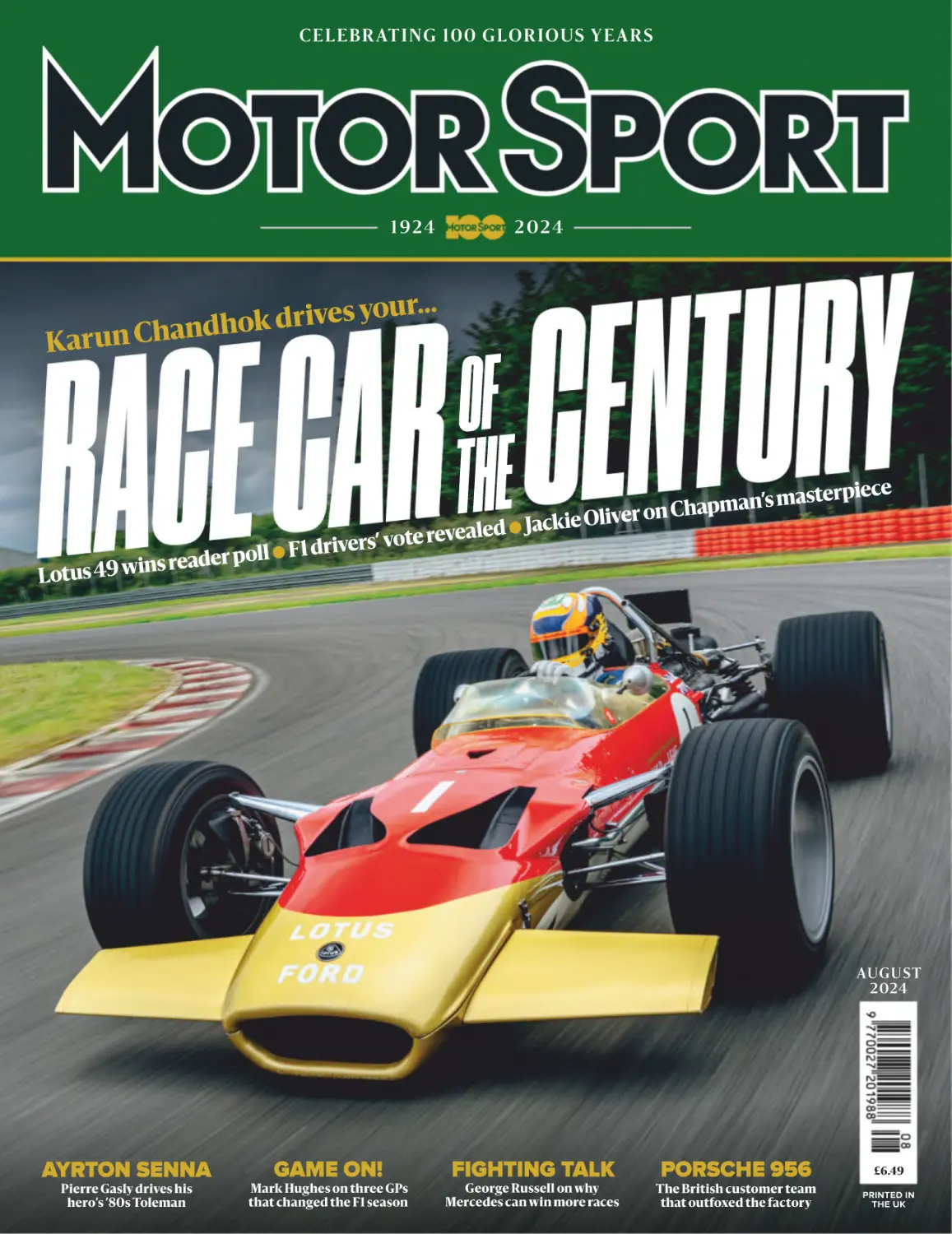
ON THE COVER
34 Red Bull’s rule in Formula 1 is under threat
90 Pierre Gasly drives Ayrton Senna’s ’84 car
106 Porsche customer team’s 956 adventure
116 Is Mercedes finally out of the F1 doldrums?
64 Those who don’t want
to know the result of
Motor Sport’s Race Car
of the Century should
look away now... or just
focus on the smile of
Karun Chandhok, who
drove the winner
August
JAYSON FONG, GETTY IMAGES
Issue No.1188 Volume 100, No.8
F1 TRACKSIDE VIEW
32
KARUN CHANDHOK
How the short cycle of F1
regulations ruins competition
THE EDITOR
Joe Dunn takes us on an alphabetic
recap of this year’s Le Mans 24 Hours
11
26
34
MATTERS OF MOMENT
Racing from Aintree, Steve Rider’s
footage finds and Coventry’s street course
14
29
41
25
30
42
F1 FRONTLINE: MARK HUGHES
What’s the thinking behind Flavio
Briatore’s new role with Renault?
MOTORCYCLES: MAT OXLEY
New MotoGP regulations have
been announced – arriving in 2027
THE ARCHIVES: DOUG NYE
In F1 TV coverage buzzwords
proliferate but not everyone is happy
ANDREW FRANKEL’S DIARY
The new 911, Chinese electrics
and remembering TVR’s Peter Wheeler
RACE REPORT
Sleeping giant Mercedes
has finally woken from its slumber
TACTICAL ANALYSIS
Max whips up a blame storm,
but boss Horner’s having none of it
F1 UPS & DOWNS
Nico’s record, Leclerc’s
complaints and Sauber ‘progress’
AUGUST 2024 MOTOR SPORT
7
CONTENTS
44
ROAD TESTS
Assessing new arrivals from
Mercedes, Alfa Romeo and Bentley
82
48
PRECISION
Watches with a motoring mien by
Chanel, TAG Heuer and H Moser & Cie
90
50
EVENTS
Diary dates include Porsche
Classics at the Castle, BTCC and WRC
99
53
106
RACE CAR: JACKIE OLIVER
Jim Clark’s replacement tells us of
his tricky times with sport’s finest racer
PIERRE GASLY GOES SENNA
The Alpine driver takes Ayrton’s
Toleman TG183B on the track – and likes it
INTERVIEW: TONY STEWART
In US racing it’s probably easier
to tell you what this driver hasn’t won
57
99
59
LETTERS
Meeting Jenks, in favour of the
Lotus 72 and emotions run high at Imola
66
RACE CAR: THE WINNER
Karun Chandhok straps himself
in to experience the best of the best
125
64
78
160
FLASHBACK
Watching French TV get technical
with a compare-and-contrast of Gallic PUs
RACE CAR: THE RECKONING
Find out which is your favourite
competition machine of the last 100 years
90 Alpine’s Pierre Gasly
drives Ayrton Senna’s
Toleman – 40 years on from
the Brazilian’s F1 debut
8
PORSCHE 956 106B2
Richard Lloyd crew reunites
with its Canon-liveried Group C giant
MOTOR SPORT AUGUST 2024
Now in his fifties, Tony Stewart is
still driving on the absolute limit
RACE CAR: DRIVER PICKS
Max to Magnussen, Lando to
Alonso, here’s how the F1 grid voted
116
MERCEDES’ F1 DIP EXPLAINED
Here’s why Lewis Hamilton and
George Russell couldn’t get a sniff of a win
SHOWROOM
A rarely used Ferrari Dino 246,
Steve Coogan’s Alfa and our auction picks
PARTING SHOT
An F1 driver group shot at
Interlagos in 1975 after a famous Brazil 1-2
JAKOB EBREY, GETTY IMAGES
BOOK REVIEWS
Bob Evans autobiography, recordbreaking Goldie and F1 cars 2000-09
AUCTIONS & PRIVATE BROKERAGE
GOODINGCO.COM
+1.310.899.1960
1956 FERRARI 500 TR
1914 SUNBEAM TT
Competed at the 24 Hours of Le Mans in 1956
Retained in Private Family Ownership Since 1968
Coachwork by Scaglietti I Chassis 0654 MDTR
Part of Sunbeam’s Victorious Team at the
1914 Isle of Man TT I Formerly the Property
of Stanley Sears
1964 McLAREN M1
1955 AUSTIN-HEALEY 100S
Earliest Known Factory McLaren
Formerly Owned and Raced by Dan Gurney
Chassis BMMR 2-64
One of Just 50 Built I Offered from 22-Year
Ownership by a Noted Collector
1955 FERRARI 857 SPORT SPIDER
Last of Just Four 857 Sports Built I Driven by Olivier Gendebien, Richie Ginther, Masten Gregory, and Carroll Shelby
An Extremely Significant, Matching-Numbers, Original-Bodied Competition Ferrari I Chassis 0588 M
FRIDAY AUG 16
SATURDAY AUG 17
LIVE AUCTIONS
ONLINE BIDDING AVAILABLE
OFFICIAL AUCTION HOUSE
OF THE PEBBLE BEACH
CONCOURS D’ELEGANCE ®
Pebble Beach® and Pebble Beach Concours d’Elegance® are trademarks and service marks of Pebble Beach Company. Used by permission.
LONDON AUCTION
FRIDAY 30 AUGUST
LIVE AUCTION
CONGRATULATIONS TO
MOTOR SPORT MAGAZINE
ON 100 YEARS OF EXCELLENCE
THE WORLD’S FINEST MOTORSPORT MODELS
ONE-OFFS
BESPOKE
MODELS AT LARGE SCALES
CLASSIC
HISTORIC
LIMITED EDITIONS
1:18
1:8
1:5
MODERN
Scan the QR to explore Amalgam’s full collection
AmalgamCollection.com
1:4
missed Le Mans’ 100th anniversary in
2023 so I was determined to make the
race this year, which it turns out was a
classic. Here are 26 things I learnt from
Le Mans... in alphabetical order.
Always pack a brolly. The rain was
promised but held off just long enough for you
to feel confident of venturing out without
protection. But come nightfall the heavens
opened, precipitating a four-hour safety car
and ultimately one of the most unpredictable
races in living memory.
Back-to-back wins. Ferrari answered the
critics who had suggested that last year’s
victory was something of a stitch-up with the
Italian team benefiting from a last-minute
change to Balance of Performance and putting
reigning champions Toyota at a disadvantage.
No such quibbles this year.
Crowd control. Or lack of. With 329,000
spectators at the circuit over the weekend
pinch points especially around Dunlop Bridge
were a heaving mass with fan frustrations
spilling over into scuffles. Must do better, ACO.
Dogs on track. A canine interloper
sparked a flurry of social memes as well as a
prolonged safety car. But it wasn’t the only
dog on the circuit: Toyota gave its two teams
nicknames based on the respective height of
their drivers. Car No8 with beanpole Brendon
Hartley (6ft) was ‘Doberman’; No7 with Nyck
de Vries (5ft 5in) was ‘Chihuahua’.
Eco-friendly measures need to be
meaningful. Banning tyre warmers before a
race in the name of sustainability is laughable
against the colossal consumption on show
elsewhere. Go green by all means, but ditch
the fig leaves.
Ferrari. It was the Italian team’s weekend,
no doubt about that. The Scuderia now has 11
overall Le Mans wins placing it third behind
Porsche (19) and Audi (13).
Garage 56’s absence meant no NASCARs,
DeltaWings or hydrogen power. A pity.
Hypercar is officially a thing: 23 entrants
from Ferrari, Cadillac, Porsche, BMW, Toyota,
Isotta Fraschini, Lamborghini, Alpine and
Peugeot. Overall there were 62 cars; 186 drivers
and 41 outright leader changes over the race.
Are we living through a golden age of
endurance racing? Do we still need to ask?
Indianapolis. I spent much of Saturday
evening making my way through the woods
to the infield viewing spot here. The sight and
sound of Hypercars braking heavily into the
left-hander before going hard on the power in
the gloom was thunderously hypnotic.
Jota’s remarkable comeback. The
THE
EDITOR
“I spent much
of the evening
making my
way through
the woods to
Indianapolis”
Porsche customer team found itself without
a second car after Callum Ilott’s practice crash.
With no replacement chassis the team begged
one from the Porsche works team (who
sourced it from a show car), built the car up
in 36 hours and used the airstrip for
shakedown the night before the race.
Kristensen, Tom. I bumped into the
great man on the Sunday morning. His verdict
on the slippery conditions: “It’s your fault if
you crash.” It’s easy to say that when you’re
a nine-time Le Mans winner.
Leena Gade was a revelation on Eurosport
and improved the coverage no end.
Media blackout – in the UK at least. With
an estimated 100,000 British fans making the
journey why is it that mainstream newspapers
and the BBC don’t cover the race?
Night-time washout. For once you didn’t
wake up wondering what you had missed in
the small hours.
Open doors nearly killed Ferrari’s hopes
when, with two hours to go, the right-hand
door of Nicklas Nielsen’s 499P was left
unlatched after a pitstop. The Dane tried to
close it as he drove at speed, but was forced
to pit from the lead with 1hr 43min left so a
mechanic could click it shut.
Penske’s unfinished business remains
unfinished – 61 years after the American
legend’s first attempt at Le Mans victory.
Qualifying and Hyperpole take over two
days to complete, but let’s face it, it’s probably
one of the more pointless exercises in racing.
Results that reveal the 2024 edition to
have been a race for the ages: Ferrari’s winning
margin at the flag, having completed 311 laps,
was just 14sec over the second-placed No7
Toyota and only 36sec over the sister Ferrari,
which was third.
Steak haché for breakfast is underrated.
Toyota: full disclosure, I was a guest of
Toyota and drove to La Sarthe in the brilliant
GR Yaris, but even a neutral must have been
moved to see the team fall short again.
Endurance racing owes them much for
keeping the top category alive when all other
brands abandoned it. Its day will come again.
United Autosports played a blinder to
win LMP2. Congratulations to the Wakefield
team and to Brit driver, and one of racing’s
good guys, Oliver Jarvis.
Valentino Rossi-mania was in the air
until his WRT BMW LMGT3 crashed out in the
night. The Doctor will be back.
Women-only team Iron Dames came a
deserved fifth in LMGT3. If the queue snaking
out of its merch store was anything to go by,
it would appear to be a firm fan favourite.
X-rated. “What the f*** is he doing?” The
reaction from Dries Vanthoor as Robert Kubica
barged into him, putting him into the
wall and ending the BMW’s highly anticipated
return to Le Mans after just six-and-a-half
hours. Kubica was given a 30-second drivethrough penalty.
Yellow flags – lots of them…
Zinedine Zidane, the French football
legend, dropped the tricolour flag to get the
92nd edition of Le Mans underway – and what
a race it was.
Joe Dunn, editor
Follow Joe on Twitter @joedunn90
NEXT ISSUE: OUR SEPTEMBER ISSUE IS
ON SALE FROM AUGUST 7
AUGUST 2024 MOTOR SPORT
11
IN THE SPIRIT OF BOD AND JENKS
Editorial
+44 (0) 20 7349 8484
editorial@motorsportmagazine.com
18-20 Rosemont Road,
London NW3 6NE, UK
EDITOR Joe Dunn
EDITOR-AT-LARGE Gordon Cruickshank
GRAND PRIX EDITOR Mark Hughes
ART EDITOR Owen Norris
CHIEF SUB-EDITOR Lee Gale
DIGITAL EDITOR Dominic Tobin
DIGITAL WRITERS James Elson and Cambridge Kisby
CONTRIBUTING EDITORS Andrew Frankel,
Doug Nye and Mat Oxley
SPECIAL CONTRIBUTORS Simon de Burton,
Robert Ladbrook, Damien Smith
and Gary Watkins
PICTURE LIBRARIES DPPI, Getty Images
and Grand Prix Photo
Contact us:
motorsportmagazine.com
Advertising
+44 (0) 20 7349 8484
sales@motorsportmagazine.co.uk
COMMERCIAL DIRECTOR Sean Costa
COMMERCIAL MANAGER Mike O’Hare
BUSINESS DEVELOPMENT MANAGER Kristiina Kruusma
DEALER & CLASSIFIED ADVERTISING Laura Crawte (01233 228754)
Publishing
MANAGING DIRECTOR Giovanna Latimer
FINANCIAL CONTROLLER Niall Colbert
ACCOUNTS ASSISTANT Canberk Sar
HEAD OF DIGITAL, MARKETING & SUBSCRIPTIONS Zamir Walimohamed
SENIOR SUBSCRIPTIONS MARKETING MANAGER Samantha Nasser
MARKETING EXECUTIVE Sohaib Anjum
MARKETING ASSISTANT Milo Capel Cure
DIGITAL DESIGNER Max St Hill
CUSTOMER SERVICE MANAGER Roshan Juglall
PROPRIETOR Edward Atkin CBE
FOUNDER EDITOR Bill Boddy MBE
@Motor_Sport
@motorsport1924
@MotorSport1924
Details matter.
Motor Sport (ISSN No: 0027-2019, USPS No: 021-661) is published monthly by Motor Sport Magazine GBR and distributed in the USA by Asendia USA, 17B S Middlesex Ave, Monroe NJ 08831. Periodicals postage
paid New Brunswick, NJ and additional mailing offices. POSTMASTER: send address changes to Motor Sport, 701C Ashland Ave, Folcroft PA 19032. UK and rest of the world address changes should be sent to
18-20 Rosemont Road, London, NW3 6NE, UK, or by e-mail to subscriptions@motorsportmagazine.co.uk. Distribution: Marketforce, 161 Marsh Wall, London E14 9AP. Colour origination: All Points Media.
Printing: Precision Colour Printing, Telford, Shropshire, UK. No part of this publication may be reproduced in any form without the written permission of the Publisher. Copyright © 2024 Motor Sport Magazine Limited,
all rights reserved. We take every care when compiling the contents of this magazine but can assume no responsibility for any effects arising therefrom. Manuscripts and photos submitted entirely at owners’ risk.
Advertisements are accepted by us in good faith as correct at the time of going to press. Motor Sport magazine is printed in England.
12
MOTOR SPORT AUGUST 2024
JAYSON FONG
While at Hethel, taking a special car on the track
(see p66), we were shown a wing from the archive
that had a profound effect on F1 design. It was
first seen attached to a Lotus 49 during practice
at the 1968 Tasman Series, inset. This is that very
wing, which is, in fact, a section of a helicopter
rotor. Colin Chapman was not impressed and
had it removed. It was in the possession of Lotus
mechanic Leo Wybrott who, several years ago,
gave it to Clive Chapman at Classic Team Lotus.
THE GENUINE ARTICLE
The Triple-Four Racing Chronograph embodies
over a century of British racing heritage in
Sir Terence Conran’s exquisite design. We’re delighted
to celebrate Motor Sport’s centenary – especially
knowing that the magazine was originally called
The Brooklands Gazette. From one genuine article
to another, Brooklands Watch Company wishes
Motor Sport many more years bringing us the
very best of motor racing.
www.brooklandswatches.com
MATTERS of MOMENT
The weather overnight
was grim. As the French
might say, Il pleuvait des
cordes. Track conditions
were treacherous
14
MOTOR SPORT AUGUST 2024
Hypercar heaven. Right:
Ferrari winners. Below,
from top: Peugeot pits;
LMGT3-winning Manthey
911; trophies for United
Autosports; safety car
GETTY IMAGES, DPPI
White-hot fight for
Le Mans falls to Ferrari
n unprecedented nine cars
on the lead lap at the finish.
Just 14sec between the
winner and runner-up. Just
1.1sec between third and
fourth. Yes, it’s safe to say the
92nd Le Mans 24 Hours proved a worthy
sequel to the 100th anniversary edition, as
Ferrari once again pulled off a narrow defeat
of Toyota to prevail for an 11th time.
Fine margins dictated the order as two
Ferraris, both Toyotas, two Penske-run
Porsches, a pair of customer 963s and a
Cadillac kept it lit until the chequered flag.
Nicklas Nielsen thought “everything was
lost” when a flapping right-hand door forced
an emergency stop, which left his
Ferrari on a marginal fuel strategy
in the Dane’s final stint. His 499P
was down to just 2% of its
energy when he crossed the
line at 4pm to claim a victory
shared with Antonio Fuoco
and Miguel Molina.
Had José Maria Lopéz not
spun in the 23rd hour, and
hadn’t been grappling with a power
issue on his Toyota GR010, might his
No7 entry have overcome the 14sec deficit
that defined defeat? Nielsen’s fuel-saving
efforts were aided by the return of rain that
contributed to more than six of the 24 hours
running behind a safety car – the only aspect
that undermined an otherwise great race.
For Lopéz the whole experience was bitter-
sweet. Demoted this year to a Lexus in
LMGT3, the Argentinian was called back to
share Toyota’s Hypercar with the man who
replaced him, Nyck de Vries, and team
principal Kamui Kobayashi when Mike
Conway broke ribs and a collar bone in a
cycling accident the week preceding the
race. In a car that only started 23rd and last
in class, following a Kobayashi crash in
qualifying, Lopéz was an unlikely star.
Then there was the sister No8 Toyota,
which had a greater claim on this being a
race that “slipped away”, in the words of
Brendon Hartley. It was the Kiwi who was
tipped into a spin at Mulsanne Corner by
2023 winner Alessandro Pier Guidi. The
Italian’s 5sec penalty was scant
punishment for an incident that
probably cost Hartley, Sébastien
Buemi and Ryo Hirakawa the
victory. Instead they finished
fifth as Pier Guidi survived a
dash to the flag to beat Laurens
Vanthoor’s pole positionwinning Porsche to the podium.
Fourth and sixth for the Penske
Porsches, plus an 8-9 for Jota, must
go down as a failure for the marque in
its chase for 20 Le Mans wins. Yet Vanthoor
was just 37.8sec away from a win.
As for Jota, its heroic build of a fresh car,
inset, being tested on Le Mans’ airstrip, to
spare Callum Ilott’s blushes after his
Wednesday crash is now the stuff of Le Mans
legend. This was a classic to remember.
AUGUST 2024 MOTOR SPORT
15
MATTERS of MOMENT
Forget Red Rum,
Aldaniti and Mr Frisk
– the home of the
Grand National echoed
to the sound of engines
Galaxie heads Aintree
cavalcade as circuit
marks two anniversaries
R
acing cars returned to lap the full
Aintree grand prix circuit in May as
enthusiasts marked the 70th
anniversary of its opening and the 60th of
its final race.
A cavalcade gathered at the venue near
Liverpool, which hosted five British Grands
Prix between 1955 and ’62. It was headed by
the Willment Ford Galaxie in which Jack
Sears won the last race on the full circuit on
May 16, 1964, driven this time by Wigan
historics ace Andy Middlehurst whose father
Philip competed in that race and who in the
1980s raced himself on the Aintree club
circuit in Formula Ford.
Period contrast was provided by a Mini
raced by Anita Taylor, who was also on the
grid at the final race, and an ex-Duncan
Hamilton Jaguar C-type to mark the 1953
Le Mans winner’s victory at Aintree’s
inaugural meeting in 1954, where, for the
first and only time, cars raced at the Grand
National venue in an anticlockwise direction.
Organiser the Aintree Circuit Club has
ambitions to mark another anniversary
next year, 70 years on from Stirling Moss
beating Juan Manuel Fangio by a nose to
win the British Grand Prix, by recreating
the 1955 grid or gathering all the cars Moss
raced at Aintree. But any such event would
require the laying of asphalt at the first
turn, Waterway, which currently has a
potholed rough stone surface.
U
S motor sport lost one of its key stars
this month. Rufus Parnell Jones,
who has died aged 90, was one of
America’s fastest, most versatile and bestloved racing drivers, who won in everything
from sprint cars and midgets to Indycars and
NASCAR, sports cars and Trans-Am and even
off-road at Pikes Peak and Baja.
Parnelli, as he was universally known,
broke through as a champion in sprint
cars during the early 1960s. He made his
Indianapolis 500 debut in 1961, then two
16
MOTOR SPORT AUGUST 2024
years later scored his only Brickyard win as
a driver when in an oil-seeping Ol’ Calhoun
roadster he avoided a black flag to defeat Jim
Clark’s rear-engined Lotus.
Further Indy victories slipped away, most
notably in 1964 and ’67, for a driver Mario
Andretti proclaimed as “the greatest of his
era”. But out of the cockpit Jones was at least
as equally influential as a team owner,
claiming a pair of Indy 500 wins with
Al Unser in 1970 and ’71 and double IndyCar
titles with Joe Leonard in 1971 and ’72.
GETTY IMAGES
Parnelli Jones 1933-2024
MATTERS of MOMENT
The Formula 1 Exhibition arrives
in London this August after
successful stays in Spain,
Austria and Canada
ExCel Formula 1 exhibition
to focus on British talent
T
he Formula 1 Exhibition, an official
show which has proven popular with
fans around the world, is coming to
London for the first time next month.
The exhibition will open its doors on
August 23 at ExCel in the capital’s Docklands,
following its visits to Madrid, Vienna and
Toronto in the past year.
The London show will be themed around
a homage to the British Grand Prix through a
collaboration with the Silverstone Museum.
Among the features will be simulators for
visitors to try, an archive exhibit
of unseen photographs, films,
artefacts and interviews, and
a design lab dedicated to
technical advances in F1.
The charred remains of
Romain Grosjean’s Haas
VF-20 from his famously
fiery 2020 crash in the
Bahrain GP will be on show,
while an immersive cinematic
experience dubbed ‘The Pit Wall’
promises to offer fresh views of some
of F1’s greatest moments.
“It’s fitting to bring The Formula 1
Exhibition to the UK and pay tribute to the
British teams, drivers and personalities who
have etched themselves into F1 history,” said
18
MOTOR SPORT AUGUST 2024
Emily Prazer, F1’s chief commercial officer.
“The Formula 1 Exhibition has been incredibly
popular since its launch in Madrid, and
successful runs in Vienna and Toronto prove
that it is a great way to engage with hardcore
fans and new audiences, while extending F1’s
reach beyond the race track. London is one
of the most cultural, vibrant cities in the
world, and we look forward to welcoming
visitors from around the world to the show.”
“Each show recognises the national
heritage of its host location,” said lead
curator and producer Timothy
Harvey, “and as Britain is the
home of racing this will be a
special show. There’s some
fantastic additions coming
to the London space,
including incredible cars.
F1’s greatest moments can be
seen on ‘The Pit Wall’. Above:
Romain Grosjean’s charred Haas
World RX plans
for Coventry
street circuit
T
he World Rallycross Championship
could visit the city streets of
Coventry next year, if ambitious
plans come to fruition.
Rallycross Promoter, the company
behind the world series, is in “advanced
talks” with the organiser of MotoFest
Coventry, a festival already established
in the city. An initial track design has been
created, drawing inspiration from the
World RX event held in Hong Kong in ’23.
Rallycross stars Kevin Hansen and
Molly Taylor visited MotoFest in early
June to find out more about the plans
from event director James Noble.
Rallycross Promoter chief Arne Dirks
said he was “blown away” by the festival.
“We are aware there is work still to be
done to turn this ambition into a reality,”
he said, “but together with James and
his team we are all focused on the same
goal – bringing the fever and thrills of
World Rallycross to Coventry next year.”
A section of
Coventry’s ring
road could be used
as part of a new
World RX circuit
An unprecedented opportunity to
acquire the only two historic
1937 Miller-Gulf Race Cars
in existence
1937 Miller-Gulf No. 002
1937 Miller-Gulf No. 001
Unique and singular tubular cooling system and
side-mounted gas tanks, Exhibited at the 2021 Pebble
Beach Concours d’Elegance and 2023 Amelia Concours
Recognized as the most original survivor by
Miller enthusiasts and experts, Exceptionally original
example of Harry Miller’s creative genius
Join Us at the 54th Annual
Labor Day Auction and Show
WorldwideAuctioneers.com | +1.260.925.6789
MATTERS of MOMENT
TV sport legend
revives hidden gems
of motor sport film
O
ne of the most famous voices in sport
is launching a unique motor racing
archive dedicated to bringing
forgotten racing footage to a new audience.
The venture, Racing Past Media (RPM),
aimed in particular at pre-1981 Formula 1
content, will help bring new detail and
perspective to the formative years of the
sport, as the Formula 1 World Championship
prepares to celebrate its 75th anniversary.
It is being masterminded by
Steve Rider who has presented
coverage of the British Touring Car
Championship since 1988, and for
years was the face of BBC Sport as
well as anchor for ITV’s F1 coverage.
RPM collates and manages
content from a wide range of
sources in order to assemble
an easily accessible body of
material for researchers and documentary
makers. It has already signed agreements
with ITV Sport, BRM and the John Tate
collection and others are set to follow as the
project gathers pace.
“This area of archive research has often
been challenging and time-consuming,” said
Rider. “We have been working on the detail
now for around four years and have
identified material that even the broadcasters
didn’t know existed.
“With the growing appetite for
documentary making it will be
exciting to see what producers
can make of this footage.”
The RPM team includes
experienced Formula 1 producers
and researchers, including
leading film archivist Richard
Wiseman, who has a long
Need never-beforeseen footage of Ferrari 156s?
We know just the place...
string of credits to his name including
Ferrari: Race to Immortality, Villeneuve Pironi
and Steve McQueen: The Man & Le Mans.
RPM will not only focus on grand prix
racing. It will also include footage of world
championship rallying and the BTCC.
Material researched, sourced and
licensed through RPM has already found its
way into forthcoming documentaries as well
as branded content films for organisations
such as UBS.
RPM has also worked closely with Motor
Sport as a media partner to source rare
footage which we are using to celebrate our
I00th anniversary.
Dumas makes it five at Pikes Peak
R
early on but that only gave me more
determination to make up the lost time.”
World Rally Championship ace Dani
Sordo made his Pikes Peak debut, finishing
third in Hyundai’s new Bryan Herta-run
Ioniq 5 N TA Spec EV. Four-time winner and
British expat Robin Shute was also due to
race one of the Hyundais but made a late
withdrawal, while another former
winner, Paul Dallenbach, broke a leg
and fractured his back in a practice
crash driving a production-spec Ioniq.
GETTY IMAGES, RPM, NABOYCHARLES
Romain Dumas – fastest to the
top in a Ford F-150 Lightning
SuperTruck EV
omain Dumas scored his fifth Pikes
Peak victory, despite a technical hitch
that forced a mid-race re-set of his
Ford F-150 Lightning SuperTruck EV.
The double Le Mans winner pulled up
to a dead stop soon after the start, losing
26sec, but then resumed to reach the summit
of the 12.42-mile, 156-turn mountain climb
in 8min 53.553sec. “Everything about this
event is a challenge because it is unlike any
other form of racing – you only have one
shot,” said Dumas. “We faced a challenge
20
MOTOR SPORT AUGUST 2024
MATTERS of MOMENT
A 110 – far superior to an Iveco
Daily. Below: Delta force, 1991
Restored to early ’90s spec. Below: an
elephant is saved from a muddy demise
Lancia’s
Land Rover
lifesaver
WRC assistance vehicle
answered trunk call
CATAWIKI
M
ention Lancia’s rallying exploits of the
1970s, ’80s and ’90s and thoughts turn
to the Martini-liveried cars such as the
Stratos, the 037 and Deltas S4 and HF that
helped to make the marque the most successful
in WRC. But what about the Land Rovers?
It’s true to say that the British off-roaders
weren’t the most memorable aspect of the
Italian team’s success but, when time came to
compete in the 1991 Safari Rally, its usual Iveco
Daily support van wasn’t considered up to
tackling the route’s inhospitable terrain.
Enter a brace of Land Rover 110s in County
trim, finished in heat-reflecting white and fitted
with suitably robust, full-length roof-racks for
carrying spare wheels, jerrycans and so on.
The pair, decorated with the logos of Lancia
and Martini, were assigned to shadow the Delta
Integrale 16Vs of Miki Biasion and Jorge Recalde.
As Motor Sport readers might know, Lancia
competition cars have carried the image of a
galloping elephant ever since the Giro di Sicily
in 1952 – and, in the case of the ’91 Safari Rally,
the good luck symbol proved appropriate.
While there wasn’t much the support crew
could do for Biasion’s Delta after he hit an
oncoming vehicle while overtaking a truck,
ripping off the car’s roof and bending its chassis,
they could lend a hand to an elephant calf
discovered drowning in a mudhole.
With the help of some long poles and a
suitably strong rope attached to the back of the
very Land Rover pictured here, they were able
to drag the stranded pachyderm out of its
predicament and send it safely on its way. The
Land Rover was called upon again for the ’92
rally before being sold into private ownership.
Having already been treated to a full,
galvanised chassis in 1999, the 110 was recently
restored to the exact specification it was in
when acquired by Lancia Martini Racing. It’s
surely a must for any committed fan of Lancia’s
golden age of rallying – but if the price is out of
reach, model maker TSM Mini GT has created
an impressively detailed 1:64 version for £16.99.
1989 Land Rover 110. On sale at Catawiki until
July 14. Estimate £130,000
This off-roader spent
two seasons with
Lancia Martini Racing
before passing to
a publishing
company
AUGUST 2024 MOTOR SPORT
23
28 – 31 AUGUST 2024
BLENHEIM PALACE
The Greatest Concours Experience in the World
1957 Ferrari 335 S
photographed by Christian Martin
/H
age
rty
TI C K E TS , H OS PITA LIT Y B O O K I N G S A N D
I NTE R N ATI O N A L CO N CO U R S E NTR I E S at SALON PRIVE CONCOURS.COM
l
ux
© image
to
Mo
SPONSORED BY
FORMULA 1
MARK HUGHES
“From a PR perspective
re-hiring Briatore looks
disastrous for Renault”
hy has Renault CEO
Luca de Meo re-hired
Flavio Briatore? It’s an
obvious question
given
Briatore’s
infamous firing by
Renault in 2009 for the 2008 Singapore Grand
Prix scandal. Briatore was the team boss who
ordered the subversion – of Nelson Piquet Jr
deliberately crashing just after team-mate
Fernando Alonso had made a bizarrely early
pitstop from the midfield, winning Alonso the
race – to be enacted. Briatore didn’t think it
up, but he instructed the team to do it. That’s
why he was banned from F1 for life (a ban
overturned on appeal a few years later). The
negative publicity to Renault of the cheating
charge – which lost it its ING banking
sponsorship – took a long time to subside. Yet
de Meo has effectively re-lit that fire. From a
PR perspective it looks disastrous for Renault
and not great for F1.
Whatever you think of Briatore, he’s a
clever guy. He tends to think outside of the
box, his mind works in a very creative way
(sometimes too creative admittedly!). The
positive qualities he brings will not necessarily
be found within a formal corporate structure.
In his role as executive adviser he has effectively
been given full scope for hirings and firings
within the team. So is this de Meo’s strategy to
rebuild a team which has fallen away so
dramatically over the last couple of seasons,
using Briatore’s lateral thinking to fast-track
the team back towards the front? Maybe.
But almost simultaneous with Briatore’s
return was the strong rumour that from ’26
the team would not necessarily be running
Renault power units. Briatore has been
discussing the possibility of a supply from
Mercedes. At the time of writing that was
described as ‘nowhere close’ to being agreed
and the price would need to be attractive to
Mercedes. But the significance is that it’s being
discussed at all and that Briatore is leading
that discussion. To the extent that in his efforts
to secure the services of Carlos Sainz, he’s
promised him a Mercedes power unit (from
’26). He’s behaving like a man in charge and
one with a definite plan.
Which then begs the question of
why would Renault, a major automotive
company, not insist that its F1 team uses
Renault power units, as produced in Viry,
home of decades of F1 engine innovation and
success? The turbocharger, pneumatic valves,
blown diffuser software, all those world
championships, etc. It’s a magnificent heritage
and the factory is currently working flat out
on the new 2026 power unit. With such an
asset and the investment required to run it,
why would it pay to run an engine from a rival
(admittedly one with which it has an
automotive link)?
So de Meo has hired a high-profile person
who has previously sullied the
reputation of the company in a
very public way and appears to
be endorsing a decoupling of the
F1 team from Renault’s own F1
engine factory. That doesn’t
stand up to any conventional
straight-line thinking. Who said
anything about straight lines?
Another of Briatore’s skills
is as a negotiator. If de Meo was
thinking in terms of getting Renault out of F1
but needed to maximise the value of the asset
that is the F1 team in its sale, would Briatore
be a suitable man for that? Damn right he
would. If that was Briatore’s assigned task, how
might he go about it?
He would probably prioritise a
disentanglement of the team from the factory
engine supply. Especially as Viry has not
produced a great engine in the decade of the
hybrid regulations. The Enstone team would
be far more attractive if it came with a deal to
run a fully competitive power unit, from
Mercedes say. Concurrently, he would look to
make a few key hirings to shore up a team
which has been leaking high-calibre people
for the last year or so. Totemic among those
recruitments would be a high-profile winning
driver, like Carlos Sainz, say.
The Enstone staff have been assured the
team is not being sold. Maybe not right now,
it’s not. But once a few key contracts have been
put in place by the great deal-maker Briatore,
it might be. He would for sure negotiate a
better deal than if it were left to corporate
employees, especially if he were motivated by
a percentage commission.
The last time Renault pulled out of F1 as
an engine supplier, at the end of 1997, it sold
the rights to manufacture its engines – to
Briatore. He set up Supertec which then
supplied several teams (including the
Enstone-based Benetton team which he’d
recently left) at a very healthy profit. When
Renault decided to re-enter F1
a few years later, it bought
the assets of Supertec and
re-employed Briatore to run the
former Benetton team
re-badged as Renault. This is
not quite history repeating, but
as a case study of Briatore’s
creative lucrative smarts and
his association with Renault, it’s
easy to see why de Meo may
have decided Briatore is who he needs.
Meantime what might de Meo do with the
great Viry facility and its highly skilled staff?
Horse Powertrain is a joint venture between
Renault and Chinese manufacturer Geely. It
was established only this year. It will make
automotive hybrid power units to be fitted to
both Renault and Geely road cars. Viry would
surely be a fantastic R&D centre for the project.
“Flavio’s
behaving like
a man in
charge and
one with a
definite plan”
Since he began covering grand prix racing in
2000, Mark Hughes has forged a reputation as
the finest Formula 1 analyst of his generation
Follow Mark on Twitter @SportmphMark
AUGUST 2024 MOTOR SPORT
25
MOTORCYCLES
MAT OXLEY
“The current MotoGP
machines are surpassing
225mph at some tracks”
echnical regulations are hugely
important in motor sport because
they play a crucial role in the
quality of the racing. And, like it
or not, motor sport is now more
of an entertainment business
than an engineering laboratory, so the racing
needs to be enjoyable. Therefore when a
championship rewrites its technical regulations,
the rules need to create a show, or they risk
damaging the business.
MotoGP recently announced new technical
rules, which will take effect from 2027. The first
concern was to reduce outright performance,
because the current 1000cc machines are
making around 300hp and surpassing 225mph
at some tracks. That’s quite fast on a motorcycle.
The new engine rules – 850cc maximum,
10% less fuel, 100% from non-oil-refinement
origin – should reduce performance by around
40hp. There’s been no push towards hybrid
because the cost of miniaturising that
technology for bikes would be prohibitive.
Next came the desire to get rid of some of
the Formula 1-inspired technologies that have
changed MotoGP – downforce aerodynamics
and ride-height devices. These were introduced
by Ducati, which has dominated MotoGP since.
Most of Ducati’s rivals weren’t keen on these
new areas of development, but nothing could
be done because downforce aero and rideheight devices were within the rules and new
rules must be unanimously agreed by all five
manufacturers, with Ducati obviously
determined to retain its advantage.
Ducati introduced its first ride-height
devices in 2018. The front-end holeshot device
was inspired by motocross, MotoGP’s muddy
off-road equivalent. Motorcycles pitch
rearwards during acceleration, which lifts the
front wheel, requiring the rider to roll off
the throttle, which kills acceleration.
This device is basic but effective. The rider
compresses the front suspension before the
start to lock the forks at the bottom of their
26
MOTOR SPORT AUGUST 2024
stroke, so the bike doesn’t pitch rearwards.
The device disengages when the rider hits the
brakes for the first corner.
Ducati’s hydraulically controlled rear-end
holeshot device is much more complicated.
MotoGP banned electronically adjustable
suspension in the 1990s, assuming it had
banned dynamic adjustment, but it hadn’t
allowed for Ducati’s creative minds.
German physicist Robin Tuluie, who had
previously created a hydraulically controlled
ride-height system for Mercedes’ Formula 1 car,
applied the concept to Ducati’s Desmosedici
MotoGP bike. Both systems worked well,
essentially transforming the Desmosedici into
a drag bike for the race towards the first corner.
The next step was obvious. If the ride-height
device allows stronger acceleration from
the grid, it will do the same from slowish
corners. So this was Ducati’s next innovation:
the rider presses a switch on the
left handlebar, the rear shock
compresses to lower the
motorcycle’s centre of gravity, and
this allows the rider to be more
aggressive with the throttle.
All these devices – copied by
rivals with varying levels of success
– have been banned for 2027, to
the delight of most riders who say
they detract from the skill required to race a
MotoGP bike. Without the lowering devices,
riders need to play more with the throttle and
move weight forward to maximise acceleration.
The new rules don’t ban downforce aero
– which also favours lesser-talented riders – but
it will be reduced. From 2027 upper fairings
will be narrower and their noses pushed
backwards. This will reduce downforce by
blunting the fairing and moving the centre of
load behind the front tyre’s contact patch.
That’s the theory, anyway. The new rules don’t
specify a limit on the number of aero elements
within the bodywork, so 2027 MotoGP fairings
could look more like current F1 front wings,
with multiple cascaded elements, designed to
maximise downforce.
However, reducing horsepower by around
15% will most likely limit downforce in its own
way. The 1000s made excessive power, which
engineers turned into grip via downforce. They
may not have that luxury with the 850s.
Riders are also happy that downforce aero
has been shrunk. Current MotoGP bodywork
creates a huge wake and partial vacuum behind
the motorcycle, which has safety implications.
The wake can knock riders off course, which
isn’t ideal when they’re fighting in groups. The
vacuum is an even bigger issue. It can reduce
grip in corners and increase stopping distances.
Recently, there have been several 200mphplus near-misses caused by the lack of what
riders call air-stop – when a rider brakes in the
vacuum behind a rival the lack of air resistance
reduces his braking power. Last August at
Silverstone, Marco Bezzecchi
braked at the end of Hanger
Straight in Pecco Bagnaia’s
vacuum, his bike didn’t slow as
expected, so he grabbed more
brake and crashed. The bike made
it all the way to the barrier at Stowe
corner and he only stopped
tumbling a few feet away.
MotoGP rights-holder Dorna
can only change the rules without the
agreement of the manufacturers when there
are safety concerns, but it has yet to play this
card. No doubt Dorna doesn’t want to upset
aero king Ducati, which currently supplies
machinery to four of the 11 teams on the grid.
Those in charge of MotoGP will be crossing
their fingers twice: firstly, hoping that their luck
holds for the next two seasons, secondly, that
the new rules do reduce the air-stop problem.
“Reducing
horsepower
will most
likely limit
downforce”
Mat Oxley has covered motorcycle racing
for many years – and also has the distinction
of being an Isle of Man TT winner
Follow Mat on Twitter @matoxley
NEW
office now open
in Miami
traditional values
modern thinking
OFFICIAL TRANSPORTATION SUPPLIER
Sea and Air Freight
Worldwide Customs Brokerage
Enclosed Trucking Services
Race and Rally Transportation
International Car Storage
Vehicle Registration Services
JAPAN
MIDDLE EAST
W. COAST USA
E. COAST USA
NETHERLANDS
UNITED KINGDOM
+81(0) 45 306 7043
+971(0) 4882 1334
+1 (310) 695 6403
+1 (305) 990 1341
+31 (0) 252 682 526
+44 (0) 1284 850 950
info@carsjp.net
www.carsjp.net
info@carsmiddleeast.com
www.carsmiddleeast.com
info@carsusa.com
www.carsusa.com
info@carsusa.com
www.carsusa.com
info@carseurope.net
www.carseurope.net
info@carseurope.net
www.carseurope.net
Providing specialist protection to classic
and sport cars since 1983
Sponsors of Race Car of The Century
“When I could not get any coverage anywhere, Footman James really researched my
information and secured cover. They applied solid insurance knowhow to real Broking
skills, and got a good result that I had failed to get from any of the large number
of brokers out there.”
Footman James is a trading name of Advisory Insurance Brokers Limited. Registered in England No. 4043759 Registered Address:
2 Minster Court, Mincing Lane, London, EC3R 7PD. Authorised and Regulated by the Financial Conduct Authority.
THE ARCHIVES
DOUG NYE
“Are readers as sick of
hearing ‘running P3’, ‘in
quali’ or ‘Turn 5’ as I am?”
hall I do it? I’ve thought about it for
quite a while. It is annoying. Yes,
it’s Grumpy Old Man time. Are any
readers as heartily sick of hearing
“Box – box – box!”, or “He’s
running P3”, or “There’s a chance
of P1”, or “in quali” pronounced ‘kwally’, or
“At Turn 5”, or “In Turn 1”…as I am?
Changing times – changing generations of
fans and enthusiasts (who are of course often
different animals), but changing jargon – well
– just stokes one’s pressure pump.
The first time I covered a race at the
Nürburgring, back in the 1960s, was also my
first visit to Germany. Having been raised on
the standard ’50s diet of war movies, usually
featuring Jack Hawkins and James Mason or
John Mills and Anthony Steel, I was fascinated
to see real policemen indeed wearing long
grey-green leather coats and to hear such
guttural PA pronouncements as “Alle
Fahrzeuge im Fahrerlager!” Or “Nummer sieben
ist in Der Box!”. Fahrerlager – paddock, or at
least the lager part, conjured up all kinds of
PoW movie memories. Box – the pit to a
properly brought-up racing-mad Brit.
So, box – pit – both three-letter singlesyllable words. Both distinctive, emphatic,
with plosive initials – neither likely to be
confused in context with another word in, for
example, a radio call. So why would the former
now have so comprehensively replaced the
latter in daily motor racing jargon?
Beats me…
I find it even more difficult to accept ‘P3’
or ‘P1’ as a description of position or result
within a race. Why use a two-syllable form
when in these cases ‘third’ or ‘first’ are utterly
specific, quick, crisp and even simpler to say?
‘Quali’ is just a naff-sounding abbreviation,
and admittedly trips off the tongue more
smoothly than ‘qualifying’ – half as many
syllables – but then we get to corner
designation, and the thought that the
Silverstone Grand Prix circuit’s Copse Corner
has now become to drivers, engineers and PR
people alike Turn 9 – while Stowe is Turn 15….
Blimey O’Reilly, an entire battalion of trackowning BRDC members would surely be
bouncing off the rev limiter at that.
Of course the corner naming by Turn
number was a transatlantic import, based
largely upon American board-Indianapolisstyle speedway habit. Indy was built with its
four more or less identical 90-degree corners
entitled Turn 1, 2 etc from unarguable logic.
The speedways’ 19th century predecessors –
largely fairground trotting track and horse-race
courses had established that habit.
British tradition was rather different. Our
horse racing traditions had already prevailed
for centuries, largely on estates owned by the
landed gentry. Course corners inherited
the estate names from local geography. On
Continental Europe the great road race circuits
on which the sport developed after 1902
actually ran through towns and villages. Their
names were adopted simply to
describe approximate location,
the circuits typically being so long
there would otherwise be
hundreds of twists and turns to
christen, so most corners were
anonymous until something
conferred certain notoriety.
Pre-war in the UK motor
racing centred upon the unique
Brooklands Motor Course. Its
banked Outer Circuit had, in effect, only three
‘turns’, each long and – in linear terms other
than their frost-vulnerable surface – gentle.
But they were named, the Members’ Banking
– close to the exclusive Club members’ viewing
area, the Byfleet Banking after the adjacent
village, and then there was the gentle kink
descriptively-named The Fork.
The supreme Isle of Man TT course
followed European practice of using preexisting place names because of its length,
like Ballacraine, Greeba or Crosby, with
Quarterbridge, Union Mills and The Bungalow,
etc derived from relevant adjacent features.
When Donington Park came along as a proper
road-style mainland circuit in 1933, its corners
took names from the Park estate’s features like
Coppice (farm), Red Gate and Holly Wood,
local personality McLean’s, and from the
nearby village of Melbourne.
Sadly – as racing progressed – fatalities
could endow the crash site with the
unfortunate victim’s name. After 1927 Birkin’s
Bend at Rhencullen on the TT course
commemorated motorcyclist Archie Birkin
(younger brother of ‘Bentley Boy’ Sir Henry).
The Ascari Curve at Monza became a prime
example after the first double-World
Champion’s demise there in 1955. And of
course the huff-and-puff publicists and
promoters had already done their bit to attract
paying spectators to dramatic locations – the
1914 Grand Prix course at Lyons having its
challenging Virage de la Mort (where to my
knowledge no racing driver nor
mechanic actually died), and the
US Grand Prize course in Santa
Monica had its Death Curve…
At least we still hear current
commentators sometimes use
corner names not numbers –
especially the more euphonious
Italian tags such as Rivazza,
Tamburello or Acque Minerali at
Imola, the Lesmo or Parabolica
– the ‘Diabolica’ to many Brits – at Monza.
But numbering turns is computer
technology, newspeak logical to engineers,
and it’s a language computers can digest, so
they stuff ‘the romance’. Regardless, it’s such
a shame our great drivers today talk turns by
number. Sadly I can’t see that ever being
confined to where it belongs. In a box.
“It’s such
a shame our
great drivers
today talk
turns by
numbers”
Doug Nye is the UK’s leading motor racing
historian and has been writing authoritatively
about the sport since the 1960s
AUGUST 2024 MOTOR SPORT
29
DIARY
ANDREW FRANKEL
“Peter Wheeler did great
things for TVR but when
we’d meet he was brusque”
ast month marked 15 years since
the passing of Peter Wheeler, the
man who took over TVR and
turned it from a manufacturer of
quite pleasant but unevenly
constructed sports cars into a
constructor renowned for making some of
the most fearsome and feared machines made
legal for the public road.
I had an up-and-down relationship with
both Wheeler and the cars he constructed.
I never got to know him well but on the few
occasions we met he was brusque at times
and really quite cutting at others. I’m told he
was shy but gave the impression of thinking
me quite stupid, if he thought about me at all,
which I really rather doubt.
But some of the cars created on his watch
deserve to be thought of as minor classics
today. Any Griffith with the Rover-Buick V8
engine, for example, but especially those with
the rare 4.3-litre iteration. The Chimaera today
looks fantastic value as a surprising practical
weekend smoke-about, and those who fear
their reputation for bits falling off should take
some comfort from the fact that any poorly
assembled part will have failed years and
probably decades ago and hopefully put back
by someone with a little more care.
No doubt Wheeler did great things for TVR
and our fondness for it today is, in my
estimation, almost entirely down to him. He
was a true maverick who did what he did in
an era when you could, just, get away with it.
But we must also remember that by trying to
push the brand further upmarket than it cared
to go, commissioning his own series of engines
and building far too many versions of what
were, underneath, very similar products, then
taking the money and selling the company to
someone who never gave the impression of
having a clear and realistic plan for the future,
so too was Wheeler in large part responsible
for its downfall. Of course TVR is nominally
alive today and under new ownership,
30
MOTOR SPORT AUGUST 2024
but with the grand total of one new Griffith
seen in public over the last seven years,
a return to its glory days seems less likely
today than ever.
I’ve been in the new Porsche 911, the revised
version of the ‘992’, so of course I should tell
you what it’s like. I can inform you that the
one I was in was the new GTS and that it has
a brand new 3.6-litre engine, is the first 911 to
have a hybrid drive attached and, thanks to
the instant torque it supplies, plus the fact its
turbocharger is powered not only by exhaust
gases in the conventional way, but electricity
too, throttle response is instantaneous. Indeed
it is so fast out of the blocks it will keep up
with an old Turbo S, and lap the Nürburgring
even faster. And that despite the
fact it has now just one, rather
than two turbos.
It felt incredible. So fast
around Porsche’s Weissach test
track it makes me wonder what
on earth the new Turbo will be
like. But in fact I’ll leave my
observations there. Because this
was one of those gigs where the
hack only gets to ride in the car,
not actually drive it. Behind the wheel was
serial Le Mans class winner Jörg Bergmeister
and, in a car he helped develop, on a track
he’s known from not far beyond the cradle,
I’m confident he could make a milk float feel
impressive here. Much more than that I don’t
really feel qualified to say. The good news is
that by this time next month I’d have been
back on track in the car, and on the public
road and with a steering wheel in my hands.
I look forward to telling you more.
(which owns MG), Geely (Lotus, Volvo and
Polestar) and BYD make them able to unfairly
undercut European competition. Duty rates
of between 20-38% look likely to spike the
prices of Chinese-built EVs sold in the bloc
by many thousands.
It is not yet clear what the UK’s response
– if any – is likely to be, and it will be down to
the new government to determine whether
or not to follow suit. I hope it does not. First,
price is one of the prime reasons EV retail
sales are stalling both here and in the EU, so
making them more expensive seems hardly
likely to help the situation. Second, the
Chinese will doubtless respond in kind,
making life for European manufacturers in
one of the world’s largest export markets
doubly difficult. And I can’t see
that doing much good either.
What’s the answer? The
Chinese have one: companies
like SAIC, Dongfeng, Chery and
BYD are all eyeing sites in Europe
where they can either build their
own factories, or employ
companies like Magna Steyr
in Austria to make their cars in
Europe for them and avoid
the duty that way. If the EU is to compete it
seems that it must at least back European
manufacturers to help them regain the
competitive edge.
But ultimately what is needed is a new
generation of small, affordable and effective
EVs. If the traditional European brands can
produce them, their brand recognition and
reputation should ensure their success. If not,
slapping duty on Chinese EVs sold in Europe
may slow their flow, but it will not stop it,
and may end up doing more harm than good.
“What is
needed is
a new
generation
of small and
effective EVs
By the time you read this, the EU will likely
be applying huge import duties on Chinese
EVs in an attempt to stem their hitherto
inexorable rise across the continent. It claims
subsidies given to manufacturers like SAIC
A former editor of Motor Sport, Andrew splits
his time between testing the latest road cars
and racing (mostly) historic machinery
Follow Andrew on Twitter @Andrew_Frankel
THE ULTIMATE
SUMMER FAMILY
FESTIVAL
THE BEST HISTORIC MOTORSPORT · AUCTIONS
THOUSANDS OF CLASSICS · 3 NIGHTS OF LIVE MUSIC
FANZONE FEATURING F1® TEAM SHOW CARS · FAMILY FUN
*PLUS A SPECIAL TRIBUTE TO AYRTON SENNA *
PRICES START FROM £75
KIDS UNDER 16 GO FREE
WWW.SILVERSTONE.CO.UK
FORMULA 1 OPINION
KARUN CHANDHOK
“We’ve missed this
feeling – there’s a buzz”
s we get over the first third of
the 2024 F1 season I think it’s
fair to conclude that the
chasing pack has started to
make inroads into the Red Bull
advantage. At the start of the
season Max Verstappen was able to rattle off
the pole positions with ease. At the opening
three weekends he had a gap of about three
tenths over the best non-Red Bull with the gap
in China growing up to half a second.
Since Miami, however, McLaren, Ferrari
and Mercedes have all started showing better
32
MOTOR SPORT AUGUST 2024
form and Max wasn’t on pole for three races
in a row after sneaking ahead by just eight
hundredths in Imola. This trend is perhaps
better illustrated in the way that Sergio Pérez’s
form has dipped. The Mexican qualified in the
top two rows at four of the first six grands prix
but his run through Imola, Monaco and Canada
delivered 11th, 16th and 16th starting positions.
This convergence of form is something
we’ve come to expect whenever there’s a
shake-up of the rules. When we started this
cycle in 2022, Ferrari seemed to have a car that
was as fast as the Red Bull but the Milton Keynes
squad found another gear after the summer
break and moved ahead. This uplift in
performance carried on through 2023 but as
the inevitable flattening of the development
curve kicks in, it does seem like Ferrari are
getting closer to the pace again. Certainly the
final few rounds where Leclerc qualified on
the front row five consecutive times was a clear
sign that they had at least found the right
direction to develop in.
Mercedes started this era badly and while
there have been flashes of speed, we haven’t
seen any consistent challenge since 2022. After
The FIA has revealed plans for
cars to be smaller, nimbler and
more eco-friendly from 2026
with a near 50-50 split
between electric and IC
power. But do constant rule
changes impede competition?
the Canadian GP, Lewis Hamilton hadn’t had
a podium in 12 races!
Listening to people like James Allison and
Andrew Shovlin, though, it feels like they have
finally started to genuinely get an answer for
where they need to unlock some performance
and the upgraded wing introduced for Monaco
has created a level of consistent balance that
the drivers have craved.
McLaren’s renaissance, on
the other hand, has been the
most impressive since Jordan in
1998, creating a chasing pack of
six drivers who are now all
capable of getting a podium
alongside the Red Bull pair.
Walking into the paddock on
a Saturday and not knowing who
is going to get pole just changes
the whole dynamic of the weekend for all of
us working in the sport and more importantly
for everyone watching at home. There’s a buzz
as we head into qualifying and the drivers are
pushing to be millimetre perfect. Every degree
of tyre temperature matters on the prep laps
and there’s no room for complacency. We’ve
missed having this feeling since Red Bull
dominance began in 2023. Now it’s firmly back.
This has created the question in my mind
about the length of the rules cycle we have at
the moment. A small but significant tweak
to the rules around the rear floor in 2021
created an epic season with Lewis and Max
heading to the final round equal on points. We
saw several other teams popping
up into contention on occasion
and on the whole, the pack was
much closer (top nine teams in
2020 were covered by 2.8%
versus 1.9% in 2021).
Inevitably, the field spread
apart in 2022 with the new rules
but over time this has slowly
converged. In terms of outright
qualifying speed, the top six
teams were 1.6% apart in 2022 whereas so far
this season that gap is 0.92% – the closest it has
ever been. The good news is that we will have
an evolution of these cars going into 2025 but
the downside is that the rule changes for 2026
represent the biggest reset the sport has seen
since 2014 and arguably even more so.
FIA
“The rule
changes
for 2026
represent the
biggest reset
since 2014”
This, of course, will probably spread the
field apart once again. Think back to 2014 when
the Mercedes power unit was so far ahead of
the rest; we could face this scenario again. I’ve
seen so many fans asking if we can delay the
change to the rules so we can reap the benefits
of this convergence but sadly that’s not an
option as the FIA, teams and engine suppliers
are all ploughing ahead with 2026 plans now.
In my view, the rules cycles are too short
for such wholesale changes. We had a threeyear run from 2014-16, a four-year run from
2017-21, with another four-year run now. We’ve
learnt that towards the end we get great
competition so why don’t we have a six-year
cycle with smaller changes in between? This
will control costs but crucially we could enjoy
an extended period where the teams are close
and we can enjoy unpredictable race weekends.
I would suggest that this is something the FIA
and F1 need to look at for 2026.
A former racing driver in Formula 1, WEC
and Formula E, Karun Chandhok is an analyst
for Sky Sports F1
Follow Karun on Twitter @karunchandhok
AUGUST 2024 MOTOR SPORT
33
FORMULA 1 RACE REPORT
Canadian GP
Spanish GP
Austrian GP
Mercedes returns
as a frontrunner
What a difference a month makes. Mark Hughes
takes us through the laps at Canada, Spain and Austria
as a fourth team joins this season’s winners’ list
34
MOTOR SPORT AUGUST 2024
s McLaren and Lando Norris
established themselves at
the front, apparently ready
at any track to challenge Red
Bull and Max Verstappen on
raw performance, so the
differences in detail began to assume magnified
significance. But for two split-second moments
in Canada and Spain respectively Norris could
– and should – have won consecutive grands
prix. You cannot give such things away to
Verstappen and Red Bull and go unpunished,
even if theirs is no longer a dominant car,
merely a very competitive one. Once Norris
and McLaren got those details right, what then?
There still remained the immovable object of
Max Verstappen in a wheel-to-wheel contest.
How might that pan out?
At the end of this three-race run,
Verstappen had won seven of the season’s 11
races to date. But not since China in Round 4
has Red Bull had the sort of advantage over the
field which was routine last year.
Coming off the back of the uneventful
Monaco race, Canada was a welcome thrilling
three-way scrap between
Verstappen, Norris and George
Russell’s Mercedes, livened up
immensely by the weather.
The first two stints of the race
were run with almost everyone on
intermediates. Although it was just
a steady drizzle as the race started,
the track was wet enough from a
previous downpour that it was
worth a gamble on full wets for
Haas. Kevin Magnussen rose as high as fourth
in the early stages – “It was great. It was as if
I was driving a Red Bull,” – before the wets
overheated and his cameo was over. George
Russell had set pole for Mercedes as the car
seemed to be responding well to its new front
wing. He led the early stages of the race too,
with Verstappen in his wheel tracks. The Red
Bull had matched Russell’s pole to the
thousandth but the Mercedes driver had set
the time first and was now looking quite
comfortable holding off the world champion.
Norris in third was running a different sort
of race in his McLaren, reminiscent of that of
Imola, with a set-up and tyre-pressure choice
to come into their own in the late part of the
stints. After 10 laps he was 9sec adrift of Russell.
Within a further nine laps he had picked off
both Verstappen and Russell on consecutive
laps! Not only that, but he proceeded to pull
out 8sec on them in the next four laps. It was
a spectacular performance and underlined the
McLarens’ claim to being the fastest race day
car, coming after the similar stellar pace in the
races of Miami and Imola.
But it all began to go wrong for Norris as
Logan Sargeant lost control of his Williams on
the tricky surface at Turn 4. Race control was
waiting to see if he could get restarted and it
was only as it became apparent that he could
not that the race came under a safety car. This
was just as Norris was approaching the pit entry
in the lead of the race. Had he pitted at that
point, he’d likely have won. Instead, he
continued as everyone behind him pitted for
fresh intermediates. As the safety car then
picked Norris up as the race leader, he was
delayed in getting back to the pits and exited
back in third, with Verstappen now leading
from Russell. The Red Bull had passed the
Mercedes when Russell had tried to resist
Norris’s overtake a few laps earlier, only to be
forced to take to the final chicane run-off,
allowing Verstappen to zap him. Russell would
never get that position back.
Into the second stint, with the drizzle still
delaying the move onto slicks, Verstappen and
Russell pulled out around 3.5-4sec. But as the
shower passed and the track began getting
close once more to slick territory, there were
again decisions to be made on the
pitwall. Pierre Gasly in the Alpine
was the first to go for slicks. By his
second lap he was faster than he’d
been on the inters, this triggering
Verstappen and Russell in. But the
slicks would take a while to warm
up on the cool, damp track and
McLaren decided to leave Norris
out for an extra couple of laps,
attempting to overcut him back
ahead. It got him ahead of Russell, but not quite
Verstappen. The McLaren was marginally
ahead as it rejoined the track but trying to
accelerate on a patch of standing water, he
was never in position to hold off the Red Bull,
which was conclusively the quickest in the
slick-tyred final stint.
“We stayed out because I was so quick at
the end of that middle stint,” said Norris
afterwards, “but I didn’t push early enough
and I could have got past George one or two
laps before the stops and closed the gap to
Max to give myself a better opportunity
of overcutting him.”
GETTY IMAGES, DPPI VIA FERRARI
“It all began
to go wrong
for Norris as
Sargeant
lost control
on Turn 4”
In Canada, Max made
it six wins out of nine.
Left: tricky conditions
at the Montreal circuit
AUGUST 2024 MOTOR SPORT
35
FORMULA 1 RACE REPORT
First seen in Monaco,
Mercedes’ new front
wing has led to an
upturn in form
With its new wing
Mercedes is flying
In Canada, technical director James Allison explained how
an aero upgrade had made the team competitive again
After a very difficult start
to the season – its third in
the last three years –
Mercedes suddenly hit
form in Canada as George
Russell took pole position
and led a significant
proportion of the race.
Two races later, in Austria,
he took the team’s first
victory since Brazil 2022.
Although the win was a
fortunate one, coming
after Max Verstappen and
Lando Norris had collided
and punctured, the
Mercedes was still in far
better competitive shape
than earlier in the season.
The breakthrough
came with a new front
wing, introduced on
Russell’s car at Monaco,
and used on both cars
since. Technical director
James Allison explained in
Montreal some of the
problems they’d been
facing with the car and
36
MOTOR SPORT AUGUST 2024
why the new wing was
such a powerful upgrade.
“The front wings on
these cars are very big.
They probably like being
near the ground most of
all, and that tends to make
a car get more nervous as
it goes faster, because
proportionately more is
moving to the front axle
than you might wish. And
so you’re fighting that
with these rules. And the
more you find downforce
near the ground, the
worse that gets.
“The previous wing is
now in the past. It allowed
us to create the
discontinuity in a wing
that was anticipated by
the rules to be relatively
continuous. And that
discontinuity allowed
a bit of vigour to be
injected downstream of
the front wing.
“There is always
a tendency for low-speed
understeer and highspeed oversteer. But
the more extreme you
make it, the more tricky
the car feels to the
driver. You can do things
with the mechanical
balance [to counteract
that], but if you take
away the aerodynamic
unhappiness that
mechanical balance is
fighting, then you can
have a less extreme
mechanical balance
migration and a car that
feels more consistent and
predictable to the driver.”
Russell briefly got past Norris but a moment
through Turn 4 allowed the McLaren back
ahead. A second safety car (Carlos Sainz had
crashed his Ferrari and snagged Alex Albon’s
Williams) saw the Mercs in the pits for fresh
tyres and Russell had to fight his way past teammate Lewis Hamilton as well as Oscar Piastri’s
McLaren to regain his third position. It was an
incident-packed day for him, one which had
promised so much more. But Red Bull and
Verstappen had won again on a day when they
were merely competitive and had done so by
avoiding the mistakes of their chief rivals. It
felt at this point that they were winning through
the habit of winning.
Barcelona’s more demanding sequence of
curves were expected to be prime Red Bull
territory and while Verstappen was conclusively
quickest through the two fast corners, Turn 9
and 14, Norris took a couple of hundredths out
of him over the lap to snatch an against-theodds pole for the McLaren. The outcome of
the race was decided by the start, as Verstappen
was marginally quicker away and able to get
himself hooked inside Norris on the long run
down to the first turn. Fourth-fastest qualifier
Russell however was able to get a double tow
from their squabble and swept around their
outside to take the lead. “I was channelling my
inner Fernando Alonso,” he said in reference
to the Spaniard’s similar P4-to-P1 start in 2011.
It didn’t last for more than a couple of laps
though, with Verstappen putting a clean DRS
pass on the Mercedes going into the third lap.
DPPI, GETTY IMAGES, MERCEDES-BENZ AG, McLAREN
George Russell ‘does a Fernando Alonso’ to take
the lead at the start of the Spanish Grand Prix
Russell didn’t resist it, being more concerned
with ensuring he stayed on target with his tyre
temperatures around this very high-deg circuit.
With Russell then Norris’s cork in the bottle,
Verstappen was able to pull out of undercut
range without overworking his tyres, despite
the aggressive first couple of laps. “There was
no opportunity to do what Max did [in passing
Russell],” said Norris. “By the time you get four
to five laps in the tyres they are so hot that
there’s no longer enough differentiation in tyre
grip to try a move.” It just underlined the
perfect execution of Verstappen’s race.
Once Russell had pitted out of Norris’s way
for the first stops, the McLaren caught the Red
Bull at over 0.5sec per lap. Verstappen was
brought in before Norris could get within range,
illustrating the comfort zone for Verstappen
that first stint had provided. Staying out an
extra six laps longer than Verstappen would
mean that Norris’s second stint grip advantage
over the Red Bull on such a high-deg track
would be considerable. But it also meant he
was undercut by the earlier stopping Russell,
Lewis Hamilton and Carlos Sainz. He had to
overtake them on track before he could get
to use his tyre advantage in chasing Verstappen
down. Russell in particular put up a fierce
resistance and their wheel-to-wheel dice lasted
from Turn 2 to Turn 7.
By the time he had spent 13 laps getting
past the cars which had undercut him, Norris
was 8sec behind Verstappen but quickly halved
that up to the second stops. He
again went a few laps longer than
Verstappen so as to increase his
tyre advantage in the final stint,
but that early cushion allowed Red
Bull to control everything and
Norris fell short by 2sec at the flag.
Russell’s on-track battle with
Norris had used up his tyre life and
he was forced to pit with no more
of the favoured medium tyre
remaining and too many laps left to switch to
the soft tyre. So forced to take the slower hard
tyre – at just the time team-mate Hamilton
swapped the other way around – he was easy
picking for Hamilton who came through for
his first podium of 2024.
Norris was hard on himself afterwards and
spoke of how everything has to be perfect if
you are going to take on Verstappen – and his
start wasn’t. A few milliseconds out on the
release of the second phase of the clutch, a
stutter of wheelspin – and the race was lost.
But in the aggressive way Norris had moved
across on Verstappen, forcing the Red Bull to
have two wheels on the grass, we saw Norris’s
recognition of how it was going to be now that
he was regularly going wheel-to-wheel with a
driver who has never given any quarter. That
startline lean was Norris showing he was not
prepared to back down – even though Max had
made the inside. That would come to assume
more significance in Austria where Verstappen
and Norris were again duellists.
Verstappen won Saturday’s
sprint race after Norris had briefly
dive-bombed ahead into Turn 3.
But his defence down to Turn 4
wasn’t good enough to prevent the
Red Bull driver from retaliating –
and in engaging in that fight,
Norris left the door open for
Piastri to get through. This lost the
McLarens their DRS reach on
the Red Bull and Verstappen eased
away to a comfortable win. Later that afternoon
Verstappen set a stunning pole lap in qualifying
for the Grand Prix, around 0.4sec faster than
Norris. It briefly looked like Red Bull’s early
season performance domination had returned.
The race showed that not to be so.
Despite him feeling the car was not as well
balanced as it had been in qualifying, it was all
fairly routine for Verstappen in the first
“Verstappen
set a
stunning
pole, around
0.4sec faster
than Norris”
Verstappen leads Norris at the
start of the Austrian GP.
Above: Lewis Hamilton, back
on the podium, Barcelona
Lando Norris’s solid series
of results halted in the
Austrian Grand Prix
AUGUST 2024 MOTOR SPORT
37
FORMULA 1 RACE REPORT
Word on
the beat
The latest Formula 1
news away from the grid
OAt the time of writing
Alpine had made a strong
bid to secure the services
of Carlos Sainz, left,
previously believed to
have been on the verge of
signing with Williams.
OChristian Horner, right,
on being asked about
Toto Wolff expressing
an interest in recruiting
Max Verstappen to
Mercedes: “I think if Toto
wants a Verstappen, then
Jos is potentially available.”
This came after Horner created
difficulties for Jos’s planned run
with a Red Bull RB8 in a Legends
demonstration at the Austrian
Grand Prix meeting. Verstappen Sr
withdrew from the event and branded
Horner’s actions “childish”.
OAt the Austrian Grand Prix
Max Verstappen, left,
reiterated again that he
fully intends to remain at
Red Bull in 2025 despite
Toto Wolff’s attempts at
luring him to Mercedes.
38
MOTOR SPORT AUGUST 2024
A battle between Verstappen
and Norris at the Red Bull Ring
would end in a collision. George
Russell, below, took advantage
for his second GP win
couple of stints, as he eased out a 6-7sec margin
over Norris who always had a comfortable
advantage over Russell. Late in the second stint
of this two-stop race Verstappen was
complaining over the radio that his tyres were
finished and he should be brought in for fresh
rubber, but the team believed otherwise. But
he still had a 7sec margin as he and Norris
pitted on the same lap. A sticking left wheel on
the Red Bull used up 4sec of that 7sec margin,
and Norris was now on new medium tyres,
with Verstappen on used – and he flat-spotted
one of them on his out-lap. Norris used the
advantage of the rubber and within two laps
was within Verstappen’s DRS range. He was
going to have to fight his way past
Verstappen. This was a first for
him. He’d won in Miami because
the safety car had sprung him
past, he’d pressured him in Imola
but never got quite close enough.
But now, it was mano a mano.
With 16 laps to go Norris got a
run up the hill to Turn 3 and with
Verstappen hovering in the middle
of the track, dived for the inside.
As soon as he did, Verstappen edged that
way too, forcing Norris to abandon the
manoeuvre and switch to the outside to
avoid contact. “He reacted to my move,”
radioed-in Norris for the benefit of race
control. “You’re not allowed
to do that.” Indeed, that
rule was written in
response to Verstappen’s
moves in 2018.
Norris had to be particularly careful as he’d
already received a black and white warning
flag for track limits. One more and he’d be
getting a penalty. He regrouped and on lap 59
made a later T3 move on the brakes, so as to
deny Verstappen the chance of moving across.
This got him briefly ahead, but it had been so
late he couldn’t get the car turned – and strayed
into the run-off. Although he gave Verstappen
the place back, as required, he’d now incurred
a 5sec penalty. The dice continued regardless.
Four laps later, Norris finally nailed the move,
getting to the apex clearly ahead and staying
within the track. Verstappen hung on around
the outside – and was thereby obliged to take
to the run-off as Norris used up
the available track. Verstappen
rejoined ahead – with Norris
insisting he had to give the place
back. That incident was never
resolved because it was overtaken
by a bigger one on the very next
lap. Norris this time moved to the
outside approach of Turn 3.
Verstappen responded by moving
to the left until Norris had no more
track, at which point their rear wheels
touched, puncturing Verstappen’s
left-rear tyre and Norris’s right-rear.
Soon, Russell’s Mercedes passed the
scene, with Piastri’s McLaren in hot
pursuit, and shortly after that they passed
the two crippled cars making their way
to the pits. Russell took his second
career grand prix win with Piastri
and Sainz filling the podium.
“Verstappen
reacted to
my move.
You’re not
allowed to
do that ”
ANTONIN VINCENT / DPPI, ANADOLU VIA GETTY IMAGES, GRAND PRIX PHOTO, AUDI
OAudi has given an update
in the development of its
2026 F1 power unit. It has
reportedly completed
race distance stints on the
test bench in Audi’s facility in
Neuburg, Germany, where the
‘Audi F1 Power Unit Made in Germany’
will be produced. Chief technical
officer of the project Stefan Dreyer,
above, said, “We have 22 state-ofthe-art test benches. Our new
development tools are state of the art
and have enabled us to achieve a
steep learning curve… After the
successful race distances with the
power unit, we will soon be doing the
same with the entire drive system,
which means the combination of
power unit and transmission.”
LEGENDARY CARS
SPECTACULAR RACING
TICKET INFORMATION:
One-Day: On-the-day price Adult £25 Concessions (65+) £20
Full Weekend: On-the-day price Adult £35 Concessions (65+) £30
Display Passes, Exhibition Space and Discounted Public Admission for Clubs.
Chippenham, Wiltshire SN14 7EY
T 01249 782417 www.castlecomberacingclub.co.uk
www.castlecombecircuit.co.uk
TACTICS
FORMULA 1
The F1 world champion
was not pleased with the
performance of his Red Bull
crew in the Austrian pits
TEAM STRATEGY
“Everything wrong”
Max Verstappen laid into his team after a disappointing Austrian
GP but Mark Hughes can see the logic behind Red Bull’s thinking
GETTY IMAGES
A
t the end of the first stint, I caught
quite a bit of traffic and we should
have just boxed because I gave up
free lap time,” complained Max Verstappen
of his team’s strategy in the Austrian Grand
Prix. He was just getting started. “We
basically did a lot of things wrong today. It
started with the strategy, then the pitstop
was a disaster. The first one already bad, the
second one a disaster.”
When he says the first stop was bad, he’s
talking of a stationary time of 2.7sec. The
record is 1.8sec. The second one – in which
the left-rear wheel would not come off – took
6.5sec (which was 3.6sec longer than that of
his rival for victory Lando Norris).
In his 28-lap second stint, he was radioing
in after just 16 laps that his tyres felt bad.
“I don’t know what’s happening,” he said.
Twenty-five laps into the stint, he was almost
pleading to be brought in for his new set,
saying, “I can’t hold this much longer.” He
was at that point being pressured by the two
lapped Haas cars (on much newer rubber)
to let them by. In theory he could have been
blue-flagged. “I’m going to get overtaken.”
But still the Red Bull pitwall resisted.
Why so? Because although he was struggling,
so was Norris – and the gap to the McLaren
remained quite steady at between 6.7sec and
7.1sec according to traffic. Coming in earlier
than necessary would mean a longer stint
on the mediums – and George Russell had
just shown that the mediums could be
absolutely finished after just 25 laps. Getting
too early onto them – if Norris pitted several
laps later to get a big grip advantage – could
have been risky. Also, staying out there for
as long as possible meant you increased
your chances of getting to benefit from a
safety car. A safety car after Verstappen
had pitted but before Norris had
would have given Norris the
victory. Furthermore, although
Fifth in Austria for Max Verstappen – but as Red
Bull’s Christian Horner says, it wasn’t all bad
the lapped Haas cars were making life
uncomfortable for Verstappen as they
tracked him closely, they were also ensuring
that Norris was running in dirty air. So it was
freezing Verstappen’s advantage over the
only car which mattered.
Verstappen and Norris pitted on lap 51,
with 20 to go. Then Vertappen’s day began
to get worse.
“Everything needs to be perfect to win
and we have done that well so far,” continued
Verstappen. “We’ve won a lot of races but
today we did everything wrong and you put
yourself in this position.”
“I don’t think we got the strategy wrong,”
said team boss Christian Horner. “We
extended to cover Norris. Because we were
quicker than Norris, it made sense to do that,
because if you get unlucky with a safety car
by coming in early, you lose track position.
Therefore while we had the pace on
Lando, we were able to be
maintaining and pulling a gap –
sometimes tactically it makes
sense to do that. Probably we
would have been better off with
new medium versus a new hard
[for the second stint], but hindsight’s
a wonderful thing. The pace of the car
has been very strong this weekend. We’ve had
two poles, he’s led all but nine laps of the
grand prix, won the sprint race, he’s extended
his lead in the championship. We’ve extended
our lead in the constructors’ championship.
So despite not getting the win, it’s not been
totally disastrous.”
AUGUST 2024 MOTOR SPORT
41
FORMULA 1
RETRO
Good month, bad month
Charting the ups and downs of the F1 circus
FLAV’S BACK
OUT OF THE GROVE?
Controversial playboy team boss
Flavio Briatore has returned to Alpine as
a special adviser – and is already
rumoured to be engineering a final-hour
Carlos Sainz move to the team.
Logan Sargeant crashed not once,
but twice, during the Canadian GP.
Will he even last the season?
F1 RETRO – OCTOBER 2014
Mercedes’
first GP
comeback
Extraordinary tales from the
Motor Sport digital archive
BIG SHORT
F1 announced its 2026 car will be
lighter and shorter than the current one in
a bid to improve racing. Just what fans
have been calling for. How much lighter
and shorter: erm, a mere 30kg and 20cm.
BAD
GOOD
Even when struggling with a tricky
car – and his Red Bull team-mate is
knocking corners off his own RB20 –
Verstappen still schooled the rest of the
field in Canada and Spain.
RB HOPELESS
“If you perform well here, your
aerodynamics are good,” said Tsunoda
before he and RB team-mate Ricciardo
finished 19th and 15th respectively in
the ‘upgraded’ car at Barcelona.
PIT STRAIGHT TALKING
In contrast to most bland pundits
Jacques Villeneuve asserted in Canada
that Ricciardo is slow, living off his
reputation and others could do better.
Here’s to more opinions.
NEARLY NICO
Five P11s in 2024 for Nico
Hülkenberg, F1’s record non-podium
finisher. That man sure knows how to
nearly do something.
ROCKETMAN RUSSELL
Fabulous start by our George in
Spain. How often do you see a car go from
fourth to first on a start these days?
PIPE DOWN
Scuderia sniping as Sainz told
his Ferrari team-mate Leclerc to shut
it after whingeing about an optimistic
overtake in Barcelona: “Too many
times he complains.”
42
MOTOR SPORT AUGUST 2024
MISPLACED OPTIMISM?
Sauber F1 described 13th and 16th
in Spain for Zhou Guanyu and Valtteri
Bottas as “good progress”. Would hate to
know what a bad race looks like for them.
A
fter a couple of lacklustre seasons, the
Mercedes F1 team now looks to be
back on track with recent podium
finishes. Seventy years ago this month the
marque made its much anticipated return
to grand prix racing with a resounding 1-2
finish at the 1954 French GP for Juan Manuel
Fangio and Karl Kling.
Richard Williams recalls that momentous
race in his fascinating 2014 piece Sterling
silver – which you can view online in the
Motor Sport archive. The sleek, flowing lines
of the W196 challenger stunned the F1 world.
Designed by Rudi Uhlenhaut, the number
of staff attending to the gleaming machine
also took the paddock by surprise.
“It was very impressive, to say the least,”
says Stirling Moss, who was present that
weekend. “They came with many more
mechanics than anybody else – twice what
Ferrari or Maserati brought.”
The Silver Arrows cars dominated at
Reims, lapping all comers, and the author
points out that a company that had very
recent links to Nazi Germany was now being
celebrated once again.
“A broken thread of glamour and glory
had been mended, and once again the phrase
‘all-conquering’ could be used without
unpleasant echoes. To team boss Neubauer
and Uhlenhaut, the authors of this renaissance,
it must have seemed like a miracle.”
To read the full story visit
motorsportmagazine.com/archive
BERNARD CAHIER/GETTY IMAGES, GRAND PRIX PHOTO, SAUBER, FIA
VER-TUOSO DISPLAY
SEPTEMBER 24-27, 2024
JANUARY 26-31, 2025
MAY 25-28, 2025
JOIN US!
#MAKINGMEMORIES
classicevents.nl
REVIEWS
ROAD CAR TESTS
The civil side
of savage
The new AMG GT 63 is performance
engineering with everyday practicalities in
mind. Andrew Frankel likes what he sees
ercedes-Benz’s fabled AMG
division is going through
a curious phase. First it
decided that for the new
C 63 AMG it was going to
replace its beloved 4-litre
V8 engine under the bonnet of the hottest
C Class with a rather less lovely 2-litre fourcylinder motor, with an enormous hybrid
drive attached. I’ve not driven one, but it
was launched to fairly dismal reviews in 2022
and to date not one has been made available
on Mercedes’ otherwise well-supplied press
fleet, into which you will read what you will.
And then this. The new AMG GT. You’ll
remember the old one: two seats, double
clutch gearbox between the rear wheels and
a no-prisoners approach to the open road
and, of course, the car from which it was
directly derived, the wonderful SLS with its
gull-wing doors. These cars were not mere
hotted-up versions of more homespun
Mercedes product, but bespoke AMG
Mercedes will say
Indulgent luxury but
the interior styling of the
GT isn’t to all tastes
44
MOTOR SPORT AUGUST 2024
machines, unrelated to and unlike anything
else in the Stuttgart stable. Some were better
than others, but all were for drivers,
endlessly rewarding when you were on the
right road and on top of your game.
But this new GT is no longer a bespoke
car. It sits on the same platform as the SL
Roadster and can reasonably be thought of
as a coupé version thereof. It’s even gained
rear seats and four-wheel drive. And not only
has that transaxle layout been lost, its unique
double clutch gearbox has been swapped
for the same nine-speed wet clutch auto
transmission you’ll find in the SL.
Some markets even sell this car with four
cylinder engines, though for the UK the
choice is between two V8s, the car tested
with 577bhp and a forthcoming version with
a hybrid drive attached that will bump that
figure well north of 800bhp, but with a
massive additional weight penalty to a car
whose mass has already risen a quarter of a
tonne beyond that of its slimline predecessor.
A two-seat sports car with a max
speed nearing 200mph this may
be, but there’s little fear behind
the wheel for less-skilled drivers
It all sounds like progress is the
diametrically opposed direction to that in
which I’d choose a car like this to travel.
And there are issues. AMG has worked
hard to keep the car’s considerable bulk
always pointing in your preferred direction,
replacing anti-roll bars with electronically
controlled actuators that don’t merely limit
body movements, but actively control them.
There’s that four-wheel-drive system and
now four-wheel steering too. But the ride is
too firm and AMG has resorted to that old
trick Ferrari used to play of employing a
quick steering rack with aggressive off-centre
response to create the illusion of a cat that’s
more agile and responsive than it is.
And yet it works. It looks fantastic, the
driving position is superb, the interior
functional if a bit too chintzy and reliant on
haptic controls, and the motor makes it go
like the clappers. The gearbox is terrific too.
But the real surprise is that this car really
handles. Not in that seat-of-the-pants, steerit-with-your-toes way that, say, a Porsche 911
GT3 handles, but in a manner that will still
transport you the length of your favourite
local road at an astonishing rate and leave
you at the end marvelling at its body control,
“Mercedes has conceded it’s never going to build
a car that will reward highly skilled drivers”
level of grip and a sense of reassurance no
previous GT or SLS ever provided.
What appears to have happened here is
that Mercedes has conceded it’s never going
to build a car that will reward dedicated and
highly skilled drivers like the 911, or probably
an Aston Vantage too. So it’s stopped trying.
It has concluded that what a Mercedes
customer wants is a car that works whatever
the weather, that won’t scare its owner if he
or she slightly oversteps the mark, but which
will allow you to dump your shopping or
children on the back seat, while having a
practically proportioned boot and state-ofthe-art electronic architecture. And it is hard
indeed to say that this analysis is flawed
because it’s not: it was building a bespoke
car on a bespoke platform that, however
wonderful, didn’t relate to anything else the
company was selling that was more
commercially questionable.
MERCEDES-AMG GT 63
O Price £164,905 O Engine 4 litres,
eight cylinders, petrol, turbocharged
O Power 587bhp at 5500rpm
O Torque 590lb ft at 2500rpm
O Weight 1895kg (DIN)
O Power to weight 310bhp per tonne
O Transmission Nine-speed automatic,
four-wheel drive O 0-62mph 3.2sec
O Top speed 196mph
O Economy 20.0mpg O CO2 319g/km
O Verdict A gift for the ‘Mercedes driver’.
And all that without mentioning the
really big win, which is that by spinning it
off an extant product it will have cost the
company a fraction to develop compared to
what a like-for-like replacement of the old
GT was likely to have come in at.
So what Mercedes might call pragmatism,
and you and I something closer to
compromise, has won the day, a fact
someone like me should be lamenting long
and loud. Had the old AMG been a Ferrariand McLaren-humbling icon of dynamic
ability I probably would be. But it was more
like that bloke you met in the pub who was
good fun over a beer, but who came with a
reputation, asked a few too many probing
questions and who you never quite trusted.
This new AMG GT is a more avuncular
companion, less ready with the punchline,
but less likely to laugh at you behind your
back too. That’s probably no bad thing.
AUGUST 2024 MOTOR SPORT
45
REVIEWS
ROAD CAR TESTS
Rolling
in clover?
The revised Giulia Quadrifoglio
has the looks but it’s no BMW
aving felt something of a lone
voice in my disappointment
for the hot Alfa saloon since
introduction in 2017, I’d been
told by colleagues I respect
that the apparently minor
revisions brought for 2024 have transformed
the car for the better. In particular the
replacement of the previous torque-sensing
electronically controlled differential with a
conventional mechanically locking diff really
did make all the difference.
Not to me I’m afraid. If you want to hold
the car in a drift at the limit of its steering lock,
doubtless the locker will allow you to maintain
it for longer because the old diff used to get
somewhat hot and bothered if treated like that
for too long. But that’s not the real world. Out
there, when the alternative is a BMW M3, the
Alfa doesn’t do the job well enough. It’s greatlooking – unlike its rival – and the 2.9-litre V6
is a remarkable engine, much sharper and less
prone to lag than you’d expect for such a
Just my
prototype
On track in the Continental GT...
It’s going to be a thoroughbred
46
MOTOR SPORT AUGUST 2024
Well, the Alfa aficionados might
enjoy this saloon. Below: you’ll
be hearing more about Bentley’s
new Continental Speed GT
relatively small unit producing so much power,
but the throttle is hard to modulate smoothly,
the ride is unsettled even in its softest setting
and the steering is far too aggressive.
The interior, while improved, is now light
years behind the opposition. This is a car with
real character, a fine engine and great balance
when driven absurdly fast. But in everyday
driving its flaws remain too obvious to appeal
far beyond the ranks of loyal Alfisti. AF
his is more of an amuse-bouche
report prior to the proper review
I’ll write later in the year because
I only drove the new, heavily
revised Continental GT in
prototype form, on a race track,
its exterior was disguised and I had to promise
not to mention the interior, not that there
would have been much to discuss if I had.
So what do we know? Well, the car I drove
is the replacement for the outgoing 6-litre
12-cylinder Speed model, and uses in its place
a 771bhp hybrid 4-litre V8, boosting output by
120bhp. But all the electrical paraphernalia
has also added 180kg to its mass, bringing total
weight uncomfortably close to 2½ tonnes.
But… the electric motor alone supplies
more torque than a Porsche 911 Carrera motor
can in total, so turbo lag is eliminated, and the
additional weight of its 25.9kWh battery – big
enough to let the car run 50 miles on electricity
alone – is entirely below the rear axle line. So
the result is the first Continental GT with a true
50/50 weight distribution.
ALFA ROMEO GIULIA QUADRIFOGLIO
O Price £78,315 O Engine 2.9 litres,
six cylinders, petrol, twin turbocharged
O Power 513bhp at 6500rpm
O Torque 443lb ft at 2500rpm
O Weight 1660kg (DIN) O Transmission
Eight-speed automatic, rear-wheel drive
O 0-60mph 3.9sec O Top speed 191 mph
O Economy 28.0mpg (WLTP)
OCO2 229g/km (WLTP)
O Verdict Problems outweigh positives.
And when you drive it, at least on a race
track, that’s what you notice most. The car is
thunderously fast, but it is its new appetite for
getting into a corner and slithering sideways
away from it that appears to have brought a
new dimension to the driving experience. This
is clearly no time to be making definitive
verdicts, but the signs that this may appeal to
real drivers like none that has come before are
impossible to mistake. AF
BENTLEY CONTINENTAL GT SPEED
O Price £TBC, but more than £200,000
O Engine 4.0 litres, eight cylinders, petrol,
hybrid drive
O Power 771bhp O Torque 737lb ft
O Weight 2453kg (estimated)
O Transmission Eight-speed double
clutch, four-wheel drive O 0-60mph 3.6sec
O Top speed 208mph
O Economy n/a OCO2 n/a
O Verdict Can’t say much... but wow!
01582 967777
9am-9pm
•
7 days
Est.
1982
• Established 1982
• The UK’s largest private dealer
Regtransfers.co.uk
PERSONAL NUMBER PLATES
16,000+ reviews
• Over 50 million numbers available
• Over a million satisfied customers
AN I
EC 2
GF I
KF 4
I MU
TG 2
WC I
AP I
EF 8
GL 9
I KG
I NJ
TN I
WD 8
AT 9
I EH
GN 4
KN I
I NL
TP I
I WE
BE I
EP 2
I HD
KP I
NT 2
I TR
WH 4
4 BH
ET 5
I HO
KW I
59 P
I VA
WL 7
6 BM
FJ I
I HT
KY I
PN 2
I VD
WM 6
I BN
FL I
HL 3
L 45
PO I
VE I
WN 6
BR 6
FN I
HW 6
LC I
PR 3
VG 2
WR I
BV I
FP I
IG 7
LD I
RK I
VH 5
WT 2
BW 6
FR 3
IT I
5 LE
RP 2
VM 4
X6
CL I
FS 4
JN I
LK I
I RW
VP 3
XJ I
CS I
GB I
JY I
LN I
6 SY
VS I
YH I
DN 3
GE I
KE I
LO I
TE 2
VW I
I YW
@regtransfers
All numbers illustrated are Regtransfers stock and available immediately.
Regtransfers are always looking to purchase similar numbers for stock. For more information,
visit www.regtransfers.co.uk/stock or email stockpurchase@regtransfers.co.uk
REVIEWS
PRECISION
The Monsieur’s black
ceramic and stainless
steel case encloses a
speedometerderived dial
The new black
Chanel’s ongoing use of coachbuilder Superleggera’s signature
takes the fashion label further into masculine timepiece territory
Y
es, it’s a Chanel watch – but don’t panic,
you haven’t mistakenly picked up a copy
of Vogue. This is the latest horological
collaboration between the celebrated couture
house and equally historic coachbuilder
Touring Superleggera. ‘Collaboration’ might be
a strong word. It’s more a case of Chanel being
granted permission to use the Superleggera
logo in 2003 when it launched its lightweight
version of the J12 made from aluminium.
Some might be surprised to learn that the
J12 has come to be seen as one of the most
successful and innovative watch designs of the
21st century, having been penned by Chanel’s
long-standing creative director Jacques Helleu,
who died in 2007. Launched in 2000, the J12
was the first widely produced watch to feature
both a case and bracelet made from
scratch-proof ceramic – a material
chosen by keen sailor Helleu for its
non-corroding qualities. Indeed
the name ‘J12’ was borrowed from
that of the beautiful J Class racing
yachts of the 1930s.
At first the J12 was available only
as a standard three-hander in black – but
a chronograph followed in 2002, and an allwhite version arrived the following year (along
with that first Superleggera).
Since then, J12s have been made available
in every variation imaginable, from the Calibre
3125 containing a superb Audemars Piguet
48
MOTOR SPORT AUGUST 2024
movement to tourbillons and diamond-set
models costing close to £1m.
While the J12 wasn’t Chanel’s first timepiece
(that was the women’s Première in 1987) it was
certainly the model that led to it being accepted
as a serious watchmaker and, thanks to being
available in 38mm and 40mm case sizes, it
brought the dial name into the male orbit.
In 2016, Chanel presented the Monsieur –
specifically for men – which featured the
brand’s first in-house movement. The Monsieur
first got the Superleggera treatment in 2021,
with the distinctive signature appearing in red
on a black background and the case being made
from steel with a black ceramic carapace for
extra protection and a racy appearance.
And that more or less describes the
Intense Black version launched recently
at the Watches & Wonders show in
Geneva. It, too, gets a black ceramic
case (which is ‘blacker’ than the
last one) and a black dial with a
guilloche or ‘hobnail’ pattern.
Inside, you’ll find the same
Calibre 1 hand-wound movement, left,
and the same black, nylon strap with
calfskin lining. The only real differences, in fact,
are the colour of the Superleggera script (yellow
this time) and the fact that the Intense Black is
limited to 100 numbered examples.
Chanel Monsieur Superleggera Intense Black
Edition, £39,500. chanel.com
The Formula 1 was the first watch to carry
the TAG Heuer logo following Heuer’s
purchase by the TAG Group in 1986.
Intended to rival Swatch, the 35mm
Formula 1 featured a thermoplastic case,
a plastic ‘crystal’, a plastic strap and a
quartz movement. Between launch and
its demise in 1990, more than three million
were sold – and now it’s back (in upgraded
form) through this collaboration with
American lifestyle brand Kith. The
eggshell dial, above, is our choice, but blue
and green models are available too.
TAG Heuer Formula 1 ⁄Kith, £1350.
tagheuer.com
One of the most unexpected watch world
collaborations of late is that announced
in February between Alpine Motorsport
and independent brand H Moser & Cie – a
high-quality, low-volume maker. The first
horological fruit of the Moser/Alpine deal
is this oddly non car-like Streamliner
Alpine Limited Edition Pink Livery
tourbillon, above, a steel-cased,
skeletonised watch which “sports the
colours of the second livery of the F1
team”. Just 20 will be made – and all are
available online only.
H Moser & Cie Streamliner Alpine Limited
Edition Pink Livery, £78,000. h-moser.com
Precision is written by renowned luxury
goods specialist Simon de Burton
Holy SH**!
Or perhaps that should be “Unwholly SH21”? Because to mark the 10th
anniversary of our five-day chronometer movement, Calibre SH21, we’ve
subjected it to open-heart surgery. Between The Twelve X (Ti)’s front and rear
sapphire crystals, we’ve re-forged and skeletonised components with custommade, diamond cutters. Then sculpted them to a precise, polished finish using
re-programmed state-of-the-art CNC machinery. This industrial evolution
extends to the outside with a 41mm case made from Grade 2 and Grade 5
titanium. Its top ring is rhodium. And it premiers a new micro-adjustable
bracelet. When you find out how much it costs, we swear you’ll love it.
(And maybe utter the odd expletive yourself.)
Do your research
christopherward.com
EVENTS JULY-SEPTEMBER 2024
FORMULA 1 – HUNGARIAN GP
Hungaroring, Hungary, 19-21 July
If you’re on a budget, this is
the cheapest European race on the
calendar to attend. Max Verstappen
dominated over the 70 laps last time
out, leaving Lando Norris in his wake,
33sec behind. But, it’s all to play for
with McLaren on the rise.
WRC – RALLY FINLAND
Jyväskylä, Finland, 1-4 August
Cool runnings
In praise of Porsche – experts and enthusiasts alike come
together to mark 50 years of the 911 Turbo and 25 of the GT3
Hedingham Castle, Essex, September 15
his September, Porsche Classics
at the Castle returns to Essex for
the ultimate celebration of all
things luxury, high-performance
and German. And this year the
911 Turbo turns 50.
Steeped in history, the Porsche air-cooled
models reigned supreme up until the late
1990s, becoming faster and more powerful,
before ceasing production in favour of watercooled engines. This change brought about
a new age for Porsche. Car dimensions
stretched in length and breadth but the real
revolution was in the back, with the new
engine solving issues related to increasingly
strict emissions regulations.
Among the scenery of Hedingham Castle,
with its well-preserved Norman keep, visitors
can see the regular feature ‘Totally Aircooled
1948-1998’, which welcomes all air-cooled
models, from the 1948 Gmünd 356 – Porsche’s
first production model – to the 993. And this
year, water-cooled cars also get their moment.
Meanwhile, ‘50 Years of Turbo’ focuses
on Porsche’s evolutionary journey from 1974
onwards – when the first-series 911 Turbo was
unveiled at the Paris Motor Show. Expect to
see a strong showing of air-cooled exotica
from the 930 onwards.
50
MOTOR SPORT AUGUST 2024
Elsewhere, the 911 GT3 celebrates its 25th
anniversary – the organisers are hoping to
display one of the first UK GT3s – plus there’s
‘Porsche in the Park’ where you’ll witness
Teutonic performance cars in the grounds.
Whether you drive a transaxle, Taycan,
Macan, Boxster, water-cooled 911 or allelectric modern runner, everyone is welcome
at Porsche Classics at the Castle.
Tickets start at an early bird rate of £12.50
per person for Porsche Club GB members,
or £17.50 for non-members. Children aged 16
and under go free. You can even bring your
dog. There’s public parking too for those who
don’t own a Porsche – yet. This is one of the
largest events in the club’s calendar.
After all, what’s cooler than being cool?
An air-cooled Porsche, naturally.
WORLD SUPERBIKE –
PORTUGUESE ROUND
Portimão, Portugal, August 10-11
Last year saw battles across three
races between Yamaha’s Toprak
Razgatlioglu and Ducati’s Alvaro
Bautista, before Spaniard Bautista
pipped his Turkish rival throughout the
weekend. The two are still tangling at
the top of the standings in 2024.
BTCC – KNOCKHILL
Knockhill Circuit, Fife, August 10-11
This is one of the shortest circuits on
the calendar, at just 1.3 miles. NAPA’s
Ashley Sutton, who holds the BTCC
lap record (2020), is a front-runner in
the drivers’ standings so far and is
chasing a fifth championship win.
INDY NXT
– OUTFRONT SHOWDOWN
Gateway, Madison, August 17
Indy NXT is in Illinois for the
next instalment of the IndyCar
developmental series. Look out for
Andretti Global’s Brit driver Jamie
Chadwick; her victory at Road America
in June meant she was the first woman
to win in IndyNXT. Twenty-year-old
Louis Foster is also flying the flag for
Britain – and getting results.
MORE EVENTS
It’s the silver jubilee of the 911 GT3 – which
will be marked at this Porsche Club GB day
July 19-21 Porsche Supercup – Hungaroring
July 20-21 Formula E – London ePrix
August 18 NASCAR Truck – Indianapolis
WORDS: OTTILIE BLACKHALL IMAGES: JAYSON FONG
A field of Porsches
and a Norman keep...
It can only be Porsche
Classics at the Castle
If cars could fly – they’d go to Finland.
Dubbed the Grand Prix of Rallying, this
round is flat-out from start to finish as
blind crests and jumps send cars (and
drivers) airborne. The event has been
won by a Finnish driver almost every
year, but the last five years have
shown a shake-up; Elfyn Evans soared
to victory in 2021 and 2023.
d
se
Ba
INSURANCE
FOR THE
INDIVIDUAL
on
00
,0
30
er
ov
s
ew
vi
re
Keys in the ignition. Hear it roar.
Each car a different melody, a unique mix of throttle,
turbo, temerity. Cars that purr like yours need an
insurance policy that sings in the same key.
Call our UK team on 0344 728 0366
adrianflux.co.uk
Authorised & regulated by the Financial Conduct Authority
Trustpilot rating checked on 13th June 2024
prestige insurance
Vintage, classic, performance, family fleets and vehicle collections.
Whatever you drive, Peter Best Insurance provides great value and
bespoke motor policies tailored around you and your vehicles.
OUR SERVICES INCLUDE
As a specialist broker with more than 35 years’ experience and
access to the UK’s leading motor insurers, we are one of the most
trusted names in collectable and prestige motor insurance.
• Classic Car Insurance •
Vehicle Collections Insurance •
• Family Fleet Insurance •
Specialist Car Insurance • Motorsport Insurance
• Home Insurance • Business Insurance •
•
•
•
call our insurance specialists
01376 574000
or get a quote online:
www.peterbestinsurance.co.uk
Peter Best Insurance Services Ltd
Authorised and Regulated by the Financial Conduct Authority.
Registration No. 307045 | Registered in England No. 2210270
52
MOTOR SPORT AUGUST 2024
BOOKS REVIEWS
Nul points for BRM’s Bob Evans in
the 1975 French Grand Prix
Smile and
the world
smiles
with you
GETTY IMAGES, GRAND PRIX PHOTO
Racing drivers can take
themselves too seriously but
there are no such problems in
Bob Evans’ autobiography,
says Gordon Cruickshank
here’s a cheerful title for you –
the same tone that pervades this
fun softback. Bob Evans touched
the hem of Formula 1, gaining a
brief Lotus drive in 1977 that
came to nothing, but bitterness
and frustration are completely absent from
this memoir. In his introduction Evans says
he’d been reading another driver’s memoir
which seemed “fairly miserable to me despite
the fact that he made world champion and
had a distinguished career”. He goes on to
say that he just remembers how lucky he was
to live this extraordinary life. A refreshing
approach that makes you think, “I might
enjoy this.” I did, too.
Evans did it all the hard way, as one
chapter heading says “scratching a living” in
garages and accessory shops (can you believe
there was a Les Leston shop on Kings Road?),
then buying a cheap Formula Ford and
scrabbling his way from race to race around
Britain and Europe with other eager hopefuls,
and his very supportive wife Annie. There
are great photos of this circus on its travels,
and tales too – like the lady undressing in the
car when it’s unexpectedly valet parked.
Supportive wife Annie – here
with Evans at Brands in 1969.
Below: Evans shared driving
duties of this Dome Zero with
Tony Trimmer at Le Mans in 1979
That ‘lucky’ element keeps popping up
– joining Alan McKechnie’s small team
brought him F3 and then F5000 seats, and
he serves up cheery lines like, “We had
acquired a March 733 – not sure how,” as he
battles up the staircase to win the 1974
Rothmans F5000 championship, finally
getting noticed by people who mattered.
Unfortunately it was BRM’s Louis Stanley
who pounced first, in his typically highhanded
way announcing Evans’ signing before he told
Evans – and before Evans discovered that “the
now thin veneer of this honourable team had
been well and truly trashed by Stanley”,
adding that though they gave their best, “the
BRM crew were beaten men from the start”.
Though the P201 was outdated – a ninth his
top score – Colin Chapman gave him a testing
contract for 1976 but in truth it was a stopgap
measure coinciding with one of the team’s
periodic slumps. A grand prix retirement and
a tenth in South Africa rounded out his Lotus
stint. But, he says wryly, “Maybe I was lucky.
I lived to tell the tale.”
Not only did Evans survive, he managed
some sports car racing in Japan and at
Le Mans as well as a final F1 season in the
Aurora series. He’s funny about his Le Mans
run in the Dome Zero and the Japanese team’s
manual: “If you lose a wheel on the track:
Happy Lucky Days
Bob Evans
BHP Publishing, £32
ISBN 9781738508501
one, find the wheel; two, reattach the wheel;
three, drive slowly back to the pits.”
That’s why you enjoy this book – not for
plain facts about an unfulfilled talent but
for the memories: why he stripped off on the
Brands Hatch grid in front of the grandstand,
the edgy Mosley heckle at the GPDA driver
stand-off at Montjuich in ’75 or his description
of “strutting, opinionated” Lotus manager
Peter Warr as “the Jacob Rees-Mogg of F1”.
He laments that he can’t remember his
past as well as the cricketers on Test Match
Special, yet as he explains his sneaky braking
technique into Druids, or what Prince Philip
said to ‘Big Lou’ that for once shut that
pompous bore up, as well as describing many
races, his memories seem clear, and rich.
Even though his career involved some
nasty smashes, close to paralysis in one case,
that’s not what colours this memoir. It’s the
enjoyment and camaraderie, plus the noise
and smell of 5-litre Chevrolets barrelling into
Paddock Hill bend that make Bob Evans’
racing recollections so upbeat.
AUGUST 2024 MOTOR SPORT
53
REVIEWS
BOOKS
Set the record straight
As Roy Castle said, if you want to be the best, dedication’s what
you need. And few were as devoted to speed as Goldie Gardner
R
eading “Unfeasible speed – Disgruntled
Nazis – Beautiful heiresses” on the
flyleaf here gave me a brief worry that
this would be a Boy’s Own pastiche. In fact
there was only one beautiful heiress and the
Nazis seemed more than gruntled to have
Lieutenant-Colonel Goldie Gardner OBE MC
doing his stuff at their Record Week trials.
But there’s unfeasible speed aplenty: in
a succession of cars Gardner dominated the
small-capacity end of the record lists for 21
years, breaking 150 of them. Three stand yet.
In his time he was seen as one of the
speed kings with Malcolm Campbell, George
Eyston and John Cobb and received the
Segrave Trophy, yet except in MG circles his
name has drifted into the mists. I certainly
knew little about him beyond those records
so this is a timely life of a man who hasn’t
had a biography since his own 1951 memoir.
There’s lots to learn. First, that far from
being a young man as he ticked off records
in the famous MG EX135 he was by then in
his fifties and sixties – one caption calls him
“a disabled old veteran”. He served in both
world wars, invalided out in 1917 due to a hip
injury from an aircraft crash that left him
limping with a stick. Here Mayhead proves
himself a dogged researcher (so many
footnotes!), chasing many leads about this
mysterious crash: was it over enemy lines,
or having fun while on leave? Gardner never
told, and Mayhead doesn’t solve it, wondering
if it was this murky event which made Goldie
keep on proving himself. Severe-looking
in photos, Gardner drove himself hard, yet
seems from this engaging book to be a
modest man and a kindly father.
Mining the National Motor Museum’s
copious Gardner archive plus Goldie’s own
and his daughter’s recollections, Mayhead
presents us with a man obsessed with speed,
to the detriment of his first marriage. Racing
at Brooklands and Ards, joining Campbell
on his Daytona records, then taking over his
faithful EX135 and heading for the autobahns
during Rekordwoche where he noted “Nazi
bestiality clearly visible”, he never stopped,
renewing his efforts postwar at Jabbeke and
Bonneville. Here in 1952 he received a head
injury leading to a slow decline until his
death in 1958.
Perhaps, muses Mayhead, it was this
long-drawn-out, private end which denied
him much of the fame of his peers. GC
Goldie
John Mayhead
National Motor Museum, £20
ISBN 9781739629731
THE FIRST LADY
OF DIRT
Bill Poehler
This is the tough tale of a black
woman’s battle to get onto the Indy grid
in the ’80s. Unsurprisingly Cheryl Glass
endured racist and sexist taunts, but
instead of ‘brave woman fighting unfair
odds’ it’s clear that her talents didn’t
involve staying on the track. Repeated
crashes caused increasing mental
difficulties – when her Indy Lights
licence was suspended she insisted the
CIA and drug smugglers were to blame.
Thereafter her life spiralled down. A sad
story of unrealistic dreams. GC
Rowman & Littlefield Publishers, £25
ISBN 9781538184059
FORMULA 1 CAR BY CAR
2000-09
Peter Higham
The definitive Formula 1 decade series
continues, with Peter Higham listing and
illustrating every team, marque, model
and livery to hit the F1 grid in those 10
years. What a great era it was. Michael
Schumacher and the stunning F2002
Ferrari, Lewis Hamilton’s bomb-burst
arrival and that astonishing season for
Brawn GP. As we have come to expect,
Higham is evenhanded with coverage
– Super Aguri gets the same attention
as McLaren. This is no bedtime book,
but it’s the perfect go-to source. GC
Evro Publishing, £60
ISBN 9781910505861
James Page
When I first saw the Uovo, it
looked so bizarre I thought it must be
a later re-body. As James Page outlines,
‘The Egg’ was built almost 75 years ago
for a keen racer; one co-designer was a
sculptor, hence its lines but it’s intriguing
to know that the grill was forced on
them to accept a larger radiator than
planned. Page digs deep into its history
and racing career, going on to describe
a sad decline and rebuild for the 1986
Mille Miglia. Many pictures of it in build
and racing, with much background info,
make for a useful volume. GC
Porter Press International, £35
ISBN 9781913089627
Goldie Gardner at
Silverstone in 1949, readying
himself for a test run in the
MG EX135 speed-record car
54
MOTOR SPORT AUGUST 2024
FOR THE LATEST MOTORING BOOKS GO TO
HAROLD CLEMENTS/EXPRESS/GETTY IMAGES
FERRARI 166MM UOVO
Finance solutions
as unique as your car
Dedicated support, expert knowledge, and personal service.
It’s specialist car finance from the people who understand specialist cars.
Talk to our car expert team today.
Call: 0116 366 0800 Email: classiccars@ccbank.co.uk
Visit: www.ccbank.co.uk/ms
Cambridge & Counties Bank Limited. Registered office: Charnwood Court, 5B New Walk, Leicester LE1 6TE United Kingdom. Registered number 07972522. Registered in England and Wales.
We are authorised by the Prudential Regulation Authority and regulated by the Financial Conduct Authority and the Prudential Regulation Authority. Financial Services Register No: 579415
Flashback...
Maurice Hamilton lifts his camera at Magny-Cours in ’94 as
a TV presenter discusses the merits of French-made F1 engines
sk any F1 engine designer for
their name these days and
chances are the management
of the team concerned will
need to hold an urgent
meeting before giving any
consent. As for daring to look at the subject
of their automotive creativity, six burly
mechanics with tattooed legs are likely to
find the need at that moment to stand
between you, the power unit and just about
anything F1 paranoia might consider to
be of interest.
I used to find it amusing when, on the
rare visit to an F1 factory, I would be
instructed not to look too closely at the cars
for fear of spotting the latest tweak under
development. It was necessary to reassure
my hosts that they could have a flashing neon
arrow hanging from the ceiling, pointing at
the prized part, and I wouldn’t have the
faintest clue what I was looking at, never
mind its performance significance.
The accompanying image from 1994 was
not taken because, as you will have gathered,
the engines themselves were the focus of my
attention. It was the fact that they were there
at all. This is the spacious paddock at MagnyCours, home event for Renault and Peugeot.
The importance of the French Grand Prix
for the manufacturers notwithstanding, it
was a surprise to see the V10s wheeled out
for public scrutiny.
The respected F1 writer and presenter
Jean-Louis Moncet is doing a piece-to-camera
for the French TV station TF1. Moncet
arranged this comparison by leaning on his
friendship with Bernard Dudot, the boss of
Renault F1 engines, and Jean-Pierre Jabouille,
Dudot’s counterpart at Peugeot.
The French manufacturers were two of
nine different engine suppliers in 1994.
Going into this seventh round of the 16-race
series, the championship was being led by
Benetton, powered by a Ford Zetec-R V8.
Renault, represented by Williams, was
second in the title race but the combination
was still reeling from the tragic weekend at
Imola two months before. Things would
remain difficult at Magny-Cours as Michael
Schumacher led every lap for Benetton, with
Damon Hill giving vain chase in the Williams.
Compared to Peugeot, admittedly in its
first season of F1, that was a reasonable result
for Renault. The Peugeot-powered McLarens
went out with engine failure – but at least
Mika Häkkinen and Martin Brundle had 48
and 29 laps of racing apiece.
A week later at Silverstone, Brundle’s V10
blew up in a ball of flame on the starting
grid. Given the fragility of engines and
reputations, it makes Moncet’s televised
scoop even more extraordinary.
AUGUST 2024 MOTOR SPORT
57
The F1 logo, FORMULA 1, F1, GRAND PRIX and related marks are trademarks of Formula One Licensing BV, a Formula 1 company. All rights reserved.
F1EXHIBITION.COM
EXCEL OPENS TICKETS
LONDON 23.08.24
EXPERIENCE
THE PAST,
PRESENT
AND FUTURE
OF FORMULA 1
BUMPER 246- PAG
E CENTENARY SP
ECIAL ISSUE
From David Wesley Tee, Production
Manager of Motor Sport when owned
by his father, Wesley J Tee.
stand with early copies as new champion
Hawthorn visited the stand to meet WB.
He stayed an hour chatting and being
photographed reading Motor Sport in front
ongratulations to the editor and all the
of the Brooklands Memorial Trophy that we
Motor Sport staff for what I believe is
presented to him in 1951 as that year’s mosta truly amazing achievement [Motor
promising driver. The copy signed by
Hawthorn that day is a treasured possession.
Sport 100th anniversary]. I wish you well for
the celebration and more importantly for the
Issue two: December 1967, with new 1967
future of the best magazine in the world.
world champion Denis Hulme on the cover.
Mr Boddy (WB) was contributing copy to
He came to our offices as the high-profile guest
Motor Sport in 1934 when my father Wesley
to present the Motor Sport petition of nearly
Tee became the printer of the magazine and
300,000 signatures against the new 70mph
then in December 1936 bought the title
speed limit. I drove him and my father to a
from the wealthy Brooklands racing driver
restaurant in The Strand before presenting
the petition to the minister of transport. Denis
TG Moore, thus becoming both owner and
Hulme signed the cover of this Motor Sport.
publisher. WB and my father successfully
worked together producing Motor Sport each
Issue three: November 1968 reached the
month for 60 years, even during the World
peak print run of 168,000 consisting of 96
War II bombing of London and shortage of
pages of black and white, 16 pages of colour
centre spread and four-page colour cover. All
printers’ paper, until my father’s death in
copy was set by our own monotype operators,
August 1996. Of course no one must forget
the formidable Denis Jenkinson, ‘Jenks’, who
printed on our letterpress machines, folded,
for much of that time was our continental
collated, wire stitched and trimmed by Tee
correspondent covering all the international
& Whiten printers and distributed by Tee &
races in Europe.
Whiten distributors. I was told this number
In the summer of 1949, when our family
of letterpress pages and this print run was a
were on their annual summer holidays at
record in the UK in 1968.
Frinton-on-Sea, my father, who joined us for
Issue four: August 1975, the Golden
long weekends during August, brought down
Jubilee issue of 160 pages with a 32-page
the latest issue which was the
colour centre spread that
special Silver Jubilee issue.
included an article by
Dad was so pleased to read a
Stirling Moss driving seven
racing cars from 1925 to 1975.
letter from TG Moore, the
previous owner who had also
A big issue that gave us a
been chairman and editor
surge in circulation.
from 1929 to 1936. I was then
Issue five: October 1985
12, and from then on Motor
included a Diamond Jubilee
Sport became part of my life.
1925 to 1985 supplement.
In August 1958 I joined the
I remember it because the
family printers, Tee & Whiten
supplement was in black and
of City Road, London EC1, that
white, and there seemed
typeset all WB’s typed copy
little to celebrate. The
with its hand-written balloon
circulation of Motor Sport
additions and all Jenks’s long- David Wesley Tee’s Motor Sport had fallen to 80,000.
signed by Mike Hawthorn
hand copy. These were turned
With the death of my
into galley proofs by the old letterpress system
father in August 1996 the sale of his
that endured until 1978 when the company
publications was inevitable and my last
production of Motor Sport was the November
moved to Standard House, Bonhill Street.
1996 issue, exactly 38 wonderful years after
Let me tell of my 38-year involvement at
my Mike Hawthorn issue.
Motor Sport with the aid of five issues.
Issue one: in November 1958 we planned
Now, 28 years later and at the age of 86,
a colour cover to celebrate the first Englishman
I wish all involved in Motor Sport magazine
to be world champion – but would it be Mike
today the very best as it celebrates 100
Hawthorn or Stirling Moss? A problem, as the
magnificent years. My thanks for taking care
date of the final GP was October 19, with copy
of such a precious part of the sport we all
deadline on the 20th and copies on sale on
love so much.
November 1. I was on duty at our Motor Show
DAVID WESLEY TEE, LITTLE WARLEY, ESSEX
C
100TH ANNIVERSARY
1924
2024
Best
of the
century
EVERY DECADE’S
GREATEST RACE CAR
TOGETHER AT THE
HOME OF RACING
SPECIAL
C O N T R I B U TO R S
Jackie Stewart
Adrian Newey
Gordon Murray
John Watson
David Richards
Allan McNish
John Barnard
Karun Chandhok
Brooklands
revisited
Back to our roots with
the Napier-Railton,
Barnato-Hassan & more
Formula 1
triple header
All the action from
Miami, Imola
and Monaco
J U LY 2 024
£6.99
LETTERS
PRINTED IN THE UK
T
he 100th Anniversary issue arrived
today in the post and I have spent the
past four hours enjoying it. I started
reading Motor Sport in 1967 when seven years
old after being taken to see Jim Clark win the
British Grand Prix in the beautiful Lotus 49.
I struggled to develop any reading skills so
my mum and dad would read me the articles
and race reports, until they decided enough
was enough and I would have to learn to read
myself. That gave me the incentive and in a
couple of months I could enjoy DSJ, WB and
the rest with a dictionary beside me to help
with any tricky words. Thanks to Motor Sport
my vocabulary expanded and a joy of reading
began, subsequently developed to the extent
that I became an English teacher. I have also
competed in motor sport for 42 years and
counting... all thanks to your magazine.
ANDREW TILL, MELKSHAM, WILTSHIRE
T
hank you for the latest, anniversary
edition of Motor Sport, which landed
on my doormat with a resounding
thud. I’m working my way through it.
Congratulations to the teams that have
made the magazine such a fantastic read
since 1924. You’ve done a grand job and
continue to do so. I’ve been a regular since
1959 when I started watching the sport, my
first event being the Whit Monday meeting
at Crystal Palace. I was 14 and had taken the
train from Leigh-on-Sea to Fenchurch Street,
walked to London Bridge and bought my
ticket to Crystal Palace.
The photograph of Jenks standing on his
bike at Brands Hatch in ’64 must have been
taken very close to where my friend Steve
and I were standing out on the long circuit.
Jenks arrived, we’d had a brief chat, we
watched some more of the GP practice and
then he left with a cheery wave.
Keep up the good work. I hope to
continue to enjoy your fine words for many
years to come.
JOHN HILLIER, TILEHURST, BERKSHIRE
AUGUST 2024 MOTOR SPORT
59
LETTERS
I
PAUL MARSH, GLOSSOP, DERBYSHIRE
C
ongratulations on your 100 years – I have
been a regular reader for about the last
40. It seems to me that the future of F1
is not electric nor hybrid but as a sustainable
fuel formula. We could have lovely noisy
V8/10/12 engines again with the road carrelevant development of zero emission nonfossil fuels. The big manufacturers would surely
be interested, especially since EV road cars are
apparently getting harder to sell. Formula E is
doing a fantastic job developing electric car
technology and the racing is close and very
fast, while the WEC is doing a stunning job at
developing hybrid motor technology and
creating really exiting long-distance racing.
Thus we could have the three pinnacles of
motor sport – Formula E, electric; WEC, hybrid/
experimental; F1, non-fossil fuel ICEs – all
Emerson Fittipaldi, here
in the 1972 French GP, might
agree with our reader – that
the Lotus 72 outclasses the 49
complementing each other and all contributing
to reversing the ruination of the planet while
all we motor sport-heads continue to have
our fun. So please, FIA, get rid of heavy hybrid
motors/batteries altogether in F1 from 2026
and return to loud ICEs running on sustainably
derived fuel.
DAVID LOVEGROVE, STROUD, GLOS
D
avid Tremayne’s Senna 30 years feature
[Senna, May] made for poignant
reading, on my way to Imola for 2024’s
grand prix. Being there 30 years on was
moving. Walking down the calm Santerno river,
past the sad sites of history at Tamburello and
Villeneuve, by leafy trees and rolling hills, the
thought occurred – how can somewhere where
such awful things happened be so beguilingly
pleasant? Then Vettel emerged in the McLaren
MP4/8, subject of your The Underdog feature.
He ended by unfurling Brazilian and Austrian
flags – at that point tears started to flow!
In amongst the emotion, the modern day
delivered. If you think 2024 cars are on rails,
try watching them at Rivazza 2! Lurid angles
on the exit kerb were common, some going
through the gravel. The race was pulsating,
Norris nearly catching Verstappen. Leclerc’s
Ferrari podium was greeted with exultation!
The present day marched on with panache,
while remembering the sad events of 1994.
BEN HARRIS, BELFAST
Cheers for Carlos Sainz and Charles Leclerc at
Imola – on a poignant weekend for many F1 fans
60
MOTOR SPORT AUGUST 2024
S
tuart Pringle, Silverstone MD, stated in
the June issue [Keeping up with the
Joneses], “We have removed part of
the raised bank, but there were never many
people who watched from this area anyway.”
Mr Pringle is referring to the start of the
Maggotts-Beckett complex, arguably the best
non-grandstand viewpoints at the circuit. The
removal of most of the banking facility is a real
loss to spectators at this part of the track where
the cars are so much closer than in other areas.
JAMES THACKER, TANWORTH IN ARDEN, WARKS
I
cannot understand why F1 drivers need to
change their helmet designs so often. They
are missing a unique opportunity. The lids
of Hill, Stewart, Hunt, Prost and Senna, just to
name a few, became iconic in the sport because
they were instantly recognisable and
identifiable with their personality. These days,
going by helmet design, I’m not sure I could
name half the field.
MIKE RADOCY, TENNESSEE, USA
A
m I the only one who enjoyed the
Monaco Grand Prix? If you want to
create an overtaking opportunity, then
instead of turning left into the chicane when
the cars exit the tunnel, the track could carry
on straight down Avenue JF Kennedy then put
in a hairpin bend at the end to lead on to Tabac.
Avenue JF Kennedy is a straight road that has
been raced on by ePrix cars so it is possible,
and there is plenty of run-off as the road
continues past the new hairpin. This would
provide a flat-out blast from Portier.
TIMOTHY HADLEIGH, COBHAM, SURREY
CONTACT US
Write to Motor Sport, 18-20 Rosemont
Road, London, NW3 6NE or email,
editorial@motorsportmagazine.co.uk
GRAND PRIX PHOTO, FERRARI
was slightly surprised at the choice of
the 49 [Century of racing, Race Car of the
Century shortlist, July] over what I consider
to be the most iconic Lotus, the 72. I recall
being in my first year of grammar school having
picked up a copy of Motor Sport that morning.
Sitting at my desk I was drooling over what
I considered to be the most beautiful Formula
1 car I had ever seen before being rebuked by
my teacher for not paying attention. The
magazine’s colour images of the 72 in Gold Leaf
colours adorned my bedroom wall for months.
The Lotus 72 had all the attributes of the
49 while adopting such a unique design layout
that it influenced all F1 car design, and
continues to do so. Apart from the model’s
longevity and subsequent iterations, for the
latter reason alone, surely the 72 should take
precedence over the racing cars of that period?
Anniversary congratulations and thank you
for your continued excellence in producing
such an informative and entertaining
publication of which I have been a reader for
many years since school.
Spirit of the Marque
Kings of Motor Sport
With the Lotus Type 49, Maurice Philippe, Keith Duckworth, Graham Hill, Mike Costin,
Colin Chapman and Jim Clark and realized the greatest ever step in F1 performance.
Classic Team Lotus salutes everyone at Team Lotus who played a role
in the extraordinary story of the Type 49.
BUMPER 246- PAGE CENTENARY SPECIAL ISSUE
100TH ANNIVERSARY
1924
2024
Best
of the
century
EVERY DECADE’S
GREATEST RACE CAR
TOGETHER AT THE
HOME OF RACING
SPECIAL
C O N T R I B U TO R S
Brooklands
revisited
Back to our roots with
the Napier-Railton,
Barnato-Hassan & more
Formula 1
triple header
All the action from
Miami, Imola
and Monaco
J U LY 2 024
£6.99
Jackie Stewart
Adrian Newey
Gordon Murray
John Watson
David Richards
Allan McNish
John Barnard
Karun Chandhok
PRINTED IN THE UK
62
MOTOR SPORT AUGUST 2024
SUBSCRIBE
Celebrate
Motor Sport’s
centenary
Subscribe now to read all our 100th anniversary bonus content
Your subscription includes:
Pay only £6.49 £5.50 a month
Receive a print and digital
magazine every month
Full website and app access
motorsportmagazine.com/monthlysub
+44 (0) 20 7349 8484 and quote ‘monthlysub’
(USA toll free on 1-866-808-5828)
Terms and conditions: please note that this promotion is only available to new subscribers. Offer closes August 31, 2024
For full terms and conditions, please visit motorsportmagazine.com/monthlysub
AUGUST 2024 MOTOR SPORT
63
RACE CAR OF THE CENTURY RESULTS
Race Car of the
CENTURY
1924-2024
10
1940s
9 Ferrari 166 MM
2000s
8 Audi R8
1930s
7 Mercedes-Benz W154
1950s
6 Jaguar D-type
2010s
Red Bull RB9
64
MOTOR SPORT AUGUST 2024
As part of our centenary celebrations we
asked you, the reader, to help us choose the
greatest racing car of the past 100 years
from a shortlist of 10 cars that defined their
decade. You voted in your thousands and
here, in reverse order, is your verdict
5
1990s
4 Subaru Impreza WRC
1980s
3 McLaren MP4/4
1970s
2 Porsche 917
1960s
1 Lotus 49
1920s
Bentley Speed Six
AUGUST 2024 MOTOR SPORT
65
For Karun Chandhok,
there were smiles before
taking Motor Sport’s
Race Car of the Century
on the Hethel track – and
smiles afterwards
66
MOTOR SPORT AUGUST 2024
LOTUS 49
Of all the racing cars made during the 100-year
history of Motor Sport, the 49 is the true diamond.
Karun Chandhok takes Graham Hill’s chassis R10
out for a few laps at Lotus’s sacred space – Hethel
PHOTOGRAPHY: JAYSON FONG
AUGUST 2024 MOTOR SPORT
67
68
MOTOR SPORT AUGUST 2024
LOTUS 49
he era that made me fall in love
with Formula 1 was the late
1980s and early 1990s. People
often ask me about my
favourite F1 cars at which
point the Williams FW14B, the
Ferrari 641 and the McLaren MP4/4 come
to mind with the beautiful curves of the
Jordan 191 pushing it into that bracket.
I guess we’ve all got a ‘first-touchpoint bias’
when answering the question.
However when I take off the rose-tinted
glasses and look at the history of the sport
more objectively there is no doubt in my
mind that the Lotus 49 is the most
significant car in F1 history. This firmly
puts it on the bucket list of cars to drive
for any racing driver who is a true fan of
motor racing. I’ve been fortunate to drive
an F1 car from every decade of the sport
going back to the 1930s, right up until the
2019 hybrid-powered Mercedes that took
Lewis Hamilton to the world championship
title that year. The list includes 12 world
championship-winning cars and this has
given me the wonderful opportunity to
appreciate the evolution of the sport from
the cockpit.
Clive Chapman and his team at Classic
Team Lotus kindly let me drive the 49
before at Monza but somehow driving it
at its spiritual home at Hethel felt extra
special. Sitting in the cockpit is actually
remarkably comfortable. I suppose the
chassis had to be designed to accommodate
Graham Hill who I’m told was reasonably
tall. When you first look at the off-centre
steering wheel, it seems very odd but
actually once you pull away and start
driving, it’s not really something you think
about. Frankly, I felt grateful for the extra
space to change gear.
I remember reading that the ZF
gearbox was something of a sticking point
between Chapman and Cosworth as they
AUGUST 2024 MOTOR SPORT
69
70
MOTOR SPORT AUGUST 2024
LOTUS 49
Above from left: Lotus mechanic’s report for the 1969 Monaco GP; DFV engine information for 1969. Left: note off-set steering wheel
favoured the Hewland option. The gearbox
itself may have had some reliability issues
back in the day but it was remarkably userfriendly for something built nearly 60 years
ago. I found it very straightforward to go up
and down the box, with a lovely positive
feeling as the lever went through the gate
and selected every gear.
One of the big debates around the Lotus
49 has always been: is it a case of a great
engine in a decent car or a great engine in a
great car? Certainly people like Jack Brabham
believed that other cars and teams would
have been even faster and more successful
with the DFV engine in 1967. Experts would
say that the Honda and Eagle V12s probably
had more power although ironically the
Ferrari had less. In reality the H16 engine at
BRM was probably the first stressed-member
engine in F1 but it was the compact size
and stiffness of the DFV which allowed its
beautiful integration into the Lotus chassis.
Chapman and the team were able to build a
lightweight car with good torsional stiffness
because of the DFV engine and ultimately
the whole car succeeded as one.
I absolutely love driving the DFV engine
cars and experiencing this earliest iteration
gives you an immediate appreciation of why
the DFV won 155 grands prix across a 17-year
period. Of course it’s powerful but as I said
before, there were others that also created
the pure grunt. It’s the driveability and linear
torque curve which makes it an absolute
pleasure. In an era where the cars didn’t
have downforce and balancing the rear of
“It was the size and stiffness of the DFV which
allowed its beautiful integration into the chassis”
AUGUST 2024 MOTOR SPORT
71
Priceless treasures from
the Lotus archive – these
full-size drawings of the
Lotus 49 are the work of
Maurice Phillippe, chief
designer of the car
“The chassis I was driving has won the Monaco
Grand Prix twice in Graham Hill’s hands”
72
MOTOR SPORT AUGUST 2024
LOTUS 49
the car on the throttle was an art form,
having an engine that was predictable in its
response must have been a huge advantage.
As you start to accelerate from the apex,
the amount of power supersedes the amount
of grip and the rear of the car starts to step
out of line. Having a torque curve without
any obvious dips means that you’re able to
start using the loud pedal and just control
the wheelspin in a way that after a few laps
you find yourself using the throttle to rotate
the car around. Before long, you start to
dream you’re holding the slides like Jimmy
Clark – without a fraction of the great man’s
actual talent of course. Any mid-corner
understeer can be balanced up with your
right foot, getting the rear of the car to come
around and open up the trajectory to get on
the straight quickly. Getting rid of any lateral
load and straightening the car is really
important as the lack of downforce means
that traction is always a challenge.
The chassis I was driving has a unique
history in being the only one that has won
the Monaco Grand Prix twice in Hill’s hands
and I suspect it still had the gear ratios in for
something like Monaco. Before I knew it,
I was pulling 9500 in top gear down the back
straight! Of course with the lack of wings,
there’s much less drag on the car and
combined with the weight being down at
just over 500kg, the 410hp engine helps you
accelerate very quickly.
Unquestionably, a key criteria for success
in that era of the sport must have been
predictability. With the introduction of the
LOTUS 49
3-litre engines, the ratio of power to grip
firmly tilted towards power in that era. The
drivers would have craved a car that was
going to be compliant over bumps and
undulations and balanced in the corners for
them to achieve consistency and be safe.
One thing that is clearly noticeable in the
Lotus 49 in comparison to the cars from
the 1970s, let alone the 1980s, is just how
much softer it is. You really feel much more
movement in terms of pitch when you get
on the brakes and lateral roll as you snake
your way through the appropriately named
Graham Hill esses.
At the end of the straight I did the classic
‘downforce era’ driver thing of jumping on
the brakes hard. In a high downforce car you
try and maximise the aero performance at
peak velocity and attack the brakes to
gain the benefit but I quickly realised that
with the Lotus, I needed a reset.
Driving these cars was all about smooth
applications – give the car a warning that
you are about to transfer the weight forward
rather than shock it with a hard stab. It’s the
same principle with the steering – you have
to tease it with a subtle little turn first to get
the weight transferred in the right direction
before loading it up. You find yourself in
this constant dance of hands and feet,
manipulating the throttle, brakes and
steering wheel to keep the car moving
around but always thinking about how to
carry momentum through the corners.
This is why the great drivers like Clark
and Stewart were able to stand out among
“As you accelerate from the apex, the amount
of power supersedes the amount of grip”
74
MOTOR SPORT AUGUST 2024
Chandhok has driven racing
cars dating back to the
1930s – but this is among his
most special experiences
A smooth racing style
is required with the 49
– no ‘downforce driving’
into the curves
Following in the
footsteps of Graham Hill,
Jochen Rindt and
Mario Andretti
LOTUS 49
Lotus 49:
race record
World championship GPs: 50
Wins: 12
Podiums: 23
Pole positions: 19
Fastest laps: 14
First race: Dutch GP,
Zandvoort, June 4, 1967
1st, Jim Clark
Last race: Spring Trophy,
Oulton Park, April 9, 1971
6th, Tony Trimmer
GP wins
1967 Dutch GP, Zandvoort
Jim Clark
1967 British GP, Silverstone
Jim Clark
1967 United States GP, Watkins Glen
Jim Clark
1967 Mexican GP, Mexico City
Jim Clark
1968 South African GP, Kyalami
Jim Clark
1968 Spanish GP, Jarama
Graham Hill
1968 Monaco GP, Monte Carlo
Graham Hill
1968 British GP, Brands Hatch
Jo Siffert
1968 Mexican GP, Mexico City
Graham Hill
1969 Monaco GP, Monte Carlo
Graham Hill
1969 United States GP, Watkins Glen
Jochen Rindt
1970 Monaco GP, Monte Carlo
Jochen Rindt
Non-championship F1 wins
1967 Spanish GP, Jarama
Jim Clark
76
MOTOR SPORT AUGUST 2024
“I feel privileged to have driven what is
unquestionably the greatest racing car”
their peers – the drivers really drove the
cars. Every input they made in this dance
was translated to the road without being
filtered by any electronics for the power
steering, brakes or differential.
The cornering speeds are a long way
down from anything we saw once the
ground-effects era began a decade later
but the cars feel alive and you really have
to be comfortable with the constant
movement and micro-corrections. But
fortunately my time racing historic
Can-Am cars as well as E-types and Cobras
at Goodwood has been helpful in getting
used to this.
Naturally, I left Hethel with a massive
smile on my face. As a purist, I loved the
opportunity to drive a car where every
single movement I made with my hands
and feet had a direct effect on the
movement of the car. And then there was
the wonderfully smooth torque curve and
glorious sound of the DFV engine, playing
with the throttle to get the rear of the car
to come alive at every exit.
As a historian of motor sport, I feel
privileged to have driven what is
unquestionably the greatest racing car,
with the greatest racing engine of the
past 100 years.
AUGUST 2024 MOTOR SPORT
77
Senna v Scooby:
How F1 drivers voted
We asked the F1
grid to choose their
favourite with some
surprising results
78
MOTOR SPORT AUGUST 2024
I
n the end it came down to a two-car race
between cult heroes. In the red corner
was the car many regard as the ultimate
expression of 1980s simplicity and grace.
In the blue corner an exhaust-popping
1990s off-road bruiser – with gold wheels.
And ultimately it was the McLaren MP4/4
that pipped the Subaru Impreza
into second-place in our poll of F1 drivers,
asking them to choose their favourite car
from our shortlist.
You’ll find the breakdown of who went
for what overleaf. But the fact that the 1988
McLaren MP4/4 in which Ayrton Senna won
his first title claimed a majority (eight out
of the 18 drivers who responded) proves that
RACE CAR OF THE CENTURY: DRIVERS
JAYSON FONG
Today’s Formula 1 drivers
are most impressed by
1980s and ’90s machinery
– as for the 1960s, forget it!
30 years on from his death Senna’s
deification resonates with Gen Z as much
as it does with preceding millennials.
That the Subaru Impreza WRC came
second with five of the votes initially seemed
flabbergasting. Until you remember that it
was the car that made Colin McRae a videogame hero among this most sim-savvy cohort
of drivers. Although one had a very good
reason of his own: his dad scored World Rally
wins in a Scooby!
There was a surprising and refreshing
lack of on-brand loyalty (although one
Ferrari driver stuck to the script and opted
for the 166). And as for the current world
champion, surely he chose the Red Bull.
Nope! Instead, he turned to the weapon in
which his ally Dr Marko scorched to Le Mans
glory in 1971.
As for the two outliers who chose the
1930s Merc and 1950s Jag, well, we’ve all
known car nuts who are old before their time.
But wait, was one currying favour with his
engine supplier? Such a cynical thought!
AUGUST 2024 MOTOR SPORT
79
Wot, no Lotus 49? F1’s class of
80
Max Verstappen
Porsche 917
Valtteri Bottas
McLaren MP4/4
Lando Norris
Subaru Impreza WRC
George Russell
McLaren MP4/4
Alex Albon
Subaru Impreza WRC
Charles Leclerc
Ferrari 166 MM
Daniel Ricciardo
Subaru Impreza WRC
Pierre Gasly
McLaren MP4/4
Fernando Alonso
McLaren MP4/4
MOTOR SPORT AUGUST 2024
RACE CAR OF THE CENTURY: DRIVERS
GETTY IMAGES, MERCEDES-BENZ GROUP, DPPI, GRAND PRIX PHOTO, LAT
’24 turns its back on the ’60s
Lance Stroll
McLaren MP4/4
Kevin Magnussen
McLaren MP4/4
Carlos Sainz
Subaru Impreza WRC
Yuki Tsunoda
Jaguar D-type
Zhou Guanyu
McLaren MP4/4
Nico Hülkenberg
McLaren MP4/4
Esteban Ocon
Subaru Impreza WRC
Oscar Piastri
Red Bull RB9
Logan Sargeant
Mercedes-Benz W154
AUGUST 2024 MOTOR SPORT
81
It’s your favourite car of the past 100 years but it wasn’t all plain-sailing.
82
MOTOR SPORT AUGUST 2024
RACE CAR OF THE CENTURY
Jackie Oliver tells Damien Smith about his own experiences of the 49
AUGUST 2024 MOTOR SPORT
83
PREVIOUS PAGE; NATIONAL MOTOR MUSEUM/
HERITAGE IMAGES VIA GETTY IMAGES
Jackie Oliver was known
as ‘Jack’ until Lotus’s
‘rebranding’ at the 1968
Monaco Grand Prix
BERNARD CAHIER PAUL-HENRI CAHIER/GETTY IMAGES
he greatest racing car? Jackie Oliver is not about
to argue with Motor Sport readers, especially
given the role the Lotus 49 played in his own
racing life. “It’s a very important car in my career,”
says the 81-year-old. He was 25 when he took
his Formula 1 bow in a 49 – thrown into a maelstrom in
place of Jimmy Clark, lost a month earlier in a Formula 2
race. As rookie accounts go, Oliver’s takes some beating...
RACE CAR OF THE CENTURY
Jim Clark gave the 49 a win
on its debut in the 1967
Dutch Grand Prix – the first
of four victories that season
“The 49 was one of the first F1 cars I drove,
before Jimmy went to Zandvoort with it,”
Jackie Oliver says. Having first shown his hand
in a Lotus Elan 26R, Oliver had been signed
to Lotus Components as the mid-1960s
equivalent of a reserve driver, racing in
Formula 3 and F2 in tandem with a vital testdriver role for Colin Chapman’s latest
creations. “I drove everything that Colin threw
at me, mostly at Snetterton, sometimes at
Hethel. And the 49 broke this knuckle,” he
adds, pointing at his right hand.
Oliver was a passenger in the inauspicious
start to his relationship with the 49. “Team
manager Jim Endruweit, who was a fan of
mine, said, ‘We haven’t run the car before,
I’m waiting for Graham [Hill] to turn up, just
do a shakedown,’” he recalls. “So I drove out
very steadily, down the Snetterton straight
which was a lot longer than it is now, put the
brakes on at the end and my knuckles smashed
into the instruments. No steering.
“They came out to rescue me and when
I explained what happened they said, ‘Ah, we
wondered about that.’ ‘What do you mean?’
Turns out Colin wanted two tubes [for the
steering column], one inside the other,
because Jimmy and Graham were different
sizes and he adjusted it with a series of holes
between the larger and smaller tube, using a
1BA bolt to save weight. When I leant on it at
the end of the straight it snapped the bolt.”
A prime example, right there, why Jackie
Stewart avoided Lotus and put his trust
instead in Ken Tyrrell. “It was also what made
Colin great,” Oliver quickly points out.
ig history followed that setback,
of course. At Zandvoort, Team
Lotus unveiled the purposeful
49, bristling with its new Ford
Cosworth DFV V8 bolted directly
to its monocoque chassis, and
Clark won first time out. But only after the
DFV in the sister car driven by Hill – back
at the team where it had all started for him in
the 1950s – had broken while leading. That
proved a crucial pointer in how the rest of the
49’s first season turned out, Lotus-Cosworth
frailty scotching Clark’s world title hopes. No
one will ever claim the 49 was perfect.
Although Oliver knew from the start how good
it was, despite the painful state of his knuckle.
“Speed and the stopwatch tells you
everything you need to know. But the feeling
through a driver’s bum and your hands
on the steering wheel tells you how much grip
the car had. A driver doesn’t experience
speed, he experiences grip, and the more grip
a car’s got the quicker it’s going to go. You feel
it, as soon as you get in. When I first drove the
49 at Snetterton the car had grip, and when
you stuck a wing on it, it had even more. And
it was the lightest car because of its monocoque
structure, with the most powerful engine
bolted directly to it as a stressed member.”
By 1968, the honed 49B was at its zenith.
Clark won easily, in lurid Gold Leaf colours
for the first time, in South Africa on New Year’s
Day, with Hill making it a Team Lotus 1-2. But
by the time the world championship resumed
in Spain on May 12 Lotus was reeling, in a state
of profound grief. Still, somehow Hill kept the
flame burning, inheriting victory at Jarama
when Chris Amon’s Ferrari let him down. At
Monaco at the end of the month Graham won
again, the fourth of his personal tally of five
in the principality (the last following a year
later, also in a 49). By now Chapman had been
convinced to replace the irreplaceable.
“Colin had just lost his best friend and
best driver,” says Oliver. “Jim Endruweit said
to him, ‘The season has already started, Jackie
knows the car, I’ve seen all the work he does,
I think you want to stick him in.’ Given the
bereavement the team was going through, it
was a baptism of fire. My first race was
AUGUST 2024 MOTOR SPORT
85
The 49 almost lasted the
full distance for Oliver in
the 1968 Belgian GP.
Above: Oliver was ‘fired’
after crashing at Monaco
86
MOTOR SPORT AUGUST 2024
RACE CAR OF THE CENTURY
The race Oliver should
have won – the 1968
British GP at Brands Hatch
GRAND PRIX PHOTO HERITAGE IMAGES/BERNARD CAHIER/GETTY IMAGES
“I got a rowing boat to the pits and Colin was
sitting there with his lap chart: ‘You’re fired’”
Monte Carlo which I’d never been to before,”
– he chuckles at the memory – “so you start
to see the issue. After the start [Ludovico]
Scarfiotti and Bruce [McLaren] collected each
other coming out of the tunnel and when
I arrived it was either the harbour – and I’m
not a good swimmer – or barrier. So I wiped
off two wheels in the accident. I got a rowing
boat to the pits and Colin was sitting there
with his lap chart. He said: ‘You’re fired.’”
Chapman could be brutal with drivers,
even when he wasn’t racked with grief. “The
only instruction I got from Colin? He stuck his
head in the cockpit before the start and said,
‘Lad, never more than six cars finish this race.’
I didn’t know what he was talking about. What
he was trying to say, and he should have sat
me down before, was, ‘Look, we’ve dumped
you in this, just take it easy and if you finish
you’ll get your first world championship
point.’ But Colin didn’t do things like that.”
The 49, like every F1 Lotus, existed in a
constant state of evolution through its racing
life. At Monaco the 49B had sprouted an
upswept engine cowl with a NACA duct
feeding air to the gearbox oil cooler. Next time
out at Spa Brabham and Ferrari experimented
with strutted aerofoils and balancing vanes
on the nose. Chapman wasn’t there yet.
“Colin stuck with the swept engine cover,
which I suspect wasn’t very efficient,” says
Oliver, who as it turned out hadn’t been fired
– but didn’t have a car to drive until the
Saturday. “Also we were having a lot of trouble
with the joints on the rear driveshafts which
were fragile. Colin came up with a constant
velocity joint and it worked well. It had no
vibration, was smooth and I was quick in the
wet, one of only a few drivers to go out on
the Saturday. In the race the constant velocity
joints packed up. I could hear them. I came
in and Colin stuck his head in the car. He said,
‘Take it easy on the last lap,’ but they didn’t
last. I was classified fifth but only because
nobody else finished. Bruce won in his
McLaren because it was the most reliable car.”
At a wet Zandvoort, Oliver was thwarted
by water in the electrics, the 49 having
sprouted a tacked-on aluminium spoiler to
the trailing edge of its engine cowl. Next stop,
Rouen, where Chapman introduced his own
strutted aerofoils – and Oliver found himself
back in the wars. “That race nearly killed me,”
he states. “Lotus turned up with its high wing.
I looked at Graham’s car and asked why mine
was higher than his? Colin said, ‘We’re trying
to work out where the less turbulence is. The
higher up, the less there should be for
downforce.’ I was standing horizontal to the
car, next to these big struts on the uprights
and pushed across them.” Jackie makes a
vibrating noise. “They went wom, wom, wom.
‘Is that all right?’ ‘Lad,’ he said, ‘when you
take off in a Boeing 707 and look out the
windows the wings flap so they don’t break.’
OK, fine. But of course what happened is the
struts did this behind the wake of Dickie
Attwood’s BRM. As I came past the pits
Dickie moved over and as I switched over
AUGUST 2024 MOTOR SPORT
87
RACE CAR OF THE CENTURY
Oliver, left, rode his luck at
Rouen in 1968 – he walked
away from this crash in Colin
Chapman’s winged 49B
“It was a fragile car which won
the championship with Graham”
88
MOTOR SPORT AUGUST 2024
for another 49, that of Jo Siffert, to score an
emotional first points-scoring GP victory for
Rob Walker since the days of Stirling Moss.
“I should have won that race,” says Oliver.
“Why didn’t I? I asked Colin afterwards, ‘What
went wrong?’ It wasn’t the gearbox seizing as
he thought, it was the engine. So I went to a
mechanic and asked why. He said Colin’s
solution to the breathing problem the
Cosworth had was to put a breather pipe in a
little can attached to the back of the gearbox,
so the oil mist would collect in there. We had
a little electric motor that ran windscreen
wipers on road cars to pump it back into the
dry sump. And the mechanic put the plastic
pipe on the wrong side of the exhaust system!
So it burnt through on the first lap and you
could see that from all the smoke I was trailing
on to Graham’s visor. It lost so much oil it
ended up surging and that did the damage.
Colin was all about Heath Robinson solutions.”
But the Brands performance stood Oliver
in good stead. Clearly unloved by Chapman,
soon he would agree a deal with Louis Stanley
to join BRM for 1969. “Colin didn’t want me
as a driver,” Oliver states flatly. “I kept on
calling Colin ‘Sir’. He didn’t want to be
superior to me, he just wanted the driver to
tell him what he needed to do to make the car
better. I just got the view that he knew he had
the best car and wanted the best driver – and
I wasn’t that person. After the British GP I had
Smoke pours from Oliver’s
49 in the 1968 British GP,
the result of a mechanic’s
error. Below: on a wing and
a prayer in the Brands pit
GEORGE W HALES/BERNARD CAHIER/GETTY IMAGES, LAT/PHIPPS/SUTTON
I think the struts collapsed. I don’t know for
certain because we didn’t have cameras
everywhere like we do today. It sent me over
to the château wall.”
Photos of an ashen and bemused Oliver
standing beside his wrecked 49B are perhaps
the defining images of his first season at the
pinnacle. He remains full of admiration for
Chapman and his 49, while also nodding
towards the stress Team Lotus drivers faced
with the way the ‘Old Man’ operated. “It was
the best car in F1 and the reason why
was Colin and his tools for new inventions –
[which were fitted] at the race track before
the race. We never ran that high wing at
Snetterton. Rouen was a high-speed circuit
so Colin said, ‘Let’s put a wing on.’ It produced
a fragile car which won the championship
with Graham, of which I played a small part.”
His F1 day of days followed at Brands
Hatch, where Oliver should have won the
British GP. “I was fully confident because it
was a circuit I grew up with,” he says. “I was
at the best circuit in the best car in F1.”
Oliver led Hill from the start, before the
Lotus team leader hit the front – only for a
broken driveshaft and suspension to thwart
another bid for Graham to win his home GP.
Now it was Oliver’s to lose – but it was the 49
that lost it for him, when early oil smoke
returned, this time terminally. At least the
Team Lotus double failure opened the door
a lot of teams contact me to ask if I’d join them.
Louis Stanley was one. I think Colin knew that
and he thought, ‘Do I offer this young guy a
contract for 1969 or do I get Jochen Rindt?’
As far as Colin was concerned the decision
was easy. He probably knew I was going after
BRM. Stanley was all over me like a wet rag.”
There’s another sidenote to the tricky
relationship with Chapman and how it left a
mark on Oliver: it changed his name. “I was
Jack Oliver up to F2,” he says. “When I turned
up in Monte Carlo for my F1 debut there was
a press release and I said to Jim Endruweit,
‘What’s this Jackie? He said Colin had been
trying to get Jackie Stewart out of Tyrrell, but
Tyrrell wouldn’t release him.” So Jack Oliver
became Jackie Oliver through a misprint, and
only because he wasn’t Jackie Stewart? “True
story. That’s how I became Jackie. All my old
friends still call me Jack.”
silver lining to a turbulent year
emerged at his final race with
Team Lotus, in Mexico City.
As Hill took the victory that
would crown him a two-time
world champion, having
admirably hauled Lotus back from the depths
of despair, Oliver finished third for his first F1
podium. With hindsight, what did he learn
from driving for Chapman?
“I became much more assertive, especially
after being teamed with John Surtees in 1969
and seeing his undiplomatic manner in how
he dealt with Stanley. In 1970, my second year
at BRM, I told Stanley exactly what and who
he needed to change. I told him he should
look for a different team manager. I was right,
because Tim Parnell wasn’t his father. Stanley
phoned me the next day and said, ‘We are not
going to renew your contract because you
don’t have the faith in the people that I do.’
So I went to McLaren for 1971.” Another
lesson? “Being assertive in a team, how you
do it and whether it is receivable is the key
question. Easy looking back, isn’t it?”
For Oliver, the most directly applicable
legacy of his time in the 49 was that early
experience of the Cosworth DFV, the engine
that would dominate a decade and allow him
to create his own team, Arrows – just as it did
for so many others with such ambition. “A V8
for a modern race car offers a great
combination of power curve and revs, so it’s
not surprising Keith [Duckworth] ended up
having a combination with fuel injection that
was dominant,” he says. “V12s were a Ferrari
passion, but for the extra revs you didn’t get
a better power curve and you carried a bit
more weight. The DFVs enabled F1 to have a
lot of garagistes. I was eventually one!”
AUGUST 2024 MOTOR SPORT
89
ALWAYS
90
MOTOR SPORT AUGUST 2024
PIERRE GASLY
YOUR HEROES...
It’s 40 years since Senna arrived in F1. James Elson joins Pierre
Gasly as the Alpine driver takes Ayrton’s first Toleman on the track
PHOTOGRAPHY: JAKOB EBREY
AUGUST 2024 MOTOR SPORT
91
Clockwise from left:
no paddle shift; “stoked”
Pierre Gasly; 1.5-litre Hart
415T gives 800bhp
Ayrton Senna’s first
podium came at the 1984
Monaco GP – when
Toleman was robbed
00
MOTOR SPORT AUGUST 2024
Gasly proudly sports the
Senna-style helmet. Left:
tips from Martin Brundle
for Gasly and Naomi Schiff
PIERRE GASLY
he tension’s almost unbearable
as a chilling breeze sweeps
down the old Silverstone
pitlane. Will it, won’t it? Silence
descends for a second, and the
atmosphere ratchets up one
more notch, before being brutally shattered:
an 800bhp turbo beast roars into life.
The machine in front of us is the Toleman
TG183B – Ayrton Senna’s first grand prix car.
We’re here to see it run today, as Sky F1 shoots
a tribute film signifying 30 years since the F1
legend’s death to air over the Emilia-Romagna
race weekend. It’s a precursor to the car
joining a bumper Senna demonstration at this
summer’s Silverstone Festival.
Fears allayed that the 1980s monster
might not stir, the man sourced to get behind
the wheel is nothing less than a bona fide
Senna fanatic – grand prix race winner and
current Alpine driver Pierre Gasly.
“I’m so stoked,” he says beforehand,
clutching his special-edition Senna crash
helmet. “I get the chance to drive this
beautiful piece of engineering.”
The future three-time world champion,
already a man to watch when he made his
1984 F1 debut, first raced the TG183B in anger
at his home race in Rio de Janeiro, before
scoring a first world championship point next
time out in South Africa, and another at the
following race in Zolder. In historic racing
terms, this is a highly significant car.
Also making his grand prix bow for Tyrrell
that Brazil weekend was Senna’s British F3
archrival from the previous season, Martin
Brundle. More than a little au fait with slightly
unwieldy turbo grand prix cars, the Le Mans
winner, F1 veteran and broadcaster is on-hand
– along with Sky presenter and racer Naomi
Schiff – to give Gasly a few pointers, while key
Toleman figures are also present: team
manager Alex Hawkridge, press man Chris
Witty and mechanic Barney Drew-Smythe.
This track test has an added poignancy
in that team founder Ted Toleman died in
April, highlighting the impact his small band
of racers had on F1, going from serial DNQ-ers
to podium finishers in just four seasons –
not to mention giving a debut to the driver
many view as racing’s greatest. Helping Senna
make that first leap into F1 was chief designer
Rory Byrne as well as engineers John Gentry
and Pat Symonds – a stellar line-up.
It’s now 40 years since that landmark
season, but the memory of Senna’s arresting
presence and searing pace is still clear as day
for the former Toleman charges.
Not only was the intense South American
immediately at one with the car, he fitted in
with the driven privateer outfit when hired
as a replacement for Derek Warwick, the
team’s talisman who had moved to Renault.
“It was going to be Rory’s decision
effectively, and Ayrton tested at Donington
with us after he’d already done so for Williams
and McLaren,” says Witty.
“Ayrton and Rory immediately clicked.
There was no telemetry then – the only
interface to make the car go quicker was
driver to engineer – and Rory was able to talk
to him like he did with Warwick.
“It was something extra special, his ability
to remember minute details for feedback.
Rory just said to Alex: ‘You’ve got to do
everything you can to sign this guy.’”
“I'd been following him since karting,”
adds Hawkridge. “We knew that he was superquick. There was no surprise with his speed
[but] his competitiveness was unbelievable.
He just couldn't come second. I’d never seen
that intensity before in a driver.”
The car Senna was presented with to both
test and make his F1 debut is the one Gasly
drives today. However, the design is from the
1983 season, and was used to tide over the
Brazilian and team-mate Johnny Cecotto
“There was no surprise with Ayrton’s speed
but his competitiveness was unbelievable”
PAUL-HENRI CAHIER/GETTY IMAGES
Shades of ’84 as Gasly
channels the spirit of
Senna for the Sky cameras
AUGUST 2024 MOTOR SPORT
93
“Gasly is immediately comfortable with
a car built 13 years before he was born”
94
MOTOR SPORT AUGUST 2024
PIERRE GASLY
until the new TG184 was ready for round five
– the French Grand Prix.
While its successor was a more considered
concept, the TG183B was a last-minute effort
conjured up by Byrne and co under highpressure circumstances. It went through the
same crisis-management that most other
teams faced at the start of ’83 – the FIA banned
ground effect on the eve of the season,
meaning all participants had to come up with
a new design overnight.
With its quirky features such as a radiator
located in the front wing, aggressive floor aero
down the side of the car and double rear wing
structure, the TG183B was one of the most
creative solutions to the conundrum.
“We produced a ground-effect car at the
end of ’82 called TG183 which was going to
be our car for the following year – it raced at
Monza and Las Vegas [in ’82] – which had
sliding skirts and everything,” explains Witty.
“Pat, Rory and John had done some really
nice work with the 183 – it had a pointed nose,
with a little radiator inlet at the front – and
then they had to redesign the car.
“It was just downforce, downforce,
downforce and because its Hart engine was
an aluminium monobloc design, it needed a
lot of cooling.”
he aggressive approach to
aerodynamics is stark as the
car sits in the old Silverstone
pits, giving off a menacing air
– not that it would intimidate
the old hand Brundle, who
looks on the car of his ’80s nemesis Senna
with slightly misty eyes.
“It’s just a big Formula Ford car really,
isn’t it?” he says. “And seeing that helmet
design with that livery is a bit eerie…”
Looking the part, Gasly is now ready for
his first run. The Brian Hart 1.5-litre turbo
sounds pitch perfect, and the Frenchman
wastes no time in getting up to speed.
It’s a cool 9°C as Gasly runs on grooved
tyres, but the GP winner appears immediately
comfortably with a car built 13 years before
he was born. It harrumphs down the straight
before the driver launches into Copse with
full enthusiasm, clearly making use of an
increased sightline with no halo, cumbersome
wheel covers or extra-large tyres in the way
– he can actually see the apex!
The clear joy from behind the wheel is
almost immediately transmitted to the small
crowd on the pitwall, all suitably thrilled by
seeing such a visceral machine in action up
close. Forget the fact Gasly hasn’t used an
H-pattern gearshift in a racing car before, or
isn’t supported by all the usual electronics,
AUGUST 2024 MOTOR SPORT
95
PIERRE GASLY
he hasn’t ever driven a vintage competition
prototype of any kind at all. And yet he
doesn’t miss a beat. Once out of the car
following that first blast, the Frenchman
is positively bouncing.
“It’s just exceeded my expectations – it’s
my first ever time running in a car that was
built before I was even born,” he enthuses.
“It’s obviously a piece of history, just seeing
how different it is to what I’m used to. No
dash on the steering, just plain, so pure –
gearstick, steering, clutch, brake, throttle,
and that’s it! I just love the raw driving, no
buttons, not looking at the dash – you’re just
there, yourself and the track. It gave me a
feeling which I’ve never experienced before.”
Despite the quirky aero solutions, 183B is
an F1 design from a more unreconstructed
racing age, and Gasly reveals that getting to
grips with the 800bhp rocket in the back is
one of the trickiest aspects.
“The turbo was quite particular in the
way it kicks in,” he comments on a car which
weighs in at just 540kg – a third less than his
own modern-day Alpine. “I’ve always been
used to paddle shifts. Using an H-pattern is
very unusual for me. With the clutch, the way
the car behaves in relation to the gearshifts
is also quite different.”
Schiff, who also tries out the car, concurs:
“You’ve got to really throw it into the
downshifts. It’s a long time since I’ve done
heel-and-toe!”
Would Gasly like to have been racing in
the ’80s era of fire-breathing turbos among
heroes like Senna, Alain Prost and Nigel
Mansell? He concedes the TG183B might have
had a profound effect on his thinking.
“I’m not gonna lie, I wasn’t ever really
attracted by classic old cars,” he says. “I’m
very into all the latest [road-going] hypercars.
However, this experience made me feel
something unique. In my generation, any
time I’ve jumped in a car I’ve never really
thought about safety – even if sometimes it’s
thrown right in your face with some tragic
events. Generally these days things are safer.
“I was thinking these last few days about
driving in this car. Back then the safety was
different. You respect the machine even
more. I was pushing, getting closer to the limit
– but then you have this sense of [the relative]
safety [or lack of ] which comes to the back
of your mind.”
he emotion is clear for Gasly in
emulating Senna in some small
way – so why did he gravitate
towards the Brazilian and not
French hero Alain Prost?
“Obviously, Alain Prost is
one of the most successful F1 drivers of all
time, and in France, of course, he’s a legend,”
acknowledges Gasly. “His and Ayrton’s rivalry
is probably the most iconic in F1 – whenever
you’d hear about Alain, Ayrton’s name would
usually be mentioned.
“I started to watch documentaries and
learn more about Ayrton. I really like the
personality you had inside the car, but also
outside it: his values, his beliefs and what he
was giving back to his community in Brazil.
You could see how huge he was and how
many people were impacted by the accident
in Imola. You still see it now around the world
at race tracks, people screaming his name.
He was more than just an F1 driver.”
It also isn’t lost on Gasly that he is now
driving for a team whose lineage – via Renault,
Lotus and Benetton – owes itself to Toleman.
It’s essentially the same team at which Senna
started his career. A handful of people who
were there at the start in the early ’80s are
still working at Enstone today.
“You think about it, the legacy is really,
really cool,” Gasly says. “There are some
original Toleman people here today, it’s crazy
– I’m working with team members that
actually worked on Ayrton’s car 40 years ago!
It’s a lot of history.”
Senna was nothing less than a whirlwind
in the TG183B. After helping Witty get the F1
car resprayed in the Rio favelas following a
late promotion of Segafredo to title sponsor,
“I really like the personality you
had in the car, but also outside it”
96
MOTOR SPORT AUGUST 2024
the young charge would haul the car as high
as 13th on his debut before the turbo let go.
However, there was improvement in the
following two rounds at Kyalami and Zolder.
In South Africa, Senna scored a point through
what Witty describes as “sheer bloody
mindedness” after his front wing was
smashed to pieces on lap one, and he was
promoted into the points in Belgium after
Tyrrell was later thrown out of the world
championship – retroactively disqualified due
to its trick water refilling system.
Senna would then fail to qualify – for the
only time in his F1 career – at the San Marino
Grand Prix after a deluge soaked Imola, but
he was undeterred.
Next would come the TG184’s arrival in
Dijon, the famous Monaco podium, his
departure for Lotus and everything else. But
it all started with the Toleman TG183B.
For Hawkridge and Witty, 40 years on
from that landmark season with Senna, the
car represents both the start – and end – of
something special, with Toleman lasting just
one more year before selling to Benetton.
“I’d achieved everything I wanted to do
in F1,” says Hawkridge. “We never won a race
– but we did. We were ‘winning’ Monaco ’84
[when Senna was bearing down on Prost],
and they red-flagged it. It was a stitch-up, and
I lost my appetite.”
Team Toleman would taste title glory in
future incarnations, and with some of the
original figures involved with the TG183B. As
Witty concludes: “It was just a great, great
team with some great, great people.”
In what will be the biggest demonstration
parade and display of Ayrton Senna
competition cars ever seen, the Toleman
TG183B and many more of the Brazilian’s
racing machines, including McLarens,
Lotuses and pre-F1 cars, will run at this year’s
Silverstone Festival (August 23-25) to mark the
30th anniversary of his death and 40 years
since his arrival in F1. For ticket information
visit silverstone.co.uk
Clockwise from left: Senna in
’84; the Brazilian raced No19
for his first F1 season; Pierre,
you have some work to do
PAUL-HENRI CAHIER/GETTY IMAGES
Chassis 05 is the actual car
Senna raced. Below, from left:
Barney Drew-Smythe, Alex
Hawkridge and Chris Witty
No Pierre, you can’t
swap this Toleman for
your Alpine for the
rest of the F1 season...
AUGUST 2024 MOTOR SPORT
97
1970 E type series 2 Roadster • £165.000.00
1970 E type series 2 Roadster which has been subject to a 2 year complete restoration. The car has done 30 miles as a first test run.
The car is immaculate and was completely stripped to bare chassis and restored by International restorations who specialise in E
Types. No cost has been spared . Offered with a first service to ensure everything is bedded in properly.
Call Humphrey Walters on 07778-599009 • Email humphrey@humphreywalters.com
98
MOTOR SPORT AUGUST 2024
TONY STEWART
THE MOTOR SPORT INTERVIEW
JARED C TILTON/GETTY IMAGES
Tony Stewart
‘Smoke’, one of America’s most-decorated drivers,
on swapping seats with Lewis Hamilton, shunning
the media spotlight and tackling the dragstrip
INTERVIEW: ROB WIDDOWS
AUGUST 2024 MOTOR SPORT
99
A recent switch to
drag racing has
once again taken Tony
Stewart, nearest, out of
his comfort zone
ony Stewart is a legendary figure
in his homeland, the only man
to have won championships in
both IndyCar and NASCAR.
Nicknamed ‘Smoke’, he’s also
won championships in midgets,
sprints and USAC Silver Crown cars during a
career that began in karts in 1980.
The statistics are phenomenal, a roll call of
races and titles won in almost every category
in the history of motor sport in North America.
This year, despite saying he’s “semi-retired”,
he’s on the NHRA dragstrips where he’s already
collected more silverware. The veteran racer
is also a philanthropist, the Tony Stewart
Foundation supporting the plight of sick
children among other causes.
There’s a dark side to Stewart’s career too,
most notably the death of sprint car driver
Kevin Ward Jr, hit by the guesting NASCAR star
at the Canandaigu dirt track in 2014 when the
20-year-old had left his crashed car to
remonstrate over a collision. Stewart was never
charged or officially blamed for the incident.
The 53-year-old is known for his reluctance
to put himself in the media spotlight, preferring
to let the driving do the talking. From his ranch
in Indiana, however, he speaks about his career
as both driver and team owner, decades that
have put him firmly in America’s Hall of Fame.
100
MOTOR SPORT AUGUST 2024
Motor Sport: Let’s start in the present and work
our way back. This year you’re doing NHRA top
fuel dragsters. Why?
TS: Why not do something different? It’s a new
challenge. It was never part of the plan, never
a goal, but my career path over the last 47 years
is unique, especially in this day and age of motor
sport in America. I used to watch drag racing
on TV in the evenings at sprint car races while
we were waiting for the racing to start. When
I met my wife Leah [Pruett] she was racing top
fuel for Don Schumacher. When I got up close
and personal with the sport in 2020 I realised
how cool it was. As a driver I reckoned I knew
what it would feel like but sitting in a debrief
with her crew chief I was just the ‘trophy wife’
trying not to get in the way. Long story short,
next step I was going to Frank Hawley’s Drag
Racing School and by the end of the second
day in a top alcohol dragster I realised how
much is involved in the procedures.
I thought it was just a matter of firing up
the engine, the engine tuner twists some
screws, you do the burn-out, wind up, and off
you go. You have 20 different things to do and
I was having trouble with so many procedures.
I said, “Frank, tell me the most important five.”
In the second test I did 10 runs, it started to go
right and I thought, “OK, that’s as far as it goes.”
But it wasn’t. Don Schumacher gave me some
runs in a top fuel car, that’s 300mph, whole
different thing, it’s insane, but Leah thought
I was ready and she wouldn’t have let me go
ahead if she had any doubts. I thought it was
the dumbest thing I’d ever done, a ridiculous
decision, but fast-forward three years and here
I am ready to race.
How were you drawn into motor sport?
TS: I went kart racing with my father when
I was eight years old and I raced karts for 10
years. I really enjoyed that, a ton of life lessons
learnt. Then it was three-quarter midgets in
Indiana and it was Mark Dismore, for whom
I’d raced karts, that gave me the big break into
midgets and sprint cars on pavement tracks.
The more races we won the word of mouth in
Indiana just kept growing, I was more and more
visible and the opportunities kept coming, in
good cars and bad cars. You can’t always get
the best at that stage.
There were ups and downs, but by 1993 I
felt comfortable, knew I could do this, and in
USAC I was finally able to support myself as a
full-time race driver. I was getting opportunities,
not six figures yet, not getting rich, but I could
pay the rent, buy the groceries, pay the electric
bill. On the way up you don’t know what you
don’t know, you take the opportunities, and
you get to drive the good cars.
TONY STEWART
While Stewart was
winning races and
championships,
he struggled with
media attention
IndyCar debut at ‘The
Mickyard’ (Walt Disney
World Speedway), 1996.
Above: racing at Phoenix in
the ’93 USAC Silver Crown
GETTY IMAGES
You won the IRL championship in the early
days of that series. Did that feel like a step up?
TS: Yeah, and a drastic one at that. My first race,
at Disneyworld in ’96, that was sketchy. All
through practice it was smooth, went well, then
all of a sudden on race day it was really hot.
There was low grip, we were running a ’95 Lola
with a turbocharged Buick V6, so managing
the power was crucial and I’d never driven a
turbo. When the pace was fast the boost and
the lag was minimal but when we had to slow
down you’d get this big boost of power and the
car got really loose. People watching told me
they thought I was going to crash on every lap,
so I was lucky to get through and finish second.
I enjoyed IRL. It gave me the chance to go to
IndyCar at the right time in my career.
Just as you were making a big name for
yourself you went to NASCAR. Why was that?
TS: You’re probably expecting a very technical
answer, but it was real simple: the IRL had 11
races and NASCAR had 33 races. So I got to race
more. Nobody was sure about the future of IRL
back then while NASCAR was going through
the biggest growth spurt it had ever seen. It
turned out to be the right move. Racing for the
Joe Gibbs team in the Busch Series I learnt so
many lessons. He was a great guy, a football
coach, a car owner in NHRA, and they had
“People
watching
thought I was
going to crash
on every lap”
Bobby Labonte, with a second car for me.
I learnt more there than any other time in my
career. They were there for just one reason, to
win races and to win championships and it was
a top-notch organisation, a unique opportunity.
What’s the skill of winning in NASCAR, the
trick that puts you out front?
TS: It’s understanding how to see the air. That’s
what Dale Earnhardt could do. He could tell
where the air was, where the low pockets were.
I bought an open-face helmet, to feel the air,
but they banned them in the Cup cars two
weeks before I had the chance to run it. Dale
said he could feel the air pressure on his face,
that’s how he found those pockets to maximise
what he was doing with the car. Imagine you’re
driving down a three-lane interstate, everyone
is going the same speed, say 75mph, and you’re
stacked, 3ft behind the car in front, 3ft from
the car behind you, left and right there are cars
less than 5ft away. On the track you’re doing
200mph, they’re less than 5ft away, and as soon
as someone gets pushed, changes direction,
they get turned and there’s trouble. Restrictor
plate racing is a skill set in itself, different from
anything else you do in NASCAR.
You won two Cup championships with Gibbs,
in 2002 and ’05. Was there anything else to
learn from the other top guys?
TS: The sport is constantly evolving. You are
constantly learning. When you reckon you’ve
got it all figured out something new comes
down the line. I learnt from some great drivers
at that time, a lot of them older than me, and
then there were the younger ones like Jeff
Gordon and Jimmie Johnson. Every generation
raises the bar and there are so many variables.
You keep growing your data base, just like in
the rest of our lives. There’s so much more than
looking at the stopwatch and thinking, “Those
are good laps, I’ll keep doing it this way.”
You were famous nationwide, in the glare
of the spotlight. Did you enjoy that side?
AUGUST 2024 MOTOR SPORT
101
Clockwise from left: hoisting
NASCAR’s hefty 2002 Cup
trophy; Stewart winning the
NASCAR Cup Series at Homestead,
Florida, 2005; edging to first place
in the 2011 NASCAR Nationwide
Series at Daytona
102
MOTOR SPORT AUGUST 2024
TONY STEWART
TS: No, I did not, I really didn’t. I was just
a southern Indiana kid. I still live 15 minutes
away from the house I grew up in. So, I really
struggled with the attention, especially when
I started winning in NASCAR. It wasn’t just at
the track but away from the races as well.
I wasn’t prepared for the effect it would have
on me. It was not an easy transition. I felt there
should be a distinction between what we did
at the track and our private lives while I was
away from the races. There’s all this hustle
and bustle at the races, the bands, the fans, and
when you get away you just want to have a
peaceful normal life that everyone else has
seven days a week. That became very difficult,
everyone knew me from IndyCar, from
NASCAR, from a bunch of different genres, and
I was still moonlighting, running dirt tracks. It
was crazy, and I really didn’t like all that.
GETTY IMAGES
You won on ovals, road courses and dirt
tracks. Which did you find the most rewarding?
TS: Dirt tracks. I enjoyed them more than
anything because they’re constantly changing.
You have to be able to walk up the track, see
what it’s going to be like after a couple of events
and how much it’s going to change during
a 30-lap race. Do you need to set-up for the
bottom, where you’ll be a lot tighter, to get
the car stuck? Or do you need to be bit freer so
you can let the car run up to the cushion on the
outside? The groove might change two or three
times in 30 laps, you might start at the bottom,
you might move up towards the outside,
and you might go back to the bottom by the
end. Being able to read the track like that during
the race was an aspect I really enjoyed.
You became a NASCAR team owner with
Gene Haas – which comes to an end in ’24 –
when you stopped driving for Joe Gibbs. This
must have put further pressure on you?
TS: Definitely, yeah. A lot more stress and
responsibility went along with it but it was a
great opportunity for me to have a future after
driving. I did a year with Gibbs when they
switched to Toyota. I had nothing against him
and I learnt a lot from him about management,
but an ownership opportunity doesn’t come
along too often. Also, I wasn’t ready to retire
as a driver – I mean I raced another seven years
after the deal with Gene Haas.
When we won at Charlotte it was only our
ninth race and the first time Haas had ever won
a NASCAR Cup event. That made me feel good
about my decision. And then, when I won the
championship in 2011 and Kevin Harvick did
so in 2014, we’d really made our mark.
Not only did you become a team owner, you
began to buy race tracks. How come?
TS: The Eldora Speedway, a clay dirt oval in
Ohio, is the only one that I own 100%, the others
are with partners. One morning, 9am, Earl
Baltes, the Eldora owner, called me. I was still
keeping sprint car driver hours, going to bed
at 4am, getting up at 11am, so an early call from
Earl, well, I have to pick it up. He says, “Hey,
I need you to come talk to me,” and I say,
“When?” And he says, “Now!” When Earl says
jump, you say “How high?” I tell him I’d just
woken up, fastest I can be there is four hours,
it’s a three-hour drive from Indiana.
He’s waiting for me at the entrance, we walk
in, sit down in the stands by the front stretch,
looking out across this fantastic place. I’m
thinking, “What am I doing here? Have I made
him mad at me, something I did last time I raced
here?” Anyway, he tells me his health is
declining, his wife is stressed, and they’ve
decided I’m the right guy to take the race track
over. You know, it was like how I made it into
IndyCar or NASCAR, none of it ever in the
master plan, just be the best, be in the moment,
“I would not
like Formula 1.
No need for you
to speculate
on this one”
take the right opportunities when they come.
Eldora is a great facility. I knew it well. How
could I say no to Earl Baltes? There’s a lot of
things I don’t remember. That’s what hitting
concrete walls does to you over the years. But
I sure do remember that day.
You swapped cars with Lewis Hamilton for
a day when he was at McLaren.
TS: Yeah, this was through our mutual
partnership with Mobil 1. They did a similar
thing with Jeff Gordon and Williams on the Indy
road course. They asked me if I’d be interested.
I said, “Am I interested? Get me in there, I’ve
been waiting for this call.” To do this with Lewis
Hamilton was amazing. He is absolutely an
amazing person. His racing record speaks for
itself but to talk to him without media, without
cameras, was such a great opportunity. I loved
racing on road courses. Sonoma was good for
me, and even better success came at Watkins
Glen – and that’s where we went. They literally
took the seat scan I had in the Cup car and
adapted it to the McLaren with their own
inserts. Man, the detail, it was crazy. The only
thing we changed was the heel rest on the
throttle pedal side – a quarter of an inch.
The belts were perfect, everything perfect.
The hard part was it rained, the track totally
saturated, still drizzling in the morning. I did
not have much experience in the rain, just in
karts and in the Daytona 24, that was it. I’d
never run the new section either, it wasn’t part
of the NASCAR layout, but my friends at iRacing
got me the track on the computer and I did two
hours in an F1 car, just laps and laps and laps,
then I flew to the Glen. We’d never run the Cup
car in the rain but we went out and when we
swapped cars the track was nearly dry. Lewis
went five seconds faster than me in my car, and
I went eight seconds faster than him in his car...
on wet tyres. But, hey, he had nothing to prove
and we laughed about it later. The conditions
obviously played a part. It was such a cool day,
some of the coolest laps I ever had in my life.
Somehow it’s difficult to picture you in
Formula 1. Did you ever want to go there after
so much success in America?
TS: No. I promise you. I would not like Formula
1. No need for you to speculate on this one. I
watch it on TV though, and the braking zones
are so damn short, maybe that’s why they crash
while trying to overtake. In NASCAR the braking
zones, with heavier cars and smaller tyres, are
a lot longer. An F1 car is just as long as a stock
car but the braking zone is less than half what
we have, so you have to make that distance up
in half the time. Look, I have huge respect for
the drivers, but I would not enjoy F1 racing like
I do in the types of racing we have over here.
In the prime of my career maybe I would have
jumped at the opportunity, I may have loved
it, I don’t know. Where I’m at now, I’m a fan,
and yeah, I would have enjoyed driving the
cars, but not the racing part of it.
In 1999 and 2001 you raced both the CocaCola 600 and Indy 500 on one day! That sounds
like hard work.
TS: You bet it’s hard work. It takes a toll on your
body, a lot of travel, late nights, early mornings.
I didn’t realise how tough it would be. As you
know I’m not somebody you’re gonna see on
the front cover of Men’s Health or GQ magazines.
I wasn’t a big work-out guy and I’m still not.
That’s not my thing. The second time I had a
trainer from the Carolina Panthers. He was in
control of everything I put in my mouth. I lost
weight and I stuck to it, remembering how
I felt after the first time I did those two races.
At Indy we led for a while but we gambled on
the cautions and got caught out by that in the
end. At Charlotte I came third in the Coke
AUGUST 2024 MOTOR SPORT
103
TONY STEWART
Your success has meant you can put
something back with your Tony Stewart
Foundation. Tell us a bit about that.
TS: I give NASCAR the credit for this. Most of
the drivers had foundations but I never thought
I’d be in that position. We help sick children. I
love children, I love animals – I like dogs way
better than most people, so we help those kind
of charities that need support for many different
reasons. I just wish I had more time to devote
to it all. I remember what it was like not to have
money for insurance policies, stuff like that, so
being able to support people through the
foundation is something I’m very proud of.
People often compare you to AJ Foyt, who’s
known to shoot from the hip.
TS: I am honoured. AJ is my hero. You probably
won’t find anyone in motor sport whose path
replicates AJ’s more than mine. It wasn’t
intentional, it was all about the opportunities
I had. That’s why he’s my hero. When I got to
midgets I also dabbled in dirt modified cars,
ran a kart race here and there, a three-quarter
midget race. In this era drivers simply cannot
do that. They get so dedicated to one form of
motor sport. I made it OK for drivers to go
outside the box. Team owners don’t like it, and
rightfully so, but I just wanted to race. Ever
since I was little kid all I wanted to do was go
to the races. There’s not a form of racing that
I don’t like. As long as it has wheels and a motor
I love it. AJ could win in anything, whatever he
drove. To be compared with him, I don’t think
there is any higher honour than that.
How did you get the nickname ‘Smoke’?
TS: It wasn’t a compliment. I got it racing for
my first ever sprint car team. The motor
configuration had the feel of a turbo, a flat spot
in the power curve, and so when the motor
‘caught up’ you got more than you were asking
for. So the tyres would slip on the pavement
and that caused a little haze of smoke. The guys
gave me a hard time about slipping the tyres,
and the smoke it made, so that’s how it came
about. Now I’m going drag racing you don’t
want smoke in any circumstances. If they call
you ‘Smoke’ there it’s not a good thing.
Do you have any regrets when you look back
over your 47 years on the track?
104
MOTOR SPORT AUGUST 2024
TS: I don’t have any. It was always a lot easier
to ask for forgiveness than permission. I’m glad
I took chances, like I’m not sure the dragsters
are a good idea. But I’m doing it for my wife
who’s stepping away from driving to start a
family and that’s a monumental step in how it
affects her career. It was never in the playbook
but we take risks, we always have, and we’re
gonna dive headfirst into it and we’re gonna
figure it out. I love a challenge, not being
comfortable, so I’ll do the top fuel dragsters
and I don’t regret any of my career decisions.
Earlier you said you thought you knew what
a top fuel dragster would feel like. So put us in
your seat...
TS: It’s insanity. I’ve always done rolling starts,
when your eyes are straight ahead. You get into
a dragster and you’re looking up to the right,
or up to the left, depending on your lane. You’re
reacting to the lights, hitting the gas, and your
eyes have to shift over and focus on where
you’re at. I struggled with that in the school car.
To be
compared
with AJ Foyt,
there is no
higher honour”
I was 100ft down the track before my eyes
caught up to where I was. My brain was at the
lights. I’m thinking, “What just happened?”
The top fuel car was the only time in racing that
my brain had to catch up. It’s a new application
for the brain. It has to learn this procedure.
The acceleration is absolutely insane. Mike
Salinas has the record of reaching 300mph in
one eighth of a mile. You get to the end of the
track and it’s 330mph and now you gotta stop.
My crew chief asked me, “What’s it like when
the chutes come out?” And I said, “Relief.” He
was dying laughing, he’d never heard a driver
say that. When the chutes come out you realise
you’ve got a shot at getting stopped, you’re not
going to sit there and drive right on through all
the stuff at the finish line. You really have to
drive it all the way. The tyres are in a constant
controlled slip, not spinning, but it slips all the
way – you’re never in a dead straight line.
The driver’s job is to cut a good light and
keep it in the groove. There’s a lot to do in a
very short time. What’s the difference between
this and, say, NASCAR? My wife says everything
us NASCAR drivers do in three and a half hours
dragster racers do that in three and a half
seconds. That’s just brilliant. You have to be on
top of these cars, you have to react so fast,
split-second decisions, at a higher level than
any other car I’ve ever driven. You either get it
right and you move on or you’re packing your
bags for the next event. I’ll be going for Rookie
of the Year this year.
Despite winning so many races and
championships you have a fairly low profile in
Europe. People say you don’t like all the media
attention that success brings.
TS: Well, they’re wrong. The big misconception
is that I don’t like the race fans and that I despise
the media. People I’ve never met before tell me
they don’t like me. Do I like that? No, I don’t.
They’ve just seen moments at the races where
I got frustrated and, yeah I did, because I learnt
my NASCAR etiquette from Dale Earnhardt Sr,
Jeff Gordon, Bobby Labonte, Rusty Wallace, all
the greats from the Cup Series.
When you got there you were taught how
to do things on track and that etiquette went
away when the veterans started retiring. The
game changed because the competition
changed, and the technology, the way we
raced changed, but I wanted it done the right
way. Nobody likes to lose, but if I get beat by
someone who does a better job, I’m not mad
at that. When you’re beaten by guys who don’t
play the rules, and you get crashed by stupid
moves, then, yes, I get angry and frustrated.
I got very frustrated by the media too, at least
with about 5% of them, not all of them, and I
have friends who are journalists, photographers.
I know who I am, that’s what matters,
I don’t care what people think about me these
days. Just don’t judge a book by its cover. At
Thanksgiving some high-school friends and
I went to a local bar, two guys came in wearing
NASCAR shirts, not my shirts. They saw me and
if looks could kill... They didn’t have to say
anything. I walked over, I said I can see the
looks, come over, have a beer, shoot some pool.
Well, in southern Indiana you offer someone a
beer, they’re gonna take it. I said, “Stay half an
hour, drink all the beer you can, no problem.”
They stayed until closing time, told me they
never thought I was like that. I said, “Fine, when
you came in you didn’t know me, you based
how you felt on what you’ve heard about me.”
Every generation thinks they know it all.
Opinions… everybody’s got one, but if I tell my
friends my politics, for example, I’ll likely lose
half of them.
Man, I’m just a race driver. I never chased
popularity, and when negative things happen
there’s always positives that come out of that.
GETTY IMAGES, ALAMY
600, the only driver in history to complete the
full 1100 miles. You have to be a little bit crazy
to do what we do, but you only get one trip in
this life. You can either take risks, try things
people say you can’t do or you take the
conservative route. I’m happy to have done
more at 53 than some people have done when
they get to 80 or 90 years old.
Indy 500/Coca-Cola 600 ‘double
duty’ in 1999 – straight after
racing here at The Brickyard,
Stewart flew to Charlotte. Below:
Smoke – the dragster ‘rookie’
Jimmie Johnson leads
Stewart at Eldora in 2009
– a track Stewart now owns.
Above: with hero AJ Foyt,
also in 2009, at Daytona
Car share: Stewart with
McLaren’s Lewis Hamilton in
2011 – the weather did its best
to hijack the proceedings
106
MOTOR SPORT AUGUST 2024
PORSCHE 956 106B2
It started in the pub with Richard Lloyd
stating an interest in racing a customer
Porsche 956. With the assistance of the
original RLR team, Adam Towler tells the
giant-killing tale of the modified ‘106B2’
PHOTOGRAPHY: LEE BRIMBLE
AUGUST 2024 MOTOR SPORT
107
Keke Rosberg was keen to drive
for Richard Lloyd Racing in the
1983 Nürburgring 1000Kms – run
on the Nordschleife. Above: Lloyd
knew that to beat the factory,
he’d need to adapt his 956
108
MOTOR SPORT AUGUST 2024
PORSCHE 956 106B2
McKLEIN
From left: Wayne Greedy,
Nigel Stroud, Grahame White,
Ian Sanders and Peter Stevens
back with ‘106B2’ at Dawn
Treader Performance’s base
here’s a cheery “Good morning”
from over our shoulders and Ian
Sanders, the original chief
mechanic of the Richard Lloyd
Racing Group C team – or GTi
Engineering as it was known in
1983 – walks into the Dawn Treader workshop.
A smile breaks out across his face as he paces
slowly around Porsche 956 chassis number
106B2, his inquisitive eyes flicking from one
detail to the next, mechanic’s fingers caressing
the instantly recognisable contours of
arguably the greatest sports racing car ever
built. It’s been more than 35 years since Ian
last saw this car in the Silverstone workshops
of Richard Lloyd Racing.
The emotive scene is broken by a dose of
reality from another former mechanic that’s
just wandered in. Wayne Greedy joined Ian at
RLR for 1986: “There’s no orange peel, no
[paint] flaking off, the white is white,” he
shouts. “I remember scraping 14 layers of paint
off the engine cover when we used it as a
mould [for the 962 engine cover in 1987] –
that’s how many times it had been repaired
and painted…” Nothing could say more about
the reality of a little team battling the factory
squads in the world championship, and if
there’s one thing you can say about Lloyd’s
Group C exploits, it’s that they did exactly that.
Soon, the rest of our ensemble arrive:
renowned designers Peter Stevens and Nigel
Stroud, the former a long-standing collaborator
of Richard Lloyd and the team’s aerodynamicist
in the ’80s, the latter the man behind the
unique tub and suspension of the Lloyd
Porsches. And Grahame White, Richard’s
friend and de facto team principal, in later
years CEO of the Historic Sports Car Club.
There could have been even more famous
names with illustrious CVs, of course, and
some who are no longer with us. So just what
was it about Richard Lloyd that brought so
many extraordinary people together?
Group C racing was quite a step for
Richard Lloyd’s GTi Engineering team in 1983.
“We were in
a pub when
Richard said
he was going
to buy a 956”
Formed in 1977, when Lloyd started racing a
Mark 1 Golf GTi in the British Saloon Car
Championship, he campaigned VWs for three
seasons with a best of second overall in 1978.
In 1980 he’d graduated to Audi 80s, famously
with Stirling Moss and a young Martin Brundle
behind the wheel, and by 1981 was racing a
Porsche 924 GTR in major sports car events.
In portents of things to come, the team scored
class wins (Brands Hatch in 1981; the
Nürburgring in ’82), and had begun to modify
its 924 for more speed, intriguing/bemusing
the Porsche Motorsport department in the
process. Then, from its small premises at
Silverstone, it set out for Weissach in early
1983 to collect one of the first batch of
customer-spec 956s, the type having already
won Le Mans and the inaugural world
championship the year before.
“Richard was a family friend anyway,”
recalls White fondly. “I’d known him for a
long, long time, and raced against him. We
were in the pub when he said he was going to
buy a 956 to go Group C racing, and I thought,
‘That’s quite brave.’ He said, ‘Do you want to
give me a hand?’ It was as casual as that.”
When the RLR crew arrived to collect their
awesome new toy they were bewildered to
find little in the way of ceremony, the 956
parked in gloomy solitude. Stevens brought
AUGUST 2024 MOTOR SPORT
109
along some sticky plastic and hastily applied
a livery for the photos that with finessing
would go on to become one of the most
recognisable of the decade: the red and white
of Canon cameras. “We tried it around the
Weissach track,” recalls Sanders, “and when
we got it back to England we found the brake
pads were back to front – metal to disc. They’d
built it like it and ran it like it…”
More unpleasant surprises were in store
for the team at the first race in Monza where
upon arrival it became obvious that Porsche
had delivered the car with the Le Mans-spec
110
MOTOR SPORT AUGUST 2024
‘long-tail’, not the short ‘sprint’ bodywork that
the factory cars and German customer teams
like Joest Racing were sporting. Was this
Anglo-German needle? Maybe not, but it was
an initial salvo in a love-hate relationship that
would come to define the team’s progress.
Monza was a difficult baptism for the
team, although a sixth-place finish was at least
some reward. Tiff Needell, later to become a
full time RLR driver in 1988/89, was brought
in at the last minute to partner F1 refugee Jan
Lammers. “I made my debut by coming out
of the pits and getting to the Curva Grande,
only to see my front wheel depart… They were
coming off left, right and centre at the time,
although the factory cars’ wheels never came
off. I drove back to the pits on three wheels.”
The highlight of that first season was
two third places, at Silverstone and the
Nürburgring, the latter a particularly proud
endorsement for a young team, given that
incumbent F1 champion Keke Rosberg joined
them. The Finn wanted to race on the
Nordschleife before it closed to top-level
sports cars for good, and there was no room
at the inn with the factory, so Lloyd got the
PORSCHE 956 106B2
Lloyd’s Porsche 956
106B2 looks pristine in the
famous Canon colours
thanks to Patrick Morgan
“Back in
England we
found the brake
pads were
back to front”
nod. Rosberg immediately charmed the team
with his no-nonsense attitude.
“He loved the Nürburgring,” recalls White,
“and he loved that he could do that race. As
for the weekend, well, talk about laid-back…
he was absolutely charming. He didn’t want
anything changed on the car; he didn’t test
the car. After qualifying he came in and said:
‘That car will never go round that circuit any
quicker than it’s just gone round there.’ He’d
wrung its neck. And then he strolled off.
Team-mate Lammers was less enamoured
with the situation: “It was like Russian roulette
with two bullets – thank god I survived that.
And it was a workout – each stint was six/seven
laps. It was insane compared to today. With
downforce, you change from driving with
feeling to driving with commitment, because
you know it will stick. At the ’Ring it went one
level up from that: the whole lap you had lots
of corners where you were committed.”
The team’s results sheet for 1983 included
a couple of thirds overall, but in 1984 it really
hit its stride, winning at Brands Hatch and
coming second at Imola. By now, the driving
squad had settled around hot shoes
AUGUST 2024 MOTOR SPORT
111
RLR knew its Porsche engines
couldn’t give it the edge over
the factory and competing
customers. Stroud came up with
the idea of an alternative chassis
112
MOTOR SPORT AUGUST 2024
PORSCHE 956 106B2
Jonathan Palmer and Lammers. From
admitting he was “the spoilt F1 reject” in ’83,
the Dutchman grew to love his time with the
RLR crew: “Many times I stayed in London or
at Richard’s with his lovely kids. I spent many
days watching Only Fools and Horses and
Fawlty Towers. I’m very grateful.”
Lloyd wanted, and knew, he needed more.
Firstly, the works cars were constantly
evolving – they would always, inevitably, be
one step ahead. Secondly, while co-operation
between the factory and the top Germanbased privateers wasn’t exactly blatant, it
was widely understood the relationship was
strong. “It was a bit like a closed club – we
always wondered what spec the engines
were,” recounts White. “Porsche were helpful
but no more,” adds Greedy. “That’s how it
was. We always got the upgrades last.”
Lloyd’s engines came from the factory on
a pallet and went back there the same way. In
effect, he was at the mercy of what Porsche
felt he should have: the only way to get an
advantage was to improve the car.
Enter Nigel Stroud, formerly of Lotus, ATS
and others, then working as a consultant.
“Richard wanted to beat the works car with
something different,” says Stroud today,
clutching a sheaf of his original technical
drawings. “JP [Palmer] had been on to him
about how bad the car was – it didn’t brake
very well, not enough front end, it wasn’t stiff
enough… typical driver moans and groans.
We measured up the best we could and came
up with a design for a chassis, and I’d
previously used honeycomb on single-seaters
and felt it was the right way. We weren’t into
carbon then, otherwise we would have done
it. It wasn’t seriously considered or in budget.”
The result was a new honeycomb alloy tub
“It didn’t brake
very well, not
enough front
end, it wasn’t
stiff enough...”
that was stiffer than the works cars –
particularly important in what was a groundeffect car – and also safer too.
“I felt at the front, the suspension needed
to have a system to adjust the rising rate, as it
was a ground-effect car, so that’s why we went
to pull-rod, but we tried to keep as much [of
the Porsche] as possible; for the front brakes
we had twin calipers, rather than single, with
different uprights.”
After its Brands victory Lloyd sold 106 to
the Brun team and christened his new car
‘106B’, while Stevens had been busy too,
developing a split rear wing and nose wing as
well, along with a revised underbody. It was
immediately quick, claiming second place at
the Imola 1000Kms, and the team entered
1985 on a high. It would be a year of drama.
The stats say that the team, now known as
Richard Lloyd Racing, scored three fifth-place
finishes and a brilliant second overall at
Le Mans. Yet it was also a season where the
vulnerability of a 956 driver was cruelly
exposed, firstly at the poorly supported
Mosport round when Kremer’s Manfred
Winkelhock succumbed to head injuries after
hitting the wall at Turn 2. Then at Spa
Stroud’s new 106B chassis
was competitive – and may
have saved the life of
Jonathan Palmer. Right:
original technical drawings
McKLEIN
Formidable Group C
opposition at Le Mans
1985. Left: Then as now
for stunning 106B2
AUGUST 2024 MOTOR SPORT
113
Poster boy: Peter Stevens was
the man behind the Canon
and – following guidelines
– Liqui Moly liveries
PORSCHE 956 106B2
Attention at the
1986 Brands Hatch
1000Kms for the 956
of Bob Wollek and
Mauro Baldi
Lloyd’s banker
McKLEIN, DPPI
With the chassis of 106B wrecked, a replacement was
needed. 106B2 went on to race in Liqui Moly livery
When Jonathan Palmer
careered into the barriers
at Spa’s Pouhon corner
at the beginning of
September 1985, it left
the Richard Lloyd Racing
team with a problem.
Given the bespoke nature
of its ‘106B’ 956 it couldn’t
simply order a new tub
from Porsche like its
privateer rivals, and that
meant RLR missed the
Brands Hatch 1000Kms
on September 22.
Most team personnel
agree the honeycomb
tub was disposed of to
a local Northamptonshire
scrap metal merchant.
A replacement tub was
built up by Bob Sparshott
and the new ‘106B2’
appeared at Fuji for the
1000Kms race in October,
but the race weekend was
hit by terrible rainstorms,
and Lloyd withdrew its
precious new car from the
race like the rest of the
European entrants.
As it didn’t travel to
Malaysia for the final
round, Fuji remains the
only time B2 appeared in
Canon livery. The car then
raced throughout the
1986 World Sportscar
season under the new
team name of Liqui Moly
Equipe, securing another
famous Brands Hatch
1000Kms win, before
being forcibly retired at
the end of the season
when the 956 was
outlawed due to the
driver’s feet being beyond
the line of the front axle.
It was then given a
quick smarten up back at
the factory before joining
Lloyd’s private collection.
It was seen in public on
rare occasions before
being auctioned after
Lloyd’s death – where it
failed to sell.
Current owner Patrick
Morgan, founder of Dawn
Treader Performance,
then agreed a private sale
including a significant
archive of material from
the RLR years. Since then
Morgan has undertaken
a long-term restoration
of the car through his
engineering business
to better-than-new
condition, and plans to
demo the Canon-liveried
car in selected events.
Kms – and
Dire conditions at the ’86 Fuji 1000
colours
n
Cano
in
956
the
for
g
outin
the last
Palmer had a suspected failure of the right front
tyre going into the Pouhon corner, and hit the
wall. The tub crumpled, to such an extent that
the gearlever hit Palmer in the eye, and it took
some time to remove him from the crumpled
remains of the Porsche. Even worse, in the race
Brun’s Stefan Bellof was killed attempting to
pass the works 962C of Jacky Ickx at Eau Rouge.
For Lammers it was too much: “There is
every evidence to say Jonathan might not have
survived in a standard chassis. He was
extremely lucky. It did worry me. I wouldn’t
say I was scared, but I just listened to my
intuition. I had a bad feeling about going to
Le Mans and I tried to listen to that inner
voice.” The Dutch driver didn’t travel to
France and finished the year with TWR Jaguar.
The sports car world reeled on its axis,
and for Lloyd there was nothing to do
but rebuild. That meant a new car, now
colloquially known as ‘106B2’, see left.
For 1986 B2 had a new livery, the colours
of Liqui Moly rebranding the team, and a new
driver pairing in Mauro Baldi and Bob Wollek,
“I wouldn’t say
I was scared
but I had a bad
feeling about
Le Mans”
both of whom the RLR mechanics rated to the
highest degree. Another victory at the Brands
Hatch round was the season’s highpoint.
As Stevens notes, the Lloyd way of going
motor racing wasn’t all hard work and no play:
“The team was probably more keen to win
then anybody, but that didn’t preclude it being
fun. One of the things Richard didn’t believe
in was dashing home after the race.”
“It was a big family atmosphere, and when
someone made a mistake there was no kicking
off,” says Wayne, “We had a lot of respect from
the Porsche team themselves. We’d go out
with some of the mechanics for a few drinks
– sometimes that got out of hand! We had a
close relationship – an admiration.”
“You do the race, but you’ve got to have
a nice time,” adds White.
For 1987 the team would build a new
962C-based car, but that’s another story; the
Porsche team from Britain had already well
and truly made its mark.
AUGUST 2024 MOTOR SPORT
115
116
MOTOR SPORT AUGUST 2024
MERCEDES F1
The team that once utterly
dominated Formula 1 has had a torrid
two years. Now, finally, it appears to
have refound its mojo. But why has it
taken so long? Andrew Benson
investigates what went wrong
AUGUST 2024 MOTOR SPORT
117
fter two painful years, a lot of
soul-searching and a fair few
blind alleys, Mercedes has
finally seen the light at the end
of the tunnel in Formula 1. In
the end it has all happened
quickly. After the Miami Grand Prix, George
Russell made a remark that really brought
home how far Mercedes had fallen since
becoming the most successful team in F1
history and winning eight consecutive
constructors’ titles from 2014 to 2021. Russell
had finished eighth, two places behind teammate Lewis Hamilton. At the front of the field,
35sec ahead of Russell and 17sec in front of
Hamilton, Lando Norris had just won the race
in a McLaren powered by a Mercedes engine.
“It shows what’s possible when you get
things right,” Russell said, “but for now we
don’t have things right, and we need to make
changes quickly. We have to accept that we
are the fourth-fastest team at the moment.”
And yet by mid-June, after a series of
upgrades to the car over successive races,
Russell was on pole position for the Canadian
Grand Prix. And while he finished third in the
race, both winner Max Verstappen and Norris,
who joined him on the podium, felt the
Mercedes had been the fastest car.
Two weeks later, Hamilton took third
place, again behind Verstappen and Norris,
at Spain’s Catalunya track. And Russell – who
had briefly led the race after a lightning start
from fourth, where he eventually finished –
said: “We really feel we are getting a bit of
momentum. It’s shifting and it’s with us, and
we know what we need to do to make the next
big leap with our updates.
“I’m confident we can win races this year
now. We have led two races in two weekends
after the upgrades. We wouldn’t have expected
that at the beginning of the season.” Then
came his fortuitous, but significant, victory in
Austria. Mercedes’ first win in 33 races.
ow has Mercedes found the
path to putting things right?
And why has it taken so long?
It is, after all, more than two
years since the new venturifloor, ground-effect regulations
under which Red Bull has so far dominated F1.
Outside Mercedes – and sometimes within
it, too – the focus has been on the observable
differences between the Mercedes cars and
the Red Bulls. In 2022 and 2023, the designs
of the two cars were very different – Red Bull
with its heavily undercut sidepods; Mercedes
with its so-called zero-sidepod design. This
year, the Mercedes outwardly resembles the
Red Bull more obviously.
118
MOTOR SPORT AUGUST 2024
Below: Mercedes’
technical director James
Allison believes that F1
success brought
complacency. Right: the
W13 suffered with
porpoising in 2022
MERCEDES F1
GETTY IMAGES, DPPI, MERCEDES-BENZ GRAND PRIX
F1 engineers will always tell you that the
most important parts of the car are the bits
you can’t see. Nevertheless, in light of the
different achievements of the two cars, it
seems valid to ask one overarching question:
does the Mercedes team understand how to
achieve performance from the latest technical
regulations? Put that to Mercedes technical
director James Allison and he almost scoffs.
“It’s sort of at one level an utterly facile
question and at another level a completely
reasonable one,” he says. “So, here’s the level
on which it’s facile. Yeah, if you give it more
downforce, it will be more competitive. If you
make it so that it has cooler rear tyres, that
would be helpful. These are exactly the same
objectives that every team in the pitlane is
aiming for. The question is: how successful
are you in achieving those things?”
Allison sees the root of Mercedes’ issues
at a much more fundamental level.
“The most significant thing is not technical
but cultural, really,” he says. “That these rules
require different things from an organisation
than the old rules did, and eight years of
consistent success as a group probably led us
to be a bit too confident that the way in which
we were working would always get the best
out of the resource we were spending.
“We were slow to recognise the fact that
the new regulations actually require a different
set of skills and a different way of interacting
with each other. And when I talk about
interacting, I mean the main blocks of the
company. So the aerodynamic guys with the
vehicle dynamics guys, with the track guys,
with the drawing office guys. All of them have
always had to interact because you couldn’t
do an F1 car without. But the extent to which
they need to be in each other’s pockets with
these new rules is quite different to the extent
to which they had to be in each other’s pockets
previously, driven largely by the fact that the
cars are so near the ground that the suspension
and aerodynamics are closer than blood
brothers and need to be designed with the
greatest of sympathy to each other.”
Above: Toto Wolff is
one of three equal
shareholders in Mercedes
F1. Top: Was Hamilton
disappointed with his
Mercedes contract? Top
right: Lewis is left behind
by Max in the 2021 finale
“The most
significant
thing is not
technical
but cultural”
This is a mirror image of the reason Red
Bull’s outgoing chief technical officer Adrian
Newey gives when asked why he pursued their
particular design philosophy with these rules
– for Newey, the integration of suspension and
aerodynamic designs was critical to operating
the car under the latest rules.
Allison continues: “We carried on for far
too long with the more relaxed interactions
that had served us brilliantly well under the
old set of rules and were slow to recognise
the need for us to tighten our act up.”
If this sounds esoteric – how can internal
restructuring affect car design? – for Allison it
goes to the heart of what went wrong.
“The car concept that is so ‘entertainingly’
discussed at every level by everybody is just
the outcome of the institutional approach to
designing a car,” he says. “And if you are slow
to recognise what is weak in the way you are
interacting with one another, the targets you
are setting, the articulation of what is good
and what is bad in terms of which
characteristics will make the car go quicker
and which ones will hamper it, if your
organisation is not set up to deliver a nice
trusty path to greater competitiveness then
you can talk all day about the geometry of the
car; it will matter not one jot.
“Everything about being competitive is
about valuing the right things, putting resource
onto the right things and then pursuing those
right things with vigour. The car just pops out
at the end as a consequence of that.”
mong the changes inside
Mercedes have been the
identities of the people at the
very top of the technical team.
Allison was Mercedes’
technical director from 2017
until mid-2021. In the summer before the latest
ground-effect, venturi-underbody rules were
introduced, he moved into a broader role as
chief technical officer – away from the day-today of F1 – while Mike Elliott replaced him as
technical director.
AUGUST 2024 MOTOR SPORT
119
MERCEDES F1
Through a difficult 2022, Hamilton,
unhappy with the car’s nervous rear end and
forward cockpit design, had pleaded with the
team to change tack on many fundamental
design features of the car. But they ignored
him and stuck with the zero-pod concept, only
to start 2023 in no better position, and with
Hamilton saying the car felt exactly the same,
and had the same vices.
Early in the season Elliott was replaced by
Allison, in what was presented as a job swap
at Elliott’s behest to maximise the skills of each
man. Few believed the official line. And, within
months, Elliott had left the team.
By Monaco of 2023, the zero-pod concept
had gone, as Mercedes took as big a step
towards a Red Bull-style design as was possible
within the constraints of the car’s architecture.
On the thinking behind this move, Allison
says: “It was a sort of a priori geometry change
so that we didn’t have to die wondering. But
arguably that geometry change made us a bit
slower that year.”
Allison rejects the idea that altering the
technical leadership of the team was a major
influence on Mercedes’ problems at the start
of this rules era.
Russell was dismayed with the
new car’s handling earlier this
season. Top: Miami misery –
sixth and eighth for Mercedes
120
MOTOR SPORT AUGUST 2024
But he admits that two and a half years
into a new set of regulations is perhaps a little
late to have come to the realisation that the
team was going about things the wrong way.
“We should be disappointed that it’s taken
this length of time to have a sober assessment
of [what was wrong] and to then enact the
cultural changes to put it right,” he says.
He says that it would be “grossly
overconfident” to suggest Mercedes is now
definitively in a good place, but adds: “I feel
like we have an appropriate level of selfawareness and internal critique happening
that is making the key folk in the company
realign how they work, reassess what they
value, restate what makes lap time emerge
and that that is resulting in improvements we
see on the track.”
t has been a difficult path to this point.
Mercedes believed the 2022 car would
produce prodigious amounts of
downforce by running close to the
ground. But it suffered from porpoising
– a phenomenon common in cars with
venturi underbodies which sets up a vertical
bouncing as the airflow stalls and reattaches.
So the 2023 car was designed to have an
aerodynamic optimum at a higher ride-height
– only for the team to realise that running as
close to the ground as possible was important.
Team principal Wolff says: “We have been
zig-zagging as to where we thought we need
to have the performance, and one thing you
cannot buy in F1 is time. Once you have got it
wrong, you’re on the back foot. We understand
much more what is needed to get the car in a
better space. It has been a painful learning
curve and it is still not satisfactory, but the
situation is more encouraging. We are on a
trajectory where we are making the car better.
I feel more confident now.”
Wolff admits that he is “not particularly
proud” of the path Mercedes has trod recently.
“We could have done things better and
differently and spotted things earlier
and optimised within the organisation, and
we didn’t,” he says.
A new concept was introduced for 2024,
but still Mercedes found itself in trouble. Early
this season, Mercedes realised it could balance
the car in slow-speed corners, but only at the
expense of high-speed oversteer; or in highspeed corners, at the expense of slow-speed
understeer. But new bodywork in Miami, a
new floor in Imola and a new front wing in
Monaco made it possible to eliminate this flaw.
Over that period, the car has improved. It has
gone from 0.688sec on average off pole
position in the first five races to 0.266sec off
in the second five. It has also reduced the gap
to Ferrari from 0.322sec to 0.049sec.
ome have looked at Mercedes’
travails over the last two years and
formed a theory. This, they say, is
all proof that the team’s success
was down to the foundations laid
by Ross Brawn before the era of
hybrid engines. Wolff, the theory goes, has
“We are on
a trajectory
where we are
making the
car better”
GETTY IMAGES, DPPI, MERCEDES-BENZ GRAND PRIX
While this season
has seen gradual
improvement at
Mercedes, there’s
much hope for
2026 when the new
F1 regulations start
Above: Andrea Kimi
Antonelli will likely
partner George
Russell in 2025; the
current F2 driver
will be 18 years old.
Top: Wolff missed
the opportunity to
sign Max in 2014
simply ridden Brawn’s coat-tails, and now,
under a new regulation set, is being found out.
But there’s a problem with that theory. For
a start, crediting Brawn alone with the
successes of the initial hybrid era ignores
the critical contributions of technical leaders
Bob Bell and Aldo Costa on the chassis side
and former engine chief Andy Cowell.
But beyond that, the theory does not even
make sense. Mercedes’ success has already
continued through one massive regulation
change – to wider cars in 2017 – and several
changes in the technical leadership team,
including Allison arriving as technical director
in 2017, long after Brawn departed at the end
of 2013. It took the ground-effect rules to really
upset the apple cart.
It is, though, valid to question Wolff’s role
in all of this, After all, as leader, the buck stops
with him. But his position is not equivalent to
that of a football manager who could be
sacked. He is not only a shareholder, but he
owns a third of the company, along with
Mercedes and Sir Jim Ratcliffe’s Ineos.
Wolff says: “As a co-owner of this business,
I need to make sure my contribution is positive
and creative. I would be the first one to say if
somebody has a better idea, tell me, because
I am interested to turn this team around as
quickly as possible.
“I look at myself in the mirror every single
day about everything I do. Do I believe I should
ask the manager a question? It is a fair question
but it’s not what I feel at the moment.”
So where do the other shareholders stand?
Squarely behind Wolff, it seems. Mercedes
chief executive Ola Källenius, in reducing the
company’s holding with the Ineos buy-in, has
crystallised the asset value of the F1 team,
demonstrating to the Daimler board that it has
a monetary value as well as being its best
branding platform. Mercedes’ commitment
to F1 is open-ended.
For Ineos, it has already been a very
successful investment – the valuation of its
stake is estimated to have almost tripled since
it bought it in 2020.
ne big change is coming,
though. Over the winter of
2023-24, Hamilton signed to
join Ferrari in 2025, making
this the final season for the
most successful team-driver
combination in F1 history.
Why did Hamilton change his mind just
months after committing to a new contract
with Mercedes in the summer of 2023?
Partly, it was because of the way those
negotiations over a new contract had gone.
Mercedes had wanted to give Hamilton only
a one-year deal for 2024, because it was
looking to the future and planning for the
arrival of its Italian protégé Andrea Kimi
Antonelli, while Hamilton was hoping for
a longer commitment.
Wolff was not necessarily planning to fasttrack Antonelli in as a replacement for
Hamilton in 2025, after just one season of
Formula 2. But he was trying to give himself
the flexibility to manoeuvre, a position rooted
in the way Mercedes lost out on Max
Verstappen back in 2014.
At the time, Verstappen and his
management team – his father Jos and
Raymond Vermeulen – were choosing between
joining Mercedes or Red Bull. Mercedes
already had Hamilton and Nico Rosberg under
contract, and could only offer him a role as
reserve, and a seat in Formula 2. Red Bull, by
contrast, could give him a drive in F1 straight
away, and he took it.
AUGUST 2024 MOTOR SPORT
121
GETTING
LIVES BACK
ON TRACK
For four decades the Grand Prix Trust has provided help and advice to Formula One’s
trackside and factory-based team personnel to put their lives back on track when things
go wrong.
We also support the wider F1 community, extending to all employees (including their
immediate families) who work, or have worked, for companies in the F1 supply chain for
two or more years.
Our services provide effective and essential help which can take the form of financial
assistance, specialist medical advice, ‘signposting’ to established relevant expertise and
funding, and where appropriate advice relating to rights and benefits. Every case is dealt
with compassionately and in total confidence.
t: +(44) 7487 416 398
e: contact@grandprixtrust.com
www.grandprixtrust.com
Grand-Prix-Trust
@GrandPrixTrust
Registered Charity Number: 327454
Formula One is 74 years old and the Trust has helped members from the golden ages of
Moss, Stewart, and Clark through to today. Our newly created £100,000 annual bursary
fund to assist underprivileged students through motorsport colleges and into motorsport
jobs is proving very effective, and elegantly closes the circle on what the Grand Prix Trust
provides.
In addition, we strive constantly to create a like-minded community through social media
and Reunion lunches.
Eligible members must have worked for at least two years within the F1 industry
to benefit from the Trust’s services.
MERCEDES F1
which the board – led by Yoovidhya – dismissed
the complaint.
The complainant has appealed and Red
Bull was in the midst of a second internal
investigation, led by a different lawyer, as this
article was being written. Other legal
developments are likely.
Internally, Red Bull has been shaken to
the core. Jos Verstappen said back in
Bahrain that the team risked being torn apart
if Horner remained in his position. Over the
course of the first few races, Max was
repeatedly asked whether Horner had his
full backing, and only ever gave equivocal
answers, talking about his wish for people to
focus on the racing, and his desire to keep the
senior team together.
Meanwhile, the revelations laid bare an
internal power struggle at Red Bull – between
Horner and the motor sport adviser Helmut
Marko, and between Thailand and Austria.
There was an attempt to oust Marko, which
was when Verstappen made his feelings clear
– if Marko goes, so do I, he told Red Bull bosses.
Marko’s position was newly secured.
Wolff saw his chance. He is a long-time
friend of Jos Verstappen and he realised that,
with the Verstappens unsettled by Horner’s
behaviour, and Red Bull doing nothing about
it, he might be able to tempt Max away.
Verstappen is contracted to Red Bull until
the end of 2028. But he has a mechanism by
which he can leave whenever he wants. If
Marko leaves, he can, too. And, privately, the
Verstappens and Marko have come to an
agreement – whatever Max wants, Marko will
help him get it. So if Verstappen decides to
leave, Marko will resign so he is free to do so.
The only question remaining is whether that
is what Verstappen will decide to do.
It seems unlikely to happen this year.
Verstappen is said to want to stay, with the
NURPHOTO/FORMULA 1 VIA GETTY IMAGES
Wolff decided he did not want to lose out
on the ‘next big thing’ a second time. In the
end, Mercedes and Hamilton compromised.
The deal they struck last summer was what is
known as a ‘one-plus-one’ – a one-year deal
with an option to continue for a second.
Hamilton, his confidence in Mercedes
already knocked by their difficulties with the
racing car, had been less than impressed by
the team’s apparent lack of commitment to
him personally. And, like almost every other
driver, had always been interested in the idea
of driving for Ferrari.
Ferrari had ended the 2023 season in a
stronger position than Mercedes, just missing
out on beating them to second in the
constructors’ championship after a late surge.
And when they came in with a deal that not
only offered him a longer commitment, but
also more money – a reputed salary of $60m
(£47m) – Hamilton went for it.
Wolff, for his part, felt let down – he and
Hamilton had always said they would be
transparent with each other. Yet there was no
heads-up, and now Mercedes found itself in
an awkward situation when it came to drivers
for 2025, with pretty much all the top names
under long-term contract, and its room for
manoeuvre reduced.
But then the landscape of Formula 1
changed at the start of this season. A female
Red Bull employee accused team principal
Christian Horner of sexual harassment and
coercive, controlling behaviour. It was
headline news throughout the world.
Horner has always denied these
allegations. With the backing of the majority
shareholder, the Thai businessman Chalerm
Yoovidhya, he survived the initial storm
of revelation, an attempt by Red Bull GmbH
in Austria to oust him, and an initial internal
investigation into his behaviour, after
At the sodden Canadian
GP, left, Mercedes took
its first podium of ’24
courtesy of Russell –
and there was a second
consecutive fastest
lap for Hamilton
“This is no
longer the
Mercedes that
swept all before
it for so long”
aim of securing a fifth world title in 2025, to
add to the fourth that already seems inevitable
this year. Mercedes looks likely to head into
next year with a driver line-up of Russell and
Antonelli, who is busy building his F1
experience in tests with recent Mercedes cars.
But for 2026, getting Verstappen is a very
real possibility. No one knows what the
competitive picture will be when the new rules
are introduced. So there is less reason to be
put off by where Mercedes are right now – and
if they continue their progress to the front,
even less again.
And any concerns that Red Bull will steal
a march at the start of the new chassis rules
period – as it did in 2009 and 2022 – are
reduced by the departure of Newey, the first
major fall-out of the Horner controversy.
Newey’s discomfort at the Horner situation
and its consequences was one of the main
reasons why he quit – and negotiated an early
end to his contract that frees him to work for
another team from early 2025.
On top of that, the Verstappens are said to
believe that Red Bull’s development
programme for the 2026 power units, which
will be the first engine produced by the newly
established Red Bull Powertrains business, is
behind that of Mercedes.
While they wait to see what Verstappen
chooses to do, Mercedes is focusing on getting
its performance back to a respectable
competitive level. And while it waits for the
aerodynamic development programme to take
effect, Mercedes has had to accept that its
reality has shifted.
This is no longer the Mercedes team that
swept all before it for so long, with all the
cogs perfectly meshed and working in
reciprocating harmony. A re-imagination of
how it works has been required. Soon, the
driver around which that domination was built
will also be moving on.
As Wolff puts it: “We are in the process
of reinventing ourselves.”
Andrew Benson is the BBC’s Formula 1
correspondent. @andrewbensonf1
AUGUST 2024 MOTOR SPORT
123
THE
BUYING, SELLING, AUCTIONS, MEMORABILIA
and r
Unrestored and original,
this Dino 246 is a pristine
slice of Ferrari history
DEALER STAR CAR
A sheltered life
TERRY WEST
Few Dino 246s come to the market in such fine fettle as this.
Simon de Burton checks over a UK-market Ferrari homebody
xamples of Ferrari’s much-loved
246 Dino are not difficult to find
– with more than 3500 built,
there are plenty in circulation.
All the same, we challenge
anyone to find one that’s more
genuine and original or with such low
mileage and impeccable provenance as this
Giallo Fly (yellow) example which has come
to the market for the first time in 50 years.
Back in 1974, owner Terry West was
spending his weekdays working as a garage
mechanic, his weekends racing a quick and
competitive Mark I Ford Escort in stage
rallies around the country – and the time in
between preparing for the next event.
“After doing rallying on a shoestring
budget for three or four years, I decided
enough was enough,” recalls West. “I had
two kids by that point and a mortgage, and
putting all that effort into rallying just
seemed a bit too much.”
West sold the Escort for £3000 – at
almost exactly the same time as he heard
that the Dino was up for grabs for just £250
more and with a mere 12,000 miles on the
clock. Having bought it, West used the car
throughout the next 12 months for a daily,
40-mile round-trip commute, soon after
which he became a partner in a garage
AUGUST 2024 MOTOR SPORT
125
THE SHOWROOM Dealer
Although Rosso Corsa is
Ferrari’s most representative
colour, Giallo Fly yellow
will get you noticed
The interior is in wonderful
condition. Above: the car spent
much of its life under a sheet.
Inset: 26,840 miles covered
business and bought a dilapidated farmhouse
nearby in which to raise his family.
“Once we bought the garage and had the
farmhouse to restore I was flat out 24-7,” he
recalls. “There was just no real chance to
drive the Dino, so it spent most of the time
sitting in storage under a dustsheet – and
that continued until we sold the business in
the early 2000s.”
The ‘business’ in question was called
Windsor Garage and, during West’s 25 years
as co-owner, it established a stellar
reputation for maintaining and repairing
exotica – Ferraris and Porsches in particular.
That would certainly explain his Ferrari’s
sweet-sounding engine and pristine
condition. But what makes it really special
is that it has covered little more distance in
the last half century than it did in the first
four years of its life – today the odometer
reads a mere 26,840 miles.
What’s more, the car has never been
restored and retains all its factory-fitted
components, including its original interior.
In fact, about the only parts on the car that
were not there when it left the Maranello
factory are the brake pads, the tyres and the
oil in the engine (which West has, of course,
been meticulous about changing).
“It did have a bare metal respray around
eight years ago, not because of corrosion
but because the paintwork had lost its
original lustre,” says West who, now in his
seventies, has decided to sell as part of
a mission to “downsize”.
Ask the dealers, and they may tell you
that the Dinos to have are the ones finished
in unusual factory colours.
We, however, think it’s a better bet to
buy one with low mileage, guaranteed
originality, unimpeachable provenance and
faultless paint and mechanicals.
After all, Giallo Fly isn’t exactly a boring
hue, is it?
1971 FERRARI DINO 246 GT
On sale with Terry West, Plymouth. Asking:
£350,000. 07976 503448; ltwestend@gmail.com
DEALER NEWS
‘Alfa Papa’ Coogan offloads his Guilia
OIn a move that would
exasperate Mr Partridge,
after almost 70 years
ALFA ROMEO is having
to ditch its OFF-CENTRE
REG PLATES because
the tradition clashes with
new EU SAFETY RULES.
It’s said that side-mounted
plates are more of a
danger to pedestrians than
central. The skewwhiff
positioning dates back to
the 1955 Giulietta Spider.
OGRANGE MOTORS
is moving to a new £10m
state-of-the-art ASTON
MARTIN BIRMINGHAM
space in Shirley in
September – the UK’s first
to showcase the marque’s
latest brand identity. “It’s
IF YOU HAVE ANY INDUSTRY NEWS OR TIPS CONTACT LEE.GALE@MOTORSPORTMAGAZINE.COM
126
MOTOR SPORT AUGUST 2024
a significant development
for the West Midlands
economy,” said Aston
Martin Birmingham’s head
of business Dean Spragg.
OOnly a sole Lister works
car raced by ARCHIE
SCOTT BROWN remains
in existence – this 1956
LISTER-MASERATI, left,
which gave motor sport’s
first disabled hero victories
at Snetterton and Brands
Hatch in ’56. It’s on sale
with PENDINE MOTORS
at Bicester Heritage, £POA.
OBOWKER MINI of
Preston and Blackburn is
giving support to Lancs
racer ASHLEY GREGORY,
19, in this season’s MINI
CHALLENGE. Her aim?
“I’d like to progress to
the BTCC.” Bowker’s logo
now appears on the side of
Gregory’s car and suit. LG
TERRY WEST, DYLAN MILES, PENDINE MOTORS
OAha!! Known to millions
as Alan Partridge, British
actor STEVE COOGAN
is also a car nut. His 1964
ALFA ROMEO GIULIA
SPIDER, inset right, owned
since 2017, is one of just
70 surviving RHD Spiders
left – not our words, but
those of DYLAN MILES
in Tunbridge Wells, where
the car is on sale. It has
had a recent nuts and bolts
restoration. Price: £89,995.
And on that bombshell...
THE SHOWROOM Advertorial
Know your motor sport insurance
– from grassroots to GTs
M
otor sport at any level carries risk.
However, the higher up the pyramid,
the greater some risks become. One
sector enjoying a boom is GT racing – be it GT3
monsters or the more production-based GT4
supercars. However, when the cars alone cost
big money, budgets can take a hit, even more
so if the cars themselves take one. That’s where
a motor sport insurance specialist like Grove &
Dean comes in. Offering tailored policies for
everyone from club racers up to manufacturerbacked stars, Grove & Dean reduces that risk.
“Motor sport insurance is not compulsory,
but we see a trend where the more professional
the racing, the greater the need for insurance,”
says director Andy Hancock. “We cover a lot
of grassroots racers, but it’s when you get into
the realms of career racing like GTs and sports
cars that insurance becomes a bigger factor.
“Our clientele is split between the teams
owning cars and selling seats to paying drivers
– often with a clause they must be insured – and
those who own cars and want peace of mind.”
Take a modern GT3. With a base cost just
shy of half-a-million and increasing levels of
technology and exotic materials, repairs aren’t
cheap, and costing a policy to cover a season
in something like British GT can be a challenge.
“We insure the rebuild cost, not the
purchase cost,” explains Hancock. “Most GT3s
are insured up to about £250,000. That figure
will have been worked out using parts lists and
knowing things like a re-shell would cost
between £70,000-£90,000 then whatever goes
on top of that: how much a replacement front
end could be, or the cost of taking a corner off.”
Keep your season
on track with
Grove & Dean
tailored cover
Grove & Dean also cleverly structures its
cover. If the first £30,000 of any claim is the
responsibility of the claimant, accountability
then goes in stages between its underwriters,
with the first agreeing to cover a claim rising
from £30,000-£100,000, and a second stepping
in should the figure exceed that bracket.
“Policies are calculated on usage, so if
a customer just wants to do track days then it’s
less risk and less cost,” adds Hancock. “Things
like the track also changes risk.”
Grove & Dean also looks after cars and
equipment away from the track with cover that
protects cars at base, in transit and right up to
the exit of their pit garage.
There’s no proof that having motor sport
insurance makes you go faster, but it is essential
if you want to manage your season’s budgets
and stay on track.
For more information on Grove & Dean’s
motor sport insurance policies and services,
visit grove-dean-motorsport.com
NEWS.
INSIGHTS.
ANALYSIS.
Get the most
from Motor Sport
download the
free app
Read the digital
magazine
Search through
all issues
Latest motor
sport news
Video clips &
highlights
AUGUST 2024 MOTOR SPORT
127
THE SHOWROOM Auctions
AUCTION PICKS
Anyone for the
supermarket?
Simon de Burton’s round-up includes an
acid-jazz Miura and supercar-baiting estate
2014 LOTUS C-01
SOLD BY RM SOTHEBY’S, £178,260
The C-01 superbike looked futuristic when it was
launched 10 years ago – and it still does today.
This example of the KTM-engined V-twin was one
of 100 built and had remained virtually unridden.
128
MOTOR SPORT AUGUST 2024
1971 RANGE ROVER-ASTON MARTIN V12
SOLD BY ICONIC AUCTIONEERS, £50,625
A labour of love – an early Range Rover fitted with
a 420bhp V12 engine from a 2016 Aston Martin.
The level of detail was remarkable, right down to
the Aston tweeters that rose from the dashboard.
2006 AUDI RS4 B7 AVANT
SOLD BY COLLECTING CARS, £11,350
Whoever bought this will have discovered that
practical cars don’t have to be boring. With a
4.2-litre 414bhp V8 engine and four-wheel drive,
there are few supercars that could beat this wagon
back from the supermarket – or sound as good.
Finished in the desirable Sprint Blue it had covered
102,000 miles, throughout which it had been well
maintained and lightly modified with Bilstein
suspension and a Forge Motorsport oil cooler. The
price doesn’t seem much for what is a true driving
machine – one that was (justifiably) judged World
Performance Car in the 2007 World Car Awards.
2001 BENTLEY AZURE
SOLD BY HISTORICS, £44,800
This Bentley cost more than £215,000 when new,
which makes this the bargain of the month. It had
covered just 45,000 miles and was in immaculate
condition, yet it sold for the price of a mediocre EV.
2019 LIGIER JS2 R
SOLD BY BONHAMS CARS ONLINE, £43,360
This competed in last year’s Ligier European Series,
winning the Pro-Am class at Portugal’s Portimão
circuit. Ready to run, it could serve as a fuss-free
trackday car or an inexpensive way to go racing.
1972 TOYOTA FJ43 LAND CRUISER
SOLD BY BONHAMS CARS ONLINE, £6190
This off-roader spent more than 35 years in Kenya
before being shipped to Britain. Powered by
a 3.9-litre straight-six, it was made to go anywhere
but needed minor fettling to be made usable.
1990 JAGUAR XJS LE MANS
SOLD BY HISTORICS, £12,320
Jaguar built 280 numbered editions of the XJS to
celebrate the marque’s wins at Le Mans in 1988 and
1990. The models featured twin headlamps, special
wheels and badging, and embossed upholstery.
FORTHCOMING SALE HIGHLIGHTS
OBONHAMS, GOODWOOD,
CHICHESTER, JULY 12
OICONIC AUCTIONEERS,
SHUTTLEWORTH, BEDS, JULY 14
ORM SOTHEBY’S, TEGERNSEE,
GERMANY, JULY 27
OHAMPSON, OULTON PARK,
CHESHIRE, JULY 28
Anyone on the look-out for
a classic Mercedes should
high-tail it to this year’s Festival
of Speed, where Bonhams will
offer eight examples from the
collection of Benz-o-phile Tom
Scott. They range from an 1886
Patent Motorwagen Three
Wheeler replica to a £1m 1955
300 SL Gullwing. Aston Martin
fans, meanwhile, will appreciate
the 1950 DB2 team car once
driven by stars including Stirling
Moss and Tony Rolt.
If the summer has finally arrived
by the time this issue hits
your doormat, you might be
in the mood for some twowheeled fun. Which makes
for a good reason to head to
Bedfordshire’s Old Warden
Aerodrome to bid on one or
two lots from Iconic’s seasonal
motorcycle sale. Japanese
classic fans will be swarming
over a rare Z1000H from
1980 – the fuel-injected model
made for just one year.
There’s more to Bavaria than
beer steins and oompah
bands – as will surely be
demonstrated by this sale
taking place on the shores
of Lake Tegernsee, a bucolic
playground for the wealthy
that’s replete with five-star
hotels and high-end
restaurants. It’s the site of
a new, 200-vehicle concours
d’elegance for which RM
Sotheby’s has been selected
as the official auction house.
Young auction house Hampson
returns to Oulton Park for the
second time during Gold Cup
weekend – with this year’s
event marking the 70th
anniversary of the historic race
meeting at the Cheshire circuit.
Cars consigned for sale include
a 1975 Ferrari Dino 308 GT4
from 20 years ownerships and
a superb 1995 Bentley
Continental R in Wildberry Red
that once belonged to Weetabix
chairman Sir Richard George.
BONHAMS, HISTORICS, RM SOTHEBY’S, COLLECTING CARS, ICONIC
1972 LAMBORGHINI MIURA P400 SV
SOLD BY RM SOTHEBY’S, £3.8M
This proved to be the star of the so-called Dare
to Dream collection amassed by Canadian
tycoon Miles Nadal. One of just 150 original,
extra-high-performance SV Miuras produced,
it was once owned by British pop star Jay Kay.
AUGUST 2024 MOTOR SPORT
129
THE SHOWROOM
Motor Sport collection
AVAILABLE AT MOTORSPORTMAGAZINE.COM/SHOP
Editor’s choice
The finish line is in sight…
Artist Martin Tomlinson has recreated each candidate of our Race Car
of the Century. Here he reveals his final two from the ten-car shortlist
I
t’s been a feat of endurance. One that’s taken
months. But finally renowned motor sport
artist Martin Tomlinson has completed the
full set of our Race Car of the Century artworks,
capturing each of the 10 candidates in unique
snapshots, all of which are available to buy
through the Motor Sport shop either as prints
or the coveted original paintings.
Although we know which machine has been
crowned Race Car of the Century by Motor Sport
readers, it would be remiss of us not to complete
the stories behind all 10 artworks here.
130
MOTOR SPORT AUGUST 2024
The final two additions – Audi’s allconquering R8 sports car and the Red Bull RB9
that dominated the 2013 Formula 1 season –
represent the two most modern offerings, and
were the hardest to create.
“When you get into painting cars like these
you realise how complex they are,” says
Tomlinson, who confesses to spending days just
trying to replicate the shapes and finer details
on each subject. “There’s so much signage to
recreate, especially on the Red Bull, that you
need to become a skilled signwriter to replicate
the car well, and that’s before you get stuck into
elements such as the colours and the more
fiddly contours and details.”
Starting with the Audi, which changed the
face of sports car racing after its arrival in 2000
– achieving a 1-2-3 finish at Le Mans before going
on to conquer the great race five times –
Tomlinson’s version depicts the trio of cars from
2000, with Tom Kristensen out in front, ahead
of Allan McNish and the distinctive yellow
helmet of the much-missed Michele Alboreto
in the background.
“I found the Audi one of the more
demanding cars to capture, and it’s actually the
only one where it took me two tries to get it
right,” says Tomlinson. “The composition of the
THE
EXPERT
VIEW
RACE CAR OF THE CENTURY 1st PLACE: LOTUS 49
The votes have been counted for Motor Sport’s Race Car of the
Century – and it’s the Lotus 49 that captured your hearts. The 49 first
appeared in 1967, with Jim Clark handling the Cosworth DFV-powered beauty to victory in the
Dutch GP. It would enjoy a four-season life, contributing to two constructors’ world titles for Lotus
plus drivers’ crowns for Graham Hill and (partly) Jochen Rindt. The artist chose to capture the 49 at
Silverstone with Clark on his way to victory in the 1967 British GP. “The cars of this era were just
wonderful, with great colours and no real sponsorship,” says Tomlinson. “The shapes were
glorious and it was a real golden era for F1. When choosing a driver, it could only be Jim.”
first piece just wasn’t right so I scrapped it after
about a day and a half and opted to start again.
This isn’t based on a single photo. It’s a collection
of images to get the cars into a line with
breathing space between them.
“The R8s never wore really detailed liveries
but being plain silver they were a challenge as
there’s no such thing as silver paint! Mine is a
mixture of white, grey and sky blue, which
gets the tone right and then I used highlights to
give the bodywork that distinctive shine. There
wasn’t much debate about which driver would
be in the lead car… it had to be ‘Mr Le Mans’
Tom Kristensen as he’s just synonymous with
Audi’s success during that period.”
Unsurprisingly, the single artwork that took
the most time was the Red Bull F1 car, being the
complex piece of kit that it is. “The front wing
alone took me hours,” admits Tomlinson. “It
was one of those projects where you had to do
a bit, then walk away from it to come back with
fresh eyes to check everything was on the right
path as each part is so intricate. I also chose to
paint it from a three-quarter angle, as opposed
to side-on, purely as I thought it gave a better
view of the car because you can see the
suspension working and the tyres graining.
“It did make it much harder though as it
warps the shapes of the signage as they wrap
around the curves of the body, rather than being
the quite simple shapes when you see them in
full on the side.”
Naturally, 2013 world champion Sebastian
Vettel is installed, with the car at Monza with
a plain green background that both gives a
feeling of speed but also contrasts against the
detail in the car itself.
Prints and paintings of the R8 and RB9,
and the other eight candidates, are at the
Motor Sport shop, from £120
Small is beautiful
O
ne recent trend I’ve spotted in the
collectibles market is the rise of
1:64-scale miniatures. I reckon
they’re a great tip for the future.
We’re not talking strictly about Hot
Wheels and such here. While they are
doing great things, I’m more focusing on
the upper end of the market, where there
are some super-high-quality gems to be
found. In recent years a lot of the premium
model makers like Minichamps, Spark,
Majorette and TSM’s Mini GT, inset below,
have expanded into 1:64 versions.
They’re not only great pocket-sized
items that are easy to buy and great to
look at, but they’re also first rate with
most having opening doors, bonnets and
boots. They’re also easy to sell – a recent
trip to the WEC at Spa proved interesting
as I watched people buying 1:18 and 1:43
models, and slipping an extra 1:64 into
the bag as a little bonus.
The explosion of interest in these
models has been driven by the ‘coin-op’
trend in Japan where you can get a huge
range of model cars from
vending machines and
they form a collectible
series, much like trading
cards or stickers albums.
People go mad for them,
and the rarer ones can
change hands for vastly inflated sums.
Keep an eye on Mini GT. Not only is it
bringing out themed series but it’s also
packaging them cleverly. Within the
plastic blister pack you get the model and
a presentation box, so the entire thing
can be kept pristine, even if you open it.
I can see some of these becoming highly
collectible as they only ever make limited
runs and over time they’ll get damaged
or lost. Its Matchbox for the modern age.
By far the best thing about the 1:64
movement is they can be displayed
anywhere and their low price makes them
more accessible than costlier 1:43s, which
can reach £80 or more. As always, buy
what you enjoy, not just to invest – but
I reckon the best-cared-for ones could
become items to watch in a few years.
Andrew Francis is director at The Signature
Store. thesignaturestore.co.uk
AUGUST 2024 MOTOR SPORT
131
1961 JAGUAR E-TYPE COMPETITION ‘BAHAMAS’– INTERNATIONAL PERIOD RACE HISTORY
Chassis 875511 was dispatched on the 29th September 1961 directly to a Mr Hans Schenk of the Bahamas via East Bay Service Ltd of Nassau. Schenk
was a celebrity chef and racing driver of note in the Bahamas, and bought the car for the sole purpose of winning at the world-famous International
Bahamas Speed Week. In its distinctive black and cream livery, and with sponsorship from Goodyear Tires and Champion Spark Plugs, Schenk was
immediately on the pace, taking multiple podiums and wins in ‘NP 975’, including outright victory in the prestigious 1962 ‘Bahamas Cup’ race. 1963 saw
Schenk and NP 975 take a clean sweep of the Speed Week, winning race one, race two and once again the Bahamas Cup race. For 1964, Schenk sold his
ZLQQLQJ(W\SHWRULYDO7RQ\$GDPVZKRZRXOGVFRUHPRUHSRGLXPVWKURXJKXQWLO
7RGD\WKHFDULVLQLWVSHULRGSUH.LQUDUDUDFHVSHFLȴFDWLRQ
DQGFRPHVZLWKLWVRULJLQDOHQJLQHDVVSDUH$XQLTXHDQGHOLJLEOHFDUZLWKDQH[RWLFKLVWRU\ȂSHUIHFWIRU*RRGZRRGȇVȵDJVKLS.LQUDUD7URSK\RULQGHHG
WKH5$&7RXULVW7URSK\LIFRQYHUWHGWRVHPLOLJKWZHLJKWVSHFLȴFDWLRQ
1992 ALLARD J2X-C
“A UNIQUE 3.5 LITRE GROUP C THAT REVOLUTIONISED
AERODYNAMICS IN ENDURANCE RACING“
* + , - (
( )
.$ ) $
!"#"
$
%!" "&'
COLLECTION
Our passion is classic competition cars
2007 Porsche 997 GT3 RSR – P.O.A.
1971 Chevron B19 – P.O.A.
1967 Lola T70 Mk3B Spyder – P.O.A.
1980 Porsche 935 – P.O.A.
1988 Spice SE88C “Rexona” – P.O.A.
1959 Lotus 15 – P.O.A.
We have a wider variety of great cars for sale. Please call or visit our web-site for more information.
www.rmd.be – salesinfo@rmd.be – +32 (0) 475 422 790 – Schoten, Belgium
Carrera GT
911 Turbo (991)
911 GT3 (996.2)
Cayman GT4 (981)
GT Silver • Ascot Brown/Black GT Seats
19/20”GT Centre Lock Wheels
Porsche Ceramic Composite Brakes
)XOO/XJJDJH6HWȏ&HUWLȴFDWHRI
Authenticity • Previously Sold by
Paragon • 989 miles • 2005 (05)
Basalt Black • Black Leather Sports
Seats • PDK Gearbox • 20” Turbo
Centre Lock Wheels • Touchscreen
Satellite Navigation • Sport Chrono
Carbon Interior Package • 16,070
miles • 2015 (15)
Atlas Grey • Black Leather Sports
Seats • 18” GT3 Wheels • Cruise
Control • Air Conditioning • Bi-Xenon
Headlights • Previously Sold &
Serviced by Paragon • 38,697 miles
2003 (53)
Jet Black Metallic • Black 918 Bucket
Seats • 20” GT4 Wheels • Clubsport
Package • Touchscreen Satellite
Navigation • Switchable Sports
Exhaust • Sport Chrono
20,341 miles • 2016 (65)
£1,349,995
£84,995
£82,995
£72,995
911 Carrera 2 GTS (997.2)
911 Carrera 4 GTS (997.2)
911 Carrera 2 GTS (997.2)
911 Carrera 2 S (997.2)
&DUUDUD:KLWHȏ%ODFN+DOI/HDWKHU
Sports Seats • PDK Gearbox
19” GTS Centre Lock Wheels
Touchscreen Satellite Navigation
Sport Chrono • Switchable Sports
Exhaust • 38,059 miles • 2011 (60)
Meteor Grey • Black Leather Sports
Seats • PDK Gearbox • 19” GTS
Centre Lock Wheels • Switchable
Sports Exhaust • Sport Chrono
Previously Sold & Serviced by
Paragon • 57,959 miles • 2012 (12)
&DUUDUD:KLWHȏ%ODFN+DOI/HDWKHU
Sports Seats • PDK Gearbox
19” GTS Centre Lock Wheels
Switchable Sports Exhaust • Sport
Chrono • Previously Sold & Serviced
by Paragon • 19,368 miles • 2010 (60)
Basalt Black • Black Leather Sports
Seats • Manual Gearbox • 19” Sport
Design Wheels • Cup Aerokit
Touchscreen Satellite Navigation
Switchable Sports Exhaust
19,453 miles • 2010 (10)
£66,995
£64,995
£64,995
£59,995
911 Turbo (996)
911 Carrera 2 S (997.2)
911 Carrera 2 S (997)
Boxster (981)
Arctic Silver • Black Leather Sports
Seats • Manual Gearbox • 18” Turbo
II Wheels • Bose Sound System
6DWHOOLWH1DYLJDWLRQȏ(OHFWULF6XQURRI
Bi-Xenon Headlights • Rear Parking
Sensors • 64,595 miles • 2002 (52)
Basalt Black • Black Leather Sports
Seats • PDK Gearbox • 19” Carrera
S II Wheels • Bose Sound System
Touchscreen Satellite Navigation
Sport Chrono • 66,062 miles
2010 (10)
Cobalt Blue • Terracotta Leather
Sports Seats • Manual Gearbox • 19”
Sport Design Wheels • Dansk Sports
Exhaust • Pioneer Audio/Apple Car
Play • Previously Sold & Serviced by
Paragon • 48,788 miles • 2005 (05)
Agate Grey • Agate/Pebble Dual-Tone
Leather Seats • PDK Gearbox
20” Sport Technology Wheels
Front & Rear Parking Sensors
Previously Sold & Serviced by
Paragon • 50,310 miles • 2012 (62)
£52,995
£44,995
£34,995
£24,995
01825 830424
sales@paragongb.com
www.paragongb.com
We have superb in-house workshop and preparation facilities. Each car is supplied fully serviced with a new MOT and our
12-month/unlimited mileage comprehensive parts and labour warranty. See more of our current stock at paragongb.com
PAR AG ON G B LT D
FI V E AS H ES
E AST SUS S EX
TN20 6HY
1981 Williams FW07B
Built for the early races of the 1981 season, chassis 10 was driven to victory in the South African GP by Carlos Reuterman,
and was used by Alan Jones in Long Beach and Brazil. Retained by Williams until 2004, this car has more recently been
raced with great success in Historic Formula 1 races in the USA and Europe as well as the recent Monaco Historic Grand
Prix where it finished an impressive 4th overall. Maintained to the highest standards by OC Racing in the UK, the Williams
FW07 was the benchmark car F1 racing in the early 1980’s and is still the car to beat today.
Please call for more information.
SPEEDMASTER SPECIALIST IN HISTORIC AUTOMOBILES
Tel: +44 (0)1937 220 360 or +44 (0)7768 800 773
info@speedmastercars.com www.speedmastercars.com
CHARLES RAMSEY
THE CLASSIC CONNECTION
www.classicconnection.co.uk
1961 Mercedes 190SL - White, 69,000
miles, recent mechanical overhaul £79,995
1989 Mercedes 300SL - Red, 68,000
miles, perfect condition throughout £39,995
1973 Mercedes 280SL - Pagoda
Automatic, 96,727 Miles £129,995
1973 Porsche 911 T 2.4 - Purple
99,000 Miles
£89,995
1969 Porsche 911 Targa - White, 82,000
miles, matching numbers £114,995
1973 Porsche 911 2.4E Targa Red, 50,400 miles
£124,995
1971 Mini Cooper S Mk3 - Black,
43,000 miles, matching numbers £44,995
1961 Jaguar E-Type S1 - Red, 500 miles,
outside bonnet lock, number 339 of 385, fully
restored in 2012, matching numbers - £139,995
2018 Ariel Atom 3.5R - Black, 550 miles,
full Ariel service history £69,995
1963 Volkswagen Type 2 - Cream/
Burgandy, 86,500 miles, authentic 23
window samba - £59,995
1983 Maserati Merak SS - only 51,000
miles from new £74,995
1968 Triumph TR5 - Red, 5,000 miles,
very rare Surrey top £49,995
Classic Connection, sales, service & restoration
Pound Lane, Burley, Hampshire, BH24 4EB
Telephone: 01425 489575 Mobile: 07970 024634 Email: sales@classicconnection.co.uk
0DJQLILFHQW0DFKLQHVIRUVDOH
)DKUYHUJQÙJHQIURPWKHpV
.HLQHUEUDXFKW,KQ-HGHUPÓFKW,KQ
9RONVZDJHQ6FLURFFR*7,5HJXODU+HULWDJH7RXULQJ&XS
FODVVZLQQHU),$+73)UHQFK5RDGUHJLVWUDWLRQ
9HU\DIIRUGDEOHFRQWDFWXVIRULQIRUPDWLRQ
3RUVFKH
66:%5DOO\FDU/HQJLQHKS
,GHDOIRU7RXU$XWR0RQWH7XOLSDQGDQ\RWKHUUDOO\RU
IDVWURDG
$VFORVHDVPHUHPRUWDOVFDQJHWWR)
7KHEHVWRI,WDO\$UJHQWLQDDQGWKH86$
7KH%LOO%UDFN
/RWXV)RUPXOD&KDVVLV
,QUDFHUHDG\FRQGLWLRQ)URPWKHJROGHQ\HDUVRI)
2ULJLQDO
'H7RPDVR3DQWHUD*76XSJUDGHGWR),$*S
5RDGUHJLVWHUHGLQ)UDQFH),$+73XQWLO(OLJLEOHIRU&(5
7RXU$XWR0RGHQD2UHDQGPDQ\PRUHPDMRUHYHQWV
-RLQWKHQHZ0RWRU5DFLQJ/HJHQGV*7VHULHV
7KH*LDQW.LOOHU
0DVHUDWL7URIHR/LJKW*72QO\SURGXFHGDQG
RQHRIWKHUDUHVWDQGPRVWGHVLUDEOHPRGHUQ5DFLQJ
0DVHUDWLpV)XOO\VHUYLFHGUDFHUHDG\
/RWXVFRQWLQXDWLRQ7ZLQFDP+HZODQG)7
FRPSOHWHO\FRUUHFWWRWKHODVWGHWDLO8.URDGUHJLVWUDWLRQ
ZZZPDFKLQHVZLWKDPLVVLRQFRP
0LNHYDQ7KLHO
PLNH#PDFKLQHVZLWKDPLVVLRQFRP
CLASSICMOBILIA
For all your classic car motoring needs
+44(0)7889 805432
+44(0)1908 270672
keith@classicmobilia.com
Heron GT MK IV 1967
With race history
Nash Healey X5
Mille Miglia and 4th at Le Mans 1950
Aston Martin DB4 GT Zagato
Race Car 1960
Built on an original DB4 chassis
and registered
MGC GT Fast Road Car
No expense spared great history
Healey Drone
Mille Miglia
Connaught A Type Formula 2
With race history
www.classicmobilia.com
www.racecarwarehouse.co.uk
Spice Group C1 SE90 3.5 Cosworth DFR
Fedco Team car raced Le Mans 91 First in Cat 1A class then in Japanese Group C. We acquired the car 2002 for our customer and raced with great success in Group C for
l`]f]pl)(q]Yjkgjkg&*().;Yj]pl]fkan]Zg\qg^^j]Zmad\[jY[cl]kl[]jlaÚ[Yl]kf]o^m]d[]dd_]YjZgpj]Zmad\f]o;OHYddj]Y\qlglgjY[]Zml`]Ydl`akkm]hj]nYad]\
d]Ynaf_[YjmfjY[]\kaf[]&G^^]j]\^gjkYd]oal`[mjj]fl@LHnYda\mflad*(*/oal`ghlagflghmj[`Yk]a^j]imaj]\dYj_]khYj]khgjl^gdaghdmk)khYj]<>J]f_af]$?]YjZgp$
Yddlghja[]Y[[gj\af_dq&Afl]j]klaf_ljY\]k[gfka\]j]\$@>G?h.*gj+dalj][Yjk$>*:L;;gj[dYkka[khgjl[Yj&
F1 ENGINES
FOR SALE
Hart 415T last of the
engines built
DFR F1 spec
Lamborghini 3.5
litre V12
Peugeot V103.5
F1 engine
Jaguar R1 2000 F1
March 782 BMW
Jgddaf_[`YkkakJY[]\af/?HkZq=\\a]Ajnaf]Yf\Dm[aYfg:mjla& EYj[`/0*:EO^j]k`Zmad\[YjeYfqf]ohYjlkeafl&J]Y\qlg
;gkogjl`N)(]f_af]YnYadYZd]lghmj[`Yk]&JYj]ghhgjlmfalqlg race £149,950
acquire F1 Jaguar car
Modus M7 1976 F2 car Hart 420R
+)1Z`h81+(()00Z^llgjim]$j]Zmadl+jY[]kY_g&J]Zmadl>?,((;`Ykkakkljahh]\Yf\Yddafl]jfYdkl]]d
kla^^]f]jkj]hdY[]\&EYfqkhYj]k+k]lo`]]dk £99,950
+j\ hdY[] )11- 9mkljYdaYf ?H oal` EgjZa\]dda l`]f kYl af l`]
Arrows museum. Car is complete as last raced but with empty
Hart V10 engine. Spare wishbones some wheels gearbox pump
air starter kit.
Chevron B16
>gjkYd]Ykjgddaf_[`Ykkakgjoal`>N;gj:EOE)(]f_af]a^j]imaj]\&;Yj`YkfglZ]]fjY[]\kaf[]al
was built. £129,950 rolling chassis £165k oal`>N;gjF]oZmad\:EOE)(
Ralt RT3/ 84 ex Dave Scott car Delta T81 FF2000 1982
Needs restoring sell as roller with rebuilt Mk9 gearbox or with VW
>+]f_af]£29,950
Arrows A16 F1
Cor Euser Benelux Championship winning car
=pl]fkan]j]klgjYlagf[Yj`Ykf]n]jZ]]fjmf£29,950
March 718 Formula Ford ex
Bill Stone car
JY[]\ Zq EYj[` ]ehdgq]] :add Klgf] /('/) k]Ykgfk$ mf\]j_gf]
]pl]fkan]j]klgjYlagff]okmkh]fkagfZg\qj]Zmadl_]YjZgp&J]Y\qlg
install your engine £29,950
53 Bolney Grange, Stairbridge Lane, Bolney, Sussex UK • Tel/Fax: +44(0)1444 230309 • Mob:
£695,000
The UK's Trusted
Independent
Porsche Buyer
Wondering who to call when
selling or part exchanging
your Porsche?
Take advantage of the UK's #1
Trusted Porsche Buying Network
Anything from Classic to Modern
Did you know some Dealerships will pay a lot more for your Porsche than others?
Yes, that's right…. OPCs and Specialists are as individual as your Porsche. Their targets, preferences,
and vehicle allocations mean appetite for your used Porsche can greatly differ. Our relationships with
them is how we ensure we pay the strongest prices for your Porsche!
CLASSIC s MODERN s GT s DISCREET OFF-MARKET
Old fashioned Porsche service. Immediate cleared payment – Free collection from you – Finance settled
Call Karl directly: 07779 100069
Email: Sales@2911.co.uk
1968 Chevron B8 Chassis CH-DBE-51
Supplied new to factory-backed ‘Red Rose Racing’
One of just five Chevron B8s originally fitted with a cosworth FVA engine
Raced in the BOAC 500, Guards Trophy and Nurburgring 1000KM
Presented in race ready condition with freshly rebuilt Geoff Richardson FVA
Eligible for Goodwood Members Meeting, Le Mans Classic, Masters and Peter Auto
Jarrah Venables
Mobile: +44 7871418549
Email: jv@jarrahvenables.com
Maxwell Lynn
Mobile: +44 7557 807025
Email: max@jarrahvenables.com
www.jarrahvenables.com
THE WE
CAR GROUP
25 YEARS EXPERIENCE RETAILING QUALITY USED SPORTS, PRESTIGE AND 4X4 VEHICLES.
FERRARI F430 2006 (56)
FERRARI CALIFORNIA 2009 FERRARI CALIFORNIA 2010
SPIDER. . . . . . . . . . . £84,900 (59) 2 PLUS 2. . . . . . £66,400 (10) 2 PLUS 2. . . . . . £54,900
BENTLEY CONTINENTAL
BENTLEY CONTINENTAL
BENTLEY ARNAGE 2004 (04)
2017 (66) GT V8 S MDS . . . . 2012 (62) GT V8 . . . . . . . . . . 6.8 T 4DR. . . . . . . . . . . . . . . .
. . . . . . . . . . . . . . . . . £64,900 . . . . . . . . . . . . . . . . . £34,999 . . . . . . . . . . . . . . . . . £29,900
1970 MG BGT Metallic Nightfire Red, Cream Leather, Bespoke Walnut
Dash, 1860cc Stg 2 Engine, classy & fast £14,995
MERCEDES-BENZ E CLASS
AUDI R8 2011 (11) SPYDER
AUDI S8 2009 (09) S8 FSI
V10 QUATTRO . . . . . . . . . . . QUATTRO V10 . . . . . . . . . . . 2017 (67) E 220 D 4MATIC .
. . . . . . . . . . . . . . . . . £43,900 . . . . . . . . . . . . . . . . . £11,900 . . . . . . . . . . . . . . . . . £15,500
MERCEDES-BENZ SLC 2018 MERCEDES-BENZ C CLASS
MERCEDES-BENZ GLC 2017
(68) AMG SLC 43. . . . . . . . . . 2012 (62) C63 AMG . . . . . . . (17) GLC 250 D 4MATIC
. . . . . . . . . . . . . . . . . £30,000 . . . . . . . . . . . . . . . . . £27,900 AMG LINE PREMIUM PLUS
. . . . . . . . . . . . . . . . . £21,900
To view our extensive stock or book a test drive visit:
www.thewelovecargroup.co.uk
or call us on 07795 484018 • Email: info@welovecargroup.co.uk
1974 Alfa Romeo Tipo 33-3/Flat 12: Rare,
fantastic race record, Ickx, Stommelen,
Reutemann, Monza, Nurburgring, Imola.
All orig., fresh rebuild, race ready.
1963 MG B Roadster Pull Handle, Tartan Red, Black Leather,
Fully Restored to original spec, glorious £19,995
WE WILL BUY AND CONSIGN ALL FERRARI AND ALL VINTAGE SPORTS RACING & GT CARS
PARTIAL TRADES CONSIDERED - FINANCING AVAILABLE
1966 Porsche 910-001: First of 29 910
1951 Ferrari 212 Inter: Vignale / Drogo,
racers built. Full frame-up restoration. Mille Miglia 1952, 1954. Ground up restoHistorical, FIA and title papers. Driven by
ration. Race and Rally ready.
Niki Lauda, Hans Hermann.
1968 Fiat Dino Spider: Rare. Frame-up
resto; bare metal repaint. Driveline &
suspension rebuild; new interior top &
chrome. With photo docs. Stunning!
1974 Jaguar XKE V12 Roadster:
One of a kind, uniquely built. Bare metal
repaint, new interior, 5-sp, Webers,
SS headers, Alloy radiator, Two tops.
1958 MGA Twin Cam: Rare, disc brakes, 1962 Lotus Super 7: 22 year ownership.
2001 Aston Martin DB7 Coupe: 26k mi,
1964 Cooper Monaco T61: Well docuDunlop competition wheels, frame-up, Super well developed; quick and easy to
6 sp, 400 hp, 7,000 rpm, V-12, 18" alloy
mented, all orig. with pd. correct motor,
show quality restoration on an iconic
drive. Known for its winning provenance.
wheels, flawless, black w/ Cuoio leather
fuel injected 327 CID Chevy V-8 and
sports car.
Everything has been rebuilt or replaced.
interior. Classic good looks propelled by BMC Huffaker transaxle. Comes w/ spare
V-12 symphonic sound and power.
engine and body work. Race ready!
1970 Porsche 917:5 liter, flat 12.
Total comprehensive rebuild by
WWW
OTOR LASSIC ORP COM
ex-factory 917 specialist. Driven
by Derek Bell, Vic Elford, Jo Siffert;
350 ADAMS STREET, BEDFORD HILLS NEW YORK 10507
used in the making of Steve Mc914-997-9133 • SALES@MOTORCLASSICCORP.COM
Queen’s movie “Le Mans”.
.M
148
MOTOR SPORT AUGUST 2024
C
C
.
0208 680 4300 • www.kinghams.co.uk
Kinghams are an Alfa Romeo authorised service centre based in South London. We
are a multi-award winning dealership. Established in 1959, our 3rd generation family run
dealership is passionate about all things Alfa Romeo we have an enviable track record.
After a huge amount of work, we were all
really pleased when our 1.6 GT Bertone
won at the RAC earlier this month.
Below we a have a selection of five Alfas for sale, all in great condition
Blue Giulia Veloce with glass roof, full spec, only 2873 miles, priced at £29,995.
Our own demonstrator Black Giulia Veloce with just 3000 miles at £34995.
A fabulous R.H.D red Spider owned by our dear friend Lorenzo (from new) with only 32,000 km priced at £16,995.
White Giulia with just 41,500 miles priced at £15,995.
Finally a red Brera V6 Q4 with only 10,500 miles priced at £12,995.
Giulia Veloce
Giulia Veloce
Spider 2000
Giulia 2.0 TB Super
Brera V6 Q4
If you are coming through Croydon, do drop in and say hello. The coffee is always on the go! Keith Kingham
Sales dept 39- 41 South End Croydon, CR01BE • Service dept 38-40 Keens Road, Croydon, CR01 AH
Ford Mustang coupe (U361) £49,950
Factory A code manual car. Concours quality restoration. Full Rotisserie
restoration. Body coloured underneath. Fully rebuilt suspension & brakes.
All new interior trim. Kenny Coleman Rebuilt 302 5.0 V8 making 270bhp.
Rebuilt 5speed T5 gearbox. Rebuilt LSD rear axle. MSD electronic
ignition. DAB & Bluetooth Stereo
Ferrari 365 GT 2+2 (U347) £180,000
Owned by the same family since the late 1970’s. One of only 52 genuine
RHD vehicles. 4.4 ltr V12 engine producing 320bhp.5 speed manual
gearbox. Body restoration carried out 2015-2016 comprising of external
bare metal repaint. Refurbished the wheels and fitted new Michelin XWX
MG MGB Roadster Road rally car (U360) £19,950
fabulously prepared 1966 MGB Roadster road rally car! Previously
Magazine featured and spec’d perfectly for its job! Prepared with long
distant tours and rallies in mind. This vehicle has been restored and
maintained regardless of cost.
Lotus Elise S1 (U340) £16,950
The Elise S1 was a breath of fresh air for Lotus in the mid 1990’s
which helped rejuvenate the brand after years of disappointing and
underwhelming vehicles. This example is supplied today fully accident
and HPI clear and having covered just 49,900 miles from new.
For more information visit: classicwise.co.uk or telephone 01623 411476
AUGUST 2024 MOTOR SPORT
149
Melvyn Rutter Limited
International Morgan Sales, Service, Parts and Restoration for Morgan Cars from 1936 to Present Day
AS Motorsport ltd
All-New Morgan Plus Six
Finished in Biscay Blue metallic with two-tone grey leather and grey textile seat centres, 19” Frozen
Grey alloy wheels, black grille, black mohair hood, air-con, comfort plus heated seats, premium
Sennheiser audio system, active sports exhausts, luggage rack and a CAT 5S tracker. This is our MY23,
as yet unregistered demonstrator - price does not include OTR costs - Recently reduced to £99,950
New
Virtual
Tour
ite
See webs
ASM hand build bespoke versions of the R1 roadster, inspired by the Aston Martin
race cars that won Le Mans and the world Sportscar championship in 1959.
Contact us for details of commission builds and stock.
Poplar Farm, Bressingham, Diss, Norfolk, IP22 2AP
Tel: 01379688356 • Mob: 07909531816
Web: www.asmotorsport.co.uk
Email: info@asmotorsport.co.uk
2022 Morgan Super 3
Our own demonstrator available for purchase. Safari Yellow with Mariner Black leather, LED
headlights and spot lights, Moto-Lita steering wheel, footwell heater, heated seats, lockable
underseat storage, EXO side racks with black bungee cords, low clear flyscreen and
CAT S5 vehicle tracker. All part exchanges considered - Price reduced to £48,500
Free car delivery when you purchase a new or used Morgan from us - mainland UK only
The Morgan Garage, Little Hallingbury, Nr Bishops Stortford, Herts CM22 7RA England
Tel: 01279 725725 www.melvyn-rutter.co.uk Email: mr@melvyn-rutter.net
1962 Jaguar E-Type - £199,950
1967 Aston Martin DB6 Mk. I - £139,950
1969 Porsche 911 T Coupe - £109,950
A well developed and versatile road registered Pre-63
*7&RXSHZLWKDFRPSUHKHQVLYHVSHFL´FDWLRQ
A very rare opportunity to acquire a matching numbers
'%LQ¬EDUQ´QGFRQGLWLRQ$JUHDWSURVSHFW
7KLVPDWFKLQJQXPEHUVH[DPSOHKDVUHFHQWO\EHQH´WHG
from a comprehensive specialist restoration
LD
SO
1966 Austin-Healey 3000 MkIII - £79,950
1959 Faranda Formula Junior - £59,950
1964 Porsche 356C - POA
Absolutely ready to use and enjoy, having driven less
than 250 miles since a complete restoration
A rare and attractive Junior, with a low mileage Setford
Racing engine and a huge spares package
This desirable RHD example has been restored to a very
high standard by a leading marque specialist
LD
SO
LD
SO
1977 Chevron B38 Classic F3 - £39,950
1963 Mallock Mk 3 Historic F3 - £29,950
1966 Austin A40 Mk 2 - £29,950
A very competitive and well-maintained Chevron with a
low mileage Tony Rolt engine and HTP papers
This very rare F3 is powered by a Sam Wilson Ford
engine and has also competed in Formula Junior
This immaculate A40 has just been built to Appendix K
spec by an experienced motor sport engineer
For further information, please contact:
Adam Sykes on 07429 600332 or Damon Milnes on 0 802 779301
150
LD
SO
MOTOR SPORT AUGUST 2024
e $)!*Ղ
(.4& .ө
*ө0&
!
IVAN DUTTON LTD
Bugatti Type 44 - £POA
Short chassis Type 44 racing car inspired by the
1936 Le Mans car, the race was cancelled due to
industrial action in France.
Equally at home on the road or on a Bugatti rally.
All original Molsheim parts. UK Registered.
The car has FIA HTP papers. Le Mans Classic
2023 7th overall in Plateau 1 and 4th in Class.
*RRGZRRG5HYLYDOWKHFDUÀQLVKHGQGRQO\
0.4 of a second behind the winning car.
Also Available
Bugatti Type 57S Le Mans £POA
Bugatti T35B £POA
Bugatti Type 37 ‘The
Fielding Car’ - £POA
Ferrari 250 GT Lusso Scaglietti
Prototype - £POA
Ferrari 250 GTE - £POA
Peacehaven Farm, Worminghall Road, Ickford, Bucks, HP189JE
Tel: 01844 339457 • Fax: 01844 338933 • Ten minutes from M40 Junction 8a • www.duttonbugatti.co.uk
AUGUST 2024 MOTOR SPORT
151
CARS FOR SALE / GARAGE
CARS FOR SALE
AH Classics
%ULWLVK[&HQWUH
Lancashire’s BEST Classic and British sports car dealership.
??
??
<RXU,QGHSHQGHQW/DQGURYHU6SHFLDOLVWV
;IWX½IPH*;:EY\LEPP
Black FW Bodywork • Lightweight Seats • Full Cage
• 2.0L Vauxhall On Omex ECU And Throttle Bodies • 180BHP
• Wide Track Suspension • Hi Spec Front Brakes • 13” Team
Dynamics Wheelss • Toyo R888 Tyress • Rebuilt & Supplied By
Toybox In Dec 2022 With Very Little Use Since £14,500
MGB Roadster 1963 APull Handle • Tartan Red, Black With
White Piping Trim • Chrome Wires • 3 Bearing Crank Engine
• 3 Synchro 4 Speed Gearbox • Banjo Axle • Strapped Fuel Tank
• Jaeger Cable Drive Rev Counter • Nice “B” Eligible For FIA
Events £9,500
&RXQWU\:RUNVKRSV
5LVHJDWH
1U6SDOGLQJ
/LQFV3((=
7HO)D[
ZZZEULWLVK[FHQWUHFRXN
;IWX½IPH7)*SVH<*PS[
Light Blue Plastidipped Bodywork • High Spec Ford X Flow On Twin 40
DCOE Carbs Circa 140 BHP • 4 Speed Rocket Box • Avo Dampers
• Rear Disc Conversion • Stainless Exhaust • Revolution Wheels With
Toyo Tyres • Ideal For Fast Road, Hillclimb and Sprint or Track Day £7495
Ralt RT30
BREAKING FOR SPARES
Contact me for prices etc
Ray FF1600 1986
Complete Rolling Chassis, Less Engine & Gearbox
• Chassis No 004 • Great Project £2500
Lotus Elan +2 1968
Red With Black Trim • Rare Non S Model • £1,000s spent On
Mechanical Restoration By The Previous Owner of 32 years
• Requires Bodywork Restoration • True Investment at £7995
WANTED FF1600 ANYTHING CONSIDERED
Garaging ~ Carriage Houses ~ Workshops
Shaw, Oldham, Lancashire • 07761549454
andrewhenson@btinternet.com
www.ah-classic-cars.co.uk
A
2018 Ariel Atom 3.5R - Black, 550
miles, full Ariel service history £69,995 www.classicconnection.
co.uk
JonWilliamStables.co.uk
A
1954 DB2/4 DROP HEAD COUPE
(Left Hand Drive) in BRG, Matching
Numbers, only 46,000 miles from
new, Extremely rare. TEL: 01753
644599
Call us today on 01380 850965
A
Aston Martin V8 with manual
transmission, completely restored to
1988 Vantage specification. Perfect
throughout. Needs to be seen to be
fully appreciated. Tel: 01753 644599
G
Blue Giulia Veloce with glass roof, full
spec, only 2873 miles, priced at
£29,995. TEL: 0208 680 4300
J
1973 Jaguar E type 5.3 Coupe, Clean
and tidy at a very attractive price.
£49,500 Tel: 01753 644599
B
1974 ALFA ROMEO TIPO 33-3/
FLAT 12. Rare,fantastic race record,
Ickx, Stommelen,Reutemann,
Monza, Nurburgring, Imola.All orig.,
fresh rebuild, race ready. www.
motorclassiccorp.com
2000 Aston Martin DB7 Vantage,
low mileage with manual
transmission, Beautifully kept,
£27,950 TEL: 01753 644599
Bugatti Type 37 ‘The Fielding Car’ £POA www.duttonbugatti.co.uk
F
1965 ASTON MARTIN DB6
VANTAGE in Fiesta red with perfect
black hide interior. Long term
ownership and recently fully restored
at enormous expense. A joy to drive.
£249,950 TEL: 01753 644599
To advertise, please call
Laura Crawte on 01233 228754
152
MOTOR SPORT AUGUST 2024
1971 Aston Martin DBS V8, Older
restoration but remarkably well kept,
£119,950TEL: 01753 644599
1951 FERRARI 212 INTER. Vignale
/ Drogo, Mille Miglia 1952, 1954.
Ground up restoration. Race and
Rally ready. www.motorclassiccorp.
com
White Giulia 2.0 TB Super with just
41,500 miles priced at £15,995. TEL:
0208 680 4300
1958 Jaguar XK150 FHC, Excellent
restoration by a qualified engineer
£59,950 Tel: 01753 644599
J
1970 E TYPE SERIES 2 ROADSTER.
HUMPHREY
WA LT E R S
07778-599009
1961 Jaguar E-Type S1 - Red, 500 miles,
outside bonnet lock, number 339 of
385, fully restored in 2012, matching
numbers - £149,995 www.
classicconnection.co.uk
To advertise, please call
Laura Crawte on 01233 228754
BOOKS / CARS FOR SALE / PARTS
CARS FOR SALE
POOKS MOTOR BOOKSHOP
Motoring Brochures, Books, Manuals, Programmes, Magazines
and original posters BOUGHT AND SOLD
pooks.motorbooks@virgin.net • www.pooksmotorbookshop.co.uk
Shop open: Monday–Friday 9.00am – 5.00pm
Fowke Street, Rothley, Leicestershire LE7 7PJ – Tel. 0116 237 6222
RUFDOO-RKQ·VPRELOHRQ
Maserati, the Family Silver
/ i`iwÌÛi ÃÌÀÞv>VV>ÀµÕi
LÞNigel Trow
T +44(0)1263 768768
F +44(0)1263 768336
bmw@jaymic.com
2002 Thurgarton Road, Aldborough, Norfolk, NR11 7NY, UK
WINNER:
Guild of Motoring Writers Montagu of Beaulieu Award
‘Buy your copy now…
CLASSIC BMW PARTS
it’s certain to be worth considerably more
in years to come’. Octane Magazine
See our NEW Online Shop at www.jaymic.com
TIFOSI EDITION - TWO VOLUMES,nÇÓ«>}iÃ]
«ÀiÃiÌi`>LiëiVÌ LÕ`ëV>Ãi\£195
LOCKHEED & GIRLING
BRAKE & CLUTCH HYDRAULIC CYLINDERS
FOR BRITISH VEHICLES 1935-1980. MASTER CYLINDERS, WHEEL CYLINDERS,
CALIPERS, CLUTCH SLAVES, FLEXIBLE HOSES, PADS, KITS ETC.
WORLDWIDE MAIL ORDER
Tel/Fax: 01344 886522
POWERTRACK Ltd
J
1964 Jaguar E type 3.8 Roadster,
superbly restored, Nothing further
needed. £129,500 TEL: 01753
644599
www.powertrackbrakes.co.uk
L
Also available in Collector’s and Archive editions.
1ÃiÌ i+,V`iÌÀ`iÀ`ÀiVÌvÀÕÀÜiLÃÌi\
www.maseratifamilysilver.com
Also available from Hortons Books: 01672 514 777
M
CLUB
LOTUS
1971 Mini Cooper S Mk3 - Black,
43,000 miles, matching numbers £44,995 www.classicconnection.
co.uk
M
1958 MGA TWIN CAM. Rare,
frame-up,show quality restoration
on an iconic sports car. www.
motorclassiccorp.com
P
1967 PORSCHE 910-001: First of
29 910 racers built. Full frame-up
restoration.Historical, FIA and title
papers. Driven by Niki Lauda, Hans
Hermann. www.motorclassiccorp.
com
T
Tel: 01362 691144/
01362 694459
Email:
annemarie@clublotus.co.uk
1973 SERIES III JAGUAR E TYPE
V12 ROADSTER finished in Teal Blue
with blue hide interior and matching
mohair soft top. Superb throughout
and mechanically excellent. Not
expensive at £75,000 TEL: 01753
644599
L
THE ORIGINAL
& BEST CLUB
FOR ALL LOTUS
OWNERS &
ENTHUSIASTS
P
• Colour Magazine
• Insurance & Parts
• Discounts
• Free Technical Help
Lotus Regalia & more
for only £3per year
1962 LOTUS SUPER 7: 22 year
ownership. Everything has been
rebuilt or replaced. www.
motorclassiccorp.com
1983 Maserati Merak SS - only 51,000
miles from new - £74,995 www.
classicconnection.co.uk
www.clublotus.co.uk
58 MALTHOUSE COURT
DEREHAM
NORFOLK NR20 4UA
MONTESA COTA 310 1990. From
a private collection. Monoshock
suspension. Disc brakes front and
rear. Alloy swinging arm. Running
bike in good condition. £1,700. Tel:
07761 549454
1989 Mercedes 300SL - Red, 68,000
miles, perfect condition throughout
£39,995www.classicconnection.co.uk
To advertise, please call
Laura Crawte on 01233 228754
1970 PORSCHE 917:5 liter, flat 12.
Total comprehensive rebuild by
ex-factory 917 specialist. Driven
by Derek Bell, Vic Elford, Jo Siffert;
used in the making of Steve
McQueen’s movie “Le Mans”. www.
motorclassiccorp.com
1968 Triumph TR5 - Red, 5,000 miles,
very rare Surrey top - £49,995 www.
classicconnection.co.uk
V
1963 Volkswagen Type 2 - Cream/
Burgandy, 86,500 miles, authentic
23 window samba - £59,995 www.
classicconnection.co.uk
AUGUST 2024 MOTOR SPORT
153
ART & AUTOMOBILIA / APPARELL / PARTS / STORAGE
DIRECTORY
Ties • Bow ties • Cravats •
Cummerbunds • Flat Caps
Hand Crafted in the UK
www.dapperjack.co.uk
Unique to Dapper Jack Carbon Fibre Bow Ties
Elite Auto Storage
Specialists in cherished vehicle storage and transportation
• From priceless classics to family saloons • Maintenance and exercise programs
• UK wide covered transportation • Long and short term storage
• Descreet and secure
Phone: +44 (0)1279 850709
Email: info@autostorage.co.uk • www.autostorage.co.uk
PO Box 85, Great Sampford, Saffron Walden, Essex, CB10 2FX, England
QUALITY
AUTOGRAPHS
U
T H E NTI
C
Robert Saunders Autographs are
international dealers in quality autographs and
documents for pleasure and investment portfolios.
A
Dapper Jack
Mob: 07756 862188
garagefindsuk@gmail.com
Tel: 07887 898331
To advertise, please call Laura Crawte on 01233 228754
or email laura@tandemmedia.co.uk
G
U
E
AUTHENTIC
E
AR
ANT
To view our full inventory, visit AUTOGRAPHMAN.CO.UK
PERFORMANCE CONRODS
FINITE ELEMENT ANALYSIS (FEA)
BESPOKE CRANKSHAFTS
LOW-VOLUME SPECIALISTS
x
CRANKSHAFTS
x
CONRODS
x
CRANKCASE LINE BORING
x
FEA DESIGN
x
MANUFACTURED IN THE UK
PHOENIXCRANKSHAFTS.COM | SALES@PHOENIXCRANKSHAFTS.COM | 01923 220370
154
MOTOR SPORT AUGUST 2024
PARTS
/('EXOEV XSJUDGH
NLWVGHVLJQHG
GHYHORSHGLQWKH8.
0RQH\EDFN
JXDUDQWHHWHFK
VXSSRUW SHUVRQDO
VHUYLFH
%&/
%HWWHU&DU/LJKWLQJ
6LQFH
2XU/('KHDGOLJKWXSJUDGHV
DUHGHVLJQHGWRDFKLHYHWKH
KLJKHVWSRVVLEOHVWDQGDUGVRI
SHUIRUPDQFHDQGUHOLDELOLW\7KH\
DUHJXDUDQWHHGIRU¿YH\HDUV'R
LWULJKWGRLWRQFH
+LJKTXDOLW\
UHSURGXFWLRQ
3/7ULEDU
KHDGOLJKWVQRZ
LQVWRFN'HVLJQHG
WRZRUNZLWKKDORJHQ
RU/(')URP
SHUSDLU
6XSHUE/('KHDGOLJKWXSJUDGHV
ZLWK\UVJXDUDQWHH
<RXZLOOVSHQGPRUHWLPHORRNLQJDW\RXUGDVKWKDQWKHVKLQ\FRDFKZRUN:HFDQPDNH
LWMXVWDVEHDXWLIXO&KRRVHIURPDUDQJHRIFRORXUVLQFOXGLQJLFHEOXHIRUHDUO\-DJXDUV
:HKDYHWKHZRUOG¶VRQO\/('LQVWUXPHQWOLJKWLQJEXOEVWKDWZLOOGLPZLWK\RXU2(
GLPPHUVZLWFKRUUKHRVWDW
:HKDYHGHYHORSHG³LQYLVLEOH´RUDQJHLQGLFDWRUV\VWHPVIRUHDUO\FDUVZLWKRUDQJHÀDVKLQJ
IURPLQVLGHWKHRULJLQDOUHGOHQVHVDQGRUDQJHÀDVKLQJIURQWVLGHOLJKWVDQGHYHU\EXOE
RQDOOFODVVLFFDUVFDQEHXSJUDGHG:HKDYHDOVRGHYHORSHGPXOWLIXQFWLRQV\VWHPV
WRWXUQUHYHUVLQJOLJKWVLQWRKLJKSRZHUUHYHUVLQJOLJKWVH[WUDEUDNHOLJKWVDQGUHGUHDU
IRJOLJKWV
ZZZEHWWHUFDUOLJKWLQJFRXN
PUMPS
FOR
HQTXLULHV#EHWWHUFDUOLJKWLQJFRXN
PROFESSIONALS
MADE in the USA
UK Distributor
www.glencoeltd.co.uk
BUY GENUINE PRODUCTS
Quality - Reliability
POSI-FLOW PUMPS
CYLINDRICAL PUMPS
FA
C
A
E
LI
TY
TH
• Efficient
• Quiet Operation
• Corrosion Resistant
• 6,000 hrs Life Cycle
ET
CREST OF
Q
• Solid State Electronics
• Robust Design
• Cleanable Filter
U
CUBE PUMP
CUBE PUMP KITS
• Fuel Pump
• Fuel Union
• Filter Union
• Soft Mount Kit
✓
Prices exclude VAT @ 20%
• Compact
• Moisture Protection
• 6,000 hrs Life Cycle
• 0.3 m Suction Height
Tel: +44(0) 1748 493 555
CYLINDRICAL PUMPS KITS
• 1 m Suction Height
• 2 Brass 90 Deg. Unions
• 1 Rubber Mounting Kit
• Replacement Filter
Email: sales@glencoeltd.co.uk
AUGUST 2024 MOTOR SPORT
155
PARTS / SPECIALISTS
CLASSICLANCIASPECIALISTS
AURELIA•FLAMINIA•FLAVIA•FULVIA•STRATOS
ڎRapidinternationalmailorderpartsservice.Weshipto70+countriesworldwide
ڎFullorpartialrestorationsundertakentoconcoursconditions.
ڎFullyequippedbodyshopandmechanicalworkshops.Race&rallyprepundertaken
WealsolookafteranincreasingnumberofBritishcarsforEastAnglianbasedcustomers.
ChrisLoynesisourBritishcarexpertandhebringsanencyclopaedicknowledgeofTriumphs
andMGsinparticular.
TRIUMPH,MG,MORRIS&MORE...
2PLFURQ(QJLQHHULQJ/WGPLOHVVRXWKRI125:,&+
7HO
:HE
ZZZRPLFURQXNFRP
CAN’T FIND PISTONS
FOR YOUR ENGINE?
We hav
e
moved
Middle Barton Garage, Suite 4, Burgess Farm Industrial Estate,
Middleton Cheney, Banbury, Northants OX17 2NE
Tel: +44(0)1869 345766 • carsandparts@middlebartongarage.com
www.middlebartongarage.com
250ml
£18.99
400ml
£24.99
1L
£49.00
£21.99
Prices shown are plus P&P. Ametech Automotive Ltd, Technology Centre, Station Road, Framlingham IP13 9EZ
156
MOTOR SPORT AUGUST 2024
Fast and reliable delivery on custom forged pistons.
4 stroke pistons made from your sample.
Call us on: (0)1462 684300
sales@cambridgemotorsport.com
www.cambridgemotorsport.com
Unit 5 Lacre Way, Letchworth
Hertfordshire, SG6 1NR
SPECIALISTS
Classic Engine Rebuild and Repair
Working from our modern premises near Milton Keynes, we
specialise in the refurbishment, repair and restoration of
all British pre 1980 engines. MG, Jaguar, Triumph, Austin
Healey, Alvis, Riley. Whether it be for fast road with improved
performance or competition, we have the knowledge and
experience to be able to provide you with the power and
reliability that you require.
All our engines are bench tested and come with a full
documented build history.
CALL US ON:
01908 372316 Email: cpl2020@mail.com
Struggling to
steer?
The answer is
here!
For further information please go to our website or give us a call to
discuss your requirements.
Classic Performance Ltd
Unit 11, Granby Trade Park, Peverel Drive, Bletchley,
Buckinghamshire, MK1 1NL
www.classicperformanceltd.com
AUGUST 2024 MOTOR SPORT
157
SPECIALISTS / STATIONARY
52$&+0$18)$&785,1*
3$66,216+$5('«
:RUOGUHQRZQHGEHVSRNHFRDFKEXLOGHU5RDFK
0DQXIDFWXULQJKDYHRYHU\HDUV·H[SHULHQFHLQFRDFKEXLOGLQJIDEULFDWLRQ
FKDVVLVUHSDLUDQGUHPDQXIDFWXUHVHUYLFHVIRUWKHKLVWRULFYHKLFOHHQWKXVLDVW
2XUKLJKVWDQGDUGRIZRUNPDQVKLSIRFXVDQGDWWHQWLRQWRGHWDLOLQUHPHGLDO
DQGUHFUHDWLRQZRUNKDYHERXJKWXVDQLQWHUQDWLRQDOFOLHQWEDVH2XUDLPLVWR
UHLQYLJRUDWHWKHERG\ZKLOVWUHWDLQLQJWKHSDWLQDDQGVRXORI\RXUKLVWRULFYHKLFOH
:HVKDUH\RXUSDVVLRQ«
52$&+0$18)$&785,1*/7'
2II:KLWHPRRU/DQH2ZHU1U5RPVH\62$7
• (
HQTXLULHV#URDFKPDQXIDFWXULQJFRXN • W: ZZZURDFKPDQXIDFWXULQJFRXN
158
MOTOR SPORT AUGUST 2024
STORAGE AND TRANSPORT
COVERED VEHICLE TRANSPORT
!"""#$#"%
&
#%%' (!")! %* !+#
Offering open and closed secure vehicle transport for single and
multiple vehicles throughout the UK and Europe
•
Classic and vintage covered vehicle transport
•
Single and multi-vehicle covered transport
•
UK and European solutions
•
Fully tracked and insured loads
%'*,!*#- )" %# * + -. - ( */# /!0&%/' #1%,%%#2 3 -#
0800 282 449
www.cmg-org.com
Email: coveredmoves@cmg-org.com
YYYLCTECTUVQTCIGEQWM
5RGEKCNKUVUKPJKIJURGEKƂECVKQPECTUVQTCIGGPENQUGFECTVTCPURQTVCPFQWTCYCTFYKPPKPI,#4YQTMUJQR
NQECVKQPUs6WPDTKFIG9GNNUTGEGPVN[QRGPGF#UJHQTFsCUVWPPKPIRWTRQUGFGUKIPGFUVQTCIGHCEKNKV[
,#4#UJHQTFsOKNGU/,EVOKPU.QPFQP5V2CPETCUOKPU'WTQVWPPGN
AUGUST 2024 MOTOR SPORT
159
JANUARY 26, 1975
INTERLAGOS, SÃO PAULO, BRAZIL
Familiar faces from almost 50 years ago at round
two of the 1975 F1 season. Hometown hero
Carlos Pace, back row, third from right, topped
a Brazil 1-2 – his sole F1 win – finishing ahead of
Emerson Fittipaldi, back row, second from right.
Notably, this was the final world championship
start for Graham Hill, back row, centre. He died
later in ’75 piloting a London-bound plane in fog.
BERNARD CAHIER/GETTY IMAGES
160
MOTOR SPORT AUGUST 2024
PARTING SHOT
AUGUST 2024 MOTOR SPORT
161
Telephone
01753 644599
Mobile
07836 222111
Sensibly Priced and very desirable Classic Cars
2003 Mercedes SL 55 AMG KP5QNGPV5KNXGTYKVJ
EQPVTCUVKPI%JCTEQCNJKFGKPVGTKQTOKNGUQPN[
YKVJFGVCKNGFUGTXKEGJKUVQT[8GT[SWKEMCPFFGƂPKVGN[
C5WRGTECT5VWPPKPIXCNWGCV £16,950
1965 Aston Martin DB6 Vantage, 4GEGPVHWNN
TGUVQTCVKQPRGTHGEVVJTQWIJQWV6QQEJGCRCV
£249,950
1969 Jaguar E type SII FHC .KDTCT[2KEVWTG %CT
WPWUGFHQTNCUV[GCTUJGPEGKPPGGFQHGCU[
TGUVQTCVKQP0QVGZRGPUKXG£42500.
2001 Aston Martin DB7 Vantage ƂPKUJGFKP5M[G
5KNXGTYKVJ1DUKFKCP$NCEMJKFGCPF6QWEJVTQPKE
VTCPUOKUUKQP#NQXGN[GZCORNGCV£24,950
1958 Jaguar XK150 FHC,'ZEGNNGPVTGUVQTCVKQPD[C
SWCNKƂGFGPIKPGGT £59,950
2000 Aston Martin DB7 Vantage, low mileage with
manual transmission, Beautifully kept. £27,950
1979 Aston Martin V8 1UECT+PFKCEQORNGVGN[
TGHWTDKUJGFKPENWFKPIEJCUUKUTGUVQTCVKQPPGY
KPVGTKQTJKFGUPGY9KNVQPECTRGVHWNNGPIKPGTGDWKNF
IGCTDQZQXGTJCWNGF5WURGPUKQPWRITCFGFPGYCE
EQORTGUUQT0QVJKPINGHVVQEJCPEG £135,000
Stunning Aston Martin V8 with manual transmission,
EQORNGVGN[TGUVQTGFVQ8CPVCIGURGEKƂECVKQP
2GTHGEVVJTQWIJQWV0GGFUVQDGUGGPVQDGHWNN[
CRRTGEKCVGF
1985 Aston Martin V8 Volante .GHV*CPF&TKXG
QPN[HWNN[TGHWTDKUJGFTGEGPVGPIKPGVWPGD[
459KNNKCOU4GFWEGFHQTSWKEMUCNG£165,000
1998 Aston Martin V8 .QPIYJGGNDCUG8QNCPVG
.QYOKNGCIGCPFXGT[TCTG£95,950
1971 Aston Martin DBS V8, 1NFGTTGUVQTCVKQPDWV
TGOCTMCDN[YGNNMGRV£119,500
1998 Aston Martin V600, *KIJN[EQNNGEVCDNG
TGFWEGFHQTSWKEMUCNGCV£249,950
1958 Aston Martin DB MkIII, 5QNFD[WU[GCTU
CIQ+PETGFKDN[YGNNOCKPVCKPGF£145,000
1952 Aston Martin DB2 Le Mans Lightweight,
2GTHGEVHQTENCUUKEGXGPVUCPF/KNNG/KINKC'NKIKDNG
£225,000
1954 DB2/4 Drop Head Coupe .GHV*CPF&TKXG
KP$4)/CVEJKPI0WODGTUQPN[OKNGUHTQO
PGY'ZVTGOGN[TCTGLWUVTGFWEGF£265,000
1973 Series III Jaguar E type V12 Roadster ƂPKUJGF
KP6GCN$NWGYKVJDNWGJKFGKPVGTKQTCPFOCVEJKPI
OQJCKTUQHVVQR5WRGTDVJTQWIJQWVCPFOGEJCPKECNN[
GZEGNNGPV0QVGZRGPUKXGCV£75,000
1964 Jaguar E type 3.8 Roadster, UWRGTDN[
TGUVQTGF0QVJKPIHWTVJGTPGGFGF. £129,500
1973 Jaguar E type 5.3 Coupe, %NGCPCPFVKF[CVC
XGT[CVVTCEVKXGRTKEG£49,500
SOLD
“OVER 20 ASTONS CURRENTLY IN STOCK”
Email: martin@runnymedemotorcompany.com
www.runnymedemotorcompany.com