/


Tags: magazine magazine motor sport
Year: 2023
Text
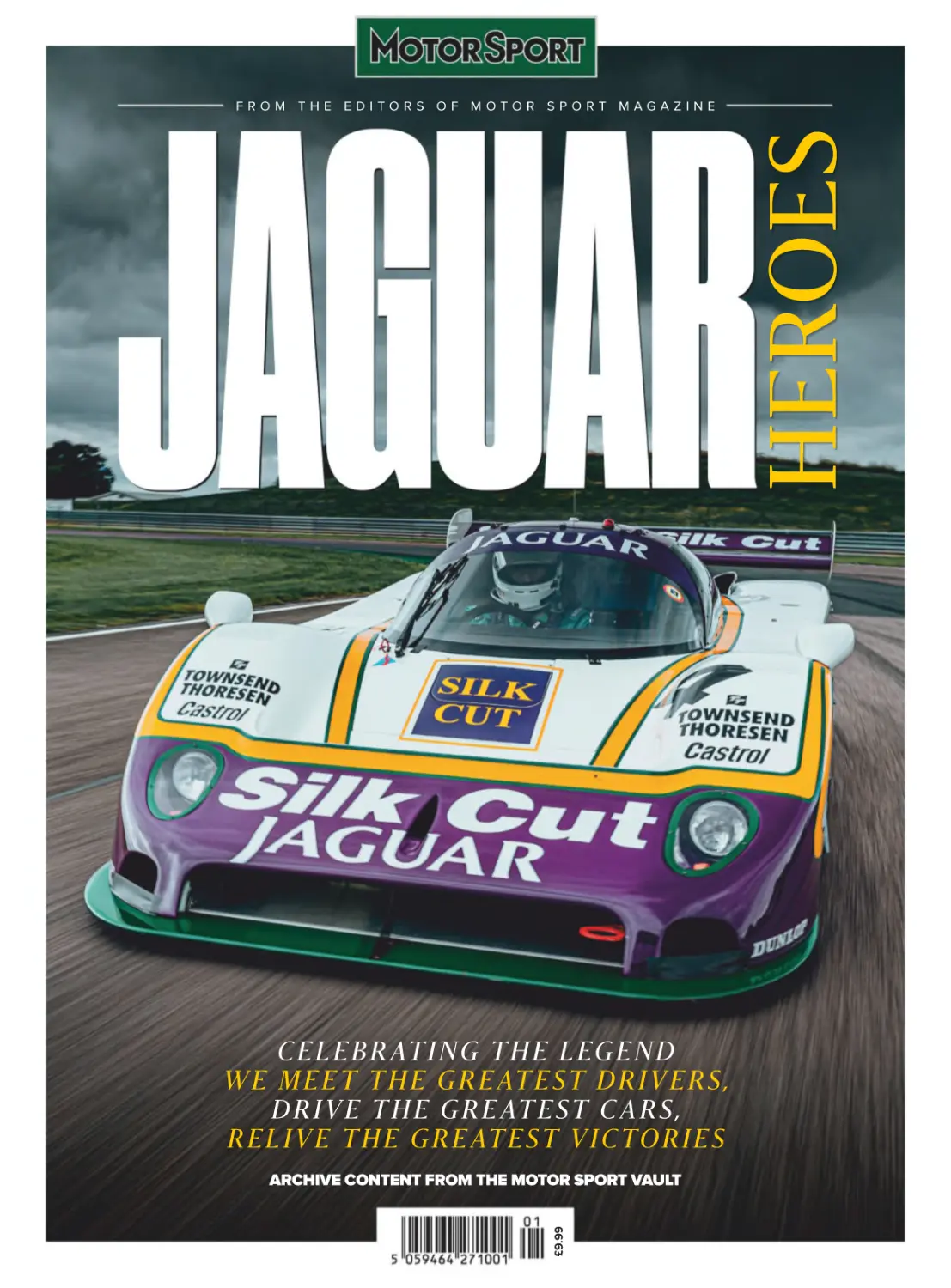
                    HEROES

FROM THE EDITORS OF MOTOR SPORT MAGAZINE

C E L E B R AT I N G T H E L E G E N D
W E M E E T T H E G R E AT E S T D R I V E R S ,
D R I V E T H E G R E AT E S T C A R S ,
R E L I V E T H E G R E AT E S T V I C T O R I E S

£9.99

ARCHIVE CONTENT FROM THE MOTOR SPORT VAULT

MORE THAN
JUST CAR STORAGE
Henry’s Car Barn is way more
than just car storage. Established
in the early 80s, we have grown
into a destination for car culture.
Find out more on our website.
WWW.HENRYSCARBARN.CO.UK

WELCOME TO
JAGUAR HEROES
The house that Sir William Lyons built may
have begun with just a few humble motorcycle
sidecars but quickly grew to become a true
motoring giant. Jaguar’s history is studded
with innovation and perhaps the odd bit of
intimidation, as the cars and characters that
represented the Big Cat took on the world
from Coventry.
During those formative years of the
1950s, when manufacturers and the sport
were adapting to ever-changing technology
and a new, war-free world, Jaguar came to
the fore. Instead of crafting wings for
bombers, Jaguar turned its hand to creating
works of art for the roads and racetracks, with
aerospace technology helping to shape those
wonderful C- and D-types. If it hadn’t have
been for Jaguar – and a little persuasion from
Stirling Moss – braking technology perhaps

wouldn’t have advanced as fast as it did. If it
wasn’t for Malcolm Sayer, aerodynamics may
not have evolved the way they did. And if it
wasn’t for Lyons himself, Britain would likely
have lagged in those early racing years.
Fast-forward to the new age of power that
Group C brought, and Jaguar again roared to
the front, with Tom Walkinshaw, Jan Lammers
and Martin Brundle at the helm. And we’ve
barely touched on the glory of the road cars
– the jaw-dropping E-type, secretive XJ220
and mysterious XJ13.
Motor Sport magazine has been trackside
and behind the wheel to witness and report
on all of this and more. In this special
collectors’ issue we delve into our unique
archive to bring you the stories that celebrate
the men, machines and milestones that
helped to etch the Jaguar name into history.

To read more about the history of Jaguar and
the drivers that have helped forge a legend, visit:

motorsportmagazine.com

Contents
HEROES
6
Stirling Moss and the C-type
14 The rise of Ron Flockhart
22 Lunch with Norman Dewis
34 The Mike Hawthorn museum
ENDURANCE
40 The C-type shocks Le Mans
48 On track in the XJR-8
57 Jaguar’s 1988 breakthrough
62 Le Mans stories
66 The Brundles tame the XJR-12
SPORTING
82 XJ13: the enigma car
90 The short-lived era of the XJR-15
96 Jaguar’s Formula 1 journey
105 A quad of glorious V12s
114 Tackling the Kinrara Trophy
124 The story of the CUT 7s
ICONS
138 Damon drives his dad’s E-type
150 The Lightweight Continuations
156 XJ220: Skunkworks supercar
Produced by Motor Sport,
18-20 Rosemont Road, London NW3 6NE
Tel: 020 7349 8497
email: editorial@motorsportmagazine.com
Editor Joe Dunn Art Editor Owen Norris
Designer Neil Earp
Special Projects Editor Robert Ladbrook
Commercial Director Sean Costa
Advertising Rob Schulp, Sue Farrow
Images by Getty Images unless otherwise stated.
Printed by Precision Colour Printing, Shropshire.
© Motor Sport 2023. motorsportmagazine.com
Founding Editor Bill Boddy MBE
Proprietor Edward Atkin CBE

1984 JAGUAR XJS – EX-WORKS/TWR GROUP A

Jaguar would be nothing without the people
that helped build the legend, from founder
William Lyons to racing chief ‘Lofty’ England,
via Stirling Moss and Mike Hawthorn. These are
some of the men who shaped Jaguar’s history

STIRLING AND THE C-TYPE

The Jaguar C-type was
the car that pioneered
disc brake technology
in 1952, when a young
Stirling Moss was its
driver. We reunited
them at Silverstone
WORDS ANDREW FRANKEL /
TAKEN FROM MOTOR SPORT, AUGUST 2008

he true value of most great
technological breakthroughs can
usually only be appreciated with the
benefit of hindsight. Life didn’t
change the moment Karl Benz first
swung his Motorwagen into life and
phutted up the road in 1886 any more
than anyone had the foresight to see
in 1903 that Orville Wright’s antics at
Kill Devil Hills would in time expose
the human race to undreamt
freedoms and dangers.
So when, in 1952, a 22-year-old lad known
to few outside the world of motor racing gunned
his pale green Jaguar up the road from Thillois
to Gueux for the 50th and final time to win an
important but hardly Blue Riband sports car
race at Reims, it went largely unreported in the
media; it might have gained greater attention if
more people had realised that behind each of
the car’s Dunlop wire wheels could be found a
Dunlop disc brake, but it was not something
that those responsible for it wanted to publicise.
And we can only ponder just how much
publicity it would have garnered if the world
had then realised what we know now: that
those plate brakes (as then they were called)
would turn out to be the greatest single
innovation in braking technology since the
invention of, well, brakes.

6

JAGUAR HEROES

JAGUAR HEROES

7

XKC005 competition history
May 26, 1952
June 2, 1952

Supplied to Tommy Wisdom and Bill Cannell
Monaco Grand Prix, driven by Wisdom. Result: 6th. The first
non-Ferrari home, also the first race by a privately-owned C-type
June 29, 1952
Reims 50-lap Marne Grand Prix support race, driven by Moss.
Result: 1st. The first competition victory for a car using disc brakes
August 2, 1952
Boreham, driven by Moss. Result: 1st. Pole position, fastest lap
August 23, 1952
Turnberry, driven by Moss. Result: 1st
September 27, 1952 Goodwood, driven by Moss. Result: 2nd. Pole position, lap record
October 11, 1952
Charterhall, driven by Moss. Result: 2nd
April 26, 1953
Mille Miglia, driven by Tony Rolt, co-driven by Len Hayden.
Result: retired. Car was loaned to Jaguar and entered as a works
car, retired through engine failure
September 1953
Sold to Brigadier Michael Head with original drum brakes and
campaigned successfully through 1954, particularly in Sweden

8

JAGUAR HEROES

STIRLING AND THE C-TYPE

Moss had great
history with XCK005.
Right: leading the
way in that historic
race at Reims

The lad, of course, was Stirling Moss, the
Jaguar C-type this very car. If the pastel green
colour surprises it is because while Stirling
was a works Jaguar driver when he raced it
and won with it, it wasn’t actually Jaguar’s
car, but was merely loaned to the works team
for the Reims race because all the factory
cars were out of commission following the
disastrous attempt to defend the 1951 Le Mans
victory. This, then, is the fifth C-type ever
built out of a total run of 53 (54 if you include
XKC054, the D-type development mule), the
first three being works cars none of which
survive, and the still surviving fourth being
supplied to Duncan Hamilton who crashed
it so comprehensively at Oporto in 1953 it
hospitalised him for a month. By contrast
this C-type was supplied new to Tommy
Wisdom (who drove it to sixth place in the
1952 Monaco Grand Prix wearing drum
brakes) and despite a very active life on track,
was never significantly damaged in period.
Its originality is perhaps why it survives
to this day in completely standard form,
from its pair of SU carburettors to the
gearbox-driven Plessey pump used to boost
those brakes.
Its 3.4-litre twin-cam engine is the same
one used at Reims and with a very
conservative 8:1 compression ratio would,
in its day, have given a little more than
200bhp on 80-octane fuel. Today, having
been excused the modern tuning techniques
that have been lavished upon other cars
from that period, it is entirely uncompetitive.
“That’s what I love about it, boy.” Even
if you did not recognise the voice, the
soubriquet at the end would reveal its
owner’s identity.
The track is not the same and the
weather could hardly be more different, but
56 years later, the now knighted Sir Stirling
Moss is back on board XKC005, looking like
he’s never been away.
However great are certain talents
individually, some are never greater than
when brought together, and you have only

to see Britain’s first truly great racing car
and racing driver of the post-war era
reunited once more to know it. The C-type
has been driven from its home an hour away
with Stirling’s old seat under the tonneau.
Ten minutes’ spanner work later, the
machine is ready once more to receive the
master. He dons the obligatory Herbert
Johnson helmet, hops across the sill with
indecent agility for a man who – he’ll not
thank me for reminding you – will be 80
next year and drops into place behind the
huge alloy spoked wheel. Silverstone is
sodden and for a moment I wonder even if
he wants to venture out in such a car in such
conditions. Then I remember whom we are
dealing with.
I’d like to tell you now that Stirling has
total recall of that day over half a century ago
when his talent, this car and those discs
changed the course of road and racing car
decelerative history, but sadly I can’t. In 1952
alone Moss competed in 54 of the 529 races
he entered before that Goodwood accident
(not including rallies, trials or hillclimbs), so
I think he can be forgiven if the exact details
of that particular race have now eluded him.
Normally he’d just refer to his famed diaries,
but sadly those editions from that year are
temporarily unavailable at the time.
There are other reasons why Stirling
might struggle to recall the events of June
29, 1952: for a start it was a far from riveting
race on a far from riveting slipstreaming
circuit that suited the C-type’s superior
aerodynamics very well. “I remember it was
extremely hot and having a bit of a dice with
a Gordini, which I think then broke, but not
much after that.” No wonder; after Manzon’s
Gordini bust a stub axle, Stirling drove
unchallenged to the flag winning at an
average of 98.2mph, but was so exhausted
by the sweltering weather and the heat soak
of the straight-six motor that he had to be
helped from the car and propped up for the
National Anthem by Jaguar team manager
‘Lofty’ England.
But even if the race did not lend itself
to long-term recall, Moss was one of a tiny
number of people who absolutely
appreciated its significance at the time. Of
all the drivers contracted to Jaguar at the
start of the disc brake’s development it was
Moss who had the ability to see through its
many manifest problems and identify its
true potential. In Paul Skilleter’s masterly
biography of Norman Dewis, there are lurid
tales of centre pedals going to the floor at
three-figure speeds during testing, for which
the only approved protocol was to change
down, turn into the fast approaching

JAGUAR HEROES

9

Motor Wheel Service

Renowned worldwide for the manufacture
and restoration of wire wheels

Speak to our specialists or visit our website to learn more about our range of wire
wheels, tyres, services and accessories for vintage and classic Jaguars. We can
restore aluminium rim wire wheels to an exceptional standard.

www.mwsint.com

+44 (0)1753 549 360

info@mwsint.com

corner and then spin the car, all of which
appeared to leave Dewis entirely unfazed.
“I’d done a lot of work with Norman and
Dunlop trying to fix the disc brakes and
while there were some terrible problems,
we could see that if they could be ironed
out the advantage they’d give us would be
simply incredible. Back then if you treated
conventional drum brakes as we now do
discs, you’d be out of brakes in a couple of
laps, maybe less. If your brakes were going
to survive they had to be managed
throughout the race, meaning you could
never use them as you wanted. Even then
we could see that discs offered the
possibility of being able to brake as hard as
you could for every corner on every lap for
the duration of the race.”
Indeed it is Stirling who claims the credit
for persuading William Lyons and Bill
Heynes to enter the Reims race and to annex
the Wisdom C-type for those purposes.
Why Reims? “It’s simple, really. The
brakes had the potential alright but we were
still boiling the fluid and having problems
with knock-off [a condition where the
flexing of the hub in cornering pushed the
pads away from the disc resulting in a pedal
that sank to the floor the next time it was
touched]. We were also worried about pad
life, and at Reims they only had to last 50
laps. The big long straights not only suited
the C-type, they also gave the brakes time
and air to cool off.”
Even so, Stirling had fast developed the
habit of giving the brakes a quick
precautionary stab just before they were
really needed to make sure the pads were
properly relocated, and while the brakes
appear to have worked precisely as they
should have during the race, when the car
came to be driven away at the end, the few
minutes standing still in the sunshine was
all it took to overheat the fluid and sink the
pedal to the floor once more.
There will be no such problems today.
Silverstone is awash, the modern fluid has
a boiling point far above that available in
1952 and in this weather and that car no-one,
not even Stirling Moss, is going to be flat
out, least of all with the world’s worst
passenger sitting next to him. Which is me.
He sits in the way he always has, upright
and straight-armed. It may not perhaps be
the most orthopaedically correct driving
position, but it is his trademark and with
his record it’s not something I’m going to
question. He turns the small key and despite
the fob completely obscuring the starter
button below, his finger finds it at once. He’s
been here before.

“The C feels more fast than
feral, but at speed it also
acquires a relentless quality”
“Quiet, isn’t it?” he says with
considerable surprise. Those stubby sideexit exhausts look mighty loud but the
standard specification of the engine means
conversation is still eminently possible
above the burble of the just awakened twincam straight six.
The gearbox is slow, awkward and not
really suited to the free-revving nature of
the engine, but so wide is its torque spread
that here on Silverstone’s ultra-quick
Historic Grand Prix circuit you’d only use
the top two of its four ratios. We’re already
into third as the pitlane merges into the
track, the engine is singing its inimitable
tune and Moss is ready to go to work.
What strikes you most, apart from the
sheer sense of occasion of being in a C-type
driven on a race track by Sir Stirling Moss, is
the unfailing smoothness and precision of
his every action and its corresponding
consequence. Pedals are pushed firmly but
progressively and never stabbed, gearshifts
executed with authority but never brutality.
I notice he uses every available patch of dark
grey asphalt but never strays over a slippery
white line or onto a kerb. What he is doing

is creating time for himself to concentrate
on the only thing that matters: going forward
fast. While the less skilled inputs of others
elicit unpredicted reactions which then need
managing, if a car driven by Moss is seen to
be sliding, it is you feel only because it suits
him for it to be in that condition at that time.
We continue around the lap, flowing
through the Becketts complex and down
onto the Hangar Straight. At Reims Stirling
would undoubtedly have been caning this
very engine past 6000rpm in his battle with
Manzon but this motor is so flexible and the
track so wet that 5000rpm is enough today;
more than enough, indeed, to see the thick
end of 120mph on the clock in remarkably
short order. The C feels more fast than feral,
but as speed accrues so it also acquires a
relentless quality you don’t feel in other
early post-war racers.
It is, of course, Malcolm Sayer’s peerless
aerodynamics which means that while
others run into a wall of air above 100mph,
the C-type merely splits it asunder.
Through Club, under the bridge and
into the complex, I watch Sir Stirling’s feet.
He’s brushing the brakes on entry, not to

JAGUAR HEROES

11

STIRLING AND THE C-TYPE

slow the car but simply and ever so gently
just to trim its balance, yet I can barely feel
it sliding beneath us.
Then the arm shoots instinctively up
into the air as it has so many thousands of
times in a racing career six decades long
and in a moment the Jaguar turns off the
track, and is coasting down the pitlane,
engine off, to return to rest.
It’s only been one lap, but it is enough.
Sitting there, Moss seems in no hurry to
leave the car, despite the rain pattering
down on his helmet. For a moment he seems
lost in thought. “D’you know, boy,” he says
eventually, “I hadn’t expected that.” To my
shame I have to ask him to explain.
“I’ve driven some C-types over the years
but none like this. It’s like a road car, so easy,
so flexible – not very quick of course, but
just lovely. I hadn’t realised she’d be such a
– what’s the word? – such a lady.”
But it takes a certain calibre of man to
deserve such a lady, and surely none was
ever more qualified than Stirling Moss.
Together they did great things and though
both are now advanced in years, it was truly
moving to see them together again, so fit
and well and both not only capable of
celebrating an event that helped change
road and racing car history, but able to do
so in such effortless, graceful style.
Thanks to the organisers of the
Silverstone Classic and to Duncan Wiltshire
of Motor Racing Legends for all their help
with making this feature.

12

JAGUAR HEROES

Braking news

Jaguar, Dunlop and the development of the disc
hen Moss won at
Reims, the disc brake
was already almost
half a century old, as
patent applications for just such a
device, dated in 1903 from the
remarkable Dr Frederick
Lanchester, show. But it was only
after the war and in an entirely
different application that they
came into their own.
Dunlop’s first disc brakes
were not designed for cars at
all, but aircraft. With the dawning
of the jet era and increased
aerodynamic efficiency, aircraft
were having to land at ever
higher speeds, taxing extant
drum brake technology beyond
its practical limit. So bad was this
problem that according to
Dunlop, “brake design was
becoming the factor limiting
aircraft performance”. The beauty
of the disc was that it was
exposed to the high-speed
airflow and would therefore
suffer none of the overheating
issues that plagued enclosed
drum brakes. Moreover there
would be only one application of
the brakes per flight and no
corners to negotiate, so the
problems of knock-off and boiling
fluid that would dog Jaguar never
appeared. Dunlop aircraft discs
first appeared in 1947 and by the
1950s were in widespread use
throughout the industry.
Jaguar was not even the first
to put a disc brake onto a road
car, that accolade seemingly
belonging to America’s littleremembered and apparently
fairly ghastly 1949 Crosley
Hotshot, among whose other
less-vaunted claims to fame was
to appear in Time magazine’s ‘50
Worst Cars of All Time’. The discs
were so troublesome – failing to
work if there was salt on the road
in sub-zero temperatures – that
they were soon abandoned in
favour of conventional drums.
Chrysler also had a go at discs,
making them available on the

W

Imperial from 1950 but these
were fully enclosed and were
also swiftly abandoned.
So it was Dunlop, ably and
eagerly abetted by Jaguar, which
can properly be credited with the
design and development of the
first viable disc-braking system
for road and racing cars. Much of
the work was entrusted to
Norman Dewis, who had the first
factory C-type, XKC001, put at his
disposal to iron out the many
bugs in the design.
But the real hero of the piece
was XKC003, the 1951 Le Mans
winner which, on April 14 1952,
made the disc’s competition
debut at Goodwood with Moss
driving, coming home fourth but
claiming fastest lap.
Goodwood was seen as little
more than a toe in the water
with Stirling driving with
uncharacteristic caution to
preserve the brakes. What was
needed was a real test and, as
luck would have it, the Mille
Miglia was but three weeks away.
Stirling, Dewis and 003 were
dispatched to Brescia with
instructions to gather data. No
result was expected or even
deemed desirable if it meant
risking the C-type and the loss of
invaluable testing mileage. In the
event, the daring duo would have
ended up in third place had the
car not skidded off the road in
terrible weather with fewer than
200 of the 1000 miles to go. Even
so, the brakes had withstood the
rigours of the Futa and Raticosa
passes and its occupants had
noticed how easy it was to
outbrake even the fastest,
best-developed drum
brake-equipped competitors.
Tragically 003 (along with its
001 and 002 sisters) were then
scrapped by the factory, their
purpose having been served.
Had they been preserved, their
value today would be near
enough incalculable. Hindsight
can be a very frustrating thing.

Classic Jaguar Specialist
XK120 // XK140 // XK150 // E-Type

Restoration // Sales // Upgrades // Servicing
When it comes to classic cars, experience counts. With
over 40 years of specialist experience with Jaguar XKs
and other classic Jaguars you can count
on Twyford Moors to deliver the highest
standards of work.
Twyford Moors cater for every aspect
of classic Jaguar ownership. From
buying advice and sourcing the right car
through to maintenance and restoration, our
expert knowledge allows us to help every step of the way.
Tyford Moors Classic Cars Ltd, Pyramid Park, 5 Penner Road, Havant, PO9 1QZ
Tel: 023 9257 0900 // Web: www.jagxk.com Email: twyfordmoors@jagxk.com

Lost talent, or lost cause?
The career of Ron Flockhart
was a mixed one, and his
early death left much of
his potential unrealised

The 1950s was a good time to start racing.
Gordon Cruickshank speaks to a first-hand
witness of a future Le Mans winner’s first
steps. It was a career that would end in
tragedy – but not on the track
TAKEN FROM MOTOR SPORT OCTOBER 2020

2

1

3

4

5
6

7
8

1. 1953 was a pivotal
year for Flockhart, with
a string of successes
with ERA R4D, seen
here at Goodwood
2. The engine of ERA
R1A at Dundrod in 1952
3. Ron after the
Dundrod race with
Mike Hawthorn’s
team transporter
4. Ron and Hugh line
up beside Ron’s Joe
Potts F3 car at home in
Edinburgh in 1951
5. The R4D team setup
at Snetterton in ’53
6. With his star on the
rise, Flockhart found
himself getting
chances with other

teams. He finished
second at Snetterton in
a works Aston Martin
DB3S in 1953
7. Ron driving R1A
through Belfast to
scrape onto the
Dundrod grid in 1952
8. Team engineer
‘Wilkie’ tweaks R4D
in 1953. His skills were
often overstated…
9. Mays, Ron, Alistair
and Charlie Davy with
R4D during a test at
Folkingham, 1952
10. The tortured tyres
of R4D during practice
for a Formula Libre
event at Silverstone
in 1953

9

10

RON FLOCKHART

“

on Flockhart could have won
anything if given the chance.”
That’s the view of the Scottish
driver’s business partner and
close friend Hugh Langrishe,
who at 96 still has clear
memories of the times they
spent together. Those 1950s
were a time of private
enterprise and privateer
entries, when you could buy an
old racing car and enter it in
top-line events against existing stars, and be
spotted by team owners. Further, the era of
freelance drivers and one-off drives meant
a healthy range of opportunities for a driver
who showed a bit of spark. And when he
had the right equipment Flockhart’s spark
was high-voltage: two Le Mans victories
don’t come easily. Yet his 13 grand prix starts
yielded just one podium. Perhaps his name
would be better remembered if he had
achieved his parallel aim – to break the solo
flight record from Sydney to London. But 58
years ago that would tragically end his life,
when his Mustang P51D aircraft plunged into
an Australian hillside. He was not yet 40.
Hugh Langrishe, an upright and dapper
figure despite his years, has many photos of
their adventures and when we met, prelockdown, he talked fondly of those times
when Flockhart’s star was rising.
Tall, fair-haired and good-looking,
Flockhart was born into a well-off family and
went to Edinburgh’s prestigious Daniel
Stewarts school. Confident and affable, he
had the dashing air of a Hawthorn or Collins
but was no playboy: with a war career
behind him as a Royal Electrical and
Mechanical Engineers (REME) captain, he
combined a degree in engineering with an
innate feel for machinery and an ability to
give good feedback on a car. That made him
a useful test driver.
Hugh and Ron met first while studying
mechanical engineering in Edinburgh, or
more specifically at the Rest and Be Thankful
hillclimb. “He was driving his self-tuned MG
TC, and Raymond Mays was impressed and
suggested that he should get single-seater
experience.” Hugh says. “So for 1951 he got
Vincent to build a Black Lightning V-twin
and put it in a Joe Potts F3 chassis.”
That was a successful season, including
winning the Formule Libre event at the
Ulster Trophy. By now Hugh was Ron’s pit
crew. “We couldn’t afford the boat fare for
an extra vehicle, so John Watson’s father
Marshall offered to tow three cars for us,
one behind the other, from Belfast to the
circuit. He set off at a smart 45mph – the guy

in the car at the back didn’t have a clue what
was happening!”
For the next year Flockhart bought ERA
R1A from David Murray, with Alistair Birell.
Their assault on the ’52 Ulster Trophy was
pretty low-budget: “The car was craned onto
the boat with all the tools and spares
crammed in the cockpit,” recalls Hugh, “and
Marshall Watson loaned us a Ford Pop.”
Practice brought a major problem: “The
car stripped its back axle, but we found a
replacement and swapped it overnight in
the hotel garage. We rang the Clerk of the
Course for a late entry, Ron warmed the car
on the 10-mile drive to the circuit and he
drove straight onto the grid.”
That grid had some serious firepower:
BRMs for Fangio and Moss, Ferrari 375s for
Taruffi and Rosier, and a Cooper-Bristol
under Mike Hawthorn – tough opposition
for a pre-war car. But (once the BRMs had
inevitably vanished) the young Scot was soon
running third. “We had no idea of the fuel
consumption; I was ready to tip fuel in,
scared stiff I’d set poor Ron in flames. Then
he didn’t appear – he’d run out of fuel.”
However, this impressed Mays enough
that he later sold Flockhart his successful
R4D. As well as a good season through 1953
– a total of eight wins including Goodwood,
Charterhall and Snetterton – the upright
ERA would cement a connection with the
Bourne concern.

Through that 1953 season Ron and Hugh
managed their part-time racing. “There were
just the two of us at meets; we’d sleep in the
field beside the car in our sleeping bags.
Then Ron bought an Edinburgh Corporation
bus and put a living cabin in front with two
bunks and a gas ring.”
Ron was being noticed: at Snetterton he
was invited to race a works Aston Martin
DB3S, while at the British GP support race
he placed fourth behind Farina, Fangio and
Wharton. “If I’d been more alert I’d have
given him the ‘Faster’ sign!” says Langrishe.
“Then Rodney Clarke offered him a
Connaught to drive. He and Roy Salvadori
practiced it and Ron did the faster lap. He
got on well with Clarke; remember, Ron was
a meticulous engineer.”
But it was BRM which took the cheerful
Scot on board as a tester and development
driver for 1954; at the same time he resigned
his job in a textile firm and took a sales post
at a Wolverhampton car dealer, like BRM a
part of Rubery Owen, and advertised R4D
in Motor Sport – at £1500.
Flockhart was now a quasi-works driver,
but was still waiting for his career to really
kick off. “But it wasn’t very satisfactory,” says
Hugh. “There was no actual post of test
driver, so he was imposed on Clarks and they
weren’t very keen. When a test was due Ray
or Peter would ring up and Ron would trot
off to Folkingham.”

“I was ready with the fuel, scared
stiff I’d send Ron up in flames”

Raymond Mays (facing)
encouraged Flockhart, selling him
ERA R4D which brought eight
wins in 1953. Langrishe on right

JAGUAR HEROES

17

RON FLOCKHART

“Of course racing was very much still an
‘old boy’ network,” says Hugh. “Collins,
Hawthorn and the others, they all had
businesses behind them. Moss was the only
professional racing driver.”
Which left Flockhart free to drive that
Connaught in non-championship races,
including a third at Charterhall.
Through 1954 Flockhart put in many
hours screaming around Folkingham
aerodrome in the MkII V16, its centrifugal
supercharger wailing to the Lincolnshire
skies. Hugh remembers: “One evening about
7pm [ José Froilán] González came to test it,
and you could hear it all round the circuit.
I never heard anything like it in my life. It
still makes me emotional to think of it.”
Hugh got to know Mays well: “A nice
chap but no organiser. Lots of work was sent
out but came back late or wasn’t done. BRM
was an extraordinary outfit; I had by now
switched to factory management, and I

found BRM chaotic. No-one was responsible
for quality checking. Before Rubery Owen
took it over, Mays admitted to me once ‘The
trouble with operating as a trust is that with
organisations and people doing things for
you as a favour instead of for money, you
can never get things done on time’.”
By now Langrishe was Flockhart’s
intermediary. “One night I got a call about
11.30pm – ‘Do you know where Ron is?’ I was
quite rude. Next day Ron asked me to be
more polite to Ray.” But Ron remained the
bridesmaid at BRM, with minor successes
in non-title races, now the V16’s only hunting
ground, while in ’55, when Peter Collins was
the favoured son, Ron placed second in the
V16’s last front-line race.
He helped develop the new Type 25 for
the 2½-litre formula, but was mostly denied
a race in the stop-gap 250F Maserati the team
ran, watching Ken Wharton or Peter Collins
race instead.

“Ron was never given the chance, except
once” says Hugh. “At Silverstone for the ’54
British GP Mays persuaded Owen to let Ron
be a reserve to Prince Bira.” Suffering from
malaria, the Siamese driver handed over the
Maserati on lap 43, “but Ron got on the wet
stuff and turned it over”. It was his grand
prix debut. It would be 1956 before his next
entry, when the engine failed. Thereafter he
had races when a car was available but was
seen more as a reliable back-up than a leader.
Still, Ron and Hugh did manage to attend
one meeting abroad. “Ron decided we’d fly
to Reims for the 1954 grand prix. We flew
from Croydon in his Auster with no radio, no
pilots’ maps and no airfield details. About 10
miles from Reims we spotted a big airfield
and Ron landed, but we were surprised to
see Sabre jets there. The French air force were
furious… We finally found the civil aerodrome
and took a taxi into town. There was no
accommodation to be had, but we found Ray

“Ron landed and saw Sabre jets...
the French air force were furious”
Flockhart’s grand prix high came
with third place in the 1956
Italian GP in a B-type Connaught
By 1954, outings
with BRM were
becoming scarce,
Flockhart resigned
to a handful of
runs in the V16
in Formula Libre

Flockhart’s greatest
achievements came with the
Ecurie Ecosse D-type, with
back-to-back Le Mans victories.
Right, with his Auster in 1956

in the most expensive hotel and asked him
for help. His boyfriend wasn’t there, though
his picture was on the dressing table, so he
said we could share his 6ft bed with him.”
Apropos, Doug Nye tells a tale he had
from BRM’s Rivers Fletcher, that Flockhart
couldn’t understand the furtive jokes about
Mays until Rivers explained Mays’ sexuality
to the naïve young Scot.
This was also the era of post-race driver
excesses: “The morning after the race we
woke to find a tiny car on the first-floor
landing. There was a certain amount of
dismay on the part of the hotel management.”
That race was also the first event for the
long-awaited Mercedes team. “It took the
wind out of everyone’s sails when this long
convoy of grey trucks arrived in the main
square at Reims,” recalls Hugh. “All the teams
were garaged in town; you could hear the
lovely noise of the engines being blipped, and
then the mechanics drove the cars to the
circuit. And they weren’t hanging about.”
Though the single-seat opportunities
were few, Flockhart also had a gift for sports
cars, especially endurance racing. It would
lead to his greatest results, with Ecurie
Ecosse at Le Mans. Team principal David
Murray had previously tried to recruit Ron,

“but he was very difficult to deal with,” Hugh
remembers. “Just lack of money. People
asked why Ron hadn’t driven for him; well,
we knew what was going on.” Murray’s
creative money management would later see
him leave Britain hurriedly, but for 1956
Murray did a deal for Flockhart to share one
of the metallic blue Jaguar D-types with
Ninian Sanderson. Langrishe says: “There
was no contract, just a letter. I tried to get a
contract out of Murray but he wouldn’t write
one. Ron never knew when he was going to
get any money.”
Those 1956 and ’57 races are an oft-told
tale: against all expectations Flockhart and
Sanderson’s Ecurie Ecosse car prevailed over
the Astons, Ferraris and the works D-types.
One year later sharing an ex-works long-nose
D with Ivor Bueb, Flockhart again received
the 24-hour laurels. “Our car had the 3.8 fuel
injection system lent by Lucas, which was
removed afterwards. And yes, it’s true that
Jaguar kept the car as long as possible so that
Wilkie [Wilkinson, Ecosse chief mechanic]
couldn’t fiddle with it. We all thought he was
good at his job, but it turned out he wasn’t.”
He shakes his head at the safety aspect
now. “Cars were going past at 150mph and
people were lined up along the edge of the

track. We just didn’t realise…” he recalls. He
himself was anxiously handling timing: “It’s
very hard – peering through legs because
the team manager is on the pit counter
yelling at chaps down below, and you daren’t
miss your car. Night-time is worse, but I
could tell the Jags because they wouldn’t lift
off into Dunlop. They were brave.”
He remembers Ron’s first break in 1957:
“He handled that long race very well. In the
evening we both headed for the team
caravan and met Johnny Lurani, who had
earlier accommodated the Ecurie Ecosse
team for the Mille Miglia. He said: ‘Now the
grand prix is finished, the 24 Hours of Le
Mans begins!’
Driving a D-type solo and with minimal
recce time behind him, Flockhart had been
up to seventh in that Mille Miglia until the
fuel tank worked loose.
Only a few weeks later and he was on
the winners’ podium at Le Mans. “And all
these mature people were in floods of tears,”
Hugh smiles.
Those 24-hour successes are well
known. Not so what happened in 1958.

JAGUAR HEROES

19

RON FLOCKHART

After great success with teams
like Ecurie Ecosse, Flockhart
died chasing a flight record.
Below: In the BRM P25 in the
GP
non-championship 1957 Moroccan

20

JAGUAR HEROES

“A lot of people told him to give
up, but he was very determined”
By 1958 Ron and Hugh were partners in
Flockhart & Langrishe, a garage business
they had co-founded in Ascot High Street,
though it was mainly Hugh’s concern.
“Our company was not a dealership, it
was a management company to run Ron’s
enterprises,” says Hugh. “I put up most of
the money; Ron wasn’t an active partner – he
was away racing most of the time.”
From this point Hugh had less to do with
Ron’s arrangements, though they remained
close friends, so the inside stories fade. In
truth, the stop-start career continued:
Flockhart remained doggedly tied to BRM
until 1959 with intermittent races now the
25 was coming good, bringing him victories
at Snetterton and in New Zealand at Ardmore
and Wigram. Rob Walker put him in a
Cooper, while often he had a sports or saloon
car race in John Coombs’ Jaguar or Lotus 11.
Colin Chapman gave him his last grand prix
finish, in France 1960 in a Lotus 18, resulting
in sixth. A Cooper works drive in the US GP
resulted in a DNF, but he showed in Australia
in 1961 that he could still mix with the leaders
– including works BRMs – at the wheel of Jack
Brabham Coopers. But now the flying took
over. Despite little experience in Mustangs

he was on the way to the record on a first
attempt in 1961 until engine problems meant
abandoning the flight at Athens. On the fatal
second try in April 1962 he had not even
officially set off. He had bought a second
Mustang and was on his way to Sydney for
some maintenance when he flew into cloud,
lost his bearings and stalled into trees.
“He was very confident, flying without
the appropriate instrument certification,”
says Hugh. “But the accident report didn’t
assign blame critically, which I was glad of.”
Was Ron Flockhart a stifled talent?
“When he had R4D going so well he’d had
much less experience than his rivals. His
skill, judgement and sense of balance were
much more developed than you’d expect.”
He feels the BRM tie was a hindrance:
“He had to ask Sir Alfred [Owen] personally
if he’d been offered a drive elsewhere. If BRM
had something coming up Owen would say
no. It’s possible that people stopped asking.”
Others in the grand prix world regarded
him as competent, but that’s all – “no
problem on track” says one source. Perhaps
adding a Sydney-London flight record to
those Le Mans laurels would have gilded the
image of this keen young Scot just a little.

Hugh
Langrishe,
still dapper
at 96

PHOTOGRAPHY HUGH LANGRISHE, GETTY, GP LIBRARY

Ron was due to contest that Le Mans race
too, but the week before in practice for the
Rouen 3Hr sports car race his Lotus XV
crashed into an ambulance, seriously
injuring him.
Hugh and his wife Pam, en route to la
Sarthe, diverted to the hospital. “We were
horrified with the place. There was no-one
around; Ron said ‘For God’s sake get me out
of here!’. So we got him dressed somehow;
he could walk slowly, and we took him out
without being challenged. Luckily we had
his Austin A105 estate car; we laid him in the
back and took him to Le Mans where one of
Murray’s pals, an orthopaedic surgeon, said
‘For Christ’s sake, you’ve broken your back!’
So we set off home. We got a flight on Silver
Cities airways and he was allowed to stay
lying in the car while we flew. I drove him
to the family home in Edinburgh but I was
worried. His parents believed in all sorts of
natural healing – when his sister caught
pneumonia they got homeopaths instead of
doctors and she died. But he went to hospital
and made a full recovery. A lot of people told
him to give up, but he was very determined.”

Jaguar D-Type Specialists

Industry Leaders in Race Preparation

Manufacture & Supply a Full Range of Components

Pearsons Engineering Ltd
Blaize Farm
Blisworth Road, Roade
Northamptonshire, NN7 2LN

Tel: 01604 864 764
Fax: 01604 862 851
Email: info@pearsonsengineering.com
Visitors by appointment only

www.pearsonsengineering.com

LUNCH WITH...

During 33 years and
more than a quarter
of a million 100mph
miles, this dedicated
team player helped
make Jaguar great

WORDS SIMON TAYLOR /
PORTRAIT JAMES MITCHELL /
TAKEN FROM MOTOR SPORT APRIL 2013

arque loyalty is an old-fashioned
concept these days. A driver will
swap seats after a season or two,
a designer will change teams,
an engineer or technician will
quietly ask around to tease
out available opportunities.
Everyone’s looking to maximise
their career potential, and more power
to them. It’s the same in today’s global
motor industry: a familiar face from Ford
will pop up at BMW, a rising star will
exchange Turin for Detroit.
But back when a few of the great car
makers were still private businesses with
paternalistic proprietors, some famous
companies enjoyed a true family feeling
among their key employees. This shared
unity of purpose translated into the firm’s
products, helping a strong identity to run
through each successive model.
There’s no better example of this than
Jaguar. Founded, and run with an iron
hand by Bill Lyons, it enjoyed its greatest
days in the 1950s under a tight team of
loyal servants: engineering boss Bill
Heynes, racing manager Frank ‘Lofty’
England, vehicle engineer Bob Knight,

aerodynamicist Malcolm Sayer and
development test driver Norman Dewis.
All of those names spent the majority of
their working life with Jaguar. Norman’s
own service adds up not only to 33 years
but also to more than a quarter of a
million miles spent at over 100mph,
perhaps further at those speeds than
any other. The road behaviour and fitness
for purpose of all the great Jaguars is very
much down to the relentless work put in,
often seven days a week, both day and
night, by Norman.
Having joined Jaguar from Lea-Francis
in 1952, Norman remained on the staff
until the mid-80s. By then Lyons, Heynes,
England, Knight and Sayer were all gone,
and Jaguar was part of British Leyland.
Norman now had to work through a
diluted and bureaucratic reporting
structure that was worlds away from the
direct link he’d enjoyed to Heynes, and
the frequent after-hours visits from Lyons
himself to enquire how things were going.
Then, six months after he retired, his
beloved wife Nan suffered a stroke. She
was given two years to live, but Norman
nursed her devotedly for seven. After her
death he started a new life, travelling the
world talking to Jaguar enthusiasts and
clubs, recounting his inimitable stories
about the cars he helped to develop and
the people with whom he did it. He’s
been doing that for 20 years and, at an
extraordinarily energetic 92 years of age,
he shows no sign of slowing down.
A fair bit of forward planning was
required to pin down this incredibly
busy man for lunch at the Fishmore Hall
Hotel in Ludlow, not far from his
Shropshire home.

JAGUAR HEROES

23

NORMAN DEWIS

orman was conveniently born in
Coventry, the heart of Britain’s then
thriving motor industry, in 1920.
Early evidence of graphic talent
resulted in a scholarship to art
school; but he never took it up, for
when he was only 14 his coalman
father died suddenly. With the
breadwinner gone he had to leave school at
once and go to work, initially as a grocer’s
delivery boy for 7s 6d (37.5p) a week. He
lived in Humber Road, named after the big
car factory along its length, and soon he was
asking at the gate to see the labour manager
— which is how, still only 14, he became a
Humber worker, fitting wings and bonnets.
At 15 he moved to Armstrong-Siddeley,
because they were able to offer him a proper
five-year apprenticeship. That included a
stint in the chassis department, where he
learned to drive, and eventually to take the
naked chassis on their shake-down runs. This

24

JAGUAR HEROES

progression was brought to an abrupt halt
by the declaration of war in September 1939.
At once Norman, still a teenager, joined
the RAF and was soon occupying the centre
gun turret of a Blenheim bomber. Invalided
out in 1942 he became an Air Ministry
inspector, checking war production in the
Midlands factories, including Lea-Francis.
So when war ended in 1945 it was LeaFrancis that he joined, building engines, and
then testing chassis on its quality range of
post-war saloons and sports cars. They were
built in small numbers, but great pride was

“He occupied the
gun of a Blenheim
bomber”

taken in their hand finish. “We rather looked
down on Jaguar, thought they were a bit
mass-produced. But we couldn’t work out
how they did it for the price.”
The twin-high-camshaft Lea-Francis
engine was used by Connaught in its early
cars, and also in American midget racing as
an alternative to the ubiquitous Offenhauser.
In 1948 Norman accompanied Ken Rose and
Albert Ludgate of Lea-Francis to America
to see the engine in action, quite an
adventure for the lad from Humber Road.
Meanwhile he took note of the burgeoning
500cc Formula 3 movement, and with a
fellow LeaF employee, designed and built
a neat Rudge-powered F3 car, the DNC. In
its first race, at Silverstone in July 1950, he
qualified on pole and led for two laps before
the cylinder barrel parted company from
the crankcase and came out through the
bodywork. It was rebuilt to do further
races in 1951.

s national car production got back
into full swing Norman realised LeaFrancis was not in a very strong
position. He put out feelers, and in
October 1951 he was summoned to
Bill Heynes’ office in the old Swallow
Road works to discuss a job as
development test driver. “I thought
Jaguar seemed a tatty place, but Heynes told
me about their big plans for the future, and
showed me the experimental department.”
There he saw not only the C-type that had
won that year’s Le Mans 24 Hours, but also
a mock-up of a new type of brake that,
instead of an enclosed drum, had a rotating
disc with external pads rubbing on it. After
a haggle about money — “Jaguar had a real
reputation around Coventry for being poor
payers” — Norman was hired, reporting
direct to Heynes, who was effectively one
down from Bill Lyons himself. He started
on January 1, 1952.
“The Old Man liked to wander around
after most people had gone home. About a
week after I’d joined I was working late in
the experimental department, and he came

Left: Norman Dewis forged his
name in single-seaters, both
building and racing this DNC F3
car. Above: sitting alongside
Stirling Moss at the 1952 Mille
Miglia. His job was to assess
the new disc brakes on the
works C-type

in and said, ‘Are you Dewis? I’m Lyons.’ He
called everybody by their surnames. To us
he was still Mr Lyons, he didn’t become Sir
William until 1956. He took me into the body
shop, showed me a couple of ideas they
were working on, and asked for my
comments. Team spirit, you see: it started
with the way the Old Man would involve
you, and went on down from there.”
Norman found no properly regimented
test procedures at Jaguar. His predecessor,
Old Harrovian Ron ‘Soapy’ Sutton, had
moved on to Alvis to test military vehicles,
and there was no consistency in any of the
trials that were taking place either with the
road cars or with the C-types. Norman lost
no time putting in proper routines, and in
this he had Heynes’ full support.
“He was my boss until he left in 1969, a
beautiful engineer and a great character,
and always stood by me. If the production
people complained that they were having
to over engineer components because I was
turning stuff down, refusing to sign it off,
he’d always back me up. Bob Knight, too:
a brilliant suspension man. Jaguar’s
reputation for ride and comfort — but not
at the expense of handling — started with
Bob. It took us a lot of development work
to get it to the levels he wanted.”
From the start Norman was heavily
involved with the disc brake programme,
working with Harold Hodkinson of Dunlop.
The early versions were prone to alarming
failures, due mainly to boiling brake fluid
and pad knock-back. As well as Norman’s

own testing routines at the Motor Industry
Research Association (MIRA) track at
Lindley, regular works drivers Tony Rolt,
Duncan Hamilton, Peter Walker and Stirling
Moss also tried the early C-type with disc
brakes. “They were all deeply suspicious of
it, although Moss was the first to recognise
its potential.” As part of the test process a
disc-braked C-type was entered for the 1952
Mille Miglia, with Moss as the driver, and
Norman was sent along as passenger to
monitor the brakes’ behaviour.
The race began in wet conditions, and
at Ravenna Moss was in 12th place. The
C-type had several dust-ups with the works
Mercedes-Benz 300SLs but by Florence,
despite a leaking fuel tank and shot rear
shock absorbers, they had climbed to second
overall. The brakes were standing up well,
but in the Abruzzi mountains a stream of
water running off the hillside caught Moss
out. They hit a rock and broke the steering,
and with 100 miles to go their race was run.
It was the start of Moss’ fascination with the
Mille Miglia, which would culminate in his
victory for Mercedes three years later.
Before flying home Moss sent a fateful
telegram to Bill Lyons insisting that the
C-types needed more straight-line speed
before Le Mans if they were to beat the
300SLs. “I stayed behind to repair the Mille
Miglia car before I could drive it home, and
by the time I got back to Coventry the three
Le Mans C-types had already been modified
for more top speed, with longer noses and
tails. This required changes to the cooling

JAGUAR HEROES

25

system, and I was dismayed to find they
hadn’t been properly tested.” They were
also back on drum brakes.
The 24 Hours was a disaster: after
cooling problems emerged in practice,
Moss’ car was converted back to the old-type
radiator, but suffered engine failure, and
the other two retired with overheating. “The
Old Man was really livid after that. He said,
‘Nothing like this will ever happen again. In
future no changes will be made without
proper testing.’ So the debacle strengthened
my position. From now on, everybody knew
that structured testing was essential.
“Lofty England did a good job as team
manager, but he was very dictatorial, and he
did have the habit of being always right. He
would never be corrected. He and Heynes
didn’t get on at all. I had several rows with
Lofty when he wanted to change something
without due evaluation. If he got his way and
it went wrong, he’d never admit it was down
to him. It was always the driver’s fault.”
orman was back at Le Mans in 1953,
now as reserve driver across the
three-car team. He therefore
needed to qualify, and was sent out
to do his laps on Thursday in the
spare car — which, like the Tony
Rolt/Duncan Hamilton C-type, was
also wearing No18. So, two cars
numbered 18 were on track at once, which
was an error by England, and when the
organisers threatened disqualification.
Lyons had to personally apologise — and
C-type no18 won the race.
The famous banked triangle at MIRA,
the first place on British soil for continuous

26

JAGUAR HEROES

high-speed testing following the demise of
Brooklands, was opened in 1953, and
Norman became its most frequent
inhabitant. Meanwhile the Belgian motorway
from Jabbeke to Aalter had become a useful
venue for speed attempts, as the authorities
could be persuaded to close one side of the
dual carriageway, with the RAC Belgique
providing independent timing.
Jaguar made headlines in 1949 when
Soapy Sutton achieved 132mph in a nearstandard XK120, and in 1953 it returned with
an XK120 and a MkVII saloon. “In the XK I
got just over 140mph, which was a
production car record, and in the MkVII I
managed 121, which was an incredible speed
then in a big four-door saloon. Then one
evening the Old Man came down and said
to me, ‘Dewis, I see you’ve lost your record.
What are you going to do about it?’ I hadn’t
heard that the Spanish Pegaso people had
gone to Jabbeke with a supercharged V8
thing, not a real production car, and they’d
done 151mph.
“I thought the XK120 had gone as fast
as it was going to go, but Malcolm Sayer
reckoned we might find a bit more with a
full-length undertray and a plastic bubble
off a glider over the cockpit. We took the
seat out and I sat on the floor under the
bubble, and we removed the headlights and
ducted air from one side to the carbs to get
a ram effect. We buffed the tread off the
tyres and blew them up to 50psi, to make
the contact area as small as possible. We
decided to do it at dawn, when the air would
be cool and dense. They’d closed five miles
of one side of the dual carriageway, but even
at that hour there were crowds standing

Above: Dewis with the modified
XK120 at Jabbeke in Belgium.
His astonishing run of 172.4mph
will never be beaten

along the centre reservation to watch. We
were pulling our highest ratio, 2.9:1, but our
engine man Jack Emerson said, ‘Don’t go
over 5800rpm, you might throw a rod.’
“It’s a lovely clear morning, and when
I pass the black and white boards to start
the measured mile I’m pulling 6200rpm.
I turn round at the other end — I can’t get
out, because the cockpit cover’s screwed
down; it’s very hot and airless inside — and
Dunlop Mac checks the tyres and gives me
the thumbs-up. I go back the other way, and
I pull 6300rpm this time. I get to the end,
they unscrew the bubble, I’m red-faced
gulping in air, and nobody says anything.
“Then Lofty says, ‘You got a problem,
Norman?’ ‘No,’ I say, ‘It’s running beautifully.
I was pulling 6.2, 6.3.’ Lofty says, ‘The rev
counter must be playing up, you were slower
than you were in April.’ He plays me
along for a few moments, then he says,
‘You bugger, you’ve done 172.4mph! The
timekeepers have confirmed it, they’re
producing the certificates.’”
Sixty years ago that was an astonishing
speed for a production car, and the record
made headlines around the world. But the
Belgian authorities decided that, with
crowds lining the road, the potential for
disaster was great, and no more speed
attempts were allowed.
Norman also drove X11, the one-off
interim C-/D-type car, the same day but

C HO O S E FRO M OV ER 3 0 0 ,0 00 PARTS AND ACCESSORIES F ROM T H E
WOR LD ’ S L AR GE ST I NDE P ENDENT MANU FACT URER A ND SUPPL IER OF
C L A S SIC JAGUAR CAR PA RT S

+44 (0)1746 765 432 | sngbarratt.com | sales.uk@sngbarratt.com

Left: in action during
the 1955 Goodwood
Nine Hours. He
shared an ex-works
D-type with Jack
Broadhead

a cracked injector pipe kept its speed down
to just under 180mph.
Norman’s daily work at MIRA continued,
and in 1954 he was lucky to escape when a
C-type being used to try fibreglass body
panels seized its final drive coming off the
banking at maximum speed. “It cartwheeled
onto the infield, coming to rest upside down
on top of me with fuel and hot oil
everywhere. A couple of hefty Irish
labourers were resurfacing part of the track,
and they ran over and lifted the car off me.
In the pub that evening I bought them all
the Guinness they could drink.”
It was in 1955 that Norman had his only
works Jaguar drive in a race — nothing less
than the Le Mans 24 Hours. The C-type had
been succeeded by the D-type, on which
Norman had done a massive amount of early
testing. After the D- had been narrowly
beaten by Ferrari at Le Mans in 1954, the
much-improved long-nose car was readied
for the 1955 race, and three works cars were
entered for Mike Hawthorn/Jimmy Stewart,
Rolt/Hamilton and Don Beauman/Desmond
Titterington. Beauman, an old school friend
of Hawthorn’s, was hired after a test under
Lofty’s eagle eye. But, two weeks before Le
Mans in the Nürburgring Eifelrennen, both
Stewart and Titterington crashed their Ecurie
Ecosse D-types. Titterington was laid up in
hospital in Germany, and Stewart decided
to retire from racing. So, days before the race,
Ivor Bueb was drafted in as Hawthorn’s
co-driver, and Norman — who had already
done more miles in D-types than anyone else
— was elevated to Beauman’s partner.
Then came the tragic 1955 Le Mans. Just
before 6.30pm on Saturday, Hawthorn’s
leading D-type lapped Lance Macklin’s
Austin-Healey and then pulled to its right
to come into the pits. Macklin, caught by
surprise, swerved left, into the path of Pierre

Levegh’s Mercedes 300SLR. The Mercedes
was launched into the spectator enclosure
opposite the pits. Levegh and 83 spectators
were killed, and 120 injured.
he accident unfolded in front of
Norman, who was waiting in the pits
to take over the No8 D-type from
Beauman. “I believe strongly that the
accident wasn’t Hawthorn’s fault. If
you study the stills from the movie
footage that exists, you’ll see that as
Hawthorn pulls to his right
approaching the pits, Macklin swerves
unnecessarily far to his left to avoid him.
There was actually room for Levegh to go
between the Healey and the D-type — but
by then Levegh was committed to passing
Macklin on the left, and couldn’t avoid using
the back of the Healey as a launching pad.
“We were all on the pit counter waiting
for our driver changes, Bueb for Hawthorn,
Hamilton for Rolt, me for Beauman. I saw
Hawthorn with his hand up, coming in, I
saw Macklin swerve sharply left, I saw
Levegh hit him. The fire and carnage were
directly across the road from us, but it didn’t
affect me, to be honest. I’d seen bad things
in the war, and there was a job to do. The
only person it did affect was Ivor. He said,
‘It’s suicide. I’m not driving’. Lofty just said
to him, ‘Bueb, get in the car!’, and sent him
out while he dealt with Hawthorn.
“Beauman handed over to me, and I did
my two-hour stint. I remember winding in
Kling’s 300SLR, and tailing him until finally
I towed alongside on the Mulsanne just
before the kink. I was pulling 6200rpm,
which was 192mph on that gearing, and I
went ahead. That put us fourth. I got the ‘in’
board after my two hours, but as they
refuelled the car Lofty shouted, ‘Stay in! Stay
in!’ so I did another hour, before handing

back to Don around 10pm. We were looking
good, but just after midnight Don put it on
top of the sandbank at Arnage. He couldn’t
get it off, so gave up and walked home. It
didn’t occur to him that the metal tonneau
cover would have made a good shovel with
which to dig it out.”
In the early hours of Sunday morning,
on orders from Stuttgart, Mercedes
withdrew its remaining cars from the race.
The D-type of Hawthorn and Bueb went on
to score a hollow victory, but added to the
Le Mans disaster for Jaguar was the tragic
death of Bill Lyons’ only son, John. Driving
down to Le Mans on the Monday before the
race, his MkVII hit a truck and he was
killed instantly. Having completed an
apprenticeship at Leyland, he was sampling
various departments to learn the family
business. One wonders how different
Jaguar’s history might have been had he
been around in the 1960s to take over the
reins. And four weeks later Don Beauman
was dead, too, killed at the wheel of his
Connaught in the Leinster Trophy race.
All the works Jaguar drivers were paid
a fee per race and start money. Norman, as
a waged employee, didn’t get paid for his
Le Mans drive, but did think he deserved
his £260 share of the start money. “Two
weeks later I’d had nothing, so I told Heynes,
who raised it with Teddy Huckvale, the
Finance Director. He was even tighter than
the Old Man. He called me to his office,
wrote a cheque, and threw it on the desk.
It was for £156. I said I was due £260, but he
said he’d deducted £104 for hotel bills. Rolt,
Hawthorn and co. didn’t pay hotel bills, of
course, but Huckvale said I did because I
was an employee. If I’d known I would have
stayed in the £5 a night flophouse with the
mechanics! Until you worked for Jaguar, you
didn’t know what mean was.”

“The car cartwheeled onto the infield, coming to rest on
top of me, with fuel and hot oil leaking everywhere”
28

JAGUAR HEROES

orman’s other long-distance race
was the 1955 Goodwood Nine Hours,
when Jaguar PR manager Bob Berry
asked him to share the ex-works
D-type he was driving for entrant
Jack Broadhead. Norman had to get
Bill Lyons’ permission, which was
grudgingly given. Despite an off by
Berry in the final hour, which required some
body repairs, they finished fifth.
In May 1956 Norman earned his keep
with two very hectic weekends in Europe,
both involving Paul Frère. Frère wanted a
mount for the big production car race at his
home track, Spa, and asked Lofty England
for one of the recently-introduced 2.4-litre
saloons. One was readied with a C-type
head, and Norman ran it up to 127mph at
MIRA before driving it on the road, alone,
to Spa. Up against Porsche 1600s, Mercedes
220S saloons and Jo Bonnier in a works Alfa
Romeo, the 2.4 qualified well, but at the end
of Saturday’s practice Frère came in to
report that the gearbox had gone.
“The little lock-up Paul had found me
in a village at the other end of the circuit
had no pit and no ramp. The 2.4 was the
first unitary construction Jaguar, so the only
way to get the gearbox out was from
underneath. But with no means of access
all I could do was take up the carpet and
drill a series of holes in the floor, and then
hacksaw between the holes and bend up a
flap in the floor with my feet, like opening
a tin, to lift the gearbox out. The bearing on
the back of the layshaft had seized, and
there was a tooth off second gear. The
Brussels Jaguar dealer didn’t have a spare
gearbox, but he sent some bits to Spa, which
arrived around 7pm. So I work into the
night, rebuild the box, and put it all back
together. Then I try the gears, and I can’t
get fourth. Take it to bits again, and find
I’ve put in a shim wrong. Put it back
together, and now I can’t get first. I’m tired
now, and that’s what happens when you’re
working on your own — although David
Murray of Ecurie Ecosse heard what was
going on, and lent me his chief mechanic,
Stan Sproat, for a while.
“I work through the night, and next
morning Paul rings to see how I’m getting
on. When he hears the car’s still in bits he
says, ‘Well, we can forget the race.’ ‘No, no,’
I say, ‘We’ve got an hour before the race
starts. Just hang on.’ I’ve got no welding
equipment, of course, so I kick the foldedback floor into position as best I can and
put the carpet back over the holes. Then,
with minutes to go, I have to get the car back
up to the starting grid. The shortest route

30

JAGUAR HEROES

is on the circuit, going the wrong way. The
Belgian marshals block me until I make them
realise it’s the local hero’s car, and they wave
me through. I get it to the grid, and just have
time to shout to Paul to take it steady for the
first two laps until he can be sure the
gearbox is all right.
“As soon as Paul had gone past to
complete his second lap I relaxed, and fell
dead asleep. I saw nothing more of the race.
Paul overtook the Mercs, led his class, got
up among the Porsches, and on the last lap
he passed the leading Porsche to win the

race outright.” Norman shared in the Ecurie
Ecosse victory dinner that evening — Ninian
Sanderson’s D-type had won the main sports
car race — and then on Monday morning he
threw his tools into the 2.4, and drove it
back to Coventry.
Eleven days later Frère was practising
in a works D-type for that weekend’s
Nürburgring 1000Kms when he went off in
the wet. “He cartwheeled down the valley,
got out without a scratch, but the car was
finished. This was late Friday afternoon.
Lofty phoned Coventry and told Heynes I

NORMAN DEWIS

had to get another D-type over to Germany
for 11am Saturday. I drove it down to Dover,
caught the overnight ferry to Ostend, and
at dawn I was roaring down the Jabbeke road
towards Brussels. On through the Black
Forest towards Düsseldorf, and then I got
lost and had to ask the way. I had a map, but
you can’t drive a D-type and read a map.
There wasn’t too much traffic, fortunately,
and the weather was clear, so I was really
pressing on. I got there with 20 minutes to
spare. The car was scrutineered, and Paul
and Duncan Hamilton took it straight out
to practice. They still had to start from the
back, but they’d climbed up to sixth when
the gearbox broke.”

Clockwise from left: Dewis in ‘the
office’ of an XJ test car; acting as
coach in an XKSS with Prince Michael
of Kent, who went on to buy an Aston
Martin instead; Dewis driving the
Hawthorn/Bueb Le Mans winner at
the Top Gear test track

ith Jaguar’s withdrawal from
racing at the end of 1956, more
of Norman’s time was devoted
to road car testing, although
he was still responsible for
development work on customer
race cars for teams like Ecurie
Ecosse and Briggs Cunningham.
He continued to spend much of his working
life at MIRA, and remembers taking the
Duke of Edinburgh around the banking
in an XKSS.
“All his security people said I wasn’t to
do more than 80mph, but once we were out
there he pointed to the top of the banking
and shouted, ‘Take me up there.’ At about
135mph he wanted to know what revs we
were doing. Then going down the back
straight he motioned me to stop. I thought
maybe he was feeling a bit queasy. But he
said, ‘Will you let me drive?’ So I let him
take over, and when we passed the security
chaps they were waving frantically. When
we stopped they started to be really angry
with me, but Philip silenced them at once,
saying it had been at his request. Then he
said to me with a grin, ‘Do you think I’d
make a good driver?’ I said to him, ‘I think
you’re orroight.’
“Then I was asked to assess Prince
Michael of Kent because he wanted to get a
sports car. We had a private session at MIRA
on a Saturday morning, and he drove an
XKSS while I gave him a few pointers. A few
days after that I’m in the office late one
evening, and the Old Man comes down
waving a newspaper. ‘Dewis, you didn’t
do a very good job with Prince Michael.
It says here he’s just ordered a new
Aston Martin…’”
Norman has stories about developing
every type of Jaguar, not least the
remarkable E-type. The earliest prototype,
E1A, first ran in May 1957; E2A was raced
in Cunningham colours in 1960. In the
run-up to the E-type’s launch in March 1961
Norman put in days and weeks of sorting
at MIRA and elsewhere to ensure that the
agreed goal of 150mph was attainable. In
the first published road tests both coupé
and convertible duly achieved that figure
— a sensational speed more than half a
century ago for a series production car
costing barely £2000. For Norman the
E-type was “an icon”.
Ask which Jaguars he remembers most
fondly, and he’ll list the XK150S — “a
beautiful car” — and, of course, the longnose D-type. And he reserves a special place
in his heart for “my XJ13. I know she caught
me out, but she’s still a lovely thing”.

JAGUAR HEROES

31

PHOTOGRAPHY ALAMY, GETTY IMAGES

NORMAN DEWIS

32

hat unique XJ13, the first mid-engined
Jaguar, was completed in 1966, using
a four-cam five-litre V12. “It was
intended for Le Mans originally, but
the merger with BMC was going
through, and when it was finished the
Old Man sent around a memo saying
it wasn’t to be driven. I really wanted
to know what it was like, of course, so a few
weeks later I said to George Mason, who’d
built it, ‘Don’t tell anyone, but put the XJ13
on a trailer on Sunday and take it to MIRA.
I’ll see you there at 7am.’
“Well, it was all unsorted, the handling
was bloody awful and it wouldn’t steer
straight. But I did four laps of the outer
circuit at an average of 157mph, faster than
I’d ever gone with a D-type. First thing
Monday morning I get a message: ‘Sir
William wants to see you at once’. I go into
his office, he’s standing with his back to me
looking out of the window, hands clasped
behind his back. ‘Where were you yesterday,
Dewis?’ ‘I was at MIRA, Sir William.’ ‘Yes,
you were at MIRA with the XJ13. I circulated
a memo specifically saying it was not to be
run.’ ‘Oh,’ I said, ‘that was three weeks ago.
I thought it was just a temporary ban.’ He
turned around from the window, his face
very red, and said, ‘Oh, you did, did you?
Next time I send you a memo, Dewis, do as
I say. Now then, how did it go?’ He was
longing to know.
“I told him it was quick, but needed a
lot of work, and I asked him if we could carry
on. Eventually he said, ‘I suppose you could
test it on Sundays, when things are quiet,
and in your own time.’ So over the months
that followed we gradually developed the
XJ13 at MIRA, and at Bruntingthorpe we did
more than 200mph in straight-line tests.
Then in 1968 came the amalgamation with
Leyland. Their boss Lord Stokes operated
a formal no-racing policy, and the XJ13 was
put away.”
But in 1971, when the V12 E-type was
being launched, it was dusted off to make
a publicity film. It got a complete check-over,
and the wheels it had worn for most of its
testing life were replaced with new ones
from the stores.
“I was high on the banking at about
135mph when the offside rear wheel broke.
It spun down the banking onto the infield,
dug in, did two cartwheels and then a series
of barrel-rolls. I wasn’t strapped in, but
while it was all going on I managed to wedge
myself under the scuttle. The wreck ended
up on its wheels, and I got myself out.”
Miraculously he had severe bruising but no
broken bones. “I had a hospital check-up

JAGUAR HEROES

Above: after his retirement Dewis
continued his inspirational work,
speaking at events around the world

and went home. I told Nan I’d had a busy
day, and wanted an early night. I was so stiff
next day I had to force myself to get up and
go to work. Unfortunately one of the MIRA
people leaked the story to the Coventry
Evening Telegraph, and Nan read ‘Mr
Norman Dewis crashes experimental vehicle
at 140mph’. So no secrets from her.” It was
two more years before the badly damaged
monocoque was rebuilt, and the XJ13
ultimately became part of the Jaguar
Daimler Heritage Trust.
fter the Leyland takeover I found
myself working for this big loose
organisation, where they’d have two
men to do one man’s job. The Old
Man retired as managing director in
1967, although he carried on as
chairman for a bit, and Heynes
retired in 1969. Malcolm Sayer died
of a heart attack in 1970. Lofty England was
managing director for a while, and so was
Bob Knight — until 1980, when he had to deal
with John Egan as chairman. They disagreed
about engineering policy, and one morning
Bob packed up his things, left his car keys
and office keys with me, got on the bus and
went home.
“I crossed swords with Egan when he
called a big management meeting — he was
a very good showman on stage — and said,
‘Right gentlemen, on such-and-such a date
we’re going to launch the new XJ40.’ I stood

up and said, ‘Where did you get this launch
date from? There are 14 more test procedures
I haven’t signed off yet.’ Egan summoned
me and director of engineering Jim Randle
to his office, and I said to Jim, ‘I’ll carry on
with the programme, but in three months
I’m retiring, so you’ll have to sort it out.’
Well, they launched the XJ40 on that date,
and it was the worst Jaguar that ever left the
factory. Eventually they got it right and it
was a beautiful car, but by that time the
warranty costs were horrendous and two
dealers in America had gone bust.’
Since Norman’s retirement from Jaguar
in 1985, and then following Nan’s sad illness
and death in 1993, his life has been
incredibly busy. A natural storyteller, he has
held audiences spellbound without notes
around Europe, in America, in Australia and
New Zealand. He has helped revive the
British Racing Mechanics’ Club, and has
taken part in a huge variety of Jaguar events,
including D-type cavalcades to Le Mans,
being reunited with the ex-works short-nose
D-type OKV 2 at Monterey, and marking 60
years of that C-type Mille Miglia debut with
Stirling Moss. He even clocked up no fewer
than 82 high-speed laps of Goodwood
in Nigel Webb’s long-nose D-type, giving
journalists demo rides — aged 84.
The work this man has done, and is still
doing, to enhance the magic of the Jaguar
name is immeasurable. All this from
somebody who left school at 14, and has
always been driven by a belief in hard
work, and that old-fashioned concept of
marque loyalty.
Norman Dewis died on June 8, 2019, aged 98.

CURATING THE LEGACY
What started out as a family restoration project soon
snowballed into a historic and storied collection detailing
the life and achievements of Mike Hawthorn
WORDS ROBERT LADBROOK / PHOTOGRAPHY LYNDON MCNEIL / TAKEN FROM MOTOR SPORT FEBRUARY 2019

34

JAGUAR HEROES

his is the only thing that survived the
fire,” says Nigel Webb handing me a
small, but weighty piece of a Jaguar
emblem, cast in solid bronze. “It’s
the top of what used to be Mike’s ink
blotter, used for signing his name on
official papers. The fire destroyed
everything else, which is tragic.
Imagine how packed this place could be had
the vast majority of the Hawthorn legacy
not been ordered burned...”
That’s a sad thought, but in a way only
serves to make Webb’s work all the more
impressive. For, at his home – scarcely 50
miles from Hawthorn’s native Farnham – he
has amassed what is likely to be the most
expansive collection of Mike Hawthorn
memorabilia in the world. A self-confessed
collectomaniac, Webb has made it his

mission to obtain and preserve as many
genuine Hawthorn artefacts as possible, and
his resulting self-curated museum is a
treasure trove of personal items, literature
and, of course, cars.
It’s highly private and usually accessible
only by invitation or special event, but
Motor Sport has been granted a rare tour
ahead of a world-first public exhibition of
the memorabilia to mark the anniversary
of Hawthorn’s death. [The exhibit was later
held at Race Retro, powered by Motor Sport,
Europe’s leading historic motor show on
February 22-24 at Stoneleigh Park in
Coventry]. For the first time members of
the public were able to get up close to
many of the artefacts that Webb has
curated over the years and which tell the
story of one of this country’s most brilliant,

but also perhaps most misunderstood
world champions.
Back at Webb’s collection, the walls of
his makeshift museum within a dedicated
outbuilding are lined with images – from
period photographs to huge original portrait
paintings and caricatures – and chunky box
frames containing items such as steering
wheels from ex-Hawthorn cars – all fourspoke, of course. Everything is preserved
in its own snapshot in time, but one
particular frame stands out.
“I obtained that from Duncan Hamilton’s
family – it’s Mike’s famous flat cap and the
keys from the Mk1 Jaguar he was killed in.”
Really..? There’s a story behind this,
surely? “Mike and Duncan were great
friends, and they always had an agreement
that if one of them died, the other would

JAGUAR HEROES

35

perform the duty of identifying the body – to
save their mothers having to go through
that,” Webb adds. “After Duncan went to
identify Mike’s body following his fatal crash
in the Mk1, Mike’s mother – Winifred
Hawthorn – handed him the cap and the
keys, which had been given to her by the
policeman who attended the accident scene.
The Hamiltons kept them until I got them.”
A short, but poignant story. And there’s
one to go with pretty much every one of the
hundreds of pieces to be found in this
remarkable collection.
A letter from the late John Surtees hangs
on the adjacent wall. Addressed to Webb, it
explains that Hawthorn was the very reason
he ever found himself in a racing car. A
throwaway comment from Hawthorn to then
350- and 500cc world motorcycle champion
Surtees during a 1958 prizegiving suggested:
“John, why don’t you try a car, they stand up
easier...” To which the attending Tony
Vandervell of Vanwall and Aston Martin’s Reg
Parnell both responded by offering Surtees
tests which led to “contracts for both” and
“sowed the seeds for me to actually have my
first race in a car in 1960.”
A remarkable example of the previously
unspoken influence Hawthorn had over an
industry he dedicated his life to.
ut how did this all start? Webb made
his business in the aviation industry
in the 1970s, and returned to England
determined to pursue his passion for
Jaguars, spurred on by his fellow Jag
enthusiast father, Gerald.
“I began to collect Jaguars after
my dad had bought me an XK150 from a
scrapyard and an SS 100, and then I bought
an E-type,” explains Webb. “I had every
intention of just making a Jaguar collection,
but my dad was very much a Hawthorn fan.
When I wanted something different from
Jaguar, he suggested we instead built a replica
of 881 VDU – Hawthorn’s 3.4 MK1. I went to
Jaguar Cars and did a thesis on the car, which
was destroyed after his accident, and came
back with everything we needed to make a
carbon copy of it – from the correct ignition

“Many items were
effectively stolen
before they could
be burned”
36

JAGUAR HEROES

Above, the base of Hawthorn’s
1958 world championship
trophy is all that remains of it.
Below, Scuderia Ferrari
Christmas card, signatures.
Left: Hawthorn’s BRDC badge

barrel numbers down to the hand-operated
radiator blind, which was often confused for
a hand throttle on Mike’s car.
“During the restoration I met a lot of
very passionate people who had known and
worked with Mike and got caught up in his
story and the goodwill and love people had
for the man. I was 11 when he died, so it
meant very little to me at the time and he
was just a name. But as I’ve grown up, he’s
become a larger figure in my life, so I started
collecting the odd thing, and quickly it grew
and became a Hawthorn museum, instead
of a Jaguar one.”
Standing proudly at the centre of the
room are a series of Hawthorn-related
Jaguars. There’s the replica Mk1, stunning
after a decade-long restoration. “I’ve
even got the original BRDC and Jaguar
Enthusiasts’ Club badges from the front of
the Mk1 Mike was killed in on it,” says Webb.
“They surfaced relatively recently when the
son of the policeman who recovered them
from the wreck offered to sell me them.”
The collection is headlined by Webb’s
own version of Hawthorn and Ivor Bueb’s
1955 Le Mans-winning D-type. While it’s not
the exact car that won that fateful race,

Webb tells me that it is built up from the
chassis of XKD 505, although some may
dispute this. However, it remains the closest
thing we have today of Hawthorn’s car.
Webb also shows me Hawthorn’s
winning drivers’ trophy from the ’55 race,
which is stunningly plain, and rather smaller
than you’d have expected. But weren’t all
of Hawthorn’s trophies burned?
“You have to remember that Mike’s
mother had already endured the loss of her
husband and Mike’s father – Leslie – in 1954,
which took a big toll,” says Webb. “When
she lost Mike, he was much bigger than his
father was in the eyes of the press and she
couldn’t cope, so she ordered the housemaid
to burn Mike’s possessions so the press
couldn’t see anything. The housemaid was
married to one of the mechanics from the
Tourist Trophy Garage, which Mike ran. A
lot of pieces were effectively stolen, such as
the steering wheels Mike had collected,
before the housemaid could do her duty.”
The recovered items have gradually
come to light, with Webb scouring auctions
or being contacted by privateers or even
ex-girlfriends of Hawthorn willing to
donate their trinkets.

MIKE HAWTHORN

was happy to write the names of the people
on the back along with details such as where
the picture was taken and when and then
send them back to me.
“He and Mike were rivals during the
1950s, and Lofty England (former Jaguar
team manager) once told me a great story
about 1954, when Moss was already driving
for the team and he introduced Mike to them
for 1955. Moss said ‘Well, I will be number
one driver, won’t I?’ and when Lofty said it
would be 50/50 between them, Stirling
effectively quit and went off to join
Mercedes. It was a shame they were never
team-mates as they’d have been formidable,
but there was always a good camaraderie
between them off the track.”

Top, Webb’s collection of
ex-Hawthorn steering wheels,
including a bent Lotus 11 one
from an accident at Goodwood.
Above, Hawthorn’s personal
effects and a bow tie donated
by a former girlfriend

Hawthorn’s fiancée at the time of his
death, fashion model Jean Howarth (who
later married Innes Ireland) has been a big
contributor, donating many of Hawthorn’s
personal effects from Jaguar. Another gave
Webb one of Hawthorn’s famous spotted
bow ties and a gift of a miniature Khanjar
(a small, curved Arab knife) Hawthorn had
once bought her.
One standout auction find is the base
of Hawthorn’s 1958 Formula 1 World
Championship trophy, which Webb won at
a Sotheby’s sale. Forged from solid marble
with four brass racing cars mounted on top
of it and the holes where the four supporting
pillars would have been still visible, the
trophy was ordered broken up after his
death. Only the base remains.
“I was lucky enough to meet many of
the mechanics from the TT Garage, and they
would tell me amazing stories about Mike,”
Webb adds. “For example, a few days after
he won the world championship he returned
from Morocco with a crate of champagne
which he took into the workshops and he
spent the day sitting on a wooden crate
drinking with them to celebrate. That’s
really special, and it wasn’t for show. I often

“Mike would save
the champagne
to share it with
the mechanics”
asked them if the niceties had been put on
as a show, but they said he rarely opened
the bottles of champagne he got at races –
he preferred beer – but he’d bring them
back to the workshops for the mechanics.
His personality is one of his most endearing
things about him.”
The curation of the Hawthorn museum
has taken many years – since 1998 in earnest
according to Webb – and in doing so Webb
has also gained the support of some of the
sport’s biggest names.
“Sir Stirling Moss has been a wonderful
help,” he says. “I’ve amassed around 1000
photographs of Mike, and many times I’ve
sent them off to Sir Stirling to ask, ‘Who’s
that bloke behind you and Mike?’ and he

o, what of the future for this unique
Hawthorn museum? “I have a
problem in that respect,” says Webb.
“I never at any point actually thought
‘I’m going to start a museum about
Mike Hawthorn’; instead it just grew
organically into one. And only now
it’s dawned on me that I’m actually
responsible for something quite special,
something that shouldn’t be lost. But what
am I going to do with it in the future? Finding
somebody else to take it on would be
incredibly difficult, and Jaguar won’t want
it as it’s such a small section of its history
and there will always be a black mark against
Le Mans in 1955. Mike always blamed himself
for that accident, anybody I ever met who
knew him told me so. He was haunted by
it. There are plenty of theories and it’s been
analysed countless times. I don’t think he
was to blame.
“Mike was never in the sport for money.
But he was always told he’d never live
beyond 1965 due to his fading health [he
suffered from worsening kidney disease,
and had already lost one]. There was no
dialysis technology then, nor any ‘spare
parts’ transplants. If it were today, he’d
probably still be alive. His career may have
been short, but what a wonderful legacy.”
Singly, the wealth and range of
ornaments to do with Hawthorn would
mean very little. Just a memento or curio
associated with the arguably fading legend
of Britain’s first world champion. But
collectively, Webb’s collection does so much
more than that. It bombards you with
aspects of Hawthorn’s life and time that
together create a far fuller picture of the
man behind the wheel. It’s thanks to the
work of Webb that we still have somewhere
that can both inform and celebrate one of
the country’s sporting pioneers.

JAGUAR HEROES

37

Jaguar has enjoyed an enduring love affair with the
Le Mans 24 Hours. From the glorious C and D-types
of the 1950s to the evocative V12 Group C cars of the
1980s, it has given us some of the finest machinery
ever to grace the Circuit de la Sarthe

Having celebrated its first victory at
La Sarthe in 1951, few thought Jaguar
could do it again two years later
with largely the same car. Cue a
record-breaking display that put the
British marque’s rivals in the shade
WORDS DENIS JENKINSON / PHOTOGRAPHY GETTY IMAGES
TAKEN FROM MOTOR SPORT JULY 1953

he Le Mans 24 Hours carries with
it more tradition and history than
any other event, and the occasion
of the XXIst Grand Prix
d’Endurance not only continued
this position, but celebrated the
race’s 21st birthday by being the
first when over 100mph has been
averaged for the whole 24 hours.
This achievement was recorded
by A. P. R. Rolt and J. Duncan
Hamilton driving a factory XK120-C Jaguar,
averaging over 105.5mph. So fast was the
pace set by the leaders that the first seven
finishers all averaged over the 100mph mark.
The weeks before Le Mans were
crammed with rumour and speculation as
other races were watched closely to try and
get a lead on which team could potentially
star at La Sarthe. This year, if anyone had
suggested that Jaguars would have swept
the board, with the four cars starting and
finishing in first, second, fourth and ninth,
they would have been considered to be out
of their minds. It was well known that the
Coventry firm was competing with the same
models it used in 1951, whereas everyone
else was preparing special new cars.
Right up to the first practice there was
never a suggestion that the Jaguars had a
hope of winning, unless everyone else blew
up. But when Moss began to put in some

4min 32sec laps, comfortably as fast as any
of the opposition, it was time to think again.
At 1600hrs on Saturday, it was still not
certain that Jaguar could be in the running,
unless the opposition fought each other so
furiously as to blow each other up. But 24
hours later it was a different story. Jaguars
had set the pace from the fall of the flag,
and led for the entirety at a speed never
before realised, which caused all but two of
the opposition to retire or drop right back.
Jaguar had achieved the impossible not by
luck or chance, but by winning the fiercest
battle ever fought at Le Mans. Practice gave
a good insight, with all of the factory-entered
cars showing incredible speed. Watching
along the Mulsanne, the speeds of the
Ferrari coupés, the Lancias, Jaguars, Allards
and Aston Martins were most impressive,
while the two streamlined 1.5-litre Porsches
were going past the Austin-Healeys with

“There was never
a suggestion
Jaguar could
sweep the board”

ease. Many drivers believed they were doing
160-170mph, but a roadside calculation
suggested that the really fast cars were
travelling nearer 130mph. During the race
the answer was given by official timing over
a flying kilometre, when the fastest proved
to be the Cunningham with 248.2kph
(154mph), followed by the Alfa-Romeos with
245kph, Ferrari with 239kph and Allard with
234kph: as the local paper said, “not as fast
as the claims, but quite fast enough anyway.”
At Mulsanne corner the impression was
one of immense acceleration by the 4.1-litre
Ferraris, unbelievable braking power on the
Jaguars – Moss in particular – and the high
cornering speeds of the little French cars,
such as the Renaults, DBs and Gordinis.
Times in practice do not count for
anything, except perhaps to demoralise the
opposition; as the starting grid is arranged
on capacity, a supercharged car doubling
its normal capacity for this purpose.
Between midday and 1600hrs on
Saturday the cars began to form up, with
full tanks, fillers sealed and all spares and
tools loaded. Passenger seats contained
boxes of spares, jacks, tools, shovels and
anything else that might be needed.
At the top of the line of 60 cars was the
old supercharged 4.5-litre Talbot of
Chambas-Cortanze, then came the three
Cunninghams, Briggs himself and Spear

Moss talks with
Jaguar team
manager Lofty
England in the pits

driving one of last year’s open two-seaters,
Walters/Fitch with the new two-seater and
Moran/Bennett with last year’s coupé. All
three were using the V8 Chrysler Firepower
engines. Painted in blue and white and
supported by a large pit staff and even larger
overpowering mobile workshop; it really
did seem that it was time Cunningham
received a win in return for his money.
The three olive-green works Jaguars
were, to all intents and purposes, identical
to the 1951 cars. These were driven by MossWalker, RoIt-Hamilton and WhiteheadStewart. The major changes on the Jaguars
were the fitting of three double-choke Weber
carburettors drawing air from a sealed box
fed by a bonnet-top scoop, and the adoption
of disc brakes. Whilst changing from SD to
Weber carbs the characteristics of the power
curve had been extensively modified to give
a much wider and more useful rev range,
far more power in the middle of the curve,
thus giving better pick-up and keeping the
peak about the same. Added to this was the
effect of the disc brakes, operated by Girling
booster mechanisms, which gave greater

42

JAGUAR HEROES

braking power and almost indefinite life and
efficiency, with the result that lap times were
reduced enormously with virtually no
increase to the car’s top speed. With the
improved power curve the Jaguar was
obviously spending more time at its top
speed than some of the faster cars, which
took longer to reach their maximum.
The performance of these revised
Jaguars was a perfect example of the simple
maxim that speed is a question of time and
distance, not miles per hour.
At 1600hrs the flag fell and the field set
off in a free-for-all race. Moss and Parnell
both made good starts from positions way

“It did not seem
possible that
Jaguar could keep
up this pace”

down the line, obviously out to set the pace
for their respective teams, as was Villoresi.
At the end of the first lap there was a strong
impression that everyone was soft-pedalling
and trying not to go too fast and Allard
led the field, which was closely bunched
among the faster cars. The first few laps at
Le Mans mean very little and it was not until
the end of the first half-hour that the picture
became clearer. Rolt had put in a record lap
at 173.667kph, Moss was leading the field,
closely followed by Villoresi, Cole, Rolt, Fitch,
Kling, Fangio, Sanesi and Hawthorn.
At first it was thought that the Italian
Alfa-Romeo and Ferrari cars would battle
each other in a delightful demonstration of
Latin excitement, but it was not so. The
Alfa-Romeos were clearly playing a waiting
game, running in close formation, Fitch and
Walters with the new Cunningham were
being pacemakers, while Cole was running
a lone race. Allard didn’t last long and
retired after only four laps with a collapsed
rear suspension that severed a brake pipe,
and Hawthorn’s Ferrari 340MM came in
with a loose brake pipe, but not before he
had raised the lap-record to 174.160kph. Rolt
pushed this up to 174.905kph, before Kling
was timed at 245.065kph.
By 1700hrs the order had settled down,
although the average speed was enormous,
over 175 kilometres being covered in the first
hour by Moss, who had built a useful lead.
It was now clear that Jaguar really was a
force to be reckoned with. Ferrari and AlfaRomeo were also in the hunt, but the Talbots
and Lancias were quite outclassed, as were
the Aston Martins. The lap record continued
to fall, while the Ferrari pit forgot the
regulations and topped up Hawthorn’s
brake system with fluid before the specified
28 laps, thereby being disqualified.
Moss dropped the lead to Villoresi’s
Ferrari and came in for a plug change. Rolt
made up for Moss’ stop by taking the lead
at 1800hrs. The pace was still fantastic and
it was Jaguar setting it, causing the Italians
to press their machinery hard. By 1900hrs,
the Rolt-Hamilton Jaguar led the AscariVilloresi Ferrari, followed by Cole-Chinetti,
Sanesi-Carini, Kling-Riess. Already the first
five cars were two laps clear of the rest.
Hamilton took over from Rolt and
lapped steadily in 4min 35sec – five seconds
faster than last year’s record and a speed of
176.623kph, while Moss stopped again for
plugs and then discovered the fouling was
being caused by a dirty fuel filter; this was
removed and the car then went properly
again, he and Walker setting about getting
back among the leaders.

Early action in the
Esses: the Cunningham
of Charles Moran and
John Gordon Bennett
leads the Ferrari
375MM Berlinetta of
Alberto Ascari and Luigi
Villoresi and the Jaguar
C-type of Stirling Moss

A streamlined
Porsche streaks
past a crashed
Talbot-Lago
Cars dropped out
regularly due to the
fierce pace. Below:
Preparation in the
pits before the start

The Brits
are
coming
Stirling Moss knew
a British grand prix
winner was close,
and Jaguar’s
Le Mans win in
1951 showed what
was possible, even
if BRM didn’t

44

JAGUAR HEROES

tirling Moss
preferred the C- to
the D-type. The
latter was tauter
and faster – at Le Mans at least
– but the former was more
adaptable and kinder to a
burgeoning career. The pride
he felt as Jaguar’s secret
weapon was pushed into
scrutineering prior to the 24
Hours of 1951 was perhaps
equalled only by his British
Grand Prix victory for Vanwall
at Aintree six years later.
“We really did feel as if we
were showing the flag, and that
counted for a lot,” said Moss.
‘The Boy’ had signed to drive
for Jaguar on the eve of his 21st
birthday in 1950, having proved
that he could handle a ‘man’s
car’ – an alloy-bodied XK120
– in the tipping Tourist Trophy

S

rain of Dundrod. He arrived
seeing no reason why Britain
could not succeed on the wider
stage. The C-type confirmed
that. Then he drove BRM’s V16
Grand Prix challenger and
began to wonder... it would
remain forever the worst car he
drove. In contrast to that
magnificent, hugely hyped flop,
Jaguar aimed lower with its
C-type, and with greater
accuracy and perspicacity.
The XK120-C was a
spaceframe racer – albeit
underpinned by that sculptural,
proven in-line ‘six’ – which,
unlike the BRM – a pre-war
design in a post-war world –
looked to the future of speed.
Aerodynamicist Malcolm
Sayer created an enveloping
shape as beautiful as it was
efficient. Suddenly Britain

found itself ahead of the
French curve. When Moss, on
a measured half-throttle yet still
pulling 150mph-plus along the
Mulsanne, breezed past the
Talbot-Lago – a GP car in
two-seater disguise – of José
Froilán González on the
opening lap, the template of

JAGUAR’S GLORY

As darkness approached the FerrariJaguar battle continued unabated, between
the teams Ascari-Villoresi and Rolt-Hamilton
with the Alfa-Romeo not far behind. By
2100hrs, 15 cars had already dropped out
and with pit-stops and changes of drivers
the order underwent a shuffle, though Rolt
and Hamilton were still well in the lead.
Following were the two Alfa-Romeos – KlingRiess and Sanesi-Carini – followed by the
Ferrari of Ascari-Villoresi, the Cunningham
of Fitch-Walters, and the Jaguar of
Whitehead-Stewart, all on the same lap.
Through the early hours of the night the
Jaguar pace continued with little slackening,
lapping at 4min 46sec in the darkness, and
still the Ferrari of Ascari-Villoresi hounded
their heels, occasionally taking the lead
during pit stops, while the two Alfa-Romeos
were third and fourth, content to sit and
wait. The Moss-Walker Jaguar was gaining
and by 0100hrs was back into seventh.
The speed and endurance of the Jaguars
was nothing short of remarkable and the
consistency with which Rolt-Hamilton
circulated, with laps as quick as 4min 37sec,
was unbelievable. They were still in the lead
on both distance and handicap through the
small hours of the morning and showed no
signs of tiring while the rival Ferrari was
now losing ground, handicapped by a clutch
problem. By 0300hrs another Alfa-Romeo

“Cars fell by the
wayside often,
but not the ones
from Coventry”
was out, when the Sanesi-Carini car had its
rear suspension collapse, yet still the Jaguars
went on, with Whitehead-Stewart now in
fifth behind the Fitch-Walters Cunningham.
By now the field was reduced to 32
runners and if the pace did not slacken it
looked as though many more would fall, for
it did not seem possible that the Jaguars
could continue at this mad pace. But
continue they did, and cars fell by the
wayside at frequent intervals, but not
the Coventry products, they just went on
and on, never missing a beat. The last AlfaRomeo was withdrawn when something
unexplainable stopped it and there was
disaster at Bristol when its No.38 450 Coupé
burst its engine, causing a major fire in the
cockpit which burnt Wisdom rather badly.
Although the Ascari-Villoresi car was still
putting up a fight to Jaguar, it was very lame,
for the clutch would not free at all and it was

Moss installed in a
works C-type at
Goodwood, 1951

that groundbreaking Le Mans
was set. The beefy Argentinian
squeezed back by on the
brakes soon after – Jag was
still on drums in 1951 – only for
Moss, grinning inwardly, to
breeze by once again on the
run to Arnage. Moss led by a
lap after two hours and headed

a Jaguar 1-2-3 after four. It was
too good to be true. And it was.
A copper oil pipe in the sump
succumbed to vibration and
bearings ran dry after eight
hours. The same problem had
sidelined the sister car of
Clemente Biondetti/Leslie
Johnson four hours earlier.

using a lot of water. After each pit stop it had
to be driven off on the starter in bottom gear
until the engine fired and once or twice it
nearly failed; especially after Ascari had left
all lamps ablaze during a stop! However, in
a win-or-burst attempt it was driven hard the
whole time, but it had no effect at all on the
remarkable Jaguar of Rolt and Hamilton that
now had a full lap’s lead, and was still leading
on handicap, which was a remarkable feat
that caused the French to check their sums.
The night had been clear, but some
damp mist hung as dawn approached,
leading to tiring conditions for the drivers.
Hamilton handed over to Rolt with the
remark that he had just had the worst three
hours of driving he had ever known. Their
windscreen had been smashed early in the
race and both were suffering from windbuffeting, but kept up the pace, with an
average speed of well over 170kph (105mph).
At dawn all the Jaguars came in for
routine stops, for fuel, oil and tyres and
there was a moment’s consternation when
the Ecurie Francorchamps C-type stopped
to investigate a loose plug just as the pits
were preparing to receive Walker, who was
making up time fast and due to hand over
to Moss. The yellow car was put right and
quickly shooed off, to the surprise of driver
Roger Laurent, who was unaware of the
fast-approaching works car. In reasonably

That night was wet and
miserable – and the Jaguar’s
headlights were one of its
lowlights – yet the remaining
C-type greeted the dawn with
an eight-lap lead. Peters
Whitehead and Walker had
continued to wear down
opposition that included a
Talbot co-driven by Juan
Manuel Fangio and heroic 1950
winner Louis Rosier – plus nine
Ferraris and a fleet of Chrysler
V8-engined Cunninghams.
No, Moss didn’t win this
Le Mans, but Jaguar did, and
in doing so showed British
ingenuity against much
better-funded organisations.
Shame then that at the time its
approach wasn’t translating
over to BRM. Motor Sport, still
hopeful, intoned: “May the
BRM follow in its [Jaguar’s]

noble wheel tracks…”
Moss, drawn to the BRM
V16’s siren’s song, was not blind
to the car’s shortcomings, but
would join Walker in racing the
V16 once – his experience at
Dundrod’s Ulster Trophy in
June 1952 proving somewhat
mentally scarring. He again put
pen to paper, this time to say,
‘Thanks, but no thanks.’ Moss
would spend the next year on
a fruitless quest to find a
British-made GP winner. Being
ahead of your time can be a
double-edged sword. But
he was surer than ever that time
was coming. For three weeks
after the Ulster Trophy, back
behind the wheel of his beloved
C-type at Reims, he had scored
the first international victory for
a car fitted with disc brakes.
Jaguar was pointing the way.

JAGUAR HEROES

45

JAGUAR’S GLORY

quick time Moss was away, though the pit
work was not as smooth and confident as
one would like to see; it was quick enough
but lacked the certainty of the Ferrari team.
The Jaguar team was controlled by two
signboards, one indicating faster, steady,
slower or come-in by a clear movable arrow,
the other giving lap times, illuminated at
night by a hand-directed flood-light.
Ferrari had an impressive single-piece
self-illuminating sign, like an advertisement
hoarding, in the centre of which was a
square containing the Ferrari ‘horse’ with
a light behind it which flashed on and off.
By the time the morning mists had
cleared and the Jaguar pit was full of frying
eggs and bacon, Rolt and Hamilton were
still a lap ahead of the lame Ferrari, which
was nevertheless still going hard; three laps
behind came the Fitch-Walters Cunningham
a lap ahead of the Jaguars of Moss-Walker
and Whitehead-Stewart. While everyone not
driving was contemplating breakfast, a
regrettable disaster happened at White
House when Cole crashed in his Ferrari and
was killed instantly. Still the leading Jaguar
kept up the pace, now supported by the
Moss-Walker car that was creeping up.
Shortly after 0830hrs there was much
excitement when the leading Jaguar and the
leading Ferrari both made refuelling stops
at the same time, while Moss moved up

another place when the leading Cunningham
came in for fuel. At 0900hrs 31 runners
remained and by mid-morning the sick
Ferrari was dropping back fast, now in fifth
due to unexpected stops for the clutch.
Rolt and Hamilton were now way out
in front, but they could not ease up as the
leading Cunningham was now beginning to
heap on the coal and challenge the MossWalker Jaguar for second. Just how hard it
was trying was seen by its speed over the
flying kilometre which went up to a record
of first 246 and then 248kph, but Jaguar was
still in full command. The sick Ferrari was
finally withdrawn at 1100hrs, leaving only
the Marzottos’ car left to challenge the
English-speaking teams, but it was in fifth.
Normally the leading car can afford to
slow up by midday on Sunday, but with the
Cunningham still pressing hard in third
place, the two leading Jaguars were kept

“Jaguar can’t get
complacent, but
it can enjoy a
superb success”

going at a seemingly impossible speed. With
three hours to go the pace slackened a little,
but the average was still not far short of last
year’s lap record.
The order didn’t change over the closing
hours, with the Jaguars’ pace enough to
thwart the late threats of the Cunningham.
As Hamilton took over to complete the last
stage of the race he was followed by Moss,
Fitch, Stewart and Giannino Marzotto.
As the leaders started the last hour, both
Jaguars and the Cunningham began to have
their bonnets split, due to fastening catches
breaking and Moss stopped to tear a piece
of his clean away, as did the leading
Cunningham, while Stewart looked to be in
danger of losing the whole of the side of his
bonnet. All the cars were still sounding
healthy and were lapping at over 100mph.
When 1600hrs arrived the whole Jaguar
organisation relaxed, sure in the
knowledge that it had cracked up the
whole of the Continental opposition with a
two-year-old car and had more than made
up for the debacle of last year and its Mille
Miglia retirements.
It had been an Anglo-American victory
in a most outstanding manner, and while
Jaguar cannot afford to become complacent,
it can enjoy a wonderful success, won
after one of the fiercest battles Le Mans has
ever witnessed.

Duncan Hamilton
swigs champagne
alongside Tony Rolt as
they celebrate their
record-breaking
victory at Le Mans

Coventry-born engineer and
designer Tony Southgate
masterminded the XJR-8,
which was based around a
lightweight carbon-composite
moulded chassis

Having previously put a
Porsche 962C through its
paces, Andrew Frankel
finally gets to drive the
sports racer that gave the
Germans a mauling in
1987 – the Jaguar XJR-8.
And this chassis was
the wildest of all
PHOTOGRAPHY JAYSON FONG
TAKEN FROM MOTOR SPORT NOVEMBER 2021

For the 1987 WSC season,
Jaguar used 14 drivers;
Brazilian Raul Boesel,
eventual world champion,
would drive No4 in each
round. Below, from left: Mr
Frankel straps himself in; V12
intestines; functional 1980s
cockpit; covered rear wheels
helped improve downforce
by as much as 10%

50

JAGUAR HEROES

XJR-8 TRACK TEST

e’re out the back now, the
chicanes behind us. The
oil is warm, the slicks are
hot. I can feel the V12
chuntering behind me. It
is demanding its release.
Third gear, 4000rpm and
go. The thrust is almost
overwhelming – 750bhp in
less than 900kg of car
tends to do that for you.
No time to listen. Fourth
and the madness resumes. Can a single
engine really be doing all this? Despite being
protected behind plugs, balaclava and
helmet, my inner ears start to itch. Fifth,
and the whole crazy show begins again, an
insane shrieking symphony blasted out by
a 12-cylinder orchestra. And the craziest
thing of all? Today I am its conductor.
Famously Jaguar won Le Mans five times
in the 1950s. But how many times in that
period did it also claim the World Sportscar
Championship after its inauguration in 1953?
Trick question: the answer is none. Indeed
it would not be until 30 years after the
retirement of the 1950s works Jaguar racing
team that Jaguar would have a proper crack

not just at Le Mans, but at the world
championship itself.
The year was 1987 and the car the Jaguar
XJR-8. And for the first time since Porsche
entered Group C racing in its 1982 inaugural
year, the Stuttgart machines were beaten.
Actually, they were routed. There were 10
championship rounds that season and
Jaguars won eight. Of those eight races, four
were won by a single car, chassis XJR-8 287.
This car. So not only did it do the lion’s share
of the work in delivering to Jaguar its first
ever world championship in motor racing,
it made the Brazilian Raul Boesel the first
man to win a drivers’ championship in a
Jaguar, for he was at the wheel every time
it won, usually sharing with Eddie Cheever,
but once with John Nielsen.
It is therefore an incredibly important
car. Certainly it was more successful than
the XJR-9 chassis 488 which only won a
single round of the championship but is far
better remembered because it happened to
take place at Le Mans the following year…
Its first win at Jerez was an exercise in
the survival of the fittest with only eight of
20 starters seeing the flag. It appeared to
be an easy win with a three-lap margin of

“There were 10 championship rounds
in 1987 and Jaguars won eight ”

JAGUAR HEROES

51

XJR-8 TRACK TEST

“The car is no museum piece but ready
to race, and I am told to treat it as such”

victory, but it came after two unscheduled
pitstops and with the pole-sitting works
Porsche 962C of Derek Bell and Hans Stuck
having to manage an unhealthy powertrain.
We’ll gloss over Monza where a certain
Jaguar 1-2 was lost when Boesel stayed on
slicks too long after it had started to rain
and parked the car in the gravel.
The second victory came instead on
home turf at Silverstone when the only real
question was which Jaguar would win. Both
had problems – Boesel a puncture, Jan
Lammers in 187 stalling at his pitstop – but
after a late safety car Cheever outsprinted
Lammers, setting a new lap record and
taking the flag.

52

JAGUAR HEROES

Being originally intended as a sprint car,
287 sat out Le Mans so played no part in the
disaster it would be for Jaguar (one out of
three finished, down in fifth place), so
reappeared at the Norisring where results
would be awarded on aggregate after two
heats. Cheever had no luck in the first, losing
seven laps in the pits, but Boesel won the
second placing them fourth overall.
But at Brands Hatch 287 won again,
Boesel snatching victory despite spinning
and damaging the car trying to pass Mauro
Baldi’s 962C, putting him into the
championship lead for the first time that
season. The team title was delivered at the
Nürburgring, where 287 dominated, putting

three laps on the field, leading a train of no
fewer than seven thirsty 962s, most
struggling to mete out their fuel allocation.
Fuel injection problems relegated the
car to fourth at Spa, a race worth noting
here only because of a typical piece of TWR
smart thinking that won Boesel the title.
The rules stated that to score points a
driver had to be behind the wheel for 30%
of the race, but which of the three Jaguars
entered had the best chance of victory? No
one knew. So Tom’s answer was to enter the
Brazilian as a driver for all three of the XJR-8s
and keep him in reserve until the likely
winner emerged. It turned out to be chassis
387 of Martin Brundle and Johnny Dumfries

XJR-8 TRACK TEST

JAGUAR XJR-8

Engine: 7-litre 60-degree V12
Power: 720bhp at 7000rpm
Weight: 900kg
Top speed: 220mph
(Mulsanne Straight)

into which he was duly parachuted for a
single, title-winning stint.
The final race was at Fuji, where the two
Jaguars were utterly dominant, Boesel and
Dumfries dutifully following Jan Lammers
and John Watson home to allow the latter
pair to overtake Derek Bell and Hans Stuck
to share second place in the drivers’
championship.
But chassis 287 was not yet done.
Upgraded to XJR-9 specification it spent
some of 1988 as the T-car, but was wheeled
out as part of TWR’s five-car assault on
Le Mans where it was driven by Boesel,
Watson and Henri Pescarolo but retired
early with transmission failure.

It was back at Le Mans in 1989, finishing
eighth with the Ferté brothers and Eliseo
Salazar driving and finally in Mexico where
Alain Ferté and Andy Wallace brought it
home in fifth place. It seems fitting that this
car which had delivered Jaguar’s first World
Sportscar Championship would also be the
best-placed Jaguar at the last round in which
a V12 Jaguar would take part.
Although it raced as an XJR-8, XJR-9 and
XJR-9LM, 287 presents today in original and,
to these eyes at least, most gorgeous XJR-8
specification with those huge venturi
tunnels at the back making no secret of the
key to this car’s speed. It is a downforce
monster, helped considerably by the narrow

60-degree angle of its V12, especially
compared to Porsche’s rival 180-degree
flat-six motor.
Today we are Thruxton, Britain’s fastest
race track – rather fitting for such a machine.
It has been brought by Moto Historics, which
looks after it and makes sure it is in the finest
fettle. Today it most certainly is: its 7-litre
V12 motor is producing the full 750bhp, as
much as any Jaguar V12 that raced. This is
also getting on for three times the power
the engine produced on 5.3 litres when first
installed in the E-type in 1971. It is a daunting
machine to tackle, especially at a place like
this. The car is no museum piece but ready
to race and I am told to treat it as such.

JAGUAR HEROES

53

“How fast you go is determined only
by how brave you’re feeling”
he cockpit is cramped but what you
really notice is how old it looks.
There cannot be another area in
which the advance of modern
technology is more obviously
apparent than the interior of toplevel race cars. Very little progress
seemed to have been made in here
since the late 1960s. There’s a bare Momo
wheel, minimal essential instrumentation
ahead, three more minor dials to your left
sitting below a bank of simple switches. To
the right of the wheel are four further
switches for the ignition, injection, fuel
pumps and starter.
It bangs into life easily and idles angrily.
Beyond that domed cockpit you can see
people grinning as they bury digits in their
ears. The March gearbox was always the
weak point on these cars and it’s not even
that quick a shift. I’ve often wondered how
many races Group C Porsches won and
finished because the factory had the good
sense to fit them with synchromesh boxes.
The clutch is gentle enough not to make an
idiot of you and soon you’re trundling down
the pitlane, out into the unknown.
You’d think that with a large, torqueladen V12 motor, the XJR-8 might be easier
to drive than a Porsche 962C. But it’s not

54

JAGUAR HEROES

at all, and for several reasons. First you have
to think at all times about the gearbox to
avoid wrong-slotting or damaging a cog.
Second, that engine may be powerful, but
its size and weight mean you can’t lean on
the car as easily as you might a far shorter
and lower flat-six Porsche motor. It is a car
you could easily spin under braking into a
corner and with only a little more difficulty,
under power coming out of a corner.
It feels cumbersome in the chicanes too,
inclined to push its nose wide thanks to the
tightness of its differential. But once you get
it hot and up to a decent speed, it is simply
phenomenal. The torque is such that you’re
always a gear up on where you’d expect to
be, yet it still slams you violently into that
carbon rear bulkhead every time you floor
the throttle. Peak power is at a modest
6500rpm but its already working hard at
4000rpm, the V12 so loud, complex and
melodious I briefly flirted with the fantasy
of being a passenger so I could concentrate
on its sound without having to drive the car.
But no, I’d hate to be a passenger
because I’d have been physically sick within
a lap, two at most, because once you’re out
the back of the circuit and can make its aero
work, how fast you go is determined pretty
much by how brave you’re feeling.

The 1986 Jaguar XJR-6 used
a 6.5-litre V12, but for ’87
that had grown to 7. The
engine noise was a higher
pitch than its Porsche rivals

XJR-8 TRACK TEST

Owner Henry Pearman later discovered
it would take the dauntingly fast Church
corner flat in fifth and while I was having a
proper lift through there, even with me
driving it was still pulling 6000rpm in
top approaching the following chicane.
It clearly has sprint gearing but that still
struck me as being plenty fast enough.
I found in just a few quick laps the car
to be physically and mentally draining in a
way I had never felt a few years ago when
I was lucky enough to drive its exact
contemporary, the 1987 Le Mans-winning
Porsche 962C for far longer at the much
more technical Weissach test track.
Truth is the XJR-8 is a beast, one
requiring a driver with a level of skill and
experience far beyond my own to master,
let alone keep in one piece over a gruelling
24-hour period. Perhaps that’s why TWR
only hired the best and never attempted a
lucrative customer programme such as that
enjoyed by Porsche.
But as just a thing to get in and drive,
the XJR-8 provided not just a mesmerising
experience, dominated by the sound and
fury of that iconic V12 powerplant, but one
that left me feeling humbled by the thought
of those who did so not merely for a few
laps, but for hour after hour, and in all
weather conditions, through day and
sometimes night.
But that was what was required to do
the job and end the reign of the Porsches.
And it was the XJR-8 that got the job done,
the most successful of which is that you see
here. What a privilege to have been able to
make its acquaintance.
Our thanks to Henry Pearman, Moto
Historics, Gold Track and the BARC for
their help making this feature possible.

56

JAGUAR HEROES

Above: the bare necessities
for an invigorating but tough
drive; the Porsche 962C is
less demanding. Bottom,
from left: the twin exhaust
that Porsche drivers saw so
much of in 1987; note the
British Racing Green trim;
rear-wheel drive behind
those removable panels

Jaguar’s nightmare was the possibility of defeat
at Le Mans. For 1987 the three entries were
prepared beautifully, but lasted only 16 hours
and, even with five improved versions for 1988,
nobody could confidently predict success
WORDS MIKE COTTON / TAKEN FROM MOTOR SPORT JULY 1988

LE MANS 1988

f any Silk Cut Jaguar XJR-9LM was going
to win, it was going to have to beat the
Porsche 962C of Derek Bell, Hans Stuck
and Klaus Ludwig, the Stuttgart firm’s
standard bearers, and both Stuck and
John Watson, Jaguar’s philosopher,
predicted a particularly hard contest
which would go the whole distance.
They were so right!
A superb victory was achieved by
Jan Lammers, the Dutchman who
took the brunt of driving duties, by Johnny
Dumfries, who easily overcame early-season
disappointments, and by Andy Wallace, Tom
Walkinshaw’s young protégé who had never
driven around the circuit until first qualifying,
and had to screw up the courage to take the
infamous Mulsanne kink “flat”.
“They tell me you can overtake slower
cars at the kink without lifting, but I’ll
practice that when the track’s clear,” said
the likeable Oxford driver, who had been to
Le Mans as a spectator some years ago, and
must now be the envy of 50,000 or more
Britons who made their annual pilgrimage
to La Sarthe.
Wallace had probably never driven a
racing car at 200mph before, certainly not
for longer than a few moments, and he was
awed to realise that his XJR-9 was covering
the Mulsanne straight at a full 240mph,
which was 10mph faster than his elders had
been going 12 months ago. The Jaguars were
fearsomely fast, they handled a lot better
than last year’s XJR-8LM models, and given
the necessary reliability they were bound
to equal, or exceed, the performance of the
three works Porsches.
The gap between the winning Jaguar
and the Bell/Stuck/Ludwig Porsche (those
three drivers had accumulated a total of 10
Le Mans wins between them, and were quite
formidable) was, officially, 2min 36.85sec
at the end, or 6.5 seconds for each hour of
racing, but even that margin is more than
it ought to be, for Lammers crossed the line
into the last lap just 100 seconds ahead of
Ludwig. Immediately, the jubilant crowd
began to spill onto the finish-line, and when
Jaguar No2 reappeared Lammers barely
made it to the flag. By the time Ludwig
arrived the cheering throng was so dense
that the Porsche was flagged into the pit
lane to complete its race there. Although
Lammers’ Jaguar led the first three hourly
bulletins, and from 01:00hrs Sunday to the
finish, the margin was rarely more than a
lap, sometimes a handful of seconds.
It wasn’t all about statistics, of course.
The figures can be worked out later, and are
interesting, but out there on the track the

58

JAGUAR HEROES

The trio of Porsche
962Cs locked out
the front of the grid
in qualifying, but
couldn’t out-last the
Jaguars in the race

duel was at times very personal between
the Jaguar and Porsche drivers. Both Derek
Bell and Martin Brundle recall last year’s
battle with relish, and although Brundle
and Nielsen went out on Sunday morning
with a broken head-gasket while in third
place, they had kept the Porsche nicely
sandwiched all night.
In darkness it was difficult to see who
was doing what to whom on the Mulsanne,
but at times they shook the trees as they
roared past side-by-side, or weaving to break
the other’s slipstream advantage. Overtaking
slower cars was accomplished with merely
a jink, so as to give no help to their rival,
and if any were concerned about the
dangers of the place, they kept their feelings

well under control about it. In such a
contest, the issue is decided almost
inevitably by pit stops, and here the winning
Jaguar held a slight advantage.
Lammers’ car lost about two minutes
having the rear body-panel supports
changed after Jesús Pareja ran into the back
of him, hardly any time having a nose-panel
changed, and two minutes having the
windscreen changed as it became lighter
on Sunday morning, so stonechipped had
the glass become.
In the Porsche, Ludwig lost five minutes
in the fourth hour when the reserve fuel
pump failed to work properly – the delay
worth about a lap and a half and dropping
number 17 down to seventh place. The

“At times they shook the
trees on the Mulsanne as they
roared past, side-by-side”

German had not tried to eke another lap
out of his tank, as some people believed,
but the engine spluttered and died at
Indianapolis when he switched onto the
reserve feed to try and access his last eight
litres. Number 17 was driven slowly and
jerkily to the pits, firing on three or four
cylinders at best and needing a push from
marshals on an uphill stretch towards the
Maison Blanche.
It was a nerve-wracking time for those
three drivers, but it must have lowered the
stress level in the neighbouring Jaguar pit.
Tom Walkinshaw knew that Bell’s car was
the one to fear, even though at that stage
Lammers had Bob Wollek ahead and the
Andretti family just behind.

ollek’s Porsche led throughout
Saturday evening and was merely
seconds behind until he lost two
laps having the water pump
replaced. The Andrettis had
lost time around midnight,
experiencing the same problem,
and both their engines suffered as a result
of overheating.
The water pump itself was reliable, but
the pipe connecting it to the radiator
fractured where it went around a corner.
Porsche’s technicians were not sure whether
to blame this fault for the problems which
came later, but minutes before halfway,
Sarel van der Merwe coasted to the pits with
a broken engine.

The water pump and pipe were replaced
on Stuck’s Porsche as a precaution, the
four-minute operation being combined with
a routine stop, and ensured that he and Bell
could enjoy their usual quota of luck and
reliability. The Andrettis slowed again at
breakfast time, a fuel-rail having punctured,
and the result of that was a holed piston.
Porsche’s usual remedy worked again, the
plug lead being removed, and the Americans
ran on five cylinders for seven hours, to an
eventual sixth place overall.
Not all the Jaguars were perfect, though.
John Watson, Raul Boesel and Henri
Pescarolo were off-duty by midnight, the
gearbox having failed, and the Americans
Danny Sullivan, Davy Jones and Price Cobb

JAGUAR HEROES

59

LE MANS 1988

needed two complete transmission rebuilds
during the night, the first failing to cure a
worrying vibration. They eventually finished
16th, but Brundle and Nielsen were
mortified to be put out of the race after 19
hours with a failure that resembled last
year’s, only two hours later in the race.
Derek Daly, Kevin Cogan and Larry
Perkins had no particular problems, except
that their car’s handling was not as good as
they would have liked, and they lost their
race-long battle with Stanley Dickens, Frank
Jelinski and ‘John Winter’ [Louis Krages],
who steered Reinhold Joest’s Blaupunkt
Porsche 962C to a worthy third place
overall, nine laps adrift of the leaders. Fifth
were David Hobbs (celebrating his 49th

60

JAGUAR HEROES

birthday with an excellent drive), Didier
Theys and Franz Konrad. Hobbs,
incidentally, first competed at Le Mans in
1962, in a Lotus Elite, and a year later he
drove Eric Broadley’s Ford V8-powered,
mid-engined Lola GT on its La Sarthe debut.
The Ford GT40 was developed from the
Lola, and the 7-litre Mk2s from that, which
is significant only because Mario Andretti
drove the Ford in 1966 and 1967, although
he finished on neither occasion.
In 1966 Ford sent seven of its 7-litre cars
to end Ferrari’s six-year dominance of Le
Mans, and the American driver surely would
have appreciated Jaguar’s efforts this year,
with it sending five 7-litre XJRs to sort
Porsche out.

he two Sauber-Mercedes entries were
sadly pulled out of the contest
following an explosive tyre-failure
during practice on Wednesday
evening, although Klaus Niedzwiedz
had been able to bring the C9/88 back
to the pits under its own power. The
cars were withdrawn for an accumulation
of reasons, and if anything Peter Sauber and
Mercedes were admired for making a sound,
but very difficult decision.
Last year Mike Thackwell retired his
Sauber from the race with a blown tyre.
Earlier this year Mauro Baldi had the
unusual experience of bursting two rear
tyres simultaneously while testing at Monza.
Then Jean-Louis Schlesser announced that

LE MANS 1988

been exceeded – in 1971, when another
Dutchman, Gijs van Lennep, covered
5335.3km in a 5-litre Porsche 917 with
Helmut Marko. Lammers and Co. were
merely three kilometres short of the
absolute record, although today’s track is
significantly slower with the Porsche Curves
and the disliked Dunlop chicane in place.

PHOTOGRAPHY DPPI, GETTY IMAGES

Left: Lammers did
the bulk of the
driving, and
survived a gearbox
scare to secure the
win. Right: the V12
cars held an
advantage over the
Porsches in the
race. Below: all
smiles from
Dumfries on the
ACO’s balcony

he would not drive at Le Mans because the
straight was too dangerous. Baldi needed
heavy persuasion to appear in the 24 Hours,
and Niedzwiedz’s burst tyre was, if anything,
just the last straw, the one occurrence
nobody wanted to know about.
The background, inevitably, harks back
to the dreadful accident at Le Mans in 1955,
a disaster to which Mercedes’ name is
blamelessly attached forever. Since the tyre
was destroyed on Niedzwiedz’s car and
Michelin’s engineers could not provide an
explanation for the failure, nor a convincing
assurance that it would not happen again,
Peter Sauber really had no alternative.
In the end there were only two teams
which could contest the lead throughout 24

hours, those of Porsche and Jaguar, and only
two cars equipped to go the distance.
Lammers did the lion’s share in the
winning car, and was warmly praised by
Walkinshaw. It was the Dutchman who both
started and finished the race, and applied
vital pressure on Sunday morning with a
lap at 3min 24.13sec, practically as fast as
he had qualified on Wednesday. Dumfries
was quick and reassuring, and Andy Wallace
delighted the team with his maturity and
competitive speed.
They covered 40 laps more than last
year’s winners (the 1987 event was
controlled by pace-cars for three hours,
after Win Percy’s accident), and covered
5332.79km. Only once has that distance

ot once during the 1988 World
Sports-Prototype Championship has
a pace-car been seen, and it was a
relief to everyone that the only
serious accident, to Ukio Katayama
at the Porsche Curves in Yves
Courage’s Cougar, did not cause
anybody any injury.
The Mulsanne straight has been entirely
resurfaced to a high standard, and lined with
triple-layer Armco, making life considerably
easier for the drivers. Roger Dorchy
achieved his, and WM-Peugeot’s, ambition
in recording the fastest-ever speed along
Mulsanne, being timed at 405kph
(251.66mph) in the twin-turbo V6-powered
P87. Most teams go to Le Mans to either win
or finish, but there are always those who
arrive with entirely different objectives!
Gordon Spice rarely has reliable
competition, to his own regret, and he
strode to another C2 class championship in
his Spice-Cosworth DFL with Ray Bellm and
Pierre de Thoisy as co-drivers. Last year
Spice, Fermín Vélez and Philippe de
Henning covered 320 laps and finished in
sixth place overall; this year Spice and
friends covered 351 laps and finished 13th.
Since 1970 Porsche has won the Le Mans
24 Hours 12 times, and every year since 1981
without a break. The Silk Cut Jaguar team’s
victory was badly needed by the sport as a
whole, and the emotional scenes on the
ACO’s balcony allowed all the tiredness to
be forgotten. Jan Lammers, Johnny Dumfries
and Andy Wallace were happy as never
before, Sir John Egan pledged to return in
1989, and Tom Walkinshaw led the singing
of the national anthem not just once, but
four times altogether.
Stuck and Bell in turn threw their arms
round Walkinshaw, spontaneous gestures
of congratulation to a superb team director.
One day their luck had to desert them, and
it transferred to a team which thoroughly
deserved to win. Perhaps now that Porsche’s
spell has been broken for the moment, it
will be Jaguar’s turn to enjoy a series of
successes at Le Mans.

JAGUAR HEROES

61

Jaguar’s name is interwoven with Le Mans
lore, largely thanks to flourishes during both
the 1950s and heady Group C days. Here we
look at some of its greatest hits in France
TAKEN FROM MOTOR SPORT JUNE 2023

LE MANS MOMENTS

Sloshed the night
before or not, the
story shouldn’t cloud
a superb Jaguar
performance

1993
Coulthard loses
GT win on only
LM appearance
Forty years after Duncan Hamilton
and Tony Rolt’s alleged boozefuelled charge to a Jaguar victory at
Le Mans, a pre-Formula 1 David
Coulthard, David Brabham and John
Nielsen ‘won’ the inaugural GT
class in the TWR-run XJ220C –
and were then disqualified for Tom
Walkinshaw’s refusal to fit a catalytic
converter. A painful experience? It
was for Brabham. In qualifying, the
fuel bag tank had to be replaced,
there were gearbox issues and the
car was dropped on Brabham’s foot
during a pitstop. Ouch.

1953 Hamilton orders the
double brandies (allegedly)
It’s one of the great stories, and told
first hand, too. In Duncan Hamilton’s
autobiography he describes how,
having been slung out of the race in
practice, he and his Jaguar team-mate
Tony Rolt indulged in “a night of steady
imbibing” during which “Tony and I
never saw our bedroom.” He said they
were found in something of a state at
10am on Saturday morning by William
Lyons who told them they were back in
the race. By 2pm, two hours before the
flag fell and after several black coffees
and a Turkish bath, both still felt
dreadful. Double brandies were
ordered which did the trick, off they
toddled and won the race.

As a racing story of derring-do to
thrill the heart, it could only have been
materially improved by being true,
which, sadly, it was not. Yes, they’d
been excluded but Jaguar had
immediately appealed the decision and
the outcome of that still hung in the
balance while Duncan and Tony were
allegedly getting quietly sozzled. We’re
not saying they didn’t have a drink, but
an all-night binge with still the
possibility of doing a 24-hour race the
next day? Really? Sadly the story has
continued to obscure what did actually
happen to this day – a fine win and the
first at Le Mans by a car using disc
brakes.

1990 Brundle
switches cars
and wins
It looked like another Le Mans win
had evaded Martin Brundle when his
Jaguar XJR-12LM was delayed first
by high water temperatures and then
on Sunday morning by pump failure.
But Tom Walkinshaw had a plan.
He’d deliberately kept Eliseo Salazar
out of the sister car, letting John
Nielsen and a dehydrated Price
Cobb rotate until he parachuted
Brundle in unannounced to help
nurse failing brakes and a defective
fourth gear to land Jaguar its second
Le Mans win of the Group C era.

JAGUAR HEROES

63

1955 The darkest hour
Any opus must have shade as well
as light. We usually choose to
focus on moments of uplifting
sporting drama and great escapes.
But the casualties of Le Mans
should never be forgotten.
Just before 6.30pm, Mike
Hawthorn’s Jaguar D-type was in a
battle with Juan Manuel Fangio’s
Mercedes 300 SLR. Hawthorn
braked heavily to pit forcing Lance
Macklin’s Austin-Healey to swerve
into the path of the Mercedes
driven by Pierre Levegh. The 300
SLR was launched into a spectator
enclosure, resulting in catastrophic
loss of life: more than 80
spectators and the driver, plus
scores of injured. Mercedes chose
to withdraw (eventually from the

sport), Jaguar didn’t – and
Hawthorn and Ivor Bueb recorded
the most hollow of victories.
“What I have always said is that
Mike Hawthorn caused the
accident, but he did not cause the
tragedy,” said Levegh’s team-mate
John Fitch. “The tragedy was
caused by the outdated nature of
the track – a start/finish straight
which was actually a curve, and
ridiculously narrow, so that if
anything bad happened in front of
the pits it was bound to project bits
into the crowd.”
The very future of motor sport
was under question for a while.
Yet most racing folk carried on
regardless. We cannot – and
should not – judge.

1984 Jaguar
returns to
Le Mans
About time. Jaguar returned to its
spiritual sporting home 27 years after
its last victory, but it would not be a
happy reunion. The US-based Group
44 team brought its XJR-5s to La
Sarthe, but the regular IMSA race
winner struggled to stretch its legs at
Le Mans – both entries failed to
finish. It was a sobering return. But
amid XJ-S glory in the European
Touring Car Championship, a new
partnership with TWR was soon
brewing that would result in the
potent XJR-6. Tom Walkinshaw was
nearly ready to pounce.

1987 Percy survives
Jaguar XJR-8
‘plane crash’
He wasn’t supposed to race. But as
reserve driver when John Watson fell
ill, Win Percy stepped up – and then
took off on the Mulsanne in the wee
small hours when the right-rear of his
XJR-8 let go. He even had time to
think of Jo Gartner, killed on the
straight a year earlier, as he looped
into the night sky. “The car was
twisting in the air like a leaf in the
wind,” he recalled. When it stopped,
his helmet had rubbed through to
the cloth lining – but he didn’t have a
bruise on him.

64

JAGUAR HEROES

LE MANS MOMENTS

PHOTOGRAPHY GETTY IMAGES

1956 Ecurie Ecosse keeps
the Jaguar flame burning
Australian engineer Ron Gaudion was
29 when he returned home having
spent four years in the UK, during which
he had tended to the victorious D-types
of Jaguar’s hat-trick: a works car in 1955
and a brace for Edinburgh privateer
team, Ecurie Ecosse.
“Jaguar had a family atmosphere
and it was the same at Ecosse,” he says.
“Stan Sproat, the other mechanic, and I
hit it off. We got on well with DM [team
owner David Murray], too. Stan had

been there for three years, but it was me
who had to ask for our share of the
mechanics’ prize. Both years!
“DM was hanging onto every
pound. I don’t blame him. It’s an
expensive sport and the team was on a
shoestring. I wouldn’t be surprised if
only [winner] Ron Flockhart got paid [in
1956]. The others drove because it was
a nice team with good cars.”
Englishman Ivor Bueb, a winner in
1955, was drafted for 1957, replacing the

“a bit wild” Ninian Sanderson alongside
Flockhart. “Scots in those days didn’t
take kindly to Sassenachs,” says
Gaudion. “They took to me because I’m
not a Pom. But Ivor fitted right in –
perhaps because he never went up to
Edinburgh.
“There were no fewer than 10
works-supported Ferraris that year, plus
three works Maseratis and a team of
Aston Martins. Jaguars finished
1-2-3-4-6. Ours were 1-2. Fantastic.”

JAGUAR HEROES

65

JAGUAR XJR-12

JAGUAR XJR-12

The Brundle name and the monstrous Jaguar XJR-12
made Le Mans history together in the early 1990s.
Now they’re reunited as Martin takes the wheel again,
with his son Alex in tow. James Mills was there
PHOTOGRAPHY PATRIK LINDGREN / TAKEN FROM MOTOR SPORT JULY 2019

“We used to laugh about
hassling Formula 1 cars
around the track”

he look on Martin Brundle’s face the minute
he walks into the garage at Silverstone is a
picture. There’s an instant flicker of
recognition. The same reaction as meeting
an old friend.
That’s exactly what’s happening. These
two haven’t seen each other for 29 years,
but today is the unexpected reunion. The
moment is made even sweeter by the
presence of Alex Brundle – Martin’s son and
current FIA World Endurance Championship
racer – who’s come along to get a feel for his
father’s past. He’s getting the chance to jump
into his father’s seat and relive a key moment
in the family’s racing legacy.
The old friend is the Jaguar XJR-12. It’s
unquestionably one of the finest racing
Jaguars ever built, and it’s a car that’s been
kind to the Brundle family. Moments after
16:00hrs on Sunday June 17, 1990, Martin’s
dream of winning Le Mans came true with
this model, but not this exact chassis.

68

JAGUAR HEROES

Jaguar’s Le Mans success in 1988 had
kick-started a fevered wave of interest
among fans back home. After years of
German domination, the Union Flag was
flying on the top step at La Sarthe again.
And for 1990 the stakes were even higher
as four major manufacturers – Jaguar,
Nissan, Porsche and Toyota – were vying for
victory during perhaps the ultimate iteration
of the power-hungry Group C era.
Brundle had started the race in XJR-12
chassis 990, the very car we have here. It
was his lucky car, an evolution of XJR-9
chassis 588, the machine that had powered
him to the 1988 FIA World Sports-Prototype
Championship. But it’s an ironic twist that
it let him down in France, and it was only a
late and controversial team shuffle that
saved the dream of a British driver winning
Le Mans in a British car that year.
After leading for about seven hours, the
big V12 of chassis 990 overheated. Its

JAGUAR XJR-12

The master’s plan
The work ethic of Tom Walkinshaw was
the stuff of legend. He was one of the
great tacticians, as he showed in 1990
om Walkinshaw
was key to Jaguar’s
return to racing in
the 1980s,
persuading the factory to take
on a campaign in the European
Touring Car Championship,
with the XJS in ’82. He also
convinced John Egan, the firm’s
chairman, to allow TWR to
create a Group C car from
scratch, rather than develop
the US-spec XJR-5.
He hired Tony Southgate,
handing the F1 designer a brief
to create a Kevlar-reinforced
carbon-fibre monocoque that
would form the basis of the XJR
cars. For 1988, all five of the
XJR-9s had been examined in
a wind tunnel to ensure they’d
reach 240mph. But reliability
was a constant worry,
especially the gearbox. Jan
Lammers somehow managed
to drag his car to victory
jammed in fourth gear, but
Brundle wasn’t so lucky, retiring
with a cylinder-head failure.
When 1990 rolled around,
bad luck almost haunted
Brundle again. The XJR-12 he

T

shared with David Leslie and
Alain Ferté led but, at 07:00hrs
on Sunday, a drive belt slipped
off the water pump pulley and
that was that. Except, it wasn’t.
Walkinshaw had made a pact
with his star driver. The two had
formed a close bond ever since
an eager Martin wrote to
Walkinshaw in 1979, asking for
a drive in the BMW County
Championship.
“Tom’s plan was for us to
drive flat out and draw the
Porsches out,” says Brundle.
“There were so many, so he
was like, ‘You go like hell and
we’ll try and break them.’ Then
he said, ‘And if your car breaks,
I’m gonna keep your spot in the
other car’ which I think he
forgot to mention to poor old
Eliseo Salazar! I jumped in the
other car, run by TWR USA. But

that was missing a gear –
fourth – and its front brakes
had glazed over by that point,
so it hadn’t got much in the way
of retardation. But we got that
to the end. I think by the finish
I’d done a dozen hours of
racing in total.
“The car was overheating.
The radiator [in the nose]
would get full of debris and
rubber, and I’ll never forget
Tom, with a bucket of water,
throwing the water through
from the other side of the rad to
try and clear it. So then steam
would just envelop you.”
The first and second Jaguars
could barely cross the finish
line before being swarmed by
many of the 50,000 Brits who’d
come to see their home team
show the rest of the world how
it was done. All you could hear
were tens of thousands of fans
singing the national anthem at
the top of their voices.
“There was one guy,” recalls
Martin, laughing, “who was
wearing a Union Flag and,
apparently, nothing else. Every
time we came past, he waved
the Union Flag. I’m pleased to
say I didn’t see him! They were
glorious times, and we had the
history of the C-type and the
D-type behind us. And in 1988
Jaguar had knocked Porsche
from the top spot after six or
seven years of dominance.”

Brundle pushed his
number one XJR-12 to the
limit, and beyond, then
switched to the number
three to grab the victory.
Above: Price Cobb (left),
Brundle and John Nielsen
celebrate their win...
Eliseo Salazar didn’t

JAGUAR HEROES

69

JAGUAR XJR-12

water pump had slipped a drive belt, and
the number one car had to be retired. But
Tom Walkinshaw, the driving force behind
TWR and a father figure to Brundle, had a
plan up his sleeve.
He deliberately kept just two drivers –
Jaguar’s successful IMSA pairing, John
Nielsen and Price Cobb – running back-toback stints aboard the number three, while
third driver Eliseo Salazar sat in the garage.
With more than 50,000 British fans having
travelled to La Sarthe to cheer on the homegrown Jaguar team and its home-grown star
Brundle, Martin was ushered straight into
Salazar’s seat when his own car retired – and
subsequently took the chequered flag to
cement the dream result.
It might sound harsh, and it was on
Salazar, who effectively walked away from
sports car racing there and then, but there
was logic behind it. Brundle was not only
Jaguar’s fastest driver, but he was also one
of the most mechanically sympathetic. With
number three already nursing a dropped

Two generations of Brundle survey the
technology of the 1990s Group C era

70

fourth gear, it made sense for Brundle to
safeguard the car rather than the more
erratic Salazar.
But regardless of the intra-team politics,
Brundle was finally able to appreciate the
words of John Wyer: “Winning at Le Mans
is worth all the other world championship
rounds put together.”
Brundle would return to the cockpit of
an XJR, this time the 14, for a handful of
races in 1991, and then he and Jaguar parted
ways. Now, he and chassis 990 will take to
the track together again.
Martin’s relationship with Jaguar’s
Group C cars goes right back to the very
beginning of the programme, and the XJR-6.
He was the first driver to get behind the
wheel, during its inaugural test session, at
his home circuit, Snetterton.
Over time, he’d go on to become the most
successful driver in Jaguar’s Group C racers,
along with Eddie Cheever. But Cheever never
counted a world championship title or a
Le Mans win among his successes.

oday XJR-12 990 wears its number
and colour scheme from 1991, and
Brundle is excited to be reunited
with it. Forget the Benetton and
McLaren Formula 1 offerings he’s
driven since; the big cat is his
favourite racing car of all time.
“I’m two months off my 60th
birthday, and this is like an early
birthday present!” he says, eyes
twinkling and smile widening.
Brundle enthuses about the
performance of the Group C racing
machines. At test days, they could mix it
with F1 cars. “Derek Warwick used to laugh
about how he could latch onto the back of
an F1 car and hassle them around the track.
The F1 drivers couldn’t believe it.” Martin’s
son, Alex, shakes his head in awe.
The reunion came about after
I interviewed Alex, also a professional
driver, for Motor Sport. A throwaway
question, just before ending the interview,
would sow the seed for this story. “Have you

JAGUAR XJR-12

ever driven any of your dad’s old race cars?”
I asked. Aside from a Formula 3 Ralt (Motor
Sport, August 2013), Alex hadn’t tried any
and said his favourite cars from his father’s
era were, without question, the Group C
Jaguars. The family used to own an XJR-6,
but it sat in the garage, sadly neglected, and
after three years of it gathering dust Martin
sent the car off to a better home. “It would
be my dream come true to actually drive
one,” Alex told me.
The detective work began, diaries were
juggled and eventually, Martin, Alex and the
generous Gary Pearson, owner of the Jaguar
XJR-12, were all able to be in the same place
at the same time, a BRDC members’ track
day, held on Silverstone’s Grand Prix Circuit.
The highlight of the occasion, Martin
says as he arrives, is the chance to see Alex
in the car, and find out what a modern-day
sportscar driver thinks of the Group C era.
The two had travelled separately to
Silverstone – Martin just a day back from
returning after the Chinese Grand Prix,Alex

fresh from round one of the European
Le Mans Series – but had spoken en route.
“To be honest,” says Alex, “I was so
excited this morning, I gave Dad a ring on
the way here. They [sportscars] are a lot
more ‘jump in and go’ now. We have all of
the electronics systems and everything. You
still have to be on top of it, especially around
Le Mans, but it’s different.
“I looked at the fastest time the Le Manswinning Jaguar did, with the chicanes in
place [1990 heralded the introduction of
chicanes on the Mulsanne straight] and it
was 3min 37sec. Last year, the fastest LMP1
car managed 3min 17sec. But it’s all about
downforce now. I think in terms of power
and torque the Jag’s going to be impressive.”
Sure enough, Martin recounts how it
was possible to pull away from the pits, in
fifth gear, by slipping the clutch. “It only
had five gears, so losing one in a race was
never a massive problem,” says Martin. Alex
laughs: “If we do a gear now, I’d be getting
a call along the lines of ‘Box! Airport!’”

Walking around the car, the enclosed
rear wheel spats, low-hanging, low-drag
Le Mans-spec rear wing and Silk Cut purple
and white branding bring memories
flooding back. Memories of rising to my feet
in the grandstand before Paddock Hill Bend,
at Brands Hatch, in awe of the noise of these
spectacular beasts; of wandering around
the paddock, breathing in the fumes of
high-octane fuel and pricking your ears
every time a wheel gun whirred; of leaving
in the traffic after the Silverstone 1000km,
in the passenger seat of my dad’s Saab 900
Turbo 16S, and chasing after one of his
friends in a Ford Sierra Cosworth; of pinning
Jaguar and Porsche posters, free with
motorsport magazines, to our garage wall,
next to my battered Zip kart.
The interior of the XJR-12 looks simple
by today’s standards. The suede-trimmed
Momo steering wheel may be quick-release
but there’s only a solitary red button, for
the car-to-pit radio. Ahead is a Stack
analogue rev counter, plus a pair of

71

JAGUAR XJR-12

Big 7-litre V12 felt a bit
like a pendulum behind
the driver, but did allow
for venturi tunnels

temperature displays for oil and water. To
the left are switches for the lights, wipers
and indicators, and to the right sits the
exposed gearlever and linkage, the electrical
master switch and a wheel to adjust the
brake balance.
“I think what Alex would be shocked by
is how little safety there is in the car,” says
Martin, peering in. “I’d sit in the fixed seat,
and would be packed, because John Nielsen
was a big bloke – Super John, the Viking! –
and if we were racing with Jan Lammers he’d
have a great big packer, so he could see over
the steering wheel and reach the pedals,
because he’s a little fella. And that was it. No
HANS device, no head protection. Nothing.
“If you look at it according to today’s
standards, and consider a big crash, you’d
think you’re guaranteed to die. Yet Win Percy
had a mother and father of an accident [early
in the morning, in 1987]. Down the Mulsanne
he had a tyre blow. We had these sensors
linked to flashing lights in the cockpit, that
were meant to tell you if you had a puncture,
but after five laps or so they would flash
continually, so we all ignored them.
“I used to just watch the rev counter. If
the revs are down, it means you’ve got a
puncture, because the tyre starts to grow

and grow as it gets hotter and then goes
bang. At which point, as Win suddenly
found out, it takes the right-rear corner,
brakes and aerodynamics with it. So now
you’re doing about 220mph, because there
were no chicanes back then, on a threewheeler with no downforce and no brakes.
“I came across it and his accident went
on about the best part of a mile. He walked
away from that, partly thanks to the third,
higher guard rail; then Win climbed over
the fence because he didn’t feel very well,
and they couldn’t find him.”
It’s not pure luck that Percy walked
away from such a big one. Designer Tony
Southgate (see sidebar) was proud of the fact
the carbon tub was so strong that they
couldn’t accurately measure its rigidity on
existing rigs at the time. It was literally off
the scale.
Percy tells a good story about what
happened next. Walkinshaw was obsessed
about the fact that the drivers would jump
out of the car having forgotten to release
the radio plug from their helmet, which
would break the cable. Once Win had made
his way back to the pits, he found Tom and
said, “Good news! The cable’s fine. The bad
news is that it’s all that’s left of the car!”

“You’d be doing 220mph on three
wheels... and with no brakes”
72

JAGUAR HEROES

hat about the stories about
the weight of that 7-litre V12,
and how the car’s handling
was dominated by the mass
behind the driver? “Yeah,”
says Martin, “the V12 is a
very big engine. You
definitely do feel its weight.
The engine’s centre of
gravity is very important.
I remember we once tried a 48-valve head
with this engine, at Brands Hatch, and
although it had a load more power it proved
to be slower because it altered the centre
of gravity.”
The car’s aerodynamic performance
was also the stuff of legend. “I think we
V-maxed at about 240mph,” recalls Martin.
“It’s all fine, until it’s not..! Very lazy gearing,
long-legged. The Le Mans-bodied cars gather
speed really quickly, because they are so
slippery through the air.
“Down the Mulsanne you had the
tramlines [depressions] in the road, from
the trucks, and when you had to cross the
crown of the road for the kink, you’d take
it flat but really had to think about it,
especially in the middle of the night.”
Another problem was inadvertently
caused by the car’s advanced aerodynamics,
designed to suck the car to the floor when
cornering. If the floor wasn’t fitted exactly
how it should be, the drivers would quickly
know about it.
“I’d go out,” remembers Martin, “come
back, and say, ‘The floor’s not right.’ You
could feel it straight away, because you’d go
into a corner and be like, ‘Whoa! The floor’s
not right’ and the team would say, ‘The
floor’s fine’ and you’d say, ‘No it isn’t’ and
then they’d get under the car and be, like,
‘OK, yeah, the floor wasn’t quite right.’ As
soon as it was perfectly aligned, the car
would just hunker down.”
Martin elects to drive the Jaguar first.
Pearson, owner of number 35 for the past
12 years, runs it only very occasionally but
has performed a crack test and fitted a new
set of Goodyear Eagle slicks for today. All
being well, it should be just the way Martin
raced it in period.
After settling in and adjusting the straps,
everything seems second-nature to him. He
flicks three toggle switches, for the ignition,
injectors and fuel pumps, then another for
the starter motor.
The noise is something else. Martin waits
patiently, revving the engine – BRAP! BRAP!
BRAP! – before the signal is given to set off
and follow our camera car for one lap.
Running at about 50mph, the car sounds

The XJR-12’s
carbon-fibre cell
was cutting edge
at the time, but
lacks many driver
safety systems
compared with
modern cars

The Le Mans-spec
Jaguars ran low
rear wings and
trimmed-back aero
to cut through the
air, which made
acceleration brutal

as frustrated as its driver probably feels.
As I signal to pull into the pits, Martin’s finally
free, and he’s gone, the V12 howling while
the fat rear slicks begin searching for grip.
The crowd of onlookers grows each time
he passes the pits; apparently faces are
pressed up against the windows of the BRDC
clubhouse, too. The V12’s exhaust crackles
on the overrun into Copse, before the XJR-12
hauls away into Maggotts, its engine note
carrying on the wind.
Now he’s back. And he’s a happy bunny.
“Amazing! I was getting too happy and too
comfortable, so I thought I’d better come in.
It feels exactly like it used to, so well done
Gary [Pearson]. All the mannerisms are the
same. I could have been pulling out of the
pit lane and joining the Silverstone 1000Kms.
“You’ve got that grumbly old engine
until about 4000rpm, then the exhaust note

74

JAGUAR HEROES

takes over, then it gathers speed like crazy
– the Le Mans-spec cars are so quick.
“It can rev to 7500rpm, but today we’re
running at six and a bit, but that’s enough
– we’re not trying to win a 1000k. But I tell
you what, that’s plenty fast enough down
the Hangar Straight. It gets up and goes.
“It’s got a good front end on it. Al will
be pleasantly surprised. I would think what
will mildly terrify him is how binary and
physical it is to drive, and how much it
moves about.”
Alex is next. He fires through four laps,
immediately piling on the speed and
bringing a ‘that’s my boy’ smile to his old
man’s face. When he rolls back down the
pit lane, we look at our watches; he’s got
another 15 minutes of running time. He
doesn’t need to be told twice. The fuel level
is checked and off he goes.

y the time he returns, Alex has
enjoyed 10 of the most memorable
laps of his life. Martin looks at
him, the pride welling up, then
jokes that his lad looks about 12
with his helmet on. (He’s 28.)
Ever the professional racing
drivers, the two set about
analysing the car’s behaviour.
Martin remarks on the car’s
stubbornly high levels of grip at the back.
“The stability is just insane,” agrees Alex.
“You can just commit. It’s so tractable and
just goes; through Becketts I left it in fourth,
because it’s so torque-rich, so you could
minimise the gearshifts and just let it get on
with it. I’d say there’s more time lost by
changing gear than being in the wrong gear;
every single shift has to be spot on. The
steering is way lighter than I was

JAGUAR XJR-12

Winning
ingredients
Designer Tony Southgate reveals
some of the engineering that helped
to make the Jaguar XJR-12 great
Carbon-fibre monocoque

“You have this
grumbly old
engine until
4000rpm,
and then the
exhaust note
just takes over”

“These cars are heavy – nearly 900 kilos – and they go
monumentally quick, so you had two fundamental problems.
First, the structure to carry everything had to be very, very stiff,
and on top of that it had to be safe, because places like Le Mans
had the drivers exceeding 200mph four times a lap. It was so stiff
that we couldn’t torsion test it. Each monocoque cost £50,000,
compared with £10,000 for aluminium, and the tooling to cure
the material was bloody expensive. The safety of the structure
was proved after Win Percy’s huge 200mph crash on the
Mulsanne. He wrote me a very nice letter after that, thanking
me for making such a strong car. It had literally saved his life.”

Engine & layout
“Tom Walkinshaw said I could do anything I like, so long as the
car used Jaguar’s V12. That was a challenge, because it was an
enormous thing. Allan Scott and I had to get it lowered down.
It was powerful and reliable, eventually reaching 740bhp.
I had to push the engine as far forward as possible, literally
almost touching the driver. I created a recess in the monocoque.
That helped get the weight toward the centre.”

The weakness
“Porsche had a race-designed engine and gearbox. We had
an off-the-shelf gearbox, and it was about 50 per cent reliable
– if you were lucky! It was easy for the drivers to make bad
gearchanges, knock the corners off the dogrings. In 1988, at
Le Mans, Jan Lammers’ car ended up doing the last hour in
fourth gear. We made it by the skin of our teeth.”

Rear end
“The biggest breakthrough in aero by far was the rear wing.
All the German cars had long, dramatic-looking tails for Le Mans.
I chopped away at ours over time, and found I could cut it right off
and start the rear wing directly behind where the tail finished, very
low. It interacted as though it were part of the tail, extracting the
air from the Venturi tunnels underneath the car more efficiently.”

Aerodynamics

“Are you sure you know what you’re doing,
Dad?” Alex looks on as Martin reacclimatises

“The Porsche 962s dominated. They were quick and reliable.
I looked at the car closely to find any weak links. It was obvious
it was flimsy under the bodywork, and the aerodynamics
weren’t all that, because of the flat engine layout that Porsche
was wedded to. I even tested models of the 962 in the wind
tunnel. So I created the huge Venturi tunnels, which the narrow
base of the V12 allows you to do, added an extra wing to the
nose and introduced the short tail. I had calculated how much
drag we could run at and still achieve 240mph at Le Mans. We
had 50 per cent more downforce than the Porsches, and before
the 1988 Le Mans, we took all five cars to MIRA to check they
could achieve 240mph.”

JAGUAR HEROES

75

JAGUAR XJR-12

expecting. You have a bit of bouncy bumpsteer.” Martin tells him they’d learn to ignore
75 per cent of what it does.
Alex continues: “You get this feel for it,
where you say, ‘The rear is fine… the rear
is fine…’ and then ‘oops…’ and then you
ease off and it’s fine again. In Copse, I’m
knocking it down one from fifth, and you
drive out, and you always know exactly
where you are with the car, pushing past
the understeer and finding the balance.
“The visibility is impressive. And the
braking performance is also surprisingly
good, with no issues. But it always feels a
bit light across the front axle.”
“The problem was always getting
enough grip at the front,” agrees Martin.
“But once the venturi [aerodynamic tunnel]
was set up right, it would just stick. You
know you’ve got a big lump behind you, but
it’s not dominating, is it?”
“No, but when it’s going, it’s going. You
really have to get right on top of it…”
“Because it’s basically a big pendulum
behind you...”
“Yeah, but I can see why they would
settle the rear right down for the longdistance races, and use the spool
differential. Without it you couldn’t
cope with it being all flighty. It was awesome.
I’ve met one of my heroes.”
What insight has this given Alex into the
previous generation of racers? “For drivers
of dad’s era, the constant management of
the car in a race means your mind must have
been gone by the end. I guess, as you test
and run more and more with the car, you’d
understand its foibles and some of that stuff
starts to become second nature. But the
constant management of the gearbox,
clutch, throttle and how much driving they
take is always going to be there.”

Alex said
rear grip was
impressive,
until you
pushed too
hard and the
car really made
you work

The noise of the V12 isn’t as loud as he
was expecting. But a noticeable difference
between the Group C Jaguar and a modern
LMP car is the absence of any resonance
through the chassis.
“The main issue I found was the stiff
throttle pedal. If that happened now to me,
in a 24-hour race, my legs would be ruined,”
laughs Alex. But he’s not joking.
Martin reckons it wasn’t much lighter
than that in the day: “The thing is, you’re
pulling the throttle slides of 12 cylinders,
and it’s got a damper on it, and I think that’s
what you’re feeling. They’d only get worse
as they wore, too.”
The Brundles are made up about the
reunion. Martin’s wife Liz Brundle joins her
boys and asks how it went. Pearson cracks
a smile for the first time in the day, not
because his multi-million-pound machine
is back, in one piece and in full working
order, but because the car hasn’t
disappointed either Martin or Alex.
Spending a day in the company of this
magnificent machine transports me back
to an era before Instagram and smartphones
with video cameras. To a time when you
wouldn’t view racing through the distance

of social media. You’d pack your things, get
the sandwiches out of the fridge and set off
at an ungodly hour to join the thousands of
motor racing fans giving their undivided
attention to the live spectacle of a worldclass motor race. We could pick a favourite
and cheer them on. Jaguar, Porsche, SauberMercedes, Peugeot, Lancia, Mazda, Nissan
and Toyota; they were all there, wheel-towheel at speeds of up to 250mph.
To witness man and machine battling
it out, for 1000kms, six, 12 or 24 hours, was
humbling. There were no computers,
selectable driving modes, variable traction
control or telemetry. Just the driver, their
skill and their stamina.
Sure, there were unsung heroes. The
team bosses, like Walkinshaw, who
persuaded the car makers to throw their
brand into the gritty domain of Group C
racing. And the engineers, like Southgate,
who created cars that drivers didn’t just
race, they formed a bond with. But it was
the men, the pilots, and their machines,
that we cheered on.
We still do. But the machines… well,
let’s just say, they don’t make them like they
used to.

A cat amongst the pigeons

Jaguar burst onto the World Championship
scene in 1985 as a full factory Works team.

bearing issue.

The home of
Jaguar racing
legends

Hatch and #51 scored second at Shah Alam –
We’ve raced them (including at the Le
concours events and driven in highat Silverstone.

Silverstone.

Championship for the drivers and team.
!"#$%&'()*!"#$%+'()*!"#%$*,-%.'(
!"#'/0%+'1*2*!"++34%33+

clinching the World Championship ‘double’.

56789:6;<:9=>;?;9@
ABB*C3D*&'+(*'.&*3+'***
8EF@G56789:6;;HF776;7?;9@

SUBSCRIBE

motorsportmagazine.com/saver
+44 (0) 20 7349 8484 and quote ‘saver’
(USA toll free on 1-866-808-5828)

Terms and conditions: please note that this promotion is only available to new subscribers. Offer closes December 31, 2023
For full terms and conditions, please visit motorsportmagazine.com/saver

78

JAGUAR HEROES

Only
£5.50
for full
print &
digital
access
Subscribe for only £6.49
£5.50 a month and save
15% on the shop price, with
delivery of every issue direct
to your door included.

Your subscription includes:
YOU
PAY ONLY
£5.50
A MONTH!

! A print and digital edition each month.
! Full online access to the website,
including the archive.
! Access to our special digital editions
which includes Jackie, Jim Clark and Moss.

JAGUAR HEROES

79

The Vintage
Watch
Specialist
We are qualified watchmakers
with over 30 years of experience
and source vintage watches
that only meet the highest
of standards.
Every watch we sell comes
with the reassurance of
a 24 month guarantee.
Buying, selling or need advice?
www.watchesoflancashire.com
Telephone 01254 873399

Jaguar Trim Specialists
Quality Without Compromise
•
•
•
•
•
•
•
•
•
•
•
•
Telephone: +44 (0) 2476 325928 • Email: info@gbclassictrim.com

www.gbclassictrim.com

Jaguar’s competitive story reaches far beyond
Le Mans, its racers having proven adept over sprints as well
as marathons. From production saloons and touring cars,
to sports, GTs and even Formula 1, Jaguar has competed
at the highest levels of motor sport

JAGUAR HEROES

81

It never even entered a race, let alone
won Le Mans, yet within the Jaguar
XJ13 lies the stuff of legend. Motor
Sport takes it back to the scene of its
only triumph, and near-fatal disaster,
to find if reality matches the myth
WORDS ANDREW FRANKEL / TAKEN FROM MOTOR SPORT JULY 1997

82

JAGUAR HEROES

XJ13

JAGUAR HEROES

83

XK13

hat is it about the Jaguar
XJ13? What other racing car
could have once attracted
an offer of £7 million
despite never having been
entered into, let alone won,
a single race?
Perversely, it is this
very lack of anything you
might describe as success
which stops people short of
calling it a failure. It was only ever designed
to compete at Le Mans and, by the time its
protracted development programme had
been completed, it would have lined up in
the 1967 race against the 7.0-litre Ford GT40s
and the Ferrari P4s. Had it lasted, there are
those who believe it might possibly have
won but, with British Leyland now writing
the cheques, it is hard to see how it would
have vanquished the two most formidable
names in ’60s sports car racing.
This alone, however, fails to come even
close to explaining the XJ13’s mythical
status. That stems from a coincidence of
facts, the largest of which is that curiously
British penchant for believing what you wish
to be so until presented with incontrovertible
evidence to the contrary; and while the XJ13
may never have won a race, it just as surely
never lost one either.
It is, of course, also British, a Jaguar and
the true successor to the C- and D-type, our
most famous sports racing cars of all.
Critically, too, it is so beautiful that, the first
time you see it in the flesh, your breath falls
away from you. Its shape is clearly the
priceless work of Malcolm Sayer, its
aluminium body shaped by Abbey Panels
of Coventry for maximum aerodynamic
efficiency, creating a beauty that is both
natural and, it would seem, incidental. The
frontal area is low, the tail long and flowing;
had it ever taken the challenge of Le Mans,
it would have slipped through the air at
rather more than 200mph on the approach
to Mulsanne corner.
Power comes from one of our
automotive crown jewels. It would be 1971
before a V12 engine was seen propelling a
Jaguar in public and 1997 before its noble
history finally came to a close. It started,
however, back in 1955 when Jaguar first
conceived the idea for a 12-cylinder motor
to replace the straight six that powered the
D-type to win after win. It took a decade to
come to fruition but when the Claude Baily
5.0-litre, 60deg V12 fired up for the first
time, it must have seemed worthwhile.
By the standards of the day its
specification was unremarkable and

84

JAGUAR HEROES

mirrored the configuration of the Ferrari
P4 motor with which it would have had to
compete. Like its Italian rival, each cylinder
bank carried two camshafts and the fuel was
delivered not by a squadron of carburettors
but, instead, rather more efficiently by fuel
injection. And if the XJ13 motor lacked the
three valves per cylinder carried by the P4,
its 4991cc capacity more than made up the
difference, producing 502bhp at 7600rpm,
or about 50bhp more than the 4.0-litre
Ferrari motor. It was made entirely from
aluminium and contained a bore of 87mm
and a 70mm stroke.
It was to ZF that Jaguar turned for the
gears, which provided a simple, strong fivespeeder with syncromesh, direct drive in
fourth, a dog-leg first and right-hand change.
Braking was the province of Girling, with
outboard ventilated discs which never
worked as well as hoped, while the
suspension on this, Jaguar’s first mid-

“Coming off the
banking, the
off-side rear
wheel collapsed.
I was doing
145mph”
engined car, proved nevertheless faithful to
Coventry tradition.
At the front there was a simple, unequal
length, double wishbone arrangement
while, behind, a lower wishbone layout used
the driveshafts in place of the upper links.
Look at the suspension of an XJ6 and you’ll
find a not dissimilar arrangement. Coil
springs replaced the torsion bars found on
previous Jaguar racers and adjustable antiroll bars were fitted at either end.
It is a shame that we were never able to
see how such a formula would have fared
in competition but, by the time the wheels
of development had slowly run their course,
it had been left behind, its 2478lb kerbweight
leaving it hopelessly overweight. All we
know for certain was that, in 1967, David
Hobbs drove it around the MIRA Proving
Ground near Nuneaton at an average speed
of 161.6mph, claiming the then-fastest lap
of a UK circuit.

We’re back at MIRA today, the track with
which the XJ13 was associated at first and
then, some years later, upon which it would
become indelibly imprinted. Yet it isn’t
Hobbs at the wheel but an unfeasibly
sprightly septuagenarian with a flat cap and
cheeky grin. This is Norman Dewis, 73,
Jaguar’s chief engineer from 1952 until 1985
and the man who, one day in 1971, had his
life saved by this car.
“It’s a day I’m not likely to forget. It
happened on January 20 at 3.50pm. The
XJ13 had been in mothballs for some years
after the project was cancelled but they
decided to dig it out when we put the V12
into the road cars. We were only at MIRA to
do some promotional filming, not for any
serious running. I’d been driving around
the banking slowly for most of the afternoon
but the director said he wanted a few quick
laps. I did two pretty close to flat-out and
decided to do just one more before calling
it a day. Coming off one of the banked
turns, the off-side rear wheel, which takes
all the load, just collapsed. I was doing
about 145mph.
“The car started to leap up the banking
but I managed to pull it away from the edge.
Then I switched off the engine and, once it
was clear that there was no more I could do
and that there was about to be a fairly
massive accident, I wriggled down under
the scuttle and hoped for the best.”
The perhaps unwisely named XJ13 dug
itself briefly into the soft earth on the infield
and then flipped. Dewis remembers it went
end over end twice before starting to barrelroll. Three complete revolutions later it
finally came to rest, a bruised but otherwise
unharmed Dewis still firmly wedged under
the dashboard.
“I just walked away from it. After that
Sir William Lyons wanted nothing more to
do with the car and the wreck sat under
cover in a corner of the workshop until 1975,
when the rebuild finally took place.”
A remarkable amount of the original car
was saved. Despite the fact that the front
and back of it were now missing, the vital
central box section had withstood the
impact well while the engine and gearbox
remained intact. Once back to its original
glories, the XJ13 was sent out as an
ambassador for the marque, visiting the US
and Australia and finding a permanent
home in Jaguar’s Browns Lane museum.
It has been to Le Mans and, last year
after a lengthy engine and suspension
rebuild, was seen charging up Lord March’s
front drive during the Goodwood Festival
of Speed.

XJ13

Norman Dewis
somehow managed
to walk away from
this huge accident
at MIRA when
testing the XJ13

JAGUAR HEROES

85

MOTORSPORTMAG

*Saving offered on advanced tickets available online until midnight Thursday 9 November 2023. Discount already applied to Group and Multi Show tickets.

XJ13

The heart of the XJ13
was a huge five-litre
DOHC V12, capable of
producing over 500bhp

The problem with the XJ13, says Dewis,
is its rarity. “It’s not like a D-type where, if
something breaks, you can simply fit
another part. There are no spare parts for
the XJ13. Every component that exists for
the XJ13 is already fitted to the car. If a bit
breaks or wears out, there is nothing to
replace it. That’s why the car doesn’t run
that often...”
It’s running today, as anyone who was
anywhere on MIRA’s massive facility could
not have failed to hear. Despite being a car
born in the era where at least some pretence
to road legality was required (it has a
speedometer, handbrake and enough room
in the boot for a spare tyre) these rules did
not extend to require sound-proofing. Each
of the engine’s banks runs into a single
exhaust, exiting in artful channels so as not
to interrupt air-flow under the car. It makes
an unsilenced D-type sound like a limousine.
Dewis shows me around the cockpit.
It’s a proper two-seater, though you sit
rather cosily close together. There’s
disappointingly little space inside: I’d hoped
that, without the need to accommodate an
engine, there’d be a useful amount of leg
room but, in fact, the cabin is considerably
less comfortable than that of a D-type. Dewis
is built like a jockey and slides in beside me
with ease. The steering wheel is disarmingly
old-fashioned, a traditional wood-rimmed
alloy-spoked affair whose 14in diameter
is only a little smaller that those of the

front-engined racing Jaguars. It sits low in
the car and in line with the driver, if not for
the offset pedals.
Instrumentation is straightforward but,
bizarrely, not a single dial sits in your direct
sightline, all the gauges being bunched in a
group to your left. Still, no one is likely to
complain about a lack of information as all
engine functions, from the temperature of
the water and oil to the pressure of fuel and
oil, are all precisely monitored.
Firing it up is simplicity itself. With no
carburettors to prime, you simply switch
on the ignition and flick the fuel pump

switch. The entire car hums briefly as the
twin pumps fill themselves with four star.
Then you tap down once more on the
ignition switch and wait for the explosion.
With the Lucas injection doing its stuff, it
doesn’t take long. At an 1800rpm idle,
conversation with Dewis, sitting scant inches
away, is by sign language.
The gearbox is easy as long as you
remember that its sequential interlock
system prevents you skipping gears. So if,
for instance, the car was in fourth when it
last coasted to a halt, it will not provide first
until it has become briefly reacquainted

JAGUAR HEROES

87

XK13

With its classic
wooden-trimmed
wheel and tight
interior, the XJ13 is a
one-off racing relic

with third and second. The gate is hidden
behind a gaiter and the linkage less precise
than Dewis remembers, making it all too
easy to try and pull away from rest in third.
When I did it, I knew my mistake the
moment the racing clutch bit but, far from
stalling, the big V12 simply revolved ever
more slowly and then pulled away like a
locomotive. Most modern road cars, with
today’s electronics, would have baulked at
such treatment and it says much for the
torque of the 32-year-old V12 that it never
even looked like being a problem.
On the move it is a beautifully easy car
to drive. For those who fit it is a comfortable
car too; swapping ratios is childishly easy
and, because of the exposed pipes shuttling
water to and from the front-mounted
radiator, warm enough to keep you cosy on
the coldest of race days despite the open
roof. Clearly its designers had thought hard
about how best to preserve not only the car
but also its driver and the need to keep him
functioning at his best for 24 hours.
It was a lesson Ford learned and, if you
talk to David Hobbs, he will tell you the
GT40 was an easy, vice-free car, which
allowed its driver the freedom to complete
the job in a fit state.

88

JAGUAR HEROES

Whether the XJ13’s on-limit behaviour
is similarly sweet natured, I cannot say. I
can tell you it is ferociously fast, absurdly
so by the standards of today’s more
conventional supercars and that the noise
is as sweetly savage as any made by an ’80s
Group C Jaguar, though nothing like as
musical as a contemporary racing Ferrari.
Today, however, is not for slithering around
the outer limit, tempting providence in a
place that has already come within a breath
of claiming the life of this car and my
passenger. Today is for soaking up the
atmosphere and savouring a unique
experience. Even so, it is almost more than
I can manage not always to tread the throttle
to the ground and feel what remains of its
500 horsepower hurl us down the straight.

“The XJ13 was
ferociously fast,
and the noise
sweetly savage”

Later, Dewis climbs into the driving seat
and heads off for a few laps. He drives it
faster and better than I despite not having
been aboard for what he will only own up
to being “very many years”. Dewis is more
than just a retired engineer: he is as vital a
part of Jaguar’s history as any of its racers
and you can see it written all over the faces
of the Jaguar people who have come to
watch these legends work. Dewis was always
the reserve driver and when the hired hands
brought their racers in and blamed the car
for uncompetitive times, it fell upon Dewis’s
shoulders to take the car out and discover
whether the fault lay with driver or car. Like
Rudi Uhlenhaut at Mercedes-Benz, he
proved rather successful at going faster than
the works driver.
He comes back smiling, frustrated like
me not to be able to go faster but similarly
aware that the price of breaking any part of
the XJ13 would be hideously high. For me,
it was the best part of the day, better even
than the privilege of being allowed my own
short drive. There is only one XJ13, one place
where it was driven in anger and one man
in the world who knew both better than any
other. Seeing all three back together once
more was a simple and ceaseless delight.

The Art of Engineering
Restoration and bespoke body construction
Trimming including individual pattern development
Premium paint, preparation and finishes
Enquiries at enquiries@envisagegroupltd.com or call 024 7644 2777
www.envisagegroupltd.com

THE FUTURE IS CLEAN
The Future is a Classicfabs
Catalytic Converter System

Only
available
from
Classicfabs

Classicfabs are regarded by many restorers and customers
worldwide as the leader in the manufacture of quality Stainless
Manifolds and Exhaust systems for Classic Jaguars.
Our latest innovation is the design, development and testing of
a ‘Patented’ Catalytic Converter unit that is available with your
Classicfabs system. We have completed detailed development
and testing and intend o ering them as an option in all our
systems for E-Type and XKS etc. from January 2021.
We see this development as something that could become a
requirement for classic cars in the future but in the meantime
we hope our Jaguar customers will become the leading Classic
car community to engage in actively reducing the Toxic Gas
emissions from their cars.
See our Catalytic Converter section on our website
for other information or contact us for details.

Photo courtesy of Taylor Automotive, E-Type courtesy of Moss Jaguar

We have proved a signi cant drop in Toxic Gasses
emissions of Nitrous Oxides by an average of 60%,
Hydrocarbons 53%, Carbon Monoxide by 18% compared
to the emissions from a standard tuned 4.2Ltr. E-Type.

Tel.

44 (0) 7826 067097

www.classicfabs.co.uk

JAGUAR’S FORGOTTEN GEM
Despite its Le Mans-winning pedigree, the Jaguar XJR-15 never
really got the headlines it deserved, and even formed the basis
of a short-lived one-make racing series. Simon Arron recounts
the story with those who were part of it
TAKEN FROM MOTOR SPORT NOVEMBER 2019

XJR-15

The three races all
supported F1 grands prix.
Here Thierry Tassin leads
Will Hoy and Bob Wollek
in a star-studded field

On the surface it’s a typical Goodwood
track day, freshly minted E-types and
suchlike gently being fettled in readiness
for more robust track activity at the
forthcoming Revival Meeting. But away
from the preparatory activity, there’s a
flurry of interest around the dummy pits
at the main paddock’s northern fringe.
The trigger? Jaguar’s XJR-15.
92

JAGUAR HEROES

It was a rare sight in period, but this morning
two have their snouts poking out into the
sunshine. Over the next couple of hours
that brace becomes three, five, eight and
finally 11. Such improbability is also fairly
typical at Goodwood.
There is no immediate commemorative
cause for such a gathering. It is 28 years since
the XJR-15 became the backbone of the Jaguar
Intercontinental Challenge, a one-off series
that embraced three grand prix support races
– Monaco, Silverstone and Spa – in 1991, but
long-time motor sport enthusiast (and XJR-15
owner) Valentine Lindsay is trying to drum
up interest in the model ahead of that
initiative’s 30th anniversary in 2021.
“Since buying my car I’ve got to know
other owners,” he says, “and we’ve started
finding XJR-15s all over the place, so we
decided it would be good to organise a
get-together. We want to increase awareness
and in 2021 we hope to put on demonstration
events at Monaco, the British GP, which is
already arranged, and Spa, as well as
running the cars during events like the
Goodwood Members’ Meeting.”
The XJR-15 was conceived by the late
Tom Walkinshaw, head of Jaguar’s racing
partner TWR, following the firm’s Le Mans
24 Hours win in 1988. “I think Tom fancied
trying to cash in on that victory,” says Tony

XJR-15

Getting the old gang back together in 2019. From left: Jim Router,
body engineer; Tiff Needell, did all three XJR-15 races; Tony
Southgate, TWR designer who did early XJR-15 chassis work;
Kenneth Acheson, raced at Silverstone; Jeff Allam, raced at Spa; Ian
Flux, did all three races with a best finish of third at Silverstone (but
would probably have won barring a missed shift); Peter Stevens, body
stylist; John Grant, BRDC chairman who is a former Jaguar board
member; and ex-F1 driver John Watson, who crashed one at Spa

Southgate, who designed the XJR-9 that
achieved it and also played a part in the
XJR-15’s genesis.
“Of course, Jaguar had its own XJ220
supercar project at the same time, though
with a V12 engine and four-wheel drive that
didn’t seem terribly realistic. It would have
weighed about two tons and nobody could
manufacture tyres capable of dealing with
that kind of bulk and performance. The
XJ220 ended up being a much nicer, lighter
car, with a V6 turbo, but Tom didn’t want
to tread on the toes of that project so a lot
of the XJR-15 planning was done in secrecy.
“Most of the Jaguar Le Mans cars from
that period had the same monocoque
structure and suspension. After that we
carried out aero and engine adjustments,
but that was it. It would have been very
expensive to change the tooling for the main
carbon-fibre structure, so we didn’t really
want to do that.
“The original idea was to produce a
road-going equivalent of the Le Mans car,
which was a good-looking machine. But
naively, as a racer, I always designed cars
around my own average height and fairly
slight build, because you wouldn’t want a
driver who was much bigger than I was. I’d
base everything around me, then allow
another two inches or so just in case. But of

course, many people buying this type of car
were fairly big blokes – so I soon realised
that they weren’t going to fit. We had to build
in a little hip room…”
Southgate didn’t stay for the project’s
duration – he went off to design a stillborn
Le Mans car for Aston Martin – but one of
his key early collaborators was designer
Peter Stevens, later responsible for the
shape of the McLaren F1.
“It was such good fun,” Stevens says, “a
project with no egos, no personalities and
no politics, which was a real treat. It didn’t
have to be like a racing car in the wind
tunnel, because the idea of the race series
came later. They were going to be road cars,
but the fact that Tom also got the job of

“The original idea
was to produce
a road-going
equivalent of the
Le Mans car”

building Jaguar’s XJ220 meant we had to
adjust the project to have a racing element…”
If the XJR-15’s rear lights look slightly
familiar, incidentally, there’s good reason.
“Tom had a series of Mazda dealerships,”
Stevens says, “and they came from the 626
Coupé because we could just get the bits
from the store…” The interior door handles,
meanwhile, came from a Renault 5, the
suggestion of body engineer Jim Router who
happened to own one at the time and felt
them to be suitably functional.
Router also later worked with Stevens
on the McLaren F1, but regards the XJR-15
as the best-looking car with which he’s been
involved. “I thought so at the time and still
do,” he says. “It’s very subtly cool.”
Powered by a 6.0-litre, 450bhp V12 and
retailing for £500,000, the XJR-15 was
announced in November 1990 and the car
was formally launched at Silverstone. Fifty
were built (including five 7.0-litre LM
models, all of which are thought to be in the
hands of one Japanese custodian), plus two
R-9R prototypes, and the three-race series
involved a significant carrot: the main prize
at the first two events was a JaguarSport
XJR-S coupé, while a $1 million winner-takesall purse was on offer at the Spa finale.
At the time, in the January 1991 issue,
Motor Sport described the idea as being

JAGUAR HEROES

93

The XJR-15 was a flash
in the pan of Jaguar’s
history, but remains an
appealing racing curio

“reminiscent of the BMW Procar series of
1979-80” and Walkinshaw said: “There will
be no favouritism. We will prepare the cars
and take them to the races. They will be as
near identical as we can make them. Ideally,
the owners will take delivery after Spa, in
August, and I’d expect them to be seen in
museums and private collections.”
Buyers were permitted to compete so
long as they had a suitable licence, but for
the most part the cars were entrusted to
seasoned professionals – many of them with
strong TWR affiliations.
Derek Warwick won the rough-andtumble opener, Juan Manuel Fangio II
triumphed at Silverstone (where 11 of the 16
cars sustained some form of damage) and
the ‘money race’ was a curious affair that
began without drivers knowing how many
laps they had to complete – a bid to avoid
any of them striking mutually convenient
pre-race deals and sharing the pot. They
knew only that they had to race for at least
six laps – and the flag was eventually shown
after 11, by which stage Armin Hahne had a
fairly comfortable lead… at the wheel of a
car owned by Walkinshaw.
“As far as we can ascertain,” Lindsay
says, “Tom owned six or seven of the 16
racers, those he’d been unable to sell.
Some went back to the factory and were

94

JAGUAR HEROES

later converted into road cars, which
involved changing the gearbox, adding
air-conditioning, indicators, headlights and
so on, then selling them on. So a few people
have road cars that they might not realise
are actually ex-racers. We’ve already found
a couple like that.”
The XJR-15s were raced by 23 different
drivers, most with serious top-line pedigree
– for instance Warwick, John Watson, Bob
Wollek and David Leslie – though record
producer Matt Aitken, also a keen amateur
racer, was one of the nine drivers who took
part in all three outings.
“My professional career effectively
concluded at the end of 1990,” Watson says,
“after a few seasons in Jaguar’s Group C cars.
I did only one XJR-15 race, at Spa, and having
come out of XJR-7s, 8s and 9s, which were
high-downforce, high-grip cars, the 15 was
a bit of a wake-up call, with ostensibly 10
per cent as much downforce and a very high
centre of gravity. I didn’t adapt particularly
well to it. In the race, going up to Les
Combes, I was running just behind Tiff
Needell – but when he braked I backed off
and simply lost control, spinning up the
grass and hitting him. I think it was probably
easier to adjust for those who were more
accustomed to touring cars, so my memories
are short and not particularly sweet.”

Touring car star Jeff Allam also made
his series debut at Spa. “I’d had a long
relationship with Tom Walkinshaw,” he says,
“racing his Rover SD1s and so on, but I’d
never driven anything like this. Tom just
phoned me and told me I was doing it, as
team-mate to [winner] Armin Hahne.
“We had one set of fresh tyres for the
weekend and could use them whenever we
wanted. It was best to qualify on whatever
they gave you and use the new rubber for
the race – though I have a feeling that
Armin got more than one set! The cars
were quite difficult to drive, with so much
weight at the back – quite oversteery and
under-tyred for the power they had. It was
alien to me, so I’m not sure I’d have wanted
to do Monaco…”
Having spoken to many former drivers
and owners, Lindsay understands that the
car evokes mixed memories.
“For some they were a step up, for
others a step down,” he says. “They didn’t
have much downforce, the engines were
very heavy and they did only three races,
so they never really got to be developed.
If you look at the Porsche 917, it was hated
for the first 18 months of its life but then
evolved to become one of history’s greatest
racing cars. The XJR-15 never had that same
sort of opportunity.”

XJR-15

We were there
Nine drivers contested all three Jaguar XJR-15 races
– and two of their number were Tiff Needell and
Ian Flux. Here are their first-hand recollections

“Some have road
cars that they
may not know
are ex-racers”

TIFF NEEDELL “My first thought is that
it must have been extremely dangerous,
because Flux was driving one! But, in
truth, it was absolutely great fun –
though they were wild, wild machines.”
IAN FLUX “They were, but I managed
to finish all three races – more
importantly, I never damaged the car
once, despite spinning through
the swimming pool section
at Monaco.”
TN “That Monaco lap was certainly
busy – the tunnel certainly wasn’t
taken flat and we had to apply
opposite lock in the middle.”
IF “When I went off, I
somehow managed not to
hit anything, then had to
do about a 12-point turn to
rejoin. That was during the
race, must have cost me
about half an hour…”
TN “What!? You never put a scratch on
your car? Neither did I, I was just
savaged by other people… Actually,
that’s not quite true, there was an
incident at Spa. In qualifying your best
lap was usually your first, because after
that the tyres went away – we all knew
that, so I did one warm-up lap, stormed
down to Eau Rouge and slightly
overestimated the speed at which it
was capable of going up the hill. I’d run
out of talent – and grip – by the time I
got to Raidillon. I felt very guilty at

costing the car’s owner what must have
been a fortune.”
IF “I wasn’t far behind and the
dust was still settling when I drove past.
I thought, ‘Blimey Tiff, that one looks a
bit expensive’.”
MOTOR SPORT “Did you chuckle all
the way up to Les Combes?”
IF “Yes, and all the way back to the
finishing line…”
TN “As cars they were great to drive on
their own, but that changed a little
when you had to race them and
start worrying about other
stuff. When your tyres went
you were completely
screwed, so you had to
manage that aspect quite
carefully, especially as we
had only one new set per
weekend.”
IF “Unless you happened to be a
TWR driver... allegedly!”
TN “The cars were also incredibly hot
inside – particularly for those of us who
were perhaps a little less fit by
that stage.”
MS “When you see the XJR-15 today,
does it inspire fond memories?”
TN “Mostly, though mine are probably
slightly mixed because of the
occasional trauma.”
IF “Absolutely – in more than 40 years
at the wheel, it was the most I’ve ever
been paid to race, so I loved it.”

JAGUAR HEROES

95

96

JAGUAR HEROES

JAGUAR IN F1

The Blue Oval is plotting its Formula 1 return with Red Bull.
But even the biggest brands can flounder in grand prix racing.
Something Jaguar knows all too well. By Maurice Hamilton
TAKEN FROM MOTOR SPORT MAY 2023

JAGUAR HEROES

97

JAGUAR IN F1

ord and Red Bull in alliance for
2026? These two have previous,
and it didn’t end well. OK, the
colours, brand names and
personalities were different when
Jaguar Racing was launched at the
turn of the millennium. But as it
prepares to dive back into the
Formula 1 cauldron Ford will be
all too aware that the waking
nightmare from last time cannot
– and must not – be repeated.
Just two podiums to show after five
indifferent seasons meant Jaguar gained
nothing but notoriety from its only chapter
in grand prix racing, by becoming one of
the most high-profile failures in F1. The
British-based team would also have been
listed as the most profligate (a distinction
falling to Toyota) were it not for parent
company Ford reducing a healthy budget
that had been squandered early on. This
failure to understand F1’s unique needs was
one of two major handicaps blighting the
much-vaunted programme, the other being
a revolving door of management that made
Jaguar Racing look like an employment
bureau rather than a slick F1 team.
The paradox was that Ford’s initial F1
investment in Stewart Grand Prix in 1996
had been as sound as the workmanlike little
team which the astute Jackie Stewart then
sold to Ford three years later. Even more
ironic, Stewart’s second place at Monaco

‘The Cat is Back’: Johnny Herbert
in the Jaguar R1 at the 2000
season-opening Australian
Grand Prix. His race lasted a lap

98

JAGUAR HEROES

and victory at the Nürburgring within 31
months of conception had led the Ford
hierarchy to assume this grand prix
business had to be easier than shifting
motor cars in showrooms around the
world. It seemed to the top level of Ford
Motor Company management in Michigan
that Stewart and his son, Paul, had done
all the donkey work and the Blue Oval was
set to join Ferrari’s Prancing Horse and the
Mercedes Three-Pointed Star as symbols
of competitive global greatness.
The fundamental failing of such a bold
belief was painfully apparent at the
scene of Jaguar Racing’s official launch
in London on the evening of Tuesday,
January 25, 2000. Ford chose Lord’s,
the so-called Home of Cricket, to mark
the return of a famous motor racing
name. But the accompanying speeches
would have the same effect on Jaguar’s
projected overambition as the entire team
being bowled leg before wicket with
successive balls.
Wolfgang Reitzle stepped up to the
crease and clearly thought he was hitting
a six by speaking with intense enthusiasm
about winning races in 2000 and the
championship two years later. As recently
appointed boss of the F1 effort, the head
of Ford’s Premier Automotive Group
appeared to believe that Jaguar Racing was
simply another high-end marque to join
his recently acquired roster of Lincoln,

JAGUAR IN F1

Herbert’s team-mate in 2000
was Eddie Irvine, here picking
up rare points at Monaco.
Left: Herbert retired from the
French GP with gearbox issues

Niki Lauda was keen to
point out that Bobby
Rahal, left, was in charge.
Below: Irvine took the R2
to its sole podium
in 2001 – Monaco

Jaguar Racing
chairman and CEO
Neil Ressler presided
over a stalled team

“There were jokes about Jaguars
with walnut dashboards”
Mercury, Aston Martin and others. This great
name would supposedly carry on where
Jaguar’s competition department had left off
in the 1950s. Black and white footage of glory
days at Le Mans was used to support a selfindulgent slogan, ‘The Cat is Back’. It was as
misplaced as Audi, should it be so naive,
choosing to talk about grand prix victories
for Auto Union in the 1930s as the driving
force behind its recent decision to go
Formula 1 racing in 2026.
Jaguar’s unintentional denigration was
magnified at the first race of 2000 when
Ferrari’s emblem was carried overhead on a
gleaming Qantas Boeing 747 and ‘The Cat is
Back’ appeared on a Melbourne tram, this
unfortunate symbol in dark green clanking
slowly through the city’s streets. The Jaguar
R1 race cars, of a similar colour, weren’t much
better. Following the Lord’s launch of inflated
ideas, the F1 paddock was fertile ground for
silly jokes about Jaguars with walnut
dashboards and leather upholstery,
particularly when the first race ended with
clutch trouble for Johnny Herbert on the
opening lap and Eddie Irvine spinning off not
long after to avoid someone else’s accident.
The compact Stewart Grand Prix team
remained at the core, but Jaguar Racing was

already being seen as top heavy and
increasingly bureaucratic. Neil Ressler, a
quietly avuncular man, had been responsible
for Ford’s Advanced Vehicle Technology and
an advocate for the motor giant backing
Stewart Grand Prix in 1996. Now he was
chairman and CEO of Jaguar Racing ( Jackie
Stewart, perhaps having sensed what was
coming, had declined the position, but
remained on the board). As the 2000 season
wore on, Ressler found himself presiding
over a team that had been on the up but
was now standing still.
The shackled potential was not lost on
Gary Anderson as the experienced F1
engineer continued the role of technical
director held at SGP. Very much a hands-on
operator, Anderson was increasingly
frustrated by Ford’s doctrine of ‘Do it our way,
or not at all’, even though the company
dogma usually had as much relevance to F1
as a Fiesta boot liner to a bargeboard.
There were, however, self-inflicted
complications such as a combined gearbox
and (Cosworth) engine oil pump system, plus
the need to use a wind tunnel 6000 miles
away in California. But that did not stop a
growing number of critics from espousing
their pet theories.

JAGUAR HEROES

99

“Herbert ended his tenure with Jaguar on the
worst possible note – a massive accident”

Under the heading Jaguar going nowhere
fast, The Sunday Times on June 23, 2000,
kicked off a withering evaluation with the
sub-heading: “Many mistakes have been
made, but signing Eddie Irvine was probably
the biggest.” For all of Irvine’s irritating
insouciance and a reported fee of $15m, it
was an unfortunate observation since, two
weeks before, the Ulsterman had given Jaguar
its first points of the season with a hard-won
fourth place at Monaco.
That would turn out to be the highlight
of 2000, Jaguar claiming just one more point
with sixth in Malaysia, the final of the season’s
17 grands prix. At the same race, Herbert had
ended his tenure with Jaguar on the worst
possible note at Sepang when a rear
suspension failure caused a massive accident

100

JAGUAR HEROES

from which he was extremely fortunate to
escape unharmed.
‘Escape’ might also have been an
appropriate term when describing the
departure of Anderson, to be replaced by
Steve Nichols. The former McLaren designer
took a noticeably understated role at the
Jaguar R2 launch which, in itself, was subdued
compared to the misguided hype at Lord’s 12
months before. Ressler had been forced to
return to the USA for family reasons while,
coming in the opposite direction, the
appointment of Bobby Rahal brought a racer
and IndyCar team owner with what was
hoped to be a better understanding of the
task ahead. Nonetheless, for all his strong talk
(“I wasn’t a w***er driver; so I’m not going
to be a w***er boss”), the Indy 500 winner

had to accept the Jaguar R2 and its latest
Cosworth V10 as fait accompli and, all being
well, less prone to mechanical failure than
its predecessor.
R2 would indeed turn out to be more
reliable. But it was also slow. Jaguar would
finish two from the bottom of the
constructors’ table, almost half the points
coming from third place for Irvine at
Monaco. Luciano Burti scored no points
during his brief tenure as Herbert’s
replacement, Pedro de la Rosa taking over
to claim two minor places.
No surprise, then, that Jaguar would
create more headlines off the track than on
it – particularly when Reitzle brought Niki
Lauda on board to act as the link between
Jaguar Racing, Cosworth and PI Group (the

Left from top: Guenther
Steiner came in as MD
in 2001; Irvine knew
the R3 was poor;
Wolfgang Reitzle was
head of Jaguar’s F1
programme. Opposite:
Herbert at Interlagos,
2000 – another DNF

JAGUAR IN F1

Irvine with Jaguar’s
technical director Steve
Nichols in pre-season
testing, Barcelona, 2002.
It was here that Irvine
formed his strong
opinion of the R3, below

electronics provider, also owned by Ford).
Despite Lauda going out of his way to
emphasise that Rahal was running the racing
team, it was soon clear that the three-time
world champion had his pragmatic shovel
under the American. By August, he was gone,
Rahal’s departure no doubt hastened by his
friend, Adrian Newey, reneging on a firm
agreement to leave McLaren and become
Jaguar’s technical chief (see sidebar oveleaf).
The turmoil continued when Nichols
headed for the door and Guenther Steiner
(former design chief with the Ford Focus rally
programme) was appointed managing
director. As with his predecessor, Steiner
knew the specification for the car under his
charge had long since been finalised. The
launch of R3 had an even lower profile than

that of R2, Lauda setting the tone when he
turned up in blue jeans, deck shoes, jacket,
sweater and the familiar red Parmalat hat.
Predictions for the coming season were in
short supply. Which was just as well.
Towards the end of the third week in
January 2002, I was covering the Monte Carlo
Rally when my phone rang. It was Eddie
Irvine. Calls from Irvine were rare and usually
free of small talk. The deadpan opening to
this one was no exception: “Don’t put any
money on this car. It’s s**t.”
Irvine’s eviscerating summary was based
on his first run during a test at Barcelona, his
instincts telling him something was
fundamentally wrong with R3. He suspected
the front suspension was flexing. It would
turn out to be worse than that; the rigidity of

the entire chassis had been compromised by
a large hole cut in the front to improve access.
Rapid revisions were carried out; too late
to save the 2002 season. Lauda’s post-season
analysis was typically succinct. “The car
was designed all wrong. It didn’t work.”
Nonetheless, R3 had been reasonable on
low-downforce tracks, as proved by sixth at
Spa and third at Monza, but not enough to
elevate Jaguar from the single-figure brigade
at the bottom of the championship. Despite
scoring all eight points, Irvine was the fall
guy. And so, too, was his boss.
On November 26, 2002, under the
heading A famous marque in the last-chance
saloon, The Guardian reported that Lauda
had been sacked, his place taken by Richard
Parry-Jones. Having arrived on the scene

JAGUAR HEROES

101

JAGUAR IN F1

earlier in the year, Ford’s chief technical
officer had brought with him Tony Purnell
and David Pitchforth, neither of whom had
impressed Lauda. “We had a very good race
team in the end,” reflected Lauda. “The
people in charge, put there by Ford, were
not so good. They didn’t know anything
about racing. I had underestimated the
British way of working together. These guys
[Purnell and Pitchforth; engineers who had
worked through the Ford system] convinced
Parry-Jones that they could run the team. I
was then told they [Ford] were ending my
contract early. OK, so pay me for what’s left.
They didn’t want to do that but, with the
help of Bernie’s [Ecclestone] lawyer, they
paid. Budget had always been a problem
with these people at Ford.”
That wasn’t strictly true. Funding in the
first year (prior to Lauda’s arrival) had been
more readily available thanks to the arguably
misguided enthusiasm of Jacques Nasser.
Ford’s president had visited the 1999
Hungarian Grand Prix where, bowled over
by the number of passionate Ferrari
supporters in red, Nasser had eager visions
of Jaguar and its racing heritage inspiring a
sea of green at racetracks around the world.
“It was typical of Ford’s thinking,”
recalled Irvine. “The F1 team was a great idea
– but badly executed. They paid way too much
for Stewart [Grand Prix]. When I was [later]
dealing in property in Miami, I remember
this deal for two houses went through and I
thought: “Jeez! Who paid that for that?” It
was Jacques Nasser. He paid nearly double
what the houses were worth – and that tells
you a lot about how he ran Ford and Jaguar.”
When Nasser retired at the end of 2001,
William Clay Ford Jr did not share his
presidential predecessor’s interest in F1.
Questions were asked about expenditure on
a team that did not carry Ford branding and,
more directly: “This guy Ed Irvine. Who’s he
– apart from being the second highest on our
payroll?” The funding for Jaguar Racing was
reduced for 2003, which was unfortunate
timing for Mark Webber who’d joined from
Minardi as Irvine’s replacement.
Initially, Webber was savouring the
elevation following his debut F1 season. Come
the British Grand Prix, he had scored points
(awarded down to eighth place) six times
and was enjoying a productive working

relationship with the latest technical director,
Mark Gillan (Irvine: “Mark was one of the
best. I loved working with him”). Gillan had
arrived from McLaren in 2002 in time to profit
from Ford’s belated acceptance that a wind
tunnel in England would be infinitely better
than one in California. But inconsistencies
continued. Jaguar was to remain at the
bottom of the table, a handful of points ahead
of Toyota and Jordan.
n the evening of Friday, December
12, 2003, a few members of the F1
media were invited to dinner at 1
Lombard Street, an upmarket
restaurant in the heart of London’s
City. It was a strange affair, mainly
notable for Purnell explaining why
the promising and popular British
driver Justin Wilson (signed to replace
Antônio Pizzonia halfway through 2003) had
been dropped in favour of Christian Klien
based on a mere handful of test laps by the
Austrian. It was no coincidence that Klien
was also bringing several million muchneeded dollars from his sponsor, Red Bull.
This would turn out to be another irony.
During Lauda’s time with Jaguar, he had
introduced Parry-Jones to the relatively
unknown Dietrich Mateschitz, saying the
boss of Red Bull had an eye on expansion
into the American market and was very
interested in either sponsoring the Jaguar
team in a big way or, perhaps, investing in
half of it. Ford flatly rejected the offer.
“Completely f***ing crazy,” said Lauda.
“These people would rather close down the
team than have an energy drink on their car.
This said everything about Ford and F1.”
On November 15, after five finishes in the
points and a best of two sixth places from 36
starts in 2004, Jaguar Racing was sold for a
token amount to Mateschitz. Six years later
Red Bull Racing, operating out of the same
premises in Milton Keynes, would win the
first of its four successive drivers’ and
constructors’ championships. Newey had
joined in 2006. Significantly, the same team
principal, chief technical director, chief
engineering officer and sporting director
remain in place today – probably because
there has been no interference from a
misguided monolith some 4000 miles and
another world away.

“Ford’s president had visions of
a sea of green at racetracks”
102

JAGUAR HEROES

Above, from top:
burning money; the
same Milton Keynes
base Red Bull uses
today (but expanded);
Christian Klien arrived
for 2004, with cash...;
Jaguar mechanics at the
team’s final grand prix –
Brazil, 2004

Newey renege
left Rahal
high and dry

Webber spent two seasons with Jaguar.
Below: Jackie Stewart and Richard
Parry-Jones at a media briefing announcing
Lauda’s departure. Bottom: Christian Klien
hits the barrier at Monaco in 2004

PHOTOGRAPHY AFP, DPPI, GETTY IMAGES, GRAND PRIX PHOTO

Swift action by Ron Dennis
caused friction at Jaguar
The close friendship of Bobby Rahal, above
left, and Adrian Newey, right, was founded on
the bond that occurs when conversations
between a driver and his race engineer reach
a warm fluency. The relationship would gain
an even deeper significance for Newey in
1985 when the March 85C, his first race car
created from scratch, was designed with
Rahal in mind.
Their personal timelines would make
another unplanned convergence in 2001
when Newey reached a frosty contractual
impasse with McLaren and Rahal found
himself at Jaguar Racing in search of a
designer. The terms offered and the
opportunity for a clean start were enough to
prompt Newey to sign a letter of intent.
While Newey may have been happy with
his prospects, the same could not be said for
Ron Dennis when Adrian handed in his
notice. Ron, who looked upon his McLaren
employees as family, took it personally and
moved heaven and earth – and anything
Newey wanted – to induce a change of heart.
Dennis, along with his wife Lisa (called in to
assist with the charm offensive), could be
very persuasive, so much so that Newey
backtracked despite the damage to both his
integrity and the relationship with Rahal. (The
friendship between the two would be strong
enough to allow for an eventual
reconciliation, however.)
Part of Ron’s pitch had covered the risks
associated with a flaky management
structure at Jaguar. Dennis was proved
correct when Rahal packed his bags a few
months later, the Newey fiasco doubtless
contributing to his departure. It was to be
win-win for all sides – except Jaguar.

JAGUAR HEROES

103

Leaping Cats Ltd
XK Jaguar Specialists

Machining & Workshop Services
Engine Renovation
Full Race Engines
Rally Engines
Standard engines for Classic, Modern and Vintage
Engines for all Jaguars
Engine parts available to purchase, please enquire

www.cmesuk.com
cmesuk@gmail.com

01344 488853

Contact:
Tel 024 7631 3189

leapingcats@btconnect.com

www.leapingcats.co.uk

16 School Road, Bulkington
Nr Nuneaton, Warks, CV12 9JB

These are not the most famous racing Jaguars,
but a V12 quartet that maintained the company’s
competition heritage between those headline
Le Mans wins of the 1950s and 1980s
WORDS ANDREW FRANKEL / PHOTOGRAPHY JAMES LIPMAN
TAKEN FROM MOTOR SPORT MARCH 2015

Looks scary, doesn’t it? Sounds scary, too.
As in ‘throw yourself flat on the floor when
it starts’ scary. The noise is that of a 12-bore
shotgun at the point of discharge, sampled
and repeated into one continuous sound.
And that’s just at idle. If someone gives it a
blip, some primal instinct will tell you to
run away. But it’s not scary at all. In fact the
Group 44 E-type is one of the easiest racing
cars you could imagine driving.
It is the work of one Bob Tullius, who’ll
be resurfacing later on in these pages. By
the time Jaguar USA’s British-born marketing
director Mike Dale approached him,
Tullius’s Group 44 race team had
campaigned Triumphs and MGs with some
success in the US. This was 1974, the world
was in the middle of an oil crisis, the E-type
was out of date and Dale had a staggering
6000 of them without homes to go to.
The idea was that Tullius would make
a car to compete in the SCCA championship
on the East Coast while another team,
Huffaker Engineering, would do the same
in the west. At the end of the season there
was a combined run-off to see who’d be the
outright winner. The cars needed to stay

106

JAGUAR HEROES

production-based, but Tullius managed to
extract about 440bhp from its 5.3-litre V12,
up from the standard 270bhp.
The opposition was provided by
Corvettes, which had failed to win the
national title only three times in the previous
17 years; there seemed little about the underdeveloped Jaguar that was likely to disturb
the status quo. Until, that is, they made their
debuts on either side of the country on
August 10 1974. The Huffaker car won in
Seattle while Tullius was cruising around
Watkins Glen, having annihilated the entire
field, even though the gearlever came off in
his hand. The two cars continued almost
unchallenged for the rest of the season until
the run-off at Road Atlanta. At first it was
business as usual, with two Jaguars out in
front and Tullius smashing the lap record,
but the Huffaker car went out of contention
while Bob’s tyres wilted, allowing a Corvette
to sneak through to win by less than a second.
There’d be no such slip-ups in 1975.
Up and down their respective coasts,
both E-types cleaned up and at the run-off
Tullius won outright to also claim the
national crown.

“I was only an OK driver,” he says, “but
I had a great team. And an OK driver with a
great team was good enough to get the job
done.” By the time his E-type’s career was
concluded, it had entered 17 races and won
12 of them. And yes, that was all done by
this very car, now owned by Jaguar Heritage.
It may not have been Le Mans, but Jaguar
was racing again. And winning.
The door is welded shut, so you hop
over the side and slide down into a tiny seat,
whereupon you are confronted by an even
tinier steering wheel. The dash is sparse and
randomly laid out but the car is simple to
operate. Flick a switch, press a button, take
cover and it’s ready to go. There’s a simple
four-speed Jaguar gearbox (sourced from
the 4.2-litre E-type for its closer ratios) and
a kind clutch.
The steering is so light that at first you
think it’s broken. There’s no feel through the
wheel’s fat rim, either. It is very intimidating.
But the engine is fabulous. Despite the
racket, it doesn’t feel like a race unit because
the power comes in so evenly and strongly
from such low revs. It pulls from just
2500rpm and at 3500rpm it’s entirely on

song. Given that Tullius used 7000rpm, it
gives you some idea of the powerband the
unit has available.
I chose not to exceed 5500rpm and it
never fell off the cam. It feels fast, too, and
I’m not sure why I should find that
surprising: it weighs the same as a Ford
Focus and has far more power than a new
Porsche 911 GTS.
With its narrow track, long wheelbase
and crazy steering, it should feel worse than
it does in the corners. I don’t think apex
speeds would be that high, even on fresh
slicks, but it turns in very cleanly given the
weight in its nose and understeers just a
little unless you choose to break the back
loose with your right foot.
You might expect the E-type to be the
poor relation of this crowd, but it’s not. Its
only real deficiency is its braking, which
wilts after a few laps of Blyton just as it
did on the tighter American tracks 40 years
ago. Otherwise, and as the only one of the
four you can simply just get in and drive
quickly without having to think too hard
about the action of it, the Group 44 E-type
is a pure and simple delight.

“Tullius was cruising at Watkins Glen,
having demolished the field, despite
the gearlever coming off in his hand”

JAGUAR HEROES

107

If you were to go looking for an allegory
for all that was wrong with the British motor
industry in the 1970s, a near-500bhp V12
racing car might not be the first place you’d
search. But the story of the Broadspeed
Jaguar XJ12 Coupés has all the elements:
there’s the management that appeared
almost wilfully to misunderstand its
workforce, a car with ultimately insuperable
quality control issues and an almost
comical flair for underestimating the
opposition. And yes, there’s even the
genuine talent whose light was all but
obscured beneath such incompetence.
Possibly inspired by the success of the
Group 44 E-type on the other side of the
pond, in 1976 the board of Leyland decided
Jaguar would go racing again in Europe,
charged Ralph Broad with the task and gave
a good impression of thinking it was as
simple as that.
In fact the problems could not have
been more fundamental: the car that should
have raced – the new XJS – wasn’t
homologated, which is why Broad ended
up instead with the old, floppy, heavy XJ12.
Really, you couldn’t make it up. I spoke to
Broad about it before he died in 2010 and
he described it as, “really a bloody awful
car. Its structural rigidity was notable only
by its absence, and as for the aero…” – I had
to wait until he’d stopped laughing – “well,
you can see for yourself.”
Indeed I can. The reputation of the
Broadspeed XJ12s holds that they were
total disasters, and if you look at their
results – 11 retirements from 14 starts and
one scant podium finish as consolation – it’s
not hard to see why. When hubs weren’t
failing and wheels falling off, the engines
were blowing up.
But while it is true that they never won
a race, didn’t cause the BMW steamroller to
falter and that Broad retired to Portugal in
ill health after the programme was cancelled
in 1977, the car had a talent that deserves to
be recalled. Looking at this spectacularly
misconceived car it seems astonishing to
say so, but despite all its excess weight,
structural issues and the aerodynamic
profile of Downton Abbey, in period the
Broadspeed XJ12C was the fastest touring
car in the world. By far.
At its very first race, at Silverstone in
1976, the car took pole position and, with
Derek Bell at the wheel, led the early laps.
“It was the wrong car, it wasn’t even nearly
ready and we should never have been racing
it,” says Bell, “but it was certainly quick.” It
was also totally undeveloped and fell back
down the order with various maladies before

108

JAGUAR HEROES

hub failure and the first of many detached
wheels ended the car’s run for good.
That was the only race it did that year,
but 1977 followed a similar pattern. There
were poles at Monza and the Salzburgring,
but no finishes. At Brno two XJ12Cs locked
out the front row, the second car six seconds
clear of the next fastest, but while Bell and
Andy Rouse retired as usual, the car of
Tim Schenken and John Fitzpatrick at
least finished, albeit down in 16th place
after tyre failure.
At the Nürburgring, Fitzpatrick took
pole, broke the lap record from a standing
start and blew up. But Bell and Rouse took
a different approach, nursing the big bus
around the Nordschleife, stressing it as little
as possible and brought her home in second
place. The rest of the season played out at

Zandvoort, Silverstone and Zolder, with one
fourth place at home. Thwarted by wet
qualifying, the Zandvoort race was the only
one for which the car was entered and did
not start from pole.
So despite its shortcomings, it was not
unloved. On the contrary, John Fitzpatrick
adored it. “It was the quickest thing out
there. And by a mile. Of course the big
engine had lots of power, but at the ’Ring
we were dropping the BMWs by more than
10 seconds a lap and you don’t do that just
by being quick down the straights. It really
handled, too.”
It’s a malevolent presence on the apron
at Blyton. It’s big, brutal and exquisitely
ugly. And if you needed any further
reminder that this was never intended to
be a racing car, the standard dials and

JAGUAR’S RACING V12S

walnut dash provide it. It sounds even ruder
than the E-type, because the noise rockets
around the interior, bouncing off its walls.
And unlike its forebear, the steering is
determinedly unassisted and its engine
rather uncooperative at best.
For my first few laps it feels like I am
carrying it around the track rather than the
other way around. But as it warms through
it livens up, enough to provide occasionally
savage thrust from the motor and feel at
least fluent through the corners. To be
honest, it feels a little too much like a
museum-piece for it to be appropriate to
start hustling it, but it affords just a glimpse
of what Fitz was saying.
Even so, I cannot help but think how
much better an XJS would have been.
Happily one is on hand…

Now that was a great car,” says Win Percy
– and he should know. He used the TWR XJS
to win three European Touring Car
Championship races in 1984, when Tom
Walkinshaw claimed the first globally
recognised title for a Jaguar works team
since the 1950s. Perhaps oddly, Walkinshaw
always believed the XJ12C could have been
a winner and that it was the approach rather
than any fundamental flaw with the car
that was at fault.
When John Egan gave him the go-ahead
to prepare the XJS for racing in 1982,
Walkinshaw went about it a rather different
way. There was no fanfare, no celebrations
of Jaguar’s racing return, no stated

110

JAGUAR HEROES

expectations of victories to come. In short
there was no pressure – it wasn’t even
confirmed as a factory-sanctioned effort
until 1983, by which time the car had already
proven more successful by winning three
times. The car suited the new Group A
regulations far more than the XJ12 did
the old Group 2, but there was more to it
than that.
“Tom kept much of the car as standard
as possible,” Percy says, “because those
components were already tried and tested,
so why change them? And he wouldn’t have
power steering or power brakes, because
without them there were two fewer things
to go wrong.”

Driving it, however, required care. “It
was odd really because if you drove it at 85-90
per cent effort, it wasn’t nice at all. It wanted
to catch you out, throw you off the track. It
was a car you really had to grab hold of and
wrestle. But at 100 per cent it was something
else. At Brno there was a 150mph curve
before the hairpin and I could place the car
so accurately I was stripping paint off the
wheel arch on the Armco without realising.”
The following season proved a blend of
occasional brilliance and far too much bad
luck. Even so, with wins at Enna, Brno,
Zeltweg and Salzburg, Jaguar was still within
a shot of the title at the season’s final round
at Zolder. It was not to be: Dieter Quester

JAGUAR’S RACING V12S

“At Brno there was a 150mph curve,
and I was stripping paint off the
wheel arch on the Armco”
had to keep his BMW ahead of Win’s Jaguar
and did so, claiming the title for BMW.
But there were to be no such mistakes
in 1984: with a much modified car, the
Jaguars were the class of the field and won
nine of 12 ETCC rounds, even taking the Spa
24 Hours to record Jaguar’s first ‘twice
around the clock’ victory since that of Ecurie
Ecosse at Le Mans in 1957. Point proven,
Walkinshaw adjusted his focus on an ever
bigger prize: outright victory at Le Mans.
But that is another, better known, story.
Although related both by engine and
suspension design, the XJS feels so different
to the XJ12 at times it is hard to believe they
are kin. If the Broadspeed car can be likened
to a snoozing Labrador that could show a
considerable turn of speed if only it could
be bothered to get out of bed, the TWR XJS
is a slathering wolf on the hunt for its dinner.
It’s still a heavy car, but only feels it as
you warm it through. The moment you’re
ready to go, it is too. The engine seems far
more peaky than the unit in the E-type: this
one needs revs, and when you supply them

the XJS responds, firing itself up the track,
demanding every gear of its five-speed
Getrag transmission. Its pace is incredible.
Quickly you establish a rhythm, helped
by perfectly matched control weights, pedal
positioning and the precision of everything
touched by your hands and feet. It seems
barely believable that the donor vehicle was
a contemporary of the XJ12, for in truth it
feels a dozen years younger. Thirty years
after it finally claimed the title, this XJS feels
taut, lithe and eager for more. It didn’t seem
either to need or want to be mollycoddled,
so I took it at its word and drove accordingly.
And while I probably wasn’t even in Win’s
85 per cent zone, it felt superb: quick,
balanced, allergic to understeer and never
happier than under full power, tail almost
imperceptibly out of line.
To be honest I’d have been happy to
drive the XJS all day, chipping away at it until
I felt I’d done it some kind of justice. But
waiting for me was another kind of Jaguar,
the first of its type in the world. It would not
be the last.

This was the one I was looking forward
to most, not because it was the fastest or
most scary, but because it was the one about
which I knew least.
The XJR-5 is the missing link. It was
probably a more successful car in its own
right than it receives credit for today, but
its significance in the lineage makes it so
important, for this was Jaguar’s first pure
prototype that actually raced. And, yes, it
is a Jaguar in as much as any of the
TWR-designed Group C cars that followed
were Jaguars.
Less overtly perhaps, Jaguar funded Bob
Tullius’s Group 44 outfit – with Mike Dale
making the running in the same way he had
with the Group 44 E-type a few years earlier.
Tullius contracted the job out to Lee Dykstra,
who produced a conventional aluminium

112

JAGUAR HEROES

honeycomb tub, bolted the V12 to the
back of it as a fully stressed member and
designed a car around it, with full ground
effect, to comply with new IMSA GTP rules
introduced in the US at the same time Group
C regs came into force elsewhere. The idea
was to run the car in IMSA and, if it went well,
be the first works-supported Jaguar to race
at Le Mans since 1956.
The car made its debut at Road America
in 1982 and dropped jaws right around IMSA
when Tullius and Bill Adam brought it home
in third place, conventional wisdom saying
it would have no chance of staying the pace
of the turbocharged opposition. But the
next season Tullius won outright at Road
Atlanta, came second at Laguna Seca, and
took third at Charlotte before winning again
at Lime Rock, Mosport and Pocono.

In many ways 1984 was more impressive
still, because while there was just one win
– a dominant 1-2 in Miami – the car was a
regular visitor to the podium all season,
despite now being up against the IMSAeligible Porsche 962.
“Sadly, we just couldn’t get near the
Porsche,” says Brian Redman, the man
responsible for that sole 1984 victory and
most of the podiums that followed. “The
XJR-5 was a good car, but we were up against
the most successful sports-racer ever built.
“The Group 44 team was very
impressive. The cars were the best turned
out on the grid and immaculately prepared,
but really taking on a car designed by
Porsche and doing so with a normally
aspirated road car engine was never going
to be an equal fight.”

JAGUAR’S RACING V12S

“The XJR-5 was
a good car, but
we were up
against the
most successful
sports-racer ever”

That year Tullius took two to Le Mans,
where their power deficit to the turbo cars
was further exposed. Sharing with Redman
he qualified 14th, some 18sec slower than
the pole-sitting Lancia. While pitstops
meant it actually led for a lap, it reached a
little over 210mph on the straight, perhaps
20mph down on the quickest turbocharged
Group C cars. Both cars eventually retired
with gearbox failure.
Back in the US, even in 1985 the car
remained competitive; indeed it was usually
the next best thing to a 962, which is not to
be sniffed at. Again, however, and despite
frequent visits to the podium, the XJR-5 won
just once, Redman triumphing at Road
Atlanta with Hurley Haywood, with Tullius
and Chip Robinson second. And finally it
finished Le Mans, Tullius and Robinson
coming home 50 laps down in 13th place,
the only finisher in, and therefore winner
of, the GTP category.
I’m not going to pretend I got under its
skin at Blyton. The car has been restored to
running condition, but while Jaguar Heritage
was happy and indeed keen for me to give
its other charges a proper workout because
such exercise is actually good for them, it
was made clear that I was not to ask too
much of the XJR-5. Even so, I was able to do
enough laps to put some heat in its tyres
and feel some of the titanic thrust that would
have been available from the ultimate
650bhp version of the expanded 6-litre V12
motor. Even taking its snake-belly driving

position into account, it felt like a racing car
in a way the others never did, and there
should be no surprise in that. The steering
is reasonably light and I was just able to feel
it start to dart into corners like the midengined, purpose-built prototype it is. But
so too could I feel a gearbox whose operation
felt more like changing the points on a
railway line than swapping one ratio for
another. The interior is spartan and
disorganised and feels very old-fashioned
with its folded aluminium tub.
And of course it is. “You can see why
Jaguar chose Walkinshaw for the Group C
car,” says Redman, who raced a Group 44
XJR-5 at Le Mans in 1985 and also a TWR
XJR-6 in 1986. “Tom’s car felt like it was
from a different generation. It had a carbonfibre tub, more power, better brakes and
far superior downforce. It was lighter,
quicker, stiffer... better in every way you
could measure.”
So it should have been, for it was
conceived in a different era for a different
purpose. What is less clear is whether there
would have even been an XJR-6, let alone a
title-winning XJR-8 or a Le Mans-winning
XJR-9, had the XJR-5 not first proven the
concept of a Jaguar racing prototype. Which
to me gives it significance far beyond its
already respectable tally of successes. The
road to victory at Le Mans may have ended
in France with TWR in 1988, but the journey
started with Group 44 in America in 1982.
Or, you could argue, 1975.

JAGUAR HEROES

113

114

JAGUAR HEROES

The Kinrara Trophy is fast gaining a
cult following at Goodwood. And for
your first appearance in the race,
what could be better than an early –
and very original – Jaguar E-type?
WORDS DICKIE MEADEN / PHOTOGRAPHY LYNDON MCNEIL
TAKEN FROM MOTOR SPORT, NOVEMBER 2018

JAGUAR HEROES

115

f the many pinch-yourself
moments routinely served up to
crowds and competitors at the
Goodwood Revival, the Kinrara
Trophy has quickly established
itself as an absolute belter.
Conceived to evoke the longdistance day-into-night races
held at the Sussex circuit
throughout its first life, the
Kinrara has become the
traditional curtain-raiser for the Revival
weekend and this year’s event was the third
of its kind. Given the meeting’s significance
as the Revival’s 20th anniversary, Goodwood
pulled out all the stops to assemble what
many believe to be the most valuable grid
of cars ever seen. It’s perhaps vulgar to
define this glorious race in such terms, for
there’s far more to it than money, but still
there’s no denying the spectacle of 30

pre-1963 GT cars, estimated by Goodwood
to be worth a combined £200m, gathered
to race – and race hard – around one of UK’s
fastest and most unforgiving circuits.
I’ve been extremely lucky with Revival
drives over the years, with invitations to race
a Frazer Nash Le Mans Rep in 2015 (in the
Freddie March Memorial Trophy, which also
held the Friday evening slot), a Cobra in the
TT in 2016 and an Alfa Giulietta in last year’s
St Mary’s Trophy. But the Kinrara was one
I suspected might prove elusive. So imagine
my delight when Goodwood regular Adam
Lindemann invited me to share his E-type.
Not just any E-type either, but one of the
earliest competition cars.
To appreciate just how special it is, let’s
pause and rewind. To 1961, in fact – the year
that Jaguar launched the E-type. Keen to give
its new sports car the best possible showing,
Jaguar’s Competition Department supremo

Frank ‘Lofty’ England decided that a batch
of the very earliest cars – complete with an
optimised Project Specification – would be
reserved for a select group of teams and
noted privateers to race. This spec included
engine block, cylinder head and inlet
manifold machined and gas-flowed by the
Experimental Department, plus highcompression pistons, close-ratio gearbox
and a lightened flywheel among the
enhancements. The chassis and bodywork
would remain standard.
Amusingly a certain ‘FRW England’ was
at the top of the priority customer list, with
the famous Coombs, Equipe Endeavour and
Peter Berry Racing teams all in line to
receive a pair of cars each, with a further
single car (chassis 850008) ear-marked for
successful privateer Sir Gawaine Baillie.
Jaguar was over-stretched in its efforts
to get the E-type into production, so while

“There’s no denying the spectacle of
30 pre-1963 GTs, worth almost £200m”
116

JAGUAR HEROES

Above: Goodwood
Revival is a Mecca
for classic cars, and
the Jaguar E-type
was typically well
represented.
Right: Lindemann
and Meaden’s E-type
is one of the earliest
competition versions

JAGUAR HEROES

117

its international debut at the Geneva Motor
Show and race debut at Oulton Park in midApril were both a tremendous success
(Graham Hill famously scoring a debut win
against formidable opposition from Ferrari
and Aston Martin), it would be four or five
months before the factory would start to
build cars in any real number. As a
consequence Baillie had to wait until the
summer of ’61 before his ‘special’ car was
delivered, but he soon enjoyed success with
a fourth-place finish at Snetterton in the
Scott Brown Memorial Trophy. He was in
good company, with fellow Jag driver Mike
Parkes scoring a win for Equipe Endeavour
and Roy Salvadori following him home in
second place for Coombs.
Baillie would campaign the car for the
remainder of the 1961 season, but then sold
it soon after as a road car. The car then
passed through a number of hands,
eventually heading to the USA, where it
remained, inactive in a private collection,
for some 25 years. Baillie’s decision to sell
the car for road use ensured that it remained
remarkably original, avoiding the fate of
many early competition E-types, which were
gradually evolved into semi-lightweight and
Lightweight spec in the pursuit of speed.
Lindemann acquired the car in the
summer of this year and immediately
shipped it to the UK, where noted Jaguar
preparer and racer Gary Pearson took
charge of a sympathetic recommissioning
which, should he manage to complete the
work in time, would result in me sharing a
Kinrara drive. In doing so we would be
recommencing the career of one of the
earliest competition E-types, a full 57 years
after it was last driven in anger.
here’s something rather romantic
about racing such a correct car.
Especially when it’s ostensibly a
road car. At least it is once you get
over the fact you won’t be able to
compete at the pointy end with cars
that have lived a more active life and
are raced more regularly. Pearson is
as sage as they come and does little to
sugar-coat the truth of the matter, but he’s
equally quick to praise the originality and
inherent sweetness of Lindemann’s ultraearly E-type. He describes it as a ‘proper’
Kinrara car.
To be honest it’s a wonder the inky
green E-type made it to the Revival at all.
By the time the car arrived from the States,
Pearson and his team only had a scant
month to complete its preparation before
the big weekend. The most time-consuming

118

JAGUAR HEROES

Clockwise from top:
Meaden gets settled
into the period-correct
cabin, plus modern roll
cage stucture; the
glory of the 3.8-litre
straight-six; this E-type
has been kept as
original as possible, as
opposed to becoming
a pure racer

task was to install a roll cage. Period
originality is one thing, but you just can’t
race a car without 21st century safety
equipment, so GB 8488 now boasts a stout
roll hoop, although not the full cages
sported by many of the other E-types.
Pearson’s crew then went through the
whole car to make sure it was prepared and
ready to race, sympathetically uprating it
but keeping it very much a fast road car, at
least compared with the highly developed
race cars that characterise the modern
historic scene. As such it’s very much in the
spirit of the Kinrara and a fine snapshot of
what Lofty England’s cadre of chosen teams
and gentleman privateers would have raced
back in 1961.
The magnitude of what racing in the
Kinrara actually means hits me when I
wander into the assembly area. The array
of machinery is truly awe-inspiring; a dozen
luscious V12 Ferraris flanked by eight lithe
E-types, a quartet of pugilistic Aston DB4
GTs, a couple of raucous early AC Cobras,
a pair of bellowing Austin Healeys and a
solitary Maserati 3500 GT adding to the
aristocratic mix.
Apart from having a quick sit in the car
on Thursday afternoon to get seat and belts
sorted, the E-type and I are strangers, with
the Friday morning practice session (the
best times from which will decide the
starting order later that evening) is my first
and only chance to get acquainted before
the race itself.
Lindemann is in the same boat, so he
starts the session to get some laps under
his belt. It’s wonderful to see GB 8488
circulating a race track once more, the crisp
snort of its 3.8-litre straight-six distinct
amongst the more frantic Ferrari V12s as it
spears by the low-cut pit wall and heads
towards the braking area down at
Madgwick corner.

JAGUAR HEROES

119

While its road-racing
originality meant
GB 8488 couldn’t quite
compete with the more
developed race cars
in the Kinrara, it still
qualified mid-grid
and raced well

“There’s a pleasure in feeling the long
nose dip under braking, before sliding
your foot across to stroke the throttle”

120

JAGUAR HEROES

With so many races to pack into the
weekend, track sessions are short and sweet
at the Revival, so as Lindemann returns to
the pit we make a quick driver change and I
head out to join the precious fray.
It really is a beautiful thing to drive. The
motor is lusty and generous in its delivery,
revving smoothly to 6000rpm. There’s not
much point working it harder as the 3.8-litre
straight-six doesn’t draw as hungrily from
its triple SU carbs or exhale as freely through
its cast exhaust manifold as the snortier
E-types that race in the TT do, with their
spitting Webers and tubular headers.
The four-speed gearbox has a heavy
shift but a shortish throw, with a tight,
mechanical-feeling gate that’s a cinch to
navigate, while the similarly weighty clutch
has a short throw and positive bite. In
period, E-types were notoriously hard on
their brakes, or rather the brakes were too
modest for the performance of the rest of
the car. Pad materials have come a long way
since the Sixties, so although the solid discs
remain modest in size and braking
distances a little longer than you might
expect, they shouldn’t need too much
looking after through an hour’s racing. The
pedal certainly remains encouragingly
firm during practice.
There’s great pleasure to be had from
feeling the long nose dip into the braking
area for Woodcote. Sliding your right foot
across to stroke the throttle as you brake to
initiate an endlessly satisfying process, one
where you roll your ankle to bring up the
revs, slot the gearlever from fourth to third
then pause a moment for the Jag’s front-end
to settle before progressively pouring on the
power and feeling the rear-end (and your
right foot) subtly do the steering. There’s
also one lap where I brake too deep, dip the

left-rear wheel on the grass and execute a
swift 360-degree spin, but let’s keep that
one to ourselves, shall we?
Lindemann and I end up qualifying 17th
on a 1min 34.394sec (a whopping six
seconds shy of the front-row E-type of Jon
Minshaw and Phil Keen), which is pretty
much what Pearson predicted and right in
the middle of the grid. Taking the start of
any race tends to hold your attention, but
when you’re literally slap-bang in the midst
of the most precious grid of racing cars ever
assembled your mouth goes drier and heart
thumps a little harder.
hen the 5sec board is shown the
Goodwood start-finish straight
comes alive with rising revs and
a sweet haze of petrol fumes
fills the air before the Union Jack
drops and we all slew away in a
flurry of wheelspin and fog of
tyre smoke.
Despite a shaky left leg I manage to get
the E- off the line better than the cars
immediately around me, but by the time I
snap into second gear progress is hampered
by a brace of 250 SWBs on the row ahead.
If this was a tin-top race I think I’d have
fancied my chances of pushing between
them with elbows out, but there’s no way I
want to damage them or harm Lindemann’s
lovely Jag, so I ease off the gas and
immediately get swamped by the row
behind. The cause of the bottleneck is soon
apparent, in the crumpled shape of a silver
250 GTO (prepared and driven by that man
Pearson), which suffered chronic clutch slip
off the line and got thumped in the tail by
Richard Meins’ beautiful CUT 7 E-type.
As a result of the melee the run through
Madgwick and down to Fordwater is equally
nerve-racking, with cars all around jostling
for position in the first heated moments of
the race. Discretion feels very much like the
better part of valour at this stage, so I decide
to find some space, settle into chasing down
the cars ahead and doing my utmost not

JAGUAR HEROES

121

Despite the efforts of
a rather overzealous
Ferrari, the number
27 E-type came home
in 16th place, and
mostly in one piece,
completing its first
race in 57 years

“The sight of a silver Ferrari slamming
into the left-rear of the E-type snaps me
from my trance-like state”
to forget to enjoy the simple pleasure of
driving such a historically significant E-type
on a track that’s blessed with equally
authentic period charm.
And there really is plenty to enjoy. The
Kinrara was conceived as a race for early
original cars that haven’t been developed
as intensively as those that do battle in the
TT. In the three years since the first race its
popularity has helped the Kinrara’s status
increase, and inevitably that means it
attracts cars that are raced regularly and
are therefore quicker than those that remain
truer to the road-racer spirit of the early
Sixties. Still, my softly-softly strategy begins
to bear fruit, with those bolder souls who
mugged me at the start now being reeled in
one by one as GB 8488 begins to find its
groove after a lifetime away from the track.
Overtaking at Goodwood is a process
that requires both brains and balls: the
former because you build a run on the car
in front a few corners before you make your
move; the latter because you still have to
brake decisively later or carry considerably
more speed through one of the key corners
to stand any chance of making it stick.
This is made harder in a car with modest
grip and longer braking efforts because
they need more room to get slowed down
and then slew through the corners. Besides
which, I really don’t want to be the one

122

JAGUAR HEROES

who makes a clumsy lunge and piles into
another, near-priceless car.
By the time I start scanning the pit wall
for an ‘in’ board the narrow tyres are really
beginning to struggle for grip. It’s not quite
like having a thin film of oil on the circuit,
but it is noticeable how I’m using more
corrective lock and being more circumspect
on the throttle. Then again it’s so easy to
tune in to the E-type that you can adapt your
inputs so long as you listen to the machine.
With some decent overtaking moves
completed and the pitstops underway, I’m
pleased to bring GB 8488 back in eighth
place for Lindemann to take over and –
hopefully – complete the race.
he post-stint buzz is one of the best
feelings you can experience, but once
the adrenalin subsides it’s equally
satisfying to watch your car in action.
Especially when we’re treated to one
of the most spectacular sunsets I’ve
ever seen. Golden light glints from
the curves of some of the most
beautiful cars ever made, the fulsome
Ferraris and athletic Astons all looking
magnificent and quite distinct from the
torpedo-shaped E-types, even as they are
silhouetted against the fiery sky.
The sight of a silver Ferrari 250 SWB
slamming into the left-rear quarter of E-type

number 27 snaps me from my trance-like
state. Poor Adam has been harpooned by
the optimistically piloted Ferrari, and for a
while it’s hard to see what the outcome has
been. Once the tyre smoke and dust clears
it’s a relief to see that Jag and Ferrari have
both got underway once more, GB 8488’s
stout Coventry steel standing up rather better
than the Ferrari’s flimsy Modenese alloy.
Up front there’s an absolute humdinger
of a contest between Niklas Halusa and
Emanuele Pirro’s sensational Ferrari 250 GT
SWB ‘Breadvan‘ and the flying E-type of
Minshaw and Keen, with further spectacle
provided by the ever-entertaining Rob Huff
wringing the neck of Richard Meins’ CUT 7
in pursuit of third place, and Simon Hadfield
hustling Wolfgang Friedrichs’ handsome
DB4 GT in the latter stages of the race.
When the flag drops, Pirro takes an
emotional and well-deserved win for himself
and Halusa with Minshaw and Keen a close
second. But what of Lindemann in GB 8488?
Despite the assault at St Mary’s he brings
the E-type home in an eventual 16th
place: the car bearing the scars of battle;
Lindemann wearing the smile of a man
who’s experienced something very special.
It’s been quite an adventure, not to mention
a fascinating behind-the-wheel insight into
the formative days of a Jaguar legend.
What a car! What a race!

124

JAGUAR HEROES

Not clones, not replicas – these two E-types
have parallel and equally compelling histories
WORDS DICKIE MEADEN / PHOTOGRAPHY LYNDON MCNEIL TAKEN FROM MOTOR SPORT JANUARY 2018

JAGUAR HEROES

125

TALE OF THE CUT 7S

Right: Dick Protheroe’s
lightweight-spec third
CUT 7 evolution in the
Silverstone paddock in
May, 1964. This car was
based on Jaguar’s own
low-drag development
car, which spawned the
factory Lightweights

ather like today’s superstar footballers and
musicians – so famous they’re known only
by their first names – the most successful
and celebrated GT cars competing in the
UK in the late 1950s and early ’60s tended
to be known not by their model names, but
by their registration plates.
If you’re schooled in that golden era,
many spring to mind. Essex Racing’s glorious
Aston Martin DB4 GT Zagato duo of ‘1 VEV’
and ‘2 VEV’ are fine examples. As are the
brilliant ‘BUY 1’ and ‘OWN 1’ plates sported
by assorted competition Jaguars fielded by
racer (and Jaguar dealer) John Coombs.
However, when it comes to evocative
registration plates few carry more mystique
and kudos than ‘CUT 7’.
Associated with not one, but three
successive – and successful – competition
E-types, the CUT 7s were built to
specifications that strayed from those of the
factory built cars. Like all racing cars they
were developed and evolved to generate
more pace through performance
enhancements and weight savings, but the
CUT 7s also had panache and charisma that
set them apart. The registration number and
striking colour scheme played their part,
but the cult of the CUT 7 cars was as much
to do with the fascinating man who built
and raced them. That man was Elmer
Richard ‘Dick’ Protheroe.
Like many of his generation, Protheroe
(born in 1922) was an exceptional individual.
A decorated wartime pilot in RAF Bomber
Command, he flew Wellingtons and
Lancasters before completing his
operational flying with the Pathfinder

Squadron. His post-war flying career was
no less impressive, and included three years
as a test pilot and training aircrews to fly
the new Vickers Valiant and Handley-Page
Victor ‘V’ bombers.
Protheroe was also a keen driver, and
used his meagre wartime petrol rations to
fuel a tasty variety of pre-war sports cars,
among them a number of MGs, a
supercharged Austin 7 and a rather splendid
Bugatti Type 37. However it wasn’t until 1952,
while serving with the RAF in Egypt, that
Protheroe acquired his first Jaguar. And not
just any old Jaguar, but one of the first alloybodied XK120s, which he modified and raced
at local motor club events before bringing
the car back to the UK the following year.
It was from this point he went racing in
earnest, continually developing his XK120
– by now nicknamed the ‘Ancient Egyptian’
– over the next few seasons and making a
name for himself against established stars
like Mike Hawthorn and Duncan Hamilton.
This led to a spell driving Jaguar-powered
sports cars for Tojeiro and HWM, but
Protheroe returned to his own self-run XK120
in 1959, subsequently acquiring two further
examples that were raced in 1960 and 1961.
The latter of these was fitted with a 3.8-litre
engine, carried the registration plate ‘CUT
6’ and had sufficient pace to beat the then
brand-new E-types. At least for a while.
Despite his success the canny Protheroe
knew the end was nigh for the XK, so
acquired one of the first E-type coupés
during 1961 with a view to developing it for
the ’62 season. Equipped with an engine
fitted with D-type wide-angle heads and

JAGUAR HEROES

127

The visual differences between the
two generations of CUT 7 are subtle.
Flared air intakes on the flanks
(below, right) give away v2, which is
closer to true Protheroe spec than the
highly tuned v1, below

Weber carbs, plus improved suspension,
brakes and the new ‘CUT 7’ registration
number, it ran successfully in all the national
and international races of that year. One
highlight was Goodwood, where it finished
a highly creditable sixth in the TT against
works Ferrari GTOs, factory-supported
E-types and DB4 GT Zagato Astons.
Still Protheroe was restless. He knew
the E-type needed to shed weight if it was
to fulfil its potential, and was already
formulating plans for further improvements
to be incorporated into his next car. With
excellent contacts at Jaguar via Lofty
England, Protheroe enquired as to his
options for ’63, but was told there would be
nothing more suitable for racing.
Duly advised, Protheroe decided to
order his next E-type in component form
so that he could build the second CUT 7 to
his desired specification. That’s to say less

weight, more power and better cooling
for rear axle and brakes. Such was its
bespoke nature it even carried its own
model designation and bespoke chassis
number: DP138-D5. As the start of ’63
approached it’s easy to picture Protheroe
feeling rather optimistic. Painful, then, to
imagine his dismay on arriving at the first
race to find the factory had spent the winter
rebuilding chassis S850006 (reg ‘4WPD’)
into the first Lightweight E-type.
Unfortunately for Protheroe, the
weekend would get a whole lot worse, as an
extract from his biography describes: “The
first race of ’63 was the March Snetterton
meeting, which took place in pouring rain.
When lying third behind Innes Ireland and
Graham Hill (in the new lightweight E-type)
at about three-quarter distance I lost it in
the biggest possible manner at 6200rpm in
top at the end of the Norwich straight. After

three rolls I came to rest on the inside of the
circuit, somewhat bruised but in one piece,
just in time to see the two following cars
repeat the process… In 10 days the car was
completely stripped and rebuilt and
appeared at Goodwood on Easter Monday,
where I had the privilege of being lapped
by two Lightweights! At the May Silverstone
meeting I came in third after Mike Parkes
had obligingly attacked a bank. By this
time the irrefutable fact had emerged – I
was once again in an outclassed motor car
in international GT racing.”
Close links or not, Protheroe must have
been vexed by the ‘surprise’ appearance of
factory Lightweights. He quickly acquired
the lightweight low-drag development car
from Jaguar’s Experimental Department as
the basis for his third and final CUT 7 E-type,
suggesting he expressed his displeasure to
Lofty in no uncertain terms.

JAGUAR HEROES

129

“You could see where Protheroe’s boys
had thrashed the chassis with a
hammer and hit it with a chisel”

Together, for the first time. As they were
concurrently built cars, the first and
second generation of CUT 7 had never
shared the same piece of Tarmac. V1
sits to the left with its flared arches

o what became of the first two
CUT 7s? Well, the original was
sold by Protheroe as a road car,
although it eventually found its
way back into racing. By contrast
Protheroe sold the second CUT
7 as a racer (albeit re-registered
as ‘256 D JU’) to Roger Mac, who
enjoyed immense success in the
car at national level, including a
hot streak of seven wins from
seven race meetings. David Cunningham
then owned and raced it in 1964, again
with great success, before selling it to Paul
Vestey and Richard Ward, who fared well
with it in 1965.
In 1966 the car suffered damage to the
front of the chassis in a testing crash, so
Vestey and Ward used the opportunity to
rebuild the car around a new semi-lightweight
roadster tub. It then enjoyed a new lease of

130

JAGUAR HEROES

life, becoming one of the most successful and
well-known E-types during the ’80s and ’90s.
Meanwhile, the damaged original Protheroe
coupé monocoque had been sold to Jaguar
employee Dick Soans, who quickly sold it to
Penny Woodley in 1968. She used it as a
hillclimb car and retained ownership until
2015, when she sold it to Jonathan Lewis.
Still with me? Good!
It’s at this stage that historic racer and
self-confessed Protheroe anorak Richard
Meins enters the frame. Having owned the
first CUT 7 E-type for some years and raced
it regularly at the Goodwood Revival, Meins
agreed a deal with Jonathan Lewis to buy
both the souped-up semi-lightweight and
the ratty but remarkably unmolested
ex-Woodley hillclimber in order to restore
the second CUT 7 to its former glory
without there being any doubt about its
provenance or identity.

This was the start of a unique and
painstaking restoration that has led us to
this point: standing in the sunshine at
Goodwood as CUT 7 v1 and CUT 7 v2 are
arranged on the start-finish straight for the
benefit of a Motor Sport photo shoot.
It’s remarkable and just a little strange
to consider that because all three CUT 7s
were concurrent cars – that’s to say Dick
Protheroe sold one to build the next – the
first and second iterations have never before
sat together in the Goodwood paddock. In
rolling them out onto the start-finish straight
we’ve created a small piece of history.
Understandably it’s quite a moment for
Meins, who’s in reflective mood as he stands
gazing at his two fabulous cars: “I just think
the whole Protheroe story is amazing. The
way he started with the XKs, then got into
early E-types and was fighting Ferraris and
the factory Lightweight E-types by doing

things his own way. The TT grid here in ’62
was just amazing, and there was Dick and
his CUT 7, right in the thick of it.
“My connection to the CUT cars started
almost by accident. I was looking to get out
of racing in historic F1 at the time, and I’d
decided I wanted to get a Jaguar. No specific
car, just a good one with the credentials to
get me into the right events. It just so
happened that the first CUT 7 came up
around that time. I didn’t know much about
the Protheroe story then, but I did my
research. The more I learned about him the
more I got into the fantastic story behind
the cars. Of course when the second car
came up I’d become something of a
Protheroe anorak, so I couldn’t really pass
up the opportunity to get it!”
Meins entrusted the project to Jaguar
race preparation expert Valley Motorsport
(VMS). It was a logical move, as Nigel Morris

and his team were already looking after the
first CUT 7. One of the VMS crew closely
involved in the project is Tom Adams, who
takes up the story: “We knew Richard
believed it was vital that the car’s provenance
was preserved and respected. When we
picked it up from Jonathan Lewis he said to
me that the tub and body were really
original, but it was hard to see all the clues
we were looking for. Prior to Jonathan
having the car, it had been owned by Penny
Woodley from 1968 right through until 2015.
She had it sat there as a hillclimb car, so
hadn’t done much to it. When we got it back
to the workshops we stripped it down, aciddipped it and had Pat Wells – the original
Protheroe mechanic – come and look at it.
He identified all the brake ducts and other
tweaks that they’d done to it.
“Normally we rebuild E-types and
they’re all the same, but this one had so

many alterations. Protheroe always had a
thing about fitting a big plexiglass panel in
place of the tailgate to save weight and
increase rearward visibility. At some stage
this had been removed and retro-fitted with
a regular tailgate, but we could see where
they’d welded up the brake duct holes to
reinstate the tailgate hinges.
“After we’d dipped it we stood back,
looked at all the modifications to the floor
and body panels and said we literally couldn’t
touch any of this! You could see where
Protheroe’s boys had thrashed it with a
hammer and hit it with a chisel to make the
holes in the floor. The crossmember where
the gearbox sits had been chopped out and
a tube fitted in there.
“A modern preparation mindset makes
it very hard for us not to immediately jump
in and replace sections of floor or put the
crossmember back, but Richard was

JAGUAR HEROES

131

A. J. AUTOCRAFT
WITH OVER 35 YEARS EXPERIENCE IN RESTORATION AND
MANUFACTURING SPARES FOR JAGUAR E TYPES.
A J AUTOCRAFT HAVE THE SOLUTION TO ALL OF YOUR REQUIREMENTS
FOLLOW OUR RESTORATIONS ON LINE OR CALL IN TO SEE
THE QUALITY OF OUR WORK

We add life and soul
to everything Jaguar
For restorations, racing, servicing and parts.
Park Farm, Tethering Lane, Everton,
South Yorkshire, DN10 5DR.
Telephone: 01777 818061 Fax: 01777 818049
website www.ajautocraft.co.uk
email info@ajautocraft.co.uk
Tel (44) 01384 221111

Web: www.mandcwilkinson.com
Email: mike@jaguar-spares-uk.co.uk

AJ6 ENGINEERING

THE V12 DOSSIER
We produce the very best tyres for every
Jaguar model. From Swallow and SS
through XK’s, C, D and all E types,
Mk2, XJ etc. Plus 420G/Mk10.
And you will also be impressed
with our prices!

www.blockleytyre.com
Email: info@blockleytyre.com
Tel: 01386 701717

A PDF compilation of history,
technicalities, data, and stories,
accumulated over 50 years of
involvement with this important engine.
Topics include: Why a V12; Historical
Background; Brico Injection Story; The
Four Valve V12s; Exhaust Emissions and
the V12; The V12 Structure; Cylinder Head
and Combustion; Cams and Tappets;
Valve Seat Issues; Induction System and
Ports; Efficiency and Losses; Timing Chain;
Oil Pump and Lubrication; Crankshaft
Design; Jaguar Roots – in Stockport before
Blackpool; and Much More.

Available from November 2023.

www.aj6engineering.co.uk
Tel: 0044(0)1625573556 • Email: roger@aj6engineering.co.uk

Both CUT 7s, but to different specs. On the left sits the more standard interior and engine of v2,
whereas to the right is v1, with its engine featuring D-type heads and triple Webers instead of SU carbs

insistent we left all of that. Consequently I
think this car is very special. It’s terrific to
look at it and say, ‘This tub is the tub
modified by Protheroe in 1962/63.’ The
authenticity is plain to see.”
Meins isn’t just here for our benefit, he’s
come for some pre-Revival testing: CUT 7
v1 ready for the TT Celebration; CUT 7 v2
for its very first shakedown and some prep
prior to its debut in the Kinrara Trophy. I’d
be happy just to watch the day unfold and
see the CUT 7 cars in action, but once Meins
and his racing partner, Rob Huff, have tried
the cars I’ll be suiting-up and having a go.
Quite a day, then.
Of Meins’ brace of CUT 7s, the first has
a comprehensively evolved specification
that takes it some way beyond that which
Protheroe built it over the winter of 1961. In
fact with wide arches, bigger brakes, pegdrive alloy wheels and a full aluminium
engine with the fabled D-type wide-angle

heads, it’s the spec of which Protheroe
would have dreamed! This then is the other
kind of authenticity. The sort that reflects
a competition history that extended way
beyond its first few seasons.
Meins could have put it back to its
narrow-bodied, wire-wheeled 1962 TT spec,
but not only would this deny its later history,
but it would also render it easy meat for the
Cobras that are now so difficult to beat in the
Revival’s blue riband TT Celebration race.
The second car – the one we’ve really
come to pore over – is much the closer to
its original Protheroe spec. Visually it is just
as it would have been at the start of 1963,
and of course it sports that quirky and
almost entirely original tub, as modified at
Protheroe’s workshops back in 1962/63. On
first glance you simply see an E-type, albeit
one that doesn’t look quite as you expect.
Closer inspection reveals a number of
changes, the most obvious are the blistered

air intake ducts that sit proud just aft of the
B-pillars, followed by two oblong exit holes
in the C-pillars. There’s another pair of holes
where the standard tail lights would be and,
of course, Protheroe’s trademark plexiglass
panel in place of the heavy tailgate. The
more you look the more there is to love.
The only significant changes to its
period spec are those to make it eligible to
race in the pre-63 Kinrara Trophy. That’s to
say swapping the wide-angle D-type head,
tubular manifold and triple Webers favoured
by Protheroe for the heavier steel bonnet,
regular cylinder head, SU carbs and a cast
exhaust manifold demanded by historic
racing’s period-specific regs.
While there would be a certain
satisfaction in seeing these cars in time-warp
condition, just as Protheroe built them, it
would mean they were also museum pieces.
Better, surely, to preserve them, but also race
them? And hard. As their creator intended.

JAGUAR HEROES

133

TALE OF THE CUT 7S

eins and Huff spend the
morning putting miles on the
cars. They look and sound
magnificent: v1 bristling with
a swagger that can’t be faked;
v2 with the pristine aura of a
freshly restored car that has yet
to be bloodied in battle. Both
are the very essence of GT
racing in the Sixties.
You don’t so much climb
into an E-type as persuade yourself through
the tight door aperture. It’s a squeeze to get
in, but once you’re there it’s reasonably
roomy, slung low in your seat with legs out
straight, arms comfortably crooked and
steering wheel just the right distance from
your chest. It’s easy to imagine Protheroe
tucked in here, checking the array of Smiths
dials set into the distinctive metal dash and
staring through the upright windscreen and
out over the endless bonnet, hunting down
the factory Lightweight E-types and the odd
works Aston or Ferrari.
Of the pair, CUT 7 v2 is a softer, sweeter,
less edgy machine. The motor has a lovely
spread of low- and mid-range performance,
but there’s none of the D-type-spec motor’s
top-end punch. It doesn’t quite have the
howl or snort, either, thanks to the SU carbs
and cast exhaust manifold, but the noise
still has that unmistakable timbre that can
only be a Jag straight-six – as much a part of
Britain’s iconic internal combustion playlist
as a Rolls-Royce Merlin.
Given this is the first day v2 has been
driven in anger I should probably be feeling
a bit tense, especially as Goodwood is such
a fast and unforgiving circuit, but it takes
less than a lap to relax into the car and enjoy
it to the full. Where CUT 7 v1 has a
deliberately purposeful, no-nonsense edge
to its dynamics, v2 is really progressive and
approachable. I have no doubts it would
share v1’s pricklier personality if it were
built to TT spec, but in toning things down
for pre-63 eligibility and a slot on the Kinrara
Trophy grid, Meins has got himself an E-

“It’s amazing that
one man and a
few mechanics
could hope to
rival the factory”
134

JAGUAR HEROES

Custodian of the CUT 7s,
Richard Meins, and World
Touring Car star Rob Huff
converse ahead of the
Goodwood Revival.
Right: the signature
Protheroe plexiglass of v2

that’s unquestionably quick, and one that’s
readily exploitable and fabulously feelsome.
The way it slides is particularly
satisfying, for compared to the grippier,
stiffer TT-spec car it gives you plenty of
warning. You feel ahead of the car rather
than behind it, predicting its next move
rather than reacting to it. Huff has honed
v1’s handling to make it a faster car over the
last few seasons, but that speed requires
skill to extract – something you can see in
the way he wrings its neck around
Goodwood. Nevertheless he loves the way
v2 delivers its lap time in a more benign
manner. Meins, who has worked hard to
develop his driving and get on top of the
TT car’s more demanding nature, is
immediately smitten by v2’s Kinrara set-up,
as much for the contrast it offers as the pure
enjoyment it delivers. Both cars are
wonderful things to drive, but I have to say

for pure pleasure the milder-mannered v2
is an absolute gem.
It seems amazing to think one man and
a handful of mechanics could hope to
develop their own racing E-type to rival that
of Jaguar’s own Competition Department,
let alone Ferrari. Yet not only did Protheroe
relish the challenge, he steered his cars to
considerable success against the established
stars in their factory-run cars.
The fact that his story still captivates
the imagination (tragically, Protheroe was
killed while testing a Ferrari 330P ahead of
the RAC Tourist Trophy at Oulton Park in
1966) is testament to the exploits of an
exceptional individual.
And the cars? Seeing two of the most
fascinating E-types ever raced still in
action at Goodwood is the best possible
memorial to a true character of British
motor racing.

Agreed Value Cover
E-Type Club 15% Discount
Free Club Track Day Cover
Free UK & EU Breakdown Cover
Free Legal Cover
Laid Up

estora on Cover

ul -Ve icle olicy
alvage eten on
our C oice o
Aut orised and regulated by t e FCA

epairer

As much about style as they were speed,
Jaguar created some world-beating road
cars. From the stunning, era-defining
E-type to the space-age XJ220

HILL & THE E-TYPE

Damon Hill was months
old when father Graham
flung ECD 400 around
Oulton Park for the
E-type’s first ever victory

HILL & THE E-TYPE

On April 15 1961, Graham Hill
served notice of the Jaguar
E-type’s potential by giving
the model a debut race victory
at Oulton Park. Sixty years on,
we reunite Graham’s son
Damon with the same car
WORDS SIMON ARRON / PHOTOGRAPHY LEE BRIMBLE
TAKEN FROM MOTOR SPORT, AUGUST 2021

Switches, dials and
wooden steering wheel –
Damon is transported
back to his father’s world

HILL & THE E-TYPE

Hill competed at
Silverstone in ‘ECD’ for
Equipe Endeavour in
1961. Above: Graham in
practice at Oulton Park
before his historic win

t looked like nothing else on earth and
cost a fraction as much as a
comparable Ferrari. It wasn’t
conceived with competition in
mind, yet had scored its maiden race
victory within a month of being
launched at the Geneva Motor Show
– and that just a couple of days after
the winning car had rolled from the
production line. The Jaguar E-type
remains one of the most striking
products from a decade ripe with innovation
– and the car here, ECD 400, is among the
most significant of the breed.
It might have shared a few styling cues
(and disc brakes) with Jaguar’s Le Manswinning C- and D-types, but the E’s
suspension and torquey 3.8-litre straight-six
were designed to complement touring
rather than cut-throat combat. It was
suitable, though, for the FIA’s newly
introduced Production GT class, so Jaguar
earmarked a batch of seven cars for
relatively gentle modification (including
higher compression, gas-flowed head,
bespoke trumpets, lightweight flywheel and
closer-ratio ’box). Equipe Endeavour and
John Coombs Racing entered one car apiece
for the 1961 Fordwater Trophy at Goodwood
on April 3. They would have been driven
by Graham Hill and Roy Salvadori, had the
cars yet been fully assembled…

On familiar territory:
Damon started eight
Formula 1 races at
Silverstone in the 1990s,
and won on a similarly
hot day in 1994

They were barely finished by the time
the BARC’s Spring Meeting came around two
weeks later at Oulton Park. Despite the lack
of preparation time, Hill took Tommy
Sopwith’s Equipe Endeavour car to victory,
with Salvadori an increasingly brakeless
third, Innes Ireland (Aston Martin DB4 GT)
between them and Jack Sears (Ferrari 250
GT SWB) fourth. Salvadori had led initially,
but as he told Motor Sport in November
2001: “The brakes were probably fine for
touring, but not track action, not even on a
qualifying lap. A decision was made to
rush the Jags back to Coombs to sort the
brakes. For some reason, Graham’s Equipe

142

JAGUAR HEROES

Endeavour car was given new pads and
discs, but I was just given pads. Eventually
the ridges on my discs from the day before
just chewed up the new pads, so Graham
got past me at about half-distance.”
It was a flying start to a relatively brief
career in the racing mainstream, because
ECD 400 did not compete significantly
beyond that first season.
Current owner Paul Vestey acquired the
car the best part of 20 years ago from Pink
Floyd’s late former manager Steve O’Rourke,
who had been present at Oulton to see the
car win in 1961. On the occasion of its
reacquaintance with the Hill family, it is –

appropriately – driven 80-odd miles by road,
with Jaguar specialist Michael Ballard at the
helm. It’s a hot day, but the roof is raised –
the configuration in which it usually
competed (though Warwick Banks
apparently drove it al fresco in a Shelsley
Walsh hillclimb, because he was too tall to
fit comfortably otherwise).
Damon Hill was just seven-months old
when his father won at Oulton, so has been
informed only by what he has read or else
been told. “I was around cars and racing
cars growing up,” he says, “but really my
interest started off with bikes. My experience
of car racing was great – big crowds, with

lots of noise and kerfuffle, but something
was triggered when I saw a couple of guys
playing around on a monkey bike here at
Silverstone. I think it might have been an
International Trophy meeting. Anyway, they
asked whether I wanted a go and I just
remember turning the throttle and thinking,
‘That’s it, this is where I want to be.’ From
then on I badgered my dad to get me a
monkey bike and he bought me one for
passing my 11-plus, though I’m not sure I’d
any idea that I had passed! I like cars and I
understand their history, for instance in the
case of this Jaguar or the 250 GT SWB that
Stirling Moss raced for Rob Walker, but for

“The car
became part
of the everyday
lexicon in
the 1960s”

all that I appreciate them they have never
had the same draw for me as motorbikes.
“That said, I’m very attached to my
dad’s racing legacy – and of course his
history is attached to this car, because after
he won with it on its debut the E-type went
on to become one of the most famous cars
in the world – which is why we’re here
talking about it 60 years later. Remember
those silly jokes you’d hear at school?
‘What’s fast and yellow? An E-type banana…’
The car became part of the everyday lexicon
when we were growing up in the 1960s.
“I don’t remember my dad ever owning
an E-type, though he did have a Jaguar

JAGUAR HEROES

143

Mark 2. One day he took it out with Jo
Bonnier and Jackie Stewart. I was at home
and when they came back the windscreen
was all smashed. We lived in Mill Hill, near
the bottom of the fairly new M1, so they’d
probably been for a blast up there to see
how fast it would go, but I never found out
exactly what they’d been up to.”
Damon’s own career was more diverse
than some – he won a club-level motorcycle
championship on a Yamaha TZ350 before
switching to cars, competed in the 1989
Le Mans 24 Hours and shared a Ford Sierra
RS500 with Sean Walker in a two-driver
British Touring Car Championship race at
Donington Park that summer, before his
single-seater career regained impetus.
When he looks back at his father’s broad
racing CV, does he wish he’d had more
similar opportunities?
“I think the objective was much clearer
in my day,” he says. “In his era, a racing
driver was someone who drove whatever
and wherever – Formula 1 was just another
category. They were more like jockeys –
someone would phone up, ask you to drive
and it was a matter, of , ‘Okay, where is it
and how much do I get paid?’ Things had
changed a great deal by the time I started
– everyone was just trying to find the most
direct route to Formula 1, through FF1600,
F3 and so on. It was very single-minded –

and if you’d gone off to do anything else it
would have been presumed you were giving
up on the dream. I don’t think that’s the
right way to look at it, because their
versatility was a part of what made some
racing drivers great.
“I know there was more of a social side
in my dad’s day, too – for me, Formula 3 was
about as close as it came to that, with Johnny
Herbert, Martin Donnelly and so on. We had
a period in our 20s when we were friends
as well as people who raced against each
other, but there were half as many people
on the planet in the 1960s and very few of
them ever travelled. Guys like my dad, Jim
Clark, Jackie Stewart and Jack Brabham were
on a world tour in a way that we simply can’t
conceive any more. I think that was probably
part of the appeal – it was a halcyon age

“Does any
car define
timelessness
so effectively
as an E-type?”

when people were a lot freer. F1 drivers
certainly were, but the downside was that
it was much, much more dangerous.
“Am I looking forward to driving the
E-type? Absolutely. I might not be a
petrolhead who can reel off serial numbers
or individual racing histories, but I really
appreciate any chance to get behind the
wheel to savour the sound, smell and
attitude of older cars.”
ECD 400 looks absolutely pristine when
it pulls in to the largely deserted Silverstone
paddock, but curator Ballard and colleague
Steve Hawke give it a quick polish “just in
case there are a few specks of dust”.
Does any car define timelessness quite
so effectively as an E-type, no matter how
spotless it is?
Hill settles into the red leather
upholstery, asks some questions about using
the Moss gearbox and sets off for a few fairly
gentle laps, top now retracted for the same
reason Warwick Banks preferred it so.
“The first thing that strikes you is the
size of the steering wheel,” he says, “but
you need a lot of leverage because the
steering is quite heavy. And in cars like this
you had to drift, to use the mass of the car
to float it through the corners and then come
back. And it was probably a bit scary. Once
they’d started moving, if they’d gone off-line
I imagine it would be tricky to get them

HILL & THE E-TYPE

Its 3781cc straight-six
engine is in immaculate
condition. Right: the
driving position favours
the smaller form

The start of the British Empire
Trophy at Silverstone in 1961,
with Hill and Roy Salvadori’s
E-types side by side

The smile says it all.
Left: red interior replete
with a cigar lighter

JAGUAR HEROES

145

“It’s gorgeous to sit in, albeit very
cramped for somebody of my height”

146

JAGUAR HEROES

HILL & THE E-TYPE

JAGUAR HEROES

147

Rescued from oblivion

The rocky road to salvation for Graham Hill’s racer
After its successful first season as part
of Tommy Sopwith’s Equipe Endeavour
stable, ECD 400 was sold on and is
thought to have been used in club racing
events. It resurfaced thanks to Jaguar
specialist Robert Danny, who says: “In the
late 1960s a lot of vehicles of historical
interest were ending up in the crusher. It
was left to me and other enthusiasts to
seek out and preserve as many cars as
possible before it was too late.
“ECD 400 was one of the cars
I rescued. I was alerted early in 1970 by
my late friend Joss Davenport, a member
of the Jaguar Drivers’ Club and its XK
Register. We drove to a location in
Hertfordshire and confirmed that it was
850005 from its factory chassis plate.
“The car was in a very poor state,
having become something of a boy
racer’s dream in the late 1960s when it

was sprayed a mixture of blue and
gold with red stripes. Even die-hard
Jaguar enthusiasts will admit that early
E-types were not built with a long life in
mind and ECD 400 was almost certainly
heading for the scrapyard when we
pulled it from a garden.”
Danny kept the car until 1976, when
he sold it to insurance broker Michael
Scott… who contacted Pink Floyd’s
manager Steve O’Rourke. In 2001,
O’Rourke said: “I paid £600 and gave it
to Michael Cane of EMKA Engineering to
restore. The only non-original item is the
bonnet, because that was in a really
bad way, but the engine, chassis and
rear end are original.”
O’Rourke was its owner until
shortly before he died in 2003,
when the current custodian
Paul Vestey stepped in.

ARCHIVE PHOTOGRAPHY GP LIBRARY, ALAMY

HILL & THE E-TYPE

to change direction at high speed – and
Oulton Park is a fast circuit.”
The steering is not as heavy, presumably,
as the set-up Nigel Mansell preferred during
his Williams F1 days, when Hill was the
team’s test driver. “No,” he says. “That was
the ultimate iteration of heavy steering. I
remember feeling sorry for Al Unser Jr, who
tested for Williams without having been
warned about that steering set-up, which
nobody but Nigel could actually turn. I tried
it once, but ran out of energy within a lap…
“Going back to the E-type, it has quite
a lot of power, accelerates well and sounds
absolutely fantastic. It’s gorgeous to sit in,
albeit very cramped for somebody of my
height, particularly in terms of legroom. I
think I’d have a pretty sore back if I had to
drive one of these for any distance as I had
to slump down a bit. But it’s beautiful – and
it was wonderful to have been flying along
in it at Silverstone on a hot summer’s day.
It’s always interesting to get an insight into
the cars my dad drove – I’ve had a run in
quite a few of them now. I wouldn’t go as
far as saying it was emotional, but I feel very
lucky to be given such opportunities. I love
the wood-rimmed wheel, too, and the fact
it has a cigar lighter on the dash. Not a
cigarette lighter, note, but cigar… It doesn’t
have a radio, but, that apart, looks every
inch a standard production car. Which, of
course, is more or less the case.
“The gearbox is a bit crunchy and
requires a certain technique – Paul had
warned me to give the clutch a double dip
on the upchange from first to second,
because there is no synchro, but the others
didn’t seem to have synchro either!
Obviously, this hasn’t been an exercise in
driving flat-out, but I was able to push a bit
through Stowe a couple of times and was
actually impressed by how much grip there
seemed to be.
“You can read the history books, and
you can look at the fabulous pictures from
back in the day, but I say the same thing
every time I drive a car such as this: these
things are time capsules, because they don’t
change but we do. They capture a moment.
This is a car of its era and was a gorgeous,
ground-breaking creation. The lines are
iconic and absolutely ingrained on our
consciousness, even today. There can’t be
too many people in the world who don’t
know what an E-type is. As I was driving
around, I was thinking about just how many
of them would covet a chance to be given a
go in something like this…
“I really do appreciate the scale of a
privilege like this.”

BRDC marking on the
bodywork. Below, from
left: Michael Ballard, Steve
Hawke, Damon, our own
Doug Nye and the E-type’s
owner Paul Vestey

ECD 400’s 1961 track record
April 15
May 14
May 21
June 3
July 8
July 15
July 23
August 7

BARC Spring Meeting, Oulton Park
Spa Grand Prix
Norbury Trophy, Crystal Palace
Peco Trophy, Brands Hatch
British Empire Trophy, Silverstone
British GP support, Aintree
Scott Brown Memorial, Snetterton
Peco Trophy, Brands Hatch

Graham Hill
Mike Parkes
Jack Sears
Graham Hill
Graham Hill
Mike Parkes
Mike Parkes
Graham Hill

1st
2nd
2nd
3rd
DNF
DNF
1st
DNF

JAGUAR HEROES

149

Back in 1963, Jaguar set out to create its ultimate roadracing E-type. The Lightweight GT was the result, but six
never saw the light of day, until more than 50 years later...

150

JAGUAR HEROES

Originally 18 Lightweights
were planned, but only 12
were actually made, until
Jaguar Heritage finally
finished the job

WORDS ROBERT LADBROOK / PHOTOGRAPHY JOHN WYCHERLEY

JAGUAR HEROES

151

he Missing Six. Sounds like
something out of the Enid
Blyton collection, but it is in
fact the romantic tale of halfa-dozen (or so) forgotten
E-type Lightweight ‘Special
GTs’. Cars that should have
enjoyed their moment in the
sun six decades ago, racing
proudly in the hands of
wealthy privateers, turning
heads on rivieras, testing
their engineering limitations
at Le Mans and making roadracing around the continent seem
commonplace. But they didn’t.
The first of Jaguar’s E-type
Lightweights certainly enjoyed that
lifestyle, but the final third remained just
a collection of chassis numbers buried in
the company’s vaults, until 2014.
To get to the point of their rebirth,
let’s rewind to the early 1960s. Jaguar’s
E-type was in full flow. Britain’s answer

152

JAGUAR HEROES

to the sporting coupés of Europe stood
strong against the might of Ferrari,
Maserati, Porsche and more, offering
equal or better performance for less
money, plus striking looks that led even
Enzo Ferrari himself to proclaim the
E-type as “the most beautiful car ever
made”. Quite something coming from the
creator of some of the greatest sports
machines in history.
However, while all that worked
wonders on the road, with Jaguar shifting
over 33,000 Series 1 E-types, on the track
it was a different story. While Ferrari and
co. were more than happy to churn out
dedicated road-racers, developed with the
track in mind and then honed to work on
the road if truly necessary, Jaguar did
things the other way around. As opposed
to its racing-bred forebears, the C- and
D-types, the E- was a road car first and
foremost, made to dominate salesrooms
and boost Jaguar’s coffers. That led to the
grim and ugly truth that, while there was

some early success for the E-type on the
circuits, it was never a match for its Italian
rivals when it truly mattered on the
prestige events.
Look at Le Mans in 1962. Jaguar sent
three E-types, a factory assisted effort for
Briggs Cunningham, plus two for private
entries – Peter Sargent and Maurice
Charles. While it’s true that two of those
finished – and in a respectable fourth and
fifth – they could do nothing against the
might of the Ferraris as a works 330LM
crushed the field, followed by a brace of
250 GTOs. The leading Jaguar was over
20 laps down at the finish. The Ferraris
were lighter, faster and more nimble, and
Jaguar knew it needed a rethink if it was
going to get anywhere near the red cars.
It all began with a vision from Jaguar
aerodynamicist Malcolm Sayer, who took
a standard E-, stripped it of its steel
bodywork and instead fitted lighter
aluminium panels, which were bonded
or riveted on to save the weight of

CONTINUATION LIGHTWEIGHT

“The Ferraris were faster, lighter
and more nimble. Jaguar needed a
rethink to get anywhere near”

JAGUAR HEROES

153

CONTINUATION LIGHTWEIGHT

welds, re-profiled the windscreen and tail
and replaced the windows with Plexiglass.
This new Low-Drag Coupé immediately
brought a performance boost when it was
first tested in 1962 and convinced Jaguar
to commission a new run of heavily
modified E-types for 1963 called the
Lightweight Special GT.
Jaguar created an aluminium-blocked
variant of its 3.8-litre XK straight-six
engine, lowering the unit’s weight
significantly, and customers could choose
from either Lucas fuel injection or triple
Weber carbs to produce around 300bhp.
All creature comforts were stripped
from the interior, and all glass but the
windscreen became plastic. That, plus
the new aluminium bodywork meant
the Lightweight E- tipped the scales at
just 960kg.
Originally 18 chassis numbers were set
aside. But in reality only 12 were actually
constructed between 1963-64, at which

154

JAGUAR HEROES

point Jaguar essentially stopped the
programme after mixed success – the
Lightweights ran well at Le Mans in ’63,
but an accident, gearbox implosion and a
snapped brake pedal did for the three
Cunningham cars – to focus on further
development of the road car. That left six
chassis outstanding, until Jaguar Classic
– a new division of the firm’s Special
Vehicle Operations arm – was founded and
set about finishing the job.
The Lightweight Continuation run
stretched to the six missing cars, plus a
‘Car 0’, which was the first built and
intended to be used for promotional
purposes. So, seven chassis in total were
built to exacting standards at Jaguar’s
Whitley Plant, before the cars were taken
to Browns Lane to be finished off, just as
their ancestors were.
In truth, the quality of the Continuation
E-types far outstrips the originals. As well
as using original blueprints, Jaguar laser-

scanned every element of chassis 12 from
the original Lightweight batch to replicate
every rivet, bond and surface, recreating
the findings exactly and then flipping the
scan over to make a perfectly matched
finished product. It was impossible to be
that precise in period.
The alloy engine, now from famed
builder Crosthwaite & Gardiner, was
mated to a four-speed gearbox, Powr-Lok
limited-slip differential, double-wishbone
front suspension and independent wide
wishbones at the rear, as in period. The
package was finished by a set of Dunlop
crossplys and full FIA historic paperwork.
At launch, one of the ‘new’
Lightweights would have set you back a
cool £1m. While that’s significantly less
than one of the true originals (worth
between £4m-£7m) these cars are now
starting to appreciate. Car 0 sold for $1.7m
(£1.3m) at auction with RM Sotheby’s in
January 2020.

“In truth, the quality of the
Continuation Lightweights far
outstrips that of the originals”

JAGUAR HEROES

155

Taking a road car racing was the foundation stone of
Jaguar’s Le Mans successes during the 1950s. Four decades
later, it decided to revive the principle with the XJ220

WRITER SIMON ARRON / PHOTOGRAPHER JAYSON FONG
TAKEN FROM MOTOR SPORT, AUGUST 2017

XJ220

JAGUAR HEROES

157

158

JAGUAR HEROES

XJ220

XJ220s in various stages of
repair and build. Left: the initial
V12 plan was dropped for a V6

“The rules were simple: you couldn’t work on
this in Jaguar time and you wouldn’t be paid”
espite being armed only with the
rear-view mirror of a Fiat Punto,
I was able to see the bigger
picture. On a picturesque
Staffordshire B-road, what
followed appeared to be partcar, part-spaceship – something
from a future century, though
its roots lay squarely in the one
before. Styled in the late 1980s
and delivered to its first
customer 25 summers ago, the Jaguar XJ220
is the very definition of timeless.
We were in rural Staffordshire because
the village of Hill Chorlton has become the
epicentre of global XJ220 maintenance. Well
known in historic motor sport circles, Don
Law Racing first worked on XJ220s in 1996
and prepared a couple for competition the
following year. When Jaguar’s then-owner
Ford decided to close the company’s
specialised JaguarSport division in 1998,
Law accepted an offer to take on the XJ220
business and is now equipped to look after
the 281 such cars Jaguar built. They come
to him from all around the planet, some
with mileages commensurate with their age
and others having barely been used since

delivery – if, indeed, they have been driven
at all. At the time of our visit, there were
more than 20 on site, not to mention half a
dozen XJR-15s, a Lancia Delta S4, a BMW M1
and, obviously, an Austin A35 pick-up.
Also present were the XJ220’s instigator
Jim Randle and his stylist Keith Helfet, there
to discuss the car’s genesis as part of the
build-up to a 25th anniversary celebration
at this year’s Silverstone Classic, when the
largest ever gathering of XJ220s – possibly
as many as 40 examples – will take part in
commemorative parades.
In a world where manufacturing
decisions are driven by teams armed with
suits and spreadsheets, the story of the
XJ220’s evolution is a refreshing contrast.
“I had nothing to do during one Christmas
break,” Randle says, “and was feeling bored.
I’d long liked the idea of the way Jaguar
tackled motor sport in the 1950s, with its
C- and D-types that could be driven on the
road to Le Mans and then raced. During the
1980s we’d won in the European Touring
Car Championship, with the XJ-S, and had
been successful in Group C, so I quite
fancied doing something that harked back
to a previous era. I made a quarter-scale

cardboard model and gave it to my stylists
so that they could play with it. They came
back with two ideas, one that looked like a
Porsche Group C car of the day and Keith
Helfet’s design, which we chose.”
Initially, though, the project was to be
known only to those directly involved. “John
Egan [ Jaguar CEO and chairman] was aware
I was doing something,” Randle says, “but
he didn’t see the car until about two weeks
before it was unveiled at the 1988 British
Motor Show in Birmingham. If I’d put it to
the board to do it properly, I’d have had to
ask for a couple of million quid. I wasn’t
going to get that, so did it in such a way that
it wasn’t going to cost the company a penny.
“I always thought I could pull it off and
asked for volunteers, which I got. The rules
were simple: you couldn’t work on this in
Jaguar time and you wouldn’t be paid,
although I promised that they would be
recognised longer term. They were all given
a specific area of the car to work on and
entrusted to make their own decisions. They
could come to me only if they found a
decision too difficult to make. Of course, I
know some of them did work on the project
in Jaguar time, but I never caught them…”

JAGUAR HEROES

159

XJ220

Helfet remembers this well-intentioned
subterfuge very fondly. “Conversations
about doing a car like this had been
bouncing around for a while, then during
the Christmas holidays – I think on Boxing
Day – Jim called me at home and said, ‘I’m
working on a chassis and want you to put a
pretty body on it.’ You don’t turn an
opportunity like that down, but Jim
underlined that this was unofficial, real
skunkworks stuff. He asked me to do some
sketches, but I said, ‘Jim, you know I don’t
sketch – I make models.’ So I did a few
doodles. I’m the only car designer I know
who can’t produce beautiful drawings, but
I’m quite a good sculptor. What happens in
my head is three-dimensional, so I just got
on with creating something for a chassis that
was supposed to incorporate a V12 and
four-wheel drive.
“By the time we started in earnest, Jim
had assembled a dozen volunteers and we
had the nickname ‘The Saturday Club’
because we’d meet up at the weekend to
discuss progress. The rest of the time we all
just did our own thing. The project was
known only to departments that had some
input: the guys in engineering knew a lot

about it, but sales and marketing definitely
weren’t in the loop. One of the reasons was
that they would have taken a ‘grey suit’
approach to the whole thing and Jim
definitely didn’t want that. Once we started
building the thing it was all done off-site.
“As well as the in-house volunteers we
had lots of serious companies providing
their services for free. When Connolly sent
some hide, our trimmer Callow & Maddock
told us it was the finest they’d ever seen –
they couldn’t buy leather like that and we
were getting it all for free. That rather
typified the project. It was such a labour of
love, a passion-driven thing, that only the
best was good enough. That was the adage
for the first concept car. It was a real team
effort. I love skunkworks-style projects…”
Randle: “It was a good time – but the
guys worked ridiculous hours. During the
week they’d focus on the XJ220 from 6.008.30 in the morning, then go and do a full
day’s work at Jaguar before going back to
do more on the XJ220 until late in the
evening. That went on for months and
included a lot of weekend work. Once the
car had progressed to a certain point, it was
very difficult to stop it.”

So well received was the XJ220 at its
Birmingham launch that some potential
customers famously handed the company
blank cheques by way of deposit, so keen
were they to acquire the new V12-powered
four-wheel-drive supercar. “As soon as we
announced it,” Randle says, “people were
coming forward with £40,000 deposits and
we had enough money to go ahead with the
project, so essentially it didn’t cost Jaguar
anything. It illustrated that you didn’t need
thousands of people – or millions of pounds
– to do a job.”
Between then and the XJ220’s formal
introduction, however, two things
happened. One, the market for performance
cars as appreciating assets collapsed; two,
Jaguar opted to abandon its complex fourwheel-drive V12 concept in favour of a
rear-drive V6 turbo. It would still be the
fastest production car of its day – clocked
at 212.3mph during factory testing – but the
altered spec and wobbly financial climate
triggered a spate of cancelled orders. When
Law Sr went to look at the XJ220 inventory,
more than 100 cars were stored beneath
covers at Jaguar’s old Browns Lane factory.
“They looked quite ghostly,” he says.

“It was underlined that this was unofficial,
real skunkworks stuff”
160

JAGUAR HEROES

RACING
XJ220
LIFE

hree XJ220s were
set aside for a Le
Mans programme
with Jaguar’s
racing partner Tom Walkinshaw
– although one was never
completed, as the original
factory prototype was
subsequently procured for
competition. That ‘unfinished’
car is now in Don Law Racing’s
workshop, being fettled for its
original purpose under the
guidance of Jeff Wilson – chief
mechanic on TWR’s XJ220
programme in 1993.
Two of TWR’s three entries
retired with engine problems,
but the David Brabham/David
Coulthard/John Nielsen car
recovered from a lengthy stop
to finish a class-winning 10th
overall… initially, at least.
“It was all about catalytic
converters and whether we
should run them or not,” Wilson
says. “I felt we shouldn’t – it
wasn’t a performance problem,
but a cat could have fallen
apart and caused an interior
blockage, just one more

T

Sweet but short
How the XJ220 conquered Le Mans… briefly
potential problem to avoid. We
felt we didn’t have to use them.
We’d done an IMSA race at
Elkhart Lake beforehand
without the cat and officials in
the States were happy, so to
our minds that was fine. We
decided to race in that spec
and felt confident we’d be able
to win our case if there were
any post-race arguments.”
As, indeed, they might have
done after the car was
excluded, except that the
appeal forms were filed too
late. “I’m not sure what
happened there,” Wilson says,
“but I still regard it as a win.
“The XJ220 had a very good
chassis for racing –
tremendously stiff. We didn’t
have to do anything to it and
just raced it as it was. We
obviously had to make it more
serviceable for Le Mans,
though, getting out as much

weight as we possibly could
and making the body parts
more easily detachable.”
That was just as well,
because the XJ220 required a
replacement fuel tank during
the night before it recovered to
finish first on the road.
“The car was quite difficult at
first,” says Brabham, “pretty
tail-happy – not to mention
slow – but a bigger rear wing
was fitted for the race and that
brought it to life. Even then,
the week was far from
straightforward. I remember
doing pitstop practice with DC
when the air hose holding up
the jack popped off and the car
dropped to the ground, pinning
my right foot beneath it. By the
time the race came around, my
foot was so purple and swollen
that I couldn’t get my boot on
– I had to wear a sneaker and
heel-and-toe with the side of

my foot, which I recall being
really painful.
“At one stage during the
race, I began to get a headache
from fumes creeping into the
car and my heels started to slip
around due to fuel leaking into
the footwell. The team asked
me to continue to the end of my
stint, which I did, and when I
came into the pits the car was
wheeled into the garage. It was
quite clear that fuel was
leaking, so when they asked if I
would mind completing
another few laps while they
figured out what best to do, I
think I was pretty unequivocal
in my response and they had to
fit a whole new fuel tank.
“Still, we fought back and
against all odds ended up
winning our class. To represent
Jaguar at Le Mans was already
very cool – and my brother was
one of the overall race winners
with Peugeot, so it was a
particularly special moment for
the Brabham family. But then,
of course, we were
disqualified…”

The XJ220 had a short endurance racing life.
Three ran at Le Mans in 1993, but two retired
from overheating/head gasket failures, while
the remaining car won the GT class but was
disqualified for an illegal exhaust system

JAGUAR HEROES

161

XJ220

“After the launch, a gentleman called and
asked me to design an MRI body scanner”
With hindsight, though, the keepers of
the XJ220 flame believe the company took
the correct decision. “The V12 would have
been old-fashioned, too big and had too
much weight high up – and with four-wheel
drive it just wouldn’t have worked as well,”
says Don Law. “They had to use what was
available – plus they had the benefit of V6
turbo experience from the XJR-10 and XJR-11
racing cars.”
His son Justin, who has driven XJ220s
competitively and has probably covered
more miles in an XJ220 than anybody, adds:
“The V6 is half the weight of a V12 and half
the physical size, so the car doesn’t have to
be so long, and the turbo is so tuneable. A
full-race V12 would give you 700bhp and
that would be about it. We think the V6 can
be tuned reliably to about 1000bhp – that’s
the magic target.” He regularly drives a car
with 800bhp-plus; the one in which he takes
me for a spin has “about 630” and slabs of
low-end torque that make it as responsive
as you’d hope it to be. It doesn’t look like a
25-year-old car, nor does it feel like one.
For Helfet, the visit to Don Law’s
workshop heralded the first time he’d seen
any XJ220, let alone 20-odd, for about five

162

JAGUAR HEROES

years. “I think it still gives me the same
warm feeling. It has such presence,” he says.
“Early during testing, I saw a bunch of
schoolboys by the side of the road and was
aware that one of them had clocked me. As
I went past I noticed them reacting and
suddenly they all started clapping – a
spontaneous reaction from a bunch of
young boys, which was heart-warming.”
Other early tests were more covert,
conducted using bits of XJ220 running gear
installed in the back of a Ford Transit van.
That eventually broke its (standard!) front
suspension after being timed at 172mph
around the Millbrook Proving Ground, but
the Laws have restored it and fitted a fuller
set of XJ220 underpinnings to prevent it
shaking itself apart.
“Jaguar’s founding father Sir William
Lyons died in 1985 and wasn’t around when
I was doing the XJ220,” Helfet says. “He had
a fantastic understanding of form – like me
I think he was a frustrated sculptor – and I
felt his spirit at my shoulder the whole time
I was working, wondering whether he’d
approve. The earlier Jaguars of Sir William
and Malcolm Sayers were all about design
language – they were beautiful because of

the surface sculptures, the movement
within the body form, curves that were
always accelerating or decelerating. That’s
why people said the E-type looked as though
it was doing 100mph while standing still. It
was dynamic because of its surfaces and
shapes. I wanted to continue that theme
with the XJ220.
“The bodies were done by Park Street
Metal, where the guys were taking flat sheets
of aluminium on rolling machines and
tapping them into shape – I felt so guilty for
making their job so tough. I later apologised
to them and one replied, ‘You don’t have to
apologise, it was hard but this has been the
highlight of my career!’ I thought about that.
It was difficult, but we were all so proud.”
As a postscript, the XJ220 influenced
Helfet’s career in a way he could never have
imagined. “The XJ220 was important on a
personal level,” he says, “because it put me
on the car design map. After the launch, a
man called and asked me to design an MRI
body scanner. I didn’t even know what an
MRI was then, but they wanted me to apply
the same sculptural principles and I ended
up doing several. Happily, I didn’t have to
worry about the clever bits inside…”

1962 JAGUAR E-TYPE
(CUT 8)

The last of the famous Protheroeprepared Jaguars
Raced by Ed Nelson in the 1966 season
including at the Nürburgring and Mugello
Campaigned by Nelson and Rhoddy
Harvey Bailey until 1968
Recent competition through the early
2000s including multiple Goodwood
RAC TT entries

1954 HWM JAGUAR

XPA 748 – One of the initial three Jaguarengined sports racers produced by HWM
Competed at the Prescott Hillclimb in 1954
Superb restoration by marque expert
Brazell Engineering
Regular frontrunner, 2nd in the Freddie
March Trophy at Goodwood Revival 2023
with British Touring Car legend Jake Hill
and winner of the 2022 Woodcote Trophy
at Silverstone Classic

14 Queens Gate Place Mews
London SW7 5BQ
T: +44 (0)20 7584 3503
W: www.fiskens.com
E: cars@fiskens.com