/















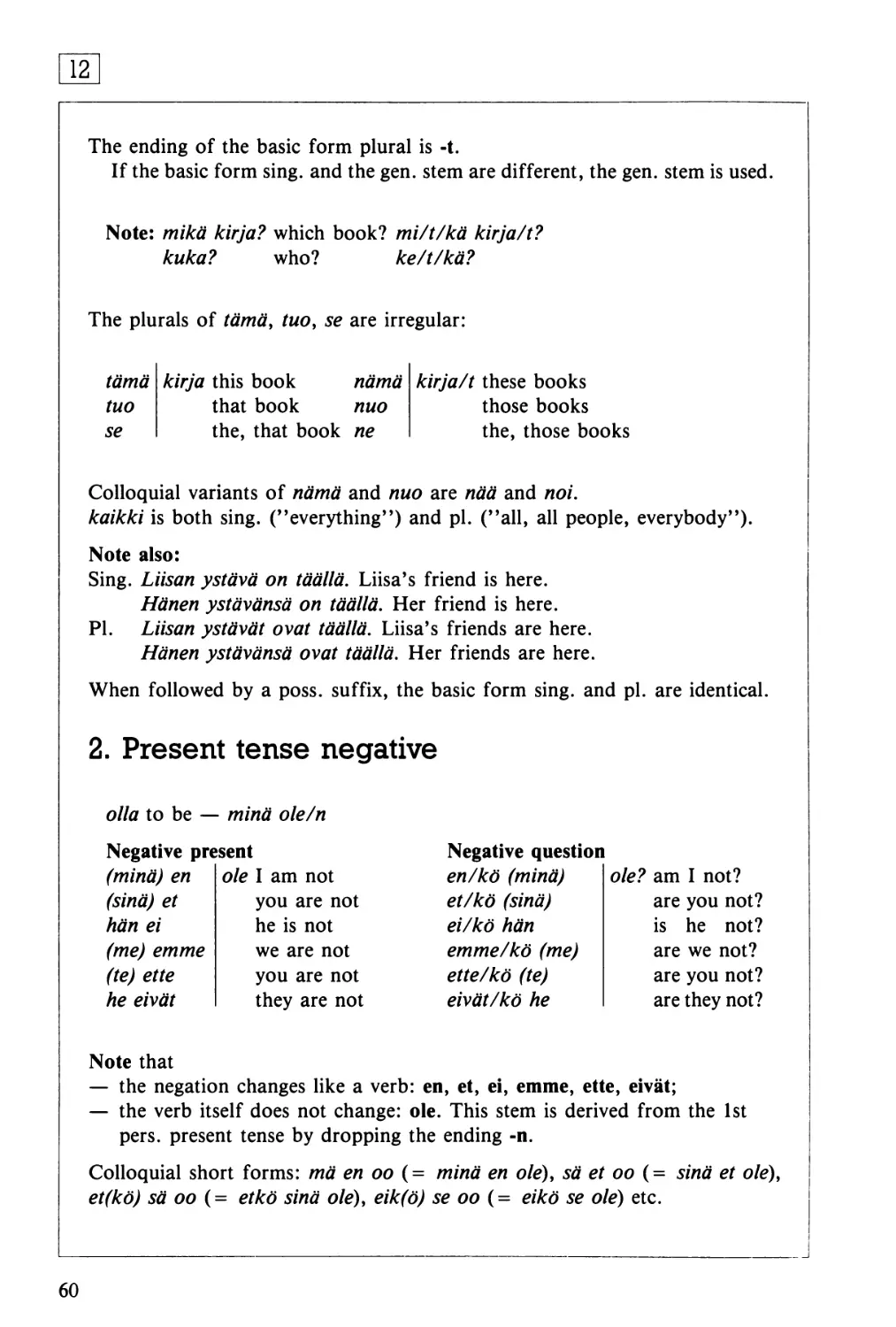

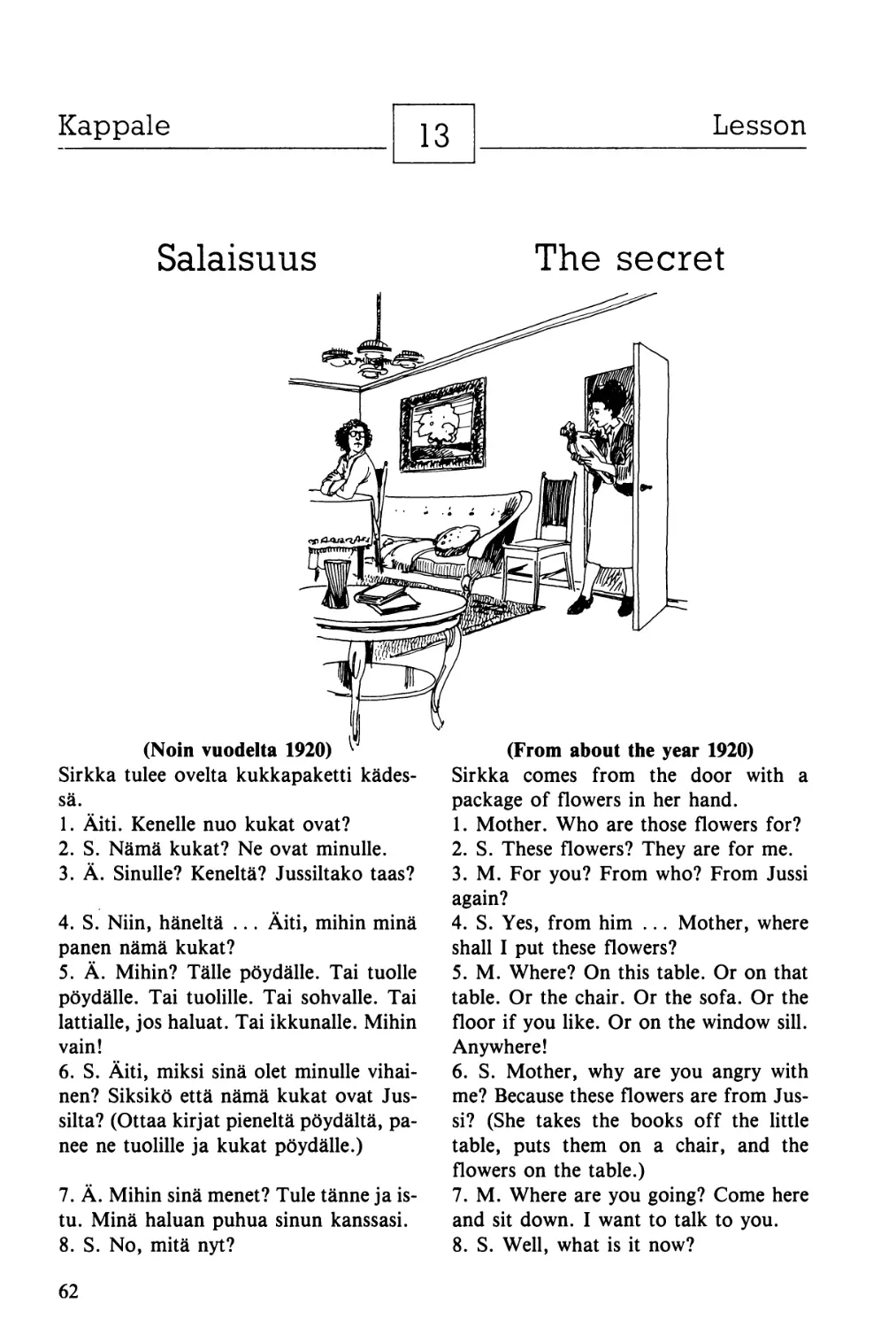
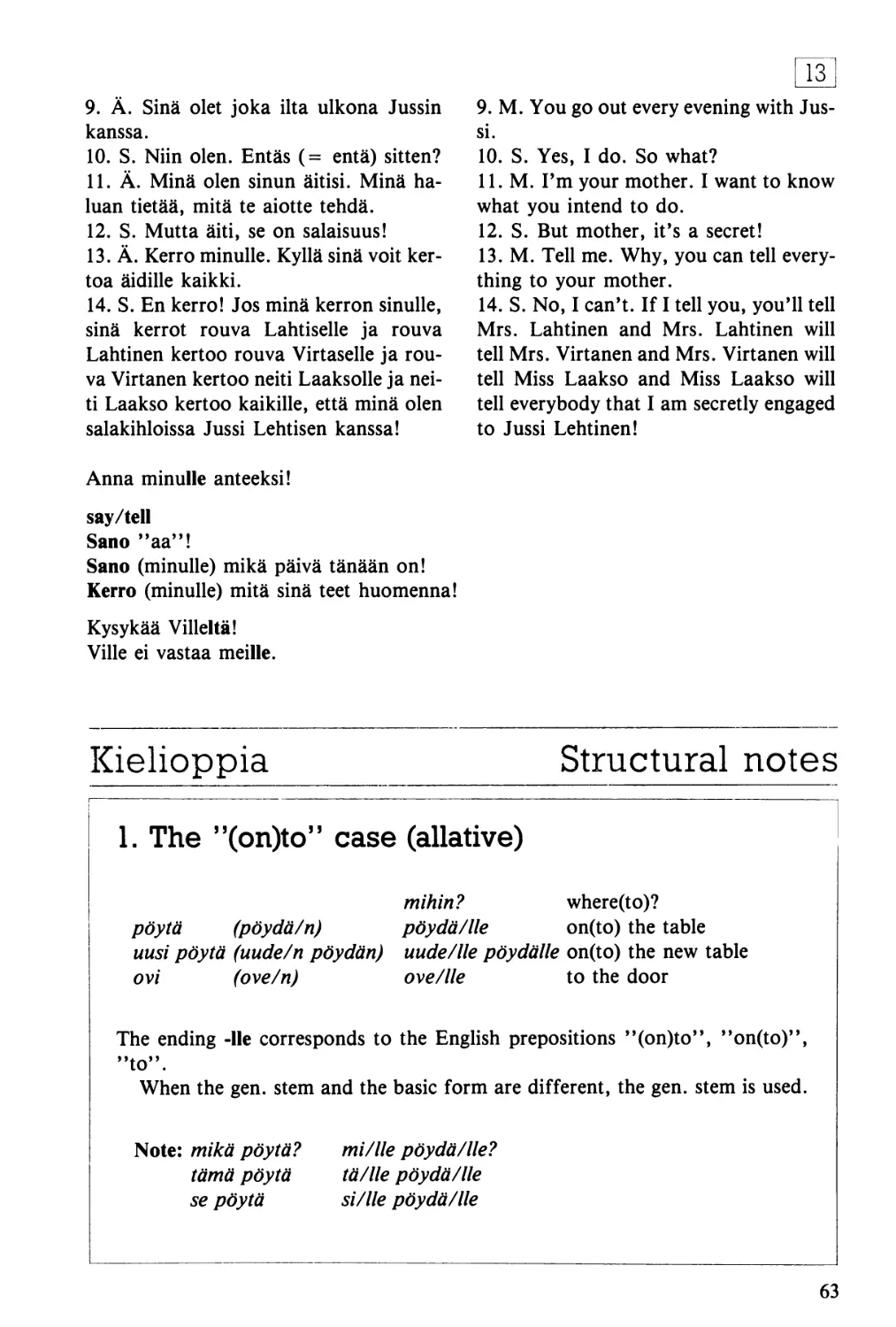

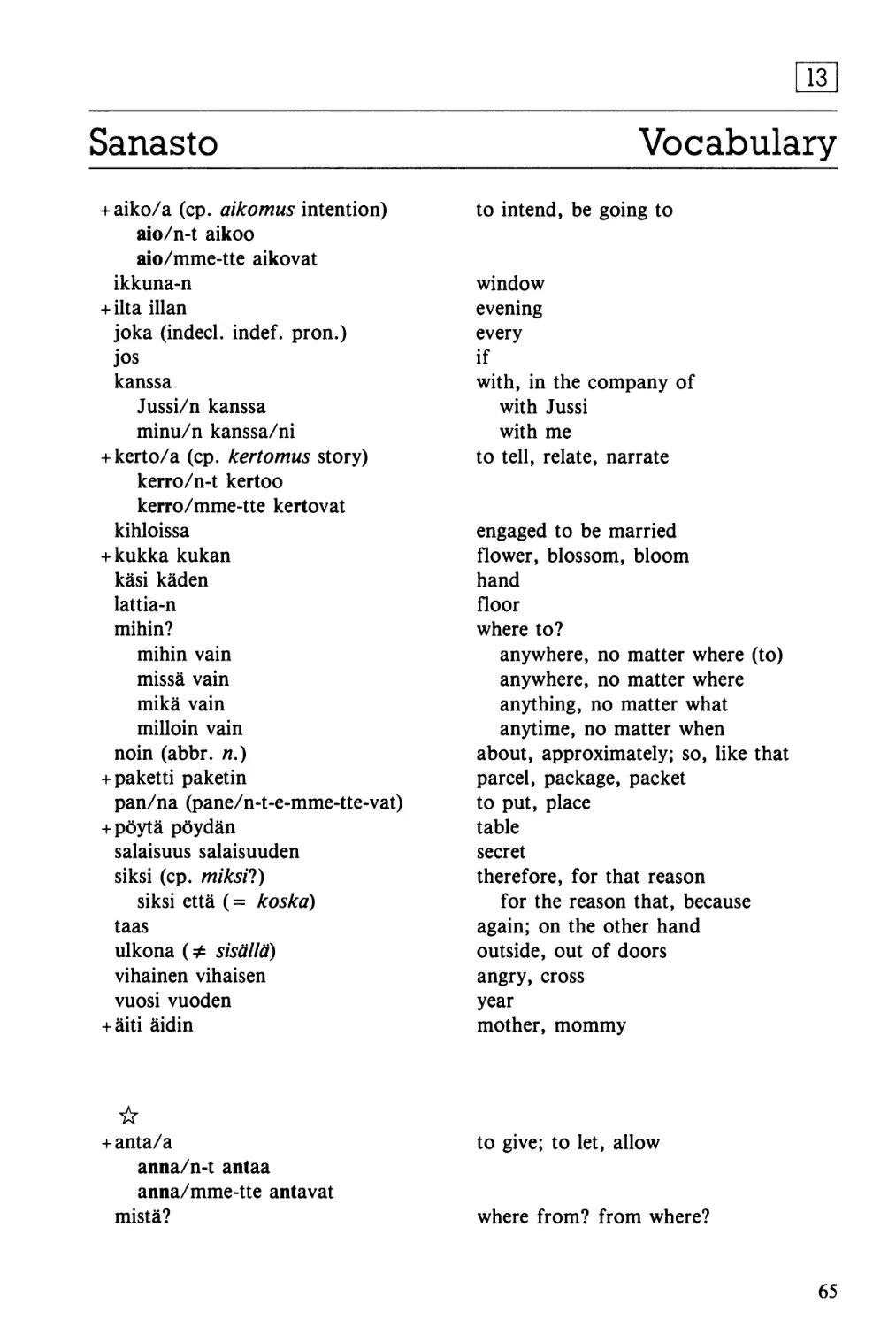





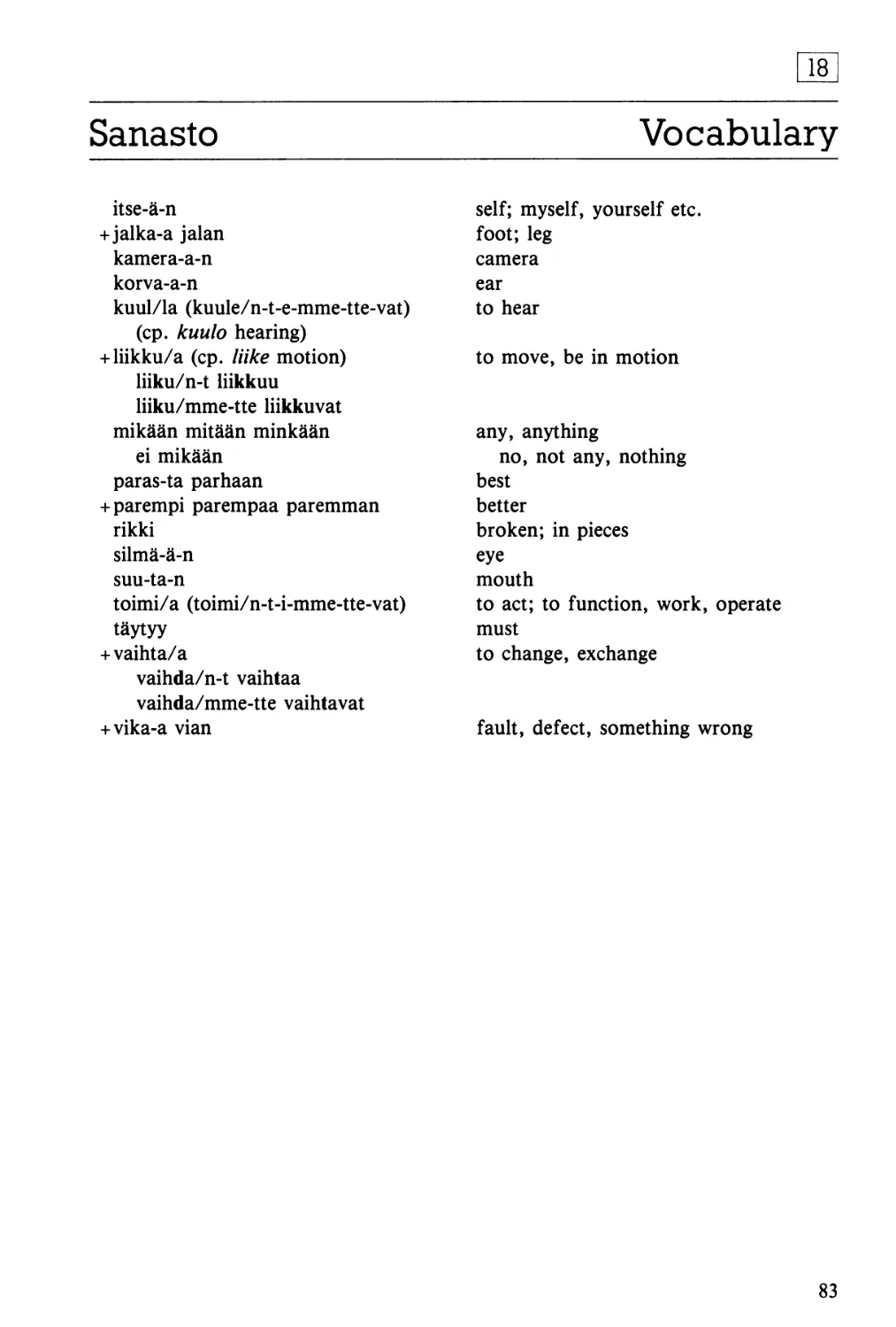

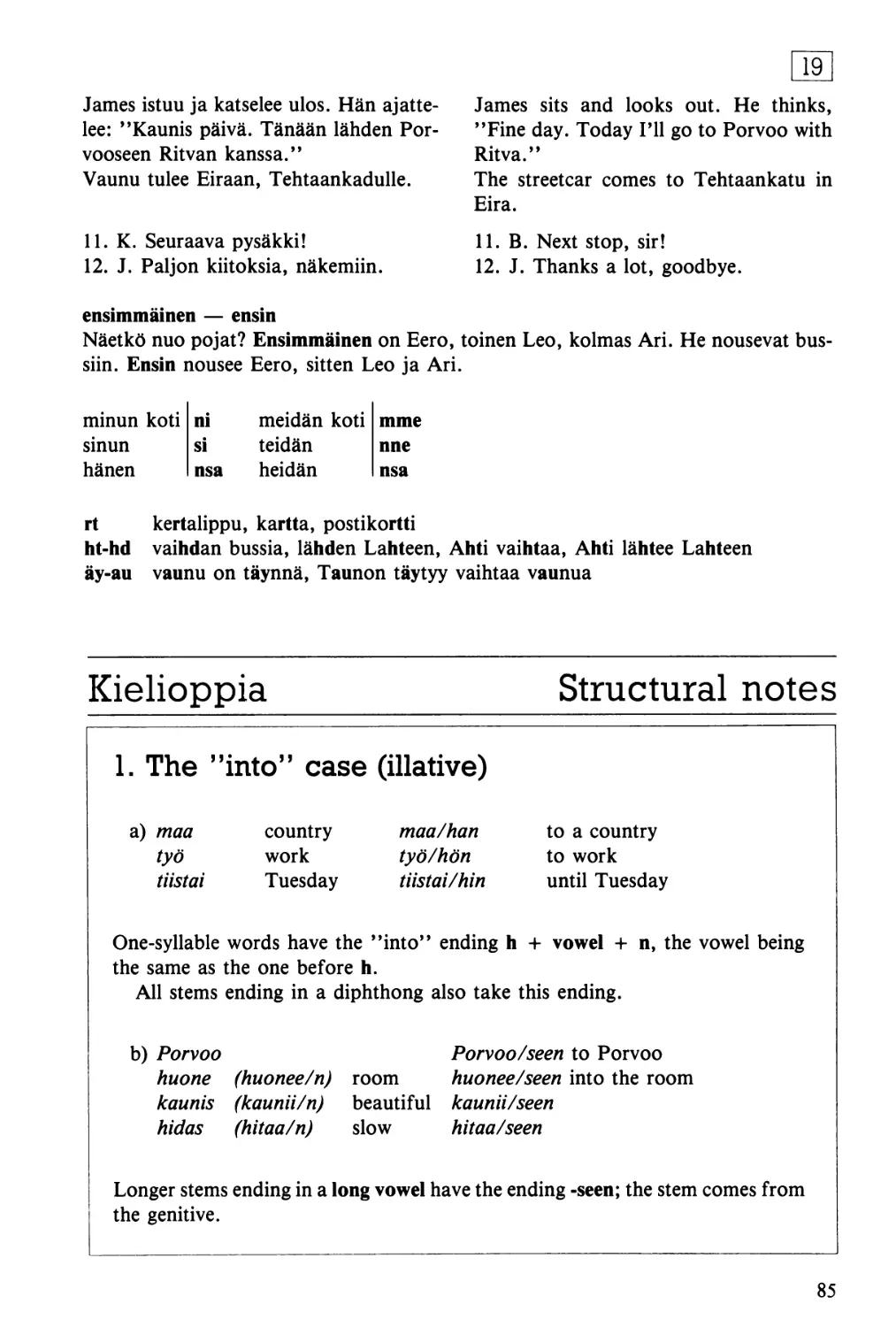
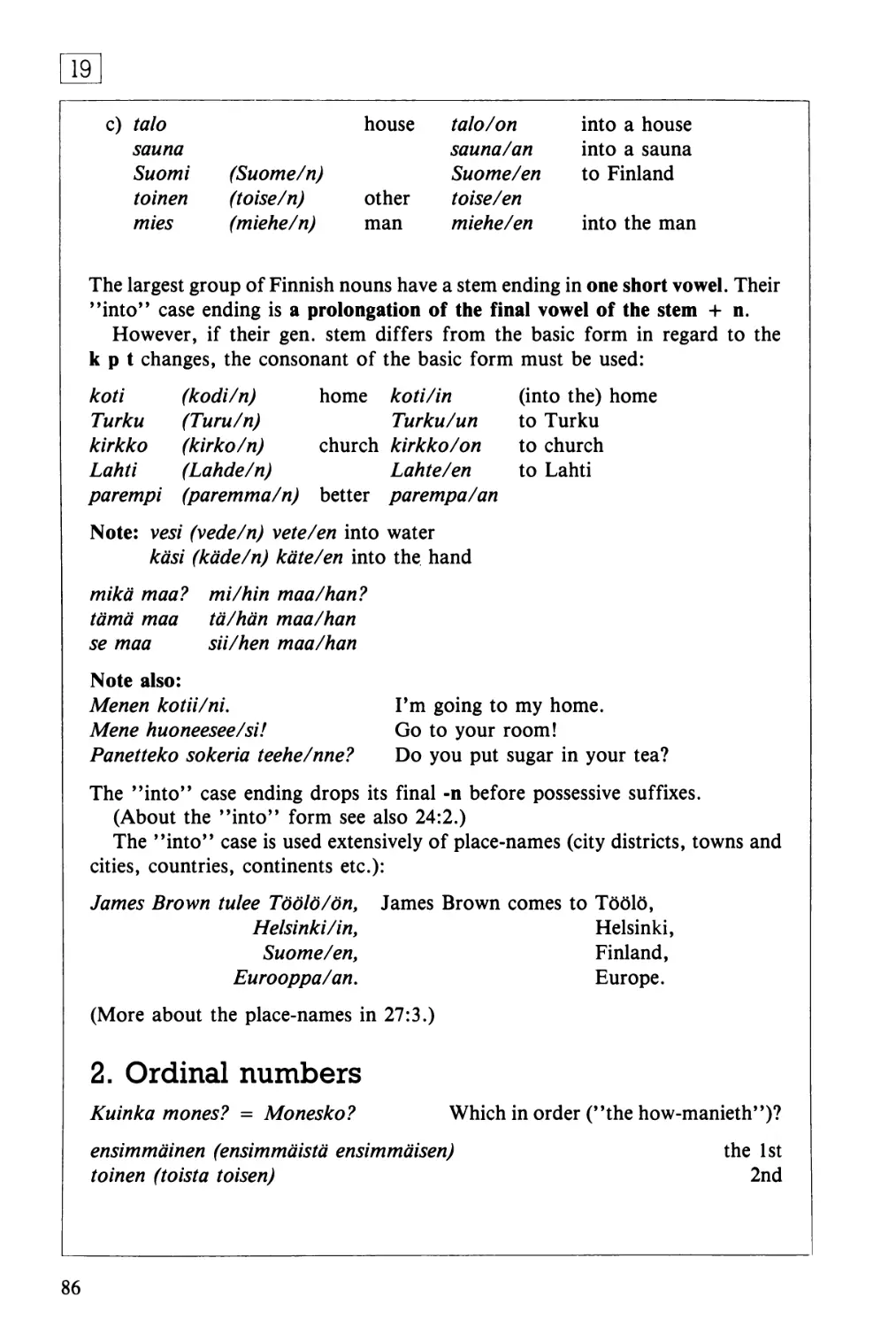
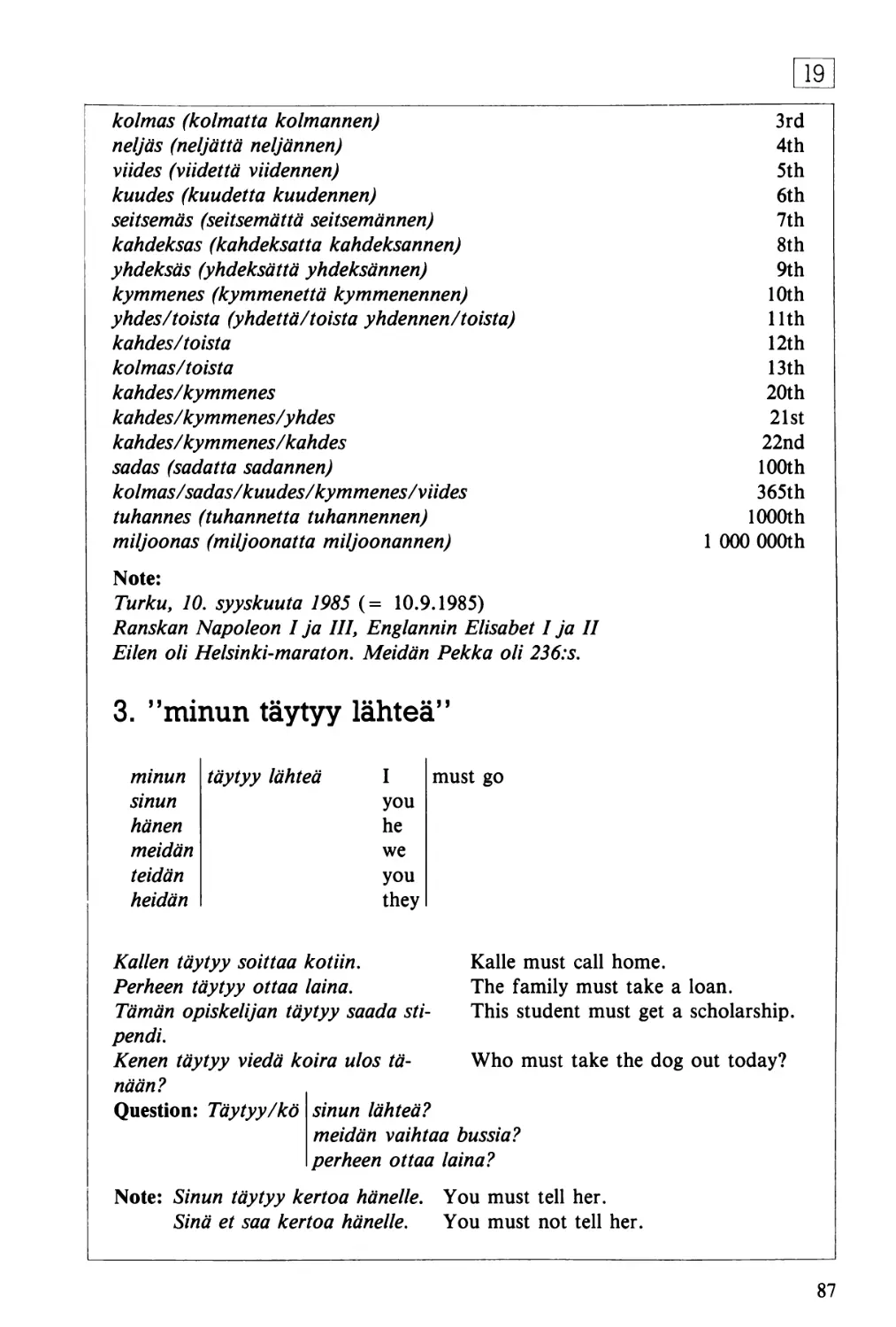
























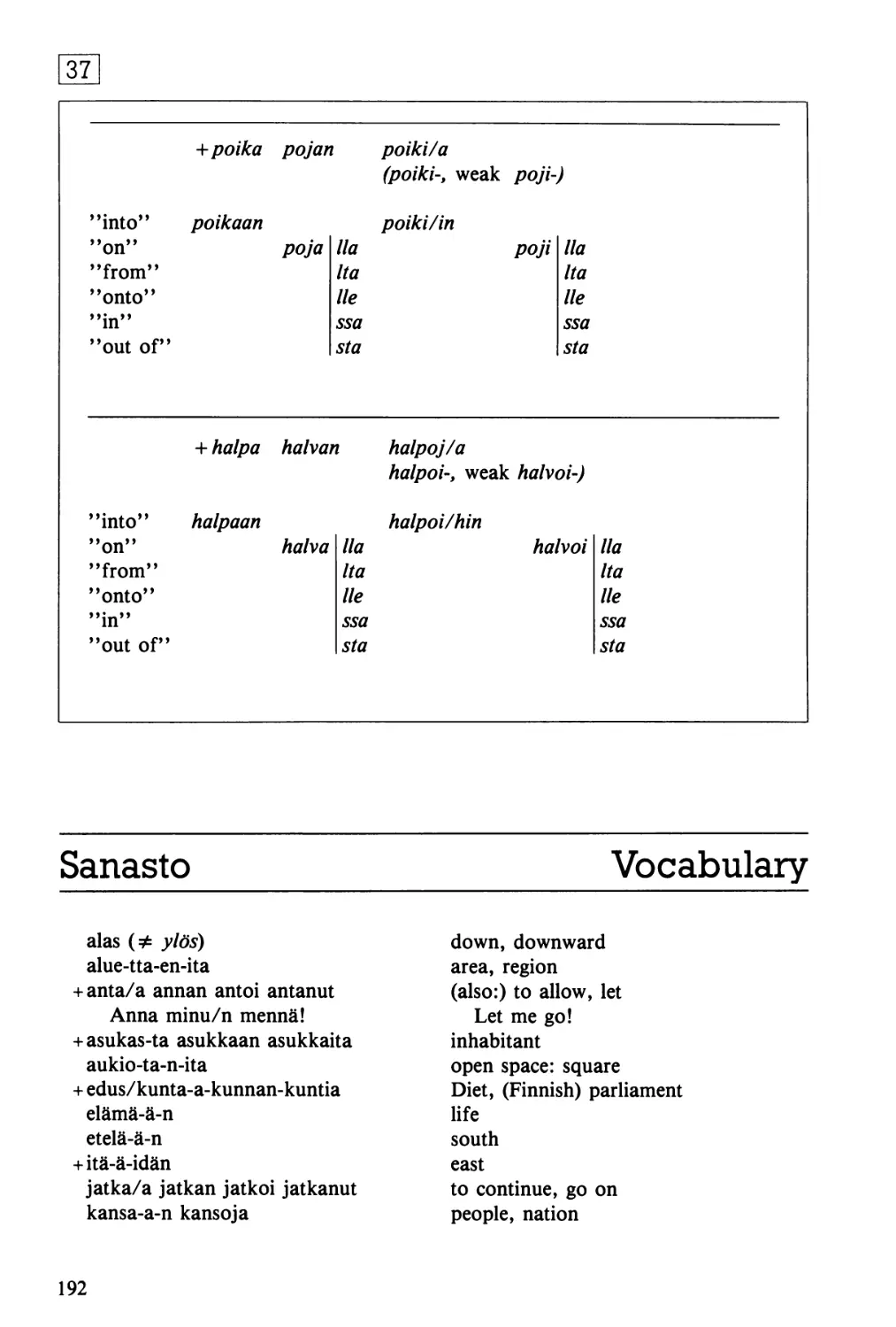

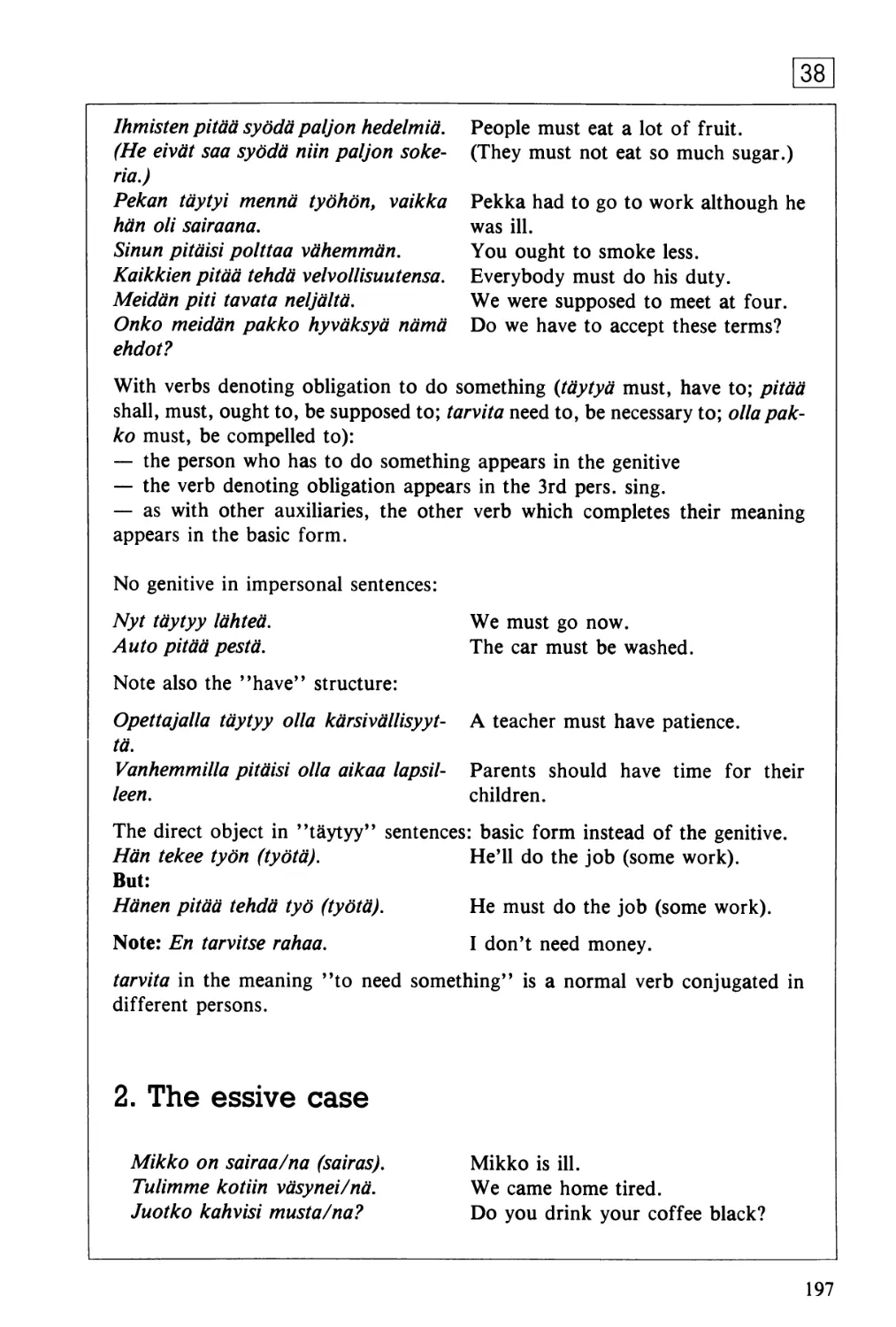
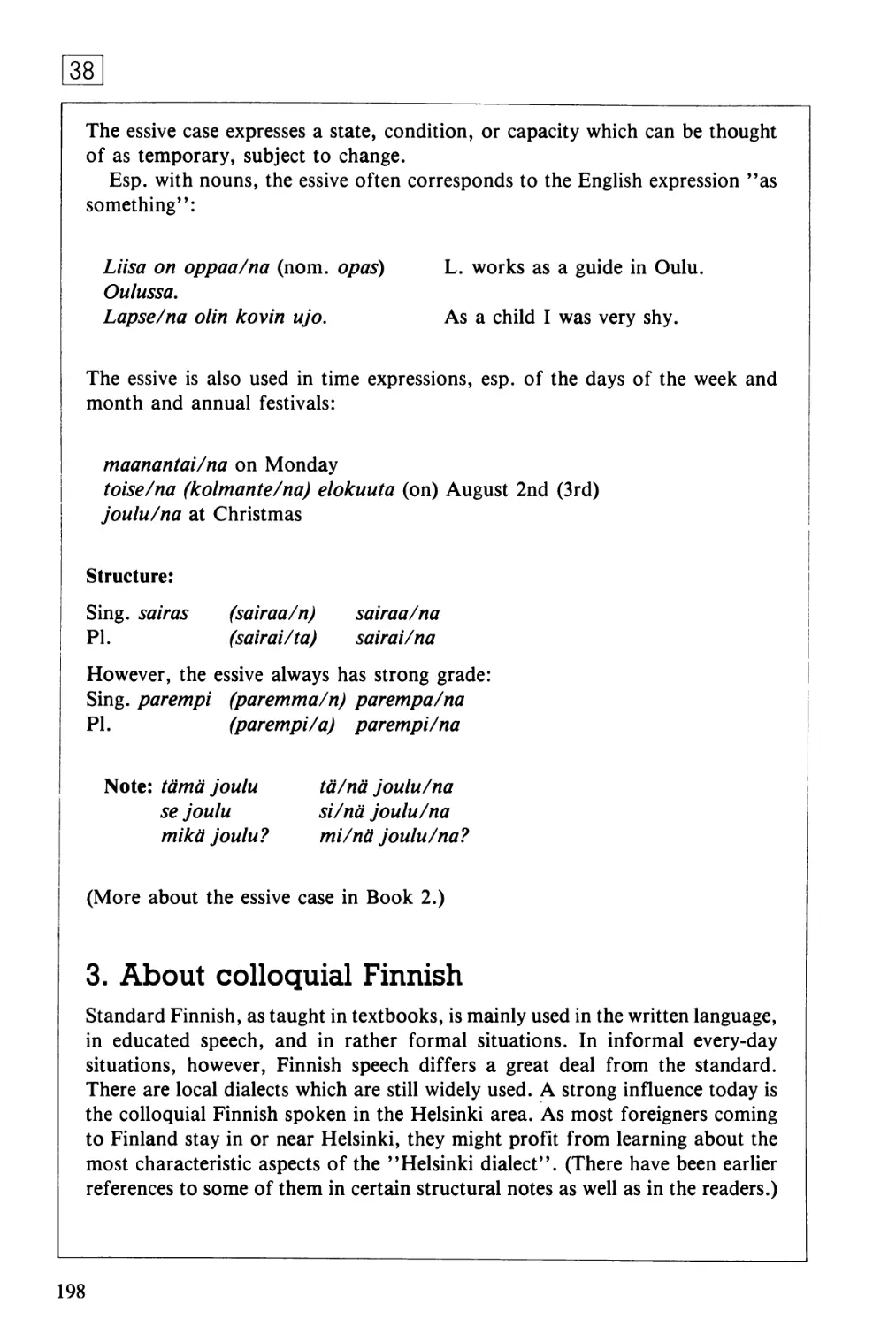
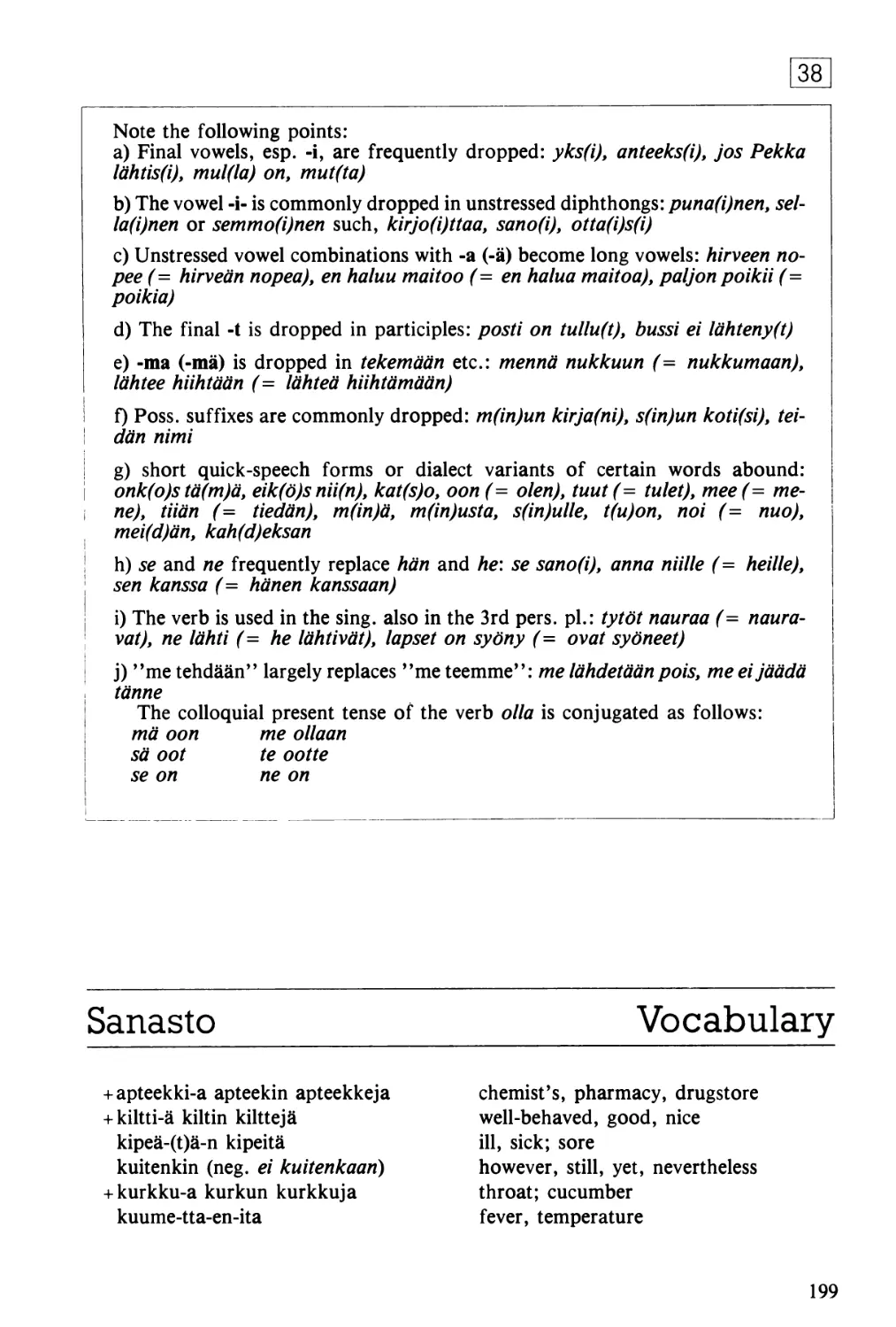
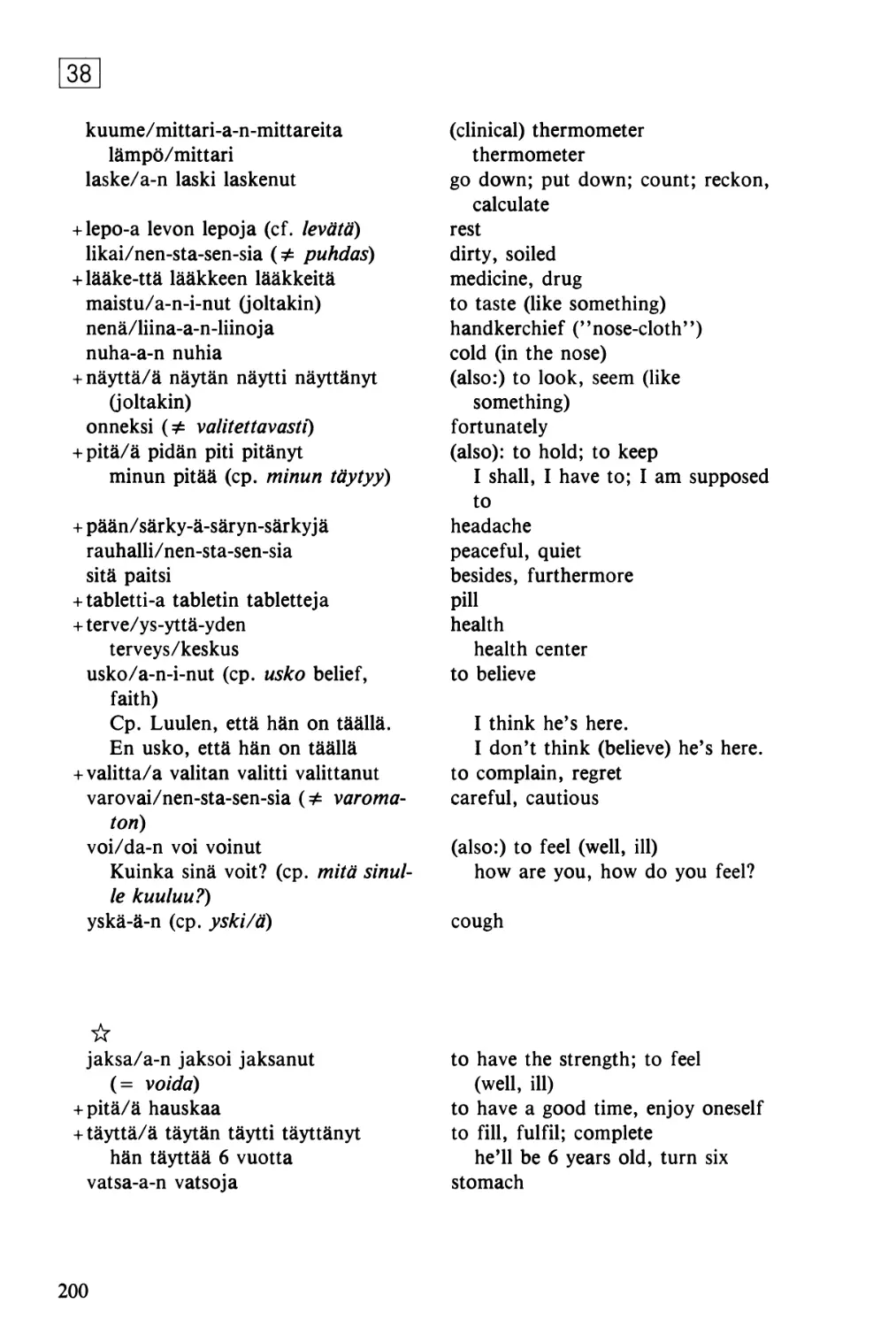

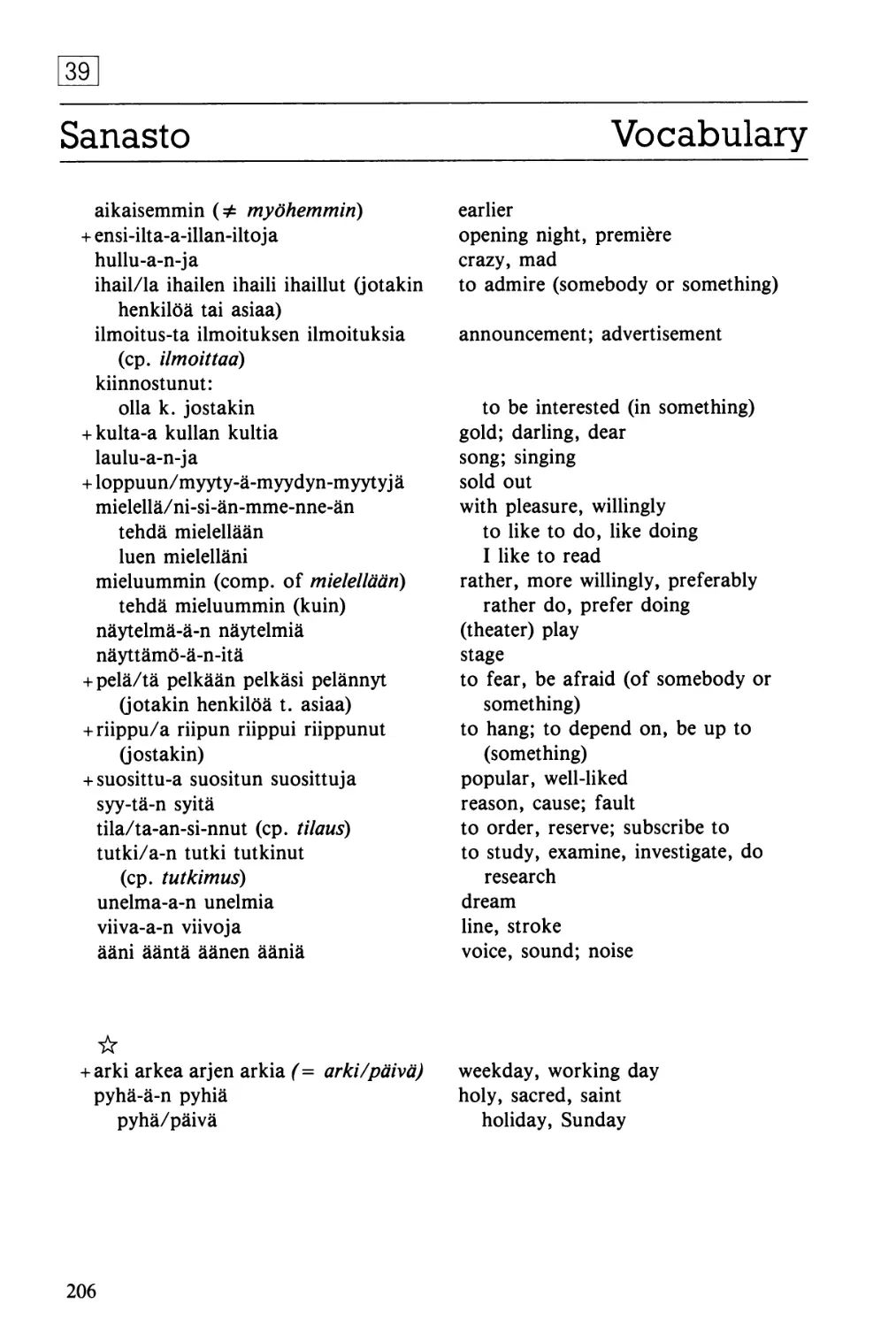
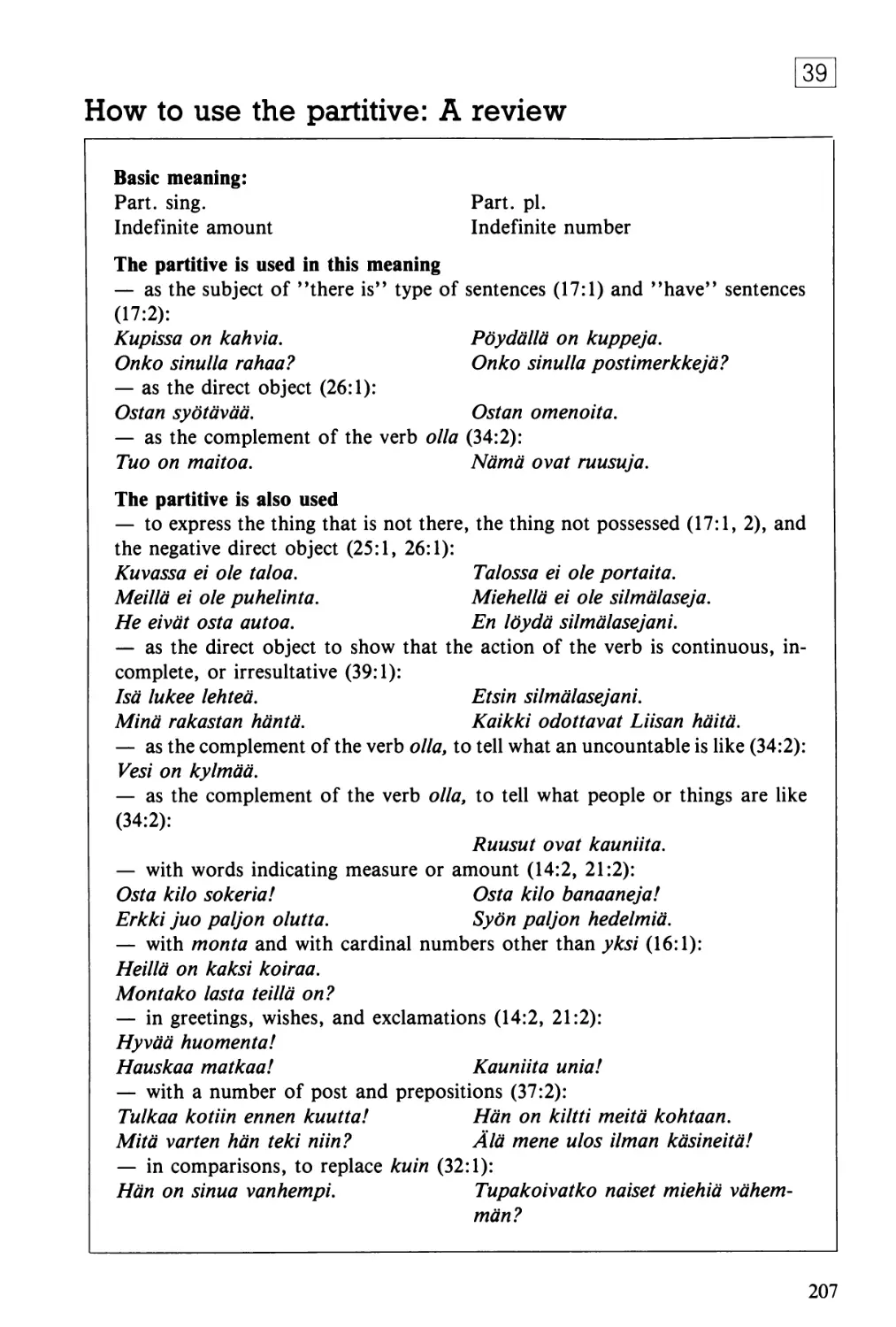
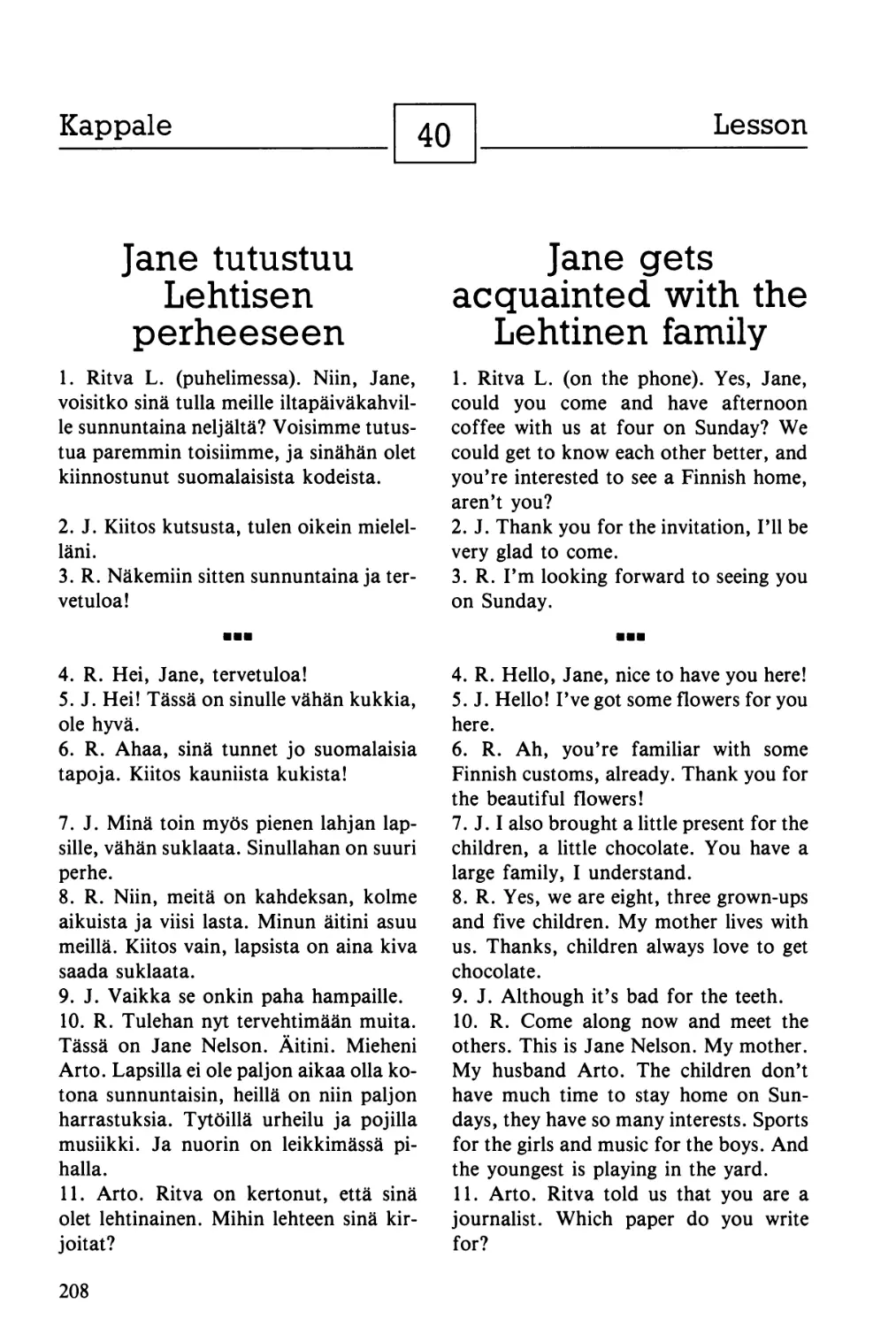

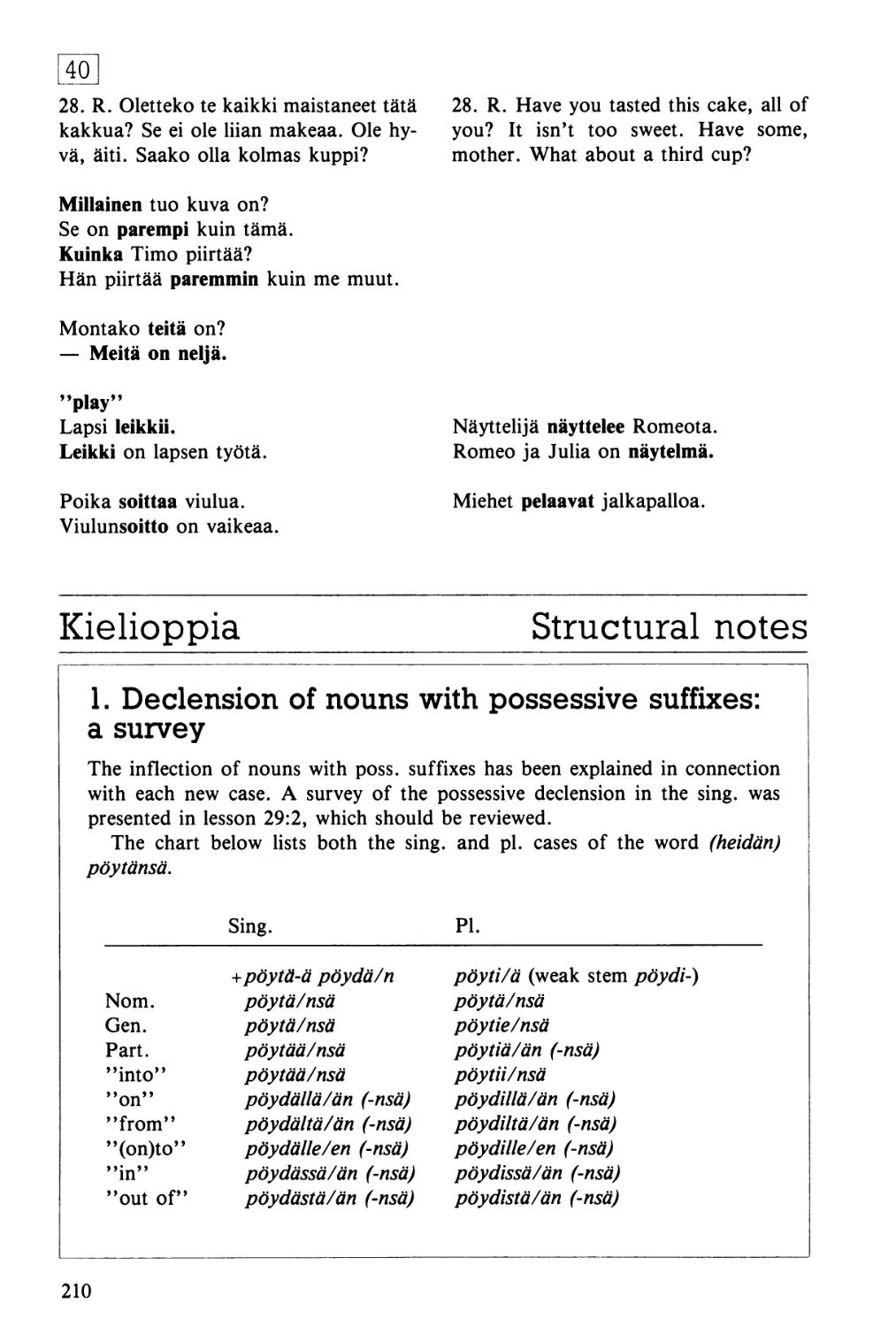
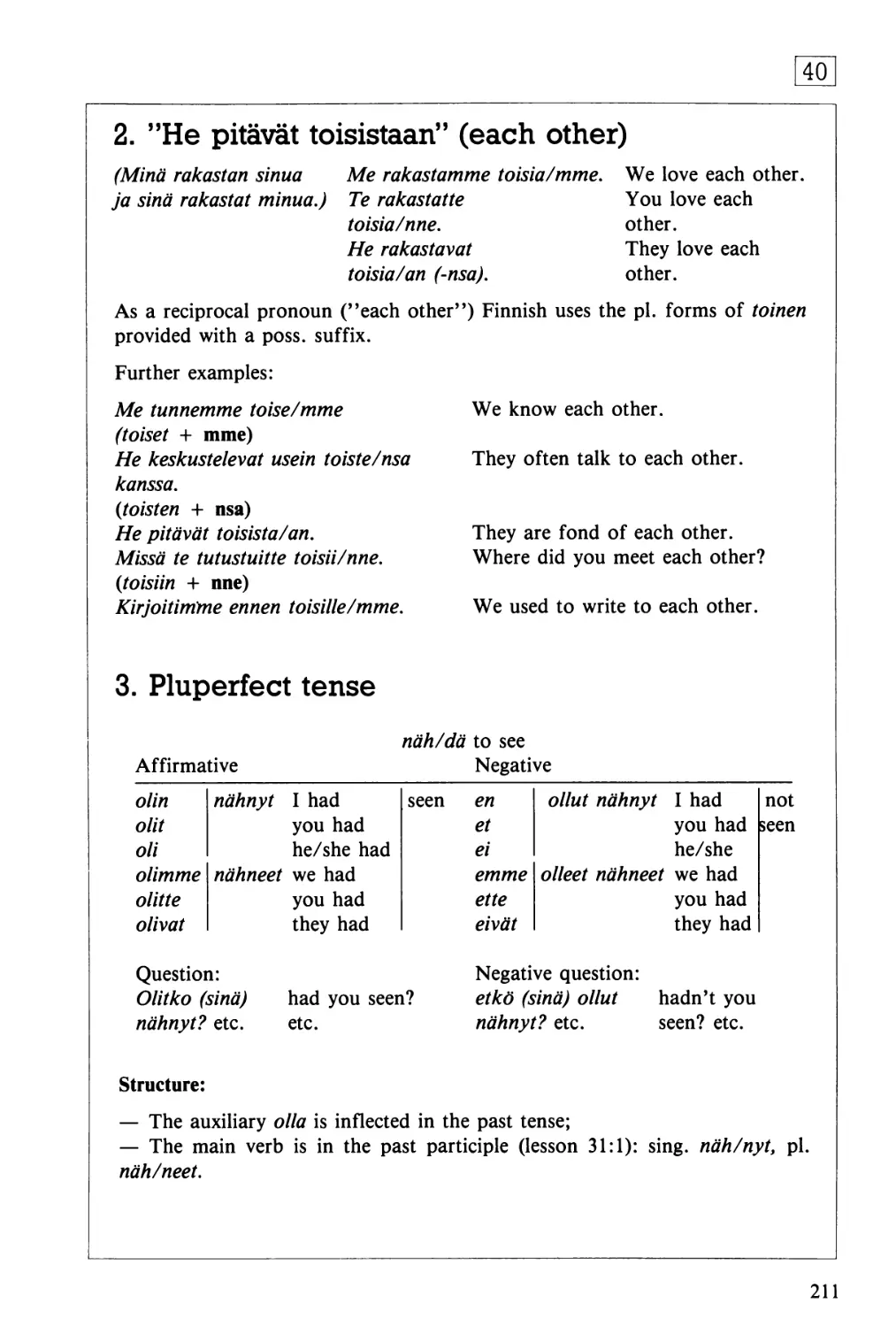

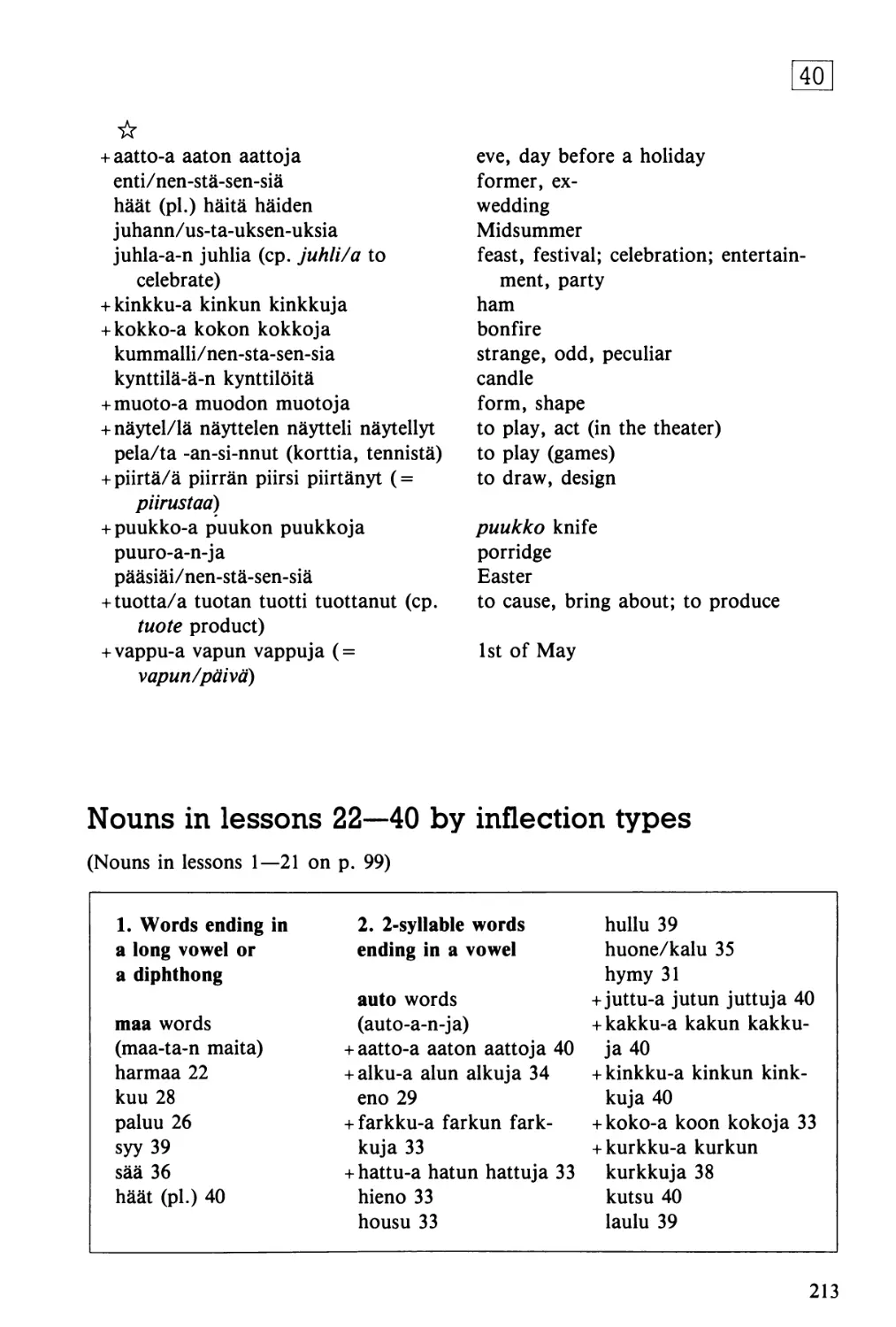


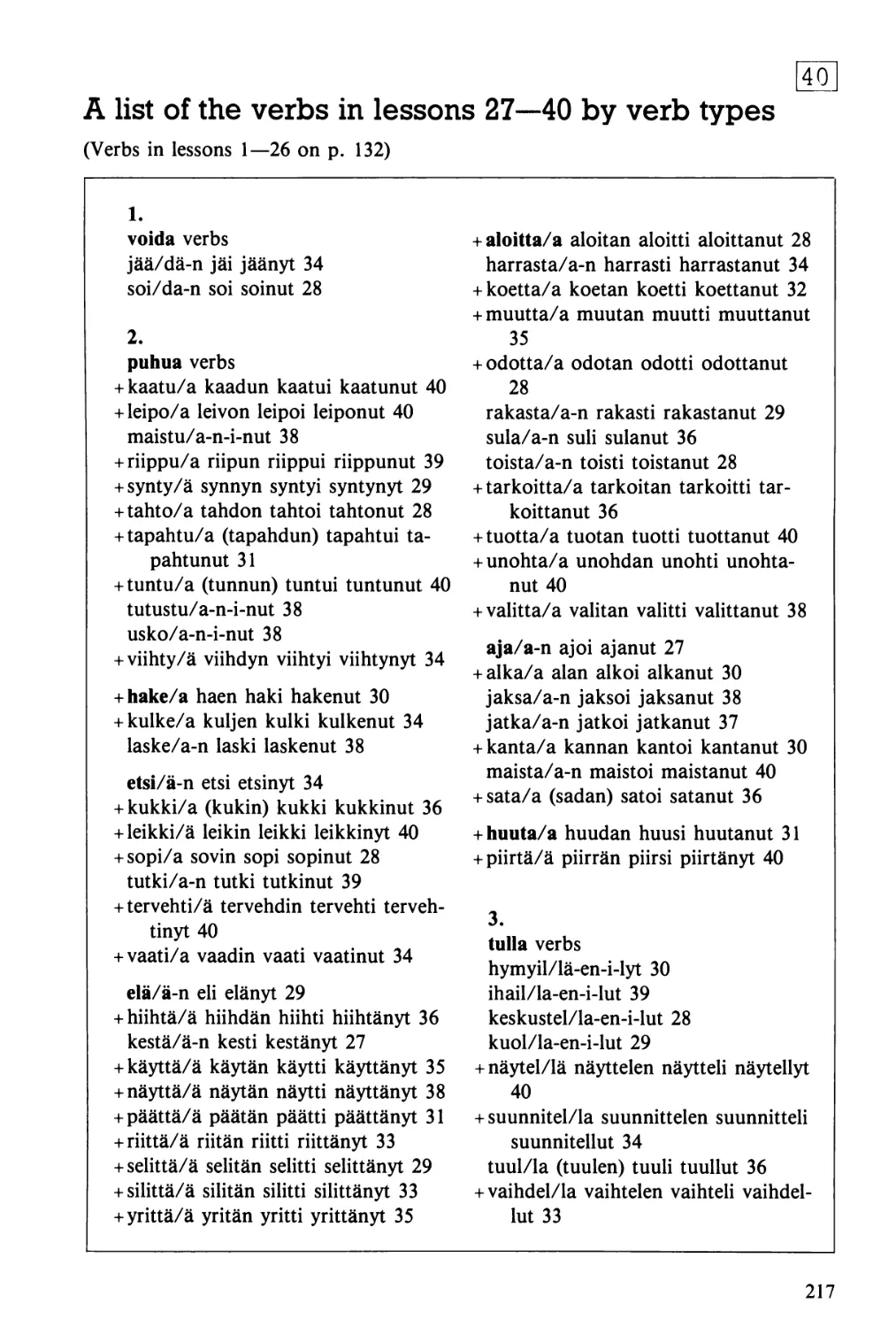
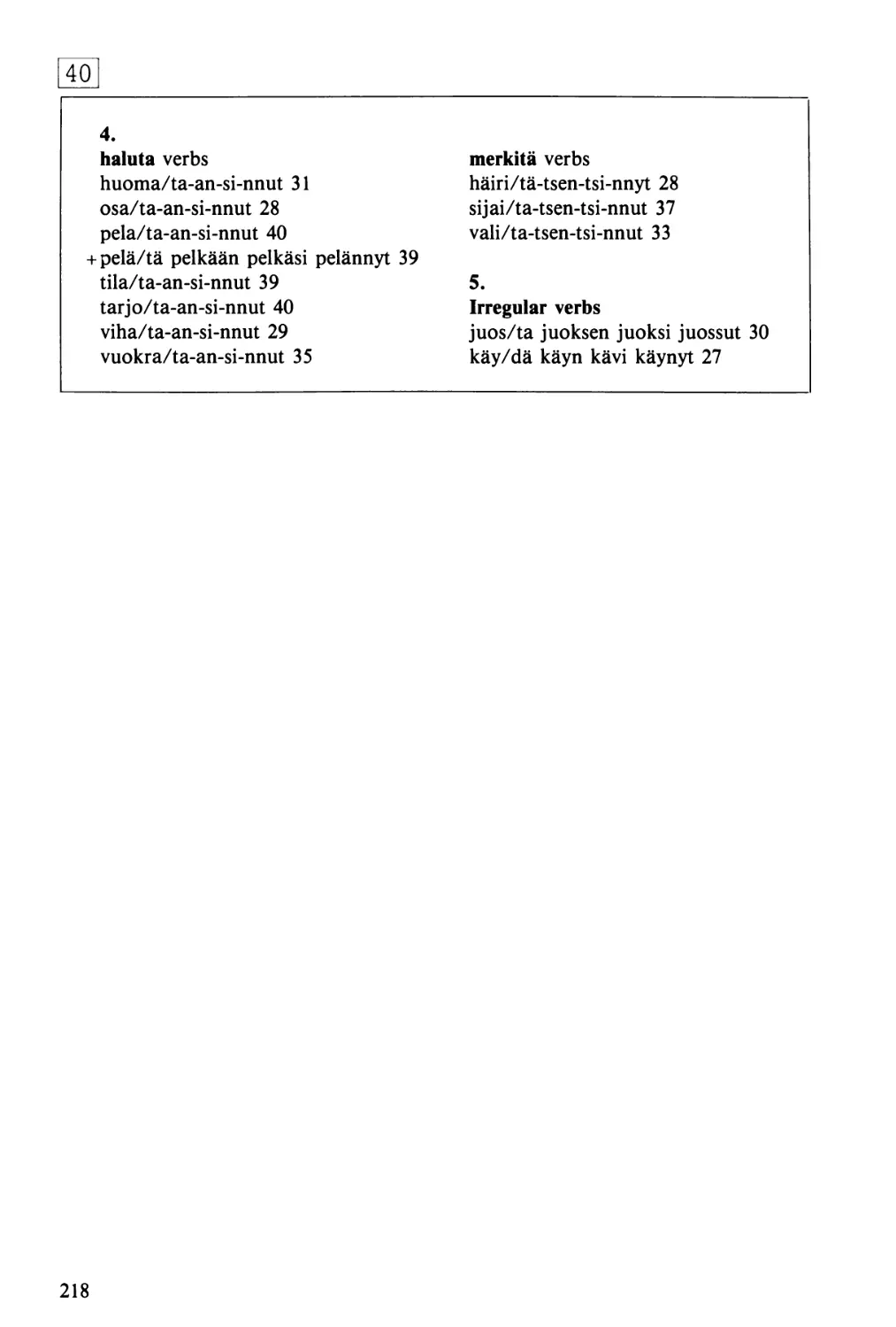





Text
                    Otava
Maija-Hellikki Aaltio
FINNISH FOR
FOREIGNERS 1

FINNISH FOR FOREIGNERS 1

1
FINNISH FOR
FOREIGNERS
Maija-Hellikki Aaltio
OTAVA
«090
HELSINGISSÄ KUSTANNUSOSAKEYHTIÖ OTAVA

Seventeenth edition
Drawings: Jorma Nousiainen
Layout: Merja Askola
Editor: Kaija Niskakoski, Pauliina Luoto
©1987 Maija-Hellikki Aaltio and Otava Publishing Combany
Partial copyright
No part of this publication may be reproduced in any way in accordance
with the Autho’s Right Act (404/61, amended 1654/95) with the exeption
of partial copying for teaching purposes as further defined in the agreement
between the Finnish State and Kopiosto Copyright Collecting Society.
Binding: OlHHlHil
Otava Book Printing Ltd
Keuruu 2007
ISBN-13: 978-951-1-08145-6
ISBN-10: 951-1-08145-4

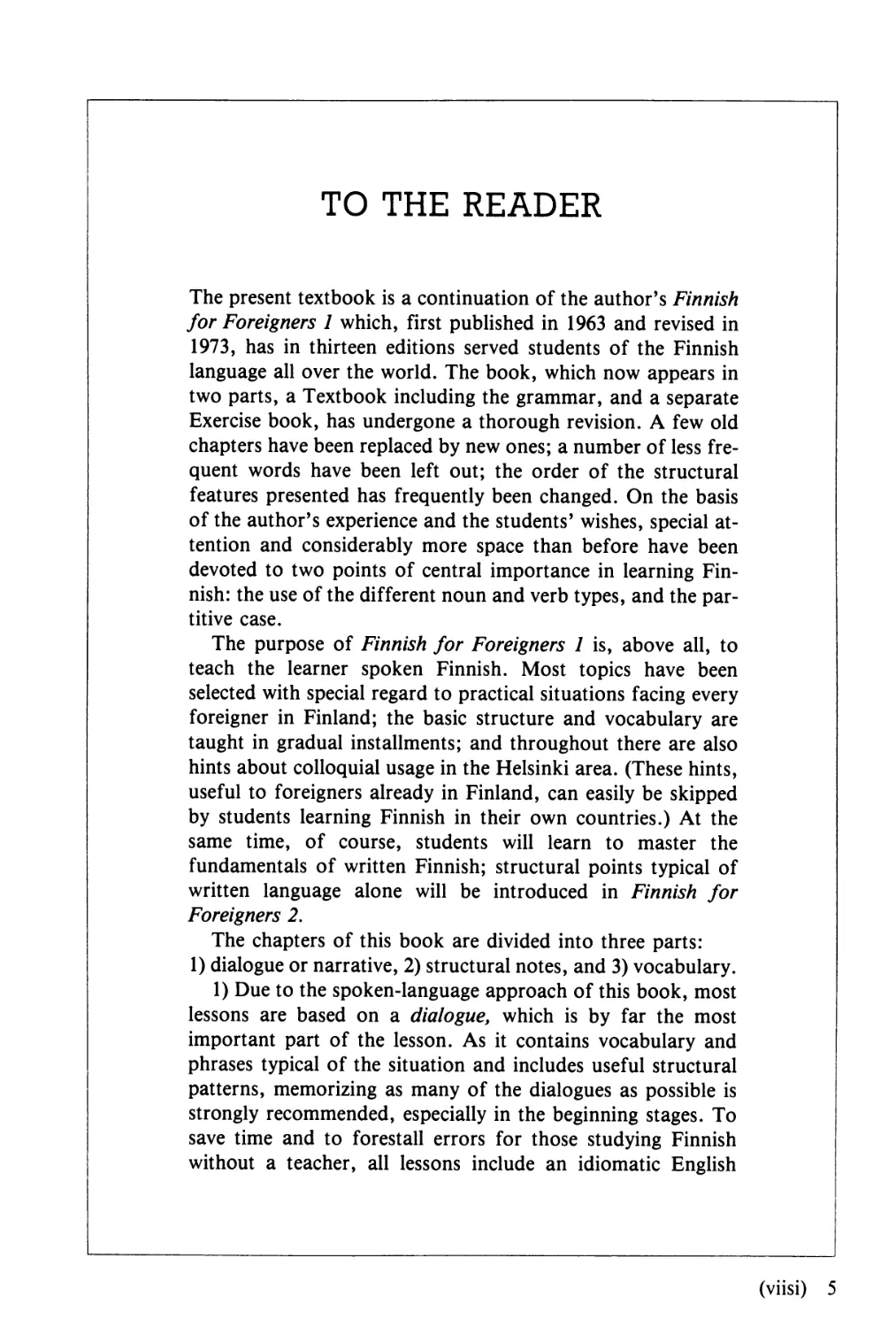
TO THE READER
The present textbook is a continuation of the author’s Finnish
for Foreigners 1 which, first published in 1963 and revised in
1973, has in thirteen editions served students of the Finnish
language all over the world. The book, which now appears in
two parts, a Textbook including the grammar, and a separate
Exercise book, has undergone a thorough revision. A few old
chapters have been replaced by new ones; a number of less
frequent words have been left out; the order of the structural
features presented has frequently been changed. On the basis
of the author’s experience and the students’ wishes, special
attention and considerably more space than before have been
devoted to two points of central importance in learning
Finnish: the use of the different noun and verb types, and the
partitive case.
The purpose of Finnish for Foreigners 1 is, above all, to
teach the learner spoken Finnish. Most topics have been
selected with special regard to practical situations facing every
foreigner in Finland; the basic structure and vocabulary are
taught in gradual installments; and throughout there are also
hints about colloquial usage in the Helsinki area. (These hints,
useful to foreigners already in Finland, can easily be skipped
by students learning Finnish in their own countries.) At the
same time, of course, students will learn to master the
fundamentals of written Finnish; structural points typical of
written language alone will be introduced in Finnish for
Foreigners 2.
The chapters of this book are divided into three parts:
1) dialogue or narrative, 2) structural notes, and 3) vocabulary.
1) 	Due to the spoken-language approach of this book, most
lessons are based on a dialogue, which is by far the most
important part of the lesson. As it contains vocabulary and
phrases typical of the situation and includes useful structural
patterns, memorizing as many of the dialogues as possible is
strongly recommended, especially in the beginning stages. To
save time and to forestall errors for those studying Finnish
without a teacher, all lessons include an idiomatic English
(viisi) 5

translation. The English is also a useful help in checking how
well the Finnish has been memorized and in looking ahead for
phrases and words eventually needed;
2) The presentation of the structure of Finnish proceeds
from the frequent and/or easier to the rare and/or more
difficult. The use of grammatical terminology characteristic of
Finnish alone has been reduced to a minimum. This book is not
meant to be a complete grammar. It is concerned with the
essentials rather than with all the details;
3) The vocabulary section shows the inflection of the Finnish
words and their English equivalents. It may also include other
information, for instance examples illustrating the use of the
new words.
All the dialogues and other texts, as well as the
pronunciation exercises following the first few lessons, are available on
two cassettes which also include the listening comprehension
exercises in the Exercise book for each chapter.
I am grateful to my colleagues Hannele Jönsson-Korhola
and Eila Hämäläinen for reading the manuscript and offering
valuable suggestions. My thanks are due to Mark Shackleton,
Lecturer in English at Helsinki University, for correcting my
English; for any remaining errors I am solely responsible. I
would also like to thank Tiina Saaristo and Tapani Aaltio, two
representatives of the present student generation, for their
comments on the dialogues, particularly those with a colloquial
flavor. And finally, I am very much indebted to many of my
students at Helsinki University who through their criticism and
suggestions have greatly helped me in my work.
I hope that the new version of Finnish for Foreigners 1 will
prove a useful basic textbook to many English-speaking
students of Finnish throughout the world.
Kauniainen, Finland, September 1984.
Maija-Hellikki Aaltio
6 (kuusi)

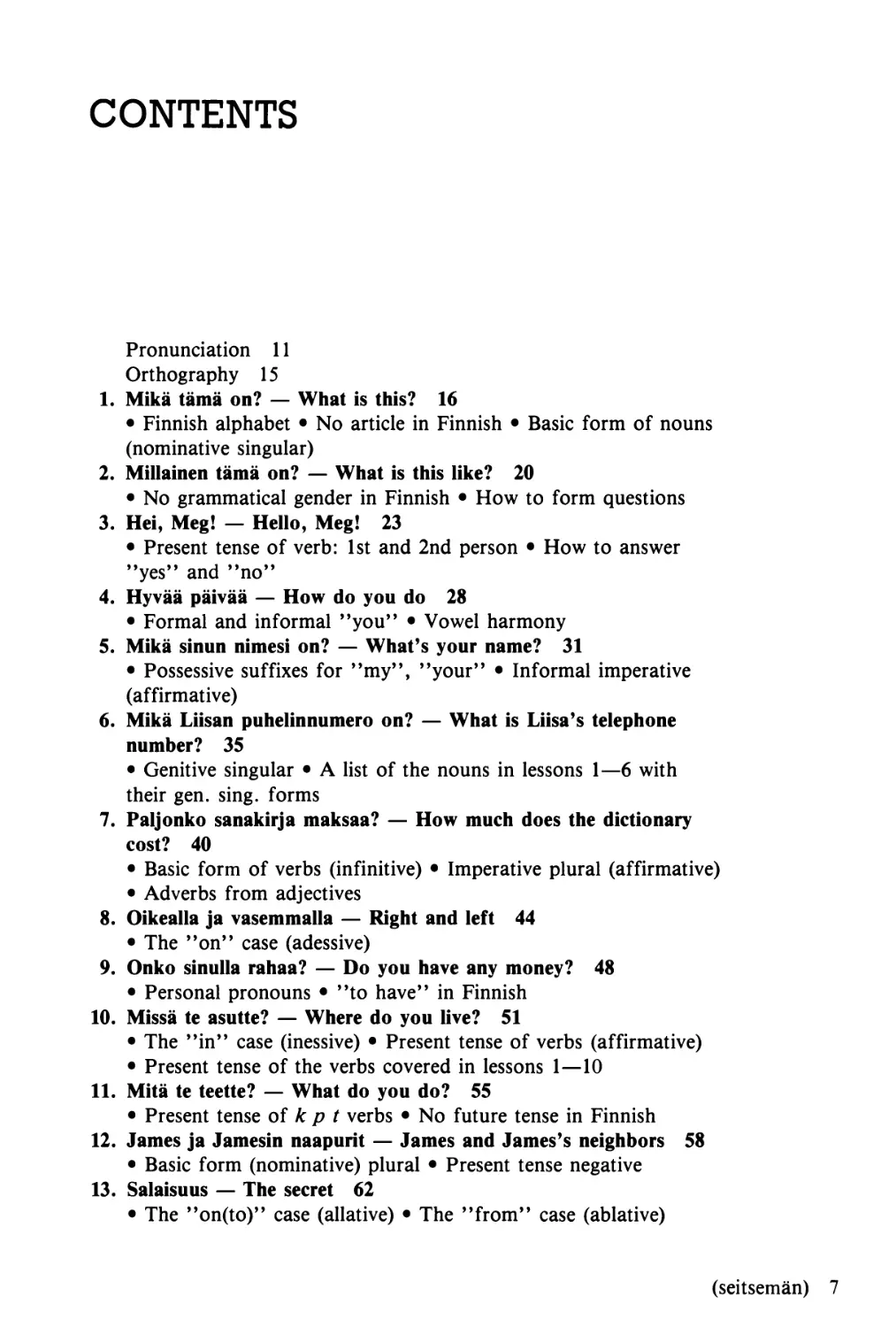
CONTENTS
Pronunciation 11
Orthography 15
1. Mikä tämä on? — What is this? 16
• Finnish alphabet • No article in Finnish • Basic form of nouns
(nominative singular)
2. Millainen tämä on? — What is this like? 20
• No grammatical gender in Finnish • How to form questions
3. Hei, Meg! — Hello, Meg! 23
• Present tense of verb: 1st and 2nd person • How to answer
”yes” and "no"
4. Hyvää päivää — How do you do 28
• Formal and informal ’’you” • Vowel harmony
5. Mikä sinun nimesi on? — What’s your name? 31
• Possessive suffixes for ’’my”, ’’your” • Informal imperative
(affirmative)
6. Mikä Liisan puhelinnumero on? — What is Liisa’s telephone
number? 35
• Genitive singular • A list of the nouns in lessons 1—6 with
their gen. sing, forms
7. Paljonko sanakirja maksaa? — How much does the dictionary
cost? 40
• Basic form of verbs (infinitive) • Imperative plural (affirmative)
• Adverbs from adjectives
8. Oikealla ja vasemmalla — Right and left 44
• The ”on” case (adessive)
9. Onko sinulla rahaa? — Do you have any money? 48
• Personal pronouns • ”to have” in Finnish
10. Missä te asutte? — Where do you live? 51
• The ’’in” case (inessive) • Present tense of verbs (affirmative)
• Present tense of the verbs covered in lessons 1—10
11. Mitä te teette? — What do you do? 55
• Present tense of k p t verbs • No future tense in Finnish
12. James ja Jamesin naapurit — James and James’s neighbors 58
• Basic form (nominative) plural • Present tense negative
13. Salaisuus — The secret 62
• The ”on(to)” case (allative) • The ”from” case (ablative)
(seitsemän) 7

14. Ravintolassa on hyvää kalaa — There’s good fish at the
restaurant 66
• Partitive singular • Special uses of partitive • Irregular part,
sing, forms of nouns in lessons 1—13
15. Vaikea asiakas — A difficult customer 71
• "What is this?” — "What is it like?”
16. Kuinka monta? — How many? 74
• Partitive singular with cardinal numbers • About foreign
loanwords in Finnish
17. Jamesilla on radio, mutta ei televisiota — James has a radio
but no television 77
• ’’there is, there are” sentences • ”have” sentences
18. Toinen vaikea asiakas — Another difficult customer (A review) 82
19. Bussissa ja raitiovaunussa — On the bus and streetcar 84
• The ”into” case (illative) • Ordinal numbers • ’’minun täytyy
lähteä”
20. Tapaaminen kadulla — Meeting on the street 89
• The ”out of” case (elative) • Expressions of time
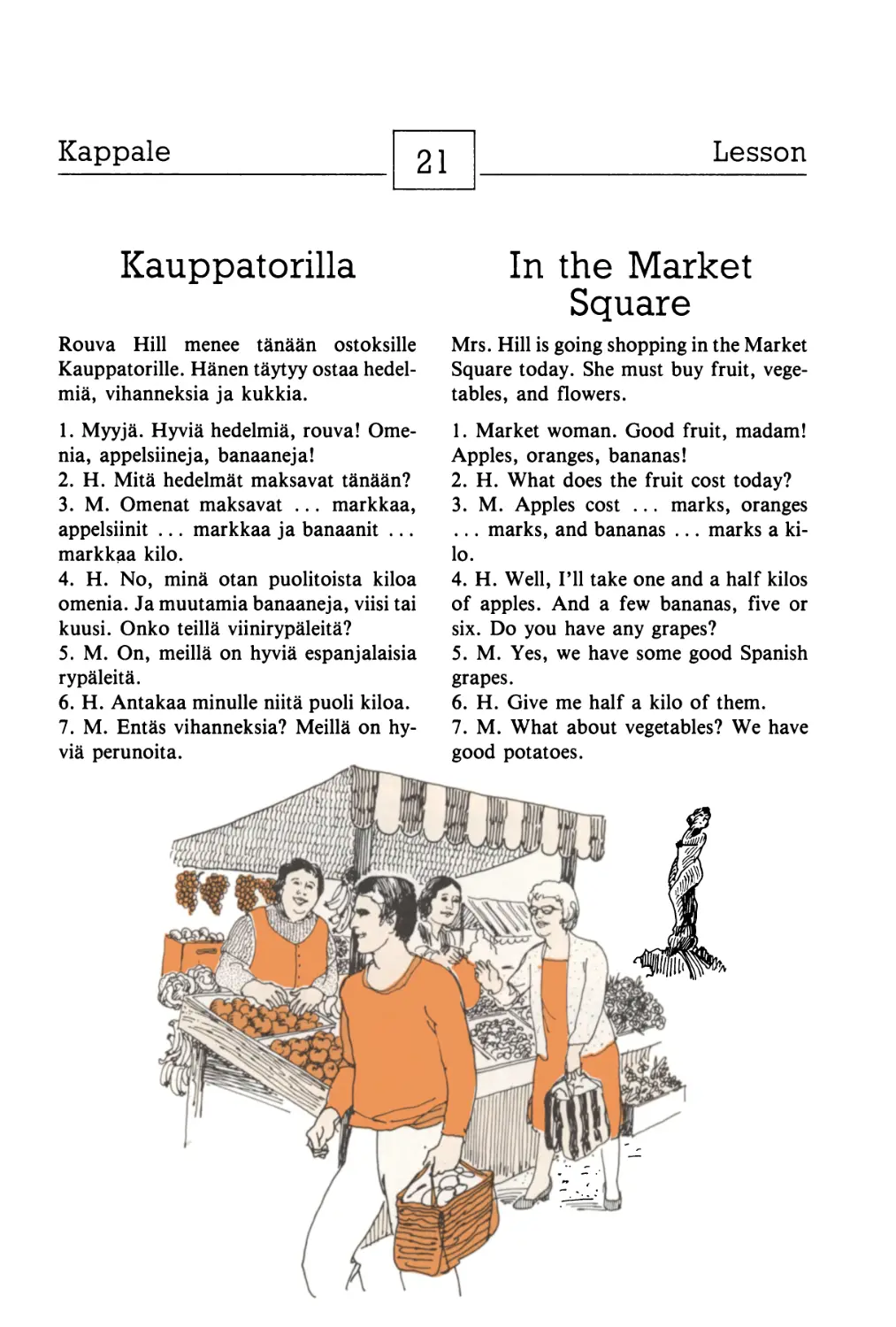
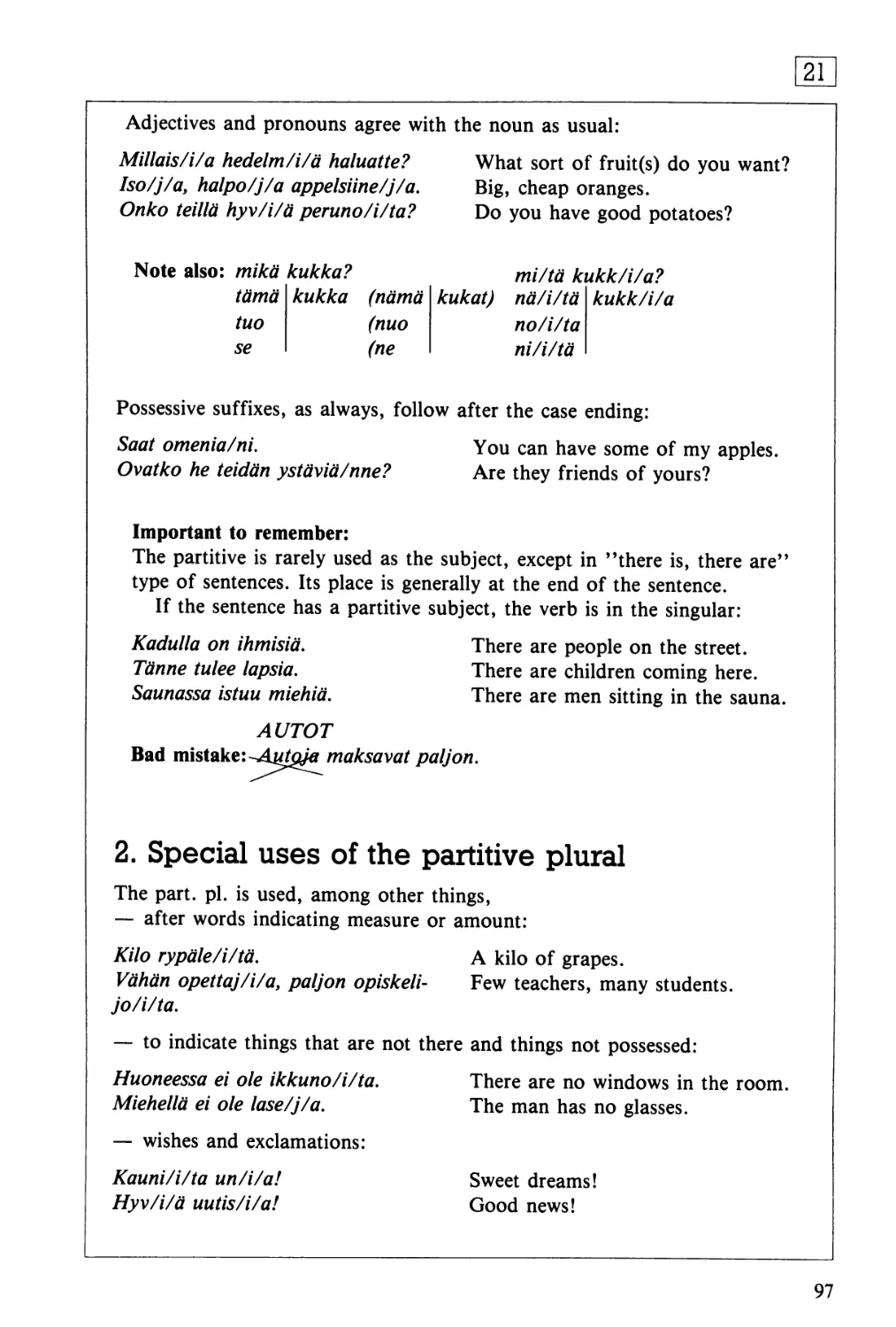
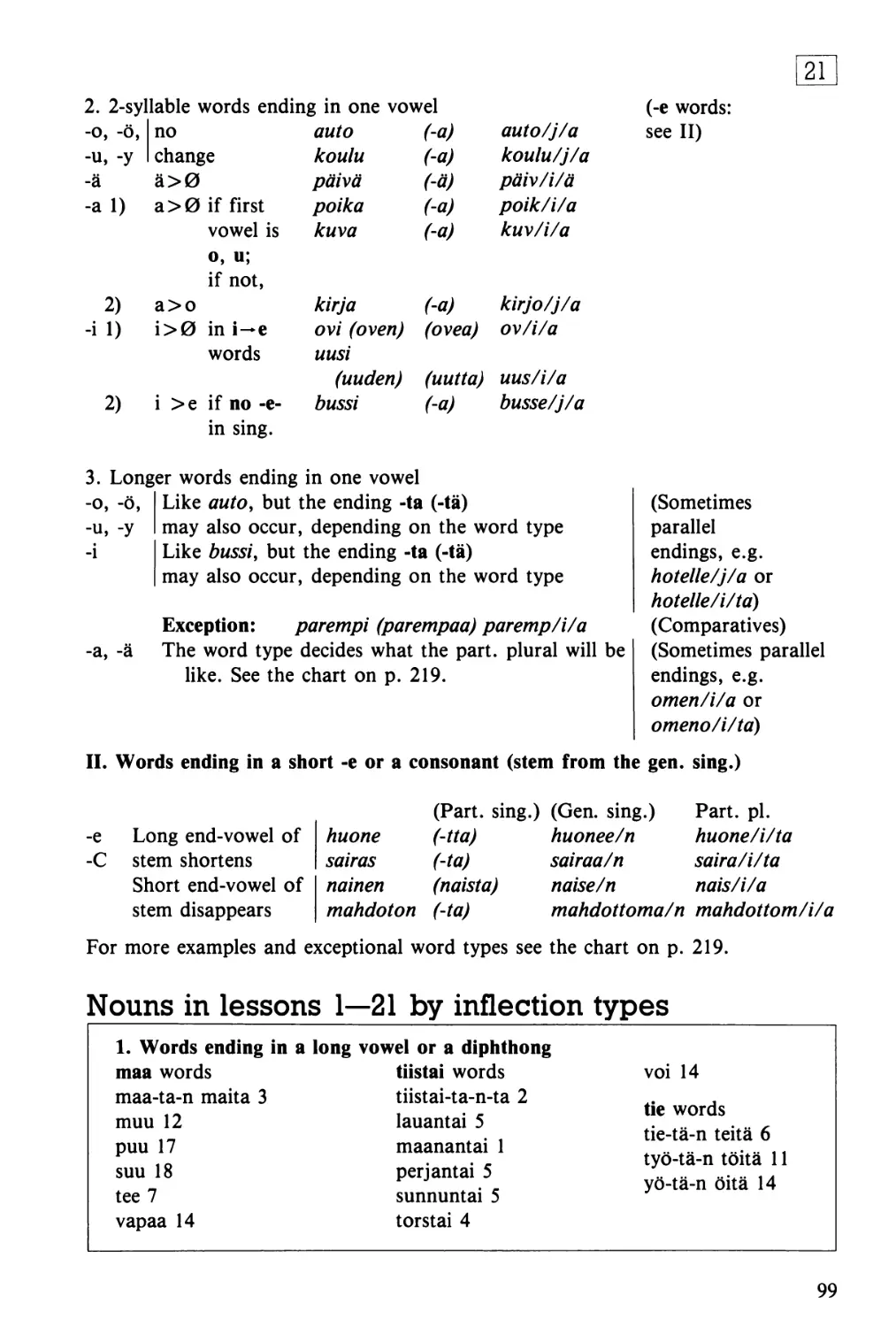
21. Kauppatorilla — In the Market Square 94
• Partitive plural • Special uses of the partitive plural • How to
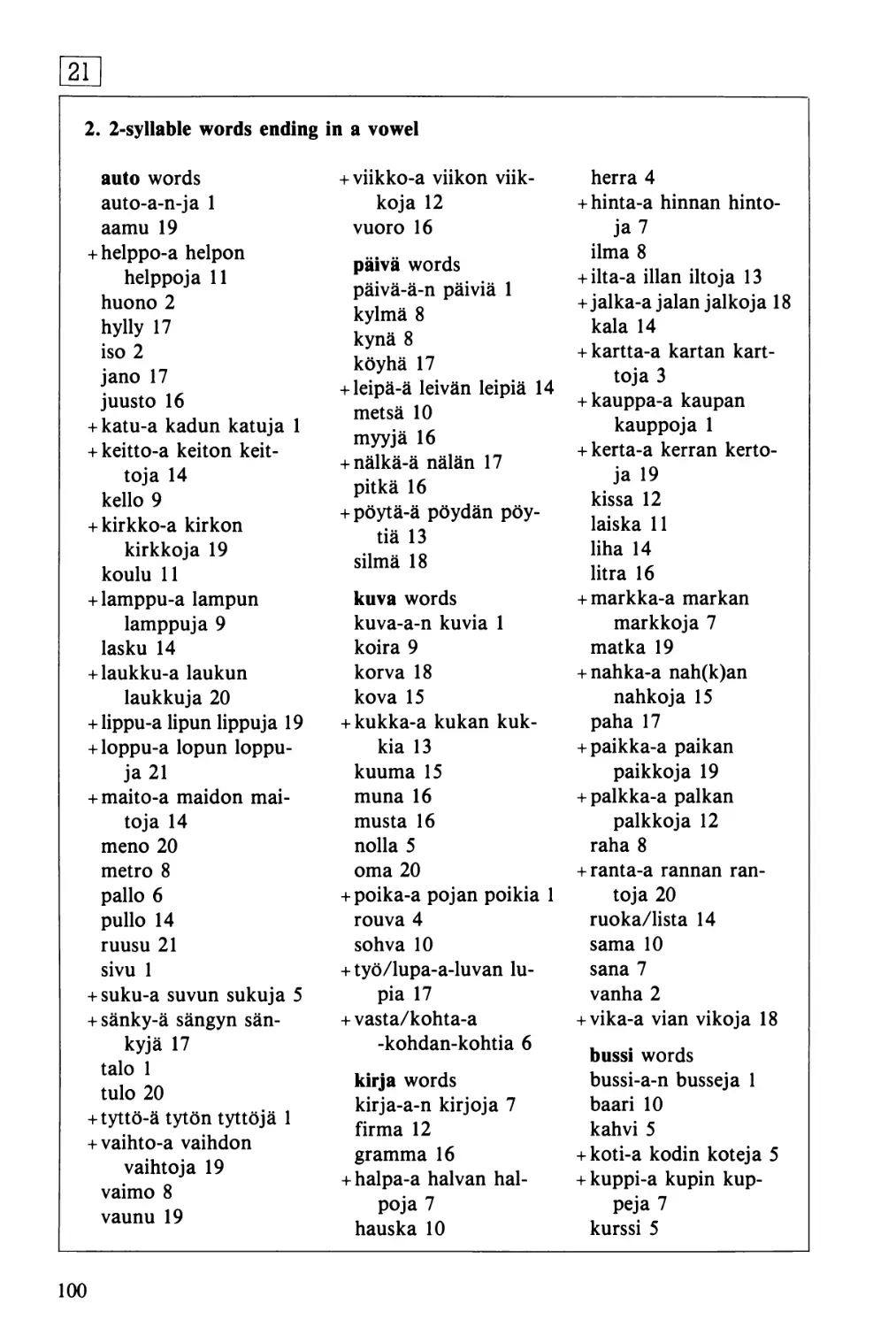
form the partitive plural (chart) • Nouns in lessons 1—21 by
inflection types
22. Mitä nämä ovat? — What are these? 104
• ’’What are these?” — ”What are they like?” • Principal parts
of nouns
23. Matti Suomelan päiväohjelma (I) — Matti Suomela’s daily
program (I) 108
• More expressions of time • ”to like” in Finnish • k p t changes
(’’consonant gradation”)
24. Matti Suomelan päiväohjelma (II) — Matti Suomela’s daily
program (II) 112
• syömään, syömässä • The six local cases (a review)
25. Muistatko sinä minut vielä? — Do you still remember me? 116
• Object forms of personal pronouns and kuka • Words ending
in -nen (nainen words)
26. Liisa Salo lähtee matkalle — Liisa Salo takes a trip 120
• The direct object of nouns • ”Aion olla Suomessa vuoden”
27. Viime viikonloppu — Last weekend 125
• About the Finnish verb types: from basic form to present
• Past tense of verbs (affirmative) • Turussa, Tampereella
• Vowel changes caused by the past tense marker (chart)
• A list of the verbs in lessons 1—26 by verb types
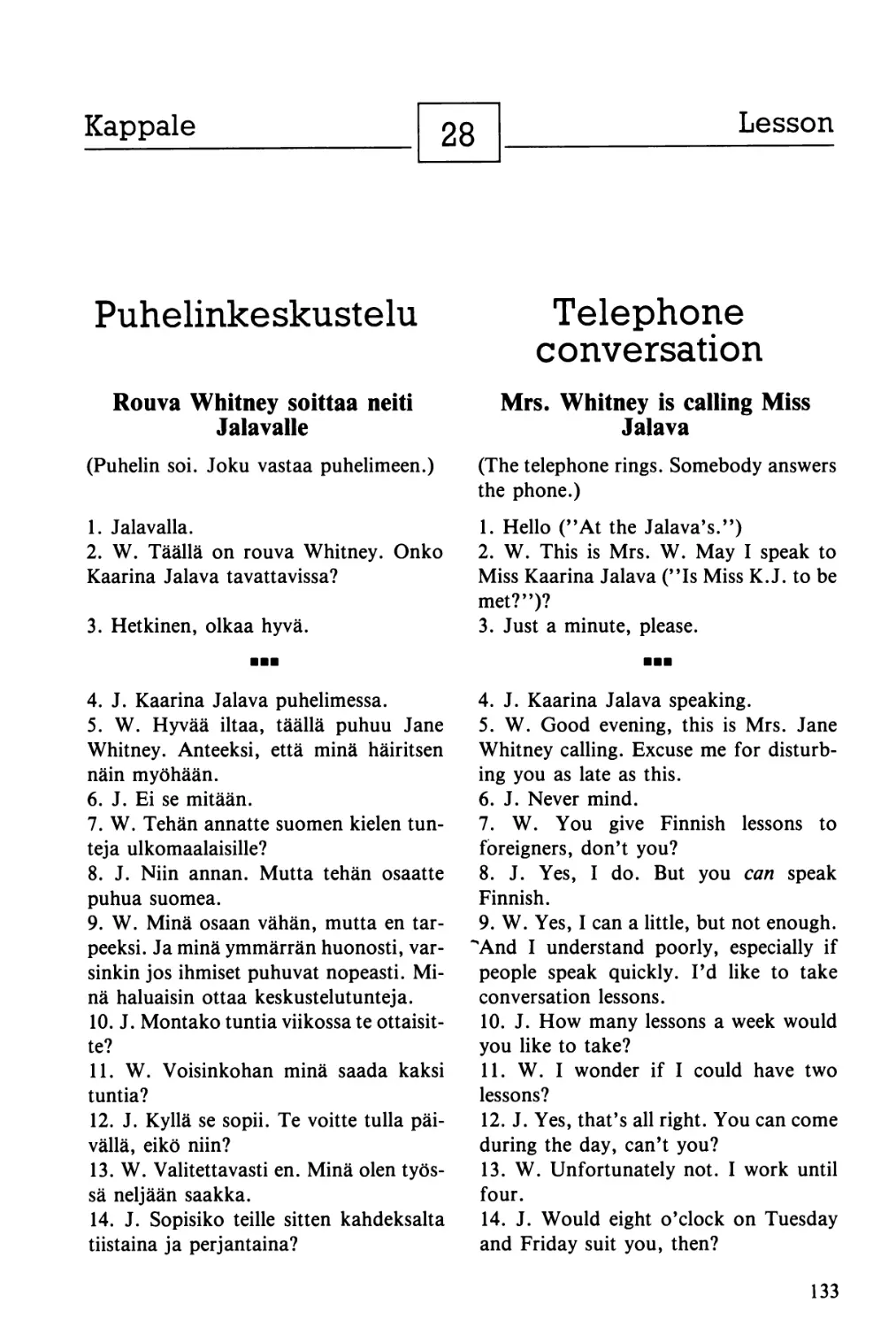
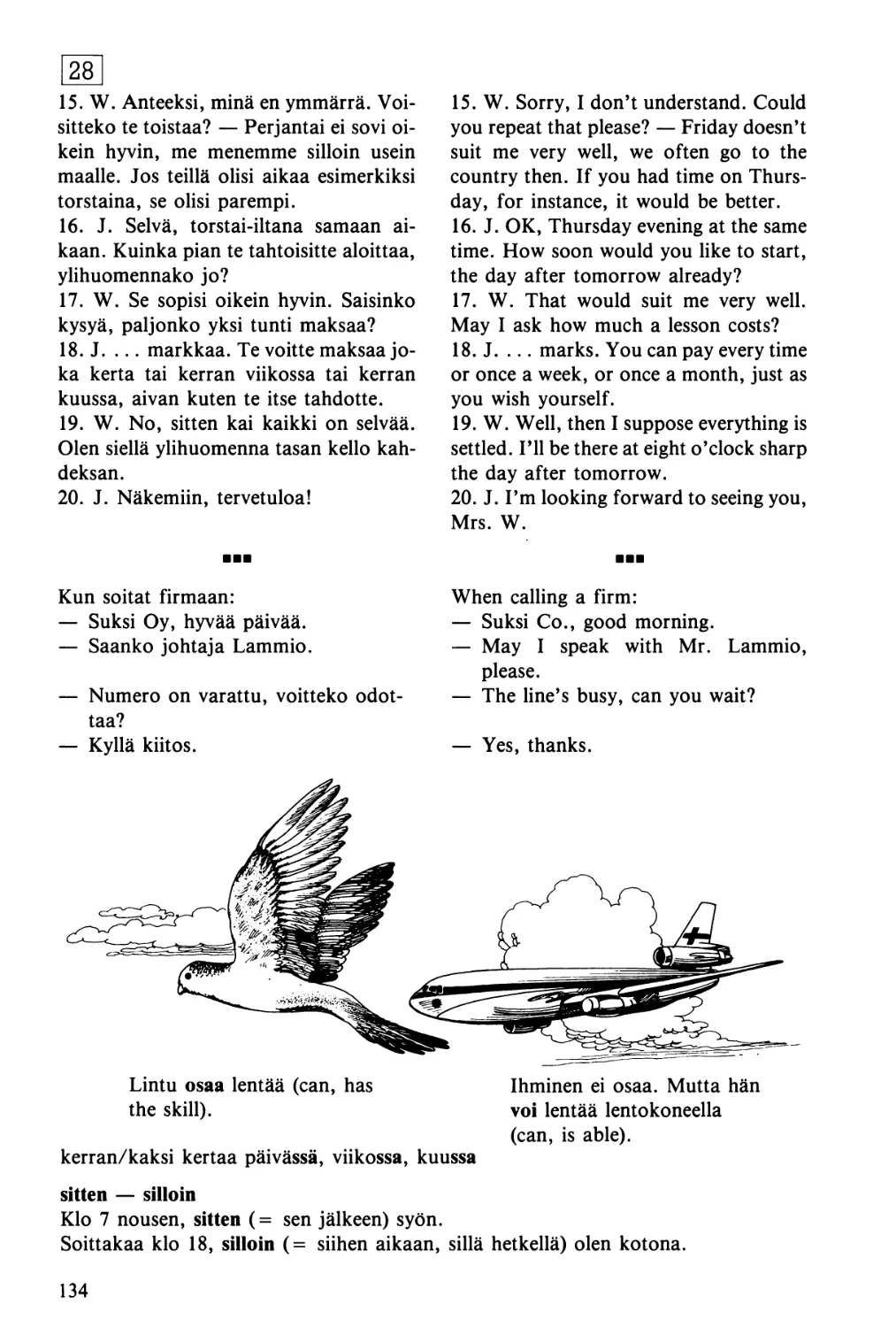
28. Puhelinkeskustelu — Telephone conversation 133
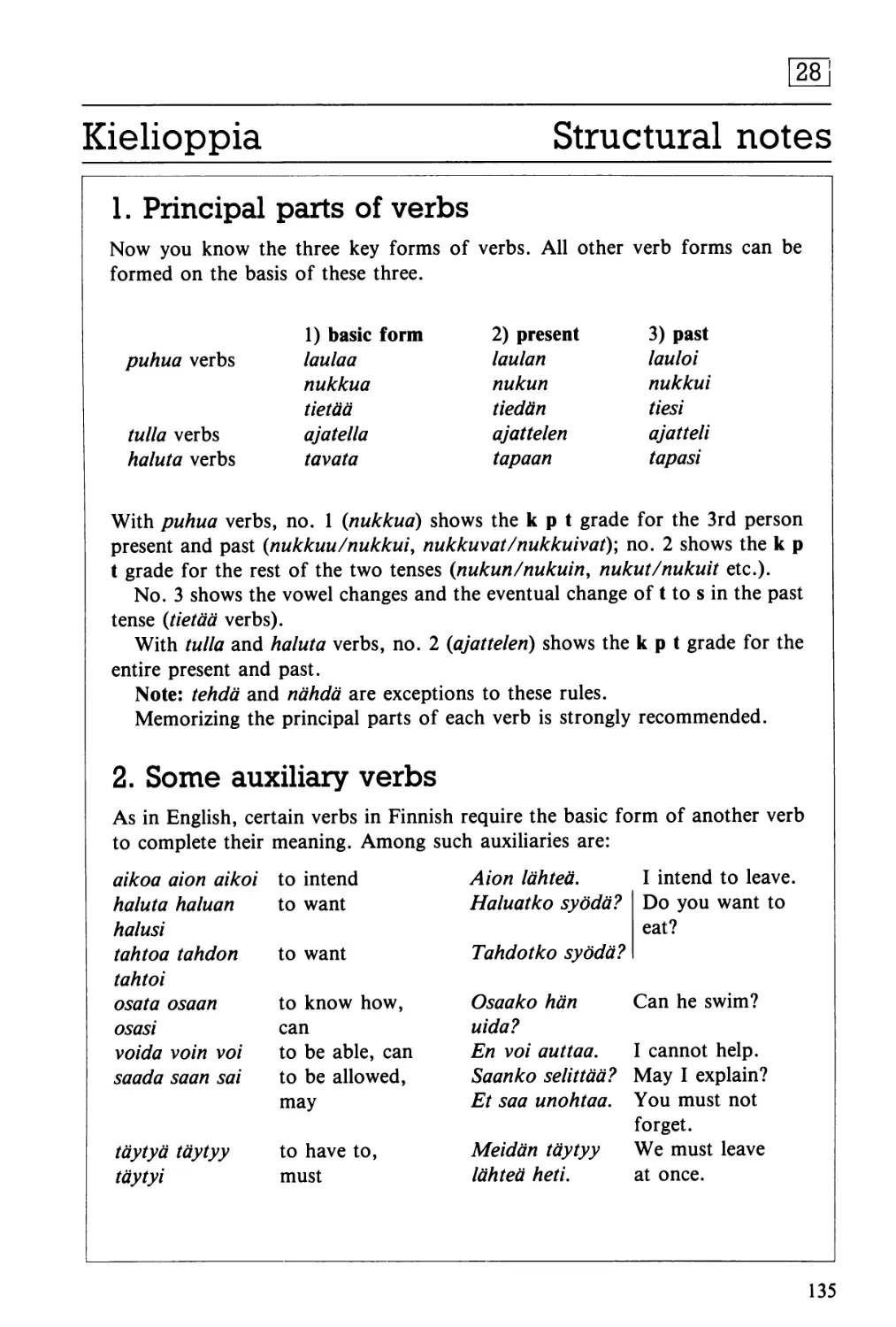
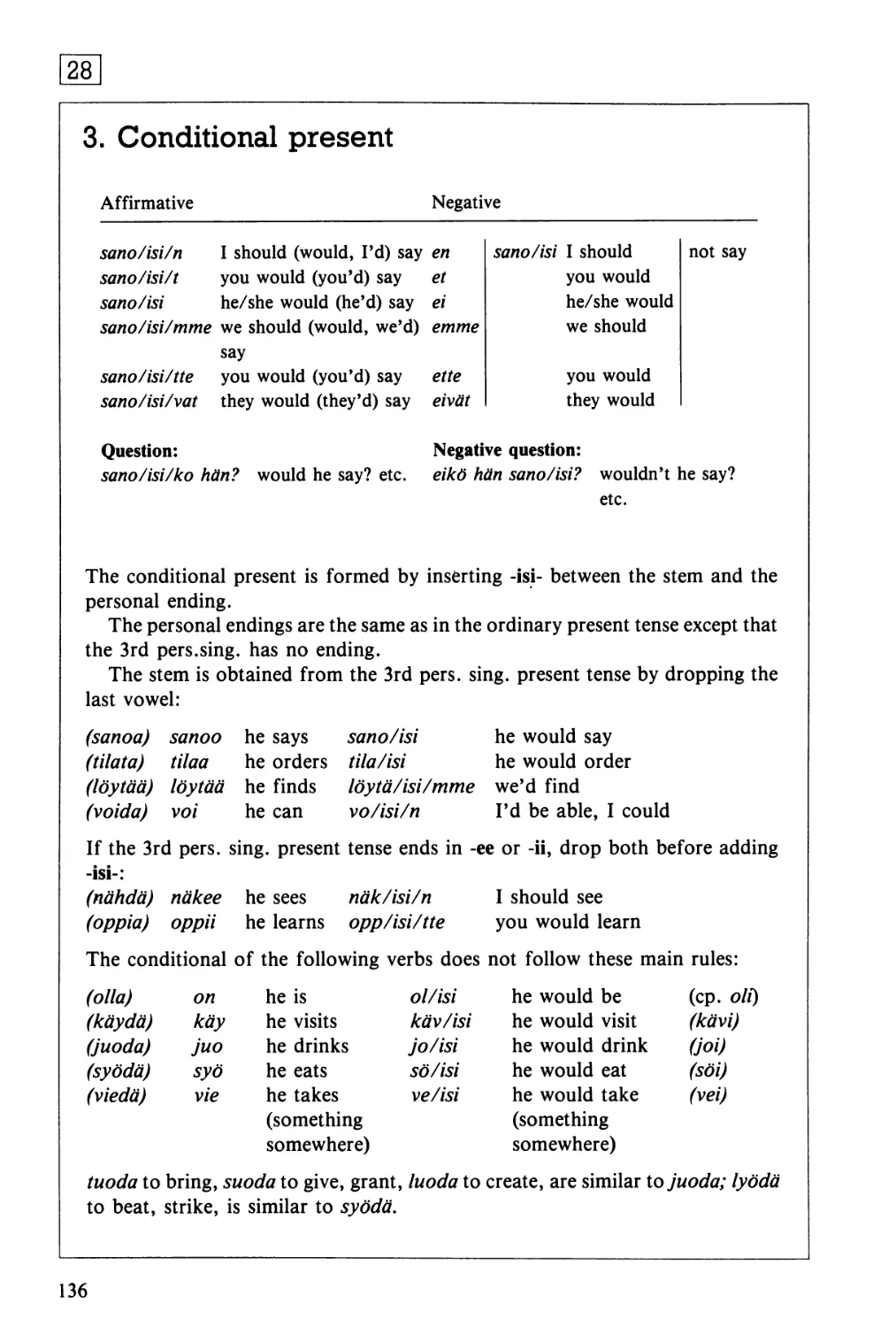
• Principal parts of verbs • Some auxiliary verbs • Conditional
present
8 (kahdeksan)

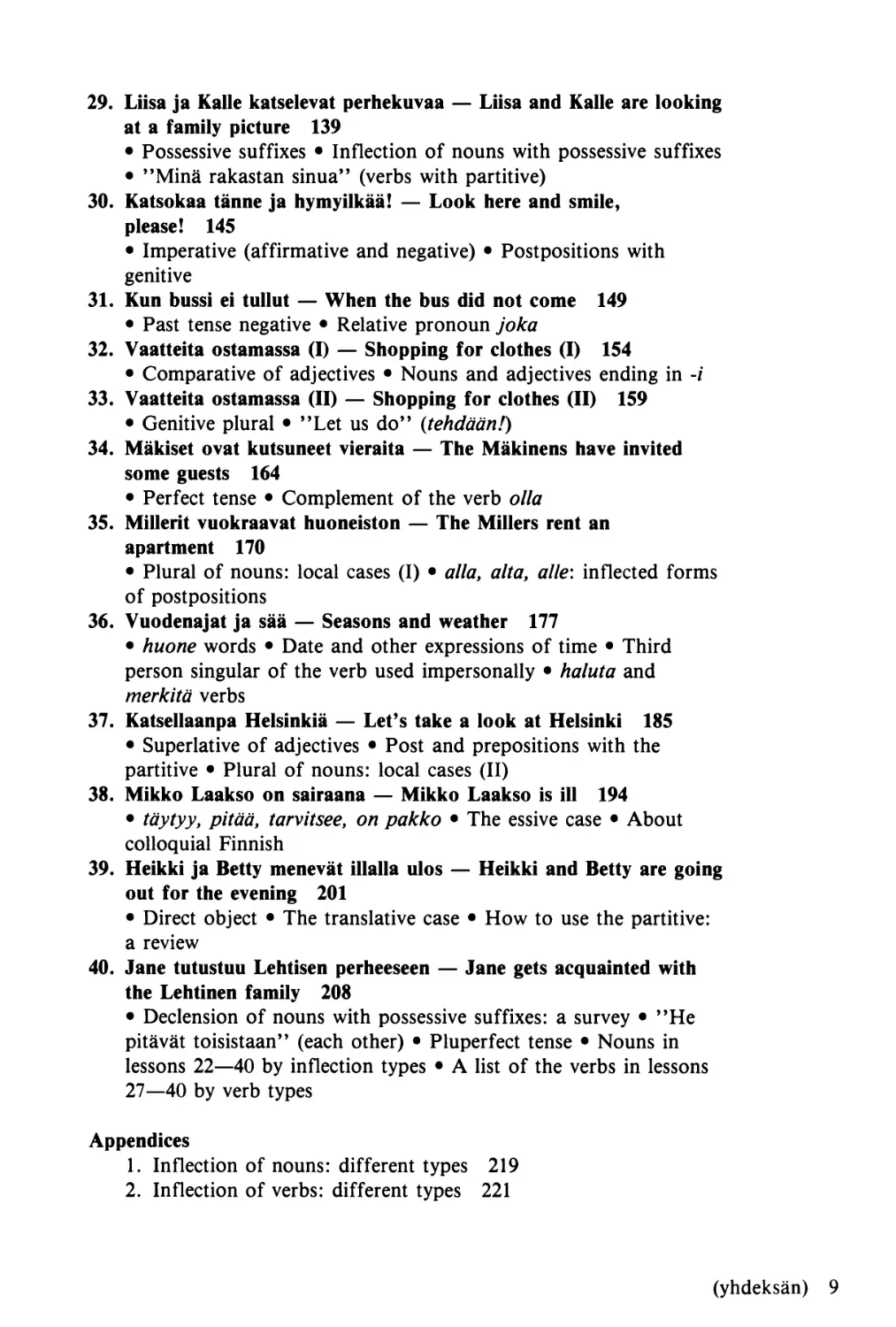
29. Liisa ja Kalle katselevat perhekuvaa — Liisa and Kalle are looking
at a family picture 139
• Possessive suffixes • Inflection of nouns with possessive suffixes
• ”Minä rakastan sinua” (verbs with partitive)
30. Katsokaa tänne ja hymyilkää! — Look here and smile,
please! 145
• Imperative (affirmative and negative) • Postpositions with
genitive
31. Kun bussi ei tullut — When the bus did not come 149
• Past tense negative • Relative pronoun joka
32. Vaatteita ostamassa (I) — Shopping for clothes (I) 154
• Comparative of adjectives • Nouns and adjectives ending in -/
33. Vaatteita ostamassa (II) — Shopping for clothes (II) 159
• Genitive plural • ”Let us do” (tehdään!)
34. Mäkiset ovat kutsuneet vieraita — The Mäkinens have invited
some guests 164
• Perfect tense • Complement of the verb olla
35. Millerit vuokraavat huoneiston — The Millers rent an
apartment 170
• Plural of nouns: local cases (I) • alla, alta, alle: inflected forms
of postpositions
36. Vuodenajat ja sää — Seasons and weather 177
• huone words • Date and other expressions of time • Third
person singular of the verb used impersonally • haluta and
merkitä verbs
37. Katsellaanpa Helsinkiä — Let’s take a look at Helsinki 185
• Superlative of adjectives • Post and prepositions with the
partitive • Plural of nouns: local cases (II)
38. Mikko Laakso on sairaana — Mikko Laakso is ill 194
• täytyy, pitää, tarvitsee, on pakko • The essive case • About
colloquial Finnish
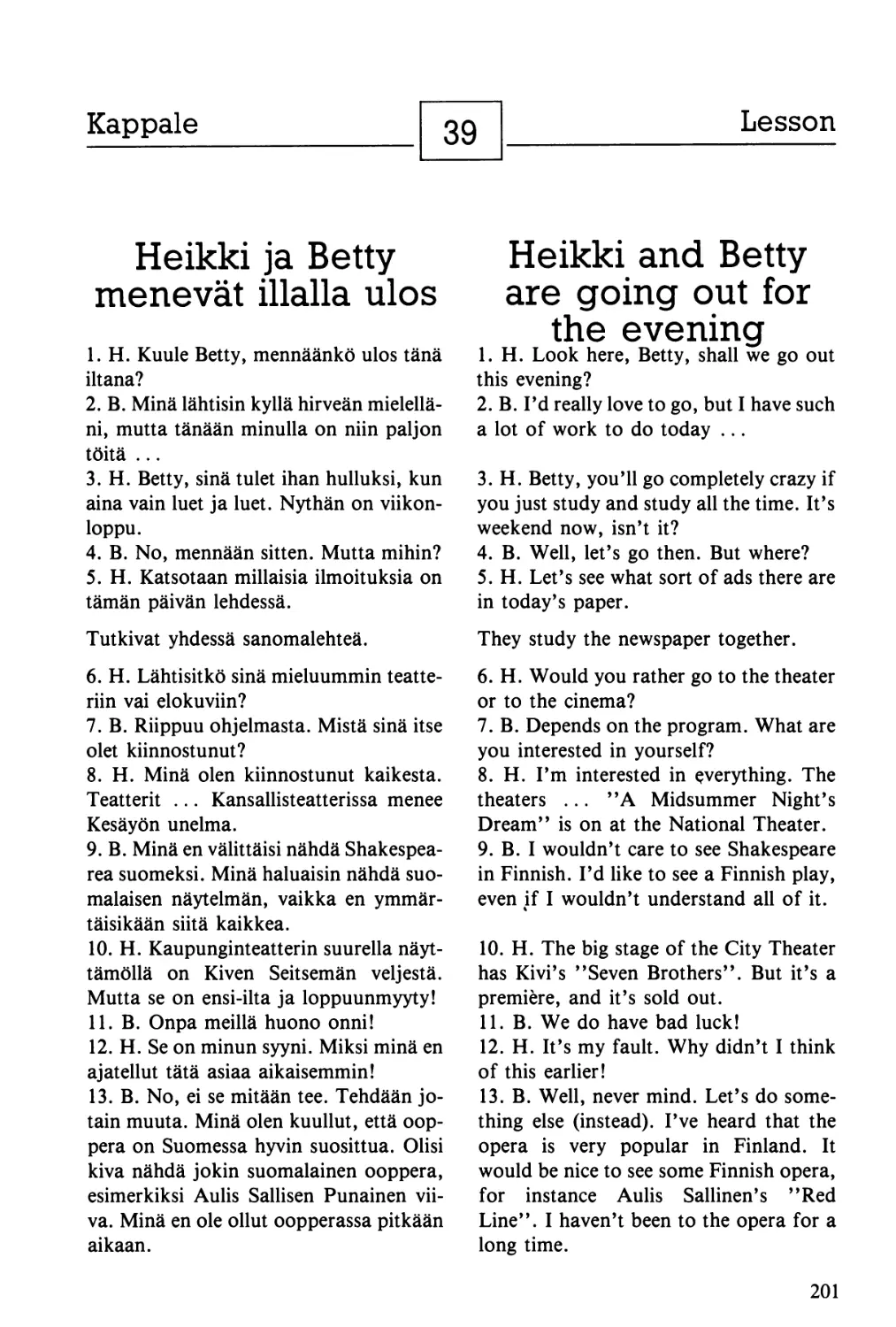
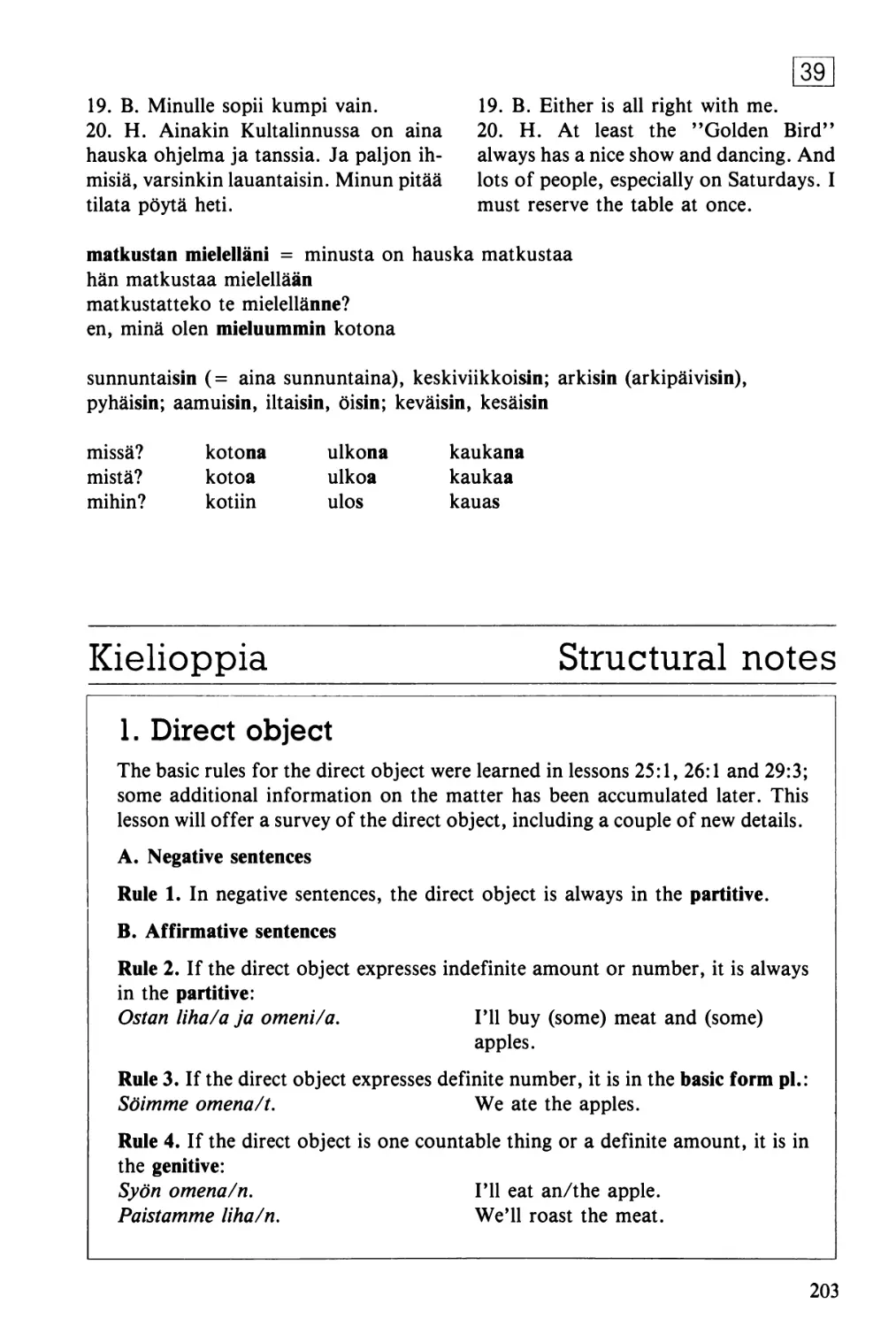
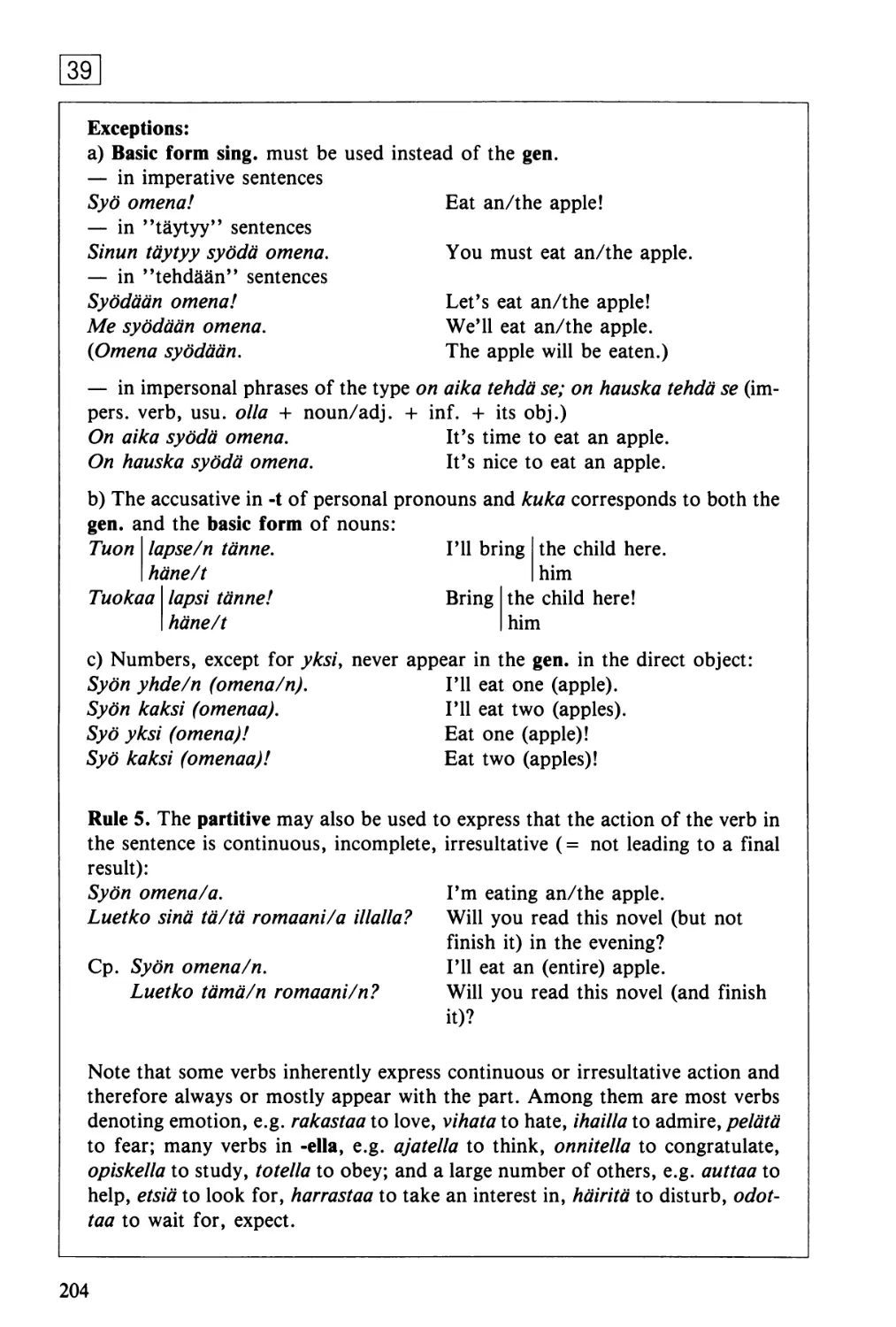
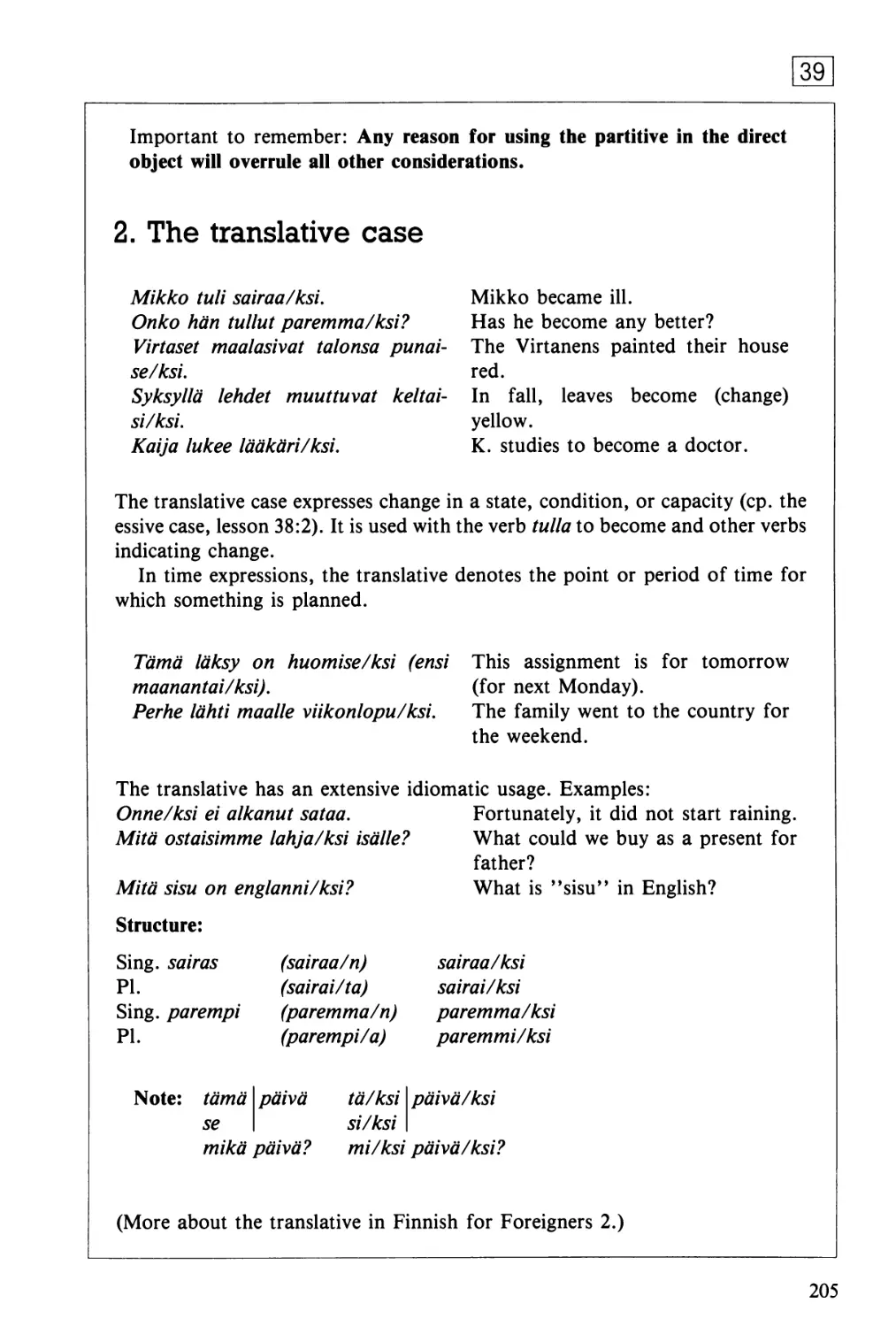
39. Heikki ja Betty menevät illalla ulos — Heikki and Betty are going
out for the evening 201
• Direct object • The translative case • How to use the partitive:
a review
40. Jane tutustuu Lehtisen perheeseen — Jane gets acquainted with
the Lehtinen family 208
• Declension of nouns with possessive suffixes: a survey • ”He
pitävät toisistaan” (each other) • Pluperfect tense • Nouns in
lessons 22—40 by inflection types • A list of the verbs in lessons
27—40 by verb types
Appendices
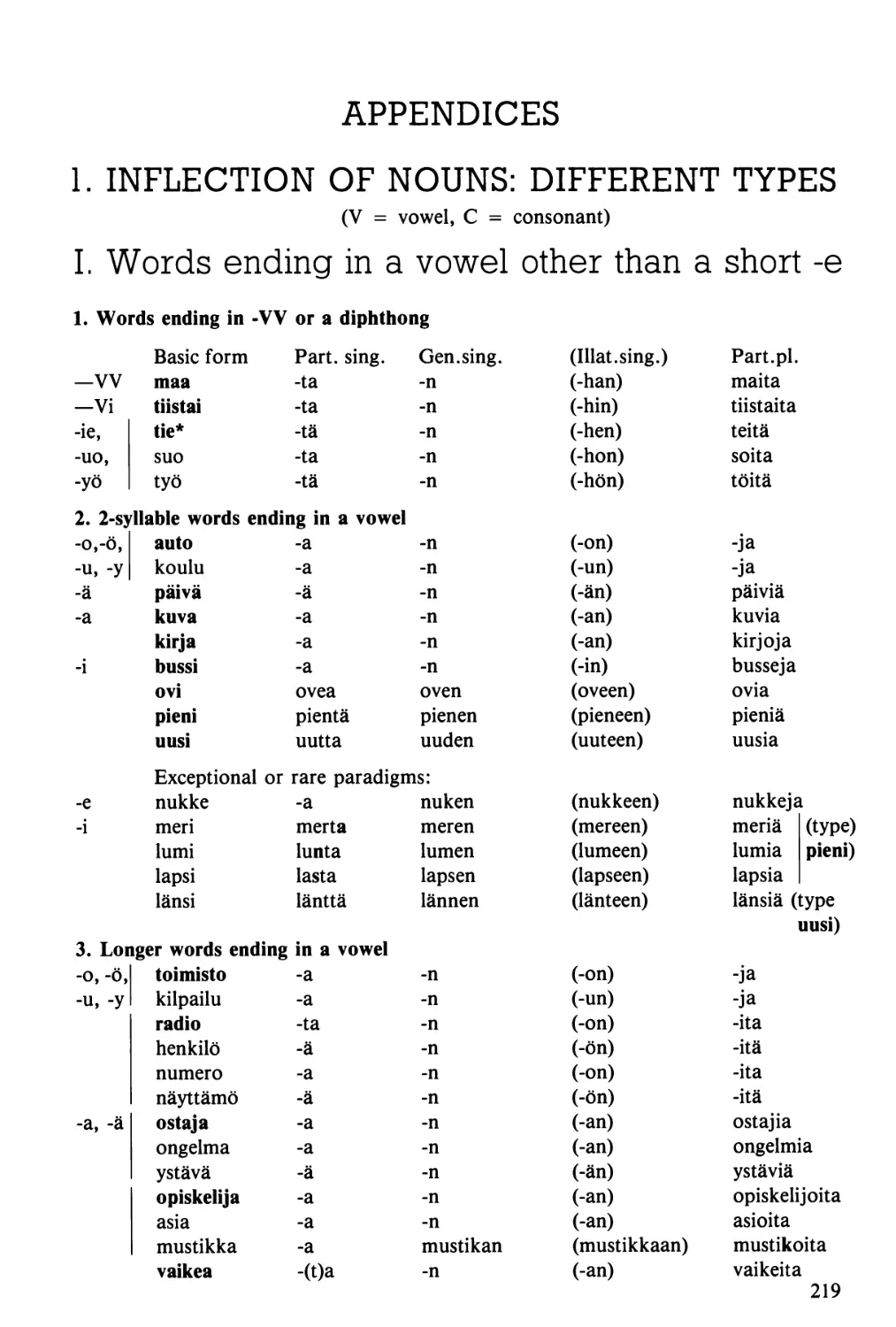
1. Inflection of nouns: different types 219
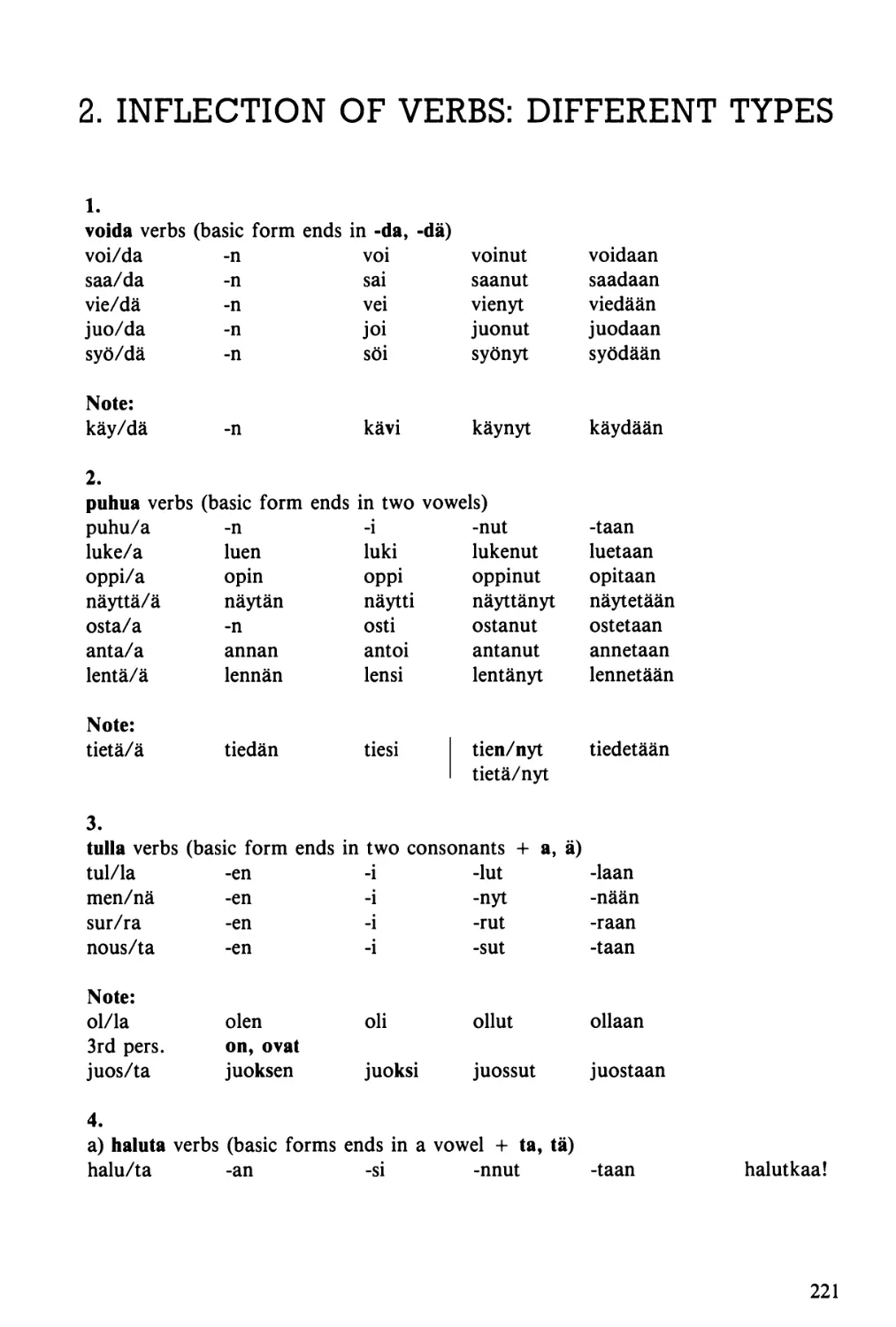
2. Inflection of verbs: different types 221
(yhdeksän)

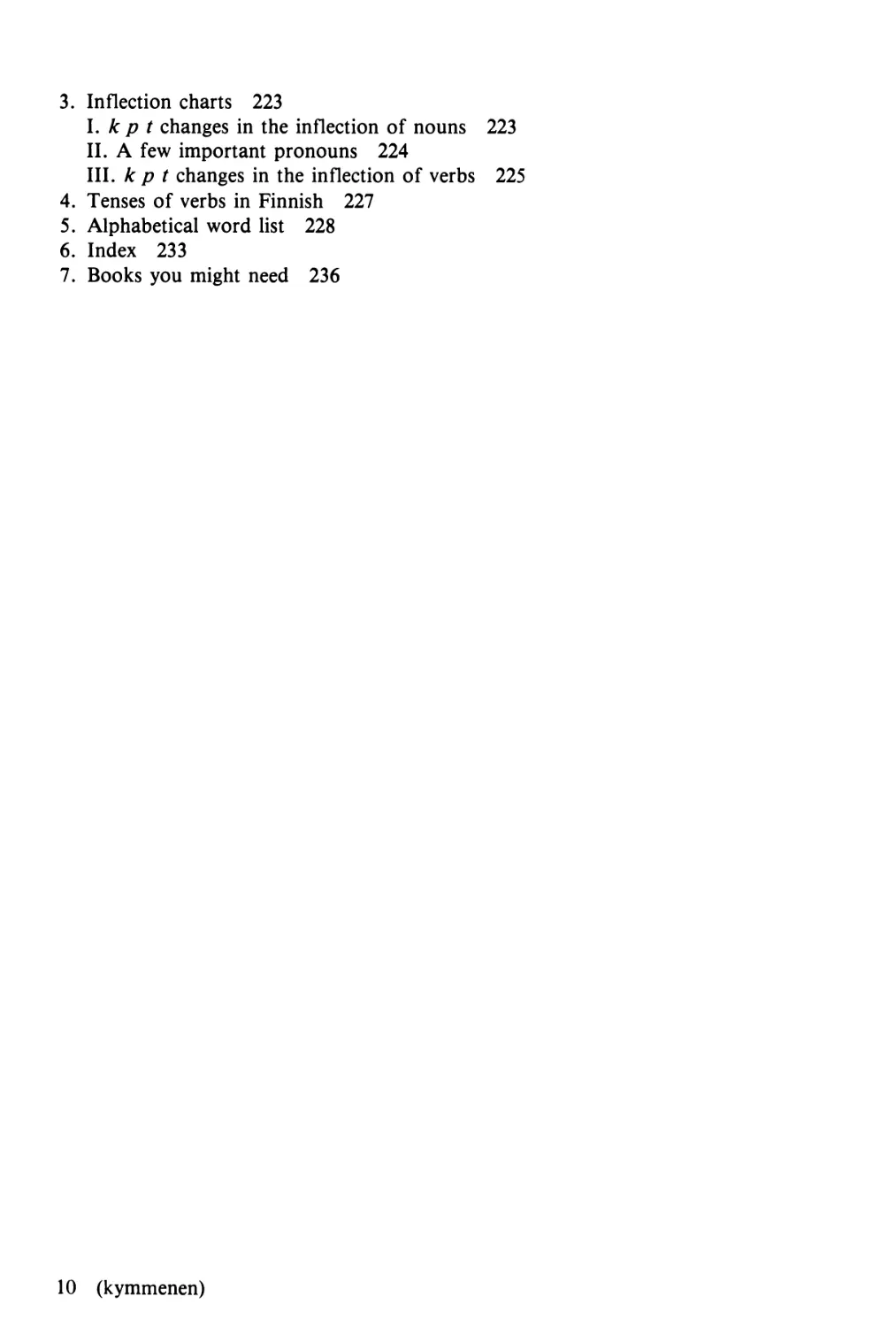
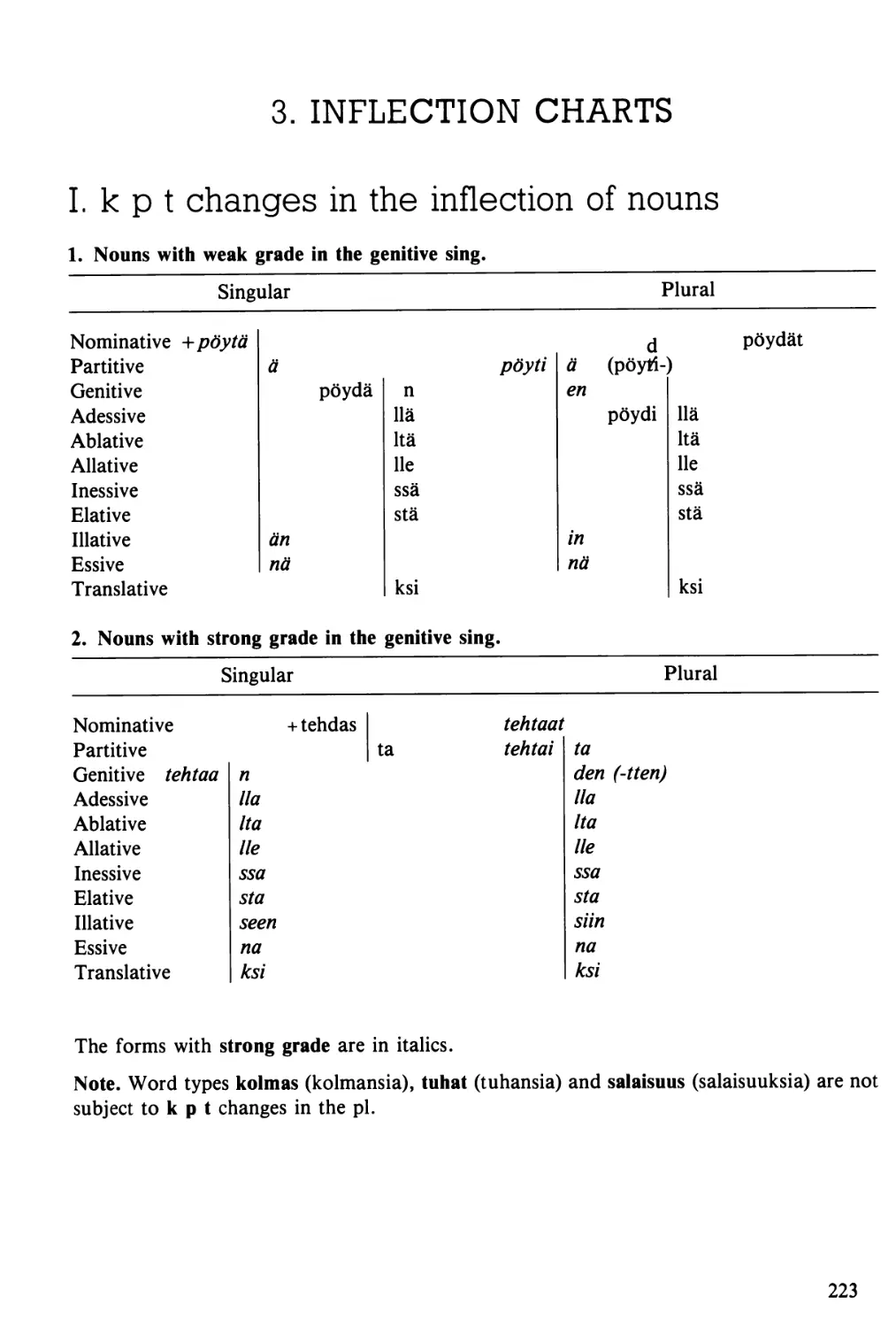
3. Inflection charts 223
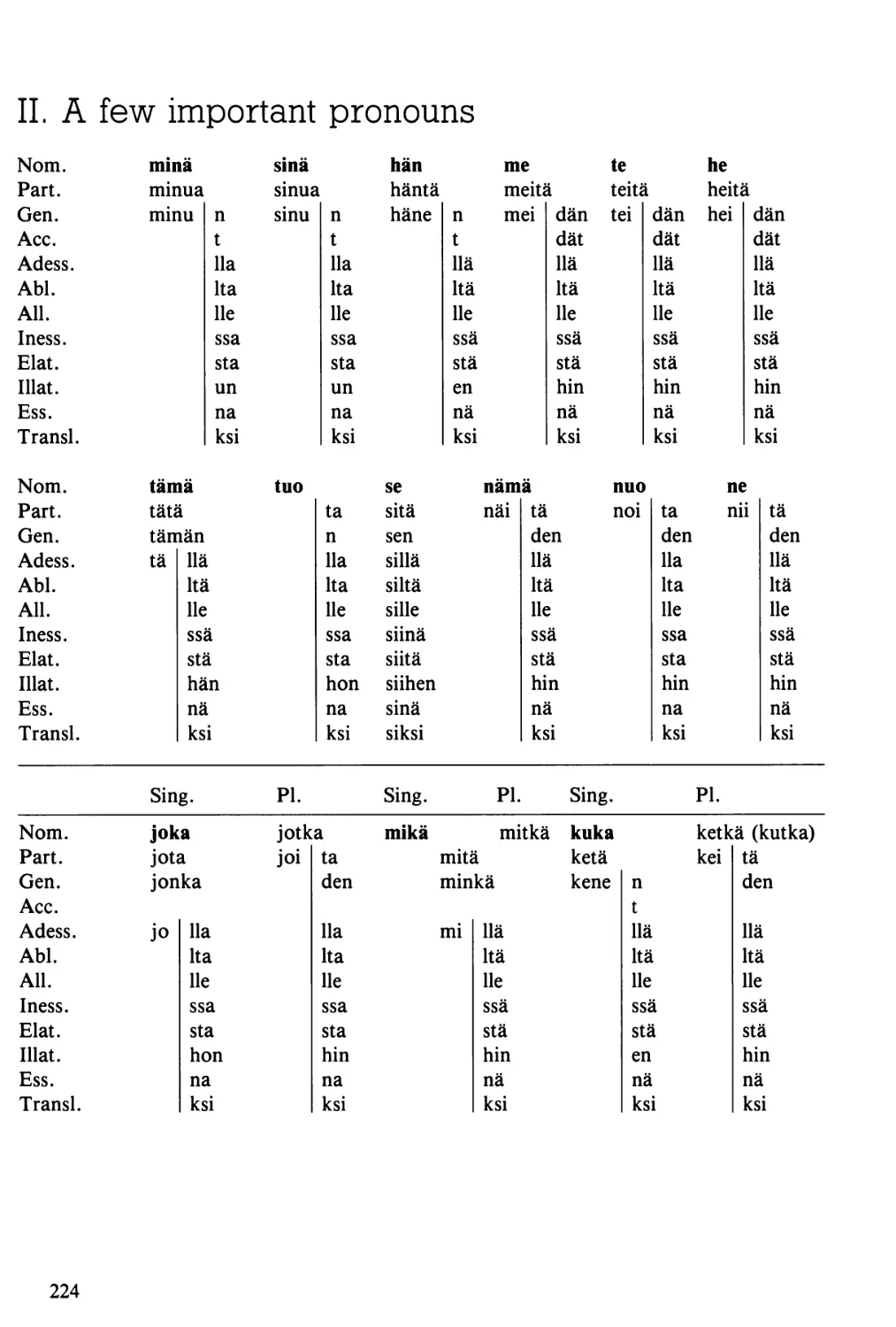
I. k p t changes in the inflection of nouns
II. A few important pronouns 224
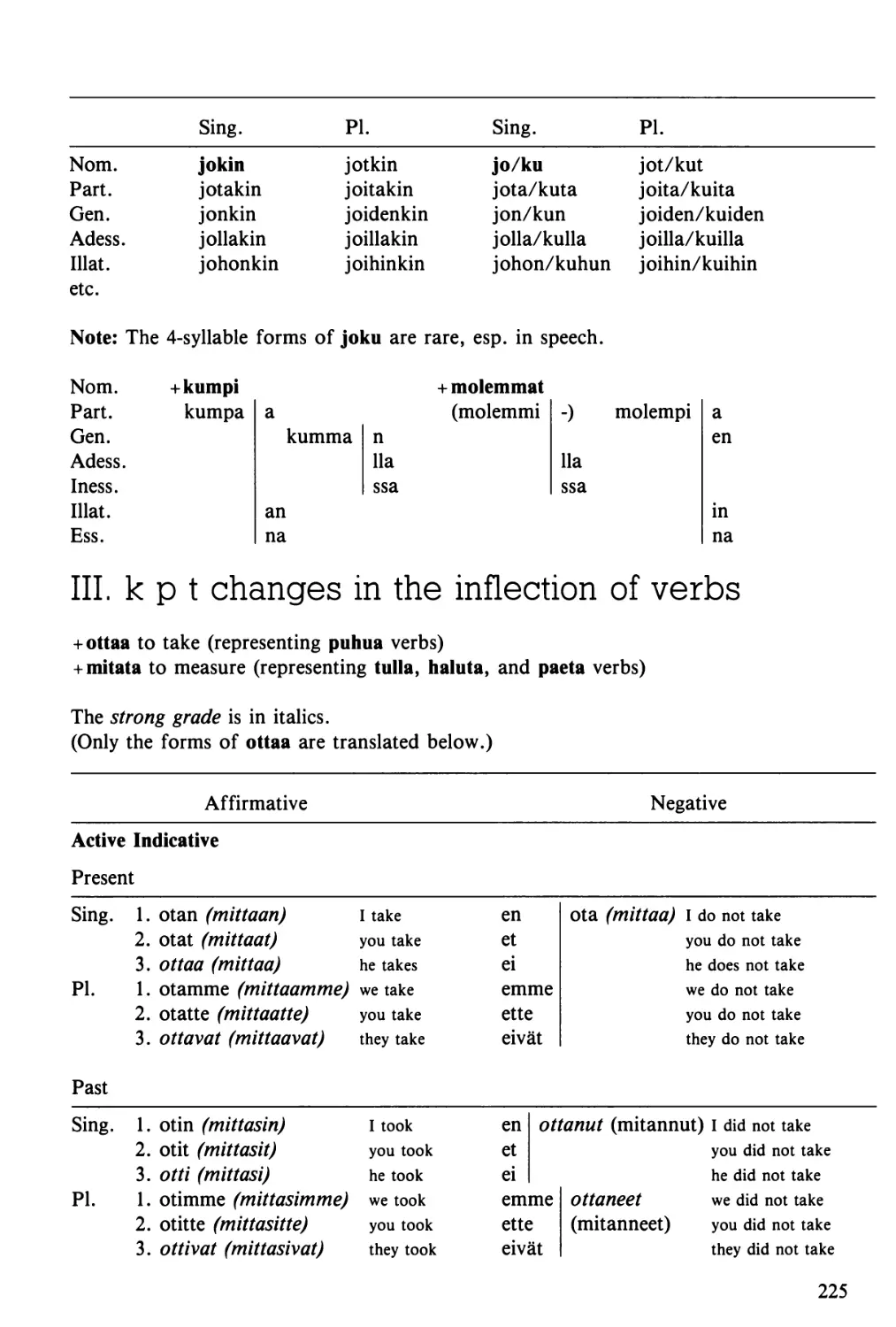
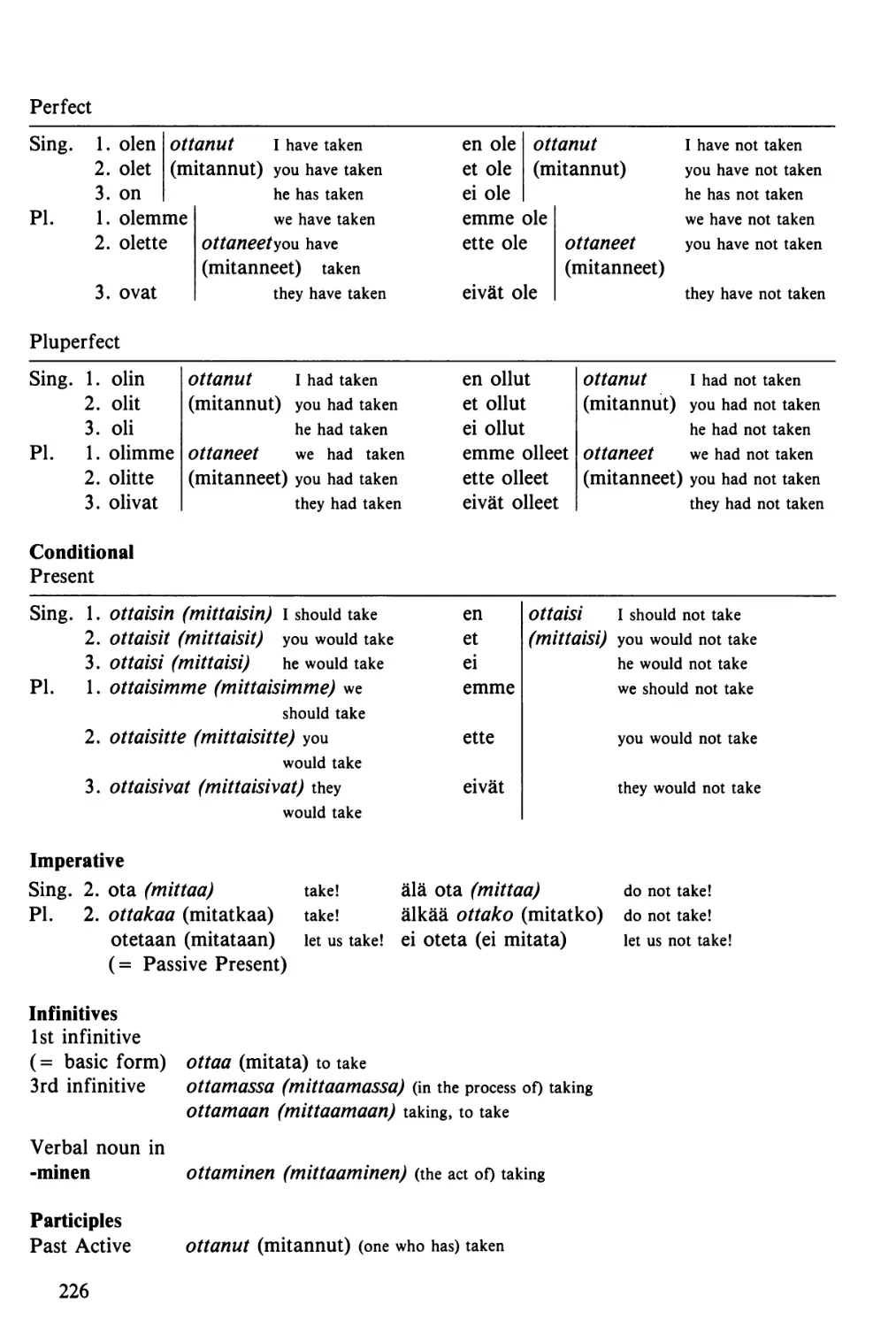
III. k p t changes in the inflection of verbs
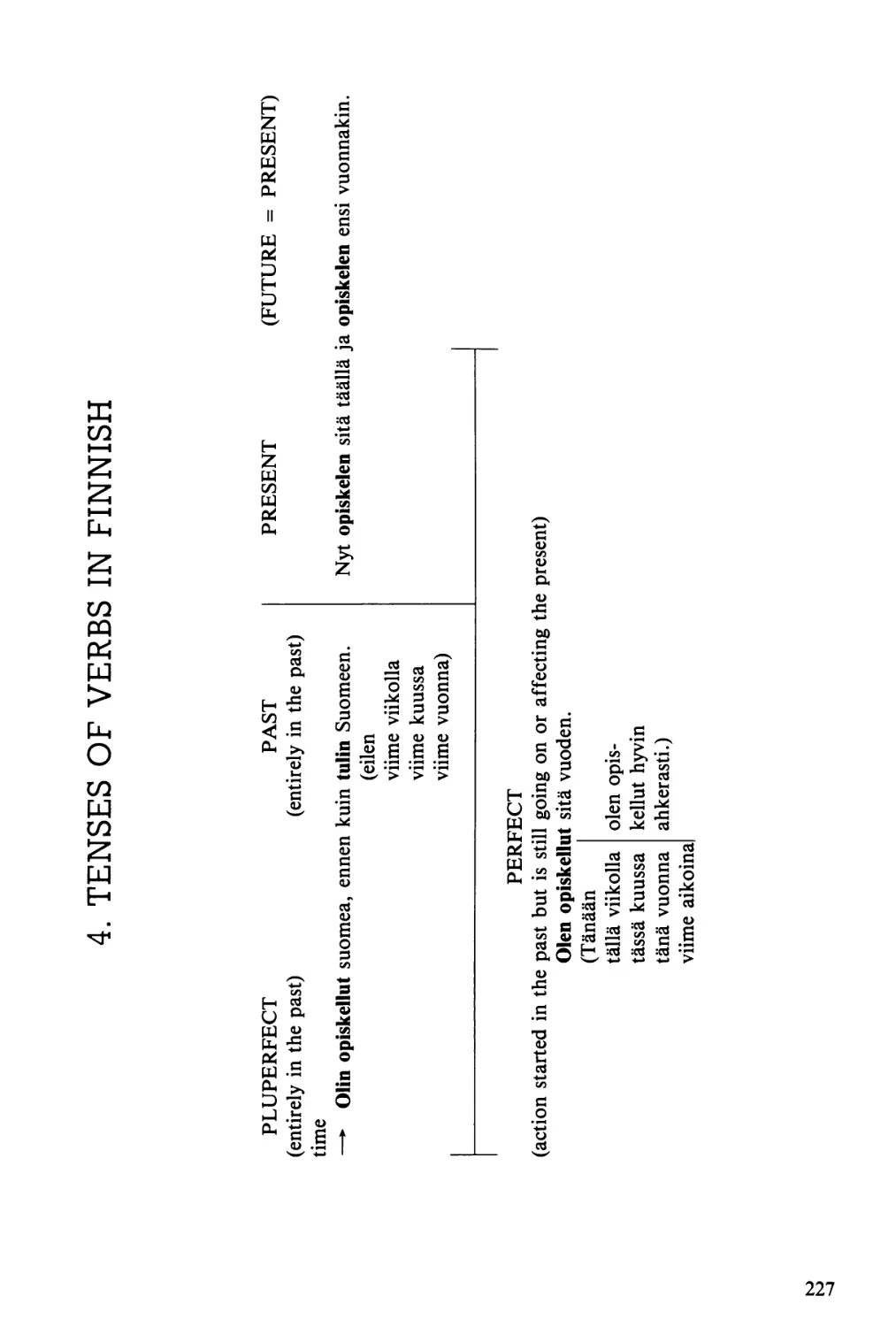
4. Tenses of verbs in Finnish 227
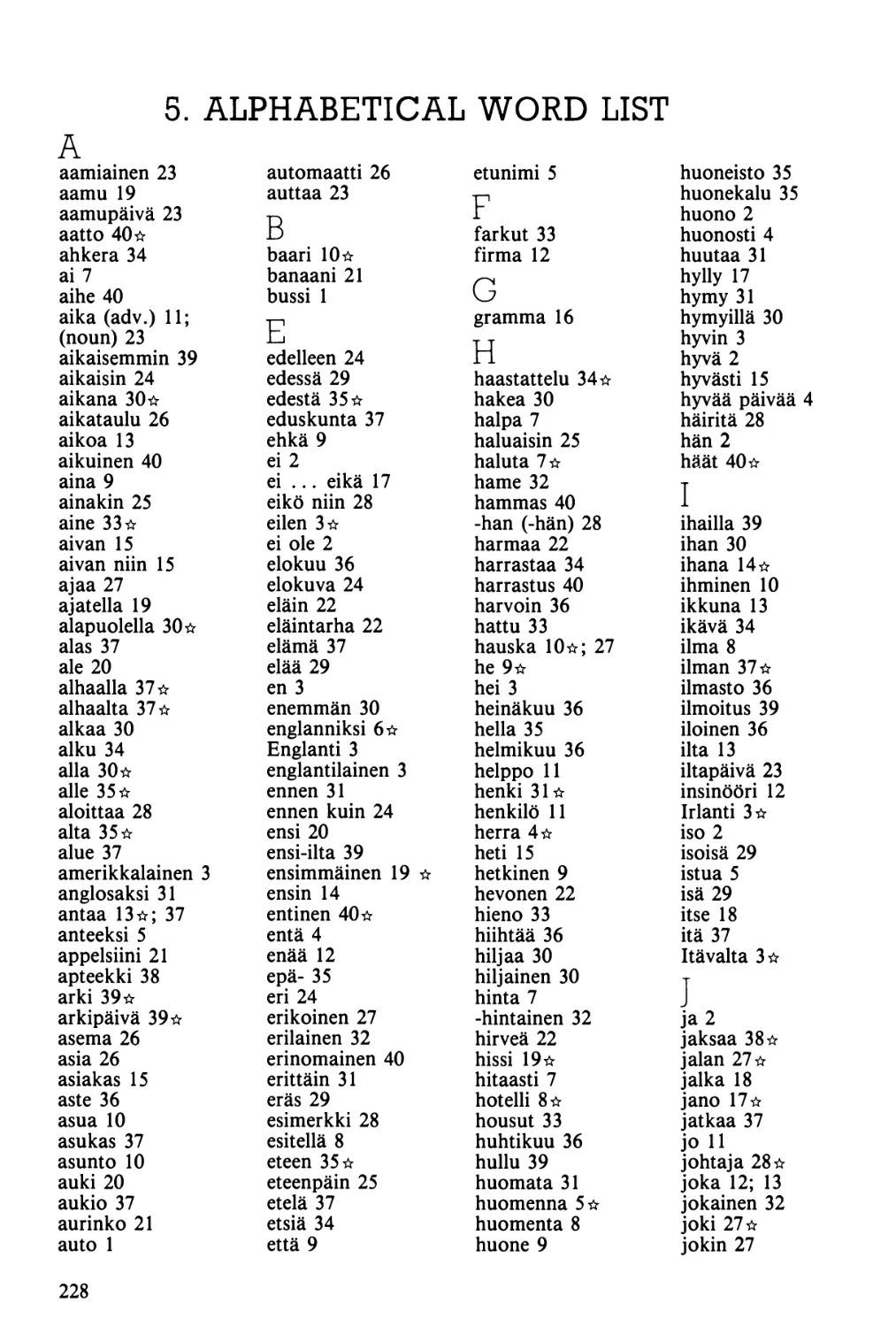
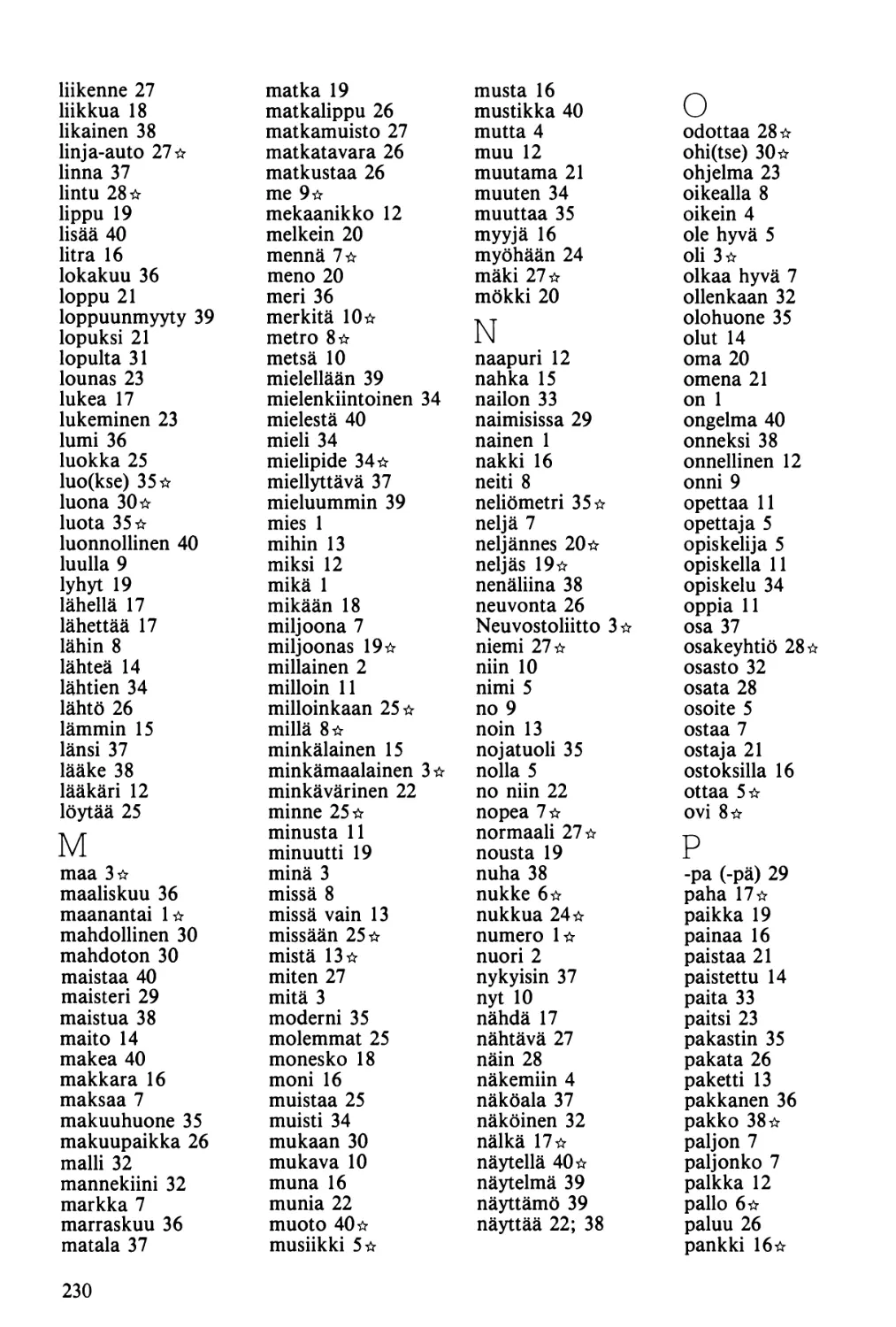
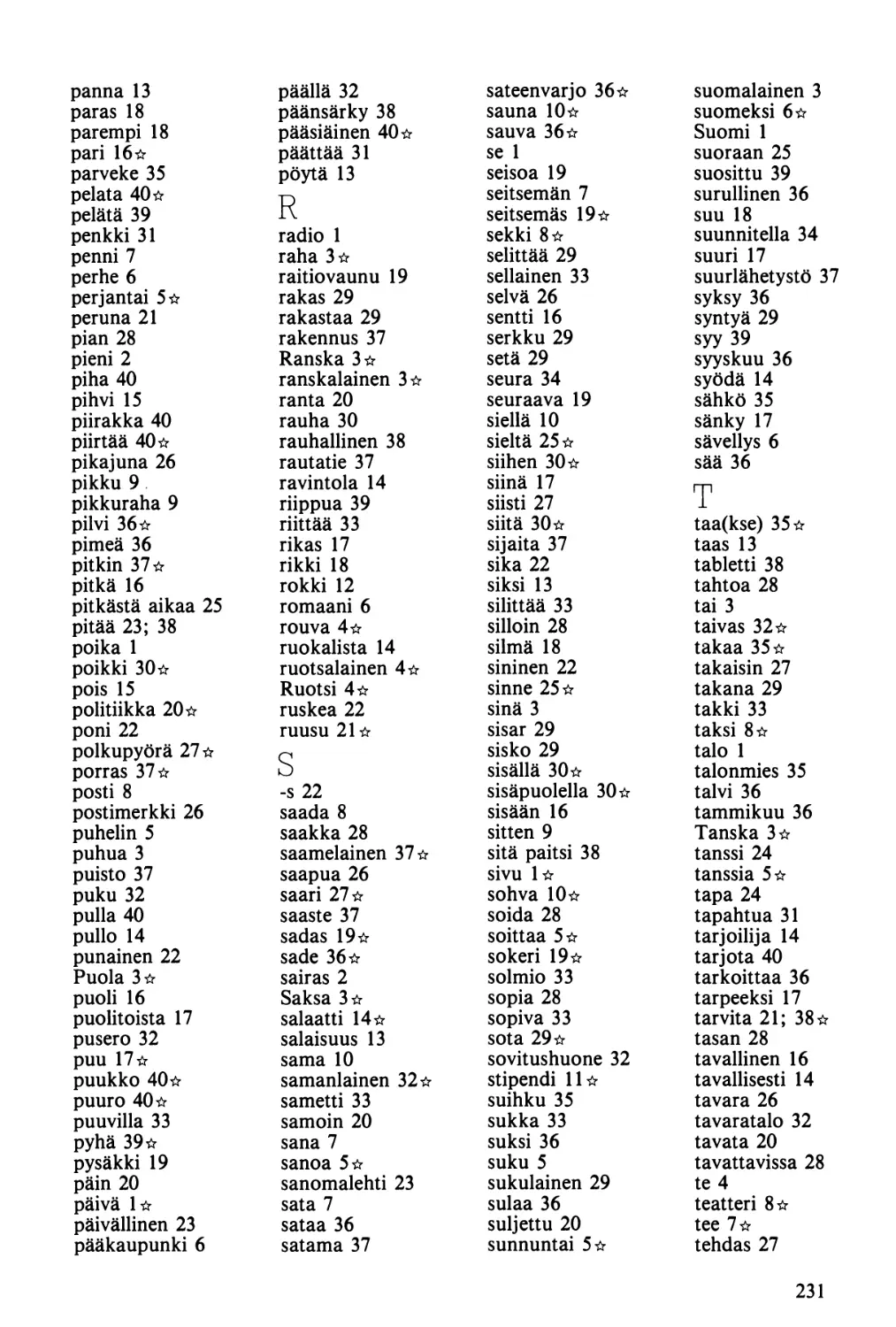
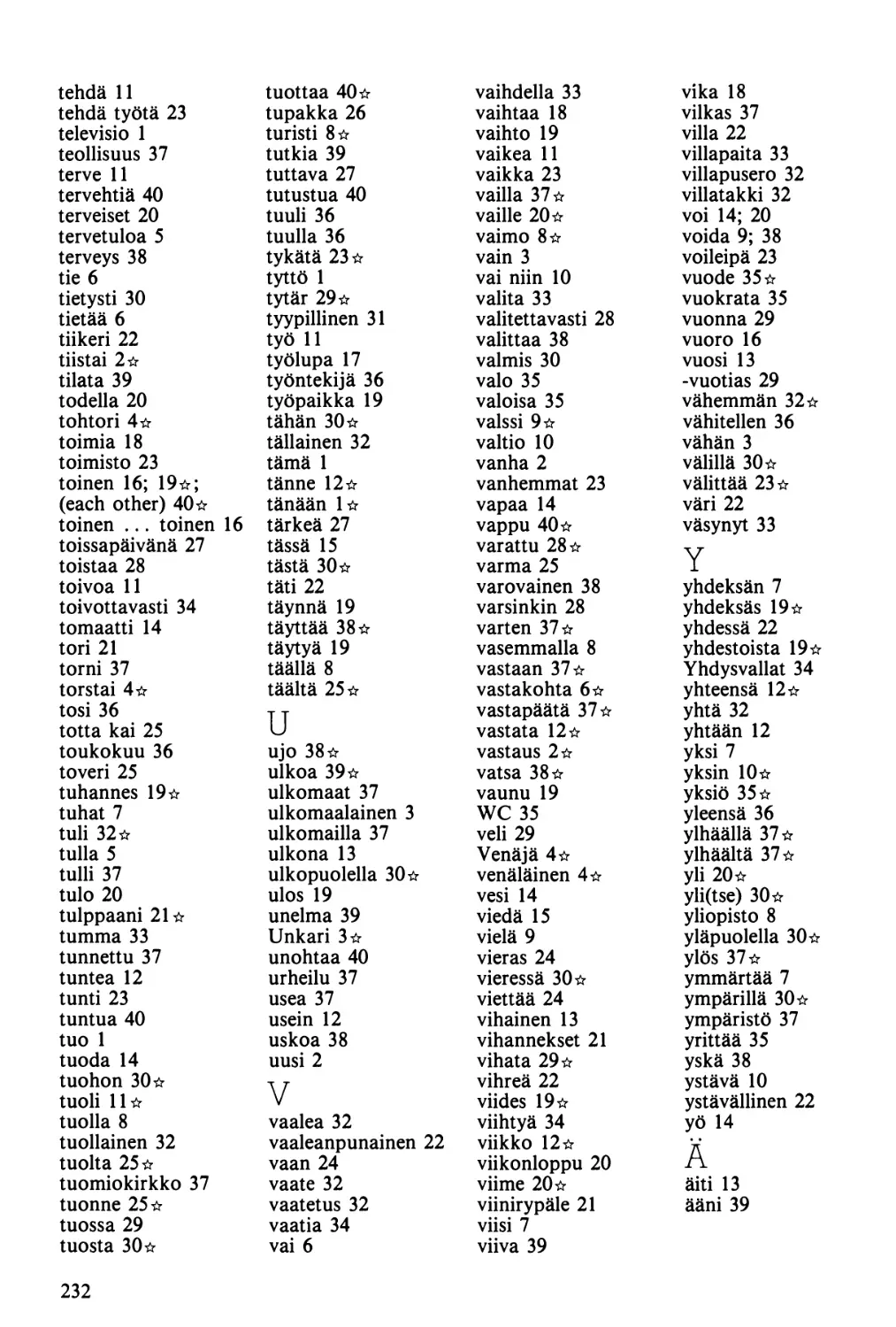
5. Alphabetical word list 228
6. Index 233
7. Books you might need 236
10 (kymmenen)

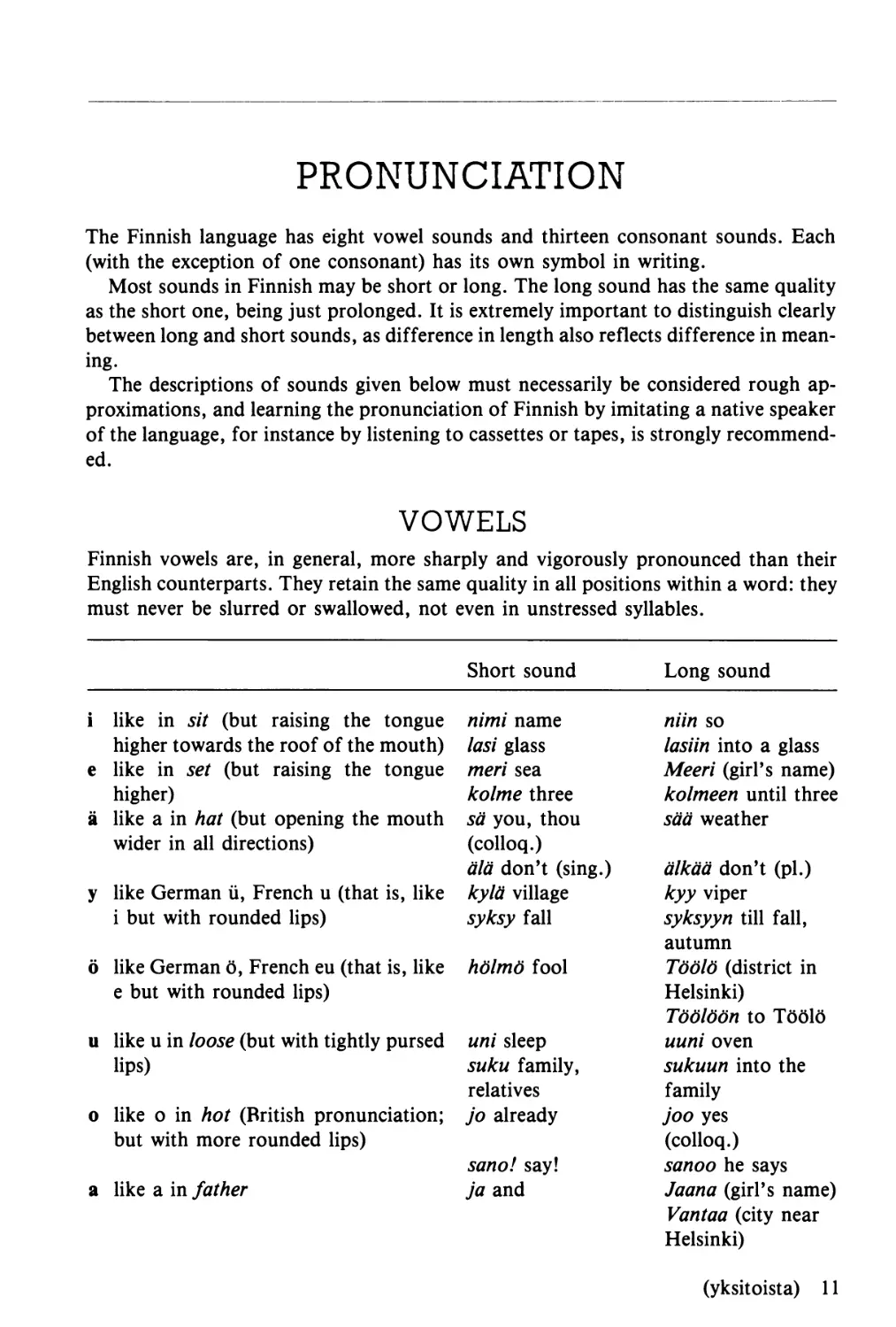
PRONUNCIATION
The Finnish language has eight vowel sounds and thirteen consonant sounds. Each
(with the exception of one consonant) has its own symbol in writing.
Most sounds in Finnish may be short or long. The long sound has the same quality
as the short one, being just prolonged. It is extremely important to distinguish clearly
between long and short sounds, as difference in length also reflects difference in
meaning.
The descriptions of sounds given below must necessarily be considered rough
approximations, and learning the pronunciation of Finnish by imitating a native speaker
of the language, for instance by listening to cassettes or tapes, is strongly
recommended.
VOWELS
Finnish vowels are, in general, more sharply and vigorously pronounced than their
English counterparts. They retain the same quality in all positions within a word: they
must never be slurred or swallowed, not even in unstressed syllables.
Short sound
Long sound
i
like in sit (but raising the tongue
nimi name
niin so
higher towards the roof of the mouth)
Iasi glass
lasiin into a glass
e
like in set (but raising the tongue
meri sea
Meeri (girl’s name)
higher)
kolme three
kolmeen until three
ä
like a in hat (but opening the mouth
sä you, thou
sää weather
wider in all directions)
(colloq.)
älä don’t (sing.)
älkää don’t (pi.)
y
like German ii, French u (that is, like
kylä village
kyy viper
i but with rounded lips)
syksy fall
syksyyn till fall,
autumn
Ö
like German ö, French eu (that is, like
hölmö fool
Töölö (district in
e but with rounded lips)
Helsinki)
Töölöön to Töölö
u
like u in loose (but with tightly pursed
uni sleep
uuni oven
lips)
suku family,
sukuun into the
relatives
family
0
like o in hot (British pronunciation;
jo already
joo yes
but with more rounded lips)
(colloq.)
sano! say!
sanoo he says
a
like a in father
ja and
Jaana (girl’s name)
Vantaa (city near
Helsinki)
(yksitoista) 11

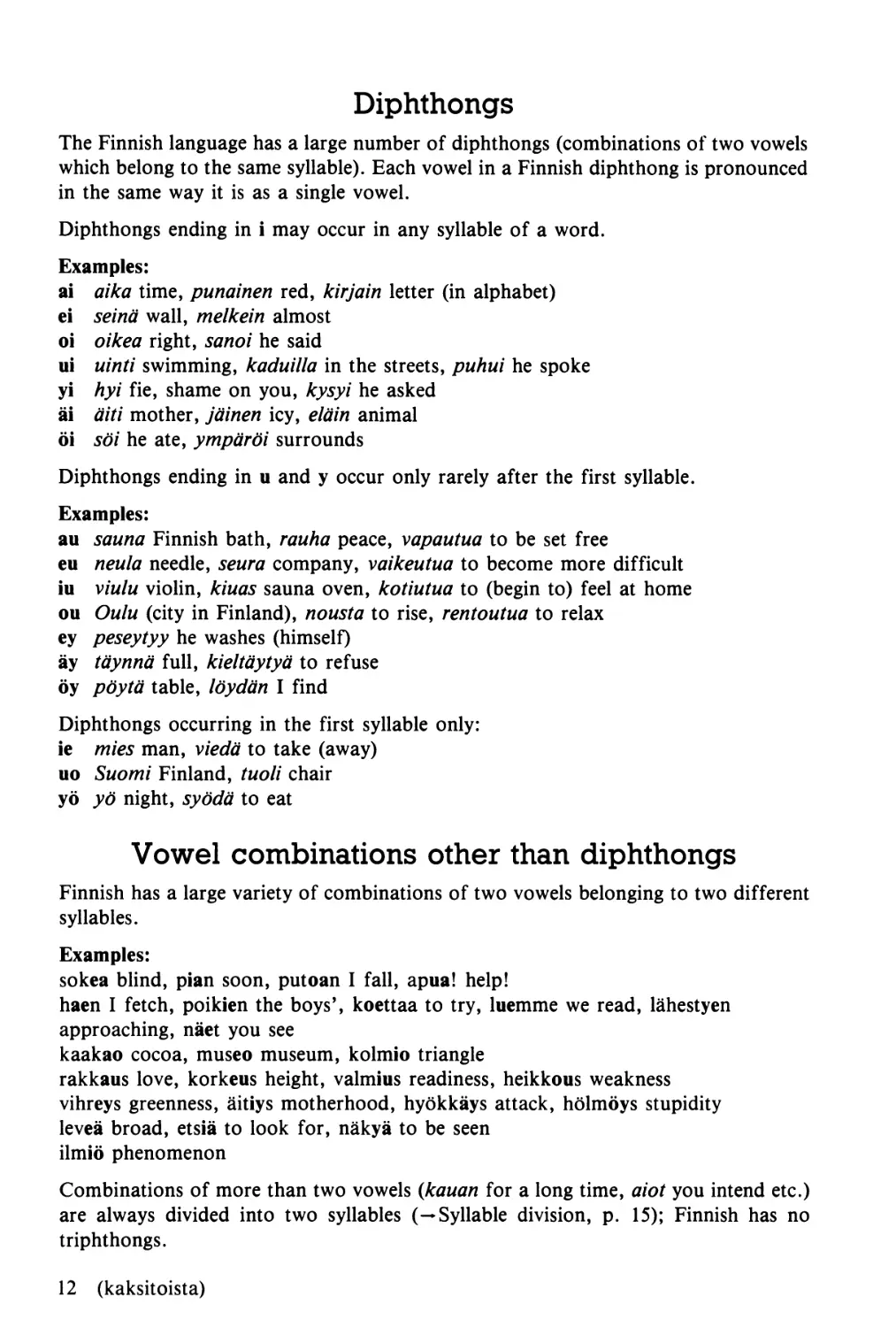
Diphthongs
The Finnish language has a large number of diphthongs (combinations of two vowels
which belong to the same syllable). Each vowel in a Finnish diphthong is pronounced
in the same way it is as a single vowel.
Diphthongs ending in i may occur in any syllable of a word.
Examples:
ai aika time, punainen red, kirjain letter (in alphabet)
ei seinä wall, melkein almost
oi oikea right, sanoi he said
ui uinti swimming, kaduilla in the streets, puhui he spoke
yi hyi fie, shame on you, kysyi he asked
äi äiti mother, jäinen icy, eläin animal
öi söi he ate, ympäröi surrounds
Diphthongs ending in u and y occur only rarely after the first syllable.
Examples:
au sauna Finnish bath, rauha peace, vapautua to be set free
eu neula needle, seura company, vaikeutua to become more difficult
iu viulu violin, kiuas sauna oven, kotiutua to (begin to) feel at home
ou Oulu (city in Finland), nousta to rise, rentoutua to relax
ey peseytyy he washes (himself)
äy täynnä full, kieltäytyä to refuse
öy pöytä table, löydän I find
Diphthongs occurring in the first syllable only:
ie mies man, viedä to take (away)
uo Suomi Finland, tuoli chair
yö yö night, syödä to eat
Vowel combinations other than diphthongs
Finnish has a large variety of combinations of two vowels belonging to two different
syllables.
Examples:
sokea blind, pian soon, putoan I fall, apua! help!
haen I fetch, poikien the boys’, koettaa to try, luemme we read, lähestyen
approaching, näet you see
kaakao cocoa, museo museum, kolmio triangle
rakkaus love, korkeus height, valmius readiness, heikkous weakness
vihreys greenness, äitiys motherhood, hyökkäys attack, hölmöys stupidity
leveä broad, etsiä to look for, näkyä to be seen
ilmiö phenomenon
Combinations of more than two vowels (kauan for a long time, aiot you intend etc.)
are always divided into two syllables (—Syllable division, p. 15); Finnish has no
triphthongs.
12 (kaksitoista)

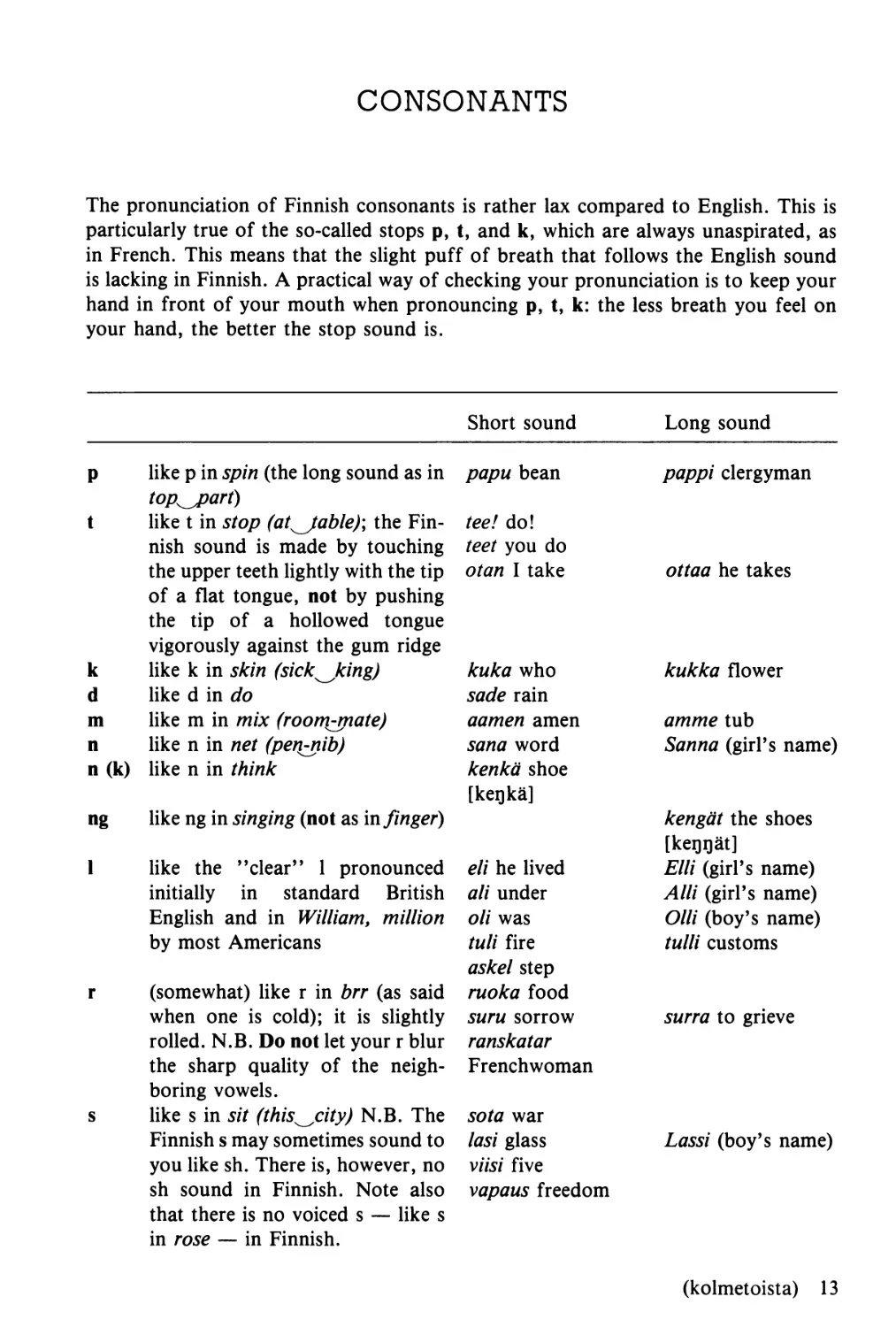
CONSONANTS
The pronunciation of Finnish consonants is rather lax compared to English. This is
particularly true of the so-called stops p, t, and k, which are always unaspirated, as
in French. This means that the slight puff of breath that follows the English sound
is lacking in Finnish. A practical way of checking your pronunciation is to keep your
hand in front of your mouth when pronouncing p, t, k: the less breath you feel on
your hand, the better the stop sound is.
Short sound
Long sound
p
like p in spin (the long sound as in
topjjart)
papu bean
pappi clergyman
t
like t in stop (at^Jable); the
Finnish sound is made by touching
tee! do!
teet you do
the upper teeth lightly with the tip
of a flat tongue, not by pushing
the tip of a hollowed tongue
vigorously against the gum ridge
otan I take
ottaa he takes
k
like k in skin (sick^king)
kuka who
kukka flower
d
like d in do
sade rain
m
like m in mix (room-mate)
aamen amen
amme tub
n
like n in net (pei^nib)
sana word
Sanna (girl’s name)
n (k)
like n in think
kenkä shoe
[keqkä]
ng
like ng in singing (not as in finger)
kengät the shoes
[keräät]
1
like the ’’clear” 1 pronounced
eli he lived
Elli (girl’s name)
initially in standard British
ali under
Alii (girl’s name)
English and in William, million
oli was
Olli (boy’s name)
by most Americans
tuli fire
askel step
tulli customs
r
(somewhat) like r in brr (as said
ruoka food
when one is cold); it is slightly
rolled. N.B. Do not let your r blur
the sharp quality of the
neighboring vowels.
suru sorrow
ranskatar
Frenchwoman
surra to grieve
s
like s in sit (this^city) N.B. The
sota war
Finnish s may sometimes sound to
you like sh. There is, however, no
sh sound in Finnish. Note also
that there is no voiced s — like s
in rose — in Finnish.
Iasi glass
viisi five
vapaus freedom
Lassi (boy’s name)
(kolmetoista) 13

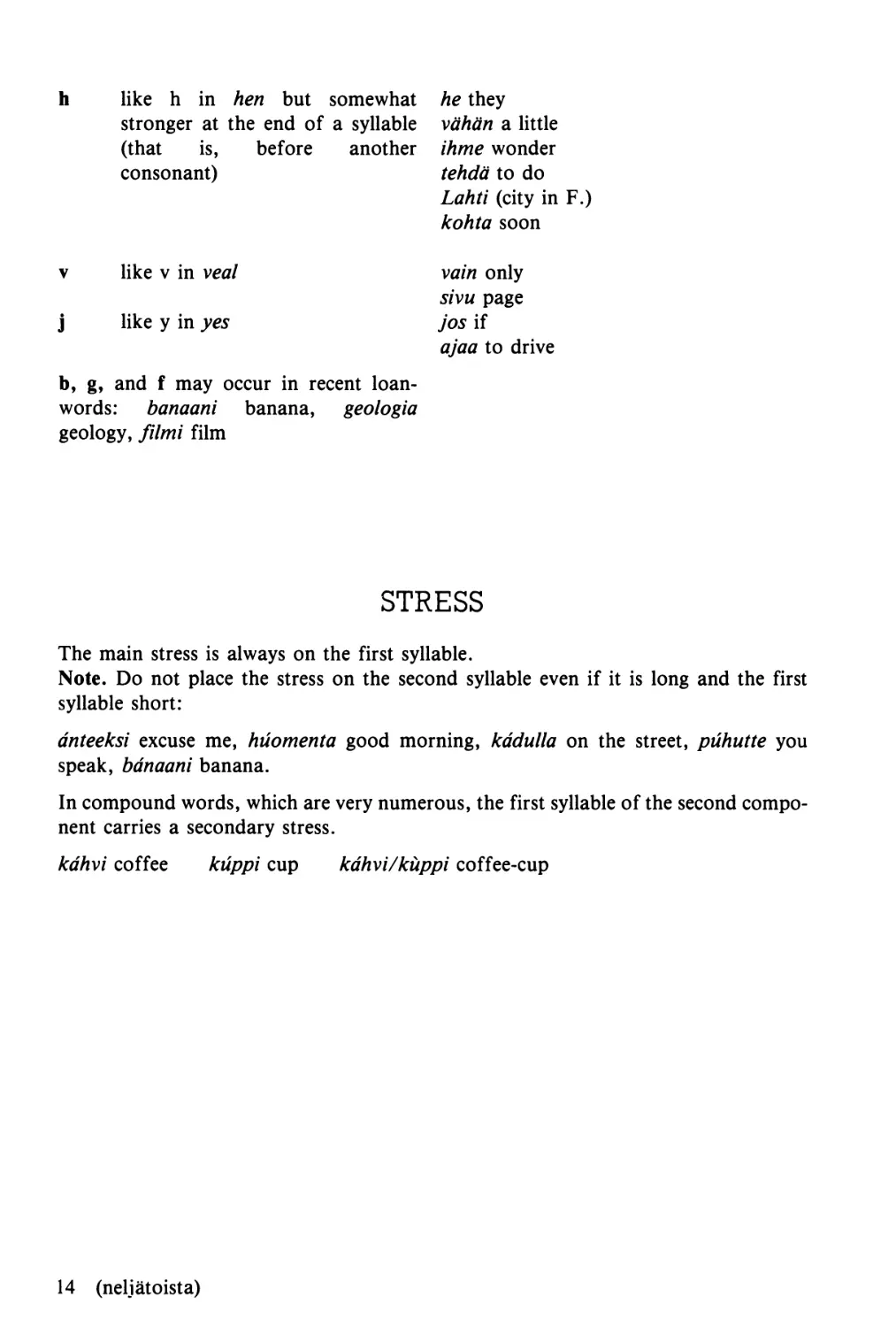
h like h in hen but somewhat
stronger at the end of a syllable
(that is, before another
consonant)
v like v in veal
j like y in yes
b, g, and f may occur in recent
loanwords: banaani banana, geologia
geology, filmi film
STRESS
The main stress is always on the first syllable.
Note. Do not place the stress on the second syllable even if it is long and the first
syllable short:
anteeksi excuse me, huomenta good morning, kadulla on the street, puhutte you
speak, banaani banana.
In compound words, which are very numerous, the first syllable of the second
component carries a secondary stress.
kahvi coffee kuppi cup kahvi/kuppi coffee-cup
he they
vähän a little
ihme wonder
tehdä to do
Lahti (city in F.)
kohta soon
vain only
sivu page
jos if
ajaa to drive
14 (neljätoista)

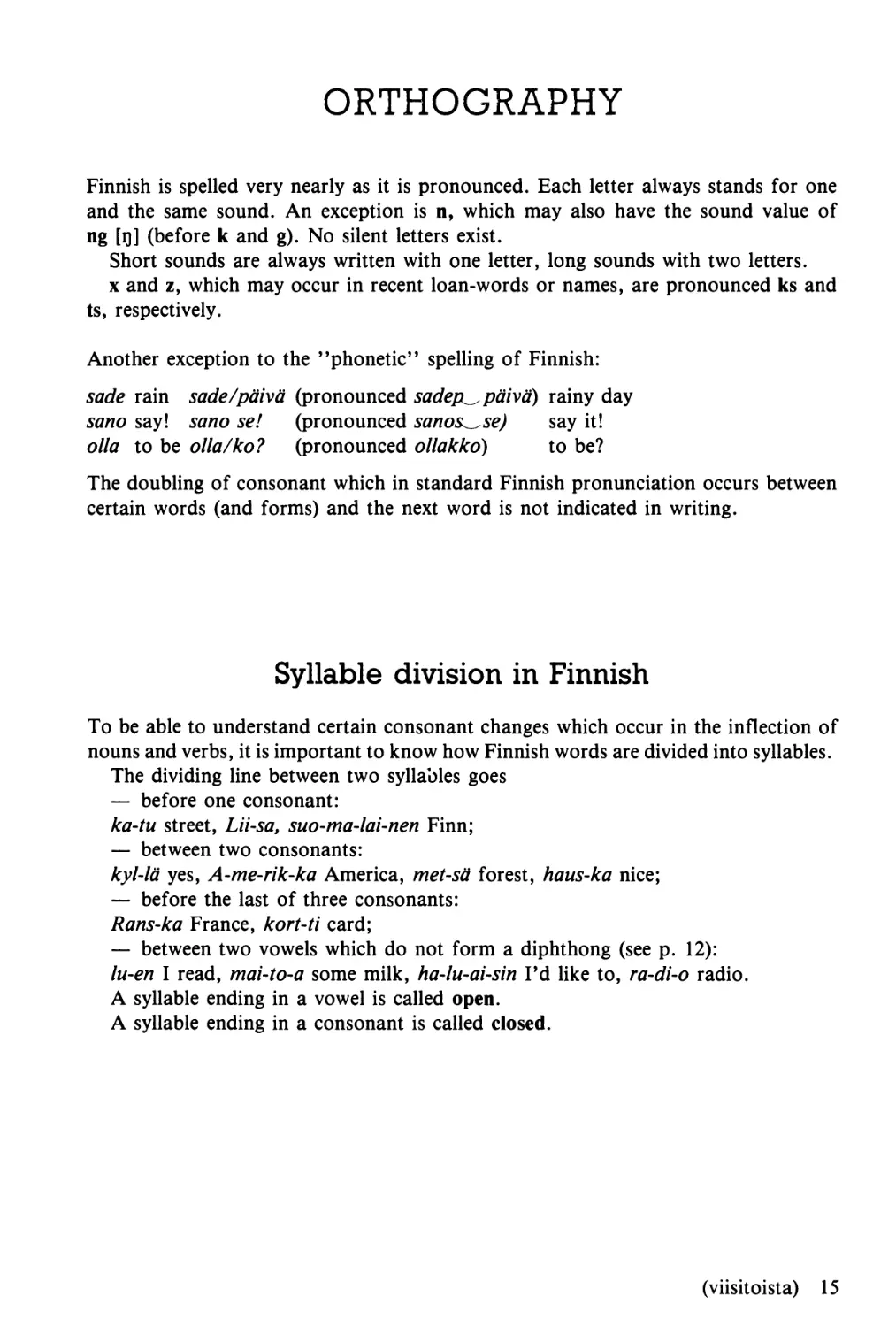
ORTHOGRAPHY
Finnish is spelled very nearly as it is pronounced. Each letter always stands for one
and the same sound. An exception is n, which may also have the sound value of
ng [q] (before k and g). No silent letters exist.
Short sounds are always written with one letter, long sounds with two letters,
x and z, which may occur in recent loan-words or names, are pronounced ks and
ts, respectively.
Another exception to the "phonetic” spelling of Finnish:
sade rain sade/päivä (pronounced sadep^ päivä) rainy day
sano say! sano se! (pronounced sanos^se) say it!
olla to be olla/ko? (pronounced ollakko) to be?
The doubling of consonant which in standard Finnish pronunciation occurs between
certain words (and forms) and the next word is not indicated in writing.
Syllable division in Finnish
To be able to understand certain consonant changes which occur in the inflection of
nouns and verbs, it is important to know how Finnish words are divided into syllables.
The dividing line between two syllables goes
— before one consonant:
ka-tu street, Lii-sa, suo-ma-lai-nen Finn;
— between two consonants:
kyl-lä yes, A-me-rik-ka America, met-sä forest, haus-ka nice;
— before the last of three consonants:
Rans-ka France, kort-ti card;
— between two vowels which do not form a diphthong (see p. 12):
lu-en I read, mai-to-a some milk, ha-lu-ai-sin I’d like to, ra-di-o radio.
A syllable ending in a vowel is called open.
A syllable ending in a consonant is called closed.
(viisitoista) 15

Kappale
1
Lesson
Mikä tämä on?
What is this?
1. Se on Suomi.
1. It is Finland.
2. Se on radio.
2. It is a radio.
3. Se on televisio.
3. It is a television.
4. Se on auto.
4. It is a car.
5. Se on bussi.
S. It is a bus.
6. Se on talo.
6. It is a house.
7. Se on huone.
7. It is a room.
Mikä tuo on?
What is that?
8. Se on katu.
8. It is a street.
9. Se on kauppa.
9. It is a shop.
10. Se on mies.
10. It is a man.
11. Se on nainen.
11. It is a woman.
12. Se on poika.
12. It is a boy.
13. Se on tyttö.
13. It is a girl.
Kuka tämä on?
Who is this?
14. Se on Aleksis Kivi.
14. It is Aleksis Kivi.
Kuka tuo on?
Who is that?
15. Se on Jean Sibelius.
15. It is Jean Sibelius.
Mikä tämä on? Radio, kuva, mies.
Kuka tämä on? Aleksis Kivi, Liisa Salo, Ville.
Mikä päivä tänään on?
Tänään on maanantai.
16 (kuusitoista)

uva 1
(yksi)
4 (neljä)
2 (kaksi)
5 (viisi)
3 (kolme)
6 (kuusi)
10
12
(kaksi/toista)
11 13
14
15
(kymmenen) (yksi/toista)
(kolme/toista) (neljä/toista) (viisi/toista)
(seitsemäntoista) 17

m
Kielioppia Structural notes
1. 	Finnish alphabet
A (B) (C) D E (F) G H I J K L M N O P (Q)
aa bee see dee ee äf gee hoo ii jii koo äl äm än oo pee kuu
R S T U V (W) (X) Y (Z) Ä Ö
är äs tee uu vee kaksois-vee äks yy tset ää öö
The alternative terms ällä, ämmä, ännä, ärrä, ässä, äksä, tseta are also used as
names for the respective letters.
The letters in parentheses do not occur in purely Finnish words,
w (’’double v”) occurs in a few names and is pronounced like v; in lists
arranged alphabetically it is treated as a v.
ä (the Swedish o) — between z and ä in the alphabet — occurs in a number
of family and place names, e.g. Älander (family name), Äbo Turku, Borgä
Porvoo.
2. No article in Finnish
There is no article in Finnish, talo, for instance, means both ”a house” and
’’the house”.
3. Basic form of nouns
talo, mies, tyttö, and all the other nouns in this lesson appear in the
noninflected or basic form (dictionary form) of the noun (nominative singular).
18 (kahdeksantoista)

m
Sanasto
Vocabulary
auto
bussi
huone
kappale
katu
kauppa
kuka?
kuva
mies
mikä?
nainen
on (from olla to be)
poika
radio
se
se (mies)
Suomi
talo
televisio
tuo (colloq. toi)
tyttö
tämä (colloq. tää)
car, automobile
bus
room
piece, bit; paragraph; lesson, chapter
street
shop, store
who?
picture
man; husband
what? which?
woman, lady
is
boy; son
radio, wireless
it
(with nouns:) the, that (man)
Finland
house
television
that, that one
girl
this, this one
& (new words in structural notes, reader, exercises etc.)
maanantai Monday
numero number, figure
päivä day
sivu (abbr. s.) page (p.)
tänään today
(yhdeksäntoista) 19

Kappale
2
Lesson
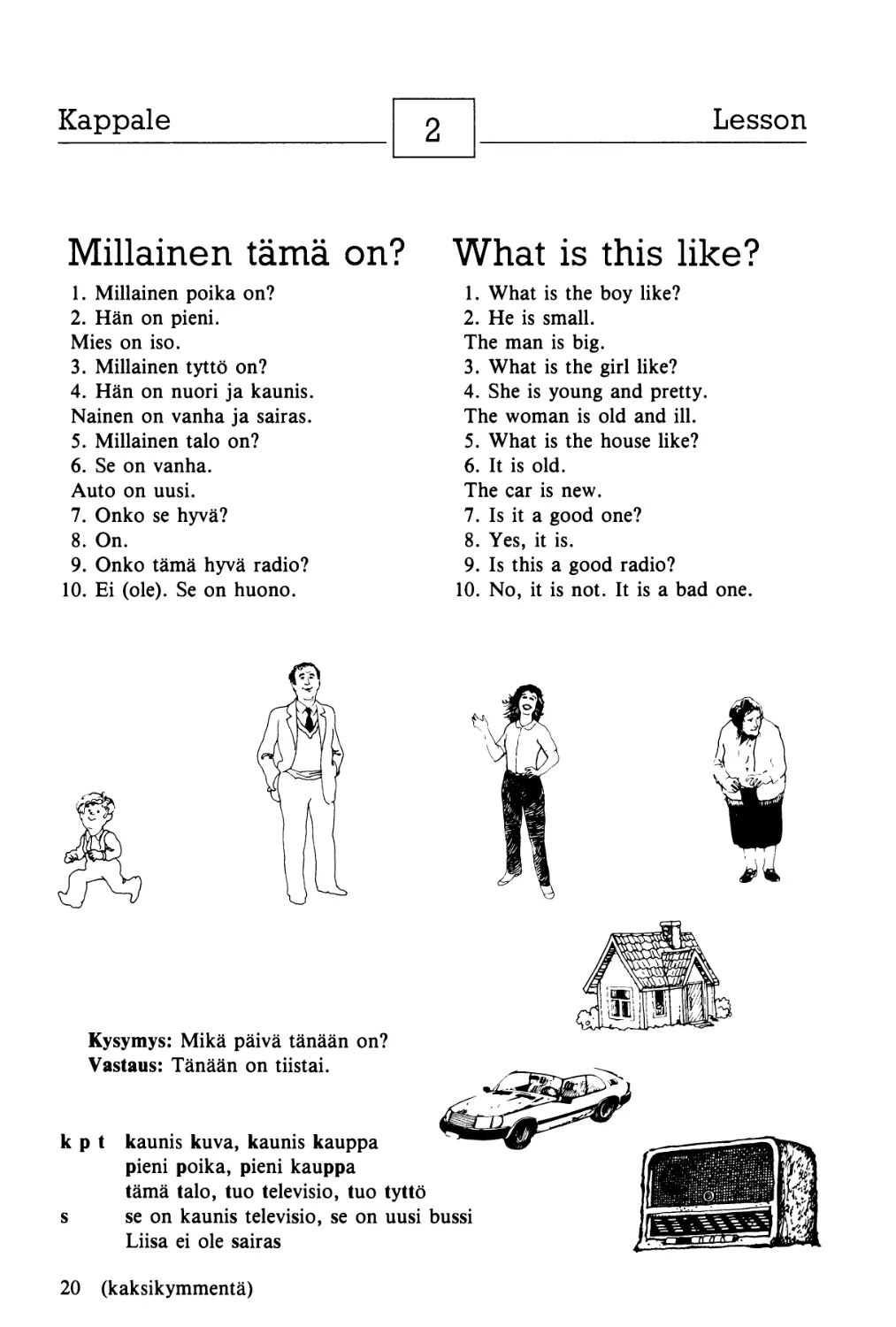
Millainen tämä on?
1. Millainen poika on?
2. Hän on pieni.
Mies on iso.
3. Millainen tyttö on?
4. Hän on nuori ja kaunis.
Nainen on vanha ja sairas.
5. Millainen talo on?
6. Se on vanha.
Auto on uusi.
7. Onko se hyvä?
8. On.
9. Onko tämä hyvä radio?
10. 	Ei (ole). Se on huono.
What is this like?
1. What is the boy like?
2. He is small.
The man is big.
3. What is the girl like?
4. She is young and pretty.
The woman is old and ill.
5. What is the house like?
6. It is old.
The car is new.
7. Is it a good one?
8. Yes, it is.
9. Is this a good radio?
10. 	No, it is not. It is a bad one.
Kysymys: Mikä päivä tänään on?
Vastaus: Tänään on tiistai.
k p t kaunis kuva, kaunis kauppa
pieni poika, pieni kauppa
tämä talo, tuo televisio, tuo tyttö
s se on kaunis televisio, se on uusi bussi
Liisa ei ole sairas
20 (kaksikymmentä)

Kielioppia
Structural notes
1. 	No grammatical gender in Finnish
There is no grammatical gender (masculine, feminine, or neuter) in Finnish.
Even the pronoun hän means both ’’he” and ’’she”, hän is used of people only,
se is used to refer to animals and inanimate objects.
In careless every-day speech se is commonly used to refer to people as well.
2. 	How to form questions
a) Mikä tämä on? What is this?
When a question begins with an interrogative word (e.g. mikä), the word-
order is the same as in an ordinary statement, not reversed as in English.
b) On/ko Helsinki kaunis? Is Helsinki beautiful?
When the question begins with a verb, the word-order is reversed, and the
interrogative suffix -ko (or -kö, see 4:2) is added to the verb.
It should be noted that Finnish ’’yes/no” questions do not show the rising
intonation typical of English. The pitch of the voice in Finnish sentences normally
goes down, even in questions.
Short colloquial forms occur: onk(o) se? etc.
The suffix -ko (-kö) may also be added to words other than verbs:
Minä/kö? Me?
Tämä poika/ko? This boy?
Tänään/kö? Today?
It can also be used to create a special emphasis; cp. these three questions:
On/ko hän sairas? Is he ill?
Hän/kö on sairas? Is he ill? He is ill?
Sairas /ko hän on? Is he ill?
(kaksikymmentäyksi) 21

m
Sanasto
Vocabulary
ei
ei ole
huono
hyvä
hän
iso
ja
kaunis ruma)
-ko (-kö)
millainen?
nuori
pieni
sairas terve)
uusi
vanha
no
(no,) it is not
bad, poor
good
he, she
big, large
and
pretty, beautiful
interrogative suffix
what ... like? what kind of?
young
small, little
ill, sick
new
old, ancient
☆
kysymys question
tiistai Tuesday
vastaus answer, reply
22 (kaksikymmentäkaksi)

Kappale
3
Lesson
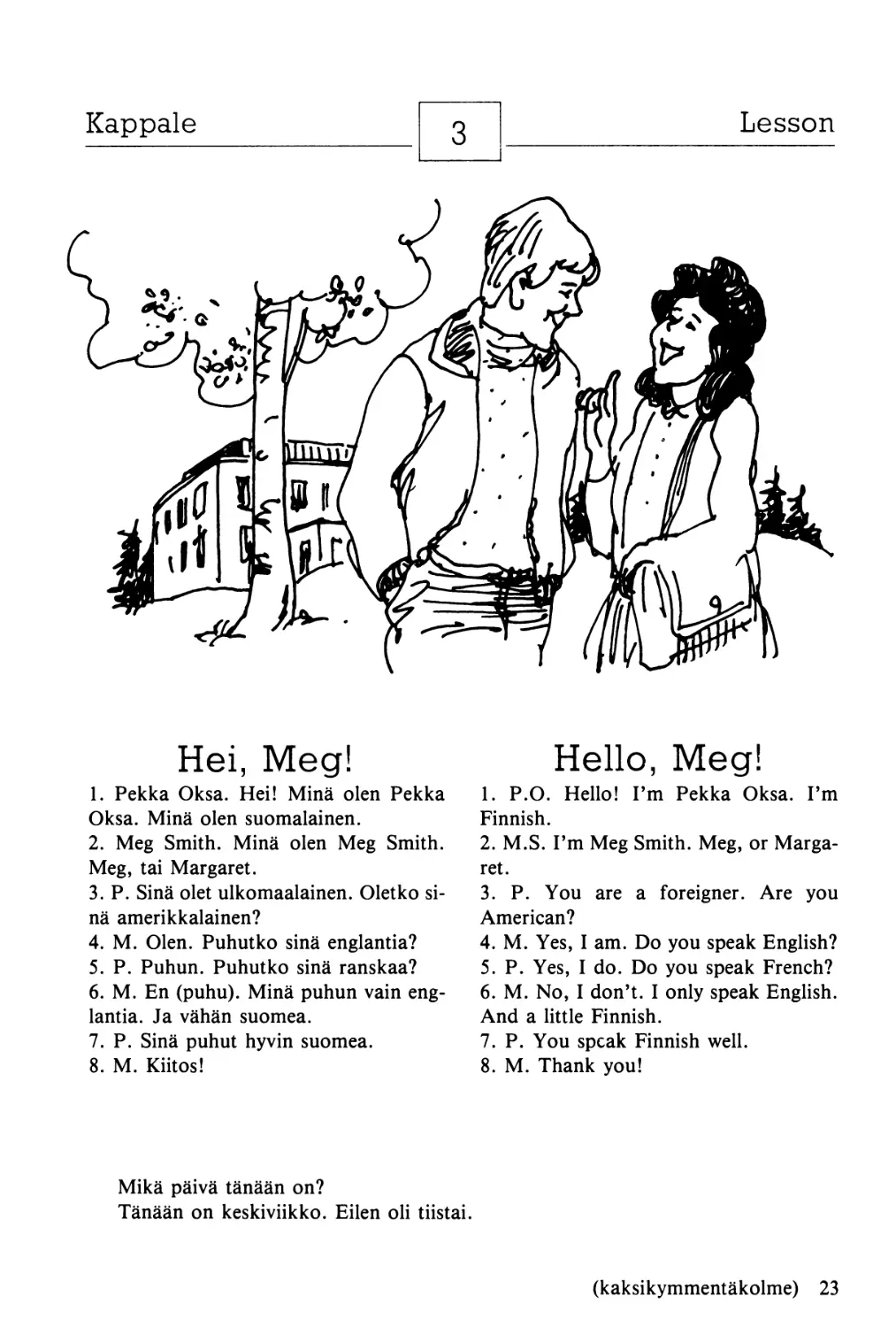
Hei, Meg!
1. Pekka Oksa. Hei! Minä olen Pekka
Oksa. Minä olen suomalainen.
2. Meg Smith. Minä olen Meg Smith.
Meg, tai Margaret.
3. P. Sinä olet ulkomaalainen. Oletko
sinä amerikkalainen?
4. M. Olen. Puhutko sinä englantia?
5. P. Puhun. Puhutko sinä ranskaa?
6. M. En (puhu). Minä puhun vain
englantia. Ja vähän suomea.
7. P. Sinä puhut hyvin suomea.
8. M. Kiitos!
Hello, Meg!
1. P.O. Hello! I’m Pekka Oksa. Tm
Finnish.
2. M.S. I’m Meg Smith. Meg, or
Margaret.
3. P. You are a foreigner. Are you
American?
4. M. Yes, I am. Do you speak English?
5. P. Yes, I do. Do you speak French?
6. M. No, I don’t. I only speak English.
And a little Finnish.
7. P. You speak Finnish well.
8. M. Thank you!
Mikä päivä tänään on?
Tänään on keskiviikko. Eilen oli tiistai.
(kaksikymmentäkolme) 23

m
EUROOPPA
Maa
Englanti
Suomi
Ranska
Kieli
englanti
suomi
ranska
but: Puhun englantia.
suomea.
ranskaa.
Minkämaalainen sinä olet?
Minä olen ranskalainen.
Mitä kieltä sinä puhut?
Minä puhun ranskaa.
KAZAH
X- ' \
24 (kaksikymmentäneljä)

3
Kielioppia Structural notes
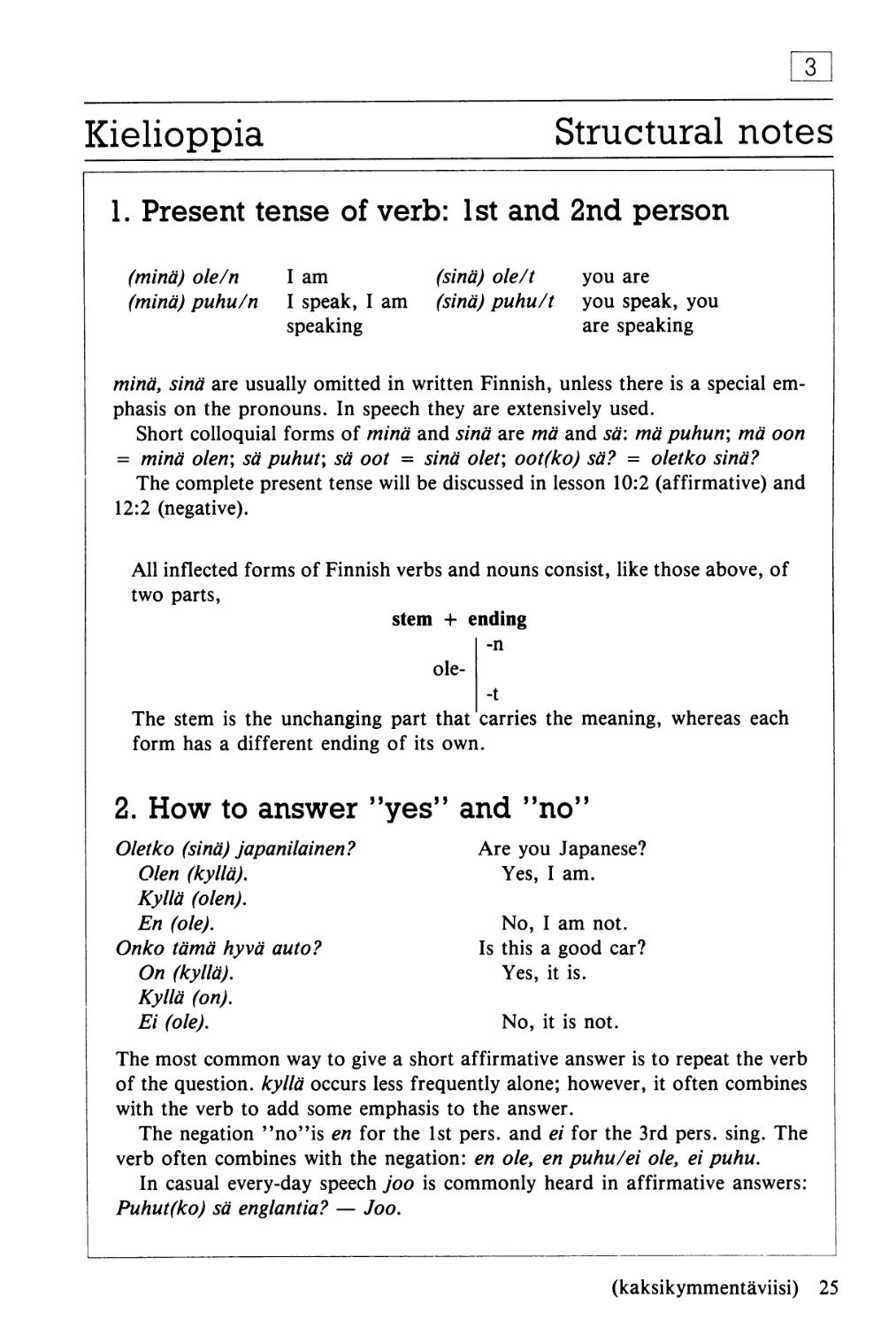
1. Present tense of verb: 1st and 2nd person
(minä) ole/n I am (sinä) ole/t you are
(minä) puhu/n I speak, I am (sinä) puhu/t you speak, you
speaking are speaking
minä, sinä are usually omitted in written Finnish, unless there is a special
emphasis on the pronouns. In speech they are extensively used.
Short colloquial forms of minä and sinä are mä and sä: mä puhun; mä oon
= minä olen; sä puhut; sä oot = sinä olet; oot(ko) sä? = oletko sinä?
The complete present tense will be discussed in lesson 10:2 (affirmative) and
12:2 (negative).
All inflected forms of Finnish verbs and nouns consist, like those above, of
two parts,
stem + ending
-n
ole-
-t
The stem is the unchanging part that carries the meaning, whereas each
form has a different ending of its own.
2. How to answer ”yes” and ”no”
Oletko (sinä) japanilainen? Are you Japanese?
Olen (kyllä). Yes, I am.
Kyllä (olen).
En (ole). No, I am not.
Onko tämä hyvä auto? Is this a good car?
On (kyllä). Yes, it is.
Kyllä (on).
Ei (ole). No, it is not.
The most common way to give a short affirmative answer is to repeat the verb
of the question, kyllä occurs less frequently alone; however, it often combines
with the verb to add some emphasis to the answer.
The negation ”no”is en for the 1st pers. and ei for the 3rd pers. sing. The
verb often combines with the negation: en ole, en puhu/ei ole, ei puhu.
In casual every-day speech joo is commonly heard in affirmative answers:
Puhut(ko) sä englantia? — Joo.
(kaksikymmentäviisi) 25

m
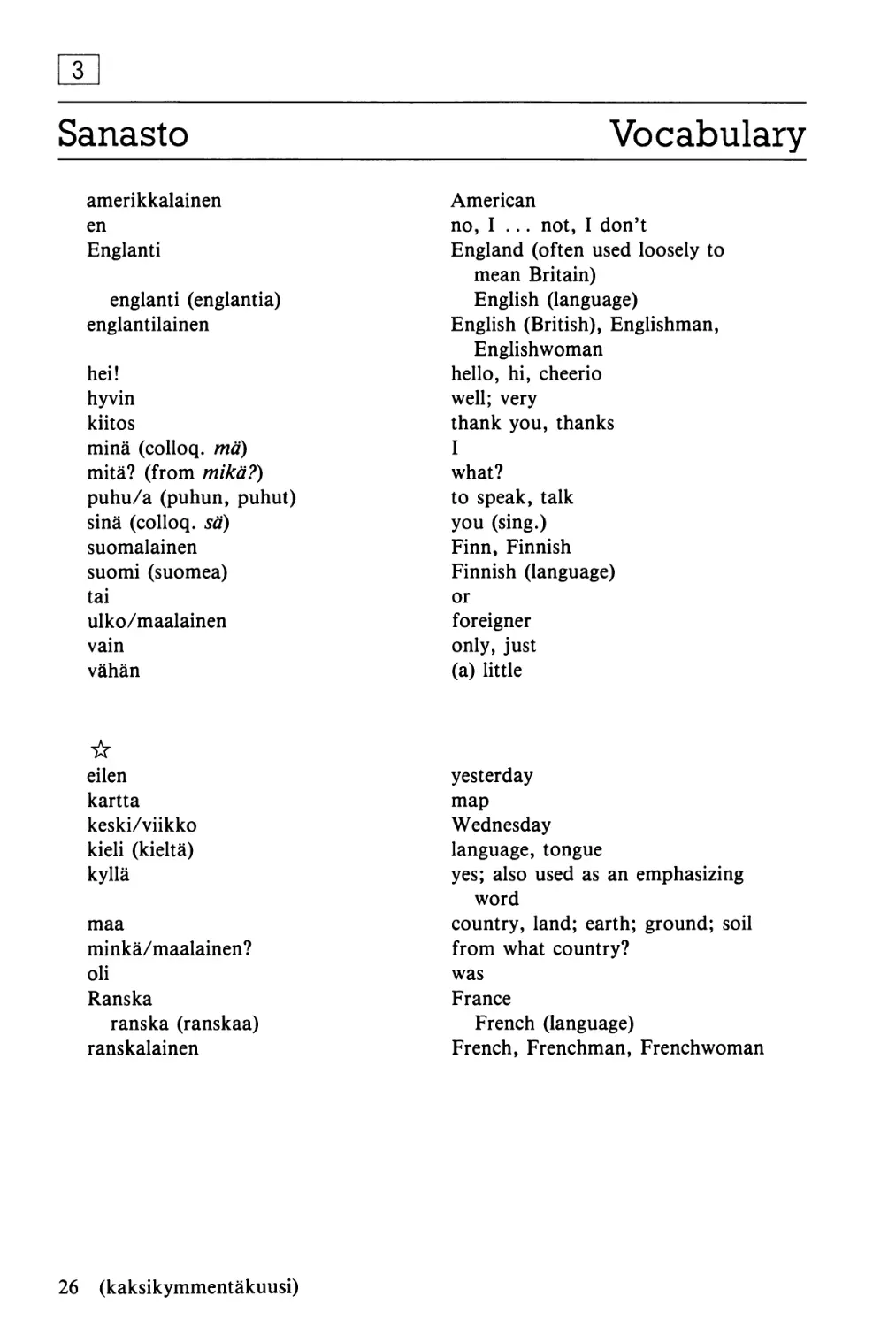
Sanasto
Vocabulary
amerikkalainen
en
Englanti
englanti (englantia)
englantilainen
hei!
hyvin
kiitos
minä (colloq. mä)
mitä? (from mikä?)
puhu/a (puhun, puhut)
sinä (colloq. sä)
suomalainen
suomi (suomea)
tai
uiko/maalainen
vain
vähän
American
no, I ... not, I don’t
England (often used loosely to
mean Britain)
English (language)
English (British), Englishman,
Englishwoman
hello, hi, cheerio
well; very
thank you, thanks
I
what?
to speak, talk
you (sing.)
Finn, Finnish
Finnish (language)
or
foreigner
only, just
(a) little
☆
eilen
kartta
keski/viikko
kieli (kieltä)
kyllä
maa
minkä/maalainen?
oli
Ranska
ranska (ranskaa)
ranskalainen
yesterday
map
Wednesday
language, tongue
yes; also used as an emphasizing
word
country, land; earth; ground; soil
from what country?
was
France
French (language)
French, Frenchman, Frenchwoman
26 (kaksikymmentäkuusi)

m
(kaksikymmentäseitsemän) 27

Kappale
4
Lesson
T T •••• ••• ••••
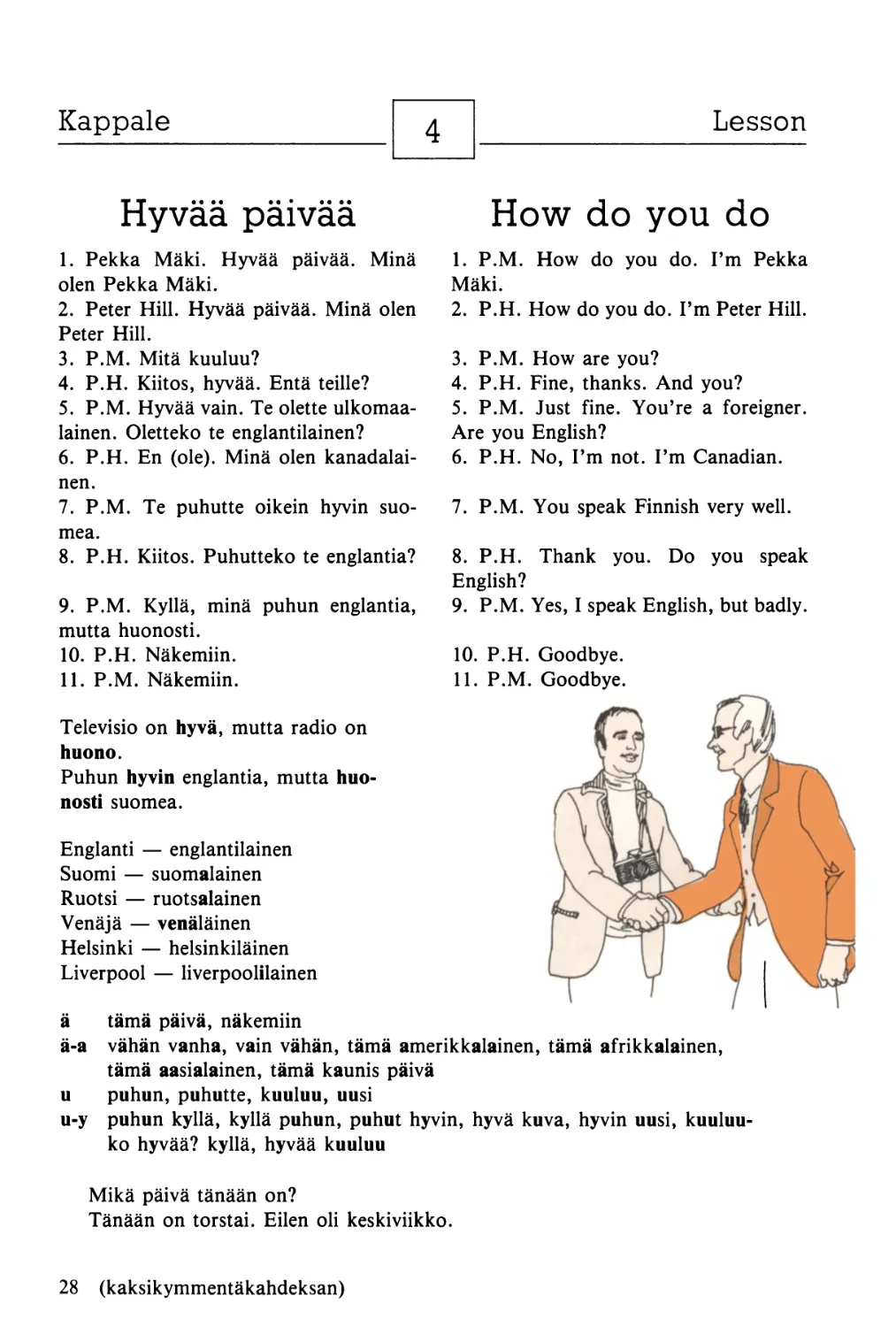
Hyvaa paivaa
1. Pekka Mäki. Hyvää päivää. Minä
olen Pekka Mäki.
2. Peter Hill. Hyvää päivää. Minä olen
Peter Hill.
3. P.M. Mitä kuuluu?
4. P.H. Kiitos, hyvää. Entä teille?
5. P.M. Hyvää vain. Te olette
ulkomaalainen. Oletteko te englantilainen?
6. P.H. En (ole). Minä olen
kanadalainen.
7. P.M. Te puhutte oikein hyvin
suomea.
8. P.H. Kiitos. Puhutteko te englantia?
9. P.M. Kyllä, minä puhun englantia,
mutta huonosti.
10. P.H. Näkemiin.
11. P.M. Näkemiin.
Televisio on hyvä, mutta radio on
huono.
Puhun hyvin englantia, mutta
huonosti suomea.
Englanti — englantilainen
Suomi — suomalainen
Ruotsi — ruotsalainen
Venäjä — venäläinen
Helsinki — helsinkiläinen
Liverpool — liverpoolilainen
ä tämä päivä, näkemiin
ä-a vähän vanha, vain vähän, tämä amerikkalainen, tämä afrikkalainen,
tämä aasialainen, tämä kaunis päivä
u puhun, puhutte, kuuluu, uusi
u-y puhun kyllä, kyllä puhun, puhut hyvin, hyvä kuva, hyvin uusi,
kuuluuko hyvää? kyllä, hyvää kuuluu
Mikä päivä tänään on?
Tänään on torstai. Eilen oli keskiviikko.
How do you do
1. P.M. How do you do. Pm Pekka
Mäki.
2. P.H. How do you do. Pm Peter Hill.
3. P.M. How are you?
4. P.H. Fine, thanks. And you?
5. P.M. Just fine. You’re a foreigner.
Are you English?
6. P.H. No, Pm not. Pm Canadian.
7. P.M. You speak Finnish very well.
8. P.H. Thank you. Do you speak
English?
9. P.M. Yes, I speak English, but badly.
10. P.H. Goodbye.
11. P.M. Goodbye.
28 (kaksikymmentäkahdeksan)

m
Kielioppia Structural notes
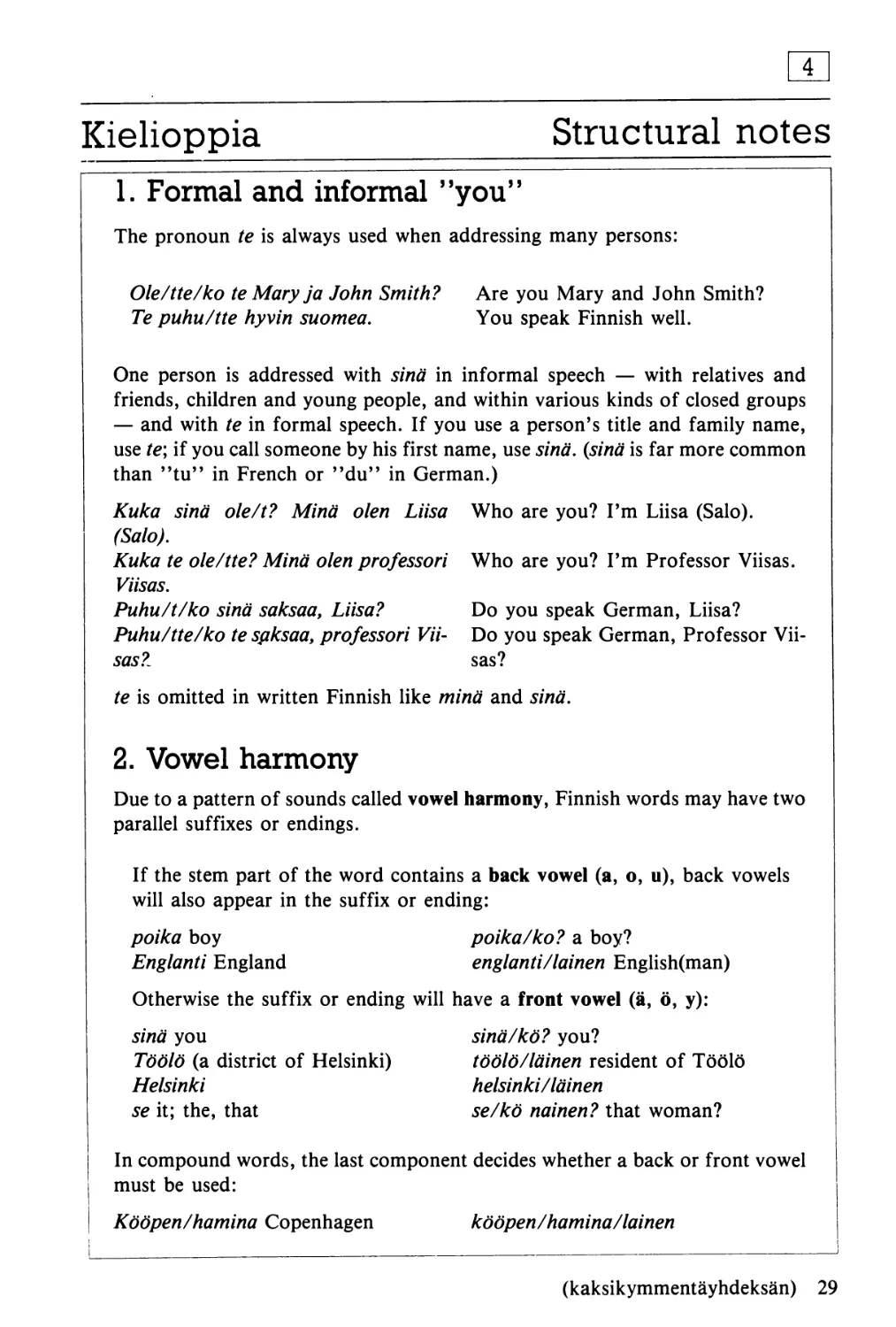
1. 	Formal and informal ’’you”
The pronoun te is always used when addressing many persons:
Ole/tte/ko te Mary ja John Smith? Are you Mary and John Smith?
Te puhu/tte hyvin suomea. You speak Finnish well.
One person is addressed with sinä in informal speech — with relatives and
friends, children and young people, and within various kinds of closed groups
— 	and with te in formal speech. If you use a person’s title and family name,
use te\ if you call someone by his first name, use sinä. (sinä is far more common
than ”tu” in French or ”du” in German.)
Kuka sinä ole/t? Minä olen Liisa Who are you? Pm Liisa (Salo).
(Salo).
Kuka te ole/tte? Minä olen professori Who are you? Pm Professor Viisas.
Viisas.
Puhu/t/ko sinä saksaa, Liisa? Do you speak German, Liisa?
Puhu/tte/ko te saksaa, professori Vii- Do you speak German, Professor Vii-
sas? sas?
te is omitted in written Finnish like minä and sinä.
2. 	Vowel harmony
Due to a pattern of sounds called vowel harmony, Finnish words may have two
parallel suffixes or endings.
If the stem part of the word contains a back vowel (a, o, u), back vowels
will also appear in the suffix or ending:
poika boy poika/ko? a boy?
Englanti England englanti /lainen English(man)
Otherwise the suffix or ending will have a front vowel (ä, ö, y):
sinä you sinä/kö? you?
Töölö (a district of Helsinki) töölö/Iäinen resident of Töölö
Helsinki helsinki/Iäinen
se it; the, that se/kö nainen? that woman?
In compound words, the last component decides whether a back or front vowel
must be used:
Kööpen/hamina Copenhagen kööpen/hamina/lainen
(kaksikymmentäyhdeksän) 29

m
Sanasto
entä?
entä (mitä kuuluu) sinulle/teille?
huonosti
(hyvää) päivää
kanadalainen
kuuluu:
mitä (sinulle/teille) kuuluu?
-lainen (-Iäinen)
mutta
näkemiin (from nähdä to see)
oikein
te
Vocabulary
what about? how about? and?
and how are you?
badly, poorly
how do you do (lit. ’’good day”)
Canadian
how are you (’’what’s the news?”)
suffix denoting ’’native or resident
of an area”
but
goodbye, so long, I’ll see you
right, correctly; very
you (pi. and formal)
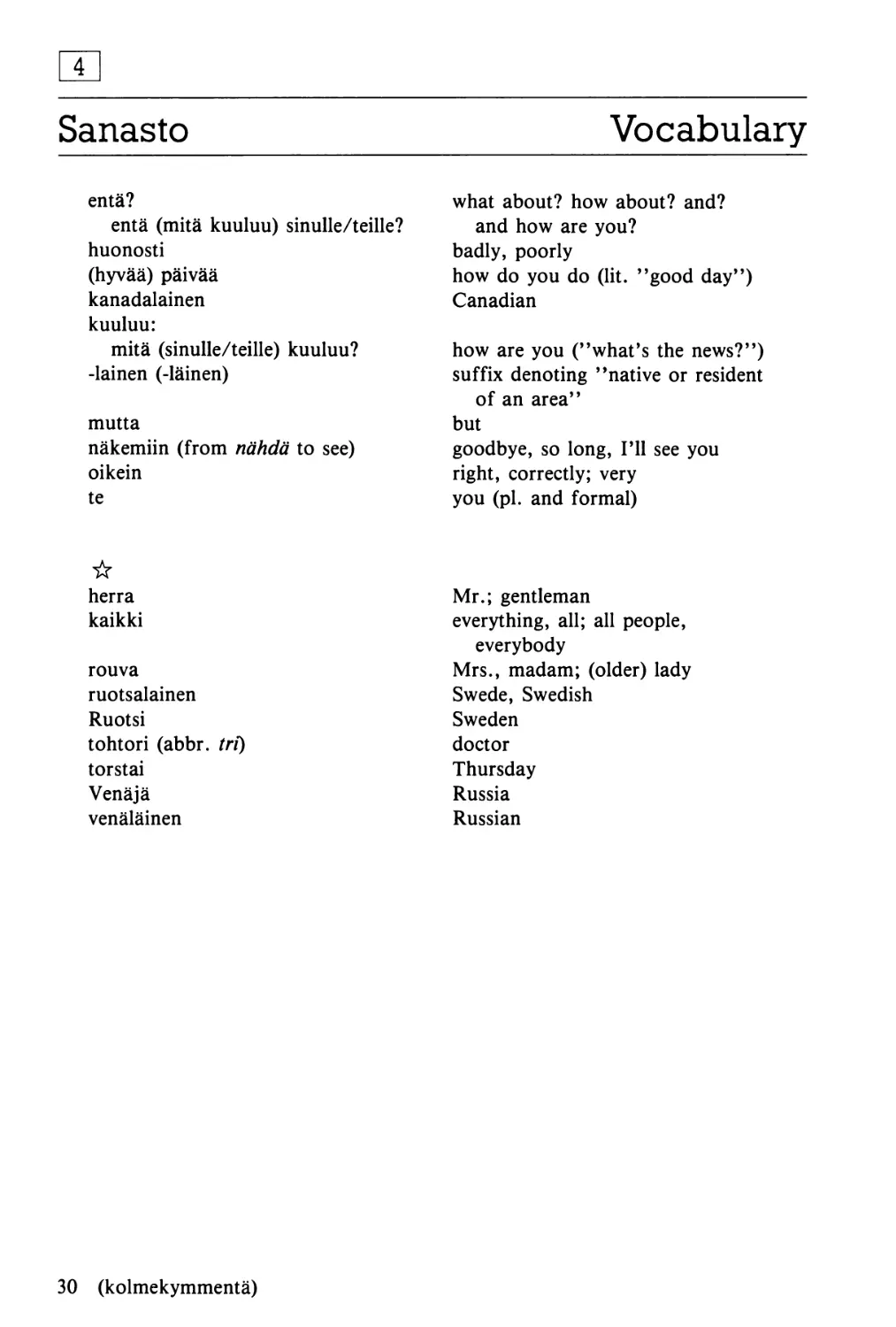
☆
herra Mr.; gentleman
kaikki everything, all; all people,
everybody
rouva Mrs., madam; (older) lady
ruotsalainen Swede, Swedish
Ruotsi Sweden
tohtori (abbr. tri) doctor
torstai Thursday
Venäjä Russia
venäläinen Russian
30 (kolmekymmentä)

Kappale
5
Lesson
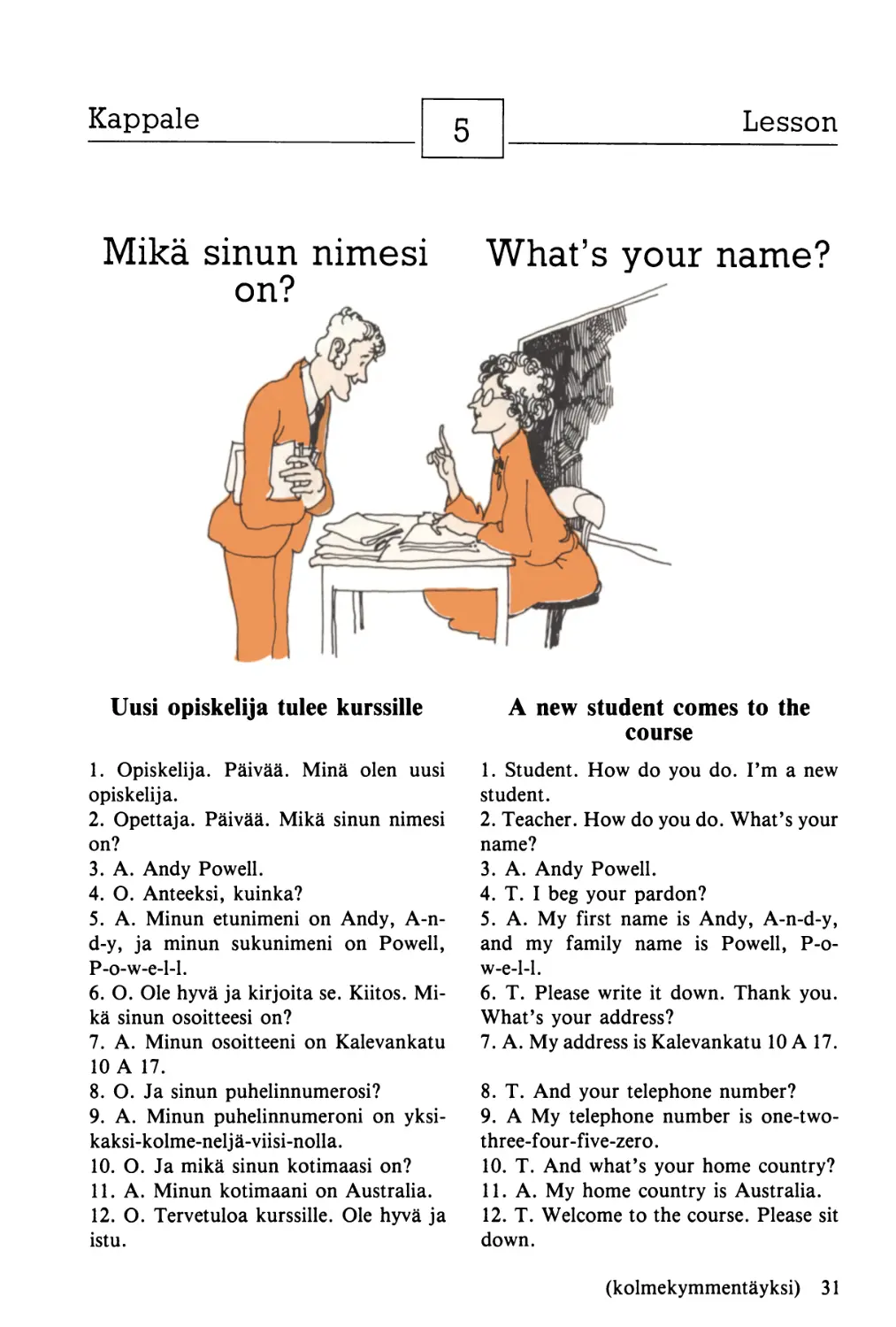
Mikä sinun nimesi What’s your name?
on?
Uusi opiskelija tulee kurssille
1. Opiskelija. Päivää. Minä olen uusi
opiskelija.
2. Opettaja. Päivää. Mikä sinun nimesi
on?
3. A. Andy Powell.
4. O. Anteeksi, kuinka?
5. A. Minun etunimeni on Andy, A-n-
d-y, ja minun sukunimeni on Powell,
P-o-w-e-l-l.
6. O. Ole hyvä ja kirjoita se. Kiitos.
Mikä sinun osoitteesi on?
7. A. Minun osoitteeni on Kalevankatu
10 	A 17.
8. O. Ja sinun puhelinnumerosi?
9. A. Minun puhelinnumeroni on yksi-
kaksi-kolme-neljä-viisi-nolla.
10. O. Ja mikä sinun kotimaasi on?
11. A. Minun kotimaani on Australia.
12. O. Tervetuloa kurssille. Ole hyvä ja
istu.
A new student comes to the
course
1. Student. How do you do. I’m a new
student.
2. Teacher. How do you do. What’s your
name?
3. A. Andy Powell.
4. T. I beg your pardon?
5. A. My first name is Andy, A-n-d-y,
and my family name is Powell, P-o-
w-e-l-l.
6. T. Please write it down. Thank you.
What’s your address?
7. A. My address is Kalevankatu 10 A 17.
8. T. And your telephone number?
9. A My telephone number is one-two-
three-f our-five-zero.
10. T. And what’s your home country?
11. A. My home country is Australia.
12. T. Welcome to the course. Please sit
down.
(kolmekymmentäyksi) 31

Mikä teidän nimenne on?
Minun nimeni on Anna Virtanen.
Mikä teidän osoitteenne on?
Entä teidän puhelinnumeronne?
What’s your name?
My name is Anna Virtanen.
What’s your address?
And your telephone number?
Mikä päivä tänään on? Tänään on lauantai.
Eilen oli perjantai. Huomenna on sunnuntai.
32 (kolmekymmentäkaksi)

m
Kielioppia Structural notes
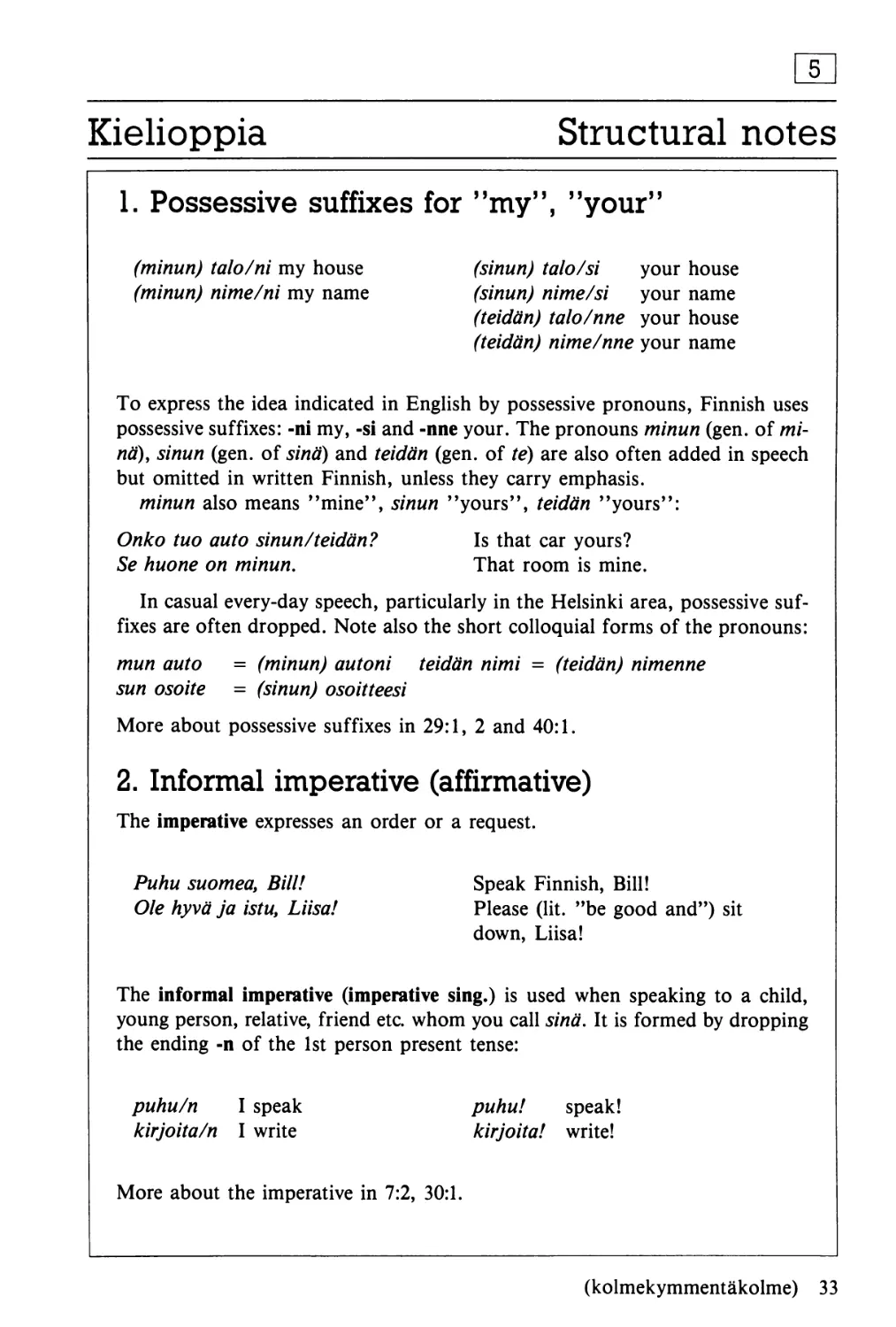
1. Possessive suffixes for ”my”, ’’your”
(minun) talo/ni my house (sinun) talo/si your house
(minun) nime/ni my name (sinun) nime/si your name
(teidän) talo/nne your house
(teidän) nime/nne your name
To express the idea indicated in English by possessive pronouns, Finnish uses
possessive suffixes: -ni my, -si and -nne your. The pronouns minun (gen. of
minä), sinun (gen. of sinä) and teidän (gen. of te) are also often added in speech
but omitted in written Finnish, unless they carry emphasis.
minun also means "mine”, sinun ’’yours”, teidän ’’yours”:
Onko tuo auto sinun/teidän? Is that car yours?
Se huone on minun. That room is mine.
In casual every-day speech, particularly in the Helsinki area, possessive
suffixes are often dropped. Note also the short colloquial forms of the pronouns:
mun auto = (minun) autoni teidän nimi = (teidän) nimenne
sun osoite = (sinun) osoitteesi
More about possessive suffixes in 29:1, 2 and 40:1.
2. Informal imperative (affirmative)
The imperative expresses an order or a request.
Puhu suomea, Bill! Speak Finnish, Bill!
Ole hyvä ja istu, Liisa! Please (lit. ”be good and”) sit
down, Liisa!
The informal imperative (imperative sing.) is used when speaking to a child,
young person, relative, friend etc. whom you call sinä. It is formed by dropping
the ending -n of the 1st person present tense:
puhu/n I speak puhu! speak!
kirjoita/n I write kirjoita! write!
More about the imperative in 7:2, 30:1.
(kolmekymmentäkolme) 33

m
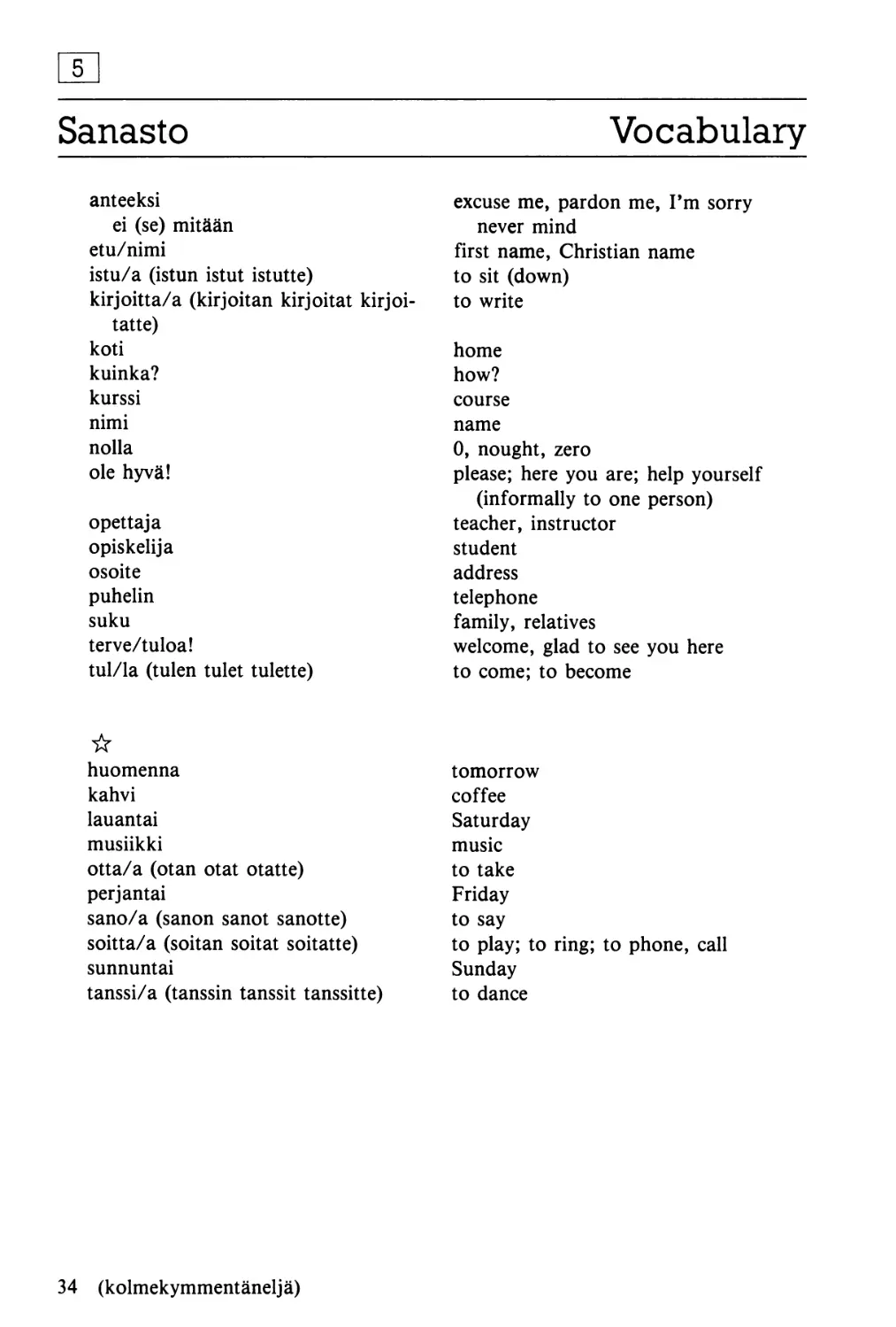
Sanasto
anteeksi
ei (se) mitään
etu/nimi
istu/a (istun istut istutte)
kirjoitta/a (kirjoitan kirjoitat
kirjoitatte)
koti
kuinka?
kurssi
nimi
nolla
ole hyvä!
opettaja
opiskelija
osoite
puhelin
suku
terve/tuloa!
tul/la (tulen tulet tulette)
Vocabulary
excuse me, pardon me, I’m sorry
never mind
first name, Christian name
to sit (down)
to write
home
how?
course
name
0, 	nought, zero
please; here you are; help yourself
(informally to one person)
teacher, instructor
student
address
telephone
family, relatives
welcome, glad to see you here
to come; to become
☆
huomenna
kahvi
lauantai
musiikki
otta/a (otan otat otatte)
perjantai
sano/a (sanon sanot sanotte)
soitta/a (soitan soitat soitatte)
sunnuntai
tanssi/a (tanssin tanssit tanssitte)
tomorrow
coffee
Saturday
music
to take
Friday
to say
to play; to ring; to phone, call
Sunday
to dance
34 (kolmekymmentäneljä)

Kappale
6
Lesson
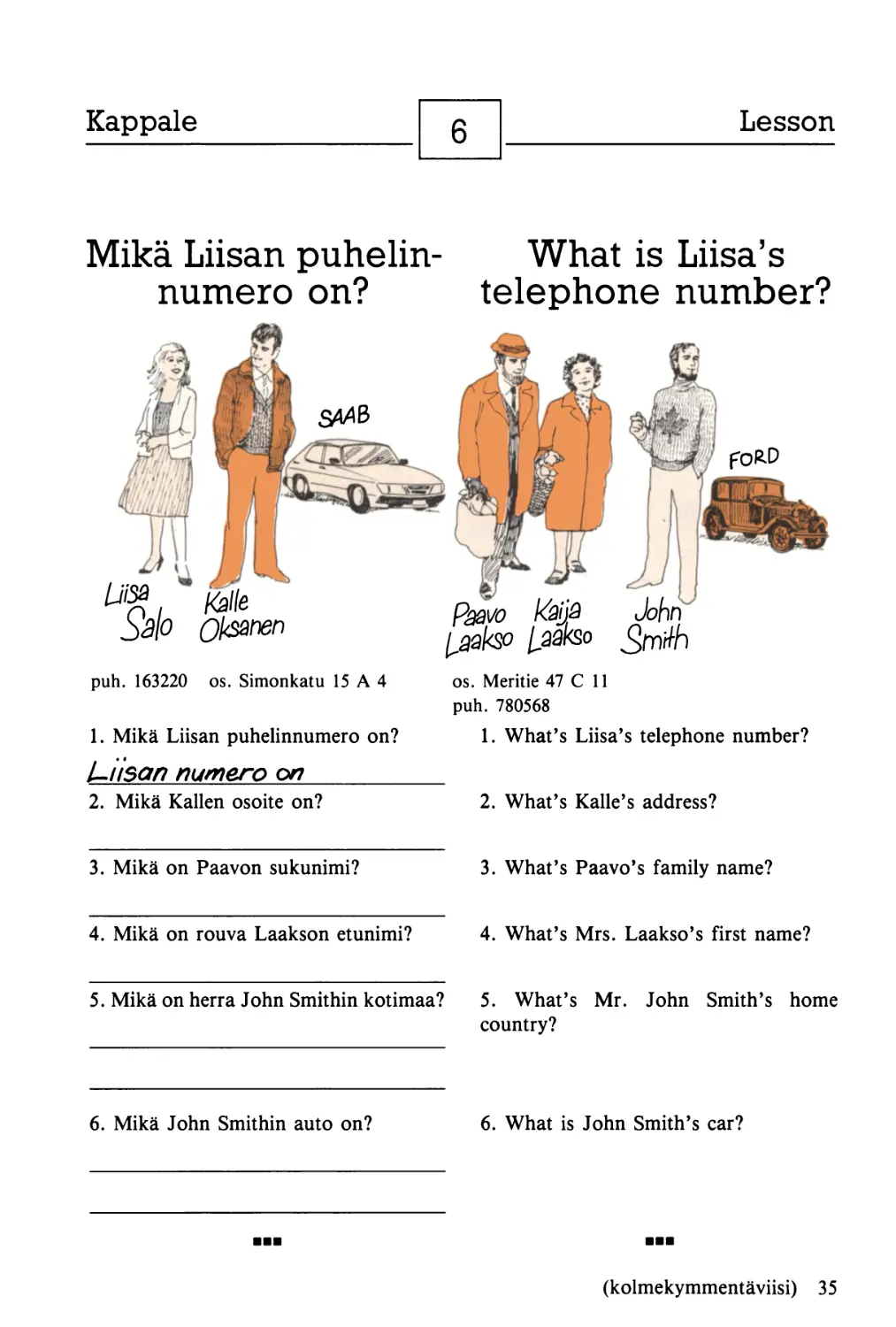
Mikä Liisan puhelin- What is Liisa’s
numero on? telephone number?
puh. 163220 os. Simonkatu 15 A 4
os. Meritie 47 C 11
puh. 780568
1. Mikä Liisan puhelinnumero on?
1. What’s Liisa’s telephone number?
Liisan numero on
2. Mikä Kallen osoite on?
2. What’s Kalle’s address?
3. Mikä on Paavon sukunimi?
3. What’s Paavo’s family name?
4. Mikä on rouva Laakson etunimi?
4. What’s Mrs. Laakso’s first name?
5. Mikä on herra John Smithin kotimaa? 5. What’s Mr. John Smith’s home
country?
6. 	Mikä John Smithin auto on? 6. What is John Smith’s car?
(kolmekymmentäviisi) 35

m
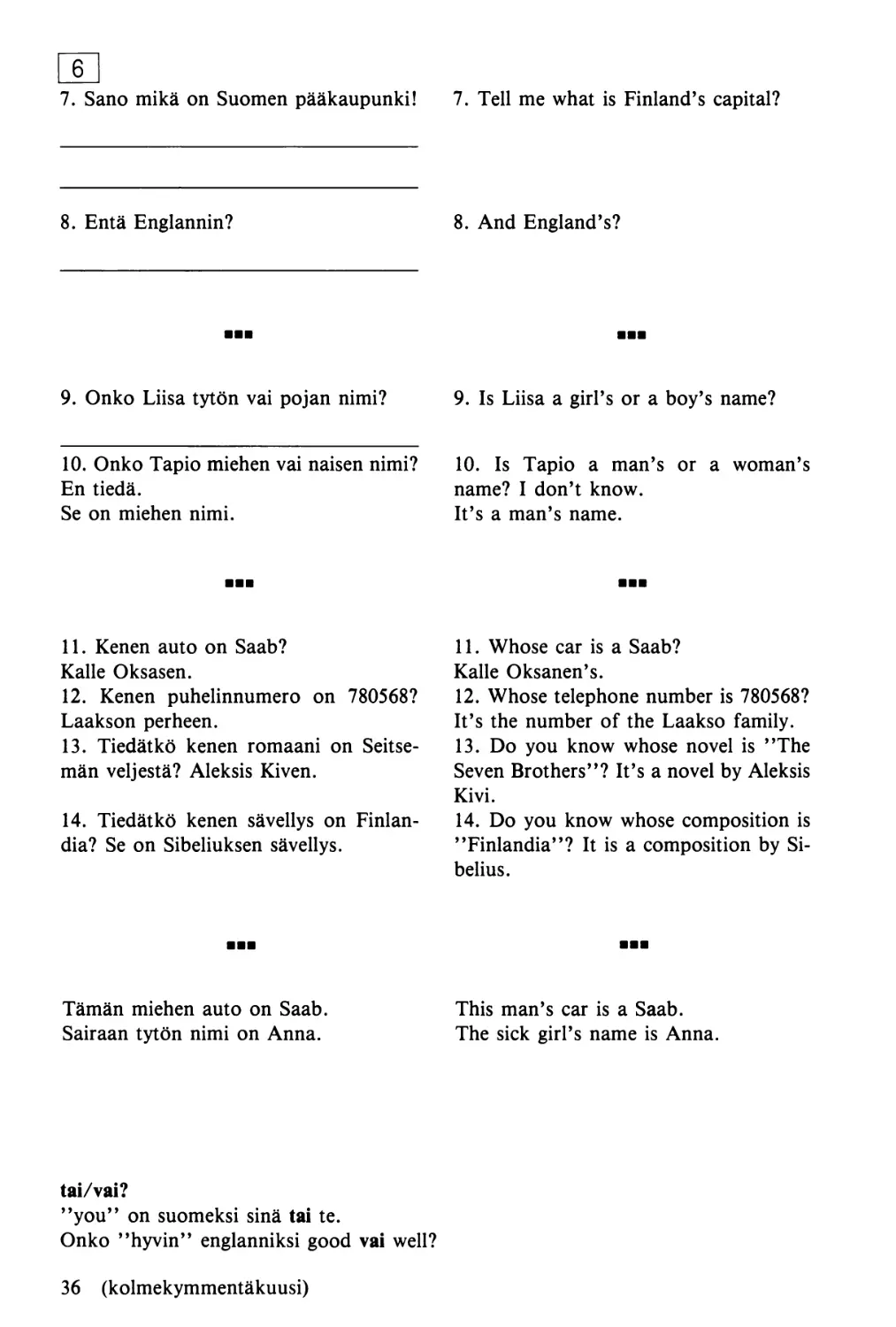
7. 	Sano mikä on Suomen pääkaupunki! 7. Tell me what is Finland’s capital?
8. 	Entä Englannin?
8. And England’s?
9. 	Onko Liisa tytön vai pojan nimi?
9. Is Liisa a girl’s or a boy’s name?
10. 	Onko Tapio miehen vai naisen nimi? 10. Is Tapio a man’s or a woman’s
En tiedä.
Se on miehen nimi.
name? I don’t know.
It’s a man’s name.
11. Kenen auto on Saab?
Kalle Oksasen.
12. Kenen puhelinnumero on 780568?
Laakson perheen.
13. Tiedätkö kenen romaani on
Seitsemän veljestä? Aleksis Kiven.
14. Tiedätkö kenen sävellys on
Finlandia? Se on Sibeliuksen sävellys.
11. Whose car is a Saab?
Kalle Oksanen’s.
12. Whose telephone number is 780568?
It’s the number of the Laakso family.
13. Do you know whose novel is ’’The
Seven Brothers”? It’s a novel by Aleksis
Kivi.
14. Do you know whose composition is
’’Finlandia”? It is a composition by
Sibelius.
Tämän miehen auto on Saab.
Sairaan tytön nimi on Anna.
This man’s car is a Saab.
The sick girl’s name is Anna.
tai/vai?
’’you” on suomeksi sinä tai te.
Onko ’’hyvin” englanniksi good vai well?
36 (kolmekymmentäkuusi)

E
Kielioppia
Structural notes
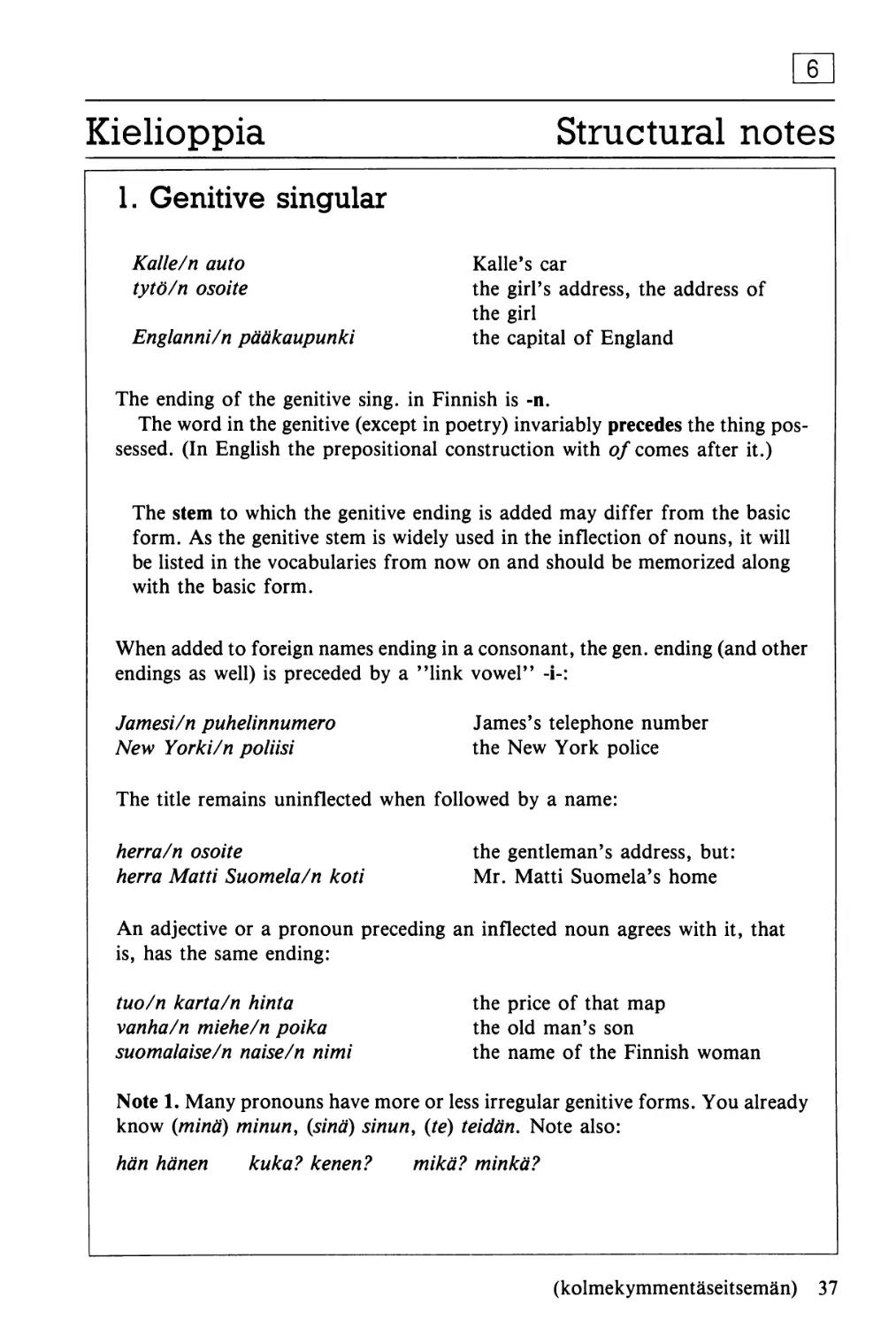
1. Genitive singular
Kalle/n auto
tytö/n osoite
Kalle’s car
the girl’s address, the address of
the girl
the capital of England
Englanni/n pääkaupunki
The ending of the genitive sing, in Finnish is -n.
The word in the genitive (except in poetry) invariably precedes the thing
possessed. (In English the prepositional construction with of comes after it.)
The stem to which the genitive ending is added may differ from the basic
form. As the genitive stem is widely used in the inflection of nouns, it will
be listed in the vocabularies from now on and should be memorized along
with the basic form.
When added to foreign names ending in a consonant, the gen. ending (and other
endings as well) is preceded by a ’’link vowel” -i-:
Jamesi/n puhelinnumero James’s telephone number
New Yorki/n poliisi the New York police
The title remains uninflected when followed by a name:
herra/n osoite the gentleman’s address, but:
herra Matti Suomela/n koti Mr. Matti Suomela’s home
An adjective or a pronoun preceding an inflected noun agrees with it, that
is, has the same ending:
tuo/n karta/n hinta the price of that map
vanha/n miehe/n poika the old man’s son
suomalaise/n naise/n nimi the name of the Finnish woman
Note 1. Many pronouns have more or less irregular genitive forms. You already
know {minä) minun, (sinä) sinun, (te) teidän. Note also:
hän hänen kuka? kenen? mikä? minkä?
(kolmekymmentäseitsemän) 37

6
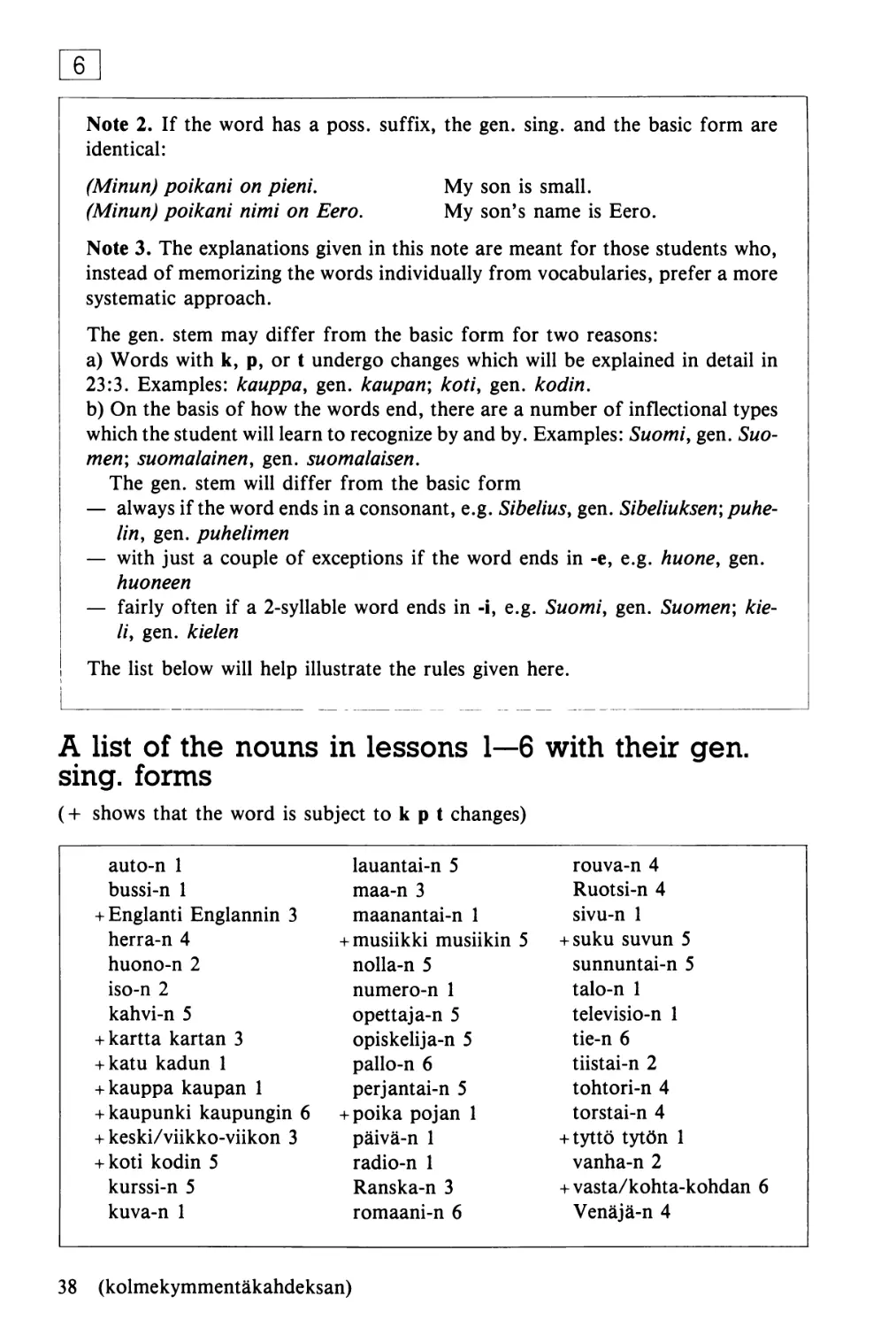
Note 2. If the word has a poss. suffix, the gen. sing, and the basic form are
identical:
(Minun) poikani on pieni. My son is small.
(Minun) poikani nimi on Eero. My son’s name is Eero.
Note 3. The explanations given in this note are meant for those students who,
instead of memorizing the words individually from vocabularies, prefer a more
systematic approach.
The gen. stem may differ from the basic form for two reasons:
a) Words with k, p, or t undergo changes which will be explained in detail in
23:3. Examples: kauppa, gen. kaupan; koti, gen. kodin.
b) On the basis of how the words end, there are a number of inflectional types
which the student will learn to recognize by and by. Examples: Suomi, gen.
Suomen; suomalainen, gen. suomalaisen.
The gen. stem will differ from the basic form
— always if the word ends in a consonant, e.g. Sibelius, gen. Sibeliuksen;
puhelin, gen. puhelimen
— with just a couple of exceptions if the word ends in -e, e.g. huone, gen.
huoneen
— fairly often if a 2-syllable word ends in -i, e.g. Suomi, gen. Suomen;
kieli, gen. kielen
The list below will help illustrate the rules given here.
A list of the nouns in lessons 1—6 with their gen.
sing, forms
(+ shows that the word is subject to k p t changes)
auto-n 1
lauantai-n 5
rouva-n 4
bussi-n 1
maa-n 3
Ruotsi-n 4
+ England Englannin 3
maanantai-n 1
sivu-n 1
herra-n 4
+ musiikki musiikin 5
+ suku suvun 5
huono-n 2
nolla-n 5
sunnuntai-n 5
iso-n 2
numero-n 1
talo-n 1
kahvi-n 5
opettaja-n 5
televisio-n 1
+ kartta kartan 3
opiskelija-n 5
tie-n 6
+ katu kadun 1
pallo-n 6
tiistai-n 2
+ kauppa kaupan 1
perjantai-n 5
tohtori-n 4
+kaupunki kaupungin 6
+ poika pojan 1
torstai-n 4
+ keski/viikko-viikon 3
päivä-n 1
+ tyttö tytön 1
+ koti kodin 5
radio-n 1
vanha-n 2
kurssi-n 5
Ranska-n 3
+ vasta/kohta-kohdan 6
kuva-n 1
romaani-n 6
Venäjä-n 4
38 (kolmekymmentäkahdeksan)

m
i—e words
+ kaikki kaiken 4
kieli kielen 3
kivi kiven 1
nimi nimen 5
nuori nuoren 2
pieni pienen 2
Suomi Suomen 1
uusi uuden 2
nainen words
nainen naisen 1
(all words in -nen)
puhelin puhelimen 5
mies miehen 1
vastaus words
kiitos kiitoksen 3
kysymys kysymyksen 2
Sibelius Sibeliuksen 1
sävellys sävellyksen 6
vastaus vastauksen 2
sairas sairaan 2
kaunis kauniin 2
huone words
huone huoneen 1
kappale kappaleen 1
+ osoite osoitteen 5
perhe perheen 6
(exception: + nukke
nuken 6)
Pronouns:
minä minun 3
sinä sinun 3
hän hänen 2
te teidän 4
tämä-n 1
tuo-n 1
se-n 1
mikä minkä 1
kuka kenen 1
Sanasto
+ kaupunki kaupungin
kenen? (from kuka?)
perhe perheen
+ pää/kaupunki -kaupungin
romaani-n
(cp. novelli short story)
sävellys sävellyksen
tie-n
+ tietää (tiedän tiedät tiedätte)
vai? (cp. tai)
Vocabulary
city, town
whose?
family
capital (city)
novel
composition
road, way
to know (facts) (cp. Fr. savoir,
Germ, wissen)
or (in questions)
☆
englanniksi
+nukke nuken
pallo-n
suomeksi
+ vasta/kohta-kohdan
in English
doll
ball
in Finnish
opposite, contrast
(kolmekymmentäyhdeksän) 39

Kappale
7
Lesson
Paljonko sanakirja
maksaa?
Kirjakaupassa
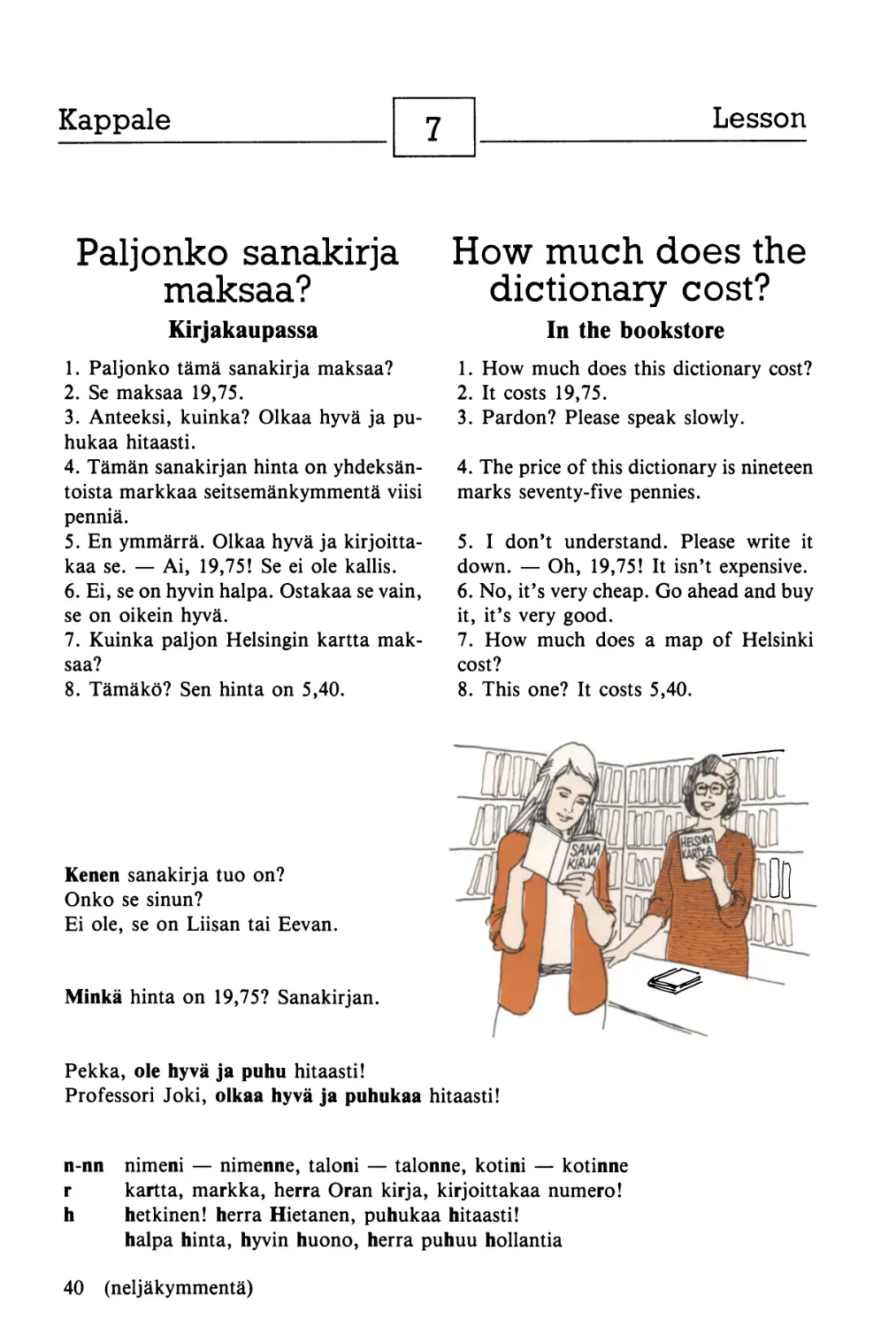
1. Paljonko tämä sanakirja maksaa?
2. Se maksaa 19,75.
3. Anteeksi, kuinka? Olkaa hyvä ja
puhukaa hitaasti.
4. Tämän sanakirjan hinta on
yhdeksäntoista markkaa seitsemänkymmentä viisi
penniä.
5. En ymmärrä. Olkaa hyvä ja
kirjoittakaa se. — Ai, 19,75! Se ei ole kallis.
6. Ei, se on hyvin halpa. Ostakaa se vain,
se on oikein hyvä.
7. Kuinka paljon Helsingin kartta
maksaa?
8. Tämäkö? Sen hinta on 5,40.
How much does the
dictionary cost?
In the bookstore
1. How much does this dictionary cost?
2. It costs 19,75.
3. Pardon? Please speak slowly.
4. The price of this dictionary is nineteen
marks seventy-five pennies.
5. I don’t understand. Please write it
down. — Oh, 19,75! It isn’t expensive.
6. No, it’s very cheap. Go ahead and buy
it, it’s very good.
7. How much does a map of Helsinki
cost?
8. This one? It costs 5,40.
Kenen sanakirja tuo on?
Onko se sinun?
Ei ole, se on Liisan tai Eevan.
Minkä hinta on 19,75? Sanakirjan.
Pekka, ole hyvä ja puhu hitaasti!
Professori Joki, olkaa hyvä ja puhukaa hitaasti!
n-nn nimeni — nimenne, taloni — talonne, kotini — kotinne
r kartta, markka, herra Oran kirja, kirjoittakaa numero!
h hetkinen! herra Hietanen, puhukaa hitaasti!
halpa hinta, hyvin huono, herra puhuu hollantia
40 (nel j äky mmentä)

m
Kielioppia Structural notes
1. 	Basic form of verbs
The basic form (dictionary form, infinitive) of Finnish verbs always ends in
-a (-ä).
Haluan puhu/a ja ymmärtä/ä suo- I want to speak and understand
mea. Finnish.
Haluatko tul/la kurssille? Do you want to come to the
course?
The ending of the infinitive is
— -a (-ä) if the inf. ends in two vowels:
puhu/a, ymmärtä/ä, sano/a, otta/a, maksa/a
— the preceding consonant plus -a (-ä) if the inf. ends in one vowel:
ol/la, tul/la, men/nä to go, halu/ta
More about the basic form of verbs in 27:1.
2. 	Imperative plural (affirmative)
Puhu/kaa suomea, Bill ja Mary! Speak Finnish, Bill and Mary!
Olkaa hyvä ja istu/kaa, rouva Ok- Please sit down, Mrs. Oksanen!
sanen!
Imperative pi. is used when speaking to many people or, formally, to one person
whom you address with his title, family name, and te. It is formed by dropping
the inf. ending and adding -kaa (-kää) to the stem:
puhu/a to speak puhu/kaa! speak!
ol/la to be ol/kaa hyvä ja please (lit. ”be good and”)
istu/a to sit istu/kaa! sit down!
More about the imperative pi. in 30:1.
(The imperative sing, was explained in 5:2.)
(neljäkymmentäyksi) 41

m
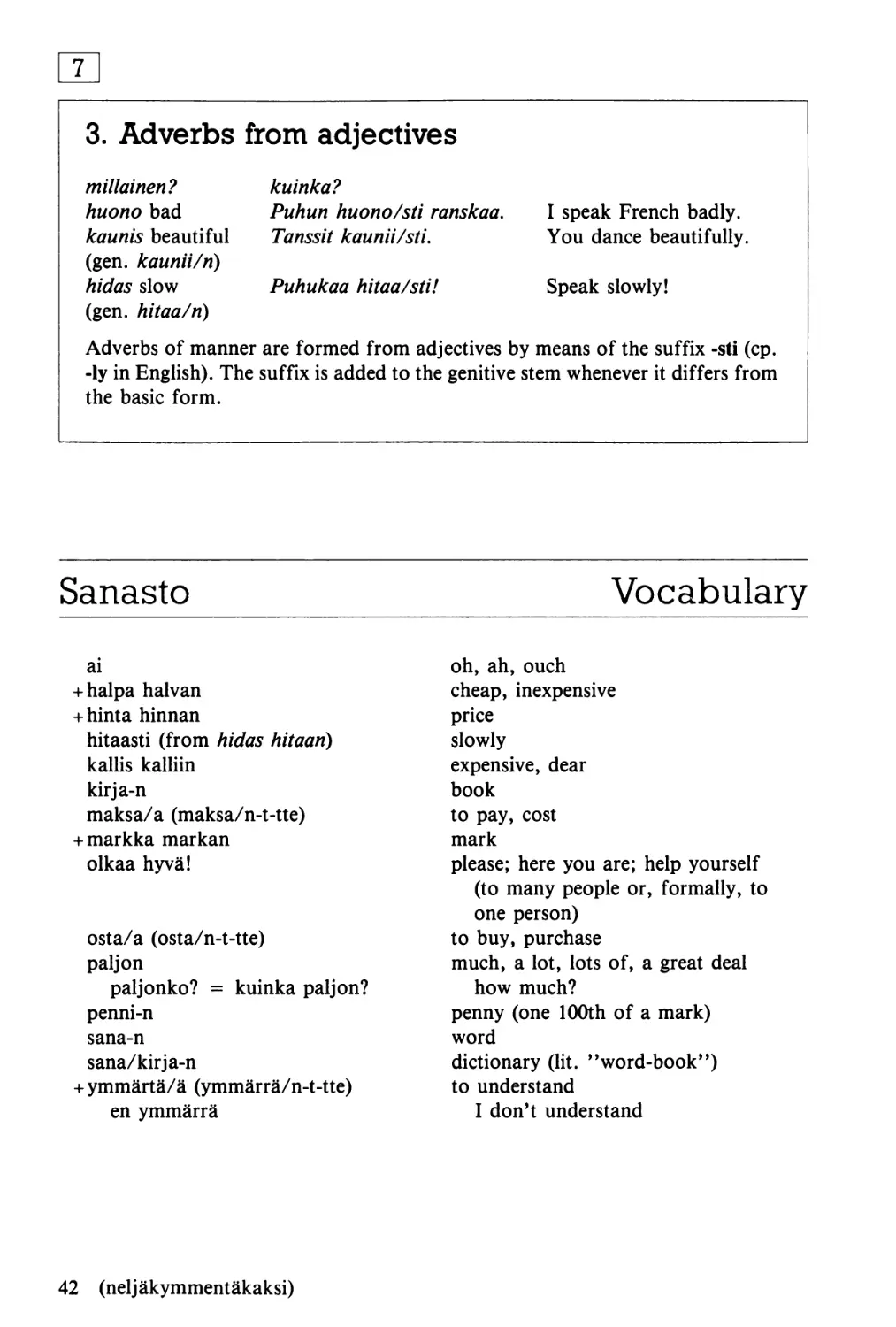
3. Adverbs from adjectives
millainen?
kuinka?
huono bad
Puhun huono/sti ranskaa. I speak French badly.
kaunis beautiful
Tanssit kaunii/sti. You dance beautifully.
(gen. kaunii/n)
hidas slow
Puhukaa hitaa/sti! Speak slowly!
(gen. hitaa/ri)
Adverbs of manner are formed from adjectives by means of the suffix -sti (cp.
-ly in English). The suffix is added to the genitive stem whenever it differs from
the basic form.
Sanasto
Vocabulary
ai
-i-halpa halvan
+ hinta hinnan
hitaasti (from hidas hitaan)
kallis kalliin
kirja-n
maksa/a (maksa/n-t-tte)
+ markka markan
olkaa hyvä!
osta/a (osta/n-t-tte)
paljon
paljonko? = kuinka paljon?
penni-n
sana-n
sana/kirja-n
+ ymmärtä/ä (ymmärrä/n-t-tte)
en ymmärrä
oh, ah, ouch
cheap, inexpensive
price
slowly
expensive, dear
book
to pay, cost
mark
please; here you are; help yourself
(to many people or, formally, to
one person)
to buy, purchase
much, a lot, lots of, a great deal
how much?
penny (one 100th of a mark)
word
dictionary (lit. ”word-book”)
to understand
I don’t understand
42 (neljäkymmentäkaksi)

7
☆
halu/ta (halua/n-t-tte)
-i-kuppi kupin
lasi-n
laula/a (laula/n-t-tte)
men/nä (mene/n-t-tte)
nopea-n hidas)
tee-n
to want, wish, desire
cup
glass
to sing
to go
fast, quick, rapid
tea
Numerals
yksi (yhden) 1
kaksi (kahden) 2
kolme (-n) 3
neljä (-n) 4
viisi (viiden) 5
kuusi (kuuden) 6
seitsemän (seitsemän) 7
kahdeksan (kahdeksan) 8
yhdeksän (yhdeksän) 9
kymmenen (kymmenen) 10
yksi/toista (yhden/toista) 11
kaksi/toista 12
kolme/toista 13
kaksi/kymmentä
(kahden/kymmenen) 20
kaksi/kymmentä/yksi 21
+ sata (sadan) 100
sata/kymmenen 110
viisi/sataa 500
tuhat (tuhannen) 1000
neljä/tuhatta 4000
miljoona (-n) 1 000 000
In colloquial Finnish many numerals have short quick-speech forms: yks, kaks,
viis, kuus, kaks/kyt/yks, koi/kyt/viis etc.
(neljäkymmentäkolme) 43

Kappale
8
Lesson
Oikealla ja
vasemmalla
iltej
Right and left
p/MLANDM'
talo
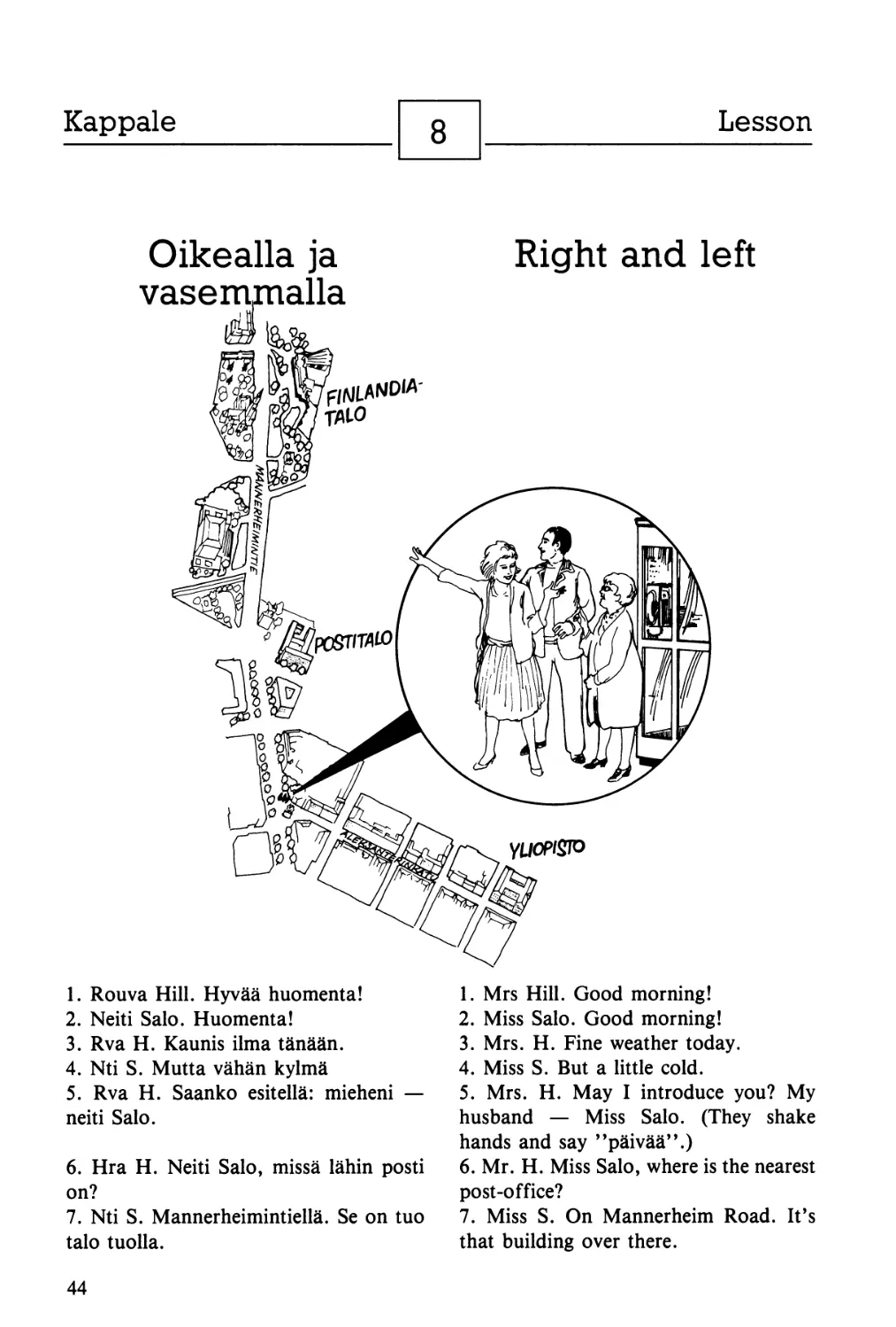
1. Rouva Hill. Hyvää huomenta!
2. Neiti Salo. Huomenta!
3. Rva H. Kaunis ilma tänään.
4. Nti S. Mutta vähän kylmä
5. Rva H. Saanko esitellä: mieheni —
neiti Salo.
6. Hra H. Neiti Salo, missä lähin posti
on?
7. Nti S. Mannerheimintiellä. Se on tuo
talo tuolla.
1. Mrs Hill. Good morning!
2. Miss Salo. Good morning!
3. Mrs. H. Fine weather today.
4. Miss S. But a little cold.
5. Mrs. H. May I introduce you? My
husband — Miss Salo. (They shake
hands and say "päivää”.)
6. Mr. H. Miss Salo, where is the nearest
post-office?
7. Miss S. On Mannerheim Road. It’s
that building over there.
44

8
8. Rva H. Ja millä kadulla Finlandia-talo
on?
9. Nti S. Myös Mannerheimintiellä,
tuolla oikealla.
10. Hra H. Missä yliopisto on?
11. Nti S. Se on Aleksanterinkadulla.
”Aleksi” on tämä katu täällä
vasemmalla.
12. Rva H. Kiitoksia, neiti Salo, ja
näkemiin!
8. Mrs. H. And on what street is
Finlandia Hall?
9. Miss S. Also on Mannerheim Road,
over there, on the right.
10. Mr. H. Where is the University?
11. Miss S. It’s on Alexander Street.
’’Aleksi” is this street here, on the left.
12. Mrs. H. Thank you very much, Miss
Salo, and goodbye.
Missä auto on? Kadulla.
Millä sinä kirjoitat? Kynällä.
Millä te tulette kurssille? Bussilla. Metrolla. Autolla.
uo huomenta, nuori mies, tuo suomalainen tuolla
uo-yö tuo myös, myös tuo, myös Suomi, Suomi myös
uo-yö-ie myös mies, tuo mies myös, myös tuo tie
Keep stress on first syllable:
huomenta, anteeksi, kadulla, Helsinki, esitellä, Finlandia-talo,
Mannerheimintie, yliopisto
Kielioppia
Structural notes
1. 	The ”on” case (adessive)
missä? where?
katu (gen. kadu /n) street kadu/llä on the street
hyvä tie a good road hyvä/llä tie/llä on a good road
ovi (gen. ove/n) door ove/lla at the door
In local expressions answering the questions ’’where?”, ’’wherefrom?”,
’’whereto?” Finnish very often uses noun endings, not prepositions as in
English.
The ending roughly corresponding to ”on, at” is -llä (-llä). Whenever the
basic form and the genitive stem are different, use the gen. stem before this
ending.
45

8
Note: tämä katu but tä/llä kadu/lla
mikä katu? mi/llä kadu/lla?
se katu si/llä kadu/lla
Local cases may also have non-local functions. Thus, the ending -llä (-llä) has
also the meaning ’’with, by means of (something)”:
Kirjoitan kynä/llä. I write with a pen (pencil).
Mi/llä sinä maksat kaupassa? Ra- What do you pay with in the shop?
ha/llä tai seki/llä. With money or with a check.
Tule taksi /llä! Come by taxi!
When you use poss. suffixes with the different cases, the poss. suffix always
follows the case ending:
Istun tuolilla/ni. I’m sitting on my chair.
Tuletko sinä kurssille autolla/si? Do you come to the course by car?
(The ”in” case will be explained in 10:1.)
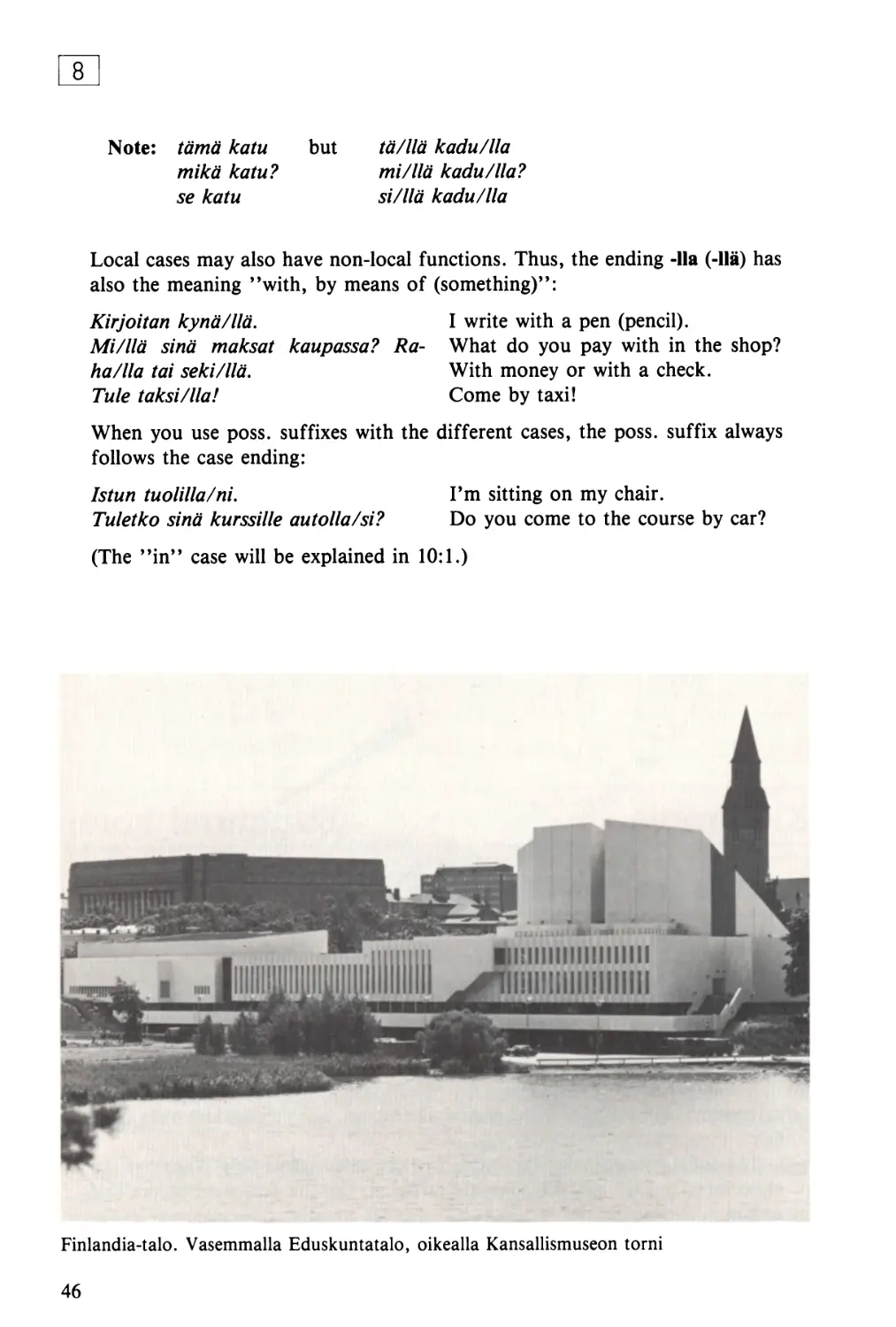
Finlandia-talo. Vasemmalla Eduskuntatalo, oikealla Kansallismuseon torni
46

8
Sanasto
Vocabulary
+ esitel/lä (esittele/n-t-tte)
huomenta (= hyvää A.)
ilma-n
kiitoksia
kylmä-n lämmin warm)
lähin lähimmän
missä?
myös
+ neiti neidin
oikealla
posti-n
saa/da (saa/n-t-tte)
saanko?
tuolla (from tuo)
täällä (from tämä)
vasemmalla
yli/opisto-n
to introduce
good morning
air; weather
thank you, thanks
cold
nearest, closest
where?
also, too
Miss
on the right
post, mail; post-office; mailman,
postman
to be allowed, may; to get, receive
may I? may I have?
over there
here
on the left
university
☆
hotelli-n
+ konsertti konsertin
kynä-n
metro-n
millä? (from mikä?)
ovi oven
raha-n
rahaa
+ sekki sekin
taksi-n
teatteri-n
turisti-n
vaimo-n
hotel
concert
pen, pencil
subway
what with? by what means?
door
money; coin
some money
check
taxi
theater
tourist
wife
47

Kappale
9
Lesson
Onko sinulla rahaa?
Rouva Hill haluaa soittaa
1. Rva H. Minä haluan soittaa. Missä on
lähin puhelin?
2. Hra H. Tuolla on kioski. Onko sinulla
markka? Minulla ei ole.
3. Rva H. Minä luulen, että minulla on
pikkurahaa. Hetkinen, minä katson. Ei
ole!
4. Hra H. Katso, neiti Salo on vielä
tuolla. Ehkä hänellä on rahaa. Anteeksi,
neiti Salo! Onko teillä markka? Vaimoni
haluaa soittaa.
5. Nti S. Hetkinen vain, minä katson. Ei
ole. Mutta tuolla tulee Ville Vuori. Ehkä
hänellä on. Hei, Ville! Onko sinulla
markka? Rouva Hill haluaa soittaa.
6. V. Hetkinen! Ei ole, minulla on vain
viisikymmentä penniä.
7. Rva H. No, sitten minä en voi soittaa.
Minulla on aina huono onni.
Do you have any
money?
Mrs. Hill wants to make
a phone call
1. Mrs. H. I want to make a phone call.
Where’s the nearest telephone?
2. Mr. H. There’s a booth. Do you have
a mark? I don’t.
3. Mrs. H. I think (that) I have some
small change. One moment, I’ll see. No,
I haven’t any!
4. Mr. H. Look, Miss Salo is still there.
Perhaps she has some money. Excuse
me, Miss Salo! Do you have a mark? My
wife wants to make a phone call.
5. Miss S. Just a moment, I’ll see. No, I
haven’t. But there comes Ville Vuori.
Maybe he has some. Hello, Ville! Do you
have a mark? Mrs. Hill wants to make a
phone call.
6. V. One moment! No, I only have fifty
pennies.
7. Mrs. H. Well, then I can’t make my
phone call. I always have bad luck.
"that”
Tuo on kaunis valssi.
Minä luulen, että se on Sibeliuksen Valse triste.
pikku/pieni pieni/vähän
Pikku Liisa on vielä pieni. Rauma on pieni kaupunki (ei iso).
Minulla on vähän rahaa (ei paljon).
Kenellä on markka?
Minulla.
48

Kielioppia
Structural notes
1. 	Personal pronouns
The six personal pronouns in Finnish are:
Gen.
minä I minun my, mine me we
sinä you sinun your(s) te you
Gen.
meidän our(s)
teidän your(s)
hän he/she hänen his/her(s) he they heidän their(s)
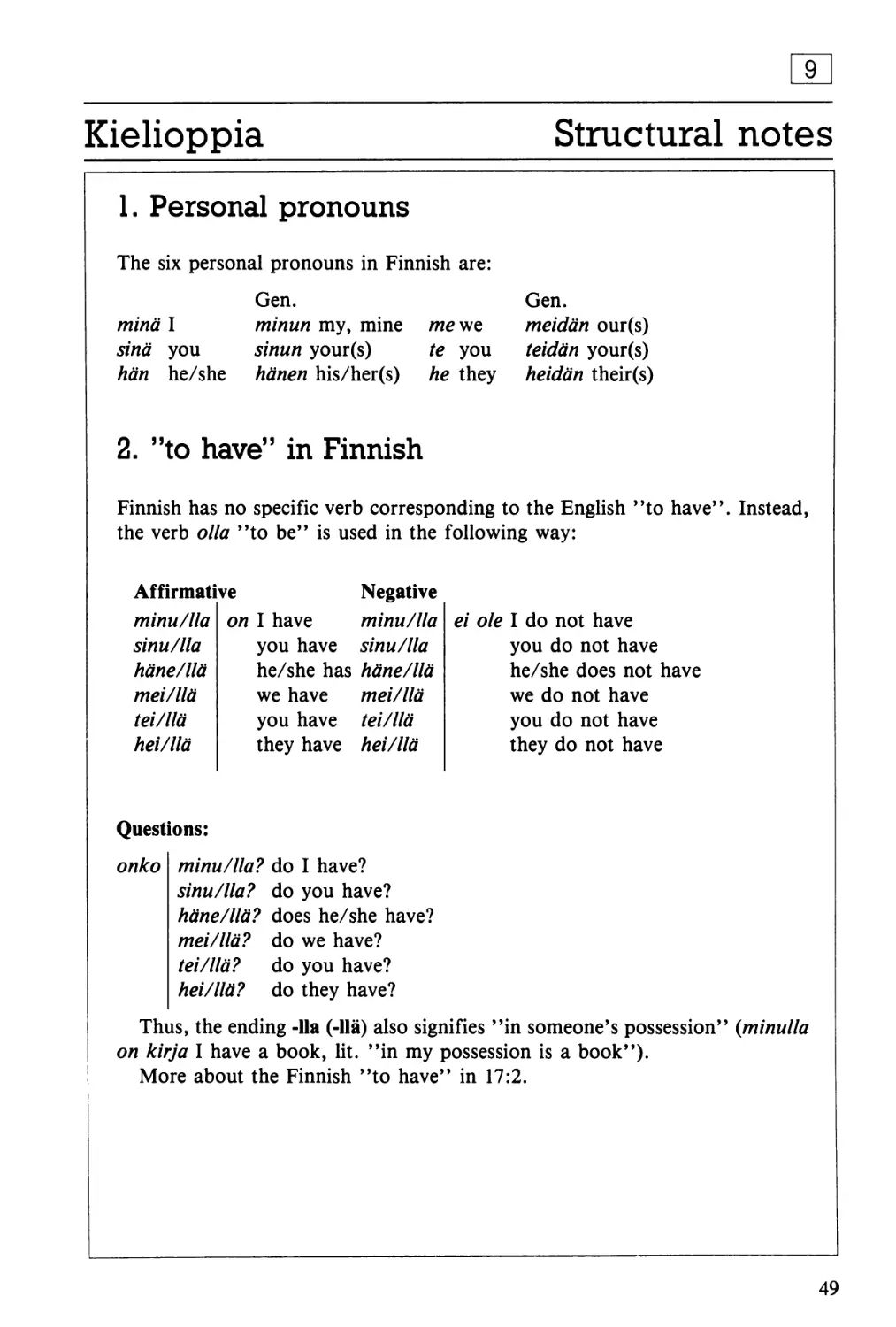
2. 	”to have” in Finnish
Finnish has no specific verb corresponding to the English ”to have”. Instead,
the verb olla ”to be” is used in the following way:
ei ole I do not have
you do not have
he/she does not have
we do not have
you do not have
they do not have
Questions:
onko minu/lla? do I have?
sinu/lla? do you have?
häne/llä? does he/she have?
mei/llä? do we have?
tei/llä? do you have?
hei/llä? do they have?
Thus, the ending -llä (-llä) also signifies ”in someone’s possession” (minulla
on kirja I have a book, lit. ”in my possession is a book”).
More about the Finnish ”to have” in 17:2.
Affirmati
ve
Negative
minu/lla
on I have
minu/lla
sinu/lla
you have
sinu/lla
häne/llä
he/she has
häne/llä
mei/llä
we have
mei/llä
tei/llä
you have
tei/llä
hei/llä
they have
hei/llä
49

Sanasto
Vocabulary
aina
ehkä
että (must not be omitted!)
luulen, että voin
hetkinen hetkisen (= hetki hetken)
katso/a (katso/n-t-tte)
katso! (colloq. kato!)
kioski-n
luul/la (luule/n-t-tte)
no
onni onnen
pikku (indeclinable)
pikku/raha
sitten
vielä
voi/da (voi/n-t-tte)
☆
he heidän
kello-n
koira-n
+ lamppu lampun
me meidän
valssi-n
always
maybe, perhaps
that (when starting a clause)
I think I can
moment, while
to look, watch; to have a look
look! see!
stand, booth, kiosk
to think, suppose, presume
well, now
happiness; luck, fortune
little
small change
then, after that; ago
still, yet; more, also
to be able, can
they (human beings)
watch, clock; the time; bell
dog
lamp
we
waltz
50

Kappale
10
Lesson
Missä te asutte?
1. Missä te asutte, herra Lake?
2. Minä asun nyt Helsingissä. Mutta
kotini on Skotlannissa (Englannissa,
Amerikassa, New Yorkin valtiossa).
3. Missä kaupungissa?
4. Edinburghissa. Se on Skotlannin
pääkaupunki.
5. Skotlanti on kaunis maa.
6. Niin on. Siellä on kiva asua.
7. Asuuko teidän perheenne myös
Suomessa?
8. Asuu. Me asumme täällä kaikki.
Meillä on oikein mukava asunto.
9. Missä teidän asuntonne on?
10. Töölössä, Hesperiankadulla.
11. Vai niin! Siellä asuvat myös Juhani ja
Riitta Metsä.
12. Niin, he asuvat samassa talossa.
Heillä on kaunis koti. Juhani Metsä on hyvä
ystäväni. Hän on oikein mukava
ihminen.
tuolla/siellä
. i /
Where do you live?
1. Where do you live, Mr. Lake?
2. I live in Helsinki now. But my home is
in Scotland (England, America, New
York State).
3. In what city?
4. In Edinburgh. It’s the capital of
Scotland.
5. Scotland is a beautiful country.
6. Yes, it is. It’s nice to live there.
7. Does your family also live in Finland?
8. Yes, they do. We all live here. We have
a very nice apartment.
9. Where is your apartment?
10. In Töölö, on Hesperia Street.
11. I see. Juhani and Riitta Metsä also
live there.
12. Yes, they live in the same building.
They have a pretty home. Juhani Metsä
is a good friend of mine. He’s a very nice
person.
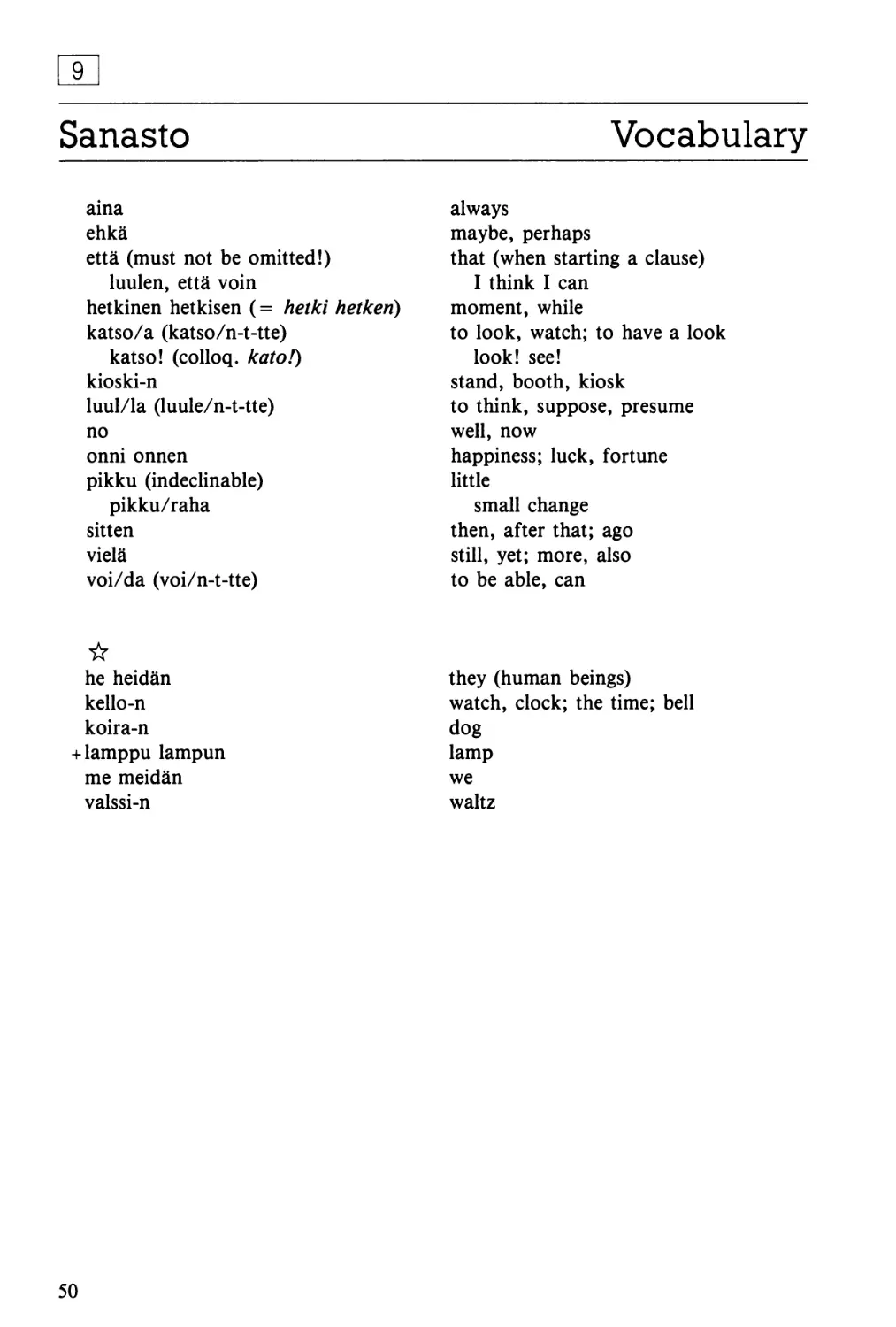
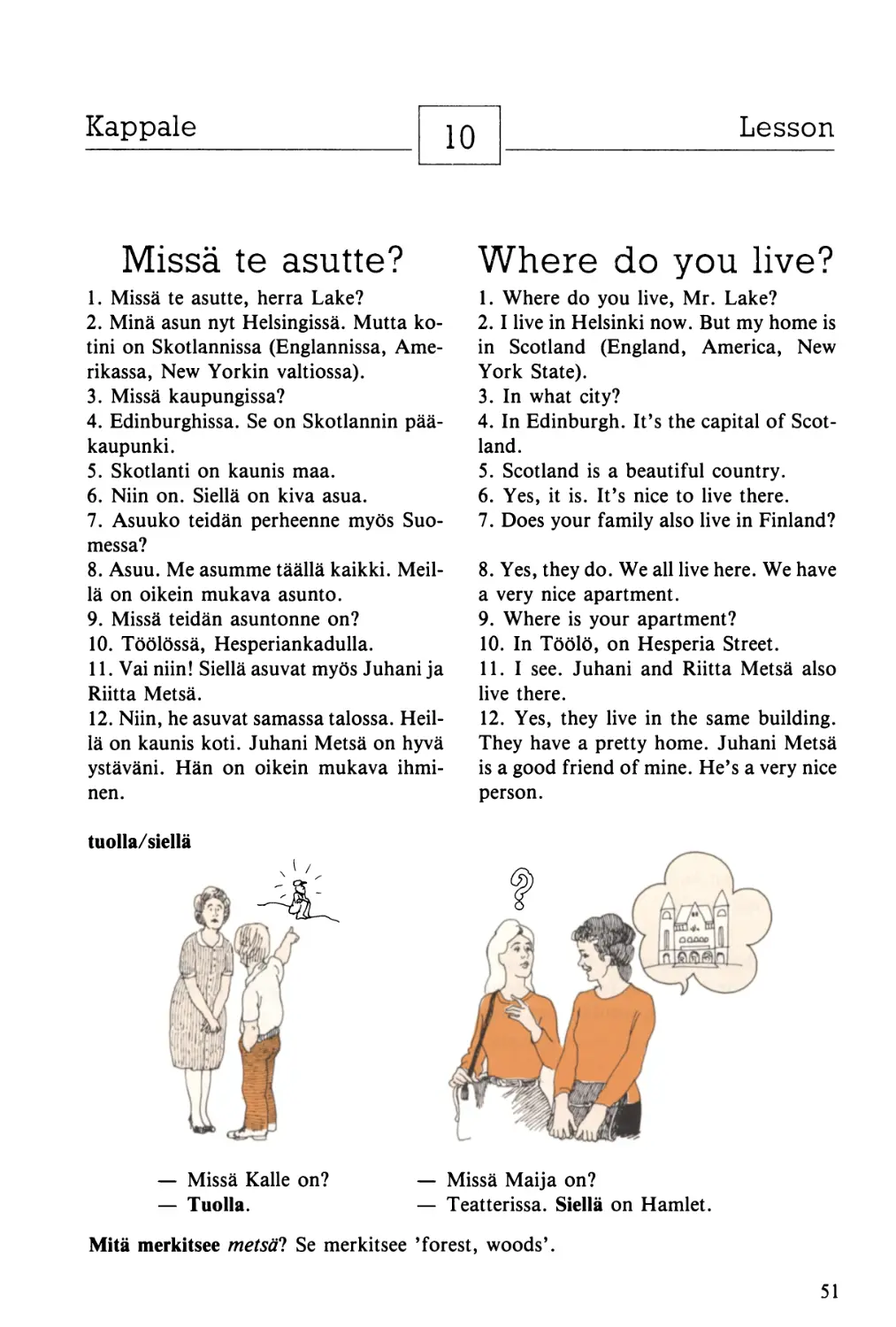
— Missä Maija on?
— Teatterissa. Siellä on Hamlet.
’forest, woods’.
— Missä Kalle on?
— Tuolla.
Mitä merkitsee metsä? Se merkitsee
51

10
Kielioppia Structural notes
1. 	The ”in” case (inessive)
talo
metsä
Suomi (gen.
Suome/ri)
uusi kauppa
(gen. uude/n
kaupa/n)
house
forest
Finland
missä?
talo/ssa
metsä/ssä
Suome/ssa
where?
in a house
in the forest
in Finland
a new shop uude/ssa kaupa/ssa in a new shop
The ending -ssä (-ssä) corresponds roughly to the English preposition ”in”.
Whenever the basic form and the gen. stem are different, use the gen. stem
before this ending.
Note: mikä maa? but mi/ssä maa/ssa?
tämä maa? tä/ssä maa/ssa
se maa siinä maa/ssa
Note also:
Missä sinä olet?
Mi/ssä huonee/ssa sinä olet?
Where are you?
In which room are you?
The poss. suffix comes after the case ending:
Oletko sinä huoneessa/si?
Istun autossa/ni.
Are you in your room?
I’m sitting in my car.
Bad mistake: Kurssi on Helsingissä yliopistossa.
"Helsingin” is a gen. form (’’Helsinki’s, of Helsinki”), and is not an adjective
or pronoun, which would agree with the following noun.
52

10
2. 	Present tense of verbs (affirmative)
asu/a to live
tul/la to come
(minä) asu/n
(sinä) asu/t
hän asu/u
(me) asu/mme
(te) asu/tte
he asu/vat
I live, am living
you live, are living
he/she lives, is living
we live, are living
you live, are living
they live, are living
(minä) tule/n
(sinä) tule/t
hän tule/e
(me) tule/mme
(te) tule/tte
he tule/vat
I come
you come
he/she comes
we come
you come
they come
The ending of the 3rd pers. sing, is made by prolonging the final vowel of the
stem. It may be any of the eight vowels (in these examples u, e). If there is
already a long vowel or a diphthong, no ending is added: (voi/n, voi/t) hän voi
he/she can, (saa/n, saa/t) hän saa he/she is allowed; he/she receives.
The ending of the 3rd pers. pi. is -vat (-vät).
The pronouns minä, sinä, me, te may be omitted (cp. 3:1).
Some verbs have k p t changes in their conjugation. For some time, therefore,
the entire present tense of each new verb will be given in the vocabulary.
In casual everyday speech you may hear forms which differ from the
standard conjugation. For instance, the 3rd pers. sing, is often used instead of the
3rd pers. pi.: Kalle ja Ville puhuu ("puhuvat”) englantia.
The negative present tense will be explained in 12:2.
Present tense of the verbs covered in lessons 1—10
(For inflection types like voida, puhua etc. see 27:1.)
voida verbs
saa/da 8 saa/n -t saa saa/mme -tte -vat
voi/da 9 voi/n -t voi voi/mme -tte -vat
puhua verbs
asu/a 10
asu/n -t -u -mme -tte -vat
istu/a 5
istu/n -t -u -mme -tte -vat
katso/a 9
katso/n -t -o -mme -tte -vat
+ kirjoitta/a 5
kirjoita/n -t kirjoittaa kirjoita/mme -tte kirjoittavat
laula/a 7
laula/n -t -a -mme -tte -vat
maksa/a 7
maksa/n -t -a -mme -tte -vat
osta/a 7
osta/n -t -a -mme -tte -vat
+ otta/a 5
ota/n -t ottaa ota/mme -tte ottavat
puhu/a 3
puhu/n -t -u -mme -tte -vat
sano/a 5
sano/n -t -o -mme -tte -vat
+ soitta/a 5
soita/n -t soittaa soita/mme -tte soittavat
53

10
tanssi/a 5
tanssi/n -t -i -mme -tte -vat
+ tietä/ä 6
tiedä/n -t tietää tiedä/mme -tte tietävät
+ ymmärtä/ä 7
ymmärrä/n -t ymmärtää ymmärrä/mme -tte ymmärtävät
tulla verbs
-h esitel/lä 8
esittele/n -t -e -mme -tte -vät
luul/la 9
luule/n -t -e -mme -tte -vat
men/nä 7
mene/n -t -e -mme -tte -vät
ol/la 1
ole/n -t on ole/mme -tte ovat
tul/la 5
tule/n -t -e -mme -tte -vat
haluta verbs
halu/ta 7
halua/n -t -a -mme -tte -vat
merkitä verbs
merki/tä 10
merkitse/n -t -e -mme -tte -vät
Sanasto
Vocabulary
asu/a (asu/n-t-u-mme-tte-vat)
+ asunto asunnon
ihminen ihmisen
kiva-n (= hauska, mukava)
metsä-n
mukava-n
niin
nyt
sama-n
siellä
vai niin
valtio-n
ystävä-n
to live, reside, dwell; stay
place to live, apartment
human being, man, person;
pi. people
nice, fun (colloq.)
forest, woods
nice, pleasant; comfortable
so; yes
now
same
there
I see, really? is that so?
state
friend
☆
baari-n
hauska-n
kotona
merki/tä (merkitse/n-t-e-mme-tte
-vät)
sauna-n
sohva-n
yksin
bar; cafeteria
nice, interesting, fun
at home
to mean, signify, denote; to mark
sauna
sofa, couch
alone, by oneself
54

Kappale
11
Lesson
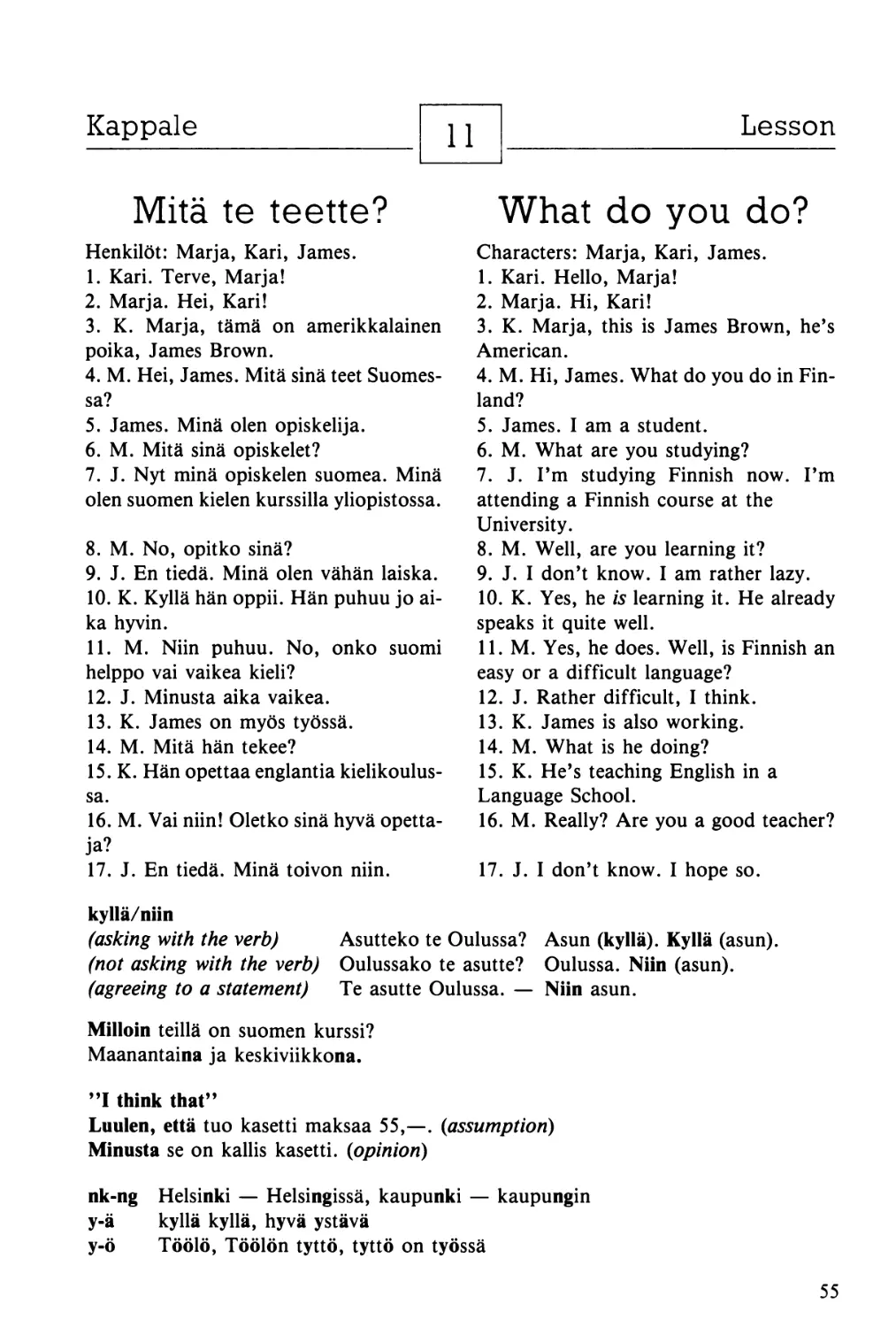
Mitä te teette?
Henkilöt: Marja, Kari, James.
1. Kari. Terve, Marja!
2. Marja. Hei, Kari!
3. K. Marja, tämä on amerikkalainen
poika, James Brown.
4. M. Hei, James. Mitä sinä teet
Suomessa?
5. James. Minä olen opiskelija.
6. M. Mitä sinä opiskelet?
7. J. Nyt minä opiskelen suomea. Minä
olen suomen kielen kurssilla yliopistossa.
8. M. No, opitko sinä?
9. J. En tiedä. Minä olen vähän laiska.
10. K. Kyllä hän oppii. Hän puhuu jo
aika hyvin.
11. M. Niin puhuu. No, onko suomi
helppo vai vaikea kieli?
12. J. Minusta aika vaikea.
13. K. James on myös työssä.
14. M. Mitä hän tekee?
15. K. Hän opettaa englantia
kielikoulussa.
16. M. Vai niin! Oletko sinä hyvä opetta-
ja?
17. J. En tiedä. Minä toivon niin.
What do you do?
Characters: Marja, Kari, James.
1. Kari. Hello, Marja!
2. Marja. Hi, Kari!
3. K. Marja, this is James Brown, he’s
American.
4. M. Hi, James. What do you do in
Finland?
5. James. I am a student.
6. M. What are you studying?
7. J. I’m studying Finnish now. I’m
attending a Finnish course at the
University.
8. M. Well, are you learning it?
9. J. I don’t know. I am rather lazy.
10. K. Yes, he is learning it. He already
speaks it quite well.
11. M. Yes, he does. Well, is Finnish an
easy or a difficult language?
12. J. Rather difficult, I think.
13. K. James is also working.
14. M. What is he doing?
15. K. He’s teaching English in a
Language School.
16. M. Really? Are you a good teacher?
17. J. I don’t know. I hope so.
kyllä/niin
(asking with the verb)
(not asking with the verb)
(agreeing to a statement)
Asutteko te Oulussa?
Oulussako te asutte?
Te asutte Oulussa. —
Asun (kyllä). Kyllä (asun).
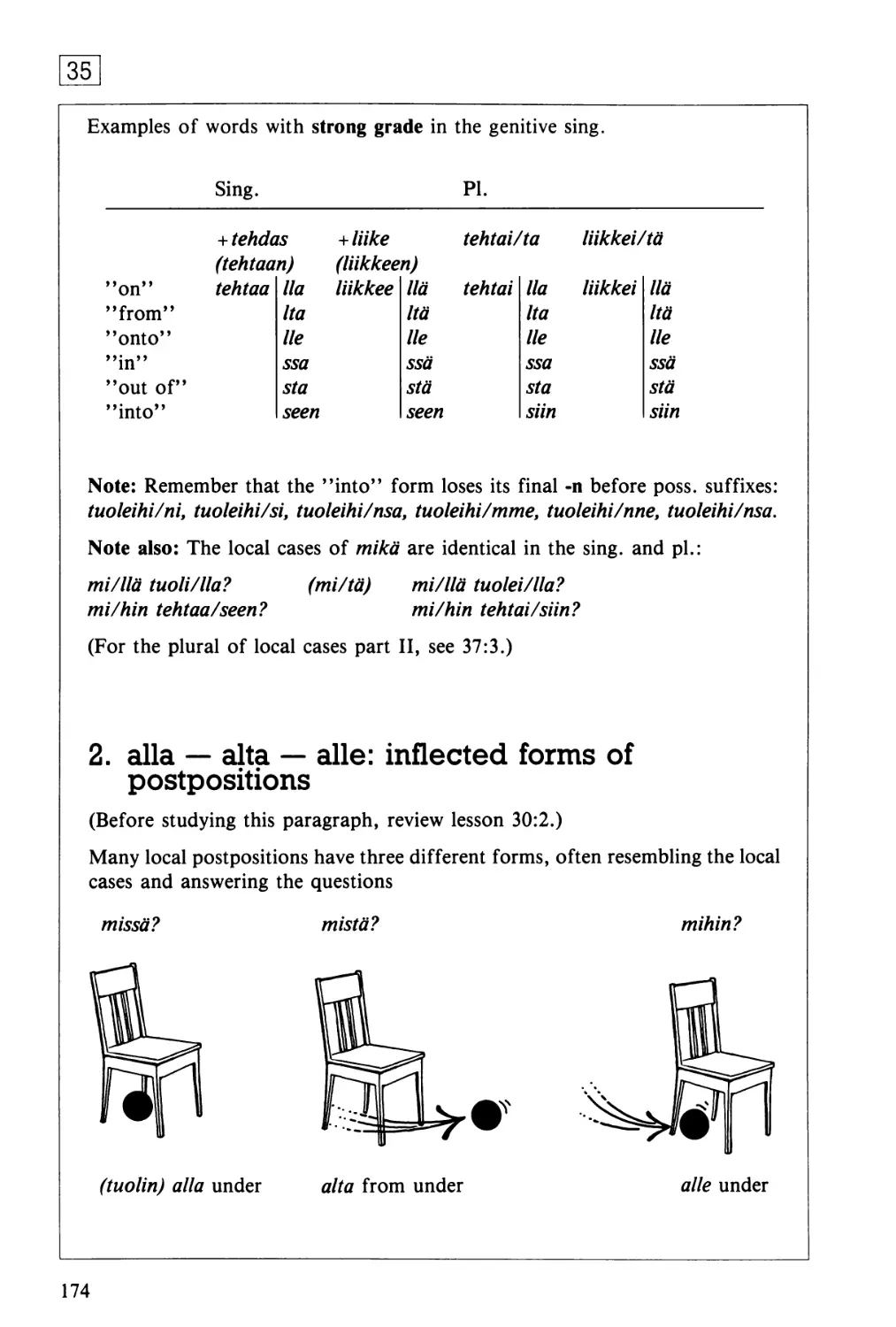
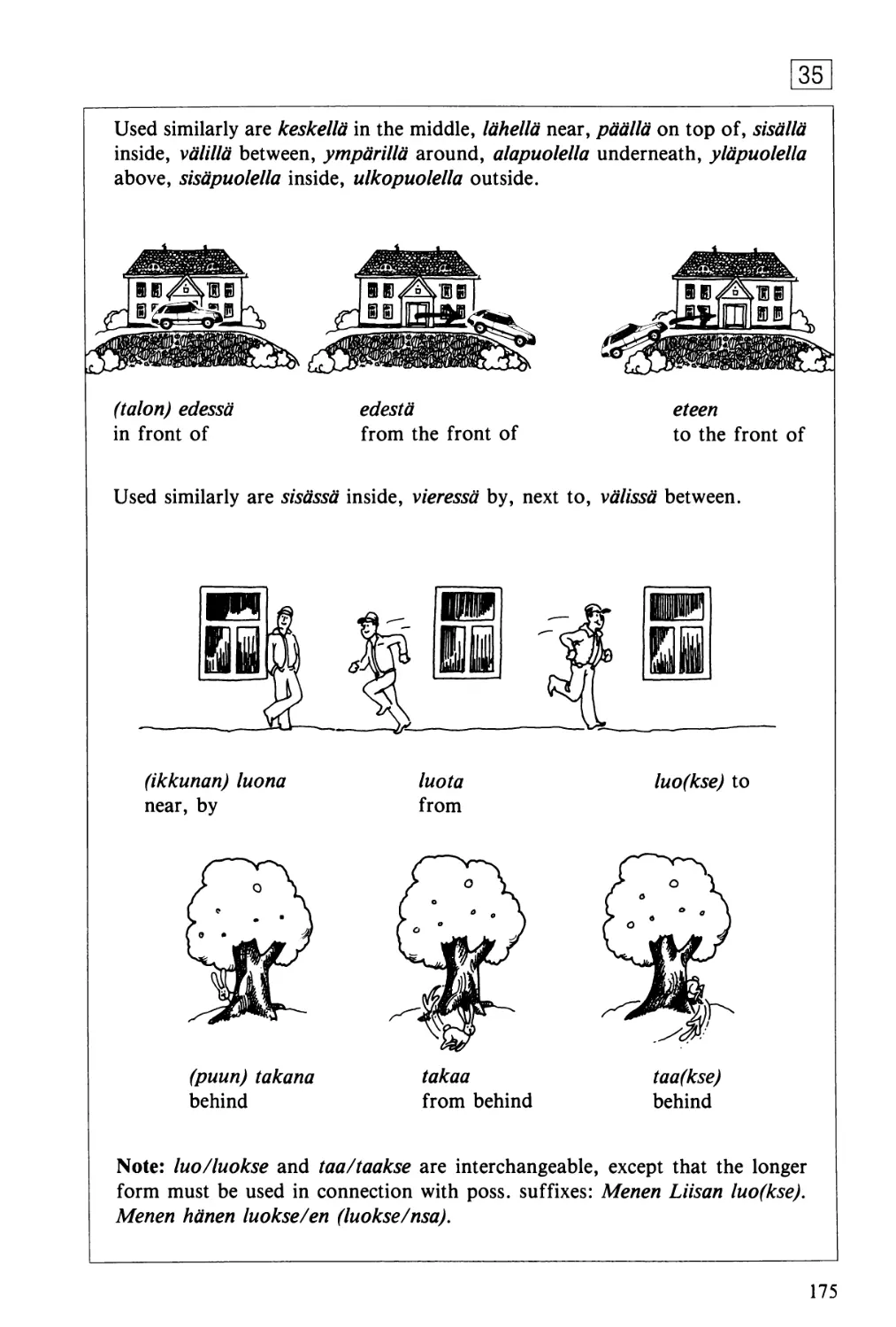
Oulussa. Niin (asun).
Niin asun.
Milloin teillä on suomen kurssi?
Maanantaina ja keskiviikkona.
”1 think that”
Luulen, että tuo kasetti maksaa 55,—. (<assumption)
Minusta se on kallis kasetti, (opinion)
nk-ng Helsinki — Helsingissä, kaupunki — kaupungin
y-ä kyllä kyllä, hyvä ystävä
y-ö Töölö, Töölön tyttö, tyttö on työssä
55

QD
Kielioppia
Structural notes
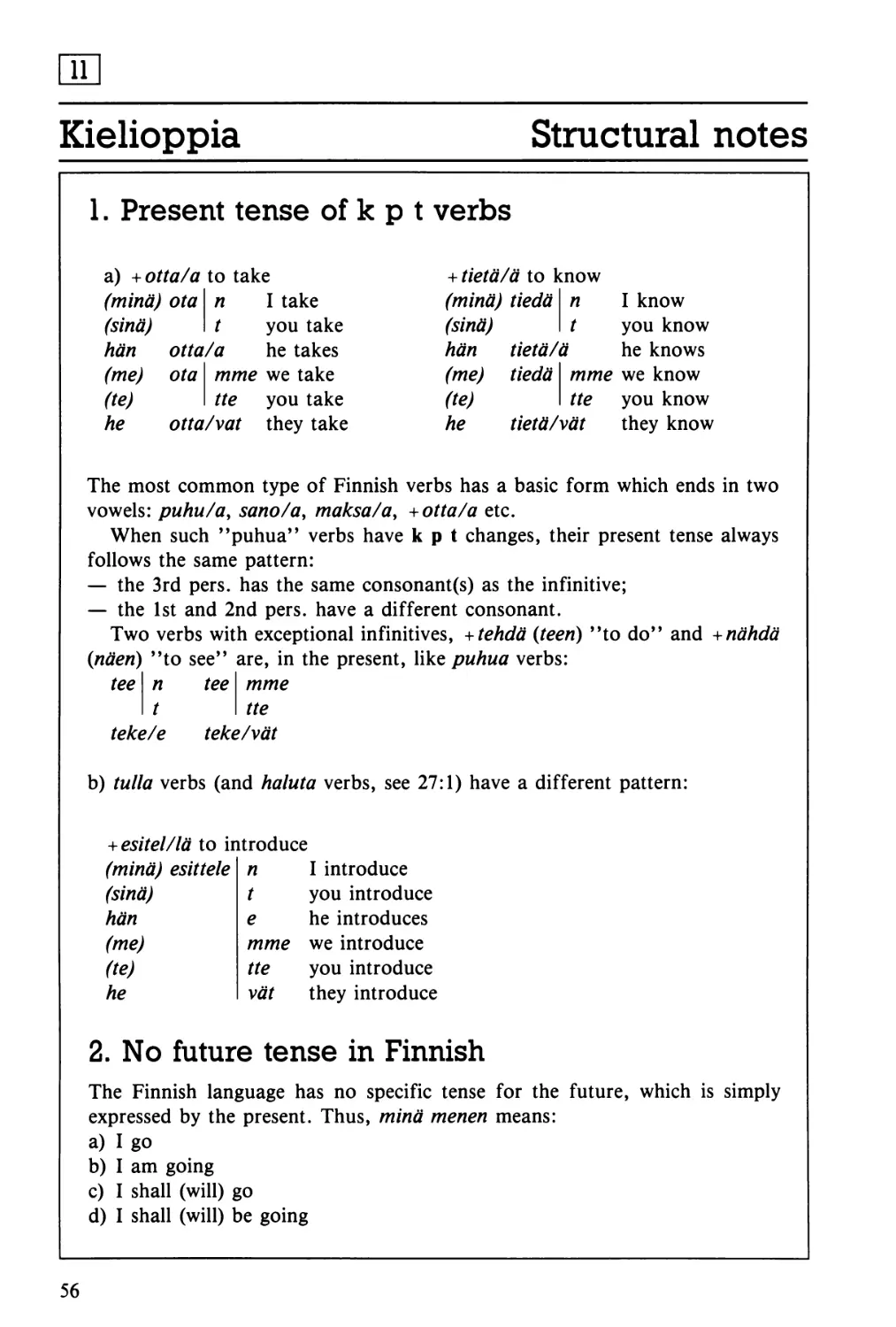
1. 	Present tense of k p t verbs
a) 	+ otta/a to take
+ tietä/ä to know
(minä) ota
(sinä)
hän
(me)
(te)
he
n
t
otta/a
ota
I take
you take
he takes
mme we take
tte you take
otta/vat they take
(minä) tiedä
(sinä)
hän tietä/ä
(me) tiedä
(te)
n I know
t you know
he knows
mme we know
tte you know
he tietä/vät they know
The most common type of Finnish verbs has a basic form which ends in two
vowels: puhu/a, sano/a, maksa/a, + otta/a etc.
When such "puhua” verbs have k p t changes, their present tense always
follows the same pattern:
— the 3rd pers. has the same consonant(s) as the infinitive;
— the 1st and 2nd pers. have a different consonant.
Two verbs with exceptional infinitives, + tehdä (teen) "to do" and + nähdä
(näen) "to see" are, in the present, like puhua verbs:
tee n
t
teke/e
tee mme
tte
teke/vät
b) 	tulla verbs (and haluta verbs, see 27:1) have a different pattern:
+ esitel/lä to introduce
(minä) esittele
n
I introduce
(sinä)
t
you introduce
hän
e
he introduces
(me)
mme
we introduce
(te)
tte
you introduce
he
vät
they introduce
2. 	No future tense in Finnish
The Finnish language has no specific tense for the future, which is simply
expressed by the present. Thus, minä menen means:
a) I go
b) I am going
c) I shall (will) go
d) I shall (will) be going
56

GD
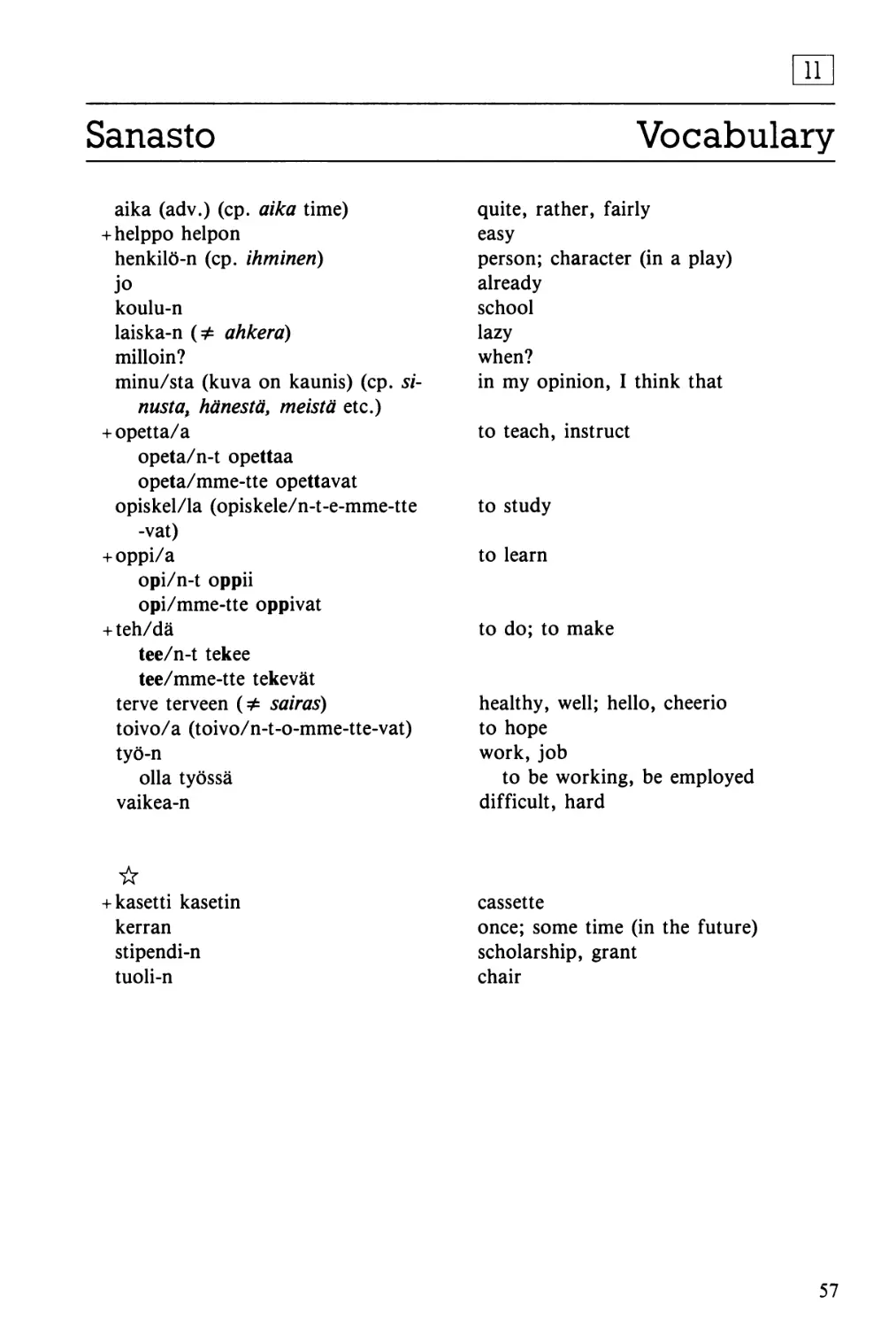
Sanasto
Vocabulary
aika (adv.) (cp. aika time)
+ helppo helpon
henkilö-n (cp. ihminen)
jo
koulu-n
laiska-n (=£ ahkera)
milloin?
minu/sta (kuva on kaunis) (cp.
sinusta> hänestä, meistä etc.)
+ opetta/a
opeta/n-t opettaa
opeta/mme-tte opettavat
opiskel/la (opiskele/n-t-e-mme-tte
-vat)
+ oppi/a
opi/n-t oppii
opi/mme-tte oppivat
+ teh/dä
tee/n-t tekee
tee/mme-tte tekevät
terve terveen (* sairas)
toivo/a (toivo/n-t-o-mme-tte-vat)
työ-n
olla työssä
vaikea-n
quite, rather, fairly
easy
person; character (in a play)
already
school
lazy
when?
in my opinion, I think that
to teach, instruct
to study
to learn
to do; to make
healthy, well; hello, cheerio
to hope
work, job
to be working, be employed
difficult, hard
☆
+ kasetti kasetin
kerran
stipendi-n
tuoli-n
cassette
once; some time (in the future)
scholarship, grant
chair
57

Kappale
12
Lesson
James ja Jamesin James and James’s
naapurit neighbors
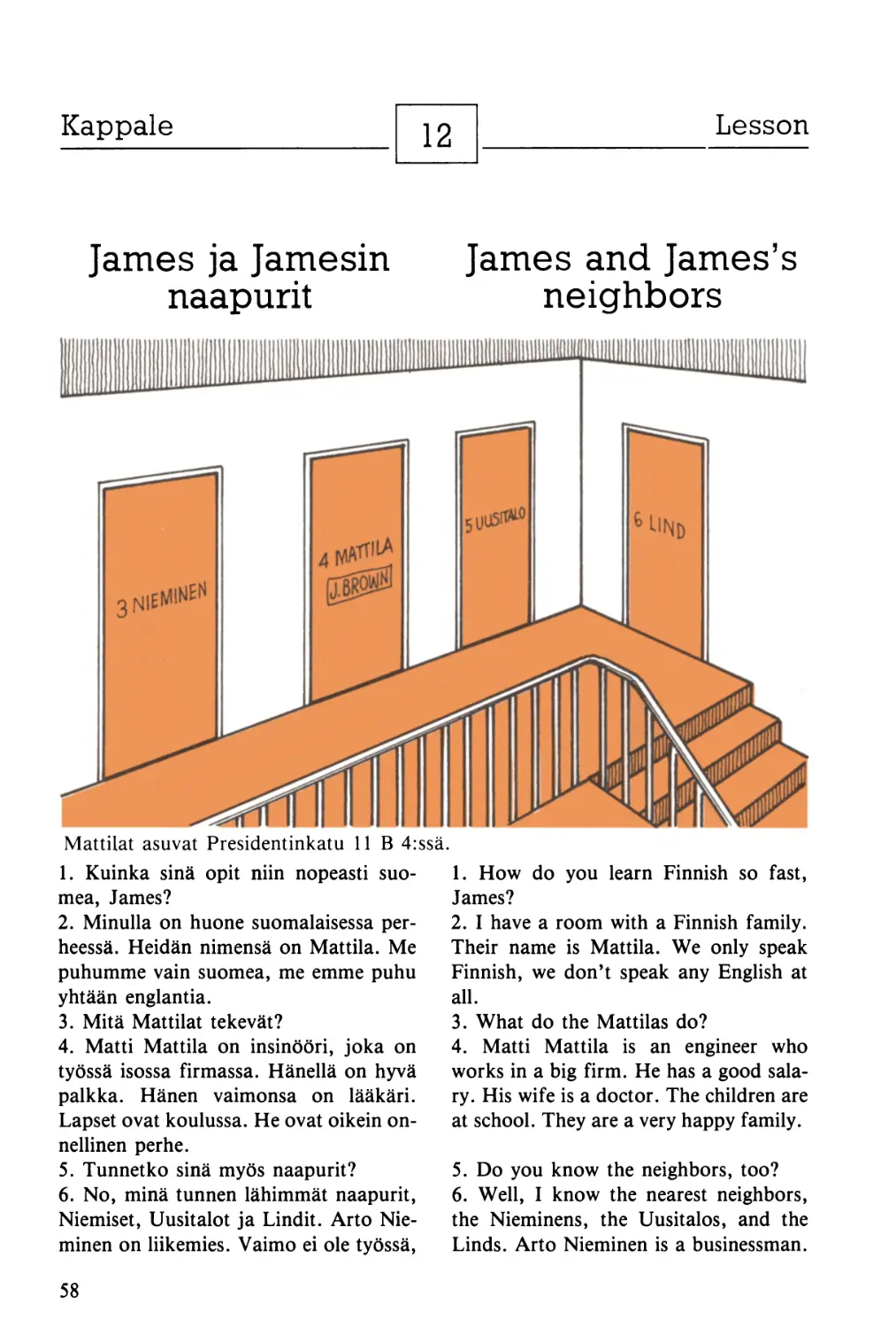
Mattilat asuvat Presidentinkatu 11 B 4:ssä.
1. Kuinka sinä opit niin nopeasti
suomea, James?
2. Minulla on huone suomalaisessa
perheessä. Heidän nimensä on Mattila. Me
puhumme vain suomea, me emme puhu
yhtään englantia.
3. Mitä Mattilat tekevät?
4. Matti Mattila on insinööri, joka on
työssä isossa firmassa. Hänellä on hyvä
palkka. Hänen vaimonsa on lääkäri.
Lapset ovat koulussa. He ovat oikein
onnellinen perhe.
5. Tunnetko sinä myös naapurit?
6. No, minä tunnen lähimmät naapurit,
Niemiset, Uusitalot ja Lindit. Arto
Nieminen on liikemies. Vaimo ei ole työssä,
1. How do you learn Finnish so fast,
James?
2. I have a room with a Finnish family.
Their name is Mattila. We only speak
Finnish, we don’t speak any English at
all.
3. What do the Mattilas do?
4. Matti Mattila is an engineer who
works in a big firm. He has a good
salary. His wife is a doctor. The children are
at school. They are a very happy family.
5. Do you know the neighbors, too?
6. Well, I know the nearest neighbors,
the Nieminens, the Uusitalos, and the
Linds. Arto Nieminen is a businessman.
58

hän on kotona. Pojat eivät ole enää
koulussa, he opiskelevat yliopistossa. Ville
Uusitalo on automekaanikko. Ville ja
minä olemme hyvät ystävät. Minä olen
usein heillä, koska Ville haluaa oppia
englantia.
7. Lind ei ole suomalainen nimi. Ovatko
he ulkomaalainen perhe?
8. Eivät. Lindin perhe on
suomenruotsalainen. Mutta he puhuvat myös suomea.
Rouva Lind on pianisti ja hänen
miehensä oopperalaulaja. Lindit soittavat ja
laulavat paljon — liian paljon, sanovat
muut. Ja Mattilan lapset kysyvät:
”Miksi te ette soita rokkia?”
His wife does not work, she stays at
home. The sons are no longer at school,
they study at the university. Ville
Uusitalo is a car mechanic. We are great
friends, Ville and I. I often visit them
because Ville wants to learn English.
7. Lind is not a Finnish name. Are they
a foreign family?
8. No, the Lind family are
Swedishspeaking Finns. But they speak Finnish,
too. Mrs. Lind is a pianist and her
husband an opera singer. The Linds play
and sing a great deal — too much, the
others say. And the Mattila children ask,
”Why don’t you play rock?”
Missä James asuu? Mattilan perheessä = Mattilalla
Ketkä ovat Jamesin naapurit?
Mikä perhe puhuu ruotsia?
Mitkä perheet puhuvat suomea?
Mitkä ovat viikonpäivät?
”who”
Kuka tuo mies on? Hän on Matti Mattila, joka on insinööri.
friend(s)
minun ystävä
ni
my
sinun
si
your
hänen
nsä
his
teidän
nne
your
heidän
nsä
their
Kielioppia
Structural notes
1. Basic form (nominative) plural
kirja
book kirja/t
the books
Brown
(gen. Browni/ri) Browni/t
the Browns
pieni maa
(gen. piene/n maa/ri) piene/t maa/t the small countries
a small country
59

12
The ending of the basic form plural is -t.
If the basic form sing, and the gen. stem are different, the gen. stem is used.
Note: mikä kirja? which book? mi/t/kä kirja/t?
kuka? who? ke/t/kä?
The plurals of tämä, tuo, se are irregular:
tämä
tuo
se
kirja this book nämä
that book nuo
the, that book ne
kirja/t these books
those books
the, those books
Colloquial variants of nämä and nuo are nää and noi.
kaikki is both sing, (’’everything") and pi. (’’all, all people, everybody’’).
Note also:
Sing. Liisan ystävä on täällä. Liisa’s friend is here.
Hänen ystävänsä on täällä. Her friend is here.
PI. Liisan ystävät ovat täällä. Liisa’s friends are here.
Hänen ystävänsä ovat täällä. Her friends are here.
When followed by a poss. suffix, the basic form sing, and pi. are identical.
2. 	Present tense negative
olla to be — minä ole/n
Negative present
(minä) en
(sinä) et
hän ei
(me) emme
(te) ette
he eivät
ole I am not
you are not
he is not
we are not
you are not
they are not
Negative question
en/kö (minä)
et/kö (sinä)
ei/kö hän
emme/kö (me)
ette/kö (te)
eivät/kö he
ole? am I not?
are you not?
is he not?
are we not?
are you not?
are they not?
Note that
— the negation changes like a verb: en, et, ei, emme, ette, eivät;
— the verb itself does not change: ole. This stem is derived from the 1st
pers. present tense by dropping the ending -n.
Colloquial short forms: mä en oo (= minä en ole), sä et oo (= sinä et ole),
et(kö) sä oo (= etkö sinä ole), eik(ö) se oo (= eikö se ole) etc.
60

12
Sanasto
Vocabulary
enää: ei enää
firma-n
insinööri-n
joka jonka (reiät, pron.)
koska
kysy/ä (kysy/n-t-y-mme-tte-vät)
lapsi lapsen
laulaja-n
liian
+ liike liikkeen
liike/mies-miehen
lääkäri-n
+ mekaanikko mekaanikon
miksi?
muu-n
naapuri-n
onnellinen onnellisen
(* onneton)
+ palkka palkan
+ rokki rokin (= rock)
+ tunte/a
tunne/n-t tuntee
tunne/mme-tte tuntevat
usein
yhtään: ei y.
no longer, no more
firm, concern, company
engineer, graduate in engineering
who, which, that
because, as, since; when?
to ask (questions)
child, infant
singer
too, excessively
shop, store; business; motion,
movement
businessman
physician, doctor
mechanic
why?
other, else
neighbor
happy
salary; wages; pay
rock music
to know, recognize; to feel
(cp. Fr. connaitre, Germ,
kennen)
often, frequently
not any, none at all
☆
kissa-n cat
mitään: ei mitään nothing
tänne (cp. täällä) here, to this place
vasta/ta (vastaa/n-t vastaa to answer, reply; to be responsible
vastaa/mme-tte-vat
+ viikko viikon week
yhteensä altogether, in total
61

Kappale
13
Lesson
(Noin vuodelta 1920) ^
Sirkka tulee ovelta kukkapaketti kädes
sä.
1. Äiti. Kenelle nuo kukat ovat?
2. S. Nämä kukat? Ne ovat minulle.
3. Ä. Sinulle? Keneltä? Jussiltako taas?
4. S. Niin, häneltä ... Äiti, mihin minä
panen nämä kukat?
5. Ä. Mihin? Tälle pöydälle. Tai tuolle
pöydälle. Tai tuolille. Tai sohvalle. Tai
lattialle, jos haluat. Tai ikkunalle. Mihin
vain!
6. S. Äiti, miksi sinä olet minulle
vihainen? Siksikö että nämä kukat ovat
Jussilta? (Ottaa kirjat pieneltä pöydältä,
panee ne tuolille ja kukat pöydälle.)
7. Ä. Mihin sinä menet? Tule tänne ja
istu. Minä haluan puhua sinun kanssasi.
8. S. No, mitä nyt?
(From about the year 1920)
Sirkka comes from the door with a
package of flowers in her hand.
1. Mother. Who are those flowers for?
2. S. These flowers? They are for me.
3. M. For you? From who? From Jussi
again?
4. S. Yes, from him ... Mother, where
shall I put these flowers?
5. M. Where? On this table. Or on that
table. Or the chair. Or the sofa. Or the
floor if you like. Or on the window sill.
Anywhere!
6. S. Mother, why are you angry with
me? Because these flowers are from
Jussi? (She takes the books off the little
table, puts them on a chair, and the
flowers on the table.)
7. M. Where are you going? Come here
and sit down. I want to talk to you.
8. S. Well, what is it now?
62

13
9. Ä. Sinä olet joka ilta ulkona Jussin
kanssa.
10. S. Niin olen. Entäs (= entä) sitten?
11. Ä. Minä olen sinun äitisi. Minä
haluan tietää, mitä te aiotte tehdä.
12. S. Mutta äiti, se on salaisuus!
13. Ä. Kerro minulle. Kyllä sinä voit
kertoa äidille kaikki.
14. S. En kerro! Jos minä kerron sinulle,
sinä kerrot rouva Lahtiselle ja rouva
Lahtinen kertoo rouva Virtaselle ja
rouva Virtanen kertoo neiti Laaksolle ja
neiti Laakso kertoo kaikille, että minä olen
salakihloissa Jussi Lehtisen kanssa!
Anna minulle anteeksi!
say/tell
Sano ”aa”!
Sano (minulle) mikä päivä tänään on!
Kerro (minulle) mitä sinä teet huomenna!
Kysykää Villeltä!
Ville ei vastaa meille.
Kielioppia
1. 	The ”(on)to” case (allative)
mihin ? where(to)?
pöytä (pöydä/n) pöydä/lle on(to) the table
uusi pöytä (uude/n pöydän) uude/lle pöydälle on(to) the new table
ovi (ove/n) ove/Ile to the door
The ending -He corresponds to the English prepositions ”(on)to”, ”on(to)”,
”to”.
When the gen. stem and the basic form are different, the gen. stem is used.
Note: mikä pöytä? mi/Ile pöydä/lle?
tämä pöytä tä/lle pöydä/lle
se pöytä si/lle pöydä/lle
Structural notes
9. M. You go out every evening with
Jussi.
10. S. Yes, I do. So what?
11. M. Pm your mother. I want to know
what you intend to do.
12. S. But mother, it’s a secret!
13. M. Tell me. Why, you can tell
everything to your mother.
14. S. No, I can’t. If I tell you, you’ll tell
Mrs. Lahtinen and Mrs. Lahtinen will
tell Mrs. Virtanen and Mrs. Virtanen will
tell Miss Laakso and Miss Laakso will
tell everybody that I am secretly engaged
to Jussi Lehtinen!
63

E]
The ”(on)to” case is also used with verbs denoting giving or telling something
to someone:
Minä annan tei/lle kahvia. I’ll give you some coffee.
Kene/lle maksamme kaupassa? Who do we pay in the shop (= to
whom do we give money)?
Ostakaa tämä kirja Liisa/lie! Buy this book for Liisa!
Voitteko sanoa minu/lle ... ? Can you tell me ... ?
Lapsi vastaa äidi/lle. The child answers his mother.
Note also:
Pane kukat pöydälle/si! Put the flowers on your table!
Kerron ystävälle/ni, että ... PII tell my friend that ...
As always, the poss. suffix follows after the case ending.
2. 	The ’’from” case (ablative)
mistä? where from?
pöytä (pöydä/n) pöydä/ltä from, off the table
pieni pöytä (piene/n pöydän) piene/ltä pöydältä from the small table
ovi (ove/n) ove/lta from the door
The case ending -Itä (-Itä) roughly corresponds to the English prepositions
’’from”, "off” (that is, away from somewhere or something).
When the gen. stem and the basic form are different, the gen. stem is used.
Note: mikä pöytä? mi/ltä pöydä/ltä?
tämä pöytä tä/ltä pöydä/ltä
se pöytä si/ltä pöydä/ltä
This case is also used with verbs which denote taking or getting something from
someone:
Tyttö saa rahaa äidi/ltä. The girl gets money from her
mother.
Kene/ltä nämä kukat ovat? Who are these flowers from?
In Finnish, people also ask questions "from” someone:
Kysy Liisa/lta, mitä hän tekee huo- Ask Liisa what she’s going to do to-
menna. morrow.
Note also:
Nämä kukat ovat poikaystävältä/ni. These flowers are from my
boyfriend.
Kysykää opettajalta/nne, miksi... Ask your teacher why...
The poss. suffix always follows after the case ending.
64

13
Sanasto
Vocabulary
+ aiko/a (cp. aikomus intention)
aio/n-t aikoo
aio/mme-tte aikovat
ikkuna-n
-h ilta illan
joka (indecl. indef. pron.)
jos
kanssa
Jussi/n kanssa
minu/n kanssa/ni
+ kerto/a (cp. kertomus story)
kerro/n-t kertoo
kerro/mme-tte kertovat
kihloissa
+kukka kukan
käsi käden
lattia-n
mihin?
mihin vain
missä vain
mikä vain
milloin vain
noin (abbr. n.)
+ paketti paketin
pan/na (pane/n-t-e-mme-tte-vat)
+ pöytä pöydän
salaisuus salaisuuden
siksi (cp. miksi!)
siksi että (= koska)
taas
ulkona (^ sisällä)
vihainen vihaisen
vuosi vuoden
h- äiti äidin
to intend, be going to
window
evening
every
if
with, in the company of
with Jussi
with me
to tell, relate, narrate
engaged to be married
flower, blossom, bloom
hand
floor
where to?
anywhere, no matter where (to)
anywhere, no matter where
anything, no matter what
anytime, no matter when
about, approximately; so, like that
parcel, package, packet
to put, place
table
secret
therefore, for that reason
for the reason that, because
again; on the other hand
outside, out of doors
angry, cross
year
mother, mommy
☆
+ anta/a to give; to let, allow
anna/n-t antaa
anna/mme-tte antavat
mistä? where from? from where?
65

Kappale
14
Lesson
Ravintolassa on
hyvää kalaa
Ilta helsinkiläisessä ravintolassa. James
Brown syö tavallisesti täällä.
1. B. Hyvää iltaa, neiti. Onko tämä
pöytä vapaa?
2. Tarjoilija. On kyllä. Ruokalista, olkaa
hyvä.
3. B. Kiitos. — Ensin tomaattikeittoa.
Sitten lihaa tai kalaa. Onko teillä tänään
hyvää kalaa?
4. T. Meillä on oikein hyvää paistettua
kalaa.
5. B. Hyvä on, minä otan sitä. Sitten
leipää ja voita. Ja maitoa.
6. T. Iso vai pieni lasi?
7. B. Iso. Ei, hetkinen ... Mitä olutta
teillä on?
8. T. Meillä on ’’Hippiä” ja ’’Hoppia”.
9. B. Pullo olutta sitten, minä otan
Hoppia. Saanko myös kylmää vettä?
10. T. Tuon kyllä.
11. B. Sitten jälkiruokaa. Jäätelöä ja
pieni kuppi kahvia.
James syö ja juo. Sitten hän sanoo
tarjoilijalle:
12. B. Neiti, lasku! (Maksaa.) Hyvää
yötä! (James lähtee.)
There’s good fish
at the restaurant
An evening in a restaurant in Helsinki.
James Brown usually eats here.
1. B. Good evening. Is this table free?
2. Waitress. Yes, it is. Here’s the menu,
sir.
3. B. Thank you. — First tomato soup.
Then meat or fish. Do you have good
fish today?
4. W. We have very good fried fish.
5. B. Good, I’ll take that (’’some of it”).
Then bread and butter. And milk.
6. W. A large glass or small?
7. B. Large, please. No, just a moment
... What beer do you have?
8. W. We have ’’Hippi” and ’’Hoppi”.
9. B. A bottle of beer, then; I’ll take
Hoppi. May I have some cold water,
too?
10. W. Yes, I’ll bring you some.
11. B. Then the dessert. Ice-cream and a
small cup of coffee.
James eats and drinks. Then he says to
the waitress:
12. B. Waitress, the check, please! (He
pays.) Good night! (James leaves.)

14
Mitä ruokaa te otatte?
Matti. Minä otan tätä (= some of this).
Jussi. Minä otan tuota (= some of that).
Pekka. Minä otan myös sitä (= some of it).
Liisa. Minä en ota mitään.
Haluatko kahvia? Ei kiitos.
Otatko teetä? (Kyllä) kiitos.
Saanko kylmää vettä?
Ole hyvä/Olkaa hyvä (said when you give something to someone)!
öy-yö-uo yöpöytä, työpöytä, tuo pöytä, ruokapöytä
syökää ja juokaa, pöydällä on ruokaa!
Kielioppia
Structural notes
1. 	Partitive singular
Basic form
Onko sinulla Do you have
auto? a car?
Kahvi on kuuma Coffee is a hot
juoma. beverage.
Tämä maa on This country
Suomi. (land) is Finland.
Onko olut
jääkaapissa?
Is the beer in the
refrigerator?
Partitive
Onko sinulla
raha/a?
Saanko
kahvi/a?
Virtaset ostavat
maa/ta.
Ahaa, sinä
haluat olut/ta.
Do you have
money?
May I have some
coffee please?
The Virtanens
will buy (some)
land.
I see, you want
some beer.
The basic meaning of the partitive sing, is indefinite quantity (in English often
’’some”, "any”, or a noun without an article) in contrast to the basic form
which denotes definite quantity (’’the beer”) or entity (”a car”; ’’coffee”, the
whole category).
In its basic meaning, the partitive sing, is used of material nouns and other
uncountables. Uncountable words have no plural, they cannot be counted (you
cannot say ’’the butters” or ’’five musics”). Countables can have pi. forms
(’’the cups” or ’’five songs”).
However, all Finnish nouns and adjectives have their part, forms, as the part,
is a frequently used form with several different functions. Some of these will
be discussed in lessons 14—17, others will come later, and they will be reviewed
after lesson 39, p. 207.
67

14
Structure
The ending is
-a (-ä) after one vowel: kahvi/a, leipä/ä
-ta (-tä) after two vowels or a consonant: maa/ta, olut/ta
The stem may differ from the basic form if the word ends in -i, -e, or a
consonant. Otherwise the part. sing, ending can be added directly to the basic form.
From now on, the part. sing, of each new noun will be included in the
vocabulary and should be memorized along with the basic form and the gen. sing. (The
irregular part. sing, forms of the nouns covered up to now are listed on p. 70.
The part. sing, forms of the nouns in lessons 1—21 can be looked up in a list
arranged by inflection types on p. 99.)
Note. The following word types have part. sing, stems which differ from
the basic form:
— i—e words, e.g.
onni
(onnen)
onne/a
pieni
(pienen)
pien/tä
vesi
(veden)
vet/tä
— huone words
huone
(huoneen)
huonet/ta
— nainen words
nainen
(naisen)
nais/ta
— salaisuus words
salaisuus
(salaisuuden)
salaisuut/ta
As usual, adjectives and pronouns agree with the noun:
Millais/ta kahvi/a haluat? What kind of coffee do you want?
Hyvä/ä, kuuma/a kahvi/a. Good hot coffee.
Onko teillä minulle helppo/a työ/tä? Do you have some easy work for me?
Note also: mikä leipä? mi/tä leipä/ä?
tämä leipä tä/tä leipä/ä
tuo leipä tuo/ta leipä/ä (colloq. to/ta)1
se leipä si/tä leipä/ä
Possessive suffixes, as always, come after the partitive ending:
Haluatko suklaata/ni? Do you want some of my chocolate?
Pöydällä on sinun rahaa/si. Some of your money is on the table.
Important to remember:
The partitive is not used as the subject of the sentence (except in "there is”
sentences, 17:1).
1 The form tuota (tota) is generally used as a fill-in word to start or to interrupt a
statement:
Tuota — mitä minä nyt teen? Well — what shall I do now?
Voit sä — tota tota — lainata kaks Can you — well — lend me 200
sataa? marks?
68

14
KAHVI
Bad mistake: ^gahgta maksaa paljon.
(The part. pi. will be explained in 21:1.)
2. 	Special uses of partitive
The partitive is used after words indicating measure or quantity:
lasi vet/tä a glass of water
iso kuppi kahvi/a a large cup of coffee
vähän musiikki/a
a little music
paljon työ/tä
a lot of work
The partitive is used in greetings,
wishes, and exclamations:
Hyvä/ä yö/tä!
Good night!
Hauska/a ilta/a!
Have a nice evening!
Ihana/a!
How wonderful!
Sanasto
Vocabulary
ensin
(at) first
juo/da (juo/n-t juo juo/mme-tte
to drink
-vat)
+jälki/ruoka-a-ruoan or -ruuan
dessert (”after-food”)
(always pronounced ruuan)
jäätelö-ä-n (cp. jää ice)
icecream
kala-a-n
fish
+ keitto-a keiton
soup
lasku-a laskun
check, bill
+ leipä-ä leivän
bread, loaf
liha-a-n
meat; flesh
+ lähte/ä
to leave, depart, go
lähde/n-t lähtee
lähde/mme-tte lähtevät
+ maito-a maidon
milk
olut-ta oluen
beer
+ paistettu-a paistetun
fried, roasted
pullo-a-n
bottle
ravintola-a-n
restaurant
ruoka/lista-a-n
menu (,,food-list,,)
syö/dä (syö/n-t syö syö/mme-tte
to eat
-vät)
tarjoilija-a-n (from tarjoilla to
waiter, waitress
serve, wait)
69

14
tavallisesti
+ tomaatti-a tomaatin
tuo/da (tuo/n-t tuo tuo/mme-tte-vat)
viedä)
vapaa-ta-n
vesi vettä veden
voi-ta-n
yö-tä-n
☆
ihana-a-n
+ salaatti-a salaatin
usually, ordinarily
tomato
to bring; to import
free; vacant
water
butter
night
wonderful, lovely
salad; lettuce
Irregular part. sing, forms of nouns in lessons 1—13
i — e words
+ kaikki kaikkea kaiken 4
kivi kiveä kiven 1
nimi nimeä nimen 5
onni onnea onnen 9
ovi ovea oven 8
Suomi Suomea Suomen 1
kieli kieltä kielen 3
nuori nuorta nuoren 2
pieni pientä pienen 2
lapsi lasta lapsen 12
käsi kättä käden 13
uusi uutta uuden 2
vuosi vuotta vuoden 13
huone words
huone-tta huoneen 1
kappale-tta kappaleen 1
h- liike-ttä liikkeen 12
+ osoite-tta osoitteen 5
perhe-ttä perheen 6
terve-ttä terveen 11
Exception:
+ nukke-a nuken 6
nainen words
nainen naista naisen 1
hetkinen hetkistä hetkisen 9
ihminen ihmistä ihmisen 10
millainen millaista millaisen 2
onnellinen onnellista onnellisen 12
suomalainen suomalaista suomalaisen 3
vihainen vihaista vihaisen 13
salaisuus words
salaisuus salaisuutta salaisuuden 13
Pronouns:
minä minua minun 3
sinä sinua sinun 3
me meitä meidän 9
te teitä teidän 4
he heitä heidän 9
tämä tätä tämän (pl. nämä) 1
se sitä sen (pl. ne) 1
mikä mitä minkä (pl. mitkä) 1
kuka ketä kenen (pl. ketkä) 1
joka jota jonka (pl. jotka) 12
Numerals:
yksi yhtä yhden 7
kaksi kahta kahden 7
kolme-a kolmen 7
viisi viittä viiden 7
kuusi kuutta kuuden 7
seitsemän seitsemää seitsemän 7
kahdeksan kahdeksaa kahdeksan 7
yhdeksän yhdeksää yhdeksän 7
kymmenen kymmentä kymmenen 7
yksi/toista yhtä/toista yhden/toista 7
kaksi/kymmentä kahta/kymmentä
kahden/kymmenen 7
70

Kappale
15
Lesson
Vaikea asiakas A difficult customer
1. Asiakas. Neiti, mikä tämä on?
2. Tarjoilija. Se on lautanen.
3. A. Ei, tämä tässä! Mikä tämä on,
sanokaa!
4. T. Se on pihvi.
5. A. Hyvä neiti, se ei ole pihvi. Se ei ole
lihaa.
6. T. Mitä se sitten on?
7. A. Se on nahkaa. Vanhaa nahkaa.
Viekää se pois! Heti! Ja sanokaa, mitä
tuo on?
8. T. Se on kahvia.
9. A. Kahvia kahvia. Mutta millaista se
on?
10. T. Hyvää kai. Tämän ravintolan
kahvi on aina hyvää.
11. A. Ja kuumaa?
12. T. Ja kuumaa, aivan niin.
13. A. Mutta tämä kahvi on huonoa. Ja
aivan kylmää. Viekää se pois! Millainen
ravintola tämä on: tuoli on kova,
tarjoilija on huono, liha on vanhaa, kahvi on
kylmää, vesi on lämmintä, kaikki ruoka
on kallista. Viekää kaikki pois. Hyvästi!
1. Customer. Waitress, what is this?
2. Waitress. It’s a plate.
3. C. No, this here! What is this, tell me?
4. W. It’s a steak.
5. C. Young lady, it isn’t a steak. It isn’t
meat.
6. W. What is it then?
7. C. It is leather. Old leather. Take it
away! At once! And tell me what that is?
8. W. It’s coffee.
9. C. Coffee, of course. But what’s it
like?
10. W. Good, I suppose. Coffee is
always good in this restaurant.
11. C. And hot?
12. W. And hot, yes.
13. C. But this coffee is bad. And
completely cold. Take it away! What
kind of restaurant is this? The chair is
hard, the waitress is bad, the meat is old,
the coffee is cold, the water is warm, all
the food is expensive. Take everything
away. Goodbye!
long vowels in
later syllables
diphthongs in -i
yö-uo
hv
olkaa hyvä ja sanokaa aa, olkaa hyvä ja sanokaa ää!
hyvää iltaa, saanko lihaa, kalaa ja leipää?
tänään hän ottaa hyvää jäätelöä
leipä ja voi vain maitoa, neiti ei kai
aivan oikein on aina vaikea sanoa ei
hän syö ja juo, yötyö, tuo työ, tuo yö, tuo mies juo myös
pihvi ja kahvi hyvää kahvia
Tarjoilija tuo keittoa.
Tarjoilija vie lasit pois.
71

15
Kielioppia Structural notes
1. ’’What is this?” - ’’What is it like?”
£5=
Mikä tämä on?
Se on kuppi.
What is this?
It’s a cup.
Millainen se on?
Se on pieni.
What is it like?
It’s small.
Mi/tä tämä on?
Se on kahvi/a.
What is this?
It’s coffee.
Millais/ta se on?
Se on kuuma/a.
What is it like?
It’s hot.
Mikä tärmtvn ?
Se on lasi.
It’s a glass.
Millainen se on?
Lasi on iso.
The glass is big.
Mi/tä tctrna on?
Se on maito/a.
It’s milk.
Millais/tä se on?
Maito on kylmä/ä.
The milk is cold.
Mikä tuo on?
Se on pihvi.
It’s a steak.
Millainen se on?
Se on hyvä.
It’s good.
Mi/tä tuo on?
Se on liha/a.
It’s meat.
Millais/tä se on?
Se on hyvä/ä.
It’s good.
Mikä tämä on?
Se on kirja.
It’s a book.
Millainen se on?
Se on halpa.
It’s cheap.
on?
Se on paperi/a.
It’s paper.
xY-xnwxWVV^
Mikä tämä on?
Se on laulu.
It’s a song.
Minkälainen se on?
Se on kaunis.
It’s beautiful.
Mi/tä tämä on?
Se on musiikki/a.
It’s music.
Millais/tä se on?
Se on halpa/a.
It’s cheap.
Minkälais/ta se on?
Se on kaunis/ta.
It’s beautiful.
72

15
mitä is the partitive of mikä.
When, in questions of the type ’’what is this?” you ask about a single object,
a countable, use mikä (answer: kuppi). When asking about a substance or
material, or other uncountables, use mitä (answer: kahvia).
When, in questions of the type ’’what is this like?” you ask about a single
object, a countable, use millainen or minkälainen (answer: pieni). When asking
about a substance or material, or other uncountables, use millaista or
minkälaista (answer: kuumaa).
LIHA
Bad mistake: 'pibaq on hyvää.
(More about the complement of the verb ”to be” in 22:1 and 34:2.)
Sanasto
aivan
aivan niin
+ asiakas-ta asiakkaan
heti
hyvästi!
kai
kova-a-n (=£ pehmeä)
kuuma-a-n (* kylmä)
lautanen lautasta lautasen
lämmin-tä lämpimän (^ kylmä)
minkä/lainen-laista-laisen? (=
millainen?)
+ nahka-a nah(k)an
pihvi-ä-n
pois
tässä (cp. täällä)
vie/dä (vie/n-t vie vie/mme-tte-vät)
(* tuoda)
Vocabulary
quite, exactly, precisely
exactly, just so, that’s it
customer, client
at once, immediately
goodbye
probably, very likely, I suppose
hard (not soft); severe, strict
hot
plate
warm
what ... like? what kind of?
leather, skin
steak
away, off
right here
to take (somewhere); to export
☆
kuin
as; than
73

Kappale
16
Lesson
Kuinka monta?
James Brown on tavallinen mukava
nuori mies, joka on 20 vuotta vanha. Hän on
180 senttiä pitkä ja painaa 75 kiloa.
Hänellä on rahaa 10 markkaa 50 penniä.
Jamesilla on niin vähän rahaa, koska
hän oli juuri ostoksilla.
How many?
James Brown is an ordinary, nice young
man, who is twenty years old. He is 180
cm tall and weighs 75 kg. He has 10
marks 50 pennies.
James has so little money because he
just went shopping.
Myyjä
Nyt James tekee ruokaa Mattilan
keittiössä. Mutta hän ei ole siellä yksin.
Mattilan Tapani on myös siellä, ja Tiina,
perheen toinen lapsi, tulee juuri sisään.
Tapani on kymmenen ja Tiina seitsemän
vuotta vanha. Tiinalla on kaksi kissaa.
Toinen on valkoinen, toinen musta. Ne
juovat maitoa keittiössä. Lapset syövät
jäätelöä ja puhuvat Jamesin kanssa.
Montako huonetta Mattilan perheellä
on? Neljä huonetta ja keittiö.
Now James is cooking in Mattila’s
kitchen. But he is not there alone. Tapani
Mattila is also there, and Tiina, the other
child of the family, is just coming in.
Tapani is ten and Tiina seven years old.
Tiina has two cats, one of them white, the
other one black. They are drinking milk
in the kitchen. The children are eating
icecream and talking to James.
How many rooms does the Mattila
family have? Four rooms and a kitchen.
74

Liisalla on 15 mk ja Lailalla 28 mk. Pal- Liisa has 15 marks and Laila 28 marks,
jonko rahaa heillä on yhteensä? How much money do they have
altogether?
Kuinka monta ( = montako) autoa?
*»o=o*
JO*:-
«** * %
»O jO* **0=1
yksi auto
pari autoa
(pari autoa = 2—3)
monta autoa
Kielioppia
Structural notes
1. 	Partitive singular with cardinal numbers
Partitive singular is used after cardinal numbers (except yksi one) and after the
word monta many:
yksi kirja but: kaksi kirja/a two books
yksi talo kolme talo/a three houses
yksi mies sata mies/tä a hundred men
yksi omena kuinka monta omena/a? how many apples?
yksi salaisuus monta salaisuut/ta many secrets
If the subject of a sentence consists of a cardinal number + noun, the verb will
be in the singular:
(Yksi) kirja maksaa 30 markkaa.
Kaksi kirjaa maksaa 60 markkaa.
Kolme autoa tulee Mikonkadulle.
2. 	About foreign loanwords in Finnish
Finnish, like all languages, has borrowed words from other tongues during the
different periods of its history, mostly from the neighboring Indo-European
languages.
Most loanwords from other languages (except for the most recent) have been
’’Finnicized”
— 	by changing foreign consonants to their domestic equivalents, esp. b, d, g
to p, t, k (e.g. kulta gold);
75

16
— by dropping initial consonants except for thp last (e.g. koulu school, Ranska
France);
— by adding a final vowel, most typically -i, to words ending in a consonant
(e.g. pommi bomb, Iasi glass).
Examples: viikko, minuutti, numero, pankki, metalli, passi, silkki, nailon,
sokeri, kakku, riisi, vitamiini, konsertti, orkesteri, sirkus, tennis, kulttuuri,
akateeminen, fysiikka, matematiikka, teksti, tyyli, arkkitehtuuri, huumori,
normaali, romanttinen, romantiikka, atomi, tekniikka, politiikka, ministeri,
prinssi, senaatti, sosialisti, kommunismi, kameli, tiikeri, tulppaani, kaktus,
temppeli, 	alttari, paratiisi.
Sanasto
Vocabulary
gramma-a-n (abbr. g)
gram
juuri
just, exactly
juusto-a-n
cheese
keittiö-tä-n
kitchen
kilo-a-n (abbr. kg)
kilogram
litra-a-n (abbr. 1)
liter
makkara-a-n
sausage
moni monta monen
many
montako? = kuinka monta?
how many?
muna-a-n
egg
musta-a-n
black
myyjä-ä-n (from myy/dä to sell)
salesclerk; vendor
+ nakki-a nakin
frankfurter
ostoksilla:
olla o.
to be shopping
mennä ostoksille
to go shopping
paina/a (paina/n-t-a-mme-tte-vat)
to weigh (= have a certain weight);
to press; to print
pitkä-ä-n (=t lyhyt)
long; tall
puoli puolta puolen
half; side
+ sentti-ä sentin (abbr. cm)
centimeter; cent
sisään (=£ ulos)
in; ’’come in!”
tavallinen tavallista tavallisen
usual, ordinary, frequent
toinen toista toisen
other, another; second; one of the two
toinen ... toinen
one ... the other
vuoro-a-n
turn; shift (at work)
☆
+ pankki-a pankin
bank
pari-a-n
pair; couple; two or three
76

Kappale
17
Lesson
Jamesilla on radio,
mutta ei televisiota
Tässä kuvassa on James Brownin huone.
Kuten näet, huoneessa on kirjoituspöytä.
Oikealla on sänky ja vasemmalla
mukava tuoli. Kun James on kotona, hän istuu
siinä ja lukee. Tuolin lähellä on
kirjahylly ja siinä monta kirjaa. Kirjat ovat
Jamesin. Huoneen toisella puolella on pari
muuta tuolia. Jamesilla ei ole televisiota,
mutta pöydällä on pieni radio.
James has a radio
but no television
This is a picture of James Brown’s room.
As you can see, there is a writing-desk in
the room. On the right there is a bed and
on the left a comfortable chair. When
James is at home, he sits in it and reads.
Near the chair there is a book-shelf with
many books. The books belong to
James. On the other side of the room
there are two or three other chairs. James
has no television but there is a little radio
on the desk.
77

17
Huone ei ole suuri, mutta se on
tarpeeksi suuri Jamesille. Tällä nuorella
miehellä ei ole vielä perhettä, ei vaimoa
eikä lasta. Ja hän aikoo olla Suomessa
vain puolitoista vuotta. Mistä hän saa
rahaa? Onko hän työssä vai onko hänellä
rikas perhe? James ei ole enää työssä,
koska hänellä ei nyt ole työlupaa. Hänen
perheensä ei ole rikas eikä köyhä, mutta
hänellä on pieni stipendi, ja joskus perhe
lähettää hänelle vähän rahaa.
The room is not large, but it is large
enough for James. This young man has
no family as yet, neither wife nor child.
And he intends to stay in Finland for
only a year and a half. Where does he get
his money from? Does he work, or has
he got a rich family? James no longer
works because he does not have a work
permit now. His family is neither rich
nor poor, but he has a small scholarship,
and his family sometimes sends him a
little money.
iso — suuri
iso t. suuri huone (concrete)
suuri ja vaikea kysymys (abstract)
"stay”
Peter on Turussa kaksi päivää. Peter will stay in Turku for two
days.
Hän asuu Grand-hotellissa. He will be staying at the Grand
Hotel.
(About stay remain, not go away, see 34.)
Minulla
on kiire!
Minulla
on jano.
Minulla
on nälkä.
Minulla
on kylmä.
Minulla on
kuuma
(lämmin).
Minulla
on hyvä
olla.
Minulla
on paha
olla.
78

Kielioppia
Structural notes
1. 	"there is, there are” sentences
Pöydällä on kuppi.
Kupissa on tee/tä.
Pöydällä ei ole kuppi/a.
Kupissa ei ole tee/tä.
There is a cup on the table.
There is tea in the cup.
There is no cup on the table.
There is no tea in the cup.
’’there is, there are” in Finnish is simply on, negative ei ole.
The thing that is not there is generally in the partitive. The word-order differs
from that of an English sentence:
1. 	place 2. ’’there is” 3. the thing that is there
pöydällä on kuppi
(”on the table there is a cup”)
The Finnish word-order shows that it is a cup, something that has not been
mentioned before; its existence is introduced here for the first time. (Such
sentences are called introductory or existential sentences.)
If the word-order changes, the meaning changes, too:
Kuppi on pöydällä. The cup is on the table.
Kuppi ei ole pöydällä. The cup is not on the table.
Question:
Onko pöydällä
kuppi?
(kuppi/a?)
Is there a cup on the table?
(”Is there on the table a cup?”)
The partitive is fairly common in the question. It implies that even a negative
answer will not be unexpected.
Negative question:
Eikö pöydällä ole kuppi/a? Isn’t there any cup on the table?
(’’Isn’t there on the table any cup?”)
Note: Remember that outside the ’’there is, there are” type of sentences, the
subject is rarely in the partitive.
79

17
2. 	’’have” sentences
Miehellä on markka.
Hänellä on pikkuraha/a.
Naisella ei ole markka/a.
Hänellä ei ole pikkuraha/a.
The man has a mark.
He has small change.
The woman does not have a mark.
She doesn’t have small change.
The thing not possessed is generally in the partitive.
Question:
Onko tytöllä markka?
Does the girl have a mark?
(markka/a?)
The partitive in the question implies that even a negative answer will not be
unexpected.
Negative question:
Onko sinulla /eikö sinulla ole jano? Are you/are you not thirsty?
In certain expressions using "have” (but not expressing possession), the
partitive is not used in the negative sentence.
Note also:
As the sentence hänellä on rahaa actually means ’’there is money in his
possession”, the Finnish ’’have” structure is mostly limited to subjects who can
possess something, esp. to human beings. Otherwise, the ’’there is” structure
is preferred:
Huoneessa on iso ikkuna. The room has a large window.
Suomessa on noin 5 000 000 asukasta. Finland has about 5,000,000
inhabitants.
Eikö pojalla ole markka/a?
Doesn’t the boy have a mark?
Note:
Minulla on nälkä, kylmä etc.
Minulla ei ole nälkä, kylmä etc.
I am hungry, cold etc.
I 	am not hungry, cold etc.
80

Sanasto
Vocabulary
ei ... eikä
hylly-ä-n
joskus
+ kirjoitus/pöytä-ä-pöydän
kun
kuten
köyhä-ä-n
+luke/a
lue/n-t lukee
lue/mme-tte lukevat
lähellä
pöydä/n lähellä
+ lähettä/ä
lähetä/n-t lähettää
lähetä/mme-tte lähettävät
+ näh/dä
näe/n-t näkee
näe/mme-tte näkevät
puoli/toista
(cp. kaksi ja puoli
+ rikas-ta rikkaan
siinä (”in” case of se)
suuri suurta suuren (=£ pieni)
+ sänky-ä sängyn
tarpeeksi
+ työ/lupa-a-luvan
neither ... nor
shelf
some time; sometimes
writing-desk
when; (sometimes also:) because
like, as, such as
poor (= not rich)
to read
near, close to, close by
near the table
to send
to see
one and a half
2 	1/2)
rich
in it; (right) there
big, large; great
bed
enough
work permit
☆
jano-a-n
kiire-ttä-en
minulla on kiire
paha-a-n (^ hyvä)
minulla on paha olla
+ nälkä-ä nälän
puu-ta-n
thirst
haste, hurry
I’m in a hurry, I’m busy
bad, ill, evil, wicked
I feel bad, I feel ill
hunger
tree; wood
81

Kappale
18
Lesson
Toinen vaikea
asiakas
1. Asiakas. Tämä kamera täytyy vaihtaa.
Se ei toimi.
2. Nuori mies. Vai niin. Mikä vika siinä
on?
3. A. En minä tiedä. Se ei toimi, se on
rikki, kuuletteko?
4. N. Kuulen, minulla on hyvät korvat.
Mutta ...
5. A. Katsokaa itse, filmi ei liiku.
Näettekö?
6. N. Näen, minulla on hyvät silmät.
Mutta miksi ...
7. A. Minulla on kiire. Antakaa minulle
heti toinen, parempi kamera! Vai onko
teillä jalat?
8. N. On, minulla on kaksi jalkaa.
9. A. Ja kaksi kättä? Jos on, niin ottakaa
tämä kamera ja tuokaa minulle toinen.
Nopeasti!
10. N. Kuulkaa nyt, hyvä herra ...
11. A. No mitä te vielä haluatte sanoa?
Puhukaa! Onko teillä suu, onko teillä
kieli? Ettekö te ymmärrä mitään!
Minkälainen myyjä te oikein olette?
12. N. En minä ole myyjä. Minä olen
asiakas!
Another difficult
customer
1. Customer. This camera must be
changed. It doesn’t work.
2. Young man. I see. What’s wrong with
it?
3. C. I don’t know. It doesn’t work, it’s
broken, do you hear?
4. Y. Yes, I do, I’ve got good ears.
But ...
5. C. Look for yourself, the film doesn’t
move. Do you see?
6. Y. Yes, I do, I’ve got good eyes. But
why ...
7. C. I’m in a hurry. Give me another,
better camera at once! Have you got
legs?
8. Y. Yes, I’ve got two legs.
9. C. And two hands? If so, take this
camera and bring me another one.
Quick!
10. Y. Now listen, sir ...
11. C. Well, what else do you want to
say? Speak up! Have you got a mouth,
have you got a tongue? Don’t you
understand anything? What kind of a
sales assistant are you?
12. Y. I’m not a sales assistant. I’m a
customer!
hyvä — parempi — paras
’’when”
Milloin tulet meille?
Kun tulet meille, saat kahvia ja kakkua.
82

18
Sanasto
Vocabulary
itse-ä-n
+jalka-a jalan
kamera-a-n
korva-a-n
kuul/la (kuule/n-t-e-mme-tte-vat)
(cp. kuulo hearing)
+ liikku/a (cp. liike motion)
liiku/n-t liikkuu
liiku/mme-tte liikkuvat
mikään mitään minkään
ei mikään
paras-ta parhaan
+ parempi parempaa paremman
rikki
silmä-ä-n
suu-ta-n
toimi/a (toimi/n-t-i-mme-tte-vat)
täytyy
+ vaihta/a
vaihda/n-t vaihtaa
vaihda/mme-tte vaihtavat
+ vika-a vian
self; myself, yourself etc.
foot; leg
camera
ear
to hear
to move, be in motion
any, anything
no, not any, nothing
best
better
broken; in pieces
eye
mouth
to act; to function, work, operate
must
to change, exchange
fault, defect, something wrong
83

Kappale
19
Lesson
Bussissa ja
raitiovaunussa
Ystävämme James nousee bussiin.
Hänen täytyy mennä Eiraan. Hänen uusi
työpaikkansa on siellä.
1. J. Meneekö tämä bussi keskustaan? —
Mitä lippu maksaa?
2. Kuljettaja. Kertalippu ..., kymmenen
matkan lippu ... markkaa.
3. J. Antakaa minulle kymmenen
matkan lippu. Mikä raitiovaunu menee
Eiraan?
4. K. Numero 3.
5. J. Ja missä minun täytyy vaihtaa?
6. K. Stockmannin pysäkillä.
7. J. Monesko pysäkki se on?
8. K. Neljäs.
Koska on aamu, bussi on täynnä.
Jamesin täytyy seisoa koko matka. Mihin
kaikki menevät? Yksi menee työhön,
toinen kauppaan, kolmas kouluun, neljäs
yliopistoon ...
James vaihtaa raitiovaunuun numero
3.
9. J. Menen Eiraan, osoite on
Tehtaankatu 23. Voitteko sanoa minulle milloin
minun täytyy nousta pois. Onko se pitkä
matka?
10. K. Ei, aivan lyhyt, noin viisi
minuuttia. n
On the bus and
streetcar
Our friend James gets on a bus. He has
to go to Eira. His new job is there.
1. J. Does this bus go to the Center? —
What does a ticket cost?
2. Bus driver. A single ticket is ..., a ten-
trip card is ... marks.
3. J. Give me a ten-trip card. Which
streetcar goes to Eira?
4. B. Number three.
5. J. And where do I have to change?
6. B. At the Stockmann stop.
7. J. How many stops is it from here?
8. B. The fourth.
Because it is morning, the bus is full.
James has to stand all the way. Where
are all the people going? One goes to
work, another to a store, a third to
school, a fourth to the university ...
James changes to streetcar number
three.
9. J. Pm going to Eira, the address is
Tehtaankatu 23. Can you tell me please
when I have to get off. Is it a long way?
10. B. No, quite short, about five
minutes.

19
James istuu ja katselee ulos. Hän
ajattelee: ”Kaunis päivä. Tänään lähden
Porvooseen Ritvan kanssa.”
Vaunu tulee Eiraan, Tehtaankadulle.
11.K. Seuraava pysäkki!
12. J. Paljon kiitoksia, näkemiin.
James sits and looks out. He thinks,
”Fine day. Today I’ll go to Porvoo with
Ritva.”
The streetcar comes to Tehtaankatu in
Eira.
11. B. Next stop, sir!
12. J. Thanks a lot, goodbye.
ensimmäinen — ensin
Näetkö nuo pojat? Ensimmäinen on Eero, toinen Leo, kolmas Ari. He nousevat
bussiin. Ensin nousee Eero, sitten Leo ja Ari.
minun koti
sinun
hänen
m
si
nsa
meidän koti
teidän
heidän
mme
nne
nsa
rt kertalippu, kartta, postikortti
ht-hd vaihdan bussia, lähden Lahteen, Ahti vaihtaa, Ahti lähtee Lahteen
äy-au vaunu on täynnä, Taunon täytyy vaihtaa vaunua
Kielioppia Structural notes
1. 	The ’’into” case (illative)
a) maa country maa/han to a country
työ work työ/hön to work
tiistai Tuesday tiistai/hin until Tuesday
One-syllable words have the ”into” ending h + vowel + n, the vowel being
the same as the one before h.
All stems ending in a diphthong also take this ending.
b) Porvoo Porvoo/seen to Porvoo
huone (huonee/n) room huonee/seen into the room
kaunis (kaunii/n) beautiful kaunii/seen
hidas (hitaa/n) slow hitaa/seen
Longer stems ending in a long vowel have the ending -seen; the stem comes from
the genitive.
85

19
c) talo
sauna
Suomi (Suome/n)
toinen (toise/n)
mies (miehe/n)
house talo/on into a house
sauna/an into a sauna
Suome/en to Finland
other toise/en
man miehe/en into the man
The largest group of Finnish nouns have a stem ending in one short vowel. Their
’’into” case ending is a prolongation of the final vowel of the stem -l- n.
However, if their gen. stem differs from the basic form in regard to the
k p t changes, the consonant of the basic form must be used:
parempi (paremma/n) better parempa/an
Note: vesi (vede/n) vete/en into water
käsi (käde/n) käte/en into the hand
mikä maa? mi/hin maa/han?
tämä maa tä/hän maa/han
se maa sii/hen maa/han
Note also:
Menen kotii/ni. I’m going to my home.
Mene huoneesee/si! Go to your room!
Panetteko sokeria teehe/nne? Do you put sugar in your tea?
The "into” case ending drops its final -n before possessive suffixes.
(About the ’’into” form see also 24:2.)
The ’’into” case is used extensively of place-names (city districts, towns and
cities, countries, continents etc.):
James Brown tulee Töölö/ön, James Brown comes to Töölö,
koti (kodi/n)
Turku (Turu/n)
kirkko (kirko/n)
Lahti (Lahde/n)
home koti/in (into the) home
Turku/un to Turku
church kirkko/on to church
Lahte/en to Lahti
Helsinki/in,
Suome/en,
Eurooppa/an.
Helsinki,
Finland,
Europe.
(More about the place-names in 27:3.)
2. 	Ordinal numbers
Kuinka mones? = Monesko?
Which in order (’’the how-manieth”)?
ensimmäinen (ensimmäistä ensimmäisen)
toinen (toista toisen)
the 1st
2nd
86

19
kolmas (kolmatta kolmannen) 3rd
neljäs (neljättä neljännen) 4th
viides (viidettä viidennen) 5th
kuudes (kuudetta kuudennen) 6th
seitsemäs (seitsemättä seitsemännen) 7th
kahdeksas (kahdeksatta kahdeksannen) 8th
yhdeksäs (yhdeksättä yhdeksännen) 9th
kymmenes (kymmenettä kymmenennen) 10th
yhdes/toista (yhdettä/toista yhdennen/toista) 1 lth
kahdes/toista 12th
kolmas/toista 13th
kahdes/kymmenes 20th
kahdes/kymmenes/yhdes 21 st
kahdes/kymmenes/kahdes 22nd
sadas (sadatta sadannen) 100th
kolmas/sadas/kuudes/kymmenes/viides 365th
tuhannes (tuhannetta tuhannennen) 1000th
miljoonas (miljoonatta miljoonannen) 1 000 000th
Note:
Turku, 10. syyskuuta 1985 (= 10.9.1985)
Ranskan Napoleon I ja III, Englannin Elisabet I ja II
Eilen oli Helsinki-maraton. Meidän Pekka oli 236:s.
3. 	’’minun täytyy lähteä”
minun
sinun
hänen
meidän
teidän
heidän
täytyy lähteä
I
you
he
we
you
they
must go
Kallen täytyy soittaa kotiin.
Perheen täytyy ottaa laina.
Tämän opiskelijan täytyy saada
stipendi.
Kenen täytyy viedä koira ulos
tänään?
Question: Täytyy/kö
Kalle must call home.
The family must take a loan.
This student must get a scholarship.
Who must take the dog out today?
sinun lähteä?
meidän vaihtaa bussia?
perheen ottaa laina?
Note: Sinun täytyy kertoa hänelle.
Sinä et saa kertoa hänelle.
You must tell her.
You must not tell her.
87

19
Sanasto
aamu-a-n
+ ajatel/la (ajattele/n-t-e-mme-tte-vat)
Meillä on aivot, voimme ajatella.
Cp. Luulen, että sataa.
Minusta filmi oli hyvä.
katsel/la (katsele/n-t-e-mme-tte-vat)
(= katsoa)
+ kerta-a kerran
kerran/kaksi kertaa
keskusta-a-n
koko (indecl.)
kuljettaja-a-n
+ lippu-a lipun
lyhyt-tä lyhyen pitkä)
matka-a-n
+ minuutti-a minuutin
mones/ko? = kuinka mones?
(monetta monennen)
nous/ta (nouse/n-t-e-mme-tte-vat)
+ paikka-a paikan
+ pysäkki-ä pysäkin
(from pysähtyä to stop)
raitio/vaunu-a-n
seiso/a (seiso/n-t-o-mme-tte-vat)
seuraava-a-n (from seurata)
+ työ/paikka-a-paikan
täynnä
+ täyty/ä
minun, sinun, hänen täytyy,
meidän, teidän, heidän täytyy
ulos (=£ sisään)
+ vaihto-a vaihdon
vaunu-a-n
Vocabulary
morning
to think, think over, consider
(cp. Fr. penser, Germ, denken)
We have brains, we can think.
I think it’s raining.
I think the film was good,
to watch, look
time (in telling how many times)
once/twice
center
whole, all, entire
driver
ticket; flag
short, brief
distance, way; trip, journey
minute
which in order?
to rise, get up, arise; to get on, off
place, location, site; seat; job
stop (for bus, streetcar, train)
streetcar, tram
to stand
following, the next
job, situation
full
to have to, must
out
change, exchange, transfer
carriage, (street)car
☆
hissi-ä-n lift, elevator
j oulu-a-n Christmas
kerros-ta kerroksen floor, storey
+ kirkko-a kirkon church
sokeri-a-n sugar

Kappale
20
Lesson
Tapaaminen
kadulla
Annikki tulee kaupasta, Linda metrosta.
1. A. Hei, Linda. Mihin sinä olet
menossa?
2. L. Tuohon pankkiin tuolla.
3. A. Mutta pankki on jo suljettu. Kello
on melkein viisi.
4. L. Minä luulin, että pankit ovat auki
yhdeksästä viiteen, kuten kaupat.
5. A. Ei ei. Vain viisitoista yli neljään
maanantaista perjantaihin, ja lauantaina
ne ovat kiinni.
6. L. Voi voi. No, minun täytyy mennä
pankkiin huomenna. Mistä sinä olet
tulossa? Sinulla on uusi kiva käsilaukku.
7. A. Se on tuosta liikkeestä, siellä on
tällä viikolla ale.
8. L. Minusta se on ihana. Mitä te teette
ensi viikonloppuna?
9. A. Me menemme kai maalle,
Hollolaan. Matti on kotoisin Hollolasta.
Meillä on siellä kesämökki ja sauna pienen
järven rannalla.
10. L. Ai kuinka kivaa! Missä päin
Hollola on?
11. A. Vähän yli sata kilometriä
Helsingistä Jyväskylään päin.
12. L. Minusta sauna on todella ihana
paikka. Meillä on sauna omassa talossa,
ja meidän perheellä on saunavuoro joka
keskiviikko. Mutta hei nyt, Annikki,
minun täytyy lähteä. Oli hauska tavata.
Terveisiä kaikille ja hauskaa
viikonloppua!
13. A. Kiitos samoin. Terveisiä Billille!
Meeting on the
street
Annikki comes out of a shop, Linda
from the subway.
1. A. Hello, Linda. Where are you
going?
2. L. To that bank over there.
3. A. But the bank is already closed. It’s
almost five o’clock.
4. L. I thought that banks are open from
nine to five, like shops.
5. A. No, no. Only until quarter past
four from Monday to Friday, and on
Saturday they are closed.
6. L. Oh dear. Well, I must go to the
bank tomorrow. Where are you coming
from? You’ve got a nice new handbag.
7. A. It’s from that store, there’s a sale
there this week.
8. L. I think it’s lovely. What will you do
next weekend?
9. A. We’ll probably go to the country,
to Hollola. Matti is from Hollola. We
have a summer cottage and sauna there
on a little lake.
10. L. Oh how nice! In what direction is
Hollola?
11. A. A little more than a hundred
kilometers from Helsinki in the direction of
Jyväskylä.
12. L. I think the sauna is really a
wonderful place. We have one in our
own building, and our family has a sauna
time every Wednesday. Goodbye now,
Annikki, I have to go. It was nice to meet
you. Love to everybody, and have a nice
weekend!
13. A. Thanks, the same to you.
Remember me to Bill!

j20]
Paljonko kello on?
What’s the time?
Kello on viisitoista yli
(neljännestä yli) kuusi
(6.15, 18.15).
Kello on viittä vaille
kaksitoista (11.55, 23.55).
”maa”
Missä maassa asutte? Belgiassa.
Me asumme Maassa, ei Marsissa.
Me liikumme maassa, ei ilmassa.
Matti asuu maalla, ei kaupungissa.
Maalla ja merellä.
(in a country, land)
(on Earth)
(on the ground)
(in the country)
(on land)
1
e-a
kello kolme, kello neljä, suljettu kolmesta neljään Helsingistä
Hollolaan kallis kello, luulen kylmä ilma
järven rannalla, kilometri Turusta, terveisiä Eerolle, mikä kerros?
ymmärrätkö? torstaina ja perjantaina
kesä on lähellä, vielä neljä päivää, hän ei ole täällä
entä te? en tiedä vielä mitä tehdä
90

20
Kielioppia Structural notes
1. 	The ’’out of” case (elative)
mistä?
Turku (Turu/n) Turu/sta from T.
liike (liikkee/n) store liikkee/stä from a store
uusi koti (uude/n new home uude/sta kodi/sta from a new
kodi/n) home
The case ending -sta (-stä) roughly corresponds to the English prepositions ’’out
of”, ”from (within something)”.
If the basic form and the gen. stem are different, the gen. stem is used.
Note: mikä kaupunki? mi/stä kaupungi/sta?
tämä
se
kaupunki tä/stä
siitä
kaupungi/sta
Non-locally, the ”ouf of” case is, among other things, used
a) to denote the topic about (of, on) which something is said, written etc.:
Mi/stä ihmiset puhuvat? What do people talk about?
Ilma/sta, työ/stä, viikonlopu/sta, About weather, work, the weekend,
raha/sta. money.
Helsingin Sanomissa on hyvä artik- The Helsingin Sanomat has a good
keli Ranskan ulkopolitiika/sta. article on French foreign policy.
b) to denote the thing we thank someone for:
Kiitos kahvi/sta! Thanks for the coffee!
Kiitos viimeise/stä!l Thanks for last time!
c) together with the ’’into” case, to denote ’’from a point of time” (to a point
of time):
Pekka on työssä yhdeksä/stä nel- Pekka works from nine to four.
jä/än.
Olimme Oulussa maanantai/sta keski- We stayed in Oulu from Monday to
viikko/on. Wednesday.
*Said when you meet your hosts after a visit or a party.
91

20
Note:
Minä kerron sinulle perheestä/ni.
PII tell you about my family.
Lähdetkö pois työpaikasta/si?
*Are you going to leave your job?
As always, the poss. suffix follows after the case ending.
(For a review of the six local cases see 24:2.)
2. Expressions of time
milloin? maanantai/na
when? on Monday
tä/nä maanantai/na
this Monday
ensi (viime) maanantai/na
next (last) Monday
maanantai-ilta/na
on Monday evening
tä/llä (ensi, viime) viiko/lla
this (next, last) week
joka maanantai, päivä,
every Monday, day, week
viikko
joka toinen (kolmas) päivä
every other (third) day
maanantai/sta torstai/hin
from Monday to Thursday
yhde/stä kahte/en (viite/en)
1-2 (5)
seitsemä/stä kahdeksa/an
7—8
puoli yhdeksä/stä puoli
from half past eight to half
kymmene/en
past nine
kahde/sta/toista kahte/en-
12—20
kymmene/en
Kesämökki on
usein järven
rannalla
92

20
Sanasto
ale-a-n (= alennus/myynti)
auki (= avoinna)
ensi (indecl.)
järvi järveä järven
kesä-ä-n
kiinni
kotoisin: olla kotoisin
+ laukku-a laukun
melkein
meno: olla menossa
+ mökki-ä mökin
oma-a-n
päin: missä p.?
mennä Ouluun päin
asua Oulussa päin
tulla Oulusta päin
+ ranta-a rannan
samoin
+ suljettu-a suljetun (from sulkea sul-
jen\ cp. kiinni)
+ tava/ta (tapaa/n-t tapaa
tapaa/mme-tte-vat)
terveiset terveisiä (pl.)
todella
tulo: olla tulossa
+ viikon/loppu-a-lopun
voi! voi voi!
Vocabulary
sale
open
first; (of time) next
lake
summer
closed, shut
be from, come from, be a native of
bag
nearly, almost
to be going (somewhere)
cottage, cabin, hut
own (adj.)
in what direction?
go in the direction of O.
live in the direction of O.
come from the direction of O.
shore, bank, (sea, river) side
likewise, in the same way
closed, shut
to meet
greetings, regards, love
really, indeed
to be coming, arriving
weekend
oh, oh my, oh dear!
☆
neljännes-tä neljänneksen
+ politiikka-a politiikan
vailla (= vaille)
viime (indecl.) (=£ ensi)
yli
one fourth; quarter
politics; policy
lacking, without; (in telling time:)
to, of
last
over, across; (in telling time:) past
93

Kappale
21
Lesson
Kauppatorilla
Rouva Hill menee tänään ostoksille
Kauppatorille. Hänen täytyy ostaa
hedelmiä, vihanneksia ja kukkia.
1. Myyjä. Hyviä hedelmiä, rouva!
Omenia, appelsiineja, banaaneja!
2. H. Mitä hedelmät maksavat tänään?
3. M. Omenat maksavat ... markkaa,
appelsiinit ... markkaa ja banaanit ...
markkaa kilo.
4. H. No, minä otan puolitoista kiloa
omenia. Ja muutamia banaaneja, viisi tai
kuusi. Onko teillä viinirypäleitä?
5. M. On, meillä on hyviä espanjalaisia
rypäleitä.
6. H. Antakaa minulle niitä puoli kiloa.
7. M. Entäs vihanneksia? Meillä on
hyviä perunoita.
In the Market
Square
Mrs. Hill is going shopping in the Market
Square today. She must buy fruit,
vegetables, and flowers.
1. Market woman. Good fruit, madam!
Apples, oranges, bananas!
2. H. What does the fruit cost today?
3. M. Apples cost ... marks, oranges
... marks, and bananas ... marks a
kilo.
4. H. Well, I’ll take one and a half kilos
of apples. And a few bananas, five or
six. Do you have any grapes?
5. M. Yes, we have some good Spanish
grapes.
6. H. Give me half a kilo of them.
7. M. What about vegetables? We have
good potatoes.

8. H. Ei kiitos, tänään minä en tarvitse
perunoita. Mutta vähän salaattia ja
tomaatteja.
9. M. Voi voi, rouva, salaatti on lopussa.
10. H. No, minä otan sitten vain
tomaatteja.
11. M. Isoja vai pieniä?
12. H. Noita isoja.
Torilla on paljon vihanneksia ja
hedelmiä. Siellä on paljon ostajia ja myyjiä,
miehiä ja naisia, helsinkiläisiä ja
turisteja, suomalaisia ja ulkomaalaisia, nuoria
ja vanhoja. Ilma on ihana, aurinko
paistaa. Rouva Hill kävelee ja katselee.
Lopuksi hän ostaa vähän kukkia ja lähtee
torilta.
Mitä hedelmiä te otatte?
A. Minä otan näitä.
B. Minä otan noita.
C. Tässä on omenia, minä otan niitä.
D. Minä en ota mitään.
ny
8. H. No thanks, I don’t need any
potatoes today. But a little lettuce and
tomatoes.
9. M. Oh dear, madam, the lettuce has
all gone.
10. H. Well, I’ll just take some tomatoes,
then.
11. M. Big or small ones?
12. H. Some of those big ones.
There are lots of vegetables and fruit in
the market. There are lots of customers
and vendors, men and women, Helsinki
people and tourists, Finns and
foreigners, young and old. The weather is
wonderful, the sun is shining. Mrs. H.
walks about and looks around. Finally
she buys some flowers and leaves the
market place.
Which fruit will you take?
A. I’ll take some of these.
B. I’ll take some of those.
C. Here are some apples, I’ll take some
of them.
D. I won’t take anything.
Kuinka paljon
Paljonko
autoja?
muutamia autoja
vähän autoja
paljon autoja
a-ä vähän salaattia, vähän parempi, antakaa näitä banaaneja
u-y hyvä myyjä, tuo myyjä myy juustoa, mitä muuta myyjä myy? muutamia
hyviä munia
r rouvan vuoro, torilla on perunoita, sata grammaa makkaraa koiralle
95

21
Kielioppia
1. 	Partitive plural
Structural notes
Part.pl.
Kaupassa on
radio/i/tä.
Miehellä on
laps/i/a.
Ostammeko
omen/i/a?
Pekka myy
silmälase/j/a.
There are radios
in the shop.
The man has
children.
Shall we buy
some apples?
Pekka sells
glasses.
Basic form pl.
Radiot maksavat
paljon.
Lapset ovat
koulussa.
Ostamme nämä
omenat.
Tarvitsen
silmälasit.
Radios cost
a lot.
The children
are in school.
We’ll buy
these apples.
I need (a
pair of) glasses.
The basic meaning of the partitive plural is indefinite number (in English often
’’some”, ’’any”, or a noun without an article), in contrast to the basic form
which expresses definite number (’’the children”, ’’these children”, ’’those
children” etc.) or entity (’’glasses” = a pair; ’’radios”, ’’all radios”, the whole
category).
However, the part. pl. is an extremely common form with a number of
different functions similar to those of the part. sing. These functions will be discussed
mainly in lessons 21—22, 26:1, and 39:1. (There will be a review of the use of
the partitive after lesson 39, p. 207.)
Structure
The ending is -a (-ä) or -tä (-tä) as in the sing. Each noun usually, but not
always, has the same ending in the sing, and the pl. (cp. radio/tä: radio/i/tä,
but las/tä: laps///a).
The -i- (between vowels -j-), which precedes the ending, is the plural marker
used in the part. pl. and all other pl. cases except for the basic form pl. (lapset).
The stem comes from
— the basic form sing, if the word ends in a vowel
— the gen. sing, for words ending in a consonant, and for huone words.
The plural marker -i- may cause changes in the stem. The part. pl. of each
new noun will from now on be listed in the vocabulary and should be
memorized as the last of the four principal parts of nouns.
How to form the part. pl. can also be studied in the chart on p. 98. It is in |
| your interest to familiarize yourself with this reference list as soon as possible, j
Remember, however, that the part. pl. is not learned in a day.
The part. pl. forms of the nouns covered in chapters 1—21 can be looked up
, in the list on p. 99. (The nouns are listed according to word types, following
! the order in a more detailed chart on p. 219.)
96

21
Adjectives and pronouns agree with the noun as usual:
Millais/i/a hedelm/i/ä haluatte?
Iso/j/a, halpo/j/a appelsiine/j/a.
Onko teillä hyv/i/ä peruno/i/ta?
What sort of fruit(s) do you want?
Big, cheap oranges.
Do you have good potatoes?
Note also: mikä kukka?
tämä
tuo
se
kukka
(nämä
(nuo
(ne
kukat)
mi/tä kukk/i/a?
nä/i/tä
no/i/ta
ni/i/tä
kukk/i/a
Possessive suffixes, as always, follow after the case ending:
Saat omenia/ni.
Ovatko he teidän ystäviä/nne?
You can have some of my apples.
Are they friends of yours?
Important to remember:
The partitive is rarely used as the subject, except in ’’there is, there are”
type of sentences. Its place is generally at the end of the sentence.
If the sentence has a partitive subject, the verb is in the singular:
Kadulla on ihmisiä. There are people on the street.
Tänne tulee lapsia. There are children coming here.
Saunassa istuu miehiä. There are men sitting in the sauna.
AUTOT
Bad mistake: maksavat paljon.
2. 	Special uses of the partitive plural
The part. pi. is used, among other things,
— after words indicating measure or amount:
Kilo rypäle/i/tä. A kilo of grapes.
Vähän opettaj/i/a, paljon opiskeli- Few teachers, many students.
jo/i/ta.
— to indicate things that are not there and things not possessed:
Huoneessa ei ole ikkuno/i/ta. There are no windows in the room.
Miehellä ei ole lase/j/a. The man has no glasses.
— wishes and exclamations:
Kauni/i/ta un/i/a! Sweet dreams!
Hyv/i/ä uutis/i/a! Good news!
97

[ID
Sanasto
Vocabulary
appelsiini-a-n appelsiineja
orange
+ aurinko-a auringon aurinkoja
sun
banaani-a-n banaaneja
banana
hedelmä-ä-n hedelmiä
fruit
kauppa/tori-a-n-toreja
market square, outdoor market
kävel/lä (kävele/n-t-e-mme-tte-vät)
to walk
+loppu-a lopun loppuja
end
olla lopussa
to be over, out, at an end, gone
lopuksi
finally, at last
muutama-a-n muutamia (usu. pl.)
a few, some
omena-a-n omenia (omenoita)
apple
ostaja-a-n ostajia
buyer, customer
paista/a (paista/n-t-a-mme-tte-vat)
to shine; to roast, fry
peruna-a-n perunoita
potato
tarvi/ta (tarvitse/n-t-e-mme-tte-vat)
to need
tori-a-n toreja
square, market place
vihannekset vihanneksia (usu. pl.)
vegetables
(viini)rypäle-ttä-en-itä
grape
☆
ruusu-a-n-ja
rose
tulppaani-a-n tulppaaneja
tulip
How to form the partitive plural
(V = vowel, C = consonant)
I. Words ending in a vowel (stem from the basic form)
1. Words ending in a long vowel or a diphthong
(Part. sing.)
Partitive pl. Notes
-VV VV>V maa
(-ta)
ma/i/ta
-Vi i>0 tiistai
(-ta)
tiista/i/ta
-ie ie > e tie
(-tä)
te/i/tä
-uo uo > 0 suo
(-ta)
so/i/ta
-yö yö > ö työ
(-tä)
tö/i/tä
98

21
2. 2-syllable words ending in one vowel
-0, -Ö,
no
auto
(-a)
auto/j/a
-u, -y
change
koulu
(-a)
koulu/j/a
-ä
ä>0
päivä
(-ä)
päiv/i/ä
-a 1)
a>0 if first
poika
(-a)
poik/i/a
vowel is
kuva
(-a)
kuv/i/a
o, u;
if not,
2)
a>o
kirja
(-a)
kirjo/j/a
-i 1)
i>0 in i—>e
ovi (oven)
(ovea)
ov/i/a
words
uusi
(uuden)
(uutta)
uus/i/a
2)
i >e if no -e-
bussi
(-a)
busse/j/a
in sing.
3. Longer words ending in one vowel
-o, -Ö,
-u, -y
-i
-a, -ä
Like auto, but the ending -tä (-tä)
may also occur, depending on the word type
Like bussi, but the ending -tä (-tä)
may also occur, depending on the word type
Exception: parempi (parempaa) paremp/i/a
The word type decides what the part, plural will be
like. See the chart on p. 219.
(-e words:
see II)
(Sometimes
parallel
endings, e.g.
hotelle/j/a or
hotelle/i/ta)
(Comparatives)
(Sometimes parallel
endings, e.g.
omen/i/a or
omeno/i/ta)
II. 	Words ending in a short -e or a consonant (stem from the gen. sing.)
-e Long end-vowel of
-C stem shortens
Short end-vowel of
stem disappears
(Part. sing.) (Gen. sing.)
huone
(-tta)
huonee/n
sairas
(-ta)
sairaa/n
nainen
(naista)
naise/n
mahdoton
(-ta)
mahdottoma/n
Part. pi.
huone/i/ta
saira/i/ta
nais/i/a
For more examples and exceptional word types see the chart on p. 219.
Nouns in lessons 1—21 by inflection types
1. Words ending in a long vowel or a diphthong
maa words tiistai words
voi 14
maa-ta-n maita 3
muu 12
tiistai-ta-n-ta 2
lauantai 5
tie words
tie-tä-n teitä 6
työ-tä-n töitä 11
yö-tä-n öitä 14
puu 17
maanantai 1
suu 18
tee 7
perjantai 5
sunnuntai 5
vapaa 14
torstai 4
99

21
2. 	2-syllable words ending in a vowel
auto words
auto-a-n-ja 1
aamu 19
+ helppo-a helpon
helppoja 11
huono 2
hylly 17
iso 2
jano 17
juusto 16
+ katu-a kadun katuja 1
+ keitto-a keiton
keittoja 14
kello 9
-i-kirkko-a kirkon
kirkkoja 19
koulu 11
+ lamppu-a lampun
lamppuja 9
lasku 14
+ laukku-a laukun
laukkuja 20
+ lippu-a lipun lippuja 19
+ loppu-a lopun
loppuja 21
+ maito-a maidon
maitoja 14
meno 20
metro 8
pallo 6
pullo 14
ruusu 21
sivu 1
+ suku-a suvun sukuja 5
+ sänky-ä sängyn
sänkyjä 17
talo 1
tulo 20
+ tyttö-ä tytön tyttöjä 1
+ vaihto-a vaihdon
vaihtoja 19
vaimo 8
vaunu 19
-i-viikko-a viikon
viikkoja 12
vuoro 16
päivä words
päivä-ä-n päiviä 1
kylmä 8
kynä 8
köyhä 17
+ leipä-ä leivän leipiä 14
metsä 10
myyjä 16
+ nälkä-ä nälän 17
pitkä 16
+ pöytä-ä pöydän
pöytiä 13
silmä 18
kuva words
kuva-a-n kuvia 1
koira 9
korva 18
kova 15
+ kukka-a kukan
kukkia 13
kuuma 15
muna 16
musta 16
nolla 5
oma 20
+ poika-a pojan poikia 1
rouva 4
sohva 10
+ työ/lupa-a-luvan
lupia 17
+ vasta/kohta-a
-kohdan-kohtia 6
kirja words
kirja-a-n kirjoja 7
firma 12
gramma 16
+ halpa-a halvan
halpoja 7
hauska 10
herra 4
+ hinta-a hinnan
hintoja 7
ilma 8
+ ilta-a illan iltoja 13
+jalka-a jalan jalkoja 18
kala 14
+ kartta-a kartan
karttoja 3
+ kauppa-a kaupan
kauppoja 1
+ kerta-a kerran
kertoja 19
kissa 12
laiska 11
liha 14
litra 16
+ markka-a markan
markkoja 7
matka 19
+ nahka-a nah(k)an
nahkoja 15
paha 17
+ paikka-a paikan
paikkoja 19
+ palkka-a palkan
palkkoja 12
raha 8
+ ranta-a rannan
rantoja 20
ruoka/lista 14
sama 10
sana 7
vanha 2
+ vika-a vian vikoja 18
bussi words
bussi-a-n busseja 1
baari 10
kahvi 5
+ koti-a kodin koteja 5
+ kuppi-a kupin
kuppeja 7
kurssi 5
100

21
lasi 7
+ mökki-ä mökin
mökkejä 20
+ nakki-a nakin
nakkeja 16
+ neiti-ä neidin neitejä 8
+ pankki-a pankin
pankkeja 16
pari 16
penni 7
pihvi 15
posti 8
+ rokki-a rokin 12
+ sekki-ä sekin sekkejä 8
+ sentti-ä sentin
senttejä 16
taksi 8
tori 21
3. 	Longer words ending in
toimisto words
toimisto-a-n-ja
+ asunto-a asunnon
asuntoja 10
+ aurinko-a auringon
aurinkoja 21
+ mekaanikko-a
mekaanikon
mekaanikkoja 12
+ paistettu-a paistetun
paistettuja 14
+ suljettu-a suljetun
suljettuja 20
yli/opisto 8
radio words
radio-ta-n-ita 1
keittiö 16
televisio 1
valtio 10
henkilö-ä 11
jäätelö-ä 14
numero-a 1
tuoli 11
valssi 9
-h äiti-ä äidin äitejä 13
i^e:
ovi words
ovi ovea oven ovia 8
järvi 20
+ kaikki kaikkea kaiken
kaikkia 4
kivi 1
nimi 5
onni 9
pieni words
pieni pientä pienen
pieniä 2
kieli kieltä kielen
kieliä 3
a vowel
ostaja words
ostaja-a-n ostajia 21
kuljettaja 19
laulaja 12
opettaja 5
hedelmä 21
muutama 21
ihana 14
omena 21
mukava 10
seuraava 19
ystävä 10
opiskelija words
opiskelija-a-n
opiskelijoita 5
tarjoilija 14
lattia 13
ravintola 14
ikkuna 5
(omena 21)
peruna 21
kamera 18
lapsi lasta lapsen
lapsia 12
moni monta monen
monia 16
nuori nuorta nuoren
nuoria 2
puoli puolta puolen
puolia 16
suuri suurta suuren
suuria 17
uusi words
-i-uusi uutta uuden
uusia 2
+ käsi kättä käden
käsiä 13
+ vesi vettä veden vesiä 14
+ vuosi vuotta vuoden
vuosia 13
makkara 16
vaikea words
vaikea-(t)a-n
vaikeita 11
nopea 7
hotelli words
hotelli-a-n hotelleja 8
appelsiini 21
banaani 21
insinööri 12
+ kasetti-a kasetin
kasetteja 11
+ kaupunki-a
kaupungin kaupunkeja 6
kioski 9
+ konsertti-a konsertin
konsertteja 8
+ minuutti-a minuutin
minuutteja 19
+ musiikki-a musiikin 5
+ paketti-a paketin
paketteja 13
101

21
+ pysäkki-ä pysäkin
tulppaani 21
teatteri 8
pysäkkejä 19
turisti 8
tohtori 4
romaani 12
+ salaatti-a salaatin
salaatteja 14
stipendi 11
+ tomaatti-a tomaatin
tomaatteja 14
naapuri words
naapuri-a-n
naapureita 11
lääkäri 12
sokeri 19
parempi words
+ parempi parempaa
paremman
parempia 18
(and all other
comparatives)
4. Words ending in a short
-e or a consonant
huone words
+ asiakas-ta asiakkaan
huone-tta-en
asiakkaita 15
huoneita 1
+ hidas-ta hitaan
hitaikappale 1
ta 7
kiire 17
paras-ta parhaan
h- liike-ttä liikkeen
liikparhaita 18
keitä 12
+ rikas-ta rikkaan
rik+ osoite-tta osoitteen
kaita 17
osoitteita 5
perhe 6
rypäle 21
terve 11
(Exceptions:
kaunis words
kaunis-ta kauniin
kauniita 2
kallis 7
ale-a-n-ja 20
vastaus words
itse-ä-n 18
vastaus-ta vastauksen
+ nukke-a nuken
nukvastauksia 2
keja 6)
kysymys 2
nainen words
nainen naista naisen
naisia 1
hetkinen 9
ihminen 10
Sibelius 1
sävellys 6
kiitos 3
neljännes 20
vihannes 21
millainen 2
lyhyt words
(and all other -nen
lyhyt-tä lyhyen
lyhyiwords)
tä 19
puhelin words
olut 14
puhelin-ta puhelimen
puhelimia 5
sairas words
sairas-ta sairaan
sairaita 2
102

21
5. Exceptional or rare paradigms
+ lämmin-tä lämpimän salaisuus words
lämpimiä 15 + salaisuus salaisuutta
..... , salaisuuden salai-
lahin words . .
i.. i • suuksia 13
+ lahin-ta lähimmän
lähimpiä 8 (and kolmas words
all other + kolmas kolmatta
superlatives) kolmannen kol-
. _ . , mansia 18 (and ali
mies-ta miehen mie- . v, x
j other ordinals)
+ tuhat-ta tuhannen
tuhansia
Pronouns:
minä minua minun 3
sinä 3
hän häntä hänen 2
me meitä meidän 9
te 4
he 9
tämä tätä tämän 1
tuo tuota tuon 1
\
se sitä sen 1
nämä näitä näiden 12
nuo noita noiden 12
i
ne niitä niiden 12
kuka ketä kenen keitä 1
mikä mitä minkä mitä 1
(ei) mikään mitään
minkään mitään 18
joka jota jonka joita 12
103

Kappale
22
Lesson
Mitä nämä ovat?
Ystävällinen vanha täti katselee
kuvia pikku Pekan kanssa
1. T. No niin, Pekka, katsotaan nyt näitä
kuvia. Tässä kuvassa on paljon eläimiä.
Mikä eläin tämä on?
2. P. Se on lehmä.
3. T. No, minkälainen eläin lehmä on?
4. P. Se on ruskea. Ja siitä tulee maitoa.
5. T. Mitäs nämä ovat?
6. P. Nekin ovat lehmiä. Tuo on
hevonen.
7. T. Se on iso ja kaunis. Mutta katsos
millaisia nuo hevoset ovat! Miksi ne ovat
niin pieniä?
8. P. Ne ovat poneja. Ponit ovat pieniä,
tavalliset hevoset ovat suuria.
9. T. Entäs nämä muut eläimet, mitä ne
ovat?
10. P. Tämä on lammas. Lampaasta
tulee villaa. Tuo on sika, siasta tulee lihaa.
Nuo ovat kanoja. Kanat munivat.
What are these?
A friendly old lady is looking at
pictures with little Pekka
1. L. Well, Pekka, let’s look at these
pictures now. There are lots of animals in
this picture. Which animal is this?
2. P. It’s a cow.
3. L. Well, what kind of animal is a cow?
4. P. It’s brown, and milk comes from
cows.
5. L. What are these?
6. P. They’re cows, too. That one is a
horse.
7. L. It’s big and beautiful. But see what
those horses are like! Why are they so
small?
8. P. They are ponies. Ponies are small,
ordinary horses are big.
9. L. What about these other animals,
what are they?
10. P. This one is a sheep. Wool comes
from sheep. That one is a pig, meat
comes from pigs. Those are hens. Hens
lay eggs.
104

11. T. Ne munivat kauniita valkoisia
munia, ja ihmiset syövät niitä ... Mikä
tämä hirveä eläin on, joka on kuin iso
kissa?
12. P. Se on tiikeri. Kuule Anna-täti,
mennään joskus yhdessä eläintarhaan.
Minä näytän sinulle, mitä eläimiä siellä
on. Kun sinä et ymmärrä eläimistä
yhtään mitään!
22
11. L. They lay pretty white eggs, and
people eat them ... What’s this terrible
animal which looks like a big cat?
12. P. It’s a tiger. Listen, Aunt Anna,
let’s go to the Zoo some time together.
I’ll show you what animals they have
there. Since you don’t understand
anything about animals!
Minkävärinen ruusu on?
Se on punainen, keltainen tai valkoinen.
Minkävärisiä tulppaanit ovat?
Ne ovat punaisia, keltaisia tai valkoisia.
Hevoset ovat usein ruskeita.
Kissa voi olla valkoinen, harmaa tai
musta. Mutta yöllä kaikki kissat ovat
harmaita.
What color is a rose?
It’s red, yellow, or white.
What color are tulips?
They are red, yellow, or white.
Horses are often brown.
A cat may be white, grey, or black. But
at night all cats are grey.
the colloquial -s:
Mitäs kuuluu?
Onkos (onks) Pekka kotona?
Kukas tuolla tulee?
Annas tänne!
How’s everything?
Is P. at home?
Who’s coming there?
Give (it) here, will you?
Kielioppia
Structural notes
1. ’’What are these?”
- ’’What are they like?”
0 J
Mi/tä nämä ovat?
What are these?
Ne ovat omeni/a.
They are apples.
Millaisi/a omenat ovat?
What are (the) apples like?
Omenat ovat hyvi/ä.
(The) apples are good.
105

22
Mi/tä nuo ovat?
Ne ovat tulppaanej/a.
Minkälaisi/a ne ovat?
Ne ovat kaunii/ta.
What are those?
They are tulips.
What are they like?
They are pretty.
mitä is also the part. pl. of mikä.
In questions of the type ’’what are these?” use mitä as the interrogative
word. The answer will also be in the part, pl.: omeni/a, tulppaanej/a.
In questions of the type ’’what are these like?” use millaisia as the
interrogative word. The answer will also be in the part, pl.: hyvi/ä, kaunii/ta.
However, when you ask about things which form an entity or series, use the
words mitkä and millaiset. The answer will also be in the basic form pl.:
Mi/t/kä nämä ovat?
Ne ovat silmälasi/t.
Millaise/t ne ovat?
Ne ovat uude/t.
What are these?
They are (a pair of) glasses.
What are they like?
They are new.
Minkälaise/t Liisan silmät ovat?
Liisan silmät ovat sinise/t.
Mi/t/kä ovat viikonpäivät?
Mi/t/kä ovat Suomen naapurimaat?
OMENAT
Bad mistake: ^Omegia ovat hyviä.
^(Subject)
What are Liisa’s eyes like?
Liisa’s eyes are blue.
What are the days of the week?
What are the neighboring countries
of Finland?
2. 	Principal parts of nouns
By now you know the four key forms listed in the vocabulary for all nouns,
adjectives, and pronouns. All the other cases are formed on the basis of these four.
Memorizing them well after each lesson is strongly recommended. Thus, the
principal parts for mies ’man’ are:
mies miestä miehen miehiä
Tuolla on mies. There is a man over there.
Miehen nimi on Lauri Leino. The man’s name is L.L.
Autossa on kaksi miestä. There are two men in the car.
Kadulla on paljon miehiä. There are lots of men on the street.
106

22
Sanasto
eläin-tä eläimen eläimiä
eläin/tarha-a-n-tarhoja
hevonen hevosta hevosen hevosia
hirveä-(t)ä-n hirveitä
kana-a-n kanoja
-kin (= myös)
+ lammas-ta lampaan lampaita
lehmä-ä-n lehmiä
minkä/väri/nen-stä-sen-siä?
muni/a (muni/n-t-i-mme-tte-vat)
no niin
+ näyttä/ä
näytä/n-t näyttää
näytä/mme-tte näyttävät
poni-a-n poneja
-s
Missäs Ville on?
Tulkaas tänne!
Eik(ö)s niin?
+ sika-a sian sikoja
tiikeri-ä -n tiikereitä
-f- täti-ä tädin tätejä
villa-a-n villoja
väri-ä-n värejä
yhdessä
ystävälli/nen-stä-sen-siä (=£ epä
/ystävällinen)
Värejä
harmaa-ta-n harmaita
keltai/nen-sta-sen-sia
punai/nen-sta-sen-sia
ruskea-(t)a-n ruskeita
sini/nen-stä-sen-siä
vaalean/punainen
valkoi/nen-sta-sen-sia
vihreä-(t)ä-n vihreitä
Vocabulary
animal
zoo
horse
terrible
hen
also, too; sometimes an emphasizing
suffix
sheep
cow
what color?
to lay eggs
well, all right
to show; to point; to
seem, look (like)
pony
nearly meaningless suffix generally
used in colloquial speech
pig, hog, swine
tiger
aunt, auntie; (in children’s
language:) lady, woman
wool
color
together (with)
friendly, kind
Colors:
grey
yellow
red
brown
blue
pink
white
green
107

Kappale
23
Lesson
Matti Suomelan
päiväohjelma (I)
1. 	Mihin aikaan sinä nouset aamulfc
a?
2. Minä nousen aina seitsemältä. Minä
syön aamiaista puoli kahdeksalta.
3. Mitä sinä syöt aamiaiseksi?
4. Minä syön voileipää ja juon teetä.
5. Etkö sinä juo kahvia?
6. En. Minä en pidä kahvista, vaikka
suomalaiset tavallisesti pitävät siitä.
7. Milloin sinä menet työhön?
8. Kello yhdeksän, samoin kuin vaimoni.
Me olemme työssä samassa toimistossa.
9. Kuinka kauan sinä olet työssä?
10. Kolme tuntia aamupäivällä, neljä
iltapäivällä. Lauantaina minä en ole
työssä.
11. Syötkö sinä lounasta kotona?
12. Lounasta me emme syö koskaan
kotona. Lapset syövät koulussa, me
vanhemmat lähimmässä ravintolassa.
13. Milloin teidän perheessä on
päivällinen?
14. Viideltä, paitsi sunnuntaina.
15. Mitä sinä teet päivällisen jälkeen?
16. Joskus minä teen työtä, joskus
lepään. Usein minä autan vaimoani. Sitten
minä luen sanomalehtiä tai kirjoja tai
kirjoitan kirjeitä. Minusta lukeminen on
hauskaa, minä pidän lukemisesta.
Matti Suomela’s
daily program (I)
I. What time do you get up in the
morning?
2.1 always get up at seven. I have
breakfast at half past seven.
3. 	What do you eat for breakfast?
4.1 eat bread and butter and I drink tea.
5. Don’t you drink coffee?
6. No, I don’t like coffee, although Finns
usually like it.
7. When do you go to work?
8. At nine, like my wife. We work at the
same office.
9. How long do you work?
10. Three hours in the morning, four in
the afternoon. I don’t work on Saturday.
II. Do you have lunch at home?
12. We never have lunch at home. The
children eat at school; we parents eat at
the nearest restaurant.
13. When do you have dinner in your
family?
14. At five, except on Sunday.
15. What do you do after dinner?
16. Sometimes I work, sometimes I rest.
I often help my wife. After that I read
the papers or read books or write letters.
I think reading is fun, I like reading.
Pidän kahvista, mutta en pidä
en välitä
teestä.
tehdä työtä to work, not to be idle
olla työssä to work outside the home, have a job (colloq. olla töissä)
108

23
Kielioppia
Structural notes
1. 	More expressions of time
milloin? (koska?)
aamu morning aamu/lla in the morning
päivä day päivä/llä during the day
ilta (illa/n) evening illa/lla in the evening
yö night yö/llä at night
mihin aikaan? (at) what time?
(kello) kahde/lta
kello kaksi (colloq.)
puoli neljä/ltä
kello puoli neljä
at two o’clock
at half past three
But, according to the 24-hour system:
Bussi lähtee 14.30 (ei puoli
viisitoista!).
2. 	”to like” in Finnish
Mi/stä sinä pidät?
Pidän musiiki/sta, työ/stä, mat-
kustamise/sta ja perhee/stä/ni.
The bus will leave at 14.30 hours.
What do you like? What are you
fond of?
I like music, work, traveling, and
my family.
With the verb pitää to like, be fond of, Finnish idiomatically uses the ’’out of”
case; likewise with the verbs tykä/tä (tykkään) to like (colloq.) and välittä/ä
(välitän) to care:
Tykkäätkö sinä saunasta?
En, minä en paljon välitä siitä.
Do you like the sauna?
No, I don’t care for it much.
3. 	k p t changes (’’consonant gradation”)
k p t changes occur, as you will have noticed by now, in the inflection of both
nouns and verbs and are very characteristic of the Finnish language.
k, p, and t are subject to these regular changes either alone or in combination
with certain other consonants.
sp, st, sk, tk are not subject to k p t changes.
109

23
The ’’strong grade” occurs when the following syllable is open (ends in a
vowel). The ’’weak grade” occurs when the following syllable is closed (ends
in a consonant).
strong weak
strong
weak
Changes of p
PP : P
kauppa
shop
kaupat
p (Ip, rp) : v (lv, rv)
leipä
bread
leivän
mp : mm
kampa
comb
kammat
Changes of t
tt : t
ottaa
to take
otamme
t (ht) : d (hd)
katu
street
kadut
It, rt : 11, rr
ilta
evening
illalla
kertoa
to tell
kerron
nt : nn
hinta
price
hinnat
Changes of k
kk : k
Mikko
Michael
Mikon
k (lk, rk) : - (1-, r-)
lukea
to read
luette
hk : h(k)
nahka
leather
nah(k)an
hke, Ike, rke : hje, Ije, rje
sulkea
to close
suljettu
nk : ng
Helsinki
Helsingissä
Notes:
aika time :ajan
poika boy :pojat
vaaka scales :vaa'at\ the apostrophe is used when k disappears between two
identical vowels.
suku family :suvut; k changes to v (instead of disappearing) to avoid
confusion with suut mouths; this is also the case with a
few other nouns ending in -uku (-yky).
Why Turkuun, Helsinkiini
If the closed syllable contains a long vowel, there is always strong grade.
The principle of strong grade in the open, and weak grade in the closed
syllable does not always apply in modern Finnish. If the student remembers
the principal parts of the words and which stems are used to make the
different forms, he will produce language with correct grades of k p t
changes.
110

23
Sanasto
aamiai/nen-sta-sen-sia
aamu/päivä-ä-n-päiviä
+ aika-a ajan aikoja
mihin aikaan?
+ autta/a
auta/n-t auttaa
, auta/mme-tte auttavat
autan sinu/a, hän/tä
ilta/päivä-ä-n-päiviä
jälkeen (+ gen.)
päivällise/n jälkeen
kauan
kirje-ttä-en-itä
koskaan (= milloinkaan)
ei koskaan (= ei milloinkaan)
+ lehti lehteä lehden lehtiä
+ levä/tä (lepää/n-t lepää-mme-tte-
vät) (cp. lepo rest)
lounas-ta lounaan lounaita
lukemi/nen-sta-sen-sia
ohjelma-a-n ohjelmia
paitsi
+ pitä/ä
pidä/n-t pitää
pidä/mme-tte pitävät
minä pidän sinu/sta
päivälli/nen-stä-sen-siä
+ sanoma/lehti
+ teh/dä työtä
toimisto-a-n-ja
+ tunti-a tunnin tunteja
vaikka
+ vanhemmat vanhempia vanhempien
(pi.) (from vanhempi older)
+ voi/leipä-ä-leivän-leipiä
☆
+ tykä/tä (tykkää/n-t tykkää/mme-
tte-vät) (= pitää)
+ vä littä/ä
välitä/n-t välittää
välitä/mme-tte välittävät
en välitä lukemise/sta
Vocabulary
breakfast
(late) morning
time
(at) what time?
to help, aid, assist
I help you, him
afternoon
after
after dinner
for a long time
letter (in correspondence)
ever
never
newspaper, magazine; leaf
to rest
lunch; south-west
reading, something to read
program
besides; except
to like, be fond of
I like you
dinner
newspaper
to work
office, bureau
hour; lesson, class
although, even if
parents
bread and butter; sandwich
(colloq.) to like, be fond of
to care for, about
I don’t care for reading
111

Kappale
24
Lesson
Matti Suomelan
päiväohjelma (II)
1. Kuinka te vietätte iltanne?
2. Minä katselen aika paljon televisiota.
Vaimoni ei välitä siitä, paitsi kun on
oikein hyvää ohjelmaa. Hän haluaa
kuunnella radiota.
3. Menettekö te usein ulos?
4. Me olemme paljon kotona. Joskus me
menemme teatteriin, elokuviin ja niin
edelleen.
5. Pidättekö te musiikista?
6. Kyllä.
7. Minkälaisesta musiikista te pidätte?
8. Kaikesta hyvästä musiikista. Meillä on
levysoitin ja paljon hyviä levyjä. Ja
kasetteja. Me kuuntelemme niitä usein
illalla, ennen kuin menemme nukkumaan.
9. Ja millä tavalla suomalaiset viettävät
viikonloppua?
10. Eri ihmiset eri tavalla. Monet
menevät maalle. Nuoret menevät tanssimaan
lauantai-iltana. Sunnuntaina me emme
nouse kovin aikaisin, vaan nukumme
myöhään. Muutamat menevät kirkkoon.
Iltapäivällä me menemme ehkä kylään,
tai meille tulee vieraita. Jos ilma on
kaunis, olemme paljon ulkona.
Ihmisellä on korvat, hän kuulee.
Ihmisellä on silmät, hän näkee.
Matti Suomela’s
daily program (II)
1. How do you spend your evenings?
2. I watch television quite a lot. My wife
doesn’t care for it, except when there is
a very good program. She wants to listen
to the radio.
3. Do you often go out?
4. We stay a lot at home. Sometimes we
go to the theater, the cinema, and so on.
5. Do you like music?
6. Yes, we do.
7. What kind of music do you like?
8. All good music. We have a record-
player and many good records. And
cassettes. We often listen to them in the
evening before we go to bed.
9. And in what manner do Finns spend
their weekends?
10. Different people in different ways.
Many people go to the country. Young
people go dancing on Saturday night. We
don’t get up very early on Sunday, we
sleep late. Some people go to church. In
the afternoon we may visit friends, or we
have guests. If the weather is fine, we
stay outdoors a great deal.
Hän voi kuunnella musiikkia.
Hän voi katsella kuvia.
Hän on sisällä. Hän on ulkona. Sisään!
Ulos!
112

24
Kielioppia Structural notes
1. 	syömään, syömässä
Lapset, tulkaa syö/mään! Children, come and eat!
(Cp. Tulkaa keittiöön!)
Minä menen nukku/maan. I’ll go to bed (lit. ”to sleep”).
(Cp. Menen sänkyyn.)
Mihin sinä menet? Tanssi/maan. Where are you going? Pm going
dancing.
Forms like "syö/mään, tanssi/maan ” express what people will go and do. They
occur in connection with verbs of motion like mennä and tulla.
Structure: stem from 3rd pers. pi. present tense + maan (mään)
nukkua nukku/vat mennä nukku/maan
tavata tapaa/vat tulla tapaa/maan
Missä lapset ovat? Syö/mässä. Where are the children?
They’re eating.
(Cp. He ovat keittiössä.)
Vauva on nukku/massa. The baby is sleeping.
(Cp. Hän on sängyssä.)
Forms like "syö/mässä”, "nukku/massa*\ usually in connection with the
verb olla, express in what action people are engaged at the moment referred
to.
Note that the use of this form is largely concentrated on certain concrete
situations (olla syömässä, nukkumassa, lepäämässä, uimassa swimming,
hiihtämässä skiing, tanssimassa etc.). It is far less frequent than the English
”to be doing something”. Remember that, most often, the Finnish for ”I’m
doing, reading, thinking” etc. is simply ”minä teen, luen, ajattelen” etc.
Structure: stem from 3rd pers. pi. present tense + massa (mässä)
syödä syö/vät olla syö/mässä
tavata tapaa/vat olla tapaa/massa
(More about syömään and syömässä in Finnish for Foreigners 2.)
113

24
2. 	The six local cases
This is a review of the six local cases of nouns.
Three of them refer to the inside of things (inner local cases):
lasi/ssa lasi/sta lasi/in
in the glass out of the glass into the glass
Three, on the other hand, refer to the outside of things (outer local cases):
pöydä/llä
on the table
pöydä/ltä
from, off the table
pöydä/lle
on(to) the table
The picture below illustrates the difference between the inner and outer
series of local cases.
Stem of the local cases:
Five of them use the gen. stem unmodified, e.g. pöytä: pöydä/n —
pöydä/llä, pöydä/ltä, pöydä/lle, pöydä/ssä, pöydä/stä.
Now that you know the rules of k p t changes, it is possible to
reformulate the rule concerning the sixth of the local forms. The "into” case also
makes use of the gen. stem but it must always be in the strong grade.
Examples:
koti: kodi/n
Turku: Turu/n
Lahti: Lahde/n
vesi: vede/n
kaksi: kahde/n
(koti-)
(Turku-)
(Lahte-)
(vete-)
(kahte-)
koti/in
Turku/un
Lahte/en
vete/en
kahte/en
parempi: paremma/n (parempa-) parempa/an
(to the) home
to Turku
to Lahti
into water
to two
into a better .
kolmas: kolmanne/n (kolmante-) kolmante/en into the third
114

24
Sanasto
aikaisin (* myöhään)
edelleen
ja niin edelleen (jne.)
elo/kuva-a-n-kuvia
ennen kuin
eri (indecl.) (*= sama)
kovin (= hyvin, oikein)
+ kuunnel/la (kuuntele/n-t-e-mme-tte
-vat)
kuuntelen musiikki/a,
radio/ta
kylä-ä-n kyliä
mennä kylään
levy-ä-n-jä
+ levy/soitin-ta-soittimen- soittimia
myöhään (=£ aikaisin)
+ nukku/a
nuku/n-t nukkuu
nuku/mme-tte nukkuvat
mennä nukkumaan
tanssi-a-n tansseja
+ tapa-a tavan tapoja
millä tavalla?
vaan
vieras-ta vieraan vieraita
+ viettä/ä
vietä/n-t viettää
vietä/mme-tte viettävät
Vocabulary
early (= at an early hour)
on, onward, further
and so on (etc.)
moving picture, movie, film
before (when beginning a clause)
different (= not the same)
very
to listen to, listen in
I listen to music,
to the radio
village
go and visit people, friends
plate; disc; record
record-player
late
to sleep
to go to bed
dance, dancing
way, manner; habit, custom
in what manner, what way?
but (only after neg. sentence)
unknown; guest; pi. party
to spend, pass time; celebrate
115

Kappale
25
Lesson
Muistatko sinä
minut vielä?
Vanhat toverit tapaavat
1. Arto. Terve, Veikko!
2. Veikko. No terve, terve! Pitkästä
aikaa!
3. A. Tunnetko sinä minut vielä?
4. V. Totta kai tunnen. Sinä olet vanha
luokkatoverini Koskisen Arto. Mitä sinä
teet Oulussa?
5. A. Minä olen täällä työmatkalla Kari
Peltosen ja Heikki Lampion kanssa.
Muistatko sinä heidät?
6. V. Kari Peltonen ... hänet minä kyllä
muistan. Mutta Heikki Lampio — häntä
minä en muista.
7. A. Voi olla, että sinä et tunne häntä.
Hän oli eri koulussa. Tai ainakin eri
luokalla.
8. V. Kauanko sinä olet Oulussa?
9. A. Kolme päivää.
10. V. Minä haluaisin kutsua sinut
meille, jos sinulla on aikaa. Meidän asunto ei
ole kaukana keskustasta. Kävelet
Kauppakatua suoraan eteenpäin puoli
kilometriä ja käännyt sitten oikealle,
Isokadulle. Sinä löydät sinne helposti. Tule
päivälliselle huomenna. Päivi haluaisi
varmasti myös tavata sinut.
11. A. Ja minä haluaisin tavata teidät
molemmat. Kiitos vain, mutta en tiedä
vielä, onko minulla aikaa. Anna minulle
puhelinnumerosi, niin minä soitan
sinulle.
12. V. Tässä on minun korttini, siinä on
osoite ja puhelinnumero.
13. A. Minä soitan sitten teille. Terveisiä
Päiville!
Do you still
remember me?
Old friends meet
1. Arto. Hello, Veikko!
2. Veikko. Well, hello! It’s been a long
time!
3. A. Do you still recognize me?
4. V. Of course I do. You’re my old
classmate, Arto Koskinen. What are you
doing in Oulu?
5. A. I’m here on a business trip with
Kari Peltonen and Heikki Lampio. Do you
remember them?
6. V. Kari Peltonen ... I do remember
him. But Heikki Lampio — I don’t
remember him.
7. A. It’s possible that you don’t know
him. He was in a different school. Or at
least in a different class.
8. V. How long are you staying in Oulu?
9. A. Three days.
10. V. I’d like to invite you to my home
if you have time. Our apartment is not
far from the center. You walk straight
along Kauppakatu for half a kilometer
and then turn right into Isokatu. You’ll
find it easily. Come and have dinner with
us tomorrow. Päivi would certainly like
to meet you, too.
11. A. And I’d like to see both of you.
Thank you, but I don’t know yet if I’ll
have the time. Give me your phone
number, I’ll call you.
12. V. Here’s my card with my address
and telephone number.
13. A. I’ll call you then. Love to Päivi!
116

25
Kenet tapaat illalla? Hänet.
Kenelle kirjoitat? Hänelle.
missä? täällä tuolla siellä
mistä? täällä tuolta sieltä
mihin?
minne?
tänne tuonne sinne
kuka? ei kukaan
mikä? ei mikään
missä? ei missään
milloin? ei milloinkaan
koska? ei koskaan
Kielioppia Structural notes
1. 	Object forms of personal pronouns and ”kuka”
In the English sentence ”We often invite him for dinner” him indicates a person
directly affected by the action of the verb and is therefore called the direct
object.
Kene/t rouva Virtanen kutsuu? Who will Mrs. V. invite?
minu/t,
Mrs. V. will invite
me,
sinu/t,
you,
häne/t,
him/her,
meidä/t,
us,
teidä/t,
you,
heidä/t.
them.
The six personal pronouns and the pronoun kuka have a special object form
(accusative) which ends in -t. It is only used in affirmative sentences.
117

25
Ke/tä rouva Virtanen ei kutsu? Whom won’t Mrs. V. invite?
Rva V. ei kutsu
minu/a,
sinu/a,
hän/tä,
mei/täy
tei/tä,
hei/tä.
Mrs. V. won’t invite
me,
you,
him/her,
us,
you,
them.
In negative sentences, the direct object is in the partitive.
Note: For various reasons, the partitive may occur in affirmative sentences as
well, for instance with verbs generally used with the partitive:
Voinko auttaa tei/tä? Can I help you?
Minä rakastan sinu/a. I love you.
(More about this in lesson 29:3.)
Note also:
Do not mix up the direct object with what English grammar calls the indirect
object. It answers the question ”to whom”, ’’for whom” and corresponds to
the Finnish ’’onto” case:
Anna minulle kylmää vettä! Give me some cold water!
Minä esittelen heidät sinulle. I’ll introduce them to you.
Kertokaa meille kaikki! Tell us everything!
2. 	Words ending in -nen (’’nainen” words)
Olen niin onnellinen! I’m so happy!
Onnellista uutta vuotta! Happy New Year!
Onnellisen elämän salaisuus. The secret of a happy life.
On ilo nähdä onnellisia ihmisiä. It is a pleasure to see happy people.
Finnish has a large number of nouns and adjectives which end in -nen in their
basic form. Note the following points about this word type:
— The element -nen only appears in the basic form;
— All other forms have the element -s-, and the principal parts are nainen
naista naisen naisia;
— The stem form nais- is used as the first part of compound words:
nais/poliisi, nais/lääkäri
helsinkiläis /perhe = helsinkiläinen perhe
ruotsalais-suomalainen sanakirja
118

25
Sanasto
ainakin
eteen/päin
haluaisin
kaukana (=£ lähellä)
+ kortti-a kortin kortteja
kutsu/a kutsun
+ käänty/ä
käänny/n-t kääntyy
käänny/mme-tte kääntyvät
+ luokka-a luokan luokkia
+ löytä/ä
löydä/n-t löytää
löydä/mme-tte löytävät
+ molemmat molempia (molempien)
muista/a muistan (=£ unohtaa)
pitkästä aikaa!
sinne (cp. siellä, sieltä)
suoraan (from suora straight, direct)
totta kai (= tietysti)
toveri-a-n tovereita (= kaveri colloq.)
varma-a-n varmoja (^ epä/varma)
Vocabulary
at least
forward, ahead
Pd like to
far away, at a distance
card
to call, invite
to turn, be turned
class
to find, discover
both, the two
to remember, recall
it’s been a long time!
there(to), to that place
straight, directly
of course, naturally
companion, friend, pal, comrade
sure, certain
☆
ei kukaan ketään kenenkään keitään nobody, no one, none
ei missään nowhere
119

Kappale
26
Lesson
Liisa Salo lähtee
matkalle
Liisa Salon täytyy matkustaa Vaasaan.
Mutta kuinka? Lentäminen on nopeaa,
mutta kallista. Liisa ajattelee asiaa:
parempi matkustaa yöjunalla.
— 	Minulla on kai aikataulu ... Joo,
mutta tämä on liian vanha. Paras kysyä
asemalta.
1. L. Mihin aikaan Vaasan yöjuna lähtee
Helsingistä?
2. Neuvonta. Hetkinen ... Lähtöaika on
22.00, laituri 3.
3. L. Ja koska se saapuu Vaasaan?
4. N. Kello 6.35.
5. L. Selvä on, kiitos, kuulemiin.
Liisa pakkaa matkatavaransa ja soittaa
taksin lähimmältä taksiasemalta. Taksi
vie Liisan ja Liisan tavarat asemalle.
Liisa ostaa matkalipun.
Liisa Salo takes a
trip
Liisa Salo has to go to Vaasa. But how?
Flying is quick but expensive. Liisa
thinks it over; better travel by night
train.
— 	I probably have the timetable ... Yes,
but this one is too old. The best thing is
to inquire at the station.
1. L. What time does the night-train to
Vaasa leave Helsinki?
2. Information. Just a moment ... The
time of departure is 22.00, platform 3.
3. L. And when does it arrive in Vaasa?
4. I. At 6.35.
5. L. All right, thank you, goodbye.
Liisa packs her baggage and rings for a
taxi from the nearest taxi station. The
taxi takes Liisa and her things to the
station.
Liisa buys the ticket.

26
6. L. Vaasa, meno. Onko
makuupaikkoja jäljellä?
7. Lipunmyyjä. Ei ole.
8. L. No, sitten pikajunan paikkalippu.
Ei-tupakkavaunu. Ikkunapaikka, jos on.
9. Lipunmyyjä. Katsotaan. Kyllä täällä
on. (Antaa Liisalle paikkalipun.)
Liisa ostaa vielä postimerkin ja panee
kirjeen postilaatikkoon. Sen jälkeen hän
ostaa lukemista: iltalehden ja pari nais-
tenlehteä. Hän löytää helposti oikean
junan ja vaunun. Ja nyt hän istuu junassa.
Kello on 22.00. Matka voi alkaa.
6. L. A single to Vaasa, please. Are there
any sleeping berths left?
7. Ticket clerk. No, there aren’t.
8. L. A seat-ticket, then, for the express
train. A non-smoker. A window seat, if
there is one.
9. Clerk. Let’s see. Yes, there is. (Gives
Liisa the seat-ticket.)
Liisa also buys a stamp and drops a letter
in the mailbox. After this she buys
something to read: an evening paper and
a couple of women’s magazines. She
easily finds the right train and car. And
now she is sitting on the train. It is ten
o’clock. The journey can begin.
Ihmiset ostavat matkalippuja:
— Espoo, meno-paluu.
— Kauniainen, kymmenen matkan lippu.
— Korso—Helsinki, kuukausilippu.
Juna- ja metrolippuja saa myös automaatista.
Ota omenia!
Saanko yhden?
Saanko kaksi?
Kielioppia Structural notes
1. 	The direct object of nouns
In the English sentence ”We often invite Mr. Bradley for dinner” or ”I’m
giving the book to her”, ”Mr. Bradley” and ’’book” are directly affected by
the action of the verb, that is, they are direct objects'.

26
Unlike personal pronouns, Finnish nouns have no specific accusative forms.
Instead, the direct object of nouns is expressed as follows.
Affirmative sentence
Negative sentence
Sing.
Cp.
Pl.
Cp.
Otan kirja/n.
Otan raha/a.
Otan kirja/1.
Otan kirjoj/a.
I take a/the
book.
I take
some
money.
I take
the books.
I take
some
books.
En ota kirja/a.
En ota raha/a.
En ota kirjoj/a.
En ota kirjoj/a.
I do not take a/
the book.
I do not take
any money.
I do not
take the books.
I do not take
any books.
Note the following points:
— In negative sentences, the direct object is always in the partitive
— If the direct object expresses indefinite amount or number, it is always in
the partitive (raha/a, kirjoj/a)
— If the direct object is one countable thing (or definite amount, e.g. the
money), it is in the genitive (kirja/n)
— If the direct object expresses definite number, it is in the basic form pl.
(kirja/t)
(When the genitive and the basic form are used as direct objects, they are often
called accusatives.)
The basic form is used instead of the genitive in imperative and täytyy
sentences:
Ota kirja! (cp. Ota rahaa!) Take a/the book!
Sinun täytyy ottaa kirja (rahaa). You must take a/the book.
Note. Sing.
Pl.
Note also:
Otan kirja/n.
Otan kirja/ni.
Otan kirja/t.
Otan kirja/ni.
I take a/the book.
I take my book. (See 6:1.)
I take the books.
I take my books. (See 12:1.)
Otan yhde/n (omena/n).
Otan kaksi (omena/a).
I take one (apple).
I take two (apples).
(There will be a review of the direct object in 39:1.)
Important to remember: In a sentence with a direct object, the subject must
never be in the partitive:
LAPSET
'Lq^sja syövät omenia.
122

26
2. 	’’Aion olla Suomessa vuoden”
Kuinka kauan sinä aiot olla
Suomessa?
Vuode/n. (Kaksi vuotta.)
Kuinka kauan sinä olet ollut täällä?
Kuukaude/n. (Kolme kuukautta.)
Kuinka usein teillä on suomea?
Kerra/n (kaksi kertaa) viikossa.
Kuinka pitkä/n matka/n kävelet
joka päivä?
Kilometri/n. (Kolme kilometriä).
How long are you going to stay in
Finland?
A year. (Two years.)
How long have you been here?
A month. (Three months.)
How often do you have Finnish?
Once (twice) a week.
What distance do you walk every
day?
One kilometer. (Three kilometers).
When answering the questions ’’how long? how many times? what distance?”
the forms used are the same as for the direct object.
Note:
Ostan kirjan.
Kävelen kilometrin.
Pöydällä on kirja.
Pojalla on kirja.
but:
Tämä on kirja.
Kirja on kallis.
En osta kirjaa.
En kävele kilometriä.
Pöydällä ei ole kirjaa.
Pojalla ei ole kirjaa.
Tämä ei ole kirja.
Kirja ei ole kallis.
Partitive
in the
negative
sentence
Sanasto
Vocabulary
aika/taulu-a-n-ja
asema-a-n asemia
asia-a-n asioita
+ automaatti-a automaatin
automaatteja
timetable, schedule
station; position, location
thing, matter; errand; question,
point
automatic, automate
123

26
juna-a-n junia
jäljellä
+ kuu/kausi-kautta-kauden-kausia
kuulemiin (cp. näkemiin)
+ laatikko-a laatikon laatikkoja
laituri-a-n laitureita
+ lentä/ä
lennä/n-t lentää
lennä/mme-tte lentävät
+ lähtö-ä lähdön lähtöjä
+ makuu/paikka-a-paikan-paikkoja
-i- matka/lippu-a-lipun-lippuja
matka/tavara-a-n-tavaroita
matkusta/a matkustan
+ neuvonta-a neuvonnan (from neuvo
advice, neuvo/a to advise)
+ paka/ta pakkaan
paluu-ta-n (from pala/ta to return)
pika/juna
+ posti/merkki-ä-merkin-merkkejä
+ saapu/a
saavu/n-t saapuu
saavu/mme-tte saapuvat
Juna saapuu Ouluun, asemalle
selvä-ä-n selviä (^ epä/selvä)
selvä on
tavara-a-n tavaroita
+ tupakka-a tupakan
train
left, remaining
month
goodbye (in telephone
conversations)
box; drawer
platform, pier, landing, wharf
to fly
leaving, going away, departure
sleeping berth
ticket
baggage, luggage
to travel, go, tour
guiding, information
to pack
return, coming back, going back
express train
(postage) stamp
to arrive, come
The train arrives in Oulu, at the
station
clear, distinct; plain, apparent
I see, all right, okay
thing, article, goods
tobacco; cigarettes
124

Kappale
27
Lesson
Viime viikonloppu
Jussi Salo tapaa Matti Suomelan
1. J. Terve, Matti! Mitäs sinulle kuuluu?
2. M. Kiitos, ei erikoista.
3. J. Miten viikonloppu meni? Olitteko
te kaupungissa?
4. M. Kirsti ja lapset olivat kotona,
mutta minä kävin Turussa.
5. J. Oliko se työmatka?
6. M. Oli, meillä oli tärkeä kokous. Näin
paljon vanhoja tuttavia. Söimme
yhdessä lounasta, ja meillä oli oikein hauskaa.
Mitä sinä itse teit?
7. J. Minullakin oli mukava
viikonloppu. Me kävimme Tampereella. Me
lähdimme Helsingistä toissapäivänä ja
tulimme takaisin eilen illalla.
8. M. Oliko tiellä paljon liikennettä?
9. J. Ei menomatkalla. Me ajoimme
Tampereelle kahdessa ja puolessa
tunnissa. Mutta tulomatka kesti kolme ja puoli
tuntia.
10. M. Mitä te teitte Tampereella?
11. J. Meillä on siellä tuttavia. Kävimme
heillä. Sitten me katselimme vähän
kaupunkia. Lapset olivat ensi kertaa
Tampereellä. Ja siellä on paljon nähtävää.
12. M. Minäkin pidän Tampereesta. Se
on siisti ja kaunis, vaikka onkin tehdas-
kaupunki. Minä käyn siellä usein.
Ostitteko te jotakin?
13. J. Ei mitään erikoista. Lapset ostivat
pari pientä matkamuistoa.
Last weekend
Jussi Salo meets Matti Suomela
1. J. Hello, Matti! How’s everything?
2. M. All right, thank you.
3. J. How was the weekend? Did you
stay in town?
4. M. Kirsti and the children stayed at
home but I went to Turku.
5. J. Was it a business trip?
6. M. Yes, we had an important meeting.
I saw many old friends. We had lunch
together and had a very good time. What
did you do yourself?
7. J. I had a nice weekend too. We went
to Tampere. We left Helsinki the day
before yesterday and came back last night.
8. M. Was there much traffic on the
road?
9. J. Not on the way there. We drove to
Tampere in two and a half hours. But the
journey back took three and a half
hours.
10. M. What did you do in Tampere?
11. J. We’ve got some friends there. We
visited them. Then we looked at the city
a bit. The children were in Tampere for
the first time. And there is a great deal to
see.
12. M. I like Tampere, too. It’s clean and
pretty, although it is a factory town. I
often go there. Did you buy something?
13. J. Nothing special. The children
bought a couple of little souvenirs.
meillä meidän talossa, perheessä; meidän maassamme
Voit asua meillä, Timo.
Tulkaa meille kylään!
Meillä (= Suomessa) ihmiset puhuvat paljon englantia.
125

27
ystävä tuttava (less close)
toveri (colloq. kaveri): hyvä toveri, vanha toveri, koulu-, luokka-, opiskelutoveri,
työtoveri, huonetoveri, kirjeenvaihtotoveri
käydä
Moottori ei käy normaalisti. Ahot matkustavat, he käyvät
Kello käy (ei seiso).
Turussa ja Tampereella.
Rouva Aho käy kaupassa.
Mutta: Rouva A. menee kauppaan.
Matkustatteko Helsinkiin? Voitte mennä sinne
ULiuaauuEJifliaii
Lp 111
linja-autolla
junalla
lentokoneella
laivalla
polkupyörällä
jalan
126

27
Kielioppia Structural notes
,
!
j
1. 	About the Finnish verb types: from basic form to
present
i The basic form of verbs in Finnish ends in
a)
b)
c)
d)
-da (-dä)
vowel + a (ä)
-la, -na, -ra
vowel +
(lä, -nä, -rä)
ta (tä)
-s -l- ta (tä)
voi/da to be able
puhu/a to speak
tul/la to come
halu/ta
to want
tuo/da to bring
anta/a to give
men/nä to go
-itä (-itä)
jää/dä to remain
etsi/ä to look for
sur/ra to grieve
merki/tä
nous/ta to rise
to mean
How to obtain the present tense from the basic form:
voida verbs: Remove the inf. ending and use the stem as such: voi/da — voi/n,
voi/t, voi etc.
No k p t changes.
puhua verbs: Remove the inf. ending and use the stem considering the k p t
changes: puhu/a — puhu/n puhu/t> puhu/u etc., anta/a — anna/n, anna/t,
anta/a etc.
tulla verbs: Remove the inf. ending and add -e to the stem: tul/la — tule/n,
tule/1, tule/e etc., nous/ta — nouse/n, nouse/1, nouse/e etc.
k p t changes: strong grade in the whole present tense: ajatel/la to think —
ajattele/n> ajattele/1, ajattele/e etc.
haluta verbs: Remove the inf. ending and add -a (-ä) to the stem: halu/ta —
halua/n, halua/1, halua /a etc., vasta/ta to answer — vastaa/n, vastaa/t, vastaa
etc.
k p t changes: strong grade in the whole present tense: tava/ta to meet —
tapaa/ny tapaa/1, tapaa etc.
merki/tä verbs: Remove the inf. ending and add -tse to the stem: merki/tä —
merkitse/n, merkitse/1, merkitse/e etc.
No k p t changes.
(More about haluta and merkitä verbs in 36:4.)
127

27
2. 	Past tense of verbs (affirmative)
a) sano/a to say
Present Past
(minä) sano/n
I say
(minä) sano/i/n
I said, was saying
(sinä)
sano/t
you say
(sinä)
sano/i/t
you said, were saying
hän
sano/o
he/she says
hän
sano/i
he/she said, was saying
(me)
sano/mme
we say
(me)
sano/i/mme we said, were saying
(te)
sano/tte
you say
(te)
sano/i/tte
you said, were saying
he
sano/vat
they say
he
sano/i/vat
they said, were saying
teh/dä
to do, to make
Present
Past
(minä) tee/n
I do
(minä) te/i/n
I did, was doing
(sinä)
tee/t
you do
(sinä) te/i/t
you did, were doing
hän
teke/e
he/she does
hän tek/i
he/she did, was doing
(me)
tee/mme
we do
(me) te/i/mme
we did, were doing
(te)
tee/tte
you do
(te) te/i/tte
you did, were doing
he
teke/vät
they do
he tek/i/vät
they did, were doing
Questions:
sano/i/ko hän?
did he/she say?
te/i/t/kö (sinä)?
did you do? etc.
Compare the present and the past tense with each other. Note the following
points:
— The past tense is formed from the present by inserting the past tense
marker -i- between the verb stem and the personal ending;
— The endings are the same as in the present, except in the 3rd pers. sing.,
j which has no ending;
j — The past tense marker -i- may effect changes in the final vowel of the
| stem. The past tense of each new verb will be given in the vocabularies from
| now on and may be memorized from there. These changes can also be studied
! in the chart on p. 131. It is in your interest to familiarize yourself with this
I reference list as soon as possible. (There is a more detailed chart on the different
types of verbs on p. 221.)
— As for the k p t changes, each person in the past tense has the same grade,
weak or strong, as the corresponding person in the present tense (see tehdä
above.)
Note, however, that most verbs with the combinations -lt-, -nt-, -rt- in their
stem will have -s- all through their past tense:
128

27
kieltä/ä to forbid
Present kiellä/n kiellä/t kieltä/ä kiellä/mme kiellä/tte kieltä/vät
Past kielsi/n kielsi/t kielsi kielsi/mme kielsi/tte kielsi/vät
Similarly also löytä/ä to find, pyytä/ä to request, tietä/ä to know etc.
Present tiedä/n tiedä/t tietä/ä tiedä/mme tiedä/tte tietä/vät
Past tiesi/n tiesi/t tiesi tiesi/mme tiesi/tte tiesi/vät
b) 	haluta verbs have a longer past tense marker -si.
k p t changes are the same as in the present tense.
Present
halua/n
halua/t
halua/a
halua/mme
halua/tte
halua/vat
halu/ta to want
Past
halusi/n
halusi/t
halusi
halusi/mme
halusi/tte
halusi/vat
tava/ta to meet
Present
tapaa/n
tapaa/t
tapaa
tapaa/mme
tapaa/tte
tapaa/vat
Past
tapasi/n
tapasi/t
tapasi
tapasi/mme
tapasi/tte
tapasi/vat
The past tense of the verbs covered in lessons 1—26 can be looked up in the list
on p. 132 (following this chapter). (The past tense negative will be introduced
in 31:1.)
3. 	Turussa — Tampereella
Ingrid asuu Ruotsi/ssä, Ivan
Venäjä/llä.
Asun Turu/ssa (Tamperee/lla).
Menkää Turku/un (Tamperee/lle)!
Olen tulossa Turu/sta (Tampe-
ree/lta).
Ingrid lives in Sweden, Ivan
in Russia.
I live in Turku (Tampere).
Go to Turku (Tampere)!
Pm coming from Turku (Tampere).
With some place-names, outer local cases are used instead of the more common
inner local cases.
Almost all foreign place-names are used with inner local cases. An exception
to this rule is Venäjä Russia.
Among Finnish place-names, most are used like Turku but quite a few are
used like Tampere. No rules can be given, as it is the local usage that finally
decides whether -ssä or -llä is preferred.
However, the outer local cases are often used if the place name ends in -mäki
(mäen) hill; -niemi (niemen) peninsula, cape, point; -järvi (järven) lake; -joki
(joen) river; -koski (kosken) rapids, waterfall etc. (that is, words with which the
outer local endings are natural: mäellä on a hill). Examples: Riihi /mäki —
Riihi/mäellä, Rova/niemi — Rova/niemellä, Valkea/koski — Valkea/koskella,
Vantaa/llä (from a river name).
(Note, however, that names of city districts are mostly used in the inner local
cases: Lautta /saaressa, Munkki/niemessä, Kannel/mäessä etc.)
129

27
Sanasto
aja/a ajan ajoi
erikoi/nen-sta-sen-sia
hauska: olla hauskaa (mukavaa,
kivaa)
jo/kin jota/kin (= jotain) jon/kin
joita/kin
kestä/ä kestän kesti
kokous-ta kokouksen kokouksia
käy/dä käyn kävi
käydä jossakin (Suome/ssa,
Tamperee/lla)
mutta: tyttö käy koulu/a
+ liikenne-ttä liikenteen
matka/muisto-a-n-ja (muisto
memory; keepsake, from muistaa
to remember)
miten? (miten/kä?) (= kuinka?)
nähtävä-ä-n nähtäviä
siisti-ä-n siistejä epäsiisti)
takaisin
+ tehdas-ta tehtaan tehtaita
toissa/päivänä
tuttava-a-n tuttavia
tärkeä-(t)ä-n tärkeitä
Vocabulary
to drive; to ride
special, particular
to have fun, a good time; to enjoy
oneself
some; something
to last, take (of time); to stand,
endure
meeting, assembly
to go; to run, function; to walk; to
visit, call on
to visit some place (Finland,
Tampere)
but: the girl attends school, goes
to school
traffic
souvenir
how?
something to see
neat, clean
back
factory, mill, works
(on) the day before yesterday
acquaintance, friend
important
☆
jalan
+joki jokea joen jokia
kaveri-a-n kavereita (= toveri)
kone-tta-en-ita
laiva-a-n laivoja
lento/kone-tta-en-ita
linja-auto-a-n-ja (= bussi)
+ mäki mäkeä mäen mäkiä
normaali-a-n normaaleja
(^ epänormaali)
polku/pyörä-ä-n-pyöriä
saari saarta saaren saaria
on foot
river
(colloq.) friend, pal
machine, engine
ship, boat
airplane
bus
hill
normal
bicycle, bike
island, isle
130

27
Past tense of verbs (affirmative)
Vowel changes caused by the past tense marker -i-
Present Past
Present stem
ends in
-0, -ö,
no change
katso/n
katso/o
katso/i/n
katso/i
-u, -y
nuku/n
nukku/u
nuku/i/n
nukku/i
-e
e>0
lue/n
luke/e
lu/i/n
luk/i
-ä
ä>0
lähetä/n
lähettä/ä
lähet/i/n
lähett/i
-i
i>0
opi/n
oppi/i
op/i/n
opp/i
-a
1. a>o in two-
maksa/n
maksa/a
makso/i/n
makso/i
syllable
verbs if
first
vowel
is a
auta/n
autta/a
auto/i/n
autto/i
2. a>0in two-
soita/n
soitta/a
soit/i/n
soitt/i
syllable
verbs
if 1st
vowel
is not
a; in
longer
verbs
matkusta/n matkusta/a
matkust/i/n matkust/i
-VV
vv>v
saa/n
saa
sa/i/n
sa/i
-ie
ie>e
vie/n
vie
ve/i/n
ve/i
-uo
U0>0
juo/n
juo
jo/i/n
jo/i
-yö
yö>ö
syö/n
syö
sö/i/n
sö/i
-Vi
i>0
voi/n
voi
vo/i/n
vo/i
Note:
— käydä käyn/käy kävin/kävi
— Present and past of -i- verbs are identical except for the 3rd pers. sing.:
Present opin opit oppii opimme opitte oppivat
Past opin opit oppi opimme opitte oppivat
— Present and past of -Vi- verbs are entirely identical: voin voit voi voimme
voitte voivat.
131

27
A list of the verbs in lessons 1—26 by verb types
1.
+ soitta/a soitan soitti 5
voida verbs
+ anta/a annan antoi 13
juo/da-n joi 14
+ autta/a autan auttoi 23
saa/da-n sai 8
laula/a-n lauloi 7
syö/dä-n söi 14
maksa/a-n maksoi 7
tuo/da-n toi 14
paina/a-n painoi 16
vie/dä-n vei 15
paista/a-n paistoi 21
voi/da-n voi 9
+ vaihta/a vaihdan vaihtoi 18
2.
+ lentä/ä lennän lensi 26
puhua verbs
+ löytä/ä löydän löysi 25
+ aiko/a aion aikoi 13
+ tietä/ä tiedän tiesi 6
asu/a-n-i 10
+ tunte/a tunnen tunsi 12
istu/a-n-i 5
+ ymmärtä/ä ymmärrän ymmärsi 7
katso/a-n-i 9
+ kerto/a kerron kertoi 13
3.
kutsu/a-n-i 25
tulla verbs
kysy/ä-n-i 12
+ ajatel/la ajattelen ajatteli 19
+ käänty/ä käännyn kääntyi 25
-f- esitel/lä esittelen esitteli 8
+ liikku/a liikun liikkui 18
katsel/la katselen katseli 19
+nukku/a nukun nukkui 24
kuul/la kuulen kuuli 18
puhu/a-n-i 3
+ kuunnel/la kuuntelen kuunteli 24
+ saapu/a saavun saapui 26
kävel/lä kävelen käveli 21
sano/a-n-i 5
luul/la luulen luuli 9
seiso/a-n-i 19
men/nä menen meni 7
toivo/a-n-i 11
nous/ta nousen nousi 19
+ täyty/ä täytyy täytyi 19
ol/la olen (on) oli 1
+ luke/a luen luki 17
opiskel/la opiskelen opiskeli 11
pan/na panen pani 13
+ lähte/ä lähden lähti 14
tul/la tulen tuli 5
muni/a-n muni 22
+ oppi/a opin oppi 11
4.
tanssi/a-n tanssi 5
haluta verbs
toimi/a-n toimi 18
halu/ta haluan halusi 7
+ lähettä/ä lähetän lähetti 17
+ levä/tä lepään lepäsi 23
+ paka/ta pakkaan pakkasi 26
+ näyttä/ä näytän näytti 22
+ tava/ta tapaan tapasi 20
+ pitä/ä pidän piti 23
vasta/ta vastaan vastasi 4
+ viettä/ä vietän vietti 24
+ välittä/ä välitän välitti 23
merkitä verbs
+ kirjoitta/a kirjoitan kirjoitti 5
merki/tä merkitsen merkitsi 10
tarvi/ta tarvitsen tarvitsi 21
matkusta/a-n matkusti 26
muista/a-n muisti 25
5.
+ opetta/a opetan opetti 11
Irregular verbs
osta/a-n osti 7
+ näh/dä näen näki 17
+ otta/a otan otti 5
+ teh/dä teen teki 11
132

Kappale
28
Lesson
Puhelinkeskustelu
Rouva Whitney soittaa neiti
Jalavalle
(Puhelin soi. Joku vastaa puhelimeen.)
1. Jalavalla.
2. W. Täällä on rouva Whitney. Onko
Kaarina Jalava tavattavissa?
3. Hetkinen, olkaa hyvä.
4. J. Kaarina Jalava puhelimessa.
5. W. Hyvää iltaa, täällä puhuu Jane
Whitney. Anteeksi, että minä häiritsen
näin myöhään.
6. J. Ei se mitään.
7. W. Tehän annatte suomen kielen
tunteja ulkomaalaisille?
8. J. Niin annan. Mutta tehän osaatte
puhua suomea.
9. W. Minä osaan vähän, mutta en
tarpeeksi. Ja minä ymmärrän huonosti,
varsinkin jos ihmiset puhuvat nopeasti.
Minä haluaisin ottaa keskustelutunteja.
10. J. Montako tuntia viikossa te
ottaisitte?
11. W. Voisinkohan minä saada kaksi
tuntia?
12. J. Kyllä se sopii. Te voitte tulla
päivällä, eikö niin?
13. W. Valitettavasti en. Minä olen
työssä neljään saakka.
14. J. Sopisiko teille sitten kahdeksalta
tiistaina ja perjantaina?
Telephone
conversation
Mrs. Whitney is calling Miss
Jalava
(The telephone rings. Somebody answers
the phone.)
1. Hello (”At the Jalava’s.”)
2. W. This is Mrs. W. May I speak to
Miss Kaarina Jalava (”Is Miss K.J. to be
met?”)?
3. Just a minute, please.
4. J. Kaarina Jalava speaking.
5. W. Good evening, this is Mrs. Jane
Whitney calling. Excuse me for
disturbing you as late as this.
6. J. Never mind.
7. W. You give Finnish lessons to
foreigners, don’t you?
8. J. Yes, I do. But you can speak
Finnish.
9. W. Yes, I can a little, but not enough.
“'And I understand poorly, especially if
people speak quickly. I’d like to take
conversation lessons.
10. J. How many lessons a week would
you like to take?
11. W. I wonder if I could have two
lessons?
12. J. Yes, that’s all right. You can come
during the day, can’t you?
13. W. Unfortunately not. I work until
four.
14. J. Would eight o’clock on Tuesday
and Friday suit you, then?
133

28_
15. W. Anteeksi, minä en ymmärrä.
Voisitteko te toistaa? — Perjantai ei sovi
oikein hyvin, me menemme silloin usein
maalle. Jos teillä olisi aikaa esimerkiksi
torstaina, se olisi parempi.
16. J. Selvä, torstai-iltana samaan
aikaan. Kuinka pian te tahtoisitte aloittaa,
ylihuomennako jo?
17. W. Se sopisi oikein hyvin. Saisinko
kysyä, paljonko yksi tunti maksaa?
18. J. ... markkaa. Te voitte maksaa
joka kerta tai kerran viikossa tai kerran
kuussa, aivan kuten te itse tahdotte.
19. W. No, sitten kai kaikki on selvää.
Olen siellä ylihuomenna tasan kello
kahdeksan.
20. J. Näkemiin, tervetuloa!
15. W. Sorry, I don’t understand. Could
you repeat that please? — Friday doesn’t
suit me very well, we often go to the
country then. If you had time on
Thursday, for instance, it would be better.
16. J. OK, Thursday evening at the same
time. How soon would you like to start,
the day after tomorrow already?
17. W. That would suit me very well.
May I ask how much a lesson costs?
18. J. ... marks. You can pay every time
or once a week, or once a month, just as
you wish yourself.
19. W. Well, then I suppose everything is
settled. I’ll be there at eight o’clock sharp
the day after tomorrow.
20. J. I’m looking forward to seeing you,
Mrs. W.
Kun soitat firmaan:
— Suksi Oy, hyvää päivää.
— Saanko johtaja Lammio.
— Numero on varattu, voitteko
odottaa?
— Kyllä kiitos.
When calling a firm:
— Suksi Co., good morning.
— May I speak with Mr. Lammio,
please.
— The line’s busy, can you wait?
— Yes, thanks.
Lintu osaa lentää (can, has
the skill).
kerran/kaksi kertaa päivässä, viikossa, kuussa
Ihminen ei osaa. Mutta hän
voi lentää lentokoneella
(can, is able).
sitten — silloin
Klo 7 nousen, sitten (= sen jälkeen) syön.
Soittakaa klo 18, silloin (= siihen aikaan, sillä hetkellä) olen kotona.
134

28!
Kielioppia Structural notes
1. Principal parts of verbs
Now you know the three key forms of verbs. All other verb forms can be
formed on the basis of these three.
1) basic form
2) present
3) past
puhua verbs laulaa
laulan
lauloi
nukkua
nukun
nukkui
tietää
tiedän
tiesi
tulla verbs ajatella
ajattelen
ajatteli
haluta verbs tavata
tapaan
tapasi
With puhua verbs, no. 1 (nukkua) shows the k p t grade for the 3rd person
present and past (nukkuu /nukkui, nukkuvat/nukkuivat)', no. 2 shows the k p
t grade for the rest of the two tenses (nukun/nukuin, nukut/nukuit etc.).
No. 3 shows the vowel changes and the eventual change of t to s in the past
tense (tietää verbs).
With tulla and haluta verbs, no. 2 (ajattelen) shows the k p t grade for the
entire present and past.
Note: tehdä and nähdä are exceptions to these rules.
Memorizing the principal parts of each verb is strongly recommended.
2. Some auxiliary verbs
As in English, certain verbs in Finnish require the basic form of another verb
to complete their meaning. Among such auxiliaries are:
aikoa aion aikoi to intend
Aion lähteä.
I intend to leave.
haluta haluan to want
Haluatko syödä?
Do you want to
halusi
eat?
tahtoa tahdon to want
Tahdotko syödä?
tahtoi
osata osaan to know how,
Osaako hän
Can he swim?
osasi can
uida?
voida voin voi to be able, can
En voi auttaa.
I cannot help.
saada saan sai to be allowed,
Saanko selittää?
May I explain?
may
Et saa unohtaa.
You must not
forget.
täytyä täytyy to have to,
Meidän täytyy
We must leave
täytyi must
lähteä heti.
at once.
135

28
3. 	Conditional present
Affirmative
Negative
sano/isi/n I should (would, I’d) say en
sano/isi/t you would (you’d) say et
sano/isi he/she would (he’d) say ei
sano/isi/mme we should (would, we’d) emme
say
sano/isi/tte you would (you’d) say ette
sano/isi/vat they would (they’d) say eivät
sano/isi I should
you would
he/she would
we should
you would
they would
not say
Question:
sano /isi /ko hän?
would he say? etc.
Negative question:
eikö hän sano/isi?
wouldn’t he say?
etc.
The conditional present is formed by inserting -isi- between the stem and the
personal ending.
The personal endings are the same as in the ordinary present tense except that
the 3rd pers.sing, has no ending.
The stem is obtained from the 3rd pers. sing, present tense by dropping the
last vowel:
(sanoa)
sanoo
he says
sano/isi
he would say
(tilata)
tilaa
he orders
tila/isi
he would order
(löytää)
löytää
he finds
löytä/isi/mme
we’d find
(voida)
voi
he can
vo/isi/n
I’d be able, I could
If the 3rd pers. sing, present tense ends in -ee or -ii, drop both before adding
-isi-:
(nähdä) näkee he sees näk/isi/n I should see
(oppia) oppii he learns opp/isi/tte you would learn
The conditional of the following verbs does not follow these main rules:
(olla)
on
he is
ol/isi
he would be
(cp. oli)
(käydä)
käy
he visits
käv/isi
he would visit
(kävi)
(juoda)
juo
he drinks
jo/isi
he would drink
(joi)
(syödä)
syö
he eats
sö/isi
he would eat
(söi)
(viedä)
vie
he takes
ve/isi
he would take
(vei)
(something
(something
somewhere)
somewhere)
tuoda to bring, suoda to give, grant, luoda to create, are similar to juoda; lyödä
to beat, strike, is similar to syödä.
136

28
”If” clauses
Jos minulla olisi rahaa, ostaisin ta- If I had money, I’d buy a house.
Ion.
Jos tietäisitte kaiken, ymmärtäisitte If you knew everything, you would
häntä. understand her.
The Finnish language uses the conditional also in the jos clause of a conditional
sentence. (Note that English normally uses the simple past tense instead.)
The ”polite” conditional
Voisinko saada lasin kylmää vettä? Could I have a glass of cold water?
Etkö haluaisi levätä vähän? Wouldn’t you like to rest a little?
Haluaisin kilon tätä lihaa. I’d like a kilo of this meat.
The conditional is also used to make questions and requests sound more hesitant
and therefore more polite.
Sanasto
Vocabulary
+ aloitta/a aloitan aloitti
(=£ lopettaa)
eikö niin? (colloq. eiks niin?)
+ esi/merkki-ä-merkin-merkkejä
esi/merkiksi (abbr. esim.)
-hän (-hän)
Pekka/han sen teki, en minä.
Sinä/hän tiedät sen.
Koska/han kurssi alkaa?
Onko/han Ville kotona?
to begin, start
isn’t it? doesn’t it? haven’t you?
etc. (cp. Fr. n’est-ce pas?)
example
for example, for instance (e.g.)
a suffix added to the first word
(group of words) in a sentence to
create different shades of
emphasis:
Pekka did it, not me.
You know it, don’t you?
I wonder when the course starts?
I wonder whether V. is at home?
137

28
häiri/tä-tsen-tsi
joku jota/kuta jon/kun joita/kuita
keskustel/la-en-i
keskustelu-a-n-ja
kuu-ta-n kuita
näin
näin iso
osa/ta-an-si
pian
saakka (= asti)
ilta/an saakka
Turku/un, Tamperee/lle s.
tammikuu/sta saakka
silloin
soi/da-n soi
+ sopi/a sovin sopi
+ tahto/a tahdon tahtoi
(cp. tahto will)
tasan
tavattavissa (from tavata)
toista/a-n toisti
valitettavasti (=£ onneksi)
varsinkin
yli/huomenna
☆
johtaja-a-n johtajia
(from johtaa to lead, direct)
+ lintu-a linnun lintuja
+ odotta/a odotan odotti Götakin)
+ osake/yhtiö-tä-n-itä (abbr. oy)
(osake share, stock)
+ varattu-a varatun varattuja
(=£ vapaa)
to disturb, bother, interfere
somebody, someone
to converse, discuss, talk
conversation, discussion, talk
moon; (= kuu/kausi) month
like this, in this way, so
as big as this, so big
to know how, can
soon
until, up to, as far as; ever since
until the evening
as far as Turku, Tampere
(ever) since January
then, at that time
to ring, give a ringing sound
to suit, be all right; to suit, fit,
become; to agree
to want, will
evenly, equally; just, precisely,
sharp
to be met, within reach
to repeat, say/do once more
unfortunately
especially, particularly
(on) the day after tomorrow
director, leader, manager, conductor
bird
to wait for, expect (something)
(joint-stock) company
reserved, engaged, taken
138

Kappale
29
Lesson
Liisa ja Kalle Liisa and Kalle are
katselevat looking at a family
perhekuvaa picture
Henkilöt:
Kalle Oksanen, nuori maisteri, 25-vuo-
tias.
Liisa Salo, 19-vuotias, Kallen hyvä
ystävä.
Meeri Vaara, 22-vuotias, Kallen serkku.
1. K. No niin, tässä on minun perheeni.
Minä otin tämän kuvan vuosi sitten,
isoisän syntymäpäivänä.
Tuossa ovat minun vanhempani.
Oikealla on isä, vasemmalla äiti, edessä
Jaana-sisko, takana Olli-veli ja keskellä
isoisä. Tämä on Ville-setä ja tuo Martta-
täti.
Meeri tulee.
2. L. Hei, Meeri! Tunnetko sinä Kallen
perheen? Tässä on heidän kuvansa.
Characters:
Kalle Oksanen, a young M.A., 25 years
old.
Liisa Salo, 19 years old, Kalle’s good
friend.
Meeri Vaara, 22 years old, Kalle’s
cousin.
1. K. Well, here’s my family. I took this
picture a year ago, on Grandfather’s
birthday.
There are my parents. On the right is
my father, on the left my mother, in the
front my sister Jaana, at the back my
brother Olli, and in the center is my
grandfather. This is my uncle Ville and
that is my aunt Martha.
Meeri enters.
2. L. Hello, Meeri! Do you know Kalle’s
family? Here is their picture.
139

29
3. M. Tunnen kyllä. Tässä ovat hänen
vanhempansa, edessä on hänen
sisarensa, takana hänen veljensä ja keskellä
hänen isoisänsä. Tämä on hänen setänsä ja
tuo hänen tätinsä.
4. L. Kylläpä sinä tunnetkin Kallen
perheen hyvin.
5. M. Totta kai minä tunnen heidät,
mehän olemme sukulaisia. Kalle on minun
serkkuni.
6. L. Ai niinkö, no, se selittää asian. —
Minä pidän teidän isoisästänne. Kuinka
vanha hän on?
7. K. 70 vuotta. Hän on syntynyt vuonna
1923.
8. L. Elääkö teidän isoäitinne vielä?
9. M. Ei, isoäiti on kuollut. Hän kuoli jo
monta vuotta sitten.
10. L. Katsotaan muitakin kuvia. Kuka
tuo kaunis nainen tuossa on? Serkku vai
täti?
11. K. Eräs vanha ystävä vain. Et sinä
tunne häntä.
12. L. Sinunko vanha ystäväsi?
13. M. Anteeksi, minun täytyy nyt
lähteä. Näkemiin, Liisa. Hei sitten, Kalle.
(Menee.)
14. L. Sinunko vanha ystäväsi??
15. K. Ei minun, rakas Liisa! Meidän
ystävämme, perheystävä. Hänen nimensä
on Sirkka Sipi, hän on naimisissa ja
hänellä on kuusi lasta. Liisa, sinä tiedät,
että minä rakastan sinua. Vain sinua!
(Liisa ja Kalle eivät enää katsele kuvia.)
3. M. Yes, I do. Here are his parents, in
the front is his sister, at the back his
brother, and in the center his
grandfather. This is his uncle and that is his
aunt.
4. L. You do know Kalle’s family well,
don’t you?
5. M. Why, of course I know them, we’re
relatives. Kalle is my cousin.
6. L. Oh, is that so? Well, that explains
it. — I like your grandfather. How old is
he?
7. K. 70 years. He was born in 1923.
8. L. Is your grandmother still alive?
9. M. No, she isn’t. Grandmother is
dead. She died many years ago.
10. L. Let’s look at some other pictures
too. Who’s that pretty woman there? A
cousin or an aunt?
11. K. Just an old friend. You don’t
know her.
12. L. Your old friend?
13. M. Excuse me, I’ve got to go now.
Goodbye, Liisa. Bye bye, Kalle. (Exit
Meeri.)
14. L. Your old friend??
15. K. Not mine, dear Liisa! Our friend,
a family friend. Her name is Sirkka Sipi,
she is married and has six children. Liisa,
you know I love you. Only you! (Liisa
and Kalle are no longer looking at
pictures.)
perhe = isä, äiti ja lapset
suku = perhe + sukulaiset (isovanhemmat, sedät, tädit, serkut jne.)
vielä — enää
— Elääkö isoisänne vielä?
— Ei, hän ei elä enää.
vielä — jo
— Onko Matti jo kotona?
— Ei ole vielä.
En minä halua
Minä en halua
ostaa mitään.
Ei minulla ole
Minulla ei ole
rahaa.
minä pidän sinusta/minä rakastan sinua
minä vihaan sotaa
140

29
Kielioppia Structural notes
1. 	Possessive suffixes
koti home
veli (gen. velje/n)
brother
(minun)
koti/ni
my home
(minun)
velje/ni
my brother
(sinun)
koti/si
your home
(sinun)
velje/si
your brother
hänen
koti/nsa
his/her home
hänen
velje/nsä
his/her brother
(meidän)
koti/mme
our home
(meidän)
velje/mme
our brother
(teidän)
koti/nne
your home
(teidän)
velje/nne
your brother
heidän
koti/nsa
their home
heidän
velje/nsä
their brother
Each person has a poss. suffix of its own, except the 3rd pers. sing, and pl.,
which have the same suffix (-nsa, -nsä).
The stem to which the poss. suffixes are added is obtained from the genitive:
veli, velje/n — velje/nne; rakas, rakkaa/n dear, darling — rakkaa/ni my dear
etc.
Note, however, that there is always a strong grade immediately before the
poss. suffix, no matter what kind of syllable follows: koti/nsa (cp. gen. ko-
di/ri)\ kaupunki/mme our town (gen. kaupungi/n); lippu/nne your ticket (gen.
lipu/n); lehte/nsä their newspaper (lehti, gen. lehde/n).
When to omit the pers. pronouns:
minun, sinun, meidän, teidän are omitted in written language unless they carry
a special emphasis:
Koti/ni on linna/ni. My home is my castle.
Mutta:
Tämä on minun kotini, ei sinun. This is my home, not yours.
minun, sinun, hänen, meidän, teidän, heidän are all omitted if they refer to the
subject of the sentence:
Minä tapasin setä/ni. I met my uncle.
Heikki tapasi setä /nsä. Heikki met his (own) uncle.
Pojat tapasivat setä/nsä. The boys met their (own) uncle.
Otherwise, hänen and heidän must not be left out:
Me tapasimme hänen/heidän We met his/their uncle.
setä/nsä.
Poss. suffixes are not added to adjectives:
Vanha talo/mme. Our old house.
Hänen paras ystävä /nsä. Her best friend.
141

29
2. 	Inflection of nouns with possessive suffixes
Sing.
minun
hänen/heidän
Nom.
pöytä
pöytä/ni
pöytä/nsä
Part.
pöytää
pöytää/ni
pöytää/nsä
Gen.
pöydän
(pöytä-)
pöytä/ni
pöytä/nsä
”on”
pöydällä
pöydällä/ni
pöydällä/nsä
= pöydällä/än
’’from”
pöydältä
pöydältä/ni
pöydältä/nsä
= pöydältä/än
’’onto”
pöydälle
pöydälle/ni
pöydälle/nsä
= pöydälle/en
”in”
pöydässä
pöydässä/ni
pöydässä/nsä
= pöydässä/än
’’out of”
pöydästä
pöydästä/ni
pöydästä/nsä
= pöydästä/än
’’into”
pöytään
(pöytää-)
pöytää/ni
pöytää/nsä
Pl.
Nom.
pöydät
(pöytä-)
pöytä/ni
pöytä/nsä
Part.
pöytiä
pöytiä/ni
pöytiä/nsä =
pöytiä/än
Note the following points:
— 	The end cons, of a case ending is lost before a poss. suffix. As a result, the
basic form sing, and pi. as well as the gen. sing, become identical in form; cp.
(veli) Velje/ni lähti Raumalle. My brother went to Rauma.
(veljet) Velje/ni lähtivät Raumalle. My brothers went to Rauma.
(veljen) Velje/ni perhe lähti Raumalle. My brother’s family went to
Rauma.
The "into” form also loses its -n: kotii/ni, kotii/si, kotii/nsa, kotii/mme, ko-
tii/nne, kotii/nsa.
— 	In the 3rd pers., there is a parallel suffix, prolongation of vowel + n, which
is preferred in modern Finnish. This parallel suffix cannot be used if there is
already a long vowel (e.g. pöytää); it is never used in the basic form, genitive,
or ’’into” case; cp.
Matti S. menee toimistoo/nsa. Matti S. goes to his office.
Hän on nyt toimistossa/an. He is now in his office.
Hän lähtee toimistosta/an. He leaves his office.
Hänen toimisto/nsa on nyt kiinni. His office is now closed.
(More about the pi. inflection with poss. suffixes in 40:1.)
Note: In casual every-day Finnish, particularly in the Helsinki area, poss.
suffixes are frequently dropped altogether: mun kirja = (minun) kirja/ni, sun
ystävät = (sinun) ystävä/si, hänen uudessa asunnossa = hänen uudessa
asunnossa/an etc.
142

29
3. 	"Minä rakastan sinua” — verbs with partitive
A number of verbs (often ending in -ella), which express continuous action,
have their direct object in the partitive. The group also includes most verbs of
emotion. Among such verbs are:
ajatella to think of, think over
auttaa to help
häiritä to disturb
katsella to look at, watch
katsoa
kuunnella to listen to
odottaa to wait for, expect
opiskella to study
rakastaa to love
vihata to hate
Ajattele asia/a!
Auttakaa hei /tä!
Sinä häiritset minu/a.
Katselemme televisio/ta.
Katsomme
Hän kuunteli radio/ta.
Odota minu/a!
Tyttö opiskeli fysiikka/a.
Minä rakastan sinu/a.
Kaikki vihaavat sota/a.
Sanasto
Vocabulary
edessä (* takana)
elä/ä-n eli (cp. elämä life)
eräs-tä erään eräitä
iso/isä-ä-n-isiä
isä-ä-n isiä
keskellä
kuol/la-en-i (cp. kuolema death)
kuollut-ta kuolleen kuolleita
maisteri-a-n maistereita
naimisissa: olla n.
mennä naimisiin
-pa (-pä)
jonkun
kanssa
tule/pa(s) tänne!
minä/pä(s) olen oikeassa
olet/pa(s) sinä tarmokas!
in (the) front, before
to live, be alive
one, a (certain)
grandfather
father
in the middle
to die
dead
Master of Arts or Science (also used
as a title)
to be married
to get married
to
somebody
emphatic suffix: often used just to
create a colloquial, intimate
atmosphere
come here, won’t you?
I’m the one who’s right!
why, you are energetic!
143

29
+ rakas-ta rakkaan rakkaita
rakasta/a-n rakasti (jotakin
henkilöä) (cp. rakkaus love)
h- selittä/ä selitän selitti
(cp. selitys explanation)
+ serkku-a serkun serkkua serkkuja
pikku/serkku
+ setä-ä sedän setiä
eno-a-n-ja
sisar-ta-en-ia
sisko-a-n-ja
sukulai/nen-sta-sen-sia
+ synty/ä synnyn syntyi (cp. syntymä
birth)
olen syntynyt
takana (*= edessä)
tuossa (cp. tässä)
veli veljeä veljen veljiä
vuonna (abbr. v.)
-vuotias-ta-vuotiaan-vuotiaita
5-vuotias = 5 vuotta vanha
dear
to love
to explain
cousin
second cousin
uncle (paternal side)
maternal uncle
sister
(colloq.) sister
relative
to be born
I was born
behind, beyond, at the back
(right) there
brother
in the year
- 	years old
☆
+ sota-a sodan sotia war
+ tytär-tä tyttären tyttäriä daughter
viha/ta-an-si (cp. viha hate) to hate
144

Kappale
30
Lesson
Katsokaa tänne ja
hymyilkää!
Kalle ottaa perhekuvan
1. Kalle. No niin, nyt se alkaa! Tulkaa
kaikki tänne, minä otan sen kuvan nyt.
Ottakaa pari tuolia mukaan. Ei, isoisä,
älä sinä kanna tuolia itse! Olli, tuo tuoli
isoisälle. Pane se tähän. Isoisä, ole hyvä
ja istu siihen. Sinulla on syntymäpäivä,
sinun täytyy istua keskellä. Isä ja äiti,
istukaa isoisän vasemmalle ja oikealle
puolelle.
2. Jaana. Sano missä minun paikkani
on? Minä voisin seisoa tässä äidin
vieressä, näin. Tai istua äidin ja isoisän välissä.
Kumpi on parempi?
3. K. Odota nyt vähän, Jaana, älä
häiritse taas! Sinä olet ihan mahdoton. Sinun
vuorosi tulee kyllä.
4. J. Enhän minä häiritse yhtään! Minä
halusin vain auttaa.
5. K. No, auta sitten, mene hakemaan
Musti kuvaan. — Täti ja setä, voisitteko
te seisoa tuolla äidin ja isoisän takana?
Ei, älkää seisoko niin keskellä, menkää
vähän enemmän vasemmalle. Hetkinen
... älkää olko liian kaukana äidistä,
olkaa ihan hänen lähellään. Noin, nyt on
hyvä. Ja Olli, seiso sinä isän luona.
6.Jaana (tulee Mustin kanssa). Tässä
Musti on. Se nukkui kaikessa rauhassa
sohvan alla. Hei Musti, älä juokse pois,
Kalle ottaa meistä kuvan.
7. Äiti. Jaana ja Musti, älkää juosko
siinä ja häiritkö. Istukaa ja olkaa hiljaa,
jos mahdollista.
8. J. Hiljaa, Musti!
9. Olli. Hae sille makkaraa keittiöstä, se
auttaa.
Look here and
smile, please!
Kalle is taking the family picture
1. K. Well, here we go. Come here
everybody, Pll take the picture now. Take a
couple of chairs along. No, Grandpa,
don’t you carry the chair yourself! Olli,
bring a chair for Grandpa. But it right
here. Grandpa, please sit down there. It’s
your birthday, you must sit in the
middle. Dad and Mom, please sit down
to the left and right of Grandpa.
2. Jaana. Tell me where my place is? I
could stand here, next to Mom, like this.
Or I could sit between Mom and
Grandpa. Which is better?
3. K. Wait a bit now, Jaana, don’t
disturb us again! You’re quite impossible.
You’ll have your turn all right.
4. J. Pm not disturbing you at all! I just
wanted to help.
5. K. Well, then help, go and fetch Musti
for the picture. — Aunt and Uncle, could
you stand over there, behind Mom and
Grandpa? No, don’t stand so much in
the middle, go a little more to the left.
One moment ... don’t stay too far away
from Mom, stay quite near her. Like
that, now it’s good. And Olli, stand by
Dad, please.
6. Jaana (comes with Musti). Here’s
Musti. He was sleeping very peacefully
under the sofa. Why, Musti, don’t run
away, Kalle is going to take a picture of
us.
7. Mom. Jaana and Musti, don’t run
around, don’t be a nuisance. Sit down
and be quiet, if that’s possible.
8. J. Quiet, Musti!
9. Olli. Go and get some sausage for him
from the kitchen, that’ll help.
145

[30]
10. Martta-täti. Kalle, lähetä sitten
meillekin tämä kuva, kun se on valmis.
11. K. Tietysti minä lähetän. No niin,
ovatko kaikki valmiit? Katsokaa tänne ja
hymyilkää! Hymyilkää oikein kauniisti!
Kiitos.
10. Aunt Martta. Kalle, send us this
picture, too, won’t you, when it’s ready?
11. K. Of course I will. Well, is
everybody ready? Look here and smile,
please! A really good smile! Thank you.
tässä tuossa siinä
tästä tuosta siitä
tähän tuohon siihen
Kielioppia Structural notes
1. 	Imperative (affirmative and negative)
a) 	Imperative sing. (= informal imperative)
Affirmative
Negative
Tule tänne,
Come here,
Älä tule tänne!
Don’t come
Mikko!
Mikko!
here!
Kerro hänelle!
Tell her!
Älä kerro
Don’t tell her!
hänelle!
Tee se heti!
Do it at once!
Älä tee sitä!
Don’t do it!
The affirmative imperative sing, was introduced in 5:2. The negative form uses
the same stem, obtained from the 1st pers. present tense (tule/n, kerro/n,
tee/n). The negation is älä.
The informal imperative is also used in orders or advice meant for everyone
personally: varo! look out (for danger)! käännä! turn (the page), over; katso
(abbr. ks.) s. 170 see p. 170 etc.
b) 	Imperative pi. (and formal)
Tul/kaa tänne,
lapset!
Kerto/kaa
hänelle!
Teh/kää se
heti, nti Aho!
Affirmative
Come here,
children!
Tell her!
Do it at once,
Miss Aho!
Äl/kää tul/ko
tänne!
Äl/kää ker-
to/ko hänelle!
Äl/kää teh/kö
sitä!
Negative
Don’t come
here!
Don’t tell her!
Don’t do it!
The affirmative imperative pi. was introduced in 7:2. The negative form uses
the same stem, obtained from the basic form of the verb (tul/la, kerto/a,
teh/da).
146

30
Structure of the negative form:
negation + inf. stem / ko (kö)
äl/kää tul/ko
haluta and merkitä verbs have -t before the imperative pl. ending:
levä/tä
häiri/tä
to rest
to disturb
Levät/kää vähän!
Äl/kää häirit/kö!
c) 	Direct object in imperative sentences
Teen tämän työn.
Tee/tehkää tämä työ!
I’ll do this job.
Do this job!
Rest a little!
Do not disturb!
(En tee sitä.)
(Älä tee/älkää tehkö sitä!)
With the affirmative imperative, the direct object is in the basic form instead
of the genitive.
However, a partitive object remains in the partitive: Syö/syökää jäätelöä!
Have some icecream!
2. 	Postpositions with genitive
Päivällise/n jälkeen.
Rouva Salo/n kanssa.
Tamperee/n kautta.
Asun Salon perhe/en luona.
After dinner.
With Mrs. Salo.
Via Tampere.
I live
with the Salos
(at the Salo’s).
The English language has a large number of prepositions (literally, ”words
placed before another word”, e.g. "after”, ”with”. The Finnish language also
has a few, but it has far more postpositions (”words placed after another
word”), e.g. jälkeen, kanssa.
The noun that precedes a postposition is most often in the genitive
(sometimes in the partitive, see lesson 37:2).
Among postpositions with the genitive are:
aikana during
alia under
alapuolella below, underneath
edessä in front of
jälkeen after
kanssa (together) with
kautta through, via
keskellä in the middle of
luona at, by, near
lähellä near, close to
ohi(tse) past, by
poikki across
päällä on top of
sisällä (sisässä) in, inside
sisäpuolella inside
takana behind
ulkopuolella outside
vieressä by, next to
välillä (välissä) between
yli(tse) over, across
yläpuolella above
ympärillä around
147

30
Some of these postpositions may be used as prepositions as well, e.g. ohi,
poikki, yli: kadu/n poikki = poikki kadu/n across the street etc.
When a postposition with the gen. is preceded by a pers. pronoun, a
possessive suffix must be used:
(minuh) kanssa/ni with me (meidän)
(sinun) kanssa/si with you (teidän)
hänen kanssa/an with him/her heidän
(kanssa/nsa)
kanssa/mme
kanssa/nne
kanssa/an
(kanssa/nsa)
with us
with you
with them
(About postpositions with the gen. see also 35:2.)
Sanasto
+ alka/a alan alkoi
enemmän (cp. paljon)
+ hake/a haen haki
hiljaa
hiljai/nen-sta-sen-sia
hymyil/lä hymyilen hymyili
ihan (= aivan)
juos/ta juoksen juoksi
+ kanta/a kannan kantoi
+ kumpi? kumpaa? kumman? kumpia?
mahdolli/nen-sta-sen-sia
+ mahdoton-ta mahdottoman
mahdottomia
mukaan
rauha-a-n (rauhoja) (=£ sota)
tietysti (= totta kai)
valmis-ta valmiin valmiita
Vocabulary
to begin, start, commence
more
to fetch; to look for; to apply for
quiet(ly), softly; slowly
quiet, silent
to smile
quite, entirely, completely
to run
to carry, bear
which (of the two)?
possible, eventual
impossible
along; with; according to
peace
of course, naturally
ready; finished, complete
148

Kappale
31
Lesson
Kun bussi ei tullut
Olen ulkomaalainen, asun Helsingissä.
Saanko kertoa, mitä minulle eilen
tapahtui?
Seisoin bussipysäkillä. Odotin ja
odotin. Bussi ei tullut.
En ollut yksin. Pysäkillä seisoi myös
vanha herra, jota en tuntenut. En
tiennyt, paljonko kello oli, koska minulla ei
ollut kelloa. Lopulta en voinut enää
odottaa. Päätin kysyä vanhalta herralta,
paljonko kello oli.
Hän ei vastannut. Joko hän ei kuullut
tai ei ymmärtänyt, tai ehkä hän vain ei
halunnut vastata.
Toistin kysymykseni hyvin selvästi ja
kovaa. Tällä kertaa herra katsoi minuun
ja hymyili kohteliaasti, mutta ei sanonut
mitään.
Miksi en huomannut sitä ennen? Ehkä
hän oli suomenruotsalainen, joka ei
osannut suomea.
Toistin kysymykseni ruotsiksi. Ei
auttanut. Kohtelias hymy, mutta ei
vastausta.
’’Tik tak”, sanoin. ’’Mitä? Tik tak.”
Mitään ei tapahtunut.
En kestänyt enää. Huusin —
englanniksi — jotain, jota en halua tässä
toistaa.
Herra katsoi minuun taas. Hän ei enää
hymyillyt. Hän sanoi vihaisesti:
’’Tyypillinen amerikkalainen
nuorimies!”
Englanniksi. Erittäin brittiläisesti.
When the bus did
not come
I am a foreigner living in Helsinki. May
I tell you what happened to me
yesterday?
I was standing at a bus stop. I waited
and waited. The bus did not come.
I was not alone. There was also an old
gentleman, whom I did not know,
standing at the stop. I did not know what
the time was because I had no watch.
Finally I could not wait any longer. I
decided to ask the old gentleman what
the time was.
He did not answer. Either he did not
hear or did not understand, or perhaps
he just did not want to answer.
I repeated my question very distinctly
and loudly. This time the gentleman
looked at me and smiled politely but
didn’t say anything.
Why didn’t I notice it before? Perhaps
he was a Swedish-speaking Finn, who did
not speak Finnish.
I repeated my question in Swedish. It
didn’t help. A polite smile, but no
answer.
”Tick-tock”, I said. ”Mitä? Tick-
tock.”
Nothing happened.
I couldn’t stand it any longer. I
shouted — in English — something that
I don’t want to repeat here.
The gentleman looked at me again. He
wasn’t smiling any longer. He said,
angrily:
”A typical young American!”
In English. In a very British way.
149

31
Bussi tuli. Me kaksi anglosaksia
nousimme siihen. Mutta emme istuneet
samalla penkillä. Emmekä keskustelleet
toistemme kanssa.
enkä = ja en älkääkä = ja älkää
etkä = ja et äläkä = ja älä
The bus came. We two Anglo-Saxons
got on. But we did not sit on the same
bench. Neither did we talk to each other.
eikä =
jne.
ja
ja ei
Bussiin nousee
ihmisiä. Siihen
nousee 3 ihmistä
missä?
Bussissa istuu
ihmisiä. Siinä
istuu monta henkeä.
mistä?
Bussista lähtee
ihmisiä. Siitä
nousee 2 miestä.
Kielioppia
Structural notes
1. 	Past tense negative
sano/a to say
näh/dä to see
(minä) en
I
did not
(minä) en
I
did not
(sinä) et
sano/nut you
say
(sinä) et
näh/nyt you
see
hän ei
he/she
hän ei
he/she
(me) emme
we
did not
(me) emme
we
did not
(te) ette
sano/neet you
say
(te) ette
näh/neet you
see
he eivät
they
he eivät
they
150

31
Negative question:
enkö (minä) sano/nut? did I not say?
emmekö (me) näh/neet? did we not see?
Structure:
Negation Past participle: inf. stem + -nut (-nyt) (sing.).
-neet (pl.)
en, et, ei + sano/nut, näh/nyt
emme, ette,
eivät + sano/neet, näh/neet
tulla verbs have -II-, -rr-, -ss- in the past participle:
tul/la to come tul/lut, tul/leet
sur/ra to mourn sur/rut, sur/reet
nous/ta to rise nous/sut, nous/seet
haluta and merkitä verbs have an extra -n- in the participle:
halu/ta to want halun/nut, halun/neet
merki/tä to mean merkin/nyt, merkin/neet
Note: tietä/ä has two past participles, tietä/nyt and tien/nyt, the latter being
more commonly used.
Note also:
When te is used in formal speech to refer to one person, the past participle must
appear in the sing, form:
(te) ette näh/nyt you (one person) did not see
(te) ette näh/neet you (many persons) did not see
2. 	Relative pronoun ”joka”
Tyttö, joka tulee tuolla, on
serkkuni.
Poika, jo/n/ka nimi oli Martti,
soitti sinulle.
Kirja, jo/sta pidän, on Hyryn
Alakoulu,.
Tytöt, jo/t/ka tulevat tuolla, ovat
serkkujani.
Kuvat, joi/ta katselitte, ovat
Lapista.
The girl who (that) is coming there
is my cousin.
A boy whose name was Martti
called you.
A book which (that) I like is Hy-
ry’s "Alakoulu”.
The girls who (that) are coming
there are my cousins.
The pictures you were looking at
are from Lapland.
151

31
The relative pronoun in Finnish is joka (in English ”who”, ” which”, ”that”).
The pronoun joka agrees in number with the noun to which it refers: tyttö,
joka tulee — tytöt, jotka tulevat; kuva, jota katson — kuvat, joita katson. Its
form depends on its function in the sentence.
joka has a regular declension except that the second syllable -ka disappears
in all cases but three (basic form sing, and pi. and gen. sing.): joka, jo/n/ka,
jo/ta, jo/ssä, jo/sta, jo/hon, jo/llä, jo/lta, jo/Ile, pi. jo/t/ka, joi/tä. (About
complete declension see chart on p. 224.)
mikä is also used as a relative pronoun, mainly in three ways:
— to refer to superlatives
Tämä on paras puku, mi/n/kä This is the best suit that I possess.
omistan.
— to refer to an entire sentence
Virtaset saivat lapsen, mikä oli The Virtanens got a baby, which
hauskaa. was nice.
(cp. Virtaset saivat lapsen, joka oli The Virtanens got a child that was
poika.) a boy.)
— especially in speech, frequently to replace joka, except when referring to
human beings
Kaupunki, mi/ssä asumme, on pie- The town in which (where) we live
ni. is small.
Note: joka ”every” is an indeclinable indefinite pronoun: joka maa/ssa in every
country etc.
Sanasto
Vocabulary
anglo/saksi-a-n-sakseja
ennen
erittäin
huoma/ta-an-si huomannut
+ huuta/a huudan huusi huutanut
hymy-ä-n-jä (cp. hymyillä)
joko ... tai (cp. ei ... eikä)
Anglo-Saxon
before, earlier
very, extremely
to note, notice, become aware
to shout, cry
smile
either ... or
152

31
kohteli/as-ta-an-aita (=£ epä/kohte-
lias)
kovaa (=£ hiljaa)
-kä (added to negation):
en/kä, et/kä, ei/kä, emme/kä,
ette/kä, eivät/kä
lopulta (= lopuksi)
+ penkki-ä penkin penkkejä
+ päättä/ä päätän päätti päättänyt
+ tapahtu/a (tapahdun) tapahtui
tapahtunut
toistemme kanssa
(toistenne k., toistensa k.)
tyypilli/nen-stä-sen-siä
polite
loudly; fast, at high speed
and not, neither, nor
at last, in the end, finally
bench
to decide, make up one’s mind
to take place, occur, happen
with each other
typical
☆
+ henki henkeä hengen henkiä (cp. spirit, soul, mind; life; person (only
henkilö) when telling how many people)
153

Kappale
32
Lesson
Vaatteita ostamassa
(I)
Helsinkiläinen tavaratalo, naisten
vaatetusosasto. Linda Hill tulee. Hän on
hauskannäköinen, aika lyhyt, vaalea nainen.
Hänellä on ruskea puku päällä.
1. Myyjä. Voinko minä auttaa?
2. L. Kiitos, minä katselen vain.
(Hän todellakin aikoo vain katsella. Hän
katselee kauan aikaa erilaisia vaatteita:
pukuja, puseroita, hameita, villatakkeja,
villapuseroita jne. Mutta jokainen
nainen tietää, mitä sitten tapahtuu.)
Shopping for
clothes (I)
A department store in Helsinki, women’s
department. Enter Linda Hill. She is a
nice-looking woman, fairly short,
blonde. She is wearing a brown dress.
1. Salesgirl. May I help you, madam?
2. L. Thank you, I’m just looking.
(She really only intends to look. She
looks for a long time at different kinds of
clothes: dresses, blouses, skirts,
cardigans, sweaters etc. But every woman
knows what will happen next.)
Lakki
Kaulaliina
Koru
Villatakki
Pusero
Takki
Käsine
Puku (Leninki)
Hame
Sukka
Saapas
Kenkä
154

[32]
3. L. Saisinko minä koettaa tätä punaista
hametta? Ja tuota valkoista puseroa?
4. M. Tänne päin, olkaa hyvä, täällä on
vapaa sovitushuone.
5. L. Hame on kiva. Mutta onkohan väri
liian kirkas? Minä olen niin lihava.
6. M. Lihavako? Ei ollenkaan! Normaali
nainen ei ole laiha kuin mannekiini.
Minusta kirkkaan punainen sopii teille
erittäin hyvin.
7. L. Minä tykkään tästä puserostakin.
Mutta se on liian suuri.
8. M. Tässä on pienempi numero,
koettakaapas tätä.
9. L. Minkä hintainen tämä on?
10. M. ... markkaa.
11. L. Onko se niin kallis? Eikö teillä ole
halvempia?
12. M. Ei samaa mallia. Mutta tuossa on
tuollainen malli, vain ... markkaa.
13. L. Mutta se ei ole yhtä kaunis kuin
tämä. Niin se on: kauniimpi on usein
myös kalliimpi. Mitäs minä nyt tekisin?
Minä luulen, että minä otan vain tämän
hameen.
3. L. Could I try on this red skirt? And
that white blouse?
4. S. This way, please, here’s a free
fitting-room.
5. L. The skirt is nice. But I wonder if the
color is too bright? I’m so fat.
6. S. Fat? Not a bit! A normal woman is
not thin like a fashion model. I think
bright red suits you very well.
7. L. I like this blouse, too. But it’s too
large.
8. S. Here’s a smaller size, try this one
on.
9. L. What price is this?
10. S. ... marks.
11. L. Is it so expensive? Don’t you have
cheaper ones?
12. S. Not in the same style. But there’s
that kind of style, at only ... marks.
13. L. But it isn’t as pretty as this one.
That’s how it is: what’s prettier is often
also more expensive. What should I do
now? I’ll just take this skirt, I guess.
sama same ^
saman/lainen (kuin) ^
same kind of, similar to
eri different, not same
eri/lainen (kuin)
different (kind of), different from, not similar
Kielioppia
Structural notes
1. 	Comparative of adjectives
Vuori on korkea/mpi kuin mäki.
Tämä talo on paljon iso/mpi kuin tuo.
Raketti on vielä nopea/mpi kuin
suihkukone.
A mountain is higher than a hill.
This house is much bigger than that
one.
A rocket is faster still than a jet plane.
155

32
The comparative of adjectives is formed by adding the suffix -mpi to the stem.
When the basic form and the gen. stem are different, the gen. stem is used.
More examples:
nuori (nuore/n)
uusi (uude/n)
kaunis (kaunii/n)
valkoinen (valkoise/n)
lämmin (lämpimä/n)
rakas (rakkaa/n)
nuore/mpi
uude/mpi
kaunii/mpi
valkoise/mpi
lämpimä/mpi
rakkaa/mpi
younger
newer
prettier, more beautiful
whiter
warmer
dearer
The final short -a (-ä) in two-syllable adjectives changes into -e:
vanha
halpa (halva/n)
kylmä
vanhe/mpi
halve/mpi
kylme/mpi
older, elder
cheaper
colder
Note the following irregular comparatives:
hyvä good pare/mpi better
pitkä long, tall pite/mpi longer, taller
(Note here also the adverbs paljon — enemmän more, vähän — vähemmän
less.)
The word used to tie together the two things compared with each other (Engl,
"than”, ”as”) is kuin:
Matti on vanhempi kuin Pekka.
Matti on yhtä vanha kuin Paavo.
(Matti ja Paavo ovat yhtä vanhat.
Pekka ei ole niin vanha kuin Matti.
Matti is older than Pekka.
Matti is as old as Paavo.
Matti and Paavo are equally old.)
Pekka is not so old as Matti.
With comparative, partitive can be used instead of kuin:
Matti on Pekka/a vanhempi
vanhempi Pekka/a.
Tavallis/ta parempi.
Normaali/a pienempi.
Matti is older than Pekka.
Better than usual.
Smaller than normal.
The comparative is inflected like a normal adjective. Its principal parts are
always of the type:
parempi — parempaa — paremman — parempia
(”into” form parempaan). Examples:
Hiihto on hauskempaa kuin kävely.
Tarvitsemme suuremman asunnon.
Perhe muuttaa uudempaan taloon.
Pidän vaaleammasta sinisestä.
Onko teillä halvempia hameita?
Skiing is more fun than walking.
We need a larger apartment.
The family is moving into a newer
house.
I like a lighter blue.
Have you got cheaper skirts?
156

32
2. 	Nouns and adjectives ending in -i
Look up the words ending in -i in the list on p. 99.
a) 	Review the i—e words and note the following points:
— All these words consist of two syllables. The group includes different word
types (ovi, pieni, uusi) but they all share a similar partitive pi.
— The ovi words retain the -e- all through the sing.:
ovi
door
ovea
oven
ovia
+ lehti
paper
lehteä
lehden
(lehteen)
lehtiä
— The pieni words drop the
-e- in the part, sing.:
pieni
small
pientä
pienen
pieniä
saari
island
saarta
saaren
saaria
tuli
fire
tulta
tulen
tulia
lapsi
child
lasta
lapsen
lapsia
lumi
snow
lunta
lumen
lumia
— The uusi words form a special group of their own:
+ uusi
new
uutta
uuden
(uuteen)
uusia
+ käsi
hand
kättä
käden
(käteen)
käsiä
b) About parempi words (comparatives) see par. 1 above.
c) Review the i — i (bussi, naapuri) words and note the following points:
— These words retain the -i- all through the sing. The group comprises the
majority of the words ending in -i, among them all those longer than two
syllables.
— A large number of the i — i words are loanwords from other languages.
bussi bus bussia bussin busseja
+paketti parcel pakettia paketin paketteja
naapuri neighbor naapuria naapurin naapureita
lääkäri doctor lääkäriä lääkärin lääkäreitä
Sanasto
Vocabulary
eri/lai/nen-sta-sen-sia
hame-tta-en-ita
hintai/nen-sta-sen-sia:
minkä hintainen?
jokai/nen-sta-sen
different, various
skirt
what price?
every; everybody, everyone
157

m
+ kirkas-ta kirkkaan kirkkaita
+ koetta/a koetan koetti koettanut
(jotakin pukua)
laiha-a-n laihoja
lihava-a-n lihavia
malli-a-n malleja
mannekiini-a-n mannekiineja
näköi/nen-stä-sen-siä (jonkin n.)
ollenkaan: ei o.
osasto-a-n-ja
+ puku-a puvun pukuja
pusero-a-n-ita
päällä: olla p. (= yllä)
sovitus/huone-tta-en-ita
(from sovittaa = koettaa)
tavara/talo-a-n-ja
tuollai/nen-sta-sen-sia
tällai/nen-sta-sen-sia
vaalea-(t)a-n vaaleita
+ vaate-tta vaatteen vaatteita (usu. pl)
vaatet/us-ta-uksen
villa/pusero-a-n-ita
+ villa/takki-a-takin-takkeja
yhtä
bright, clear
to try, attempt; to try on
thin, lean, meager
fat, plump, corpulent
model; pattern; style
fashion model
looking like something
not at all
section, department
suit; dress; costume
blouse
to have on, wear
fitting-room
department store
that kind of, such
this kind of, such
light(-colored); blond, fair
garment; pl. clothes, clothing
clothing, apparel
lady’s sweater
cardigan
equally; as (.. .as)
☆
saman/lai/nen-sta-sen-sia similar
taivas-ta taivaan taivaita sky; heaven
158

Kappale
33
Lesson
Vaatteita ostamassa
(II)
Miesten vaatetusosasto. Herra Hill tulee.
Hän on pitkä tumma mies, jolla on
harmaa takki ja harmaat housut.
1. H. Haluaisin katsoa paitoja. Sellaisia,
joita ei tarvitse silittää.
2. Myyjä. Mikä koko?
3. H. 41.
4. M. Entä väri?
5. H. Tumman- tai vaaleansininen.
Shopping for
clothes (II)
Men’s department. Enter Mr. Hill. He is
a tall, dark man, who is wearing a grey
jacket and grey trousers.
1. H. I’d like to see some shirts. Those
which you don’t have to iron.
2. Salesgirl. What size?
3. H. 41.
4. S. What about the color?
5. H. Dark or light blue.
KäuluS
PqUq
Solmio
Hiha
Takki
Tasku
Vyö
Villapaita
Housui
Vyö
Sukka
Kenkä
Lippalakki 159

33
6. M. Olkaa hyvä ja valitkaa tästä.
Paitojen hinnat vaihtelevat ... markasta
... markkaan. Nämä ovat hienoja
paitoja, kotimaista puuvillaa.
7. H. Minä otan tämän vaaleansinisen.
Saanko sitten nähdä sukkia?
8. M. Nailonia vai villaa?
9. H. Villaa. Harmaat. Näiden sukkien
väri on juuri sopiva. Saanko kaksi paria?
10. M. Mitä muuta saa olla? Solmioita?
Villapaita? Lämpimät käsineet? Hattu?
11. H. Kiitos, tämä riittää tällä kertaa.
Mutta meidän poika tarvitsee uudet
farkut, haluaisin kysyä farkkujen hintoja.
12. M. Poikien housut ovat kolmannessa
kerroksessa. Siellä on nyt juuri poikien
vaatteiden ale, jossa on samettihousuja,
farkkuja ja kenkiä.
Kello kaksi herra Hill tapaa vaimonsa
kahvion lähellä.
13. Linda H. Hei! Minä olen hirveän
väsynyt.
14. Bob. Niin minäkin. Tule, mennään
kahville!
15. L. Mennään vain. Tässä on vapaa
pöytä, istutaan siihen.
16. B. Minulla on kova jano.
17. L. Niin minullakin. Ihanaa kahvia!
Otetaan vielä toinen kuppi.
18. B. Otetaan vain.
6. S. Please choose from here. The prices
of the shirts vary from ... marks to ...
marks. These are fine shirts, Finnish
cotton.
7. H. I’ll take this lightblue one. May I
also see some socks?
8. S. Nylon or wool?
9. H. Wool. Grey. The color of these
socks is just right. May I have two pairs,
please.
10. S. Do you want anything else? Ties?
A sweater? Warm gloves? A hat?
11. H. Thank you, this is enough this
time. But our son needs new jeans, I’d
like to inquire about the prices of jeans.
12. S. Boys’ trousers are on the third
floor. Right now there’s a sale of boys’
clothes, with corduroy trousers, jeans,
and shoes.
■■■
At two o’clock Mr. Hill meets his wife
near the cafeteria.
13. Linda H. Hi, Bob! I’m awfully tired.
14. Bob. So am I. Come on, let’s have
some coffee!
15. L. Yes, let’s. Here’s a free table, let’s
sit down there.
16. B. I’m very thirsty.
17. L. So am I. Wonderful coffee! Let’s
have another cup.
18. B. Okay, let’s do that.
Mitä ainetta pöytä on? Se on puuta.
(Mistä aineesta) (puusta).
Minä pidän sinisestä. — Niin minäkin.
Minusta tuo solmio on kaunis. — Niin minustakin.
160

33
Kielioppia
Structural notes
1. 	Genitive plural
Sing.
PI.
poja/n
äidi/n
the boy’s
the mother’s
(poiki/a)
(äitej/ä)
poiki/en
äiti/en
the boys’
the mothers’
When the part. pi. ends in -i/a (-i/ä), -ej/a (-ej/ä), the gen. pi. will end in
-i/en.
tytö/n the girl’s (tyttöj/ä) tyttöj/en the girls’
When the part. pi. ends in -j/a (-j/ä), the gen. pi. will end in -j/en.
tehtaa/n of the factory (tehtai/ta)
tehtai/den
tehtai/tten
of the factories
When the part. pi. ends in -tä (-tä), the gen. pi. will end in -den (or -tten;
this parallel ending is less commonly used).
Parallel forms in the part. pi. will result in parallel forms of the gen. pi.:
of the apples
(omeni/a)
(omenoi/ta)
omeni/en
omenoi/den
omenoi/tten
Why lasten ohjelma?
lapsi child
part. pi.
part. sing.
lapsi/a
las/ta
gen. pi.
lapsi/en
las/ten
children’s
Words which end in consonant -I- tä in their part. sing, may have a parallel form
for the gen. pi.: part. sing, stem + ten. This kind of gen. pi. is particularly
common with the words lapsi (las/ten), mies (mies/ten), and all words ending
in -nen, for instance, nainen (nais/ten), toinen (tois/ten), englantilainen
(englantilaiseen).
Old-type gen. plurals which do not follow the above rules are, for instance,
Yhdys/valtain (= Yhdys/valtojen) and vanhain(koti) old people’s (home).
161

33
Note: (näi/tä kirjoj/a) näi/den (= näi/tten) kirjoj/en
(noi/ta kirjoj/a) noi/den (= noi/tten) kirjoj/en
(nii/tä kirjoj/a) nii/den (= nii/tten) kirjoj/en
(mi/tä kirjoj/a?) mi/n/kä kirjoj/en?
Note also: The final -n will disappear before a poss. suffix: vanhempien koti,
but vanhempie/ni, -si, -nsa, -mme, -nne, -nsa koti.
2. 	’’Let us do” — tehdään!
mennä Mennään kotiin! Let’s go home!
If the infinitive ends in one vowel, add -an (-än).
(lukea) lue/n Luetaan jotakin! Let’s read something!
If the infinitive ends in two different vowels, add -taan (-tään) to the stem
of the 1st pers. present tense,
e
(ottaa) ota/n otd- Otetaan loma! Let’s take a vacation!
If the infinitive ends in -aa (-ää), use the 1st pers. present stem but the -a-
(-ä-) will change to -e-.
Negative form: Ei mennä vielä! Let’s not go yet!
Ei lueta! Let’s not read!
Ei oteta sitä! Let’s not take it!
Direct object in connection with ’’let us do”:
Kirjoitamme kortin. We’ll write a card.
Kirjoitetaan kortti! Let’s write a card!
(Cp. 30:1.)
Note. This form is widely used in colloquial Finnish to replace the standard
form of the 1st pers. pl.:
Me menemme kotiin. (colloq.) Me mennään kotiin.
Me emme ota sitä. Me ei oteta sitä.
(About the use of ’’tehdään” to express the passive see Finnish for Foreigners
2.)
162

33
Sanasto
+ farkut (pl.) farkkuja
+ hattu-a hatun hattuja
hieno-a-n-ja
housut (pl.) housuja
kahvio-ta-n-ita (= kahvila)
+ kenkä-ä kengän kenkiä
+ koko-a koon kokoja
(cp. koko indecl. whole, entire,
all)
koti/mai/nen-sta-sen-sia
(=£ uiko/mainen)
käsine-ttä-en-itä
nailon-ia-in-eja
+ paita-a paidan paitoja
puu/villa-a-n
+ riittä/ä riitän riitti riittänyt
+ sametti-a sametin sametteja
sellai/nen-sta-sen-sia
-h silittä/ä silitän silitti silittänyt
solmio-ta-n-ita
sopiva-a-n sopivia
+ sukka-a sukan sukkia
+ takki-a takin takkeja
tumma-a-n tummia
+ vaihdel/la vaihtelen vaihteli
vaihdellut
vali/ta-tsen-tsi-nnut
+ villa/paita
väsynyt-tä väsyneen väsyneitä
Vocabulary
jeans
hat
fine, elegant
trousers, pants, slacks
cafeteria
shoe
size
domestic, made in one’s own
country
glove
nylon
shirt
cotton
to be enough, suffice
velvet, corduroy
such
to iron
tie
suitable, convenient, all right
sock; stocking
coat, jacket
dark (-colored)
to vary, keep changing, alternate
to choose, pick, select, elect
men’s sweater
tired
☆
aine-tta-en-ita matter, substance; material; essay,
theme
163

Kappale
34
Lesson
Mäkiset ovat
kutsuneet vieraita
1. Hra Mäkinen. Kuinka kauan sinä olet
ollut Suomessa, Tom?
2. T. Kohta kuukauden. Minä tulin
tänne elokuun alussa.
3. Rva M. No, kuinka sinä täällä
viihdyt?
4. T. Ainakin tähän saakka minä olen
viihtynyt oikein hyvin. On ollut vielä
kaunista ja lämmintä, ja kaikki on ollut
uutta ja mielenkiintoista.
5. Rva M. Eikö sinulla ole ollut koti-
ikävä?
6. T. Ei ollenkaan. Kaikki ovat olleet
kovin ystävällisiä. Minulla on ollut seuraa,
minun ei ole tarvinnut olla yksin.
7. Hra M. Sehän on hyvä. Toivottavasti
sinä olet saanut mukavan asunnon.
8. T. En vielä. Minä olen etsinyt koko
ajan, mutta en ole löytänyt sopivaa
asuntoa.
9. Rva M. Sinun on siis täytynyt asua
hotellissa. Hotellihuoneet ovat aika kalliita
opiskelijalle.
10. T. Minä olen samaa mieltä. En minä
voi jäädä hotelliin. Kai minä pian löydän
jonkinlaisen asunnon.
11. Hra M. Muuten, missä sinä olet
oppinut noin hyvin suomea?
12. T. Kotona Yhdysvalloissa. Minä olen
aina harrastanut kieliä. Ja
opiskeluaikana eräs huonetoverini oli suomalainen
vaihto-opiskelija. Me olemme olleet
kirjeenvaihdossa siitä lähtien.
The Mäkinens have
invited some
guests
1. Mr. Mäkinen. How long have you
been in Finland, Tom?
2. T. It’ll soon be a month. I came here
at the beginning of August.
3. Mrs. M. Well, how do you like it here?
4. T. At least so far I’ve liked it very
much. It has still been fine and warm,
and everything has been new and
interesting.
5. Mrs. M. Haven’t you been homesick?
6. T. Not at all. Everybody has been very
kind. I’ve had company, I haven’t had to
be alone.
7. Mr. M. That’s good. I hope you’ve got
a nice apartment.
8. T. Not yet. I’ve been looking for one
all the time, but I haven’t found a
suitable apartment.
9. Mrs. M. So you’ve had to stay at a
hotel. Hotel rooms are quite expensive
for a student.
10. T. I agree. I can’t remain at the hotel.
I suppose I’ll soon find some kind of
apartment.
11. Mr. M. By the way, where did you
learn Finnish so well?
12. T. At home in the States. I’ve always
been interested in languages. And in
college, a room-mate of mine was a
Finnish exchange student. We’ve been
corresponding ever since.
164

34
13. Rva M. No, mitä mieltä sinä olet:
onko suomen kieli mahdotonta oppia?
14. T. Ei tietystikään. Mutta kyllä minä
olen sitä mieltä, että se vaatii ahkeraa
työtä ja hyvää muistia. Muuten, oletteko
te käyneet Amerikassa?
15. Rva M. Emme vielä.
16. Hra M. Mutta me olemme
suunnitelleet matkaa Yhdysvaltoihin tänä vuonna.
Muut vieraat saapuvat.
17. Hra M. Päivää päivää, tervetuloa!
Esko ja Tarja Vuori ovat vanhoja
ystäviämme. Tom Lake on Yhdysvalloista.
Me olemme kertoneet teille hänestä.
18. T.V. Päivää. Kauanko sinä olet ollut
meidän maassamme?
19. E.V. Ja miten sinä täällä viihdyt?
13. Mrs. M. Well, what’s your opinion:
is Finnish impossible to learn?
14. T. Of course not. But I’m definitely
of the opinion that it takes hard work
and a good memory. By the way, have
you been to America?
15. Mrs. M. Not yet.
16. Mr. M. But we’ve been planning a
trip to the U.S. this year.
The other guests arrive.
17. Mr. M. Hello, nice to have you here!
Esko and Tarja Vuori are old friends of
ours. Tom Lake is from the United
States. We’ve told you about him.
18. T.V. Hello, Tom. How long have
you been in our country?
19. E.V. And how do you like it here?
Mihin bussilippusi jäi? — Kotiin.
Pöydälle.
mieli (= mielipide) opinion
Mitä mieltä olette asiasta?
Olen sitä mieltä, että ...
Olen samaa mieltä kanssanne ”1 agree with you” =£ olen eri mieltä
Minä viihdyn täällä. — Niin
minäkin.
Minusta täällä on kivaa.
— 	Niin minustakin.
Ruokakin on hyvää.
Minä en viihdy täällä. — En
minäkään.
Minusta täällä ei ole kivaa.
— 	Ei minustakaan.
Ruokakaan ( = myöskään ruoka) ei
ole hyvää.
165

34
Kielioppia
Structural notes
1. 	Perfect tense
Affirmative
näh/dä to see
Negative
olen
näh/nyt I have
seen en
ole näh/nyt I have
not
olet
you have
et
you have
seen
on
he/she has
ei
he/she has
olemme
näh/neet we have
emme
ole näh/neet we have
olette
you have
ette
you have
ovat
they have
eivät
they have
Question:
olenko (minä) have I seen?
näh/nyt? etc. etc.
Negative question:
enkö (minä) ole haven’t I seen?
näh/nyt? etc. etc.
Structure:
— The auxiliary, which is always olla, is in the present tense;
— The main verb is in the past participle (see 31:1): sing, näh/nyt, pl. näh/neet.
Note: te (one person) olette näh/nyt
te (many persons) olette näh/neet
The perfect tense is used very much in the same way in Finnish as in English.
Sometimes, however, Finnish (feeling that the action of the verb continues to
influence the present) uses the perfect where English would prefer the past tense.
Examples:
En ole koskaan käynyt Skotlannissa. I never went to Scotland.
Huomenta, Raili, oletko nukkunut
hyvin?
Mistä olet ostanut tuon huivin?
Missä te olette oppineet suomea?
Seitsemän veljestä on kirjoittanut
Aleksis Kivi.
Thomas on syntynyt v. 1950.
Good morning, Raili, did you sleep
well?
Where did you buy that scarf (which
you go on wearing)?
Where did you learn Finnish (which
you still speak)?
Seven Brothers was written by
Aleksis Kivi (the book is still with us).
T. (living person) was born in 1950.
See also Tenses of verbs in Finnish, p. 227, about the difference of the past tense
and perfect tense.
166

34
2. 	Complement of the verb olla (predikatiivi)
The complement of the verb olla tells
—- what the subject is (noun complement), or
— 	what the subject is like (adjective complement) (see also lessons 15:1 and
22:1).
A. 	Noun complement
Sing.
Uncountables, indefinite amount:
partitive
Mitä tämä on? What is this?
Se on tee/tä, It is tea,
jalkapallo/a, f ootball,
jäätelö/ä. icecream.
Countables, definite amount:
basic form
Mikä tämä on? What is this?
Se on kissa,
jalkapallo,
Liisan jäätelö.
Neg. Se ei ole
kissa etc.
It’s a cat,
a football,
Liisa’s icecream.
It is not a cat.
Pl.
Indefinite number:
partitive
Mitä nämä ovat? What are these?
Ne ovat lasej/a. They are glasses.
Entity, pair, or series;
definite number: basic form
Mitkä nämä ovat? What are these?
Ne ovat
silmälasi/t,
Marin viini-
lasi/t.
Neg. Ne eivät
ole silmälasi/t.
They are (a pair
of) glasses,
Mari’s wine
glasses.
They are not (a
pair of) glasses.
B. 	Adjective complement
The use of the partitive or basic form depends on the quality of the subject. (In
the following examples, the subject appears in italics.)
a) Sing, subject
Uncountable subject: partitive
Kahvi on (The) coffee
kuuma/a. is hot.
Hiihtäminen on Skiing is easy,
helppo/a.
Kaikki oli Everything
uutta. was new.
Countable subject: basic form
Pannu on/ei
ole kuuma.
Kysymys on/ei
ole helppo.
Asia oli/ei
ollut uusi.
The pot is (not)
hot.
The question is
(not) easy.
The matter was
(not) new.
167

34
Common mistake:
Tämä ei ole kissoja Pannu ei ole kuuma%.
Note: If the subject is not a noun (or a word used as a noun) or if there is no
subject, use the partitive complement:
On mahdoton/ta ymmärtää sinua.
On hirveä/ä, että sellaista voi
tapahtua.
Lapissa on kaunis/ta.
It is impossible to understand you.
It is terrible that such things can
happen.
It is beautiful in Lapland.
Some very common adjectives may appear in such sentences either in the part,
or the basic form (helppo, vaikea, hauska, mukava, kiva, ikävä, selvä, kylmä,
lämmin etc.):
On helppo(a) oppia tätä kieltä.
Täällä on lämmin(tä).
It is easy to learn this language.
It is warm here.
The adjectives hyvä and paha are always used in the basic form in such
sentences:
(Oli) hyvä, että kerroit meille tästä.
It was good that you told us about
this.
b) Pl. subject
’’Normal” plural: partitive
Entity, pair, series: basic form
Taulut ovat
Pictures are
Silmälasit ovat/
The glasses (= a
kallii/ta.
expensive.
eivät ole
pair) are (not)
kallii/t.
expensive.
Viime
päiThe past few days
Tytön kädet ovat
The girl’s hands
vät ovat
have been cold.
/eivät ole
kylare (not) cold.
olleet kylmi/ä.
mä/t.
Kirjat ovat
Books are fun.
Häät
olivat/eiThe wedding was
hauskoj/a.
vät olleet
haus(not) nice.
ka/t.
Nuo talot
Those houses
Huoneen seinät
The walls of the
ovat kor-
are high.
ovat/eivät ole
room are (not)
kei/ta.
korkea/t.
high.
Note:
Common mistake: Maito% on valkoista. Milk is white.
KOIRAT
^Kgizia ovat kotieläimiä. Dogs are domestic animals.
When the sentence includes a complement of the verb olla, the subject cannot
appear in the partitive.
168

34
Sanasto
ahkera-a-n ahkeria laiska)
+ alku-a alun alkuja (=£ loppu)
etsi/ä-n etsi-nyt (jotakin)
harrasta/a-n harrasti harrastanut
(jotakin)
ikävä-ä-n ikäviä
jonkin/lai/nen-sta-sen-sia
jää/dä-n jäi jäänyt (johonkin)
-kaan (-kään) (in negative sentences)
+ kirjeen/vaihto-a-vaihdon
kohta (= pian)
koti-ikävä-ä-n
lähtien (= asti, saakka)
kesästä lähtien
mielen/kiintoi/nen-sta-sen-sia (cp.
mielen/kiinto interest)
mieli mieltä mielen mieliä
muisti-a-n muisteja
muuten
opiskelu-a-n
seura-a-n seuroja
+ suunnitel/la suunnittelen suunnitteli
suunnitellut (cp. suunnitelma
pian)
toivottavasti
+ vaati/a vaadin vaati-nut
+ viihty/ä viihdyn viihtyi viihtynyt
+ Yhdys/vallat (sing, valta)
-valtoja-valtojen
Yhdys/valloissa, -valloista
-valtoihin
Vocabulary
hard-working, diligent
beginning, start
to look for, search
to take an (active) interest in, go in
for
tedium, longing, yearning; dull,
boring, unpleasant
some kind of
to stay, remain, be left
not ... either; often just an
emphatic suffix
correspondence
soon, presently
home-sickness
from, since, ever since
ever since the summer
interesting
mind, soul, spirit; mood; opinion
memory (= ability to remember)
otherwise; by the way
study, studying, studies
company; society
to plan
I hope, we hope, let’s hope that,
hopefully
to require, call for, demand
to feel at home, like living
somewhere
United States
in, from, to the U.S.
☆
haastattelu-a-n-ja interview
+ mieli/pide-ttä-piteen-piteitä opinion
169

Kappale
35
Lesson
Millerit vuokraavat
huoneiston
Herra ja rouva Miller, talonmies.
1. T. Tämä on hyvä huoneisto. Kolme
huonetta ja keittiö. Mennään ensin
olohuoneeseen.
2. H. Onpa hauska iso ikkuna! Minä
pidän isoista ikkunoista, on tarpeeksi
valoa. Ja kiva, että on parveke.
3. R. Miksi he ovat panneet
kirjoituspöydän parvekkeen oven lähelle? Ovista
tulee aina kylmää. Minä saan reumatismin.
4. H. No, muutetaan pöytä pois oven
luota. Pannaan se television luokse.
5. R. Ja tämä nojatuoli kirjahyllyn eteen.
6. H. Ja tuo korkea lamppu sohvan
takaa nojatuolin viereen.
The Millers rent an
apartment
Mr. and Mrs. Miller, the janitor.
1. J. This is a good apartment. Three
rooms and a kitchen. Let’s go first into
the living-room.
2. Mr. M. What a nice large window! I
like large windows, there’s enough light.
And how nice that there’s a balcony.
3. Mrs. M. Why did they place the
writing-desk so near the balcony door?
There’s always cold air coming in
through the doors. I’ll get rheumatism.
4. Mr. M. Well, let’s move the desk away
from the door. Let’s put it near the TV.
5. Mrs. M. And this armchair to the
front of the book-shelf.
6. Mr. M. And that high lamp from
behind the sofa next to the armchair.
170

35
7. R. Minä en tykkää näistä moderneista
huonekaluista.
8. H. Mutta näissä tuoleissa on mukava
istua, ja se on pääasia. Mehän olemme
täällä vain vuoden.
9. T. Sitten tullaan keittiöön.
10. R. No, se on siisti ja valoisa.
Sähköhella ... Jääkaappi voisi olla suurempi.
11. T. Kylpyhuone on täällä keittiön ja
makuuhuoneiden välissä. Ja WC.
12. R. Suomalaisilla on aina niin pieni
kylpyhuone.
13. H. Hehän käyttävät niin paljon
saunaa. Katsotaan sitten makuuhuoneisiin.
Ensin vanhempien makuuhuone.
14. R. Onpa epämukava sänky, kova
kuin kivi. Osaammekohan me nukkua
näissä?
15. H. Täytyy yrittää. Tuo pienempi
makuuhuone sopisi hyvin meidän lapsille.
No, mitäs sanot?
16. R. Ajatellaan asiaa vielä, Jack.
Käydään muissakin huoneistoissa.
17. H. Mutta jos toiset vievät tämän,
joka on niin hyvällä paikalla?
18. R. No, sama se, otetaan sitten tämä.
(Talonmiehelle.) Kiitoksia
näyttämisestä!
7. Mrs. M. I don’t like this modern
furniture.
8. Mr. M. But these chairs are
comfortable to sit, and that’s the main thing.
We’ll only stay here for a year.
9. J. Then we come to the kitchen.
10. Mrs. M. Well, it’s clean and light. An
electric stove ... The refrigerator might
be bigger.
11. J. The bathroom is here, between the
kitchen and the bedrooms. And the
toilet.
12. Mrs. M. Finns always have such
small bathrooms.
13. Mr. M. They use their saunas so
much, don’t they? Let’s then look into
the bedrooms. First the parents’
bedroom.
14. Mrs. M. What an uncomfortable
bed, as hard as a stone. I wonder if we
can sleep in these beds?
15. Mr. M. We must try. That smaller
bedroom would be all right for our
children. Well, what do you say?
16. Mrs. M. Let’s think it over, Jack.
Let’s go and see some more apartments.
17. Mr. M. But if somebody else takes
this one, which is so well located?
18. Mrs. M. Well, all right, let’s take this
one, then. (To the janitor.) Thanks for
showing us the apartment, Mr.
Nieminen!
yksiö = 1 huoneen huoneisto
kaksio = 2 huoneen huoneisto
me makaamme sängyssä (= vuoteessa); sänky (vuode) on makuuhuoneessa
huone — huoneisto mukava =£ epämukava
kirja — kirjasto varmasti ^ epävarmasti
huonekalu — (huone)kalusto
171

35
VUOKRATAAN
kai. huoneisto
valoisa, 3 h., k., kh., 70 m2.
Pitkäk. 10 B 6. Talonmies
näyttää, puh. 987 654.
Amme-
Suihku-
MAKUU- 1
HUONE 1
J
l V l 1
—*S:I II
KEITTIÖ
1/^
u 1
KYLPY- 1
huone
PARVEKE
OLOHUONE
EWEN
Sänqyf
uoteet)
'wc
asunto voi olla
kerrostalo-
huoneisto
(tämä talo on
5-kerroksinen)
rivitalo-
huoneisto
omakotitalo
maalaistalo
172

35
Kielioppia Structural notes
1. 	Plural of nouns: local cases (I)
The endings are, in general, the same as in the sing. (About the "into” case see
below.)
The stem is obtained from the partitive pl. It always ends in the plural marker
-i- (between vowels -j-).
This paragraph will deal with the large number of nouns which use the part,
pl. stem unchanged all through their local cases. Such nouns are
— words with no k p t changes, or
— words with strong grade in the genitive sing.
Examples of words with no k p t changes:
Sing. Pl.
tuoli järvi tuolej/a järvi/ä
(järven) (tuolei-) (järvi-)
on” tuoli
llä järve
llä tuolei
llä järvi
llä
from”
Ita
Itä
Ita
Itä
onto”
lie
lie
He
lie
in”
ssä
ssä
ssä
ssä
out of”
sta
stä
sta
stä
For these five local cases, the endings are identical with those of the sing, forms
(see 8:1, 10:1, 13:1—2, 20:1).
The ’’into” case has the same endings as in the sing, (see 19:1), except that
the pl. for -seen is -siin (sometimes also -hin):
’ ’ into ’ ’ tuoli/in (tuolej/a) tuolei/hin
järve/en (järvi/ä) järvi/in
huonee/seen (huonei/ta) huonei/siin
Note that the sing, and pl. form of the same word do not always have the same
type of ending. By far the most common ”into” ending in the pl. is -hin.
173

35
Examples of words with strong grade in the genitive sing.
Sing. Pl.
+ tehdas
(tehtaan)
+ liike
(liikkeen)
tehtai/ta liikkei/tä
”on” tehtaa
llä liikkee
llä tehtai
llä liikkei
llä
”from”
Ita
Itä
Ita
Itä
’’onto”
Ile
Ile
Ile
lie
’’in”
ssä
ssä
ssä
ssä
”out of”
sta
stä
sta
stä
”into”
seen
seen
siin
siin
Note: Remember that the ’’into” form loses its final -n before poss. suffixes:
tuoleihi/ni, tuoleihi/si, tuoleihi/nsa, tuoleihi/mme, tuoleihi/nne, tuoleihi/nsa.
Note also: The local cases of mikä are identical in the sing, and pl.:
(mi/tä)
mi/llä tuoli/lla?
mi/hin tehtaa/seen?
mi/llä tuolei/llä?
mi/hin tehtai/siin?
(For the plural of local cases part II, see 37:3.)
2. 	alla — alta — alle: inflected forms of
postpositions
(Before studying this paragraph, review lesson 30:2.)
Many local postpositions have three different forms, often resembling the local
cases and answering the questions
missä?
mistä?
mihin?
(tuolin) alla under
174

35
Used similarly are keskellä in the middle, lähellä near, päällä on top of, sisällä
inside, välillä between, ympärillä around, alapuolella underneath, yläpuolella
above, sisäpuolella inside, ulkopuolella outside.
(talon) edessä
in front of
edestä
from the front of
eteen
to the front of
Used similarly are sisässä inside, vieressä by, next to, välissä between.
m
IB
BB
(ikkunan) luona
near, by
luota
from
luo(kse) to
(puun) takana
behind
takaa
from behind
taa(kse)
behind
Note: luo/luokse and taa/taakse are interchangeable, except that the longer
form must be used in connection with poss. suffixes: Menen Liisan luo(kse).
Menen hänen luokse/en (luokse/nsa).
175

35
Sanasto
epä-
hella-a-n helloja (= liesi)
huoneisto-a-n-ja
huone/kalu-a-n-ja
+j ää/kaappi-a-kaapin-kaappej a
(kaappi cupboard)
korkea-(t)a-n korkeita
kylpy/huone-tta-en-ita
(kylpe/ä to take a bath)
+ käyttä/ä käytän käytti käyttänyt
(jotakin)
makuu/huone
(maa/ta makaan to lie down)
moderni-a-n moderneja
+ muutta/a muutan muutti muuttanut
noja/tuoli-a-n-tuoleja
olo/huone
pakast/in-ta-imen-imia
+ parveke-tta parvekkeen parvekkeita
suihku-a-n-ja
sähkö-ä-n-jä
talon/mies-tä-miehen-miehiä
valo-a-n-ja
valoisa-ä-n valoisia (=£ pimeä)
WC WC:tä WC:n (colloq. vessa)
vuokra/ta-an-si-nnut
(cp. vuokra rent)
+ yrittä/ä yritän yritti yrittänyt (cp.
koettaa)
☆
+ kalustettu-a kalustetun kalustettuja
(^ kalustamaton)
kirjasto-a-n-ja
neliö/metri-ä-n-metrejä
(abbr. m2)
Vocabulary
un-, in-, dis-, non-
stove
apartment, flat
piece of furniture; pl. furniture
refrigerator
high
bathroom
to use; to run, operate
bedroom
modern
to change; to move
armchair, easy chair
livingroom
freezer
balcony
shower
electricity
janitor, caretaker (of a house)
light
light, bright, well-lighted
toilet, restroom
to rent, hire, let, lease
to attempt, try, undertake
furnished
library
square meter
176

Kappale
36
Lesson
Vuodenajat ja sää
Annikki Miettinen ja Linda Hill
keskustelevat. On ensimmäinen (päivä)
helmikuuta.
1. L. Aika kova pakkanen tänään!
2. A. Niin, viisitoista astetta pakkasta.
Celsiusta, tarkoitan.
3. L. Ja vielä tällainen kova tuuli.
4. A. Meren rannalla tuulee paljon.
Muuten, harvoin Helsingissä on näin
paljon pakkasta. Huomenna voi taas
sataa vettä, Helsingin ilmasto on sellainen.
Mutta sisämaassa on oikea talvi ja sataa
paljon lunta.
5. L. On kai paras lähteä Lappiin, jos
haluaa todella hiihtää.
6. A. Mutta ei vielä. Lapissa on paras
hiihtokausi maalis- ja huhtikuussa.
Aurinko paistaa eivätkä päivät ole enää niin
lyhyitä.
7. L. Kuinka pitkä talvi on täällä
Helsingissä?
8. A. Yleensä marras- tai joulukuusta
maaliskuuhun. Huhtikuussa lumi sulaa,
tulee kevät.
9. L. Kukat alkavat kukkia ja tulee
lämmin?
10. A. Vähitellen.
11. L. Minkälainen ilma on kesällä?
Onko milloinkaan todella kuuma?
12. A. Joskus voi olla vähän yli 30°
(kolmekymmentä astetta) lämmintä:
13. L. Joku on sanonut, että te
suomalaiset olette aivan erilaisia kesällä ja
talvella. Onkohan se totta?
14. A. Millä tavalla erilaisia?
15. L. Iloisia kesällä, surullisia talvella.
16. A. No, onhan se mahdollista. Talvi
on pimeä ja kylmä, kesä ihana, vaikka
Seasons and
weather
Annikki Miettinen and Linda Hill are
having a talk. It’s the first of February.
1. L. Pretty cold today!
2. A. Yes, minus fifteen (degrees).
Centigrade, I mean.
3. L. And such a wind, too.
4. A. It is very windy by the sea. By the
way, it’s seldom that we have so many
degrees of frost in Helsinki. Tomorrow it
may rain again, the Helsinki climate is
like that. But inland, they have real
winter, and it snows a lot.
5. L. I suppose you’d better go to
Lapland if you really want to ski.
6. A. But not yet. The best skiing season
in Lapland is in March and April. The
sun shines and the days are no longer so
short.
7. L. How long is winter here, in
Helsinki?
8. A. From November or December to
March, in general. The snow melts in
April; spring arrives.
9. L. The flowers start coming out and it
gets warm?
10. A. By and by.
11. L. What’s the weather like in
summer? Is it ever really hot?
12. A. It can sometimes be a little over
thirty plus.
13. L. Somebody told me that you Finns
are quite different in summer and in
winter. I wonder if it’s true?
14. A. Different in what way?
15. L. Happy in summer, sad in winter.
16. A. Well, it’s possible, of course. The
winter is dark and cold, the summer love-
177

36
lyhyt. Silloin kaikki ovat lomalla, uivat
ja ottavat aurinkoa — ja ovat hyvällä
tuulella.
17. L. Kuinka pitkä kesäloma täällä on?
18. A. Työntekijöiden vuosiloma on
kuukausi tai enemmän. Koulut loppuvat
toukokuun lopussa ja alkavat elokuussa,
yliopistot syyskuussa.
ly, although it is short. Everybody is on
vacation then, swimming and sunbathing
— 	and they are in a good mood.
17. L. How long are summer holidays in
Finland?
18. A. The annual vacation for
employees is a month or more. Schools
break up at the end of May and start in
August; universities in September.
Lappi on kevättalvella hiihtäjän paratiisi
178

36
+ 100° Celsiusta = +212° Fahrenheitia
Hiihtäjällä on sukset ja sauvat.
Hiihtäjän tie on latu.
Aurinko paistaa.
Päivä on
aurinkoinen.
4^
'/r> » , ' *
;*yd
• • ••'' x, $
On sumua. Päivä
on sumuinen.
Taivaalla on
pilviä. Päivä
on pilvinen.
Tuulee kovasti. On
pohjoistuuli. On
tuulinen päivä.
IIP
Sataa. On kova
sade. On sateinen
päivä.
° * A U 6
0 ° * O ö O ° o
° o ^
o . * ° ° <>
6 O 3 ° o °
0 ° ° Qo °*
0 o o •
Talvella tulee
lumisade.
Kielioppia Structural notes
1. "huone” words
(Review the huone words in the list on p. 102. Also look up this type in the list
on p. 215.)
Tämä on suuri
huone.
This is a large room.
liike.
This is a big shop.
Talossa on viisi
huonet/ta.
The house has five rooms.
liiket/tä.
There are five shops in the building.
Huonee/n asukas.
The inhabitant of the room.
Liikkee/n omistaja.
The owner of the shop.
Kuinka paljon
huonei/ta?
How many rooms?
liikkei/tä?
How many shops?
Tule tähän
huonee/seen!
Come into this room!
liikkee/seen!
Come into this shop!
179

36
Note these points about huone words, a very common word type:
— The principal parts are
huone huonetta huoneen huoneita
liike liikettä liikkeen liikkeitä
— The "into" case ends in -seen (pl. -siin)
— Only two forms have weak grade: liike, liikettä
Words ending in -e used to end in a consonant. This is why they still closely
resemble words ending in a consonant.
Note: Among the very few -e words inflected differently from huone are nukke
(nukkea nuken nukkeja) doll, itse (-ä-n) self, kolme (-a-n) three, ale (-a-n-ja)
sale, and first names like Kalle, Ville, Anne etc.
2. 	Date and other expressions of time
15.9.1986 = viidestoista (päivä) syyskuu/ta (vuonna) 1986
syyskuun viidestoista (päivä)
(The ordinals are listed in lesson 19:2.)
vuodenaika
kevät (kevää/n) spring
kesä
syksy
talvi (talve/n)
kuukausi
tammikuu
joulukuu
summer
autumn, fall
winter
January
December
milloin?
kevää/llä in spring
kesä/llä in summer
syksy /llä in autumn, fall
talve/lla in winter
tammikuu/ssä in January
joulukuu/ssa in December
(If needed, review other expressions of time, lessons 20:2 and 23:1.)
3. 	Third person singular of the verb used
impersonally
Koiria ei saa tuoda myymälään.
Lapissa voi hiihtää.
Kun on väsynyt, unohtaa helposti
asiat.
It is not allowed to ("One must
not") bring dogs into the store.
One can ski in Lapland.
When one is (we, you, people are)
tired, one easily forgets things.
The 3rd pers. sing, of the verb can be used impersonally, and does not refer to
any specific person. The verb is, then, used without any subject-word in
Finnish, whereas the corresponding English expression has a subject like
"one", "we", "you", "they", "people" (French "on", German "man").
180

36
The use of a formal subject-word is, in general, unknown in Finnish, as
shown in the examples below where English uses the subject "it":
Sataa. On kuuma. It is raining. It is hot.
On helppo sanoa niin. It’s easy to say so.
(Cp. also Lesson 17:1 on the word "there”.)
4. 	’’haluta” and ’’merkitä” verbs
a) haluta verbs (see the lists on p. 132 and 218)
Basic form Present Past Past Imperative
participle
halu/ta to want halua/n halu/si halun/nut halut/kaa!
vasta/ta to answer vastaa/n vasta/si vastan/nut vastat/kaa!
Most verbs ending in vowel + tä belong to the haluta type. They show the
following characteristics in their conjugation:
— The present tense has an "extra" -a- (-ä-)
— The past tense has an "extra" -s-
— The past participle has an "extra" -n-
— The imperative pl. has an "extra" -t-
— The entire present and all forms using its stem have strong grade while the
rest of the forms are weak:
tava/ta to meet tapaa/n tapasi/n tavan/nut älkää
tapaa/t tapasi/t tavat/ko!
tapaa tapasi
etc. etc.
b) merkitä verbs (see the lists on p. 132 and p. 218)
merki/tä to mean merkitse/n merkits/i merkin/nyt merkit/kää!
Most verbs ending in i + tä (tä) belong to the merkitä type. They show the
following characteristics in their conjugation:
— The present and past tense have an "extra" element -ts-
— The other forms have the same "extra" elements as haluta verbs.
— no k p t changes occur
181

36
Sanasto
aste-tta-en-ita
harvoin (* usein)
+ hiihtä/ä hiihdän hiihti hiihtänyt (cp.
hiihto skiing)
ilmasto-a-n-ja
iloi/nen-sta-sen-sia (cp. ilo joy)
+ kausi kautta kauden kausia
+ kukki/a kukin kukki kukkinut
lumi lunta lumen lumia
sataa lunta
meri merta meren meriä
pakka/nen-sta-sen-sia
pimeä-(t)ä-n pimeitä (^ valoisa)
+ sata/a (sadan) satoi satanut
sula/a-n suli sulanut
surulli/nen-sta-sen-sia
(cp. suru sorrow, grief)
sää-tä-n säitä (cp. ilma)
+ tarkoitta/a tarkoitan tarkoitti
tarkoittanut (cp. tarkoitus meaning,
purpose)
+ tosi totta toden tosia
se on totta; puhua totta
tuuli tuulta tuulen tuulia
tuul/la (tuulen) tuuli tuullut
työn/teki j ä-ä-n-teki j öitä
(cp. työn/antaja employer)
vähitellen
yleensä
(cp. yleinen general, common)
Kuu/kaudet:
tammi/kuu-ta-n-kuita
helmi/kuu (helmi pearl)
maalis/kuu
huhti/kuu
touko/kuu (touko sowing; crop)
kesä/kuu (kesä summer)
heinä/kuu (heinä hay)
elo/kuu (elo harvest; life)
Vocabulary
degree, grade
seldom, rarely
to ski
climate
glad, joyful, merry, jolly, happy,
gay
period, term, season
to flower, bloom, blossom
snow
to snow
sea
frost, temperature below
freezing-point
dark, obscure
to rain
to melt, thaw
sad, melancholy, dreary
weather
to mean, refer to, purport
true
it’s true; tell the truth
wind; mood, humor, temper
to be windy, to blow
employee
gradually, by and by
in general
January
February
March
April
May
June
July
August
182

syys/kuu (syys = syksy)
loka/kuu (loka mud, dirt)
marras/kuu (marras obsol. dead)
joulu/kuu (joulu Yule, Christmas)
Vuoden/ajat:
kevät-tä kevään keväitä
kesä-ä-n kesiä
syksy-ä-n-jä
talvi talvea talven talvia
☆
pilvi pilveä pilven pilviä
+ sade-tta sateen sateita
sateen/varj o-a-n-j a
suksi suksea suksen suksia
36
September
October
November
December
spring
summer
autumn, fall
winter
cloud
rain
umbrella
ski (one of a pair of skis)
Valkovuokko on tyypillinen Etelä-Suomen kevätkukka
183

37
HELSINGIN KESKUSTA
184

Kappale
37
Lesson
Katsellaanpa
Helsinkiä
Kalle Oksanen ja James Brown ovat
nousseet Stadionin torniin katselemaan
Helsinkiä.
1. K. No niin, täällä ollaan! Täällä ovat
maan suurimmat urheilukilpailut. Ja
tästä tornista on paras näköala yli koko
kaupungin.
2. J. Missä päin on etelä?
3. K. Tuolla. Etelässä on meri,
Suomenlahti, joka on osa Itämerta. Tuolla on
siis pohjoinen, tuolla itä ja tuolla länsi.
Let’s take a look at
Helsinki
Kalle Oksanen and James Brown have
gone up to the Stadium Tower to take
a look at H.
1. K. Well, here we are! The biggest
sports events in Finland take place here.
And from this tower we have the best
view of the whole city.
2. J. Which direction is south?
3. K. Over there. In the south is the sea,
the Gulf of Finland, which is part of the
Baltic Sea. So there is north, there is east,
and there is west.
Paavo Nurmen patsas Stadionin edessä
185

37
4. J. Katso tuonne alas, lähelle
Stadionia. Mikä tuo matala, harmaa rakennus
on?
5. K. Se on Jäähalli.
6. J. Silloin tuo katu on
Mannerheimintie.
7. K. Niin on, Helsingin pisin katu. Jos
kuljetaan sitä pitkin Töölöstä keskustaa
kohti, on vasemmalla puolella Finlandia-
talo, pääkaupungin konsertti- ja
kongressitalo.
8. J. Anna minun jatkaa. Finlandia-taloa
vastapäätä on Kansallismuseo.
4. J. Look down there, near the Stadium.
What’s that low grey building?
5. K. It’s the Ice Hall.
6. J. Then that street is Mannerheim
Road.
7. K. Yes, the longest street in Helsinki.
If we go along it from Töölö towards the
Center, Finlandia Hall, the capital’s
concert and congress hall, is on the left.
8. J. Let me go on. Across the street
from Finlandia Hall is the National
Museum.
Helsingin keskustaa. Edessä Kauppatori ja presidentin linna, takana Senaatintori,
tuomiokirkko ja yliopisto.
186

37
9. K. Sen takana oikealla on Temppeli-
aukion kirkko.
10. J. Kaunein kaikista moderneista
kirkoista, mitä olen nähnyt.
11. K. Takaisin Mannerheimintielle.
Näethän tuolla Eduskuntatalon?
12. J. Kyllä, ja sitten ollaankin aivan
keskustassa. Ahaa, rautatieasema! Tunnen
sen tornin.
13. K. Mannerheimintieltä vasemmalle
lähtee Aleksanterinkatu.
14. J. Helsingin tärkein liikekatu, eikö
niin?
15. K. Kyllä, mutta tärkeä on myös
Esplanadi, jonka toisessa päässä, meren
rannalla, on Kauppatori.
16. J. Tiedän. Siellä on myös
Eteläsatama ja tulli. Sinne tulevat
matkustajalaivat ulkomailta.
17. K. Tuo suuri vihreä alue on
Kaivopuisto, jossa on useita ulkomaiden
lähetystöjä.
18. J. Ja presidentin linna.
19. K. Ei, presidentin linna on tuolla,
Eteläsataman ja tuomiokirkon välillä.
Tuomiokirkon ympärillä sijaitsevat
yliopisto, yliopiston kirjasto ja Suomen
pankki. Se on kaupungin vanha
keskusta.
20. J. Minä pidän siitä enemmän kuin
uusista kaupunginosista.
21. K. Idässä ja pohjoisessa on Helsingin
suurin teollisuusalue. Tunnetuin sen
tehtaista on Arabian posliinitehdas.
22. J. Onko Helsingissä eläintarhaa?
23. K. On, Korkeasaari, tuolla. Sen
lähellä ovat Suomenlinnan saaret.
24. J. Helsinki on kauniilla paikalla. Se
on minusta miellyttävä kaupunki.
25. K. Niin minustakin. Mutta tietysti
elämä on vähemmän vilkasta kuin
suurkaupungeissa.
9. K. Beyond the Museum, to the right,
is the Temple Square Church.
10. J. The most beautiful of all modern
churches that I have seen.
11.K. Back to Mannerheim Road. Can
you see the Parliament Building over
there?
12. J. Yes, I can, and then we are right
in the Center. Ah, the Railroad Station!
I recognize its tower.
13. K. To the left of Mannerheim Road
runs Alexander Street.
14. J. The most important business street
in Helsinki, isn’t it?
15. K. Yes, but the Esplanade is
important, too. At its other end, by the sea, is
the Market Square.
16. J. I know. That’s where the South
Harbor is, too, and the Customs Office.
That’s where passenger boats arrive from
abroad.
17. K. That large green area is
Kaivopuisto Park where there are several foreign
embassies.
18. J. And the President’s Castle.
19. K. No, the President’s Castle is over
there, between the South Harbor and the
Cathedral. The University, the
University Library, and the Bank of Finland are
located around the Cathedral. It’s the
old center of the city.
20. J. I like it better than the new
districts.
21. K. In the east and north is Helsinki’s
largest industrial area. The best known
of its factories is the Arabia porcelain
factory.
22. J. Does Helsinki have a Zoo?
23. K. Yes, Korkeasaari, there. In the
neighborhood are the islands of
Suomenlinna.
24. J. Helsinki is beautifully situated. I
think it’s a pleasant city.
25. K. I think so, too. But life in Helsinki
is naturally less busy than in big cities*
187

37
26. J. Minä olen väsynyt
suurkaupunkeihin ja niiden saasteisiin. — Paljonko
asukkaita Helsingissä on?
27. K. 501 700 henkeä1. Helsingissä ja
sen ympäristössä asuu nykyisin noin 17
prosenttia Suomen kansasta.
26. J. Pm tired of big cities and their
pollution. — How many inhabitants
does Helsinki have?
27. K. 501 700 people. Today about 17
per cent of the Finnish people live in
Helsinki and its vicinity.
Saamelaiset (= lappalaiset) asuvat Pohjois-Suomessa (”in the north of Finland”).
Kemi on Oulusta pohjoiseen (päin) tai Oulun pohjoispuolella (”to the north of”).
mäkeä ylös
portaita alas
Hän on ylhäällä.
Hän on alhaalla.
ylhäällä ylhäältä ylös
alhaalla alhaalta alas
pohjoinen
pohjoisessa
pohjoiseen
länsi
lännessä
länteen
i
Tiedot vuodelta 1993.
etelään
188

37
Kielioppia Structural notes
1. 	Superlative of adjectives
Tämä on hieno/in pukuni. This is my finest dress/suit.
Maailman korke/in rakennus. The highest building in the world.
Kaikkein suur/in. The biggest of all, the very biggest.
The superlative of adjectives is formed with the suffix -in.
As in the comparative (see lesson 32:1), the stem for forming the superlative
is obtained from the genitive. The final vowel of the stem may undergo some
changes:
The final
-a, -ä, -e is dropped:
+ halpa
halva/n
cheap (comp.
halvempi)
halv/in
cheapest
+ rakas
rakkaa/n
dear
(rakkaampi)
rakka/in
dearest
vihreä
green
(vihreämpi)
vihre/in
greenest
pieni
piene/n
small
(pienempi)
pien/in
smallest
vihainen
vihaise/n
angry
(vihaisempi)
vihais/in
angriest
terve
tervee/n
healthy
(terveempi)
terve/in
healthiest
The final
-i(i) of the
stem changes into
-e-:
siisti
siisti/n
clean (comp.
siistimpi)
siiste/in
cleanest
kaunis
kaunii/n
beautiful
(kauniimpi)
kaune/in
most
beautiful
The following superlatives do not follow these rules:
hyvä
good (comp, parempi)
paras
best
(parhain)
pitkä
long
(pitempi)
pisin
longest
+ uusi
uude/n
new
(uudempi)
uusin
newest
(and other uusi words)
lyhyt
lyhye/n
short
(lyhyempi,
lyhyin,
shortest
lyhempi)
lyhin
monet
many
(useammat)
useimmat
most
useat
several
Note here also the adverbs paljon (enemmän) eniten most, vähän (vähemmän)
vähiten least.
The superlative is inflected like a normal adjective. The principal parts are
always of the type
+ lähin — lähintä — lähimmän — lähimpiä
("into” case lähimpään).
189

37
Examples:
Haluan hienointa kiinalaista teetä.
Oletko nähnyt Saabin uusimman
automallin?
Helsingin lähimmät naapurit ovat
Espoo, Vantaa ja Kauniainen.
Savonlinna on Suomen kauneimpia
kaupunkeja.
Tulemme nyt Suomen pohjoisimpaan
kaupunkiin.
I want some of the finest Chinese
tea.
Have you seen the newest car model
of the Saab?
The nearest neighbors of Helsinki
are Espoo, Vantaa, and Kauniainen.
S. 	is one of the most beautiful cities
in Finland.
We are now coming to the
northernmost city in F.
2. 	Post and prepositions with the partitive
(Before studying this paragraph, review the postpositions with the gen. in
lessons 30:2 and 35:2.)
There are also post and prepositions with the partitive.
Postpositions:
kohtaan to, toward(s)
varten for (the purpose of)
vastaan against
mennä vastaan to go and meet
somebody
Prepositions:
ilman without
paitsi except; besides
Post or prepositions:
ennen before, prior to
kohti toward(s), in the direction of
pitkin along
vailla without, lacking
vasta/päätä opposite, on the
opposite side, across ... from
Examples:
Olet aina niin ystävällinen mei/tä
kohtaan (= meille).
Mi/tä varten (= miksi) teit sen?
Olemme tä/tä päätös/tä vastaan.
Perhe meni isä/ä vastaan asemalle.
Laiva kulkee satama/a kohti.
Tulkaa kotiin ennen kuut/ta!
En voi elää ilman sinu/a.
Paitsi tei/tä tunnemme täällä vain
pari ihmistä.
Mies on
Posti on
työ/tä vailla.
vailla työ/tä.
pankki/a vastapäätä.
vastapäätä pankki/a.
You are always so kind towards us.
What did you do it for?
We are against this decision.
The family went to meet Father at
the station.
The ship is going towards a harbor.
Come home before six!
I cannot live without you.
Besides you, we know only two or
three people here.
The man is without a job.
The post office is across the street
from the bank.
190

37
Note: keskellä and lähellä are used either as postpositions with the gen. or
prepositions with the part.:
piha/n keskellä = keskellä piha/a in the middle of the yard
Helsingi/n lähellä = lähellä Helsinki/ä near Helsinki
3. Plural of nouns: local cases (II)
(Review part I in lesson 35:1.)
To finish with the plural of nouns, words with weak grade in the genitive sing.
must still be examined.
Note in the examples below that the pl. cases have the same k p t grade as
the corresponding sing, cases. In other words:
- use the part. pl. stem unchanged only for the ,,into,, case;
- ’’weaken” the stem for the other local cases.
Examples:
Sing.
Pl.
+ koti kodin
kotej/a
(kotei-, weak kodei-)
’’into” kotiin
kotei/hin
”on” kodi
llä kodei
llä
’’from”
Ita
Ita
’’onto”
lie
Ile
”in”
ssä
ssä
’’out of”
sta
sta
+ tyttö tytön tyttöj/ä
(tyttöi-, weak tytöi-)
’’into” tyttöön
tyttöi/hin
”on” tytö
llä tytöi
llä
’’from”
Itä
Itä
’’onto”
lie
Ile
”in”
ssä
ssä
’’out of”
stä
stä
191

37
+poika pojan
poiki/a
(poiki-, weak poji-)
’’into” poikaan
poiki/in
”on” poja
llä poji
llä
’’from”
Ita
Ita
’’onto”
Ue
lie
”in”
ssä
ssä
’’out of”
sta
sta
+ halpa halvan halpoj/a
halpoi-, weak halvoi-)
’’into” halpaan
halpoi/hin
”on” halva
llä halvoi
llä
’’from”
Ita
Ita
’’onto”
lie
lie
”in”
ssä
ssä
’’out of”
sta
sta
Sanasto
Vocabulary
alas (=£ ylös)
alue-tta-en-ita
+ anta/a annan antoi antanut
Anna minu/n mennä!
+ asukas-ta asukkaan asukkaita
aukio-ta-n-ita
+ edus/kunta-a-kunnan-kuntia
elämä-ä-n
etelä-ä-n
-i-itä-ä-idän
jatka/a jatkan jatkoi jatkanut
kansa-a-n kansoja
down, downward
area, region
(also:) to allow, let
Let me go!
inhabitant
open space: square
Diet, (Finnish) parliament
life
south
east
to continue, go on
people, nation
192

37
kaupungin/osa-a-n-osia
kilpailu-a-n-ja (cp. kilpailla)
+ kulke/a kuljen kulki kulkenut
linna-a-n linnoja
+ länsi länttä lännen
matala-a-n matalia
miellyttävä-ä-n miellyttäviä
(from miellyttää to please)
nykyisin
näkö/ala-a-n-alo j a
osa-a-n osia
puisto-a-n-ja
rakennus-ta rakennuksen
rakennuksia (from rakentaa to build)
rauta/tie-tä-n-teitä
saaste-tta-en-ita
satama-a-n satamia
sijai/ta-tsen-tsi-nnut
suur/lähety stö-ä-n-j ä
+ teollisuus teollisuutta teollisuuden
teollisuuksia
torni-a-n torneja
tulli-a-n tulleja
+ tunnettu-a tunnetun tunnettuja
+ tuomio/kirkko-a-kirkon-kirkkoja
ulko/maa-ta-n-maita (usu. pl.)
uiko/mailla
urheilu-a-n-ja (cp. urheilla)
usea-a-n useita (usu. pl.)
+ vilkas-ta vilkkaan vilkkaita
ympäristö-ä-n-jä
city district
competition, contest; race
to go, travel, move
castle
west
low; shallow
pleasant, agreeable
today, nowadays
view
part
park, public garden
building
railway, railroad
pollution
harbor, port
to lie, be located, be situated
embassy
industry, manufacturing
tower
custom(s); custom-house; duty
well-known
cathedral
foreign country
abroad
athletics, sport(s)
several
lively, vivid, vivacious; (of traffic)
busy
surroundings, neighborhood;
environment
☆
alhaalla (=£ ylhäällä)
+ porras-ta portaan portaita
ylhäällä (=£ alhaalla)
ylös (=£ alas)
down
step, stair; pl. stairs, stairway
up
up, upward
193

Kappale
38
Lesson
Mikko Laakso on
sairaana
Mikko tulee koulusta kotiin
1. M. Hei, äiti.
2. Ä. Hei Mikko. Oletko sinä saanut
nuhan? Sinä näytät sairaalta. Miten sinä
voit?
3. M. Ihan hyvin. Minä olen vain
väsynyt, siinä kaikki.
4. Ä. Ainakin sinussa on kova nuha.
Voi, älä käytä enää tuota nenäliinaa,
sehän on ihan likainen. Tässä on paketti
paperinenäliinoja. Minun pitää antaa
sinulle heti lääkettä.
5. M. Mutta yskänlääke maistuu niin
pahalta. Sitä paitsi se on lopussa.
6. Ä. Onneksi minä ostin juuri apteekista
uuden pullon. Sinun pitäisi ottaa myös
pari C-vitamiinitablettia. Haenko
kuumemittarin?
7. M. En minä usko, että minussa on
kuumetta.
8. Ä. Mene kuitenkin heti sänkyyn, ole
kiltti. On hyvä olla varovainen, nyt on
kaikilla ihmisillä flunssaa.
Seuraavana aamuna rouva Laakson
täytyy soittaa terveyskeskuksen lääkärille.
9. Rva L. Onko tohtori Kuusi? Täällä on
rouva Laakso. Meidän Mikko-poika on
sairaana. — On, hänellä on korkea
kuume, melkein 40 astetta. — Eilenkö? Ei
muuta kuin paha nuha. Nyt hänellä on
kova päänsärky ja kurkku on kipeä. —
Tyypillinen influenssa? Lepoa, aspiriinia
ja paljon juotavaa ... Entä tuo korkea
kuume? — Pitäisi laskea parissa päiväs-
Mikko Laakso is ill
Mikko comes home from school
1. M. Hi, Mommy.
2. Mother. Hi, Mikko. Have you caught
a cold? You look ill. How do you feel?
3. M. Just fine. I’m just tired, that’s all.
4. Mother. You have at least a bad cold.
Oh dear, don’t use that handkerchief any
more, it’s quite dirty. Here’s a packet of
paper handkerchiefs. I must give you
some medicine at once.
5. M. But the cough medicine tastes so
bad. Besides, there isn’t any left.
6. Mother. Fortunately I just bought a
new bottle at the pharmacy. You ought
to take a couple of vitamin C pills, too.
Shall I go and get the thermometer?
7. M. I don’t believe I’m running any
temperature.
8. Mother. Anyway, go to bed at once,
please. It’s good to be careful, everybody
has got the flu now.
On the following morning Mrs. Laakso
has to call the doctor at the Health
Center.
9. Mrs. L. Dr. Kuusi? This is Mrs.
Laakso calling. Our son Mikko is ill. — Yes,
he’s got a high temperature, nearly 40
degrees. — Yesterday? Nothing but a
bad cold. Now he’s got a bad headache
and a sore throat. — A typical influenza?
Rest, aspirin, and a lot to drink ... How
about that high temperature? — Ought
to go down in a couple of days. —■ Yes,
194

88
sä. — Kyllä, minä soitan, jos se ei ala las- I’ll call you if it doesn’t start going
kea. Kiitos neuvoista, tohtori, minä olen down. Thank you for your advice,
jo paljon rauhallisempi. Kuulemiin! doctor, I’m much calmer already.
Goodbye, Dr. Kuusi!
Mitä (sinulle) kuuluu?
Kiitos hyvää, entä(s) sinulle?
Mitä kotiin kuuluu?
Mitä Rovaniemelle kuuluu?
Kuinka voit?
Miten(kä) jaksat?
Kiitos hyvin.
Mikä sinulla on?
asking about one’s general news
asking about one’s health
Kurkkuni on kipeä.
\
v
Vatsani on kipeä. Jalkani on kipeä.
195

38
pitää
Hän pitää kynää
vasemmassa kädessä.
He pitävät
kokouksen.
Me pidämme ruokatavaraa
jääkaapissa.
Minna pitää Annasta.
Hän pitää puheen.
Minun pitää mennä
nukkumaan.
Kielioppia
Structural notes
1. 	täytyy, pitää, tarvitsee, on pakko
Täytyykö sinun lähteä jo?
Ei minun tarvitse lähteä vielä.
Must you go already?
I don’t have to go yet.
196

38
Ihmisten pitää syödä paljon hedelmiä.
(He eivät saa syödä niin paljon
sokeria.)
Pekan täytyi mennä työhön, vaikka
hän oli sairaana.
Sinun pitäisi polttaa vähemmän.
Kaikkien pitää tehdä velvollisuutensa.
Meidän piti tavata neljältä.
Onko meidän pakko hyväksyä nämä
ehdot?
With verbs denoting obligation to do something (täytyä must, have to; pitää
shall, must, ought to, be supposed to; tarvita need to, be necessary to; olla
pakko must, be compelled to):
— the person who has to do something appears in the genitive
— the verb denoting obligation appears in the 3rd pers. sing.
— as with other auxiliaries, the other verb which completes their meaning
appears in the basic form.
People must eat a lot of fruit.
(They must not eat so much sugar.)
Pekka had to go to work although he
was ill.
You ought to smoke less.
Everybody must do his duty.
We were supposed to meet at four.
Do we have to accept these terms?
No genitive in impersonal sentences:
Nyt täytyy lähteä.
Auto pitää pestä.
Note also the ’’have” structure:
Opettajalla täytyy olla
kärsivällisyyttä.
Vanhemmilla pitäisi olla aikaa
lapsilleen.
We must go now.
The car must be washed.
A teacher must have patience.
Parents should have time for their
children.
The direct object in ’’täytyy” sentences: basic form instead of the genitive.
Hän tekee työn (työtä). He’ll do the job (some work).
But:
Hänen pitää tehdä työ (työtä). He must do the job (some work).
Note: En tarvitse rahaa.
I don’t need money.
tarvita in the meaning ”to need something” is a normal verb conjugated in
different persons.
2. 	The essive case
Mikko on sairaa/na (sairas).
Tulimme kotiin väsynei/nä.
Juotko kahvisi musta/na?
Mikko is ill.
We came home tired.
Do you drink your coffee black?
197

38
The essive case expresses a state, condition, or capacity which can be thought
of as temporary, subject to change.
Esp. with nouns, the essive often corresponds to the English expression ”as
something”:
Liisa on oppaa/na (nom. opas) L. works as a guide in Oulu.
Oulussa.
Lapse/na olin kovin ujo. As a child I was very shy.
The essive is also used in time expressions, esp. of the days of the week and
month and annual festivals:
maanantai/na on Monday
toise/na (kolmante/na) elokuuta (on) August 2nd (3rd)
joulu/na at Christmas
Structure:
Sing, sairas (sairaa/n) sairaa/na
Pl. (sairai/ta) sairai/na
However, the essive always has strong grade:
Sing, parempi (paremma/n) parempa/na
Pl. (parempi/a) parempi/na
Note: tämä joulu tä/nä joulu/na
se joulu si/nä joulu/na
mikä joulu? mi/nä joulu/na?
(More about the essive case in Book 2.)
3. 	About colloquial Finnish
Standard Finnish, as taught in textbooks, is mainly used in the written language,
in educated speech, and in rather formal situations. In informal every-day
situations, however, Finnish speech differs a great deal from the standard.
There are local dialects which are still widely used. A strong influence today is
the colloquial Finnish spoken in the Helsinki area. As most foreigners coming
to Finland stay in or near Helsinki, they might profit from learning about the
most characteristic aspects of the "Helsinki dialect”. (There have been earlier
references to some of them in certain structural notes as well as in the readers.)
198

38
Note the following points:
a) Final vowels, esp. -i, are frequently dropped: yks(i), anteeks(i), jos Pekka
lähtis(i), mul(la) on, mut(ta)
b) The vowel -i- is commonly dropped in unstressed diphthongs: puna(i)nen,
sellainen or semmo(i)nen such, kirjo(i)ttaa, sano(i), otta(i)s(i)
c) Unstressed vowel combinations with -a (-ä) become long vowels: hirveen no-
pee (= hirveän nopea), en haluu maitoo (= en halua maitoa), paljon poikii (=
poikia)
d) The final -t is dropped in participles: posti on tullu(t), bussi ei lähteny(t)
e) -ma (-mä) is dropped in tekemään etc.: mennä nukkuun (= nukkumaan),
lähtee hiihtään (= lähteä hiihtämään)
f) Poss. suffixes are commonly dropped: m(in)un kirja(ni), s(in)un koti(si),
teidän nimi
g) short quick-speech forms or dialect variants of certain words abound:
j onk(o)s tä(m)ä, eik(ö)s nii(n), kat(s)o, oon (= olen), tuut (= tulet), mee (= me-
! ne), tiiän (= tiedän), m(in)ä, m(in)usta, s(in)ulle, t(u)on, noi (= nuo),
mei(d)än, kah(d)eksan
i
h) se and ne frequently replace hän and he: se sano(i), anna niille (= heille),
sen kanssa (= hänen kanssaan)
i) The verb is used in the sing, also in the 3rd pers. pl.: tytöt nauraa (=
nauravat), ne lähti (= he lähtivät), lapset on syöny (= ovat syöneet)
i
| j) ”me tehdään” largely replaces ”me teemme”: me lähdetään pois, me ei jäädä
tänne
The colloquial present tense of the verb olla is conjugated as follows:
mä oon me ollaan
sä oot te ootte
se on ne on
Sanasto
Vocabulary
+ apteekki-a apteekin apteekkeja
+ kiltti-ä kiltin kilttejä
kipeä-(t)ä-n kipeitä
kuitenkin (neg. ei kuitenkaan)
+ kurkku-a kurkun kurkkuja
kuume-tta-en-ita
chemist’s, pharmacy, drugstore
well-behaved, good, nice
ill, sick; sore
however, still, yet, nevertheless
throat; cucumber
fever, temperature
199

38
kuume/mittari-a-n-mittareita
lämpö/mittari
laske/a-n laski laskenut
+ lepo-a levon lepoja (cf. levätä)
likai/nen-sta-sen-sia puhdas)
+ lääke-ttä lääkkeen lääkkeitä
maistu/a-n-i-nut (joltakin)
nenä/liina-a-n-liinoja
nuha-a-n nuhia
+ näyttä/ä näytän näytti näyttänyt
(joltakin)
onneksi (=£ valitettavasti)
-h pitä/ä pidän piti pitänyt
minun pitää (cp. minun täytyy)
+ pään/särky-ä-säryn-särkyjä
rauhalli/nen-sta-sen-sia
sitä paitsi
+ tabletti-a tabletin tabletteja
+ terve/ys-yttä-yden
terveys/keskus
usko/a-n-i-nut (cp. usko belief,
faith)
Cp. Luulen, että hän on täällä.
En usko, että hän on täällä
+ valitta/a valitan valitti valittanut
varovai/nen-sta-sen-sia (=£
varomaton)
voi/da-n voi voinut
Kuinka sinä voit? (cp. mitä
sinulle kuuluu?)
yskä-ä-n (cp. yski/ä)
(clinical) thermometer
thermometer
go down; put down; count; reckon,
calculate
rest
dirty, soiled
medicine, drug
to taste (like something)
handkerchief (,,nose-cloth,,)
cold (in the nose)
(also:) to look, seem (like
something)
fortunately
(also): to hold; to keep
I shall, I have to; I am supposed
to
headache
peaceful, quiet
besides, furthermore
pill
health
health center
to believe
I think he’s here.
I don’t think (believe) he’s here,
to complain, regret
careful, cautious
(also:) to feel (well, ill)
how are you, how do you feel?
cough
☆
jaksa/a-n jaksoi jaksanut
(= voida)
+ pitä/ä hauskaa
+ täyttä/ä täytän täytti täyttänyt
hän täyttää 6 vuotta
vatsa-a-n vatsoja
to have the strength; to feel
(well, ill)
to have a good time, enjoy oneself
to fill, fulfil; complete
he’ll be 6 years old, turn six
stomach
200

Kappale
39
Lesson
Heikki ja Betty
menevät illalla ulos
1. H. Kuule Betty, mennäänkö ulos tänä
iltana?
2. B. Minä lähtisin kyllä hirveän
mielelläni, mutta tänään minulla on niin paljon
töitä ...
3. H. Betty, sinä tulet ihan hulluksi, kun
aina vain luet ja luet. Nythän on
viikonloppu.
4. B. No, mennään sitten. Mutta mihin?
5. H. Katsotaan millaisia ilmoituksia on
tämän päivän lehdessä.
Tutkivat yhdessä sanomalehteä.
6. H. Lähtisitkö sinä mieluummin
teatteriin vai elokuviin?
7. B. Riippuu ohjelmasta. Mistä sinä itse
olet kiinnostunut?
8. H. Minä olen kiinnostunut kaikesta.
Teatterit ... Kansallisteatterissa menee
Kesäyön unelma.
9. B. Minä en välittäisi nähdä
Shakespearea suomeksi. Minä haluaisin nähdä
suomalaisen näytelmän, vaikka en
ymmärtäisikään siitä kaikkea.
10. H. Kaupunginteatterin suurella
näyttämöllä on Kiven Seitsemän veljestä.
Mutta se on ensi-ilta ja loppuunmyyty!
11. B. Onpa meillä huono onni!
12. H. Se on minun syyni. Miksi minä en
ajatellut tätä asiaa aikaisemmin!
13. B. No, ei se mitään tee. Tehdään
jotain muuta. Minä olen kuullut, että
ooppera on Suomessa hyvin suosittua. Olisi
kiva nähdä jokin suomalainen ooppera,
esimerkiksi Aulis Sallisen Punainen
viiva. Minä en ole ollut oopperassa pitkään
aikaan.
Heikki and Betty
are going out for
the evening
1. H. Look here, Betty, shall we go out
this evening?
2. B. I’d really love to go, but I have such
a lot of work to do today ...
3. H. Betty, you’ll go completely crazy if
you just study and study all the time. It’s
weekend now, isn’t it?
4. B. Well, let’s go then. But where?
5. H. Let’s see what sort of ads there are
in today’s paper.
They study the newspaper together.
6. H. Would you rather go to the theater
or to the cinema?
7. B. Depends on the program. What are
you interested in yourself?
8. H. I’m interested in everything. The
theaters ... ”A Midsummer Night’s
Dream” is on at the National Theater.
9. B. I wouldn’t care to see Shakespeare
in Finnish. I’d like to see a Finnish play,
even if I wouldn’t understand all of it.
10. H. The big stage of the City Theater
has Kivi’s ’’Seven Brothers”. But it’s a
premiere, and it’s sold out.
11. B. We do have bad luck!
12. H. It’s my fault. Why didn’t I think
of this earlier!
13. B. Well, never mind. Let’s do
something else (instead). I’ve heard that the
opera is very popular in Finland. It
would be nice to see some Finnish opera,
for instance Aulis Sallinen’s ’’Red
Line”. I haven’t been to the opera for a
long time.
201

39
Kohtaus oopperasta Punainen viiva
14. H. Minä ihailen kovasti Jorma
Hynnistä, joka laulaa Punaisessa viivassa.
Hänellä on erittäin kaunis ääni.
Hetkinen ... ei mene tällä viikolla!
15. B. Mitäs tämä on? Kansanlauluja ja
-tansseja eri maista Finlandia-talossa.
Mitä sinä ajattelet siitä?
16. H. Jos sinä olet kiinnostunut
kansanlauluista, niin minulla ei ole mitään sitä
vastaan. Mennäänkö konsertin jälkeen
diskoon tanssimaan?
17. B. Ei kiitos diskoon, minä pelkään
kovia ääniä.
18. H. No, sitten johonkin ravintolaan.
Kumpaan haluaisit mieluummin,
Majesteettiin vai Kultalintuun?
14. H. I greatly admire Jorma Hynninen,
who sings in the ’’Red Line”. He has a
very beautiful voice. One moment ...
it’s not on this week!
15. B. Now what’s this? Folksongs and
dances from different countries at
Finlandia Hall. What do you think of that?
16. H. If you are interested in folksongs,
I’ve got nothing against it. Shall we go
dancing at a disco afterwards?
17. B. No thanks, not a disco, I’m afraid
of loud noises.
18. H. Well, some restaurant, then.
Which would you prefer, the ’’Majesty”
or the ’’Golden Bird”?
202

39
19. B. Minulle sopii kumpi vain.
20. H. Ainakin Kultalinnussa on aina
hauska ohjelma ja tanssia. Ja paljon
ihmisiä, varsinkin lauantaisin. Minun pitää
tilata pöytä heti.
19. B. Either is all right with me.
20. H. At least the "Golden Bird”
always has a nice show and dancing. And
lots of people, especially on Saturdays. I
must reserve the table at once.
matkustan mielelläni = minusta on hauska matkustaa
hän matkustaa mielellään
matkustatteko te mielellänne?
en, minä olen mieluummin kotona
sunnuntaisin (= aina sunnuntaina), keskiviikkoisin; arkisin (arkipäivisin),
pyhäisin; aamuisin, iltaisin, öisin; keväisin, kesäisin
missä? kotona ulkona kaukana
mistä? kotoa ulkoa kaukaa
mihin? kotiin ulos kauas
Kielioppia Structural notes
1. 	Direct object
The basic rules for the direct object were learned in lessons 25:1, 26:1 and 29:3;
some additional information on the matter has been accumulated later. This
lesson will offer a survey of the direct object, including a couple of new details.
A. Negative sentences
Rule 1. In negative sentences, the direct object is always in the partitive.
B. Affirmative sentences
Rule 2. If the direct object expresses indefinite amount or number, it is always
in the partitive:
Ostan liha/a ja omeni/a. I’ll buy (some) meat and (some)
apples.
Rule 3. If the direct object expresses definite number, it is in the basic form pl.:
Söimme omena/1. We ate the apples.
Rule 4. If the direct object is one countable thing or a definite amount, it is in
the genitive:
Syön omena/n. I’ll eat an/the apple.
Paistamme liha/n. We’ll roast the meat.
203

39
Exceptions:
a) Basic form sing, must be used instead of the gen.
— in imperative sentences
Syö omena! Eat an/the apple!
— in ’’täytyy” sentences
Sinun täytyy syödä omena. You must eat an/the apple.
— in ’’tehdään” sentences
Syödään omena! Let’s eat an/the apple!
Me syödään omena. We’ll eat an/the apple.
(Omena syödään. The apple will be eaten.)
— in impersonal phrases of the type on aika tehdä se; on hauska tehdä se (im-
pers. verb, usu. olla + noun/adj. + inf. + its obj.)
On aika syödä omena. It’s time to eat an apple.
On hauska syödä omena. It’s nice to eat an apple.
b) The accusative in -t of personal pronouns and kuka corresponds to both the
gen. and the basic form of nouns:
Tuon
lapse/n tänne. I’ll bring
häne/t
Tuokaa
lapsi tänne! Bring
häne/t
the child here,
him
the child here!
him
c) 	Numbers, except for yksi, never appear in the gen. in the direct object:
Syön yhde/n (omena/n). I’ll eat one (apple).
Syön kaksi (omenaa). I’ll eat two (apples).
Syö yksi (omena)! Eat one (apple)!
Syö kaksi (omenaa)! Eat two (apples)!
Rule 5. The partitive may also be used to express that the action of the verb in
the sentence is continuous, incomplete
result):
Syön omena/a.
Luetko sinä tä/tä romaani/a illalla?
Cp. Syön omena/n.
Luetko tämä/n romaani/n?
irresultative (= not leading to a final
I’m eating an/the apple.
Will you read this novel (but not
finish it) in the evening?
I’ll eat an (entire) apple.
Will you read this novel (and finish
it)?
Note that some verbs inherently express continuous or irresultative action and
therefore always or mostly appear with the part. Among them are most verbs
denoting emotion, e.g. rakastaa to love, vihata to hate, ihailla to admire, pelätä
to fear; many verbs in -ella, e.g. ajatella to think, onnitella to congratulate,
opiskella to study, totella to obey; and a large number of others, e.g. auttaa to
help, etsiä to look for, harrastaa to take an interest in, häiritä to disturb,
odottaa to wait for, expect.
204

39
Important to remember: Any reason for using the partitive in the direct
object will overrule all other considerations.
2. The translative case
Mikko tuli sairaa/ksi.
Onko hän tullut paremma/ksi?
Virtaset maalasivat talonsa punai-
se/ksi.
Syksyllä lehdet muuttuvat keltai-
si/ksi.
Kaija lukee lääkäri/ksi.
Mikko became ill.
Has he become any better?
The Virtanens painted their house
red.
In fall, leaves become (change)
yellow.
K. studies to become a doctor.
The translative case expresses change in a state, condition, or capacity (cp. the
essive case, lesson 38:2). It is used with the verb tulla to become and other verbs
indicating change.
In time expressions, the translative denotes the point or period of time for
which something is planned.
Tämä läksy on huomise/ksi (ensi
maanantai/ksi).
Perhe lähti maalle viikonlopu/ksi.
This assignment is for tomorrow
(for next Monday).
The family went to the country for
the weekend.
The translative has an extensive idiomatic usage. Examples:
Onne/ksi ei alkanut sataa.
Mitä ostaisimme lahja/ksi isälle?
Mitä sisu on englanni/ksi?
Structure:
Sing, sairas
Pl.
Sing, parempi
Pl.
(sairaa/n)
(sairai/ta)
(paremma/n)
(parempi/a)
Fortunately, it did not start raining.
What could we buy as a present for
father?
What is ’’sisu” in English?
sairaa/ksi
sairai/ksi
paremma/ksi
paremmi/ksi
Note:
paiva
tämä
se
mikä päivä?
tä/ksi päivä/ksi
si/ksi
mi/ksi päivä/ksi?
(More about the translative in Finnish for Foreigners 2.)
205

39
Sanasto
aikaisemmin myöhemmin)
+ ensi-ilta-a-illan-iltoja
hullu-a-n-ja
ihail/la ihailen ihaili ihaillut (jotakin
henkilöä tai asiaa)
ilmoitus-ta ilmoituksen ilmoituksia
(cp. ilmoittaa)
kiinnostunut:
olla k. jostakin
+ kulta-a kullan kultia
laulu-a-n-ja
-i- loppuun/myyty-ä-myydyn-myytyjä
mielellä/ni-si-än-mme-nne-än
tehdä mielellään
luen mielelläni
mieluummin (comp. of mielellään)
tehdä mieluummin (kuin)
näytelmä-ä-n näytelmiä
näyttämö-ä-n-itä
+ pelä/tä pelkään pelkäsi pelännyt
(jotakin henkilöä t. asiaa)
+ riippu/a riipun riippui riippunut
(jostakin)
+ suosittu-a suositun suosittuja
syy-tä-n syitä
tila/ta-an-si-nnut (cp. tilaus)
tutki/a-n tutki tutkinut
(cp. tutkimus)
unelma-a-n unelmia
viiva-a-n viivoja
ääni ääntä äänen ääniä
Vocabulary
earlier
opening night, premiere
crazy, mad
to admire (somebody or something)
announcement; advertisement
to be interested (in something)
gold; darling, dear
song; singing
sold out
with pleasure, willingly
to like to do, like doing
I like to read
rather, more willingly, preferably
rather do, prefer doing
(theater) play
stage
to fear, be afraid (of somebody or
something)
to hang; to depend on, be up to
(something)
popular, well-liked
reason, cause; fault
to order, reserve; subscribe to
to study, examine, investigate, do
research
dream
line, stroke
voice, sound; noise
☆
-i-arki arkea arjen arkia (= arki/päivä)
pyhä-ä-n pyhiä
pyhä/päivä
weekday, working day
holy, sacred, saint
holiday, Sunday
206

39
How to use the partitive: A review
Basic meaning:
Part. sing.
Indefinite amount
The partitive is used in this meaning
— as the subject of ’’there is” type of
(17:2):
Kupissa on kahvia.
Onko sinulla rahaa?
— as the direct object (26:1):
Ostan syötävää.
— as the complement of the verb olla
Tuo on maitoa.
The partitive is also used
— to express the thing that is not there, the thing not possessed (17:1, 2), and
the negative direct object (25:1, 26:1):
Kuvassa ei ole taloa. Talossa ei ole portaita.
Meillä ei ole puhelinta. Miehellä ei ole silmälaseja.
He eivät osta autoa. En löydä silmälasejani.
— as the direct object to show that the action of the verb is continuous,
incomplete, or irresultative (39:1):
Isä lukee lehteä. Etsin silmälasejani.
Minä rakastan häntä. Kaikki odottavat Liisan häitä.
— as the complement of the verb olla, to tell what an uncountable is like (34:2):
Vesi on kylmää.
— as the complement of the verb olla, to tell what people or things are like
(34:2):
Ruusut ovat kauniita.
— with words indicating measure or amount (14:2, 21:2):
Osta kilo sokeria! Osta kilo banaaneja!
Erkki juo paljon olutta. Syön paljon hedelmiä.
— with monta and with cardinal numbers other than yksi (16:1):
Heillä on kaksi koiraa.
Montako lasta teillä on?
— in greetings, wishes, and exclamations (14:2, 21:2):
Hyvää huomenta!
Hauskaa matkaa! Kauniita unia!
— with a number of post and prepositions (37:2):
Tulkaa kotiin ennen kuutta! Hän on kiltti meitä kohtaan.
Mitä varten hän teki niin? Älä mene ulos ilman käsineitä!
— in comparisons, to replace kuin (32:1):
Hän on sinua vanhempi. Tupakoivatko naiset miehiä
vähemmän?
Part. pl.
Indefinite number
sentences (17:1) and ’’have” sentences
Pöydällä on kuppeja.
Onko sinulla postimerkkejä?
Ostan omenoita.
(34:2):
Nämä ovat ruusuja.
207

Kappale
40
Lesson
Jane tutustuu
Lehtisen
perheeseen
1. Ritva L. (puhelimessa). Niin, Jane,
voisitko sinä tulla meille
iltapäiväkahville sunnuntaina neljältä? Voisimme
tutustua paremmin toisiimme, ja sinähän olet
kiinnostunut suomalaisista kodeista.
2. J. Kiitos kutsusta, tulen oikein
mielelläni.
3. R. Näkemiin sitten sunnuntaina ja
tervetuloa!
4. R. Hei, Jane, tervetuloa!
5. J. Hei! Tässä on sinulle vähän kukkia,
ole hyvä.
6. R. Ahaa, sinä tunnet jo suomalaisia
tapoja. Kiitos kauniista kukista!
7. J. Minä toin myös pienen lahjan
lapsille, vähän suklaata. Sinullahan on suuri
perhe.
8. R. Niin, meitä on kahdeksan, kolme
aikuista ja viisi lasta. Minun äitini asuu
meillä. Kiitos vain, lapsista on aina kiva
saada suklaata.
9. J. Vaikka se onkin paha hampaille.
10. R. Tulehan nyt tervehtimään muita.
Tässä on Jane Nelson. Äitini. Mieheni
Arto. Lapsilla ei ole paljon aikaa olla
kotona sunnuntaisin, heillä on niin paljon
harrastuksia. Tytöillä urheilu ja pojilla
musiikki. Ja nuorin on leikkimässä
pihalla.
11. Arto. Ritva on kertonut, että sinä
olet lehtinainen. Mihin lehteen sinä
kirjoitat?
Jane gets
acquainted with the
Lehtinen family
1. Ritva L. (on the phone). Yes, Jane,
could you come and have afternoon
coffee with us at four on Sunday? We
could get to know each other better, and
you’re interested to see a Finnish home,
aren’t you?
2. J. Thank you for the invitation, I’ll be
very glad to come.
3. R. I’m looking forward to seeing you
on Sunday.
4. R. Hello, Jane, nice to have you here!
5. J. Hello! I’ve got some flowers for you
here.
6. R. Ah, you’re familiar with some
Finnish customs, already. Thank you for
the beautiful flowers!
7. J. I also brought a little present for the
children, a little chocolate. You have a
large family, I understand.
8. R. Yes, we are eight, three grown-ups
and five children. My mother lives with
us. Thanks, children always love to get
chocolate.
9. J. Although it’s bad for the teeth.
10. R. Come along now and meet the
others. This is Jane Nelson. My mother.
My husband Arto. The children don’t
have much time to stay home on
Sundays, they have so many interests. Sports
for the girls and music for the boys. And
the youngest is playing in the yard.
11. Arto. Ritva told us that you are a
journalist. Which paper do you write
for?
208

40
12. J. Minä kirjoitan eri lehtiin. Eniten
minä teen juttuja amerikkalaisille nais-
tenlehdille.
13. Isoäiti. Minkälaisista aiheista?
14. J. Melkein mistä vain. Eri maiden
ihmisistä, heidän ongelmistaan, tavoistaan
ja kodeistaan. Minä kirjoitan paljon
naisista ja lapsista, vähemmän miehistä.
15. Arto. Oletko sinä feministi?
16. J. En radikaali feministi, mutta minä
olen kyllä hyvin kiinnostunut naisten
asemasta eri maissa.
17. R. Otetaanpas nyt kahvia. Ottakaa
kahvileipää, se on kotona leivottua.
Muuten, Jane, onko sinusta jo tullut
hyvä hiihtäjä?
18. J. Ei ihan vielä. Kun aloittaa
aikuisena, oppii luonnollisesti paljon
hitaammin. Minä pelkään aina kaatumista.
Mutta hauskaa se on.
19. Arto. Olitko sinä hiihtänyt koskaan,
ennen kuin tulit Suomeen?
20. J. Olin minä kerran yrittänyt
slalomia. Mutta se oli ihan mahdotonta.
Minun mielestäni tämä suomalainen hiihto
sopii minulle paremmin.
21. Isoäiti. Muuten, missä te tutustuitte
toisiinne?
22. R. Jane ja minäkö? Me olimme
samoilla kutsuilla. Minulla oli ollut siellä
hirveän ikävää, mutta sitten minä
tapasin Janen. Meistä tuli heti ystävät.
23. J. Minusta tuntui, että me olimme
tunteneet toisemme jo kauan aikaa. Ja
minusta on todella hauskaa tutustua
myös Ritvan perheeseen.
24. R. Voi, minä unohdan tarjota lisää
kahvia. Saako olla toinen kuppi?
25. J. Kyllä kiitos, sinun kahvisi on
erinomaista. Samoin tämä mustikkapiirak-
ka. Se ihan sulaa suussa.
26. R. Ota sitten lisää piirakkaa! Arto,
sinä kai otat mieluummin pullaa?
27. Arto. Niin otan. Minä pidän
enemmän pullasta kuin makeista kahvileivis-
tä.
12. J. I write for different papers. Most
of my stories are for American women’s
magazines.
13. Grandmother. About what sort of
topics?
14. J. Almost anything. About people in
different countries, their problems,
customs, and homes. I write a lot about
women and children, less about men.
15. Arto. Are you a feminist?
16. J. Not a radical feminist, but I really
am very much interested in the position
of women in different countries.
17. R. Well, let’s have some coffee now.
Take some cakes, they’re home baked.
By the way, Jane, have you become a
good skier already?
18. J. Not quite yet. When you start as a
grown-up, you learn much more slowly,
of course. I’m always afraid of falling.
But it’s fun.
19. Arto. Had you ever done any skiing
before you came to Finland?
20. J. Yes, I had once tried slalom. But
that was quite impossible. I think the
Finnish way of skiing suits me better.
21. Grandmother. By the way, where did
you meet each other?
22. R. Jane and me? We were at the same
party. I had been terribly bored there,
but then I met Jane. We became friends
right away.
23. J. I had the feeling that we had
known each other for a long time. And
it’s really a pleasure for me to meet Rit-
va’s family, too.
24. R. Oh dear, I’ve forgotten to give
you some more coffee. How about
another cup?
25. J. Yes, please, your coffee is
excellent. So is this blueberry pie. It really
melts in the mouth.
26. R. Then do have some more pie,
please! Arto, you probably prefer pullal
27. Arto. Yes, I do. I prefer pulla with
coffee to sweet things.
209

40
28. 	R. Oletteko te kaikki maistaneet tätä
kakkua? Se ei ole liian makeaa. Ole
hyvä, äiti. Saako olla kolmas kuppi?
Millainen tuo kuva on?
Se on parempi kuin tämä.
Kuinka Timo piirtää?
Hän piirtää paremmin kuin me muut.
Montako teitä on?
— 	Meitä on neljä.
’’play”
Lapsi leikkii.
Leikki on lapsen työtä.
Poika soittaa viulua.
Viulunsoitto on vaikeaa.
28. 	R. Have you tasted this cake, all of
you? It isn’t too sweet. Have some,
mother. What about a third cup?
Näyttelijä näyttelee Romeota.
Romeo ja Julia on näytelmä.
Miehet pelaavat jalkapalloa.
Kielioppia
Structural notes
1. 	Declension of nouns with possessive suffixes:
a survey
The inflection of nouns with poss. suffixes has been explained in connection
with each new case. A survey of the possessive declension in the sing, was
presented in lesson 29:2, which should be reviewed.
The chart below lists both the sing, and pl. cases of the word (heidän)
pöytänsä.
Sing.
Pl.
+pöytä-ä pöydä/n
pöyti/ä (weak stem pöydi-)
Nom.
pöytä/nsä
pöytä/nsä
Gen.
pöytä/nsä
pöytie/nsä
Part.
pöytää/nsä
pöytiä/än (-nsä)
’’into”
pöytää/nsä
pöytii/nsä
”on”
pöydällä/än (-nsä)
pöydillä/än (-nsä)
’’from”
pöydältä/än (-nsä)
pöydiltä/än (-nsä)
”(on)to”
pöydälle/en (-nsä)
pöydille/en (-nsä)
”in”
pöydässä/än (-nsä)
pöydissä/än (-nsä)
’’out of”
pöydästä/än (-nsä)
pöydistä/än (-nsä)
210

40
2. 	”He pitävät toisistaan” (each other)
(Minä rakastan sinua
ja sinä rakastat minua.)
Me rakastamme toisia/mme.
Te rakastatte
toisia/nne.
He rakastavat
toisia/an (-nsa).
We love each other.
You love each
other.
They love each
other.
As a reciprocal pronoun (’’each other”) Finnish uses the pl. forms of toinen
provided with a poss. suffix.
Further examples:
Me tunnemme toise/mme
(toiset -I- mme)
He keskustelevat usein toiste/nsa
kanssa.
(toisten -l- nsa)
He pitävät toisista/an.
Missä te tutustuitte toisii/nne.
(toisiin + nne)
Kirjoitimme ennen toisille/mme.
We know each other.
They often talk to each other.
They are fond of each other.
Where did you meet each other?
We used to write to each other.
3. 	Pluperfect tense
Affirmative
näh/dä to see
Negative
olin
nähnyt I had
seen en
ollut nähnyt I had
not
olit
you had
et
you had
seen
oli
he/she had
ei
he/she
olimme
nähneet we had
emme
olleet nähneet we had
olitte
you had
ette
you had
olivat
they had
eivät
they had
Question: Negative question:
Olitko (sinä) had you seen? etkö (sinä) ollut hadn’t you
nähnyt? etc. etc. nähnyt? etc. seen? etc.
Structure:
— The auxiliary olla is inflected in the past tense;
— The main verb is in the past participle (lesson 31:1): sing, näh/nyt, pl.
näh/neet.
211

40
Sanasto
Vocabulary
aihe-tta-en- ita
aikui/nen-sta-sen-sia
erin/omai/nen-sta-sen-sia
+ hammas-ta hampaan hampaita
harrast/us-ta-uksen-uksia
+juttu-a jutun juttuja
+ kaatu/a kaadun kaatui kaatunut
+ kahvi/leipä-ä-leivän-leipiä
+ kakku-a kakun kakkuja
kutsu-a-n-ja
lahja-a-n lahjoja
+ leikki/ä leikin leikki leikkinyt (cp.
leikki play)
+ leipo/a leivon leipoi leiponut (cp.
leipuri baker)
+ leivottu-a leivotun leivottuja
lisää
luonnolli/nen-sta-sen-sia
luonnollisesti
maista/a-n maistoi maistanut
makea-(t)a-n makeita
mielestä: minun mielestäni
(= minusta)
+ mustikka-a mustikan mustikoita
ongelma-a-n ongelmia
piha-a-n pihoja
+ piirakka-a piirakan piirakoita
pulla-a-n pullia
tarjo/ta-an-si-nnut
+ tervehti/ä tervehdin tervehti
tervehtinyt (cp. tervehdys)
+ tuntu/a tunnun tuntui tuntunut
minusta tuntuu, että ...
tutustu/a-n-i-nut (johonkin
henkilöön t. asiaan)
+ unohta/a unohdan unohti
unohtanut (=£ muistaa)
topic, theme, subject matter
grown-up, adult
excellent
tooth
interest, hobby
story, anecdote; affair, thing
to fall (from a standing position);
to be killed in the war
collectively for cakes, scones etc.
taken with coffee
cake
invitation; pl. party
present, gift; talent
to play (like children)
to bake
baked
some more
natural
naturally, of course
to taste (some food)
sweet
in my opinion, I think that
blueberry
problem
yard
pie, pasty
scone, roll, bun; sweet wheat bread
taken with coffee
to offer, serve; to treat
to greet
to seem, feel like something
it seems to me that, I feel that,
I have the feeling that
to learn to know, get acquainted
(with someone or something),
meet
to forget
212

40
☆
+ aatto-a aaton aattoja
enti/nen-stä-sen-siä
häät (pl.) häitä häiden
j uhann/us-ta-uksen-uksia
juhla-a-n juhlia (cp. juhli/a to
celebrate)
+ kinkku-a kinkun kinkkuja
+ kokko-a kokon kokkoja
kummalli/nen-sta-sen-sia
kynttilä-ä-n kynttilöitä
+ muoto-a muodon muotoja
+ näytel/lä näyttelen näytteli näytellyt
pela/ta -an-si-nnut (korttia, tennistä)
+ piirtä/ä piirrän piirsi piirtänyt ( =
piirustaa)
+ puukko-a puukon puukkoja
puuro-a-n-ja
pääsiäi/nen-stä-sen-siä
+ tuotta/a tuotan tuotti tuottanut (cp.
tuote product)
+ vappu-a vapun vappuja ( =
vapun/päivä)
eve, day before a holiday
former,
exwedding
Midsummer
feast, festival; celebration;
entertainment, party
ham
bonfire
strange, odd, peculiar
candle
form, shape
to play, act (in the theater)
to play (games)
to draw, design
puukko knife
porridge
Easter
to cause, bring about; to produce
1st of May
Nouns in lessons 22—40 by inflection types
(Nouns in lessons 1—21 on p. 99)
1. 	Words ending in
a long vowel or
a diphthong
maa words
(maa-ta-n maita)
harmaa 22
kuu 28
paluu 26
syy 39
sää 36
häät (pl.) 40
2. 	2-syllable words
ending in a vowel
auto words
(auto-a-n-ja)
+ aatto-a aaton aattoja 40
-i-alku-a alun alkuja 34
eno 29
+ farkku-a farkun
farkkuja 33
+ hattu-a hatun hattuja 33
hieno 33
housu 33
hullu 39
huone/kalu 35
hymy 31
+juttu-a jutun juttuja 40
+ kakku-a kakun
kakkuja 40
+ kinkku-a kinkun
kinkkuja 40
+ koko-a koon kokoja 33
+ kurkku-a kurkun
kurkkuja 38
kutsu 40
laulu 39
213

40
+ lepoa levon lepoja 38
+ lintu-a linnun lintuja 28
+ loppuun/myyty-ä
-myydyn -myytyjä 39
matka/muisto 27
+ muoto-a muodon
muotoja 40
puisto 37
+ puku-a puvun pukuja 32
puuro 40
sateen/varjo 36
+ serkku-a serkun
serkkuja 29
sisko 29
syksy 36
sähkö 35
+ särky-ä säryn särkyjä 38
taulu 26
+ vaihto-a vaihdon
vaihtoja 34
valo 35
päivä words
(päivä-ä-n päiviä)
isä 29
+ kenkä-ä kengän kenkiä 33
kesä 36
kylä 24
lehmä 22
polku/pyörä 27
pyhä 39
selvä 26
-i-setä-ä sedän setiä 29
yskä 38
kuva words
(kuva-a-n kuvia)
+ edus/kunta-a -kunnan
-kuntia 37
juhla 40
juna 26
+ kulta-a kullan kultia 39
+ luokka-a luokan
luokkia 25
nuha 38
osa 37
pulla 40
+ sota-a sodan sotia 29
-i-sukka-a sukan sukkia 33
tumma 33
kirja words
(kirja-a-n kirjoja)
+ aika-a ajan aikoja 23
eläin/tarha 22
hella 35
kana 22
kansa 37
lahja 40
laiha 32
laiva 27
linna 37
nenä/liina 38
näkö/ala 37
+ paita-a paidan paitoja 33
rauha 30
seura 34
+ sika-a sian sikoja 22
-i-tapa-a tavan tapoja 24
varma 25
vatsa 38
viiva 39
villa 22
+ valta-a vallan valtoja
(Yhdys/vallat) 34
bussi words
(bussi-a-n busseja)
anglo/saksi 31
+ esi/merkki-ä-merkin
-merkkejä 28
+jää/kaappi-a-kaapin
-kaappeja 35
-h kiltti-ä kiltin kilttejä 38
+ kortti-a kortin kortteja 25
malli 32
metri 35
muisti 34
+ penkki-ä penkin
penkkejä 31
poni 22
+ posti/merkki-ä-merkin
-merkkejä 26
siisti 27
+ takki-a takin takkeja 33
tanssi 24
torni 37
tulli 37
+ tunti-a tunnin tunteja 23
+ täti-ä tädin tätejä 22
väri 22
i—e:
ovi words
(ovi ovea oven ovia)
+ arki arkea arjen arkia 39
+ henki henkeä hengen
henkiä 31
-f-joki jokea joen jokia 27
+ lehti lehteä lehden
lehtiä 23
+ mäki mäkeä mäen
mäkiä 27
pilvi 36
suksi 36
talvi 36
veli veljeä veljen veljiä 29
pieni words
(pieni pientä pienen
pieniä)
lumi lunta lumen
lumia 36
meri merta meren
meriä 36
mieli mieltä mielen
mieliä 34
saari saarta saaren
saaria 27
tuuli tuulta tuulen
tuulia 36
ääni ääntä äänen ääniä 39
uusi words
(uusi uutta uuden
uusia)
+ kausi kautta kauden
kausia 36
+ länsi länttä lännen
214

40
(länsiä) 37
f tosi totta toden tosia 36
3. 	Longer words
ending in a vowel
toimisto words
(toimisto-a-n-ja)
haastattelu 34
huoneisto 35
ilmasto 36
f kalustettu-a kalustetun
kalustettuja 35
keskustelu 28
kilpailu 37
kirjasto 35
+ leivottu-a leivotun
leivottuja 40
opiskelu 34
osasto 32
+ posti/laatikko-a
-laatikon -laatikkoja 26
+ suosittu-a suositun
suosittuja 39
+ tunnettu-a tunnetun
tunnettuja 37
urheilu 37
+ varattu-a varatun
varattuja 28
ympäristö 37
radio words
(radio-ta-n-ita)
aukio 37
kahvio 33
solmio 33
osake/yhtiö 28
näyttämö-ä-n
näyttämöitä 39
pusero-a-n puseroita 32
ostaja words
(ostaja-a-n ostajia)
valoisa 35
matala 37
asema 26
elämä 36
näytelmä 39
ohjelma 23
ongelma 40
satama 37
unelma 39
ahkera 34
ikävä 34
lihava 32
miellyttävä 37
nähtävä 27
sopiva 33
tuttava 27
opiskelija words
(opiskelija-a-n
opiskelijoita)
työn/tekijä 36
asia 26
+ mustikka-a mustikan
mustikoita 40
+ piirakka-a piirakan
piirakoita 40
+ tupakka-a tupakan tu-
pakoita 26
kynttilä 40
tavara 26
vaikea words
(vaikea-(t)a-n vaikeita)
hirveä 22
kipeä 38
korkea 35
makea 40
pimeä 36
ruskea 22
tärkeä 27
usea 37
vaalea 32
vihreä 22
hotelli words
(hotelli-a-n hotelleja)
+ apteekki-a apteekin
apteekkeja 38
+ automaatti-a
automaatin automaatteja 26
mannekiini 32
moderni 35
normaali 27
+ sametti-a sametin
sametteja 33
+ tabletti-a tabletin
tabletteja 38
naapuri words
(naapuri-a-n
naapureita)
kaveri 27
laituri 26
maisteri 29
mittari 38
tiikeri 22
toveri 25
parempi words
(parempi parempaa
paremman parempia)
+ kumpi kumpaa
kumman kumpia 30
+ molemmat (pl.)
molempia 25
+ vanhemmat (pl.)
vanhempia 23
4. 	Words ending in
a short -e or a consonant
huone words
(huone-tta-en-ita)
aihe 40
aine 33
alue 37
aste 36
hame 32
kirje 23
kone 27
kuume 38
käsine 33
+ liikenne-ttä liikenteen 27
+ lääke-ttä lääkkeen
lääkkeitä 38
+ mieli/pide-ttä -piteen
-piteitä 34
+ parveke-tta parvekkeen
215

40
parvekkeita 35
taita 27
nailon words (foreign
saaste 37
vieras 24
words ending in a
+ sade-tta sateen sateita 36
+ vilkas-ta vilkkaan
vilkconsonant)
+ vaate-tta vaatteen
kaita 37
nailon-ia-in-eja 33
vaatteita 32
-vuotias 29
nainen words
kaunis words
Pronouns:
(nainen naista naisen
(kaunis-ta kauniin
kukaan ketään
kenenkään keitään 25
naisia)
hevonen 22
kauniita)
valmis 30
kumpi kumpaa
kumlikainen 38
vastaus words
(vastaus-ta vastauksen
vastauksia)
man kumpia 30
(and all other -nen
words)
molemmat (pl.)
molempia 25
puhelin words
harrastus 40
(puhelin-ta puhelimen
ilmoitus 39
puhelimia)
juhannus 40
eläin 22
kokous 27
+ levy/soitin-ta
rakennus 37
-soittimen -soittimia 24
vaatetus 32
mahdoton words
kerros 33
+ mahdoton-ta
mahdotväsynyt words
toman mahdottomia
väsynyt-tä väsyneen
30 (and all other -ton
väsyneitä 33
words)
kiinnostunut 39
sairas words
kuollut 29
(and all other past
(sairas-ta sairaan
sairaita)
participles)
+ asukas-ta asukkaan
sisar words
asukkaita 37
sisar-ta sisaren sisaria 29
eräs 29
+ tytär-tä tyttären
tyttä+ hammas-ta hampaan
riä 29
hampaita 40
+ kirkas-ta kirkkaan
5. Exceptional or
kirkkaita 32
rare paradigms
kohtelias 31
salaisuus words
+ lammas-ta lampaan
(salaisuus salaisuutta
lampaita 22
salaisuuden
salaisuuklounas 23
sia)
+ porras-ta portaan
por+ teollisuus 37
taita 37
+ terveys terveyttä
ter+ rakas-ta rakkaan
rakveyden 38
kaita 29
kevät-tä kevään
keväitaivas 32
tä 36
+ tehdas-ta tehtaan
teh216

40
A list of the verbs in lessons 27—40 by verb types
(Verbs in lessons 1—26 on p. 132)
1.
voida verbs
jää/dä-n jäi jäänyt 34
soi/da-n soi soinut 28
2.
puhua verbs
+ kaatu/a kaadun kaatui kaatunut 40
+ leipo/a leivon leipoi leiponut 40
maistu/a-n-i-nut 38
+ riippu/a riipun riippui riippunut 39
-i-synty/ä synnyn syntyi syntynyt 29
+tahto/a tahdon tahtoi tahtonut 28
+ tapahtu/a (tapahdun) tapahtui
tapahtunut 31
+ tuntu/a (tunnun) tuntui tuntunut 40
tutustu/a-n-i-nut 38
usko/a-n-i-nut 38
+ viihty/ä viihdyn viihtyi viihtynyt 34
+ hake/a haen haki hakenut 30
+ kulke/a kuljen kulki kulkenut 34
laske/a-n laski laskenut 38
etsi/ä-n etsi etsinyt 34
+ kukki/a (kukin) kukki kukkinut 36
-h leikki/ä leikin leikki leikkinyt 40
+ sopi/a sovin sopi sopinut 28
tutki/a-n tutki tutkinut 39
+ tervehti/ä tervehdin tervehti
tervehtinyt 40
+ vaati/a vaadin vaati vaatinut 34
elä/ä-n eli elänyt 29
+ hiihtä/ä hiihdän hiihti hiihtänyt 36
kestä/ä-n kesti kestänyt 27
+ käyttä/ä käytän käytti käyttänyt 35
+ näyttä/ä näytän näytti näyttänyt 38
+ päättä/ä päätän päätti päättänyt 31
-h riittä/ä riitän riitti riittänyt 33
-h selittä/ä selitän selitti selittänyt 29
-h silittä/ä silitän silitti silittänyt 33
+ yrittä/ä yritän yritti yrittänyt 35
+ aloitta/a aloitan aloitti aloittanut 28
harrasta/a-n harrasti harrastanut 34
+ koetta/a koetan koetti koettanut 32
+ muutta/a muutan muutti muuttanut
35
+ odotta/a odotan odotti odottanut
28
rakasta/a-n rakasti rakastanut 29
sula/a-n suli sulanut 36
toista/a-n toisti toistanut 28
+ tarkoitta/a tarkoitan tarkoitti
tarkoittanut 36
+ tuotta/a tuotan tuotti tuottanut 40
+ unohta/a unohdan unohti
unohtanut 40
+ valitta/a valitan valitti valittanut 38
aja/a-n ajoi ajanut 27
+ alka/a alan alkoi alkanut 30
jaksa/a-n jaksoi jaksanut 38
jatka/a-n jatkoi jatkanut 37
+ kanta/a kannan kantoi kantanut 30
maista/a-n maistoi maistanut 40
+ sata/a (sadan) satoi satanut 36
+ huuta/a huudan huusi huutanut 31
+ piirtä/ä piirrän piirsi piirtänyt 40
3.
tulla verbs
hymyil/lä-en-i-lyt 30
ihail/la-en-i-lut 39
keskustel/la-en-i-lut 28
kuol/la-en-i-lut 29
+ näytel/lä näyttelen näytteli näytellyt
40
+ suunnitel/la suunnittelen suunnitteli
suunnitellut 34
tuul/la (tuulen) tuuli tuullut 36
+ vaihdel/la vaihtelen vaihteli
vaihdellut 33
217

40
4.
haluta verbs
merkitä verbs
huoma/ta-an-si-nnut 31
häiri/tä-tsen-tsi-nnyt 28
osa/ta-an-si-nnut 28
sijai/ta-tsen-tsi-nnut 37
pela/ta-an-si-nnut 40
vali/ta-tsen-tsi-nnut 33
+ pelä/tä pelkään pelkäsi pelännyt 39
tila/ta-an-si-nnut 39
5.
tarjo/ta-an-si-nnut 40
Irregular verbs
viha/ta-an-si-nnut 29
juos/ta juoksen juoksi juossut 30
vuokra/ta-an-si-nnut 35
käy/dä käyn kävi käynyt 27
218

APPENDICES
1. INFLECTION OF NOUNS: DIFFERENT TYPES
(V = vowel, C = consonant)
I. 	Words ending in a vowel other than a short -e
1. Words ending in -VV
or a diphthong
Basic form
Part. sing.
Gen.sing.
(Illat.sing.)
Part.pl.
—VV
maa
-ta
-n
(-hän)
maita
—Vi
tiistai
-ta
-n
(-hin)
tiistaita
-ie,
tie*
-tä
-n
(-hen)
teitä
-uo,
suo
-ta
-n
(-hon)
soita
-yö
työ
-tä
-n
(-hön)
töitä
2. 2-syllable words ending in a vowel
-0,-0,
auto
-a
-n
(-on)
-ja
-u, -y
koulu
-a
-n
(-un)
-ja
-ä
päivä
-ä
-n
(-än)
päiviä
-a
kuva
-a
-n
(-an)
kuvia
kirja
-a
-n
(-an)
kirjoja
-i
bussi
-a
-n
(-in)
busseja
ovi
ovea
oven
(oveen)
ovia
pieni
pientä
pienen
(pieneen)
pieniä
uusi
uutta
uuden
(uuteen)
uusia
Exceptional or rare paradigms:
-e
nukke
-a
nuken
(nukkeen)
nukkeja
-i
meri
merta
meren
(mereen)
meriä
(type)
lumi
lunta
lumen
(lumeen)
lumia
pieni)
lapsi
lasta
lapsen
(lapseen)
lapsia
länsi
länttä
lännen
(länteen)
länsiä (type
uusi)
3. Longer words ending in a vowel
-0, -Ö,
toimisto
-a
-n
(-on)
-ja
-u, -y
kilpailu
-a
-n
(-un)
-ja
radio
-ta
-n
(-on)
-ita
henkilö
-ä
-n
(-ön)
-itä
numero
-a
-n
(-on)
-ita
näyttämö
-ä
-n
(-ön)
-itä
-a, -ä
ostaja
-a
-n
(-an)
ostajia
ongelma
-a
-n
(-an)
ongelmia
ystävä
-ä
-n
(-än)
ystäviä
opiskelija
-a
-n
(-an)
opiskelijoita
asia
-a
-n
(-an)
asioita
mustikka
-a
mustikan
(mustikkaan)
mustikoita
vaikea
■(t)a
-n
(-an)
vaikeita
219

-i hotelli -a -n (-in) hotelleja
naapuri -a -n (-in) naapureita
parempi parempaa paremman (parempaan) parempia
II. 	Words ending in a short -e or -C
-e
huone
-tta
-en
(huoneeseen)
huoneita
-n
nainen
naista
naisen
(naiseen)
naisia
puhelin
-ta
puhelimen
(puhelimeen)
puhelimia
mahdoton
-ta
mahdottoman
(mahdottomaan)
mahdottomia
-s
sairas
-ta
sairaan
(sairaaseen)
sairaita
kaunis
-ta
kauniin
(kauniiseen)
kauniita
vastaus
-ta
vastauksen
(vastaukseen)
vastauksia
-t
lyhyt
-tä
lyhyen
(lyhyeen)
lyhyitä
väsynyt
-tä
väsyneen
(väsyneeseen)
väsyneitä
-1, -r
sisar
-ta
sisaren
(sisareen)
sisaria
Exceptional or rare paradigms:
-n
lämmin*
-tä
lämpimän
(lämpimään)
lähin
-tä
lähimmän
(lähimpään)
-s
mies*
-tä
miehen
(mieheen)
paras*
-ta
parhaan
(parhaaseen)
salaisuus
salaisuutta
salaisuuden
(salaisuuteen)
terveys
terveyttä
terveyden
(terveyteen)
kolmas
kolmatta
kolmannen
(kolmanteen)
-t
tuhat*
-ta
tuhannen
(tuhanteen)
kevät*
-tä
kevään
(kevääseen)
foreign
nailon
-ia
-in
(-iin)
words
Smith
-iä
-in
(-iin)
ending
in -C
lämpimiä
lähimpiä (cp.
parempi)
miehiä
parhaita

salaisuuksia

terveyksiä
kolmansia
tuhansia
keväitä
-eja
-ejä
(cp.
uusi)
(cp.
länsi)
Nouns and adjectives which appear in Finnish for Foreigners 1 are listed according to these
types on p. 99 (lessons 1—21) and p. 213 (lessons 22—40).
*The only word of its kind
220

2. 	INFLECTION OF VERBS: DIFFERENT TYPES
l.
voida verbs (basic form ends in -da, -da)
voi/da
-n
voi
voinut
voidaan
saa/da
-n
sai
saanut
saadaan
vie/dä
-n
vei
vienyt
viedään
juo/da
-n
joi
juonut
juodaan
syö/dä
-n
söi
syönyt
syödään
Note:
käy/dä
-n
kävi
käynyt
käydään
2.
puhua verbs (basic form ends in two vowels)
puhu/a
luke/a
oppi/a
näyttä/ä
osta/a
anta/a
lentä/ä
-n
luen
opin
näytän
-n
annan
lennän
-i
luki
oppi
näytti
osti
antoi
lensi
-nut
lukenut
oppinut
näyttänyt
ostanut
antanut
lentänyt
-taan
luetaan
opitaan
näytetään
ostetaan
annetaan
lennetään
Note:
tietä/ä
tiedän
tiesi
tien/nyt
tietä/nyt
tiedetään
3.
tulla verbs
tul/la
men/nä
sur/ra
nous/ta
(basic form ends
-en
-en
-en
-en
in two consonants -l- a, ä)
-i -lut
-i -nyt
-i -rut
-i -sut
i
-laan
-nään
-raan
-taan
Note:
ol/la
3rd pers.
juos/ta
olen
on, ovat
juoksen
oli
juoksi
ollut
juossut
ollaan
juostaan
4.
a) haluta verbs (basic forms ends in a vowel + tä, tä)
halu/ta -an -si -nnut
-taan
halutkaa!
221

b) merkitä verbs (most verbs in -ita, -itä)
merki/tä -tsen -tsi -nnyt -tään
c) paeta verbs (generally ending in -eta, -etä)
pae/ta pakenen pakeni paennut paetaan
5.
Irregular verbs:
näh/dä näen
teh/dä teen
näki
teki
nähnyt
tehnyt
nähdään
tehdään
merkitkää!
paetkaa!
222

3. 	INFLECTION CHARTS
I. 	k p t changes in the inflection of nouns
1. 	Nouns with weak grade in the genitive sing.
Singular
Plural
Nominative + pöytä
d
Partitive
ä
pöyti
ä (pöytiä
Genitive
pöydä
n
en
Adessive
llä
pöydi
llä
Ablative
Itä
Itä
Allative
He
lie
Inessive
ssä
ssä
Elative
stä
stä
Illative
än
in
Essive
nä
nä
Translative
ksi
ksi
pöydät
2. Nouns with strong grade in the genitive sing.
Singular
Plural
Nominative
-i-tehdas
tehtaat
Partitive
ta tehtai
ta
Genitive tehtaa
n
den (-tten)
Adessive
llä
llä
Ablative
Ita
Ita
Allative
Ile
Ile
Inessive
ssä
ssä
Elative
sta
sta
Illative
seen
siin
Essive
na
na
Translative
ksi
ksi
The forms with strong grade are in italics.
Note. Word types kolmas (kolmansia), tuhat (tuhansia) and salaisuus (salaisuuksia) are not
subject to k p t changes in the pl.
223

II. 	A few important pronouns
Nom.
minä
sinä
hän
Part.
minua
sinua
häntä
Gen.
minu
n
sinu
n
häne
Acc.
t
t
Adess.
llä
llä
Abi.
Ita
Ita
Ali.
lie
lie
Iness.
ssä
ssä
Elät.
sta
sta
Illat.
un
un
Ess.
na
na
Transl.
ksi
ksi
Nom.
tämä
tuo
se
Part.
tätä
ta
sitä
Gen.
tämän
n
sen
Adess.
tä
llä
llä
sillä
Abi.
Itä
Ita
siltä
Ali.
He
lie
sille
Iness.
ssä
ssä
siinä
Elät.
stä
sta
siitä
Illat.
hän
hon
siihen
Ess.
nä
na
sinä
Transl.
ksi
ksi
siksi
me te he
meitä teitä heitä
n mei
dän tei
dän hei
dän
t
dät
dät
dät
llä
llä
llä
llä
Itä
Itä
Itä
Itä
lie
lie
lie
lie
ssä
ssä
ssä
ssä
stä
stä
stä
stä
en
hin
hin
hin
nä
nä
nä
nä
ksi
ksi
ksi
ksi
nämä nuo ne
tä noi
ta nii
tä
den
den
den
llä
llä
llä
Itä
Ita
Itä
lie
lie
lie
ssä
ssä
ssä
stä
sta
stä
hin
hin
hin
nä
na
nä
ksi
ksi
ksi
Sing. Pl. Sing. Pl. Sing. Pl.
Nom.
joka
jotka
mikä
mitkä
kuka
ketkä (kutka)
Part.
jota
joi
ta
mitä
ketä
kei
tä
Gen.
jonka
den
minkä
kene
n
den
Acc.
t
Adess.
jo
Ha
llä
mi
llä
llä
llä
Abi.
Ita
Ita
Itä
Itä
Itä
Ali.
lie
lie
lie
lie
lie
Iness.
ssä
ssä
ssä
ssä
ssä
Elät.
sta
sta
stä
stä
stä
Illat.
hon
hin
hin
en
hin
Ess.
na
na
nä
nä
nä
Transl.
ksi
ksi
ksi
ksi
ksi
224

Sing. Pl.
Sing. Pl.
Nom.
jokin
jotkin
jo/ku
jot/kut
Part.
jotakin
joitakin
jota/kuta
joita/kuita
Gen.
jonkin
joidenkin
jon/kun
joiden/kuiden
Adess.
jollakin
joillakin
jolla/kulia
joilla/kuilla
Illat.
johonkin
joihinkin
johon/kuhun
joihin/kuihin
etc.
Note: The
4-syllable forms
of joku are rare, esp. in speech.
Nom.
+ kumpi
+ molemmat
Part.
kumpa
a
(molemmi
-)
molempi
a
Gen.
kumma
n
en
Adess.
llä
llä
Iness.
ssä
ssä
Illat.
an
in
Ess.
na
na
III. 	k p t changes in the inflection of verbs
+ ottaa to take (representing puhua verbs)
+ mitata to measure (representing tulla, haluta, and paeta verbs)
The strong grade is in italics.
(Only the forms of ottaa are translated below.)
Affirmative Negative
Active Indicative
Present
Sing.
1. otan (mittaan)
I take
en
ota (mittaa) I do not take
2. otat (mittaat)
you take
et
you do not take
3. ottaa (mittaa)
he takes
ei
he does not take
Pl.
1. otamme (mittaamme)
we take
emme
we do not take
2. otatte (mittaatte)
you take
ette
you do not take
3. ottavat (mittaavat)
they take
eivät
they do not take
Past
Sing.
1. otin (mittasin)
I took
en
ottanut (mitannut) I did not take
2. otit (mittasit)
you took
et
you did not take
3. otti (mittasi)
he took
ei
he did not take
Pl.
1. otimme (mittasimme)
we took
emme
ottaneet
we did not take
2. otitte (mittasitte)
you took
ette
(mitanneet)
you did not take
3. ottivat (mittasivat)
they took
eivät
they did not take
225

Perfect
Sing. 1. olen ottanut I have taken en ole
2. olet (mitannut) you have taken et ole
3. on he has taken ei ole
Pl. 1. olemme we have taken emme ole
2. olette ottaneetyou have ette ole
(mitanneet) taken
3. ovat they have taken eivät ole
ottanut
(mitannut)
ottaneet
(mitanneet)
I have not taken
you have not taken
he has not taken
we have not taken
you have not taken
they have not taken
Pluperfect
Sing.
Pl.
1. olin
2. olit
3. oli
1. olimme
2. olitte
3. olivat
Ottanut I had taken
(mitannut) you had taken
he had taken
Ottaneet we had taken
(mitanneet) you had taken
they had taken
en ollut
et ollut
ei ollut
emme olleet
ette olleet
eivät olleet
Ottanut I had not taken
(mitannut) you had not taken
he had not taken
Ottaneet we had not taken
(mitanneet) you had not taken
they had not taken
Conditional
Present
Sing.
Pl.
1. ottaisin (mittaisin) I should take
en
Ottaisi I should not take
2. ottaisit (mittaisit) you would take
et
(mittaisi) you would not take
3. ottaisi (mittaisi) he would take
ei
he would not take
1. ottaisimme (mittaisimme) we
emme
we should not take
should take
2. ottaisitte (mittaisitte) you
ette
you would not take
would take
3. ottaisivat (mittaisivat) they
eivät
they would not take
would take
Imperative
Sing. 2. ota (mittaa)
Pl. 2. ottakaa (mitatkaa)
otetaan (mitataan)
(= Passive Present)
take! älä Ota (mittaa) do not take!
take! älkää ottako (mitatko) do not take!
let us take! ei oteta (ei mitata) let us not take!
Infinitives
1st infinitive
(= basic form)
3rd infinitive
ottaa (mitata) to take
Ottamassa (mittaamassa) (in the process of) taking
ottamaan (mittaamaan) taking, to take
Verbal noun in
-minen ottaminen (mittaaminen) (the act of) taking
Participles
Past Active
Ottanut (mitannut) (one who has) taken
226

227
4. TENSES OF VERBS IN FINNISH
PLUPERFECT PAST PRESENT (FUTURE = PRESENT)
(entirely in the past) (entirely in the past)
time
—► Olin opiskellut suomea, ennen kuin tulin Suomeen. Nyt opiskelen sitä täällä ja opiskelen ensi vuonnakin.
(eilen
viime viikolla
viime kuussa
viime vuonna)
PERFECT
(action started in the past but is still going on or affecting the present)
Olen opiskellut sitä vuoden.
(Tänään
tällä viikolla olen opis-
tässä kuussa kellut hyvin
tänä vuonna ahkerasti.)
viime aikoina

5. 	ALPHABETICAL WORD LIST
A
aamiainen 23
automaatti 26
aamu 19
auttaa 23
aamupäivä 23
aatto 40 ☆
ahkera 34
B
baari 10 ☆
ai 7
banaani 21
aihe 40
bussi 1
aika (adv.) 11;
(noun) 23
E
aikaisemmin 39
edelleen 24
aikaisin 24
edessä 29
aikana 30 ☆
edestä 35 ☆
aikataulu 26
eduskunta 37
aikoa 13
ehkä 9
aikuinen 40
ei 2
aina 9
ei ... eikä 17
ainakin 25
eikö niin 28
aine 33 ☆
eilen 3^
aivan 15
ei ole 2
aivan niin 15
elokuu 36
ajaa 27
elokuva 24
ajatella 19
eläin 22
alapuolella 30 ☆
eläintarha 22
alas 37
elämä 37
ale 20
elää 29
alhaalla 37 ☆
en 3
alhaalta 37 ☆
enemmän 30
alkaa 30
englanniksi 6^
alku 34
Englanti 3
alla 30 ☆
englantilainen 3
alle 35 ☆
ennen 31
aloittaa 28
ennen kuin 24
alta 35 ☆
ensi 20
alue 37
ensi-ilta 39
amerikkalainen 3
ensimmäinen 19 ☆
anglosaksi 31
ensin 14
antaa 13 ☆; 37
entinen 40 ☆
anteeksi 5
entä 4
appelsiini 21
enää 12
apteekki 38
epä- 35
arki 39 ☆
eri 24
arkipäivä 39 ☆
erikoinen 27
asema 26
erilainen 32
asia 26
erinomainen 40
asiakas 15
erittäin 31
aste 36
eräs 29
asua 10
esimerkki 28
asukas 37
esitellä 8
asunto 10
eteen 35 ☆
auki 20
eteenpäin 25
aukio 37
etelä 37
aurinko 21
etsiä 34
auto 1
että 9
etunimi 5
F
huoneisto 35
huonekalu 35
huono 2
farkut 33
huonosti 4
firma 12
G
huutaa 31
hylly 17
hymy 31
gramma 16
H
hymyillä 30
hyvin 3
hyvä 2
haastattelu 34 ☆
hyvästi 15
hakea 30
hyvää päivää 4
halpa 7
häiritä 28
haluaisin 25
hän 2
haluta 7#
hame 32
hammas 40
häät 40 ☆
I
-hän (-hän) 28
ihailla 39
harmaa 22
ihan 30
harrastaa 34
ihana 14 ☆
harrastus 40
ihminen 10
harvoin 36
ikkuna 13
hattu 33
ikävä 34
hauska 10^; 27
ilma 8
he 9#
ilman 37 ☆
hei 3
ilmasto 36
heinäkuu 36
ilmoitus 39
hella 35
iloinen 36
helmikuu 36
ilta 13
helppo 11
iltapäivä 23
henki 31 ☆
insinööri 12
henkilö 11
Irlanti 3#
herra 4^
iso 2
heti 15
isoisä 29
hetkinen 9
istua 5
hevonen 22
isä 29
hieno 33
itse 18
hiihtää 36
itä 37
hiljaa 30
hiljainen 30
hinta 7
Itävalta 3#
j
-hintainen 32
ja 2
hirveä 22
jaksaa 38☆
hissi 19 ☆
jalan 27 ☆
hitaasti 7
jalka 18
hotelli 8#
jano 17 ☆
housut 33
jatkaa 37
huhtikuu 36
jo 11
hullu 39
johtaja 28 ☆
huomata 31
joka 12; 13
huomenna 5^
jokainen 32
huomenta 8
joki 27 ☆
huone 9
jokin 27
228

joko ... tai 31
kaunis 2
joku 28
kauppa 1
jonkinlainen 34
kauppatori 21
jos 13
kaupunginosa 37
joskus 17
kaupunki 6
joulu 19#
kausi 36
joulukuu 36
kautta 30 ☆
juhannus 40☆
kaveri 27 ☆
juhla 40☆
keittiö 16
juna 26
keitto 14
juoda 14
kello 9^
juosta 30
keltainen 22
juttu 40
kenen 6
juuri 16
kenkä 33
juusto 16
kerran 11 ☆
jäljellä 26
kerros 19^
jälkeen 23
kerta 19
jälkiruoka 14
kertoa 13
järvi 20
keskellä 29
jäädä 34
keskiviikko 3#
jääkaappi 35
keskusta 19
jäätelö 14
keskustella 28
K
keskustelu 28
kestää 27
-kaan (-kään) 34
kesä 20
kaatua 40
kesäkuu 36
kahdeksan 7
kevät 36
kahdeksas 19^
kieli 3 ☆
kahdestoista 19^
kihloissa 13
kahvi 5tv
kiinni 20
kahvileipä 40
kiinnostunut 39
kahvio 33
kiire 17 ☆
kai 15
kiitos 3
kaikki 4#
kilo 16
kakku 40
kilpailu 37
kaksi 7
kiltti 38
kaksio 35 ☆
-kin 22
kaksitoista 7
kinkku 40^
kala 14
kioski 9
kallis 7
kipeä 38
kalustettu 35 ☆
kirja 7
kamera 18
kirjasto 35 ☆
kana 22
kirje 23
kanadalainen 4
kirjeenvaihto 34
kansa 37
kirjoittaa 5
kanssa 13
kirjoituspöytä 17
kantaa 30
kirkas 32
kappale 1
kirkko 19#
kartta 3^
kissa 12 ☆
kasetti 11 ☆
kiva 10
katsella 19
ko (-kö) 2
katsoa 9
koettaa 32
katu 1
kohta 34
kauan 23
kohtaan 37 ☆
kauas 39 ☆
kohtelias 31
kaukaa 39 ☆
kohti 37 ☆
kaukana 25
koira 9&
kokko 40 ☆
kylmä 8
koko 19; 33
kylpyhuone 35
kokous 27
kylä 24
kolmas 19#
kymmenen 7
kolme 7
kymmenes 19^
kone 27 ☆
kynttilä 40 ☆
konsertti 8^
kynä 8^
korkea 35
kysymys 2^
kortti 25
kysyä 12
korva 18
-kä 31
koska 12
käsi 13
koskaan 23
käsine 33
koski 27 ☆
kävellä 21
koti 5
käydä 27
koti-ikävä 34
käyttää 35
kotimainen 33
kääntyä 25
kotoa 39#
köyhä 17
kotoisin 20
kotona 10#
L
koulu 11
laatikko 26
kova 15
lahja 40
kovaa 30
laiha 32
kovin 24
-lainen (-Iäinen) 4
kuin 15 ☆
laiska 11
kuinka 5
laituri 26
kuitenkin 38
laiva 27 ☆
kuka 1
lammas 22
kukaan 25 ☆
lamppu 9^
kukka 13
lapsi 12
kukkia 36
lasi 7*
kuljettaja 19
laskea 38
kulkea 37
lasku 14
kulta 39
lattia 13
kummallinen 40 ☆
latu 36☆
kumpi 30
lauantai 5^
kun 17
laukku 20
kuolla 29
laulaa 7#
kuollut 29
laulaja 12
kuppi 7^
laulu 15 ☆
kurkku 38
lautanen 15
kurssi 5
lehmä 22
kuten 17
lehti 23
kutsu 40
leikkiä 40
kutsua 25
leipoa 40
kuu 28
leipä 14
kuudes 19^
leivottu 40
kuukausi 26
lentokone 27 ☆
kuulemiin 26
lentää 26
kuulla 18
lepo 38
kuulua 4
levy 24
kuuma 15
levysoitin 24
kuume 38
levätä 23
kuumemittari 38
liha 14
kuunnella 24
lihava 32
kuusi 7
liian 12
kuva 1
liike 12
kyllä 3 ☆
liikemies 12
229

liikenne 27
liikkua 18
likainen 38
linja-auto 27☆
linna 37
lintu 28 ☆
lippu 19
lisää 40
litra 16
lokakuu 36
loppu 21
loppuunmyyty 39
lopuksi 21
lopulta 31
lounas 23
lukea 17
lukeminen 23
lumi 36
luokka 25
luo(kse) 35 ☆
luona 30 ☆
luota 35 ☆
luonnollinen 40
luulla 9
lyhyt 19
lähellä 17
lähettää 17
lähin 8
lähteä 14
lähtien 34
lähtö 26
lämmin 15
länsi 37
lääke 38
lääkäri 12
löytää 25
M
maa 3#
maaliskuu 36
maanantai 1#
mahdollinen 30
mahdoton 30
maistaa 40
maisteri 29
maistua 38
maito 14
makea 40
makkara 16
maksaa 7
makuuhuone 35
makuupaikka 26
malli 32
mannekiini 32
markka 7
marraskuu 36
matala 37
matka 19
matkalippu 26
matkamuisto 27
matkatavara 26
matkustaa 26
me 9&
mekaanikko 12
melkein 20
mennä 7*
meno 20
meri 36
merkitä 10#
metro 8^
metsä 10
mielellään 39
mielenkiintoinen 34
mielestä 40
mieli 34
mielipide 34 ☆
miellyttävä 37
mieluummin 39
mies 1
mihin 13
miksi 12
mikä 1
mikään 18
miljoona 7
miljoonas 19^
millainen 2
milloin 11
milloinkaan 25 ☆
millä 8^
minkälainen 15
minkämaalainen 3*
minkävärinen 22
minne 25 ☆
minusta 11
minuutti 19
minä 3
missä 8
missä vain 13
missään 25 ☆
mistä 13 ☆
miten 27
mitä 3
moderni 35
molemmat 25
monesko 18
moni 16
muistaa 25
muisti 34
mukaan 30
mukava 10
muna 16
munia 22
muoto 40 ☆
musiikki 5 a
musta 16
mustikka 40
mutta 4
muu 12
muutama 21
muuten 34
muuttaa 35
myyjä 16
myöhään 24
mäki 27 ☆
mökki 20
N
naapuri 12
nahka 15
nailon 33
naimisissa 29
nainen 1
nakki 16
neiti 8
neliömetri 35 ☆
neljä 7
neljännes 20☆
neljäs 19#
nenäliina 38
neuvonta 26
Neuvostoliitto 3 ☆
niemi 27 ☆
niin 10
nimi 5
no 9
noin 13
nojatuoli 35
nolla 5
no niin 22
nopea 7 a
normaali 27 ☆
nousta 19
nuha 38
nukke 6^
nukkua 24 ☆
numero 1^
nuori 2
nykyisin 37
nyt 10
nähdä 17
nähtävä 27
näin 28
näkemiin 4
näköala 37
näköinen 32
nälkä 17 ☆
näytellä 40 ☆
näytelmä 39
näyttämö 39
näyttää 22; 38
O
odottaa 28 ☆
ohi(tse) 30 ☆
ohjelma 23
oikealla 8
oikein 4
ole hyvä 5
oli 	3#
olkaa hyvä 7
ollenkaan 32
olohuone 35
olut 14
oma 20
omena 21
on 1
ongelma 40
onneksi 38
onnellinen 12
onni 9
opettaa 11
opettaja 5
opiskelija 5
opiskella 11
opiskelu 34
oppia 11
osa 37
osakeyhtiö 28 ☆
osasto 32
osata 28
osoite 5
ostaa 7
ostaja 21
ostoksilla 16
ottaa 5 ☆
ovi 8^
P
-pa (-pä) 29
paha 17 ☆
paikka 19
painaa 16
paistaa 21
paistettu 14
paita 33
paitsi 23
pakastin 35
pakata 26
paketti 13
pakkanen 36
pakko 38 ☆
paljon 7
paljonko 7
palkka 12
pallo 6^
paluu 26
pankki 16^
230

panna 13
päällä 32
paras 18
päänsärky 38
parempi 18
pääsiäinen 40 ☆
pari 16^
päättää 31
parveke 35
pöytä 13
pelata 40 ☆
pelätä 39
penkki 31
R
radio 1
penni 7
raha 3 a
perhe 6
raitiovaunu 19
perjantai 5#
rakas 29
peruna 21
rakastaa 29
pian 28
rakennus 37
pieni 2
Ranska 3*
piha 40
ranskalainen 3^
pihvi 15
ranta 20
piirakka 40
rauha 30
piirtää 40 ☆
rauhallinen 38
pikajuna 26
rautatie 37
pikku 9
ravintola 14
pikkuraha 9
riippua 39
pilvi 36 ☆
riittää 33
pimeä 36
rikas 17
pitkin 37 ☆
rikki 18
pitkä 16
rokki 12
pitkästä aikaa 25
romaani 6
pitää 23; 38
rouva 4^
poika 1
ruokalista 14
poikki 30 ☆
ruotsalainen 4^
pois 15
Ruotsi 4 a
politiikka 20 ☆
ruskea 22
poni 22
ruusu 21 ☆
polkupyörä 27 ☆
porras 37 ☆
posti 8
S
-s 22
postimerkki 26
saada 8
puhelin 5
saakka 28
puhua 3
saamelainen 37 ☆
puisto 37
saapua 26
puku 32
saari 27 ☆
pulla 40
saaste 37
pullo 14
sadas 19^
punainen 22
sade 36 ☆
Puola 3#
sairas 2
puoli 16
Saksa 3^
puolitoista 17
salaatti 14 ☆
pusero 32
salaisuus 13
puu 17 ☆
sama 10
puukko 40 ☆
samanlainen 32 ☆
puuro 40 ☆
sametti 33
puuvilla 33
samoin 20
pyhä 39 ☆
sana 7
pysäkki 19
sanoa 5 a
päin 20
sanomalehti 23
päivä 1 ☆
sata 7
päivällinen 23
sataa 36
pääkaupunki 6
satama 37
sateenvarjo 36^
suomalainen 3
sauna 10^
suomeksi 6^
sauva 36 ☆
Suomi 1
se 1
suoraan 25
seisoa 19
suosittu 39
seitsemän 7
surullinen 36
seitsemäs 19^
suu 18
sekki 8^
suunnitella 34
selittää 29
suuri 17
sellainen 33
suurlähetystö 37
selvä 26
syksy 36
sentti 16
syntyä 29
serkku 29
syy 39
setä 29
syyskuu 36
seura 34
syödä 14
seuraava 19
sähkö 35
siellä 10
sänky 17
sieltä 25 ☆
sävellys 6
siihen 30 ☆
sää 36
siinä 17
T
siisti 27
siitä 30^
taa(kse) 35*
sijaita 37
taas 13
sika 22
tabletti 38
siksi 13
tahtoa 28
silittää 33
tai 3
silloin 28
taivas 32*
silmä 18
takaa 35*
sininen 22
takaisin 27
sinne 25 ☆
takana 29
sinä 3
takki 33
sisar 29
taksi 8*
sisko 29
talo 1
sisällä 30^
talonmies 35
sisäpuolella 30 ☆
talvi 36
sisään 16
tammikuu 36
sitten 9
Tanska 3*
sitä paitsi 38
tanssi 24
sivu 1^
tanssia 5*
sohva 10^
tapa 24
soida 28
tapahtua 31
soittaa 5^
tarjoilija 14
sokeri 19^
tarjota 40
solmio 33
tarkoittaa 36
sopia 28
tarpeeksi 17
sopiva 33
tarvita 21; 38*
sota 29 a
tasan 28
sovitushuone 32
tavallinen 16
stipendi \Ia
tavallisesti 14
suihku 35
tavara 26
sukka 33
tavaratalo 32
suksi 36
tavata 20
suku 5
tavattavissa 28
sukulainen 29
te 4
sulaa 36
teatteri 8*
suljettu 20
tee 7*
sunnuntai 5^
tehdas 27
231

tehdä 11
tuottaa 40 ☆
tehdä työtä 23
tupakka 26
televisio 1
turisti 8^
teollisuus 37
tutkia 39
terve 11
tuttava 27
tervehtiä 40
tutustua 40
terveiset 20
tuuli 36
tervetuloa 5
tuulla 36
terveys 38
tykätä 23 ☆
tie 6
tyttö 1
tietysti 30
tytär 29 ☆
tietää 6
tyypillinen 31
tiikeri 22
työ 11
tiistai 2 it
työlupa 17
tilata 39
työntekijä 36
todella 20
työpaikka 19
tohtori 4 ☆
tähän 30 ☆
toimia 18
tällainen 32
toimisto 23
tämä 1
toinen 16; 19^;
tänne 12 ☆
(each other) 40 ☆
tänään 1^
toinen ... toinen 16
tärkeä 27
toissapäivänä 27
tässä 15
toistaa 28
tästä 30 ☆
toivoa 11
täti 22
toivottavasti 34
täynnä 19
tomaatti 14
täyttää 38 ☆
tori 21
täytyä 19
torni 37
täällä 8
torstai 4^
täältä 25 ☆
tosi 36
u
totta kai 25
toukokuu 36
ujo 38☆
toveri 25
ulkoa 39 ☆
tuhannes 19^
ulkomaat 37
tuhat 7
ulkomaalainen 3
tuli 32 ☆
ulkomailla 37
tulla 5
ulkona 13
tulli 37
ulkopuolella 30 ☆
tulo 20
ulos 19
tulppaani 21 ☆
unelma 39
tumma 33
Unkari 3^
tunnettu 37
unohtaa 40
tuntea 12
urheilu 37
tunti 23
usea 37
tuntua 40
usein 12
tuo 1
uskoa 38
tuoda 14
uusi 2
tuohon 30 ☆
V
tuoli 11 ☆
tuolla 8
vaalea 32
tuollainen 32
vaaleanpunainen 22
tuolta 25 ☆
vaan 24
tuomiokirkko 37
vaate 32
tuonne 25 ☆
vaatetus 32
tuossa 29
vaatia 34
tuosta 30^
vai 6
vaihdella 33
vika 18
vaihtaa 18
vilkas 37
vaihto 19
villa 22
vaikea 11
villapaita 33
vaikka 23
villapusero 32
vailla 37 ☆
villatakki 32
vaille 20 ☆
voi 14; 20
vaimo 8^
voida 9; 38
vain 3
voileipä 23
vai niin 10
vuode 35 ☆
valita 33
vuokrata 35
valitettavasti 28
vuonna 29
valittaa 38
vuoro 16
valmis 30
vuosi 13
valo 35
-vuotias 29
valoisa 35
vähemmän 32 ☆
valssi 9^
vähitellen 36
valtio 10
vähän 3
vanha 2
välillä 30 ☆
vanhemmat 23
välittää 23 ☆
vapaa 14
väri 22
vappu 40 ☆
väsynyt 33
varattu 28 ☆
Y
varma 25
varovainen 38
yhdeksän 7
varsinkin 28
yhdeksäs 19^
varten 37 ☆
yhdessä 22
vasemmalla 8
yhdestoista 19#
vastaan 37 ☆
Yhdysvallat 34
vastakohta 6^
yhteensä 12^
vastapäätä 37 ☆
yhtä 32
vastata 12 ☆
yhtään 12
vastaus 2^
yksi 7
vatsa 38 ☆
yksin 10#
vaunu 19
yksiö 35 ☆
WC 35
yleensä 36
veli 29
ylhäällä 37 ☆
Venäjä 4^
ylhäältä 37 ☆
venäläinen 4#
yli 20 ☆
vesi 14
yli(tse) 30 ☆
viedä 15
yliopisto 8
vielä 9
yläpuolella 30 ☆
vieras 24
ylös 37 ☆
vieressä 30 ☆
ymmärtää 7
viettää 24
ympärillä 30 ☆
vihainen 13
ympäristö 37
vihannekset 21
yrittää 35
vihata 29 ☆
yskä 38
vihreä 22
ystävä 10
viides 19^
ystävällinen 22
viihtyä 34
yö 14
viikko 12 ☆
Ä
viikonloppu 20
viime 20 ☆
äiti 13
viinirypäle 21
ääni 39
viisi 7
viiva 39
232

6. 	INDEX
Ablative sing. 64, pl. 173, 191
Accusative of pers. pronouns and kuka 117, of nouns 122
Adessive sing. 45, pl. 173, 191; in ”to have” 49, 80
Adjectives: agree with nouns 37; comparative 155, superlative 189
Adverbs: derived from adj. 42
Allative sing. 63, pl. 173, 191
Alphabet 18
Answers with ”yes” and ”no” 25
Article, lack of 18
Auxiliary verbs 135
Basic form: of nouns 18, of verbs 41, 127 (see also Nominative,
Infinitive)
Cardinal numbers: list 43; principal parts 70
Colloquial Finnish 198
Comparative of adj. 155
Complement of the verb olla 72, 105, 167
Conditional present 136
Consonant gradation see k p t changes
Consonants: pronunciation 13
Diphthongs 12
Direct object 117, 121, 143, 203
”each other” 211
Elative sing. 91, pl. 173, 191
Essive 197
”from” case see Ablative
Future tense, lack of 56
Gender, lack of 21
Genitive sing. 37, pl. 161; uses: direct obj. 121, 203; with
postpositions 147, 174; with täytyy 87, 196
”have” in Finnish 49, 80
”how long?” 123
”if” clauses 137
Illative sing. 85, 114, pl. 173, 191
Imperative sing. 33, 146, pl. 41, 146; ”let us do” 162; effect on
direct obj. 147
Impersonal use of 3rd pers.sing, of verbs 180
”in” case see Inessive
Inessive sing. 52, pl. 173, 191
Infinitive 41, 127; 3rd inf. see syömässä, syömään
'Into” case see Illative
233

joka: reiät.pron. 151, inflection 224; indef.pron. 152
-ko ( kö) 21
k p t changes 109; in present tense 56; in inflection of nouns (chart)
223, of verbs (chart) 225
’’let us do” 162
’’like” in Finnish 109
Loanwords 75
Local cases: sing, see Adessive, Ablative, Allative, Inessive, Elative,
Illative; review 114; pl. 173, 191
Nominative sing. 18, pl. 59; uses: direct obj. 203, complement of olla
167
Numerals see Cardinal numbers, Ordinals
Object see Direct object
”on” case see Adessive
’’onto” case see Allative
Ordinals: list 86
Orthography 14
’’out of” case see Elative
Partitive sing. 67, pl. 96, structure 98; uses: 69, 75, 97, 143; subj. 79,
207; direct obj. 203; complement of olla 167; with comparative
156; with pre and postpositions 190; review 207
Past participle 151; in past tense negative 150; in perfect 166; in
pluperfect 211
Past tense 128, structure 131, negative 150
Perfect 166
pitää: ”to like” 109; = täytyy 196; effect on direct obj. 197
Place names in local cases 129
Pluperfect 211
Possessive suffixes 141, 142; with postpositions 148, 175; in inflection
of nouns (survey) 210
Postpositions: with gen. 147, 174; with partitive 190
Predicative see Complement of olla
Prepositions 148, 190
Present tense 53, 56, negative 60; conditional 136
Principal parts of nouns 106, of verbs 135
Pronouns: pers.pron. 49, omission of 53, gen. 49, obj. forms 117;
interrogative pron. kuka, obj. form 117; relat.pron. 151;
indef.pron. joka 152; inflection charts 223
Pronunciation: vowels 11, consonants 13
Questions 21
Stem 25
Stress 14
Strong grade see k p t changes
Subject in partitive 79, 207
Superlative of adj. 189
Syllables: syllable division 15; open and closed syllables 15
syömässä, syömään 113
234

tarvita 196
Tenses of verbs (chart) 227
’’there is” in Finnish 79
Third infinitive see syömässä, syömään
Time, expressions of 92, 109, 180
Translative 205
täytyä 87, 196; effect on direct obj. 197
Vowel harmony 29
Vowels: pronunciation 11; diphthongs 12; other vowel combinations
12
Weak grade see k p t changes
Word types: nouns by inflection type (lessons 1—21) 99, (lessons
22—40) 213; verb types 127, verbs by inflection type (lessons
1—26) 136, (lessons 27—40) 217; chart on different types of nouns
219, of verbs 221; nouns in -e (huone) 179, in -i 157, in -nen
(nainen) 118; verbs in vowel + ta (haluta) 181, in -ita (merkitä)
181
’’you” in Finnish 29
235

7. 	BOOKS YOU MIGHT NEED
Aaltio, Maija-Hellikki, Finnish for Foreigners 2. 2nd ed. Otava. Keuruu 1990.
Branch, Michael - Niemikorpi, Antero - Saukkonen, Pauli, A Student’s Glossary of
Finnish. WSOY. Helsinki 1980. A frequency word-list with translations into
English (and a few other languages).
Karlsson, Fred, Finnish Grammar. 2nd ed. WSOY. Helsinki-Juva 1987.
Aaltio, Maija-Hellikki (ed.), Helppoa lukemista suomeksi
1. Eino Leino, Musti. Otava. Keuruu 1979.
2. Mika Waltari, Kuka murhasi rouva Skrofin? 2nd ed. Otava. Keuruu 1983.
3. Johannes Linnankoski, Laulu tulipunaisesta kukasta. Otava. Keuruu 1979.
Photographs:
Lehtikuva Oy,
Ulkoasiainministeriö, Kuva-arkisto
236

Finnish for Foreigners 1
Introduces the reader to the basics of the Finnish language,
stressing the standard spoken usage. Emphasis is placed on the
essential and the practical in learning both the structure and the
vocabulary. Most of the lessons are dialogues followed by an
idiomatic English translation which is meant to quicken the
pace of learning and to help those studying Finnish without a
teacher. The author has extensive experience in teaching
Finnish to foreign students at Helsinki University and abroad.
The study material of Finnish for Foreigners 1 also includes an
Exercise book as well as two cassettes containing the dialogues of
the textbook and the listening comprehension exercises of the
Exercise book.
9 "7
951
081
45
Otava K 882 Tno C834
ISBN 951-1-08145-4
Kannen kuva: Kuvapörssi
Kannen suunnittelu: Mirja Ekman