/




















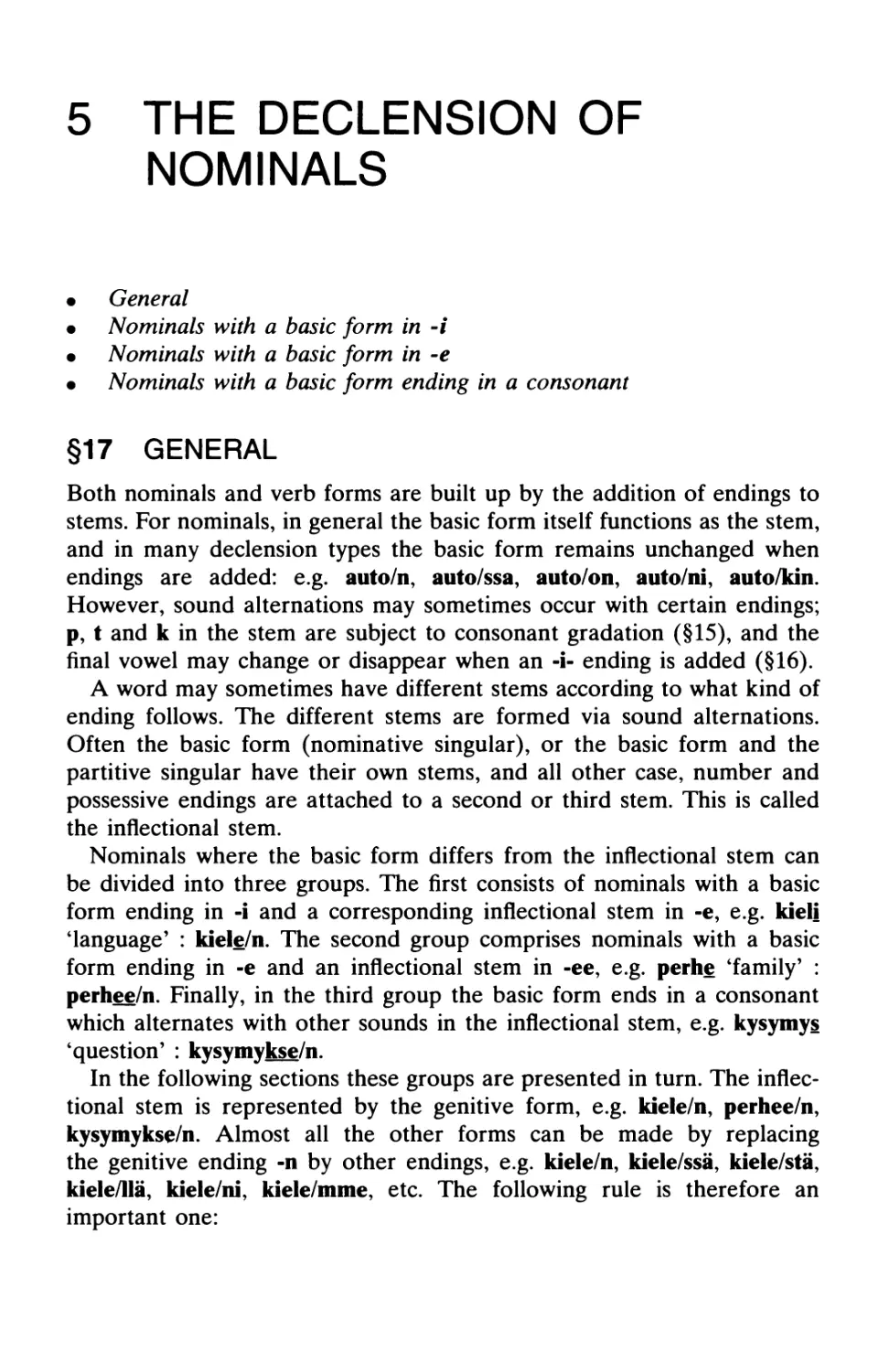
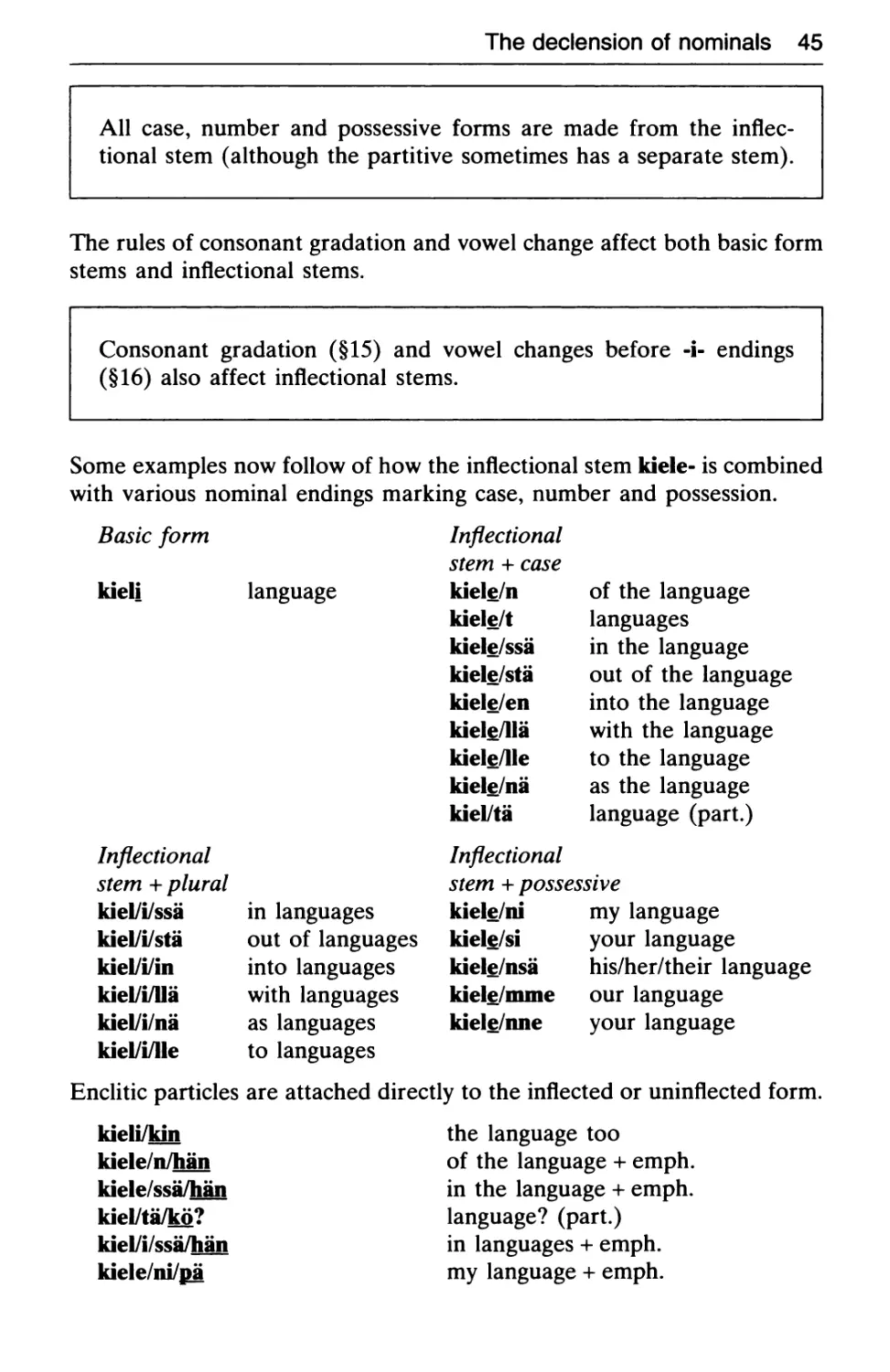
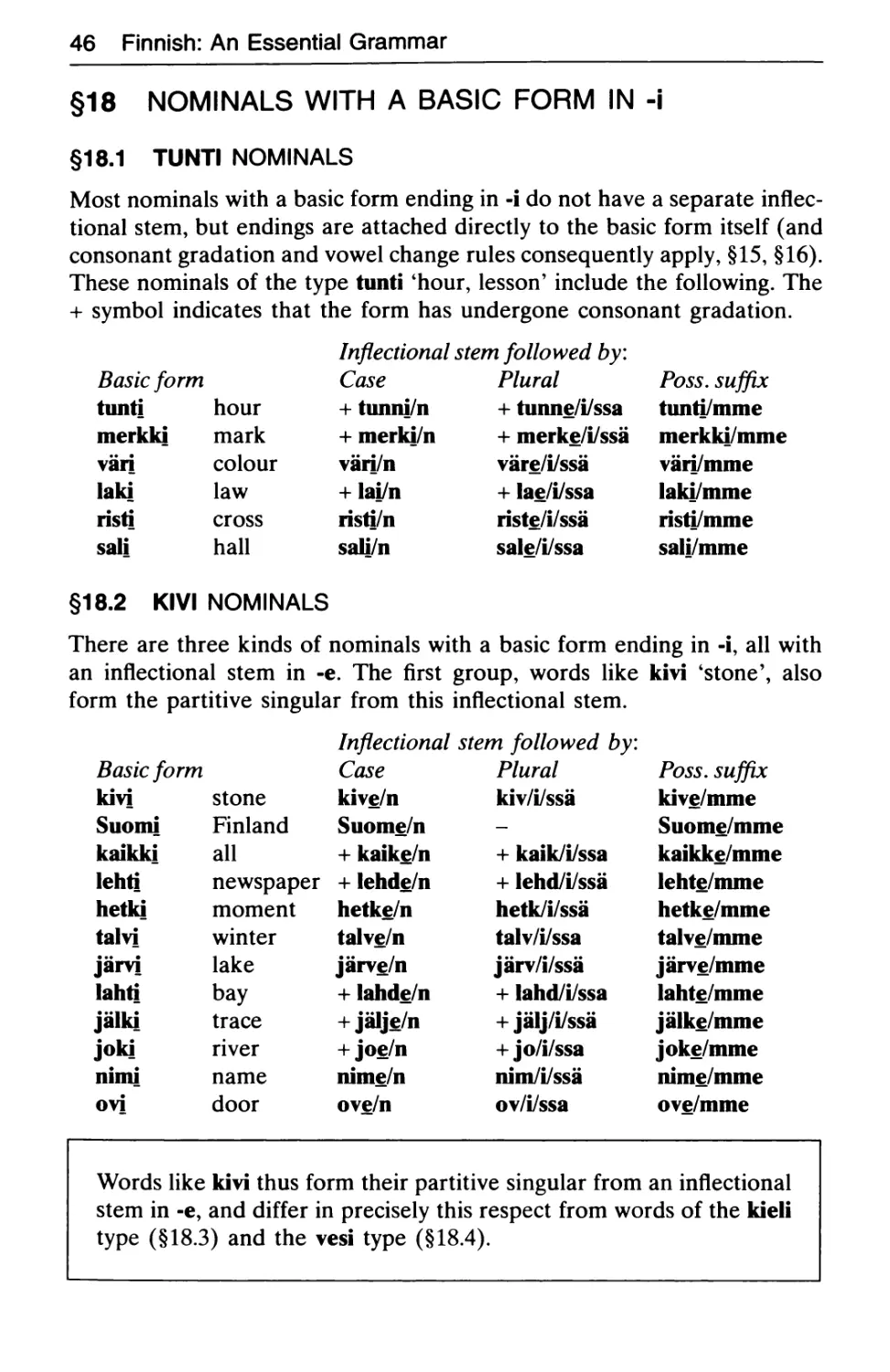

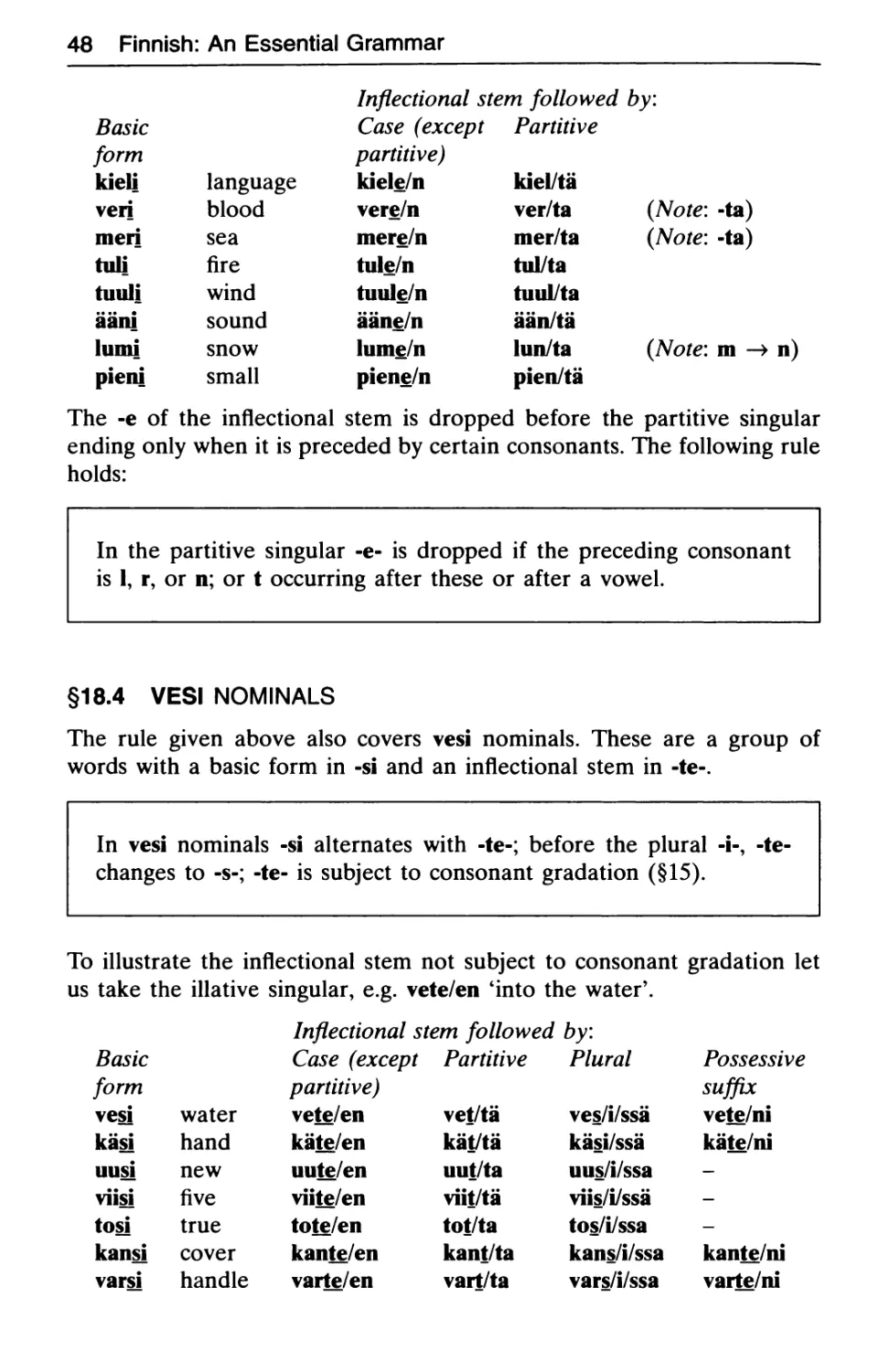
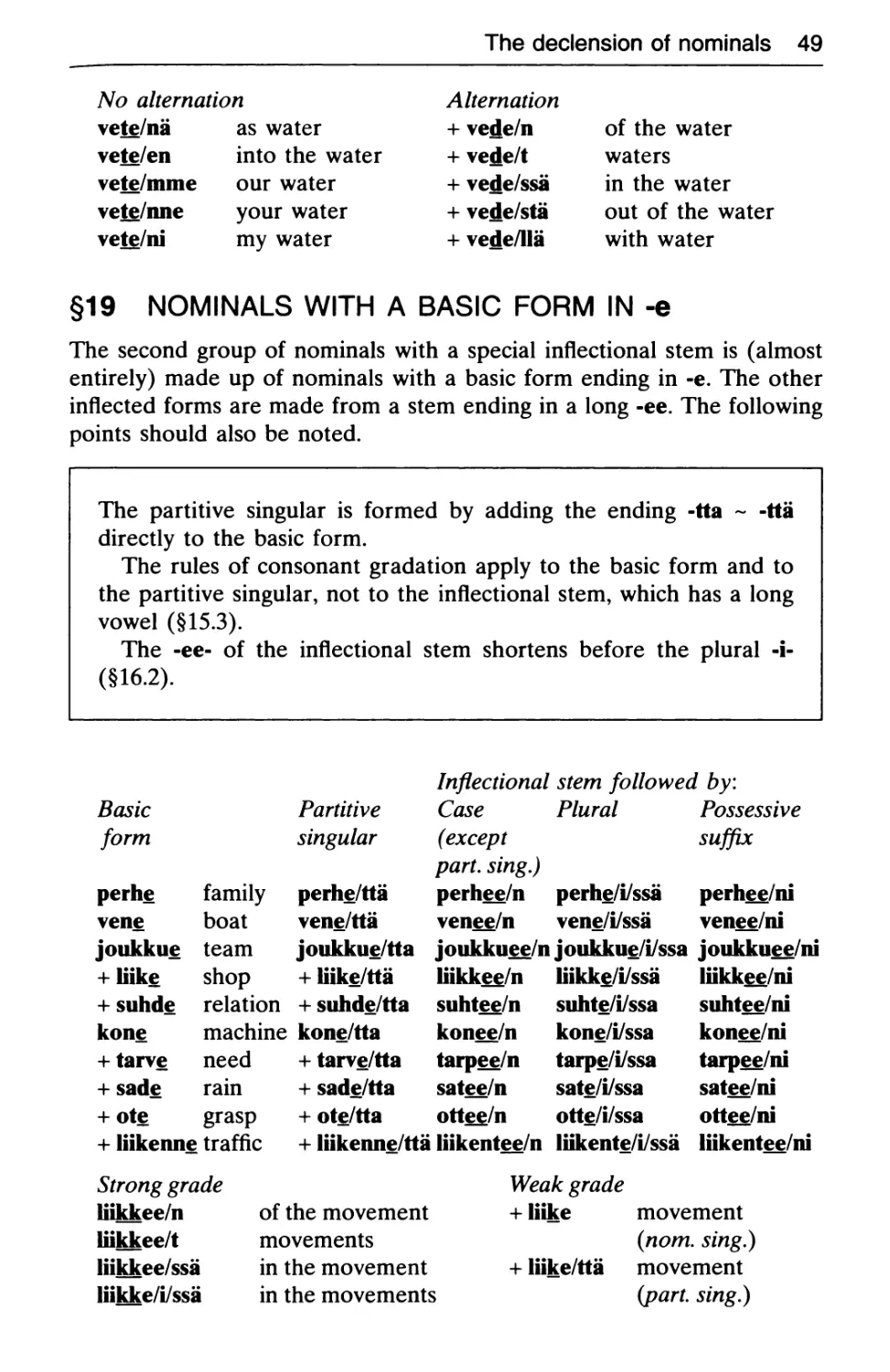
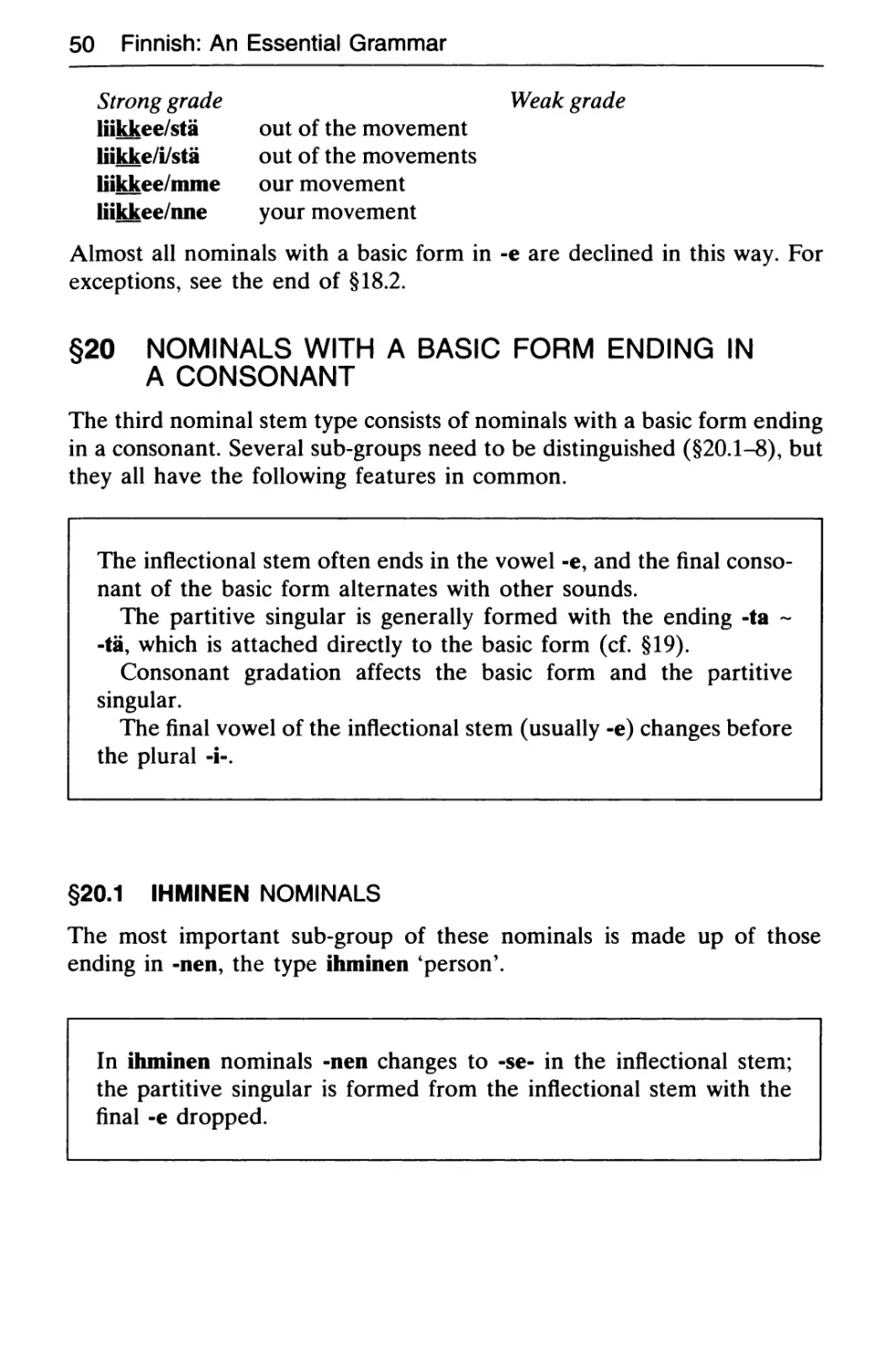


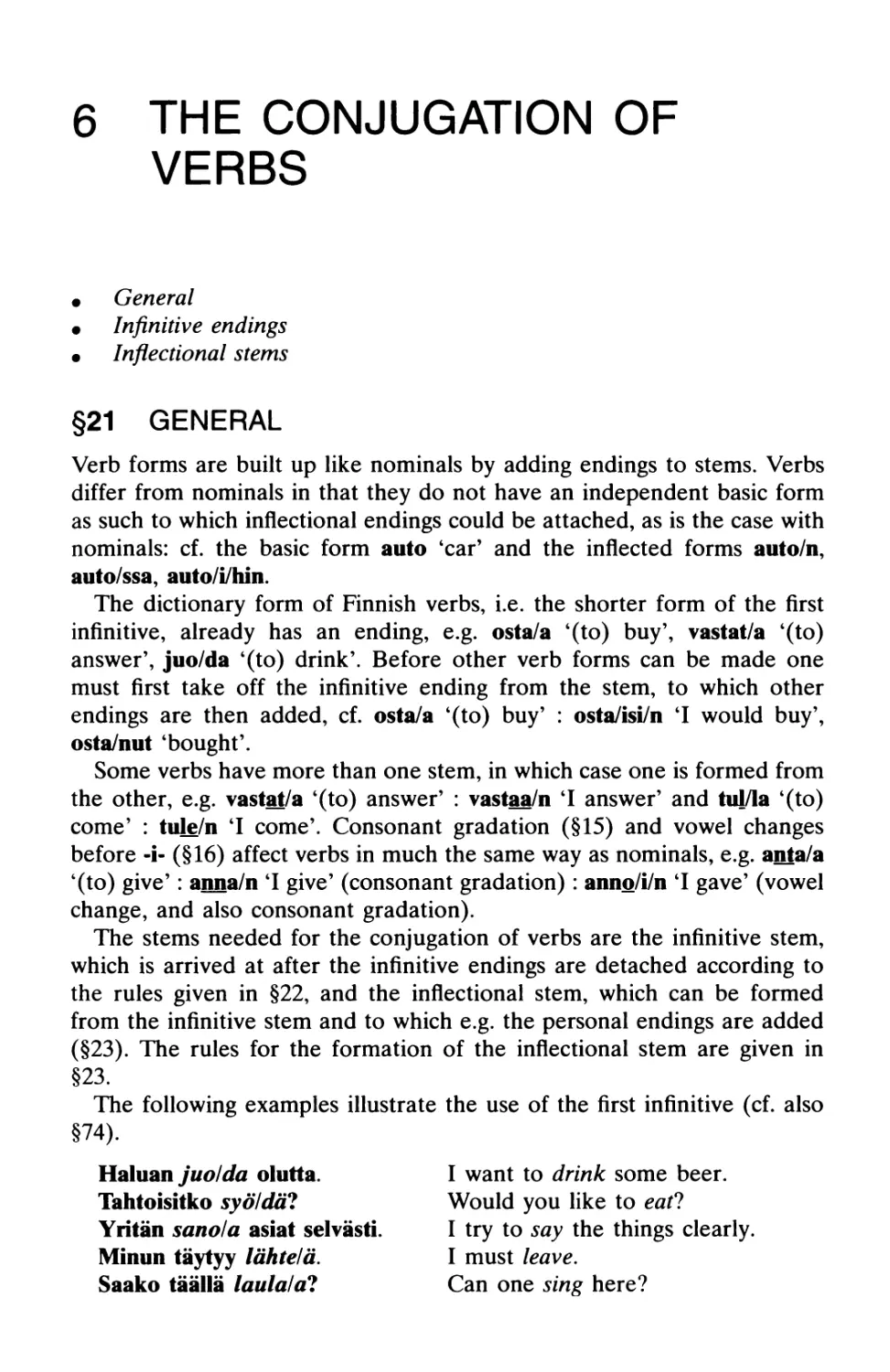
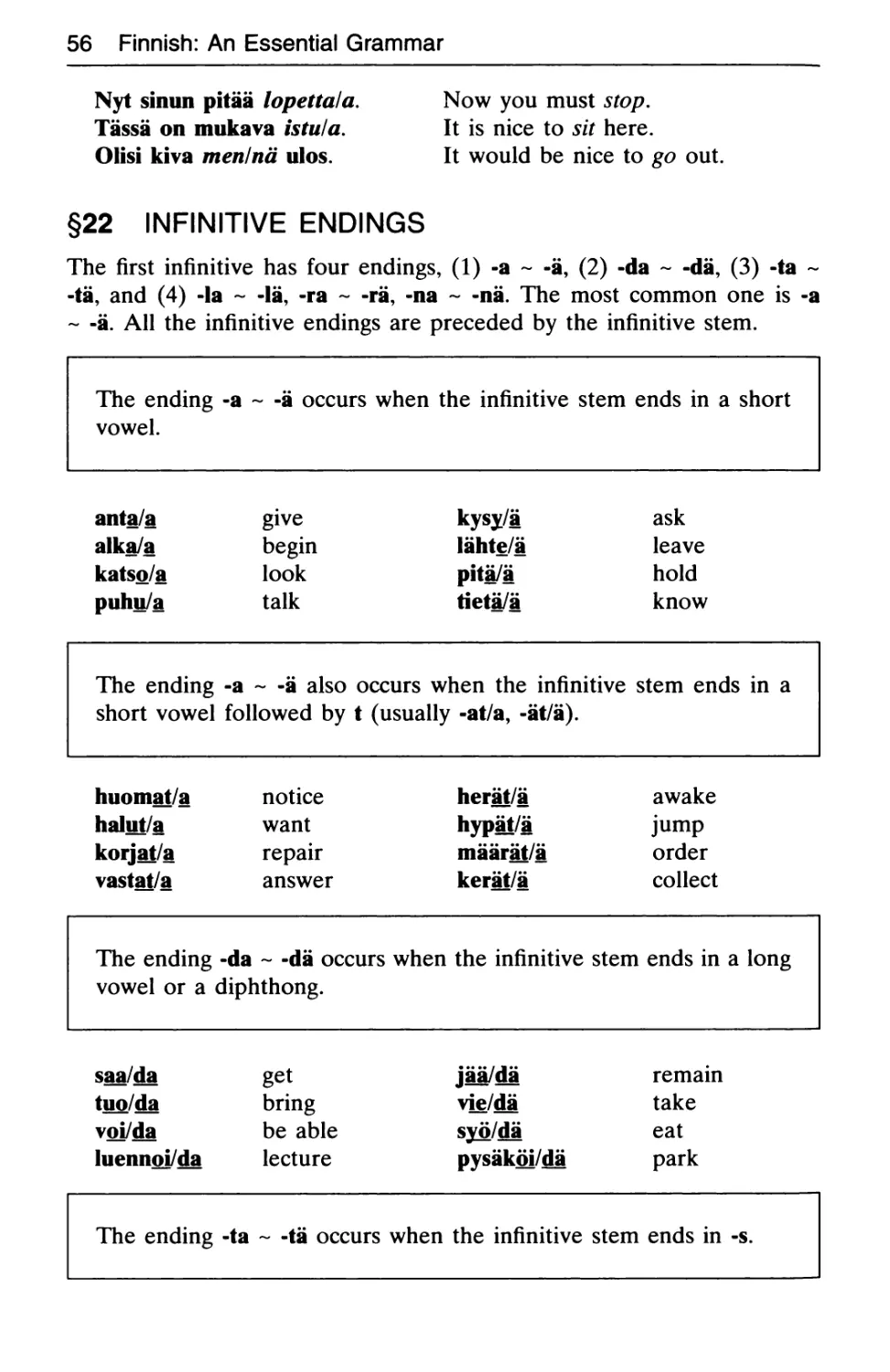
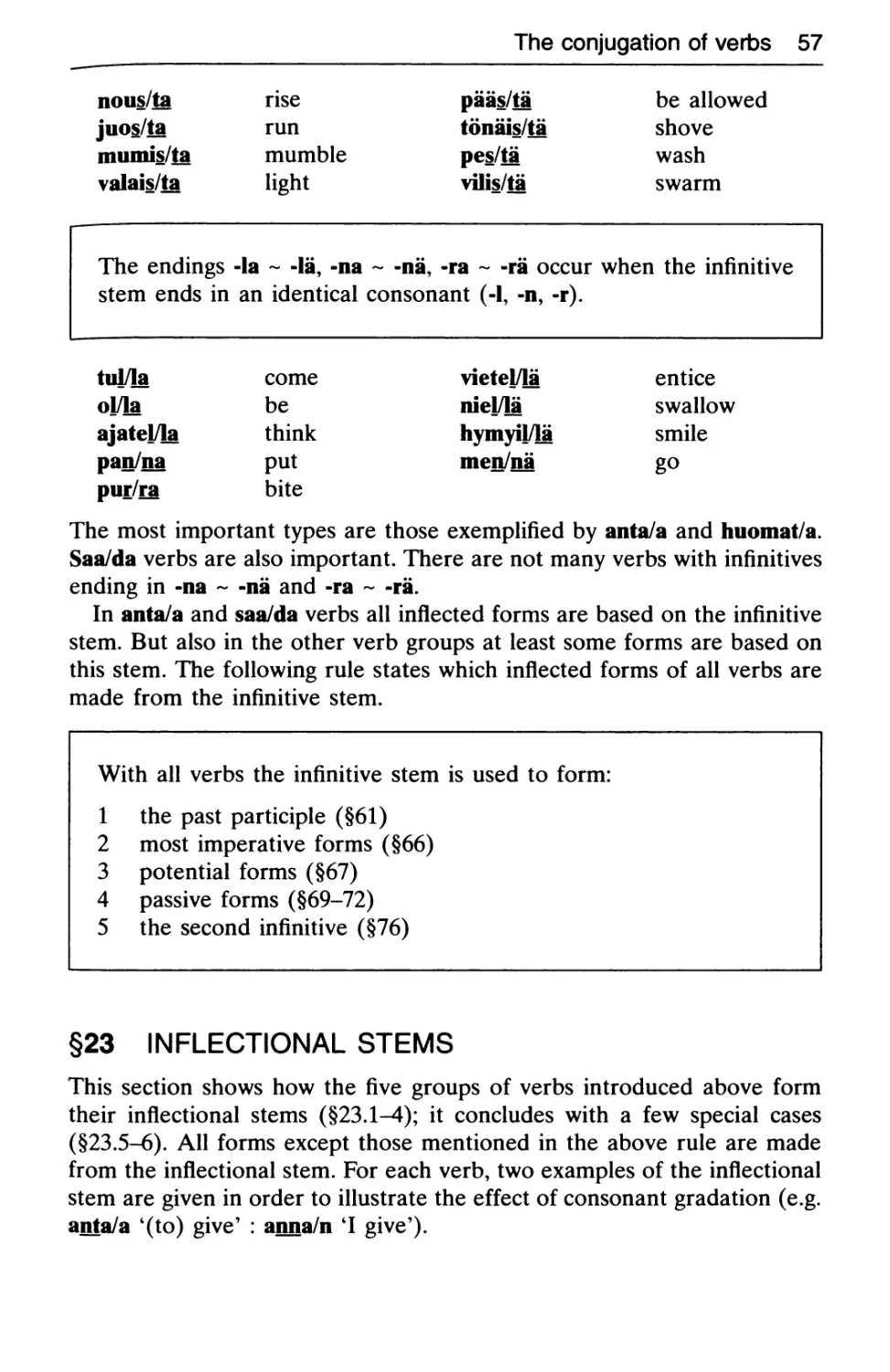
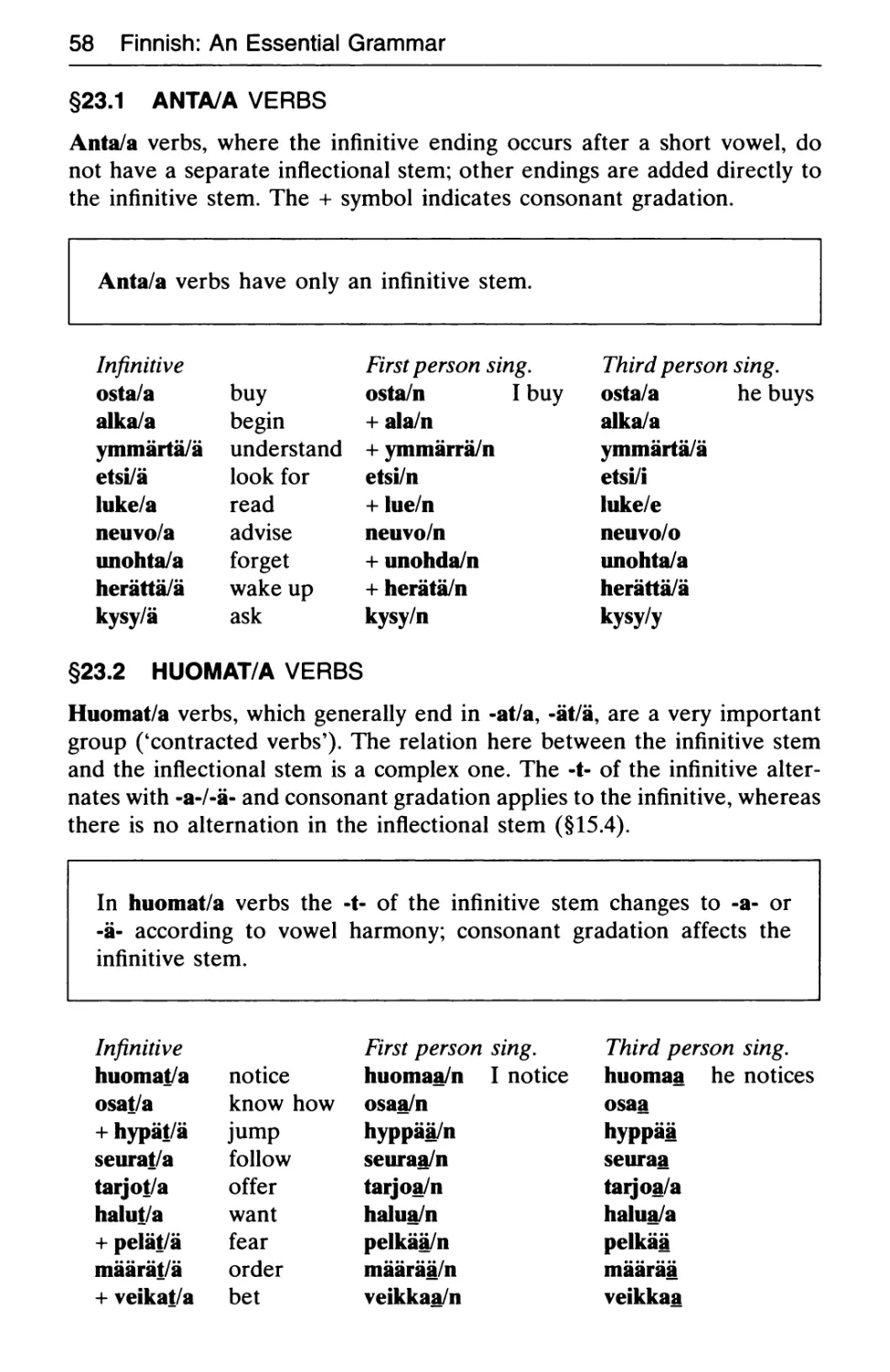


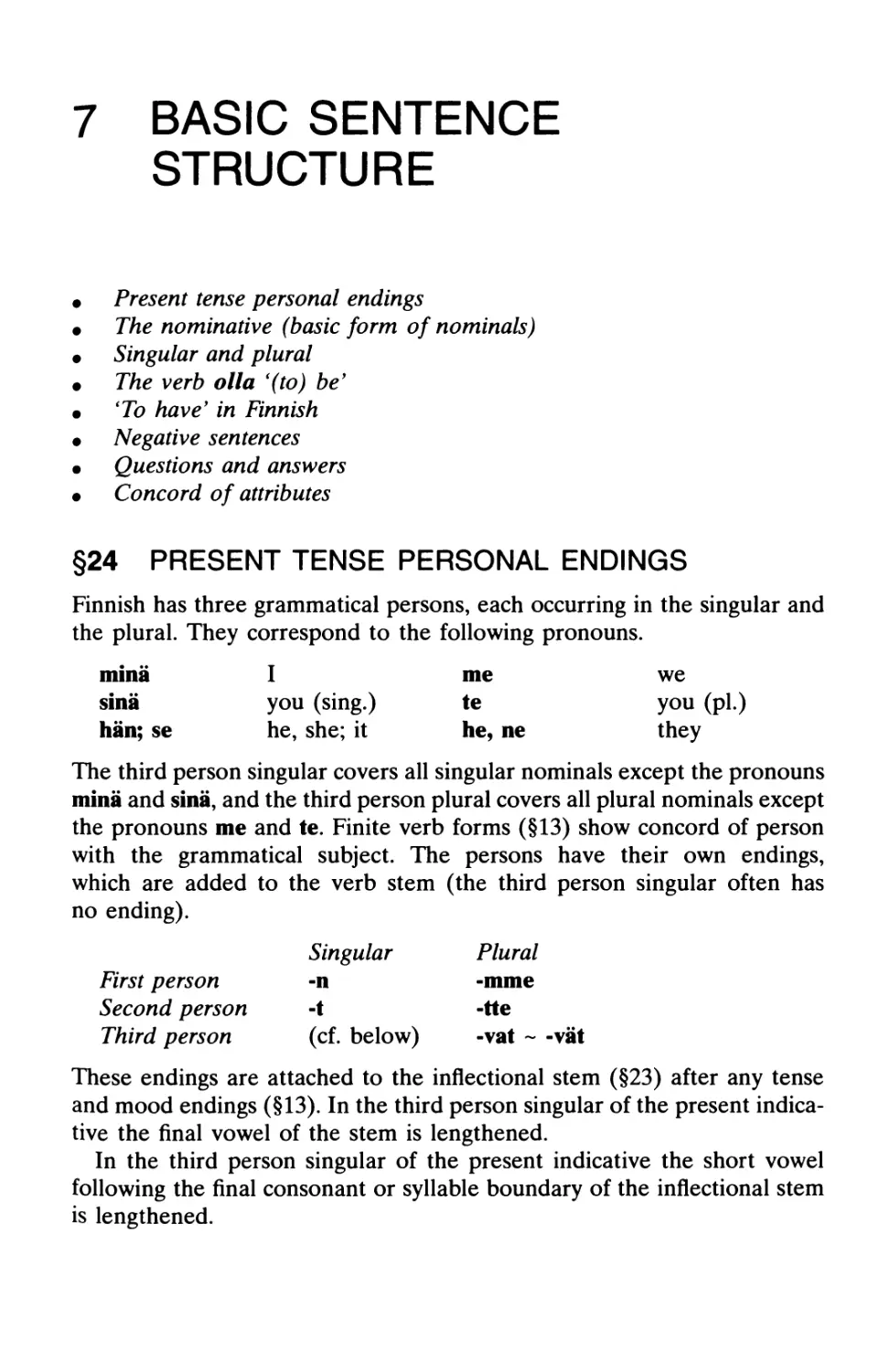
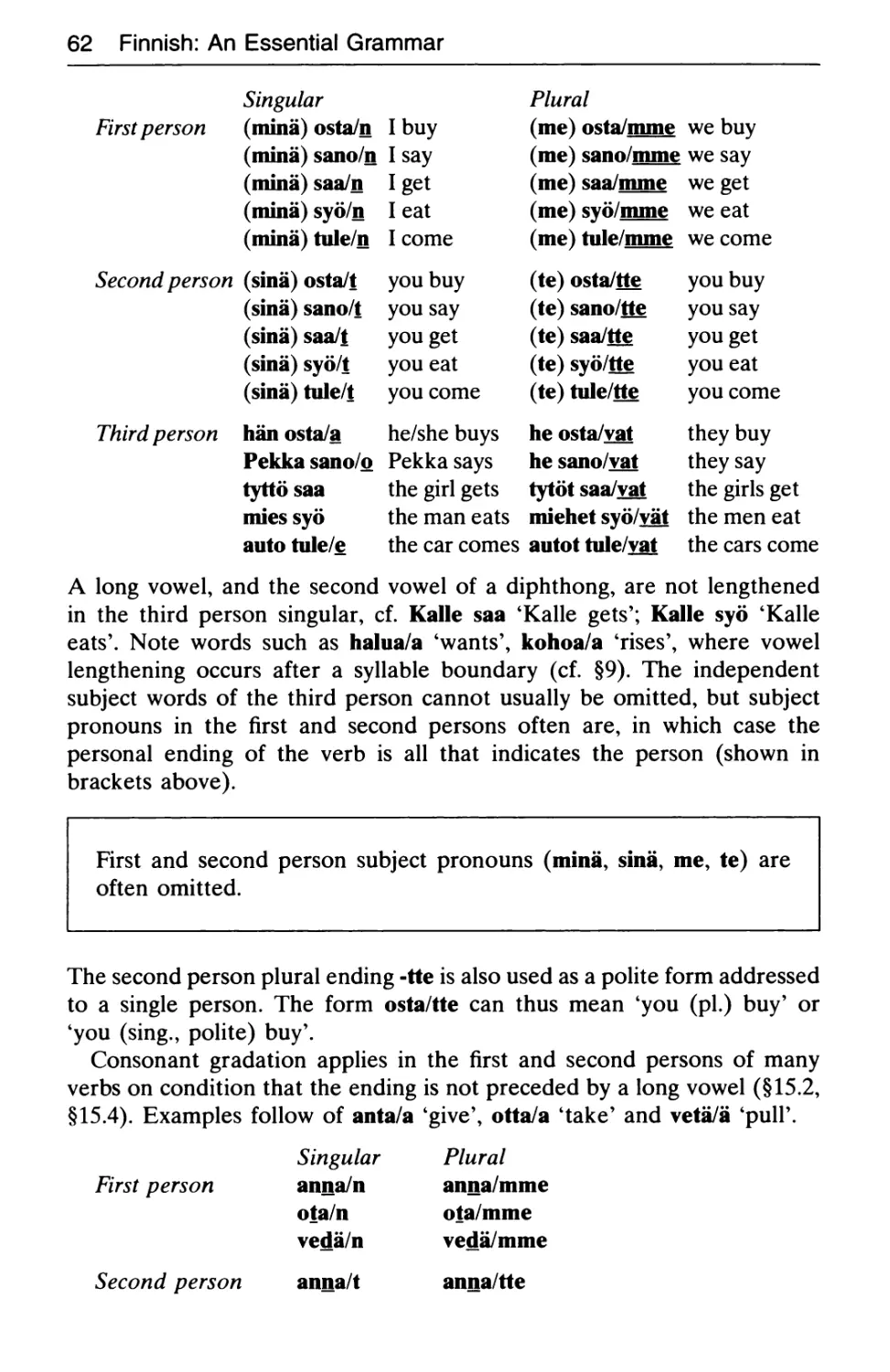

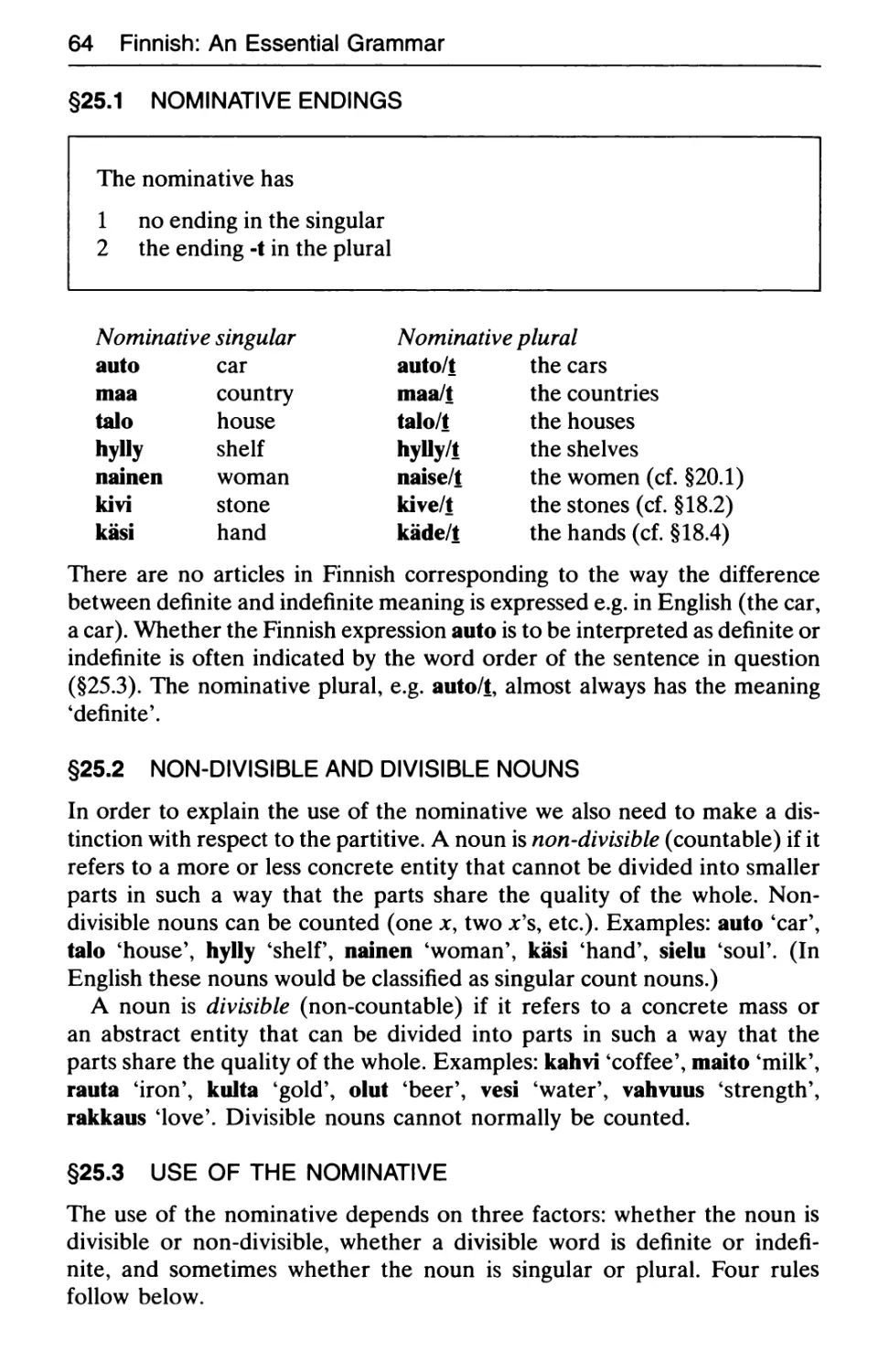


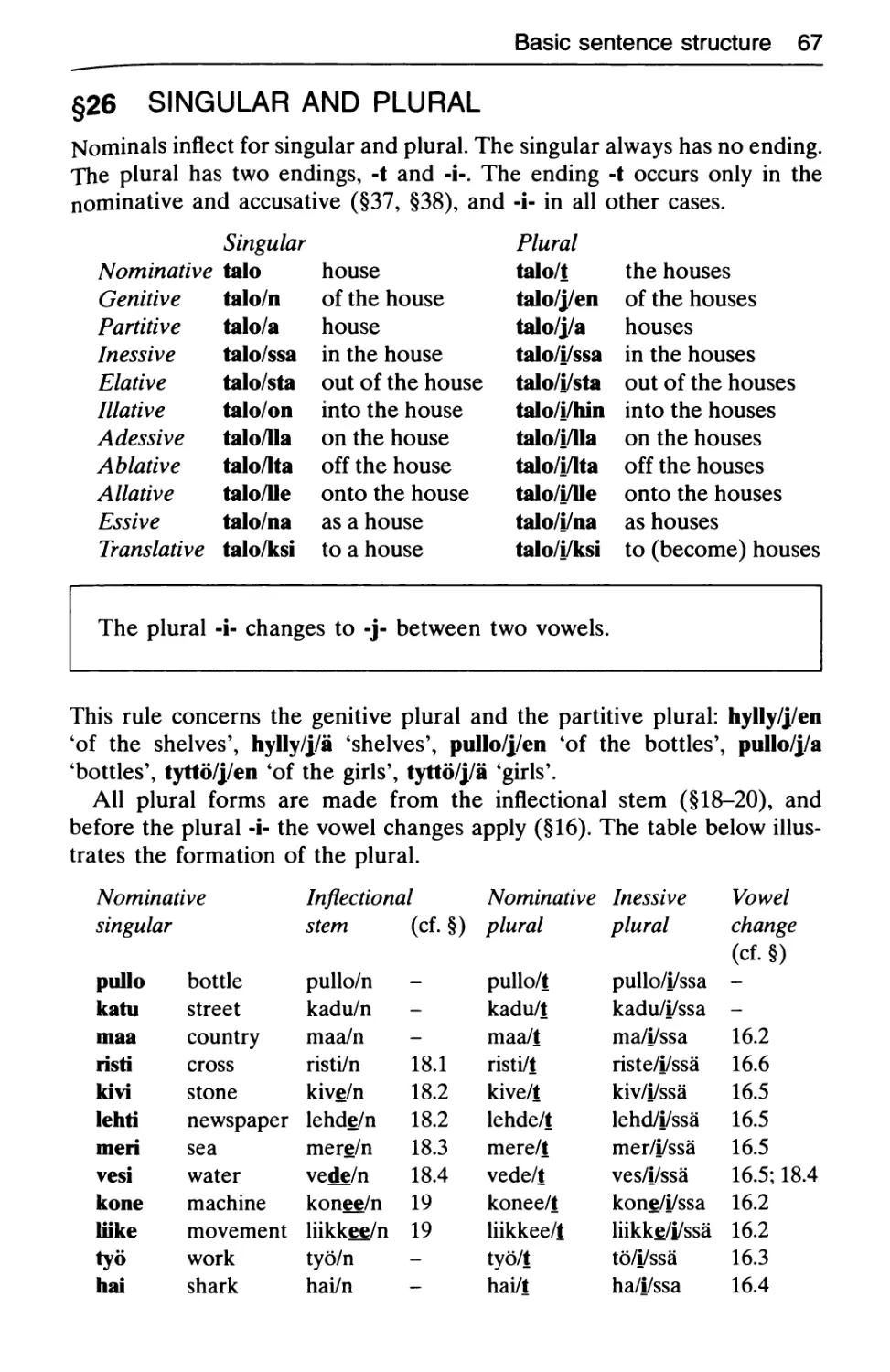

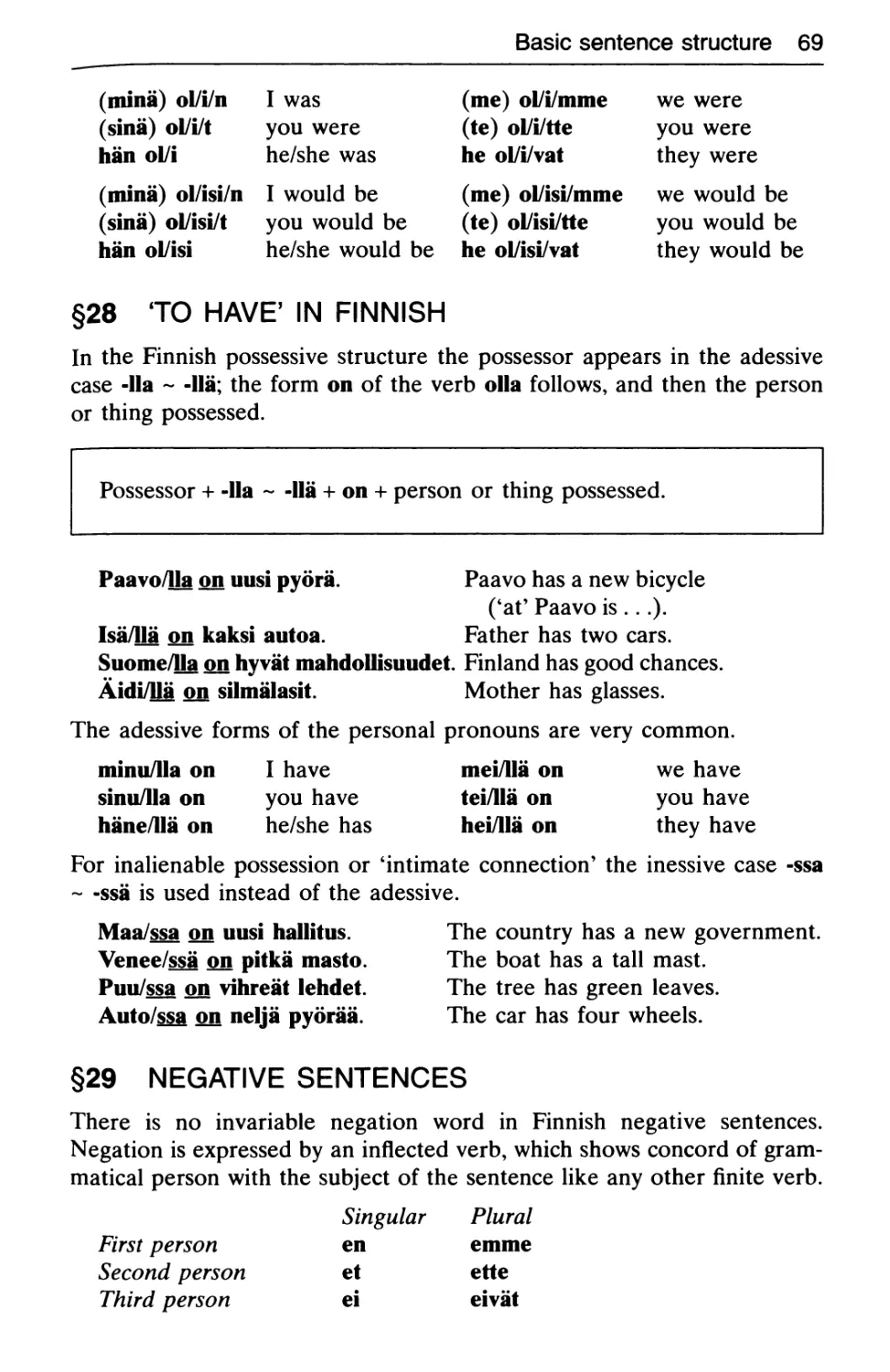

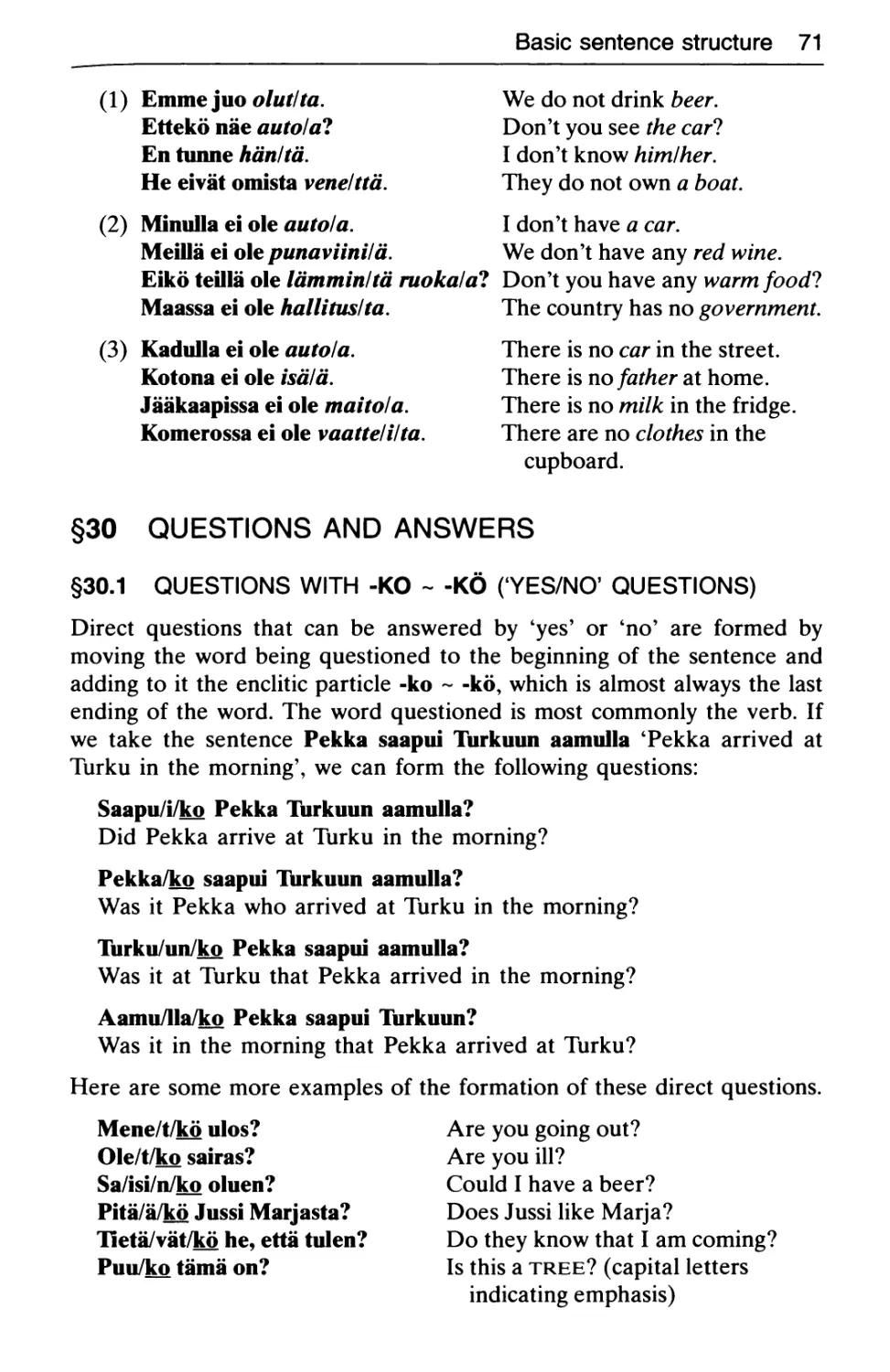


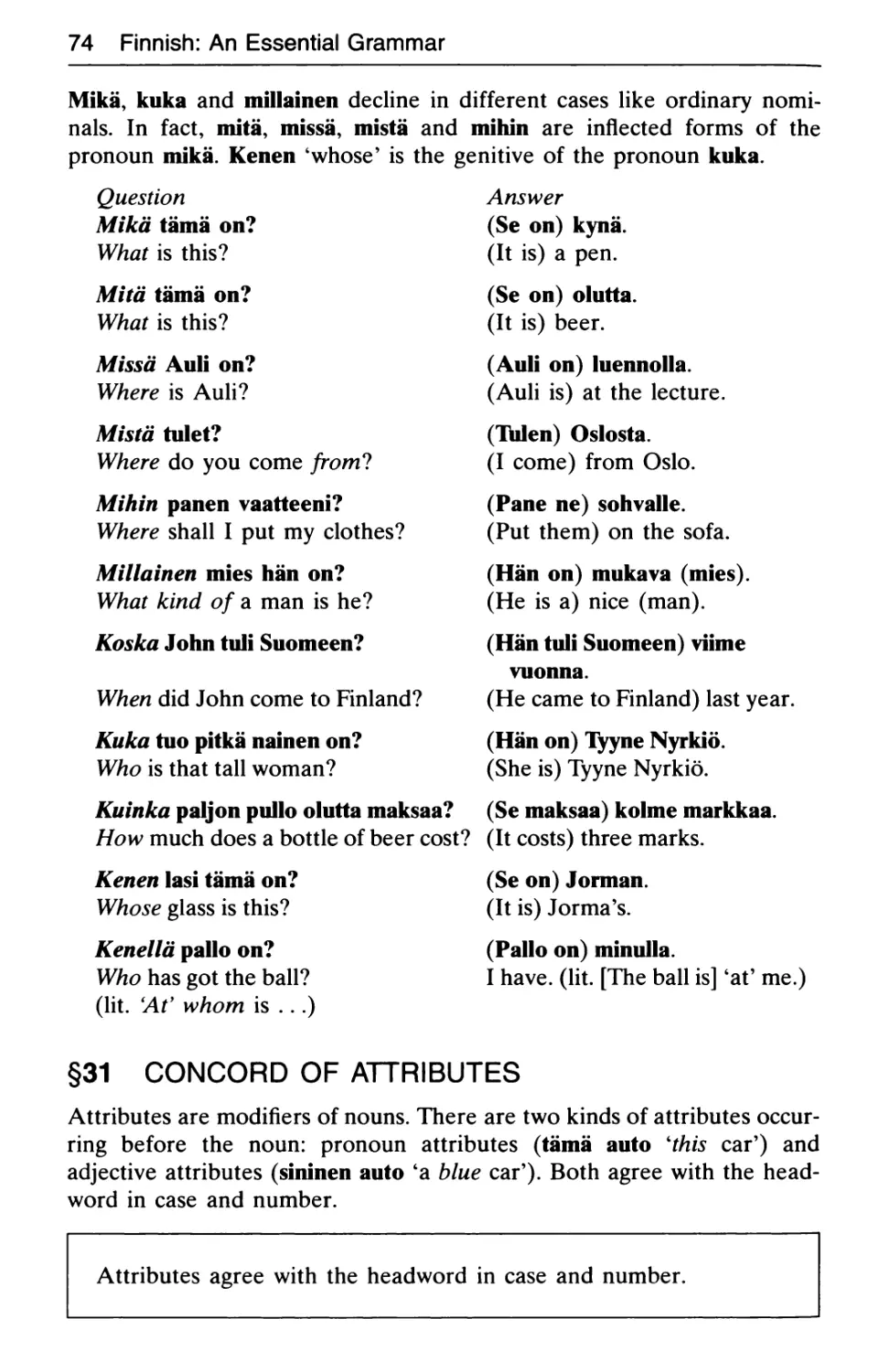

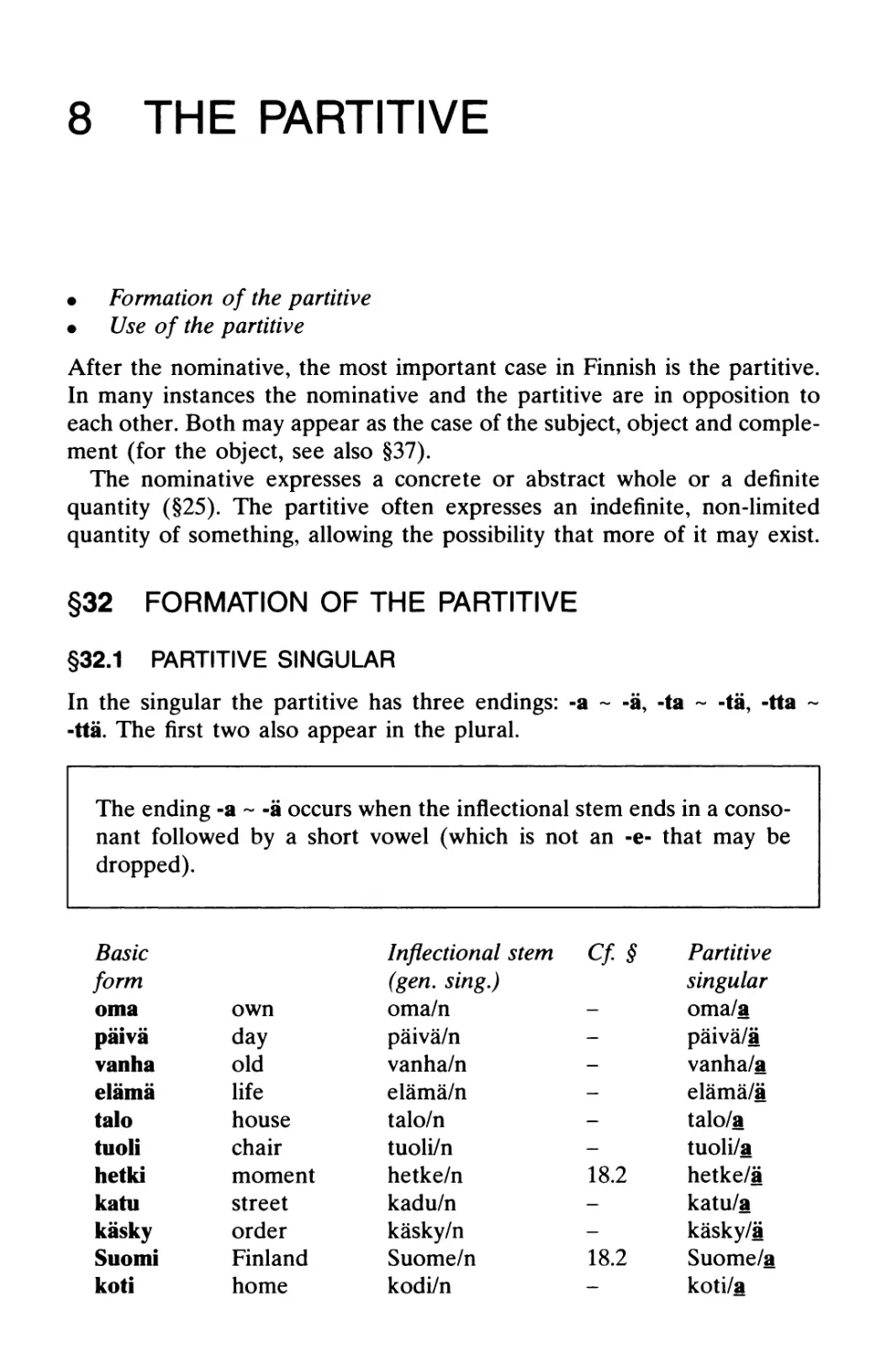

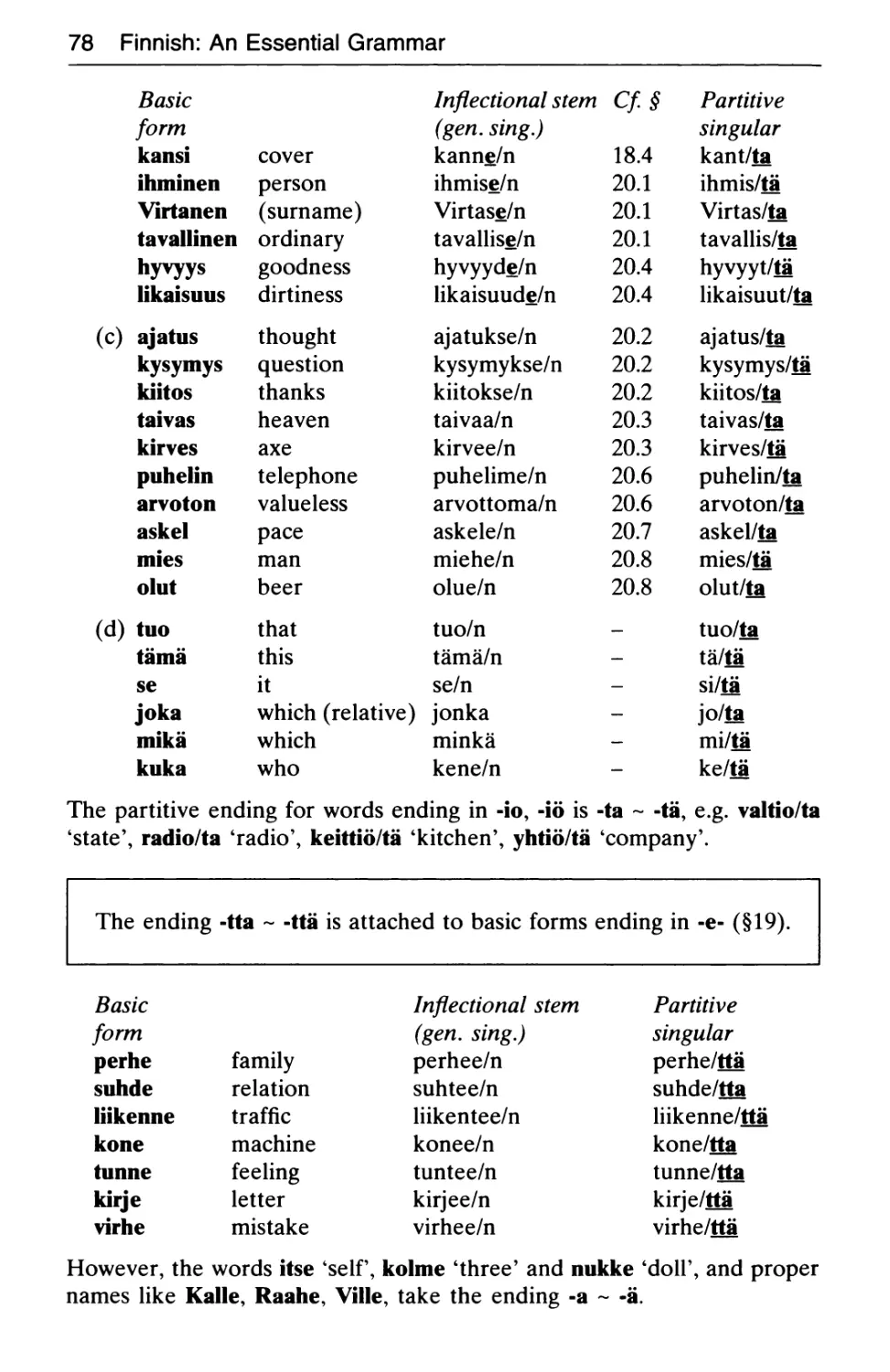


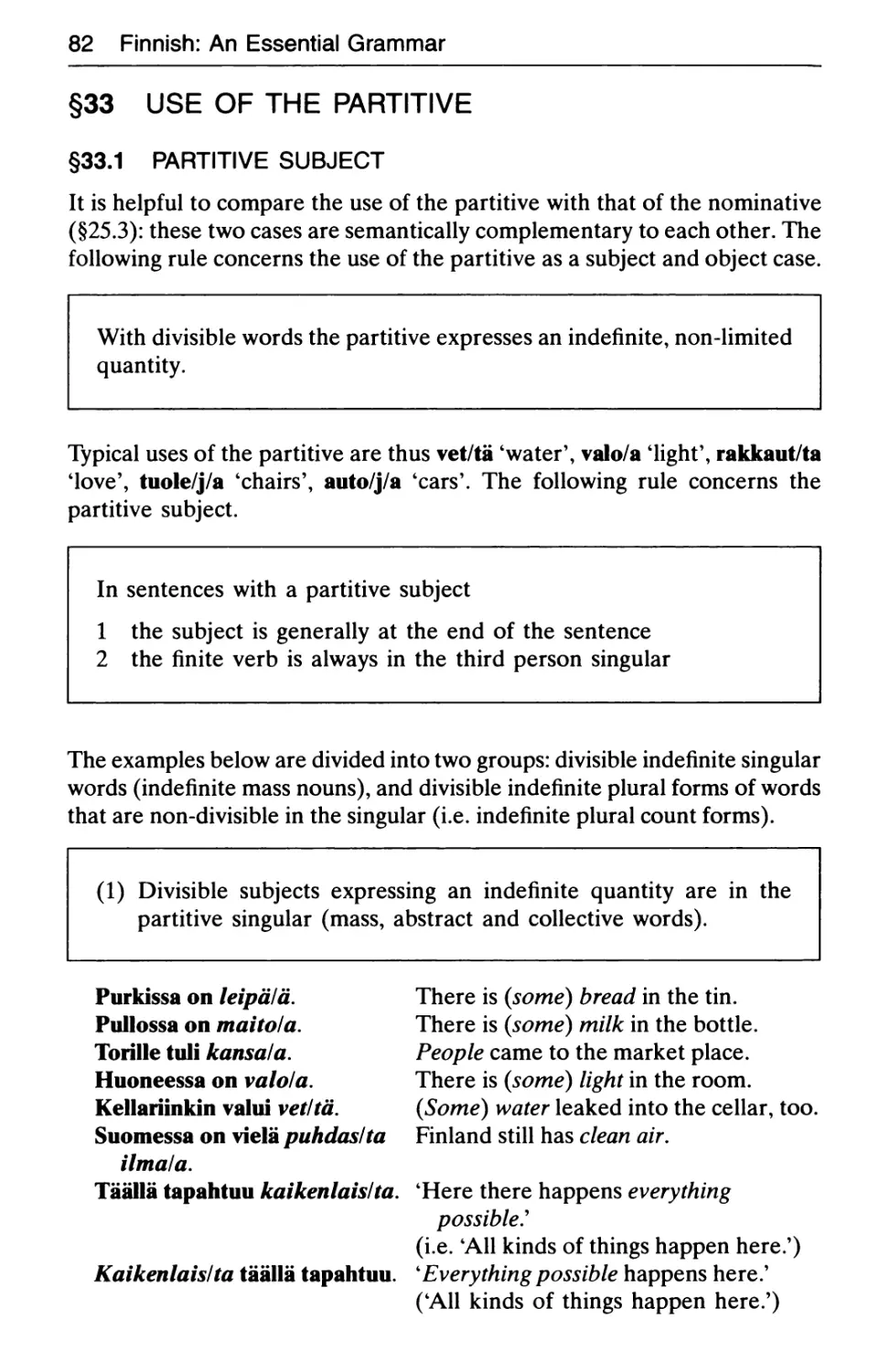

































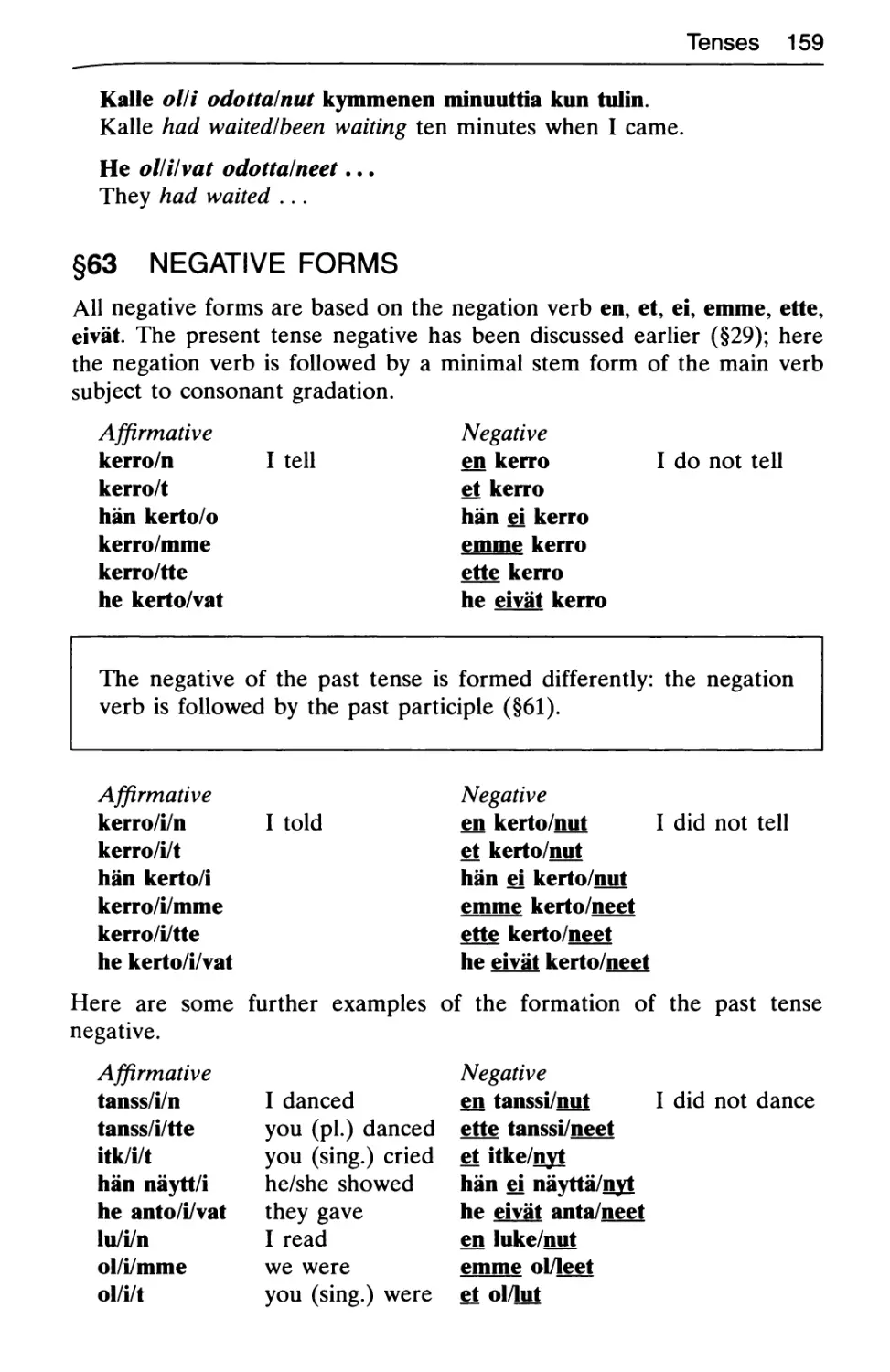



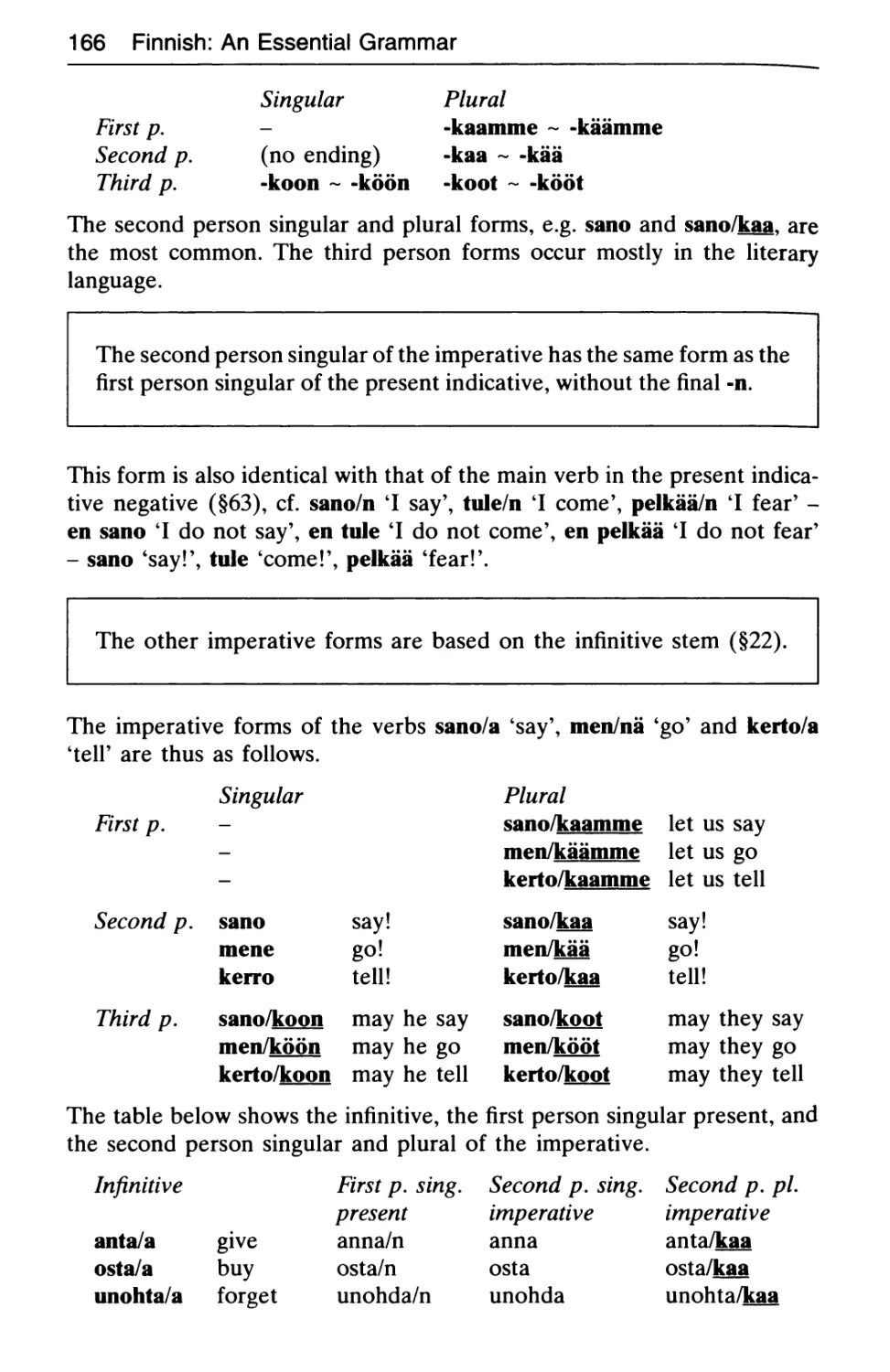


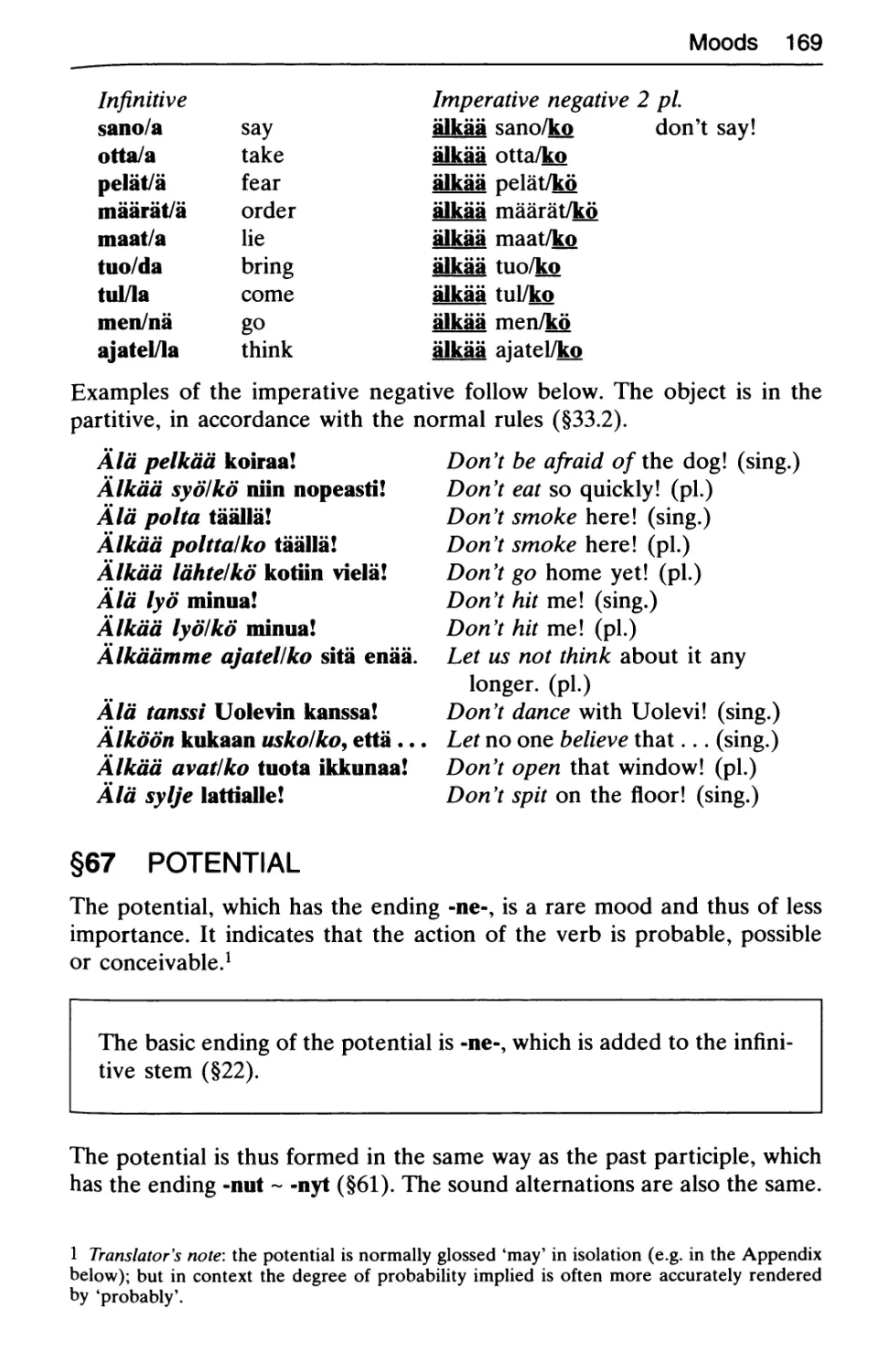


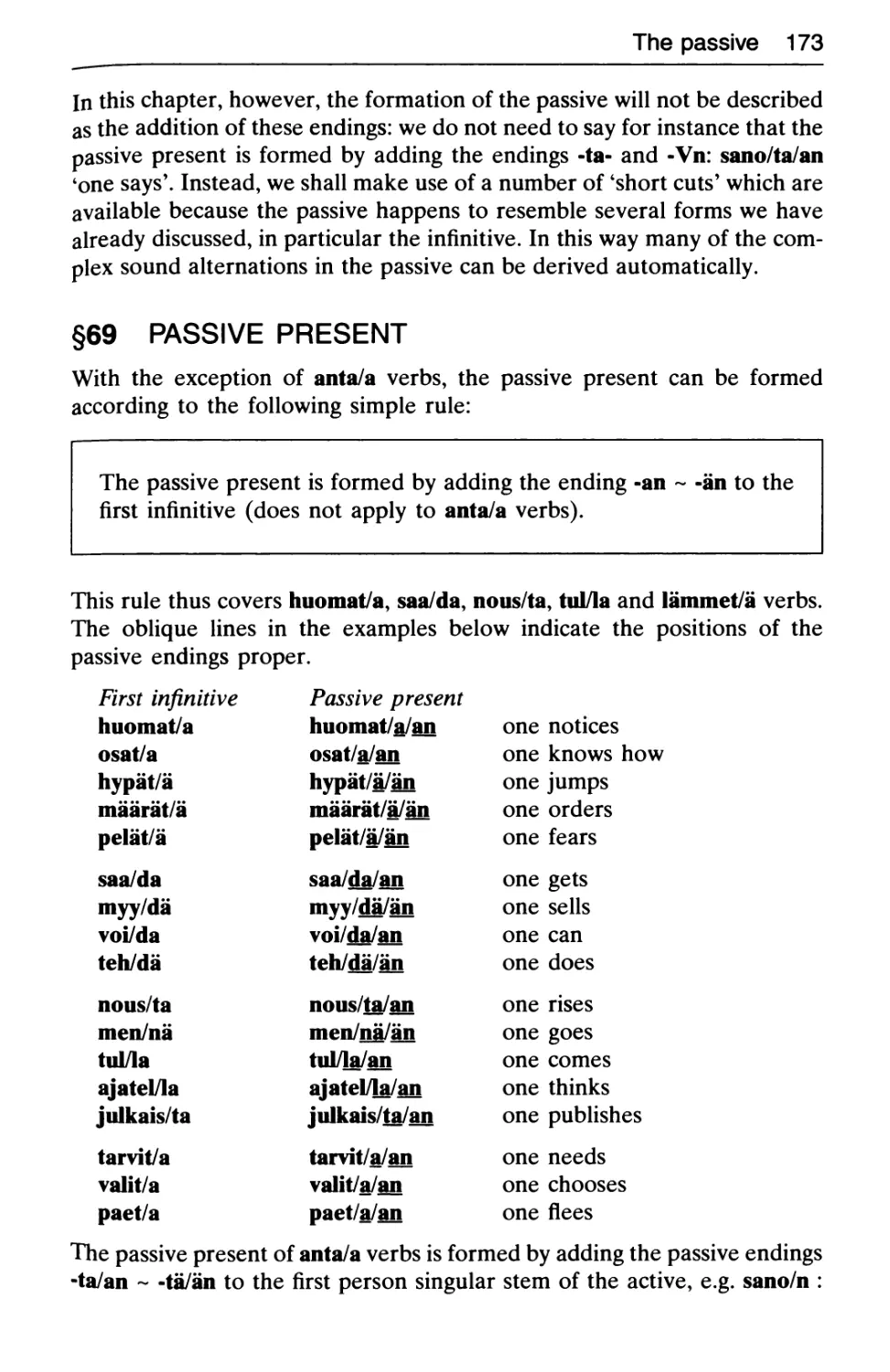

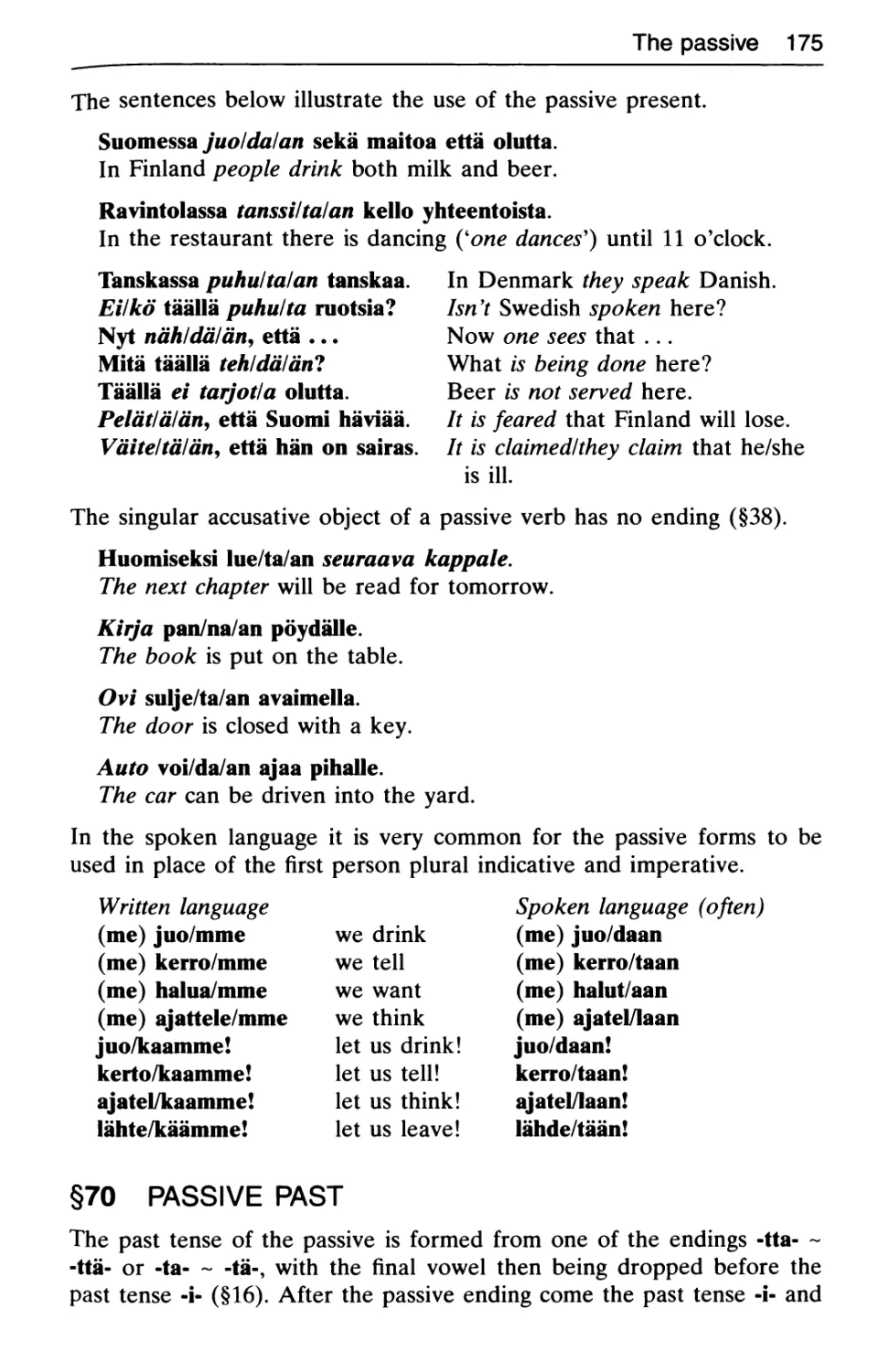
















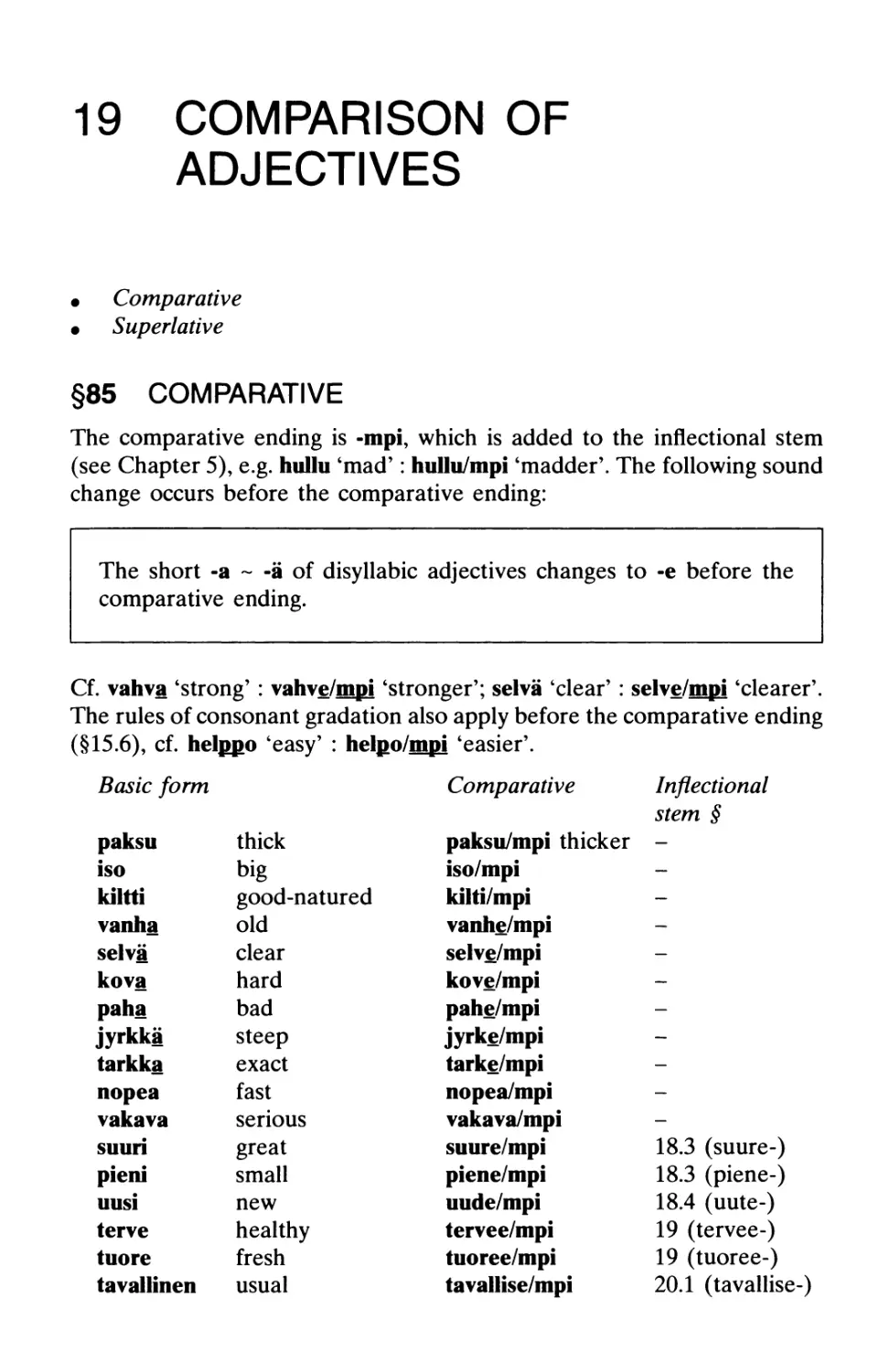

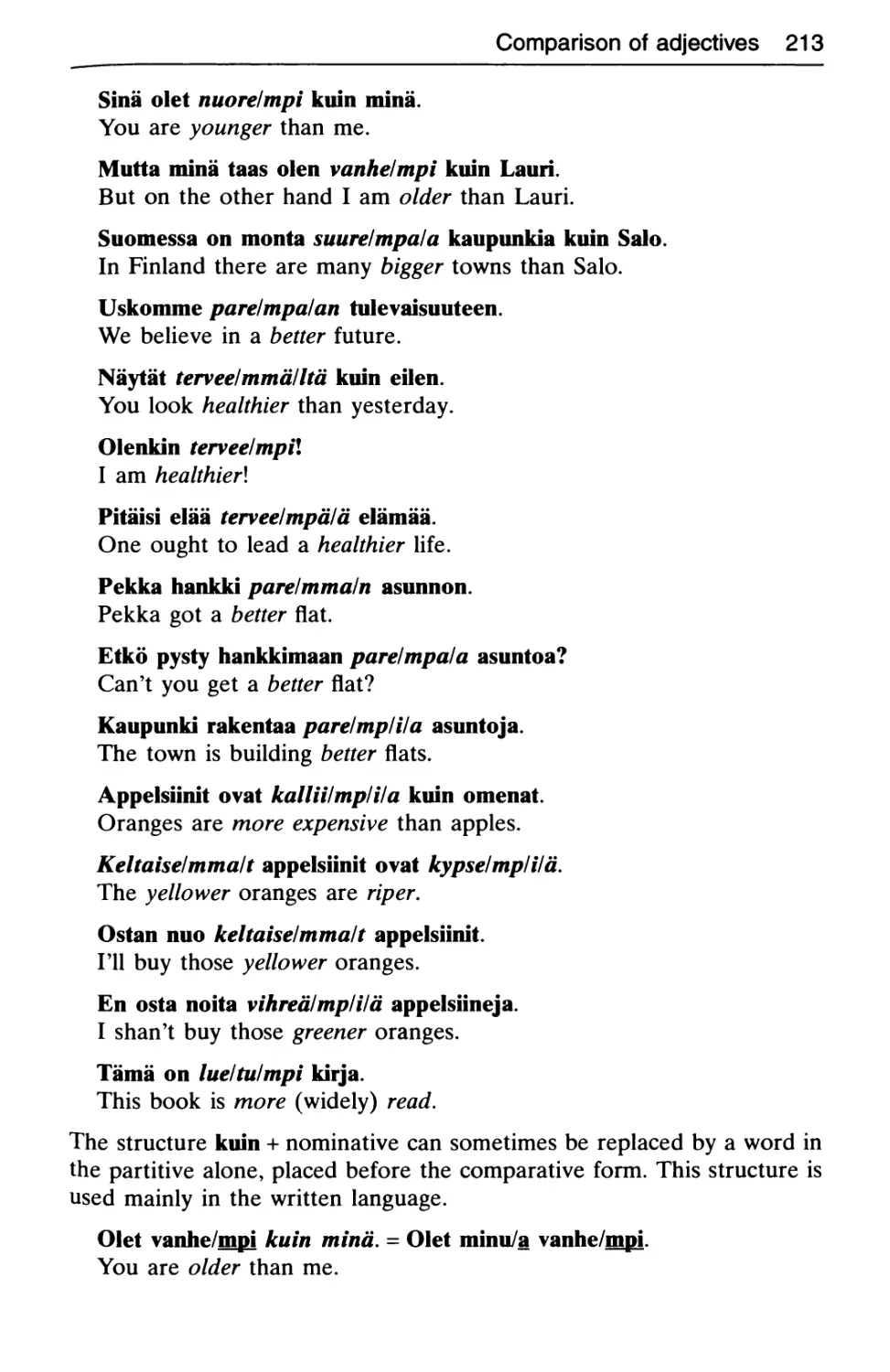


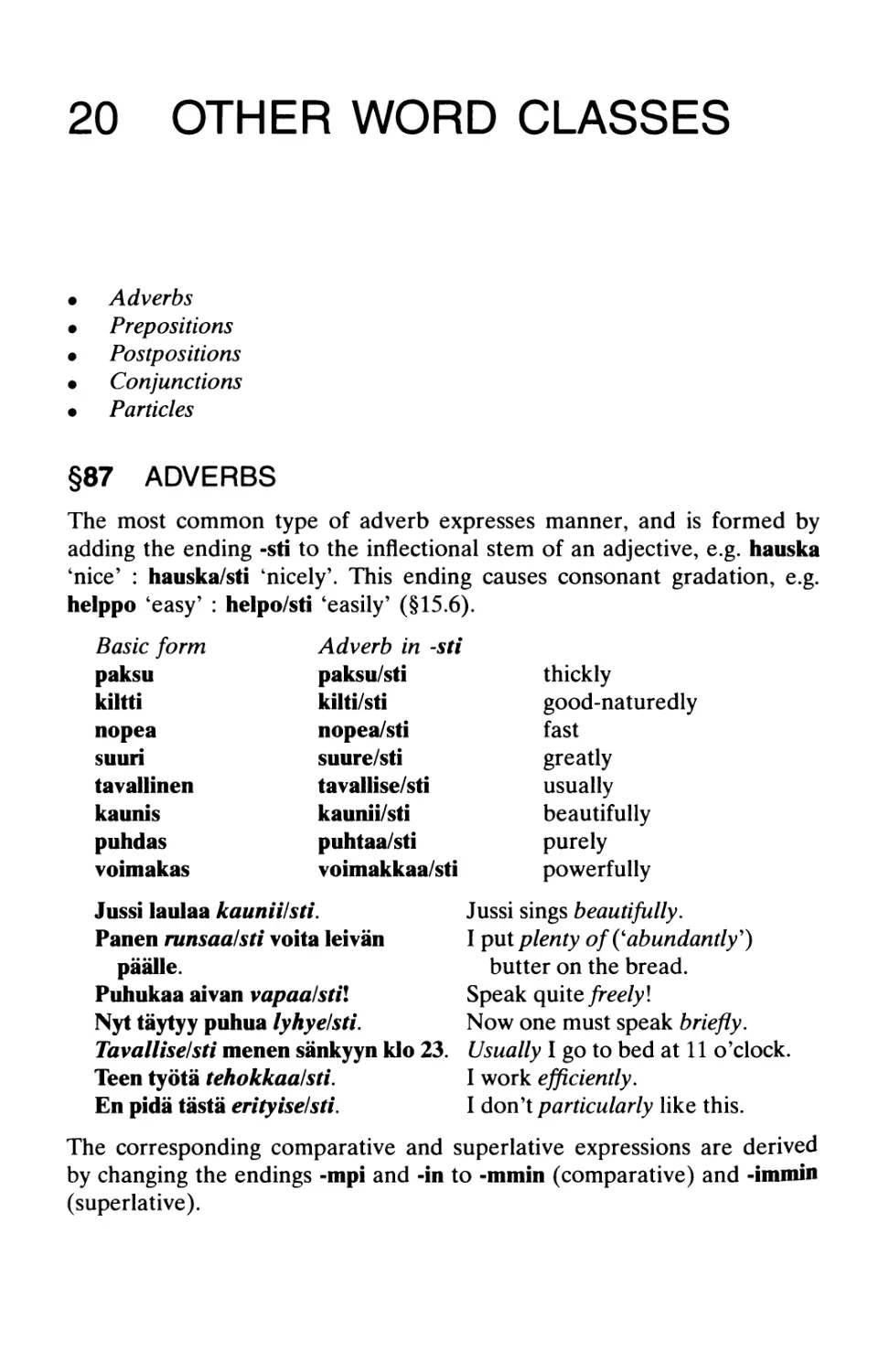


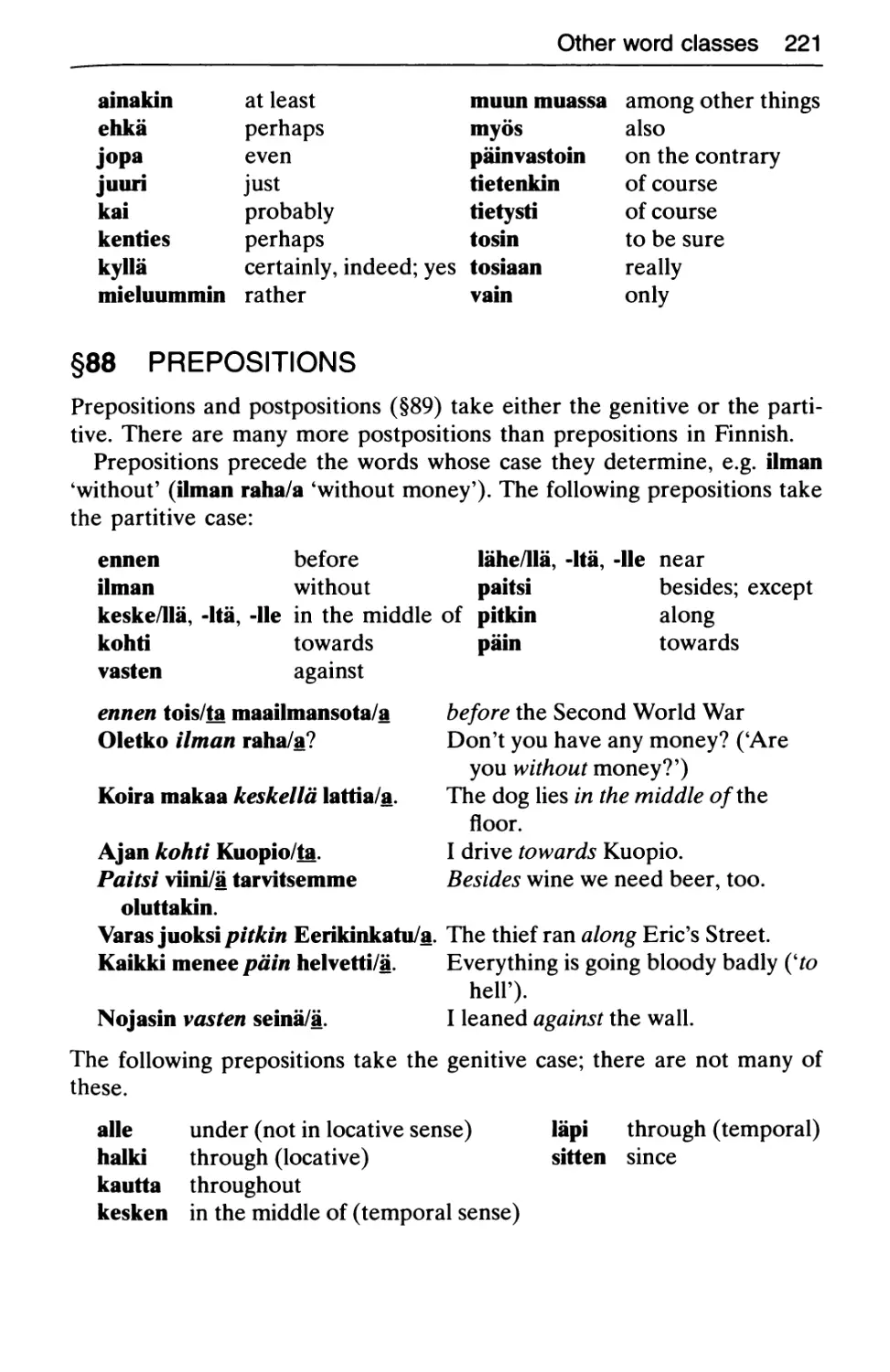









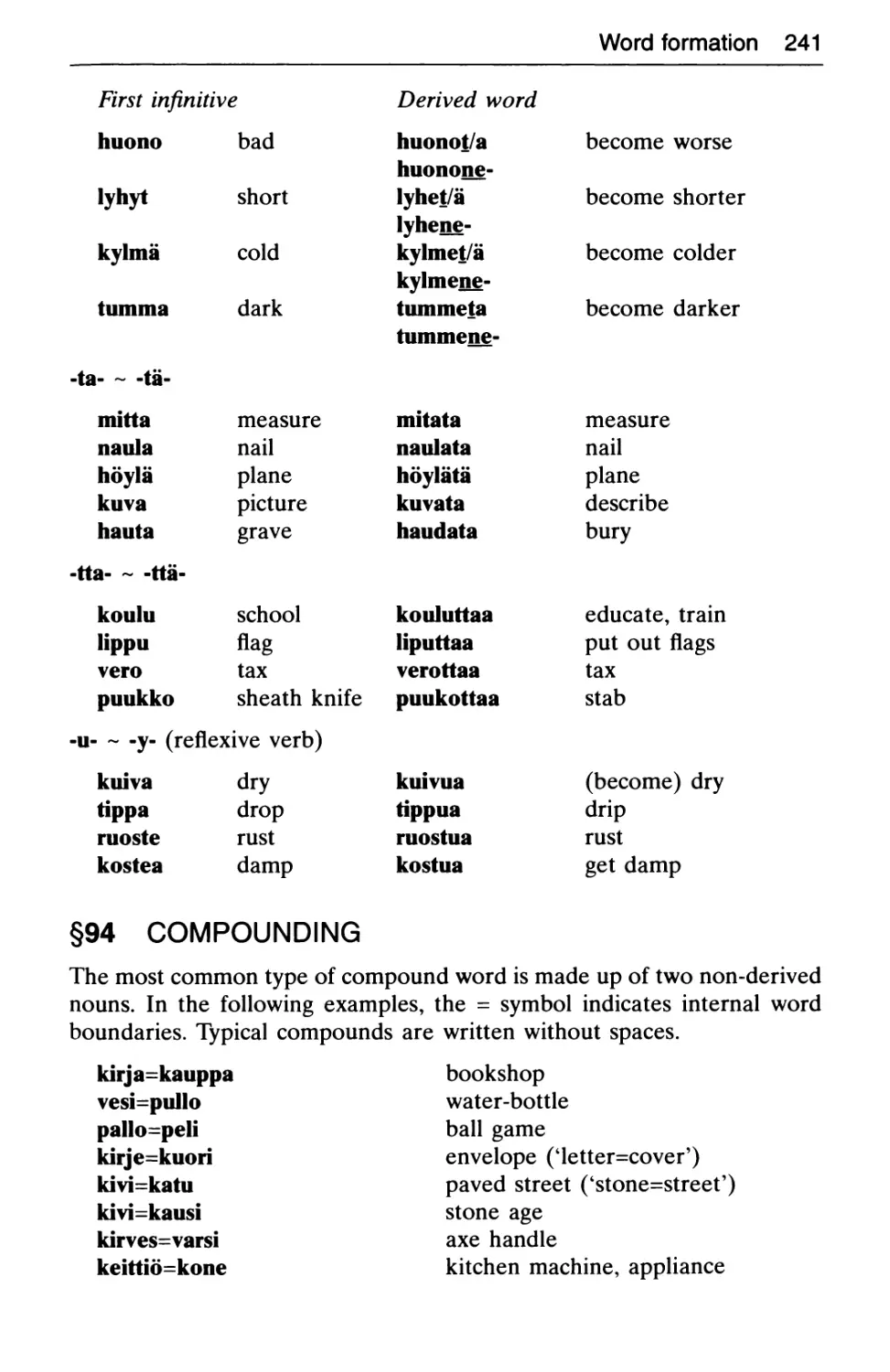


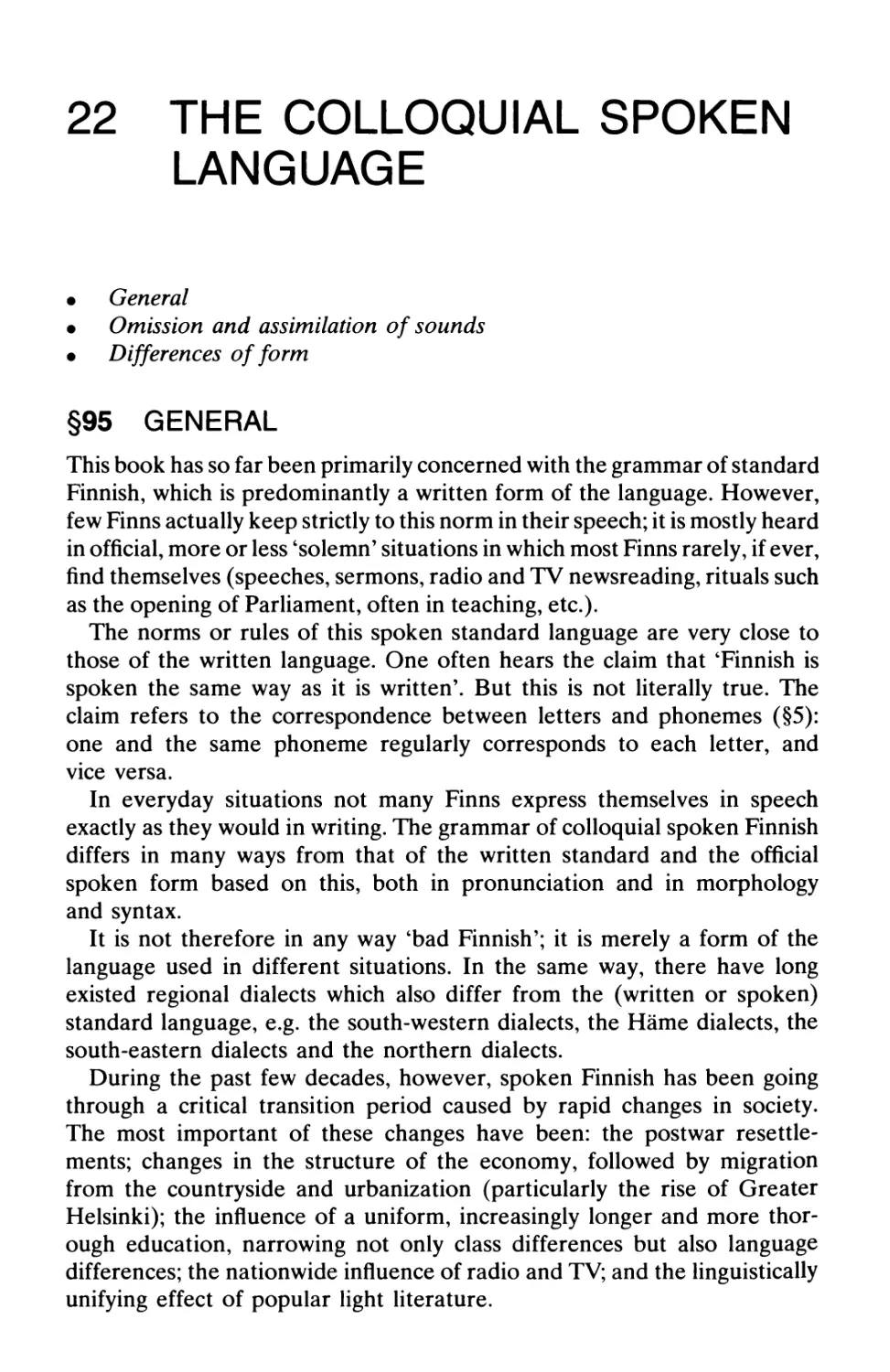
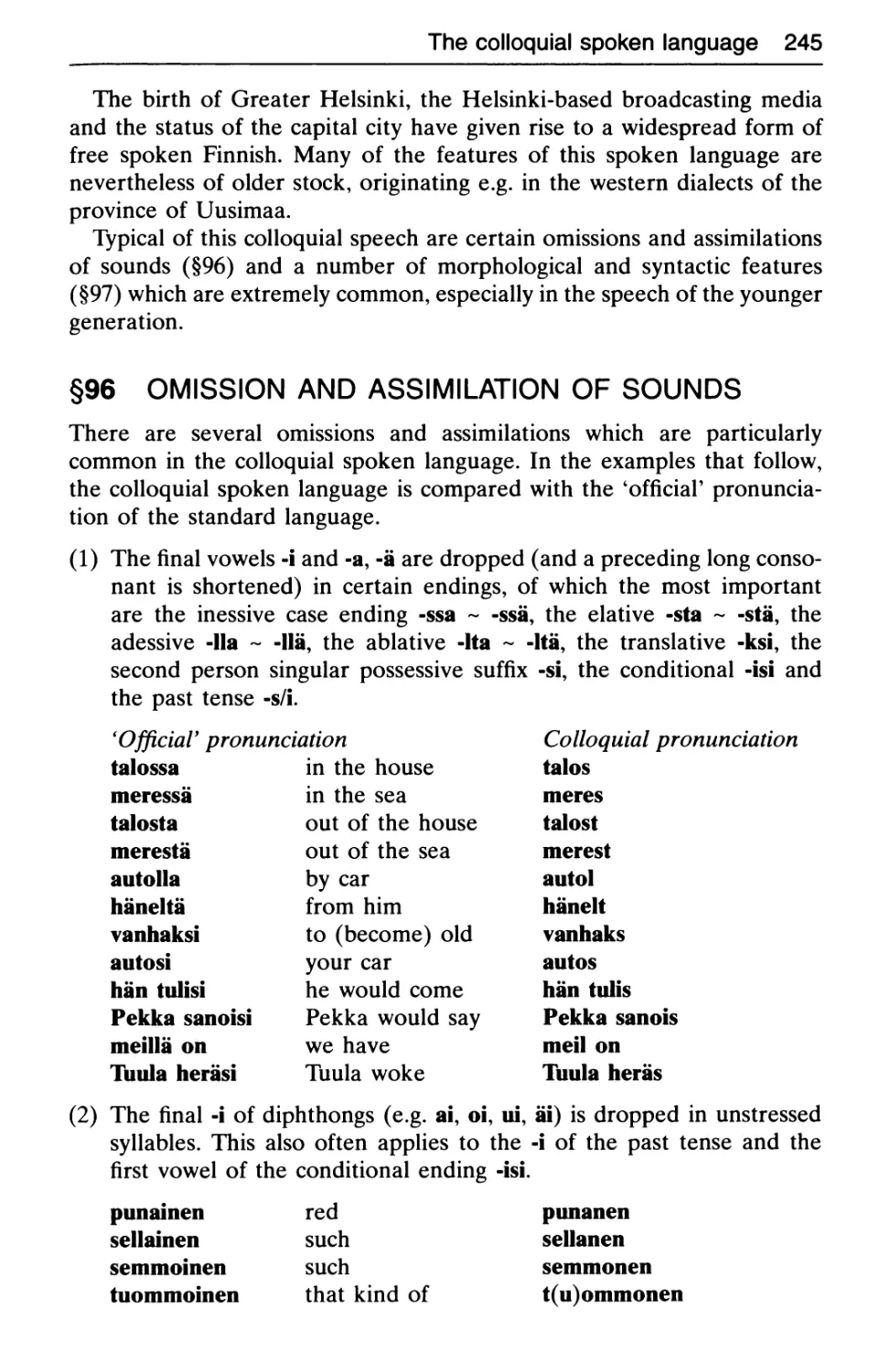
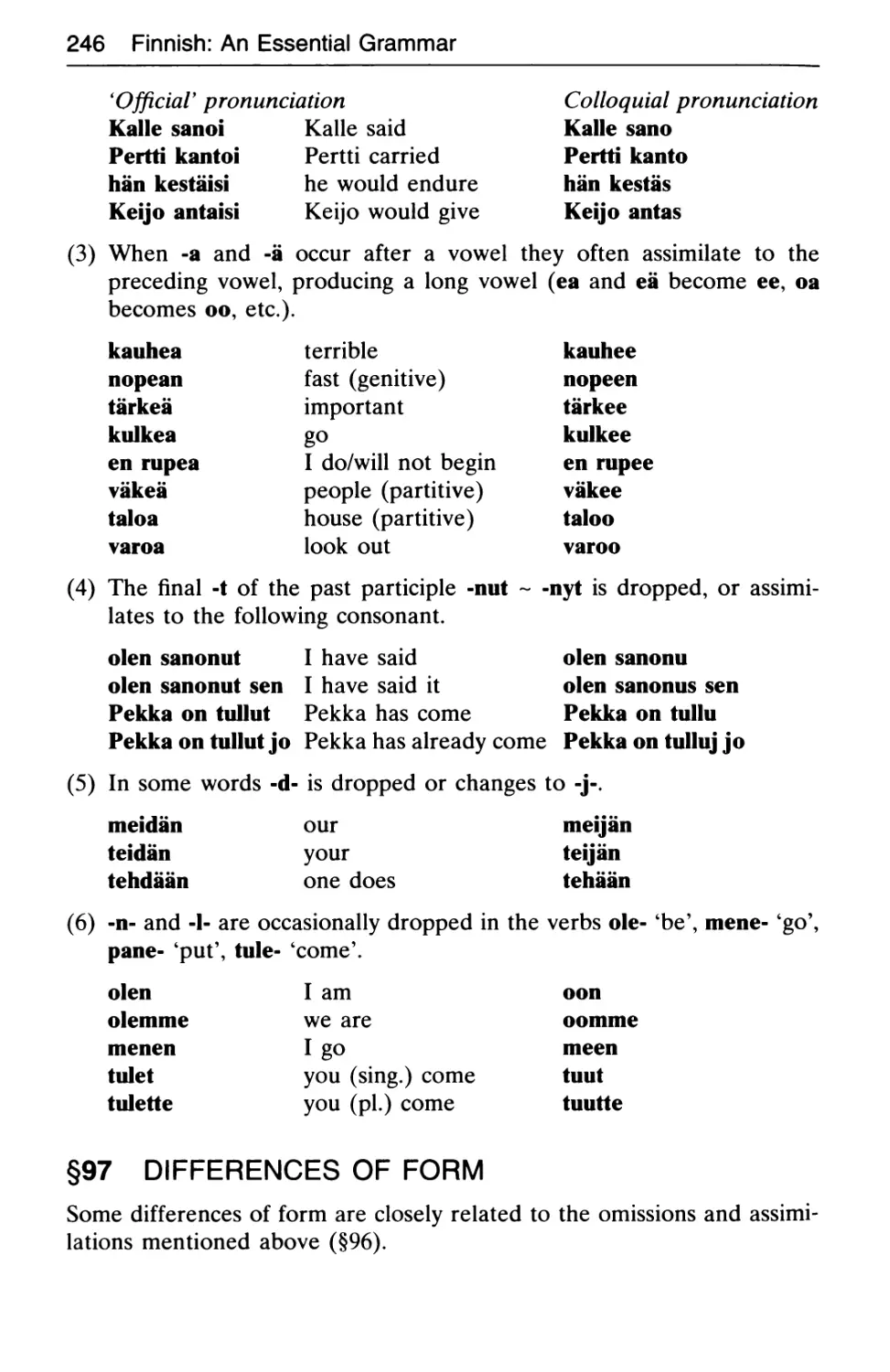








Text
                    Finnish An Essential Grammar Fred Karlsson Routiedge
Finnish
An Essential Grammar
Fred Karlsson
ESSENTIAL GRAMMARS

FINNISH:
AN ESSENTIAL GRAMMAR
This is the ideal reference grammar for the student of Finnish. It gives a
systematic account of the structures of the written language and also
features the characteristics of colloquial Finnish as spoken in Helsinki and
its surroundings.
Finnish: An Essential Grammar is grounded in fundamental insights of
modern linguistics. No prior knowledge is assumed on the part of the
reader and grammatical rules are clearly explained without jargon.
Features include:
• pronunciation guide
• thorough descriptions of morphology (word structure) and syntax
(sentence structure)
• inflection tables
• subject index
Finnish: An Essential Grammar is a revised and updated edition of a
volume first published in 1983, since when it has proved popular with
students and professional linguists worldwide. It has been translated into
several languages, including Finnish.
Fred Karlsson is Professor of General Linguistics at the University of
Helsinki.

FINNISH:
AN ESSENTIAL
GRAMMAR
Fred Karlsson
R
Routledge
Taylor & Francis Group
LONDON AND NEW YORK

First published 1983 as Finnish Grammar
by WSOY, Helsinki
New edition published 1999
by Routledge
2 Park Square, Milton Park, Abingdon, Oxon 0X14 4RN
Simultaneously published in the USA and Canada
by Routledge
270 Madison Avenue, New York, NY 10016
Reprinted 2001, 2002, 2003, 2004
Routledge is an imprint of the Taylor & Francis Group
© 1983; 1999 Fred Karlsson
Translated by Andrew Chesterman
Typeset in Times by The Florence Production, Stoodleigh, Devon
Printed and bound in Great Britain by MPG Books Ltd, Bodmin
All rights reserved. No part of this book may be reprinted
or reproduced or utilized in any form or by any electronic,
mechanical, or other means, now known or hereafter
invented, including photocopying and recording, or in any
information storage or retrieval system, without permission
in writing from the publishers.
British Library Cataloguing in Publication Data
A catalogue record for this book is available from the British Library
Library of Congress Cataloguing in Publication Data
Karlsson, Fred,
[Finsk grammatik. English]
Finnish: an essential grammar / Fred Karlsson; [translated by
Andrew Chesterman].
p. cm. - (Routledge grammars)
Revised and updated version of: Finnish grammar. Helsinki : WSOY
[Werner Söderström Osakeyhtiö], 1983. Finnish grammar is a translation of
Suomen peruskielioppi, 1982, a translation of: Finsk grammatik. Originally
published: Helsinki : Finnish Literature Society (Suomalaisen Kirjallisuuden
Seura), 1978.
Includes bibliographical references and index.
1. 	Finnish language - Grammar. 2. Finnish language - Textbooks for
foreign speakers - English. I. Chesterman, Andrew. II. Title. III. Series.
PH135.K35 1999
494'.5415-dc21 98-55439
CIP
ISBN 0-415-20705-3 (pbk)
ISBN 0-415-20704-5 (hbk)

CONTENTS
Preface ix
List of abbreviations x
1 Introduction 1
§1 The relation of Finnish to other languages 1
§2 Finnish past and present 2
§3 The basic characteristics of Finnish 4
§4 What are the special difficulties? 6
2 Pronunciation and sound structure 9
§5 Letters and sounds 9
§6 Vowels and consonants 10
§7 Short and long sounds 12
§8 Diphthongs 14
§9 Syllables 14
§10 Stress and intonation 15
§11 Vowel harmony 16
3 A survey of word structure 18
§12 Nominals and their endings 18
§13 Finite verb forms and their endings 21
§14 Non-finite verb forms and their endings 24
4 Two important sound alternations 28
§15 Consonant gradation (p, t, k) 28
§16 Vowel changes before -i- endings 38
5 The declension of nominals 44
§17 General 44
§18 Nominals with a basic form in -i 46
§19 Nominals with a basic form in -e 49
§20 Nominals with a basic form ending in a consonant 50

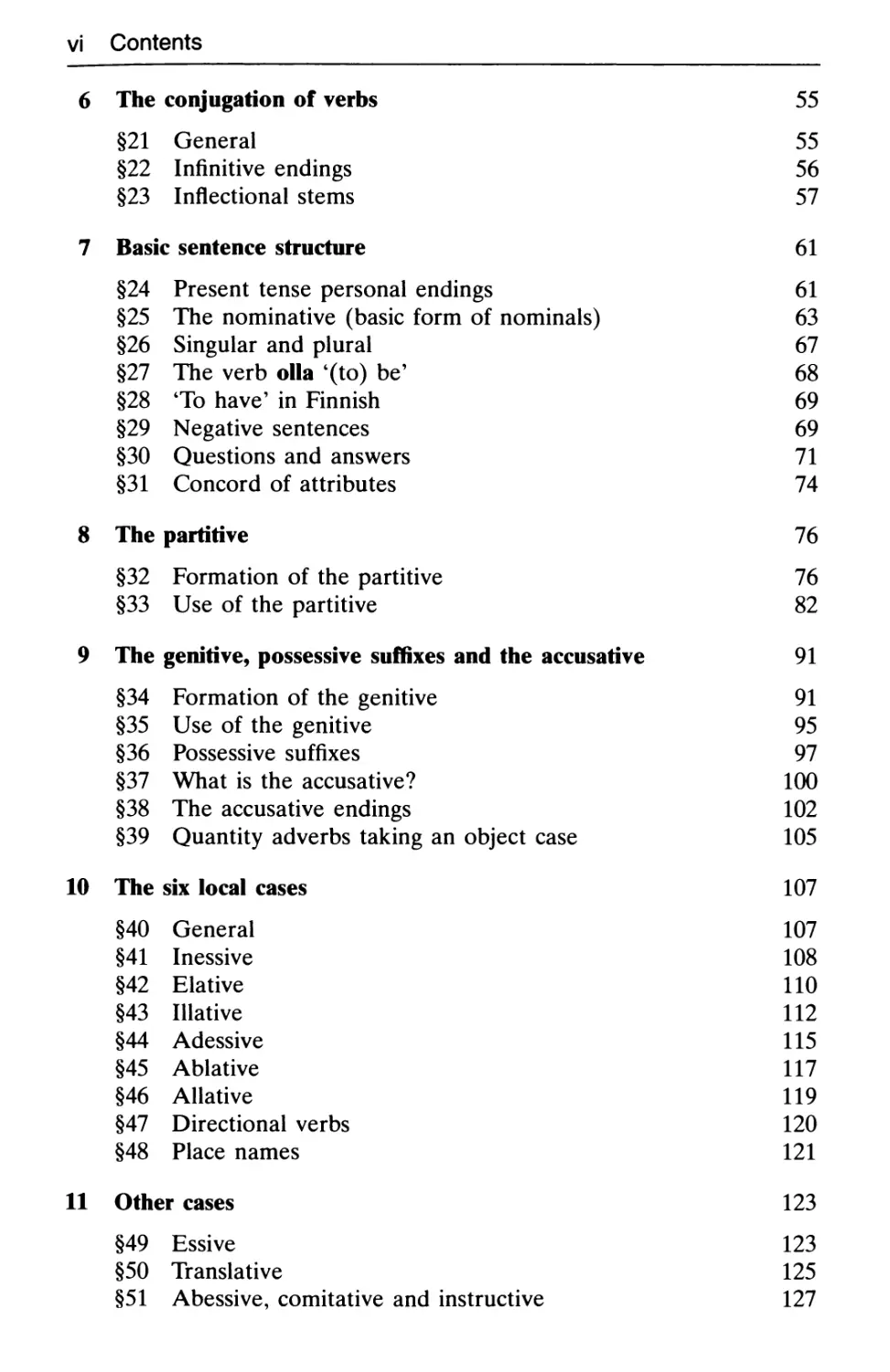
vi Contents
6 The conjugation of verbs 55
§21 General 55
§22 Infinitive endings 56
§23 Inflectional stems 57
7 Basic sentence structure 61
§24 Present tense personal endings 61
§25 The nominative (basic form of nominals) 63
§26 Singular and plural 67
§27 The verb olla ‘(to) be’ 68
§28 ‘To have’ in Finnish 69
§29 Negative sentences 69
§30 Questions and answers 71
§31 Concord of attributes 74
8 The partitive 76
§32 Formation of the partitive 76
§33 Use of the partitive 82
9 The genitive, possessive suffixes and the accusative 91
§34 Formation of the genitive 91
§35 Use of the genitive 95
§36 Possessive suffixes 97
§37 What is the accusative? 100
§38 The accusative endings 102
§39 Quantity adverbs taking an object case 105
10 The six local cases 107
§40 General 107
§41 Inessive 108
§42 Elative 110
§43 Illative 112
§44 Adessive 115
§45 Ablative 117
§46 Allative 119
§47 Directional verbs 120
§48 Place names 121
11 Other cases 123
§49 Essive 123
§50 Translative 125
§51 Abessive, comitative and instructive 127

Contents vii
12 Numerals 129
§52 Cardinal numbers 129
§53 Ordinal numbers 134
13 Pronouns 136
§54 Personal pronouns 136
§55 Demonstrative pronouns 138
§56 Interrogative pronouns 140
§57 Indefinite pronouns 142
§58 Relative pronouns 149
14 Tenses 152
§59 Present tense 152
§60 Past tense 152
§61 Perfect tense 156
§62 Pluperfect tense 158
§63 Negative forms 159
15 Moods 162
§64 Indicative 162
§65 Conditional 162
§66 Imperative 165
§67 Potential 169
16 The passive 172
§68 General 172
§69 Passive present 173
§70 Passive past 175
§71 Passive perfect and pluperfect 177
§72 Passive moods 180
17 Infinitives 182
§73 General 182
§74 First infinitive 183
§75 Second infinitive 184
§76 Third infinitive 188
§77 Fourth infinitive 192
18 Participles 194
§78 General 194
§79 Present participle active 195

viii Contents
§80 Present participle passive 196
§81 The past participles 198
§82 The participial construction 200
§83 The temporal construction 205
§84 The agent construction 207
19 Comparison of adjectives 211
§85 Comparative 211
§86 Superlative 214
20 Other word classes 218
§87 Adverbs 218
§88 Prepositions 221
§89 Postpositions 222
§90 Conjunctions 226
§91 Particles 228
21 Word formation 231
§92 General 231
§93 Derivation 232
§94 Compounding 241
22 The colloquial spoken language 244
§95 General 244
§96 Omission and assimilation of sounds 245
§97 Differences of form 246
Appendix 1: Inflection tables 249
Appendix 2: Literature 267
Appendix 3: Some relevent internet addresses 269
Subject index 271

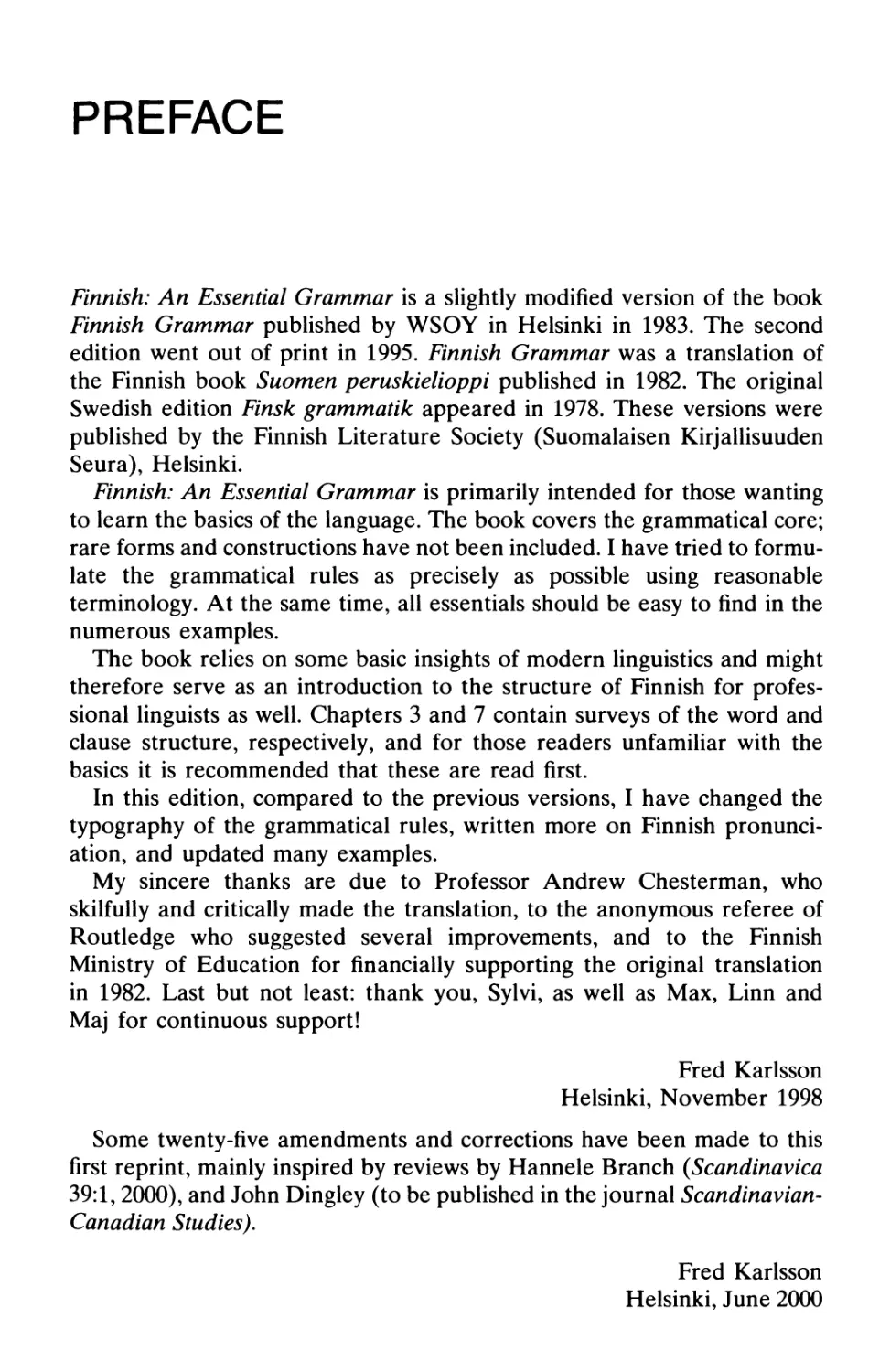
PREFACE
Finnish: An Essential Grammar is a slightly modified version of the book
Finnish Grammar published by WSOY in Helsinki in 1983. The second
edition went out of print in 1995. Finnish Grammar was a translation of
the Finnish book Suomen peruskielioppi published in 1982. The original
Swedish edition Finsk grammatik appeared in 1978. These versions were
published by the Finnish Literature Society (Suomalaisen Kirjallisuuden
Seura), Helsinki.
Finnish: An Essential Grammar is primarily intended for those wanting
to learn the basics of the language. The book covers the grammatical core;
rare forms and constructions have not been included. I have tried to
formulate the grammatical rules as precisely as possible using reasonable
terminology. At the same time, all essentials should be easy to find in the
numerous examples.
The book relies on some basic insights of modern linguistics and might
therefore serve as an introduction to the structure of Finnish for
professional linguists as well. Chapters 3 and 7 contain surveys of the word and
clause structure, respectively, and for those readers unfamiliar with the
basics it is recommended that these are read first.
In this edition, compared to the previous versions, I have changed the
typography of the grammatical rules, written more on Finnish
pronunciation, and updated many examples.
My sincere thanks are due to Professor Andrew Chesterman, who
skilfully and critically made the translation, to the anonymous referee of
Routledge who suggested several improvements, and to the Finnish
Ministry of Education for financially supporting the original translation
in 1982. Last but not least: thank you, Sylvi, as well as Max, Linn and
Maj for continuous support!
Fred Karlsson
Helsinki, November 1998
Some twenty-five amendments and corrections have been made to this
first reprint, mainly inspired by reviews by Hannele Branch (Scandinavica
39:1, 2000), and John Dingley (to be published in the journal Scandinavian-
Canadian Studies).
Fred Karlsson
Helsinki, June 2000

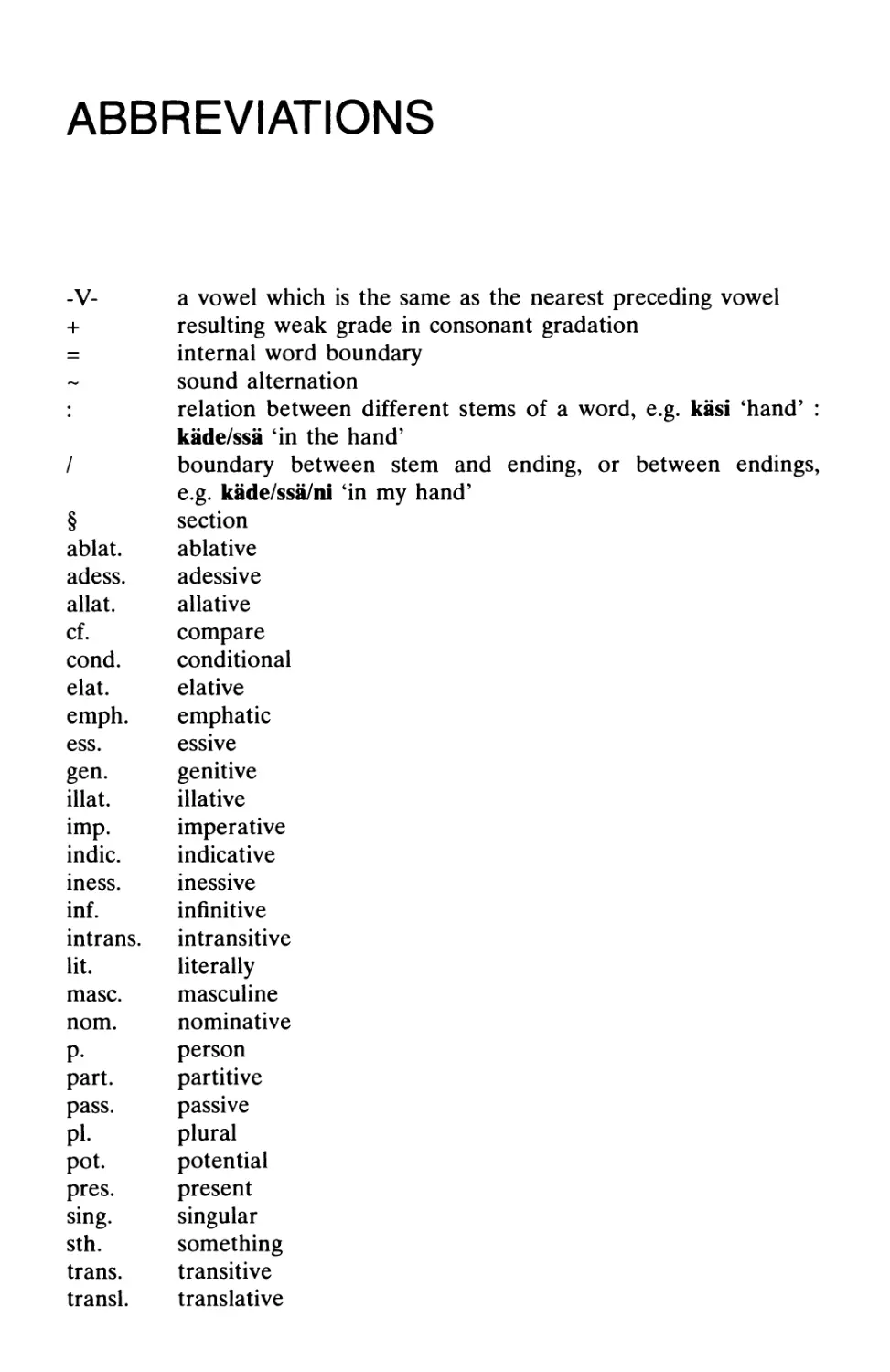
ABBREVIATIONS
-V-
+
/
§
ablat.
adess.
allat.
cf.
cond.
elat.
emph.
ess.
gen.
illat.
imp.
indie.
iness.
inf.
intrans.
lit.
masc.
nom.
P-
part.
pass.

Pipot.
pres.
sing.
sth.
trans.
transl.
a vowel which is the same as the nearest preceding vowel
resulting weak grade in consonant gradation
internal word boundary
sound alternation
relation between different stems of a word, e.g. käsi ‘hand’ :
käde/ssä ‘in the hand’
boundary between stem and ending, or between endings,
e.g. käde/ssä/ni ‘in my hand’
section
ablative
adessive
allative
compare
conditional
elative
emphatic
essive
genitive
illative
imperative
indicative
inessive
infinitive
intransitive
literally
masculine
nominative
person
partitive
passive
plural
potential
present
singular
something
transitive
translative

1
INTRODUCTION
• The relation of Finnish to other languages
• Finnish past and present
• The basic characteristics of Finnish
• What are the special difficulties?
§1 THE RELATION OF FINNISH TO OTHER
LANGUAGES
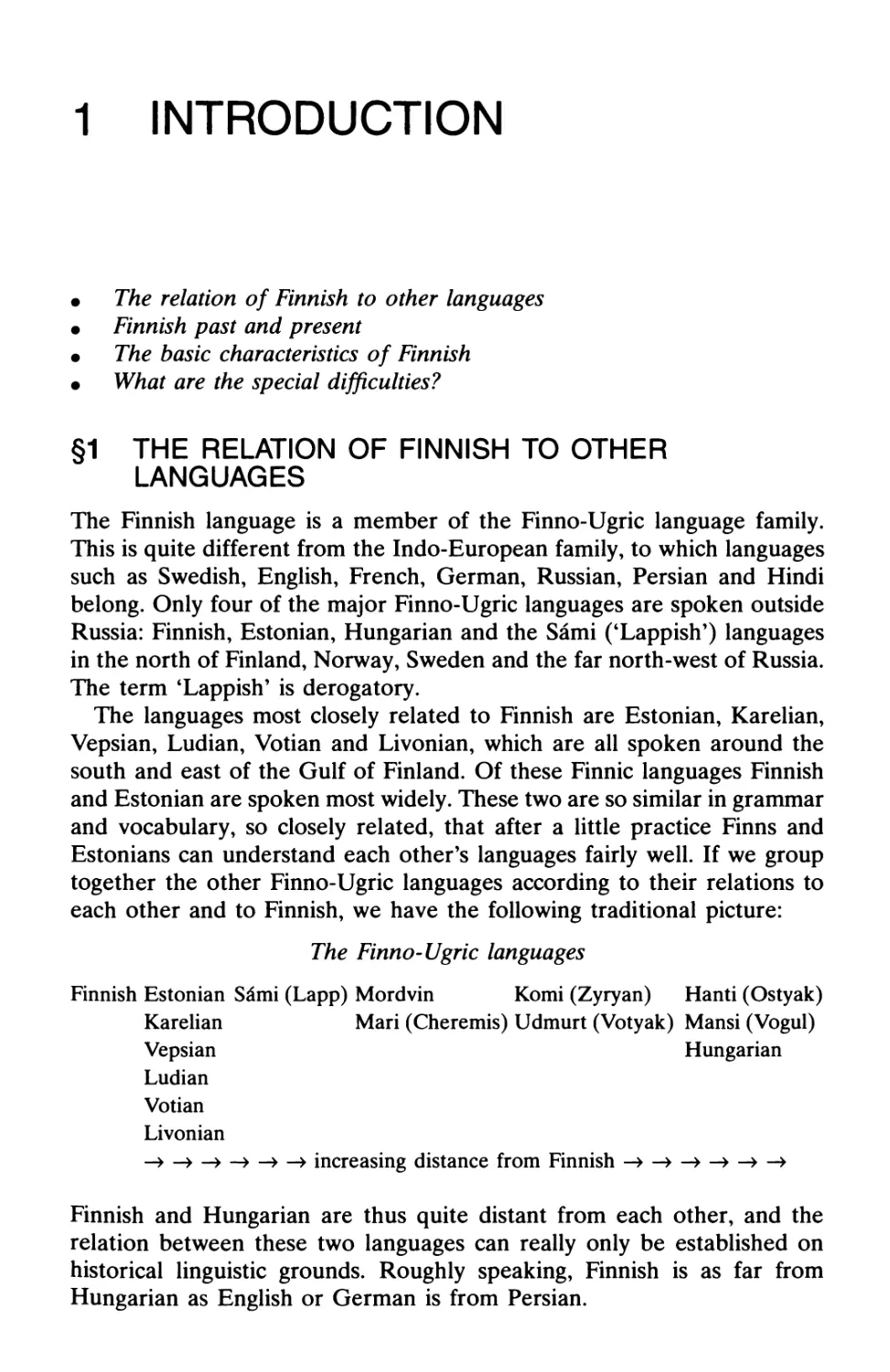
The Finnish language is a member of the Finno-Ugric language family.
This is quite different from the Indo-European family, to which languages
such as Swedish, English, French, German, Russian, Persian and Hindi
belong. Only four of the major Finno-Ugric languages are spoken outside
Russia: Finnish, Estonian, Hungarian and the Sami (‘Lappish’) languages
in the north of Finland, Norway, Sweden and the far north-west of Russia.
The term ‘Lappish’ is derogatory.
The languages most closely related to Finnish are Estonian, Karelian,
Vepsian, Ludian, Votian and Livonian, which are all spoken around the
south and east of the Gulf of Finland. Of these Finnic languages Finnish
and Estonian are spoken most widely. These two are so similar in grammar
and vocabulary, so closely related, that after a little practice Finns and
Estonians can understand each other’s languages fairly well. If we group
together the other Finno-Ugric languages according to their relations to
each other and to Finnish, we have the following traditional picture:
The Finno-Ugric languages
Finnish Estonian Sämi (Lapp) Mordvin Komi (Zyryan) Hanti (Ostyak)
Karelian Mari (Cheremis) Udmurt (Votyak) Mansi (Vogul)
Vepsian Hungarian
Ludian
Votian
Livonian
increasing distance from Finnish
Finnish and Hungarian are thus quite distant from each other, and the
relation between these two languages can really only be established on
historical linguistic grounds. Roughly speaking, Finnish is as far from
Hungarian as English or German is from Persian.

2 Finnish: An Essential Grammar
Samoyed languages are spoken by a few small groups of people in the
north of Russia, especially in western Siberia. The Finno-Ugric languages
and the Samoyed languages constitute the Uralic language family. The
number of speakers of Uralic languages varies considerably. Six Uralic
languages have more than 500,000 speakers: Hungarian (14 million),
Finnish (5 million), Estonian (1 million), Mordvin (Erzya and Moksha,
750,000), Mari (550,000), and Udmurt (500,000). Several Uralic languages
have very few speakers and their future is gravely endangered. This is
true of all four remaining Samoyed languages, and of Hanti (13,000),
Mansi (3,000), the ten Sami languages (30,000), Livonian (30), Votian (50),
Ludian (5,000), and Vepsian (6,00c).1
§2 FINNISH PAST AND PRESENT
The size of the population of Finland on 31 December 1997 was 5,147,349
persons. The distribution of language speakers, according to first (native)
language, is given in the table below (source: Statistics Finland, Internet
address http://www.stat.fi/tk/tilsivu.html).
Population of Finland by first language
1900
1950
1980
1995
1996
1997
1997
Language
%
%
%
%
%
%
Number
Finnish
86.75
91.10
93.50
92.92
92.86
92.74
4,773,576
Swedish
12.89
8.64
6.28
5.76
5.73
5.71
293,691
Sami
0.06
0.06
0.03
0.03
0.03
0.03
1,716
Russian
0.29
0.12
0.03
0.31
0.35
0.40
20,398
Other
0.01
0.08
0.16
0.98
1.03
1.13
57,968
Sum
5,147,349
Finnish is the native language of 92.7 per cent of Finland’s population
of 5.15 million people. The population also includes a minority group of
about 294,000 Swedish-speaking Finns, the Finland Swedes, who are
guaranteed the same basic rights as the Finnish-speaking majority by the
country’s constitution, about 2,000 Sämi-speaking people, 6,000 gypsies
(the number of Romany speakers is not known), about 5,000 deaf people,
whose first language is Finnish sign language, and about a thousand Tatars.
Since the collapse of the Soviet Union, more than 10,000 people belonging
mostly to Finno-Ugric minorities in the west of Russia (especially Ingrians)
1 	Up-to-date information in English on the Uralic languages is provided on the Internet
pages http://www.helsinki.fi/liuiii/sugl/fgrlang.htinl and http://www.helsinki.fi/~tasalmin/
fu.html.

Introduction 3
have emigrated to Finland. The overall proportion of foreigners resident
in Finland is much smaller than in continental European countries.
Finland is officially a bilingual country, whose national languages are
Finnish and Swedish. Waves of emigration have resulted in large
Finnishspeaking minorities particularly in North America (both the USA and
Canada) and in Sweden. In Sweden today there are approximately 300,000
Finns, i.e. about the same number as there are Swedish-speaking Finns in
Finland.
The earliest archaeological remains unearthed in Finland are from 7,500
bc, but it has not been possible to determine the cultural and language
background of the first inhabitants. There were Finno-Ugric settlements in
Finland as long ago as 4,000 bc. This population incorporated Baltic
elements around 2,000 bc and Germanic elements as early as c. 1,500 bc. The
original population thus formed then absorbed the Baltic Finns from across
the Gulf of Finland about 2,000 years ago. Politically, Finland was a part of
Sweden until 1809, and an autonomous Grand Duchy within Tsarist Russia
from 1809 to 1917. Finland has been an independent republic since 1917.
During the Swedish period Finnish was very much a secondary language
in official contexts. Its basic public use was in church services and to some
extent in law enforcement. The language of the administration and the
intelligentsia was Swedish. It was not until 1863 that Finnish was decreed
to have equal status with Swedish ‘in all matters directly concerning the
Finnish-speaking population of the country’, to be implemented within a
20-year period of transition.
The earliest actual texts in Finnish date from the 1540s. The father of
written Finnish is considered to be Mikael Agricola (15107-1557), the
Bishop of Turku (Abo), who started the Finnish translation of parts of
the Bible during the Reformation. Some 5,350 of the words used by
Agricola are still used in contemporary Finnish.
Finnish was greatly influenced by Swedish for a long time, especially as
regards its vocabulary, which was quite natural considering that the
authorities were generally Swedish-speaking. Since Turku (Abo) was the capital
city until 1827, it is understandable that standard Finnish developed
primarily out of south-western dialects. In the nineteenth century there
was increasing influence from eastern Finland, mostly owing to the national
epic Kalevala, the first edition of which was published in 1835. The
Kalevala is based on the folk poetry of eastern Finland and Karelia, as
collected and compiled by Elias Lönnrot and others. The Kalevala was
an important source of inspiration for the nineteenth century nationalist
movement, whose central figure was Johan Vilhelm Snellman.
The nationalist movement also had a variety of linguistic effects. Many
language scholars wanted to ‘finnicize’ Finnish by getting rid of Swedish
loan words and a number of grammatical structures borrowed directly
from Swedish.

4 Finnish: An Essential Grammar
Language is not a uniform system: it varies in different ways, for example
in regional dialects. The main dialect areas of Finnish are shown on the
following map.
FINLAND’S DIALECT AREAS
1. South-western dialects
2. South-western transition
dialects
3. Häme dialects
4. Southern Ostrobothnian
dialects
5. Central and northern
Ostrobothnian dialects
6. Northern dialects
7. Savo dialects
8. South-eastern dialects
■ Swedish-speaking areas
regional
dialects
In the latter half of the twentieth century this traditional picture of dialect
areas has been radically levelled by urbanization, mass education,
improved means of communication and transport, and other societal
processes. However, this book does not deal with regional dialects and
their differences. Instead, we shall be concerned with the official norm of
the language, Standard Finnish, one important variant of which is normal
written prose. But even the standard language is not completely uniform.
Its grammatical structures and also (in spoken Standard Finnish) its
pronunciation both vary slightly depending on the speech situation and a
number of other factors. The standard language spoken in official or formal
situations is grammatically close to the written norm; but colloquial spoken
Finnish differs in many ways from more formal usage in both
pronunciation and grammar. The differences between everyday and more formal
Finnish are discussed in more detail in Chapter 22.
§3 THE BASIC CHARACTERISTICS OF FINNISH
The basic principle of word formation in Finnish is the addition of endings
(bound morphemes, suffixes) to stems. For example, by attaching the
endings -i ‘plural’, -ssä ‘in’, -si ‘your’, and -kin ‘too, also’ to the stem auto
‘car’ in different ways, the following words can be formed.

Introduction 5
auto/ssa
auto/i/ssa
auto/ssa/si
auto/si
auto/kin
auto/si/kin
auto/ssa/kin
auto/i/ssa/kin
auto/i/ssa/si/kin
in the car
in the cars
in your car
your car
the car too
your car too
in the car too
in the cars too
in your cars too
(car/in)
(car/s/in)
(car/in/your)
(car/your)
(car/too)
(car/your/too)
(car/in/too)
(car/s/in/too)
(car/s/in/your/too)
Finnish verb forms are built up in the same way. Using the verb stem
sano- ‘say’, and the endings -n ‘I’, -i ‘past tense’, and -han ‘emphasis’, we
can form these examples:
The adding of endings to a stem is a morphological feature of many
European languages, but Finnish is nevertheless different from most others
in two respects.
In the first place Finnish has more case endings than is usual in European
languages. Finnish case endings normally correspond to prepositions or
postpositions in other languages: cf. Finnish auto/ssa, auto/sta, auto/on,
auto/lla and English ‘in the car’, ‘out of the car’, ‘into the car’, ‘by car’.
Finnish has about 15 cases; English nouns have only one ‘morphologically
marked’ case.
The second difference is that Finnish sometimes uses endings where
Indo-European languages generally have independent words. This is also
true of the Finnish possessive suffixes, which correspond to possessive
pronouns, e.g. -ni ‘my’, -si ‘your’, -mme ‘our’, cf. kiija/ni ‘my book’,
kirja/mme ‘our book’.
Another set of endings particular to Finnish is that of the enclitic
particles, which always occur in the final position after all other endings. It is
not easy to say exactly what these particles mean; their function is often
emphasis of some kind, similar to that of intonation in some other
languages. The particles include -kin ‘too, also’, -han ‘emphasis’ (often in
the sense ‘you know, don’t you?’), and -ko ‘interrogative’, cf. kirja/ssa/kin
‘in the book too’, and On/ko tuo kirja? ‘Is that a book?’.
Another characteristic feature of Finnish is the wide-ranging use made
of endings in the formation of new independent words. Compare the basic
word kirja ‘book’ with the derived forms kirj/e ‘letter’, kirja/sto ‘library’,
kirja/llinen ‘literary’, kirja/llis/uus ‘literature’, kirjo/itta(a) ‘(to) write’, and
kirjo/itta/ja ‘writer’. Derivational morphemes (derived words) can also be
sano/n
sano/n/han
sano/i/n
sano/i/n/han
I say
I do say
I said
I did say
(say/I)
(say/I/emphasis)
(say/past/I)
(say/past/I/emphasis)

6 Finnish: An Essential Grammar
followed by other endings, for nouns such as case endings, possessive
suffixes and particles. We can then form such words as:
kirja/sto/ssa in the library
kirjo/ita/n/ko shall I write?
kirjo/itta/ja/n/kin of the writer, too
kirja/sto/sta/mme out of our library
Learning the endings is not as difficult as is often thought. Since the
endings are often piled up one behind the other rather mechanically,
Finnish word forms are usually easy to analyse if one knows the endings.
Finnish nouns differ from those of many Indo-European languages in
that there is no grammatical gender. In German there is the ‘der - die -
das’ difference, French has ‘le - la’, Swedish ‘en - ett’, and so on, but
these distinctions do not occur in Finnish.
Finnish does not have articles, either (cf. ‘a car - the car’). The semantic
function of articles is often expressed by word order in Finnish:
Kadulla on auto. There is a car in the street.
Auto on kadulla. The car is in the street.
When adjectives occur as attributes they agree in number and case with
the headword, i.e. they take the same endings.
iso auto the big car
iso/ssa auto/ssa in the big car
iso/n auto/n of the big car
iso/t auto/t the big cars
iso/i/ssa auto/i/ssa in the big cars
There are 21 phonemes (basic sounds) in Finnish: eight vowels and 13
consonants. The number is noticeably smaller than in most European
languages. The main stress always falls on the first syllable of a word. The
writing system is regular in that a given phoneme is always written with
the same letter. The converse is also true: a given letter always
corresponds to the same phoneme.
§4 WHAT ARE THE SPECIAL DIFFICULTIES?
It is worth mentioning the areas of Finnish grammar which can cause most
learning difficulty. Since Finnish is not an Indo-European language the
basic vocabulary differs from Indo-European. The 15 most frequent words
in Finnish are the following:
1 olla (to) be 4 ei no
2 ja and 5 joka which
3 se it 6 hän he, she

Introduction 7
7 että
that
12 niin
so
8 tämä
this
13 kuin
than
9 mutta
but
14 tulla
(to) come
10 saada
(to) get
15 minä
I
11 kun
when
It is immediately clear that learning Finnish words requires an effort. The
burden is lightened, however, by the fact that Finnish has hundreds of
direct loan words (mostly from Swedish) and a great many translation
loans, expressions that have been translated into Finnish equivalents.
Examples of direct loans are the following (both Swedish and English
equivalents are given):
ankka anka, duck kahvi kaffe, coffee kakku kaka, cake
kallo skalle, skull keppi käpp, cane kirkko kyrka, church
kruunu krona, crown pankki bank penkki bänk, bench
posti post, mail sokki chock rokki rock, rock and roll
sohva soffa, sofa tulli tuli, customs viini vin, wine
Compound words which are translated loans include: kirja/kauppa
4bokhandel, bookshop’; olut/pullo ‘ölflaska, bottle of beer’; rauta/tie/asema
4järnvägsstation, railway station’.
In §3 it was said that the inflection of Finnish words is easy in that the
endings are often attached ‘mechanically’ to the stem. However, this is
not always true. The form of the basic stem (root, lexical form) often
alters when certain endings are added to it, i.e. a lexical word may be
represented by different stems depending upon which endings it is
followed by. Compare for example the inflection of the noun käsi ‘hand’
in different cases.
käsi hand (hand)
käde/ssä in the hand (hand/in)
käte/en into the hand (hand/into)
kät/tä hand (hand/partitive case)
käs/i/ssä in the hands (hand/s/in)
käsi/kin the hand, too (hand/too)
käte/ni my hand (hand/my)
The basic form käsi takes different forms according to the following ending
and its sound structure. These sound alternations are governed by rules
that can sometimes be extremely complex. Here are a few more example
pairs:
tunte/a (to) know ~ tunne/n I know
hyppää/n I jump ~ hypä/tä (to) jump
matto mat - mato/lla on the mat

8 Finnish: An Essential Grammar
maa country ~ ma/i/ssa in countries
tie road ~ te/i/llä on the roads
tietä/ä (to) know ~ ties/i (he) knew
Case endings are usually added to nouns, adjectives and other nominals,
but they may also be added to verbs.
Minä lähden Jyväskylä/än. I’m going to Jyväskylä.
Minä lähden kävele/mä/än. I’m going ‘walking’ (= for a walk).
The verb form kävelemään literally means ‘into walking’, just as
Jyväskylään means ‘into (the town of) Jyväskylä’. Both forms contain the
case ending -än meaning ‘into’.
The object in Finnish is marked by a case ending. In the two following
sentences the ending -n indicates ‘this word is the object of the sentence’.
The rules governing the use of this ending and the other possible object
endings are fairly complex.
Minä ostan kirja/n. I (shall) buy the book.
Kalle näki auto/n. Kalle saw the car.
The most difficult feature of the pronunciation of Finnish is the length
(duration) of the sounds: differences of length serve very frequently to
distinguish separate words. Compare pairs such as:
kansa
people
kanssa
with
tuli
fire
tulli
customs
muta
mud
mutta
but
muta
mud
muuta
other
muta
mud
mutaa
mud (partitive case)
tuulee
it is windy
tuullee
it is probably windy

2 	PRONUNCIATION AND
SOUND STRUCTURE
• Letters and sounds
• Vowels and consonants
• Short and long sounds
• Diphthongs
• Syllables
• Stress and intonation
• Vowel harmony
§5 LETTERS AND SOUNDS
Disregarding words of foreign origin, Finnish has eight letters for vowels
and 13 for consonants: ieäyöuoa and ptkdgshvjlrmn. With
few exceptions the following important correspondence holds between
letters and phonemes in carefully pronounced Standard Finnish (phonemes
are sounds thought of as types, irrespective of slight variations in the
speech of the same person or between different people).
Each letter corresponds to one and the same phoneme, and each
phoneme corresponds to one and the same letter.
Note the following pronunciation details:
• The vowel corresponding to the letter ä is an open unrounded front
vowel (cf. the short vowels in British English ‘shall, rat’, and the long
vowel in Swedish bar ‘berry’).
• The vowel corresponding to the letter y is a close rounded front vowel
(cf. German Fiihrer).
• The vowel corresponding to the letter ö is a half-close rounded front
vowel (cf. German Goring).
• The combination of letters ng is pronounced as a long [rjrj] sound as
in rengas ‘ring’ [rerjrjas].
• The letter n before a k is pronounced as a fairly long [rj] sound as in
Helsinki [helsirjki] (cf. English ‘drink’).
• When length is used to differentiate meanings, short phonemes are

10 Finnish: An Essential Grammar
written with one letter and long phonemes with two, as in tuli ‘fire’
- 	tuuli ‘wind’ - tulli ‘customs’; kansa ‘people’ - kanssa ‘with’; muta
‘mud’ (nominative case) - mutaa ‘mud’ (partitive case).
• Words of foreign origin may contain other letters than those
mentioned above, for example b c f w x z. Names of Swedish origin
may contain the letter ä (Ä) as in Äbo, Äke, Svartä.
• The alphabetical order of letters isabcdefghijklmnopq
rstuvwxyzaao.
• The pronunciation of the everyday spoken language differs in several
respects from that of the standard spoken norm (see Chapter 22). The
strict correspondence between letters and phonemes does not hold in
everyday spoken language.
§6 VOWELS AND CONSONANTS
Finnish (apart from words of foreign origin) has eight vowel and 13
consonant phonemes: ieäyöuoa and ptkdshvjlrmnQ. All vowels
and almost all consonants can occur as either short or long sounds. The
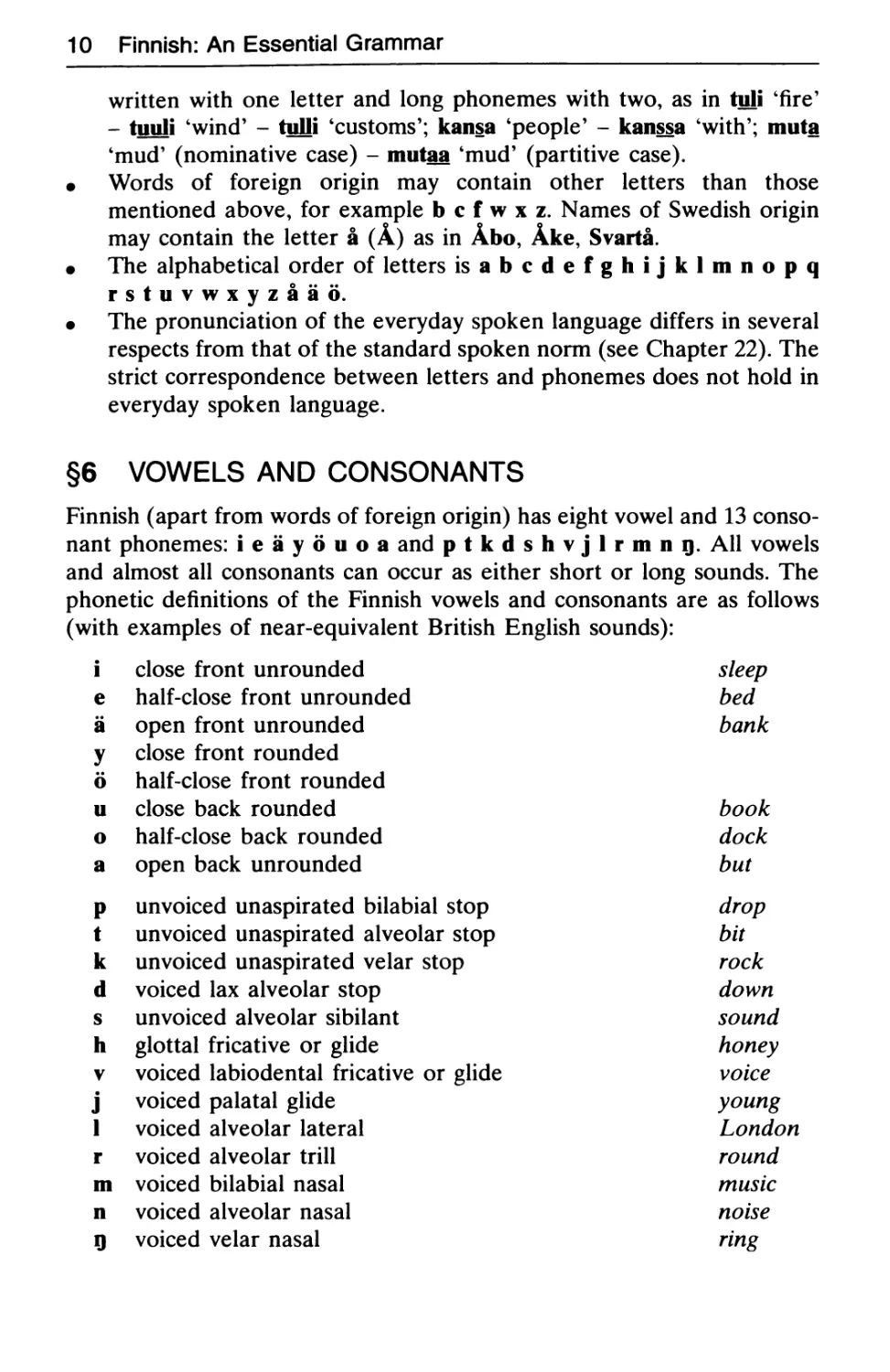
phonetic definitions of the Finnish vowels and consonants are as follows
(with examples of near-equivalent British English sounds):
i
close front unrounded
sleep
e
half-close front unrounded
bed
ä
open front unrounded
bank
y
close front rounded
Ö
half-close front rounded
u
close back rounded
book
o
half-close back rounded
dock
a
open back unrounded
but
P
unvoiced unaspirated bilabial stop
drop
t
unvoiced unaspirated alveolar stop
bit
k
unvoiced unaspirated velar stop
rock
d
voiced lax alveolar stop
down
s
unvoiced alveolar sibilant
sound
h
glottal fricative or glide
honey
v
voiced labiodental fricative or glide
voice
j
voiced palatal glide
young
1
voiced alveolar lateral
London
r
voiced alveolar trill
round
m
voiced bilabial nasal
music
n
voiced alveolar nasal
noise
0
voiced velar nasal
ring

Pronunciation and sound structure 11
Special attention should be paid to the following details.
• There is no difference in quality between the corresponding long and
short vowels ii - i, ee - e, ää - ä, yy - y, öö - ö, uu - u, oo - o, aa
- 	a.
• All long vowels are pronounced as pure long vowels, not as if they
were diphthongs or as if they ended in -j or -w.
• The vowel y [y] is articulated with strongly protruded lips and a small
opening between them.
• The quality of the long vowel öö is [0:] and that of the short ö is [0],
cf. sinäkö ‘you?’, pöllö ‘owl’, mörkö ‘goblin’, Närpiöön ‘to Närpiö’.
The lips are protruded and half-closed.
• The vowels ee and e, and also ää and ä, are differentiated in all
positions in a word, including before r and in unstressed syllables. Cf. te
‘you’ - tee ‘tea’, meille ‘to us’ - meillä ‘ “at” us’ (= at our house),
teellä ‘with tea’ - täällä ‘here’, piste ‘point’ - pistä ‘sting!’, veneen ‘of
the boat’ - nenään ‘into the nose’, lehti ‘leaf’ - lähti ‘(he) left’, veri
‘blood’ - väri ‘colour’, perkele ‘devil’, merkki ‘mark’, Eero (masculine
name), väärä ‘wrong’.
• The consonants p t k are pronounced without aspiration, i.e. without
a breathy ‘h’ sound after them.
• The consonant s is often pronounced as a rather dark, thick sound
that can be close to s, especially in the environment of u. Cf. pussi
‘bag’, luussa ‘in the bone’, sumu ‘fog’, myös ‘also’.
• The consonant h may occur between vowels and is then pronounced
weakly. It can also co-occur with consonants, and is then a stronger
sound, particularly if the following consonant is t or k. Cf. huono
‘bad’, miehen ‘of the man’, paha ‘evil’, ihminen ‘person’, varhain
‘early’, vanha ‘old’, vihko ‘notebook’, vihta ‘bunch of birch twigs’,
sähkö ‘electricity’, tuhka ‘ash’.
• The consonant 1 is pronounced as a rather thick sound when it occurs
between the vowels u and o. Cf. pullo ‘bottle’, hullu ‘mad’, kulta ‘gold’,
pala ‘bit’, villi ‘wild’.
• The consonant r is always trilled with the tip of the tongue, e.g. pyörä
‘wheel’, Pori (town), Turku (town), virrassa ‘in the stream’, kierrän ‘I
turn’.
• After certain grammatical forms the initial consonant of the following
word or particle lengthens. These forms are mainly nominals ending
in -e like perhe ‘family’ (§19), the present indicative negative e.g. en
tule ‘I am not coming’ (§29), the second person singular imperative
e.g. tule! ‘come!’ (§66), and the first infinitive e.g. tulla ‘(to) come’
(§74).

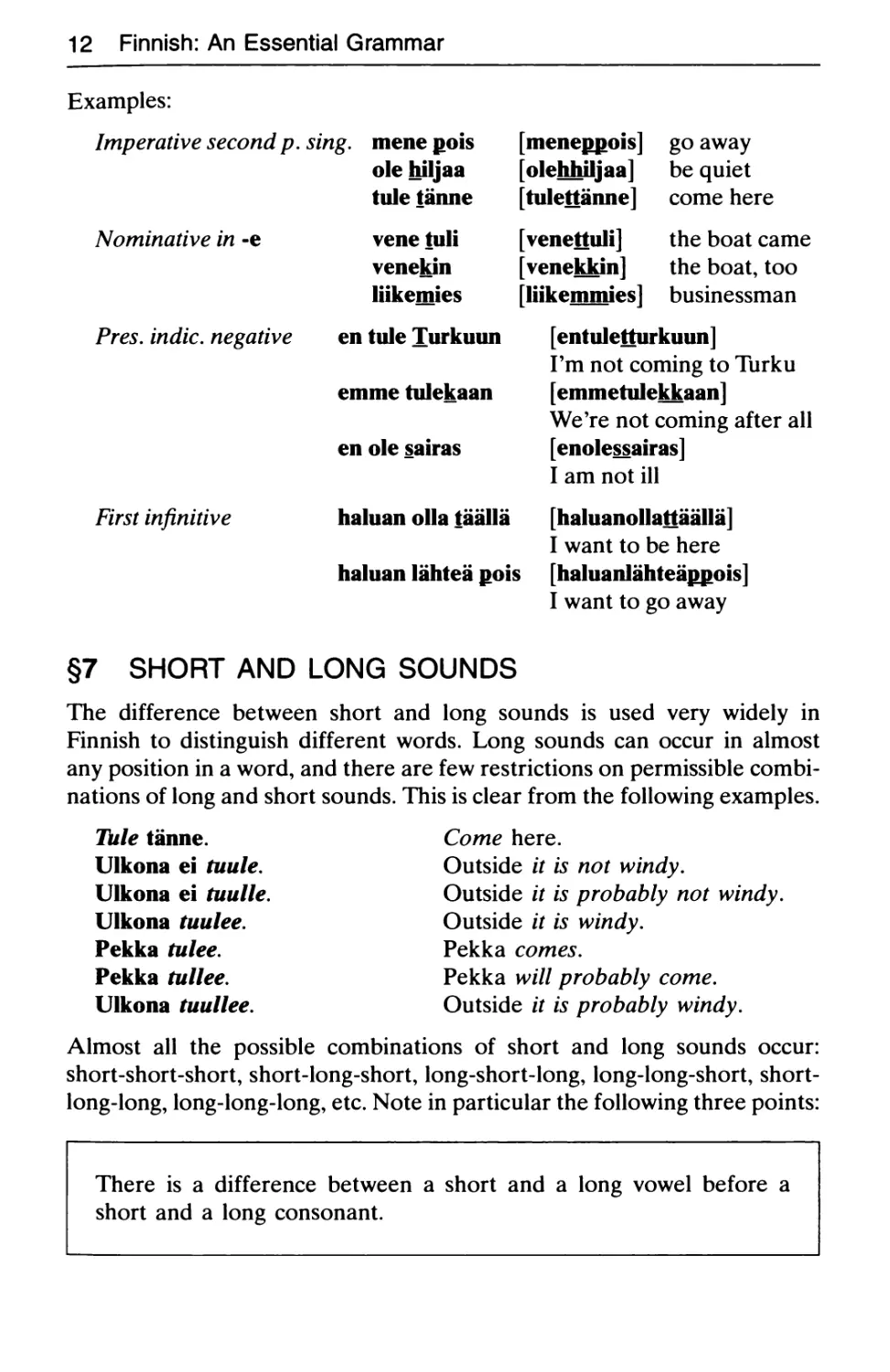
12 Finnish: An Essential Grammar
Examples:
Imperative second p. sing, mene pois
ole hiljaa
tule tänne
Nominative in -e
Pr es. indie, negative
First infinitive
[meneppois] go away
[olehhiljaa] be quiet
[tulettänne] come here
vene tuli
venekin
liikemies
en tule Turkuun
emme tulekaan
en ole sairas
haluan olla täällä
haluan lähteä pois
[venettuli]
[venekkin]
[liikemmies]
the boat came
the boat, too
businessman
[entuletturkuun]
I’m not coming to Turku
[emmetulekkaan]
We’re not coming after all
[enolessairas]
I am not ill
[haluanollattäällä]
I want to be here
[haluanlähteäppois]
I want to go away
§7 SHORT AND LONG SOUNDS
The difference between short and long sounds is used very widely in
Finnish to distinguish different words. Long sounds can occur in almost
any position in a word, and there are few restrictions on permissible
combinations of long and short sounds. This is clear from the following examples.
7hie tänne.
Ulkona ei tuule.
Ulkona ei tuulle.
Ulkona tuulee.
Pekka tulee.
Pekka tullee.
Ulkona tuullee.
Come here.
Outside it is not windy.
Outside it is probably not windy.
Outside it is windy.
Pekka comes.
Pekka will probably come.
Outside it is probably windy.
Almost all the possible combinations of short and long sounds occur:
short-short-short, short-long-short, long-short-long, long-long-short, short-
long-long, long-long-long, etc. Note in particular the following three points:
There is a difference between a short and a long vowel before a
short and a long consonant.

Pronunciation and sound structure 13
Examples:
tili
tuli
mutta but
account
fire
tiili brick
tuuli wind
muuttaa change
- muuna
- tilli dill
- tulli customs
- muuta other
(partitive
case)
other (essive case) - muunna transform!
muna egg
The following six words are all pronounced differently and have distinct
meanings:
takka
taakka
takkaa
taakkaa
taka
takaa
fireplace
burden
fireplace {partitive case)
burden {partitive case)
back
from behind
There is a distinction between a short and a long p, t, k or s when
they occur after 1, r, m, n or g. Before a short p, t, k or s the
consonants 1, r, m, n and g are fairly long.
Examples:
karta
avoid!
- kartta
map
korpi
wilderness
- korppi
raven
arki
weekday
- arkki
ark
kansa
people
- kanssa
together with
pelko
fear
- palkki
beam
lampi
pond
- lamppu
lamp
valta
power
- valtti
trump
sanka
spectacle frame
- sankka
dense
Thus, kanssa ‘together with’ is pronounced [kansia] while kansa ‘people’
is pronounced either [kanisa] or [kansa].
The main stress is always on the first syllable of the word (§10). Long
vowels elsewhere than in the first syllable are pronounced without main
stress, cf. taloon ‘into the house’, hyppään ‘I jump’, kaappiin ‘into the
cupboard’, ravintolaan ‘into the restaurant’, talossaan ‘in his house’.

14 Finnish: An Essential Grammar
§8 DIPHTHONGS
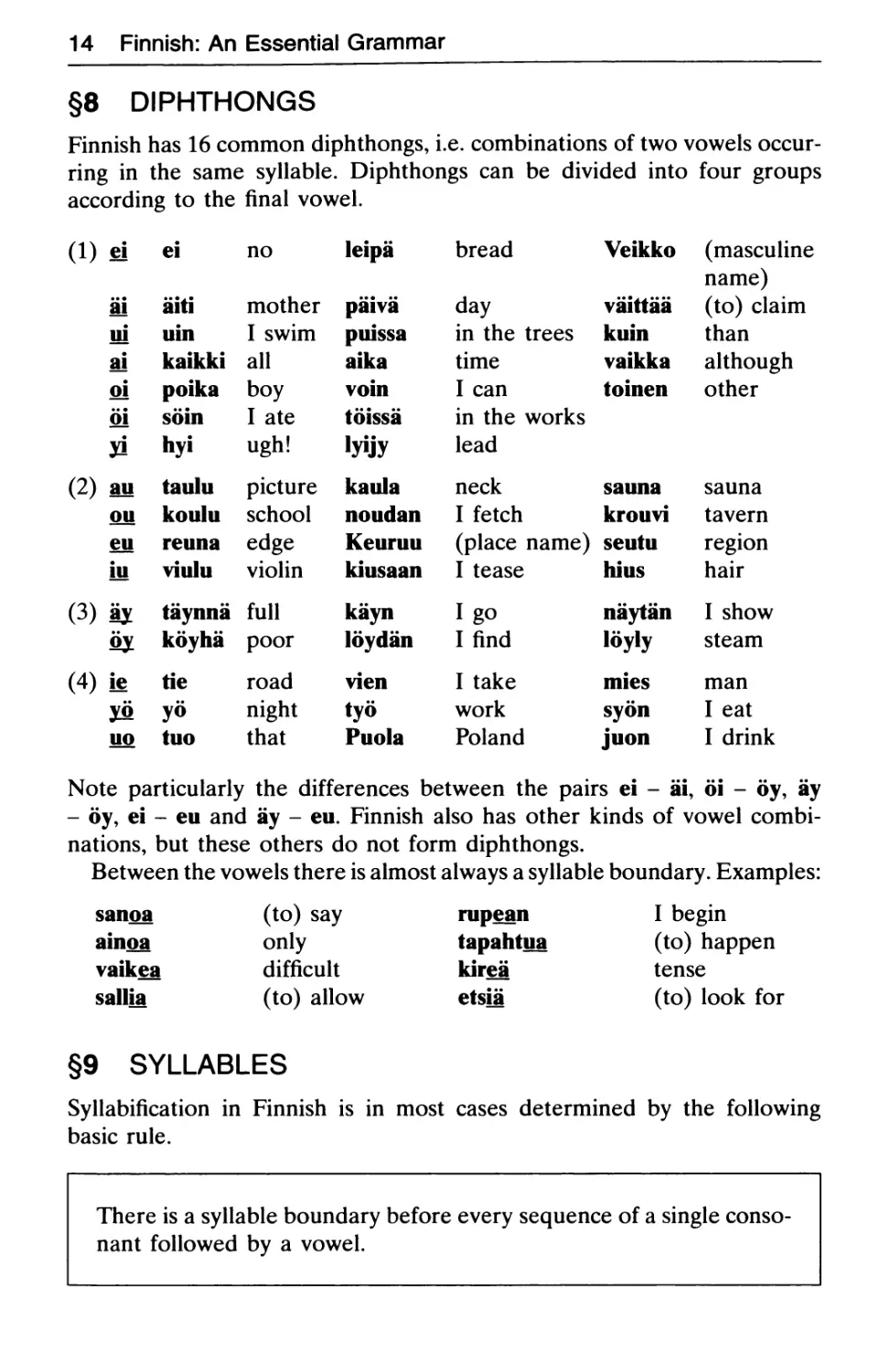
Finnish has 16 common diphthongs, i.e. combinations of two vowels
occurring in the same syllable. Diphthongs can be divided into four groups
according to the final vowel.
(1) ei
ei
no
leipä
bread
Veikko
(masculine
name)
äi
äiti
mother
päivä
day
väittää
(to) claim
ui
uin
I swim
puissa
in the trees
kuin
than
ai
kaikki
all
aika
time
vaikka
although
oi
poika
boy
voin
I can
toinen
other
Öi
söin
I ate
töissä
in the works
yi
hyi
ugh!
■y'jy
lead
(2) au
taulu
picture
kaula
neck
sauna
sauna
OI|
koulu
school
noudan
I fetch
krouvi
tavern
eu
reuna
edge
Keuruu
(place name)
seutu
region
in
viulu
violin
kiusaan
I tease
hius
hair
(3) äy
täynnä
full
käyn
I go
näytän
I show
öy
köyhä
poor
löydän
I find
löyly
steam
(4) ie
tie
road
vien
I take
mies
man
yö
yö
night
työ
work
syön
I eat
UO
tuo
that
Puola
Poland
juon
I drink
Note particularly the differences between the pairs ei - äi, öi - öy, äy
- 	öy, ei - eu and äy - eu. Finnish also has other kinds of vowel
combinations, but these others do not form diphthongs.
Between the vowels there is almost always a syllable boundary. Examples:
sanoa
ainoa
vaikea
sallia
(to) say
only
difficult
(to) allow
rupean
tapahtua
kireä
etsiä
I begin
(to) happen
tense
(to) look for
§9 SYLLABLES
Syllabification in Finnish is in most cases determined by the following
basic rule.
There is a syllable boundary before every sequence of a single
consonant followed by a vowel.

Pronunciation and sound structure 15
In the following examples the syllable boundary is indicated by a dash (-):
ka-la
fish jo-kai-nen
every
kui-ten-kin
however sit-ten
then
päi-vä
day al-kaa
(to) begin
pur-kis-sa
in the jar purk-kiin
into the jar
An-tin
of Antti An-til-le
to Antti
Hel-sin-kiin
to Helsinki Hel-sin-gis-sä-kin
in Helsinki, too
There is also a syllable boundary between vowels that do not form a
diphthong (§8) in words such as:
no-pe-a
fast
ai-no-a
only
hert-tu-an
of the duke
sal-li-a
(to) allow
§10 STRESS AND INTONATION
Finnish word stress follows this important rule:
The main stress is always on the first syllable of the word.
Vowels elsewhere than in the first syllable therefore do not receive main
stress. The main stress also falls on the first syllable in loan words which
may have been stressed differently in the original language. Examples:
Helsinkiin to Helsinki vapaa free voida (to) be able
jokainen every maalaan I paint aatteellisuus idealism
elefantti elephant limonaati lemonade psykologi psychologist
psykologia psychology bulevardi boulevard
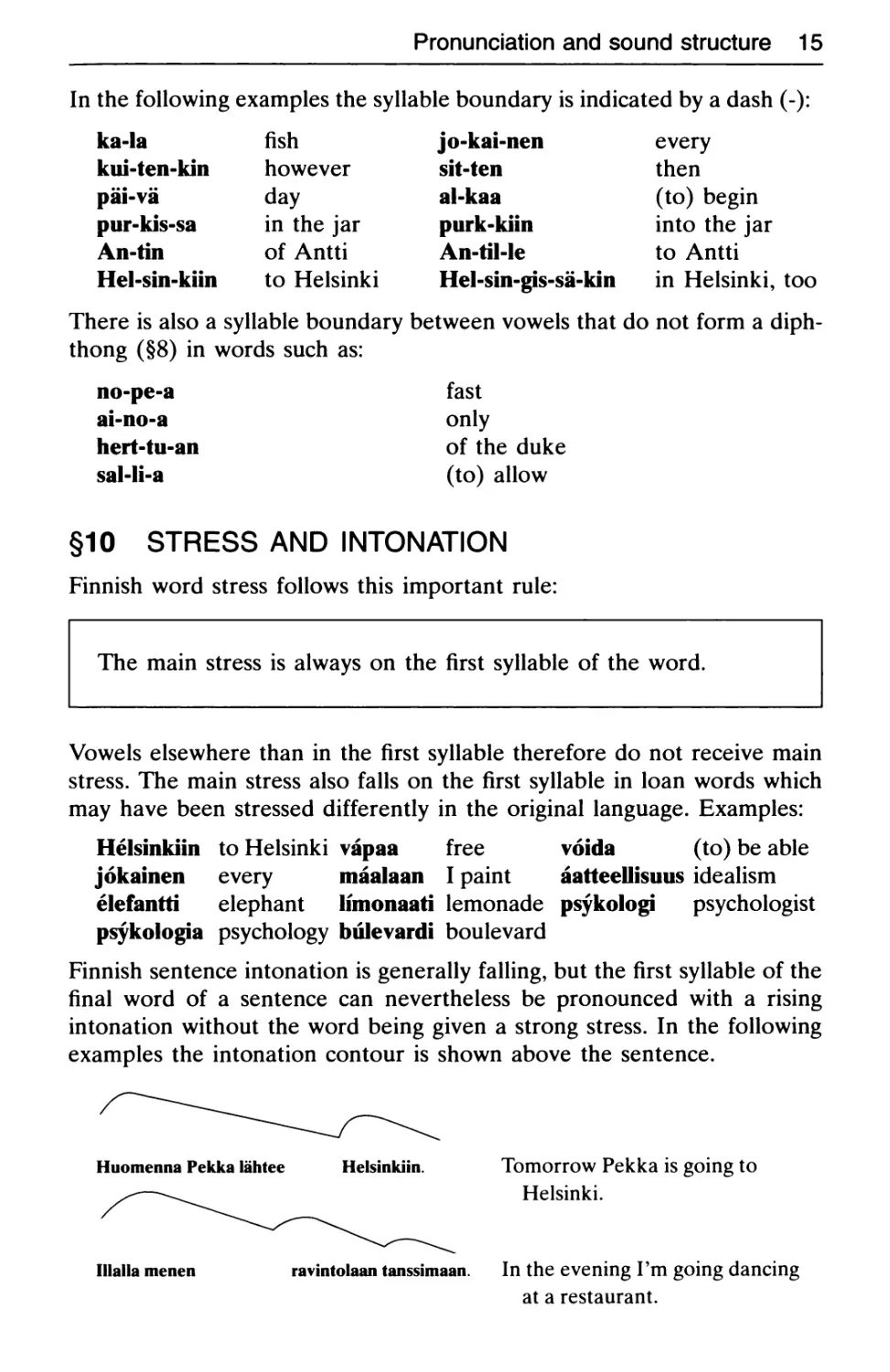
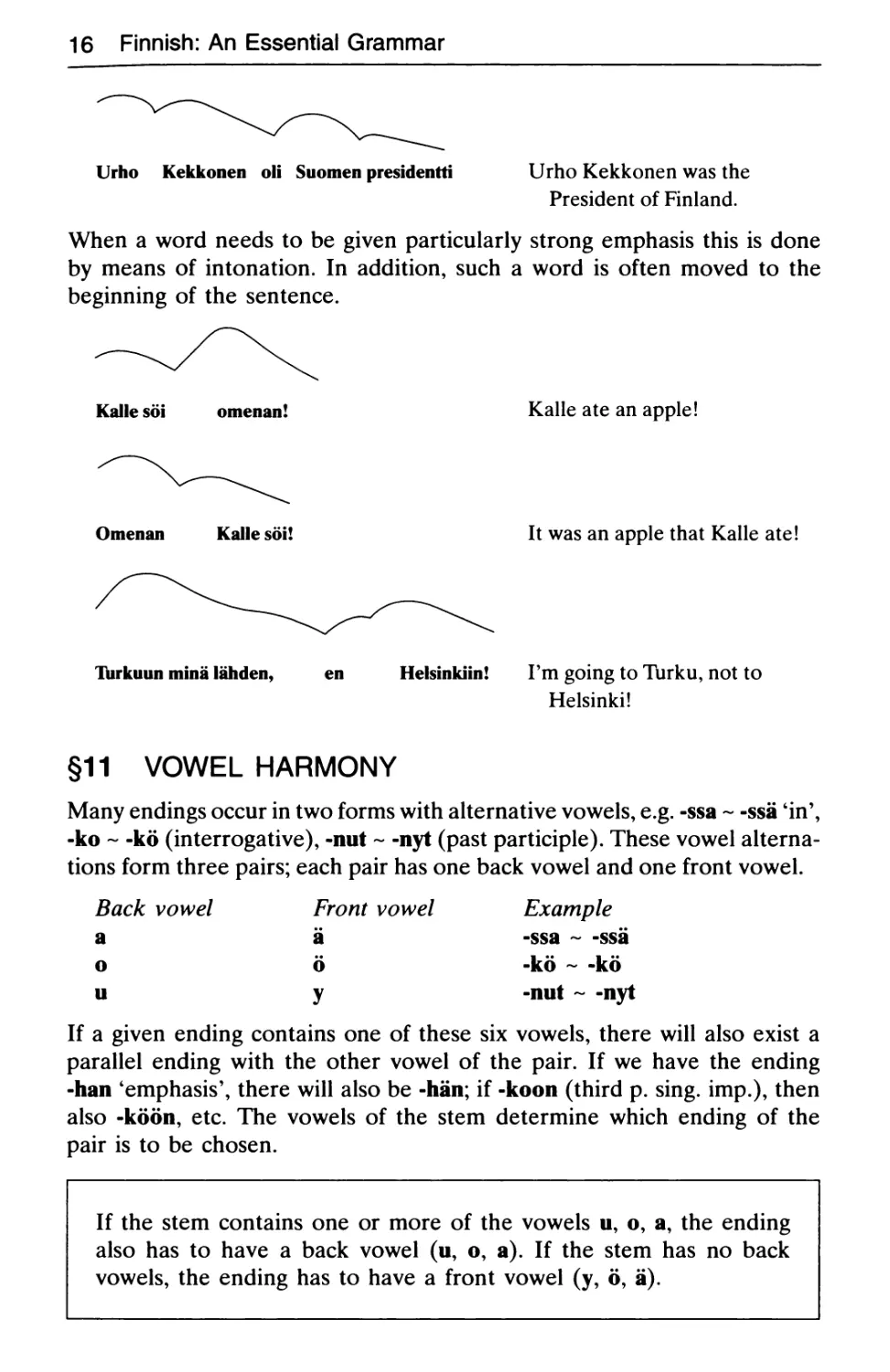
Finnish sentence intonation is generally falling, but the first syllable of the
final word of a sentence can nevertheless be pronounced with a rising
intonation without the word being given a strong stress. In the following
examples the intonation contour is shown above the sentence.
Tomorrow Pekka is going to
Helsinki.
Illalla menen ravintolaan tanssimaan. In the evening I’m going dancing
at a restaurant.

16 Finnish: An Essential Grammar
Urho Kekkonen oli Suomen presidentti Urho Kekkonen was the
President of Finland.
When a word needs to be given particularly strong emphasis this is done
by means of intonation. In addition, such a word is often moved to the
beginning of the sentence.
Kalle söi
Omenan
Kalle söi!
Kalle ate an apple!
It was an apple that Kalle ate!
Thrkuun minä lähden, en Helsinkiin! I’m going to Turku, not to
Helsinki!
§11 VOWEL HARMONY
Many endings occur in two forms with alternative vowels, e.g. -ssä ~ -ssä ‘in’,
-ko ~ -kö (interrogative), -nut ~ -nyt (past participle). These vowel
alternations form three pairs; each pair has one back vowel and one front vowel.
Back vowel Front vowel Example
a ä -ssä ~ -ssä
o ö -kö ~ -kö
u y -nut ~ -nyt
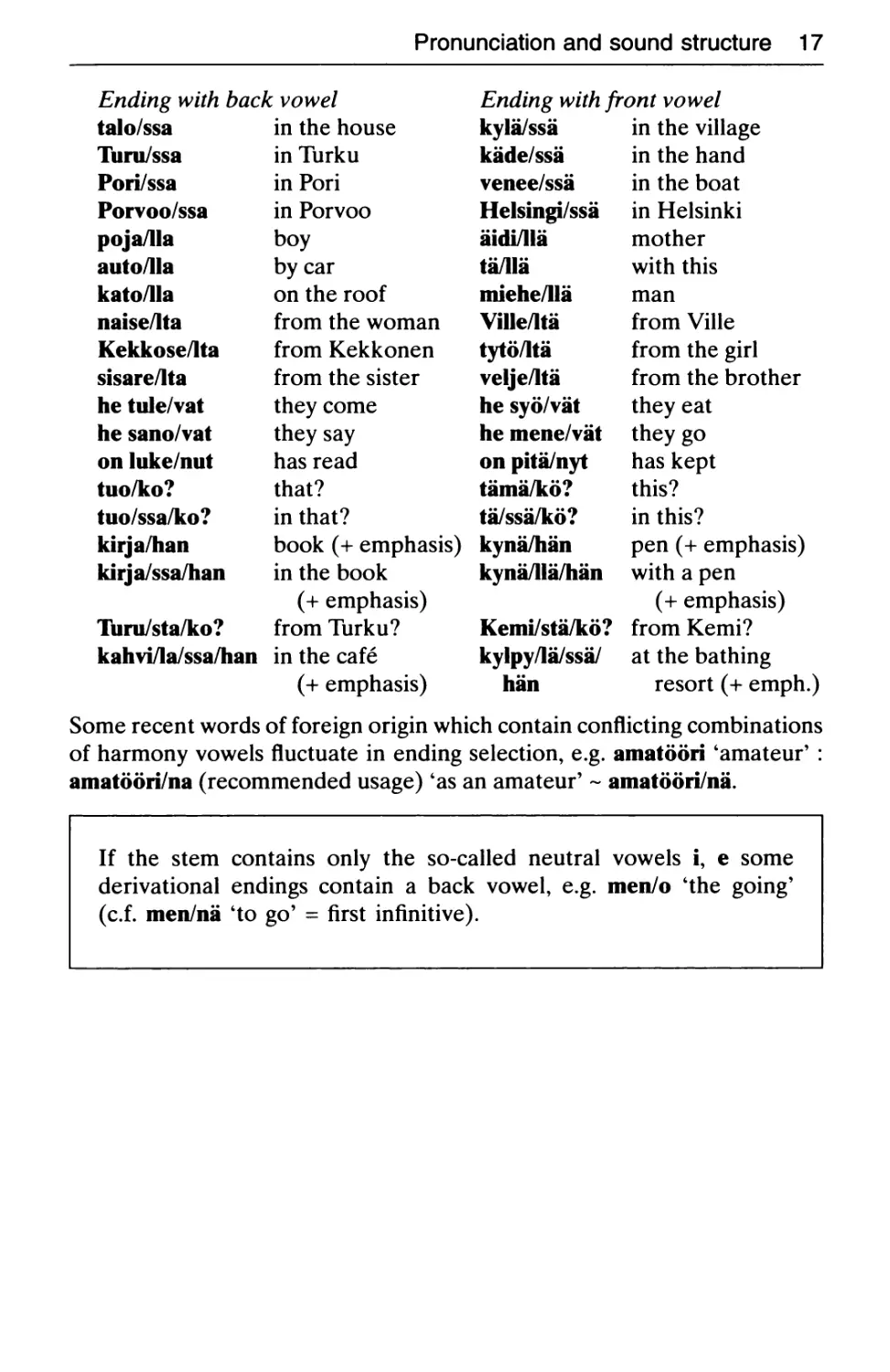
If a given ending contains one of these six vowels, there will also exist a
parallel ending with the other vowel of the pair. If we have the ending
-han ‘emphasis’, there will also be -hän; if -koon (third p. sing, imp.), then
also -köön, etc. The vowels of the stem determine which ending of the
pair is to be chosen.
If the stem contains one or more of the vowels u, o, a, the ending
also has to have a back vowel (u, o, a). If the stem has no back
vowels, the ending has to have a front vowel (y, ö, ä).

Pronunciation and sound structure 17
Ending with back vowel
Ending with front vowel
talo/ssa
in the house
kylä/ssä
in the village
Turu/ssa
in Turku
käde/ssä
in the hand
Pori/ssa
in Pori
venee/ssä
in the boat
Porvoo/ssa
in Porvoo
Helsingi/ssä
in Helsinki
poja/lla
boy
äidi/llä
mother
auto/lla
by car
tä/llä
with this
kato/lla
on the roof
miehe/llä
man
naise/lta
from the woman
Ville/Itä
from Ville
Kekkose/lta
from Kekkonen
tytö/Itä
from the girl
sisare/lta
from the sister
velje/ltä
from the brother
he tule/vat
they come
he syö/vät
they eat
he sano/vat
they say
he mene/vät
they go
on luke/nut
has read
on pitä/nyt
has kept
tuo/ko?
that?
tämä/kö?
this?
tuo/ssa/ko?
in that?
tä/ssä/kö?
in this?
kirja/han
book (+ emphasis)
kynä/hän
pen (+ emphasis)
kirja/ssa/han
in the book
kynä/llä/hän
with a pen
(+ emphasis)
(+ emphasis)
Turu/sta/ko?
from Turku?
Kemi/stä/kö?
from Kemi?
kahvi/la/ssa/han
in the cafe
kylpy/lä/ssä/
at the bathing
(+ emphasis) hän resort (+ emph.)
Some recent words of foreign origin which contain conflicting combinations
of harmony vowels fluctuate in ending selection, e.g. amatööri ‘amateur’ :
amatööri/na (recommended usage) ‘as an amateur’ ~ amatööri/nä.
If the stem contains only the so-called neutral vowels i, e some
derivational endings contain a back vowel, e.g. men/o ‘the going’
(c.f. men/nä ‘to go’ = first infinitive).

3 	A SURVEY OF WORD
STRUCTURE
• Nominals and their endings
• Finite verb forms and their endings
• Non-finite verb forms and their endings
§12 NOMINALS AND THEIR ENDINGS
Nominals are nouns, adjectives, pronouns and numerals, i.e. words like
the following:
Nouns
Adjectives
Pronouns
Numerals
auto
car
iso big
minä
I
yksi
one
katu
street
kallis expensive
he
they
kymmenen
ten
nainen
woman
pitkä long
tämä
this
toinen
second
hinta
price
vanha old
se
it
seitsemäs
seventh
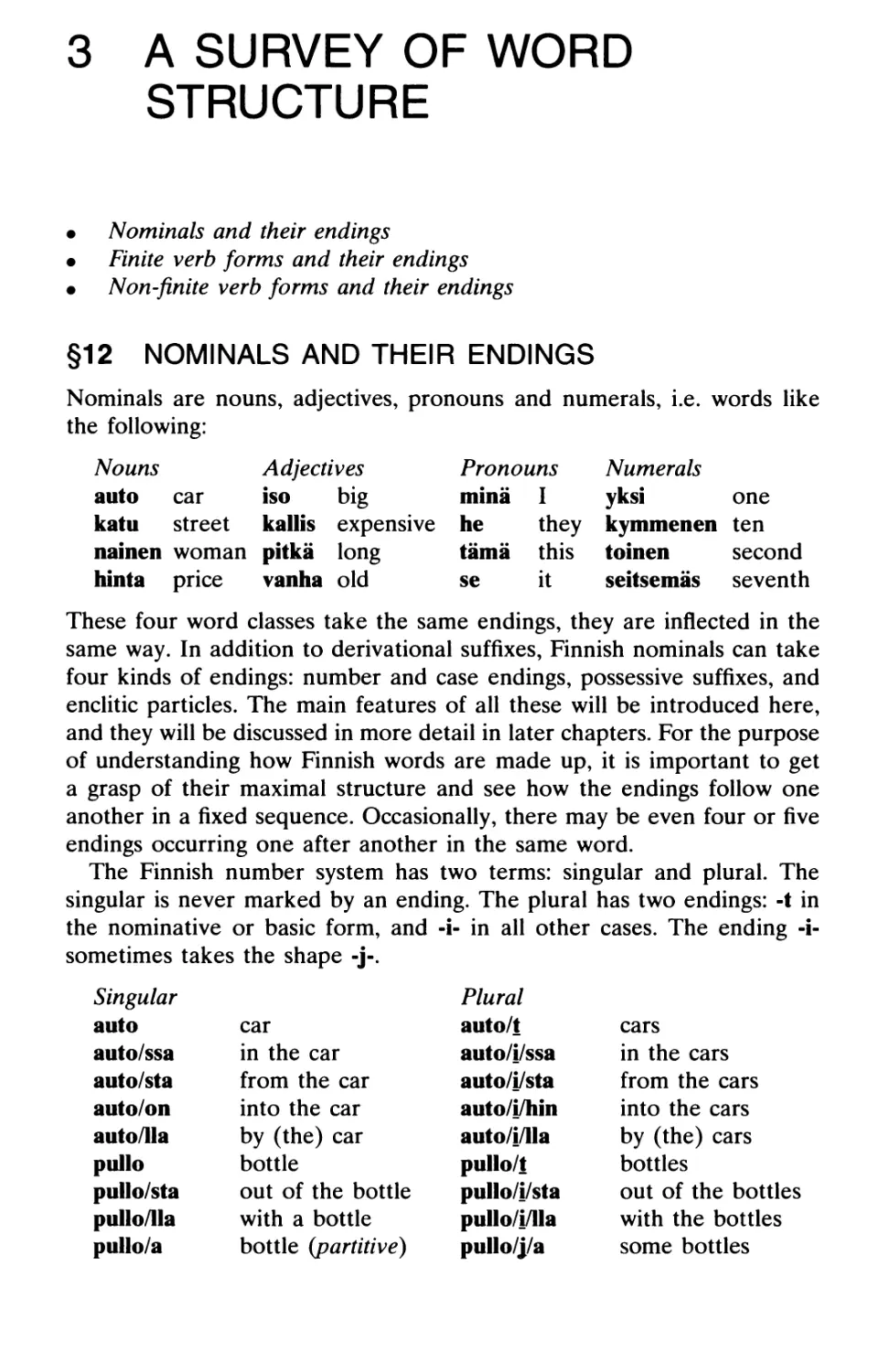
These four word classes take the same endings, they are inflected in the
same way. In addition to derivational suffixes, Finnish nominals can take
four kinds of endings: number and case endings, possessive suffixes, and
enclitic particles. The main features of all these will be introduced here,
and they will be discussed in more detail in later chapters. For the purpose
of understanding how Finnish words are made up, it is important to get
a grasp of their maximal structure and see how the endings follow one
another in a fixed sequence. Occasionally, there may be even four or five
endings occurring one after another in the same word.
The Finnish number system has two terms: singular and plural. The
singular is never marked by an ending. The plural has two endings: -t in
the nominative or basic form, and -i- in all other cases. The ending -i-
metimes takes
the shape -j-.
Singular
Plural
auto
car
auto/t
cars
auto/ssa
in the car
auto/i/ssa
in the cars
auto/sta
from the car
auto/i/sta
from the cars
auto/on
into the car
auto/i/hin
into the cars
auto/lla
by (the) car
auto/i/lla
by (the) cars
pullo
bottle
pullo/t
bottles
pullo/sta
out of the bottle
pullo/i/sta
out of the bottles
pullo/lla
with a bottle
pullo/i/lla
with the bottles
pullo/a
bottle (partitive)
pullo/j/a
some bottles

A survey of word structure 19
Finnish has some 15 cases. The table below shows the grammatical names
of the cases, their endings and basic meanings or functions. The principle
of vowel harmony (§11) determines whether the ending variant contains
a front or a back vowel.
System of cases
Case
Endings
Function
Example
Translation1
Nominative
- (pi- -t)
(basic form)
auto
car
Genitive
-n; -den, -tten
possession
auto/n
of the car
Accusative
-n, -t, -
object ending
häne/t
him, her
Partitive
-a ~ -ä;
indefinite
maito/a
(some) milk
-ta ~ -tä;
quantity
vet/tä
(some) water
-tta ~ -ttä
perhe/ttä
(some) family
Inessive
-ssä ~ -ssä
inside
auto/ssa
in the car
Elative
-sta ~ -stä
out of
auto/sta
out of the car
Illative
-Vn, -hVn,2
into
auto/on
into the car
-seen, -siin
maa/han
into the country
Porvoo/seen
to Porvoo
Adessive
-Ua - -llä
on; instrument
pöydä/llä
on the table
Ablative
-Itä ~ -Itä
off
pöydä/ltä
off the table
Allative
-Ue
onto
pöydä/lle
onto the table
Essive
-na - -nä
state
opettaja/na
as a teacher
Translative
-ksi
change of state
opettaja/ksi
(become) a
teacher
Comitative
-ine-
accompanying
vaimo/ine/ni
with my wife
Instructive
-n
(idiomatic)
j ala/n
on foot
Listed below are the possessive suffixes; with the exception of the third
person, the endings are different for each person.
1 Translator's note: With the adessive and translative cases there is often no straightforward
equivalent in English that can be used to gloss examples of isolated words. The meanings
of these cases are explained in the relevant chapters below, but in the tables and short
examples of the book the conventions adopted are as follows. The adessive ending is glossed ‘on’
where this could make sense (‘on the table’), ‘with’ where an instrument interpretation would
be more natural (‘with a hammer’), ‘at’ or ‘in’ for places, and ‘“at”’ for people, etc. since
in these latter contexts the adessive case commonly marks the possessor (minulla on ‘I have’,
glossed literally as ‘ “at” me is’). The translative is glossed ‘to (become) + nominal’ in order
to indicate how it would be usually understood in context; thus e.g. punaiseksi would be
glossed ‘to (become) red’, since the form would typically occur in such contexts as ‘it
became/turned/changed to red’. The essive is usually glossed ‘as’, although this might not
be natural in all contexts. And the partitive is simply marked ‘partitive’, since it often
corresponds to ‘no article’ in English.
2 The sign -V- indicates a vowel which is the same as the nearest preceding vowel, e.g.
Turku/un ‘to Turku’, Helsinki/m ‘to Helsinki’, mag/han ‘into the country’, tie/hen ‘to the
road’.

20 Finnish: An Essential Grammar
Singular
First person
Second person
Third person
Plural
First person
Second person
Third person
(minun) kiija/m
(sinun) kirja/si
hänen kirja/nsa
(meidän) kirja/mme
(teidän) kirja/nne
heidän kirja/nsa
my book
your book
his/her book
our book
your book
their book
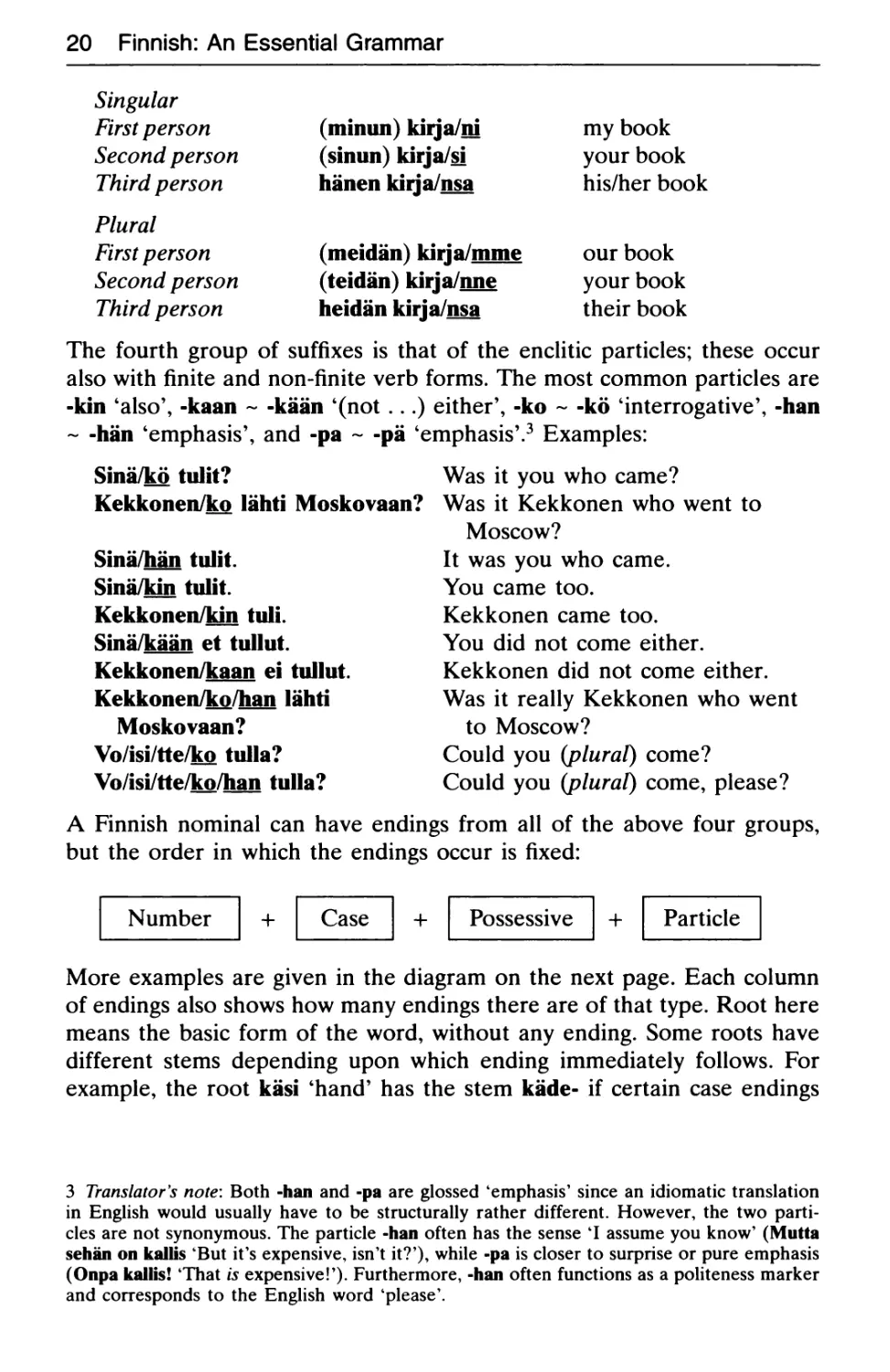
The fourth group of suffixes is that of the enclitic particles; these occur
also with finite and non-finite verb forms. The most common particles are
-kin ‘also’, -kaan ~ -kään ‘(not ...) either’, -ko ~ -kö ‘interrogative’, -han
~ -hän ‘emphasis’, and -pa ~ -pä ‘emphasis’.3 Examples:
Sinä/kö tulit?
Kekkonen/ko lähti Moskovaan?
Sinä/hän tulit.
Sinä/kin tulit.
Kekkonen/kin tuli.
Sinä/kään et tullut.
Kekkonen/kaan ei tullut.
Kekkonen/ko/han lähti
Moskovaan?
Vo/isi/tte/ko tulla?
Vo/isi/tte/ko/han tulla?
Was it you who came?
Was it Kekkonen who went to
Moscow?
It was you who came.
You came too.
Kekkonen came too.
You did not come either.
Kekkonen did not come either.
Was it really Kekkonen who went
to Moscow?
Could you (plural) come?
Could you (plural) come, please?
A Finnish nominal can have endings from all of the above four groups,
but the order in which the endings occur is fixed:
Number
+
Case
+
Possessive
+
Particle
More examples are given in the diagram on the next page. Each column
of endings also shows how many endings there are of that type. Root here
means the basic form of the word, without any ending. Some roots have
different stems depending upon which ending immediately follows. For
example, the root käsi ‘hand’ has the stem käde- if certain case endings
3 	Translator's note: Both -han and -pa are glossed ‘emphasis’ since an idiomatic translation
in English would usually have to be structurally rather different. However, the two
particles are not synonymous. The particle -han often has the sense ‘I assume you know’ (Mutta
sehän on kallis ‘But it’s expensive, isn’t it?’), while -pa is closer to surprise or pure emphasis
(Onpa kallis! ‘That is expensive!’). Furthermore, -han often functions as a politeness marker
and corresponds to the English word ‘please’.

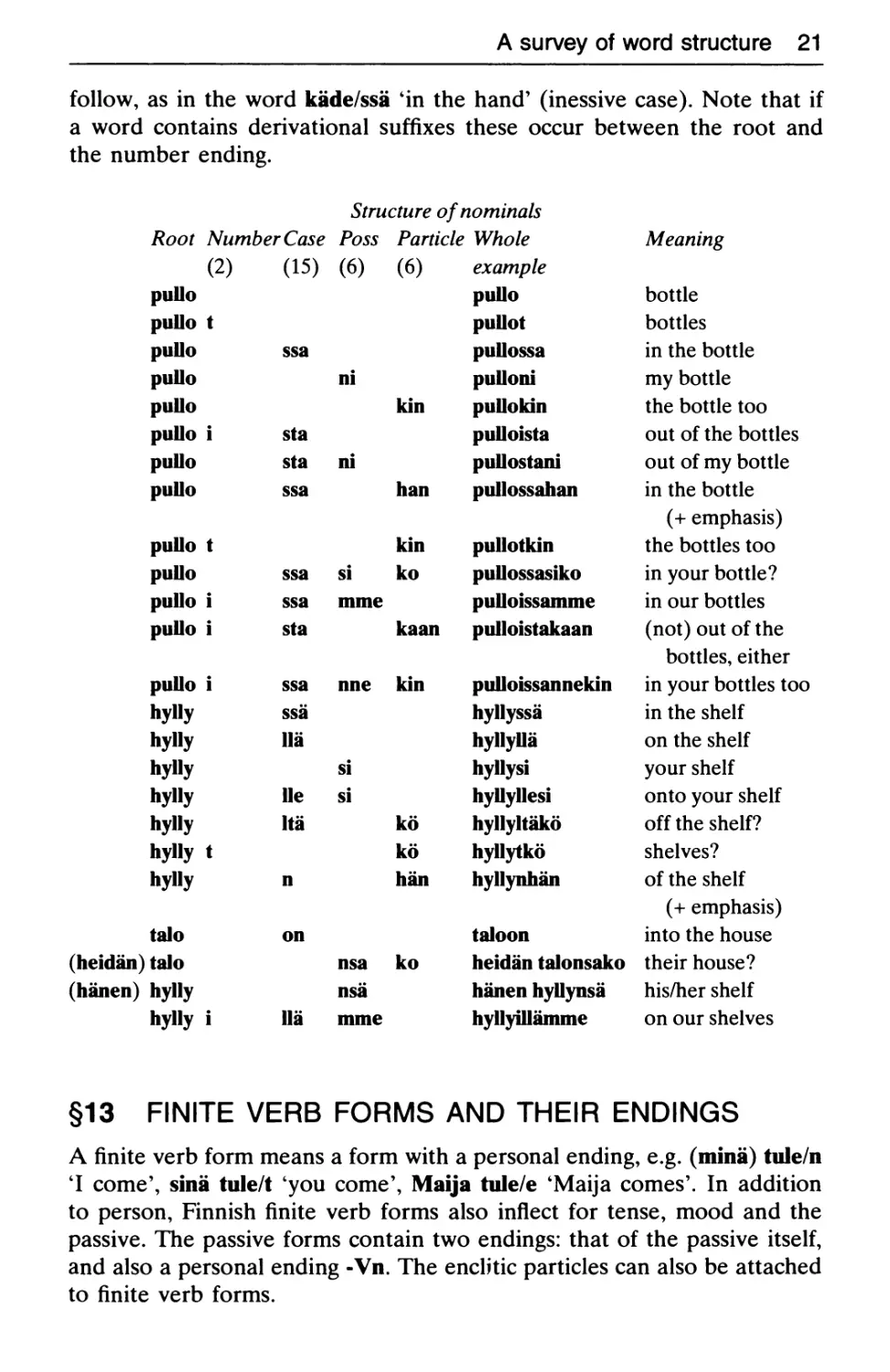
A survey of word structure 21
follow, as in the word käde/ssä ‘in the hand’ (inessive case). Note that if
a word contains derivational suffixes these occur between the root and
the number ending.
Structure of nominals
Root Number Case
Poss
Particle Whole
Meaning
(2)
(15)
(6)
(6)
example
pullo
pullo
bottle
pullo t
pullot
bottles
pullo
ssä
pullossa
in the bottle
pullo
ni
pulloni
my bottle
pullo
kin
pullokin
the bottle too
pullo i
sta
pulloista
out of the bottles
pullo
sta
ni
pullostani
out of my bottle
pullo
ssä
hän
pullossahan
in the bottle
(+ emphasis)
pullo t
kin
pullotkin
the bottles too
pullo
ssä
si
ko
pullossasiko
in your bottle?
pullo i
ssä
mme
pulloissamme
in our bottles
pullo i
sta
kaan
pulloistakaan
(not) out of the
bottles, either
pullo i
ssä
nne
kin
pulloissannekin
in your bottles too
hylly
ssä
hyllyssä
in the shelf
hylly
llä
hyllyllä
on the shelf
hylly
si
hyllysi
your shelf
hylly
He
si
hyllyllesi
onto your shelf
hylly
Itä
kö
hyllyltäkö
off the shelf?
hylly t
kö
hyllytkö
shelves?
hylly
n
hän
hyllynhän
of the shelf
(+ emphasis)
talo
on
taloon
into the house
(heidän) talo
nsa
ko
heidän talonsako
their house?
(hänen) hylly
nsä
hänen hyllynsä
his/her shelf
hylly i
llä
mme
hyllyillämme
on our shelves
§13 FINITE VERB FORMS AND THEIR ENDINGS
A finite verb form means a form with a personal ending, e.g. (minä) tule/n
‘I come’, sinä tule/t ‘you come’, Maija tule/e ‘Maija comes’. In addition
to person, Finnish finite verb forms also inflect for tense, mood and the
passive. The passive forms contain two endings: that of the passive itself,
and also a personal ending -Vn. The enclitic particles can also be attached
to finite verb forms.

22 Finnish: An Essential Grammar
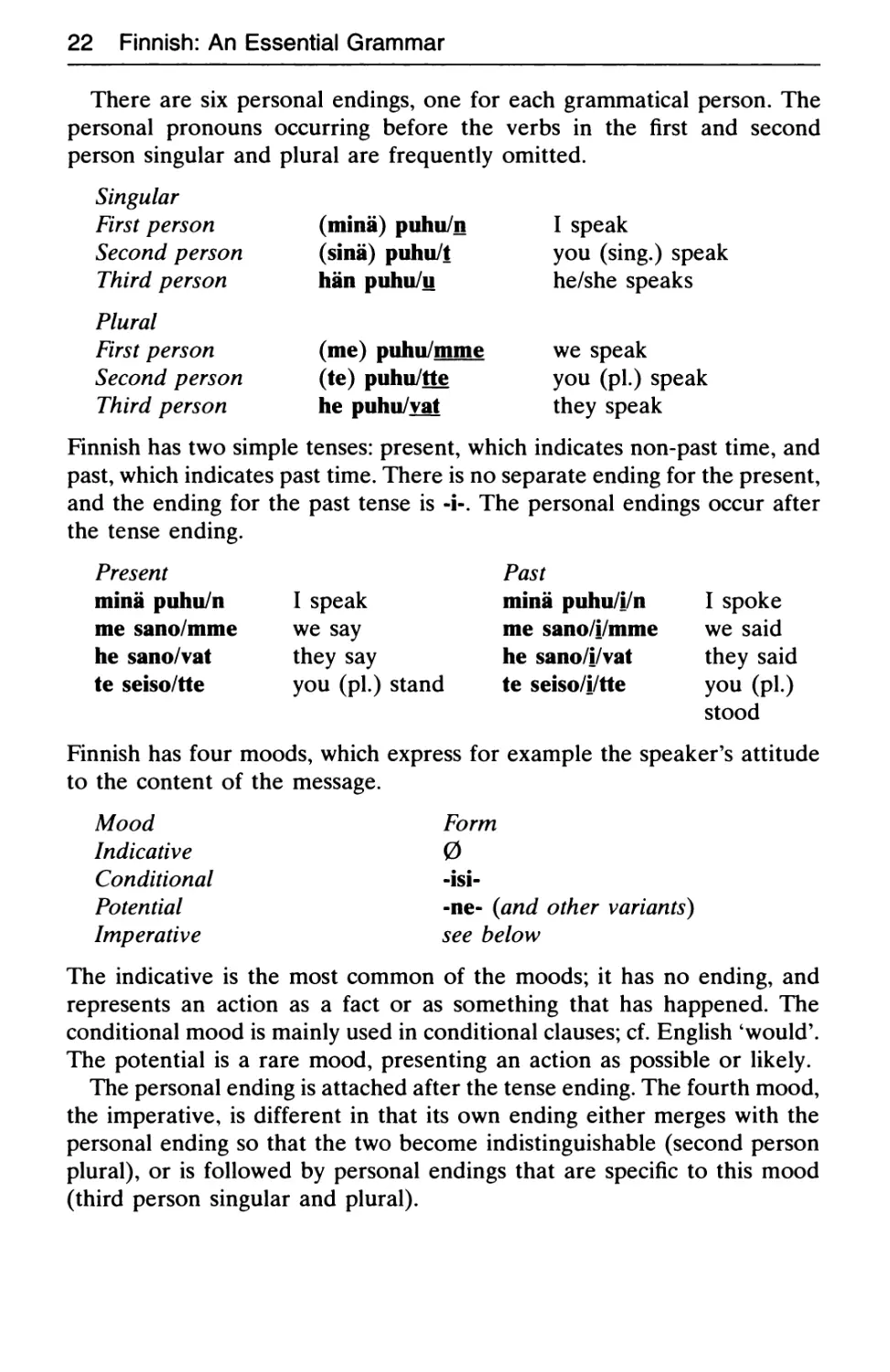
There are six personal endings, one for each grammatical person. The
personal pronouns occurring before the verbs in the first and second
person singular and plural are frequently omitted.
Singular
First person
Second person
Third person
Plural
First person
Second person
Third person
(minä) puhu/n
(sinä) puhu/t
hän puhu/u
(me) puhu/mme
(te) puhu/tte
he puhu/vat
I speak
you (sing.) speak
he/she speaks
we speak
you (pi.) speak
they speak
Finnish has two simple tenses: present, which indicates non-past time, and
past, which indicates past time. There is no separate ending for the present,
and the ending for the past tense is -i-. The personal endings occur after
the tense ending.
Present
minä puhu/n
me sano/mme
he sano/vat
te seiso/tte
I 	speak
we say
they say
you (pi.) stand
Past
minä puhu/i/n
me sano/i/mme
he sano/i/vat
te seiso/i/tte
I spoke
we said
they said
you (pi.)
stood
Finnish has four moods, which express for example the speaker’s attitude
to the content of the message.
Mood
Indicative
Conditional
Potential
Imperative
Form
0
-isi-
-ne- (and other variants)
see below
The indicative is the most common of the moods; it has no ending, and
represents an action as a fact or as something that has happened. The
conditional mood is mainly used in conditional clauses; cf. English ‘would’.
The potential is a rare mood, presenting an action as possible or likely.
The personal ending is attached after the tense ending. The fourth mood,
the imperative, is different in that its own ending either merges with the
personal ending so that the two become indistinguishable (second person
plural), or is followed by personal endings that are specific to this mood
(third person singular and plural).

A survey of word structure 23
Singular Plural
First person - sano/kaa/mme let us say
Second person sano say! sano/kaa say!
Third person sano/ko/on may he say sano/ko/ot may they say
The most common form is the second person singular, which has no
ending. Because of vowel harmony the endings for the other persons also
have front-vowel variants: vie/köön ‘may he take’, vie/käämme ‘let us
take’, vie/kää ‘take!’, vie/kööt ‘may they take’. The third person
imperatives express a wish rather than a command, and these forms are rare.
The passive forms indicate that the performer of the action is an
indefinite, unspecified person, cf. English ‘one (can say that.. .)’.4 The endings
for the passive itself are -tta ~ -ttä and -tä ~ -tä depending on the
structure of the preceding stem. Sometimes the final vowels a or ä disappear.
These endings are attached directly to the root form of the verb (or
the derived stem). Possible tense and mood endings come after the passive
ending, and after them comes the passive personal ending -Vn, where V
again stands for a vowel which is the same as the nearest preceding vowel.
Active Passive
sano/n I say sano/ta/an one says, it is said
sano/isi/n I would say sano/tta/isi/in one would say
sano/i/n I said sano/tt/i/in one said
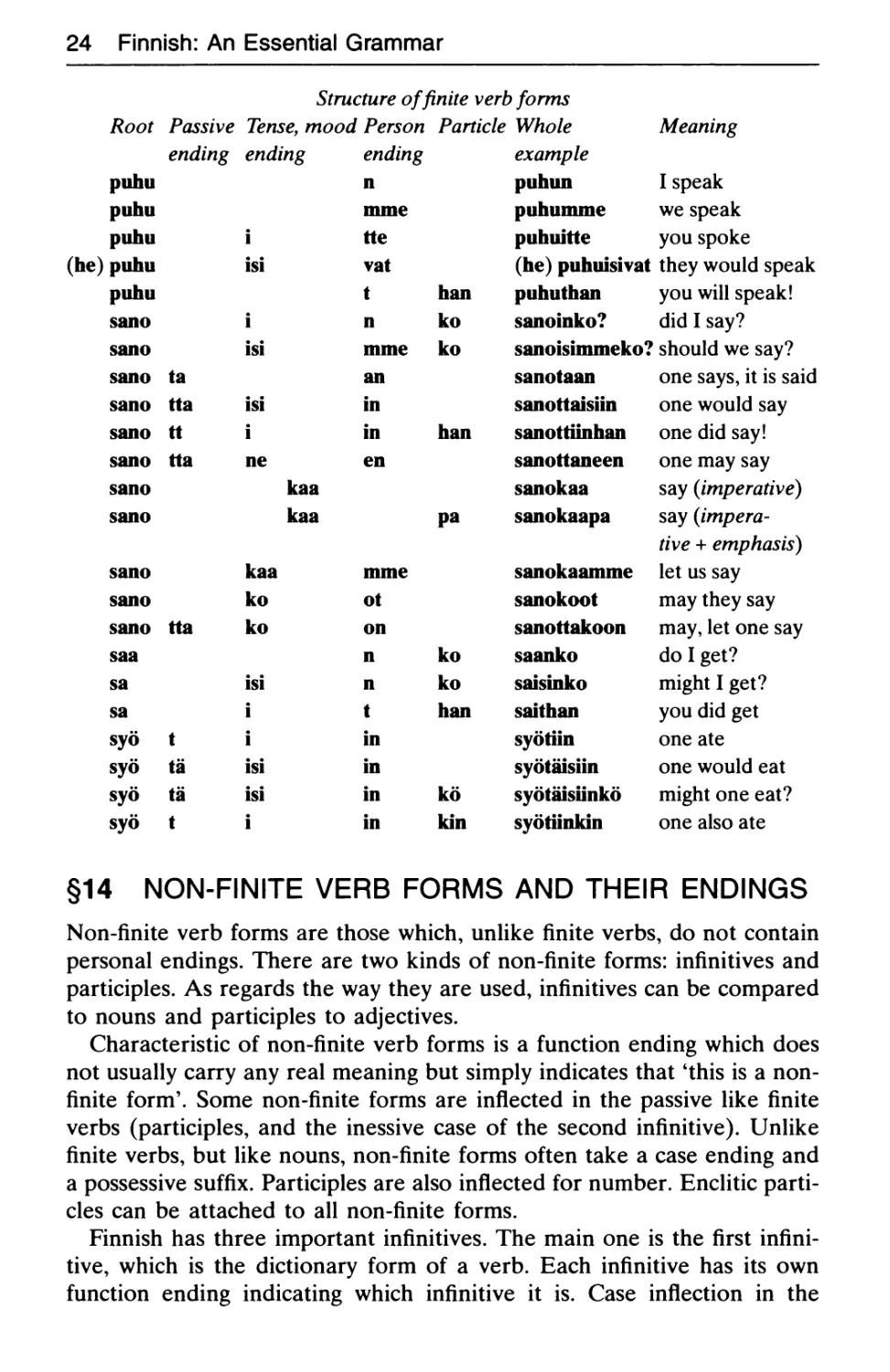
To conclude this section, the table on the next page shows the order in
which these endings occur. The tense and mood endings are in the same
column, since they are mutually exclusive (the same word form may not
contain both tense and mood endings). Some of the imperative endings
are between those for mood and person, since they have become merged.
In final position there may be an enclitic particle.
4 	Translator's note: the passive will usually be glossed with the impersonal ‘one’ in order to
show the sense of the Finnish, but a corresponding English passive form will often sound
more natural in context (‘one says’ - ‘it is said’).

24 Finnish: An Essential Grammar
Structure of finite verb forms
Root
Passive Tense, mood Person
Particle Whole
Meaning
ending ending
ending
example
puhu
n
puhun
I speak
puhu
mme
puhumme
we speak
puhu
i
tte
puhuitte
you spoke
(he) puhu
isi
vat
(he) puhuisivat
they would speak
puhu
t
han
puhuthan
you will speak!
sano
i
n
ko
sanoinko?
did I say?
sano
isi
mme
ko
sanoisimmeko?
should we say?
sano
tä
an
sanotaan
one says, it is said
sano
tta isi
in
sanottaisiin
one would say
sano
tt i
in
han
sanottiinhan
one did say!
sano
tta i
ne
en
sanottaneen
one may say
sano
kaa
sanokaa
say (imperative)
sano
kaa
pa
sanokaapa
say
(imperative + emphasis)
sano
kaa
mme
sanokaamme
let us say
sano
ko
ot
sanokoot
may they say
sano
tta ko
on
sanottakoon
may, let one say
saa
n
ko
saanko
do I get?
sä
si
n
ko
saisinko
might I get?
sä
t
han
saithan
you did get
syö
t
in
syötiin
one ate
syö
tä
si
in
syötäisiin
one would eat
syö
tä
si
in
kö
syötäisiinkö
might one eat?
syö
t
in
kin
syötiinkin
one also ate
§14 NON-FINITE VERB FORMS AND THEIR ENDINGS
Non-finite verb forms are those which, unlike finite verbs, do not contain
personal endings. There are two kinds of non-finite forms: infinitives and
participles. As regards the way they are used, infinitives can be compared
to nouns and participles to adjectives.
Characteristic of non-finite verb forms is a function ending which does
not usually carry any real meaning but simply indicates that ‘this is a non-
finite form’. Some non-finite forms are inflected in the passive like finite
verbs (participles, and the inessive case of the second infinitive). Unlike
finite verbs, but like nouns, non-finite forms often take a case ending and
a possessive suffix. Participles are also inflected for number. Enclitic
particles can be attached to all non-finite forms.
Finnish has three important infinitives. The main one is the first
infinitive, which is the dictionary form of a verb. Each infinitive has its own
function ending indicating which infinitive it is. Case inflection in the

A survey of word structure 25
infinitives is very defective. The first infinitive occurs in only two cases
(nominative and translative), the second also in only two (inessive and
instructive), and the third in six (inessive, elative, illative, adessive, abessive
and instructive). Infinitives do not appear in the plural. With some cases
infinitives may also take a possessive suffix.
Infinitives
Function ending Example
First
Second
Third
Meaning
-a ~ -ä sano/a (to) say
-da ~ -dä syö/dä (to) eat
-tä ~ -tä juos/ta (to) run
-e- sano/e/ssa/ni while I say
-de- syö/de/ssä/mme while we eat
-te- juos/te/n running
-ma- ~ -mä- syö/mä/llä by eating
sano/ma/tta without saying
sano/ma/an (in order) to say
Finnish has two participles, the present and the past, which have almost
the same function as ordinary adjectives; they also occur in the compound
forms of verbs. Participles also have passive forms. Being similar to
adjectives, participles take all cases and are also inflected for number. They
can sometimes take possessive suffixes. The active participles are given
below.
Active participles
Function ending Example
Present -va ~ -vä juo/va
syö/vä
Past -nut ~ -nyt juo/nut
syö/nyt
Meaning
drinking
eating
drunk
eaten
The following table shows the structure of the non-finite verb forms, and
the order in which the endings occur.

(on)
(ovat)
(on)
Structure of non-finite verb forms
Root
Passive
Non-finite
Number
Case
Poss.
Particle
Whole
Meaning
ending
ending
ending
ending
ending
ending
example
puhu
a
puhua
(to) speak
puhu
a
kse
si
puhuaksesi
in order for you to speak
puhu
ma
Ha
puhumalla
by speaking
syö
dä
syödä
(to) eat
syö
dä
kse
mme
syödäksemme
in order for us to eat
puhu
va
kin
puhuvakin
(the) speaking (one) too
puhu
va
ssä
kin
puhuvassakin
in the speaking (one) too
puhu
V
i
ssä
kin
puhuvissakin
in the speaking (ones) too
puhu
va
t
puhuvat
(the) speaking (ones)
puhu
nut
puhunut
(has) spoken
puhu
nee
t
puhuneet
(have)spoken
syö
mä
än
syömään
(in order) to eat
juo
ma
an
juomaan
(in order) to drink
juo
ma
an
ko
juomaanko
(in order) to drink?
syö
mä
ttä
syömättä
without eating
juo
ma
tta
han
juomattahan
without drinking (+ emphasis)
juo
ta
va
juotava
that can be drunk
sano
ttu
sanottu
(one has) said
sano
tu
sta
sanotusta
out of the said (thing)
sano
tta
va
sanottava
(the) to-be-said (thing)
sano
tta
va
Ha
sanottavalla
by the to-be-said (thing)
sano
tta
V
i
Ha
sanottavilla
by the to-be-said (things)
sano
tta
V
i
ssä
ko
sanottavissako
in the to-be-said (things)?
syö
tä
e
ssä
syötäessä
while one eats

Root
Passive
Non-finite
Number Case
Poss.
Particle
Whole
Meaning
ending
ending
ending ending
ending
ending
example
vetä
mä
llä
hän
vetämällähän
by pulling (+ emphasis)
vetä
e
ssä
si
vetäessäsi
while you pull
vetä
e
ssä
ni
vetäessäni
while I pull
syö
ty
ä
mme
syötyämme
we having eaten
(Kallen) syö
vä
n
syövän
(Kalle) eating
syö
de
ssä
än
syödessään
while he/she eats

4 	TWO IMPORTANT SOUND
ALTERNATIONS
• Consonant gradation (p, t, k)
• Vowel changes before endings
§15 CONSONANT GRADATION (p, t, k)
It would be easy to form Finnish words if all the endings were attached
mechanically one after the other according to the patterns given above for
nominals and finite and non-finite verb forms. But the adding of endings is
in fact a more complex matter, since endings are often accompanied by
sound alternations (changes) in the stem (to the left of the ending).
The most important of these alternations is that known as consonant
gradation, which affects the long and short stops p, t and k. Section 15.1
below outlines the various types of alternation. Section 15.2 deals with
the conditions determining the changes, and also presents some
important rules. Sections 15.3-5 contain a great many examples to show how
the rules are applied, and section 15.6 gives some special cases. The form
to which the rules of consonant gradation are applied is called the ‘strong
grade’, and the resulting alternative form is called the ‘weak grade’
(occasionally indicated by a ‘+’ prefixed to the word).
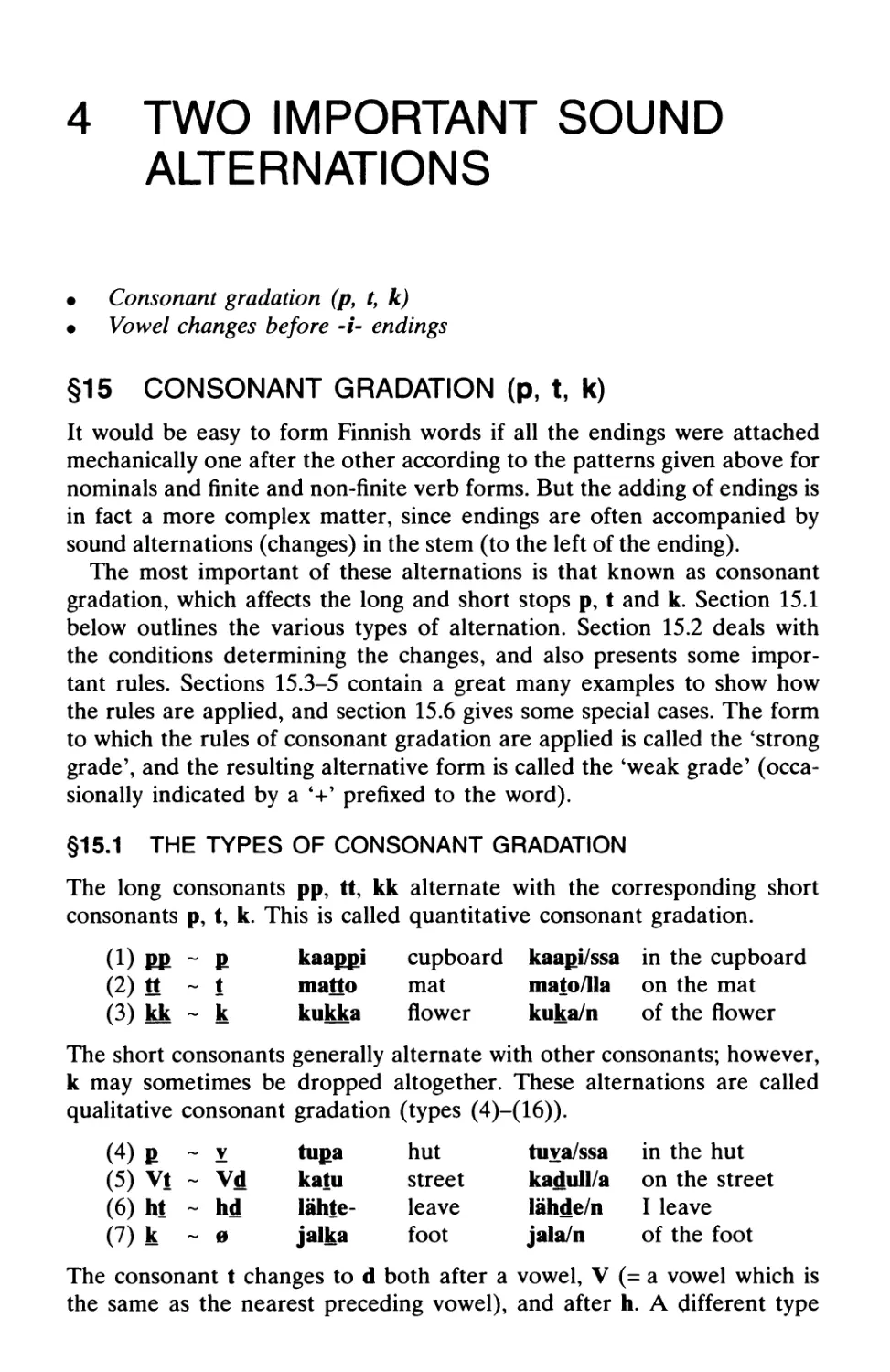
§15.1 THE TYPES OF CONSONANT GRADATION
The long consonants pp, tt, kk alternate with the corresponding short
consonants p, t, k. This is called quantitative consonant gradation.
(1) pp ~ p kaappi cupboard kaapi/ssa in the cupboard
(2) tt ~ t matto mat mato/lla on the mat
(3) kk ~ k kukka flower kuka/n of the flower
The short consonants generally alternate with other consonants; however,
k may sometimes be dropped altogether. These alternations are called
qualitative consonant gradation (types (4)-(16)).
(4) p ~ v
tupa
hut
tuva/ssa
in the hut
(5) Vt ~ Vd
katu
street
kadull/a
on the street
(6) ht - hd
lähte-
leave
lähde/n
I leave
(7) k ~ 0
jalka
foot
jala/n
of the foot
The consonant t changes to d both after a vowel, V (= a vowel which is
the same as the nearest preceding vowel), and after h. A different type

Two important sound alternations 29
of alternation takes place in the following five cases, where either p, t, k
occur after a nasal consonant (m, n, g), or t occurs after 1 or r.
(8) mp ~ mm
(n) n
Alternations (4)-(7) operate when the stops are not preceded by a nasal
consonant or 1 or r: in such cases alternations (8)-(12) apply. In addition
to these there are also four fairly rare alternations applying to k.
mm
ampu-
shoot
ammu/mme
we shoot
nn
ranta
shore
ranna/lla
on the shore
ng [qq] kenkä
shoe
kengä/n
of the shoe
U
kulta
gold
kulla/n
of the gold
IT
parta
beard
parra/ssa
in the beard
(13) Ike ~ Ije
polke-
trample
polje/n
I trample
(14) rke ~ rje
särke-
break
särje/n
I break
(15) hke~ hje
rohkene/t you dare
rohjet/a
(to) dare
(16) k ~ v
puku
dress
puvu/n
of the dress
Alternations (13)—(15) are very similar: in each of these k changes to j
before e. Type (16) is rare, and occurs only in a few nominals, when k is
preceded and followed by u/y.
§15-2 THE RULES OF CONSONANT GRADATION
All the alternations (1)—(16) are determined by the same set of
conditions. Stops change in the stem of words with two or more syllables
when certain endings are added. The change is determined partly by
the vowels between the stop and the ending (alternation occurs only
if the vowels are short; there is no alternation if this position is taken
by a long vowel or a consonant), and partly by the following ending
(alternation is caused only by certain types of case and personal ending).
The following rule A applies to all words, nominals as well as verbs.
Rule A
In polysyllabic stems long and short p, t, k are subject to consonant
gradation if they are followed by an ending which:
A(a) consists of only one consonant or
A(b) begins with two consonants,
and also on condition that
A(c) between p, t, k and the ending there is only a short vowel or
a diphthong (not consonants or a syllable boundary)
A(d) the ending causing consonant gradation is usually the case
ending in nominals and the personal ending in verbs
Cont ...

30 Finnish: An Essential Grammar
A(e) between this ending and the consonants p, t, k there can be
an -i- ending (plural or past tense)
A(f) alternation never occurs before a long vowel
A(g) there is no alternation in monosyllabic stems
In addition to the basic rule A there is a second rule B, which governs
consonant gradation in verbs only.
Rule B
In verbs, p, t, k, are always subject to consonant gradation before
a short vowel if they occur
B(a) before the passive ending (e.g. -tta- ~ -ttä-, -ta- ~ -tä-)
B(b) in the second person singular imperative
B(c) in the present indicative negative
Cases B(b) and B(c) are in fact equivalent, since these verb forms are
always the same, e.g. kerro! ‘tell!’ ~ en kerro ‘I do not tell’; anna! ‘give’
~ en anna ‘I do not give’.
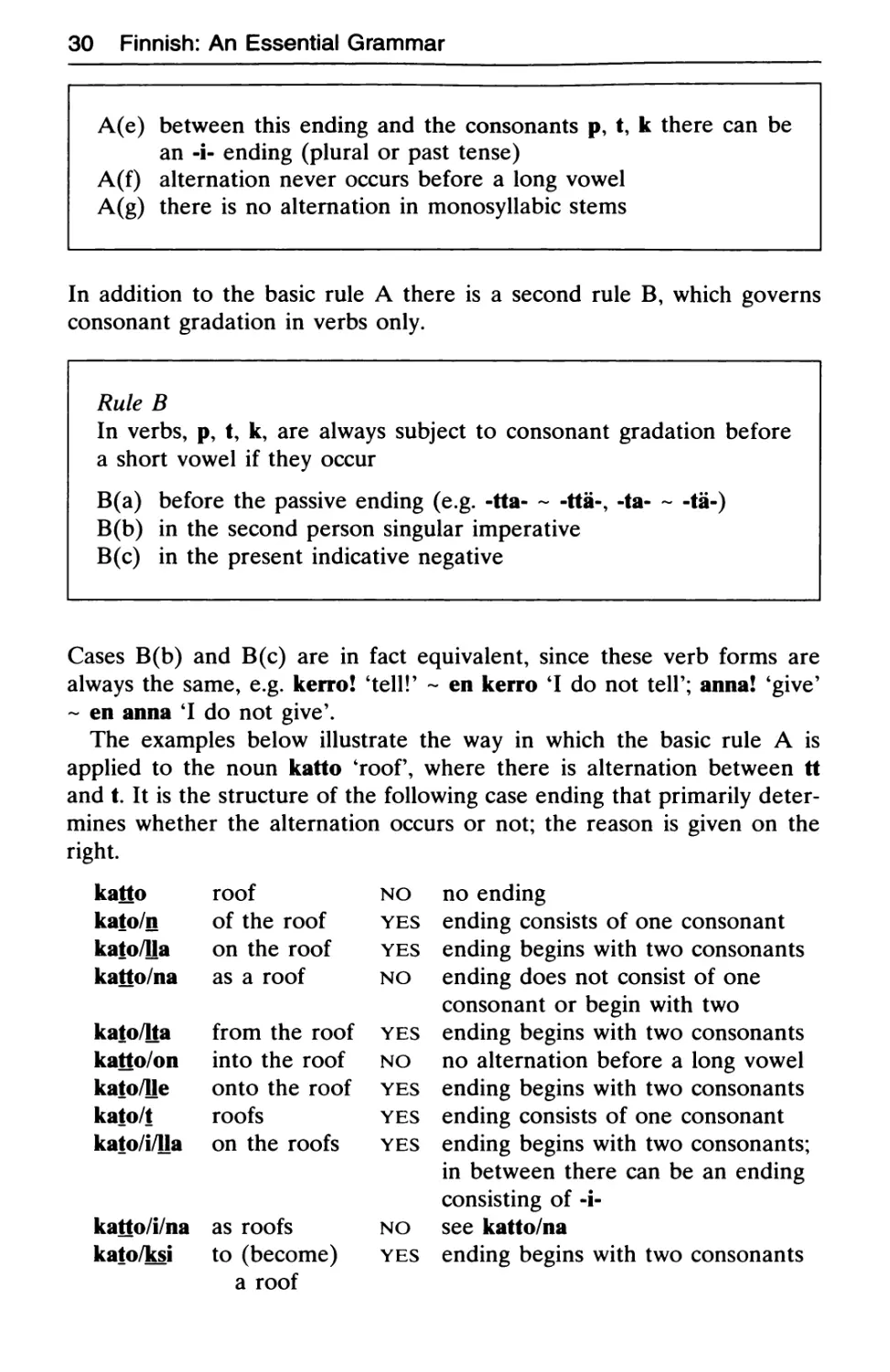
The examples below illustrate the way in which the basic rule A is
applied to the noun katto ‘roof’, where there is alternation between tt
and t. It is the structure of the following case ending that primarily
determines whether the alternation occurs or not; the reason is given on the
right.
katto
roof
NO
no ending
kato/n
of the roof
YES
ending consists of one consonant
kato/Ua
on the roof
YES
ending begins with two consonants
katto/na
as a roof
NO
ending does not consist of one
consonant or begin with two
kato/Jta
from the roof
YES
ending begins with two consonants
katto/on
into the roof
NO
no alternation before a long vowel
kato/Ue
onto the roof
YES
ending begins with two consonants
kato/t
roofs
YES
ending consists of one consonant
kato/i/Ha
on the roofs
YES
ending begins with two consonants;
in between there can be an ending
consisting of -i-
katto/i/na
as roofs
NO
see katto/na
kato/ksi
to (become)
a roof
YES
ending begins with two consonants

Two important sound alternations 31
katto/mme our roof no no alternation before a possessive
suffix
katto/kin a roof, too no ending does not consist of one
consonant or begin with two
kato/i/Ue onto the roofs yes ending begins with two consonants;
in between there can be an ending
consisting of -i-
katto/i/hin into the roofs no ending does not consist of one
consonant or begin with two
kato/i/Ha from the roofs yes ending begins with two consonants;
in between there can be an ending
consisting of -i-
katto/nne your roof no no alternation before a possessive
suffix
katto/a roof (partitive) no ending does not consist of one
consonant or begin with two
katto/j/en of the roofs no same as above; j = the plural i
The two following sections contain further examples of the application of
rules A and B, in both nominals and verbs.
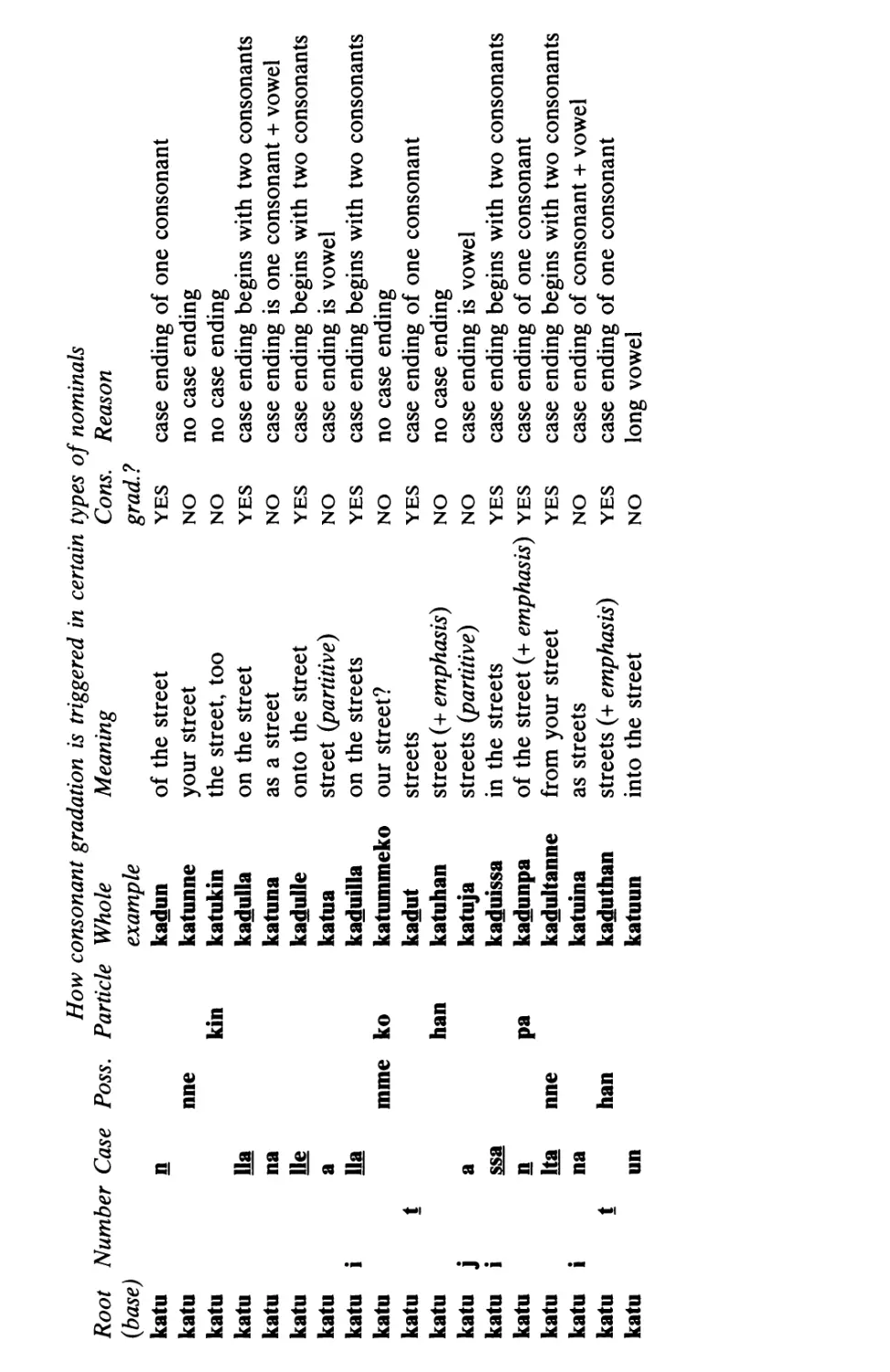
§15.3 APPLYING THE BASIC RULE TO NOMINALS
The table on page 33 shows how consonant gradation applies to the word
katu ‘street’, where the alternation is of type (5); t changes to d. The
examples are given in the familiar way; the actual word form is written
on the right, followed by the reason for the occurrence or non-occurrence
of the alternation.
The nominative plural ending -t also causes consonant gradation. This
form shows both number and case. In accordance with the basic rule,
alternation occurs only before short vowels. The vowels of diphthongs are
short, and therefore there is usually alternation before a diphthong:
kato/Ha ‘on the roof’ ~ kato/i/Ha ‘on the roofs’. The latter form has the
diphthong -oi, before which consonant gradation occurs. (However,
the type renka/i/ssa ‘in the rings’ is an exception to this diphthong rule:
see below.)
Before long vowels the rules of consonant gradation do not apply, even
if the case ending does consist of one consonant or begin with two.
Nominals with an inflectional stem ending in a long vowel (§19, §20.3)
are unaffected by consonant gradation in almost all singular and plural
case forms, including those where the otherwise long stem vowel shortens
before the plural ending -i (§16). The examples below illustrate what
happens in the inflection of rengas : renkaa- ‘ring’.

32 Finnish: An Essential Grammar
Singular
renkaa/n
renkaa/ssa
renkaa/sta
renkaa/lla
renkaa/na
renkaa/seen
renkaa/lta
of the ring
in the ring
out of the ring
with the ring
as a ring
into the ring
from the ring
Plural
renkaa/t
renka/i/ssa
renka/i/sta
renka/i/lla
renka/i/na
renka/i/siin
renka/i/lta
rings
in the rings
out of the rings
with the rings
as rings
into the rings
from the rings
In these words the vowel preceding the plural i counts as long because it
is long in almost all the corresponding singular forms.
In words of the rengas : renkaa- type consonant gradation does apply,
however, in two case forms: the nominative singular, which ends either
in a short vowel + s (§20.3) or in -e (§19), and the partitive singular;
occasionally also the genitive plural. Cf. rengas ‘ring’ (nom. sing.), rengas/ta
(part, sing.), rengas/ten (gen. pi.). Further examples of this type (the basic
form is the nominative singular):
Alternation
Stem
Basic form
Meaning
(1)
pp -
#
saappaa-
saapas
boot
(2)
tt ~
t
rattaa-
ratas
wheel
(3)
kk -
k
rakkaa-
rakas
dear
(4)
p -
V
varpaa-
varvas
toe
(5)
t
d
hitaa-
hidas
slow
(6)
tit -
hd
tehtaa-
tehdas
factory
(7)
k ~
0
kokee-
koe
experiment
(8)
mp ~
mm
lampaa-
lammas
lamb
(9)
nt ~
nn
kintaa-
kinnas
mitten
(10)
nk ~
n8
kuninkaa-
kuningas
king
(11)
It ~
U
altaa-
allas
basin
(12)
rt ~
IT
porlaa-
porras
step
(13)
Ike ~
Ije
hylkee-
hylje
seal
(15)
hke ~
hje
pohkee-
pohje
calf (of leg)
We thus have saapas ‘boot’ (nom. sing.) and saapas/ta (part, sing.) but
saappaa/n (gen. sing.), saappaa/na (ess. sing.), saappaa/t (nom. pi.),
saappa/i/ssa (iness. pi.), etc.
In three-syllable nominals like keittiö ‘kitchen’, lapio ‘spade’, herttua
‘duke’, where there is a syllable boundary between the two final vowels
in the basic form (§9), there is no consonant gradation A(c). They are
thus inflected keittiö/n (gen. sing.), keittiö/ssä (iness. sing.), keittiö/tä (part,
sing.), keittiö/i/ssä (iness. pi.), etc.

How consonant gradation is triggered in certain
types of nominals
Root Number Case
Poss.
Particle
Whole
Meaning
Cons.
Reason
(base)
example
grad. ?
katu
n
kadun
of the street
YES
case ending of one consonant
katu
nne
katunne
your street
NO
no case ending
katu
kin
katukin
the street, too
NO
no case ending
katu
llä
kadulla
on the street
YES
case ending begins with two consonants
katu
na
katuna
as a street
NO
case ending is one consonant + vowel
katu
He
kadulle
onto the street
YES
case ending begins with two consonants
katu
a
katua
street (partitive)
NO
case ending is vowel
katu i
llä
kaduilla
on the streets
YES
case ending begins with two consonants
katu
mme
ko
katummeko
our street?
NO
no case ending
katu
t
kadut
streets
YES
case ending of one consonant
katu
han
katuhan
street (+ emphasis)
NO
no case ending
katu j
a
katuja
streets (partitive)
NO
case ending is vowel
katu i
ssä
kaduissa
in the streets
YES
case ending begins with two consonants
katu
n
pa
kadunpa
of the street (+ emphasis) yes
case ending of one consonant
katu
Itä
nne
kadultanne
from your street
YES
case ending begins with two consonants
katu i
na
katuina
as streets
NO
case ending of consonant + vowel
katu
t
hän
kaduthan
streets (+ emphasis)
YES
case ending of one consonant
katu
un
katuun
into the street
NO
long vowel

34 Finnish: An Essential Grammar
§15.4 APPLYING THE RULES TO VERBS
In verbs the personal ending generally determines whether or not
consonant gradation occurs (A(d)). In addition to the basic rule verbs are also
governed by rule B: the rules of consonant gradation are always applied
before the passive ending, and also in the second person singular
imperative and the present indicative negative.
Let us take the verb kerto- ‘(to) tell’ as an example: rt alternates with rr
(alternation type (12)). On the right of the table (page 35) there is an
indication of whether or not consonant gradation has occurred, and a brief
explanation.
Note condition A(e): there may be the past tense ending -i- between
an alternating p, t or k and the personal ending. But the rules of
consonant gradation cannot be applied if this mid-position contains the
conditional -isi or the potential -ne ending. We therefore have kerro/i/n
‘I told’ but kerto/isi/n ‘I would tell’ and kerto/ne/n ‘I may tell’ (this
potential mood form is very rare).
As with nominals, consonant gradation does not occur before long vowels
in verbs either (A(c)). In the following important class of verbs, known as
contracted verbs (§23.2), there is thus no consonant gradation in the present
tense, nor in the past tense although the vowel is shortened (§60).
Present
hyppää/n
hyppää/t
(hän) hyppää
hyppää/mme
hyppää/tte
(he) hyppää/vät
Ijump
you (sing.) jump
he/she jumps
we jump
you (pi.) jump
they jump
Past
hyppä/si/n
hyppä/si/t
(hän) hyppä/si
hyppä/si/mme
hyppä/si/tte
I 	jumped
you (sing.)
jumped
he/she jumped
we jumped
you (pi.) jumped
(he) hyppä/si/vät they jumped
In addition, contracted verbs are not affected by consonant gradation in
the second person singular imperative, nor in the present indicative
negative: hyppää! ‘jump’ ~ en hyppää ‘I do not jump’. But these verbs
do have a few inflected forms where the otherwise long stem vowel is
shortened, the second vowel being replaced by a linking consonant t
comparable to the case and personal endings that do cause consonant
gradation (A(a)), e.g. hyppää/n ‘I jump’: hypät/ä ‘(to) jump’. The following
forms are based on a stem containing the linking consonant, and
consonant gradation therefore applies.
First infinitive
Second infinitive
Passive
Imperative
Past participle
hypät/ä (to) jump
hypät/e/n jumping
hypät/t/i/in one jumped
hypät/kää jump! (plural; not second person sing.)
hypän/nyt jumped (note: t has changed to n)

How consonant gradation is triggered in certain types of finite verb forms
Root
Passive
Tense,
Person Particle
Whole
Meaning
Cons.
Reason
{base)
mood
example
grad.?
kerto
n
kerron
I tell
YES
pers. ending of one cons.
kerto
mme
kerromme
we tell
YES
pers. ending begins with two cons.
kerto
isi
mme
kertoisimme
we would tell
NO
conditional mood -isi-
kerto
ta
an
kerrotaan
one tells
YES
passive
kerto
i
tte
kerroitte
you (pi.) told
YES
pers. ending begins with two cons.
kerto
vat
kertovat
they tell
NO
pers. ending begins cons. + vowel
kerto
i
vat
kertoivat
they told
NO
pers. ending begins cons. + vowel
kerto
-
kerro
tell (sing.)!
YES
imperative second person singular
kerto
tt
i
in
kerrottiin
one told
YES
passive
kerto
o
kertoo
tells
NO
personal ending of a vowel
(en) kerto
-
(en) kerro
(I don’t) tell
YES
negative form
kerto
kaa
kertokaa
tell (pi.)!
NO
ending of consonant + vowel
kerto
t
kerrot
you (sing.) tell
YES
pers. ending of one cons.
kerto
i
t
kerroit
you (sing.) told
YES
pers. ending of one cons.
kerto
ne
tte
kertonette
you (pi.) may tell
NO
potential mood -ne-
kerto
-
pa
kerropa
tell (sing.)! + emph.
YES
second pers. sing. imp.
kerto
tte
hän
kerrottehan
you (pi.) tell + emph.
YES
pers. ending begins with two cons.
kerto
t
ko
kerrotko
do you (sing.) tell?
YES
pers. ending of one cons.
kerto
isi
vat
ko
kertoisivatko would they tell?
NO
conditional mood -isi-

36 Finnish: An Essential Grammar
Almost all types of consonant gradation may occur with contracted verbs:
Alternation
Long vowel Basic form
Meaning
stem
(1)
m
~
U
sieppaa- siepat/a
snatch
(2)
tt
~
t
konttaa- kontat/a
crawl
(3)
kk
~
k
hakkaa- hakat/a
hew
(4)
U
~
V
kelpaa- kelvat/a
be good enough
(5)
vt
~
Vd
hautaa- haudat/a
bury
(6)
ht
~
hd
rahtaa- rahdat/a
freight
(7)
k
~
0
makaa- maat/a
lie
(8)
mp
~
mm
kampaa- kammat/a
comb
(9)
nt
~
nn
ryntää- rynnät/ä
rush
(10)
nk
~
n8
hankaa- hangat/a
rub
(11)
It
~
U
valtaa- vaUat/a
conquer
(12)
rt
~
IT
virtaa- virrat/a
flow
§15.5 MORE EXAMPLES OF TYPES OF CONSONANT
GRADATION
Quantitative gradation
(1) BE
~ P
kauppa
shop
kaupassa
in the shop
lamppu
lamp
lamput
lamps
tappa-
kill
tapan
I kill
(2) Ö
~ t
katto
roof
katolla
on the roof
käyttä-
use
käytämme
we use
otta-
take
otan
I take
(3) kk
~ k
takki
coat
takissani
in my coat
kaikke-
everything
kaikessa
in everything
nukku-
sleep
nukuimme
we slept
Qualitative gradation
(4) E
~ V
kylpe-
bathe
kylven
I bathe
kipu
pain
kivussa
in pain
tarpee-
need
tarve
need
(5) 1
- d
tietä-
know
tiedätkö?
do you know?
vetä-
pull
vedä!
pull!
äiti
mother
äidille
to mother
(6) ht
~ hd
vihta
whisk
vihdalla
with a whisk
vaihta-
change
vaihdatteko? do you change?
lehte-
newspaper
lehdessä
in the newspaper
(7) k
- 0
joke-
river
joesta
out of the river
jaka-
divide
jaamme
we divide
poika
boy
pojalle
to the boy
aika
time
ajassa
in time

Two important sound alternations 37
(8) mp
(9) nt
(10) nk
(11) «
(12) rt
(13) Ike
(14) rke
(15) hke
(16) k
Note the exceptional words poika ‘boy’ and aika ‘time’ (type (7)) where
the loss of k makes i change to j in the weak grade. Type (13) and
particularly types (14)-(16) are rare.
§15.6 ADDITIONAL COMMENTS
Besides the case and personal endings dealt with above there are also certain
other (derivational) endings which cause consonant gradation, in particular
the ending -sti on adjectives (which forms adverbs from them), the
comparative ending -mpi (§85), and the superlative ending -in (§86). Note also the
semantically negative derivational ending -ton ~ -tön: koti ‘home’: kodi/ton
‘homeless’; palkka ‘salary’: palka/ton ‘unsalaried’. (Cf. §93 for more
examples of derivational endings that trigger consonant gradation.)
mm
ampu-
shoot
ammutaan
one shoots
kampa
comb
kammalla
with a comb
nn
tunte-
feel
ei tunne
does not feel
anta-
give
annamme
we give
ranta
shore
rannalla
on the shore
ng
kenkä
shoe
kengästä
out of the shoe
tunke-
shove
älä tunge!
don’t shove!
tinki-
bargain
tingitkö?
do you bargain?
U
ilta
evening
illalla
in the evening
kulta
gold
kullaksi
to (become) gold
viheltä-
whistle
vihellän
I whistle
IT
kiertä-
turn
kierrä!
turn!
kerta
time
kerran
once
kerto-
tell
kerronko?
do I tell?
Ije
sulke-
close
suljemme
we close
jälke-
trace
jäljet
traces
kulke-
go
kuljet
you go
rje
särke-
break
särjetkö?
do you break?
arke-
everyday
arjen
of everyday
hje
rohkene-
dare
rohjeta
(to) dare
V
suku
family
suvussa
in the family
puku
dress
puvut
dresses
luku
number
luvun
of a number
Basic form
kiltti
nice
tarkka
accurate
helppo
easy
Adverbs
kilti/sti
nicely
tarka/sti
accurately
helpo/sti
easily
Comparative
kilti/mpi
nicer
tarke/mpi
more accurate
helpo/mpi
easier
Superlative
kilte/in
nicest
tark/in
most accurate
helpo/in
easiest

38 Finnish: An Essential Grammar
The derivational endings undergo consonant gradation themselves when
they are inflected, for example the comparative -mpi: helpo/mma/ssa ‘in
the easier (one)’.
The stop consonants p, t, k do not undergo consonant gradation when
they occur next to s or t. The consonant k in the combination hk alter-
nates occasionally.
sk
tasku
pocket
taskusta
out of the pocket
sp
piispa
bishop
piispat
bishops
St
piste
point
pisteet
points
tk
matka
journey
matkalla
on the journey
hk
keuhko
lung
keuhkot
lungs
Note:
vihko
notebook
vihot
notebooks
Note:
nahka
leather
nahasta
out of leather
Many loan words and proper names do not have consonant gradation.
This is particularly true of alternation types (4)-(16).
auto
Malta
Kauko
Arto
car
Malta
(masc. name)
(masc. name)
autolla
Maltan
Kaukolle
Artolta
by car
of Malta
to Kauko
from Arto
§16 VOWEL CHANGES BEFORE -i- ENDINGS
The second important group of sound alternations is the set of vowel
changes which often occur before certain endings beginning with -i. These
endings are:
In nominals
the plural -i-
(sometimes -j-: see §26)
the superlative -in
(of adjectives)
In verbs
the past tense -i-
the conditional mood -isi-
The vowel changes are often the same for all these endings, but there are
also some differences. Eight rules are given below. (Consonant gradation
is indicated by a prefixed V.)
(1) The short vowels -o, -ö, -u, -y (i.e. rounded vowels) do not change
before -i- endings.

Two important sound alternations 39
Basic form Plural
talo taloissa in the houses
pöllö pöllöille to the owls
katu + kaduilla on the streets
hylly hyllyissä in the shelves
Basic form Past
sano- sanoi said
löhö- löhöi lounged
puhu- puhui spoke
pysähty- pysähtyi stopped
Basic form Superlative
helppo helpoin easiest
jörö joroin crossest
hullu hulluin craziest
pidetty + pidetyin most liked
Conditional
sanoisi would say
löhöisi would lounge
puhuisi would speak
pysähtyisi would stop
Basic form Plural
puu
maa
syy
venee-
perhee-
puita trees (part.)
maissa in the countries
syiden of the reasons
veneistä out of the boats
perheissä in the families
Basic form Superlative
vapaa
vakaa
tervee-
vapain
vakain
tervein
most free
firmest
healthiest
Basic form Past
Conditional
saa-
sai
got
saisi would get
jää-
jäi
remained
jäisi would remain
avaa-
avasi
opened
avaisi would open
makaa-
makasi
lay (cf. §60)
makaisi would lie
(3) The first vowel of the diphthongs ie, uo, yö is dropped.
Basic form Plural
tie
teillä
on the roads
(there are no adjectives)
tuo
noissa
in those
yö
öitä
nights (part.)
suo
soista
out of the marshes
työ
töiden
of the works
Basic form Past
Conditional
vie-
vei
took
veisi would take
juo-
jo»
drank
joisi would drink
syö-
söi
ate
söisi would eat
tuo-
toi
brought
toisi would bring
lyö-
löi
hit
löisi would hit

40 Finnish: An Essential Grammar
(4) 	i is dropped in diphthongs ending in -i.
Basic form Plural
hai
ha/i/ssa
in the sharks
(there are no adjectives)
koi
ko/i/ta
moths (part.)
täi
tä/i/den
of the lice
Basic form Past
Conditional
voi-
vo/i
could
vo/isi would be able
ui-
u/i
swam
u/isi would swim
nai-
na/i
married
na/isi would marry
(5) 	Short e is always dropped.
Basic form
Plural
Basic form
Superlative
tuule-
tuulia
winds (part.)
nuore-
nuorin y
tule-
tulia
fires (part.)
suure-
suurin g
lapse-
lapsilla
‘at’ the children
uute-
uusin n
kiele-
kielinä
as languages
naise-
naisille
to the women
Basic form
Past
Conditional
tule-
tuli
came
tulisi
would come
mene-
meni
went
menisi
would go
ole-
oli
was
olisi
would be
hymyile-
hymyili
smiled
hymyilisi
would smile
teke-
teki
did
tekisi
would do
näke-
näki
saw
näkisi
would see
(6) 	Short i changes to e before the plural and the superlative, but
is dropped before the past tense and the conditional.
Basic form Plural Basic form Superlative
lasi laseissa in the glasses kiltti + kiltein nicest
tuoli tuoleilla on the chairs nätti + nätein prettiest
väri väreinä as colours
tunti + tunneilla in the lessons

Two important sound alternations 41
Basic form
Past
Conditional
salli- sall/i
allowed
sall/isi
would allow
etsi- ets/i
looked for
ets/isi
would look for
oppi- opp/i
learned
opp/isi
would learn
vaati- vaat/i
demanded
vaat/isi
would demand
(7) 	The vowel ä is dropped except in the conditional.
Basic form Plural
Basic form Superlative
päivä
päiviä
days (part.)
syvä
syvin deepest
ystävä
ystävillä
‘at’ the friends
ikävä
ikävin dullest
seinä
seinien
of the walls
kylmä
kylmin coldest
kylä
kyliin
into the villages
märkä
+ märin wettest
hedelmä
hedelmiä
fruit (part.)
hämärä
hämärin dimmest
Basic form Past
Conditional
vetä-
veti
pulled
vetäisi
would pull
kestä-
kesti
lasted
kestäisi
would last
kiittä-
kiitti
thanked
kiittäisi
would thank
viettä-
vietti
spent
viettäisi
would spend
tietä-
tiesi
knew
tietäisi
would know
Contrary to this rule, in some three-syllable nouns -ä changes in the plural
to -ö, e.g. when the only vowel of the preceding syllable is i or y:
kynttilä, kynttilö/i/tä ‘candles (part.)’; tekijä, tekijö/i/tä ‘makers (part.)’;
päärynä, päärynö/i/ssä ‘in the pears’.
(8) 	The vowel a remains unchanged in the conditional and is dropped
in the superlative. In the plural and past tense of two-syllable words
a changes to o if the first vowel is a, e or i, but is dropped if the
first vowel is u or o.
Basic form Conditional
anta- antaisi would give
otta- ottaisi would take
sata- sataisi would rain
muista- muistaisi would remember
aika- alkaisi would begin

42 Finnish: An Essential Grammar
Basic form
kova
vahva
tarkka
vanha
matala
Superlative
kovin
vahvin
+ tarkin
vanhin
matalin
hardest
strongest
most accurate
oldest
lowest
Basic form Plural
Basic form
Past
matka
matkoilla
on the journeys
aikaalkoi
began
kiija
kirjoissa
in the books
anta-
antoi
gave
sana
sanoilla
with words
sata-
satoi
rained
piha
pihoilla
in the yards
kaata-
kaatoi
fell
herra
herrojen
of the masters
raata-
raatoi
toiled
Basic form Plural
Basic form
Past
koira
koirien
of the dogs
otta-
otti
took
poika
poikien
of the boys
muista-
muisti
remembered
muna
munia
eggs (part.)
osta-
osti
bought
kuuma
kuumissa
in the hot
huuta-
huusi
shouted
In nouns with three or more syllables -a either changes to -o or is dropped;
sometimes both changes may be possible. The change to -o occurs in
particular when (a) the only vowel of the preceding syllable is i; (b) -a is
preceded by a short 1, n or r; or (c) -a is preceded by two consonants.
(a) lukija
lukijoiden
of the readers
apina
apinoilla
‘at’ the monkeys
pakina
pakinoissa
in the columns
vakoilija
vakoilijoille
to the spies
(b) omena
omenoita
apples (part.)
ikkuna
ikkunoissa
in the windows
tavara
tavaroita
things (part.)
kampela
kampeloita
flounders (part.)
(c) kirsikka
+ kirsikoihin
into the cherries
vasikka
+ vasikoille
to the calves
sanonta
sanontojen
of the expressions
jalusta
jalustoilla
on the pedestals
In the plural forms of other nouns of three or more syllables, and of nearly
all adjectives, and also in the past tense of verbs with three or more
syllables, -a is dropped.
kanava
korkea
sanoma
ainoa
vaikea
kanavissa
korkeiden
sanomia
ainoissa
vaikeita
in the canals
of the high
messages (part.)
in the only
difficult (part.)

Two important sound alternations 43
ihana ihania lovely (part.)
kamala kamalia frightful (part.)
matkusta- matkusti travelled
pohjusta- pohjusti founded

5 	THE DECLENSION OF
NOMINALS
• General
• Nominals with a basic form in -i
• Nominals with a basic form in -e
• Nominals with a basic form ending in a consonant
§17 GENERAL
Both nominals and verb forms are built up by the addition of endings to
stems. For nominals, in general the basic form itself functions as the stem,
and in many declension types the basic form remains unchanged when
endings are added: e.g. auto/n, auto/ssa, auto/on, auto/ni, auto/kin.
However, sound alternations may sometimes occur with certain endings;
p, t and k in the stem are subject to consonant gradation (§15), and the
final vowel may change or disappear when an -i- ending is added (§16).
A word may sometimes have different stems according to what kind of
ending follows. The different stems are formed via sound alternations.
Often the basic form (nominative singular), or the basic form and the
partitive singular have their own stems, and all other case, number and
possessive endings are attached to a second or third stem. This is called
the inflectional stem.
Nominals where the basic form differs from the inflectional stem can
be divided into three groups. The first consists of nominals with a basic
form ending in -i and a corresponding inflectional stem in -e, e.g. kieli
‘language’ : kiele/n. The second group comprises nominals with a basic
form ending in -e and an inflectional stem in -ee, e.g. perhe ‘family’ :
perhee/n. Finally, in the third group the basic form ends in a consonant
which alternates with other sounds in the inflectional stem, e.g. kysymys
‘question’ : kysymykse/n.
In the following sections these groups are presented in turn. The
inflectional stem is represented by the genitive form, e.g. kiele/n, perhee/n,
kysymykse/n. Almost all the other forms can be made by replacing
the genitive ending -n by other endings, e.g. kiele/n, kiele/ssä, kiele/stä,
kiele/llä, kiele/ni, kiele/mme, etc. The following rule is therefore an
important one:

The declension of nominals 45
All case, number and possessive forms are made from the
inflectional stem (although the partitive sometimes has a separate stem).
The rules of consonant gradation and vowel change affect both basic form
stems and inflectional stems.
Consonant gradation (§15) and vowel changes before -i- endings
(§16) also affect inflectional stems.
Some examples now follow of how the inflectional stem kiele- is combined
with various nominal endings marking case, number and possession.
Basic form
Inflectional
stem + case
kieli
language
kiele/n
of the language
kiele/t
languages
kiele/ssä
in the language
kiele/stä
out of the language
kiele/en
into the language
kiele/llä
with the language
kiele/lle
to the language
kiele/nä
as the language
kiel/tä
language (part.)
Inflectional
Inflectional
stem + plural
stem + possessive
kiel/i/ssä
in languages
kiele/ni
my language
kiel/i/stä
out of languages
kiele/si
your language
kiel/i/in
into languages
kiele/nsä
his/her/their language
kiel/i/llä
with languages
kiele/mme
our language
kiel/i/nä
as languages
kiele/nne
your language
kiel/i/lle
to languages
Enclitic particles are attached directly to the inflected or uninflected form.
the language too
kieli/kin
kiele/n/hän
kiele/ssä/hän
kiel/tä/kö?
kiel/i/ssä/hän
kiele/ni/pä
of the language + emph.
in the language + emph.
language? (part.)
in languages + emph.
my language + emph.

46 Finnish: An Essential Grammar
§18 NOMINALS WITH A BASIC FORM IN -i
§18.1 TUNTI NOMINALS
Most nominals with a basic form ending in -i do not have a separate
inflectional stem, but endings are attached directly to the basic form itself (and
consonant gradation and vowel change rules consequently apply, §15, §16).
These nominals of the type tunti ‘hour, lesson’ include the following. The
+ symbol indicates that the form has undergone consonant gradation.
Inflectional stem followed by:
Basic form
Case
Plural
Poss. suffix
tunti
hour
+ tunni/n
+ tunne/i/ssa
tunti/mme
merkki
mark
+ merki/n
+ merke/i/ssä
merkld/mme
väri
colour
väri/n
väre/i/ssä
väri/mme
laki
law
+ lai/n
+ lae/i/ssa
lald/mme
risti
cross
risti/n
riste/i/ssä
risti/mme
sali
hall
sali/n
sale/i/ssa
sali/mme
§18.2 KIVI NOMINALS
There are three kinds of nominals with a basic form ending in -i, all with
an inflectional stem in -e. The first group, words like kivi ‘stone’, also
form the partitive singular from this inflectional stem.
Inflectional stem followed by:
Basic form
Case
Plural
Poss. suffix
kivi
stone
kive/n
kiv/i/ssä
kive/mme
Suomi
Finland
Suome/n
-
Suome/mme
kaikki
ali
+ kaike/n
+ kaik/i/ssa
kaikke/mme
lehti
newspaper
+ lehde/n
+ lehd/i/ssä
lehte/mme
hetki
moment
hetke/n
hetk/i/ssä
hetke/mme
talvi
winter
talve/n
talv/i/ssa
talve/mme
järvi
lake
järve/n
järv/i/ssä
järve/mme
lahti
bay
+ lahde/n
+ lahd/i/ssa
lahte/mme
jälki
trace
+ jälje/n
+ jälj/i/ssä
jälke/mme
joki
river
+ joe/n
+ jo/i/ssa
joke/mme
nimi
name
nime/n
nim/i/ssä
nime/mme
ovi
door
ove/n
ov/i/ssa
ove/mme
Words like kivi thus form their partitive singular from an inflectional
stem in -e, and differ in precisely this respect from words of the kieli
type (§18.3) and the vesi type (§18.4).

The declension of nominals 47
Basic form
Inflectional stem followed by partitive
kaikki
all
kaikke/a
Suomi
Finland
Suome/a
kivi
stone
kive/ä
lehti
newspaper
lehte/ä
hetki
moment
hetke/ä
ovi
door
ove/a
A comparison of the tunti and kivi types shows that it is not possible to
derive a rule from the basic form which would determine which nominals
have an inflectional stem in -e
and which do not. However, it is possible
to state a rule operating in the opposite direction.
Nominals with an inflectional stem ending in short -e have a basic
form ending in short -i.
This rule always allows us to derive the basic form from the inflectional
stem. The rule does not cover nominals with an inflectional stem in long
-ee, such as perhe ‘family’, perhee/n (§19). There are a few exceptions:
kolme ‘three’, kolme/n; itse ‘self’, itse/n; nalle ‘teddy’, nalle/n; nukke ‘doll’,
+ nuke/n.
§18.3 KIELI NOMINALS
Kieli type nominals only differ from the kivi type in the partitive singular,
where the -e- of the inflectional stem is dropped. Compare §18.2 and note
the partitive singular.
Inflectional stem followed by:
Basic form
Case
Plural
Poss. suffix
kieli
language
kiele/n
kiel/i/ssä
kiele/ni
veri
blood
vere/n
ver/i/ssä
vere/ni
meri
sea
mere/n
mer/i/ssä
mere/ni
tuli
fire
tule/n
tul/i/ssa
tule/ni
tuuli
wind
tuule/n
tuul/i/ssa
tuule/ni
ääni
sound
ääne/n
ään/i/ssä
ääne/ni
lumi
snow
lume/n
lum/i/ssa
lume/ni
uni
dream
une/n
un/i/ssa
une/ni
nuori
young
nuore/n
nuor/i/ssa
-
suuri
great
suure/n
suur/i/ssa
-
pieni
small
piene/n
pien/i/ssä
-
lapsi
child
lapse/n
laps/i/ssa
lapse/ni

48 Finnish: An Essential Grammar
Inflectional stem followed by:
Basic
Case (except
Partitive
form
partitive)
kieli
language
kiele/n
kiel/tä
veri
blood
vere/n
ver/ta
(Note: -tä)
meri
sea
mere/n
mer/ta
(Note: -tä)
tuli
fire
tule/n
tul/ta
tuuli
wind
tuule/n
tuul/ta
ääni
sound
ääne/n
ään/tä
lumi
snow
lume/n
lun/ta
(Note: m —>
pieni
small
piene/n
pien/tä
The -e of the inflectional stem is dropped before the partitive singular
ending only when it is preceded by certain consonants. The following rule
holds:
In the partitive singular -e- is dropped if the preceding consonant
is 1, r, or n; or t occurring after these or after a vowel.
§18.4 VESI NOMINALS
The rule given above also covers vesi nominals. These are a group of
words with a basic form in -si and an inflectional stem in -te-.
In vesi nominals -si alternates with -te-; before the plural -i-, -te-
changes to -s-; -te- is subject to consonant gradation (§15).
To illustrate the inflectional stem not subject to consonant gradation let
us take the illative singular, e.g. vete/en ‘into the water’.
Inflectional stem followed by:
Basic
Case (except
Partitive
Plural
Possessh
form
partitive)
suffix
verf
water
vete/en
vet/tä
ves/i/ssä
vete/ni
käsi
hand
käte/en
kät/tä
käsi/ssä
käte/ni
uusi
new
uute/en
uut/ta
uus/i/ssa
-
viisi
five
viite/en
viit/tä
viis/i/ssä
-
tosi
true
tote/en
tot/ta
tos/i/ssa
-
kansi
cover
kante/en
kant/ta
kans/i/ssa
kante/ni
varsi
handle
varte/en
vart/ta
vars/i/ssa
varte/ni

The declension of nominals 49
No alternation
vete/nä
vete/en
vete/mme
vete/nne
vete/ni
as water
into the water
our water
your water
my water
Alternation
+ vede/n
+ vede/t
+ vede/ssä
+ vede/stä
+ vede/llä
of the water
waters
in the water
out of the water
with water
§19 NOMINALS WITH A BASIC FORM IN -e
The second group of nominals with a special inflectional stem is (almost
entirely) made up of nominals with a basic form ending in -e. The other
inflected forms are made from a stem ending in a long -ee. The following
points should also be noted.
The partitive singular is formed by adding the ending -tta ~ -ttä
directly to the basic form.
The rules of consonant gradation apply to the basic form and to
the partitive singular, not to the inflectional stem, which has a long
vowel (§15.3).
The -ee- of the inflectional stem shortens before the plural -i-
(§16.2).
Inflectional stem followed by:
Basic
Partitive
Case
Plural
Possessive
form
singular
(except
suffix
part, sing.)
perhe
family
perhe/ttä
perhee/n
perhe/i/ssä
perhee/ni
vene
boat
vene/ttä
venee/n
vene/i/ssä
venee/ni
joukkue
team
joukkue/tta
joukkuee/n joukkue/i/ssa
joukkuee/ni
+ liike
shop
+ liike/ttä
liikkee/n
liikke/i/ssä
liikkee/ni
+ suhde
relation
+ suhde/tta
suhtee/n
suhte/i/ssa
suhtee/ni
kone
machine kone/tta
konee/n
kone/i/ssa
konee/ni
+ tarve
need
+ tarve/tta
tarpee/n
tarpe/i/ssa
tarpee/ni
+ sade
rain
+ sade/tta
satee/n
sate/i/ssa
satee/ni
+ ote
grasp
+ ote/tta
ottee/n
otte/i/ssa
ottee/ni
+ liikenne traffic
+ liikenne/ttä liikentee/n liikente/i/ssä
liikentee/ni
Strong grade
Weak grade
liikkee/n
of the movement
+ liike movement
liikkee/t
movements
(nom. sing.)
liikkee/ssä
i in the movement
+ liike/ttä movement
liikke/i/ssä
i in the movements
{part, sing.)

50 Finnish: An Essential Grammar
Strong grade
liikkee/stä
liikke/i/stä
liikkee/mme
liikkee/nne
Weak grade
out of the movement
out of the movements
our movement
your movement
Almost all nominals with a basic form in -e are declined in this way. For
exceptions, see the end of §18.2.
§20 NOMINALS WITH A BASIC FORM ENDING IN
A CONSONANT
The third nominal stem type consists of nominals with a basic form ending
in a consonant. Several sub-groups need to be distinguished (§20.1-8), but
they all have the following features in common.
The inflectional stem often ends in the vowel -e, and the final
consonant of the basic form alternates with other sounds.
The partitive singular is generally formed with the ending -tä ~
-tä, which is attached directly to the basic form (cf. §19).
Consonant gradation affects the basic form and the partitive
singular.
The final vowel of the inflectional stem (usually -e) changes before
the plural -i-.
§20.1 IHMINEN NOMINALS
The most important sub-group of these nominals is made up of those
ending in -nen, the type ihminen ‘person’.
In ihminen nominals -nen changes to -se- in the inflectional stem;
the partitive singular is formed from the inflectional stem with the
final -e dropped.

The declension of nominals 51
Inflectional stem followed by:
Basic
Case
Partitive
Plural
Possessive
form
(except
part, sing.)
suffix
ihminen
person
ihmise/n
ihmis/tä
ihmis/i/ssä
ihmise/ni
nainen
woman
naise/n
nais/ta
nais/i/ssa
naise/ni
yleinen
general
yleise/n
yleis/tä
yleis/i/ssä
-
hevonen
horse
hevose/n
hevos/ta
hevos/i/ssa
hevose/ni
punainen
red
punaise/n
punais/ta
punais/i/ssa
-
toinen
another
toise/n
tois/ta
tois/i/ssa
-
jokainen
every
jokaise/n
jokais/ta
-
-
§20,2 AJATUS NOMINALS
There are two groups of nominals with a basic form ending in a short
vowel + s. The most common of these is the type ajatus ‘thought’ (cf.
§20.3).
In ajatus nominals -s changes to -kse- in the inflectional stem; the
partitive singular is formed directly from the basic form.
Inflectional stem followed by:
Basic Partitive Case (except Plural Possessive
form singular part, sing.) suffix
ajatus thought ajatus/ta ajatukse/n ajatuks/i/ssa ajatukse/ni
kysymys question kysymys/tä kysymykse/n kysymyk§/i/ssä kysymykse/ni
vastaus answer vastaus/ta vastaukse/n vastauks/i/ssa vastaukse/ni
teos work teos/ta teokse/n teoks/i/ssa teokse/ni
rakennus building rakennus/ta rakennukse/n rakennuks/i/ssa rakennukse/ni
hallitus government hallitug/ta hallitukse/n hallituks/i/ssa hallitukse/nl
päätös decision päätös/tä päätökse/n päätök$/i/ssä päätökse/ni
§20,3 TAIVAS NOMINALS
In nominals like taivas ‘heaven’ the -s of the basic form alternates with
a vowel identical with the preceding vowel.
In taivas nominals -s changes in the inflectional stem to a vowel
identical with the preceding vowel; the partitive singular is formed
directly from the basic form.

52 Finnish: An Essential Grammar
Inflectional stem followed by:
Basic
Partitive
Case
Plural Possessive
form
singular
(except
suffix
part, sing.)
taivas heaven taivas/ta
taivag/n
taiva/i/ssa taivaa/ni
valmis ready
valmis/ta
valmii/n
valmi/i/ssa
+ rikas rich
+ rikas/ta
rikkaa/n
rikka/i/ssa
oppilas pupil
oppilas/ta
oppilaa/n
oppila/i/ssa oppilaa/ni
+ tehdas factory + tehdas/ta
tehtaa/n
tehta/i/ssa tehtaa/ni
+ porras step
+ porras/ta
portaa/n
porta/i/ssa portag/ni
+ kirkas bright
+ kirkas/ta
kirkkaa/n
kirkka/i/ssa -
Strong grade
Weak grade
tehtaa/n
of the factory
+ tehdas factory
tehtaa/t
factories
(nom. sing.)
tehtaa/ssa
in the factory
+ tehdas/ta factory
tehta/i/ssa
in the factories
(part, sing.)
tehtaa/sta
out of the factory
tehta/i/sta
out of the factories
tehtaa/mme
our factory
tehtaa/nne
your factory
§20.4 HYVYYS NOMINALS
The third group of nominals with a basic form ending in -s is the type
hyvyys ‘goodness’. This includes all nouns with a final -s preceded by a
long vowel, and many nouns with two different vowels preceding the final
-s. All the words in this group are derived forms, cf. hyvä ‘good’ - hyv/yys
‘goodness’, kaunis ‘beautiful’ - kaune/us ‘beauty’, osa ‘part’ - os/uus
‘share’. They have several special sound alternations.
In hyvyys nominals -s changes to -te- in the inflectional stem of the
singular; before the plural -i, -s changes to -ks-; the partitive singular
is formed from the inflectional stem and -e- is dropped.
Inflectional stem followed by:
Basic Partitive Case Plural Possessive
form singular (except suffix
part, sing.)
hyvyys goodness hyvyyt/tä + hyvyyde/n hyvyyks/i/ä hyvyyte/ni
korkeus height korkeut/ta + korkeude/n korkeuks/i/a korkeute/ni
rakkaus love rakkaut/ta + rakkaude/n rakkauks/i/ssa rakkaute/ni
totuus truth totuut/ta + totuude/n totuuks/i/ssa totuute/ni

The declension of nominals 53
Strong grade
totuutee/n
totuute/na
totuutemme
into truth
as truth
our truth
Weak grade
+ totuude/n
+ totuude/ssa
+ totuude/sta
+ totuude/lla
of truth
in truth
out of truth
with truth
§20.5 AVAIN NOMINALS
Most of the words inflected like avain ‘key’ are derived with the
ending -in (cf. §93.1). The stem alternates between -in- and -ime-,
and the partitive singular is made from the basic form.
Basic
form
avain key
puhelin telephone
kirjain letter
Partitive
singular
avain/ta
puhelin/ta
kirjain/ta
Inflectional stem followed by:
Case
(except
part, sing.)
avaime/n
puhelime/n
kirjaime/n
Plural
avaim/i/ssa
puhelim/i/ssa
kirjaim/i/ssa
Possessive
suffix
avaime/ni
puhelime/ni
kiijaime/ni
§20.6 TYÖTÖN NOMINALS
Derived nominals of the type työ/tön ‘unemployed’ are very common. The
partitive singular is made from the basic form. The other inflected forms
are based on a stem where -ton ~ -ton alternates with -ttoma- ~ -ttömä-. In
the plural -a-/-ä- is dropped (§16.7-8).
Basic Partitive
form singular
työ/tön unemployed tvö/tön/tä
onne/ton unhappy onne/ton/ta
tie/tön without roads tie/tön/tä
Inflectional stem followed by:
Case Plural
(except
part, sing.)
tvö/ttömä/n
onne/ttoma/n
tie/ttömä/n
työ/ttöm/i/ssä
onne/ttom/i/ssa
tie/ttöm/i/ssä
§20.7 ASKEL NOMINALS
There are a few dozen nominals ending in a consonant which form another
small sub-group. The two final sounds of the basic form are generally -el
or -en. The partitive singular is made from the basic form. The
inflectional stem adds an -e- (which is dropped before the plural -i-).

54 Finnish: An Essential Grammar
Inflectional stem followed by:
Basic
Partitive
Case
Plural
Possessive
form
singular
(except
suffix
part, sing.)
askei
step
askel/ta
askele/n
askel/i/ssa
askele/ni
sävel
tune
sävel/tä
sävele/n
sävel/i/ssä
sävele/ni
jäsen
member
jäsen/tä
jäsene/n
jäsen/i/ssä
jäsene/ni
§20,8 LYHYT NOMINALS
There are a few nominals ending in -ut or -yt, where in the inflectional
stem the -t changes to -e-, which is then dropped before the plural -i-.
The group includes kevyt ‘light’, lyhyt ‘short’, ohut ‘thin’, olut ‘beer’. The
nouns mies ‘man’ and kevät ‘spring’ also have unusual declensions.
Inflectional stem followed by:
Basic
Partitive
Case
Plural
Possessive
form
singular
(except
part, sing.)
suffix
lyhyt
short
lyhyt/tä
lyhye/n
lyhy/i/ssä
-
olut
beer
olut/ta
olue/n
olu(e)/i/ssa
olue/ni
mies
man
mies/tä
miehe/n
mieh/i/ssä
miehe/ni
kevät
spring
kevät/tä
kevää/n
kevä/i/ssä
kevää/ni
New loan words ending in a final consonant form their inflectional stem
by adding the vowel i, which changes to e before the plural -i- (§16.6).
Cf. stadion ‘stadium’: stadiom/n, stadioni/a, stadione/i/ta. Loan words with
a final -s, however, generally decline like ajatus nominals (§20.2), e.g. anis
‘aniseed’: anikse/n, anikse/ssa. anis/ta (part. sing.).

6 	THE CONJUGATION OF
VERBS
• General
• Infinitive endings
• Inflectional stems
§21 GENERAL
Verb forms are built up like nominals by adding endings to stems. Verbs
differ from nominals in that they do not have an independent basic form
as such to which inflectional endings could be attached, as is the case with
nominals: cf. the basic form auto ‘car’ and the inflected forms auto/n,
auto/ssa, auto/i/hin.
The dictionary form of Finnish verbs, i.e. the shorter form of the first
infinitive, already has an ending, e.g. osta/a ‘(to) buy’, vastat/a ‘(to)
answer’, juo/da ‘(to) drink’. Before other verb forms can be made one
must first take off the infinitive ending from the stem, to which other
endings are then added, cf. osta/a ‘(to) buy’ : osta/isi/n ‘I would buy’,
osta/nut ‘bought’.
Some verbs have more than one stem, in which case one is formed from
the other, e.g. vastat/a ‘(to) answer’ : vastaa/n ‘I answer’ and tul/la ‘(to)
come’ : tule/n ‘I come’. Consonant gradation (§15) and vowel changes
before -i- (§16) affect verbs in much the same way as nominals, e.g. anta/a
‘(to) give’: anna/n ‘I give’ (consonant gradation) : anno/i/n ‘I gave’ (vowel
change, and also consonant gradation).
The stems needed for the conjugation of verbs are the infinitive stem,
which is arrived at after the infinitive endings are detached according to
the rules given in §22, and the inflectional stem, which can be formed
from the infinitive stem and to which e.g. the personal endings are added
(§23). The rules for the formation of the inflectional stem are given in
The following examples illustrate the use of the first infinitive (cf. also
§23.
§74).
Haluan juolda olutta.
Tahtoisitko syöldat
I want to drink some beer.
Would you like to eat?
I try to say the things clearly.
I 	must leave.
Can one sing here?
Yritän sano!a asiat selvästi.
Minun täytyy lähte/ä.
Saako täällä laulata?

56 Finnish: An Essential Grammar
Nyt sinun pitää lopettala. Now you must stop.
Tässä on mukava istula. It is nice to sit here.
Olisi kiva menlnä ulos. It would be nice to go out.
§22 INFINITIVE ENDINGS
The first infinitive has four endings, (1) -a ~ -ä, (2) -da ~ -dä, (3) -ta ~
-tä, and (4) -la ~ -lä, -ra ~ -rä, -na ~ -nä. The most common one is -a
~ -ä. All the infinitive endings are preceded by the infinitive stem.
The ending -a ~ -ä occurs when the infinitive stem ends in a short
vowel.
anta/a give kysy/ä ask
alka/a begin lähte/ä leave
katso/a look pitä/ä hold
puhu/a talk tietä/ä know
The ending -a ~ -ä also occurs when the infinitive stem ends in a
short vowel followed by t (usually -at/a, -ät/ä).
huomat/a notice herat/ä awake
halut/a want hypät/ä jump
korjat/a repair määrät/ä order
vastat/a answer kerät/ä collect
The ending -da ~ -dä occurs when the infinitive stem ends in a long
vowel or a diphthong.
saa/da get jää/dä remain
tuo/da bring vie/dä take
voi/da be able syö/dä eat
luennoi/da lecture pysäköi/dä park
The ending -tä ~ -tä occurs when the infinitive stem ends in -s.

The conjugation of verbs 57
nous/ta rise pääs/tä be allowed
juos/ta run tönäis/tä shove
mumis/ta mumble pes/tä wash
valais/ta light vilis/tä swarm
The endings -la ~ -lä, -na ~ -nä, -ra ~ -rä occur when the infinitive
stem ends in an identical consonant (-1, -n, -r).
tul/Ja
come
vietel/lä
entice
ol/Ja
be
nieLlä
swallow
ajatel/la
think
hymyii/Jä
smile
pan/na
put
men/nä
go
pur/ra
bite
The most important types are those exemplified by anta/a and huomat/a.
Saa/da verbs are also important. There are not many verbs with infinitives
ending in -na ~ -nä and -ra ~ -rä.
In anta/a and saa/da verbs all inflected forms are based on the infinitive
stem. But also in the other verb groups at least some forms are based on
this stem. The following rule states which inflected forms of all verbs are
made from the infinitive stem.
With all verbs the infinitive stem is used to form:
1 the past participle (§61)
2 most imperative forms (§66)
3 potential forms (§67)
4 passive forms (§69-72)
5 the second infinitive (§76)
§23 INFLECTIONAL STEMS
This section shows how the five groups of verbs introduced above form
their inflectional stems (§23.1-4); it concludes with a few special cases
(§23.5-6). All forms except those mentioned in the above rule are made
from the inflectional stem. For each verb, two examples of the inflectional
stem are given in order to illustrate the effect of consonant gradation (e.g.
anta/a ‘(to) give’ : anna/n ‘I give’).

58 Finnish: An Essential Grammar
§23,1 ANTA/A VERBS
Anta/a verbs, where the infinitive ending occurs after a short vowel, do
not have a separate inflectional stem; other endings are added directly to
the infinitive stem. The + symbol indicates consonant gradation.
Anta/a verbs have only an infinitive stem.
Infinitive
First person sing.
Third person sing.
osta/a
buy
osta/n I buy
osta/a he buys
alka/a
begin
+ ala/n
alka/a
ymmärtä/ä
understand
+ ymmärrä/n
ymmärtä/ä
etsi/ä
look for
etsi/n
etsi/i
luke/a
read
+ lue/n
luke/e
neuvo/a
advise
neuvo/n
neuvo/o
unohta/a
forget
+ unohda/n
unohta/a
herättä/ä
wake up
+ herätä/n
herättä/ä
kysy/ä
ask
kysy/n
kysy/y
§23,2 HUOMAT/A VERBS
Huomat/a verbs, which generally end in -at/a, -ät/ä, are a very important
group (‘contracted verbs’). The relation here between the infinitive stem
and the inflectional stem is a complex one. The -t- of the infinitive
alternates with -a-/-ä- and consonant gradation applies to the infinitive, whereas
there is no alternation in the inflectional stem (§15.4).
In huomat/a verbs the -t- of the infinitive stem changes to -a- or
-ä- according to vowel harmony; consonant gradation affects the
infinitive stem.
Infinitive
First person sing.
Third person sing.
huomat/a
notice
huomaa/n I notice
huomaa he notices
osat/a
know how
osaa/n
osaa
+ hypät/ä
jump
hyppää/n
hyppää
seurat/a
follow
seuraa/n
seuraa
tarjot/a
offer
tarjoa/n
taijoa/a
halut/a
want
halua/n
halua/a
+ pelät/ä
fear
pelkää/n
pelkää
määrät/ä
order
määrää/n
määrää
+ veikat/a
bet
veikkaa/n
veikkaa

The conjugation of verbs 59
Infinitive
First person sing.
Third person sing.
+ hakat/a
hew
hakkaa/n
hakkaa
+ maat/a
lie
makaa/n
makaa
+ tavat/a
meet
tapaa/n
tapaa
+ kadot/a
disappear
katoa/n
katoa/a
varat/a
reserve
varaa/n
varaa
§23,3 SAA/DA VERBS
The third group, saa/da verbs, where the infinitive ending occurs after a
long vowel or a diphthong, is similar to the anta/a group in that these
verbs too have only an infinitive stem.
Saa/da verbs have only an infinitive stem.
Infinitive
First person sing.
Third person sing.
saa/da
get
saa/n I get
saa he gets
myy/dä
sell
myy/n
myy
juo/da
drink
juo/n
juo
voi/da
be able
voi/n
voi
luennoi/da
lecture
luennoi/n
luennoi
kanavoi/da
direct
kanavoi/n
kanavoi
pysäköi/dä
park
pysäköi/n
pysäköi
teh/dä
do
+ tee/n
teke/e
näh/dä
see
+ näe/n
näke/e
The common verbs teh/dä ‘do’ and näh/dä ‘see’ are exceptional, since they
have an inflectional stem ending in -ke-, with -k alternating with the -h-
of the infinitive stem.
§23.4 NOUS/TA AND TUL/LA VERBS
These two groups form their inflectional stem by adding -e- to the
infinitive.
The inflectional stem of nous/ta and tul/la verbs is formed by adding
-e- to the infinitive stem.
Infinitive First person sing. Third person sing.
nous/ta rise nouse/n I rise nouse/e he rises
pes/tä wash pese/n pes e/e

60 Finnish: An Essential Grammar
Infinitive
First person sing.
Third person sing.
tul/la
come
tule/n
tul e/e
men/nä
go
mene/n
mene/e
hymyil/lä
smile
hymyile/n
hymyile/e
+ ajatel/la
think
ajattele/n
ajattele/e
kiistei/lä
dispute
ldistele/n
kiistele/e
+ työskennel/lä work
työskentele/n
työskentele/e
julkais/ta
publish
julkaise/n
julkaise/e
In these verbs too, consonant gradation occurs in the infinitive stem
(§15.4), e.g. ajatel/la ‘(to) think’ : ajattele/n ‘I think’.
§23,5 TARVIT/A VERBS
Infinitives ending in -it/a, -it/ä, e.g. tarvit/a ‘need’, are similar to huomat/a
verbs (§23.2), but their inflectional stem is formed differently:
The inflectional stem of tarvit/a verbs is formed by adding -se- to
the infinitive stem.
Infinitive First person sing. Third person sing.
tarvit/a
need
tarvitse/n
ansait/a
earn
ansaitse/n
hallita
rule
hallitse/n
harkit/a
consider
harkitse/n
häirit/ä
disturb
häiritse/n
I 	need tarvitse/e he needs
ansaitse/e
hallitse/e
harkitse/e
häiritse/e
§23,6 LÄMMET/Ä VERBS
Infinitives ending in -et/a, -et/ä like lämmet/ä ‘get warm’ also form their
inflectional stem in a different way (cf. §23.2).
In lämmet/ä verbs the -t- of the infinitive stem changes to -ne- in
the inflectional stem.
Infinitive First person sing. Third person sing.
+ lämmet/ä get warm lämpene/n I get warm lämpene/e he gets
warm
vanhet/a grow old vanhene/n
+ paet/a flee pakene/n
+ kalvet/a turn pale kalpene/n
laajet/a grow wider laajene/n
vanhene/e
pakene/e
kalpene/e
laajene/e

7 	BASIC SENTENCE
STRUCTURE
• Present tense personal endings
• The nominative (basic form of nominals)
• Singular and plural
• The verb olla ((to) be’
• ‘7b have’ in Finnish
• Negative sentences
• Questions and answers
• Concord of attributes
§24 PRESENT TENSE PERSONAL ENDINGS
Finnish has three grammatical persons, each occurring in the singular and
the plural. They correspond to the following pronouns.
minä I me we
sinä you (sing.) te you (pi.)
hän; se he, she; it he, ne they
The third person singular covers all singular nominals except the pronouns
minä and sinä, and the third person plural covers all plural nominals except
the pronouns me and te. Finite verb forms (§13) show concord of person
with the grammatical subject. The persons have their own endings,
which are added to the verb stem (the third person singular often has
no ending).
Singular Plural
First person -n -mme
Second person -t -tte
Third person (cf. below) -vat ~ -vät
These endings are attached to the inflectional stem (§23) after any tense
and mood endings (§13). In the third person singular of the present
indicative the final vowel of the stem is lengthened.
In the third person singular of the present indicative the short vowel
following the final consonant or syllable boundary of the inflectional stem
is lengthened.

62 Finnish: An Essential Grammar
Singular
Plural
First person (minä) osta/n
I buy
(me) osta/mme we buv
(minä) sano/n
I say
fme) sano/mme
we say
(minä) saa/n
I get
(me) saa/mme
we get
(minä) syö/n
I eat
(me) syö/mme
we eat
(minä) tule/n
I come
(me) tule/mme
we come
Second person (sinä) osta/t
you buy
(te) osta/tte
you buy
(sinä) sano/t
you say
(te) sano/tte
you say
(sinä) saa/t
you get
(te) saa/tte
you get
(sinä) syö/t
you eat
(te) syö/tte
you eat
(sinä) tule/t
you come
(te) tule/tte
you come
Third person hän osta/a
he/she buys
he osta/vat
they buy
Pekka sano/o
Pekka says
he sano/vat
they say
tyttö saa
the girl gets
tytöt saa/vat
the girls get
mies syö
the man eats
miehet syö/vät
the men eat
auto tule/e
the car comes autot tule/vat
the cars come
A long vowel, and the second
vowel of a diphthong, are not lengthened
in the third person singular, cf. Kalle saa ‘Kalle gets’; Kalle syö ‘Kalle
eats’. Note words such as halua/a ‘wants’, kohoa/a ‘rises’, where vowel
lengthening occurs after a syllable boundary (cf. §9). The independent
subject words of the third person cannot usually be omitted, but subject
pronouns in the first and second persons often are, in which case the
personal ending of the verb is all that indicates the person (shown in
brackets above).
First and second person subject pronouns (minä, sinä, me, te) are
often omitted.
The second person plural ending -tte is also used as a polite form addressed
to a single person. The form osta/tte can thus mean ‘you (pi.) buy’ or
‘you (sing., polite) buy’.
Consonant gradation applies in the first and second persons of many
verbs on condition that the ending is not preceded by a long vowel (§15.2,
§15.4). Examples follow of anta/a ‘give’, otta/a ‘take’ and vetä/ä ‘puli’.
Singular Plural
First person anna/n anna/m me
ota/n ota/mme
vedä/n vedä/mme
Second person
anna/t
anna/tte

Basic sentence structure 63
otaIt ota/tte
vedä/t vedä/tte
Third person anta/a anta/vat
otta/a otta/vat
vetä/ä vetä/vät
In these forms there is no consonant gradation in huomat/a verbs on
account of the long vowel, cf. hyppää/n ‘I jump’, hyppää/t ‘you jump’, hän
hyppää ‘he/she jumps’. The following examples illustrate the personal
endings of the most important verb types (cf. §23).
etsi/ä
look for
luke/a
read
lent älä
fly
etsi/n
etsi/mme
lue/n
lue/mme
lennä/n
lennä/mme
etsi/t
etsi/tte
lue/t
lue/tte
lennä/t
lennä/tte
etsi/i
etsi/vät
luke/e
luke/vat
lent ä/ä
lentä/vät
osat/a
know how
maat/a
lie
halutta
want
osaa/n
osaa/mme
makaa/n
makaa/mme
halua/n
halua/mme
osaa/t
osaa/tte
makaa/t
makaa/tte
halua/t
halua/tte
osaa
osaa/vat
makaa
makaa/vat
halua/a
halua/vat
saa/da
get
juo/da
drink
myy/dä
sell
saa/n
saa/mme
juo/n
juo/mme
myy/n
myy/mme
saa/t
saa/tte
juo/t
juo/tte
myy/t
myy/tte
saa
saa/vat
juo
juo/vat
myy
myy/vät
nouslta
rise
tuilla
come
men/nä
go
nouse/n
nouse/mme
tule/n
tule/mme
mene/n
mene/mme
nouse/t
nouse/tte
tule/t
tule/tte
mene/t
mene/tte
nouse/e
nouse/vat
tule/e
tule/vat
mene/e
mene/vät
tarvit/a
need
ansaitta
earn
häirit/ä
disturb
tarvitse/n
tarvitse/mme ansaitse/n
ansaitse/mme
häiritse/n
häiritse/mme
tarvitse/t
tarvitse/tte
ansaitse/t
ansaitse/tte
häiritse/t
häiritse/tte
tarvitse/e
tarvitse/vat
ansaitse/e
ansaitse/vat
häiritse/e
häiritse/vät
§25 THE NOMINATIVE (BASIC FORM OF NOMINALS)
The nominative is the basis upon which the Finnish case system is built. The
nominative is the primary form of nominals in dictionaries, and it is also the
most common case of most nominal words. The functions of the nominative
are seen most clearly when it is compared with the partitive, the second basic
case in the system. The partitive often expresses an indefinite, non-limited
quantity of something, allowing the possibility that there may exist more of
it. The nominative, on the other hand, expresses either a concrete or abstract
whole or a definite, limited, total quantity.

64 Finnish: An Essential Grammar
§25.1 NOMINATIVE ENDINGS
The nominative has
1 no ending in the singular
2 the ending -t in the plural
Nominative singular
Nominative plural
auto
car
auto/t
the cars
maa
country
maa/t
the countries
talo
house
talo/t
the houses
hylly
shelf
hylly/t
the shelves
nainen
woman
naise/t
the women (cf. §20.1)
kivi
stone
kive/t
the stones (cf. §18.2)
käsi
hand
käde/t
the hands (cf. §18.4)
There are no articles in Finnish corresponding to the way the difference
between definite and indefinite meaning is expressed e.g. in English (the car,
a car). Whether the Finnish expression auto is to be interpreted as definite or
indefinite is often indicated by the word order of the sentence in question
(§25.3). The nominative plural, e.g. auto/t, almost always has the meaning
‘definite’.
§25.2 NON-DIVISIBLE AND DIVISIBLE NOUNS
In order to explain the use of the nominative we also need to make a
distinction with respect to the partitive. A noun is non-divisible (countable) if it
refers to a more or less concrete entity that cannot be divided into smaller
parts in such a way that the parts share the quality of the whole. Non-
divisible nouns can be counted (one jc, two jc’s, etc.). Examples: auto ‘car’,
talo ‘house’, hylly ‘shelf’, nainen ‘woman’, käsi ‘hand’, sielu ‘soul’. (In
English these nouns would be classified as singular count nouns.)
A noun is divisible (non-countable) if it refers to a concrete mass or
an abstract entity that can be divided into parts in such a way that the
parts share the quality of the whole. Examples: kahvi ‘coffee’, maito ‘milk’,
rauta ‘iron’, kulta ‘gold’, olut ‘beer’, vesi ‘water’, vahvuus ‘strength’,
rakkaus ‘love’. Divisible nouns cannot normally be counted.
§25.3 USE OF THE NOMINATIVE
The use of the nominative depends on three factors: whether the noun is
divisible or non-divisible, whether a divisible word is definite or
indefinite, and sometimes whether the noun is singular or plural. Four rules
follow below.

Basic sentence structure 65
(1) 	Singular, non-divisible subject nouns appear in the nominative
and express
(a) definite meaning at the beginning of the sentence
(b) indefinite meaning at the end of the sentence.
Auto on kadulla. The car is in the street.
Kadulla on auto. There is a car in the street.
Nainen on talossa. The woman is in the house.
Talossa on nainen. There is a woman in the house.
Kirja ilmestyi. The book was published.
Ilmestyi kiija. A book was published.
Pullo on kaapissa. The bottle is in the cupboard.
Kaapissa on pullo. There is a bottle in the cupboard.
Nouns at the beginning of a sentence are generally interpreted as definite,
i.e. to be known in the sense that the hearer (reader) knows what they
refer to.
Sentences where both subject and object are non-divisible are often
ambiguous as regards definiteness:
Mies osti kirjan. A/the man bought a/the book.
Nainen hankki auton. Althe woman got a/the car.
If the word order is inverted, with the object at the beginning and the
subject at the end, the object is interpreted as definite (known) and the
subject as indefinite (new):
Kirjan osti mies. A man bought the book.!
The book was bought by a man.
Singular non-divisible predicate nouns (complements) are always in the
nominative.
Pekka on mies. Pekka is a man.
Tuula on nainen. Tuula is a woman.
Tämä on pöytä. This is a table.
Tuo on auto. That is a car.
Auto tuo on! That’s a carl (with emphasis)
Paavo on opettaja. Paavo is a teacher.
Singular predicative adjectives are also in the nominative if the subject is
a non-divisible word.
Auto on sininen.
The car is blue.

66 Finnish: An Essential Grammar
Tuo vene on kallis.
Kalle on pitkä.
Ajatuksesi oli hyvä.
Kone on likainen.
That boat is expensive.
Kalle is tall.
Your idea was good.
The machine is dirty.
(2) Non-divisible plural nouns
ending -t.
with definite meaning take the
Autoit ovat kadulla.
Kadulla ovat autoit.
Miehelt tulivat kotiin.
Kiijalt maksavat 10 mk.
Ministerilt lähtivät lomalle.
Pekka osti kitjalt.
Leena näki laiva/t.
Syön nämä omena/t.
The cars are in the street.
In the street are the carsl
The men came home.
The books cost 10 marks.
The ministers went on holiday.
Pekka bought the books.
Leena saw the ships.
I’ll eat these apples.
(3) Divisible nouns with definite (total, limited) meaning are in the
nominative singular.
Ruoka maistuu hyvältä.
Kahvi on kupissa.
Liha maksaa paljon.
Aika loppuu.
Osta olutl (cf. §37, §38)
Kahvi juotiin, (cf. §37, §38)
Tämä on Pekan maito.
Maito on valkoista.
Ilma on kirkas.
(The) food tastes good.
The coffee is in the cup.
(The) meat is expensive.
(The) time is up.
Buy the beer\
The coffee was drunk.
This is Pekka's milk.
(The) milk is white.
The air is clear.
(4) The subject is always in the nominative if
(a) the verb has an object
(b) the verb is olla ‘(to) be’ and a complement follows.
Poika potkii palloa. A/the boy kicks a/the ball. (4a)
Pojat potkivat palloa. (The) boys kick a/the ball. (4a)
Kahvi on hyvää. (The) coffee is good. (4b)
Mikään ei ole mahdotonta. Nothing is impossible. (4b)

Basic sentence structure 67
§26 SINGULAR AND PLURAL
Nominals inflect for singular and plural. The singular always has no ending.
The plural has two endings, -t and -i-. The ending -t occurs only in the
nominative and accusative (§37, §38), and -i- in all other cases.
Singular
Plural
Nominative talo
house
talo/t
the houses
Genitive
talo/n
of the house
talo/j/en
of the houses
Partitive
talo/a
house
talo/j/a
houses
Inessive
talo/ssa
in the house
talo/i/ssa
in the houses
Elative
talo/sta
out of the house
talo/i/sta
out of the houses
Illative
talo/on
into the house
talo/i/hin
into the houses
Adessive
talo/lla
on the house
talo/i/lla
on the houses
Ablative
talo/lta
off the house
talo/i/lta
off the houses
A llative
talo/Ue
onto the house
taloi/lle
onto the houses
Essive
talo/na
as a house
talo/i/na
as houses
Translative
talo/ksi
to a house
talo/i/ksi
to (become) houses
The plural -i- changes to -j- between two vowels.
This rule concerns the genitive plural and the partitive plural: hylly/j/en
‘of the shelves’, hylly/j/ä ‘shelves’, pullo/j/en ‘of the bottles’, pullo/j/a
‘bottles’, tyttö/j/en ‘of the girls’, tyttö/j/ä ‘girls’.
All plural forms are made from the inflectional stem (§18-20), and
before the plural -i- the vowel changes apply (§16). The table below
illustrates the formation of the plural.
Nominative
Inflectional
Nominative
Inessive
Vowel
singular
stem
(cf. §)
plural
plural
change
(cf. §)
pullo
bottle
pullo/n
-
pulloIt
pullo/i/ssa
-
katu
street
kadu/n
-
kadu/t
kadu/i/ssa
-
maa
country
maa/n
-
maaIt
ma/|/ssa
16.2
risti
cross
risti/n
18.1
ristiIt
riste/i/ssä
16.6
kivi
stone
kive/n
18.2
kive/t
kiv/i/ssä
16.5
lehti
newspaper
lehde/n
18.2
lehde/t
lehd/|/ssä
16.5
meri
sea
mere/n
18.3
mere/t
mer/|/ssä
16.5
vesi
water
vede/n
18.4
vede/t
ves/i/ssä
16.5; 18.4
kone
machine
konee/n
19
konee/t
kone/|/ssa
16.2
liike
movement
liikkee/n
19
liikkee/t
liikke/i/ssä
16.2
työ
work
työ/n
-
työ/t
tö/i/ssä
16.3
hai
shark
hai/n
-
hai/t
ha/i/ssa
16.4

68 Finnish: An Essential Grammar
Nominative
Inflectional
Nominative
Inessive
Vowel
singular
stem
(cf. §) plural
plural
change
(cf. §)
seinä
wall
seinä/n
-
seinä/t
sein/1/ssä
16.7
vanha
old
vanha/n
-
vanha/t
vanho/i/ssa
16.8
tavara
thing
tavara/n
-
tavaraIt
tavarfi/|/ssa
16.8
koira
dog
koira/n
-
koiraIt
koir/i/ssa
16.8
ihminen person
ihmise/n
20.1
ihmise/t
ihmis/1/ssä
16.5
vanhus
old person
vanhukse/n 20.2
vanhukse/t
vanhuks/i/ssa 16.5
taivas
heaven
taivaa/n
20.3
taivaa/t
taiva/|/ssa
16.2
rikas
rich
rikkaa/n
20.3
rikkaaIt
rikka/i/ssa
16.2
totuus
truth
totuudfi/n
20.4
totuud e/t
totuuk§/|/ssa
16.5;
ks: 20.4
avain
key
avaime/n
20.5
avaime/t
avaim/i/ssa
16.5
työtön
unemployed tvöttömä/n 20.6
työttömä/t
työttöm/|/ssä 16.7
jäsen
member
jäseng/n
20.7
jäsene/t
jäsen/|/ssä
16.5
mies
man
miehe/n
20.8
miehe/t
mieh/i/ssä
16.5
There are many nouns which appear only in the plural even though they
refer to a singular concept. Plural words of this kind include:
Nominative plural
Inessive plural
kasvot
face
kasvoissa
housut
trousers
housuissa
sakset
scissors
saksissa
kärryt
cart
kärryissä
häät
wedding
häissä
tanssit
dance
tansseissa
arpajaiset
lottery
arpajaisissa
§27 THE VERB OLLA ‘(TO) BE’
The conjugation of the verb olla is exceptional in the third person. The
inflectional stem is formed by adding -e- (§23.4).
(minä) ole/n I am (me) ole/mme we are
(sinä) ole/t you are (te) ole/tte you are
hän on he/she is he o/vat they are
The ending -e- is dropped before the past tense ending -i- and also
before the conditional -isi- (§16.5).

Basic sentence structure 69
(minä) ol/i/n
(sinä) ol/i/t
hän ol/i
I was
you were
he/she was
(minä) ol/isi/n I would be
(sinä) ol/isi/t you would be
hän ol/isi he/she would be
(me) ol/i/mme
(te) ol/i/tte
he ol/i/vat
(me) ol/isi/mme
(te) ol/isi/tte
he ol/isi/vat
we were
you were
they were
we would be
you would be
they would be
§28 TO HAVE’ IN FINNISH
In the Finnish possessive structure the possessor appears in the adessive
case -llä ~ -llä; the form on of the verb olla follows, and then the person
or thing possessed.
Possessor + -llä ~ -llä + on + person or thing possessed.
Paavo/Ha on uusi pyörä. Paavo has a new bicycle
(‘at’ Paavo is ...).
Isä/llä on kaksi autoa. Father has two cars.
Suome/lla on hyvät mahdollisuudet. Finland has good chances.
Äidi/llä on silmälasit. Mother has glasses.
The adessive forms of the personal pronouns are very common.
minu/lla on I have mei/llä on we have
sinu/lla on you have tei/llä on you have
häne/llä on he/she has hei/llä on they have
For inalienable possession or ‘intimate connection’ the inessive case -ssä
~ -ssä is used instead of the adessive.
Maa/ssa on uusi hallitus. The country has a new government.
Venee/ssä on pitkä masto. The boat has a tall mast.
Puu/ssa on vihreät lehdet. The tree has green leaves.
Auto/ssa on neljä pyörää. The car has four wheels.
§29 NEGATIVE SENTENCES
There is no invariable negation word in Finnish negative sentences.
Negation is expressed by an inflected verb, which shows concord of
grammatical person with the subject of the sentence like any other finite verb.
Singular Plural
First person en emme
Second person et ette
Third person ei eivät

70 Finnish: An Essential Grammar
The negative forms of the present indicative are based on this negation
verb, which is followed by the inflectional stem (§23) of the main verb,
without any personal ending and in the weak grade (§15) except before
a long vowel.
Negation verb + Inflectional stem of main verb
+ personal ending in weak grade (unless before long vowel)
The changes caused by consonant gradation are important: cf. anta/a ‘(to)
give’ : hän anta/a ‘he/she gives’, anna/n ‘I give’, anna/tte ‘you (pi.) give’.
Further examples follow of the present indicative negative. The form of
the main verb can always be derived by detaching the first or second
person ending from the present affirmative.
Affirmative
Negative
tulet
you come
et tule
you do not come
luemme
we read
emme lue
we do not read
he lukevat
they read
he eivät lue
they do not read
hän lukee
he/she reads
hän ei lue
he/she does not read
hyppään
I jump
en hyppää
I do not jump
hyppäätte
you (pi.) jump
ette hyppää
you (pi.) do not jump
se vetää
it pulls
se §i vedä
it does not pull
vedän
I pull
en vedä
I do not pull
he vetävät
they pull
he eivät vedä
they do not pull
vedämme
we pull
emme vedä
we do not pull
hän tarvitsee
he/she needs
hän ei tarvitse
he/she does not need
ie negative forms of olla all contain the stem ole-
en ole
I am not
emme ole
we are not
et ole
you are not
ette ole
you are not
ei ole
(he/she) is not
eivät ole
(they) are not
The negative forms of other tenses will be presented later together with
the tenses themselves (§63). The following rule concerning negative
sentences is an important one.
In negative sentences the following constituents are in the partitive:
(1) the object
(2) that which is possessed
(3) that which does not exist

Basic sentence structure 71
(1) Emme juo olut!ta. We do not drink beer.
Ettekö näe autolal Don’t you see the carl
En tunne hän/tä. I don’t know him/her.
He eivät omista veneittä. They do not own a boat.
(2) Minulla ei ole autola. I don’t have a car.
Meillä ei ole punaviinilä. We don’t have any red wine.
Eikö teillä ole lämmin/tä ruokala? Don’t you have any warm food?
Maassa ei ole hallitus!ta. The country has no government.
(3) Kadulla ei ole autola. There is no car in the street.
Kotona ei ole isälä. There is no father at home.
Jääkaapissa ei ole maitola. There is no milk in the fridge.
Komerossa ei ole vaattein ta. There are no clothes in the
cupboard.
§30 QUESTIONS AND ANSWERS
§30.1 QUESTIONS WITH -KO - -KÖ (‘YES/NO’ QUESTIONS)
Direct questions that can be answered by ‘yes’ or ‘no’ are formed by
moving the word being questioned to the beginning of the sentence and
adding to it the enclitic particle -ko ~ -kö, which is almost always the last
ending of the word. The word questioned is most commonly the verb. If
we take the sentence Pekka saapui Turkuun aamulla ‘Pekka arrived at
Turku in the morning’, we can form the following questions:
Saapu/i/ko Pekka Turkuun aamulla?
Did Pekka arrive at Turku in the morning?
Pekka/ko saapui Turkuun aamulla?
Was it Pekka who arrived at Turku in the morning?
Turku/un/ko Pekka saapui aamulla?
Was it at Turku that Pekka arrived in the morning?
Aamu/lla/ko Pekka saapui Turkuun?
Was it in the morning that Pekka arrived at Turku?
Here are some more examples of the formation of these direct questions.
Mene/t/kö ulos? Are you going out?
Ole/t/ko sairas? Are you ill?
Sa/isi/n/ko oluen? Could I have a beer?
Pitä/ä/kö Jussi Marjasta? Does Jussi like Marja?
Tietä/vät/kö he, että tulen? Do they know that I am coming?
Puu/ko tämä on? Is this a tree? (capital letters
indicating emphasis)

72 Finnish: An Essential Grammar
Ruotsi/ssa/ko Kalle on? Is Kalle in Sweden?
Häne/t/kö sinä tapasit? Was it him/her that you met?
Presidenti/ksi/kö Koivisto valittiin? Was Koivisto elected President?
There are many ways of answering such questions in the affirmative. The
word being questioned is often repeated (in the right person, if it is a
verb, and without the ending -ko ~ -kö). If the word questioned is a verb
one can also answer kyllä ‘yes’, and if it is some other word one can
answer niin (literally: ‘so’). Both kyllä and niin can be used with a
repetition of the word questioned. The word joo ‘yes, yeah’ is used mostly in
the spoken language.
Question
Various affirmative
Tul/i/ko Pekka Turkuun?
-Tuli.
Did Pekka come to Turku?
- Kyllä tuli.
- Kyllä.
Ole/t/ko sairas?
- Olen.
Are you ill?
- Kyllä olen.
- Kyllä.
Mene/tte/kö tanssimaan?
- Menemme.
Are you going dancing?
- Kyllä menemme.
- Kyllä.
O/vat/ko lapset ulkona?
- Ovat.
Are the children outside?
- Kyllä ovat.
- Kyllä.
Auto/n/ko ostitte?
- Niin.
Was it a car that you bought?
- Niin, auton.
- Auton.
Mäntynieme/ssä/kö presidentti
- Niin.
asuu?
- Niin, Mäntyniemc
Is it at Mäntyniemi that the
- Mäntyniemessä.
president lives?
Negative answers to direct questions are formed from the negation verb
(§28), which must be in the right person and may be followed by the
inflectional stem of the main verb with no personal ending.
Question
Mene/e/kö Tauno Kotkaan?
Is Tauno going to Kotka?
Ole/t/ko kovin sairas?
Are you very ill?
Negative answer
- Ei (mene).
- En (ole).

Basic sentence structure 73
Syö/tte/kö hernekeittoa?
Do you eat pea-soup?
O/vat/ko kirjat laukussa?
Are the books in the bag?
Viljo/ko siellä on?
Is that Viljo there?
Juna/lla/ko tulitte?
Did you come by train?
- Emme (syö).
- En (syö).
- Eivät (ole).
- Ei (vaan Auli).
No (it’s Auli).
- Emme (vaan linja-autolla).
No (by bus).
A question can be made especially polite by using the conditional ending
-isi- and/or the particle -hän ~ -hän.
Sa/isi/n/ko pullon punaviiniä?
Sa/isi/n/ko/han kylmän oluen?
On/ko/han Viljo Kohonen
tavattavissa?
Ol/isi/ko/han teillä nailonsukkia?
Could I have a bottle of red wine?
Might I have a cold beer?
I wonder if Viljo Kohonen is in?
I 	wonder if you might have any
nylon stockings?
The ending -ko ~ -kö is also used in indirect questions.
En tiedä, men/i/kö Auli kotiin. I don’t know if Auli went home.
Kysy, on/ko heillä lämmintä ruokaa. Ask if they have warm food.
Ole/t/ko varma, saa/ko sinne mennä? Are you sure that (lit. whether)
one can go there?
Kerro, maistu/i/ko ruoka hyvältä. Say whether the food tasted good.
§30.2 QUESTION-WORD QUESTIONS (‘WH’-QUESTIONS)
The second main class of questions is question-word questions, which are
answered more precisely (not just ‘yes’ or ‘no’). The most important
question words in Finnish are the following (cf. §56):
mikä
what, which (more concrete, definite meaning)
mitä
what, which (more abstract, indefinite meaning; partitive
of mikä)
millainen
what kind of
niissä
where
niistä
from where, whence
mihin
where to, whither (more precise)
minne
where to, whither (less precise)
miten
how, in what way
koska
when
milloin
when
kuka
who
kuinka
how
kumpi
which of two

74 Finnish: An Essential Grammar
Mikä, kuka and millainen decline in different cases like ordinary
nominals. In fact, mitä, missä, mistä and mihin are inflected forms of the
pronoun mikä. Kenen ‘whose’ is the genitive of the pronoun kuka.
Question
Answer
Mikä tämä on?
(Se on) kynä.
What is this?
(It is) a pen.
Mitä tämä on?
(Se on) olutta.
What is this?
(It is) beer.
Missä Auli on?
(Auli on) luennolla.
Where is Auli?
(Auli is) at the lecture.
Mistä tulet?
(Tulen) Oslosta.
Where do you come from?
(I come) from Oslo.
Mihin panen vaatteeni?
(Pane ne) sohvalle.
Where shall I put my clothes?
(Put them) on the sofa.
Millainen mies hän on?
(Hän on) mukava (mies).
What kind of a man is he?
(He is a) nice (man).
Koska John tuli Suomeen?
(Hän tuli Suomeen) viime
vuonna.
When did John come to Finland?
(He came to Finland) last year.
Kuka tuo pitkä nainen on?
(Hän on) Tyyne Nyrkiö.
Who is that tall woman?
(She is) Tyyne Nyrkiö.
Kuinka paljon pullo olutta maksaa?
(Se maksaa) kolme markkaa.
How much does a bottle of beer cost? (It costs) three marks.
Kenen lasi tämä on?
(Se on) Jorman.
Whose glass is this?
(It is) Jorma’s.
Kenellä pallo on?
(Pallo on) minulla.
Who has got the ball?
I have. (lit. [The ball is] ‘at’ me.)
(lit. 'At* whom is ...)
§31 CONCORD OF ATTRIBUTES
Attributes are modifiers of nouns. There are two kinds of attributes
occurring before the noun: pronoun attributes (tämä auto "this car’) and
adjective attributes (sininen auto ‘a blue car’). Both agree with the
headword in case and number.
Attributes agree with the headword in case and number.

Basic sentence structure 75
iso auto
a big car
iso/t auto/t
the big cars
iso/ssa auto/ssa
in the big car
iso/i/ssa auto/i/ssa
in the big cars
sininen kukka
a blue flower
sinise/t kuka/t
the blue flowers
sinise/ssä kuka/ssa
in the blue flower
sinis/i/ssä kuk/i/ssa
in the blue flowers
tuo punainen kukka
that red flower
tuo/n punaise/n kuka/n
of that red flower
tuo/ssa punaise/ssa kuka/ssa
in that red flower
nuo punaise/t kuka/t
those red flowers
no/i/Ua punais/i/Ha kuk/i/lla
with those red flowers
tämä vanha kahvi
this old coffee
tä/tä vanha/a kahvi/a
this old coffee (part.)
tä/stä vanha/sta kahvi/sta
out of this old coffee
tä/llä vanha/lla kahvi/lla
with this old coffee
Attributes occurring before plural headwords (§26) are always in the
plural, but such expressions may refer to either singular or plural concepts.
kaunii/t kasvo/t a beautiful face/the beautiful faces
nämä kasvo/t this face/these faces
terävä/t sakse/t sharp scissors (one pair or several)
harma/i/ssa housu/i/ssa in grey trousers
yhde/t sakse/t one pair of scissors
kahde/t kasvo/t two faces
There are a few adjectives or adjective-like words which are exceptions
to the concord rule and do not agree with the headword. The most
common ones are: ensi ‘first’, eri ‘different’, joka ‘every’, koko ‘whole’,
pikku ‘little’, viime ‘last’, cf. ensi kerra/lla ‘next time’; viime talve/na ‘last
winter’; koko kaupungi/ssa ‘in the whole town’; joka ihmise/lle ‘to every
person’; eri sängy/ssä ‘in a different bed’.
There are several idiomatic two-word expressions where the words are
inflected in different cases:
mi/llä tavo/i/n in which way (adessive sg. and
instructive pi.)
si/llä tapa/a
in this way (adessive sg. and
partitive sg.)

8 	THE PARTITIVE
• Formation of the partitive
• Use of the partitive
After the nominative, the most important case in Finnish is the partitive.
In many instances the nominative and the partitive are in opposition to
each other. Both may appear as the case of the subject, object and
complement (for the object, see also §37).
The nominative expresses a concrete or abstract whole or a definite
quantity (§25). The partitive often expresses an indefinite, non-limited
quantity of something, allowing the possibility that more of it may exist.
§32 FORMATION OF THE PARTITIVE
§32.1 PARTITIVE SINGULAR
In the singular the partitive has three endings: -a ~ -ä, -ta ~ -tä, -tta ~
-ttä. The first two also appear in the plural.
The ending -a ~ -ä occurs when the inflectional stem ends in a
consonant followed by a short vowel (which is not an -e- that may be
dropped).
Basic
Inflectional stem
Cf §
Partitive
form
(gen. sing.)
singular
oma
own
oma/n
-
oma/a
päivä
day
päivä/n
-
päivä/ä
vanha
old
vanha/n
-
vanha/a
elämä
life
elämä/n
-
elämä/ä
talo
house
talo/n
-
talo/a
tuoli
chair
tuoli/n
-
tuoli/a
hetki
moment
hetke/n
18.2
hetke/ä
katu
street
kadu/n
-
katu/a
käsky
order
käsky/n
-
käsky/ä
Suomi
Finland
Suome/n
18.2
Suome/a
koti
home
kodi/n
-
koti/a

The partitive 77
Basic
Inflectional stem
Cf §
Partitive
form
(gen. sing.)
singular
kaupunki
town
kaupungi/n
-
kaupunki/a
kivi
stone
kive/n
18.2
kive/ä
presidentti
president
presidenti/n
-
presidentti/ä
Helsinki
Helsinki
Helsingi/n
-
Helsinki/ä
kaikki
ali
kaike/n
18.2
kaikke/a
onni
luck
onne/n
18.2
onne/a
asia
matter
asia/n
-
asia/a
ainoa
only
ainoa/n
-
ainoa/a
tärkeä
important
tärkeä/n
-
tarkeä/ä
vaikea
difficult
vaikea/n
-
vaikea/a
Words ending in -ea, -eä in particular may also take the longer ending
-tä ~ -tä, e.g. korkea/a ~ korkea/ta ‘high’, pehmeä/ä ~ pehmeä/tä ‘soft’.
The ending -tä ~ -tä occurs after
(a) a basic form ending in a long vowel or a diphthong
(b) an inflectional stem ending in a consonant + -e- which has then
been dropped
(c) a basic form ending in a consonant
(d) a monosyllabic pronoun stem
Basic
Inflectional stem
Cf §
Partitive
form
(gen. sing.)
singular
(a) maa
country
maa/n
-
maa/ta
syy
reason
syy/n
-
syy/tä
tie
road
tie/n
-
tie/tä
Porvoo
(place name) Porvoo/n
-
Porvoo/ta
työ
work
työ/n
-
työ/tä
pää
head
pää/n
-
pää/tä
yö
night
yö/n
-
yö/tä
kuu
moon
kuu/n
-
kuu/ta
(b) kieli
language
kiele/n
18.3
kiel/tä
pieni
small
piene/n
18.3
pien/tä
lumi
snow
lume/n
18.3
lun/ta (NB: n)
ääni
sound
ääne/n
18.3
ää n/tä
meri
sea
mere/n
18.3
mer/ta (-ta!)
veri
blood
vere/n
18.3
ver/ta (-ta!)
vesi
water
vede/n
18.4
vet/tä
uusi
new
uude/n
18.4
uut/ta

78 Finnish: An Essential Grammar
Basic
Inflectional stem
Cf§
Partitive
form
(gen. sing.)
singular
kansi
cover
kanne/n
18.4
kant/ta
ihminen
person
ihmise/n
20.1
ihmis/tä
Virtanen
(surname)
Virtase/n
20.1
Virtas/ta
tavallinen
ordinary
tavallise/n
20.1
tavallis/ta
hyvyys
goodness
hyvyyde/n
20.4
hyvyyt/tä
likaisuus
dirtiness
likaisuude/n
20.4
likaisuut/ta
(c) ajatus
thought
ajatukse/n
20.2
ajatus/ta
kysymys
question
kysymykse/n
20.2
kysymys/tä
kiitos
thanks
kiitokse/n
20.2
kiitos/ta
taivas
heaven
taivaa/n
20.3
taivas/ta
kirves
axe
kirvee/n
20.3
kirves/tä
puhelin
telephone
puhelime/n
20.6
puhelin/ta
arvoton
valueless
arvottoma/n
20.6
arvoton/ta
askel
pace
askele/n
20.7
askel/ta
mies
man
miehe/n
20.8
mies/tä
olut
beer
olue/n
20.8
olut/ta
(d) tuo
that
tuo/n
—
tuo/ta
tämä
this
tämä/n
-
tä/tä
se
it
se/n
-
si/tä
joka
which (relative) jonka
-
jo/ta
mikä
which
minkä
-
mi/tä
kuka
who
kene/n
-
ke/tä
The partitive ending for words ending in -io, -iö is -tä ~ -tä, e.g. valtio/ta
‘state’, radio/ta ‘radio’, keittiö/tä ‘kitchen’, yhtiö/tä ‘company’.
The ending -tta ~ -ttä is attached to basic forms ending in -e- (§19).
Basic
Inflectional stem
Partitive
form
(gen. sing.)
singular
perhe
family
perhee/n
perhe/ttä
suhde
relation
suhtee/n
suhde/tta
liikenne
traffic
liikentee/n
liikenne/ttä
kone
machine
konee/n
kone/tta
tunne
feeling
tuntee/n
tunne/tta
kirje
letter
kirjee/n
kirje/ttä
virhe
mistake
virhee/n
virhe/ttä
However, the words itse ‘self, kolme ‘three’ and nukke ‘doll’, and proper
names like Kalle, Raahe, Ville, take the ending -a ~ -ä.

The partitive 79
§32.2 PARTITIVE PLURAL
In the plural the partitive has two endings, -a ~ -ä and -tä ~ -tä, which
are added to the inflectional stem after the plural -i- (§26). The plural
-i- causes vowel changes in the stem (§16), and between vowels -i- changes
to -j- (§26). Consonant gradation is rare in the partitive plural, since the
endings do not fulfil the basic conditions for alternation (§15.2).
The ending -a ~ -ä is always used when the inflectional stem of the
singular ends in a short vowel.
Basic
Inflectional
Cf §
Partitive
Partitive
form
stem
singular
plural
talo
house
talo/n
-
talo/a
talo/j/a
katu
street
kadu/n
-
katu/a
katu/j/a
tunti
hour
tunni/n
-
tunti/a
tunte/j/a
lasi
glass
lasi/n
-
lasi/a
lase/j/a
kivi
stone
kive/n
18.2
kive/ä
kiv/i/ä
lehti
newspaper
lehde/n
18.2
lehte/ä
leht/i/ä
tuuli
wind
tuule/n
18.3
tuul/ta
tuul/i/a
pieni
small
piene/n
18.3
pien/tä
pien/i/ä
käsi
hand
käde/n
18.4
kät/tä
käs/i/ä
kansi
cover
kanne/n
18.4
kant/ta
kans/i/a
päivä
day
päivä/n
-
päivä/ä
päiv/i/ä
sama
same
sama/n
-
sama/a
samo/j/a
poika
boy
poja/n
-
poika/a
poik/i/a
kirja
book
kirja/n
-
kirja/a
kirjo/j/a
nainen
woman
naise/n
20.1
nais/ta
nais/i/a
yleinen
general
yleise/n
20.1
yleis/tä
yleis/i/ä
sormus
ring
sormukse/n
20.2
sormus/ta
sormuks/i/a
nuoruus
youth
nuoruude/n
20.4
nuoruut/ta
nuoruuks/i/a
avain
key
avaime/n
20.5
avain/ta
avaim/i/a
koditon
homeless
kodittoma/n
20.6
koditon/ta
kodittom/i/a
jäsen
member
jäsene/n
20.7
jäsen/tä
jäsen/i/ä
mies
man
miehe/n
20.8
mies/tä
mieh/i/ä
In words of three or more syllables such as kanava ‘canal’, aurinko ‘sun’,
ammatti ‘profession’, the ending -a ~ -ä occurs when the last vowel of the
stem is dropped, and otherwise when the penultimate syllable of the word
ends in a consonant (pääl.lik.kö ‘chief’, au.rin.ko ‘sun’) or in two vowels
(rat.kai.su ‘decision’).

80 Finnish: An Essential Grammar
Basic
Inflectional
Partitive
Partitive
form
stem
singular
plural
aurinko
sun
auringo/n
aurinko/a
aurinko/j/a
ammatti
profession
ammati/n
ammatti/a
ammatte/j/a
hedelmä
fruit
hedelmä/n
hedelmä/ä
hedelm/i/ä
ystävä
friend
ystävä/n
ystävä/ä
ystäv/i/ä
metalli
metal
metalli/n
metalli/a
metalle/j/a
kysely
inquiry
kysely/n
kysely/ä
kysely/j/ä
päällikkö
chief
päällikö/n
päällikkö/ä
päällikkö/j/ä
ratkaisu
decision
ratkaisu/n
ratkaisu/a
ratkaisu/j/a
omena
apple
omena/n
omena/a
omen/i/a
The ending -tä ~ -tä is used when the inflectional stem of the singular
ends in two vowels.
Basic
Inflectional
Cf §
Partitive
Partitive
form
stem
singular
plural
maa
country
maa/n
-
maa/ta
ma/i/ta
kuu
moon
kuu/n
-
kuu/ta
ku/i/ta
syy
reason
syy/n
-
syy/tä
sy/i/tä
vapaa
free
vapaa/n
-
vapaa/ta
vapa/i/ta
perhe
family
perhee/n
19
perhe/ttä
perhe/i/tä
lääke
medicine
lääkkee/n
19
lääke/ttä
lääkke/i/tä
aine
substance
ainee/n
19
aine/tta
aine/i/ta
tie
road
tie/n
-
tie/tä
te/i/tä
tuo
that
tuo/n
-
tuo/ta
no/i/ta
työ
work
työ/n
-
työ/tä
tö/i/tä
rikas
rich
rikkaa/n
20.3
rikas/ta
rikka/i/ta
hammas
tooth
hampaa/n
20.3
hammas/ta
hampa/i/ta
kallis
expensive
kallii/n
20.3
kallis/ta
kalli/i/ta
ohut
thin
ohue/n
20.8
ohut/ta
ohu/i/ta
lyhyt
short
lyhye/n
20.8
lyhyt/tä
lyhy/i/tä
asia
matter
asia/n
-
asia/a
asio/i/ta
tärkeä
important
tärkeä/n
-
tärkeä/ä
tärke/i/tä
ainoa
only
ainoa/n
-
ainoa/a
aino/i/ta
komea
fine
komea/n
—
komea/a
kome/i/ta
Many nouns of three or more syllables, with a penultimate syllable ending
in short vowel, take the partitive plural ending -tä ~ -tä. This also applies
to nouns ending in -kka ~ -kkä and -la ~ -lä.

The partitive 81
Basic
Partitive
Partitive
form
singular
plural
lukija
reader
lukija/a
lukijo/i/ta
kulkija
wanderer
kulkija/a
kulkijo/i/ta
lusikka
spoon
lusikka/a
lusiko/i/ta
kahvila
cafe
kahvila/a
kahvilo/i/ta
käymälä
toilet
käymälä/ä
käymälö/i/tä
omena
apple
omena/a
omeno/i/ta
päärynä
pear
päärynä/ä
päärynö/i/tä
peruna
potato
peruna/a
peruno/i/ta
tavara
thing
tavara/a
tavaro/i/ta
ankkuri
anchor
ankkuri/a
ankkure/i/ta
arvelu
supposition
arvelu/a
arvelu/i/ta
In many words of this type both -tä ~ -tä and -a ~ -ä are possible, but
consonant gradation then affects the stem differently depending on the
form chosen; for example päällikkö/j/ä : päällikö/i/tä ‘chiefs’, lusiko/i/ta :
lusikko/j/a ‘spoons’, sairaalo/i/ta : sairaalo/j/a ‘hospitals’, omen/i/a :
omeno/i/ta 'apples’.
Adjectives of three or more syllables form their partitive plural in the
normal way by adding the ending -a ~ -ä (cf. §16).
Basic
Partitive
Partitive
form
singular
plural
ahkera
hard-working
ahkera/a
ahker/i/a
ankara
severe
ankara/a
ankar/i/a
hämärä
dim
hämärä/ä
hämär/i/ä
vikkelä
quick
vikkelä/ä
vikkel/i/ä
The following pronoun forms are important:
Basic
Partitive
Partitive
form
singular
plural
minä
I
minu/a
sinä
you (sing.)
sinu/a
hän
he/she
hän/tä
me
we
me/i/tä
te
you (pi.)
te/i/tä
he
they
he/i/tä
se
it
si/tä
ni/i/tä
tämä
this
tä/tä
nä/i/tä
tuo
that
tuo/ta
no/i/Ja

82 Finnish: An Essential Grammar
§33 USE OF THE PARTITIVE
§33.1 PARTITIVE SUBJECT
It is helpful to compare the use of the partitive with that of the nominative
(§25.3): these two cases are semantically complementary to each other. The
following rule concerns the use of the partitive as a subject and object case.
With divisible words the partitive expresses an indefinite, non-limited
quantity.
Typical uses of the partitive are thus vet/tä ‘water’, valo/a ‘light’, rakkaut/ta
‘love’, tuole/j/a ‘chairs’, auto/j/a ‘cars’. The following rule concerns the
partitive subject.
In sentences with a partitive subject
1 the subject is generally at the end of the sentence
2 the finite verb is always in the third person singular
The examples below are divided into two groups: divisible indefinite singular
words (indefinite mass nouns), and divisible indefinite plural forms of words
that are non-divisible in the singular (i.e. indefinite plural count forms).
(1) 	Divisible subjects expressing an indefinite quantity are in the
partitive singular (mass, abstract and collective words).
Purkissa on leipä/ä.
Pullossa on maito/a.
Torille tuli kansa/a.
Huoneessa on valoi a.
Kellariinkin valui veti tä.
Suomessa on vielä puhdas!ta
ilma/a.
Täällä tapahtuu kaikenlaisi ta.
Kaikenlaisi ta täällä tapahtuu.
There is (some) bread in the tin.
There is (some) milk in the bottle.
People came to the market place.
There is (some) light in the room.
(Some) water leaked into the cellar, too.
Finland still has clean air.
‘Here there happens everything
possible.’
(i.e. ‘All kinds of things happen here.’)
‘Everything possible happens here.’
(‘All kinds of things happen here.’)

The partitive 83
Jääkaapissa on olutlta. In the fridge there is (some) beer.
Olut/ta jääkaapissa on! There is (some) beer in the fridge!
The sentences above should be compared with the following ones, where
the subject expresses a definite (total) amount. These subjects are normally
at the beginning of the sentence.
Leipä on purkissa. The bread is in the tin.
Maito on pullossa. The milk is in the bottle.
Kansa tuli torille. The people came to the market place.
Vesi valui kellariin. The water leaked into the cellar.
Kulta löytyi Outokummusta. The gold was found at Outokumpu.
(2) 	Plural subject nouns (non-divisible in the singular expressing an
indefinite quantity) appear in the partitive plural.
Kadulla on auto/jla.
Liikkui huhu/j/a.
Täällä on pien/ilä lapsi Ha.
Ihmislilä kuolee joka päivä.
Syntyi vaikeuksilla.
Minulla on monlila ystäv/ilä.
Onko Kallella lapsi il ai
Sellaisilla virheliltä esiintyy
usein.
There are cars in the street.
There were (lit. ‘moved’) rumours
around.
There are small children here.
(Some) people die every day.
Difficulties arose.
I have many friends.
Does Kalle have any children?
Such mistakes occur often.
The corresponding ‘total’ subjects (usually, but not always, definite in
English) are in the nominative plural, and the finite verb then shows
concord of person with the subject.
Autoit ovat kadulla.
Lapse!t ovat täällä.
Ihmiselt kuolevat.
Laivalt tulevat satamaan.
Vaikeudelt eivät tule yksin.
The cars are in the street.
The children are here.
People die (i.e. all people).
The ships come to the harbour.
Difficulties do not come singly (all,
not just some).
(3) 	The partitive is used if the existence of the entity referred to by the
subject word is completely denied (i.e. in most negative sentences).
Kadulla ei ole autola. There is no car in the street.
Maassa ei ole hallitus/ta. The country has no government.

84 Finnish: An Essential Grammar
Minulla ei ole tietola siitä. I have no knowledge of it.
Koti/a ei enää ollut. Home was no longer.
Täällä ei ole yhtään tuttu!a. There is not a single person I know here.
Juna!a ei vielä näy. The train is not yet in sight (lit. ‘is not
seen’).
However, if for example the actual existence of something is not completely
denied but only its being in a particular place, the nominative is used.
Auto ei ole kadulla.
Hallitus ei ole Ihrassa.
Juna ei ole asemalla.
The car is not in the street.
The government is not in Turku.
The train is not in the station.
The partitive can sometimes also be the subject case of non-divisible words,
in interrogative sentences expecting a negative answer.
Onko teillä tältä kirja/ai
Tuleeko hänestä lääkäri! äl
Do you have this book?
Will he really become a doctor?
(lit. ‘Will out of him come a doctor?’)
§33.2 PARTITIVE OBJECT
The cases of the object are partitive and accusative, as the cases of the
subject are nominative and partitive. The accusative object in some ways
corresponds to the nominative subject (for the different accusative endings
see §38: the most common is -n).
Accusative object
Minä ostan autoin.
Silja joi maidoin.
Osta auto.
Autoit hankittiin halvalla.
Ostamme autoit.
I(’ll) buy ai the car.
Silja drank (up) the milk.
Buy a/the car.
The cars were obtained cheaply
(lit. ‘One obtained ...’).
We(’ll) buy the cars.
Like the nominative subject, the accusative object expresses a whole or
a definite quantity. The partitive usually expresses an indefinite quantity
(Rule (3) below), but as one of the object cases it also has other
functions (Rules (1) and (2)).
(1) 	The object of a negative sentence is almost always in the partitive.
En osta autola. I don’t/won’t buy althe car.
Pekka ei nähnyt Leena/a. Pekka did not see Leena.
Silja ei juo maitola. Silja does not drink (the) milk.
En tunne Kekkoslta. I do not know Kekkonen.

The partitive 85
Paavo ei syö puurola.
Etkö opiskele suomela?
He eivät ymmärrä tältä.
En ole koskaan tavannut hän/tä.
Siltä emme vielä tiedä.
Janne ei lue sanomalehtiilä.
En tunne no/ilta mieh/i/ä.
Ettekö ole lukeneet nä/i/tä
kirjo/j/a?
Paavo does not eat (the) porridge.
Don’t you study Finnishl
They don’t understand this.
I have never met himlher.
That we don’t know yet.
Janne does not read (the)
newspapers.
I don’t know those men.
Haven’t you read these booksl
This rule always applies. It makes no difference whether the meaning of
the object is definite or indefinite. The same negative sentence thus
corresponds to two different affirmative sentences.
Affirmative Negative
Silja joi maidoin.
Silja drank the milk.
Silja joi maito/a.
Silja drank (some) milk.
Silja ei juonut maito/a.
Silja didn’t drink the/any milk.
(2)(a) The object is in the partitive if the action expressed by the
verb does not lead to any ‘important’ final result (i.e. the
action is irresultative).
In English this use of the partitive often corresponds to the progressive
form of the verb (‘be + -ing’); see the translation of the examples below.
The accusative, on the other hand, indicates that the action expressed by
the verb has led to an important result (is resultative).
Irresultative
(partitive object)
Tyttö luki läksylä.
The girl was doing her
homework (i.e. had
not yet finished).
Väinö rakensi talola. Väinö rakensi taloin.
Väinö was building a/the house. Väinö built a/the house.
Resultative
(accusative object)
Tyttö luki läksyin.
The girl did (i.e. finished) her
homework.
Väinö rakentaa talola.
Väinö is building a/the house.
Väinö rakentaa taloin.
Väinö will build a/the house.

86 Finnish: An Essential Grammar
Hän ajaa auto/a.
He/she is driving a/the car.
Presidentti ampui lintu/a.
The president shot at (or: shot
and wounded) a/the bird.
Hän ajaa autoin talliin.
He/she drives the car into the garage.
Presidentti ampui linnuin.
The president shot (and probably
killed) a/the bird.
Kalle lämmittää sauna!a. Kalle lämmittää saunaln.
Kalle is warming up the sauna. Kalle will warm up the sauna.
Many verbs are intrinsically irresultative, and their objects are thus
generally in the partitive. One important group of such verbs is those expressing
an emotion or state of mind.
rakasta/a
love
vihat/a
hate
pelät/ä
fear
kaivat/a
miss, long for
kunnioitta/a
honour
sur/ra
grieve
arvosta/a
value
valitta/a
complain
katu/a
regret
sääli/ä
pity
kiittä/ä
thank
harrasta/a
be interested in
kiinnosta/a
interest
huvitta/a
amuse
miellyttä/ä
please
moitti/a
blame
arvostel/la
criticize
haukku/a
scold
loukat/a
insult
syyttä/ä
accuse
uhat/a
threaten
kiusat/a
annoy
Minä rakastan sinulal
Rakastan tuolta nais/ta.
Suomi kiinnostaa minula.
Pelkäätkö koirlilal
Ahtisaari kiitti hallitus/ta.
Säälin hän!tä.
Tauno kaipaa joltalkin uut/ta.
I love you\
I love that woman.
Finland interests me.
Are you afraid of dogs?
Ahtisaari thanked the government.
I pity himlher.
Tauno longs for something new.
There are also other verbs which have an irresultative meaning and
therefore very often take the partitive object.
jatka/a
continue
puolusta/a
defend
verrat/a
compare
seurat/a
follow
ehdotta/a
suggest
tarkoitta/a
mean
vastusta/a
oppose
vaikeutta/a
make difficult
edusta/a
represent
korosta/a
emphasize
ajatel/la
think
heikentä/ä
weaken

The partitive 87
Ajattelen sinu/a.
Keihänen jatkoi tominta/a.
Joku seuraa minu/a.
Voiko suomela verrata ruotsiin?
Miltä sinä tarkoitat?
Lipponen edustaa
sosialidemokraatte/j/a.
I think of you.
Keihänen continued his business.
Someone is following me.
Can one compare Finnish to Swedish?
What do you mean?
Lipponen represents the Social
Democrats.
(3) 	The object is in the partitive when it expresses an indefinite,
non-limited quantity (divisible words and plural words).
Partitive object
(indefinite quantity)
Ostan jäätelölä.
I(’ll) buy some ice-cream.
Pekka juo olut/ta.
Pekka drinks beer/is drinking
(some) beer.
Opitko suomela?
Are you learning (some) Finnish?
(Also: Did you learn ...)
Näen ihmis/i/ä.
I see (some) people.
Tuula tapaa vierali/ta.
Tuula meets/is meeting some guests.
Nieminen myy metsä/ä.
Nieminen sells/is selling some forest.
§33.3 PARTITIVE COMPLEMENT
Accusative object
(definite quantity)
Ostan jäätelöin.
I(’ll) buy anlthe ice-cream.
Pekka juo olue/n.
Pekka (will) drink a/the beer.
Opin suomen kiele/n.
I learned the Finnish language.
Näen ihmise/t.
I see the people.
Tuula tapaa vieraatt.
Tuula meets the guests.
Nieminen myy metsäin.
Nieminen sells/will sell the forest.
A complement is a constituent occurring after the verb olla, expressing
some characteristic of the subject, e.g. nainen and mukava in the sentences
Marketta on nainen ‘Marketta is a woman’ and Marketta on mukava
‘Marketta is nice’. The cases of the complement are nominative and
partitive, and occasionally also genitive (e.g. Auto on minu/n The car is mine’).
When the complement is an adjective the following rules hold.
A singular adjective complement (i.e. a predicative adjective) is in the
partitive when the subject is divisible.
Maito on valkois/ta.
Rauta on kovala.
Kahvi on kuumala.
(The) milk is white.
(The) iron is hard.
(The) coffee is hot.

88 Finnish: An Essential Grammar
Tämä on merkillisltä. This is peculiar.
Musiikki on kaunislta. (The) music is beautiful.
Rehellisyys on harvinais/ta. Honesty is rare.
Uiminen on hauskala. Swimming is nice.
When the subject is non-divisible, the adjective complement is normally
in the nominative.
Heidän koiransa on valkoinen. Their dog is white.
Tämä pala on kova. This bit is hard.
Kuppi on kuuma. The cup is hot.
Hän on merkillinen. He/she is funny.
Autoni ei ole kaunis. My car is not beautiful.
An adjective complement is also in the partitive when the subject is an
infinitive or a subordinate clause, or when there is no subject.
On ilmeisltä, että ... It is clear that ...
On paraslta lähteä. It is best to leave.
Luennolla oli hauskala. It was nice at the lecture.
(lit. ‘At the lecture was nice.’)
With some adjectives both nominative and partitive are equally possible
as complement cases; often the nominative is better.
Minun on vaikea(a) tulla. It is difficult for me to come.
Oli hauska(a) tutustua. It was nice to meet (you).
Ei ole helppo(a) päättää. It is not easy to decide.
If the subject is plural, the adjective complement must also be in the plural
(concord), and is usually in the partitive plural. But the nominative
plural is often equally possible; this form is obligatory if the subject is
a plural invariable word (§26) or if the concept referred to by the subject
is clearly of limited scope.
A plural adjective complement (predicative adjective) is generally in
the partitive, but it takes the nominative if the subject is an invariable
plural or refers to a clearly limited concept.
Oletteko ilois/i/a? Are you (pi.) gladl
Omenat ovat tanskalaisina. The apples are Danish.
Nämä kirjat ovat kallililta. These books are expensive.
Tulppaanit ovat punais/i/a. The tulips are red.
He ovat miellyttävinä. They are pleasant.
Voileivät ovat hyv/i/ä. The sandwiches are good.
In sentences like the above the nominative is also possible: Nämä kiijat
ovat kallii/t; Tulppaanit ovat punaise/t; Voileivät ovat hyvä/t. In the
following examples, however, the nominative is obligatory; the subject is
either an invariable plural or a word referring to a part of the body.

The partitive 89
Jalat ovat likaiselt.
Saappaat ovat pitkä/t.
Kasvot olivat valkoise/t.
Sakset ovat terävält.
Housut ovat harmaa/1.
The feet are dirty.
The boots are tall.
The face was white.
The scissors are sharp.
The trousers are grey.
Noun complements can also be either nominative or partitive.
A noun complement is in the partitive when it expresses an indefinite
quantity of a substance, group or species.
Oletteko ruotsalaisti lal
Olemme suomalais/ita.
He ovat naislila.
Tuoli on puu/ta.
Paitani on villa/a.
Aika on raha/a.
Tämä on punaviinilä.
Are you (pi.) Swedish1?
We are Finnish.
They are women.
The chair is (made) of wood.
My shirt is (made) of wool.
Time is money.
This is red wine.
The noun complement is otherwise in the nominative when it is a non-
divisible word and refers to a definite quantity.
Keijo on mies.
Tämä on auto.
Olavi Järvinen on lääkäri.
Tässä on viini!
Keijo is a man.
This is a car.
Olavi Järvinen is a doctor.
This (lit. ‘here’) is (the) winel
§33.4 THE PARTITIVE IN EXPRESSIONS OF QUANTITY
The partitive is used in expressions of quantity, i.e. after numerals and
words like monta ‘many’, paljon ‘much’, vähän ‘(a) little, few’ (except
when the numeral is inflected, see §52.2).
The partitive singular is used after numerals (except yksi ‘one’).
yksi tyttö
kaksi tyttö/ä
viisi
neljä maa/ta
yhdeksän vene/ttä
kaksikymmentä kirja/a
sata mies/tä
monta nais/ta
one girl
two girls
five girls
four countries
nine boats
twenty books
a hundred men
many women
After other expressions of quantity the partitive singular is used for
divisible words and the partitive plural for non-divisible words.
vähän maito/a
vähän auto/j/a
paljon olut/ta
(a) little milk
few cars
much beer

90 Finnish: An Essential Grammar
puoli tunti/a
kuppi kuuma/a kahvi/a
kaksi kuppi/a kylmä/a tee/tä
lasi punaviini/ä
kilo omeno/i/ta
kaksi kilo/a appelsiine/j/a
joukko ihmis/i/ä
pari kenk/i/ä
pala leipä/ä
pussi sokeri/a
half an hour
a cup of hot coffee
two cups of cold tea
a glass of red wine
a kilo of apples
two kilos of oranges
a crowd of people
a pair of shoes
a bit of bread
a bag of sugar
If the numeral expression is the subject of the sentence, the finite verb is
then in the third person singular.
Kaksi miestä kulkele kadulla. Two men walklare walking in the street.
(Compare: Miehet kulkelvat The men walklare walking in the street,
kadulla.
Neljä pääministeriä
kokoontu/u Helsinkiin.
(Compare: Pääministerit
kokoontuivat Helsinkiin.
Four prime ministers meetlare
meeting in Helsinki.
The prime ministers meetlare
meeting in Helsinki.)
If the numeral is in a case other than the nominative, the whole phrase
of which the numeral is a part must be in the same case (concord, §52.2).
Ajamme Helsinkiin kahdellla autoilla.
We drive/are driving to Helsinki in two cars.
Minulla ei ole kolmela veljelä.
I don’t have three brothers.
Kirjoitin kirjan kuudelssa viikoissa.
I wrote a/the book in six weeks.
§33.5 THE PARTITIVE WITH PRE- AND POSTPOSITIONS
There are several prepositions and a few postpositions which require the
partitive for the word they modify, e.g. the prepositions lähellä ‘near’,
ilman ‘without’, ennen ‘before’, pitkin ‘along’, kohti ‘towards’, vasten
‘against’, and the postpositions kohtaan ‘towards’, varten ‘for’.
Tuletko kotiin ennen joulu/a?
Pertti selviää ilman auto/a.
He kävelivät pitkin silta/a.
Tunnen sääliä sinu/a kohtaan.
Tä/tä varten olemme tulleet.
Are you coming home before
Christmas?
Pertti manages without a car.
They walked along the bridge.
I feel pity for (lit. ‘towards’) you.
This is what we have come for.
(lit. ‘For this we have come.’)

9 	THE GENITIVE,
POSSESSIVE SUFFIXES
AND THE ACCUSATIVE
• Formation of the genitive
• Use of the genitive
• Possessive suffixes
• What is the accusative?
• The accusative endings
• Quantity adverbs taking an object case
This chapter deals with two cases, the genitive and the accusative, and
also the possessive suffixes, which are a class of endings distinct from case
forms. The accusative is not really a case form proper but a collective
name for certain cases used for the object (nominative, genitive and -t
accusative) which are in opposition to the partitive. The genitive and the
possessive suffixes are related since they both often express possession.
The genitive singular ending is always -n, which is added to the
inflectional stem. As the genitive ending consists of only one consonant, it
usually causes consonant gradation (weak grade) in the inflectional stem
(§15). This does not apply to nominals ending in -e (§19), nor to some
ending in a consonant (§20), where the basic form and the partitive singular
take the weak grade and other cases the strong grade.
The genitive singular ending is -n, which is added to the inflectional
§34 FORMATION OF THE GENITIVE
§34.1 GENITIVE SINGULAR
stem.
Basic form
Genitive Cf §
Rauno/n
puu/n
Suviki/n
Kaisu/n
Rauno
puu
(masculine name)
tree, wood
Suvikki
Kaisu
(feminine name)
(feminine name)

92 Finnish: An Essential Grammar
Basic form
Genitive
Cf. :
teltta
tent
telta/n
-
tunti
hour
tunni/n
-
onni
luck
onne/n
18.2
Suomi
Finland
Suome/n
18.2
saari
island
saare/n
18.3
tuli
fire
tule/n
18.3
käsi
hand
käde/n
18.4
varsi
handle
varre/n
18.4
laite
appliance
laittee/n
19
kone
machine
konee/n
19
Järvinen
(surname)
Järvise/n
20.1
toinen
other
toise/n
20.1
teos
work
teokse/n
20.2
tehdas
factory
tehtaa/n
20.3
taivas
heaven, sky
taivaa/n
20.3
rakkaus
love
rakkaude/n
20.4
puhelin
telephone
puhelime/n
20.5
isätön
fatherless
isättömä/n
20.6
sävel
tune
sävele/n
20.7
mies
man
miehe/n
20.8
kevät
spring
kevää/n
20.8
If the genitive singular of nominals is known, the inflectional stem can
always be found by removing the -n ending. Most other case forms are
formed by adding the necessary number and case endings to this stem.
§34.2 GENITIVE PLURAL
The genitive plural is the most complex of the Finnish case forms. The
most common endings are -den (which can always be changed to -tten)
and -en, which are normally added after the ending -i- of the plural stem
(§16, §26). In some declension types the ending -ten is also used, added
to the consonant stem of the singular (especially in ihminen words, §20.1).
It is usually worth comparing the formation of the genitive plural with
that of the partitive plural.
The genitive plural ending is -den if the partitive plural ending is
-tä ~ -tä (i.e. if the inflectional stem ends in two vowels, and also
in some monosyllabic words, §32.2).

The genitive, possessive suffixes and the accusative 93
Basic
Inflectional Cf §
Partitive
Genitive
form
stem
(gen. sing.)
plural
plural
maa
country
maa/n
-
ma/i/ta
ma/i/den
puu
tree, wood
puu/n
-
pu/i/ta
pu/i/den
vapaa
free
vapaa/n
-
vapa/i/ta
vapa/i/den
este
obstacle
estee/n
19
este/i/tä
este/i/den
peite
cover
peittee/n
19
peitte/i/tä
peitte/i/den
hammas
tooth
hampaa/n
20.3
hampa/i/ta
hampa/i/den
hidas
slow
hitaa/n
20.3
hita/i/ta
hita/i/den
korkea
high
korkea/n
-
korke/i/ta
korke/i/den
tärkeä
important
tärkeä/n
-
tärke/i/tä
tärke/i/den
asia
matter
asia/n
-
asio/i/ta
asio/i/den
lukija
reader
lukija/n
-
lukijo/i/ta
lukijo/i/den
tavara
thing
tavara/n
-
tavaro/i/ta
tavaro/i/den
peruna
potato
peruna/n
-
peruno/i/ta
peruno/i/den
ankkuri
anchor
ankkuri/n
-
ankkure/i/ta
ankkure/i/den
(~ankkuri/en)
kukkula
hill
kukkula/n
-
kukkulo/i/ta
kukkulo/i/den
The ending -den can always be replaced by the ending -tten.
Compare ma/i/den ~ ma/i/tten, este/i/den ~ este/i/tten, korke/i/den ~
korke/i/tten, etc.
The genitive plural ending is -en if the partitive plural ending is -a
~ -ä (i.e. if the inflectional stem ends in a consonant followed by a
short vowel, and also in some polysyllabic words, §32.2).
Basic
Inflectional Cf §
Partitive
Genitive
form
stem
(gen. sing.)
plural
plural
katto
roof
kato/n
-
katto/j/a
katto/j/en
karhu
bear
karhu/n
-
karhu/j/a
karhu/j/en
kala
fish
kala/n
-
kalo/j/a
kalo/j/en
muna
egg
muna/n
-
mun/i/a
mun/i/en
isä
father
isä/n
-
is/i/ä
is/i/en
tunti
hour
tunni/n
-
tunte/j/a
tunti/en
lasi
glass
lasi/n
-
lase/j/a
lasi/en
ovi
door
ove/n
18.2
ov/i/a
ov/i/en

94 Finnish: An Essential Grammar
Basic
Inflectional
Cf.§
Partitive
Genitive
form
stem
(gen. sing.)
plural
plural
kaikki
all
kaike/n
18.2
kaikk/i/a
kaikk/i/en
kieli
language
kiele/n
18.3
kiel/i/ä
kiel/i/en
sieni
mushroom
siene/n
18.3
sien/i/ä
sien/i/en
käsi
hand
käde/n
18.4
käs/i/ä
käs/i/en
viisi
five
viide/n
18.4
viis/i/ä
viis/i/en
hevonen
horse
hevose/n
20.1
hevos/i/a
hevos/i/en
nainen
woman
naise/n
20.1
nais/i/a
nais/i/en
kokous
meeting
kokoukse/n
20.2
kokouks/i/a
kokouks/i/en
sormus
ring
sormukse/n
20.2
sormuks/i/a
sormuks/i/en
totuus
truth
totuude/n
20.4
totuuks/i/a
totuuks/i/en
vaikeus
difficulty
vaikeude/n
20.4
vaikeuks/i/a
vaikeuks/i/en
avain
key
avaime/n
20.5
avaim/i/a
avaim/i/en
työtön
unemployed
työttömä/n
20.6
työttöm/i/ä
työttöm/i/en
askel
pace
askele/n
20.7
askel/i/a
askel/i/en
mies
man
miehe/n
20.8
mieh/i/ä
mieh/i/en
hedelmä
fruit
hedelmä/n
-
hedelm/i/ä
hedelm/i/en
sopiva
suitable
sopiva/n
-
sopiv/i/a
sopiv/i/en
hämärä
dim
hämärä/n
-
hämär/i/ä
hämär/i/en
asema
station
asema/n
-
asem/i/a
asem/i/en
opettaja
teacher
opettaja/n
-
opettaj/i/a
opettaj/i/en
aurinko
sun
auringo/n
-
aurinko/j/a
aurinko/j/en
ammatti
profession
ammati/n
-
ammatte/j/a
ammatti/en
päällikkö chief
päällikö/n
-
päällikkö/j/ä
päällikkö/j/en
In many words of three or more syllables both -den and -en are possible,
but in some words the effect of consonant gradation must then be noted:
päällikö/i/den ~ päällikkö/j/en, ammate/i/den ~ ammatti/en, ankkure/i/den
~ ankkuri/en.
Sometimes the genitive plural can also be formed using the ending
-ten, which is added to a basic form ending in a consonant (§32.1, group
(c)), or to a consonant stem formed after the final vowel has been dropped
(§32.1, group (b)). These words always have a partitive sg. form in -tä—tä.
This ending is particularly common with ihminen words (§20.1).
If the partitive singular is -tä—tä the genitive plural ending is -ten,
which is added to the same consonant stem.

The genitive, possessive suffixes and the accusative 95
Basic
Inflectional
Cf. § Genitive
Or (for most
form
stem
(gen. sing.)
plural
types seldom)
kieli
language
kiele/n
18.3
kiel/ten
~ kiel/i/en
pieni
small
piene/n
18.3
pien/ten
~ pien/i/en
nuori
young
nuore/n
18.3
nuor/ten
~ nuor/i/en
nainen
woman
naise/n
20.1
nais/ten
~ (nais/i/en)
ruotsalainen Swedish
ruotsalaise/n 20.1
ruotsalais/ten
~ (ruotsalais/i/en)
ostos
purchase
ostokse/n
20.2
ostos/ten
~ ostoks/i/en
hammas
tooth
hampaa/n
20.3
hammas/ten
~ hampa/i/den
kallis
expensive
kallii/n
20.3
kallis/ten
~ kalli/i/den
puhelin
telephone puhelime/n
20.5
puhelin/ten
~ puhelim/i/en
askel
pace
askele/n
20.7
askel/ten
~ askel/i/en
mies
man
miehe/n
20.8
mies/ten
~ mieh/i/en
§35 USE OF THE GENITIVE
The genitive often marks the possessor, belonging to someone or
something, or origin.
Presidenti/n nimi on Ahtisaaari.
The President's name is Ahtisaari.
Auliin auto on keltainen.
AulVs car is yellow.
Ihmisetn elämä on lyhyt.
Man's life is short.
Kaarle Kustaa on ruotsalais!ten kuningas.
Carl Gustaf is the King of the Swedes.
Oletko juonut Aura/n olutta?
Have you drunk Aura beer?
Mies/ten vaatteet ovat pohjakerroksessa.
Men's clothes are on the ground floor.
Öljyma/i/den politiikka kovenee.
The policies of the oil countries are getting tougher.
Kiijoljlen sisältö on muuttunut.
The content of (the) books has changed.
Genitive expressions like the following are typical to Finnish; in many
European languages the corresponding forms are preposition or adjective
structures or compound nouns.

96 Finnish: An Essential Grammar
Turu/n kaupunki
Helsingi/n yliopisto
englanni/n kieli
Venäjä/n ulkoministeri
Summa/n taistelut
Niemise/n perhe
Virtase/n Reino
Lapi/n mies
maido/n hinta
Suome/n kansa
Pohjoisma/i/den neuvosto
Ranska/n vallankumous
kadu/n mies
ruotsi/n kiele/n opettaja
Espanja/n matka
the city of Turku
Helsinki University
the English language
the Foreign Minister of Russia
the battles of Summa
the Nieminen family
Reino Virtanen (colloquial)
a man from Lapland
the price of milk
the Finnish people
the Council of the Nordic Countries
the French Revolution
the man in the street
a Swedish language teacher
a trip to Spain
The genitive is the case of the subject with some verbs of necessity or
obligation (täytyy ‘must’, on pakko ‘have to’, etc.), and some verbs with
a modal meaning (e.g. kannattaa ‘be worth (doing sth.)’, sopii ‘may’,
onnistuu ‘succeed’).
Sinu/n ei pidä uskoa kaikkea. You must not believe everything.
(In traditional Finnish grammar these genitives are not always analysed
as subjects, but are called dative adverbials. The two basic subject cases
are nominative and partitive (§25.3, §33.1).)
The genitive is also the case of the subject (traditionally: the dative
adverbial) in expressions like on hyvä ‘be good’, on paha ‘be bad’ and on
hauska ‘be nice’.
Minu/n on hyvä olla. I feel good.
Maunoin oli hauska päästä kotiin. It was nice for Mauno to get home.
Suomalaisi ten oli paha palata. The Finns felt bad about returning.
Mikä Tuula/n on? What’s up with Tuula?
The subjects of many participle and infinitive constructions also appear
in the genitive.
Minu/n täytyy lähteä.
He/i/dän täytyy lähteä.
Saksalais/ten täytyy lähteä.
Suome/n kannattaa yrittää.
Vireniln onnistui voittaa.
Mieslten on pakko poistua.
I must leave.
They must leave.
The Germans must leave.
It is worth Finland trying.
Viren succeeded in winning.
The men have to go away.
Talve/n tullessa.
Kesäin tultua...
When winter comes ... (lit. ‘Winter
coming...’)
Spring having come ...

The genitive, possessive suffixes and the accusative 97
kaikklilen tuntema kirjailija
a writer known by everyone
Näin Ulla/n tulevan.
I saw Ulla coming.
Huomasin Kallein tulleen.
I noticed Kalle had come.
And finally, many postpositions require the genitive for the headwords
they modify.
pöydä/n alia
under the table
kesä/n aikana
during the summer
auto/n jäljessä
after the car
huonee/n keskellä
in the middle of the room
äidi/n luo
to mother
Virolaise/n mielestä
in Virolainen’s opinion
talo/n sisällä
inside the house
raha/n tähden
for the sake of money
isä/n vieressä
next to father
tämä/n yhteydessä
in connection with this
tori/n ympärillä
around the market place
§36 POSSESSIVE SUFFIXES
Finnish does not have independent possessive pronouns as such, marking
possession for the different grammatical persons; this function is fulfilled
by the genitive forms of the personal pronouns.
minä I
minu/n my
sinä you (sing.)
sinu/n your (sing.)
hän he, she
häne/n his, her
me we
mei/dän our
te you (pi.)
tei/dän your (pi.)
he they
hei/dän their
The word signifying what is possessed also takes an ending, a possessive
suffix, which varies with the person (concord; third person singular and
plural have the same ending).
Singular
Plural
First person -ni
-mme
Second person -si
-nne
Third person -nsa ~ -nsä
-nsa ~ -nsä
Genitive personal pronouns in the first and second persons can be
omitted when they occur together with a possessive suffix.

98 Finnish: An Essential Grammar
(minun) velje/ni
my brother
(minun) äiti/m
my mother
(sinun) sisare/si
your sister
hänen poika/nsa
his/her son
hänen isä/nsä
his/her father
(meidän) talo/mme
our house
(meidän) perhee/mme
our family
(teidän) paikka/nne
your place
(teidän) kirja/nne
your book
heidän talo/nsa
their house
heidän ystävä/nsä
their friend
The omission of the first and second person pronouns is particularly
common when the person is identical with that of the subject of the
sentence and the possessive expression has another function (e.g. object).
Otan kirja/ni.
Myyttekö auto/nnel
Löydätkö avaimelsil
Teemme parhaa/mme.
Emme muuta asunno/sta/mme.
I(’ll) take my book.
Are you selling your carl
Can you find your keyl
We are doing our best.
We are not moving out of our flat.
Third person pronouns can normally only be omitted when they have the
same reference as the subject of the sentence; they then correspond to
possessive pronouns in many other languages.
Hän ajaa auto/nsa kotiin.
Kalle ajaa auto/nsa kotiin.
He juovat olue/nsa.
Miehet juovat olue/nsa.
Presidentti lähtee linna/a/nsa.
He drives his car home.
Kalle drives his car home.
They drink their beer.
The men drink their beer.
The President goes to his palace.
Compare the following sentences where the third person pronoun does
not refer back to the subject.
Kalle ajaa hänen auto/nsa kotiin.
Kalle drives his/her car home (i.e. someone else’s car).
Amerikkalaiset tapaavat heidän edustaja/nsa.
The Americans meet their representatives (not their own but e.g. the
other side’s).
Within the word, possessive suffixes always occur after case endings but
before enclitic particles.

The genitive, possessive suffixes and the accusative 99
auto/lla/m with my car
auto/sta/si out of your car
maa/ta/mme our country (part.)
poika/nne/kin your son too
äidi/ltä/ni/hän from my mother + emphasis
isä/lle/si/kö to your father?
When a possessive suffix occurs after a case form ending in a consonant
the following alternation takes place:
The final consonant of a case ending is dropped when followed by
a possessive suffix.
This deletion particularly applies to the genitive singular ending -n, the
genitive plural endings -iden ~ -itten ~ -en ~ -ten, the nominative plural
ending -t and the illative endings -Vn ~ -hVn ~ -seen ~ -siin.
Root + case Root + case + possessive suffix
laiva/n of the ship laiva/ /ni my ship’s
tytö/n of the girl tyttö/ /mme our girl’s
talo/t the houses talo/ /nne your houses
lauku/t the bags laukku/ /si your bags
auto/on into the car auto/o/ni into my car
maa/han into the country maa/ha/nsa into his country
Note especially that on account of this dropping of the final consonant
several case forms look the same when followed by a possessive suffix:
nominative singular and plural, and genitive singular.
Veneeni on uusi. My boat is new.
Veneeni ovat uudet. My boats are new.
Veneeni nimi on Tarantella. My boat's name is Tarantella.
Oletko nähnyt veneeni? Have you seen my boat(s)l
Notice that it is the concord in the verb that differentiates the first two
sentences above (on ‘is’ and ovat ‘are’).
It is apparent from what has been said so far that consonant gradation
does not occur directly before a possessive suffix; cf. the inflection of the
noun laukku ‘bag’.
(minun) laukku/ni (meidän) laukku/mme
(sinun) laukku/si (teidän) laukku/nne
hänen laukku/nsa heidän laukku/nsa

100 Finnish: An Essential Grammar
Because of the deletion of the final consonant, (minun) laukku/ni for
instance may mean ‘my bag’, ‘my bags’, or ‘of my bag’.
In the nominative singular the possessive suffix is always added to the
inflectional stem.
Basic
form
ovi
ääni
käsi
kone
hevonen
kysymys
kirves
Inflectional stem
+ possessive suffix
ove/mme
ääne/si
käte/m
konee/nne
hevose/nsa
kysymykse/si
kirvee/nsä
our door
your voice
my hand
your machine
his/her/their horse
your question
his/her/their axe
Cf §
18.2
18.3
18.4
19
20.1
20.2
20.3
If the third person possessive suffix occurs after a case ending in a short
vowel, its form is usually -Vn (vowel + -n), where the vowel is identical
with the immediately preceding vowel. The ending -nsa ~ -nsä is
occasionally also possible with such forms, and it is always the ending used
after cases other than those ending in a short vowel.
heidän talo/ssa/an
hänen auto/lla/an
heidän isä/lle/en
hänen äidi/ltä/än
äiti/ä/än
pää/tä/än
maa/ta/an
in their house
with his/her car
to their father
from his/her mother
his/her mother (part.)
his/her head (part.)
his/her country (part.)
Compare the following forms where the third person possessive suffix is
not preceded by a case ending of the type defined above.
heidän talo/o/nsa
hänen auto/nsa
heidän isä/ä/nsä
hänen äiti/nsä
into their house (illat.)
his/her car (nom. or gen.)
their father (part, or illat.)
his/her mother (nom. or gen.)
§37 WHAT IS THE ACCUSATIVE?
The accusative is not a uniform morphological case form as such, but a
collective name given to a certain set of cases when they mark the object
of the sentence. These cases are: nominative singular, which of course has
no ending (0); genitive singular, with the ending -n; the -t accusative
ending peculiar to personal pronouns; and the nominative plural in -t. The
accusative, i.e. this set of case forms, appears as the case of the object in
opposition to the partitive.

The genitive, possessive suffixes and the accusative 101
When determining the particular case of the object one must first check
whether any of the conditions for the partitive hold (§33.2); if so, the
object must be in the partitive. The partitive is thus a ‘stronger’ object
case than the accusative. Only after this, if none of the partitive object
conditions are fulfilled, can one proceed to determine which of the
accusative endings is the correct one.
The object is in the partitive if any of the partitive conditions (§33.2)
hold; if not, the object takes one of the accusative endings (0,
-n, -t).
The partitive object occurs in three instances: (a) in negative sentences,
(b) when the action expressed by the verb is irresultative, and (c) when
the object expresses an indefinite quantity.
(a) En tunne tuolta mies/tä. I don’t know that man.
Risto ei lue sanomalehte/ä. Risto does not read the newspaper.
(b) Reino lukee hyvälä kiijala. Reino is reading a good book.
He katsovat ottelu/a. They are watching the match.
(c) Opiskelemme suomen kielitä. We study/are studying the Finnish
language.
Ostatteko olut!tai Will you buy (some) beer?
The case of the object is therefore accusative only if (a) the sentence is
affirmative, and also (b) the action of the verb is resultative, or (c) the
object is a whole or a definite quantity. With respect to (c), the accusative
may be compared to the nominative when the nominative marks the
subject (§25.3).
The accusative expresses
(a) resultative action
(b) a whole or a definite quantity in affirmative sentences.
Accusative object
(a) 	Tuula kiijoittaa kiijee/n.
Tuula writes althe letter.
Hän kantoi kassiin kotiin,
He carried the bag home.
Partitive object
Tuula kiijoittaa kiijelttä.
Tuula is writing althe letter.
Hän kantoi kassila.
He was carrying althe bag.

102 Finnish: An Essential Grammar
Suurensin valokuva/n.
Suurensin valokuvata.
I enlarged the photo (e.g. to
I was enlarging at the photo.
a given size).
Or: I enlarged at the photo (a bit, but
I could have made it bigger still).
(b) Ostin leivä/n.
Ostin leipätä.
I bought the bread/a loaf of
I bought some bread.
bread.
Syötkö kala/n?
Syötkö kalatal
Will you eat a/the fishV
Do you eat fishl
Tunnen ruotsalaisett.
Tunnen ruotsalaisina.
I know the Swedes.
I know some Swedes.
All the accusative endings 0, -n and
-t share these basic meanings. The
following section deals with the factors determining when each of these
endings should be used.
§38 THE ACCUSATIVE ENDINGS
When is each accusative ending used? We can formulate three rules:
(1) The -t accusative always marks the object
(a) in the plural
(b) in personal pronouns.
(l)(a) Luen kirjatt.
I’ll read the books.
Kansa valitsee
The people elect the Members of
kansanedustajatt.
Parliament.
Vien kirjeett postiin.
I will take the letters to the post.
Isä vie lapsett kouluun.
Father takes the children to school.
Vie lapsett kouluun.
Take the children to school.
Lapsett vietiin kouluun.
The children were taken to school.
Tunnetko nämä maat tl
Do you know these countries?
Sylvi avasi ikkunatt.
Sylvi opened the windows.
Hallitus korvaa vahingott.
The government will repay the
damage.
Huomenna ostan uudett
Tomorrow I will buy a pair of new
kengä/t.
shoes.
Minun täytyy ostaa kirja!t.
I must buy the books.
1 Translator’s note: structures like this, with a present tense resultative verb + an accusative
object, often correspond to the English future form with ‘will’ rather than the simple present,
otherwise the resultative sense is lost.

The genitive, possessive suffixes and the accusative 103
The use of the plural -t here follows exactly the same rules as the plural
-t for the subject (§25.3).
When they function as the object, personal pronouns take the ending
-t: minu/t, sinu/t, häne/t; meidä/t, teidä/t, heidä/t.
(l)(b) Risto vei minult elokuviin. Risto took me to the cinema.
Vie minult elokuviin! Take me to the cinema!
Oletko nähnyt häne/t? Have you seen himtherl
Neiti Mäkinen saattaa teidält Miss Mäkinen will escort you to
ovelle. the door.
Saatanko sinu/t kotiin? Shall I take you home?
Kyllä Tuula tuntee heidä/t. Tuula knows them all right.
Tuo häne/t tänne! Bring him/her here!
Minu/t vietiin elokuviin. I was taken to the cinema.
If the object is singular (and is not one of the personal pronouns minä :
minu/t, sinä : sinu/t, hän : häne/t) there are two possibilities. Sometimes
the ending is -n, and sometimes there is no ending (0). A singular object
takes no ending if the predicate verb is first or second person imperative,
passive, or a verb expressing obligation with a subject in the genitive (§35).
Otherwise a singular object takes the ending -n.
(2) 	A singular accusative object
(a) usually takes -n
(b) takes no ending with verbs in first and second person
imperative, passive verbs, and some verbs of obligation
(Minä) ostan kirja/n.
Tunsitko Olli Nuutisetnl
Isä vie lapse/n kouluun.
Irma avaa ikkuna/n.
Join kupi/n kahvia ja söin
leivokse/n.
Hallitukse/n muodostaa Paavo
Lipponen.
Ilkka ostaa sormukse/n
vaimolleen.
Pekka Pekkanen saa paika/n.
Poliisit pysäyttävät liikentee/n.
Kommunistit esittävät uude/n
ehdotukset n.
Rakennamme tehtaatn
Tampereelle.
I will buy a/the book.
Did you know Olli Nuutinen?
Father takes the child to school.
Irma opens the window.
I drank a cup of coffee and ate a
tart.
The government is/will be formed
by Paavo Lipponen.
Ilkka will buy a ring for his wife.
Pekka Pekkanen gets/will get the job.
The police stop the traffic.
The communists put forward a new
proposal.
We (will) build a/the factory at
Tampere.

104 Finnish: An Essential Grammar
Osta kiijal
Ostakaa kiijal
Ostakaamme kiijal
Kirjoita kiije loppuun!
Viekää koira pois!
Ostettiin kirja.
Ostetaan kirja.
Koira vietiin pois.
Onko kiije kirjoitettu loppuun?
Kalle Nieminen nähtiin viimeksi
Kuopiossa.
Minun täytyy ostaa kirja.
Sinun on pakko viedä kiije
postiin.
Nyt koira on vietävä ulos.
Teidän pitäisi tavata Raija.
Meidän täytyy hyväksyä tämä.
Buy (sing.) a book\
Buy (pl.) a book\
Let us buy a book\
Finish writing the letter\ (lit. ‘Write
the letter to the end!’)
Take (pl.) the dog away!
A book was bought. (‘One bought
a book.’)
Let’s buy a book. (‘One buys a book.’)
The dog was taken away.
Is the letter finished?
Kalle Nieminen was last seen in
Kuopio.
I must buy althe book.
You have to take the letter to the
post.
Now the dog must be taken out.
You should meet Raija.
We must accept this.
The third important accusative rule concerns numerals:
(3) 	Numerals (except yksi ‘one’) have no accusative ending.
Kadulla näin kolme ihmistä.
Saanko kaksi tuoppia olutta?
Väinö söi kuusi appelsiinia.
Kansa valitsee kaksisataa
kansanedustajaa.
But:
Saanko yhdeln kupiln kahvia?
Reijo lainaa yhde!n kirjain.
I saw three people in the street.
Can I have two tankards of beer?
Väinö ate six oranges.
The people elect two hundred
Members of Parliament.
Can I have one cup of coffee?
Reijo borrows one book.
Note once again the point made above (§36) concerning possessive suffixes:
because of the omission of the final consonant some forms coincide.
Without possessive suffix
Ostin autoin.
I bought althe car.
Ostin autoit.
I bought the cars.
Ostin autoin moottorin.
With possessive suffix
Ostin autolni.
I bought my car.
Ostin autolni.
I bought my cars.
Ostin autolni moottorin.
I bought the engine of the car. I bought the engine of my car.

The genitive, possessive suffixes and the accusative 105
In conclusion it should be stressed that the partitive rules always take
precedence over the accusative rules. For example, in negative sentences
the object is always in the partitive regardless of what the accusative
ending would be in the corresponding affirmative sentences.
Affirmative (accusative)
Luen kirjalt.
I read the books.
Tunnen nämä maalt.
I know these countries.
Risto vie minu/t elokuviin.
Risto will take me to the cinema.
Näen hänett.
I see him/her.
Ostan kirjain.
I (will) buy a/the book.
Pekka Virtanen saa paikat n.
Pekka Virtanen will get the job.
Sinun on pakko viedä kiije
postiin.
You have to take the letter to
the post.
Pertti ostaa neljä vihkoa.
Pertti buys/will buy four
notebooks.
Juotko kaksi kuppia kahvia?
Will you drink two cups of coffee?
Negative (partitive)
En lue kiijoljla.
I don’t read books.
En tunne näliltä matilta.
I don’t know these countries.
Risto ei vie minula elokuviin.
Risto will not take me to the cinema.
En näe hän!tä.
I don’t see him/her.
En osta kiijala.
I will not buy a/the book.
Pekka Virtanen ei saa paikka!a.
Pekka Virtanen will not get the job.
Sinun ei ole pakko viedä kiije!ttä
postiin.
You do not have to take the letter to
the post.
Pertti ei osta neljä!ä vihkoa.
Pertti does/will not buy four
notebooks.
Etkö juo kahlta kuppia kahvia?
Won’t you drink two cups of coffee?
§39 QUANTITY ADVERBS TAKING AN OBJECT CASE
There are some expressions of quantity which are similar to objects in
that they take partitive or accusative endings in accordance with the
normal rules for objects. These expressions include those answering
the questions ‘how long?’, ‘how far?’, ‘how many times?’, and ‘which time
(in order)?’.
Olen ollut Suomessa viikoin. I have been a week in Finland.
En ole ollut Suomessa viikkola. I have not been a week in Finland.
Ole Suomessa viikkol Stay a week in Finland!
Suomessa ollaan viikko. We (lit. ‘one’) will stay a week in
Finland.

106 Finnish: An Essential Grammar
Viren juoksee kilometriin.
Viren ei juokse kilometrilä.
Juokse kilometril
Olen nähnyt hänet kaksi kertaa.
En ole nähnyt häntä kahlta kertaa.
Viren will run a kilometre.
Viren will not run a kilometre.
Run a kilometrel
I have seen him/her twice (‘two
times’).
I have not seen him/her twice.

10 	THE SIX LOCAL CASES
• General
• Inessive
• Elative
• Illative
• Adessive
• Ablative
• Allative
• Directional verbs
• P/ace names
§40 GENERAL
Six of the 15 Finnish cases form a sub-system of their own since their
basic function is the expression of place and direction. This important set
of local cases consists of the inessive -ssä ~ -ssä, the elative -sta ~ -stä,
the illative -Vn ~ -hVn ~ -seen ~ -siin (where V stands for any vowel),
the adessive -llä ~ -llä, the ablative -Itä ~ -Itä and the allative -He.
The system of local cases is structured according to two dimensions.
One is location: ‘inside’ (or in immediate contact with) vs. ‘outside’. And
the other is direction: ‘static’, ‘movement towards’ and ‘movement away
from’. The six cases can be set out as follows; the table includes only one
variant for each case ending.
Location
Inside Outside
Static -ssä -llä
Direction Away from -sta -Ita
Towards -Vn -He
The use of the local cases is illustrated in the house diagram below;
x indicates ‘static’ location.
It must be remembered that the local cases also have many other
meanings apart from place and direction. Some may express for example time,
reason, instrument or manner.

108 Finnish: An Essential Grammar
kato/lla
x
on the roof
off the roof
onto the roof
out of the house
into the house
§41 INESSIVE
The inessive ending is -ssä ~ -ssä; in the singular this is added directly to
the inflectional stem (§18-20), and in the plural it is added after the plural
-i- following the inflectional stem (§26). Because the inessive ending begins
with two consonants the rules of consonant gradation apply in the normal
way (§15). In vene words (§19) and words with a basic form ending in a
consonant (§20), the inflectional stem appears in the strong grade.
The basic meaning of the inessive is ‘location inside something’,
sometimes ‘direct contact’.
Basic
Inessive
Inessive
form
singular
plural
talo
talo/ssa
in the house
talo/i/ssa
in the houses
puu
puu/ssa
in the tree
pu/i/ssa
in the trees
maa
maa/ssa
in the country
ma/i/ssa
in the countries
tunti
tunni/ssa
in the hour
tunne/i/ssa
in the hours
kivi
kive/ssä
in the stone
kiv/i/ssä
in the stones
käsi
käde/ssä
in the hand
käs/i/ssä
in the hands
liike
liikkee/ssä
in the shop
liikke/i/ssä
in the shops
nainen
naise/ssa
in the woman
nais/i/ssa
in the women
ajatus
ajatukse/ssa
in the thought
ajatuks/i/ssa
in the thoughts
syvyys
svvyyde/ssä
in the depth
syvyyks/i/ssä
in the depths
avain
avaime/ssa
in the key
avaim/i/ssa
in the keys
It is fairly rare for the inessive to mean ‘direct contact’, but there are a
few common expressions of this kind.

The six local cases 109
Minulla on sukat jala/ssa.
I have socks on my feet (lit. 'in the foot').
Pekalla on hansikkaat kädelssä.
Pekka has gloves on his hands ('in the hand').
Venee/ssä on kaksi mastoa.
The boat ('in the boat') has two masts.
Tuopi/ssa on korvat.
The tankard (‘in the tankard') has handles.
Onko sinulla hattu pää/ssä?
Do you have a hat on your head ('in the head')l
Laiva on laiturilssa.
The ship is at ('in') the quay.
The inessive is common in expressions of time, when it indicates the period
of time during which an action takes place.
Luin kirjan tunni/ssa.
I read the book in an hour.
Pimenee kymmenelssä minuutilssa.
It gets dark in ten minutes.
Hän luki lääkäriksi viidelssä vuodelssa.
He qualified as a doctor in five years.
Päivä/ssä pääsee Helsingistä Kuopioon.
One can get from Helsinki to Kuopio in a day.
Tulen Norjaan ensi kuu/ssa.
I’m coming to Norway next month.
Sometimes the inessive is used to mark a substance covering something.
Talo on tulelssa. The house is on ('in') fire.
Nenä oli verelssä. The nose was bloody ('in blood').
Aurajoki on jää/ssä. The river Aura is frozen ('in ice').
Lasi on huurteelssa. The glass is covered with frost (‘is in frost').
Concord rules apply in the normal way: pronouns and adjectival
modifiers inflect in the same case and number as the headword (§31).
iso/ssa talo/ssa in the big house
tä/ssä talo/ssa in this house
piene/ssä auto/ssa in the small car
iso/i/ssa talo/i/ssa in the big houses
tavallise/ssa liikkee/ssä in an ordinary shop

110 Finnish: An Essential Grammar
tavallis/i/ssa liikke/i/ssä in ordinary shops
toise/ssa maa/ssa in another country
tois/i/ssa ma/i/ssa in other countries
§42 ELATIVE
The elative ending is -sta ~ -stä, which is added to the inflectional stem
and causes consonant gradation in the same way as the inessive. The basic
meaning of the elative is ‘out from inside’.
The basic meaning of the elative is ‘out from inside’, sometimes
‘origin’ or ‘direction away from surface contact’.
Basic
Elative
Elative
form
singular
plural
talo
talo/sta
out of the house
talo/i/sta
maa
maa/sta
out of the country
ma/i/sta
kivi
kive/stä
out of the stone
kiv/i/stä
vesi
vede/stä
out of the water
ves/i/stä
ihminen
ihmise/stä
out of the person
ihmis/i/stä
tiede
tietee/stä
out of science
tiete/i/stä
The sentences below illustrate this basic meaning.
Sylvi nousee sängyistä kello kahdeksan.
Sylvi gets out of bed at eight o’clock.
Noudan paketin posti/sta.
I’ll fetch the parcel from the post office.
Mi/stä Teuvo tulee?
Where does Teuvo come from?
Hän tulee Kemilstä.
He comes from Kemi.
Nousemme juna/sta satamassa.
We get out of the train at the harbour.
Älä juo olutta pullo/stal
Don’t drink beer from the bottlel
Pekka tulee kouluista.
Pekka comes from school.
Merimiehet karkasivat taivaista.
The sailors deserted (‘from’) the ship.

The six local cases 111
Vesi loppuu kaivoista.
The well runs out of water (‘the water finishes from the well).
Tulen hammaslääkärit stä.
I am coming from the dentist.
Mi/stä löysit kynäsi?
(‘From’) where did you find your pen?
Otan hatun pää/stä/ni.
I take my hat off my head.
Jyväskylistä Helsinkiin
from Jyväskylä to Helsinki
Johtaja on palannut Brasilia/sta.
The director has returned from Brazil.
The elative is also often used for adverbials occurring after certain verbs.
These verbs include those of speaking, writing, thinking, understanding,
liking and knowing.
Pentti kertoo matka/sta/an.
Hän puhuu kokemuks/i/sta/an.
Mitä ajattelet Vennamoista?
Mitä luulet tä/stä?
En pidä musta/sta kahvi/sta.
Minä pidän Liisa/sta.
Mi/stä sen tiedät?
Pentti tells about his trip.
He speaks of his experiences.
What do you think of Vennamol
What do you think of this?
I don’t like black coffee.
I like Liisa.
How (‘from what') do you know?
The elative can also indicate the substance something is made of, origin,
and cause.
Pöytä on tehty puu/sta.
Teen puvun villaista.
Häne/stä tulee lääkäri.
isä/stä poikaan
kolme/sta neljään kilometriä
Witold on Puola/sta.
Lapsi itkee peloista.
Hän hymyili onne/sta.
Mi/stä syylstä Ahti lähti?
The table is made of wood.
I will make the dress out of wool.
He will be (‘out of him will come’)
a doctor.
from father to son
from three to four kilometres
Witold is from Poland.
The child is crying with (‘from’) fear.
He smiled with happiness.
For (‘from’) what reason did Ahti
leave?
Note also the following additional functions of the elative:
kaksi telilstä
viisi nais/i/sta
two of you
five of the women

112 Finnish: An Essential Grammar
Kiitos ruua/sta.
Maksan 100 mk taktista.
Minu/sta hän on sairas.
aamuista iltaan
Hän on ollut täällä viime
vuode/sta.
Concord rules operate in the usual
piene/stä talo/sta
varhaise/sta aamu/sta
tä/stä auto/sta
mu/i/sta ma/i/sta
Thank you for the food.
I will pay 100 marks for the coat.
In my opinion (‘of me’) he is ill.
from morning to evening
He has been here since last year.
way (§31):
out of the small house
from early morning
out of this car
from other countries
§43 ILLATIVE
The illative has three different endings: -Vn and -hVn (where V is always
a vowel identical with the immediately preceding vowel), and -seen. The
illative plural ending is also occasionally -siin. Consonant gradation does
not occur before the illative ending (§15). The basic meaning is ‘into’.
The basic meaning of the illative is ‘(direction) into’, sometimes ‘end
point of a change or movement’.
The ending -Vn occurs after inflectional stems ending in a short vowel
(also in the plural; if the plural stem ends in two vowels the illative ending
is -hVn).
Basic
Illative
Illative
form
singular
plural
talo
talo/on
into the house
talo/i/hin
koulu
koulu/un
to school
koulu/i/hin
kaupunki
kaupunki/in
to the town
kaupunke/i/hin
lehti
lehte/en
into the newspaper
leht/i/in
kivi
kive/en
into the stone
kiv/i/in
käsi
käte/en
into the hand
käs/i/in
meri
mere/en
into the sea
mer/i/in
kunta
kunta/an
into the commune
kunt/i/in
ihminen
ihmise/en
into the person
ihmis/i/in
ajatus
ajatukse/en
into the thought
ajatuks/i/in
avain
avaime/en
into the key
avaim/i/in
korkea
korkea/an
into the high
korke/i/hin (-siin)
sairaala
sairaala/an
into (the) hospital
sairaalo/i/hin

The six local cases 113
The ending -hVn occurs after monosyllabic inflectional stems (both
singular and plural) and also after plural stems ending in two vowels.
Basic
Illative
Illative
form
singular
plural
maa
maa/han
into the country
ma/i/hin
tie
tie/hen
to the road
te/i/hin
työ
työ/hön
to work
tö/i/hin
suu
suu/hun
into the mouth
su/i/hin
tämä
tä/hän
into this
nä/i/hin
tuo
tuo/hon
into that
no/i/hin
joka
jo/hon
into which
jo/i/hin
mikä
mi/hm
into which
mi/hin
pullo
pullo/on
into the bottle
pullo/i/hin
kala
kala/an
into the fish
kalo/i/hin
vaikea
vaikea/an
into the difficult
vaike/i/siin (-hin)
purkki
purkki/in
into the tin
purkke/i/hin
The ending -seen occurs after polysyllabic inflectional stems ending in a
long vowel; the illative plural is then either -siin or -hin.
Basic
Illative
Illative
form
singular
plural
vapaa
vapaa/se^n
into the free
vapa/i/siin (-hin)
harmaa
harmaa/seen
into the grey
harma/i/siin (-hin)
perhe
perhee/seen
into the family
perhe/i/siin (-hin)
tiede
tietee/seen
into science
tiete/i/siin (-hin)
rikas
rikkaa/seen
into the rich
rikka/i/siin (-hin)
taivas
taivaa/seen
to heaven/
into the sky
taiva/i/siin (-hin)
The examples below illustrate the use of the illative in its basic meaning.
Isä ajaa auton autotalli/in.
Father drives the car into the garage.
Panetko sokeria kahvi/in?
Do you put sugar into (your) coffee?
Hän pani avaimen lukko!on.
He put the key into the lock.
Kyllä minä vastaan puhelime/en.
Yes, I (will) answer the phone.
Lähetän kirjeen Tukholma!an.
I (will) send a letter to Stockholm.

114 Finnish: An Essential Grammar
Seija laski paketin maa!han.
Seija put the parcel on the ground.
Kesällä aion matkustaa Tanskat an.
In the summer I intend to travel to Denmark.
Kuningatar lähtee Lontoo/seen.
The queen is going to London.
Lintu rakensi pesänsä puulhun.
The bird built its nest in the tree.
Mi/hin ma/i/hin Koivisto lähtee tänä vuonna?
Which countries is Koivisto going to this year?
Aurinko laskee länte/en.
The sun sets in the west.
Aamulla kaikki menevät työ/hön.
In the morning everyone goes to work.
Pekka menee koulu!un.
Pekka goes to school.
Aion mennä sänkylyn.
I intend to go/am going to bed.
Muutamme uute/en paikka/an.
We are moving to a new place.
Nixon ei joutunut vankila/an.
Nixon did not have to go to prison.
The illative is also used for the end point of a movement or change, or
the surface which a movement is directed towards and comes into direct
contact with.
Kätelen tuli haava.
The hand was wounded (‘into the hand came a wound’).
Lamppu ripustetaan katto!on.
The light is hung from (‘into’) the ceiling.
Emäntä panee ruuan pöytä!än.
The hostess puts the food onto the table.
Lapsi panee lakin pää!hän.
The child puts the cap on (his) head.
Pane kengät jalka!ani
Put shoes on your feet ('into the foot')\

The six local cases 115
Opettaja löi nyrkin pöytä/an.
The teacher banged his fist on the table.
The illative also occurs in time expressions, indicating the later of two
time limits or the time by which an action has not taken place.
viikosta viikkolon from week to week
aamusta ilta/an from morning to evening
tammikuusta maaliskuuthurt from January to March
En ole käynyt Ruotsissa vuotelen.
I haven’t been to Sweden for a year.
Pekka ei ole ollut kotona kolme/en viikkolon.
Pekka has not been home for three weeks.
En ole nähnyt häntä pari/in tunti!in.
I haven’t seen him for a couple of hours.
Concord rules operate in the normal way.
piene/en kaupunki/in into a small town
pien/i/in kaupunke/i/hin into small towns
korkea/an puu/hun into a high tree
kaikk/i/in kone/i/siin into all the machines
The final consonant of the illative ending is dropped before possessive
suffixes.
talo/on into the house
talo/o/ni into my house
talo/o/mme into our house
talo/i/hin into the houses
talo/i/]u/nne into your houses
§44 ADESSIVE
The three cases presented above, the inessive, elative and illative, are the
internal local cases: talo/ssa ‘in the house’, talo/sta ‘out of the house’,
talo/on ‘into the house’. The corresponding external local cases are the
adessive, ablative and allative, cf. kadu/lla ‘in the street’, kadu/lta ‘from
the street’, kadu/lle ‘to the street’, and Peka/lla ‘ “at” Pekka’, Peka/lta
‘from Pekka’, Peka/lle ‘to Pekka’.
The adessive often means location ‘on top of’ or ‘near’, ‘owner’, or
‘instrument’ by means of which an action is performed.

116 Finnish: An Essential Grammar
Basic
form
pöytä
katu
auto
ihminen
kone
vastaus
Adessive
singular
pöydä/llä
kadu/lla
auto/lla
ihmise/llä
konee/lla
vastaukse/lla
on the table
in the street
by car
‘at’ the person
with a machine
with the answer
Adessive
plural
pöyd/i/llä
kadu/i/lla
auto/i/lla
ihmis/i/llä
kone/i/lla
vastauks/i/Ua
The basic meanings of the adessive are illustrated in the sentences below.
Matto on lattia/lla.
Kupit ovat pöydä/llä.
Onko juna jo asemailla?
Vaatteeni ovat tuolillla.
Auto on jo lauta/lla.
Kokous on Ylioppilastaloilla.
Vainikkala on Venäjän vajailla.
Penkki on peräseinä/llä.
Puukko on vyö/llä.
Pojat llä/ni on kolme lasta.
Minu/lla ei ole rahaa.
Perti/llä on uusi vene.
Isä/llä on harmaat hiukset.
The mat is on the floor.
The cups are on the table.
Is the train already at the station?
My clothes are on the chair.
The car is already on the ferry.
The meeting is at the Student House.
Vainikkala is at the Russian border.
The bench is on the back wall.
The knife is in the belt.
My son has three children.
I have no money.
Pertti has a new boat.
(My) father has grey hair.
Matkustamme Kuopioon juna/lla. We travel to Kuopio by train.
Hän kirjoittaa kynät llä. He writes with a pen.
Syön keittoa lusika/lla. I eat soup with a spoon.
The adessive is also used in time expressions, especially those where the
headword is not preceded by attributes (time expressions containing
attributes are frequently in the essive -na ~ -nä, §49). If the headword is hetki
‘moment’, tunti ‘hour’, viikko ‘week’, kausi ‘period’, or vuosisata ‘century’,
however, the case is invariably the adessive.
Talve/lla voi hiihtää.
Päivä/llä teen työtä.
Yö/llä pitäisi nukkua.
Tätilä hetke/llä en voi tulla.
In winter one can ski.
In the day I work.
At night one should sleep.
At the moment I can’t come.
Viime tunni/lla puhuimme objektista.
In the last lesson we spoke about the object.
Ensi viikoilla lähden Lappiin.
Next week I am going to Lapland.
The adessive can also express manner.

The six local cases 117
Tä/llä tavailla ei voi tehdä. One can’t do (it) this way.
Puhukaa kova/lla ääne/llä. Speak in a loud voice.
Tulen miele/llä/ni. I’ll come with pleasure.
Attributes agree in the normal way.
kolme/lla auto/lla
pitkä/llä kadu/lla
tä/Hä pöydä/Uä
vanha/lla miehe/Uä
§45 ABLATIVE
The ablative ending is -Itä ~ -Itä, which is added to the inflectional stem
in both singular and plural and causes consonant gradation.
The ablative expresses movement ‘off or from a surface’ or ‘from
near’ or ‘from someone’.
Basic
Ablative
Ablative
form
singular
plural
maa
maa/lta
from the country
ma/i/lta
pöytä
pöydä/ltä
off the table
pöyd/i/ltä
meri
mere/ltä
from the sea
mer/i/ltä
ihminen
ihmise/ltä
from the person
ihmis/i/ltä
mies
miehe/ltä
from the man
mieh/i/ltä
There follow a few examples of the use of the ablative.
Juna lähtee asemailta. The train leaves from the station.
Otatko maton lattia/Ita? Will you take the mat (up) off the floor!
Reino nousi penki/ltä. Reino got up from the bench.
Linja-auto ajoi tie/itä. The bus drove off the road.
Tuula tulee kaupungi/lta. Tuula comes from the town.
Huomenna johtaja palaa kesäloma/Itä/an.
Tomorrow the director is returning from his summer holiday.
Raitiovaunu kääntyy Aurakadu/lta Eerikinkadulle.
The tram turns from Aura Street into Eric’s Street.
Tänään tuli kirje poja/lta/ni.
Today there came a letter from my son.
Lainaan rahaa äidi/ltä.
I’ll borrow money from mother.
in (‘with’) three cars
in the long street
on this table
‘at’ the old man

118 Finnish: An Essential Grammar
Kysy häne/ltä, missä posti on.
Ask (‘from’) him where the post office is.
Ostan auton Niemiselltä.
I will buy the car from Nieminen.
Pyydän sinu/lta anteeksi.
I beg your pardon (‘pardon from you').
Anoin rehtori/lta lupaa.
I applied for permission from the headmaster.
Laulaja/lta meni ääni.
The singer lost (‘from the singer went’) his voice.
Poja/lta katkesi jalka.
The boy broke his leg (‘from the boy broke the leg’).
Kaikki jää minu/lta kesken.
I never finish anything (‘everything remains unfinished from me').
The ablative also expresses time, measure, and sometimes a property of
something.
Viini on vuode/lta 1879.
The wine is from the year 1879.
Lopetamme täi Itä päivä/itä.
We will finish for today.
Opetus alkaa kello yhdeksä/ltä.
Teaching begins at nine o'clock.
Lounas on kello kahdetItä/toista.
Lunch is at twelve o'clock.
Perunat maksavat markan kiloilta.
The potatoes cost a mark a kilo.
Maito maksaa kaksi markkaa litra/lta.
Milk costs two marks a litre.
Kankaan hinta on 25 mk metri/itä.
The price of the material is 25 marks a metre.
Hän on luonteetItalan vilkas.
He is lively by nature.
Olen paino/lta/ni normaali.
I am of normal weight (‘normal of my weight').

The six local cases 119
Particular attention should be paid to the sense-perception verbs näyttää
‘seem, look’, tuntua ‘seem, feel’, maistua ‘taste’ and kuulostaa ‘sound’,
which take an ablative adverbial (complement).
Tämä näyttää kumma/lta.
Puku näyttää hyvä/itä.
Ehdotus tuntuu huonoilta.
Laulu tuntui mukava/lta.
Ruoka maistuu huonoilta.
Kuulostaa mainioilta.
Concord rules operate as usual.
mi/ltä laituri/lta?
likaise/lta lattia/lta
tuo/tta vanha/lta naise/lta
This looks odd.
The dress looks good.
The suggestion seems bad.
The song seemed nice.
The food tastes bad.
(That) sounds excellent.
from what platform?
from the dirty floor
from that old lady
§46 ALLATIVE
The allative ending is -He, which is added to the inflectional stem in the
singular and plural and causes consonant gradation.
The allative expresses movement ‘towards a surface’ or ‘to someone’.
Basic form
katto
tuoli
nainen
tyttö
Allative singular
kato/Ile
tuoli/Ile
naise/lle
tvtö/lle
onto the roof
onto the chair
to the woman
to the girl
Allative plural
kato/i/lle
tuole/i/lle
nais/i/lle
tytö/i/lle
The use of the allative is illustrated in the following sentences.
Kirja putosi lattia/Ile.
Pane tyynyt sohvalllel
Istuudun tuoli!Ile.
Lähdemmekö ostoksii/lie?
Kuka vie koiran kävelyille?
Menen parvekkeet lie.
Älä sylje lattia/llel
Tapio lähtee matkaille huomenna.
Illalla menemme Ylioppilastaloille.
The book fell onto the floor.
Put the cushions on the sofal
I sit down on the chair.
Shall we go shopping (‘to the
purchases')?
Who will take the dog for a walkl
I am going onto the balcony.
Don’t spit on the floorl
Tapio is going away (‘to a trip')
tomorrow.
In the evening we are going to the
Student House.

120 Finnish: An Essential Grammar
Lähdemmekö asemaille?
Shall we go to the station*
Hän on muuttanut Kauppiaankaduille.
He has moved to Merchant's Street.
Oikeoille vai vasemma/lle?
To the right or to the left?
Puhun sinullle.
I talk to you.
Kerro asia minu/lle.
Tell me about it (‘tell the matter to me').
Annan lahjan vaimo/lle/ni.
I give a present to my wife.
Näytän te/i/lle tien.
I’ll show you the way.
Tarjoamme viera/i/lle illallisen.
We offer the guests a dinner.
Opetan suomea skandinaave/i/lle.
I teach Finnish to Scandinavians.
The perception verbs taking a structure with the ablative (§45) can also
take the allative, but in the standard language the ablative is more
common.
Tämä näyttää kumma/lle ~ kumma/ha. This looks odd.
Ruoka maistui huono/lle ~ huono/ha. The food tasted bad.
Finally, a few examples of concord.
tä/lle miehe/lle
pitkä/Ile kävely/Ile
likaise/He lattia/lle
kaik/i/He nä/i/lle laps/i/lle
§47 DIRECTIONAL VERBS
The set of local cases has a natural threefold division (§40): both internal
and external local cases can express static location, movement towards or
movement away from. In Finnish, adverbials associated with some verbs
expressing change or direction appear in one of the directional cases
(elative, illative, ablative, allative), whereas in many Indo-European
languages the equivalent expression would contain a ‘static’ preposition.
These verbs include etsiä look for’, jättää ‘leave’, jäädä ‘stay’, löytää
to this man
for a long walk
onto the dirty floor
to all these children

The six local cases 121
‘find’, ostaa ‘buy’, pysähtyä ‘stop (intrans.)’, pysäyttää ‘stop (trans.)’,
rakentaa ‘build’ and unohtaa ‘forget’.
Hän etsii avainta taskuista. He looks in his pocket for the key.
Hän löytää kolikon kaduilta. He finds the coin in the street.
Hän löytää avaimen taskuista. He finds the key in his pocket.
Elannoista löysin uudet kengät. I found new shoes at Elanto.
Aion jäädä Ruotsilin. I intend to stay in Sweden.
Paavo jäi luokallle.
Paavo failed to pass into the next form (‘stayed in the class').
Jätän auton autotalli/in.
I will leave the car in the garage.
Onko hän unohtanut avaimen lukkolont
Has he left (‘forgotten’) the key in the lock?
Unohdin kiijat huoneelseelni.
I left (‘forgot’) the books in my room.
Ostan olutta Alkoista.
I’ll buy some beer in Alko.
Ostammeko kartan kirjakaupoista?
Shall we buy a map at the bookshop?
Rakennamme uuden hotellin Turkulun.
We shall build a new hotel in Turku.
Juna pysähtyi asemaille.
The train stopped at the station.
Poliisi pysäytti auton kadunkulma!an.
The policeman stopped the car at the corner of the street.
§48 PLACE NAMES
Place names decline either in the internal local cases (inessive, elative,
illative) or in the external ones (adessive, ablative, allative). The internal
cases are more common. The names of countries almost always decline
in the internal local cases.
Suome/ssa in Finland
Suome/sta from Finland
Suome/en to Finland
Tanska/ssa in Denmark
Unkari/in to Hungary
Sveitsi/stä from Switzerland

122 Finnish: An Essential Grammar
Englanti/in
Neuvostoliito/ssa
Neuvostoliitto/on
Yhdysvallo/i/sta
Yhdysvalto/i/hln
NB: Venäjä/Uä
to England
in the Soviet Union
to the Soviet Union
from the United States
to the United States
in Russia
The names of most towns and other municipalities also decline in the
internal local cases, but there are some exceptions.
Helsingi/ssä
in Helsinki
Turu/ssa
in Turku
Oulu/sta
from Oulu
Pori/in
to Pori
Jyväskylä/ssä
in Jyväskylä
Kuopio/sta
from Kuopio
Tukholma/an
to Stockholm
Moskova/ssa
in Moscow
Lontoo/seen
to London
Pariisi/ssa
in Paris
Tamperee/lla
in Tampere
Tamperee/lta
from Tampere
Tamperee/lle
to Tampere
Rauma/lla
in Rauma
Riihimäe/ltä
from Riihimäki
Rovanleme/llä
in Rovaniemi
Seinäjoe/lla
in Seinäjoki

11 	OTHER CASES
# Essive
# Translative
# Abessive, comitative and instructive
§49 ESSIVE
The essive ending is -na ~ -nä, which is added to the inflectional stem in
the singular and plural. The structure of the essive ending is such that it
does not cause consonant gradation (§15.2). The essive usually expresses
a (temporary) state or function, sometimes circumstances, conditions or
causes. The essive is also used in time expressions.
Basic Essive Essive
form singular plural
auto auto/na as a car auto/i/na
ihminen ihmise/nä as a person ihmis/i/nä
nuori nuore/na (as a) young (person) nuor/i/na
vanha vanha/na (as an) old (person) vanho/i/na
Heikki on Jämsässä lääkärilnä.
Heikki is (working as) a doctor in Jämsä.
Olemme siellä vuokralaisi il na.
We are lodgers there.
Lähetän ilmoituksen pikakiijee/nä.
I will send the notice as an express letter.
Kuka siellä on apuina?
Who is helping (‘as a help') there?
Pidämme ehdotusta järkevälnä.
We regard the proposal as sensible.
Olen Suomessa turistilna.
I am a tourist in Finland.
Pentti oli kolme viikkoa sairaalna.
Pentti was ill for three weeks.
Viini kelpaa kylmä/nälkin.
Wine is good even when cold.

124 Finnish: An Essential Grammar
Minulla on tapalna polttaa vain illalla.
I have a habit of smoking only in the evening.
Pekka lähti iloise/na luennolle.
Pekka went cheerfully (‘as cheerful) to the lecture.
Syön puuron kuumaina.
I will eat the porridge hot.
Pysyykö ilma kirkkaalna?
Will the air stay clear?
Arto tuli väsynee/nä kotiin.
Arto came home tired.
The essive is used in time expressions when the reference is to festivals
and days of the week, and usually when the headword denoting time is
preceded by an attribute (cf. §44).
Jouluina olin kotona.
At Christmas I was at home.
Itsenäisyyspäivä!nä presidentillä on vastaanotto.
On Independence Day the president has a reception.
Juhannuksena aion purjehtia.
At midsummer I’m going sailing.
Tuletko meille lauantai/na?
Will you come round (‘to us’) on Saturday?
Perjantailna kaikki menevät saunaan.
On Friday everyone goes to sauna.
Minulla on luento maanantailna. I have a lecture on Monday.
Sunnuntailna täytyy levätä. On Sunday one must rest.
Viime talvelna olin sairaana. Last winter I was ill.
Ensi kesälnä lähden Italia/an. Next summer I’m going to Italy.
Eräälnä päivälnä tapasin hänet. One day I met him/her.
Kahte/na yö/nä on ollut hallaa. On two nights there has been frost.
Milnä päivälnä hän tulee? What day is he coming?
Kuum/ilna keslilnä on paljon kärpäsiä.
In hot summers there are lots of flies.
Tä/nä vuonina inflaatio on taas noussut.
This year inflation has risen again.
Tammikuun seitsemänte/nä päivälnä.
On the seventh (day) of January.

Other cases 125
Note that the words ensi ‘next’ and viime ‘last’ do not obey the concord
rules for attributes, cf. ensi talve/na ‘next winter’, viime talve/na ‘last
winter’.
§50 TRANSLATIVE
The translative ending is -ksi, which is added to the inflectional stem in
the singular and plural and causes consonant gradation (the ending begins
with two consonants). The translative generally expresses a state,
property, function or position into which something or someone enters, or the
end point of a movement or change.
Basic
form
auto
pieni
lahja
rengas
Translative
singular
auto/ksi
piene/ksi
lahja/ksi
renkaa/ksi
to (become) a car
to (become) little
to (become) a present,
as a present
to (become) a ring
Translative
plural
auto/i/ksi
pien/i/ksi
lahjo/i/ksi
renka/i/ksi
Lauri tuli iloise/ksi.
Isä on tullut vanhallesi.
Tuletko kipeät ksi?
Tyttö aikoo insinööri/ksi.
Pekka antoi kirjan lahjalksi.
Lauri became pleased.
Father has become old.
Are you becoming illl
The girl intends to become an engineer.
Pekka gave the book as a present.
Juotko lasin tyhjä!ksi?
Will you empty your glass (‘drink your glass empty’)?
Poikasi on kasvanut pitkällesi.
Your son has grown tall.
Jalat käyvät kankelilksi.
(One’s) legs go stiff.
Kirjoitan kirjan valmii/ksi.
I shall finish writing the book (‘write the book finished').
Olot muuttuivat normaalein ksi.
The conditions became normal.
Pääsetkö opettajallesi Helsinkiin?
Will you be able to become a teacher in Helsinki?
Tämä riittää perusteluiksi.
This suffices as an explanation.
Auli luuli minua norjalaiset ksi.
Auli thought me a Norwegian.

126 Finnish: An Essential Grammar
Turkua sanotaan vanha/ksi kaupungillesi.
Turku is said to be an old city.
Vennamoa ei saa kutsua idiootillesi.
Vennamo must not be called an idiot.
Opettaja puhuu suome/ksi. The teacher speaks in Finnish.
Kaikki esitelmät ovat ruotsilksi. All the lectures are in Swedish.
Mitä ‘auto’ on englannitksil What is ‘auto’ in English?
Tule vähän lähemmälksil Come a bit closer!
Siirtykää hiukan kauemmatksil Move a little further away!
Nouse ylemmälksil Get up higher!
The translative also expresses time, in particular time by which something
happens or during which something happens, or the point of time until
which something is postponed.
Tulen kotiin jouluiksi.
I’ll come home for Christmas.
Onko meillä ohjelmaa iltapäivät ksil
Do we have a programme for the afternoon?
Minun täytyy ehtiä kotiin kello kolmelksi.
I must get home by three.
Pekka lähtee Espanjaan viikoiksi.
Pekka is going to Spain for a week.
Poistun kahdelksi tunnitksi.
I 	shall be away for two hours.
Ostatko ruokaa sunnuntait ksi*!
Will you buy some food for Sunday?
Lykkäämme kokouksen huomisetksi.
We shall postpone the meeting until tomorrow.
Maksu siirtyy myöhemmälksi.
The payment is transferred to a later date (‘to later").
Note the contrast between the essive and the translative in pairs such as
the following.
Tulen kotiin jouluiksi. I’ll come home for Christmas.
Jouluina olen kotona. At Christmas I am/shall be at home.
Ostatko ruokaa sunnuntait ksil Will you buy some food for Sunday?
Sunnuntai/na emme mene On Sunday we do not go to church,
kirkkoon.

Other cases 127
Kesällesi lähden Suomeen. I am going to Finland for the summer.
Kesä/llä olen Suomessa. In the summer I shall be in Finland.
When the translative ending is followed by a possessive suffix the final
-i changes to -e-.
Tuletko vaimolkselni? Will you become my wife?
Laulan omalksi ilolkselni. I sing for my own pleasure.
Juomme maljan sinun kunniatkse/si.
We drink a toast in (‘to’) your honour.
He ottavat lapsen omalkselen.
They adopt (‘take’) the child as their own.
§51 ABESSIVE, COMITATIVE AND INSTRUCTIVE
These three cases are all rare; the instructive and the comitative appear
mainly in fixed expressions like idioms.
The abessive ending is -tta ~ -ttä, which is added to the inflectional
stem in the singular and plural and causes consonant gradation. Its
meaning is ‘without’.
Hän lähti ulkomaille rahaltta ja passi!tta.
He went abroad without money and without a passport.
Hänet tuomittiin syyIttä.
He was condemned without cause.
Joka kuri/tta kasvaa, se kunnioitta kuolee.
He who grows up without discipline will die without honour.
The preposition ilman ‘without’ is usually used instead of the abessive; it
takes the partitive, e.g. ilman raha/a ‘without money’, ilman passi/a
‘without a passport’.
The instructive ending is -n. It occurs almost exclusively in a few fixed
plural expressions.
om/f7n silm/i/n with (one’s) own eyes
kaik/;/n puol/i/n in all respects
palja/i/n pä/;/n with bare head
nä/i/llä ma/f7n in these parts (areas)
kaks/;/n käs/i/n with both hands
The comitative ending is -ine-, and this is always followed by a
possessive suffix. Because the -i- of the ending is in fact a fossilized plural -i-
(cf. §26), there is no difference between the comitative singular and plural.
The meaning of the case is ‘with, accompanied by’.

128 Finnish: An Essential Grammar
Läsnä oli Viljo Kohonen vaimo/ine/en.
Present was Viljo Kohonen with his wife.
Läsnä olivat Viljo Kohonen ja Esko Kallio vaimo/inelen.
Present were Viljo Kohonen and Esko Kallio, accompanied by their
wives.
Rauma on mukava kaupunki vanho/ine talo/ine/en ja kapeline
katu/inelen.
Rauma is a pleasant town with its old houses and narrow streets.

12 	NUMERALS
• Cardinal numbers
• Ordinal numbers
§52 CARDINAL NUMBERS
§52.1 INFLECTION OF CARDINAL NUMBERS
All cardinal numbers decline like nouns, adjectives and pronouns: they
inflect for number and case. Several sound alternations occur in the
inflected forms.
Basic
Inflectional
Inflectional
Partitive
form
stem (no
stem (with
singular
consonant
consonant
gradation)
gradation)
1 yksi
yhte/en
yhde/n
yh/tä
2 kaksi
kahte/en
kahde/n
kah/ta
3 kolme
kolme/en
kolme/a
4 neljä
neljä/än
neljä/ä
5 viisi
viite/en
viide/n
viit/tä
6 kuusi
kuute/en
kuude/n
kuut/ta
7 seitsemän
seitsemä/än
seitsemä/ä
8 kahdeksan
kahdeksa/an
kahdeksa/a
9 yhdeksän
yhdeksä/än
yhdeksä/ä
10 kymmenen
kymmene/en
kymmen/tä
The cardinal numbers 11-19 are formed from the numbers 1-9 by the
addition of the invariable form toista (cf. toinen ‘(an)other, second’).
11 yksitoista
12 kaksitoista
13 kolmetoista
14 neljätoista
15 viisitoista
16 kuusitoista
17 seitsemäntoista
18 kahdeksantoista
19 yhdeksäntoista

130 Finnish: An Essential Grammar
Endings are added to the inflectional stem of the first part of the number.
The tens from 20 upward are formed from the cardinal numbers two to
nine followed by kymmentä (cf. kymmenen ‘ten’).
20 	kaksikymmentä
30 kolmekymmentä
40 neljäkymmentä
50 	viisikymmentä
60 kuusikymmentä
70 seitsemänkymmentä
80 kahdeksankymmentä
90 yhdeksänkymmentä
100 sata
27 kaksikymmentäseitsemän
39 kolmekymmentäyhdeksän
52 viisikymmentäkaksi
76 seitsemänkymmentäkuusi
99 yhdeksänkymmentäyhdeksän
Note that kymmentä (kymmenen) declines together with the other parts
of the numeral.
kahde/n/kymmene/n of 20
kolme/lle/kymmene/lle to 30
viide/stä/kymmene/stä • out of 50
kuute/na/kymmene/nä as 60
yhdeksä/llä/kymmene/llä with 90
kahde/lta/kymmene/ltä/kolme/lta from 23
seitsemä/stä/kymmene/stä/kahdeksa/sta out of 78
The cardinal numbers continue in the same way. The hundreds and
thousands are formed from the numbers two to nine followed by sataa ‘100’,
tuhatta ‘1,000’, miljoonaa ‘1,000,000’, which all inflect for number and case
like the other parts of the numeral.
200 kaksisataa
300 kolmesataa
700 seitsemänsataa
1.000 tuhat (tuhante/en, tuhanne/n, tuhat/ta)
3.000 kolmetuhatta
vhde/ssä/toista
kolme/n/toista
viide/stä/toista
in 11
of 13
out of 15
17 (partitive)
to 19
seitsemä/ä/toista
yhdeksä/lle/toista

Numerals 131
9,000
yhdeksäntuhatta
238
kaksisataakolmekymmentäkahdeksan
902
yhdeksänsataakaksi
2,134
kaksituhatta satakolmekymmentänelj ä
9,876
yhdeksäntuhatta kahdeksansataaseitsemänkymmentäkuusi
87,100
kahdeksankymmentäseitsemäntuhatta sata
456,302
neljäsataaviisikymmentäkuusituhatta kolmesataakaksi
1,000,000
miljoona
4,000,000
neljä miljoonaa
Case endings are added to all the parts of a cardinal number, but in long
numerals the ending is often added to the last element only.
kahde/n/sada/n of 200
kolme/lle/sada/lle to 300
viide/stä/tuhanne/sta out of 5,000
kolme/lla/tuhanne/lla sada/lla/kahde/lla with 3,102
kolmetuhatta satakahde/lla with 3,102
E.g. in sport the following colloquial numerals are often used: ykkönen
(1), kakkonen (2), kolmonen (3), nelonen (4), viitonen (5), kuutonen (6),
seiska (7), kasi (8), ysi (9), kymppi (10).
§52.2 USE OF CARDINAL NUMBERS
When a cardinal number is the subject, object or complement, i.e. when
it occurs in the nominative or partitive, the rest of the phrase it modifies
takes the partitive singular, e.g. kolme talo/a ‘three houses’.
When a cardinal number is the subject, object or complement the
words it modifies take the partitive singular.
When the numeral expression is the subject, the predicate verb is
in the singular.
Kadulla seisoo kolme mies/tä.
There are three men standing in the street.
Minulla on kaksi velje/ä.
I have two brothers.
Neljä ministerilä erosi hallituksesta.
Four ministers resigned from the cabinet.

132 Finnish: An Essential Grammar
Kuusitoista ihmis/tä sai surmansa lento-onnettomuudessa.
Sixteen people died in the plane crash.
Ostan kolme pullo/a punaviiniä.
I will buy three bottles of red wine.
Eilen kirjoitin seitsemän sivu/a.
Yesterday I wrote seven pages.
En omista kahlta autola.
I don’t own two cars.
Opiskelen kolme/a kielitä.
I am studying three languages.
Viitltä/kymmen/tä osanottaja/a emme voi hyväksyä.
Fifty participants we cannot accept.
Hän ei maksa kolme/a/tuhatta markka/a koneesta.
He/she will not pay three thousand marks for the machine.
Hinta on yhdeksän markka/a kilolta.
The price is nine marks per kilo.
When a cardinal number is an attribute or an adverbial, i.e. appears in
cases other than nominative or partitive, its case is determined by that of
the headword (the noun), and all the parts of a compound numeral are
similarly inflected. With the exception of invariable plurals these
expressions are always singular.
Cardinal numbers agree with the headword in the genitive, all six
local cases, the essive and the translative.
Matkallani käyn kolmelssa maalssa.
On my trip I shall visit three countries (6in three countries').
Neljä/n litra/n hinta on seitsemän markkaa.
The price of four litres is seven marks.
En ole käynyt Suomessa viite/en/toista vuote/en.
I have not been to Finland for 15 years.
Hän on kahde/n piene/n lapse/n äiti.
She is the mother of two small children.
Verotoimistot palauttavat rahaa seitsemät lie/sada/lie/tukanne/Ile
suomalaiset Ile.
The tax offices (will) refund money to 700,000 Finns.

Numerals 133
tuhanne/n ja yhde/n yöln tarinat
a thousand and one nights (‘the stories of...’)
Yhte/nä päivä/nä viikossa olen Helsingissä.
I am in Helsinki one day a week.
Olen kolmelnlkymmenelnlkahdeln vuode/n ikäinen.
I am 32 years old.
Kuudelssaltoista tapaukset ssä sairas kuoli.
In 16 cases the patient died.
Kirje tuli kahde/lta ystävä/1täini.
The letter came from two of my friends.
Kahde/llaltuhannetllä marka/lla pääsee jopa Afrikkaan.
For 2,000 marks one can even get to Africa.
Minulla on kahde/t saksett.
I have two pairs of scissors.
Tänä lauantaina on vain yhde/t hää/t.
This Saturday there is only one wedding.
Tämä kangas pitää leikata kakslillla saksi il llä.
This cloth has to be cut with two pairs of scissors.
When the numeral expression is the subject, the verb, as was said above,
is generally in the singular, e.g. kolme tyttöä juokse/e ‘three girls run’.
But when the numeral expression is preceded e.g. by the words nämä
‘these’ or nuo ‘those’ (which make the phrase definite), the verb is then
in the plural.
Nämä kolme miestä seisoivat kadulla.
These three men are standing in the street.
Nuo kaksi oivat naimisissa.
Those two are married.
Nämä neljä ehdotusta oivat yhtä hyviä.
These four proposals are equally good.
In other contexts too the verb may be in the plural when the subject is
a definite numeral expression.
Kuusi paikallissijaa tulilvat esille luvussa 10.
The six local cases were discussed in Chapter 10.
Kolmetoista maata pääsilvät eilen sopimukseen.
The 13 countries reached an agreement yesterday.

134 Finnish: An Essential Grammar
§53 ORDINAL NUMBERS
The nominative of ordinal numbers is formed by adding the ending -s to
the inflectional stem of the corresponding cardinal number (exceptions
are ensimmäinen ‘first’ and toinen ‘second’). In the ordinal inflectional
stem -s is replaced by -nte-, which alternates with -nne- in accordance
with the consonant gradation rules. The partitive singular has the ending
-tä ~ -tä, and -s then changes to -t-. 1 = 1st, 2 = 2nd, 3 = 3rd, etc.
Basic
Inflectional
Inflectional
Partitive
form
stem (no
stem (with
singular
consonant
consonant
gradation)
gradation)
1
ensimmäinen
ensimmäise/en
ensimmäis/tä
2
toinen
toise/en
tois/ta
3
kolma/s
kolma/nte/en
kolma/nne/n
kolma/t/ta
4
neljäs
neljänteen
neljännen
neljättä
5
viides
viidenteen
viidennen
viidettä
6
kuudes
kuudenteen
kuudennen
kuudetta
7
seitsemäs
seitsemänteen
seitsemännen
seitsemättä
8
kahdeksas
kahdeksanteen
kahdeksannen
kahdeksatta
9
yhdeksäs
yhdeksänteen
yhdeksännen
yhdeksättä
10
kymmenes
kymmenenteen
kymmenennen
kymmenettä
11
yhdestoista
yhdenteentoista
yhdennentoista
yhdettätoista
12
kahdestoista
kahdenteentoista
kahdennentoista
kahdettatoista
13
kolmastoista
kolmanteentoista
kolmannentoista
kolmattatoista
16
kuudestoista
kuudenteentoista
kuudennentoista
kuudettatoista
20

kahdeskahdenteen-

kahdennenkahdetta-
kymmenes
kymmenenteen
kymmenennen
kymmenettä
50

viidesviidenteen-

viidennenviidettä-
kymmenes
kymmenenteen
kymmenennen
kymmenettä
100
sadas
sadanteen
sadannen
sadatta
300
kolmas-
kolmanteen-
kolmannen-
kolmatta-
sadas
sadanteen
sadannen
sadatta
1,000 tuhannes
tuhannenteen
tuhannennen
tuhannetta
9,000 yhdeksäs-
yhdeksänteen-
yhdeksännen-
yhdeksättä-
tuhannes
tuhannenteen
tuhannennen
tuhannetta
In long compound ordinal numbers often only the last element is given
an ending.
3,134th kolmetuhatta satakolmekymmentänelj ä/s
(cf. kolma/s/tuhanne/s sada/s/kolma/s/kymmene/s/neljä/s)
kolmetuhatta satakolmekymmentäneljä/nne/n
(cf. kolma/nne/n/tuhanne/nne/n sada/nne/n/kolma/nne/n/
kvmmene/nne/n/neljä/nne/n)

Numerals 135
Ordinal numbers like 21st, 32nd have two alternative forms:
kahdeskymmenesyhdes or kahdeskymmenesensimmäinen, kolmaskymme-
neskahdes or kolmaskymmenestoinen. The words eka ‘first’ and toka
‘second’ are frequently used in colloquial speech.
Ordinal numbers function like adjectives and agree with the
headword in case and number.
Miettusen kolmalnnelssa hallituksessa
in Miettunen’s third cabinet
Vasta toinen yritys onnistui.
Only the second attempt succeeded.
tammikuun neljä/nte/nä päivänä
(on) the fourth (day) of January
helmikuun seitsemä/nte/nältoista päivänä
(on) the 17th of February
Olen syntynyt joulukuun kahde/ntelnaikymmenetntelnälkuudelnte/na
päivänä.
I was born on the 26th of December.
Poikani on ensimmäiset llä luokalla.
My son is in the first class.
Hissi menee viidetnteten kerrokseen.
The lift goes to the fifth floor.
Joka seitsemätnnetllä suomalaisella on liian pitkä työmatka.
Every seventh Finn has too long a journey to work.

13 	PRONOUNS
Personal pronouns
Demonstrative pronouns
Interrogative pronouns
Indefinite pronouns
Relative pronouns
Finnish pronouns inflect for number and case. Some pronouns function
like nouns, as independent words (a), while others are like adjectives and
agree with their headword in the normal way (b).
(a) Tämä on kirja.
Tuo ei ole totta.
Hän on näyttelijä.
(b) Asun täi ssä taloissa.
Mi/ssä taloissa asut?
Milnä päivä/nä lähdette?
This is a book.
That is not true.
He is an actor.
I live in this house.
In which house do you live?
What day are you leaving?
There often occur exceptional forms in the declension of pronouns: these
are indicated below. Note in particular the pronouns joka ‘who, which’,
mikä ‘which, what’ and tämä ‘this’, where the last syllable -ka, -kä, -mä
occurs only in the nominative singular and plural and the genitive singular.
In all other forms this syllable is dropped: cf. tämä ‘this’: tämä/n ‘of this’:
tä/ssä ‘in this’: tä/llä ‘with this’, etc.
In the following sections the pronouns are presented in five groups. For
each pronoun the most important case forms are given in the singular and
plural (if they occur), together with examples of how they are used.
§54 PERSONAL PRONOUNS
Singular
Plural
Nom.
minä I
sinä you
hän he, she
me we
te you
he they
Gen.
minu/n
sinu/n
häne/n
me/i/dän
te/i/dän
he/i/dän
Acc.
minu/t
sinu/t
häne/t
me/i/dät
te/i/dät
he/i/dät
Part.
minu/a
sinu/a
hän/tä
me/i/tä
te/i/tä
he/i/tä
Iness.
minu/ssa
sinu/ssa
häne/ssä
me/i/ssä
te/i/ssä
he/i/ssä
Elat.
minu/sta
sinu/sta
häne/stä
me/i/stä
te/i/stä
he/i/stä
Illat.
minu/un
sinu/un
häne/en
me/i/hin
te/i/hin
he/i/hin
Adess.
minu/lla
sinu/lla
häne/llä
me/i/llä
te/i/llä
he/i/llä

Pronouns 137
Singular Plural
Ablat. minu/lta sinu/lta häne/ltä me/i/ltä te/i/ltä he/i/ltä
Ailat, minu/lle sinu/lle häne/lle me/i/lle te/i/lle he/i/lle
Sinut ssä ei ole mitään vikaa.
Minä rakastan teliltä.
Anna kiije hänelllel
Minut llä on kova nälkä.
Helilhin ei voi luottaa.
Minulsta ehdotus on hyvä.
Näin häne/t ravintolassa.
Tämä on helildän kirjansa.
Saatte vastauksen me/i/ltä
huomenna.
Saatamme te/i/dät kotiin.
Ettekö enää tunne minu/al
There is nothing wrong with you.
I love you (pi. or polite sing.).
Give the letter to him/herl
I am very hungry.
One cannot trust them.
In my opinion the proposal is good.
I saw him/her in the restaurant.
This is their book.
You will receive an answer from us
tomorrow.
We will see you home.
Don’t you know me any longer?
For concord between personal pronouns and verbs see §24, and for the
possessive forms and the possessive suffixes see §36.
The Finnish reflexive pronoun is itse ‘self, which inflects for case and is
followed by the appropriate possessive suffix. It has no separate plural forms.
Haen sen itse.
Ajan itse partani.
Annan kirjeen hänelle itse/lle/en.
Saitko kirjeen häneltä itse/ltä/än?
Pidätkö itse/ä/si viisaana?
Pohdin asiaa itselkselni.
Itse/e/nsä ei voi luottaa.
Ole oma itse/sil
I will fetch it myself.
I shave (‘my beard’) myself.
I will give the letter to him himself.
Did you get a letter from him
himselfl
Do you regard yourself as wise?
I will consider the matter by myself.
One cannot trust oneself
Be yourself your own self’)!
The combination toinen - toinen ‘one - the other/another’ is used to
express the reciprocal sense ‘each other, one another’. The first word of
the pair is indeclinable but the second occurs in the singular followed by
the necessary case ending and possessive suffix. Another way of expressing
reciprocity is to use only the one word toinen, in the plural and inflected
for the appropriate case ending and possessive suffix.
Lähetämme kirjeitä toinen toise/lle/mme (~ tois/i/lle/mme).
We send letters to each other.
Rakastatteko toinen tois/ta/nne (~ tois/i/a/nne)?
Do you love each other?
Ajamme toinen toise/mme (~ tois/te/mme) autoilla.
We drive in each other's cars.

138 Finnish: An Essential Grammar
§55 DEMONSTRATIVE PRONOUNS
The main demonstrative pronouns are tämä ‘this’ and tuo ‘that’. The
pronoun se ‘it’ refers primarily to something previously mentioned. The
plural forms of all these pronouns are irregular (the initial consonant
changes, etc.). In the declension of tämä the syllable -mä occurs only in
the nominative singular and plural and the genitive singular.
Nom.
Gen.
Part.
Iness.
Elat.
Illat.
Adess.
Ablat.
Ailat.
Ess.
Transl.
Singular
tämä this
tämä/n
tä/tä
tä/ssä
tä/stä
tä/hän
tä/llä
tä/ltä
tä/lle
tä/nä
tä/ksi
tuo that
tuo/n
tuo/ta
tuo/ssa
tuo/sta
tuo/hon
tuo/lla
tuo/lta
tuo/Ile
tuo/na
tuo/ksi
se it
se/n
si/tä
sii/nä
sii/tä
sii/hen
si/llä
si/ltä
si/lle
si/nä
si/ksi
Plural
nämä these
nä/i/den
nä/i/tä
nä/i/ssä
nä/i/stä
nä/i/hin
nä/i/llä
nä/i/ltä
nä/i/lle
nä/i/nä
nä/i/ksi
nuo those
no/i/den
no/i/ta
no/i/ssa
no/i/sta
no/i/hin
no/i/lla
no/i/lta
no/i/lle
no/i/na
no/i/ksi
ne they
ni/i/den
ni/i/tä
ni/i/ssä
ni/i/stä
ni/i/hin
ni/i/llä
ni/i/ltä
ni/i/lle
ni/i/nä
ni/i/ksi
Tämä kiija on minun.
Tämä on kirja.
Tuo nainen on Tyyne Nyrkiö.
Onko tuo sinun autosi?
Se on minun autoni.
Se auto on Tyynen.
This book is mine.
This is a book.
That woman is Tyyne Nyrkiö.
Is that your car?
It is my car.
That car is Tyyne’s.
Tä/ssä on leipää ja juustoa.
Here is (some) bread and (some) cheese.
Tä/ssä ravintolassa on hyvä ruoka.
This (‘in this') restaurant has good food.
Hän meni tuo/hon taloon.
He/she went into that house.
Miksi puhut tuo/lla tavalla?
Why do you speak in that way?
Si/llä tavalla ei saa puhua!
One must not speak like that (‘in that way’).
Si/nä päivänä aurinko paistoi.
On that day the sun shone.
Sii/nä huoneessa ei voi olla.
One can’t stay in (i.e. ‘use’) that room.

Pronouns 139
Tauno meni sii/hen huoneeseen niissä Ristokin oli.
Tauno went into the room where Risto was too.
Sii/tä asia/sta en tiedä mitään.
About that matter I know nothing.
Tunnetko nolilta miehiä?
Do you know those men?
En tunne keliltä.
I don’t know them.
Helilllä on uusi talo.
They have a new house.
En kerro helillle tästä.
I won’t tell them about this.
Nämä kukat maksavat viisi markkaa.
These flowers cost five marks.
Mitä nuo maksavat?
What do those cost?
Ne/kin maksavat viisi markkaa.
They also cost five marks.
Nälilden kukkien hinta on kolme markkaa.
The price of these flowers is three marks.
Entä no/i/den?
And of those?
Ni/ilnä aikoina asuin kotona.
At that time (‘those times’) I was living at home.
Tällainen ‘of this kind’, tuollainen ‘of that kind’, sellainen ‘such’ and
semmoinen ‘such’ all decline like ihminen nominals (§20.1).
Tällaisellla autolla ei voi ajaa.
One cannot drive in a car like this.
Paljonko tuollainen auto maksaa?
How much does that kind of car cost?
Oletko syönyt tällaislta ruokaa ennen?
Have you eaten this kind of food before?
En ole syönyt sellais/ta ruokaa.
I have not eaten such food.

140 Finnish: An Essential Grammar
Sellaislila ihmisiä ei ole paljon.
There are not many such people.
Tällaise/ssa tilanteessa täytyy olla hiljaa.
In this kind of situation one must keep silent.
En lue tuollaislila kirjoja.
I don’t read books of that kind.
§56 INTERROGATIVE PRONOUNS
Interrogative pronouns were briefly introduced in §30.2 above. Many of
the question words are actually inflected forms of the interrogative
pronouns kuka ‘who’ and mikä ‘which, what’. The singular forms of kuka
are based on the stem kene- (NB: partitive singular ke/tä), and the plural
forms on the stem ke-. Note in particular the accusative singular kene/t
and the nominative plural ke/t/kä. In the declension of mikä the syllable
-kä is dropped in all cases except the nominative singular and plural and
the genitive singular (mikä, mi/n/kä, mi/t/kä). Almost all the plural forms
of mikä are the same as the singular.
Nom.
Singular
kuka who
Plural
mikä which, what ke/t/kä
mi/t/kä
Gen.
kene/n
mi/n/kä
ke/i/den
mi/n/kä
Acc.
kene/t
mi/n/kä
ke/t/kä
mi/t/kä
Part.
ke/tä
mi/tä
ke/i/tä
(other forms
Iness.
kene/ssä
mi/ssä
ke/i/ssä
as singular)
Elat.
kene/stä
mi/stä
ke/i/stä
Illat.
kene/en
mi/hin
ke/i/hin
Adess.
kene/llä
mi/llä
ke/i/llä
Ablat.
kene/ltä
mi/ltä
ke/i/ltä
Ailat.
kene/lle
mi/lle
ke/i/lle
Ess.
kene/nä
mi/nä
ke/i/nä
Transl.
kene/ksi
mi/ksi
ke/i/ksi
Kuka tuo mies on?
Kene/n kynä tämä on?
MH ssä talossa asut?
Miltä kieltä opiskelemme?
Mi/hin ravintolaan mennään?
Kenet ssä vika on?
Milnlkä omenan valitset?
Keltlkä nuo ihmiset ovat?
Kenelltä voimme kysyä?
Milhin kaupunkeihin matkustat?
Who is that man?
Whose pen is this?
In which house do you live?
What language are we studying?
Which restaurant shall we go to!
Whose fault is it (‘in whom is the
fault’)?
Which apple do you choose?
Who are those people?
Whom ('from whom') could we ask?
Which towns are you travelling to!

Pronouns 141
Miltä ihmisiä tapasit siellä?
Keli/Ile lähetämme kiijat?
MH Itä sää näyttää?
Miltä tämä on?
Kenelt näit?
Milnä päivänä he tulevat?
What people did you meet there?
Whom shall we send the books tol
What does the weather look like?
What is this?
Whom did you see?
What day are they coming?
Kumpi ‘which of two’ declines like the comparative forms of adjectives
(see §85).
Singular
Plural
Nom.
kumpi which (of two)
kumma/t
Gen.
kumma/n
kump/i/en
Part.
kumpa/a
kump/i/a
Iness.
kumma/ssa
kumm/i/ssa
Elat.
kumma/sta
kumm/i/sta
Illat.
kumpa/an
kump/i/in
Adess.
kumma/lla
kumm/i/lla
Ablat.
kumma/lta
kumm/i/lta
Ailat.
kumma/lle
kumm/i/lle
Ess.
kumpa/na
kump/i/na
Transl.
kumma/ksi
kumm/i/ksi
Kumma!llä puolella olet?
Which side are you ont
Kummuissa huoneessa Reino on?
In which room (of the two) is Reino?
Kummalt kengät ostat?
Which shoes (of the two pairs) will you buy?
Kumpulan kaupunkiin muutat?
Which town (of the two) are you moving tol
Kumma!Ile annat lahjan?
To whom (of the two) will you give the present?
The interrogative pronouns millainen and minkälainen ‘what kind of’
decline like ihminen nominals (§20.1).
Millainen sää on ulkona?
Minkälaislta lihaa teillä on?
Millaiseln palkan saat?
What is the weather like outside?
What kind of meat do you have?
What kind of salary do you get?
Minkälaiset ssä lentokoneessa pääministeri saapuu?
In what kind of aeroplane is the Prime Minister arriving?
Millaislila vieraita teille tulee?
What kind of guests are you having?

142 Finnish: An Essential Grammar
§57 INDEFINITE PRONOUNS
The most common indefinite pronouns are joku ‘someone’, jokin
‘something’, (ei) kukaan ‘no one’, (ei) mikään ‘nothing’, jompikumpi ‘either’,
kumpikin ‘each (of two)’ and kukin ‘each one, everyone’. Joku is a two-
part pronoun: both jo- and -ku inflect for a given ending.
Singular
Plural
Nom.
joku someone
jo/t/ku/t
Gen.
jo/n/ku/n
jo/i/den/ku/i/den
Part.
jo/ta/ku/ta
jo/i/ta/ku/i/ta
Iness.
jo/ssa/ku/ssa
jo/i/ssa/ku/i/ssa
Elat.
jo/sta/ku/sta
jo/i/sta/ku/i/sta
Illat.
jo/hon/ku/hun
jo/i/hin/ku/i/hin
Adess.
jo/lla/ku/lla
jo/i/lla/ku/i/lla
Ablat.
jo/lta/ku/lta
jo/i/lta/ku/i/lta
Ailat.
jo/lle/ku/lle
jo/i/lle/ku/i/lle
Ess.
jo/na/ku/na
jo/i/na/ku/i/na
Transl.
jo/ksi/ku/ksi
jo/i/ksi/ku/i/ksi
Joku koputtaa oveen.
Someone is knocking at the door.
Olet saanut kirjeen jolltalkullta.
You have got a letter from someone.
Tunnetko joi tolkulta hyvää lääkäriä?
Do you know a (‘any’) good doctor?
Jolildenikulilden mielestä meidän pitäisi lähteä jo nyt.
In the opinion of some we ought to leave right now.
Jo/lla/ku/lla on avaimet.
Someone has the keys.
Jolilhinlkulilhin ei voi luottaa.
Some people cannot be trusted.
Pitäisin enemmän jolstalkulsta toisesta.
I would prefer someone else.
In the pronoun jokin ‘something’, -kin is an enclitic particle, so that
number and case endings are placed in the middle of the word. In case
forms ending in -a (e.g. -Ha, -tä, -sta) the -k- of this particle may be
dropped, especially in the spoken language but also often in the written
language.

Pronouns 143
Singular
Plural
Nom.
jokin something
jo/t/kin
Gen.
jo/n/kin
jo/i/den/kin
Part.
jo/t a/kin
(~ jotain)
jo/i/ta/kin
(~ joitain)
Iness.
jo/ssa/kin
(~ jossain)
jo/i/ssa/kin
(~ joissain)
Elat.
jo/sta/kin
(~ jostain)
jo/i/sta/kin
(~ joistain)
Illat.
jo/hon/kin
jo/i/hin/kin
Adess.
jo/lla/kin
(~ jollain)
jo/i/lla/kin
(~ joillain)
Ablat.
jo/lta/kin
(~ joltain)
jo/i/lta/kin
(~ joiltain)
Ailat.
jo/lle/kin
jo/i/lle/kin
Ess.
jo/na/kin
(~ jonain)
jo/i/na/kin
(~ joinain)
Transl.
jo/ksi/kin
jo/i/ksi/kin
Olohuonessa liikkuu jokin.
Something is moving in the living room.
Jolna/kin sunnuntaina lähden hiihtämään.
One Sunday I’ll go skiing.
Jolllalkin tavalla aion myydä sen.
Somehow (‘in some way’) I’m going to sell it.
Sinulla on aina joliltalkin esteitä.
There is always something that prevents you (‘you always have some
obstacles’).
Söisin mielelläni joltalkin.
I would like to eat something.
Joi tikin asiat ovat hyvin tärkeitä.
Some things are very important.
Olen lukenut sen jolstalkin.
I have read it (‘from’) somewhere.
Jolilhinlkin ihmisiin ei voi uskoa.
Some people cannot be believed.
Jolilllelkin asioille ei voi mitään.
There are some things one can’t do anything about.
Olli on jolssalkin ulkona.
Olli is somewhere outside.
As the examples show, jokin may sometimes be used to refer to people
as well, especially in the spoken language.
The negative equivalent of joku is (ei) kukaan ‘no one, anyone’; -kaan
-kään is an enclitic particle, and so the other endings appear before it.
Kukaan usually occurs together with the negation verb. The stem for most

144 Finnish: An Essential Grammar
of the singular forms is kene-, and for the plural forms ke-; cf. the
declension of kuka above (§56). There are also some shorter alternative forms
in the singular.
Singular
Nom. (ei) kukaan no one
Gen. (ei) kene/n/kään
Part. (ei) ke/tä/än
Iness. (ei) kene/ssä/kään (~ kessään)
Elat. (ei) kene/stä/kään (~ kestään)
Illat. (ei) kene/en/kään (~ kehenkään)
Adess. (ei) kene/llä/kään (~ kellään)
Ablat. (ei) kene/ltä/kään (~ keltään)
Ailat. (ei) kene/lle/kään (~ kellekään)
Plural
(eivät) ke/t/kään
(ei) ke/i/den/kään
(ei) ke/i/tään
(ei) ke/i/ssä/kään
(ei) ke/i/stä/kään
(ei) ke/i/hin/kään
(ei) ke/i/llä/kään
(ei) ke/i/ltä/kään
(ei) ke/i/lle/kään
Kukaan ei usko minua.
En usko keltälän.
Kene/ssä/kään ei ole vikaa.
Onko täällä ke/tä/än?
Ke/i/tään ei ole näkynyt.
Älä tee kene/lle/kään pahaa!
Tämä ei ole kene/stä/kään hyvää.
Ke/t/kään eivät kannata ehdotusta.
En saa apua kene/ltä/kään.
Ke/i/llä/kään ei ole varaa tähän.
No one believes me.
I don’t believe anyone.
It’s no one's fault.
Is there anybody here?
No one was to be seen.
Do no harm to anyone.
No one thinks this is good (‘This is
not good in anyone's opinion').
Nobody supports the proposal.
I get no help from anyone.
No one can afford this.
The declension of (ei) mikään ‘nothing’, the negative equivalent of jokin,
is similar; cf. mikä (§56). For both mikä and (ei) mikään almost all the
plural forms are the same as the corresponding singular ones.
Singular
Plural
Nom.
(ei) mikään nothing
(eivät) mi/t/kään
Gen.
(ei) mi/n/kään
(other forms as singular)
Part.
(ei) mi/tä/än
Iness.
(ei) mi/ssä/än
Elat.
(ei) mi/stä/än
Illat.
(ei) mi/hin/kään
Adess.
(ei) mi/llä/än
Ablat.
(ei) mi/ltä/än
Ailat.
(ei) mi/lle/kään
Ess.
(ei) mi/nä/än
Transl.
(ei) mi/ksi/kään
Mikään ei auta.
Nothing helps.
En näe mi/tä/än.
I don’t see anything.

Pronouns 145
Siellä ei ole miltä/än.
Hän ei välitä milstälän.
Tyynestä ei ole milhinlkään.
There is nothing there.
He/she doesn’t care about anything.
Tyyne is not good for anything.
En voi auttaa teitä milllälän tavalla.
I cannot help you in any way.
Siitä ei ole miltälän hyötyä.
That is no use.
Milt/kään selitykset eivät auta.
No explanations help.
Milstälän maasta ei tule enemmän edustajia kuin Suomesta.
From no country are there coming more representatives than from
Finland.
Milnlkään koneen ominaisuudet eivät ole paremmat kuin tämän.
No machine has better qualities than this one (‘the qualities of no
machine are ...’).
Milssälän tapauksessa en suostu tähän.
On no account do I agree to this.
Mi/nälän vuonna ei ole satanut niin paljon kuin tänä vuonna.
In no year has it rained as much as this year.
Jompikumpi ‘either, one or the other’ is similar to joku in that both jompi
and kumpi decline. In kumpikin ‘each of two, both’, the first part declines
exactly like the pronoun kumpi (§56) and the particle -kin is added.
Kumpikaan ‘neither’ declines like kumpikin.
Singular
Plural
Nom. jompikumpi either
Gen. j omma/n/kumma/n
Part. j ompa/a/kumpa/a
Iness. j omma/ssa/kumma/ ssä
Elat. jomma/sta/kumma/sta
Illat. jompa/an/kumpa/an
Adess. jomma/lla/kumma/lla
Abl. jomma/lta/kumma/lta
Ailat. jomma/lle/kumma/lle
Ess. jompa/na/kumpa/na
Transl. jomma/ksi/kumma/ksi
jomma/t/kumma/t
jomp/i/en/kump/i/en
jomp/i/a/kump/i/a
jomm/i/ssa/kumm/i/ssa
jomm/i/sta/kumm/i/sta
j omp/i/in/kump/i/in
jomm/i/lla/kumm/i/lla
jomm/i/lta/kumm/i/lta
jomm/i/lle/kumm/i/lle
jomp/i/na/kump/i/na
jomm/i/ksi/kumm/i/ksi
Singular
Plural
Nom. kumpikin each of two
Gen. kumma/n/kin
Part. kumpa/a/kin
kumma/t/kin
kump/i/en/kin
kump/i/a/kin

146 Finnish: An Essential Grammar
Singular
Plural
Iness. kumma/ssa/kin
Elat. kumma/sta/kin
Illat. kumpa/an/kin
Adess. kumma/lla/kin
Ablat. kumma/lta/kin
Ailat. kumma/lle/kin
Ess. kumpa/na/kin
Transl. kumma/ksi/kin
kumm/i/ssa/kin
kumm/i/sta/kin
kump/i/in/kin
kumm/i/lla/kin
kumm/i/lta/kin
kumm/i/lle/kin
kump/i/na/kin
kumm/i/ksi/kin
Jompikumpi ehdotus voittaa.
One or the other proposal will win.
Kumpikaan ei voita.
Neither will win.
En tunne kumpalalkaan heistä.
I don’t know either of them.
jommalssalkummuissa tapauksessa
in either case
Pidän kumma!stalkin.
I like both of them.
Tulen jompalnalkumpalna pääsiäispäivänä.
I’ll come on one of the Easter holidays (i.e. the Sunday or the
Monday).
En tule kumpa/nalkaan päivänä.
I’m not coming on either day.
Kummalstalkin talosta tulee yksi mies.
From each of the (two) houses comes one man.
Kumpalan/kin perheeseen syntyi tyttö.
Into both families a girl was born.
Voit ottaa jommaltlkummalt kengät.
You can take either pair of shoes.
Kumma/tikin häät ovat ennen joulua.
Both weddings are before Christmas.
En pidä kummalstaikaan kirjasta.
I don’t like either of the books.
Sain kirjan jommalltalkummallta9 en muista keneltä.
I got a letter from one of them, I don’t remember which.

Pronouns 147
Hän ei osaa kumpalalkaan kieltä.
He/she does not speak either language.
Kumma/n/kin kengät ovat eteisessä.
The shoes of both are in the hall.
Similarly, in the declension of kukin ‘each, everyone’ the case endings are
placed before the particle -kin.
Nom.
Singular
kukin each
Gen.
ku/n/kin
Part.
ku/ta/kin
Iness.
ku/ssa/kin
Elat.
ku/sta/kin
Illat.
ku/hun/kin
Adess.
ku/lla/kin
Ablat.
ku/lta/kin
Ailat.
ku/lle/kin
Ess.
ku/na/kin
Transl.
ku/ksi/kin
Kukin saa yhden voileivän.
Everyone gets one sandwich.
Annamme kulllelkin yhden voileivän.
We will give everyone one sandwich.
Kulllalkin on huolensa.
Everyone has his/her worries.
Kulssalkin talossa asuu neljä perhettä.
In each house there live four families.
Kuluikin täytyy tehdä kaikkensa.
Everyone must do his/her best (‘his/her all’).
Maksamme sata markkaa ku/lta/kin sivulta.
We pay 100 marks for each page.
Perehdymme kulhunlkin tapaukseen erikseen.
We investigate each case separately.
Note further the following words which decline
nouns and adjectives.
Basic form Genitive
eräs a certain erää/n
jokainen every, each one jokaise/n
kaikki all, everything kaike/n
like the corresponding
Partitive
eräs/tä
jokais/ta
kaikke/a

148 Finnish: An Essential Grammar
Basic form
molemma/t
moni
muutama
muu
toinen
usea
both
many (a)
some, a few
other, else
another, other
many (a), several
Genitive
molemp/i/en
mone/n
muutama/n
muu/n
toise/n
usea/n
Partitive
molemp/i/a
mon/ta
muutama/a
muu/ta
tois/ta
usea/a
Molemma/t, muutama and usea occur in both singular and plural.
Melkein jokaise/lla perheellä on televisio.
Almost every family has a television.
Kaikki tulevat meille illalla.
Everyone comes to us in the evening.
Kaiklillla on hauskaa.
Everyone has a nice time.
Molemmalt lapset ovat koulussa.
Both the children are at school.
Annan banaanin molemmlillle.
I (will) give a banana to both.
eräälnä päivänä viime viikolla
one/a certain day last week
Teos on eräälllä tavalla hyvä.
In one way the work is good.
Eräs toinen tyttö tuli sisään.
Another (‘a certain other’) girl came in.
Tiedän kaikeln.
I know everything.
Moni yritys epäonnistuu.
Many an attempt fails.
Tuli mon/ta vierasta.
There came many guests.
Olen ollut monlilssa maissa (~ monelssa maassa).
I have been in many countries.
Mon/i/en mielestä tämä on huono ehdotus.
In many people's opinion this is a bad proposal.
Mone/lla yrittäjällä on vaikeuksia.
Many an entrepreneur has difficulties.

Pronouns 149
Tunnen monli/a ihmisiä.
I know many people.
Muu/t ovat eri mieltä.
The others/the rest are of a different opinion.
Olen käynyt mulilssalkin Pohjoismaissa.
I have also visited the other Nordic countries.
Ostin takin muutamallla markalla.
I bought a coat for a few marks.
Muutama!t ihmiset väittävät, että ...
Some/a few people claim that ...
Työ on valmis muutamalssa minuutissa.
The work will be ready in a few minutes.
muutamlila vuosia sitten
a few years ago
Selitän asian muutamallla sanalla.
I will explain the matter in a few words.
Tämä on toinen asia.
This is another matter.
Usealt ihmiset sanovat, että ...
Many/several people say that ...
use! it ssä tapauksissa
in many/several cases
Uselilden mielestä hallitus on kelvoton.
In many people's opinion the government is no good.
En ole nähnyt Osmoa uselilhin vuosiin.
I haven’t seen Osmo for several years.
§58 RELATIVE PRONOUNS
The most common relative pronoun is joka ‘who, which’, the final syllable
of which occurs only in the nominative singular and plural and the genitive
singular.
Singular
Plural
Nom.
joka who, which, that
jo/t/ka
Gen.
jo/n/ka
jo/i/den
Part.
jo/ta
jo/i/ta
Iness.
jo/ssa
jo/i/ssa

150 Finnish: An Essential Grammar
Singular
Plural
Elat.
jo/s tä
jo/i/s tä
Illat.
jo/hon
jo/i/hin
Adess.
jo/lla
jo/i/lla
Ablat.
jo/lta
jo/i/lta
Ailat.
jo/lle
jo/i/lle
Ess.
jo/na
jo/i/na
Transl.
jo/ksi
jo/i/ksi
Mikä (mentioned above as an interrogative pronoun, §56) is also used as
a relative pronoun. With the exception of the nominative and accusative
the plural forms are the same as
the corresponding singular ones; other-
wise it declines like joka.
Singular
Plural
Nom.
mikä which, that
mi/t/kä
Gen.
mi/n/kä
(other forms as singular)
Part.
mi/tä
Iness.
mi/ssä
Elat.
mi/stä
Illat.
mi/hin
Adess.
mi/llä
Ablat.
mi/ltä
Ailat.
mi/lle
Ess.
mi/nä
Transl.
mi/ksi
Joka is a i
more common relative pronoun than mikä, and it is mainly, but
not always, used to refer to entities that are alive. Mikä is mostly used
only for inanimate entities; it is also used when the reference is to a clause
or to an expression containing a superlative.
Hän on mies, joka ei pelkää.
He is a man who does not fear.
Tämä on kirja ajolta en halua lukea.
This is a book that I don’t want to read.
Talo joissa asun on Vilhonkadulla.
The house where I live is in Vilho’s Street.
Sain lahjan, joista on hyötyä.
I got a present which is useful (‘of which is use’).
Ne olivat aikoja, joi tl ka eivät palaa.
They were times that will never return.

Pronouns 151
Tapahtumat jo/i/sta kuulin olivat kauheita.
The events which I heard about were terrible.
Se on paras paikka mi/n/kä tiedän.
It is the best place that I know.
Tässä ovat kirjeet, mi/t/kä lähetit minulle.
Here are the letters that you sent to me.
Tuo on kertomus, joihon en usko.
That is a story that I don’t believe.
Tuli sade, mikä esti matkamme.
It rained, which prevented our trip.

14 	TENSES
• Present
• Past
• Perfect
• Pluperfect
• Negative forms
§59 PRESENT TENSE
Finnish has four tense forms: two simple (present and past) and two
compound (perfect and pluperfect). Compare present sano/n ‘I say’, past
sano/i/n ‘I said’, perfect ole/n sano/nut ‘I have said’ and pluperfect ol/i/n sano
nut‘I had said’.
The present tense is used for non-past time: usually a time simultaneous
with the moment of utterance, and sometimes also future time, i.e. later than
the moment of utterance. It is also used for general eternal truths of the kind
leijona on eläin ‘the lion is an animal’; leijonat ovat eläimiä ‘lions are
animals’.
There is no separate ending for the present. But note that in the third
person singular the short final vowel of the stem lengthens, i.e. doubles (§24).
Otherwise only the normal personal endings are added to the inflectional
stem (§23).
Kalle on ulkona.
(Minä) ole/n kotona.
(Me) lue/mme sanomalehteä.
Pertti luke/e sanomalehteä.
Mitä sanoitte?
Auto seisot o tallissa.
Ritva haluat a olutta.
Tuula ja Leena lähte/vät Espanjaan.
Mattikin lähte!e sinne.
Pekka on kirjoitta/ma/ssa kirje/ttä.
§60 PAST TENSE
The past tense is used for past time, to express an action which took place
before the moment of utterance. The past tense ending is -i, which is added
to the inflectional stem (§23) and is followed by the personal ending.
Kalle is outside.
/ am at home.
We are reading the newspaper.
Pertti is reading the newspaper.
What do you say?
The car is standing in the garage.
Ritva wants some beer.
Tuula and Leena are going to Spain.
Matti is going there too.
Pekka is writing a letter.

Tenses 153
The past tense ending is -i, which is added to the inflectional stem
(§23).
The verbs sano/a ‘say’, puhu/a ‘speak’ and anta/a ‘give’ thus conjugate as
follows in the past tense. For consonant gradation see §15.
First p. sing.
(minä)
sano/i/n
I said
puhu/i/n
I spoke
anno/i/n
I gave
Second p. sing, (sinä)
sano/i/t
you said
puhu/i/t
you spoke
anno/i/t
you gave
Third p. sing.
hän
sano/i
he/she said
äiti
puhu/i
mother spoke
Kalle
anto/i
Kalle gave
First p. pi.
(me)
sano/i/mme
we said
puhu/i/mme
we spoke
anno/i/mme
we gave
Second p. pi.
(te)
sano/j/tte
you said
puhu/i/tte
you spoke
anno/i/tte
you gave
Third p. pi.
he
sano/i/vat
they said
naiset
puhu/i/vat
the women spoke
miehet
anto/i/vat
the men gave
Before the past tense -i the usual vowel change rules apply (§16); cf. above
anno/i/n, etc. The table below gives first the basic form of the verb (first
infinitive), then the third person singular of the present as an example of
the inflectional stem, and the section number (§) explaining the vowel
change in question, and finally the third person singular of the past tense
(without consonant gradation) and the first person singular of the past
tense (with consonant gradation).
Infinitive
Third p.
Cf§
Third p.
First p.
sing.
sing.
sing.
present
past
past
kerto/a
tell
kerto/o
16(1)
kerto/i
kerro/i/n
asu/a
live
asu/u
ii
asu/i
asu/i/n
pysy/ä
stay
pysy/y
"
pysy/i
pysy/i/n
luke/a
read
luke/e
16(5)
luk/i
lu/i/n
etsi/ä
look for
etsi/i
16(6)
ets/i
ets/i/n
oppi/a
learn
oppi/i
ii
opp/i
op/i/n
vetä/ä
pull
vetä/ä
16(7)
vet/i
ved/i/n

154 Finnish: An Essential Grammar
Infinitive
Third p.
Cf.§
Third p.
Firstp.
sing.
sing.
sing.
present
past
past
yrittä/ä
try
yrittä/ä
16(7)
yritt/i
yrit/i/n
anta/a
give
anta/a
16(8)
anto/i
anno/i/n
sata/a
rain
sata/a
"
sato/i
jaka/a
divide
jaka/a
"
jako/i
jao/i/n
muista/a
remember
muista/a
16(8)
muist/i
muist/i/n
otta/a
take
otta/a
ii
ott/i
ot/i/n
rakasta/a
love
rakasta/a
n
rakast/i
rakast/i/n
osta/a
buy
osta/a
ii
ost/i
ost/i/n
saa/da
get
saa
16(2)
sa/i
sa/i/n
myy/da
sell
myy
ti
my/i
my/i/n
voi/da
be able
voi
16(4)
vo/i
vo/i/n
juo/da
drink
juo
16(3)
jo/i
jo/i/n
pysäköi/dä
park
pysäköi
16(4)
pysäkö/i
pysäkö/i/n
luennoi/da
lecture
luennoi
ii
luenno/i
luenno/i/n
nous/ta
rise
nouse/e
16(5)
nous/i
nous/i/n
tul/la
come
tule/e
ii
tul/i
tul/i/n
men/nä
go
men e/e
n
men/i
men/i/n
ajatel/la
think
ajattele/e
ii
ajattel/i
ajattel/i/n
kierrel/la
circle
kiertele/e
ti
kiertel/i
kiertel/i/n
julkais/ta
publish
julkaise/e
ii
julkais/i
julkais/i/n
tarvit/a
need
tarvitse/e
n
tarvits/i
tarvits/i/n
häirit/ä
disturb
häiritsee
ii
häirits/i
häirits/i/n
paet/a
flee
pakene/e
ii
paken/i
paken/i/n
In some verbs
of the anta/a type, where because of the deletion of -a or
-ä the short consonant -t- occurs immediately before the past tense ending,
this -t- changes to -s-. This most often happens when the -t- occurs after
two vowels or after 1, n or r.
-t- sometimes changes to -s- if, after the deletion of -a or -ä, it occurs
immediately before the past tense ending.
Infinitive
Third p.
Third p.
First p.
sing, present
sing, past
sing, past
tietä/ä
know
tietä/ä
ties/i
ties/i/n
löytä/ä
find
löytä/ä
löys/i
löys/i/n
huuta/a
shout
huuta/a
huus/i
huus/i/n
piirtä/ä
draw
piirtä/ä
piirs/i
piirs/i/n
työntä/ä
push
työntä/ä
työns/i
työns/i/n

Tenses 155
Infinitive
lentä/ä fly
kiertä/ä turn
pyytä/ä ask
kiiltä/ä shine
Third p.
sing, present
lentä/ä
kiertä/ä
pyytä/ä
kiiltä/ä
Third p.
sing, past
lens/i
kiers/i
pyys/i
kiils/i
First p.
sing, past
lens/J/n
kiers/j/n
pyys/i/n
kiils/i/n
Verbs to which this rule does not apply include pitä/ä ‘keep’, vetä/ä ‘puli’,
sietä/ä ‘bear’, hoita/a ‘take care of’, cf. hän pit/i ‘he/she kept’, pid/i/n ‘I
held’, Reijo vet/i ‘Reijo pulled’, ved/i/n ‘I pulled’, etc.
The important group of huomat/a verbs form their past tense according
to the following special change.
The past tense of huomat/a verbs is formed by changing the last
-a or -ä of the inflectional stem to -s-, and then adding the past
tense -i.
Infinitive
Third p.
Third p.
First p.
sing, present
sing, past
sing, past
huomat/a
notice
huomaa
huomas/i
huomas/J/n
osat/a
know how
osaa
osas/i
osas/i/n
hypät/ä
jump
hyppää
hyppäs/i
hyppäs/j/n
pelät/ä
fear
pelkää
pelkäs/i
pelkäs/j/n
maat/a
lie
makaa
makas/i
makas/i/n
tavat/a
meet
tapaa
tapas/i
tapas/i/n
määrät/ä
order
määrää
määräs/i
määräs/J/n
halut/a
want
halua/a
halus/i
halus/i/n
tarjot/a
offer
tarjoa/a
tarjos/i
tarjos/i/n
The examples below illustrate the use of the past tense.
Koira makasli lattialla.
Oskari anto/i minulle suukon.
Poliisi kysy/i nimeäni.
Kuka siellä ollit
Jolilt/ko punaviiniä eilen?
Mitä he teklilvät illalla?
Mitä teliltte illalla?
Niin me ajattel/i/mme/kin.
Ajo/iin Turusta Helsinkiin
kahdessa tunnissa.
Mitä ost/i/t Kaleville lahjaksi?
The dog lay on the floor.
Oskari gave me a kiss.
The policeman asked me my name.
Who was there?
Did you drink red wine yesterday?
What did they do in the evening?
What did you do in the evening?
That’s just what we thought.
I drove from Turku to Helsinki in
two hours.
What did you buy as a present for
Kalevi?

156 Finnish: An Essential Grammar
He lähtlilvät jo aamulla. They left (‘already’) in the morning.
Tieslilttelkö tämän? Did you know this?
Keijo avas/i vieraille oven. Keijo opened the door for the guests.
Note that the verb käy/dä ‘go’ has an exceptional past tense: käv/i, cf.
käv/i/n ‘I went’, he käv/i/vät ‘they went’.
§61 PERFECT TENSE
The perfect tense is used for past actions whose influence is in some way
still valid at the moment of utterance: the perfect is the tense of ‘present
relevance’. It is formed with the present tense of the auxiliary verb ol/la
‘be’ inflected for person, followed by the past participle in the singular or
plural form according to the number of the subject. The participle ending
is -nut ~ -nyt; e.g. (minä) ole/n sanonut ‘I have said’, (sinä) ole/t luke/nut
‘you have read’, hän on syö/nyt ‘he/she has eaten’.
The past participle is formed by adding the ending -nut ~ -nyt to
the infinitive stem (§23).
If the infinitive stem ends in a consonant
(a) which is 1, r or s, the n of the participle changes to a second 1,
r or s;
(b) which is t, this t changes to n.
Infinitive
Past
Cf third p.
participle
sing, present
osta/a
buy
osta/nut
osta/a
itke/ä
cry
itke/nyt
itke/e
seiso/a
stand
seiso/nut
seiso/o
tanssi/a
dance
tanssi/nut
tanssi/i
löytä/ä
find
lövtä/nyt
löytä/ä
anta/a
give
anta/nut
anta/a
näyttä/ä
show
nävttä/nyt
näyttä/ä
synty/ä
be born
syntv/nyt
synty/y
saa/da
get
saa/nut
saa
myy/dä
sell
myv/nyt
myy
juo/da
drink
juo/nut
juo
soi/da
ring
soi/nut
soi
vartioi/da
guard
vartioi/nut
vartioi
nous/ta
rise
nous/sut
nouse/e

Tenses 157
pes/tä
wash
pes/svt
pese/e
tul/la
come
tul/lut
tule/e
oj/la
be
ol/lut
on
ajatel/la
think
ajatel/lut
ajattele/e
pur/ra
bite
pur/rut
pure/e
väitel/lä
dispute
väitel/lyt
väittele/e
huomat/a
notice
huoman/nut
huomaa
osat/a
know how
osan/nut
osaa
halut/a
want
halun/nut
halua/a
veikat/a
bet
veikan/nut
veikkaa
pelät/ä
fear
pelän/nyt
pelkää
hypät/ä
jump
hvpän/nyt
hyppää
kelvat/a
be good enough
kelvan/nut
kelpaa
tarvit/a
need
tarvin/nut
tarvitse/e
paet/a
flee
paen/nut
pakene/e
lämmet/ä
become warm
lämmen/nyt
lämpene/e
havait/a
observe
havain/nut
havaitse/e
The inflectional stem of the past participle is formed by changing -ut ~
-yt to -ee-, e.g. sano/nut : sano/nee-, and any endings are added to this
stem. The different persons of the perfect tense are thus as follows.
First p. sing.
(minä)
ole/n sano/nut
I have said
ole/n ol/lut
I have been
ole/n huoman/nut
I have noticed
Second p. sing, (sinä)
ole/t sano/nut
you have said
ole/t ol/lut
you have been
ole/t huoman/nut
you have noticed
Third p. sing.
hän
on sano/nut
he/she has said
hän
on ol/lut
he/she has been
hän
on huoman/nut
he/she has noticed
First p. pi.
(me)
ole/mme sano/neet
we have said
ole/mme ol/leet
we have been
ole/mme huoman/neet
we have noticed
Second p. pi.
(te)
ole/tte sano/neet
you have said
ole/tte ol/leet
you have been
ole/tte huoman/neet
you have noticed
Third p. pi.
he
ovat sano/neet
they have said
he
ovat ol/leet
they have been
he
ovat huoman/neet
they have noticed
Below are some examples of the use of the perfect.
Keihänen on matkustalnut Espanjaan.
Keihänen has travelled to Spain.

158 Finnish: An Essential Grammar
On/ko johtaja men/nyt lounaalle?
Has the manager gone to lunch?
Ole/tte/ko ennen oUleet Suomessa?
Have you been in Finland before?
Kari ja Pertti ovat lähte/neet pois.
Kari and Pertti have gone away.
Olet tlko jo syö/nyt?
Have you already eaten?
Ole/n maan/nut sängyssä koko päivän.
I have lain in bed all day.
Ole/tte/ko luke/neet Salaman uusimman kirjan?
Have you read Salama’s latest book?
The perfect can also occur in the conditional mood, when the ending -isi-
is added to the auxiliary olla, and in the potential mood, which is formed
from an exceptional stem of the verb olla, liene-, followed by a personal
ending. After these forms of the auxiliary the past participle follows (see
Chapter 15).
Ol/isi/n ol/lut iloinen, jos ol/isi/t tul Hut.
I would have been pleased if you had (‘would have') come.
Ol/isi/mme lähte/neet Espanjaan, jos meillä ol/isi ol/lut rahaa.
We would have gone to Spain if we had ('would have') had money.
Ahtisaari liene/e käy/nyt Marokossa.
Ahtisaari has probably been to Morocco.
He liene/vät hankki/neet auton.
They (have) probably obtained a car.
§62 PLUPERFECT TENSE
The pluperfect is used for actions which have taken place before some
point of time in the past. It is formed from the past tense of ol/la (ol/i/n,
ol/i/t, ol/i, ol/i/mme, ol/i/tte, ol/i/vat), followed by the past participle (§61).
Ol/i/n juuri tul/lut kotiin, kun soitit.
I had just come home when you rang.
Ol/i/mme tul/leet kotiin ...
We had come home ...
Hän ol/i opiskel/lut suomea ennen kuin hän tuli Suomeen.
He had studied Finnish before he came to Finland.

Tenses 159
Kalle olli odottalnut kymmenen minuuttia kun tulin.
Kalle had waited/been waiting ten minutes when I came.
He oili/vat odottalneet...
They had waited ...
§63 NEGATIVE FORMS
All negative forms are based on the negation verb en, et, ei, emme, ette,
eivät. The present tense negative has been discussed earlier (§29); here
the negation verb is followed by a
subject to consonant gradation.
Affirmative
kerro/n I tell
kerro/t
hän kerto/o
kerro/mme
kerro/tte
he kerto/vat
minimal stem form of the main verb
Negative
en kerro I do not tell
et kerro
hän ei kerro
emme kerro
ette kerro
he eivät kerro
The negative of the past tense is formed differently: the negation
verb is followed by the past participle (§61).
Affirmative
kerro/i/n
kerro/i/t
hän kerto/i
kerro/i/mme
kerro/i/tte
he kerto/i/vat
I told
Negative
en kerto/nut
et kerto/nut
hän ei kerto/nut
emme kerto/neet
ette kerto/neet
he eivät kerto/neet
I did not tell
Here are some further examples of the formation of the past tense
negative.
Affirmative
tanss/i/n
tanss/i/tte
itk/i/t
hän näytt/i
he anto/i/vat
lu/i/n
ol/i/mme
ol/i/t
I danced
you (pi.) danced
you (sing.) cried
he/she showed
they gave
I read
we were
you (sing.) were
Negative
en tanssi/nut
ette tanssi/neet
et itke/nyt
hän ei näyttä/nyt
he eivät anta/neet
en luke/nut
emme ol/leet
et ol/lut
I did not dance

160 Finnish: An Essential Grammar
nous/i/n
he nous/i/vat
ajattel/i/mme
Tuula sa/i
osas/i/mme
osas/i/t
hän pelkäs/i
pelkäs/i/tte
tarvits/i/n
he häirits/i/vät
I got up
they got up
we thought
Tuula got
we knew how
you (sing.) knew
how
he/she feared
you (pi.) feared
I needed
they disturbed
en nous/sut
he eivät nous/seet
emme ajatel/leet
Tuula ei saa/nut
emme osan/neet
et osan/nut
hän ei pelän/nyt
ette pelän/neet
en tarvin/nut
he eivät häirin/neet
The negative of the perfect tense is formed from the negation verb
followed by ole (without a personal ending) and the past participle of the
main verb (singular or plural).
Affirmative
ole/n osta/nut
ole/t osta/nut
hän on osta/nut
ole/mme osta/neet
ole/tte osta/neet
he ovat ostaneet
ole/n ol/lut
ole/mme ol/leet
ole/t näyttä/nyt
he ovat anta/neet
ole/mme saa/neet
ole/n ajatel/lut
hän on osan/nut
ole/mme pelän/neet
ole/n tarvin/nut
ol/isi/n osta/nut
ol/isi/tte osta/neet
he ol/isi/vat
osta/neet
hän liene/e osta/nut
I have bought
you (sing.) have
bought
he/she has bought
we have bought
you (pi.) have bought
they have bought
I have been
we have been
you (sing.) have
shown
they have given
we have got
I have thought
he/she has known
how
we have feared
I have needed
I would have bought
you (pi.) would have
bought
they would have
bought
he/she has probably
bought
Negative
en ole osta/nut
et ole osta/nut
I have not
bought
hän ei ole osta/nut
emme ole osta/neet
ette ole osta/neet
he eivät ole osta/neet
en ole ol/lut
emme ole ol/leet
et ole näyttä/nyt
he eivät ole anta/neet
emme ole saa/neet
en ole ajatel/lut
hän ei ole osan/nut
emme ole pelän/neet
en ole tarvin/nut
en oi/isi osta/nut
ette ol/isi osta/neet
he eivät ol/isi osta/neet
hän ei liene osta/nut

Tenses 161
The negative of the pluperfect is formed from the negation verb followed
by the past participle of ol/la - ol/lut - ol/leet - and the past participle
of the main verb (singular or plural).
Affirmative
ol/i/n osta/nut
ol/i/t ostanut
hän ol/i osta/nut
ol/i/nune osta/neet
ol/i/tte osta/neet
he ol/i/vat osta/neet
ol/i/n ol/lut
ol/i/nune ol/leet
ol/i/t näyttä/nyt
ol/i/nune osan/neet
ol/i/t saa/nut
hän ol/i pelän/nyt
ol/i/nune tul/leet
ol/i/n näh/nyt
I had bought
you (sing.) had
bought
he/she had bought
we had bought
you (pi.) had bought
they had bought
I had been
we had been
you (sing.) had shown
we had known how
you (sing.) had got
he/she had feared
we had come
I had seen
Negative
en ol/lut osta/nut
et ol/lut osta/nut
I had not
bought
hän ei ol/lut osta/nut
emme ol/leet osta/neet
ette ol/leet osta/neet
he eivät ol/leet osta/neet
en ol/lut ol/lut
emme ol/leet ol/leet
fit ol/lut näyttä/nyt
emme ol/leet osan/neet
Si 	ol/lut saa/nut
hän ei ol/lut pelän/nyt
emme ol/leet tul/leet
en ol/lut näh/nyt
And note finally the following sentence examples.
En osta maitoa.
En ostalnut maitoa.
En ole ostalnut maitoa.
En ol/lut ostalnut maitoa.
I do/will not buy any milk.
I did not buy any milk.
I have not bought any milk.
I had not bought any milk.

15 	MOODS
• Indicative
• Conditional
• Imperative
• Potential
§64 INDICATIVE
The term ‘mood’ refers to certain verb endings expressing the manner in
which the speaker presents the action of the verb. There are four moods
in Finnish: the indicative (which is not marked by a separate ending) is the
most common, and expresses the action of the verb ‘as such’. The
conditional -isi- mostly indicates a hypothetical action; the imperative (several
different endings according to person) indicates a command; and the
potential -ne-, a rare mood, presents an action as probable or conceivable.
The indicative mood is thus the most common mood. It has no ending
and presents an action as such, without any indication of the speaker’s
attitude. Tense and personal endings are added in the normal way.
Nyt mene/n kotiin. Now I’m going home.
Lapsi leikkili pihalla. A/the child plays in the yard.
Vieraat tulelvat illalla. The guests are coming in the evening.
Eilen saliin kaksi kirjettä. Yesterday I got two letters.
Koska sairastu! il tl When did you fall ill?
He oivat asulneet kymmenen They have lived in Turku for ten years.
vuotta Turussa.
Missä ole/t syntyInyt? Where were you born?
Vuonna 1960 Paasikivi olli jo In the year 1960 Paasikivi had already
kuolllut. died.
These verb forms contain no mood ending, then, only personal and (where
necessary) tense endings.
§65 CONDITIONAL
The conditional -isi- mostly indicates an action that is presented as
hypothetical, and occurs most commonly in conditional clauses after jos ‘if
and in the accompanying main clause.

Moods 163
The conditional ending is -isi-, which is added to the inflectional
stem (§23).
The conditional ending does not cause consonant gradation in the stem
preceding it (§15.2), but many vowel change rules apply when -isi- follows
the inflectional stem (§16). The conditional ending is followed by a
personal ending, after which there may also be an enclitic particle.
The verbs sano/a ‘say’, puhu/a ‘speak’ and anta/a ‘give’ have the
following conditional forms in the three singular persons.
First p. sing.
(minä)
sano/is|/n
puhu/isi/n
anta/isi/n
I would say
I would speak
I would give
Second p. sing.
(sinä)
sano/isi/t
puhu/isi/t
anta/is|/t
you would say
you would speak
you would give
Third p. sing.
hän
sano/isi
he/she would say
Kalle
puhu/isi
Kalle would speak
äiti
anta/M
mother would give
Below are examples of the effect of vowel changes before the conditional
ending. The table shows first the basic form of the verb, then the third
person singular present indicative as an example of the inflectional stem,
with the section number (§) explaining the change in the final vowel of
the inflectional stem, and finally the first person singular of the
conditional (the other persons only differ in the personal ending).
Infinitive
Third p. sing.
present
indicative
Cf. §
First p. sing,
conditional
kerto/a
tell
kerto/o
16(1)
kerto/Jsi/n
asu/a
live
asu/u
ii
asu/isi/n
pysy lä
stay
pysy/y
ii
pysy/isi/n
luke/a
read
luke/e
16(5)
luk/isi/n
tunte/a
know, feel
tunte/e
ii
tunt/isi/n
oppi/a
learn
oppi/i
16(6)
opp/isi/n
salli/a
allow
saltf/i
ii
sall/isi/n
näyttä/ä
show
näyttä/ä
16(7)
näyttä/is|/n
vetä/ä
pull
vetä/ä
ii
vetä/is|/n
jaka/a
divide
jaka/a
16(8)
jaka/isi/n
otta/a
take
otta/a
ii
otta/isi/n
rakasta/a
love
rakasta/a
ii
rakasta/isi/n

164 Finnish: An Essential Grammar
Infinitive
Third p. sing.
present
indicative
Cf. §
First p. sing.
conditional
huomat/a
notice
huomaa
16(2)
huoma/isi/n
hypät/ä
jump
hyppää
ii
hyppä/isi/n
pelät/ä
fear
pelkää
"
pelkä/isi/n
tavat/a
meet
tapaa
ii
tapa/isi/n
saa/da
get
saa
16(2)
sa/isi/n
tuo/da
bring
tuo
16(3)
to/isi/n
vie/dä
take
\ie
It
ve/isi/n
syö/dä
eat
syö
It
sö/isi/n
voi/da
be able
voi
16(4)
vo/isi/n
pysäköi/dä
park
pysäköi
ii
pysäkö/isi/n
nous/ta
rise
nouse/e
16(5)
nous/isi/n
tul/la
come
tule/e
"
tul/isi/n
men/nä
go
mene/e
ii
men/isi/n
ajatel/la
think
ajattele/e
n
ajattel/isi/n
hymyil/lä
smile
hymyile/e
"
hymyil/isi/n
tarvit/a
need
tarvitse/e
"
tarvits/isi/n
vanhet/a
grow old
vanhene/e
n
vanhen/isi/n
Below are some examples of the use of the conditional.
Ollisiln iloinen, jos tullisi!t.
I would be pleased if you came.
Jolisiln mielelläni kahvia.
I would love some coffee (7 would drink with pleasure’).
Jos vesi ollisi lämmintä, sa/isilt uida.
If the water were warm you could swim.
Väittä/isiin, että ...
I would claim that ...
Muutta!isilt/ko pois Suomesta?
Would you move away from Finland?
Tullisil vatiko he jos pyy täi isiimme?
Would they come if we asked (them)?
Kyllä Kantanen voittalisi jos halualisi.
Kantanen would certainly win if he wanted to.
The conditional is often used to show politeness.
Kaatalisiltlko lisää teetä? Would you pour some more tea?
Kysylisiln9 onko teillä ... May I ask whether you have ...

Moods 165
Lähtiisilmmelkö jo kotiin?
Ruoka ol/isi nyt valmista.
Shall we go home now?
The meal is ready now (in the
sense ‘dinner is served’).
As was mentioned above (§61), the conditional also occurs in the perfect.
These structures consist of the forms ol/isi/n ~ ol/isi/t, etc. followed by the
past participle of the main verb.
Ollisiln ol/lut iloinen, jos ...
I would have been pleased if ...
Ollisiln mielelläni lähte/nyt Ruotsiin, jos ollisiln voilnut.
I would have gone to Sweden with pleasure if I had been able to.
Ollisiltlko tul Hut meille?
Would you have come to us?
Ollisilvatlko he suostulneet tähän?
Would they have agreed to this?
Ollisiln sairastui nut, ellei Martti oil isi auttalnut minua.
I would have fallen ill if Martti had not helped me.
The negative forms of the conditional are constructed from the negation
verb en ~ et, etc. and the main verb with the ending -isi- but without a
personal ending.
Affirmative
ol/isi/n
tul/isi/t
he anta/isi/vat
kerto/isi/mme
halua/isi/n
sata/isi
sö/isi/n
luk/isi/mme
he vetä/isi/vät
ol/isi/n otta/nut
ol/isi/tte syö/neet
he ol/isi/vat lähte/neet
I would be
you would come
they would give
we would tell
I would like
it would rain
I would eat
we would read
they would pull
I would have taken
you would have eaten
they would have left
Negative
en ol/isi I would not be
et tul/isi
he eivät anta/tei
emme kerto/fsi
en halua/isi
ei sata/isi
en sö/isi
emme luk/isi
he eivät vetä/isi
en ol/isi otta/nut
ette ol/isi syö/neet
he eivät ol/isi lähte/neet
§66 IMPERATIVE
The imperative is primarily used for commands, requests and
exhortations, and in the third person also wishes. There is no imperative form
for the first person singular.

166 Finnish: An Essential Grammar
Singular Plural
First p. - -kaamme ~ -käämme
Second p. (no ending) -kaa ~ -kää
Third p. -koon ~ -köön -koot ~ -kööt
The second person singular and plural forms, e.g. sano and sano/kaa, are
the most common. The third person forms occur mostly in the literary
language.
The second person singular of the imperative has the same form as the
first person singular of the present indicative, without the final -n.
This form is also identical with that of the main verb in the present
indicative negative (§63), cf. sano/n T say’, tule/n ‘I come’, pelkää/n T fear’ -
en sano ‘I do not say’, en tule ‘I do not come’, en pelkää ‘I do not fear’
- sano ‘say!’, tule ‘come!’, pelkää ‘fear!’.
The other imperative forms are based on the infinitive stem (§22).
The imperative forms of the verbs sano/a ‘say’, men/nä ‘go’ and kerto/a
‘tell’ are thus as follows.
Singular
Plural
First p.
-
sano/kaamme
let us say
-
men/käämme
let us go
-
kerto/kaamme
let us tell
Second p.
sano
say!
sano/kaa
say!
mene
go!
men/kää
go!
kerro
tell!
kerto/kaa
tell!
Third p.
sano/koon
may he say
sano/koot
may they say
men/köön
may he go
men/kööt
may they go
kerto/koon
may he tell
kerto/koot
may they tell
le table below shows the infinitive, the first person singular present, an<
e second person singular and plural of the imperative.
Infinitive
First p. sing.
Second p. sing.
Second p. pi.
present
imperative
imperative
anta/a
give
anna/n
anna
anta/kaa
osta/a
buy
osta/n
osta
osta/kaa
unohta/a
forget
unohda/n
unohda
unohta/kaa

Moods 167
Infinitive
luke/a read
vetä/ä pull
sulke/a close
herättä/ä wake
First p. sing. Second p. sing. Second p. pi.
avat/a
maat/a
tavat/a
määrät/ä
hakat/a
taijot/a
myy/dä
syö/dä
ui/da
teh/dä
pysäköi/dä
nous/ta
tul/la
men/nä
juos/ta
ajatel/la
harkit/a
paet/a
open
lie
meet
order
hew
offer
sell
eat
swim
do
park
rise
come
go
run
think
consider
flee
present
lue/n
vedä/n
sulje/n
herätä/n
avaa/n
makaa/n
tapaa/n
määrää/n
hakkaa/n
tarjoa/n
myy/n
syö/n
ui/n
tee/n
pysäköi/n
nouse/n
tule/n
mene/n
juokse/n
ajattele/n
harkitse/n
pakene/n
imperative
lue
vedä
sulje
herätä
avaa
makaa
tapaa
määrää
hakkaa
tarjoa
myy
syö
ui
tee
pysäköi
nouse
tule
mene
juokse
ajattele
harkitse
pakene
imperative
luke/kaa
vetä/kää
sulke/kaa
herättä/kää
avat/kaa
maat/kaa
tavat/kaa
määrät/kää
hakat/kaa
tarjot/kaa
mvv/kää
svö/kää
ui/kaa
teh/kää
pvsäköi/kää
nous/kaa
tul/kaa
men/kää
juos/kaa
ajatel/kaa
harkit/kaa
paet/kaa
The object of an imperative verb is in the partitive if any of the normal
partitive rules apply (§33.2). The accusative object of an imperative takes
no ending if the imperative is first or second person, but the ending -n if
the imperative is third person, cf. §38.
The examples below illustrate the use of the imperative.
Mene kotiin!
Men/kää kotiin!
Tule tänne!
Tul/kaa tänne!
Osta minulle kuppi kahvia!
Antalkaa meille vettä.
Anna minulle lusikka!
Ol/kaa hyvä!
Ole hyvä!
Ole hyvä ja avaa ovi!
Tehlkäämme kuten hän sanoo.
Varat/kaa meillekin pöytä!
Go home! (sing.)
Go home! (pi.)
Come here! (sing.)
Come here! (pi.)
Buy me a cup of coffee!
Give us some water!
Give me a spoon!
Please, (lit. ‘Be good!’) (pi.)
Please. (‘Be good!’) (sing.)
Please open the door. (‘Be good
and open ...’)
Let us do as he says.
Reserve a table for us, too!

168 Finnish: An Essential Grammar
Elälköön Suomi!
Onneksi ollkoonl
Puhuikaamme suomea.
Juo/kaamme Lipposen malja!
Tul/koot he tänne.
Menlkööt he sinne, me jäämme
kotiin.
Ajattele asiaa!
Nouslkaa ylös!
Kukin tehlköön kuten haluaa.
Lukelkaa läksynne kunnolla!
Lue läksysi kunnolla!
Long live Finland! (‘May Finland
live')
Congratulations! (‘May it be to
(your) happiness.’)
Let us speak Finnish.
Let us drink a toast to Lipponen!
Let them come here.
Let them go there, we are staying
at home.
Think about the matter!
Get up!
Let everyone do as he/she likes.
Do (‘read’) your homework
properly! (pi.)
Do your homework properly! (sing.)
In the spoken language the passive is always used instead of the first
person plural imperative form, e.g. sanotaan ‘one says’ but often also ‘let’s
say’, mennään ‘let’s go’, tehdään ‘let’s do’ for sanokaamme, menkäämme,
tehkäämme.
The negative forms of the imperative are constructed differently; here
too the second person singular is unlike the other forms.
The second person singular imperative negative is formed from the
word älä, placed before the imperative affirmative form.
Affirmative
Negative
osta
buy!
älä osta
lue
read!
älä lue
vedä
pull!
älä vedä
avaa
open!
älä avaa
makaa
lie!
älä makaa
syö
eat!
älä syö
tule
come!
älä tule
don’t buy!
The other imperative negative forms are based on the stem äl- with the
appropriate imperative ending, followed by the infinitive stem of the main
verb with the ending -ko ~ -kö.
The negation words are thus älköön (third person singular), älkäämme
(first person plural), älkää (second person plural) and älkööt (third person
plural).

Moods 169
Infinitive
sano/a
otta/a
pelät/ä
määrät/ä
maat/a
tuo/da
tul/la
men/nä
ajatel/la
Imperative negative 2 pi.
say
take
fear
order
lie
bring
come
go
think
älkää sano/ko
älkää otta/ko
älkää pelät/kö
älkää määrät/kö
älkää maat/ko
älkää tuo/ko
älkää tul/ko
älkää men/kö
älkää ajatel/ko
don’t say!
Examples of the imperative negative follow below. The object is in the
partitive, in accordance with the normal rules (§33.2).
Älä pelkää koiraa!
Älkää syö/kö niin nopeasti!
Älä polta täällä!
Älkää polttalko täällä!
Älkää lähte/kö kotiin vielä!
Älä lyö minua!
Älkää lyölkö minua!
Älkäämme ajateli ko sitä enää.
Älä tanssi Uolevin kanssa!
Älköön kukaan uskoiko9 että ..,
Älkää avatlko tuota ikkunaa!
Älä sylje lattialle!
Don't be afraid of the dog! (sing.)
Don't eat so quickly! (pi.)
Don't smoke here! (sing.)
Don't smoke here! (pi.)
Don't go home yet! (pi.)
Don't hit me! (sing.)
Don't hit me! (pi.)
Let us not think about it any
longer, (pi.)
Don't dance with Uolevi! (sing.)
Let no one believe that... (sing.)
Don't open that window! (pi.)
Don't spit on the floor! (sing.)
§67 POTENTIAL
The potential, which has the ending -ne-, is a rare mood and thus of less
importance. It indicates that the action of the verb is probable, possible
or conceivable.1
The basic ending of the potential is -ne-, which is added to the
infinitive stem (§22).
The potential is thus formed in the same way as the past participle, which
has the ending -nut ~ -nyt (§61). The sound alternations are also the same.
1 Translator's note: the potential is normally glossed ‘may’ in isolation (e.g. in the Appendix
below); but in context the degree of probability implied is often more accurately rendered
by ‘probably’.

170 Finnish: An Essential Grammar
If the infinitive stem ends in a consonant
(a) which is 1, r, s, the n of the -ne- ending changes to a second 1,
r, s;
(b) which is t, this t changes to n.
After the ending -ne- the personal ending follows.
Infinitive
Third p. sing.
Cf. third p. sing.
potential
present indie.
anta/a
give
anta/ne/e
anta/a
löytä/ä
find
löytä/ne/e
löytä/ä
luke/a
read
luke/ne/e
luke/e
saa/da
get
saa/ne/e
saa
voi/da
be able
voi/ne/e
voi
vartioi/da
guard
vartioi/ne/e
vartioi
nous/ta
rise
nous/se/e
nouse/e
tul/la
come
tul/le/e
tule/e
ajatei/la
think
ajatej/!e/e
ajattele/e
huomat/a
notice
huoman/ne/e
huomaa
kohdat/a
meet
kohdan/ne/e
kohtaa
leikat/a
cut
leikan/ne/e
leikkaa
tarvit/a
need
tarvin/ne/e
tarvitse/e
valit/a
choose
valin/ne/e
valitse/e
häirit/ä
disturb
häirin/ne/e
häiritse/e
The potential forms of the verb ol/la ‘be’ are exceptional. They are based
on the stem liene-, which is followed by the personal endings: liene/n,
liene/t, liene/e, liene/mme, liene/tte, liene/vät.
The following examples illustrate the use of the potential.
Presidentti Havel saapulnele huomenna.
President Havel will probably arrive tomorrow.
Eduskunta valin/nele Riitta Uosukaisen puhemieheksi.
Parliament will probably elect Riitta Uosukainen Speaker.
Ahtisaari liene/e ulkomailla.
Ahtisaari may belis probably abroad.
Utsjoki sijainlnele pohjoisessa.
Utsjoki is probably (‘situated’) in the north.

Moods 171
He lienelvät samaa mieltä kanssamme.
They are probably of the same opinion as we are.
HyväksyIneltte päätöksemme.
You will probably accept our decision.
The potential also occurs in the perfect, when the structure is liene- plus
the past participle of the main verb (§61).
Ahtisaari liene/e käylnyt Brasiliassa.
Ahtisaari has probably been to Brazil.
Hän liene/e ol/lut myös Marokossa.
He has probably also been to Morocco.
Liene/mme näh/neet tämän elokuvan aikaisemmin.
We may have seen/have probably seen this film before.
The negative forms of the potential are constructed in the normal way.
In the present the negation verb en, et, etc. is followed by the potential
form without a personal ending, e.g. en osta/ne ‘I shall probably not buy’.
The negative of the potential perfect follows the same pattern:
negation verb + liene (without personal ending) + past participle, e.g. en liene
osta/nut ‘I have probably not bought’.
Virtanen ei syö/ne tällaista ruokaa.
Virtanen probably does not eat this kind of food.
Emme uskalta/ne tehdä näin.
We probably do not dare to do (it like) this.
Utsjoki ei sijain/ne Pohjanmaalla.
Utsjoki is probably not in Ostrobothnia.
He eivät liene soitta/neet vielä.
They probably have not rung yet.

16 	THE PASSIVE
• General
• Passive present
• Passive past
• Passive perfect and pluperfect
• Passive moods
§68 GENERAL
The Finnish passive is a very common and important verb form. It
indicates that the action of the verb is performed by an unspecified person,
i.e. that the agent is impersonal (indefinite). It thus roughly corresponds
to Swedish and German ‘man\ French ‘0/1’ and English ‘one’. The passive
has two endings: the passive marker itself, which is -tta- ~ -ttä- or -tä- ~
-tä-, and a special personal ending -Vn, e.g. sano/ta/an ‘one says, it is said’.
Passive sentences should be distinguished from generic sentences
expressing a general truth or law or state of affairs. The predicate verb
of generic sentences appears in the third person singular active and there
is no separate subject:
Usein kuule!e, että ... One often hears that ...
Siellä saa hyvää kahvia. One gets good coffee there.
Tästä näke/e hyvin. You/one can see well from here.
Jos juokse/e joka aamu, tulele If you run every morning you will
terveeksi. become healthy.
The passive occurs in all tenses (present, past, perfect and pluperfect) and
also all moods (indicative, conditional, imperative and potential). The basic
pattern
of the passive forms is illustrated in the table below.
Root
Passive
Tense,
Person
Particle
mood
sano
tä
an
one says
(pass, pres.)
sano
tt
i
in
one said
(pass, past)
sano
tta
isi
in
one would say
(pass, cond.)
sano
tta
ne
en
one may say
(pass, pot.)
sano
tta
ko
on
let one say
(pass, imp.)
sano
tä
an
han
one does say
(pass, pres.)
sano
tt
i
in
ko
did one say?
(pass, past)

The passive 173
In this chapter, however, the formation of the passive will not be described
as the addition of these endings: we do not need to say for instance that the
passive present is formed by adding the endings -tä- and -Vn: sano/ta/an
‘one says’. Instead, we shall make use of a number of ‘short cuts’ which are
available because the passive happens to resemble several forms we have
already discussed, in particular the infinitive. In this way many of the
complex sound alternations in the passive can be derived automatically.
§69 PASSIVE PRESENT
With the exception of anta/a verbs, the passive present can be formed
according to the following simple rule:
The passive present is formed by adding the ending -an ~ -än to the
first infinitive (does not apply to anta/a verbs).
This rule thus covers huomat/a, saa/da, nous/ta, tul/la and lämmet/ä verbs.
The oblique lines in the examples below indicate the positions of the
passive endings proper.
First infinitive
Passive present
huomat/a
huomat/a/an
one notices
osat/a
osat/a/an
one knows how
hypät/ä
hypät/ä/än
one jumps
määrät/ä
määrät/ä/än
one orders
pelät/ä
pelät/ä/än
one fears
saa/da
saa/da/an
one gets
myy/dä
myy/dä/än
one sells
voi/da
voi/da/an
one can
teh/dä
teh/dä/än
one does
nous/ta
nous/ta/an
one rises
men/nä
men/nä/än
one goes
tul/la
tul/la/an
one comes
ajatel/la
ajatel/la/an
one thinks
julkais/ta
julkais/ta/an
one publishes
tarvit/a
tarvit/a/an
one needs
valit/a
valit/a/an
one chooses
paet/a
paet/a/an
one flees
The passive present of anta/a verbs is formed by adding the passive endings
-ta/an ~ -tä/än to the first person singular stem of the active, e.g. sano/n :

174 Finnish: An Essential Grammar
sano/ta/an ‘one says’; immediately before the passive endings the usual
consonant gradation rules apply (cf. §15.2, rule B(a)). If the final vowel of
the stem is -a or -ä, this changes to -e in the passive.
The passive present of anta/a verbs is formed
(a) by adding -ta/an ~ -tä/än to the first person singular stem and
(b) changing the final -a or -ä of the stem to -e.
Infinitive
First person
present
Passive present
sano/a
sano/n
sano/ta/an
one says
osta/a
osta/n
oste/ta/an
one buys
etsi/ä
etsi/n
etsi/tä/än
one looks for
kysy /ä
kysy/n
kysy/tä/än
one asks
nukku/a
nuku/n
nuku/ta/an
one sleeps
anta/a
anna/n
anne/ta/an
one gives
sulke/a
sulje/n
sulje/ta/an
one closes
lentä/ä
lennä/n
lenne/tä/än
one flies
unohta/a
unohda/n
unohde/ta/an
one forgets
otta/a
ota/n
ote/ta/an
one takes
luke/a
lue/n
lue/ta/an
one reads
pyytää
pyydä/n
pvyde/tä/än
one requests
The negative forms of the passive present consist of the negation
verb ei followed by the passive form without the personal ending
-an ~ -an.
Affirmative
Negative
huomat/a/an
ei huomat/a
one does not notice
osat/a/an
ei osat/a
one does not know how
saa/da/an
ei saa/da
one does not get
teh/dä/än
ei teh/dä
one does not do
men/nä/än
ei men/nä
one does not go
nous/ta/an
ei nous/ta
one does not get up
tarvit/a/an
ei tarvit/a
one does not need
sano/ta/an
ei sano/ta
one does not say
anne/ta/an
ei anne/ta
one does not give
pyyde/tä/än
ei pyyde/tä
one does not request
ote/ta/an
ei ote/ta
one does not take

The passive 175
The sentences below illustrate the use of the passive present.
Suomessa juoldalan sekä maitoa että olutta.
In Finland people drink both milk and beer.
Ravintolassa tanssiltalan kello yhteentoista.
In the restaurant there is dancing (‘one dances') until 11 o’clock.
Tanskassa puhu/ta/an tanskaa.
Eilkö täällä puhulta ruotsia?
Nyt nähldälän, että •. •
Mitä täällä tehldälän?
Täällä ei tarjotla olutta.
Pelätlälän, että Suomi häviää.
Väite!tä!än, että hän on sairas.
In Denmark they speak Danish.
Isn't Swedish spoken here?
Now one sees that ...
What is being done here?
Beer is not served here.
It is feared that Finland will lose.
It is claimed/they claim that he/she
is ill.
The singular accusative object of a passive verb has no ending (§38).
Huomiseksi lue/ta/an seuraava kappale.
The next chapter will be read for tomorrow.
Kirja pan/na/an pöydälle.
The book is put on the table.
Ovi sulje/ta/an avaimella.
The door is closed with a key.
Auto voi/da/an ajaa pihalle.
The car can be driven into the yard.
In the spoken language it is very common for the passive forms to be
used in place of the first person plural indicative and imperative.
Written language
(me) juo/mme
(me) kerro/mme
(me) halua/mme
(me) ajattele/mme
juo/kaamme!
kerto/kaamme!
ajatel/kaamme!
lähte/käämme!
we drink
we tell
we want
we think
let us drink!
let us tell!
let us think!
let us leave!
Spoken language (often)
(me) juo/daan
(me) kerro/taan
(me) halut/aan
(me) ajatel/laan
juo/daan!
kerro/taan!
ajatel/laan!
lähde/tään!
§70 PASSIVE PAST
The past tense of the passive is formed from one of the endings -tta- ~
-ttä- or -tä- ~ -tä-, with the final vowel then being dropped before the
past tense -i- (§16). After the passive ending come the past tense -i- and

176 Finnish: An Essential Grammar
the personal ending -Vn. To make the description simpler these
combinations of endings will henceforth be given as -ttiin and -tiin. The passive
past can be derived from the passive present by the following rule:
The passive past is formed by using
(a) -ttiin in place of the passive present -taan ~ -tään when
occurring after a vowel;
(b) -tiin in place of all other instances of passive present endings.
Examples:
Infinitive
First p.
Passive
Passive
Meaning
sing.
present
past
sano/a
sano/n
sano/taan
sano/ttiin
one said
osta/a
osta/n
oste/taan
oste/ttiin
one bought
vaati/a
vaadi/n
vaadi/taan
vaadi/ttiin
one demanded
anta/a
anna/n
anne/taan
anne/ttiin
one gave
pyytä/ä
pyydän
pyyde/tään
pyydettiin
one requested
rakasta/a
rakasta/n
rakaste/taan
rakaste/ttiin
one loved
huomat/a
huomaa/n
huomat/aan
huomat/tiin
one noticed
osat/a
osaa/n
osat/aan
osat/tiin
one knew how
palat/a
palaa/n
palat/aan
palat/tiin
one returned
pelät/ä
pelkää/n
pelät/ään
pelät/tiin
one feared
saa/da
saa/n
saa/daan
saa/tiin
one got
vie/dä
vie/n
vie/dään
vie/tiin
one took
syö/dä
syö/n
syö/dään
syö/tiin
one ate
tuo/da
tuo/n
tuo/daan
tuo/tiin
one brought
nous/ta
nouse/n
nous/taan
nous/tiin
one rose
tul/la
tule/n
tul/laan
tul/tiin
one came
men/nä
mene/n
men/nään
men/tiin
one went
ajatetel/la
ajattele/n
ajatel/laan
ajatel/tiin
one thought
ol/la
ole/n
ol/laan
ol/tiin
one was
tarvit/a
tarvitse/n
tarvit/aan
tarvit/tiin
one needed
paet/a
pakene/n
paet/aan
paet/tiin
one fled
ansait/a
ansaitse/n
ansait/aan
ansait/tiin
one earned
harkit/a
harkitse/n
harkit/aan
harkit/tiin
one considered
The negative forms of the passive past have the following structure:
ei + past participle passive (§71). The examples below illustrate the use
of the passive past in the affirmative.

The passive 177
Viime vuonna Suomeen iuoltiin enemmän kuin Suomesta viettiin.
Last year more was imported to Finland than was exported from
Finland.
Olltiin sitä mieltä, että • •.
One was of the opinion that ...
Pian havaitltiin, että Eero oli lähtenyt.
One/we soon noticed that Eero had left. (Or. It was soon noticed ...)
Meille annelttiin monta hyvää neuvoa.
We were given much good advice.
Tulltiin Helsinkiin aamulla.
We came to Helsinki in the morning.
Maahan valitltiin uusi presidentti.
The country elected a new president.
(‘A new president was elected to the country.’)
Tukholmasta lenne/ttiin Osloon.
From Stockholm we flew to Oslo.
Nukulttiin eri huoneissa.
Onelwe slept in different rooms.
It will be evident from these examples that the passive often has the
meaning ‘we’, especially in the spoken language.
§71 PASSIVE PERFECT AND PLUPERFECT
The passive perfect and pluperfect have the structure on (perfect) or oli
(pluperfect) + past participle passive (for the past participle active see §61).
The past participle passive can be formed most conveniently from the past
tense by the following rule:
The past participle passive is formed by changing the passive past
-iin to -u or -y.
Infinitive First p. sing. Passive past Passive past Meaning
participle
osta/a osta/n oste/ttiin oste/ttu bought
anta/a anna/n anne/ttiin anne/ttu given
nukku/a nuku/n nuku/ttiin nuku/ttu slept
pyytä/ä pyydä/n pyyde/ttiin pyyde/tty requested
huomat/a huomaa/n huomat/tiin huomat/tu noticed

178 Finnish: An Essential Grammar
Infinitive
First p. sing.
Passive past
Passive past
participle
Meaning
määrät/ä
määrää/n
määrät/tiin
määrät/ty
ordered
pelät/ä
pelkää/n
pelät/tiin
pelät/ty
feared
saa/da
saa/n
saa/tiin
saa/tu
got
syö/dä
syö/n
syö/tiin
syö/ty
eaten
myy/dä
myy/n
myy/tiin
myy/ty
sold
nous/ta
nouse/n
nous/tiin
nous/tu
risen
ol/la
ole/n
ol/tiin
ol/tu
been
men/nä
mene/n
men/tiin
men/ty
gone
tarvit/a
tarvitse/n
tarvit/tiin
tarvit/tu
needed
The use of these forms is illustrated below.
On sanolttu, että Suomi on tuhansien järvien maa.
It has been said that Finland is the land of a thousand lakes.
Olli sanoittu, että • • •
It had been said that ...
On väiteltty, ettei hän eroa koskaan.
It has been stated that he will never resign.
Tähän on tulltu.
One has come to this.
Olli annelttu sellainen neuvo, että • • •
There had been given such advice that ...
Kouluissa on luelttu saksaa jo pitkään.
German has long been studied in the schools.
Olli huomatltu, että laiva uppoaa.
It had been noticed that the ship was sinking.
Olli jo syölty, kun vieraat tulivat.
Onelwe had already eaten when the guests came.
On esiteltty kolme ehdotusta.
Three suggestions have been put forward.
Tätä on pelätlty monta vuotta.
This has been feared for many years.
On olitu myös sitä mieltä, että • • •
People have also been of the opinion that ...
On/ko nyt menlty liian pitkälle?
Has onelhave we now gone too far?

The passive 179
Auto olli oste/ttu jo eilen.
The car had already been bought yesterday.
Autot olli ostelttu ...
The cars had been bought ...
The form of the passive perfect negative is ei ole + the past participle
passive of the main verb; the corresponding pluperfect is ei ol/lut + the
same participle (cf. §63).
Affirmative
on saa/tu
ol/i saa/tu
on sano/ttu
ol/i sano/ttu
on määrät/ty
ol/i määrät/ty
on ol/tu
ol/i ol/tu
Negative
ei ole saa/tu
ei ol/lut saa/tu
ei ole sano/ttu
ei ol/lut sano/ttu
ei ole määrät/ty
ei ol/lut määrät/ty
ei ole ol/tu
Meaning
one has not got
one had not got
one has not said
one had not said
one has not ordered
one had not ordered
one has not been
one had not been
ei ol/lut ol/tu
Special attention should be given to the past tense passive negative, which
consists of the negation verb ei followed by the past participle passive (cf.
§70).
Affirmative
Negative
Meaning
sano/ttiin
ei sano/ttu
one did not say
oste/ttiin
ei oste/ttu
one did not buy
kysy/ttiin
ei kysy/tty
one did not ask
huomat/tiin
ei huomat/tu
one did not notice
osat/tiin
ei osat/tu
one did not know how
pelät/tiin
ei pelät/ty
one did not fear
saa/tiin
ei saa/tu
one did not get
syö/tiin
ei syö/ty
one did not eat
tul/tiin
ei tul/tu
one did not come
ol/tiin
ei ol/tu
one was not
men/tiin
ei men/ty
one did not go
tarvit/tiin
ei tarvit/tu
one did not need
The use of the passive negative is further illustrated below.
Tätä ei ole tarvit/tu ennenkään.
This has not been needed before, either.
Ei/kö ole ostelttu ruokaa?
Has no food been bought?
Keneltäkään ei kysy/tty neuvoa.
No one was asked for advice.

180 Finnish: An Essential Grammar
50 vuotta sitten Suomen kouluissa ei paljon opiskelltu englantia.
50 years ago English was not much studied in Finnish schools.
Virtasta ei valit/tu puheenjohtajani.
Virtanen was not elected chairman.
Häntä ei ol/lut nählty kaupungilla.
He/she had not been seen in town.
Lakon aikana ei saa/tu sähköä.
During the strike we didn't get any electricity.
Läksyä ei osatltu hyvin.
The homework was not known well.
Paitaanne ei vielä ole peslty.
Your shirt has not yet been washed.
Seurauksia ei ol/lut ote/ttu huomioon.
The consequences had not been taken into consideration.
Ehdotusta ei ymmärre/tty.
The proposal was not understood.
Sotaa ei koskaan unohdelttu.
The war was never forgotten.
§72 PASSIVE MOODS
There is no mood ending for the indicative: for these forms see §69, e.g.
sano/ta/an ‘one says’, kerro/ta/an ‘one tells’, tul/la/an ‘one comes’. The
other moods, i.e. the conditional (the ending of which is -isi-), the
imperative (-ko- ~ -kö-) and the potential (-ne-), are all formed from the passive
past tense (cf. §70) as can be seen below.
Change the passive past tense -iin to -a or -ä and add the required
mood ending and the personal ending -Vn.
From the passive past sano/tt/i/in ‘one said’ we can thus derive the
conditional sano/tta/isi/in ‘one would say’, the imperative sano/tta/ko/on ‘let one
say’ and the potential sano/tta/ne/en ‘one may say’. The vowel V is a copy
of the final vowel of the mood ending.

The passive 181
Infinitive
katso/a
tunte/a
odotta/a
avat/a
lisät/ä
juo/da
saa/da
ol/la
men/nä
hävit/ä
Passive
past
katso/ttim
tunne/ttiin
odote/ttim
avat/tun
lisät/tun
juo/tun
saa/tun
ol/tiin
men/tiin
hävit/tiin
Passive
conditional
katso/ttaisiin
tunne/ttaisiin
odote/ttaisiin
avat/taisiin
lisät/täisiin
juo/taisiln
saa/talsiln
ol/taisiin
men/täisun
havit/täisiin
Passive
potential
katso/ttaneen
timne/ttaneen
odote/ttaneen
avat/taneen
lisät/täneen
juo/taneen
saa/taneen
o!/taneen
men/täneen
hävit/täneen
Passive
imperative
katso/ttakoon
tunne/ttakoon
odote/ttakoon
avat/takoon
lisät/täköön
juo/takoon
saa/takoon
ol/takoon
men/täköön
hävit/täköön
Meaning
look
feel
wait
open
add
drink
get
be
go
disappear
The corresponding negative forms are as follows: in the conditional and
potential the negation verb ei is followed by the appropriate passive form
without the personal ending -Vn; in the imperative, älköön is followed by
the passive form without the personal ending (cf. §66).
Affirmative
juo/ta/isi/in
ol/ta/isi/in
men/tä/neen
sano/tta/koon
teh/tä/isi/in
rakenne/tta/isi/in
todet/ta/ne/en
Examples:
Negative
ei juo/ta/isi
ei ol/ta/isi
ei men/tä/ne
älköön sano/tta/ko
ei teh/tä/isi
ei rakenne/tta/isi
ei todet/ta/ne
Meaning
one would not drink
one would not be
one may not/probably will not go
let one not say
one would not do
one would not build
one may not/probably will not
verify
Tätä ei sanolttalisi, jos ei olisi aihetta.
This would not be said if there were no cause.
Voiltalisilinlko tehdä näin?
Could one do it this way?
Ei voiltalisi.
Pääteittä! nelen, että ...
Mitä sano!tta!isi!in, jos ...
Ei kai sanolttalisi mitään.
One could not.
It may be decided that ...
What would people say if ...
I suppose nothing would be said.
Lakko lopetelttalisilin, jos pääsitäiisi!in sopimukseen.
The strike would be ended if an agreement could be reached.
Ovea älköön avatltalko liian nopeasti.
Let the door not be opened too quickly.
Tätä päätöstä ei siis teh/tä/ne.
This decision will thus probably not be made.

17 	INFINITIVES
• General
• First infinitive
• Second infinitive
• Third infinitive
• Fourth infinitive
§73 GENERAL
Infinitives and participles constitute the set of non-finite verb forms, which
all lack personal endings. The basic structure of the infinitives has been
presented above (§14). Each of the infinitives has its own marker, a functional
ending without any actual meaning. Some infinitives occur also in the passive
(particularly the second infinitive), and some may take several case endings
(particularly the third infinitive). Under certain conditions the first and
second infinitives may also be followed by possessive suffixes. All the
infinitives can take enclitic particles. Infinitives are never marked for number.
The infinitives function in a sentence as nouns, being nominal forms of
verbs; the participles function as adjectives. The examples below illustrate
the similarities between infinitives and nouns proper.
Haluan omenaln.
Haluan ui/da.
Haluan osta/a omenan.
Nälkä katoaa minuutilssa.
Nälkä katoaa syö/de/ssä.
Menen Helsinki/in.
Menen ulos juokse/ma!an.
Satamaan pääsee myös linja-
autoilla.
I want an apple, (noun)
I want to swim, (first inf.)
I want to buy an apple, (first inf.)
Hunger disappears in a minute.
(noun in inessive)
Hunger disappears as one eats (‘in
eating'), (second inf. in inessive)
I’m going to Helsinki.
(noun in illative)
I’m going out to run.
(third inf. in illative)
One can also get to the harbour by
bus. (noun in adessive)
juokse/ma///a hankitut tulot
income earned by running (third
inf. in adessive)

Infinitives 183
§74 FIRST INFINITIVE
§74.1 BASIC FORM OF THE FIRST INFINITIVE
The first infinitive appears in two cases: the basic form, with only the
infinitive ending (e.g. sano/a ‘(to) say’, saa/da ‘(to) get’); and the translative
case, where the infinitive ending is followed by the ending -kse- (cf. §50)
and a possessive suffix.
The first infinitive endings have been given above (§22). This infinitive
is the dictionary form of verbs, for example in the Nykysuomen sanakirja
(‘Dictionary of Modern Standard Finnish’) and many Finnish language
textbooks. There are four different endings: (1) -a ~ -ä, (2) -da ~ -dä,
(3) 	-ta ~ -tä, (4) -la ~ -lä, -ra ~ -rä, -na ~ -nä. The forms and their use
are illustrated below.
(1) osta/a
buy
(2) tuo/da
bring
vetä/ä
pull
jää/dä
stay
varat/a
reserve
saa/da
get
levät/ä
rest
kanavoi/da
direct
(3) juos ta
run
(4) ol/la
be
nous/ta
rise
kysel/lä
ask
valais/ta
light
pur/ra
bite
väris/tä
shiver
men/nä
go
Aion lähtelä ulos.
Yritämme ymmärtälä.
Mitä haluat syö!dat
Saat lainat/a tämän kirjan.
Teillä on oikeus ottala yksi kuva.
On aika vaikea oppila suomea.
Onko sinulla jo ollut
mahdollisuus tilatta?
Teidän täytyy tuilla meille!
Täytyy ajala varovasti.
Anna hänen men/näl
Antakaa Kallen menlnäl
Koneessa täytyy olHa vika.
Vian täytyy ol/la koneessa.
I intend to go out.
We try to understand.
What do you want to eat?
You may borrow this book.
You have the right to take one picture.
It is quite difficult to learn Finnish.
Have you already had an opportunity
to order?
You must come to us/our place.
One must drive carefully.
Let him/her gol
Let Kalle go!
There must be some fault in the
machine.
The fault must be in the machine.
Minulla on ajatus lähtelä Unkariin ensi kesänä.
I am thinking of going (‘I have the thought to go’) to Hungary next
summer.
Pakolaisten sallittiin poistuta maasta.
The refugees were allowed to leave the country.

184 Finnish: An Essential Grammar
Particular attention should be paid to the special verbs of obligation
(täytyy ‘must’, pitää ‘have to’) and permission (antaa x/:n tehdä jotakin
‘let x do something’; sallia ‘allow’), which often co-occur with the genitive
(antakaa Kalle/n mennä; via/n täytyy olla koneessa (see the examples
above)) and are followed by the first infinitive (antakaa Kallen men/nä;
vian täytyy ol/la koneessa).
§74.2 FIRST INFINITIVE TRANSLATIVE
The basic form of the first infinitive may be followed by the translative
ending -kse- and a possessive suffix corresponding to the person of the
subject. This structure usually expresses the idea of aim or purpose.
Root First
Transl.
Poss.
Enclitic
Meaning
inf.
case
suff.
particle
sano a
kse
ni
in order that I shall say
elä ä
kse
mme
in order that we shall live
oppi a
kse
en
hän
in order to learn (third
p.) + emphasis
tavat a
kse
si
in order that you shall meet
juo da
kse
en
in order to drink (third p.)
oi la
Examples:
kse
nne
in order that you shall be
Lähdin Hollantiin levät!älkse!ni. I went to Holland in order to rest.
Ihminen syö elälälkselen. Man eats in order to live.
Elätkö syö/dä/kse/si? Do you live in order to eat?
Pyörähdin men/nä!kse!ni. I turned round in order to go.
Monet suomalaiset menevät Ruotsiin saaldalkselen työtä.
Many Finns go to Sweden in order to find (‘get’) work.
Otatko työn teh/dä/kse/si? Do you undertake to do the job?
Muista/a/kse/ni asia on näin. As far as I remember it’s like this.
Tietä/ä/kse/mme hän ei ole täällä.
As far as we know he/she is not here.
Osku on hyvin voimakas ol/la/kselen niin pieni.
Osku is very strong for such a small man (‘to be so small’).
§75 SECOND INFINITIVE
§75.1 SECOND INFINITIVE INESSIVE
The second infinitive has two cases: the inessive case -ssä ~ -ssä expressing
time, and the instructive case -n expressing manner. The instructive form
is rarer.

Infinitives 185
A possessive suffix is often used with the inessive to mark the subject,
e.g. sano/e/ssa/ni ‘when I say’. The inessive form also occurs in the passive,
e.g. sano/tta/e/ssa ‘when one says’. Generally speaking, the second
infinitive inessive can be said to correspond to a temporal subordinate clause
beginning with kun ‘when, as’.
The simplest way to form the stem of the second infinitive is given by
the following rule (see §14 for some of the different endings).
The second infinitive is formed by changing the -a ~ -ä of the first
infinitive to -e.
First infinitive
Meaning
Second infinitive stem
sano/g
say
sano/e-
vetä/ä
pull
vetä/e-
herät/ä
wake
herät/e-
tilat/a
order
tilat/e-
saa/da
get
saa/de-
myy/da
sell
myy/de-
ol/la
be
ol/le-
men/nä
go
men/ne-
havait/a
observe
havait/e-
If the first infinitive stem ends in -e,
infinitive.
this changes to -i in the
First infinitive
Meaning
Second infinitive stem
luke/a
read
luki/e-
itke/ä
cry
itki/e-
tunte/a
feel
tunti/e-
koke/a
experience
koki/e-
The passive forms of the second infinitive can be derived most easily by
adding -e- to the passive stem, which is arrived at according to the first
rule given in §72 (change the passive past tense -iin to -a ~ -ä; the passive
stem sano/tta- is thus derived from the form sano/ttiin). The forms of the
second infinitive are shown in the following table.
Root Pass. Inf. Case Poss. Particle Meaning
suff.
sano e ssä ni when I say
sano e ssä nne when you (pi.) say

186 Finnish: An Essential Grammar
Root
Pass.
Inf.
Case
Poss.
suff.
Particle
Meaning
sano
e
n
saying
sano
tta
e
ssä
when one says
sano
tta
e
ssä
hän
when one says
+ emphasis
sano
e
ssä
mme
kin
when we say too
oi
le
ssä
ni
when I am
oi
ta
e
ssä
when one is
juo
de
ssä
an
when he/she drinks
juo
ta
e
ssä
when one drinks
Pekan
herät
e
ssä
when Pekka wakes
herät
tä
e
ssä
when one wakes
luki
e
ssä
nne
when you read
Kallen
tunti
e
ssä
when Kalle feels
The second infinitive inessive thus corresponds to a temporal subordinate
clause, particularly one in which the action referred to is simultaneous
with the action of the verb in the main clause, e.g. sano/e/ssa/ni tämän
kaikki nousivat ‘as I was saying/when I said this everyone stood up’.
The subject of the temporal clause appears in the inessive construction
as follows:
The subject is expressed
(a) by a possessive suffix alone, if the subject is identical with that
of the main clause;
(b) by an independent word in the genitive, if the subject is different
from that of the main clause;
(c) by the genitive form of personal pronouns (minun, etc.), always
followed by a possessive suffix on the infinitive inessive
(unstressed first and second personal pronouns may be omitted).
Kun clause Second infinitive inessive
Kun oli tn Ruotsissa, tapasi/n Olllelssalni Ruotsissa tapasin useita
useita ystäviä. ystäviä.
When / was in Sweden I met many friends.
Kun Pekka heräsi, hän oli sairas. Herätlelssälän Pekka oli sairas.
When Pekka woke up he was ill.

Infinitives 187
Kun clause Second infinitive inessive
Kun ajalt, sinun pitää olla Ajale/ssalsi sinun pitää olla
varovainen. varovainen.
When you drive you must be careful.
Kalevi ajattelee paremmin, kun Kalevi ajattelee paremmin
hän juo kahvia. juoldelssa/an kahvia.
Kalevi thinks better when he drinks coffee.
Ihmiset nauttivat, kun he lähtevät Ihmiset nauttivat lähtilelssälän
lomalle. lomalle.
People enjoy themselves when they go on holiday.
Kun Pekka herää, Liisa lähtee Peka/n herätteissä Liisa lähtee töihin,
töihin.
When Pekka wakes, Liisa goes to work.
Viren tuli maaliin, kun Päivärinta Viren tuli maaliin Päivärinnaln
oli vielä loppusuoralle. olllelssa vielä loppusuoralla.
Viren arrived at the finish when Päivärinta was still on the final straight.
Muut nukkuivat, kun hän heräsi. Muut nukkuivat häneln
herätlelssä/än.
The others were sleeping when helshe woke.
Vaimoni heräsi, kun (minä) Vaimoni heräsi (minun) tulllelssalni
tuliin kotiin. kotiin.
My wife woke up when I came home.
The following examples show the use of the passive form of the inessive
structure.
Turkuun tulltalelssa satoi.
When one (we) came to Turku it was raining.
Musiikkia kuunneli tai el ssä pitää olla hiljaa.
When listening to music one must be quiet.
Ikkunan pitää olla auki nuku/ttalelssa.
The window must be open when one sleeps.
Tästä setelistä Suomen Pankki maksaa vaadi/ttal el ssä sata mk.
For this note the Bank of Finland will pay 100 marks on demand
(‘when one demands’).
As has been said, this inessive structure is used to refer to an action
simultaneous with that of the main clause. If the action of the kun clause has
taken place before the action of the main clause a different structure is
used, the partitive form of the past participle (§83):

188 Finnish: An Essential Grammar
Ileln herät/ty/ä Mia lähti töihin. When Ile had woken up Mia went
off to work.
Jäät lähtivät kevääln tuli tul a. The ice melted (‘left’) when spring
came.
§75.2 SECOND INFINITIVE INSTRUCTIVE
This form is derived by adding the instructive ending -n to the infinitive
stem arrived at according to the basic rule (§75.1), e.g. sano/e/n ‘saying’,
naura/e/n ‘laughing’, hymyil/le/n ‘smiling’, huomat/e/n ‘noticing’. This
structure mainly indicates manner, and most commonly occurs in a number
of fixed expressions.
Lapsi tuli itkileln kotiin.
He astuivat nauraleln sisään ovesta
Kyllä sinne käveli leinikin pääsee.
kaikesta päättäleln
illan tuli lein
Kalle nauroi kaikkien nähldeln.
näin oli lein
§76 THIRD INFINITIVE
§76.1 FORMATION
The third infinitive, which has the ending -ma- ~ -mä-, is a common and
important form in both the written and spoken language. It occurs in five
cases: the inessive -ssä ~ -ssä, the elative -sta ~ -stä, the illative -Vn, the
adessive -llä ~ -llä, and the abessive -tta ~ -ttä.
The stem of the third infinitive is formed by adding -ma- ~ -mä- to
the inflectional stem of the verb (§23).
The inflectional stem can be derived from the third person singular of the
present indicative, by detaching the personal ending.
The child came home crying.
They stepped in through the door
laughing.
One can also get there on foot
(‘walking’) all right,
by all accounts (‘deciding from
everything’)
in the evening/when the evening
comes
Kalle laughed in full view of
everybody (‘everybody seeing').
this being the case (‘so being')

Infinitives 189
First inf.
Meaning
Third p. sing
Third infinitive
present
stem
vetä/ä
pull
vetä/ä
vetä/mä-
otta/a
take
otta/a
otta/ma-
rakenta/a
build
rakenta/a
rakenta/ma-
huomat/a
notice
huomaa
huomaa/ma-
kaivat/a
long for
kaipaa
kaipaa/ma-
levät/ä
rest
lepää
lepää/mä-
maat/a
lie
makaa
makaa/ma-
lyö/dä
hit
lyö
lyö/mä-
ol/la
be
on
ole/ma- (NB!)
tul/la
come
tule/e
tule/ma-
men/nä
go
mene/e
mene/mä-
valit/a
choose
valitse/e
valitse/ma-
ie following table shows the forms of the third infinitive.
Root
Inf.
Case
Particle
Meaning
lepää
mä
ssä
resting
lepää
mä
än
to rest
lepää
mä
än
kö
to rest?
vetä
mä
llä
by pulling
vetä
mä
llä
kin
also by pulling
mainitse
ma
tta
without mentioning
mainitse
ma
tta
kaan
without mentioning, either
teke
mä
stä
from doing
§76.2 THIRD INFINITIVE INESSIVE
The inessive indicates present continuous, i.e. an ongoing action or process;
it usually occurs together with the verb ol/la ‘be’, and occasionally also
with other verbs expressing a state.
Ville on kirjastossa lukelmalssa.
Ville is in the library reading.
Veljeni on opiskele!maissa Tampereella.
My brother is studying at Tampere.
Lapset ovat ulkona leikki!mä!ssä.
The children are outside playing.
Olitko jo nukkulmalssa kun soitin?
Were you already sleeping!asleep when I rang?
Kalle ja Pekka ovat olutta ostalmalssa.
Kalle and Pekka are buying some beer.

190 Finnish: An Essential Grammar
Huomenna käyn äitiäni katsolma/ssa.
Tomorrow I’ll go and see my mother.
Istumme juuri syölmälssä.
Just now we are sitting eating.
Pyykki on kuivulmalssa.
The washing is drying.
§76.3 THIRD INFINITIVE ELATIVE
The elative form co-occurs with verbs indicating concrete or abstract
movement, e.g. tul/la ‘come’ and palat/a ‘return’, to express coming ‘from
doing something’. Note in addition the verbs below which are always
followed by the third infinitive.
estä/ä
prevent
pelasta/a
save
esty/ä
be prevented
pelastu/a
be saved
kieltä/ä
forbid
varo/a
beware of
kieltäyty/ä
refuse
varoitta/a
warn
lakat/a
cease
välttä/ä
avoid
Tuula tuli
rannalta uilmalsta.
Tuula came from the beach, where she had been swimming (‘from
swimming’).
Eva palasi Turusta opiskele!ma!sta.
Eva returned from studying at (‘from’) Turku.
Silja lakkasi itkelmä/stä.
Silja stopped crying.
Kieltäydyn polttalmalsta savukkeita.
I refuse to smoke cigarettes.
Älä estä minua näkelmälstäl
Don’t prevent me from seeing!
Hän pelasti minut hukkulmalsta.
He/she saved me from drowning.
§76.4 THIRD INFINITIVE ILLATIVE
The illative form is used after verbs of movement and indicates an action
which is about to begin. Note in particular the structure tul/la
‘come’ + third infinitive illative, which refers to future time, e.g. Tule/n
palaa/ma/an ‘I will return’. The most common verbs followed by the third
infinitive illative are the following:

Infinitives 191
joutu/a come, be made to pysty/ä be capable
jättä/ä leave pyytä/ä request
jää/dä stay pääs/tä get
kehotta/a urge ruvet/a begin
kyet/ä be able ryhty/ä set about
käske/ä command sattu/a happen
pakotta/a force
Menen ulos syölmä/än.
Tanssi!ma!an!ko te menette?
Matkustan maalle lepää!mätän.
Illalla tulen teille saunolmalan.
Lähden hake!ma!an lapset
koulusta.
Menetkö kotiin nukku/malan?
Tulen lähtelmä/än pois.
Jätin Kallen kotiin lukelmalan.
Jään vielä työskentele!mä)an.
Kehotan teitä lopettalmalan
tupakoimisen.
Poliisi käski meitä poistui malan.
Pystytkö aja!malan Helsinkiin?
Tuija pyysi minua tanssi/malan.
Illalla rupesi satalmalan.
Reijo sattui ole/malan paikalla.
I’m going out to eat.
Are you really going dancing?
I’m going into the country to rest.
In the evening I’ll come to your
house to have a sauna.
I’ll go and fetch the children from
school.
Are you going home to sleep?
I will go away.
I left Kalle at home to read.
I’ll stay a bit longer to do some work.
I urge you to give up smoking.
The policeman ordered us to leave.
Can you drive to Helsinki?
Tuija asked me to dance.
In the evening it began to rain.
Reijo happened to be there.
The third infinitive illative also occurs after certain adjectives, of which
the most frequent are: halukas ‘willing’, innostunut ‘keen’, kiinnostunut
‘interested’, valmis ‘ready’.
Kuka on halukas vastaa/malan? Who is willing to answer?
En ole innokas tule/malan.
Olen kyllä kiinnostunut
ostalmalan pesukoneen.
Karikin on valmis lähtelmä/än
syölmä/än.
I’m not keen to come.
Yes, I am interested in buying a
washing-machine.
Kari too is ready to go and eat.
§76.5 THIRD INFINITIVE ADESSIVE AND ABESSIVE
The adessive indicates means, and sometimes manner.
Voitin miljoonan veikkaa!ma!llä.
I won a million by betting.
Sinne pääsee mukavasti kävelelmäillä.
One can get there easily on foot (‘by walking').

192 Finnish: An Essential Grammar
Hän elää kiijoitta/ma/lla kiijoja.
He/she lives by writing books.
Kieliä oppii parhaiten puhu!ma!llä.
One learns languages best by talking.
The meaning of the abessive is ‘without’; the object takes the partitive
(cf. §33.2). If there is a subject it takes the genitive, and if it is a personal
pronoun the verb also takes a possessive suffix.
Sehän on sanoimalttalkin selvää.
That goes without saying (‘is clear without one saying').
Syö!mäittä ja juolmaltta ei elä.
Without eating and drinking one cannot live.
Kalle teki sen (meidän) tietä!mä!ttä!mme.
Kalle did it without our knowing.
Myyjä tuli sisään Leenan huomaa/ma/tta mitään.
The seller came in without Leena noticing anything.
Koira karkasi hänen huomaa! malttal an.
The dog ran away without hislher noticing.
The forms in -ma- ~ -mä- are also used adjectivally in what is called the
agent construction (§84). A few examples:
Kalle/n osta/ma auto
the car Kalle bought/bought by Kalle
Oletko istunut Kalle/n osta/ma/ssa autossa?
Have you sat in the car Kalle bought?
En ole nähnyt Kalle/n osta/ma/a autoa.
I have not seen the car Kalle bought.
§77 FOURTH INFINITIVE
The fourth infinitive has the ending -minen, which is added to the
inflectional stem of the verb (cf. §23; §76.1). Examples:
First infinitive
Third p. sing
Fourth infinitive
tietä/ä
know
tietä/ä
tietä/minen
suori tt a/a
perform
suoritta/a
suoritta/minen
halut/a
want
halua/a
halua/minen
todet/a
verify
totea/a
totea/minen
lakat/a
cease
lakkaa
lakkaa/minen
jää/dä
stay
jää
jää/minen
ol/la
be
on
ole/minen

Infinitives 193
First infinitive Third p. sing Fourth infinitive
juos/ta run juokse/e juokse/minen
havait/a observe havaitse/e havaitse/minen
The fourth infinitive has only two rare forms: the nominative, indicating
obligation, and the corresponding partitive.
Sinne ei ole mene/misltä. (part.)
One must not go there.
Note that the genitive case is used for the person obliged to do
something, i.e. minu/n ‘I (gen.)’ in the example above.
More common ways than the fourth infinitive of expressing this meaning
of obligation are for example:
(a) Minun täytyy mennä ~ pitää mennä ~ on mentävä sinne.
(b) Tämä tehtävä on suoritettava ~ pitää suorittaa.
(c) Sinne ei pidä mennä.
The fourth infinitive is used also in a construction where it occurs in the
partitive sg. after a form of itself:
Tilanne huononee huonone! mis! tai an. The situation is getting
worse and worse.
A much more frequent -minen form is that used to mark nouns derived
from verbs (deverbal nouns: see further §93.1). A few examples:
Tupakoi/minen on täällä kielletty. Smoking is forbidden here.
Auton aja/minen on hankalaa. Driving a car is difficult.
Sauno/minen on mukavaa. Having a sauna is nice.

18 	PARTICIPLES
• General
• Present participle active
• Present participle passive
• The past participles
• The participial construction
• The temporal construction
• The agent construction
§78 GENERAL
Like infinitives, participles are non-finite verb forms: they are not inflected
for person. Finnish has two participles, the present and the past. Both
have active and passive forms; cf. §14, where all the non-finite forms were
introduced. The four participle forms of the verb sano/a ‘say’ are:
Active Passive
Present sano/va saying sano/tta/va which is to be said
Past sano/nut said sano/ttu said
The participles function partly as verbs, e.g. (olen) sano/nut ‘(I have) said’
(§61) and (on) sano/ttu ‘(one has) said’ (§71), and partly as adjectives. In
this latter function participles inflect in the normal adjectival way for
number and case:
pitkä mies a tall man
syö/vä mies an eating man
svö/nyt mies a man who has eaten
lyö/tä/vä mies a man who is to be hit
lyö/tjr mies a man who was hit/a beaten man
pitkä/t miehe/t the tall men
syö/vä/t miehe/t the eating men
syö/nee/t miehe/t the men who have eaten
lyö/tä/vä/t miehe/t the men who are to be hit
lyö/dy/t miehe/t the men who were hit
As premodifiers, participles are thus subject to the normal rules of concord
for attributes (§31).
Participles also have other uses. For instance, all the participles (inflected

Participles 195
in the genitive) can be used in what is called the participial construction,
which corresponds to an että ‘that’ clause (§82):
Näen, että Pekka tulee.
I see that Pekka is coming.
Näen, että Pekka on tullut.
I see that Pekka has come.
Näen Peka/n tule! vain.
I see Pekka coming.
Näen Peka/n tulllee/n.
I see that Pekka has come.
The past participle passive, inflected in the partitive, may be used to
replace a temporal subordinate clause indicating an action previous to
that of the main clause (§83; cf. also §75.1):
Nukahdin, kun Pekka oli tullut. Nukahdin Peka/n tulltula.
I fell asleep when Pekka had come. I fell asleep ‘Pekka having come'I
when Pekka had come.
The third infinitive stem (-ma- ~ -mä-, see §76.1) is used in the agent
construction to replace a relative clause:
Peka/n osta/ma auto
the car bought by Pekka
auto, jonka Pekka oli ostanut
the car which Pekka had bought
§79 PRESENT PARTICIPLE ACTIVE
This form has the ending -va- ~ -vä-, which is added to the inflectional
stem of the verb (§23). It indicates a continuing action or process.
First infinitive
Third p. sing.
Present participle
Meaning
kerto/a
kerto/o
kerto/va
telling
kylpe/ä
kylpe/e
kylpe/vä
bathing
luvat/a
lupaa
lupaa/va
promising
kadot/a
katoa/a
katoa/va
disappearing
määrät/ä
määrää
määrää/vä
ordering
soi/da
soi
soi/va
ringing
men/nä
mene/e
mene/vä
going
ol/la
on
ole/va
being
häirit/ä
häiritse/e
häiritse/vä
disturbing
ratkais/ta
ratkaise/e
ratkaise/va
deciding
The present participle often corresponds to a relative clause with a present
tense verb:
Pihalla seisoi va auto on sininen. Auto, joka seisoo pihalla, on sininen.
The car standing!which is standing in the yard is blue.
Oletko nähnyt pihalla seisolvaln Oletko nähnyt auton, joka seisoo
auton? pihalla?
Have you seen the car standing!which is standing in the yard?

196 Finnish: An Essential Grammar
työtä tekelvä luokka luokka, joka tekee työtä
the working class
Pihalla on huuta/vli/a lapsia. Pihalla on lapsia, jotka huutavat.
In the yard there are children shouting/who are shouting.
Ratkaise!va/t päätökset tehdään Päätökset, jotka ovat ratkaisevia,
nyt. tehdään nyt.
The final decisions/decisions which are final are made now.
hyvää musiikkia soittalva yhtye yhtye, joka soittaa hyvää musiikkia
a band playing/which plays good music
The examples also show that where a participle functioning as an attribute
takes an object or adverbial, these appear before the participle: musiikkia
soittava yhtye (object); pihalla seisova auto (adverbial).
§80 PRESENT PARTICIPLE PASSIVE
This form is most conveniently derived from the past tense passive (cf.
§80) by the following rule (which is the same as that for the derivation
of the passive moods, §72).
Change the passive past tense -iin to -a or -ä and add -va- ~ -vä-.
Example: sano/ttiin ‘one said’ —> sano/tta/va. These participles have
various special meanings. Usually they correspond to the following types
of relative clause:
sano/tta/va asia (1) a thing that must/has to be!is to be said
(2) a thing that can be said
(3) a thing that will be said
(4) a thing that is said
First Past tense Present participle Meaning
infinitive passive passive
kerto/a kerro/ttiin kerro/tta/va which is to be told
luke/a lue/ttiin lue/tta/va " read
johta/a johde/ttiin johde/tta/va led
huomat/a huomat/tiin huomat/ta/va noticed
pelät/ä pelät/tiin pelät/tä/vä " feared
rakenta/a rakennet/tiin rakenne/tta/va " built
juo/da juo/tiin juo/ta/va " drunk
ajatel/la ajatel/tiin ajatel/ta/va thought
hävit/ä hävit/tiin hävit/tä/vä " lost

Participles 197
The use of these participles will become clearer from the following
examples. All the meanings (l)-(4) are possible, depending on the context.
syöltälvä sieni
an edible mushroom (‘that can be eaten')
Tämä ei ole suositelita!va kirja.
This is not a book that can be recommended.
Nämä eivät ole suositeli ta! viila kirjoja.
These are not books that can be recommended.
Onko teillä ilmoitelttalviila tuloja?
Do you have any income to be declared?
Onko jääkaapissa jotain juoltalvala?
Is there anything to drink in the fridge?
Ei tämä ole mikään pelätltälvä koira!
This is no dog to be fearedlthtvt is no need to be afraid of this dog!
Onko teillä tarvitltalva pääoma?
Do you have the necessary capital?
Ratkaisitalvalt kysymykset ovat ...
The questions to be solved are ...
Onko vielä jotain lisätItäivälä?
Is there still something to be added?
Minulla ei ole muuta sanolttalvala.
I have nothing else to say.
Lainatltalvalt kirjat ovat oikealla.
The books that can be borrowed are on the right.
Viimeinen suorite!ttalvlilsta töistä oli vaikein.
The last of the tasks to be done was the most difficult.
The present participle passive is also used in a number of special ways,
for instance to express obligation in structures such as the following:
subject in the genitive case + on, oli, olisi, lienee + present participle
passive
Minu/n on sano/tta/va tämä. I must say this.
Mies/ten oli lähde/ttä/vä. The men had to leave.
Nyt minun on syöltä/vä. Now I must eat.

198 Finnish: An Essential Grammar
Onlko sinun lähdelttälvä jo? Do you have to leave already?
Meidän oli tilatltalva taksi. We had to order a taxi.
Kaikkien on menltälvä ulos. Everyone must go out.
Pekan on uskoi tta! va, että ... Pekka must believe that ...
Heidän oli matkustelttalva They had to go to Helsinki.
Helsinkiin.
The present participle passive inflected in the inessive plural, combined
with ol/la, indicates that something can(not) be done.
Onko Bill tavatltalvlilssa! Is Bill in/available/'to be met with'!
Eikö johtaja ole tavat/talvi il ssä! Isn’t the manager available!
Päätös on tehltä/vliissä. The decision can be made.
Tämä asia ei ole muutelttalvlilssa. This matter cannot be altered.
This participle also occurs in certain fixed expressions.
Onko teillä huoneita vuokrat/taivaina!
Do you have rooms to let!
autoja myyltälvälnä
cars for sale
Virka on julistettu haelttalva/ksi.
Applications are invited for the post. (‘The post is declared to be
applied for.')
Paavo on sairaalassa tutkilttalvalna.
Paavo is in hospital for a check-upIto be examined.
§81 THE PAST PARTICIPLES
The past participles occur primarily in the compound tenses, i.e. the perfect
and pluperfect, for example on sano/nut ‘has said’, on sano/ttu ‘one has
said’; oli sano/nut ‘had said’, oli sano/ttu ‘one had said’. For the formation
of these participles see §61, §71. By way of recapitulation, here are a few
examples of this usage:
Past participle (perfect tense active)
(minä) olen anta/nut I have given
(sinä) olet anta/nut you have given (sing.)
Pekka on anta/nut Pekka has given
(me) olemme anta/neet we have given
(te) olette anta/neet you have given (pi.)
he ovat anta/neet they have given
on anne/ttu one has given

Participles 199
The corresponding pluperfect forms are (minä) olin anta/nut ‘I had given’,
he olivat anta/neet ‘they had given’, oli anne/ttu ‘one had given’, etc.
The past participles indicate completed action (anta/nut, anne/ttu),
whereas the present participles indicate incomplete action (cf. §79, §80).
The past participles also occur as adjectivals, particularly as
premodifiers, e.g. lahjan anta/nut mies ‘the man who gave the present’ and
anne/ttu lahja ‘a present that has been/was given’. If a participle has its
own objects or adverbials these are placed before the participle (cf. §79).
Examples follow, first of the use of the active participle (-nut ~ -nyt).
The inflectional stem is -nee-.
paljon matkusta/nut ihminen
a much travelled person
kokelnut lääkäri
an experienced doctor
Tunnen koke/nee/n lääkärin.
I know an experienced doctor.
En tunne kokelnutlta lääkäriä.
I don’t know an experienced doctor.
pois juos/sut koira
a dog that has run away
Vietnamissa ollleelt ihmiset sanovat, että ...
People who have been in Vietnam say that ...
Eilen saapulneelt matkustajat ovat jo lähteneet.
The travellers who arrived yesterday have already left.
Viime syksynä ilmestylneelt kirjat ovat hyviä.
The books which were published last autumn are good.
Pommin löytä/nyt koira kuoli.
The dog which (had) found the bomb died.
Pommin löytälneellle koiralle annettiin mitali.
The dog which (had) found the bomb was given a medal.
Näin pala/neeln talon.
I saw a burnt!burned-down house.
Palalneelssa talossa oli ollut ihmisiä.
There had been people in the burned-down house.
Oletteko väsy/neliltä?
Are you tired?
He ovat hyvin kokelnelilta.
They are very experienced.

200 Finnish: An Essential Grammar
In the same way, the past participle passive -(t)tu ~ -(t)ty indicates a
completed action performed by an unspecified agent.
kaupasta ostelttu kiija
a book bought in a shop
syksyllä rakenne!ttu talo
a house built in the autumn
He asuvat syksyllä rakennetuissa talossaan.
They live in their house which was built in the autumn.
hyväksyltty ehdotus
an accepted proposal
Hyväksy/ty/t opiskelijat voivat jatkaa.
Students accepted may continue.
syölty piirakka
a pie that has been/was eaten
Eilen syöldylt piirakat olivat hyviä.
The pies that were eaten yesterday were good.
anne/ttu lahja
a present that has been/was given
Annelttuljla lahjoja ei voi ottaa takaisin.
Presents that have been given cannot be taken back.
pelastelttu merimies
a rescued sailor
Pelaste/tu/t merimiehet olivat hyvässä kunnossa.
The rescued sailors were in good shape.
maalat/tu seinä
a painted wall
Seinät eivät ole maala/tu/t.
The walls are not painted.
§82 THE PARTICIPIAL CONSTRUCTION
The participial construction can be used to contract an affirmative että
(‘that’) clause functioning as the object of certain verbs, e.g. näh/dä ‘see’,
kuul/la ‘hear’, usko/a ‘believe’, sano/a ‘say’. Both present and past
participles appear in the participial construction, in both active and passive. The
participle in the construction is always in the genitive (-n). The following
forms occurring in the participial construction can thus be derived from
the verb itke/ä ‘cry’:

Participles 201
Basic form Genitive
Present participle (active) itke/yä itke/vä/n
(passive) itke/ttä/yä itke/ttä/vän
Past participle (active) itke/nyt itke/nee/n
(passive) itke/tty itke/ty/n
These forms are used in context as follows:
Että clause Participial construction
Näen, että Kalle itke/e. Näen Kalle/n itke/väin.
I see that Kalle is crying/I see Kalle crying.
Näen, että Kalle on itkenyt. Näen Kalle/n itke/nee/n.
I see that Kalle has been crying.
Näen, että täällä itke/tään. Näen täällä itkelttälväln.
I see that people are crying here.
Näen, että täällä on itke/tty. Näen täällä itkeltyln.
I see that people have been crying here.
The use of the present or past participle is determined by the temporal
relation between the että clause and the main clause. The following rule
is an important one:
The present participles are used if the action of the että clause takes
place at the same time as, or later than, that of the main clause; the
past participles are used if the action of the että clause is earlier
than that of the main clause.
The nominative subject of an että clause is expressed in the participial
construction according to the following rule (which concerns active
sentences only, since passive sentences have no subject!). Cf. the subject
rule for the inessive structure (§75.1).
The nominative subject of the että clause is expressed
(a) by a possessive suffix alone, if the subject is the same as that of
the main clause;
(b) by a genitive form preceding the participle, if the subject is
different from that of the main clause (also applies to personal
pronouns!).

202 Finnish: An Essential Grammar
The examples that follow illustrate first the most common structure, i.e.
with the present participle active (-va/n ~ -vä/n). This is used when the
action of the että clause is simultaneous with or later than the action of
the main clause. When part (a) of the above subject rule is applied, the
genitive -n is dropped (§36).
Että clause Participial construction
Uskoin, että nukuin. Uskon nukkulvalni.
I believe that / shall sleep.
Uskoltlko, että nukuit? Uskotko nukkulvalsi?
Do you believe that you will sleep?
Tiedäln, että oleln vanha. Tiedän olelvalni vanha.
I know that I am old.
Pekka luuli, että hän oli Lipponen. Pekka luuli olelvalnsa Lipponen.
Pekka thought he was Lipponen.
He sanoivat, että he tulisivat He sanoivat tulelvalnsa huomenna,
huomenna.
They said that they would come tomorrow.
Hän väittää, että hän on sairas. Hän väittää olelvalnsa sairas.
He claims that he is ill.
Tuula huomasi, että hän itki. Tuula huomasi itkelvälnsä.
Tuula noticed that she was crying.
Hallitus tietää, että se tulee Hallitus tietää eroalvalnsa.
eroamaan.
The government knows that it will resign.
Luulelmme, että lähdelmme Luulemme lähtelvälmme
huomenna. huomenna.
We think that we shall leave tomorrow.
Tiedäln, että hän on ulkomailla. Tiedän häneln olelva/n ulkomailla.
/ know that he is abroad.
Luuleltlko, että tiedäln tämän? Luuletko minuln tietä/väin tämän?
Do you think that I know this?
Näilmme, että he lähtivät. Näimme heidäln lähte/väin.
We saw that they left I saw them leave.
Kuuliimme, että lapsi huusi. Kuulimme lapseln huutalvaln.
We heard that the child was s/iowfmg/heard the child shout.
Pekka kuuli, että juna saapui. Pekka kuuli juna/n saapui va/n.
Pekka heard that the train was arriving!heard the train arrive.

Participles 203
He luule/vat, että suostuit He luulevat sinu/n suostui vain
ehdotukseen. ehdotukseen.
They think that you will agree to the proposal.
Note in particular that the personal pronoun subject of an että clause is
expressed in the participial construction as a genitive form alone, e.g.
... minu/n ole/va/n ... ‘me being’. By contrast, the personal pronoun
subject of a kun (‘when’) clause is expressed in the temporal construction
both as a personal pronoun (optionally) and as a possessive suffix, e.g.
... (minu/n) ol/le/ssa/ni ... ‘when being’ (first p. sing.). Cf. §83.
The following examples illustrate the use of the past participle active,
which is used when the action of the että clause precedes that of the main
clause.
Että clause
Luuleln, että oleln nukkunut.
I think / have slept.
Uskoi t/ko, että nukuit t?
Do you think that you slept?
Tiedä/n, että oliln sairas.
I know that / was ill.
Huomasilmme, että oli/mme
myöhästyneet.
We noticed that we were late.
He sanoivat, että he olivat
tulleet jo eilen.
They said that they had already come yesterday.
Tuula huomasi, että hän oli Thula huomasi itke/neelnsä.
itkenyt.
Tuula noticed that she had cried.
TPS tajusi, että se oli hävinnyt. TPS tajusi hävin/nee/nsä.
TPS (a sports team) realised that it had lost.
Tiedä/n9 että hän on ollut Tiedän häne/n oi/lee/n ulkomailla,
ulkomailla.
I know that he has been abroad.
Luule/t/ko, että minä tiesin tämän? Luuletko minuln tietälneeln tämän?
Do you think that / knew this?
Ymmärsilmme, että he olivat Ymmärsimme heidä/n lähte!nee!n.
lähteneet.
We understood that they had left/understood them to have left.
Participial construction
Luulen nukku/nee/ni.
Uskotko nukkuinee!si?
Tiedän ol/lee/ni sairas.
Huomasimme myöhästy /nee/mme.
He sanoivat tulllee/nsa jo eilen.

204 Finnish: An Essential Grammar
Pekka kuuli, että juna oli Pekka kuuli juna/n saapu/nee/n.
saapunut.
Pekka heard that the train had arrived.
He luule/vat, että suostui/t He luulevat sinu/n suostut nee In
ehdotukseen. ehdotukseen.
They think that you agreed to the proposal.
Kerrotti! in, että Virtanen oli Kerrottiin Virtaset n kuollleeln.
kuollut.
It was said that Virtanen had died /Virtanen was said to have died.
The participial construction is particularly common with the following
verbs: näky/ä ‘be seen’, näyttä/ä ‘seem’, kuulu/a ‘be heard’, tuntu/a ‘feel,
seem’. The subject of the että clause becomes the subject of the main
clause, and thus affects the concord of the verb (cf. Näyttää (siltä), että
auto on rikki ‘It seems that the car is broken’ —> Auto näyttää olevan
rikki ‘The car seems to be broken’). Examples:
Auto näyttää ole/va/n rikki.
Sinä näytät ole/va/n sairas.
Auto näyttää oi/lee/n rikki.
Sinä näytät ol/lee/n sairas.
Ahtisaari näyttää sano/va/n,
että...
Ahtisaari näyttää sano/nee/n,
että...
Ulanne tuntuu vaikeutui vain.
Ulanne tuntui vaikeutu/nee/n.
Tilanne ei tunnu vaikeutu/valn.
Tilanne ei tuntunut
vaikeutu/va/n.
Tilanne ei tuntunut
vaikeutu/nee/n.
The car seems to be broken.
You seem to be ill.
The car seems to have been broken.
You seem to have been ill.
Ahtisaari seems to be saying that..
Ahtisaari seems to have said that..
The situation seems to be getting
more difficult.
The situation seemed to have got
more difficult.
The situation does not seem to be
getting more difficult.
The situation did not seem to be
getting more difficult.
The situation did not seem to have
got more difficult.
The next examples illustrate passive että clauses. If the action expressed by
the verb in the subordinate clause is simultaneous with or later than the
action expressed by the main clause, the form -(t)ta/va/n ~ -(t)tä/vä/n is
used, and if the että clause action is earlier the form -tu/n ~ -ty/n is used.
Että clause Participial construction
Tiedän, että Ruotsissa puhuitaan Tiedän Ruotsissa puhu/tta/va/n myös
myös suomea. suomea.
I know that in Sweden Finnish is also spoken.

Participles 205
Kuulin, että sanoiitiin, että... Kuulin sano/tta/vain, että...
I heard that it was said that.. ./I heard it said that...
Kalle kuuli, että huoneessa Kalle kuuli huoneessa siivot/taivain,
siivot/tiin.
Kalle heard that someone was cleaning in the room/heard someone
cleaning...
Huomasin, että alakerrassa Huomasin alakerrassa riidel/tä/vä/n.
riidel/lään.
I noticed that there is quarrelling downstairs.
Tiedän, että ol/laan sitä mieltä Tiedän ol/ta/va/n sitä mieltä, että...
että...
I know that people are of the opinion that...
Tiedän, että Virossa on puhu/ttu Tiedän Virossa puhui tuin myös
myös ruotsia. ruotsia.
I know that in Estonia Swedish has also been spoken.
Kuulin, että oli sano!itu että... Kuulin sanoi tuin, että...
I heard that it had been said that...
Huomasin, että oli esite! tty Huomasin esitelty In, että...
että...
I noticed that it had been proposed that...
Kalle kertoi, että oli rakenne/ttu Kalle kertoi rakenne/tuin talo.
talo.
Kalle said that a house had been built.
Kalle kertoi, että talo oli Kalle kertoi talo In rakenneltu! n.
rakennelttu.
Kalle said that the house had been built.
Note that in the last example above the fact that the object of the passive
sentence is definite can be indicated by moving the object before the
participle (i.e. to the beginning of its clause) and inflecting it in the genitive.
§83 THE TEMPORAL CONSTRUCTION
The temporal construction can be used to contract a kun (‘when’) clause.
If the action of the kun clause is simultaneous with or later than that of
the main clause, the form of the verb is the second infinitive inessive, e.g.
sano/e/ssa/ni ‘when I say’ (cf. §75.1).
Kun clause Temporal construction
Kun Kalle tuli, Pekka lähti. Kallein tulllelssa Pekka lähti.
When Kalle came Pekka left.

206 Finnish: An Essential Grammar
Kun tulin, kompastuin. Tulllelssalni kompastuin.
As I came I stumbled.
If the action of the kun clause is earlier than that of the main clause, the
verb form in the temporal construction is the past participle passive
inflected in the partitive, e.g. sano/ttu/a ‘having said’, syö/ty/ä ‘having
eaten’ (cf. §71). The participle does not carry its normal passive meaning
here.
Kun Kalle oli tullut, Pekka lähti. Kalle/n tul! tul a Pekka lähti.
When Kalle had come/Kalle having come, Pekka left.
Kun olin tullut, kompastuin. Tul/tu/alni kompastuin.
When I had come I stumbled.
The table below is a reminder of the formation of the past participle
passive.
Infinitive
Past tense
Past participle
Partitive case
passive
passive
sano/a
say
sano/ttiin
sano/ttu
sano/ttu/a
anta/a
give
anne/ttiin
anne/ttu
anne/ttu/a
juo/da
drink
juo/tiin
juo/tu
juo/tu/a
ol/la
be
ol/tiin
ol/tu
ol/tu/a
huomat/a
notice
huomat/tiin
huomat/tu
huomat/tu/a
pelät/ä
fear
pelät/tiin
pelät/ty
pelät/ty/ä
ansait/a
earn
ansait/tiin
ansait/tu
ansait/tu/a
The subject of the kun clause is indicated in the temporal construction
according to the same rules as for the second infinitive inessive (§75.1).
The subject is expressed
(a) by a possessive suffix alone, if the subject is identical with that
of the main clause;
(b) by an independent word in the genitive, if the subject is different
from that of the main clause;
(c) by the genitive forms of personal pronouns (minun, etc.), always
followed by a possessive suffix on the participle (unstressed first
and second personal pronouns may be omitted).
Kun clause Past participle passive, partitive
Kun Pekka oli herännyt, hän Herätltylälän Pekka lähti töihin,
lähti töihin.
When Pekka had woken up he went off to work.

Participles 207
Kun oli I n herännyt, lähdiln töihin. Herätltylälni lähdin töihin.
When I had woken up I went off to work.
Tuleltlko ulos, kun ole/t juonut Tuletko ulos juo/tulaisi kahvia?
kahvia?
Will you come out when you have had some coffee?
Kun oli/mme syöneet, lähdil Syöltylälmme lähdimme kävelylle.
mme kävelylle.
When we had eaten we went for a walk.
Monet ihmiset ajattelevat Monet ihmiset ajattelevat
paremmin, kun he ovat paremmin juoltulalan kahvia,
juoneet kahvia.
Many people think better when they have had some coffee.
Kun Pekka oli herännyt, Liisa Pekaln herät/ty/ä Liisa lähti töihin,
lähti töihin.
When Pekka had woken up Liisa went off to work.
Kun Viren oli tullut maaliin, Vireniln tul! tul a maaliin Päivärinta
Päivärinta oli vielä oli vielä loppusuoralla,
loppusuoralla.
When Viren had arrived at the finish Päivärinta was still on the final
straight.
Kaikki hämmästyivät, kun Kaikki hämmästyivät Lippose/n
Lipponen oli sanonut tämän. sano/ttula tämän.
Everyone was surprised when Lipponen had said this.
Vaimoni heräsi, kun (minä) Vaimoni heräsi (minun) tulltulalni
olin tullut kotiin. kotiin.
My wife woke up when I had come home.
Kun oli/mme olleet vuoden (Meidän) ol/tu/a/mme vuoden
Ruotsissa, ajat huononivat. Ruotsissa ajat huononivat.
When we had been a year in Sweden times got worse.
§84 THE AGENT CONSTRUCTION
The agent construction is a way of contracting relative clauses, i.e. those
beginning with joka, mikä ‘who, which’; in most cases these clauses then
become premodifiers, with the verb functioning as an adjective and the
subject (the agent) appearing e.g. in the genitive.
Relative clause Agent construction
auto, jonka Kalle osti Kalle/n osta/ma auto
the car that Kalle bought the car bought by Kalle

208 Finnish: An Essential Grammar
auto, jonka (minä) ostin
the car that I bought
(minu/n) osta/ma/ni auto
the car bought by me
The following rule applies to the verb of the agent construction.
The verb of the agent construction
(a) usually indicates past time;
(b) is formed from the ending -ma ~ -mä, added to the inflectional
stem (§76.1);
(c) functions like a normal adjective, inflecting for number and all
cases (§31).
Point (a) of the rule means that the verb of the construction may
correspond to any of the tenses indicating past time (past tense, perfect,
pluperfect).
(a) the car which Kalle bought
(b) the car which Kalle has bought
(c) the car which Kalle had bought
Kallein osta/ma auto
Point (b) means that the verb is formed in the same way as the stem of
the third infinitive (cf. §76.1).
Infinitive
Third person
Verb form in
singular
-ma ~ -mä
anta/a
give
anta/a
anta/ma
vetä/ä
pull
vetä/ä
vetä/mä
kaivat/a
long for
kaipaa
kaipaa/ma
määrät/ä
order
määrää
määrää/mä
syö/dä
eat
syö
svö/mä
valit/a
choose
valitse/e
valitse/ma
mainit/a
mention
mainitse/e
mainitse/ma
Point (c) means that the forms in -ma ~ -mä behave in the sentence like
adjectives and are subject to the rules of concord (§31).
sininen auto
the blue car
Kallen ostalma auto
sinise/n autoin
Kallen osta/ma/n autoin
siniselssä autoissa
Kallen osta/maissa autoissa
the car Kalle bought
of the blue car
of the car Kalle bought
in the blue car
in the car Kalle bought

Participles 209
sinise/t autoit the blue cars
Kallen osta/ma/t autoit the cars Kalle bought
sinis/i/llä autot it llä with the blue cars
Kallen ostalmlillla auto/i/lla with the cars Kalle bought
The agent in this construction corresponds to the subject of the relative
clause (i.e. Kalle in the examples above), and is expressed according to
the same rules that apply to the subject in the temporal construction (§83).
The agent is expressed:
(a) by a possessive suffix alone, if it is the same as the corresponding
constituent in the main clause (generally the subject);
(b) by an independent word in the genitive, if it is different from
the corresponding constituent in the main clause;
(c) by the genitive forms of personal pronouns (minun, etc.), always
followed by a possessive suffix (unstressed first and second
personal pronouns may be omitted).
Tuula/n hankki/ma vene maksoi 1 000 mk.
The boat Tuula got cost 1,000 marks.
(Minun) hankki/ma/ni vene maksoi 1 000 mk.
The boat / got cost 1,000 marks.
Tuula istuu hankki!maissa!an veneessä.
Tuula is sitting in the boat she got.
Istun hankkiimalssalni veneessä.
I am sitting in the boat / got.
Miksi ette aja hankkiima/llalnne veneellä?
Why don’t you go (‘drive’) in the boat you got?
Hankkilmalmme veneet eivät maksaneet paljon.
The boats we got didn’t cost much.
Poiklilen hankkii malt veneet ovat mukavia.
The boats the boys got are nice.
Hän ajaa Tuulaln hankki!mailla veneellä.
He is going in the boat Tuula got.
Particular attention should be paid to expressions such as the following,
where the agent construction does not correspond directly to a relative
clause.

210 Finnish: An Essential Grammar
Ehdotus on Virtaseln esi t täi mä.
The proposal was put forward by Virtanen.
Tämä runo on Saarikoskeln kirjoittalma.
This poem was written by Saarikoski.
Nämä runot ovat Saarikoskeln kirjoitta/ma/1 ~ kirjoitta/mli/a.
These poems were written by Saarikoski.
Keneln kirjoitta!'mlila nämä runot ovat?
By whom were these poems written?

19 	COMPARISON OF
ADJECTIVES
• Comparative
• Superlative
§85 COMPARATIVE
The comparative ending is -mpi, which is added to the inflectional stem
(see Chapter 5), e.g. hullu ‘mad’: hullu/mpi ‘madder’. The following sound
change occurs before the comparative ending:
The short -a ~ -ä of disyllabic adjectives changes to -e before the
comparative ending.
Cf. vahva ‘strong’ : vahve/mpi ‘stronger’; selvä ‘clear’ : selve/mpi ‘clearer’.
The rules of consonant gradation also apply before the comparative ending
(§15.6), cf. helppo ‘easy’ : helpo/mpi ‘easier’.
Basic form
Comparative
Inflectional
stem §
paksu
thick
paksu/mpi thicker
-
iso
big
iso/mpi
-
kiltti
good-natured
kilti/mpi
-
vanha
old
vanhe/mpi
-
selvä
clear
selve/mpi
-
kova
hard
kove/mpi
-
paha
bad
pahe/mpi
-
jyrkkä
steep
jyrke/mpi
-
tarkka
exact
tarke/mpi
-
nopea
fast
nopea/mpi
-
vakava
serious
vakava/mpi
-
suuri
great
suure/mpi
18.3 (suure-)
pieni
small
piene/mpi
18.3 (piene-)
uusi
new
uude/mpi
18.4 (uute-)
terve
healthy
tervee/mpi
19 (tervee-)
tuore
fresh
tuoree/mpi
19 (tuoree-)
tavallinen
usual
tavallise/mpi
20.1 (tavallise-)

212 Finnish: An Essential Grammar
Basic form
punainen
kaunis
puhdas
raitis
voimakas
lyhyt
kevyt
red
beautiful
clean
sober
powerful
short
light
Comparative
punaise/mpi
kaunii/mpi
puhtaa/mpi
raittii/mpi
voimakkaa/mpi
lyhye/mpi
kevye/mpi
Inflectional
stem §
20.1 (punaise-)
20.3 (kaunii-)
20.3 (puhtaa-)
20.3 (raittii-)
20.3 (voimakkaa-)
20.8 (lyhye-)
20.8 (kevye-)
The declension of the comparative forms has one special feature. In the
inflectional stem the final part -mpi changes to -mpa- ~ -mpä-, and the
consonant gradation rules then change this to -mma- - -mmä-. Before the
plural -i- the final -a ~ -ä of these endings is dropped (cf. §16).
Comparative basic form
paksu/mpi thicker
Illat.
Ess.
Part.
Gen.
Iness.
Elat.
Adess.
Ablat.
Ailat.
Transl.
Singular
paksu/mpa/an
paksu/mpa/na
paksu/mpa/a
paksu/mma/n
paksu/mma/ssa
paksu/mma/sta
paksu/mma/lla
paksu/mma/lta
paksu/mma/lle
paksu/mma/ksi
Plural
paksu/mp/i/in
paksu/mp/i/na
paksu/mp/i/a
paksu/mp/i/en
paksu/mm/i/ssa
paksu/mm/i/sta
paksu/mm/i/lla
paksu/mm/i/lta
paksu/mm/i/lle
paksu/mm/i/ksi
Similarly, the comparative basic form selve/mpi ‘clearer’ declines as
follows: selve/mpä/än (illative), selve/mmä/n (genitive), selve/mm/i/ssä
(inessive plural), etc.
The comparative forms of the adjectives hyvä ‘good’ and pitkä ‘long’
are exceptional: hyvä : pare/mpi ‘better’, and pitkä : pite/mpi ‘longer’.
Pare/mpi inflects e.g. pare/mpa/an (illative), pare/mma/ssa (inessive) and
pare/mm/i/lla (adessive plural).
In context the comparative forms often co-occur with the word kuin
‘than’; otherwise they behave like ordinary adjectives.
Minun autoni on isolmpi kuin sinun.
My car is bigger than yours.
Ostan isolmmaln auton.
I’ll buy a bigger car.
Ei isolmmallla autolla mitään tee!
One can’t do anything with a bigger car!

Comparison of adjectives 213
Sinä olet nuore/mpi kuin minä.
You are younger than me.
Mutta minä taas olen vanhelmpi kuin Lauri.
But on the other hand I am older than Lauri.
Suomessa on monta suurelmpala kaupunkia kuin Salo.
In Finland there are many bigger towns than Salo.
Uskomme parelmpalan tulevaisuuteen.
We believe in a better future.
Näytät terveelmmälltä kuin eilen.
You look healthier than yesterday.
Olenkin terveelmpil
I am healthier!
Pitäisi elää terveelmpälä elämää.
One ought to lead a healthier life.
Pekka hankki pare/mmaln asunnon.
Pekka got a better flat.
Etkö pysty hankkimaan parelmpala asuntoa?
Can’t you get a better flat?
Kaupunki rakentaa parelmplila asuntoja.
The town is building better flats.
Appelsiinit ovat kalliilmplila kuin omenat.
Oranges are more expensive than apples.
Keltaisetmmalt appelsiinit ovat kypselmplilä.
The yellower oranges are riper.
Ostan nuo kehaise!mmalt appelsiinit.
I’ll buy those yellower oranges.
En osta noita vihreälmplilä appelsiineja.
I shan’t buy those greener oranges.
Tämä on lueltulmpi kirja.
This book is more (widely) read.
The structure kuin + nominative can sometimes be replaced by a word in
the partitive alone, placed before the comparative form. This structure is
used mainly in the written language.
Olet vanhe/mpi kuin minä. = Olet minu/a vanhe/mpi.
You are older than me.

214 Finnish: An Essential Grammar
Tämä auto on kallii/mpi kuin tuo. = Tämä auto on tuo/ta kallii/mpi.
This car is more expensive than that one.
§86 SUPERLATIVE
The superlative ending is -in; like the comparative ending, it is added to the
inflectional stem, e.g. hullu ‘mad’ : hullu/in ‘maddest’. Consonant
gradation occurs before the superlative ending (§15.6), e.g. helppo ‘easy’ :
helpo/in ‘easiest’.
Before the superlative ending the vowel change rules also apply
(§16): a long vowel shortens, short -a, -ä and -e are dropped, and
-i and -ii change to -e.
Examples:
Basic form
Superlative
Inflectional stem §
paksu
thick
paksu/in
-
iso
big
iso/in
-
kiltti
good-natured
kilte/in
-
vanha
old
vanh/in
-
selvä
clear
selv/in
-
kova
hard
kov/in
-
jyrkkä
steep
jyrk/in
-
tarkka
exact
tark/in
-
nopea
fast
nope/in
-
tärkeä
important
tärke/in
-
matala
low
matal/in
-
suuri
great
suur/in
18.3 (suure-)
pieni
small
pien/in
18.3 (piene-)
uusi
new
uus/in
18.4 (uute-)
tavallinen
usual
tavallis/in
20.1 (tavallise-)
punainen
red
punais/in
20.1 (punaise-)
kaunis
beautiful
kaune/in
20.3 (kaunii-)
raitis
sober
raitte/in
20.3 (raittii-)
vapaa
free
vapa/in
-
vakaa
firm
vaka/in
-
terve
healthy
terve/in
19 (tervee-)
tuore
fresh
tuore/in
19 (tuoree-)
puhdas
clean
puhta/in
20.3 (puhtaa-)
voimakas
powerful
voimakka/in
20.3 (voimakkaa-)
runsas
abundant
runsa/in
20.3 (runsaa-)

Comparison of adjectives 215
Basic form
lyhyt
ohut
short
thin
Superlative
lyh(y)/in
ohu/in
Inflectional stem §
20.8 (lyhye-)
20.8 (ohue-)
The superlative forms also have an unusual declension, which partly
resembles that of the comparative (§85). In the inflectional stem -in changes to
-impa impä-, which after consonant gradation becomes -inuna immä-.
Before the plural -i- the final -a ~ -ä is dropped.
Superlative basic form
paksu/in thickest
Singular
Illat. paksu/impa/an
Ess. paksu/impa/na
Part. paksu/in/ta/
Gen. paksu/imma/n
Iness. paksu/imma/ssa
Elat. paksu/imma/sta
Adess. paksu/imma/lla
Ablat. paksu/imma/lta
Ailat. paksu/imma/lle
Transl. paksu/imma/ksi
Plural
paksu/imp/i/in
paksu/imp/i/na
paksu/imp/i/a
paksu/imp/i/en
paksu/imm/i/ssa
paksu/imm/i/sta
paksu/imm/i/lla
paksu/imm/i/lta
paksu/imm/i/lle
paksu/imm/i/ksi
In the same way, the adjective selvä ‘clear’ has the superlative basic form
selv/in ‘clearest’, and declines as, for example, selv/impä/än (illative),
selv/immä/stä (elative), selv/imp/i/in (illative plural) and selv/imm/i/llä
(adessive plural).
The partitive singular is normally formed directly from the basic form,
by adding the ending -tä ~ -tä, e.g. paksu/in/ta, selv/in/tä, vanh/in/ta and
voimakka/in/ta. The superlatives of hyvä and pitkä are exceptional.
Basic form Comparative
hyvä
good
pitkä
long
pare/mpi
better
pite/mpi
longer
Superlative
paras ~ parha/fn
best
pis/in
longest
(gen. parhaa/n ~
parha/imma/n.
illat, parha/impa/an.
illat. pi. parha/imp/i/in)
(gen. pis/imma/n)
The partitive singular forms here are paras/ta or parha/in/ta, and pis/in/tä,
respectively.
In context the superlative forms function like ordinary adjectives.
Helsinki on Suomen suuriin kaupunki.
Helsinki is Finland’s biggest town.
Oletko käynyt Suomen suurlimmalssa kaupungissa?
Have you been to Finland’s biggest town?

216 Finnish: An Essential Grammar
Helsinki on kehittynyt Suomen suurlimmalksi kaupungiksi.
Helsinki has developed into Finland’s biggest town.
Mikä on Suomen vankiin kaupunki?
Which is Finland’s oldest town?
Rauma kuuluu Suomen vanhlimplilin kaupunkeihin.
Rauma is one of Finland’s oldest towns.
Asun kaupungin vanhlimmalssa osassa.
I live in the oldest part of the town.
Aion muuttaa kaupungin vanh/impalan osaan.
I’ll move to the oldest part of the town.
Mitkä ovat kirjan vaikelimmalt luvut?
Which are the most difficult chapters of the book?
Viren oli kaikkein nope/in, Virtanen taas hitalin.
Viren was the fastest of all, and Virtanen the slowest.
Kuka pojista on pisin?
Which of the boys is the tallestl
Suomi on yksi maailman pohjoislimmlilsta maista.
Finland is one of the northernmost countries in the world.
Suomi on maailman pohjoislimplila maita.
Finland is one of the northernmost countries in the world.
Viren on Suomen nopelimplila juoksijoita.
Viren is one of Finland’s fastest runners.
Annan parhaaln (parhaimmat n) palan sinulle.
I’ll give the best bit to you.
Liha maistuu parhaallta (parhaimmatItä) paistettuna.
Meat tastes best when it is roasted.
Kalle on parhalilta ystäviäni.
Kalle is one of my best friends.
On häiviini ta syödä puuroa.
It is cheapest to eat porridge.
Ostan halv/imma/t kengät.
I’ll buy the cheapest shoes.
Onko Juhannustanssit Suomen luetu/in kirja?
Is Midsummer Dance the most (widely) read book in Finland?

Comparison of adjectives 217
Heikki Kinnunen on Suomen pidetylimplilä näyttelijöitä.
Heikki Kinnunen is one of Finland’s most popular actors.
The structure for the absolute superlative (meaning ‘most X* or ‘very A°)
is mitä + superlative, e.g. mitä hullu/in ‘very mad’.
Ehdotus on mitä parhain. The proposal is extremely good.
Näytät mitä terve!immälItä. You look most healthy.
Hän teki mitä syvlimmäln He/she exerted a most profound
vaikutuksen kuulijoihin. impression on the listeners.

20 	OTHER WORD CLASSES
• Adverbs
• Prepositions
• Postpositions
• Conjunctions
• Particles
§87 ADVERBS
The most common type of adverb expresses manner, and is formed by
adding the ending -sti to the inflectional stem of an adjective, e.g. hauska
‘nice’ : hauska/sti ‘nicely’. This ending causes consonant gradation, e.g.
helppo ‘easy’ : helpo/sti ‘easily’ (§15.6).
Basic form
paksu
kiltti
nopea
suuri
tavallinen
kaunis
puhdas
voimakas
Jussi laulaa kaunii/sti.
Panen runsaalsti voita leivän
päälle.
Puhukaa aivan vapaalstil
Nyt täytyy puhua lyhyelsti.
Tavallise/sti menen sänkyyn klo 23.
Teen työtä tehokkaa/sti.
En pidä tästä erityise/sti.
Adverb in -sti
paksu/sti thickly
kilti/sti good-naturedly
nopea/sti fast
suure/sti greatly
tavallise/sti usually
kaunii/sti beautifully
puhtaa/sti purely
voimakkaa/sti powerfully
Jussi sings beautifully.
I put plenty of ('abundantly')
butter on the bread.
Speak quite freely \
Now one must speak briefly.
Usually I go to bed at 11 o’clock.
I work efficiently.
I don’t particularly like this.
The corresponding comparative and superlative expressions are derived
by changing the endings -mpi and -in to -mmin (comparative) and -immin
(superlative).

Other word classes 219
Adjective
basic
form
helppo
selvä
kova
matala
tarkka
suuri
tavallinen
kaunis
puhdas
runsas
terve
easy
clear
hard
low
exact
great
usual
beautiful
clean
abundant
healthy
Comparative
adjective
basic form
helpo/mpi
selve/mpi
kove/mpi
matala/mpi
tarke/mpi
suure/mpi
tavallise/mpi
kaunii/mpi
puhtaa/mpi
runsaa/mpi
tervee/mpi
Superlative
adjective
basic form
helpo/in
selv/in
kov/in
matal/in
tark/in
suur/in
tavallis/in
kaune/in
puhta/in
runsa/in
terve/in
Comparative Superlative
adverb adverb
in -mmin
helpo/i
selve/mmin
kove/mmin
matala/mmin
tarke/mmin
suure/mmin
tavallise/mmin
kaunii/mmin
puhtaa/mmin
runsaa/mmin
tervee/mmin
in -immin
helpo/immin
selv/immin
kov/immin
matal/immin
tark/immin
suur/immin
tavallis/immin
kaune/immin
puhta/immin
runsa/immin
terve/immin
Yrjö juoksee nopealmmin kuin Lauri.
Yrjö runs faster than Lauri.
Aja hitaalmminl
Drive more slowly \
Tuo mies ajaa kaikkein hitalimmin.
That man drives the slowest of all.
Yritä opiskella ahkera/mmin.
Try to study more diligently.
Tavailisi immin herään klo 7.
Most commonly I wake at 7 o’clock.
Elä terveelmminl
Live more healthily I
Siellä oli runsaalmmin ihmisiä kuin oli odotettu.
There were more people there than had been expected.
Kyllä Johanna laulaa kaunelimmin, ainakin kauniilmmin kuin Aune.
Johanna certainly sings the most beautifully, at least more beautifully
than Aune.
The comparative and superlative of paljon ‘much, many’ are exceptional:
enemmän ‘more’ and eniten ‘most’. In the same way: vähän ‘little’ -
vähemmän ‘less’ - vähiten ‘least’, and hyvin ‘well’ - paremmin ‘better’ -
parhaiten ‘best’.
Another common group of adverbs are those expressing place or
direction, such as alas ‘down’, pois ‘away’. These adverbs often inflect in the
three external locative cases (§40) in accordance with the direction of
the action of the verb.

220 Finnish: An Essential Grammar
alas
alhaa/lla, -Ita, -He
ede/ssä, -stä, eteen
kaikkia/lla, -Ita, -He
kaukana, kaukaa, kauas
kotona, kotoa, kotiin
oikea/lla, -Ita, -He
poissa, pois
sie/Hä, -Itä, sinne
tuo/Ha, -Ita, -nne
tää/llä, -Itä, tänne
ulkona, ulkoa, ulos
vasemma/lla, -Ita, -He
ylös
down
down, below
in front, before
everywhere
far
at home
on the right
away
there (unspecified place)
there (place pointed to)
here
outside
on the left
up
Many common adverbs indicate time.
aikaisin
early
joskus
sometimes
aina
always
kauan
for a long time
eilen
yesterday
kerran
once
ennen
before
kohta
soon
harvoin
rarely
myöhään
late
heti
immediately
nyt
now
huomenna
tomorrow
silloin
then, at that time
tänään
today
sitten
then, after that
usein
often
Another major group are those of degree, measure or quantity.
aika
quite, rather
kovin
very
aivan
quite, completely
kyllin
enough
erittäin
extremely
liian
too
hieman
slightly
melko
quite, considerably
hiukan
a little
niin
so
varsin
exceedingly, quite
In addition to
those mentioned above there are
also other adverbs of
manner.
hiljaa
quiet(ly)
näin
in this way
hyvin
well
oikein
right
ilmaiseksi
free of charge
samoin
in the same way
itsestään
of itself
siten
in that way
mielellään
with pleasure
yksin
alone
Also important
are the modal adverbs, which indicate in a variety of
subjective ways the speaker’s attitude to what he or she is saying.

Other word classes 221
ainakin at least muun muassa among other things
ehkä perhaps myös also
jopa even päinvastoin on the contrary
juuri just tietenkin of course
kai probably tietysti of course
kenties perhaps tosin to be sure
kyllä certainly, indeed; yes tosiaan really
mieluummin rather vain only
§88 PREPOSITIONS
Prepositions and postpositions (§89) take either the genitive or the
partitive. There are many more postpositions than prepositions in Finnish.
Prepositions precede the words whose case they determine, e.g. ilman
‘without’ (ilman raha/a ‘without money’). The following prepositions take
the partitive case:
ennen before lähe/llä, -Itä, -He near
ilman without paitsi besides; except
keske/llä, -Itä, -lie in the middle of pitkin along
kohti towards päin towards
vasten against
ennen tois/ta maailmansota/a before the Second World War
Oletko ilman raha/a? Don’t you have any money? (‘Are
you without money?’)
Koira makaa keskellä lattia/a. The dog lies in the middle o/the
floor.
Ajan kohti Kuopio/ta. I drive towards Kuopio.
Paitsi viini/ä tarvitsemme Besides wine we need beer, too.
oluttakin.
Varas juoksi pitkin Eerikinkatu/a. The thief ran along Eric’s Street.
Kaikki menee päin helvetti/ä. Everything is going bloody badly (‘to
hell’).
Nojasin vasten seinä/ä. I leaned against the wall.
The following prepositions take the genitive case; there are not many of
these.
alle under (not in locative sense) läpi through (temporal)
halki through (locative) sitten since
kautta throughout
kesken in the middle of (temporal sense)

222 Finnish: An Essential Grammar
Mies painaa alle sada/n kilon.
Kuljen halki metsä/n.
Hänet tunnetaan kautta maa/n.
Kesken tunni/n Pekka lähti ulos.
läpi vuotisato/j/en
Sitten viime syksy/n en ole
käynyt ulkomailla.
The man weighs under 100 kilos.
I walk through the wood.
He/she is known throughout the
country.
In the middle o/the lesson Pekka
went out.
through the centuries
Since last autumn I have not been
abroad.
§89 POSTPOSITIONS
Postpositions occur after the words whose case they determine, e.g. yli
‘over, across’ (kadu/n yli ‘across the street’). Postpositions taking the
genitive case are very common, and the most important ones are given
in the list below. Some of them inflect in three local cases.
aikana
during
alitse
below
a/lla, -Ita, -He
under (place)
ansiosta
thanks to
ede/llä, -Itä, -He
in front of
ede/ssä, -stä, eteen
in front of
eduksi
to the advantage of
halki
through
hallu/ssa, -sta, haltuun
in the possession of
hyväksi
for (the benefit of)
johdosta
because of
jäljessä
after, behind
jälkeen
after, behind
kanssa
with
kautta
by means of, via
keskellä
in the middle of
kesken
between, among
keskuude/ssa, -sta, keskuuteen
among
kohda/lla, -Ita, -He
at, at the point of
luo, luokse
to
luona
near, at the house of
luota
from
lähe/llä, -Itä, -He
near
läpi
through
lävitse
through
mielestä
in the opinion of
mukaan
according to

Other word classes 223
mukana
ohi
ohitse
osalta
perusteella
perässä
poikki
puole/lla, -Ita, -He
puolesta
pää/llä, -Itä, -He
päässä
rinnalla
sisällä
sisään
taakse
takaa
takana
takia
tähden
viere/llä, -Itä, -He
viere/ssä, -stä, -en
vuoksi
yli
ylitse
ympäri, -llä, -He
Soda/n aikana Ryti oli
presidenttinä.
Koira on pöydä/n alla.
Koira ryömi pöydä/n alle.
Tule esiin pöydä/n altal
Sinu/n ansiosta!si olen nyt täällä.
Talo/n edessä on koivu.
Pysäytän auton talo/n eteen.
Ajammeko kaupungi/n halki?
Auto on Peka/n hallussa.
Auto joutui Peka/n haltuun.
Auto on (minu/n) hallussalni.
Tee jotain Chile/n hyväksi.
Sein johdosta, että...
Tunni/n jälkeen menen
kapakkaan.
with
past
past
as regards
on the basis of
behind, after
across
on the side of
on behalf of
on (top of)
at a distance of
at the side of
in, inside
in, into
behind (direction towards)
from behind
behind, at the back of
for the sake of, because of
for the sake of, because of
beside
beside
for the sake of, because of
over, across
over, across
around
During the war Ryti was president.
The dog is under the table.
The dog crawled under the table.
Come out from under the table!
Thanks to you I am here now.
In front of the house is a birch tree.
I will park the car in front o/the
house.
Shall we drive through the town?
The car is in Pekka’s possession.
The car fell into Pekka’s
possession.
The car is in my possession.
Do something for Chile.
Because of the fact that...
After the lesson I’m going to the
pub.

224 Finnish: An Essential Grammar
I’m going dancing with Tuula.
Will you come dancing with me?
Menen tanssimaan Tuula/n
kanssa.
Tuletko tanssimaan (minu/n)
kanssa/n i?
Salo/n kautta pääsee Hankoon.
Näin meidä/n kesken ...
Tori on kaupungi/n keskellä.
Ruotsalais/ten keskuudessa
ollaan sitä mieltä, että •. •
Pekka on Tuula/n luona.
Seija on meidä/n luonalmme.
Tulen Elisa/n luota.
Lähdetkö Meija/n luokse?
Naantali on Turu/n lähellä.
Aion muuttaa Salo/n lähelle.
Aurinko paistaa ikkuna/n läpi.
Kalle/n mielestä tämä ei kannata.
Ukkose/n mukana tuli sadetta.
Menen poik/i/en mukaan.
Ajoimme kaupa/n ohi.
Tämä/n asia/n osalta olen eri
mieltä.
Sanotu/n perusteella väitän,
että • • •
Koira juoksi tie/n poikki.
Kene/n puolella sinä olet?
Taistelemme isänmaa/n puolesta.
Kukkulo/i/den päällä kasvoi
metsää.
Kilometri/n päässä on kioski.
Talo/n sisällä oli lämmintä.
Lapsi menee ove/n taakse.
Lapsi on ove/n takana.
Lapsi tuli esille ove/n takaa.
Häne/n takialan teen mitä vain.
Kirjasto on yliopisto/n vieressä.
Saanko istua neidi/n viereen?
Tällaise/n asia/n vuoksi ei pidä
riidellä.
Nyt mennään kadu/n yli.
Talo/j/en ympärillä oli metsää.
Via Salo one gets to Hanko.
Just between ourselves ...
The market place is in the centre of
the town.
Among the Swedes there is (‘one is
of’) the opinion that...
Pekka is at Tuula’s.
Seija is at our place.
I’m coming from Elisa’s.
Are you going to Merja’s?
Naantali is near Turku.
I intend to move near Salo.
The sun shines through the window.
In Kalle’s opinion this is not worth it.
With the thunder came rain.
I’m going with the boys.
We drove past the shop.
As regards this matter I am of a
different opinion.
On the basis of what has been said I
claim that...
The dog ran across the road.
Whose side are you on?
We are fighting for the fatherland.
On top of the hills there were woods
(‘there grew forest’).
A kilometre away there is a kiosk.
Inside the house it was warm.
The child goes behind the door.
The child is behind the door.
The child came out from behind the
door.
For his/her sake I will do anything.
The library is next to the university.
May I sit next to you, Miss? (‘next to
Miss’)
One should not quarrel because of
this sort of thing.
Now let’s go across the street.
Around the houses there was forest.

Other word classes 225
Hän oli puijehtinut maailma/n He/she had sailed round the world.
ympäri.
When a postposition occurs with a personal pronoun in the genitive a
possessive suffix must be added to the postposition, but first and second
person pronouns themselves may be omitted (§36).
(minuln) kanssa/m with me
(sinu/n) kanssa/si with you
häneln kanssa/an with him/her
(melildän) kanssa/mme with us, etc.
The most common postpositions taking the partitive case are the following:
alas
down
päin
towards
kohtaan
towards, to (abstract)
varten
for
kohti
towards, to (concrete)
vastaan
against
myöten
along
vastapäätä
opposite
pitkin
along
ylös
up
Johtaja on hyvin ystävällinen minu/a kohtaan.
The manager is very friendly to me.
Nyt lähdetään Thrku/a kohti.
Now let’s go towards Turku.
Hän kävelee katu/j/a myöten ~ pitkin.
He walks along the streets.
Sinu/a vartenhan se hankittiin.
We got it for you.
Leena tuli minu/a vastaan rautatieasemalle.
Leena came to meet me at the railway station (‘against me’).
Onko joku sinu/a vastassa?
Is there anyone meeting you?
Kirkko/a vastapäätä on Elanto.
Opposite the church is the Elanto shop.
Nyt täytyy kävellä mäke/ä ylös.
Now we have to walk up the hill.
The postpositions asti ‘until, as far as’ and päin ‘towards’ take the illative.
Opetus jatkuu ilta/an asti. The teaching continues until the
evening.
Juna kulkee Helsinki/in päin. The train is going towards Helsinki.

226 Finnish: An Essential Grammar
§90 CONJUNCTIONS
Conjunctions are words that link sentences and parts of sentences together,
such as ja ‘and’, kun ‘when’. A list of the most common conjunctions
follows below; the most common of all are marked with an arrow. Some
are combinations of a conjunction and the negation verb, e.g. etten = että
en, ettet = että et, ettei = että ei, and so on: i.e. they inflect for person.
ei - eikä (en - enkä, etc.)
eli
ellei (ellen, etc.)
ennen kuin
ettei (etten, etc.)
että
ikään kuin
ja
joko - tai
jollei (jollen, etc.)
jos
joskin
jotta
koska
kuin
kun
kunnes
kuten
mikäli
mutta
muttei (mutten, etc.)
niin
niin että
niin kuin
niin - kuin -kin
niin pian kuin
nimittäin
näet
paitsi
paitsi - myös
samoin kuin
sekä
sekä - että
sen tähden että
sillä
tai (~ taikka)
toisin kuin
neither - nor (inflects for person)
or, i.e.
if not, unless (inflects for person)
before
that ... not (inflects for person)
that
as though
and
either - or
if not, unless (inflects for person)
if
even if, even though
in order that, so that
because, since
than
when, as
until
as, like
as far as, in so far as; if
but
but ... not (inflects for person)
so
so that
as, like
both - and
as soon as
namely, you see
namely, you see
except, besides
not only - but also
in the same way as
and (more formal)
both - and
because
for, because
or (not in questions, cf. vai)
otherwise than

Other word classes 227
—> vaan
—> vai
vaikka
Pentti ja Pirkko olivat naimisissa.
Ei Pentti eikä Pirkko ole tullut
vielä.
Ellet ole hiljaa, menen ulos.
Ellemme yritä, emme onnistu.
Ellei sää parane, jäämme kotiin.
Eniten eli 450 kappaletta myytiin
autoja.
Kesti pitkään ennen kuin
nukahdin.
Ei kestänyt kauan ennen kuin sää
kirkastui.
Huomaan, että kello on neljä.
Tiedän, että Pirkko on täällä.
Vähätkö, ettei kello ole neljä?
Väitätkö, että kello ei ole neljä?
Väitätkö, etten tiedä tätä?
Väitätkö, että en tiedä tätä?
Kalle on pitkä ja komea.
Matkustan joko junalla tai autolla
En matkusta autolla enkä junalla.
Tulen jos voin.
Tulen, joskin saatan myöhästyä
hiukan.
Hölkkään jotta kunto paranisi.
En tule, koska olen sairastunut.
Tulen, kun olen terve.
Odotan, kunnes hän tulee.
Kuten olen sanonut monta
kertaa • • •
Mikäli Yrjö tulee, lähden kotiin.
Teuvo on pitempi kuin minä.
Teuvo on pitkä mutta laiha.
but (after a negative)
or (in questions)
although
Pentti and Pirkko were married.
Neither Pentti nor Pirkko have come
yet.
Unless you are quiet I shall go out.
//we do not try we shall not succeed.
Unless the weather improves we shall
stay at home.
The highest sales, viz• 450 units, were
of cars.
It took a long time before I fell
asleep.
It didn’t take long before the weather
brightened up.
I notice that it is four o’clock.
I know that Pirkko is here.
Are you claiming that it is not four
o’clock?
Are you claiming that it is not four
o’clock?
Are you claiming that I don't know
this?
Are you claiming that I don't know
this?
Kalle is tall and handsome.
I travel either by train or by car.
I travel neither by car nor by train.
I’ll come if I can.
I’ll come, although I might be a bit
late.
I go jogging in order to get into better
condition.
I’m not coming, because I have fallen
ill.
I’ll come when I’m healthy.
I will wait until he/she comes.
As I have said many times ...
//Yrjö comes I’m going home.
Teuvo is taller than me.
Teuvo is tall but thin.

228 Finnish: An Essential Grammar
Mutta sinähän sanoit, että • • •
Tulen, mutten viivy kauan.
Jos et tule, niin rupean itkemään.
Niin Kaijalainen kuin Virolai-
nen/kin pyrkivät presidentiksi.
Viren on sekä nopea että kestävä.
Tulen, sillä en halua olla yksin
kotona.
Otan viiniä tai olutta.
Otatko viiniä vai olutta?
Otamme joko viiniä tai vichyä.
Tulen, vaikka olen sairas.
En tule, vaan jään kotiin.
But you did say that...
I’ll come, but I won’t stay long.
//you don’t come, then (‘so’) I shall
start crying.
Both Karjalainen and Virolainen are
seeking to become president.
Viren is not only fast but also has
stamina.
I’ll come, because I don’t want to be
alone at home.
I’ll take wine or beer.
Will you take wine or beer?
We’ll take either wine or Vichy water.
I’ll come, although I am ill.
I’m not coming, (but) I’ll stay at
home.
§91 PARTICLES
There are five common enclitic particles appended after all other types
of endings: -ko ~ -kö, -kin, -kaan ~ -kään, -han ~ -hän and -pa ~ -pä.
Less common ones are -ka ~ -kä and -s. As has been said above, enclitic
particles always occur last in the word, see the diagrams in sections 12-14.
The ending -ko ~ -kö is used to form direct questions (§30.1).
Tuleltlko? Are you coming?
Et/kö tule? Aren't you coming?
Auto/lla/ko tulet? Are you coming by car?
Kemilinlkö menet? Are you going to Kemi?
Salisi/nlko sipulipihvin? Could I have steak and onions?
Muuttalisiltlko Ruotsiin jos Would you move to Sweden if you
voisit? could?
Menlnä/än/kö ulos? Shall we go out?
Sinälkö sen teit? Was it you who did it?
Jolko olet korjannut autosi? Have you repaired your car already?
The particle -kin indicates stress and is often equivalent to ‘also’ or ‘too’.
The following examples illustrate its use with nouns:
Olen hankkinut autolnlkin. I have got a car, too.
Minälkin olen hankkinut auton. /, too, have got a car.
Oli hauskaa, että sinälkin tulit. It was nice that you came too.
Juotko kahvilalkint Do you drink coffee as well?
Olen ollut Espanja!ssä!kin. I have been to Spain, too.

Other word classes 229
The particle -kin is also used with verbs, and then it is difficult to say
precisely what meaning it has. It may for instance indicate that some
expectation has been fulfilled, or mark a sense of surprise, or strengthen
an exclamation.
Odotin häntä ja hän tullilkin.
Olen ollut uilmalssalkin.
Eikö hän oletkin ihana!
Kalle onlkin täällä.
Etkö lupaatkin apuasi!
Menlilnlkin kotiin.
The particle -kaan ~
sentences.
I waited for him and he really did
come.
I’ve been swimming, too.
Isn't he wonderful!
Kalle is in fact here.
Surely you will promise your help,
won’t you ?
I did go home.
-kään generally corresponds to -kin in negative
En ole hankkinut autoiaikaan.
Minä/kään en ole hankkinut
autoa.
Etkö juo kahvi! ai kaan?
En ole ollut Espanjalssalkaan.
Odotin häntä, mutta hän ei
tul/lutlkaan.
Kalle ei oletkaan täällä.
Etkö lupaa!kaan apuasi?
I haven’t got a car, either.
Neither have I got a car.
Don’t/won’t you drink coffee, either?
I 	haven’t been to Spain, either.
I 	waited for him but he didn’t come.
Kalle is not here, after all.
Won’t you promise your help after
alll
The particle -hän ~ -hän generally indicates that the sentence expresses
something that is familiar or known. It may also be used simply to stress
the speaker’s message. It can only be added to the first element of the
sentence.
Tämä!hän on skandaali!
Ruotsithan on kuningaskunta.
Minä/hän rakastan sinua!
Rakastalnlhan minä sinua.
Sinulalhan minä rakastan.
Huomenna!hän lähdemme
lomalle.
Viime sunnuntai! nai hän Kalle
syntyi.
Olelnlhan minä käynyt
Venäjälläkin.
This really is a scandal!
As we know, Sweden is a monarchy.
I love you!
Of course I love you.
You are the one I love.
Tomorrow we’re going on holiday,
aren’t wel
It was last Sunday that Kalle was
born.
Of course, I’ve been to Russia as
well.
The particle -hän ~ -hän is also used in questions to make them more
polite, and to soften commands.

230 Finnish: An Essential Grammar
Onlkolhan Pentti kotona?
Paljoniko/han pieni kahvi
maksaa?
Sai isiini koi han laskun?
Otalhan vähän lisää!
Astulkaalhan sisään!
Olethan hiljaa!
Vie/hän astiat keittiöön!
I 	wonder if Pentti is at home?
How much might a small coffee
cost?
Could I have the bill, please?
Please take a little more!
Please come in!
Please be quiet, will you?
Take the dishes into the kitchen,
could you?
The particle -pa ~ -pä indicates emphasis. In the spoken language it is
often followed by -s.
Onlpa hän pitkä!
Kyllälpä sinä olet ahkera!
Annalpa minullekin vähän kahvia!
Enlpä anna!
Onlpa(s) täällä kuuma!
Tuolssalpa on iso joukko!
He really is tali!
You are hard-working, aren't
you?
Give me a little coffee too!
No I won’t (‘give’)!
It really is hot here!
There's a really big group!
The ending -ka ~ -kä is fairly rare. It is mainly used with the negation
verb to indicate emphasis.
En tiedä enlkä halua tietää.
I 	don’t know, and I don't want to know either.
Mormonit eivät käytä kahvia eivätlkä myöskään alkoholia.
The Mormons don’t drink coffee, nor alcohol either.
Älä heitä paperia älälkä sylje lattialle.
Don’t throw paper about and don't spit on the floor.
More than one particle may occasionally be attached to the same word.
Onlkolhan Sylvi kotona?
Onlpalhan täällä kuuma!
Tulelpalhan vähän lähemmäs!
Oluttalkinlko vielä otat?
Menelpäls vähän sivummalle!
I 	wonder if Sylvi is at home?
It really is hot here, isn't it\
Come a bit closer, will you?
Will you really have some more
beer, too?
Move over a bit, will you?

21 	WORD FORMATION
• General
• Derivation
• Compounding
§92 GENERAL
There are two ways of forming new words from existing words and stems:
derivation and compounding. In derivation, new words (word stems) are
made by adding derivative endings or suffixes to the root or to another
stem. To the adjective kaunis : kaunii- ‘beautiful’, for instance, we can
add the ending -tä to form the derived verb stem kaunis/ta- ‘beautify’
(first infinitive kaunis/ta/a). In the same way we can take the verb stem
aja- ‘drive’, and add the ending -o to form the derived noun aj/o ‘drive,
chase, hunt’, or the ending -ele- to form the verb stem aj/ele- ‘drive around’
(first infinitive aj/el/la).
Derivative suffixes occur immediately after the root but before the
inflectional endings, i.e. before number and case endings in nominals,
before passive, tense, mood and personal endings in finite verb forms, and
before the infinitive and participle endings in non-finite verb forms. (See
the diagrams in Chapter 3.)
Derived nominals and verbs inflect just like non-derived ones. Derived
words are subject to the same sound alternations as other words, in
particular consonant gradation (§15) and the vowel changes (§16).
Adding derivative suffixes may cause sound alternations in the root:
e.g. kaunii- : kaune/us and aja- : aj/ele-. In what follows these
alternations will be evident from the examples, and separate rules will not be
given. There may also be alternations in the derivative suffixes themselves
when further suffixes are added.
It is characteristic of Finnish that a given word form may contain many
derivative suffixes, one after the other. Below are some examples. The
(non-derived) root is given on the left, the derived word in the middle,
and the ‘basic’ or full forms of the derivative suffixes on the right.

232 Finnish: An Essential Grammar
Stem Derived word
aja- aj/ele/minen
asee- asee/llis/ta-
asee- asee/llis/ta/minen
aja- aj/ele/hti-
aja- aj/ele/hti/va
lika- lika/is/uus
koti- kodi/ttom/uus
kuole- kuole/ma/ttom/uus
etsi- etsi/skel/y
haukkaa- hauka/hd/us
haukkaa- hauka/ht/el/u
asu- asu/nno/ttom/uus
tuo- tuo/tta/ma/ttom/uus
driving about
arm (verb)
arming (noun)
drift
drifting (adj.)
dirtiness
homelessness
immortality
search (noun)
yelp (noun)
yelping (noun)
without a house
unproductiveness
Derivative suffixes
(basic forms)
ele-minen
llinen-ta
llinen-ta-minen
ele-hti
ele-hti-va
inen-uus
ton(ttoma)-uus
ma-ton(ttoma)-uus
skele-y
hta-us
hta-ele-u
nto-ton(ttoma)-uus
tta-ma-ton(ttoma)-uus
Not all derivative suffixes are equally productive. Some are extremely
productive, which means they can be added to practically all roots that
belong to a given type. Examples are the suffixes -ja ~ -jä ‘agent’, -minen
‘verbal noun’ and -ma/ton ~ -mä/tön ‘not’, cf. aja/ja ‘driver’, aja/minen
‘driving’, aja/ma/ton ‘undriven’; tuli/ja ‘comer’, tule/minen ‘coming’,
tule/ma/ton ‘not coming, not come’; meni/jä ‘goer’, mene/minen ‘going’,
mene/mä/tön ‘not going, not gone’, etc.
Other suffixes occur primarily or exclusively with certain roots, and are
thus more or less unproductive.
§93 DERIVATION
§93.1 NOMINAL SUFFIXES
Part A of this section deals with denominal suffixes forming new nominals,
and Part B deals with deverbal suffixes forming new nominals.
PARTA
Root (nom.) Derived word
-hko ~ -hkö (adjective, indicates ‘somewhat’)
kylmä
kova
pieni
iloinen
cold
hard
small
glad
kylmähkö
kovahko
pienehkö (§18.3)
iloisehko (§20.1)
rather cold
fairly hard
rather small
fairly glad

Word formation 233
Root (nom.) Derived word
-inen (adjective)
aika time aikainen early
hiki sweat hikinen sweaty
jää ice jäinen icy
lika dirt likainen dirty
luu bone luinen of bone
puu wood puinen wooden
-isä ~ -isä (adjective)
kala fish kalaisa abounding in fish
leikki play leikkisä playful
raivo fury raivoisa furious
-kko ~ -kkö (collective noun)
aalto wave aallokko the waves, swell
koivu birch koivikko birch grove
kuusi spruce kuusikko spruce grove
pensas bush pensaikko thicket, shrubbery
-la ~ -lä (noun, indicates location)
kahvi coffee kahvila cafe
kylpy bath kylpylä baths
neuvo advice neuvola child health centre
pappi clergyman, pappila vicarage
vicar
ravinto food ravintola restaurant
sairas ill sairaala hospital
-lainen ~ -Iäinen (noun, or noun and adjective, indicates a person)
apu
help
apulainen
assistant
pako
flight
pakolainen
refugee
koulu
school
koululainen
school pupil
kansa
people
kansalainen
citizen
suku
family
sukulainen
relative
työ
work
työläinen
worker
kaupunki
town
kaupunkilainen
town-dweller
Turku
Turku
turkulainen
resident of Turku
Helsinki
Helsinki
helsinkiläinen
resident of Helsinki
Ruotsi
Sweden
ruotsalainen
Swede, Swedish
Suomi
Finland
suomalainen
Finn, Finnish
Saksa
Germany
saksalainen
German
Norja
Norway
norjalainen
Norwegian

234 Finnish: An Essential Grammar
Root (nom.) Derived word
-lainen ~ -Iäinen (adjective)
eri
separate
erilainen
kaikki
all, everything kaikenlainen
tuo
that
tuollainen
tämä
this
tällainen
heikko
weak
heikonlainen
suuri
great
suurenlainen
-Uinen (adjective)
ase
weapon
aseellinen
hetki
moment
hetkellinen
yö
night
yöllinen
onni
happiness
onnellinen
perhe
family
perheellinen
isä
father
isällinen
kieli
language
kielellinen
kunta
commune,
kunnallinen
local council
nainen
woman
naisellinen
-mainen ~
-mäinen (adjective)
poika
boy
poikamainen
tyttö
girl
tyttömäinen
ukko
old man
ukkomainen
sika
Pig
sikamainen
-nainen ~
-näinen (adjective)
koko
whole
kokonainen
eri
separate
erinäinen
itse
self
itsenäinen
moni
many
moninainen
-nen (diminutive noun)
kala
fish
kalanen
kirja
book
kirjanen
poika
boy
poikanen
kukka
flower
kukkanen
different
all kinds of
that kind of
this kind of
rather weak
rather great
armed
momentary
nocturnal
happy
with a family
fatherly
linguistic
municipal,
communal
womanly,
feminine
boyish
girlish
senile
swinish, beastly
whole, total
particular, certain
independent
various
little fish
booklet
little boy,
offspring
little flower

Word formation 235
Root (nom.)
Derived word
sto ~ -stö (collective noun)
lähe-
near
lähistö
neighbourhood
saari
island
saaristo
archipelago
enempi
more
enemmistö
majority
vähempi
less
vähemmistö
minority
elin
organ
elimistö
organism
kasvi
plant
kasvisto
flora
maa
earth, country,
maasto
terrain
land
laiva
ship
laivasto
fleet
tar ~ -tär (feminine noun)
kuningas
king
kuningatar
queen
Pariisi
Paris
pariisitar
Parisian woman
laulaja
singer
laulajatar
female singer
myyjä
salesman
myyjätär
saleswoman
ton ~ -tön (adjective, indicating ‘without’)
koti
home
koditon
homeless
nimi
name
nimetön
nameless
onni
happiness
onneton
unhappy
työ
work
työtön
unemployed
lapsi
child
lapseton
childless
tunne
feeling
tunteeton
unfeeling
»us ~ -(y)ys
(abstract noun)
heikko
weak
heikkous
weakness
vahva
strong
vahvuus
strength
terve
healthy
terveys
health
suuri
great
suuruus
greatness
korkea
high
korkeus
height
kaunis
beautiful
kauneus
beauty
isä
father
isyys
fatherhood,
paternity
nuori
young
nuoruus
youth
ystävä
friend
ystävyys
friendship
yksinäinen
lonely
yksinäisyys
loneliness
syytön
innocent
syyttömyys
innocence
varovainen
cautious
varovaisuus
caution
lihava
fat
lihavuus
corpulence

236 Finnish: An Essential Grammar
PART B
First infinitive
-e (noun)
loista/a
katso/a
kasta/a
puh u/a
sata/a
toivo/a
-i (noun)
syöttä/ä
kasva/a
paista/a
kasvatta/a
shine
look
wet, dip
speak
rain
hope
feed
grow
roast
bring up,
educate
remember
muista/a
-in (noun, indicates instrument)
avat/a
puhel/la
soitta/a
pakasta/a
Derived word
loiste
katse
kaste
puhe
sade
toive
syötti
kasvi
paisti
kasvatti
muisti
open
talk, chat
play
freeze
avain
puhelin
soitin
pakastin
-ja ~ -jä (noun, indicates agent)
lustre
look
dew
speech
rain
hope, wish, expectation
bait
plant
roast meat
foster child
memory
key
telephone
(musical) instrument
freezer
myy/dä
sell
myyjä
seller
saa/da
get
saaja
receiver
anta/a
give
antaja
giver
kalasta/a
fish
kalastaja
angler
laula/a
sing
laulaja
singer
teh/dä
do
tekijä
doer, maker, author
palvel/la
serve
palvelija
servant
ol/la
be
olija
one who is
tunte/a
know
tuntija
connoisseur
naton ~ -mätön (negative
adjective)
kuol/la
die
kuolematon
immortal
ol/la
be
olematon
non-existent
asu/a
live
asumaton
uninhabited
koke/a
experience
kokematon
unexperienced
lyö/dä
hit, beat
lyömätön
unbeaten, unbeatable
näh/dä
see
näkemätön
unseeing, unseen

Word formation 237
First infinitive
Derived word
-nta ~ -ntä (noun)
hankki/a
get, obtain
hankinta
acquisition
etsi/ä
look for
etsintä
search
kysy /ä
ask
kysyntä
demand
ampu/a
shoot
ammunta
shooting
-nti (noun)
saa/da
get
saanti
catch
tuo/da
bring, import
tuonti
import
vie/dä
take, export
vienti
export
myy/dä
sell
myynti
sale
tupakoi/da
smoke
tupakointi
smoking
-nto ~ -ntö (noun)
asu/a
live
asunto
residence
käyttä/ä
use
käytäntö
practice
luo/da
create
luonto
nature
-o ~ -ö (noun)
jaka/a
divide
jako
division
huuta/a
shout
huuto
shout
lentä/ä
fly
lento
flight
levät/ä
rest
lepo
rest
lähte/ä
leave
lähtö
departure
teh/dä
do
teko
a deed, act
pelät/ä
fear
pelko
fear
tietä/ä
know
tieto
knowledge
näh/dä
see
näkö
sight
kuul/la
hear
kuulo
hearing
-os ~ -ös (noun, often indicates result of an action)
kiittä/ä
thank
kiitos
thanks
osta/a
buy
ostos
purchase
tul/la
come
tulos
result
pettä/ä
deceive
petos
deceit
kääntä/ä
turn; translate
käännös
turn; transla
piirtä/ä
draw
piirros
drawing

238 Finnish: An Essential Grammar
First infinitive
Derived word
\ (noun, indicates agent)
leipo/a
bake
leipuri
baker
aja/a
drive
ajuri
driver, cabby
kulke/a
go, walk
kulkuri
tramp
taiko/a
conjure, use
taikuri
conjurer, magician
magic
~ -y (noun)
alka/a
begin
alku
beginning
iske/ä
strike
isku
blow, stroke
itke/ä
cry
itku
crying
kylpe/ä
bathe
Mpy
bath
maksa/a
pay
maksu
payment
laula/a
sing
laulu
song
käske/ä
command
käsky
command
sur/ra
grieve
suru
sorrow, grief
s ~ -ys (noun)
avat/a
open
avaus
opening
hengi ttä/ä
breathe
hengitys
breathing
kuljetta/a
transport
kuljetus
transportation
metsästä/ä
hunt
metsästys
hunting
kirjoitta/a
write
kirjoitus
writing, article
kalasta/a
fish
kalastus
fishing
puolusta/a
defend
puolustus
defence
ti (noun)
palat/a
return
paluu
return
taat/a
guarantee
takuu
guarantee
kerjät/ä
beg
kerjuu
begging
kaivat/a
long for
kaipuu
longing
kehrät/ä
spin
kehruu
spinning
ainen ~ -vainen (adjective)
opetta/a
teach, instruct
opettavainen
instructive
tyyty/ä
be satisfied
tyytyväinen
satisfied
kuol/la
die
kuolevainen
mortal
säästä/ä
save
säästäväinen
economical, thrifty
usko/a
believe
uskovainen
religious

Word formation 239
§93.2 VERBAL SUFFIXES
New verbs can be derived from both verbs and nominals. Deverbal verbs
are much more common than denominal ones. The abundance of
deverbal verbal suffixes is in fact one of the distinguishing features of Finnish,
compared to the Indo-European languages.
First infinitive Derived word
-ahta- ~ -ähtä- (momentary verb)
haukku/a
bark
haukahtaa
give a bark
laula/a
sing
laulahtaa
sing for a moment
horju/a
stagger
horjahtaa
stagger (‘once’)
istu/a
sit
istahtaa
sit down
-aise- ~ -äise- (momentary verb)
kysy/S
ask
kysäistä
pop a question
niel/lä
swallow
nielaista
gulp down
vetä/ä
pull
vetäistä
give a pull
-ele- ~ -ile-
(frequentative verb)
aja/a
drive
ajella
drive around
astu/a
step
astella
step, walk around
kysy/ä
ask
kysellä
ask repeatedly
katso/a
look
katsella
look, watch
kalasta/a
fish
kalastella
be fishing
kiistä/ä
deny, contest
kiistellä
dispute, quarrel
-ksi- (frequentative verb)
ime/ä
suck
imeksiä
be sucking
kulke/a
go
kuljeksia
stroll
tunke/a
press, shove
tungeksia
be crowding
-skele- (frequentative verb)
etsi/ä
look for
etsiskellä
be searching
ime/ä
suck
imeskellä
be sucking
ol/la
be
oleskella
stay, be staying
oppi/a
learn
opiskella
study
-skentele- (frequentative verb)
myy/dä sell myyskennellä be selling
käy/dä go käyskennellä stroll about

240 Finnish: An Essential Grammar
First infinitive
Derived word
ta- ~ -ttä- (causative verb)
teh/dä
do
teettää
have ... done
pes/tä
wash
pesettää
have ... washed
kasva/a
grow (up)
kasvattaa
grow, bring up
elä/ä
live
elättää
support, provide for
i- ~ -y- (reflexive verb)
löytä/ä
find
löytyä
be found
siirtä/ä
move, transfer
siirtyä
move, be transferred
tunte/a
feel, know
tuntua
feel, be felt, seem
vaihta/a
change
vaihtua
change, be changed
tyhjentä/ä
empty
tyhjentyä
empty
rakasta/a
love
rakastua
fall in love
pelasta/a
save
pelastua
be saved
muutta/a
move, change
muuttua
be changed
utu- ~ -yty- (reflexive verb)
kerät/ä
collect
keräytyä
collect, be collected
elä/ä
live
eläytyä
enter into the spirit of
vaivat/a
trouble
vaivautua
bother, take the trouble
jättä/ä
leave
jättäytyä
surrender
peri/ä
inherit
periytyä
be inherited
tunke/a
press, shove
tunkeutua
force one’s way
e- (expresses continuity)
aika
time
aikailla
delay
pyörä
wheel
pyöräillä
cycle
nyrkki
fist
nyrkkeinä
box
teltta
tent
telttailla
go camping
pallo
ball
palloilla
play ball
i- ~ -öi- (expresses continuity)
tupakka
cigarette
tupakoida
smoke
elämä
life
elämöidä
make a noise
ikävä
longing
ikävöidä
long for, miss
hedelmä
fruit
hedelmöidä
bear fruit
isäntä
master, host
isännöidä
be in charge, act as
host
: -ne- (expresses change)
halpa
cheap
halvet/a
lialnono.
become cheaper
halpene-

Word formation 241
First infinitive
Derived word
huono
bad
huonot/a
huonone-
become worse
lyhyt
short
lyhet/a
lyhene-
become shorter
kylmä
cold
kylmet/a
kylmene-
become colder
tumma
dark
tummeta
tummene-
become darker
-ta- ~ -tä-
mitta
measure
mitata
measure
naula
nail
naulata
nail
höylä
plane
höylätä
plane
kuva
picture
kuvata
describe
hauta
grave
haudata
bury
-tta- ~ -ttä-
koulu
school
kouluttaa
educate, train
lippu
flag
liputtaa
put out flags
vero
tax
verottaa
tax
puukko sheath knife
-u- ~ -y- (reflexive verb)
puukottaa
stab
kuiva
dry
kuivua
(become) dry
tippa
drop
tippua
drip
ruoste
rust
ruostua
rust
kostea
damp
kostua
get damp
§94 COMPOUNDING
The most common type of compound word is made up of two non-derived
nouns. In the following examples, the = symbol indicates internal word
boundaries. Typical compounds are written without spaces.
kirja=kauppa
vesi=pullo
pallo=peli
kirje=kuori
kivi=katu
kivi=kausi
kirves=varsi
keittiö=kone
bookshop
water-bottle
ball game
envelope (‘letter=cover’)
paved street (‘stone=street’)
stone age
axe handle
kitchen machine, appliance

242 Finnish: An Essential Grammar
The first noun of these compounds is often in the genitive, e.g.:
meren=ranta seashore (cf. meri ‘sea’)
kirjan=kansi book cover (cf. kirja ‘book’)
auton=ikkuna car window (cf. auto ‘car’)
avaimen=reika keyhole (cf. avain ‘key’)
The components of a compound may also be derived words themselves:
kaiv/in=kone excavator, digging machine
lävist/ys=kone punching-machine
pes/u=kone washing-machine
kone=apu/lainen machine operator
te/o/llis/uus=tuo/ta/nto industrial (‘industry’) production
Also fairly common are compounds with more than two elements, such as:
maa=talo/us=tuo/ta/nto agricultural production
el/o=kuva=te/o/llis/uus film industry
huone=kalu=tehdas furniture factory
koti=tarve=myynti household sale
kauppa=tase=vaja/us deficit in the balance of trade
täyde/nn/ys=koulu/t/us=kys/el/y further training inquiry
el/in=keino=tulo=vero=laki law concerning the taxation of
earned income
Structurally rather complex compounds are formed when one of the
elements is a deverbal noun and/or a word inflecting in a local case:
työn=saa/nti=mahdollis/uus chance of finding work
tode/Uis/uuden=hahmo/tta/mis=kyky ability to give shape to reality
oman=voiton=pyy/nti self-interest
jasen=hanki/nta=kampanja campaign to recruit members
nuoteista=laulu=taito ability to sing at sight
hallituksessa=ol/o=aika period (‘being’) in the government
pysa/hty/mis=merkin=ant/o=nappi button giving the stop signal
Structures of this type are quite common and productive, particularly in
the written language; compare also this example:
prahassa=käy/mä/ttöm/yys=kompleksi
complex about not having been to Prague
Such complex compounds often correspond to complete sentences. There
are also many compound adjectives, especially with a derived adjective as
the second element:
asian=muka/inen
saman=koko/inen
appropriate
of the same size

Word formation 243
ala=ikä/inen
vapaa=miel/inen
lyhyt=sana/inen
moni=mutka/inen
suomen=kiel/inen
kansan=taju/inen
kansain=väli/nen
pitkä=aika/inen
under-age
liberal-minded
taciturn, curt, brief
complicated
Finnish-speaking
popular, easily comprehensible
international
long, long-term
The first element of a two-part compound may occasionally differ from
the basic form. This is particularly the case with nominals ending in -nen
(§20.1); in compounds these have the same stem as in the partitive singular,
for example:
kokonais=valta/inen
nais=suku=puoli
yksityis=kohta/inen
yleis=kieli
ihmis=kunta
hevos=paimen
Other special cases include:
suur=piirteinen
kolmi=vuot/ias
neli=vuot/ias
holistic (cf. kokonainen ‘whole’)
female sex (cf. nainen ‘woman’)
detailed (cf. yksityinen ‘individual’)
standard language (cf. yleinen ‘general’)
mankind (cf. ihminen ‘man’)
horse herder (cf. hevonen ‘horse’)
large-scale; broad-minded (cf. suuri
‘great’)
three-year-old (cf. kolme ‘three’)
four-year-old (cf. neljä ‘four’)
There are not many compound verbs in Finnish. Note however:
alle=kirjoittaa
kokoon=panna
laiminlyödä
läpi=käydä
yllä=pitää
jälleen=vakuuttaa
sign
put together
neglect
go through
maintain, keep up
reinsure

22 	THE COLLOQUIAL SPOKEN
LANGUAGE
• General
• Omission and assimilation of sounds
• Differences of form
§95 GENERAL
This book has so far been primarily concerned with the grammar of standard
Finnish, which is predominantly a written form of the language. However,
few Finns actually keep strictly to this norm in their speech; it is mostly heard
in official, more or less ‘solemn’ situations in which most Finns rarely, if ever,
find themselves (speeches, sermons, radio and TV newsreading, rituals such
as the opening of Parliament, often in teaching, etc.).
The norms or rules of this spoken standard language are very close to
those of the written language. One often hears the claim that ‘Finnish is
spoken the same way as it is written’. But this is not literally true. The
claim refers to the correspondence between letters and phonemes (§5):
one and the same phoneme regularly corresponds to each letter, and
vice versa.
In everyday situations not many Finns express themselves in speech
exactly as they would in writing. The grammar of colloquial spoken Finnish
differs in many ways from that of the written standard and the official
spoken form based on this, both in pronunciation and in morphology
and syntax.
It is not therefore in any way ‘bad Finnish’; it is merely a form of the
language used in different situations. In the same way, there have long
existed regional dialects which also differ from the (written or spoken)
standard language, e.g. the south-western dialects, the Häme dialects, the
south-eastern dialects and the northern dialects.
During the past few decades, however, spoken Finnish has been going
through a critical transition period caused by rapid changes in society.
The most important of these changes have been: the postwar
resettlements; changes in the structure of the economy, followed by migration
from the countryside and urbanization (particularly the rise of Greater
Helsinki); the influence of a uniform, increasingly longer and more
thorough education, narrowing not only class differences but also language
differences; the nationwide influence of radio and TV; and the linguistically
unifying effect of popular light literature.

The colloquial spoken language 245
The birth of Greater Helsinki, the Helsinki-based broadcasting media
and the status of the capital city have given rise to a widespread form of
free spoken Finnish. Many of the features of this spoken language are
nevertheless of older stock, originating e.g. in the western dialects of the
province of Uusimaa.
Typical of this colloquial speech are certain omissions and assimilations
of sounds (§96) and a number of morphological and syntactic features
(§97) which are extremely common, especially in the speech of the younger
generation.
§96 OMISSION AND ASSIMILATION OF SOUNDS
There are several omissions and assimilations which are particularly
common in the colloquial spoken language. In the examples that follow,
the colloquial spoken language is compared with the ‘official’
pronunciation of the standard language.
(1) 	The final vowels -i and -a, -ä are dropped (and a preceding long
consonant is shortened) in certain endings, of which the most important
are the inessive case ending -ssä ~ -ssä, the elative -sta ~ -stä, the
adessive -llä ~ -llä, the ablative -lta ~ -Itä, the translative -ksi, the
second person singular possessive suffix -si, the conditional -isi and
the past tense -s/i.
talossa
meressä
talosta
merestä
autolla
häneltä
vanhaksi
autosi
hän tulisi
Pekka sanoisi
meillä on
Tuula heräsi
in the house
in the sea
out of the house
out of the sea
by car
from him
to (become) old
your car
he would come
Pekka would say
we have
Tuula woke
Colloquial pronunciation
talos
meres
talost
merest
autol
hänelt
vanhaks
autos
hän tulis
Pekka sanois
meil on
Tuula heräs
(2) 	The final -i of diphthongs (e.g. ai, oi, ui, äi) is dropped in unstressed
syllables. This also often applies to the -i of the past tense and the
first vowel of the conditional ending -isi.
punainen
sellainen
semmoinen
tuommoinen
red
such
such
that kind of
punanen
sellanen
semmonen
t(u)ommonen

246 Finnish: An Essential Grammar
‘Official pronunciation
Kalle sanoi Kalle said
Pertti kantoi Pertti carried
hän kestäisi he would endure
Keijo antaisi Keijo would give
Colloquial pronunciation
Kalle sano
Pertti kanto
hän kestäs
Keijo antas
(3) When -a and -ä occur after a vowel they often assimilate to the
preceding vowel, producing a long vowel (ea and eä become ee, oa
becomes oo, etc.).
kauhea
terrible
kauhee
nopean
fast (genitive)
nopeen
tärkeä
important
tärkee
kulkea
go
kulkee
en rupea
I do/will not begin
en rupee
väkeä
people (partitive)
väkee
taloa
house (partitive)
taloo
varoa
look out
varoo
(4) The final -t of the past participle -nut ~
-nyt is dropped, or assimi-
lates to the following consonant.
olen sanonut
I have said
olen sanonu
olen sanonut sen
I have said it
olen sanonus sen
Pekka on tullut
Pekka has come
Pekka on tullu
Pekka on tullut jo Pekka has already come Pekka on tulluj jo
(5) In some words -d-
■ is dropped or changes to -j-.
meidän
our
meijän
teidän
your
teijän
tehdään
one does
tehään
(6) -n- and -1- are occasionally dropped in the verbs ole- ‘be’, mene- ‘go’,
pane- ‘put’, tule- ‘
come’.
olen
I am
oon
olemme
we are
oomme
menen
I go
meen
tulet
you (sing.) come
tuut
tulette
you (pi.) come
tuutte
§97 DIFFERENCES OF FORM
Some differences of form are closely related to the omissions and
assimilations mentioned above (§96).

The colloquial spoken language 247
(1) Many common pronoun forms are shortened in the colloquial spoken
language.
‘Official pronunciation
Colloquial pronunciation
minä
I
mä
minun
my
mun
minulla
‘at’ me
mul(la)
minulle
to me
mulle
sinä
you
sä
sinun
your
sun
sinulla
‘at’ you
sul(la)
tämä
this
tää
tämän
of this
tän
tuo
that
toi
tuon
of that
ton
tuolla
there
tuol
nuo
those
noi
Many numerals become much shorter.
yksi
1
yks
kaksi
2
kaks
viisi
5
viis
kuusi
6
kuus
seitsemän
7
seittemän
kahdeksan
8
kaheksan
yhdeksän
9
yheksän
yksitoista
11
ykstoist
viisitoista
15
viistoist
kaksikymmentä
20
kaksky(n)t
kuusikymmentä viisi
65
kuusky(n)tviis
seitsemänkymmentäkahdeksan
78
seiskytkaheksan
(3) 	First and second person possessive suffixes are often dropped, and the
corresponding pronouns are shortened (§36).
(minun) kirja/ni
(sinun) kirja/si
(meidän) kirja/mme
(teidän) kirja/nne
my book
your (sing.) book
our book
your (pi.) book
mun kirja
sun kirja
meijän kirja
teijän kirja
(4) 	The third person plural ending of finite verbs is not used, being
replaced by the third person singular ending (§24). In addition, the
pronoun ne ‘those’ often replaces he ‘they’, and similarly in the
singular se ‘it’ replaces hän ‘he, she’.
he tule/vat
they come
ne tulee

248 Finnish: An Essential Grammar
‘Official pronunciation Colloquial pronunciation
he anta/vat they give ne antaa
he mene/vat they go ne menee
(5) 	The passive forms (§69-71) are used instead of the first person plural
ending -mme.
me sano/mme
me sano/i/mme
me sano/isi/mme
sano/kaamme
emme sano
emme sano/neet
emme sano/isi
me mene/mme
me men/i/mme
me men/isi/mme
men/kaamme
emme mene
emme men/neet
emme men/isi
we say
we said
we would say
let us say
we do not say
we did not say
we would not say
we go
we went
we would go
let us go
we do not go
we did not go
me sanotaan
me sanottiin
me sanottais(iin)
sanotaan
me ei sanota
me ei sanottu
me ei sanottais(i)
me mennään
me mentiin
me mentäis(iin)
mennään
me ei mennä
me ei menty
me ei mentäis(i)
we would not go
emme ol/isi men/neet we would not have me ei oltais menty
gone
(6) 	The interrogative particle -ko ~ -kö often takes the form -ks (§30.1).
onks teill
palaaks tääl
onko(s) teillä
palaako täällä
vienkö minä
do you have?
is it burning here?
shall I take?
vienks mä
(7) The ending -ma-
dropped.
-mä- of the third infinitive illative (§77) is often
mennään nukku/ma/an let’s go to sleep mennään nukkuun
lähden tanssi/ma/an I’m going dancing lähen tanssiin
tuletkos kävele/mä/än are you coming for tuuks käveleen
a walk (‘to walk’)?
The case ending -Vn then assimilates to the last vowel of the stem, e.g.
nukku/un.

APPENDIX 1: INFLECTION
TABLES
NOMINALS
Singular
Plural
Singular
Plural
Nom.
talo
talot
kauppa
kaupat
Gen.
talon
talojen
kaupan
kauppojen
Part.
taloa
taloja
kauppaa
kauppoja
Iness.
talossa
taloissa
kaupassa
kaupoissa
Elat.
talosta
taloista
kaupasta
kaupoista
Illat.
taloon
taloihin
kauppaan
kauppoihin
A dess.
talolla
taloilla
kaupalla
kaupoilla
Ablat.
talolta
taloilta
kaupalta
kaupoilta
Ailat.
talolle
taloille
kaupalle
kaupoille
Ess.
talona
taloina
kauppana
kauppoina
Transl.
taloksi
taloiksi
kaupaksi
kaupoiksi
Nom.
tunti
tunnit
käsi
kädet
Gen.
tunnin
tuntien
käden
käsien
Part.
tuntia
tunteja
kättä
käsiä
Iness.
tunnissa
tunneissa
kädessä
käsissä
Elat.
tunnista
tunneista
kädestä
käsistä
Illat.
tuntiin
tunteihin
käteen
käsiin
Adess.
tunnilla
tunneilla
kädellä
käsillä
Ablat.
tunnilta
tunneilta
kädeltä
käsiltä
Ailat.
tunnille
tunneille
kädelle
käsille
Ess.
tuntina
tunteina
kätenä
käsinä
Transl.
tunniksi
tunneiksi
kädeksi
käsiksi
Nom.
kieli
kielet
liike
liikkeet
Gen.
kielen
kielten
liikkeen
liikkeiden
Part.
kieltä
kieliä
liikettä
liikkeitä
Iness.
kielessä
kielissä
liikkeessä
liikkeissä
Elat.
kielestä
kielistä
liikkeestä
liikkeistä
Illat.
kieleen
kieliin
liikkeeseen
liikkeisiin
Adess.
kielellä
kielillä
liikkeellä
liikkeillä
Ablat.
kieleltä
kieliltä
liikkeeltä
liikkeiltä
Ailat.
kielelle
kielille
liikkeelle
liikkeille
Ess.
kielenä
kielinä
liikkeenä
liikkeinä
Transl.
kieleksi
kieliksi
liikkeeksi
liikkeiksi

250 Finnish: An Essential Grammar
Singular
Plural
Singular
Plural
Nom.
ihminen
ihmiset
ajatus
ajatukset
Gen.
ihmisen
ihmisten
ajatuksen
ajatusten
Part.
ihmistä
ihmisiä
ajatusta
ajatuksia
Iness.
ihmisessä
ihmisissä
ajatuksessa
ajatuksissa
Elat.
ihmisestä
ihmisistä
ajatuksesta
ajatuksista
Illat.
ihmiseen
ihmisiin
ajatukseen
ajatuksiin
Adess.
ihmisellä
ihmisillä
ajatuksella
ajatuksilla
Ablat.
ihmiseltä
ihmisiltä
ajatukselta
ajatuksilta
Ailat.
ihmiselle
ihmisille
ajatukselle
ajatuksille
Ess.
ihmisenä
ihmisinä
ajatuksena
ajatuksina
Transl.
ihmiseksi
ihmisiksi
ajatukseksi
ajatuksiksi
Nom.
taivas
taivaat
rengas
renkaat
Gen.
taivaan
taivaiden
renkaan
renkaiden
Part.
taivasta
taivaita
rengasta
renkaita
Iness.
taivaassa
taivaissa
renkaassa
renkaissa
Elat.
taivaasta
taivaista
renkaasta
renkaista
Illat.
taivaaseen
taivaisiin
renkaaseen
renkaisiin
Adess.
taivaalla
taivailla
renkaalla
renkailla
Ablat.
taivaalta
taivailta
renkaalta
renkailta
Ailat.
taivaalle
taivaille
renkaalle
renkaille
Ess.
taivaana
taivaina
renkaana
renkaina
Transl
taivaaksi
taivaiksi
renkaaksi
renkaiksi
Nom.
hyvyys
hyvyydet
avain
avaimet
Gen.
hyvyyden
hyvyyksien
avaimen
avaimien
Part.
hyvyyttä
hyvyyksiä
avainta
avaimia
Iness.
hyvyydessä
hyvyyksissä
avaimessa
avaimissa
Elat.
hyvyydestä
hyvyyksistä
avaimesta
avaimista
IUat.
hyvyyteen
hyvyyksiin
avaimeen
avaimiin
Adess.
hyvyydellä
hyvyyksillä
avaimella
avaimilla
Ablat.
hyvyydeltä
hyvyyksiltä
avaimelta
avaimilta
Ailat.
hyvyydelle
hyvyyksille
avaimelle
avaimille
Ess.
hyvyytenä
hyvyyksinä
avaimena
avaimina
Transl.
hyvyydeksi
hyvyyksiksi
avaimeksi
avaimiksi
Nom.
työtön
työttömät
askel
askelet
Gen.
työttömän
työttömien
askelen
askelien
Part.
työtöntä
työttömiä
askelta
askelia
Iness.
työttömässä
työttömissä
askelessa
askelissa
Elat.
työttömästä
työttömistä
askelesta
askelista
Illat.
työttömään
työttömiin
askeleen
askeliin
Adess.
työttömällä
työttömillä
askelella
askelilla
Ablat.
työttömältä
työttömiltä
askelelta
askelilta

Appendix: Inflection tables 251
Singular
Plural
Singular
Plural
Ailat.
työttömälle
työttömille
askelelle
askelille
Ess.
työttömänä
työttöminä
askelena
askelina
Transl.
työttömäksi
työttömiksi
askeleksi
askeliksi
Nom.
kolmas
kolmannet
suurempi
suuremmat
Gen.
kolmannen
kolmansien
suuremman
suurempien
Part.
kolmatta
kolmansia
suurempaa
suurempia
Iness.
kolmannessa
kolmansissa
suuremmassa
suuremmissa
Elat.
kolmannesta
kolmansista
suuremmasta
suuremmista
Illat.
kolmanteen
kolmansiin
suurempaan
suurempiin
Adess.
kolmannella
kolmansilla
suuremmalla
suuremmilla
Ablat.
kolmannelta
kolmansilta
suuremmalta
suuremmilta
Ailat.
kolmannelle
kolmansille
suuremmalle
suuremmille
Ess.
kolmantena
kolmansina
suurempana
suurempina
Transl.
kolmanneksi
kolmansiksi
suuremmaksi
suuremmiksi
Nom.
suurin
suurimmat
Gen.
suurimman
suurimpien
Part.
suurinta
suurimpia
Iness.
suurimmassa
suurimmissa
Elat.
suurimmasta
suurimmista
Illat.
suurimpaan
suurimpiin
Adess.
suurimmalla
suurimmilla
Ablat.
suurimmalta
suurimmilta
Ailat.
suurimmalle
suurimmille
Ess.
suurimpana
suurimpina
Transl.
suurimmaksi
suurimmiksi
VERBS
SANO/A VERBS
FINITE FORMS
Indicative
Affirmative
Singular
1 sanon
2 sanot
3 sanoo
I 	say
you say
he/she says
Present active
Negative
en sano
et sano
ei sano
I 	do not say
you do not say
he/she does not say

252 Finnish: An Essential Grammar
Affirmative
Plural
1 sanomme
2 sanotte
3 sanovat
Passive
sanotaan
Singular
1 sanoin
2 sanoit
3 sanoi
Plural
1 sanoimme
2 sanoitte
3 sanoivat
Passive
sanottiin
Singular
1 olen sanonut
2 olet sanonut
3 on sanonut
Plural
1 olemme sanoneet
2 olette sanoneet
3 ovat sanoneet
Passive
on sanottu
Singular
1 olin sanonut
2 olit sanonut
3 oli sanonut
Plural
1 olimme sanoneet
2 olitte sanoneet
3 olivat sanoneet
Negative
emme sano
ette sano
eivät sano
one says ei sanota
Past active
I said
en sanonut
et sanonut
ei sanonut
emme sanoneet
ette sanoneet
eivät sanoneet
I 	did not say
ei sanottu
Perfect active
I 	have said
en ole sanonut
et ole sanonut
ei ole sanonut
emme ole sanoneet
ette ole sanoneet
eivät ole sanoneet
ei ole sanottu
Pluperfect active
I have not said
I had said
en ollut sanonut
et ollut sanonut
ei ollut sanonut
I 	had not said
emme olleet sanoneet
ette olleet sanoneet
eivät olleet sanoneet

Appendix: Inflection tables 253
Affirmative
Passive
oli sanottu
Conditional
Singular
1 sanoisin
2 sanoisit
3 sanoisi
Plural
1 sanoisimme
2 sanoisitte
3 sanoisivat
Passive
sanottaisiin
Singular
1 olisin sanonut
2 olisit sanonut
3 olisi sanonut
Plural
1 olisimme sanoneet
2 olisitte sanoneet
3 olisivat sanoneet
Passive
olisi sanottu
Negative
ei ollut sanottu
Present active
I 	would say en sanoisi
et sanoisi
ei sanoisi
emme sanoisi
ette sanoisi
eivät sanoisi
ei sanottaisi
Perfect active
en olisi sanonut
I would
have said
et olisi sanonut
ei olisi sanonut
I would not say
I 	would not
have said
emme olisi sanoneet
ette olisi sanoneet
eivät olisi sanoneet
ei olisi sanottu
Imperative
Singular
2 sano
3 sanokoon
Plural
1 sanokaamme
2 sanokaa
3 sanokoot
Present active
say
älä sano
älköön sanoko
älkäämme sanoko
älkää sanoko
älkööt sanoko
do not say

254 Finnish: An Essential Grammar
Affirmative
Passive
sanottakoon
Potential
Singular
1 sanonen
2 sanonet
3 sanonee
Plural
1 sanonemme
2 sanonette
3 sanonevat
Passive
sanottaneen
Singular
1 lienen sanonut
2 lienet sanonut
3 lienee sanonut
Plural
1 lienemme sanoneet
2 lienette sanoneet
3 lienevät sanoneet
Passive
lienee sanottu
Negative
älköön sanottako
Present active
I 	may say en sanone
et sanone
ei sanone
emme sanone
ette sanone
eivät sanone
ei sanottane
Perfect active
I 	may have en liene sanonut
said
et liene sanonut
ei liene sanonut
I may not say
I may not have
said
emme liene sanoneet
ette liene sanoneet
eivät liene sanoneet
ei liene sanottu
NON-FINITE FORMS
Infinitives
First inf
Second inf
Third inf
sanoa
sanoakseni
sanoessa
sanoen
sanomaan
sanomassa
sanomasta
sanomalla
sanomatta
to say

Appendix: Inflection tables 255
Participles
Active
Passive
Active
Passive
sanova
sanottava
sanonut
sanottu
Present
Past
saying
that must be said
said
said
HYPÄT/Ä VERBS
FINITE FORMS
Indicative
Affirmative
Singular
1 hyppään
2 hyppäät
3 hyppää
Plural
1 hyppäämme
2 hyppäätte
3 hyppäävät
Passive
hypätään
Singular
1 hyppäsin
2 hyppäsit
3 hyppäsi
Plural
1 hyppäsimme
2 hyppäsitte
3 hyppäsivät
Present active
Negative
I 	jump en hyppää
et hyppää
ei hyppää
emme hyppää
ette hyppää
eivät hyppää
ei hypätä
Past active
I 	jumped
I do not jump
en hypännyt
et hypännyt
ei hypännyt
emme hypänneet
ette hypänneet
eivät hypänneet
I did not jump
Passive
hypättiin
ei hypätty

256 Finnish: An Essential Grammar
Perfect active
Singular
1 olen hypännyt
2 olet hypännyt
3 on hypännyt
I have jumped
en ole hypännyt
et ole hypännyt
ei ole hypännyt
I have not jumped
Plural
1 olemme hypänneet
2 olette hypänneet
3 ovat hypänneet
Passive
on hypätty
emme ole hypänneet
ette ole hypänneet
eivät ole hypänneet
ei ole hypätty
Pluperfect active
Singular
1 olin hypännyt
2 olit hypännyt
3 oli hypännyt
I had jumped
en ollut hypännyt
et ollut hypännyt
ei ollut hypännyt
I had not jumped
Plural
1 olimme hypänneet
2 olitte hypänneet
3 olivat hypänneet
Passive
oli hypätty
Conditional
emme olleet hypänneet
ette olleet hypänneet
eivät olleet hypänneet
ei ollut hypätty
Present active
Singular
1 hyppäisin
2 hyppäisit
3 hyppäisi
Plural
1 hyppäisimme
2 hyppäisitte
3 hyppäisivät
I would jump
en hyppäisi
et hyppäisi
ei hyppäisi
emme hyppäisi
ette hyppäisi
eivät hyppäisi
I would not jump
Passive
hypättäisiin
ei hypättäisi

Appendix: Inflection tables 257
Perfect active
Singular
1 olisin hypännyt I would have
jumped
2 olisit hypännyt
3 olisi hypännyt
Plural
1 olisimme hypänneet
2 olisitte hypänneet
3 olisivat hypänneet
Passive
olisi hypätty
en olisi hypännyt I would not have
jumped
et olisi hypännyt
ei olisi hypännyt
emme olisi hypänneet
ette olisi hypänneet
eivät olisi hypänneet
ei olisi hypätty
Imperative
Present active
Singular
2 hyppää
3 hypätköön
Plural
1 hypätkäämme
2 hypätkää
3 hypätkööt
Passive
hypättäköön
jump
älä hyppää do not jump
älköön hypätkö
älkäämme hypätkö
älkää hypätkö
älkööt hypätkö
älköön hypättäkö
Potential
Present active
Singular
1 hypännen
2 hypännet
3 hypännee
Plural
1 hypännemme
2 hypännette
3 hypännevät
I may jump
en hypänne
et hypänne
ei hypänne
emme hypänne
ette hypänne
eivät hypänne
I may not jump
Passive
hypättäneen
ei hypättäne

258 Finnish: An Essential Grammar
Perfect active
Singular
1 lienen hypännyt I may have
jumped
2 lienet hypännyt
3 lienee hypännyt
Plural
1 lienemme hypänneet
2 lienette hypänneet
3 lienevät hypänneet
Passive
lienee hypätty
NON-FINITE FORMS
en liene hypännyt I may not have
jumped
et liene hypännyt
ei liene hypännyt
emme liene hypänneet
ette liene hypänneet
eivät liene hypänneet
ei liene hypätty
Infinitives
First inf
Second inf
Third inf
hypätä
hypätäkseni
hypätessä
hypäten
hyppäämään
hyppäämässä
hyppäämästä
hyppäämällä
hyppäämättä
to jump
Participles
Active
Passive
Active
Passive
hyppäävä
hypättävä
hypännyt
hypätty
Present
jumping
Past

Appendix: Inflection tables 259
SAA/DA VERBS
FINITE FORMS
Indicative
Affirmative
Singular
1 saan I get
2 saat
3 saa
Plural
1 saamme
2 saatte
3 saavat
Passive
saadaan
Singular
1 sain I got
2 sait
3 sai
Plural
1 saimme
2 saitte
3 saivat
Passive
saatiin
Singular
1 olen saanut I hav
2 olet saanut
3 on saanut
Plural
1 olemme saaneet
2 olette saaneet
3 ovat saaneet
Present active
Negative
en saa
et saa
ei saa
emme saa
ette saa
eivät saa
ei saada
Past active
en saanut
et saanut
ei saanut
emme saaneet
ette saaneet
eivät saaneet
ei saatu
Perfect active
got en ole saanut
et ole saanut
ei ole saanut
emme ole saaneet
ette ole saaneet
eivät ole saaneet
I do not get
I did not get
I have not got
Passive
on saatu
ei ole saatu

260 Finnish: An Essential Grammar
Singular
1 olin saanut
2 olit saanut
3 oli saanut
Plural
1 olimme saaneet
2 olitte saaneet
3 olivat saaneet
Passive
oli saatu
Pluperfect active
I 	had got
en ollut saanut
et ollut saanut
ei ollut saanut
I had not got
emme olleet saaneet
ette olleet saaneet
eivät olleet saaneet
ei ollut saatu
Conditional
Singular
1 saisin
2 saisit
3 saisi
Plural
1 saisimme
2 saisitte
3 saisivat
Passive
saataisiin
Singular
1 olisin saanut
2 olisit saanut
3 olisi saanut
Present active
I 	would get en saisi
et saisi
ei saisi
emme saisi
ette saisi
eivät saisi
ei saataisi
I would not get
I would have
got
Perfect active
en olisi saanut
I would not have
got
Plural
1 olisimme saaneet
2 olisitte saaneet
3 olisivat saaneet
et olisi saanut
ei olisi saanut
emme olisi saaneet
ette olisi saaneet
eivät olisi saaneet
Passive
olisi saatu
ei olisi saatu

Appendix: Inflection tables 261
Imperative
Present active
Singular
2 saa
3 saakoon
Plural
1 saakaamme
2 saakaa
3 saakoot
Passive
saatakoon
get
älä saa
älköön saako
älkäämme saako
älkää saako
älkööt saako
älköön saatako
do not get
Potential
Singular
1 saanen
2 saanet
3 saanee
Plural
1 saanemme
2 saanette
3 saanevat
Passive
saataneen
Singular
1 lienen saanut
Present active
I may get
en saane
et saane
ei saane
emme saane
ette saane
eivät saane
ei saatane
Perfect active
I may have
got
lienet saanut
lienee saanut
en liene saanut
et liene saanut
ei liene saanut
Plural
1 lienemme saaneet
2 lienette saaneet
3 lienevät saaneet
I may not get
I may not have
got
emme liene saaneet
ette liene saaneet
eivät liene saaneet
Passive
lienee saatu
ei liene saatu

262 Finnish: An Essential Grammar
NON-FINITE FORMS
Infinitives
First inf.
Second inf
Third inf
Participles
Active
Passive
Active
Passive
saada
saadakseni
saadessa
saaden
saamaan
saamassa
saamasta
saamalla
saamatta
to get
saava
saanut
saatava
saatu
Present
getting
Past
TARVIT/A VERBS
FINITE FORMS
Indicative
Affirmative
Singular
1 tarvitsen I need
2 tarvitset
3 tarvitsee
Plural
1 tarvitsemme
2 tarvitsette
3 tarvitsevat
Present active
Negative
en tarvitse
et tarvitse
ei tarvitse
emme tarvitse
ette tarvitse
eivät tarvitse
I do not need
Passive
tarvitaan
ei tarvita

Appendix: Inflection tables 263
Past active
Singular
1 tarvitsin
2 tarvitsit
3 tarvitsi
Plural
1 tarvitsimme
2 tarvitsitte
3 tarvitsivat
Passive
tarvittiin
Singular
1 olen tarvinnut
2 olet tarvinnut
3 on tarvinnut
I needed
en tarvinnut
et tarvinnut
ei tarvinnut
emme tarvinneet
ette tarvinneet
eivät tarvinneet
ei tarvittu
I did not need
Perfect active
I have needed
en ole tarvinnut
et ole tarvinnut
ei ole tarvinnut
I have not needed
Plural
1 olemme tarvinneet
2 olette tarvinneet
3 ovat tarvinneet
Passive
on tarvittu
emme ole tarvinneet
ette ole tarvinneet
eivät ole tarvinneet
ei ole tarvittu
Pluperfect active
Singular
1 olin tarvinnut
2 olit tarvinnut
3 oli tarvinnut
I had needed
Plural
1 olimme tarvinneet
2 olitte tarvinneet
3 olivat tarvinneet
en ollut tarvinnut I had not needed
et ollut tarvinnut
ei ollut tarvinnut
emme olleet tarvinneet
ette olleet tarvinneet
eivät olleet tarvinneet
Passive
oli tarvittu
ei ollut tarvittu

264 Finnish: An Essential Grammar
Conditional
Present active
Singular
1 tarvitsisin
2 tarvitsisit
3 tarvitsisi
Plural
1 tarvitsisimme
2 tarvitsisitte
3 tarvitsisivat
Passive
tarvittaisiin
I would need
en tarvitsisi
et tarvitsisi
ei tarvitsisi
emme tarvitsisi
ette tarvitsisi
eivät tarvitsisi
ei tarvittaisi
Perfect active
I would not need
Singular
1 olisin tarvinnut I would have
needed
2 olisit tarvinnut
3 olisi tarvinnut
Plural
1 olisimme tarvinneet
2 olisitte tarvinneet
3 olisivat tarvinneet
Passive
olisi tarvittu
en olisi tarvinnut I would not have
needed
et olisi tarvinnut
ei olisi tarvinnut
emme olisi tarvinneet
ette olisi tarvinneet
eivät olisi tarvinneet
ei olisi tarvittu
Imperative
Present active
Singular
2 tarvitse need älä tarvitse do not need
3 tarvitkoon älköön tarvitko
Plural
1 tarvitkaamme
2 tarvitkaa
3 tarvitkoot
Passive
tarvittakoon älköön tarvittako
älkäämme tarvitko
älkää tarvitko
älkööt tarvitko

Appendix: Inflection tables 265
Potential
Present active
Singular
1 tarvinnen
2 tarvinnet
3 tarvinnee
Plural
1 tarvinnemme
2 tarvinnette
3 tarvinnevat
Passive
tarvittaneen
I may need
en tarvinne
et tarvinne
ei tarvinne
emme tarvinne
ette tarvinne
eivät tarvinne
ei tarvittane
I may not need
Perfect active
Singular
1 lienen tarvinnut I may have
needed
2 lienet tarvinnut
3 lienee tarvinnut
Plural
1 lienemme tarvinneet
2 lienette tarvinneet
3 lienevät tarvinneet
Passive
lienee tarvittu
en liene tarvinnut I may not have
needed
et liene tarvinnut
ei liene tarvinnut
emme liene tarvinneet
ette liene tarvinneet
eivät liene tarvinneet
ei liene tarvittu
NON-FINITE FORMS
Infinitives
First inf
Second inf
Third inf
tarvita
tarvitakseni
tarvitessa
tarviten
tarvitsemaan
tarvitsemassa
tarvitsemasta
tarvitsemalla
tarvitsematta

266 Finnish: An Essential Grammar
Participles
Active
Passive
Active
Passive
tarvitseva
tarvinnut
tarvittava
tarvittu
Present
needing
Past

APPENDIX 2: LITERATURE
Aaltio, Maija-Hellikki. Finnish for Foreigners. I (twelfth edition),
II (fourth edition). Otava, Helsinki 1999. (Elementary Finnish
for beginners (I) and more advanced students (II).)
Abondolo, Daniel. Colloquial Finnish: The Complete Course for
Beginners. Routledge, London & New York 1998.
Branch, Michael, Antero Niemikorpi and Pauli Saukkonen. A
Student’s Glossary of Finnish. WSOY, Helsinki 1980. (The
central vocabulary of Finnish in the light of frequency-based
studies.)
Hakulinen, Auli and Fred Karlsson. Nykysuomen lauseoppia.
Third edition. Suomalaisen Kirjallisuuden Seura, Helsinki 1995.
(Comprehensive scholarly description of the syntax of modern
Finnish.)
Hämäläinen, Eila. Aletaan! Suomen kielen oppikirja vasta-alkajille.
Fifteenth edition. Helsingin yliopiston suomen kielen laitos,
Helsinki 2000. (Elementary Finnish for beginners.)
Hämäläinen, Eila. Jatketaan! Suomen kielen oppikirja alkeet
osaaville. Ninth edition. Helsingin yliopiston suomen kielen
laitos, Helsinki 1998. (Finnish for advanced students.)
Karlsson, Fred. Suomen kielen äänne-ja muotorakenne. WSOY,
Helsinki 1983. (Comprehensive scholarly description of the
phonology and morphology of modern Finnish.)
Lepäsmaa, Anna-Liisa and Leena Silfverberg. Suomen kielen
alkeisoppikirja. Seventh edition. Finn Lectura, Helsinki 1999.
(Elementary Finnish for beginners.)
Nuutinen, Olli. Suomea suomeksi. I (twelfth edition), II (eighth
edition). Suomalaisen Kirjallisuuden Seura, Helsinki 2000,1997.
(Elementary Finnish for beginners (I) and more advanced
students (II).)

268 Finnish: An Essential Grammar
Saukkonen, Pauli, Marjatta Haipus, Antero Niemikorpi and
Helena Sulkala. Suomen kielen taajuussanasto. WSOY, Helsinki
1979. (Frequency dictionary of Finnish.)
Silfverberg, Leena. Harjoituskirja suomen kielen perusopetusta
varten. Fifth edition. Finn Lectura, Helsinki 1998. (Practice-
based book for beginners.)
Silfverberg, Leena. Harjoituskirja suomen kielen jatko-opetusta
varten. Fifth edition. Finn Lectura, Helsinki 2000. (Practice-
based book for advanced students.)
Silfverberg, Leena. Suomen kielen jatko-oppikirja. Fifth edition.
Finn Lectura, Helsinki 2000. (Finnish for advanced students.)
White, Leila. From Start to Finnish: A Short Course in Finnish.
Finn Lectura, Helsinki 2000. (Elementary Finnish for
beginners.)
White, Leila. Suomen kielioppia ulkomaalaisille. Finn Lectura,
Helsinki 1997. (Practice-based Finnish grammar.)

APPENDIX 3: SOME RELEVANT
INTERNET ADDRESSES (AS OF
JUNE, 2000)
Note: you find an operational up-to-date version of these links
under my home page at:
http://www. ling, helsinki.fi/~fkarlsso/finlinks.htm
http://www.helsinki.fi/~tasalmin/fu.html
Tapani Salminen: Names and classification of Finno-Ugrian
languages
http://www.helsinki.fi/hum/sugl/kulonen/Finfl3uk.htm
Ulla-Maija Kulonen: The origin of Finnish and related
languages
http://www.finland.org/finbks.html
Books about Finnish as a foreign language
http://www.hut.fi/~jkorpela/Finnish.html
Jukka Korpela: Information concerning Finnish
http://eunuch.ddg.com/LIS/InfoDesignF97/paivir/finnish/
sitemap.html
Päivi Rentz: Introduction to Finnish
http://www.ling.helsinki.fi/~fkarlsso/genkau2.html
A Finnish noun has more than 2,000 forms, want to see an
example?
http://www.lingsoft.fi/cgi-pub/fintwol
Lingsoft’s automatic morphological analyzer FINTWOL
(here you can get an analysis of any Finnish word-form!)
http://dictionaries.travlang.com/FinnishEnglish/
Travlang’s small Finnish-English online dictionary
http://www.freedict.com/onldict/fin.html
On-line English to Finnish dictionary
http://finland.cimo.fi/studyingfinnish/index.htm
Studying Finnish in Finland and abroad
http://www.domlang.fi
Research Center for the Languages of Finland
http://www.helsinki.fi/hum/skl/
Department of Finnish, University of Helsinki
http://www.helsinki.fi/~jolaakso/sgrlinkit.html#skl
Other departments of Finnish

270 Finnish: An Essential Grammar
http://www.helsinki.fi/hum/sugl/
Department of Finno-Ugrian Studies, University of Helsinki
http://www.edu.fi/koulut/yliopistot.html
Finnish universities
http://www.finlit.fi/
Finnish Literature Society
http://hul.helsinki.fi/tilke/indexeng.html
Front Page of Finnish Research Libraries
http://www.publiclibraries.fi/
Front Page of Finnish Public Libaries
http://www.stat.fi/index.html
Statistics Finland
http://www.ling.helsinki.fi/~fkarlsso/links-5.html
A selection of archives and databases in Finland
http://www.ling.helsinki.fi/~fkarlsso/kuvatietokanta.htm
Some picture databases in Finland
http://www.ling.helsinki.fi/~fkarlsso/links-8.html
Science-related organizations in Finland
http://www.lingsoft.fi/
Lingsoft: language technology for Finnish
http://www.lysator.liu.Se/nordic/scn/faq41.html#index
Finland: Basic facts
http://www.vn.fi/vn/english/index.htm
The Finnish Council of State
http://ky.hkkk.fi/~k21206/finhist.html#rus
Pasi Kuoppamäki: A web history of Finland
http://www.utu.fl/agricola/e/
Agricola - The Finnish History Network
http://www.kaapeli.fi/flf/index.html
Finnish Literature Forum
http://virtual.finland.fi/finfo/english/kirjaeng.html
Esko Häkli: the birth of Finnish literature
http://www.fng.fi/
Finnish National Gallery
http://www.fimic.fi/
Finnish Music Information Centre
http://www.yle.fi/aanilevysto/firs/index.htm
Finnish Institute of Recorded Sound
http://www.mek.fi/
Finnish Tourist Board
http://personal.inet.fi/private/hovi.pages/sa-int/
The Finnish army in World War II
http://www.sauna.fi/pages/index.htm
The Finnish Sauna Society
http://www.lysator.liu.Se/nordic/scn/faq46.html#top
Finnish Sauna
http://www.ling.helsinki.fi/~fkarlsso/
Home page of the author

SUBJECT INDEX
(Numbers refer to sections: §)
abessive 51
ablative 45
absolute superlative 86
accusative 37, 38
adessive 44
adjective 12
adverb 87
affirmative sentence 29
agent construction 76, 84
allative 46
answer 30
attribute 31
auxiliary verb 27
basic form 18-20, 23
cardinal number 52
case ending 12
comitative 51
comparative 85
complement 25.3, 33.3
compounding 94
concord 24, 31
conditional 65
conjugation 21-3
conjunction 90
consonant 6
consonant gradation 15
declension 17-20
demonstrative pronoun
55
derivation 92, 93
derivative suffix 92, 93
derived form 92, 93
diphthong 8
divisible noun 25.2
elative 42
enclitic particle 12-14, 91
ending 12—14
essive 49
finite verb form 13
genitive 34, 35
illative 43
imperative 66
indefinite pronoun 57
indicative 64
inessive 41
inessive construction 75.1
infinitive 73-6
inflection 12-14, 17-20, 21-3
instructive 51
interrogative pronoun 56
intonation 10
main stress 10
mood 64-7
negative sentence 29
nominal 12
nominative 25
non-divisible noun 25.2
non-finite verb form 14, 73, 78
noun 12
number 12
numeral 52, 53
object 33.2, 37, 38
ordinal number 53
orthography 5
participial construction 82
participle 78-84
particle 12-14, 91
partitive 32, 33
passive 68-72
past tense 60
perfect 61
person 24
personal pronoun 54
phoneme 5, 6

272 Index
pluperfect 62
plural 26
possessive suffix 36
postposition 89
potential 67
predicate noun 25.3, 33.3
preposition 88
present 59
pronoun 54-8
pronunciation 5-10
quantity 7
question 30, 56
relative pronoun 58
root 12-14
singular 26
stress 10
strong grade 15
subject 25.3, 33.1
superlative 86
syllable 9
temporal construction 83
tense 59-63
translative 50
verb 13, 14
vowel 6
vowel change 16
vowel combination 8
vowel harmony 11
weak grade 15

This is the ideal reference grammar for the student of Finnish. It gives a
systematic account of the structures of the written language and also
features the characteristics of colloquial Finnish as spoken in Helsinki and
its surroundings.
Finnish: An Essential Grammar is grounded in fundamental insights of modern
linguistics. No prior knowledge is assumed on the part of the reader and
grammatical rules are clearly explained without jargon.
Features include:
pronunciation guide
thorough descriptions of morphology (word structure) and syntax
(sentence structure)
^ inflection tables
subject index
Finnish: An Essential Grammar is a revised and updated edition of a volume
first published in 1983, since when it has proved popular with students and
professional linguists worldwide. It has been translated into several languages,
including Finnish.
Fred Karlsson is Professor of General Linguistics at the University of Helsinki.
LANGUAGE - LINGUISTICS - REFERENCE
R
Routledge
Taylor &. Francis Croup
ISBN 0-415-20705-3
2 Park Square. Milton Park. Abingdon, Oxon OX 14 4RN
270 Madison Ave, New York, NY 10016
www.routledge.com pkintfd in criat bpi r mn
78
415
111
7058