/




























Author: Otis L.L.
Tags: history middle ages history of the middle ages
ISBN: 0-226-64032-9
Year: 1985




Text
iP Prostitution in Medieval Society
Women in Culture and Society
A Series Edited by
Catharine R. Stimpson
Prostitution in
Medieval Society
The Hi.Jtory ofan Urban Indtitutinn in Languedoc
~ Leah Lydia Otis
The University of Chicago Press
Chicago and London
LEAH LYDIA OTIS currently lectures in economic history at the University of
Montpellier I, and in southern French history and civilization for the University
of Minnesota's Montpellier Program.
The University of Chicago Press, Chicago 60637
The University of Chicago Press, Ltd., London
© 1985 by The University ofChicago
All rights reserved. Published 1985
Printed in the United States of America
94939291908988878685 54321
LIBRARY OF CONGRESS CATALOGING IN PUBLICATION DATA
Otis, Leah Lydia.
Prostitution in medieval society.
(Women in culture and society)
An adaptation of the author's thesis (Ph.D.) -Columbia
Uni ve rsity, 1980.
Bibliography: p.
Includes index.
I. Prostitution-Europe-History. 2 . Social history-
Medieval, 500-1500 . 3. Prostitution-France-Languedoc-
History. I. Title. II . Series.
HQ184·A5085 1985
306·7 '4 '094
84-161 84
ISBN 0-226-64032 -9
To my brother,
and to the memory of our mother and father
II faut que l'histoire cesse de vous apparaitre comme une necropole endormie,
ou passent seules des ombres depouillees de substance. II faut que dans Ie
vieux palais silencieux ou elle sommeille, vous penetriez, tout anirnes de la
lutte, tout couverts de Ia poussiere du combat, du sang coagule du rnonstre
vaincu-et qu'ouvrant les fenetres toutes grandes, ranirnant les lurnieres et
rappelant Ie bruit, vous reveilliez de votre vie a vous, de votre vie chaude et
jeune, la vie glacee de la Princesse endormie.
Lucien Febvre, Combats pour l' histoire
~ Contents
Foreword by Catharine R. Stimpson
ix
Preface
xi
Abbreviations
xv
Approximate Money Equivalences
xvii
Introduction
Part One: Prostitution and Public Authority: An Evolution
Prologue to Part One: Toward a Chronology of Medieval Prostitution
9
I. The Twelfth and Thirteenth Centuries: Prostitution Accepted
15
2. The Fourteenth and Fifteenth Centuries: Prostitution
Institutionalized
25
Epilogue to Part One: The Sixteenth Century: The Institution
Dismantled
40
Part Two: Structures and Dynamics of Institutionalized Prostitution
Prologue to Part Two: The Language of Prostitution
49
3. Public Houses: Physical Plant, Ownership, and Exploitation
5I
4. Public Women: Geographical Origins; Economic, Legal, and
Social Status; and the Problem of Repentance/Retirement
63
5. Controlling the System: "Police" of Prostitution and
"Government" of Houses
77
6. Eliminating Competition: The Prosecution of Procurers, Illicit
Prostitutes, and Keepers of Illegal Houses
89
Epilogue to Part Two: Institutionalized Prostitution: Demography,
Public Utility, and Sexual Morality
100
Conclusions and Perspectives
III
vii
Conte nts
Appendix A: Published Documents
115
Appendix B: Lists of Prostitutes
131
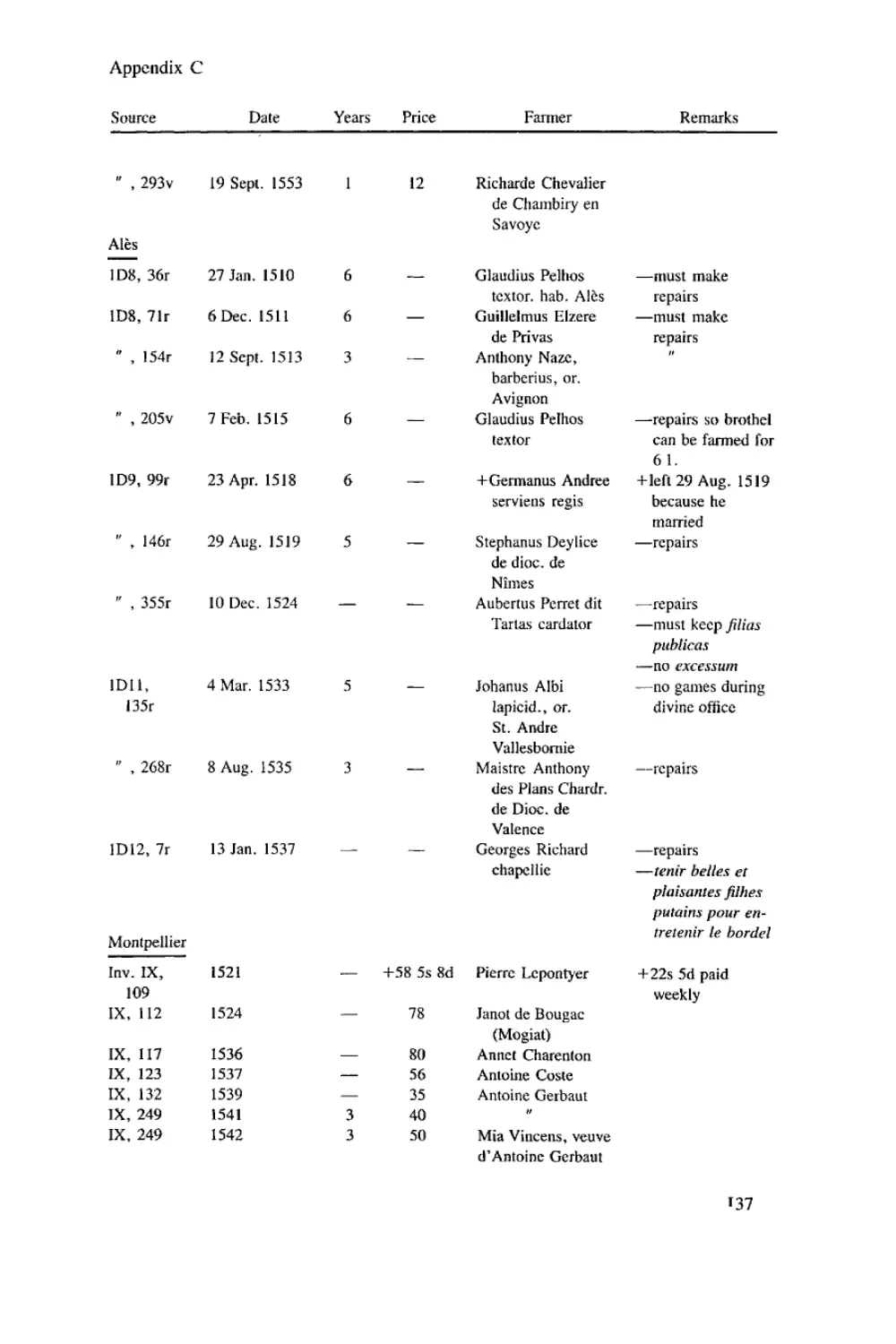
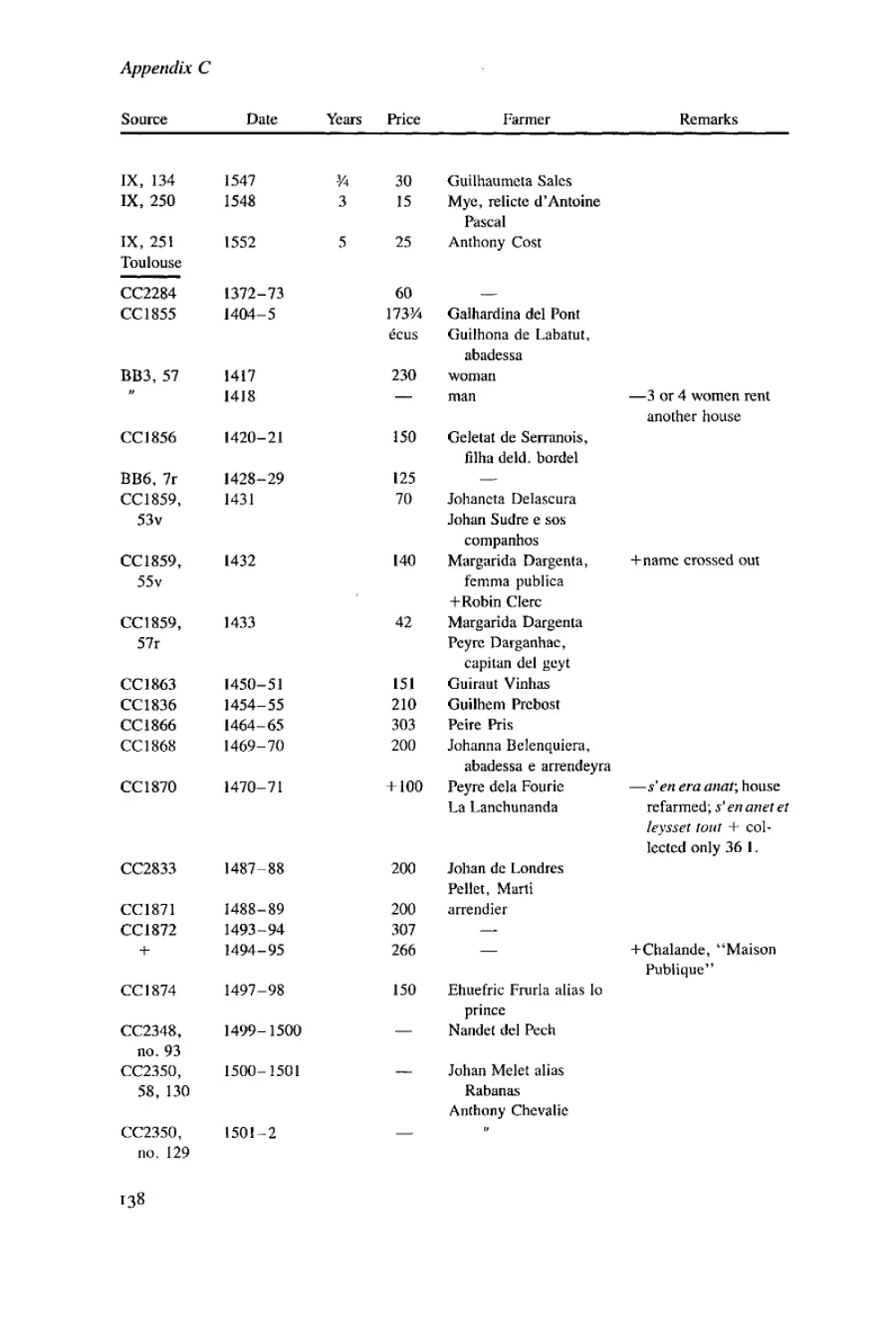
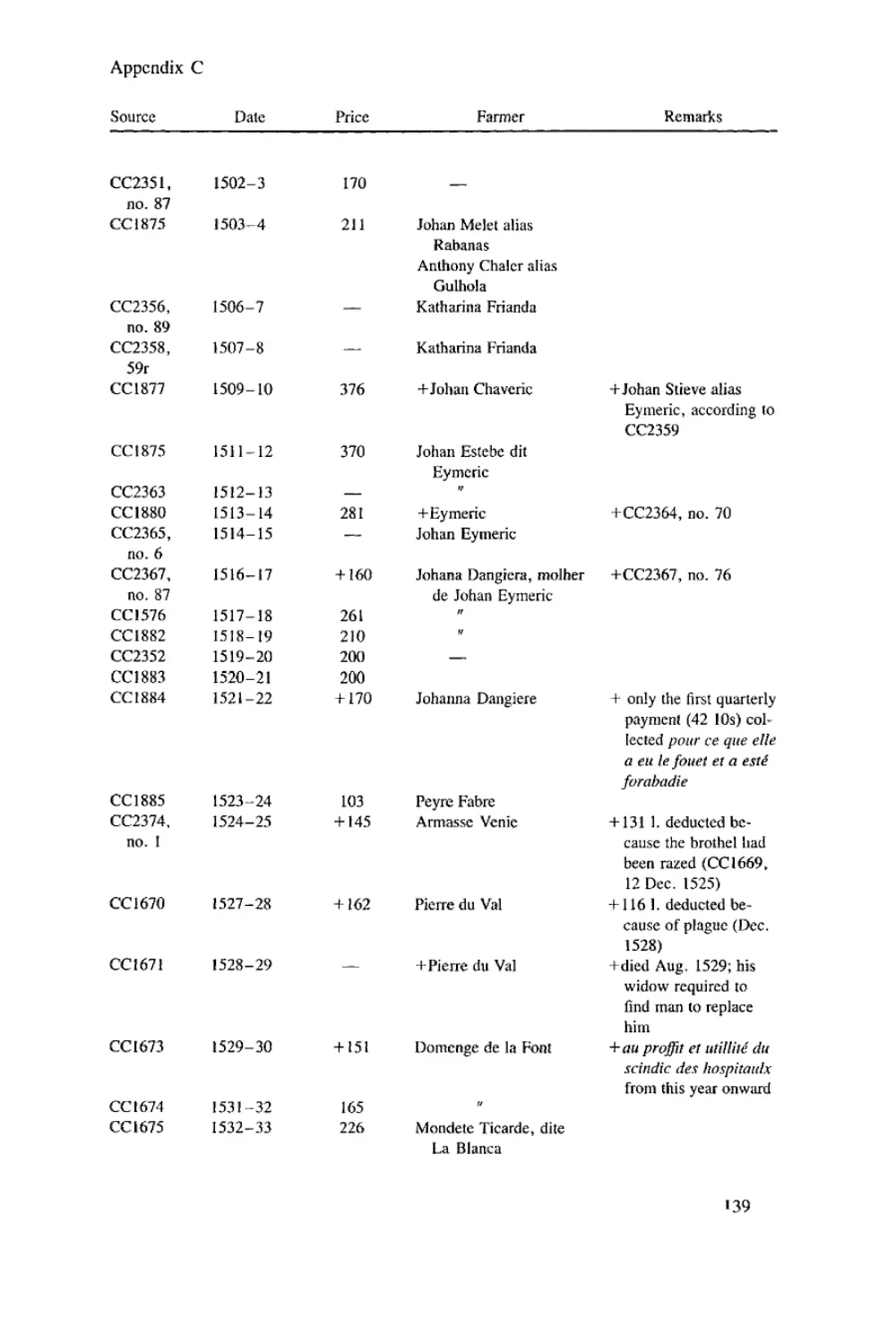
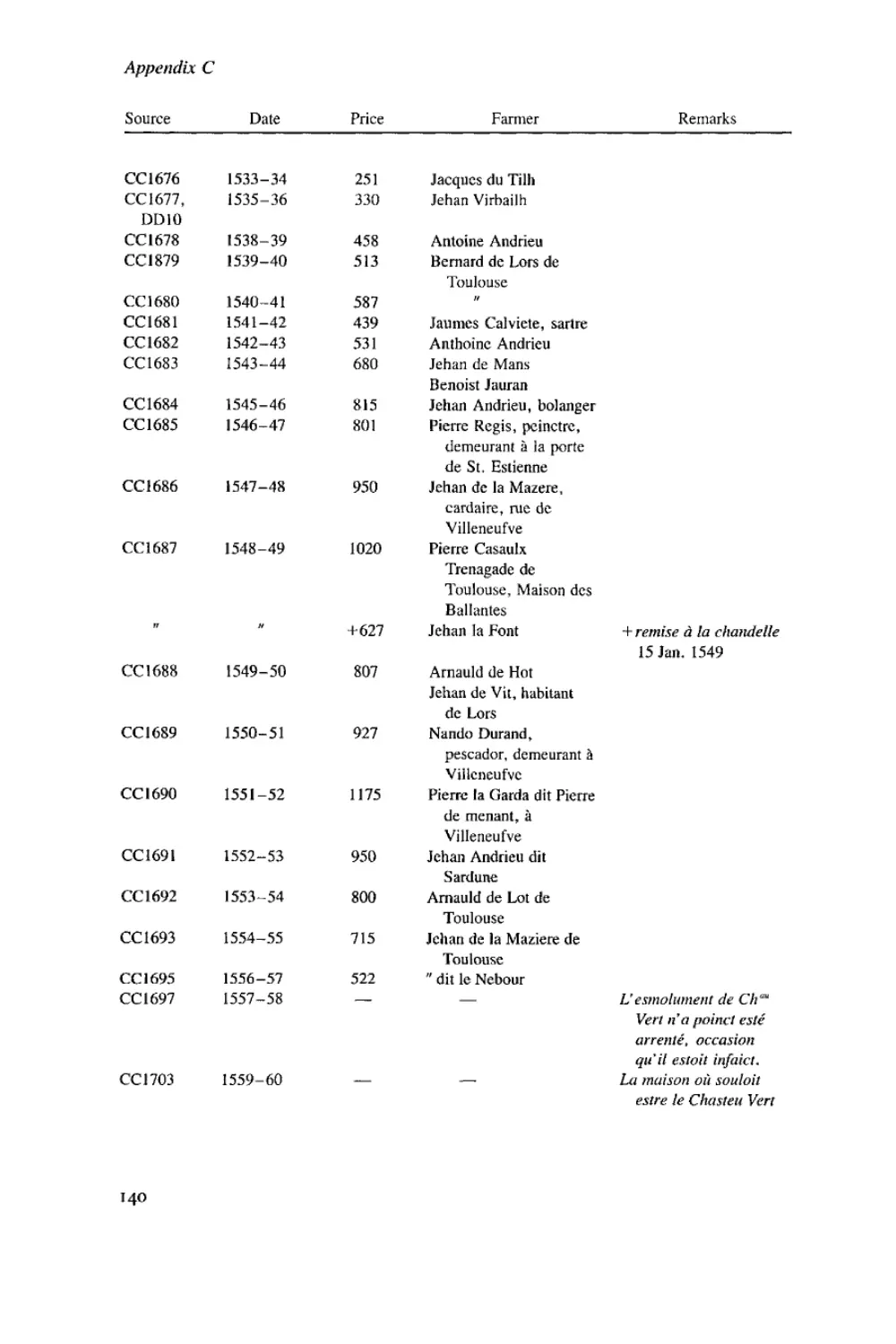
Appendix C: Brothel Farms and Farmers
135
Appendix D: Graphs of Brothel Farm Prices
141
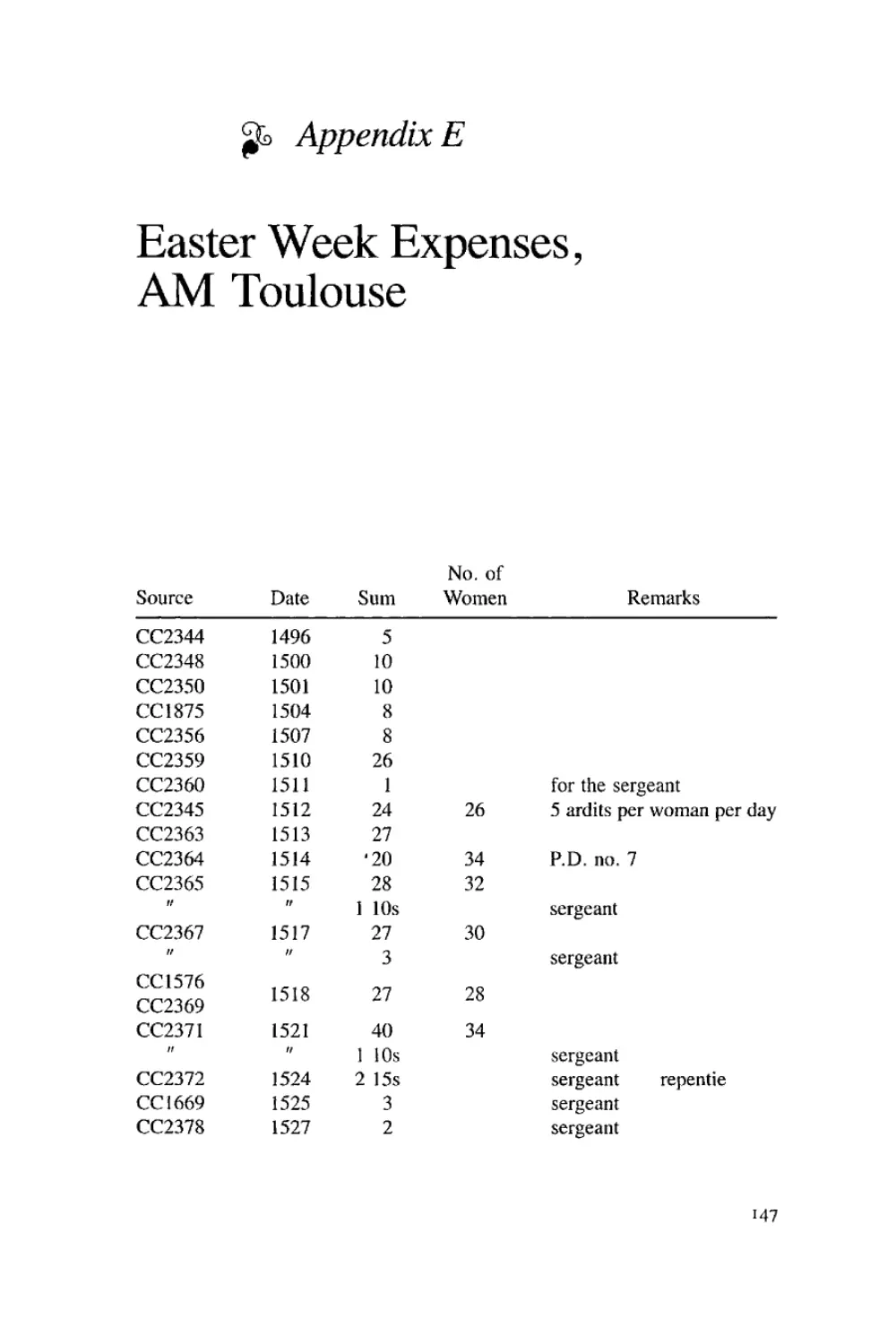
Appendix E: Easter Week Expenses, AM Toulouse
147
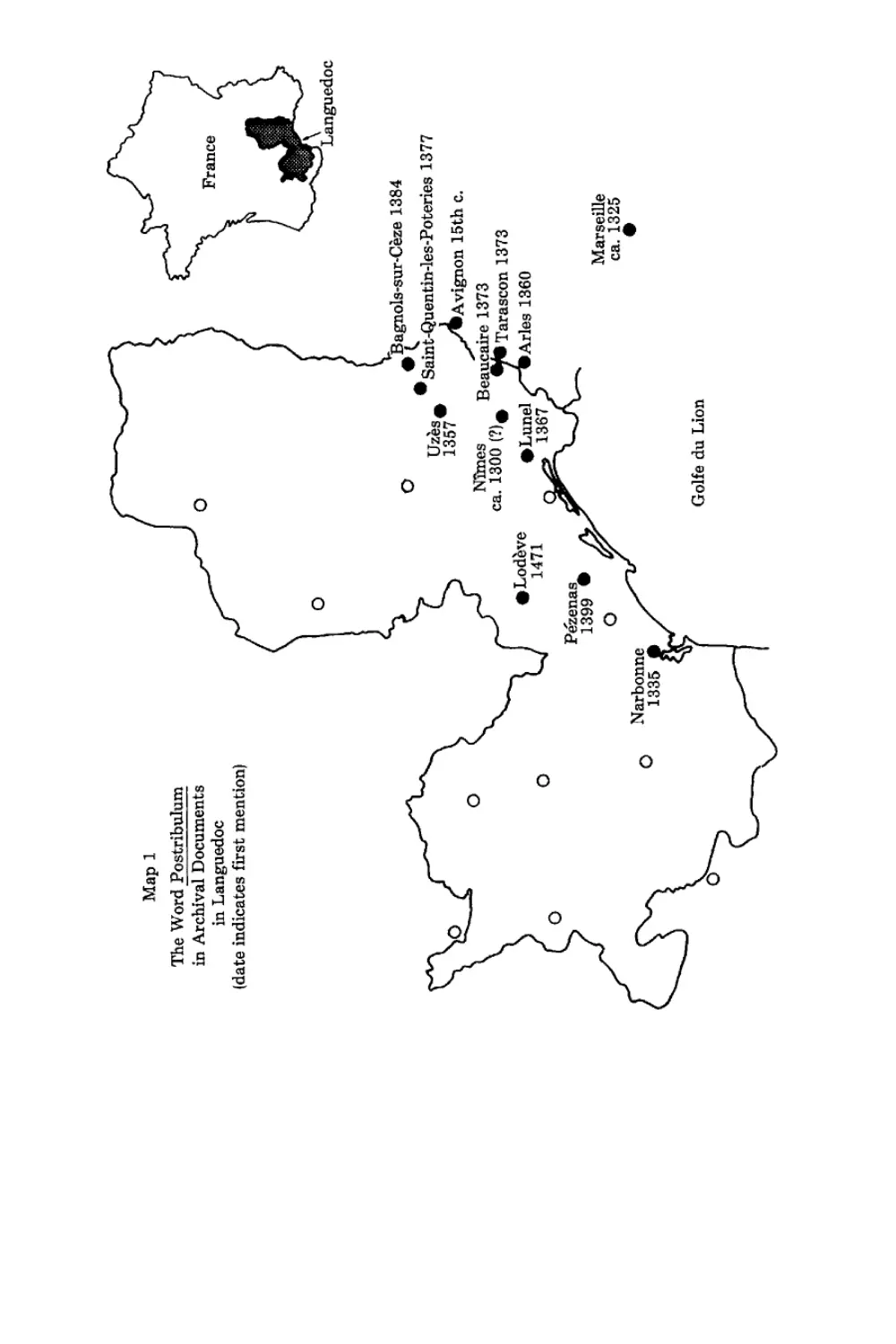
Map I: The Word Postribulum in Archival Documents in Languedoc
149
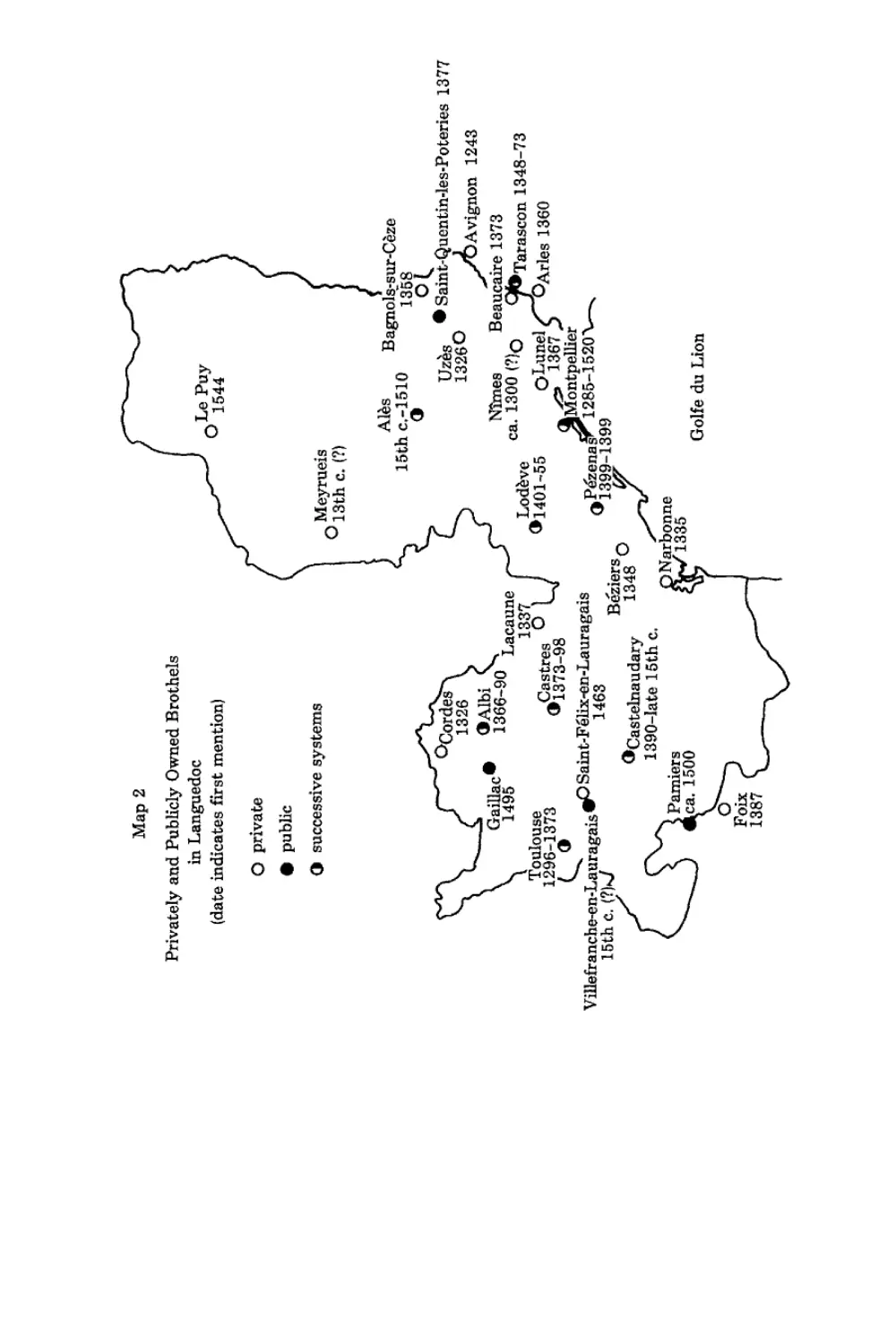
Map 2: Privately and Publicly Owned Brothels in Languedoc
150
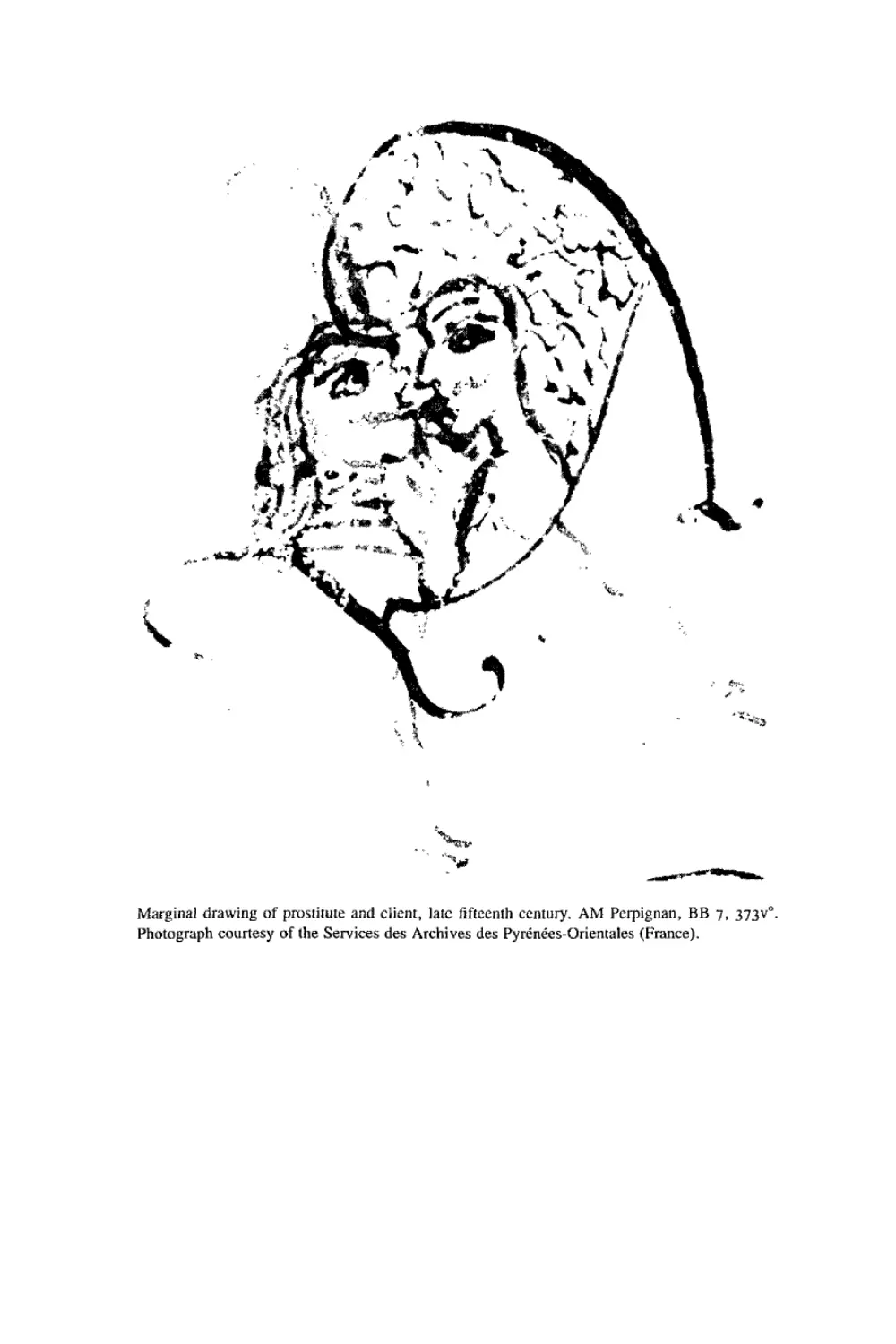
Illustration
151
Notes
153
Essay on Bibliography and Sources
217
Manuscript Sources
223
Bibliography
227
Index
233
vii i
~ Foreword
Prostitution in Medieval Society, a monograph about Languedoc between the
twelfth and sixteenth centuries, is also much more than that: it is a compelling
narrative about the social construction of sexuality.
Leah Lydia Otis uses the implements of scholarship to reveal profound
changes in prostitution, that trade in women's bodies. At first more or less
tolerated, prostitution later became institutionalized. Various authorities
sought to regulate, and to profit from, brothels. In so doing, such powers dis-
tinguished legal houses from illegal competition. Arguments against competi-
tion became models for a more general assault on prostitution that character-
ized a third stage: active repression by an increasingly misogynistic sixteenth
century. During this period the prostitute became the marginal, criminal fig-
ure that haunts the modern imagination.
Dr. Otis reminds us of the limits of her evidence. Preferring silence to
heedless speculation, she judiciously refuses to say more than the leavings of
history permit her to say. Her archives are too mute to give us more than shad-
owy outlines of the prostitutes themselves. "Property," she writes, "in this
case was far better documented than people."
Despite this, Prostitution in Medieval Society weaves the history of women
with the histories of several vast phenomena: sexuality; the growth of urban
economies; the contest among municipal, state, and religious authorities for
the power to define public morality and order; and the struggle within Christi-
anity between Catholicism and an emerging Protestantism. Although this
story of the prostitute can be little more than an outline, it is bold enough, in
its telling here, to picture that of early modern history itself.
Catharine R. Stimpson
ix
~ Preface
This book is an adaptation of a doctoral thesis in medieval history presented at
Columbia University in 1980. It was originally conceived in 1975, first as an
article, then-at the urging of my friend Daniele Neirinck, who knew well
the archival potential involved-as a thesis. The book, like the thesis, has a
dual orientation. It is both a regional study of medieval prostitution and an
attempt to place this regional example in the context of the development of
prostitution in western Europe as a whole. As the regional study is based on
original archival research, the "case history" of Languedocian prostitution
forms the nucleus of the book. The comparative material, gleaned largely
from bibliographical research, assumes a secondary role, complementing,
confirming, or qualifying the regional study. Hence, a word of advice to the
general reader; You may wish to keep an eye on the notes. Although they
often contain scholarly apparatus for the use of specialists, many are devoted
to comparing Languedocian prostitution with its Italian, German, and English
counterparts and are therefore of as much potential interest to the general
reader as is the text itself.
A second caveat may be added for nonmedievalists. Some of the chapters,
especially those dealing with the earlier centuries, proceed by a careful analy-
sis of a series of individual documents, conclusions and generalizations being
kept to a minimum. This method has been adopted not out of love of pedantry
but out of the concern not to deform, by "filling in the blanks" between exist-
ing documents, what little we know of the truth-and our knowledge is lim-
ited indeed. Errors in past studies of the history of prostitution have often
been due to a rather too wild extrapolation from one or two documents. Hy-
potheses are presented in this book, but always cautiously, with the awareness
xi
Preface
that they are subject to confirmation or invalidation in the light of future re-
gional studies. This process is sometimes a flustrating one, for author as well
as reader, but it is the only valid approach in a domain suffering from scant
documentation, where the discovery ofjust one new document can lay to rest
even the most plausible and seductive of theories.
To the medievalist, I should like to specify that all translations of original
texts are mine unless otherwise indicated. From you I must beg indulgence for
any lacunae you may discover. This book was written entirely in France, and
I have not always been able to consult the best critical edition of the non-
Languedocian texts cited and may well be ignorant of some recent relevant
article in an English-language periodical.
Vocabulary is often a stumbling block for writers on prostitution; one can-
not use a varied and colorful vocabulary without employing terms generally
considered to be vulgar or, from the point of view of the prostitute, insulting.
If the words used in this book are measured and neutral, it is not only to avoid
a pejorative connotation, however, but also to reflect the vocabulary used in
medieval legislative and administrative texts; hence, public ~vomell and pub-
lic house are used frequently, not out of prudery but because they are direct
translations of medieval Latin, Occitanian, and French terms. Prostitute is
usually a more appropriate translation of meretrix than whore; lvhore, on the
other hand, is probably the best translation of bagassa, putain, garce, and
other pejorative epithets used in the late Middle Ages. Similarly, when I use
the term "honest" women to refer to nonprostitutes, I do not intend to imply
that prostitutes are dishonest, nor to indicate skepticism, via quotation marks,
about the honesty of nonprostitutes, but simply to render the term used in me-
dieval texts, more evocative and less cumbersome than any contemporary cir-
cumlocutional equivalent.
Indispensable to the realization of this book were the efforts of many
people-professors, colleagues, archivists, librarians, and others-whom I
thank collectively for their contribution.
I am particularly grateful to Professor Andre Gouron, who made it possible
for me to research and write this essay during an extended stay in France as a
lecturer at the Faculte de Droit de Montpellier and its branch campus in
Nimes, and to the municipality of Nimes for its generosity.
Special thanks go to MIle Galceran and Mme Siraudin of the Inter-Library
Loan Service in Montpellier for procuring much of the bibliography and to
Barbara Beckerman Davis, who provided an indispensable lifeline with the
archives of Toulouse. I am also grateful to Ian Dengler, to Professors Jean-
Marie Carbasse, Michel Lacave, and Kathryn Reyerson, and to Alison Klair-
mont Lingo for sharing their knowledge and advice with me; to Gerry Moran
for his wise counsel and moral support; and to my husband, Patrice Cour, who
provided a confidence and enthusiasm that I myself often lacked.
xii
Pref ace
Some contributions are nonetheless important for having been indirect. I
am grateful to Andrej Kaminsky, whose courses sensitized me to the problem
of "marginality"; to Betty Nassif, who taught so many of us that history can
be a passion as well as a discipline; and to Robert Somerville, without whose
example and constant encouragement I should never have undertaken doctoral
studies in history.
Finally, my greatest debts of gratitude are to my mentor, Professor John H.
Mundy, who has had faith in this project since its conception and who gave
earlier drafts of this essay the most exhaustive critical commentaries, and to
Daniele Neirinck, archiviste-paleographe, without whose inspiration, guid-
ance, and friendship this book would never have seen the light of day.
x iii
~ Abbreviations
The reader is asked to consult the bibliography for complete references.
AD
AM
AN
An-ESC
BEC
BM
BSABez
BSFHMed
FCM
FHL
HGL
Inv.
Le Pileur,
Docun1ents
1., S., d.
MANf
MSAMtp
Ord
PL
RHD
Archives departementales
Archives Illunicipales
Archives nationales
Annales: econ0111 ies, societes, civilisations
Bibliotheque de l'Ecole des Chartes
Bibliotheque municipale
Bulletin de la Societe archeologique de Beziers
Bulletin de la Societe jranraise de l' histoire de la
medecine
Fonds des coutumes meridionales
Federation historique du Languedoc 111editerraneen et du
ROllssillon
Devic and Vaissete, Histoire generale de Languedoc
Inventaire
Le Pileur, La prostitution du Xille siecle .
Iivres, sous, deniers (tournois)
Me1110ires de l'Acade111ie de Nfl1zes
Memoires de la Societe archeologique de MOlltpellier
Lauriere, Ordonnances des rays de France
Migne, Patrolagiae, series latina
Revue historique de droit jrall(;ais et etranger
xv
Abbreviations
RMT-SHD
ZSSR
xvi
Recueil de lnemoires et travaux publie par la Societe
d'histoire du droit et des institutions des anciens pays de
droit ecrit (Montpellier)
Zeitschrift der Saviglly-Stiftung fur Rechtsgeschichte
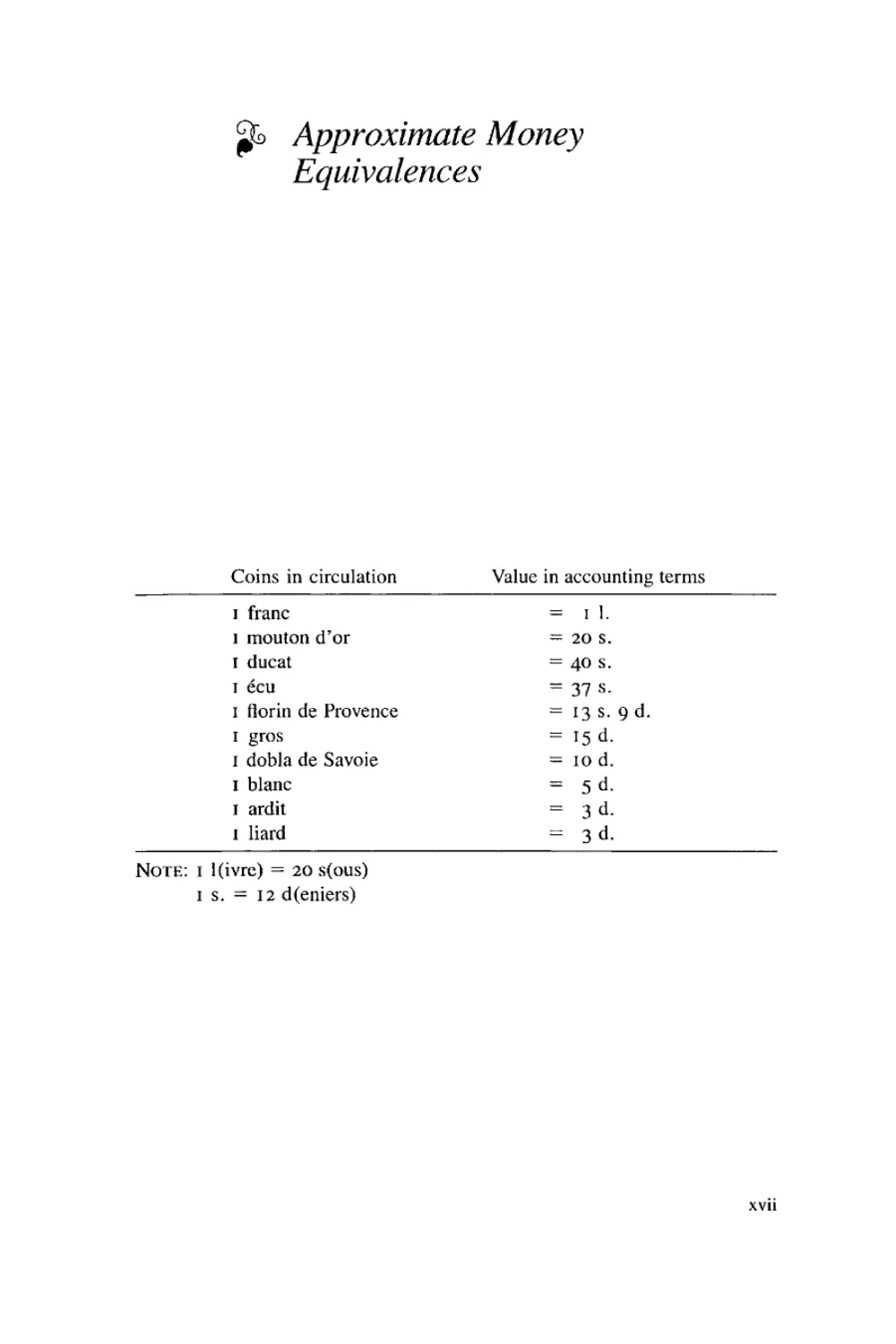
~ Approximate Money
Equivalences
Coins in circulation
I franc
I mouton d'or
I ducat
I ecu
I florin de Provence
I gros
I dobla de Savoie
I blanc
I ardit
I liard
NOTE: I l(ivre) = 20 s(ous)
I s. = 12 d(eniers)
Value in accounting terms
=
Il.
=20s.
=40s.
=37s.
=13s·9d.
=
15 d.
= 10d.
5d.
3d.
3d.
x vii
~ Introduction
A History of Medieval Prostitution: Framework and Assumptions
It is no longer necessary-thankfully-to preface a historical investigation of
prostitution with an apology for the choice of topic. A growing number of
studies of prostitution is making up for the years of neglect, or rather of avoid-
ance, of what had seemed to some historians a scandalous, and to others a
frivolous, topic of research. l From these recent studies is slowly emerging a
sketch of the evolution of prostitution in the Western world.
The period for which this sketch is the haziest is the Middle Ages. On the
one hand, the general histories of prostitution include chapters on the Middle
Ages that are inadequate and notoriously contradictory.2 Recent studies of
medieval prostitution, on the other hand, while contributing enormously to a
better understanding of the phenomenon, have been limited to one town or to
a short period of time or to one aspect of the problem. The aim of this essay is
to attempt to clarify and refine our understanding of medieval prostitution by
means of a regional study-a framework limited enough to allow a careful,
detailed archival study, yet broad enough, geographically and temporally, to
permit generalizations and a sense of the evolution of what was a very dy-
namic phenomenon.
3
The new interest in the history of prostitution owes much to the growing
popularity of three greater topics of investigation: the history of marginal so-
cial groups, the history of women, and the history of sexuality. This study
touches on all three domains but has not adopted any of the three as a pre-
dominant orientation. Its goal is to present a global description and analysis
of all aspects of medieval prostitution: the attitude of government and society
Int rod uction
toward prostitution and prostitutes, the material structures and human dynam-
ics of the phenomenon, and its function in, and relation to, Languedocian so-
ciety. The sources available have made it perforce institutional in orientation;4
if it must be seen as part of a larger history, then it is a chapter in the history of
urban institutions.
It is not possible in undertaking a study of the history of prostitution to rely
to any great measure on the social sciences for a set of assumptions or con-
structs. There is, in fact, no single model for the analysis of prostitution, as it
is a phenomenon of psychological, social, commercial, and moral dimen-
sions. Given its commercial importance, it could be studied from the eco-
nomic point of view, but in fact it has attracted little attention from economists
or economic historians, as it is a "nonproductive" activity and is often illegal
or semilegal. The sociological literature devoted to prostitution, on the other
hand, is considerable. Defining the prostitute as a type of deviant, sociologists
have tended to concentrate their studies on the sociological and psychological
factors that determine recruitment. The usefulness of this type of model for
the medievalist is limited: first, because it analyzes information (vocational
motivation, socioeconomic backgrounds, psychological profiles) that is gen-
erally not available for the medieval period; and, second, because it is based
on the assumption that prostitutes are "marginal" people, which, while valid
enough for the early modem and modern periods, does not apply well to the
Middle Ages, when prostitution was a recognized, if not particularly re-
spected, profession. s Nor have anthropologists provided an analytic model,
since, dealing principally with preliterate and pre-exchange societies, they
have little to say on the subject. 6 The rudimentary tools for an analysis of
prostitution, a multidimensional cultural problem, have been forged essen-
tially by those interdisciplinary social scientists with an interest in the cultural
history of sexuality, whether they be sociologists, historians, or philosophers. 7
Often more descriptive than analytic, this study rests on few theoretical
assumptions. Fundamental to it is a definition of the prostitute, that of the
Roman jurist Ulpian, as a person engaging in sexual activity with a large
number of customers for money or other material remuneration.
8
Accepting
this definition of the prostitute, I define prostitution, for the purposes of this
study, as a phenomenon in which a socially identifiable group ojlvon1en earn
their living principally or exclusively jron1 the con1merce of their bodies. 9
Thus strictly defined, prostitution appears as an essentially urban phenome-
non: only in towns is the demand for sexual services large enough to justify
the existence of a professional category to satisfy it. 10 The amplitude of the
demand comes from the nature of the social groups there (communities of
traveling merchants, large groups of unmarried young men) as well as from
the scale of the population, II and payment is facilitated by cash flow, charac-
teristic of urban exchange economies. 12 These conditions are, of course, not
2
Introduction
sufficient unless there is a greater tolerance for male than for female sexual
activity, but this condition would seem to be characteristic of all cultures in
which cities have appeared. 13 Only in an urban environment do we find the
social and professional phenornenon of prostitution, and only when a society
is confronted with such a phenomenon and is aware of the necessity of recon-
ciling it to the common good do we find a consciously expressed attitude, if
not policy, toward it.
Also underlying this essay is the assumption that a study of prostitution
cannot be limited to that of just prostitute, procurer, and brothel. Viewed in
economic terms, these factors are but the "supply side" of the phenomenon,
meaningless without a consideration of demand in the person of the customer
and, more globally, of society and its mores. Changes in attitude toward pros-
titution reflect changes-qualitative or quantitative-in supply and demand,
and these in tum are determined by economic, social, and cultural factors.
Changes in social structure, changes in cultural values-these are the factors
that determine and transform the shape of prostitution in a given society. The
growth and transformation of prostitution in the modem period, for instance,
cannot be comprehended without an awareness of the rapid industrialization
and urbanization of the nineteenth century; the demographic boom; the va-
garies of female employment, unemployment, and exploitation; the emphasis
on romantic love in middle-class marriages; the growing tolerance of male
premarital sexual activity in the twentieth century; and so on. So medie-
val prostitution was shaped by demographic, economic, social, and cultural
forces. In order to understand the prostitution of medieval Languedoc, we
must consider the institutional and cultural context in which it developed.
Languedocian Urban Life in the High and Late Middle Ages
Languedoc (Langue d'DC) originally meant the language of the southern half
of what we now call France, a tongue bearing more similarity to other Medi-
terranean languages than to that spoken in the north of France (Langue
d' oeil). But the term Languedoc soon came to stand for the land itself~all
that lies south of an imaginary line undulating from Bordeaux to the Italian
border. Nowadays the French refer quite simply to the Midi (South) or some-
times to Occitania, although the latter grates on almost all but the medie-
valist's ear, because of its popular association with regionalist and autonomist
movements. Occitania is so convenient a term for the land, however, and Oc-
citanian so unambiguous a name for the language (as opposed to the mislead-
ing Provenral, which makes one think of that one region rather than the
whole of the Midi) that these words will be used consistently throughout this
book. 14
Languedoc in the title of this book is a large region in the center of southern
3
Introd uction
Occitania. Stretching from Toulouse in the west, along the Mediterranean
coast to the Rhone River, and up the right bank to Le Puy, Languedoc, its
boundaries fixed in the fourteenth century, was the largest and one ofthe most
varied of the old French provinces, comprising the fertile, rolling Lauragais
plains, the sun-baked Mediterranean coast, and the often rugged and infertile
southern and eastern slopes of the Massif Central. 15
Far from constituting a political unit in the High Middle Ages, Languedoc
was a mosaic of seigneuries-some ecclesiastical, especially in the moun-
tains, but most lay seigneuries-the largest of which was the county of Tou-
louse, covering most of western Languedoc. 16 By the early thirteenth century,
most of the major urban centers in the region had succeeded in winning a cer-
tain degree of autonomy from their lords (such a politically and administra-
tively active municipality was called a consulat, and its executive officers
consuls), but the Languedocian towns were never to achieve that sovereignty
characteristic of the Italian city-republics. 17 From the close of the Albigensian
\vars to the middle of the fourteenth century, the Capetian monarchy assimi-
lated the lands of Languedoc into the kingdom of France, some by direct con-
quest, others by insinuation into the system of collegial lordship typical of
medieval Occitania.
18
Although the towns retained a large degree of adminis-
trative autonomy, they recognized, as did the rest ofthe population, the sover-
eignty of the French crown and found themselves increasingly monitored in
the late Middle Ages by the expanding royal administration.
Languedoc had no great international capital of the dimensions of Paris or
Florence, but it boasted two large towns-Toulouse, with a population of
about 35,000 in the early fourteenth century, and Montpellier, with somewhat
fewer inhabitants-which played important roles in international commerce,
and a dense network (at least in the lowlands) of medium-sized and small
towns which were centers of some industry and considerable commercial ac-
tivity.19 These Languedocian towns experienced a cycle of economic and
demographic development similar to that of most western European towns in
the Middle Ages: the uninterrupted, often spectacular growth of commerce,
industry, and urban population in the eleventh, twelfth, and thirteenth cen-
turies; a "flattening of the curve" in the early fourteenth century, then the
catastrophic demographic and economic decline of the second half of the
fourteenth century (exacerbated in many parts of Languedoc by the ravages of,
the Hundred Years' War); the slow rise of commerce and population in the
fifteenth century, culminating in the demographic and commercial boom of
the early sixteenth century. 20
At the head of this urban society were the great burgenses, mainly impor-
tant merchants and moneylenders, and the petty nobles, who, in Languedoc
as in Italy, often resided in the town. Smaller merchants, craftsmen, and nu-
merous agricultural workers accounted for most of the population of the
towns, which also included important enclaves of secular and regular clergy.
4
Introduction
The relatively harmonious coexistence of these classes was interrupted peri-
odically by disputes and occasionally by uprisings. In the second half of the
fourteenth century, violent insurrection plagued Languedoc, as it did other
European regions in the same period.21
The cultural values of medieval society, in Languedoc as elsewhere, were
dictated to a great extent by the Church, which by the thirteenth century had
developed a particularly coherent system of sexual morality based on the re-
striction of all sexual activity within the bonds of marriage and the decision
that the only acceptable form of Christian marriage was perpetual monogamy.
Yet, despite the Church's effort to impose its moral framework on the lay pop-
ulation by means of preaching and pastoral care as well as the Inquisition
(both of particular importance in heresy-inclined Languedoc), secular cus-
toms and attitudes continued largely to define popular notions of sexual mo-
rality.22 Particularly tenacious was a considerable tolerance of male premarital
and extramarital sexual activity. Condoned in Germanic custom, this double
standard was reinforced in Languedoc by the spread of Roman law in the
twelfth and thirteenth centuries via notarial practice and the teaching of law in
small-town schools and in the universities of Montpellier and Toulouse. 23
There are, unfortunately, significant gaps in our knowledge of the cultural
and social context in which this study is set; these lacunae must be filled as
best they can with comparative material from other regions. Our knowledge
of Languedocian family structure, for example, is limited by the nature of the
Languedocian tax registers (the compoix), which contain much less informa-
tion of demographic interest than their Italian counterparts, and by the scar-
city of family narrative comparable to the ricordi (personal diaries) left by
numerous Italian merchants. To have some idea of the proportion of unmar-
ried men and women in the population, the average age at marriage, and other
factors relevant to a study of prostitution, it is to studies of Italian towns-
especially that vast panorama of Tuscan society recently sketched by D. Her-
lihy and C. Klapisch-Zuber-that we must tum.24
The literary lacunae are equally important. Rich as medieval Languedocian
literature was in matters of love, it deigned not to deal with the amorous activi-
ties of the lower classes, unlike the northern French fabliaux and the bawdy
tales of Italy, in which prostitutes play such prominent roles. 25 Here, too,
comparison is our only option, and, rather than rely on the cultural context to
help us appreciate the subject at hand, we are obliged, on the contrary, to seek
in a study of prostitution elements that may be propitious to a better under-
standing of that context.
5
~ PARTONE
Prostitution and Public
Authority: An Evolution
~ Prologue to Part One
Toward a Chronology of
Medieval Prostitution
Methodological Problems
The study of medieval history is riddled with methodological problems: some
documents are undated, others misdated; some are later copies or translations
of a lost original, others are veritable fakes; some are anonymous, others the
products of biased authors. For the medievalist, a healthy skepticism is neces-
sary, and checking and verifying a constant preoccupation.
Skepticism and prudence are nowhere more necessary than in the study of
those aspects of medieval society that have left sparse documentation, such as
prostitution. Uncritical acceptance of all surviving documents can only lead to
what we see in the popular histories of prostitution-an incoherent and some-
times flatly contradictory account of the attitude of public authorities toward
prostitution in the Middle Ages.
Generally speaking, three policies on prostitution are possible in a given
society: repression (defining prostitution as a punishable offense), tolerance,
or institutionalization.' There are medieval documents testifying-or seeming
to testify-to all three policies. To find some order in this chaos, one must
analyze each text carefully, checking its authenticity and taking into consid-
eration the circumstances of its production and its historical context. Care
must also be taken to distinguish between the attitudes of different public au-
thorities (seigneurial, royal, municipal, ecclesiastical) in different countries
and towns and in different periods of time. Making this chronological distinc-
tion is especially important; many of the seeming contradictions can be ex-
plained by the evolution, from the twelfth to the sixteenth century, of very
different attitudes toward prostitution. An attempt to label the Middle Ages a
9
Prologue to Part One
globally "repressive" period or a period of "institutionalization" often re-
flects inadequate attention to the importance of this chronological evolution.
The opinion that medieval society favored the repression of prostitution,
found principally'but not exclusively in the works of nonhistorians, is a funda-
mentally anachronistic view. Some justification for this interpretation would
seem to be found in the Church's hostility toward illicit sex, in a capitulary
attributed to Charlemagne, and in an ordinance of Saint Louis,2 but this view
is based principally on a methodological error-the tendency to "read back"
to the Middle Ages punishments for prostitution current in the late sixteenth
and seventeenth centuries. A classic example is the case of "dunking," a form
of punishment in which the convicted person is placed in a cage and lowered
several times into a river or pond. Used in the southwest of France in late
medieval times principally to punish blasphemers,
3
dunking may indeed have
been a punishment for prostitutes in this region in the late sixteenth and seven-
teenth centuries, but there are no grounds for concluding, as some writers
have, from later evidence and from the antiquity of the punishment, that it had
been used against prostitutes in the Middle Ages and, hence, that prostitution
was then considered a punishable offense.
4
Reading back to the Middle Ages
the punishment of prostitutes and the general hostility toward prostitution
characteristic of the Reformation and Counter-Reformation can only lead to a
distorted view of medieval attitudes toward prostitution.
The majority of historians, however, h~ve generally agreed that prostitution
was tolerated in the Middle Ages. Some have gone so far, moreover, as to
imply that institutionalized prostitution, which was indeed the rule in fifteenth-
century Languedoc, had been an integral part of medieval society from the
High Middle Ages onward.
5
Such a view is also anachronistic. It is based to
some extent on reading back to an earlier period attitudes and institutions cur-
rent in the fifteenth century, much as advocates of the repressive theory read
back punishments of early modem times to the Middle Ages. A good example
is the case of the well-known medieval fair of Beaucaire, celebrated annually
on the feast day of Saint Mary Magdalene (22 July). It was customary at this
fair for the municipality to sponsor a series of games and competitive events,
including a race for prostitutes.
6
An officially sponsored race for prostitutes,
while a vivid illustration of the integration of public women into the customs
of Languedocian society in the fifteenth century, cannot, however, be consid-
ered, as has been assumed by several authors, to represent the place of the
prostitute in the society of the High Middle Ages: first, because the oldest text
attesting to such a custom is from the 1490s; second, and conclusively, be-
cause the fair of Beaucaire, believed in the past to have existed since the
twelfth century, has in recent years been proved to have been itself a creation
of the 1460s.
7
Another example of reading back institutions of the fifteenth century to the
High Middle Ages is seen in the history of a certain charter from Toulouse
10
Toward a Chr onol ogy of Medieval Prostitution
dated 12~I. Paraphrased, beginning in the seventeenth century, to give the
impression that it provided for the creation of an authorized red-light district
in that town, this charter is in fact merely an order for the expulsion of prosti-
tutes from the center of town-hardly a proof of institutionalization at that
period.
8
Some medieval documents actually encourage the historian to read back. In
a safeguard for the municipal brothel of Toulouse dated 1425, for example, it
is stated that the consuls had owned such a house "for a long time before." In
a somewhat later royal document, it is declared that maintaining such a house
was"a custom of great antiquity" in Languedoc. 9 Yet we know for a fact from
other sources that the municipally owned brothel was a creation of the 1360s
and 1370s, not an ancient custom whose origins were lost in the mists of time.
These fifteenth-century documents were not intended to give an accurate pic-
ture of the situation in the thirteenth or even the mid-fourteenth century, but
rather to enhance the legitimacy of a contemporary institution, with a solemn
evocation of its supposed antiquity. 10
Even when dealing with strictly contemporary documents, one often faces
a problem in interpreting the vocabulary used. The words cannot be taken out
of context and given a meaning alien to the intention of the author. This is a
particular problem when dealing with Latin texts in which the author is often
struggling for Latin equivalents of vernacular expressions. Thus, the word
meretrix, which in Roman times signified unambiguously a public prostitute,
may be used in early-medieval texts to evoke generally a "loose" woman}1
Similarly, when William of Malmsbury relates in his Gesta Reguln Anglorum
that William IX, duke of Aquitaine (fl. 1100 -1127), established a prosti-
bu/um, he is not, as some authors have inferred, announcing the chartering of
a public brothel but rather attempting to convey in Latin the idea of a sort of
harem kept by the duke, fuel to stoke the fire of his diatribe against William's
lubricious nature. 12
Yet another kind of methodological problem is presented by the charter
granted to the town of Villefranche-de-Lauragais by Philip III in 1280.
13
The
last article of this document, granting the townspeople authority to establish
an official house of prostitution, has been cited as evidence of the institu-
tionalization of prostitution in the thirteenth century. 14 Unimpeachable as this
evidence would seem at first to be, it must be called into question in light of
the fact that the extant document is not the original thirteenth-century charter
but a sixteenth-century copy, which includes later revisions and additions
(e.g., references to towns founded in the fourteenth century). An analysis of
the language and content of the article on the public brothel proves that it is,
in fact, an interpolation from the late fourteenth or fifteenth century. 15
A last example shows to what extent the path to' a better understanding of
medieval prostitution may be strewn with red herrings. The eminent eigh-
teenth-century Doctor J. Astruc, in his De 11lorbis venereis, published a docu-
II
Prologue to Part One
ment that he believed to come from the archives of Avignon. Bearing the date
1347, "The Statutes of the Queen Jeanne for a Public House in Avignon," a
list of regulations for the running of a brothel, has been accepted as authentic
by many authors of general histories of prostitution. 16 Yet two successive stud-
ies by P. Pansier have proved beyond any doubt that the document is a fake,
concocted by some mischievous residents of Avignon as a hoax on AstruC.
17
Most of the articles are loosely based on authentic documents from the fif-
teenth century, but the language (the text is in Occitanian) and handwriting
are, as Pansier shows, purely eighteenth-century. The patronage of a brothel
by a queen, moreover, is inappropriate for the nlid- fourteenth century, as is
the provision for a weekly sanitary inspection of the women. 18
Once these and other methodological problems are solved, it becomes pos-
sible to determine that the period from the twelfth to the sixteenth century
witnessed a considerable evolution in public policies on prostitution. A primi-
tive attitude of tolerance had evolved into a policy of institutionalization in the
late Middle Ages, only to be replaced in the sixteenth century by an active
repression ofprostitution. Before examining this evolution in detail, however,
let us consider briefly how prostitution was regarded in the period preceding
the twelfth century.
Prostitution before the Twelfth Century: The Roman and Christian
Heritage and the Early Middle Ages
Prostitution, like concubinage, was a fully accepted part of life in the Roman
Empire, viewed as a practical means ofdissuading young men from intriguing
with married women. 19 Houses of prostitution were tolerated, although the
owner of such a house was considered infamous; that is, he was deprived of
his civic rights because of the nature of his business. Prostitutes were sup-
posed to register with the authorities; a state tax on these registered prostitutes
was introduced in the first century A.D. A woman who had once registered as
a prostitute retained that stigma for the rest of her life, even if she ceased all
professional activity.
Although the Church fathers fulminated against the commerce of the body
with the same ferocity as against other sins of the flesh rampant in the Roman
world, prostitution, being a social phenomenon rather than a personal sin
(such as fornication), did not, strictly speaking, lie within the spiritual juris-
diction of the Church. Despite its condemnation of all premarital and extra-
marital sexual activity, the Church recognized prostitution to be an inevitable
feature of worldly society, which it had no hope or ambition to reform. Saint
Augustine even warned that the abolition of prostitution, were it possible,
would have disastrous consequences for society; the practice, he believed,
was a necessary evil in an inevitably imperfect world.
20
Canonical wrath was
12
Toward a Chronology of Medieval Prostitution
focused, rather, on those who profited from this commerce, for, while pros-
titution was regarded as a social phenomenon distinct from the sin of fornica-
tion, procuring was considered by the Church to be synonymous with the sin-
ful act of encouraging debauch (since the latter is usually associated with a
pecuniary motive, whereas fornication can be committed out of passion as
well as out of desire for money). Procuring was therefore considered to be a
matter of spiritual jurisdiction, and strong measures were taken against it at
the Council of Elvira (c. 300), whose canons were included in most of the
major canon-law collections of the Middle Ages.
21
The Church firmly rejected, of course, the Roman notion of a permanent
stigma attached to women who had once been prostitutes. Because all people
were considered sinners who must repent to be saved, prostitutes found them-
selves in no especially stigmatized category but were accepted, like all other
sinners, provided they abandoned their former life. Indeed, several of the fe-
male saints of the early Church were former prostitutes.
22
Thus, the Church's
position on prostitution, crystallized by the fourth century, consisted of these
three elements: acceptance of prostitution as an inevitable social fact, con-
demnation of those profiting from this commerce, and encouragement for the
prostitute to repent.
The teachings of the Church were reflected in the legislation of the Chris-
tian emperors, which directed its sanctions against those profiting from pros-
titution. The clause forbidding prostitution of slaves became mandatory in
contracts of sale; fathers and guardians who tried to force their daughters and
wards into prostitution lost all power over them.
23
Justinian eventually out-
lawed procuring and brothel keeping in Constantinople, providing severe
penalties for offenders (Novella 14).
Little has been written on prostitution in the early Middle Ages, and, in-
deed, there is but a scant documentary basis for such a study. The general
histories have mostly labeled the early Middle Ages a "repressive" period,
relying for evidence almost exclusively on a Carolingian capitulary that in-
veighs against meretrices. 24 As neither the Roman nor the Christian tradition
provides a precedent for punishing prostitutes which might account for this
measure, a closer analysis of the document is called for.
Although E. Baluze attributed the capitulary to Charlemagne, A . Boretius,
relying on internal evidence, has proved it to be from the reign of Louis the
Pious, thus placing it in the context of moral reform characteristic of the son
of Charlemagne. The specific object of reform in this capitulary, however, as
we see from its very title (De disciplinQ palatii Aquisgranensis), was the royal
palace, not society at large.
25
The author of the text, far from envisaging a
campaign to rid the villages of their occasional common prostitutes, was
surely aiming this measure at any women of questionable sexual conduct re-
siding within the royal palace. The term Ineretrix is, after all, merely an at-
tempt at a Latin equivalent of an original Frankish expression. 26 In this rural
13
Prologue to Part One
society of little commercial activity, where prostitution had dwindled to a mar-
ginal phenomenon, the word meretrix had ceased to designate the profes-
sional prostitute and had become instead a general teon for any woman of
questionable sexual conduct. 27 It is indeed in this way that the word is used in
its only appearance in Lex Salica-as a simple insult devoid of any specific
meaning.
28
The unspecific nature of the word meretrix in this period is well illustrated
by a passage from De institutio laicali by Jonas of Orleans, bishop of that city
in the first half of the ninth century. In a section on sexual morality, Jonas
warns young men not to have sexual relations "secretly with 'prostitutes'
[meretrices], nor openly with handmaidens [ancillae]." 29 This text was ad-
dressed to the potentes (powerful people) of society, for whom extramarital
relations consisted largely in concubinage with social inferiors. 30 Concubi-
nage of the potentes, although called into question by contemporary ecclesi-
astics, was a generally accepted secular institution and therefore did not need
to be hidden.
3} Amorous adventures with women of a higher social status, on
the other hand, had to be carried on with more discretion, as they compro-
mised the woman's position in society. There was no place in this system for
the professional prostitute; the ancilla of the text is a concubine, and the
meretrix simply an "immoral" WOIDan, not a professional prostitute.
The specific meaning ofthe word meretrix, pertinent to the urban culture of
the Roman Empire, had little relevance in this rural, clan-oriented society.
Prostitution, insofar as it existed in Carolingian times, was surely an occa-
sional and marginal aspect of village life. The word Ineretrix did not signify a
professional prostitute, but rather a woman whose sexual conduct betrayed
and brought shame on her husband or family. The capitulary of Louis the
Pious calling for the punishment of such women has nothing to do with pros-
titution, strictly speaking.
A "policy" on prostitution became even less of a comprehensible notion in
the ensuing feudal period, when the idea of the state and of public order faded
from consciousness; legislation in the interest of the commonweal was incon-
ceivable once public power had been reduced to a private possession. The so-
cial phenomenon of prostitution, impossible outside the context of flourishing
commerce, became once again an object of reflexion and regulation only
when a new urban society began to evolve out of the rural, feudal legacy of
the Frankish world.
14
~ Chapter One
The Twelfth and Thirteenth
Centuries: Prostitution Accepted
What historians refer to as the "renaissance of the twelfth century" -that
burgeoning of European society and culture in the High Middle Ages, charac-
terized by a great demographic surge, the expansion and technological im-
provement of agriculture, the growth of industry and commerce, the religious
and intellectual ferment associated with a renewed papacy, and the spread of
schools and universities-was felt in Languedoc, as elsewhere in western Eu-
rope, and was manifested most visibly by the growth and multiplication of
that region's urban centers. Whether a traditional center of the ancient Roman
world, such as Toulouse, Narbonne, and Nimes, or a creation of the feudal
period, such as Castres, Ales, and, most spectacularly, Montpellier, the towns
of Languedoc experienced considerable demographic, commercial, and po-
litical growth in the High Middle Ages.
Although one might expect such urban growth to have been propitious to
the development of prostitution, the archival documents of these towns, rare
and almost all political in nature at the turn of the eleventh to the twelfth cen-
tury, are mute on this subject. To touch at the roots of the development of
prostitution in these first decades of urban growth, one is obliged to rely on
extra-archival sources.
In his SUl1znza Codicis, Placentinus included among those people inapt to
testify "[a woman] who openly does commerce with her body" ("qui palaln
corpore quaestumfecerit," 4: 20). A native of Italy and a teacher of Roman
law in Montpellier, Placentinus was not presenting an original formula in his
Summa but rather paraphrasing the definition of the prostitute given by the
third-century Roman jurist Ulpian in the Digest.
1
Roman law, the rediscovery
and renewal of which was the keystone of the intellectual developments of
15
Chapter One
the "twelfth-century renaissance," provided its students with the vocabulary
and concepts necessary to discuss and comprehend the social phenomenon
of prostitution. The twelfth-century civilians' interest in this vocabulary and
these concepts seems to indicate their relevance to an actual growth of pros-
titution in the towns of this period.
2
Like the Roman jurists, the medieval civilians accepted without question
the fact of prostitution. Placentinus and the author of Lo Codi, moreover, kept
the Roman argument for the justification of the salary of the prostitute.
3
The
twelfth-century jurists also accepted the Roman notion of the stigma attached
to the prostitute. All three authors refused the validity of testimony by a pros-
titute.
4
The author of the Exceptiones refused, in addition, the validity of mar-
riage between "noble and honest men and public prostitutes [/neretrices pu-
blicas] and their daughters. " 5
The last passage shows that the twelfth-century civilians were not merely
copying out by rote the provisions of the Roman jurists. Not only is the con-
tent original,6 but the term used-111eretrix publica-is not a Roman one.
This term would have been redundant in Roman times, a lneretrix being by
definition a public person who earned money (111erere) from her activities, not
a privately "immoral" woman. The word 111eretrix continued to be used in the
West after the decline of Roman cities, but it had lost, as we have seen in the
Prologue, its precise and specific meaning and had come to be used as a gen-
eral insult implying illicit sexual conduct. The addition of the adjective pu-
blica was therefore necessary, in a period of rising prostitution, to distinguish
the professional public woman from the private amateur.
The renaissance of the study of Roman law was closely associated with the
commercial and urban expansion of the twelfth century. The schools in which
Roman law was taught were located in the towns, and the professors of Ro-
man law often acted as legal advisers to the town councilor to local mer-
chants, since the material of Roman law brought much that was relevant to the
government, business, and family relations of the day. It is therefore not un-
reasonable to suppose that the use of the new term Ineretrix publica by the
twelfth-century civilians and their interest in defining the position of the pros-
titute in society testify to the "renaissance" of prostitution in this period and
the concern of urban society with the problems it posed. Such a supposition is
supported by the fact that the same vocabulary and a similar attitude toward
the prostitute are found in the earliest relevant archival documents.
One of the most important attributes of certain Languedocian town consul-
ates of the twelfth and thirteenth centuries was the power to determine the
laws and legislation of the municipality. These laws, usually referred to as
customs or statutes, and the administrative acts concerning their enforcement
were recorded, with other significant documents, into cartularies (registers)
kept in the newly developed town archives. It is in such archival documents
16
Prostitution Accepted
that one finds the first indications of a municipal policy concerning prostitu-
tion in the western Languedocian towns of Carcassonne and Toulouse.
The losth article of the customs of Carcassonne, dating probably from the
very beginning of the thirteenth century,? reads, "Public prostitutes [lnere-
trices pllblice] are to be put outside the walls of Carcassonne. " 8 An example
of the actual enforcement of a similar municipal law is found in a cartulary of
the city of Toulouse.
9
Dated 31 August 1201, it concerns the complaint of a
certain Bernard Raymond of Toulouse and of the "good men" (probi hOlni-
nes) living in the street of Comminges about prostitutes (Ineretrices pllblice)
living there, causing "great evil and damage" (inagnilln Ina/unl et dalnpnuln) ,
day and night, to all the residents. The good men request the consuls of the
city to rule that no prostitute shall live in that street, basing their demand on
an extant law (constitutio) of the city which states that no prostitute should
live within the city walls. The consuls comply, ruling "that no public pros-
titute shall stay nor live in any way or for any time within the walls of the city
of Toulouse or in its suburbs." 10 In case of infraction, the good men of the
neighborhood are to complain to the vicar. If he does not immediately remove
the prostitutes, the good citizens themselves may eject the women without
fear of punishment. II
This Toulousan charter, along with the laconic custom from Carcassonne,
indicates that professional prostitutes were indeed recognized as a specific so-
cial group in these towns in the early thirteenth century; the term lneretrix
publica, the same as in the Roman law texts (and perhaps inspired by them),
is unambiguous. The rudimentary policy on prostitution presented in the docu-
ments is negative in tenor, consisting simply in the refusal to allow prostitutes
to stay within the city walls, removing them in this way from the areas in
which "honest" citizens resided and most commercial activity was carried
on.
12
One can assume, moreover, that this "negative" policy was already in
effect in the twelfth century. The statute of Carcassonne, being a part of the
customary law of that town, had presumably a relative antiquity. Even more
persuasive is the reference in the Toulousan charter to an already existing law
(constitutio) barring prostitutes from the center of town, the text of which was
presented to the consuls as precedent for a new ruling.
Neither text, it must be emphasized, mentions an official red-light district
where prostitutes should reside, despite the fact that the Toulousan charter of
1201 has been paraphrased in such a distorted manner as to suggest just that. 13
The earliest public policy on prostitution in Languedoc was a negative one,
simply forbidding prostitutes from residing within the city walls, not, as was
later to be the case, assigning them an official residence. 14
The customs and charters of eastern Languedoc from the early thirteenth
century are mute on the subject of prostitution. One must look farther east, to
ArIes and Avignon, two great commercial centers of the lower Rhone River
Chapter One
valley, to find other statutes regulating prostitution in this period. Published
and enforced since the towns were raised to the rank of consulate in the early
twelfth century, these statutes have survived in their last revised form, pub-
lished in the I 240s, shortly before the loss of the extensive municipal liberties
of these towns to Charles of Anjou.
The relevant statute from ArIes, no. 49, reads:
We statute that no public prostitute [111eretrix publica] or procurer dare
stay in Arles in a street of "good men," and if by chance they be found in
such places, that anyone of that area or neighborhood have the power to
expel them from the neighborhood, on his own authority, without punish-
ment or contradiction of the court. 15
Article I I 6 of the statutes of Avignon contains many of the same elements as
the Arlesian text,16 and both are similar to the documents from Carcassonne
and Toulouse, in that they describe an essentially negative policy concerning
the residence of the lneretrix publica. Barring prostitutes from honest neigh-
borhoods came more or less to the same thing as relegating them to places
outside the city walls, although it was a custom that was less precise and per-
haps less categorical than its western Languedocian counterpart.
A clearly different element in these Rhodanian texts, on the other hand, is
the reference to procurers (lena in the Arlesian document and ruffiane seu
destrales in the Avignonese statute). 17 Aries and Avignon, unlike Carcassonne
and Toulouse, explicitly tolerated procuring as well as prostitution and ap-
plied to procurers the same legislation as to prostitutes.
There are important distinctions to be made, moreover, between the Arle-
sian and Avignonese legislation on prostitution. In ArIes, prostitutes found
living in respectable neighborhoods could be expelled by any of the residents
of that neighborhood (a procedure that was licit in Toulouse only after resort
to a responsible public officer proved ineffective). In Avignon, on the other
hand, such procedure was not allowed; punishment of offending prostitutes
there was firmly in the hands of the public authorities. The Avignonese stat-
utes include, moreover, a rudimentary code of conduct for prostitutes: article
I 16 deals with their manner of dressing 18 and prohibits married meretrices
from practicing within the city; article 137 forbids prostitutes to touch food
products on the market;19 and article 77, concerning gaming, prohibits such
activity after curfew in "brothels and prostitutes' houses," as well as in inns,
gaming houses, and taverns. 20 This last statute amounts to an acceptance and
recognition of places of prostitution as well as prostitutes. Its significance can
be appreciated when one notices that in an otherwise identical article concern-
ing gaming in the statutes of Arles,21 no such mention of brothels is made.
The statutes of Avignon represent a first, primitive step toward the develop-
18
Prostitution Accepted
ment of a policy regulating places of prostitution, as well as prostitutes, in
Occitania.
The revision of the statutes of ArIes and Avignon marked the end in Pro-
vence of a period of relative municipal liberty, an emulation of the Italian
city-states. The succession of Charles of Anjou to the county of Provence in
1246 and his consequent crushing of municipal liberties was, in fact, only one
phase in the development of Capetian hegemony in the south of France,
which had begun with Louis VIII's intervention in the Albigensian conflict in
1226. In the treaty of Meaux-Paris of 1229, Raymond VII of Toulouse had
ceded the eastern half of his Languedocian territories to the throne of France.
The western half of his lands passed, on Raymond's death in 1249, to his
daughter, Jeanne, and her husband, Alphonse of Poitiers, the king's brother,
then to the Crown in 1271, when Alphonse and Jeanne died without heirs.
The initiatives of the king of France had, therefore, a relevance for the
south of France during the reign of Louis IX that they had lacked at the begin-
ning of the thirteenth century. Influenced by the developments in law and
in ecclesiastical government, inspired by the model of Charlemagne, Saint
Louis launched a program of administrative and moral reform that marked the
reestablishment of royal legislative initiative.
22
While the primary aim of the
first great monument of Capetian legislation, the ordinance of 1254/3 was to
reform the administration of royal bailiffs, the ordinance also includes mea-
sures intended to insure public morality: prohibitions of gaming, blasphemy,
and usury, and an unambiguous condemnation of prostitution.
Public prostitutes are to be expelled from the fields [de canzpis] as well as
from the towns, and once these warnings or prohibitions made, their
goods are to be seized by the judges of the localities, or taken, by their
authority, by anyone else, unto the tunic and robe. Who knowingly rents
a house to a public prostitute, we wish that that house fall to the lord
[king], by whom it is to be held in feudal commission.
24
It is this text which has been used to support the theory that, in the Middle
Ages, public authorities favored a repressive policy on prostitution. 25 The
document indeed calls for repression of prostitution and punishment of prosti-
tutes, but in doing so, far from characterizing contemporary policies on pros-
titution, it flies in the face of established custom of the south of France, and
perhaps that of the north, as well. The very formula "expelled from the
'fields' as well as from the towns" is an explicit refusal of the custom estab-
lished in Carcassonne and Toulouse of relegating prostitutes to the area out-
side the town walls, and in Avignon and Arles of barring them from neighbor-
hoods of honest citizens. This text should be seen, not as typical of medieval
legislation on prostitution, but as a purposeful reversal of the traditional pol-
19
Chapter One
icy of tolerance. Such reversals of traditional law were imposed by the king of
France, especially Louis IX, in an effort to suppress what they considered to
be bad customs and to replace them with a legislation esteemed to be more
rational and just. 26 Just as Saint Louis prohibited traditional trial by battle
and opposed many other "irrational" aspects of criminal procedure, so he at-
tempted to extirpate the "bad custom" of tolerance of prostitution.
The traditional policy of tolerance of prostitution seems to have been tena-
cious, however. Just two years after the declaration of 1254, a second ordi-
nance of Louis IX admitted tacitly the unenforceability of the earlier text. 27
While it retains some elements of the first document, such as the punishment
of those renting houses to prostitutes, the ordinance of 1256 differs from it on
its most fundamental point: prostitutes were no longer to be expelled "from
the fields as well as the towns," but simply from the center (cuer) of towns,
and were to be "put outside the walls," thus marking a return to established
custom-the tolerance of prostitution in areas far from honest neighborhoods,
outside the center of town.
28
The text adds that prostitutes should be placed
" far from all holy places, such as churches and cemeteries. " This provision,
found in none of the municipal customs of the early thirteenth century, may
have been imposed by the king in the light of his special role as protector and
guardian of churches. 29
In a last text concerning prostitution, Saint Louis returned to the spirit of
the ordinance of 1254. In a letter to Matthew, abbot of Saint Denis, and to
Simon of Neste, written in 1269 on the eve of his second departure on cru-
sade, the king ordered "notorious and manifest brothels ... to be extermi-
nated, in towns as well as outside them." 30 The terms notorious and manifest
come from canon law, where they were used to describe an irregular act or
situation that was so well known to the community that normal criminal pro-
cedure could be waived in their case and a condemnation pronounced forth-
with. 31 Brothels were designated by Louis as targets of an expeditive justice
that could "exterminate" them effectively. The letter does not repeat, how-
ever, the punishment of prostitutes prescribed in the ordinance of 1254. The
shift from an attack on prostitutes to an initiative against brothel keepers may
well have been due to the growing influence of Roman law in the curia
regis. 32
No texts from royal Languedoc inform us of the effort of Louis IX's officers
to enforce his legislation on prostitution, nor do we have any evidence of the
influence of this legislation as a model for municipal policy. The few southern
French documents referring to prostitution in this period come from Poitevin
Toulouse and Angevin Provence. A list of complaints presented in 1256 by
the residents of ArIes to two commissioners sent by Charles of Anjou contains
two articles on prostitution. In the first the residents request that accusations
brought by prostitutes no longer be accepted. 33 In the second they demand the
20
Prostitution Accepted
expulsion from ArIes of a certain Robin of Lis, who had been extorting money
from the city's prostitutes.
34
Although there is no proofthat this complaint was
inspired by Capetian and Angevin legislation, we can observe simply that it
shows a similar hostility toward procuring or profiteering from prostitution
and therefore marks a departure from the acknowledgment of the procurer
present in the statutes of this town.
35
A more explicit link to Capetian legislation on prostitution is seen in the
statutes of Marseille, revised for the last time between 1253 and 1257, when
Charles of Anjou had already installed a bailiff and a judge in that town.
36
The
long section on prostitution in these statutes 37 includes a very complete sump-
tuary law and a detailed list of places where prostitutes were not allowed to
work, followed by two general principles: that prostitutes must not stay among
good men (inter probos homines et honestos), as was the rule in ArIes and
Avignon; and that these women must not stay near churches (prope alias ec-
clesias). A church and a monastery are included, moreover, in the detailed list
of forbidden places. These provisions recall those of the ordinance of 1256, as
does the punishment of people renting houses in forbidden areas to prosti-
tutes' set at a year's rent in both texts.
38
Roman law also influenced the writing
of these statutes, as we know from internal evidence 39 as well as external (the
eminent civilian John Blanc was an apparently influential member of the com-
mittee in charge ofrevising the statutes). But Roman influence cannot account
for the specific punishment of a year's rent imposed on people housing prosti-
tutes, nor does it provide any precedent for banning prostitutes from the
neighborhood of churches. When we learn that John Blanc and other Mar-
seille jurists formed the nucleus of a "French party" favorable to the hegem-
ony being established over Marseille by Charles of Anjou,40 there seems little
doubt that these statutes were directly influenced by Louis IX's "moderate"
ordinance of 1256.
An echo of the ordinance of 1254 is discernible in a document from Tou-
louse dated 1271, which relates the expulsion of prostitutes from a neigh-
borhood where their behavior had scandalized the residents.
41
Although simi-
lar in some respects to the Toulousan charter of 1201, this document deals
with a neighborhood well outside the center of town, and the procedure out-
lined is different. 42 The most significant aspect of this text, besides its redun-
dant explicitness, is its violent tone and its provision for the punishment of
prostitutes who had been plying their trade outside the city walls. The neigh-
bors were authorized to expel the prostitutes from the neighborhood, to strip
them and lead them to the vicar, where they would be punished according to
the judgment of the vicar. 43 The conditions of expulsion here are reminiscent
of the passage in the ordinance of 1254 that states that prostitutes' goods may
be seized "unto the tunic and robe. " 44
The influence of the rigoristic ordinance of 1254 was short-lived, however.
The moderate ordinance of 1256 was more in keeping with the spirit of the
21
Chapter Olle
times, and, despite the loyalty of Alphonse de Poitiers and Louis IX's son
Philip III to the moralism of the strictures of 1254 and 1269,45 it was the spirit
of the more moderate legislation that was eventually to be consecrated by
later generations of royal officers. 46
The tacit acknowledgment by Saint Louis himself in the ordinance of 1256
of the inevitability of prostitution may lead one to believe that, in the north of
France as well as in the south, prostitution was normally tolerated. This im-
pression is corroborated by an earlier document, the statutes of Pamiers, is-
sued by Simon of Montfort on I December 1212 after his victory over the
Albigensians, in an attempt to impose the customary law of the Ile-de-France
on the lands he had conquered. Article 39, which reads, "Public prostitutes
are to be placed outside the walls in all towns," 47 may well be the application
to all of the lands conquered by Simon of the custom of Carcassonne, rather
than a custom of the Ile-de-France.
48
But, even if the text is Carcassonnese in
origin, there is no reason that a northern conqueror should have respected it,
had the provision contradicted his own principles, given the totality of his vic-
tory at this point in the conflict. As Simon's activities had the blessing of the
Church (one of the principal beneficiaries of the statutes of Pamiers), one may
assume that the principle oftolerated prostitution outside the city walls shocked
neither the northern French nor the ecclesiastics in the early thirteenth century.
Although there would seem to have been no equivalent in northern French
customary law of the thirteenth-century Occitanian customs regulating pros-
titution,49 some texts from north of the Loire indicate indirectly that prostitu-
tion was tolerated. The Tres ancien coulul1ze of Normandy, written down
about 1200, sanctions the rape of the prostitute, thus implying an acknowl-
edgment of the activity of prostitutes. 50 Although a register of justice from
Abbeville indicates that several prostitutes were banished from that town at
the end of the thirteenth century, they were accused, not simply of being pros-
titutes, but of engaging in procuring (hou/erie or ribaudie).51
Ecclesiastics, too, seem to have accepted with more or less equanimity the
inevitability of prostitution in urban society. Prostitution was, in fact, a fre-
quent topic of discussion in Parisian ecclesiastic circles at the turn of the
twelfth to the thirteenth century. Particularly interested in the subject was the
circle of the theologian Peter the Chanter, who seems to have been at the ori-
gin of a new concern with the spiritual fate of the prostitutes. One of the
Chanter's students, Fulk of Neuilly, made the conversion of prostitutes to the
married or religious life the main goal of his illustrious preaching career, an
effort continued by clergy and laymen alike throughout the Middle Ages. 52
What distinguished the circle from subsequent as well as former theologians,
as J. Baldwin has observed, was its concern with practical questions of every-
day life. Thus, the interest evinced by its members in prostitution extended
beyond the state of the public woman's soul to such questions as how to define
22
Prostitution Accepted
a prostitute; whether her earnings could be kept, even in case of fraud; whether
prostitutes could offer alms from their earnings; whether they should be
excommunicated.
A variety of answers to these questions were proposed within the Chanter's
own circle. 53 Sympathetic to the prostitute, Thomas of Chobham devoted sev-
eral passages of his Slllnl1Za COllfessOrlll11 to a definition of the prostitute, to a
justification for the Church's tolerance of prostitution, and to the practical
problems concerning these women, defending their right to keep their earn-
ings, to offer alms, and to go to church, though not to commune.
54
Robert of
Coursson, on the other hand, while admitting that prostitutes could keep their
earnings, was of the opinion that the Church should not accept alms from pub-
lic prostitutes and urged bishops not only to excommunicate such women but
to expel them from the town so that they would not scandalize others. 55 Raised
to the dignity of cardinal, legate at a series of councils held throughout France
from 1213 to 1215, Robert published this canon at the Council of Paris of
1213: 56
We prohibit public prostitutes (frequent cohabitation with whom is more
effective than the plague for bringing harm) from being permitted to live
in the city or bourg, but rather [they] should be set apart, as is the custom
with lepers. If, once warned, they do not wish to comply, they shall be
struck \vith the sentence of excommunication.
Robert went further than most of his contemporaries-or followers-in ad-
vocating a policy on prostitution, a matter more of secular jurisdiction than
of ecclesiastical concern. 57 The policy advocated-relegating them to areas
outside the town-was in harmony with the provisions of the statutes of
Panliers.
58
Although there is evidence that prostitutes were prosecuted in certain eccle-
siastic jurisdictions,59 there seems to have been no general ecclesiastic move-
ment to attempt the elimination of prostitution from society. As in so many
other domains, it was Saint Thomas Aquinas who crystallized the Church's
position on prostitution in the late thirteenth century by paraphrasing the Au-
gustinian warning that an elimination of prostitution would result in the pullu-
lation of sexual passions and abuses. 60
Given the acceptance of prostitution by most secular and' ecclesiastical
northern French authorities, Saint Louis's ordinance of 1254, ordering the abo-
lition of prostitution, seems like a lone voice calling in the wilderness, more
reminiscent of Old Testament strictures than of contemporary mores. It is not
his hostility toward prostitution that distinguished him from contempora-
ries-such hostility can be seen in the sermons of preachers, in certain regis-
ters of justice, even, one might argue, in the abrogation of the "civil rights"
of prostitutes in the southern French customs-but rather his active attempt to
23
Chapter One
extirpate the phenomenon from his kingdom. Most contemporaries recog-
nized that prostitution was inevitable, even if they did not go so far as Saint
Thomas in underlining the value of such women in an inevitably imperfect
world.
The moderate ordinance of 1256 was far more in keeping with the spirit of
the day, and Louis's legislation is important, not for its lonely and generally
unheeded call for the extirpation of prostitution from the kingdom of France,
but for its tendency in its more moderate form to treat prostitution, not simply
as a natural and inevitable human phenomenon, but as a social matter to be
regulated by the protectors of the commonweal. The global trend of the thir-
teenth century, represented by the statutes of Avignon and Marseille, as well
as by the ordinance of 1256, was toward the development of a positive policy
on prostitution 61 and increasing "governmental intervention" in a realm that
had previously been left to function on its own. It is this "interventionism"
that laid the foundation of the institutionalized prostitution characteristic of
the late Middle Ages, a key element in the development of which was the
establishment and protection of official red-light districts in the late thirteenth
and early fourteenth centuries.
24
~ Chapter Two
The Fourteenth and Fifteenth
Centuries: Prostitution
Institutionalized
No precedent for establishing authorized areas of prostitution can be found in
the ancient customary law of Languedoc, whose provisions, as we have seen,
were rudimentary and negative in tenor. The creation of official red-light dis-
tricts in the late thirteenth and early fourteenth centuries was a conscious in-
novation on the part of certain municipal authorities in that period and can be
seen as the logical culmination of the gradual transformation, in the public
mind, of prostitution from a private concern or natural phenomenon to a so-
cial matter requiring public intervention and supervision.
The oldest document attesting to the creation of an authorized red-light dis-
trict in Languedoc is found in the archives of the town of Montpellier, I whose
residents were subjects of the king of Majorca.
2
It is perhaps not by chance
that this first example of a vigorous, positive policy on places of prostitu-
tion came from the most important Mediterranean Languedocian town in
which the king of France did not have a firm foothold at the end ofthe reign of
Louis IX.
3
Dated 1285, the document is the decision of the bailiff (bay/us) of the king
of Majorca to assign, on advice of a commission of citizens, a particular street
in the suburbs of Montpellier as the official residence of the city's prostitutes
and may be summarized as follows: For a long while this question had been
debated before the bailiff, the king's lieutenant, and the consuls of the town.
Various places had been assigned to prostitutes in the past (diversa /oea eis
oUm fuerint assignata), but the women had been subsequently ejected from
these areas by the residents, some citizens (burgenses) and members of the
regular clergy (reUgiosi) having obtained letters from the king ordering expul-
25
Chapter TlVO
sian. Finally, after much consultation, the bailiff created a commission con-
sisting of two good men (probi viri) under oath from each of the six adminis-
trative units of the city (seizein) to determine the most suitable place for the
prostitutes. After visiting many places and after much discussion among
themselves and with others, the commission unanimously recommended two
streets. Having heard their recommendations, the bailiff declared that the
women should stay in the second street recommended, the "Hot Street" (Car-
reria Calida), located in the suburb Villanova.
4
They could not be expelled
unless the bailiff or his successors deciped to move them to the first street
recommended. This declaration was made in the presence of the advocate
John of Lunel, representing Guirauda of Beziers and Elys of Le Puy and all
other prostitutes residing or wishing later to reside in Montpellier. The bailiff
promised that the women might there reside without opposition from any per-
son, under the protection of the king and the court.
The great interest of this document is, of course, its significance as a first
indication of a positive policy concerning the residence of prostitutes.
5
Far
from repeating the early-thirteenth-century Occitanian customs barring pros-
titutes from the center of town or from respectable neighborhoods, the Mont-
pellier authorities innovated in creating one official red-light district in which
the public women were obliged (debeant) to live, abandoning all other places
in the city (alUs omnibus loeis dereleetis). Residence in the Hot Street was,
moreover, a privilege; the women had not only the duty but the right to live
there unmolested by their neighbors. The prostitutes could not be expelled
(expelli non debeant sive possint); they were to reside in that area without
objection from anyone (sine eontradietione alcujus persone). As a guarantee
of this right to reside peacefully in Villanova, the women were placed under
the protection of the king and his court (sub proteetione dieti domini regis et
sue curiae).
Red-light districts, it is true, had already been assigned in the past, but
none of those past assignments had had the force and moral authority of the
document of 1285. In the past it was the king who ordered the expulsion of
prostitutes from the streets to which they had been assigned, whereas in the
document of 1285 it was the king himself who guaranteed the right of prosti-
tutes to reside permanently in Villanova with his royal protection. Montpellier
seems to have been, moreover, the avant-garde in the development of this new
policy of authorization; there is no evidence that other Languedocian or even
Italian towns instituted a similar policy in the thirteenth century.6 One cannot
help wondering whether the precocity of authorized prostitution in Mont-
pellier may not be related to that town's privileged link to the Iberian penin-
sula. 7 The cosmopolitan culture of medieval Spain had profoundly influenced
the civilization of Languedoc, and that of Montpellier in particular, in other
domains. 8 Perhaps the institutionalization ofprostitution, like other aspects of
26
Prostitution Institutionali zed
the cultural and social life in medieval Languedoc, can be traced, at least in
part, ultimately to Arabic influence.
9
One could hardly imagine, at any rate, such an initiative having been taken
in a town under Capetian hegemony in this period. Louis IX's son and suc-
cessor, Philip III, showed early in his reign (127°-85) a continuing concern
with the moral reform initiated by his father. A surviving fragment of his ordi-
nance of 1272 includes instructions to the royal bailiffs to prohibit blasphemy,
gaming, and brothels (bordeaux cOlnlnuns).10 Evidence of Philip's intention to
enforce this prohibition actively is found in a passage from the charter he
granted to the town of Cordes (Tam) in 1282, which stipulates that those
found guilty of procuring (lenosciniul1z) should have their houses seized or, if
they were not house owners, should pay a fine of 20 I. II These two texts,
aimed at brothel keepers rather than prostitutes, but bearing no mention of
possible tolerated prostitution outside city walls, reflect Louis IX's last ex-
pressed opinion on the matter-his letter of 1269.12 In the light of Philip's
continuing concern with his father's moral reform, it is clear that the pas-
sage granting the right to establish a brothel in the town of Villefranche-de-
Lauragais, found in the charter granted to the town by this king in 1280, can-
not be attributed to Philip III; it must be a later interpolation. 13
Capetian ardor for moral reform seems to have cooled considerably during
the reign of Louis's grandson, Philip IV (1285 - 13 14). None ofthe ordinances
or charters of Philip the Fair include strictures against prostitution or brothel
keeping. All we kno\v of his policy on prostitution is that his officers in Lan-
guedoc were sometimes put at the disposal of citizens there requesting the
expulsion of prostitutes from town or neighborhood. A seventeenth-century
inventory of the municipal archives of Beaucaire summarizes a document,
since lost, that describes such an expulsion. 14
A small charter. . . of the year 13°4, ordinance of Messrs. the reformers
sent by the King. By which at the request of Father --- of the Fran-
ciscans and the nobles and burghers of Beaucaire, the whores [putains]
who resided and made their home in Beaucaire, in a certain street called
at the time La Laguque, are thrown out and "disinhabited" from the
street. The said ordinance executed on order of the lieutenant of the vicar,
by the subvicar of the said town.
A similar entry is found in a sixteenth-century inventory of the municipal ar-
chives of Ales. There the king had ordered the seneschal of Beaucaire to over-
see the expulsion, probably in response to a request by the citizens of Ales.
IS
There is no evidence, however, of a royal initiative having been taken
to abolish a red-light district established by municipal authorities. The Hot
27
Chapter TlVO
Street of Montpellier was apparently left as it had been created. 16 French royal
policy on prostitution at the tum of thirteenth to the fourteenth century seems
to have been, as in other matters, to allow the municipalities to run their lives
much as they pleased, provided that the towns recognized the authority of the
king of France. 17
Even without the intervention of the king of France, other towns of Lan-
guedoc were still expelling prostitutes in this period. In July 1299 a proclama-
tion issued by the archbishop, viscount, and council of prud'hommes of Nar-
bonne warned prostitutes and procurers to leave that town within ten days,
under pain of corporal punishmenL
I8
The syndics (reetores) of the town of
Bourg-Saint-Andeol (Ardeche) were guaranteed, in privileges confirmed by
the bishop of Vivier, that they might expel prostitutes if the bailiffs of the
bishop were negligent in this matter. 19 But the charter of Bourg-Saint-Andeol,
dated 1321, is the last mention in Languedocian sources of the simple expul-
sion of prostitutes from a town. The tide was turning rapidly in favor of the
recognition of districts reserved for prostitutes.
By the end of the thirteenth century, a house of prostitution was operating
openly in the heart of Toulouse. Its existence is revealed in the commentary
on the customs of Toulouse, completed in 1296, in the context of a discussion
on adultery. 20
Item, it is asked, if a married man enters a house where commonly are
found women for money (as, for example, in the house of Madame Caga-
rafes in Bertrand David Street), believing to have relations with an un-
married woman, when in fact it was a married woman, whether he com-
mits adultery. I respond "No," since the place excuses the same.
This Toulousan brothel, even if it were de faeto rather than de jure (there is no
extant document attesting to an official creation), was clearly so well estab-
lished and accepted that it could be used in this legal argument exonerating a
hypothetical fornicator from the crime of adultery.
A more official document, an undated set of police regulations (probably
from the late thirteenth or early fourteenth century), testifies to the existence
of an authorized red-light district in Nimes.
21
Item, it is mandated by the said court that no woman who gives herself
for money should be so bold as to stay within the city of Nimes nor out-
side, unless in the public postribulum of Nimes ... under pain of losing
her dress and being beaten throughout the town.
Authorized districts of prostitution existed not only in the large towns of the
plain of Languedoc, but also in the smaller hill towns. An early register of
municipal deliberations from the town of Uzes (Gard), although damaged by
28
Prostitution I nstitutionaliz ed
humidity, retains enough legible passages to reveal the existence, in June
1326, of an authorized brothel in that town.
22
.
.
. that all frivolous women [illegible] give themselves for money to
men, from now in the future [illegible] and stay in the house of Peter Ras-
cacii, situated outside the Gate Stephan in the street called Naquintuna.
The document specifies that the women were not to circulate or install them-
selves (ire nee se ponare) in any other place, under pain of confiscation of
their clothing and corporal punishment.
Even the tiny mountain town of Lacaune (Tam) had a red-light district by
this time, as is shown in a document dated January 1337, preserved in a car-
tulary.23 The bailiff and the constable of Lacaune, officers of the countess
Eleanor of Montfort, acting on orders from the seneschal of the countess,
ordered three women accused of being immoral women (avofs felnnas e vida
deshonesta menans) no longer to live in the town "unless among the public
immoral women in the street called the street of France" (sino sofamen e tan
sofamen entre las publicas avofs !elnllas et ell fa carrieyra apefada de
Fransa), under pain of a fine of 60 s. This document is in many ways analo-
gous to the Toulousan charter of 1201: women of questionable morals were to
be expelled from the town. The difference here, of course, is that the women
of Lacaune had the choice between expulsion and compulsory residence in the
local red-light district.
The examples of areas of authorized prostitution begin to multiply at this
time.
24
The residents of Narbonne, who as recently as 1299 joined with the
archbishop and viscount of their city in expelling prostitutes and procurers
from its limits, had changed their point of view by 1335. In a series ofdocu-
ments concerning the privileges granted the new consulate by their lord, the
viscount Aymeric, one of the major articles deals with a proposal for a red-
light district similar to the one in Montpellier, finally officially granted by
Aymeric on 23 May 1335.
25
We, the said Aymeric ... give ... and liberally concede to you, the
said consuls, . . . in order that the several scandals and evils which are
said to touch the town of Narbonne should be avoided, that there be and
can be henceforth a postribufll111, fupanar or "Hot Street" in some suit-
able place in Narbonne ... with the same modalities, forms, privileges,
uses and customs with which the postribllfll111 of Montpellier exists and
has been the custom to exist, that is, that in the said postribufum . . . no
one can be arrested by the subvicar or sergeants of our court or by others
of our men, by day or by night, for adultery.
The initiative for creating the red-light district, as the text makes clear, came
from the consuls. In an earlier paragraph of the same document, Aymeric had
29
Chapter Two
promised that his officers should no longer abusively arrest citizens for adul-
tery, nor extort outrageous fines, thus limiting his seigneurial rights of jus-
tice.
26 The establishment of the Hot Street was a further concession on the part
of the viscount, a means of guaranteeing the tenns of the earlier article, for
within its limits none of his officers could make adultery arrests. The argu-
ment of the author of the commentary on the customs of Toulouse-that a
man who had intercourse with a married woman in a brothel was exonerated
from adultery charges-received official recognition in this document. The
immunity from adultery arrest was even vaster in Narbonne than that recom-
mended by the author of the Toulousan commentary: a document from 1337
specifies that men were exempt from such arrests, not only within the Hot
Street, but anywhere in Narbonne, if found with a prostitute from the postri-
bulum (cum mulieribus in dicta carreria cOlnorantibus). 27
The establishment of a postribulum with its consequent privileges was,
moreover, not unique to Narbonne. The consuls were, in fact, copying, so the
document of 1335 explains, a situation that existed already in Montpellier.
The creation of the Hot Street of Montpellier in 1285, too, had been con-
ceived as a guarantee against arbitrary adultery arrest as well as a solution to
the problems of public order.28
It has been suggested several times in this essay that the burghers of Lan-
guedoc were in favor of a positive policy on prostitution which was frustrated
by the policy of the king of France and possibly other regional lords. The
document of Narbonne is the most solid justification for such a hypothesis.
The reasons for this conflict in Languedoc between citizen and king, burgher
and lord, were, however, more conjunctural than ideological. If the bour-
geoisie was inevitably the vanguard of a positive policy on prostitution, one
would expect to have seen the earliest evidence of such a policy in Toulouse,
with its city-state tradition, or, better yet, in the city-republics of Italy. Such
was clearly not the case. One might argue that the city-states of Italy had, in
fact, no need for such centers in the thirteenth century precisely because of
their very municipal liberties . It \vas, on the contrary, in towns circumscribed
by royal or seigneurial authority that defining an official red-light district be-
came a major concern for the residents, not only in the interest of public or-
der, but also in an effort to limit the king's or lord's prerogative to make adul-
tery arrests. Jurisdiction in cases of morals charges was a powerful means
of reinforcing authority over a population;29 defining an official Hot Street,
within which town residents could not be arrested for adultery, was one way
of struggling against that reinforcement of authority.
But royal opposition to official red-light districts was of short duration. By
the end of the fourteenth century, municipality and throne were united in their
efforts to realize a positive policy on prostitution in the interest of public or-
der. The burgher contribution to this policy was the establishment of munici-
3°
Prostitution In stitutionalized
pally owned brothels; the French kings' contribution was the granting of royal
protection to such institutions.
There is no more eloquent testimony to the integration of prostitution into
the institutional framework of Languedocian urban society than the popularity
in the late medieval period of the municipally owned brothel. Impressed with
the symbolic and real value of this institution, many historians and popular
writers have seen it as typical of the "medieval" attitude toward prostitution.
Yet a study of the documents from three western Languedocian towns- Tou-
louse, Castres, and Albi-proves conclusively that the municipally owned
brothel, far from being a traditional institution in that region, was an innova-
tion of the last third of the fourteenth century, troubled decades of plague,
war, and social disorder.
The best-known example of a municipally owned brothel in Languedoc is
that of Toulouse, the region's largest town. Although Lafaille, in his Allnales
de la ville de Toulouse, interpreted a document of 120 I to mean that there was
at that time a municipal brothel in the street of Comminges, the text, ?s we
have seen, makes no mention of a brothel; it merely restates the principle that
prostitutes should stay outside the town walls. 30 The first reference to an actual
house of prostitution in Toulouse is in the commentary to the customs, written
in 1296.31 A document froIn 1357 seems to indicate that the red-light district
of Toulouse continued at this date to be unofficial and of a private nature.
32
The Toulousan historian M. Chalande, in his article on the public house of
Toulouse, concluded that the municipal brothel was established there some-
time in the second half of the fourteenth century.33
A study of the financial documents from the fourteenth century, unex-
plaited by Chalande, makes it possible to determine the moment of the crea-
tion of this house with somewhat more precision. The account books of the
consuls appear for the first time in the 1330S and continue erratically through-
out the fourteenth century. In each complete account book, there is a list of
municipal properties farmed out to individuals. 34 The first appearance of the
municipal brothel in such a list of farms is in the account book of 1372-73,
which also includes an entry concerning expenses for the repair of the house.
35
There is, unfortunately, a lacuna in the account books covering most of the
decade preceding 1372, the book of 1363-65 being a mere fragment, with no
list of farms. The book of 1362-63,36 on the other hand, does have such a list;
all the farms are detailed, and there is no mention of the brothel. The terlnini,
then, are from 1363 to 1372; sometime within these nine years, Toulouse had
acquired its municipal brothel.
There is, unfortunately, no narrative source to accompany these laconic fi-
nancial documents from Toulouse.
37
The deliberations of the municipal coun-
cil of Castres are somewhat more informative about the creation of a munici-
31
Chapter TlVO
pal brothel in that small town in a slight!y later period. The business of
prostitution had previously been limited in Castres to its suburban red-light
district, according to police regulations issued in 1373 and 1375: 38 "No one
dare keep a brothel in any place outside Bela Cela, under pain of a 10 s. fine
or running the town." Bela Cela was a thinly populated suburb in which sev-
eral churches and hospitals were located. The nature of the area had begun to
change, however, with the population decline in the wake of the plagues and
with the vicissitudes of the Hundred Years' War. The Trinitarians, for ex-
ample, moved their convent and hospital from Bela Cela to within the fortified
part of town near the Gate Toulouse in 1364.39
A similar fate was to befall the prostitutes in the last decade of the four-
teenth century. On I I March 139 I it was proposed to the municipal council
that a brothel be built near the Gate Toulouse. After discussion, the council
voted against the proposal, deciding instead to purchase the house already ex-
isting in Bela Cela, where the women would continue to live,40 a decision that
received further confirmation on 13 May.41 At the end of the same year, the
consuls agreed to the publication of an ordinance concerning the prostitutes. 42
The proposal to move the women to the center of town was considered once
again, however, on 2 September 1398, and this time the council decided in
favor of a municipal brothel within the city walls, concluding that prostitutes
wanting to reside within the town might do so in a house to be assigned to
them, to be financed by the residents of the house.
43
There is no parallel in the Castres archives to the rich fifteenth-century
documentation on municipal prostitution that has been preserved in Tou-
10use.
44
The municipal brothel of Castres does not reappear in the documents
until I I January 151 I in an arret of the Parlement of Toulouse concluding an
action brought by the Franciscans of Castres against the consuls of the town
because of the proximity of the municipal brothel (lnaisoll des filles de vie) to
their convent.45 One is inclined to see continuity here, for the convent of the
friars was located not far from the Portal Nau (New Gate), in the same north-
western section of the center of town where the Trinitarians had been relo-
cated and the original brothel proposed in 139 I. One may therefore presume
that a municipal house existed in Castres, as was the case in Toulouse, from
the end of the fourteenth to the sixteenth century.
A livelier account of the municipalization of a local place of prostitution in
this period is found in the archives of the small hill town of Albi, which fur-
nish sometimes surprising details concerning the circumstances surrounding
the establishment of the municipal brothel there. Suffering, like all western
Languedocian towns of this era, from the population loss due to repeated
plagues, economic depression, and social turmoil, and the ravages of the
Hundred Years' War and its mercenaries,46 Albi was further tried in this pe-
riod by a conflict of power between the lord of the town, the bishop of Albi,
32
Prostitution I nstitutionalized
and the town consuls.
47
The two parties clashed not only over the defense and
police of the community but also over the control of the district of prostitu-
tion, which the bishop claimed as one of his prerogatives.
48
It pertains and should pertain to the said lord bishop, by reason of the
said jurisdiction which he has in the said city and possessions, to assign
the place, streets and houses in which the public prostitutes living in the
said city and suburbs should have to stay, and to move them from one
street to another, according to the exigencies of necessity and public
utility.
But the consuls were not willing to accept with equanimity the bishop's ac-
claimed right to move the town prostitutes to a different street, a right that he
had apparently acted on in the spring of 1366. The consuls protested to the
lieutenant governor of the king of France, Louis, duke of Anjou, who accord-
ingly ordered the seneschal of Carcassonne and the vicar and judge of Albi to
remove the prostitutes from the place where the bishop had transferred them.
In this order, dated 3 May 1366,49 we see that there was already a customary
red-light district in Albi in this period (loco sell carreria in quibus 111oraban-
tur et lnorari consueverant). The bishop had moved the prostitutes from this
district to an unfortunate location, opposite the abbey church of Saint An-
thony, near the Gate Ie Vigan, a place where there was a constant flow of
people entering and leaving the town and where, according to the consuls,
many terrible sins (orribilia peccata) took place because of the presence of
prostitutes. The consuls, in their appeal for help to the lieutenant governor,
claimed that the situation was offensive and dangerous, not only for Albi but
for all of Languedoc, because of the security (custodia) of this town, a key to
the three seneschalsies. The lieutenant governor ordered the prostitutes to be
expelled from the place where the bishop had put them and placed in an area
more suitable to the security of the town and the honor of Saint Anthony (in
alia loco nlagis condecenti ad securitateln dicte ville et honoreln dicti glo-
riosissitni confessoris Sancti Antonii).
The problem of the control of prostitution in Albi seems to have been
settled shortly after the intervention of Louis of Anjou, for, in the agreement
reached by the consuls and the bishop in 1368 and in a further agreement con-
cluded in 1374, no mention was made of the problem of prostitution. 50 The
first reference to an actual brothel in the town is found in the consular account
book of 1380-81.
51
In November 1380 the brothel appeared in a dispute be-
tween the bishop and the consuls. During a meeting of the town council, the
bishop complained that the town was badly run and defended (que fa vila se
gardava I1lal e se regis mal). 52 He proposed to change the captains of defense,
repair the walls and moats of the town, rearm the militia, and relocate the
33
Chapter TlVO
brothel outside the town walls (e que hOln lnudes 10 bordel deforas la vila).
The council accepted all his suggestions except the one concerning the
captains.
Although accepted by the council, the proposal concerning the brothel must
not have been acted on, for in July 1383 the bishop made a similar suggestion.
This time, however, he proposed two brothels-one outside the walls for
working hours and one inside the walls where the prostitutes could be housed
at night.53 Again, the primary concern seems to have been security. A double
brothel was indeed the ideal solution, as it allowed the municipality to keep
customers, who might include undesirable, suspect persons,54 well away from
the walled town and yet, at the same time, to keep the women under safe pro-
tection at night.
It was probably too costly an endeavor, however, for the town to undertake,
for, while the council agreed to follow the bishop's advice, the project for a
double brothel was never completed. The first recorded expenditure by the
town for housing the prostitutes is found in an account-book entry six years
later (July 1389): the consuls paid William Rossinhol rent for sheltering the
public women for an undefined period of time. 55 Four years later a series of
entries record the expenses incurred by the municipality in constructing a
brothel or in reconstructing a house as a brothel. 56 This piece of municipal
property was officially recognized by a royal officer, John of Clermont, who
was commissioned to collect payments due to the king on franc-fiefs and new
acquisitions in Languedoc; in a document dated 30 September 1393 it is re-
corded that the town paid 74 s. for property recently acquired, which included
the new municipal brothel: " ... for a certain garden, acquired by their prede-
cessors for perpetual use of the said city, in which is a lupanar or brothel
[bordelhun] ... situated outside New Gate of the said city." 57 By the end of
the fourteenth century, in Albi as in Toulouse and Castres, the municipally
owned brothel had become an accepted feature of the urban landscape. 58
The municipalization of formerly privately owned places of prostitution
continued throughout the fifteenth century in Languedoc. In January 1399 the
new owner of the brothel of Pezenas, its madam, Raynalda of Melus, made a
donation of her recent acquisition to the Great and Small Charities of Peze-
nas, charitable institutions of the municipality. 59 The creation of a municipal
house of prostitution in Castelnaudary was proposed by the consuls in 1445,
but financial difficulties seem to have impeded them from realizing their
plans, and it was left to an individual to undertake the construction of the
brothel in 1452. The municipality eventually took over the house sometime
toward the end of the fifteenth century.60 As in Pezenas, a donation was the
cause of the municipalization of the brothel of Lodeve. When Bernard Hugues
gave the house to the town in 1455, the structure was in ruins; the munici-
pality had it repaired and restored to its former function.
61
The acquisition by
34
Prostitution I nstitutionaliz ed
municipalities of formerly private houses of prostitution continued into the
sixteenth century: Ales seems to have acquired its brothel in about 1510,62 and
in 1520 the town of Montpellier bought the formerly private town brothel.63
Not all municipalities had a population sufficiently large or tolerant to jus-
tify the establishment of a municipal brothel, however. A solution often
settled on was the observation of the custom of "once a week" (selnel in sep-
timana): prostitutes might stay no longer than one night a week in a given
municipality. Thus, prostitution was regulated temporally rather than geo-
graphically; the scandal and expense of a permanent residence were avoided,
while allowance was nonetheless made for a certain activity. The first explicit
reference to such a custom is in a document from Narbonne dated 1299.64 A po-
lice regulation of Castelnaudary dated 1333 also includes such a provision.
65
While the custom of once a week came to be a solution to the problem of
the police of public morals in many small villages in the fifteenth century,66 it
appears often to have been, in the fourteenth century, a halfway step between
the relegation of prostitutes outside the town walls and the establishment of an
authorized red-light district or municipal brothel. Thus, in Narbonne the cus-
tom of once a week, proclaimed in 1299, was superseded by the creation of
the Hot Street in 1335. An article of the customs of Lunel, published by
E. Bondurand, presents the seemingly paradoxical juxtaposition of the cus-
tom of once a week and the existence of a postribllllll1l. 67 A study of the archi-
val document shows that the passage originally dealt only with the custom of
once a week; the reference to the postriblllll111 was added at a later date. 68
An illustration of the custom of once a week as a phase between a period of
expulsion of prostitutes and that of the establishment of a municipal brothel is
found in a text from the tiny town of Saint-Quentin-Ia-Poterie (Gard). The
document, dated 1377, is an appeal of the consuls to the royal judge and vicar
of Uzes protesting against the proclamation of the royal bailiff and bailiff of
the other lords of the town forbidding prostitutes to stay in Saint-Quentin and
its territory more than one night. The consuls objected to the continuation of
this temporal limitation of prostitution in view of the fact "that there is in this
place a house suitable for vagabond women, and it is everywhere the custom
of the land, in order to avoid greater evil, that there be a postribultan in these
places." 69 The result of the appeal is not known, but one may venture to guess
that Saint-Quentin, like so many other towns in Languedoc and elsewhere,
was allowed to maintain a municipal house of prostitution. 70
There is no reason to suppose that French royal officers would have firmly
opposed the creation of a municipal brothel at this time, in Saint-Quentin or
elsewhere. The fervor of Saint Louis's campaign for moral reform had, as we
have seen, dissipated by the reign of Philip IV, who, while willing to order his
officers to expel prostitutes on request of town residents, made no effort to
suppress the Hot Street established in Montpellier in 1285.71 Nor did his suc-
35
Chapter T~vo
cessors impede the creation of such red-light districts in one Languedocian
town after another.
72
The French crown issued no directives on prostitution for
almost a century after the ordinance of Philip III, until the reign of Charles V
(1364-80), when a vigorous new policy on prostitution was adopted.
In 1367, a year after the king's lieutenant governor of Languedoc, Louis of
Anjou, intervened in Albi, as we have seen, in a case of disputed jurisdiction
over prostitution, Hugh Aubriot, appoihted provost of Paris by Charles V, put
into effect an ambitious plan for the amelioration (assainisselnent) of Paris,
which was in many ways similar to the more modest proposals of the bishop
of Albi in the same period.
73
Aubriot sought to restore internal order to Paris
in the wake of the political and social turmoil resulting from the war by repair-
ing the town fortifications, reorganizing the prisons, and controlling marginal
elements and activities in the town. The unemployed were to engage in public
works projects on the fortifications; gambling houses, cabarets, and hotels
were placed under strict control; and prostitution was limited to certain areas.
An ordinance of 1367 lists the streets designated as suitable for the residence
of prostitutes; public women found elsewhere were to be put in prison on
simple complaint of two neighbors and banished on conviction for their
offense. 74
The policy of authorizing centers of prostitution, initiated by Aubriot, was
to remain that of the monarchy and its officers for more than a century and a
half. It was legitimized, ironically enough, by invoking the legislation of
Saint Louis. Rather than citing Louis's moderate ordinance of 1256, which
tolerated prostitution outside city centers, however, the king and his officers
chose to invoke the ordinance of 1254-perhaps because it was more famous
than the later text. 75 Although the ordinance of 1254 was cited integrally in a
letter of Charles VI dated 1381, expelling prostitutes from certain streets of
Paris,76 it became usual to change the wording of Saint Louis's law, either by
omission or by transformation, in an effort to render it more compatible with
contemporary policies. Omission was a simple and effective means of chang-
ing the sense of the ordinance; elimination of the phrase de campis resulted in
the impression that Louis had intended to relegate prostitutes to outlying parts
of town. This expurgated version of the ordinance of 1254 was first cited in a
letter of Charles V in 1368 77 and was consecrated in the Grand coutumier de
France at the end of the Middle Ages.
78
A transformed version of the ordi-
nance of 1254 is found in a royal letter confirming a monopoly on prostitution
to certain residents of Montpellier in 1469,79 in which de cQlnpis had been
changed to de castris; once again, the effect is to suggest that Louis prohibited
prostitution only within town centers, by implication allowing it elsewhere. It
was implied, moreover, in Aubriot's ordinance of 1367, that Louis, like Au-
briot, had actually assigned certain streets to prostitutes,80 an implication that
was not lost on contemporaries. A lawyer defending prostitutes who had been
threatened with expulsion from Baillehoc Street (a district authorized by Au-
Prostitution Institutionali zed
briot in 1367) argued before the Parlement of Paris in 1388 that his clients had
the right to stay there because "Saint Louis ordered that there be brothels
in . . . Baillehoc Street." 81
The new royal policy of authorizing centers of prostitution was pursued in
Languedoc as well as in Paris. Favoring municipally controlled prostitution as
early as in the Albi conflict of the 1360s, the king's officers in Languedoc
seem to have actively encouraged its maintenance during the difficult years of
the early fifteenth century. According to a brief entry in the account books of
Albi, the seneschal of Carcassonne ordered the consuls of that town, in 1419,
to build a brothel (actually, as we know, to rebuild it, for it had existed already
in the late fourteenth century) and to take care to staff it! 82 Six years later,
apparently in an effort to assure the smooth functioning of the municipal
brothel of Toulouse, Charles VII placed that house under his personal safe-
guard.83 The consuls themselves had requested his intervention when the sub-
stantial profit realized on farming the house had diminished, due to attacks
by procurers and other malevolent people (ribaldi, lenones et rnalevoli) who
threatened and maltreated the occupants and damaged the house. 'Taking the
brothel under his safeguard (salvagardia), Charles instructed his seneschal,
his vicar, and their lieutenants to enforce his protection, which should be rep-
resented by the sign of the fleur-de-lis on the house; the consuls were allowed
to hire royal sergeants to patrol the place without loss of their jurisdiction over
it. Thus, the royal safeguard, whose beneficiaries in the earlier days of the
monarchy were principally churches and abbeys, was extended to the Tou-
lousan municipal brothel.
By the mid-fifteenth century, royal control of prostitution was so well es-
tablished that Languedocian town consuls turned to the king for permission to
create a municipal brothel. In 1445, for example, the consuls of Castelnau-
dary asked the king permission (congie all perllzissioll et licence) to construct
a municipal brothel.84 In response to the consuls' request, the king sent a let-
ter,85 dated 9 November 1445, to the royal judge of the Lauragais, instructing
him to choose, with the king's attorney general, a suitable place (place ollliell
convenable) for the brothel, to give permission to the consuls to build the
house, and to oblige the town's prostitutes to reside there, expelling from the
town those who continued to reside elsewhere. It had become the king's pre-
rogative to authorize the establishment of a municipal brothel, and the task of
his royal officers to supervise the realization of such a project, even in Cas-
telnaudary, where the consuls had retained considerably greater consular pow-
ers than most other Languedocian towns in the same period. 86
It is to this period that the famous article from the charter of Villefranche-
de-Lauragais must be attributed. 87
Lest dissolute and shameless women, prostituting themselves in various
houses and lodgings of the said town, practice their debauch and lust to
37
Chapter Two
the prejudice of the republic of the said town, and giving the worst ex-
ample to many people, we grant the faculty to the said inhabitants, to
construct and build, in some part outside the said town, a house of pros-
titution in which the said women shall be received; and the profits from
this lupanar shall remain and pertain to those inhabitants for doing the
aforesaid repairs.
Although the charter is dated 128o, the passage in question does not reflect
the policy of Philip III, who, as we have seen, continued to observe the prin-
ciples of Saint Louis's policy on public morals. 88 It is a later interpolation
dealing with an institution (the municipally owned brothel) and a custom
(royal authorization) typical of the fifteenth, not the thirteenth, century.89
Increasingly sensitive to the exigencies of public order, the consuls of Lan-
guedoc innovated, at the tum of the thirteenth to the fourteenth century, by
deciding to authorize licit centers of prostitution. The ad hoc practice of ex-
pelling prostitutes from neighborhoods where they had scandalized the resi-
dents was replaced by the more sophisticated, long-term policy of defining,
after collective consultation, an authorized red-light district where prostitutes
enjoyed the right to permanent residence. This policy was advantageous to the
burghers, not only in the interest of maintaining public order, but also, at least
in some towns, of protecting residents from abusive adultery arrests by the
local lord or the king.
Although prostitution was sometimes regulated temporally, by the mid-
fourteenth century most of even the smallest town of Languedoc boasted of-
ficial centers of prostitution. These authorized places of prostitution changed
considerably in the second half of the fourteenth century, when they were in
most cases reduced from an entire street to a single house, sometimes moved
within the walls of the towns, and often appropriated by the municipality.
Smaller in scale and more intimately linked to the public authorities, the late-
fourteenth-century municipally owned public house was Olore easily policed
and controlled than a whole street of privately run brothels. Security was the
keyword in the process of municipalization during a period when brothels
were increasingly considered to be poles of attraction for suspect people.
Regulation of houses of prostitution, formerly considered desirable in the in-
terest of public order, had, in the cauldron of the Hundred Years' War, become
vital to all notions of public security.
It was perhaps for reasons of security that the French crown, executing a
volte-face from the policy of the previous century, lent its approbation to this
tight municipal control of places of prostitution. Extending his safeguard to
such houses, encouraging their construction and the recruitment of personnel,
the king came eventually to be regarded as the sole authority capable of autho-
rizing the creation of a municipal brothel. King and consul, formerly espous-
Prostitution Institutionali zed
ing often divergent policies on prostitution, were now united in pursuing a
consistent policy of protection of authorized prostitution.
Far from being limited to Languedoc, authorized prostitution was the rule
in most regions of Europe in this period. Enjoying a virtually unquestioned
legitimacy, the fifteenth-century public house seemed assured of a long and
prosperous future. Yet, by the middle of the following century, the municipal
brothel had all but disappeared from the Languedocian, and much of the Eu-
ropean, urban landscape. King and consul had protected brothels in the fif-
teenth century, yet king and consul were to prohibit them in the sixteenth
century.
39
~ Epilogue to Part One
The Sixteenth Century:
The Institution Dismantled
The prohibition of all brothels was proclaimed in the 10lst article of the ordi-
nance of Orleans of 156I, which incorporated many of the demands for re-
form in justice and administration made by the Estates General. I Although
some brothels had been abolished well before 156I and others continued to
function after that date, the ordinance was nonetheless a historical milestone,
for it rang the official death knell of the late-medieval policy of authorized
prostitution.
In Languedoc, a perusal of the municipal deliberations of the I550S reveals
that most of the municipal houses of prostitution had been closed definitively
before 1561. Already in January 1553, the municipality of Ales announced
the possibility of renting out "the common house where in the past was the
public house of women, called the brothel of the said town." 2 On 13 January
1555, the consuls of Castelnaudary, describing to the municipal council the
great evils that occurred daily because of the lnaison de debauche, proposed
to sell the house or demolish it; the council voted to demolish the house and
sell the ground on which it stood.
3
In its session of 25 July 1557, the council
of Montpellier, which had previously agreed to close "the house in which
used to be kept the public brothel," decided to sell the hOJlse to the highest
bidder.
4
The brothel ofToulouse was not farmed out in 1557-58 , and an entry
in the list of farms for 1559-60 reads, "The house where used to be [the
brothel] 'Green Castle.' " 5
The factors that contributed to the widespread desire of public officials in
the I550S to close municipal brothels are numerous and complex. Within the
context of this book, an exhaustive analysis of this topic is impossible; the
following pages are simply an attempt to evoke the various factors that may
4°
The Institution Dismantled
have led to the dismantling of institutionalized prostitution in Languedoc in
the 1550s.
It has often been suggested that the closing of brothels was a reaction to the
spread of venereal disease, the first epidemic of which ravaged western Eu-
rope in the 1490s. This theory, although appealing, does not stand up to
analysis. It does not, in the first place, explain the chronology of the closings.
If fear of venereal disease were the real reason for dismantling institutional-
ized prostitution, brothels would have been shut during the period of intense
epidemics of syphilis, from the late 1490S to the mid-1520s, rather than in the
1550s, a time when the more dramatic symptoms of the disease were dimin-
ishing.6Nor does the "syphilis theory" of the closing of the brothels take into
account contemporary notions of disease and contagion. People of the fif-
teenth and sixteenth centuries understood well that certain illnesses could be
communicated, but the exact mechanism by which the disease was transmit-
ted was a mystery.7 Many people thought that venereal disease could be com-
municated by a look as well as by intercourse. Others stressed the importance
of intercourse in transmission and accused in particular the danger of prostitu-
tion,8 but often for moral rather than scientific reasons.
9 Prostitutes had been
accused ofbringing on the plague, too, since it was often claimed to be God's
punishment for the sin of fornication. 10
It is, in fact, this association between prostitution and plague and contagion
in general that emerges from early-sixteenth-century sources, rather than a
special relation between prostitution and venereal disease. II Already in the
fifteenth century, it was common to close brothels during epidemics ofplague. 12
In time of plague, residents who were able to do so often fled the town for the
countryside; even prostitutes may well have avoided cities where the plague
raged.
I3
Toward the end of the fifteenth and the beginning of the sixteenth
centuries, documents witness to official closings, imposed by royal and mu-
nicipal authorities. Beginning in the 1470s, the Parlement of Toulouse or-
dered bathhouses closed and prohibited dances during the plague. 14 The con-
suls of Toulouse ordered the municipal brothel closed in times of plague and
prohibited the women of the house from circulating and spreading infection in
town. 15 The privately owned brothel of Nimes was ordered closed by the con-
suls of that town because of the plague in 1521 and 1531}6 The consuls of
Castelnaudary even included a clause in their yearly contracts with the brothel
farmer providing for the closing of the house and a reduction of the farm due
to the municipality in times of plague. 17 This close association between prosti-
tutes and disease may explain why disaffected brothels were often used as
hospitals (as in the case of an illicit brothel in Montpellier, closed by order of
Parlement in 1498 and converted to a hospital for plague victims), 18 and why
the money from the brothel farm in Toulouse was attributed, from 1529 to the
closing of the house, to the town hospitals. 19
Another factor that may have influenced the changing attitude toward pros-
41
Epilogue to Part One
titution in the sixteenth century was the growing repression of crime charac-
teristic of this period. Those responsible for this repression were the secular
authorities, especially the monarchs, who saw in the monopolization of crimi-
nal justice and its strict enforcement an effective means of consolidating their
power. The kings of France published a series of ordinances throughout the
sixteenth century that permitted a more rigorous enforcement of criminal
law. 20 New punishments were introduced and the sentences handed down in-
creased in severity.21 Emperor Charles V promulgated a comprehensive codifi-
cation of criminal law, the Nemesis Carolina, in 1532, and similar initiatives
were taken in the Low Countries.
22 Much of this legislation was concerned
with defining and strengthening measures against morals offenses.
23
Ferdi-
nand I of Austria, for instance, issued a series of edicts against morals of-
fenses, culminating in the creation of a "Chastity Committee" (Keuschheits-
commission) in 1560.24 Outl,awing brothel keeping and prostitution was part of
a comprehensive program for strengthening the criminal law undertaken by
the secular rulers of the sixteenth century.
Often the victims of this penal repression, especially those laws against
vagabondage and idleness, were the poor.25 The demographic increase of the
early sixteenth century had led to the pauperization of a large part of the popu-
lation.26 It is probably from this poorer class that most prostitutes were re-
cruited in this period of cheap labor and low salaries. Prostitutes were numer-
ous , poor, and associated in the popular lllind with vagabonds and other
suspect people. Demographic factors contributed to the devalorization of
prostitution in the sixteenth century.27
It was a difficult time not just for prostitutes and poor women but for
women in general, the capacity of women in French law tracing a steady de-
cline throughout the sixteenth century. This deterioration of the legal status of
women was, to a large extent, due to a conscious movement, a reaction
against the "femininist" literature of the late Middle Ages and the Renais-
sance.28 The misogynous attack was first led by Tiraqueau in his De legibus
cOllllubialibus of 1522 - 24, in which he gave a clear definition of the legal
incapacity of women, prohibiting them from making contracts and acting in
justice. The other jurists of the sixteenth century followed suit, and such mea-
sures passed even into the reformed customs of the day.29 It was in this period,
also, that in criminal law women were considered irresponsible because of
their inferiority (imbecilitas sexus) and that the rape of a prostitute was no
longer considered to be a crime.30 This intense misogyny is reflected in much
of the literature of the French Renaissance31 and is found in another form in
Protestant literature. Although most Reformation leaders encouraged women
to learn to read and to participate in religious services and revalorized the role
of wife and mother, they limited women's activities strictly to the home and
emphasized the subordination of women to their husbands' will.32 Thus, hos-
42
The Institution Dismantled
tility toward prostitutes was but one manifestation of the misogynous spirit of
the sixteenth century.
The topic of Protestantism has already arisen several times in the course of
this investigation of possible causes for the dismantling of institutionalized
prostitution in the sixteenth century, and it is indeed the influence of this
movement that seems to provide the most satisfactory explanation for the
closing of brothels in Languedoc in the 1550S. The great leaders of the Refor-
mation were, in fact, vigorous opponents of institutionalized prostitution, and
their views seem to have been adopted wholeheartedly by the Languedocian
Protestant communities.
Fundamental to Luther's program for reform, based on deep theological
divergences from the Roman church, was a rejection of the morals of the
church and of contemporary society. Luther proposed a new image of man
and society, at the heart of which was a new sexual morality. The extremes of
sexual conduct found in sixteenth-century society-the asceticism of the mo-
nastic world and the libertinage of many laymen and clergy-were rejected in
favor of a single norm of sexual activity within marriage for laymen and
clergy alike. Luther protested vigorously against the opinion of many contem-
porary school men that, although adultery ought to be avoided, the premarital
sexual activity of young men (simple fornication) was inevitable and natural.
The fact that most unmarried men were indeed not chaste was no justification,
felt Luther, for condoning such behavior.33 The logical consequences of this
firm stand against simple fornication was the opposition to municipally owned
or authorized houses of prostitution. Luther's unambiguous stand against such
houses is clear in his letter to Hieronymus Weller of 1540, written in response
to a concrete situation in Freiberg in Saxony, where the municipal brothel had
been closed by the Lutherans in 1537, only to be reopened in 1540. "Those
who wish to reestablish such houses," stormed Luther, "should first deny
Christ's name, and recognize that, rather than Christians, they are heathens,
who know nothing of God's name." 34 Luther's letter convinced the munici-
pality to close the institution definitively. Lutheran preachers were responsible
for the closing of public houses in Augsburg in 1532, in DIm in 1537, in
Regensburg in 1553, and in Niirnberg in 1562.35
Calvin was even more rigorous in his opposition to prostitution and broth-
els; he maintained that nothing could be tolerated that encouraged lechery
(paillardise), detested by God.
36
The relation between Calvin's opposition to
tolerated houses and his doctrine on sexual relations has been clearly outlined
by A. Bieler.
37
Just before Calvin's arrival in Geneva, the town council an-
nounced that prostitutes must repent or leave the town. Calvin enforced to the
letter these and other laws against paillardise, prosecuting even sexual rela-
tions between fiances.
38
The civil authorities also enforced this moral rigor-
43
Epilogue to Part One
ism: a list of arrests and trials in Geneva in 1562 shows that twenty percent of
the criminal cases there involved illicit sexual relations, most of them con-
cerning simple fornication. 39
Because the Protestant movement in France was obliged to remain essen-
tially underground until the late 1550s, fewer sources have survived from
Languedoc in this period than from Lutheran Germany or Calvin's Geneva.
Some documents attest, nonetheless, to the connection between Protestant
sympathies and a desire to enforce a stricter sexual morality, even in the pre-
Calvinist era. In the late 1520S at the medical school in Montpellier, an attack
on the student organization that traditionally led the newly enrolled students
to the town brothel seems to have been inspired by the Protestant ideas of
certain professors and students.40 Once the Huguenots came to power in
Montpellier, their extreme moral rigorism aroused indignant protest from
non-Protestants.4I During the Wars of Religion, the Protestant troops who
seized Gaillac beat the prostitutes in that town and cut off their ears.42 The
Protestant consistories established in Languedoc were as severe in their pun-
ishment of prostitution and simple fornication as their central European
counterparts. 43
Although there is no direct reference to Protestantism in the texts dealing
with the closing of municipal brothels in Languedoc in the 1550s, one can
nonetheless suppose that Protestant ideas were directly or indirectly respon-
sible for these closings, for several reasons. This was the decade when Cal-
vinism penetrated the population in Languedoc; Romier estimates that the
majority of the population in the present-day departements of the Herault and
the Gard were Protestant by the end of the 1550s.44 Moreover, the delibera-
tions of Castelnaudary show clearly that the brothel was closed there for rea-
sons of public morality.45 Finally, as has been shown above, both before and
after the crucial decade of the I 550s, Languedocian Protestants showed a
marked hostility toward prostitution.
Although Protestant sympathies seem indeed to have been the immediate
cause for the closing of brothels in Languedoc in the 1550s, it is important to
remember that the desire for reform of church and society was broader, and
deeper, than its manifestation in the Reformation. Thus, the leaders of the
Counter-Reformation, seeking to tighten lay and clerical discipline, also
waged a struggle against sexual immorality, including priestly misconduct,
concubinage, and the use by families of common beds.46 Prostitution, too,
was a target of Catholic reformers; the Jesuits were particularly zealous oppo-
nents of authorized brothels.
47
The desire for reform of sexual morality was deeper, too, than the Refor-
mation and Counter-Reformation; it existed already in the early sixteenth cen-
tury and found its roots in the late medieval period. This may at first seem
contradictory, since the system of authorized prostitution manifested a cer-
tain vitality in the early sixteenth century. Languedocian towns continued to
44
The Institution Dismantled
invest a great deal of money and interest in behalf of municipal prostitution in
this period. The consuls of Montpellier purchased the formerly privately
owned brothel for 900 1. in 1520,48 and the Toulousan council paid 360 1. for a
new brothel, Green Castle, in 1526.49 The municipality of Albi invested in a
new house, White Castle, in 1534;50 and, until the 1550s, Ales kept trying to
improve the municipal brothel, aUract suitable women, and apparently make a
profit. 51 The Green Castle of Toulouse was bringing in a small fortune in
farms shortly before its definitive closing in the late 1550S. 52 But these facts
and statistics sometimes masked a certain malaise. The documents from Tou-
louse, for instance, indicate that, as early as the 1520S, a minority of council
members recommended that the city no longer farm out the brothel. Although
the council did not follow this suggestion, it was obliged by public pressure to
channel the money from the brothel farm, considered to be of 1Jlale acquisi-
tion, to the hospitals for the pOOr. 53 Even in the case of Italy, where prostitu-
tion continued to be tolerated in the early modern times,54 P. Larivaille has
warned that the image of the cultivated, revered courtesan, a familiar leitlnotif
of Renaissance literature, should not blind us to the very real hostility toward
venal women then current in all but the most exceptional circles in Venice and
Rome. 55 Already in fifteenth-century Languedoc, growing disapprobation of
concubinage and increasingly strong legislation against procuring were signs
of a heightened sensibility to sexual immorality.56
Protestant sympathies were probably the immediate cause of the closing of
brothels in Languedoc in the I 550S, but it is clear that the desire for change in
sexual morality had been growing since the late Middle Ages. The importance
of the Protestant movement was that it expressed this desire consciously and
integrated it rigorously into an ideology. It systematized and carried to their
logical conclusions ideas and feelings existing already at the end of the Middle
Ages. In this new Christian society, which was to adumbrate its paradisaical
successor, there was no longer room for the role of social stabilizer granted to
the prostitute in late medieval times. And prostitution ceases at this point to be
in the domain of institutional history, but rather becomes a part of the history
of criminality and marginality in the early modern period.
45
~ PARTTWO
Structures and Dynamics of
Institutionalized Prostitution
~ Prologue to Part Two
The Language of Prostitution
In any thematic study of medieval prostitution, it is important to keep in mind
the chronological development outlined above. While part 2 focuses on the
period of institutionalization-the documentation being much richer than that
from the High Middle Ages-frequent reference is made to the previous and
subsequent periods, as the system of ownership and exploitation of houses,
the status of the prostitute, and the attitude toward procuring all changed con-
siderably from the thirteenth to the sixteenth century. An evolution is percep-
tible over this period even in the very language of prostitution.
The earliest terms used to designate places of prostitution were lupanar and
domus lneretricurn (house[s] of prostitutes). I In the fourteenth century, the
word postribultun, a deformation of the classical Latin prostibulu111, appears
in Languedocian documents. Map I (p. 149) shows that this term was limited
in southern France to the towns of the lower Rhone River valley and those of
Mediterranean Languedoc. Given that the Italian word for brothel is postri-
bulo and that these Mediterranean Languedocian and Rhodanian towns were
in constant contact with Italian cities, it would seem that this word was
an Italian importation.
2
The words postribulum and lupanar usually corre-
sponded to an entire district of prostitution rather than to an individual house.
It was also common in this period to refer simply to a street (carreria), often
without further qualification.
3
In the second half of the fourteenth century, except in the very largest towns
of Occitania, places of prostitution were reduced from a district to a single
house. This change is reflected in contemporary vocabulary. Thus, the place
of prostitution in Nimes was no longer called postribulunl, but rather domus
postribularis;4 one also finds the term dOlnus lupanaris. 5 The most common
vernacular word, bordel, sometimes Latinized as bordelluln, meant simply
49
Prologue to Part Two
"little house." 6 Increasingly in the fifteenth century, brothels were referred to
simply as "public houses" (hostal publique).7 The French equivalent in the
later texts is maison publique or sometimes maison commune. Another term
used in the fifteenth century was bon hostal. S
Similar changes occurred in the terms used to designate prostitutes. The
High Middle Ages, as we have seen, popularized the term lneretrix publica,
which underlined the professional quality of the prostitute 9 (the Occitanian
equivalent of meretrix being puta or bagassa).lo Another way of designating a
prostitute in the thirteenth and early fourteenth centuries was to give a short
definition, as in a Nimes police regulation that refers to "women who offer
themselves for money." II Describing a woman with deprecating adjectives
was also a way of indicating that she was a prostitute. Thus, the municipal
council ofUzes refers to prostitutes as "trifling and vulgar women";12 the ver-
nacular expression was avols femnas. 13
New terms to designate the prostitute appear in the texts from the end of the
fourteenth century. It became common in that period to refer to prostitutes as
"public women" (mulieres publice). This plain, neutral phrase-no infamous
meretrix, no pejorative adjective-was to become the conventional term for
prostitutes in the fifteenth century. It appears in Castelnaudary in 139 I, used
as a title to describe the person in question, just as one mentioned the trade of
a man after his name. The prostitute who bought the bordel of Pezenas at
auction in 1399 was referred to in two different notarial acts as mulier publica
and mulier seculara.
14
The Occitanian equivalent was femnas publicas, al-
though las femnas or las filhas was often considered sufficient, and the word
was sometimes rendered in the diminutive, las filhetas. One finds occasional
references to bona filha, a term that became quite popular in the late fifteenth
and sixteenth centuries. 15
Analysis of new terms introduced in the late fifteenth and early sixteenth
centuries is complicated by the linguistic changes that were taking place in
Languedoc, the replacement of Latin and Occitanian by French in official
documents.t6 Hence, it is difficult to know whether the blossoming of terms
for the prostitute in this period, most of which are of a generally pejorative
character, correspond to Occitanian equivalents or are French importations.
Prostitutes were referred to as cantonnieres, paillardes, garces, felnmes lu-
briques, femmes deshonnetes, and femmes dissolues. 17 It was also common to
describe prostitutes as "poor" and as "sinners" or "lost" girls. IS
What is striking, in reviewing these terms, is the correlation between the
period of institutionalization of prostitution and the widespread use of a rela-
tively neutral official vocabulary for the places and women involved. 19 The
prostitute was no longer-in official documents, at any rate 20-a meretrix or
bagassa and not yet a femme lubrique or fiUe perdue. She was a "public
woman," who, with a certain air of respectability, confined her activities to
the "public house."
5°
~ Chapter Three
Public Houses: Physical Plant,
Ownership, and Exploitation
The keystone of institutionalized prostitution in late-medieval Languedoc was
the progressive recognition and organization of authorized places of prostitu-
tion. The passive acceptance of prostitutes and their activity characteristic of
the High Middle Ages had given way to a situation in which the public au-
thorities played an active role in defining, protecting, and later owning and
exploiting districts and houses in which such activity was carried on. Prostitu-
tion had been transformed from a mobile, free-lance affair with the prostitute
the principal actress, barred from respectable neighborhoods and from streets
where she tarried too long, to a stable, spatially defined business, with the
brothel as its fundamental structure and the brothel owner and brothel farmer
as its principal figures.
By the late fourteenth century, there were two types of brothels-those pri-
vately owned and those publicly owned. Private places of prostitution, chron-
ologically the earlier ofthe two, were found in two different forms. First men-
tioned in the documents is the red-light district-in which many houses of
prostitutes were located-such as the Hot Street established in Montpellier in
1285. I By the fifteenth century, however, most of these districts had been nar-
rowed down to one house. Only Avignon and ArIes seem to have retained
entire streets inhabited by prostitutes, a model that remained typical of the
great Italian urban centers in the fifteenth century.
2
The official postribulum of Avignon was the street of Bourg Neuf, located
in a former suburb, within the fourteenth-century walls. An act of sale of part
of this district dated 1491 describes "a certain place, fifteen canes square, in
which are found a well, five huts of 'postribular' women and some trees." 3
The red-light district of ArIes, called the [upanar, was located near the Hospi-
tal of the Holy Spirit in the parish of the Holy Cross. 4
51
Chapter Three
In most fifteenth-century Languedocian towns, ho\vever, the red-light dis-
trict consisted ofjust one brothel, either privately or publicly owned. The only
detailed descriptions of medieval brothels that have survived are those of mu-
nicipally owned houses, such as that of the town of Ales, described in a series
of leases. From the terms of the contracts stipulating the repairs the farmer
was to make, one sees the actual state of the house and the appearance that the
consuls hoped it would eventually have.
The building was a small, simple structure, with room enough for two
stories. On the ground floor was ajoginea (a kind of living room or hall) and
two bedrooms (camerula). The farmer was requested to finish the wall be-
tween the joginea and the two smaller rooms, to put in a floor above the
joginea, to install a fireplace of plaster, and to build a staircase leading to the
second story. He was also requested to bar the windows on the ground floor, to
secure the doors, and to open several windows overlooking the gardens oftwo
of the neighbors of the brothel. 5 The repairs seem to have been complete by
about 1530. The contract of 1535 describes the house as having four bed-
rooms-two on the ground floor and two on the upper story.6 The consuls had
also requested in 1515 that the farmer construct baths, but, since there is no
mention of them in later contracts, one may assume that the project was aban-
doned, probably for lack of money.7
The basic elements of the brothel of Ales-one large common room, sev-
eral smaller bedrooms, the importance of securing doors and ground-floor
windows, the interest in a garden or a view on gardens-give a picture of the
brothel that is valid for other towns as well. A charter from the cartulary of
Albi gives this description of the new brothel, White Castle, constructed by
the town in 1534-35: 8
The house of the public and common women, called White Castle [Castel
Blanc], was built in the town (from the Gate Revel to the end of the
vines), with a living room and fireplace and five bedrooms, all enclosed
by a wall, and a porch in the middle. The town also purchased the [neigh-
boring] meadow.
A lengthy account book listing expenses incurred in the construction of White
Castle includes entries for an impressive quantity of locks and for the con-
struction, finally, of six bedrooms. In the middle of the porch was the main
entrance to the brothel, a portal above which were carved the arms of the
town of Albi.
9
The brothels of the large towns of Languedoc followed the same pattern but
included a greater number of bedrooms. The bill of sale of the brothel of
Montpellier to the municipality lists seven main bedrooms and four smaller
ones in an adjacent structure. 10 The consular account books include numerous
references to the purchase of additional locks and repairs of the premises due
52
Public Houses
to attacks by gens d' arl1zes. Although the previous owners of the brothel had
constructed baths to be used by the women of the house, these baths seem to
have been abandoned by the time the municipality purchased the building. 11
The public house of Toulouse was described in 1462 as "big and spacious,
with several stories, rooms and other houses, all enclosed [by a wall.]" 12 We
know that there was a garden attached to this house. 13 The repairs were largely
made necessary by aggressions on the house, and locks were often at the top
of the list of replaced material. A repair bill records that one of the women
accidentally set fire to her bedroom in 1499; this may indicate that there were
fireplaces, or at least braziers, in the bedrooms. 14 We learn from other repair
bills that the women spent their days in a sort of common room and that lodg-
ings for the farmer were provided within the public house.
15
The fifteenth-
century brothel included twenty-two bedrooms, whereas the town's new
brothel, Green Castle (Chateau Vert), purchased and reconstructed in 1526-
27, boasted twenty-five bedrooms. 16
An inventory of furniture drawn up for the privately owned brothel of
Nimes in 15°5 includes three categories of very simple furnishing: 17 beds and
bedding, the importance of which is obvious; tables and benches, illustrating
the importance attached to the custom that the prostitutes eat and drink only in
the brothel (clients also may have been served); and boxes and cupboards,
used for storing clothing and food and also, as the number of locks indicate,
money.
In a street postribultl1n there were usually several different owners of the
numerous huts in which prostitutes worked and probably lived. In Avignon in
the fifteenth century, owners of postribular huts included a money changer
(Nicolas Verceidi, 1444), a spice merchant (John of Parisiaco, 1489), and the
widow of a sergeant of the temporal court (Perreta, widow of Francis Merce),
who sold five huts to the candlemaker Ludowic Borgoing in 1491.18 L . Le
Pileur has shown that members of the regular clergy were also among the
owners of these postribular rooms. Antonia of Laon, abbess of the monastery
of Saint Catherine of Avignon, rented out a "postribular hut situated in the
street Bourg Neuf" to John Minhoti in 1468. A passage from the registers of
reconnaissances owed to the college of Saint Nicolas in 1500 lists two houses
located "in the street of Bourg Neuf, in which are some rooms of girls of the
said street." The same property was mentioned again in 1542. 19
Owners of the postribular huts of the ArIesian lupallar included at least one
prostitute. On 12 October 1360 the Franciscans sold a "house in the parish of
the Holy Cross in the postribulzl1n of ArIes" to Margaret of Lyon. The same
woman, apparently, described as lnulier publica, bought a second house in the
postribullun from Anthony Faugridi in 1364. Other huts were owned by
merchants.
2o
The earliest known example of the single-house type of private prostitution
53
Chapter Three
in Languedoc is found in Uzes, where in 1326 the consuls declared that all
prostitutes were to stay in the house of Peter Rascas, located outside the gate
of Saint Stephan ,21 thus granting to an individual citizen a monopoly on the
commerce of prostitution. A clue as to why it was Peter Rascas who obtained
this privilege is found in a document dated 1323/2 which records that John
Rascas (surely from the same family as Peter) gave the municipality permis-
sion to construct on his land a grainery for storing the charity bread to be
distributed by the town at Pentecost; the land in question lay near the same
gate of Saint Stephan as the future brothel. Although nothing explicitly con-
nects the two documents, the fact remains that the monopoly on prostitution
was granted to a family from whose generosity the town had benefited. Thirty
years later the monopoly on prostitution was held by a different person,
Raymond Martini, and the brothel located in a different part of town, in the
center opposite the tower of the king.23
References to this one-house type of private prostitution multiply in the late
fourteenth and early fifteenth centuries. A number of these private houses
were in the hands of prostitutes in that period. Two women were co-owners of
the brothel of Foix, according to a tax list (tail/e) dated 1387.24 At the end of
the fourteenth century, the brothel of Pezenas, which had belonged to the
judge Simon of Gyzard, was sold on his death, along with other property, to
payoff certain debts owed by Simon to Queen Blanche. The buyer was
Raynauda of Melus, the madam of the brothel.
25
In 1401 the brothel of Lodeve
was the property of "Isabel, the abbess of the brothel"; its changing own-
ership from then to its municipalization in 1455 can be traced through the
town tax records. 26 Similar information can be gleaned from tax records (com-
poix) concerning the brothel of Beaucaire in a later period. Before 1480 the
brothel was the property of co-owners Girardin Mourel and a certain Julian.
The heirs of Mourel and Julian then sold the property to Rostauch Raymond,
who resold it shortly thereafter to the tailor Esteve Armen.
27
The property is
listed as being in the same hands in the compoix of 1520.28
By the end of the fifteenth century, however, brothel ownership seems no
longer to have been an affair for prostitutes, and not always for craftsmen. The
great bourgeoisie and the nobility had a hand in the affair, too, especially in
larger towns. 29 Etienne Medicis records in his Livre de Podio that the brothel
of Le Puy (maison desfilles joieuses) was one ofthe maisons nobles that had
been omitted from the compoix of 1544.
30
In 1482 the dOlnus postribularis of
Nimes was the property of Perreta Rastula, widow of the noble Valernin of
Fiennes, resident ofVilleneuve-lez-Avignon. 31 On 18 April 1498, Anthony de
Fiennes and his brother John, the sons of Valernin, also residents of Ville-
neuve, sold 10 bordelde Nyslnes to the noble Gabriel de Laye, "doctor of both
laws." 32 De Laye was one of Nimes's most illustrious citizens, having been
elected several times consul and having served as the town's ambassador to
the Estates of Languedoc in 1492.33
54
Public Houses
Montpellier also had a single privately owned house of prostitution in the
fifteenth century, of which the coproprietors in 1469, listed in Louis Xl's
letter guaranteeing them the monopoly on prostitution in Montpellier, were
Aubert and William Pavais (heirs of Clare Pavais) and William de la Croix.34
In the compoix of 1480, William de la Croix is listed as owner of "half of a
house outside the town, the abbey of the good street. " 35 By 1489 a third party
had been added, Jacquette, the wife of Jacques Bucelli. In the final bill of
purchase preserved in the municipal archives, it is recorded that the town paid
200 1. to Johanna Pavais, 200 1. to the heirs of Jacques Bucelli, and 500 1. to
Louis de la Croix, baron of Castries.36 All of the owners of the brothel were
from the great bourgeoisie of Montpellier; most were money changers, and
the de la Croix family were nobles of recent date.37 In the case before the
Parlement of Toulouse in 1498, a protest against the existence of two illicit
centers of prostitution in Montpellier, one cannot be sure whether William
de la Croix, William Pavais, and Jacques Bucelli were acting in their capacity
as consuls or as offended monopoly holders.38 In the late fifteenth and early
sixteenth centuries, the line ofdemarcation between public and private houses
of prostitution had begun to blur.
Publicly owned houses of prostitution, which appear in the documents for
the first time in the third quarter of the fourteenth century, 39 were of three
sorts. A first type is exemplified by the brothel of Toulouse, which, like all
other municipal property (weights and measures, butchers' stands, and so
forth), was farmed out at auction to the highest bidder once a year, on the feast
day of Saint Lucy (13 December). The money from this farm was used to pay
for repairs necessary to the house; any money remaining after repairs helped
swell the coffers ofthe municipality.40 The town was responsible for the police
and security ofthe house. Brothels municipalized in the course of the fifteenth
and sixteenth centuries were generally run in this way; such was the case in
Lodeve, Castelnaudary, and Montpellier.
A second kind of arrangement existed in Pezenas in the fifteenth century,
where the brothel was the property, not of the town, but of the Great Charity, a
municipal organization established in 1236 for the purpose of managing the
distribution of alms on feast days, the most important of which was Ascen-
sion.41 All profits from the farm went to this charitable organization, but the
farmer was subject to approval by the consuls, and the house was under the
police of the consulate.42 A somewhat similar situation existed in Toulouse
after 1529, when the town council decided that henceforth, while the brothel
remained the property of the municipality, the proceeds from the farm of the
house were to go exclusively to the service of the hospitals. This change was
made in response to public rumor that the profits of the brothel had been used
to furnish luxurious robes for the consuls. Although the farm of the brothel
continued to appear on the list of the annual farms, municipal documents con-
55
Chapter Three
cerning the brothel from after 1529 are rare, as repairs of the house and other
problems arising from its management seem to have been the affair of the di-
rectors of the hospital services. 43
A last type of public house existed in Albi and Castres. Although the con-
sular account books of Albi furnish numerous references to expenses paid for
the municipal brothel (notably for construction and repairs), the brothel is not
included in the list of municipal properties farmed annually. There seems to
have been no middleman between the consuls and the prostitutes. Perhaps the
minor repairs and general costs of running the house were taken care of by the
prostitutes, the major repairs by the municipality. At any rate, unlike in Tou-
louse, the town seems not to have realized a net profit on the house but rather
to have run it on a deficit, as a sort of subsidized municipal service. The infor-
mation for Castres is even scantier, the account books showing neither any
expenses for repairs of the brothel nor any indication of farming out. The mu-
nicipal deliberations establishing the public house indicate that the consuls
there were planning a system of dues paying, perhaps hoping that the house
could be self-supporting. 44 Although there are no documents concerning the
management of the brothel of Saint-Quentin-Ia-Poterie, one can assume that,
as in Castres and Albi, it was a nonprofit public service. Since it was a "house
suitable for vagabond women," the revenues were surely too meager and un-
stable to warrant a farmer.
45
Where brothels existed in very small towns and
large villages, they were probably of this sort.
Map 2 (p. 150), which illustrates the geographical distribution of private
and public houses of prostitution, shows that eastern Languedoc and the lower
Rhone River valley witnessed the first tolerated districts, which were private.
This area remained the bastion of private houses throughout the late Middle
Ages, although in several towns (Tarascon, Saint-Quentin) a municipal brothel
was established, and in several others a private house was eventually made
municipal (Lodeve, Ales, and Montpellier). The idea of authorized centers of
prostitution penetrated later into western Languedoc, but here the establish-
ment of municipal brothels seems to have taken place earlier and more gener-
ally than in the east.
It should be noted, finally, that many small towns and villages were unable
or unwilling to undertake the expense of establishing and running a brothel.
Lacking a house of prostitution, many of these small municipalities continued
to observe the custom of once a week (semel ill septimana-allowing a pros-
titute in town no more than once a week), thereby regulating prostitution tem-
porally rather than geographically. 46
In the late thirteenth and fourteenth centuries, most houses of prostitution
were exploited directly. In Avignon and ArIes, a prostitute simply bought or
rented a room in the red-light district and exercised her profession. The mo-
Public Hou ses
nopoly holder of Uzes seems to have been the direct landlord of the women
who lodged in his house, and there are several examples in the late fourteenth
century of small brothels in which a prostitute was both owner and manager of
the house. In many small towns with a public house, the municipality dealt
directly with the prostitutes who resided in it.
In the fifteenth century, however, one increasingly finds an indirect system
of exploitation, in which a middleman came between the o\vner of the brothel
and its residents. This was the system of farming out the house (arrentenzent) ,
in which the right to the profits coming from the house were granted to a
middleman in exchange for a fixed sum. The earliest references to such farms
and farmers are the Toulousan account books from the fifteenth century, but
more interesting are the actual contracts concluded between owner and farmer,
most surviving copies of which date from the last decade of the fifteenth cen-
tury and from the sixteenth century, the majority being those between farmers
and municipalities where the house was publicly owned. These contracts con-
stitute the primary source of information concerning the relationship between
owner and farmer and the conditions of exploitation and management of the
brothel.
47
The most important element, present in every contract and in most ac-
count-book entries, was the price of the farm. The range of prices for which
brothels could be farmed was considerable and seems to have been deter-
mined principally by the size of the municipality, the business conducted in its
brothel, and the year in which the house was rented. The brothels of small
towns, often in the mountains or foothills, were farmed out-if indeed they
had a middleman at all-for a very small fee. In Lodeve the municipality
farmed out the house in 1471 for the sum of 17 s. 7 d. ;48 in Ales the farmers
paid no money whatsoever but were simply obliged to maintain and repair the
house.
49
Brothel farms in medium-sized towns on important trade routes
brought in a higher price in more competitive bidding. The brothels of Beau-
caire and Nimes, both privately owned, brought in about 18 1. a year at the
end of the fifteenth century.50 The public house of Pezenas, a town whose fair
flourished throughout the late Middle Ages, was farmed out for 33 1. in 1455
and for 27 1. in 148 1.51 In the sixteenth century Castelnaudary's brothel farm
ranged from 6 1. IS s. (1547) to 34 1. (1526), the average for the years
15 15 - 28 being slightly below 28 1. Only Montpellier and Toulouse were
large towns with important brothels, and Montpellier, as we have seen, had a
much smaller house than did Toulouse. The highest price paid for the farm of
the brothel there was 80 1. (1536), the usual price being between 50 and 60 1.
This was a paltry sum compared to the revenues derived from the large and
profitable public house of Toulouse, where farms in the same period ranged
from IS0 to more than I ,000 1.
In Nimes and Toulouse the town brothels seem to have been profitable in-
57
Chapter Three
vestments. The purchase price of the Nimes brothel in 1498 was 175 1. The
house was then farmed out for about 181, yearly revenues thus being about ten
percent of the purchase price, a solid return for the time. Profitability was
even more impressive in Toulouse, where the new brothel purchased in 1526
cost only 360 1., while the annual farm came to at least half that amount, usu-
ally more. This contrasts with the situation in Montpellier, where the consuls
had paid the enormous sum of 900 1. in 152o for a house that brought in a
farm averaging only 50 to 60 1., a return of about six percent. The venture
was clearly a net loss for the municipality, considering the many repairs and
the number of occasions when the house was closed because of the plague.
The income from the brothel farm in Montpellier was not only low but de-
clined steadily from the high of 80 1. in 1536 until the closing of the house. 52
In Castelnaudary, too, the sixteenth century witnessed a decline in the value
of the brothel farm; it fell from 34 1. in 1526 to 12 1. in 1533. The slump
continued, except for a slight comeback in the early 1550s, until the brothel
was closed. This decline in the value ofbrothel farms is especially significant
when one adjusts for inflation; the revenues of the public houses of Montpel-
lier and Castelnaudary were declining as other prices were doubling and trip-
ling. 53 It would be tempting to conclude from these statistics that, as reform-
ing hostility toward prostitution grew, profits from the municipal brothels
dropped, if it were not for the stunning exception of Toulouse, where profits
had quintupled from 15°3 to 155 I .54
Another important element in the contracts between owner and farmer was
the length of time of the arrentement, which ranged from one to six years.
The most common period of time was one year, especially in towns with a
publicly owned brothel, since the house was rented out annually with the
other municipal property. Even in towns favoring longer terms, often the full
length of these terms was not realized, the farmer staying, in fact, only a year
ortwo at a time.55
The moment of the year when the contract began and ended varied greatly
from one town to another. Towns with municipally owned brothels usually
farmed them out at the same time as other town property. In Toulouse this was
on the feast ofSaint Lucy (13 December), whereas in Castelnaudary the tradi-
tional date was the feast of Saint Luke (18 October). In Pezenas the farm be-
gan on Quasimodo Sunday, this date having less to do with the functioning of
the brothel than with the fact that the revenues of the house were used to sub-
sidize the traditional distribution of bread to the poor practiced at Ascen-
sian. 56 It is not surprising that the two contracts from Beaucaire are both dated
mid-July, since the great fair of Beaucaire took place on the feast of Saint
Mary Magdalene (22 July). In Ales the consuls seem to have farmed out the
brothel whenever they could find someone willing to take it.
The contracts also stipulated the times of payment. It was rare for the farm-
58
Public Houses
ers to pay what they owed in one lump sum, since it was out of future profits
that they were to pay the amount they had bid. Most contracts provided for
triannual or quarterly payments; in Castelnaudary, Maria Lanas paid the thirty
livres due for the year 1515-16 in five installments. 57 The consuls of Mont-
pellier apparently accepted monthly or even weekly payments for the farm of
La Bonne Carriere.
Because the sum due was paid over a long period of time, a pledge of secu-
rity on the farmer's property was usually required. The movable goods of Ste-
ven Vincedy were taken in pledge (pignus) of future payments on the brothel
farm in Beaucaire. Peter Massot, a farmer of the Nimes brothel, had been
obliged to present four men willing to back his enterprise by serving as secu-
rity. In Toulouse in 1529, Domenge de la Font promised mortgage (obligation
et hypotheca) ofhis possessions as security; his predecessor, Peter du Val, had
been put in jail until he was able to provide sufficient guarantees. 58
Special clauses were often added to these contracts, the most usual of
which dealt with the repairs and upkeep of the house. The responsibility for
major repairs was often taken by the owner, as was usually the case in munici-
pal brothels. 59 A clause stipulated this responsibility in the contract between
the municipality of Castelnaudary and Maria Lanas in 1515. The exception
was Ales, where the farmer made repairs in lieu of rent. In the contract of
1482 concerning the brothel of Nimes, the responsibilities for the material
upkeep of the house were divided between the two parties, the owner being
responsible for major repairs, the farmer for the upkeep of the gutters and
drain pipes.60 An unusual condition of "upkeep" was stipulated in a clause in
the contract made in Ales in 1537, requiring the farmer to "keep beautiful and
pleasant girl whores in order to maintain the said brothel." 61 Other clauses
dealt with the eventual closing of the house in case of plague and with the
observation of certain standards of order and morality within the brothel.62
Although such clauses are found in few contracts, this may be due to the ab-
breviated nature of these documents, which are mere copies, in which such
clauses were covered by the common expression "with the usual agreements"
(cum pactis cOllslletis).
The farming contracts always included, of course, the name of the fanner,
but, as the principal profession of the farmer was only occasionally indicated,
it is difficult to know from what social class the arrelltellrs were drawn. They
must have been property owners in order to satisfy the requirements concern-
ing security and guarantee of payment of the farm. Most of the women who
farmed out the houses seem, naturally enough, to have been prostitutes in the
brothel. The only series of contracts to give regularly an indication ofthe pro-
fession of the male farmers is that of Ales, where they were usually propertied
craftsmen. Among the sixteenth-century farmers there were a weaver, a bar-
ber, a carder, a stonecutter, and a hat maker;63 a royal sergeant was the arrefl-
59
Chapter Three
teur in 1518. The list of farmers for Toulouse includes a few indications of
profession between 1541 and 155 I, when we see a carder, a tailor, a baker, a
painter, and a fisherman.
The contracts from Ales indicate, in addition, that four out of the nine
farmers there were not natives of Ales. In Castelnaudary nine of the sixteen
women who farmed the brothel in the sixteenth century were definitely from
other towns, and four of the remaining seven may have been. In the I540S and
I550s, most of these women came from considerable distances, from the
north of France in particular. The archives of Toulouse and Montpellier, on
the other hand, show fewer indications of "foreign" farmers.
Both men and women farmed brothels in late-medieval Languedoc; the sex
of the arrenteur had much to do with local tradition, it would seem. The Ales
farm, for instance, was resolutely male in the sixteenth century, whereas the
Castelnaudary farm seems to have been exclusively female up to the closing
of the house in 1555. The two contracts concerning the farm of the private
brothel of Beaucaire indicate that a man was the farmer (1490, 1492).64 For
Nimes one finds a woman (1498) and two men (1482, 1506). The three farm-
ers mentioned for Pezenas were male.
65
The Montpellier archives mention
both men and women.
It would seem that man-woman management teams were common, even if
only one name appears in the farming contract. The account books of Nimes,
for example, refer to a certain Beatrix as the abbesse of the brothel, whereas a
notarial document indicates that a man farmed the brothel that year.
66
Ina
letter of remission concerning events that took place in the brothel of Tou-
louse in 1448, one sees that, although an abbess was in charge of the house, a
man by the name of John Sudre seems to have acted as a sort of bouncer.
67
At
the beginning of the sixteenth century in Castelnaudary, although Maria Lanas
had farmed the public house, a certain Anthony Teyseyre was referred to as
abat del public. 68 In 1528 the widow of the arrenteur Peter du Val, shortly
after his death, was obliged by the consistory of Toulouse to secure the service
of a man for running the affairs of the brothel. 69 Husband-and-wife teams were
were apparently not rare. 70
It has been suggested that toward the end of the Middle Ages there was a
tendency for men to replace women at the head of brothels. 71 This trend to-
ward the "masculinization" of brothel management characterizes, in fact, the
situation in Toulouse, if not elsewhere in Languedoc, as can be seen from the
list of farmers there.
72
In 14°4, 1420, and 1425 the brothel was farmed by one
or more prostitutes of the house; in 143 I, 1432, and 1433, by a prostitute and
a man together; from 1450 to 1464, only by men; and in 1469, by a woman.
From 1488 onward the list is increasingly male and is indeed exclusively so
from 1533 to its closing. Of the three women listed between 1488 and 1532,
the only one to farm for more than one year (Johana Dangiera, 1516-22) was
60
Public Houses
following her husband in that post. A passage from the municipal delibera-
tions of 1419, moreover, states unambiguously that "it was the custom for the
house to be farmed by women." 73 The royal safeguard of 1425 indicates that
the profit made by the municipality on the brothel was paid by "the women, or
farmers." 74 In a later period the trend toward masculinization drew protest,
moreover, from critics of the abuses of the system. The king's attorney gen-
eral, prosecuting before the Parlement of Toulouse in 1460 a notorious pro-
curer who had installed himself for a while as the abbe del bordel there, com-
plained, "It is not well that such ruffians should be the abbots of the girls, but,
rather, it should be one of the older prostitutes. " 75
The most vigorous protest against the presence of a male abbot, however,
was emitted by the women of the public house of Toulouse themselves. Bring-
ing their complaint against the municipality before the Parlement of Toulouse
in 1462,76 their plea was essentially an indictment of the system of brothel
farming as it was practiced in Toulouse in the mid-fifteenth century. The
women charged that, by farming out the house annually to a man, the consuls
were encouraging the proliferation of vice,77 because the farmer, called "in
derision . . . the abbot of the brothel," was no more than a common procurer
(ung roffien) who tried to extort the maximum from the women, therefore en-
couraging illicit intercourse.
78
Auctioning the brothel farm to such a man was,
in the words of the women's lawyer, "a foolish custom, if in fact it should be
called a custom." The women had normally owed obedience to an abbess,
according to the document, and their lawyer claimed that the new system of
exploitative management would never have been tolerated in the past. 79 The
prostitutes presented an alternative plan of "government. " 8 0 Although the
women may have been idealizing the advantages of a system in which one of
the prostitutes assumed the responsibilities of abbess, the so-called Proces des
Fillettes of 1462 seems to be an otherwise accurate testimony to the diffi-
culties encountered in the transition from a system of direct exploitation, in-
volving only the proprietor and the prostitutes, to the system of a middleman
or brothel keeper, which seems to have encouraged a more efficient exploita-
tion of the profitability of the authorized houses.
By the mid-fifteenth century, a period of renewed economic expansion,
the widely accepted role of the brothel in the maintenance of public order and
security was supplemented by the attractiveness of its commercial potential.
The interest in the financial gains possible in the exploitation of prostitution is
attested to by the virtual domination of private prostitution by the great bour-
geoisie and the nobility in this period, and by the growing popularity of mu-
nicipal brothels, which often aspired to, even if they did not always achieve,
profitability. The desire for maximally efficient exploitation of the financial
possibilities of prostitution is seen, also, in the increasing emphasis on the
role of the middleman or brothel farmer; the very masculinization of brothel
management in this period serves to underline the growing importance of the
61
Chapter Three
middleman. The prostitutes of Toulouse were quick to grasp the logical and
moral dilemma in which the consuls found themselves by profiting from prosti-
tution through the arrenteur. The women's protest against exploitative brothel
farming was echoed in the sixteenth century by the people of Toulouse, com -
plaining that the consuls profited from ill-gotten gains (male acquisition), and
by reforming leaders, who condemned a system that in effect encouraged the
proliferation of fornication. 81
62
Cf Chapter Four
Public Women: Geographical
Origins; Economic, Legal, and
Social Status; and the Problem
of Repentance/Retirement
From a sociological point of view, the study of late-medieval Languedocian
prostitution is a frustrating endeavor, since there remains little archival infor-
mation on the individual prostitutes themselves. The staples of contemporary
studies of prostitution-analyses of the women's economic, social, and geo-
graphical background, their psychological profile and vocational motiva-
tion-are virtually impossible, given the lack of relevant documents. I Prop-
erty, in this case, was far better documented than people; while a distinct
image of the brothel-its size, layout, exploitation, and management-
emerges from the archival documentation, the prostitute, by contrast, remains
a shadowy, elusive figure, emerging briefly in a handful of occasional refer-
ences, her name, or often only a nickname, appearing on a few remaining lists
of brothel residents. Little, consequently, can be said of individuals, and a
chapter on public women must therefore focus on a certain number of gener-
alizations concerning prostitutes in medieval Languedoc: that is, their geo-
graphical origins; their economic, legal, and social status; and the solutions
found by Languedocian society to the problems posed by the prostitute's re-
pentance and/or retirement from professional activity.
Medieval prostitutes seem to have preferred to practice their trade outside
their native towns or villages; this is the impression that emerges from several
incidental references to prostitutes in the Languedocian municipal archives
and from studies on prostitution in other regions.
2
We have seen that a major-
ity of the women who farmed the brothel of Castelnaudary in the sixteenth
century were from other towns. 3 The earliest complete list of prostitutes in an
Chapter Four
authorized house, that from Uzes dated 1357, although badly water-damaged,
shows 6learly that all five women listed were from outside Uzes.
4
Three complete lists of the names of the women residing in the public house
of Toulouse have survived from the years 1514, 1521, and 1528.5 Geographical
origins are not easy to determine, however, because the women are often
listed only by first names or even nicknames. Of the women whose "foreign"
origin is indicated in the list of 15 14, seven seem to be from other munici-
palities in the southwest of France and six from farther away (including two
from the Ile-de-France and two from Lombardy). The list of 1521 consists
almost entirely of nicknames, several of which indicate physical abnormali-
ties.
6
More place names are found in the list of 1528, although not all are
easily identifiable. Out of thirty women, twelve seem to be from southwestern
France and three from farther away (including one from Sardinia and one
from the Piedmont). One might tend to assume that the women listed only by
first names or nicknames were natives of Toulouse were it not for the pres-
ence, in the list of 1528, of a woman identified as "La Toulousane." This
entry would seem to suggest, on the contrary, that most of the women were
from outside Toulouse, even if they were known principally by their first
names or nicknames.
7
It was apparently so rare for a prostitute to work in her
native town that this fact was a sufficient means of distinguishing her from her
colleagues.
8
On the socioeconomic origins of the prostitutes, the Languedocian archives
are mute. It is a standard observation of contemporary sociology that many
women fall into prostitution because of material need.
9
1. Rossiaud, analyzing
documents unusually rich in information concerning the social background of
prostitutes in Dijon (1440- 1540), has concluded that Inost were indeed of
humble origin. 10 Documents testifying to a connection between poverty and
prostitution are found in Germany and Italy. A Bolognese catasto from 1371
lists several prostitutes as living in a very humble quarter of town, among beg-
gars and poor workers. 11 Notarial records from Perugia include contracts con-
cluded in 1388 between prostitutes and the local brothel manager in which the
women committed themselves to working in the brothel for from one to three
years in exchange simply for food and clothing. 12 There were apparently even
women who found their way into brothels as a result of personal or family
debts, a practice that some municipalities, in Germany as well as in Italy,
sought to modify or abolish. 13
But there is surprisingly little in the Languedocian archives that suggests an
association between prostitution and poverty before the late fifteenth cen-
tury, 14 when the term poor girl came to be used to indicate a prostitute. 15 Sev-
eral illicit prostitutes arrested in Toulouse in the early sixteenth century were
excused from eventual punishment because of their poverty. 16 Charitable do-
nations in the form of dowries for poor women grew in popularity in that pe-
Public Wome n
riod,17 and some donations make explicit their intention to prevent possible
prostitution. 18 The Franciscan preacher Olivier Maillard castigated contempo-
rary mothers who forced their daughters into prostitution to earn a dowry. 19
More numerous, on the ,other hand, are the Languedocian texts that serve to
remind us that, while sometimes a palliative to poverty, prostitution could also
be a lucrative profession for women. Throughout the period studied, one sees
examples of women who managed to profit nicely from their profession.
Guiraude of Beziers and Elys of Le Puy had money enough to plead their
cause for a recognized place of business in Montpellier in 1285. Several pros-
titutes from Beaucaire at the end of the fifteenth century left wills disposing of
money and property and indicating middle-class origins.
20
Katharine Friande,
while referring to herself as pauvre fiUe in her appeal to the consuls for a
reduction of the farm of the Toulousan brothel in 1507, had nonetheless man-
aged to win that lucrative farm. In her petition she reminded the consuls that
she had already paid the quart de vin (wine tax) and the taille, an indication
that she was a propertied person indeed, and she complained that without fi-
nancial relief she would be obliged to pawn her jewels, an argument unlikely
to bring tears to the eyes of even the most charitable town council! 21
Examples of women profiting from prostitution are particularly numerous,
however, from the end of the fourteenth and beginning of the fifteenth cen-
turies. Small-town archives show several cases of women doing well in the
business. The brothel of Foix was the property in 1387 of two women, one
named Isabel, a resident of Foix, and the other Denauda dela Roqua, residing
in Toulouse.
22
In Lodeve it was also an Isabel, abadessa, who was the owner
of the public house in 1401.23 In 1399 Raynauda of Melius, abesse of Peze-
nas, paid 80 1. for the local brothel, which she then donated to the Great
Charity of that town, wisely retaining the usufruct until her death. 24 There was
no official brothel in Castelnaudary at that period, but a contemporary register
of criminal cases brought before the consuls describes a prostitute, who had
accused a number of youths of attempted rape and robbery, as follows: "Jo-
hanna, widow of Arnauld Denat, and daughter of Bernard Olive of St-Felix,
aged 22 years, and possessing more than average goods, public woman." 25
This well-to-do young widow belies the stereotype of the prostitute born of
misery.
The large towns, too, saw a couple of generations of propertied prostitutes.
Two notarial acts from Arles dated 136o and 1364 record that an enterprising
Inulier publica from Lyon named Margarita bought two houses in the local
postribulum, the first for 26 florins and the second for 13 florins. 26 Cristina,
the abbatissa of the Montpellier brothel in 1400, paid a tax on movable goods
amounting to 9 CCUS.
27
One of the prostitutes of the brothel of Marseille, Fran-
c;oise of Florence, drafted a will in 1361 in which she made legacies to various
charities, including the considerable sum of 40 florins as dowry for a poor
girl. 28 The goods of the public woman Thomasa of Barcelona, who died intes-
Chapter Four
tate in Perpignan in 1432, were apparently of such value that the clergy of her
parish church and the local administrator of the royal patrimony disputed the
right to succession.
29
Significant, too, are a royal privilege granted by the king
of France to the Toulousan prostitutes in 1389 (presumably for a certain
price) 30 and the royal safeguard accorded to the Toulousan brothel in 1425,
providing protection of "the said women who ... live in the said house, with
their goods and all their possessions and household members staying in the
same house." 31
An anecdote that well illustrates the material self-sufficiency of certain
prostitutes in this period is found in the court records of Florence.32 The pious
neighbors of a prostitute there proposed to provide her with a basket of bread
each week if she abandoned her profession. But the woman was not the least
tempted by the offer, countering that she earned much more than what they
had proposed and that they must offer her at least two florins to make it worth
her while to give up that line of work! Not all prostitutes pursued their trade
freely out of desire for gain, but at the end of the fourteenth century such a
situation seems at least not to have been exceptional.
The archives are somewhat more generous in information on the legal sta-
tus of prostitutes, making it possible to advance a tentative hypothesis con-
cerning the evolution of that status. It would seem that an attempt to limit the
legal capacity of the prostitute, characteristic of the twelfth and thirteenth
centuries, had dissipated in the fourteenth and fifteenth centuries. The evolu-
tion of the legal status of the prostitute seems to have been generally positive
in these last years of the Middle Ages, in the direction of full legal capacity
and even protection by rape laws.
Much of the justification for the limitation on the capacity of the profes-
sional prostitute declaimed in the twelfth and thirteenth centuries came from
Roman law. As we have seen, the civilians of the twelfth century repeated all
the restrictions on prostitutes in Roman law, placing them in the ranks of the
infamous. Thus, the prostitute was theoretically barred from testimony.33 A
register of testimony in criminal justice from Cordes (Tam) dating from the
early fourteenth century shows a case in which a prostitute's testimony was
actually called into question by persons against whom the testimony was
aimed. 34 The prostitute, as an infamous person, had, moreover, no right to
bring accusations, according to Roman law.
35
The inhabitants of ArIes com-
plained to Charles of Anjou in a petition dated 1257 that accusations by pros-
titutes and other infamous people had been heard, requesting that such ac-
cusations no longer be accepted.36 Although no contemporary texts witness to
an attempt to prevent prostitutes from making a will or from inheriting prop-
erty, there is some indication of hostility toward the marriage of prostitutes. 37
In addition to these limits on legal capacity stemming from Roman and
66
Public Wome n
canon law, prostitutes suffered also from deprivation of the right to normal
judicial procedure when accused of small offenses. Many Occitanian customs
acknowledged, for instance, that an honest person who had been insulted by a
prostitute could strike her as punishment without fear of being called before
the authorities. 38 H. Courteault cites three police ordinances of Bagnols-sur -
Ceze that include articles authorizing honest people insulted by a prostitute to
avenge themselves "with the fist or the palm of the hand, provided that there
be no death, loss of a member or bone fracture." 39 Similar customs existed in
Provence 40 and in several Italian cities.
41 A similar restriction on the right to
judicial procedure has already been seen in the case of prostitutes found living
in a neighborhood of honest people in the towns of Toulouse, ArIes, and
Bourg-Saint-Andeo!. The prostitutes' neighbors in these towns were autho-
rized to expel the women from the vicinity on their own authority.42 Similarly,
an honest woman of ArIes who saw a prostitute wearing a veil (normally an
article of clothing to be worn only by chaste women) was authorized to pluck
it off.43
The last of these provisions for expeditive justice against prostitutes seem to
have disappeared by the mid-fourteenth century. Punishment of offending
prostitutes was by then firmly in the hands of the public authorities. One ~an
trace, moreover, an evolution in the kind of punishment meted out to delin-
quent prostitutes by the authorities.
44
Infraction of a municipal statute regulat-
ing prostitution in the thirteenth and early fourteenth centuries was often to be
punished (when punishment was specified, not left to the decision of the
court) by confiscation of the prostitute's clothing.45 Whipping (only in the case
of residence outside the authorized district) was coupled with confiscation of
clothing in some regulations.46 Increasingly in the late fourteenth and fifteenth
centuries, however, the principal punishment was simply a fine (usually of 5
or 10 s.), less infamous and less severe than corporal punishment or confisca-
tion. Corporal punishment appears again in the sixteenth century (earlier in
royal ordinances) in legislation aimed principally at procurers.47
By the end of the fourteenth century, limits on the rights of prostitutes and
restrictions of their legal capacity would seem to have disappeared. The con-
sular registers of criminal justice that have been preserved in Castelnaudary
and Foix from this period show prostitutes testifying and accusing in criminal
cases without any objection being made to the propriety of this procedure.
Thus, a prostitute (Johanna, mulier de luppanari Fuxi) testified against two
sergeants of the constable of Foix, stating that she saw them draw swords
without provocation on Arnald Vital after they had left the town brothel.48 It
was perhaps the same woman (Johanna, filia COln111unis de burdello Fuxi)
who, two and a half months later, accused Stephen Petri of breaking his way
into her room and beating her. He could not be convicted in the consular
court, however, for he was a cleric.49
Similarly in Castelnaudary, another
Chapter Four
Johanna, mulier publica, accused a group of young men of robbery, assault
arid battery, and attempted rape. Several other town citizens testified in her
favor. 50-
There were apparently no practical limits to the legal capacity of the pros-
titute in southern France in the fifteenth century. J . Rossiaud has found several
marriage contracts of prostitutes from this period in which their profession is
clearly stated.51 Several wills of prostitutes have also been preserved, indicat-
ing that they were free to dispose of their possessions as they wished.52 Last,
as we have seen, there were apparently no limits on the capacity of the pros-
titute to conclude contracts; municipal brothels were farmed out to prostitutes
as well as to men.53 From the end of the fourteenth century to the sixteenth
century, prostitutes would seem to have enjoyed the same legal capacity as
honest women.
Whether the rape of the prostitute should be punished by the courts or not
was a hotly debated issue in the Middle Ages. The Roman Codex extended no
protection to the prostitute,54 and the medieval canonists apparently were
scarcely more generous.55 Vigorous protection of the public woman, on the
other hand, was provided by Emperor Frederick II, who, in the Constitutions
of Melfi of 1231, decreed that rapists of prostitutes should be executed.56
Frederick may have been inspired in this by the legislation of the Christian
emperors, especially the Justinianic Novella 14, providing severe punishment
for procurers.
The legislation of the German and Italian towns on this point was varied.
Some explicitly refused to consider the rape of the prostitute to be an offense;
others imposed a penalty on the rapist of the prostitute, although almost sys-
tematically this punishment was lighter than that inflicted on the rapist of an
honest woman. 57 Vienna is an example of a town whose law evolved from
exoneration of the rapist of the prostitute in the early thirteenth century to his
punishment in the middle of that century.58
Regional and municipal law in France seems to have been favorable to the
protection of the prostitute from rape.59 There is to my knowledge no Occita-
nian text, moreover, that specifically exonerates the rapist of the prostitute
from prosecution, as was so often the case in German and Italian towns. In
general, the punishment was less severe than that which sanctioned the rape
of honest women (very often the death penalty or castration in the case of the
rape of a virgin). 60 A statute from the town of Bioule (Tarn-et-Garonne) dated
1273 states that the rapist of the prostitute should be corporally punished by
the lord (punit de corps a esgard del senhor). Punishment was left to the dis-
cretion of the court in Lezat (Ariege) in a statute of 1299. The most common
punishment established by the law codes, however, was a fine, the amount of
which ranged from I to 100 S.61
That these statutes were actively enforced is clear from the early-fifteenth-
68
Public Wo men
century consular court records of the towns of Foix and Castelnaudary, which
both show prostitutes bringing charges of attempted rape and battery.62 Lists
of fines imposed on the residents of Apt include numerous examples of fines
for aggression against prostitutes in the fourteenth and fifteenth centuries. 63
Sanction of the rape of the prostitute was so widely accepted that foreign
merchants, fearful of presumably trumped-up charges being brought against
them, often solicited from the king the privilege of exemption from prosecu-
tion on such charges.
64
The early-fourteenth-century registers of the Inquisi-
tion of Jacques Fournier show that common morality deemed it necessary not
only to pay a prostitute a reasonable price but also to obtain her consent.65 Not
until the sixteenth century did it become usual to assume that a prostitute's
profession deprived her of legal recourse in case of rape.66
While the legal status of prostitutes seems to have improved markedly in
the late Middle Ages, this progress may be more ambiguous than it would
seem at first. One may wonder, for example, whether the impression of the
widening of the prostitute's legal capacity may not be due in part to the fact
that practical texts dealing with the enforcement of laws are more plentiful in
the fifteenth than in the thirteenth century, and practice is often laxer than the-
ory.67 The prostitute's virtually unchallenged capacity to accuse and to testify
in the fifteenth century, while it may be evidence of her rise in public esteem,
may also be related to a general desire to repress criminality more effec-
tively.68 Well-enforced rape laws may indeed be testimony to the prostitute's
integration into medieval society, but they may also have been intended to
enforce a commercial rather than a personal protection, for the prostitute but
also for the community boasting a municipally owned public house. Laws
prescribing small fines as punishment for the rapist of the prostitutes may also
have been intended to protect the citizens of the town against exorbitant pun-
ishment in the case of prosecution for the rape of a prostitute.
69
Was the im-
provement in the legal status of the prostitute real or was it only apparent?
Marginality or integration-which best describes the place of the prostitute in
late-medieval society?
Some writers, such as B. Geremek, have chosen to portray prostitutes as
among the marginals of medieval society, along with criminals and beggars;
others have claimed, on the contrary, that public women were so integrated
into medieval society as to constitute a veritable professional guild. 70 Neither
image is completely accurate, for, while prostitution was so unquestionably
accepted and generally institutionalized as to preclude the marginalization of
prostitutes, society did not grant them the dignity of a professional organiza-
tion among others. In fact, the social group which prostitutes most resembled
was that of the Jews. Like the Jews, prostitutes defied the teaching of the
Church, yet were tolerated because of the importance of their services in an
urban society. Jews were condemned not only for their disbelief in Christ but
69
Chapter Four
also because they practiced usury, forbidden by canon and secular law; yet
urban life without that usury (which included most forms of lending at inter-
est) was impossible.
71
Prostitutes' commerce was the antinomy of Christian
mores, yet a town without prostitutes was as inconceivable as one without
usurers. It is no accident that Saint Thomas Aquinas included his defense of
the necessity of prostitution in a chapter dealing with the toleration of the
Jews.
72
When Pope Pius V tried to ban both Jews and prostitutes from the city
of Rome in 1566, the citizens, fearful of the effects such a measure might
have on the economy and public order in that city, petitioned him to be more
indulgent "in imitation of the Lord, who has tolerated in the world Jews, adul-
terers and prostitutes. " 73
Some contemporary Occitanian texts make explicit this association in the
popular mind between Jews and prostitutes.
74 A regulation from the Avigno-
nese customs of 1243 prohibits Jews and prostitutes alike from touching bread
or fruit on the market, obliging them to buy all they did touch.
75
The thir-
teenth-century statutes of Marseille forbade bath keepers from allowing Jews
and prostitutes to enter the public baths on other than specified days (Monday
for prostitutes, Friday for Jews).76 It may also be noted, even though no con-
temporary document draws the parallel, that prostitutes, like Jews, were re-
quired to wear distinctive signs and were prohibited from circulating through
town during Holy Week.
77
Finally, it may be pointed out that, while both Jews
and prostitutes were often the object of scorn or suspicion, both could find
succor in society if they decided to convert or repent. This dual attitude-
hostility toward practicing Jews and prostitutes but encouragement to those
who converted-is seen in the words and actions of Saint Louis. A fierce en-
emy of usury and a stem critic of the Talmud, Louis IX nonetheless encour-
aged the conversion of Jews to Christianity and acted himself as godfather on
occasion.
78
Similarly, while condemning prostitution, Louis is said to have
been a generous benefactor to communities of repentant women, which in-
cluded many former prostitutes. 79
Sim~laras were the place of Jews and that of prostitutes in medieval society,
the evolution of the social status of these two groups in the late Middle Ages
seems to have been quite divergent. It is a commonplace of medieval history
that the status of the Jews deteriorated at the end of the Middle Ages, when
they were victims of popular hostility and official expulsion. The prostitute,
on the other hand, seems to have gained in social stature in the same period,
as we have already seen from diverse evidence: the relatively enviable eco-
nomic position reached by certain prostitutes, the apparent amelioration of
their legal status, and the adoption of a more neutral vocabulary of prostitu-
tion. These developments are connected to the increasing institutionalization
of prostitution, which transformed the public woman from a free-lance
worker to an agent of a positive public policy on prostitution and sexual mo-
rality, enjoying certain privileges as well as obligations.
80
Public Women
The role accorded to the prostitute in public life in the late Middle Ages is
best conveyed by some Italian texts, as that in which a Venetian prostitute is
rewarded with 25 ducats in 1498 for a patriotic act-having notified the au-
thorities of the traitorous plans of the friend of a client. 81 Significant, too, is
the Venetian court register that records, in the trial of a man who, accused of
having had carnal relations with his goat, claimed as extenuating circum-
stances a physical infirmity preventing his having normal relations with a
woman, that the judge called in two of the city's prostitutes to "do numerous
experiments" in order to verify the accused's claim, much as today a psychia-
trist is called in to verify a plea of insanity! 82
While the importance of the prostitute in public life must be r~cognized, it
must not, on the other hand, be overemphasized. The role she played in public
pageantry and festivities, for example, has probably been exaggerated. The
oldest Languedocian reference to prostitutes' participation in festivities is an
account-book entry dated 1399, which records that at Ascension the consuls
of Nimes gave 5 s. to the personnel of the city's public house.
83
This rather
sober custom was elaborated only toward the end of the fifteenth century,
when it became customary for the abbesse of the brothel to present a cake
(fogassia) to the consuls (1479); only one text mentions a kiss (Oscululn) ex-
changed between the consul and the abbesse. 84 Detailed accounts of expenses
for Ascension Day and other festivities in other Languedocian towns, how-
ever, make no mention of such a practice.
85
The few texts referring to prosti-
tutes' participation in festivities are late and all from the lower Rhone River
valley. There was, for instance, a race for prostitutes held on the feast day of
Mary Magdalene (22 July) in Beaucaire in the fifteenth century 86 and one on
Pentecost in Arles.
87 The earliest reference to such a race, to my knowledge,
is in the ordinance for the fair of Saint Felix in the Italian town of Foligno
in 1447.88
Although there is evidence from central Europe that prostitutes there par-
ticipated in the entry of important persons, including the emperor, into
towns,89 such participation seems not to have figured in the entry of the kings
of France.9o A notary of Orange records that two young prostitutes (deux
jeunes garces) were dressed up as a Turk and a Moor for the entry into the
town of the local bishop.91 But here, clearly, they were not an official delega-
tion representing the town prostitutes but were merely hired to play a the-
atrical role in the pageantry. This kind of role, indeed, could hardly have been
played by the honest women of the town, especially in cases calling for nudity
or seminudity (allegorical representations of the virtues, for example).
One may also wonder to what extent the more favorable attitude toward
prostitutes adopted by the public authorities in the late Middle Ages pene-
trated the rest of society. Contemporary documents would seem to indicate
that, despite the official recognition of the prostitute as a person capable of
making a positive contribution to the commonweal, scorn and distrust were
71
Chapter Four
perpetuated. Even in the period when the prostitute was for official purposes a
"public woman," the word whore was still the greatest insult one could inflict
on a female, and contemporary court records bristle with variations on that
epithet. In 1469 a fine was imposed on an Arlesian woman who had dared to
call a slave girl "whore"; 92 although she was at the very bottom ofthe medieval
social pyramid, a slave might be "honest," which a prostitute, by (medieval)
definition, could never be. In the personal journals of Italian merchants, as
well as in the fabliaux of northern France, the prostitute is presented as a wily,
greedy person not to be trusted.
93
Such a judgment is hardly surprising. In a
society with an ambivalent attitude toward sexuality (both asceticism and lib-
ertinage found their advocates), an ambivalent attitude toward material gain
(which was alternately condemned and praised), and an ambivalent attitude
toward women (honored for Mary's sake, despised for Eve's), it would be un-
realistic to expect a clear, let alone a clearly positive, attitude toward those
women who commerced their sexuality.
Prostitutes, like Jews, were the object of proselytizing efforts in the late
Middle Ages. Unlike Jews, however, prostitutes had a direct material interest
in repenting, as had the community in helping her to do so. The prostitute
knew well that her career would be short; there was little demand for elderly
prostitutes, and by middle age, if she lived so long, the public woman was
obliged to retire, if not to repent. 94 From the public authorities' point of view,
both charity and wisdom dictated that they provide a suitable institution. A
former prostitute of the municipal brothel was not only a deserving recipient
of municipal charity but also a potential object of suspicion. It was feared
that, if not aided by the community, the former prostitute might well resort to
activities inimical to the commonweal: procuring for illicit prostitutes, arrang-
ing adulterous trysts and the deflowering of virgins, and concocting love po-
tions and abortive mixtures, like Celestina in the famous fifteenth-century
Spanish play of the same name.
The initiative in encouraging prostitutes to repent had first been taken, of
course, by the Church, which had long preached "conversion" to public
women 95 and which was experiencing in the twelfth century a revived interest
in penitence in general. In a letter dated I 198, Innocent III urged Christians to
aid the "conversion" of former prostitutes and offered remission of sins to
those who married such women.
96
The movement took institutional form
through the efforts of local preachers in the early thirteenth century. In Paris,
Fulk ofNeuilly, a student of Peter the Chanter, whose preaching of repentance
was aimed principally at usurers and public women, founded, in cooperation
with Peter of Roissac, a community for repentant prostitutes, which was
erected into an abbey in 1206.
97
A similar community, based on the Augustin-
ian rule and called the Filles-Dieu, was founded by the Parisian theologian
William of Auvergne in 1226.98 Saint Louis is said to have been a generous
72
Public Wo men
benefactor of this community.99 In the same period in Germany, the conver-
sion of prostitutes had become the principle concern of Rudolph, canon of
Saint Maurice of Hildesheim, who had received a preaching mission from the
legate Conrad of Zahringen in 1225 100 and whose efforts were lauded in a
letter of Gregory IX dated 8 June 1227. Two days later the pope issued a bull
giving a veritable juridical status to these communities, to whom the Augus-
tinian rule and the institutions of Prouille were recommended. 101 Italy wit-
nessed a similar enthusiasm for such institutions in the thirteenth century. 102
In southern France most major towns seem to have had communities for
repentant women by the late thirteenth or early fourteenth century. A will
from Toulouse dated 1294 mentions a donation to such a community.103 In
Marseille it was a bourgeois named Bertrand who in 1272 founded a home for
penitent prostitutes, which was later recognized by Pope Nicolas II. 104 Men-
tioned for the first time in a will dated 1293, the repentant sisters of Avignon
later benefited from the generosity of the papal chamberlain Gasbert du Val,
who financed.the construction of a chapel and a house for the sisters in the
second quarter of the fourteenth century. 105 This same Gasbert du Val, once he
became archbishop of Narbonne, showed an interest in the equivalent institu-
tion there, which had been founded, apparently, by the archbishop Peter of
Montbrun (1272 - 86). 106 A community of repentant sisters existed in Limoux
by 1309. 107 Several bourgeois of Carcassonne founded a house for penitent
prostitutes in 132 I, during the episcopate of Peter of Rochefort. 108 Queen Es-
clarmonda, wife of James I of Majorca, is said to have founded the commu-
nity of repentant sisters of Perpignan in the early fourteenth century. 109
Little trace other than a foundation date has been left by most of these hum-
ble communities. Of all the Languedocian towns, it is Montpellier whose ar-
chives yield the most information about these institutions. A will dated 3 May
1204 indicates that a community of repentant sisters existed already in Mont-
pellier,I1O by far the oldest testimony to such an institution in the region. Lo-
cated near the Gate Saint Gilles, this community was granted a papal favor in
1247 and the authorization to build a stone staircase down to the town moat
behind the convent in 1294. III Sometime in the next seven years, the commu-
nity took the name Saint Gilles and ceased to be an institution for repentant
women. A will of 7 May 130I includes a legacy to the sisters of Saint Gilles
and to the "new" repentant sisters. 112 By 1319, however, the municipality had
two such communities, referred to in a will of April of that year as the repen-
tant sisters of Saint Catherine and those of the Courreau (and in later wills as
the sisters of Mary Magdalene). I J3 These two communities existed side by
side in Montpellier from 1319 to 1387, when they merged, probably as a re-
sult of the depopulation of urban monastic communities in the wake of the
Black Death. 114
Despite the similarity of these institutions-all were primarily intended for
repentant women and welcomed former prostitutes-there seems to have
73
Chapter Four
been a wide range of norms and regulations set for individual communities.
An idea of just how divergent the orientation of two such institutions could be
is obtained by comparing the surviving statutes of two of these communi-
ties-the Occitanian statutes of the Sisters of Saint Catherine of Montpellier,
dated 1339,115 and the Latin statutes of the Repentant Sisters of Saint Mary
Magdalene ofthe Miracles ofAvignon, granted by Pope Gregory IX in 1375. 116
We learn from the latter that the Avignonese community was open only to
those female sinners who were under twenty-five years of age. 117 After a trial
period of eight or ten days, a woman entering the community promised obe-
dience and chastity in that convent for life. In this cloistered community, great
attention was paid to the celebration of the divine office, and the sisters were
required to confess once a week during Advent and Lent. Minor infringe-
ments of regulations were punished by a diet of bread and water, and all se-
rious offenses were punished by imprisonment. The officers of the convent
were directly responsible to the archbishop of the town.
The Repentant Sisters of Saint Catherine, on the other hand, were under the
direction of the municipality of Montpellier, representatives of which ap-
proved the election of officers in the convent. The statutes, of which the first
page is unfortunately missing, make no mention of an age limit; the commu-
nity seems to have been open to all female sinners <femena paccayris). The
only requirement was that the woman come equipped with a bed, clothes, and
a sum of 100 s. A postulant was given a trial period of a year, during which, if
she decided to leave the convent to marry, she was free to do so on condition
that she not claim any of the dowry she had brought with her to the convent.
At the end of the yearlong trial period, she was theoretically no longer free to
leave the convent, but in fact, as the list of punishments shows, such depar-
tures were probably common enough, for the community reserved the right to
expel a sister refusing to serve a term in prison to which she had been sen-
tenced for fornication (!) or for rebellious and disobedient behavior. No elabo-
rate ceremonies were required of the sisters at divine office; they were simply
assigned a number of Ave Marias and Pater Nosters to say. 118 Members of the
community were only required to confess once a month and were subject to
very light punishment for infringement of regulations (for example, no wine
at mealtimes for a few days), except in cases of sins of the flesh and major
dis.obedience, which were punished respectively by imprisonment and expul-
sion from the community. This was not a cloistered order; the women were
simply required not to eat or drink in town (en fa vila non auzon beure ni
manjar) , a requirement strikingly similar to certain police regulations for
prostitutes. 119
The community of Montpellier served, it would seem, a social more than a
religious purpose. As there was no age limit for prospective members, the
house could serve both as a refuge for the truly repentant sinner, as a retire-
ment house for old prostitutes, and, since the trial period lasted a year, as a
74
Public Women
kind of halfway house for the younger prostitute hoping to reenter honest so-
ciety by marrying or by other means. 120 The community depended on the mu-
nicipality, not on the bishop or other religious officer, and was, in fact, a mu-
nicipal institution, like the numerous hospitals and charitable organizations
patronized by the municipality-or like the red-light district, established by
municipal initiative. The community of repentant sisters, originally an eccle-
siastical institution, had become in many towns in the fourteenth century the
logical charitable complement of the municipally authorized brothel. The
control of secular authorities over these institutions seems to have increased
throughout the fourteenth century. 121
The documents are scarce for the fifteenth century but multiply toward the
end of the fifteenth and beginning of the sixteenth centuries, a period that
apparently saw a revival of interest in these communities. 122 The annals of the
town of Toulouse narrate that in 15 I 6 a Franciscan preacher, Mathieu Menoll,
succeeded in converting a number of prostitutes from the municipal brothel. 123
Known as the sisters of Saint Magdalene, they were given a house by the con-
suls, who made regular contributions to the convent and often paid for repairs
of their house thereafter. 124 In Albi in 1526, the entire staff of the municipal
house (probably five or six women) decided to retire from their worldly life to
devote themselves to God, their retreat made possible by alms from the mu-
nicipal council. 125
The newly revived communities apparently offered a different sort of life
and filled a different function in the sixteenth century from what they had ear-
lier. Some of the repentant sisters of Toulouse worked in the town hospitals. 126
The convent also served as a prison for certain female criminals; an arret of
the Parlement of Toulouse dated 3 September 1518 records that Condorine de
Menville, whose crime is not mentioned, was sentenced to be "put in the con-
vent of the repentant sisters of Toulouse to serve God and the said convent
perpetually . . . with a prohibition never to leave . . . on pain of hanging and
strangulation." 127 The communities of repentant sisters of the sixteenth cen-
tury seem to have been a transitional institution between their medieval ante-
cedents and the Maisons du Bon Pasteur of the seventeenth and eighteenth
centuries, penitentiary houses of force for former prostitutes. 128
Certain parallels can be drawn between the evolutions of institutionalized
prostitution, of the status of prostitutes, and of the centers dedicated to their
repentance or retirement. The period that witnessed the authorization and
later municipalization of places of prostitution also saw the foundation of
communities for repentant women, their progressive municipalization, and
the growing emphasis on their function as a retirement center or halfway
house for reintegrating former prostitutes into society. The doldrums of con-
vents for repentant women in the early and mid-fifteenth century (and the
apparent waning of interest in dowries for poor women) correspond to a pe-
riod when the public woman held a relatively positive position in society, en-
75
Chapter Four
joying full legal capacity and even benefiting from seigneurial and royal privi-
leges and safeguards. One may advance the hypothesis that, in an era when
prostitution held certain material attractions and relatively few legal or social
disadvantages and when reintegration or retirement by marriage seems not to
have been rare, conversion from prostitution (or prevention through donations
of dowries) seemed a less pressing problem. Only in the late fifteenth and
early sixteenth centuries, with the growing hostility toward prostitutes and
prostitution, did repentance again come to the fore and the revitalized con-
vents become true centers of penitence for expiating sin, by a life of service to
the poor and ill, or even for expiating crime, in the case of cloistered female
criminals.
~ Chapter Five
Controlling the System:
"Police" of Prostitution and
"Government" of Houses
The details of the commerce of prostitution, which had formerly been a matter
left to private initiative, became, in the late Middle Ages, a topic of growing
concern to the public authorities and the o1?ject of increasingly detailed regu-
lation and surveillance. In favoring an "interventionist" policy on prostitu-
tion, the Languedocian municipal authorities hoped to guarantee more effec-
tively the maintenance of public order by making sure that the business of
prostitution should be conducted discreetly, without inconvenience or scandal
to the community.
1
The primary and most difficult task facing a municipality
with such preoccupations was the choice and definition of limits of a site suit-
able for the municipal place of prostitution.
Authorized red-light districts, it may be observed, were often located out-
side the walls of the Languedocian towns. 2 In assigning prostitutes to these
suburban districts in the thirteenth and fourteenth centuries, the municipal au-
thorities may well have been consecrating already traditional centers of pros-
titution. The old custom of banning prostitutes from the center of town prob-
ably encouraged public women to congregate outside the city walls, far from
the residence of the town's more affluent citizens. Residing and working out-
side the walls was an appropriate choice for practical as well as legal reasons:
the modest real estate value of the outlying areas permitted lower overhead.
Common as the situation was, residence outside the city walls was not ar-
ticulated as a general policy until the fifteenth century, when a French royal
charter claimed that 3
from all time, it is customary in our country of Languedoc, and espe-
cially in the good towns, to be established a house and residence outside
the said towns for the habitation and residence of the common girls.
77
Chapter Five
In reality, as recently as the late fourteenth century, it had been common to
house prostitutes within the city walls. The decimation of the urban popula-
tion at that period had left land and houses vacant within the walls, and the
climate of war and insecurity encouraged suburban residents to seek refuge
there. The consuls of Castres, after much debate, decided to establish a house
within the town walls for prostitutes who had formerly been relegated to the
suburb Bela Cela.
4
The brothel of Uzes, which had been outside the town in
1326, was located in the very center by 1357,
5
and the town of Beziers, whose
brothel had been extra muros in 1348, had a public house inside the town in
the early fifteenth century. 6
Examples of brothels located within the town walls can be found, more-
over, both before and after the period of depopulation in the late fourteenth
century. The de facto brothel of Toulouse mentioned in 1296 was in the very
heart of tow~n.7 Although the red-light district of Montpellier was established
in a suburb of the city, Villanova, a second place, which had been suggested
by the committee convoked for finding a site, was located within the city
walls.
8
The municipal brothel of Toulouse may well have been located within
the city walls in the fifteenth century (as it was definitely in the sixteenth cen-
tury),9 as was the public house of Le Puy.to The red-light district of fifteenth-
century Florence lay in the very center of town. II
The crucial problem in determining where a brothel should be located was
not in deciding between infra muros and extra Inuros but in finding a place in
which no one would be offended or protest, not an easy task in a medieval
town. The difficulty of reaching an agreement is illustrated by the case of
Montpellier in 1285: 12 there, no one seems to have opposed the existence ofan
authorized center of prostitution, but resistance to the establishment of such a
center in particular neighborhoods had been so strong that an impartial com-
mittee representing all the quarters of town was needed to be able to settle the
problem.
The most important principle respected when deciding where a brothel
should be located was to place it far from neighborhoods of honest citizens.
Another custom generally observed was that the house should be kept away
from main streets and places where there was heavy traffic. 13 It was also a
generally respected principle that prostitutes and brothels should be placed far
from churches. 14 The archives reveal numerous examples of religious orders
complaining about the proximity of houses of prostitution to their convents. 15
A series of documents from Toulouse, dated 1526, gives a vivid i!lustration
of the problems encountered when the authorities attempted to take all these
principles into consideration in the choice of a site for a municipal brothel,
following the destruction of the old brothel during reconstruction of the city
walls. 16 The dispute over three possible sites for the new municipal brothel of
Toulouse (all of which were located within the city walls) involved different
priorities rather than conflicting principles. All the council members agreed in
Controlling the System
principIe, for instance, that the brothel should be kept far from churches and
religious orders, yet all three sites were near either one or the other: the garden
of Saint Paul was near the convent of the Augustinians, the Petit Bernard was
near the convent of Saint Orens, and the third site near the church Saint Ser-
nin. Enthusiasts for the first two sites argued that the construction of a high
wall between the brothel and the convent in question could solve the problem.
Another consideration, one that seems to have increasingly preoccupied
public authorities in the fifteenth and sixteenth centuries, was the proximity of
the public house to schools. 17 Two doctors from the University of Toulouse
testified before the council that the proximity of the old brothel to their institu-
tion had created scandal and advised that the new structure be placed far from
the university. In the ensuing debate the council seems to have split into two
camps-those in favor of the site of Saint Paul and those against. The oppo-
nents claimed that this site was close to the new grammar schools of Dr. Pas-
chalis, but supporters of the site scoffed at this argument, saying that the
schools were in fact quite far from Saint Paul. They claimed that the real rea-
son for the opposition was not the schools but the interest of "certain indi-
viduals who have their pleasure gardens [jardrins de plaisance] there."
The
leader of the opposition, Casaveteri, had in fact emphasized the inconve-
nience that the Saint Paul site would cause to persons having houses, gardens,
and stables in the area. Casaveteri also protested that the site was too near the
Square Saint George, where the wine market was held: the roffiens might take
advantage of this proximity to siphon wine. The royal counselor de Vabres
countered these arguments of the opposition by saying that "public good
should be preferred to private good" (Ie bien publicque doibt estre preferre au
bien prive). The supporters of the Saint Paul site also pointed out that this
site, being near the town hall (pres de la 111aison COI1l111Une, et si pres de jus-
tice), would discourage the commission of illegal acts. The conflict between
the advocates of the Saint Paul site and its opponents seems to have split the
town into two camps-the supporters of the public good, consisting primarily
of "intellectuals," and the defenders of private interest, mainly merchants.
18
The Parlement of Toulouse was called in to settle the matter. The municipality
finished by purchasing the garden of Saint Paul-a modest triumph for the
intellectual defenders of the public good-despite continuing opposition. It
was virtually impossible to place a brothel in a medieval town without offend-
ing someone. 19
Once a site had been chosen for the local red-light district, the prostitute
was obliged to limit her activity to that place. This was the principal, but not
the only, directive issued to public women by the municipality in the so-called
police regulations, municipal statutes that set rules of behavior for everyday
life in the towns, in the interest of maintaining public order. Virtually all po-
lice regulations concerning prostitutes include a dress code, the earliest of
79
Chapter Five
which-dating from the period preceding the establishment of authorized
centers of prostitution-prohibited prostitutes from wearing clothing usually
associated with honest women. Thus, prostitutes in ArIes were not to wear
veils, and those in Avignon neither veils nor coats. 20 A similar provision is
found in the undated police regulation of Nimes. 21 In 1320 the constable and
bailiff of Pezenas prohibited prostitutes from wearing "long dresses trailing
on the ground." 22
While dress codes for prostitutes continued to be important, the emphasis
toward the middle of the fourteenth century was placed on forbidding rich and
elegant clothing and decorations. In Nimes (1350) and Bagnols (1358), pros-
titutes were forbidden to wear, among other luxurious apparel, silver and er-
mine. These measures were part of the sumptuary laws of this period, issued
to restrict conspicuous consumption and to discourage the blurring of social
and class lines by inappropriate dressing.
23
Restricting the elegance of prosti-
tutes was especially important in the eyes of the municipal authorities, who
believed that allowing public women to wear sumptuous clothing would have
been tantamount to encouraging honest women to debauch themselves.
24
Provisions obliging prostitutes to wt(ar a sign indicating their profession ap-
pear in the statutes in the mid- fourteenth century; such insignia had been pre-
scribed for Jews since the early thirteenth century. 25 In Languedoc the first
reference to an obligatory sign for prostitutes is in the police regulations of
Castelnaudary, dated 1333, requiring public women to wear a cord belt. 26 The
royal court of Nimes, which had issued a sumptuary law for prostitutes in
1350, decided on an obligatory sign in 1353: "Item, that such base women
should be distinguishable from others by means of ornaments which they
wear; that on their dress there shall be a sleeve of a different material and
color. " 27 Provisions for a distinctive sign became standard in most regulations
on prostitution in the late fourteenth century. In Beaucaire (1373) prostitutes
were required to carry a mark on their left arm (aliquo signo il1 bracchio si-
nistro), whereas in Castres (1375) the statutory sign was a man's hat (capayro
de home) and a scarlet belt (correg verlnelh). 28 It was against similar measures
that the public women of Toulouse appealed to the king, whose privilege of
1389 allowed them to dress as they pleased provided they kept a discreet mark
of the profession on their sleeves. 29
Although the distinctive sign may be interpreted as a stigma for the women
who wore it, it is clear that there were positive advantages to its institution,
both for the community and for the prostitutes. As an instrument of public
order, the sign helped avoid situations in which a customer might mistakenly
proposition an "honest" woman. For the prostitute, too, helping potential cli-
ents to identify her was an advantage. The sign may have served, moreover,
as Rossiaud has suggested for a slight!y later period, as an emblem of the
seigneurial or royal safeguard often enjoyed by prostitutes, thereby intimidat-
ing would-be aggressors. 30
80
Controlling the System
Police regulations were intended to control the activities of prostitutes as
well as their dress. Most common were statutes restricting the residence of
prostitutes and limiting their circulation in town.
31
The regulations issued in
Nimes in 1350 prohibited prostitutes from circulating in groups in town; in
1353 even these solitary promenades were forbidden.
32
The public women of
Bela Cela were allowed into the center of Castres only on Saturdays or fair
days, and even then they were not to enter the straight street of Saint John and
were to go only one at a time to buy bread and fruit for the whole group. The
town of Beaucaire was off limits to prostitutes only after the curfew was
sounded.
33
There are numerous examples in early-sixteenth-century Toulouse
of efforts to restrict the circulation of prostitutes.
34
The authorities were particularly concerned with keeping prostitutes out of
taverns. As early as 1251, prostitutes were barred from the taverns of Mont-
pellier. 35 In Castelnaudary there was a fine not only for the public woman who
frequented taverns (she was to eat and drink only in the carreria publica) but
also for the tavern keeper who received her. The statutes of Saint-Felix for-
bade prostitutes to drink in taverns, and the consuls of Toulouse repeatedly
exhorted their successors to keep the municipal prostitutes out of taverns. 36
One of the major reasons for restricting the circulation of prostitutes was to
avoid possible contact between them and honest women. A royal ordinance
issued in Pezenas in 1461 stipulates that, when in church, prostitutes should
stay "behind and segregated from 'good' women." 37 In Grasse in 1487 a pros-
titute was sentenced to pay a 50 s. fine for having disobeyed the vicar's regula-
tion forbidding prostitutes to dance with honest women.
38
No medieval police
regulations specifically forbade forced recruitment of honest women by pros-
titutes, but, when such a situation occurred, courts found the means to prose-
cute; in Castelnaudary in 1390 a public woman who had tried to force the
barber's wife to the local brothel was booked on charges ofblasphemy, as wit-
nesses testified that she "denied God terribly" while tugging at the honest
lady's arm. 39
The municipal statutes of some towns regulated the way in which public
women might solicit, as in Bagnols, where prostitutes apparently chanted
their services.40
Item, that no public woman be so bold as to sing or chant by night in the
streets, nor to chant by day, unless in their street, except during the fair of
Bagnols, at which time it is authorized for them to chant.
A similar provision is found in the regulations of Beaucaire (nec audeat can-
tare per villam).
By the fifteenth century prostitution in most Languedocian towns was lim-
ited to one brothel, and the problem of the "police" of prostitution had be-
81
Chapter Five
come, to a great extent, that of the "government" of such a house.41 It was
apparently common to issue a set of rules for the government of the municipal
brothel in the late Middle Ages; the only extant copy of such rules for a Lan-
guedocian brothel are the undated "statutes and ordinances" for the public
house of Pamiers, called Castel Joyos, written probably in the last years of the
fifteenth century.42 These statutes can be compared with similar regulations
issued for brothels in towns outside France, many of which have been pub-
lished.43 Such ordinances were principally aimed at regulating problems con-
cerning the womeri, the manager, the customers, and the maintenance of pub-
lic order in the brothel.
A primary concern of brothel regulations was to define financial relations
within the institution. In most brothels women paid room and board to the
manager. The statutes of Castel Joyos outline two possible arrangements be-
tween the women and the manager (referred to systematically in this docu-
ment as the "abbot"). Women wanting to eat at the abbot's table were to pay
him four ardits for each meal, noon and evening; for this price the abbot was
to supply good bread and wine and "other food according to the season"
(compainage rasonable segon 10 telnps, §6). To women not wanting to eat at
his table, the abbot was to sell bread, wine, and meat "according to the policy
of the city" (iuxta la policia de fa ciutat, §7). All women were obliged to pay
the abbot two ardits a day for room, bed, fire, service, and light (§8). A simi-
lar arrangement concerning food existed in the brothel of Toulouse, where the
women owed three doblas a day for board.
44
Rates per day or per meal, rather
than for a longer period of time, as in some other regions,45 may have been
preferred because of the presence in the house of itinerant women as well as
permanent residents.46 The money for room, board, and other material seems
to be the only payment made by the women to the abbot of Castel Joyos. The
only mention in the ordinances of a payment from the customer to the abbot is
in case the customer wished to stay overnight, when he was obliged to pay the
manager a dobla for the bed (§9). It seems, therefore, that there was little
relation between the turnover of customers and the income of the abbot, aside
from any tips he might receive. This was not the case in Nlirnberg, where the
manager received a penny "as often as [the prostitute] did carnal work with a
man"; 47 there and in VIm, it was the woman who was to pay the abbot if a
man stayed overnight (slaffgelt).48
The intention of these regulations concerning abbot and women seems to
have been, on the one hand, to guarantee an income to the farmer ofthe house
and, on the other hand, to prevent the manager from exploiting the women
arbitrarily or greedily. Intention to protect the prostitute is manifest in the stat-
utes for the brothel of Sandwich, which forbade the bawds to beat or punish
the women and allowed the women to bring all complaints of mistreatment to
the mayor. 49 Italian municipalities, on the other hand, extended considerable
power of jurisdiction over the women to the abbot. In Perugia and Foligno the
82
Controlling the System
farmer was authorized to hit the women when provoked, provided he did not
kill or maim them; 50 the manager of the brothel of Genoa could put in the
stocks prostitutes who had been involved in a brawl. In many Italian towns,
moreover, debts could be freely contracted between the farmer and the prosti-
tutes.
51
The Genoese farmer could imprison indebted prostitutes, but only for
debts contracted within the postribulo. The purpose of the regulations of
Strasbourg, by contrast, was exclusively the protection of the women. They
forbade the custom of accepting women as pawns for debts; any woman
pledged to the brothel was declared automatically free, and the manager was
forbidden to use debts in order to oblige women to stay in the house.52
In many brothels the public women were virtually cloistered. Such was the
case in Castel Joyos, where the women were obliged, according to the statutes
of that house, to eat, drink, and sleep in the brothel unless excused (§I2); the
same rule was observed in the brothel of Toulouse. The lawyer who repre-
sented the prostitutes of Toulouse in their indictment of the brothel-fanning
system brought before the Parlement of Toulouse in 1462 implied that this
system was an innovation, protesting "that the said girls are not free in the
said house." 53 The prostitutes of Toulouse were allowed, however, to leave
the house to go to mass,54 a right that was guaranteed in the statutes for
Niimberg and Strasbourg as well. The prostitutes of Genoa and Venice were
allowed out on Sundays, whereas those of Pavia could circulate freely on con-
dition that they pay a sum for the privilege of sleeping elsewhere.
Several of the statutes of Castel Joyos deal with the brothel's customers.
Admission to the brothel was selective, all customers having to be admitted
personally by the abbot. Anyone who jumped the walls of the house or who
otherwise entered "without permission of the abbot" (ab voler e conget del
ahat) was to be sentenced to prison and "running the town" (§ 10).55 Once
admitted to Castel Joyos, the customers were obliged to surrender their arms
to the abbot; those who refused faced a prison term, a 60 s. fine, and confisca-
tion of weapons (§4). In an era when violence was rampant, the office of
brothel keeper must have been a dangerous one; it is no wonder that brothels
were often fortified and that the statutes of many Italian towns (e.g., Perugia,
Foligno, and Genoa) authorized the brothel keeper to carry arms. 56 The prime
victims of this potential violence were the women themselves, hence the ne-
cessity of extending a royal or seigneurial safeguard to them, as in Pamiers,
where anyone who caused the prostitutes injury-verbally, corporally, or ma-
terially-was punished for breaking the seigneurial safeguard (§2). The con-
suls of Castelnaudary apparently sought to discourage such violent attacks on
the women by a system of public humiliation: in front of the public house was
a pole on which were hoisted the arms of a person who had attacked one of the
prostitutes.57 In Genoa the customer who hit a prostitute was obliged to pay
her medical expenses and to pay damages to the manager for work time lost
because of injury. Theft within the brothel was also a problem; it was recom-
Chapter Five
mended that customers leave all jewelry and money with the abbot of Castel
Joyos, who could not be held responsible for the theft of valuables not deposi-
ted with him (§s).
In Languedoc, the brothel keeper was not alone in patrolling the public
house. External surveillance was provided by municipal and sometimes by
royal officers. In Toulouse, for example, the brothel was protected by the sub-
vicar during the day and the captain of the watch (capitan del geyt) at night;
the house was also under royal safeguard.58 In fact, the distinction between
external surveillance of houses of prostitution and their internal government
by a manager or abbot was not a clear one. In 1433, for example, Peter
Darganhac, captain of the watch, shared the farm of the public house of Tou-
louse with Margarida Dargenta.
59 Similarly, in Tarascon (Bouches-du-Rhone)
in 1441, the subvicar took the farm of the municipal brothel. 60 In Montpellier
not only did the king guarantee a monopoly on prostitution to the private own-
ers of the authorized brothels, but his royal officer established "ordinances
concerning the government of that house. " 61 In their proposed alternative to
government by a brothel farmer presented to the Parlement in 1462, the public
women of Toulouse suggested that their abbess be responsible to an overseer
("master of hours") to be appointed by the king.
62
Even in the case of royal
officers, police ofprostitution and government ofhouses were closely related. 63
Some public-house statutes set norms for the admission of customers to the
house, in the interest ofsocial or moral order. It was frequent, for example, to
refuse admittance to Jews, as in the mid-fifteenth-century police regulations
of Avignon. 64 In the interest of public morality, the manager of the brothel of
VIm was obliged, by a statute of 1527, to refuse entrance to boys under four-
teen years of age.65 More frequent were prohibitions concerning priests and
married men. The synod of Avignon of 1441 barred clerics and married men
from postribular bathhouses there. 66 In many German towns married men
who frequented brothels were fined;67 the Niirnberg brothel ordinances forbade
the manager ("host") to admit married men and priests and also prohibited
him from keeping married women as prostitutes. Although no such restric-
tions are found in the statutes for Castel Joyos, the municipal law of Pamiers
was hostile to any admixture of prostitution and matrimony, as is demon-
strated in two cases brought before the consular court there. In 150I a man
and two meretrices were convicted of adultery and punished;68 a married
woman who was found in the brothel in 1497 was convicted by the consular
court. 69 There seem to have been fewer scruples in Italy, where no such re-
strictions are found in municipal-brothel ordinances; in Moncalieri a law of
1457 specifically authorizes "all people, of whatever grade, sex or condition,
clerics . . . and married men . . . to enter . . . for bathing, drinking, eating
and sleeping, during the day or at night" the municipal domus lupanaris. 70
Only ducal officers were forbidden entry.
A crucial aspect of the maintenance of order in the brothel of Pamiers was
Controlling the System
the prohibition against procurers, which prescribed severe punishment for
offenders. A prostitute convicted ofhaving kept a procurer"as master or gov-
ernor" (per mestre ny per governador) was to run the town, and the procurer
in question was threatened with capital punishment (§ I). Such a prohibition is
also found in the farming contract between Maria Lanas and the municipality
of Castelnaudary. 7J A prohibition against "beloved men" (Iiebe Inellller) is in-
cluded in the regulations of Niirnberg. Ruffiani were excluded from some Ital-
ian brothels (Venice and Pavia) but were acknowledged in others (Genoa and
Perugia).
Many brothel ordinances forbade gaming within public houses. A clause
prohibiting gaming is found in the farming contract in Castelnaudary; the
farmer found to be lax in enforcing this rule could be whipped. In Ales gam-
ing was forbidden only during the time of the divine office; the negligent
farmer was to be imprisoned for a month.
72
Gambling with prostitutes was
forbidden in the Venetian brothel, and gaming was prohibited even in the
lupanar of Moncalieri, otherwise so lax in matters of morality. No such pro-
hibition is found in the statutes of Castel loyos, but municipal laws there
against both gaming and blasphemy were actively enforced.
73
Blasphemy was
specifically prohibited in Castel Joyos; offenders were sentenced to three days
in irons on bread ~nd water (§I4). A similar prohibition, again, is found in the
farming contract of Maria Lanas.
A last provision guaranteeing order on the public house of Pamiers, which
is apparently without parallel in the legislation on such houses in other towns,
is that prohibiting sick customers from entering the brothel (§I I). Access to
the prostitutes was forbidden to victims of venereal disease (l1lal e rOlllla de
Naples), to lepers (ladre), and to people carrying any other contagious dis-
ease (autre tocat de deguna lnalautia contagiosa).
An important aspect of the government of certain public houses in late-
medieval Languedoc, although not outlined in the regulations for Castel
loyos, was the custom of stopping business during Holy Week. Traditional
periods of abstinence from sexual intercourse, even within marriage, were
common in western Christendom in the late Middle Ages.
74 The first indica-
tions of such restrictions applied to prostitutes in Languedoc are found in the
early-fourteenth-century police regulations; the undated regulations of Nimes
forbade prostitutes to enter the city during Holy Week,75 and a municipal de-
liberation of 1326 obliged the prostitutes of Uzes to leave the town for the
period of a month.
76
A similar regulation was issued in Nimes in 1353 for
Holy Week, but it allowed prostitutes the possibility to circulate for the pur-
pose of prayer or confession. 77
With the establishment of authorized public houses, however, the problem
could not be restricted to a simple barring of prostitutes from town. The con-
suls of Uzes made the following provisions in 1357: the five women of the
85
Chapter Five
authorized house were solemnly led by municipal officers and sergeants to the
hospital for the poor, where they were to remain for the duration of Holy
Week, food and drink being provided by the consuls.
78
Similar measures
aimed at stopping the business of prostitution during Holy Week were taken in
other regions. The public house of Ulm (1430) was to be closed for holy days,
and a Venetian law of 1438 forbade prostitutes to work on Christmas and on
the feast of the Virgin Mary, as well as during Holy Week.
79
In his statutes of
1430, Amadeus VIII of Savoy ordered prostitutes to be confined to one place
during Holy Week, where a preacher was to exhort them to repent. 80
Similar customs were practiced in Albi and Toulouse in the late fifteenth
and early sixteenth centuries, but from the Uzes text of 1357 to those late-
medieval western Languedocian documents there is no archival evidence of
observation of Holy Week in Languedocian brothels. Quite the contrary, an
incidental text from Foix shows that there, at least, such a custom was not
regularly observed. In a criminal case brought before the consuls of Foix in
1402, Johana, "mulier de luppanari Fuxi," was a witness of events that took
place Easter evening (in vespera Pasche DOlnini); as she was leaving the
brothel (exiens foras luppanar de Fuxo), she saw a fight between a dyer and
two officers of the constable of Foix, who were also leaving the brothel (ex-
euntes de dicto luppanari). Not only was Johana residing in the brothel and
circulating freely, but the brothel was apparently serving clients at the same
time, a state of affairs that seems to have been taken for granted. 81 Yet in
neighboring Roussillon, a document from 1442 declares that the prostitutes of
Perpignan had traditionally been confined during Holy Week to the town lep-
rosery-vivid testimony not only to the public authorities' pious intentions
but also to their blithe ignorance of the most fundamental notions of contagion
and hygiene! 82 .
Information on Holy Week observances in the brothels of Albi and Tou-
louse at the end of the fifteenth and beginning of the sixteenth centuries is
found in the consular account books. In Albi the custom is first mentioned in
the account book of 1506, which records that 7 s. 6 d . were paid "to the poor
sinners of the Good House of Albi . . . so that they stop sinning for Holy
Week. " 83 It is recorded that the women spent Holy Week of 15 I 3 in the town
hospital (as had been decided in Uzes in 1357). In 1515 the sum of 30 s. went
to the consul Radanier, who had supplied food to the women during Holy
Week. In 1547,5 s. were given to each of the six women. The last entry con-
cerning these observances is from 1554.
84
The first document attesting to such a custom in Toulouse is from 1496,
when the brothel farmer was granted 5 1. "so that [the prostitutes] should not
do evil [mal] during Holy Week and Easter Week." 85 As is specified in an
account-book entry from I 50I, business was interrupted for the week before
and the week following Easter, during which time the women, moved to an-
other house, were to refrain from sin and go to the sermon and to church ,86
86
Controlling the System
"acting," as the town scribe noted in 1507, "like good Christian women"
(Jesson coma bonas Chrestiallas).
The brothel farmer John Amery, to justify the subsidy of 20 1. that he had
requested from the consuls for this Paschal retreat in 1514, submitted a de-
tailed list of sums expended for this purpose.
87 On the eve of Palm Sunday, the
thirty-four residents of the public brothel had been led to another house,
where they were to stay until the Tuesday after Easter (at the expense of 50 s.
for rent and beds). The manager spent 30 s. daily on their food, which con-
sisted of the traditional Lenten fare-various kinds of fish. None of the prosti-
tutes wanted to fast on Wednesday and Thursday, but about a third of them
decided to do so on Good Friday. The majority of the women received com-
munion on Holy Saturday, and on Easter Sunday they all feasted on beef, mut-
ton, and kid. Expenses also included a total of two barrels of wine consumed
during their stay, plus heat and the wages for one male and one female servant.
In a separate order, the consuls reimbursed the sergeant whose task it was to
lead the public women to the sermon every day.88 This daily religious activity
seems to have lasted all or most of Lent, not just during the ten days of profes-
sional inactivity.89 The prostitutes heard sermons in various churches. 90 In
1511 and 1514 this sermon was preached in the morning, but by the 1520S the
women went twice daily for sermons.91 Attendance seems to have been obliga-
tory for all the women, but the degree to which they actually participated in
the services may be reflected by the number of rosaries purchased for them by
the sergeant. In 1517, for example, the sergeant bought twenty-two rosaries
for the women, whereas the manager for the same year listed thirty prostitutes
as being in the public house. The obvious goal of these arrangements was to
give the women ample opportunity to do penance and to encourage them to
repent. Although only one financial document from Toulouse mentions a
Holy Week convert, in 1523,92 one learns from the town chronicle that the
year 1516 (from which no financial documents remain) witnessed the mass
repentance of prostitutes, who were given a house in which to retire to the
religious life.93 In March 1526 all the women of the brothel of Albi decided to
withdraw from their former worldly life to dedicate themselves to God.94
In 15°9 the Toulousan brothel farmer stated that observing such a Holy
Week retreat "is customary ... in all the good towns of France." No other
Languedocian town has left archival records of such a custom, but we know
that sermons for prostitutes were sponsored during Holy Week in Rome in the
sixteenth century. The Roman courtesan Beatrice of Ferrara wrote to Lau-
rence of Medicis, nephew of Pope Leo X, in 1516, that she and the other
prostitutes of Rome went to the sermons of a Dominican preacher and con-
fessed to him; two colleagues converted to the religious life, and she herself
gave alms of two ducats-which she later regretted! 95
Renewed concern with the spiritual fate of prostitutes was only one aspect
of an increasingly strict police of prostitution practiced by the Languedocian
Chapter Five
municipal authorities toward the end of the fifteenth and the beginning of the
sixteenth centuries, manifested in the legislation aimed at the definition of re-
lations between the prostitutes and the brothel manager, the admittance of cus-
tomers, and the maintenance of public morality and order in the municipal
brothels. Contemporary documents occasionally refer to the municipal broth-
els as "abbeys," and the comparison is understandable: governed by an abbot,
cloistered within the brothel walls, led to bidaily sermons during Lent, the
municipal prostitutes of the late fifteenth and sixteenth centuries seem indeed
to have been living in a peculiar kind of nunnery.
88
~ Chapter Six
Eliminating Competition:
The Prosecution of Procurers,
Illicit Prostitutes, and Keepers of
lllegal Houses
The institutionalization of prostitution in Languedoc in the late Middle Ages
did not imply an unlimited toleration of prostitution, but, rather, it resulted in
a dichotomy between authorized and unauthorized prostitution. Existence of
official public houses implied the illegality of other brothels, protection of the
filia conl1nUlla was paralleled by the condemnation of the illicit prostitute, and
the legal activities of the town brothel keeper implied that all other procuring
was to be outlawed. The counterpart of regulating authorized prostitution was
repressing illegal competition.
Legislation on procuring (Lenociniuln) and the procurer (Leno) appear in
Languedoc in the thirteenth century, well before the establishment of autho-
rized centers of prostitution. I Certain texts give the impression that Lenoci-
nizlln was considered a very serious offense in this period. Lenocinium was
included, along with homicide and adultery, among the cases of high justice
reserved to the archbishop of Narbonne in 1253.2 The case of a man hanged
for this crime in Narbonne in 1331 indicates, however, that more than mere
procuring was involved; he was accused of being a mercenary accomplice to
the rape of his young virgin ward, not a common procurer. 3 As this example
shows, Lenocinium was an ambiguous term in the thirteenth century. Only in
the case of the corruption of an honest woman was it considered to be a matter
of high justice.
The ambiguity of the term Lenocinium is well illustrated by two charters
from Cordes. In the first, granted in 1222, Raymond VII of Toulouse retained
the right to judge and confiscate the goods of any person accused of "ho-
micide or lenosciniuln ... or other similar crimes." 4 In a charter of 1 282,
Philip III confirmed the privileges of 1 222 and added a paragraph concerning
89
Chapter Six
adultery and lenocinium: "If anyone commits lellocinillln in his own house,
the house shall be ceded to us in feudal commission; if indeed it be a rented
house, the perpetrator shall be obliged to pay us 20 1." 5 Lenocinill1n was thus
transformed from a capital offense in the former text to a morals charge in the
latter, severely punished but assimilated to common procuring rather than cor-
ruption of honest women.
Interpreted as common procuring or brothel keeping (the two were often
assimilated), lenociniunl inspired diverse legislation in the thirteenth century.
Capetian legislation, as is seen above, provided punishment for those people
renting houses to prostitutes. 6 According to the" moderate" ordinance of 12 56,
echoed in the statutes of Marseille, only people renting in the center of town
or other honest streets were guilty, but the "repressive" ordinances of 12 54
and 1272 (and the charter of Cordes) forbade renting anywhere to prostitutes.
These provisions may well have been inspired by canon law, which had kept
the strictures against procuring published in the Council of Elvira (c. 300),7
and Roman law, especially the lustinianic Novella 14 punishing procurers.
8
A
thorough discussion of the different types of lellones and provision for punish-
ment of common procurers (banishment from town) as well as corrupters of
honest women is elaborated in the famous Castilian law code of the late thir-
teenth century, the Siete Partidas, also profoundly influenced by Roman and
canon law.
9
The Livre de jostice et de plet, written in Orleans and influenced
by the same sources, called for the banishment of procurer (lnaquerel) and
brothel keeper.
1O
In the thirteenth and early fourteenth centuries, northern
French town authorities banished men and women convicted ofprocuring (bor-
dellerie, makelerie) , II and the Parlement ofParis confirmed such convictions. 12
The Languedocian municipal authorities of the thirteenth and early four-
teenth centuries seem not to have been influenced by these ideas. The early-
thirteenth-century documents from Carcassonne and Toulouse are, as we have
seen, mute on this point. 13 The statutes of Avignon and Aries, on the other
hand, refer to the lena but do not consider his activity to merit punishment;
the procurer was simply subject to the same restrictions as the prostitute-
prohibited from living in the streets of honest citizens. 14 Regulations placing
the same restraints on the lena as on the lneretrix are found also in Narbonne
(a town in which lenocinium, taken in a different sense, was considered a
capital offense); in 1299 lenones as well as lneretrices were prohibited from
residing in Narbonne, 15 and, once the Hot Street was established there, prosti-
tutes and procurers were to leave all honest neighborhoods, the implication
being that both were welcome to set up residence in the postribulum. 16 In the
Castelnaudary police regulations of 1333, the paragraphs dealing with prosti-
tutes also mention procurers. I? The statute prohibiting prostitutes from staying
in Lunel more than once a week, unless in the postribulum, applied to pro-
curers as well.
18
This text, dated 1367, is the last explicit Languedocian ac-
knowledgment of the procurer, whose status changed dramatically in the fif-
9°
Elimi nating Competition
teenth century. Either ignored or put in the same category as the prostitutes in
the thirteenth and fourteenth centuries, the procurer became the target of the
hostility of the Languedocian authorities in the fifteenth century.
Royal initiative was important in this condemnation of procuring. In the
letter of 1425 placing the municipal brothel of Toulouse under the royal safe-
guard, the criminals and vandals who had been damaging the house and abus-
ing the women, necessitating royal intervention, are described as "procurers
and malevolent people, believing neither in God nor in justice." 19 A number
of royal ordinances concerning Languedoc denounced procuring and pre-
scribed punishments for individuals found engaged in such activity, as in an
ordinance on morals published by order of the seneschal of Carcassonne in
1438, which chastises men who earn their livelihood by "procuring ... keep-
ing women in public or secret brothels." 20 Any such men discovered in the
seneschalsy eight days after the proclamation of the ordinance were to be pun-
ished by "running the town," beating, and pillory. 21 A royal order of 1445 to
the three seneschals of Languedoc commanded them to be more rigorous in
their enforcement of ordinances against ruffiens and other criminals who
"take women by force, putting them to evil and to following their life of dam-
nation." 22 In an ordinance on police of fires, published by the Parlement in
1475, ruffians and ruffianes were prohibited from living in Toulouse; punish-
ment for offenders included running the town and beating, banishment from
the town, and confiscation of all goods. 23
Municipalities also took measures against common procurers, often in co-
operation with royal officers. As early as June 1429, the town council of Arles
banned procurers from its limits under pain of beating, repeating the same
prohibition in August and again in 1435, when they condemned the profession
of procurer as "abominable in the eyes of God and the king." 24 In 1465 the
council ofToulouse established ordinances against hotelkeepers who received
rufiens and against procurers who stayed in town longer than three days; the
punishment in both cases was running the town and beating.
25
Avignon added
a prohibition of procuring to its police regulations of 1458 and set the fine for
infringement at 200 1.
26
The consuls of Castelnaudary threatened the town
brothel keeper with the Whip if she were to tolerate procurers, and the regula-
tions of the public house of Pamiers prescribed the death penalty for procurers
found within the house.
27
The correlation between the establishment of municipal brothels and the
condemnation of procuring is unmistakable. The municipal authorities and
the Crown, responsible for the authorization of municipal brothels and their
protection by safeguard, took the legal initiative against procuring. Procurers
were regarded as fomentors of disorders and trouble and also as illicit com-
petitors to the system of institutionalized prostitution. The condemnation of
the procurer was the obverse of the legitimization of the official municipal
brothel keeper. The connection between the authorization of a center of pros-
91
Chapter Six
titution and the condemnation of procuring is explicit in Pavia, where strong
measures against lenones accompanied the earliest documents concerning the
postribulo.
28
A statute from Cremona dated 1387 punished procuring with a
25 1. fine and a year's banishment. 29 The punishments prescribed for procurers
caught in Venice increased in severity throughout the fifteenth century.30 Con-
demnation of procuring in Italy was not so unanimous, however, as it was in
France in this period.
31
The ordinances for the postribulo of Genoa, for ex-
ample, issued in 1459, acknowledge the presence of procurers (amicus vel
rofianus) , forbidding them only to take their protegees out of the brothel. 32
Procurers were recognized in Perugia, where their petition against the high
rate being charged in the postribulo instigated a law on maximal rates in
1452. Only toward the end of the fifteenth century did the law become stricter,
requiring that all ruffiani register with the Podesta in 1486.33 In Florence there
was a confraternity of procurers (Societa dei lenoni), to which one of the
members left a legacy in a will of 1439.
34
Yet the same city enforced draco-
nian penalties against procurers found guilty of inducing honest women to
prostitute themselves.
35
Only in the late fifteenth and early sixteenth centuries
was there a concerted movement against common procuring in Naples and
Sicily. 36
It may be partially due to Occitania's constant contact with Italy, where
laws on procuring were often lax, that made enforcement difficult. 37 Procurers
often had protectors in important positions, impeding effective prosecution.
38
A particularly colorful example of successful evasion from punishment for
procuring is the case of Guillot del Cung, "enfant de la ville de Toulouse." 39
This young man, accused of procuring for the first time in 1448, was released
by Parlement into the hands of the seneschal. In 1452 Parlement ordered the
vicar to imprison del Cung despite the opposition of the seneschal, while
officers of the court interrogated two young women for whom he had pro-
cured; the result of these investigations was a conviction and sentence of ban-
ishment from the kingdom and confiscation of all goods. Yet del Cung turned
up again in Toulouse in September of 1455 in the company of other mauvais
garrons and was carried off with them to prison, where he was put in chains
and fed on bread and water. He was then released from prison on a solemn
promise to stay in the parish of Saint-Etienne working as a shoemaker, but he
took advantage of the plague to jump probation. He was again brought before
the court in May and July of 1460, where the royal prosecutor accused him of
twenty-four offenses.
4o
His return to Toulouse after his banishment had been
authorized, one learns, by a letter of remission from the king in 1454. After
his escape from prison and from probation, he installed himself in the public
house as abbe des fillettes. Later he abducted one of the women, Jehanete,
and sold her charms throughout Languedoc-Carcassonne, Narbonne, Be-
ziers, Montpellier, Avignon, and Marseille-clearing a profit of 50 or 60 eClls.
After this adventure he returned to Toulouse once again to exploit the public
Eliminating Competition
house, this time taking a partner as a front man. To top off his exploits, del
Cung arranged through a procuress a liaison with a married woman for 6 ecus;
afterward, with the help of a notary and some sergeants, he managed to extort
10 ecus from the woman in question. The royal prosecutor concluded, "It's a
shame that the said Guillot has not been hanged," calling on the court to re-
fuse to accept a second royal letter of remission obtained by del Cung on
26 May 1459. The lawyer for the defense cited the royal letters of remission,
maintained that the charges against del Cung were "errors of youth [cas de
jeullesse] , including no murder or robbery," and, later, cited the accused's
good family and his excellence as a shoemaker. He recited a different version
of his client's travels in Languedoc and pointed out that del Cung had worked
in the service of the subvicar of Avignon and of the duke of Calabres in Mar-
seille. His client denied the more serious charges against him and "intends to
act well in the future."
The final outcome of the case is unknown. What is
known is significant enough: an incorrigible lnallvais gar~oll was able to en-
gage in procuring and other illicit activities for twelve years with relative im-
punity, enjoying the confidence of well-placed men and managing to acquire
two royal letters of remission.
But one must not allow del Cung's impressive record of evading punish-
ment to obscure the Parlement's remarkable perseverance in prosecuting him.
Despite the fact that there were clearly still many people for whom common
procuring was a mere cas de jellnesse, it is significant that the ~arlement pur-
sued its prosecution. The very fact that such cases came before the Parlement
at all indicates that the crime was considered serious enough to warrant the
attention of such a high court. The punishments were severe and the cases of
conviction apparently more common toward the end of the fifteenth century.
In April of 1474, Peter Fontanes and his wife, Katherine, appealing a decision
of the seneschal to the Parlement, were sentenced to beating and banishment;
their goods were confiscated for the benefit of their victim, Catherine, their
ten-year-old chambermaid.
41
Three years later a bathhouse keeper, Jacques
Roy, convicted of "procuring and dishonest life . . . in the stews of Tou-
louse," was sentenced to run the town naked and be beaten and to be banished
from the vicarage for a year.42 The Parlement overruled the lenient judgment
of the court of the seneschal and refused to accept the royal letters of remis-
sion in the case of Mengard Servante, convicted of "procuring and dissolute
life, blasphemy and other excesses," sentencing him to running the town,
beating, and banishment from the seneschalsy.43 Often persons convicted by
the higher courts for procuring had, like Mengard Servante, been accused of
other crimes, too. Thus, the hanging of a Leno publicus in the seneschalsy
of Beaucaire in 1480 and the amputation of the hand and banishment of one of
his accomplices do not reflect the typical punishment for procuring, since the
men were also accused of carrying arms, attacks, and other crimes.
44
To find
typical punishments, one must look in the records of the lower courts, which,
93
Chapter Six
unfortunately, are rare. The early-fifteenth-century criminal-court records
from the towns of Foix and Castelnaudary contain no cases of prosecution of
procurers. Only in two towns can one find archival documents attesting to
lower-court prosecution of procurers-Aiguesmortes and Toulouse.
The royal court of Aiguesmortes punished procurers by imposing fines on
them, according to the budget of the vicarage of that town for the year 1460-
61, which lists four cases offines imposed on procurers; for example, "From
Stephen Vaudimont, leno, because he lived from the evil commerce [de turpi
questu ... vivebat] of Johanne Badouine, paid 20 s." 45 There is no evidence
of any additional punishment (e.g., payment to the town executioner for
whipping). The policy of the vicar seems to have been to punish procurers
actively-four cases in one year for a small town like Aiguesmortes is a re-
spectable number-but to punish them more leniently than was recommended
in royal ordinances.
Evidence of the enforcement of laws against procuring in Toulouse is found
in the consular account books, which include several lists of prisoners and
payments made to the town executioner for punishments inflicted on crimi-
nals. In a list of miscellaneous expenses for the year 1494-95, an entry reads,
"Paid to M. Bernard, executioner ofjustice, because he whipped a woman
named Johaneta, procuress [lnacarela] of her daughter, 5 s." 46 In 1501 the
executioner was paid 10 s. to whip "two women, the twelve-year-old girl ...
and the other, who was a procuress [macarella]" .47 A list of prisoners from
1503-4 makes it possible to see how many out of all the accused were pun-
ished. Of three women listed as nzacarella, only one (Bartholina de Lon-
gages) was actually punished-sentenced to run the town.
48
In 1510 Bertho-
men Teulet and his wife received the whip as a result of their procuring
activities.
49
In a list of prisoners from the year 1520-2 I, out of four prisoners
specifically accused of procuring (although there were people accused of
other morals charges that may have included procuring), one seems to have
spent a long time in prison (the cost of his stay came to 3 livres), and one,
Michelle Jaque, was punished by whipping.
50
The number of actual convictions for procuring in Toulouse was small, but
the evidence of corporal punishment contrast with the simple fines charged by
the vicar of Aiguesmortes half a century before. The evidence from these
documents, although laconic and sporadic, is sufficient to prove that the
municipal and royal ordinances on procuring were enforced as well as pro-
claimed, by lower and higher courts alike, at the end of the fifteenth century.
Once prostitution was institutionalized, a distinction developed between the
filia comuna, the agent of municipal prostitution, and the illicit prostitute
flaunting the police regulations by working outside the authorized center. The
days of free-lance prostitution were over; any prostitute caught plying her
trade outside the official center was considered as illicit and was punished.
51
94
Eliminating Competition
Punishment in most late-fourteenth- and early-fifteenth-century police regu-
lations was limited to a fine. 52
The distinction between the public woman and the illicit prostitute became
sharper as the latter was increasingly associated with procurers. The royal and
municipal ordinances of the fifteenth century aiming principally at procurers
prescribed corporal punishment for their protegees as well. The ordinance of
the seneschal of Carcassonne published in Narbonne in 1438 banning pro-
curers from town on pain of beating also prescribed the same rigor of justice
for "women ... publicly leading a damned life ... living in good streets." 53
The series of expulsions of procurers promulgated by the council of ArIes in-
cluded some references to "fallen women" (lnulieres falhite) living in honest
neighborhoods who were also to be expelled. 54 The royal ordinances on fires
promulgated by Parlement in 1474, which prescribed punishments for pro-
curers, dealt with illicit prostitutes as well: "that these dissolute public women
not live nor be so bold as to live in public streets, but should stay in the public
house or in nonpublic streets." First offenses were punished by fines and a
third offense by a fine of 10 1., running the town, beating, and banishment
from the town. 55 This toleration of prostitutes living outside the authorized
center but in private streets is seen also in Avignon, where a police regulation
of 1458 refers to "Ineretrix publica vel privata." 56 But the policy of most
towns concerning these "secret" prostitutes was to oblige them to move to the
brothel. Such was the case in Montpellier.
57
In Perpignan and in Genoa, the
official municipal brothel keeper himself was given authorization to round up
illicit prostitutes and bring them to the public house. 58 J. Rossiaud reports that
it was the women of the brothel of Dijon themselves who rounded up the fiUes
secretes of that town. 59
The laws against illicit prostitution seem to have been enforced with less
rigor, however, than those against procuring. The Parlement of Toulouse con-
victed several women on morals charges in the fifteenth century, but it was in
cases of concubinage rather than prostitution. 60 The vicar of Aiguesmortes ap-
parently inflicted no punishment on the prostitutes discovered with procurers
during the year 1460.61 The financial documents from Toulouse indicate, how-
ever, that illicit prostitutes were, in fact, arrested and sometimes punished by
the municipal authorities there in the early sixteenth century. As we have seen
above, the consuls paid the executioner 10 s. in 1501 to whip a procuress and
her twelve-year-old protegee. 62 Later lists of prisoners include women prob-
ably arrested for illicit prostitution. In 1510, for example, a certain Laysetta,
called a cantoniera, was imprisoned but released without punishment, and, in
the same year, payment was made to the executioner for ropes and bars pur-
chased on the occasion of the running of the town by three thieves and three
lecheresses (palhardas). 63 In 15 14 a fiUa publica was arrested several times. 64
The list of prisoners from 1520-2 I includes the names of eighteen different
women arrested for palhardise, only two of whom were whipped, these two,
95
Chapter Six
mother and daughter, having been caught with a monk. 65 Although not un-
known, punishment seems nonetheless to have been less frequent for illicit
prostitutes than for procurers. There is also some indication that the consuls
took into account the socioeconomic situation of the woman arrested. Thus,
Johana de Sancta Fe, arrested in 1503 as a "whore ... living in a house
where a brothel is kept," was released "because she was a poor unmarried
girl." 6 6 In 1520, Catharina D., "poor debauched girl," was sentenced to the
whip but was excused because she was illegitimate, and, in the same year,
Leysette Goultiere, arrested for pailhardize, was released "because she was
poor." 67
By the early sixteenth century, moreover, even the women of public houses
were not immune from arrest and corporal punishment in case of infringe-
ment of police regulations or house statutes. A woman resident of Castel
Joyos in Pamiers could be sentenced to run the town if caught sheltering a
procurer or could be put in the stocks for three days if she blasphemed.
68
The
brothel-farming contract of Castelnaudary provided that the farmer, herself a
prostitute, was to be whipped if she admitted procurers. 69 The lists of pris-
oners from the Toulousan archives include specific mention of women from
the public house who had been imprisoned. Perrona Beseda and Isabel Mar-
tina, listed as "filles del bOll hostal," were both imprisoned for two days in
1514,70 and the 1520 list includes three women from the public house. 71 Ap-
parently none of these women were punished, although those who could were
required to pay for their prison costs.
By the 1530S there was no longer a clear distinction made between the licit
fille publique and the illicit prostitute, and even the former could be severely
punished for infringements of municipal police regulations that had merited
no more than a small fine a few decades before. The severity of the enforce-
ment of police regulations in this period is demonstrated in two cases that
came before the royal court of Toulouse in 1535.
72
In the first, five prostitutes
(three from Pamiers and two from the Chateau Vert of Toulouse) were charged
with circulating about the town (vagabonder parmi la ville). They were found
in front of a painter's shop, "where they were having flowers gold-leafed and
the names and nicknames of their pimps ·~ritten in gold letters in the leaves, a
capital offense." 73 The women from Pamiers, "because they wanted to go to
the public place, but were not aware of the proclamations," were sentenced to
be banished from the town and vicarage, whereas those from Chateau Vert
were sentenced to run the town, to be whipped, and to be banished, "given
that they were well informed of the said proclamations." In fact, all five were
released without punishment (they claimed they had only been shopping for
food), those from Pamiers pledging not to return to Toulouse, and the prosti-
tutes from the Chateau Vert not to wander about town. Far from making her
immune from punishment, being a resident of the public house made a pros-
96
Eliminating Competition
titute that much more responsible not to transgress the regulations and that
much more guilty when caught doing so.
The second case concerns another woman from the Chateau Vert, a plltain
pllblique who was found wandering (vagant) in town. She was sentenced to
running and perpetual banishment from the town. Just as in the case cited
above, her defense was that she "only went to town to buy victuals." The
sentence was only slightly modified this time. It was decided "that she will be
delivered to the executioner of high justice, who will make her run, beating
her until the blood flows, and then sent back to the public [house], forbidden
to wander about town on pain of hanging." 74 In comparison with the late four-
teenth and early fifteenth centuries, when even plying the trade outside the
authorized center of prostitution was punishable by no more than a small fine,
the sentence pronounced against Antonia Fragut for illicit circulation seems
harsh indeed, especially considering the threat of capital punishment in the
event of a second offense. Authorized as well as unauthorized prostitutes were
being punished severely for even minor offenses, well before the official abo-
lition of public houses in 1561.
In the thirteenth century, procuring, brothel keeping, and tolerating forni-
cation in one's house were often assimilated. By the late fourteenth century,
however, with the precise spatial definition of places of prostitution, legisla-
tion became more discriminating. The police regulations of many towns, in
addition to forbidding women to work outside the official postribulunl, pro-
hibited town citizens from receiving prostitutes in their homes. A citizen of
Lunel caught receiving a prostitute "with any man" in his house was to pay a
fine of 60 s. plus the bed.
75
The inhabitants of Castres were prohibited from
receiving prostitutes in their homes even for a drink.
76
The fifteenth-century
regulations of small municipalities having no public house and observing the
custom of "once a week" often punished the man who received the prostitute,
whereas similar statutes from the early fourteenth century had punished the
woman.
77
If receiving a prostitute was a punishable offense, running an actual brothel
was even more serious, as it posed a permanent threat to the monopoly on
prostitution enjoyed by the municipality or its notable citizens. Complaints
about illicit brothels were often brought before royal officers. When Paul
Dandrea opened an unauthorized house of prostitution in Montpellier in 1458 ,
offended monopoly holders and indignant neighbors of Dandrea brought their
complaint before the seneschal of the Limousin and the Estates of Languedoc;
it was the king himself who confirmed the guarantee of the monopoly in
1462.
78
The Parlement of Toulouse was particularly vigorous in prosecuting
illicit brothels. It confirmed the sentence of the consuls of Toulouse against
Peter de Donasse in 1454, prohibiting him from receiving"in his house girls,
97
Chapter Six
procurers, or other people of bad life, on pain of running the town." 79 Its
officers seem sometimes to have been more zealous than the consuls in their
prosecution of illicit brothel owners, as is seen in a request brought by the
royal prosecutor before the Parlement in 1498, urging the court to oblige the
consuls to enforce the ordinances on illicit brothels by punishing the people
involved in an illegal house rented by a notary in the Place Mage.
80
It has been suggested that, although only one official house of prostitution
existed in each town in the fifteenth century, in fact, prostitution was tolerated
in the numerous urban bathhouses.
81
Although abuses were surely not rare,
the texts from southern France indicate that considerable efforts were made
by the authorities to maintain the "honesty" of public bathhouses.
82
A solu-
tion found in Avignon was to distinguish between honest and dishonest stews,
the latter being located in the authorized red-light district of the city. Thus, in
1441 a council recognized that the stews of Pont Trocat were "prostitutional";
instead of closing them, they simply forbade clerics and married men from
bathing there. A few years later in the same city, Genin del Geline advertised
his honest bathhouse as "beautiful and honest stews for honorable and honest
women to bathe." The stew keepers of the Cerveliere were given permission
in 1448 by the temporal court to operate a bathhouse that was both honest and
dishonest, as long as there was strict separation between the two, including
separate entries. 83 In Nimes the honest bathhouse and the brothel cunz stews
belonged to the same owner, who farmed them out to the same woman, stipu-
lating that prostitution be strictly limited to the brothel.
84
In Montpellier the owners of the official house of prostitution incurred the
expense of constructing a bathhouse attached to the brothel so that the house's
prostitutes should not disturb the honesty of the municipal stews. 85 When two
dishonest bathhouses opened in the suburb of the Saunerie at the end of the
fifteenth century, the consuls, who were also the prostitutional monopoly
holders, dissatisfied with the insufficient measures taken against these stews,
brought the case before the Parlement of Toulouse. 86 The consuls argued that
there existed in Montpellier an "appropriate place" (lieu proporcionne) for
the residence of the public women, "as is permitted by law" (ainsi qu'est
permis de droit), and also "stews. . . for the service and health of the human
body in all honesty" (estuves ... au service et sancte de corps humain par
toute honneste). In the two new dishonest stews, freql:lented by "procurers
and other people of bad life" (ruffians et autres gens de mauvaise vie), the
rules of public order and decency were flouted. The divine service in the
neighboring Convent of the Observance was frequently disturbed; the women
apparently sometimes climbed onto the wall near the convent, exposing them-
selves to their pious neighbors! Young boys from the neighboring university
were debauched there, and the baths had been the scene of gambling, thefts,
and even murders. The consuls asked that these offenses be punished and the
prostitutes led to the "public place." The kings' prosecutor called for the clos-
98
Elimin ating Competition
ing and destruction of these dishonest stews. Both were, in fact, closed, and
one was converted to the use of poor plague victims. 87
There were undoubtedly many abuses in the system of honest bathhouses in
the fifteenth century. 88 But the principle of the separation between honest and
dishonest houses was well established and, as the case of Montpellier proved,
could be enforced. Hostility to all competitors of authorized prostitution si-
phoning off the gains of the monopoly holders and municipalities was a strong
motivation. But the exigencies of public morality and security were impor-
tant, toO.
89
It is perhaps for this reason that royal officers were sometimes
more rigorous than the consuls themselves in the enforcement of the legisla-
tion against illicit houses. This concern with public morality should not be
neglected, for similar arguments were later used in the polemic against autho-
rized houses of prostitution. The mid-sixteenth-century critics of authorized
brothels, brothel keepers, and prostitutes found models for their protest against
institutionalization in the fifteenth-century attacks on illegal houses, illicit
prostitutes, and procurers. The morality of the Reformation found its roots in
the fifteenth century.
99
~ Epilogue to Part Two
Institutionalized Prostitution:
Demography, Public Utility, and
Sexual Morality
A study of the evolution and dynamics of prostitution in the Middle Ages, no
matter how carefully traced or how vividly depicted, is bound to leave the
reader with a sense of dissatisfaction if it restricts itself to the what and how of
the matter without at least attempting to answer that most tantalizing and elu-
sive of all historical questions-Why? Why was prostitution tolerated in the
twelfth and thirteenth centuries, institutionalized in the fourteenth and fif-
teenth, condemned in the sixteenth century? What reasoning impelled the
public authorities to develop a positive policy on prostitution in the late Middle
Ages? The answers to these questions, of course, can only be hypothetical and
speculative, but it is nonetheless essential to formulate them.
The demographic features of late-medieval society have been invoked as a
major reason for the development of institutionalized prostitution in this pe-
riod by J. Rossiaud and R. Trexler. Rossiaud argues that the large percentage
of the population that was celibate and the late age at which people, and espe-
cially men, married-a peculiar aspect of western European population struc-
ture, distinguishing it from that of other societies-resulted in a positive pol-
icy on prostitution. I There is an undeniable relation between these peculiar
demographic structures and the dimension of prostitution in the late Middle
Ages; without engaging in the debate on medieval population figures, one can
note simply that there was at least one prostitute for every thousand inhabi-
tants of a medieval town (probably even more, when one considers the secret
and occasional prostitutes who escaped head counts).2 What is less evident
than the connection between massive prostitution and the peculiar demo-
graphic features of late-medieval society is the relation between these struc-
100
Institutionalized Pr ostitution
tures and the policy of institutionalizing prostitution. It is not obvious that a
large demand for prostitutes necessitates institutionalization. In a situation of
passive tolerance, the simple law of the market is usually sufficient to assure a
supply of prostitutes.
There is, moreover, little correlation between the demographic trends of
the era and the tendency toward authorization. Demographic movements in
the last centuries of the Middle Ages were sudden and dramatic, fluctuating
from the extreme of overpopulation to the opposite extreme of depopulation,
whereas the tendency in the policy ofpublic authorities was a relatively steady,
continuous progression toward increased and elaborated institutionalization.
The trends were, moreover, sometimes contradictory. If one period can be
singled out as witnessing a relative "quantum leap" in the institutionalization
of prostitution, it is the decades of recurrent plagues following the Black
Death, which saw the creation of the municipally owned brothels and the ex-
tension of royal safeguards to the same. Yet, at the very same time, a period
of depopulation in the wake of the plague, marrying age 1Nould seem to have
dropped, thereby, according to Rossiaud's own reasoning, diminishing the de-
mand for prostitutes. 3
R. Trexler draws a closer parallel between population movements and the
contemporary policy on prostitution, focusing on these difficult decades of
plague and population decline in the late fourteenth and early fifteenth cen-
turies. Trexler believes that the primary motivation in this elaborated positive
policy was to fight against the declining birthrate of this period, a trend that
perpetuated the depopulation wrought by the plague. By converting men from
homosexuality to heterosexuality, Trexler argues, prostitutes made an indirect
contribution to boosting the sagging birthrate. This argument, while seductive,
is not without weaknesses, for the popularity of prostitution may dissuade men
from marriage and family as effectively as the charms of homosexuality. In
the absence of explicit proofs,4 it is not obvious that the municipal authorities
believed that the most direct path from the sodomic bower to the connubial
bed passed through the municipal brothel.
Another hypothesis might be advanced to explain the intense phase of in-
stitutionalization in the late fourteenth and early fifteenth centuries. The stud-
ies of D. Herlihy and C. Klapisch-Zuber have shown that there were more
men than nubile women in medieval Tuscan society 5-another factor, along
with late marrying age, conducive to prostitution on a large scale. But, while
the high marrying age apparently dropped in the wake of the Black Death, the
male-female disproportion, on the other hand, would seem to have been ag-
gravated. Some contemporary texts and modern research would tend to indi-
cate that women, especially poor women, suffered a disproportionately higher
mortality rate than men.
6
Contemporary chroniclers observed that the decline
in population made it easier for people to marry.7 If the male-female dis-
101
Epilogue to Part Two
proportion was indeed further
f
aggravated, women in particular must have
found it much easier to marry than in the period before the plague. The moti-
vation to become a prostitute in a society in which women could marry easily,
one can imagine, must have been considerably reduced. Society may well
have been suffering, quite simply, from a very real, if temporary, shortage of
prostitutes.
While the above hypothesis is tentative indeed, it has the advantage of tying
in with contemporary documentation. It may explain the numerous cases of
relatively well-to-do prostitutes that are found in the texts of this period;8 in-
sufficient supply relative to demand should have resulted, in fact, in a greater
remuneration for prostitutes. A real shortage of prostitutes may also explain
the extraordinary efforts on the part of the municipalities actually to recruit
prostitutes in this period.
9
This tentative demographic explanation fits well,
too, into the social context of the period. The municipal deliberations of Albi
make explicit the connection in the public mind between municipal security
and strong control by the municipal authorities of the business of prostitu-
tion.
to
Fear of insecurity came not only from the threat of military invasion
but also from the menace of social unrest. The second half of the fourteenth
century was a period, in Languedoc as in the rest of Europe, of social turmoil
and upheaval. The testimony surviving from Bagnols concerning the most
spectacular uprising of this period-the Tuchin movement-describes the
Tuchins unanimously as frequenters of brothels. II The authorities may well
have feared, not only the danger of inadequately controlled red-light districts,
but also the risk that hostility arising from insufficient sexual outlets for the
lower classes due to the dearth of prostitutes might be the spark capable of
transforming the kindling of discontent into the flame of open revolt.
Uprisings of the lower classes, while one of the more spectacular aspects of
the social history of the period, are not the only significant one. The late
Middle Ages witnessed the rise of a new bureaucratic class, the result of the
growth of "public administration. " 12 One may wonder whether they, at least
in their celibate youth at the university or elsewhere, may not have constituted
an expanding source of clients. Surely the soaring price of slaves in this pe-
riod placed beyond the reach of most of them the alternative of concubinage, 13
which had been -the premarital and sometimes the extramarital mainstay of
the great Mediterranean merchants in the thirteenth and early fourteenth
centuries. 14
Another factor in the development of institutionalized prostitution that one
cannot ignore is the financial attractiveness of the business of prostitution. A
municipally owned brothel, for example, was an interesting affair for the large
towns, both in a period when financial straits encouraged authorities to seek
money where they could find it (late fourteenth-early fifteenth century) 15 and
at a time when expanding commerce made investment in a house of prostitu-
102
Institutionalized Prostitution
tion a form of speculation (late fifteenth century). 16 But this precise motiva-
tion cannot explain the trend over the whole period or the institution of pros-
titution in small municipalities where it was a subsidized service rather than a
source of profits.
Clearly, demography and even social and financial factors are not sufficient
explanations for the evolution of prostitution in the late Middle Ages. The
demographic trends in particular, abrupt and dramatic, while they may ex-
plain some aspects of institutionalized prostitution (especially its develop-
ments in the second half of the fourteenth century), cannot account for the
relative continuity in the development of this institution, the gradual evolution
of an increasingly structured institutional framework of sexual life of the pe-
riod. It is also important, finally, to support speculation and hypothesis with
direct evidence of motivation-the justifications given by Languedocian mu-
nicipal authorities themselves, even if they are so general and vague as to be
open to diverse interpretations.
A classic formula cited in Languedocian documents justifying an autho-
rized center of prostitution is that such a place was needed in order "to avoid
greater evil." 17 The debate is open as to just what, if anything precise, consti-
tutes this greater evil. Trexler believes that, for the municipal authorities in
Italy, the greater evil was homosexuality and the promotion of prostitution a
means of defending heterosexuality. The late Middle Ages was indeed a pe-
riod of increasing repression of homosexuality. 18 Thomas Aquinas makes ex-
plicit the role ofprostitution as a defense against a potential wave ofhomosex-
uality.19 Rossiaud, on the other hand, has suggested that the authorities hoped,
by authorizing and structuring prostitution, to protect their wives and daugh-
ters from rape at the hands of the violent groups of young men who roamed
the towns in this period.20 This is, of course, the classic argument for prostitu-
tion in any civilization in which the dominant classes prize the chastity oftheir
womenfolk, made more pressing in a society in which male celibacy was
widespread.
While such reasons may well account for part of the motivation, conscious
or subconscious, of the late-medieval municipal authorities, a closer analysis
of the documents would seem to show that the phenomenon was broader and
deeper than the above arguments might imply. The medieval texts, besides
citing the avoidance of greater evils, often invoke the interest of the common
good. This is manifest in the creation of the red-light district of Montpellier in
1285, where concerted agreement was necessary in order to choose a site that
would be "the most appropriate and with the least scandal and detriment to
this town." 21 In Albi the theme was not only the security (securitas) of the
town but also "public utility" (utilitas publica). 22 The words that appear often
in the fifteenth century are res publica, La chose publique (commonweal).23 A
situation in which prostitutes could be found in any street, in any house, was
1°3
Epilogue to Part TlVO
manifestly "harmful to the commonweal of the town." 24 Prostitution was in-
evitable but should be limited, in the interest of public morality, to the con-
fines of one place. The nascent sense of public order, public utility, public
good demanded a policy of confinement of prostitution, and confinement
could not be satisfactorily effectuated without a certain institutionalization. 25
What exactly was feared in a situation where prostitutes wandered freely
through the town? The documents concord, the danger that threatened was a
bad example to the community (exelnpluln pessitnum plurimarum personarum,
in the Villefranche text). The lasciviousness of prostitutes was considered to
be a bad example for all; toward the end of the Middle Ages, its effect on
children was particularly feared.
26
But the theme that pervades the documents
is the effect that contact with prostitutes might have on honest women. In
1358 a royal officer in Montpellier closed off an alleyway that had been a no-
torious center of illicit prostitution, where "many good and honest women
were made whores." 27 The illicit stews that operated in the same town in the
1490S were closed by order of Parlement because the women there debauched
young children and "gave a bad example to the girls and married women and
widows who have their gardens near the said stews, and many have been de-
bauched. " 28 The roundups of secret prostitutes to the public house there were
necessary because of the "bad example which is taken by good women of the
city from such lecheresses." 29 Languedocian police regulations insist on the
strict segregation of dishonest from honest women for this reason.
30
The domi-
nant medieval concept of female nature was that women were the more carnal
sex, ruled by passion rather than reason. 31 The municipal authorities feared
that honest women, once having witnessed the material as well as the pleasur-
able rewards of sin, would abandon the connubial bed for the street. "One
diseased ewe," warned the authorities of Lacaune in 1337, "infects the whole
flock. " 3 2 In case of contagion, the best remedy was quarantine. Authorized
red-light districts were the guarantee of female virtue, not only against those
who threatened, but also against that which tempted.
The danger, as a psychoanalyst would be gratified to know, came not from a
precise external or marginal enemy that threatened good society but from
within the heart and bowels of society itself. Sexual desire was natural, pros-
titution was inevitable, but the need to limit prostitution by defining its perim-
eters, sealing it off from the mainstream of society, reflected a need to protect
society from itself, as it were, by relegating incitement to a limited place.
Prostitutes in Languedoc were not so much the heroines of heterosexuality or
the guardians of honest women's besieged virtue as they were the sometimes
mistrusted pawns in the effort to hedge off sexual and social disorder. The
ambiguous role of the prostitute in the maintenance of social and sexual order
explains also the ambivalent attitude of the authorities and of society to mu-
nicipal prostitutes,33 an attitude that would seem irrational in any strictly
"functional" theory of prostitution. These contradictions, this ambiguity, can-
1°4
Institutionali zed Prostitution
not be understood without a comprehension of the place of prostitutes in the
evolution of sexual morality in this period.
The late-medieval period has often been presented, in historical and fic-
tional literature alike, as a morally decadent era.
34
One of the examples of
licentiousness cited most frequently to illustrate this moral decadence is the
legitimization of prostitution. A brothel named Castel J oyos, prostitutes called
fiUes de joie, public houses often municipally owned and royally protccted-
these are so alien to contemporary mores that it is difficult to know how to
weigh their moral value for the people of the fifteenth century, and it is tempt-
ing to attribute them to a low or declining moral sensitivity on the part of late-
medieval society. In fact, there is evidence that could lead one to believe that,
far from being a symptom of moral decline, institutionalized prostitution was
a sign of increasing concern with problems of sexual morality, a veritable in-
strument of increasing moral rigorism. 35
In order to understand the moral significance of prostitution in the fifteenth
century, it is necessary to place it in the context of that society's sexual moral-
ity, determined to a large extent by the great moral arbiter, the Church, but
influenced, too, by secular factors, such as the Germanic tradition and the
influence of Roman law. A thorough analysis of the changing sexual morality
of the late Middle Ages being beyond the scope of this study, the following
discussion will focus on the changing attitudes toward three problems of sex-
ual morality: adultery, concubinage, and so-called simple fornication (sexual
relations between unmarried people).36 The Church's position on these issues
will he presented, followed by the point of view of the Languedocian laity in
three different periods: the thirteenth, the fifteenth, and the sixteenth centuries.
By the twelfth century, with the compilation of canon law and development
of the scholastic method of analysis in theology, a coherent schema of sexual
morality was emerging in the Church, at first for the clergy and later for the
laity. The great movement for clerical celibacy, one of the hallmarks of the
Gregorian reform, was followed by major developments in the theory of mar-
riage, especially its sacramental aspect. 37 The indissolubility of marriage fol- .
lowed logically from its sacramental nature. The consequence of these changes
in the theory of marriage was a growing campaign against those practices that
posed a threat to the sacred status of marriage, principally divorce, adultery,
and concubinage. Repudiation of the adulterous wife had been permitted in
the Frankish church, but all divorce was rejected by the canonists and theo-
logians of the twelfth century, who insisted on the indissoluble nature of mar-
riage.
38
The denunciation of lay concubinage by the Fourth Lateran Council
was echoed in many provincial councils.
39
Male adultery was also denounced
by these councils; the statutes of Paris, for instance, imposed a seven-year
penance on a married man having had intercourse with an unmarried woman.40
Most of the legislation on sexual morality of Languedocian councils was
105
Epilogue to Part T~vo
aimed at sins that offended the marriage bond. Adultery was declared a cause
for excommunication by the council of Beziers in 1342. Lay concubinage
incurred the greatest indignation, however, and was universally declared a
cause for excommunication.41 Simple fornication, while it did not entail ex-
communication and was not a casus episcopalis (a case in which judgment
was referred to the bishop), was nonetheless considered a mortal sin. 42
Lay opinion did not accept docilely the strict sexual morality of the Church,
based as it was on a certain equality of the norms of sexual behavior for men
and women. Both German and Roman tradition encouraged a double standard
of sexual morality, strict for women and lax for men, especially unmarried
men. There seems to have been a virtual consensus in Languedoc, for in-
stance, that simple fornication, far from constitu~ing a mortal sin as the Church
insisted, was a mere peccadillo. A confrontation of these two ideas appears
in the registers of the inquisition of Jacques Fournier, an early-fourteenth-
century document. Inquisitors often interrogated suspected heretics about
their views on sexual morality, since the Cathars believed that intercourse be-
tween a married couple was no different from illicit intercourse. While most
heretics seeking to hide their beliefs were able to answer correct!y that adul-
terous and incestuous intercourse were mortal sins, a favorite trap laid for
them by the inquisitors was to ask if intercourse with a prostitute was a sin.
One suspect who fell into the trap answered innocently that "he did not be-
lieve it to be a sin, on condition that one pay what one had promised to the
said prostitute, and that she agree [to the act]." 43
The double standard that prevailed in lay society is seen clearly in the Lan-
guedocian interpretation of adultery in the thirteenth century. The majority of
the urban Languedocian law codes considered adultery to be an offense com-
mitted only by a married woman and her lover. It was usually in towns having
an ecclesiastic as lord that the adultery of the husband figured as a punishable
offense in the customs.
44
The tendency to exonerate married men from pos-
sible adultery charges found its origin in Germanic law and was reinforced by
the revival of Roman law. 45 A desire to maintain the strict definition of adul-
tery as a primarily female offense in the face of enforcement of a broader defi-
nition of adultery by Church and king alike was one of the principal motiva-
tions, as we have seen, for the creation of red-light districts in the early
fourteenth century;46 the town residents were eager to define a zone reserved
for professional prostitutes, within which men could not be arrested for
adultery.
There are few texts concerning lay concubinage from this period. The stat-
utes of ArIes, exceptionally, included a paragraph calling for the expulsion
from the city of a husband keeping a public concubine, as well as expulsion of
a married woman cohabiting with a man other than her husband.
47
But no
other customs included such provisions. The author of the first commentary
on the customs of Toulouse, moreover, seems to have been as tolerant of con-
106
Institutionaliz ed Prostitution
cubinage as he was of male adultery. In a lecture on a different topic, he casu-
ally threw in a reference to a certain woman as "my former concubine" (concu-
bina nostra quondam). There was apparently nothing shocking about making
such a remark in this context.
48
Concubinage was, after all, a tolerated institu-
tion in many regions surrounding Languedoc.
49
One may note, moreover, that
Louis IX, for all his reforming fervor against gaming, blasphemy, and pros-
titution, took no initiatives against concubinaries.
50
But lay opinion in Languedoc, despite its vigorous resistance to eccle-
siastically defined norms of sexual morality in the High Middle Ages, had
undergone significant modifications by the fifteenth century, the most striking
of which was precisely a growing lay opposition to concubinage, seen clearly
in certain archival documents. In 1387 the consuls of Bcziers submitted to the
royal court of that town a list of kept women and their companions, exhort-
ing the court to take stronger action against these individuals, especially the
women. 51 The consuls complained that most of those on the list, which in-
cluded several royal sergeants, remained unpunished by the court, contrary to
royal ordinances and written law (instructiones regias et ius SCriptllln). A
similar document is preserved in the municipal cartulary of Mirepoix, 52 where
the consuls complained to their lord that certain women were being kept pub-
licly by various citizens of the town. They requested that the unmarried con-
cubines be required to wear the mark of public women and that the married
ones be sent back to their husbands. General prohibitions of concubinage are
found, not only in such exceptional documents, but also in a number of mid-
fifteenth-century police regulations. Concubinaries faced a 2 1. fine in Saint-
Michel-d'Euzet (1466),53 a 9 1. fine or running in Ales (1454),54 and a 50 1.
fine in Avignon (1458).55 The presence of these articles in a number of fif-
teenth-century police regulations becomes significant when one realizes that
none of the fourteenth-century police regulations preserved for Languedoc in-
clude such a disposition. The change seems to indicate a real transformation
of public opinion.
The Parlement of Toulouse also was active in prosecuting concubinaries,
especially royal officers. Jacques Artisel, a court attorney, was threatened
with removal from office and was eventually put in prison, then released on
200 1. bail, for keeping a concubine.
56
A royal order to the judge of Cas-
telnaudary urged punishment of married men keeping concubines and of con-
cubines; men were threatened with prison and a 25 1. fine, women with the
whip and banishment. 57 There are numerous examples of fines imposed on
concubinaries in Apt and other Proven~al towns from the mid-fourteenth to
the mid - fifteenth century. 58 Royal and municipal authorities alike undertook a
serious effort to enforce an aspect of sexual morality that had been proclaimed
for centuries by the Church. 59 One even finds instances of private individuals'
having made notarial declarations of concubinage in order to "make up for
evil acts" (Inale geste reparare). 60
1°7
Epilogue to Part Two
There seems to have been, as well as a general condemnation of con-
cubinage, less tolerance for male adultery in the fifteenth century than in the
thirteenth. One no longer finds references in this period to the privilege pro-
tecting men found within the official red-light district from arrests for adul-
tery; indeed, the official fiction was that brothels existed for the use of un-
married men. The synod of Avignon banned entrance of married men (and
priests) to prostitutional bathhouses,61 and the royal letter granting permission
to the consuls of Castelnaudary to establish a house of prostitution in that
town stated clearly that the existence of such a house was justified by the pres-
ence of so many young unmarried men in the town (jeunes hOlnmes et ser-
viteurs non mariez).62 The lawyer for the archbishop of Lyon, whose illicit
bathhouse there had drawn protest from neighbors, argued that the establish-
ment was not scandalous because it admitted no married men.63 In the lists of
prisoners preserved in the financial documents of Toulouse, one finds many
references to men arrested as paillards, who may have been adulterers.
64
The
police regulations of Aubignan and Loriol (Comte Venaissin) of 1487 forbade
prostitutes to "commit adultery with any man, nor any man with her." 65 In
Pamiers a man caught with two unmarried prostitutes was charged with adul-
tery in 1501. 66
The last bastion of lay society's double standard was simple fornication.
There is no indication of a campaign against simple fornication, either by the
Church or by municipal or royal officials. Yet the perception of fornication
seems to have changed in some subtle ways. More than just accepted behav-
ior, youthful fornication became a kind of behavioral norm, justified by ap-
peals to nature as a guide for human behavior.67 At the same time, one senses
in some texts a certain disapproval of such fornication, especially venal for-
nication, relegating it to the lower classes of society. There was something
suspect about a person who frequented brothels habitually.68 A number of the
humanists of fifteenth-century Florence voiced their disapproval of excessive
lust or passion, which they considered to be inimical to the civic and patriotic
spirit of young people, as well as harmful to the health and spirit of the indi-
vidual.69 The limitation of sexual life to the marital bed had found secular as
well as ecclesiastic apologists by the fifteenth century.70
This gradual change of lay sexual morality in the late Middle Ages laid the
foundations for the dramatic transformation in morals which took place at the
end of the fifteenth and throughout the sixteenth centuries and which were
presented in a coherent manner in the theological works of the Reformation
leaders and in the corpus of the canons of the Council of Trent. In general,
their effect was to tighten sexual moral discipline by constructing a more co-
herent model of Christian marriage. Despite the important differences be-
tween the Catholic and Protestant models-Protestant marriage being neither
a sacrament nor indissoluble-both resulted in the total condemnation ofcon-
cubinage and the much stricter enforcement of laws against male adultery.71
108
Institutionaliz ed Prostitution
Sexual morality was also fundamentally transformed by the Protestant rejec-
tion of asceticism and introduction of marriage for the clergy, a transforma-
tion whose roots are found, like so many other Protestant reforms, in the fif-
teenth century. 72
At the heart of this transformation of sexual morality in the sixteenth cen-
tury was the condemnation of simple fornication. Regarded as acceptable and
natural by most of the laity in the fifteenth century, the sexual activity of un-
married men drew increasingly harsh criticism in the sixteenth century. The
records of the Protestant consistories are full of accusations of lechery (pail-
lardise) made against young unmarried women and men.73 The Protestant
movement to close the brothels in the sixteenth century was part, then, of a
general reaction against toleration of sexual activity on the part of young un-
married men. The Counter-Reformation, too, took a firm stand against youth-
ful fornication. Brothels were regarded no longer as a necessary escape valve
for male sexual appetites, but as centers of corruption in which young men
were initiated in the ways of lust.74
Which is not to say, of course, that the early modem period was an era of
sexual puritanism, of "Victorianism" before the Victorians. We have all been
struck by the oftbanded bawdiness of Rabelais, Shakespeare, and their lesser-
known contemporary chroniclers, diary writers, and storytellers. But this
should not blind us to the moralistic element important in this period. The
point is not to compare the sixteenth century with the nineteenth century but
with the High Middle Ages, when concubinage (a heritage of the Franks) was
common, male adultery not even officially an offense, according to most Lan-
guedocian city laws, and simple fornication so accepted that laymen some-
times mistakenly believed it to be tolerated by the Church. By contrast, the
sixteenth century-and even the fifteenth century-was a period in which
municipalities took the initiative in punishing concubinage and when secular
thinkers advised, to those who would listen, in the interest of raison d' etat, a
sober life of moderate sexual activity within the bonds of marriage.
These changes in morality were far broader than those evoked in this book.
The late Middle Ages witnessed an intensified prosecution of sexual practices
considered to be unnatural-homosexuality, as we have seen, and also bes-
tiality. The increasingly intense enforcement of laws on morals went beyond
sexual offenses, moreover, and included such infractions of public order as
gaming and blasphemy.75 Procedural changes in the courts made prosecution
easier (the change from accusatory to inquisitorial procedure was complete by
this period), and municipalities created organs of justice specialized in prose-
cuting what modern sociology has dubbed "victimless crimes." 76
If the fifteenth century has been seen as an era of moral decadence, it is
surely because the growing sensitivity in that period to the exigencies of sex-
ual morality led to the prosecution of people on morals charges that had not
even been considered offenses a century before and to the condemnation by
log
Epilogue to Part Two
contemporary social critics of an "immorality" that would have passed un-
noticed in an earlier period. We must focus not on the immorality presented
but on the tightening moral standards that defined such activity as imn10rality.
Likewise, the municipalization and protection of brothels is evidence not of
the decadence of the late Middle Ages but of the attempt of secular authori-
ties, both municipal and royal, to impose a uniform standard of sexual con-
duct on lay society.77 Sexual morals had become an affair of state by the fif-
teenth century, and institutionalized prostitution, approved and protected by
the public authorities, was not a sign of the decadence of a society in moral
chaos but rather the earliest manifestation of the imposition on society by the
secular authorities of an increasingly coherent, albeit changing, notion of
public sexual morality. 78
Institutionalization was not primarily conceived-excluding the excep-
tional period of dearth of prostitutes in the late fourteenth and early fifteenth
centuries-in terms of demographic exigencies, and it was not intended, gen-
erally, to encourage the frequenting of prostitutes. It was an instrument of
public order, relegating prostitution to one spatially defined part of town, lim-
iting the spread of the "infection." Municipal prostitutes were the (albeit
sometimes mistrusted) defenders of public order only so long as simple for-
nication was considered inevitable because it was "natural"; once the possi-
bility of a profoundly reformed society became a conceivable alternative in
the public mind, the role played by the brothel in the maintenance of public
order was called into question, and the public authorities, with a relative ease
made possible by decades of prosecution of illegal prostitution, moved from a
policy of institutionalization to one of repression of prostitution.
110
Conclusions and Perspectives
The High Middle Ages witnessed a renewed interest in the problem of pros-
titution, expressed in the works of the jurists and the customs of the Lan-
guedocian towns. Prostitution was considered to be inevitable, despite the
efforts of Saint Louis to impose a repressive policy on a manifestly unrespon-
sive society. The policy followed in Languedoc was primitive and negative in
tone, defining places where prostitutes should not work; customary centers of
prostitution probably developed, but they had no legal status. There was little
concern with brothels or procuring in the Languedocian towns; prostitution
was a free-lance affair, provided the persons involved stayed out of the more
respectable neighborhoods of town. The prostitute's position in society was
low and her legal capacity limited, although provisions were made for her
conversion by the foundation of communities of repentant sisters.
The late thirteenth and early fourteenth centuries marked a period of transi-
tion from this negative policy to a more positive one, the essential element of
which was the recognition by the municipal authorities of official centers of
prostitution, where prostitutes had the obligation and the right to reside. Con-
temporary police regulations enforced a behavior and dress code for prosti-
tutes, as well as obligatory residence in the authorized postribullun. Primarily
a consequence of the concern for public order, a means of protecting honest
women and honest neighborhoods, this positive policy of authorizing red-light
districts also played a role in the limitation of adultery arrests of the male
residents of certain towns.
In the late fourteenth century, as a result of depopulation and the concern to
supervise brothels more strictly, most places of prostitution were reduced to
one house, in western Languedoc often the property of the municipality. Mu-
III
Conclusions alld Perspectives
nicipalization continued throughout the fifteenth century; where houses re-
mained private, they were often in the hands of the great bourgeois or nobles.
Direct exploitation of brothels gave way, in the big towns, to brothel farming;
the masculinization of brothel management in Toulouse underscores the in-
creasing importance of the farmer and the interest in the profits of prostitu-
tion. Places and personnel of authorized prostitution enjoyed the protection of
municipal and royal authorities, who assured the security of the brothel (some-
times the haunt of suspect people) and defined the rules for the house, con-
cerning finances, customers, and conduct. Only the king could grant a private
or municipal monopoly on prostitution, and his officers, as well as municipal
agents, prosecuted unauthorized competitors. Municipal prostitutes enjoyed
full legal capacity and protection by rape laws, and their eventual reinsertion
into society was assured by the municipally supervised centers for repentant
women.
A certain malaise pervades the documents of the late fifteenth and early
sixteenth centuries. In western Languedocian towns, the closing of brothels
during Easter Week was institutionalized, and considerable effort was made to
convince the public women to repent. Morals offenses were enforced with
increasing severity; concubinage and male adultery were taken seriously, not
only by the Church, but by laymen themselves-Parlement and consuls-
who took the initiative in enforcing a stricter self-discipline. The prosecution
of procuring and other morals offenses had put in place a machinery of repres-
sion that was to be used to attack all manifestations of prostitution once the
Reformation/Counter-Reformation condemnation of simple fornication elimi-
nated the public house's social justification.
This is what we know about late-medieval prostitution-or what we seem
to know. Many of these conclusions are, in fact, hypotheses that sometimes
hang by slender threads of evidence. Much research remains to be done be-
fore more definitive conclusions can be drawn. One would like to see more
monographs, especially those that might elucidate the very different policies
on prostitution followed in northern European countries and in the Mediterra-
nean regions, or concentrate on the less well-documented yet crucial period
of the High Middle Ages. Research in other fields could facilitate interpreta-
tion of data one has already. A study of the legal capacities of marginals and
the lower classes and a synthesis of the history of women in the Middle Ages
(if such is feasible) would permit a more accurate evaluation of the pros-
titute's place in society. The domain that needs the most exploration, however,
is that of the social and cultural history of prostitution's clientele. Little is
known of the sexual morality of the new emerging bureaucratic classes of the
fourteenth and fifteenth centuries, who seem to have been both the clients and
the critics of prostitution. Could they, raised to social heights by their knowl-
edge of and reverence for law rather than by military exploit or commercial
112
Concl usio ns and P erspectives
adventure, be a source of the increasing moral rigorism of the laity in this
period?
It is this rigorism that sets the sexual morality of early modem Europe apart
from that of other preindustrial societies, and that has intrigued social histo-
rians in recent years. Serious investigation of its etiology is but in the early
stages. The goal of this essay has been achieved if it can serve as an orienta-
tion for further studies of the roots and development of this peculiar sexual
morality, thus adding a small and tentative piece to the vastly complex puzzle
of the cultural, institutional, and social transformation of western Europe in
the late medieval period.
113
~ AppendixA
Published Documents
NO.1. AM Albi, FF 43, no. 2 . 3 May 1366. Letter of the king's lieutenant in
Languedoc ordering the expulsion of prostitutes from the street assigned them
by the bishop of Albi. (Discussed in chap. 2 .)
Ludovicus regis quondam Francorum filius, domini nostri regis germanus
eiusque locumtenens in partibus Occitanis, dux Andegavensis et comes Ceno-
manensis, ... senescallo Carcassone, vicarioque et iudici regiis Albie et AI-
bigesii et eorum cuilibet vel loea tenentibus eorundem salutem. Dilecti et
fideles nostri consules ville Albiensis nobis graviter conquerendo monstrare
curarunt quod curiales temporales episcopi dicte ville Albie meretrices et
publicas mulieres de loco seu carreria in quibus morabantur et morari consue-
verant in aliis loco et carreria prope ecclesiam seu monasterium gloriosissimi
confessoris Sancti Antonii dicti loci mutaverunt seu mutari fecerunt, et prope
ac recte portale dicte ville vocatum de Vicano pro quo gentes magis continue
intrant et exeunt dictam villam quam pro nullis de aliis portis eiusdem ville et
intrare et exire consueverunt per eundem cum sit in loco magis comuni et utili
ad intrandum et exiendum, in quibus locis et carreria a paucis diebus citra
plura mala et orribilia ac innumerabilia peccata propter mantionem ipsarum
mulierum devenerunt, et de die et de noete multa pericula atque dampna irre-
parabilia possent evenire non solum dicte ville sed toti lingue Occitane prop-
ter custodiam ipsius ville que una clavis est trium senescalliarum Tholose,
Carcassone et Bellieadri et tocius Hngue Occitane, quare nobis humiliter sup-
plicarunt ut tantis periculis irreparabilibus providere dignaremur, nosque
eorum supplicationi annuere volentes et tantis periculis providere cupientes,
vobis et vestrum cuilibet si opus fuerit commitendo mandamus quatenus si
vobis legitime constiterit de predictis visis presentibus et absque morosa dila-
115
Appendix A
tione dictas meretrices seu publicas mulieres de dicto loco et carreria expel-
latis et in alio loco magis condecenti ad securitatem dicte ville et honorem
dicti gloriossimi confessoris Sancti Antonii, vocatis consulibus dicte ville et
aliis qui fuerint evocandi, mutetis et mutari faciatis, appellationibus, recusa -
tionibus, cavillationibus frivolis et subterfugiis, hiisque in contrarium subrep-
ticie impetratis seu impetrandis non obstantibus quibuscumque. Datum Bit-
teris die tercio Madii, anno domini MO CCCo LXo sexto. Per dominum ducem
ad relectionem consilii P de Vergin.
NO.2. AM Castelnaudary, FF 22 (parchment). 19 November 1445. Letter
of Charles VI ordering his judge in the Lauragais to assign a place suitable for
a brothel in Castelnaudary. (Discussed in chap. 2 .)
Charles, par la grace de dieu roy de France, au juge du Lauragois ou ason
lieutenant, salut. Les consulz de la ville de Castelneufd'Arry nous ont expose
que ladicte ville est assez grande et peuplee et y affluent ou demeurent plu-
sieurs jeunes hommes et serviteurs non mariez et aussi despourveuz de femmes
ou filletes publiques, aumoins icelies femes pubiques qui y sont n'ont point
d'ostel et maison expresse en laquelle eUes doyent estre trouvees et y demou-
rer toutes separees de gens honnestes, ainsi que es autres villes de bonne po-
lice est acoustume de faire, dont sordent aucunesfoiz noises et inconveniens
audit lieu. Et pour ce ont lesdiz exposans delibere entre eulx de faire con-
struire et edifier aleurs despens un hostel hors de la ville et separe de gens
honnestes, qui sera appelle Ie bordel, ouquel demeureront et seront trouvees
icelles filletes. Mais qu'il nous plaise donner auxdiz exposans de ce faire con-
gie ou permission et licence, ainsi qu'ilz dient requerans humblement icelle.
Pourquoy nous, les choses dessusdictes considerees, et pour eviter lesdiz
noises et inconveniens, vous mandons et pour ce que vous estes nostre plus
prouchain juge illec, commectons se mestier est que appelle nostre procureur
ou son substitut en vostre iudicature et autres qui feront aappeller, vous elisez
et consignez place ou lieu convenable et illec permectez et donnez licence de
par nous auxdiz exposans de faire faire et edifier aleurs coustz et despens hors
de ladicte ville en place convenable ledit hostel appelle bourdel pour la cause
dessusdicte, et y faites retraire et demourer icelles filletes au femmes pu-
bliques, et vuider ou bouter hors de ladicte ville quant au regard de conti-
nueUe residence. Car ainsi nous plaist il estre fait, et auxdiz exposans l'avons
octroye et octroyons de grace especial par ces presentes, non obstant quelles-
conques lettres sur ce impetrees ou a impetrer a ce contraires. Donne a Tho-
louse Ie XIX jour de novembre l'an mil CCCC quarante et cinq, et de nostre
regne Ie XXIIII. Par Ie conseil.
NO.3 . AN, JJ 181, 16v-17r. January 1452. Letter of remission granted by
Charles VII in favor ofPoncelet Paulin, who mortally wounded John Sudre in
the brothel of Toulouse in August 1448. (Discussed in chap. 3 .)
116
Appendix A
Charles, par la grace de dieu roy de France, savoir faisons atous presents et
avenir. Nous avons receue humble supplication de Poncelet Paulin, aage de
vint-et-cinq ans ou environ ... que ou mois d'aost mil CCCC quarante et
huit, ledict suppliant, estant demourant en nostre ville de Tholouse, fut prie et
requis par ung gentil homme d' aler avecques icellui gentil homme et Ie acom-
panger avecques autres a aler querir une jeune femme au bourdeau de ladicte
ville de Tholouse que l'abbesse ou maistresse lors dudict bourdeau avoit
promis de bailler a icellui gentil home; auquel ledict suppliant, voulant lui
faire plaisir, accorda d'aler avecques lui au lieu dessusdict. Et apres ce a ung
certain jour ensuivant dont ledict suppliant n'est bonnement retors, Ie diet gen-
til home et avecques lui ledict suppliant et autres alerent audict bourdeau en
esperance d'y avoir ladicte femme. Et eulx venuz la, trouverent ladicte ab-
beesse ou maistresse, alaquelle ledict gentil homme demanda ladicte femme,
que promise lui avoil. Et elle luy respondy que elle n'y estoit point et qu'il ne
la povoit avoir, et sailly hors de l'ostel et dist audict suppliant et autres qui en
la compaignie estoient qu'ilz s'en retoumassent, ce qu'ilz firent tous, excepte
ledict suppliant qui apres les autres demoura audict lieu. Et lors vint a lui ung
nomme Jehan Sudre et lui dist telles ou semblabes parolles en substance, que
demande ce seigneur, demande il une femme, il fauldroit qu'il chantast pre-
mierement une chan~on. A quay ledit suppliant respondit qu'il ne sauroit
chanter ala guise du pals. Et lors lui dist ledict Sudre qu'il n'auroit done point
de femme. Et ce voiant ledict suppliant et que ledict Sudre se mouquoit de lui,
ala prandre une des jeunes femmes qui la estoient par la main, et lui dist qu'il
convenoit qu'elle s'en alast avecques lui, et eurent grans parolles ensemble.
Et quant ledict Sudre vit que ledict suppliant la vouloit emmener, icellui
Sudre, plain de mauvaiz courage, tira sa dague et lui en donna deux ou trois
cops. Et ce voiant ledict suppliant, doubtant que ledict Sudre lui fast encores
piz et Ie mist en exoine I de corps et de membres, tira aussi sa dague . . .
[Subsequent testimony deals exclusively with the fight between the two men
and Sudre's eventual death.]
NO.4 . AM Toulouse, FF 117. 1462 (date noted on back ofdocument). Ex-
cerpts from a case brought before the Parlement of Toulouse by the fillettes
communes of Toulouse, concerning the brothel farm. (Discussed in Chap. 3 .)
En la cause pendant par devant nous Pierre de la Talle et Nicole Barthelot,
conseillers du Roy notre seigneur en sa court de parlement aThoulouse, et
commissaires par icelle depputez en ceste partie. Entre les pouvres filletes
communes de l'ostel public de ceste ville de Thoulouse, suplians et deman-
deresses d'une part, et les capitolz de Thoulouse, deffendeurs d'aultre part.
Groselier pour lesdictes suplians et demanderesses, replicando, dit que par ce
qu'il dit et propose en sa demande, son intention est tres bien fundee. Et
oultre cum protestatione, de qua supra est facta mellcio en ladicte demande,
dit pro fundamento istius materie, qu'il est escript en droit, quod inter opera
II?
Appendix A
caritatis, non est minimum errantem ab erroris sui semita revocare,2 par quoy
est clairement remonstre quod circa incrementa virtutum debemus omnis
avelare, et multiplicacionem viciorum possethemus vitare. . . . Et par ainsi
souhz corexcion I'en doit extirper et mectre auneant toutes choses provocans a
luxure, et non pas les norrir, et porter soubz umbre et couleur de arrendement
de grosses sommes de deniers aappliquer.... Et ne se trouveroit en ville de
cest royaulme ne ailleurs ung semblant abus, et Ie roy, la court et vous mes-
dictz seigneurs les commissaires y devez avoir grant regard ad fine vitandi
iram dei omnipotentis cui multiplicatio ardoris libidinis multum displicet. Et
doncques en continuant tousiours la matiere audict hostel commun par les
prepos desdictz deffendeurs prins en leur prejudice, il y a acoustume d'avoir
ung arrendeur, lequel comme plus offrant et derrenier encherisseur ad ex-
tinctum candelle, consuevit recipere regimen et gubernamen desdictes filletes
de jour et de fiuyt etc. Et cellui arrendeur vrayment les roigne et tailIe tout
ainsi que bon lui semble. Et proprement parler il semble que iceulx deffen-
deurs ont honte de nommer ledict prethendu arrendeur par son nom propre et
notoire audict Thoulouse, nomme par derision en leurs registres I'abbe du
borde!. Et proprie nommen abbatis non est honoris, sed solitudinis, ainsi Ie
dient noz maistres. Et pour ce fault dire que les deffendeurs baillent Ie gouver-
nement dudict hostel a ung rofflen, qui gaudet pluralitate dictarum mulier-
eularum et non parcitate. . . . Et seroit honneur ausdictz deffendeurs que
laissassent laquerele, pour ce que aucune foiz prouffit n'est pas honneur. . . .
Et par ainsi fault dire que lesdictz deffendeurs ayment mieulx concubitger,
que les enfans, ce que n'est pas honnorable, officio de curionatus. Et ace que
lesdictz deffendeurs maintiennent en leurs pretenduz deffenses que en ceste
ville a ung hostel public ouquelles filletes publiques doivent et ont acoustume
demourer, et ne leur est permis selon les ordonnances de ladicte ville obser-
vees, de tant et si long temps en <;a qui n'est memoire du contraire, demourer,
converser, boire, dormir et manger ailleurs par la ville que audict hostel, le-
quel est grand et espacieulx et y plusieurs estages, chambres et aultres mai-
sons, et est tout clos en celle maniere que de nuyt, nul n'y puet entrer ny
offandre lesdictes filletes sans licence et congie d'icellui ou d'iceulx qui ont Ie
gouvemement dudict hostel, etc. Respondent lesdictz suplians que par Ie pro-
pos desdictz deffendeurs, prins toutesfoiz en leur prejudice, il appert que
ledict hostel leur appartient, et illecques publiquement doivent faire leur resi-
dence et non ailleurs, et ainsi Ie confessent elles, et n'ant point besoing de
gouvemement de jour ne de nuyt. Car par ledict propos prins comme dessus,
il appert que I' ostel est bien clos, en telle maniere que nully ne puet offandre
lesdictes demanderesses. Car de jour est I' office du soubz viguier de Thou-
louse, de les garder ou faire garder de toute offance, et de nuyt c'est Ie gouver-
nement du capitaine du guet. . . . Et n'y vault riens coustume ne observance,
au contraire, cestassavoir que lesdictes filletes ne soient audict hostel a leur
118
Appendix A
liberte, mesmement dedans ledict hostel public, car puis que ainsi est qu'il est
public, destine ala residence publique des filletes, ledict hostel ou diet cas est
de chacune et illecques puet demourer tant que bon lui semble Nam talia ioca
publica ne regardent pas la faveur d'iceulx deffendeurs, mais la faveur de la
chose publique, et ne maius maiunz subsequatur. Et queque soit, les deffen-
deurs veulent enbourser l' argent que lesdictes filletes guangnent en leur usaige
vile et deshoneste, et ne leur en chault dont il viengue. . . . Car puet chacun
s~avoir, que si au temps passe, la matiere fust venue en jugement comme
maintenant, non fuisset tolleratum, sicuti nOll tollerabitur quid quid fuisiatur
exadverso. Et sembleront que lesdictz deffendeurs vueillent maintenir que
lesdictes filletes doivent demourer invite et contredicentes audict hostel pub-
lic, ce que ne se pourroit soubtenir Dunl talnen ad selnitam honestatis vellent
avelare, ce que jamaiz ne permectroit ledict rufflen appelle l'abbe ne ses com-
plices, quia non SUllt castitatis amatores ut predictum est. Et seroit grand
honneur maintenant ausdictz deffendeurs, si ladicte pernicieuse et fole cos-
tume, si coustume se doit Dommer, estoit deciree, et mise hors et auneant, en
leur temps comme sera si dieu plaist. Car parlant soubz correction, ne y a
raison qui la puisse soubstenir. Or dient ilz plus les deffendeurs que ce n'est
pas sans cause, ainsi autrement avoir este trouve, pour raison de plusieurs
inconveniens qui s'en porroient ensuyr, comme batures, mars, ~utilacions et
aultres, etc. Dient lesdictz deffendeurs que it cecy en effect a este dessus re-
spondu, car Ie soubz viguier de jour, Ie capitaine de guet de nuyt, en ant Ie
gouvemement et 1lon lenones qui exterl1zinant. Car ung rufflen, entre teUes
pouvres et miserables femmes, est comme ung reynart entre les gelines, tall-
quam fera pessitna. ... Et dient plus lesdictz deffendeurs que lesdictes fil-
letes communement sont femmes de grand disolucion et de plus grand des-
pense en leur boire et manger que aultres gens, car Bleur a acoustume donner
chacun jour quatre foiz amanger c'estassavoir de matin it desiuner fricheures 3
au pastez, a disner boully et roty, et it respriller [?] aussi quelque chose de
friant, asoupper aultres bonnes viandes et tousiours bons vins blanc, rouges
& clarez tellement que leur despense, est plus grand coustange que aultres
gens, etc. Par les propos d'iceulx deffendeurs prins tousiours en leur preju-
dice, appert clerement que ledict rufflen nomme abbe est in causa de nourir
lesdictes femmes en plus grand disolution par Ie moyen des bons vins et
aultres viandes et datus est ad 111ultiplicanda vicia, et inCOllvelliencia. Ce que
est repprouve tamquanl adsurdllln et detestabile quia viciunz et 111ulieres apos-
tatare faciu1lt, etiam sapientes. Et est vray quat parcitas cibi potusque therit
et renprilnit iuxuriam, ainsi Ie remonstrent noz maistres en plusieurs lieux. Et
aroient les deffendeurs quelque raison, si aliquid petebatur pour Ie loage aut
pro repparaciolle dicte domus. Maiz pour leurdict propos prins comme des sus
ipsi pocius tendullt ad injialnacioneln luxurie et libidinis, qualn adnzitiga-
cionem, ce que n'est pas bien fait, que l'en vueille dire ou maintenir, etc. . . .
119
Appendix A
Et est ainsi que sans bruit et noise de jour et de nuyt eUes pouIToient aler Ia au
bon leur semble, et ainsi est acoustume de faire aParis, et partout Ie royaulme
de France et ailleurs .... Et afin que ladicte court, et vous messieurs les
commissaires puisses clerement appercevoir que lesdictes suplians et deman-
derresses ne entendent poursuyr cause en ceste partie, si non que soit raison-
able, eUes et chascune d'elles offrent it ladicte court qu'elles sont contentes de
payer cinq solz tumois pour chascune d'elles qualibet septilnans, lesquelx
soient employes ala reparacion dudict hostel, de chambres, de lictz et aultres
choses necessaires par les mains du maistre des heures, deppute par Ie roy a
Th~ulouse au par aultre que la court saura mieulx adviser. Et seront ses cinq
solz enregistres a ung livre, avec les noms des filletes, qui y sont et sur-
vendrent au temp advenir par aucun marchant de Thoulouse, lequel lacourt
advisera, et lequel en randra chacun au compte et reliqua au viguier de Thou-
louse ou ason lieutenant satisfacto audict receveur de son salaire raisonnable-
ment pour sa poine. Et elles mesmes se feront la despense de bouche si
voulent manger ne boyre. Et que la plus ancienne d'elles, laquelle l'en a
acoustumee a Thoulouse nommer I' abesse du bourdel, soubz correction de
laquelle les aultres ont acoustume de faire, circa fanliliaria dicte domus,
avecques ledict maistre des heures, qui est au present, ou sera pour Ie temps
advenir, deviseront et pourveront chacun moys en visitant ledict hostel, des
choses neccessaires a la relasion duquel maistre des heures et de ladicte
abaisse ensemble ledict receveur sera tenu de fournir, et ce qu'il fomira en
prenant cedule dudict maistre des heures contenent en effect la raison pour
quoy, et en quoy a este emploie, lui sera rebatu de ses comptes. Et par cest
moyen sera obvie, que fera pessima, que sont ruffiens ne sera trouvee entre
les berbis, et quant l'en y trolivera, l'en s~et bien comment ils doivent estre
punis. Offrent comme dessus.
No. sa . AM Montpellier, Louvet 147.
4
13 September 1498. Letter of Louis
XII ordering his officers in Montpellier to prosecute all offenses committed in
two illicit bathhouses. (Discussed in chap. 5 .)
Ludovicus dei gratia Francorum rex, nostris gubernatori baiulo que et judi-
cibus ordinario et partis antique Montispessulani aut eorum locatenentibus sa-
Iutem. Visa per nostram parlamenti, curiam Tholose sedentem, supplicatione
seu requesta eidem pro parte consulum ville Montispessulani porrecta hunc
qui sequitur tenorem continenti.
A nos seigneurs de parlement supplient humblement les consuls de Mont-
pellier que, comme en ladicte ville y ait lieu proporcionne auquel les fiUes
publicques doivent demourer et soy tenir pour eviter esclandres, ainsi qu' est
permis de droit, et aussi y a estuves tant dedans ladicte ville que dehors, les-
queUes sont trouvees au service et sancte de corps humain par toute honneste
et non autrement, ce neantmoins, hors les murs de ladicte ville y a deux es-
120
Appendix A
tuves, les unes pres de l'estude et universite, et les autres sont quasi vis avis
de l'eglise de l'Observance. Et en icelles estuves se font de grans desordres et
continuelement se trouvent cinq ou six putains, lesquelles sont entretenues
par leurs ruffians et autres gens de mauvaise vie. Et illec les escolliers sont
desbauchez et se desbauchent tous les jours, ensemble autres enffans de la
ville occieux tant en paillardie, gormandie, jeux de detz et de cartes, que en
autres dissolucions, et despendent ce qu'ilz n'ont pas acquis. Et Ie service
divin est maintesfois interrompu en l'eglise de I'Observance qui est pro-
uchaine desdictes estuves. Et aussi donnent mauvaiz exemples aux fiUes et
femmes marriees et vefves qui ont jardrins pres desdictes estuves, et maintes
en sont desbauch~es. Et a}'ombre desdictes estuves se commectent beaucop
de murtres, larrecins de nuit et pilleries, sans ce que jamais en ait este fait
aucune justice, ains les sergens en prennent de l'argent et composicion. Et
soubs umbre de ce que les officiers ordinaires dudict Montpellier se dient
estre inhibez par lectres de nelitependente de la court de ceans en Iaquelle l'on
dit y avoir este introduict certaine cause d'appel entre Nicolas Mazi et Jehan
Maupel appellans du juge de la part antique de Montpellier ou de son lieuten-
ant d'une part, et de Guillaume de la Croix, maistre Guillaume Pavez et Jaq-
ues Bucelli apellez d' autre, pour raison et a cause si lesdictes estuves y de-
voient estre au non, lesdicts officiers ne veuleot ou oseot faire aucune
punicion desdicts exces qui sont excecrables et se commectent taus les jours a
la grand foule, dommaige et destruction totalle de la chose publicque dudict
Montpellier, et discontinuacion et diminucion du divin service et office dudict
couvent de l'Observance, et qui est exemple pemicieux des habitans de
ladicte ville. Et plus seroit si par la court de ceans n'y estoit donnee prompte
provision de justice. Ce considerc, il vous plaise de vostre grace faire declara-
tion que la court n'a entendu ne entend que propter usus lnodi inhibiciones et
illis non obstantibus il soit permis tenir ne demourer icelles femmes dissolues
et de mauvaise vie dedans lesdictes estuves et qu'elles soient mises dehors de
ladicte maison, et au surplus que les magistratz de ladicte ville facent les in-
formacions et procedent contre les coulpables et delinquans tant desdicts ex-
ces qui ont este faiz et commis, et des autres qui se feront doresenavant, et en
faire la punicion seion I'exigence du cas, et que verront estre a faire par
raison, et VOllS ferez bien et justice.
Vobis et vestrorum cuilibet ex ipsius nostre curie deliberatione tenore pre-
sencium commictendo mandamus quatinus appellatione necnon inhibitioni-
bus factis in vim licterarum de nelitependente de quibus in requesta eadem
cavetur absque tamen dicte appellationis in futurum in prejudicio non obstan-
tibus de et super requesta in eadem contentis facinoribus provideatis celeriter
prout iuris fuerit, et insuper de et super in ea mentionatis excessibus et male-
ficiis vas diligenter et secrete informetis, et contra quos de eisdem inveneritis
culpabiles, iuxta casuum exigenciam procedatis sub omnibus autem iusticiaris
121
Appendix A
officiariis et subditis nostris vobis et vestrorum cuilibet in hac parte pareri vol-
umnus et jubemus. Datum Tholose in parlemento nostro Xllla die septembris
anno domini millesimo CCCCmo nonagesimo oetano, regni vero nostri primo.
Per comunam De Borrassol.
No. Sb. AD Haute Oaronne, B 2010, 239v-240r.5 29 April 1499. Excerpts
from pleading before the Parlement of Toulouse in the case of the illicit
bathhouses of Montpellier.
Entre Nicolas Mazi, habitant de Montpellier, appellant du juge ordinaire de
ladicte ville de Montpellier ou de son lieutenant commissaire royal depute en
icelle partie d'une part, et les consulz de la ville de Montpellier appellez....
De Selna, por lesdietz consulz, dit qu'il y a proces ceans entre ledict
Mazi et ung nomme Malpel appelans d'une part, et lesdictz consulz appelez
d'autre ... acause de deux estuves .... C'est assavoir celles de Malpel sont
assises pres les escolles de I'universite de Montpellier, et les autres qui appar-
tienent audict Mazi sont assises pres Ie couvent des Freres Mineurs . . . car
en icelles estuves on mectoit femmes dissolues et ruffiens, s'ensuyvoient
beaucop de maulx quonialn escolares ab eorlun distrahebantur studio, et les
femmes honnestes de ladicte ville en allant en leurs jardins d'icelles femmes
dissolues veoient leurs insolences et mauvaise vie et deshonneste conversa-
tion, et se trouva qu'elles montoient sur les paretz assises pres du couvent de
l'Observance et illec eorum discoperiebant et utroque delnonstrabant pudi-
bunda. Et aucunes foiz ausdictes estuves lesdictes femmes et rufiens faisoient
si grant bruyt qu'ils destourboient audict couvent Ie divin service, par quoy
lesdictz consuls qui pour lois estoient se tirerent devers les officiers de ladicte
ville pour pourveoir donner ordre et mectre fin ausdictes insolences et qu'ils
voldrent faire, mais parties adverses avecques certaines lectres de ne lite pen-
dente obtenues de ladicte court de ceans firent inhiber.... Or dit il que s'il
semble a la court que les estuves doivent demourer, quod l11aneant, pourveu
que les femmes dissolues, rufiens, ne autres de mauvaise vie ne habitent en
icelles, mais que aillent faire leur demeure au lieu publique, et que soit fait
inhibition et defense ausdictz Mazi et Malpel qu'ilz ne parmectent que les-
dictz hommes et femmes dissoluz entrent ne habitent ausdictes estuves. . . .
Or dit il [de Prato, pour Ie procureur general du roy] que lesdictes estuves
ont donne et donnent dommage a la chose publique, car au moyen d'icelles,
les femmes dissolues habitans et conversans en icelles ont destoume et des-
toument les escoliers qui estudient in llniversitate ville M ontispessulani, et
sic in hoc res leditur publica. Aussi Ie divin service a la foiz est empesche
audit couvent des Freres Mineurs par les grans caz et folliez que lesdietes
femmes dissolues et rufiens font ausdictes estuves assises pres dudict couvent
appartenans audict Mazi, car les autres estuves appartienent audiet MaIpe!.
Se conclud a ce que par arrest de ladicte court lesdictes estuves soient ostees
122
Appendix A
et abbatues, et les maisons appliquees en autres usaiges par maniere de pro-
vision pendant Ie proces et jusques it ce que par Ia court autrement en soit
ordonne....
No. 6a. AM Toulouse, CC 2364, no. 71. Granted 13 December 1514. Re-
quest by the Toulousan brothel farmer for reduction from the farm of expenses
incurred during observation of Holy Week and Easter Week. (Discussed in
chap. 5 .)
A vous nobles seigneurs messieurs les capitols de Tholouse. Supplie
humblement lehan Aymery, arrantier de la Bonne Mayson de Tholouse, dis-
ent que comme mieulx se avise et aussi est de bonne coustume et par vos pre-
decesseurs observee, les filhes estant en icelle Bonne Mayson se doivnent ab-
stenir de faire auicun peche de leurs corps en pailhardise ny autriament saltim
despuis la vigile de Pasques Plories jusques au mercredi apres Pasques pro-
chain. Et par ce qu'est de coustume de pourveoir ausdites filhes d'autre logis
que de ladite Bonne Mayson et neantmoins durant ledit temps de aliments, par
vous autres mesdiz seigneurs a este donne charge audit suppliant d'y pour-
veoir surtout aux despens de la presente cite de Tholouse et aussi a este com-
mande audit suppliant de fomir ausdites filhes en deduction de son arrente-
ment, Iequel suppliant, voulant fer comme ung bon serviteur, a Ioue mayson,
achepte boys, charbon, pain, vin, posson, [cher] et autre companaige pour
lesdites filhes estant en [?] que appert par Ie papier cy actache au quel est Ie
nombre et mise de tout. . . . Ce considere, vous plaise de voz benignes graces
avoir consideration aux chouses susdites et visiter sa myse cy actachee, et
considere Ie nombre des filhes, services, poynes en tel cas et serviteurs, et
tout considere, desduyre la somme speciffiee en sa declaration de son arrente-
ment. Si ferez bien, et Iedit pouvre suppliant priera dieu pour vous.
Habeat viginti libras turonensis decembris XII anna domini M VC [XIV].
No. 6b . AM Toulouse, CC 2364, no. 72. 1514 . List of expenses incurred by
the brothel farmer during Holy Week and Easter Week. (Discussed on p. 87.)
S'ensuit Ie nombre des filhes de la Bonne Mayson de Tholouse de l'an mil
cinq cens et quatorze, et du temps de la Sempmayne Saincte dernierement
passee, et mesmement de celles que ont vescu au despens de I' oste deladite
Bonne Mayson durant Iadite Sempmaine Saincte et jusques au mercredi apres
Pasques, et aussi la despence par ledit hoste pour Iesdites filhes durant ledit
temps sancts.
[For the list of women, see appendix B.]
Ce qu' a este despendu pour lesdites filhes:
Et premierement Ia vigile de Rams pour donner it disner ausdites filhes, a
fourny Ie susdit hoste tant en pain, huyle, medins, arans, escaramdes estimars
tant cuitz que rotiz et poisson froiz
17s. 6d.
123
Appendix A
Item Ie lendemain jour de Pasques Flories dit Ie jour de Rams, a forny ledit
haste pour Iesdites tilhes pour companage que dessus
30 s.
Item Ie lundi ensuyvent, a fomy pour lesdites filhes et provision d'icelles
30 s.
Le mardi ensuyvent, a forny pour la provision desdites filhes comme dit est
30 s.
Item Ie mercredi ensuyvent, pour ce que lesdites tilhes ne vouloient point
jeuner, a fomy
30 s.
Item Ie jeudi sainct, a fomy ledit haste pour lesdites tilhes et leur provision
30 s.
Item Ie vendredi sainct, pour icelles fiIhes a fomy ledit haste, pour ce que
aulcunes jeunoient et les autres non
20 s.
Item la vigile de Pasques, pour ce que lesdites tilhes, au aulmoins la plus
part d'icelles, avoient receu nostre seigneur et ne jeunoyent point, a forny
Iedit hoste
30 s.
Item Ie jour de Pasques, a forny pour lesdites filhes Iedit haste en cher tant
chevreaux, moton que beuf et pain
30 s.
Item Ie lundi ensuyvent, a forny tant pour Ie disner que souper
30 s.
Item Ie mardi, a fomy tant pour Ie disner que souper des filhes
30 s.
Item a fomy en Yin deux pipes lesquelles luy coustoient huit excutz petitz et
par ainsi monte par pipe quatre escuz petitz
27s. 6d.
Item en boys pour brusler et abilher Ie manger ausdites tilhes, a fomy
15 s.
Item en charbon une charige, a fomy
16 d.
Item una carrada de fagotz pour lesdites filhes, ledit haste a forny
15 s.
Item pour Ie layer de la mayson la out lesdites filhes ferent leur Pasques et
les litz out dormoient durant ledit temps, a fomy ledit haste
50 s.
Item pour ung serviteur et une servante que hont servy lesdites filhes durant
Ie temps, a paye
20 s.
No. 6c. AM Toulouse, CC 2364, no. 61. Granted 24 April 1514. Request by
a sergeant for reimbursement for expenses and labor expended leading women
of the brothel to sermons during Lent.
Supplie humblement Anthonius NanvieIas, sergent iure de vostre court et
pourtant vostre Iivree, disent que de vostre commandement icelluy suppliant
a vacque toute ceste presente Caresme dernier passee aconduyre les pouvres
tilhes de la Bonne Mayson de Tholouse au sermon, la out taus les jours de-
meuroit despuis Ie matin jusques a neuf heures et non sans grand peyne et
trevailh, occasion de quoy ledit suppliant a laysse a faire ses besonhes. Et
pour sa peyne et son interetz ledit suppliant n'a en rien este remunere, com-
124
Appendix A
bien selon droit l' ait bien de merite, qu'est chouse grandement preiudiciable
audit suppliant, ainsi que verrez seion conscience de sa peyne et travaiIh, et
neantmoins Ie rambourser de trante et deux arditz qu'a fournitz pour avoir des
pater nostres ausdites filhes. Et feriez bien.
Habeat duas libras turensis XXIIII aprilis anna domini M VC decimo quarto.
NO.7. AM Castelnaudary, BB I , I2r. 19 September ISIS. Brothel-farming
contract. (Discussed in chaps. 3 and 5.)
Anno domini millesimo quingentesimo decimo quinto et die decima nona
mensis septembris, domino Francisco etc. Noverint etc. quod apud Castro-
novo de Aria etc. existens etc. videlicet providus vir Turandus Le Bolier,
receptor dominorum consulum Castrinovi de Aria, grate de mandato expresso
huius lohannis magistri, lohannis Cosselenti, 10hannis La Rocha et Bertran-
dus Turret, consulum anna presento Castrinovi de Ario, arrendavit et per
modum arrendamenti tradidit Marie Lanas dicti loci Castrinovi de Aria et ab-
badesse domus lupanaris dicti loci, videlicet dictam domum lupanaris eius-
dem loci. Et hoc per unum annum continuum et completum incipiendo in
festo beati Luce proxime venturi et finiendo in simili festo, precio triginta
libras turenses monete curente, de quo precio ipsa Maria realiter in mei etc.
exsoluit eidem receptori duodecim libras turenses, restum vero soluere promi-
sit terminis sequentibus, primo in nundinis Epiffanie domini proxime venturi
quinque libras turenses, et in nundinis Pasche alias quinque libras turenses, in
aliis nundinis beate Marie Magdalene alias quinque libras turenses, et tres li-
bras restantes in tunc sequenti festo beati Luce anna revoluto. Precize etc.
bona sua obliganda etc. Fuit tamen pactum quod idem receptor tenebitur repa-
rare domum predictam in sibi necessariis sumptibus ville et facere gaudem de
dicto arrendamento. Item quod ipsa Maria non tenebit lenones, neque per-
mitet lusores neque blasfematores in eadem domo, sub pena fustigationis.
Compromissa ipse partes tenere promiserunt etc. Bona eorum obligando vide-
licet ipse receptor bona villa obligando et ipsa Maria bona sua propria renun-
tiandi etc. voluendi compelli per omnes rigores etc. jurandi de quibus etc.
Testes lohannis Marescal laborator, Guillelmus Malhabuo et ego Hugoni
notarius.
No.8 . AM Albi, FF 43.23 March 1526. Request by women of the brothel for
alms. (Discussed in chap. 4.)
A mestres honnores seigneurs nlessieurs les consolz d'Albi. Sy VOllS sup-
plient tres humblement en pitie, charite et aulmone les pouvres filles de la
maison commune, quatre qu'il en y a, lesquelles pouvres filles ont vouloir de
leurs retirer et fer comme femmes de bien, aidant dieu et la vierge Marie, et
aussi que d' isi en avant leurs fault penser de servir dieu e de leurs mectre en
bon estat; et davantaige il en yaqui sont loing de leur pays et n'ont de quoy
vivre en ce monde, synon que part VOllS autres leurs soit faict aucune aulmone
125
Appendix A
pour l'honneur de dieu. Ce considere, mestres honnores seigneurs vous plaira
de vos benignes graces de leurs fer aucun bien pour I'honneur de dieu et de la
vierge Marie, car I' aulmone y est bien faicte, et en ee faisant, lesdites pouvres
suppliantes se mectront en bon estat et priront dieu de bon cueur qui vous
doint a tous ensemble a la fin de vos jours Ie royaume de paradis. Amen.
Fuit quod requestantes personaliter compareant ad hune actum Albie die
XXIII mensis martii anno domini millesimo Vc xxv.
No.' 9. AM Toulouse, BB 9, loor- 101r. 20 May 1528. Deliberation in which
the city council decides to attribute the money from the brothel farm to the
city's hospitals. (Discussed in chap. 3.)
Le tiers poinct pour estre mis en deliberation, que au commencement de
cette presente annee entre aultres arrentements que feust de faict est Ie Chas-
teau Vert, dict la public, que se arrenta deux cens livres ou environ. A pour ce
que comun fama I' on diet parmy la ville que les capitoulz chescune annee font
fer leurs reubes des deniers provenans dudict arrentement, combien Ie contre
soit Ia verite, toutesfoys est Ie eomun dire du peuple, qui est une chouse qui
redund a la dishonneur de la cite. Et davantage car ce sont deniers qui proce-
dent de male acquisition, a ceste cause et par plusieurs aultres considerations,
avoit advise lesdictz capitoulz, si ainsi semble au eonseil, que feust fait statut
et ordonnance ceans que a cetero lediet esmolument que proviendra du public
soit applicque aux alimens des pouvres de taus les hospitaulx de Tholouse, car
aussi fault il que la maison de la ville foumisse aux pouvres te111pore neces-
sitatis, a quant Ie domayne desdictz hospitaulx n'y peult inspecter, sauf et re-
serve que la et quant sembleroit audict conseil, ledict arrentement soit faict en
la maison de ceans et par les capitoulz, tout ainsi que se font les aultres arren-
tements, et aussi qu'ilz puissent applicquer Ie revenu dudict public ala repara-
tion de ladiete maison et aultres ehouses plus neeessaires, quant bon leur
semblera.
Jehan Bertrandi, docteur, et touchant Ie public, il ne faut poinet de doubte
que ne doibt estre donne aux hospitaulx, toutesfoyz par aultre consideration
est d'advis que aeetero ne soit arrente aueunement.
De OIsonio, docteur, que a cetero n'en soit faiet nul estat in favorem civi-
tatis, mais soit arrente per manos civitatis et applicque aux alimens des pouv-
res ou aultres usaiges pyes.
Pierre de Garguas, doucteur, que pour cette annee soit applicque aux pouv-
res, mais in futuro soit arrente comme a este acoustume in favorem civitatis.
[Of the next five persons, three agree with Bertrandi, one with Olsonio, and
one with Garguas.]
Pons Imbert, bourgeois, cum de Olsonio, hoc addendo que ce que en
proviendra soit applicque a la reparation de la maison du public.
[Of the next eleven persons, seven agree with Imbert, three with Olsonio, and
one with Bertrandi.]
126
Appendix A
Jehan Allemand, bourgeois, maneat in statu in quo est de presenti.
Azemar Mandmolli, notaire, cum Imbert, et que ne soit mestt~ avec l'autre
domayne de la ville.
[The next four persons agree with Imbert.]
Jehan Ferrier, cirurgien, la moytie aulx hospitaulx et l'autre a Ia ville.
[Of the last nineteen persons, thirteen agree with Imbert, five with Bertrandi,
and one with Allemand.]
Et tant que touche l'arrentement de Chasteau Vert, dict Ie public, est or-
donne, conclud et arreste que acetero l'esmolument que proviendra du arren-
tement qui se faira de ladicte maison du pubIicq sera applique aux alimens des
pouvres de tous Ies hospitaulx de Tholouse. Sauf et reserve que l'arrentement
d'icelluy sera faict en la maison de ceans et par les capitoulz, tout ainsi que se
font les aultres arrentements. Toutesfoyz n'en sera faicte prinse et mise ne
mester entre les aultres deniers comuns et esmolumens de ladicte ville, ains
sera tenu les hospitaulx susdictz Ie thesaurus prendre Ie double du registre du
conterollent de ceans et faire prinse et mise dudict esmolument duquel sera
tenu rendre compte camme estant de la recept. Sauf et requerir que iceuix
capitoulz porront applicquer Ie revenu dudict esmolument a la reparation de
ladicte maisan et aultres chouses plus necessaires quant bon leur semblera.
No. 10. AM Pamiers, BB II, I23r-v . Undated [late fifteenth or early six-
teenth century]. Statutes of the brothel of Pamiers, called Castel Joyas. (Dis-
cussed in chap. 5 .)
Statutz et ordenances feytes sus la forma que per assi avant sera tenguda en
la mayson comuna de la ciutat de Pamias, appellada Castel Joyos, tant sus 10
vivere de las donas que aqui valdran demorar et que pagaran per cascuna
taula, et aussi per aquelas qui la noeyt y voldran lotgiar et autrament, aixi que
sen sieg:
Et prumierament foe statut e ordenat que deguna filha estant dedins la
maison de Castel Joyos no sia si ardida de amparar ny entretenir degun raffia
per mestre ny per govemador, ny li fe part del gasanh que fara. Et aussi fa
hom inhibition e defenssa a tota persona de quinh estat 0 condicion que sia
que no aia a enparar ny entretenir deguna filha deldit Castel Joyos ny per mes-
tre ny govemador se gerir, ny Ii occubar ny pendre res del sue ny del gasanh
que fara, sus pena de estre pendutz et estranglatz, et alas donas de corre la
vila.
(2) Item fa lorn assaber et notiffica que las donas que habitaran aldit Castel
Joyos seran mesas et meten los cosenhors dela presenta ciutat en lor protec-
tion et salvagarda. Et fen inhibicion lesditz cosenhors et defenssa que degun
de quinh estat 0 condicion que sia no lor aia a fer iniuria ny los mal tractar de
feyt ny de paraula en corps ny en bes. Et asso sus pena de carce et de estre
punitz coma infrictors de salvagarda.
(3) Item foe statut e ordenat que tot home que valera lotgiar dedins ladita
127
Appendix A
mayson de Castel Joyos 0 dormir de noeyt en aquela sera tengut de balhar et
delivrar al abat deladita mayson son armes, et autremens sas bagas et argent
per conte, e lodit abbat sera tengut restituir 10 tot 10 mati ab conte aixi que ly
aura balhat. Et assn sus la pena de LX s. aplicadora alsdits cosenhors et de
pagar aquo que aura pres en garda delquel tal.
(4) Item et si era 10 caas que aquel tal qui voldra intrar dedins la mayson de
Castel Joyos no volas leychar l'ames si ly es mandat per l'abat, encorrera la
pena de carce et de LX s. et perdieion del ames, et deladita carce no partira
entre per tant que aura pagada ladita pe[n] a de LX s., laquala sera applicada
alsdits cosenhors.
(5) Item foe statut e ordenat que si aqual tal que voldra dormir dedins ladita
mayson no volia balhar son argent et bagas en las mas deldit abat, et ac perdra
dedins ladita mayson, que ental cas ledit abat no sera tengut en aqual tal de res
mes sera son perdut.
(6) Item foe statut e ordenat que cascuna dona que volera habitar dedins
ladita mayson de Castel Joyos, si vol estar et vivere ala taula de l'abat, pagara
per eascuna taula so es a disnar et a sopar quatre arditz. Et lodit abat lor sera
tengut tenir bon pa, vi et compainage rasonable segon 10 temps.
(7) Item foe statut et ordenat que aqualas talas donas que no voldran vivre a
la taula de l'abat, mes voldran vivre a lors pessas, lodit abbat sera tengut de
lor vendre vivrez, pa, vi e cam iuxta la policia de la ciutat ab lor argent.
(8) Item foe statut e ordenat que otra so dessus , lasditas donas seran ten-
gudes donar e pagar aldit abat tant per la habitacion, lieyt, foc, servicy e lum
cascun jom per elas tant solament, dos arditz.
(9) Item foc statut e ordenat que si alcun stranger 0 dela ciutat dormira de
noeyt en ladita mayson ab dona, pagara aldit abat per 10 lieyt una dobla.
(10) Item foc statut e ordenat que degun de noeyt ny de jom no sia si ausart
de intrar dedins ladita mayson de Castel Joyos ny salher per las muralhas suir
per las portes et ab voler e conget del abat. Et assn sus la pena de estre metut
en carce e de corre la vila.
(I I) Item foe statut e ordenat que degun malaud ronhos del mal e ronha de
Naples ny ladre ny autre tocat de deguna malautia contagiosa no sia si ausart
de grad ny per forssa de compellier degunas donas dela mayson de Castel
Joyos a se abandonar atal malaud e ronhes, ladre 0 autre malaud contagios,
per los scandols que totz los joms se vesen e poden endevenir. Et asso sus la
pena de estre metut en carce et de corre la vila sensse remission delguna et de
estre forabanditz de ladita ciutat, et als ladres de estre brulatz et crematz sense
misericordia.
(12) Item foc statut et ordenat que las donas deladita mayson deldit Castel
Joyos seran tengudas manjar e beure dedins ladita mayson, et no permit per
vila, et dormir en ladita mayson la noeyt sino que agossan legitima desencusa.
(13) Item foe statut e ordenat que degun hoste dela presenta ciutat no sia
ausart de reeulhir de noeyt deguna delas donas deldit Castel Joyos, sino que
128
Appendix A
fos venguda de novel en ladita ciutat et ignores ladita mayson de Castel Joyos.
Et asso sus la pena de LX s. aplicadora alsdits cosenhors dela medixa ciutat et
de estre metutz en carce et d'aqui no pertir entro ajan pagada ladita pena.
(14) Item foe statut et ordenat que d'assi en avant no sia si ardit degun de
blaphemar Dieu ny los sanctz dedins ladita mayson de Castel Joyos. Et asso
sus la pena als homes de carce et de LX s. et d'aqui no partiran entre per tant
auran pagada ladita pena. Et alas donas de estre botadas al seps per I'espase
de tres joms al pa et ayga. Et apres demanda perdo a Dui al loc de la on sera
ordenat per la iusticia et aquals tals qui ac ausiran sian homes 0 fenmas et no
ac revelaran seran botatz als seps al pa et ayga per losdits tres joms.
Item sean reservat losdits cosenhors la facultat, auctoritat e potesta de inter-
pretar los presentz statutz, de y ajustar, diminuir, corregir et amendar. Et si lor
es avist en tot 0 en partida totalment los abolir et anichilar aixi que bon lor
semblara.
Notes
I. Exoine, danger. F. Godefroy, Dictionnaire de l' ancienlle langue jrall-
~aise (Paris, 1884; reprint Liechtenstein and New York, 1961).
2. X 4 . I. 20. Letter of Innocent III dated 29 April 1198. See p. 72 .
3. Frixures, jrissures = fritures. Godefroy, Dictionnaire de l'ancien
frall~ais.
4. Partially quoted by A. Gennain in his "Etudes archeologiques sur Mont-
pellier," MSAMtp 5 (1860): 305.
5. The reference is found in Viala, Parlement de Toulouse, I: 554.
129
~ AppendixB
Lists of Prostitutes
I. AM Uzes, BB I, 29v-3or. 4 April 1357.
Valentina de Romano
Johanetta de Privite
Johanetta de Valencia
Janseranda de Livrono
Pieret de [illegible]
Romans (Drome)
Privas
Valence (Drome) 1
Livron (Drome)
Navarre
Saint Pierre (Haute-Garonne) 4
2. AM Toulouse, AA 5, no. 371. 13 February 1425. (incomplete)
Johaneta de Corneri
Marieta de Navarra
lohaneta Maleta
Bemarda de Sancto Petro
3· AM Toulouse, CC 2364, no. 72 . 13 December 1514.
la Bordelesa
la Johana
la Tonyna
la Serena
la Lyonnesa
la Ramonda
la Francesa
la Maurilhaca
la Vinhala
Bordelaise
diminutive of Antonia (Tonia)?
"gentle" or "siren"
Lyonnaise
Mauriac (Cantal)5
"vine-keeper"
131
Appendix B
la Garacha
la Ysabel
la Borgueta
la Petit Roeyl
la Blanca
la Granda Lombarda
la Johanna de la Terrada
la Petita Lombarda
la Anthonye de Lymos
la Catharina de Bourdeaulx
la Johanna de France
la Soillarda
la Maria de Paris
la Margot
la Jacquelyna
la Clareta
la Bedossa
la Gasconna
la Johanna dela Crotz
la Johanna de Castras
La Tuffayna
la Catharina de Tors
la Marieta
la Granda Maria
la Porreta
" ploughing field " (or garcha =
"ewe")
"little town"
oelha = "ewe"
Lombard
Lombard
Limoux (Aude)
Bordeaux
Ile-de- France
"dirty woman"?
Paris
"stutterer"
Gasconne
probably Lacroix-Falgarde (Raute-
Garonne)
Castres (Tam)
"hairy"?
Tours
" little leek" or "little mulberry bush"
4. AM Toulouse, CC 2371, no . 510.2 April 1521.
la Berena
la Rossa
laMadeGuera
la Domenga
la Petita Fransesa
la Torta
la Tomasa
la Laurensa
la Johana de Rebelh
la Feloy
la Joana
la Bastoyna
la Bordalesa
132
hera = "old ewe"
"r edhead"
"gimpy"
Revel (Haute-Garonne)
"pack animal"?
Bordelaise
Appendix B
la Marieta
la Olyna
la Clareta
la Fransesa de Beumont
la Jaquelyna
la Quataryna
la Guirauda
la Jammeta
la Quatalina del Mas
la Marta
la Morelesa
la Pastra
la Margarida
la Petit Delh
la Mandeta
la Fransesa de Nogarolis
la Bomieta
la Puta Nonela
la Esclopiera
Beaumont-sur-Leze (Haute-Garonne,
arr. Muret) 7
"negress," "Moor"
"vixen" (or mandreta = "prostitute")
Nogaro (Gers, arr. Condom)
" one-eyed"
"gimpy"
5. AM Toulouse, BB 72,596-97 . 6 April 15 28 .
Bertrande de Camsas
Margarette Sarlade
Mondette de Montalba
Anne Lansaquanette
Marette de Montat
Angelline la Pymontoise
Marguaritte du Puy
? Compaignere
Peyrrine Bernade
Ysabel de Feurillet
Loise de Saulmuves
Ysabel Bastarde
Jehanne dela Couste
Jehanne Vendomes
Lisette de Montalba
Jehanne Serere
Jehanne de Sartaigne
Peyrinne de Valenssa 9
Magdalaine Seguine
Campsas (Tarn-et-Garonne)
Sarlate-Ia-Caneda (Dordogne)?
Montauban
Lansac (Girone, arr. Blaye)?
La Montat (Lot)
Piemont
Le Puy (Gironde, arr. Langon)8
Compains (Puy-de Dome, arr.
Issoire)?
?
?
La Coste (Herault, alT. Lodeve)?
Vendomes (Loir-et-Cher)?
Montauban
Sere (Gers, arr. Mirande)?
Sardinia
133
Appendix B
la Tholosane
Domenge de Castilhon 10
Lisette Gaulbert
Lisette Cassaigne II
Astrugue Peche
Jehanne Morlhone
Jehanne de Moyssac
Catharine dAlby
la Compaignere
la Jehanne Blancque
la Repentye
Notes
Toulousaine
Pech (Ariege)
Morlhon-Ie-Haut (Aveyron, arr.
Villefranche-de-Rouergue)
Moissac (Tarn-et-Garonne)
Albi
Compains?
I. There is also a Castelnau-Valence in the Gard near Uzes.
2. Possible suggestions: Com (Lot), Corneillan (Gers, Herault), Cornier
(Haute-Savoie).
3. Possibly Malause (Tam-et-Garonne).
4. There also exists a Saint-Pierre de Lages (Haute-Garonne) and a Saint-
Pierre de Mons (Gironde).
5. Or possibly Mauriac (Gironde, arr. Langon).
6. Possibly Terre-basse (Haute Garonne, arr. St-Gaudens), or possibly a
nickname ("sown field").
7. There are many other towns of this name in southwestern France (e.g.,
in the Gers).
8. Or possibly Le Puy (Haute-Loire).
9. Besides the better-known towns of this name, the following exist in
southwestern France: Valence (Gers, arr. Condom), Valence (Tam-et-Ga-
ronne, arr. Castelsarassin), and Valence d'Albi (Tam).
10. There are numerous towns of this name in southwestern France, in-
cluding two in the Haute-Garonne, two in the Gironde, one in the Gers, and
one in the Ariege.
I I. There is a Cassaigne (arr. Limoux) and a La Cassaigne (arr. Car-
cassonne) in the Aude, and a Cassaigne in the Gers (arr. Condom).
134
~ AppendixC
Brothel Farms and Farmers
Source
Date
Years Price
Fanner
Remarks
Beaucaire (private)
IIEI8-31 , 16 July 1490
27 ft.
Stephan Vi ncedy de
56v
Beaucaire
14 July 1492
Nimes (private)
IIEt 199,
15 Oct. 1482
3
26 fl.
Pierre Massot de
-owner
r espon-
178v
(18 Oct)
(19 9s)
Nimes
sible for repairs,
fanner for roof
upkeep
lIE' 206 ,
4 July 1498
5
22th ft.
Deyderia Colina re-
123v
Ucta de Anthony
Mosche
lIE I 207
1506
Beton Petit
Lodeve
IIE39/155
12 Aug. 1471
17s 7d
Johan Assalhit de
Lodeve
Pezenas
BB4
5 Feb. 1455
5
33
Johan de Laya alias
Anesconi
BB5,3v
17 May 1481
27
Jehan Capelle
(Pentec ost)
Cart. B,
7 Dec. 1514
5
+
Bertrand Gast, natif +32 sestiers'de hie
58r
(Quasimodo)
de T oulo use
due before
Ascension
135
Appendix C
Source
Date
Years
Price
Fanner
Remarks
Castelnaudary
CC80,4r
1505-6
4
+22 lOs
Maria Lanas
+90 for 4 years
BBl, 12r
19 Sept. 1515
1
30
- 5 payments
(18 Oct.)
- town pays repairs
- no procurers,
gamers, or
blasphemers
" ,32v
13 Nov. 1526
25
- no procurers
-can closeif
plague
BB2,53 v
13 Nov. 1526
34 lOs
Margareta Boleta
-3 payments
filie Vitalis de
- cu m pactis
Montpellier
cons uetis
",157v
12 Oct. 1527
20 lOs
Bemarda de Cos
- 4 payments
- pay rata pro rata
if closed for
plague
" ,172v
+21 Sept. 1528
30
Maria de Rebieyra
- cu m pactis
cOllsuetis +
canceled 24 Jan.
1530
BB2, 224v 31 Dec. 1533
12
Marieta del Pen de
Toul ouse
BB3, 14
1534
12
Anne Martine de
-3 payments
Pechandi er
",101r
23 Oct. 1536
10
",169v
15 Nov. 1538
9
Johana Roleote de
Tratino
" ,210r
3 Oct. 1539
15
Astrugne de la Crox
de Mont audr an-
lez-T oul ouse
BB3, 235v 3 Jan. 1541
25
Jehann e Merine
d'Aragon
" ,238v 23 June 1541
8
Guilhemete Jugnole
de Blois sur
Loyre
" ,277r
6 Oct. 1541
12
Magdal ena d'Or-
leans en France
" ,296r
5 Dec. 1542
9
" ,341v
12 Sept. 1543
10
Magdalena de
Beauregard
" ,375r
18 Sept. 1544
10
"
BB4,303v 15 Oct. 1545
11
Jeane Gautier
" ,320r
3 Feb. 1547
615s
Johana Aurela et
- 3 payments
Antoniete de
Pavites
" , 335v 25May1550
20
Guilhemete Jugnole
" ,351r
14 Dec. 1552
18
Magdalena de
Beauregard
136
Appendix C
Source
Date
Years Price
Fanner
Remarks
" ,293v
19 Sept. 1553
12
Richarde Chevalier
de Chambiry en
Savoye
Ales
ID8,36r
27 Jan. 1510
6
Glaudius Pelhos
-mustmake
textor. hab. Ales
r epai rs
108,71r
6 Dec. 1511
6
Guillelmus Elzere
-mustmake
de Privas
rep air s
",154r
12 Sept. 1513
3
Anthony Naze,
barberius, or.
Avignon
" ,205v 7 Feb. 1515
6
Glaudius Pelhos
-r epairs so brothel
textor
can be fanned for
6l.
109, 99r
23 Apr. 1518
6
+Germanus Andree
+left 29 Aug. 1519
ser viens regis
because he
married
",146r
29 Aug. 1519
5
Stephanus O eylic e
-r epairs
de dioc. de
Nimes
",355r
10 Dec. 1524
Aubertus Perret dit
-re pairs
Tartas cardator
-m ust keep filias
publi cas
-no ex ces sum
1011,
4 Mar. 1533
5
Johanus Albi
-no games during
135r
lapicid., o r.
divine office
St. Andre
Vallesbomie
" ,268r
8 Aug. 1535
3
Mai st re A nthony
--r epai rs
des Plans Chardr.
de Dioc. de
Val en ce
IDI2, 7r
13 Jan. 1537
Georges Richard
-repairs
chap ellie
- tenir belles et
plaisantes filhes
putains pour en-
Montpellier
tretenir Ie bordel
Inv. IX ,
1521
+58 5s 8d Pierre Lepontyer
+22s 5d paid
109
weekly
IX, 112
1524
78
Janot de B ougac
(Mogiat)
IX, 117
1536
80
Annet Charenton
IX, 123
1537
56
Antoine Coste
IX, 132
1539
35
Antoine Gerbaut
IX, 249
1541
3
40
IX, 249
1542
3
50
Mia Vincens, veuve
d'Antoine Gerbaut
137
Appendix C
Source
Date
Years Price
Farmer
Remarks
IX, 134
1547
%
30
Guilhaumeta Sales
IX, 250
1548
3
15
Mye, relicte d'Antoine
Pascal
IX, 251
1552
5
25
Anthony Cost
Toulou se
CC2284
1372-73
60
CC1855
1404-5
173% Galhardina del Pont
ecus
Guilhona de Labatut,
abades sa
BB3, 57
1417
230 woman
14]8
man
-3 or 4 women rent
another house
CC1856
1420-21
150 Geletat de Serranois,
filha deld. bordel
BB6,7r
1428-29
125
CC1859,
1431
70
Johan eta D el ascu ra
53v
Johan Sudre e sos
com pa nhos
CC1859,
1432
140 Margarida Dargenta,
+name crossed out
55v
femma publica
+Robin Clerc
CC1859,
1433
42
Margarida Dargenta
57r
Peyre Darganhac,
capitan del geyt
CC1863
1450-51
151 Guiraut Vinhas
CC1836
1454-55
210 Guilhem Prebost
CC1866
1464-65
303 Peire Pris
CC1868
1469-70
200 Johanna Belenquiera,
a bades sa e arr endeyr a
CC1870
1470-71
+100 Peyre dela Fourie
- s'en era anat; house
La Lanchunanda
refarmed; s' en anet et
leysset tout + col-
lected only 36 1.
CC2833
1487-88
200 Johan de Londres
Pellet, Marti
CC1871
1488-89
200 arrendier
CC1872
1493-94
307
+
1494-95
266
+Chalande, "Maison
Publique"
CC1874
1497-98
150 Ehuefric Frurla alias 10
pri nce
CC2348,
1499-1500
Nandet del Pech
no. 93
CC2350,
1500-1501
Johan Melet alias
58, 130
Rabanas
Anthony Chevalie
CC2350,
1501-2
no. 129
138
Appendix C
Source
Date
Price
Farmer
Remarks
CC2351,
1502-3
170
no. 87
CC1875
1503-4
211
Johan Melet alias
Rabanas
Anthony Chaler alias
Gulhola
CC2356,
1506-7
Katharina Frianda
no. 89
CC2358,
1507-8
Katharina Frianda
59r
CC1877
1509-10
376
+ lohan Chaveric
+ lohan Stieve alias
Eymeric, according to
CC2359
CC1875
1511-12
370
lohan Estebe dit
Eymeric
CC2363
1512-13
CC1880
1513-14
281
+ Eymeric
+CC2364, no. 70
CC2365,
1514-15
Johan Eymeric
no. 6
CC2367,
1516-17
+160
Johana Dangiera, molher
+CC2367, no. 76
no. 87
de lohan Eymeric
CC1576
1517-18
261
CCI882
1518-19
210
CC2352
1519-20
200
CC1883
1520-21
200
CCI884
1521-22
+ 170
Johanna Dangiere
+ only the first quarterly
payment (42 lOs) col-
lected pour ce que eUe
a eu IeJouet eta este
forabadie
CC1885
1523-24
103
Peyre Fabr e
CC2374,
1524-25
+145
Armasse Venie
+ 131 1. deducted be-
no. 1
cause the brothel had
been razed (CCI669,
12 Dec. 1525)
CC1670
1527-28
+ 162
Pierre du Val
+ 116 1. deducted be-
cause of plague (Dec.
1528)
CC1671
1528-29
+ Pierre du Val
+died Aug. 1529; his
widow required to
find man to replace
him
CC1673
1529-30
+151
Domenge de la Font
+au proffit et utillite du
scindic des hospitaulx
from this year onward
CC1674
1531-32
165
CC1675
1532-33
226
Mondete Ticarde, dite
La Blanca
139
Appendix C
Source
Date
Price
Farmer
Remarks
CC1676
1533-34
251
1acques du Tilh
CC1677,
1535-36
330
lehan Virbailh
DDIO
CC1678
1538-39
458
Antoine Andrieu
CC1879
1539-40
513
Bernard de Lors de
Toulo use
CC1680
1540-41
587
CCI681
1541-42
439
laumes Calviete, sartre
CC1682
1542-43
531
Anthoine Andrieu
CC1683
1543-44
680
lehan de Mans
Benoist lauran
CC1684
1545-46
815
lehan Andrieu, bolanger
CC1685
1546-47
801
Pierre Regis, peinctre,
demeurant a la porte
de St. Estienne
CC1686
1547-48
950
I ehan de la Mazere,
cardaire, rue de
Villeneuf ve
CC1687
1548-49
1020
Pierre Casaulx
Trenagade de
Toulouse, Maison des
Ballantes
+627
I ehan la Font
+remise a la chandelle
15 Ian. 1549
CC1688
1549-50
807
Arnauld de Hot
lehan de Vit, habitant
de Lors
CC1689
1550-51
927
Nando Durand,
pescador , dem eura nt a
Villeneufve
CC1690
1551-52
1175
Pierre la Garda dit Pierre
de menant, a
Villeneufve
CC1691
1552-53
950
lehan Andrieu dit
Sardune
CC1692
1553-54
800
Arnauld de Lot de
Toulouse
CC1693
1554-55
715
Jehan de la Maziere de
Toulou se
CC1695
1556-57
522
" dit Ie Nebour
CC1697
1557-58
L'esmolument de Ch au
Vert Il' a poillct este
arr ent e, occ asi on
qu'if estoit infaict.
CC1703
1559-60
La maison OU souloit
estre Ie Chasteu Vert
~ AppendixD
Graphs of Brothel Farm Prices
1553
155 2
1550
1547
1545
1544
1543
154 2
* 1541
1539
153 8
~
153 6
~
1535
~
1534
~
1533
~
::r:: ~
~~.-
O~[
~<t:~
~O::::::
~~.~
*15 28
.Oz a
1527
~cn~~
~~~
15 26
~~'"2
>ClJO
::30 11
z*
~
'-'
CIJ
~
U~
~
P-4
15 16
15 15
15°5
o("f')
o
N
-------1
155 2
--------1
1547
:E
~
~
1542
~
154 1
u.J
::r:
~
~~
~~
1539
~:j
.0 u.J
C't--.~
en~
u.Jz
1537
~O
2::E
153 6
~
z~
'-"
en
u.J
U~
~
~
----------------------1
15 24
________________11521
o
00
o
r-
o
\0
o
Vi
o.q -
o
("l')
o( 'f
I
:E
~
~~
~
::r:
E--t
0
~~
~(J)
~~
.00
('f)--.~
(J)~
~o
~E--t
>~
~
z
---
~
'-"
en
~
U~
~~
1560
1550
1540
1530
15 20
15 10
15°0
1490
147°
1450
1440
143 0
1420
14 10
1400
1390
13 80
137 0
o
o
~
ol.r )
M
o
o
N
o
l.r)
.. ..
o
8
o
l. r)
155 6
1554
1553
::8
155 2
ct::
~
1551
,..J
~
155 0
:r:
~
0
1549
ct::~
P:)e n\O
1548
~::>\I')
.00 I
~(i;'~ ~
1547
~::>\I')
ct:: 0H
1546
>~
~
,..J
1545
Z~
'-'
en
~
U
1543
~
ct::
~
1542
1541
1540
1539
1538
-
1535
8
8
80\
800
8r-
8\0
8VI
~ AppendixE
Easter Week Expenses,
AM Toulouse
No. of
Source
Date
Sum
Women
Remarks
CC2344
1496
5
CC2348
1500
10
CC2350
1501
10
CC1875
1504
8
CC2356
1507
8
CC2359
1510
26
CC2360
1511
1
for the sergeant
CC2345
1512
24
26
5 ardits per woman per day
CC2363
1513
27
CC2364
1514
'20
34
P.D. no. 7
CC2365
1515
28
32
"
"
1 lOs
sergeant
CC2367
1517
27
30
/I
"
3
sergeant
CC1576
1518
27
28
CC2369
CC2371
1521
40
34
"
"
1 lOs
sergeant
CC2372
1524
2 15s
sergeant
repentie
CC1669
1525
3
sergeant
CC2378
1527
2
sergeant
147
Appendix D
CC1670,
1528
36
30
BB72
CC1671,
1529
40
40
5 lezards per day
CC2380
1
sergeant
CC1674
1532
54
18 d. per day
CC2402
1541
sergeant
M
a
r
s
e
i
l
l
e
c
a
.
1
3
2
5
e
G
o
l
f
e
d
u
L
i
o
n
I
)
B
a
g
n
o
l
s
-
s
u
r
-
C
e
z
e
1
3
8
4
o
-
l
U
.
.
e
S
a
i
n
t
-
Q
u
e
n
t
i
n
-
I
e
s
-
P
o
t
e
r
i
e
s
1
3
7
7
z
e
s
e
1
3
5
7
~
A
V
i
g
n
O
n
1
5
t
h
c
.
N
i
m
e
s
B
e
a
u
c
a
i
r
e
1
3
7
3
c
a
.
1
3
0
0
(
?
)
.
.
,
.
T
a
r
a
s
c
o
n
1
3
7
3
e
L
o
d
e
v
e
e
L
u
n
e
l
~
A
r
l
e
s
1
3
6
0
1
4
7
1
-
-
1
3
6
7
P
e
z
e
n
a
s
1
3
9
9
•
o
N
a
r
b
o
n
n
e
1
3
3
5
o
o
M
a
p
1
T
h
e
W
o
r
d
P
o
s
t
r
i
b
u
l
u
m
i
n
A
r
c
h
i
v
a
l
D
o
c
u
m
e
n
t
s
i
n
L
a
n
g
u
e
d
o
c
(
d
a
t
e
i
n
d
i
c
a
t
e
s
f
i
r
s
t
m
e
n
t
i
o
n
)
O
L
e
P
u
y
1
5
4
4
G
o
l
f
e
d
u
L
i
o
n
o
M
e
y
r
u
e
i
s
1
3
t
h
c
.
(
1
)
o
p
r
i
v
a
t
e
•
p
u
b
l
i
c
(
)
s
u
c
c
e
s
s
i
v
e
s
y
s
t
e
m
s
M
a
p
2
P
r
i
v
a
t
e
l
y
a
n
d
P
u
b
l
i
c
l
y
O
w
n
e
d
B
r
o
t
h
e
l
s
i
n
L
a
n
g
u
e
d
o
c
(
d
a
t
e
i
n
d
i
c
a
t
e
s
f
i
r
s
t
m
e
n
t
i
o
n
)
A
l
e
s
1
5
t
h
c
.
-
1
5
1
0
B
a
g
n
o
l
s
;
s
u
r
-
C
e
z
e
~
1
3
5
8
°
l
U
z
e
s
•
S
a
i
n
t
Q
.
1
3
2
6
0
;
.
.
u
e
n
t
m
-
I
e
s
-
P
o
t
e
r
i
e
s
1
3
7
7
T
o
u
l
o
u
s
e
L
a
c
a
u
n
U
N
"
'
u
n
e
s
/
v
A
v
i
g
n
o
n
1
2
4
3
1
2
9
6
-
1
3
7
3
C
1
0
3
3
7
L
o
d
e
c
a
.
1
3
0
0
(
?
)
B
e
a
u
c
a
i
r
e
1
3
7
3
I
(
)
(
)
a
s
t
r
e
s
(
)
1
v
e
·
0
s
-
t
V
i
l
l
e
f
r
a
n
c
h
e
-
L
.
.
.
.
.
.
.
.
.
.
1
3
7
3
-
9
8
4
0
1
-
5
5
o
L
u
n
I
T
a
r
a
s
c
o
n
1
3
4
8
-
7
3
1
5
t
h
C
~
(
?
)
S
l
r
a
g
a
i
s
t
P
s
a
m
t
-
F
e
I
i
x
-
e
n
-
L
a
U
r
a
g
a
i
S
J
:
L
:
:
'
1
3
6
~
O
A
r
l
e
s
1
3
6
0
1
4
6
3
p
L
o
M
o
n
t
p
e
l
l
i
e
r
,
.
(
)
~
z
e
n
a
s
1
2
8
5
-
1
5
2
0
(
)
C
a
s
t
e
l
n
d
B
e
z
l
e
r
s
o
~
1
3
9
9
-
1
3
9
9
~
a
u
a
r
y
1
3
4
8
1
3
9
0
-
l
a
t
e
1
5
t
h
P
a
m
i
e
r
s
c
.
c
a
.
1
5
0
0
(
)
N
a
r
b
o
n
n
e
~
1
3
3
5
Marginal drawing of prostitute and client, late fifteenth century. AM Perpignan, BB 7, 373vo.
Photograph courtesy of the Services des Archives des Pyrenees-Orientales (France).
~ Notes
Introduction
I. The reader is asked to consult the Essay on Bibliography and Sources.
2. See the prologue to part I.
3. For the geographical limits of Languedoc, see Introduction. The period
covered is roughly from the twelfth to the sixteenth century. The documents
for the twelfth century being quite scarce, prostitution in that period cannot be
studied in great depth, whereas the proliferation of archival material in the
sixteenth century makes it impossible to study the topic systematically beyo'nd
I SIS (the beginning of the reign of Francis I). The texts for the period from
ISIS to IS61 (the date of the prohibition of brothels by the ordinance of Or-
leans, an otherwise logical terminus for this study) constitute a sufficient basis
for a separate book. Many documents from this later period have nonetheless
been consulted.
4. See the Essay on Bibliography and Sources.
5. Only recently has the topic of prostitution been changed in the Interna-
tional Bibliography ofSociology from a subcategory of "Deviance" to a sub-
category of "Sexual Relations." Some social scientists have sought their mod-
els, quite the contrary, in the historical literature on the problem. See, for
example, the questioning of the marginality of the prostitute in U. Erler,
"Prostitution-ein Randgruppenproblem?" Vorgiinge 13 (1974); 98-107. A
helpful book is H. Schelsky's Sociologie der Sexualitiit (Hamburg, 1955), of
which I consulted the French translation (Paris, 1966). Despite its outdated
analysis of homosexuality, the section on prostitution (6S - 80) is interesting
for its structural analysis and historical perspective.
6. Some recent studies of traditional societies in contact with urbanization
have provided interesting analyses of prostitution. See in particular J. M.
153
Notes to Page 2
Bujra, "Pro~uction, Property and Prostitution: 'Sexual Politics' in Atu," Ca-
hiers d' et~des africaines 17 (1977): 13-40 .
7. See the Essay on Bibliography and Sources.
8. For the Latin text, see n . I, chap. I . Although Ulpian says literally that
the prostitute accepts customers "without choosing," I have preferred to em-
phasize the turnover of customers, as some higher-class prostitutes (cour-
tesans or call girls) are selective about customers. The choice, however, is
usually based on certain objective qualities of the client (wealth, social stand-
ing) rather than on personal factors.
9. In this study, which is social and institutional in orientation, it seems
preferable to define prostitution in this strict professional sense, distinguish-
ing it from occasional prostitution (women offering sexual services from time
to time to supplement another, principal income). Defining prostitution strictly
in terms of a professional group, rather than extending it to mean all sexual
activity in exchange for some material benefit, has the advantage of setting
clear limits and therefore avoiding such theoretical quandaries as whether to
characterize marriage as a form of prostitution or to qualify the behavior of
lower primates that offer sexual favors in exchange for food as prostitution.
Most important, this strict definition has the virtue of corresponding approxi-
mately to the medieval definition of the prostitute as a professional public
woman (see chap. I). I refer to "women" rather than "people" because only
female prostitutes constituted a recognized professional group. Homosexual
prostitution existed, of course (see A. Meray, La vie au tenlps des libres pre-
cheurs [Paris, 1878], 2: 194), but, given the contemporary condemnation of
homosexuality, was not authorized. J. Boswell has found a reference to male
"brothels" in northern France in a polemical, antihomosexual poem (in
Christianity, Social Tolerance and HOlnosexuality: Gay People in Western Eu-
rope from the Beginning of the Christian Era to the Fourteenth Century
[Chicago, 1980], 261 -62); one wonders how much credence should be given
to such a reference. M. - T. Lorcin notes the appearance of gigolos infabliaux
(Fa~onsde penser et de sentir: les jabliaux jranqais [Paris, 1979]), but they,
too, do not form a professional group.
10. For confirmation of this assumption, see Bujra, "Prostitution in Atu";
C. C. Zimmerman and P. C. Vaidhyakara, "A Demographic Study of Eight
Oriental Villages Yet Largely Untouched by Western Culture," Metron 2
(1934): 179-98; R. van Gulik, Le vie sexuelle dans La Chine ancienne (Paris,
1971), 95 (translated from Sexual Life in Ancient China [Leiden, 1961]).
II. Hence, urban and commercial structures can engender prostitution even
on a relatively small scale, such as the tiny hill towns of medieval Languedoc,
often no larger than a good-sized village but exhibiting all the administrative
and commercial trappings of a city.
12. Cash plays an essential role in prostitution because of its very imper-
sonality and interchangeability. Although other remuneration is possible, it
becomes difficult, in that case, to distinguish between a payment and a gift.
The importance of the exchange of gifts in sentimental sexual relations is a
phenomenon well known to anthropologists and was customary in the Middle
154
Notes to Pages 3-5
Ages, from women to men as well as vice versa. See, for example, Boccac-
cio, The DecafnerOll (London: Penguin, 1981),288,362 (111-7 , IY-4).
13. Schelsky, Soci%gie de fa sexllalite, 65-80 .
14. For a concise introduction to the history of the Occitanian language, see
P. Bee, La langue occitane, Que sais-je? no. 1059 (Paris, 1978). An interest-
ing general study of the Occitanian region is that edited by R. Lafont, Le sud
et Ie nord: dialectique de la France (Toulouse, 197 I).
15. The boundaries marked the limits of the lands represented in the assem-
blies of the Estates of Languedoc. See P. Dognon, Les institutions politiques
et adnzinistratives du pays de Languedoc du XI/Ie sieele aux Guerres de Reli-
gion (Paris, 1895), 215 - 17 . The best introduction to the history of the region
is the Histoire du Languedoc, edited by P. Wolff (Toulouse, 1967). The old
French province of Langedoc should not be confused with the modem admin-
istrative creation Languedoc-Roussillon, which does not include the western
and northern parts of the old province and which stretches farther south. For a
list ofthe present-day departellzents corresponding to the old province of Lan-
guedoc, see the list of archives consulted. In addition to the Languedocian
towns, 1 refer frequently to documents from Avignon and ArIes, towns on the
left bank of the Rhone River, which enjoyed regular contact with Languedo-
cian urban centers.
16. A . Fliche, "L'etat toulousain," in Histoire des institutions frallfaises
au lnoyen age, edited by F. Lot and R. Fawtier (Paris, 1957), I: 7 1-99 .
17. Dognon, Institutions de Languedoc, 57- 147; P. -C . Timbal, "Les viBes
de consulat dans Ie Midi de la France," Societe Jean Bodin, La Ville 6 (1954):
343-70; J. H. Mundy, Liberty and Political POlver ill Toulouse, 1050 -1230
(New York, 1954).
18. J . Strayer, The Albigensian Crusades (New York, 1971); Dognon, In-
stitutions de Languedoc, 124-47 .
19. P . Wolff, Comlnerce et lnarchallds de Toulouse (vers 1350-vers 1450)
(Paris, 1954); K. L. Reyerson, "Commerce and Society in Montpellier, 1250-
1350," diss., Yale University, 1974; G. Romestan, "Draperie roussillonaise
et draperie languedocienne dans la premiere moitie du Xlye siecle," FHL-
Perpignan (1969): 31-60. See also the numerous articles of J. Combes, in-
cluding "Les foires en Languedoc au moyen age," An-ESC 13 (1958): 23 I-59.
20. For the economic, social, and demographic history of the region, the
most important studies are those of P. Wolff, many of which have been re-
published in Regards sur Ie Midi llzedieval (Toulouse, 1979). See also E. Le
Roy Ladurie, Les paysalls de Languedoc, 2 vols. (Paris-The Hague, 1966).
21. See especially C. Portal, "Les insurrections des Tuchins dans Ie pays
de Langue d'oc vers 1382-84," Annales du Midi 4 (1892): 433 ff.
22. These problems are discussed at greater length in the epilogue to part 2.
23. See A. Gouron, "Diffusion des consulats meridionaux et expansion du
droit romain aux Xlle et Xllle siecles, " BEe 121 (1963): 26-76; and A.
Gouron, "Enseignement du droit, legistes et canonistes dans Ie Midi de la
France a la fin du XIlle et au debut du XIVe siecle," RMT-SHD 5 (1966):
1-33·
155
NotestoPages5-II
24. D . Herlihy and C. Klapisch-Zuber, Les toscans et leurs families: une
etude du catasto jiorentin de 1427 (Paris, 1978).
25. A succinct introduction to the literature of Occitania is found in
C. Camproux, H istoire de fa litterature occitalle (Paris, 197 I). The prostitute
in the fabliaux has been studied by M. -T. Lorcin in "La prostituee des
fabliaux: est-elle integree ou exclue?" Senefiance: Cahiers du Centre univer-
sitaire d' etudes et de recherches lnedievales d'Aix-en-Provence I (1977):
106- 17, and in her Fabliaux fran~ais, 5 1-67 . For the Italian literature, see
C. Bec, Les nlarchands ecrivains: affaires et hunlanisme aFlorence, 1375-
1434, These-Lettres-Paris (Paris-The Hague, 1967), 177-97.
Prologue to Part One
I. By in~titutionalization I mean a situation in which the public authorities
take an active role in the organization of the business of prostitution, as was
common in many countries of Europe in the nineteenth century and in Ger-
many today. By tolerance I mean a neutral attitude, neither repressing pros-
titution nor taking an active role in its organization.
2. For a detailed discussion of these problems, see below, "Prostitution be-
fore the Twelfth Century."
3. H . Gilles, Les coutLl111eS de Toulouse (1286) et leur pre111ier commentaire
(1296) (Toulouse, 1969), 228.
4. B. Schnapper, for example, assumes that, because procuring was thus
punished in the early sixteenth century, prostitution was, also, in his "La re-
pression penale au XVIe siecle, l'exemple du Parlement de Bordeaux (1510-
1565)," R M T-SHD 8 (197 1): I-54.
5. J. Rossiaud writes that prostitution as it was practiced in the fifteenth
century was "a fundamental dimension of medieval society," in his "Prostitu-
tion, jeunesse et societe dans les villes du sud-est au Xye siecle," An-ESC 3 I
(1976): 312, although he cautions in a later article (Conlmunications, 1982,
78) that municipally owned brothels were not a feature of urban life until the
late fourteenth and fifteenth centuries.
6.See n. 86, chap.4.
7. J. Sablou, "L'origine des privileges de la foire de Beaucaire," FHL-
Sete-Beaucaire (1956 - 57): 147-65.
8. This document is studied in chap. I (n. 9). The source of the error lies in
the work of the seventeenth-century historian G. Catel. While the document
is presented accurately in his Histoire des con1tes de Toulouse (Toulouse,
1623), 228, his summary of this and other documents concerning Toulousan
prostitution in his Melnoires de l' histoire du Languedoc (Toulouse, 1633),
187, is misleading, attributing to them a continuity that they lack. Doms De-
vic and Yaissette cited Catel to prove that in this period one assigned certain
streets to prostitutes (HGL 6: 938). Recently H. Gilles has written, "La pros-
titution ... a toujours fait l'objet d'une reglementation administrative....
A Toulouse, Raymond VII avait cantonne les prostituees dans la rue de Com-
Notesto Pages II- I2
minges" (in his" La femme delinquante dans l'histoire du droit," Allllales de
l'Universite des sciences sociales de Toulouse 27 [1979]: 249). The spurious
connection between the document of 120 I and the municipally owned brothel
of Toulouse was first explicitly made by G. Lafaille in his Annales de la ville
de Toulouse (Toulouse, 1687), I: 185. His inexact paraphrase of Catel's para-
graph reads, "11 y avoit anciennement dans Toulouse, de meme que dans plu-
sieurs autres villes de cette province, un lieu de debauche, qui etoit non seule-
ment tolere, mais autorise meme par les Magistrats de cette ville, laquelle en
tiroit un revenu annue!. ... Au terns de nos comtes, cette maison etoit ala
rue de Comenge, d'Oll elle fut transferee au fauxbourg Saint Cyprien, par une
ordonnance des Capitouls de l'an 1201 ...." Lafaille's paraphrase has been
cited by Rabutaux in his De la prostitution en Europe depuis I' antiqllite
jllSqll' alafin du xv/e siecle (Paris, 1865), 92, and, hence, in most subsequent
general histories of prostitution. C . Roumieux has paraphrased Lafaille in his
unreliable Etude sur la prostitution aToulouse (Toulouse, 1914), 6.
9. AM Toulouse, AA 5, no. 371; Ord 20: 180-83 .
10. R. van Gulik has encountered a similar problem in studying prostitution
in China; there, too, later texts incorrectly attribute a great antiquity to public
brothels (Vie sexuelle dans la Chine ancienlle, 95).
1 I. See below, "Prostitution before the Twelfth Century."
12. PL 179: 1384-85. J . Rossiaud has interpreted this passage to mean that
William founded a brothel ("Prostitution, jeunesse et societe," 3I 3 n. 6);
G. Duby, on the other hand, has appropriately described this foundation as
"une abbaye joyeuse de concubines," in his Le chevalier, fa felnlne et Le
pretre: Le mariage dans La Francefeodale (Paris, 198 I), 168.
13. Edited by J. Ramiere de Fortanier in his Chartes de franchise du Lau-
ragais (Paris, 1939), 701 - 10 .
14. J. O'Faolain and L. Martines, eds., Not in God's /111age: WOll1en ill His-
tory!rofn the Greeks to the Victorians (New York, 1973),291; J. H. Mundy,
Europe ill the High Middle Ages 1150/1309 (London, 1973), 219 .
15.Seen. 87, chap. 2.
16. Sabatier, Histoire de la legislation sur les !eJ1l1nes publiques (Paris,
1828), 100- 103; J. Decker, Prostitution: Regulation and Control (Littleton,
Colo., 1979), 44; J . -G . Mancini, Prostitution et proxenetisll1e, Que sais-je?
no. 999 (Paris, 1972), 25 .
17. P . Pansier, "Histoire des pretendus statuts de la reine Jeanne et de la
reglementation de la prostitution it Avignon au moyen age," Janus, 19°2:
1-24; Pansier, "Les pretendus statuts de la reine Jeanne reglementant la pros-
titution a Avignon en 1347," BSFHMed 17 (1923): 157-75. The problem of
the falsification of documents exists, apparently, in other fields of the history
of sexuality. See Boswell, H0J110sexuality, 17- 18.
18. On health problems, see the epilogue to part I.
19. There is, to my knowledge, no adequate modern monograph on the sub-
ject. The section on Roman prostitution is disappointingly short in S. Pomeroy,
Goddesses, Whores, Wives and Slaves: Wonlen in Classical Antiquity (New
York, 1975), 201ff. See also E. Dupouy, La prostitution dans l'alltiquite
157
Notes to Pages 12-14
(Paris, 1887), 140-44; and J. -J. Servais and J. - P. Laurend, Histoire et dos-
sier de la prostitution (Paris, 1965), chap. 4.
20. "Aufer meretrices de rebus humanis, turbaveris omnia libidinibus." De
ordine II.iv.: 12 (PL 32: 1000).
21. J . Vives, T. M . Martfnez, and G. M . Dfez, eds., COllcilios visigoticos e
hispano-romanos (Madrid, 1963), 4, 9·
22. V . L . Bullough summarizes the attitude of the Church toward the pros-
titute in his "The Prostitute in the Middle Ages," Studies in Medieval Culture
10 (1977): 9- 17·
23. C. Verlinden, L' esclavage dans l'Europe nufdievale (Bruges, 1955),
1:4; Cod. Theodos. 14 . 8. 2.
24. " Unusquisque ministerialis palatinus diligentissima inquisitione dis-
cutiat primo homines suos et postea pares suos, si aliquem inter eos vel apud
suos ignotum hominem vel meretricem latitantem invenire possit. Et si inven-
tus homo aliquis vel aliqua femina huiusmodi fuerit, custodiatur, ne fugere
possit, usque dum nobis adnuntietur. . . . Similiter de gadalibus et mere-
tricibus volumus, ut apud quemcumque inventae fuerint ab eis portentur us-
que ad mercatum, ubi ipsae flagellandae sunt ..." A. Boretius, ed., Capitu-
laria regllln FrancorUln in MGH Leguln Seetio II (Hanover, 1883), I: 297-98 .
25. F. L . Ganshof uses this capitulary as a typical example of reform of
order in the royal palace and underlines "the very limited place which legis-
lation occupies in the capitularies," in his Recherches sur les capitufaires
(Paris, 1958), 72, 104 .
26. Ganshof has emphasized that the capitularies are translations and that
one must "make an effort to discern the realities which the author intended to
render by certain terms." Ibid., 55.
27. In the primitive societies of Rwanda (east Africa), for instance, the
same word-lnalaya-signifies both prostitution and adultery. Bujra, "Pros-
titution in Atu," 18 .
28. K . A . Eckhardt, ed., Lex Salica (Weimar, 1953), 164-65 .
29. " . .. clanculo cum meretricibus, nec palam cum ancillulis." PL
106: 171.
30. See E. Delaruelle, "Jonas d'Orleans et Ie moralisme carolingien," Bul-
letin de litterature eccfesiastique 55 (1954): 224- 2 5.
3I. See Vanderkindere, "La condition de la femme et Ie mariage aI' epoque
merovingienne," Bulletin de l'Academie royale de Belgique, 3rd ser., 15
(1888): 879-80; J. McNamara and S. Wemple, "Marriage and Divorce in the
Frankish Kingdom," in W0111en in Medieval Society, edited by S. M. Stuard
(Philadelphia, 1976),98-99; Duby, Mariage dans fa Francefeodale, 47ff. It
is well known that Charlemagne kept concubines (see Einhard, Vita Caroli
3: 18). For clerical opposition to Frankish concubinage, see A. Esmein, Le
mariage en droit canonique, 2nd ed. (Paris, 1929), 2:135-36. A number of
capitularies from Louis the Pious's reign and later reiterate these ecclesiasti-
cal attacks on the concubinage of married men (Capitularia I: 202, 376;
2:45, 190).
Notes to Pages 15- 16
Chapter One
I. "Palam quaestum facere dicemus non tantum earn, quae in lupanario se
prostituit, verum etiam si qua (ut adsolet) in taberna cauponia vel qua alia
pudori suo non parcit. Palam autem sic accipimus passim, hoc est sine dilectu:
non si qua adulteris vel stupratoribus se committit, sed quae vicem prostitutae
sustinet. Item quod cum uno et altero pecunia accepta commiscuit, non vide-
tur palam corpore quaestum facere." D. 23 . 2 . 43 . The following definition is
found in Lo Codi: ". . . femna que pareis puta, zo es comunals puta per ga-
daing . . ." (in the Latin version, ". . . femina ilIa que est publice meretrix et
accepit precium pro suo corpore ..." 4: 30). Once the Justinianic corpus was
rediscovered, most medieval jurists accepted and used Ulpian's definition.
The canonists, too, relied on this definition, as well as on the less complete
one of Saint Jerome: "[a woman] que multorum libidini patet" (D. 34 c. 16,
citing Saint Jerome's Epistle 64.7 ad Fabiolem). There was some debate
among jurists as to what number constituted "many." The author of the fuero
(custom) of Teruel (Aragon), for instance, set the threshhold at five (Elfuero
de Teruel, edited by M. Gorosch [Stockholm, 1950], 227). For Thomas of
Chobham in his S,anIna confeSSOrlllll, however, the important factor was gain
rather than promiscuity: "Meretrices inter mercenarios computantur. Locant
enim corpora sua ad turpes usus ..." (see n. 54, chap. I).
2. A complete study of the twelfth-century jurists' references to prostitu-
tion is clearly beyond the scope of this book. The discussion is limited to a
few general remarks based on three works that were well known in the south
of France: the Exceptiones Petri, a commentary on the Digest, probably of
Occitanian origin; Lo Codi, an Occitanian commentary on the Code; and the
SUl111lla Codicis of Placentinus. The following editions have been consulted:
Exceptiones Petri, edited by C. G. Mor in Exceptiones legul1z R0f11anOrll1l1,
Scritti giuridici pre-ireniani, vol. 2 (Rome, 1938); Lo Codi in der latei-
nischen Ubersetzung des Ricardlls Pisallus, edited by H. Fitting (Halle,
1906); Lo Codi: eille Sll11111Za Codicis ill provenzalisclzer Spraclze. Die pro-
venzalische Fassllng der Halldschrift A (Sorbollne 632), edited by F. Detter
(Zurich, 1974); Placentinus, Slllll1lla Codicis (Mainz, 1536; reprint, Torino,
1962). The important secondary works are: P. de Tourtoulon, Placentin, sa
vie, ses oeuvres, These-Droit-Montpellier, 1896; P. Tisset, "Placentin et son
enseignement a Montpellier," RMT-SHD 2 (1951):67-94; A. Gouron, "Les
juristes de l'ecole de Montpellier," IllS R0111all1l111 Medii Aevi IV 3a (Milan,
1970): 1-35·
3. Lo Codi 4: 12; Placentinus, Sll111f11a Codicis 4:7. It is interesting to note
that, in this passage, Placentinus makes one of his rare direct references to
Montpellier (see Tourtoulon, Placelltin, 104). Irnerius also uses the same ar-
gument in his Slll111na Codicis, edited by H. Fitting (Berlin, 1894), 77. Most
medieval jurists, including the canonists, accepted this argument. See J.
Brundage, "Prostitution in the Medieval Canon Law," Signs 1 (1976): 837.
4· Lo Codi 4: 30; Exceptiones Petri 4: 35; Placentinus, SUl111na Codicis
4:20.
159
Notes to Pages 16-17
5. ".
.
.
nobiles et honestos viros et meretrices publicas et earum fBias."
Exceptiones Petri I: 29.
6. The Code declares invalid marriage between a senator and the daughter
of a brothel keeper (among other humble people), Cod. 5. 5. 7 . What is note-
worthy is that the author of the Exceptiones has transformed the parties in-
volved in this prohibition into medieval people, thus giving the passage, inte-
grated into his commentary on the Digest, a conten1porary relevance.
7. The only contemporary copy of these customs is undated. They cannot
have been written before 1205, however, as their first eighty-three articles are
based on the customs of Montpellier of 1204 and on another document from
Montpellier dated 1205. A. Gouron has judged them to be from just after
12°9, because of internal evidence, in his "Libertas hominum montispessu-
Lani: redaction et diffusion des coutumes de Montpellier," Annales du Midi 90
(1978): 302 -4 .
8. "Meretrices publice foras muros Carcassonne emittantur." The best
edition is that of A. Teulet, Layettes du Tresor des Chartes (Paris, 1863),
I: 272 - 8 I. Teulet explains that the original document is filled with scribal er-
rors that must be corrected. In article 105, he has corrected nleretrices for
heretices; it is stipulated in article 84 that heretics are to be chased from the
region.
9. AM Toulouse, AA I, 27; II 61. Published by R. Limouzin-Lamothe in
his La conlmune de Toulouse et les sources de SOil histoire (I 120-1249)
(Toulouse, 1932), 316- 17 . The document is a copy dated 1204.
10. " .. . quod nulla meretrix publica in predicta carraria nec infra muros
urbis Tolose et suburbii non permaneret nec ullo modo aliquo tempore habita-
ret." Suburb here means the bourg of Toulouse, therefore the center of town
(Mundy, Political POlver ill Toulouse, 22 I).
II. ".
.
. quod probi homines, qui tunc in predicta carraria vel infra muros
urbis Tolose et suburbii steterint, illas meretrices publicas de illa carraria et de
aliis carrariis, que infra muros urbis Tolose et suburbii sunt, deinde eicerent et
exire facerent et quod inde non tenerentur vicario nec alicui viventi."
12. A similar policy was enforced in Italy in the thirteenth century. A stat-
ute from the town of Padua (dating from before 1236), for example, states,
"Omnes publicae meretrices expellantur extra muros civitatis et extra fos-
sas suburbiorum." A. Pertile, Storia del diritto italiano (Torino, 1892),
5:539-40 .
13. See n. 8, prologue to part I.
14. There is one document that might seem to contradict this conclusion.
The customs of Meyrueis (Lozere), dated 1229 but surviving only in a cartu-
lary copy from the seventeenth century (published by F. Cazalis in Bulletin de
La Societe de Lozere 13 [1862]: 262-80), include an article on prostitutes
which refers to a neighborhood designated for them: "Item, meretrices debent
stare extra Castrum et debet eis locus designari extra Castrum et si nollent
exire de Castro et aliquis homo vel domina videret, vel cognosceret ipsam
male regnantem poterit earn expellere de domo, et de Castro propria auctori-
tate et non tenetur Curiae, neque sibi si tamen Vicarius requisitus istud pre-
160
Notes to Pages 18- 19
mitus facere noluerit" (italics mine). Another article seems to show the influ-
ence of the definition of Ulpian: "Meretrices vocantur illae quae publice
peccant; si tamen mulieres caute peccant et timent verecundium, sive sunt
conjugatae, sive non, non dicuntur meretrices neque debent infamari." It is
unlikely that the date borne by the document is accurate. No other customs
from the Gevaudan dating from the thirteenth century are known. The only
study of this text is a brief one that does not deal with the problematical au-
thenticity of the document: G. Dumas, "Les coutumes et Ie consulat de
Meyrueis du Xllle au XYlIe siecle," FH L -Mende (1955):49-55. Only a thor-
ough study of the whole content of this document could give a firmer idea of
the date and circumstances of its composition.
15. "Statuimus quod nulla meretrix publica vel Ieno audeat morari in Are-
late in carreria proborum hominum, et si forte invenirentur in dictis locis,
quod quilibet illius contrate vel vicinie habeat potestatem expellendi de vici-
nia, sua auctoritate, et sine pena et contradictione curie." C. Giraud, Essai
sur l'histoire du droitfran~aisau lnoyen age (Paris, 1846), 2: 205. These stat-
utes were revised and published for the last time in late 1245 and early 1246.
See Anibert, Melnoires sur I' allCiell11e repllbliqlle d'Arles (Yverdon, 1779),
3: 259-62 .
16. "We statute that public prostitutes and procuresses should in no way
stay in an area or neighborhood of honest people, nor dare to wear veils; in-
deed, married public prostitutes shall be expelled completely from the whole
city, and, if they go against this measure, be punished according to the deci-
sion of the court. Whether prostitutes dare to wear a coat, however, shall be
determined by the decision of the potestas." "Statuimus quod publice mere-
trices et ruffiane seu destrales in contracta seu vicinia honestarum personarum
nullatenus commorentur, nee vela defferre audeant; meretrices vero publice
conjugate a tota civitate penitus expellantur, et, si contrafecerint, arbitrio
curie puniantur: utrum autem meretrices publice mantellum defferre audeant,
sit in arbitrio potestatis." M. A . R . de Maulde, COlltllllleS et reglenlents de la
republique d'Avig1l011 au Xllle sieele (Paris, 1879), 191. The last revision of
these customs was made in 1246. See L. -H . Labande, AvigllOll au XIlle sieele
(Paris, 1908; reprint, Marseille, 1975), 157-65.
17. Destral was an Occitanian word for procuress. In 1343 a woman resi-
dent of Aix-en-Provence was fined 10 s. for having called a countess "viella
destral" and her daughter "puta saguenta" (AD Bouches-du-Rhone, B 1627,
Inv. Blancard). On procurers, see chap. 6.
18. The potestas (executive power) was to decide whether prostitutes might
wear coats. Veils were not to be worn. In Aries, too, a statute forbade the
wearing of veils (Giraud, Droitfrall~ais 2: 206). See n. 20, chap. 5.
19. de Maulde, Coutli111eS d'Avigllon, 200. See n. 75, chap. 4.
20. ".
.
.
ni tabernariis, vel trichariis, vel lupanaribus, vel domibus mere-
tricurn, seu albergariis. " Ibid., 166.
2 I. Giraud, Droitfrall~ais 2: 206.
22. See L. Buisson, Konig Ludlvig IX lind das Recht (Freiburg, 1954).
23. An analysis of the drafting and publication of this ordinance, the pre-
161
Notes to Pages 19-20
paratory work to an upcoming critical edition, is found in L. Carolus-Barre,
"La grande ordonnance de 1254," Actes des Colloques de Royaumont et de
Paris, 21 -27 mai 1970 (Paris, 1976), 85-96. Carolus-Barre identifies the au-
thors of this ordinance: a knight who had been on crusade with Saint Louis, a
citizen ofChartres, two Franciscans, and the eminent jurist from Saint-Gilles,
Gui Foucois, who was later to become Pope Clement IV (1265-68). The au-
thor states that "a perfect communion of mind existed between Saint Louis
and Gui Foucois." See also Y. Dossat, "Gui Foucois, enqueteur-reformateur,
archeveque et pape," Cahiers de Fanjeaux, Les eveques, les clercs et Ie roi
(1250-13°0),7(1972):23-57.
24. "Expellantur autem publice meretrices, tam de campis, quam de villis,
et factis monitionibus, seu prohibitionibus, bona earum per locorum judices
capiantur, vel eorum auctoritate a quolibet occupentur, etiam usque ad tuni-
cam vel ad pellicium. Qui vera do mum publice meretrici locaverit scienter,
volumus quod ipsa domus incidat domino a quo tenebitur in comissum." Ord
I: 74. Included is the French translation. The Occitanian translation has been
published by G. Mouynes in his Inventaire des Archives de Narbonne, annexe
aLa serie AA (Narbonne, 1871), 87 . Although seizure in feudal commission is
the punishment prescribed in the original Latin text, a second version exists
which stipulates that the owner, must pay the value of a year's rent of the
house to the local bailiff or judge: ". . . quantum valet pensio domus uno
anno, Baillivo loci, vel judici solvere teneatur." Ord I: 74. It is this version
which appears in the contemporary French translation.
25. See the prologue to part I.
26. See F. Olivier-Martin, "Le roi de France et les mauvaises coutumes au
moyen age," ZSSR (ger. Abt.) 58 (1938): 117-21 . The distinction between
good and bad customs finds its origin in canon law.
27. "Item que toutes foles femmes et ribaudes communes soient boutees et
mises hors de toutes nos bonnes citez et viBes especiaBement qu'elles soient
boutees hors des rues qui sont en cuer desdites bonnes villes, et mises hors des
murs, et loing de tous lieus saints, comme eglises et cimetieres. Et quiconque
loera maison nulle esdites citez et boones viBes, et lieux a ce non establis, a
foles fammes communes, ou les recevra en sa maison, il rendra et payera aux
establis ace garder de par nous Ie loyer de la maison d'un an." Ord I:79.
28. The contrast between the policies on prostitution outlined in the two
texts is seen in an article regulating the behavior of royal officers. In the ordi-
nance of 1254, seneschals and other officers were ordered to abstain from
swearing, gaming, "fornication and taverns" (a !ornicatione vel tabernis);
in 1256, however, in a virtually identical passage, officers are requested to
stay away from "brothels and taverns" (de bordeaux et de tavernes). In 1254
brothels, theoretically, did not exist; in 1256 their existence was grudgingly
acknowledged.
29. See N. Didier, La garde des eglises all XI/Ie siecle, These-Droit-
Grenoble, 19 2 7, 157-204 .
30. "Coeterum notoria et manifesta prostibula, quae fidelem populum sua
foeditate maculant, et plures protrahunt in perditionis interitum, penitus ex-
terminari praecipimus, tam in villis, quam extra, et ab aliis flagitiis et flagitio-
162
Notes to Pages 20- 2 I
sis hominibus, ac malefactoribus publicis, terram nostram plenius expurgari."
Ord I: 105.
3I. C. Ghisalberti, "La teoria del notorio nel diritto comune," Anllali di
storia del Diritto I (1957):4°3-51; J. P . Levy, "La hierarchie des preuves
dans Ie droit savant du moyen age," Annales de l' Ulliversite de Lyon, 3rd ser.,
Droit 5 (1939): 32- 66 .
32. Novella 14 provides severe punishments for procurers and brothel keep-
ers (see the prologue to part I). A viewpoint similar to that of Louis IX's letter
of 1269 is seen in the Livres de jostice et de plet, a contemporary law treatise
reflecting the influence of canon and Roman law, as well as that ofthe custom-
ary law of Orleans and Capetian legislation. No mention is made in this work
of the punishment of prostitutes; indeed, their reinsertion into society is facili-
tated, following the precepts of canon law (see n. 96, chap. 4). The procurer
(maquerel de Jemlnes) and brothel keeper (cil qui Jet desloiaux asselnb!l?e de
bordelerie), on the other hand, are to be banished and their goods confiscated.
The brothel keeper is found in a list of the infamous (de Inal renomez). Li
livres dejostice et de plet, edited by Rapetti (Paris, 1850), 104, 182 ,279-84 ,
323. See also E. Chenon, "Le droit romain a la curia regis," in Melanges
Fitting (Montpellier, 19°7), I: 197 - 2I 2.
33.AMArIes, FF4.Seen.36, chap.4.
34. "Quod Robinus de Lis, qui se appellat Regem Ribaudorum, accipit de
singulis meretricibus, que morantur in villa, xii denarios, et de illis que mo-
rantur in campis, vi denarios . . . predicti domini responderunt precipientes
quod expellatur ribaudus, et de meretricibus servetur statutum." AM ArIes,
FF 4. Charles of Anjou himself apparently published an order to his officers to
expel procurers from Provence. I have not been able to consult this document
(reference given as Grand cOlltlunier de Provence I: 1243).
35. See n. 15, chap. I.
36. V . L. Bourilly, "Essai sur l'histoire politique de la commune de Mar-
seille," Annales de la Faculte des Lettres d'Aix-en -Provence 12 (1919-20):
189-92 .
37. These articles have been reprinted in H. Mireur, La prostitution d Mar-
seille (Paris and Marseille, 1882), 365-67.
38. ".
.
. puniatur inde in tantum quantum erit loguerium illius domus an-
nuatim ..." Ibid., 366. See n. 27, chap. I .
39. The statutes include a definition of the prostitute that clearly derives
from Ulpian's: "Publica autem meretrix intelligitur quae publice in lupanari
seu meretricali domo, vel quae se palam questum faciendo supponit, vel ad
ejus mansionem duo plures vel de die vel de nocte velut ad publicam mulie-
rem confuerint publice, animo sive causa vel gracia libidinis seu luxurie cum
ea faciende." Ibid., 367.
40. Bourilly, "Histoire politique de Marseille," 189 -92.
41. AM Toulouse, II 77. Published by G. Boyer in his "Remarques sur
l'administration de Toulouse au temps d'Alphonse de Poitiers," RMT-SHD 3
(1955): 6-10 . The document is a copy dated 1298.
42. Saint Cyprien was not within the walls of the city in the thirteenth cen-
tury (Mundy, Political POlver in Toulouse, 8). The residents appealed to the
Notes to Pages 21-23
vicar of Alphonse, not to the consuls; the expulsion was considered a libertas,
sold to the citizens for the price of a silver cup (ciphlun argentllJl1), not an
enforcement of a city law. Cf . above (n. 9).
43. ".
.
. vicarius Tholose. . . propter utilitatem publicam et ad evitandum
pecata que ibi publice fiebant et inhoneste . . . dedit et consesit talem liber-
tatem [to the residents of the street, listed in the text] quod de cetero nulla
meretrix publica audeat stare . . . seu fornicari vel se permiti cognosci car-
naliter . . . [in Saint Cyprien] . . . et si hoc predicte meretrices faciebant vel
ausu temerario atenlptabant, predicte persone supra nominate . . . possint
earn vel eas sua propria auctoritate expellere inde et denudare et ipsas ad dic-
tum dominum vicarium vel ejus successorem vel successores adducere nudas
vel indutas puniendas ad arbitrium ipsius domini vicarii vel ejus successo-
rum ..."
44. See n. 24, chap. I . One other document shows the attitude of the Al-
phonsine administration toward prostitution. In the course of an inquest car-
ried out in Poitou in 1259, two of Alphonse's commissioners, both Domini-
cans, ordered the prevost of Poitiers to cease accepting money from the city's
prostitutes: "Nos, de speciali verbo et mandato domini comitis, ordinavimus
quod prepositus Pictavensis nullam redemtionem de cetero accipiat a stultis
mulieribus seu meretricibus, sicut consuetum erat ab antiquo, ut eas deffen-
deret et gariret [crossed out and changed to perrnitteret lnanere in villa]."
They even reimbursed a portion of the sum prevost was to receive (45 out of
360 l.)! P.- F. Fournier and P. Guebin, eds., Enquetes administratives d'AL-
phonse de Poiliers (Paris, 1959), 84b, 113 , 117b .
45. See below, p. 27.
46. See below, pp. 36 -37 .
47. "Meretrices publice ponantur extra muros in omnibus villis." Pub-
lished by P. Timbal in his Un conjiit d' annexion au nloyen age: l'application
de La coutume de Paris au pays d' albigeois (Toulouse and Paris, 1950),
177-84 .
48. See n. 8, chap. 1 . Timbal limits himself to saying that this article was
one of "several police measures, usual in charters of medieval customs."
Ibid., 19.
49. According to Y. Bongert in her Cours d'histoire du droit penaL (Paris,
1973), 1: 174·
50. J . Le Foyer, Expose du droit penal norlnand au XI/Ie siecle, These-
Droit-Paris, 1931, 96-97 . The Tres ancien coutunlier of Brittany has a simi-
lar measure (Bongert, Droit penal I: 182).
51. J. Boca, La justice criminelle de l' echevinage d'Abbeville 1184 - 15 I 6,
These-Droit-Lille, 1930, 200-202 . See n. II , chap. 6.
52. See chap. 4 ·
53. J . Baldwin, Masters, Princes and Merchants: The Social Views ofPeter
the'Chanter and His Circle (Princeton, 1970), I: 133-37.
54. "Licet meretrices et histriones non suspendantur ab ingressu ecclesie,
debent tamen sllspendi ab aceSSll altari." Thomas of Chobham, Summa COI1-
fessorum, edited by F. Broomfield, in Analecta Medievalia Namurcensia 25
(Louvain and Paris, 1968): 349. For his definition of the prostitute, see n. I,
chap. I.
164
Notes to Pages 23-25
55. " Si publica meretrix fuerit incorrigibilis expelli debet extra castra nee
scandalizet alios." SUI1ZI11a 14: 15, quoted in Baldwin, Peter the Chanter 2: 95.
56. "Inhibemus etiam ne publicae meretrices, quarum cohabitatio ex fre-
quenti usu ad nocendum efficacior pestis est, intra civitatem vel oppida permit-
tantur habitare, immo potius iuxta leprosorum consuetudinem sequestrentur.
Quod si praemonitae secedere noluerint, per excommunicationis sententiam
percellantur." G. Mansi, ed., Saerorlun cOlleiliorllln llova et alnplissl1na col-
lection (Florence, 1759- 192 7), 22: 854.
57. In his Policratieus, John of Salisbury had recommended that the prince
"e xclude" prostitutes and jongleurs: "Nam de histrionibus ... meretricibus,
lenonibus . . . quae principem potius oportet exterminare, quam fovere . . .
quae quidem omnes abominationes istas, non modo aprincipis aula excludit,
sed eliminat apopulo Dei" (4: 4). But the emphasis of this text is on the pri-
vate life of the prince, which should conform to divine law (the chapter's title
is "Divinae legis autoritate constat principem legi iustitiae esse subiectum") .
Even the recommendation that such people be "eliminated from the people of
God" is reminiscent of Old Testament strictures rather than evocative of the
practical problem of prostitution in a medieval town, so evident in the opin-
ions of Robert of Coursson.
58. It is interesting to note that Robert made an excursion in Languedoc in
1214 (Baldwin, Peter the Chanter I: 2 I).
59. The registers ofjustice of the churches and monasteries of Paris contain
several references to punishments inflicted, not only on those convicted of
procuring or brothel keeping, but also what would appear to be simple prosti-
tutes (falnes de ehans, folies de leur cors). L. Tanon, Histoire de justices des
eglises et comlnunautes 1110nastiques de Paris, suivie des registres inedits de
St-Maur-des-Fosses, Ste-Genevieve, St-Gerlnain-des-Pres, et du registre de
St-Martill-des-Chanlps (Paris, 1883), 347-86 passim, 4 13-79 passim, 544.
It is possible that these ecclesiastical courts were applying the canonical stric-
tures against fornication, not punishing prostitution specifically. The term
folie de son corps was not limited to the designation of professional prosti-
tutes; Beaumanoir, for example, maintained that a husband had the right to
punish his wife in the case that she should "faire folie de son corps." COll-
tumes du Beauvaisis, edited by A. Salmon (Chartres, 1900; reprint, Paris,
1970), 2: 332.
60. De regilnine principum 4: 14; Slllnina 2: 2, quest. 10, art. I I .
6I. When I speak of a "positive" policy on prostitution, I do not mean to
imply that the authorities encouraged prostitution, but simply that they agreed
actively to organize it, defining where prostitutes should live, rather than lim-
iting the law to the traditional "negative" policy of specifying where they
should not live.
Chapter Two
I. AM Montpellier, Louvet 146. Edited by A. Germain, in his "Statuts in-
edits des Repenties du couvent de Saint-Gilles de Montpellier," MSAMtp 5
(1860-69): 12 4- 2 6.
2. The town of Montpellier was, in fact" divided in two-the smaller, east-
165
Notes to Pages 25-27
em part under the lordship of the bishop of Maguelone; and the more impor-
tant, western part, a secular seigneury originally ruled by a local dynasty (the
"Guilhems," after the first name taken by its members). The king of Aragon,
Peter II, acquired this secular seigneury through marriage in 1204; in 1276
Montpellier passed to his grandson, James II (also referred to as James I of
Majorca). See A. Germain, Histoire de la commune de Montpellier (Mont-
pellier, 1851), 2: 64- 124 .
3. "The legislation of the kings of France had no influence there." A.
Gouron, "La potestas statuendi dans Ie droit coutumier montpellierain du
treizieme siecle," in Atti del Convegno di Varenl1a (12-15 giugno 1979)
(Milan, 1980), 114.
4. ".
.
. quod dicte mulieres semper et in perpetuum debeant permanere et
residenciam facere in dicta via seu carreria Ville nove que. . . appellatur Car-
reria Calida. "
5. There would seem to have been a shift in policy on prostitution at the
court of Aragon-Majorca in this period. James Irs father, James the Con-
queror, had granted the residents of Biar the right to expel Saracen prostitutes
from that town ("expellere ... omnes putas seu meretrices sarracenas") in
1258 (J. Miret y Sans, ltinerari de Jaume I "el Conqueridor" [Barcelona,
1918], 275-76). The Conqueror's son, Peter III of Aragon (James II's brother),
on the other hand, included Saracen prostitutes in the special tax imposed
on every Mudejar household in Valencia in 1281. R . I. Burns, lslaln under
the Crusaders: Colonial Survival in the Kingdom of Valencia (Princeton,
1973), 96 .
6. The earliest reference to a district officially reserved for prostitutes in the
published Italian documents is a text from Venice dated 1340, which records
that Rivoalti, the local red-light district, was under consular jurisdiction.
C. Calza, "Documenti sulla prostituzione in Venezia," Giornale Italiano
delle malattie veneree 4 (1869), I: 309.
7. See n. 2, chap. 2.
8. The antiquity and international reputation of the medieval school of
medicine in Montpellier has been attributed to Arabic influence via Spanish
Jews, who "in the intellectual life of such cities as Narbonne, Beziers, Lunel
and especially Montpellier, seem to have played a prominent role." H. Wie-
ruszowski, The Medieval University (Princeton and New York, 1966), 78.
R. Nelli attributes much in the ideas and form of Occitanian troubadour po-
etry to Arabic influence via Spain, in his L' erotique des troubadours (Tou-
louse, 1963).
9. E. Levi-Proven<;al relates that, under the caliphate of Cordua in the tenth
century, prostitutes were obliged to pay a special tax, in his Le siecle du ca-
lifat de Cordoue, vol. 3 of his Histoire de l' Espagne ll1usllbnanne (Paris,
1967), 446. R. I. Burns states that "Ibn'Abdun provides for control of this
class [of prostitutes] in twelfth-century Seville" (lslanl under the Crusaders:
Kingdonl of Valencia, 95). A. Mazaheri believes that this tax on prostitution,
contrary, of course, to the spirit of the Koran, was a development of the tenth
century, as it is attested to in Persia, Egypt, and the Iberian peninsula by the
end of the tenth century, whereas a Moslem of Siraf who had traveled to
166
Notes to Pages 27-28
China (where he had seen prostitutes taxed) had declared in 912, "God be
thanked that ... in Islamic countries, we do not tax such a thing." A. Maza-
heri, La vie quotidieJ1lle des lnusubnans aUlnoyen age, X
3
-X l lle siecle (Paris,
195 I), 64-65. I regret that material and linguistic problems have prevented
my exploring this matter more deeply.
10. Ord I: 296.
I I. C. Compayre, Etudes historiques et docunlents inedits sur l'Albigeois
(Albi, 1841), 400. This article may have been inspired by a passage from a
charter granted to Cordes by Raymond VII in 1222. See chap. 6 (n. 4).
12. See chap. I (n. 30).
13. See the prologue to part I (n. 13) and chap. 2 (n. 87).
14. "Un petit instrument ... de l'anne mil trois cens quatre, contenant
ordonnance de messeiurs les reformateurs depputez par Ie Roy. Par laquelle a
la requision du Pere-des Cordelliers et des nobles et bourgeois de Beau-
caire, les putains que residoien et faiseoien Ia habitation audit Beaucaire, en
certaine rue lors appelee de La Laguque, sont chassees et deshabitees de la
rue. Ladite ordonnance executee du mandement de lieutenant de viguyer par
Ie soubzviguier de ladite ville." AM Beaucaire, II 2, nonfoliated (listed under
index heading "Putains").
IS. "Item aultres lettres royaux contenant comission au senechal de Beau-
caire de faire voyder les femmes publiques des maisons lesquelles habitoient
audit Alez." Dated 18 August 1312, Paris. AM Ales, iiiD 3, 212v. Indicated
by A. Bardon in his Histoire de la ville d'Alais 1250-1]40 (Nimes, 1894),
47. Both Beaucaire and Ales were firmly within the royal domain by the reign
of Philip III. R . Michel, L'adnlinistration royale dans fa senechaussee de
Beaucaire au tenlps de Saint Louis (Paris, 19 10), 13- 19, 137-40 .
16. Philip III had succeeded in establishing his right to hear appeals from
Montpellier by 1281 (Germain, Histoire de Montpellier 2: 84-89). Philip IV
actually purchased the smaller eastern seigneury of Montpellieret from the
bishop of Maguelone in 1292, thus establishing a foothold in the town. French
royal hegemony was not complete, however, until the purchase of the western
part of Montpellier from the king of Majorca in 1349.
17. On this problem, see H. de Tarde, COIif/its de pouvoir dans la sene-
chaussee de Carcassonne: pouvoir royal et pouvoir seigneurial, 1270-1]14,
These-Droit-Montpellier, 1975.
18. "Aviatz senhors aviatzo de part de mosenher I' arsevesque de Narbona et
de mosenher Aamalric vescomte et senhor de Narbona ab cosselh de pro-
homes de cieutat e de borc, que totz alcaotz et tota bagassa de segle sian fora
de Narbona e de sos termenis d'aqui a di ious providanamen venen, en pena
de COffer la viala e de bon batre." AM Narbonne, FF 602. This is largely a
repetition of a Latin regulation published by the viscount and archbishop in
January 1299, against which the consuls of the Bourg protested, because it
had been published without the council of prud' hOnll11eS (FF 610).
19. "Quod rectores universitatis de burgo meretrices de domibus sibi con-
ductis auctoritate propria valeant expellere, cum baiuli nostri super hoc suffi-
cienter requisiti et promissis negligentes fuerint et remissi." AM Bourg-
Saint-Andeol, AA 2. Indicated by H. CourteauIt in his Bourg-Saint-Andeol
Notes to Pages 28-30
(Paris, 1909), 229. G . Dahm cites similar documents calling for the expulsion
of prostitutes from Italian cities, al.so dating from the early fourteenth century,
in his Das Strafrecht Italiens im ausgehenden Miltelalter (Berlin and Leipzig,
1931),410. For Aragon, see n. 5, chap. 2.
20. "Item queritur si conjugatus accedat ad domum ubi communiter repe-
riuntur mulieres pro peccunia ut puta in domo de Nag. Cagarafes in carreria
Bertrandi David, credens haber rem cum soluta et erat uxorata, an committat
adulterium. Respondeo non, quia locus ipsum excusat." Gilles, Coutumes de
Toulouse, 255 -56.
21. "Item mandatus dicta curia quod nulla mulier que pro pecunia se dimit-
tat sit ausa stare infra civitatem Nemausi nee extra, nisi in postribulo pub-
li[c]o Nemausi . . . sub pena perdendi raubam et fustigandi per villam." AM
Nimes, FF 1, no. 4. The word postribultlln is not a scribal error; this was the
current spelling, rather than the classical Latin prostibulum. See the prologue
to part 2.
22. ".
..
quod omnes mulieres vane et [illegible] dimitunt pro denario
hOn;Iini ab inde in anthea [illegible] et stent in hospitio Petri Rascacee scito
extra Portam Stephani in carreira vocata de Naquintuna ..." AM Uzes,
BB I, 3v. In the same year, it may be noted, the town was granted a
consulate.
23. Le Livre Vert de Lacaune, edited by Gautran (Bergerac, 1911), 200-
202. I am grateful to Jean-Marie Carbasse for calling this text to my attention.
24. The manuscript inventory of the archives of Lunel (Herault) by Thomas
Millerot includes an intriguing entry, no. 1785, dated July 1341: "Appel des
consuls . . . portant defense . . . Aux putains, maquerelles et autres femmes
lubriques de venir al'auditoire [?], et ordonnant qu'illeur soit etabli un bordel
en lieu particulier." The original document, unfortunately, has been lost. In
the deliberations of the council of Marseille dated March 16, 1339 , a judge
expelled meretrices from Bellande Street, indicating that they might live if
they wished "in carreria Guarriam . . . ubi antiquo tempore teneri prostibu-
lum est consuetum" (Mireur, Prostitution aMarseille, 26).
25. ".
.
. n o s dictus Aymericus . . . damus . . . et liberaliter concedimus
vobis dictis consulibus . . . ut scandala et mala plurima que acthenus in villa
Narbone contigisse dicuntur et evitari debeant, quod sit et esse possit ab hinc
in antea postribulum, lupanar seu carraria Calida in aliquo loco ydoneo Nar-
bone ... sub eisdem modis, formis, privilegiis, usibus et consuetudinibus
universis sub quibus est et esse consuevit postribulum . . . in Montepes-
sullano, ita videlicet quod in dicto postribulo ... eligendo non possit per sub-
vicarium vel servientes Curie nostre vel alias gentes nostras capi, de die vel
de nocte, adulteria ..." AM Narbonne, AA 7; edited by Mouynes in his Nar-
bonne Inv. AA, 263 -78.
26. Ibid. , 26 5.
27. Ibid., 285.
28. Although no mention is made in the document of 1285 of such "privi-
leges," it may be significant that the Hot Street of Montpellier was established
by a decision of the bailiff, not of the king's lieutenant, who normally heard
appeals and was the final arbiter in disputed matters (Germain, H istoire de
168
Notes to Pages 30-32
M ontpellier I: I 29ff.) . The king had issued letters expelling prostitutes from
various neighborhoods where they had previously been assigned, probably by
the consuls, who were in charge of the police of the town. The bailiff (a resi-
dent of the town chosen with the approval of the consuls) may have been con-
sidered an appropriate arbiter in a dispute that perhaps opposed the majority
of burgellses and the prostitutes against the royal officers, the regular clergy,
and a minority of the burgenses.
29. For a similar correlation between the enforcement of laws on morality
and the increase of political authority, see the epilogue to part I. For the rela-
tion of this struggle to the changing morality of the day, see the epilogue to
part 2.
30.Seen. 9, chap. I.
31. Gilles, Coutumes de Toulouse, 255-56.
32. AM Toulouse, AA 45, no. 49. The document is a royal amnesty granted
to participants in riots in which the house of royal officers had been the prin-
cipal target. Other places attacked and pillaged were the "domus ubi mere-
trices publice."
33. M . l . Chalande, "La maison publique municipale aux Xye et XYle
siecles a Toulouse," Memoire de l'Academie des sciences, inscriptions et
belles lettres de Toulouse, loth ser., I I (191 I): 64-86.
34. The individuals paid the municipality a sum of money in exchange for
the rights to all the profits they could make from the property. See chap. 3 .
35. AM Toulouse, CC 2284, 29, 4, 27: "Prezas dels arendamens ... Item
del hostal delas femnas, 60 1. "; "loguier del hostal delas fi Ihas, 60 francs"; "a
lohan Gamier per recubir la mayzo delas filhas, 31."
36. AM Toulouse, CC 1848.
37. The financial documents are laconic for the rest of the fourteenth cen-
tury. The account book of 1385-87 lists among the farms "Ie bordel," but
gives only a lump sum for all the farms (AM Toulouse, CC 1851, 13Iv). The
brothel is not listed among the farms in the account book of 1391 -92 (for an
explanation of this absence, see n. 57, chap. 2), yet we find an entry detailing
expenses for its repair (CC 1854, 87r: "an Guiraut Regant e an Bernat Arnaut
recubeyres . . . xxvi octobre l'an desus per reparar e reciribir l'ostal del
bordel ... 61. lOS. ") .
38. Published anonymously in the Revue du Tarn 8 (18 90 -91): 319-20 .
The original has apparently disappeared. For an explanation of "running the
town," see n. 21, chap. 6.
39. L. de Lacger, "Castres: son affranchissement communal et ses deux
enceintes successives, Xlle-XIve siecles," Revue du Tarn, 1936: 235-47 .
40. "Si fara om hostal alas femnas publicas al portal de la Tholosana. . . .
Foc aponchat que om l'on compre l'ostal de Bela Sela e que aqui demoro."
AM Castres, BB 5, 6v. It is interesting to note that the consuls proposed to
place the prostitutes near their old neighbors, the Trinitarians. Thus, it seems
that whole neighborhoods were reconstituted within the city walls.
41. "Que las putanas corrio al bordel de foras." AM Castres, BB 5, 8r.
42. "Si publicara om la ordenansa delas femnas publicas laquel es senhada
per 10 loctenen. del jucge. Aponchat que se publique." AM Castres, BB 5,
169
Notes to Pages 32-34
14r. The reference is probably to the lieutenant of the judge of criminal juris-
diction, a seigneurial officer. L. Barbaza, AnnaLes de Castres (Castres, 1886),
171, 198.
43. "Item que per esquerar a evitar maiors perilhs, volgro totz que las fem-
nas venals que volran venir per estar en esta vila dedins la vila puescan venir a
estar dedins vila en I hostal alor assignada en la partida que ordenaran los
senhors a despens de las filhas que venran." AM Castres, BB 8, 67r.
44. No municipal deliberations have been preserved from this later period
in Castres. There are several account books from the fifteenth century, but,
because of the way the brothel was run, no mention is found of it in these
books.
45. AD Haute Garonne, B 15, 25r.
46. See G. Prat, "Albi et la Peste Noire," AnnaLes du Midi 64 (1952):
15-2 6; HGL 9: 239ff.
47. L. de Lacger, L'eveque, Ie roi, Ie clerge et La com111une aAlbi pendant
La seconde moitie du XIVe siecle (Albi, 1920).
48. ".
.
. quod dicto domino episcopo, ratione dicte sue iurisdictionis que
habet in dictis civitate et pertinentiis, pertinet et pertinere debet assignare
locum, carrerias et hospitia in quibus publice meretrices in dicta civitate et
suburbiis comorantes habeant morare, et illas de una carreria in aliam mutare,
prout necessitas et utilitas publica exigit." AM Albi, FF 38, no. 6, 23 May
1366.
49. Published document no. I. A . Viala mentions this incident, citing the
Collection Doat (BN), CIV, 40, and giving an erroneous reading of the text:
". . . les consuls ayant par esprit de rancune deplace la maison publique pres
du monastere Saint Antoine." A. Viala, Le Parlelnent de Toulouse et l' admin-
istration royale, 1420-1525 (Albi, 1953), I: 554.
50. AM Albi, FF 44.
51. On 29 August, the carpenter Ramon Marens was paid for work done in
various places, including "the passage in front of the brothel" (la passada
davan 10 bordel). A . Vidal, Douze comptes cOl1sulaires d'Albi du XIVe siecfe
(Toulouse, 1906), I: 325.
52. A . Vidal, "Les deliberations du conseil communal d' Albi de 1372 a
1388," Revue des langues rOlnanes, 5th ser., 6 (1903): 564.
53. ".
.
. la cort de moss. d'Albi ha requeregutz los senhors cossols que els
vuelho provesir de far. I . hostal que sia bordel de foras la vila, en que estiau
de dias las avols femnas, et autre hostal dins vila en que estiau la nueg . . ."
Vidal, "Deliberations," 421.
54. The often close association between places of prostitution and the world
of criminality in this period has been amply verified. B . Geremek, Les lnar-
ginaux parisiens aux XIVe et XVe
siecles (Paris, 1976); P. Champion, "Notes
pour servir al'histoire des classes dangereuses en France," in L. Sainean, Les
sources de l'argot ancien (Paris, 1912), I: 341 -422; J. Garnier, Les Compa-
gnons de fa Coquille (Dijon, 1842).
55. ".
.
. per raso del loguier del sen hostal del temp que 10 avian tengut
occupat las femnas publicas del bordel ... v s." AM Albi, CC 434, 89r.
56. Besides labor, expenses included purchase of large quantities of tiles,
Notes to Pages 34-35
bricks, mortar, and wood, the total costs coming to I I 1. 9 s. 5 d. Vidal,
"Comptes," I 12, I 15, 116, 134, 135, 141 .
57. AM Albi, CC 435. See also a relevant entry in the consular account
books (Vidal, "Comptes," 124). John of Clermont had been active in Tou-
louse, too. An account entry dated 19 September 1391 reads, " ... per la
exequcio que abia faita contra la universitat de la viela de Tholosa de manda-
ment de mestre Johan de Clarmont comessan deputat sus 10 fait dels amortozi-
mens per l'ostal del bordel ..." AM Toulouse, CC 1854, 60r. A document in
one of the cartularies records that he had indeed confiscated much municipal
property, including the brothel, pending payment (AA 6, 256r), which may
explain the absence of the brothel farm from the account book of 139 1 -92
(see n. 37, chap. 2). Franc-jiefwas a fine on non-nobles who acquired feudal
property; amortisSel11ent was the "price of royal dispensation empowering
corporate bodies to possess property whose acquisition constituted mort-
main." J. Henneman, "Enqueteurs-re!orlnateurs and Fiscal Officers in Four-
teenth-Century France," Traditio 24 (1968): 312.
58. Western Languedoc was not, of course, the only area that witnessed the
creation of municipal brothels in the last third of the fourteenth century. Such
a brothel was established in Tarascon in 1373 (AM Tarascon, BB I, 25r). The
municipal council of Apt assigned a street for prostitutes in 1364; the location
was changed several times until 1399, when a house was bought for this pur-
pose. The council of Sisteron bought a house to be used as a brothel in 1397.
F. Sauve, La prostitution et les n10eurs aApt et en Provence pendant le 11l0yen
age, vol. 3 of Notices aptesiennes (Paris, 1905), 9-12.
59. AM Pezenas, Cartulaire A, 131v ff.
60. AM Castelnaudary, FF 22. Few documents remain in these archives
from the second half of the fifteenth century. An entry in an eighteenth-
century inventory would seem to indicate that the house was still private in
1480 (II 4, 69 2). In the first surviving account book from the sixteenth cen-
tury, that of 1505-6, the brothel is listed as farmed out by the municipality
(CC 80, 4r).
61. AM Lodeve, AA 3, no. 42 .
62. This statement is based on the fact that the contracts for farming out the
brothel appear suddenly in the middle of a series of municipal deliberations
and continue regularly thereafter. AM Ales, ID 8, 36r.
63. AM Montpellier, Grand Thalamus, 245r ff.
64. ".
.
.
quod publice meretrices et alcavoti seu lenones extuent a villa
Narbone et amodo non remanerent infra dictam villam, nisi per ll/laln 1l0ctellI,
sub pena corporis ..." AM Narbonne, FF 610,27 January 1299. This regu-
lation had been issued by the lords of the town. The phrase "nisi per unam
noctem" is absent from a later text (20 July 1299, FF 602; see n. 18, chap. 2),
which was issued with the agreement of the prud'h0l1l111es. It is difficult to
imagine that the prud' h0111111es were more severe than the lords. Perhaps the
exception of selnel in septil11ana was implicitly understood in this and other
texts proclaiming the expulsion of prostitutes from towns in the late thirteenth
and fourteenth centuries. Residence in town was forbidden, but occasional
activity may have been tolerated.
Notes to Pages 35-36
65. "Item que degu alcavot ni femna de segle no ause remandre per jazer al
Castelnau d'una nueyt enant ..." AM Castelnaudary, AA I, 29r.
66.See n. 46, chap.3.
67. "Item, quod nulla meretrix aut mulier vagabunda ruffianus seu ruffiana,
sit ausus seu ausa stare vel habitare infra villam Lunelli aut ejus baroniam,
nisi per unam diem et unam noctem semel in septimana dumtaxat, et hoc sub
pena fustigationis ac ammissionis raube sue, nisi in postribulo extra Lunellum
ordinatum." E. Bondurand, "Coutumes de Lunel, 1367," M -ANf 8 (1885):
54-55·
68. AM Lunel, Livre Blanc, 13V.
69. E . Bondurand, "Appel au sujet des criees de Saint-Quentin," M-ANf 22
(1899): 15 6 -58 .
70. Millau in Rouergue purchased a brothel in 1417 (AM Millau, CC 400,
19r). Several small municipalities in Provence acquired brothels in the fif-
teenth century, for example, Malaucene in 1473 and Cavaillon in 1477 (Le
Pileur, DOCulnents, 19-20). The public house of Saint-Flour, too, was mu-
nicipalized in the fifteenth century (A. Rigaudiere, Saint-Flour, ville d'Au-
vergne au bas moyen age [Paris, 1982], I: 506). Besan~on had a municipal
house by 1398 (Le Pileur, DOCufnents, 59), and Dijon acquired its "Maison
des Fillettes" in 1436 (Gamier, Coquille, 2). Most German towns seem to
have had municipally owned brothels by the fifteenth century. See von Posern-
Klett, "Frauenhauser in Sachsen," Archiv fur die siichsische Geschichte 12
(1874): 63-89 . The only example I have found of a fifteenth-century English
municipal brothel is that of the port of Sandwich, W. Boys, Collectionsfor an
History ofSandwich (Canterbury, 1792), 2: 680.
71. See above, pp. 27-28.
72. The king was coseigneur of Uzes, where a monopoly on prostitution
had been granted by the consuls to a resident in 1326 (see n. 22, chap. 2). The
"Criees du ban des murs," authorized by the royal rector of Montpellier in
1336, include a reference to the Hot Street there, which had apparently been
moved from its original location to the part of town for which the king was
lord by this date (AM Montpellier, EE 25, EE 26). The consuls of Narbonne
made a declaration in 1337 to the seneschal of Carcassonne of their rights and
privileges, including those pertaining to the Hot Street (AM Narbonne, AA 14;
Mouynes, Narbonne'Inv. AA, 285). The undated police regulation of Nimes
mentioning the postribululn publicllln had been published by the royal court
there (see n. 21, chap. 2).
73. Most of the following section is based on the article by Le Roux de
Lincy, "Hugues Aubriot, prevot de Paris SOllS Charles V, 1367-1381," BEC,
5th ser., 3 (1862): 173-21 3. "This active supervision, always alert, this un-
shakable vigor . . . had the same goal: the organization and the maintenance
of public security within the town."
74. "Item, a ete que toutes femmes de vie dissolue tenans bordel en la ville
de Paris, aillent demeurer et tenir leurs bordeaux es places et lieux publics it
ce ordonnes et accoustumes, selon l'ordonnance de Saint Louis, c'est it s~a
voir ..." H. Sauval, Histoire et recherches des antiquites de la ville de Paris
(Paris, 17 24), 3: 652.
Notes to Pages 36- 38
75. For the texts, see nn. 24 and 27, chap. I.
76. Ord 6:611.
77·0rd5:164·
78. Under the heading "Des bordeaulx." Le grand coutll1llier de France,
edited by E. Laboulaye and R. Dareste (Paris, 1868), 182.
79. Ord 20: 182.
80.See n. 74, chap.2.
81. " ... Saint Louis ordonna qu'il y eut bourdel en la rue ... de Baille-
hoc." M. F6libien, Histoire de La ville de Paris (Paris, 1725), 4: 538.
82. The entry lists payment for a copy made of an order (111andenlent) ofthe
seneschal ofCarcassonne: ". . . fazent als senhors cossols que aguesso de far
et baztir 1 hostal al. bordel enque estesso de filhetas fant vengro ni avero sotz
grandas penas." AM Albi, CC 175, 49v. The consuls did indeed order the
reconstruction of the brothel outside New Gate; the accounts for the spring of
1423 detail two pages of expenses-for wood, stone, labor, and so forth-
incurred in its construction. AM Albi, CC 178, 49r: "Mesa facha per far bas-
tir l'ostal del bordel . . ." The total expenses came to 26 1. 2 s. 8 d.
83. AM Toulouse, AA 5, no. 371,3 February 1425. Published by Catel in
Melnoires de l'histoire du Languedoc, 187-89; also Ord 13:76-77. Quota-
tions have been taken from the document in the cartulary.
84. An entry in the consular account books records the cost of a letter re-
questing this permission: "feron pagar per aver una letra per far 10 bordelh,
ii 1. xii s." AM Castelnaudary, CC 78, 8v.
85. Published document no. 2 .
86. See J .-M . Carbasse, Consillats 111eridionaux et justice crinlinelle au
nloyen age, These-Droit-Montpellier, 1974, 145-48. The king of Aragon
also claimed the prerogative to grant permission for establishing municipal
brothels. In a letter dated 1432, Alphonse of Aragon granted the municipal
authorities of Messina "licentiam et facultatem construendi et edificandi
novum lupanare." A. Cutrera, Storia della prostituzione in Sicilia (Palermo,
1903; reprint, Palermo, 1971),72. The king of France also accorded the right
to private monopolies on prostitution, as was the case in Montpellier (1469),
Ord 20: 180-82.
87. "Damus facultatem dictis habitatoribus, ne mulieres dissolute et im-
pudice meretricantes per diversas domos et habitationes dicte ville exerceant
earum luxuriam et libidenem in prejudicium reipublice dicte ville, exemplum-
que pessimum plurimarum personarum, construendi et edificandi in ali-
qua parte extra dictam villam, domum lupanaris, in qua dicte muliercule re-
cipiantur, et remaneat pertineatque emolumentum dicti lupanaris eisdem
habitatoribus pro reparationibus predictis fiendis. "
Ramiere de Fortanier,
Charles du Lauragais, 709-10 .
88. See above, p. 27.
89. The very language attests to the late date of this article. The term
domus lupanaris (rather than llipanar) is a late-medieval one, as is probably
lnulieres dissolute (see the prologue to part 2). References to res publica were
not common before the end of the fourteenth century.
173
Notes to Pages 40-41
Epilogue to Part One
1. "Defendons a toutes personnes de loger et recevoir en leurs maisons,
plus d'une nuict, gens sans adveu et incogneus. Et leur enjoignons les de-
noncer ajustice a peine de prison et d'amende arbitraire. De!endons aussi
tous bordeaux, berlans, jeux de quilles et de dez que voulons estre punis ex-
traordinairement, sans dissimulation ou connivance des juges, apeine de pri-
vation de leurs offices." Isambert, Recueil general des anciennes lois !ran-
raises (Paris, 1829), 14: 88. G . Picot has pointed out that this article repeats
exactly article 258 of the cahier de doleances of the third estate, in his Hi-
stoire des Etats Generaux (Paris, 1872), 2: 204.
2. AM Ales, ID 15, 185r. That same year, the council of Orange voted to
alienate the lnaison du bordel (Le Pileur, Doclllnents, 41).
3. AM Castelnaudary, BB 4, 213r.
4. The sale must have taken place shortly thereafter, for in the session of 3I
May 1558, the council decided to purchase a salt warehouse with the money
acquired from the sale of the brothel and other municipal properties. AM
Montpellier, Deliberations Municipales, 1557, 295 r, 3I 3v .
5. AM Toulouse, CC 1697, 26; CC 17°3,27.
6. A. W. Crosby, The Coltllnbian Exchange: Biological and Cultural COll-
sequences of1492 (Westport, Conn., 1972), I 22ff.
7. Even the explanation of contagion published by Fracastorius in 1546 was
slow to gain acceptance. P . Theil, "Le siecle du mal contagieux," in Histoire
culturelle de la lnaladie (Toulouse, 1980), 328-33; J.- N . Biraben, Les
homnles devant la peste (Paris, 1976), 2: 18-27. I have unfortunately not
been able to consult O. Temkin's study, "An Historical Analysis of the Con-
ception of Infection," in his The Double Face of Janus (Baltimore, 1977),
456-7 1 .
8. I . Bloch, Die Prostitution (Berlin, 1925), 2: 8- 16.
9. Calvin considered syphilis to be a punishment inflicted on "lechers" for
their immorality. Opera (Brunswick, 1885), 28: 404. For Calvin, as for many
of his contemporaries, disease was principally a physical metaphor for a spir-
itual ailment. Thus, he compared lechery to an infection: "Ce mal croit, dont
la ville est grandement infectee." Opera (Brunswick, 1879), 2I: 690.
10. Biraben, Peste 2: 1-2 .
I I. The same article that denied access to the public house of Pamiers to
syphilitics denied it also to lepers and anyone "infected with any contagious
disease." Published document no. 10, §I I. The author of a chronicle of the
town of Orange attributed the cause of a bout of plague suffered by the town
in 1545 to line putain operating out of a neighboring bam. La c/zronique d' un
notaire d'Orange, 1518-1567, edited by L. Duhamel (Paris, 1881),41.
12. A chronicle of the town of Delitzsch records that the brothel was closed
there because of the plague in 1405 (von Posern-Klett, "Frauenhauser in
Sachsen," 68). In Millau, where quite a complete series of consular account
books has survived from the fifteenth century, one sees that in plague years
the municipal brothel was normally not farmed out (AM Millau, CC 400 -446).
13. In 152 I, a plague year, the farmer of the municipal brothel of Toulouse
174
Notes to Pages 41-42
claimed that she could not pay the full sum due, as, given that the plague was
raging in the town, many of the women had left: "Et aussi aver regard aldit
temps et al present que court de la peste, car ladite suppliante non prend
negun argent, car en toute ladite maison non y a que tres tilhes . . ." AM
Toulouse, CC 2371, no. 510 .
14. AD Haute Garonne, B 4, 27r, 393r;B 7, 65r.
15. "Illec a este veu l'inconvenient de peste que durand l'annee a este et au
moyen duquel feust commande fermer la maison publicque des tilhes apellee
du Chasteau Verd ..." (AM Toulouse, CC 1672, December 1528); " ... que
les tilhes perdues du Chasteau Vert ne ailhent par la ville . . . apeine du fohet
.
.
. c'est pour garder de pourter infection par la ville en temps de peste . . ."
(AM Toulouse, BB 265, 17IV). See also BB 265, 145v , 160r; BB 9, 38r,
22 April 1526.
16. AM Nimes, LL 4, 67r, 8 October 1522; LL 5, 196v,m 17 January
153 I. In 1522 the council voted to pay damages to the owner for the loss in
revenues suffered; they refused to do so in 153 I. It was indeed "pour doubte
de gure et dangier de peste" that the house was closed in I 53 I, not, as
A. Puech has claimed, out of fear of syphilis. A. Puech, "Documents pour
servir a1'histoire de la syphilis aNimes," Montpellier medical, 2nd ser., I I
(1888): 397.
17. "Cum pacta et conditione quod casu quo pestis vigeat in presenti loco
Castri, quod absit, in eum casum dicta domo claudetur et dicta Bemarda sol-
vet rata pro rata." AM Castelnaudary, BB 2, I57v, 12 October 1527. See also
BB I, 32V, 26 September 1516.
18. AM Montpellier, Inv. 7, 130. The public house of CavailIon (Vaucluse)
was apparently transformed into a hospital for the poor in 1528 (Le Pileur,
Documents, 37). On order of the seneschal of Beaucaire, the brothel of Nimes
was requisitioned for housing "des pouvres estrangiers et austres impotens"
in 1531 (AM Nimes, LL 5 , II3v).
19. Published document no. 9. Actual sanitary inspection of prostitutes
seems to have been introduced in Spain in the mid-or late sixteenth cen-
tury. J. M . Guardia, "De la prostitution en Espagne," appendix in Parent-
Duchatelet's De La prostitution dans La ville de Paris, 3rd ed. (Paris, 1857),2:
778- 83.
20. Bongert, Droit penal 2: 133-234 .
21. Ibid ., 14-20; Schnapper, "Repression penale, Parlement de Bor-
deaux," 53-54.
22. A . Allard, Histoire de la justice criminelle au seizieme siecLe (Ghent,
Paris, and Leipzig, 1868; reprint, Darmstadt, 1970), 419 -26 .
23. Bongert, Droit penaL 2: 240-323; Bloch, Prostitution 2: 260-67. This
use of the strict enforcement of morals laws as an instrument of expanding
power and influence recalls the policies of Louis IX, discussed in chap. I .
24. The brothel of Vienna stopped functioning around 1540, probably as a
result of these initiatives. J. Schrank, Die Geschichte der Prostitution in Wien
(Vienna, 1886), 105 - 19 .
25. The jurist Lebrun de la Rochette went so far as to claim that idleness
(oisivete) was the root of all crime (cited in Bongert, Droit penal 2: 236).
175
Notes to Pages 42-43
26. A precis of the demographic history of Languedoc in this period is
given by E. Le Roy Ladurie in Histoire du Languedoc, 265-68.
27. A. G. Carmichael has found that there was, in Italy, a close association
in the public mind between the poor and epidemic disease, which may have
reinforced the association between prostitution and disease. In her "Epidemic
Disease in Early Renaissance Florence," diss., Duke University, 1978 (DA).
28. For this literature, see A. Hentsch, De la lilterature didactique du
moyen age s'adressant specialement auxfemmes (Cahors, 1903; reprint, Ge-
neva, 1975), 154ff .
29. P . Ourliac, "L'evolution de la condition de la femme en droit fran~ais,"
Annales de fa Faculte de Droit de Toulouse 14 (1966): 61 -64; P. Jaubert, "Le
droit des gens maries aBordeaux," lecture at Faculte de Droit de Montpellier,
21 April 1978. In a bull of 1520, Pope Leo X obliged the prostitutes of Rome
to leave a portion of their fortune to the convent of the convertite (repentant
women), thus limiting their capacity to make a will (Pertile, Diritto italiallo 4:
22, 86).
30.Seen. 66, chap.4.
31. See especially the works of Rabelais, an associate of Tiraqueau in the
humanist circle of Fontenay-Ie-Comte, and those of Joachim Du Bellay.
32. The place of women in Catholic and Protestant society of the sixteenth
century is discussed by N. Z. Davis in "City Women and Religious Change,"
in her Society and Culture in Early Modern France (London, 1975), 65-96.
J. Kelly-Gadol has pointed out that the increasing separation between the pub-
lic and private spheres of activity in this period helped to limit women to an
exclusively private role. J . Kelly-Gadol, "Notes on Women in the Renais-
sance," in Conceptual Frameworks in Wonzell's History (Bronxville, N.Y .,
1976).
33. "Cum literae afferrentur Doctori . . . in quibus scribebat Doctorem
Christopherum iurisconsultum hominem esse impiissimum et Epicureum
summum-probare enim simplicem fomicationem, lupanaria et alias libi-
dines prohibitas . . . valde commotus est Doctor et dixit Das halt er mitt aus
[talia bracht! . . . la, es ist war, ut HIe nebulo inquit: Sine peccato non est
mundus; aber quod sic vellet colligere: Mundus non est sine peccato, ergo
peccatum est concedendum, das folget nicht!" M. Luther, Werke, kritische
Gesamtausgabe: Tischreden (Weimar, 1919), 5: 170-71.
34. "Mein Heber Hieronyme, Ihr sollet mit denen weder zu thun, zu schicken
noch zu schaffen haben, die das gemeine Muhmenhaus wollen wieder anrich-
ten. Leidlicher und besser ware es gewest, man hatte den Teufel nicht ausge-
trieben, denn wieder einlassen und von neuen besHitigen. Welche solche
Hauser wollen wieder anrichten, die sollen zuvor Christus Namen verleug-
nen, und bekennen, dass sie nicht Christen, sondem Heiden seyen, die von
Gatt nichts wissen." Tischreden (Weimar, 1921), 6: 272-73.
35. Bloch, Prostitution 2: 54-56; von Posem-Klett, "Frauenhauser in
Sachsen," 86-88. Luther admitted the occasional necessity of a gradual adap-
tation to the new sexual morality, as in the case of Halle: "So duncket mich
noch zur zeith, biss das Evangelium fester eingewurtzelt und das unkraut aus-
gerott, So sey mit dieser sachen noch ein kleine zeith geduldet zu haben.
Notes to Pages 43 -44
Aber so erst man gleich wol kan, ist mit ernst dazu zuthun." Luther, Werke,
kritische Gesamtausgabe: Briefivechsel (Weimar, 1947), 10:395-96. Luther
was hostile not only to authorized brothels but also to the person of the pros-
titute, who should be, he felt, severely punished (Bloch, Prostitution 2: 53).
It is significant that, as the symbol of depraved man saved by God, Luther
chose the image ofthe prostitute taken in marriage by Christ. See H. A. Ober-
man, "The Shape of Late Medieval Thought: The Birthpangs of the Modern
Era," Archivfur Refornlationsgeschichte 64 (1973): 31-32 .
36. "Puis qu'ainsi est donc que Dieu deteste la paillardise, que sera-ce
quand les bordeaux seront permis?" Sermon, January 1556, in Opera 28:
III.
37. A. Bieler, L'hOnlllle et fa !elnllle dans fa morale calviniste (Geneva,
1963), 34 -54 ·
38. Ibid. , 108 , 124-26.
39. E. W . Monter, "Crime and Punishment in Calvin's Geneva, 1562," Ar-
chiv fur Reformationsgeschichte 64 (1973): 283.
40. "[The leader of the organization] non ducet deinceps ad lupanar ...
studentes de novo advenientes . . . ymo abrogabitur funditus consuetudo illa
mala et illaudata," October 1526. In May 1527 the office was abolished.
A. Germain, "La Renaissance aMontpellier," MSAMtp 6 (1871): 138-41 .
The Protestant sympathies of the people responsible for these decisions are
pointed out by L. Guiraud in "La reforme aMontpellier," MSAMtp, 2nd ser.,
6 (1918): 39-45.
41. L. Romier, "Les protestants fran~ais ala veille des guerres civiles,"
Revue historique 124 (1917): 235-36 . Citing a contemporary letter, Romier
states that, in most of the towns where Protestants were the majority, the filles
de joie "were expelled, and their houses, 'rented to poor craftsmen.' "
42. J. Garrisson-Estebe, Les protestants du Midi, 1559-98 (Toulouse,
1980), 298-99. The cutting off of ears (essorillement) was a common punish-
ment in the late Middle Ages (Bongert, Droit penal I: 225-29).
43. Garrisson-Estebe, Protestants du Midi, 290-300; J. Estebe and
B. Vogler, "La genese d'une societe protestante: etude comparee de quelques
registres consistoriaux languedociens et palatins vers 1600," An-ESC 3I
(1976): 381 -82; Dudot de Dainville, "Le consistoire de Ganges ala fin du
XVIe siecle," Revue d' histoire de l' Eglise de France 18 (1932): 467-69,
476-77.
44. Romier, "Protestants fran~ais," 18.
45. "Lesditz Messieurs de consulz ont remonstre les grandz maulx qui
sureant d'un jour a autre pour raison du lieu publique e maison de debouche
ou abondent plusieurs putains, ruffiens, au moyen desquels sont commis plu-
sieurs desbauchamens de jeunes enfans, fiUes ..." AM Castelnaudary, BB 4,
213r.
46. See J. -L. Flandrin, Les amours paysannes (Paris, 1975).
47. The Jesuits were instrumental in urging Philip IV to abolish authorized
brothels in Spain in 1623 (Guardia, "Prostitution en Espagne," 763ff.). They
were also responsible for the closing of the municipal brothel in Luzern in
158 1 (Bloch, Prostitution 2:73).
177
Notes to Pages 44- 50
48. AM Montpellier, Grand Thalamus, 245r ff.
49. AM Toulouse, BB 265, 145v.
50. AM Albi, AA 4; FF 43.
51. AM Ales, ID 8-ID IS. See chap. 3.
52. The house was being farmed for about 1,000 1. a year. See chap. 3.
Even from the period after the ordinance of Orleans, there is evidence of oc-
casional toleration. Thus, a document from 1570 reads, " ... attendu que,
par suite des malheurs du temps la commune de CavaiUon a laisse abolir Ie
Bordel public qui existait jadis en cette ville, les consuls veilleront ace qu'il
s'y trouve, pendant les fetes de la Saint-Gilles deux ou trois femmes ou fiUes
debauchees et ce pour eviter les faits de boulgrerie." Le Pileur, Documents,
44·
53. Published document no. 9 . Already in 1430, Amadeus VIII of Savoy
ordered that three-quarters of the fines levied on blasphemers, procurers, and
prostitutes should go to charity (Pertile, Diritto Italiano 5: 226 n. 39).
54. See E. Rodocanachi, Courtisanes et bouffons: etude de moeurs ro-
maines au XVle siecle (Paris, 1894).
55. P . Larivaille, La vie quotidienne des courtisanes en Italie au temps de
la Renaissance (Paris, 1975).
56. See chap. 6 and the epilogue to part 2.
Prologue to Part Two
I. de Maulde, Coutumes d'Avignon, 166 (1246). Lupanar was the word
used in the Justinianic corpus.
2. Such letter inversions occur in Occitanian, also, but postribulum seems
to have beeQ used exclusively in Latin texts in Languedoc.
3. For example, AM Castelnaudary, AA 1, 20V (1333); Livre Vert de La-
caune, 201 (1337); and the Carre ria Calida (Hot Street) of Montpellier
(1285) (Germain, "Statuts," 125).
4. AD Gard, liE I 199, 178v (1482); liE 18-31 , 56r (Beaucaire, 1490).
5. AM Toulouse, BB 3, 57r (1419). The use of the term domus lupanaris in
the Villefranche-de-Lauragais charter of 1280 (see n. 87, chap. 2) shows
clearly that the relevant passage must have been added in the late fourteenth
or the fifteenth century.
6. The word was often used in the phrases far bordel or bordel se ten,
meaning to run a center of prostitution (for example, AM Beaucaire, CC 6,
126r [1520]).
7. By the 1430S the term hostal public had become customary in official
Toulousan documents dealing with the municipal brothel.
8. AM Toulouse, CC 1868, 39r (1469-7°); used frequently in the financial
documents of Castelnaudary, Albi, and Toulouse beginning around 1505. In
Montpellier and Tarascon, the expression fa bona carrieyra was used already
in the early fifteenth century.
9.Seechap. I.
10. One also sees the term bagassa de segle (siecfe), AM Narbonne, FF
Notes to Pages 50-51
602 (1299). Cf. fame de siecle in the French version of Raymond Lull's Bla-
querne, edited by A. Llinares (Paris, 1970), 198 .
I I. " ... mulier que pro pecunia se exponat ..." AM Nimes, FF I, no.
21 (1353). Cf . " .. . mulieres ... se dimitunt pro denare homini ..." AM
Uzes, BB I, 3v (1326).
12. " . .. vana et vilis mulier ..." AM Uzes, BB I, 3r (1326). See also
from Montpellier (1285) ". . . mulieres viles, que meretricaliter et more me-
retricio vivunt." Cf. the term mala fambra (1354), cited by J. Boswell in his
The RoyaL Treasure: Muslim Communities under the Crown ofAragon in the
Fourteenth Century (New Haven and London, 1977), 71.
13. Livre Vert de Lacaune, 201 (1337).
14. Published document no. I; AM Castelnaudary FF 9; AM Pezenas, Car-
tulaire A, 88v, 131v. Cf . the Aragonese fembra publica (1360) (Boswell,
Royal Treasure, 350) and the Italian termfemina mondana, cited by R. Trex-
ler in his "La prostitution florentine au XV
e
siecle," An-ESC 36 (1981 ): 990.
15. See the financial documents from Toulouse and Albi; published docu-
ment no. 2 . The term bone mulieres is found in Montpellier in 1397 (Inv. I I,
71), and filhetas du bien in Lodeve in 1441 (CC 4). For the vocabulary used
in the register of the Chatelet of Paris in the late fourteenth century, see
A. Porteau-Bitker, "Criminalite et delinquance feminines dans Ie droit penal
des XIIIe et XIVe siecles," RHD 58 (1980): 26-27.
16. For these changes, see A. Hmn, Essai historique sur l'introduction du
fran~ais dans les provinces du midi de la France (Paris, 1924).
17. These terms appear in the financial documents of Toulouse, Albi, and
Montpellier in farming contracts, and in the registers of Parlement. See also
in the late-medieval interpolation of the Villefranche-de-Lauragais charter,
dated 1280, mulieres dissolute (n. 87, chap. 2).
18. "Pouvres fillettes communes," published document no. 4 (1462); "pau-
vra filha," AM Toulouse, CC 1356, no. 90 (1507). In addition to evoking an
economic reality, the adjective poor was essentially pejorative in this period.
See M. Mollat, "La notion de la pauvrete au moyen age," Revue d'histoire de
l'EgLise de France 52 (1966): 5-23. See also "pauras pecayrix," AM Albi,
CC (early sixteenth century); and "filles perdues," AM Toulouse, BB 265
(152 os).
19. One could even qualify the diminutive filheta as affectionate, as op-
posed to bagassa, -a ssa being a pejorative ending in Occitanian.
20. See below, p. 72.
Chapter Three
I. Such districts existed also in Narbonne, Lacaune, Bagnols, and Ca-
stelnaudary. See chap. 2 .
2. For a vivid description of the red-light district of Florence, see Trexler,
"Prostitution florentine," 989-9°.
3. " . .. quandam plateam cadratam quindecim cannarum, in qua platea est
unus puteus et quinque camere mulierum postribullarum, cum certis arboris."
179
Notes to Pages 51-53
P. Pansier, Dictionnaire des anciennes rues d'Avignon (Avignon, 1930), 35,
206-7 . Although camera usually meant "room," it was used also to describe
small, independent structures, as is clear from an act of sale of "dua parva
hospitia sive cameras" in the fupanar of Arles in 1517.
4. BM ArIes, MS. 225, 263.
5· AM Ales, ID 8, 36r, 7 1r, 154r, 205v; ID 9, 99r, 146r, 355r.
6. AM Ales, 10 II, 135r, 268r.
7· AM Ales, 10 9, 355r.
8. AM Albi, AA 4.
9. AM Albi, FF 43, cahier dated 1535, 18v; 15r, 17r, 18r; 8r, 14r.
10. AM Montpellier, Grand Thalamus, 245r.
I I. Ord 20: 180-83. Indeed, the municipality attempted to avoid paying
the traditional 5 1. a year to the king as the private owners had done (see n. 85,
chap. 6) on the grounds that the payment was for the stews, which no longer
existed. The trial began shortly after the purchase of the house, though a first
payment was made in the mid-twenties (Inv. 9, 112). A first decision in favor
of the king was appealed to the chambre des comptes (123), which confirmed
the decision on 12 November 1537 ("... la ville reffuzat de payer ladite pen-
sion pour ce que audit bordeau n'a point d'estubes; toutefoys, par arrest de la
chambre de comptes, a este la ville condamnee it luy payer lesdit huits an-
nees," 126). The brothel of Nimes included baths at the end of the fifteenth
century (AD Gard, IIE
1
206, 123v 4 July 1498).
12. ".
.
. est grand et espacieulx et y plusieurs estages, chambres et aultres
maisons, et est tout clos ..." Published document no. 4. High walls around
the brothel were needed for the women's security, as the same text specifies.
The fupanar of Pavia was fortified. P . Pavesi, If bordello di Pavia da XIV al
XVII secofo (Milan, 1897), 33. Walls were also necessary for public decency.
In 1506 the consuls of Albi paid for the construction of a wall by the brothel:
"pro una paret que a facha a la mayso del bordel tenen am l'ort de lame Pa-
rayre, a causa que las filhas non podian far dedins mercat." AM Albi, FF 43.
13. AM Toulouse, 0045, 60r, 69v, 78v.
14. " ... una fila palina ... per votar alas cranbas delas filhas ala requesta
de una filha deleyus que avia lotat 10 fuoc ala una delas cambras et avian cra-
mada una corouda ..." AM Toulouse, CC 2347, no. 5, February 1499.
15. " ... las portas au se tenen las filhetas 10 jam," AM Toulouse, CC
2367, no. 63-64 (1516); " ... una sarralha granda per la porta dela cramba
del abet et arrendeyre dela bona maiso ..." AM Toulouse, CC 2364, no. 154
(15 1 3).
16. In 1518 carpenters supplied the house with nineteen doors and "vint et
doas sarralhes que an mesas alas portas delas crambas delas filhetas," AM
Toulouse, CC 2369, no. 12; " ... Huguet Gentieu, recubreyre de Tholose
.. . a recubert, a ses despens, vingt cinq cambres au Chateau Vert ... xv
avril 1527," AM Toulouse, CC 2378, no. 26.
17. AD Gard, IIE
l
207, 156v (see Inv.).
18. Pansier, Rues d'Avignon, 35, 206-7.
19. Le Pileur, Documents, 18-19, 34-35, 38 . In 1500 the houses be-
longed to Joachim of Rome, a papal messenger.
180
Notes to Pages 53-54
20. At the beginning of the sixteenth century, Honorata Metheline sold
"duas cameras ... in lupanaria" to Trophime Jacob, and in 1517 the mer-
chant Anthony Metheline sold to Peter Belleti, a fellow merchant, "dua parva
hosptita sive cameras ... in lupanaria. " BM Aries, MS. 225, 263. These
manuscripts contain summaries of medieval notarial documents made in the
eighteenth century by the Arlesian priest Laurence Bonnemant.
21. AM Uzes, BB I, 3v.
22. AM Uzes, GG 4.
23. AM Uzes, BB I, 29v, 4 April 13S7.
24. AM Foix, CC 2°9, 2V, 8r, 62r, 302r.
25. AM Pezenas, Cartulaire A, 88v ff. Edited by J. Azals in hIs "Docu-
ments sur les femmes de mauvaise vie," BSABez, 1st ser., 2 (1837): 277-
323. Shortly after the purchase, Raynauda donated the house to the Great
Charity of pezenas. See below.
26. The brothel was sold shortly after 1401 to William Andrieu. The owner
owed 3 d. a year usatge to the lord of Fontes on this house. This payment
makes it possible to distinguish this from a second, later brothel (AM Lodeve,
CC I, 123v). The last reference to Andrieu is from 1423; in 1438 the same
house (1 ostal public) was in the hands of John the Catalan. In the same com-
poix, a second brothel is also listed (1 ostal per las publicas) , which was con-
tiguous to the first; the proprietor was John Gues (CC 3, payment of taille for
1423; CC 4, 180r, 2Isr). Sometime between 1448 and 145 2 , Bernard Hughes
acquired the first brothel (CC 5, list of tailles). It was he who donated the
house to the municipality on 2 January 1455. On 13 December 1455 the town
bought a second house (surely the second brothel listed in the compoix) ,
probably in view of enlarging the new municipal brothel (AA 3, no. 42; no.
39). The act dated January 1455 has been partially edited by E. Martin and
L. Guiraud, in Cartulaire de Lodeve (Montpellier, 1900), 196ff. A survey of
the notarial documents extant from this period has revealed no further infor-
mation on this property.
27. AM Beaucaire, CC 4, 95r, Ilr.
28. "Esteve Armen, sartre ... Item, ung hostal en la guacha de hospital
out se ten 10 bourdel ... vi 1." AM Beaucaire, CC 6, I 26r.
29. R. Trexler reports that a number of the great families of Florence
owned property in the town's red-light district ("Prostitution florentine,"
991). E. Pavan relates the same for Venice in the late fourteenth century, in
her "Police des moeurs, societe et politique aVenise ala fin du moyen age,"
Revue historique 536 (1980): 245. In 1460 the owner of the official public
house of Venice was "nobilis vir dominus" (Calza, "Prostituzione in Vene-
zia," 319)·
30. He does not give the name of the owner. A . Chassaing, ed., Livre de
Podio d' Etienne Medicis (Le Puy, 1869), I: 257.
31. AD Gard, IIE
l
199, 178v, IS October 1482. The de Fiennes were one
of the most important families of Villeneuve. Research in the AM Villeneuve-
lez-Avignon has revealed no documents concerning the town brothel and its
ownership.
32. AD Gard, lIE' 206, 110f.
lSI
Notes to Pages 54-56
33. HGL IX-I: 147. In 1531 the brothel belonged to John de Laye, grand-
son of Gabriel. AM Nimes, LL 5, I96v.
34. Ord 20: 180-83.
35. "
la mytat d'un hastal forres la vila, so es l'abadie de la bonne
carriere
320 1." AM Montpellier, compoix of 1480, Sainte Foy, 15f.
There are some documents that would seem to indicate that the brothel was
municipal in the middle of the fifteenth century. In a list of revenues from
municipally owned houses for 1446 is the entry" ... Annas la Liejeyra,
tavernierya del bordel, a paguat d'intrada, 15 s. " A document from 1448
has the following entry: "Aven recauput de Lauzes Jacme, alias Nencho, fer-
myer del bordel, que manta tot son arendament, 133 I." (AM Montpellier,
Inv. 9, 85). This situation must not have lasted long, however, for these are
the only references in an otherwise almost complete series of consular ac-
count books.
36. AM Montpellier, Grand Thalamus, 245-46 . According to P. Burlats-
Bron, Montpellier was already part owner of the house. In an unpublished
essay, "Courons l'aiguillette aMontpellier," he states that Pierre Brun, doctor
of law, was coproprietor of the house but sold his share (2/12) to the munici-
pality in 1513. He adds that the son of Louis de la Croix kept a small share of
the brothel until February 1527, when he sold it to Arnaud Marres, who a year
later sold it to the consuls. These and other facts presented in this work are
based on family archives not available to the public.
37. William de la Croix was an important and trusted figure in royal admin-
istration. HGL IX-I: 150, 160, 169 .
38. Published document no. 5.
39. See chap. 2 .
40. This money was used "for the utility of the town" (ad utilitatem dictae
villae), according to the royal safeguard of 1425 (AM Toulouse, AA 5, no.
371). There is no indication in the financial documents to justify the rumor
that circulated in 1529 that the money from the brothel farm was used to pay
for the consuls' robes (published document no. 9). The only example found of
the consuls' earmarking the brothel farm for a specific payment is in 1460
when J. Amic was paid for repairs he had made on a bridge: 330 1. "assignada
sus ... 10 emolument Ie l'ostal public [and other farms]" (AM Toulouse, CC
2335, no. 39). In Italy it was apparently common to earmark money made
from prostitution for specific expenses. In Pavia this money was used to pay
for repairs of the town fortifications and the salaries of municipal officers, and
in Padua the dazio delle meretrici was used to finance a university chair in
canon law! Pavesi, Bordello di Pavia, 10, 29-30.
41 . M . Gramain, "Les institutions pieuses et charitables aPezenas aux XIIe
et XIVe siecles," FHL-Pezenas (1975): 41 -48.
42. In a session dated 17 May 1481 the municipal council refused to take
responsibility for the repairs of the house: "Item, que ladite maison publicque
nomme Ie bordel, s'il a besoing de reparacion, se repara dez emoluments du-
dit bordel et dez lausimes des caritatz." AM Pezenas, BB 5, 24v-25v.
43. Published document no. 9 . Chalande was mistaken when he claimed
that the system was not actually put into effect until 1549 ("Maison publique a
182
Notes to Pages 56-58
Toulouse," 80). The entry for the arrente/lzent of the house dated 31 De-
cember 1529 reads, "eli 1., au proffit et utillite du scindic des hospitaux." AM
Toulouse, CC 1673, 5, 228, 288. Every subsequent farm of the house bears
the same qualification.
44. " ... a despens de la filhas que venran." AM Castres, BB 8, 67r.
45. See n. 69, chap. 2.
46. See above, p. 35. One finds this clause in the police regulations of
Saint-Privat-du-Gard dated 1450 (published by E. Bondurand in MANf 23
[1900]: 141 -49); those of Saint-Michel-d'Euzet (Gard), 1466 (cited in Cour-
teault, Bourg-Saint-Andeol, 228-29); and those of Villeneuve-lez-Beziers,
1513 (published by J. Bedard in BSABez, 3rd ser., 1 3 [1927]: 169-206). A
number of small municipalities in Provence observed this principle, including
Piolenc, 1406; Le Barroux, 1407; Barbetane, 1448; and Valreas, 1543 (Le
Pileur, Docull1ents, 5, 6, 10, 38).
47. For all references in the following section, see the list of farms given in
appendix C unless otherwise indicated.
48. In Millau the municipal brothel was farmed for anywhere from 1 1.
(AM Millau, CC 416 [1451]) to 5 1. 2 s. (CC 412 [1435]). In Saint-Flour the
public house was rented for 16 s. a year in 1402 (Rigaudiere, St-Flour
I: 506).
49. The contract of 1515 shows that the consuls hoped eventually to be able
to farm the house at 6 1. a year. They never attained even that modest goal.
50. All sums in this section have been converted into livres and sous, based
on the table of equivalences. For the actual money paid, consult the appendix.
5I. The farm of the house was paid in kind (32 setlers of wheat) in 1514.
52. See the charts in appendix D.
53. Histoire de Languedoc, edited by Wolff, 291; G. and G. Freche, Les
prix des grains aToulouse (1486-1868) (Paris, 1967).
54. It is possible that these totals were merely theoretical goals never actu-
ally paid in full. Such disparities between apparent and real profits did exist in
Castelnaudary. For Toulouse, however, this is difficult to verify after 1529,
when the revenues of the brothel were transferred from the general coffers to
those of the hospitals.
55. See especially the case of Ales.
56. This surely explains why the sum due was paid in kind in 1514 (see
n. 51, chap. 3).
57. Published document no. 7.
58. "Illec est venue Pierre du Val, arrentier de Chasteau Vert, qui a dit que
Ie tresorier de la ville l'a faict mettre en prison pour ce que ne bayloict cau-
tions, dis~ant que pour Ie present n'en pourroit trouver. . . . Lors a este ap-
poincte par lesdictz messieurs que ledict arrentier bailhera cautions entre cy et
ladicte feste de l'Epiphanie dudict arrentement ..." AM Toulouse, CC 167 1,
8, 22 December 1528.
59. In Albi and Toulouse, for example, the municipality paid directly the
workmen who did these repairs. In Tarascon in the early fifteenth century, on
the other hand, sums previously expended by the farmer were reimbursed by
the authorities (AM Tarascon, CC 125-30). In Saint-Flour the consuls even
Notes to Pages 59-60
went so far as to supply the bed linen of the brothel! Rigaudiere, St-Flour
1:50 6.
60. ".
.
. Perreta tenebitur facere reparationes necessarias in dicta domo et
dictus Massoti tenebitur reparare las gotieyras suis sumptibus . . ."
6I. ".
.
.
tenir belles et plaisantes filhes putains pour a cause d'entretenir
ledit bordel." The Ales historian A. Bardon claimed to have found in the con-
tract of 151 I a requirement to keep "pensionnaires agreables et agousteuses."
There is no such clause in this contract; Bardon probably misread a passage
concerning the more banal subject of gutter upkeep: "Item, plus teneatur et
debeat dictam domum perseverare agoltoris."
62. The former have been discussed above, p. 41; for the latter, see below,
pp.84-85·
63. Several of the farmers are listed in the cOlnpoix of 15 I 8. Glaudius Pel-
his, weaver, who farmed the brothel in 1510 and again in 1515, ha'd a house
rated at 19 1. and a vineyard. Aubert Perret, carder, who was to farm the
brothel in 1524, had half a house at 14 1. and a garden and shares of various
vineyards. G . Richart, hat maker, had a house at 241., gardens, a vineyard,
and an oat field.
64. The consular account books of Beaucaire mention an abadessa in July
1493, an abbe in July 1496, and again an abaesse in July 1497 (AM Beau-
caire, CC 226, 21V, 90r, 107v).
65. The man who farmed the brothel of Pezenas in 1455 was apparently
taking over from an abbatissa.
66. L. Menard, Histoire de Nisnles, 7 vols. (Paris, 1750-58), 4: 80. The
terms abbot and abbess were used frequently to indicate the farmer or man-
ager of Languedocian public houses. Such a parody of religious terminology
was not limited to brothels, however; the leaders of Languedocian youth orga-
nizations were also referred to as "abbots." See j. Rossiaud, "Fraternites de
jeunesse dans les viBes du sud-est ala fin du moyen age," Cahiers d'histoire,
1976: 67- 102 .
67. Published document no. 3. This is perhaps the same J. Sudre who co-
farmed the house with 10haneta Delascura in 1431.
68. He was obliged to pay a fine following a brawl with Anthony Peyrot in
the bOll hostal. AM Castelnaudary, CC 81, 4r (1506-7). Maria Lanas had
taken on the brothel farm for four years in 15°5 - 6.
69. The consuls enjoined her to "put an adequate man there" (y mectre
home suffisant). AM Toulouse, CC 1671, 102, 104, 26 August and 2 Sep-
tember 1529. She was perhaps unable to find a partner, for in December 1529
the house was farmed out to Domenge de la Font.
70. In Toulouse, J. Eymeric, farmer in 1511-12 and 1514-15, was fol-
lowed in that position by his wife, Johana Dangiera, from 1516 to 1522. In
Montpellier, Mia Vincens, widow of Antoine Gerbaut, who had farmed the
brothel in 1539 and 1541, took the farm in 1542. The public house of Sand-
wich was also run by a man and wife, John and lane Waldrand, in 1494
(Boys, History ofSalld~vich 2:630). The farmer Germanus Andree, however,
abandoned the farm of Ales in 1518 when he married: "se in matrimonium
collocaverit ... propter honestatem dieti matrimonii, nolit hane domum ne-
que gubernationem illius amplius tenere . . ." This may indeed be an indiea-
Notes to Pages 60-63
tion of increased moral sensitivity, but it could also be a pretext for backing
out of what seems to have been a rather unprofitable venture.
71. Rossiaud, "Prostitution, jeunesse et societe," 313 n. 6 .
72. Recent research in the AM Tarascon has revealed a tendency toward
"masculinization" of the office of brothel farmer in that town, too, from the
fourteenth to the fifteenth century.
73. "Item, quod domus lupanaris pertinet ville et quolibet anna solet aren-
dari per filias competenti precio ..." AM Toulouse, BB 3, 57r (1419). The
passage relates that this year a man bid, also, pushing up the price of the farm.
Three or four of the women decided to rent another house in the town "in qua
morantur et faciunt earum peccatum. "
74. AM Toulouse, AA 5, no. 31 . All -female management seems to have
been characteristic of the brothels of Foix, Pezenas, and Lodeve at the end of
the fourteenth century (see above).
75. AD Haute Garonne, B 1988, 233v, 29 July 1460. See below, pp.
92-93.
76. Published document no. 4. An entry in the accounts for 1459-60
reads, "Pagat al clerc de M. Pelan Fort per far una requesta per las femas del
hostal public ... contra la vila, ii s. vi d." AM Toulouse, CC 2334, no. 68.
77. ".
.
.
I'en doit exterper et mectre anneant toutes choses provocans a
luxure, et non pas les norrir, et porter soubz umbre et couleur de an"endement
de grosses sommes de deniers it appliquer."
78. ".
.
. les roigne et taille tout ainsi que bon lui semble." "Car ung ruf-
fien, entre telles pouvres et miserables femmes est comme ung reynart entre
les gelines, tanqualnfera pessilna."
79. " .. . puet chacun s<savoir, que si au temps passe la matiere fust venue
en jugement comme maintenant, non fuisset toilera tUl1l. "
80. Each woman was to contribute five sous a week to a common fund to be
used for the repair of the house, bedrooms, beds, and for other things neces-
sary to the running of the brothel, supervised by a 111aistre des heures ap-
pointed by the king and checked by a merchant of Toulouse. An abbess, the
oldest of the women, was to be in charge of the house on a daily basis, and to
consult with the "master of hours" monthly concerning the necessary repairs.
8 I. See the epilogue to part I.
Chapter Four
I. Even M. Perry, working on the early modem period, has encountered a
similar dearth of information on prostitutes, in her" 'Lost Women' in Early
Modem Seville," Fe111inist Studies 4 (197 8): 195-214.
2. To give just a few examples: The two prostitutes cited in the document
recording the creation of the red-light district of Montpellier in 1285 were
from Beziers and Le Puy (Germain, "Statuts," 126), and two of the four pros-
titutes listed in the royal safeguard granted to the Toulousan brothel in 1425
were definitely "foreigners" (appendix B). "La Picarda" is mentioned in AM
Toulouse, CC 2345, no. 65 (151 I). One-third of the Dijonese prostitutes stud-
ied by J. Rossiaud were from ihe region surrounding the city and another third
from farther away (" Prostitution, jeunesse et societe," 32 I). The majority
185
Notes to Pages 63-65
of Florentine prostitutes studied by R. Trexler were not born in that city
("Prostitution florentine," 985-87). For the municipal brothel of Leipzig,
G. Wustmann has found no mention in the archives of a prostitute born in that
city. G. Wustmann, "Frauenhauser in Leipzig im Mittelalter," Archivfur KuL-
turgeschichte 5 (1907): 47 2 .
3.See chap.3·
4. See appendix B.
5. Ibid.
6. Three women were from municipalities in southwestern France; one was
a Moor.
7. One may note that in the list of 152 I the place names are indicated in
order to distinguish between women bearing the same first name.
8. A document from Montpellier reinforces this impression of prostitutes as
foreigners. In a will dated 1357, the merchant Berenger of Meyrueis left a
great fortune to the sisters of Saint Gilles in Montpellier, formerly a commu-
nity of repentant women, including penitent prostitutes, on condition that the
community be reformed and drawn more strictly under episcopal control. The
conditions for admittance give a negative of the image of the prostitute. Pos-
tulants were to be virgins; they were to be in sound mind and body (cf. appen-
dix B, Toulouse); they were to have been born in legitimate wedlock; they
were to be natives of Montpellier and the surrounding area. AD Herault, G
1375·
9. Servais and Laurend, Histoire et dossier de La prostitution, chap. I I .
10. Three-quarters of sixty-one women studied came from craftsmen or
peasant families; the husbands of those who were married were mainly jour-
neymen and manual workers. Rossiaud, "Prostitution, jeunesse et societe,"
303, 321.
II. P . Montanari, Documenti su la popoLazione di Bologna alia fine del
trecento (Bologna, 1966), 96-97 . The catasto of 1371 is incomplete.
12. A. Fabretti, Prostituzione in Perugia (Torino, 1890), 87-89 . The food
and clothing are valued at 10 to 20 florins per year.
13. See below, p. 83.
14. There are some references to "vagabond women" (see n. 69, chap. 2),
but this is hardly conclusive evidence, as a person who "vagabonded" was not
necessarily a poor person but essentially a mobile one.
15. See the prologue to part 2.
16.Seenn. 66 and67, chap.6.
17. Dowries for poor women had been a popular form of charity in the thir-
teenth and fourteenth centuries. P . Pansier, L'oeuvre des repenties aAvignoll
du XIIIe au XVI/Ie siecles (Paris, 1910), 15-24; M. -S. de Nuce de Lamothe,
"Piete et charite publique a Toulouse d'apres les testaments," Annales du
Midi 76 (1964): 5-39 . The latter stresses the virtual disappearance of this
form of charity from fifteenth-century wills, prior to the revival of popularity
in the sixteenth century.
18. In the testament of the canon John Chavarrot of the collegial church of
Saint Julien in Toumon, for instance, he made this aim a condition for the
legacy to the paupera filia Catherine Chabanat: ". . . s ub conditione quod
186
Notes to Pages 65-66
ipsa Catherina sit et permaneat filia honesta et pervenit ad matrimonium; alio-
quin, casu quo ipsa Catherina vitam inhonestam et lubricam duceret, ipsam
donationem noluit habere locum." AD Ardeche, G 174, 19 May 1508. Dow-
ries were provided for women wishing to leave-or avoid entering-the
postribululn of Avignon, in the fifteenth and sixteenth centuries. Pansier, Re-
penties a Avignon, 18- 19.
19. Meray, Libres precheurs 2: 242-44 .
20. In 1492 Claudia Fabresse, filia publica and native of Nimes, instituted
as her heir James Torrelli, alias Cassolet, her jidelis arnicus (procurer), and
left small sums for masses and to her husband, Peter Chabandi and her brother,
Bernard Fabri, notary public, both living in Vezenobre. Le Pileur, DOCll-
nzents, 139-41. See also AD Gard, liE) 18-31, 56r.
21. AM Toulouse, CC 2356, no. go.
22. AM Foix, CC 209 (116), 2V, 8r, 62r, 302f.
23. AM Lodeve, CC I, 123v.
24. AM Pezenas, Cartulaire A, 88v, 131V.
25. "Johanna, relicta Amaudi Denat, filiaque Bernardi Live de Sancto Fel-
ice, etatis ... xxii anni, et ultra modicca bona possidens, mulier publica."
AM Castelnaudary, FF 10, 28 October 1406.
26. BM ArIes, MS. 225, 263.
27. AM Montpellier, Inv. II, 71. In Pavia at the same time, it was a pros-
titute, Anastasia of Venice, who farmed the brothel for 200 florins a year
(Pavesi, Bordello di Pavia, 33).
28. L . Barthelemy, La prostitution a Marseille (Marseille, 188 3), 7.
29. AD Pyrenees-Orientales, B 240, 182r.
30. Ord 7: 327 (see n. 29, chap. 5)·
3I. ".
.
. dictas mulieres quae . . . habitabunt in dicto hospitio cum earum
bonis, rebusque universis ac familiaribus in eodem hospitio commorantibus. "
Ord 13: 76-77. A familiarus could be a domestic servant as well as a family
member.
32. Edited by G. Brucker, in his The Society ofRenaissance Florence: A
Documentary Study (New York and London, 1971), 191 -92 (dated 1398).
33. See chap. I, and B. Schnapper, "Testes inhabiles: les temoins re-
prochables dans l'ancien droit penal," Tijdschrift voor Rechtsgeschiedenis 33
(1965): 580.
34. William del Gam, a royal sergeant, objected to the testimony of Ray-
munda Bodina: ". . . quod dicta Raymunda est . . . vilis mulier et meretrix,
et meretricaliter vivens .... moratur palam et publice in lupanar cum aliis
meretricibus vilibus, et permisit se camaliter cognoscere cum pecunia eidem
data a quibuscumque volentibus earn cognoscere ..." (Carbasse, COllsulats
et justice crbninelle, 406)." His close paraphrase of Ulpian's definition of the
prostitute indicates a familiarity with Roman law.
35. In this the canonists concurred (Brundage, "Prostitution in Medieval
Canon Law," 837,839). "Honest" women could accuse freely.
36. "Quod meretrices et persone infamate accusant, et recipiuntur earum
accusationes, quod fieri non deberet." AM ArIes, FF 4. See chap. I .
37. The Exceptiones Petri declared invalid marriages between "nobiles et
Notes to Page 67
honestos viros et meretrices publicas et earum filias" (I : 29). A statute ofAvi-
gnon ordered that all married prostitutes be expelled from the whole city (de
Maulde, Coutumes d'Avignon, 191). The Church, while encouraging men to
marry reformed prostitutes (see n. 96, chap. 4), was hostile to the marriage of
practicing prostitutes (C. 32 q. I c. 10). See Brundage, "Prostitution in Medie-
val Canon Law," 843.
38. Such an article is found in a charter from Tournon (Ardeche) of 1292
(Francus, "Chartes de Tournon," Revue du Vivarais 13 [1905]: 398). Simi-
larly, an article from a charter of 121 I allows an honest man to slap a woman
who had run after him: "Si alet folia prohome, 10 prohome Ie donra duas
gautadas ..." (373). This latter provision appears to be unique in Occitanian
customs.
39. The ordinances are dated 1208, 131 I, and 1314. Courteault, Bourg-
Saint-Andeol, 229.
40. A custom from Apt dated 1252 reads, "Que si deguna putan 0 home vii
.
.
. d isien paraulas coutumeliosas 0 fasien deguna injuria a degun bon home 0
bona famna e de bona condition e aquell 0 aquella moderamens en prenie ve-
niansa, sensa effusion de sallc e extraxioll del cotell, que per aquella veniansa
la cort non pot ni deu ren demandar ni exhigir daquellos, ni far enquesta." A
register of justice from the same town shows a man exonerated for beating
such a "base" person who had insulted his wife (Sauve, Prostitution ii Apt,
20-2 I). Similar provisions are found in a charter from La Mure (Isere) dated
1309 and in one from Pont-de-Beauvoisin (Isere) dated 1288 (FCM).
41. Dahm, Strafrecht Ita liens , 108-9 .
42. AM Toulouse, AA I, 27; Giraud, Droi? fran~ais 2: 205; AM Bourg-
Saint-Andeol, AA 2. See chaps. I and 2. There are similar provisions in Ital-
ian urban statutes. (Dahm, Strafrecht Italiens, 412).
43. Giraud, Droitfran~ais 2: 206.
44. Principally through the so-called police regulations (see chap. 5).
45. This was also the punishment prescribed in the royal ordinance of 1254
(see n. 24, chap. I). The confiscation of clothing may have been inspired by
sumptuary strictures but was also used to sanction other infringements. The
dress was not only an item of value, and therefore its confiscation the equiva-
lent of a fine, but a tool of the trade whose loss hurt the prostitute's business.
46. For example: in the undated police regulation from Nimes, the Uzes
deliberation from 1326, and a statute of Lunel from 1367 (see n. 21, chap. 5,
for references). Flogging was a common punishment for minor crimes from
the thirteenth century onward, used especially against members of the lower
classes who had little money to pay fines (Bangert, Droit penal I : 236-40). I
have found no example in the Languedocian texts of an order to mark offend-
ing prostitutes with a hot iron, as was decided in Florence in 13 I 8 and again in
1350. R. Davidsohn, Storia di Firenze (Florence, 1962), 7: 616; J. Galligo,
" Documenti riguardanti la prostituzione di Firenze," Giornale itaUano delle
malattie veneree 4 (1869): I : 125.
47. See chap. 6 .
48. AM Foix, BB 201 (323), 47v, 28 March 1402. Edited by A. Dufau de
Maluquer, in his Le pays de Folx SOLIS Gaston Phoebus (Foix, 1901 ), 204-5 .
188
Notes to Pages 67 -68
A summary of the cases in this register is given by G. de Llobet in his Foix
nledieval (St-Girons, 1975), 216-20.
49. AM Foix, BB 201 (323), 65v, 12 June 1402.
50. AM Castelnaudary, FF 10, 28 October 1406. The outcome of the trial is
not recorded. An introduction to this register and to the procedure observed is
given by J . - M . Carbasse in his "La justice criminelle aCastelnaudary au Xlye
siecle," FHL-Lauragais (1981 ): 139-48 .
51. Rossiaud, "Prostitution, jeunesse et societe," 322-23 . There is never-
theless evidence in the fifteenth century of unwillingness to allow married
women in the postribillum, although the measures seem to have been aimed
more at fonnerly honest women who abandoned their husbands and sought
refuge in the brothel rather than at the common prostitutes who married. J. Gi -
rard and P. Pansier have published a decision of the temporal court of Avignon
to send a married woman found in the postribulull1 back to her husband in
Beaucaire, in their La cour telnporelle d'Avignon (Paris and Avignon, 1909),
196-98 . The regulations of the public house of Niirnberg (1500) forbade the
manager to keep "einlich frawen, die eynen eeman hat, oder die hie burgers
kindt sey" (J. Baader, ed. , N i irnberger Polizeiordll11llgen [Stuttgart, 1861],
I 17). In Genoa in 1469, the manager of the brothel could not keep "aliquam
mulierem habentem maritum que non sit publica et venalis meretrix" (R.
Granara, Prostituzione in Genova [Genoa, 1863], 85). Married prostitutes
were not rare, however. See Brucker, Society in Renaissance Florence, 191-
95; Montanari, Populazione di Bologna, 96-97.
52. See nn. 20 and 28, chap. 4. It should be noted, however, that notarial
acts made by prostitutes have been found principally in the lower Rhone River
valley and surrounding area (Tarascon, Beaucaire, ArIes, Marseille).
53. See chap. 3·
54. Cod. 9· 9. 20 - 22 . There is no reason to suppose that punishment of the
rapist of the prostitute might find a precedent in Germanic law, given its hos-
tility to "immoral" women.
55. Gratian considers only violence to a virgin to constitute stupruln, in
c. 36 q. I C.2 . J . Brundage's only reference to the problem is a summary of a
case of the attempted rape of a prostitute in Mantua reported by Alberto dei
Gandini, who states that a famous jurist consulted in the matter concluded that
the man could not be punished, given the profession of the woman ("Prostitu-
tion in Medieval Canon Law," 840). But see Dahm, Strafrecht Italiens, 435;
P. Hinschius, Kirchenrecht in Deutschland (Berlin, 18 95), 5: 824.
56. J .- L. -A . Huillard-Breholles, Historia diploll1atica Friderici secundi
(Paris, 1854), IY-I : 23-24 .
57. Among the Italian towns that did not recognize the rape of the prostitute
as a crime were Bologna (1250) and Parma (1347); often, however, as in
Rome (1363), Perugia (1342), and Pisa (1286), such a rapist was sentenced to
pay a fine. Dahm, Strafrecht [taliens, 436; Pertile, Diritto Italiano 5: 532.
Similarly in Germany, some towns (e.g ., Ems, 1212), explicitly exonerated
the rapist of the prostitute, whereas others (e.g ., Augsburg, 1276) provided
for punishment (R. His, Strafrecht des deutschen Mittelalters [Weimar, 1920;
reprint, Darmstadt, 1964], 2: 152; von Posern-Klett, "Frauenhauser," 76).
189
Notes to Pages 68-69
The rapist of the prostitute is exonerated in the customs of Valencia (Fori An-
tiqui Valentiae, edited by M. D. Serrano, vol. 22 of Textos Escuela de es-
tudios medievales [Madrid and Valencia, 1950-67], 230).
58. "Si mulier aliqua communis conqueratur se vi oppressam etiam non
audiatur" (I I 92 and 1221). "Si mulier aliqua communis conqueratur se vi
oppressam et probaverit eidem sicut alIi etiam honeste justitia impendatur"
(1 244) (Schrank, Prostitution in Wien, 51 -53). The change may have been
due to the growing influence of Roman law (that is to say, lustinianic legisla-
tion) in Vienna in this period. See H. BaItI, "Einfliisse des romischen Rechts
in Osterreich," Ius Romanum Medii Aevi V-7 -9 (1962): 28-31 .
59. This would seem to be true in the north as well as in the south. The
customal of Normandy (c. 1200) stipulates that such a rapist should be pun-
ished by the authorities and pay damages to the victim (Le Foyer, Droit penal
normand, 96). The Breton customal establishes that such a rape should be
punished "like other crimes" (cited in Bangert, Droit penal I : 182).
60. Carbasse, Consulats et justice criminelle, 335; Bangert, Droit penal
I: 182.
61. The relevant statutes are, in chronological order: Pexiora (Aude), 1194,
IS.; Fumel (Lot-et-Garonne), 1265,20 s.; Toumon (Ardeche), 1292,7 s.; St-
lean-de-Boumay (Isere), 1292, 100 s.; Auch (Gers), 13°1, 65 s.; Aspres-sur -
Buech (Htes Alpes), 1302, 15 s.; Caussade (Tarn-et-Garonne), 1306 ',5 s.; Tar-
ascon (Bouches-du-Rhone), 1348, 2 s. 6 d. (FCM and Carbasse, Consulats et
justice criminelle, 336). The fines imposed in the Italian cities seem generally
to have been higher (e.g ., Pisa, 1286, 10 to 40 s.; Vallassina, 1343, 60 s. and,
1388, 10 1.). Dahm, Strafrecht [taliens, 436.
62. See nne 49 and 50, chap. 4. The register of the Chatelet of Paris records
the execution in 139 I of a man who had raped a prostitute (cited in Bangert,
Droit penal I: 182). The woman in question had decided to repent, which
probably accounts for the severity of the punishment.
63. Sauve, Prostitution aApt, 21-22.
64. Ord 6:481 (Troyes, 13 80),656 (Paris, 13 82); 9: 133 (Amiens, 1406).
Other persons fearing prosecution on such charges invested in a royal letter of
remission, like that granted in 1390 to some young men who had forced (but
also paid) a fiUe de joie on pilgrimage. R. Vaultier, Le folklore pendant la
Guerre de Cent Ans (Paris, 1965), 122. As late as 1524 several compagnons
de guerre thought it prudent to obtain such a letter, even though they denied
the charges. C . Samaran, ed., La Gascogne dans les registres du Tresor des
Charles (Paris, 1966), 198.
65. See n. 43, epilogue to part 2.
66. The criminalist Damhoudere gave the following reason for this repudia-
tion, in his Pratique criminelle (1555): "Mais pour ravir ou efforcher femmes
legieres qui sont exposees au commun au au bourdeau, n'est aulcune punition
car il faut qu'elles soient a taus habandonnez, sans nulluy contredire au es-
condir estans en estat. " Even if a virgin dressed as a prostitute were raped in a
brothel, the violator would be excused (cited in Le Foyer, Droit penalnor-
mand, 96). Relying on this text for evidence, B. Geremek has mistakenly pre-
19°
Notes to Pages 69 -70
sumed that the rape of prostitutes went unpunished in the Middle Ages, using
this as a justification for classifying prostitutes as marginal people (Geremek,
Marginaux parisiens, 267).
67. See, for example, the banality of divorce procedure in fifteenth-century
Avignon, despite canonical strictures. P . Ourliac, "Notes sur Ie mariage a
Avignon au XVe siecle," RMT-SHD I (1948): 55-61 .
68. B. Schnapper has noted that, in general, jurists became more lenient
about allowing suspect persons to testify in criminal trials in the fifteenth and
sixteenth centuries, a tendency that he attributes to a growing desire for more
effective repression of crime, in his"Testes inhabiles," 575-616.
69. The fine imposed on the rapist of the prostitute in Tarascon (1348) is
explicitly intended to be an upper limit (" ... et nichil ulterius exigatur"). A
similar ceiling was fixed on fines punishing blasphemy in Apt (1352). Giraud,
Droitfranrais 2: 145.
70. For example: "Les fiUes publiques formerent une corporation qui avait
ses reglements, ses coutumes ou privileges." Sabatier, Histoire de la legisla-
tion sur les femmes publiques, 89 (paraphrasing Sauval, Histoire de Paris
3: 61 7).
71. I have relied to a great extent in this section on M. Kriegel, Les juifs a
la fin du Moyen Age dans l'Europe l1ufditerraneenne (Paris, 1979). For dis-
cussion and bibliography on both Jews and usury, see also Mundy, Europe in
the High Middle Ages, 81 -108 ,174 -88, and passim.
72. Sllnllna 2: ii, 10, I I.
73. Text published in E. Rodocanachi, Les juifs et Ie Saint Siege (Paris,
1891), 315-19·
74. For example, the charter dated 1288, which records that the seigneur of
Buis-Ies-Baronnies (Drame) reserved for himself the right to determine places
of residence for meretrices pllblice and llsurarU (FCM).
75. "Item statuimus quod Judei vel meretrices non audeant tangere manu
panem vel fructus qui exponuntur venales; quod si fecerent, tunc emere illud
quod tetigerint teneantur" (de Maulde, COlltll111eS d' Avignol1, 200). A similar
statute from Salon dated 1293 includes lepers (Giraud, Droitjranqais 2 : 25 I).
Kriegel says that the archbishop of ArIes, lord of Salon, intervened in favor of
the Jews to limit the products mentioned to bread and fruit, allowing them to
touch meat and fish. Kriegel also lists comparable regulations in other Medi-
terranean towns (Kriegel, JllijS, 40ff.). Similar prohibitions aimed only at
prostitutes are found in the regulations of Saint-Felix-de-Lauragais in 1463
(Ramiere de Fortanier, Chartes dll Lallragais, 607-26) and in those of Tou-
lon dated 1393 (0. Teissier, "Criees publiques au moyen age," Bulletin de la
Societe d' etudes scientifiques et archeologiques de Draguignan 4 [1863-63]:
421 - 22). Another such measure directed at In eretrices and lepers is found
in the Bagnols regulation of 1358 (E. Bondurand, "Statuts de Bagnols-sur -
Ceze," MANf 12 [1889]: 31-66).
76. Mireur, Prostitution aMarseille, 366-67 . Kriegel notes a similar regu-
lation in Tortosa (Spanish Catalonia), in his "Un trait de psychologie sociale
dans les pays mediterraneens au bas moyen age: Ie juif comme intouchable,"
Notes to Pages 70-71
AnESC 31 (1976): 326-30. Boswell indicates that both prostitutes and Jews
were barred from practicing agriculture in Solsona (Aragon) in the fifteenth
century (Royal Treasure, 349).
77. Kriegel, Juijs, 22. See chap. 5 .
78. M. Riquet, "St. Louis et les juifs," Actes des Colloques de Royaunl0nt
et de Paris, 21 - 27 mai 1970 (Paris, 1976), 345 - 50. J . Cohen demonstrates
that this double policy of attack and proselytizing, a departure from Augustin-
ian toleration, was characteristic of the Mendicants, in his The Friars and the
Jews: The Evolution of Medieval Anti-Judaisln (Ithaca, 1982). I have only
been able to consult the dissertation abstract of the original thesis (Cornell
University, 1978).
79. See n. 99, chap. 4. Yet, although Jews and prostitutes were often treated
in similar ways, these two groups were nonetheless not supposed to mix, as
the Marseille statute requiring separate bath days for Jews and prostitutes
shows. It would also appear that Christian prostitutes were not to accept Jews
(or Saracens) as clients (Boswell, Royal Treasure, 349; S. Kahn, "Docu-
ments sur les juifs de Montpellier au moyen age," Revue des etudes juives 28
[1894]: 134-35; see n. 64, chap. 5).
80. J . Le Goff has pointed out that more and more professions were becom-
ing socially acceptable in the later Middle Ages. J . Le Goff, "Metiers licites
et metiers illicites dans l'occident medieval," in his Pour un autre Moyen Age
(Paris, 1977), 99·
81. Larivaille, Vie quotidienlle des courtisanes, 171 -72. For a similar inci-
dent, see Trexler, "Prostitution florentine," 100.
82. Reported in S. Chojnacki, "Crime, Punishment and the Trecento Vene-
tian State," in Violence and Civil Disorder in Italian Cities, 1200-1500,
edited by L. Martines (Berkeley, Los Angeles, and London, 1972),21 I.
83. Le Pileur, Documents, 136.
84. Menard, Histoire de Nismes 3: 341 -42. The consul in question was the
owner of the house, Gabriel de Laye.
85. For example, AM Montpellier, Grand Thalamus, passim.
86. The first archival references to this custom of prostitutes' races are from
the 1490s. A payment was made to the subvicar on 21 July 1493 "per aver
vaccat ala fiera de la Magdalena du cors, sault et luchas, tant de homes coma
de las filhetas" (AM Beaucaire, CC 226, 2IV). An ordinance on the fair dated
1499 describes this custom: "Item, l'on fait as~avoir aux belles fillettes que se
vouldront despourter acourir apres les cours et sault desditz hommes, comme
est de bonne coustume, que se ayent a trouver au lieu acoustume, car a la
mieulx courante seront delivres ung per de chausses et ung per de sollies,
comme est acoustume" (HH 13). See also n. 7, prologue to part I.
87. Anibert, Memoires sur Aries 2 : 364.
88. Fabretti, Prostituzione in Perugia, 93.
89. von Posem-Klett, "Frauenhauser," 80-81 .
90 . B. Guenee and F. Lehoux, Les entrees royales fran~aises de 1328 a
1515 (Paris, 1968); see also N. Coulet, "Les entrees solennelles en Provence
au XIve siecle," Ethnologiefranraise 7 (1977): 63-82 .
Notes to Pages 7 I -73
91. " . .. lui faisant la reverence et balhant f1eurs" (Duhamel, Chroniqlle
d'Orange, 36).
92. AD Bouches-du-Rhone, B 1724, Inv. Blancard.
93. Bec, Marchands ecrivains, 57-64; Lorcin, "Prostituee des fabliaux."
One may also note that the butcher's guild of Paris in 138 I forbade its mem-
bers to marry prostitutes without first obtaining permission from guild officers
(Ord 6:595).
94. When asked how long a woman might work as a prostitute, Lozana, the
courtesan heroine of the romance by the same name of Francisco Delicado
(written in 1524), responds, "From twelve to forty." J. Rossiaud has shown
that most active prostitutes in Dijon were in their teens or twenties ("Prostitu-
tion, jeunesse et societe," 3°3, 321).
95. Bullough, "Prostitute in the Middle Ages."
96. "Inter opera caritatis . . . non minimum est elTantem ab erroris sui
semita revocare ac presertim mulieres voluptuose viventes et admittentes in-
differenter quoslibet ad commercium carnis, ut caste vivant, ad legitime thori
consortium invitare. Hoc igitur attendentes presentium auctoritate statuimus,
ut omnibus qui publicas mulieres de lupanari extraxerint et duxerint in uxo-
res, quod agunt, in remissionem proficiat peccatorum." PL 214: 102, 29
April 1198.
97. A. Charasson, Un cure plebeiell au X/Ie siecle: Foulques de Neuilly
(Paris, 1905), 62-65; M. R . Gutsch, "A Twelfth-Century Preacher: Fulk of
Neuilly," in The Crusades and Other Historical Essays Presented to Dalla C.
Munro, edited by L. J. Paetow (New York, 1928; reprint, New York, 1968),
83-206. Fulk may well have been influenced by the ideas of Innocent III, as it
was he who assumed the mission of preaching the Fourth Crusade, originally
conferred by this pope on his aging master.
98. A. Simon, L'ordre des Penitentes de Sainte Marie-Madeleine ell Al-
lenlagne au Xllle sieele, These-Theologie-Fribourg (Suisse, 1918), 5.
99. Ibid.; Joinville, Vie de Saint Louis, edited by N. de Wailly (Paris,
1968), 258.
100. Simon, Penitentes, 15.
101. The special relation between these German communities and the pope
is discussed by P. Hofmeister in his "Die Exemption des Magdalenerinnen
ordens," ZSSR (kan. Abtg.) 66 (1948): 305-29.
102. Pope Alexander IV (1254-61) was an important supporter of commu-
nities of repentant sisters in Italy. Rome, Bologna, and Viterbo had such
houses by the mid-thirteenth century. Simon, Pellitentes, 7-8 .
103. J. Mundy, "Charity and Social Work in Toulouse, 1100- 1250," Tra-
ditio 22 (1966): 206. P . Wolff states that Saint Dominic himself had founded
such a community in Toulouse in 12 15, in his Histoire de Toulouse (Toulouse,
1974), 120. A second community seems to have been founded by a Fran-
ciscan in the early fourteenth century. These sisters followed the Augustinian
rule and were referred to as the canonesses of Saint Semin (Simon, Peni-
tentes, 6).
104. Simon, Penitentes, 6.
193
Notes to Pages 73-75
105. Pansier, Repenties aAvignon, 20-22 .
106. A legacy to this community is found in a will dated 1321. J . Caille,
Hopitaux et charite publique aNarbonne au moyen age (Toulouse, 1978), 43,
46, 53, 119-21 ; Pansier, Repenties aAvignon, 13.
107. According to a letter of Clement V of 30 June 13°9, cited in Simon,
Penitentes, 7 .
108. R. Bouges, Histoire ecclesiastique de Carcassonne (Paris, 1741),
227-28 . In Raymond Lull's Blaquerlle, it is a "bourjois" who founds a house
for penitent prostitutes (198).
109. E. Desplanque, Les infiinles dans l' ancien droit roussillollnais (Per-
pignan, 1893), 108.
110. AM Montpellier, EE 299, Inv. 12 .
III.Seen.I15,chap.4.
112. AM Montpellier, EE 840.
113. AM Montpellier, EE 335. A will of 24 November 1326 refers to
"black" repentant sisters and "white" repentant sisters (EE 348), and one
dated 17 July 1334 identifies the black sisters as those of Saint Catherine and
the white as those of the Courreau (EE 534). Not until 13 October 1343 does
one find the name Saint Mary Magdalene attached to the white repentant sis-
ters (EE 383). For the close association between the communities of repentant
sisters and the spread of the cult of Saint Mary Magdalene in fourteenth-
century Occitania, see V. Saxer, Le culte de Marie Madeleine en occident,
These-Theologie-Strasbourg, 1953 (Auxerre and Paris, 1959), 249 -50.
I 14. Municipal financial documents refer to alms given to these commu-
nities throughout this period (AM Montpellier, Inv. 9, 196). The merger is
related in the town chronicle, the Petit Thalalnus: "Item, un dimergue xx
d'octobre, las Sorres repentidas negras de Sancta Katarina se ajusteron am las
repentidas blancas de Sancta Magdalena. " Le Petit Thalanllls (Montpellier,
1840), 412.
115. A. Germain, "Statuts inedits des repenties du couvent de S1. Gilles de
Montpellier," MSAMtp 5 (1860-69): 123-42 . As the title indicates, Germain
mistakenly believed that the sisters of Saint Gilles were still a community of
repentant sisters having taken Saint Catherine as a second patron; he was mis-
led principally by a will of 1357 that "reforms" the sisters of Saint Gilles (see
n. 8, chap. 4) and by lack of access to documents that have since been classi-
fied. Similar errors plague L. Guiraud's study of the repentant sisters in her
La paroisse de St. Denis de Montpellier (Montpellier, 1887),47-53, leading
her even to doubt the authenticity of the passage of the Petit Thalatnus (see
n. 114, chap. 4), which is, of course, perfectly correct.
I 16. Pansier, Repenties aAvignon, 106-45.
I17. ".
.
.
mulieres peccatrices juvenes que sint infra etatem vigniti quin-
que annorum . . ."
I 18. In Avignon this recital of prayers was assigned only to those sisters
who could not follow the service because they were illiterate. Apparently, in
Montpellier few, if any, of the sisters were literate.
119. See below, p. 81.
120. An example of this aspect of a halfway house is the rule for the repen-
194
Notes to Page 75
tant sisters of Abbeville dated 1480: "lesdittes soeurs pourront se leur volonte
si tourne et ossi se ch'est du gre de la maistresse et des gouverneurs de eslire
aultre estat honneste et salutaire comme Ie sainct estat de mariage . . ."
Louandre, "Statuts des Soeurs de la Magdeleine d'Abbeville," Memoirs de la
Societe d' enzulatiOll d'Abbeville, 1834-35, 124. This community, like Mont-
pellier, was under municipal surveillance. It was open to pecheresses publi-
ques without a strict age limit and was only semicloistered. The repentant sis-
ters of Vienna, too, could leave to marry (Schrank, Prostitution in Wiell, 81).
The low level of religious life in such an institution appears in the documenta-
tion on the convent of the Magdalene in Perpignan. There, no attempt was
made to cloister the women, and escapes were frequent. Inventories list fine
linen, furs, and jewels among the sisters' possessions. The women-even
those holding offices of responsibility-used vulgar language, quarreled and
assaulted other sisters (Otis, "Notes on Prostitution and Repentance in Late
Medieval Perpignan" in J. Kirshner and S. Wemple, eds., WOlnen ofthe Medi-
eval World [Oxford, 1985]; Desplanque, In/ames, 112 -13).
121. The consuls of Marseille purchased a house for the residence of the
repentant sisters there in 1380 (Mireur, Prostitution aMarseille, 27). In Pavia
the construction of a residence for repentant sisters in 1399 was a joint effort
of the municipal authorities and the duke, much of the money coming from
the revenues of the postribulo; the sisters were placed under the safeguard of
the duke, and aggressors were threatened with the death penalty (Pavesi, Bor-
dello di Pavia, 38-41). Duke Albert III of Austria granted a Freiheitsbriefto
the penitents of Vienna in 1384, placing them under the patronage of the mu-
nicipal authorities (Schrank, Prostitution in Wiell, 80-81).
122. The few texts that survive from the fifteenth century attest to the deca-
dence of the institution, as in Avignon, where the community had shrunk from
forty sisters in the late fourteenth century to two in 1489, before a modest
revival in the early sixteenth century (Pansier, Repenties a Avignon).
123. A miniature illustrating this important event adorns the town chron-
icle. E . Roschach, "Les douze livres de l'histoire de Toulouse, MS. 1295-
1787, etude critique," in Toulouse-Histoire Arc/u?ologie, etc. (Toulouse,
1887).
124. AM Toulouse, CC 1576 , 56r; CC 23 69, no. 96 (repairs); CC 2352;
CC 2378, no. 281, 282 (contributions). Since only one community is men-
tioned in these documents, it seems that the others referred to in the thirteenth
and fourteenth centuries had disappeared or had been reformed in 15 16.
125. Published document no. 8 . Outside Languedoc there is similar evi-
dence of an upsurge of interest in repentance. It was toward the end of the
fifteenth century that the city of Cologne acquired a house for repentant
women (J. Kemp, Die Wohlfahrtspflege des k6lner Rates, Diss. -Ph il. -Bonn,
1904, 40-41). The echevins of Amiens rented a house for the use of penitent
prostitutes in 149 I and bought one for this purpose in 15°3 (1. - C. Delannoy,
Pecheresses et repenties aAlniens [Amiens, 1943]). In Avignon the municipal
authorities increasingly took the responsibility for repairs and other expenses
of the repentant sisters in this period (Pansier, Repenties aAvignon, chap. 8).
The municipal council of Besan~on granted a subsidy to a poor young pros-
195
Notes to Page 75
titute wanting to return to her family in the Savoy in 1534 (Le Pileur, Docu-
ments, 105). A new house for reformed prostitutes in Paris, the Filles Peni-
tentes, was established by John Tisserand in 1492 and confirmed by letters of
Charles VIII in 1496 (Sabatier, Histoire de la legislation sur les felnmes pu-
bliqlles, 126-27). It is recorded that a preacher succeeded in converting a
large number of Roman prostitutes to the religious life in 1508 (A. Bertolotti,
Repressioni straordinarie alla prostituzione in Rorna neL secolo XVI [Rome,
1887], 8). In Sicily communities for repentant sisters were founded in Pa-
lermo in 1512 and in Messina in 1542 (Cutrera, Prostitllzione in Sicilia, 89).
126. This work did not always go smoothly, however, as the following text
testifies: "Item comme bien s~avez et est notoire il a quatre ans on emirre que
furent depputees et mises certaines repenties it l'ospital de Sainct Jacques du
bout du pont, lesquelles de commancement faisoient grand service aux pau-
vres malades dudict hospital, et les tractoient tres bien, et estoient norries et
bien acoustees aux despens dudict hospital, et Ie monastere desdictes repen-
ties en estoit grandement descharge. Mais il est advenu que durant nostre ad-
ministracion, il n'en y avoit que une nommee Seur Johanne, laquelle aussi a
este reprochee de plusieurs insolences, et en y a informacions aussi que Sala-
monis vostre notaire vous dira. Si elles vouloient fer comme au commence-
ment, VallS en y retollmeres mectre in competent; l1unlero si bon vous semble,
atout Ie moins donneres ordre que les pauvres mallades dudict hospital soyent
bien traictez, car c'est I'une des chases principalles que VOllS avez afaire et en
estez chargez." AM Toulouse, BB 265, 109r (1522). Some of the sisters of
Abbeville also worked in the hospitals (Louandre, "Statuts des Soeurs de la
Magdeleine d' Abbeville," 124). Starting in the 1490S the Soeurs Noires de la
Madeleine of Lille nursed plague victims and other hospital ill (Scrive-Bertin,
"L'hygiene publique it Lille," Bulletin de La Commission historique du de-
partement du Nord 17 [1886]: 402).
127. ".
.
.
mise ou couvent des seurs repenties de Thoulouse pour illec
servir perpetuellement adieu et audit couvent . . . avec defense de ne jamais
sortir ... sur peine d'estre pendue et estranglee." AD Haute Garonne, B 17,
245r. Given this custom, one understands easily why in years of poverty the
repentant sisters of Toulouse sent requests for alms, not only to the bishop of
Toulouse and to the consuls, but also to the Parlement of Toulouse, requesting
of them "quelque somme d'argent sur les emandes et condempnacions que on
este et seront faictes par icelle" (AM Toulouse, CC 2352 [1522]). The service
they provided as a prison for female criminals entitled them to a claim on the
fruits of justice. B. Schnapper cites a case of a woman sentenced to imprison-
ment in a convent of repentant women by the Parlement of Bordeaux in 1565.
Because such an institution lacked, she was placed in a hospital to serve the
poor (Schnapper, "Repression penale, Parlement de Bordeaux," 33). Sherril
Cohen has found a similar tendency in such institutions in Florence in prepar-
ing a thesis, to be defended soon at Princeton, entitled "The Convertite and
the Mabnaritate: Women's Institutions, Prostitution and the Family in Counter-
Reformation Florence." Trexler notes that Florentine women convicted of
sexual offenses were confined to the convent of the COllvertite in the early
sixteenth century (Trexler, "Prostitution florentine," 1002, 1013).
196
Notes to Pages 75-78
128. On these later institutions, see Delamarre, Traite de Police I :527-32 .
H. Gilles has noted, "C'est par I'intermediaire des femmes que la privation de
la liberte a fait son entree dans notre appareil repressif" (in his "Femme de-
linquante," 255). See also M. Foucault, Surveiller et pUllir (Paris, 1975).
Chapter Five
I. See also the epilogue to part 2.
2. To give just a few examples: The red-light district of Montpellier was
established in the suburb Villanova, then transferred to another suburb along
the road to Lattes in the early fourteenth century. The brothel of Pezenas was
outside the walls from the fourteenth to the sixteenth century (AM Pezenas,
Cartulaire A, 88v; compoix of 15°9, cited in J. Combes, "Aspects economi-
ques et sociaux de Pezenas medieval," F HL-Pezenas [1975]: 20). The house
of prostitution of Lodeve was in Lo Barri, a suburb southwest of the town
center, in the fifteenth and sixteenth centuries (AM Lodeve, CC I, I23v). In
1498 the brothel of Nimes was outside the walls, located, appropriately
enough, in the suburb of Saint Mary Magdalene (AD Gard, IIE
I
206, I lor).
3. " ... de toute anciennete, est de coustume en notre pals de Languedoc,
et especiallement es boones viBes dudit paIs, estre establie une maison et de-
mourance au dehors desdites villes pour I 'habitacion et residence des filles
communes . . ." Ord 20: 180-83 . The king of France ordered the brothel of
Castelnaudary to be placed "hors de la ville" in 1445 (published document
no. 2). The relevant passage of the charter of Villefranche-de-Lauragais refers
to a house "in aliqua parte extra dictam villam" (Ramiere de Fortanier,
Charles du Lauragais, 710).
4. See also the case of Albi, chap. 2 .
5. AM Uzes, BB I, 3v, 29v.
6. The Libre de llzernorias of Jacme Mascaro has this entry for 1348: ".
et I cavalier seu sen anet deportar al borc del Rey foras los murs; et anet en
una carieyra pres del bordel ... " (published anonymously in BSABez, 1st
ser., I (1836): 74). One of the proclamations of the seneschal of Carcassonne
in April 1436 was, "Item, de habitationibus mulierum publicarum quas infra
presentem villam faciunt quod detur provisio" (F. Guibal, "Registre de la
maison consulaire de Beziers, 1435-36," BSABez, 1st ser., I [1836]: 272).
7. Gilles, Couturnes de Toulouse, 256; J. Coppolani, "Les noms anciens
des voies publiques de Toulouse," Menloires de fa Societe archeologique du
Midi de fa France 35 (1970): 91-99.
8. See L. Guiraud, Recherches topographiques sur MOlltpellier (Montpel-
lier, 1895), 133. This quarter seems to have been one of the least densely
settled within the walls.
9. It has generally been assumed that throughout the fifteenth century the
brothel of Toulouse was located outside the city walls (Chalande, "Maison
publique aToulouse, " 69-71). The royal safeguard of 1425 indicates that the
house at that time was located "infra civitatem Tolosae et ante clausuras
civitatis," which is ambiguous, since it could mean either inside the agglonl-
eration but outside the walls or within the walls (AM Toulouse, AA 5, no.
197
Notes to Page 78
371). The leases of the garden of this brothel, once the structure itself had
been demolished during reconstruction of the city walls in the I 520S, state
clearly, however, that the garden was located infra n1uros (" ... plathea sita
infra muros presentis civitatis Tholose. Et ilIa plathea solebat esse ortus
domus publice sive lupanaris prope portam de la Crosas... ," AM Toulouse,
DD 45, 69v, 78v). It does not seem likely that the brothel was moved between
1425 and the 1520S, because the municipal archives, extremely rich in docu-
mentation on the public house, show no sign of a change in location. The
brothel would seem to have been within the walls in the fifteenth century.
10. The brothel of Le Puy was moved from the very center, near the cathe-
dral, to a location on the edge of town (but within the walls) in 1516. Livre de
Podia I : 288. There may even have been a trend favoring bringing brothels
within the town walls in the sixteenth century (all three sites proposed for the
new brothel in Toulouse in the 1520S were within the walls), possibly with the
same goal as in the fourteenth century-to assure better police of the brothel.
In Toulouse one site was advocated because it was "pres de justice [the town
hall]" (see below).
I I. Trexler, 990. The brothel of Leipzig had been located in the very center
of town until, on complaint of the Dominican prior in the fifteenth century, it
was moved to a suburb (Wustmann, "Frauenhauser in Leipzig," 471).
12. See n. I, chap. 2.
13. See published document no. I . The consuls of Albi had considered
moving the brothel in the early fifteenth century because of complaints: " . . .
quar aqui era en loc trop public et en la passa de las gens . . ." AM Albi, BB
18, 92v.
14. See the royal ordinance of 1256 and the statutes of Marseille, nn. 27
and 37, chap. 1. In Aix-en-Provence in 1329, the radius from the church
within which no prostitute could exercise her profession was the distance trav-
eled by an arrow shot from a crossbow (Barthelemy, Prostitution aMarseille,
5). Similar provisions appear in the Italian statutes. In Florence no prostitute
could work within approximately one hundred meters of a church (Pertile, Di-
ritto italiano 5 :540).
15. In 1489 the convent of the Carmes in Arles complained of the prox-
imity of the Luoc public; by 1497 the municipality had constructed a house for
the women in another neighborhood (BM ArIes, MS. 225, 265). The Fran-
ciscans of Avignon complained of the conversion of a house in their neigh-
borhood into a Lupanar in 1466 (Le Pileur, DOCll1nents, 16-17). The Parle-
ment of Toulouse obliged the consuls of Castres to move the maison des fllles
de vie farther from the local Franciscan convent in 151 1, on pain of a 100
marc fine (AD Haute Garonne, B 15, 25r). The king of Aragon closed a house
used by prostitutes in the vicinity of a Dominican convent of Barcelona on the
Dominicans' request in 1363 (A. Lopez de Meneses, Documentos acerca de
La pesta negra en Los dominios de La Corona de Aragon [Saragossa, 1956],
438-41). Proximity of prostitution to a church could bejustified, however, as
in this gem of casuistry presented to the Parlement of Paris by the lawyer for
prostitutes threatened with expulsion from a street near a church in Paris: "Et
Ig8
Notes to Pages 78-80
est expedient que Ie bordiau soit pres de I'eglise, car combien que telles
femmes pechent, elles ne sont pas du tout damnees, et est expedient qu'elles
voisent aucunes fois a I'eglise, ce qu'elles font plustost quand elles sont pres
que se eUes estoient loing" (Felibien, Histoire de Paris 4: 538).
16. AM Toulouse, BB 9, 38r-4Iv; FF 609/1; AD Haute Garonne, B21,
244r .
17. Rossiaud notes a complaint about the proximity ofthe brothel to schools
in Dijon in 1426 ("Prostitution, jeunesse et societe," 315). The prostitutes of
Venice were prohibited from living near the school Saint Gothard in 1460
(Calza, "Prostituzione in Venezia," 367). The consuls of Montpellier pro-
tested to the Parlement of Toulouse in 1498 that one of the illicit stews in that
town was near the university (published document no. 5). One may wonder
whether this new interest in keeping prostitutes away from schools may not
have reflected a change in the conception of childhood and adolescence in this
period. A regulation from VIm dated 1527 forbade the brothel manager to let
twelve- to fourteen-year-old boys enter the house (von Posern-Klett, "Frauen-
hauser in Sachsen," 70). In 1556 Calvin complained about "tant de paillardes
qui debochent tant de ieunes enfans" (Opera 2 1: 639). The consuls of Cas-
telnaudary urged the closing of the public house there in 1555 because of
" plusieurs desbauchamens de jeunes enfans" (AM Castelnaudary, BB 4,
213r). E . Garin notes that the fifteenth-century humanist schoolmasters
stressed the necessity of setting a good moral example for young children,
whose good education was of the highest interest to the state. E . Garin, La
pedagogie de fa Renaissance (Bari, 1957; Fr. trans., Paris, 1968), 117,
127, 137·
18. In the first vote on 29 April 1526, out of eight council members de-
scribed as bourgeois, seven voted against the Saint Paul site and only one for
it. Only two licencies opposed the site, whereas three licencies and all four
docteurs on the council voted for it. Also in favor of Saint Paul was the royal
counselor Vabres. The royal counselor Reynier had suggested that the munici-
pality no longer farm the house. Thus, La chose publique seems to have found
its most reliable defenders among those council members with university de-
grees and royal officers.
19. J . Rossiaud does not, it seems to me, sufficiently appreciate the im-
mense logistic problem posed in such a situation when he claims that the
consuls of most medieval towns were "lukewarm" in their respect of certain
principles concerning the location of brothels (in "Prostitution, jeunesse et
societe," 292 , 315).
20. Giraud, Droit jranrais 2: 205; de Maulde, Coutul1zes d' Avignon, 19 1.
21. To simplify notation, a list is given here of all major late-medieval Lan-
guedocian police regulations, including articles on prostitution, and their ref-
erences, in alphabetical order of the towns. The reader is asked to consult this
list for all otherwise unidentified references. Ales, 1454 (AM Ales, I S 18,
no. 37); Bagnols-sur-Ceze, 1300 (P. Beraud, Histoire de Bagnols [Nimes,
1941], Piece Justificative); Bagnols, 1358 (Bondurand, "Statuts de Bagnols,
1358 et 1380," MANf 12 [1889]: 45-49); Beaucaire, 1373 (A. Eysette, His-
199
Notes to Pages 80-81
toire de Beaucaire [Beaucaire, 1888], 2: 284); Castelnaudary, 1333 (AM Cas-
telnaudary, AA I, lor-4Ir; Ramiere de Fortanier, Chartes dll Lauragais,
3°5-25); Castres, 1373 ("Reglements de police municipale de Castres," Re-
vue du Tarn 8 [1890-91]: 319-20); Lunel, 1367 (AM Lunel, Livre Blanc,
13V - 15v; Bondurand, "Les coutumes de Lunel, 1367," MANi 8 [1885]:
54-78); Nimes, undated (AM Nimes, FF I, no. 2); Nimes, 1350 and 1353
(AM Nimes, FF I, no. 18 and 21; Menard, Histoire de Nislnes 2: 138, 153);
Saint-Felix-de-Lauragais, 1463 (Ramiere de Fortanier, Chartes du Laura-
gais, 623 -24).
22. " .. . vestes longuas per terram trahentes." AM Pezenas, 791.
23. Civil and ecclesiastical officers often cooperated in enforcing such
legislation. See H. Kantorowicz, "De orllatll lnulierum: A Consilium of
Antonius de Rosellis with an Introduction on Fifteenth-Century Sumptuary
Legislation," Rechtshistorische Studien, edited by H. Coing and G. Immel
(Karlsruhe, 1970), 341-76.
24. Similar sumptuary legislation was actively enforced in Leipzig in the
1470s, when prostitutes were fined for having worn silk, silver, and coral
(Wustmann, "Frauenhauser in Leipzig," 475).
25. U . Robert, Signes d'infamie (Paris, 1891), 175-89 . Rohert points out
that many authors have confused measures prohibiting the wearing of veils
with those requiring a sign, thus reading back these late-medieval provisions
to the thirteenth century. Kriegel, Jel,vs, 22ff. For another police regulation
concerning both prostitutes and Jews-statutes forbidding them to touch food
displayed on the market-see n . 75, chap. 4.
26. "Item, que deguna aul femna no ause star ni anar per 10 Castelnau sino
porta 1 cordo de fil cint sobre la rauba . . . e si es trobada en malvestat, hom
ley scintar malgre son grat." The document is a late-fourteenth-century copy.
27. "Item, ut tales viles mulieres propter omamenta que portant discernan-
tur alterius, quod in rauba quam portabunt desuper fiat una manica alterius
panni et alterius coloris . . ."
28. All towns and regions of western Europe seem to have required prosti-
tutes to wear distinguishing signs or clothing, although the sign or clothing
varied greatly from town to town. G. Brucker has published court records
relating the prosecution of a public woman in Florence for failure to wear the
distinctive apparel required there, "gloves on her hands and a hell on her
head" (Society in Renaissance Florence, 19 1 -95).
29. ".
.
. pour cause de certains chaperons et cordons blans, a quoy elles
sont astraintes porter par icelle ordenances . . . avons octroye . . . que dore-
senavant elles ne leurs successeurs en ladicte Abbaye portent et puisse porter
et vestir telles robes et chapperons et de telles couleur comme elles vouldront
vestir et porter, parmi ce qu'elles seront tenues de porter entour l'un de leurs
bras une Ensigne ou difference d'un jaretier en lisiere de drap d'autre couleur
que la robe. . ." Ord 7: 327.
30. Rossiaud, "Prostitution, jeunesse et societe," 304.
31. For regulations concerning residence, see chap. 6 , and for those on cir-
culation during Holy Week, see below.
32. "Quod aliqua vilis meretrix postribuli non sit ausa accedere seu ire per
200
Notes to Pages 81-82
eivitatem Nemausi simul cum alia, sed tantum sola" (1350). " . .. non vadant
per ipsam eivitatem Nemausi, sole nee sociate" (1353).
33. Prostitutes in Barcelona were fined if caught working after curfew
(Boswell, Royal Treasure, 7°-71).
34. AM Toulouse, BB 265, passim; FF 17 1.
35. Petit Thalalnus, 139·
36. " . .. que les fiUes de la bonne mayson facent residence, mangent et
beuvent en ycelle et non . . . alIer vagant par les tavernes . . ." AM Tou-
louse, BB 265, 30r (1513).
37. "Quant aI'eglise, sont lesdites ribauldes derriere et segreguees des au-
tres femmes de bien." AM Pezenas, Cartulaire A, 21V.
38. AD Bouehes-du-Rhone, B 1917, Inv. Blancard.
39. AM Castelnaudary, FF 9 (unfoliated), 25 December 1390. In 1459 two
Leipzig prostitutes were banished fr~m that city for a similar offense (Wust-
mann, "Frauenhauser in Leipzig," 474).
40. "Item, quod nulla mulier publica sit ausa cantare vel corizare de nocte
per carrerias, neque corizare de die, nisi in earum carreria, excepto tempore
nundinarum Balneolarum, quo tempore eis liceat corizare . . ."
41. Government had a much broader meaning in the Middle Ages than to-
day; it was used to describe the proper ordering of an institution or even an
individual, as well as a political body.
42. Published document no. 10. The dates 1491 -94 are suggested by
F. Baby in his chapter of the collective work Histoire de Pal11iers (Pamiers,
1981), 207. Number references given in parentheses correspond to the ar-
ticles of this document. See the table of money equivalences.
43. The following is a list of these regulations, which the reader is asked to
consult for all further references: Sandwich, 1494 (Boys, History ojSand~vich
2: 680); VIm, 1430 (H. Lippert, Die Prostitution ill Halnburg [Hamburg,
1848], 3-5); Strasbourg, 1500 (1. Brucker, ed., Strassburger ZunJt- und Po-
lizeiverordnullgen [Strasbourg, 1889], 468-69); Niirnberg, undated (Baader,
Niirnberger Polizeiordllullgen, 117-21); Perugia, 1388 (Fabretti, Prostitu-
zione in Perugia, 12-26); Pavia, 1405 (Pavesi, Bordello di Pavia, 34-36);
Foligno, 1446 (in Fabretti, Perugia, 9°-92); Genoa, 1459 (Granara, Prostitu-
zione in Genova, 82-87); Venice, 1460 (Calza, "Prostituzione in Venezia,"
319-20,365 -68).
44. " ... qu'il ait atenir ladite maison proveue de vin, de pain et de autres
causes necessaires, aux pris et taux qui ont estez faiz autrefoys tant par nous
que noz predecesseurs, c'est assavoir, trois dobles pour checun jour tout com-
pris . . ." AM Toulouse, BB 265, 45r (1513). A more flexible plan was rec-
ommended in 1517. The farmer was "charge a tenir provision ausdites garces
avecques leur argent ataulx reasonable segond Ie merche des vivres et a votre
tauxation." BB 265, 80r.
45. In Sandwich, Strasbourg, and Niimberg the women paid on a weekly
basis; and in Venice, once a month. In Genoa prostitutes were specifically
exempted from payment when ill, and in Pavia in 1405 the amount the pros-
titute paid the farmer depended on her physical appearance: beautiful women
(pulcriores etforlnosiores) owed only half as much as plain women!
201
Notes to Pages 82-84
46. Louis Xl's letter of 1469 states that brothels were intended "pour l'ha-
bitacion et residence des fiUes communes, .tant de celles qui y font residence
que autres passans et frequentans ledit pays." Ord 20: 180.
47. ".
.
. so offt sie mit einichem man leiplicher werck pfligt. "
48. The slaffgelt amounted to three pennies in Niirnberg and a kreuzer in
VIm, where the man was to pay a penny if he used a light. The prostitute in
VIm kept all that she earned at night, except the slaffgelt; two-thirds of what
she earned in the daytime went into a kitty for common purposes, and the
remaining third went toward her payments due to the manager.
49. In VIm municipal officers made regular inspections of the brothel, read-
ing the house ordinances aloud to the women on these occasions, presumably
to inform them of their rights as well as their obligations.
50. This practice recalls the provisions for expeditive or "popular" justice
against prostitutes in certain thirteenth- and early-fourteenth-century customs.
See above, p. 67.
51. For notarial records of such debts, see n. 12, chap. 4. The notable ex-
ception in Italy was Venice, where, in 1438 and again in 1460, municipal leg-
islation prohibited contracting debts with prostitutes and accepting such
women as pledges on debts (Calza, "Prostituzione in Venezia," 317- 18,
366).
52. The regulations of VIm allowed the manager to accept a woman as a
pawn for a debt owed by her parents or husband, as long as she agreed to the
arrangement. The statutes of Niirnberg forbade the buying of women not al-
ready prostitutes and prohibited the manager from preventing the departure of
an endebted prostitute. For a similar concern with protecting the prostitute
from exploitation, see the regulations of the public houses of Grenada (1539)
and of Seville (1553), summarized by Guardia in his "Prostitution en Es-
pagne," 778-83 .
53. Published document no. 4.
54. ".
.
. que les filhes perdues du Chasteau Vert ne ailhent par la ville.
apeine du fohet, sinon les dimenches et festes pour oyr messe, que ailhent
toutes ensemble et toutes aussi apres retoumer en ladite maison . . ." AM
Toulouse, BB 265, 171V, 172r (1528).
55. For an explanation of "running the town," see n. 21, chap. 6. The con-
suls of Toulouse had defended the necessity of maintaining the brothel farmer
by emphasizing his importance as a "bouncer," in the case before Parlement
in 1462. Published document no. 4.
56. The brothel manager of Pavia was allowed an armed guard of six men!
57. An entry in the account books, dated 16 June 1507, reads, "a Mestre
Peyre Mest, de las hobras per aver mesa la dagua de pr Francoh de Sanct Pas-
tor aldit pal davant 10 bon hostal, per so quel avia picada una filha del bon
hastal . . . I S . 3 d." AM Castelnaudary, CC 8I, 9r. This pal apparently
served to display various insignias, including the fleur-de-lis; an entry dated
12 June records that John Loyso was paid 4 s. "per so quel a faycta una flor
dalis per mectre en hun pal davant la mayso del public." Ibid.
58. Published document no. 4; see chap. 2.
59. See appendix C.
202
Notes to Pages 84-85
60. Rossiaud, "Prostitution, jeunesse et societe," 321.
61. " ... ordonnances et appointemens sur Ie fait et gouvemement de
Iadite maison et etuves." Ord 20: 180-83.
62. Published document no. 4; see n. 80, chap. 3 .
63. External police agents, moreover, like brothel managers, often received
payments from the prostitutes. The king himself received a 5 1. annual pay-
ment from the brothel owners whose monopoly he guaranteed in Montpellier
(Ord 20: 18o). In Paris it was a royal court officer, the roi des ribauds, who
collected 5 s. a year from the prostitutes in the early fifteenth century (A. Ter-
roine, "Le roi des ribauds de l'Hotel du roi et les prostituees parisiennes,"
RHD, 4th ser., 56 [1978]: 253-67). In Bordeaux the prostitutes paid the pre-
vost 15 s. a year in 1455 (H. Barckhausen, ed., Livres des COUtlUlles, vol. 5
of Archives de Bordeaux [Bordeaux, 1890], 663). In 1428 the town execu-
tioner of Pamiers had the right to levy 6 d. a week on every filha publica (M.
Lahondes, Annales de Palniers [Toulouse and Pamiers, 1882], I: 478). In
Amiens the same officer received 4 d. a week (A. Dubois, Justice et bour-
reaux aAlniens dalls les xve et xv/e siecles [Amiens, 1860],6).
64. Le Pileur, Doculnellts, 15- 16. The punishment for a Jew caught with a
meretrix in Venice was a 500 1. fine and six months in prison, according to a
text dated 1424 (Calza, "Prostituzione in Venezia," 3 18). A Jew who entered
the Niirnberg brothel in 1406 was banished (von Posern-Klett, "Frauenhauser
in Sachsen," 69).
65. von Posem-Klett, "Frauenhauser in Sachsen," 70.
66. Le Pileur, Documents, 7.
67. von Posem-Klett, "Frauenhauser in Sachsen," 70; Schrank, Prostitu-
tion in Wiell, 106.
68. As no mention is made of Castel Joyos, the women may have been clan-
destine prostitutes. They were obliged to run the town and were banished; the
man was fined 4 ecus. AM Pamiers, FF 20, 62V.
69. She was sentenced to run the town. AM Pamiers 20, 30r.
70. "In domo postribuli 0 lupanaris ... ogni persona cuiusvis gradus,
sexus vel conditionis, anche ecclesiastica et . . . secularis matrimonio con-
iuncta, possit et vale at Hcite accedere et conversari causa stuphandi, bibendi-
que, et comendendi ac dormiendi tam de die quam de noete, tam cum
mulieribus ibi existentibus, et tam honestis quam inhonestis conducendis."
Pertile, Diritto italiallo 5: 541.
71. Published document no. 7. See chap. 6.
72. "Item, plus fuit de pacto quod dictus Albi renderius non permictat intra
nee extra propter dictam domum ludere nec tenere ullum ludum tempore di-
vini officii, sub pena carceris per mensem cum pane et aqua." AM Ales, ID
II, I35r (1533)·
73. AM Pamiers, FF 20, passim.
74. J .-L . Flandrin has published the first volume of a projected three-
volume study of this subject, Un telnps pour embrasser: aux origines de La
lnorale sexuelle occidentale (v/e_x/e siecle) (Paris, 1983), in which he points
out that, while abstinence from intercourse was recommended for a number of
holy days in the liturgical year, the period of Lent received the greatest atten-
203
Notes to Pages 85-87
tion in the medieval penitentials (135- 143). See also T. Tender, Sin and Con-
fession on the Eve ofthe Reformation (Princeton, 1977),213-16 . Such absti-
nence was practiced as well as preached; in 14°4, for example, the merchant
G. Dati vowed to keep chaste on Fridays "in memory of the passion of our
Lord" (G. Brucker, ed., Two Melnoirs ofRenaissance Florence [New York,
1967], 124). This custom is spoofed in a story of the Decameron, in which an
impotent husband attempts to justify his reluctance to pay the conjugal debt
by arguing that "there was not a single day that was not the feast of one or
more Saints, out of respect for whom ... man and woman should abstain
from sexual union" (Boccaccio, Decameron, 221 -22 [II-10]).
75. "Item, quod quelibet mulier que se dimittat pro pecunia non sit ausa
septimana sancta veniente intrare civitatem Nemausi nec accedere per ean-
dem, sub pena perdendi raubam." AM Nimes FF I, no. 2. A city law of
Augsburg dated 1276 prohibited prostitutes from staying in the town during
Holy Week (Schrank, Prostitution in Wien, 54).
76. " ... quod quacumque vana et vilis mulier exuet ab inde in anthea a ci-
vitate Ucece et tenemento eiusdem et quod non esset ausa redire in dicta civi-
tate et tenemento eiusdem usque post festum proximum Pasce per unum men-
sem, et hoc sub pena viginti solidarum tur. et sue raubam ..." AM Uzes,
BB I, 3r.
77. "Item, quod nulla vilis mulier que pro peccunia publice se exponat sit
ausa ire per carrerias civitatis Nemausi quamdiu edifficia protenduntur in ipsa
civitate Nemausi, quantum durabit septimana sancta, nisi hoc esset causa
orandi et causa confitendi, et quod tunc et alias incedat sole et absque alia
socia vel socio, et hoc sub pena viginti solidorum tur. et amitendi raubam."
AMNimes, FF I, no. 21.
78. The text, badly water-damaged, reads, " ... servientes et bannerios
duci . . . hospitalis pauperum Ucece et ibidem ista septimana . . . predicti
consules preceperunt dictis meretricibus quod de hac septimana non essent
ause exire de dicto hospitale quam ipsi consules eis et cuilibet ipsarum pro-
vident in cibo et potum et de aliis eis necessariis ..." AM Uzes, BB I, 30r.
79. Calza, "Prostituzione in Venezia," 3Ig.
8o. Pertile, D iritto italiano 5: 54I .
81. Dufau de Maluquer, Le pays de Foix SallS Gaston Phoebus, 204-5 .
82. AM Perpignan, BB 7 , 307v.
83. ".
.
. alas pauras pecayrix del bon hostal d' albi . . . affin quels estesso
de fayre peeat per la semana sancta." AM Albi, CC 2Ig.
84. AM Albi, CC 224, 226, 250 , 255 .
85. For all references, see appendix E.
86. "Et so essy que la sepmana de davant Pasques et la sepmana apres Pas-
ques ala honor de Dieu et de ladicta fete de Pasques non ahan a tenir las filhas
publicas aldit hostal . . . ahan a tenir a ung autre hostal honestament sans
menar vida dis saluda ny amettre peccat. Et que puescan anar al sermo et alas
gleysas ..."
87. Published document no. 6b .
88. Published document no. 6c.
8g. Anthony Nanvielas claims to have led the women to sermons through-
2°4
Notes to Pages 87-90
out Lent (published document no. 6c). In 1527 Hugh Combas reported that
his services began the third Sunday in Lent.
90. In 1511 and 1517 they went to the Franciscan church, in 1514 to the
chapel of Saint Felix in the Daurade, and in 1526 to the Dominicans.
9 I. In 1520 the sergeant clailned he was obliged to get up at one in the
morning and again at seven for this purpose. In 1527 the women went to
church in the morning and after dinner.
92. ".
.
.
par Ie vouleur de Dieu une desdites filhes c'est convertie et par
vousdit mendement fust mise a la mayson dudit suppliant et bailhie en garde
jusques atant que pour vous sera mise au couvent de les Repenties . . ."
93· See n. 123, chap. 4.
94. Published document no. 8 . Similar waves of repentance affected Ro-
man prostitutes in 1508 and later (Rodocanachi, Courtisanes et boui/ons, 61).
95. Larivaille, Vie quotidienne des eourtisanes, 161 -62. Attendance at
these sermons became obligatory (with soldiers guarding the doors of the
church) under the Counter-Reformation popes, who issued a series of re-
pressive measures against prostitutes (Rodocanachi, Courtisanes et bouffollS,
97-103)· Not all public women responded positively to this forced penitence,
as in the case of the prostitute who answered back to the preacher, "che
1'uffitio suo era di declarare 10 evangelico, et non biasimar la vita lora." Ber-
tolotti, Repressioni alia prostituziolle in Roma, 1 I.
Chapter Six
1. The most common vernacular terms for procurer were roffia or roffiana,
of Italian origin; lnacarel or 111acarella, of Netherlandish origin, probably via
French; and in western Languedoc, alcavol from the Arabic al gawlvad, via
Catalan. L. Alibert, Dictiollnaire oeeitall-fran~ais (Toulouse, 1977).
2. AM Narbonne, FF 1107. Inclusion of lenocinftlln in lists of cases ofhigh
justice seems to begin only in this period. None of the texts on high justice
from the feudal period cited by Y. Bongert refer to lenociniu111 (Y. Bongert,
Recherches sur les cours laiques du x
e
au Xllle sieele [Paris, 1949], 126-27).
3. ".
.
. quod erat accusatus quod quandam pupillam piuzellam vendiderat
pro defflorando." AM Narbonne, AA 20, cited in Mouynes, Narbonne lnv.
AA,5·
4. ".
.
. homocidium vellenoscinium ... vel alia crimina hiis consimilia."
5. ".
.
.
si aliquis in domo propria lenoscinia commiserit, domus cedat
nobis in comissum, si vero non esset propria sed conducta vel aliter concessa,
sic committens in viginti lib. tur. nobis teneatur." C. Compayre, Etudes sur
l'A lbigeois , 399-400 .
6.Seechap. I.
7. See n. 21, prologue to part I. See Burchard of Worms, Decretuln 19:5
(PL 140: 975); Brundage, " Prostitution in Medieval Canon Law, " 835.
8. See the prologue to part I.
.
9. Las Siete Partidas del Rey DOll Alfonso el Sabio, 5 vols. (Paris, 1843-
44) 4: 638-40 (title XXII).
10. See n. 32, chap. I.
2°5
Notes to Pages 90-91
I I. Bongert, Droit Penal I: 174; Boca, Justice eriminelle d'Abbeville,
200-202; P. Desportes, Reims et les renl0is aux Xllle et XIVe sieeles (Paris,
1979), 49 2 -93 .
12. As in the case of two procuresses banished from the town of Sens in
1342. H . Furgeot, lnv. des Aetes du Parlement de Paris (Paris, 1920), I: 427.
13.Seenn. 8and9, chap. I.
14. Giraud, Droit franrais 2: 205; de Maulde, COUtlllnes d'Avignon, 191.
Italian statutes from this period also acknowledged procurers (Pertile, Diritto
Italiano 5:539-40).
15. AM Narbonne, FF 610. A vernacular text refers to "totz alcaotz e tota
bagassa" (FF 602).
16. "Et expellendi homines et mulieres lenones, questuarios, meretrices et
suspectos vehementer de premissis, de boniis viis, locis et carreriis honestis et
non suspectis dicte ville." AM Narbonne, AA 36, cited in Mouynes, Nar-
bonne Inv. AA, 291.
17. AM Castelnaudary, AA I, lor-4Ir.
18. AM Lunel, Livre Blanc, 13v.
19. " ... ribaldi, lenones et malivole, non verentes deum, neque iustitiam
.." AA5, no. 371.
20. ".
.
. r offianatges . . . tenan avols femnas tant en bordels publics quant
autrament secretament." AM Narbonne, FF 77.
21. " ... corran la viala totz nuts, et seran batutz en tir la sanc, et estaran al
pillori, et tota rigor de iusticia lor sera administrada sens deguna misericor-
dia." AM Narbonne, FF 77. "Running the town" was a form of punishment
in which the convicted person was to run along a given course in the town,
sometimes only partially clothed and sometimes being beaten. It was a com-
mon punishment for adultery and other morals offenses. R. Aubenas, Cours
d' histoire du droit prive (Aix-en-Provence, 1958), 6: 52-61 .
22. AM Toulouse, AA 5, no. 372.
23. AD Haute Garonne, B 1899, 145r.
24. "Item, cum lenones sint totaliter Deo ingrati, et habominabiles, et pari-
ter sacre regie majestati, et debent esse unicuique, et tales quod non debent
substineri, sed totaliter cassari secundum Deum et justiciam, mediante mise-
rabili et habominiabili vita quam tenent et substenent, ob quod evenerunt et
intervenerunt murtres, furta, latrocinia et diversa alia maleficia, fuit per dic-
tum consilium ordinatum, ad honorem et laudem Dei, et utilitatem regie ma-
jestatis, et pro bono statu ejusdem, et presentis universitatis, quod ab inde
omnes lenones cassentur a civitate presenti penitusque et omnino . . ." BM
ArIes, MS. 225, 265 (taken from AM ArIes, BB 2, 93v). This prohibition was
repeated in 148 I .
25. AM Toulouse, AA 5, no. 70.
26. "Item, quod omnes lenones seu ruffiani et ruffianes a ruffianagiis de
cetero abstineant abinde inantea aut exeant dictam civitatem Avenionensem
infra decem dies proximos, ad quam redire non audeant sub pena libr. CC
.. ." Le Pileur, Doeulnents, 14.
27. Published documents no. 7 and no. 10.
206
Notes to Pages 92-93
28. Pavesi, Bordello di Pavia, 25- 27 (1378, 1387, 1390). In Foligno the
brothel farmer was called frankly lena (Fabretti, Prostituziolle in Perugia,
90 -92 ).
29. Dahm, Strajrecht Italiens, 43 6 .
30. In 1423 the punishment prescribed was a 25 1. fine and a month in
prison; in 146o the fine had been increased to 100 1. and the prison term to six
months; and in 1492 the term was extended to a year in prison, followed by
banishment. Calza, "Prostituzione in Venezia," 313, 368; 2: 119-21 .
31. Neither Pertile nor Dahm attempts a synthesis.
32. Granara, Prostituzione ill Genova, 85-86 .
33. Fabretti, Prostituzione in Perugia, 54-58, 75-76 .
34. I . Galligo, Trattato sulle lnalattie veneree (Florence, 1864), 774.
R. Trexler discusses this confraternity and cites notarized contracts concluded
between prostitute and procurer ("Prostitution florentine," 1000-1001).
35. A man who had induced married women to prostitution was executed
in 1379. In 1417 a man who had pandered his wife was fined 1000 lire,
whipped, and imprisoned for two years, and his wife was whipped and im-
prisoned a month. Brucker, Society in Renaissance Florence, 196-201 .
36. S. di Giacomo, La prostitllzione in Napoli (Naples, 1899), 72-76; Cu-
trera, Prostituzione in Sicilia, 85-88, 108-I I.
37. Procuring was theoretically illegal in Roussillon, but it was, in fact,
often tolerated, as is shown by a contract of alcaboteria concluded between a
woman, native of Toulouse, and a student of Perpignan in 1395 (Desplanque,
Injanles, 7-8). Even in Beaucaire, the word alnicliS in the wills of prostitutes
is a thinly veiled euphemism for procurer. See n. 20, chap. 4 .
38. The Parlement of Toulouse complained of this, accusing in particular
the officiality that released without punishment clerics who had procured: "II
n'y a rufflen ne mauvais garson qui n'ait son ydolle et son soutenance de
quelcun plus grand . . . Ce jour la court a fait venir en icelle les capitoulx et
assesseurs de Thoulouse, et leur a remonstre les maulx que I'un fait chacun
jour en cest ville dont ne se fait aucune justice ne punicion, par quoi lesditz
maulx pululent et multiplient . . . La plupart desditz ruffians et delinquans
sont clercz . . . on les baille aI'eglise et dedans deux jours apres, ils vont par
la ville comme devant, et ne s'en fait aucune punicion ..." AD Haute Ga-
ronne, B I, 244r.
39. AD Haute Garonne, B I, 1I5v , I88v, 192r, 193r, I98v, 279r; B 1985,
9v; B 1988, I63v, 233v, 255v. Case and references cited in Viala, Parlement
de Toulouse I: 554.
40. "
.. . 24 exces, crimes et delitz.... il a mis sa vie entierement au fait
de ruffianarie, batemens de gens et roberies. "
4 1. AD Haute Garonne, B 4, 50r.
42. The court refrained from inflicting a more severe punishment due to
Roy's advanced age and in consideration of his wife and children. AD Haute
Garonne, B 4, 335V •
43. ".
.
.
rufianages" et vies dissolues, blasfemes et autres exces." AD
Haute Garonne, B 8, 395r, 6 September 1491.
2°7
Notes to Pages 93-96
44. Menard, Histoire de Nfmes, vol. 3 .
45. E . de Balincourt, Le budget de la viguerie d'Aiguesmortes en 1460
(Nimes, 1886), 16 .
46. AM Toulouse, CC 2344, no. 2 .
47. AM Toulouse, CC 2351, no. 90.
48. AM Toulouse, CC 2354, no. 152 .
49. AM Toulouse, FF 660, 1IV.
50. AM Toulouse, CC 2371, no. 496.
5I. Places of residence are specified in all police regulations concerning
prostitutes of the fourteenth and fifteenth centuries, whether they refer to a
postribulum (Nimes and Beaucaire), a suburb (Bela Cela in Castres), or a
"place assigned or to be assigned" (loco deputato seu deputando; Saint Fe-
lix). The punishment was usually a small fine, although in Ales in 1454 a
prostitute keeping" a public or private brothel unless in the accustomed place"
(bordel public ho privat sinon el luoe aeostumat) was subject to a fine of
101. (AM Ales, IS 18, no . 37). In Saint Felix in 1463, punishment of offend-
ers was left up to the court (Ramiere de Fortanier, Chartes du Lauragais,
62 4).
52. Sometimes running was an alternative to the fine, but this was a com-
mon provision of many municipal laws, intended to be inflicted only if the
person in question was unable to pay the fine.
53. AM Narbonne, FF 77·
54. BM ArIes, MS. 225, 264-65 .
55. AD Haute Oaronne, B 1899, 155r.
56. In Besan<;on in 1468, each of these women was to pay a florin for the
privilege of residing outside the brothel and to wear a sign (Le Pileur, Docu-
ments, 11 -12,72-73).
57. "Idem, verres de fere touchant tant de cantonieres que sont dans la ville
et fere que la justice les fasse mener au bordeau" (Livres de memoyres du
notaire du consulat, 1491 - 1519, AM Montpellier, Inv. 1I, 94). In Saint-
Flour in 1443, twelve sergeants were sent out by the consuls to round up illicit
prostitutes (Rigaudiere, St-Flour I: 506).
58. Desplanque, Infames, 104; Granara, Prostituzione in Genova, 83.
59. Rossiaud, "Prostitution, jeunesse et societe," 308, 324 .
60. See n. 56, epilogue to part 2.
61. De Balincourt, Budget de La viguerie d' A iguesmortes, 16.
62. AM Toulouse, CC 2351, no. 90.
63. AM Toulouse, FF 660, 8r; CC 1582, 48r.
64. AM Toulouse, CC 2365, no. 279.
65. AM Toulouse, CC 2371~ no. 496 .
66. " . .. garsa ... demorana an ung hostal que y tenan bel bordel ... per
se que era pauvra filha amarida." AM Toulouse, CC 2354, no. 152 .
67. " .. . per ce qu'esta pouvres." AM Toulouse, CC 2371, no. 496.
68. Published document no. 10.
69. Published document no. 7 .
70. AM Toulouse, CC 2365, no. 26 .
71. "Johana de Chanya et Johana dela Clavaria, fiUes del bon hostal .
208
Notes to Pages 96-98
Jehanne de Serre, palharde du public." AM Toulouse, CC 2371, no. 45bis,
496. A list of prisoners of 1503-4 includes "Revel Vena del bordel" (CC
2354, no. 15 2).
72. Both cases cited are from AM Toulouse, FF 171, which is nonfoliated.
My thanks go to Barbara Beckerman Davis, who kindly brought them to my
attention.
73. " . .. OU faisoit surdorer girofflees et dans les feohes d'icelles escripre
les noms et surnoms de leurs roffiens aussi en lettre d'or, qu'est ung cas
pendable. "
74. " ... qu'elle sera delivree entre les mains de l'executor de la haulte
justice, qui luy faira fere Ie courtz acoustume, icelle fustigeant, jusques a
effuzion du sang, et ce faict, sera renvoyee au public, inhibition et deffence, a
poine d'estre pandue et estranglee, ne vaguer par ville. "
75. AM Lunel, Livre Blanc, 13V.
76. "Negun no las ause reculhir dins son hostal per maniar ni per beure, ni
per far ab lor neguna malvestat." "Reglements de Castres," 320.
77. For example, in the statutes of Villeneuve-lez-Beziers dated 15 13:
"Que negun no aja a reculhir ni tener neguna famma publiqua en son houstal
de una nuyt en lay, sus pena de 60 s. t ." Bedard, "Statuts de Villeneuve-lez-
Beziers," 197.
78. Ord 20: 180-83.
79. AD Haute Garonne, B I, 247r.
80. "Maistre Jehan Olivier, notaire, loue une maison au pres de la Place
Mage . . . en laquelle il tient continuellement trois ou quatre paillardes et
femmes dissolues et bordeau public atous allans et venans, au mauvais exem-
pIe de la chose publicque . . . II bon plaise commander et enjoindre sur telle
peine que semblera a la court aux capitolz et autres officiers deladite ville de
Thoulouse, qu'ilz aient afaire entretenir, garder et observer Ie contenu des-
ditz articles et arrest, et en ce faisant qu'ilz ayent a donner ordre et police a
tout en faisant punicion des coulpables telle que sera a faire par raison. " AM
Toulouse, AA 3, no. 305. The court of Provence was also active in prosecut-
ing such offenses; in 1406 a man renting houses illegally to prostitutes in Mar-
seille was sentenced to pay a 100 s. fine, as was each of the prostitutes. AD
Bouches-du-Rhone, B 1943, Inv. Blancard.
8 I. "Les bains sont les centres d'une prostitution notoire et permanente,
mais aussi des maisons de rendez-vous et des Heux de maquerellage." Ros-
siaud, "Prostitution, jeunesse et societe," 291.
82. As we have seen, this was not the case in Moncalieri, where "honest"
and "dishonest" bathers mixed in the municipal brothel cunl stews. Pertile,
Diritto italiano 5: 541 .
83. Le Pileur, Docunlents, 6 - 9.
84. "Cum pacto expresso quod non erit phas neque licitum eidem Coline
tenere mulieres lubricas et publicas ac inhonestas in dictis stuphis Sancti An-
tonii, ymo bene in illis de burgati Magdalene." AD Gard, liE) 206, 123V,
4 July 1498.
85. ".
.
.
lesdits supplians ont fait construire et ediffier a leurs propres
coustz et despens certaines estuves et baings pour lesdites filles . . . afin d'es-
2°9
Notes to Pages98 - 100
chever que elles n'allassent estuver ne baigner en ladite ville ne ailleurs pour
les inconveniens qui se pourroient en suir . . ." Ord 20: 181 .
86. Published document no. 5 . The Parlement of Toulouse had sentenced a
dishonest Toulousan bath keeper to running the town and banishment in 1477.
Seen. 42, chap.6.
87. AM Montpellier, Liber preceptorum 1498-99, Inv. 8 , 130.
88. Rossiaud, "Prostitution, jeunesse et societe," 291, 308-9 . It is obvious
that in the larger towns policing all of the baths was a difficult task. In Besan-
~on the municipal authorities wavered between different policies concerning
morality in the stews. A law of 1457 prohibited dishonesty in bathhouses. Al-
most yearly, stiff fines were imposed on a recalcitrant stew keeper from 1458
to 1464. In 1465-66 a similar prohibition was followed by an acknowledg-
ment of prostitutes in stews and a tax on them, a measure that was revoked
two days later when another prohibition was issued. This tax seems to have
been restored and levied until 1495, when an ordinance provided for two hon-
est houses and one dishonest one. Sometime before 1514 a total prohibition
was once again put into effect. Offenders were fined and sometimes banished
(Le Pileur, Documents, 67- 100 passim).
89. These concerns are seen in the complaint against a dishonest bathhouse
in Lyon (the property of the archbishop!), filed in 1478 by a coalition of of-
fended neighbors and royal counselors. Although the defense protested that
the house was not scandalous, since no married people frequented it, the
plaintiffs, while not denying that claim, cited the unseemly behavior of women
and clients and attributed to them the responsibility for numerous thefts and
an attempted rape. They accused the stews of being "prejudiciables au roy et
aladite ville . . . il seroit facile en temps de guerre . . . de conspirer et ma-
chiner contre Ie roi et les habitants de ladite ville"; all prostitutes, they said,
should be limited to "certains lieux publics et deputez a tenir les femmes pu-
bliques." The outcome of the trial is not known, although other documents
would seem to indicate that the plaintiffs were not successful. J. Lacassagne
and A. Picornot, "Vieilles etuves de Lyon: un curieux proces au Xye siecle
relatif aux etuves de la Pecherie (1478-83)," Albunzs du Crocodile, 1943
(nonpaginated) .
Epilogue to Part Two
I. "Au xye siecle . . . la prostitution officielle ou toleree par les pouvoirs
apparait done comme un produit naturel des structures demographiques, d 'un
ordre et d'une morale." "Prostitution, jeunesse et societe," 310.
2. Toulouse, for example, had a population of approximately 25,000 in the
fifteenth century (more in the sixteenth century). The descriptions of the
brothel at the end of the fifteenth century and the lists of women residing there
give an idea of how many prostitutes were working in the authorized house:
from a low of 25 up to 54 (1532) women (see appendix E). To give a com-
parison, there are about 30 prostitutes in contemporary Montpellier, a town of
200,000 people, including many unmarried men (students, immigrant work-
ers, etc.) . There were proportionally at least seven times as many prostitutes
210
Notes to Pages IOI-3
in medieval Toulouse as in twentieth-century Montpellier! (Statistics for
Montpellier are based on testimony of "Dora," in a public debate on prostitu-
tion held 20 October 1981 at the Centre Lacordaire, Montpellier.)
3. Statistics from this period are, of course, rare. Herlihy and Klapisch-
Zuber have shown a drop in marrying age, especially for men, in Tuscany in
the fourteenth century (Toscans, 204-9). A chronicle of the monks of Saint-
Denis states that, after an attack of plague, "the remaining men and women
married at will" (quoted in Toscalls, 195).
4. No proof is presented ofthe logical step from dissuading from homosexu-
ality to consequently increasing the desire to legitimately procreate. "Pros-
titution florentine," 984, 1007 n. 6.
5. Herlihy and Klapisch-Zuber, Toscalls, 328.
6. Ibid., 342; Biraben, Peste I: 167.
7. See n. 3, epilogue to part 2; see also Biraben, Peste I: 167.
8. See above, pp. 65 -66 .
9. See above, p. 37·
10. See above, pp. 33 -34 .
I I. A forty-year-old worker testified, "Quod ipsi tuchini erant mali regi-
minis et vite dissolute et male iudici quia plures ipsorum vidit tam in tavernis
quam in postribulo et lupanari." A draper's son had seen them "tam in taver-
nis quam in postribulo sive lupanari, ducentes vitam dissolutam ... mere -
trices per villam ducendo [leading prostitutes about the town]." AM Bagnol-
sur-Ceze, FF II.
12. The expression is Le Goff's, in his "Metiers licites et illicites," 99. See
G. Ouy, "L'humanisme et les mutations politiques et sociales en France au
Xlye et au Xye siecles," L' humanis111e franrais au debut de la Renaissance
(Paris, 1973), 27 -44 .
13. Verlinden, Esclavage 1:748-803.
14. For the frequent use of slaves as concubines, see J. Heers, Esclaves
et domestiques au moyen-age dans Ie monde Inediterralleen (Paris, 198 I),
214- 2 4.
15. An explicit avowal of pecuniary motivation is found in Perugia, where
the gabella bordelli was sold in 1359 "because the city needs money" to pay
its officers. Fabretti, Prostituziolle in Perllgia, 8.
16. See published document no. 4, and chap. 3 .
17. For example: "pro majori dampno evitando" (St-Quentin, 1377); "a
evitar maiors perilhs" (Castres, 1398); "ne maius malum subsequatur" (Tou-
louse, 1462).
18. See Boswell, HOlnosexllality, 269-3°2.
19. "Tolle meretrices de mundo et replebis ipsum sodomia." De regimine
principllm 4: 14· A similar idea is expressed in a statute from the town of
Lucca (Pertile, Diritto italiano 3: 129 n. 72). E . Pavan has found no text ex-
plicitly connecting the policy on prostitution with that on homosexuality, in
her "Police des moeurs it. Venise." The only explicit reference from southern
France is late: in 1570 the consuls of Cavaillon justified their hiring of a few
prostitutes during a fair by saying that they sought to avoid "buggery" (boul-
grerie) (Le Pileur, Docunlents, 44).
2II
Notes to Pages 103-5
20. See also J. Rossiaud, "Fraternites de jeunesse."
2I. ".
.
.
magis comode et cum minori scandalo et detrimento hujus ville
. .. " (Germain, "Statuts," 124).
22. AM Albi, FF 38 , no. 6 (1366).
23. "En faveur de la chose publique" (Toulouse, 1462); AM Toulouse, AA
3, no. 305 (1498), etc.
24. " In prejudicium reipublice ... ville. " (Villefranche-de-Lauragais, fif-
teenth century). The same reasoning, of course, could justify repression. In
Toulouse in 1271, the brutal repression of prostitution extra lnuros was done
"for public utility and to avoid sin" (propter utilitatem publicam et ad evitan-
dum pecata). The same, of course, is true for the sixteenth century.
25. See J. Le Goff's analysis of the connection between this acceptance of
previously scorned trades in the interest of "common utility," growing public
administration, and the reasoning of Aristotelian philosophy, in his "Metiers
licites et illicites," 99.
26. See n. 17, chap. 5.
27. " . .. muIte bone et probe mulieres facte fuerunt meretrices." AM
Montpellier, EE 732, Inv. 12, 144 .
28. Published document no. 5a.
29. ".
.
. Ie mal exemple que prennent les femmes de bien de la ville atels
paillardes." Livres de memoyres du notaire du consulat, 1491 - 1519, AM
Montpellier, Inv. I I , 94.
30. See above, p. 81.
31. See N. Z . Davis, "Women on Top," in her Society and Culture in Early
Modern France, 124-25.
32. "Una feda morbosa enficisca tot 10 trope!." Livre Vert de Lacaune,
201.
33. See above, p.71.
34. See the histories of Paris by Sauval and Felibien, and the history of
Nirnes by Menard. A. Bieler, in his work on Calvin's sexual morality, refers
to the fifteenth century as a period of "depravation morale ... et devergon-
dage generalise" (RomIne et!elnlne dans la lnorale calviniste, 9). R. Aubenas
has seen this period as one of the decline of morals (Cours d' histoire du droit
prive 6: 55), and P. Wolff has used the term relachelnent lnoral in discussing
the fifteenth century ("Relachement moral et superstitions populaires a Tou-
louse au milieu du xye siecle," RMT-SHD 9 [197 1]: 791-98).
35. J . Rossiaud has criticized the conventional equivalence noted above be-
tween institutionalized prostitution and growing decadence of the late Middle
Ages, only to state that this phenomenon was "a fundamental dimension of
medieval society," offering no explanation for these historians' "intuition" of
a moral change in the fifteenth century, which is, I believe, basically correct.
36. "Simplex fornicatio est coitus illicitus soluti cum soluta, vel econ-
trario," according to Peter the Chanter in his Verbum Abbreviatum, c. 136
(PL 205: 332). Gratian does not use this term in his definition of sexual of-
fenses (C. 36 q. 1 C.2), although it appears in the Glossa Ordinaria (D. 81
c.6v removeantur).
212
Notes to Pages 105-6
37. See Esmein, Mariage en droit canonique.
38. C . 32 q. 7, and P. Lombard, Sententiae 4: 35. According to Aubenas,
the council of Bourges had admitted divorce for adultery in 1°31 (Cours
d'histoire du droit prive 6: 45).
39. G. Duby states that the last church council to invoke the canon of the
Council of Toledo (398) tolerating concubinage was that held in Rome in
1069 (Le mariage dans la France Jeodale, 129).
40. O. Pontal, Les statuts synodauxfran(;ais du Xllle siecle (Paris, 1971),
204- 11.
41. L. de Lacger, "Statuts synodaux d'Albi du XIIle siecle," RHD 6
(1927): 418-66. B6ziers 1342 and Nimes 1252 in E. Martene and U. Durand,
Thesaurus novus anecdotorll1n (Paris, 17 17) 4: 643, 1030.
42. This point of view is clearly presented in the commentary on the Sixth
Commandment in the council of Beziers in 1342. In the direction for confes-
sion published by the council of Nimes in 1252, the article concerning sexual
sins advised the confessor to ask whether the man had sinned "cum corrupta."
Thus, a man sinned in having intercourse not only with an unmarried woman,
hut also with a prostitute or other "fallen" woman . Profiting from prostitu-
tion, moreover, was considered one of the businesses that could not be con-
ducted without mortal sin: "negocia de sui natura illicita et inhonesta, ut
usura, symonia, meretricium, lenocinium et simila, que absque mortali pec-
cato exerceri non possunt" (1. Berthele, ed., Les instructions de G. Durand Ie
Speculateur [Montpellier, 1900 - 1907], 37). Yet the Church occasionally
profited from prostitution. At the Council of Vienne, William Durand the
Younger demanded that houses of prostitution be placed far from the papal
palace and that the pope and his officers receive no money from prostitutes
(Le Pileuf, Docu/nellts, 3). This "tribute" paid by prostitutes to papal officers
was acknowledged by the municipal authorities of Avignon in 1337 (BM Avi-
gnon, MS. 2480, 46v, cited by G. Cartoux in his Condition des courtisanes a
Avignon [Lyon, 1925], 14). This practice was abolished by Pope Innocent VI
in a bull dated 29 July 1353 (E. Deprez, ed., Lettres closes d'lnnocent vJ
[Paris, 1909], 1927-28). Pope Alexander VI rented out several houses of
prostitution in 1496 (Rodocanachi, Courtisanes et bouffons, 192).
43. J . Duvernoy, ed., Les registres d'inquisition de Jacques Fournier,
1318-1325 (Toulouse, 1965) 3: 299. Another man who fell into the same trap
decided to remain silent once his error had been pointed out to him (2: 246-
47). It is Duvernoy who describes this playas a "trap" (piege), in his notes
to the French translation of the register (Paris, The Hague, and New York,
1978), 2: 720. See also E. Le Roy Ladurie, Montaillou, village occitan
1294-1324 (Paris, 1975), 21 7-19,242-54 .
44. Carbasse, Consulats et justice crbninelle, 301 -3. In the ecclesiastical
seigneury of Aspres-sur -Buech, in Savoy, a married man who had intercourse
with an unmarried woman paid the same fine as a man who had intercourse
with a married woman, but the offense, instead of being called adliiterillln,
was known as /neretricilun (FCM).
45. Thus, the author of the first commentary on the customs of Toulouse
213
Notes to Pages 106-7
states, "Item queritur si conjugatus accedat ad solutam an comittat adulte-
rium. Respondeo non per legem [C. 9 . 9 . I.)." Gilles, Coutumes de Toulouse,
255·
46. See chap. 2 . J. -M . Carbasse has noted that punishment for adultery
became lighter from the twelfth to the fourteenth century. The customs fixed
maximal punishments and imposed strict rules of evidence. This may have
been another aspect of the counterattack on the king's and local lord's at-
tempts to introduce the canonical definition of adultery. Even punishments for
adulterous women were relatively light. In 1320 an adulterous woman in
Pezenas was fined and warned not to misbehave in the future (AM Pezenas,
79 I). A Toulousan resident protested against the public punishment of his
wife for adultery in 1398 (Aubenas, Cours d' histoire du droit prive 6: 59).
One may speculate that it was perhaps the increasing difficulty in obtaining a
divorce that led to the moderation of these punishments for women. Exem-
plary punishment of an adulterous wife was "interesting" for the offended
husband only so long as he could repudiate her and take another wife; once he
was obliged to keep her, severe punishment became a humiliation for him as
well as for her, one might imagine.
47. Giraud, Droitfran~ais 2: 205. This provision may reflect the views of
the powerful ecclesiastic lord of ArIes more than those of the residents.
48. Gilles, Coutumes de Toulouse, 30, 213. The author of this commentary
has been identified as Arnaud d'Arpadella, doctor of law, probably professor
at the law school of Toulouse and royal advocate in the seneschalsy of Tou-
louse, obviously an eminent person. J . Strayer, Les gens de justice du Lan-
guedoc SOliS Philippe Ie Bel (Toulouse, 1970), 18, 195. See also Le Roy La-
durie, Montaillou, 242 -54.
49. Aubenas states that concubinage existed legally in Corsica, Spain, and
the Beam (Cours d'histoire du droit prive 6: 24-27). Statutes of some Italian
towns specify clearly that concubinage was allowed (Lucca, 1308; Florence,
1415; Mantua, 1303; Lodi, 1390); in Tivoli (1305) it was limited to rela-
tionships with women of an inferior class (Pertile, Diritto italiano 3: 370-72;
Dahm, Strafrecht Ita liens , 428). A short study of the institution in the Pyre-
nees is given by G. Bascle de Lagreze in his Les Massipia (Bordeaux, 1851),
including an edited notarial act of concubinage dated 1452.
50. See chap. I.
51. Azais, "Documents sur les fiUes de mauvaise vie," 265-76.
52. F . Pasquier, Cartulaire de Mirepoix (Toulouse, 1921), 2: 465-68 .
53. Cited in Courteault, Bourg-Saint-Andeol, 228-2 9.
54. AM Ales, IS 18, no. 37.
55. Le Pileur, Documents, 13. A police regulation from Barbetane dated
1448 specifies that this prohibition applied to married men (homo uxoratus)
(Ibid. , 10).
56. AD Haute Garonne, B 5, 478r, 29 January 1481; 585r, 9 July 1481.
There are numerous cases of people brought before the Parlement on morals
charges in the late fifteenth century, many accused generally of leading a vie
dissolue.
57. AM Castelnaudary, FF 22,22 March 1510.
214
Notes to Pages 1°7 - 9
58. Sauve, Prostitution a Apt, 33.
59. Aubenas cites the legislation of Amadeus VII! of Savoy (1430) calling
for prison sentences for men and the whip for women found in concubinage,
and a Catalonian law of 1451 forbidding married men to keep concubines
(Cours d' histoire du droit prive 6: 30, 61).
60. P. Ourliac, "Notes sur Ie mariage it Avignon." See also L. -H . Labande,
"Autour du mariage: moeurs avignonnaises des XIve et Xye siecles," Me-
moires de l'Academie de Vaucluse 13 (1894): 63-79.
61. Le Pileur, Documents, 6-7 .
62. Published document no. 2. This phrase is written over an erasure mark.
One wonders what slip of the pen the scribe might have been correcting!
63. "[In bathhouses] les hommes non maries ant bien acoustume de mener
femmes non mariees pour eulx en aider et servir. .'." Lacassagne and Picor-
not, "Yieilles etuves de Lyon."
64. See chap. 6 .
65. ".
.
. adulterare cum aliquo homino, nec homo cum ea, sub pena xxv
s." Le Pileur, Doclunents, 33.
66. See n. 68, chap. 5 . In Amiens in 1476, several married men were sen-
tenced to alnende honorable for having been caught with prostitutes (Dubois,
Justice et bourreaux aA 111iens, 16).
67. See N. Grevy-Pons, Celibat et nature, une controverse medievale
(Paris, 1975).
68. See n. I I, epilogue to part 2. Carbasse notes that in the late fourteenth
century, frequenters of brothels (meretricatores) were not supposed to testify
in Castelnaudary, although prostitutes there could bring accusations and, in
the same period in Foix, could testify (Carbasse, "Justice criminelle aCas-
telnaudary au XIVe siecle," 143, 148).
69. D. Herlihy, "Some Psychological and Social Roots of Violence in the
Tuscan Cities," in Violence and Disorder in Italian Cities, 137.
70. Ibid. See also Bec, Marchands ecrivains, 57, 105; Garin, Pedagogie
de La Renaissance, 127, 137; and A. Coville, La vie intellectuelle dans Les
domaines d'Anjou-Provence de 1380 a1435 (Paris, 1941),3°7.
71. For the Calvinist view of marriage, see Bieler, L'h0111me et La femme
dans la morale calviniste. For the legislation of the Council of Trent concern-
ing marriage, see Esmein, Mariage en droit callonique, vol. 2 .
72. Grevy-Pons has edited a short treatise (in her Celibat et nature) written
by a pious Languedocian layman early in the fifteenth century, in which it is
proposed that priests be allowed to marry, a project which, while hardly rep-
resentative of mainstream thinking, seems not to have placed the author's or-
thodoxy in doubt. See also Natalis de Wailly, "Memoire sur Sumaria Brevis,"
Academie des inscriptions et belles lettres 18 (1855). By the end of the fif-
teenth century, even municipal authorities were capable of taking initiatives
against what they considered to be priestly misconduct. The council of Beau-
caire took an initiative against some "immoral" priests: " ... male et inho-
neste se habent circa servicium domini, et pocius manutenent meretrices et
mulieres inhonestas . . . Fuit conclusum . . . quod consules accedant ad
dominum Arelatensem archiepiscopum seu eius vicarium Arelatensem, ad
215
Notes to Pages 109-10
finem sibi remonstrandi et notifficandi malum regimen et vitam inhonestam
dictorum servitorum dicte ecclesie beate Marie de Pomere et quod placeat
dicta domino vicario venire ad presentem viUam ad finem se informandi et
inhonestam vitam pugniendi." AM Beaucaire, BB 2, 107v, 19 January 1494.
These would seem to be the same priests to whom some prostitutes left lega-
cies in their wills (see n. 20, chap. 4). A priest caught with a prostitute in Ales
in 1542 was ordered to beg pardon on his knees before the consuls for having
injured the honor of the town (AD Gard, MS. A . Bardon, 589). The royal
order to the judge of Castelnaudary urging stiff penalties for married men
keeping concubines prescribed the same punishment for gens d' eglise found
living with loose women (AM Castelnaudary, FF 22, 22 March 1510).
73. Estebe and Vogler, "Registres consistoriaux, " 381 -82. See the epi-
logue to part I.
74. Thus, Benedicti, in his Somme des peches (1584) wrote, "Ceux qui ont
apprins de faire l'amour aus putains, seront encore plus enftambez et hardis a
faire Ie mesme a I'endroit des sages et honestes femmes." Quoted in Flandrin,
Amours paysannes, 80-8I.
75. L. Otis, "Une contribution al'etude du blaspheme au bas moyen age,"
Atti del Convegno di Varenna (giugno 1979) (Milan, 1980), 2 13-23.
76. The Onesta was instituted in Florence in 1403 (Trexler, "Prostitution
florentine," 983). See also A. Staehelin, "Sittenzucht und Sittengerichtsbar-
keit in Basel," ZSSR (ger. Abt.) 85 (1968): 78-1°3. For the contemporary
debate, see E. Schur and H. Bedau, Victimless Crbnes (Englewood Cliffs,
N.J., 1974).
77. It is interesting to note that the proposals made by the "puritanical"
Counter-Reformation popes concerning prostitution in Rome were virtually
identical to the measures taken by the Languedocian municipalities in the fif-
teenth century-to outlaw procuring and to limit prostitutes to one section of
town, which was to be fortified and to be closed during Lent. Rodocanachi,
Courtisanes et bouffons, 74-120 .
78. In fact, prostitution was in a sense imposed, whereas before it had
merely been tolerated. Thus, in Amiens, when the heir of the owner of houses
in the street traditionally reserved for prostitutes decided that he preferred
other tenants, the prostitutes filed a complaint with the town council, which
passed a resolution obliging the new owner to continue renting to prostitutes:
". . . considere que de tout temps lesdites flUes ont demoure en ladite rue,
messeigneurs ant ordonne qu'elles demourent au lieu ou elles sont acoustume
de demourer comme elles souloient" (Dubois, Justice et bourreaux aAmiens,
14-15)·
216
Essay on Bibliography
and Sources
Books and Articles
The books consulted in preparing this essay fall roughly into three categories:
those monographs dealing with individual towns and regions, books dealing
with certain important themes in medieval history, and those books and ar-
ticles dealing specifically with prostitution. Of the first category little need be
said; the best guide to this literature for France is the Bibliographie des villes
de France by P. Dollinger and P. Wolff (Paris, 1967). The thematic literature
is too vast to be discussed thoroughly here, as it includes books on such varied
topics as church history; customary,
1
Roman, and canon law; royal legisla-
tion, criminal law, and justice; disease and public health; and intellectual and
social history in general. It is sufficient here, I think, to call special attention
to those books dealing with the history of sexuality. Although they concen-
trate on the early modem and modem periods, they are indispensable to a
historian of any period for their insight into methodological problems and
concepts. Particularly interesting are the first volume of L' histoire de fa sex-
ualite of M. Foucault (Paris, 1976) and the work of J.- L. Flandrin: his Les
amours paysannes (Paris, 1975) and a recent collection of his numerous ar-
ticles under the title Le sexe et l' occident (Paris, 1981).2
Vital to this essay, of course, are those works dealing specifically with pros-
titution, which can be subdivided into three categories: the popular general
histories of prostitution, documents concerning prostitution published in the
nineteenth century in numerous local and regional periodicals, and contem-
porary analyses of prostitution, consisting of articles published in the last
decade.
217
Essay on Bibliography and Sources
The first general histories of prostitution were written in the early and
mid- nineteenth century, a response to the contemporary concern with the rise
of prostitution concurrent with the growing industrialization and urbanization
of western Europe in that period. First published in 1827, Histoire de La legi-
slation sur les femmes publiques by the jurist Sabatier is based to a great ex-
tent on the relevant pages in the five-volume Traite de police by Delamar~
(Paris, 1722), which summarize the initiatives taken against prostitution over
the centuries. The main interest of De la prostitution en Europe de l' antiquite
jusqu'a La fin du XV/e siecle by the litterateur Rabutaux (Paris, 1851) is the
author's republication of many previously edited primary sources dealing with
prostitution. Perhaps the best known of these early histories is Histoire de La
prostitution chez tous Les peuples du monde depuis l'antiquite la pLus reculee
jusqu'a nos jours by Pierre Dufour, published from 1851 to 1853.3 A six-
volume enterprise, this work includes many references to printed sources and
more analysis, albeit polemical, than the books by Sabatier and Rabutaux.
Most later histories of prostitution have been based on one or more of these
three works.
4
The most accessible recent history of prostitution in English is
that of V. Bullough, The History ofProstitution (New York, 1964). The same
author has also published A Bibliography ofProstitution (New York and Lon-
don, 1977), which is far from complete for the Middle Ages. There is, of
course, a whole mass of pulp histories of prostitution or sexuality, most of
which provide a mishmash of misinfonnation.
5
Not all, however, can be pe-
remptorily dismissed; E. J . Burford's The Orrible Synne: A Look at London
Lechery (London, 1973), for instance, despite its unpromising title and mani-
festly scabrous orientation, provides a surprisingly useful compendium of
published primary-source references to prostitution in England.
A number of documents concerning prostitution appeared in various re-
gional journals and books in the nineteenth and early twentieth centuries,
published as curiosities by local amateur historians, often medical doctors
with an interest in the history of venereal disease. For the south of France, the
most important are the documents concerning the brothel of Pezenas pub-
lished by J. Aza"is in 1837 (BSABez), those on prostitution in Marseille pub-
lished by the doctors H. Mireur and L. Barthelemy in 1882 and 1883 respec-
tively, and the mass of documents from Provence and Besan~on published by
L. Le Pileur in 1908. A more scholarly study of the public house of Toulouse
by M. J. Chalande apperaed in 1911 (in the Menloires de l'Academie des sci-
ences, inscriptions et belles-lettres de Toulouse). Similar local documents
have been published in Germany and Italy. The books by H. Lippert on Ham-
burg (1848) and by the doctor J. Schrank on Vienna (1886) are noteworthy;
for Italy, the most important works are the publication of documents concern-
ing Venice, by C. Calza (1869), and Perugia, by A. Fabretti (1890). These
older works continue to be essential, as the recent histories of prostitution,
218
Essay on Bibliography and Sources
relying almost exclusively on the very old ones cited above, have by and large
not taken these documents into account.
Several studies dealing with medieval prostitution have been published in
recent years, and frequent reference is made to them throughout this essay.
B. Geremek has included a chapter on the world of prostitution in his study of
marginal people in late-medieval Paris, published in Polish in 197 I and trans-
lated into French in 1976. J . Rossiaud has discussed institutionalized prostitu-
tion in his study of sexual mores, violence, and rape in fifteenth-century so-
ciety (AnESC, 1976; see also COlnlnunicatiollS, 1982). Recently (AnESC,
198 I), R. Trexler has presented a very complete study of a fifteenth-century
police register concerning the prostitutes of Florence.
6
The recent studies of
prostitution in the early modem and modem period are too numerous to men-
tion here.
The bibliography is a selective one, concentrating on those works cited
most frequently throughout the book and those having a direct and significant
relevance to the history of prostitution. Those books including editions of pri-
mary sources are marked with an asterisk. This system has been preferred to
the traditional division of the bibliography into primary and secondary sources,
because some of the most important and interesting documents in print are
those that have been edited in the footnotes or pieces justificatives of second-
ary works.
Manuscript Sources
Although many theoretical works-canon and Roman law collections, church
councils, theological tracts, works of literature-have been consulted and
cited in this essay, they have been used largely as a complement to the prin-
cipal body of documentation. The documentary core of the book is archival
material, and the most important archives consulted are those of the urban
communities of Languedoc.
7
An important chronological division must be kept in mind when dealing
with these municipal archives. The documents on prostitution from the period
before 1350 are scant, consisting essentially of customs or statutes (AA), po-
lice regulations (AA, BB, or FF), and charters from cartularies (AA), many
of which have been published.
8
Thus, the documentary basis is less firm than
for the period after 1350, when the sources become more plentiful.
In studying these late-medieval sources, a distinction must be made be-
tween documents dealing with a system of publicly owned houses and those
dealing with privately owned centers of prostitution. The "public" system has
left a great number and variety of sources: privileges (AA), deliberations of
the town councils and other administrative documents (BB), account books of
219
Essay on Bibliography and Sources
the municipality (CC), doculnents concerning municipal property (DO), and
cases of civil justice (FF). The sources are rarer and more scattered for towns
in which a system of private houses prevailed. Some of the series mentioned
above are relevant (especially BB and FF), since the town council usually re-
tained a supervisory role. One may consult, in addition, the compoix (assess-
ment of real estate for tax purposes) and the tailles (lists of those who paid
taxes), both found in the series CC. The notarial registers in the departmental
archives (lIE) include rentals and sales of brothels, and wills and other civil
acts made by prostitutes.
This distinction between sources for the public and for the private systems
points up a difficult methodological problem confronting the researcher. For
the private system, the sources, not being in one archival series or type of
document, are scattered. As it would be impossible to examine all documents
thoroughly in order to extract the few references to prostitution, a selection
must be made of the documents having the greatest concentration of informa-
tion (and the information of the greatest interest); others must be consulted by
following up a reference indicated elsewhere. For example, almost all the no-
tarial documents cited in this book have been found by following up refer-
ences in descriptive inventories or other published works. It would be folly to
try to go through all medieval Languedocian notarial registers seeking the oc-
casional mention of prostitution! The deliberations and account books of
towns having municipal brothels, on the other hand, because they contain nu-
merous references to prostitution, have generally been systematically studied,
page by page, to find all relevant information. This book, as a result, is some-
what "biased" toward towns in which the municipality owned the local center
of prostitution, as material is more plentiful and accessible there than in towns
where prostitution remained a private affair.
For information concerning the prosecution of procurers and illicit prosti-
tutes, the records of the Parlement of Toulouse have been consulted (in addi-
tion to the municipal series FF). 9 The rare records of episcopal jurisdiction
(G) preserved in Languedocian departmental archives include few references
to prostitution, but the series H, on the other hand, has been useful for study-
ing the religious houses founded for repentant women.
In the national archives, the records of the Parlement of Paris (X) appar-
ently contain little information about prostitution, either in Languedoc or in
the rest ofFrance. 10 The royal letters of amnesty (11) are a more fruitful source
of information on prostitution, although the references to Languedocian
brothels seem to be rare. II
The documents included in the list of archives consulted are only those that
have disclosed useful information on prostitution, the numerous other docu-
ments consulted without success having been omitted from the list.
220
Essay on Bibliography and Sources
Notes
I. Often for Occitanian customary law, I refer in this book to the Fonds des
coutumes meridionales (FCM), a collection of photocopies of the law codes
of Occitanian towns, mainly from editions in obscure local periodicals. A list
of these customs and the sources from which they have been taken is given in
J.- M. Carbasse, "Bibliographie de coutumes meridionales (Catalogue des
textes edites)," RMT-SHD 10 (1979): 7-89 .
2. An overview of this literature is presented in E. Ross and R. Rapp, "Sex
and Society: A Research Note from Social History and Anthropology," Com-
parative Studies in Society and History 23 (1981): 51 -72.
3. The name Pierre Dufour is a pseudonym. The work has generally been
attributed to Paul Lacroix, a prolific litterateur, although the latter always de-
nied this attribution.
4. I have not been able to consult the classic history of prostitution in En-
glish, written by W. W . Sanger in 1858. Perhaps the most serious history to
date is a German work in two volumes, Die Prostitution, written by the medi-
cal doctor Iwan Bloch and published in 1912 and 1925. I have, unfortunately,
been able to consult only the second volume, dealing with the early modem
period.
5. Such is the case of G. L . Simons, A Place for Pleasure: The History of
the Brothel (London, 1975). Reay Tannahill (Sex in History, New York,
1980) seems to take a perverse pleasure in concocting the most absurd un-
truth: "Temple prostitution came to Europe. There was a church brothel in
Avignon where the girls spent part of their time in prayer and religious duties,
and the rest of the time servicing customers." This is, of course, a fallacious
fusion ofthe very strict convent for repentant women in Avignon (see chap. 4)
and the mythical brothel of Queen Jeanne (see the prologue to part I).
6. Also to be noted is the article by J. Brundage on prostitution in medieval
canon law (Signs, 1976). If few references are made to E. Pavan's 1980 ar-
ticle in the Revue historique on prostitution and homosexuality in Venice, it is
because the section on prostitution is based to a great extent on the documents
published by C. Calza in 1869, which I had already incorporated into the
body of my thesis.
7. The rarity of references to the towns of Beziers, Carcassonne, and
Le Puy is explained by the poor state ofconservation of the medieval archives
for these towns. The only important Languedocian urban center with well-
preserved archives not to yield a document concerning prostitution is Limoux.
One could speculate that the local brothel was private, since the preservation
of documents concerning such private houses is often a matter of chance. See
the following discussion.
8. Double letters indicate categories of classification in municipal archives;
single letters indicate categories in departmental archives. The most impor-
tant categories are the following:
AA: political documents
BB: administration
CC: finances
221
Essay on Bibliography and Sources
DD: municipal property
EE: military and defense
FF: police and justice
GG: charity
HH: commerce
II: inventories
B: justice and administration
lIE: notaries
G: secular clergy
H: regular clergy
The archives of some towns were classified before the above standardized
system was adopted and hence have systems of their own; this is true of
Montpellier, Nimes, Pezenas, and Ales.
9. I have not gone through all the registers of the Parlement of Toulouse
but, rather, have followed up references from the inventories and from
A. Viala, Le parlelnent de Toulouse et l' adl11inistration royale larque, 1420-
1525 (Albi, 1953). Despite the importance of this institution, such an ap-
proach seems justifiable for three reasons: (I) The state of the inventories is so
lamentable, and the material so vast, that any researcher covering a long pe-
riod of time must face the same problem. (2) The Parlement did not often hear
small cases such as those concerning prostitutes, which were usually decided
in local courts. (3) The registers for the late medieval period are incomplete;
in addition, most of the important cases concerning municipalities are found
in the archives of the town in question. Thus, the most interesting parliamen-
tary case presented in this book (Toulouse, 1462, published document no. 4)
was found in the municipal archives of Toulouse.
10. I am grateful to Mme Metman and Mlle Langlois of the CNRS, who
kindly consulted the file of cases of the Parlement of Paris that they are com-
piling with the other members of the team of M. Timbal and advised me that
cases concerning prostitution were virtually nonexistent.
I I. The papers of Douet d'Arcq include a kind of inventory of the series 11
that is extremely helpful (AN, AB XIX 204A-206).
222
~ Manuscript Sources
The municipal archives marked with an asterisk are housed in the appropriate
departmental archives.
Ardeche
AM Bourg-Saint-Andeol
AA 2 (privileges)
Ariege
*AM Foix
BB 201 (testimony in municipal court)
CC 209 (col1zpoix)
AM Pamiers
BB 1 I (register of regulations)
FF 20 (police register)
Aude
*AM Castelnaudary
AA 1 (statutes)
BB 1 -4 (council deliberations)
CC 78-81 (account books)
FF 4- 13 (testimony in municipal court)
II 3-4 (inventories)
AM Narbonne
FF 77, 602, 610 (police regulations)
Gard
AD Gard
IIEl 134, 199, 206, 2°7, 222; lIE 18-31
223
Manuscript Sources
AM Ales
ID 8-12 (council deliberations)
3D 3 (inventory)
G 5 (conlpoix)
IS 16, 18 (police regulations)
*AM Bagnols-sur-Ceze
FF I I - I Ibis (testimony in trial of Tuchins)
AM Beaucaire
BB I -5 (council deliberations)
100 (police regulations)
CC 4-6 (colnpoix); 225-27 (account books)
HH 13 (fair regulations)
II 2 (inventory)
*AM Nimes
FF I, 31 (police regulations)
LL 4 - 5 (council deliberations)
AM Uzes
BB 1 - 3 (council deliberations)
GG4
Haute Garonne
AD Haute Garonne
B 1,4-8,10, 11 ,17 ,21; 1899,1985,1988,1997,2010 (registers
of the Parlement of Toulouse)
AM Toulouse
AA 1, 3, 5, 6, 17, 18, 45 (cartularies)
BB 1-9 (council deliberations)
72 (consistory register)
265 (advice of outgoing to incoming consuls)
CC 1576, 1579-82; 166-97 (control of accounting)
1843-86 (account books); 2284
2322-83, 2394, 2402 (pieces al' appui des comptes)
2832, 2833
DD 10,37 ,45
FF 117 (case from the Parlement of Toulouse)
17 I (register of royal justice)
609/ I (report of committee of Parlement of Toulouse)
660 (list of prisoners)
Herault
AD Herault
lIE 39/ 155, 95/998
G 1375
*AM Lodeve
AA3
224
Manuscript Sources
BB 3 (council deliberations)
CC I - 5 (colllpoix and tailles)
AM Lunel
AA I (cartulary)
AM Montpellier
Louvet 146, 147
Grand Thalamus
Deliberations of 1557
Compoix
AM Pezenas
140 (police regulations)
791
Cartulaire A; Cartulaire B
1774-77 [BB I -4] (council deliberations)
Haute Loire
AD Haute Loire
G 104 (register of episcopal court)
Lozere
AD Lozere
G 943 (register of episcopal court)
Tam
*AM Albi
AA 4 (cartulary)
BB 16- 19 , 22 (council deliberations)
CC 175, 178,202 ,217,226 ,252 ,434 ,435 (account books)
FF 38,43
AM Castres
BB I -8 (council deliberations)
AM Gaillac
BB 4 (council deliberations)
Archives Nationales
AB XIX 204a
-2 06 (papers of Douet d'Arcq)
11 181 (royal letters of remission)
225
~ Bibliography
The reader may also with to consult the list of late-medieval Languedocian
police regulations given in chap. 5, n. 21.
Asterisks indicate books that include editions of primary sources.
Aubenas, R. Autour des deux passions de l'honune: lafelnnle (elllnarge du
Inariage legitime) et l'argent (son trafic). Vol. 6 of Cours d'histoire du
droit prive. Aix-en-Provence, 1958.
*Azais, J. "Documents inedits du XIVe siecle sur les fiUes ou femmes de
mauvaise vie." BSABez, 1st ser., 2 ( 18 37): 255-323.
*Baader, Joseph, ed. Niirnberger Polizeiordnllngen. Bibliothek des litterar-
ischen Vereins in Stuttgart, 63. Stuttgart, 1861 .
*Barthelemy, L. La prostitution a Marseille pendant Ie nloyen-age: rapport
au comite medical sur la partie historique de l' ouvrage de M. Ie docteur
Mireur intitule La prostitution Q Marseille. Doclllnents nouveaux. Mar-
seille, 1883.
Bayle, Gustave. "Notes pour l'histoire de la prostitution au moyen age dans
les provinces meridionales de la France." Memoires de l'Aeademie de
Vaucluse 6 (1887): 233-45 .
*Bertolotti, A. Repressioni straordillarie alia prostituzione in Roma nel se-
colo XVI. Rome, 1887.
Bieler, Andre. L'homnze et la femlne dans la morale calviniste: fa doctrine
reformee sur l'anzour, Ie mariage, Ie celibat, le divorce, l' adultere et fa
prostitution, cOllsideree dans son cadre historique. Geneva, 1963.
Bloch, Iwan. Die Prostitution. 2 vals. Berlin, 1912-25 .
*Bondurand, E. "Appel au sujet des criees de Saint-Quentin." MANf 22
(1899): 153-58 .
Bangert, Yvonne. Cours d' histoire du droit penal. 2 vols. Paris, 1973.
227
Bibliography
*Boswell, John. The Royal Treasure: Muslbn Comnlunities under the Crown
ofAragon in the Fourteenth Century. New Haven, 1977.
*Boyer, Georges. "Remarques sur l'administration de Toulouse au temps
d'Alphonse de Poitiers." R MT -SHD 3 (1955): 6-10.
*Boys, W. Collectionsfor an History ofSandwich. 2 vols. Canterbury, 1792.
*Brucker, Gene, ed. The Society of Renaissance Florence: A Documentary
Study. New York and London, 1971.
*Brucker, J., ed. Strassburger Zunft- und Polizei- Verordnungen des 14. und
15. Jahrhunderts, aus den Originalen des Stadtarchivs. Strassburg, 1889.
Brundage, James A. "Prostitution in the Medieval Canon Law." Signs: Jour-
nal afWomen in Culture and Society I (1976): 825-45 .
Bullough, Vern L., et al. A Bibliography ofProstitution. New York and Lon-
don, 1977.
---. The History ofProstitution. New York, 1964.
---. "The Prostitute in the Middle Ages." Studies in Medieval Culture 10
(1977), 9 -17·
Burford, E. J . The Orrible Synne: A Look at London Lechery from Roman to
Cromlvellian Times. London, 1973.
*Calza, Carlo. " Documenti inediti sulla prostituzione tratti dagli Archivii del-
la Repubblica Veneta." Parts I, 2. GiornaLe itaUano delle malattie veneree
e della pelle 5 (1869): 3°5-20,365-72; 119-25 ,247-55 ,316 - 19 .
*Carbasse, Jean-Marie. Consulats meridionaux et justice criminelle au moyen
age. These-Droit-Montpellier, 1974.
*Carboneres, Manuel. Picaronas y aLcahuetes 6 la mancebfa de Valencia,
apuntes para La historia de la prostitucion desde principios del siglo xiv
hasta poco antes de la abolicion de los fueros, con profusion de notas y
copias de varios documentos oficiales. Valencia, 1876.
Cartoux, Georges. Condition des courtisanes aAvignon du X/Ie au x/xe sie-
cleo Lyon, 1925.
*Catel, Guillaume. Memoires de l'histoire de Languedoc. Toulouse, 1633.
Chalande, M. J. "La maison publique municipale aux Xye et XVIe siecles it
Toulouse." Memoires e l'Acadelnie des sciences, inscriptions et belles Let-
tres de Toulouse. loth ser., II (191 I): 65-86.
Charasson, A. Un cure plebeien au X/Ie siecle: Foulques, cure de Neuilly-sur-
Marne (1191-1202). Paris, 1905.
*Compayre, Clement. Etudes historiques et docu111ents inedits sur l'Albi-
geois, Ie Castrais et Lavaur. Albi, 1841.
*Courteault, Henri. Le Bourg-Saint-Andeol: essai sur la constitution et l'etat
social d' une ville du Midi de la France au lnoyen age. Paris, I g09.
*Cutrera, Antonio. Storia della prostituzione in Sicilia: lnonografia storico-
giuridica. Palermo, 1903. Reprint. In Classici della Cultura Siciliana,
edited by Antonio Buttitta. Palermo, 197 I.
Dahm, Georg. Das Strafrecht /taliens im ausgehenden Mittelalter (vornehln-
lich x/v Jhdt.). Berlin and Leipzig, 1931.
Delamare, Traite de la police. 5 vols. Paris, 1722.
*Delannoy, J. C . Pecheresses et repenties: notes pour servir a l'histoire de la
prostitution a Amiens du X/Ve au x/xe stecle. Amiens, 1943.
228
Bibliography
*Desplanque, Emil. Les infanles dans l' ancien droit roussilionnais. Perpi-
goaD, 1893.
Devic, Cl., and J. Vaissete. Histoire generale de Languedoc. 15 vols. Tou-
louse and Paris, 1872 -92.
Duby, Georges. Le chevalier, la !el11nle et Ie pretre. Le f1zariage dans la
France feodale. Paris, 198 I .
*Dufau de Maluquer, A. de. Le pays de Foix sous Gaston Phoebus: role des
feux du comte de Foix en 1390. Foix, 1901.
Dufour, Pierre. Histoire de La prostitution chez tous les peuples dUlnonde de-
puis l'antiquite la plus reculee jUSqll' anos jours. 6 vols. Paris, 185 1-53.
*Duvemoy, Jean. Les registres d'inquisition de Jacques Fournier, 1318-
1325. 3 vols. Bibliotheque meridionale, 2nd ser., 41. Toulouse, 1965.
Esmein, A., and R. Genestal. Le lnariage en droit canonique. 2nd ed. 2 vols.
Paris, 1929.
*Fabretti, Ariodante. La prostituzione in Perugia nei secoli XIV, XV e XVI:
docll/nenti editi. 2nd ed. Torino, 1890.
*Felibien, Michel. Histoire de la ville de Paris. 5 vols. Paris, 1725.
Flandrin, Jean-Louis. Le sexe et l' occident. Paris, 1981.
*Galligo, J. "Circa ad alcuni antichi e singolari documenti inediti riguardanti
la prostituzione tratti dal' Archivo centrale di stato de Firenze." Part I.
Giornale Italiano delle lnalattie veneree e della pelle 4 (1869): 123-28,
185-92 ,247 -53 .
Geremek, Bronislaw. Les lnarginaux parisiells aux XIve et xve siecles. Paris,
1976.
*Germain, A. "Statuts inedits des repenties du convent de Saint-Gilles de
Montpellier." MSAMtp 5 (1860-69): 123-42 .
*Giacomo, Salvatore di. La prostituzione ill Napoli nei secoli XV, XVI e
XVII. Naples, 1899.
*Gilles, Henri. Les coutlllnes de Toulouse (1286) et leu prelnier conunentaire
( 1296). Toulouse, 1969.
*Giraud, Charles. Essai sur l'histoire dll droitfran~ais au nloyen age. 2 vols.
Paris, 1846.
*Oranara, Romolo. Di alcune lnetalnorfosi della sifilide: 110zioni storiche
sulia prostituzione in Genova, coil' aggiullta de considerazioni e proposte
politico-mediche. Genoa, 1863.
Guardia, J. M . "De la prostitution en Espagne." Appendix in vol. 2 of Parent-
Duchatelet, De la prostitution dans la ville de Paris. 3rd ed. Paris, 1857.
Gutsch, Milton R. "A Twelfth-Century Preacher: Fulk of Neuilly." In The
Crusades and Other Historical Essays Presented to Dana C. Munro by His
Former Students, edited by Louis J. Paetow. New York, 1928. Reprint.
New York, 1968, 183-206.
Hartung, Wolfgang. Die Spielleute: eine Ralldgruppe ill der Geselischaft des
M iuelalters. Vierteljahrschrift flir Sozial- und Wirtschaftsgeschichte, Bei-
hefte 72. Wiesbaden, 1982.
Herlihy, David, and Christiane Klapisch-Zuber. Les toscalls et leurs falnilles:
line etude du catasto florentill de 1427. Paris, 1978.
229
Bibliography
His, Rudolph. Das Stra/recht des deutschen Miltelalters. 2 vols. Weimar,
1920. Reprint. Darmstadt, 1964.
*Kemp, Jacob. Die Wohlfahrtspflege des kobler Rates in deln lahrhundert
nach der grossen Zun/trevolution. Diss. -Phil.-Bonn, 190 4.
*Lacassagne, Jean, and Alice Picomot. "Yieilles etuves de Lyon et d'ailleurs:
un curieux proces au Xye siecle relatif aux etuves de la Pecherie (1478-
1483)." Albums du Crocodile, 1943.
LarivaHle, Paul. La vie quotidienne des courtisanes en ItaUe au temps de la
Renaissance (Rome et Venise, XV-XVI siecles). Paris, 1975.
*Lauriere, Eusebe-Jacques de; ed. Ordonnances des roys de France de La
troisieme race. 21 vols. Paris, 1723-1849 .
Le Foyer, Jean. Expose du droit penal nornland au Xllle siecle. These-Droit-
Paris, 1931.
Le Goff, Jacques. "Metiers licites et metiers illicites dans l'occident medie-
val." In his Pour un autre Inoyen age: temps, travail et culture en occident,
18 essais. Paris, 1977, 91- 107.
*Le Pileur, Louis. La prostitution du Xllle au XVlle siecle. Documents tires
des archives d'Avignon, du comtat Venaissin, de la principaute d'Orange et
de la ville Ubre imperiale de Besan~oll. Paris, 1908.
*Le Roux de Lincy. "Hugues AUbriot, prevot de Paris sous Charles V, 1367-
1381 . " BEe, 5th ser., 3 (1862): 173-213 .
*Limouzin-Lamothe, R. La commune de Toulouse et les sources de son his-
toire (1120-1249): etude historique et critique suivie de l' edition du car-
tulaire du consulat. Bibliotheque meridionale, 2nd ser., 26. Toulouse,
1932 .
*Lippert, H. Die Prostitution in Halnburg. Hamburg, 1848.
*Li livres de jostice et de plet. Edited by Rapetti. Collection des documents
inedits sur l'histoire de Ia France, 1st ser., Histoire politique. Paris, 1850.
*Livre Yert de Lacaune. Edited by Gautran. Bergerac, 191 I.
Lorcin, Marie- Therese. Fa~ons de sentir et de penser: les fabliaux fran~ais.
Paris, 1979.
--- . "La prostituee des fabliaux, est-eUe integree ou exclue?" Senefiance
(Cahiers du Centre universitaire d'etudes et de recherches medievales
d'Aix-en -Provence) I (1977): 107- 17.
*Louandre. "Statuts des Soeurs de la Magdeleine d'Abbeville. " Memoires de
La Societe d'emulation d'Abbeville, 1834-35: 117-42 .
Mancini, Jean-Gabriel. Prostitution et proxenctisnle. Que sais-je? 999. Paris,
197 2.
*Maulde, M. A. R . de. Coutumes et reglements de La republique d'Avignon
au XI/Ie siecle. Anciens textes de droit fran~ais. Paris, 1879.
Mazaheri, A. La vie quotidienne des musulmans au moyen age, X-X/II sie-
cles. Paris, 1951.
*Menard, Leon. Histoire civile, ecclesiastique et litteraire de La ville de
Nismes, avec les preuves. 7 vols. Paris, 1750 -58 .
Mcray, Antony. La vie au temps des Ubres precheurs, Oll les devanciers de
Luther et de Rabelais: croyances, usages et moeurs intimes des x/ye, xye et
XV/e sieeles. 2nd ed. 2 vols. Paris, 1878.
23°
Bibliography
*Mireur, Hippolyte. La prostitution ii Marseille. Paris and Marseille, 1882.
*Moring, W. Die Wohlfahrtspolitik des halnburger Rates i111 Mitte/alter. Ber-
lin and Leipzig, 1913.
*Mouynes, Germain. Ville de Narbonne: Illventaire des archives C0I1Ull11nales
anterieures a 1790. Annexes de la serie AA. Narbonne, 1871.
*Pansier, Pierre. L'oeuvre des repenties aAvignon du XIlIe au XVIlle stecle.
Paris, 1910.
- - - . "Les pretendus statuts de la reine Jeanne reglementanlla prostitution
aAvignon en 1347." B SF H Med 17 (19 23): 157-75.
Pavan, Elisabeth. "Police des moeurs, societe et politique aVenise it Ia fin du
moyen age." Revue historiqlle 536 (1980): 241 -88.
*Pavesi, Pietro. II bordello di Pavia da XIV al XVII secolo ed i soccorsi di
S. Si1110ne e S. Margherita. Milan, 1897.
Perry, Mary Elizabeth. " 'Lost Women' in Early Modern Seville: The Politics
of Prostitution." Fenlinist Studies 4 (197 8); 195-21 4.
Pertile, Antonio. Storia del diritto Italiano dalla caduta dell'i111pero r0111ano
alIa codijicazione. 6 vols. Torino, Rome, Naples, and Milan, 1892.
*Le Petit Thalamus. Edited by F. Pegat, E. Thomas, and Desmazes. Societe
archeologique de Montpellier. Montpellier, 1840.
Porteau-Bitker, A. " Criminalite et delinquance feminines dans Ie droit penal
des XIIIe et XIye siecles." RHD 58 (1980): 13-56 .
Posern-Klett, von. "Frauenhauser und freie Frauen in Sachsen." Archiv fiir
siichsische Geschichte 12 (1874): 63-89 .
*Rabutaux, De fa prostitution en Europe depu,;s l' antiquite jusqu' a fa fin du
XV/e sieele. Paris, 1865.
*Ramiere de Fortanier, J. Chartes de franchises du Lauragais. Paris, 1939.
Rigaudiere, Albert. Saint-Flour, ville d' Auvergne au bas lnoyen age: etude
d' histoire adlninistrative et jinanciere. 2 vois. Paris, 1982.
Robert, Ulysse. Les signes d'infanlie au lnoyen age: juifs, sarrasins, here-
tiques, lepreux, cagots et flUes publiqlles. Paris, 1891.
Rodocanachi, E. Courtisanes et bouffons: etude de 11loeurs r0111aines au XVle
siecle. Paris, 1894.
Rossiaud, Jacques. "Prostitution, jeunesse et societe dans les villes du sud-est
au XVe siecle." An-ESC 31 (1976): 289-325.
- - - . "Prostitution, sexualite, societe dans les villes fran~aises au XVe sie-
cle." Communications: Ecole des hautes etudes en sciences sociales, Cen-
tre d' etudes transdisciplinaires 35 (1982): 68-83 .
Sabatier. Histoire de la legislation sur les fenlmes pllbliques et fes liellx de
debauehe. Paris, 1828.
Salusbury, G. T . Street Life in Medieval England. 2nd ed. Oxford, 1948.
*Sauval, Henri. Histoire et recherches des antiquites de la ville de Paris. 3
vols. Paris, 1724.
*Sauve, Fernand. La prostitution et les Inoellrs aApt et en Provence pendant
Ie moyen age. Vol. 3 of Notices aptesielllles: etudes et docunlents histo-
riques. Paris, 1905.
*Schrank, Josef. Die Geschichte der Prostitution in Wien. Yol. 1 of Die Pros-
231
Bibliography
titutioll in Wien in historischer, administrativer und hygienischer B ezie-
hung. Vienna, 1886.
Servais, Jean-Jacques, and Jean-Pierre Laurend. Histoire et dossier de La
prostitution. Paris, 1965.
Simon, Andre. L'Ordre des Penitentes de Sainte Marie-Madeleine en AI-
lemagne au Xllle siecle. These-Theologie-Fribourg (Suisse), 1918 .
*Terroine, Anne. "Le roi de ribauds de l'Hotel du roi et les prostituees pari-
siennes." RHD, 4th ser., 56 (1978): 253-67.
*Thomas of Chobham. Summa Confessorum. Edited by F. Broomfield. Ana-
lecta Mediaevalia Namurcensia, 25. Louvain and Paris, 1968.
Trexler, Richard C. "La prostitution florentine au Xve siecle: patronages et
clienteles." An-ESC 36 (1981): 983-1015.
Vaultier, Roger. Lefolklore pendant la Guerre de Cent Ans d' apres les lettres
de remission du Tresor des Chartes. Paris, 1965.
Viala, Andre. Le Parlement de Toulouse et I' administration royale lai"que,
1420-1525 .2 vols. Albi, 1953.
*Vidal, Auguste. "Les deliberations du conseil communal d'Albi de 1372 a
13 88 ." Revue des langues romanes, 5th ser., 6 (1903): 33-73; 7 (1904):
75-9°, 348 -73, 535-64; 8 (1905): 240-79, 420-70.
*--- .
(iDouze comptes cansulaires d'Alhi du XIVe siecle." 2 vols. Tou-
louse, 1906- II .
Wolff, Philippe, ed. Histoire du Languedoc. Toulouse, 1967.
Wustmann, Gustav. "Frauenhauser und freie Frauen in Leipzig im Mittel-
alter. " Archiv fiir Kultur-Geschichte 5 (1907): 469-82.
232
~ Index
Abbeville: procuring in, 22; repentant sisters
of, 195n.120, 196n.126
,'Abbot, " as term for brothel manager,
184n.66
Abstinence from intercourse, traditional peri-
ods of, 85, 203n.74
Adultery: definition of, 105-6; exemption
from prosecution for, within red-light dis-
trict, 29-30; punishment for, 214n.46;
with prostitute, 84
Aiguesmortes, vicarage of, procurers in,
94-95
Aix-en-Provence, regulations on prostitution
in, 198n.14
Albert III of Austria, 195 n. 121
Albi: brothel, municipally owned, of, 33-34 ,
37, 45, 56, 180n.12, 183n·59; brothel, de-
scription of, 52; brothel, location of,
198n.13; Holy Week observances in,
86-87; red-light district of, dispute con-
cerning jurisdiction over, 32-34, 102-3;
repentance in, 75
Ales: brothel, municipally owned, of, 35, 45,
56; brothel, description of, 52; brothel
farm, 57-60, 85, 183n.55; brothel farm-
ers, 59, 184n.70; prostitutes expelled
from, 27; morals offenses, 107, 216n.72;
regulations of on prostitution, 208n.51
Alexander IV, pope, 193 n. 102
Alexander VI, pope, 213n.42
Alphonse of Aragon, 173n.86
Alphonse of Poitiers, 19, 164n.44
Amadeus VIII of Savoy, 86, 178 n.53,
215n·59
Amiens: adultery in, 215n.66; prostitutes'
payments to executioner, 203 n.63; repen-
tant sisters of, 195 n. 125; regulations on
prostitution in, 216n.78
Apt: blasphemy in, 191 n.69; brothel, munici-
pally owned, in, 171 n.58; expeditive jus-
tice in, 188n.40; morals offenses in,
69, 107
ArIes, 155n.15; concubinage in, 106; pro-
curers in, 21,90-91; prostitutes in, 20;
race for prostitutes in, 7I; red-light district
of, 51, 56, 198n.15; red-light district own-
ers in, 53, 65; regulations on prostitution
in, 18, 67, 80, 161 n. 18
Arrentenlent. See Brothel farm
Arrenteur. See Brothel farmer
Aspres-sur -Buech: adultery in, 213 n.44; rape
of prostitute in, 190n.61
Aubignan, adultery in, 108
Auch, rape of prostitute in, 190n.61
Augsburg: brothel closed in, 43; rape of pros-
titute in, 189n.57; Holy Week observances
in,204 n·75
Augustine, Saint, 12
Avignon, 155n.]5; bathhouses in, 98, 108;
concubinage in, 107; divorce in, 191 n.67;
233
Index
Avignon (continued)
dowries for poor prostitutes in, 187n.18;
falsified documents on prostitution, 11-12;
procuring in, 90-91; prostitute, married,
in, 189n.51; red-light district of, 51, 56,
198 n. 15; red-light district owners in, 53;
regulations on prostitution in, 18, 70, 80,
84, 188n·37; repentant sisters of, 73-74,
Ig5nn. 122 , 125
"Bad" custom, prostitution as a, 20
Bagnols-sur-Ceze: expeditive justice in, 67;
regulations on prostitution in, 81, 191 n.75
Barbetane: concubinage in, 214n.55; "once a
week" in, 183n.46
Barcelona: brothel closed in, 198n. 15; curfew
for prostitutes in, 201 n.33
Basel, morals court in, 216n.76
Bathhouses, regulations on prostitution in,
70,98 -99
Bearn, concubinage in, 214n.49
Beaucaire: brothel farm of, 57-60; brothel
owners in, 54; clerical misconduct reproved
in, 215n.72; postribulum of, 208n.51; pro-
curers in, 207 n.37; prostitutes expelled
from, 27; race for prostitutes during fair
of, 10,71; regulations on prostitution in,
80-81
Beaucaire, seneschalsy of, 93, 175n.18
Beaumanoir, Coutumes du Beauvaisis,
165n·59
Benedicti, Somme des peches, 216n.74
Besan~on: bathhouses of, 210n.88; brothel,
municipally owned, in, 172 n.70; prostitute
in, 195n.125; prostitutes, secret, in,
208n·56
Bestiality, repression of, 109
Beziers: brothel, location of, 78; concubinage
in, 107
Biar, prostitutes expelled from, 166n.5
Bioule, rape of prostitute in, 68
Blasphemy: prohibition of, 19, 109, 191 n.69;
prohibition of, in brothels, 85
Bologna: prostitutes, married, in 189n.51;
prostitutes, poor, in, 64; rape of prostitute
in, 18gn.57; repentant sisters of, 193 n. 102
Bordeaux, prostitutes' payments to provost
of, 203n.63
Bourgeois: as brothel owners, 54-55; their
initiative in creating official red-light dis-
tricts, 30
234
Bourg-Saint-Andeol, regulation of prostitu-
tion in, 28, 67
Brittany, Customal of, rape of prostitute in,
164n·50, 190 n ·59
Brothel farms, 55-61; price of, 57; prof-
itability of, 57-58; length of contract, 58;
payments and security, 58-59; mutual obli-
gations, 59
Brothel farmers: social status of, 59-60; sex
of, 60-61, 184n.70
Brothel owners, 53-55
Brothel regulations, 81 -85; concerning
manager and prostitute, 82-83; concerning
customers, 83-84; concernin!, police, 84;
concerning morals regulations, 85; con-
cerning Holy Week observances, 85-87;
list of, 201 n.43
Brothels: closing of, in 15505, 40-41; de-
scription of, 52-53; furniture in, 53; loca-
tion of, 77-79, 197 n·3, 199 n . 17; illicit,
97-99; municipally owned, earliest ex-
amples of, 31 -35; municipally owned, as
subsidized municipal service, 56
Buis-Ies-Baronnies, regulations on prostitu-
tion in, IgI n.74
Calvin, John, 43, 174n.g, 199 n . 17
Canon law: "bad" customs in, 162 n.26; con-
cubinage in, 213n.39; divorce in, 213n.38;
procuring in, 90, 205 n. 7; prostitute, inca-
pacity of in, 187n.35; prostitute, marriage
of in, 188n.37; prostitute, rape of in,
189n.55; simple fornication in, 212n.36 .
See also Church
Carcassone: regulations on prostitution in,
17, 90; repentant sisters of, 73
Carcassonne, seneschal, 37
Castelnaudary: brothel, frequenters of, barred
from testimony in, 215 n.68; brothel, muni-
cipally owned, of, 34, 37, 40; brothel,
closing of, 44, 199 n . 17; brothel, intended,
for "young unmarried men," 108; brothel,
location of, 197 n ·3; brothel farm, 41, 55,
57-60, 63, 183 n ·54; brothel farmers, 96;
brothel regulations, 83, 85, gO-91; prosti-
tutes in, 65, 67, 6g; regulations on pros-
titution in, 35, 80-81
Castelnaudary, judge of, 216n.72
Castres: brothel, municipally owned, of,
31-32,56, 21In.17; brothel, location of,
78, 198 n. 15; regulations on prostitution in,
Index
31-32 , 80 -81, 97, 208n·51
Catalogne, concubinage in, 21 5 n.59
Cathars, 106
Caussade, rape of prostitute in, 190n.61
Cavaillon: brothel, municipally owned, of,
172 n. 70, 175 n. 18; prostitutes hired by mu-
nicipality after brothel closing, 178n.52 ,
211n.19
Celestina, 72
Charitable organizations, as brothel owners,
54-55
Charlemagne, capitulary attributed to, 13
Charles V, emperor, Nemesis Carolina, 42
Charles V, king of France, 36
Charles VI, king of France, 36
Charles VII, king of France, 37
Charles of Anjou, 19-21 , 163n.34
Chatelet of Paris, 179n.15, 190n.62
Childhood, conception of, 199n.17
China, 157n.lo
Christian emperors, legislation on prostitu-
tion and procuring, 13
Church: prostitution and procuring, attitude
of toward in Roman times, 12-13; prostitu-
tion, attitude of toward in thirteenth cen-
tury, 22-23, 213n.42; on sexual morality,
105-6. See also Canon law
Church councils: synods of Albi, thirteenth
century, 213n.41; Beziers (1342), 106,
213nn.4I, 42; Nimes (1252), 2I3nn.4I,
42; Paris (1213), 23; Vienne (1312),
213n·42
Churches, prostitution not to be practiced
near, 20-21, 78; prostitution practiced
near, in Paris, 198n.15
Clement IV, pope (Gui Foucois), 162n.23
Clement V, pope, 194n.l07
Clerical celibacy, criticism of: in fifteenth
century, 215n.72; in sixteenth century,
105, log
Clerical misconduct, secular control of,
215n ·72
Lo Codi, 16
Cologne, repentant sisters of, 195n.125
Compoix (tax registers), 5
Concubinage: changing attitudes toward, in
late Middle Ages, 44-45, 102, 105-7;
Church's toleration of, 213n.39; in Frank-
ish times, 14; legal, in regions near Lan-
guedoc, 107, 214n.49
Consulat, 4, 16
Cordes: procuring forbidden in, 89; prostitute
in, 66
Cordua, Caliphate of, 166n.g
Corsica, concubinage in, 214n.49
Counter-Reformation, 44-45, 109
Craftsmen: as brothel farmers, 59-60; as
brothel owners, 54
Cremona, procuring in, 92
Crime, repression of in sixteenth century, 42
Customs. See Regulations on prostitution
Damhoudere, Pratique criminelle, 190n.66
Delicado, Francisco, Lozana, 193n.94
Delitzsch, brothel of, 174n.12
Demography and prostitution, 100-2
Dijon: brothel, municipally owned, of,
172n.70, 199n.17; prostitutes in, 64,
185n.2
Divorce, 21 3n.38
Dominic, Saint, 193n.l03
Dominicans, 164n.44; complaint of, against
proximity of brothel, 198 nn. I I , 15;
preaching repentance to prostitutes, 87,
205n.go
Dowries for poor women, 64-65, 186n.17
Du Bellay, Joachim, 176n.31
"Dunking," as punishment for morals of-
fenses, 10
Ems, rape of prostitute in, 189n.57
England. See Sandwich
Esclarmonda, queen of Majorca, 73
Exceptiones Petri, 16, 187n.37
Ferdinand I of Austria, 42
Filles-Dieu, 72
Florence: concubinage in, 214n.49; morals
court in, 216n.76; procurers in, 92,
207n.34; prostitutes in, 66, 186n.2; red-
light district of, 78, 179n.2; red-light dis-
trict owners in, 181 n. 2g; regulations
on prostitution in, 188n.46, 198n.14,
200n.28; repentant sisters of, 196n.127
Foix: brothel owners in, 54, 185n.74; Holy
Week in, 86; prostitutes in, 65, 67, 69
Foligno: brothel regulations in, 82-83,
207 n.28; race for prostitutes in, 7I
Franciscans, 162n.23; complaint of, against
prostitutes, 27; complaint of, against prox-
imity of brothel, 32, 198n.15; own house
in postribu[um of Arles, 53; Olivier Mail-
235
Index
Franciscans (continued)
lard, 65; preaching repentance to prosti-
tutes, 75, 193 n .l03, 205n·90
Frederick II, emperor, Constitution of
Melfi, 68
Freiberg in Saxony,brothel closed in, 43
Fulk of Neuilly, preaching repentance to pros-
titutes, 22, 72
Fumel, rape of prostitute in, 190n.61
Gaillac, prostitutes in, 44
Gaming: prohibition of, 19, 109; prohibition
of, in brothel, 85
Gasbert du Val, archbishop of Narbonne, 73
Genoa, brothel regulations of, 82-83, 85,
92,95, 189n.51, 201n·45
Germany: brothel regulations in, 64; brothels,
municipally owned, in, 172n.70; rape of
prostitute in, 68, 189n.57; repentant sisters
in, 73
Gigolos, 154n.9
Grand Coutumier de France, 36
Grasse, regulations on prostitution in, 81
Gregory IX, pope, 73
Grenada, brothel regulations of, 202 n.52
Halle, brothel of, 176n.35
Holy Week observances, 85 -88
Homosexuality, 109; and prostitution, 101,
1°3, 154n.9, 21 I n. 19
Hospitals, brothels transformed into, 41
"Hot Street." See Red-light district
Hugh Aubriot, provost of Paris, 36
Humanists: on the education of children,
199 n. 17; against fornication, 108
Innocent III, pope, 72 , 193n.97
Innocent VI, pope, 213 n.42
Institutionalization of prostitution, possible
reasons for, 100- I 10
Islamic countries, prostitution in, 166n.9
Italy, 30, 45, 49; brothel farms in, 182 n.40;
brothel regulations in, 82; concubinage in,
214n.49; expeditive justice in, 67; procur-
ing in, 2060.14; prostitutes expelled from
towns, 160n.12, 168n.19, 188n.42; rape
of prostitute in, 68, 189n.57, 190n.61;
regulations on prostitution in, 198n. 14; re-
pentance in, 73, 193 n. 102
James I the Conqueror, king of Aragon-
Majorca, 1660.5
James I of Majorca, 166n.2
Jerome, Saint, 159n. I
Jesuits, 44, 177 n·47
Jews: forbidden to frequent prostitutes or
brothels, 84, 1920.79, 203n.64; social
status compared to that of prostitutes,69-70
John of Salisbury, Policraticus, 165n.57
Jonas of Orleans, De institutio laicali, 14
Lacaune, red-light district of, 29, 104
La Mure, expeditive justice in, 188n.40
Languedoc, boundaries of, 3-4
Laurence of Medicis, 87
Le Barroux, "once a week" in, 183n.46
Leipzig: brothel of, location of, 198 n. I I;
prostitute in, 186n.2; regulations on pros-
titution in, 200n.24, 201 n.39
Lenocinium. See Procuring
Leo X, pope, 176n.29
Le Puy, brothel of, 54, 78
Lezat, rape of prostitute in, 68
Lille, repentant sisters of, 196n. 126
Limoux, repentant sisters of, 73
Literature, prostitution in, 5
Livre de jostice et de plet, 90, 163n.32
Lodeve: brothel, municipally owned, of, 34,
56, 197 n.2; brothel farm, 55-57; brothel
owners in, 54, 185n.74; prostitute in, 65
Lodi, concubinage in, 214n.49
Loriol, 108
Louis the Pious, capitulary of, 13
Louis IX Saint, king of France, 107, 175 n.23;
legislation of on prostitution, 19-24,
36-37; and repentant sisters, 70, 72
Louis XI, king of France, 55, 202n.46
Louis, duke of Anjou, lieutenant governor of
Languedoc, 33, 36
Low Countries, 42
Lucca: concubinage in, 214n.49; homo-
sexuality in, 2I I n. 19
Lunel: regulations on prostitution in, 35, go,
97, 188n·46; red-light district of (?),
168n.24
Luther, Martin, 43
Luzern, brothel closed in, 177n.47
Lyon, bathhouse in, 108, 210n.89
Malaucene, brothel, municipally owned, of,
172n·7°
Mantua, concubinage in, 2140.49
Marriage and divorce, 105
Marseille: brothel, illicit, in, 20gn.80; pros-
Ind ex
titute in, 65; red-light district of, 168n.24;
regulations on prostitution in, 2I, 90; re-
pentant sisters of, 73, 195 n. 121
Mary Magdalene, Saint, cult of in Occitania,
194n.113
"Masculinization" of brothel management,
60-61
Mendicants, on Jews, 192n.78
Meretricatores (frequenters of brothels),
barred from testimony, 215n.68
Meretricium, as term for male adultery,
213n·44
Meretrix, as insult, 71-72
Meretrix publica, as term for prostitute,
16- 17,5°
Messina: brothel, municipally owned, of,
1730.86; repentant sisters of, 196n.125
Meyrueis, regulations on prostitution in,
160n.14
Millau: brothel, municipally owned, in,
172n.70, 174n.12; brothel farm, 183n.48
Mirepoix, concubinage in, 107
Moncalieri, brothel regulations of, 84-85
Montpellier: brothel, illicit, in, 4 1, 97-99,
199n. 17; brothel, municipally owned of,
35, 40, 45, 56; brothel, description of, 52;
brothel farm, 55-60; brothel farmers,
184n.70; brothel owners, 55, 182n·36;
brothel, privately owned, in, 173n.86;
medical school, students of, hazing in
brothel, 44; prostitutes in, 65, 185n.2;
prostitutes, illicit, in, 104; prostitutes, se-
cret, in, 95; red-light district of, 25, 29-
30, 5I, 172 n. 72; red-light district, location
of, 78, 104, 197 n.2; regulations on prosti-
tution in, 8I; repentant sisters of, 73-74,
186n.8; royal intervention in prostitution,
84,203 n.63
Moral decline, late Middle Ages seen as pe-
riod of, 105, 212n.34
Morals offenses, 42. See also Adultery; Con-
cubinage; Simple fornication
Mulier publica, as term for prostitute, 50
Municipal brothel. See Brothel, municipally
owned
Naples, procuring in, 92
Narbonne: "once a week" in, 35; procuring
in, 89-90; prostitutes expelled from, 28;
red-light district of, 29-30, 172 n. 72; re-
pentant sisters of, 73
Nicholas II, pope, 73
Nimes: Ascension ceremony in, 71; bath-
house of, 98; brothel, privately owned, of,
41, 175n.18, 180n.ll; brothel, furniture
in, 53; brothel, location of, 197n.2; brothel
farm in, 57-60; brothel owners in, 54; red-
light district (postribulum) of, 28, 172 n. 72,
208n.51; regulations on prostitution in,
80-81, 85, 188 n.46
Nobles, as brothel owners, 54-55
Normandy, Customal of, rape of prostitute in,
22, 190n.59
Northern France: procuring in, 90; prostitu-
tion in, 22
Ntiroberg: brothel closed in, 43; brothel regu-
lations in, 82-85, 189n.51, 201 n.45,
202nn·48, 52, 203n.64
"Once a week," 35, 56, 97, 17I n.64
Orange: brothel closed in, 174n.2; prostitutes
in, 71, 174n.I I
Orleans, ordinance of (1561), 40
Ordinances, royal: on brothel location,
197n.3; on procuring, 91; on prostitution,
19-24 ,27,36 -37,40
Padua: brothel farm in, 182n.40; prostitutes
expelled from, 160n.12
Palermo, repentant sisters of, 196n.125
Pamiers: adultery in, 108; brothel regulations
of, 82-85, 91,96, 174n.ll; prostitutes'
payments to executioner, 203 n.63; regula-
tion of prostitution, in statutes of, 22
Papal officers, "tribute" paid by prostitutes
to, in Avignon, 213n.42
Paris, 193 n.93; prostitutes' payments to royal
officer in, 203 n.6; regulation of prostitu-
tion in, 36-37, 198n.15; repentant sisters
(Filles-Penitentes) of, 196n.125
Paris, ecclesiastical courts of, 165n.59
Parlement of Bordeaux, 196 n. 127
Parlement of Paris", 37, 90, 198n.15
Parlement of Toulouse: on brothels, closing
of, 41; on brothels, illicit, 55, 97-99,104,
199n.17, 210n.86; on brothels, location
of, 32, 79, 198n. 15; on brothel farm of
Toulouse, 84; on morals offenses, 107,
214n.56; on procuring, 61, 91, 92-93,
207n .3 8; on prostitutes, secret, 95; and re-
pentant sisters, 75, 196n.127
Parma, rape of prostitute in, 189n.57
Pavia: brothel farmer in, 187n.27; brothel
237
Index
Pavia (continued)
regulations, 83, 85, 180n.12, 182n·40,
201 n.45, 202 n.56; procuring in, 92; re-
pentant sisters of, 195n.121
Perpignan: Holy Week observances in, 86;
procuring in, 207 n.37; prostitute in, 65-
66; prostitutes, secret, in, 95; repentant sis-
ters of, 73, 195 n .120
Perugia: brothel regulations of, 82-83, 85,
92 , 21In.15; prostitutes in, 64, 189n.57
Peter III of Aragon, 166n.5
Peter of Montbrun, archbishop of Narbonne,
73
Peter of Rochefort, bishop of Carcassonne, 73
Peter of Roissac, 72
Peter the Chanter, 22, 72
Pexiora, rape of prostitute in, 190n.61
Pezenas: adultery in, 214n.46; brothel, muni-
cipally directed, of, 34, 182 n.42; brothel,
location of, 197n.2; brothel farm in, 55,
57, 58, 60; brothel owners in, 54, 185n.74;
prostitute in, 65; regulations on prostitution
in, 80-81
Philip III, king of France, 167 n. 16; charters
of, I I, 38, 89; ordinances of, 27
Philip IV the Fair, king of France: prostitutes
expelled on order of, 27; red-light districts
tolerated by, 35, 167n.16
Piolenc, "once a week" in, 183 n.46
Pisa, rape of prostitute in, 189n.57, 190n.61
Pius V, pope, 70
Placentinus, Summa Codicis, 15- 16
Plague and prostitution, 41, 101
Poitiers, 164n.44
Police agents, official payments made to by
prostitutes, 203 n.63
Police regulations, list of in Languedoc,
199n.21 . See also Regulations on prosti-
tution
Pont-de-Beauvoisin, expeditive justice in,
188n·4°
Popes, Counter-Reformation, initiatives
against prostitution of, 205n.95, 216n.77
Postribulum, as term for red-light district, 49
Poverty and prostitution, 42, 64-65
Procedure, inquisitorial, 109
"Proct~s des Fillettes" of Toulouse (1462), 61
Procuring and procurers, 89-99; definition
of, 89; prohibited and prosecuted, 13, 22,
45, 61, 9 1-94; prohibited in brothel, 85;
tolerated, in Languedoc, 18, 90; tolerated,
in Italy, 92
Prostitute, 63-76; definition of, 2, 159n.l,
163 n.39; barred from streets of "honest"
citizens, 18; barred from town centers, 17;
as brothel owners, 54; capacity to make
contracts, 68; capacity to make wills, 68;
capacity to practice agriculture, 1920.76;
capacity to testify, 15-16, 66, 187 n.34;
expeditive justice against, condoned, 67,
188no.38, 40; expelled from towns, 17,
21, 27; geographical origins of, 63 -64;
marriage of, 16,66,68, 187n.37, 189n.51,
193n.93; punishment of, 19, 188n.46;
rape of, 22, 42, 190nn.61, 62; rape of, ex-
emption from prosecution for (royal privi-
lege), 69; salary of, right to justified by
jurists, 16; socioeconomic level of, 64-66;
social status of, 69-72
Prostitutes: illicit, legislation against, 94-97;
secret, legislation on, 95; tax on, 166nn.
5,9
Prostitution: definition of, 2; "imposed,"
216n.78; monopoly on, 54, 173n.86; pos-
sible policies on, 9
Protestantism, 42-45,99, 108-9
Provence: brothels, illicit, in, 2090.80; broth-
els, municipally owned, in, 172n.70; con-
cubinage in, 107; expeditive justice against
prostitutes in, 67; "once a week" in,
183n.46; procurers in, 163n.34
Pyrenees, concubinage in, 214n.49
Rabelais, 176n.31
Race for prostitutes, 10, 71
Rape of prostitute, 68-69. See also Pros-
titute, rape of
Raymond VII, count of Toulouse, 89
Raymond Lull, Blaquerne, 179n.1o,
194 n .l08
"Reading back" punishment of prostitutes to
Middle Ages, 10
Red-light districts, 25-26 , 51, 172n.72
Reformation, 42-45, 99, 108-9
Regensburg, brothel closed in, 43
Regular clergy: as brothel owners, 53; com-
plaints of, against proximity of brothels,
78, 198n.15. See also Dominicans;
Franciscans
Regulations on prostitution, 79-8 I; circula-
tion in town, 81; dress code, 79-80; not to
touch goods on market, 191 n.75; residence
determined (see also Red-light districts;
Brothel), 25-26, 28-30, 208n.51; resi-
Ind ex
dence restricted, 17- 18, 21-22; separa-
tion from "honest" women, 81; sign,
distinctive, 80; soliciting, 81; sumptuary
laws, 8o
Reims, 206n. I I
Remission, royal letters of: for procurers, 93;
for rapists of prostitutes, 190n.64
Repentant sisters, communities of, 70, 72-
76; first convents, 72-73; as prison, 75,
196nn.127, 128; regulations for, 74-75
Robert of Coursson, 23
Roi des ribauds (royal officer), prostitutes'
payments to, in Paris, 203 n.63
Roman Empire, prostitution in, 12
Roman law: influence of, 20-21, 190n.58;
on procuring, 90; on prostitutes, 15-16;
on prostitute, rape of, 68; on sexual
morality, 5
Rome: courtesans in, 45; rape of prostitute in,
189n.57; regulations on prostitution in, 70;
repentance in, 87, 176n.29, 193n.l02,
196n. 125,205n· 94
Roussillon, procuring in, 207n.37
Rudolph, canon of Saint Maurice of
Hildesheim, 73
"Running the town," definition of, 206n.21
Safeguard, royal, extended to brothel, I I, 37,
84,91
Safeguard, seigneurial, extended to brothel, 83
Saint-Felix-de-Lauragais, regulations on pros-
titution in, 191 n.75, 208n·5 1
Saint-Flour: brothel, municipally owned,
in, 172n.70, 183n.59; brothel farm in,
183n.48; prostitutes, secret, in, 208n.57
Saint-Jean-de-Bournay, rape of prostitute in,
190n.61
Saint-Michel-d'Euzet: concubinage in, 107;
"once a week" in, 183n.46
Saint-Privat-du-Gard, "once a week" in,
183n·46
Saint-Quentin-la-Poterie, brothel of, 35, 56,
211n.17
Salon, regulations on prostitution in, 19 1n.75
Sandwich, brothel regulations of, 82,
172n.70, 184n.70 , 201 n.45
Schools, prostitution not to be practiced near,
79, 199 n .17
Semel in septimana. See "Once a week"
Sens, procuring in, 206 n. I 2
Seville, 166n.9; brothel regulations of,
202n·52
Sexual morality, 5, 105- 10; as defined by
Church, 105-6; as defined by laity, 106-9;
influence of Roman and Germanic law
on, 105
Sicily, procuring in, 92
Siete Partidas, procurer in, 90
Sign, distinctive, for prostitute, 70, 80
Simon of Montfort, 22
Simple fornication, 43, 106, 108-9; defini-
tion of, 212n.36
Sisteron, brothel, municipally owned, of,
171 n·58
Slaves, 7I -72; as concubines, 2I I n. 14; price
of, 102
Social changes and prostitution, 102
Solsona, 192n.76
Spain: brothel in, 175 n. 19; brothels closed
in, 177n.47; concubinage in, 214n.49;
links with Montpellier, 26
Statutes on prostitution. See Regulations on
prostitution
Strasbourg, brothel regulations of, 83,
201 n.45
Tarascon: brothel, municipally owned, of, 56,
171 n.58; brothel farmers in, 84, 183n.59,
185n.72; rape of prostitute in, 190n.61,
19 1n.69
Tax registers (compoix), 5
Thomas Aquinas, Saint, 23, 70, 103
Thomas of Chobham, Summa Confessorum,
23, 159n.1
Tiraqueau, De legibus cOllnubialibus, 42
Tivoli, concubinage in, 214n.49
Tortosa, bathhouse regulations in, 191 n.76
Toulon, regulations on prostitution in,
191n·75
Toulouse: adultery in, 214n.46; brothel, pri-
vately owned, of, 28; brothel, munici-
pally owned, of, 11,31,37,40,41,45,
171 n.57, 178n.7; brothel, description of,
53; brothel, location of, 78-79, 198n. lo,
199n. 18; brothel farm, 41, 55, 57-61 ,
183n.59, 185n.80, 21In.17; brothel farm-
ers of, 60, 184n.70, 202n.55; brothel
regulations of, 82-84; brothels, illicit, in,
97-98; expeditive justice in, 67; Holy
Week observances in, 86-87; morals of-
fenses in, 108; plague in, 174n. 13; pro-
curers in, 90-94; prostitutes in, 63, 65,
66, 185n.2, 2Ion.2; prostitutes, illicit, in,
95-97; regulations on prostitution in,
239
Index
Toulouse (continued)
10-11 ,17,21,80-81, 212nn.23, 24; re-
pentant sisters of, 73, 75, 193 n. 103
Toulouse, Commentary on customs (1296) of,
28, 106; author of, 214n.48
Toulouse, University of, 79
1'ournon: dowry for poor woman in, 186n.18;
expeditive justice in, 188n.38; rape of
prostitute in, 190n.61
Trent, Council of, on marriage, 108
Tuchins, as frequenters of brothel, 102,
21In.II
Ulm: brothel closed in, 43; brothel regula-
tions of, 82, 84, 86, 199n. 17, 202nn.48,
49,52
Usury, prohibition of, 19
Uzes: brothel, privately owned, of, 28-29,
54, 57, 172 n. 72; brothel, location of, 78;
Holy Week observances in, 85; prostitutes
in, 64, 188 n.46
Vagabondage, 42
Valencia: rape of prostitute in, 190n.57; tax
on prostitutes, 166n.5
Vallassina, rape of prostitute in, 190n.61
Valreas, "once a week" in, 183n.46
Venereal disease, 41, 85, 175n.16
Venice: courtesans in, 45; brothel regula-
tions of, 83, 85, 86, 201 n.45, 202 n.51,
203n.64; homosexuality in, 21 I n. 19; pro-
curing in, 92; prostitutes in, 71; red-light
district of, 166n.6, 181 n.29, 199n-;1-7
Vienna: brothel closed in, 175n.24; rape of
prostitute in, 68; repentent sisters of,
195 n.120
Villefranche-de-Lauragais, charter of (1280),
11,37-38, 104, 178 n·5, 179 n .17, 197 n·3,
212n.24
Villeneuve-lez-Avignon, 181 n.31
Villeneuve-Iez-Beziers, "once a week" in,
183n·46 ,209n.7 7
Viterbo, repentant sisters of, 193 n. 102
William IX, duke of Aquitaine, I I
William Durand the Speculator, 213n.42
William Durand the Younger, 213n.42
William of Auvergne, 72
William of Malmsbury, Gesta regum anglo-
rum,II
Women, status of, in sixteenth century, 42