/

















Author: Seta B. Dadoyan
Tags: history of the middle ages history of the middle east armenian culture
ISBN: 978-1-4128-4577-9
Year: 2014

Text
iii
Copyright © 2014 by Transaction Publishers, New Brunswick,
New Jersey.
All rights reserved under International and Pan-American Copyright
Conventions. No part of this book may be reproduced or transmitted
in any form or by any means, electronic or mechanical, including
photocopy, recording, or any information storage and retrieval system,
without prior permission in writing from the publisher. All inquiries
should be addressed to Transaction Publishers, 10 Corporate Place
South, Piscataway, New Jersey 08854-8042. www.transactionpub.com.
This book is printed on acid-free paper that meets the American National
Standard for Permanence of Paper for Printed Library Materials.
Library of Congress Catalog Number: 2011017745
ISBN: 978-1-4128-5189-3
Printed in the United States of America
Library of Congress Cataloging-in-Publication Data
Parsumean-Tatoyean, Seda.
The Armenians in the medieval Islamic world : paradigms of
interaction-seventh to fourteenth centuries / Seta B. Dadoyan.
v. cm.
To be complete in 3 vols.—ECIP data.
Contents: v. 1. The Arab period in Arminyah-seventh to eleventh
centuries
ISBN 978-1-4128-4577-9
1. Armenians—Islamic Empire—History. 2. Armenia—Relations—
Islamic Empire. 3. Islamic Empire—Relations—Armenia. I. Title.
DS175.D33 2011
305.891’992017670902—dc23
2011017745
I dedicate this book to my family, Arsen, Talin, and Daniel,
and to my ancestors,
the Barsoumians from the east and the Yaylayans
from the west of the Armenian World
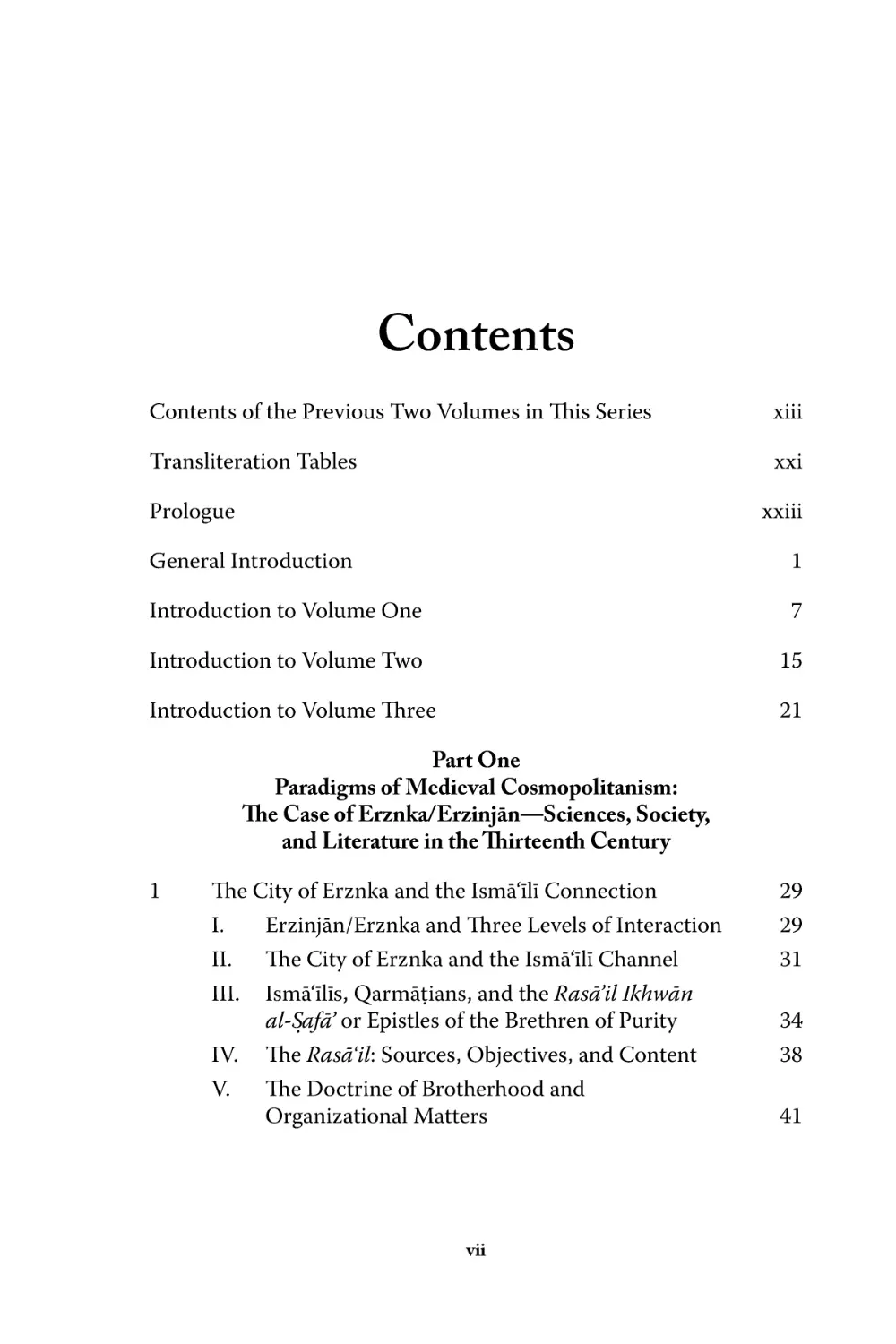
Contents
Contents of the Previous Two Volumes in This Series
xiii
Transliteration Tables
xxi
Prologue
xxiii
General Introduction
1
Introduction to Volume One
7
Introduction to Volume Two
15
Introduction to Volume Three
21
Part One
Paradigms of Medieval Cosmopolitanism:
The Case of Erznka/Erzinjān—Sciences, Society,
and Literature in the Thirteenth Century
1
The City of Erznka and the Ismā‘īlī Connection
I.
Erzinjān/Erznka and Three Levels of Interaction
II. The City of Erznka and the Ismā‘īlī Channel
III. Ismā‘īlīs, Qarmāt.ians, and the Rasā’il Ikhwān
al-S.afā’ or Epistles of the Brethren of Purity
IV. The Rasā‘il: Sources, Objectives, and Content
V.
The Doctrine of Brotherhood and
Organizational Matters
vii
29
29
31
34
38
41
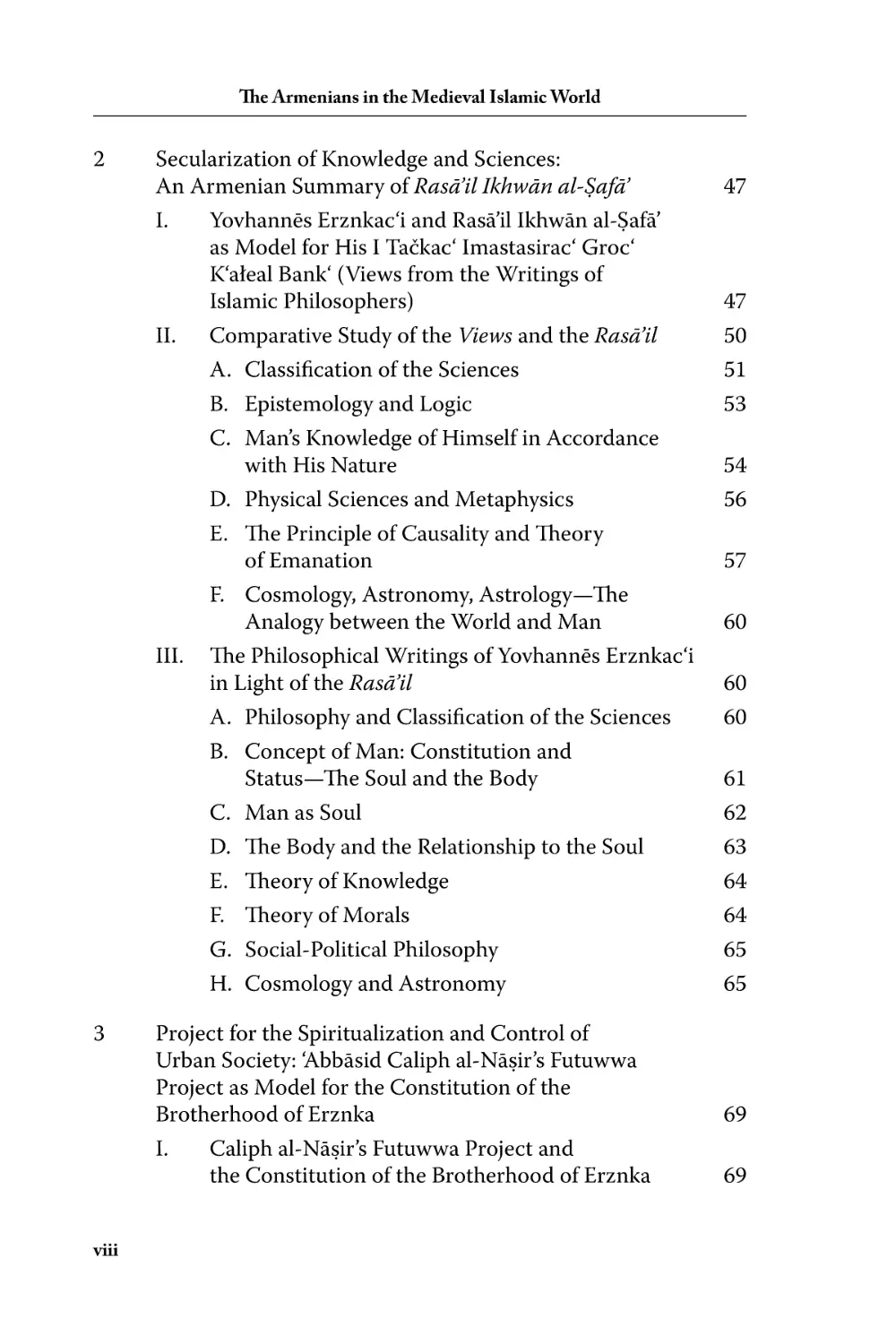
The Armenians in the Medieval Islamic World
2
Secularization of Knowledge and Sciences:
An Armenian Summary of Rasā’il Ikhwān al-S.afā’
I.
Yovhannēs Erznkac‘i and Rasā’il Ikhwān al-S.afā’
as Model for His I Tačkac‘ Imastasirac‘ Groc‘
K‘ałeal Bank‘ (Views from the Writings of
Islamic Philosophers)
II. Comparative Study of the Views and the Rasā’il
A. Classification of the Sciences
B. Epistemology and Logic
C. Man’s Knowledge of Himself in Accordance
with His Nature
D. Physical Sciences and Metaphysics
III.
E. The Principle of Causality and Theory
of Emanation
F. Cosmology, Astronomy, Astrology—The
Analogy between the World and Man
The Philosophical Writings of Yovhannēs Erznkac‘i
in Light of the Rasā’il
A. Philosophy and Classification of the Sciences
B. Concept of Man: Constitution and
Status—The Soul and the Body
C. Man as Soul
D. The Body and the Relationship to the Soul
E. Theory of Knowledge
F. Theory of Morals
G. Social-Political Philosophy
H. Cosmology and Astronomy
3
viii
Project for the Spiritualization and Control of
Urban Society: ‘Abbāsid Caliph al-Nās.ir’s Futuwwa
Project as Model for the Constitution of the
Brotherhood of Erznka
I.
Caliph al-Nās.ir’s Futuwwa Project and
the Constitution of the Brotherhood of Erznka
47
47
50
51
53
54
56
57
60
60
60
61
62
63
64
64
65
65
69
69
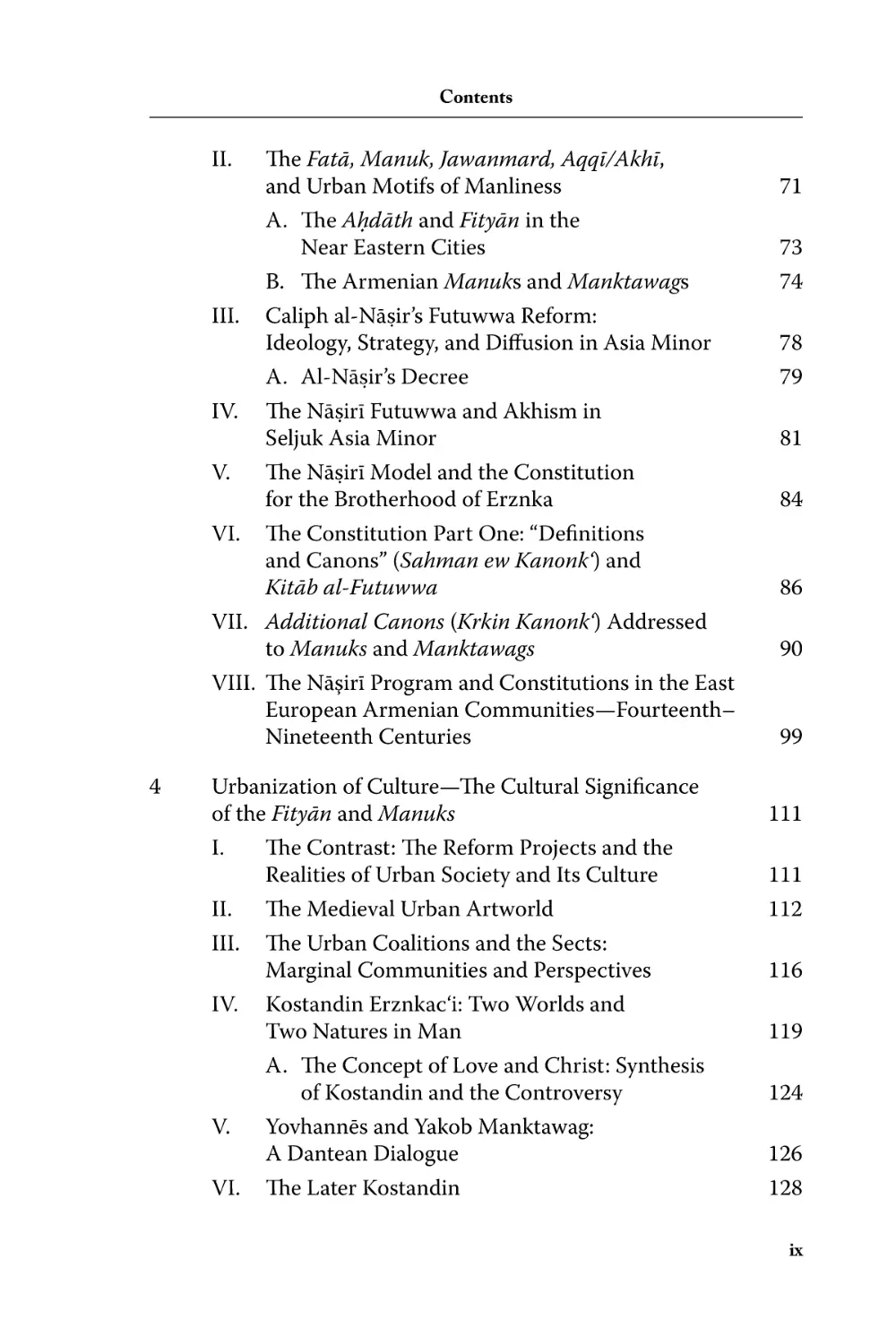
Contents
II.
III.
IV.
V.
The Fatā, Manuk, Jawanmard, Aqqī/Akhī,
and Urban Motifs of Manliness
A. The Ah.dāth and Fityān in the
Near Eastern Cities
B. The Armenian Manuks and Manktawags
Caliph al-Nās.ir’s Futuwwa Reform:
Ideology, Strategy, and Diffusion in Asia Minor
A. Al-Nās.ir’s Decree
The Nās.irī Futuwwa and Akhism in
Seljuk Asia Minor
The Nās.irī Model and the Constitution
for the Brotherhood of Erznka
The Constitution Part One: “Definitions
and Canons” (Sahman ew Kanonk‘) and
Kitāb al-Futuwwa
VII. Additional Canons (Krkin Kanonk‘) Addressed
to Manuks and Manktawags
VIII. The Nāşirī Program and Constitutions in the East
European Armenian Communities—Fourteenth–
Nineteenth Centuries
71
73
74
78
79
81
84
VI.
4
Urbanization of Culture—The Cultural Significance
of the Fityān and Manuks
I.
The Contrast: The Reform Projects and the
Realities of Urban Society and Its Culture
II. The Medieval Urban Artworld
III. The Urban Coalitions and the Sects:
Marginal Communities and Perspectives
IV. Kostandin Erznkac‘i: Two Worlds and
Two Natures in Man
A. The Concept of Love and Christ: Synthesis
of Kostandin and the Controversy
V.
Yovhannēs and Yakob Manktawag:
A Dantean Dialogue
VI. The Later Kostandin
86
90
99
111
111
112
116
119
124
126
128
ix
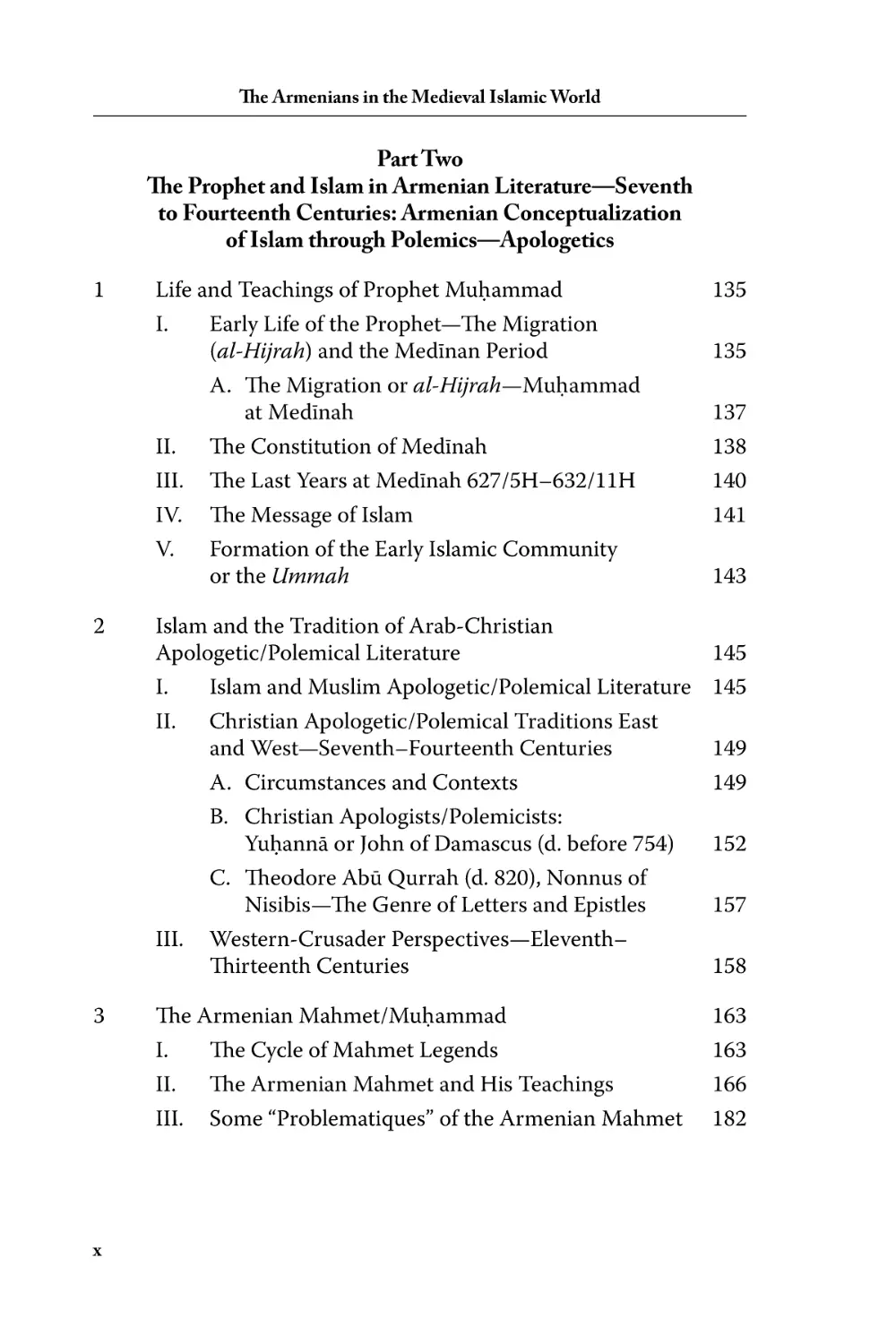
The Armenians in the Medieval Islamic World
Part Two
The Prophet and Islam in Armenian Literature—Seventh
to Fourteenth Centuries: Armenian Conceptualization
of Islam through Polemics—Apologetics
1
2
3
x
Life and Teachings of Prophet Muh.ammad
I.
Early Life of the Prophet—The Migration
(al-Hijrah) and the Medīnan Period
A. The Migration or al-Hijrah—Muh.ammad
at Medīnah
II. The Constitution of Medīnah
III. The Last Years at Medīnah 627/5H–632/11H
IV. The Message of Islam
V.
Formation of the Early Islamic Community
or the Ummah
Islam and the Tradition of Arab-Christian
Apologetic/Polemical Literature
I.
Islam and Muslim Apologetic/Polemical Literature
II. Christian Apologetic/Polemical Traditions East
and West—Seventh–Fourteenth Centuries
A. Circumstances and Contexts
B. Christian Apologists/Polemicists:
Yuh.annā or John of Damascus (d. before 754)
C. Theodore Abū Qurrah (d. 820), Nonnus of
Nisibis—The Genre of Letters and Epistles
III. Western-Crusader Perspectives—Eleventh–
Thirteenth Centuries
The Armenian Mahmet/Muh.ammad
I.
The Cycle of Mahmet Legends
II. The Armenian Mahmet and His Teachings
III. Some “Problematiques” of the Armenian Mahmet
135
135
137
138
140
141
143
145
145
149
149
152
157
158
163
163
166
182
Contents
4
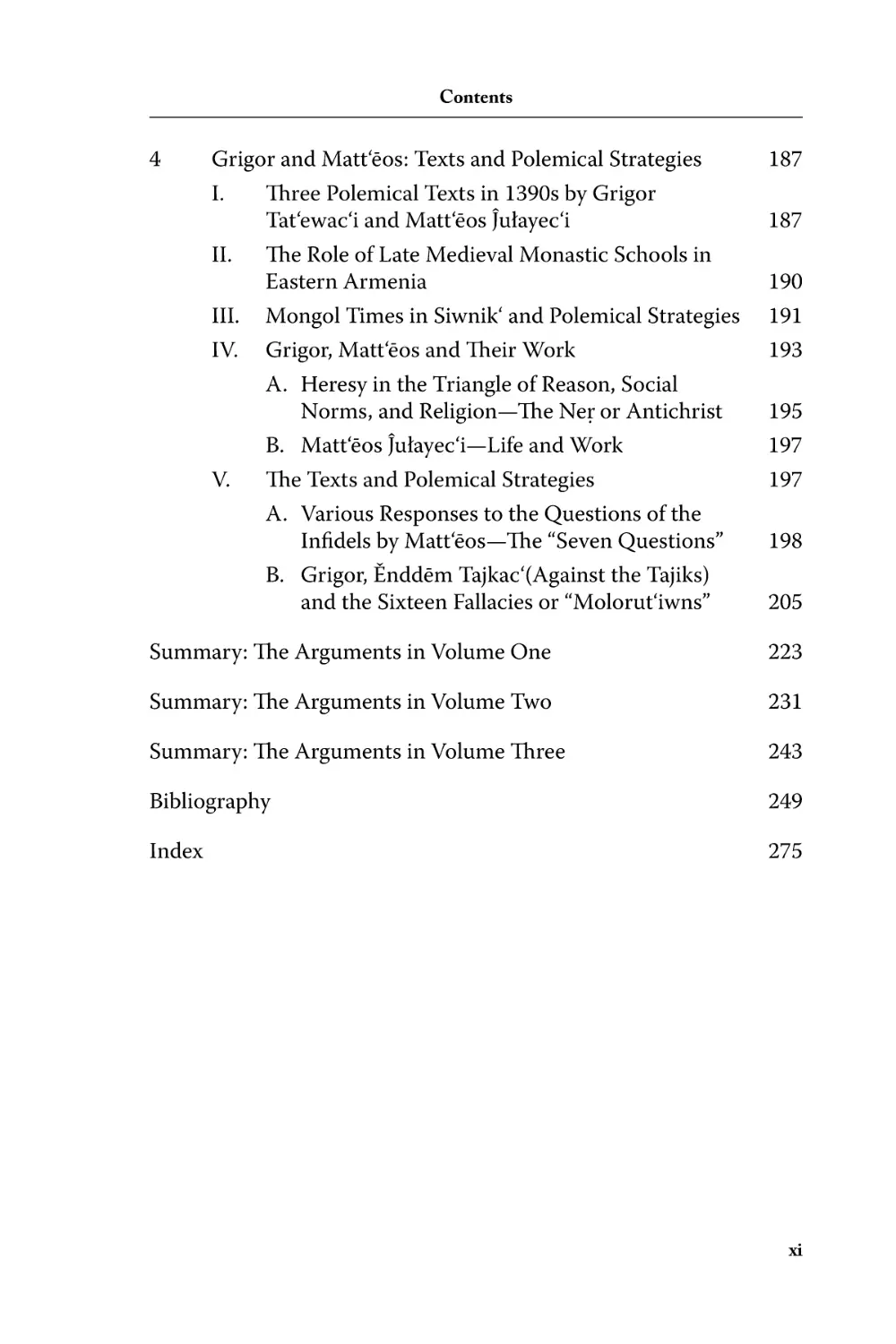
Grigor and Matt‘ēos: Texts and Polemical Strategies
I.
Three Polemical Texts in 1390s by Grigor
Tat‘ewac‘i and Matt‘ēos Ĵułayec‘i
II. The Role of Late Medieval Monastic Schools in
Eastern Armenia
III. Mongol Times in Siwnik‘ and Polemical Strategies
IV. Grigor, Matt‘ēos and Their Work
A. Heresy in the Triangle of Reason, Social
Norms, and Religion—The Ner. or Antichrist
B. Matt‘ēos Ĵułayec‘i—Life and Work
V.
The Texts and Polemical Strategies
A. Various Responses to the Questions of the
Infidels by Matt‘ēos—The “Seven Questions”
B. Grigor, Ěnddēm Tajkac‘(Against the Tajiks)
and the Sixteen Fallacies or “Molorut‘iwns”
187
187
190
191
193
195
197
197
198
205
Summary: The Arguments in Volume One
223
Summary: The Arguments in Volume Two
231
Summary: The Arguments in Volume Three
243
Bibliography
249
Index
275
xi
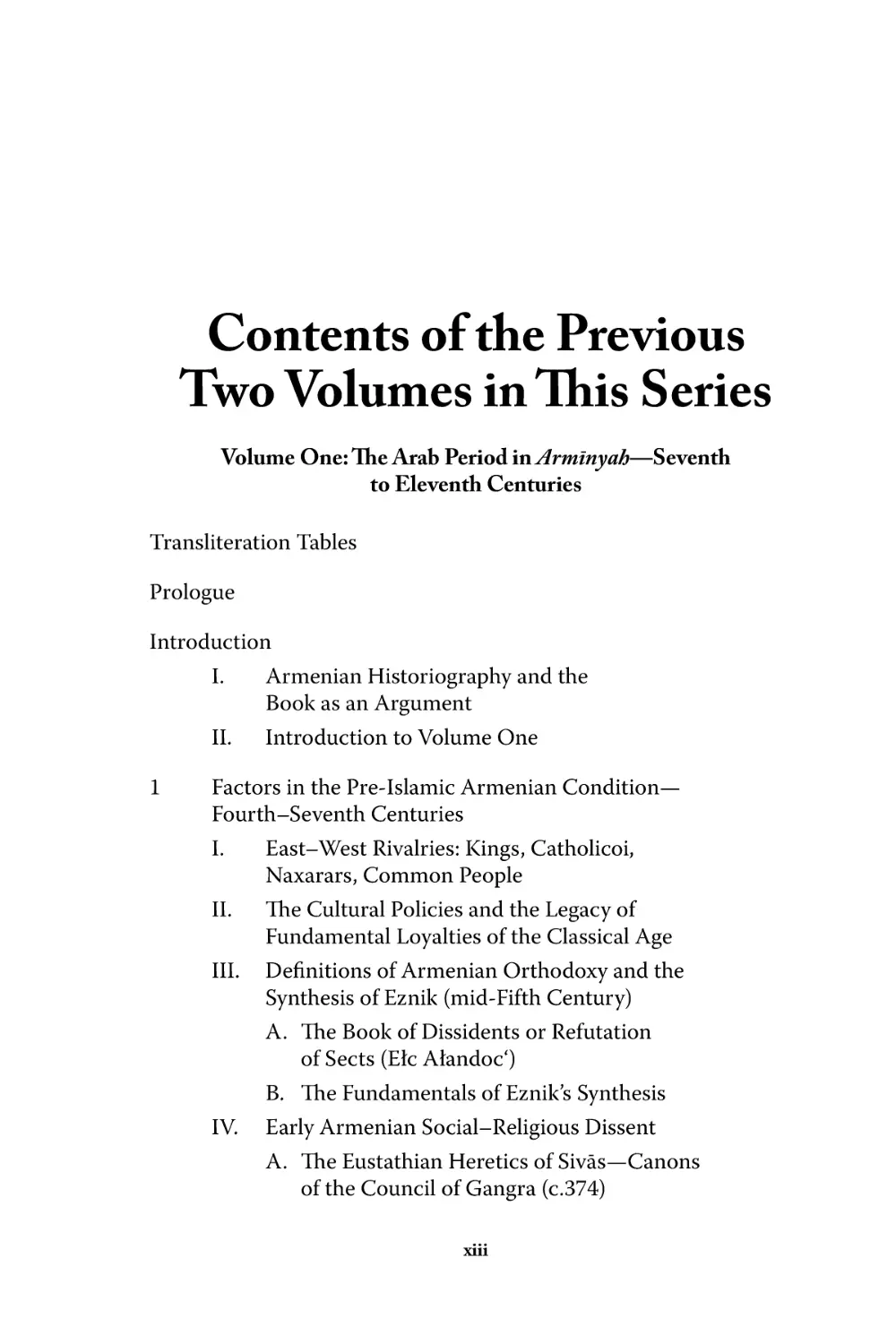
Contents of the Previous
Two Volumes in This Series
Volume One: The Arab Period in Armīnyah—Seventh
to Eleventh Centuries
Transliteration Tables
Prologue
Introduction
I.
Armenian Historiography and the
Book as an Argument
II. Introduction to Volume One
1
Factors in the Pre-Islamic Armenian Condition—
Fourth–Seventh Centuries
I.
East–West Rivalries: Kings, Catholicoi,
Naxarars, Common People
II. The Cultural Policies and the Legacy of
Fundamental Loyalties of the Classical Age
III. Definitions of Armenian Orthodoxy and the
Synthesis of Eznik (mid-Fifth Century)
A. The Book of Dissidents or Refutation
of Sects (Ełc Ałandoc‘)
B. The Fundamentals of Eznik’s Synthesis
IV. Early Armenian Social–Religious Dissent
A. The Eustathian Heretics of Sivās—Canons
of the Council of Gangra (c.374)
xiii
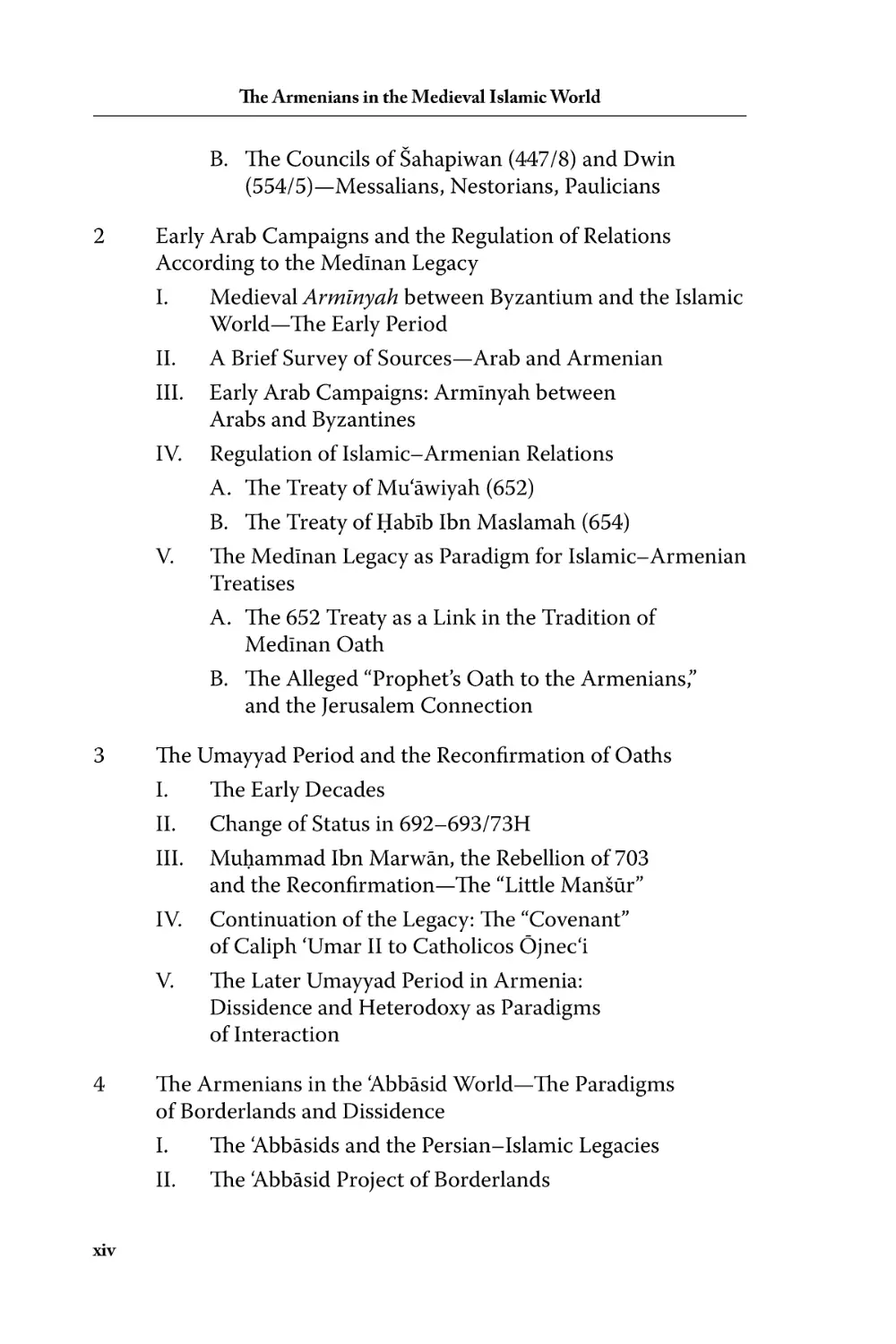
The Armenians in the Medieval Islamic World
B. The Councils of Šahapiwan (447/8) and Dwin
(554/5)—Messalians, Nestorians, Paulicians
2
Early Arab Campaigns and the Regulation of Relations
According to the Medīnan Legacy
I.
Medieval Armīnyah between Byzantium and the Islamic
World—The Early Period
II. A Brief Survey of Sources—Arab and Armenian
III. Early Arab Campaigns: Armīnyah between
Arabs and Byzantines
IV. Regulation of Islamic–Armenian Relations
A. The Treaty of Mu‘āwiyah (652)
B. The Treaty of Ḥabīb Ibn Maslamah (654)
V.
The Medīnan Legacy as Paradigm for Islamic–Armenian
Treatises
A. The 652 Treaty as a Link in the Tradition of
Medīnan Oath
B. The Alleged “Prophet’s Oath to the Armenians,”
and the Jerusalem Connection
3
The Umayyad Period and the Reconfirmation of Oaths
I.
The Early Decades
II. Change of Status in 692–693/73H
III. Muḥammad Ibn Marwān, the Rebellion of 703
and the Reconfirmation—The “Little Manšūr”
IV. Continuation of the Legacy: The “Covenant”
of Caliph ‘Umar II to Catholicos Ōjnec‘i
V.
The Later Umayyad Period in Armenia:
Dissidence and Heterodoxy as Paradigms
of Interaction
4
The Armenians in the ‘Abbāsid World—The Paradigms
of Borderlands and Dissidence
I.
The ‘Abbāsids and the Persian–Islamic Legacies
II. The ‘Abbāsid Project of Borderlands
xiv
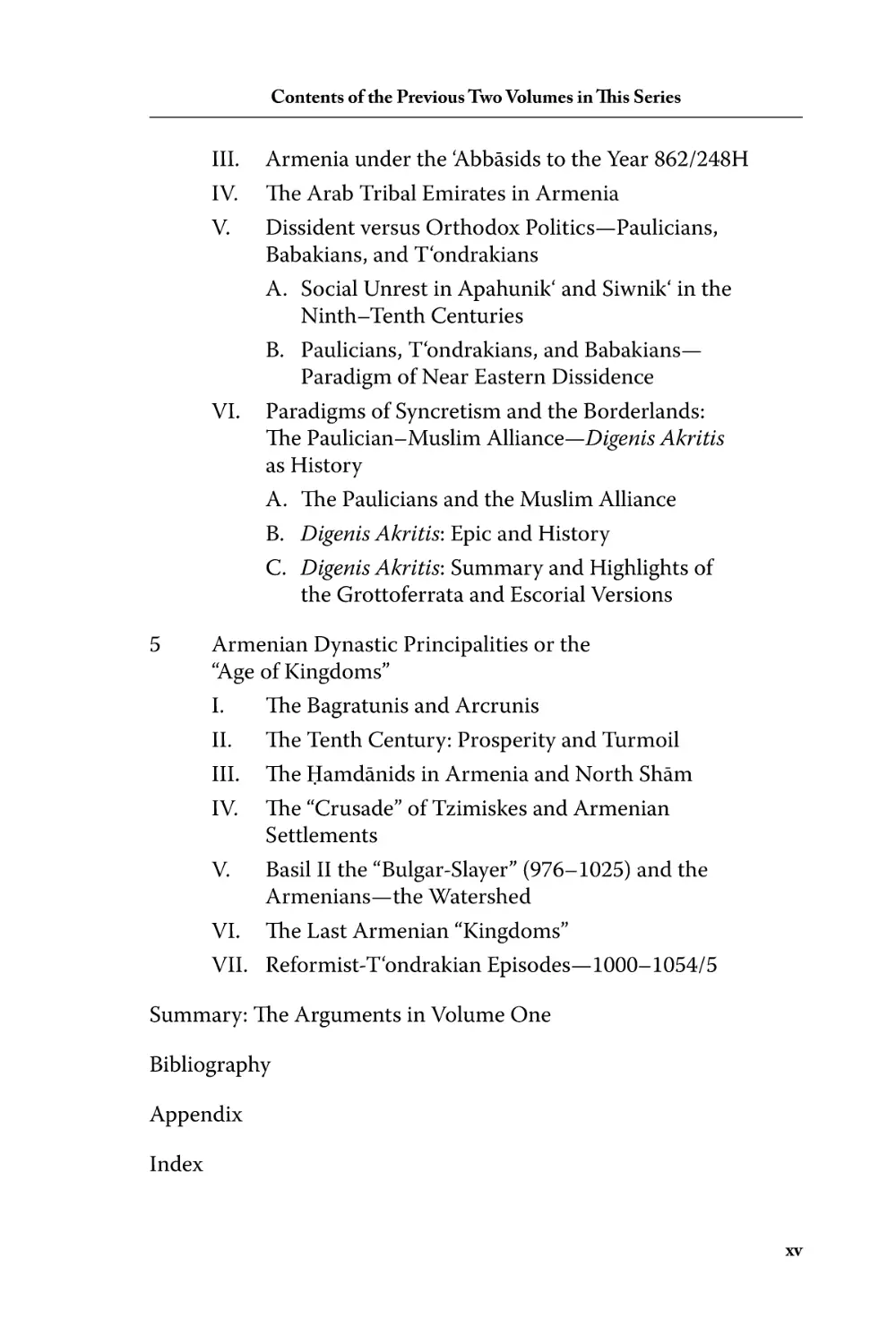
Contents of the Previous Two Volumes in This Series
III.
IV.
V.
VI.
Armenia under the ‘Abbāsids to the Year 862/248H
The Arab Tribal Emirates in Armenia
Dissident versus Orthodox Politics—Paulicians,
Babakians, and T‘ondrakians
A. Social Unrest in Apahunik‘ and Siwnik‘ in the
Ninth–Tenth Centuries
B. Paulicians, T‘ondrakians, and Babakians—
Paradigm of Near Eastern Dissidence
Paradigms of Syncretism and the Borderlands:
The Paulician–Muslim Alliance—Digenis Akritis
as History
A. The Paulicians and the Muslim Alliance
B. Digenis Akritis: Epic and History
C. Digenis Akritis: Summary and Highlights of
the Grottoferrata and Escorial Versions
5
Armenian Dynastic Principalities or the
“Age of Kingdoms”
I.
II.
III.
IV.
The Bagratunis and Arcrunis
The Tenth Century: Prosperity and Turmoil
The Ḥamdānids in Armenia and North Shām
The “Crusade” of Tzimiskes and Armenian
Settlements
V.
Basil II the “Bulgar-Slayer” (976–1025) and the
Armenians—the Watershed
VI. The Last Armenian “Kingdoms”
VII. Reformist-T‘ondrakian Episodes—1000–1054/5
Summary: The Arguments in Volume One
Bibliography
Appendix
Index
xv
The Armenians in the Medieval Islamic World
Volume Two: Armenian Realpolitik in the Islamic World
and Diverging Paradigms—Case of Cilicia
Eleventh to Fourteenth Centuries
Transliteration Tables
Prologue
Introduction
1
Bilād al-Shām in the Eleventh and Twelfth Centuries
and the Armenian Intermezzo
I.
The Armenian Intermezzo: Argument for the
Classification of the Period as a Unique Phase
II. Emigrations and Settlements in al-Shām in the
Ninth and Tenth Centuries
III. Greeks, Christians, Armenians, Ismā‘īlīs,
Ḥamdānids, Fāṭimids, Kalbīs, and Kilābīs
in al-Shām during the Ninth and Tenth Centuries
IV. The Ghuzz/Turkmens and Seljuks in Asia Minor,
Armenia, and al-Shām
A. Early Turkish Penetration and the Armenians
B. Al-Shām in the Eleventh and Twelfth Centuries
C. The Ghuzz in Syria
2
Armenian–Byzantine and Armenian-Islamic
Realpolitik and Peripheral Principalities
I.
Armenian–Byzantine Realpolitik and Peripheral
Principalities, Eleventh to Twelfth Centuries
II. The T‘ondrakian–Ismā‘īlī Connection—Gorg, Łazar,
and T‘oros as Missing Link “Brigands” and the Rise
of a Heterodox Ruling Class on the Frontiers
III. Armenian–Muslim Realpolitik: Muslim–
Armenian Powers
A. The Turkish and Turkmen Attires
1. The Nāwikī/Bāwiqī/Yāruqī/Awaqīs: Amīr
Ktrič, Ibn Khān, and Aqsiz/Atsiz
xvi
Contents of the Previous Two Volumes in This Series
2. The Dānishmandids in Cappadocia—1055/
447H–1173/569H
B. Political Converts among Territorial
Principalities
1. The “State” of Philaretus
2. Bēnē (or Banū) Boghusaks in Siberek/
Sewawerak—1040–1200
3. The Armenian Nuṣayrī Ruzzaiks/Ruzzīks in Syria
3
The Fāṭimid Armenians—Translations of Islam into Power
I.
The Armenians in Egypt
II. The Involvement of the Pro-Byzantine
Armenian Institutions in Egypt
III.
A. Catholicos Grigor II Vkayasēr (or Martyrophil)
Pahlawuni
B. Vizier Bahrām al-Armanī and Caliph
al-Ḥāfiẓ—an Aborted “Crusade”
Muslim Armenian Vizierial Rule, 1074–1163
A. A Hypothesis about the Beginnings of Badr in
Aleppo: Al-Amīr ‘Azīz al-Dawlah
B. The Jamālī House of Fāṭimid Viziers
1. Armenian–Turkish Rivalry and the
Vizierate of Badr al-Jamālī
2. Abū’l-Qāsim al-Afḍal Shāhanshāh Ibn
Badr al-Jamālī
3. Abū ‘Alī Aḥmad Kutayfāt al-Akmal Ibn
al-Afḍal (1131)
C. Abū’l-Fatḥ Yānis al-Rūmī al-Armanī (1132)
D. The Nuṣayrī Banū Ruzzīks and the End of
Armenian Vizierial Rule
1. Abū’l-Ghārāt Fāris al-Muslimīn Ṭalā’i‘ Ibn
Ruzzīk (1154/549H–1161/556H)
2. Abū Shujā‘ Badr ed-Dīn, al-Nāṣir Muḥyy ed-Dīn
Majd al-Islām Ruzzīk Ibn Ṭalā’i‘—(1161–1162)
3. Other Figures—Two Karakūshs
xvii
The Armenians in the Medieval Islamic World
IV.
The Testimony of Architecture
A. The Frescos of the White Monastery—Links
between the Armenian North and the South
B. Armenian Forms in Fāṭimid Egypt
C. Badr’s Juyūshī Mosque/Mashhad on Muqaṭṭam
Hill 1085: Memorial to Power and Tragedy
D. The “Thousand and One Nights” of al-Afḍal
4
xviii
The “Dynastic Triangle” or the Second Age of
Kingdoms—Diverging Paradigms and the Case of
Armenian Cilicia: Twelfth to Fourteenth Centuries
I.
The Dynastic Triangle or the Second Age of
Kingdoms
II. The Mongols: Penetration and Politics
A. The Twelfth Century: Conversions and Social
Change in Asia Minor and North Syria
B. The Zak‘arids (or Zak‘arians)
C. Mongol Invasions and a New Phase in
Asia Minor
D. The Hypothesis of “Mongol Imperial Ideology”
III. Cilicia Paradigm Case between the East and
the West
A. Four Points as an Introduction to the Cilician Case
B. Factors in the Making of Armenian Cilicia
C. The Cilician Principality between the
Turks and the Franks
D. Prince Mleh and His Zankī Alliance: A CounterParadigm and the Nāwikī/Yāruqī Connection
E. Cilicia and the Ayyūbids
F. The Fall of Jerusalem and the Famous
“Oath of Ṣalāḥ ed-Dīn to the Armenians
and Christians”
G. The Aftermath: Franks and Armenians
H. The Project of the Latin–Armenian Kingdom
Contents of the Previous Two Volumes in This Series
IV.
5
The Kingdom and the Church between Latins,
Byzantines, Ayyūbids, Mongols, and Mamlūks
A. Ecumenism and Politics
B. King Lewon I: Realpolitik, the Cilician Spirit,
and the Kingdom
C. The Latin–Armenian Kingdom of Cilicia
between Franks and Muslims
D. Cilicians, Mongols, and Mamlūks—Het‘um
I and Mongol Khans
E. The Conquests of Baybars (1261–1271)
F. Church Union Councils and Popular
Dissent—the Fall of the Kingdom
The Cilician Spiritual and Intellectual Legacy
between the East and the West
I.
Beginnings in the Eleventh Century in the
North: Narekac‘i, Magistros, and Imastasēr
A. Grigor Narekac‘i: Major Paradigm in
Armenian Dissident Thought
B. Grigor Pahlawuni—Magistros and
Secularization of Knowledge
C. Yovhannēs Sarkawag-Imastasēr—Forerunner
of the Second Phase of Armenian Philosophy
II. The Silver Age in a New World: Theology,
Philosophy, and Arts
III.
IV.
V.
A. Cilician Translations and the Armenian
Version of the Chronicle of Michael the Syrian
B. Vkayasēr/Martyrophil, Grigor III, Šnorhali,
Grigor IV Tłay, and Nersēs Lambronac‘i
Church Union and the Predicament of the
Cilicians—the Literature
The Theological–Philosophical Legacy of
the Twelfth Century
New Thinkers: Society, Philosophy, and
Science—Aygekc‘i, Rabuni, and Herac‘i
xix
The Armenians in the Medieval Islamic World
VI. New Science
VII. New Philosophy: Armenian “Nominalism”—
Rabuni in Cilicia and Orotnec‘i in the East
VIII. Cilician Aesthetics and New Arts: Poetry
and Painting
A. Poetry and Narekac‘i as a Major Influence;
New Visions of God, Man, and Nature;
Šarakans
B. The Cilician Art of Miniatures: Ṙoslyn
and Picak as “Nominalists”
Summary: The Arguments in Volume Two
Bibliography
Appendix
Index
xx
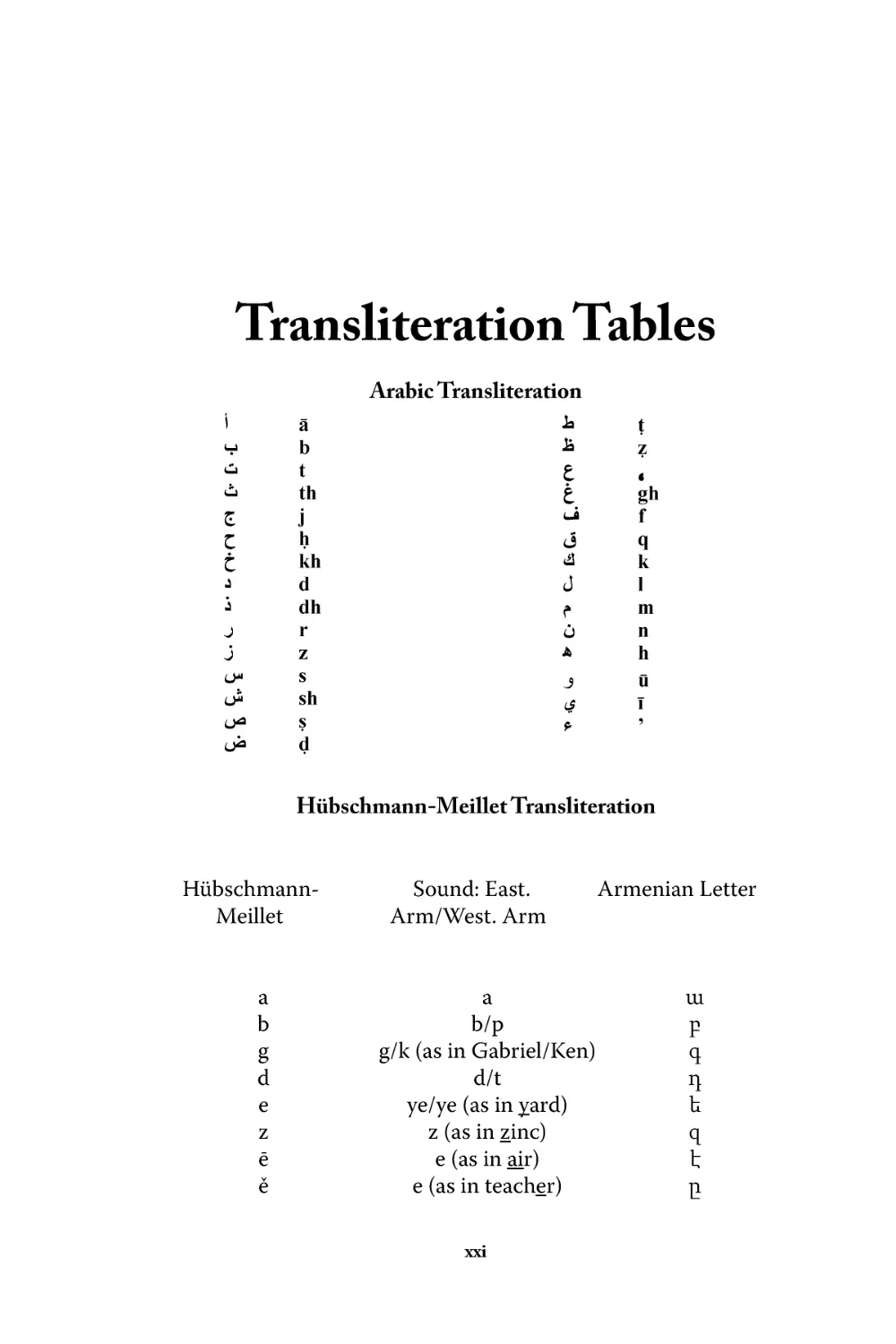
Transliteration Tables
Arabic Transliteration
ﺃ
ﺏ
ﺕ
ﺙ
ﺝ
ﺡ
ﺥ
ﺩ
ﺫ
ﺭ
ﺯ
ﺱ
ﺵ
ﺹ
ﺽ
ā
b
t
th
j
h
kh
d
dh
r
z
s
sh
s
d
ﻁ
ﻅ
ﻉ
ﻍ
ﻑ
ﻕ
ﻙ
ﻝ
ﻡ
ﻥ
ﻫ
ﻮ
ﻱ
ء
t
z
‘
gh
f
q
k
l
m
n
h
ū
ī
’
Hübschmann-Meillet Transliteration
HübschmannMeillet
a
b
g
d
e
z
ē
ě
Sound: East.
Arm/West. Arm
a
b/p
g/k (as in Gabriel/Ken)
d/t
ye/ye (as in yard)
z (as in zinc)
e (as in air)
e (as in teacher)
xxi
Armenian Letter
ա
բ
գ
դ
ե
զ
է
ը
The Armenians in the Medieval Islamic World
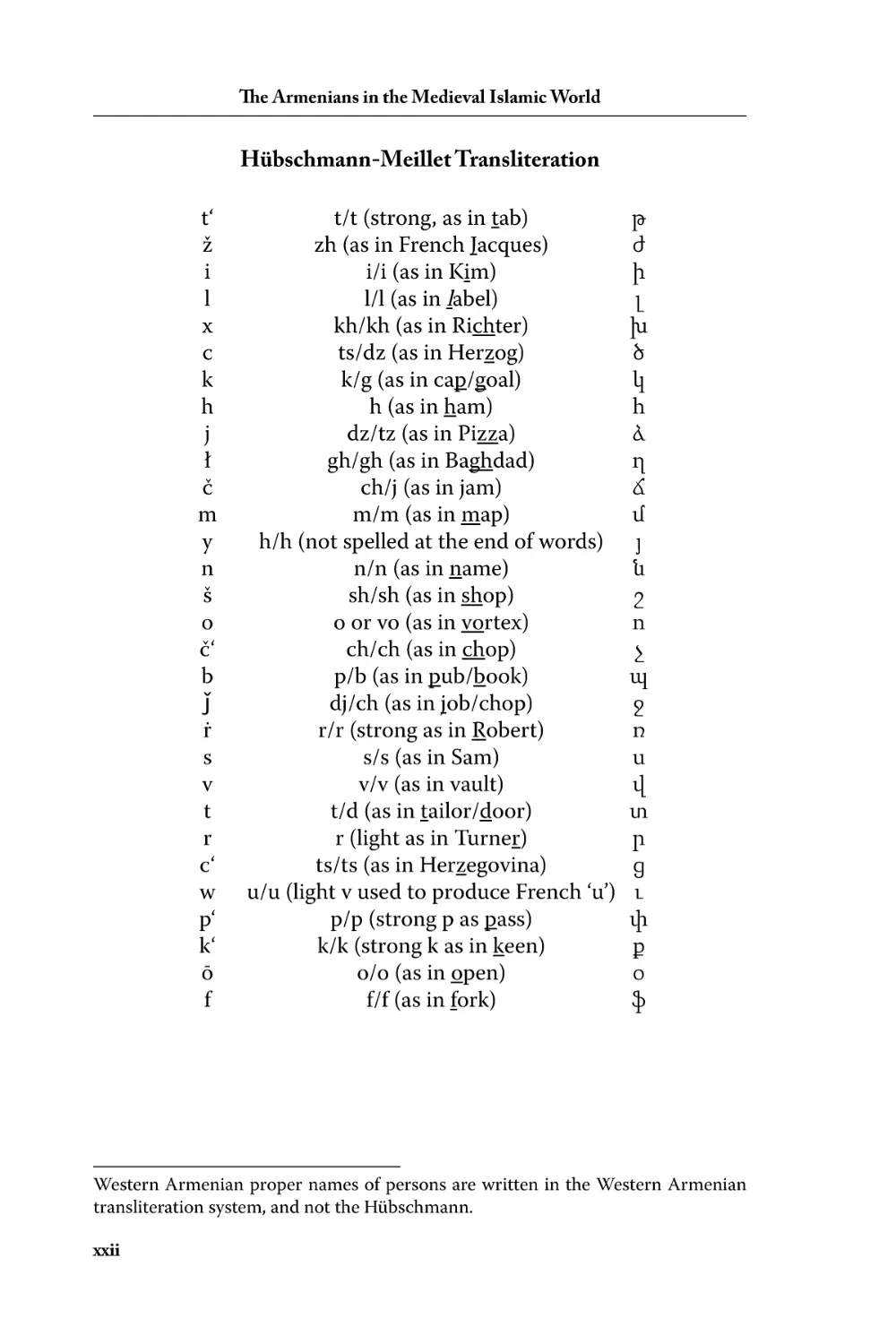
Hübschmann-Meillet Transliteration
t‘
ž
i
l
x
c
k
h
j
ł
č
m
y
n
š
o
č‘
b
ǰ
ṙ
s
v
t
r
c‘
w
p‘
k‘
ō
f
t/t (strong, as in tab)
zh (as in French Jacques)
i/i (as in Kim)
l/l (as in label)
kh/kh (as in Richter)
ts/dz (as in Herzog)
k/g (as in cap/goal)
h (as in ham)
dz/tz (as in Pizza)
gh/gh (as in Baghdad)
ch/j (as in jam)
m/m (as in map)
h/h (not spelled at the end of words)
n/n (as in name)
sh/sh (as in shop)
o or vo (as in vortex)
ch/ch (as in chop)
p/b (as in pub/book)
dj/ch (as in job/chop)
r/r (strong as in Robert)
s/s (as in Sam)
v/v (as in vault)
t/d (as in tailor/door)
r (light as in Turner)
ts/ts (as in Herzegovina)
u/u (light v used to produce French ‘u’)
p/p (strong p as pass)
k/k (strong k as in keen)
o/o (as in open)
f/f (as in fork)
թ
ժ
ի
լ
խ
ծ
կ
հ
ձ
ղ
ճ
մ
յ
ն
շ
ո
չ
պ
ջ
ռ
ս
վ
տ
ր
ց
ւ
փ
ք
o
ֆ
Western Armenian proper names of persons are written in the Western Armenian
transliteration system, and not the Hübschmann.
xxii
Prologue
In order to give the reader of Volume Three and of the other volumes
as well a comprehensive idea of the entire work, below are the Prologue, the General Introduction, and the Introductions of all three
volumes.
My initiative to study the Armenian experience in the medieval
Islamic world through paradigmatic cases of interaction takes its beginnings in the Armenian condition in the Near Eastern region. It is
best explained by Nietzsche’s dictum sum ergo cogito, I exist therefore
I think. Existential in many respects, this questioning is also its motive
and inner dimension. In this perspective, writing about the history of
Armenians in the medieval Islamic world means trying to make sense
of their circumstances. It means an effort to create/define, rather, to
re-create/re-define the historicity of their experiences. Being Armenian,
almost universally, is having a mobile line of ethnic ancestry laden with
narratives from the vast historic Armenian oikoumenē or habitat from
Iran to Constantinople, and from the Caucasus to Egypt. This study
reflects, then, a questioning that a minimal level of concern about my
Armenological Dasein or my being an Armenologist requires.
The condition of my generation of the 1960s in particular, meant
growing up in trilingual and pluricultural communities in ancient
cities of mosques, churches, suks, local and missionary schools, and
eastern/western ideologies and folklores. Above all, it meant carrying
heavy baggage of vaguely perceived legacies, while learning/living in
local and cosmopolitan networks of relations. However, these and
many other factors are not causes for crises as long as one takes the
environment as the ground of identity, no matter how compounded and
peculiar it is. In other words, the Armenian condition in Near Eastern
countries is not problematic in itself; it becomes so when isolated in
a small enclosure such as the glass pyramid of the Louvre. Space/time
takes the shape of the pyramid as opposed to and separated from outer
space and real time. As far as the pyramid is concerned, the narrative
xxiii
The Armenians in the Medieval Islamic World
of the classic histories is also a value theory or the “ethics” of being an
Armenian. However, in real space/time this “ethics” lacks grounds in
lived sensibilities, and epistemological criteria for its credibility. This
is when the Armenian condition becomes problematic, the scholarship
in the pyramid a parody, and one’s existence an unresolved matter. I
existed and still do in these circumstances, therefore I must think, at
least to clear the Armenian psyche of sedimentations and fixities.
As of the inception of this work over a decade ago, and throughout,
the objective was to create a broad, inclusive, and definitely critical
reconstruction of the Armenian condition in the medieval Near East
from the advent of Islam to the end of the Mongol period. For its
proximity to the lived and recorded experiences, this new analysis
of the Armenian condition had to be solid enough to stand out as an
aesthetically more realistic, historically more accurate, philosophically
more consistent, and intellectually more intriguing account. For a task
of these requirements, the key was to identify the problematic aspects
of the traditional narratives and constructs in circulation for centuries.
I did not have to go too far or search too long to find episodes and
texts that were paradigm cases for a different historicity, even for a
counter-history.
Contrary to mainstream accounts, Armenian history is far from
being monolithic. Several and often contradictory trends went into its
making, yet the images in the narratives failed to reflect its rich texture
and dynamics. Armenian–Islamic history—as a case study—was just
one way of dealing with this problem. Also, the objective of my interest
in the so-called sects is to draw the historicity of Armenian dissidence
and what may be termed as revolutionary elements on all strata and
phases. The initiative to see these elements as a part of the whole is
novel and for some, even controversial. Surely, the book is not about
interactions through dissident channels but dissidence was a channel
of interaction. Also, the book does not focus on the dissident aspects
of Armenian history, because that would betray its holistic logic. The
same can be said about the so-far marginalized question of Muslim
Armenians. Their case is not a highlight; rather, it is just part of the
general argument to look at Armenian history from as many perspectives as possible. Several other subjects in the book, in turn discovered
or brought up for the first time, demonstrate the multidimensional and
interactive nature of the Armenian experience in the medieval Islamic
and wider world. Things could have been—as they in fact were—very
different than imagined, desired, and told in traditional narratives. This
xxiv
Prologue
is as much a historical as a deeply existential and epistemological issue,
which is central to a project as ambitious as this book.
I began pondering over the extraordinary channels of interaction and
their significance in Armenian history many years ago. I was a graduate
student majoring in philosophy when I discovered that an obscure
thirteenth-century Armenian manuscript was in fact a summary of
the esoteric Epistles of the Brethren of Purity of the tenth century. The
broader project matured over a long period because I was venturing
into unchartered territory. There were no studies and the task was not
only hard, multifaceted, dangerous, but also challenging and overdue.
The tools were an interdisciplinary training, a critical approach, and a
taste for dialectics. After two decades of research and the publication
of two books and several papers on the theme of Armenians and Islam,
the opus came together as an “argument” based on and structured by
hitherto unnoticed or marginalized paradigm cases. Each one of these
cases raised new questions and revealed new patterns of interaction
and evolution in the medieval Near East.
The new knowledge that I excavated will hopefully lead to fresh
ways and areas of inquiry in Near Eastern as well as Armenian studies. In its intent and rather unconventional content, this book is also a
prolegomenon to writing Armenian history in the context of the Near
East and to review things Near Eastern in their interactive aspects. It
is supposed to suggest new outlooks and re-assessments in Islamic
histories as well. At this point, few notes about the sources and the
structure or the aesthetics of the book are in order. The selection and
use of sources were based on the necessities of the initial objectives, as
stated earlier. Essential was the arrangement of a very large amount of
data for a composition which, by its making, presented a new account
of things Armenian as things Near Eastern. In the case of Armenian
sources, in addition to contemporary sources, the focus was on primary
sources. In the case of Arab sources, naturally all basic primary sources
and texts were utilized. In fact, most of the arguments and narratives
are based precisely on their testimony. In all detailed narratives, and
there are many, the objective was to draw a general context for the
reader to understand and have a feel of the period and the argument/s.
The sources were selected in this light. Therefore, to keep the framework straightforward—especially for the reader who is not familiar
with Armenian and/or Islamic history—I avoided debates on specific
issues. This is not a detective’s initiative or report, and I am well aware
of what some call “scholarship out there.” I also deliberately avoided
xxv
The Armenians in the Medieval Islamic World
unnecessary bibliographic “embellishment,” if the material did not
contribute to or was not actually used in the work. Already a very long
and complicated text of many strands of arguments, this book could
not carry parallel tracks of information. Nevertheless, I have intentionally made use of certain details and ideas of relatively old sources such
as Gibbon. This was to highlight a point, sometimes humorously, or
open different channels of thought/imagination for the reader. After all,
similar to all writing and reading, historical writing too is an aesthetic
activity even when it focuses on critical thinking and analysis.
Since making causal connections was essential to the process of
deriving and drawing the historicity of otherwise isolated and/or
undetected paradigm cases or trends over seven centuries, the sequence
of the episodes was an essential part of building the arguments. A
chronological approach was the most appropriate means to construct
the blocks and arrange the paradigms in the clearest possible composition. A thematic classification would have not only been confusing
but would have also seriously impaired the conceptual structure of the
work. A comment must be made about the multiplicity of themes and
the content. The great range of interrelated themes may have justified
a single and very large volume. It would have been architecturally more
coherent, but the sequence and content of six parts made the division
to three volumes so much more accessible and practical. The reader,
however, should read the volumes as parts of a whole. Essential for me
was the shaping and illustrating, or grounding of, arguments through
paradigmatic cases. From the Prologue of Volume One to the end of
Volume Three, a central argument and corollaries bridge the various
episodes and issues. The style in organizing the text and the problem of
details must be commented on too. In view of my dialectical–holistic
approach and the objectives and the nature of the study, I did not and
could not implement the common technique of maintaining a flowing narrative, keeping the details in the footnotes. Personally, I do not
particularly enjoy reading texts of this style and, in turn, avoid imposing double levels of attention on the reader. The details are not just for
information and evidence, as most traditionally trained historians take
them to be. Details are a part of the story and the argument/s and if they
have no relevance to the central themes, they must be excluded. As in
Flemish and much later photo-realist arts, the fine details are trompe
l’oeil elements to draw the viewer/reader into the “reality” of the work.
In other words, these details are necessary, not just as evidence, but also
to assist the viewer/reader to try to think from within the narrative.
xxvi
Prologue
Indeed, I write as Chuck Close paints his very large portraits. The fine
hair and minutest details on a face are not information; Matisse could
tell a big tale with two or three strokes of the brush or with charcoal.
Details are elements in a symphonic interaction with the image that
is a construction or a composition anyway. This is my style of writing
history and naturally it is shaped by the idea of the opus. Every piece of
literature—including and especially a historical writing—is an artifact
of sorts. It is a composition of many elements arranged in deliberate forms, order, sequence, proportion, dimension, detail, highlight,
intensity, lines, colors, etc. As in the arts too, seemingly odd elements
contribute to the making of the whole. Even though in a good piece of
literature and art too, form, content, and subject are ideally one, form
is always the key to the latter. I have composed and arranged the larger
subjects and their subthemes in such a way as to create an open yet
dynamic historic continuity that is closer to the Armenian condition
and, as such, more intriguing. By its intent, form, and content the book
will hopefully stimulate a process of revaluating everything, including
itself, and reconceptualizing Armenian and Near Eastern histories.
xxvii
General Introduction
Armenian Historiography and the Book as an Argument
Broader in scope and interdisciplinary in approach, this is not a book
of history in the traditional sense; rather, it strongly suggests a different
historical reading and thinking exercise. In form and content, this study
in three volumes is written as an argument for, and a prolegomenon
to, writing Armenian history in the Near Eastern context.
My main argument is: If, since the seventh-century, historic Armenia, from Asia Minor to the South Caucasus, including the modern
Armenian Republic, have been part of the Islamic world, and if, until a
few decades ago, the entire region, from the Black and Caspian seas to
the Mediterranean, including Iran, Iraq, Syria, Lebanon, Palestine, and
Egypt, was the habitat of most of the Armenians, their history too was
naturally a part of these locations and peoples. Armenians lived there
as integral elements and their world was governed by more or less the
same laws that governed the region. In elementary Newtonian terms,
the law that makes the apple fall is the same that keeps the moon in
orbit. In other words, since history has no secret pockets and private
laws, things Armenian are also things Near Eastern, and must be studied
as such. This has not been the case and this is where this study takes
its urgency and legitimacy.
In line with the initial argument, the re-conceptualization of the medieval Armenian experience within the context of cultural and political
Islam is an immediate task. The ultimate aim is to draw the outlines of
a new philosophy of Armenian history based on hitherto undetected
or obscured patterns of interaction. Keeping the general chronology of
events from the fourth to the end of the fourteenth century as the background, the various themes in the three volumes are paradigm cases of
interaction on political, cultural, religious, philosophical, literary, and
even artistic levels. Surely, this is not a Socratic quest for the truth, but
the exercise will at least clear sedimentations in historical writing.
1
The Armenians in the Medieval Islamic World
The focus on the ongoing Armenian experience as part of the Near
Eastern world will overcome an inherent Armenocentrism, which has
inevitably created a dualism in Armenian historical writing. This is
looking at all things Armenian as central and everything else peripheral.
There is need for a Copernican step, which will shift this center from the
Armenian into the Near Eastern universe and initiate a comprehensive
project of re-evaluating the narratives. As various camps in Armenian
studies discern and occasionally debate differences in perspective, interest, methodology, and objectives, Armenian historians are gradually
becoming more self-conscious and less Armenocentric. But there are
still accumulated narratives and accounts that will have to be reviewed.
The task demands a fusion of the disciplines of historiography, philosophy, sociology, anthropology, critical theories, psychology, linguistics,
literature, arts, and many more. Surely, how various Armenologists
think depends on their backgrounds and roles; but despite the recent
proliferation of Armenian studies centers, institutional bias and politicization still seriously threaten to derail a process of critical reflection.
The critical and interdisciplinary approach adopted in this book looks
at the Armenological market place, so to speak, from a phenomenological distance. The so-called objectivity claimed by some historians
is problematic. Absolute objectivity in history is a myth. There is always a transcendental and a priori grid of historical thinking, which
precedes all types of writing. This grid may be an ideology, an agenda,
or some other consideration. As is the case now, Armenian studies
are and have always been embedded in cultural–political traditions.
During the recent decades, several academics deliberately borrowed
the beliefs and agendas of dominant institutions and political parties.
Many drifted along believing that they were doing what they were expected to do as “authentic” Armenologists, such as concentrating on
the later modern period and the Genocide. Heideggerian authenticity
does not very much apply here. However, beyond these practices, to be
an authentic scholar probably means to face up to one’s responsibility
for what one’s career in Armenian studies adds up to.
Today, in the aftermath of the postmodern critique of historical
writing, we can see that strictly conservative approaches seriously
disrupted the discipline of Armenian history. The scholarship and the
discipline of Armenian studies in general face serious problems, such
as cultural traffic lights and institutional validations. Furthermore, in
my opinion, among Armenians there has always been a deeply rooted
and strong culture of authority. This is a tendency to fix authority in all
2
General Introduction
matters, even those of opinion. Once a subject or a figure and episode
from any field manage, or are chosen, to gain the status of authority,
they become references and the general public turns into an impenetrable wall around them. The victims of this tradition have always
been the intellectual culture and the public itself. For many Armenians,
the seeming security provided by authority has had priority, and it has
become almost impossible to break through and open all things Armenian to all other things. Furthermore, the institutional infrastructure
of the Armenian environment still does not allow the development of
a culture of experimentation and critical thinking.
At present, everyone admits that primarily Armenian sources and
interpretations may not and did not provide thorough accounts. Similar
to Syriac and Byzantine sources, Arab sources are absolutely essential.
Language cannot be the reason for shortcomings as well as success in
using these sources. The causes are in the politics of Armenian intellectual culture to safeguard the classical framework and some foundational concepts. Surely there are several exceptions, as the reader will
find throughout this work. The point is that the Armenian experience
in the medieval Near East is too diverse and complicated to respond to
simplistic and quasi-epic constructs. Indeed, it is very difficult to trace a
constant line of Armenian policy, ideology, or strategy, except mobility
and flexibility in the different communities and places that sustained
the continuity of the whole for centuries. Consequently, Armenian
histories should reflect this condition and avoid essentialism. One of
the oldest surviving pre-modern nations of their region, Armenians
lived on its entire surface and beyond, closely interacting with peoples
and their cultures. More importantly, the Armenian habitat extended
from the historic land into the whole region and beyond, into Europe
and recently the Americas. The patterns of cultural–political experiences were highly interactive, decentralized, and multidimensional. The
communities everywhere evolved by the requirements of their habitats.
Many episodes in medieval and modern Armenian history—mostly
unstudied or thrown into oblivion—indicate to unexpected manners
of interaction with, and at times manipulation of, the environment by
Armenian individuals and factions. In fact, there exists a vast area of
Armenian–Islamic realpolitik with Arabs, Turks, Persians, Kurds, as
well as heterodox Islam (such as Ismā‘īlism).
During the Soviet era the institutes and/or departments of oriental
studies (arewelagit‘iwn) in the Republic lumped together some modern Middle Eastern research under the headings of the “brotherly
3
The Armenians in the Medieval Islamic World
relations between the peoples of the region” or “liberation struggles
of the peasant and proletarian classes” in Arab countries. A more
banal and folkloric category is “the contribution of Armenians to the
social-cultural development” of a given country/period. Otherwise
Armenian–Islamic interactions of fourteen centuries, the subject of
this book, remain untouched. In scale and breadth, and perhaps for
the first time, this study initiates Islamic–Armenian studies as a new
area in Near Eastern studies. Every phase of Armenian political and
cultural development therefore can only be understood in context
and by contemporary tools. In turn, medieval Armenian history after
the mid-seventh century can only be understood in the context of the
Islamic world. This has not been the case. Any change in this situation
will require a radical transformation in the way intellectuals think of
themselves and their subject matter. Scholars in social sciences and
humanities will have to develop a practice of thinking the unthinkable,
of looking beyond the deep-seated presuppositions of what conventionally and almost naturally “passed for the truth,” as Nietzsche would put
it. Traditional dichotomies between disciplines are now abandoned
by many in favor of the “deployment of a battery of techniques and
insights from linguistics, literature, psychoanalysis, philosophy, history, and art criticism.”1
I strongly believe that the historian is primarily an interpreter and
that history is not an exclusive discipline, as traditional historians
still hold. It is through a process of conceptualization that all sorts
of elements are transformed into so-called historical texts. This is
a very intriguing and dangerous process. Historical narratives may
create seemingly detailed accounts2 that can be marketed as “facts,”
and different narratives by different writers may give contradictory
images as “facts.” In Armenian medieval histories, for example, it is
very common to find elaborate yet contradictory reconstructions of
the same episode. This is the nature of historical writing, it has always
suffered from epistemological flaws and the historian must be aware
of his/her predicament. In another respect, the inspirational value of
history can/should never be underestimated. It has priority for many.
We also know that “inspirational” histories are also designed to achieve
certain political objectives. As Lyotard says, narrative is “a kind of selflegitimization whereby constructing it according to a certain set of
socially accepted rules and practices establishes the speaker’s or writer’s
authority within their society and acts as a mutual reinforcement of
that society’s self-identity.”3
4
General Introduction
Conceptualizing is the core of writing history and the self-reflexive
historian knows that it is possible to offer an interpretation which,
although not claiming to be a “true” narrative, may nevertheless be
a more plausible account than the existing ones.4 The opening up of
historical analysis to rhetorical interrogation is at the heart of contemporary thinking, which recognizes no distinction between history
proper and the philosophy of history.5 Armenian studies scholars are
probably aware of this fact. At present, who or what is an Armenologist
as an intellectual—a legacy of the Enlightenment—may mean being
part of the traditional Armenian politics of truth or a critic of it, being
part of the culture industry or its adversary and reformer. Many of the
cases discussed in this study are counter-cases and will inevitably cause
uncertainties, even hostility. There should be no problem, because
“uncertainty in history is a form of protection” against dogmatism, at
least.6 A radical review of Armenian history in its Near Eastern context
is a project for generations of academics. This study is only a first attempt to open and survey a mostly unstudied field with novel methods
and identify the problematic aspects and develop the arguments. At
the end of each volume, there is an epilogue where the arguments are
summarized.
Notes
1.
2.
3.
4.
5.
6.
Gordon Graham, The Shape of the Past- A Philosophical Approach to History,
(Oxford: Oxford University Press, 1997), 124.
Alun Munslow, Deconstructing History (London: Routledge, 1997), 60.
Jean François Lyotard, The Postmodern Condition (Manchester: Manchester
University Press, 1984), 21.
Munslow, Deconstructing History, 11.
Ibid., 31.
Ibid., 171.
5
Introduction to Volume One
The Arab Period in Armīnyah—Seventh to Eleventh Centuries
Chapter 1 of this volume traces factors in the pre-Islamic condition in Armenia from the fourth century to the arrival of the Arabs
before the middle of the seventh century. These factors also shaped
the patterns of Armenian–Islamic interactions, hence the relevance of
this section to the general study. From the beginning, bipolarity and
pluralism distinguished all things Armenian and both the culture and
politics evolved between and as part of the Roman/Byzantine west
and Persian/Islamic east, assimilating many elements from both.
The process continued to the end of the Middle Ages and the
beginning of the Ottoman Period. While most of the clergy and
some of the nobility were consistently pro-western, the eastern camp
was always broader and included large popular factions as well. The
political–religious institutions were more rigid and pro-western, and
the formation of dissident ideologies and careers was expected and
happened. Regional politics contributed to the militarization of some
trends and/or the suppression of others, but throughout, dissidence
was part of the basic texture of Armenian history. This is a major argument in this book and the theme of Armenian dissidence is taken up
throughout the study.
In general, each case and/or episode is studied in a holistic perspective. This means taking all the elements as parts of a whole. For example,
as of the fourth century the “heretical” Christianity of the sects was
as much part of early Armenian Christianity as that of the Church.
Consequently, almost all of what has been written about the subject
can only be partial. Armenian Christianity was not monolithic; it did
not and could not really signal a sudden transition from one religious
culture into another. Since there can be no purely religious ideology
and culture, the substratum of both is simultaneously social, political,
and economic.
7
The Armenians in the Medieval Islamic World
Similar to heterodoxy, I also take syncretism as a paradigm to explain
many obscure episodes, cultures, and folklores that persisted to the
present. In general, the cultures of the entire region were unavoidably
syncretistic, while ideological purism typified the policies and ideologies of the dominant religious and political institutions. Dichotomies
between Armenian orthodoxy and heresy were drawn and conceptualized during the fifth century or the Golden Age of Armenian intellectual culture. They were maintained and persisted with force for
many centuries. It is rarely noticed that the legacies of faith, language,
and ancestral values of the fifth century or the Golden Age—or the
fundamentals in the conceptualization of the Armenians as a distinct
people—gradually turned into fixities that trapped the free flow of
cultural traffic, while causing sedimentations and congestion.
The “orthodoxy” of the Armenian institutions took shape in the midst
of Byzantine–Persian conflict during the fourth century and adopted
the dogmatism and the imperialist spirit of both. By the eighth century,
the first histories (as of the fifth century) shaped the national narrative/s,
and simultaneously defined all that contradicted or questioned them.
In other words, they played a double function. It was in the name of
orthodoxy that the artistic and intellectual legacies of paganism of all
sorts, Zoroastrianism and Hellenism, as well as the indigenous syncretism of the Near East were branded by the fox-sign, as it were, and the
peculiarities of early Armenian Christianity dissolved in the anti-heretical debates. During the mid-fifth century, Eznik Kołbac‘i (theologian,
philosopher, translator, Bishop of Bagrewand, died just after the middle
of the fifth century) provided the philosophical grounding for the legacies of faith, language, and ancestral values of the Classical Age. He
introduced a battery of polemical techniques, and more importantly,
he contributed to the militarization of the Church. Before the middle
of the seventh century, and after the arrival of the Arabs in eastern Asia
Minor, doctrinal affinities and persecution eased interactions between
them and the sects, and the alliance with the Muslims militarized and
politicized the dissident factions on the regional level.
As I try to show in this chapter and the study in general, Armenian
dissidence was not just a class struggle within the peculiar feudal
system, in which the Church too was another powerful participant.
It was a more pervasive historical phenomenon. Individuals and
trends of all social strata, even some clergy, for example, Eustathius
(the Armenian bishop of Sivās during the third quarter of the fourth
century), and during the late tenth and early eleventh centuries, Yakobos
8
Introduction to Volume One
(the Armenian bishop of the province of Hark‘ northwest of Lake
Van) and his contemporary Vardapet (monk-priest) Grigor Narekac‘i
(d. c. 1003 of the Monastery of Narek on Lake Van) were suspected and
accused of heresy. As I will demonstrate, they were in fact genuinely
spiritual and revolutionary-reformist figures, and as such they were
feared and persecuted. Medieval histories provided little information about these figures and their followers. While the first two were
referred to in anti-heretical contexts, the latter was known only by his
own autobiography and a popular cycle of legends, a Narekiana of sorts,
about a certain saintly figure called Narek, who was not even a vardapet.
In sum, as of the fourth century, what I call Armenian dissidence was a
powerful, grassroots, reformist, and cosmopolitan movement, which,
as mentioned, was militarized soon after the arrival of the Arabs and
drew its path in regional politics.
Chapter 2, “Early Arab Campaigns and the Regulation of Relations
According to the Medīnan Legacy” deals with a relatively betterresearched subject. However, the perspectives in which this period was
narrated—but not analyzed—still remain very narrow. Also, instead of
taking the year 884 (the coronation of the first Bagratuni king), I take
the arrival of the Seljuks after mid-eleventh century as its end. While
some medieval authors reconstructed the Arab period in epic terms,
more modern and contemporary authors offered a tedious story of
invaders and invaded, oppressors and oppressed, and Muslim fanatics
and Christian martyrs. However looked upon, the Arab Period marked
a massive exposure of the Armenians to a new and different, and primarily urban religious–political culture. Islam permanently changed
the Near Eastern world and farther, both culturally and politically.
Interactions happened, and still do, on all levels of society. It often
escapes historians that as of the seventh century, Armenia became
part of the Islamic world, also remaining part of the southern Caucasus. The situation has not changed much: three of the four neighbors
of the Republic of Armenia today are countries with predominantly
Muslim populations, namely, Turkey, Iran, and Azerbaijan. But still,
Islamic–Armenian interactions of almost fourteen centuries have
received minimal attention from scholars in all the disciplines. This
is where my research begins. Islam caused an instant politicization of
social conditions in Armenia. While in the case of the feudal nobility,
the Armenian dynastic territories were created by Arab encouragement
and support, large heterodox factions were politicized and militarized
through their sympathies for and alliances with the Muslims. Either
9
The Armenians in the Medieval Islamic World
way, interaction with both political and cultural Islam expanded the
peripheries of the Armenian experience, and this is no trivial matter.
During the Arab period and practically due to Arab support,
irrespective of the motives and the interests of the latter, the Armenian
naxarars or nobility, such as the Bagratunis, Arcrunis, Siwnis rose to
dynastic power. Byzantium always resented these so-called “kingdoms.”
Byzantine emperors (many of whom were of Armenian descent) never
acknowledged Armenian sovereignty and before the middle of the eleventh century these “kingdoms” were annexed to the Byzantine Empire.
One of the peculiarities of medieval Armenian political culture was the
total absence of basic frameworks of statehood and administration. The
naxarar system remained archaic to a large extent, but the flexibility
and pragmatism of the nobility and heterodox factions made up for
lags in their evolution and contributed to the persistence of all. Often,
ideology was secondary to interest. I have analyzed the Arab period
in these perspectives.
Another and completely unstudied subject discussed in Chapter 2 is
the development of the patterns in which Islamic–Armenian relations
were regulated as per early-Islamic political culture. I argue that the
literary tradition of Islamic oaths to Armenians is an absolutely vital
issue that has never been studied. All but one of the circulating documents is verifiable, but the question of authenticity has nothing to do
with the significance of the tradition. In medieval Armenian histories,
the origin or the model, so to speak, of all Islamic–Armenian treatises
was seen in the Medīnan period of Islam (622–632) and in a so-called
“Prophet’s Oath to Armenians” (allegedly given to an Armenian delegation to Medīnah). A long chain of agreements—also called “oaths,”
“treatises,” “peace agreements,” etc.—continued through the Umayyad,
Ayyūbid, ‘Abbāsid, and Safavid periods. The tradition also echoed in
the Ottoman Tanzimat or Reforms of the nineteenth century. As each
text in circulation claimed to be based on the previous ones, it became
a link in a continuum. There came about a tradition, which acquired
a historicity as an important aspect of Islamic–Armenian relations.
More importantly, in most of the contacts and resulting agreements,
the negotiator was the Armenian Church representing the people.
This leads us to another understudied subject: the status of the
Armenian Church in Islamic states and societies. It must be common
knowledge that under Muslim rule—even during the most somber moments of the later Ottoman period—the Armenian Church and clergy
were protected by law and gained political significance and economic
10
Introduction to Volume One
prosperity. Monasteries and monastic schools were established in
the tenth century and had exclusive control over the intellectual culture. The dark side of Armenian monasticism was its radicalism and
institutional corruption. The rebellions in reaction were frequent and
widespread. The causes and effects were simultaneously ideological,
social, and economic. Troubled times, especially during the tenth and
eleventh centuries on the entire surface of Armenia east and west, only
partially surfaced in histories. To connect the dots, Arab sources are
of primary importance, but other types of texts, such as anti-heretical
texts and even poetry, must be referred to as well.
As discussed in Chapter 2, the so-called Paulician and T‘ondrakian
histories were very much a part of the Arab period. They produced perhaps the most intriguing paradigms to understand not only Armenian–
Islamic interactions but also Armenian social–cultural history and
folklore at that time. No literature has survived and most of the information on these trends came from their enemies; but from what has
been written in anti-heretical texts, it is possible to draw the general
outlines of their doctrinal position. I suggest that the philosophical
arche (or first principle) and legacy of Armenian dissidence was what
I call the “no-boundary” principle. It marked a transition from early
Christianity to a more developed phase in social–religious culture.
Rejection of hierarchy, egalitarian demands, communalism, rationalism of some trends and mysticism of others, equality of women, etc.,
were all expressions of a surprisingly developed culture.
The alliance of the heterodox factions with the Muslim side was a
predictable and inevitable consequence of the situation in the Byzantine and Islamic worlds, and not just in Armenia, which was anyway
divided between the two. There was another factor in the evolution
of Armenian dissidence, and that was Islamic dissidence. In Islam,
dissident trends began appearing as of the first century of its advent.
As discussed in my other articles and books, in my opinion, the socalled sects in various parts of the medieval Near East shared strikingly
similar doctrines, circumstances, and careers. In fact, I could have a
much better understanding of the Armenian sects after studying the
Irano-Islamic and other syncretistic trends in the entire Near East.
Armenian and Near Eastern scholars will have to realize that just as
the Armenian ones, Islamic sects too are subjects in medieval Near
Eastern urbanism. Similar to Ismā‘īlism, the politicization and militarization of Armenian dissident factions as of the eighth century marked
an advanced stage in the evolution of Near Eastern society. Both were
11
The Armenians in the Medieval Islamic World
closely connected to regional syncretism, reformist tendencies, social
and economic change, power struggles, and many more factors, as I
try to show in this study.
Another major theme is that of the urban youth coalitions of
Armenian manuks and the Islamic futuwwa. As cities began developing in the ‘Abbāsid world, and already during the ninth century, there
began appearing somehow anarchistic, extra-ethnic, extra-religious,
and militant coalitions of jobless young men. But however they were
known, manuks, fityān, ah.dāth, ‘ayyarūn, and so on, they were aspects
of Near Eastern urban and social development (as I try to demonstrate
in Volume Three).
Also closely connected to the phenomenon of dissidence, the
chapter provides yet another entirely new paradigm: the Frontiers
or the Borderlands between the Byzantine and Islamic (Arab, Seljuk,
and later Mongol) empires. As discussed in Volume Two as well, only
recently scholars have begun studying this aspect of medieval Islamic
history, but Armenian scholarship is still alien to this development.
Even the dispute around the Byzantine epic of Digenis Akritis finds its
proper context in the Frontiers. This was a vast area from the Black
Sea to north al-Shām and Cilicia, where several cultures, trends, and
traditions were diffused. The ‘Abbāsid project to create a unique and
exclusive region for Holy War or Jihād and a “true Muslim life” failed,
but the Frontiers created for these ideals, or the akritic world became
an entity of its own. The region was a haven for syncretistic, dissident,
mostly militant and marginal communities. In this context, Digenis
Akritis must be re-studied as “history” too, because it is the only surviving document that contains the identifiable echoes of a lost phase
and lost world in Armenian and regional histories. I argue that an
important part of Medieval Islamic–Armenian history falls, or rather
must fall, under the heading of akritics or Borderlands history, with
its own peculiar type of historicity. These border regions were a most
appropriate milieu for indigenous Near Eastern syncretism, which
under the strictly orthodox establishments of both Byzantium and
the Caliphate, as well as all the churches, was unwelcome. Muslims
and Christians of all ethnic backgrounds—like the heroes of Digenis
Akritis—had more in common with one another than with the peoples
on the opposite sides of the Frontiers. In over three centuries of existence, the Frontiers became a marker as well as an assimilator of
differences. The condition allowed commercial contacts and became
a breeding ground for a peculiar landholding warrior aristocracy.
12
Introduction to Volume One
Initially built as border fortifications, the small fortress towns on the
Frontiers, and the Euphrates in particular, and some on the Tigris,
became cities after the tenth–eleventh centuries and still maintained
their cosmopolitan nature. Medieval cosmopolitanism is discussed in
Volume Three.
The paradigm of Borderlands, suggested in this study, is absolutely
essential to review and deconstruct many seemingly simple yet otherwise new and complex patterns of interaction between peoples of
the region. Armenian–Islamic interactions are another aspect of this
project. This chapter also gives some space for the discussion of the
revolutionary-reformist or “dissident” nature of the literature of Grigor
Narekac‘i. I shall refer to him in Chapter 2 of Volume Two. He embodied his age, was accused of T‘ondrakism, but was and still is kept at a
safe distance from analysis in the mediocre portrait of the medieval
“mystic” and “saint.”
13
Introduction to Volume Two
Armenian Realpolitik in the Islamic World
and Diverging Paradigms
The Case of Cilicia—Eleventh to Fourteenth Centuries
Volume Two is central to the book and generally the subject of
Armenian–Islamic interactive history. In fact, this study had its genesis
in the challenge posed by the “baffling phenomenon,” as my mentor
Professor Kamal Salibi put it, of what I called the “Fāt.imid Armenians.”
Even more baffling and almost unstudied was the larger question of the
Armenian condition in and as a part of the medieval Islamic world, in
and outside the traditionally recognized Armenian homeland. Much
earlier, I began following “unorthodox” paths of inquiry into things
Armenian, when as a graduate student I almost stumbled on a discovery. I traced the sources of a thirteenth-century Armenian manuscript
in an esoteric Islamic source (the Epistles of the Brethren of Purity or
Rasā’il Ikhwān al-S.afā’). The Ismā‘īlī connection was a missing link
and led to the study of militant heterodox Armenian factions in Upper
Mesopotamia and al-Shām, the Fāt.imid Armenians, and, in general, an
Armenian Realpolitik during the Seljuk and Crusader periods from the
tenth to the thirteenth centuries. I gradually came to realize that just
as Muslim–Armenian power in the Islamic world was an aspect and
product of this realpolitik, so was the rise of an “orthodox” Armenian
state in Cilicia just another aspect of the same realpolitik, this time with
the Latin Crusaders. Political ideals varied, but the style and mentality
were the same and the period must have been taken as a singularity, but
was not. This was a new perspective toward the Armenian experience
in the medieval Near East, at least. Not only the panorama of these
two centuries was fascinating but also the circumstances, courses of
action, the peculiarities of peoples’ behavior, and many more related
details were surprisingly new and intriguing. I can only hope that the
15
The Armenians in the Medieval Islamic World
reader will have as much enjoyment as I had during the research and
writing of this volume.
One of the basic arguments in Chapter 1 of this volume is that during
most periods of their history, Armenians made alliances with and/or
fought against all the powers and factions in the region. Rarely, ideology gained priority over interest. The Armenian realpolitik is definitely
a very useful paradigm, even for contemporary history in all parts of
the Armenian habitat. However, it is also a controversial concept,
because it negates the puristic claims in the traditional perception of
Armenian history. The blunt pragmatism of many Armenian figures
and factions of these times, at least, defies idealistic models of what is
called “Armenian identity.”
The two centuries between the mid-tenth and late-twelfth centuries
were periods of great political landslides and flooding, as it were, in
the entire region. As the Arabs lost ground, Byzantium moved slowly
to the east and south into al-Shām, while the Ghuzz and Turkic tribes
began appearing in the region. The Armenian dynastic territories
and nobility were receding, and the extra-establishment and often
heterodox Armenian element made the most of the chaos. On the
Borderlands between Byzantium and the ‘Abbāsids, also in al-Shām
and Egypt, they gained political significance. The Turkish period had
begun earlier, yet symbolically, the fall of Manazkert (or Manzikert) in
1071 was a turning point in their favor. However, already a few decades
before this spectacular Byzantine defeat, Armenians of heterodox and
extra-establishment backgrounds were gaining positions of power both
on the Borderlands and in the Islamic world, in general.
The first three chapters of this volume also deal with the circumstances and tools of acquiring power, the social classes involved in these
processes, the cultural environments within which they functioned,
political alliances, geographic locations, patterns of interacting and
manipulating Islam as well as Christianity, and, above all, the peculiar
perceptions of ethnicity and national loyalties. These are only some of
the intriguing aspects of this phase when the peripheries of the Armenian habitat drastically expanded from the Black Sea to the Caspian,
northwestern Iran, and in the south from the Cilician Gates to the
Amanus, al-Shām, and Egypt. They acted in new environments and
in direct contact with many other peoples and political cultures. The
arrival of the Turkic tribes and then the Crusaders served as decisive
factors in social–cultural change, and the Armenians made alliances
with them as well. These events coincided with the beginnings of
16
Introduction to Volume Two
urbanization. Armenian–Turkish and Armenian–Islamic—particularly
Ismā‘īlī realpolitik (in Fāt.imid Egypt as well)—during this period matched
Armenian–Frankish realpolitik in Cilicia (discussed in Chapters 4
and 5).
This period also saw major changes in class structure. The old nobility
receded and a new dominant class emerged from the heterodox and
modest factions that had a chance to be militarized and politicized.
A new urban “bourgeoisie” of sorts rose in the newly rising cities along
with the warlords and territorial masters. In addition, the Church lost
some of its political–economic significance. Armenian expansion
and political activity in the region culminated in a great number of
principalities, territorial lordships, kingdoms, and vizierial powers
(as in Fāt.imid Egypt). Instead of total political collapse, as believed
and discussed in many histories of these times, what occurred during these two centuries was a fragmentation and a breakdown of
Armenian political–cultural energy into new and dynamic patterns
and institutions. As extra-establishment and heterodox factions and
figures became a part of Near Eastern politics, legitimacy became a
relative matter. Furthermore, as many of the traditional fixities—such
as the so-called loyalties of the Armenian Classical Age (or the fifth
century)—dissipated and dichotomies between orthodoxy and heresy
blurred, because the institutions that defined these lines either receded
or were dismantled. New loyalties and alliances were made with both
Christian and Muslim sides, free from institutional constraints. There
were Latin and Chalcedonian Armenians, just as there were Sunnī, Shī‘ī,
and Ismā‘īlī Armenians. Armenian expansion and military–political
activity took intriguing patterns and reached unprecedented levels.
Between 1060 and 1080, and almost simultaneously, there appeared
at least five Muslim–Armenian powers: the Dānishmandids in Cappadocia, the Bēnē Boghusaks in Sewawerak/Severek (just northeast of
Samosata on the Euphrates), Philaretus from Germanica to Antioch,
the Nāwiqīs (or the Awāqīs) in al-Shām, and the Fāt.imid Armenians in
Egypt. In addition, there were paramilitary groups in small concentrations in many locations. The settlement of the Rubenids in Cilicia also
comes in this context and is studied as such. The Armenian period,
rather century in Fāt.imid Egypt, produced a fascinating series of patterns of interactions with Islam. As mentioned, one of the most peculiar
and rich phases in Armenian and Near Eastern history was practically lost to Armenian scholarship. As discussed in Chapter 4, during
the twelfth to fourteenth centuries, what may be called a “dynastic
17
The Armenians in the Medieval Islamic World
triangle,” or a “Second Age of Kingdoms” came at the hands of
“orthodox” Armenians but from outside the traditional nobility. Gradually, an Armenian urban class developed in the entire Armenian habitat
under the Muslims and/or whoever was in power, and in perfect accord with the authorities. Naturally, the condition of rural Armenians
was always very different in every respect. In general, conversion was
beneficial, and many chose Islam as an alternative religious culture
and a way of life. Hyphenated identities are not new and already in the
tenth century, hyphenations became realities for Armenians. Historical
thinking in terms of dichotomies has lost grounds. There are no bases
for exclusions and/or inclusions in mainstream histories, and only a
holistic approach will do justice to any phenomenon or episode in the
history of Armenians in the Islamic world. Seemingly contradictory
details are a part of the same dynamic and rich texture of medieval as
well as modern Armenian history, which traditional narratives impoverished beyond recognition.
During the thirteenth century, this dynastic triangle developed
in the midst of the Franks, Mamlūks, Seljuks, Georgians, Ayyūbids,
and Mongols. Cilicia was in the southwest, the Georgian–Armenian
Zak‘arids were in the east, and Erzinjān/Erznka was in the north of
Cilicia (under the Armenian bishop of the city and his descendants).
The situation had many peculiarities and implications. First, it meant
that Armenians were everywhere from Cappadocia to the east, south,
and north, and in close contact with all the other peoples and powers.
Next, this time around, the makers/rulers of these dynastic territories
were from the military, with the exception of Erznka. The new nobility
in these new locations had greater military prowess and knowledge
of the region and the common people, and each group or figure had
its own style and choices. Cilician and Zak‘arid political cultures and
styles, in dealing with the political environment, were very different
from those of the traditional dynastic houses. Even though the culture
of Erznka was closer to Cilicia than to the east, it, nevertheless, was
more cosmopolitan and closer to Islamic civilization than the latter.
The Armenians in the east saw themselves as more “authentic” and
“orthodox” than their southwestern compatriots, whereas the Cilicians
who, because of their peculiar conditions, created what is known as the
Silver Age of Armenian culture and raised the standards of intellectual
and artistic production to very high levels. The diverging paradigms
of this second age of kingdoms have not been studied in traditional
historiography as aspects of a specific period; and discussions are often
18
Introduction to Volume Two
limited to narrations of isolated Armenian microcosms, as it were, such
as Cilicia, Zak‘arid Armenia, perhaps, Erznka, and so on. Interactions
between the various limbs of the Armenian habitat on the one hand
and the regional powers on the other are novel paradigms of realpolitik
and cosmopolitanism.
Three hundred years of Cilician realpolitik between and with the
Latin–Byzantine west and the Zankī–Ayyūbid–Mamlūk–Mongol
east, the subject of Chapters 4 and 5, are such examples. Looked at
from a holistic perspective, seemingly paradoxical episodes were, in
fact, characteristic of these times. Within Cilician history itself, the
project of a Latin–Armenian kingdom found a powerful antithesis in
Cilician Prince Mleh’s Zankī-Armenian kingdom, which, in fact, laid
the foundations for the former. During these times, there were very
intriguing moments and cases. For example, in 1172, while Mleh was
leading Turkish troops against the Christian Greeks and Franks, Nersēs
Šnorhali was chairing a church union council with the Greeks and Syr.
ians at Hromkla on the Euphrates (just outside the borders of Cilicia
in Muslim-controlled territory), and the Armenians of Egypt were
being persecuted by S.alāh. ed-Dīn, whose entourage included many
Armenians. His target was Cilicia, then under Mleh, the pro-Zankī
Rubenid prince married to a Turkmen–Armenian Nāwikī lady. Earlier
on, during the late 1150s and the early 1160s, as Cilician prince T‘oros
was taking part in the Crusader expeditions into Muslim lands—hoping
to establish a Latin–Armenian kingdom—another famous Armenian,
the Imāmī vizier T.alā’i‘ Ibn Ruzzīk in Fāt.imid Egypt, was offering his
services and large armies of mostly Muslim Armenians to Zankī Nūr
ed-Dīn to drive the Crusaders or the “infidels” out of Muslim lands.
In the context of Fāt.imid-Armenian history, one may legitimately ask
whether the Arabic poetry of Fāt.imid Armenians, and that of T.alā’i‘ in
particular, should be considered a part of Armenian literature as well, as
it was written by an Armenian. Does this literature fall in the tradition
of modern authors such as William Saroyan, who was an American–
Armenian? One may also wonder whether we should initiate a study of
T.alā’i‘’s poetry as an Arab and/or an Egyptian–Armenian. I am aware
that the comparison is problematic, because the categories of ethnicity,
identity, national catastrophe, displacement, and the like did not exist in
the medieval periods referred to. However, the exclusion of the entire
phenomenon of Armenians outside the so-called native lands is equally
problematic if not more. In the eyes of the Muslims, these figures and
factions were simply armans, even after centuries of their migration.
19
The Armenians in the Medieval Islamic World
They considered themselves “Armenian” with no scruples about the
absence of language and faith. There is new material to be studied and
analyzed at least for anthropologists as well as the historians. In the
southwest of the historically defined Armenian homeland between
the shores of the Mediterranean, and enclosed by mountain ranges,
Cilician Armenians interacted with Crusaders, other Europeans, Arabs,
Greeks, Turks, Ayyūbids, Mamlūks, and Mongols. These conditions
were bound to generate a newer, more open, and complex culture that
was very different from that of the Armenians in the east.
Philosophically realistic, theologically ecumenical, and politically
pragmatic, this culture was also modernized to a large extent, and it
was the single-most significant equivalent of the European Late Gothic
and Proto-Renaissance culture in the Near East. On the crossroads
of medieval Christian and Muslim civilizations and politics, the Cilicians were the first among the Christians of the East who developed
genuinely ecumenical tendencies. These peculiarities grew out of
the Cilician condition in a geographic spot where east and west,
north and south interacted closely and often violently. Subsequently,
Cilician culture became the matrix for the development of western
Armenian intellectual and political traditions. This is a major aspect
of the Cilician case. Chapter 5 deals with the spiritual and intellectual
legacy of Cilicia. Church union negotiations, new outlooks on theology, philosophy, sciences, art, and literature are some of the themes.
Had circumstances been different during the Ottoman period in
the region, a true Armenian renaissance would have materialized
in Cilicia.
20
Introduction to Volume Three
Medieval Cosmopolitanism and Images of Islam
Thirteenth to Fourteenth Centuries
The themes and issues discussed in this volume are the least political and the most social-cultural of the trilogy, yet the objective—as in
this entire study—is to suggest fresh political readings of these and all
other things Armenian and related texts. One of the major paradigms
suggested and applied in this volume is medieval cosmopolitanism.
During the late Seljuk and the Mongol periods, interactions in cities of
mostly mixed population in Asia Minor took unexpected and intriguing
patterns, and as it is obvious, they have escaped the limited scope and
paradigms of traditional Armenian historiography. Close encounters
occurred in urban environments on all levels, such as sciences, crafts,
social organization, the folklore, poetry, and music/song. In Part One,
the city of Erzinjān or Erznka is my case study, because of the availability
and nature of three primary texts by authors who were natives of the
city. In Part Two, the theme is the conceptualization and images of
Islam and Prophet Muh.ammad in medieval literature as of the seventh
century to the fourteenth, and two polemical texts of the last decade
of the fourteenth century. Again, the basis of all discussions is over
twenty primary texts. These texts stand as direct proofs of interactions on the levels of sciences, social organization, poetry, and interfaith polemics-apologetics. The reader has the opportunity to move
between metaphysics, cosmology, logic, natural sciences, psychology,
poetry, folklore, urban youth coalitions (Islamic futuwwa and Armenian
manuks) and their culture, mutual images of Muslims and Armenians,
urban landscapes, Legends of Mahmet, polemics, and more.
Part One is dedicated to the case of Erznka as a cluster of paradigms.
On the upper reaches of the Western Euphrates, on the great trade
routes, and by its natural resources, this city-state became an appropriate milieu for the development of a truly cosmopolitan urban society.
21
The Armenians in the Medieval Islamic World
As far as the Armenians were concerned and as the textual evidence
shows, the city was also a gateway to Islamic civilization and Muslims
of different backgrounds. As demonstrated in this volume, the proofs
are found in the literature of two natives of the city, Yovhannēs (d. 1293)
and Kostandin (d. ca. 1330s). The former was a man of the church,
theologian, scholar, and poet; the latter was his younger compatriot
and one of the most famous lyrical poets of his age and medieval
Armenian literature.
Yovhannēs Erznkac‘i is particularly important for our theme. As
demonstrated in my monologue (1991), the source of his Views from
the Writings of Islamic Philosophers (I Tačkac‘ Imastasirac‘ Groc‘ Kałeal
Bank‘) was in fact a brief summary of the esoteric and encyclopedic
epistles of the Brethren of Purity (Rasā’il Ikhwān el-S.afā’). The latter became a reference for his entire literature. The initiative and his repeated
invitations “not to shun the sciences of other races,” meaning the Muslims, clearly showed an open disposition toward sources of knowledge
and other cultures irrespective of religious and ethnic differences. As
discussed in Volume Two, previously, Bishop Nersēs Lambronac‘i of
Cilicia (1153–1198) was accused—by Armenian clergy in Siwnik‘ and
elsewhere on the Armenian mainland—of Latinophilia and excessive
openness and tolerance toward all other peoples and cultures in the
Near East. Lambronac‘i tried very hard to justify his position in the
context of Christianity and the traditions of the Armenian Church
itself. In turn, a genuinely sincere man of the church, Yovhannēs was
very much connected to Cilicians and their culture, and only vaguely
alluded to his heterodox Muslim sources. He was never accused of
Islamophilia, even though he introduced en masse philosophical concepts and a comprehensive reform project for the urban youth brotherhoods into Armenian society, not only in Erznka, but in other cities
of the region as well. The factor which eased and helped a transition
of these dimensions was precisely the cosmopolitan environment in
Erznka. His literature stands as witness to the cosmopolitan nature of
the Armenian population of Erznka and its province, at least. While
Lambronac‘i, a bold Het‘umid nobleman, publicized his opinions and
came under fire from the conservative eastern Armenians, Yovhannēs
managed to establish bridges with Islamic intellectual culture, borrowing and applying ideas even from the strictly orthodox institution of
the Caliphate at Baghdad. His famous Constitution, for the reform of
the Armenian Brotherhoods of Erznka (in two parts, written in 1280),
was in many ways a christianized version of ‘Abbāsid Caliph al-Nās.ir’s
22
Introduction to Volume Three
(d. 1225) project for the Islamic urban youth coalitions or the futuwwa,
some decades earlier. The Armenian Church and society accepted the
ideas and literature of Yovhannēs not only in his own time and city but
everywhere for centuries to come.
Chapter 1 of Part One is a brief survey of the city of Erznka and, as
I demonstrate, the Ismā‘īlī channel through which most of the Arabic
texts became available in the city. Chapter 2 deals with the introduction
of secular knowledge and sciences in Armenian intellectual culture
through Yovhannēs’s summary of Rasā’il Ikhwān al-S.afā’ (a discovery
I had made as a graduate student many years ago). Chapter 3 of Part
One establishes close connections between the Armenian and Islamic
urban youth coalitions and the adoption of Caliph al-Nās.ir’s reform
project not only in Erznka, but later on in the East European Armenian
communities to the end of the nineteenth century. The last chapter of
Part One is a comparative study of Armenian and Futuwwa Brotherhood poetry.
The subject of urban coalitions and Armenian youth as part of them
in the cities of the entire Near East brings things Armenian into their
natural context. Very little has been written about urban coalitions and
cosmopolitan life in cities, and Armenian social histories will have to
be reconsidered in the light of this new material. As extra-ethnic and
extra-religious groups, these coalitions became vehicles in the development of popular and secular cultures and arts and in their integration
in the urban and cosmopolitan artworld. Furthermore, I argue that
just as today there is a vast and complex contemporary global culture
particularly in urban centers everywhere, similarly, there was a global
Near Eastern cultural world that functioned as an extra-ethnic and
extra-religious matrix.
Part Two focuses on the images of the Prophet Muh.ammad in medieval Armenian literature and the conceptualization of Islam through
polemical strategies. The Armenian Church never approached the
subject of Islam as an alternative faith and way of life. Only after almost
eight centuries of experience in the Islamic world, the first ever and
only response appeared during 1390s. As discussed at many occasions
in this trilogy, by virtue of their syncretism and often adoptionism,
the medieval Armenian sects or heresies were direct channels to and
interaction with all the other religious cultures in the region, including and especially doctrinal and political Islam (after the seventh
century). Concerning images of the Prophet Muh.ammad, it has not
been noticed that Armenian literary-intellectual culture indirectly
23
The Armenians in the Medieval Islamic World
.
yet exclusively depended on a dynamic cycle of legends (araspel),
which I call the Cycle of Mahmet Legends, about the life and stories of
a certain conqueror from the deep desert. There is no indication that
the medieval Armenian authors (who were men of the church) had any
knowledge of literary Arabic or had read the Qur’ān, the H.adīth (Islamic
Tradition), and traditional biographies of Muh.ammad (known as the
Sīrah). Their information about the beliefs and practices of the Muslims
was never textual and depended on secondary sources, mainly the Cycle
of Mahmet Legends, a Karshuni in some versions, and Arab Christian
polemical literature. It is even more unusual to see that from the seventh century to the present, this legendary cycle about the founder of
Islam persisted and summed up all that most Armenians—including
clergy and academics—knew and cared to know about Islam and its
peculiar world. The Armenian Mahmet/Mehmet/Mahmat was and still
is the protagonist of legends about a formidable world-conqueror and
a person of dubious morals. This is the argument of this chapter: the
legendary context of the images of the Prophet of Islam in medieval
Armenian literature and folklore. In order to give the reader some
ground for immediate comparison, Chapters 1 and 2 are schematic
exposés of the life and teachings of the Prophet Muh.ammad and ArabChristian apologetic/polemical traditions. Chapter 3 is dedicated to a
brief presentation of the image of the “Armenian Mahmet” through
the “Cycle of Mahmet Legends,” as well as the karshuni, believed to be
the only reference for all authors.
Chapter 4 focuses on the polemical and apologetic strategies and
arguments of Grigor Tat‘ewac‘i and Matt‘ēos Ĵułayec‘i, as expounded in
two major texts, the only ones in this genre in the entire literary tradition both medieval and modern. At the end of the fourteenth century,
after almost eight centuries of coexistence and interaction and the loss
of all types of Armenian sovereignty everywhere, at the School and
Monastery of Tat‘ew (in the southern part of the contemporary Republic
of Armenia), the Church finally made its perceptions of Islam public,
but for the Armenian audience only. At the end of an era, these texts also
summarized the mutual perceptions the Armenians and the Muslims
had of each other. Otherwise, the polemical themes and arsenal are
almost identical with Arab and Latin works of much earlier periods
from early eighth to twelfth centuries. The question-answer format in
turn was simply a legacy of this Christian polemical literature.
The initiative of these authors was prompted by the proliferation of
conversions among Armenians. After 1300, when the Mongols initiated
24
Introduction to Volume Three
compulsory conversions, many Armenians converted voluntarily
too. In the great monasteries of Siwnik‘ and elsewhere, the scholars,
who considered themselves the guardians of Armenian “orthodoxy,”
commented on and complained about “alien” and undesirable practices.
These scholars also knew that while both the heterodox Armenians and
the converts had access to the Qur’ān, most Armenians were ignorant
of their own faith, mainly because of their illiteracy (which continued
to the nineteenth century).
As discussed, the polemical texts of Grigor Tat‘ewac‘i and Matt‘ēos
Ĵułayec‘i were in fact addressed to Armenians, both orthodox and heterodox. Similar to most Arab-Christian texts, the so called “Muslim
adversaries” in the “debates” or the tajiks of Armenian polemicists, were
hypothetical characters. It was the Prophet Muh.ammad, who defined
the list of subjects for debate with the non-Muslims, and the Christians
in particular. The repertoire was maintained by Arab-Christian polemicists. The more erudite and sophisticated authors simply refined the
style by some Aristotelian logic, but added no novel topics. Grigor and
Matt‘ēos, in turn, remained within the same tradition and predictably
drew a more local and political stage for their discussions by specific
examples and idioms. The aim was to teach the Armenians—perhaps
for the first time—the principles of their own faith, and to show its
moral and rational superiority over Islam. Otherwise, these texts
reflected intriguing images which Armenians and Muslims had of each
other and revealed the extent and type of knowledge Armenian clergy
had of Islam. At the end of an era, and similar to Eznik in the middle
of the fifth century (as discussed in Chapter 1 of Volume One), these
authors were trying to draw the lines of Armenian orthodoxy and
terms of coexistence in an overwhelmingly Islamic world and under
Islamic laws.
25
Part One
Paradigms of Medieval
Cosmopolitanism
The Case of Erznka/Erzinjān—Sciences, Society,
and Literature in the Thirteenth Century
1
The City of Erznka and the
Ismā‘īlī Connection
I. Erzinjān/Erznka and Three Levels of Interaction
Taking Erzinjān/Erznka in the thirteenth century as a case study,
Part One of this volume draws close interactions and sometimes
Armenianizations of Arabic texts in the sciences, urban social reform,
and poetry. Large sections are dedicated to textual comparisons. Centuries of coexistence in the urban cosmopolitan centers of central and
eastern Asia Minor and al-Shām opened broad channels with Muslims
and Islamic culture in general. While large agrarian communities spread
throughout the Armenian habitat were inevitably isolated, urbanized
Armenians became part of the local communities in the cities. To
the end of the thirteenth century, interactions were natural aspects
of life, but medieval Armenian authors—almost exclusively from the
clergy—occasionally made use of only those of Arab sources that dealt
with health, some cosmology, and crafts.
During the twelfth century there were over a hundred urbanized
locations in Seljuk Asia Minor,1 and the population of most was mixed.
Each town had its governor and a qād ī (religious judge) for the affairs
of the Muslims, who had a subordinate officer called muh.tasib for the
affairs of the non-Muslims.2 As Islamization increased, homogenization of the population, mutual interests, and economic reasons led to a
harmony of sorts.3 The incoming Seljuk Turks and the Mongols needed
the local Armenians and Greeks for their expertise in agriculture, crafts,
and trade. The more significant factor in the activation of interactions
was the location of a given city and its part in regional trade. This was
the case of Erznka, one of the most important urban trade centers of
northeastern Asia Minor. Despite its mixed population, Armenians
seemed to be the majority, and Erznka was often called an “Armenian
city.” Cahen elaborates:
29
The Armenians in the Medieval Islamic World
For the Armenians [in eastern Asia Minor] the main scene of action
was Erzinjān, which was long to remain their real metropolis in
Turkey. The bishop, Sarkis/Sergius, not only constituted a local power,
but was also reputed to be a respected counselor of the [Mongol]
Ilkhānids. He had even sought—though without success—to obtain
Erznka as an iqt.ā‘, in return for furnishing the army with a contingent
of 500 men. During the disturbances in 1276 some Kurds, who had
been encouraged to intervene in eastern Anatolia against the Mongols
and their accomplices, planned to assassinate him. In the fourteenth
century, when the city was totally under the Mongols’ (who had converted to Islam) control, it still remained a largely Armenian town.4
There are no records of grave conflicts between the Christians and
Muslims of the city, even during Seljuk rule and early Mongol occupation. But after the conversion of the Mongols and by the end of the thirteenth century oppressive measures were taken against the Christians
in Erznka as well. In 1314, for example, a Franciscan missionary was
murdered. But despite Mongol-Seljuk clashes and general instability,
trade was rarely disrupted and merchant caravans passed through the
city.5 In general, the relatively free flow of traffic was a peculiarity of the
medieval Near East and Armenia at much earlier periods too. With the
exception of rare moments, wars did not seem to affect trade seriously
or for long periods of time.
Like many other cities on trade routes, Erznka6 too was an appropriate location and environment for the development of a cosmopolitan society and culture. If it were not for the literature and career of
Yovhannēs (d. 1293) and Kostandin (d. ca.1330s) (both natives of the
city are called “Erznkac‘i”), the record of these times would have been
very hard to trace. Also, it would have been almost impossible to know
the advanced and unexpected levels of interaction between the many
different ethnic and religious communities there. Based on three groups
of texts from these authors, Chapters 2, 3, and 4 of Part One focus on
three levels/areas of interaction: the sciences, society, and literature.
The secularization of knowledge and the sciences is the first level. The
text used in this study is Yovhannēs’s I Tačkac‘ Imastasirac‘ Groc‘ Kałeal Bank‘ (Views from the Writings of Islamic Philosophers, henceforth
Views).7 As demonstrated by this author in another monograph, the
Views was in fact a very brief summary of about fifty pages of Rasā’il
Ikhwān al-S.afā’ or the esoteric Epistles of the Brethren of Purity (rasā’il
is the plural of risālah or epistle) written most probably in the tenth
century in Bas.rah, in the south of modern Iraq.8 The second level is
30
The City of Erznka and the Ismā‘īlī Connection
the organization/control of urban society and culture by the Church,
through their “spiritualization” after an Islamic model. This was the
futuwwa reform project and literature of ‘Abbāsid Caliph al-Nās.ir
lī-Dīn Allāh (1180/575H–1225/622H) launched during early 1200s.
Commissioned by the Church (which at the time functioned as the
secular authority too, as will be discussed below), in 1280 Yovhannēs
wrote two texts: Sahman ew Kanonk‘ Miabanut‘ean Ełbarc‘ [Definition and Canons for the Coalition or Union of the Brothers] and Krkin
Kanonk‘ ew Xratk‘ Tłayahasak Mankanc‘ Ašxarhakanac‘ [Additional
Canons and Advices for Secular Youth].9
The third level of close interactions is the urbanization of culture
through futuwwa and brotherhood poetry and the literary-cultural
significance of the fityān and manuks. The texts used are from futuwwa
poetry and the brotherhood poems of Yovhannēs and Kostandin.10
II. The City of Erznka and the Ismā‘īlī Channel
One of the arguments in this chapter is that the channel through
which the Rasā‘il reached Erznka was the Ismā‘īlī movement and its
missionaries or dā‘īs. As discussed in Volumes One and Two, as of
the ninth century at least, Armenian-Islamic ideological-religious
interactions were mostly through heterodox factions, and with Shī‘ism
and Ismā‘īlism in particular. The T‘ondrakians, who appeared on the
stage of eastern Asia Minor and Armenia simultaneously with the
Khurramid-Babakians in the early ninth century, were accused of
being instructed in Irano-Islamic astrological-scientific beliefs and
practices. More than moderate Shī‘ism, T‘ondrakian doctrines and
political careers strongly suggest Ismā‘īlī links. During the eleventh
century, heterodox Armenians were in close contact and collaboration
with similar factions throughout al-Shām and were directly involved
in Fāt.imid-Ismā‘īlī Egypt, as discussed in Volume Two. In turn, the
various activist Ismā‘īlī factions, such as the Qarmāt.ians and Nizārīs,
spread in urban centers. Contacts through trade, urban institutions,
military operations, and simply folklore were inevitable and indeed
did occur.
The surfacing of the esoteric Epistles of the Brethren of Purity or
Rasā’il Ikhwāan al-S.afā’ in Erznka and the application of Caliph alNās.ir’s futuwwa reform program in the city were continuations of a
trend that had started centuries earlier. This is a core issue and a process on the ground without which the study of both the urban youth
coalitions and Islamic-Armenian interactions in general will lose their
31
The Armenians in the Medieval Islamic World
historic contexts and significance. The Rasā’il circulated in its complete
form and often in summary versions and/or separate volumes and
sections. It had Ismā‘īlī-Qarmāt.ian authorship and, as an esoteric text,
could only be popularized through the heterodox Ismā‘īlīs themselves.
For example, Rashīd ed-Dīn Sinān Ibn Sulaymān, the chief of the Assassins in Syria, used the Rasā’il as part of the secret (or H.aqā’iq) literature
of the sect. The merchant disguise for the Ismā‘īlī missionaries who
spread this literature was a common one and had been used earlier by
the Christians for their missionary work. These Ismā‘īlī missionaries
were also sometimes known as learned khojas (meaning learned, old,
well-to-do men). A cosmopolitan, multilingual, and multicultural city
of trade, crafts, and entertainment, Erznka was the most appropriate
milieu for missionary activity and, in general, cultural exchange.
Erznka, in Armenian also called Erez, Eriza, Erizawan, and Arznka,
was a pagan center and the capital of the province of Ekełeac‘, a historical Armenian district on the upper reaches of the western Euphrates.
Endowed with an exotic nature, and situated between Daranałi and
Mananałi, two traditionally sectarian regions in the north of central
Asia Minor, this city was urbanized faster than others. Being on the
great trade routes, its culture and society were inevitably cosmopolitan; hence, the preference of heterodox factions of this particular spot.
The city fell to the Seljuks around 1057, and remained so (except for
a brief period) until the Mongols occupied it, first in 1243, and finally
in 1256. It was told that during the second invasion of the city, the
Armenians in the Mongol armies took the side of their compatriots
in Erznka. Awag, Šahanšāh, Vahram, ‘Abdallāh, Jalāl, and H.asan were
mentioned as such.11 For at least the next fifty years, the Mongols did
not rule the city and the province of Ekełeac‘ directly. Instead, they
used the existing apparatus and in this case the Church. Erznka became
an internally sovereign principality under Archbishop Sargis and his
descendants.12
In the year 1294, Marco Polo visited the city and recorded his admiration at its beauty and prosperity. Later, around the year 1330, Ibn
Bat.t.ūt.a spent a short time there and gave valuable information on its
folklore, social classes, and the urban youth coalitions or the akhīs in
particular. According to him, most of the inhabitants were Armenian
Muslims.13 I have found no record in Armenian literature to confirm
this information, but it is not surprising to find at least Muslim sympathizers among the heterodox Armenians of the city as well as its Akhī
coalitions, which were anyway of mixed membership. It is possible that
32
The City of Erznka and the Ismā‘īlī Connection
since Ibn Bat.t.ūt.a spent his time in Erznka at an Akhī house, most of
the Armenians he met there must have been Muslim. As a significant
urban center, the city had several brotherhood coalitions, known as
akhī organizations. Y. Kurtean mentions the name of a certain akhī in
Erznka called Niz.ām ed-Dīn, but he does not refer to any interactions
with Muslims or Muslim Armenians in the city.14
The Constitution that Yovhannēs wrote for the brotherhoods of
the city in 1280 is the single most credible indication of the existence
of large urban brotherhoods in Erznka and other Armenian cities
too. During the late fourteenth and early fifteenth centuries, Grigor
Tat‘ewac‘i, Matt‘ēos Ĵułayec‘i, and T‘ovma Mecop‘ec‘i referred to
urban—or as they described ašxarhakan or secular (as opposed to the
religious brotherhoods/orders)—brotherhoods in their time. These
texts, most of which have not been made available to Near Eastern
scholars, are new material for scholars of Near Eastern futuwwa or
urban youth coalitions.
Under Archbishop Sargis and his descendants, Erznka consolidated
its position as an internally autonomous dynastic enclave north of and
closely connected to Cilicia in the south. In addition to its reputation
of being a city of wine, pleasures, and moral license, it was also a center for learning, crafts, and trade. The city was also known for its rich
merchant class of khojas and barons.15
Perhaps the most significant aspect of this city at the time—as far
as Armenians are concerned—is that Erznka was a wide gateway to
and from Islamic culture. Its folklore, dialect, and literature reflect
this status. On the popular level, intermarriages and friendships were
common. According to legend, and based on a poem ascribed to him
(and others as well), Yovhannēs was said to have fallen in love with
the daughter of a local molla (or Muslim cleric of any trend, also wise,
old, pious man). There is an Armenian cycle of romances in popular
poetry of the same theme which existed in his time and continued for
centuries after him too. As a poet, Yovhannēs may have used the motif
in his own style and for his own objectives. In his version, the Muslim
girl volunteers to convert, but the relationship with her Christian lover
does not end in marriage. At any rate, episodes of this nature and
intermarriages must have been common even though they were kept
out of the literature, both then and later on. Erznka had a large Muslim
community of many ethnic backgrounds. It was also a haven for both
Christian and Muslim heterodox factions, both Armenian and others
such as Ismā‘īlīs.16
33
The Armenians in the Medieval Islamic World
III. Ismā‘īlīs, Qarmāt. ians, and the Rasā’il Ikhwān al-S. afā’ or
Epistles of the Brethren of Purity
The disintegration of political unity in the ‘Abbāsid world during the
tenth century was perhaps the most serious and irreversible process in
the Islamic world. The caliphate in Baghdad lost its centrality and the
empire broke into smaller kingdoms: the S.affarids were in Persia (867–
908), the Samānids in Transoxania and Persia (874–979), the Ghaznawids
in Afghanistan and Punjab (962–1186) and the Buwayhids (946–1055)
in Baghdad. The latter fell to the Seljuk Turks in 1055 (to 1194). It was
during the Buwayhid period that Shī‘ism became dominant in the
‘Abbāsid capital and the Ismā‘īlīs—themselves being a sub-Shī‘ī trend—
made the most of it. Despite the weakening of the ‘Abbāsid Caliphate,
the tenth century saw great advances in the sciences and literature.
A unique alloy of mysticism and a secular-scientific spirit dominated
Islamic intellectual culture. It was reflected even in the works of seemingly radical orthodox Sunnī scholar-theologian al-Ghazzālī (d. 1111).
Similar to Ibn Sīnā (980–1037), another giant of Islamic intellectual
culture, he too was said to have been trained in the Ismā‘īlī tradition.
A strongly reformist and intellectually progressive work, the Rasā‘il
made a synthesis of almost the entire legacy of the sciences of the
age in an eclectic Neoplatonic-Pythagorean system, with all the inconsistencies that their syncretism and political project entailed. The
preoccupation of Muslim scholars and the Ismā‘īlīs with the problem
of unity (of all things, intellectual and physical) linked them to these
trends. The idea of the One, as the first indivisible principle/God, and
as a number, and the generation of everything from this point were
very convenient applications. The Ismā‘īlīs adopted many aspects of
these schools. M. Fakhry explains:
The peculiar blend of mysticism and science so characteristic of
Pythagoreanism made a decisive impact upon a large section of
opinion in Islam that had come under the influence of Hellenic and
Hellenistic thought. This blend satisfied the bipolarity in Muslim
thought, torn as it was between Greece and the Orient.17
The authors of the Rasā’il are believed to be a secret philosophicreligious society established in Bas.rah. They styled themselves as
Ikhwān al-S.afā’ or Brethren of Purity. Fakhry describes their roots:
Issuing from the ranks of the Ismā‘īlī, heterodox Shī‘ite subsect
who had been engaged in secret political propaganda ever since the
34
The City of Erznka and the Ismā‘īlī Connection
death of their Imām, Ismā‘īl, in 760, the Brethren of Purity continued
the secret propagandist activity of the early Ismā‘īlī, and especially
Qarmāt.ian dā‘īs [missionaries], but injected into it a new scientific
and philosophical spirit.18
P. Hitti has a somehow different perspective on the Brethren:
About the middle of the fourth Moslem century (c. 970) there
flourished in al-Bas.rah an interesting eclectic school of popular
philosophy, with leanings toward Pythagorean speculations, known
as Ikhwān al-S.afā’ (the brethren of sincerity). The appellation is presumably taken from the story of the ringdove in Kalīlah wa Dimnah
in which it is related that a group of animals by acting as faithful
friends (ikhwān al-s.afā’) to one another escaped the snares of the
hunter. The Ikhwān, who had a branch in Baghdad, formed not only a
philosophical but also a religio-political association with ultra-Shī‘ite,
probably Ismā‘īlite, views and were opposed to the existing political
order, which they evidently aimed to overthrow by undermining the
popular intellectual system and religious beliefs, hence the obscurity
surrounding their activities and membership.19
Their Epistles, continues Hitti, written in encyclopedic style, embodied “the sum-total of knowledge that a cultural man of that age was
supposed to acquire.” More importantly, the language of the Epistles
shows that by that time Arabic had become an adequate instrument for
expressing scientific thought. As mentioned, several important figures,
like Ibn Sīnā, who was thought to be a sympathizer and al-Ghazzālī,
were influenced by this group. Abū’l-‘Alā’ al-Ma‘arrī (973–1057), the
great Syrian poet-philosopher, a descendant of the Tannukh [clan], attended the meetings of the Brethren in Baghdad and20 “was inoculated
with the ideas of Ikhwān al-S.afā’, as well as others of Indian origin.”21
Hitti also believes that ‘Abū H.ayyān al-Tawh.īdī (d. 1023), the famous
Mu‘tazilite, who with al-Rawandī (d. 915) and al-Ma‘arrī formed the
trinity of arch-heretics in Islam, was a pupil if not an active member
of the fraternity,” or the Ikhwān.22 The Qarmāt. ī connection with the
Rasā’il and the Brethren is another intriguing aspect of this subject.
For their unique significance for the subject of Armenian-Islamic
interactions, a parenthesis must be opened at this point about the
Ismā‘īlī movement. Ismā‘īl (d. 760), the son of Ja‘far al-S.ādiq, was the
hidden mahdī (paraclete, expected savior) of the Sevener Shī‘īs. This is
the reason why the number seven (and numbers in general) is significant for the Ismā‘īlīs, as it was in the Pythagorean system to which they
were very close. In the Gnostic system of the Ismā‘īlīs, only partially
35
The Armenians in the Medieval Islamic World
based on Neoplatonism, there were seven steps of emanation (God,
universal mind, universal soul, primeval matter, space, time, world of
earth, and man). They also venerated seven legislating prophets, who
were Adam, Noah, Abraham, Moses, Jesus/‘Īsā, Muh.ammad, and Muh.
ammad al-Tamīm, the son of Ismā‘īl.
The Ismā‘īlīs managed to develop a sophisticated system of politicalreligious propaganda. Positioned against the Sunnī-Arab establishment
and from their special centers and strongholds, they dispatched agents
and missionaries into many parts of the Islamic world to preach their
bāt.ini (inner, esoteric) doctrines. They suggested that the Qur’ān and
other prophetic and religious texts had apparent-outer as well as hidden-inner levels of meaning. According to them there were nine grades
of initiation, and the novice was gradually introduced to the hidden
meanings about God, the universe, doctrines of emanation, man, soul,
transmigration, etc.
The system was perfected by ‘Abdallāh, the son of a certain Persian
Maymūn al-Qaddāh. (or ‘eye-doctor,’ ophthalmologist), who was originally from al-Ahwāz in Iran. He was said to have engineered the Ismā‘īlī
religious-political system and worked through a secret network from
Bas.rah and later on from Salāmiyah in central Syria (to this day a purely
Ismā‘īlī town). The missionaries spread the word about the arrival of
the imām-mahdī and, as planned, eventually the movement achieved
its goal when the Ismā‘īlī Fāt. imid dynasty appeared in Tunisia in 909.23
It then moved to Egypt in 969 and lasted 202 years, to 1171.
In 874, just before his death, ‘Abdallāh found a zealous successor
in H.amdān Qarmat., a peasant from Iraq. ‘Qarmat.’ is not an Arabic
word, and according to Hitti, it is Aramaic for “secret teacher.” This
man claimed to have “read in the stars that the Iranians were going to
regain the empire from the Arabs.”24 From the beginning, the movement had a distinct Persian ethnic color. To assist in the realization of
this prophesy, H.amdān became the founder of the Bāt. inī (esoteric)
Qarmāt.ī sect (Qarāmit. ah in plural), or the Qarmāt. ians.
Several regional conflicts found their expression in this movement.
Established in al-Kūfah, the Qarmāt. ians created a communal society
based on sharing of everything (allegedly, wives too). Like the authors
of the Rasā’il, they too preached tolerance and equality and gradually organized primitive forms of guilds. We find sketches for their
organization in the Eighth Epistle of the Rasā’il. It is believed that
the Brethren of Purity, the authors of the Rasā’il were most probably
Qarmāt. ians.25
36
The City of Erznka and the Ismā‘īlī Connection
In addition to their reformist and esoteric ideology and just like the
T‘ondrakians, the Qarmāt.ians were a militant religious-political movement. They considered shedding the blood of their opponents lawful,
even if their opponents were Muslims. In 899, they managed to create an
independent state of their own in the Arab/Persian Gulf, with al-Ah.sā’
as its capital. Soon they organized raids on their foes as far as Arabia.
They carried the most holy relic of Islam, the Black Stone of Mecca
to their land. It was returned only in 951/339H.26 They were active
throughout the region well into the thirteenth century and later.
The name of a rather familiar Ismā‘īlī dā‘ī appears as a key to the
relations between the movement and the Armenians. He is al-Sayyid
Abū H.ātim ‘Abd al-Rah. mān al-Rāzī al-Warsinānī (or Warsāmī, d.
933). In his Kitāb al-Zaynah (book of embellishment), Warsāmī
calls himself Abū H.ātim Ibn H.amdān. We find references to him in
al-Baghdādī’s Kitāb al-Farq bayn al-Firāq (the difference/s between
divergences), Nizām al-Mulk’s Siasat Name, and Ibn al-Nadīm’s
Fihrist (list, contents).27 Judging from his title al-Sayyid, this man must
have had an important rank in the movement. Established in Rayy in
Iran, Warsāmī organized missionary work and visited many places,
including Armīnyah. Several books are ascribed to him: Kitāb al
Nubuwwah, Kitāb al-Jāmi‘, Kitāb al-Is.lāh., etc. According to Ivanow,
Warsāmī was in close contact with the “fathers of the Armenian
Church.”28 Another merchant-Ismā‘īlī missionary is mentioned in the
predominantly Armenian city of Dwin or Dābil.29 It is said that he
was killed by people within his own circle. A merchant-missionary
nicknamed al-Dābilī (from, or native of, Dābil) succeeded him as the
head-missionary in the city.30
During the eleventh and twelfth centuries, the Nus.ayrīs, Druzes,
and the Assassins of Alamūt were active in al-Shām. The founder
and leader of the Assassins, master of the missionaries (dā‘i al-du‘āt)
al-S.abbāh. spread both the doctrines and terror from the Fortress of
Alamūt.31 The fortress fell in 1254–55 to Mongol Hulaku. It is said that
the Mongols confiscated the valuable collections of the famous library
of Alamūt—including copies of the Rasā’il—and carried the booty to
Asia Minor, where wealthy Ismā‘īlī merchant/missionaries may have
bought them back.32 Neither the Sunnī Mongols nor the Turks had
any use for them.
The Ismā‘īlīs gained the sympathy and the support of Rudwān
Ibn Tutush (d. 1113), the Seljuk ruler of Aleppo,33 and in 1140 they
settled in several fortresses in north Syria such as al-Kahf, al-Qadmūs,
37
The Armenians in the Medieval Islamic World
al-‘Ullayqah, etc. Their master was Rashīd ed-Dīn Sinān (d. 1192) who
resided at Masyāf in northwestern Syria and was known as shaykh
al-jabal (as mentioned in Volume Two). The Crusaders called him
“le vieux de la montagne” (the old man of the mountain). This large
fortress-town was situated in the Valley of the Orontes, on the trade
route from the Mediterranean to inland, about ninety-five miles from
H.amāh in west-central Syria. It fell to the Mamlūks in 1260, and in 1272,
the Mamlūk leader Baybars finally destroyed the military structure of
the Nizārī Ismā‘īlīs and the Assassins there. Since then, they scattered
in central Syria, Iran, ‘Umān, and mostly India, where they are still
known as khojas and mawlās.34
IV. The Rasā‘il: Sources, Objectives, and Content
The Rasā‘il, in four volumes, was first published in Leipzig in 1833,
then Bombay in 1886, Cairo in 1928, and Beirut in 1957. There is a
general summary called al-Risālah al-Jāmi‘ah, almost half the size of
the complete work. Even though it is a smaller version, some themes
such as the “Virtuous City” (al-madīnah al-fād ilah) appear only in
this summary, while others such as botanical and zoological subjects
are minimal. The style of al-Risālah al-Jāmi‘ah is more mystical and
enigmatic. There is a much shorter and popular summary of about
hundred pages titled Risālat Jāmi‘at al-Jāmi‘ah.35 Its authorship is not
known. Some Ismā‘īlī historians believe that it must have been the work
of one of their spiritual leaders or the imāms, even though anyone may
have prepared this simplified summary.36
From Neoplatonic-Pythagorean and eclectic positions, the aim of
the Brethren was to develop a rationalistic and comprehensive religious-political-scientific system of knowledge geared toward spiritual
emancipation. Their rationalism was described as follows:
We assert that reason is the guide of the Brethren, because God
has decided that the virtuous be guided by it. . . . Any science and
moral system that fails to contribute to the [ultimate] objective of
man to achieve eternal life should be considered a burden on his
shoulders.37
In the First Epistle of the first volume, the authors of the Rasā‘il
introduce themselves and their philosophy as follows:
You must know my brother [akhī] that the authors of these Epistles
and he who seeks knowledge in them, are pursuers of their [own]
deliverance. Wise, brave and magnanimous people they are like
38
The City of Erznka and the Ismā‘īlī Connection
the owners of a lush, gorgeous and well-groomed orchard full of
delicious fruits.38
In an indication to their eclectic dispositions, and almost as a warning to the more orthodox, they say:
It is important for the brothers to remember that it is not allowed
under all circumstances to overlook or ignore any book. . . . Our
philosophy embraces the knowledge of all things, from the sensible
beings to the intelligible, from the beginning to the end, in their
inner and outer natures . . . as though they were generated from a
single principle . . . and inhabited by a single soul yet manifested in
a manifold of phenomena . . . and species.39
The authors of the Rasā‘il list their sources, as they put, as follows:
– Books on philosophical, mathematical, and natural sciences.
– Holy Scriptures: the Old and New Testaments, the Qur’ān, and other
epistles written in “prophetic spirit” and “deep theological insight.”
– Astrological-astronomical books that contain information about the
planets, celestial bodies and their movements, as well as information
on minerals, plants, and animals.
– Esoteric works of a very high level that can only be approached by
people who belong to the “angelic rank.” These texts are about the true
nature of souls, their relationship to bodies, the reasons for the fall of
some souls and ascent of others, transmigration and related themes.40
The fifty-two epistles or risālahs of the Rasā’il are classified under four
general themes: mathematical (didactic), physical, psychological, and
theological-juridical.
The first volume of the Rasā’il is called the “Mathematical-Didactic
Part” (al-Qism al-Riyād ī) and includes fourteen epistles. The first
nine titles are: 1. Number its attributes and relations; 2. Geometry;
3. Astronomy and heavenly movements; 4. Geography; 5. Music;
6. Mathematical relations and their influence on spiritual education;
7. The crafts and their objectives; 8. Again on the crafts; and 9. Morality and its divisions. The last five epistles deal with Aristotelian logic
and roughly correspond to the four texts which circulated among the
Arabs: The Isagoge of Porphyry, De Categoreae, Analytica Priora, and
Analytica Posteriora.41 Of this volume, Yovhannēs definitely had access
to and made use of Epistles 12 and 14.
The second volume is on the “Physical-Natural Sciences” (alJismāniyāt, al-T.abī‘īyāt) and comprises seventeen epistles, under
the following titles: 1. Matter, form, motion, time, and space; 2. The
39
The Armenians in the Medieval Islamic World
subject of the “world as a large man”; 3. Nature and its true essence;
4. Generation and degeneration; 5. Minerals, metals, their various mixtures and reactions to atmospheric and chemical conditions; 6. Nature
and the influence of the heavenly movements on the sublunary world;
7. Plants; 8. Animals, their constitution and allegories involving animals
to refer to human relations; 9. The constitution of the human body as
the habitat of the soul; 10. Senses and sensible things, the powers of
the soul, and the means of cognition; 11. Conception and the influence
of the planets on the fetus; 12. On man being a small world and the
potentialities of the soul; 13. The divisions of the soul and its relationship to the body; 14. Man’s cognitive powers; 15. Life and death;
16. About the self, life, and death; 17. Languages, symbols, and the
differences between them. Of Volume Two, Epistles 1–5 are extensively used by Yovhannēs. Epistles 6, 7, 8, which deal with astrological
subjects, allegorical stories, fables, and plants, are completely overlooked. Epistle 9 devoted to the constitution of the human body and the
relation of the body to the soul is another favorite subject of Yovhannēs.
Epistle 10 has been a major source not only for the Views, but also for
his later and more mature treatises. This epistle is a summary of the
Brethren’s theory of knowledge, or what they call the “powers of the
soul,” the role of the senses, and the relation of the senses to the other
means of knowledge. Epistle 11 is very briefly referred to in the Views.
Epistle 12, in turn, was taken very seriously. Yovhannēs was fascinated
by the Stoic analogy of man being a small world and the world a large
animal/man. He made direct, frequent and, as usual, verbal translations
from Epistles 1–5, 9, 10, 12, and 14.
The third volume is the psychological part of the Epistles. It is titled
“Spirituals and Intelligibles” (al-Nafsāniyāt, al-‘Aqlāniyāt) “and the
Soul” (al-nafs). It includes ten epistles as follows: 1. On the intelligible
beings according to the Pythagoreans; 2. On the principles of reason
according to the Brotherhood; 3. On the sayings of the sages [mainly the
Stoics] that the world is a large man; 4. On the intellect and intelligible;
5. On the movements of the heavenly bodies; 6. On love; 7. On resurrection; 8. On motion and its categories; 9. On causes and causality;
10. On definitions and symbols. Of Volume Three, Yovhannēs has made
use of only three epistles: Epistle 1 on Pythagorean principles, relating
to the mind and intelligence. Epistle 3 on the subject of the world being a large man is again taken up with obvious enthusiasm. Epistle 4
on the intellect and intelligibles is again extensively used. Yovhannēs
completely overlooked Epistles 5–10.
40
The City of Erznka and the Ismā‘īlī Connection
The fourth volume, which is the theological-juridical part (al-‘ulūm
al-nāmūsiyah wa’l-shar‘īyah), includes ten epistles titled as follows:
1. Various faiths and religions; 2. The ways to reach God; 3. The
Creed of the Brethren; 4. The ways of living and cooperating with the
Brethren on love and piety; 5. The essence of faith and the truly pious;
6. Divine morality, the conditions of prophethood, and the faith of
saintly scholars; 7. The call to God; 8. The conduct of spiritual people;
9. Divine Providence; 10. Magic, talismans, and the “evil eye.” This
volume is completely absent from the Views and all other works of
Yovhannēs.
V. The Doctrine of Brotherhood and Organizational Matters
A great sympathizer and probably a member of the Qarmāt.ian
Brethren, Abū H.ayyān al-Tawh. īdī explains the motives behind the
initiative to form a brotherhood:
They [the Brethren] say that the Sharī‘ah has been distorted by the
ignorant. It has been contaminated by errors, and philosophy is the
only way to purify it. They believe that things will only be restored to
their ideal and perfect condition when a balance is struck between
Greek philosophy and the Sharī‘ah.42
This is what the Rasā’il sets out to do in order to reform the Islamic
society and the world, as its authors claim and hope to accomplish.
In other words, similar to the Armenian dissidents, the Brethren too
were radical reformists and fought the Sunnī institutions. They repeatedly expressed their frustration and bitterness at the corruption of
Islam because of the ‘Abbāsid establishment. In Platonic style they
proposed the project of an ideal republic or in their phrase a “virtuous
city” (al-madīnah al-fād ilah) for the deliverance of the individual and
society.
The emphasis on the concept of brotherhood links the Rasā’il and
the Ismā‘īlīs to the Pythagorean, Gnostic and, more importantly, the
S.ūf ī traditions in the region. S.afā’ means purity, sincerity, and truth in
friendship. In fact, in addition to “brethren of purity,” they also called
themselves “friends of loyalty,” “warriors of justice,” and “children of
gratitude.” The phrase was borrowed from Ibn al-Muqaffa‘’s parable of
the captive pigeon in Kalīlah wa Dimnah. Ibn al-Muqaffa‘ (d. c. 756)
was a Persian. He translated the fables of Bidpai in Sanskrit (translated
into Pahlawi in the sixth century) into Arabic under the title Kalīlah
wa Dimnah.43
41
The Armenians in the Medieval Islamic World
This was the argument in favor of brotherhood and friendship: since
no one is self-sufficient and the world is full of dangers, brotherhood
was the only means to survive through mutual support and friendship.
Therefore, the pure joy and consolation provided by brotherly love
were superior to all the pleasures of the world. Genuine friendship
was the highest good and the ultimate objective, and while everything
was subject to decay, change, generation, and degeneration, friendship
alone remained permanent.
According to the Rasā’il, the brothers constituted a unity, “a single
soul in a plurality of bodies,”44 and happiness was the consequence
of this unity. The concepts of happiness and brotherhood were
thus connected, because the latter became the only path leading to
the former. “You must know that the best thing that can be granted
to man is happiness,” advised the authors. Happiness was divided
into external and internal; the latter in turn was divided into physical
(or that of the body, such as beauty and health) and spiritual (or
that of the soul, such as wisdom and morality). External happiness
had two aspects: property and relations with other people, like partner, friend, family, teacher, ruler, etc. The most superior of these
relations was with a tutor who was knowledgeable about the true
nature of all things and believed in final atonement. One should therefore pray to God to deserve and be granted a guide and teacher of this
sort.45
The concept, rather, the doctrine of the spiritual leader/teacher is
central to the teachings of the Brethren. Despite its essential fatalism,
the Rasā’il considers the mind/soul at birth a “white sheet of paper”
(or waraq abiad ; the Arabs used paper as of the eighth century).
Erznkac‘i translated the image into “clean-washed parchment.” Everything is therefore imprinted on the human mind and permanently stays
there.46 In al-Risālah al-Jāmi‘ah there are lengthy epistles dedicated to
the senior brothers or the spiritual fathers (the manktawags in Armenian), and their junior brothers or disciples.47
The brothers met regularly and secretly every twelve days in different places. These meetings had two parts: the first was to satisfy
the physical needs and the second the intellectual-spiritual needs. All
members had to bathe prior to these meetings. The senior brothers
(of all ranks), who were in charge of teaching/leading their junior brothers, were urged to present themselves in their best attire. The following
were instructions to them:
42
The City of Erznka and the Ismā‘īlī Connection
Present yourself as the Universal Soul appears to the particular
souls, because they [junior disciples, spiritual sons] are your children
and you their father. As a father, you are a spirit to them, and they
body to you, they are a house for you, and you are the inhabitant
as wisdom and spirit descended upon them. . . . Therefore, your
presence in these gatherings should inspire awe. . . . Talk to them
[junior members], preach, teach, educate and stimulate them to
love the sciences as ultimate ideals and aims. Motivate them to
seek the knowledge of divine secrets . . . as a supreme pleasure for
those who deserve heaven. It is through these mysteries that life on
earth is fulfilled and the transition from the sensible world, deliverance from the darkness of the body, bondage to nature, the chains
of passion and the sea of matter are achieved. . . . Teach them that
the friendship of the brothers is the most glorious way of life. Read
them about the life and way of the prophets and the sages, read them
the Epistles one by one, from beginning to end, wash them with
the water of life. . . . Read them the secret-holy books, and books
of esoteric sciences. . . . Be a father, a brother, a healer/physician,
and a friend, without arrogance or willfulness. Do not expect from
them what is beyond their individual capabilities. . . . If one of
your disciples follows evil men or the devil, do not abandon him,
but talk to him privately and softly. . . . Warn your disciples against
antagonizing any science, or fanatically adhering to any faction/
belief. . . . Teach them not to ignore any book, prophet and teaching,
because fanatical and negligent attitudes will lead to the downfall of
man.48
The Brethren believed that even though truth was one and universal,
there were a variety of religious and philosophical systems, none of
which should be ignored or despised. The same idea was expressed by
Yovhannēs in his advice to the brothers of Erznka, as shall be discussed
below. The perfect man, for the Brethren must be:
Persian by nationality, Arab by religion, h.anaf ī by orientation, Mesopotamian by education, Jewish by experience, Christian by lifestyle,
Syrian by purity of morals, Greek by knowledge, Indian by introspection, and S.ūf ī by conduct.49
The hierarchical system of the Brethren is interesting in that it
seems to have synthesized existing models (among the Pythagoreans
and others) and elaborated a system based on their metaphysics and
political reform project. The model was adopted by various types of
professional and non-professional coalitions and brotherhoods later
on. The system was hierarchical and had four ranks:
43
The Armenians in the Medieval Islamic World
– The rank of novices (al-ikhwān al-abrār, ages 15–30) is for those who
show keenness of understanding, purity of heart, and intellectual
dynamism.
– The rank of leaders (al-ikhwān al-akhyār al-fud alā’, ages 30–40) is for
those who have kindliness, intellectual maturity, and magnanimity of
the spirit.
– The rank of magistracy or kingship (al-ikhwān al-fud alā’ al-kirām, ages
40–50) is for those who are called upon to demand obedience; they are
distinguished by intellectual and moral strength.
– The prophetic rank of brothers who have angelic powers (al-ikhwān
dhaū quwwah malakiah) is for brethren at age fifty. They have the
“visual perception of the truth” and the privileges of ascending to the
“kingdom of heaven” and propinquity to God.50
Very early in his career Yovhannēs had the good fortune, or made
a wise and bold choice, to assimilate whatever the Rasā‘il had to offer.
This esoteric compendium of the sciences became a school for him,
and from the beginning he managed to reconcile the Brethren’s system
with his Christian background, as will be discussed in some detail in
the following chapters.
Notes
1.
2.
3.
4.
5.
6.
7.
8.
44
Cahen, Pre-Ottoman Turkey, 189.
Ibid., 191.
Ibid., 203.
Ibid., 327.
Ibid., 328.
For the city of Erznka see: Armēnuhi Srapean, Yovhannēs Erznkac’i (Erevan:
Haykakan SSR GA Publications, 1958).
- L. Xač‘ikean, “1280 T‘wakanin Erznkayum Kazmakerpwac Ełbayrut‘iwnĕ”
[The Brotherhood Organized in Erznka in the year 1280], Tełekagir of the
Academy of Sciences 12 (1951): 73–84..
- Y. K‘urtean, Eriza ew Ekełeac‘ Gawarĕ, vol. I [Erznka and the province of
Ekełeac’], (Venice: St. Lazar, 1953).
- Kirakos Ganjakec‘i, Batmut‘iwn [History], ed. K. A. Melik-Ohanĵanean
(Erevan: Haykakan SSR GA Publications, 1961).
- Edward M. Pałtasarean, Yovhannēs Erznkac‘in ew ir Xratakan Arjakĕ
[Yovhannēs Erznkac‘i and his Didactic Prose], (Erevan: Haykakan SSR GA
Publications, 1977).
The manuscript was published for the first and only time by Sen Arewšadean
as “Yovhannēs Erznkac‘u Imastasirakan Anyayt Ašxatut‘iwnĕ: I Tačkac‘
Imastasirac‘Groc‘ K‘ałeal Bank‘” [An Unknown Philosophical Treatise by
Yovhannēs Erznkac’i: Views from the Writings of Islamic Philosophers],
Banber Matenadarani, Vol. IV (1958), 297–315. Henceforth Views.
See Dadoyan, I Tačkac‘ Imastasirac‘, Groc‘ Kałeal Bank‘ĕ ew Imastasirakan
Arjakĕ Islamakan Ałbiwrneru Luysin tak [Yovhannēs Erzenkac‘i: “Views
from the Writings of Islamic Philosophers” and Philosophical Treatises in
The City of Erznka and the Ismā‘īlī Connection
9.
10.
11.
12.
13.
14.
15.
16.
17.
18.
19.
20.
the Light of their Islamic Sources], (Beirut: Technopress, 1991). Henceforth
The Views and Islamic Sources.
Yovhannēs Erznkac‘i, Sahman ew Kanonk‘ Miabanut‘ean Ełbarc‘, ork‘ Astwacayin Sirovn Miabanec‘an Yełbayrut‘iwn Mimiyanc‘ i Mayrak‘ałak‘s, or
Koč‘i Eznkay, i T‘wis 1280, [Definition and canons of the coalition of brothers
united by divine love in the brotherhood at the capitals called Eznkay in
the year 1280]. In: Lewon Xač‘ikean, “Erznka K‘ałak‘i Ełbarc‘ Miabanut‘ean
Kanonadrut‘iwnĕ—1280” [The Constitution of the “Union of the Brothers”
of the city of Erznka-1280], Patma Banasirakan Handēs, 6 (1962), 365–77.
Also published in: Edward M. Pałtasarean, Yovhannēs Erznkac‘in ew ir
Xratakan Arjakĕ. [Yovhannēs Erznkac‘i and his Didactic Prose], (Erevan:
Haykakan SSR GA Publications, 1977), 220–28. Henceforth, Constitution.
- Yovhannēs Erznkac‘i, Norin Yohanēs Vardapeti Eznkayec‘woy Krkin
Kanonk‘ ew Xratk‘ Tłayahasak Mankanc‘ Ašxarhakanac‘, ork‘ Marmnawor
ew Erkrawor Xorhrdov Varen Zkeans Aškxarhis, zors ew Mēk‘ Yastwacayin
Awrinatc‘n ew i Surb Groc‘ Ułłemk‘ Zaynpisin i Yogeworn Šnorhawk‘n
Astuc‘oy [Additional canons and advices by Yovhannēs Vardapet Eznkayec‘i
to secular youth (manuks) who conduct physical and worldly lives and
whom we intend to instruct in accordance with the divine laws and the
holy scriptures and reorient them towards spiritual virtues]. Published
in Edward M. Pałtasarean, Yovhannēs Erznkac‘in ew ir Xratakan Arjakĕ,
229–39. Henceforth Additional Canons.
Dadoyan, “The Nās.irī Futuwwa Literature and the Brotherhood Poetry
of Yovhannēs and Kostandin Erznkac‘i—Texts and Contexts,” Redefining
Christian Identity: Cultural Interaction in the Middle East since the Rise
of Islam, eds. J. J. Van Ginkel, H. L. Murre -Van Den Berg, T. M. Van Lint,
(Leuven: Peeters, 2005), 237–64.
Pałtasarean, Yovhannēs Erznkac‘in, 11.
Srapean, Yovhannēs Erznkac‘i, 13–14; Pałtasarean, Yovhannēs Erznkac‘in,
19.
.
See a summary of Ibn Batţūţa: Hrač‘eay Ačarean, Ibn-i Bat‘t‘ūt‘a (Erevan,
Erevan State University Publications, 1940); Ibn Bat. t. ūt. ā, who visited the city
in 1330 and says that most of the inhabitants were Armenian Muslims, and
the Turks spoke Turkish. The Travels of Ibn Battuta-1325–1354. Translated
by H. A. R. Gibb (Cambridge: Cambridge University Press, 1962), 2: 437.
K‘urtean, Eriza, 285.
Kostandin Erznkac‘i has a poem dedicated to a “brother” called Baron Amir
Polin Kalaymach, who in 1336 copied a collection of Kostandin’s poems.
See the Mxit‘arist Library Ms. #103, Venice, fols. 3–181, Colophon: 181–82.
For the poem see Kostandin Erznkac‘i, Tałer [Poems], Edited by A. Srapean,
(Erevan: SSR GA Publications, 1962), 195–98.
K‘urtean, Eriza, 272.
Mājid Fakhry, History of Islamic Philosophy (London and New York:
Columbia University Press, 1983), 163.
Ibid., 164.
Philip K. Hitti, History of the Arabs, 10th ed. (London: Macmillan, 1970),
373.
See his Dīwān: Siqt. al-Zand. Edited by Shākir Shuqayr (Beirut: 1884), 112,
I. 15, 104, II. 4–5; Hitti, History of the Arabs, 448–49.
45
The Armenians in the Medieval Islamic World
21.
22.
23.
24.
25.
26.
27.
28.
29.
30.
31.
32.
33.
34.
35.
36.
37.
38.
39.
40.
41.
42.
43.
44.
45.
46.
47.
48.
49.
50.
46
Ibid., 449.
Ibid., 373.
Ibid., 443–44.
Ibid., 444, n. 3.
Ibid., 444.
Ibid., 445.
See W. Ivanow, A Guide to Ismā‘īlī Literature (Leiden: E. J. Brill, 1952); Brief
Survey of the Evolution of Ismā‘īlism (London, Royal Asiatic Society, 1933)
and S. M. Stern, Studies in Early Ismā‘īlism (Leiden: E. J. Brill, 1983).
Ivanow, Brief Survey of the Evolution of Ismā‘īlism, 27.
S. M. Stern, Studies in Early Ismā‘īlism. (Leiden: E. J. Brill), 260–61.
Ibid., 204.
Hitti, History of the Arabs, 446
See Mus.t. afā Ghālib, Ta’rīkh al-Da‘wlāh al-Ismā‘īlīah mundh ul-Bidāyah
h. attā ‘As.runā al-H.ādir [The History of the Ismā‘īlī Mission from the
Beginning to the Present Time], (Damascus: Dār al-Yaqaz.ah al-‘Arabiyah
l’il-Ta’līf wa’l-Tarjamah, wa’l-Nashr bi-Sūriyah, 1955).
Hitti, History of the Arabs, 447.
Ibid., 448.
Risālat Jāmi‘at al-Jāmi‘ah. Edited by ‘Ārif Tāmir (Beirut: Dār al-Nashr li’lJāmi‘iyyīn, 1959).
Dadoyan, The Views and the Islamic Sources, 60.
Rasā’il Ikhwān al-S.afā’, 4 vols. Edited by B. Bustānī (Beirut: Dār Beirut wa
Dār S.ādiq, 1957), vol. IV, Epistle 6, 127.
Rasā‘il, vol. I, Epistle 1, 43.
Rasā‘il, vol. IV, Epistle 4, 41–42.
Ibid., 42.
Fakhry, A History, 167.
Abū H.ayyān al-Tawh.īdī, Al-Imtā‘ wa’l-Mu’ānasah [Enjoyment and Intimacy],
(Cairo: Lijnat al-Ta’līf wa’l-Tarjamah wa’l-Nashr, 1939–1944), vol. II, 4.
Rasā’il, vol. I, Epistle 2, 100.
Ibid., vol. IV, Epistle 4, 48.
Ibid., 49–50.
Ibid., 51.
Al-Risālah al-Jāmi‘ah. Edited by Jamīl S.alība (Damascus: Mat. ba‘at al-Taraqqī,
1942), Epistle 52, 396.
Ibid. 395–404.
Rasā’il, vol. II, Epistle 8, 376.
Ibid., vol. IV, Epistle 3, 35; M. Fakhry, A History, 165–66.
2
Secularization of
Knowledge and Sciences:
An Armenian Summary of
Rasā’il Ikhwān al-S.afā’
I. Yovhannēs Erznkac‘i and Rasā’il Ikhwān al-S. afā’ as
Model for His I Tačkac‘ Imastasirac‘ Groc‘ K‘ałeal Bank‘
(Views from the Writings of Islamic Philosophers)
Despite its intriguing title, Views from the Writings of Islamic Philosophers (Views), and probably because of it, the identity of the Islamic
Philosophers and their “views” were eclipsed in Armenian scholarship.
There is a more serious problem: despite the clear message in the title
that the book is simply a collection of ideas gathered (k‘ałeal) from the
writings of Islamic philosophers (tačkac‘ imastasirac‘ groc‘) and the
constant use of the phrase “they say,” this odd manuscript was taken
as an original work. Many aspects of it were left unresolved, such as
the date of writing, motives, circumstances, and the channels through
which Yovhannēs had access to an esoteric text such as the Rasā’il.
Furthermore, the mature works of Yovhannēs have not been reviewed
in the light of his adoption of ideas from heterodox Islam. This and
similar lags in Armenian scholarship not only caused inaccuracies,
but also obscured an entire world of close interactions in and through
Erznka. My monograph published in 1991, mentioned in the previous
chapter, was the first to trace Yovhannēs’s sources, or rather, his models
not only for the Views but for his entire literary career as well.
The Views is not a coherent text. It is a collection of notes with no
structure or sequence, written by a complete beginner to the philosophical and natural sciences of the day. His knowledge of Classical
Armenian as well as Arabic is elementary. Only years later Yovhannēs
47
The Armenians in the Medieval Islamic World
assimilated some aspects of the sophisticated and eclectic system of
the Brethren’s thought.
The influence of the Rasā’il on the mature works of Yovhannēs is
clear, as demonstrated in some detail in this chapter. Since most of his
works are still unpublished, I selected the philosophical sections from
twenty-four works (still in manuscripts) and categorized and published
them as an appendix to my monograph.1 Also, an otherwise chaotic
collection of notes and ideas, the text of the Views is thematically
re-organized and re-published in the same monograph.2
Yovhannēs was born in Erznka during early 1230s.3 He was nicknamed Bluz (or Čluz) for his small stature or his blue eyes, depending
on the local dialects. He claimed to be related to the ruling family
of Ekełeac‘, the province of Erznka. In his late twenties, a relatively
late stage in his life, he entered the great Monastery of St. Minas on
.
Sepuh Ler (Sepuh Mountain) near the city and was ordained vardapet (celibate priest; the term also indicates a doctoral diploma) in his
thirties.
Yovhannēs’ first sermons and treatises were written in 1272, and
no works are known to exist prior to these, except the Views, as I
demonstrate. In 1280, and at the request of the Church/state of Erznka, he wrote a two-part constitution for the brotherhood of Erznka.
Again, his source and model was Caliph al-Nās.ir’s futuwwa reform
literature and program. He makes no reference anywhere to the identity of his Islamic sources. Around the year 1284, Yovhannēs made a
pilgrimage to Jerusalem and visited Cilicia on his way back. After his
return to Erznka, he withdrew to the Monastery of St. Minas where
he wrote most of his works. In 1290, he went back to Cilicia, where
.
he died at the Monastery of Akner in 1293, just after the fall of the
.
Catholicosal See and the loss of the Fortress at Hromkla to the Mamlūks.
His remains were taken to Erznka at a later date. In a colophon writ.
ten at the Monastery of Akner in Cilicia, he described the last years of
his life and mentioned that he left his hometown and family because
of “troubles” by “aylazgi”s (or other races, a term used for Muslims).
He wrote:
Unpleasant things happened to the Christians . . . and I left my
mother, brother and students hoping to find a better life . . . and came
to the land of Armenians [erkirn hayoc‘ or Cilicia in 1291]. There
reigned [King] Het‘um [II, 1289–1296], the eldest son and heir of
King Lewon [II, 1269–1289] a lover of knowledge and learning. . . .
I hoped to find peace for the rest of my days.4 [Elsewhere he says:]
48
Secularization of Knowledge and Sciences
And I, humble [nwasts] Yovhannēs, roamed for two years homeless
and restless, physically broken up and desperate. Th. e enemies of the
cross [Mamlūks] took .the impregnable fortress [anarik amroc‘n or the
Catholicosal See at Hromkla in 1293] . . . and scattered the treasures
and holy scripts. . . . In my miserable condition where could I find a
safe place to rest permanently?5
The Views is preserved by only one copy made in the seventeenth
century (kept in Mat. Ms. # 6670, fols. 91a–111a). It is a rather small
text of approximately 6,000 words. As Yovhannēs says too, it is just a
collection of “ban”s, word, thoughts (ban, also used for logos, banaxos,
means speaker, lecturer). The entire text is written as a report, where
Yovhannēs often begins by the phrase “they say” or “it is said by them.”
With the exception of Islamic theology, law, magic, and love (‘ishq),
he has directly translated—in almost vernacular Armenian and poor
philosophical vocabulary—passages on logic, epistemology, psychology,
politics, metaphysics, plants, minerals, alloys, illnesses, agriculture,
astrology, cosmology, etc. In general, various themes from different
disciplines intersect each other and are resumed elsewhere out of context, making the reading of the text an extremely difficult task. Unlike
his other works of later periods, the vocabulary, grammar, and style
of the Views are elementary. While both philosophical concepts and
terms had fully developed during the thirteenth century, Yovhannēs
seems to be unfamiliar to both, and uses Arabic terms in inconsistent
transliterations. There are almost fifty such Arabic and some Persian
terms in the Views.
Otherwise, as demonstrated below, there can be no doubt that,
written at a very early stage in the life of Yovhannēs, the Views was the
earliest known summary of Rasā‘il Ikhwān al-Safā’ in another language
and for a Christian audience. To give the reader an idea about the content of the Views, the following is the outline of the reclassified text, as
published in my above-mentioned monograph:6
1. Classification of sciences
2. Epistemology and logic
a. The four means of cognition
b. Demonstration and proof
3. The nature of man—man’s knowledge of himself
a. The three manners of self-knowledge
b. The soul on the scale of emanation
c. The “powers” of the soul
49
The Armenians in the Medieval Islamic World
4. Physical sciences and metaphysics
a. The bodies and the movement of the heavenly bodies
b. Metals, minerals, and their mixtures and states
c. Form and matter: matter and its kinds; matter on the scale of
emanation
5. Theory of emanation
6. Cosmology, astronomy, astrology—analogies between the world
and man
The Rasā‘il left a deep impact on the intellectual development of
Yovhannēs, who used it as a reference in all his later works. In turn,
for their informative nature, encyclopedic spirit, and broad scope,
his works were widely read in medieval Armenian seminaries. Thus,
through him the Rasā’il became one of the factors in the secularization
of Armenian sciences.7
II. Comparative Study of the Views and the Rasā’il
The comparative study, below, of the texts of the Views and the Rasā’il
is based on the thematic classification of the edited version of the Views
in my above-mentioned monograph. From Volume One of the Rasā’il
on mathematical and logical sciences, Yovhannēs uses Epistles 12 and
14 that roughly summarize Aristotle’s Peri Hermeneias and Analytica
Posteriora. The first eleven epistles are primarily mathematical. Numbers, proportions, and the number “1” in particular are discussed. These
are the bases of the Brethren’s metaphysics and theology. According
to the Brethren, all numbers and things proceed from the number “1,”
which signifies singularity and unity. According to them, numbers and
proportions are designed by God to reflect the universal system. Just
as the first principle of numbers is the number “1,” so is God the first
principle of the universe. Everything starts from God/the One as pure
substance. Number “2” is the universal reason (‘aql), by the addition
of the second single digit. The universal/celestial soul (nafs) follows as
number “3” or the third level. Finally, from the movements of the soul
comes primary matter as the fourth stage of emanation. The number
“4” reflects the hierarchical creation/emanation.8
Many epistles in the Rasā’il are devoted to mathematical relations
and proportions that reflect harmonies in nature. The aim, says Fakhry,
“is to demonstrate how the properties of numbers are the prototype
of the properties of things.” Thus, in order to grasp the nature and
order of things, one must comprehend the mathematical infrastructure
50
Secularization of Knowledge and Sciences
of the whole being. Mathematics is the basis of philosophy and in
the case of the Brethren, their metaphysics and theology. To summarize these ideas, Yovhannēs, who at the time was not familiar with
basic mathematics, philosophy, and appropriate vocabulary, could
not have grasped the link between mathematics, metaphysics, and
theology. But he seems to have seen that the Brethren’s approach
contradicted Christian cosmology and the theory of spontaneous
creation. However, in his two summaries of the Brethren’s theory of
emanation (fayd ) he briefly alluded to the metaphysical significance of
numbers.
A. Classification of the Sciences
Hierarchical and generally pyramidal thinking typified the Brethren’s
system in all respects. They presented the Rasā’il as a partial disclosure
of a fuller wisdom/vision that will follow. Knowledge and the sciences,
in general, marked man’s ascent into higher knowledge and higher
states of being. Knowledge, therefore, was a vehicle of deliverance and
salvation. Their classification of the sciences reflected this NeoplatonicPythagorean approach. Yet, even though Yovhannēs was fascinated
by this approach to the sciences, a recurring theme in the Rasā’il,9 he
marginalized the mystical role of knowledge (the subject is discussed
in folios 103b and 104a of the Views).
The Rasā’il proposes three major divisions of the sciences: mathematical-didactic (‘ulūm riyād iyah), religious-juridical (‘ulūm shar‘iyah),
and philosophical (‘ulūm falsafiyah). The philosophical sciences are:
– Mathematics: arithmetic, geometry, astronomy, music, geography
– Logic: poetics, rhetoric, dialectics, argumentation, art of sophistical
argumentation
– Physics: principles of physical beings, science of the heavens, generation-degeneration meteorology, minerals, botany, zoology
– Metaphysics-Theology: theosophy, science of intelligible-spiritual
beings, politics-administration (‘ilm al-siāsah): prophetic, royal, scientific, personal, spiritual
Bypassing the mathematical and religious sections, and without an
introduction, Yovhannēs moves directly to the philosophical part. He
uses the word usum (or learning, education in Armenian) both for
mathematics (riād iyāt in Arabic) and for ‘ilm (learning, knowledge,
science in Arabic). He says that after mathematics (usumnakan), arithmetic (hamarołakan) is the first thing to study, then comes “Ełlides”
51
The Armenians in the Medieval Islamic World
(transliterated from Arabic Iqlīdis or Euclid, while he should have said
Ewklides in Armenian) meaning geometry, then astronomy “by which
we know the world above” (verin ašxarh), then comes logic (banaworakan usum). He omits music that the Brethren consider very important.
Yovhannēs then moves to logic (mant. iqiyāt, fol. 103b). It is the second
division of the philosophical sciences in the Rasā’il. Having no clue
about Greek logical sciences, and without even mentioning the five
branches of logic, as per the Rasā’il, he points to the essentially rational
nature of man and the benefits of sound reasoning and speech.
The physical sciences (t. abī‘iyāt in Arabic) constitute the third division of the philosophical sciences and are in turn divided into seven,
one of which is medicine. Yovhannēs simply writes, “Then come [the
sciences of ] nature, healing, division of bodies, medications and causes
for ailments.”10
Concerning metaphysics-theology (al-‘ulūm al-ilāhiyah) in the
Aristotelian sense, the fourth division of the philosophical sciences,
we read in the Views: “Then come the universal [endhanrakann] and
demonstrative [apac‘uc‘akan] sciences.”11 Yovhannēs probably means
that demonstrative reasoning is a tool on this level of knowledge. Using
three Arabic terms he says:
. . . one reaches the mujarrad [absolute, universal] johar [essence?]
and the as.l [origin/root] of things, then to the mujarrad Soul, and the
Mind, and from them he reaches [to the cognition of ] the holiness of
God and the resurrection [?], and only then he truly acquires knowledge of the world. These constitute their [Islamic philosophers’] view
of the [classification of the] sciences.12
In the Rasā’il, the knowledge of God is the ultimate objective of all
sciences. The following passage is just one of many in this respect:
The purpose of physical sciences is to [assist man] rise into the metaphysical or theological sciences . . . into the knowledge of the true
jawhar [essence] of the soul, its origin, and its relationship to the body
and its end/ideal. . . . As man is delegated to inquire into the nature
of God, the way to Him is through self-knowledge and through the
entire scale of beings.13
Yovhannēs has another discussion of the classification of the
sciences:
.
The first [science] is radat [riyādiyāt, or mathematics in Arabic]
that is divided into four arts [arhest]: arithmetics [hamarołakan],
52
Secularization of Knowledge and Sciences
geography, astrology, music; secondly there is banaworut‘iwn [logic,
not banaworakan gitut‘iwn as described earlier], thirdly bnabanakan
[physical sciences], thirdly [must be fourthly], theological, and there
was great wisdom in the analysis of numbers, whose xasiat‘ [khawās.,
attributes in Arabic] were [first] discovered by the Fit‘ałoros hakim
[or Pythagoras the Sage, as the Arabs called him, must have said
Putakoras in Armenian].14
It is obvious that the author of these pages had not read any philosophical text in Armenian. At the time, the works of Pythagoras and
Euclid circulated in excellent translations. Yovhannēs simply rewrites
the names as they appear in Arabic, including the word hak‘im (h.akīm
or sage in Arabic). In his later works he developed a more erudite
vocabulary. This and many more examples support my suggestion that
the Views was written at a very early stage in the life and education
of Yovhannēs, most probably even before he entered the Monastery
of St. Minas. According to legend, his father, who had a financially
good position and a business, wanted him to take over. But his passion for learning led him to the Church, as he himself tells later on.
While he was in his father’s shop and in general, he could have easily
met Ismā‘īlī missionaries/merchants in Erznka. As mentioned, this
movement was instrumental in the distribution of the Rasā’il in several
forms.
B. Epistemology and Logic
Two themes from the Views can be brought under this title: the
“four means of cognition” and “concerning proof.” The Rasā’il defines
five means of cognition: senses, reason, demonstration, intuition, and
revelation.15 They gradually develop and only at age fifteen the rational
powers of man become functional. At age thirty, man can make sound
judgments, and only at age fifty, he may develop the highest forms of
cognition.
Yovhannēs uses the word “fk‘ril” (fikr in Arabic means idea, mind,
fakkara means to think) for cognition, and explains that it has four
ways: xelac‘n imac‘mamb (rational understanding or reason), p‘orj
(experimentation), zgayut‘iwn (sense perception) and hawat (belief,
faith).16 Demonstration and intuition are omitted, and experimentation is added. Knowledge by experimentation is a favorite subject for
Yovhannēs. The omission of intuition or the mystical way (typical of
the Brethren’s elite) is an indication of the reservations Yovhannēs
had toward the esoteric nature of the Rasā’il. In another context,
53
The Armenians in the Medieval Islamic World
Yovhannēs returns to “demonstration,” and makes a reference to the
gradual development of the cognitive powers.
Concerning demonstration (apac‘uyc‘) there are three ways of human
cognition. First by the senses and sensibility, that are shared by adults,
children, and animals; second, by rational understanding, which
only the adults have, and third demonstration, which is particular
to philosophers.17
This is almost identical to the following from the Rasā’il:
Man’s cognition is accomplished in three ways: first through the
senses, and it is common to all men, children and animals. The second
is the way of reason, and it distinguishes man from animals. The third
is the way of demonstration, and only a group of philosophers are
distinguished by it after being trained in mathematical and logical
studies.18
In another section on demonstration, Yovhannēs shows a very
general understanding of the concepts but a complete unfamiliarity
to Aristotelian logic and epistemology. What he presents is a layman’s
reading and summary of the most complicated aspect of Greek philosophy. For example, he does not quite follow the logical significance
and role of syllogism (which he transcribes as qias, łias, xias). He also
resorts to examples to explain the role of each cognitive means, and
says that demonstration is an activity of reason or “fk‘ril,” as he puts
it. The senses assist us to see only few miles ahead, while we arrive at
the knowledge of the distances of the falak‘ (the heavenly bodies), for
example, by intellectual powers and not the senses.19
C. Man’s Knowledge of Himself in Accordance with His Nature
The “science of man” (‘ilm al-insān) is perhaps one of the most
intriguing themes of the Rasā’il. It is a synthesis of Neoplatonic ideas,
Islam, and oriental mysticism. As parts follow the whole in the emanational universe, man becomes a miniature universe or a microcosm,
with the same constitution as the large world or the universe. As such,
he is subject to and emulates the motions of the larger world.
The knowledge of the self and the three manners of self-knowledge—
The Rasā’il takes the Greek-Socratic principle of “know thyself ” as a
starting point:
The beginning of the sciences is man’s knowledge of himself, and selfknowledge is accomplished in three ways: the first is the knowledge
54
Secularization of Knowledge and Sciences
of the body and all matters related to it; the second concerns the
knowledge of the soul and its attributes independent of the body; the
third is the study of the unified existence of the soul and the body
and all the attributes of this condition.20
We find a verbal translation of the above in the Views.21 Yovhannēs
elaborates the idea and declares that man is also known in nine respects.
Next, he discusses the knowledge of the body and almost literally
reiterates the ideas of the Rasā’il on the constitution of the human
body (four elements, nine jawhars, ten natures, ten organs, twelve
orifices, etc.).22
The constitution of the body is a favorite subject in the Views and the
sources are Epistles 9–14 of the second volume of the Rasā’il (on Sciences of the Bodies and Natural Sciences, al-Jismāniyāt, al-T.abī‘iyāt).
There are several passages that are verbally and awkwardly translated
in the Views. For the second way of self-knowledge through the soul,
Yovhannēs repeats the three ways of knowledge by the senses, reason,
and demonstration.23 For the third way, or looking at man as the union
of body and soul, he introduces the scales, using the Arabic word daraj
(step, stage), of emanation and indulges in the Brethren’s psychology.
The dualism of the soul and body and the powers of each—The
Rasā’il defines the soul as a simple, immaterial substance that is ethereal and immortal. It has cognitive powers and as such is a potentially
knowing agent.24 On two pages (fols. 105a, b, 107a, b) and in a rather
unorganized manner, Yovhannēs reproduces the psychological ideas
of the Brethren, who divide the soul into three parts, after the PlatonicAristotelian tradition:
1. The vegetative-instinctive level is that of the passions and appetites. It
resembles a “house of evil spirits,” the seat is the liver, and corporeal
love distinguishes its objects.
2. The sensitive-spirited part, also called the “human” level, is situated in
the heart and its objects are authority, war, and conquest.
3. The rational part is closer to the angelic level; it is situated in the brain.
Its objects are morality and knowledge and it rules over the other two
parts. The rational soul has five powers: imaginative (mutakhayyilah), discursive (mufakkirah), conservational (h.āfiz.azh), expressive
(nāt.iqah), active-productive (fa‘‘ālah, s.āni‘ah).25
The Rasā’il also defines seven “powers” of the body: absorption,
digestion, repulsion, nutrition, growth, simulation, preservation.26 We
find the same passage in a very chaotic summary in the Views.27 The
55
The Armenians in the Medieval Islamic World
Stoic analogy between the universe as a large man/animal and man as a
small universe appears repeatedly both in the Rasā’il and the Views.28
D. Physical Sciences and Metaphysics
The second volume of the Rasā’il is devoted to physics and natural
sciences, and Yovhannēs gave priority to these themes both in the Views
and his later works. But in the Views his comprehension and summaries are confused. The Rasā’il defines nature as a “power” (quwwah) of
the universal soul. Energy is released from the latter and diffused into
the sublunary world, activating/moving everything from potentiality
to actuality. The physical world thus becomes the body, as it were, of
the Universal Soul. The sublunary world is governed only by the law
of generation and decay.
The physical bodies are divided into four: the first is simply the
four elements, or the “mothers” (ummahāt), and the other three are
the animals, plants, and minerals. A body has an essence that is called
jawhar; it is the equivalent of form and has certain attributes (a‘rād ,
or s.ifāt).
According to the Rasā’il, the five major concepts of physics are: matter (hayūllah), form (s.ūrah), motion (h.arakah), time (zamān), place
(makān). Matter is defined as that which is capable of taking any form
and is divided into four: matter as raw material for the crafts; the four elements; the universal body, which is the totality of the universe; primary
matter, which is conceptual and not sensible with dimensions.29
Form is defined as essence; it is the “shape” that matter receives, and
the principle of differentiation. Otherwise, according to the Rasā’il all
matter is one, varying only in degrees of purity. We find this discussion
in the Views literally taken from the Rasā’il.30 To explain the relation
between matter, substance, quantity, and quality, the latter brings the
familiar example of the cotton and the shirt and Yovhannēs almost
entirely copies this passage in the Views.31 He presents the relationship
of form to matter and vice versa as follows: “The body (marmin) is of
two parts, matter and kind.” He uses the word tesak for form (instead
of jew).
Matter, he says, is that which takes dimensions and shapes and has
four kinds, they are: matter as “raw material” for the crafts; “matter of
nature” (niwt‘ bnut‘ean), which means the four elements and everything
else in the sublunary world. He explains that it is from this sort of matter that animals, plants, and mineral come forth; “universal matter”
(niwt‘ ĕndhanur) that involves everything and their mixtures; finally,
56
Secularization of Knowledge and Sciences
.
“first/primary matter” (niwt‘ araĵin), which is a “simple and intelligible
johar, that does not fall under the senses, and is prior to all things . . .
has no dimensions . . . it is a simple kind [now meaning genus].”32
Generation and Decay—Yovhannēs has great difficulty in grasping
the Brethren’s cyclical theory of generation and decay, which he translates as linelut‘iwn and apakanut‘iwn. He explains it as a transition
from one state into another, in which only form decays but matter does
not. In other words, decay is simply the disintegration of the form. He
discusses seven types of decay, probably counting the four elements
or “mothers” and the three “offsprings” that are animals, plants, and
minerals. At any rate, these passages in the Views are ambiguous and
riddled with linguistic errors.33
The Rasā’il devotes over ten pages to the subject of generation and
decay from Epistle 3 of Volume Two.34 The basic idea is that there is
a cyclical and perpetual transition from one form into another. This
transition happens through two mixtures (khalīt. ): vapor (bukhār) and
liquids (‘us.ārāt).35 Generation is the coming forth of the genus, and
degeneration is its disappearance. There are examples of the process
in which the four elements turn into plants, fruits, food, animal, and
back to the elements.36 According to the Rasā’il, only the sublunary
world is subject to the cycle of generation and decay. In other words,
change occurs in the four elements/“mothers” (ummahāt), animals,
plants, and minerals. In turn, Yovhannēs gives similar examples, but
on a more elementary level.37
E. The Principle of Causality and Theory of Emanation
The Brethren adopt the Aristotelian dictum of knowledge through
causes and prove the existence of God as First Cause or Principle.
This concept of causality was easily adapted to the teleological system
of Ismā‘īlism. The idea that all things have causes and are oriented
toward set goals recurs repeatedly. In the Rasā’il, basic Aristotelian
teleology and theory of causes (formal, material, efficient, final) are
explained as part of the Brethren metaphysics.38 Yovhannēs seems
to have understood the basic idea of causality as expounded in the
Rasā’il in a simplified form and summarized it as well as he could.39 At
one point he says: “All things that exist have a beginning and an end.
The beginning is the existence of things and the end is the dissolution
of the parts.” Speaking of causes he says: “Every substance has four
.
definitions (sahman): cause, matter, action and actor” (batčar, niwt‘,
nergorcut‘iwn, gorcoł).40
57
The Armenians in the Medieval Islamic World
The doctrine of emanation (fayd ) is central to the metaphysics of the
Brethren. But in the Views, emanation is almost identified with creation
(ararč‘agorcut‘iwn).41 The word fayd does not appear in transliteration,
nor in its classic Armenian equivalents such as artazełum or zełum.
Instead, Yovhannēs uses the word c‘aytum (ejection, sprouting). For
the stages or levels of emanation, he often uses the word taraj (or step,
stage, in Arabic). He has a general comprehension of the theory of emanation—as expounded in the Rasā’il—but with some hesitation about
the creative activity of the “Universal Mind” and its relationship to the
God of monotheism. The Rasā’il has many versions of the doctrine of
emanation, the following is just one from Volume Three, Epistle 1:
You must know (i‘lam) that . . . the first thing God created . . .
[was] the Active Intellect [al-‘aql al-fa‘‘āl], [which] is a simple spiritual essence [jawhar basīt. rūh.ānī], perfect and good, and in which
existed the Forms of all things. From this jawhar [essence/substance]
emanated [fād.a] another jawhar beneath it [in rank] in the universal
order [al-rutbah al-kullīyah], then from this [universal] Soul [nafs]
sprang/was released [inba’atha] another jawhar called Prime/First
Matter [al-hayullah al-ūlah]. Prime Matter received [qabila] the
dimensions [al-miqdār] that are length, width and height. Thus it
became an absolute body [jism mut.laq] and it is the Second Matter
[al-hayullah al-thāniyah]. This body then took a spherical shape,
which is the most superior of shapes, and this was the world [‘ālam]
of the heavenly spheres [aflāk] and the planets [kawākib]. . . . From
the beginning of the enveloping sphere [al-falak al-muh.īt. ] to the
end of the planet Moon, there are nine spheres arranged concentrically . . . then beneath/after the sphere of the Moon, there are the
four elements, and the earth is the center and of all the bodies in
.
the universe [jarm, transliterated as jamr in the Views] it is the most
42
dense in substance.
In a more schematic form, the nine-step emanational system of the
Rasā’il is as follows:
1. The one God creator (al-bārī) from whom ideas/forms (s.uwar wa a‘yān)
emanate into
2. The Universal-Active Intellect (al ‘aql al-fa‘‘āl al-kullī), which receives
and diffuses the forms into
3. The Universal Soul (al-nafs al-kulliyah), which is the soul of the world.
From here emanates
4. The Primal or First Matter (al-hayūllah al-ūla), which is followed by
5. Nature or the all-enveloping sphere (al-t.abī‘ah or al-falak al-muh.īt. ),
also called the “throne” (al-‘arsh), which is followed by
58
Secularization of Knowledge and Sciences
6. The Universal Body or the Second Matter (al-jism al-kullī al-mut.laq,
al-hayūllah al-thāniyah), also called the sphere of the fixed stars, or
the “Chair” (al-kursī). Then comes
7. The Sphere of the seven moving stars or planets (falak al-kawākib
al-mutah.arrikah). They are Mercury, Venus, Jupiter, Mars, Saturn,
Sun, and Moon.43
8. The world of generation and decay or of the four foundations (‘ālam
al-kawn wa’l-fasād, or al-arkān al-arba‘ah) of which all things are born
as though from “mothers”
9. The particular bodies or the “offsprings” (al-mawludāt or al-ajsām
al-juz’iyah) from man to animals, plants, and minerals. Man is the
noblest of these “offsprings” because he gathers in his constitution all
the meanings of the universe. He embodies all the elements—from the
densest to the purest, which is the soul. This is man; he is a “small world”
and the world is a “large man.”44
Yovhannēs summarizes the doctrine of emanation in two passages,45
the first is as follows in verbal translation:
It is important to know that the first movement of the heavens and the
planets into the earth are caused by the powers of the universal soul
[ěndhanur hogi, or the Active Intellect] . . . which bring forth three
[types of being] that are minerals, plants and animals . . . the first step
[daraj] of all goodness [bareac‘] was the “1” of the numbers. Similarly,
like the “1,” the intellect [xelk‘] was the beginning and the cause of
other things. And as the number “3” follows the “2,” so does the Soul
comes after the Intellect. The fourth [step] is Matter [niwt‘], the fifth
is Nature [bnut‘iwn], the sixth is the Simple Body [parz marmin],
the seventh is the Falak‘, the eighth the Four Elements, the ninth the
Offsprings [cnund]. “9” is the end of the numbers and the beginning of
beings. The first matter is the cause of the Soul and the First Intellect is
johar [essence?] to God, and the Intellect brought forth the navs [nafs
or soul], and the navs brought about a johar that has length, width and
depth. The Intellect is the creation of God, and as the point has no
parts, similarly, from God [the point] like a line extends the nafs into
the intellect and the latter to the body. . . . And thus from the highest
falak‘ that embraces the bodies, to the mark‘az [center in Arabic] of
the earth. . . . Whatever descends upon man is a johar of the Universal
Soul, in turn the latter receives a johar that is a power that sprouts/is
ejected [c‘aytum] from the Intellect and descends upon it.46
Yovhannēs then presents his own interpretation of the emanational
system. Similar to the universe, he explains, people have two powers
(zorut‘iwn), the intellect and the soul.47 This is the only time c‘aytum is
used for emanation or fayd . Yovhannēs seems to understand that the
Brethren’s Neoplatonic-Pythagorean theory of emanation is the basic
59
The Armenians in the Medieval Islamic World
grid upon which their system is constructed. But even though this
esoteric work was the single most significant influence on the formation
of Yovhannēs’s thought, there is no indication in his entire literature
that he was aware of the fact that Ismā‘īlīsm was a distinct religiousphilosophical-political movement with a project for which the Rasā’il
was adopted as its theoretical ground. He approached emanation as an
alternative philosophic-scientific theory of creation, and never referred
to it in the future in his later works.
F. Cosmology, Astronomy, Astrology—The Analogy between the World
and Man
Astrology and astronomy fascinated Yovhannēs and almost quarter
of the Views is dedicated to these subjects. Later on in his life he wrote
two cosmological treatises based on the Rasā’il and whatever was
available during the thirteenth century in his circles. Minerals, metals, stones, alloys, alchemy, and all sorts of details about illnesses and
cures fascinated him, and his work turned out to be a miniature and
modest replica of the Rasā’il minus the Islamic character. In general,
there is a conspicuous omission of everything that is even remotely
connected to Islamic doctrines, law, and culture in general. The entire
fourth volume on jurisprudence and theology is absent, as are many
epistles and chapters in the other volumes. The word Muslim or tajik
is used once, only in the title.
III. The Philosophical Writings of Yovhannēs
Erznkac‘i in Light of the Rasā’il
Yovhannēs seems to have been introduced to the public as a newly
ordained vardapet by a sermon he read in the district of T‘il in 1272.
This is a rather short text but written in far superior language than
what we find in the Views. As mentioned, he never wrote any strictly
philosophical treatises, but whatever he wrote as passages in mostly
theological treatises and homilies can be classified under the following themes: philosophy and classification of the sciences; concept
of man, his constitution and status; the soul and body relationship;
theory of knowledge; theory of morals, social-political philosophy;
and cosmology and astronomy.48
A. Philosophy and Classification of the Sciences
Yovhannēs mentioned the Brethren’s classification of the sciences
only in the Views. After his graduation from the seminary he adopted
60
Secularization of Knowledge and Sciences
the medieval Armenian tradition and the basic Aristotelian division of
the sciences. In his I Ban Margarēin Dawt‘i (Concerning the Teachings
of the Prophet David), he divided the theoretical sciences into physics,
mathematics, and theology (and/or metaphysics in the Aristotelian
system). There are three “worlds” (ašxarh) or manners of existence:
material-sensible (zgali); intelligible (imanali) with God as its apex; and
an intermediate world which is man, who is the “union” (miut‘iwn) of
the material and intelligible worlds. He is thus a “link” (šałkap) between
intelligible and sensible manners of existence. He makes an attempt to
define the sciences in their relationships to these levels of existence:
The natural sciences (bnabanakan) are instruments to know the
sensible world and its “creatures” (ararac). Mathematical sciences
(usumnakan) are proper to man who is [simultaneously] a sensible
and intelligible “world,” being a union of the two. Theology/metaphysics and physics are united in mathematics. Physics is proper
to the material objects and we apprehend the intelligible by subjective [ent‘akayakan, probably non-sensible] and abstract thinking
[makamtacut‘iwn], such as God, the angels and all that belongs to
the intelligible world.49
In the same text on the Prophet David, he reiterates the Aristotelian
definition of the origin of philosophy as “wonderment, amazement”
(sk‘anč‘ac‘um).50 In this text and others, Yovhannēs identifies the sciences or knowledge as “enlightenment” (lusaworum), because they
will save man from darkness. In I Žam Surb Pataragin (During/at the
Time of Holy Mass) he says:
The darkest of all darknesses, is the darkness of ignorance, of which
originated sin, disbelief, desperation and dark deeds.51
B. Concept of Man: Constitution and Status—The Soul and the Body
Following the theme of “man” in the Rasā’il, Yovhannēs says that the
beginning of all cognition is self-knowledge, then comes the definition
of man as soul, body, and the union of the two. All other sciences of
man are based on this outlook.52 Indeed, this view of man is applied
in all his subsequent works. A good example is his sermon on the
Prophet David, where he almost reiterates his discussion in the Views
but in a much more organized form and better language. By virtue of
his position, and as a link between the divine-intelligible and materialsensible, he says, man is a privileged being because he embodies the
61
The Armenians in the Medieval Islamic World
entire universe in him. Like someone who has a vision of the whole,
man is “king” (t‘agawor) over nature and himself.53 In another didactic
sermon written for wider audiences, Yovhannēs gives a more accessible version and invests on the contrast between the drives of the soul,
those of the body, and the moral significance of each.54 In this context
too he uses the analogy of the Rasā’il between man (as a small world)
and the universe (as a large man). In the Prophet David he quotes the
following passage from the “imastunk‘” (sages), who are in fact the
authors of the Rasā’il:
According to the sages [imastunk‘] man is a small world.55 . . . All
the species that are in the world exist in man: through the senses
he is part of the animals, through his vegetative activities to the
plants, and through his intellect to the intelligible world by which he
reaches the Creator. By virtue of this [condition between the visible
and invisible], man is like a storage [pahang] and link [kap] between
all the beings.56
C. Man as Soul
Throughout his literature, Yovhannēs adopted the Platonic concept
of the soul, mixed with Aristotelian elements, typical of the Rasā’il.
In an extremely fragmented passage in the Views, he tries to explain
that the soul is divided into the rational (banakan) part situated in the
brain, the spirited (c‘asmanakan) part situated in the liver, and passionate/instinctive (c‘ankakan) part situated in the intestines.57 Virtues
and vices follow this tripartite structure. Much later, he produced the
same idea in a sermon dedicated to Christmas, but in superior form
and language:
. . . the soul has three parts: reason [ban], spirit [c‘asum] and desire
[c‘ankut‘iwn] and these are the sources of both virtues and vices. The
vice of reason is mindlessness and stupidity, its virtue is wisdom,
which is also sanity. The supreme vice of the spirited element is
excessive arrogance, and wrongly exercised lack of awe and belligerent
confrontation. The virtue of this part is moderation (č‘apaworut‘iwn),
that is called virility/courage (ariut‘iwn) meakness and mellowness.
The vices of the instinctive part are indulgence in pleasures, and
justice is the totality of the virtues.58
The Brethren called the rational soul “personal” and “human.”59 In
the Prophet David, Yovhannēs wrote: “That which is located in the head
is called . . . rational. While the spirited part [srtmtakan] is called the
animal and sensitive [soul].”60 In this text and elsewhere, he introduces
62
Secularization of Knowledge and Sciences
direct passages and ideas from the Rasā’il, which are not found in
the Views. According to the Rasā’il, the brain is located in a cavity in
the frontal part of the skull and the rational soul is divided into five
parts.61 The five powers of the rational soul are: imaginative, discursive,
preservative (memory), expressive, active.62 Yovhannēs adopted this
classification to the last detail but made no direct reference to it in the
Views. Most probably he always had the Rasā’il in his disposition as a
reference book and comfortably borrowed ideas occasionally mentioning the “wise men,” “sages,” and “scholars” as his sources. For example,
following the Rasā’il, in the Prophet David he has a long passage on the
various cavities (p‘oruack‘) of the brain and the locations of the senses
and organs for different functions or the “powers” of the rational soul.63
He also has several other versions of this same subject particularly in
the sermon on the Seventeenth Psalm.64
D. The Body and the Relationship to the Soul
Yovhannēs adopted the Brethren’s approach to the subject of the
body, its constitution, functions, chemistry, tissues, illnesses, etc.,
but with one deliberate omission: the analogy between the parts of
the human body and the zodiac. In the Sermon on the Fifty-second
Psalm, he reproduces a typical idea of the Rasā’il about health being
a chemical balance and the proper synchronization of the functions
of the body.65
The Brethren’s views on the relationship between the body and the
soul were in turn adopted in the entire literature of Yovhannēs. He
defined two levels in their relationship: physical-biological and religious-moral. On the biological level, the principle is axtakc‘ut‘iwn or
co-ailment, co-reflectivity. Even though the soul and body are distinct
(anšp‘ot‘), he said, they are organically linked to each other in such a
way that each part reflected the condition of the other.66
Without ever providing an answer, Yovhannēs often posed the
question about the interaction of the body and the soul as two distinct
substances. This is a metaphysical as well as a religious-moral question,
and it seems to impose itself here. What is the role of the rational soul
if the physical make-up of a certain individual is such that as a consequence of the high proportion of one of the “mixtures,” such as black
bile, he acts in a morally undesirable manner? The criteria to judge
human action seem to be divided between different considerations.
This problem does not surface in the Rasā’il, because the Brethren
were fatalistic. Yovhannēs tried to turn around the problem by his
63
The Armenians in the Medieval Islamic World
analogies to explain the body-soul unity, like sunlight in air, divine
image in matter, fire in iron, etc. It seems to me that he had the dictum
of “two natures in one” of Armenian Christology in mind. Yovhannēs
also used the classic Platonic metaphor of the two-horse chariot, with
reason as the charioteer, the philosopher king, etc. But in general, he
insisted on explaining spiritual-psychological conditions through physical factors, giving the body a very significant role in affecting human
behavior. The soul in turn caused certain conditions in the body, he
often observed.67
E. Theory of Knowledge
In Armenian culture it was the domination of Aristotle that eased the
way to a moderate secularization of the sciences; the process, however,
took a long time. In Islamic culture and based on Qur’ānic encouragement of the knowledge of the world, as well as the favorable policies of
the state, theology and science developed on separate trajectories.
The Brethren’s comprehensive system of sciences was understandably very attractive to a novice like Yovhannēs. Even though their
epistemology was heavily influenced by their mysticism, he seems to
have deliberately avoided it. After the Views, where the five means of
knowledge were presented in some detail, he managed to develop a
very simple theory. In line with the Armenian philosophical tradition
as of the fifth century, and in all of his later works, he suggested two
ways of knowing: senses and reason. While the Rasā’il considered
the senses the most elementary and the lowest, Yovhannēs regarded
them and experimentation—as a means of cognition—as important as
reason.68 In another work he said that the five senses are like the “gates
on city walls.” Everything good and evil passes through these gates.69
The analogy of the city (as gates, wall, inhabitants, etc.) is often used
in the Rasā’il and by Yovhannēs too on many occasions.
F. Theory of Morals
In the comparison between the moral philosophy of the Rasā’il
and that of Yovhannēs, two factors must be taken into consideration:
Platonic morality that was common to both and the requirements of
the two religions. For the latter it was Isma‘īlī Islam, and Christianity
for Yovhannēs. While in the Rasā’il, the emanational and mystical
system created a cosmic yet closed circuit, Yovhannēs functioned on
the basis of a Christian understanding of man’s position in society and
towards God. Naturally for him, free will or self-rule (anjnišxanut‘iwn),
64
Secularization of Knowledge and Sciences
rational conduct, and the emulation of God through Christ were the
guidelines.70 Self-rule meant the authority of reason over the individual,
and rationality was the expression of man’s autonomy. In the fatalistic
system of the Brethren, even though reason was assigned a central role
in human action, self-rule had a restricted place.
In both cases of the Rasā’il and the Views, the question whether
the body and its “loves” and actions are evil remains ambiguous. The
concept of sin should shed some light. In his later works, Yovhannēs
defined sin as the consequence of acting by the “laws of the body.” The
Brethren placed the issue in broader contexts. They considered and
studied at length the influence of geographic location, climate, and
culture on human character and ethical conduct. Yovhannēs did not
indulge in these exercises. He elaborated ideas on the relationship between the body and soul, always resorting to the Scriptures and never
diverging from a predominantly Christian system of morality. He also
suggested an original system of virtues.71 The subject of attraction, love
or ‘ishq is given a very large section in the psychology of the Brethren,
but Yovhannēs completely overlooks it in the Views and later on.
G. Social-Political Philosophy
The Brethren’s social-political philosophy was part of the Ismā‘īlī
reform project. However, for Yovhannēs the laws of the Christian
God were translated into secular power and the latter had absolute
authority. The ruler is the second most important lawgiver, leader,
father, and healer, and as such he is supposed to be a role model. The
supreme spiritual ruler—Imām in the Ismā’īlī system is a totally different
concept than just a monarch/king, and again Yovhannēs deliberately
avoids it.
H. Cosmology and Astronomy
Basically, the Rasā’il reproduces the astronomical sciences of the age
with certain modifications to adapt them to their mystical metaphysics. But for a novice like Yovhannēs, who was unfamiliar with Greek
and even Armenian sources, these sciences present particular interest
and fascination. Being unfamiliar with the terms, in the Views he uses
the Arabic terms in transliteration. But in his later works, and the two
cosmological treatises,72 he manages to grasp terms and concepts. In
the first treatise in verse, he advises his reader to seek knowledge as a
“thirsty man who runs to water,” without shunning the sciences of the
.
“other peoples” (aylaser azgac‘) or the Muslims.73 The treatise where
65
The Armenians in the Medieval Islamic World
we find an abundance of astronomical ideas is “On the Mystery of the
Resurrection of Lazarus.”74
Yovhannēs never lost the spirit in which he wrote the Views and
managed to let it shine through his entire literature, including his
poetry. He never wrote purely philosophical treatises but was always
keen on providing argumentations and a wide range of philosophical
ideas and mildly scientific information in his sermons. He was a very
popular speaker and his works were read in the monastic schools as
of the fourteenth century and later on in Siwnik‘ and elsewhere on
the mainland as well as Cilicia. Through Yovhannēs, the encyclopedic
interests and the broad worldview of the Ismā‘īlī-Qarmat‘ian authors of
the Rasā’il were assimilated and became elements in the secularization
of knowledge and a renaissance of sorts in medieval Armenian culture.
Neither his bold initiative nor the identity of his “tajik” philosophers
were ever noticed, appreciated, or studied.
Notes
1.
2.
3.
4.
5.
6.
7.
8.
9.
10.
11.
12.
13.
14.
15.
16.
17.
18.
19.
20.
21.
22.
23.
24.
66
Dadoyan, The Views and Islamic Sources, 187–220.
Ibid., 173–85.
For his biography see: Srapean, Yovhannēs Erznkac‘i, and Pałtasarean,
Yovhannēs Erznkac‘i.
.
T. Palean, C‘uc‘ak Hayerēn Jeragrac‘ Vanuc‘ Surb Karapeti ew Surb Daniēli
i Kesaria [List of Armenian Manuscripts at the Monastery of St. Karabet
and St. Daniel at Caesarea], (Vienna: Mxit‘arists, 1963), 56.
Ibid., 2.
Dadoyan, The Views and the Islamic Sources, 173–85.
Ibid., 187–220.
Rasā’il, vol. I, Epistle 1, 49.
The following are some of the more extensive discussions in the Rasā’il:
vol. I, Ep. 1, 76–77; vol. I, Ep. 2, 78–79; vol. I, Ep. 7, 266–75.
Views, fol. 103b.
Ibid.
Views, fol. 104a.
Rasā’il, vol. I, Epistle 1, 76.
Views, fol. 104a.
Rasā’il, vol. II, Epistle 10, 396–402.
Views, fol. 92b.
Ibid., fol.100b.
Rasā’il, vol. II, Epistle 10, 396–97.
Views, fol. 92b.
Rasā’il, vol. II, Epistle 12, 462.
Views, fol. 100b.
Ibid., fols. 100a–100b.
Views, fol. 100b.
Rasā’il, vol. II, Epistle 12, 464.
Secularization of Knowledge and Sciences
25.
26.
27.
28.
29.
30.
31.
32.
33.
34.
35.
36.
37.
38.
39.
40.
41.
42.
43.
44.
45.
46.
47.
48.
49.
50.
51.
52.
53.
54.
55.
56.
57.
58.
59.
60.
61.
62.
63.
64.
65.
Ibid., Epistle 10, 414–15.
Rasā’il, vol. II, Epistle 12, 464.
Views, fols. 105a–105b.
Ibid., fols. 1006a–106b.
Rasā’il, vol. II, Epistle 1, 6–7.
Ibid.
Views, fols. 93a–93b.
Ibid., fols. 93b–94a
Ibid., fol. 96b.
Rasā’il, vol. II, Epistle 3, 52–61.
Ibid., 58.
Ibid., 58–59.
Views, fol. 94b.
Rasā’il, vol. III, Epistle 4, 237.
Views, fols. 106a–106b, 96b.
Ibid., fol. 106a.
Ibid., fols. 101a–101b.
Rasā’il, vol. III, Epistle 1, 187.
Yovhannēs often uses the Arabic terms for the planets. The following are the
equivalents: Lusaber = Zuhrah, Erewak = Zuh.al, Hrat = Marrīkh, Lunst‘ag
= Mushtarī, Lusin = Qamar, Arew = Shams, Paylacu = ‘Ot. ārid.
Rasā’il, vol. III, Epistle 1, 187–89.
Views, fols. 101a–b, 102a–b, respectively.
Ibid., fols. 101a–b.
Ibid., fols. 102a–b.
Dadoyan, The Views and Islamic Sources, 187–220.
Erznkac‘i, I Ban Margarēin Dawt‘i [Concerning the Teachings of the Prophet
David], Mat. Ms. # 2173, fols. 104a–104b.
Ibid., fol.112b.
Erznkac‘i, I Žam Surb Pataragin [On the Holy Mass] Mat. Ms. # 2173, fols.
56b–62b,
fol. 60a. In Armenian:
.
‘. . . arawel xawar k‘an zamenayn, ē angitut‘ean xawar, yormē cnan i mełk‘ ew
anhawatut‘iwn ew anyusut ‘iwn ew bolor gorck‘n xawari.’ The entire passage
is in Dadoyan, Views and Islamic Sources, 187–89.
Views, fol.100a.
I Ban Margarēin Dawt‘i, fol. 106a.
Erznkac‘i, I JE (17th) Sałmosn, Mat. Ms. #2173, fol. 159b.
Ibid., 160b.
Erznkac‘i, I Ban Margarēin Dawt‘i, fols. 105b.
Views, fols. 105a–105b.
Erznkac‘i , I Toni Cnndean ew Mkrtut‘ean K‘ristosi [On the occasion of the
Feast of the birth and Baptism of Christ], Mat. Ms. # 2173, fols. 72b–73a.
Rasā’il, vol. II, Epistle 9, 382–83.
Erznkac‘i, I Ban Margarēin Dawt‘i, fol.107b.
Rasā’il, vol. II, Epistle 10, 415–16.
Ibid., See vol. II, Epistles 9 and 10.
Erznkac‘i, I Ban Margarēin Dawt’i, fol. 107a.
Erznkac‘i, I JE Sałmosn, fol.162a.
Erznkac‘i, I CB Sałmosn, fol. 179b.
67
The Armenians in the Medieval Islamic World
66.
67.
68.
69.
70.
71.
72.
73.
74.
68
Erznkac‘i, I Ban Margarēin Dawt‘i, 108a, 109a–109b.
Dadoyan, Views and the Islamic Sources, 147–49.
Erznkac‘i , I Toni Cnndean ew Mkrtut‘ean K‘ristosi, fol. 71a.
Erznkac‘i , Xrat Hogešah, Mat. Ms. # 2939, fol. 266a.
Erznkac‘i, I H Sałmosn, [On the 70th Psalm], Mat. Ms. # 2173, fol. 187b.
Erznkac‘i, I JLA Sałmosn [On the 131th Psalm], Mat. Ms # 2173, fols.
317b–318a.
Erznkac‘i, Yałags Erknayin Zarduc‘ (Concerning Heavenly Ornaments), in:
A. Srapean, Pank‘ Čapaw (Poems), (Erevan: Sovetakan Groł, 1986), 256;
Yałags Erknayin Šaržmann (Concerning Heavenly
. Movements), (Mat. Ms. #
2173 fols. 151a–157a. Published: Tetrak Hamarot ew Li Imasnaxoh Baniwk‘
(Brief Booklet Full of Wise Words), (Nor Naxiĵewan: Tparan Norin Barjr
Srbaznut‘ean, 1792).
Erznkac‘i, Concerning Heavenly Ornaments, 256.
Erznkac‘i, X orhurd Yarut‘ean Łazaru, Mat. Ms.# 2173 (as of fol. 401a).
3
Project for the Spiritualization
and Control of Urban Society:
‘Abbāsid Caliph al-Nās.ir’s
Futuwwa Project as Model
for the Constitution of the
Brotherhood of Erznka
I. Caliph al-Nās.ir’s Futuwwa Project and the Constitution
of the Brotherhood of Erznka
An advanced case of medieval cosmopolitanism and urbanism,
Erznka seems to have developed more sophisticated social structures
and a culture than the other cities of eastern Asia Minor where Armenians lived. In most respects, the city was one of the most luxurious
urban centers of the Near East, as told by travelers. The beauty of its
nature on the banks of the Euphrates, abundance of entertainment
and food gave the city a worldly glamour that was reflected in the arts,
crafts, and culture.
The maintenance and improvement of crafts, trade, the exigencies
of urban society and visitors needed more knowledge and science.
Interest in Arab expertise was not only natural but also necessary.
Yovhannēs Erznkac‘i could not be an exception, and with an open
mind and eagerness to learn he helped himself to the treasures of the
Rasā’il and Islamic civilization. Most probably other Armenians in
Erznka had similar attitudes, but the record is scarce and the existing
literature insufficient.
As far as the Armenians of Erznka were concerned, their fascination
with Arab sciences and arts did not seem to affect their religious and
69
The Armenians in the Medieval Islamic World
national loyalties. In fact, what Yovhannēs learned from the Rasā’il
he applied in his career as a preacher, teacher, and social figure. His
sermons were very popular for their informative style, and his works
became textbooks in the monastic schools of Siwnik‘ on the mainland
in the east and Cilicia. At no point, and to this day, his Ismā‘īlī sources
and sympathies were detected, or even suspected.
As mentioned, this chapter establishes a hitherto unnoticed and
unstudied connection between the Islamic futuwwa reform project of
‘Abbāsid Caliph al-Nās.ir lī-Dīn Allāh (reign: 1180/575H–1225/622H)
and a similar initiative by the Armenian Church/state in Erznka in
1280. The comparison between texts and policies establishes that
the Constitution in two parts written by Yovhannēs in 1280 for the
Brotherhoods of Erznka was almost literally borrowed from Caliph alNās.ir’s futuwwa reform project and literature. They were adopted and
implemented in Erznka, other cities, as well as in the East European
Armenian communities towards the end of the nineteenth century.
This is the focus of this chapter.
In general, the subject of urban youth brotherhoods was marginalized in Armenian medieval histories. After the publication of an article
by Lewon Xač‘ikean in 1951, and then the first part of the Constitution
(in 1962), some interest in the subject began after 1970s.1 The connection between al-Nās.ir’s initiative and that of Yovhannēs was never made,
nor the typically Near Eastern and extra-ethnic nature of the urban
coalitions ever traced. Only indirect references were made about the
existence of Islamic urban coalitions as well in the region.
The direct link between the Nās.irī futuwwa and Armenian reform
projects puts the subject of Near Eastern urbanism in new perspective, particularly in the case of the Armenians. As demonstrated, it
can be established that similar to many other aspects of the Armenian
experience in the region, the urban brotherhoods were not “purely”
Armenian. Since for centuries the cities of Asia Minor were mostly
under Muslim control, inevitably, even when they were the majority
of the inhabitants, the Armenians were integral elements of urban
cosmopolitan contexts. As we follow the history of the various Near
Eastern cities after the tenth century, we realize that the youth coalitions
or confraternities were not only extra-ethnic but also extra-religious
social-economic formations. In fact, the initiative of the Armenian
Church to adopt and apply an Islamic reform program in Erznka
reveals common circumstances for the population of the cities of
the region. Consequently, just as the Arabic texts are essential for the
70
Project for the Spiritualization and Control of Urban Society
understanding of Armenian urban brotherhoods, the brotherhood texts
and poems by Yovhannēs and his younger compatriot and “brother”
(in the coalition) Kostandin Erznkac‘i are part of the primary sources
for the subjects of Nās.irī futuwwa, Akhism, and Near Eastern urbanism in general. More importantly, and as discussed in this chapter, the
folklore and arts of urban youth laid the grounds for the development
of the culture of gradually developing urban middle classes of all ethnic
backgrounds in Near Eastern cities.
As of the ninth century, the futuwwa and the brotherhoods of
manuks were essential parts of the medieval Near Eastern urban landscape. During the first quarter of the thirteenth century, the reformed
or courtly futuwwa of Caliph al-Nās.ir and its literature penetrated the
cities of Rūm Seljuk of which Erznka was a part. The Nās.irī project was
essentially a spiritualization of the futuwwa bond and a career based on
religious laws, in this case Islam. Similar to other cities, Erznka also had
its manuks (young men), who were traditionally, and as everywhere,
anarchistic and militant youth. Using the Nās.irī model, the initiative of
the Church/state was to control them by spiritualizing them, as it were,
by replacing Islam by Christianity. In sum, when in 1280 Yovhannēs was
asked to write a constitution, he simply Armenianized-Christianized
al-Nās.ir’s reform project.2 The comparison of texts and policies below
will show this direct case of adoption.
The Constitution had no precedents or parallels in Armenian literature
and social history, but almost immediately it became part of the controlreform programs of Armenian urban communities everywhere. In view
of the near-absence of references to brotherhoods in medieval Armenian literature and histories to that time, and the astonishing similarities
to the Nās.irī futuwwa model, the latter becomes the most important
framework for study and analysis. In turn, as mentioned, the Constitution has its great significance for the study of medieval Near Eastern
urban coalitions in general. It reveals so far undetected dimensions in the
reform project of Caliph al-Nās.ir, and novel aspects of Christian-Muslim
interactions in and through urban-cosmopolitan contexts. Furthermore,
its adoption towards the end of the nineteenth century and beyond is
an even more intriguing aspect of Islamic-Armenian interactions.
II. The Fatā, Manuk, Jawanmard, Aqqī/Akhī, and
Urban Motifs of Manliness
“Ideology is not a reflection of life but a scheme for influencing it,”
says G. Duby.3 This is true to a certain extent, but as projects to influence
71
The Armenians in the Medieval Islamic World
life, ideologies also reflect certain contexts and motives. However, the
statement throws some light on Caliph al-Nāşir’s futuwwa ideology
to reform urban youth and its Armenianization few decades later.
These were elaborate and comprehensive systems to remold life in
cities and urban society. They also reflected the culture and circumstances of urban youth, which ran counter to the interests and norms
of the institutions. Earlier on in Baghdad and the cities of al-Shām and
Egypt, the urban youth coalitions were already militarized and were
involved in local politics whenever they had a chance. These youth
were already social types and acted as distinct urban classes similar
to the other classes. The foundational concept in all these coalitions
was “manliness” in a changing and unsettling world. In early medieval
Near Eastern society, the ideal of manliness implied a young, defiant,
somehow extra-establishment, robust fighter and survivor.4 He was
the protagonist in folk tales, poetry, and legends like the cycle of the
.
Armenian epic of Sasnay Crer, the Byzantine Digenis Akritis, the Arabic
Sayyid Bat.t.āl and other tales.
Technically, the Arabic fatā (fityān is the plural, futuwwa is the abstract noun), h.adīth, shabb, the Armenian manuk, ktrič (brave young
man), or eritasard (young man), the Persian jawanmard or juvanmard,
the Turkish yigit, aqqī, or the Arabic akhī (meaning ‘my brother), all
implied youth, courage, audacity, honor, generosity, toughness, and
more importantly, a secular ideal of manliness. It is important to keep
in mind that the ethics of manliness was a distinct category, only very
remotely connected to Christianity and/or Islam. It gradually emerged
from pre-Christian and pre-Islamic periods and evolved through Near
Eastern circumstances. The development of cities and the increasing
numbers of jobless youth drew peculiar paths of evolution. As images
of manliness in urban environments conditioned and reflected stages
in the evolution of urban culture and society, the reformed ideals imposed by the ruling institutions created religious-normative criteria
that suggested and attempted to impose different ideologies. These
were instances of intense social conflict during the evolution of cities and it was during the fourteenth century that they took less acute
patterns.
In pre-Islamic culture, the term fatā meant young, rigorous man,
valiant in warfare, noble and chivalrous. Cahen observes that the semilegendary model for it in ancient Arabian society was H.ātim al-T.āyy.5
Massignon thinks that “when the heroes of early Islamic wars came
to be described as fatās—and ‘Alī in particular by the Prophet—the
72
Project for the Spiritualization and Control of Urban Society
concept entered the culture as a description of personal excellence.”
The abstract noun futuwwa appeared in the “‘ascetic and mystical
manuscripts’ of the tenth century.” In these contexts however, it had
little to do with urban futuwwa, which were semi-organized paramilitary coalitions in most cities.6 In general, names varied depending on
location and context, these youth were identified as ah.dāth, fityān,
‘ayyarūn, awbāsh, runūd, etc.
A. The Ah.dāth and Fityān in the Near Eastern Cities
In al-Shām, members of urban youth coalitions were called ah.dāth,
the plural of h.adath or adolescent-juvenile. This is the exact synonym
of Armenian tłayahasak manuk, a phrase often used by Yovhannēs
Erznkac‘i. Similar to fatā and h. adath, manuk became a technical
term to refer to the members of the urban youth coalitions. The Syrian
ah.dāth, described as the rabble or mob, or as ahl or native people or
inhabitants, are first mentioned by Ibn al-‘Adīm in his narrative of the
siege of Aleppo by Nikephoros Phokas in 962.7
These mainly jobless young men gathered in cities and were involved
in local feuds for the control of resources and survival. At times of power
vacuum, and when called upon by rival local warlords, they also fought
for the protection of their cities and played a role analogous to that of
the shurt.ah (police). By the latter part of the tenth century they constituted a power to be reckoned with. During the first half of the twelfth
century, for example, the ah.dāth of Damascus virtually controlled the
city and fought the Fāt.imids when the latter invaded al-Shām.8
During the eleventh and twelfth centuries, as mentioned earlier,
there were also Armenian ah. dāth-type militant groups and mercenaries of heterodox backgrounds in north Syria from Antioch to
Aleppo, in the cities along the Euphrates and the valley of the Orontes.
Turkish Yaghī Siyān, governor of Antioch and Rudwān of Aleppo, for
example, recruited them in their service.9 Around 1074, the governor
of Antioch, Vasak Pahlawuni, a son of Grigor Magistros, was said to
have been assassinated by hadads, or h.adāths (singular of ah.dāth), as
referred to previously in Volume Two. It is not difficult to see these
factions opposed to the Byzantine appointed governor, whose father
persecuted thousands of heterodox and militant T‘ondrakians only two
decades earlier, and drove them into north Syria. They were anarchistic
groups and Philaretus liquidated seven hundred of them, supposedly
in revenge, as he claimed and after he was said to have been invited by
the Antiochans (in 1080).
73
The Armenians in the Medieval Islamic World
H. Kennedy has an interesting description of the beginnings and
nature of the futuwwa or the urban “proletariat” as he calls them. During the siege of Baghdad by T.āhir Ibn al-H.usayn in 812/196H, Caliph
al-Amīn (809/193H–813/198H) armed the people of the city:
Contemptuously referred to as ‘ayyarūn (vagabonds), they were
clearly the urban proletariat, not large property-owners nor the
more substantial merchants but rather people who sold trifles on the
streets. They have left their own record in some remarkable poems
in which they glory in the fact that they do not come from any noble
family, that their “armor” was made of wool and their helmets of
palm leaves, and they lament the barbarity of their attackers and the
destruction of the city. We would probably see them as people from
the country, who had flocked to Baghdad in their previous two generations, and had been unable to establish themselves as merchants
or property-owners; many of them are described as sleeping in the
mosques and baths. The movement was a genuinely popular uprising
and was perhaps the nearest early Islamic history saw to an attempt
at social revolution.10
In fact there were similar coalitions in non-Arab locations too, such
as Khurasān, Nishapūr, T.ūs, Balkh, Bukhāra, and Samarqand.11 In addition to simply the jobless, men of disclaimed occupations (in the Islamic
tradition then) too, says Cahen, such as wage workers, minorities, and
foreigners attempted to find a place in society by creating careers for
themselves as a class, and so enrolled in these coalitions.12 He believes
that these changes indeed marked the beginnings of social-class
consciousness in urban society and culture.13
Sometimes, heterodox groups too joined the youth organizations and
controlled them. This was the case of the Armenian Gorguians of the
thirteenth century who ended up in Erznka, and the Sunnī Nubuwiyyah
of Syria, whom Arab traveler from Spain, Ibn Jubayr (1145–1217) met
in Syria around 1184.14 Though often incidental, the link between sect
and futuwwa—both being marginal and dissident social factions—is
a very intriguing and understudied theme.
B. The Armenian Manuks and Manktawags
In Armenian literature, terms like manuk and manktawag (or senior
manuk, chief of manuks) appeared after the middle of the eleventh
century. But earlier on, at the end of the ninth century, ełbayranoc‘s or
houses of brothers (ełbayr means brother) were opened in Armenian
cities.15 No links however can be established between these institutions
74
Project for the Spiritualization and Control of Urban Society
and the urban manuks of later periods, as some tend to see. It must not
be forgotten that the cities in Armenia and the wider region developed
during and after the tenth century. Even then, they were more like
fortress-towns. Consequently, as primarily urban organizations, the
urban manuks could only accompany and follow urbanization and
not precede it. Generally, medieval Armenian historians seem to have
taken the types called ktrič and manuk for granted and occasionally
referred to them as sporadic phenomena. The dissident and chaotic
nature of youth brotherhoods may have been a factor in this deliberate
marginalization.16
The word ktrič is the equivalent of the Arabic fatā. It is both an
adjective and a noun, and replaced the word manuk as a technical
term after the thirteenth century. However, it was used on several
occasions, during the 1060s for example, by Amīr Ktrič Arisighi, the
Ghuzz-Turkmen chieftain of the Nāwiqīs in Asia Minor. As mentioned,
the term appeared a century later in late Fāt.imid history in Y. Sufean’s
account (only) of the final battle for the royal palace of the last Fāt.imid
Caliph al-‘Ādid in 1171. The guards who perished in the fire were said
to be “armed Armenian ktričs.”17 It is possible that these ktričs were
fragments of the mostly Armenian juyushiyah forces in the Fāt.imid
Army established by Muslim-Armenian vizier Badr al-Jamalī almost
a century earlier (as discussed in Volume Two).
In Armenian society and literature, manuk was a term used during
the eleventh and twelfth centuries. Ełbayr or brother, hasarakac‘ ełbayr
and ašxarhakan ełbayr (secular brother) were terms used during the
thirteenth century and later. During the sixteenth century, the term
ktričałber (ktrič-ałber or brave brother) appeared in the vernacular
and some dialects.
Some Armenian historians suggest that the Armenian urban brotherhoods were simply the continuation of pagan and early medieval
Armenian paramilitary sports organizations. At‘oyan, the initiator of
this hypothesis, observes that in the cities of pagan Armenia and Iran
there were training centers for boys and that girls too took part in
sports and wrestling activities.18 The boys were divided into age groups:
adolescents (dłayahasak) fourteen to sixteen years old; juniors (patani)
seventeen to eighteen years old; young men (eritasard) nineteen to
twenty five years old; seniors (mecahasak) twenty five years and over.
According to At‘oyan, the “Armenian-national” ideal of manliness, as he
puts it, was central to this tradition and the urban youth organizations
of later periods simply inherited the legacy. There is no literature to
75
The Armenians in the Medieval Islamic World
establish a connection between the medieval sports organizations and
the urban manuks.
There can be no social change in a vacuum, and urban youth could
not precede the urban centers which produced and hosted them. Sports
do not necessarily mark urban culture, in fact they were more common in pagan and rural contexts. Furthermore, in medieval cultures
the ideal of physical prowess and courage for a man was as universal
as physical beauty and meekness for a woman. At‘oyan’s account of the
beginnings of Armenian youth coalitions in the pagan institution of
sports overlooks the patterns and specificities of the development of
urbanism in Near Eastern cities that Islam inherited. The hypothesis
also misses the social-economic roots and role of futuwwa and manuk
coalitions.
Another channel to trace the beginnings of Armenian urban youth
coalitions is the appearance of the term manktawag in literature. An
inscription of the year 1060 on the south wall of the Church of Goš
(Gošavank‘) in Armenia is the earliest example. The word appeared
among the donors; hence, the existence of manuks, as the argument
goes.19 Many historians also seem to overlook the fact that the institution of the manktawag was pagan and indigenous to the Near East. In
the Additional Canons, the second part of the Constitution, Yovhannēs
explicitly states the pagan roots of the tradition.20
This passage however, and similar references in the Constitution of
Yovhannēs Erznkac‘i, does not assist us in locating the beginnings of
the Armenian urban brotherhoods of manuks, as we know them. They
only show that, as in the other societies, the ancient institution of manktawags and manuks was adopted in the urban coalitions, as it was in the
case of the Islamic futuwwa and some Near Eastern esoteric Islamic
sects. In the futuwwa organizations too, and from the beginning, there
were elders or kabīrs who adopted junior members or the s.aghīrs.
The bond was sometimes described as father-son (abb-ibn), or in
Armenian, as “spiritual father-adopted son” (hogewor hayr-hogezawak)
relationship. In many versions this pattern was also common to Kurdish
Bektāshīs, Ahl-ī-H.aqq, and other sub-Shī‘ī sects. The junior was called
a murīd (a disciple-novice asking for initiation) and the elder was his
wakīl (his spiritual deputy-representative-tutor).
The first direct mention of militant Armenian manuks in north Syria
and generally in Upper Mesopotamia is found in the Chronicle of Matthew. According to his story, during the Lent of the year 1080 (or earlier)
a group of eighty manuks arrived in Antioch led by their manktawag.
76
Project for the Spiritualization and Control of Urban Society
Armed with batons and knives, they were escorting a caravan that was
carrying the dried fish (tarekh) of Lake Van in the northeast. In the
evening, as these youth were banqueting, drinking, and dancing in the
market place, some natives of the city attacked them. Judging from
the number of casualties the skirmish caused, their retaliation was
heavy, but peace was eventually made and the manuks left for home
after they persuaded their enemies to “swear by the Cross and the Bible”
never to transgress again.21 The story of Gorg Širakac‘i (as discussed
in Volume Two) is also told in this context to show the mutual hatred
between Greeks and Armenians in this Syrian city.
As of the tenth century, Armenian dissident and often militant
factions of heterodox backgrounds spread throughout Upper Mesopotamia, Syria, and further south. As discussed in Volume Two, the
Armenian Period in Fāt.imid Egypt (1074–1171) was simply the culmination of large scale Armenian involvement in Islamic politics. In
medieval Arab histories and chronicles of the Crusaders, there are
many references to Armenian mercenaries and ah.dāth of heterodox
backgrounds. Some of these were known as Muslim-Armenian mercenaries, others were simply called Paulician Armenians (in Crusader
sources) or Armenian Sun Worshippers (shamsiyah Arman, not related
to the other Shamsiyas, another faction known in Syria at the time). The
evidence shows that by their career and culture, these groups were part
of the urban fityān of the ‘Abbāsid world. The ktričs to which Sufean
refers may be linked (with no proof however) to Armenian youth acting as mercenaries for the Fāt.imid court at the time. Yovhannēs and
his compatriot Kostandin, Kirakos Ganjakec‘i and later on Matt‘ēos
Ĵułayec‘i, and Grigor Tat‘ewac‘i described social conditions in Armenian
cities similar to others in the region. It is not surprising to find general
patterns of urban development in all areas, especially in a cosmopolitan
city like Erznka.
Another comment about Armenian scholarship concerning the
brotherhoods is in order at this point. The identification of the Armenian manuks with professional or artisanal associations has indeed
drastically eclipsed the subject. While urban youth existed as of the
ninth century, the artisanal coalitions appeared after the thirteenth
century, during the Mongol period. These groups maintained a good
deal of the structural and organizational patterns of the earlier futuwwa and Akhism, but they were different phenomena. There exists a
rare text of the eighteenth century from Erzrum about the relations
between Armenian artisans and the local Turkish futuvet (or futuwwa).
77
The Armenians in the Medieval Islamic World
Additionally, artisanal coalitions needed more advanced levels of urban
and economic development to emerge.
Matt‘ēos Ĵułayec‘i (d. 1420s) describes the following classes in urban
society: vagrant men with no specific employment, home, or city; those
who lived casually; thieves and brigands; unskilled laborers (mšak);
skilled artisans (arwestavork‘); messengers like dallaks and private
envoys; men of judicial careers; scholars and men of learning; monastics
who lived by worship; people of authority in both secular and religious
institutions. No mention is made of merchants and youth brotherhoods,
even though they seem to fit into the first three categories.22 Grigor
Tat‘ewac‘i described four categories of what he calls “secular brotherhoods.” They were distinguished by language, location, culture, and
occupation.23 T‘ovma Mecop‘ec‘i (fifteenth century) establishes their
active role during the Mongol invasions. He relates that a group of
manuks, led by their manktawag Martiros, participated in the defense of
the city of Kołb (west of modern Erevan on the border of the Republic
of Armenia).24 In Erzrum, the name of a manktawag appears in the
colophon of a manuscript of the year 1283.25
III. Caliph al-Nās.ir’s Futuwwa Reform:
Ideology, Strategy, and Diffusion in Asia Minor
After the weakening of ‘Abbāsid control and the growth of cities,
the urban youth organizations started to become part of the socialcultural evolution and presented serious challenges to authority. Caliph
al-Nās.ir’s initiative to reform and control them had wider political and
ideological objectives. F. Taeschner, Jawād, and many Arab historians
concentrated on the ideological aspect. Massignon, Cahen, Mason,
and others saw it as part of the caliph’s strategy to recover some of
the lost prestige and influence of the caliphate.26 Ibn Jubayr, the Arab
scholar-traveler from Spain, reported seeing the caliph during his visit
to Baghdad in 1225/580H. He described him as a lean bearded man
of average height, with very fair skin and in Turkish attire. He was the
son of Zumurrud, a Turkish lady, who was a S.ūf ī sympathizer and supporter. Apart from one of his wives and his son ‘Alī, Zumurrud was one
of the few people al-Nās.ir trusted.27
Born in 1158/553H and proclaimed caliph at age twenty-two, alNās.ir remained in power for forty-five years (1180/575H–1225/622H).
By that time, the ‘Abbāsids had lost control over Egypt and Syria. The
conquests of S.alāh. ed-Dīn al-Ayyūbī against the Crusaders overshadowed the spiritual status of the caliphate. Effectively controlling
78
Project for the Spiritualization and Control of Urban Society
only as far as al-Bas.rah, Wāsit. and H.illah, and apart from the bay‘ah
(public consent), the caliph practically ruled over a small part of the
empire.28
Amidst perpetual clashes between the various parties (ah.zāb) of the
‘ayyārūn, al-Nās.ir sought ways of restoring the centrality and supremacy
of the caliphate. He did indeed recover some of his caliphal role through
personal omnipresence, undercover journeys in the streets of Baghdad,
and a large network of spies. Al-Nās.ir’s most significant strategy was his
politics of interplay of alliances with the controversial and heterodox
elements in his domain of influence.
A complex yet fascinating character, al-Nās.ir left a self-portrait: it
was a low relief made in 1221/618H on the T.alisman Gate in Baghdad.
He was depicted in a regal position, sitting between two dragons: Jalāl
ed-Dīn H.asan (d. 1221), the formidable chief of the Ismā‘īlī Assassins of
Alamūt, and Khwarizmshāh ‘Alā’ ed-Dīn Muh.ammad (d. 1220), another
powerful figure.29 Jalāl ed-Dīn, whose Assassins had previously liquidated two ‘Abbāsid caliphs, made a most unexpected political move by
publicly denouncing his Ismā‘īlī faith and anathematizing Alamūt, the
stronghold of the Nizārī Ismā‘īlīs. He even declared his conversion to
Sunnī Islam in 1211/608H.30 On his part, al-Nās.ir wanted to improve
his popularity among both the Shī‘ī and Sunnī Muslims. He appointed
Shī‘īs in high posts and built the Ghaybat al-Mahdī shrine in Sāmarrā’.
He also made a very generous contribution for the renovation of the
holy city of Mecca and the Ka‘bah.31 The strangest of al-Nās.ir’s alliances
was with the people of the Balad al-Bat.ā’ih.a, an independent enclave.
This was a fifty-mile wide and two-hundred-mile long territory, which
extended from the south of Kūfah to al-Bas.rah. For a while he employed
these people as hired killers and then dismantled their stronghold.32
A. Al-Nās.ir’s Decree
As mentioned earlier, Caliph al-Nās.ir’s involvement in the reform of
futuwwa and its propaganda in Syria and Asia Minor were a part of his
political maneuvering to regain some of the prestige of the caliphate. In
1182/578H (or 1188–9/583H), he “made official a dissident branch of a
trade guild which had existed in Baghdad since the mid-tenth century
and called it Niqābat al-Futuwwa” (syndicate of the futuwwa).33 It is
believed that during the same year al-Nās.ir was himself initiated to the
futuwwa and invested with the libās (official costume) by the head of
this futuwwa, al-Shaykh ‘Abd al-Jabbār Ibn Yūsuf Ibn S.ālih. al-Baghdādī.
We find the following in al-Dhahabī’s Ta’rīkh al-Islām:
79
The Armenians in the Medieval Islamic World
‘Abd al-Jabbār Ibn Yūsuf Ibn S.alih‘ al-Baghdādī, shaykh of the futuwwa
and its ra’īs, the pearl of the throne . . . [with] no equal in muruwwah
[valiance] and ‘as.abiyah [loyalty-integrity] . . . withdrew [from the
world] for the adoration of God. . . . The Imām al-Nās.ir summoned
him, was affiliated with him and received the libās from him. During the same year ‘Abd al-Jabbār went to pilgrimage, died in the holy
place and was buried in the month of Dhūl’-Hijja.34
According to al-Qādisī (a contemporary of al-Nās.ir, continuator of
al-Muntaz. am of Ibn al-Jawzī), al-Nās.ir’s reform project for the futuwwa in Baghdad was launched after 1200/597H.35 The year 1204/601H
saw violent clashes between various factions of the ‘ayyārūn in Baghdad. Conflicts between these groups accelerated and the situation
in the capital deteriorated. Following an incident within the caliph’s
own futuwwa or bayt, between his favorite slave Najāh. and companions of vizier Nās.ir ed-Dīn al-‘Alawī, the caliph took drastic steps. He
summoned the “heads of the parties of the fityān” (ru’ūs al-ah.zāb)
and vizier Ibn Mahdī read a decree (manshūr) written by Mu’ayyid
ed-Dīn, the secretary of the palace (kātib diwān al-inshā’) on September 4, 1207/S.afar 9, 604H. The heads of these factions were urged to
sign the document. The following is a verbal summary of al-Nās.ir’s
decree:
The Amīr al-Mu’minīn ‘Alī Ibn Abī T.ālib is the origin (as.l) of the
futuwwa, its source (manba‘) and the locus/mine (manjam) of
its noble virtues. To him and no other are the fityān affiliated. It
is on the perfection of his futuwwa that the definitions of its laws
(h.udūd al-shar‘) are founded, because it is the Prophet ‘Alī who is
taken as the paradigm (mithāl) of the purity and the impeccability
of his personal conduct in the Ummah [Islamic nation]. It is in ‘Alī’s
futuwwa that the laws of Islam find their highest expression and
embodiment. To suggest a direct link and to present the caliph as
the successor of ‘Alī as the ideal fatā (described in these terms by
the Prophet Muh.ammad himself ), analogies are drawn between ‘Alī
and al-Nās.ir.
[A legal section follows.] He who kills a friend . . . spills blood or
commits any act forbidden by the Law, will be located, prosecuted
and expelled from the circle of the futuwwa [dā’irat al-futuwwa]. He
will find his punishment in after life as well. Furthermore, those who
provide refuge to the criminals will be treated similarly. Whenever a
fatā kills a fatā of his own party [h.izb], his futuwwa will be annulled.
If a fatā kills a policeman in al-Nās.ir’s land, he and the chief of his
party will lose their futuwwa and be punished. Let everyone be made
aware of this decree and be confined to its terms.36
80
Project for the Spiritualization and Control of Urban Society
Al-Nās.ir’s decree practically canceled all the other urban youth
organizations and legalized only his futuwwa, for which he proclaimed
himself the qiblah or the central authority and reference. The document
also raised both the person of the caliph and the caliphate to the status
of the ultimate reference for these powerful urban youth coalitions. The
caliphate also reconfirmed its position as the only institution in charge
of maintaining the Islamic Law or the Sharī‘ah. Since the futuwwa
included men of all layers of society, it became a microcosmic Muslim
community within the macrocosmic Ummah, the unity of which lay
in him. Al-Nās.ir encouraged everyone to join (iltih.āq) the futuwwa
and go through the initiation rites. These included the drinking of the
ceremonial salt water, the wearing of trousers (sarawīl al-futuwwa),
the shadd or fastening of the belt, reading the oath and other texts. He
also highly valued physical fitness and encouraged sports, in particular
crossbow shooting and breeding of pigeons, for which he was the qiblah
too. “In effect,” says Mason, “he was attempting an ‘as.abiyah [tight
group feeling] and coherent polity through the futuwwa . . . analogous
to the ‘as.abiyah and coherence provided by Ibn Hubayra through the
H.anbalite School.”37
In 1207/604H al-Nās.ir also received his ijāzah (license) as transmitter of H.adīth (Islamic tradition) from the doctors of the four schools. In
1210/607H, “he began to speak ex cathedra as it were” to the representatives of the four schools plus the S.ūf īs in Damascus “on conditions of
sound authority.” Thus, the Nās.irī futuwwa became an instrument for
‘Abbāsid propaganda in Egypt, Syria, Asia Minor, and Iran. The caliphal
emissaries took the libās al-futuwwa or their costume and the literature
to various locations. After al-Nās.ir, his son al-Z.āhir, showed no interest
in the futuwwa, but his prematurely deceased son ‘Alī was a supporter
and leader. ‘Abbāsid Caliph al-Mustans.ir (1226/623H–1242/640H)
attempted to resume his grandfather’s policy of alliances with different
groups. Similar to the Twelver Shī‘īs, he founded the Mustans.iriyah
School or madrasah and activated relations with regional powers. The
Mongol invasions put an end to his career.38
IV. The Nās.irī Futuwwa and Akhism in Seljuk Asia Minor
The immediate context of thirteenth-century Armenian brotherhoods is early Akhism in Asia Minor. F. Taeschner defines it as the “specific form assumed by futuwwa organizations in late and post-Seljukid”
Asia Minor.39 Prior to the Nās.irī courtly futuwwa or akhilik (literally
brotherhood), S.ūf īs in the Iranian world were also referred to as akhīs
81
The Armenians in the Medieval Islamic World
or brothers. The S.ūf ī saint Shaykh Akhī Faraj al-Zanjānī was said to
have led a mystical order in the north west of Iran. The Persian poet
Niz.āmī (d. 1141/636H), a spiritual disciple of al-Zanjānī,40 and Akhī
Turk of the thirteenth century from Urmia, are examples. The akhīs in
northwestern Iran and Urmia, as well as local cults there, like that of
Abū Muslims among the akhīs in Asia Minor, indicate to their Iranian
origins.41 The veneration of ‘Alī in akhī organizations and their adherence to the Salmānian traditions (particularly by the artisanal brotherhoods later on), provide some ground for the above opinion. Salmān
al-Fārisī, as his name indicates, was a Persian and a companion to the
Prophet. He is said to have translated parts of the Qur’ān in Persian
and is particularly venerated by Shī‘ī Muslims and their sects.
The urban and non-professional nature of the early akhilik and its
origination in northwest Iran and further seem to be established facts.
With respect to professional brotherhoods in Asia Minor, the role and
culture of Greek and Armenian craftsmen is to be taken into consideration as an important factor in later developments of artisanal coalitions. These highly skilled artisans were in the region from pagan times.
From the beginning, they had elementary guild norms and usually had
their own quarters in the markets. Otherwise, artisanal brotherhoods
were post-Mongol developments. But based on the legend of Akhī
Evran (thirteenth century), the protector of tanners and gardeners,
G. Vajda suggests the existence of a guild-oriented akhī fraternity during the Seljuk period.42 This view is rightly challenged by others like
Cahen, who insist on later periods and more developed urbanization
for the appearance of guild organizations.43
Al-Nās.ir’s futuwwa reached Asia Minor through Shaykh Majd
ed-Dīn Ish.āq, the envoy of Rūm Seljuk Sultan ‘Izz ed-Dīn Kay Kāwūs I
(1210/607H—1219/616H) to Caliph al-Nās.ir in Baghdad. The Shaykh
was then authorized by the caliph to “confer the libās” to the Sultan, but
more importantly, he was given as a “source book of futuwwa procedure
and structure, a copy of Kitāb al-Futuwwa [Book of Futuwwa], written
in 1211/608H by Ibn al-Mi‘mār, a H.anbalī traditionalist and jurisconsult
of Baghdad (d. 1248/646H).” Most of the comparative analysis in this
section is based on this text. During this time, al-Qād. ī Burhān ed-Dīn, a
contemporary of Kay Kāwūs I served as the caliph’s emissary to Armenia. Thus, courtly futuwwa, called akhilik penetrated Anatolia through
the initiation of Kay Kāwūs I, when he received the libās of al-Nās.ir’s
futuwwa in 1214/611H.44 Since the futuwwa reflected the ideals of the
Islamic Ummah and manliness in that context, the initiative also served
82
Project for the Spiritualization and Control of Urban Society
the need of the Seljuks for legitimacy.45 Al-Nās.ir’s futuwwa literature
too became available in Rūm Seljuk as well as Erznka.
Kay Kāwūs I was faithful to the futuwwa to the end. In 1221/618H,
during the reign of his successor ‘Alā’ ed-Dīn Kay Kubād I (1219/616H–
1236/634H), the great Shaykh Abū H.afs. ‘Umar al-Suhrawardī (alNās.ir’s theological advisor) came to Konya as his personal representative
and propagandist. He also performed futuwwa initiation ceremonies.
The mystical orientation of al-Suhrawardī remolded futuwwa ideology
and rites in S.ūf ī motifs. As of his involvement, S.ūfism and futuwwa
ideals converged and generated new and predominantly religiousascetic models.
The recruitment of Rūm Seljuk rulers and the personal appeal of
envoys like al-Suhrawardī, contributed to the diffusion of the Nās.irī
futuwwa in the region. More organized akhī coalitions appeared after the
middle of the thirteenth century in Konya, Angora, Eskishehir, Kirshehir, Kharput, Erznka, and other locations. However, as Taeschner points
out, the “impetus from courtly futuwwa does not seem to be solely
responsible for the development of Akhilik” in these locations.46
In addition to the works of Ibn al-Mi‘mār and al-Suhrawardī, a
didactic book by al-Khartabirtī entitled Tuh.fat al-Was.āyā (Most Precious Commandments) was introduced into the cities of eastern Asia
Minor. This book was dedicated to the memory of Caliph al-Nās.ir’s
favorite son ‘Alī (d. 1215/612). Al-Khartabirtī was a member of ‘Alī’s
futuwwa group and as he says in the introduction, the ideas expounded
in the book were those of his master.47 After the first quarter of the
thirteenth century, al-Nās.ir’s futuwwa texts were available in all the
locations where the Seljuks were. Naturally, Armenians too in these
locations had access to this literature. These futuwwa texts became
the source for numerous treatises or futuvetnames in Arabic, Persian,
and Turkish, as well as Armenian, as I am trying to establish. The
Constitution for the Brotherhood of Erznka by Yovhannēs is the proof.
The works of later authors, such as Ah.mad Ardabīlī and others, were
available around 1290/689 in northeastern Anatolia.48
After the waning of Seljukid power, there was a rapprochement
between the lesser Turkmen amīrs and the akhīs. By the middle of
the thirteenth century, when the Seljuks had lost their influence, the
akhī organizations even managed to form petty principalities. During
Mongol expansion in Anatolia, in some areas like Konya and Erznka,
the akhīs led civic resistance. In the region of modern Ankara, the name
of the akhī leader appeared in semi-official inscriptions.49
83
The Armenians in the Medieval Islamic World
Throughout, violence, refusal of the established order, and hatred
for police authority remained characteristic of urban youth coalitions.
There were anarchistic organizations everywhere with a culture and an
ethic of their own. Idealistic futuwwa literature only indirectly implied
such practices on the ground. It offered bouquets of virtues, also shown
in illustrations of tree-type compositions with names of various virtues
as the branches and leaves. The objective was the education of youth
and the cultivation of higher spiritual virtues. In the reformed futuwwa
texts, sublime ethical and religious ideals always dominated the discussions. “At first sight,” says Mason, “one wondered whether it is one
and the same organization that is being considered.”50 Al-Suhrawardī
even had a project to merge the Caliphate, S.ūfism, and the futuwwa in
a hierarchical pattern: the Caliphate was at the highest level, next was
S.ūfism, then the futuwwa, as a subordinate part of S.ūfism. This vision
was in perfect harmony with al-Nās.ir’s conception of himself, as the
qiblah or the supreme authority at the top of a hierarchy.51
It is difficult to identify all the futuwwa texts and their date of writing/copying that may have circulated in Erznka. I discovered one such
manuscript, which establishes a direct link between al-Nās.ir’s propaganda literature and the Brotherhoods of Erznka. With the exception of
the introductory section, the text is in Persian (in Aya Sofia Ms. #2049,
fols. 241–44). The author is Ah.mad Ibn Muh.ammad Ibn Muh.ammad
al-T.ūs.ī, a son of Nas.īr ed-Dīn al-T.ūs.ī, the famous scholar and scientist of
the twelfth century. In his introduction he says that the text was written
for the “samā‘ [audience] of the fityān of Erzinjān.” He then discusses
futuwwa virtues, punctuating them by verses, as it was the tradition
in this literature. Yovhannēs in turn wrote many poems dedicated to
the virtues of the brothers in the context of his prose.
The Nās.irī futuwwa texts were mainly collections of ethical-religious
advice to the fityān. There are bāt.inī (esoteric-mystical) influences on
the style, language, and use of symbols and letters.52 As mentioned,
sometimes futuwwa virtues were illustrated as a tree, known as “The
Tree of Victory” (Shajarat al-Fawz). There is one such illustration in
al-Khartabirtī’s Tuh.fat al-Was.āya.53
V. The Nās.irī Model and the Constitution for the
Brotherhood of Erznka
On the title page of the Constitution, Yovhannēs says that it was written at the request of “old priest Grigor Sanahnec‘i to reform and guide
the urban youth of the city.” Literally adopting the basic terms from
84
Project for the Spiritualization and Control of Urban Society
al-Nās.ir’s decree, h.udūd wa shar‘, or definitions and canons, he called
his text Sahman ew Kanonk‘.54 The full title is: “Definitions and Canons
[Shaman ew Kanonk‘] for the Coalition/Union of the Brothers United
by Divine Love in the Brotherhood of the Metropolis Called Eznka
in 1280” [Sahman ew Kanonk‘ Miabanut‘ean Ełbarc‘, ork‘ Astwacayin
Sirovn Miabanec‘an Yełbayrut‘iwn Mimianc‘i Mayrak‘ałak‘s, or Koč‘i
Eznkay, i T‘wis 1280]. The text is known as the Constitution.
After the initiation of the Seljuk leaders in his region and the availability of al-Nās.ir’s futuwwa texts in Rūm Seljuk, Yovhannēs could
easily acquire copies of them, and once again, without mentioning
his sources, he directly used the courtly futuwwa texts as sources for
his Constitution. He simply adopted al-Nās.ir’s strategy of controlling
urban youth through their spiritualization. In the introduction of the
Constitution he specifically stated that the objective was to “reform”
the existing coalitions by replacing their secular-urban ethics by religious-ascetic ethics. Ibn al-Mi‘mār, the spokesman of the Nās.irī project
and the author of Kitāb al-Futuwwa (handbook of the futuwwa) described the futuwwa as “a virtue of the virtues of religion” (khis.lah min
khis.āl al-dīn). Being a true fatā, Ibn al-Mi‘mār said, was the equivalent
of being a good Muslim.55 In turn, Yovhannēs made it clear that being a
“true manuk” was the equivalent of being a true Christian and obeying
divine commandments.56
In the manner of al-Nās.ir, by legalizing a single organization with an
official Constitution, the Church-state of Erznka was depriving the other coalitions of their legality. Using religious ethics as basis, the Union
of the Brothers (ełbarc‘ miut‘iwn) would be brought into its sphere.
After the Nās.irī model, the reformed brotherhood was structured as a
para-religious institution, controlled and defined by the spirituality of
the Church and its exigencies. These objectives became more explicit
in the later versions of constitutions—all based on the Constitution of
Erznka—for the brotherhoods of the East European Armenian communities. Since these communities were organized around the Church,
there was a constant effort, though not always successful, to make the
members the auxiliaries of the Church.
Similar to al-Nās.ir and his associates in the futuwwa, priest Grigor
Sanahnec‘i and Yovhannēs were the spiritual leaders of the new organization as elder brothers or awag ełbayrs. In the two texts of the Constitution and his other works, Yovhannēs always addressed his audience
as his “beloved brothers” and posed as their “spiritual father,” whose
role was to guide the junior members.57 About the new brotherhood,
85
The Armenians in the Medieval Islamic World
Yovhannēs wrote that it was “legalized by divine laws and consent.” He
described it as a company of pious members who were united in love.
For a Christian, there is nothing novel in this bond, he noted, because
it demanded only that which was worthy of man.58
The perfect harmony between the Nās.irī futuwwa and Islam, and
the relationship between elders and juniors are themes that recur in
Ibn al-Mi‘mār. He explains that theologians raised no objections to the
legitimacy of the institution of the reformed brotherhood. The elder
(al-kabīr) is an instructor in charge of the junior (al-s.aghīr) who is his
“adopted son.”59 On the Armenian side, the second part of the Constitution is dedicated to precisely this spiritual-tutorial relationship between
the elders or the manktawags and the juniors or the manuks.
In style and structure, there are strong traces of Ismā‘īlī Gnosticism
both in the Arabic and Armenian texts. The tight ‘as.abiyah or group
feeling within the organization always distinguished these coalitions,
but the reformers used it as a favorable ground for claims to mutually
shared knowledge of the secrets of the group. This type of Gnosticism was typical to most Armenian and Islamic sects too (such as the
T‘ondrakians and the Ismā‘īlīs); it was also a fundamental aspect of the
Rasā’il. Al-Suhrawardī was a mystic and made the most of a popular
form of Gnosticism. Indeed, both for the Armenians and the Muslims,
participation in the reformed brotherhood implied participation in a
superior gnosis or deep knowledge of true manhood, as intended by
God for man. In Tuh.fat al-Was.āyā, al-Khartabirtī described the futuwwa as a special “‘ilm” or sound knowledge.60 According to Yovhannēs,
being a manuk was a way to acquire privileged knowledge not only of the
divine commandments, but also of a supreme philosophical order.61
VI. The Constitution Part One: “Definitions and Canons”
(Sahman ew Kanonk‘) and Kitāb al-Futuwwa
In the preface, Yovhannēs states the objectives of the reform initiative and the perspective in which the Church saw the concept and the
institution of brotherhood. He introduces the subject by explaining
the needs and exigencies of each of the soul and the body: the latter,
he says, is nourished by food and the former by the Word of God. Since
by nature man is inclined to, and capable of, both good and evil, the
ways of life too—as expounded in the Bible—are divided into two: a
narrow and difficult path that leads to salvation and a broad and easy
road that takes man to destruction. He then cites familiar Biblical
passages in support.
86
Project for the Spiritualization and Control of Urban Society
Ibn al-Mi‘mār too devotes the first chapter of Kitāb al-Futuwwa
to the marks/signs of true futuwwa, supporting them by various testimonies and the H.adīth. Some of these marks/signs are performing
duties, abandoning falsehood and lies, compassion toward orphans,
generosity toward the needy, good will, studiousness, faith, purity,
patience, hospitality, shame, etc.62 The theme of the second chapter is
the relationship between the futuwwa and the Sharī‘ah. Ibn al-Mi‘mār
considers Abraham the “source,” or starting point (mabda’) and the
“father of the fityān.” The concept of true manhood, he says, is rooted
in the Sharī‘ah, but although “every fatā is a believer (mutadayyin), not
every believer is a fatā.”63 In order to legitimize the initiative of Caliph
al-Nās.ir and his personality as the model for the fatā (as presented
in his Decree), he draws the caliph’s ancestral line to the Prophet.64
Yovhannēs takes Christ as the model and the divine word as ground
for the conduct of the manuks, who are supposed to be receptive and
outshine everyone else in the community. He says:65
The sun rises for everyone, but he who has the clearest vision sees
best, he says. Similarly, divine laws are common to all but he who
embraces them and acts accordingly, as the manuks should, is truly
enlightened and shines brightest of all.66
Embracing the definitions and canons of the brotherhood, explains
Yovhannēs, is an “oath” (uxt), a new type of social-spiritual commitment. Uxt in Armenian is in fact a transliterated form of Arabic ‘ahd.
The futuwwa bond involves an oath, and the term is very often used
in futuwwa texts in reference to the absolute commitment to the
coalition. To distinguish the brotherhood of the manuks, Yovhannēs
defines other types of brotherhoods too. The first is that which binds
God’s creatures, the second is between siblings, and the third is the
brotherhood of people baptized in the same faith, or co-religionists.
The brotherhood of the manuks is the fourth type. He says:
Sweet is the nature of this brotherhood. Gathered around the church,
they [brothers] are like the stars that ornate the heavens. By mutual
love and faith, and as brave soldiers united against the enemy, they
can easily vanquish the Devil, and drive away his vicious spirits and
evils.67
After this long preface, Yovhannēs devotes three sections to the
Sahmank‘ or definitions (exact equivalent of Arabic h.add, h.udūd in
plural) of the nature of the new coalition of brothers, which he calls
87
The Armenians in the Medieval Islamic World
“our.” The first section deals with “personal conduct”; the second with
the “benefit the brothers will find in the company of each other and
the fruits of their coalition”; the third discusses the rules of “public
conduct in the world among many nations, and the manner in which
the brothers should cultivate wise and constructive behavior to glorify
the name of Christ.”68
The first chapter of the Constitution lists and elaborates ten laws
for “adolescent youth” or tłayahasak manuks, (the exact equivalent
of h.adīth al-sinn). In summary these are: loving God, honoring one’s
parents, honoring the clergy and paying them the dues [of the Church],
premarital chastity and abstention of adultery after marriage, prayer
(three times a day and other rites), attending church services, Confession, and Communion, decent speech, and controlling the senses
(to prevent sinful thoughts and acts).69
The third chapter of Kitāb al-Futuwwa deals with the “attributes”
and “requirements” of the fatā and futuwwa. Ibn al-Mi‘mār lists every
possible sort of ascetic and religious virtue, embellished by verses
quoted from various sources. “Futuwwa means being an enemy to
oneself for the love of God,” he says.70 He lists ten instructions as
religious obligations or “commandments.” The terms and phrases are
almost identical and the content surprisingly similar in the Constitution and Kitāb al-Futuwwa, with the exception of dues to the Church
in the first.
Mutual assistance in the harsh conditions of the world is the cornerstone of the Rasā’il’s doctrine of brotherhood. It is the subject of
the second chapter of the Constitution, and five rules are set for this
purpose. If anyone of the brothers suffers ill fate, poverty, and disease,
writes Yovhannēs, or if he falls victim to vices, the brothers must do
whatever is necessary to assist and rescue him. And if someone dies,
they must give him a proper funeral and take care of his family. These
brotherly duties formulated in Biblical language and spirit, are highlighted by passages from the Gospel of Matthew.71 In Chapters 6 and 7
of Kitāb al-Futuwwa, Ibn al-Mi‘mār discusses identical requirements
of mutual assistance and sacrifice, but in much greater detail and
stylistic elaboration. In general, the Constitution is brief, while Kitāb
al-Futuwwa is written as an extensive futuwwa manual.
Both Ibn al-Mi‘mār and Yovhannēs adopt the principle of mutual
assistance as the cornerstone of the brotherhood bond. When visiting
a sick colleague, says Yovhannēs, the brothers should remember what
Christ said: “I was sick and you visited me.”72 In Kitāb al-Futuwwa we
88
Project for the Spiritualization and Control of Urban Society
read: “He who helps a Muslim in this world will be treated similarly by
God in the afterlife and God will extend His assistance to His servant,
as long as the latter helps his brother.” 73 Ibn al-Mi‘mār quotes from the
H.adīth. The objective of both texts is to clear the brotherhood from the
narrow context of a utilitarian coalition for strictly personal benefit.
Assistance extended to travelers, both from and to other locations, is
the subject of the third chapter of the Constitution.74 It seems that the
Church was trying to develop a network in the cities and vardapets,
like Yovhannēs himself, had missionary-administrative functions and
made regular journeys to various locations. He says,
. . . if a vardapet arrives in the city from abroad the senior brothers
(glxawor ełbark‘) must visit him and present their respects and do
their utmost to benefit from his wisdom. The brothers should gather
to listen to his teaching of the Holy Scriptures. They should keep
him company and see to his needs and return his spiritual labor
with tangible [financial?] rewards. The same treatment is expected
for monastics, pious brothers and vagrant ascetics.75
Yovhannēs then has instructions about hospitality and proper
behavior this time towards “other nations” or the Muslims. The following passage is of extreme significance:
The brothers must be peace loving among themselves and other nations. They should approach peoples of other races with good will
and show good disposition in speech and audience. There are wise
men among all nations and they should be respected and appreciated
for their wisdom, [treated] without opposition and in a proper and
peaceful manner.76
There were leading akhīs in many cities of Asia Minor and Yovhannēs
seems to be anxious to expose the Armenian brotherhood to their
teachings. In addition to being a testimony to the cosmopolitan spirit
of Yovhannēs and his respect for Islamic culture, this passage is indeed
a very intriguing and rare piece of information about relations between
the akhīs in the region and the Brotherhoods of Erznka.
In general, and as in futuwwa texts, the instructions in the Constitution imply the existence of adverse groups and practices on the ground.
The “secular” (ašxarhakan) brothers or the manuks are advised not to
collaborate with chaotic urban youth or the rogue. The members of
the reformed brotherhood, says Yovhannēs, “should shine as gold coins
in the mire of the world. As the bright sun, they should remain pure
89
The Armenians in the Medieval Islamic World
amongst foul corruption, spread their goodness as sunlight, and like
the latter, never be touched or contaminated by impurities.”77
The next two paragraphs in the Constitution almost summarize
Chapter 6 of Kitāb al-Futuwwa, which deals with organizational matters about the elders (shaykhs, muqaddams , qā’ids, ‘aqīds, abbs, etc.).
Ibn al-Mi‘mār calls the members of the same group or “house” (bayt)
colleagues or rifāq. In all cases, juniors or the “sons” must obey their
“elders” or kabīrs. In turn, Yovhannēs explains:
There will be a leader at the head of each ten, and another over forty
members and a general leader for all. The vardapets will be in charge
and elders should deal with all matters with gentle advice.78
The key concept in futuwwa texts is tight group feeling, solidarity,
or ‘as.abiyah. The brothers constitute a “single body” (jasad wāh.id),
says Ibn al-Mi‘mār.79 Using metaphors from the Rasā’il, Yovhannēs
writes:
My honorable brothers, embellish yourselves by these laws and act
as fortifications for each other. Just as stones are tightly stacked in
rows and raised as walls in defense of the city, turn into living stones,
because you will be unconquerable as you stand tightly held together
by the love of God.80 . . . As a lush paradise, become a heavenly garden
embellished with pleasant fruits and sweet smelling flowers. As a
royal crown ornate with gold, pearls, and precious stones, be a crown
for our Christ and shine with your good deeds. Be the pride of your
mother church, eat and drink [or live] for the glory of God. . . .81 [He
concludes] Those who wish to join the brotherhood, will commit
themselves to these canons and rules/definitions [sahman], which I
wrote for the union. The adulterous, the foul-mouthed and the guilty
of various vices, must abstain from joining. Those who conform to
these terms are admitted into the brotherhood. The senior (awag)
brothers are asked to gently guide the junior brothers, and the latter
are to follow instructions obediently. The wise should not boast in
vanity, and the ignorant should not despair. United in the name of
Christ, you will take care of each other; the elders and the wise shall
be held in respect and the young and the novice will be guided and
treated with compassion.82
VII. Additional Canons (Krkin Kanonk‘) Addressed
to Manuks and Manktawags
The sequel or the second part of the Constitution was written in the
same year as the first, that is, in 1280. It was titled: “Additional Canons
90
Project for the Spiritualization and Control of Urban Society
and Advice by Yohanēs Vardapet Eznkayec‘i for Secular Manuks, Who
Conduct Physical and Worldly Lives and Whom We Intend to Instruct
in Accordance with Divine Commandments and the Holy Scriptures,
in Order to Redirect Them Towards Spiritual Virtues.” (Norin Yohanēs
Vardapeti Eznkayec‘woy Krkin Kanonk‘ ew Xratk‘ Tłayahasak Mankanc‘
Ašxarhakanac‘, ork‘ Marmnawor ew Erkrawor Xorhrdov Varen Zkeans
Ašxarhis, zors ew Mēk Yastwacayin Awrinatc‘n ew i Surb Groc‘ Ułłemk‘
Zaynpisin i Hogeworn Šnorhawk‘n Astuc‘oy (Henceforth, Additional
Canons or Krkin Kanonk‘).
It seems that in 1280, the Church managed to form a new brotherhood, and a colophon testifies to this. But while the Constitution marked
the introduction of a new institution as an auxiliary to the Church by
a direct Armenianization of the Nāşirī reform project, the Additional
Canons dealt with specific problems and legal matters. It was addressed
particularly to the manktawags, who conducted “physical and worldly
lives” as opposed to the principles of the brotherhood established and
legalized by the Church-state earlier on. Almost certainly, there were
also other organizations, which refused to join, and the Church made
another attempt to contain and control them by a fresh initiative, this
time addressed to the leaders of these manuks.
Additional Canons is addressed to those who “claim” to be manuks
and manktawags, but lack the knowledge of the true nature of both.
Consequently, new sets of conditions for both are restated and made
mandatory. In general, however, the initiative to write a second text
seems to be a compromise. Similar to al-Nās.ir, the Church reluctantly
accepted the existing brotherhoods as well, but made an attempt to
reform them by spiritualizing the pagan and the generally secular
institution of manktawags and their adopted sons (ordegirs). In the
introduction of the text, Yovhannēs addresses his audience by a direct
reference to Romans (VIII/5). The text is written for those “who live
according to the flesh and set their minds on the things of the flesh.”
Instead, they must “live according to the Spirit and set their minds on
the things of the Spirit.”
Three sections follow: 1. Definitions of the “true” manuks and
manktawags, conditions and duties in each case, and the origin of the
term manuk; 2. The five meanings of the initiation belt and a poem
addressed to a pseudo-manktawag, called Yakob; 3. The initiation
ceremony, procedures, questions and answers, reading of the conditions of mankut‘iwn (the abstract noun, as in fatā-futuwwa, manukmankut‘iwn), and the granting of the “zunnar” (or belt in Arabic).
91
The Armenians in the Medieval Islamic World
Additional Canons reveals irregularities in popular customs and in
the tradition of spiritual fathers and their spiritual sons in particular.
Yovhannēs says:
The world is full of various customs [or traditions] one of which is
the institution of manktawags and manuks. The former consider the
latter their adopted sons [ordegir] and grant them belts. Nothing
could eradicate this tradition, for it was ancient, sweet and pleasurable for those involved. [However] It was a bodily [marmnakan] and
a mundane custom, which was practiced in ignorance. Since nothing
could be done to remove it altogether, we took the initiative to advise
and guide the public in the proper path of wisdom and the Holy
Scriptures, and to make sure that no evil, ignorance and confusion
penetrated into this relationship [of manktawag-manuk].83
Homosexuality, or at least a “bodily” relationship between elder and
younger men, is clearly implied here. The Armenian sectarians were
regularly accused of “Persian customs.” In turn, Abū H.ayyān al-Tawh.
īdī directly accused the fityān of homosexuality, as mentioned earlier.
The aim of the second initiative, explains Yovhannēs, is to reform the
manktawags, who . . . act and live by the rules of the flesh, without
consulting their reason, which is the same with the divine law. These
people are doomed and they must be guided and instructed by sound
knowledge concerning their position, the nature and consequences of
their actions.84
Obviously, Yovhannēs directly accuses the corrupt leaders of the
brotherhoods and holds them responsible for the failure of the reform
initiative. In the first section, he sets down three questions: 1. Who are
the true manuks? 2. Who is worthy of being an elder/senior [awag or
kabīr in Arabic] for the manuks? 3. What is source/basis of the manukmanktawag bond?85 While he does not directly refer to the difficulties
before the reform project, Ibn al-Mi‘mār, who was also facing similar
difficulties, simply says: “It is not possible to accept anything less than
the truth. . . . The fault (‘ayb) is either in the junior (al-s.aghīr) or the
elder (al-kabīr).”86 He devotes Chapter 9 to the two hundred characteristics of the true fatā (fatā f ī’l-h.aqīqah).87 Yovhannēs summarizes the
subject in three conditions necessary for achieving true mankut‘iwn:
The manuk should cherish divine goodness and never lose sight of
it; he should maintain his courage in the battle [of life] and never be
defeated; he should make an effort not to abandon the things that he
has committed himself to.88
92
Project for the Spiritualization and Control of Urban Society
In sum, the ultimate duty of the true manuk is to preserve the purity
and the beauty of the divine image in himself. Similar instructions were
already given in the Constitution; writing Additional Canons within
months seems to imply that although a commitment was made by at
least some members of the brotherhood, others refused to enroll in the
new organization set by the Church and, in the words of Yovhannēs,
allowed the “Devil to win.”
While the difficulties on the ground were only implied in Additional
Canons, the proofs are found in the literature of Kostandin Erznkac’i,
a younger colleague of Yovhannēs in the brotherhood and a major
figure of medieval Armenian lyrical poetry. The literature of Erznkac‘i
is the subject of the next chapter. Concentrating on the manktawags
and indirectly accusing them of corrupt leadership and improper
conduct, Yovhannēs stated four conditions for the eligibility of the
candidate:
He should have knowledge of the Holy Scriptures and God’s commandments, because knowledge is like a lamp that spreads its light
into the soul. The ignorant are like the blind, and as Christ said, “If
a blind man leads a blind man, both will fall into a pit.” [Matthew
15/14]. Second, it is necessary for the manktawag to lead an impeccable life, because more than good words, good deeds are instructive
for the onlooker. The pure life is like [a bouquet of ] fragrant flowers
and incense, pleasurable to vision and smell. Third, it is necessary
for the manktawag to perform [deliberately] good deeds. To gain
people’s confidence, he ought to be compassionate and humane.
As a father and parent, he should be a refuge to the abandoned and
the estranged. He should have pity for the needy, the poor, orphans
and widows. And those who are deprived of virtue and knowledge,
he should take them under his protection, share their grief and care
for them. Fourth, it is necessary for the manktawag to be a faithful
member of the Church and follow its laws, for the Church is the high
court of divine justice and grace.89
The last section of Chapter 1 of Additional Canons brings a novelty:
it is the janabarhord or traveler, in Arabic musāfir, in Turkish konuk, as
a metaphor for manuk. We know that among the akhīs, hospitality for
travelers was a primary virtue. A good part of Ibn Bat.t.ūt.ā’s chronicles
were devoted to the narration of the customs of the akhīs, his gracious
hosts. In this context, it is useful to cite a passage from Ibn Bat.t.ūt.a’s
chronicles about the customs of the akhīs of Asia Minor, where he was
around 1333.90 At the time, the region was broken into twenty-five or
more petty principalities, which followed the collapse of the Sultanate
93
The Armenians in the Medieval Islamic World
of Iconium or Konya. His notes are most significant testimonies about
the akhīs. Ibn Bat.t.ūt.a wrote:
The singular [?] of the word akhiyya is akhī, pronounced like the
word akh (brother) with the possessive pronoun of the first person
singular. They exist in all the lands of the Turkmens of al-Rum, in
every district, city and village. Nowhere in the world are there any
to compare with them in the solicitude for strangers, and in ardor to
serve food and satisfy wants, to restrain the hands of the tyrannous,
not to kill the agents of police and those ruffians who join with them.
An akhī, in their idiom, is a man whom the assembled members of his
trade, together with others of the young unmarried men and those
who have adopted the celibate life, chose to be their leader. That is
(what is called) al-futuwwa also. The Akhī builds a hospice and furnishes it with rugs, lamps and what other equipment it requires. His
associates work during the day to gain their livelihood, and after the
afternoon prayer they bring him their collective earnings; with this
they buy fruit, food, and other things needed for consumption of the
hospice. If, during that day, a traveler alights at the town, they give
him lodging with them; what they have purchased serves for their
hospitality to him and he remains with them until his departure. If no
newcomer arrives, they assemble themselves to partake of the food,
and after eating they sing and dance. On the morrow they disperse
to their occupations, and after the afternoon prayer they bring their
collective earning to their leader. The members are called fityan, and
their leader, as we have said, the akhi. Nowhere in the world have
I seen men more chivalrous in conduct than they are. The people
of Shiraz and of Isfahan can compare with them in their conduct,
but those are more affectionate to the wayfarer and show him more
honor and kindness.91
By the year 1280, the term traveler or musāfir was also used for
members of youth coalitions. Yovhannēs uses the word janaparhord
(in Armenian janabarh means road, way, path; in Arabic, t.arīq) with
no reference to the existing mystical futuwwa literature where the
word t.arīq or t.arīqah meant the “right path” in the mystical-gnostic
sense. Many other concepts too are translated, as it were, into Christian
terms. The absence of any literature about the brotherhoods makes
it almost impossible to attempt any analysis or interpretation for the
time being.
Heavily influenced by the gnostic spirit of the Rasā’il as well as Ibn
al-Mi‘mār, Yovhannēs uses the word traveler many times in his didactic
poems addressed to the brotherhood as well as individual brothers. He
knows exactly the meaning of the term but stops short of revealing its
94
Project for the Spiritualization and Control of Urban Society
sources. He asks, “Where did the term manuk originate from and why
it came to be defined as ‘traveler’?” But instead of giving an account
of the historic and social background of the term in the context of the
futuwwa as t.ariqah, he proposes an allegorical definition to bring the
institution of the manktawags into Christian context:
The beginnings are in Christ and in His holy apostles. . . . Before the
coming of Christ, people went about in the confused ways of sin,
ignorance and atheism. Christ the Lord restored man to his infancy
[original state] by Baptism. He removed the original sin and through
the Scriptures gave him wisdom and recovered him from wrong
ways. [He said] “I am the truth, the way and the life.” [John, 14/6]
After Christ and the Apostles, the fathers [of the Church] and the
vardapets took over the task of guiding people in the path of God’s
commandments. To insure [protect] the piety of their sons, good
Christians adopted the custom of assigning godfathers for their
children. As the child grew up, the godfather performed the task of
instructing the child in the Christian faith. The Church provided all
that was necessary through the clergy, but it is also worthy of good
Christians to become manktawags and compassionate caretakers of
their spiritual sons. They will advise them by words and deeds, finally
grant the [initiation] belts to their pious manuks.92
Part Two is devoted to the symbolism of the belt or goti, he also uses
the Arabic zunnār. Fastened around the middle of the body, the belt
is a “fortifier,” he says. Five types of belts are briefly presented, then
the criteria for deserving the initiation belt to mankut‘iwn are listed.
They are: the belt of Baptism (embroidered in red and white, symbolizing the humanity and divinity of Christ); the clerical belt; the
leather belt worn by ascetics; the military belt; and finally the “belt
of travelers,” meaning the manuks. Again, the passage is allegorical:
“We are all travelers in this life,” he says, and as such we must wear the
“belt of chastity and temperance in our conduct.”93 The location of
the belt in the middle of the body, just “beneath the ribs, on the liver
and the kidneys” is symbolic of the control over the organs that are
the seats of passions/instincts. Both the manktawag and the manuk
must therefore understand the significance of the belt, but the former in particular should do so and assist his adopted son in the task.
Yovhannēs explains:
The belt signifies purity and chains the great dragon of desire. As
travelers fold the hem of their gown under their belts, you too check
the passions you have for the things of the world. Turn your love and
95
The Armenians in the Medieval Islamic World
aspirations toward God and raise your thoughts above this world of
darkness and anxiety.94
In the last part of this section, Yovhannēs suddenly takes an exit
to a special case. He wages a direct offensive in vernacular and verse,
against a certain “traveler”-manuk, who claimed to be a manktawag
in a local brotherhood coalition.95 “Do not make false and misleading
claims to being a traveler, while in fact you are ignorant of the [true]
path,” he says, and continues in verse:
You claim to be a traveler,
But go astray,
You love the name of mankut‘iwn,
But lack the fairness of the manuk.
The path is narrow and difficult,
And you walk with your eyes shut.
Sweet is the nature of mankut‘iwn,
But your conduct is bitter and unpleasant.
I will only call you a traveler
When you learn the hadd [definition, nature] of this path.
You are born into this world,
Tell me, where do you come from?
You have arrived in a strange country,
Show me how do you live?
If you die and are buried,
Tell me where will you go?96
These lines were addressed not only to a notorious Gorguian Yakob
Manktawag in Erznka, but also to all the corrupt leaders in the brotherhoods. One of the manuscripts of the Additional Canons is followed
by another version of a very long poem addressed to a certain Manktawag Yakob, where Yovhannēs invites him to “wake up of his sinful
slumbers.” There are many other versions of this poem. In the title
paragraph of one version it is said that Yakob did in fact switch from
a “physical” to a “spiritual” life, and that Yovhannēs Erznkac‘i granted
him a belt.
Chapter 3 of Additional Canons is a detailed description of the
ceremony of granting the belt in the presence of all the members of
the coalition. The Constitution is read and the novice is asked whether
96
Project for the Spiritualization and Control of Urban Society
he will obey the laws. He answers, “Yes, I obey.” Then the manktawag
comes forth and says: “My son, I have twelve commandments for you,”
and reads them to him. Briefly, these are: loving God and abandoning
things of the world; performing the three prayers of the day and attending church service on Saturday and Sunday; regularly confessing to the
priest (described as a “doctor of the soul”); obeying one’s parents; loving
work for one’s livelihood, a passage is quoted from Psalm 128:2 “You
shall eat the fruit of the labor of your hands. You shall be happy, and
it shall be well with you”; living in peace with everyone and not being
quarrelsome, for the “Son of God is peace-loving, and the belligerent
agitators are the devil’s offspring”; getting along without women and
“staying away from foreign vices, and if someone is married, abstaining
from adultery, for it is the equivalent of becoming a ‘dog’; abstaining
from drinking wine (an important part of the brothers’ entertainment),
because it is harmful (uses the Turkish word dhiyan, or harmful), and
causes the loss of the soul, the mind, ‘one’s arzāq [possessions in Arabic]
and family.’” The last commandment warns the manuk against seeking the “company of vicious people” and advises him to join “virtuous,
wise and philosophical folk and try to emulate them.” The manktawag
then says, “I grant you the belt. Fasten it on your waist in the name of
the Father, the Son and the Holy Spirit. Fortify yourself with your belt
as your heart is fortified with the love of God, and for the love of God
keep His commandments.” The rest of the commandments follow:
“Behold your Christianity pure and do not falter . . . , denounce all the
treasures and the glories of the world and adhere to your faith only, . . .
consider the needs of your friends as yours, cry with those who cry
and laugh with those who laugh.” More instructions follow first in verse
then in prose:
Do not speak ill with your tongue, for doing so will cause your
downfall,
But if you confess your sins you will be saved,
Prayer means talking to God, do not be lethargic,
Live by the labor of your hands, and give thousand in return for
one.
Do not be lazy and poor in skill and labor, because the redundant
man is the seat of the Devil and the diligent man is the locus of the
divine. It is only in the pious souls that the Holy Spirit will reside.
God told Adam “By the sweat of your brow, you shall eat your bread”
[Gen. 3:19], and Paul said, “the hand that does not labor will not
feed.” The Prophet David said, “You shall eat the fruit of the labor of
97
The Armenians in the Medieval Islamic World
your hands; you shall be happy, and it shall be well with you.” [Psalm
128:2]. The Lord taught us that it is in our prayers that we ask for our
bread and in no other way. You make your living by your own sweat
and labor and not by looting, theft, or the labor of others. These are
all the instructions that the manktawags should give to their adopted
sons. They will then fasten the belt around their waist and say God
bless the brothers, Amēn.97
Similar and much more complicated initiation rites and ceremonies were practiced among the courtly futuwwa, the Yazidīs, and the
Bektāshīs, when the murīd or the novice was presented to the supreme
authority and the community. Ibn al-Mi‘mār devotes three chapters to
the subject of senior brothers or kabīrs, the initiation ceremony, and
the symbolism of the zunnār. In Chapter 6, he discusses the functions
of the senior brothers, their hierarchy, and details of the initiation
ceremony. These are al-shadd or fastening of the belt, al-takmīl or the
oath, al-libs or putting on the official futuwwa pants or sarāwīl, and
the drinking of the salt water or al-shurb. About the kabīr (equivalent
of the manktawag), Ibn al-Mi‘mār says:
The kabīr is like a representative of the novice and testifies about the
latter’s readiness before the whole group. Consequently, this elder
should be the most perfect among the fityān both in intelligence and
deeds (atamm al-fityān ‘aqlan wa fi‘lan).98
As mentioned, we find identical statements in the Constitution,
but in Ibn al-Mi‘mār, the term abb or father is used more frequently.
His explanations of the rules of taking the oath (h.udūd al-takmīl) and
shadd (the belt “at his middle,” wasat.uhu or the waist)99 very closely
correspond to the last part of the Additional Canons, with the exception
of al-libs (putting on the official costume) and al-shurb or drinking of
salt water. There is no record or mention of special garments or pants
that the manuks had to put on. Ibn Bat.t.ūt.ā speaks of a special tailed
cap the akhīs wore. In Armenian histories there is no record of any
accessories, except the belt. Much later, in the seventeenth century
in Erzrum and during the nineteenth century in the Caucasus and
Istanbul, the urban riff-raff—remote equivalents of the medieval urban
youth or the rogue—had a special way of dressing up.
In Chapter 7 of Kitāb al-Futuwwa, Ibn al-Mi‘mār speaks of the
details of the initiation ceremony in the presence of all the members.
As in Additional Canons, special texts of religious nature and style
were read and the novice formally declared his commitment to the
98
Project for the Spiritualization and Control of Urban Society
oath.100 Ibn al-Mi‘mār explains the symbolism of the belt and the rest
of the initiation norms (sunnah). As Yovhannēs explains too, the belt
stood for temperance and control of the appetites, desires (shahawāt
in Kitāb al-Futuwwa) of the lower parts (asāfil in Kitāb al-Futuwwa)
of the body, between the umbilical cord and the knees. (The salt water
in turn is given five meanings.)101
VIII. The Nāşirī Program and Constitutions in the East European
Armenian Communities—Fourteenth–Nineteenth Centuries
One of the most intriguing aspects of the adoption of al-Nās.ir’s
futuwwa reform project and literature by the Church/state in Erznka was
its continuation with force in Armenian social history. The Armenian
brotherhoods were active in most cities throughout the thirteenth and
nineteenth centuries and they seem to have been marginal groups, at
least as far as the Church was concerned. For example, T‘oros Taronec‘i
relates that the great earthquake of 1287 was a punishment for the “sins
the ktričs” committed. He also calls them ełpark‘ or brothers.102 Over a
century later, Grigor Tat‘ewac‘i and his student Matt‘ēos Ĵułayec‘i spoke
not very favorably of the urban coalitions of their time.
Following the fall of Ani to the Mongols before the middle of the
thirteenth century, there were consecutive migrations of Armenians
to the shores of the Black Sea and Crimea, and from there to what
constitute today Moldova, west Ukraine, Poland, and western Romania
or Transylvania. Later on, the deportations carried out by Safavid Shāh
Abbās in the first few years of the seventeenth century caused a massive
move of the Armenians from Van, Naxiĵewan, and other locations in
eastern Asia Minor into the south and other directions. In all cases,
wherever these communities settled, they revived their institutions
including the urban youth and artisanal coalitions.
As the literary Armenian language itself evolved into the middle
Armenian dialects, some changes occurred in the terminology used
for the urban youth. Manuk was replaced by ktrič, which was in use
previously too, but the word ełbayr or brother was preserved to the
end. In a colophon of a Bible in the Church of Immaculate Conception and the Holy Virgin of Stanislav (former name of the Ukrainian
city of Ivano-Frankivsk), the donors are called ełbayrs.103 It is not
clear whether they were artisanal brothers or members of “bachelors’
brotherhoods,” of the East European communities. Some, such as
A. Karinean, believe that the ktričs and the artisans were closely linked
at that time.104 The suggestion is based on the hypothesis that the
99
The Armenians in the Medieval Islamic World
brotherhoods were always artisanal coalitions. I have found no texts
to support this observation.
Even though the institution of brotherhoods in its early form seems
to have changed, the brotherhoods in some form have persisted in
these Armenian communities. The last known mention of the term
manktawag was in connection with a certain Manktawag Kazur in
Kafa-Crimea, in the year 1334. The Ukrainian city of Kamenec‘-Podolsk
was one of the first locations where the emigrants from Ani arrived
after the Mongol occupation of the city in late thirteenth century.
A century later, another community was formed in Yazlovec’, Ukraine.
By the year 1344, the Armenians of Kamenec’ were granted special
privileges and some autonomy. In 1356, the Armenians of Lvov/Lviv
(again in the Ukraine), enjoyed the same status.105 In Kamenec‘, the
governing body of the community was said to have been composed of
forty “brothers,” twelve of whom were elected as “judges” (datawor).
The community of Kamanec‘ received more immigrants after the fall
of Kafa and Crimea to the Turks in 1475.106 The communities reorganized around the church,107 and as in the past, the church tried to take
charge of the various social and artisanal organizations. It seems that
similar to other urban centers in medieval Europe during the fourteenth century, more than the secular authorities, coalitions such as
guild oriented associations, depended on the religious institution for
the protection of their rights.
Concerning the “governing brothers,” M. Pjshkian reports seeing a
songbook presented to a certain “brother” with the following dedication: “This is a souvenir to Baron T‘at‘ul, the son of Baron Grigor, one
of the forty governing brothers of Kamenec‘, in the year 1644.”108 There
were also brotherhoods of craftsmen or artisanal brotherhoods. The
earliest mention of a “brotherhood of ktričs” in Kamenec‘ appears in
an inscription in the Church of the Holy Virgin, in 1522, according to
which half the price of the paintings placed in the church were paid
by the ktričs.109
Inevitably, in the newly formed urban centers, youth brotherhoods
sought a role in the Armenian community, and as in Erznka, the
Church intervened to maintain its status and control. On the 10th of
November 1690, Archbishop Vardan of the Armenians of Poland was
said to have ratified the “Definitions for the Brotherhood of Ktričs” of
Stanislav by a special decree. The Brotherhood was initially founded
by Archbishop Nicol T‘orosovič‘. During the period between 1660
and 1680, the Brotherhoods of the Holy Virgin (Surb Astwacacin) and
100
Project for the Spiritualization and Control of Urban Society
St. Grigor were organized in Lvov by the Community Council of the city
and were under the latter’s control. These associations were assigned to
provide financial support to the clerics and be auxiliary institutions of
the Church.110 In general, whenever any community needed to control
its brotherhoods, the authorities issued a set of “sahmans and kanons,”
as they called them, closely following the prototype of Yovhannēs.
The Brotherhood of Yazlovec‘ in turn had its “Definitions,” issued by
T‘orosovič‘ in 1658.111
There is another Constitution written for the brotherhoods of the
Armenian communities during the middle of the seventeenth century.
It was ratified by Catholicos Ełiazar of Ēĵmiacin in 1690. In 1790, it
was edited by Archbishop Yovsēp‘ Arłut‘ean and was applied until the
year 1825.112
The Constitution for the brotherhoods of the “Armenian City” (or
.
Hayak‘ałak‘) of Kerla, in western Rumania, was the most elaborate.
The Armenians of the city enjoyed a good deal of autonomy, they had
three brotherhoods and the reform decree with a Constitution were
issued on the 20th of August 1729 by Father Step‘anos Step‘anean. The
Constitution was signed by Father Yovhannēs Yovhanean, the general
secretary of the Church. Clearly, this initiative by the Church was
to control the azab eritaradk‘ (bachelor youth, a‘zab is bachelor in
Arabic, eritasard is young man in Armenian).113 This multi-sectional
Constitution is another major instance of the continuation of the legacy
of Yovhannēs Erznkac‘i. The circumstances of the youth organizations, which this document indirectly reflects, are almost identical
with the fityān and manuks from Baghdad to Erznka during the
thirteenth century. In turn written by a priest, the text was titled:
“Canons and Obligations of the Brotherhood of Youth of the Holy
Trinity.” The members are called “brothers” and their society was the
Ktričaworac‘ Ełbayrut‘iwn or Brotherhood of Braves. The introduction
is as follows:
Our beloved sons in the
. Bachelors’ Youth organization of the newly
established city [of Kerla], humbly requested of us [the Church] to
enter their brotherhood. This Brotherhood existed for a long time but
without the canons of the church. Consequently we took upon ourselves to state and define the nature of the brotherhood and establish
its canons. . . . Through this official decree [concerning its laws] we
proclaim this brotherhood as the only true and lawful one and grant
it all the rights and liberties to be enjoyed always and everywhere,
similar to all other brotherhoods.114
101
The Armenians in the Medieval Islamic World
History could not have repeated itself more closely. Passing through
Erznka and over five hundred years later, the initiative of Caliph
al-Nās.ir had another metamorphosis thousands of kilometers away,
in an Armenian city in east Europe. There is also a “Decree of Definitions” (Hrovardakn Sahmanac‘) for the Armenian community newly
established in Rashkova, Poland, in 1747.115 Of the seven categories of
sahmans, the sixth is a set of rules for the brotherhoods and artisanal
associations. It was obligatory for all the crafts to have their separate
guilds, and each had its patron saint. There are details about fees,
administration, elections, etc. The proceeds went to the Church, as the
supreme authority of the community. What they called the “Bachelor
Braves’ Union” came in this category. The members were referred to
as “brothers” and the initiation was basically a religious ceremony of
confession, communion, etc. Nothing is mentioned about their actual
career or numbers.116 There are close similarities between the Constitutions of Rashkova and the Constitution written for the Armenian
brotherhoods in Rumanian cities, and all invariably followed the model
of Yovhannēs Erznkac‘i in spirit, strategy, and language.117
Age groups, from pre-pubescent boys’ groups to “bachelors’ unions”
(azab čahilner, čahil is a Turkish word for adolescent, youth; it is a
transliteration of the Arabic jāhil, ignorant) remained part of the
Armenian society both in the Armenian habitat in the entire eastern
Asia Minor and in the east European centers.118 These youth spent
their free time learning songs, dances, plays, and games, etc. In their
gathering places they had arms, spears, shields, knives, and other gadgets. During the major feasts and celebrations, they displayed wrestling
matches, dances, folk plays, etc. They practically became the vehicles
for the preservation of the folklore and the arts started much earlier
by the urban youth coalitions.
As Xač‘atrean says, women too had their age groups and elders,
or “teachers,” likened to “priestesses” in their own peculiar way.119
The communities deported to Nor Naxiĵewan (south of Russia) from
Crimea in 1780, had brotherhoods of ktričs to the end of the nineteenth
century. Their centers were called “Houses of Good Tidings” (awetisi
tner). There is no record of any constitutions or internal regulations.
There were similar groups in Ĵawaxk‘ (in the south of modern Georgia)
and in turn, they were auxiliary organizations of the Church and on
occasions provided entertainment to the community.120
From the middle of the nineteenth century there is a fragment of
information, which may be interpreted differently. In the year 1846,
102
Project for the Spiritualization and Control of Urban Society
an eighteen-year-old youth called Epiphan Yakob Popoyan started a
“Spiritual Brotherhood” (hogewor ěnkerut‘iwn) within his own age
group called “Union of Brothers” (Miabanut‘iwn Ełbarc‘). The members were called “followers,” they paid membership fees, and the head
of the order (kargapet) had two assistants called “prime” members
.
(araĵawor). Instead of “helping the needy,” as they claimed, these youth
accumulated great wealth by lending money at an interest rate of
18 percent. They fasted on Wednesdays, carried a whip, put on special costumes during their secret meetings, and read the Psalms. The
organization was dismantled by the Church and renamed as the “The
Brotherhood of Enthusiasts for National Assistance” or Ełbayrut‘iwn
Xraxusč‘ac‘ Azgašah Vastakoc‘.121
Terms like “manuk” and “miut‘iwn mankanc’” (union of manuks)
seemed to be accepted in the language and social organization of
Armenian communities without the institution itself in its more or
less traditional form. For example, there is a small brochure printed
in Istanbul titled Miut‘iwn Mankanc’ Ěnkerut‘iwn (Association of the
Union of Manuks), established on March 12, 1878. The objective stated
just under the title is “to assist the poor children of Armenia and to
provide them with books and educational needs.”122 By “Armenia” they
mean the Armenian Vilayets or the eastern provinces of the Ottoman
Empire, historic Western Armenia where most Armenians lived. The
Constitution is nothing but lists of subjects like budget, membership,
meetings, procedures, correspondence, inventories, and donations.
Notes
1.
2.
3.
4.
See Dadoyan, “The Constitution of the Brotherhood of Erzinjān (1280): An
Armenization of the Futuwwa Reform Project and Literature of ‘Abbāsid
Caliph al-Nās.ir li-dīn Allāh,” Revue des Études Arméniennes 29 (2003–2004):
117–65.
– Lewon Xač‘ikean, “1280 T‘wakanin Erznkayum Kazmakerpwac
Ełbayrut’iwnĕ [The Brotherhood Organized in Erznka in 1280],
Tełekagir of Armenian Academy of Sciences 12 (1951): 73–84. Xač‘ikean
also published the Constitution: “Erznka K‘ałak‘i Ełbarc‘ Miabanut‘ean
Kanonadrut‘iwnĕ -1280” [The Constitution of the ‘Union of the Brothers’ of the City of Erznka-1280], Patma Banasirakan Handēs 6 (1962):
365–77.
Xač‘ikean, “The Brotherhood,” 78.
Georges Duby, Les Trois Ordres du Feudalisme (Paris: 1978), 20.
Ašot G. Yovhannisean, “Hraparakumner-G. Axwerdeani ew G. Širmazaneani
Namakap‘oxanakutiwně Vrastani ew Parskastani Hamk‘arut‘iwnneri
masin” [Publications: The correspondence between G. Axverdean and
103
The Armenians in the Medieval Islamic World
5.
6.
7.
8.
9.
10.
11.
12.
13.
14.
15.
16.
104
G. Shirmazanean on the guild organizations of Georgia and Iran], PatmaBanasirakan Handēs 2 (1963): 187–217, 421.
Claude Cahen, “Futuwwa,” Encyclopaedia of Islam-New Edition, II (Leiden:
E. J. Brill, 1965), 961–69, 961.
Louis Massignon, Opera Minora, vol. I, (Beirut: Dār al-Ma‘ārif, 1963),
396.
Al-Basasīrī relates that while traveling through Aleppo in 450/1058, he found
the ah.dāth of the city more powerful than the governor. In 1098/490–491H,
Turkish Aqsunqur appointed a certain Barakāt Ibn al-Fāris al-Fū‘ī known
as al-Mujann, as the ra’īs or the chief of the city. He was the leader of the
shut.t.ār, the qut.t.‘ā‘ al-t.uruq and the dhu‘‘ār (or the mob, robbers, rogues),
or simply the ah.dāth and competed with the Turkish ruler of the city Rud
wān Ibn Tutush in influence and wealth. Al-Mujann was eventually captured and after silently watching the execution of his two sons, he was killed
on the Bāb al-Faraj, the historic central square of Aleppo. (Ibn al-‘Adīm,
Zubdat al-H.alab min Ta’rīkh H.alab [Cream of the History of Aleppo].
Edited by Sāmī al-Dahhān, 3 vols. vol. II (Damascus:Al-Ma‘had al-‘Arabī bī
Dimashq, 1951–1968), 140–41). The Fāt. imids too had a hard time controlling these factions. In 999/389H the ah.dāth of Damascus drove away the
Fāt. imid governor and Caliph al-Hākim had to dispatch his Berber troops to
recover the city. The notables of Damascus secretly supported the ah.dāth
and pretended to submit to the Fāt. imids. (Ibn al-‘Adīm, Zubdat al-H.alab,
vol. II, 133–39). In 969/358H the shut. t. ār (another name for the urban
youth, means smart in the negative sense) or the ah.dāth of Damascus had
again fought the Maghribī troops of the Fāt. imids. The operation was led by
their ra’īs or chief, al-Sharīf Abū’l-Qāsim Ah.mad known as al-‘Aqīqī, who
practically acted as the ra’īs of the city too. Ibn al-Qalānisī says that acting
independently of city notables and internally divided into rival groups, these
coalitions however “joined ranks in the face of enemies.” (Ibn al-Qalānisī,
Dhayl Ta’rīkh Dimashq [Continuation of the History of Damascus]. (Beirut:
Mat. ba‘at al-Abā’ al-Yasū‘iyīn, 1908), 53–54.
Their chief was a semi-official figure called ra’īs al-balad or “chief of the city.”
They took part in official processions as the private guard of the prince. It was
at their hands that the Ismā‘īlī Nizārī Assassins were massacred in 522/1128.
See Claude Cahen, “Movements populaires et automism urbain dans l’Asie
Musulmane du moyen age” No. I: Arabica V, no. 3 (1958): 225–50.
See Ibn al-‘Adīm, Zubdat al-H.alab, vol. II, 127, 134–35.
Kennedy, The Prophet, 151.
Claude Cahen, “Movements populaires et automism urbain dans l’Asie
Musulmane de moyen age” No. I: Arabica VI. no. 1 (1959), 25–55, 44.
Ibid., 48.
Ibid., 25–26.
See Ibn Jubayr, The Travels of Ibn Jubayr, translated by R. J. C. Broadhurst
(London: Jonathan Cape, 1952).
Ašot G. Yovhannisean, Drwagner Hay Azatagrakan Mtk‘i Patmut‘ean –
I [Episodes in the history of Armenian liberationist thought], (Erevan:
Haykakan SSR GA
. Publications, 1957), 372.
K. P. At‘oyan, R azma-Sportayin Menamarterĕ Hayastanum—Hnaguyn
Žamanakneric‘ minĵew XX Dar [Para-military sports in Armenia from
Project for the Spiritualization and Control of Urban Society
17.
18.
19.
20.
21.
22.
23.
24.
25.
26.
27.
Ancient Times to the Twentieth century], (Erevan: Luys Publications, 1965),
44.
Y. Sufean, Hay Memluknern u Išxannerě Fat‘imiakan Šrĵanin [The Armenian
Mamlūks and Princes during the Fatimid Period], (Cairo: Lusarjak, 1928),
23.
At‘oyan, “Para-military sports in Armenia,” 140. Also see Matenadaran- Ms.
#515, fol 27b; # 3569, fol 28a. The following is the list of sources At‘oyan has
in support of his view that para-military sports constituted an important
institution in medieval Armenian culture, although they do not link them
with urban youth:
– Eznik Kołbac‘i, Refutation of the Sects [Ełc Ałandoc‘], (Venice: St. Lazar,
1826), 56–57.
– Ełishē, Works [Matenagrut‘iwn], (Venice St. Lazar, 1859), 164; of the
same author, History of the Vardanank‘ [Patmut‘iwn Vardananc‘], (Tbilisi:
1887), 176.
– P‘awstos Buzand, History of the Armenians [Patmut‘iwn Hayoc‘], (Erevan:
Haypethrat, 1947), 279–89.
– Agat‘angełos, History [Patmut‘iwn], (Venice: St. Lazar, 1826), 44–47.
– Łazar P‘arpec‘i, History of the Armenians [Patmut‘iwn Hayoc‘], (Venice:
St. Lazar, 1873), 337.
– Yovhan Mamikonean, History of Taron [Patmut‘iwn Taronoy], (Erevan:
Haykakan SSH GA Publications, 1941), 134–36.
– Sebēos, History of Heraclius [Patmut‘iwn i Heraclē], (Erevan: KHSSHM
Armfan Publications, 1939), 57.
– Yovhannēs Kat‘ołikos, History [Patmut‘iwn], (Jerusalem: Surb Yakob,
1867), 304.
– Step‘anos Asołik Taronec‘i, Universal History [Tiezerakan Patmut‘iwn],
(Paris: Leroux, 1859), Book III.
Pałtasarean, Yovhannēs Erznkac‘in, 68.
Yovhannēs Erznkac‘i, Krkin Kanonk‘ ew Xratk‘, henceforth Additional Canons, 231.
Matthew, Chronicle, 242–43.
.
See Matt‘os Ĵułayec‘i, K‘nnut‘iwn Gorcoc‘ Arak‘eloc‘ [Study of the Works of
the Apostles] Mat. Ms. #1402; Lewon Xač‘ikean, “Matt‘eos Ĵułayec‘u Keank‘n
u Matenagrut‘yuně” [The life and literature of Matt‘ēos Ĵułayec‘i], Banber
Matenadarani 3 (1956), 57–84, 75–76.
Grigor Tat‘ewac‘i, Ms. # 5732, fol 153a.
T‘ovma Mecop‘ec‘i, Patmut‘iwn Lang T‘imuray ev Yaĵordac‘ iwroy‘ [History
of Lang Timur and his Successors], (Paris: K. Shahnazarian Press, 1860), 18.
Also see Pałtasarean, Yovhannēs Erznkac‘i, 63.
Xač‘ikean, “The Constitution of the ‘Union of the Brothers’ of the city of
Erznka-1280,” 366.
H. Mason, Two Statesmen of Medieval Islam- Vizier Ibn Hubayra (499–
560AH/1105–1165AD) and Caliph an-Nāşir li Dīn Allāh (553–622AH
/1158–1225AD), (The Hague: Mouton, 1972), 85–86. For this figure see
Angelika Hartmann, An-Nāşir li-Dīn Allāh (1180–1225): Politik, Religion,
Kultur in der Speiten Abbasidenzeit (Berlin: Walter de Gruyter, 1975).
Claude Cahen, “Sur les Traces des Premiers Akhīs,” Melanges Fuad Koprulu
(Istanbul: Osman Yalçin Matbaasi, 1953), 81–91, 18–22.
105
The Armenians in the Medieval Islamic World
28.
29.
30.
31.
32.
33.
34.
35.
36.
37.
38.
39.
40.
41.
42.
43.
44.
45.
46.
47.
48.
49.
50.
51.
52.
106
Ibid., 90–91.
Ibid., 116.
Ibid., 104–105.
Ibid., 116–17.
Ibid., 102 n.51.
Ibid., 119.
Bibliotheque Nationale of Paris, Ms #1582, fol 111, See Cahen, “Sur les
traces des premiers akhīs,” 81–91, 18–22, 18.
Cited in Sibt. Ibn al-Jawzī, Mir’āt al-Zamān, ed. Jewett, 280. According to
this source, during the year 1194/590, ‘the caliph spilled the blood of the
traveling pigeons and strangled them and erased their trace. He then bred
their offspring, sent them to the mashhads and trained them to fly back to
Baghdad. He assigned the qād ī of qādīs or supreme judge Ibn al-Nacārī
and Yūsuf al-‘Uqab, the chief of the fityān’ for the task. The newly trained
pigeons were classified under twelve categories, each named after one of
the twelve Imāms.
Ibn al-Mi‘mār, Kitāb al-Futuwwa, ed. Mus.t‘afā Jawād (Baghdad: Maktabat al-Muthannā, 1958), Jawād, Introduction, 58–63. The decree is on
64–66.
Mason, Two Statesmen, 120.
Ibid., 121–23.
Franz Taeschner and Claude Cahen, “Futuwwa,” EI-NE, (Leiden: E. J. Brill,
1965), 966.
Claude Cahen, “Notes sur les débuts de la futuwwa d’An-Nāşir,” Oriens vol. VI,
30.6(1953), 82.
Taeschner and Cahen, “Futuwwa,” 966.
See George Vajda, “Les corps de métiers en Turquie- d’après deux publications de V. Gordlevskij,” Revue des Études Islamique VIII (1934), 79–88.
Cahen, Pre-Ottoman Turkey, 195–96.
Ibid., 340.
Taeschner and Cahen, “Futuwwa,” 966.
Cahen, Pre-Ottoman Turkey, 340–41.
The text is published by Abdulbaki Golpinarli, Iktisat Fakultesi Mecmusai,
Istanbul University, vol. 11, 104, 1949/1950.
Franz Taeschner, “Futuwwa-Studien, die Futuwwabunde in der Turkei ind
ihre Literatur,” Islamica 5 (1932), 285–333, 318.
Ibid., 339.
Mason, Two Statesmen, 123–24.
See his work on the Futuwwa in Aya Sofia Ms # 3135, fols. 154–158; See
Mason, 124–25 n. 43.
The following is the content of the Aya Sofia collection # 2049 of major
futuwwa works in Persian and Arabic (also see Taeschner, “FutuwwaStudien, die Futuwwabunde in der Turkei ind ihre Literatur,” 313–17.
– Nas.īr ed-dīn al-Ţūsī (1210–1273/607–672/, Aws.āf al-Ashrāf—Persian
(fols. 1–15)
– Treatise on Abū’l-Futūh. al-‘Ajalī (fols. 16–34)
– Kitāb Mir’āt al-Muruwwah—Arabic (fols. 35–77)
– Shaykh Abū ‘Abd al-Rah.mān Muh. ammad Ibn al-H.usayn al-Sulāmī
(330–412/941–1021), Kitāb al-Futuwwa (fols. 78–99)
Project for the Spiritualization and Control of Urban Society
53.
54.
55.
56.
57.
58.
59.
60.
61.
62.
63.
64.
65.
66.
67.
68.
69.
70.
71.
72.
73.
74.
75.
76.
77.
78.
79.
80.
81.
82.
83.
– Akhī Ah.mad al-Muh.ibb Ibn Shaykh Muh.ammad Ibn Mikāil al-Ardabīlī
Kitāb al-Futuwwa (fols. 99–107)
– Ah.mad Ibn Ilyās al-Naqqāsh al-Khartabirtī, Tuh.fat al-Was.āyā (fols.
108–117). This was a basic text for al-Nās.ir’s official futuwwa often used
as a reference. The book is dedicated to the caliph’s son ‘Alī after the
latter’s death in 1215/612. Al-Khartabirtī was a member of ‘Alī’s futuwwa
group.
– An anonymous Arabic treatise on futuwwa (fols. 118–137)
– A collection of mixed literature on futuwwa, including the treatise by
Shihāb ed-Dīn al-Suhrawardī (fol. 155 ff -in Persian)
– In addition to the above collection, we have the following: Kitāb alFutuwwa by al-Shaykh Abū ‘Abd Allāh Muh.ammad Ibn Abī al-Makārim,
or Ibn al-Mi‘mār al-Baghdādī; Nafā’is al-Funūn fi Masā’il al-‘Uyūn by
Muh.ammad Ibn Mah.mūd al-Amūlī; Yah.yā Ibn Khalīl’s Turkish Futuvvetname (second half of the fourteenth century); a complete Nās.irī
futuvvetname written in 1587 in T‘okat‘.
See Aya Sofia Ms. #2049, fol. 112a.
Al-Nāşir’s Decree, in Ibn al-Mi‘mār, Kitāb al-Futuwwa, 64. Henceforth
Kitāb al-Futuwwa.
Kitāb al-Futuwwa, 139.
Constitution, 226; Additional Canons, 230.
Yovhannēs Erznkac‘i, Bank‘ C‘ap‘aw, Poem #7, 215.
Constitution, 221–22.
Kitāb al-Futuwwa, 192, 196.
Al-Khartabirtī, Tuh.fat al-Was.āyā, Aya Sofia Ms. #2049 (fols. 108–117,
108b).
Aditional Canons, 230–31.
Kitāb al-Futuwwa, 133–37.
Ibid., 139–40.
Ibid., 143–48.
Constitution, 222.
Ibid., 223–24.
Ibid., 223.
Ibid.
Ibid., 224–26.
Kitāb al-Futuwwa, 152–53.
Constitution, 226–27.
Ibid., 226.
Kitāb al-Futuwwa, 196.
Constitution, 227–28.
Ibid., 227.
Ibid.
Ibid.
Ibid., 228.
Kitāb al-Futuwwa, 195.
Constitution, 227.
Ibid., 228.
Ibid.
Additional Canons, 231.
107
The Armenians in the Medieval Islamic World
84.
85.
86.
87.
88.
89.
90.
91.
92.
93.
94.
95.
96.
97.
98.
99.
100.
101.
102.
103.
104.
105.
106.
107.
108.
109.
108
Ibid.
Ibid.
Kitāb al-Futuwwa, 203.
Ibid., 256–61.
Additional Canons, 231.
Ibid., 232.
Ibn Bat. t. ūt. a was born in 1304 in Tangier, and died in Morocco in 1368 or
1377. He made eight journeys or rih.lahs, from 1325–1353. His first journey
was in 1325. His fourth journey in 1332, was from Egypt, to Syria, Asia Minor,
Constantinople, then back to Afghanistan, Delhi where he arrived in 1333,
and stayed until 1342. See Speros Vryonis Jr., “Travelers as a source for the
Societies of the Middle East,” in Speros Vryonis Jr., Studies on Byzantium,
Seljuks, and Ottomans, vol. II, (Malibu: Undena Publications, 1981), vol.
XV, 284–311, 295–96.
H. A. R. Gibb, ed. The Travels of Ibn Bat.t.ūt.a, 4 vols. (Cambridge England:
Published for the Hakluyt Society at the University Press, 1958), vol. II,
418–20.
Additional Canons, 232–33.
Ibid., 235.
Ibid., 236.
Ibid.
Ibid., 236–37.
Ibid., 237–39.
Kitāb al-Futuwwa, 204.
Ibid., 208.
Ibid., 250.
Ibid., 251–55.
Y. Kurtean, “T‘oros Taronec‘i,” Taroni Arciw 21–22 (1943), 139–40.
Minas Pjshkian, Lehastani Hay Gałt‘akanut‘iwně, [The Armenian Emigrations in Poland], (Venice: St. Lazar, 1830), 121. Pjshkian’s traveler’s notes
are the most important source for the east European Armenian communities. He has information on Armenian communities in Moldavia, Poland,
Lithuania, Rumania, and the Ukraine.
A. B. Karinean, Aknarkner Hay Parberakan Mamuli Patmut‘ean, vol. I [Notes
on the History of Armenian Periodical Literature), (Erevan: Haykakan SSR
GA Publications, 1956), 52–53.
Lewon Xač‘ikean, “Haykakan Gałt‘avayrerě Uk‘raniayum -XVI-XVIII Darer”
[Armenian Emigrant Communities in the Ukraine], Tełekagir of ASSR AS 4
(1954), 45–80, 49.
Vardan R. Grigorean, “Arevmtean Ukraniayi Haykakan Gałut‘neri
Ktričavorac‘ Ełbayrut‘iwnneri masin” [The Brotherhoods of ktričs in the
Armenian Communities of West Ukraine], Patma-Banasirakan Handēs 2
(1963), 115–27, 117.
E. M. Veale, “Craftsmen and the Economy of London in the fourteenth c.,”
in The Medieval Town—A Reader in English Urban History, eds. E. Holt and
G. Rosser, 2nd ed. (London: Longman, 1995), 120–140, 125.
Pjshkian, The Armenian Emigrations, 156.
Xač‘ikean, “Armenian Emigrant Communities,” 53; Pjshkian, The Armenian
Emigrations, 149.
Project for the Spiritualization and Control of Urban Society
110. Grigorean, “The Brotherhoods of Ktričs,” 119.
.
111. See a summary of it in H. Dashian, C‘uc‘sak Hayerēn Jeragrac‘ Matenadaranin Mxit‘aryan i Vienna [List of Armenian Manuscripts in the Mxit‘arist
Library, Vienna], (Vienna: Mxit‘arists, 1895), 923–24.
112. Grigorean, “The Brotherhoods of Ktričs,” 11.
.
113. Grigor Covrigian, Dransilvanioy Hay Metropolisě—Kam Nkaragir Kerla
Hayak‘ałak‘i i Gir ew i Patkers [The Armenian
Metropolis of Transylvania
.
or the Nature of the Armenian City of Kerla in Word and Picture], (Vienna:
Mxit‘arists, 1896), 75.
114. Ibid.
115. Pjshkian, The Armenian Emigrations, 175–84.
116. Ibid., 182–83.
117. Grigorean, “The brotherhoods of Ktričs,” 119.
118. J. K. Xač‘atrean, “Hasakakic‘neri Miut‘iwnnerě Ĵavaxk‘um” [Age-Group
Associations in Ĵawaxk’), Patma-Banasirakan Handēs 1 (1968), 203–11,
203–11.
119. Ibid., 210.
120. See K. A. P‘orkšeyan, “Nor Naxiĵewani Hay Giwłeri Kětričneri Miut‘iwnneri
masin” [Concerning the Associations of the Ktričs of the Armenian villages
of Nor Naxiĵewan], Patma-Banasirakan Handēs, 3 (1966), 184–92.
121. Ibid., 191–92.
122. In Armenian: Hayastani ałk‘atik tłayoc‘ girk‘ ew usman biduyk‘ hayt‘ayt‘el.
109
4
Urbanization of Culture—
The Cultural Significance of
the Fityān and Manuks
I. The Contrast: The Reform Projects and the Realities
of Urban Society and Its Culture
The social-cultural role of the fityān and manuks is probably one
of the most significant yet least studied aspects of the subject. Both
in Arab and Armenian societies, the reform projects had very limited
and temporary success depending on the political effectiveness of the
reforming establishment. The gap persisted between the actual culture
of urban youth coalitions and their idealizations in literature. Some
historians, like Jawād, make simplistic distinctions between two types
of futuwwa: ascetic (mutas.awwifah) and playful-hedonistic (lāhiyah).
The classification holds only if “ascetic” meant reformed and “playful”
referred to the fityān-‘ayyārūn-ah.dāth on the ground. But this was
not the case. The distinguishing aspect of urban youth coalitions was
surely not the purity or the impurity of their morals and conduct, but
their social-cultural role.
Amidst social-political decentralization and a great variety of religious ideologies, the urban majority of modest means found its way into
the social structure and shaped its own cultural identity through the
arts. Often described as hedonistic and chaotic young men—which they
were in fact—by Armenian and Islamic authors, the folklore of these
youth lay the grounds for the urban lower-middle class and secular culture
in the entire Near East. This is the main argument of this chapter. Their
lifestyle, folklore, and arts/entertainment created new literary and
artistic forms and genres and wide audiences because of their essentially
popular and grass-root nature. Similar circumstances in the medieval
cities of the Near East were proper environments for a cultural evolution that superseded and reduced religious and ethnic differences.
111
The Armenians in the Medieval Islamic World
II. The Medieval Urban Artworld
Often caught in the tensions of an uncertain future and unstable
resources, the need for entertainment and self-expression as a class
marked the folklore and lifestyle of urban youth. Song, poetry, dance,
drinking and feasting, and love of women/men constituted their
folklore in the newly developing cities of the ninth century. There are
many chronicles about drinking parties held in gardens, public baths,
and private houses. Minstrels, (for example, someone like H.usayn
al-H.īrī (a Christian man from al-H.īrah) was a vagrant poet-singer),
were the equivalent of the Armenian gusans or troubadours. When
their art failed to please the audience, they were dismissed and sometimes beaten. On this level and for these audiences, there were also
professional dancers and instrumentalists of both sexes.
The point is that there was an urban popular artworld, with particular criteria for excellence and taste. Even though deeply spiritual,
this artworld had little to do with any of the religions and trends in the
region. In fact, some trends like the dervishes and Armenian sectarians
had their arts of dance and percussion. Parallel to the richer classes in
cities, a modest but very large layer of society too had developed and
generated its own aesthetics and exigencies. In the eyes of the religious
institutions at least, these practices were objectionable. Often political
and religious figures expressed their displeasure toward the rebellious,
wild, and vulgar character of popular arts and entertainment.1 But an
artworld forced itself into the culture of the cities and embodied the
tastes of masses and the slowly developing urban merchant and artisanal
classes, as well as the youth coalitions.
In al-Isfahānī’s Kitāb al-Aghānī of the tenth century there are several
chronicles about poets who were hired to sing in the parties of the
fityān. H.unayn al-Qusrī once traveled from al-H.īrah to H.ims. to sing for
a group of fityān there. These young men congregated in public baths;
H.unayn al-Qusrī found a group in one of the baths and offered them
his services as singer and ‘ūd (Arabic guitar) player. The group then
moved to the house of one of them where they banqueted and were
entertained by singers and dancers. However, it seems that the fityān
were not an easy public to impress, and as the story goes, H.unayn alQusrī was dismissed unpaid. It is told that another famous poet-singer
known as Ma‘bad Ibn Wahb was dismissed too with no pay for failing
to please his audience.2 Some of these singers were themselves members of the futuwwa. For example, a poet of the ninth century, Ish.āq
112
Urbanization of Culture
Ibn Khalaf or Ibn al-T.ayyib al-Bah.rānī was a fatā3 who sang lyrical
poems on secular themes. There are two beautiful excerpts from him
dedicated to the memory of a niece he brought up as a daughter.4
The lifestyle of the fityān and the manuks was always criticized.
Drinking, forbidden in Islam and discouraged by the Church, was
central to their parties and culture. These youth used to drink even
on the tombs of their departed colleagues. It is told that the tomb of
poet-singer Abū Hindī Ghālib Ibn al-Qaddūs, a member of the futuwwa, and the first Arab poet to dedicate his poetry to wine, was often
visited by his fellow brothers, who drank and poured his share on his
grave.5 This custom is still maintained in some parts of the Near East.
The language of the fityān was naturally part of their lifestyle and was
viewed as another symptom of their libertine morality and refusal to
comply with accepted norms.6 Abū H.ayyān al-Tawh.īdī, a sympathizer
of the Brethren of Purity, has very negative accounts about the fityān
of Baghdad. He accuses them of lewd and reckless conduct, alluding
to homosexual practices too.7 ‘Alī Ibn al-Jahm, an ‘Abbāsid poet who
befriended a group of them, tells that the fityān invited female dancers
to their parties, which they usually held in the house of one of their
chiefs called al-Mufaddal (a man from al-Karkh), whose generosity and
hospitality he praises. He speaks of the “favors” of the latter’s “ghilmān”
(plural of ghulām, adolescent, young boy) and “qayyāns” (somehow
high-class female entertainer, companion) to the guests.8
The situation was almost identical in Armenian cities. At least fifteen
of the twenty-seven poems of Kostandin Erznkac‘i (c. 1250–1330) that
have reached us are about and/or for the brothers. He often mentions
that he wrote songs at their request, to be sung at their gatherings in
Erznka. He must have been a well-known poet in the 1280s, when
the brotherhood reform project was launched and his compatriot
Yovhannēs Erznakac‘i was personally involved.9
About a century later, the situation was unchanged and the reform
projects made little difference. Describing the life of the “lewd,” “rough,”
and “arrogant” young men in the cities, Matt‘ēos Ĵułayec‘i wrote: “Every
day the lewd youth and the riff-raff of the city gathered and performed
all sorts of obscenities in parties which they called sayran.”10 They hired
female dancers and gusans (vagrant poet-singers, troubadours) who
sang tałs (song-poem) and hayrēns (verses of secular content).
The Church associated the culture of the “young men of the cities”
with hedonism and heresy.11 In addition to song, dance, and banquets
these men were also entertained by farces, which Mxit‘ar Aparanec‘i
113
The Armenians in the Medieval Islamic World
described as “satanic” and their audiences “shameless.” Although he
says no physical harm was inflicted, these plays corrupted the souls of
people.12 Mattēos directly accuses the Armenian sectarians of corrupting the youth and leading them to hedonistic ways; he says that “they
preach nothing but eating, drinking and pursuit of pleasures.”13
This culture must have been common to all urban centers. According
to Kirakos Ganjakec‘i, in view of such practices and the vulgar nature of
popular entertainment, in Cilicia, Catholicos Nersēs Šnorhali replaced
the “wild” folk songs and “fake” fables with poems in the vernacular,
but of a “higher” content. “Instead of fictitious . . . legends,” he says,
“they recited the verses of Šnorhali during their drinking and wedding
parties.”14
In Erznka, Kostandin and probably other lesser poets too sang love
poems in the brothers’ loud garden parties. As Kostandin says, “music
rose to the heaven, dancers swirled and wine flowed.” Yovhannēs too
wrote poetry, but of a didactic nature, for his reformed brotherhood.
Taken together, the poems of these two “brothers” from Erznka reconstruct the times and the actual lifestyle of the manuks during the late
thirteenth century and the first quarter of the next, at least.
The cosmopolitan city of Erznka, where all sorts of youth of various
religious and ethnic backgrounds gathered, was an ideal environment
for the shaping of an extra-ethnic and extra-religious, secular, and
popular urban culture. Arab and Persian literary forms and terms were
readily assimilated. Continuing my argument, I see this process as
part of the evolution of the urbanization/secularization of society,
and the fityān/manuks as one of the most important vehicles in this
process.
With respect to poetry, Grigor Narekac‘i (d. 1003), one of the most
important poets and dissident figures of medieval Armenian .culture,
played a major role in laying the ground for lyrical literature in Rštunik’,
in the province of Vaspurakan (east of Lake Van). The peculiar synthesis of the spiritual and secular value systems and the corresponding
aesthetic, language, and sensibilities in Narekac‘i’s works reflected the
age and more importantly the Near Eastern milieu in southeastern Asia
Minor. After over a century-and-a-half, his influence surfaced in Cilicia. Also, it was in the twelfth and thirteenth centuries that his legacy
metamorphosed into a long line of gusans and poets in Erznka and
elsewhere and evolved to the present day. Many verses of Kostandin
and Yovhannēs bear striking traces of Narekian poetic forms, language,
and perceptions of nature. Despite its efforts, the Armenian Church
114
Urbanization of Culture
could not possibly eradicate popular culture, and popular culture and
arts found their paths. In fact, during the later middle ages and modern
times, the Church recruited youth coalitions to provide entertainment
at various feasts and celebrations.
From the beginning, the contrast between the physical and spiritual
values/lives became a literary motif in brotherhood poetry. We find
the motif in monumental dimensions in Narekac‘i’s work. In one of
his poems, Kostandin begs an elder brother, who seems to be scolding him, to understand that his soul is ready to hear words of wisdom
but his body, child of the earth, is driven towards pleasures: “Fire
drives me upward and earth pulls me downward,” he explains.15 In the
poetry of the fityān too, the contrast between “two worlds” and “two
natures” is a recurring motif. This is the theme of the h.ikāyah (story)
of ‘Abd Allāh Ibn‘Abd al-Rah.mān (as cited in Ibn al-Mi‘mār’s Kitāb
al-Futuwwa).
The ascetic and mystical version of the futuwwa promoted by leading figures like al-Suhrawardī created a mystical trend at least on the
literary level. There are many verses in all the Nās.irī texts where the
fityān are warned against the dangers of losing the other life while
enjoying the pleasures of youth in this world. Causing injustice and
harm will eventually find its punishment, says one poet, for nothing
goes unnoticed by the ever-vigilant eye of God.16 In another context,
the worldly life of young people, health, energy, and rough conduct is
put in a balance with its consequences in the other life.17 As a man of
the church, Yovhannēs naturally gave absolute priority to the other
life, but for a poet like Kostandin, the conflict was the very substance
of life and his poetry.
Despite his inner conflict, Kostandin was very much aware of his
prerogatives. He gives advice to a junior brother, whom he describes
as “bewafa” (dissident, rāfid., and unbeliever) and “not of his blood”
(non-Armenian). This “ełbayr” or brother seems to have joined “market gangs,” “murtadd”s (rebels), “adolescents,” and “renegades,” who
are “sweet in words but lethal in deeds.” He invites him to come to his
senses and weigh the consequences of the wrong choice of company
and values.18
This non-Armenian brother of Kostandin stands as a rare proof of the
mixed membership of these coalitions. In fact, Christians were allowed
in the Nāşirī futuwwa and were granted belts, but since the futuwwa
was based on Islam, they could not become full members.19 Slaves could
join too, but women were prohibited for their intellectual and practical
115
The Armenians in the Medieval Islamic World
“deficiency.”20 Furthermore, it seems that some of the Brotherhoods
in Erznka at least, included wealthy figures too. One of Kostandin’s
closest friends was a certain Baron Polin Kalaymach, or Baron Amir,
probably from Tabriz.21 Kostandin dedicated some poems to him
too. We also know that this man made a collection of Kostandin’s
poems.
III. The Urban Coalitions and the Sects:
Marginal Communities and Perspectives
The diffusion of heterodox factions and their culture in the youth
coalitions has a direct bearing on our subject. The city of Erznka and
the broader region of Daranałi in central north Asia Minor was a
haven for heterodox factions as of the early periods of Christianity,
and continued to be so in the thirteenth century and later.22 But what
concerns us is the proof in brotherhood literature itself. There is at
least one such instance, which indicates to the penetration of sectarians
into the brotherhoods. As mentioned, on several occasions Yovhannēs
addresses a certain “Yakob Manktawag,” and dedicates a superb poem
to a hypothetical dialogue with the latter. Identity of dates and locations
justifies the assumption that this person may have been the notorious
Gorguian Yakob, as mentioned earlier.23
The case of Gorguian Yakob Manktawag in Erznka establishes, on the
one hand, the link between sects and brotherhoods in Armenia, and on
the other, between sects and militant factions of the tenth and eleventh
centuries in al-Shām, Syria, and Cilicia, from where the troublesome
Gorguians came,24 as observed by A. Yovhannissean as well.25 Mxit‘ar
Aparanec‘i speaks of the Gorguec‘oc ‘ałand (or the sect of Gorguians),
and identifies them with the sun worshippers or the Arewordik‘ . During
the twelfth and thirteenth centuries there were still militant syncretistic
sectarians, who were identified as sun worshippers. Sun worship, rather,
fire worship, was always part of all heterodox factions.
The founder of the sect, Gorg (short for Gēworg or George), was
originally from Cilicia and preached, as it was said, at the Monastery
of Armēn at Lambron in the west. Apparently, with his followers, he
fled from persecution and ended up in Erznka, where he resumed his
career. Again like many sects, the Gorguians too concealed their true
faith and never held service in public. Aparanec‘i says that a disciple of
Gorg, a certain Mosēs, who was in turn a Cilician refugee in Erznka,
swore “never to utter the Lord’s Prayer in the church or outside it, but
only in his mind and in secret.”26
116
Urbanization of Culture
There is another reference to the Gorguians by Grigor Daranałec‘i in
his Chronicle (Žamanakagrut ‘iwn).27 He describes them as “betrayers
of the true faith,” confused and preoccupied by their illusions. These
people, he says, resorted to Erznka in search of spiritual comfort and
peace. According to Aparanec‘i, the Gorguians believed that they were
the descendants of Noah, and that Christ himself embodied the Trinity,
which perished when Christ was tortured and killed. In other words,
they simply denied the Trinity, as did most other sects. This is what
they believed in, says Aparanec‘i, and this is what Yakob Manktawag
repeated in his daily prayers and talks.28 Thus, these Gorguians, he
adds, drowned in their sinful beliefs.29 There is a third mention of the
Gorguians in a colophon of 1272 at the end of a Bible:
I Grigor, a stranger wrote this as much as my capacities allowed
at the monastery of Eriza [or Erznka] and the Church of the Holy
Virgin, under the protection of Saint Lusavorič‘ and the guidance
and patronage of Gorg, may God reward him and the other secular
brothers [or the manuks], who serve the word of Christ. These are
imperishable pearls for His glory.30
The colophon predates the initiative of the Church and the Constitution of Yovhannēs. Gorg had followers among the manuks; however,
it is not clear whether, under his leadership, his followers formed a
coalition of their own. In the poem, Yovhannēs is simply trying to persuade or coerce him to join the official brotherhood of the Church, and
probably trying to subdue sectarian influence at Erznka and eliminate
a rival brotherhood. So far, I have found no texts or sources to shed
light on these matters.
The cosmopolitan environment in most cities blurred the demarcation lines between hedonistic urban youth, religious heresies, and
brotherhood coalitions. The link between common hedonism—of
which all the dissidents were systematically accused—and heterodoxy/
blasphemy in the case of the brotherhoods in particular, simultaneously concealed and revealed the extra-religious culture of the youth
brotherhoods. In the end, heresy simply meant a choice to deviate from
the norms set by the religious and political institutions, and it is not at
all surprising to find such trends throughout.
Dissident cultural trends and heresies were still active in the fourteenth century in Cilicia, and on the mainland in Siwnik‘ in the east.
Mxit‘ar Aparanec‘i speaks about heresiarchs Šmawon, Łlat‘, Yovan, and
Vahram, who appeared at the end of the thirteenth century. Like all
117
The Armenians in the Medieval Islamic World
the sectarians before them, they rejected the sacraments, the hierarchy of the Church, and the role of the clergy. They were persecuted by
catholicos Kostandin II Kesarac‘i (1307–1322) and King Ošin of Cilicia
(1308–1320). About five hundred of them were exiled to Cyprus where
these “evil men converted to Islam and continued to sow the seeds of
mischief.” Those who objected to the Latinization of the Armenian
Church and the decisions of the Council of Sis in 1306/7 also seem
to have joined the rebels. But it is not clear whether the exiled were
simply staunch defenders of the Armenian Apostolic faith or dissidents
with different causes, or simply all those who objected to the policies
of the Church and the monarchy.31 The motif of conversion to Islam is
again implemented, and the alleged Islamic connection reestablished
as late as the fourteenth century. Hence, the importance of following
these threads from the fourth to the fourteenth century. My arguments
do indeed find some grounding in the sequence and recurrence of
identical patterns.
In Arab histories, the only reference to some kind of fusion between
sect and brotherhood is made by Ibn Jubayr, the famous Arab traveler
from Spain. He came to the region for a pilgrimage and visited many
locations between the years 1183 and 1185. In the summer of 1184 he
was in Syria, which according to him was infested by all sorts of sects
and heretics. It was around this time that ‘Abbāsid Caliph al-Nāşir
was initiated into the futuwwa. He relates that he met a “strange”
Sunnī faction known as the Nubūwiyyah, who were followers of the
Qur’ānic ideals of the futuwwa. This futuwwa group formed a closeknit organization of mutual assistance. For them friendship and loyalty
were highly valued virtues. More importantly, the Nubūwiyyah made
it their duty to eliminate the rāfid or the dissidenting non-orthodox
Muslims wherever they were found.32 It meant liquidating the Shī‘īs,
Ismā‘īlīs, Nus.ayrīs, Druzes, and others in al-Shām, and this is precisely
what they did.
The lifestyle and the extra-religious and extra-ethnic culture of youth
coalitions were under constant attack by all the religious and political
institutions everywhere. The evening and garden parties of the fityān/
manuks were perhaps the most important elements of this culture. It
was during these gatherings that poets recited their verses, musicians
played, and dancers performed. Judging from the poems of Kostandin,
Erznka was not much different from all the cities of the Near East. There
were qayyāns and instrumentalists, singers, caterers, and other social
types. The qayyāns were beautiful, educated women, who wrote poetry,
118
Urbanization of Culture
sang, danced, and played instruments. They were companions even
to caliphs and princes. In Islam, as in other ancient and medieval cultures, traditionally, female singers and tambourine (daff) players were
common and accepted figures. In a text by Ibn al-T.ūs.ī written for the
samā‘ or audience of the Brothers of Erznka mentioned earlier, there is
a couplet sung by two d.āribāt al-daff (female tambourine players) who
are described as addressing the Prophet as “the Messenger of God” and
the “light within lights.”33 This reference to female singers addressing
mystical verses to the Prophet does indeed provide some legitimacy to
the futuwwa culture of poetry and music, even to female entertainers
too. But in Armenian culture, entertainment at the parties of urban
youth was regarded highly undesirable and condemned.
IV. Kostandin Erznkac‘i: Two Worlds and Two Natures in Man
Of the twenty-seven poems that have reached us from Kostandin
Erznkac‘i, most are written either at the request of the brothers for
their parties or are his meditations on the brotherhood and himself.
The brotherhood seems to be the only social circle of this figure. As he
related, singers, dancers, and instrumentalists attended the brethren’s
parties. He calls the singers mtrup (mut.rib or singer in Arabic, from
t.araba, to sing). One of the most explicit and lyrical descriptions of
the brothers’ gatherings (or majlis) is a poem entitled “Song of Spring
and Joy.” It starts with an invitation to the manuks of “all races” to
come out of the darkness of winter into the sunshine and warmth of
the meadows and the orchards34:
Come and let us enter the garden, and
Let me tell you thousand tales.
Lovers, wherever there may be,
Let them all come to us.
...
I will set a majlis in the fields,
Where the nightingale is drunk,
And the sałi of the great house35
Will serve us the wine.
Sałi, fill up the flask and pass it to me,
My heart is full of love,
Let me drink this cup
Overflowing with wine.
119
The Armenians in the Medieval Islamic World
Mtrup play your chashta and36
Let the morj dance in the middle,
O maiden slim and tall,
Your image is like the moon.
On the music of the “chashta” player and drinking the wine served
by the sałis, Kostandin sings to the beauty of the “morj” or the slim
dancer.37 The joys of love, simple pleasures of nature, wine, and company
are recurring themes, and surely there is nothing strange in the situation. The non-Armenian ethnic background of the singers and dancers
is of some relevance to our subject. Entertainment was extra-ethnic
just as the membership of the brotherhoods was. But all the same, the
brothers were “close to his heart,” and Kostandin gladly responded to
their requests to sing of “things of the world,” as he says in the “Song
of Love.”38
Love or ‘ishq is basic to brotherhood culture and literature. The
Rasā’il devotes long analyses to the subject, but as discussed earlier, Yovhannēs deliberately avoided it in his Views. For a poet like
Kostandin, love is a very complex theme because it combined both
romantic love and spiritual devotion. Similar to the double nature
of reality divided into material and intelligible levels, physical and
spiritual, love too had a double nature depending on its object. The
dual nature of love was a motif in brotherhood poetry. It reflected
and embodied the dualism of two worlds, two moralities, two criteria
of true manliness, two levels of the futuwwa itself (the reality of their
culture and the idealized futuwwa). In this respect the evidence of
history is scarce, but poetry and arts are partial replacements. Ibn
al-Mi‘mār tells a h.ikāyāh or story/legend about a certain fatā called
‘Abd Allāh Ibn ‘Abd al-Rah.mān, who fell in love with a qayyān called
Salāmah al-Mughanniyyah (singer), whom he heard singing. She was
offered to him as a gift, and even though she shared his feelings, ‘Abd
Allāh refrained from approaching her. He loved her so much that he
was afraid of God’s punishment upon both of them for succumbing to
physical passion and that any contact would separate them permanently
in the afterlife. The girl came to be known as Salāmah al-Qas.39 Just as
physical love, true love in turn had a legitimate and honorable status in
futuwwa norms and culture. There is another h.ikāyāh about an affair
between a jāriyah (concubine) of Umayyad ‘Abd al-Malik Ibn Marwān
(685/66H–705/86H) and one of his men, whom he imprisoned. In view
of their love for each other, they were allowed to get married and were
120
Urbanization of Culture
granted freedom by their master.40 In Kostandin’s poetry, the subject of
love recurs in many contexts and forms, only to indicate that the poet
refused to confine himself to the norms of the Church concerning the
recommended bond between a man and a woman. In a poem dedicated
to “The Gentle Spring,” he wrote41:
Let all people rejoice today,
All those who have a true friend, and
All those whom love has united with us here,
Let all enjoy the sweet wine.
His allegorical “Poem about Christ through the Example of the
Rose”42 is a dramatization of the status and significance of the Rose/
Christ/Love as the ultimate force. It started by the celebration of spring,
love, and poetry: “Every singing bird has love and much desire in his
heart, for he is made for love and sings because of it.” One day, as the
story goes, the sly and cunning Violet gathered the other flowers of the
garden and warned them of the beauty of the Rose, which attracted
attention and left the rest of the flowers in the shadow. As the flowers
were planning to cut down the Rose tree, the nightingale overheard
them and woke up the Rose. The Rose came out of the glorious green
tent dressed in shining colors. Embarrassed and ashamed, some of
the flowers fled to the mountains, others wore blue in mourning while
the Rose prevailed at the center of the garden with the nightingale
singing to beauty. Love is Christ, as the symbol of the Rose indicated
too. According to Kostandin, it is the essence and motive power of all
existence, beauty, light, peace, friendship, and health. The “yellow heart”
of the Rose testified to the sorrows inflicted by the envious.
Obviously, some people in Erznka, and the Church in particular,
objected to the secular content of the poem. Kostandin wrote a second poem titled “Brief Interpretation of the Poem of the Rose, for the
Ignorant Who Believed That I Wrote the Rose for Physical Love.”43
The flowers, he said, are the ministers (k‘ahanayk’), the Rose is Christ,
the Violet is Judas, the Nightingale is the trumpet of Resurrection
(p‘oł yarut‘ean), the Rose that woke up and wore the scarlet gown is
resurrecting Christ rising to heaven, the flowers which withered are
the soldiers who fell around the tomb, others are the guards who ran
away, and those who wore blue in shame are the Jews. The desire of
the Rose to be made into rose water for the sick and needy is the body
of Christ and the bread of the Eucharist, etc.
121
The Armenians in the Medieval Islamic World
Kostandin concludes this purely Christian symbolism by a philosophical observation that revealed the true meaning of love in the poem:
“It is your duty, Kostandin to claim in great hope your share in Love, to
taste and enjoy it and to be intoxicated by it.” With no scruples about
the doctrinal problems involved in his almost pantheistic celebration
of universal love, and seeing no contradiction between Christianity
and his outlook, he concluded by a classic statement glorifying God
and the Trinity. At the time, the acceptance and/or the rejection of
the Trinity defined the dichotomies between orthodoxy and heresy.
While the idealistic criteria of the reform programs for the futuwwa/
mankut‘iwn invested on the contrast between the two worlds—the
“lower” being physical and the “higher” spiritual—this gap was
bridged in Kostandin’s pantheistic universe diffused and governed by
love. Three centuries earlier, Grigor Narekac’i unified the Christian
universe by a direct address to God and man’s comfortable position in
a rediscovered/regained world of beauty and love. He wrote the first
poems on love as the motive force on all levels. In the case of the youth
coalitions, the discrepancy between their mundane-urban culture
and the spiritualized projects was translated into a conflict with the
establishments.
In Islamic society and culture, the ascetic and mystical version of the
futuwwa—promoted by leading figures like al-Suhrawardī—deepened
the chasm between two sets of criteria for the institution. The Nās.irī
texts warned the fityān of the dangers of losing the other life. Similarly,
as a man of the church, Yovhannēs gave absolute priority to the other
life, but for Kostandin the situation was much more complicated. The
poem of the Rose and its sequel, the “Interpretation,” revealed the ongoing dispute and the displeasure of some brotherhood reformists at the
circle of Kostandin, and him in particular. While the brothers felt that
they were celebrating and enjoying God-given beauty and goodness
of life, their adversaries accused them of hedonism and indulgence in
physical pleasures. The interpretation of the poem on the Rose did not
seem to make much difference.
Kostandin had to write a third poem titled “Another Answer in
Return,” as a more forceful and philosophical response to an unnamed
“elder brother,” who may have been Yovhannēs. He described the
dilemma which brotherhood culture faced in general44:
You gave sincere advice and Kostandin listened willingly
And said in response, I understand. Now this is my reply:
122
Urbanization of Culture
Do not scold me in public for my deeds,
Do not put a heavy burden on me, for I am frail.
My soul is too keen to hear words of wisdom,
But my body is pleasure loving, for it is the child of the world.
Like a candle I am consumed between two fires,
I stagger around unstable and trembling.
Made of four opposites [elements], my nature is suspended.
Fire draws me upward, and earth drags me downward,
As the little water [in me] puts down the flames of my soul,
The wind [in me] starts my fire anew.
Servant of two wills, I find it hard to please any,
I seek to shelter the fire in my bosom and remain unharmed,
I long to cross the sea lightly on foot,
I wish to halt the racing winds with my hands.
I have often given myself advice and blamed [myself ] for all these
matters,
I have been the witness [of my fall] yet exposed myself as example
to others,
But [still] I am not allowed to talk freely to a brother like you,
I must rather put my face down on the earth that you walk over.
Many tears I have shed and complained much,
He who looks at me with the spirit of true brotherhood,
Will know that I have been assaulted and tortured by many,
My heart is covered with wounds and embittered with suffering.
I have raised walls of sand and made myself a fortress,
But have invaded myself as a battlefield,
Yet I have no weapons and stand here bare and unarmed,
Hit on thousand sides but seeming unharmed.
Some call me the fool and the idiot that must be killed by poisoning,
Others think that my blood and that of my likes must be spilled,
I reply that Kostandin should not listen
And should not believe what they say or fall into despair.
123
The Armenians in the Medieval Islamic World
As the reader immediately perceives, the poem is not an apology
and Kostandin finds the accusations insignificant compared to the
great spiritual battle that waged inwardly. He is very much aware of the
implications of his poetry on the public level, and has genuine respect
for this “elder brother.” Kostandin was in his late thirties and at the
height of his poetic glory when Yovhannēs left Erznka for Cilicia. At
any rate, the contrast between their attitudes becomes explicit in the
interpretation each gives to the classic idea that man is made of four
“opposites.” The following is a hayrēn by Yovhannēs to be compared
with Kostandin’s poem above:
You are a blend of four elements and a constitution weak at that.
How can air and earth be similar, while fire and water despise each
other,
Created of opposites you are made to be a living man,
But when air, fire and water dissipate, your body will turn into dust.45
In another poem, Yovhannēs commented with irony on the brothers’
parties on the green meadows and love-plays of nightingales and
roses:
The world is a green meadow and we are like the young dove
That will get picked up by the angels gliding above like eagles,
O manuks, when you sit at the dinner table, invite your needy
friends,
For in the other world, you will be given higher seats.46
A. The Concept of Love and Christ: Synthesis of Kostandin and the
Controversy
Yovhannēs constantly accused the manuks of adultery, love of
women, wine, and parties. In a poem entitled “Extremely Beautiful and
Precious Poem for the Benefit and Advice of Wise and Perfect Men,” he
says that “wise men” or “sages” advise us to stay away from drinking,
parties, and the company of women other than one’s wife. Alluding
that women were nothing but cause for trouble and disease, he says
that even Adam’s wife caused him so much grief. Strange women will
only impoverish you and infect you. He concludes:
My brothers requested that I write these words.
I dedicate this poem with love to the Brotherhood,
124
Urbanization of Culture
The advices recorded here are useful words of wisdom,
To be remembered and turn them into seeds of goodness.47
Obviously, for Yovhannēs, attachment to the sensible world is
potentially evil and he identifies original sin with adultery. The five
senses are the “doors of the city.” He says:
Close the doors of the senses and open those of the mind,
Do not allow the evil men to tempt your soul with sins, instead
Open the doors of wisdom and good deeds,
And fill yourself with the treasures of holy words.48
The difference between the impermanence of the material world and
the reality of the other is often the subject of his verses dedicated to the
brotherhood. In his hayrēns (or poems of secular content), Yovhannēs
makes an analogy between life and a journey into another world. Man
is a traveler on this difficult path. The manuk should comprehend his
predicament:
You know that you are a traveler, but you always go astray,
You claim loving the name [of the brotherhood], but you lack the
virtues of the manuk,
Your path is narrow and hard, but you stagger along with your eyes
shut,
Sweet is being a manuk, but your life is bitter and your conduct
uncomely.49
Kostandin’s response to the above set of values and symbols is surprisingly complex. In an allegorical poem titled “The Coming of Spring
as the Coming of Christ Told in a Parable,” he defines the spring as the
time for planting seeds of goodness of a pure heart, and sees no conflict
between the pantheistic celebration of spring and moral goodness.
These seeds, he explains, “will bloom as sublime and praiseworthy
fruits in this life.” As usual, he concludes the poem with the praise of
the Holy Trinity,50 just to remind the reader that he is not to be identified with the heterodox brothers in the city at the time. The recurrence
of subject of the Trinity establishes the penetration of sects, like the
Gorguians into the Brotherhoods of Erznka. Similar to most sects, the
latter too refused the Sacraments, religious hierarchy, and the doctrine
of the Trinity in particular.
125
The Armenians in the Medieval Islamic World
V. Yovhannēs and Yakob Manktawag: A Dantean Dialogue
The longest and perhaps the most important poem of Yovhannēs
is a dialogue with Gorguian Yakob Manktawag. It is titled “Poem by
Yovhannēs the Great Called Blooz Concerning the Problem of Yakob
Manktawag Erznkac‘i.” This is a truly Dantean drama in three acts,
written in the same spirit and vision, complete with scenes, characters,
and dialogue.51 There are no divisions in the text, but as we analyze
its structure, we see that it was written as a play in verse around the
theme of man’s deliverance. It has a plot, two protagonists, the elder
brother Yovhannēs and Yakob, and a chorus. In the Nās.irī tradition,
didactic sermons and poems in similar structure and dialogue form
were read and recited. The similarity between these verses for the
samā‘ sessions and the brotherhood poetry of both Yovhannēs and
Kostandin is striking.
Being a dramatic composition, the poem may be divided into three
acts. In Act I, the elder brother calls upon the sinner, Yakob (who
is said to be thirty years old), to arouse him of his “immersion” into
evil deeds and a sinful life. His condition is described and warnings
are stated about the consequences. The elder brother calls upon the
sinner to repent and purge himself of his sins: “Yakob, wake up from
your slumber in sins,” is repeated at the end of the eighth quartet. Act
I ends as follows:
Stare at the eternal flames
Remember your sins and weep
Your eyes filled with bitter tears.
Yakob, wake up from your slumber in sins.
In Act II, it is the penitent Yakob who speaks and asks the Lord to
“relieve him of his countless evil deeds.” He confesses, repents, and begs
God’s forgiveness. This confession on seven pages is almost identical
to the classic text used in the Church for Confession and Holy Communion. After the sixteenth quartet, and starting from the seventeenth
to the forty-second, the last line is a direct response to the initial call
by the elder brother. Yakob now repeats, “Wake me up my Lord from
the slumber in sins.” He cites his “evil deeds” as: intolerance and hatred
toward the poor; refusal to assist them; negligence towards the Church
and duties of the faithful; negligence of fasting and not helping the
orphans and widows; unjustly criticizing others while himself committing most grave acts; lack of hospitality towards both guests and the
126
Urbanization of Culture
needy; refusing to assist the hungry and the thirsty; not clothing the
bare or visiting the sick; wasting one’s intelligence and talents; “running out of oil,” similar to the five stupid maidens; defecting from the
Lord’s herd; being “the prodigal son,” and so on. The first parts of this
section are as follows52:
My Lord compassionate and benevolent,
Free of revenge and just in heart,
With my humble heart, I beg you
To relieve me of my countless evil deeds.
I am the strayed lamb from your herd,
I am the price of your blood, not a stranger at all,
Be my healer and consolation,
Drive away the darkness and obscurity.
Marooned and deceived,
I drowned in the abyss of sins,
I neglected my transitory state,
And lost sight of the permanent.
Deceived by Satan,
I made myself matter for Hell
In my misery I failed to comprehend
And deprived myself of eternal life.
All powerful and all knowing God,
True and pure of all revenge,
I [now] believe in your true and holy order,
I submit to you, as primordial Reason.
...
Coming down from Jericho,
I fell into the hands of burglars,
I was beaten then abandoned,
Wake me up Lord of the slumber of sins.
In Act III, the penitent is on the path to deliverance by the “good
Samaritan.” He regains some confidence and hope, and raises hymns
of glory to the Lord and the Holy Trinity. Several poems are written in
127
The Armenians in the Medieval Islamic World
the same spirit but this poem is unique in brotherhood literature not
only in its form and content, but also for the implied historic information that it suggests.
Since no other record exists about the Brotherhoods of Erznka,
anarchy may have continued in more or less the same ways even after
the proclamation of the official Constitution of the reformed brotherhood in the city. Toward the end of his career in the brotherhood, even
Kostandin was weary of the conduct of his colleagues, some of whom
were not even “believers” he said. In a poem entitled “Concerning the
Brotherhood, and Good and Evil,” he advised a brother to “keep the
gates of evil sealed” but the latter completely misunderstood. “I offered
him priceless gems, but he took them as stones and hurled them back
at me,” says Kostandin. He continues:
He refuses to take advice, for his mind is with the market gangs,
He is companion of the ignorant, the immature and the murtadd
[renegade]
Without discriminating the good and evil, he enjoys the company
of those
Whose words are sweet as sugar but who are murderous at heart.53
VI. The Later Kostandin
The last poems of Kostandin reflect deep disillusionment and
despair. Living among “false brothers” and in utter solitude, he felt
thrown into a “sea of darkness,” as he said in “Words Said at the Hour of
Sadness, When Hurt by False Brothers.”54 In a poem dedicated to a
brother “close” to him, Baron Amir or Polin K‘alaymach, he spoke
of conflicts and schism in the organization. It seems that Polin and
Kostandin left the brotherhood; the latter withdrew to a monastery
and the former went to Tabriz (where he is said to have copied the
poems of Kostandin).55 Kostandin dedicated a poem to Amir Polin,
titled “Word from Kostandin to our Spiritual Brother Amir, from
Soul to Soul and Heart to Heart.” The world is full of foul-speaking
evil characters, he said, who will call the light dark, and the pure
gold of the Maghrib (a reference in Arabic to North Africa-Morocco)
fake. However, neither the test-stone nor fire scare “pure gold.” “He in
whose heart light has dawned, will not host the darkness in him, only
he who is blind has no knowledge of the light.” Recovering his spirit,
he continued:
128
Urbanization of Culture
Why worry and feel confused and miserable,
Who can find a ship stable on the stormy sea,
Hold on to your wisdom to recover your peace,
And let people say that you are mad and lacking intelligence.
In “Word about Evil Companions Who Follow Seductions and
Contradict the Good,” Kostandin complained of bad leadership. “We
are as at a stormy sea with no ship and captain,” he said bluntly. The
elders, who are supposed to lead the novices, act as the “blind leading
the blind.” He then asked himself, “Why do you torture yourself out
day and night?” “Do not stay at this sea [of corruption and turmoil] or
else you will never reach the shore.”56 A childhood vision Kostandin
had at age fifteen of “sun-dressed Christ on the throne” was the theme
of one of his later poems. He was humbled but still living the ecstasy
of this mystical experience of divine love that happened in his adolescence, as he claimed. He saw himself as a chosen elect and servant of
the Divine. He said that he understood the admiration as well as the
jealousy of his entourage towards his poetic genius, which was a “divine
gift” bestowed upon him by Christ, who actually came to him in the
vision.57
Kostandin’s last three poems are mystical and didactic. In one of
them he wrote, “He is only wise who opens the eyes of his soul,”58 and
“the wisest man is a fool compared to God’s wisdom.” The world, he
said, was transitory and virtues were simply means to deserve the
permanent.59 “Vain is the greatness of this world,” “because we all have
inherited death.” In the style of Yovhannēs and surely Ibn al-Mi‘mār and
al-Suhrawardī, an old and tired man, Kostandin invited the brothers to
“wake up for the other world.”60 In “Beneficial Advice to the Common
Brothers,” he says pure conduct is the essence of the brotherhood.61 In
the last poem entitled “Concerning Language and Judging a Friend,”
he wrote:
You have to be patient, O Kostandin, he who insulted you
Is a fake and unjust man who hurt you with evil words.
If you are a free son of the Father of Christ and the Holy Spirit,
You will have to be meek and humble, as the Lord wanted you
to be.62
Kostandin’s later works focus on religious even ascetic ethics. In
a sense, he seems to have converted to the spiritual Brotherhood or
129
The Armenians in the Medieval Islamic World
Futuwwa of al-Nās.ir and Yovhannēs. “The true initiate to the futuwwa
was a seeker of God,”63 for both. Caliph al-Nās.ir and his writers invested
precisely on this point to reclaim the right of the caliphate to be the
guardian of religious law. According to some Armenists, the change
in style was due to political circumstances. At any rate, Kostandin
withdrew to a monastery and died around 1330.
Notes
1.
2.
3.
4.
5.
6.
7.
8.
9.
10.
11.
12.
13.
14.
15.
16.
17.
18.
19.
20.
21.
22.
23.
24.
25.
26.
27.
28.
130
See Jawād, Introduction to Kitāb al-Futuwwa, 14; Al-Is.fahānī, Abū’l-Faraj
al-Is.fahānī ‘Alī Ibn al-H.usayn. Aghānī al-Aghānī—Mukhtas.ar Aghānī alIsfahānī [Precis of Songs/Poems from al-Is.fahānī’s Songs/Poems]. Edited
by Y. ‘Aoun al-‘Alaylī. (Beirut: Mu’assasat Badrān, 1975), 345–47.
Al-Is.fahānī, al-Aghānī, 347; Jawād, Introduction, 14–15.
Al-Is.fahānī, al-Aghānī, 325.
Jawād, Introduction, 25.
Ibid., 16.
Ibid., 16–17.
Al-Tawh.īdī, 165; Jawād, Introduction, 22–23.
Jawād, Introduction, 21–22. The poem: al-Is.fahānī, al-Aghānī, vol. I, 219–20;
Aghānī al-Aghānī, Mukhtas.ar, 325.
See Kostandin Erznkac‘i, Tałer [Poems], ed. A. Srapean (Erevan: Haykakan
SSR GA Publications, 1962). Henceforth Kostandin.
Matt‘eos Ĵułayec‘i, Mat. Ms. #1402, fol. 232a.
Xač‘ikean, “Matt‘ēos Ĵułayec‘u,” 81–82. The source is M. Jułayec‘i, Works of
Apostles, [K‘nnut‘iwn. . . .], Mat. Ms. 1402, fol. 232a.
“Sermon of anger. . . .” [K‘aroz C‘asman, I Bann ter Astwac
. mer, tur mez. . . .],
Ms # 2229, fol. 251b. Also see Knnut‘iwn Gorcoc‘ Arak‘eloc‘ [Study of the
Works of the Apostles], Mat. Ms # 1402, fol. 173a.
Matt‘ēos Ĵułayec‘i, Mat. Ms. #6607, fol. 52.
Kirakos Ganjakec‘i, Patmut‘iwn, 120.
Kostandin, 181.
Kitāb al-Futuwwa, 180.
Ibid., 292.
Kostandin, 184–86.
Kitāb al-Futuwwa, 175.
Ibid., 203–204.
Ibid., 195–98.
K‘urtean, Eriza, vol. I, 272.
Kostandin, 28, the poem: 172–82.
Srapean, Introduction to Kostandin, 28.
Yovhannisean, “Hraparakumner,” 190–91.
See Mxit‘ar Aparanec‘i, “Ałandavork‘ Hayk‘” [Sectarian Armenians]—
IX–XV centuries” in Ghevont Alishan, Hayapatum (Venice: St. Lazar, 1901),
552; Srapean, Introduction to Kostandin, 27.
Grigor Daranałec‘i, Žamanakagrut‘iwn [Chronicle] (Jerusalem: Surb Yakob,
1915), 510.
Mxit‘ar Aparanec‘i, “Ałandavork‘ Hayk’, ” 552.
Urbanization of Culture
29.
30.
31.
32.
33.
34.
35.
36.
37.
38.
39.
40.
41.
42.
43.
44.
45.
46.
47.
48.
49.
50.
51.
52.
53.
54.
55.
Grigor Daranałec‘i, Chronicle, 510.
.
T‘orkom Kushagian, C‘uc‘ak Hayerēn Ĵeragrac‘ Surb Nšani Vanuc‘ i Sebastia
[List of the Armenian manuscripts of the Monastery of St. Nšan in Sivās],
Handēs Amsoreay 11–12 (1924), 514.
Mxit‘ar Aparanec‘i, “Ałandavork‘ Hayk‘,” 552.
Ibn Jubayr, The Travels of Ibn Jubayr, trans. R. J. C. Broadhurst (London:
Jonathan Cape, 1952), 291–92.
Ibn al-T.ūs.ī, Epistle written for the samā‘ of the Brothers of Erznka, Aya
Sofia Ms. # 2049, fols. 241–45, fol. 242a.
Kostandin, “ Tał Garnan ew Uraxut ’ ean ” [Poem of Spring and Joy],
153–57.
The sałi or sāqī in Arabic, is the server of refreshments and wine.
Morj is slim, fresh tree branch, a metaphor for young girls. Chashta is a
string instrument of six strings.
Ibid., lines 29–56, 155–57.
Ibid., “Tał Siroy” [Song of Love], 163–65.
Kitāb al-Futuwwa, 275–77.
Ibid., 278–79.
Kostandin, “Tał Garnan Azniw,” [Song to the Gentle Spring], 134–36.
Ibid., “Bank‘ Vardi Orinakaw zK‘ristos Patmē” [Poem about Christ through
the Example of the Rose], 137–44..
Ibid., “Meknut‘iwn Vardin Hamarot-Vasn Angitac‘ Shinec‘i, zi karcein et‘ē
marmnaw ēr Bank‘ Vardis, es vasn ayn grec‘i” [Brief Interpretation of the
poem of the Rose, for the ignorant who believed that I wrote the Rose for
Physical Love], 145–49.
Kostandin, “Krkneal Patasxani Ayspēs I Dēm” [Another Answer in Return],
181–83.
Yovhannēs, Hayrēn # 5,in: Pank‘ Čapaw [Poems], 28.
Ibid., Hayrēn # 55, 37.
Ibid., “Tał Oskešah Xist Gełec‘ik Yogut ew i Xrat Imastnoc‘ ew Katareloc‘”
[Extremely Beautiful and Precious Poem for the Benefit and Advice of Wise
and Perfect men], 70–73.
Ibid., “Yovhannu Vartapeti Eznkayec‘woy Makanun Bluz Koč‘ec‘eal Asac‘eal
Ban Šahawet ew Ogtakar” [Useful and Beneficial Words by Yovhannēs
Vardapet Called Bluz], Bank Č‘ apaw, 73–78.
Ibid, Hayrēn # 5, 25.
.
Kostandin, “Ays Garuns zGalustn K‘ristosi Patmē Arakōk ‘’, ” [The Coming
of Spring as the Coming of Christ Told in a Parable], 150–52.
Ibid., “Yovhannu Meci Makanun Bluz Asac‘eal i Xndroy Yokobay Manktawagi
Eeznkayec‘woy” [Poem by Yovhannēs the Great Called Bluz Concerning the
Problem of Yakob Manktawag of Erznkac‘i], 50–58.
Ibid., 51–56.
Kostandin, “Yałags Ełbayrut‘ean Barwo ew Č‘ari [Concerning the Brotherhood, its Good and Evil], 184–86.
.
Ibid., “Bank‘ Xosil i Jam Trtmut‘ean zor Grec‘i ar Pahs Sut Ełbarc‘, zor
Viravorec‘ay” [Words Said at the Hour of Sadness when Hurt by False
Brothers], 192–94.
.
Ibid., “Ban Kostantea ar mer Hogewor Ełbayr Amir, Hogow i Hogi ew Srtē
i Sirt” [Word from Kostandin to our Spiritual Brother Amir, from Soul
131
The Armenians in the Medieval Islamic World
56.
57.
58.
59.
60.
61.
62.
63.
132
to Soul and Heart to Heart], 195-198. For further details see Xač’ikean,
“The Constitution,” 84. Baron Amir’s collection of Kostandin’s poems in
the year 1336 is in the Mxit‘arist Library, Venice, Ms #103, fols. 3–181. The
manuscript, which also includes a copy of Sahman ew Kanonk‘ has a very
important colophon by Polin. Also see Kurtean, Eriza, 155.
Kostandin, “.Pan Yałags Č‘ar Ĕnkerac‘ ew Patrast Kal Molorec‘uc’ič‘ Omanc‘
vork‘ Hakarakin Barut‘ ean” [Word about evil companions who follow
seductions and opposed to goodness], 199–203.
Kostandin, “Omank‘ Č‘araxosen” [Some Speak Ill of me], 187–191.
Ibid., “Norin Kostandeay Bank ‘” [Words by Kostandin], 204–206, 204.
Ibid., 204–206.
.
Ibid., “Bank‘ Yałags Anc‘awor Mecut‘ean, zi Mahwan Žarang en Erkrawork‘sew
unayn Vayelč‘ut‘iwn Ašxarhis”, [Poem on the Finite Glories, for we will Inherit Death and Vain are the Luxuries of the World], 209–12.
Ibid., “Xrat Hasarakac‘ Pitani ew Ogtakar” [Useful and beneficial advice to
the secular brothers], 207–208.
Ibid., “Ban Yałags Lezwi ew Č‘datel zĔnkers or ē ays” [Word Concerning
Lnguage and not Judging a Friend], 213–15, 214.
“Bāb al-Samā‘, ” Aya Sofia, Ms #2049, fol. 219a.
Part Two
The Prophet and Islam in
Armenian Literature—
Seventh to Fourteenth
Centuries: Armenian
Conceptualization of
Islam through Polemics—
Apologetics
1
Life and Teachings of
Prophet Muh.ammad
I. Early Life of the Prophet—The Migration (al-Hijrah)
and the Medīnan Period
This chapter is in fact a very extensive footnote to Part II. It provides
the reader with a very schematic background about Islam and the
Prophet, as a framework for subsequent discussions and a reference for
comparison with Armenian perceptions of it and its founder. The beginnings of Islam should be seen in the tribal and economic circumstances
of western Arabia at the time. To the seventh century and during most
of it, the tribal structure superseded the role of pagan religion. The
economy almost totally depended on the north-south trade and few
tribes monopolized the trade and resources. Conflict was very common
and disputes were settled often violently by tribal laws. Mecca, Muh.
ammad’s hometown, depended on trade and imports and controlled
the north-south route. In addition to its economic status, Mecca was
also the site of the ancient pagan sanctuary or the h.aram (the present
Ka‘bah), which became a meeting place for the clans. During the early
500s, the descendants of the Qurayy or the Quraysh—Muh.ammad’s
tribe—became the guardians of the sanctuary.1 Other tribes controlled
other pagan sites, but the Quraysh made Mecca “the center of what
has been described as the Meccan Commonwealth, a commercial
and diplomatic network” in control of trade between al-Shām and the
Yemen. When circumstances allowed, the h.aram received pilgrims and
by the seventh century Mecca was the most significant urban center
in western Arabia.2
Muh. ammad Ibn ‘Abdallāh Ibn ‘Abd al-Mut.t.alib Ibn Hāshim (or
Muh.ammad) was born probably in the Year of the Elephant. According
to M. Watt, there was an elephant (or several) in the Abyssinian army
that overran the Yemen and reached Mecca in 568. The invaders were
135
The Armenians in the Medieval Islamic World
driven back around the year 570. Muh.ammad must have been born in
568 and not in 570, as it is commonly held.3 His father died before he
was born, and as it was customary, his mother sent him to the desert
to a wet nurse called Amīnah. Back in Mecca, the head of the Hāshim
clan, ‘Abd al-Mut.t.alib, was naturally the guardian of his grandson. At
six, his mother died and he spent the next two years with his grandfather. After the latter’s death, his uncle Abū T.ālib, the new head of the
Hāshims, adopted him.
Not much is known about the early life of Muh.ammad until 590. According to the story, at some point in his adolescence, by his insistence,
his uncle Abū T.ālib took him in his caravan to the north. According
to most versions of the Christian accounts of Muh.ammad and the
Bah.īra legend, he allegedly learned about Christianity as well as Judaism from the Arian monk Sergius Bah.īra or Bkhīra. In many narratives, Muh.ammad met the monk Bah.īra not at Bus.rah in south Syria,
as his biographer Ibn Ish.āq (704–768/85–151H) tells, but at Sinai in
Egypt. Ibn Ish.āq relates that the meeting happened during Muh.ammad’s first visit to Syria when as a boy he was in the party of his uncle
Abū T.ālib:
When the caravan reached Bus.rah in Syria, there was a monk [who
lived] in his cell by the name of Bah.īrā, who was well versed in the
knowledge of [the religion of ] Christians. The monk had always
occupied that cell. There he gained his knowledge from a book that
was in the cell, so they allege, handed on from generation to generation. They [Abū T.ālib’s party] had often passed by him previously and
he never spoke to them or took any notice of them until this year [?]
and when they stopped near his cell he made a great feast for them.
Bah.īrā noticed that there was a cloud hanging over the head of
the boy and insisted that he should join his guests. He then personally checked the “seal of prophethood” on him. This was a sign on
Muh.ammad’s back between his shoulders, as “described in Christian
books.”4 He told Abū T.ālib that a great future lay before the child and
that he should take care of him and guard him particularly from the
Jews.5 No other reference is made about any teachings of the Bible or
other scriptures by this monk to Muh.ammad. Otherwise, he must have
been a clever young Meccan, and like his co-citizens, he was known
for his restraint and foresight. But as a merchant, he was of the less
prosperous among the Quraysh. He was in the service of Khadījah, the
widow of a merchant from the Quraysh of Mecca, and at age twenty-five
136
Life and Teachings of Prophet Muh.ammad
he married her. She was married twice before and was over ten years
his elder. She bore him six children, four girls and two boys, the latter
died in infancy.6 Khadījah’s modest capital gave Muh. ammad some
access to the world of commerce, but otherwise, the period from 595
to 610 is obscure. Moreover, it seems that a family and children gave
him some stability and financial security. His business, however, was
not significant enough to allow him a place in the higher circle of the
governing merchant class of Mecca.7
Ibn Ish.āq relates that Muh. ammad was an extraordinary man.
Maysara, a servant of Khadījah, was said to have noticed that while
Muh.ammad traveled on his camel, two angels shaded him from the
sun. When Khadījah told the story to her learned Christian cousin
Waraqa Ibn Naufal Ibn Asad Ibn ‘Abd al-‘Uzza—who “had studied the
scriptures”—the latter said,
If this is true . . . verily Muh.ammad is the prophet of this people. I
knew that a prophet of this people was to be expected, his time has
come.8
Around the year 610, in his early forties, Muh. ammad reported
receiving revelations of the Qur’ān and a year later he was already
preaching. His wife and his cousin ‘Alī were the first converts.9 For
a while he remained in Mecca with few followers, but the Quraysh
was not only indifferent but also hostile to his teachings. In 619,
Muh.ammad lost his wife and uncle, the two people closest to him; he
was also alienated from his own tribe and the people of his native town
Mecca, as well as from the city of T.ā’if nearby.10
A. The Migration or al-Hijrah—Muh.ammad at Medīnah
To the year 621, Muh.ammad was in virtual isolation until he met
with the elders of the town/oasis of Yathrib or Medīnah at al-‘Aqabah
on the Red Sea. About 250 miles north of Mecca, Yathrib had eleven
main clans, three of whom were Jewish: the Banū al-Nadīr, the Banū
Qurayz.ah, and the Banū Qaynuqā‘. The main Arab tribes were the rival
Aus and Khazraj.11 The Medīnans were primarily agrarian people; the
city also had some crafts, but the scarcity of water and the growing
population caused disputes and perpetual conflict. Muh.ammad seems
to have been invited as an arbiter and to restore some order. The elders
of the tribes pledged to obey him and this initial agreement came to
be known as the First Pledge of al-‘Aqabah. By June 622, a group of
around seventy-five followers or Muslims pledged to follow God and
137
The Armenians in the Medieval Islamic World
His Messenger, to avoid sins, and to fight for the cause of Islam. This
was the Second Pledge of al-‘Aqabah.12 Muh. ammad and these first
Muslims, better known as the migrants or al-muhājirūn, slowly moved
into Medīnah in small groups. He arrived in Medīnah with Abū Bakr,
a merchant from the Quraysh on September 24, 622, and the Hijrah
calendar started at this date.13
The Hijrah or the migration to Medīnah freed Muh. ammad and his
followers from the pressure of the pagan and arrogant Meccans and
put them in a friendlier environment. To consolidate his position at
Medīnah, Muh.ammad tried to create blood ties between the new settlers (muhājirūn) and his supporters or the ans.ār. After establishing
himself in Medīnah, the non-Muslim Arabs and the Jews of the city were
not allowed to enter into alliances with the enemies of the Muslims,
such as the Meccans at this time.14
II. The Constitution of Medīnah
The most important document of Muh.ammad’s Medīnan period is
the group of treatises known collectively as the Constitution of Medīnah
written in 622 and preserved in two versions. There is a fuller text
in Ibn Ish.āq’s Biography or Sīrah and an abbreviated version in Abū
‘Ubaydah’s Kitāb al-Amwāl. Often simply called the Eight Documents
(as lumped together in the Sīrah), the Constitution is generally taken as
an authentic document written by ‘Alī Ibn Abī T.ālib, who functioned as
the assistant and secretary of the Prophet. The following is the passage
in Ibn Ish.āq’s Sīrah, with some omissions:
The Apostle wrote a document concerning the emigrants [muhājirūn]
and the helpers [ans.ār] in which he made a friendly agreement with
the Jews and established them in their religion, and their property, and
stated the reciprocal obligations, as follows: “In the name of God the
compassionate, the merciful. This is a document from Muh.ammad the
prophet [governing the relations] between the believers and Muslims
of Quraysh and Yathrib, and those who followed them and joined
them and labored with them. They are one community [Ummah] to
the exclusion of all men. The Quraysh emigrants according to their
present custom shall pay the bloodwit [a fine or amercement paid as
a compensation for the shedding of blood] within their number and
shall redeem their prisoners with the kindness and justice common
among believers [Ibn Ish.āq cites specific terms for specific tribes
and clans]. . . . A believer shall not slay a believer for the sake of an
unbeliever, nor shall he assist an unbeliever against a believer. . . .
Believers are friends one to the other to the exclusion of outsiders.
To the Jew who follows us belong help and equality. He shall not be
138
Life and Teachings of Prophet Muh.ammad
wronged nor his enemies be aided. The peace of believers is indivisible. . . . The believers must avenge the blood of one another shed
in the way of God. . . . Whosoever is convicted of killing a believer
without good reason shall be subject to retaliation unless the next of
kin is satisfied [with blood money]. . . . The Jews shall contribute to
the cost of war so long as they are fighting alongside the believers. The
Jews of Banū ‘Auf are one community with the believers [the Jews have
their religion and the Muslims have theirs], their freedom and their
persons except those who behave unjustly and sinfully, for they hurt
themselves and their families [other Jewish tribes too are mentioned
in this context]. . . . Loyalty is a protection against treachery. . . . The
Jews must bear their expenses and the Muslims their expenses. Each
must help the other against anyone who attacks the people of this
document. . . . The Jews must pay the believers as long as the war
lasts. Yathrib shall be a sanctuary for the people of this document.
A stranger under protection shall be as his host doing no harm and
committing no crime. A woman shall only be given protection with
the consent of her family. If any dispute or controversy likely to cause
should arise it must be referred to God and to the Apostle of God. . . .
Quraysh and their helpers shall not be given protection . . . the Jews of
al-Aus, their freedmen and themselves have the same standing with
the people of this document in pure loyalty from the people of this
document. Loyalty is a protection against treachery. God approves
of this document. This deed will not protect the unjust and the sinner. The man who goes forth to fight and the man who stays at home
in the city, is safe unless he has been unjust and sinned. God is the
protector of the good and God-fearing man and Muh.ammad is the
Apostle of God.”15
In the early Medīnan Islamic community, or the Ummah, and as
agreed, arbitration between rivals belonged to God, on whose behalf
Muh.ammad His Messenger dealt with these problems with absolute
power invested upon him by God. Tribal revenge was outlawed and
loyalty to God and His Messenger became the rule.16 The new faith
implied a highly concentrated structure, with God as the highest
authority working through His Messenger, Prophet Muh. ammad. It
cancelled the tribal structure and norms and it is not difficult to see
why the Meccans resented Muh.ammad. Had Muh.ammad stayed out
of their affairs, his mission would have been a local phenomenon. But
conflict was inevitable and it started as of 624/2H, on the trade route
which passed by Medīnah. Clashes between Meccans and Medīnans
were not too serious or violent, but when Muh.ammad won the first
battle of Badr, he felt strong enough to blockade the trade route and
run against the Jews who had refused to convert.
139
The Armenians in the Medieval Islamic World
The initial oath to the Jews was set aside. Muh. ammad was said to
have liquidated most of the Banū Qaynuqā’, the silversmiths.17 Other
tribes migrated; accounts and opinions vary on these circumstances.
A new Meccan offensive was organized in the spring of 625/3H, and
the invaders took position at Uh.ud near Medīnah, but many stayed
neutral. The Meccans led by Khālid Ibn al-Walīd—the famous commander of Islamic armies later on—drove the Medīnans away. In his
new base town, Medīnah, Muh.ammad continued to persecute the Jews
and the next clan was the Banū al-Nadīr. The latter moved to Khaybar
and joined other Jews there.18
III. The Last Years at Medīnah 627/5H—632/11H
The trade route through Mecca was now under Muh. ammad’s control and he maintained the blockade. When in 627/5H, the Meccans
put a siege on Medīnah in retaliation, Muh. ammad ordered a trench
(khandaq) be dug around the town to keep the Meccans out, who did
not seem to be eager to fight anyway. Having cleared the area of all nonMuslims and driven the Meccans away, Muh.ammad was in full control
of Medīnah and initiated contacts with his hometown to end hostilities
by diplomacy. In a parallel fashion, he contacted local Christians and
was said to have sent messages to the monarchs of Byzantium, Persia,
Abyssinia, and others.
In the spring of 628/6H, Muh.ammad led a peaceful pilgrimage to
Mecca, to which Muslim prayer was now to be directed, and not to
Jerusalem, as it was previously. Truce was made for the next ten years
and the number of Meccan converts rose. Khālid Ibn al-Walīd and ‘Amr
Ibn al-‘Ās. were among the most prominent. In 630/9H, Muh.ammad
led ten thousand people into Mecca. The h.aram was cleansed of idols
but the Ka‘bah was kept as the focus of Muslim worship. Three weeks
later, on January 630, the Prophet drove away a major offensive by a
number of tribes at H.unayn. T.ā’if was taken next and the idols of the
temple were destroyed. Until his death in 632/11H, Muh.ammad consolidated and expanded his influence by propaganda and diplomacy.19
During the months of October and November 630/9H, he sent a large
expedition to Tabūk near the Gulf of al-‘Aqabah. The tribes along the
road were mostly Christian, associated with the Byzantine Empire.20
At the time, he must have heard of the restoration of the so-called
Holy Road to Jerusalem by Emperor Heraclius in March of 630, and
probably wanted to present himself and Islam as better alternatives in
power and prestige.21 He foresaw the growth of the sphere of Islam and
140
Life and Teachings of Prophet Muh.ammad
already regarded Byzantium as a rival power,22 and made oaths/pacts
with non-Muslims. In all cases, the terms of all these Medīnan oaths
were more or less fixed: the Muslims guaranteed their non-Muslim
subjects the dhimmīs protection and freedom of worship in return for
a payment of tribute and total subjugation. No collaboration with the
enemies of Islam was allowed and in such cases the dhimmīs would be
breakers of the pact and treated as enemies. Pacts in this spirit were
indeed concluded by Khālid Ibn al-Walīd and other military figures of
the early and later invasions.
In March of 632/11H, still residing in Medīnah, Muh.ammad made
a last pilgrimage or h.ajj to Mecca. The visit established the rites
and rules of pilgrimage, one of the pillars of Islam, but this rite also
incorporated many of the pre-Islamic traditions. After his return to
Medīnah, his health declined and he stopped visiting his wives, each
a night (despite serious conflict and divorces with some). During his
last days, the ailing Prophet spent his time at the house of his favorite
wife ‘Ā’ishā, the daughter of Abū Bakr, who now led the prayers. On
Monday June 8, 632/Rabī‘ al-Awwal 14, 11H, the Prophet died with
his head in ‘Ā’ishā’s lap.23
At his death, Muh. ammad was regarded as a religious and political
leader and reformer. He also established himself as the Messenger of
God, as proclaimed to him in a vision by a glorious being or Gabriel at
the earliest stages of the revelations around the year 610.24 But throughout, he continued to receive revelations at frequent intervals. His
close companions memorized them, and wrote them down, probably
already during his lifetime. Legend says that after his death, verses
were found written on “paper, stones, palm-leaves, shoulder-blades,
ribs and bits of leather.” According to Watt, Muh.ammad himself had
given the surahs, or the books of the Qur’ān, their present form, but
the final editing and arrangement were said to have been made during
the twenty years following his death. In form at least, the Qur’ān is
said to be the “word of God.” God is the speaker and uses the “We” of
majesty.25
IV. The Message of Islam
Watt classifies the main themes of Islam under five headings:
1. God’s goodness and power—This was a concept directed against “the
materialism of the Meccan merchants” whose wealth empowered them
socially and politically.
141
The Armenians in the Medieval Islamic World
2. The return to God for judgment—Fear of the Last Judgment was definitely a motive and meant to de-tribalize justice.
3. Man’s response in gratitude and worship—This was not simply an inner
experience, but first and foremost a public affirmation of submission
or Islām.
4. Man’s response to God—This embodied generosity toward the community.
5. Muh.ammad’s vocation as central to the message of Islam next to God’s
unity.26
The influence of Judaism and Christianity on Islam has been discussed and described in a great variety of manners. Surely, Islam stood
within the tradition of Judeo-Christian monotheism with its conceptions of God, creation, revelation, resurrection, and judgment. The
later passages of the Qur’ān contain more material from both Testaments and this explains the reason why Muh.ammad started preaching around the year 610 only.27 The non-Muslim reader of the Qur’ān
realizes that the quoted references do not reveal direct familiarity
with the Bible. As a merchant and a clever person, however, he had
opportunity to converse with people from all faiths in Mecca, Syria,
and Medīnah. He also had talks with Waraqa, Khadījah’s learned
Christian cousin.28
Two factors contributed to the advent and proliferation of Islam:
the cosmopolitan atmosphere in the urban centers of Arabia along
the north-south trade route and the breakdown of the tribal system
and internal solidarity. Undoubtedly, Muh.ammad was a reformist, an
individualist as well as a genuine populist. He challenged the social
order and norms based on tribal hierarchy and wealth. The Qur’ān
precisely rejected the priority and rule of the powerful and wealthy,
and suggested an alternative system to correct tribal customs, such as
the rule of revenge. According to Qur’ānic teachings, pride in wealth
is a sin; instead, humility before God and generosity toward the poor
and the protection of the weak are requirements.29
Early Meccan opposition to the teachings of Muh. ammad arose
because of this challenge from a man of relatively modest background
and means. His leadership had no basis in the existing system, which
indeed rejected him and he had to leave Mecca. Only his own family
and close friend Abū Bakr (two years his junior) converted and stood
by him at this early stage. After the death of his protector and uncle
Abū T.ālib in 619, the next chief of the clan of Hāshim, his other uncle
Abū Lahab, did not accept Islam and in fact opposed him.30
142
Life and Teachings of Prophet Muh.ammad
V. Formation of the Early Islamic Community or the Ummah
The term Ummah began to appear in Muh.ammad’s early messages
when the Quraysh rejected his mission. It referred to all those who
accepted his message as Messenger of God or Prophet. After the Hijrah
to Medīnah, all subsequent activity came in the context of the opposition between loyal believers and their adversaries, the unbelievers. The
early Ummah or the first Muslim community at Medīnah has great
significance as the formative and foundational phase of Islam. It was
still tribal to a degree, but under the banner of Islam, it was essentially
revolutionary in many respects. The world of Islam was now the entire
world and no other faiths or deities could be regarded equal or superior
to it. As God’s Messenger, or Rasūl Allāh, Muh.ammad had absolute
jurisdiction and power, and the new ruling elite was urban and nontribal. All Muslims were encouraged to integrate themselves in the
religious-political structure of the Ummah. Against this background,
the Islamic campaigns in all directions were part of the mission of the
Prophet and the message of the Qur’ān. Naturally, they had to continue
and expand, as they did.
Already in this early phase and as we see in the Constitution of
Medīnah, says Spuler, Muh. ammad displayed a “statesmanlike ability,” which he developed during the following years.31 His successes in
subjecting the people of Medīnah, at the battles of Badr and Khandaq,
were taken as the victory of the Ummah of Muslims over the unbelievers. As the military and financial position of Muh. ammad improved,
the term Ummah receded and instead Jamā‘ah (party of supporters)
and H.izb Allāh (God’s party) appeared, implying the assembly of God’s
partisans. But the Ummah was an established concept and all activity
was carried out in the name of God, through his Messenger.32 By 632,
Muh.ammad had managed to convert much less than half the population of Arabia, but he had unified the Arabs through Islam. This was
a religion distinct from that of the Persians, Byzantines, Abyssinians,
and Jews, and promised peace, prosperity, and protection to all. The
greatest achievement of Muh.ammad was his success in creating a new
way of life and system of values. More importantly, the religious-political structure of Islam became the basis for empires and it survived and
flourished strongly to this day.
Notes
1.
2.
Kennedy, The Prophet, 25.
Ibid., 27.
143
The Armenians in the Medieval Islamic World
3.
4.
5.
6.
7.
8.
9.
10.
11.
12.
13.
14.
15.
16.
17.
18.
19.
20.
21.
22.
23.
24.
25.
26.
27.
28.
29.
30.
31.
32.
144
Montgomery Watt, Muh.ammad Prophet and Statesman (Oxford: Oxford
University Press, 1964), 7.
Muh.ammad Ibn Ish.āq, The Life of Muh.ammad—A translation of Ish.āq’s
Sīrat Rasūl Allāh, trans. A. Guillaume (Karachi: Oxford University Press,
2003), 78–80.
Ibid., 81.
Ibid., 11.
Ibid., 12.
Ibn Ish.āq, The Life of Muh.ammad, 83.
Kennedy, The Prophet, 30–31.
Ibid., 32.
Watt, Muh.ammad Prophet, 83–84.
Ibid., Prophet, 83.
Kennedy, The Prophet, 33.
Bertold Spuler, The Age of the Caliphs, vol. I, trans. F. R. Bagley, (Princeton:
Markus Wienner Publishers, 1995), 8.
Ibn Ish.āq, The Life of Muh.ammad, 231–33.
Kennedy, The Prophet, 33–34.
Ibid., 36–37.
Ibid., 38.
Ibid., 42–43.
Watt, Muh.ammad Prophet, 218.
Ibid., 219.
Ibid.
Ibid., 227–28.
Ibid., 15.
Ibid., 16.
Ibid., 27–30.
Ibid., 39.
Ibid., 40.
Ibid., 52–54.
See Ibid., 74–82.
Spuler, The Age of the Caliphs, 9.
Watt, Muh.ammad Prophet, 213.
2
Islam and the Tradition of
Arab-Christian Apologetic/
Polemical Literature
I. Islam and Muslim Apologetic/Polemical Literature
By the end of the seventh century and less than seventy years after
Muh.ammad’s death, Islam was already the “dominant religious-political
force” in the medieval Near East.1 In order to establish the legitimacy
of their rule over non-Muslims and from the early periods of their
expansion, the Muslims set out to prove the distinctiveness and superiority of Islam. On their part, Arab and other Christians responded
by apologetic/polemical texts as of the first century of Islam. Centuries later, in the West, this literature became a reference and served
as basis for the polemicists. The superiority of the Qur’ān as the final
and direct Word of God was a fact for the Muslims, who took the
successes of Islam as proofs of its veracity and legitimate dominance
over Jews and Christians. The latter were now the protected subjects
or the dhimmīs of Muslims. The “strongest and earliest argument”
for the supremacy of Islam, as Tolan puts it, was the Dome of the
Rock Mosque in Jerusalem. It was built in 690s by Umayyad Caliph
‘Abd al-Malik. The first monument of Muslim architecture, this
mosque was built on the site of the second Jerusalem temple, which
was destroyed by Roman armies in AD 70. In rebuilding on a site
traditionally associated with the ancient kings Solomon and David,
the Umayyad caliphs wanted to establish their legitimacy in the eyes
of all their subjects. The inscription running along the exterior of
the monument proclaims the unity of God and the mission of the
Prophet Muh. ammad in verses from the Qur’ān. In contrast, the
inscription on the interior contains the Christological verses from
the Qur’ān. They emphasized the role of Jesus as a human prophet,
145
The Armenians in the Medieval Islamic World
for God could not have a son. Accordingly, the Muslims were the true
heirs to Jesus.2
In the Qur’ān and at many occasions, the Prophet provided the
guidelines to define the spiritual and political status of Islam in relation
to Christianity and Judaism. In many respects, Muslim apologetic and
polemical strategies were drawn by the Prophet himself and surely from
the Qur‘ān. The Christians simply developed their arguments in reaction to these strategies and themes, and in this context defined their
faith as well as polemical strategies. This is the reason why, apart from
the Biblical-apocalyptic and heretical contexts, Christian polemicists
focused on the legalism and the moral teachings of Islam. The assault
on the person of the Prophet was a parallel strategy adopted by almost
all Christian polemicists both in the East and in the West.
On the doctrinal level, and in brief, it must be remembered that for
both sides and from the beginning it was clear that the Qur’ān accepted
a number of Christian concepts. The virginal conception of Christ was
one, but there was no connection between this miraculous act of God
and the divinity of Christ. The Incarnation, or the human and divine
hypostases in Christ, the cornerstone of Christian theology, was denied
because it contradicted God’s unity. Naturally, all Trinitarian doctrines
were dismissed too. The Qur’ān, however, unequivocally established
the prophethood of Christ. Like the other Biblical prophets, He was
venerated as a pure and superior man, a lawgiver, sent to “Banū Isrā’īl”
and was one of the posterity of Abraham. However, His death by crucifixion was just an episode made to seem to be so3 (hence the similarities
between Christian Docetists and the Muslims). Comparisons between
the personality and the so-called prophethood of Christ and those of
Muh.ammad were made in almost all the apologetic/polemical texts.
The Muslims saw that like the Jews, the Christians too had gone astray,
and more importantly, they had corrupted the true Abrahamic faith by
omitting certain passages from Gospels. It seemed that the Christians
had to convert to Islam almost naturally. Concerning conversions,
even though the Qur’ān did not advise compulsory conversions, they
became part of the futūh. or the first Muslim campaigns.4 In this respect,
the following verse is often quoted by both sides, each for polemical
purposes of its own:
Fight against those, who [even though] being given the Scripture, do
not believe in God, nor the Last day, and do not refrain from that
which God hath forbidden by His Messenger, and do not follow the
146
Islam and the Tradition of Arab-Christian Apologetic/Polemical Literature
Religion of Truth, until they pay the tribute (jizyah) readily, being
brought low. (The Holy Qur’ān, Sūrah 9: 29)
Violent encounters between Muslims and Christians in stories of
saints and martyrs generated a separate genre of literature. Otherwise,
defining the religious “other” was an intriguing and challenging task
and polemics became part of Muslim politics, but literature made little
if any difference on the ground. Since the Christians were the majority
in the lands which the Muslims conquered, the latter had to establish
the legitimacy of their rule, also by showing the superiority and the
Biblical roots of Islam. They approached the non-Muslims with the
absolute conviction that the Qur‘ān was the ultimate and final word
of God and all else was obsolete and unacceptable.5 According to
S. Griffith, Islamic religious thought and ‘ilm al-kalām or systematic
theology in particular developed during the first ‘Abbāsid century. ‘Ilm
al-kalām, he says,
. . . was the intellectual discipline devoted to the reasoned justification of the truths of the divine revelation and to the exploration of
the implications of revealed truth for human thought in general . . .
it grew out of the early participation of Muslims in the styles of
scholarly discussion Christian academics and intellectuals employed
in the Greco-Syrian milieu of the Christian centers of learning in the
oriental patriarchates.6
Gradually, ‘ilm al-kalām became a speculative science and the judge
“not only of all religious discourse but also of all theoretical discourse,
including that of falsafah [philosophy].”7 W. Z. H.addād draws three
phases or styles in Islamic polemical literature: an early phase during the seventh century or the Umayyad Period, another phase after
consolidation of power in the eighth century, and a final one which
followed the introduction of the Greek sciences in the ninth century.8
As of the early phases the Scriptures of both faiths were quoted. For
example, in the case of the singularity of God as an axiomatic truth,
the Muslims urged the Christians to take Christ not as “one of three,”
but as a “messenger of God, a word conveyed to Mary and a spirit from
God.” They brought in a familiar quote from the Qur’ān, Sūrah 4: 171:
“Say not ‘three’—Cease [it is] better for you. Allah is one God. Far is it
removed from his transcendent majesty that He should have a son.”9
By the eighth century, the Islamic Empire had taken shape and most
people on these territories learned Arabic. Translations from classical
147
The Armenians in the Medieval Islamic World
Greek texts into Arabic were made by non-Muslim scholars who were
mostly clergy. These scholars read the Qur’ān first hand and some
translated the Bible into Arabic. Discussions were always supported
by direct references to both Scriptures.10
The third phase, according to H.addād, followed the establishment
of Dār al-H.ikmah in Baghdad in 830 by ‘Abbāsid Caliph al-Ma’mūn
(813/198H–833/218H). A massive project of translations made many
works of Classical and Hellenistic periods available, even though
several were simply paraphrases and many were wrongly ascribed to
few authoritative figures such as Plato and Aristotle. Texts on philosophy, medicine, alchemy, astronomy, astrology, and mathematics were
translated.11 Radical changes in style and outlook happened during this
period. In order to prove their side of religious truths and disprove the
others’, and to formulate their arguments, polemicists began using Aristotelian logic and philosophy. God’s unity, for example, was established
by the tools of Aristotelian logic.
Abū Yūsuf Ya‘qūb Ibn Ish.āq al-Kindī (d. ca. 866/252H–870/257H)
was the first to use Aristotelian logic in order to refute the doctrine of
Trinity. Since his book, Refutation of the Christians, was lost, his arguments were reconstructed through the work of his adversary, Jacobite
Yah.yā Ibn ‘Ādī (893/280H–974/363H), a Monophysite (In Greek,
monos means one, alone, and physis means nature. Monophysiticism
is the Christological position that Christ has only one nature, and His
humanity is absorbed by His deity, as opposed to the Chalcedonian
position which holds that Christ maintains two natures: one divine
and one human.). In order to validate the doctrine of Trinity, the latter in turn used the same type of logical argumentation that al-Kindī
had used.12
One of the most prominent figures of Islamic polemical literature
was Abū Bakr Muh.ammad Ibn al-T.ayyib al-Bāqillānī (d. 1013/403H).
Al-Bāqillānī was a Mālikī judge in Baghdad and belonged to the
Ash‘arite school of theological interpretation. Considered a mujaddid
(modernizer) and a very articulate polemicist in defense of ahl alsunnah or orthodox Muslims, he was described as sayf al-sunnah
wā lisān al-ummah (sword of the Sunnīs and tongue/voice of the
Islamic nation). In his view, the Twelver Shī‘īs too, who called him the
Satan, were blasphemers (kuffār). Al-Bāqillānī used the word radd
(response) for refutation in his five-volume work called Kitāb alTamhīd.13 In general, the question-response style was adopted by
both Muslim and Christian polemicists-apologists, and the two terms,
148
Islam and the Tradition of Arab-Christian Apologetic/Polemical Literature
question and response/answer, became technical terms. As shall be
discussed in the next chapters, Grigor Tat‘ewac‘i and Matt‘ēos Ĵułayec‘i
too followed the tradition of question-answer or harc‘um-patasxan
almost six centuries later.
Al-Bāqillānī’s Kitāb al-Tamhīd is one of the most important texts
in Islamic theology. He addressed naturalists, astrologers, dualists,
Magians, Christians, Brahmanists, and Jews and showed quite accurate
knowledge of the doctrines of the Melkites, Nestorians, Monophysites.
“As an Ash‘arite,” says H.addād, “al-Bāqillānī affirmed the importance
of reasoned reflection to prove that the One, eternal and unique God,
has objective, essential attributes, which were co-eternal. But unsure
of the definition, he also said that these attributes were ‘neither He (the
essence of God) nor other than He.’” For this school, the seven attributes
of God were life, knowledge, power, will, speech, vision, and hearing.
Al-Bāqillānī added an eighth that was baqā’ or permanence.14 Similar
to all Muslim polemicists, he too rejected the Christian doctrine of
Incarnation and all types of anthropomorphism, for these would place
God in the temporal order. As an Ash‘arite, he considered the Qur’ān
to be God’s uncreated speech, while the more liberal Mu‘tazilites considered it His created speech.15
In addition to his defense of absolute monotheism, al-Bāqillānī
also focused on the Trinity, the divinity of Christ, and the doctrine of
Incarnation, the practice of explaining the three hypostases (aqānīm)
through the three attributes of goodness, wisdom, and power (jūd,
h.ikmah, h.awl).16 Always using Biblical quotes, he observed that since
God has other attributes too, there would be no problem in using
them, but we would then end up with a multiplicity of persons. The
humanity of all the prophets, including Jesus, is another theme in his
refutation of Incarnation.17
II. Christian Apologetic/Polemical Traditions East and
West—Seventh–Fourteenth Centuries
A. Circumstances and Contexts
Until the advent of Islam, and for many centuries afterwards, the
definition and maintenance of orthodoxy in a regional context were the
main concerns of the Eastern churches. While Armenians and Syrians
struggled to maintain the independence of their churches, Byzantium
never abandoned hopes and aggression to assimilate the non-Chalcedonians. Theoretically, orthodoxy meant the acceptance of the creedal
149
The Armenians in the Medieval Islamic World
formulations of the universal councils,18 but throughout, the concept
remained controversial and was inevitably politicized as of the Council
of Chalcedon (451). Platonic dualism lay in the background of both the
definitions and disputes around Christ’s nature. This dualism took the
body as an instrument, and the rational soul as the essence, the real
person, and the moral agent. Pythagorean, Platonic, and Neoplatonic
philosophies, as well as Zoroastrian doctrines, were absorbed in the
syncretism of the early Christian trends, and extreme types of dualism
developed in the entire region. Naturally, Christological and Trinitarian
doctrines were directly affected and disputes followed.
Gregory of Nyssa (c. 335–c. 395) played a very significant and lasting
role in defining the Trinitarian doctrine of the Council of Constantinople (381). Simplified, it is as follows: Christ is of the same being
(homoousios) as the Father, not of similar being (homoiousios). In Him
we see operations identical to those of the Father. While the soul is the
human person, the body and the physical world are not evil. However,
they may become so and stain the soul because of erroneous lines of
thought and action. At resurrection, the soul is given the incorruptible body.19 As a consequence of grave changes in the politics between
Byzantium and Persia, the Council of Chalcedon almost immediately
became a stumbling block and a political tool in the conflict and rivalry
for power.
After the advent of Islam, it was the Muslims who had specific and
shared issues to advocate and defend, and often the topics of discussion
were not decided by the Christians. As mentioned, in fact these topics
were defined by the Prophet and clearly stated in the Qur’ān. While
Muslim polemical texts primarily raised objections against Christian
doctrines, Christian texts—that were simultaneously apologetic and
polemical—did not propose new theological topics for discussion. As
circumstances changed and Islamic theology developed by the introduction of Greek logical sciences, the literature became more sophisticated but the themes remained more or less the same. Generally, Islam
was seen and argued against in Biblical-apocalyptic, anti-heretical,
the personality/credibility of its founder Muh.ammad, and doctrinal
contexts. These contexts overlapped, sometimes used in conjunction,
or were taken individually as in ‘ilm al-kalām.
In the Biblical-apocalyptic context, Islam was part of the divine plan
for history. The Muslims were seen as the precursors of the Antichrist,
and contrary to common impression, early Muslim conquests were
not seen in religious perspectives. The Arabs were the T.ayy, and the
150
Islam and the Tradition of Arab-Christian Apologetic/Polemical Literature
caliphs were military and not spiritual leaders, they were simply kings.20
Many medieval Christian authors saw the invading Muslims as “actors
in a divine drama of the last days.” As predicted by the Prophets, the
Gospels, and the Book of Revelation, the beginning of the end of time
was at hand.21
Even though Monophysites like the Melkites, for example, felt relieved of Byzantine pressures, they still held a very negative disposition
toward Islam. Dionysus of Tel Mahrē (d. 848), a Syrian Monophysite,
believed that the Muslims were sent as punishment to the Byzantine
Church for its Duophysite (or Chalcedonian) heresy and persecutions
of other Christians. The Greeks on their part looked at Islam as a punishment for the Monophysites for their heresy.22 Some Armenians too,
like Sebēos, saw a place for the Arabs in God’s plan for humanity. The
Muslims were the fourth beast in Daniel’s prophecy. The pro-Byzantine
anonymous Syrian author of the Apocalypse of Pseudo-Methodius
(c. 692) presented Islam as the last act in a cosmic drama.23 Islam was
also regarded as a divine punishment for sexual license, fornication,
and homosexual practices among Christians in that age. To enhance the
drama and his already intense imagery, Pseudo-Methodius accused the
Muslims of gross acts of destruction, even of cannibalism. He predicted
the mass conversion of Christians, as the final blow to the world.24
Otherwise, during the early periods, there was little interest in the
doctrines of Islam and no attempt to initiate a polemic or an apology.
The Ishmailites, as they were often referred to in Armenian texts, or the
Muslims, were pagans and actors in an apocalyptic drama.25 Like few
other texts, the Apocalypse of Pseudo Methodius became a reference
and lingered on in apologetic/polemical literature for a long time.
In the anti-heretical context, Islam was defined as an Arian or a
Christian heresy. For example, Anastasius, a seventh-century monk
from the monastery of St. Catherine in Mount Sinai, looked upon the
Muslims as Monophysitic heretics, and as such simply the allies of the
demons. He invested in the differences between Islam and Christianity
and emphasized the quasi-magical powers of the sacraments, which
both the Christian sects and Islam rejected; hence, the alleged Arianism of Muh.ammad.26 Eighth-century Byzantine authors followed the
lead of Anastasius. They questioned the radical monotheism of Islam
and in return accused the Muslims of the adoration of the Goddess
Khubar/Kubar (probably a name for the moon and Aphrodite).27 Most
Christian apologists and polemicists considered the Muslims as Arian
heretics. In all cases however, even though these ideas were ineffective
151
The Armenians in the Medieval Islamic World
on the ground, they provided significant motifs for early inter-faith
literature and reflected mutual perceptions of the religious other.
B. Christian Apologists/Polemicists: Yuh.annā or John of Damascus
(d. before 754)
In contrast to the Muslims, the Christian mutakallimūn [speculative
theologians] were apologists, says Griffith. For them,
. . . kalām was principally a method of intellectually commending the
credibility of Christian doctrines in response to objections coming
from Muslims . . . [but] it was the religious concerns of the Muslims
that set the agenda. The principal topics were always the unity of the
one creator God, the Trinity of the persons (or hypostases) in the one
God, and the Incarnation of God the Word. The Qur’ān itself sets this
agenda, and the Christian apologists often quoted a telling phrase or
two from it in the course of their arguments.28
As Griffith and other scholars also believe, the audience of Christian
apologists-polemicists were the Christians, not the Muslims, and their
adversaries were hypothetical. The same is true in the case of Grigor
and Matt‘ēos as well. Their aim was primarily to teach the Armenians
and the heterodox communities and to prevent new conversions into
Islam. Conversions had proliferated during the fourteenth century, as
they had previously as of the eighth century in Armenia. Polemicists
wanted to demonstrate to the Christians that the challenges of Islam
to their beliefs could be answered rationally, as they said, and as per
the Gospels.29 Griffith explains the process:
Christian mutakallimūn actually adopted a way of presenting the
traditional teachings of the church in an Arabic idiom conditioned
by the Islamic frame of reference in the midst of which they lived. In
other words, Christian kalām was an exercise in what modern day
commentators might call “incultration,” a process in which the doctrinal development consisted in the exploration of new dimensions
of Christian truth, when that truth was considered from a hitherto
unavailable or unexplained frame of reference.30
Armenians had great respect for the Syrian theologians. Already
during the fifth century, most texts were translated and read in the
monasteries and monastic schools. A commentary on the Gospel of
John by Jacobite Nonnus of Nisibis was preserved only in the Armenian
version. Grigor and Matt‘ēos followed the main lines of discussion
and debate as established by the major Christian polemicists, without
152
Islam and the Tradition of Arab-Christian Apologetic/Polemical Literature
ever making any mention of or reference to these authors and/or their
works.
From the Umayyad Period and the first ‘Abbāsid century, some
five Christian apologists-polemicists stand out: John of Damascus
(or Yuh. annā al-Dimashqī (d. before 754), Theodore Abū Qurrah
(d. after 829), East Syrian ‘Ammār al-Bas.rī (ninth century), West Syrian
Rā’it.a al-Takrītī (d. c. 835), and Jewish convert Jacobite Nonnus of
Nisibis (d. after 862).
The earliest known apologetic/polemical texts belong to John of
Damascus (ca. 676–ca. 754), better known as Yuh.annā Ibn Mans.ūr
Ibn Sarjūn al-Dimashqī. A Melkite and from a prominent Arabic
speaking family in Damascus, he was one of the chief administrators
in the courts of Umayyad Caliphs ‘Abd al-Malik (685–705) and Walīd
(705–715). Yuh.annā wrote in Greek. At the end of his life he withdrew
to the Monastery of Mār Sabbas in Palestine, became a monk, and wrote
most of his works there. Having spent most of his life at the Umayyad
administration, Yuh.annā was naturally familiar not only with the Arab
literary traditions but also with the doctrines and rites of Islam as
well. He set out to correct Qur’ānic presentations of alleged episodes,
such as the Crucifixion, and doctrines about Christ and Christianity,
such as the Incarnation. This was current practice. For example, in the
alleged correspondence between Umayyad Caliph ‘Umar II and Byzantine Emperor Leo III, the latter ridiculed the claims of Islam about
its Abrahamic descent, the true nature of the Ka‘bah, etc. There were
other abusive corrections of other matters.
The dozen pages on Islam in Yuh.annā’s book titled Fount of Knowledge or Wisdom (in Greek) written in 743, laid down the bases for
Christian apologetics and the formulation of responses. He also wrote
a shorter work called Disputation between a Saracen and a Christian.31
Fount of Knowledge was a theological compendium of three parts on
philosophical ideas, heresies, and the orthodox faith. He discussed
Islam at the end of one hundred heresies, as the “religion of the
Ishmailites,” the “precursor of the Antichrist,” thus placing it in the
heretical context. He related that a “false prophet surnamed Mamed”
appeared at the time and after a casual exposure to the Bible through
an Arian monk called Bah.īra, Mamed established his own heresy. In
other words, as the story goes, allegedly having been instructed by an
Arian monk, Muh.ammad became an Arian too. He denied the divinity
of the Logos and the Holy Spirit. Paganism and the worship of Khubar
were also mentioned.
153
The Armenians in the Medieval Islamic World
In the case of complicated subjects, such as the Trinity, Yūh.annā
declared these doctrines as “incomprehensible and inexplicable mysteries” which were beyond human reason.32 As we shall see, Grigor in
turn believed that extreme rationalism would lead to skepticism and
inevitably to heresy. In the case of the Trinity, for example, he followed
Yuh.annā’s arguments in its defense. In fact he adopted the latter’s
practical approach and didactic strategy. In his Disputation between a
Saracen and a Muslim, Yuh.annā sought to provide “the beleaguered
Christian with practical, defensive arguments to be deployed against
Muslim proselytizers.”33 Free will, creation, Christology, and Baptism
were discussed, and as in the case of Armenian texts, his hypothetical
Muslim adversaries were presented as aggressive and smart debaters. They persistently tried, as the texts presented them, to trick the
Christians, but the latter managed to avoid and respond by wellformulated “responses.” Yuh.annā’s aim, as that of the Armenians, was
to formulate simple and “rational” (as they all emphasized) answers to
the classic Muslim arguments against Christianity. These hypothetical
debates ended at the amazement of the Muslims and their silence at
the Christians’ powerful defense and apology.34
It must always be kept in mind that the essential aspect of the
so-called apologetic/polemical debates or discussions of the Christian polemicists was their hypothetical nature and their Christian
audience. There are very few exceptions. It is indeed hard to imagine
actual debates in Umayyad Damascus and later on in Baghdad and
elsewhere, in Armenia too, for example. Encounters of this nature
would have had sad endings. Yuh.annā as well as Grigor and Matt‘ēos
wanted to educate their audience by showing them the contrast between
the superiority of Christianity and the erroneousness and inferiority
of Islam. As they all said in their introductory passages, they wanted
to teach a Christian how to formulate responses to direct accusations
or questions of the Muslims. The following is an example from John
of Damascus:
They call us associators because, they say, we introduce an associate to Him [God] by saying that “Christ is the Son of God and God.”
[In response, he first refers to the Bible.] If the prophets announced
Christ’s coming, then if they are right we are too. Again we respond to
them: Since you say that Christ is Word and Spirit of God, how do you
scold us as associators. For the Word and the Spirit are inseparable
each from the one in whom this has the origin. If therefore, the Word
is in God it is obvious that he is God as well. If on the other hand, this
154
Islam and the Tradition of Arab-Christian Apologetic/Polemical Literature
is outside of God, then God, according to you, is without word and
without spirit. Thus, trying to avoid making associates to God, you
have mutilated Him. . . . Therefore, by accusing us falsely, you call us
associators, we, however, call you mutilators of God.35
The next major polemicist was Theodore Abū Qurrah (c. 750–c.
820–825), a student of Yuh.annā. He followed his teacher, but with
greater sophistication and with the tools of Muslim theology (or
‘ilm al-kalām).36 He represented the earliest generation of Christian
mutakallimūn, and must have been so outspoken and clever that Muslim theologians took notice of him and set out to refute him. The main
themes of his apologies were the doctrine of the Trinity, the Incarnation,
the Sacraments, the practice of facing east in prayer, and the veneration
of the cross and other images.37 Born in Edessa, Abū Qurrah was the
Chalcedonian (or Melkite) bishop of H.arrān (from 795 to 812). After
being removed from his see by Theodoret (795–812), the bishop of
Antioch, he travelled widely and took part in theological debates and
polemics. Abū Qurrah was one of the first Christian authors who wrote
in Arabic.38 In Baghdad, he was said to have been involved in discussions with Muslim mutakallims. In his Refutation of Outsiders he is
apologetic, but in On True Religion he aggressively argued in favor of
the objective superiority of Christianity.39
The novelty of Abū Qurrah’s approach is that, for the first time,
both the apocalyptic and anti-heretical contexts were secondary and
primacy was given to what he considered “objective truth” concerning
the Qur’ān and the discussions of the mutakallimūn in this respect.
The core of his argument is that any true religion is otherworldly and
spiritual, and since “Islam is the religion for the enjoyment of this
world,” it cannot be genuine. Christianity, on the other hand, is the
religion of the other world and a preparation for it; therefore, it is
the only true religion.40 We find the exact same line of argument in the
works of Grigor and Matt‘ēos. Abū Qurrah took nine religious groups
into consideration: the ancient pagans, the Majūs (Zoriastrians), the
Samaritans, the Jews, the Christians, the Manichaeans, the Marcionites, the followers of Bardaysān, and the Muslims.41 Naturally of these
nine groups, he believed that Christianity alone “rings true to what
the human intellect can recognize about God’s attributes, what should
logically be permitted and forbidden to human beings, and about what
should reasonably be their ultimate reward or punishment.”42 His entire
strategy in sophisticated philosophical arguments was to show the
155
The Armenians in the Medieval Islamic World
rationality, coherence, and superiority of Christianity over the other
faiths with respect to the doctrine of God, rewards and punishments,
and the lawful and the forbidden (h.alāl-h.arām). He also took the
subjects of the prophets and miracles (as manifestations/proofs of
prophecy).43 Again, in many respects, even in the details, he seems to
be one of the direct sources for Grigor and Matt‘ēos. But it is difficult
to trace the manners in which the works, or at least the ideas of Abū
Qurrah became available in Tat‘ew.
Unlike many of his contemporaries, Abū Qurrah was a radical
rationalist. He had confidence in human reason in all matters of religion,
such as God’s existence and truths of faith. Other theologians did not
share this optimism. On the contrary, they insisted on the role of faith
in revelation. H.abīb Ibn H.idmah Abū Rā’it.ah, a Jacobite theologian,
considered Abū Qurrah a sophist.44 Indeed, Abū Qurrah was the first
to indulge in speculative theology at the time when the Mu‘tazilites of
Bas.rah were thriving and challenging the traditional Ash‘iarite schools.
Griffith observes that the accusations of sophistry do not hold in view
of the fact that:
. . . Christian writers such as Abū Qurrah consciously constructed
their apologetics to confirm the predominant thought patterns of the
Muslim muta‘allimūn [the educated, erudite], in whose realm they had
to conduct their own apologetic campaigns, and in whose language
they hoped to commend the veracity of Christian doctrines.45
Another rationalist, Nonnus of Nisibis, was a familiar figure among
medieval Armenian authors. According to Griffith, he was Abu Qurrah’s
Jacobite adversary in a Christological debate in 815 or 816 at the court
of the Armenian Prince “Ashāt Msaker” (or Ašot Meat-Eater Bagratuni,
804–826).46 Nonnus was taken to Samarrā’, where in 856–862 he was
said to have written an apologetic treatise in Syriac, which exhibits a
similar appeal to reason. The form of this text is of great relevance to
our discussion in this volume, because it seems that it was a direct
reference for Armenian polemicists. In the manner of both Grigor and
Matt‘ēos, Nonnus introduces his text as a response to a request by an
inquirer. He says that this text is:
. . . an answer to a request from a nameless inquirer to give an account
of how the Christians can show that God is one and not many, how the
one God is also three, and how the Word of God, one of the Trinity,
can be said to have become incarnate, without thereby imputing an
impropriety to God.47
156
Islam and the Tradition of Arab-Christian Apologetic/Polemical Literature
This is exactly how Grigor and Matt‘ēos introduced their apologetics,
the only difference was they mentioned specific people by name and
location. According to Griffith, there are similarities between the texts
of Abū Qurrah and Nonnus.48 But, in general, even these rationalistic
polemicists were inferior to the Muslim mutakallimūn in their knowledge of logic and philosophical methods. Of the rationalists, Yah.yā Ibn
‘Ādī (d. 974/364), the Jacobite or West Syrian Christian theologian,
was also of importance. He set out to refute the most philosophical
and violent attack on Christianity by Mu‘tazilite Abū ‘Īsā al-Warrāq
(d. ca. 861/247).
C. Theodore Abū Qurrah (d. 820), Nonnus of Nisibis—The Genre of
Letters and Epistles
In line with the Medīnan tradition of letters, this genre gained
some significance too. The earliest and most familiar is the alleged
correspondence between Emperor Leo III the Isaurian (717–741) and
Umayyad Caliph ‘Umar II (717–720), as reported by Theophanes. Some
historians, however, attribute this letter to Emperor Leo VI (886–912).
There is a long version of this text preserved in the History of Łewond.
Some scholars consider it as the original text with minor additions,
but it can also be a later addition. Authentic or not, it is the first Byzantine text which shows a fair understanding of Islam and sets out to
refute it.49 The motif of an inquirer seems to come from this tradition.
In this letter, Leo III presumably responded to a request or inquiry by
Caliph ‘Umar II to send him an exposition of the Christian faith. The
initiative was not customary. The caliph also asked Leo about the rise
of seventy-two Christian sects, the adoration of the relics of apostles
and prophets, as well as images and the cross.50
Always according to this letter, in his answers to ‘Umar’s questions,
Leo did not doubt that he and the caliph believed in the same God.
They differed when it came to the New Testament. He did not think
that the Qur’ān was written by Muh.ammad, but by Caliph ‘Umar I
(634/13H–644/24H), Abū Turāb, and the Persian Salmān al-Fārisī.
A large part of the letter is devoted to the defense of the Holy Sacraments
and images, their educational role, and sentimental significance.
Around the year 850, Emperor Michael III (842–867) allegedly
received a request from the Arabs and asked the Byzantine philosopher
Niketas Byzantios (fl. c. 850) to reply on his behalf. The caliph at the time
must have been al-Mutawakkil (847/233H–861/874H), but the actual
adversary, if there was one, is anonymous. Niketas was a scholar from
157
The Armenians in the Medieval Islamic World
the circle of Bishop Photius. He was said to be better acquainted with
Islam than others, at least he had read the whole Qur’ān. While Abū
Qurrah was pragmatic and theoretical in his arguments to discredit
Islam, Niketas was strictly theoretical and systematic, and followed the
text of the Qur’ān closely. Two answers were written on this occasion in
defense of the Trinitarian and other Christian doctrines. There are other
similar letters where Christian authors emphasized the claim of tolerance by Muslims, and reminded the caliphs to stop the persecutions
of Christians.
Risālat al-Kindī (Epistle of al-Kindī) by an anonymous author was
a fictitious correspondence between two prominent members of the
‘Abbāsid court. A certain al-Hāshimī converses with a friend who is a
Nestorian monk called ‘Abd al-Masīh. al-Kindī. It was upon a request to
convert from his friend al-Hāshimī that al-Kindī wrote a long refutation
of Islam and an apology for Christianity.51 According to Tolan, both
letters were written by the same person, that is, by someone who must
have been a knowledgeable Christian and who also knew the Qur’ān
well. As usual, the issue of the Trinity was central, but the prophethood
of Muh.ammad and his personal conduct were brought up too.52 The
signs of prophethood and a comparison between the personalities and
Laws of Christ and Muh.ammad are parallel themes. Al-Kindī also brings
up the issues of Islamic rituals such as ablution, fasting during the holy
month of Ramadān, circumcision, marriage-divorce, eating pork, etc. In the
last section, he presents some Christian doctrines and answers to Muslim
charges of corrupting or falsifying (tah.rīf) Christ’s Gospel, to eliminate
verses that referred to the Qur’ān and the Prophet.53 As always, these
themes are almost identical to those raised by Grigor and Matt‘ēos.
III. Western-Crusader Perspectives—
Eleventh–Thirteenth Centuries
By the end of the twelfth century the Christians of the Near East had
accepted the irreversible Islamization of their world and the conversion of the Mongols around 1300 ended an era. Both Byzantium and
the Crusaders had failed. For the Europeans, who were launching the
political-religious project of the Crusades, the refutation of Islam could
serve their interests, as they saw it. Their offensive had a missionary
aspect too and polemics was a means. But being geographically distant
and lacking in both information and contact, most western authors used
the literature of Pseudo-Methodius, John of Damascus, Abū Qurrah,
al-Kindī, and some others. The traditional apologetic/polemical styles
158
Islam and the Tradition of Arab-Christian Apologetic/Polemical Literature
of the East shaped western polemical literature too, even though the
circumstances and objectives were very different.
At the beginning of the twelfth century, less than ten years after
Jerusalem fell to the Crusaders, Guibert de Nogent wrote Dei Gesta
per Francos (Deeds of God through the Franks), a narrative of the First
Crusade in a truly Crusader spirit, based on reports of others, as he says
clearly. He spoke of the evils of a certain “Mathomus,” or Muh.ammad,
whom he did not know, but whose “malignity surpassed whatever evil
can be said about him.”54 Soon, some Latin authors decided to learn
about Islam and more importantly, they wanted to legitimize their
invasions into Muslim-held territories on theoretical grounds. A more
learned and meticulous author, Petrus Alfonsi (born in Muslim Spain
in late eleventh century), knew Arabic and dedicated a section of his
Dialogues against the Jews (Dialogi contra Ludaeos, ca. 1110) to Islam.
He was familiar with the works of the Arab-Christian polemicists and
closely followed their lead.
One of Alfonsi’s readers was Peter the Venerable, the Abbot of
Cluny (born in France c. 1092–1156). In 1142–1143, Peter traveled to
Spain and for the first time commissioned a Latin translation of the
Qur’ān. He wrote two treatises and declared Muh.ammad a heresiarch.55
Pagan idolatry was again ascribed to Islam and its heretical nature was
“established.”56 Both Alfonsi and Peter of Cluny strongly maintained
the theory of heresy.
At least four other authors of the twelfth century followed ArabChristian polemical texts, with even more derogatory biographies of
the Prophet of Islam.57 First Latin visitors of Jerusalem began calling
the Muslims “Agareni” (descendants of Hagar) rather than “Saraceni”
(descendants of Sarah). Biographical notes about Muh.ammad were
malicious caricatures.58 The objective was to justify and glorify the
Crusaders and their actions against Muslim peoples. At any rate, their
opinion of eastern religious cultures and the Christians was quite
intriguing. Guibert de Nogent wrote:
The faith of the Easterners, which has never been stable, but has
always been variable and unsteady, searching for novelty, always
exceeding the bounds of true belief, finally deserted the authority
of the early fathers. Apparently, because of the purity of the air and
the sky in which they are born, as a result of which their bodies are
lighter and their intellect consequently more agile, customarily abuse
the brilliance of their intelligence with many useless commentaries.
Refusing to submit to authority of their elders or peers, “they searched
159
The Armenians in the Medieval Islamic World
out evil and searching they found” [Ps 63:7]. Out of these came
heresies and ominous kinds of different plagues.59
According to this analysis, heresy was a “noxious eastern import”60
into the West. The idea was that being in a more stable and clear state of
mind, the Christians of the West were justified in their actions against
the heresies, one of which was Islam. The Latin world also wanted to
see/create its political legitimacy in its Crusade against heresy as an
“eastern” disease, and a travesty of true Christianity.
During the twelfth century, Spain was in a transitional period from
Islamic to Christian dominations. In view of the high regard westerners had of Islamic sciences and arts, the task was more complicated.
There were conversions from and into the other faith. Actual polemical
exchanges happened between Christians and Muslims but always along
the traditions of previous authors. The aim was to discredit Islam and
praise Christianity to ease conversions. Many Muslims who had settled
in the region converted anyway with no scruples.
As in the Near East, the motifs of Antichrist and heresy were often
used, all in line with the corpus of the polemical texts. Peter of Cluny, the
most sophisticated among these authors, used quotes from the Qur’ān
as grounds for the Muslims to accept the validity of Christianity, instead
of attacking the person of Muh. ammad. Scripturally based refutations
were his means of offense/defense against Islam. His Contra Sectam
siue Haeresium Saracenorum (The Summary of the Entire Heresy of
the Saracens) survived in one manuscript, but the Latin translation of
the Qur’an initiated by him, was preserved in eighteen copies.61
During the thirteenth century too, western authors built their
accounts on existing literary traditions. As part of the Crusader campaigns and benefiting from the circumstances, missionaries traveled
to the Near East, naturally into all parts of the Armenian world, east
and west, including and especially Cilicia. Many Armenians and Arabs
converted to Catholicism. The Franciscans had little knowledge of
Islam, but the Dominicans knew Arabic, studied the Qur’ān and the
H.adīth, and got involved in debates with the Muslims of Spain. Only
in the fourteenth century and after the final failure of the Crusades,
polemical strategies shifted towards theories of shared truth.62
Notes
1.
2.
160
John V. Tolan, Saracens—Islam in the Medieval European Imagination (New
York: Columbia University Press, 2002), 21.
Ibid., 38–39.
Islam and the Tradition of Arab-Christian Apologetic/Polemical Literature
3.
4.
5.
6.
7.
8.
9.
10.
11.
12.
13.
14.
15.
16.
17.
18.
19.
20.
21.
22.
23.
24.
25.
26.
27.
28.
29.
William Montgomery Watt, Muslim-Christian Encounters: Perceptions and
Misperceptions (London: Routledge, 1991), 19–21.
Tolan, Saracens, 35.
Wadī‘ Zaidān H.addād, “A Tenth Century Speculative Theologian’s Refutation
of the Basic Doctrines of Christianity: Al-Baqillānī (d. 1013),” in ChristianMuslim Encounters, eds. Yvonne Yazbeck H.addād and Wadī‘ Zaidān H.addād
(Florida: University Press of Florida, 1995), 82–83.
Sidney H. Griffith, “Faith and Reason in Christian Kalām: Theodore Abū
Qurrah ‘On Discerning the True Religion,’” in Christian Arabic Apologies
during the ‘Abbāsid Period (750–1258), eds. Samir Khalil Samir and Jørgen
S. Nielsen (Leiden: E. J. Brill, 1994), 1–43, 1–2.
Richard M. Frank, “The Science of Kalām,” a privately circulated paper, as
quoted by S. H. Griffith, “Faith and Reason in Christian Kalām,” 3. Also see
Richard M. Frank, Beings and their Attributes: The Teaching of the Bas.rian
School of the Mu‘tazila in the Classical Period (Albany NY: State University
of New York Press, 1978).
Ibid., 83.
Ibid., 83.
Ibid.
Ibid., 83–84.
See “Un Traité de Yah.yā Ibn ‘Ādī,” Revue de l’Orient Chretien 2, no. 22 (1920):
4–14; Majid Fakhry, A History of Islamic Philosophy (New York: Columbia
University Press, 1970), 221–25.
Abū Bakr Muh.ammad Ibn al-t. ayyib al-Bāqillānī, Kitāb al-Tamhīd [or alTamhīd f ī’l-Radd ‘alā al-Mulh.idah al-Mu‘at.t.ilah wa’l-Rāfid ah wa’l-Khawārij
wa’l-Mu‘tazilah], eds. Richard J. McCarthy, S. J. (Beirut: al-Maktabah alSharqiyah, 1957). Cited by H.addād, “A Tenth Century Speculative Theologian’s,” 85.
H.addād, “A Tenth Century Speculative Theologian’s,” 86.
Ibid.
Ibid., 87.
Ibid., 89.
Watt, 2–3.
Ibid., 3.
Tolan, Saracens, 42.
Ibid., 45.
Ibid., 40.
Apocalypse of Pseudo-Methodius, trans. J. Martinez, in “Eastern Christian
Apocalyptic in the Early Muslim Period: Pseudo-Methodius and PseudoAthanasius” (PhD diss., Catholic University of America, 1985).
Tolan, Saracens, 47–48.
Ibid., 50.
Ibid., 43–44.
Ibid., 44.
Sidney H. Griffith, “Faith and Reason in Christian Kalām: Theodore Abū
Qurrah on Discerning the True Religion,” in Christian Arabic Apologies
during the ‘Abbāsid Period (750–1258), eds. Samir Khalil Samir and Jørgen
S. Nielsen (Leiden: E. J. Brill, 1994), 1–43, 3.
Ibid., 6.
161
The Armenians in the Medieval Islamic World
30.
31.
32.
33.
34.
35.
36.
37.
38.
39.
40.
41.
42.
43.
44.
45.
46.
47.
48.
49.
50.
51.
52.
53.
54.
55.
56.
57.
58.
59.
60.
61.
62.
162
Ibid., 5.
Tolan, Saracens, 50–51.
Ibid., 53.
Ibid., 54.
Ibid.
John of Damascus, “Liber de Haeresbus,” in Die Schriften des Johannes von
Damaskos, ed. P. Bonifatius Kotter, 5 vols. (Berlin, 1969–1981), 4: 19–67,
4: 63–64.
Tolan, Saracens, 58.
Griffith, “Faith and Reason,” 8.
Some of works were translated into Greek but he was mainly known only
to Arabic-speaking Christians. He also said to have written some treatises
in Syriac. His writings provide an important witness to Christian thought
in the early Islamic world. A number of them were edited with German
translations by Georg Graf and have now been translated into English by
John C. Lamoreaux.
Tolan, Saracens, 58.
Ibid., 59.
Griffith, “Faith and Reason,” 13–14.
Ibid., 15.
Ibid., 15–27.
Ibid., 37.
Ibid., 39–40.
Ibid., 41.
A. Van Roey, Nonnus de Nisibis, traité apologétique; étude texte et traduction
(Louvain: Peeters, 1948), 45f.
See Montgomery Watt, The Formative Period of Islamic Thought (Edinburgh:
Edinburgh University Press, 1973).
Tolan, Saracens, 228.
See A. Jeffery, “Łevond’s Text of the Correspondence between ‘Umar II and
Leo III,” Harvard Theological Review 37 (1944): 269–332.
Tolan, Saracens, 60. See Risālat al-Kindī – Dialogues Islamo-Chretiens sous
le Calife al-Ma’mūn 813–834: Les Epîtres d’al-Hāshimī et al-Kindī, trans.
George Tartar (Paris: Nouvelles Editions Latines, 1985).
Tolan, Saracens, 61.
Ibid., 62–63.
Ibid., 135.
Ibid.
Ibid., 136–37.
Ibid., 137.
Ibid., 138.
Guibert de Nogent, Dei gesta per Francos I, ed. R. B. C. Huygens, CCCM
127A (1996): 89–90. English translation Robert Levine, The Deeds of God
through the Franks (Woodbridge: Boydell Press, 1997), 30. Cited by Tolan,
Saracens, 144–45.
Ibid., 145.
Ibid., 163–64.
Ibid., 173.
3
The Armenian Mahmet/
Muh. ammad
I. The Cycle of Mahmet Legends
The medieval Armenian world looked upon Islam in three contexts: Biblical-apocalyptic, Islam as God’s punishment; anti-heretical,
Islam as an Arian heresy; and as a cycle of legends about a villainous
world-conqueror called Mahmet/Mehmet and his fictitious stories.
The Armenians called his followers or the Mulsims, Hagarac‘ik‘ (from
Hagar, the handmaid of Sarah) and/or Ismaelac‘ik‘/Ishmaelac‘ik‘ (from
Abraham’s son Ismā‘īl). In modern Armenian, the term for Islam is
Mahmetakanut‘iwn or “Mahmetism,” which means the teachings of
Mahmet. As the early futūh. (or conquests) took the Muslim Arabs
into the entire Near East, reactions to this militant religious-political
culture varied, depending on location and circumstances, and the case
of the Armenians was—and still is—the most unusual.
As I argued throughout this study, by virtue of their syncretism
and often adoptionism, the medieval Armenian sects or heresies were
direct channels of interaction to the other religious cultures in the
region, including and especially doctrinal and political Islam after the
seventh century. The literary-intellectual culture, however, indirectly
.
yet exclusively depended on a dynamic cycle of legends (araspel) about
the life and stories of a certain Mahmet from the deep desert. Medieval
authors, who were men of the church, had no knowledge of literary
Arabic and did not read the Qur’ān, the H.adīth (Islamic Tradition) or
the classic biographies of Muh.ammad (known as the Sīrah literature).
Their information about the beliefs and practices of the Muslims was
never textual and depended on secondary sources. It is even more
unusual to see that from the seventh century to the present, this legendary cycle about the founder of Islam persisted and summed up all that
most Armenians—including clergy and academics—knew and cared
163
The Armenians in the Medieval Islamic World
to know about Islam and its world. The Armenian Mahmet/Mehmet/
Mahmat was and still is the protagonist of legends about a villainous
and formidable world-conqueror. This is the argument of this chapter
about the legendary context of the images of the Prophet of Islam in
medieval Armenian literature and folklore.
So far known first translation of the Qur’ān—transliterated as Łuran
—was made in the seventeenth century from Latin by Step‘anos Lehac‘i
(born in 1571, Poland, then entered Ēĵmiacin). The title is: This is the
Scriptures of the Hagarians or the Ismaelites called Łuran.1
This translation was published by M. Y. Sēt‘eanc‘ in 1924, titled “An
Armenian Łuran at India Translated by Vardapet Step‘anos of Ilovians.”2
Earlier, in 1910, a translation from Arabic by Apraham Amirxaneanc‘
(Varna, 1838–1913) was published as simply Łuran in Istanbul. Two
years later, in 1911/2, Lewon Larenc‘ published a translation from a
French version. In the same year, Yakob K‘urbet‘ean collaborated with
an Arabic speaking co-author and published the translation of Amirxaneanc‘ with a biography of Muh.ammad. Almost a century later, in 2007,
Iran initiated and financed a project for an Armenian translation of
the Qur’ān from Persian, to be carried out under its supervision.3 In
response to this project, someone wrote on the Internet, “. . . let the
Hamshēnis read this.”
Bishop Papken Guleserian made the first attempt to study Islam
in Armenian literature. With an extensive introduction, comparative
texts and notes, he published Grigor Tat‘ewac‘i’s Ĕnndēm Tačkac‘, or
Against the Tačiks (Tajiks, Muslims) for the first time. The title is: Islamĕ
Hay Matenagrut‘ean mēĵ: A. Grigori Tat‘ewac‘woy Ĕnndēm Tačkac‘,
B. I K‘ašunē K‘ałacu (Islam in Medieval Armenian Literature: A. Against
the Tačiks by Grigor Tat‘ewac‘i, B. Excerpts from the K‘ašun).4 This is
a chapter in Grigor’s Book of Questions. But to avoid Ottoman censorship, it was removed from the first publication of the book in Istanbul
in 1929.5 Guleserian also published the Karshuni (Arabic text in Syriac
letters) about the founder of Islam and his teachings. He argued that
this semi-legendary text, allegedly by a so-called eyewitness, circulated
in various versions in Armenia from very early periods, and that it
was the only source that most if not all Armenian authors utilized and
referred to. Other valuable studies in the same broad direction are R. W.
Thomson’s, “Muh.ammad and the Origin of Islam in Armenian Literary
Tradition” and “Armenian Variations on the Bahira Legend.”6
There are many references to Islam in medieval and modern
Armenian histories but rarely any interest was detected among scholars
164
The Armenian Mahmet/Muh.ammad
to understand and conceptualize this religion, independent of the
political background of Islam as the faith of oppressive rules. Furthermore, the historicity of the experience with Islam and the nature of
the interactions were in turn left untouched. As mentioned, while the
most direct links with both political and doctrinal Islam were through
the heresies, Armenian authors almost completely depended on what
I call the Cycle of Mahmet Legends. It began taking shape as of the
historian Sebēos, a contemporary to and historian of the early Islamic
futūh. into the region of Armenia in late 630s. In its evolution, the Cycle
combined the Biblical, anti-heretical, and biographic contexts, and the
Karshuni (Arabic text in Syriac alphabet) translated into Armenian,
also known as K‘ašun. This text is a “true” account of the life and
teachings of Muh.ammad as witnessed and narrated by his disciple,
who according to the story, fled to the Island of Crete and converted
to Christianity. A version of the legend of the Christian monk Sergius
Bah.īrā is also mentioned in this text and several versions of the legend
are mentioned in Armenian. Contrary to most versions of the Christian
Bah.īrā legends, the Armenian K‘ašun made no reference to the alleged
prediction of the Arian monk about the prophethood of Muh.ammad.7
In some Armenian sources there is even the view that Bah.īrā wanted
to baptize Muh.ammad.8
As of the seventh century, a chain of accounts by historians took
shape assimilating the Karshuni, legendary-folkloric images of Mahmet
and his religion, as well as some historical data and interpretations by
individual authors. Each author repeated and/or edited the existing
material, depending on the context in his work. Some authors like
Mxit‘ar Anec‘i simply paraphrased the entire Karshuni, while others
provided summaries mixed with other elements. To the end of the
fourteenth century, even Grigor Tat‘ewac‘i and his student Matt‘ēos
Ĵułayec‘i—the first and only Armenian polemicists/apologists—again
depended on the Cycle of Mahmet Legends, previous accounts, and
in particular the polemical works of Arab Christian authors. Their
hypothetical adversaries seem to be Persian, not Arab, and the Persian
terms and phrases cited in their treatises are not quotes, but popular
phrases. Their knowledge of Islamic tenets and rites, as well as their
arguments against the Muslims, are heavily based on the works of John
of Damascus (d. before 754), Theodore Abū Qurrah, Nonnus of Nisibis
(both of the ninth century, the latter is said to have known Armenian),
and a few others. Translations of these texts were widely available in
the Armenian monastic schools and libraries. As previously discussed,
165
The Armenians in the Medieval Islamic World
these and other polemicists in the ‘Abbāsid world knew Arabic well
and had first-hand knowledge of the Qur’ān, the Islamic Tradition, and
everything that was available at the time. On their part, the Muslim
theologians (or the mutakallimūn) too were familiar with the Bible,
the treatises of Christian polemicists and made direct references to
both, using Aristotelian logic. Against this background, the following
questions impose themselves: Who was the Armenian Mahmet and
what were his teachings? How close was this image to the Qur‘ānic
Muh.ammad and the Qur’ān? Why did legend replace text for centuries
in Armenian intellectual culture?
II. The Armenian Mahmet and His Teachings
In order to draw the evolution of the Mahmet legends, the accounts
of major authors are briefly presented below in chronological order.
According to Sebēos, the first historian of the early invasions, Mahmet
was an Ismaelite, a descendant of Abraham from Hagar, the Egyptian
servant of Sarah. He became a merchant by profession and at some
point, by “divine command,” he began preaching monotheism to
his people, who were pagan at the time.9 This was the earliest basic
account about the founder of Islam. The next historian Łewond (end
of the eighth century) made no specific comments about Mahmet in
his History, and in his opinion the latter’s alliance with Jews was one of
the reasons for his success.10 Brief yet the most significant comments
about the Armenian connection with Islam came from Catholicos
Yovhan Ōjnec‘i (d. 728). He described the Muslims as heathens and
“oppressors” and directly connected the Armenian Paulicians to them
(in his treatise against them). He said that the Paulicians were not
only the sympathizers and satellites of the “oppressors” but also read
their scriptures (the Qur’ān) and taught it to their own children.11
Otherwise, in most texts of these and later times, the Muslims are often
referred to as “impious” (ambarišt) people with “fictitious” (karcec‘eal)
tenets.12
After a silence of almost two centuries, during the early tenth century, T‘ovma Arcruni, the historian of the Arcruni dynastic house of
Vaspurakan, had the first and most extensive account of Muh.ammad’s
life and teachings in his book, History.13 In his opinion, the Ismaelites
simply replaced the oppressive Sassanians. Concerning the circumstances of the rise of Islam, he began at an alleged episode of a conflict
between the Byzantines and a community of 12,000 Jews in Edessa,
followed by their expulsion and migration to Medīnah in the desert.
166
The Armenian Mahmet/Muh.ammad
As “sons of Abraham,” these Jews asked the Ismaelites, their “brothers”
as descendants of Abraham, for assistance and formed an alliance with
them. T‘ovma described the people of Mak‘ay (or Mecca) as warlike
heathen Ammonites, who worshipped Samam and Kabar. Obviously,
T‘ovma had the Karshuni as his reference, as the rest of his account
shows. The story of the orphaned child “Mahmet son of Abdla” (or Muh.
ammad Ibn ‘Abdallāh) comes at this point. According to T‘ovma, Mahmet was adopted by his uncle Aputalp (or Abū T.ālib), then employed
by a merchant, after whose death he married his widow (no name) and
began his own business. It was during his travels that he reached Egypt
and met a monk called Sargis Bhira in Egypt, who was a “disciple of the
mania of the Arians” and taught Mahmet many things about the Old
Testament and that God has no son by nature. The monk Bhira told
Mahmet that if he accepted these teachings, he would become “a great
general and the teacher of his race.” He also taught Mahmet of God’s
promise to Abraham and of the rites of circumcision and sacrifice and
other things. Mahmet went through a period of confusion, a “fearsome
and demonic inspiration fell upon him” and when asked by his companions he said, “Some fearsome angel’s voice fell on me and ordered
me to go as a messenger to my nation, to show [them] God the creator
of heaven and earth, to take upon myself the title of leadership and to
refute and destroy the false faith in idols.” Many at Mecca believed his
claim of being God’s Messenger. He still was under the “pressure of the
angel” and one day at the suggestion of his cousin ‘Alī, he went out to
the people to preach, but a fight broke out between his sympathizers
and others who resented his ideas. Accompanied by forty followers,
Muh.ammad and ‘Alī moved to Madiam (or Medīnah). There he made
a pact with the Jews of the city, who even gave him a wife. T‘ovma
describes a joint attack on Mecca with the Jews, the destruction of the
idols, and a proclamation of the temple as the “house of Abraham.” Muh.
ammad, he said, subjugated the population by the sword and declared
himself “head and leader of them all” and appointed his companions,
‘Alī, Apubik‘r, Amr (‘Amr Ibn al-‘Ās.), and Ut‘man (‘Uthmān Ibn ‘Affān)
as his officers. T‘ovma also spoke of negotiations between the Muslims
and the Byzantines, after the failure of which the Greeks simply gave
up. Scared of the prospects, the Christians of Jerusalem took the holy
objects and church ornaments to Constantinople. Eventually, the
Muslims conquered all of Judea. Upon these successes, according to
T‘ovma, when the Arian monk Bhira showed up and claimed credit,
Muh.ammad simply killed him.
167
The Armenians in the Medieval Islamic World
Deviating from the Karshuni, but still within the circle of legends,
T‘ovma did not consider Mahmet as the author of the Qur’ān, but a Persian man called Salmān, who was the disciple of a hermit (Nestorian?)
in Persia. When Salmān arrived in Medīnah, Muh.ammad asked him
to write a “book of laws for his nation” by the hand of Aput‘uraba the
Ismaelite, for he was illiterate. Salmān put together what he had heard
from the hermit and strange ideas of his own, but “moved by a raving
spirit Muh.ammad had him write perverse [things].” The result was the
Qur’ān, which is a “fictitious book.” In this book, continues T‘ovma,
Muh.ammad said that he was the “consoler whom the Lord Christ had
promised to send to his disciples.” He even considered himself equal
to Christ the Savior, as was predicted by Isaiah, that there would be
two messengers: one riding a donkey and the other a camel. Speaking
of rites, T‘ovma explains that Muh.ammad replaced Holy Baptism by
ablution or constant washing with water for “purification.” The hedonism of Muh.ammad being a focal point for criticism by most polemicists, T‘ovma also mentioned that Muh. ammad described heaven as a
place where food, drink, and especially women were plentiful, and felt
sorry for all those who fell under the rule of Muslims, whose end he
also predicted. Muh. ammad lived twenty years in his new faith, says
T‘ovma, and “appointed Apubikr as the leader of the Arabs” after him.
There are some new elements in T‘ovma’s History, which was extended
twice. Episodes, such as the alleged correspondence between Umayyad
Caliph ‘Umar II (717–720) and Emperor Leo III (717–741), are later
additions.14 In the. case of T‘ovma, there is also the factor of location.
Being a native of Rštunik‘, south of Lake Van in the southern parts of
Armenia, he was in direct contact with Muslims and more familiar
with their folklore than others in Siwnik‘ in the north east. Otherwise,
he showed no knowledge of the Qur’ān or Arabic.
Catholicos Yovhan V Drasxanakertc‘i (898–929), a younger contemporary of T‘ovma, added nothing new to the latter’s information. His
Mahmet came from a modest background and was raised in “servitude”
(or of base origins).15 Of the same period more or less (finally compiled
in early twelfth century), the History of Caucasian Albanians by Movsēs
Kałankatwac‘i-Dasxuranc‘i repeated T‘ovma’s account.16
Grigor Magistros (d. 1058) seemed to know more about Islam and
the Qur’ān, and claimed to know Arabic. He may have been aware of
the circulating legends as well as the Karshuni, but being very well
versed in Greek literature and definitely familiar to the works of John
of Damascus and other Greek polemical texts, he had access to more
168
The Armenian Mahmet/Muh.ammad
information. He refuted the idea that Muh. ammad knew the Old
Testament and included it in the Qur’ān. He also rejected the Muslims’
comments on the Christians’ “contamination” of the Bible or the omission of sections where the coming of Muh.ammad was prophesized.
Magistros also dealt with Muh. ammad’s comment on the Crucifixion,
that it was a deception and it was not Christ who was crucified but
someone else.17 Otherwise, he had no specific comments on the life
of Muh.ammad.
Some novel ideas and analysis appeared in the Chronicle of Samvēl/
Samuēl Anec‘i at the end of the twelfth century. The inclusion of a
new figure called K‘ałart‘/K‘łert‘/K‘ałert‘ alongside Mahmet, and the
depiction of both as conquerors and initiators of broad invasions into
the entire region and Armenia are very explicitly and for the first time
stated in Samvēl’s account. Historically, the most significant novelty is
Muh.ammad’s “Pact” with or Oath to Armenians that allowed them to
maintain their faith freely, surely against payment of taxes and obedience. Not taking note of the Medīnan background of Islamic oaths to
non-Muslims and allegedly to Armenians,18 and Muh.ammad’s direct
role in shaping the politics of Islam toward the dhimmīs, as well the
themes for polemics, Thomson assumes that Muh.ammad was “credited with an arrangement only worked out under his successors.”19 The
following are excerpts from Samvēl Anec‘i on Islam and the Prophet
in Thomson’s translation:20
615. In those days appeared the false prophet of the Saracens, a
sectary of Cerinthus and the Arians, called Mahmet, from the race
of Ismael, son of Hagar. He was instructed by a solitary called Bxira
of the sect of Arius, in the Sinai desert, where they [the Ismaelites]
had settled and multiplied when Sarah expelled the hand-maiden
from her sight.
618. Some historians say the exodus [Hijrah to Medīnah] of Mahmēt
the false prophet occurred in the sixty-fifth year [=616], others in the
sixty-second, and others in the sixty-eighth.
647. . . . now in the days of Constans, son of Heraclius, Dvin was
taken by the Arabs, says the historian [?], and on the day of the holy
epiphany in the holy martyrdom of Saint Sargis 20,000 were killed;
the holy altar and font were covered with the blood of the slain. They
also took captive more than 30,000 others. Then the Patriarch Nersēs
gathered the corpses of those who had fallen in the battle and buried
them in the same martyrium which he restored for them. Here resides
the chief of the race of Ismael whose first name is K‘ałart‘ [Khaled
Ibn al-Walīd?], as scripture relates: “The sweet-lipped people shall
169
The Armenians in the Medieval Islamic World
sate their swords with blood.” (Sirach, 12.16 ff, with a pun on k‘ałcr].
He lived for eight years then died, after him, Amaran (was chief )
for twelve years. When Kałart‘ reached Damascus in Mesopotamia,
he ravaged and plundered as far as the city of Amida. Then set out
three (generals): one to Rome (Constantinople), called Yaz [Yazīd?],
with Yovēl as advisor; they slaughtered 70,000 of the Romans. To the
region of Persia he sent the emir Ot‘man [Uthmān Ibn ‘Affān] and
the general Mawiē [Mu‘āwiyah]. They defeated Miwrdat with 20,000
and Mušeł [Mamikonean] the sparapet of Armenia and his army.
Then they ruled the whole land of Armenia, Persia, Egypt, Media,
Parthia and Palestine.
Now the reason for their rule is the following: There was a certain
prince of the regions of Damascus called Sargis. He used to rob the
Ismaelite traders of many possessions. Three times Kłert‘ implored
him and he ceased. Then he gathered the cavalry of his own race,
and raiding three times, captured his own and theirs. And when he
dominated Armenia then he began to circulate their faith, but they did
not accept it. So the Ismaelite prince found a certain confidant called
Mahmet, the chief of the traders . . . [the latter met . . . ] an Egyptian
who knew a little about the laws of Moses but was grounded in the
heresy of Arius and Cerinthus, in that he spoke of a bodily kingdom
on earth, food for the belly and marriage after resurrection. He
taught laws opposed to the old and new legislations, with unworthy
thought and twisted words. Very derisively he corrupted the covenant
of Abraham, as it is written: “Every one of your males shall be circumcised on the eighth day.” But he (ordered to be circumcised) not
only males but even females, thereby detestably mocking the token
of the lord’s pact. And with simple water (he said they were) to wash
always, instead of the font of baptism. And many other unworthy and
erring traditions [he instituted] and most ridiculous ones. This man
[Mahmet] he [Kłert‘] acquired as lawgiver, messenger and general for
twenty years. They destroyed Bznunik‘, Ałiovit and Tarōn.
Then Mehmēt stayed the sword, and by the word of his instruction
they subjected to themselves the greater part of the universe. With an
eternal oath he sealed a deed for the land of Armenia
(that) they could
.
freely observe Christianity. And he sold [vačareac‘] them their faith,
taking from every household four drachmas [dirhams], three bushels
of xorbal, one nose-bag, one cord of hair, and a gauntlet. But from the
priests, nobles and cavalry he ordered no tax to be taken.21
Around the middle of the thirteenth century, in 1248, the Chronicle
of Michael the Syrian was already translated into Armenian in a second
version. The references to Islam in this and other Armenian versions
seem to have been later additions by translators and/or scribes because
they are very similar to the accounts of medieval Armenian authors.
170
The Armenian Mahmet/Muh.ammad
These sections do not appear in the Syriac manuscript translated and
published by Chabot.22
The most extensive account about Muh.ammad appeared in the History of Mxit‘ar Anec‘i (end of the twelfth century and early thirteenth
century). According to Guleserian, the source of the entire section was
the Karshuni which he found at St. Yakob, Jerusalem, in Manuscript No.
1288, fols. 231b–238a, dated 1273 (restored in 1624 by order of Grigor
Vardapet Daranałc‘i). The title is I K‘ašunēn K‘ałacu (or Excerpts from
the Kašun).23 The author is a Syrian Christian and his text is obviously
translated into Armenian, and according to Guleserian this was the only
source available and in circulation in Armenia much before Mxit‘ar.
K. Patkanean, the publisher of the History of Mxit‘ar, has an appendix
(Yawelwac) in which he included the sections on Muh.ammad in the
histories of Vardan Patmič‘, Samvēl Anec‘i, Kirakos Ganjakec‘i, Yovhan
Kałankatwac‘i, and T‘ovma Arcruni.24 While none of these authors mentioned the Karshuni, as their source, Guleserian discovered it by juxtaposing the Karshuni (the Jerusalem in Manuscript 1288 of St. Yakob,
Jerusalem, subtitled “Concerning Mahmet”) and Mxit‘ar’s account.
Mxit‘ar simply paraphrases the entire Karshuni in rhetorical ornamental
language and added few ideas and information on his part. He also has
some elements from Łewond and Samvēl Anec‘i about taxes, invasions,
and such. The point that concerns us is that all medieval Armenian
authors took the Karshuni as a credible testimony about Islam and its
founder. Through Mxit‘ar’s text the entire Armenian K‘ašun officially
entered the literary tradition and became a reference for subsequent
authors as well.25 Chapters 25 and 26 in Mxit‘ar’s History are devoted to
this subject.26 Mxit‘ar omitted the introductory section of the Karshuni,
but at the end of Chapter 25 he gave credit to the “blessed man who
came from Crete,” a disciple of Muh.ammad, who revealed the truth
about him and his teachings.27 For its great significance, Mxit‘ar’s version of the Karshuni is below in Thomson’s translation:28
Chapter 25. “Concerning the fables of the impious Mahmet and his
falsehood, which his disciple narrated” 29
Now that we have arrived (at that place) to tell of the impious Mahmet,
let us set out the multitude of his error so that you may completely hate
and flee his name, O Christ-loving soul. To this very day they still ignorantly go on pilgrimage to Mecca, offer gifts to demons, and thoughtlessly perform the rite of the former idolatrous devil-worship, not
knowing what they are doing. Now you can know their deeds, as they
ignorantly reckon the worship of demons to the worship of God.
171
The Armenians in the Medieval Islamic World
There was at that time a man, he says, [the narrator of the Karshuni]
a man called Mahmet from the tribe called Kureš, from the sons of
K‘edar of the twelve tribes of Ismael. Coming to the holy mountain of
Sinai, he studied with a certain hermit who knew the Ismaelite tongue
and also Persian. He was called Bxira. Receiving him, he wished to
inform him about everything. Beginning from creation, he read to him
in progressive order the book of Genesis and all the others, the New
Testament and the book which they call the Childhood of Jesus.30
While he only heard the divinely inspired scriptures and did not
comprehend them correctly, he had reason to go to the innermost
desert, and thereafter never returned to his teacher. His mind did not
love Christianity, but his thoughts were seeking to know what Judaism
was. Meeting a certain Jewish merchant, he learned from him their
rites and faith. He despised that also. And he began his own invention
to proclaim a new faith, opposed to the truth and false.
Scorning all cults like Antichrist, he decreed (laws for) only his own.
Coming to the village of Mecca, which is beyond Yathrib (Ep‘icrip‘)
Medina, their capital, he preached in accordance with his own whim
and pleasure, proclaiming the house of their tribal gathering, that is of
the cult of snakes, was the house of God and the house of Abraham;
he called it al-K’aaba. And he said that Ismael married a wife, and this
is his house. When Abraham longed to see him, he said to Sarah: “Let
me go that I may go and see my son.” But Sarah was suspicious that
perhaps he might approach the handmaiden [Hagar]. She imposed an
oath by God on him: “Do not descend from your beast to the ground,
but remaining on it see your son and return here.” When he arrived
he did not meet Ismael because he was hunting. So he questioned his
wife: “Where has your husband gone?” But she insulted and scorned
him, saying “O mad and tottery old man, for what purpose do you
seek my husband?” He replied: “Tell your husband that the doors of
your house are not in good shape; change it and make other doors.”
When Ismael returned from the hunt, his wife did not tell him,
neglecting Abraham’s command. But Ismael, perceiving his father’s
odor, questioned his wife “Did some stranger (come) here?” She
said: “An old man.” Ismael asked, “What did he say?” When his wife
informed him, Ismael knew that he had referred to his wife. He dismissed her and took another wife. In like fashion, he (Abraham) met
the second wife and the third, as far as the seventh. And she said to
Abraham: “Welcome father, come down from your beast that I may
anoint your head.” But he said: “I do not consent.” When the wife entreated him, Abraham descended—not to the ground because of the
oath to Sarah, but he put one foot on a rock and kept the other astride
(the beast). The rock gave way to his foot, showing the imprint.
This he so taught from fables, and he ordered (people) to come from
every region to offer worship to that stone and house. And inside the
house he ordered them to worship as they circle the stone, which is the
172
The Armenian Mahmet/Muh.ammad
other stone and a hole for their feet. Furthermore, he ordered them
to circle the outside stone where Abraham’s footprint is, skipping on
one foot and saying: “Lbayk‘, lbayk‘,” as if replying to someone: “Yay,
yay, awas, awas.”
Then crossing the valley which they call Vordn al-Haram, they slaughter animals there. And riding a beast, they rush without turning back
as far as the hill near Mecca. As they flee, if anyone’s coat falls or (the
horse) throws the rider, they do not turn back or raise him up. After
that they run on foot between two rocks which they call Safa and
Emran; they run from rock to rock seven times and without a pause
as energetically as they can. Then they to another place which they
call Mak‘a al Has. Seven times they run and throw stones, and it is
not clear at whom they throw stones. They merely say that Mahmet
did thus. And he gave a command, saying “Abraham did likewise.” This
was said imprudently by him, for he said: “He did not descend from
his mount,” and later he belied it (saying): “He ran and threw stones.”
And they do not slaughter reptiles in that spot, crawling things or
wild beasts because of the snakes which dwell in the house, mingling
with the humans but not harming any of those they all muslims- that
is “believers.” And they cover over the house with seven draperies,
and kissing the drapery they place it on their eyes.
Now the erring deceit of their silly nonsense is not obvious to us. For
many who do not know all this, see those races of men engaged in
all these rituals and assiduous at prayer and continually saying “by
God,” and they suppose them to be believers. Therefore I considered
it important to reveal the secrets of their deceit.
The house which they call Abraham’s, neither Abraham nor Ismael
ever went to, as the divine histories testify. But it is house of idols of
the cult of snakes. For the tribal gathering takes place in the house,
where they raise snakes up to the present time., as we have said. But
the idols were removed by a foray of Egyptians at the time of Trajan.
For the statues were of bronze, and with other deities they set them
up in Alexandria. Then the Arabs found other idols, that the idols
of Dimaskos Riman, in some desert. At the coming of Christianity
its priests were afraid that it might fall into the hands of Christians
and be broken up, so they took it and fled into the desert. Later the
idolatrous Arabs found it and took it to Mecca with its priest to that
house, wishing to set it up in the famous site of their first idols. But
the snake-worshipping priests did not agree to setting up the idols
of foreign priests in their own house and persuaded the crowd that
the house was sufficient for the snakes only, on the ground that the
snakes would not like the foreign priests in their own dwelling. On
this pretext they set it outside the door on the rock, standing on one
foot and holding up the other, as if the image of Raman was like the
image of Hephaistos or as if this itself was Raman, called Hephaistos
by the Damascenes. Hollowing it out with iron, bonding it with lead,
173
The Armenians in the Medieval Islamic World
they set it on one foot on the rock. In the time of Thedosius through
the neglect of the ministers, since it was standing outside the building,
it was stolen by Ethiopian merchants for its gold. Therefore there was
a war between two (countries) (as) they relate in Egypt by tradition
down today. This is the footprint on the rock which Mahmet said
was Abraham’s—which the Arabs circle on one foot, imitating the
one-footed Raman. And they worship its demon and cry out, and
do not know.
Likewise they do not understand for whom they slaughter animals
in the valley or from whom they flee. But after investigating we
discovered that Mahmet, going aside from the multitude of people
into the valley, sacrificed to the demons. Rushing to him, the demons
appeared to him in human form, and terrified by them Mahmet fled.
The same (story) he handed down.
But as for their running between the rocks were their cults before
the former idols, like that rock which is inside the house. And the
demons forced the cult of themselves on Mahmet from the two
rocks. For this reason he ran fast hither and yon in his frenzy; and
the same he legislated.
Furthermore, as he was going out in haste to the cult of the house,
some mad dog followed him in to seize him. But Mahmet escaped
by throwing a stone. Thinking this (?) to be strange and obstructive
to hi worshipping he handed down the same. But as for their saying
that Abraham went there seven times, they greatly lie. And those
who do not kill reptiles and creeping things and wild beasts, render
honor and reverence to the snakes. Just as the chief magi in Yazkert’s
letter to the Armenians, the same they legislated: that snakes and
lizards and other insects/reptiles are not to be killed, because they
were gods and their cults (were observed) among them. All this the
blessed man. Who was knowledgeable and came from the island of
Crete, believed and revealed and made known.
Chapter 26. Now we shall tell of his death—truly worthy of derision
For when Mahmet died, they wrapped him and placed him in his
garden; they did not bury him because he had promised that on
the third day he would rise, like Christ. And when the guards were
asleep, dogs entered and ate the face of the corpse. Consequently it
was prescribed by his disciples to kill dogs in that month. Observing
this custom up to the present day, they kill dogs in that month.
And there is more for me to say about his religion and rites and laws,
full of folly. He suggested the idea to his followers that just as the
prophets had foretold about Christ, so also they had foreseen about
Mahmet, indicating the prophetic declaration; Jesus on an ass and
he on a camel,” taking as their testimony the vision of Isaiah: “I saw,
he says, one riding an ass and one riding a camel.” This he said in
his city Medina while sitting on the crowded square. And while he
174
The Armenian Mahmet/Muh.ammad
was speaking he disappeared from sight for a long time, and great
astonishment seized them all. Then, while they were talking, he stood
among them and greeted them saying, saying: “Peace (be) with you,
and mercy and grace.” Awestruck, they were lost in wonder and said:
“Where have you come from and what is this greeting of yours, and
from what gods have you brought such a saying of mercy and grace?”
He replied: “Behold, while I was speaking to you, I was snatched up
by an angel and found myself in Mecca, in the house of our fathers
Abraham and Ismael, which they had built as a house of God and as an
inheritance for us; just as once the Jews and prophets built Jerusalem
as a dwelling for the sons of Israel.” For he had heard of the snatching
of Ambakum from Jerusalem to Babylon to Daniel, and attributing the
same to himself so told them. But his words were never true. He hid
from them that he had seen Mecca and told them the description of
the place, of the sites and buildings, and all the distinguishing features
of the region he reported to them by magic just as he had known them
from his youth. Therefore they were all astonished and said he was a
prophet. When he heard this from their mouths he was emboldened
to preach and say: “Bear witness that there is no God except He, and
He has no companion, and Mahmet is his servant and apostle.” In
such fashion did he reason, announcing one God according to the
Jewish (faith). But by saying that he has no companion, he thereby
divided the Son and the Spirit from the Father. And thus he taught
them: “The God whom our fathers and the prophets worshipped, I
am preaching to you.” Thereby he persuaded the people. And furthermore he distinguished them from the Jews who said that Christ
was only a man and the son of Joseph, and crucified by themselves.
But he called Jesus the Word of God and the Spirit sent from God to
Mary, and he took from a body in human fashion. And he adduces
the word of God as testimony, saying “Thus said God, that we have
sent our Spirit to her, who took the form of a man.” And he said that
the Jews did not crucify him, but he counterfeited (himself ) to them.
And he did not reckon them able to crucify the Word of God or (for
him) to be crucified by them. And he was not subject to death, but
remains alive and will come to the world in the latter times. And he
praised Christians and accepted the gospel and the prophets. And
he anathematized the Jews, since they denied Christ and abjured him,
and killed the prophets.
Now Mahmet made his legislation from the old laws and the gospel,
but changed by willing inventiveness what he liked, as laid down by
himself and not taken from someone else, whatever he legislated for
his people. And he performed apparent miracles in front of the people
like a present (manifestations of ) the future Antichrist, of whom our
Lord Jesus Christ warns. As the harbinger of Antichrist he prepared a
road for him, for at that time he called trees from the forest by name.
And departing from their midst, it came walking and stood before
175
The Armenians in the Medieval Islamic World
them. Then he ordered it to go back to its place. And he made men
think mountains moved. And lifting up his hands, from his fingers
he made a stream flow apparently. A mortal poison they say, was
prepared for him. A kid having been roasted and set before him, he
wished to eat. But the kid spoke in hearing of many: “Do not eat of
me, for a mortal poison has been prepared in me for you.”
And when robbers fell on him in a caravan wishing to despoil him . . .
and them. . . . But they gathered in one place, camped in the dry plain
and made the sea encircle him. The robbers were held at the edge
of the sea, and after remaining three days went away empty. And
these saw themselves on the dry land, where there was no moisture.
This they say his uncle did, and learning from him, he (Mahmet)
did likewise. But many of his people did not believe his fabulous
nonsense. They say also that he showed to men the moon divided
into four parts distinct from each other, then gathered it back into
one full circle. But as for throwing of stones which we mentioned
above, they invent the following story: when God expelled Adam
from Paradise, he settled him in this world. And when he saw Satan
in that spot where we throw stones, he recognized that he was the
one who had deprived us of life, and taking stones he threw them at
him. Therefore we do the same.
Now when he had told them what he had to say and had proclaimed
himself a messenger, then they begged him to lay down laws for
themselves. He promised them to ask God the next day what he might
command, and dismissed them. He had a heifer that had just given
birth brought to that public square and the calf kept at home. And
whatever he himself desired he wrote down and fixed on the heifer’s
horn, then led it to the desert. Then at the time of the assembly, he
ordered the heifer to be released. He and the assembly awaited its
arrival, as if for some visitation from above. When the heifer appeared making an uproar, he offered up thanks. Taking the writing
he read it with veneration and ceremony, and the law that had come
from heaven.
All this his disciple revealed to us, unmasking the deceit of those
heretical fables. He came and was baptized on the island of Crete by
the inspiration of the providential will of God. And we wrote down his
fable and obscene deceit for the information and warning of fearers
of Christ, that they might flee and detest that hater of God.31
Mxit‘ar ends his story here, but the Karshuni continues:
They write this down in the Qur’ān as the introduction, which they
call Surat al-Baqara, that is, “discourse of the cow, or, laws.” Then
he opened (the paper) and read it in the hearing of the people, and
they supposed that the very cow with the paper had been sent from
heaven.
176
The Armenian Mahmet/Muh.ammad
And he ordered them to perform the ritual of prayer seven times
a day, with washing of the hands and feet and face at morning and
night. And instead of the Jewish trumpets and lyres at the time of
psalm-singing or our bell-ringing (žamaharut‘iwn), he ordered them
to build a tall mnira in the middle of the city. He selected someone
with a loud voice and called him modin, that is “he who bears (witness
to) the faith.” And he ordered him to go up, on the grounds that God
so ordered the prophets: “Go up to the heights, O evangelist of Sion.
Raise up powerfully your voice, O evangelist of Jerusalem.” And he
ordered him to call up loudly three times.
O honorable readers, when you read the history of the false prophet
Mahmet, curse him and loudly praise God. And make a worthy
recollection of this unworthy scribe Mxit‘ar and my parents, and
remember (them) in the eternal day, Amen.
In his collection of chronicles, Vardan Vardapet Patmič‘ (or historian) (1181–1251) gave a summary version of Mxit‘ar’s account. He
did not follow the Karshuni, as Mxit‘ar did, and provided more information on Muslims’ rites. He also referred to Sebēos in his discussion
of the “twelve tribes of Ismael,” Byzantine defeat, and the removal of
the relics from Jerusalem before its fall to the Arabs. Samvēl Anec‘i’s
references to Kałert‘ were mentioned too. Below is Vardan’s account of
Muh.ammad and his teachings in Thomson’s translation:32
Vardan, Ch. 34(61)
At that time there was a man from among the sons of Ismael whose
name was Mahmat‘, a merchant. He was born in the city of Madina,
a two days’ journey from Mak‘a, from the tribe called Korēš, the
son of Abdlay, who died having him an orphan. He joined a certain
merchant, and made progress in his house, when the merchant died,
he gained control of his master’s house, marrying his wife (widow).
He used to go with camels to Egypt. And there he met him a certain
hermit named Sargis, of the sect of Arius and Cerinthus, who taught
him (about) God from the old books and (taught him) the Book of
Childhood of our Lord.33 On his return home he preached what he
had heard. But his family persecuted him. So he went to the desert of
P‘aran. And when the 12,000 Jews arrived, using them as a pretext, he
preached the God of Abraham to the sons of Ismael; and he assured
them that if they worship him they would inherit the land that God
had given to Abraham.
[After describing the Muslim success against the Byzantine army,
Vardan continues]
It was the year of our era 67 [AD 618]. And because the advice of
Mahmet had succeeded, they asked him for laws. And he called the
177
The Armenians in the Medieval Islamic World
site of the temple of snakes that worshipped al-K‘ayuba, which is
“gate of God.” And he called the city where he lived “house of Abraham.” Because
. Christianity was strong [there?] they took the idol of
Damascus, Remana . . . which is bald Hephaistos—and threw it into
the desert. Finding it, the Arabs brought it to the temple of snakes.
But the priests of the snakes did not wish to place it there; taking it
outside, they made a site for one of its feet on a rock and set it there.
The Ethiopian merchants stole it for the gold that the Ismaelites had
cast it in. So there was a serious war between the two nations until
they forgot [the cause?]. About it [the site?] he [Muh.ammad] said: It
is the footprint of Abraham, when he came to see his son Ismael. And
because Ismael was out hunting he asked his wife: “Where is your
husband?” She said: “Go away, you decrepit old man.” Then Abraham
said: “When he comes home, tell your husband: Change the door of
your house.” Now when Ismael came [home] he perceived the odor
of his father, he questioned his wife, and she told him what she had
been instructed. On hearing this, Ismael divorced his wife, and took
another as far as a seventh. This one begged Abraham to descend
from his donkey so she might anoint his feet. He put down one foot,
said [Muh.ammad] and placed it on the rock, and the rock yielded to
his feet. The other foot he did not put down from his beast. He had
sworn to Sarah that he would not dismount, as she feared that he
might be with Hagar. This is the fable of Mahmet. And he ordered
that they should (come) there from every region to worship, and said
[that] they should go around the rock on one foot and say: “Lbayk‘,
lbayk‘,” and as if replying to someone: “Ay, ay, awas, awas.”
Crossing the valley they slaughter an animal, then mounting a beast
they flee as far as the hill of Mak‘ay. And if in their flight some clothing
falls or comes out of place, no one is allowed to look behind. Running between the two rocks which they call Safa and Emra, they go
from rock to rock seven times without pausing, and throw stones.
They say Mahmet did so, and so taught. But running on one foot is
because of the single footprint. The slaying of an animal in the valley
and the fleeing, they say, (are because) Mahmet offered sacrifice to
all the demons so that they might show him visions, but when they
appeared to him he fled. The going round the two rocks and throwing
stones (are because) their rocks were worshipped before the idols.
And while Mahmet was worshipping according to his custom a mad
dog attacked him, and he threw stones at it; so he ordered the same
thing to be done. Snakes and serpents are not killed because they were
worshipped by them. And the slaughter of a dog, they say, is because
when Mahmet died they did not wish to bury him, expecting that he
would rise up on the third day like our Lord Jesus Christ, and dogs
devoured his face. When they realized this, they slew the dogs, and
ordered the same to be done on the same month (of each year).
He taught (them) to say God is one and that no one is companion to
him, and Mahmet is his servant. As for those who say, on the word of
178
The Armenian Mahmet/Muh.ammad
some Jew, that the prophets spoke about Mahmet as they did about
Christ—in this regard they say that Isaiah saw two people riding (one)
on a donkey, (the other) on a camel. And one day, suddenly be magic
Mahmet disappeared and a little later reappeared, saying: “Peace be
upon you and the mercy and grace of God.” In astonishment they
said: “Whence do you come, and what is this new greeting of yours,
and which god’s grace did you bring to us?” He said: “God took me
to Mak’ay, to the house of my father Abraham, and explained his
wishes. And tomorrow he will send us laws.” Taking a heifer that had
given birth, on the public square he separated it from her calf; then
he wrote whatever he wished, fixed it to her horns, and sent it to the
desert with (trusted) friends. He ordered it to be released the next
day, while he himself remained (behind) and gathered the crowd.
The cow arrived mooing and sweating, and bursting into the crowd,
sought the calf. He ordered it to be seized, and taking the piece of
paper, kissed it and said it came from God.
Up today it is written about this at the beginning of the Quran: Surat
al-Bak‘ara, which is: laws of the cow. And he ordered (them) to pray
five times with ablutions, and instead of trumpets of Israel, to summon (the faithful) from high up, taking as witness (the saying): “Go
up on the mountain of Sion, O evangelist.” And they call the crier
Modin, which is “he who bears (witness) to the faith.” And the putting of the finger in the ear, they say, is because one hears with the
ear, willy-nilly. And he called Christ the Word and Spirit. And they
say that he performed a miracle: bringing the moon down, they say,
he divided it into four parts; then making it whole again, he sent it
back to heaven.
In the second half of the thirteenth century, Kirakos Ganjakec‘i
related in his History that in the year 618 there appeared a man called
Mahmet, who had borrowed beliefs from heresiarchs Cerinthus and
Arius. He gave details about Muh. ammad’s early career as a merchant,
his being from the Qurayš tribe, his epileptic seizures, and claims to
have had visions and received divine messages. He also mentions the
meeting with the Arian monk “Sergis Bxira”, who taught some of the
“laws of Moses” and induced him into thinking that he could lead his
own people in the path of the Arianist faith. For the first time, there is
an account of the circumstances of Muh.ammad’s migration to Medīnah
or Yathrib. Kirakos also talks about the tribal conflicts and the chaos
in the city and about the invitation by the Jewish tribes to Muh.ammad
as arbitrator and restorer of order. Kirakos also discussed the 652 and
654 Armenian-Islamic treatises in his own versions and as Samvēl had
done earlier on, again mentioned the so-called “Prophet’s Oath” to the
Armenians:34
179
The Armenians in the Medieval Islamic World
Mahmet prevented the sword, and made the whole world obey to
him by the power of advice only. He signed a permanent oath that
the Armenian world maintain Christianity freely. . . . In fact, he sold
them back their own faith. . . . He required four dirhams from each
house three modii [about 30 kg.] of sifted wheat, one hempen rope
and a gauntlet. It was ordered to levy no taxes from priests, azats
and cavalrymen.35
At the beginning of a manuscript (of the seventeenth century) of the
Anonymous History of Pseudo-Šapuh Bagratuni, there is a section titled
“History of the Birth and Upbringing of the Anti-Christ Mahamat.”36
The sources, authorship and dates of this text remain unknown. It has
two novelties: the first is about Bhira who, having cured Muh.ammad of
his demon-possession, plans to “discover” him as a “prophet” to assure
his acceptance. This “ruse of Bhira” is unique in Armenian sources.
The second is the Persian background of Muh. ammad, who is said
to have been born near Rayy, but fled from the Sassanians and built
Baghdad. In conclusion to his article, Thomson says: “. . . it is perhaps strange that the Armenians did not develop a more precise and
coherent understanding of the religion of their enemies or engage in
dialogue with them as did the Byzantine Greeks and the Syriac speaking
Christians.”37
During the last decade of the fourteenth century and at the end of
an era, the cycle of Mahmat’s legend/s reached saturation and was
absorbed in the polemical-apologetic arsenal of Grigor Tat‘ewac‘i and
his student Matt‘ēos Ĵułayec‘i (specifically three texts of different levels
and size written between 1393 and 1398). This is the subject of the next
chapter, but in order to complete the themes of this chapter, a reference
will be made to the Mahmet of Grigor Tat‘ewac‘i.
Despite obvious differences between the formal and intellectual
standards, there are very close similarities between the texts of Grigor
and Matt‘ēos. It is very probable that the ideas expounded in these texts
were part of the instruction in the monastic schools, where major Syrian and Latin polemical texts were available. As mentioned, in style,
methods, and themes these texts are very similar to them. The images
of Muh.ammad as depicted by these two authors are not different from
the protagonist of the Mahmet Legend. This time around they deployed
the negative image of this Mahmet in their polemical strategies. In
other words, they wanted to demonstrate that Islam was inferior to
Christianity because of the low credibility and the shameful conduct
of its founder. The legendary Mahmet as “false prophet” (sut margarē)
180
The Armenian Mahmet/Muh.ammad
is taken for granted. His teachings have no credibility because he is a
brutal, licentious, and villainous world conqueror. Similar to the style
of the Karshuni, the plan is to re-tell the story of Mahmet to reveal the
“truth” about him and his teachings.
In his discussion of the sixth “fallacy” (molorut‘iwn) of the Muslims,
Grigor directly accused Muh.ammad of acting not like a prophet but
like a true conqueror and of boasting (mecabanut‘iwn) that “the world
was created for his sake.” Another indication against the prophethood
of Muh.ammad, in his opinion, is his failure to perform karamat or
miracles (oč‘ arar karamat). The fifth counter-indication of Mahmet’s
not being a prophet is the absence of any novelty in his teachings but
borrowed ideas from everyone.38 Parallel to his so-called refutations
and critique of fallacies, and as background to his reminder of the
Prophet’s Oath to Armenians, Grigor gives an account of the life of
Muh.ammad, almost repeating Kirakos Ganjakec‘i. These themes will
be elaborated in the next chapter but in order to complete this section, below is a verbatim of this section in Grigor’s Against the Tačiks
in my translation:
And this is his story, in the Armenian year of 99 (99+551=640/641)
and the tenth year of the incumbency of Catholicos Ezr (630–641)
[there appeared] someone called Mahmet from the Islamelites, son
of Abdlay. He knew little about the Laws of Moses, and had been a
student of a hermit called Bxira, from the sect of Arius [residing] at
the desert [anapat means desert and monastery] of Sinai, and this
man [Mahmet] believed in the sect/teachings of Arius. He said that
the kingdom of heaven was physical, and that after the resurrection
there would be food and marriage. He taught laws that contradicted
both the Old and New Laws. He uttered many worthless and ludicrous
things to his people. They considered him lawgiver, messenger and
commander of the Tačiks in the Islamic year of 20 (AD 642). After
much slaughtering of and dominating over multitudes, this Mahmet prevented the sword and by persuasive advice subjugated the
greater part of the world. And with a permanent oath he sealed a pact
[murhak] for the Armenians, which is now called Great Decree [mec
manšur] that
. they may hold their Christianity freely and [thus] he
sold [vačareac‘] to them their own faith. From each household he took
four drams [dirhams], three marzans of barley, one horse-feeding
bag [jiatoprak], a hempen rope, and a gauntlet. He ordered that no
taxes be collected from the freemen, cavalry, and clergy. During the
twenty years after Mahmet, and until the [Muslim] year 38 [?], Pupakr
ruled for twenty years [Abū Bakr al-S. iddīq, 632–634] and Ot‘man
[Uthmān Ibn ‘Affān] twelve, from 644–656, [he missed ‘Umar Ibn
al-Khattab, 634–644]. After him, the other Mahmet, ruled in his name
181
The Armenians in the Medieval Islamic World
and in his tradition, as prince and messenger. It is told that Catholicos
Lord Sahak [III Jorap‘orec‘i, 677–703] went to him, but passed away
on his way and was taken in his coffin to him [the other Mahmet, or
Muh.ammad Ibn Marwan, see Volume One, 68–69]. The latter gave
the Little manšur to the Armenian people. In the same manner as
the first Mahmet, [he] released the priesthood, the nobility and the
cavalry of all taxes and allowed them to maintain their faith freely.
This much is sufficient for this subject.39
III. Some “Problematiques” of the Armenian Mahmet
At the beginning of this chapter the “problematiques” of the Armenian
Mahmet were addressed in three questions: Who was the Armenian
Mahmet and what were his teachings? How close was this image to
traditional biographies and the Qur‘ānic Muh.ammad? Why did legend
replace text for centuries in Armenian intellectual culture?
The legendary Mahmet is obviously not the Qur’ānic Muh. ammad,
nor that of the Sīrah literature, as the reader may see in Chapter 1 of
this section about the life of Muh.ammad. The Jewish connection made
in all the accounts was a shortcut to his opportunistic nature as well
as to his political genius and success. The other shortcut this time to
his heterodoxy was the Arian connection through the Bah.īrā legend.
Armenian authors dismissed Mahmet’s teaching as a version of Arianism and not worth their consideration. The personality of the founder
of Islam, or the protagonist of the Mahmet legends, is a shrewd but not
too valiant and somehow primitive and hedonistic adventurer. A native
of a desert-land on the peripheries of great civilizations, as well as Jewish
and Christian worlds, he made the most of the ideological chaos, social
unease in his own country, and conquered the “world.” The Cycle of
Mahmet Legends—of which the Karshuni was a significant part—was
particularly convenient for Armenian authors in their strategies against
the “false prophet” and his man-made, fictitious, and legalistic cult.
This is the reason why instead of text, legend proved to be not only
sufficient but also beneficial. Based on the polemical works of Arab
Christians, Greek and Latin polemical literature was translated and
widely used. It provided some specific information, which otherwise
the authors did not have access to. Grigor and Matt‘ēos, and generally
in the style of scholastic texts brought in by the Latin missionaries and
Unitarians and Arab Christian polemics, claimed to demonstrate the
“irrationality” of the Islamic tenets by “rational” arguments. In addition,
the personality and the career of Muh.ammad were regularly brought
in to discredit his claims and teachings.
182
The Armenian Mahmet/Muh.ammad
The alliance of Armenian sectarians with the Muslims was a very
significant factor in dealing with both political and doctrinal Islam
and the legendary Mahmet turned into an “argument” of sorts to deal
even with this alliance. As Grigor said, the heretics of his time were
the “remnants” of the ancient Arianists, so was Mahmet, in turn an
Arianist and a relic of the past. The problem of Muslim Armenians
of the Mongol period—mostly voluntary converts—was washed
away by the same accusation of Arianism and hedonism. As shall be
discussed in the next chapter, parallel to their arguments against the
Tačiks, Grigor and Matt.ēos still kept the legendary Mahmet as a fact
beyond suspicion to discredit Islam as an alternative religious culture
and ethics. Even after the Middle Ages, no new material was added
to the Cycle and no interest was detected in learning about the religion of the rulers, who were now the Ottoman Turks, the Persians,
Arabs, and Kurds. As mentioned, the first translation from Arabic
appeared only at the beginning of the twentieth century, and scholarship has still not concerned itself with the Armenian experience with
Islam.
Notes
1.
2.
3.
4.
5.
6.
7.
“Ays ē Gir Orinac‘ Hagarac‘woc‘ kam Ismaelac‘woc‘, or Koč‘i Łuran.” Matenadaran,
. Ms #3109, 5a-231a.
“Hay Jeragir Łuran mi I Hndiks, T ‘argmanut‘eamb Step‘anos Vardapeti
Ilovec‘woy.” Bazmavēp (1924): 66–169, and 204–207.
For this subject the following are indirect yet useful references: Yakob Anasean, “Mahmedism/Islam and the Christian Tax-Payers” [Mahmetakanutiwnĕ
ew K‘ristoneay Harkatunerĕ], Handēs Amsoreay (1980): 35–44.
M. L. G. Minasean, “The Decrees Granted to Armenians by Prophet
Mohamad and Head-Amīr ‘Ali” [Mohamat Margarēi ew Ali Amirapeti
kołmic‘ Hayerin Trwac Hrovartaknerĕ], Hask (May–June, 1972): 194–96.
Papken Guleserian, Islamĕ Hay Matenagrut‘ean mēĵ: A. Grigori Tat‘ewac‘woy
Ĕnndēm Tajkac‘, B. I K‘ašunē K‘ałacu [Islam in Medieval Armenian Literature: A. Against the Tačiks by Grigor Tat‘ewac‘i, B. Excerpts from the
K‘ašun], (Vienna: Mxit‘arists, 1930).
Grigor Tat‘ewac‘i, Girk‘ Harc‘manc‘ Eric‘s Eraneal Srboy Hōrn Meroy Grigori Tat‘ewac‘uyn [Book of Questions], (Istanbul: Yohannu Vartabed Press,
1729).
Robert W. Thomson, “Muh.ammad and the Origin of Islam in Armenian
Literary Tradition,” In Studies in Armenian Literature and Christianity,
(London: Varorium, 1994), 829–58. For the Armenian translation of the
Karshuni see R. W. Thomson, “Armenian Variations on the Bahira Legend,”
Harvard Ukrainian Studies 3/4 (1979–1980): 884–95.
See S. Gero, “The Legend of the Monk Bah.īrā—The Cult of the Cross, and
Iconoclasm,” In La Syrie de Byzance à l’Islam—VIIe—VIIIe Siècles, (Damascus: Institut Français de Damas, 1992).
183
The Armenians in the Medieval Islamic World
8.
9.
10.
11.
12.
13.
14.
15.
16.
17.
18.
19.
20.
21.
22.
23.
24.
25.
26.
27.
28.
29.
30.
31.
184
See ed. M. O. Darbinean-Melikean, Istorija anonimnogo povestvovatelju,
Pseudo-Shabuh Bagratuni, (Erevan: Izd-vo AN Arm. SSR, 1971), 43.
See Sebēos, Patmut‘iwn Sebēosi Episkoposi i Herakln [History of Heraclius
by Bishop Sebēos], (Tbilisi: N. Ałanean Press, 1913), Ch. 30. See Thomson,
“Muh.ammad and the Origin of Islam,” 830–31.
See Łewond, Patmut‘iwn Łewonday Meci Vardapeti Hayoc‘ [History of
Armenians by the Great Vardapet Łewond], (St. Petersburg: N. Skorokhodov
Press, 1887), Ch. 1.
Yovhan Ōjnec‘i, “Norin Ĕnddēm Pawłikeanc‘” [Against the Paulicians],
In Yovhannu Imastaseri Awc’nec’woy Matenagrut’iwnk’ [Writings of the
Philosopher Yovhan Ōjnec‘i], (Venice: St. Lazar, 1833), 34.
Thomson, “Muh.ammad and the Origin of Islam,” 832.
T‘ovma Arcruni, Patmut‘iwn Tann Acruneac‘. [History of the Arcruni
House]. (Tbilisi: N. Ałanean Press, 1917), vol. II, 4 (14); Also see Thomson,
“Muh.ammad and the Origin of Islam,” 833–39.
See T‘ovma, Patmut‘iwn, II, 4(14).
Yovhannu Kat‘ołikosi Drasxanakertec‘woy Patmut‘iwn Hayoc‘ (Tbilisi: 1912),
81.
See Movsēs Dasxuranc‘i, The History of the Caucasian Albanians by Movsēs
Dasxuranc‘i. Translated by C. J. F. Dowsett, (Oxford: London Oriental Series
8, 1961). Thomson, “Muh.ammad and the Origin of Islam,” 840.
See Grigor Magistros, Grigor Magistrosi T‘łt‘erĕ. [Epistles] ed. K. Kostaneantc‘ (Alexandrapol: Gēworg Sanyanc‘i Press, 1910).
See Dadoyan, The Armenians in the Medieval Islamic World-Paradigms
of interaction—Vol. I, The Arab Period in Aemenia—Seventh to Eleventh
Centuries, Ch. 2, V.
Thomson, “Muh.ammad and the Origin of Islam,” 842.
Samvēl Anec‘i, Hawak‘munk‘. [Collected Works], (Vałaršapat: 1893), 78
(44); Thomson, “Muh.ammad and the Origin of Islam,” 842–43.
About the taxes see: H. A. Manandean, The Trade and Cities of Armenia
in Relation to Ancient World Trade, Translated by N. G. Garsoïan (Lisbon:
Gulbenkian Foundation, 1963), 130ff.
Thomson, “Muh. ammad and the Origin of Islam,” 843. Also see Seta B.
Dadoyan, “The Chronicle of Michael the Syrian and the Armenian Version
(1248): A Textual Comparison.” Hask Hayagitakan Taregirk‘ X (2003–2006):
257–75.
Guleserian, Islamĕ, 189–22. The text is on 194–222.
Mxit‘ar Anec‘i, Mxit‘aroy Anec‘woy Patmut‘iwn [History of Mxit‘ar Anec‘i],
(St. Petersburg: 1879), the Appendix.
Thomson, “Muh.ammad and the Origin of Islam,” 845.
Mxitar Anec‘i, History, Ch. 25 and 26, 35–43.
“I K‘ašunēn Kałacu,” in Guleserian, Islamĕ, 194, 196.
Thomson, “Muh.ammad and the Origin of .Islam,” 846–53.
The title of Ch. 25 in Armenian:
“Vasn Araspelac‘ Anawrēn Mahmeti ew
.
norin stut‘ean, zor Xaytarakē norin Ašakertn.”
For the Armenian version of the Infancy Gospel, see Ankanon Girk‘ II [Out
of Canon Writings] (Venice: St. Lazar, 1898), 1–312.
From Mxit‘ar Anec‘i, History, Ch. 25; Thomson, “Muh.ammad and the Origin
of Islam,” 846–59.
The Armenian Mahmet/Muh.ammad
32.
33.
34.
35.
36.
37.
38.
39.
Vardan Vardapet (Arewelc‘i), Hawak‘umn Patmut‘ean (Historical Collection], (Venice: St. Lazar, 1862). Ch. 34. Thomson, “Muh.ammad and the
Origin of Islam,” 254–55. In French translation: J. Muyldermans, La domination arabe en Arménie [Arab Domination in Armenia]. (Louvain: Peeters,
1927).
See note 27 above.
See Note 18 for Samvēl’s version of the “Oath.”
Kirakos Ganjakec‘i, Hayoc‘ Patmut‘iwn [History of Armenians]. Edited by
Varag Ar.ak‘ēlean, (Erevan: 1982), 55.
Patmut‘iwn Ananun Zrucagri Karcec‘eal Šapuh Bagratuni [Anonymous History of Shapuh Bagratuni]. ed. M. H. Darbinean-Melikean (Erevan: 1971).
For the Armenian translation see. Thomson, “Armenian Variations on the
Bahira Legend”; “Muh.ammad and the Origin of Islam,” 256.
Thomson, “Muh.ammad and the Origin of Islam,” 257.
Grigor, Against the Tačiks, 115–16. For full bibliography see next chapter.
Ibid., 120–23.
185
4
Grigor and Matt‘ēos:
Texts and Polemical Strategies
I. Three Polemical Texts in 1390s by Grigor Tat‘ewac‘i
and Matt‘ēos Jułayec‘i
The first quasi-academic polemical treatise against the Muslims
was written in 1393 and titled “Various Responses to the Questions of
the Infidels by Mattēos Vardapet, Requested by Abisołom the Pious
Great Lord of Širyan” [Matt‘ēos Vardapeti vasn Harc‘manc‘ Anorinac‘
Zanazan Patasxanin zor Xndreal Barepaštn Abisołom Mec Tanutērn
Širyanay].1 About ten years later, Matt‘ēos wrote another sermon
called There Arose False Prophets [Yarec‘an sut Margarēk‘].2 In 1397,
Grigor Tat‘ewac‘i, his teacher, and the director of the monastic school
of Tat‘ew, wrote a more scholarly and extensive treatise titled Against
the Muslims [Ěnddēm Tačkac‘]3 as a chapter in his monumental Book
of Questions [Girk‘ Harc‘manc‘].4
One of the most copied and familiar books of the late medieval
period in Armenia, the Book of Questions, was first published in
Ottoman Istanbul in 1729; but to avoid censorship, without the chapter
on Islam. In 1905, the then editor of Luys Ecclesiological Weekly (Loys
Ekełec‘iagitakan Šapatat‘ert‘) of the Armenian Patriarchate of Istanbul, Bishop (later on Catholicos) Papken Guleserian, accidentally
found a manuscript of the Book of Questions in the Armenian National Library of Istanbul, which did have the chapter titled Against
the Muslims (Ěnddēm Tačkac‘). This rare text could not be published
at the time, and Guleserian finally published it in Vienna, as Islam in
Medieval Armenian Literature and Excerpts from the Kashun (Islamĕ
Hay Grakanut‘ean mēĵ ew I K‘ašunēn K‘ałacu), with an introduction,
notes, the text of the Karshuni, and the version of Mxit‘ar Anec‘i. In the
introduction, he wrote that the plan was to study and publish all texts
which referred to Islam in medieval Armenian literature. But precisely
187
The Armenians in the Medieval Islamic World
in 1930, he was appointed co-adjutor (1930–1936) to Catholicos Sahak
II Khabayan of Cilicia and indeed he was the first to set foot in the new
premises of the See at Antelias, north of Beirut, in the late summer of
that year. The project was interrupted.
In 1919, like thousands of other intellectuals at Istanbul, Guleserian
too departed leaving all his papers behind. He settled at the St. Yakob
Monastery of Jerusalem, and resumed his project to publish Grigor’s
Against the Muslims. To his great surprise, he found several copies of
this chapter and selected three in particular. The best copy was dated
1413, less than two years after the death of Grigor in 1411. It was complete and as Guleserian says, prepared under his supervision. This is
the manuscript used for the Vienna edition, it is Jerusalem St. Yakob
Ms. 1155. Two other manuscripts are also used but in the footnotes,
they are Jerusalem St. Yakob Ms. 1546 and 827.5
As discussed in the previous chapter, as far as the life and teachings
of Muh.ammad were concerned, these polemical texts remained within
the peripheries of the Mahmet Cycle of Legends. The Muslims were also
referred to as aylazgik‘ (or “other/different people”). The term aylazgi
was the subdued form for Tačik. As far as the Church was concerned,
only at the end of the fourteenth century, when under the Mongols
voluntary conversions proliferated, Islam had to be dealt with as an
alternative pervasive culture. Grigor and Matt‘ēos tried to conceptualize it indirectly through polemics. There are very close similarities
between the texts of Grigor and his pupil Matt‘ēos and it seems that
the ideas expounded in these texts were in fact part of the instruction
in the monastic schools, where major Syrian and Latin polemical texts
were available. In style, format, and themes, these texts are part of that
literature with a gap of almost five hundred years. The novelty was in
the initiative to address the issue at that time.
During the fourteenth century and following their conversion at the
beginning of the century, the Mongols accelerated religious persecutions and many converted under compulsion as well as for interest.
Otherwise, for centuries, Islamic sympathies and alliances of individuals
and factions, as well as voluntary conversions, were common in the
entire Armenian habitat. Conversion was a shortcut to power, position, and wealth, in addition to avoidance of taxes. In order to keep and
maintain their estates, property, titles, and rights, even some from the
.
traditional nobility (such as the Orbeleans and Prošeans), the lords of
Siwnik‘ made political conversions to Islam (at least temporarily). They
knew Arabic and Persian and appreciated these cultures. Many kept
188
Grigor and Matt‘ēos
their Christian names to the end of the fifteenth century. In addition
to the old aristocracy, and after the latter dwindled, smaller or lesser
lords emerged known as tanutērs. There were converts among them
too.6 In the village of Orotn in Siwnik‘, for example, inscriptions on
tombs of Islamized Armenians indicate to these circumstances during
the Mongol period.7
Even though Grigor and Matt‘ēos address the “Tačiks,” their intended
audience were the Armenians who knew very little about the doctrines
of either Christianity or Islam. Heterodox Armenians and converts
too were special targets, because they were deviations or desertions
from within the Armenian house. Many lived in Muslim societies and
assimilated cultural Islam and the folklore of all the Muslim people.
Conversions were beneficial, both for position and for rural people
to avoid high taxes and remain on their land. In the literature of the
thirteenth and fourteenth centuries there are many references by clergy
to moral and religious “degeneration” and “decadence.” The adoption
of Islamic ways was part of their concerns.
Grigor and Matt‘ēos had a double strategy. First, they wanted to show
that Christianity withstood what they called objections/questions of
the Tačiks by “rational” argumentation. Knowledge of both Christianity
and Islam was the “arsenal,” and rational arguments the weapons. Next,
they wanted to instruct the public in the correct doctrines of their own
superior faith. Obviously, the initiative of both authors was overdue.
The low credibility of Mahmet the founder, even the so-called inferior
morality of Islam, did not seem to affect choices on the ground. Individuals and trends made their own choices in accordance with their
requirements of survival and/or interest. As of the seventh century,
conversions happened back and forth. In addition, the indigenous
syncretism of the Near Eastern peoples was a favorable factor and
milieu. Many trends entertained mixed beliefs and practices, anyway.
Many also welcomed the rich and colorful Islamic folklore, the arts,
and their ways. Almost all the Armenian sectarians were pro-Muslim
and heterodoxy was a major paradigm of interaction, as demonstrated
throughout this book.
Since no writings by pro-Muslim Armenian sectarians survived, and
the Church controlled intellectual culture, the ideological links between
Islam and the sects can/will never be clearly defined. Indigenous Near
Eastern syncretism has always been a powerful factor. Among all heterodox trends, adoptionistic Christology and the rejection of the trinity,
sacraments, religious hierarchy, also the maintenance of some pagan
189
The Armenians in the Medieval Islamic World
and Zoroastrian customs and beliefs continued beyond the fourteenth
century to modern times. S. Vryonis rightly observes that the idea that
the two religions remained separate is inaccurate and syncretism is
proof. Furthermore, as repeatedly mentioned in this study, the opinions
and the expressed attitudes of the illiterate masses toward Islam were
unrecorded except in epic and popular poetry, fragments of which
survived.8 Despite the official attitudes, people did apostatize and by
early sixteenth century, Asia Minor was predominantly Muslim.9
II. The Role of Late Medieval Monastic Schools in
Eastern Armenia
One of the factors that contributed to the appearance of apologetic/
polemical literature was the improvement of learning in the monastic
schools and the introduction of western literature through the Catholic
.
missionaries and the Unit‘ors or Unitarians (who preached union with
the Catholic Church). Often referred to as “universities” (hamalsaran),
these schools opened during relative peace and prosperity under the
Zak‘arids10 at the monasteries of Tat‘ew, Glajor, Gełard, Ani, Hałbat,
Sanahin, Hałarcin, Gošavank‘, Xor Virap, and Xoranašat (in Siwnik‘
and north of it on the mainland, more or less the present Republic).
The monasteries at this time contributed to the organization of education and raised the standards of literary culture among the clergy. The
curriculum was similar to what is known as the seven liberal arts. The
trivium included grammar, rhetoric, and logic; the quadrivium covered arithmetic, geometry, astronomy, and music. Works of Aristotle,
Porphyry, Dawit‘ Anhałt‘, Movsēs Xorenac‘i, Anania Širakac‘i, Grigor
Magistros, and Yovhannēs Erznkac‘i were read. The curriculum also
included some texts of Abelard and Aquinas in particular (in Armenian
translations), brought in by Dominican and Franciscan missionaries,
who had arrived earlier with the Crusaders. The Catholics had many
sympathizers and converts among the clergy and the populace.
Despite the unfavorable light in which traditional Armenian histori.
ans presented them, the Unit‘ors and the Armenian-Catholic religious
orders played a very unique and positive role in introducing medieval
western thought into Armenia, both in Cilicia and in the monastic
schools on the mainland. After the first quarter of the thirteenth cen.
tury, the Catholic school of the Monastery of Krna produced a great
.
number of translations by Yovhan Krnec‘i, Bartholomeo da Bologna (the
Latin abbot of the Monastery of Maragha), and Petrus of Aragonia.11
During the last two years of the fourteenth century, a papal decree
190
Grigor and Matt‘ēos
put all the Catholic institutions under the direct control of Rome and
here the Franciscans were favored.12 The School of Corcor placed a
number of Franciscan scholars like Zak‘aria, Yovhan Corcorec‘i, Israēl
Vardapet, and Fra Pontus.13 This literature was also available and read
.
at anti-Unit‘orist and anti-Cilician schools of Glajor and Tat‘ew, which
constantly claimed to be the guardians of Armenian orthodoxy and
native traditions.
III. Mongol Times in Siwnik‘ and Polemical Strategies
Around 1380, Turkic Mongol Tamerlane (or Timur i-Lang, or Timur
Lang, 1336–1405) began his campaigns into Armenia and various
parts of Asia Minor. The region from the Caspian to the Black Sea was
devastated by the “southern fire” (in reference to northwestern Iran
and Atrpatakan through which Mongols penetrated into Armenia), as
Matt‘ēos puts it.14 After the consecutive falls of the Zak‘arids and the
.
Prošeans, the second half of the fourteenth century saw widespread
destruction.15 In the colophon of a Bible he copied at Tat‘ew in the year
1407, Matt‘ēos described his times as “bitter and difficult,” but he also
expressed relief, because:
. . . the arrowmen of T‘imur disappeared and on the throne of Atrpatakan (between the Caspian Sea and Lake Urmia) rose the Qara
Qoyunlu Qara Yūsuf. The latter twice fought with the grandson of
the evil beast T‘imur . . . and with divine providence and Christ our
redeemer, the Armenian world was saved.16
Indeed, after the fall of Tamerlane’s descendants and the arrival of
the Qara Qoyunlu Muh.ammad (1378–1388), followed by Qara Yūsuf
(1388–1400, 1405–1420), the Armenians hoped to find some peace,
but were soon disillusioned.17 In the colophon of K‘nnut‘iwn Gorcoc‘
.
Arak‘eloc‘ (1410–1411), Matt‘ēos described Qara Yūsuf as just another
Tamerlane. He was also unhappy about the cultural wasteland in
Armenia. No one was left, he said, to succeed the “great sages” (meaning
Esayi Nč‘ec‘i, Yovhan Orotnec‘i, Grigor Tat‘ewac‘i). He complained of
the intrigues, treachery, rivalries, and the sloth of “fake brothers” in the
clergy.18 There is little novelty in these testimonies of Matt‘ēos, except
the scale of religious persecutions and conversions, both compulsory
and voluntary. In his Vasn K‘arozut‘ean Banin he wrote:
The aylazgi tyrants [Muslim Mongols] . . . are human in form . . .
similar to us in mind and soul, but have the heart of wild beasts. They
ruthlessly rob and torture us and inflict harm, . . . they deprive us of
191
The Armenians in the Medieval Islamic World
our faith, abuse and persecute, and by exterminating us altogether
they think they are serving God.19
Matt‘ēos also painted a very dark image of the Armenian leadership
of his time. Both the clergy and princes, who were supposed to lead
and assist the people at times of crises, he said, instead were involved
in petty quarrels and the exploitation of the people they were supposed to protect and help. In the southwest, the Cilician kingdom
fell in 1375, and everywhere the Church was under both external and
internal pressures.20 But in the midst of chaos, the monastic schools
of Glajor and Tat‘ew prospered and the role of pro-Latin scholars was
a major factor. But some, like Matt‘ēos himself, were not too happy
about the assimilation and appreciation of the western element, he
complained, that:
. . . it has become a national custom to seek and appreciate the wisdom
of foreign scholars, to read their works, and neglecting their own,
even though the latter too are the fruits of hard effort.21
The period also saw a sudden rise in taxes, and since Muslims were
exempted, conversions increased among the peasants and the populace
in general, as mentioned. Those who attempted to migrate were brought
back by force. In the cities the situation was different, interactions
were unavoidable, and city dwellers, such as the Armenians of Erznka,
genuinely welcomed cultural Islam. Matt‘ēos criticized Armenians who
adopted Mongol, Turkish, and Arabic names such as Alam-Khat‘un,
Yaxšī Bek, Ałbuła, Ardla, Damur-Buła.22 As always and more so during
the later Mongol period, carrying Arabic and Persian names was fashionable. It was a sign of a higher culture, as it was and still is the case
of Armenians everywhere, who adopt western names and customs.23
Matt‘ēos also regretted the loss of faith among the common people,
some of whom, he said, even cursed and despised the Holy Scriptures,
perhaps the Church too. Some wealthy Armenians known as khojas
managed to become part of the Mongol and Turkmen administrations,
and functioned as financiers, contractors, landowners, state officials,
ambassadors, and translators.24 Matt‘ēos has an intriguing presentation of the social-economic classes in the cities at the time: the vagrant
and jobless who drifted from one city to another (most probably the
manuks, fityān, ‘ayyarūn), those who subsisted on occasional means,
hired laborers, craftsmen-artisans, messengers (like dallaks and ambassadors), crooks and thieves, judges and lawyers, scholars and wise men,
192
Grigor and Matt‘ēos
clergy and members of the religious institutions, and people of power
and authority.25 In general, Matt‘ēos was deeply disappointed at urban
lifestyles and attacked the culture of the urban male population and
obviously urban youth coalitions or brotherhoods. He said that every
day after work these “lewd and arrogant” men spent their evening in
drinking parties. They were entertained by poet-singers (gusan), female
dancers, and musicians. Their “loathsome” culture was nothing but a
legacy of the heretical sects (herjwacołk‘) known for their hedonism.26
He also made some comments about affinities between the heresies
and morally decadent classes in cities; hence, the moral inferiority of
both heresies.
IV. Grigor, Matt‘ēos, and Their Work
Very briefly stated, these were the circumstances in which Grigor,
the most prominent scholar of his age, and his student Matt‘ēos, wrote
the first and only Armenian-polemical text. This text belonged to and
reflected the intellectual tradition of the Monastery and of the School
of Tat‘ew. Like many among the eastern clergy, they saw themselves as
defenders of the Armenian Apostolic faith against the Latin Unitarians,
the sectarians (herjwacołk‘), and the Muslims. As of the twelfth century
and after the arrival of the Crusaders and Catholic missionaries, the
debates between the Cilicians and the eastern vardapets accelerated.
The Latinophilia of the Cilician princes caused discomfort not only on
the mainland but in Cilicia itself, as discussed in Volume Two. In 1441,
thirty years after the death of Tat‘ewac‘i, these differences culminated in the
revival of Ēĵmiacin, a millennium after being almost deserted and the election of another co-catholicos, while Catholicos Grigor IX Musabekeanc‘
(1439–1451) of all Armenians was still active at his See in Sis.
Grigor, rather, Saint Grigor Tat‘ewac‘i was born around 1330 in
Vayoc‘ Jor in southern Armenia, and studied under Yovhan Orotnec‘i
(1313/15–1386/88) at the Monastery of Ałberc’ or Glajor in his home
province. In 1373, he settled in Tat‘ew in the same province with his
teacher. After the latter’s death, he succeeded him as the director of the
monastic school. Grigor was a prolific writer, theologian, philosopher,
administrator, church official, poet, musician, painter, and an outspoken
defender of the Armenian apostolic faith.
As a philosopher, Grigor was the last of six late-medieval Aristotelians who were identified as Armenian Nominalists (by Soviet Armenian scholars not without reason). These were Yovhannēs Sarkawag
Imastasēr (d. 1129), Vahram Rabuni (second half of the thirteenth
193
The Armenians in the Medieval Islamic World
century), Nersēs Mšec‘i (d. 1284), Esayi Nč‘ec‘i (1260/5–1338), and
Yovhan Orotnec‘i (1313/15–1386/88). Grigor and his predecessors
were basically moderate Aristotelians. It is difficult to hold the view
(of some historians of Armenian philosophy) that nominalism was
adopted by the Armenian Church to justify its claims for its independence from the Catholic Church. As of the fifth century, Aristotle was
the single most important factor in the formation and development
of Armenian philosophy. Throughout the Middle Ages, the Categories
of Aristotle and the Isagoge of Porphyry were taken as references and
often commented on. Together with the original texts in translation,
these commentaries were used as textbooks in the monastic schools.
.
The Unit‘ors were Thomists and as far as their method and Aristotelianism were concerned, Orotnec‘i and Grigor had no disputes with them.
On the contrary, they encouraged their students to copy translations
of the works of Aquinas. Grigor seems to be familiar with other Latin
and scholastic authors too.27
These late medieval Armenian authors maintained the Aristotelian
tradition and abstained from indulging into areas of obvious conflict
with Christian dogma. They developed a peculiar doctrine of double
truth based on the rationality of revealed truth. Revelation and physical reality were seen as distinct areas. The truths of revelation being
of a higher status could only be reached by faith. Otherwise, nature
and everything else were objects of natural cognition, which included
sense perception, reason, and memory. Grigor persistently argued
against radical rationalism in religion and natural theology. He said,
that “while natural cognition might go astray and fall into skepticism,
faith never errs concerning its object, the Truth.”28 In the Book of Questions he often pointed to the limitations of natural cognition, and in
particular the truths of religion.29 He divided knowledge into practical
and theoretical. The latter served the former. “Wisdom is like a lamp,
good deeds are its oil,” he said.30 Like most medieval Armenian authors,
Grigor’s theory of knowledge maintained some Platonic elements, but
in his theory of the universals, he rejected the Platonic position and
insisted that ideas/forms were conceived only through the mind and
were maintained by it.31 According to him, at birth the mind is like a
clear mirror where things of the world are reflected.32 As a “blank disk”
or a “clean parchment,” it receives the imprint of whatever it is exposed
to.33 In the act of cognition, the knowing subject and the known object
unite.34 In the question of the universals, Grigor took only broadly
nominalistic positions when he saw the particulars or individuals prior
194
Grigor and Matt‘ēos
to universals. He argued that if the ideas or forms were taken to be
prior to particular objects, it would follow that objects followed ideas
and not vice versa. Because, he said,
. . . as footprints follow footsteps and shadows bodies, ideas follow
the objects that they represent. It is therefore clear, that the idea does
not impart reality to the object, it is the object that produces ideas in
us, thus giving them an intelligible reality.35
Following the tradition of Armenian Aristotelians, Grigor’s psychology too was a modified form of Aristotle’s elaborate theory. According
to him, the soul undergoes three phases of development. The first is the
vegetative and imperfect stage, the second is the intermediate or the
sensitive stage, and the third is the rational stage through which man
is accomplished. However, even though the complete or perfect man is
defined through the rational soul, the human individual is an organic
combination of the sensible and the intelligible.36 In addition to sensation and reason, he proposed memory as a third faculty. According to
him, these three “powers” were located in separate niches, as it were,
in the brain. While,
. . . general sensibility is devoted to the knowledge of that which is
present . . . reason grasps the eternal, and memory retains the past.
Reason refers to the senses when it needs the knowledge of the present and to the memory for that of the past.37
.
A. Heresy in the Triangle of Reason, Social Norms, and Religion—The Ner
or Antichrist
Even though Grigor’s rationalism stopped at the limits of faith, his
epistemology still laid the basis for his polemical arguments.38 According to him, attempts to apply reason on revealed truths led to heresy,
never the truth. In most explicit terms he wrote,
Heresy follows natural reason and orthodoxy [right belief ] faith. . . .39
The heretic is just an extreme rationalist who accepts only that which
his own mind molds and formulates. . . .40 Natural reason being the
only source of knowledge and truth, the heretic simply refrains from
adopting the dictates of faith, like the Cross, and the Crucifixion41 . . .
and all that is not intelligible for him.42
Thus the rejection of the Holy Cross, the Trinity, liturgy, and the
Holy Sacraments was the negative result of attempts to apply reason
195
The Armenians in the Medieval Islamic World
to religion. Consequently, in matters of faith, rationalism became the
equivalent of rebellion against God, he said. He called the rationalists
.
“rebels,” “Ner”s, or Antichrists, who ended up in heresy if not total
.
blasphemy. He explained who/what the Ner is:
.
The Ner is he who is against the Cross,
. church, worship, holy relics,
fasting, and others. Who is the Ner? He is simply the Devil. He is
he who preaches lawlessness (anōrinut‘iwn), and is a satellite of the
Devil, [like him] filled with evil, fraud and deceit. He is an infidel who
refuses both the natural and Biblical laws.43
Again, like most other medieval authors—with the exception of
Grigor Narekac‘i—Grigor Tat‘ewac‘i was an extremely conservative
figure and considered the existing feudal social-economic structure
God-given, therefore just. He was keen on preserving the interests of
the clergy and feudal nobility. This is why he brought the issue of heresy
into the triangle of reason, religion, and social norms/structure.44 For
him, absolute power or dictatorship was the essence of governance.45
If the social order was God-given, then just as power and wealth
were right and just, poverty too was just and part of the same Godgiven system. Grigor even considered poverty as a source of virtue and
the poor had to thank God for their condition and never complain.
But still, he described the life of the peasant miserable and painful,
because poverty made men meek and obedient, as the rulers wanted
them to be.46
In his view, the “classes of the sectarians” (dask‘ herjwacołac‘) were
social dissidents too.47 He was convinced that only absolute rulers
were capable of ruling and their laws as well as means were justified.48
Furthermore, placing social norms and practices on the level of divine
commandments, he considered them legitimate and final. Objections
to these criteria, or trespassing them, were the equivalents of rebellion and heresy, because rebels and dissidents were in turn heretics
or herjwacołk‘, as deviators from the right path as drawn by God and
followed by the religious and secular authorities. As discussed in Volume One, from the fourth century Eustathian heretics in Cappadocia
to the fourteenth century heretics in Siwnik‘, the Armenian Church put
no distinctions between religious and social laws. They sprang from a
divine source and were guarded/applied by the Church and nobility.
.
Consequently the Ner or the Antichrist was anyone who preached disobedience to existing laws. He was an “outlaw” and a law-breaker, who
chose to stand outside and against the system, or as Grigor describes,
196
Grigor and Matt‘ēos
against the age-old “good and true” religious and social norms and
practices.49 It is in this context that he considered love of physical
pleasures and food, particularly among the poor—who could not afford
them anyway—an aspect of heresy.50
B. Matt‘ēos Jułayec‘i—Life and Work
Born around the middle of the fourteenth century, Matt‘ēos was
from Juła in southwest Armenia, at the time a small but commercially
active city on the river Araxes/Araz.51 He studied under Sargis Vardapet
at the Monastery of Aprakuni, then Orotnec‘i and Grigor at Tat‘ew.
Leading a rather vagrant lifestyle, he made journeys to Arčēš, Mokk‘,
Xač‘enk‘, Ernĵak, Karin, Sivās, even Constantinople. He then stayed at
the Monastery of Ałt‘amar on Lake Van, where he wrote the Questions
of the Infidels. He was at the Monastery of Tanjaparax near Tat‘ew in
1393 and two years later he settled at Tat‘ew.52 After the death of Grigor
in 1409/1411 and by the latter’s decision sometime earlier, Matt‘ēos
took over the directorship of the monastic school, always as a modest
vardapet. He died just before 1422.53
Concerning most matters, and Islam in particular, Grigor and
Matt‘ēos have identical ideas. The repertoire of themes and methods
indicates to a corpus of reference texts of Arab and Latin polemical
traditions that were available and taught in Tat‘ew and other monastic
schools. Their objective, as they both stated, was to instruct the public
and arm them with rhetorical weapons against Muslims who put pressure on Christians. The question-response format was used by Arab
Christians much earlier and with very rare exceptions, the so-called
debates and Muslim adversaries were hypothetical. Matt‘ēos, the less
sophisticated of the two, formulated the questions or harc‘ums as
“accusations” of infidelity and blasphemy addressed by the Muslims to the
Armenians. On his part, Grigor presented them as molorut‘iwns or fallacies, confusions of the Muslims. His aim was to show that the Muslims
were the true “blasphemers,” not the Christians, who were constantly
accused of being infidels/blasphemers (kuffār, singular kāfir). In general,
both authors advised their audience to have courage and knowledge in
order to respond to accusations. “Do not appear to be ignorant,” said
Grigor, “answer each and every one of their objections.”54
V. The Texts and Polemical Strategies
In their arguments against Muslims, Grigor and Mattēos kept the
negative image of the legendary Mahmet as the background of their
197
The Armenians in the Medieval Islamic World
polemical strategies. They also took the Karshuni for granted but kept
it on a margin as a ready reference. Even re-telling the Bah.īrā legend,
already in circulation in its many Muslim and Christian versions, was
in turn part of the arsenal. Like the motif of the Christian Bah.īrā,
the Islamic Bah.īrā too was part of the arsenal of Muslim apologists.
The Muslims considered that the motif of what is called the “Seal of
Prophethood” meant “true” Christianity. In other words, just as Bah.īrā
recognized the Prophet of Islam and accepted his message, all genuine
Christians too must have done the same.55 However, contrary to most
versions of the Christian Bah.īrā legend, the Armenian Karshuni made
no reference to the predictions about the prophethood of Muh.ammad.56
While Grigor always maintained a formal style of discussions only occasionally using popular comments and terms, the less academic and
blunt style of Matt‘ēos revealed layers of interactions and intriguing
patterns of mutual perceptions rarely written about.
A. Various Responses to the Questions of the Inf idels by Matt‘ēos—The
“Seven Questions”
As mentioned, Various Responses is not published, and for my
research I have used the following manuscripts: Matenadaran MS
969, 3854 and Eǰmiacin MS 956. In the subtitle, Matt‘ēos says that the
treatise was written at the request of “pious Abisołom, the great tanutēr
(lord, master) of Širyan.”57 It was prompted by a debate with a certain
Molla Dānishmand ‘Alī, a Persian cleric. On June 25, 1393, he relates,
‘Alī caused the violent death of Catholicos Zak‘aria II (incumbency
1369–1393,
. known as Nahatak or martyr) of Ałt‘amar, in the city of
Ostan of Rštunik‘, in Vaspurakan, just southeast of Lake Van.
As told by N. Akinean, the tragic episode of Catholicos Zak‘aria
II is as follows: Molla Dānishmand ‘Alī, a Muslim jurist from the city
of Ostan, arrived in the Monastery of Ałt‘amar and asked Zak‘aria if
he could leave his maxał or sack in his custody. “Suspecting the evil
intentions” of the molla, the Catholicos refused. ‘Alī attacked him
but fled when the priests of the monastery arrived at the scene. After
plucking his own beard and scratching his face, the mulla ‘Alī presented
himself to the Amīr of the city of Ostan (around ten kilometers away).
Zak‘aria in turn arrived there to complain and was taken to the public
bath where the Amīr was. The latter however responded by asking the
Catholicos to convert to Islam. When Zak‘aria refused, the aylazgik‘
or the Muslims beat him up and dragged him in the streets of Ostan.
Catholicos Zak‘aria’s body was brought back to Ałt’amar and buried
198
Grigor and Matt‘ēos
next to his parents.58 These were the circumstances that led to the writing of the Questions of the Infidels. As Matt‘ēos said in his introduction,
the text was a reaction to harassment and accusations of blasphemy
or kufr. He added:
It is the duty of all Christians to learn to formulate moderate answers
to the questions of the infidels, because they are often subjected to
the abusive words of the aylazgik‘ [Muslims] and as in the past, the
heretical sects [herjwacołk‘] have flourished and multiplied. . . . In
our times many ancient forms of unbelief and heresies, which fail to
distinguish between truth and falsehood, have become extinct. But
there still remain the Muslim people [tačik azg] as a remnant of the
heresies of Arius and Cerinthus. They deny the Trinitarian Persons
of the Father, the Son and the Holy Ghost and [in particular] the
divinity of Christ. . . . They follow the Prophet Mahmēd and his evil
beliefs.59
Matt‘ēos mentions that the treatise was written at the “glorious”
Church of the Holy Cross (or Surb Xač‘) on the Island of Ałt‘amar on
Lake Van. The immediate motive was to respond to the accusations of
the “mischievous and corrupt [vnasakar ew piłc] Dānishmand Alī, who
assassinated the pious Catholicos Zak‘aria II of Ałt‘amar” in the same
year or 1393. But the real aim was “to reveal the impiety [anōrinut‘iwn]
of the Muslims and the righteousness of the Armenians.”60 The treatise
is organized under seven “Responses” to seven “Questions” that are in
fact accusations addressed by the Muslims to the Armenians:
1. Describing Christ as Son of God, Implying that He Took a Wife and
Had a Son
2. Proclaiming the Divinity of Christ
3. Rejecting the Prophethood of Muh.ammad
4. Rejecting Circumcision, hence the “Impurity” of Armenians
5. Rejecting Ablution
6. Genuflection toward the East, hence Pagan Sun Worship
7. Rejecting the Muslims’ Fasting at Ramadān [al-s.iyām]—Yarec‘an sut
Margarēk‘ [There Arose False Prophets]
As Matt‘ēos explains, the first problem, in the opinion of the Muslims, was describing Christ as the son of God, implying that God took
a wife and had a son. Using terms like “father” and “son” was blasphemy [kufr], said the Muslims, because they brought divinity into
the temporal-material order.61 Addressing his audience as “we” and
referring to the Muslims as “you,” or “they,” Matt‘ēos presents what he
describes as “rational answers” to these “allegations”:
199
The Armenians in the Medieval Islamic World
First, we are absolutely far from implying that God has taken a
woman. However, we do believe that God had a son but without the
encounter of male and female, because generation of such encounter
is physical and human, and not divine. Furthermore, if they [Muslims]
ask us about the manner in which the birth [of the Son] came about,
we reply that the impossible is possible for God. . . . This position is
indeed accepted by many. . . the Spirit is that of the Father and the
Word which originates from Him, is the Son.62
Going back to the Old Testament, he points out that the prophets
referred to God as the Father and to the faithful as His sons. Moses
too did the same in the T‘awrēt‘ or the Torah.63 We are not saying,
he adds, that “God is the father of a son who is born of a father and
mother, because this child would be of corporeal nature, while God
is incorporeal.” Consequently, there can be no likeness between man
and God in this respect. “Man is [created] in the image of God by his
intellect [mtac‘] and the Logos/Word [ban].” In other words, Christians
proclaim the “intelligibility of divine nature” and it is in this sense
that they speak of God as Father and the Word as His Son. He then
summarizes the Christology of the Armenian Church:
The divine Word is one, has life and is personal, born of one and not
many, He is God born to God and inseparable of Him. . . . The person
of the divine Word [Christ] is not a written word for His nature is
infinite.64
Resorting to imagery, already used in Arab-Christian texts, Matt‘ēos
gives the metaphor of the sun and light:
The power of the Person of the Word united with the written letter
penetrates our minds as the light of the sun. . . . Just as no one can
contain the totality of the sun but simply receives its light that spreads
in nature . . . similarly, always staying in God Himself, the divine Word
is diffused into men imparting wisdom to their minds and graceful
words to their speech. So much suffices about the Son.65
The Holy Ghost is discussed in the last part of Question 1. Matt‘ēos
takes “life” as a divine attribute and justifies the third person of the
Trinity on that basis.
If they inquire about the Spirit that we mention along the Son, we
say that as explained about the divine Word, we call the Divine Life
“Spirit” . . . and if life is that of God, then it is the Spirit that is the
source of life for the bodies.66
200
Grigor and Matt‘ēos
Concerning the divine image in man, Matt‘ēos instructs the audience to say that “as man is not alive without the soul, and his life is
inseparable from him,” so are the persons of the Trinity. These are not
creations of our minds but revealed by God Himself, as we read in all
the writings of the prophets. The metaphor of the sun is brought up
again: “This is similar to the roundness, the light and the heat of the
sun, as three in one; similarly an apple is round, red and sweet. So God
is three in one.”67 He provides other metaphors too.
The second “question” about the divinity of Christ, is perhaps the
single most common and significant question in the entire tradition of
interfaith polemics. It was first brought up by the Muh.ammad himself
in the Qur’ān. Mattēos approaches the issue very defensively: he advises
his reader to listen to the Muslims and “only say that this is what is
recorded in our Scriptures, which you do not accept, and we Christians
cannot contradict our Scriptures.” In order to lead his opponent to a
contradiction, he then takes a Qur’ānic idea—not a quotation—and
formulates a simple syllogism:
It is written in your books that . . . Yisē [‘Īsā, Jesus] is ruhallah
[rūh. allāh, Spirit of God], and ‘Alī that of Man. And if they [Muslims]
say that although we say ruh we do not mean that it is divine light,
you answer that God created five sorts of light: first the angels and
demons, second the human souls, third the sun, moon, stars, fourth
the light of fire and candles, and fifth the light of the eye [vision] of
living beings. Apart from these there is no other light created by
God. . . . Now the above refutes your objection and . . . if something
is in divine light it means it is truly God.68 And if they say that He
[Christ] is in divine light but is not God, you reply that if the divine
light is not God, and if nature is not God then what is left of God that
is God? This is like saying that the leg of Moses is not Moses, his head
is not Moses, and all the parts of Moses are not Moses, then what is
Moses, if nothing is left of him that is Moses. It is obvious that the
whole is constituted of the parts. . . . Similarly, in the case of God. If
the divine light is not light, divine power is not God, nothing is left
that is God. This is indeed great kufr. From your own scriptures it is
clear that divine light is God.69
At this point, he proposes a version of the Aristotelian argument
from causality to establish the divinity of Christ:
They say that if God speaks to us through that power [the Word,
Christ], show us why/how . . . should we accept that Christ is God. . . .
[The answer is in the artisan and his work. An artisan is not established as such until he applies his art, even though he claims to be an
201
The Armenians in the Medieval Islamic World
artisan. The carpenter is what he is only when he takes his hammer
and starts to work [he adds that this is how we come to know God
by observing his work]. True art is that which brings about creatures
out of nothing and renders the impossible possible. If such deeds
reveal God then He is God, if not then the Muslims are right. The
whole world knows that Christ made the paralyzed walk, the blind
see, the dead rise and made the impossible possible, He is therefore
truly God. If they still object by saying that all the prophets performed
miracles, they too must be considered gods, we reply that it is true
that they were miracle-workers but not the way Jesus was. Christ was
autonomous in His power while the prophets depended on God and
asked his assistance.70
He then goes on to explain the reasons why Christ had to become
a “true” man with a body.71
The third question is probably the gravest, at least for the Muslims.
It is the Armenians’ rejection of the Prophethood of Muh. ammad.
Matt‘ēos puts it as follows:
They [Muslims] say that you do not consider Mehmet [Mahmed
earlier] a prophet . . . but accept Moses while Mehmet is no less a
prophet than the other prophets. What fault/deficiency [pakasut‘iwn]
makes you refuse his prophethood?72
The response is based on pure faith in the Scriptures. Matt‘ēos
advises his audience to produce three answers: the first is simply
faith in the Bible. The classic accusation of the Muslims concerning
falsification [tah.rīf] does not appear at this point too. The faithful
are advised to say:
All our knowledge is derived from the Bible—which you call
Injil—and we cannot accept other scriptures. . . . Your Mehmet is not
mentioned in the Bible which was written much earlier, we therefore
cannot recognize him as a prophet.73
The second reason/answer that Matt‘ēos gives is that when
Muh.ammad appeared, Armenians already had a faith of their own
and he had nothing new to teach them anyway. “It is your [Muslims’]
obligation to follow and obey him, because he converted you from
paganism.” He explains the third reason as follows:
As it was customary to send a messenger of pēšra or good tidings (in
Persian, rather than bushrah in Arabic) before the arrival of a king,
the coming of Christ was announced and when He appeared, we
needed no other. . . . We say that for these reasons we do not believe
in Mahmet.74
202
Grigor and Matt‘ēos
Questions 4–7 concern rites or “laws” of circumcision, ablution,
genuflection, and fasting. Both in the East and in the West, they came
under heavy criticism as superficial, legalistic, and hypocritical. The
fourth question is a direct accusation of “impurity” addressed to
Armenians, because they reject circumcision. Matt‘ēos teaches his
audience that Christians should remind their adversaries that this
was a law in the remote past. In ancient times, the people of Abraham75 were the only monotheists among pagan nations and needed
to be distinguished, so they wanted to have a distinguishing mark on
the body; they also refrained from eating pork. But after the coming of Christ, he continues, no pagans were left to be distinguished
from, so circumcision became obsolete. Furthermore, while in the
past the faith of the Jews was acceptable, the Jews are now a “cursed
nation” among all and in particular in the eyes of the Muslims. He
says:
We eat pork and do not practice circumcision not to resemble the
cursed Jews. . . . He who keeps the laws of the Jews will be a Jew and
he who follows those of Christ is a Christian. We disagree with the
Jews in these matters, but you follow them, and we have nothing
against you in this matter.76
The fifth question of the infidels concerns ablution or “washing the
junubk‘” (lower parts, junūb means south in Arabic). In turn, this discussion appears everywhere. Matt‘ēos advises the audience to remind
the “infidels” that washing should be of sins and not of physical
impurities. He asks, “What use is washing the body when your heart is
the seat of sins and full of blood?” He sees no necessity for a law about
washing the body, because whoever is soiled will take a bath anyway.
He asks,
. . . if washing is for God or man? If it is for God, He looks at the soul
[not the body] . . . if washing with water helped anyone to find salvation, then fish would be worthy of it.77
The sixth question is an implied accusation of pagan sun worship
addressed to those who pray facing east, in this case the Christians.
The reply is:
Wherever the king is the servants turn their face towards him, the sun,
the moon and the stars are God’s servants and they all come from the
east, we follow their example. Secondly, the prophet David deliberated
203
The Armenians in the Medieval Islamic World
that we should bow towards the east and we obey him. . . . Thirdly,
we follow Christ and his apostles . . .78 fourthly, Christ described the
world as coming from the east and we kneel facing the east.79
The seventh and last question concerns the Christians’ rejection
of the Muslim fast during the Holy Month of Ramadān. The Muslims, says Matt‘ēos, dismiss Christian fasting as “nothing but a kind
of p‘ahrez [or diet, in Persian] of fat-free food. It is not a real fast.”
He explains that during Christian fasting the consumption of food is
minimal. The Muslims, however, prepare and consume exceptionally
rich food that stirs the senses. He then speaks of different types of
food each being necessary for the functions of the body.80 The last
sections of the treatise are purely didactic about ancient times, from
Adam to Noah and the Deluge, and then about the Muslim and Jewish
calendars, etc.81
The other polemical treatise of Matt‘ēos is Yarec‘an sut Margarēk‘ or
There Arose False Prophets, written after 1400. Like Various Responses,
it is still not published and/or studied. This is a sermon and appears in
a collection of his unpublished Homilies (or k‘aroz). Written in classical Armenian mixed with vernacular phrases, idioms, and terms, it is
a direct assault on the person and teachings of Muh.ammad as a “false
prophet.” Matt‘ēos defines seven conditions for “true prophethood”:
foreknowledge, altruism, signs, credibility, originality, moral teachings,
and personal example. Using direct references to the life and teachings
of Muh.ammad, he takes up each “condition” and tries to demonstrate
that the founder of Islam, who forced himself on people by “threats and
death like Tamerlane,” did not qualify to being a prophet. Some passages
in this sermon are indeed very intriguing. They are not addressed to
Muslims but to dervish-type Armenian ascetics. This is how Matt‘ēos
describes them:
Faking faith and piety, they wander around aimlessly, dressed in
black, barefooted and half starved. They despise each other and the
Christians. There are many of them and the only way to get rid of
them is extermination by the sword, because they mislead the world
by making salvation accessible to everyone. This is why the Lord
said that there will arise false prophets and this has indeed been the
case in the past as well. . . . God allows these [false prophets] to arise
for many reasons. First, if the impostors did not exist, the righteous
would not be distinguished; secondly, this is how truth becomes
more pleasurable.82
204
Grigor and Matt‘ēos
B. Grigor, Ěnddēm Tajkac‘ (Against the Tajiks) and the Sixteen Fallacies or
“Molorut‘iwns”
Grigor’s Book of Questions is a compendium of mostly religious and
other themes. As he says, it is written at the request of certain Atom,
.
an ułłap‘ar or orthodox scholar. The subject of heresies recurs in many
contexts of the book. He may have written it for the school of Tat‘ew
and soon became one of the most frequently copied texts, hence many
different versions. There are slight differences between the lists and the
texts of the various copies of the manuscript.
The subtitle of the chapter Against the Tajiks is: “Against the doomed
.
nation of the Muslims, who are the precursors of the Ner [Anti-Christ],
[and] the new pagans and the followers of the heresies of Arius and
Cerinthus.” The book as published by Guleserian in 1930 consists of
sixteen chapters, each one dedicated to what Grigor calls a “fallacy”
(or molorit‘iwn), such as the rejection of the divinity of Christ by the
Muslims, who simply fail to understand and fall into confusion or
fallacies as a consequence.
Grigor uses different styles and methods of argumentation from
scholastic formulations to informal debating, to lecturing, preaching,
descriptions, and metaphors. Occasionally, he makes direct and abusive
remarks through popular idioms and imagery. He advises the reader,
who is Armenian despite the dialogue form with hypothetical Persian
Tačiks (therefore Shī‘īs?), to be both defensive and offensive, because
Christians stand in a position of truth and justice. The following is the
list of the sixteen “fallacies.” The last fallacy is to demonstrate that it is
the Muslims who are the “true infidels,” and not the Armenians, whom
they accuse of blasphemy (kufr).83
1. Denying the Trinity, Similar to the Sabellian (non-Trinitarian)
Heretics.
2. Considering God the Origin of both Good and Evil.
3. Rejecting the Mardełut‘iwn (Incarnation, Humanization) of the
Word.
4. Rejecting Christ’s Divinity and Considering Him a Prophet.
5. Rejecting the Holy Scriptures, both Old and New Testaments.
6. Considering a Certain Man Pełambar (or prophet in Persian and
Turkish).
7. Considering the Resurrection Corporeal.
8. Considering the Angels and Spirits Mortal.
9. Despising and Abusing the Cross and the Holy Icons.
10. Indiscriminately Eating the Flesh of Contaminated Animals.
11. Forbidding Wine as Haram (forbidden).
205
The Armenians in the Medieval Islamic World
12. Considering Washing with Water for Purification of Sins.
13. Despising Armenians for not Being Circumcised.
14. Refusing to Apply the Fast of both the Old and New Laws.
15. Banning the Meat of Animals Slaughtered by Armenians.
16. Considering Us Infidels, while Being such Themselves.
The first fallacy of the Muslims is about the Trinity.84 Similar to the
Sabellian heretics, says Grigor, the Muslims reject the Trinity. They
argue that if we accept the Trinity, we must also grant the birth of God,
and since generation implies degeneration and death too, the whole
concept becomes void.85 In reply, he observes that as a revelation the
doctrine is true, but human reason being limited, the concept remains
beyond comprehension. Grigor then suggests the idea of the uniqueness of “divine” generation and birth as opposed to natural processes.
He then initiates a demonstration based on Aristotelian metaphysics:
granting the immutability of God. He says it is perfectly “rational” to
argue that the birth of Christ is in eternal time, that is, outside time.
Being in eternity, His birth is not a transition from potentiality to
actuality, for it is always “actual.” In the rest of this section, Grigor cites
variations of the concept of the unity of the divine essence and trinity
of its manifestations as its attributes in the three persons. He too gives
the example of the sun, its beams, and light as three in one, also fire,
light, and heat, again as three in one. These examples, he adds, are to
“assist the dim-witted” understand the doctrine.86
The second fallacy of the Muslims is considering God the cause of
both good and evil.87 Holding God as First Cause, says Grigor, and in an
attempt to avoid Manichaean dualism, the Muslims ended up declaring
God as the cause of both good and evil, thus committing another fallacy.
He insists that God can only be the cause of the good and not evil.88 He
then gives twelve reasons. Free will, and generally the will, he says, is
part of the image of God in man. Man is a sovereign (anjnišxan) being.89
Even though God foresees everything, his foreknowledge does not in
any manner condition or control human actions, which can be good
or bad. In other words, Grigor simply reproduces the classic Eznikian
theory of evil as the product of human free action.90 Another argument
for the goodness of God’s nature is a response to an observation by
“some Muslims” that if we exclude God from the problem of evil, we
must then maintain another power as its source and we will inevitably
fall into Manichaean dualism.91 Grigor also defines evil as a deficiency,
an accident, and not a substance. It may only be the consequence of
action by the free and sovereign will of both angels and men. It is like
206
Grigor and Matt‘ēos
the absence of light. He then concludes that God is the single cause of all
being and argues in favor of the goodness of the will as a faculty created
by God.92 The rest of the arguments are all in line with his philosophy
of evil, predestination, and free will. Of these, the eleventh argument
is of particular interest for medieval philosophy. Referring to a certain
“philosopher,” in fact Aristotle, he who acts by nature, observes Grigor,
will not err. In general, the context of this discussion is reminiscent of
Virgil’s first speech on love in Dante’s Purgatory. He talks about the
“innate” natures of animals and of men. Some are smart, others not,
some are peaceful, others aggressive, etc.93 The last part is addressed
to Muslim Fatalists, who obviously did not accept free will.
The third fallacy of the Muslims is rejecting the Incarnation of
the Word or Christ (mardełut‘iwnn banin).94 Grigor observes that
the Muslims argue that since divine nature is immutable, it cannot
mutate into human nature, because it will then be subject to change
and degeneration. In reply, he reiterates various doctrines all based on
the constancy of divine nature, and reports that his adversaries raise
a more essential point about God’s omnipotence. If they say that God
is omnipotent and his forgiveness is unlimited, He did not have to go
through the painful process of becoming man in order to save humanity. Grigor explains that Christ was a revelation of God’s great love for
man, and this initiative shows and justifies the extent of the sacrifice.95
The reply—by the hypothetical adversary—is that by causing Christ’s
death, the quantity of evil increased in the world. Grigor answers that
the very act of taking over of a human body and going through what
He did, was in itself cause of man’s deliverance.96 Finally the expression
“father and son” is justified, since it also exists in the Torah of Moses.97
(98–99) Matt‘ēos had given the same reason.
The fourth fallacy is rejecting Christ’s divinity and considering him
just a pełambar or prophet.98 Grigor again starts by the limitedness
of human reason as opposed to the divine Logos/Word that is uncreated and infallible. He suggests an argument that Matt’ēos uses too:
If we deny the divinity of the Word, the Spirit, and the Power of God,
we would then be denying God’s existence altogether by denying the
existence of the parts (masunk‘).99
In this context, Grigor has a more interesting approach. He uses
the analogy of Christ being Light. His Persian or Persian-speaking
adversaries described Christ or ‘Īsā as ‘Yisē nur i nurdan’; in his translation “luys i lusoy” or “light in light.” Granting this point, Grigor asks
if they consider this “light” created (ełakan) or uncreated (aneł). If it
207
The Armenians in the Medieval Islamic World
is uncreated, then it is God, and if so, “whose/what light is it that He
resides in?” The angels and the heavenly bodies cannot be hosts, if they
say that Christ is God’s light, and since divine attributes are one with
His essence, then it is true that Christ too is God.100 He concludes:
Christ is—as they say too—“light in light,” and as the light of the sun
is one with it,101 so the essence of the father and the son are one and
the same. Therefore, Christ is God.102 However, Grigor states that the
“incorporeal light of God” had a corporeal birth from the Virgin.103 In
other words, the Word of God became man as a single individual (anj
ew dēm) and a single nature (bnut‘iwn). He continues: “Christ was
born immaculate from the Virgin without the sperm and as you say,
he was born of the bikr or the Virgin.”104 At this point and in one of
the copies of the manuscript, there is a paragraph which is identical
with that of Matt‘ēos:
Every artisan is known by his works, now since Christ is truly God,
He too is known by his works. Miracles are divine works for they
supersede nature. Indeed you assert that Yisē is karamatkar [miracleworker in Persian] who raised the dead and made the blind see,
therefore He is God.105
Another argument follows:
If they say that just as the prophets performed miracles, as Moses
did before the Pharaoh . . . so did Christ. We say that the prophets
acted by God’s power, but Christ acted by His own sovereign will,106
as kings do by [their own] royal power. As prophets acted by God’s
orders, the Apostles performed miracles by Christ’s. Paul raised the
dead, Peter made the paralytic walk in the name of Christ. Christ is
therefore God. . . .107 While Christ as God had divine powers, others
had to be transferred such powers only temporarily.108
The next objection raised by the Muslims is about the veracity of
Christ’s crucifixion. The Muslims, says Grigor, believe that Christ did
not really die on the cross, but it seemed to be so. Grigor insists on
the whole process of crucifixion and the sufferings of Christ.109 If the
Muslims insist that He is eternal, then He is God. But since the other
prophets too are in the same condition, they must be in paradise, which
is an intermediate place, whereas Christ is in heaven. Grigor then mentions the prophets Khĕdr and Elias (who are Enovk‘ and Ełea).110 He
concludes: “If you consider Christ ‘ghiamati ghadi Yisē’ (or Judge in the
Day of Judgment, in Persian), then you are confirming his divinity.”111
208
Grigor and Matt‘ēos
The fifth fallacy of the Muslims is that they only accept the Furqān
as the True Law and reject both the Old and New Testaments.112 The
Muslims, says Grigor, reject the Old and New Testaments. Although
they say that four books are “from heaven, the Torah of Moses, the
Zabur of David, the Inčil [Bible, in Arabic] and the Furk‘an (or Sūrat
al-Furqān, the twenty-fifth sūrah of the Qur‘ān, and has seventy-seven
verses or āyāt) of Muh.ammad, but they only accept the last as the True
Law.”113 He argues that if all four are God’s words, then they must all be
true, because God is immutable.114 But if one of these is false, then they
all are, he observes. In general, Grigor dismisses the Islamic law or the
Sharī‘ah, because in his view it dealt only with “external” and temporal
matters and not with the “spiritual” and permanent.115
The sixth fallacy of the Muslims is that they call Muh. ammad, a
mere man, a prophet or pełambar’. In this section, the arguments
are again almost identical with those of Matt‘ēos. If omniscience is a
divine attribute, says Grigor, then Muh.ammad does not qualify to be
considered a true prophet, for he has no knowledge of this nature.116
Like Matt‘ēos, he says that a “prophet is for the sake of others,” while
“Mahmet proclaimed that the world was created for his sake and
went on boasting (mecabanut‘iwn).”117 Another indication against the
Prophethood of Muh.ammad, in his opinion, is his failure to perform
karamat or miracles.118 The fifth indication is the absence of any novelty in the so-called “prophetic” teachings of Muh.ammad.119 Grigor
observes that he simply borrowed ideas from everybody else, while
true prophets reveal novelty. The sixth is that a true prophet never
contradicts himself, while Muh.ammad was equivocal in all his advices.
There are other problems too, says Grigor, but he prefers to keep silent
about them.120 In copy “A” of the manuscript there is an additional
paragraph, which appears in Matt‘ēos verbatim.121 It is a direct attack
on the personality of the Prophet. He advises his compatriots:
If they ask the reason why the name of their pełambar is absent in
our book, we simply say that the Bible was written 700 years earlier
[than the Qur’ān] and that it was impossible to find any mention of
Muh.ammad there.122
Again, no reference is made to the so-called contamination of Christ’s
Gospel. Grigor explains that even during the times of the Apostles,
there appeared sects and false apostles who misled the people and were
eventually anathematized.123 Very much in the style of Matt‘ēos, in this
209
The Armenians in the Medieval Islamic World
section, Grigor continues his advice: If they tell you that if Muh.ammad
was not a prophet, why was there always an umbrella (amphovani)
over him? “We” answer that he went around with a large head-cover
or a semi-tent called “sukur” made especially for him.124 Muh.ammad,
he adds, also imitated the Prophet Elijah (Ełia) by riding his camel
and shading himself by the sukur to simulate Moses who walked in
a shadow in sunlight, and was luminous at night.125 At this point, he
gives the “story” of Muh.ammad:
. . . in the Armenian year of 99 (99+551=640/641) and the tenth year of
the incumbency of Catholicos Ezr (630–641) [there appeared] someone called Mahmet from the Islamelites, son of Abdlay. He knew little
about the Laws of Moses, and had been a student of a hermit called
Bxira, from the sect of Arius [residing] at the desert [anapat means
desert and monastery] of Sinai, and this man [Mahmet] believed in
the sect/teachings of Arius.126 He said that the kingdom of heaven
was physical, and that after the resurrection, there would be food and
marriage. He taught laws that contradicted both the Old and New
Laws. He uttered many worthless and ludicrous things to his people.
They considered him lawgiver, messenger and commander of the
Tačiks in the Islamic year of 20 (AD 642). After much slaughtering of
and dominating over multitudes, this Mahmet prevented the sword
and by persuasive advice subjugated the greater part of the world.127
And with a permanent oath he sealed a pact [murhak] for the Armenians, which is now called Great Decree [mec manšur],.that they may
hold their Christianity freely and [thus] he sold [vačareac‘] to them
their own faith. From each household he took four drams [dirhams],
three marzans of barley, one horse-feeding bag [jiatoprak], a hempen
rope, and a gauntlet. He ordered that no taxes be collected from the
freemen [nobility], cavalry, and clergy. During the 20 years after Mahmet, and to the [Muslim] year 38 [?], Pupakr ruled for twenty years
[Abū Bakr al-S.iddīq, 632–634] and Ot‘man [Uthmān Ibn ‘Affān]
twelve, from 644–656 [he missed ‘Umar Ibn al-Khattab, 634–644].
After him, the other Mahmet, ruled in his name and in his tradition,
as prince and messenger. It is told that Catholicos Lord Sahak [III
Jorap‘orec‘i, 677–703] went to him, but passed away on his way and
was taken in his coffin to him [Mahmet or Muh.ammad Ibn Marwan,
see Volume One, 68–69]. The latter gave the Little manšur to the
Armenian people. In the same manner as the first Mahmet, [he]
released the priesthood, the nobility and the cavalry of all taxes, and
allowed them to maintain their faith freely. This much is sufficient
for this subject.128
The seventh fallacy of the Muslims is the belief that resurrection is
corporeal and involves food, women, and pleasures.129 According to
210
Grigor and Matt‘ēos
Grigor, in these respects, the Muslims were following the teachings
of Arius, Cerinthus, and Sakarinus, who anathematized the Bible and
God’s Church. The idea that Islam was the inheritor of Arianism was
very old; connecting hedonism to heresy in turn was an ancient practice
that surfaces in Grigor’s work too. The Muslims, he says, argue that
since resurrection means a return to and recovery of the initial state
of man, there must be marriage and all other aspects of life must be
restored.130 Food and drink are part of life too and the Muslims grant
them. Grigor suggests symbolic meanings to the corporeal aspects
of life in the afterlife. Food, for example, is spiritual food. Similar to
heavenly bodies, he says, the resurrected body is incorruptible and has
no physical requirements.131 The idea that each man will be given forty
or seventy nymphs (h.ūrīs) is an absurdity for moral and arithmetical
reasons.132 Grigor observes that if paradise was a place similar to earth,
then the corruption of the earth will infect paradise too. Will there
be need for another Judgment Day, he asks? “This world is anyway
filled with sins, hell is the house of sinners [by Muslims’ approach to
paradise], heaven will in turn become a world of injustice and sins.”
Furthermore, if women in paradise are not for procreation then their
abundance there will lead to fornication and disease, and paradise will
turn into a brothel. If Muslims, he says, fail to establish a reasonable
relationship between men and women on earth, how will they manage
to realize a pure life in “behešt‘” (or paradise in Persian).133
The eighth fallacy of the Muslims is considering the angels mortal,
like humans. They argue, says Grigor, that whatever has a beginning
in time must also have an end. If the angels were created like us, then
they too must have an end. This assumption, he explains, entitles
them to consider the angels mortal.134 His long refutation is based
on the immortality of all incorporeal beings. Like the soul, the angels
are immortal.135 The resurrection of the body, he adds, is due to the
immortality of the soul.136
The ninth fallacy of the Muslims is the rejection of the cross and holy
icons. This was an ongoing debate with the iconoclastic sects as of the
fourth century, even earlier. John of Damascus and many polemicists
always dealt with the subject of icons. Grigor repeats the classic reply,
that man-made objects were simply symbols. “You only see the matter
of the cross and fail to comprehend the hidden meaning,” he says, “like
the illiterate who only see the letters but cannot read.” He then sets on
a long discussion about the symbolism of the cross as man’s redemption through Christ. In the cross, he says, the matter and the form of
211
The Armenians in the Medieval Islamic World
divine power are united.137 In copy “A” of the manuscript, there are
more Arabic terms like t‘aseb (or ta‘as.s.ub meaning fanaticism), nalat
(na‘lah, curse), mereb (mur‘eb, fearsome), etc.138 In this section he refers
to the Jews as jehud (yahūd, Jewish in Arabic), “the most cursed people
among all the nations.”139
The tenth fallacy is abstaining from pork while eating the meat of
all other animals. In this section, Grigor has a detailed classification
of those animals whose meat must not be consumed.140 The reason
why the Armenians eat pork, for which the Muslims criticized them,
is simply “custom,” he says, just like the “franč” (or Franks, Crusaders)
eat rabbit and hare.141 He then asks his adversaries, the Muslims who
eat horsemeat, “How can you accept Moses as a prophet while you
disobey him by eating what he forbade [horsemeat]?”142 Thus, inconsistently declaring some meats “halal” and others “haram” or impure,
is a “fallacy.”143
The eleventh fallacy is forbidding wine as haram. Grigor goes back
to the prophets of the Old Testament who did not forbid wine and
on the contrary, they found it halal or lawful. If grapes are good then
wine as their product must be too, etc.144 As usual, in the middle of the
discussion Grigor gives direct advice:
If an ignorant man from the Muslims or an aggressive character asks
you if wine is halal or haram, what should your reply be? Answer
very briefly that “For us it is halal for you it is haram” [forbidden,
unlawful]. Also tell them that moderate drinking is halal but getting
drunk is haram. . . . Also say that essentially [tabiyat, meaning by
nature or t.abī‘ah in Arabic] wine is pure and halal, while its effects
may be haram.145
The twelfth fallacy is about ablution. The first paragraph is identical
to that of Matt‘ēos:
They always wash in water and think that water purges them of sins.
Tell them that water cleans the dirt off the body but not that of the
soul, which is sin, for the corporeal does not affect the spiritual. . . .146
If they ask you about Baptism, tell them that there is no similarity
between ablution and Baptism.147 Even though the water is the same
but the functions are different.
Grigor gives the example of a woman, who when with her husband
is halal, but when with somebody else she commits haram or adultery.148 If ablution was for purification, then why should the rites of
212
Grigor and Matt‘ēos
“haj,” “zakat,” fasting, and the “bridge” be necessary? It is good deeds,
he adds, that wash away sins, and not water.149 There follows a series
of possible questions and their answers.150
The thirteenth fallacy is about circumcision. The Muslims despise
us, Grigor says, because we are uncircumcised, therefore “impure.”151
“Tell them that even though we too follow Abraham, for us the law of
Baptism replaced the old law of circumcision,” he says.152 Then, in a style
similar to that of Matt‘ēos, he explains that the objective of circumcision
initially was for Jews to be distinguished from pagans. In another copy
there are more details about the procedure itself.153 He then brings in
other cases, such as the circumcision of women, Ethiopians, etc., and
the answers Armenians should give about these cases.154
The fourteenth fallacy is about fasting. Grigor observes that the
Muslim fast is neither that of the Old Law (Jewish) nor of the New Law
(Christian). Fasting should be abstention from organic food, everything
else is allowed. Moses and Christ really fasted for forty days, he says,
but Christians fast fifty days surviving on inorganic food.
For about thirty days you eat richer food than on normal days. Consequently, yours is not fasting. All year long you eat during the day
and not night, during Ramadan you eat at night and not day. So this
is not fasting. As far as God is concerned, there is no night and day,
and practically you are still eating and not fasting.155
In connection with fasting, one of the five pillars of Islam, neither
Grigor nor Matt‘ēos seem to be aware of their special status.156 But
at all occasions they seem to reject the strictly legalistic traditions of
Islam.
The fifteenth fallacy is banning meat slaughtered by Armenians
(hayzēn). Almost furious and offended, Grigor argues that if the hand
and the knife that cut the meat and the tongue that speaks are clean,
what is it that contaminates the meat? They say that before we slaughter,
we call on the Trinity, “In the name of Father, the Son and the Holy
Spirit,” but you too he adds, say “Ba nami Khuda [or ‘In the Name of
God’ in Persian, as the Arabic B’Ism Illāh] besmilla rahman u rahim”
[or B’Ism Illāh Rah.mān al-Rah.īm, In the name of God, most Gracious,
most Compassionate]. If you say the besmilla over impure animals,
does the meat suddenly purify? Words neither purify nor contaminate.
Therefore meat slaughtered by Christians cannot be impure.157 Grigor
then makes a very interesting remark:
213
The Armenians in the Medieval Islamic World
In the city of Demešx [Dimashq or Damascus] the suni Muslims are
not like you, they do indeed eat meat slaughtered by Christians . . . can
you deny this? Therefore, your t‘asubut‘iwn [ta‘as.s.ub, in Arabic, or fanaticism] is newly found and it wrongly discriminates against us.158
The sixteenth fallacy is that the Muslims consider themselves as
the only lawful believers and the Christians blasphemers. By “pure
reason,” says Grigor, “we demonstrated the falsity of their faith.” He
then summarizes the previous fifteen fallacies and then makes a brief
reference to a belief that Muh.ammad’s name is written on the door of
the behešt. He asks with obvious sarcasm, “If this is true, where will so
many Christians go?”159
Through these texts, Grigor and Matt‘ēos were in fact doing what
Eznik Kołbac‘i (d. ca. 450s) did at the beginning of Armenian literary culture during the first half of the fifth century. His Ełc Ałandoc‘
(or Refutation of the Sects) outlined the position of the Armenians
toward the other faiths, as well as the intellectual and religious trends
in Armenia and the region. Despite the close similarities between the
Armenian texts and the other major Christian polemical-apologetic
texts, I strongly suggest that the Armenian polemical-apologetic texts
must be studied in historical and not strictly polemical-apologetic
contexts. In addition to their special significance as the only texts
where the attitude of the Armenian Church toward Islam is made
explicit, their historical significance at that juncture in Armenian history seems to be more important. They must therefore be revaluated
in the social-political history of Armenian and Muslim peoples during
the late fourteenth century in eastern Asia Minor and al-Shām. Grigor
and Eznik—almost a millennium earlier—were politically conscious
scholars, and they both looked at matters in political even militant
terms. They focused on the importance of sound knowledge of one’s
own beliefs as well as those of the “others” as a weapon. The objective
is explicitly political and the style militant.
During the fifth century, the adversaries of Armenians were the
Zoroastrian Persians, the Manichean and Marcionite sects, and their
many Armenian sympathizers. During the fourteenth century the “enemies” were the Muslims, again their many Armenian sympathizers,
the converts, and still the sects. The condition of the illiterate peasants
everywhere was problematic and complicated matters greatly. Contrary
to Muslims who had a duty to read their Scriptures, the majority of
Armenians were illiterate, had no access to the Bible, and no knowledge
214
Grigor and Matt‘ēos
about Christian doctrines and practice. Conversions and transitions
were made for survival and success, but often because of access and
availability of information through missionaries or simply interaction.
Once in the Muslim “camp” so to speak, Armenians served the ruling
people, in this case the Mongols, previously the Arabs, Turks, and
Persians. The problems were invariably economic, social, and political.
Both in the fifth century and the fourteenth, the objectives of these
Armenian polemicists were not primarily theological, as was the case
of Arab-Christian apologetics. Latin polemicists in turn must be viewed
in the context of Crusader politics and the aftermath of the fall of the
Muslims in the Spain should also be considered. Following the demise
of the Aršakuni dynasty in 428 and the growth of Persian influence
in eastern Armenia, Eznik was more concerned about the condition
of Armenians under the Sassanians and declared that life was a war
and he who had the better weapons would win. Grigor made similar
remarks, as mentioned earlier. They were both providing weapons for
a battle, in their words.
A sociological-political reading of these texts will define the manner in which the Mongol authorities managed the mixed populations
in their regions, apparently in the name of Islam. Furthermore, in the
absence of other texts where Christian-Muslim relations under the
Mongols are explicitly referred to, the texts of Grigor and Matt‘ēos gain
special significance. Unfortunately, so far these texts were restricted to
purely theological contexts, and apart from very few references, they
have never been studied and approached as texts of unique historical
value. This was the rationale of including these texts in this particular
study, as a long footnote to the history of Islamic-Armenian interactions
during the later Mongol period. Surely these texts also have a literaryartistic value. For the first time after centuries of interaction, mutual
images or the images of the “Muslim other” as well as the “Christian
other” were made vividly explicit. Otherwise, there are only very rare
snapshots, so to speak, in troubadour poetry, popular arts, and manuscript illuminations. Part Two of Volume Three is indeed material for
further studies in the theme of mutual images, as another paradigm in
the context of Islamic-Armenian interactions.
Notes
1.
Matt‘ēos Ĵułayec‘i, Matt‘ēos Vardapeti vasn harc‘manc‘ anorinac‘ zanazan
patasxanin zor xndreal barepaštn Abisołom mecs tanutērn Širyana [Various
Responses to the Questions of the Infidels by Mattēos Vardapet, Requested
215
The Armenians in the Medieval Islamic World
2.
3.
4.
5.
6.
7.
8.
9.
10.
11.
12.
13.
216
by Abisołom the Pious Great Lord of Širyan], Mat. Ms. #3854 (1471), fols
107–113b; Ēĵmiacin Ms.# 956, now Matenadaran MS 969 (1720–1721).
Henceforth Matt‘ēos, Various Responses or VR.
Matt‘ēos Ĵułayec‘i, Yarec‘an sut Margarēk‘, in K‘arozner, [There arose false
prophets in his Homilies] Number 23 in a collection of forty-four Sermons,
although he is said to have 50, Mat. Ms. #2229 (1689) fols. 185b–190b;
Ēĵmiacin Ms. # 710, 2114.
Grigor Tat‘ewac‘i, “Ěnddēm Tačkac‘ and I K‘ašunēn K‘ałacu” [Against the Muslims-Excerpts from the Kašun]: in Papken Guleserian, Islamĕ Hay Grakanut‘ean
mēĵ [Islam in Medieval Armenian Literature and Excerpts from the
Kashun], (Vienna: Mxit‘arists, 1930); Henceforth Grigor, Against the Tačiks.
There is a French translation: Frederic Macler, Frederic, “L’Islam dans la litterature arménienne,” Revue des Études Arméniennes I (1932), 493–522.
Grigor Tat‘ewac‘i, Girk‘ Harc‘manc‘ Eric‘s Eraneal Srboy Hōrn Meroy Grigori
Tat‘ewac‘uynn [Book of Questions], (Istanbul: Yohannu Vartabed Press,
1729).
Guleserian, Islamĕ, Introduction, 5–8.
Xač‘atrean, Record of the Arabic Inscriptions, 11, 56. See Inscriptions #
58–80, 103–12.
Ibid., 49.
Speros Vryonis Jr., “Byzantine Attitudes toward Islam during the late Middle
Ages,” In Vryonis, Studies on Byzantium, vol. II, VIII, 263–86.
Ibid., 263.
Some of the historians of the period are: Samvēl Anec‘i, Mxit‘ar Ayrivanec‘i,
Kirakos Ganjakec‘i, .Step‘anos Ōrbelean. For Th
. e period, see G. Yovsēpean,
Xałbakeank‘ kam Prošeank‘ [Xałbakeans or Prošeans], (Antelias: Armenian
Catholicosate Publications, 1969). L. Papayan, Hayastani Soc‘ial-K‘ałak‘akan
Patmut‘iwnĕ 13–14 Darerum [The Social-Political History of Armenia during the thirteenth and fourteenth Centuries], (Erevan: Hayastan Publications, 1964).
For the School of Glajor see L. G. Xač‘erean, Glajori Hamalsaranĕ Hay
Mankavaržakan Mtk‘i Zargac‘man mēĵ [The University of Glajor in the
development of Armenian pedagogical thought], (Erevan: Luys Publications,
1973). On the subject of Glajor also see:
.
- Garegin Yovsēp‘eanc‘, Xałbakeank‘
. kam Prošeank‘ Hayoc‘ Patmut‘ean
mēĵ [The Xałbakeank‘ or the Prošeank‘ in Armenian History, Part II
(Jerusalem: SurbYakop, 1942), 188–279.
- Xač ‘ikean, “Glajori Hamalsaranĕ ew nra Saneri Awartakan
Atenaxosut‘iwnnerĕ [The University of Glajor and the dissertations of
its graduates], Petakan Hamalsarani Gitakan ašxatut‘iwnneri žołowacu,
XXII [Erevan: Research collections of the State University of Erevan,
XXIII], 423–50.
- Sirarpie Der Nersessian, Les manuscripts arméniens illustrés des XIIe,
XIIIe et XIVe siècles, (Paris: E. D. Boccard, 1937).
Maghakia Ōrmanian, Azgapatum [History of the Nation], vol. II, (Istanbul:
V. & H. Der Nersesian, 1914), 2016.
For a list of these translations, see G. Grigorean, Miĵnadarean Hay
P‘ilisop‘ayut‘ean Harc‘eri šurĵ [Concerning some issues of medieval Armenian
philosophy], (Erevan: Haykakan SSH GA Publications, 1987), 75–77.
Grigor and Matt‘ēos
14.
15.
16.
17.
18.
19.
20.
21.
22.
23.
24.
25.
26.
27.
28.
29.
30.
31.
32.
33.
34.
35.
36.
37.
In: Lewon Xač‘ikean, (ed) Fourteenth Century Colophons, (Erevan: Haykakan
SSR GA Publications, 1950), 613.
N. T‘ovmasean, Grigor Tat‘ewac‘i- Soc‘ial-Tntesakan Hayeac‘k‘nerĕ [The
Social-Economical Views of Grigor Tat‘ewac‘i], (Erevan: Mitk‘ Publications,
1966), 24.
In: Lewon Xač‘ikean, (ed) Fifteenth Century Armenian Colophons, Part I,
1401–1450, (Erevan: Haykakan SSR GA Publications, 1955), 77.
- The Qara Qoyunlu, (1378–1469/780–874) or Black Sheep, were a clan
of Turkmens, who spread in Vaspurakan and Siwnik‘, and established a
dynasty in Armenia and Azerbaijān. Qara-Yūsuf, the second chief of the
line, was several times driven into exile by Timur, but after the latter’s death
in 1405/807 he returned. The Black Sheep were superseded in 1469/874 by
Uzun H.asan of the rival clan of the White Sheep or the Aq Qoyunlu.
Lewon Xač‘ikean, “Life and Works of Matt‘ēos Ĵułayec‘i,” Banber Matenadarani 3 (1956), 57–84, 63.
Fifteenth Century Colophons, 119–20.
L. Xač‘ikean, “Matt‘ēos Ĵułayec‘I,” 69. The source: Vasn K‘arozut‘ean Banin,
Mat. Ms. #6607, fol. 229b.
Ibid., 70–71.
See Xač‘ikean, Fifteenth Century Colophons, 120–21.
Ibid., 72–75.
Leo, Erkeri Jołovacu [Collected works], vol. II, (Erevan: Hayastan Publications,1967), 469.
Xač‘ikean, “Matt‘ēos Ĵułayec‘I,” 79.
.
Ibid., 76. Source: K‘nnut‘iewn Gorcoc‘ Arak‘eloc‘, Mat. Ms. #1402, fols 155a155b.
Ibid., 80–81. Source: K‘nnut‘iewn, Mat. Ms. #1402, fol 232a.
H. Gabriēlean, Hay Patma-P‘ilisop‘ayakan Mtk‘i K‘nnakan Patmut‘iwn
[Critical History of Armenian Philosophy of History], (Erevan: Mitk‘ Publications, 1966), 160.
.
Grigor Tat‘ewac‘i, Girk‘ K‘arozut‘ean—Jmeran [Book of Sermons—Winter
Volume], (Istanbul: 1740). 29. 173. The passage in Armenian: ‘Bnakann
molri i čšmartut‘enē ew tarakusi ew hawatn anmolar ew antarakuys ē i
čšmartut‘iwn.’
Grigor Tat‘ewac‘i, Girk‘ Harc‘manc‘ Eric‘s Eraneal Srboy Hōrn Meroy Grigori
Tat‘ewac‘uyn [Book of Questions], (Istanbul: Yohannu Vardapet Press, 1729),
101.
Grigor, Book of. Sermons—Winter volume, 172.
Grigor, Hamarot Lucumn Porp‘iwri [Concise Analysis of Porphyry], (Madras:
1793), 330.
.
Grigor, Girk‘ K‘arozut‘ean—Amaran [Book of Sermons- Summer Volume],
(Istanbul: Abraham T‘rakac‘i Press, 1741), 444.
Ibid., 454.
Grigor, Book of Questions, 121. The passage in Armenian: ‘ Gitut‘iwn miaworē
zgitacołn ew zgitelin.’
Ibid., 9.
Ibid., 231
.
Grigor, Girk‘ K‘arozut‘ean—Jmeran [Book of Sermons- Winter Volume],
(Istanbul: Abraham T‘rakac‘i Press, 1740), 190.
217
The Armenians in the Medieval Islamic World
38.
39.
40.
41.
42.
43.
44.
45.
46.
47.
48.
49.
50.
51.
52.
53.
54.
218
See A. Awetisean, Haykakan Manrankarč‘ut‘ean Glajori Dproc‘ĕ [The Glajor
School of Armenian miniatures], (Erevan: Haykakan SSH GA Publications,
1971). Other works of Grigor
are: Oskep‘orik (Istanbul: 1746); Concise
.
Analysis of Porphyry [Hamarot Lucumn Porp‘iwri], (Madras:1793), Całkak‘ał
Meknut‘ean i Luswvor Banic‘ . . . vardapeti Yovhan Vorotnec‘un [A collection
of the interpretations of the thoughts of Yovhan Orotnec‘i], Mat. Ms. # 2460),
Interpretations of the Gospels and the Psalms, Mat. Ms#1264, #1019.
Grigor, Book of Sermons—Winter volume, 173. The passage
in Armenian:
.
Bnakan k‘nnut‘ean hetewi herjwac isk hawatuyn ułłap‘arut‘iwn.
Grigor, Book of Sermons—Summer Volume, 15.
Grigor, Book of Sermons—Winter Volume, 82. See T‘ovmasean, Armenian
Social, 75.
Grigor, Book of Questions, 31.
.
Grigor, Book of Sermons-Summer Volume, 610. The passage
. where
. the Ner
is said to be opposed to the cross, etc. In Armenian: Nerě hakarak ē kač‘i,
ekełec‘woy, paštman, srbut‘eanc‘n, ałot‘ic‘, ewayln.
N. T‘ovmasean, Hay Soc‘ialakan-Tentesagitakan Mitkě IX-XIV Darerum
[The Armenian Social-Economic Thought during the Ninth to Fourteenth
Centuries], (Erevan: Hayastan Publications, 1970), 212–13.
Ibid., 219.
See Ibid., 220–21. Source: Matenadaran Ms. # 1264, fol. 352b.
T‘ovmasean, Armenian
Social, 73.
.
The passage: Zi brunk‘ en ew išxec‘ołk‘ i veray ašxarhi. Grigor Tat‘ewac‘i,
Girk‘ or koč‘i Sałmosi Kałwacoyn, Matenadaran Ms. #1019, fol. 38a. See
T‘ovmasean, Armenian Social, 225.
Grigor Tat‘ewac‘i, Book of Sermons- Summer Volume, 610.
Ibid., 15.
For the biography of Ĵułayec‘i see Xač‘ikean, “Life and Works of Matt‘ēos
Ĵułayec‘I,” Banber Matenadarani, 3 (1956), 57–84.
Hamazasb Oskian, Step‘anos Roška and Matt‘ēos Ĵułayec‘i, (Vienna:
Mxit‘arists, 1968).
Ibid., 119. Oskean has the complete list of the works of Matt‘ēos and
summary information about them, 141–78. These are: Mattēos Ĵułayec‘i,
Matt‘ēos Vardapeti vasn harc‘manc‘ anorinac‘ zanazan patasxanin zor
xndreal barepaštn Abisołom mec tanutērn Širyanay [Various Responses to
the Questions of the Infidels by Matt‘ēos Vardapet Requested by the Great
Elder of Širyan Pious Abisołom], (Mat. Ms. #3854, Ēĵmiacin Ms.# 956). Other
works: Meknut‘iwn Vec‘oreic‘ [Interpretation of the Six Days], Meknut‘iwn
Yovhannu Avetarani [Interpretation of the Gospel of John], Meknut‘iwn
Łukasi
Avetaranin [Intepretation of the Gospel of Luke], Meknut‘iwn Gorcoc‘
.
Arak‘eloc‘ [Interpretation of the Works of Apostles], Girk‘ or Meknut‘iwn Ut‘n
Xorhrdoc‘ Mełac‘ [Interpretation of the Eight meanings of Sin], Nerbołakan
[Eulogy on the occasion of the death of Grigor Tat‘ewac‘i], K‘arozner [Homilies, forty-fouralthough he is said to have fifty), of which are Yarec‘an sut
Margarēk‘ [There Arose False Prophets] the 23rd, Mat. Ms. #579, 2229,
Eĵmiacin Ms. # 710, 2114), Ganjer ew Tałer [Songs and Poems, six texts),
eight minor works, among them Vark‘ Grigori Tat‘ewac‘woy [Life of Grigor
Tat‘ewac‘i], and Questions of the Infidels.
Grigor, Against the Tačiks, 53.
Grigor and Matt‘ēos
55.
56.
57.
58.
59.
60.
61.
62.
63.
64.
65.
66.
67.
68.
69.
70.
71.
72.
73.
74.
75.
76.
77.
78.
79.
80.
81.
82.
83.
Barbara Roggema, The Legend of Sergius Bah.īrā- Eastern Christian Apologetics and Apocalyptic in Response to Islam (Leiden: Brill, 2009), 37.
See S. Gero, “The Legend of the Monk Bah.īrā—The Cult of the Cross, and
Iconoclasm,” La Syrie de Byzance à l’Islam—VIIe—VIIIe Siècles (Damascus,
Institut Français de Damas, 1992). In some Armenian sources there is the
view that the monk Bahira wanted to baptize Muh.ammad. See ed. M. O.
Darbinean-Melikean, Istorija anonimnogo povestvovatelju, Pseudo-Shabuh
Bagratuni, (Erevan: Izd-vo AN Arm. SSR, 1971), 43.
Matt‘ēos Vardapeti vasn harc‘manc‘ anorinac‘ zanazan patasxanin zor
xndreal barepaštn Abisołom mec tanutērn Širyana.
Nersēs Akinean, Gavazanagirk‘ Kat‘ołikosac‘ Ałt‘amari [History of Catholicoi
of Ałt‘amar], (Vienna, Mxit‘arists,1920), 68. Ostan Rštuneac‘ was a city on
the southern shore of Lake Van, its fortress was on the cliffs overlooking the
city. It was said to be the capital of King Rusa of Urartu. At the end of the
eighth century, the Arcrunis freed it from the Arabs and; at the beginning
of the tenth, it became the capital of King Gagik Arcruni who renovated it.
After the fall of the Arcrunis in 1021 and the invasions of the Seljuks around
the middle of the eleventh century, the city saw consecutive occupations in
1424, it was destroyed by Qara-Qoyunlu Iskandar (1420–1437). Later on
the Kurds settled there.
Matt‘ēos, Various Responses, fol. 107b. Henceforth VR.
Ibid., fol. 108a.
Ibid., fol.108b.
Ibid.
Ibid.
Ibid., fol.109a.
Ibid.
Ibid., fol. 109b.
Ibid.
Ibid.
Ibid., fol.110a.
Ibid.
Ibid., fol.110b.
Ibid.
Ibid.
Ibid., fol.111a.
Ibid.
Ibid., fol. 111b.
Ibid., fol.112a.
Ibid.
Ibid., fol. 112b.
Ibid., fol.113a.
Ibid., fols. 113a-113b.
Matt‘ēos, There Arose False Prophets, Mat. Ms. 2229, fol. 188a.
Grigor, Against the Tačiks, henceforth AT. The Armenian titles in sequence
and transliteration: 1. Zi uranan zerrordut‘iwn anjanc‘; 2. ZBari ew zč‘ar
yAstucoy asen; 3. Uranan zmardełut‘iwnn banin; 4. zKristos oč‘ xostovanin
Astuac, ayl mard sosk ew p‘ełambar; 5. Zamēnayn surb girs, aysink‘n zhin ew
znor ktakarans, oč‘ ĕndunin; 6. Zomn mard, p‘ełambar asen; 7’. zYarut‘iwn
219
The Armenians in the Medieval Islamic World
84.
85.
86.
87.
88.
89.
90.
91.
92.
93.
94.
95.
96.
97.
98.
99.
100.
101.
102.
103.
104.
105.
106.
107.
108.
109.
110.
111.
112.
113.
114.
115.
116.
117.
118.
119.
120.
121.
122.
123.
124.
125.
126.
220
marmnakan asen; 8. Zhreštaks ew zhogis mahkanac‘u asen; 9. Anargen
znšan xačin ew zpatkers surb; 10. Zpiłc kendanis oč‘ ĕntren ayl zamenayn
anxtir uten; 11. Zginin haram ĕmpen; 12. Hanapaz ĵrov ołołin ew srbut‘ean
hamarin; 13. Krč‘ateln or ē sunat‘eln; 14. Pahk‘ oč‘ unin oč‘ zhinn ew
znors; 15. Zhayzēns oč‘ uten; 16. Zi anorēnk‘ en ew karcen zink‘eans
orinavor gol.
Grigor, AT, 52–62.
Ibid., 52.
Ibid., 61.
Ibid., 62–88)
Ibid., 63.
Ibid., 70.
Ibid., 68–70.
Ibid., 70.
Ibid., 71.
Ibid., 78.
Ibid., 88.
Ibid., 91–92.
Ibid., 94.
Ibid., 98–99.
Ibid., 99.
Ibid., 100.
Ibid.
Ibid., 101.
Ibid., 102.
Ibid.
Ibid., 103.
Ibid.
Ibid.
Ibid., 104.
Ibid., 104–106.
Ibid., 106–107.
Ibid., 107.
Ibid., 108.
Ibid., 109.
Ibid., 109–10.
Ibid., 110.
Ibid., 114.
Ibid., 115.
Ibid., 116.
Ibid.
Ibid., 117.
Ibid.
Matt‘ēos, There Arose False Prophets, Mat. Ms. 2229, fols. 190a-b.
Grigor, AT, 118.
Ibid., 118.
Ibid., 120.
Ibid.
Ibid.
Grigor and Matt‘ēos
127.
128.
129.
130.
131.
132.
133.
134.
135.
136.
137.
138.
139.
140.
141.
142.
143.
144.
145.
146.
147.
148.
149.
150.
151.
152.
153.
154.
155.
156.
Ibid., 121.
Ibid. 122–23
Ibid., 123.
Ibid., 123.
Ibid., 126–27.
Ibid., 129.
Ibid., 130–31.
Ibid., 132.
Ibid., 135–36.
Ibid., 137.
Ibid., 139.
Ibid., 141–42.
Ibid., 147.
Ibid., 148–50.
Ibid., 151.
Ibid.
Ibid., 152.
Ibid., 153–54.
Ibid., 156–58.
Ibid., 159.
Ibid., 160.
Ibid., 161.
Ibid., 163.
Ibid., 164–66.
Ibid., 166.
Ibid., 166–67.
Ibid., 167.
Ibid., 170.
Ibid., 175–76.
The most essential of the Muslim’s duties/rites are: 1. Profession of Faith in
God and His Prophet; 2. Prayer (S.alāt) five times a day—the number comes
from Zoroastrian influence; 3. Fasting in the month of Ramadān (S.awm);
4. Poor Tax (Zakāt) payable according to a definite procedure; 5. Pilgrimage to Mecca (H.ajj) to be performed if possible at least once a lifetime;
6. Holy war (jihād) against unbelievers, which however was dropped later
on. See Bertold Spuler, The Age of the Caliphs. Translated by F. R. Bagley,
vol. I (Princeton, NJ: Markus Wienner Publishers, 1995), 17.
157. Grigor, At, 178.
158. Ibid., 180.
159. Ibid., 182–86.
221
Summary: The Arguments
in Volume One
In order to give the reader of Volume Three and of the other volumes
as well a comprehensive introduction to the entire work, this volume
was introduced by the Prologue, the General Introduction, and the
Introductions of the three volumes. Similarly, and with the same concern, it will be concluded by summaries of the arguments in all three
volumes.
As the reader who got to this point in Volume One will have realized,
this is not a conventional book of history. Many strands of themes,
events, disciplines, and sensibilities went into its making. The initial idea
of the larger study was depicting a medieval Near Eastern landscape
in which Armenians were indigenous, integral, and active elements.
The main argument of the book as put forward in the Introduction is
as follows: If historical Armenia as well as the modern Republic have
always been between central Asia Minor, the southern Caucasus, and
the Islamic world, and if until few decades ago, the entire region, from
the Black Sea to the Mediterranean, the Caspian, Iran, Iraq, Syria, Lebanon, Palestine, and Egypt, was the oikoumenē or habitat of most of the
Armenians, their history too was naturally part of these locations and
peoples. Since Armenian narratives—both medieval and modern—do
not reflect this philosophy of Armenian history, they fail to account
for the totality of the Armenian experience in all its interactive aspects
in and as part of the region. Consequently, so far undetected or intentionally marginalized paradigm cases of interactions stand as counter
cases to the circulating narratives. They are “arguments” against them.
Chronologically arranged, these paradigm cases reflect intriguing processes and factors, and expand the peripheries of Armenian historical
thinking into newer possibilities.
The Introduction suggests a dialectical instead of an essentialist
approach to the ongoing Armenian experience in the Islamic world.
223
The Armenians in the Medieval Islamic World
One of the obstacles before this transformation is what may be called a
culture of authority among Armenians. For many Armenians, including scholars and academics, the seeming security-fixed traditions and
authority provided are more “useful” than the uncertainties critical
approaches may generate. The Armenian experience in the medieval
Near East as well as the modern Middle East was and still is too diverse
and complicated. Constructs based on the idea of a persistent and
heroic nation are too narrow. Armenian histories should reflect this
condition in order to avoid essentialism. Throughout their history,
Armenian communities evolved by the requirements of their locations.
Every phenomenon must therefore be studied in specific context. For
example, just as today American-Armenian communities can only be
studied—and are—in local contexts, similarly, medieval Armenian history (after the mid-seventh century) can only be studied and understood
in the context of the Islamic world. While no one argues against looking
at American-Armenians in American context, fourteen centuries of
Armenian experience with Islam is barely touched. In fact, it has even
been systematically overlooked.
The core of the matter is that there is a politics of Armenian historical writing. A certain philosophy of Armenian history underlies and
sustains specific manners of historical thinking and writing and prevents interrogation and analysis of the existing accounts. Surely there
are exceptions. There is also a trend among the historians—mostly in
the West—who claim to be free from ideology and invest only on the
so-called “objective” evidence. Epistemologically weak, this position has
been dismissed over a century ago and so-called absolute objectivity
about past events is a myth. Furthermore, there are no demarcation
lines between history proper and philosophy of history. There is always
a philosophical grid of some sort, as well as institutional and individual
considerations. Being an Armenologist in these circumstances today,
is more than just a self-identification and a self-classification. It means
being part of the traditional Armenian politics of truth or a critic of
it, being a contributor to the “culture industry” or its adversary and
reformer. The arguments in this volume and the book naturally reflect
this questioning. The central argument of Chapter 1 on “Factors in the
Pre-Islamic Armenian Condition” is that the manners in which Armenians (as institutions, classes, trends, and individuals) interacted with
cultural and political Islam were shaped by factors already active in the
previous centuries. In other words, there is a clear continuity in the
patterns of interaction that must be identified and analyzed. Some of
224
Summary
the major factors already active prior to the arrival of the Arabs, were
the East–West rivalries, the conceptualization of the nation through the
fundamental legacies or the loyalties of the Classical Age, the definition of Armenian orthodoxy/heresy, and beginnings of social–religious
dissidence.
In the case of the dissident trends or the sects and in general, there
was a massive and continuous phenomenon of medieval revolutionary
thought and action. It can easily, rather must be qualified as Medieval
Armenian Dissidence. It took shape by the middle of the fourth century and evolved to the end of the middle ages and beyond. Religious
heresy was just an aspect, but the phenomenon was a much more
inclusive process that was never studied as a singularity and an integral
part of Armenian history. A separate study on Armenian dissidence
is feasible but not before a comprehensive study where dissidence is
shown to be an organic part of the whole. In other words, heterodox
and/or “odd” phenomena—such as Muslim Armenians—are as much
part of Armenian history as the “orthodox.” Only a holistic approach
will detect and place these elements in their natural contexts. In this
respect, the history of Armenian Christianity will only be complete
by the inclusion of all its phases and trends. Not all the dissidents
were “heretics”; many were simply oppressed and marginal factions,
such as slaves and women. There were social reformists who were as
“Christian” as anyone of their adversaries. Dissidence was a deliberate
often political choice and marked a good amount of sophistication at
that time. In Chapter 1, I observed that the twenty-four canons of the
Council of Gangra (374/5) summarized and anticipated what can be
qualified as the core of medieval Armenian dissident ideology.
As discussed in Chapter 2 on “Early Arab Campaigns and the Regulation of Relations According to the Medīnan Legacy,” the Arab Period
in Armīnyah lasted four and not two and a half centuries (from 640 to
884), as generally accepted by historians of Armenia. The classification
is based on three assumptions that are not supported by the events of
the times: the first is assuming that the rise of the first Bagratuni king
in 884 caused a radical change in the status quo; the second is assuming
Armenia as a clearly defined geographic area by the end of the ninth
century; the third is assuming that Armenians totally broke off from
the ‘Abbāsid world and Arab control. While the East–West conflict
continued with force, Arab rule over the entire eastern Asia Minor led
to the massive politicization–militarization of Armenian dissidents.
It had another consequence that is rarely mentioned. This was the
225
The Armenians in the Medieval Islamic World
empowerment of the Church and its politicization too. As discussed
in this chapter, with rare exceptions, the Islamic states respected the
clergy, places of worship, and monasteries. They were exempted from
taxes. Very often it was the clergy that represented the Armenians in
negotiations.
As indicated at the beginning of this chapter, Armenian history
can only be fully studied with an extensive use of Arab sources. Two
peculiarities distinguish Arab accounts and justify this insistence on
Arab sources: geographic and ethnic. Arab sources are much more
expansive and inclusive, because the medieval Armīnyah in Arab
sources was much bigger than any version of the historic land. The
second is the term armanī (or Armenian). The word armanī referred
equally to those who were natives and/or inhabitants of what they
called Armīnyah and those who were ethnic Armenians who lived
elsewhere. Otherwise, there were no restrictions on their religious
backgrounds. The term armanī was very similar in use and connotation to the word ‘arabī or Arab. More importantly, Armīnyah and alarman were presented as indigenous elements of the Near East and the
narratives did not single them out from the regional texture. Here lay
the significance of these sources and the legitimacy of my suggestion
to re-evaluate narratives in the context of Near Eastern histories. For
example, the entire episode, rather the century of Armenian military
and political involvement in al-Shām and Fāt.imid Egypt was lost for
Armenian historiography, before my excavation from Arab sources.
This was a “paradigm” case. All arguments in this study are based on
similar cases that are fully supported by whatever testimonies available
in Arab sources. These paradigm cases are so many and so significant
that they generate an entirely different Armenian landscape in Near
Eastern context.
One of the most novel arguments of Chapter 2 concerns the regulation of Armenian–Islamic relations through agreements that were
described as peace treatises, oaths, compacts, etc. The 652 treaty between Mu‘āwiyah,
the Governor of al-Shām at that time, and Prince
.
Theodoros Rštuni, the Governor of Armenia, should be looked upon
not as the first in its kind and in isolation. It is a link in a tradition of
Islamic oaths (‘ahd) to the non-Muslims or the dhimmīs. This treaty and
all others are rooted in the Prophet’s policy toward the non-Muslims
formulated during the Medīnan period (from his migration or Hijrah
to this city in 622, to his death in 632). It is explicit in the Qur‘ān as
well. Various types of agreements in what may called “Medīnan” spirit
226
Summary
were reached between Muslim rulers and their non-Muslim subjects. I
have observed that as of the History of Sebēos, a contemporary to the
early invasions—a literary tradition began in Armenia. According to
this tradition, Islamic–Armenian contacts allegedly began twenty years
earlier, during the Medīnan decade. The two treatises of 652 and 654
were seen as one and as a link in a series that continued to the fifteenth
century and later. It was probably referred to in 1605–1606, during the
negotiations between Safavid Shāh ‘Abbās and the bishop of the newly
established Armenian city of New Julfa near Isfahan. It even echoed in
the Ottoman Tanzimat of the nineteenth century. Since the Christians
needed protection, they seem to have produced and circulated texts of
alleged agreements to legitimize their demands as per the initial commitment of the Prophet to safeguard the rights of the dhimmī communities. It is impossible to establish the authenticity of circulating texts
from the seventh century to the modern period. But this is not the point
and it cannot serve the case of those who dismiss the entire subject on
the basis of the absence of authentic texts. The point is that from the
earliest periods of Islam, a tradition was established by the Prophet
himself and ratified by the Qur’ān. In Armenian literature at least, this
tradition gained a peculiar legitimacy. Sometimes, even some Muslim
rulers adopted and implemented its basic terms, whenever beneficial
to them. Each text in circulation claimed to be based on the previous
one/s—which it cited—and became a link in a continuum. This was
a literary process which rightly acquired a historicity of its own and
became an aspect of Islamic–Armenian relations. Also, in most of these
so-called oaths, Armenian clergy represented the Armenians, hence
the peculiarity of the political status of the Church in the Islamic state.
Chapter 3 on “The Umayyad Period and the Reconfirmation of Oaths”
is a brief account of this period. It also suggests a new perspective on
Islamic–Armenian interactions. It is the alliance of heterodox Armenians with the Muslim side on the ‘Abbāsid frontiers land from the late
eighth century to the Seljuk period. This is taken up in Chapter 4 titled
“The Armenians in the ‘Abbāsid World—The Paradigms of Borderlands
and Dissidence.”
The Borderlands is a major paradigm to explain many aspects and
elements of Armenian and Near Eastern history during the Arab
Period. An important part of Medieval Islamic–Armenian history must
be studied in the context and by the paradigms of the Borderlands.
This region was an appropriate milieu for indigenous Near Eastern
syncretistic cultures to persist, even flourish. On these territories, all
227
The Armenians in the Medieval Islamic World
dichotomies were blurred and extraordinary patterns of life proliferated.
Paulician and T‘ondrakian histories are in fact part of the Borderlands
episode and territories from the ninth to the twelfth centuries and
later. In medieval Arab histories, the region surfaces only partially
in the accounts of Byzantine–Arab wars. Otherwise, there are very
intriguing instances of a unique place and period. For example, in the
context of ‘Abbāsid campaigns in 857/242H, Ibn al-Athīr almost casually speaks of Muslim Armenian army general ‘Alī Ibn Yah.yā al-Armanī,
and his “allies” the Paulician leader Karbeas and ‘Umar Ibn ‘Abdallāh
al-Aqt.ā of Melitene. In 861, these three formidable men were fighting
the Byzantines as a coalition. Few if anyone has noticed that the first
was a Muslim Armenian, the other was a Paulician Armenian (who
probably converted to Islam), and the third was a local amīr—not an
‘Abbāsid-appointed official. One should also remember that at least
half of their fighters were Armenian, be they Muslim or Paulician.
These were the realities on the Borderlands, and at the time they were
“normal” for the people involved but not for the mainstream Armenian
histories neither then and nor now.
The Borderlands became an appropriate milieu for another paradigm, that of Near Eastern syncretism and popular cultures. The Byzantine epic of Digenis Akritis is an artistic expression which also has
a peculiar historicity. Circumstances on the peripheries of the both
the Caliphate and Byzantium-generated new social types, such as the
Paulician astatoi (unstable, vagrants, vagabonds) and the later militant “brigands,” “bandits.” Their role in regional history awaits study.
Another important subject of the ninth century is the link between
the Irano-Islamic sects and the T‘ondrakians. The so-called heresy was
only a vague description of widespread dissident movements of many
ethnic backgrounds and faiths, which also entertained mixed beliefs
and customs. These trends were in constant contact and collaboration,
hence the link, for example, between T‘ondrakism and its contemporary
Khurramid Babak’s movement. In this context, Armenian–Ismā‘īlī relations and doctrinal affinities are also suggested and briefly discussed
in this chapter.
Chapter 5 dealt with the Armenian Dynastic Principalities or the
Age of Kingdoms. One of the major themes is the connection between
the imperial and religious politics of the Christian rulers, be they
Byzantine, Armenian, or Frankish. In this respect, the Syrian expedition of John Tzimiskes, 125 years before the Crusaders, is a paradigm. Irrespective of the discrepancies between the rhetoric and the
228
Summary
achievements, the claim to liberate the Holy City and the Christians
from the “infidels” reflected the political space at that time and fixed a
banner for subsequent Christian politics in the Islamic world and the
legacy of the “sword and cross” and “king and monk.” The last section
of this chapter proposes different perspectives on dissident uprisings
and reformist movements during the tenth century in the Armenian
world, east and west, and major figures such as Bishop Yakobos and
Grigor Narekac‘i.
229
Summary: The Arguments
in Volume Two
The main argument of this book, as put forward in the Introduction of Volume One, is as follows: If historical Armenia as well as the
modern republic have always been between central Asia Minor, the
southern Caucasus, and the Islamic world, and if until a few decades
ago, the Near/Middle East was the oikoumenē or habitat of most of the
Armenians, their history also was naturally a part of the region and its
peoples. I also observed that in this region the Armenian experience, in
general, has been too diverse and complicated to respond to simplistic
constructs around the idea of a persistent, heroic yet victimized nation.
Indeed, despite claims, no constant line of what some call “Armenian
ideology” can be traced or established, other than the one that is marketed by circulating both medieval and modern narratives. In fact, a
certain politics of historical writing supported by a culture of authority
has focused on certain episodes and recently on the Armenian Genocide (of 1915), in particular. The themes introduced in Volume Two
stand as proofs of large phases and, more importantly, peculiarities of
Armenian involvement in the medieval Near East—both Islamic and
Christian—that traditional histories have failed to notice, explain, or
simply marginalize.
This volume sometimes literally “excavates” paradigmatic cases of
a lost Armenian phase or a “world,” so to speak, from the tenth to the
twelfth centuries. In general, this volume is central to the book in several
respects. One of my major arguments in Chapter 1 on “Bilād al-Shām
in the Eleventh and Twelfth Centuries and the Armenian Intermezzo”
is that the two centuries from the 970s to the last quarter of the twelfth
constituted a distinct phase in both Armenian and regional history.
The record is almost entirely in Arab histories, as the reader will have
realized. In other words, classifications of phases should be reconsidered; otherwise, the most interesting phase of Armenian history
231
The Armenians in the Medieval Islamic World
will continue to remain in obscurity. By the mid-eleventh century, the
Armenian dynastic territories or the kingdoms had been annexed to
Byzantium, but the point I make is that the loss of sovereignty—rather
semi-autonomy—did not freeze Armenian military–political activity
by both the “orthodox” and extra establishment-heterodox factions.
The contrary is true: New contexts and circumstances generated new
and intriguing patterns of interaction that reached unprecedented
levels. The region was undergoing radical changes, and Armenians
of all backgrounds and concerns were directly impacted. The Armenian condition changed drastically. The period of two hundred years
produced new paradigms in a vast amount of new historical material,
which will inevitably upturn conventional criteria of puristic identity
and/or ideology.
As far as the Armenians were concerned, these changes resulted in
the creation of a new habitat in the heart of the Islamic world. Already
as of the later tenth century, there were Armenian communities in
the valley of the Orontes River, Cilicia, the Euphrates River, around
the Tigris River, al-Jazīrah, Upper Mesopotamia, the entire al-Shām,
Palestine, Egypt, and further west. In view of this expansion, so to
speak, the link between the north and south, east and west, or between
the different parts of the Armenian habitat should be made and has
not been done.
This can only be achieved by first a holistic approach and second
by looking at both the habitat and the period as a singularity in Near
Eastern and Armenian history. In other words, what I call the Paradigm
of Habitat has central significance, both then and during later periods
in Armenian history. The classic division between “Fatherland” and
“Diaspora” is very simplistic and has no historical grounding.
There is the most interesting issue of social and class evolution during
this period. The new lords of the Armenian communities and enclaves/
powers in the midst of the Byzantines, Arabs, Turks, and soon the Crusaders did not come from the nobility but from military and heterodox
backgrounds. In other words, the change of habitat and surely political and economic circumstances caused sudden changes in social and
class evolution. Parallel to the weakening of the Church and traditional
nobility, new political cultures and manners of interaction with both
the Muslims and the other Christians emerged. However, throughout,
Armenian political life did not stagnate. On the contrary, there occurred
a fragmentation and a breakdown of Armenian political–cultural
energy into more dynamic patterns and new institutions. Power was
232
Summary
distributed, and the militant Paulician–T‘ondrakian “outlaws” and
“bandits” as well as the remnants of the cavalry or the freemen (azats)
of the nobles had a good share.
Some of the least noticed aspects of this phase were the questions
of legitimacy and identity. As extra-establishment and heterodox factions and figures acquired significant roles in Near Eastern politics,
legitimacy became a relative matter, as pointed out throughout this
text. Furthermore, dichotomies between orthodoxy and heresy blurred,
because the institutions that defined these lines receded, and some were
dismantled. New alliances were made with all sorts of Christian and
Muslim sides. Transitions into other religious–political cultures were
inevitable as well as beneficial. Alongside orthodox Armenians, there
were Latin and Chalcedonian Armenians, just as there were Muslim and
heterodox Armenians. Traditionally considered a paradigm of sorts and
invested on, the question of Armenian identity in the context of these
circumstances will confuse even the most dogmatic of scholars.
Another major development during these two centuries is what
I call the Medieval Armenian Diaspora. It was a new condition that
evolved and grew as a new and permanent social–political–cultural
condition of Armenians at both the regional and, eventually, the international stages. As of this period and for the past millennium, the
majority of Armenians do not live on the native land; they are practically
natives/citizens of the locations they live in. Not only what is known as
the six (or seven) Armenian Vilayets (provinces) in eastern Ottoman
Turkey were/are a part of the new Armenian habitat, but also Cilicia,
Syria, some of Mesopotamia, and Egypt as well. Many aspects of the
modern Armenian condition are simply continuations of this period
and should be studied in these contexts. Genocide is not the only
reference to understand and explain the so-called modern Armenian
diaspora. Having said this, a parenthesis is in order at this point about
things diasporic that are so much a part of contemporary Armenian
literary and intellectual culture. Even though there is a very large time
gap of seven to eight centuries, the critique of “things diasporic” that
have been taken for granted should be reconsidered in more historic
frameworks. There is another problem: Already in circulation for a
long time, the concept of “diasporic identity” presupposes a distinction
between two types of Armenian identity, each peculiar to a different
type of experience—one “on a/the native land” and another “in dispersion/outside the native land.” In both cases, abstractions are made about
these “identities” as related or not, to a/the native land. As in the case of
233
The Armenians in the Medieval Islamic World
most abstractions, we only seem to understand the exact connotation of
and differences between these types of identities and related concepts,
not because of their clarity, but precisely due to their ambiguity and
emotional underpinnings. Even though mobility, fragmentation, and
decentralization marked Armenian history at least for the last millen.
nium and earlier as well, the “diaspora” or the Sp‘iwrk‘ (in fact a legacy
of Soviet Armenia—1921 to 1991—and the Cold War) and subtopics of
immigrant communities are still extremely complex and poorly studied
subjects. There is another problem: The literary record about this new
diaspora is heavily laden with the tragic/heroic and death/resurrection
motifs of the massacres that marked Armenian life in the Ottoman
Empire from 1878 to the 1920s, including the Genocide during World
War I. In other words, the concept is dangerously preconceptualized
in dramatic and melodramatic terms. Centuries-old patterns of life
and involvement on a vast Armenian oikoumenē, of which the “native”
land was a fraction, have been overshadowed and almost forgotten. On
these grounds, the present Diaspora—rather, the life of Armenians in
dispersion—is a cluster of expanding/shrinking communities throughout the world. Just as in the past, the factors in its evolution are local,
economic–political, and have little to do with clear-cut ideologies of
identity. There are surely an infinite number of issues involved in this
condition, but only a few concepts are forced under stereotyped categories, such as hayapahpanum or azgapahpanum (preservation of
Armenians or preservation of the nation), survival through memory
(now based solidly on the Genocide), oral history (focusing mainly
on survivors), supporting the Republic of Armenia independent once
again, and surely Karabagh. During the early decades of the past century,
when thousands of refugees settled in Arab countries, mostly mundane
diasporan problems—such as schools, churches, associations, funds,
poverty, prosperity, and so on—were dealt with in an extraordinary
simplicity by both first- and second-generation survivors. I have the
vivid examples of my ancestors and extended family, all remnants from
both the east and west of the Armenian world in Asia Minor and further east in Iran. For these communities, the “homeland” or the erkir
(country) was essentially the historic Armenian habitat, or the native
land, which also included the Vilayets, Cilicia, and much more. It is not
a definite “fatherland” (hayrenik‘) with clearly drawn borders. This was
the nature of Armenian expansion, and they were natives in all places.
The question is much bigger than a homeland; it is a human rights issue
and recorded history. This book stops at the early fifteenth century;
234
Summary
however, a comment is in order at this point. In modern history, and
as of the 1860s, earlier also waves of migrations, forced evacuations,
and massacres drove thousands of people into the Arab Middle East,
and some into Europe and North America. Already the Arab countries
were parts of the Armenian habitat for more than a millennium. This
is the reason why the Armenians in these countries were welcome,
looked upon, and saw themselves as “natives”—even when they were
occasionally segregated against. They were given protection and citizenship and managed to evolve and prosper through very intricate manners of interacting with the environment, none of which were tragic
or isolationist. The Prologue of the book, also included in this volume,
briefly touches upon these issues. The record of literature and the arts
of the nineteenth and twentieth centuries was always and inevitably
nationalist, because the period marked the awakening of national
consciousness and a culture amid extremely difficult circumstances.
However, the Armenian experience in the Islamic world goes back many
centuries and the context is the broader history, not just the Ottoman,
Tsarist, and Iranian periods. Although the arts are very important to
understand a period, they cannot be misunderstood for histories. New
sources and testimonies, new paradigms should be probed for a fresh
social history of Armenians. The Genocide is surely a major paradigm,
but not the only one. In sum, the medieval and modern phases of
Armenian history in the Near East are parts of a continuum and should
be approached with a naked eye and independent of the narrow formats
of the traditional rhetoric. Anyone who studies the social–cultural
life of Armenians in pre- and post-Ottoman Asia Minor, Iran, Iraq,
Lebanon, Syria, Egypt, and other countries of the region immediately
perceives a peculiar sort of cultural–political energy, which sustained
and oriented the processes even beyond the region into Europe and
west of the Atlantic. Without a critical understanding of the historic
factors that led to modern conditions, discussions about the so-called
Diaspora may be limited.
During the Intermezzo of two centuries, there was another change
as well, much before the final partition of the Armenian world into
eastern and western parts between Safavid Iran and Ottoman Turkey
(in 1639, by the Treaty of Zuhab). I argue that already by the end of
the twelfth century, there were distinct eastern and western Armenian
worlds. Differences in the folklore, political, and religious cultures
became conspicuous during the Cilician world. Gradually, two worlds
and cultures developed by the necessities of different circumstances,
235
The Armenians in the Medieval Islamic World
enriching Armenian history and the people. Radical changes during
the eleventh century, in particular, had a bright side. In the 1030s,
when the Turkic tribes began appearing in eastern Asia Minor, the
population of the cities was at least partly and often mostly Armenian. I
argue that these seemingly cataclysmic developments caused the rapid
urbanization of the Armenians, their exposure to other peoples, and
the enrichment of the culture. In a relatively short time, new urban
social classes developed. There were landowners, merchants, people of
learning, craftsmen, entertainers, artists, and so on. Life in the newly
developing cosmopolitan cities is another paradigm.
One of the many ironies of Near Eastern and Armenian history is
that during the tenth century and the next ones, the masterminds,
instruments, and the victims of Byzantine politics were often Armenian. The other side of the irony was that in most operations against
the Armenians and campaigns on the Muslim side during the tenth
century, there were many Armenians who were not only in Byzantine
armies but also on the Muslim side of the borders. A major factor in
the sudden proliferation of territorial lordships and warlords was the
availability of large heterodox factions and individuals—mostly known
as bandits, brigands, and outlaws—at large in the region at that time.
These social types constituted their power base, as I try to demonstrate
by specific cases.
This is the background of extra-establishment Armenian power in
Asia Minor, al-Shām, and Egypt. For example, perhaps for the first
time, I discovered that the brigands of the Bēnē Ghazarik (mentioned
by Michael the Syrian), the T‘ondrakian clan of the “Red Dog Łazar”
driven away by Grigor Magistros (around 1054), allied with the renegade Philaretus and eventually became the masters of Sewawerak in the
region of the Euphrates. There are more such cases. When the Ghuzz
and the Seljuks began their expansion, many militant heterodox groups
joined them, converted to Islam, and enrolled in the campaign, gaining
both power and territories of their own. Philaretus, the Dānishmandids,
the Nāwikīs, and the Banū Boghusaks are just paradigmatic cases in
support of Armenian–Turkish realpolitik.
During these two centuries, Armenian–Muslim realpolitik stood
in direct contradiction to the commonly adopted and implemented
paradigms in Armenian and Near Eastern historiography. The Muslim–
Armenian powers that appeared at this time present a radically different image of both the period and the Armenian experience with
Islam. Based purely on practical considerations of survival and power,
236
Summary
the realpolitik of these Armenians generated unprecedented models
of political culture, vision, flexibility, and mechanisms of survival on
non-native lands and among peoples of different faiths and cultures.
The record of history is bound to put question marks on mainstream
narratives. I modestly claim to have outlined the background and historicity of at least five Muslim Armenian powers between 1060 and
1080 as essential phenomena for Armenian and Near Eastern histories. They were the Dānishmandids, the Banū Boghusaks, the “state”
of Philaretus, the Nāwiqīs/Awāqīs, and the Fāt.imid Armenians. The
emergence of the Rubenid Barony in Cilicia comes in this context and
should be reviewed accordingly. As Cahen said, “never before had the
Armenians played such a great part in the history of the Near East as
they did at this time.”
As already mentioned, Armenian–Turkish realpolitik was an aspect
of this phase. The Dānishmandids in Cappadocia—1055/447H–
1173/569H—were referred to as Turks, even though their Armenian
background was common knowledge. The Nāwikīs, also known as the
Clan of Awag (or Awak), were Ghuzz, Philaretus was an ally of the Turks
and Kurds in this region and indeed converted. The case of the Banū
Boghusaks is similar. Despite these clear-cut cases, even some very
credible scholars, such as Cahen, find it hard to accept the Armenian
background of the Dānishmandids, for example. The problem comes
from the application of modern criteria of ethnicity and nationalism
to medieval cases. Ethnicity cannot be taken as a paradigm; religion
also was a means to power. Political Islam superseded and absorbed
these criteria. Cahen himself admits his failure to explain the mixed
Christian and Muslim representations on Dānishmandid coins. What
stronger proof does one need about the “twin-born” nature of these
times and societies? Syncretism was indigenous to the region, as discussed in Volume One and other contexts in this book. Social–religious
inconformity—often labeled as heresy—was another characteristic of
the cultures of an already syncretistic region. Mysticism was another
form of religious and social dissidence. These choices in different communities inevitably created mutual sympathies between the Armenian
sects and Muslims, including their heterodox trends, sects as of the
eighth century. This was the case of the Paulicians and T‘ondrakians,
and their connections with the Babakians, and later on, Irano-Islamic
and Ismā‘īlīs.
The Armenian period in Fāt.imid Egypt, the subject of Chapter 3,
was practically excavated from Arab sources. One of the intriguing
237
The Armenians in the Medieval Islamic World
aspects of this episode was the simultaneous involvement of both
the Armenian establishment and heterodox and Muslim Armenians
there. In other words, there were cases on both sides and an excellent
opportunity for a comparative analysis. Were it not for the “orthodox”
interval of Pahlawuni Bahrām’s two-year vizierate, it would have been
harder to trace and compare two opposed levels/styles of Armenian
interaction with Islam.
Before the Armenian Period in Egypt, the career of the Muslim
Armenian Amīr ‘Azīz al-Dawlah, the Fāt.imid governor of Aleppo,
was another discovery. I also suggested that the beginnings of Badr
al-Jamālī were, in fact, in Aleppo, and surely he was among many in
north Syria at the time. He was the Armenian ghulām Abū’l-Najm
Badr, who was responsible for the murder of his master ‘Azīz in 1022.
The vizierate of Badr al-Jamālī (1074–1094) and earlier on, his career
as Fāt.imid governor in al-Shām initiated Armenian–Turkish rivalry
for power. It became an aspect of the last century of Fāt.imid history.
The Seljuks never gave up attempts to dominate Egypt, but as long as
the Armenians were in power, the caliphate survived, and the Turks
as well as the Franks were kept out of Egypt. With the assassination
of the last Armenian vizier Ruzzīk, the mixed Kurdish–Turkish contenders for power penetrated the administration and put an end to the
Fāt.imid Caliphate even before its demise in 1171. The religious loyalties
and politics of Badr and the other viziers are other peculiar aspects of
their personalities and careers. In general, the manners in which he, an
Ismā‘īlī; his son al-Afdal, a Sunnī sympathizer; his grandson Kutayfāt,
an Imāmī; and the Nus.ayrī Ruzzīks dealt with and manipulated Islam
were extremely complex. Conservative scholars are of the opinion that
the absence of minimal requirements of language and faith cancels
the “Armenianness” of the Fāt.imid Armenians. However, the fact that
Arab historians, even contemporary scholars, refer to these figures and
factions as “Armenians” proves that their ethnic background was and
still is the only requirement to be called such, at least as far as these
historians are concerned.
There is also the peculiarity of heterodox religious cultures. These
men were no doubt deeply spiritual people, but their religious zeal
always lacked dogma. This was a major yet misunderstood aspect of
Armenian heterodox spirituality. It meant and required a dismissal of
all dogma and religious morality, except the belief in one, all-powerful,
and just God. The only commandment they accepted was that of love,
which they interpreted as being both physical and spiritual, but, more
238
Summary
importantly, as an equalizing factor. The point I make in this regard is
that irrespective of their declared loyalties to different trends in Islam
(Ismā‘īlī, Shī‘ī, Sunnī, and Imāmī), the Armenian identity of the heterodox and Muslim Armenians was granted by both, themselves and
their environment. It is not difficult to see that these perceptions of
ethnicity and national identity pose a challenge to the more common
concepts of “Armenianness” based on the classic loyalties of faith and
language that serve as preconditions.
As we study Fāt.imid history of the eleventh and twelfth centuries,
we notice a very basic difference in the way in which the Armenians,
Seljuks, and Kurds approached the new locations they settled in. The
Seljuks regarded the entire region from al-Shām to Egypt as a land to
be conquered and its people to be subjugated, whereas the Armenians
worked for the re-enforcement of the existing structures not as invaders but as immigrants with a natural interest in their maintenance and
improvement. No complaint of any sort was ever recorded against the
communities. The Jamālīs, their troops, the Ruzzīks, and their men were
lavishly praised for their contribution and just rule by most medieval
Muslim sources, both medieval and modern. Even Yānis al-Armanī, the
most modest among the viziers, was held in high esteem. The case of
Bahrām was indeed a counter-paradigm, an anticlimax. Irrespective of
their motives, the internal policies of these figures proved to be more
beneficial for the caliphate itself and more altruistic in its consequences
than any other socio-military faction could ever realize. The last section
of this chapter takes up what I call the testimony of the architecture
initiated and often built by the Armenians.
Chapter 4 on diverging paradigms during the twelfth to fourteenth
centuries focuses on the case of Cilicia. The tenth century was known
as the “Age of Kingdoms” on the historic land by the traditional
nobility, whereas the eleventh and twelfth centuries were a period of
Muslim–Armenian realpolitik and power by military people, not from
the nobility and heterodox factions outside the historic land. Soon
circumstances led to what I call a “Dynastic Triangle” that appeared
both on the native land and outside it during the thirteenth and fourteenth centuries, this time by a lesser but “orthodox” nobility. In these
three locations, the patterns of Armenian interaction with both the
Christians and Muslims took extreme and divergent forms. Only a
holistic approach—as applied in this study—can detect and trace the
peculiarities of this period without distorting it. Furthermore, contrary
to common opinion, during the twelfth century, an Armeno–Turkish
239
The Armenians in the Medieval Islamic World
and generally an Armeno–Muslim community developed in Asia
Minor, lower Mesopotamia, Egypt, al-Shām, and lower Mesopotamia.
It was very common to find Christian ancestry and relations among
the higher-ranking figures of all ethnicities. Similar to the Arab tribal
amīrs earlier on, the Shah-i-Armans and the Seljuks married Armenian ladies of the nobility. These Muslims absorbed and consciously
adapted many aspects of life, arts, architecture, and folklore from the
Armenians and the Greeks in the midst of whom they settled. Fāt.imid
architecture was Armenianized through Armenian builders, just as
Seljuk architecture was. Under both the Seljuks and the Mongols, the
Armenian Church was still in a relatively good condition; even after
the conversion of the Mongols around the 1300s, the Armenian culture
and monastic institutions prospered.
Cilicia as a paradigm between the east and the west is the focus of
Chapters 4 and 5. The phenomenon was a part of the Armenian Intermezzo. When a few years before the end of the eleventh century, the
Crusaders appeared in the region finding natural allies in them, the
Armenians in Cilicia allied with them. Much later, they saw interest
in the alliance with the non-Muslim Mongols, whose subjects they
became anyway, indirectly at least. This time around, their participation
in the Mongol invasions into Muslim territories gained them further
animosity.
I suggested that as an introduction to the study of the case of Cilicia,
four points should be remembered about the Armenian condition at the
time: the creation of a Christian-crusader style politics by Byzantines
in the 970s; the motif of the “sword and cross”; the status of Cilicia as a
“replacement” for the native homeland lost to the Byzantines; and the
“diasporic” context of all things Cilician. The resumption of life in new
circumstances and contact with western cultures drastically “modernized” Armenian political and intellectual culture. Almost immediately,
deep differences in outlook and practice developed between western
and eastern Armenians or the Cilicians in the west and the Armenians
in the east. In general, diverging paradigms of interaction with Muslims
as well as Latins characterized this period. Many details and episodes
in this chapter provide grounds for this observation. One of these
is the contrast between two Armenian projects in Cilicia and at the
hands of Rubenid princes: the project of a Latin–Armenian kingdom
and Prince Mleh’s counter-project of a Zankī–Armenian kingdom.
Already married to a lady from the Nāwikī/Yāruqī clan, he was also connected to a militant Ghuzz faction of Georgian–Armenian background.
240
Summary
Exactly hundred years after Philaretus, Mleh’s was a second yet bolder
experiment in view of heavy Frankish and Byzantine presence in the
region. Putting a final end to Byzantine and Crusader involvement in
coastal Cilicia, Mleh stood in direct contradiction to the pro-Latin
Rubenid-Het‘umid project.
There is another seemingly minor issue involved in the case of Mleh.
In 1071/567H, while Cilicia was in precarious circumstances, Caliph
al-‘Ādid, the last Fāt.imid Caliph, was assassinated, and the Ayyūbids
initiated anti-Armenian persecutions. Many Armenians moved to
Cilicia, now under pro-Muslim Mleh. Tens of thousands settled there,
because Cilicia was the closest safe haven for them. It did not matter
who ruled there. Just as in the past, fleeing before the Seljuks, many
migrated to Fāt.imid Egypt where a powerful Muslim Armenian, Badr,
was in control. Earlier on, in the north, another “renegade” Philaretus
provided a safe haven to his compatriots. It should also be noticed that
this time, all three Armenian territories of the thirteenth century, Cilicia, Siwnik‘, and Erznka, were under Mongol rule. In other words, most
Armenians were the auxiliaries of the Mongols against the Muslims.
The situation changed as of 1300, but still, this is an aspect of Armenian
history at the time that, in turn, seems to be marginalized.
The relationship between Armenian political evolution in the Islamic
world and Armenian persistence is another intriguing yet understudied
theme. The project of the Latin–Armenian Kingdom and Byzantine
pressures for church union, in a sense, “modernized” the Catholicosate
in Cilicia and empowered it along ecumenical lines. The schism and
the final break in 1441 should be revaluated in these terms and not in
narrow medieval as well as contemporary claims. The titanic figure
of Nersēs Lambronac‘i and his legacy are yet to be appreciated. It
was Cilician pragmatism and openness to new ideas and perspectives
that were responsible for the Silver Age of Armenian culture in the
twelfth century. A renaissance of sorts began in Cilicia but under the
circumstances, it stood no chance. The Cilician condition between
the east and the west had the seeds of both conflict and enrichment, and
Cilician intellectual culture absorbed both. The Silver Age took shape
amid conflict and rivalries and in response to them, it was ecumenical,
pragmatic, tolerant, and vibrant. West Armenian culture developed
on these bases and was and is still distinguished by these traits. The
legacies of major tenth-century figures, such as Narekac‘i, Magistros,
and Imastasēr, were understood and implemented in Cilicia. In fact,
one can understand the tenth century by looking into the thought and
241
The Armenians in the Medieval Islamic World
literature of Cilician figures such as
. Martyrophil, Grigor III, Šnorhali,
Lambronac‘i, Grigor IV Tłay, and Roslyn. I argued that the philosophical legacy derived from all the aspects of the literature and the arts
qualify Cilician culture to be the single-most significant Near Eastern
equivalent of the European Late Gothic and Proto-Renaissance phases.
A comparison between the Matean of Narekac‘i and Dante’s Divine
Comedy (written three centuries later) reveals surprising similarities.
242
Summary: The Arguments
in Volume Three
The thirteenth and fourteenth centuries were politically the most
diverse, socially the most open, and culturally the most advanced
periods of medieval Armenian history. By the beginning of the fifteenth
century an era seemed to have come to an end. As discussed in Volume
Two as well, during the entire Middle Ages very advanced levels of cultural contacts and interactions happened both with the Christian West
and Muslim East. The proofs are unique periods of cultural awakening
in the Armenian Triangle between Cilicia, Erznka, and Siwnik‘ from
the twelfth to the fourteenth centuries. During this period, with the
exception of the Georgians on the peripheries of the Islamic world,
Armenians were the only Christian people in the Near East, who lived
in the midst of Muslims and managed to maintain some autonomy,
political, and religious institutions and a role in the region. They spread
between the three seas—Black, Caspian, Mediterranean—in the midst
of Mongols, Crusaders, and rival Muslim peoples such as the Seljuk
Turks, Turkmens, Mamlūks, Arabs, and the Mongols (after 1300).
They entered into all sorts of alliances and conflicts, and suffered the
consequences.
This volume focused on the more social-cultural aspects of interactions during the thirteenth and fourteenth centuries, with a focus on
a political reading of all themes and related texts. Part One took the
paradigm of cosmopolitanism in the case of Erznka, a major regional
urban center and the most ancient Armenian city in the northwest of
the Armenian world. Part One of this volume dealt with totally new
aspects of very close encounters in and because of urban-cosmopolitan
environments in Erznka during the thirteenth century. My discovery
of the Islamic sources of two texts and great similarities between the
culture, folklore, and poetry of urban societies of different ethnicreligious backgrounds established the main argument of the book, that
243
The Armenians in the Medieval Islamic World
all things Armenian were/are also things Near Eastern and must be
re-considered in this light. During these two centuries drastic changes
happened in Armenian society and they still await fresh and interdisciplinary research. Almost totally dependent on the Church and clergy,
the literature and histories of the Mongol period occasionally and
indirectly revealed these developments and realities on the ground,
but in negative terms.
The proof that the Views of Yovhannēs Erznkac‘i was in fact a
summary—by a beginner—of the Rasā’il, tenth century esoteric Epistles
of the Ismā‘īlī Brethren of Purity in Bas.rah, provided solid grounds for
my arguments concerning the Armenian-Irano-Islamic and Ismā‘īlī
connections in particular (as of the ninth century). Even though Armenian-Islamic links were explicit and more direct through the heterodox
channels, as demonstrated, they were active on all layers of society as
well. In general, the few histories of the city of Erznka seem to ignore
the fact that for Armenians at least, Erznka was a wide gateway to and
from Islamic culture. What was achieved there was very significant yet
most probably not unique. The cases of the other cities with Armenian
populations must be studied one by one. On the popular level, and as
per non-Armenian sources as well, intermarriages and friendships,
even conversions seemed to be common phenomena everywhere. The
dialect, popular poetry, crafts, and folklore of Erznka indicate to very
close links. Furthermore, it was in Erznka again, that Caliph al-Nās.ir’s
Futuwwa reform project and literature was adopted and implemented
to the end of the nineteenth century, as demonstrated in Chapter 3 of
Part One.
As discussed, the distinguishing traits of urban youth coalitions
were neither their ethnicity, faith, and location, nor the purity or the
impurity of their morals and conduct. Their social-cultural role was the
most intriguing and peculiar yet least studied aspect. Often described
as hedonistic and chaotic young men—which they were in fact—both
by Armenian and Islamic authors, the folklore of these youth lay the
grounds for the secular culture of the urban lower and middle classes
in the entire Near East. Because of their popular and grass-root nature
and broad base, youth coalitions created a new literary and artistic
artworld, fresh tastes, and large audiences. Armenians were part of
these developments and naturally actors in the processes. Similar circumstances in the medieval cities—mostly under Muslim rule—were
proper environments for this forceful social-cultural evolution which
superseded and reduced religious and ethnic dichotomies. Amidst
244
Summary
social-political decentralization, the urban majority of modest means
found its way both into the culture and social structures carving a
position and shaping identities. The Armenian nationalist paradigm,
also the paradigm of “homeland” and sovereignty/the absence of it,
in studying the medieval will not only miss the target but also distort the accounts, as it has. Often caught in the tensions of unstable
resources and an uncertain future, the need for entertainment and selfexpression as a class marked the lifestyle of urban youth. Song, poetry,
dance, drinking and feasting, and the love of women/men constituted
their folklore. The point I am strongly suggesting is that even though
deeply spiritual, this culture was primarily secular and extra-ethnic.
Medieval Armenian poetry stands as proof. Parallel to the clergy, the
ruling/military, and merchant classes in mostly cosmopolitan cities,
a modest but very large layer of society grew in size and significance
and generated its own aesthetics and exigencies.
Concerned about their control over these developments, political
and religious institutions often expressed their displeasure toward
the rebellious, wild, and vulgar character of these arts and entertainment, which they were indeed. Accusations of hedonism and heresy
missed the mark and failed to subdue these developments, because
urban cosmopolitan popular cultures were parts of the evolution of
cosmopolitan societies. The fityān, manuks, and the akhīs were vehicles
in this process, just like the dissident sectarians were before them. In
fact, Armenian youth coalitions of later ages were put in charge—by
the Church—of providing entertainment at festivals. Popular epics,
parables, song cycles, and arts are all that is left of these stages of
evolution in the entire region. Against the background of political
and demographic change, the task at hand is to find new paradigms to
understand social and cultural evolution during these times.
The locale of Part Two is Siwnik‘.The subject is the long overdue
subject of the images and conceptualization of Islam in medieval
Armenian literary tradition. The basic argument of this part is that the
cannels to doctrinal Islam were heterodoxy and the medieval Armenian
sects or heresies. The literary-intellectual culture however, almost
.
totally depended on a dynamic cycle of legends (araspel) about the life
and stories of a certain Mahmet from the deep desert. In its evolution
as of the seventh century, this cycle combined several elements, such
as the Karshuni in Armenian translation and versions, some historical data, and the perspectives/objectives of individual authors. There
is no record or indication in the literature as well as the folklore, that
245
The Armenians in the Medieval Islamic World
the Qur‘ān was read in Arabic or in translation, with the exception
of the heterodox Armenians and naturally the converts. I observed
that the paradigm of heterodoxy as a channel applied in this case too.
Only the Paulicians and T‘ondrakians (and naturally the Muslim
Armenians) seem to have read the Qur‘ān, in addition to their own
“gospels.”
By the beginning of the fifteenth century and at the end of an era,
polemical treaties by two authors from the monastic school of Tat‘ew
in Siwnik‘ summed up the entire Cycle of Mahmet legends, the material from the Karshuni, all accounts about Islam and its founder, and
surely the polemical arsenal of Arab and Latin Christian authors. The
initiative was overdue. On the ground, while the illiterate and oppressed
rural communities struggled with whatever means that were accessible,
city dwellers, mostly under Muslim control, had their concerns, and
everywhere conversions were easy transitions. Indifference toward the
Church and amoralizing faith were probably more common ways of
avoiding both. As we read these polemical texts carefully, we realize
that cultural Islam is what really concerned these authors.
There is another issue that is not explicit in these texts but indicates
to very intriguing aspects of Armenian Christianity at that junction.
Grigor defined heresy in the triangle of reason, social norms, and
.
orthodoxy. In his opinion, the Ner or Antichrist (a term used for the
Prophet too) was also a radical rationalist, who refused to accept and
adopt what he found contrary to his reason and understanding. The
view summarizes over a millennium of debate and conflict between
the Church and dissident factions. These texts also made it explicit
that at the end of the fourteenth century, even though Islam was still
considered and dismissed as a variant of Arianism, the Church realized
that it had to deal with it as an overwhelming “world” and find terms of
reconciliation and coexistence. Almost in desperation, Grigor resorted
to the supreme authority and commitment of the Prophet in his alleged
Great Manšūr, and observed that the “newly found fanaticism” of some
Muslims had no justification in the Prophet’s politics. He also reminded
that the prophetic oath was reconfirmed by his successors. His initiative
was political and these texts must also be read in historic perspectives
and not just theological. Both Grigor and Matt‘ēos considered “sound
knowledge” and “rational” debate as “weapons” against adversaries and
the “others.” There can be no doubt that the context and objectives were
neither theological nor routine teaching. In fact all the primary texts
under study in this volume must also be read and revaluated as images
246
Summary
of circumstances of Armenians among Muslim peoples and their rule
during the thirteenth and fourteenth centuries.
Circumstances changed, and the next phase was very different in
every respect and this study had to end at this point. Begun exactly
two decades ago in 1993 (while I was doing my initial readings at
my father’s bedside at the AUB Hospital), this trilogy focused on the
Armenian experience in the medieval Near East during the millennium
from the fourth to the fourteenth century. Through its perspectives and
methodology, it was designed to suggest novel processes of revaluation
and re-conceptualization both in Armenian and Near Eastern studies.
The paradigms presented in the three volumes were counter-cases and
as such arguments against circulating narratives and more importantly against fixities in mainstream philosophies and epistemologies
of Armenian history. They should also stimulate an overdue review
of Armenian history in its Near Eastern context. Radical changes on
all these levels are as much projects for academics as they are paths
to bolder and more creative ways of looking at things Armenian in
whatever discipline, career, condition, and location Armenians find
themselves. I believe that this dynamic exercise will perpetuate itself
existentially in newer and more dynamic ways of historical awareness
on individual and collective levels, and only then better history will be
written by generations to come. This opus was just a beginning.
247
Bibliography
Abełean, Manuk. “Surb Grigor Narekac‘i” [Saint Grigor Narekac‘i]. Azgagrakan
Handēs XVI (1916): 85–136.
Abrahamean, Ašot G. Yovhannēs Imastasiri Matenagrut‘iwnĕ [The Works of
Yovhannēs Imastasēr]. Erevan: Erevan State University Publications, 1956.
Abū H.ayyân al-Tawh.īdī. Al-Imtā‘ wa’l-Mu’ānasah [Enjoyment and Intimacy].
Cairo: Lijnat al-Ta’līf wa’l-Tarjamah wa’l-Nashr, 1939–44.
Abū S.ālih. the Armenian. Churches and Monasteries of Egypt. Translated by
B. T. A. Evetts, notes by Alfred J. Butler. Oxford: Clarendon Press, 1969.
Abū Shāmmah. Kitāb al-Rawd atayn f ī Akhbār al-Dawlatayn [Book of Two
Gradens in the History of Two States]. Edited by ‘Abdallāh Ibn al-Su‘ūd,
Vol. I. Cairo: Mat. ba‘at Wādī’l-Nīl, 1871.
Abū’l-‘Alā’ ‘Af īf ī A. Al-Malāmat.iyah wa’l-S.ūfiyah wa Ahl al-Futuwwa [Malamatism, S.ūfism and Futuwwa]. Cairo: Dār Ajyā’ al-Kutub al-‘Arabiyah, 1945.
Abū’l-‘Alā’ al-Ma‘arrī. Risālat al-S.āhil wa’l-Shāhij [The Epistle of al-S.ahil and
al-Shāhij]. Edited by ‘Ā’ishā ‘Abd al-Rah.mān, 2nd ed. Cairo: Dār al-Ma‘ārif,
1984.
Abū’l-Fidā’, ‘Imād ed-Dīn Ismā‘īl Ibn ‘Alī. Al-Mukhtas.ar f ī Akhbār al-Bashar
[A Brief History of Peoples]. Extracts translated by P. M. Holt. The Memoirs of a
Syrian Prince: Abū’l-Fidā’, Sult.ān of H.amāh (672–732/1273–1331). Wiesbaden:
Franz Steiner Verlag, 1983.
. Taqwīm al-Buldān [Geography of Countries]. Edited by J. T. Reinaud and
W.
al-Sult. āniyah, 1840.
. MacGickin de Slane. Paris: Dār al-T.ibā‘ah
.
Ačarean, Hrač‘eay. Hayoc‘ Anjnanunneri Bararan [Dictionary of Armenian Personal Names]. Vol. I. Beirut: Sewan, 1972.
. Ibn-i Bat‘t‘ut‘a. Erevan: Erevan State University Publications, 1940.
Adontz, Nikołaos. Etudes Armeno-Byzantines [Armenian-Byzantine Studies].
Lisbon: Gulbenkian Foundation, 1965.
Agat‘angełos. Patmut‘iwn [History]. Venice: St. Lazar, 1826.
Agathangelos. History of the Armenians. Translated and commentary by Robert
W. Thomson. Albany, NY: State University of New York Press, 1976.
Akinean, Nersēs. Gawazanagirk‘ Kat‘ołikosac‘ Ałt‘mari [History of the Catholicoi
of Ałt‘amar]. Vienna: Mxit‘arists, 1920.
. Nersēs Lambronac‘i. Venice: St. Lazar, 1956.
Ałavnuni. “Anapatakan Keankĕ Egiptosi mēĵ” [Monastic Life in Egypt]. Tat‘ew
Yearbook (1929): 39–50.
Alboyajian, Arshag. M. A. H. Egiptosi Nahangĕ ew Hayerĕ [The Egyptian Province
of the UAR or United Arab Republic and the Armenians]. Cairo: Nor Astł,
1960.
249
The Armenians in the Medieval Islamic World
. Patmut‘iwn Hay Gałt‘akanut‘ean [History of Armenian Emigrations].
Vol. I. Cairo: Sahak Mesrob, 1941.
. Batmut‘iwn Hay Gałt‘akanut‘ean [History of Armenian Emigrations].
Vol. II. Cairo: Nor Astł, 1955.
Alexiou, Stylianos. “Digenes Akrites: Escorial Grottaferrata? An Overview.” In
Digenes Akrites: New Approaches to Byzantine Heroic Poetry, edited by Roderick
Beaton and David Ricks, 15–25. Cambridge: Varorium, 1993.
Alishan, Ghewont. Abu Sahl Hay, Patmut‘iwn Ekełeac‘ ew Vanoreic‘ Egiptosi —
A summary [Abusahl the Armenian, History of the Churches and Monasteries
of Egypt]. Venice: St. Lazar, 1933.
. Hayapatum [History/Narrative of Armenians].
Venice: St. Lazar, 1901.
.
. Kamenec‘- Taregirk‘ Hayoc‘ Lehastani ew rumanioy [Kamenec‘ Yearbook
of the Armenians of Poland and Rumania]. Venice: St. Lazar, 1896.
. Siswan [Siswan]. Venice: St. Lazar, 1885.
. Šnorhali ew Paragay iwr [Šnorhali and his Times]. Venice: St. Lazar,
1873.
Amitai-Preiss, Reuven. “Mongol Imperial Ideology.” In The Mongol Empire, edited
by Reuven Amitai-Preiss and David O. Morgan, 57–72. Leiden: Brill, 1999.
Ananun Edeseac’i. Žamanakagrut‘iwn [Chronicle of Anonymous Historian of
Edessa]. Translated by L. Tēr Petrosean. Erevan: Haykakan SSR GA Publications, 1982.
Anasean, Yakob. “Mahmedism/Islam and the Christian Tax-Payers”
[Mahmetakanutiwnĕ ew K‘ristoneay Harkatunerĕ]. Handēs Amsoreay (1980):
35–44.
. Vardan Aygekc‘in ir Norayayt Erkeri Luysin tak [Vardan Aygekc‘i in the
Light of his Newly Discovered Works]. Venice: St. Lazar, 1989.
Anna Comnena. The Alexiad of Anna Comnena. Baltimore, MD: Penguin Classics, 1969.
Al-Ant. ākī, Yah.yā Ibn Sa‘īd. Ta’rīkh (Corpus Scriptorum Christianorum Orientalum. Vols. 51–52; Scriptores Arabici, VII). Edited by L. Cheikho, B. Carra de
Vaux, and H. Zayyat. Louvain: Peeters, 1954.
. Ta’rīkh al-Ant.ākī al-Ma‘rūf bī S.lat Ta’rīkh Autīkhā [The History of Sa‘īd
al-Ant. ākī Known as the Continuation/Sequel of the History of Antioch].
Translated by ‘Umar ‘Abdel-S.alā’ Tadmurī, 193–94. Tripoli, Lebanon: JP
. Publishers, 1990.
Arak‘ēlean, B. K‘ałak‘nerĕ ew Arhestnerĕ Hayastanum—IX–XIII Darerum [The
Cities and Crafts in Armenia—Ninth to Thirteenth Centuries], 1958–1964,
Vol. I. Erevan: Haykakan SSR GA Publications, 1958.
Aristakēs Lastivertc‘i. Patmut‘iwn [History]. Translated by V. Gēworgean. Erevan:
Hayastan Publications, 1971.
Armenian Encyclopedia. 12 vols, 1974–1986, Vol. I. Erevan: Haykakan SSR GA
Publications, 1974.
Arpee, Leon. A History of Armenian Christianity. New York: The Armenian Missionary Association of America, 1946.
‘Āshūr, ‘Abd al-Fattāh. Sa‘īd. “Al-Mujtama‘ al-Islāmī f ī Bilād al-Shām f ī ‘As.r al-H.urūb
al-S.alībiyah” [Islamic Society in Bilād al-Shām during Crusader Wars]. Proceedings of Al-Mu’tamar al-Dawlī li-Ta’rīkh Bilād al-Shām Fi’l-Jāmi‘ah al-Urduniyah [International Conference on the History of Bilād al-Shām at the Jordanian
University], 219–44. Beirut: Al-Dār al-Muttah.idah li’l-Nashr, 1974.
250
Bibliography
Atamian, H. O. trans. “Yaqubi Arab Patmagirĕ ew Hayerĕ” [Yaqubi the Arab
Historian and the Armenians] in four parts. Bazmavēp (July/August 1957–
March/May 1958).
.
At‘oyan, K. P. R azma-Sportayin Menamarterĕ Hayastanum Hnaguyn
Žamanakneric‘ minĵew XX Dar [Para-Military Sports in Armenia from Ancient
Times to the Twentieth Century]. Erevan: Luys Publications, 1965.
Awetisean, A. Haykakan Manrankarč‘ut‘ean Glajori Dproc‘ĕ [The School of
Glajor of Armenian Miniatures]. Erevan: Haykakan SSH GA Publications,
1971.
Avedissian, Onnig. Miniatures Armeniennes. Introduction by L. A. Dournovo.
Erevan: Haykakan SSH GA Publications, 1969.
Al-‘Aynī, Badr ed-Dīn Mah.mūd Ibn ‘Alī. ‘Iqd al-Jumān f ī Ta’rīkh Ahl al-Zamān
[Rows of Precious Jewels by in History]. Edited by Muh. ammad M. Amīn.
4 vols. Cairo: Al-Hay’ah al-Mis.riyah al-‘Ammah l’il-Kitāb, 1987–92.
Al-Balādhurī, al-Imām Ah.mad Ibn Yah.yā Ibn Jāber al-Baghdadī. Kitāb Futūh.
al-Buldān [Book of Conquest of Countries]. Edited by M. J. de Goeje. Leiden:
Brill, 1963–66.
. The Origins of the Islamic State. Translated by P. Hitti and F. C. Murgotten.
2 vols. New York: Columbia
. University Press, 1916–24.
Balian, T. C‘uc‘ak Hayerēn Jeragrac‘ Vanuc‘ Surb Karapeti ew Surb Daniēli i Kesaria
[List of Armenian Manuscripts at the Monastery of St. Karabet and St. Daniel
at Caesarea]. Vienna: Mxit‘arists, 1963.
Al-Bāqillānī, Abū Bakr Muh.ammad Ibn al-t. ayyib. Kitāb al-Tamhīd or Al-Tamhīd
f ī’l-Radd ‘alā al-Mulh.idah al-Mu‘at. t.ilah wa’l-Rāfid ah wa’l-Khawārij wa’lMu‘tazilah [Book of Introduction in Responding to Disruptive Atheists, Dissidents, Khārijites and the Mu‘tazilites]. Edited by Richard J. McCarthy. Beirut:
al-Maktabah al-Sharqiyah, 1957.
Barhebræi, Gregorii. Chronicon Ecclesiasticum [Ecclesiastical Chronicle]. Edited
by J. B. Abbeloos and T. J. Lamy. Louvain: Peeters, 1872–77.
Bar Hebraeus. Ta’rīkh al-Zamān. Translated by Fr. Maurice Fiyeh. Beirut: Dār
al-Mashriq, 1986.
Bar Hebraeus (Grighor Abū’l-Faraj). The Chronography (of Gregory Abū’I-Faraj,
the Son of Aaron, the Hebrew Physician commonly Known as Bar Hebraeus,
Being Part of his Political History of the World). 2 vols. Edited and translated
by E. A. Wallis Budge. London: Oxford University Press, 1932.
Barsoumian, Hagop. “The Eastern Question and the Tanzimat Era.” In The
Armenian People form Ancient to Modern Times, edited by R. G. Yovannisian.
2 vols., Vol. II, 175–202. New York: St. Martin’s Press, 1997.
Bart‘ikean, Hrač‘ M. “Armenia and Armenians in the Byzantine Epic.” In Digenes
Akrites: New Approachs to Byzantine Heroic Poetry, edited by Roderick Beaton
and David Ricks, 86–92. Cambridge: Varorium, 1993.
. “Buzandakan Digenis Akritas Vipergut‘iwnĕ ew nra Nšanakut‘iwnĕ
Hayagitut‘ean hamar” [The Byzantine Epic of ‘Digenis Akritas’ and Its Significance for Armenian Studies]. Patma-Banasirakan Handēs III (1963):
185–94.
. “La Conquête de l’Armenie par l’Empire Byzantin.” Revue des Études
Arméniennes, NS 8 (1971): 327–40.
. “Notes sur l’epopée byzantine ‘Digenis Akritas.’” Revue des Études Arméniennes, NS III (1966): 147–66.
251
The Armenians in the Medieval Islamic World
Beaton, Roderick. “An Epic in the Making? The Early versions of Digenes Akrites.” In
Digenes Akrites: New Approachs to Byzantine Heroic Poetry, edited by Roderick
Beaton and David Ricks, 55–72. Cambridge: Varorium, 1993.
Bedrosian, Robert. “Armenia during the Seljuk and Mongol Periods.” In The
Armenian People from Ancient to Modern Times, edited by R. G. Hovannisian.
2 vols., Vol. I, 241–71. New York: St. Martin’s Press, 1997.
Beeston, A. F. L., ed. Arabic Literature to the End of the Ummayad Period.
New York: Cambridge University Press, 1983.
Bianquis, Thierry. Damas et la Syrie sous la domination fatimide [Damascus
and Syria under Fat. imid Domination]. 2 vols. Damascus: Institut Français de
Damas, 1969.
Boase, T. S. R. “The History of the Kingdom.” In The Cilician Kingdom of
Armenia, edited by T. S. R. Boase, 2–30. London: Scottish Academic Press,
1978.
Bonner, Michael, ed. Arab Byzantine Relations in Early Islamic Times. Great
Britain: Ashgate Varorium, 2004.
. Aristocratic Violence and Holy War-Studies in Jihād and the Arab-Byzantine
Frontier. New Haven, CT: American Oriental Society, 1996.
Bridge, Anthony. The Crusades. New York: Granada, 1980.
Bryar, Anthony. “The Historian’s Digenes Akrites.” In Digenes Akrites: New
Approaches to Byzantine Heroic Poetry, edited by Roderick Beaton and David
Ricks, 93–102. Aldershot, Hampshire: Ashgate Varorium, 1993.
Cahen, Claude. “L’Administration financière de l’armée fatimide d’après
al-Makhzūmī” [The Financial Administration of the Fāt. imid Army after
al-Makhzūmī]. Journal of the Economic and Social History of the Orient 15
(1972): 163–82.
. “Atsiz b. Uvak.” Encyclopedia of Islam—New Ed. Vol. I, 750–51. Leiden:
Brill, 1960.
. “Bagdad au temps de ses derniers caliphs” [Baghdad at the Time of the
Last Caliphs]. Arabica (1962—special volume published on the occasion of the
1200th anniversary of the foundation of Baghdad): 289–300.
. “L’Evolution de l’iqtā‘ du IXe au XIIIe siecles” [The Evolution of the Iqt. ā‘
System from the Ninth to the Thirteenth Centuries]. Annales Economiques,
Societes, Civilizations 8 (1953): 25–52.
. “Futuwwa.” Encyclopedia of Islam—New Ed. Vol. II, 961–69. Leiden:
E. J. Brill, 1965.
. “Movements Populaires et Automism Urbain dans l’Asie Musulmane de
Moyen Age” [Popular and Urban Autonomous Movements in Muslim Asia
of the Middle Ages]. No. I: Arabica V, no. 3 (1958): 225–50; No. II: VI, no. 1
(1959): 25–55; No. III: VI, no. 3 (1959): 233–65.
. “Notes sur les Debuts de la Futuwwa d’an-Nās.ir” [Notes on the Beginnings
of the Futuwwa of al-Nās.ir]. Oriens VI, no. 30.6 (1953): 18–22.
. “Notes sur les origines de la communauté syrienne des Nus.ayrīs” [Notes
on the Origins of the Syrian Communities of the Nus.ayrīs]. Revue des Études
Islamiques XXXVIII, no. 2 (1970).
. Pre-Ottoman Turkey. London: Sidgwick and Jackson, 1968.
. “Sur les traces des premiers Akhīs” [On the Traces of the First
Akhīs]. In Mélanges Fuad Koprulu, 81–91. Istanbul: Osman Yalcin Matbaasi,
1953.
252
Bibliography
. La Syrie du nord, a l’epoque des croisades et la principauté franque
d’Antioche [North Syria at the Period of the Crusaders and the Principality of
Antioch]. Paris: Librairie Orientaliste Paul Geuthner, 1940.
. “The Turkish Invasion.” In A History of the Crusades, edited by K. M. Setton,
135–76. Philadelphia, PA: University of Pennsylvania Press, 1955.
Č‘aloyan, K. Hayoc‘ P‘ilisop‘ayut‘ean Patmut‘iwn [History of Armenian Philosophy]. Erevan: Haykakan SSH GA Publications, 1975.
Č‘amč‘eanc‘, Mik‘aēl. History of Armenia. 2 vols., 2nd ed. Translated by Johannes
Avdall. Astoria, NY: J. C. & A. L. Fawcett, 1990.
. Patmut‘iwn Hayoc‘ [History of Armenians]. Vol. II. Venice: St. Lazar,
1785.
Canard, Marius. “Delhemma: Epopee arabe des guerres arabo-byzantines.”
Byzantion X (1935): 283–300. Same article in Marius Canard. Byzance et les
Musulmans du Proche Orient [Byzantium and the Muslims of the Near East].
London: Varorium Prints, 1973.
. “Histoire de la dynastie des hamdanites de Jazīra et de Syrie” [History of
the H.amdānid Dynasty of the Jazīrah and Syria]. Annales d’Etudes Orientales
de la Faculté des Lettres de l’Université d’Alger I (1961).
. “Le royaume d’Armenie-Cilicie et les mamelouks jusqu’au traite de 1285”
[The Kingdom of Armenian Cilicia]. Revue des Études Arméniennes IV (1967):
217–59.
. “Les hamdanites et l’Arménie” [The H.amdānids and Armenia]. Annales
d’Études Orientales de la Faculté des Lettres de l’Université d’Alger VII (1948):
79–94.
. Recueil des Texts relatifs a Sayf al-Daulah [Collection of Texts Related to
Sayf al-Dawlah]. Algiers: J. Carbonel, 1934.
. “Un Vizir Chretien a l’époque Fatimide” [A Christian Vizier during the
Fāt. imid Period]. Miscellania Orientalia. London: Varorium, 1973.
Cardashian, Ardashēs. Niwt‘er Egiptosi Hayoc‘ Patmut‘ean hamar [Data for the
History of the Armenians of Egypt]. Cairo: Nubar Press, 1943.
Charanis, Peter. The Armenians in the Byzantine Empire. Lisbon: Gulbenkian
Foundation, 1963.
Chobanian, Arshag. Dēmk‘er [Important Figures]. Paris: Hay Kragan
Himnargut‘iwn, 1924.
Cobb, Paul M. Usāma Ibn Munqidh—Warrior-Poet of the Age of Crusades. Oxford:
Oneworld, 2005.
Conybeare, F. C., ed. The Key of Truth—A Manual of the Paulician Church in
Armenia. Oxford: Clarendon Press, 1898.
Cowe, S. Peter. “The Armenians in the Era of the Crusades.” In Eastern Christianity,
Cambridge History of Christianity, edited by Michael Angold. Vol. V, 404–29.
Cambridge: Cambridge University Press, 2006.
. “Ełišē’s ‘Armenian War’ as a Metaphor for the Spiritual Life.” In From
Byzantium to Iran-Armenian Studies in Honor of Nina G. Garsoїan, edited
by Jean-Pierre Mahé and Robert W. Thomson, 341–59. Atlanta, GA: Scholars
Press, 1997.
Creswell, K. A. G. The Muslim Architecture of Egypt. 2 vols. Oxford: Clarendon
Press, 1952.
Ču‘gaszean, Babgēn and Aram Tēr Łewondean. “Bžškaran Jioy Erki Norayayt Araberēn T‘argmanut‘iewně” [The Recently Discovered Translation of
253
The Armenians in the Medieval Islamic World
Book of Healing for Horses]. Lraber Hasarakakan Gidut’iwnneri 11 (1985):
63–68.
Dadoyan, Seta B. The Armenian Catholicosate from Cilicia to Antelias. Antelias,
Beirut: Catholicosate Publications, 2003.
. “The Armenian Intermezzo in Bilād al-Shām: 10th to 12th Centuries.” In
Syrian Christians under Islam: The First Thousand Years, edited by D. Thomas,
159–83. Leiden: E. J. Brill, 2001.
. “Cilicia: The Philosophical Legacy between East and West.” Hask Hayagitakan Taregirk‘ XI (2009): 349–84.
. “The Chronicle of Michael the Syrian and the Armenian Version (1248):
A Textual Comparison.” Hask Hayagitakan Taregirk‘ X (2003–2006):
257–75.
. “The Constitution of the Brotherhood of Erzinjān (1280): An Armenization
of the Futuwwa Reform Project and Literature of Abbāsid Caliph al-Nās.ir lī-Dīn
Allāh.” Revue des Études Arméniennes- NS 29 (2003–2004): 117–65.
. “Daniēl Varužan: Kensapaštakan Droydĕ ibrew Hakat‘ēz Andrabaštut‘ean”
[Daniel Varužan: The Vitalistic Philosophy as an Antithesis of Transcendentalism]. In Ēĵer Arewmtahay Mtacumēn [Pages from West Armenian Philosophical
Thought]. Beirut: Technopress, 1987, 184-217.
. The Fatimid Armenians: Cultural and Political Interaction in the Near
East. Leiden: Brill, 1997.
.
. “Hay Manrankarč‘ut‘ean Nominalistnerĕ T‘oros Roslyn ew Sargis Picak”
[The “Nominalists” of the Armenian Art of Miniatures]. Haigazian Armenological Review IX (1981): 235–52.
. “The Nās.irī Futuwwa Literature and the Brotherhood Poetry of Yovhannēs
and Kostandin Erznkac‘i—Texts and Contexts.” In Redefining Christian Identity: Cultural Interaction in the Middle East since the Rise of Islam, edited by
J. J. Van Ginkel, H. L. Murre-van den Berg, and T.M. Van Lint, 237–64. Leuven:
Peeters, 2005.
. I Ta č kac‘ Imastasirac‘ Groc‘ Kałeal Bank‘ĕ ew Imastasirakan Arjakĕ
Islamakan Ałbiwrneru Luysin tak [Yovhannēs Erzenkac‘i: ‘Views from the
Writings of Islamic Philosophers’ and Philosophical Treatises in the Light of
their Islamic Sources]. Beirut: Technopress, 1991.
Daftary, Farhad. The Ismā‘īlīs: Their History and Doctrines. Cambridge: Cambridge
University Press, 1992.
Darbinean-Melik‘ean, M. O. Istorija Anonimnogo Povestvovatelju [Pseudo-Šabuh
Bagratuni]. Erevan: Izd-vo AN .Arm, SSR, 1971.
Dashian, H. C‘uc‘ak Hayercn Jer agrac‘ Matenadaranin Mxit‘arian i Vienna
[List of Armenian Manuscripts in the Mxit‘arist Library of Vienna]. Vienna:
Mxit‘arists, 1895.
Dawit‘ Anhałt‘. Erkasirut‘iwnk‘ P‘ilisop‘ayakank‘ [Philosophical Treatises]. Edited
by S. Arewšatean. Erevan: Haykakan SSH GA Publications, 1980.
Dedeyan, Gerard. “Le cavalier armenien.” In From Byzantium to Iran—Armenian
Studies in Honour of Nina G. Garsoїan, edited by Jean-Pierre Mahé and Robert
W. Thomson, 197–228. Atlanta, GA: Scholars Press, 1997.
De Morgan, Jacques. The History of the Armenian People. Boston, MA: Hayrenik
Association, 1965.
Der Nersessian, Sirarpie. The Armenians. Great Britain: Thames and Hudson,
1969.
254
Bibliography
. “The Kingdom of Cilician Armenia.” In A History of the Crusades, edited
by Kenneth M. Setton. Vol. II, 630–59. Madison, WI: University of Wisconsin
Press, 1969.
. Les Manuscripts Armeniens Illustres des XIIe, XIIIe et XIVe Siecles [The
Illustrated Armenian Manuscripts of the Twelfth, Thirteenth and Fourteenth
Centuries]. Paris: E. de Boccard, 1936–37.
Derenbourg, Hartwig. ‘Oumara du Yemen. Vol. II. Paris: Ernest Leroux, 1904.
Al-Dhahabī. Ta’rīkh al-Islām wa Wafayāt al-Mashāhir wa’l-A‘lām [History of
Islam and Its Famous Figures and Notables]. Edited by ‘Umar ‘Abd al-Salām
Tadmurī. Beirut: Dār al-Kitāb al-‘Arabī, 1995.
Digenes Akrites. Edited and translated by John Mavrogordato. Oxford: Clarendon
Press, 1956.
Digenis Akrites. Les Explots de Basile Digenis Akritas: Epopée Byzantine du Dixième Siècle [The Adventures of Basil Digenis Akritas: The Byzantine Epic of the
Tenth Century]. Edited by C. Salthas and E. Legrand. Paris: 1875.
Digenes Akrites. New Approachs to Byzantine Heroic Poetry. Edited by Roderick
Beaton and David Ricks. Cambridge: Varorium, 1993.
Digenis Akritis. The Grottaferrata and Escorial Versions. Edited and translated by
Elizabeth Jeffreys. Cambridge: Cambridge University Press, 1998.
Al-Dinawārī, Abū H.anīfah Ah.mad Ibn Dawūd Dinawārī. Kitāb al-Akhbār al-t.iwāl
[Book of Long Tales]. Edited by V. Guirgas. Leiden: Brill, 1888.
Dionysius of Tall Mahre or Gregory Abū’l-Faraj. Chronique the Denis de Tell
Mahre. Edited and translated by J.-B. Chabot. Paris: 1895.
Donabedean, Thierry. Armenian Art. New York: Abrams, 1989.
Drijvers, Hans. “The Persistence of Pagan Cults and Practices in Christian Syria.”
In East of Byzantium: Syria and Armenia in the Formative Period, edited by
N. G. Garsoїan, T. F. Mathews, and R. W. Thomson, 35–44. Washington, DC:
Dumbarton Oaks, 1982.
Eghiayan, Puzant. Seljuk, Tatar Osmanean T‘urk‘eru Patmut‘iwn—XI–XV Darer
[History of Seljuk, T‘art‘ar and Ottoman Turks—Eleventh to Fifteenth Centuries]. Antelias, Beirut: Catholicosate Publications, 1989.
Ełišē. Ełišēi vasn Vardanay ew Hayoc‘Paterazmin [Ełišē, Concerning Vardan and
the Armenian War]. Edited by E. Tēr Minasean. Erevan: Haybedhrad, 1958.
. History of Vardan and the Armenian War. Translated by Robert W.
Thomson. Cambridge, MA: Harvard University Press, 1982; Delmar: Caravan
Books, 1993.
. Patmut‘iwn Vardananc‘ [History of Vardanank‘]. Tbilisi, 1887.
. Srboy Hōrn Meroy Ełišē Vardapeti Matenagrut‘iwnk‘ [Complete Works of
Our Holy Father the Vardapet Ełišē]. Venice: St. Lazar, 1859.
Eremean, S. “Liparit Zoravari Haĵordnerĕ ew Danishmanean Tohmi Cagman
Xndirĕ” [The Descendants of General Liparit and the Question of the Origin
of the Dānishmandid Clan]. Tełekagir Hasarakakan Gitut‘iwnneri 8 (1947):
65–79.
Eznik Gołbac‘i. A Treatise on God Written in Armenian by Eznik of Kołb. Translated
by Monica J. Blanchard and Robin Darling Young. Leuven: Peeters, 1998.
Eznik Kołbac‘i. Ełc Ałandoc‘ or Ałandneri Herk‘umĕ [Refutation of the Sects].
Translated by A. A. Abrahamean. Erevan: Hayastan Publications, 1970.
Fakhry, Majid. History of Islamic Philosophy. New York and London: Columbia
University Press, 1983.
255
The Armenians in the Medieval Islamic World
Fiey, Jean Maurice. “Nisibe Metropole Syriaque Orientale et ses Suffrages des
Origines a nos jours.” Corpus Scriptorium Christianorum Orientalium (CSCO)
388, Subs. 54. Louvain: Peeters, 1977.
Fuchs, S. Against Essentialism. Cambridge, MA: Harvard University Press,
2001.
Futuwwa Manuscripts at the Aya Sofia Manuscript Library: Aya Sofia collection # 2049 of major futuwwa works in Persian and Arabic (see F. Taeschner.
“Futuwwa-Studien, die Futuwwabunde in der Turkei und ihre Literatur,” 313–17).
Nas.īr ed-Dīn t. ūsī. Aws.āf al-Ashrāf. Persian, fols. 1–15; Treatise on Abū’lFutūh. al-‘Ajalī, fols. 16–34; Kitāb Mir’āt al-Muruwwah. Arabic, fols. 35–77;
Shaykh Abū ‘Abd al-Rah.mān Muh.ammad Ibn al-H.usayn al-Sulāmī. Kitāb alFutuwwa, fols. 78–99; Akhī Ah.mad al-Muh.ibb Ibn Shaykh Muh.ammad Ibn
Mikāil al-Ardabīlī. Kitāb al-Futuwwa, fols. 99–107; Ah.mad Ibn Ilyās al-Naqqāh
al-Khartabirtī. Tuh.fat al-Was.āyā. Arabic, fols. 108–17; An anonymous Arabic
treatise on futuwwa, fols. 118–37; A collection of mixed literature on futuwwa,
including the treatise by Shihāb ed-Dīn al-Suhrawardī. Persian, fol. 155 ff.
Gabriēlean, H. G. Hay Patma-P‘ilisop‘ayakan Mtk‘i K‘nnakan Patmut‘iwn [Critical
History of Armenian Philosophy of History]. Erevan: Mitk‘ Publications, 1966.
. Hay P‘ilisop‘ayut‘ean Patmut‘iwn [History of Armenian Philosophy].
Erevan: State University Publications, 1976.
Galatariotou, Catia. “The Primacy of the Escoral Digenes Akrites: An Open and
Shut Case.” In Digenes Akrites: New Approachs to Byzantine Heroic Poetry,
edited by Roderick Beaton and David Ricks, 38–54. Cambridge: Varorium,
1993.
Garsoїan, Nina G. “The Arab Invasions and the Rise of the Bagratuni (640–884).”
In The Armenian People from Ancient to Modern Times, edited by R. G. Hovhannisian. Vol. I, 117–42. New York: St. Martin’s Press, 1997.
. L’Eglise arménienne et le grand schism d’orient [The Armenian Church and
the Great Schism of the Orient]—Corpus Scriptorium Orientalum. Vol. 574.
Subsidia Tom. 100. Louvain: Aedibus Peeters, 1999.
. “Les Elements iraniens dans l’Arménie paleochretienne” [Iranian Elements
in Pre-Christian Armenia]. In Des parthes au califat: Quatre leçons sur la
formation de l’identité arménienne [From the Parthians to the Caliphate: Four
Lessons on the Formation of Armenian Identity], edited by Nina G. Garsoїan
and Jean Pierre Mahé, 9–37. Paris: De Boccard, 1997.
. The Paulicians. The Hague: Mouton, 1967.
Garsoїan, Nina G., T. F. Mathews, and R. W. Thomson, eds. East of Byzantium:
Syria and Armenia in the Formative Period. Washington, DC: Dumbarton
Oaks, 1982.
Gero, Stephen. “The Legend of the Monk Bah.īrā—The Cult of the Cross, and
Iconoclasm.” In La Syrie de Byzance a l’Islam—VIIe–VIIIe Siècles [Syria from
Byzantium to Islam—Seventh to Eighth Centuries]. Damascus: Institut Français
de Damas, 1992.
Ghālib, Mus.t. afā. Ta’rīkh al-Da‘wlah al-Ismā‘īliah mundh al-Bidāyah h.attā ‘As.runā al-H.ād ir [The History of the Ismā‘īlī State from the Beginning to the
Present Age]. Damascus: Dār al-Yaqaz.ah al-‘Arabiyah l’il-Ta’līf wa’l-Tarjamah
wa’l-Nashr bi-Sūriya, 1955.
Gibb, H. A. R. The Damascus Chronicle of the Crusaders. Extracted and translated
from The Chronicle of Ibn al-Qalānisī. London: Luzac, 1932.
256
Bibliography
, ed. The Travels of Ibn Bat.t.ūt.a. 3 vols., Vol. II. London: Routledge, 1958.
Gibbon, Edward. The Decline and Fall of the Roman Empire. New York: The
Modern Library, 1932.
.
Girk‘ T‘łt‘oc‘ [Book of Letters]. Tbilisi: T. Rotineanc‘ and M. Šarajē Press, 1901.
Goergizian,
Arsēn A. Pawłikean-T‘ondrakec‘ineru Šaržumĕ Hayastaneac‘
.
Arak‘elakan Ekełec‘woy mēĵ [The Movement of the Paulician-T‘ondrakians in
the Armenian Apostolic Church]. Beirut: Zart‘onk‘, 1970.
Goshgarian, Rachel. “Beyond the Social and the Spiritual: Redefining the Urban
Confraternities of Late Medieval Anatolia.” PhD diss., Harvard University,
November 2007.
.
Govriguian, Grigor. Dransilvanioy Hay Metropolisi—Kam Nkaragir Ker la
Hayak‘ałak‘i i Gir ew i Patkers [The Armenian
Metropolis of Transylvania
.
or the Nature of the Armenian City of Kerla in Word and Image]. Vienna:
Mxit‘arists, 1896.
Graham, Gordon. The Shape of the Past—A Philosophical Approach to History.
Oxford: Oxford University Press, 1997.
Gregoire, Henri. “Le tombeau et la date de Digenis Akritas” [The Tomb and the
Date of Digenis Akritas]. Byzantion 6 (1931): 481–508, and “Études sur l’epopée
byzantine” [Studies on the Byzantine Epic]. Revue des Études Grecques 46
(1933): 26–69.
Griffith, Sidney H. “Faith and Reason in Christian Kalām: Theodore Abū Qurra on
Discerning the True Religion.” In Christian Arabic Apologies during the ‘Abbāsid
Period (750–1258), edited by Samir Khalil Samir and Jorgen S. Nielsen, 1–43.
Leiden: E. J. Brill, 1994.
Grigor Daranałec‘i. Žamanakagrut‘iwn [Chronicle]. Jerusalem: Surb Yakob,
1915.
Grigor Magistros. Grigor Magistrosi T‘łt‘erĕ [Epistles]. Edited by K. Kostaneantc‘.
Alexandrapol: Gēworg Sanyanc‘i, 1910.
Grigor Narekac‘i. Gregoire de Narek Le Livre des Pri è res. Translated by Isahag
Keshishian. Introduction by Jean Meguerean. Paris: Les Editions de Cerf,
1961.
. Matean Ołbergut‘ean ew ayl Erkasirut‘iwnk‘ [Book of Lamentation and
Other Works]. Antelias, Beirut: Catholicosate Publications, 2003.
. “T‘ułt‘ Amenašnorh Vardapetin Grigori Narekac‘woy zor Greac‘ i Hoyakap
yAkanawor Uxtn Kčaway, vasn Karceac‘n Aniceloy T‘ondrakeanc’” [Epistle of
Most Blessed Vardapet Grigor Narekac‘i to the Magnificent and Great Order of
Kjaw Concerning the Beliefs of the Cursed T‘ondrakians]. In Book of Letters, xcii,
498–502. There is an English translation by F. C. Conybeare. The Key of Truth—
A Manual of the Paulician Church in Armenia. Oxford: Clarendon Press, 1898.
Also in Seta B. Dadoyan. The Fatimid Armenians. Leiden: Brill, 1997, Appendix
I, 125–30. A modern west-Armenian translation is in: Arsēn
A. Goerguizian.
.
Pawłikean-T‘ondrakec‘ineru Šaržumĕ Hayastaneac’ Arak‘elakan Ekełec‘woy
mēĵ [The Movement of the Paulician-T‘ondrakians in the Armenian Apostolic
Church—From the 7th to the 12th Centuries]. Beirut: Zart‘onk‘, 1970.
Grigor Tat‘ewac‘i. “Ěnddēm Tačkac‘” [Against the Muslims]. In Islamĕ Hay
Matenagrut‘ean mēĵ: A. Grigori Tat‘ewac‘woy Ĕnndēm Tajkac‘, B. I K‘ašunē
K‘ałacu [Islam in Medieval Armenian Literature: A. Against the Tačiks by
Grigor Tat‘ewac‘i, B. Excerpts from the K‘ašun], edited by Papken Guleserian.
Vienna: Mxit‘arists, 1930.
257
The Armenians in the Medieval Islamic World
. Girk‘ Harc‘manc‘ Eric‘s Eraneal Srboy Horn Meroy Grigori Tat‘ewac‘uyn
[Book of Questions of our Thrice Blessed Father Grigor Tat‘ewac‘i]. Istanbul:
Yohanu Vardapet Press, 1729.
.
. Girk‘ K‘arozut‘ean or Koč‘i Amaran hator [Book of Sermons that is Called
Summer Volume]. Istanbul: Abraham
. T‘rakac‘i Press, 1741.
. Girk‘ K‘arozut‘ean or Koč‘i Jmeran Hator [Book of Sermons that is Called
Winter Volume].
Istanbul: Abraham T‘rakac‘i Press, 1740
.
. Hamarot Lucumn Porp‘iwri [Concise Analysis of Porphyry]. Madras:
1793.
. Lucmunk‘ Groc‘ Meknut‘ean Yovbay [Interpretation of the Book of Job].
Matenadaran Ms. # 5732, fol 153a.
. Oskep‘orik or Girk‘ or Koč‘i Oskep‘orik [Book that is Called Gold-Filled].
Istanbul: 1746.
Grigor Tłay. Namakani [Letters]. Venice: St. Lazar, 1865.
. “Grigor Tłayi Erku Namakĕ Grigor Tutēordun” [The Two Letters of Grigor
Tłay to Grigor Tutēordi]. Ararat (1893): 238–53.
. “Grigor Tutēordu Patasxan Namakĕ Grigor Tłayin” [The Reply of Grigor
Tutcordi to Grigor Tłay]. Ararat (1893): 321–50. In the same issue there is the
letter of Catholicos Grigor III to Emperor Manuel I Komnenos (1143–80),
27–48.
Grigorean, G. H. Hasarakakan—P‘ilisop‘ayakan Mitkĕ Haykakan Kilikiayum [SocialPhilosophical Thought in Armenian Cilicia]. Erevan: Haykakan SSH GA, 1979.
. Miĵnadarean Hay P‘ilisop‘ayut‘ean Harc‘eri šurĵ [Concerning some Issues
of Medieval Armenian Philosophy]. Erevan: Haykakan SSH GA Publications,
1987.
Grigorean, Vardan R. “Arewmtean Uk‘raniayi Haykakan Gałut‘neri Ktričavorac‘
Ełbayrut‘iwnneri masin” [About the Brotherhoods of Ktričs in the Armenian Communities of West Ukraine]. Patma-Banasirakan Handēs 2 (1963):
115–27.
Grigoris. K‘nnut‘iwn Bnut‘ean Mardoy ew norin C‘awoc‘ [Study of the Nature of
Man and his Ailments]. Edited by A. Kcoyan. Erevan: HSSR GA Publications,
1962.
Guleserian, Papken. Islamĕ Hay Matenagrut‘ean mēĵ: A. Grigori Tat‘ewac‘woy
Ĕnndēm Tačkac‘, B. I K‘ašunē K‘ałacu [Islam in Medieval Armenian Literature:
A. Against the Tačiks by Grigor Tat‘ewac‘i, B. Excerpts from the K‘ašun].
Vienna: Mxit‘arists, 1930.
Guzalian, Karnig. Hingerord Dari Hayoc‘ Kronakan ew K‘ałak‘akan Šaržumnerĕ
[Armenian Religious and Political Movements during the Fifth Century].
Beirut: Hay Jemaran, 1947.
Habozean, H. M., trans. Bagratuneac‘ Čiwłagrut‘iwně [The Genealogy of the
Bagratunis]. Vienna: Mxit‘arists, 1913.
H.addād, Wadī‘ Zaidān. “A Tenth Century Speculative Theologian’s Refutation of
the Basic Doctrines of Christianity: Al-Baqillānī (d.1013).” In Christian-Muslim
Encounters, edited by Yvonne Yazbeck H.addād and Wadī‘ Zaidān H.addād.
Florida: University Press of Florida, 1995.
Haldon, J. F., and H. Kennedy. “The Arab-Byzantine Frontier in the Eighth and
Ninth Centuries: Military Organization and Society in the Borderlands.” In
Arab-Byzantine Relations in Early Islamic Times, edited by Michael David
Bonner, 141–78. Burlington, VT: Ashgate Varorium, 2004.
258
Bibliography
Hartmann, Angelika. An-Nāir lī-Dīn Allāh (1180–1225): Politik, Religion, Kultur
in der Speiten Abbasidenzeit. Berlin: Walter de Gruyter, 1975.
H.asan, H.asan Ibrāhīm. Ta’rīkh al-Dawlah al-Fāt.imiyah f ī’l-Maghrib [The History
of the Fāt. imid State in the Maghrib, Egypt and Syria]. Cairo: Maktabat al-Nahd
ah al-Mis.riyah, 1981.
Hatwack‘ Patmut‘ean Hayastani, K‘ałealk‘ yArabac‘i Patmagrac‘ [Excerpts on
Armenian History Selected from Arab Historians]. Translated by K. Ut‘učean.
Istanbul: 1874.
Haykakan Manrankare‘ut‘iwn—Vaspurakan [Armenian Miniatures—Vaspurakan].
Introduction by Hravard Yakobean. Erevan: Sowetakan Groł, 1978.
Hayrapetean, Srbuhi. Hayoc‘ Hin ew Miĵnadarean Grakanut‘ean Patmut‘iwn
[History of Ancient and Medieval Armenian Literature]. Antelias, Beirut:
Catholicosate Publications, 1988.
. History of Armenian Literature. Delmar, NY: Caravan Books, 1995.
Hewsen, Robert H. “An Ecclesiastical Analysis of the Naxarar System.” In From
Byzantium to Iran-Armenian Studies in Honour of Nina G. Garsoїan, edited
by Jean-Pierre Mahé and Robert W Thomson, 97–149. Atlanta, GA: Scholars
Press, 1997.
Heyd, W. Histoire du Commerce du Levant. Leipzig: O. Harrassowitz, 1923.
Hitti, Philip K. History of the Arabs. 10th ed. London: MacMillan, 1970.
Holmes, Catherine. Basil II and the Governance of Empire (976–1025). Great
Britain: Oxford University Press, 2005.
. “Byzantium’s Eastern Frontier in the Tenth and Eleventh Centuries.” In
Medieval Frontiers: Concepts and Practices, edited by David Abulafia and Nora
Berend, 83–104. Burlington, VT: Ashgate, 2002.
Holt, P. M. The Crusader States and their Neighbors. London: Longman, 2004.
Hook, David. “ Digenes Akrites and the Old Spanish Epics.” In Digenes Akrites: New
Approachs to Byzantine Heroic Poetry, edited by Roderick Beaton and David
Ricks, 73–85. Cambridge: Varorium, 1993.
Horowitz, Joseph. The Earliest Biographies of the Prophet. Edited by Lawrence I.
Conrad. Princeton, NJ: The Darwin Press, 2002.
Humphreys, Stephen R. “Qur’ānic Myth and Narrative Structure in Early Islamic
Historiography.” In Tradition and Innovation in Late Antiquity, edited by
F. M. Clove and R. S. Humphreys. Madison, WI: University of Wisconsin
Press, 1989.
Ibn al-‘Adīm, Jamāl ed-Dīn Abū’l-Qāsim ‘Umar Ibn Ah.mad Hibat Allāh. Zubdat al-H.alab Min Ta’rīkh H.alab. Edited by Sāmī Dahhān. 3 vols. Damascus:
Al-Ma‘had al-‘Arabī bi Dimashq, 1951–68.
Ibn ‘Asākir, Abū’l-Qāsim Ibn al-H.asan. al-Ta’rīkh al-Kabīr. Edited by ‘Abd al-Qādir
Badrān. 5 vols. Damascus: Mat. ba‘at Rawdat al-Shām, 1912–14/1915.
Ibn al-Athīr, ‘Izz ed-Dīn Abū’l-H.usn ‘Alī Ibn Abī’l-Karam Muh.ammad Ibn Muh.
ammad Ibn ‘Abd al-Karīm Ibn ‘Abd al-Wah.īd al-Shaybānī. Al-Kāmil f ī’l-Ta’rīkh.
Cairo: Idārat al-t. ibā‘ah al-Munīriyah, 1929–38.
, al-Kāmil f ī’l-Ta’rīkh. 13 vols. Beirut: Dār S.ādir, 1965–66.
Ibn al-Azraq al-Fāriqī, Ah. mad Ibn Yūsuf. Ta’rīkh al-Fāriqī . Edited by
B. A. L. Awwād. Cairo: Al-Hay’ah al-‘Āmah lī-Shu’ūn al-Mat. ābi‘ al-Amīriyah,
1959.
Ibn Bat. t. ūt. ā. Travels in Asia and Africa. Translated by H. A. Gibb. London:
G. Routledge & Sons, 1929.
259
The Armenians in the Medieval Islamic World
Ibn al-Furāt. Ayyūbids, Mamlūks and Crusaders —Selections from Ta’rīkh
al-Duwal wa’l-Mulūk. 2 vols. Cambridge: W. Heffer and Sons, 1971.
Ibn H.awkal. Configuration de la Terre [Configuration of the Earth]. Translated by
J. H. Kramers and G. Wiet. 2 vols. Beirut: Commission Internationale pour la
Traduction des Chefs d’Oeuvres, 1964.
Ibn Ish.āq. The Life of Muh.ammad: A translation of Ish.āq’s Sīrat Rasūl Allāh.
Translated by A. Guillaume. Karachi: Oxford University Press, 2003.
Ibn al-Jawzī, Sibt. . Mir’āt al-Zamān [Mirror of Times]. Paris Ms #1506.
Ibn Jubayr. The Travels of Ibn Jubayr. Translated by R. J. C. Broadhurst. London:
Jonathan Cape, 1952.
Ibn Khalikān. Wafayāt al-A‘yān wa Anbā‘ al-Zamān [The Famous and the Distinguished]. 8 vols. Edited by Ih.sān ‘Abbās. Beirut: Dār al-Thaqāfah, 1968–71.
Ibn al-Mi‘mār. Kitāb al-Futuwwa [Book of Futuwwa]. Edited and Introduction by
Mus.t‘afā Jawād. Baghdad: Maktabat al-Muthanna, 1958.
Ibn Munqidh, Usāmah. Kitāb al-I‘tibār [Book of Consideration]. Edited by Philip
Hitti. Princeton, NJ: Princeton University Press, 1930.
. Kitāb al-I‘tibār or Memoires of an Arab-Syrian Gentleman. Translated by
Philip Hitti. Beirut: Khayats, 1964.
Ibn Muyassar, Muh.ammad Ibn ‘Alī Ibn Yūsuf Ibn Jalab. Akhbār Mis.r [Tales of
Egypt]. Edited by M. Henri Masse. 2 vols. Cairo: Imprimerie de l’Institut Français de l’Archeologie Orientale, 1919.
Ibn al-Qalānisī, Abū Ya‘lā H.amzah Ibn Asad Ibn ‘Alī Ibn Muh.ammad. Ta’rīkh
Dimashq [History of Damascus]. Edited by Suhail Zakkār. Damascus: Dār
H.assān, 1983.
. Ta’rīkh Ibn al-Qalānisī or Dhayl Ta’rīkh Dimashq [History of Ibn
al-Qalānisī or the Continuation of the History of Damascus]. Beirut: Mat. ba‘at
al-Ābā’ al-Yasū‘iyīn, 1908.
Ibn Shaddād, Bahā’ ed-Dīn Yūsuf Ibn Raf ī. Kitāb al-Nawādir al-Sult.āniyah waMah.asin al-Yūsufi yah [The Rare and Excellent in the Sultanate and the Virtues
of S.alāh. ed-Dīn]. Damascus: Wizārat al-Thaqāfah wa’l-Irshād al-Qawmī,
1979.
Ibn Shaddād al-H.alabī, ‘Izz ed-Dīn Muh. ammad Ibn ‘Alī. Al-A’lāq al-Kabīrah
f ī Dhikr Umarā’ al-Shām wa’l-Jazīrah [Great Descriptions of the Princes of
al-Shām and al-Jazīrah]. Edited by Sāmī Dahhān. Damascus: Institut Français
de Damas, 1962.
Ibn Taghrī Birdī, Jamāl ed-Dīn Abū’l-Mah. āsin Yūsuf al-Atabekī. al-Nujūm
al-Zāhirah f ī Mulūk Mis.r wa’l-Qāhirah [The Sparkling Stars among the Kings
of Egypt and Cairo]. 10 vols. Cairo: Dār al-Kutub al-‘Ilmiyah, 1929–72; Also,
Beirut: ‘Ālam al-Kutub, 1990.
Ibn Wās.il. Mufarrij al-Kurūb f ī Akhbār Banī Ayyūb [Disperser of Sadness in
the Tales of the Ayyūbids]. Edited by Jamāl ed-Dīn al-Shayyāl. Vol. I. Cairo:
Mat. ba‘at Jāmi‘at Fuād al-Awwal, 1953–58.
Injijian, Ł. Hnaxosut‘iwn Ašxarhagrakan Hayastaneac‘ Ašxarhi [Ancient History
and Geography of Armenia]. 3 vols. Venice: St. Lazar, 1835.
Isabēkean, H. Haykakan Renesansi Jartarapetut‘iwnĕ [Architecture of the Armenian Renaissance]. Erevan: Hayastan Publications, 1990.
Al-Is.fahānī, Abū’l-Faraj al-Is.fahānī ‘Alī Ibn al-H.usayn. Aghānī al-Aghānī—Mukhtas.ar Aghānī al-Isfahānī [Precis of Songs/Poems from al- Isfahānī’s Songs/Poems].
Edited by Y. ‘Aoun al-‘Alaylī. Beirut: Mu’assasat Badrān, 1975.
260
Bibliography
Ivanow, Jordan. Pokomilian Girk‘ern u Hēk‘iat‘nerĕ—Hatwacner [The Bogomil
Books and Legends—Excerpts]. Sofia: The Bulgarian Academy, 1925. Excerpts
published in: G. Mesrop. “Bulkarahay Hin Gałut’in Cagumĕ” [The Beginnings
of the Ancient Armenian Community in Bulgaria]. Haykaran, 42–51. PavlovoSofia: 1931.
Ivanow, W. Brief Survey of the Evolution of Ismā‘īlism. London: Royal Asiatic
Society, 1933.
. A Guide to Ismā‘īlī Literature. Leiden: E. J. Brill, 1952.
. Pandiyāt i-Jawanmardi or “Advices of Manliness.” Leiden: E. J. Brill,
1953.
. The Truth Worshippers of Kurdistan and Ahl i-H.aqq Texts. Leiden:
E. J. Brill, 1953.
Al-Jazarī, Shams ed-Dīn, Muh.ammad. H.awādith al-Zamān [Events of the Time]
(Extracts and Summaries in J. Sauvaget. La Chronique de Damas d’al-Jazarīannées 689–698). Paris, 1949.
Jeffreys, Elizabeth, ed. and trans. Digenis Akritis: The Grottaferrata and Escorial
Versions. Cambridge: Cambridge University Press, 1998.
. “The Grottaferrata Version of Digenes Akrites: A Reassessment.” In Digenes
Akrites: New Approachs to Byzantine Heroic Poetry, edited by Roderick Beaton
and David Ricks, 26–37. Cambridge: Varorium, 1993.
Jerahian, L. Patmut‘iwn Haykakan Kilikioy [History of Armenian Cilicia]. Vol. I.
Marseille: 1962.
Jinbashian, Manuel. Church-State Relations in Armenia during the Arab Domination. Lisbon: Gulbenkian Foundation, 2000.
Al-Jundī, Muh.ammad Salīm. Ta’rīkh Ma‘arrat al-Nu‘mān [History of Ma‘arrat alNu‘mān]. Damascus: Wizarat al-Thaqāfah wa’l-Irshād al-Qawmī, 1963–65.
Jusdanis, Gregory. The Necessary Nation. Princeton, NJ: Princeton University
Press, 2001.
Kah.h.āleh, U. R. Dirāsāt Ijtimā‘iyah f ī’l-‘Us.ūr al-Islāmiyah. Damascus: al-Mat. ba‘at al-Ta‘āwuniyah, 1973.
Kahle, Paul. “Die Futuwwa Bundisse des Kalifen an-Nās.ir.” Opera Minora. Leiden:
E. J. Brill, 1956.
Karinean, A. B. Aknarkner Hay Parberakan Mamuli Patmut‘ean [Notes on the
History of Armenian Periodical Literature]. Vol. I. Erevan: Haykakan SSH GA
Publications, 1956.
Kennedy, Hugh. The Prophet and the Age of the Caliphates. New York: Longman
Group, 1986.
Keshishian, Aram I Catholicos. St. Nersēs the Gracious and Church Unity. Antelias,
Beirut: Catholicosate Publications, 2010.
Kirakos Ganjakec‘i. Batmut‘iwn [History]. Edited by K. A. Melik‘-Ohanĵanean.
Erevan: Haykakan SSR GA Publications, 1961.
Komaroff, Linda. “Chinese Motifs in Thirteenth-Century Armenian Art: The
Mongol Connection.” In Beyond the Legacy of Genghis Khan, edited by Linda
Komaroff, 303–24. Leiden: Brill, 2006.
Koriwn. Vark‘ Maštoc‘i [Life of Maštoc‘]. Edited by M. Abełean. Erevan:
Haybedhrad, 1941.
Kouymjian, Dickran. “Chinese Elements in Armenian Miniature Painting in
the Mongol Period.” In Etudes Armeniennes—In Memoriam Haig Berberian,
415–68. Lisbon: Gulbenkian Foundation, 1986.
261
The Armenians in the Medieval Islamic World
Kurtean, Y. “Babak ew Sahl Ibn Snbat” [Babak and Sahl Ibn Snbat]. Bazmavēp
1–2, 3–5, 6–7 (1958).
.
. Eriza ew Ekełeac’ Gawarĕ [Erzinjān and the Province of Ekełiac‘]. Vol. I.
Venice: St. Lazar, 1953.
. “T‘oros Taronec‘i.” Taroni Arciw 21–22 (1943).
Kushaguian, Torkom C. Egiptosi Hayoc‘ Hin ew Ardi Ekełec‘inerĕ [The Ancient
and Modern Armenian Churches of Egypt]. Cairo: Hapēt-Baghdasar Dbaran,
1927.
. “Hayerēn Arjanagrut‘iwnner Verin Egiptosi Łpti Vank‘i mĕ mēĵ”
[Armenian Inscriptions in a Coptic Monastery of Upper Egypt]. T‘ēot‘ig.
Amēnun Tarec‘oyc‘ĕ [Everyone’s
Yearbook] (1923): 374–80.
.
. “‘uc‘ak Hayercn Jeragrac‘ Surb Nšani Vanuc‘ i Sebastiay” [List of the
Armenian Manuscripts of the Monastery of St. Nšan in Sebastia/Sivās]. Handēs
Amsoreay 11–12 (1924).
Lane-Poole, Stanley. The Mohammedan Dynasties. Beirut: Khayats, 1966.
Lang, D. M. Armenia Cradle of Civilization. London: George Allen & Unwin,
1980.
Langlois, Victor, trans. Collection des historiens anciens et modernes de l’Armenie.
2nd ed. Paris: Firmin Didot Freres, Fils & Cie, 1867–69.
Laurent, M.-J. L’Arménie entre Byzance et l’Islam depius le Conquête Arabe jusqu’a
886 [Armenia between Byzantium and Islam from the Arab Conquest to 886].
Paris, 1919.
. Byzance et les Turcs Seldjoukides dans l’Asie Occidentale jusqu’en 1081
[Byzantium and the Seljuk Turks in Western Asia until 1081]. Paris: Berger
Levraux, 1914.
Łazar P‘arpec‘i. The History of Łazar P‘arpec‘i. Translated and commentary by
Robert W. Thomson. Atlanta, GA: Scholars Press, 1991.
. Patmut‘iwn Hayoc‘ [History of the Armenians]. Venice: St. Lazar,
1873.
Łazarean, M. Armenien unter der Arabiscehn Herrschaft [Armenians under Arab
Rule]. Marburg: 1903.
Lemerle, Paul. L’histoire des pauliciens d’Asie Mineure d’après les sources [The
History of the Paulicians of Asia Minor According to Primary Sources]. Paris:
Centre
. de Recherches d’Histoire et Civilisation de Bizance, 1973.
Leo (Arak‘ēl Papakhanean). Erkeri Jołovacu [Collected Works]. Vol. II. Erevan:
Hayastan Publications, 1967.
. Hay Kłerakan Diwanagitut‘iwnĕ [Armenian Clerical Diplomacy]. Anahit
Hayrenakc‘akan Ĕnkerut‘iwn, 1934.
Lev, Yacob. State and Society in Fatimid Egypt. Leiden: Brill, 1991.
Lewis, B. “Some Observations on the Significance of Heresy in the History of
Islam.” Studia Islamica 1 (1953): 43–63.
Łewond. History of Łewond. Translation and introduction by Z. Arzumanian.
2nd ed. Burbank, CA: Council of Religious Education of the Armenian Church
of North America, 2007.
. Patmut‘iwn Łewonday Meci Vardapeti Hayoc‘ [History of Łewond Great
Vardapet of Armenians]. St. Petersburg: N. Skorokhodov Press, 1887.
Le Livre de l’Avertissement et de la Revision [Kitāb al-Tanbīh wa’l-Ishrāf ], Bibliotheca geographorum arabicorum VIII. Translated by B. Carra de Vaux. Paris,
1896.
262
Bibliography
Łldčean, Arscn. Kanongirk‘ Hayoc‘ [Book of Armenian Canons]. Tbilisi: Łukasean
Press, 1913.
Lopez, Robert, and I. W. Raymond. Medieval Trade in the Mediterranean World.
New York: Columbia University Press, 1955.
Lyotard, Jean Francois. The Postmodern Condition. Manchester: Manchester
University Press, 1984.
Magdalino, Paul. “Honour among Romaioi: The Framework of Social Values in
the World of Digenes Akrites and Kekaumenos.” Byzantine and Modern Greek
Studies 13 (1989): 183–218.
Mahé, Jean Pierre. “Confession Religieuse et Identité Nationale dans l’Église
Arménienne du VIIe au Xie Siècle” [Religious Faith and National Identity in the
Armenian Church from the Seventh to the Tenth Century]. In Des Parthes au
Califat: Quatre leçons sur la formation de l’identité Arméninienne des parthes
au califat [From the Parthians to the Caliphate: Four Lessons on the Formation of Armenian Identity], edited by Nina G. Garsoїan and Jean Pierre Mahé,
59–78. Paris: De Boccard, 1997.
. “Le Rôle et la Fonction du Catholicos d’Arménie du VIIe Siècle au Xie
Siècle” [The Role and the Function of the Catholicos of Armenia from the
Seventh to the Tenth Centuries]. In Des Parthes au Califat: Quatre Leçons sur
la Formation de l’Identité Arménienne, edited by Nina G. Garsoїan and Jean
Pierre Mahé, 79–102. Paris: De Boccard, 1997.
Mājid, Abdel Mun‘im. Nuz.um al-Fāt.imiyīn wa Rusūmuhum f ī Mis.r [The Systems
and Regulations of the Fāt. imids in Egypt]. 2 vols., Vol. I. Cairo: Maktabat alAgelo al-Mis.riyah, 1953–55.
. Z.uhūr Khilāfat al-Fāt.imiyyīn wa Suqūt.uha f ī Mis.r: al-Ta’rīkh al-Siyāsī
[The Rise and the Fall of the Fāt. imid Caliphate in Egypt: The Political History].
Alexandria: Dār al-Ma‘ārif, 1968.
Manandean, Yakob. Hayastani K‘ałak‘nerĕ—X–XI Darer [Armenian Cities—Tenth
to Eleventh Centuries]. Erevan: E. Armfan—SSHM GA Publications, 1940.
. Manr Hedazotut‘iwnner—Arabakan Aršawank‘ner Hayastan [Minor StudiesArab Invasions into Armenia]. Erevan: E. Melk‘onean Foundation, 1932.
. The Trade and Cities of Armenia in Relation to Ancient World Trade.
Translated by N. G. Garsoїan. Lisbon: Gubenkian Foundation, 1963.
. Žołovrdakan Apstambut‘iwnnerĕ Hayastanum Arabakan Tirapetutean
dēm [Popular Uprisings against Arab Domination in Armenia]. Erevan: Erevan
State University Publications, 1939.
Al-Maqrīzī, Taqiyy ed-Dīn Ah.mad Ibn ‘Alī. Itti‘āz’ al-H.unafā’ bi Akhbār al-A’immah
al-Fāt.imiyyīn al-Khulafā’ [Book of Contention of the H.anaf īs Concerning
the History of the Fāt. imid Caliphs]. Vol. I. Edited by Jamāl el-Dīn al-Shayyāl.
Cairo, 1948; Vol. I. Edited by M. H. M. Ah.mad. Cairo: Dār al-Kitāb al-‘Arabī,
1948; Vol. II. Edited by M. H. M. Ah.mad. Cairo: Al-Majlis al-A‘lā li’l-Shu’ūn
al-Islāmiyah, 1971. .
. Kitāb al-Mawā‘irwa’l-l-I‘tibār bi Dhikr al-Khit.at. wa’l-Āthār [Exhortations
and Contemplation of the Mention of Plans and Monuments]. 4 vols. Edited
by Ah.mad ‘Alī al-Malīgī. Cairo: Maktabat al-Malīgī, 1906–908.
Marco Polo. The Description of the World. Edited by A. C. Moule and Paul Pelliot.
London: Routledge, 1938.
Massignon, Louis. Opera Minora. “‘Ayyār.” Encyclopaedie de l’Islam-Nouvelle
Edition. Vol. I, 817–18. Leiden: E. J. Brill, 1960.
263
The Armenians in the Medieval Islamic World
. Opera Minora. Vol. I. Beirut: Dār al-Ma‘ārif, 1963.
. “Sur la Futuwwa.” Proceedings of the Twenty-Second Congress of Orientalists. Istanbul, September 15–22, 1951. Vol. II. Leiden: E. J. Brill, 1957.
Mason, H. Two Statesmen of Medieval Islam-Vizier Ibn Hubayra ( 499–
560AH/1105–1165AD) and Caliph an-Nāºir li-Dīn Allāh (553–622AH/1158–
1225AD). The Hague: Mouton, 1972.
Al-Mas‘ūdī, Abū’l-H.asan ‘Alī Ibn al-H.usayn. al-Tanbīh wa’l-Ishrāf [Book of Caution and/Warning and Revision]. Cairo: Dār al-Rajā, 1938.
. Le Livre de l’Avertissement et de la Revision [Kitāb al-Tanbīh wa’l-Ishrāf ].
Bibliotheca Geographorum Arabicorum VIII. Translated by B. Carra de Vaux.
Paris: Imprimerie Nationale, 1896.
Matenagrut‘iwnk‘ Naxneac‘ [Writings of Early Authors]. Venice: St. Lazar, 1847.
Matt‘ēos Ĵułayec‘i. K‘aroz C‘asman [Sermon of Anger]. National Manuscript Library
of Armenia (henceforth Matenadaran).
Matenadaran Ms. # 2229.
.
. K‘nnut‘iwn Gorcoc‘ Ar ak‘eloc‘ [Study of the Works of the Apostles].
Matenadaran Ms # 1402.
. Matt‘ēos Vardapeti vasn Harc‘manc‘ Anorinac‘ Zanazan Patasxanin zor
Xndreal Barepaštn Abisołom Mec Tanutērn Širyanay [Various Responses to
the Questions of the Infidels by Matt‘ēos Vardapet Requested by the Great
Lord of Širyan Pious Abisołom]. Matenadaran Ms. #3854 (1471) fols. 107–13;
Matenadaran Ms. 969 (1720–21).
. Vasn K‘arozut‘ean Banin [Sermon]. Matenadaran Ms. #6607.
. Yarec‘an Sut Margarēk‘, in K‘arozner [There Arose False Prophets in his
Homilies].. Matenadaran Ms. # 2229 (1689), fols. 185–90.
Matt‘ēos Ur hayec‘i (Matthew of Edessa). Žamanakagrut‘iwn [Chronicle].
Translated by H. Bart‘ikean. Erevan: Erevan State University Publications,
1991.
Matthew of Edessa. The Chronicle of Matthew of Edessa. Translated by Ara
E. Dostourean. Lanham, MD: University Press of America, 1993.
McCullagh, C. Behan. Justifying Historical Descriptions. Cambridge: Cambridge
University Press, 1984.
The Medieval Town—A Reader in English Urban History. Edited by R. Holt and
G. Gerosser. 2nd ed. UK, 1995.
Melik‘sēt‘-Bēk, L. Vrac‘ Ałburnerĕ Hayastani ew Hayeri masin [Georgian Sources
on Armenia and Armenians]. Erevan: E. Melk‘onean Foundation, 1934–55.
. “Połos Taronec‘i and the T‘ondrakians.” Ēĵmiacin IV (1960).
Melk‘onean, H. G. Hay-Asorakan Yaraberut‘iwnneri Patmut‘iwunic‘-III-V Darer
[From the History of Armenian and Syriac Relations—Third–Fifth Centuries].
Erevan: Haykakan SSH GA Publications, 1970.
Messerlian, Gēworg. Akanavor Hayer Egiptosi mēĵ [Prominent Armenians in
Egypt]. Cairo: Sahak Mesrob, 1947.
Michael the Syrian. Chronique de Michel le Syrien-Patriarche Jacobite d’Antioche.
Edited and translated by J.-B. Chabot. 4 vols. Paris: Culture et Civilisation,
1899.
.
. Žamanakagrut‘iwn Tiarn Mikhaeli Asorwoy Patriark‘i [Chronicle of
Patriarch Michael the Syria]. Jerusalem: Surb Yakob, 1871.
Minasean, M. L. G. “The Decrees Granted to Armenians by Prophet Mohamad
and Head Amīr ‘Ali” [Mohamat Margarēi ew Ali Amirapeti kołmic‘ Hayerin
Trwac Hrovartaknerĕ]. Hask, May–June 1972, 194–96.
264
Bibliography
Mingana. Woodbrooke Studies. Vol. IV. Cambridge: Cambridge University Press,
1931.
Miniatures arméniennes [Haykakan Manrankarč‘ut‘iwn]. Introduction by L. A.
Dournovo. Erevan: Haykakan SSH Petakan Patkerasrah Publications, 1969.
Minorsky, V. Studies in Caucasian History. London: Taylor’s Foreign Press,
1953.
Mkrean, M. Grigor Narekac‘i. Erevan: Erevan State University Publications,
1955.
Mnac‘akanean, A. Haykakan Miĵnadarean Žołovrdakan Erger [Medieval Armenian Popular Songs]. Erevan: Haykakan SSH GA Publications, 1956.
Moosa, Matti. Extremist Shiites: The Ghulat Sects. New York: Syracuse University
Press, 1988.
Movsēs Dasxuranc‘i. The History of the Caucasian Albanians by MovsēsDasxuranc‘i.
Translated by C. J. F. Dowsett. Oxford: London Oriental Series 8, 1961.
Movsēs Xorenac‘i. History of the Armenians. Translated and commentary by Robert
W. Thomson. Cambridge, MA: Harvard University Press, 1978.
. Movsēs Xorenac‘woy Patmut‘iwn Hayoc‘ [History of the Armenians].
Venice: St. Lazar, 1843.
. Patmut‘iwn Hayoc‘ [History of the Armenians]. Tbilisi, 1913. .
Movsēs of Kałankatwac‘i. Patmut‘iwn [History]. Translated by Varag Arakēlean.
Erevan: Hayastan Publications, 1969.
Muh.ammad Ibn al-T.ūs.ī. Epistle Written for the Samā‘ of the Brothers of Erznka.
Aya Sofi a Ms. # 2049,
. fols. 241–45.
Munajjim Bashi. Hamarot Patmut‘iwn Hayoc‘ [Brief History of Armenians] (The
sections related to Armenians were rewritten by Eremia Chelebi, translated
from Arabic by Kalust T‘iriakean). Istanbul: 1879.
Munslow, Alun. Deconstructing History. London: Routledge, 1997.
Al-Muqaddasī. Ah.san al-Taqāsīm f ī Ma‘rifat al-Aqālīm. Edited by M. J. de Goeje
in Bibliotheca Geographorum Arabicorum. Vol. III. Leiden: Brill, 1906.
Murray, Robert S. J. “The Characteristics of the Earliest Syriac Christianity.” In
East of Byzantium: Syria and Armenia in the Formative Period, edited by
N. G. Garsoїan, T. F. Mathews, and R. W. Thomson, 3–16. Washington, DC:
Dumbarton Oaks, 1982.
Mus. t. afā, Shākir. “Dukhūl al-Turk al-Ghuzz ilā al-Shām.” In Proceedings of
Al-Mu’tamar al-Dawlī li-Ta’rīkh Bilād al-Shām Fī’l-Jāmi‘ah al-Urduniyah
[International Conference on the History of Bilād al-Shām at the Jordanian
University], 303–98. Beirut: Al-Dār al-Muttah.idah li’l-Nashr, 1974.
Mutafian, Claude. Kilikian Kaysrut‘iwnneri Xač‘meruknerum [La Cilicie au Carrefour des Empires, or Cilicia on the Crossroads of Empires]. Translated by
Amalia Šahumean. Erevan: Nayiri Publications, 2001.
Mxit‘ar Anec‘i. Patmut‘iwn [History]. Edited by K. Patkanean. St. Petersburg,
1879.
Mxit‘ar Aparanec‘i. “Ałandavork‘ Hayk‘-IX–XV Darer’” [Sectarian Armenians—
9th–15th centuries]. In Hayapatum, edited by Ghewont Alishan. Venice:
St. Lazar, 1901.
.
Mxit‘ar Goš ew Vardan Aygekc‘i. Arakner [Parables]. Erevan: Haykakan SSR GA
Publications, 1951.
. Girk‘ Datastani [Book of Judgment or Lawcode]. Erevan: Haykakan SSR
GA Publications, 1975.
265
The Armenians in the Medieval Islamic World
. Lawcode [Datastanagirk‘] of Mxit‘ar Goš. Translated and commentary by
Robert W. Thomson. Amsteradam: Rodopi, 2000.
Mxit‘ar Herac‘i. Mxit‘aray Bžškapeti Herac‘woy Ĵermanc‘ Mxit‘arut‘iwn [Remedy
for Illnesses of Head-Physician Mxit‘ar Herac‘i]. Venice: St. Lazar, 1832.
Nalpantean, H. T. “Arabac‘i Ostikannerě Hayastanum” [The Arab Commissioners
in Armenia]. Tełekagir Hasarakakan Gitut‘iwnneri 8 (1956).
, ed., trans. Arabakan Ałbiwrnerě Hayastani ew Harevan Erkrneri masin:
Yaqūd al-H.amawī, Abū’l-Fidā’, Ibn Shaddād [Arab Sources about Armenia and
Neighboring Countries]. Erevan: Haykakan SSR GA Publications, 1965.
. “Arabneri Harkayin K‘ałak‘akanut‘iwně Hayastanum” [The Tax Policies of
the Arabs in Armenia]. Tełekagir Hasarakakan Gitut‘iwnneri, 12 (1954).
La Narratio de Rebus Armeniae. Edited by Gerard Garritte. Corpus Scriptorium
Christianorum Orientalium. Vol. 132. Subsidia tome 4. Louvain: Peeters,
1952.
Nersēs Lambronac‘i. Atenabanut‘iwn [Speech/Presentation]. Venice: St. Lazar,
1812, 1865.
. K‘ałak‘ayin Orēnk‘ Nersēsi Lambronac‘woy [Civil Laws]. Paris: Banasēr
Press, 1907.
. Lucmunk‘ Nareki Grigor Narekac‘woy [Analysis of the Narek of Grigor
Narekac‘i]. Matenadaran
Ms # 5650, fols. 324b–448a.
.
. “T‘ułt‘ ar Lewon” [Epistle to Lewon]. In Ĕntir Matenagirk‘ [Selected
Authors]. Venice: St. Lazar, 1865.
. Xorhrdacut‘iwn i Surb Pataragi [Meditation Concerning the Holy Mass].
Jerusalem: Surb Yakob, 1842.
. “Xorhrdacut‘iwnk‘ i Kargs Ekełecwoy” (Meditations Concerning the Canons
of the Church]. In Matenagrut‘iwnk‘ Naxneac‘ [Writings of Early Authors].
Venice: St. Lazar, 1847.
, “Xorhrdacut‘iwnk‘ i Kargs K‘ristosi” [Meditations Concerning the Laws
of Christ]. In Matenagrut‘iwnk‘ Naxneac’ [Writings of Early Authors]. Venice:
St. Lazar, 1847.
Nersēs, Šnorhali. Ĕndhanrakan T‘ułt‘k‘ [Encyclical Letters]. Jerusalem: SurbYakob,
1871.
Nersetis. Glajensis. Preces Sancti. Venice: St. Lazar, 1884.
Nor Bargirk‘ Haykazean Lezwi [New Dictionary of the Armenian Language].
Erevan: Erevan State University Publications, 1981.
Oikonomides, Nicolas. “L’epopée de Digenis et la frontière orientale de Byzance
aux Xe et XIe siècles” [The Epic of Digenis on the Eastern Froniers of Byzantium
from the Tenth to the Eleventh Centuries]. Travaux et Memoires 7 (1979):
374–97.
Ormanian, Małak‘ia. Azgapatum [Narrative/History of the Nation]. Istanbul:
V. & H. Der Nersessian, 1912.
. Hayoc‘ Ekełe‘in ew ir Patmut‘iwně, Vardapetut‘iwně, Varč‘ut‘iwně,
Barekargut‘iwně, Araroghut‘iwně, Grakanut‘iwně, u Nerkay Kac‘ut‘iwně [The
Church of Armenia and its History, Dogma, Administration, Rules, Rites,
Liturgy, Literature and the Present Condition]. Istanbul: V. & H. Der Nersessian,
1912.
Ornaments of Armenian Manuscripts of the Matenadaran. Erevan: 1978.
Paguran. Mi Tesut‘iwn Kilikioy Haykakan Išxanut‘ean Vray [A Theory about
Armenian Rule in Cilicia]. Nicosia: Azgayin Orbanoc‘i Dbaran, 1904.
266
Bibliography
Pałtasarean, Edward M. Yovhannēs Erznkac‘in ew ir Xratakan Arjakĕ [Yovhannēs
Erznkac‘i and his Didactic Prose]. Erevan: Haykakan SSR GA Publications,
1977.
Papayan, L. Hayastani Soc‘ial-K‘ałak‘akan Patmut‘iwnĕ 13–14 Darerum [The
Social-Political History of Armenia during the Thirteenth and Fourteenth
Centuries]. Erevan: Hayastan Publications, 1964.
Pawstos, Buzand. The Epic Stories Attributed to P‘awstos Buzand. Translated and
commentary by Robert W. Thomson. Cambridge, MA: Harvard University
Press, 1989.
. Patmut‘iwn Hayoc‘ [History of the Armenians]. Erevan: Haybedhrad,
1947.
. Pawstos Buzandac‘woy Patmut‘iwn Hayoc‘ [History of the Armenians].
Venice: St. Lazar, 1914.
Pjshkian, Minas. Lehastani Hay Gałt‘akanut‘iwně [The Armenian Emigrations
into Poland]. Venice: St. Lazar, 1830.
P‘orkšēyan, K. A. “Nor Naxiĵewani Hay Giwłeri Ktričneri Miut‘iwnneri masin”
[Concerning the Associations of the Ktričs of the Armenian Villages of Nor
Naxiĵewan]. Patma-Banasirakan Handēs 3 (1966): 184–92.
Al-Qalqashandī, Abū’l-‘Abbās Ah. mad Ibn ‘Alī. S. ubh. al-A‘shā f ī S. inā‘at alInshā’. 14 vols. Edited by M. A. Ibrāhīm. Cairo: Dār al-Kutub al-Mis.riyah,
1913–19.
Rāghib,Yūsuf. “Sur un groupe de musolees du cimetiere du Caire” [On a Group of
Musoleums in the Cemetry of Cairo]. Revue des Études Islamiques 40 (1972):
189–95.
. “Une Oratoire Fatimide au Sommet de Muqattam” [A Fāt. imid Oratory on
the Top of Muqat. t. am Hill]. Studia Islamica LXV (1957): 51–67.
Rasā’il Ikhwān al-S.afā’ wa Khillān al-Wafā’ [The Epistles of the Brethren of Purity].
4 vols. Edited by B. al-Bustānī. Beirut: Dār Beirut wa Dār S.ādir, 1957.
Redgate, A. E. The Armenians. Oxford: Blackwell, 1998.
Al-Risālah al-Jāmi‘ah [The Concise/Summary Epistle]. Edited by Jamīl S.alība.
Damascus: Mat. ba‘at al-Taraqqī, 1942.
Risālat Jāmi‘at al-Jāmi‘ah [The Summary of the Concise Epistle]. Edited by ‘Ārif
Tāmir. Beirut: Dār al-Nashr li’l-Jāmi‘iyyīn, 1959.
Ritter, H. “Zur Futuwwa.” Der Islam X (1920): 244–50.
Roggema, Barbara. The Legend of Sergius Bah.īrā—Eastern Christian Apologetics
and Apocalyptic in Response to Islam. Leiden: Brill, 2009.
Runciman, Steven. History of the Crusades. 3 vols. Cambridge: Cambridge University Press, 1954.
Salibi, Kamal. Syria under Islam—Empire on Trial 634–1097. New York: Caravan
Books, 1977.
Samir, Khalil Samir, and Jorgen S. Nielsen, eds. Christian Arabic Apologies during
the ‘Abbāsid Period (750–1258). Leiden: Brill, 1994.
Samvēl Anec‘i. Hawak‘munk‘ [Collected Works]. Vałaršapat, 1893.
Sanders, Paula. Ritual, Politics and the City in Fāt.imid Cairo. Albany, NY: State
University of New York Press, 1994.
Sanjian, Avedis K. The Armenian Communities in Syria under Ottoman Rule.
Cambridge, MA: Harvard University Press, 1965.
Sarkisian, Karekin I, II, Catholicos. The Council of Chalcedon and the Armenia
Church. London: S.P.C.K., 1965.
267
The Armenians in the Medieval Islamic World
. A Brief Introduction to Armenian Christian Literature. London: Faith
Press, 1960.
Sarkisian, Parsegh. Usumnasirut‘iwn Manikea-Pawłikean T‘onrakec‘ineru
Ałandin ew Grigor Narekac‘woy T‘ułt‘ĕ [A Study of the Manichaean-PaulicianTondrakian Sect and the Epistle of Grigor Narekac‘i]. Venice: St. Lazar, 1893.
Sawanaleanc‘, Tigran H. T. Patmut‘iwn Erusałēmi [History of Jerusalem]. Translated into Modern Armenian by Bishop Mesrop Nšanean. Vol. I. Jerusalem:
Surb Yakob, 2000.
Sayce, A. H. Histoire d’une empire oublie [History of a Forgotten Empire]. Paris:
1891.
Sebēos. The Armenian History Attributed to Sebēos. Translated by R. Thomson,
J. H. Johnston, and T. Greenwood. Liverpool: Liverpool University Press, 1999.
. Histoire d’Heraclius. Tranlated by F. Macler. Paris: Imprimerie Nationale
E. Leroux, 1904.
. Patmut‘iwn i Heraclē [History of Heraclius]. Introduction by S. Malxasean.
Erevan: KhSSHM Armfan Publications, 1939.
. Patmut‘iwn i Heraclē [History of Heraclius]. St. Petersburg: Académie
Impériale des Sciences, 1879.
. Patmut‘iwn Sebēosi Episkoposi I Herakln [The History of Heraclius by
Bishop Sebēos]. Tbilisi: N. Ałanean Press, 1913.
Smbat, Sparapet. Žamanakagrut‘iwn [Chronicle]. Venice: St. Lazar, 1956.
Soane, E. B. Grammar of the Kurmanji or Kurdish Language. London: Luzac,
1913.
Socrates, Scholasticus. Sokrata Skolastikosi Ekełatsakan Patmut’iwn [The History
of the Church]. Vałaršapat: 1879.
Spuler, Bertold. The Age of the Caliphs. Translated by F. R. Bagley. Princeton, NJ:
Markus Wienner Publishers, 1995.
Srapean, Armēnuhi. “Bluz Yovhannēs Erznkac‘u mi Banastełcut‘ean masin”
[Concerning a Poem by Bluz Yovhannēs Erznkac‘i]. Tełekagir of Academy of
Sciences 9 (1957): 105–9.
, ed. Kostandin Erznkac‘i—Tałer [Poems]. Erevan: Haykakan SSR GA Publications, 1962.
. Yovhannēs Erznkac‘i. Erevan: Haykakan SSR GA Publications, 1958.
Step‘anos Asołik Taronec‘i. Tiezerakan Patmut‘iwn [Universal History]. Paris:
1859.
Step‘anos Ōrbelean. Histoire de la Siounie [History of Siwnik‘]. Translated by
M. Brosset. Saint Petersbourg: Académie Impériale des Sciences, 1864–66.
. Patmut‘iwn Nahangin Sisakan [History of the Province of Sisakan]. Tbilisi:
N. Ałanean Press, 1910/1911.
. Žamanakagrut‘iwn [Chronicle]. Translated and edited by A. Abrahamean.
Erevan: 1942.
Step‘anos Taronec‘i Asołik. Etienne Asołik de Taron Histoire Universelle [Etienne
Asołik Taronec‘i, Universal History]. Translated by F. Macler. Book III. Paris:
Leroux, 1917.
Stern, S. M. Fāt.imid Decrees-Original Documents from the Fāt.imid Chancery.
London: Faber and Faber, 1964.
. Studies in Early Ismā‘īlism. Leiden: E. J. Brill, 1983.
Stewart, Angus Donal. The Armenian Kingdom and the Mamluks: War and Diplomacy during the Reign of Het‘um II (1289–1307). Leiden: E. J. Brill, 2001.
268
Bibliography
Sufean, Y. Hay Memluknern u Išxannerě Fat‘imiakan Šrĵanin [The Armenian
Mamlūks and Princes during the Fatimid Period]. Cairo: Lusarjak, 1928.
Surmēian, Ardavazt. Patmut‘iwn Halēpi Hayoc‘-Suria [History of the Armenians
of Aleppo, Syria]. Vol. I. Aleppo: Ani Press, 1940; Vol. II. Beirut: Macsoudian
Press, 1946; Vol. III. Paris: 1950.
Surūr, Muh.ammad J. Al-Dawlah al-Fāt.imiyah f ī Mis.r [The Fāt.imid State in Egypt].
Cairo: Dār al-Fikr al-‘Arabī, 1965–66.
Al-Syut. ī, Jalāl ed-Dīn ‘Abd al-Rah.mān Ibn Abī Bakr. H.asan. H.usn al-Muh.ād arah
f ī Akhbār Mis.r wa’l Qāhirah [Excellent Lectures in the History of Egypt and
Cairo]. Cairo: Fahmī al-Kutubī, 1909.
Al-T.abarī, Abū Ja‘far Muh.ammad Abī Jarīr. Ta’rīkh al-Rusul wa’l-Mulūk [History
of Messengers and Kings]. Edited by Muh.ammad Abū al-Fadl Ibrāhīm. 10 vols.
Cairo: Dār al-Ma‘ārif, 1960–68.
Taeschner, Franz. “Beitrage zur Geschichte der Achis in Anatolien (14–15. Jht.)
Auf Grund Neur Quellen.” Islamica 4, no. 5 (1931): 1–47.
. Der Anatolische Dichter Nas.iri (um 1300) und sein Futuvvetname. Leipzig:
Deutsche Morgenlandische Gesellschaft, 1944.
. “Der des Sufi smus an der Formung des Futuwwaideals.” Der Islam (1937):
43–74.
. “Futuwwa-Studien, die Futuwwabunde in der Turkei und ihre Literatur.”
Islamica 5 (1932): 285–333.
. “Zunfte und Bruderschaften im Islam-Texte zur Geschichte der Futuwwa”
[Guilds and Brotherhoods in Islam—Texts on the History of the Futuwwa].
Zurich: Artemis, 1979. Museon XVI (1897).
Taeschner, Franz, and Claude Cahen. “Futuwwa.” EI-NE. Leiden: E. J. Brill,
1965.
T.alā’i‘ Ibn Ruzzīk. Diwān al-Wazīr T.alā’i‘ al-Malik al-S.ālih. [The Collected Poems
of Vizier T.alā’i‘ Ibn Ruzzīk]. Cairo: Maktabat Nahdah, 1958.
. Diwān al-Wazīr T.alā’i‘ Ibn Ruzzīk [The Collected Poems of Vizier T.alā’i‘
Ibn Ruzzīk]. Introduction by Muh.ammad Hādī al-Amīnī, al-Najaf: al-Maktabah
al-Ahliyah, 1964.
Taqqūsh, Muh.ammad Suhayl. Tarīkh Salājiqa al-Rūm fī Āsyā al-Sughrā 1077–1304
[History of the Seljuks of Rūm in Asia Minor]. Beirut: Dār al-Nafā’is, 2002.
Tērean, Abraham. “The Hellenizing School: Its Time, Place, and Scope of Activities Reconstructed.” In East of Byzantium: Syria and Armenia in the Formative
Period, edited by N. G. Garsoїan, T. F. Mathews, and R. W. Thomson, 175–86.
Washington, DC: Dumbarton Oaks, 1982.
Tēr Łewondean, Aram, trans. Arabakan Ałbiwrnerĕ Hayastani ew Harewan
Erkrneri masin-II: Ibn al-Athīr [Arab Sources on Armenian and Neighboring
Countries—II: Ibn al-Athīr]. Erevan: Haykakan SSH GA Publications, 1981.
. Arabakan Amirayut‘iwnnerĕ Bagratuneac‘ Hayastanum [The Arab Emirates in Bagratuni Armenia]. Erevan: Haykakan SSH GA, 1965.
. Arabakan Xalifeyut’ean Husisayin Poxarkayut‘iwnĕ, “Miĵin ew Merjawor
Arevelk‘i Erkrner u Žołovurdner” -III—Arabakan Erkrner [The Northern
Vassal Kingdoms of the Arab Caliphate—Middle and Near Eastern Peoples
and Countries]. Erevan: Haykakan SSH GA Publications, 1967.
Tēr Łewondean, Vahan. L’Armenie Cilicienne et les Pays Arabes au Proche Orient
[Armenian Cilicia and the Arab Countries of the Near East]. Erevan: Gulbenkian
Foundation, 2005.
269
The Armenians in the Medieval Islamic World
Tēr Mik‘aēlean, Nupar. Egiptahay Gałut‘ĕ 10–15 Darerum [The Armenian Community in Egypt during the Tenth to Fifteenth Centuries]. Cairo: Hay Azgayin
Himnadram, 1995.
Tēr Minaseanc‘, E. Hayoc‘ Ekełec‘ineri Yaraberut‘iwnnerĕ Asorwoc’ Ekełec‘ineri
het [Relations of the Armenian Church with the Syriac Churches]. Ēĵmiacin:
1908.
Tēr Minasean, E. Miĵnadarean Ałandneri Cagman ew Zargac‘man Patmut‘iwnic‘
[From the History of the Origin and Development of the Medieval Sects].
Erevan: Haykakan SSH GA Publications, 1968.
. “Nestorakanut‘iwnĕ Hayastanum” [Nestorianism in Armenia]. GrakanBanasirakan Hetaxuzumner [Literary and Philological Studies]. Book I. Erevan:
Haykakan SSH GA Publications, 1941.
Tēr Mkertč‘ean, Karapet. Die Paulikianer in byzntinischen Kaiserreeiche und
verwandte ketzerische Erscheinungen in Armenien. Leipzig: 1893. The same was
published as “Pavłikean ew T‘ondrakec‘woc‘Ałłandnere Ardi K‘nnadatut‘eamb”
[The Paulician and T‘ondrakian Sects by Contemporary Criticism]. Ararat
(July, 1900).
. Hay Ekełecwoy Patmut‘iwn [History of the Armenian Church]. Part I.
Vałaršapat: 1908.
Tēr Petrosean, Lewon. “Hamšēnahayer” [Armenians of Hamšēn]. The Armenian
Encyclopedia. Vol. VI. Erevan: Haykakan SSH GA, 1980.
. “Hayerĕ Miĵnadarian Mcbinum ew Mec Hayk‘i Harawayin Nahangnerum”
[The Armenians in Medieval Nisibin and Southern Provinces of Greater
Armenia]. Patma-Banasirakan Handēs 3 (1979): 80–92.
Xač‘akirnerě ew Hayerě [The Crusaders and the Armenians]. Vol. II. Erevan:
Gulbenkian Foundation, 2007.
Tēr Yovhaneanc‘,Yarut‘iwn T. Patmut‘iwn Nor Ĵułayi ar. yAsbahan [History of
New Julfa at Isfahan]. 2 vols. New Julfa: Amenap‘rkč‘ean Surb Vanac‘ Press,
1880–81.
Theophanes. Chronographia. Edited by De Boor. Leipzig: 1883.
Thomson, Robert W. A Bibliography of Classical Armenian Literature to 1500
AD. Turnhout: Brepols, 1995.
. “The Crusaders through Armenian Eyes.” In The Crusades from the Perspective of Byzantium and the Muslim World, edited by Angeliki E. Laiou and
Roy P. Mottahedeh, 71–82. Washington, DC: Dumbarton Oaks, 2001.
. “The Formation of the Armenian Literary Tradition.” In East of Byzantium:
Syria and Armenia in the Formative Period, edited by N. G. Garso їan, T. F.
Mathews, and R. W. Thomson, 135–50. Washington, DC: Dumbarton Oaks,
1982.
. “Muh.ammad and the Origin of Islam in Armenian Literary Tradition.”
In Studies in Armenian Literature and Christianity. London: Varorium,
1994.
Tolan, John V. Saracens—Islam in the Medieval European Imagination. New York:
Columbia University Press, 2002.
T‘oramanean, T‘oros. Haykakan Čartarapetut‘iwn [Armenian Architecture].
Collected Works. Vol. 1. Erevan: ARMFAN, 1942.
T‘ovma Arcruni. Histoire des Ardzrouni. Translated by M. Brosset. Collection des
Historiens Armeniens. St. Petersburg: Imprimerie de l’Academie Imperiale des
Sciences, 1876. (The translation is from T‘ovma’s History. Istanbul, 1852.)
270
Bibliography
. Patmut‘iwn Tann Arcruneac‘ [History of the Arcruni House]. Tbilisi: N.
Ałanean Press, 1917.
. Thomas Artsruni Patmut‘iwn Tann Artsruneats [History of the House of
Arcrunis]. Translated and commentary by Robert W. Thomson. Detroit, MI:
Wayne University Press, 1985.
T‘ovma Mecop‘ec‘i. Patmut‘iwn Lang T‘imuray ew Yaĵordac‘ iwroy [History of
Lang Timur and
. his Successors]. Paris: K. Shahnazarian Press, 1860.
T‘ovmasean, N. R . Grigor Tat‘ewac‘i—Soc‘ial-Tntesakan Hayeac‘k‘nerĕ [The
Social-Economical Views of Grigor Tat‘ewac‘i]. Erevan: Mitk‘ Publications,
1966.
. Hay Soc‘ialakan-Tntesagitakan Mitk‘ě IX–XIV Darerum [The Armenian
Social-Economic Thought during the Ninth to Fourteenth Centuries]. Erevan:
Hayastan Publications, 1970.
Tritton, Arthur Stanley. Caliphs and their Non-Muslim Subjects. London: F. Cass,
1970.
T‘uršean, Y. “Shah I Amēnner.” Patma-Banasirakan Handēs (1969): 117–33.
. “XI ew XII Dareri Egiptahay Gałut‘i Patmut‘iwnic‘” [From the History of
the Armenian Community in Egypt during the Eleventh and Twelfth Centuries].
Arewelagitut‘ean Žołowacu II (1964): 301–17.
Ut‘mazean, H. M. Siwnik‘ĕ IX–X Darerum [Siwnik‘ during the Ninth to Tenth
Centuries]. Erevan: Erevan State University Publications, 1958.
Vahram Rabuni. Lucmunk‘ Storogut‘eanc‘n Aristoteli [Analysis of Aristotle’s Categories]. Edited and translated by G. H. Grigorean. Erevan: Haykakan SSH GA
Publications, 1967.
. Vahramay Rabunwoy Otanawor Patmut’iwn R’ubcneanc [Vahram Rabuni’s
History of Rubenids in Verse]. Paris: K. Shahnazarian Press, 1859.
Vajda, George. “Les Corps de Metiers en Turquie-d’Apres deux publications de
V. Gordlevskij.” Revue des Études Islamiques VIII (1934): 79–88.
Van Lint, Theo Maarten. “The Poem of Lamentation over the Capture of Jerusalem
Written in 1189 by Grigor Tlay Catholicos of all Armenians.” In The Armenians
in Jerusalem and the Holy Land, edited by Michael E. Stone et al., 121–42.
Leuven: Hebrew University Armenian Studies, 2002.
Vanakan Vardapet. Harc‘manc‘ Vanakan Vardapeti Vardanay or Całkavēt ew
Lusawor Baniwk‘ li [Themes expounded by Vardan Vardapet Vanakan, Full of
Fruitful and Bright Ideas]. Jerusalem: Surb Yakob Ms. # 1288, the K‘aršuni is
on fols. 231b–238a.
Vardan Vardapet-Arewelc’i. Hawak’umn Patmut‘ean [Historical Collection].
Venice: St. Lazar, 1862.
Veale, E. M. “Craftsmen and the Economy of London in the 14th c.” In The Medieval
Town—A Reader in English Urban History, edited by E. Holt and G. Rosser,
2nd ed. London: Longman, 1995.
Vrt‘anēs K‘ert‘oł. “Yałags Batkeramartic’” [Concerning the Iconoclasts]. BatmaPanasirakan Handēs 2 (1981): 178–90.
Vryonis, Speros, Jr. Studies on Byzantium, Seljuks, and Ottomans. Malibu, CA:
Undena Publications, 1981.
Walker, Paul. “The ‘Crusade’ of John Tzimisces in the Light of new Arabic Evidence.”
Byzantion 47 (1977): 301–27.
Watt, Montgomery W. Islamic Revelation in the Modern World. Edinburgh:
Edinburgh University Press, 1969.
271
The Armenians in the Medieval Islamic World
. Muh.ammad Prophet and Statesman. Oxford: Oxford University Press,
1964.
. Muslim-Christian Encounters: Perceptions and Misperceptions. London:
Routledge, 1991.
Wiet, Gaston. L’Egypte Musulmane de la Conquete Arabe a la Conquête
Ottomane [Muslim Egypt from the Arab Conquest to the Ottoman Conquest].
Cairo: 1932.
. Grandeur de L’Islam de Mahomet a Francois 1er [The Greatness of Islam
from Muh.ammad to François the First]. Paris: Table Rond, 1961.
William of Tyre. The History of Deeds Done beyond the Sea. Translated by E. A.
Babcock and A. C. Krey. Vol. II. New York: Columbia University Press, 1943.
Xač‘atrean, A. Dīwān al-Nuqūsh al-‘Arabiyah f ī Armīnyah [Record of the Arabic
Inscriptions in Armenia 8th–16th Centuries]. Translated by Shawkat Yūsuf, 2
vols., Vol. I. Damascus: Salām l’il-Tarjamah wa’l-Nashr, 1987.
. “Hayastani Araberēn Oroš Vimagreri Vercanut‘ean šurĵ XV–XVI Darer”
[Concerning the Reading of Some Tomb Inscriptions in Armenia—Fifteenth to
Sixteenth Centuries]. Lraber Hasarakakan Gidut’iwnneri 12 (1984): 50–67.
Xač‘atrean, J. K. “Hasakakic‘neri Miut‘iwnnerě Ĵavaxk‘um” [Age-Group Associations in Ĵawaxk‘). Patma-Banasirakan Handēs 1 (1968): 203–11.
Xač‘atrean, Połos. Grigor Narekac‘in ew Hay Miĵnadarean Arjakĕ [Grigor Narekac‘i
and Medieval Armenian Prose]. Ēĵmiacin: 1996.
Xač‘erean, L. G. Glajori Hamalsaranĕ Hay Mankavaržakan Mtk‘i Zargac‘man
mēĵ [The University of Glazor in the Development of Armenian Educational
Thought]. Erevan: Luys Publications, 1973.
Xač‘ikean, Lewon. Eĵer Hamshēnahayeri Parmut‘iwnic‘ [Pages from the History
of the Armenians of Hamshēn]. Erevan: Offprint, Banber of Erevan State
University, 1969.
. “Erznka K‘ałak‘i Ełbarc‘ Miabanut‘ean Kanonadrut‘iwně–1280” [The
Constitution of the Union of the Brothers of the City of Erznka-1280]. PatmaBanasirakan Handēs 6 (1962): 365–77.
. “Glajori Hamalsaranĕ ew nra Saneri Awartakan Atenaxosut‘iwnnerĕ” [The
University of Glajor and the Dissertations of its Graduates]. Petakan Hamalsarani Gitakan Ašxatut‘iwnneri Žołowacu XXII [Research Collections of the
State University of Erevan XXIII], 423–50.
. “Haykakan Gałt‘avayrerě Uk‘raniayum—XVI–XVIII Darer” [Armenian
Emigrant Communities in the Ukraine]. Tełekagir of Academy of Sciences
4 (1954): 45–80.
. “Matt‘ēos Ĵułayec‘u Keank‘n u Matenagrut‘yuně” [The Life and Literature
of Matt‘ēos Ĵułayec‘i]. Banber Matenadarani 3 (1956): 57–84.
. P‘ok‘r Hayk‘i Soc‘ialakan Šaržumneri Patmut‘iwnic‘ —Č‘orrord Dar [From
the History of the Social Movements of Pok‘r Hayk‘—Fourth Century]. Erevan:
Haykakan SSR GA Publications, 1951.
, ed. XIV Dari Hay Yišatakaranner [Fourteenth Century Armenian Colophons]. Erevan: Haykakan SSR GA Publications, 1950.
, ed. XV Dari Hay Yišatakaranner [Fifteenth Century Armenian Colophons]
Part I 1401–1450. Erevan: Haykakan SSR GA Publications, 1955.
. “1280 T‘wakanin Erznkayum Kazmakerpwac Ełbayrut‘iwnĕ” [The Brotherhood Organized in Erznkay in the year 1280]. Tełekagir of Academy of Sciences
12 (1951): 73–84.
272
Bibliography
Xalat‘ean, B. “Arabac‘i Matenagrer Hayastani masin” [Arab Authors on Armenia—
Excerpts from al-Balādhurī, al-t. abarī. Ibn al-Athīr, Yaqūbī]. HandēsAmsoreay
January (1903): 176–80; August (1903): 252–56; May (1905): 159–60; August
(1905): 244–45; September (1906): 273–77; February (1907): 60–61; May (1907):
140–41; April (1908).
Yah.yā Ibn Sa‘īd al-Ant.ākī. Ta’rīkh al-Ant.ākī al-Ma‘rūf bi S.lat Ta’rīkh Autīkhā [The
History of al-Ant. ākī Known as Sequel to the History of Autīkhā] Translated by
‘Umar ‘Abdel-Salā Tadmurī. Tripoli, Lebanon: JP Publishers, 1990.
Yakobean, V. Kanonagirk‘ Hayoc‘ [Armenian Book of Canons]. 2 vols. Erevan:
Haykakan SSH GA Publications, 1964.
Al-Yamanī, Najm ed-Dīn Abū Muh. ammad ‘Umāra Ibn Abī al-H.asan al-H.akamī.
In Kitāb al-Nukat al-‘As.riyah f ī Akhbār al-Wuzarā’ al-Mas.riyah [Book of Contemporary Chronicles about the Egyptian Viziers], edited by H. Derenbourg.
2 vols. Paris: E. Leroux, 1898.
Yāqūt, al-Shaykh al-Imām Shehāb ed-Dīn Abū ‘Abdallāh Yāqūt Ibn ‘Abdallāh
al-H.amawī al-Rūmī al-Baghdādī. Kitāb Mu’jam al-Buldān. Beirut: Dār S.ādir,
1955–57.
Yovhan Mamikonean. Patmut‘iwn Taronoy [History of Taron]. Erevan: Haykakan
SSH GA Publications,
. 1941.
Yovhan Mandaguni. Jark‘ [Homilies]. Venice: St. Lazar, 1860.
Yovhan Ojnec‘i. “Norin Ĕnddēm Pawłikeanc‘” [Against the Paulicians]. In Yovhannu
Imastasiri Awc‘nec‘woy Matenagrut‘iwnk‘ [Writings of Philosopher Yohan
Ojnec‘i]. Venice: St. Lazar, 1833.
Yovhan Orotnec‘i. Całkak‘ał Meknut‘ean i Lusawor Banic‘ [Selection of the Interpretations of the Thought of Yovhan Orotnec’i]. Matenadarn Ms. # 2460.
Yovhannēs Drasxanakertc‘i. History of Armenia. Translated by G. H. Macsoudian.
Atlanta, GA: 1987.
. Yovhannu Kat‘ołikosi Drasxanakertec‘woy Patmut‘iwn Hayoc‘. Tbilisi:
N. Ałaneanc‘ Press, 1912.
Yovhannēs Erznkac‘i. I Ban Margarēin Dawt‘i [Concerning the Teachings of the
Prophet David]. Matenadaran Ms. # 2173. Also in Matenadaran Ms. # 2173:
I CB Sałmosn; I JE Sałmosn; I JLA Sałmosn; I H Sałmosn; I Toni Cnndean ew
Mkrtut‘ean K‘ristosi [On the Occasion of the Feast of the Birth and Baptism of
Christ]; X orhurd Yarut‘ean Łazaru [Mystery of the Resurrection of Lazarus];
I Žam Surb Pataragin [On the Holy Mass].
. “I Tačkac‘ Imastasirac‘ Groc‘ Kałeal Bank‘” [Views from the Writings of
Islamic Philosophers]. Published by Sen Arewšadean. “Yovhannēs Erznkac‘u
Imastasirakan Anyayt Ašxatutiwnĕ: I Taĵkac‘ Imastasirac‘ Groc‘ K‘ałeal Bank‘”
[An Unknown Philosophical Text by Yovhannēs Erznkac‘i: Views from the Writings of Islamic Philosophers]. Banber Matenadarani IV (1958): 297–315.
. Norin Yohanēs Vardapeti Eznkayec‘woy Krkin Kanonk‘ ew Xratk‘
Tłayahasak Mankanc‘Ašxarhakanac‘, ork‘ Marmnawor ew Erkrawor Xorhrdov
Varen zKeans Aškxarhis, zors ew Mēk‘ Yastwacayin Awrinatc‘n ew i Surb Groc‘
Ułemk‘ Zaynpisin i Hogeworn Šnorhawk‘n Astucoy [Additional Canons and
Advices by Yovhannēs Vardapet Eznkayec‘i to Secular Youth (or manuks)
who Conduct Physical and Worldly Lives and Whom We Intend to Instruct in
Accordance with the Divine Laws and the Holy Scriptures and Reorient them
towards Spiritual Virtues]. Published by Edward M. Pałtasarean. Yovhannēs
Erznkac‘in ew ir Xratakan Arjakĕ, 229–39.
273
The Armenians in the Medieval Islamic World
. “Sahman ew Kanonk‘ Miabanut‘ean Ełbarc‘, ork‘ Astwacayin Sirovn
Miabanec‘an Yełbayrut‘iwn Mimiyanc‘i Mayrak‘ałak‘s, or Koč‘i Ezenkay, I T‘wis
1280” [Definition and Canons of the Coalition of Brothers United by Divine
Love in the Brotherhood at the Capital called Eznkay in the year 1280]. In
Lewon Xač‘ikean, “Erznka K‘ałak‘i Ełbarc‘ Miabanut‘ean Kanonadrut‘iwně—
1280” [The Constitution of the ‘Union of the Brothers’ of the city of Erznka—
1280]. Patma-Banasirakan Handēs 6 (1962): 365–77. Also published in: Edward
Pałtasarean, Yovhannēs Erznkac‘i, 220–28.
. Xrat Hogešah [Spiritual Advice]. Matenadarn Ms. # 2939.
. Yałags Erknayin Šaržmann [Concerning Heavenly Movements].
Matenada.
ran Ms. # 2173 fols. 151a–157a. Published in Tetrak Hamarot ew Li Imasnaxoh
Baniwk‘ [Brief Booklet Full of Wise Words]. Nor Naxiĵewan Russia: Tparan
Norin Barjr Srbaznut‘ean, 1792.
. Yałags Erknayin Zarduc‘ [Concerning Heavenly Ornaments]. In Pank’
Č‘apaw [Poems], edited by A. Srapian. Erevan: Sovetakan Groł, 1986.
Yovhannēs Kat‘ołikos. Patmut‘iwn [History]. Jerusalem: Surb Yakob, 1867.
Yovhannisean, Ašot G. Drwagner Hay Azatagrakan Mtk‘i Patmut‘ean— I
[Episodes in the History of Armenian Liberal Thought]. Erevan: Haykakan SSR
GA Publications, 1957.
. “Hraparakumner—G. Axverdeani ew G. Širmazaneani Namakap‘oxanakutiwně Vrastani ew Parskastani Hamk‘arut‘iwnneri masin” [Publications:
The Correspondence between G. Axverdean and G. Širmazanean Concerning
the Guild Organizations of Georgia and Iran]. Patma-Banasirakan Handcs 2
(1963): 187–217.
. “Smpat Zarehawanc‘i, nra Žamanakn u Žamanakakic‘nerĕ” [Smpat
Zarehawanc‘i—His Times and Contemporaries]. Banber Matenadarani
3 (1956): 7–30.
.
Yovsēp‘eanc‘, Garegin.. Xałbakeank‘ kam Prošeank‘ Hayoc‘ Patmut‘ean mēĵ [The
Xałbakeank‘ or Prošeank‘ in Armenian History]. Part II. Jerusalem: Surb
Yakop, 1942.
.
.
. Xałbakeank‘ kam Prošeank‘ [Xałbakeans or Prošeans]. Antelias, Beirut:
Catholicosate Publications, 1969.
Al-Yunīnī, Qut’b ed-Dīn Mūsā Ibn Muh.ammad. Dhayl Mir’āt al-Zamān fi Ta’rīkh
al-A’yān [Sequel/Continuation of the Mirror of Times in the History of the
Prominent Men]. 4 vols. Hyderarabad: 1954–1956; Li Guo, Early Mamluk
Syrian Historiography: Al-Yunīnī’s Dhayl Mir’āt al-Zamān. 2 vols. Leiden:
Brill, 1998.
Zakkār, Suhayl. The Emirate of Aleppo 1004–10094. Beirut: Dar al-Amānah
w’al-Risālah, 1971.
Ziādeh, Nikola. “Joghrāfi yat al-Shām ‘inda Joghrāfiyyī al-Qurn al-Rābi‘ al-Hijrī”
[The Geography of al-Shām According to the Geographers of the Fourth Century of the Hijra]. In Al-Mu’tamar al-Dawlī li-Ta’rīkh Bilād al-Shām f ī’l-Jāmi‘ah
al-Urduniyah, 139–79. Beirut: al-Dār al-Muttah.idah li’l-Nashr, 1974.
Al-Zibārī, Muh.ammad S.ālih.. Salājiqa al-Rūm f ī Asyā al-Sughrā, 1077–1237 [The
Seljuks of Rūm in Asia Minor]. Amman: Dār Dajlah, 2007.
Zōrean, H. “Arabneri Harkayin K‘ałak‘akanut‘iwnĕ Feotalakan Hayastanum”
[Arab Tax Policies in Feudal Armenia]. Erevani Hamalsarani Tełekagir 2,
no. 3 (1927).
274
Index
‘Abbāsid/s, 10, 16, 22, 31, 34, 41, 69, 70,
77–9, 81, 113, 118, 147–8, 153, 158, 166,
225, 227–8
‘Abd al-Jabbār Ibn Yūsuf Ibn S.alih. alBaghdādī, shaykh of the futuwwa, 80
‘Abd al-MalikUmayyad caliph, 120, 145,
153
‘Abd al-Mut. t. alib, 135–6
Abelard, 190
Abisołom of Širyan, 187, 198
ablution, 158, 168, 179, 199, 203, 212
Abraham/ic, 36, 87, 146, 153, 163, 166–7,
170, 172–5, 177–9, 203, 213
Abū Bakr, 138, 141–2, 148, 181, 210
Abū H.ātim Ibn H.amdān, or al-Sayyid
Abū H.ātim ‘Abd al-Rah.mān al-Rāzī alWarsinānī, author of Kitāb al-Zaynah,
37
Abū H.ayyān al-Tawh.īdī, 35, 41, 92, 113
Abū ‘Īsa al-Warrāq, 157
Abū Lahab, 142
Abū Rā’t.ah, 156
Abū T.ālib, 136, 142, 167
Abū ‘Ubaydah, Kitāb al-Amwāl, 138
Abyssinia/ns, 135, 140, 143
accusations (against Christians), 154,
197, 202–3
Adam, 36, 97, 124, 176, 204
Additional Kanons, see also Krkin Kanonk‘
ew Xratk‘, 31, 76, 90–99
“adopted sons” (ordegirs), 76, 86, 91–2,
95, 98
adoration of relics and images, 157, 196
al-‘Ādid Fāt.imid caliph, 75, 241
adultery, 88, 97, 124–5, 212
aesthetic/s, xxvi, 112, 114, 245
Afghanistan, 34
Against the Tačiks, 164
age groups of boys, 75, 102
Agritulture, 24, 49
‘ahd, 87, 226
ah.dāth, 12
ahl, 73
Ahl-I-H.aqq, 76
Ahl-al-Sunnah, 148
‘Ā’ishah, 141
akhī/s, 32–3, 38, 72, 82–3, 89, 93–4, 98,
245
Akhilik, 81–2
Akhism,
. 71, 77, 81, 83
Akner Monastery, 48
akritic, 12
Alamūt Fortress, 37, 79
Alexandria, 173
‘Alī the Prophet, 80, 82, 137–8, 167, 201
‘Alī Ibn Yahyā al-Armanī, 228
‘Alī Ibn Jahm, 113
‘Alī, caliph al-Nās.ir’s son, 78, 82–3
Ałt‘amar, 197–9
Ambakum, 175
Amīnah, 136
Amīr Ktrič Arisighi, 75
Amir Polin Kalaymach Baron, 116, 128
Amīr ‘Azīz al-Dawlah, 238
Amirxaneanc‘, A. 164
‘Amr Ibn al-‘Ās., 140, 167
Anania Širakac‘i, 190
Anatolia, 30, 82–3
angel/s, 61, 124, 137, 167, 175, 201, 205–6,
208, 211
angelic rank, 39
Angora, 83
Ani, 99–100
anjnišxanut‘iwn, 64
Antichrist, 150, 153, 160, 172, 175, 195–6,
246
275
The Armenians in the Medieval Islamic World
Antioch, 17, 73, 76, 155
anthropomorphism, 149
ans.ār, 138
apocalyptic, 146, 150–1, 155, 163
Apostle of God Muh.ammad, 139
‘Aqabah Gulf of, 137–8, 140
aqqī, 71–2
Aquinas, 190, 194
Arab-Persian Gulf, 37
Arabic, 19, 23–4, 29, 35–6, 41, 47, 49,
51–3, 55, 58–9, 65, 70, 72, 75, 83, 86–7,
91–7, 101–2, 112, 119, 128, 147–8,
152–3, 155, 159–60, 163–6, 168, 183,
188, 192, 202–3, 209, 212–4, 246
arewelagitut‘iwn, 3
argument/s, xxv–vi, 1, 7, 5, 16, 24, 31,
42, 76, 111, 114, 118, 145–6, 148, 152,
154–5, 158, 164–5, 182–3, 189, 195,
197, 201, 206–9, 223–4, 226, 231,
243–5, 247
argumentation, 51, 66, 148, 189, 205
Aristotle, 50, 64, 148, 190, 194–5, 207
Aristotelian, 25, 39, 52, 54–5, 57, 61–2,
148, 166, 193–5, 201, 206
anti-heretical, 8–9, 11, 150–1, 155, 163,
165
Assassins or H.ashshāshūn, 32, 37–8, 79
Astrology, 49, 53, 60, 148
a priori, 2
Aphrodite, 151, 155, 146, 163
apologetics, 21, 133, 153, 156–7, 215
Aqaba Gulf, 140
‘arabī, 226
Arab-Christian, 24–5, 145, 159, 200, 215
Arab Period, 7, 9, 10–1, 225, 227
Arab
. sources, xxv, 3, 11, 29, 226, 237
araspel/akan, 24, 163, 245
Arčēš, 197
arche, 11
architecture, 143–5, 239–40
Arcruni/s, 10, 166, 171
Arian/Arianism, 136, 151, 153, 163, 165,
167, 169, 179, 182–3, 211, 246
aristocracy, 12, 189
armanī, 226
Armenian
Church, 8–9, 10, 12, 22–3, 31–2, 37,
48, 53, 70–1, 76, 85–6, 88–91, 93,
95, 97, 99–102, 113–122, 126, 151–2,
188–90, 192–4, 196, 199–200, 211,
214, 226–7, 232, 240, 244–6
276
Christianity, 7–8, 225, 246
condition, xxiii–iv
experience, 2–3, 10
ideology, 7
Mahmet, 21, 163–83
monasticism, 11
nobility, 7, 9–10, 16–8, 182, 188, 196,
210, 232, 239–40
orthodoxy, 8, 25, 191, 225
Republic, 1, 9
studies, xxv, 2, 5
Armenian-Turkish realpolitik, 236
Armenianization, 29
Armenianness, 238–9
Armenocentrism, 2
Armenologist/s, xv, xxiii, 2, 5, 224
Armīnyah, 7, 37, 225–6
Arpakuni Monastery, 197
arrowmen, 191
artisan/s, 77–8, 82, 99, 192, 201–2, 208
artisanal coalitions, 77–8, 82, 99–100
Atrpatakan, 191
artworld, 23, 112, 244
‘as.abiyah, 80, 90, 186
ascetic, 73, 83, 85, 88–9, 95, 111, 115,
122, 129, 204
astatoi, 228
ašxarhakan ełbayr, 75
Ashat Msaker, 156
Ash‘arite, 148–9
Asia Minor, 1, 8, 21, 29–32, 37, 69–70, 75,
78–83, 89, 93, 99, 102, 114, 116, 190–1,
214, 223, 225, 231, 234–6, 240
ass, 174
Astronomy, 39, 50–2, 60, 65, 148, 190
Atlantic, 235,
At‘oyan, K.P., 75
Attributes, 88, 149, 155
AUB, 247
Aus, 137
Awag, 32, 85, 90, 92
Awag/q, clan of Awaqī/Nāwiqī, 237
awbāsh, 73
“ay, ay, awas, awas”, 178
āyāt, 209
aylazgi/k‘, 48, 188, 191, 198–9
‘ayyarūn, 12, 73–4, 79–80, 111, 192
Ayyūbid/s, 10, 18–20, 241
axiomatic truth, 147
azab eritasard, 101
azab čahilner, 102
Index
Azerbaijan, 9
“azgapahpanum”, 234
“ba nami khuda”, 213
Babylon, 175
Badr al-Jamālī, 238, 241
Baghdad, 22, 34–5, 37, 72, 74, 78–80, 82,
101, 113, 148, 154–5, 180
al-Baghdādī, author of Kitāb al-Farq bayn
al-Firāq, 37
Bagratuni/s, 9, 10, 156, 180, 225
Bagrewand, 8
Bahīra, Sergius, 136, 153, 165, 182, 198
or Bxira/Bkhira, 136, 169, 172, 179, 181,
210
Balad al-Bat. ā’ih.a, 79
Balkh, 74
ban (logos), 49, 200, 207
“bandits”, 228, 233, 236
Banū ‘Auf, 139
Banū al-Nad.īr, 137–140
Banū Qaynuqā’, 137
Banū Qurayz.ah, 137
Baptism, 95, 154, 168, 170, 212–3
baqā’, 149
al-Baqillānī author of Kitāb al-Tamhīd,
148–9
baron/s, 33, 116, 128
Baron T‘at‘ul, 100
Bartholomeo da Bologna, 190
Bas.rah, 30, 34–6, 79, 156, 244
baths, 74, 112
bāt.inī, 36, 84
Battle of Badr, 139
bay‘ah, 79
behešt, 211
Beirut, 38, 188
bell-ringing, 177
belt, 81, 91–9, 115
Bēnē Boghusaks, 17
Bēnē Ghazarik, 236
Bektashī, 76, 98
bewafa, 115
Bible, 77, 86, 99, 116, 136, 142, 148, 153–4,
166, 169, 191, 202, 209, 211, 214
Biblical, 86, 88, 146–7, 149–50, 163, 165,
196
Bidpai, 41
bikr, 208
Black Sea, 1, 12, 16, 99, 191, 223
Black Stone of Mecca, 37
blasphemer, 148, 197, 214
blasphemy, 117, 196–7, 199, 205
Bluz (Yovhannēs Erznkac‘i), 48
Boasting, 181, 209
Body, 52, 55–65, 86, 90, 95, 99–100, 115,
121, 123–4, 150, 175, 198, 202–4, 207
Book of Questions - Girk‘ Harc‘manc‘ of
Grigor Tat‘ewac‘i, 164, 187, 194, 205
Book of Revelation, 151
Borderlands, 12–3, 16, 227–8
bourgeoisie, 7
brethren, xxv, 15, 22, 30, 34–6, 38, 40–4,
48, 50–2, 55, 57–65, 113, 119, 244
brother/s, 31, 38–9, 42–4, 48, 71–2, 74–5,
82, 84–5, 87–90, 94, 97–102
brotherhood/s, 22–3, 31, 33, 40–3, 48,
69–71, 75–8, 81–103
brotherly relations, 3
Bukhāra, 74
Bus.rah, 136
Buwayhid/s, 34
Byzantine, 3, 7, 8, 10–2, 16, 19, 72–3, 140,
143, 151, 153, 157, 166–7, 177, 180, 228,
232, 236, 240–1
Byzantium, 10, 12, 16, 140–1, 149–50,
158, 228, 232
Cahen, Claude, 29, 72, 74, 78, 82, 237
Caliphate, 12, 22, 34, 78, 81, 84, 130, 228,
238–9
calf, 176, 179
camel, 137, 168, 174, 177, 179, 210
Cappadocia, 17–8, 196, 237
Caravan, 30, 77, 136, 176
Caspian Sea, 1, 191
Categories, 19, 40, 78, 102, 234
of Aristotle, 194
Catholic/ism, 160, 190, 193–4, 198
Catholicosal See, 48–9
Caucasus, xxiii, 1, 9, 98, 223, 231
Chalcedconian, 17, 148–9, 151, 155, 233
Causality, 40, 57
Causes, 40, 52
knowledge through, 57
Cerinthus, 169–70, 177, 179, 199, 205,
211
chashta, 120
Christ, 65, 87–8, 90, 93, 95, 117, 121,
124–5, 129, 146–50, 154, 158, 168–9,
174–180, 191, 199–210, 213
Christology, 64, 154, 189, 200
277
The Armenians in the Medieval Islamic World
Chronicle of Matthew of Edessa, 76
Chuck Close, xxvii
Church/es, xxiii, 7, 17, 19–20, 24, 149,
163, 167
Cilicia, 12, 15–22, 33, 48, 66, 70, 114,
116–8, 124, 160, 188, 190–3, 232–7,
239–43
Cilicians, 18, 20, 22, 193, 240
circumcision, 158, 167, 199, 203, 213
cities, 21, 29–30, 33, 69–78, 83, 89,
99, 102, 111–3, 117–8, 192–3, 236,
244–5
class/es (social), 4, 16, 37, 71–2, 78, 112,
192–3, 196, 224, 236, 244–5
“classes of sectarians”, 196
classical Armenian, 47, 204
classification of sciences, 51–52
“clean parchment”, 194
clergy, 7–8, 10, 22, 24–5, 29, 88, 95, 118,
148, 163, 181, 189–93, 196, 210, 226–7,
244–5
cognition, 40, 49, 52–4, 61, 64, 69, 194
communalism, 11
conceptualization, 1, 4, 8, 21, 23, 225,
245, 247
congestion, 8
Constantinople, xxiii, 150, 167, 170, 197
Constitution
of the Brotherhood of Erznka, 22, 33,
48, 69, 70–1, 76, 83–93, 96, 98–9,
101–3, 117, 128
of man, animals, universe, 40, 54–5,
60–1, 63, 124
of Medīnah, 138, 143
Copernican step, 2
corruption, 11, 41, 90, 129, 211
cosmology, 21, 29, 49, 50–1, 60, 65
cosmopolitan, xxiii, 9, 13, 18–9, 21–3,
27, 29–30, 69–71, 77, 89, 114, 117, 142,
236, 243, 245
cosmopolitanism, 13, 19, 21, 27, 69, 243
Council of Chalcedon, 150
Council of Gangra, 225
counter history, xxiv
courtly futuwwa of al-Nās.ir, 71, 80–3,
85, 98
covenant, 170
crafts/men, 21, 29, 32–3, 39, 56, 69, 82,
100, 102, 137, 192, 236, 244
Crete, 165, 174, 176
Crimea, 99, 100, 102
278
Cross, 49, 77, 155, 157, 195–6, 199, 205,
208, 211, 229, 240
Crucifixion, 146, 153, 169, 195
Crusader/s, 15–6, 19–20, 38, 77–8,
158–60, 190, 193, 212, 215, 228, 232,
240–1, 243
culture industry, 5, 224
Cycle of Mahmet Legends, 9, 24, 163–6,
180, 182, 188, 245–6
al-Dābilī, 37
dā‘ī, 31, 35, 37
dallak, 78, 192–3
Damascus, 73, 81, 154, 170, 178, 214
Damaskos Riman, 173
dance, 94, 102, 112–4, 117–20, 245
dancer, 112–4, 118–20, 193
Daniel’s Prophecy, 151, 175
Dānishmand ‘Alī, 198–9
Dānishmand/id, 17, 236–7
Daranałi province, 32, 116
Dār al-H.ikmah, 148
dāribāt al-daff, 119
Dasein, xxiii
David Prophet, 61–3, 97, 145, 209
Dawit‘ Anhałt‘, 190
Day of Last Judgment, 142, 208, 211
decay, 42, 56–7
degeneration, 40, 42, 51, 189, 206–7
deliverance, 38, 41, 43, 51, 126–7, 207
Deluge, 204
Demešx, 214
demonstration, 49, 53–55, 206
dervish, 112, 204
“descendants of Abraham”, 167
desert, 24, 136, 163, 166, 169, 172–3,
176–82, 189, 193, 210, 245
devil, 43, 87, 93, 97, 171, 196
dhimmī/s, 141, 145, 169, 226–7
dialectical, xxvi, 223
Diaspora, 232–5
“diasporic identity”, 233
dichotomy/ies, 4, 8, 17–8, 122, 228, 233,
244
Digenis Akritis, 12, 72, 228
Dirham, 170, 180–1, 210
disciple/s, 42–3, 76, 82, 116, 165, 167–8,
171, 174, 176
dissident, xxiv, 7, 11–3, 41, 74–5, 77,
79, 114–5, 117–8, 196, 225, 228–9,
245
Index
dissidence, xxiv, 7–9, 11–2, 225, 227,
237
Divine Comedy, 242
Divine Light, 201
Divine Word, 87, 200
Divinity of Christ, 95, 146, 149, 199, 201,
205
Doctrinal Islam, 165, 183, 245
dog/s, 97, 174, 178, 236
dogma/ism/tic, 5, 8, 194, 233, 238
dragons, 79
dram, 181, 210
drinking, 77, 81, 97–8, 112–4, 120–4,
193, 212, 245
Druze/s, 37, 118
dualism, 2, 55, 120, 150, 206
Dwin/Dābil, 37
dynastic territories, 9–10, 33, 166, 228,
232
Dynastic Triangle, 17–8, 239
eclectic, 34–5, 38–9, 48
Edessa, 155, 166
egalitarian principles, 11
Egypt, xxiii, 1, 16–7, 19, 31, 36, 72, 77–8,
81, 135–6, 166, 170, 173–4, 177, 223,
226, 232–3, 235–41
Ēĵmiacin, 101, 164, 193, 210
Ekełeac‘ province, 32, 48
ełbarc‘ miut‘iwn, 85
ełbayr, 74–5, 85, 99, 115
ełbayranoc‘, 74
ełbayrut‘iwn, 85, 101, 103
Ełiazar Catholicos, 101
eleventh century, 8–9, 13, 31, 74, 159, 219,
232, 236, 240
Elias/Ełea, 208
emanation, 36, 49–51, 54–5, 57–60, 64
doctrine of, 58–9
Ĕnddēm Tačkac‘, 187
enlightenment, 5, 61
entertainment, 32, 69, 97, 102, 111–2,
114–5, 119–20, 245
epistemological, xxiv–v, 4, 224
Erznka/Erzinjān, 18–9, 21–3, 27–33,
43, 47–8, 53, 69–74, 77, 83–5, 89, 96,
99–102, 113–4, 116–9, 121, 124–5, 128,
192, 241, 243–4
Epistles of the Brethren of Purity, xxv,
15, 22, 30–1, 34–5, 38–43, 50, 55, 60,
244
equality of women, 11
Erkir, 48, 234
Erzrum, 77–8, 98
Esayi Nčec‘i, 191, 194
Eskishehir, 83
esoteric, xxv, 15, 22, 30–1, 43–4, 47, 53,
60, 76, 84, 244
essentialism, 3, 224
ethics, xxiv, 72, 85, 129, 183
ethnic/ity, xxiii, 12, 16, 19, 22–3, 30, 33,
70–1, 111, 114, 118, 120, 226, 228,
237–40, 243–5
Eucharist, 121
Euclid, 52–3
Euphrates River, 13, 17, 19, 21, 32, 69,
73, 232, 236
Europeans, 20, 158
Eustathian heretics, 196
evangelist/s, 177, 179
“evil eye”, 41
existence, manners of, 61
existential, xxiii, xxv, 247
Eznka, 85
Eznik Kołbac‘i, 8, 25, 206, 214–5
Ezr Catholicos, 210
“fake brothers”, 191
Fakhry, M., 34, 50
fallacy/ies (molorut‘iwn), 181, 206–13
falsafah, 147
“false brothers”, 128
fanaticism, 9, 214, 246, 212
fast/ing, 103, 126, 158, 196, 199, 203–4,
206
fatā, 71–5, 80, 85, 87–8, 91–2, 113, 120,
207
fatalism/ist, 42, 207
“father and son”, 207
Father-Son-Holy Spirit, 97
fatherland, 232, 234
Fāt. imid, 15, 17, 19, 31, 36, 73, 75, 77, 104,
226, 237–41
Fifth century, see also Golden Age, 8
First Cause, God, 57, 206
fityān, 12, 73, 101, 111
fixities, xxiv, 8, 17, 247
Flemish, xxvi
folklore/s, xxiii, 8, 11, 21, 24, 31–3, 71,
102, 111–2, 164, 168, 189, 235, 240,
243–5
form (and matter), 50, 56–8
279
The Armenians in the Medieval Islamic World
fortifications, 13, 90
fortress/es, 13, 37–8, 48–9, 75, 123
Fount of Knowledge of John of Damascus,
153
fourteenth century, 1, 21, 24, 30, 66, 72,
100, 117–8, 152, 160, 1165, 180, 188,
190–1, 196–7, 214, 246–7
fourth century, 7–9, 196, 211, 225
fox sign, 8, 196
Fra Pontus, 191
Franciscan/s, 30, 160, 190–1
franč, 212
Franks, 18–9, 159, 212, 238
Friendship/s, 33, 41–3, 118, 121–4
Frontiers, see also Borderlands, 12, 13
fundamentals, 8
Furqān, 209
futūh., 146, 163, 165
futuwwa, 12, 21, 23, 31, 33, 48, 69–91,
94–5, 98–9, 103, 108, 115, 118–20,
122, 130, 244
Futuvet, 77
futuvetnames, 83
futuwwa reform project, 69
futuwwa texts, 83–90; note 52, 106–107
futuwwa ideology, 77, 83
Gabriel the Angel, 141
garden, garden-party, 112
Gełard Monastery, 190
generation, 34, 40, 42, 51, 56–7, 59, 189
Genocide, 2, 231, 233–5
geometry, 39, 51–2, 190
Georgian/s, 18, 240, 243
Germanica, 17
Ghaybat al-Mahdī shrine in Samarra’, 79
Ghaznawid/s, 34
al-Ghazzālī, 34–5
“ghiamati ghadi Yisē”, 208
ghulām, 113, 238
Ghuzz, 16, 75, 236–7, 240
Gibbon, E., xxvi
Glajor, 190
God, 34, 36, 38, 41–2, 44, 50, 52, 57–9,
61, 64–5, 80, 86–90, 93, 95–8, 115, 117,
119–20, 122, 126–7, 129–30, 137–143,
145–9, 151–2, 154–9, 163, 167, 171–9,
192, 196, 199–213
God’s unity, 142, 146, 148
Gnostic/ism, 35, 41, 86, 94
Golden Age, see also Fifth Century, 8
280
conversion/s, 18, 24–5, 30, 79, 118, 146,
151–2, 158, 160, 188–9, 191–2, 215,
240, 244, 246
Gorg Širakac‘i, 77, 116–7, 125–6
Gorguians, 74, 96, 116–7, 125–6
Gošavank‘ Monastery, 76
Gospels, 146, 151–2, 246
Gospel of John, 152
Gothic, 20, 242
Greece, 34
Greeks, 19–20, 29, 77, 151, 167, 180, 240
Gregory of Nyssa, 150
Griffith, S., 146–7, 152, 156–7
Grigor Daranałec‘i, 117
Grigor Magistros, 73, 168, 190, 236
Grigor IX Musabekeanc‘ Catholicos,
193
Grigor Nareka‘ci, see also Nareka‘ci, 9, 13,
114, 196, 229
Grigor Sanahnec‘i, 84–5
Grigor Tat‘ewac‘i, 24–5, 33, 77–8, 149,
152–8, 164–5, 180–3, 187–91, 193–8,
205–15, 246
Guibert de Nogent, Dei Gesta per Francos,
159
Guleserian, Papken Catholicos, 164, 171,
187–8, 205
gusan-troubadour, 112–4, 193
habitat, xxiii, 1, 3, 16, 18–9, 40, 102, 188,
223, 231–5
H.adīth, 24, 81, 87, 89, 160, 163
h.adīth (young), 72, 88
Hagar, 159, 166, 169, 172, 178
hagarac‘ik‘, 163–4
Hajj, 141
halal, 212
h.ālāl-h.arām, 156, 212
Hałarcin Monastery, 190
Hałbat Monastery, 190
H.amdān Qarmat. , 36
H.anaf ī, 43
H.anbalī, 81–2
H.aqā’iq literature, 32
h.aram, 135, 140
harc‘um-patasxan, 149
Hark‘, 9
H.asan al-S.abbāh., 37
hasarakac‘ ełbayr, 75
“hayapahpanum”, 234
hayrenik‘, 234
Index
healer, 43, 65, 127
heavenly bodies, 40, 50, 54, 208, 211
movements, 39–40
Hedonism-hedonistic, 111, 113, 117, 122,
168, 183, 193, 211, 245
Heideggerian, 2
heifer, 176, 179
Hellenism, 8
Hellenistic, 34, 148
Hephaestos, 173
Heraclius Byzantine emperor, 140, 169
heresiarch, 117, 159, 179
heresy, 8–9, 17, 113, 117, 122, 151, 153–4,
159–60, 163, 170, 195–7, 225, 228, 233,
237, 245–6
heretic/s, 35, 118, 151, 183, 195–6, 206,
225
heretical, 7–9, 11, 146, 150–1, 153, 155,
159, 163, 165, 176, 193, 199
heterodox/y, 3, 8–11, 15–7, 22, 25, 31–4,
47, 73–4, 77, 79, 116–7, 125, 152, 182,
189, 225, 227, 232–3, 236–9, 244–6
hermit, 168, 172, 177, 181, 210
herjwacołk‘, 193, 196, 199
Het‘um II Cilician king, 48
Het‘umid/s, 22, 241
hierarchy, 11, 84, 98, 118, 125, 142, 189
al-Hijrah, 135, 137–8, 143, 169, 226
h.ikāyah, 115, 120
H.illah, 79
historicity, xxiii–vi, 10, 12, 165, 227–8
historical writing, 1–2, 4, 224, 231
historiography, 1–2, 18, 21, 226, 236
Hitti, P., 35–6
H.izb Allah, 143
holistic, xxiv, xxvi, 7, 18–9, 225, 232, 239
Holy Ghost, 199
Holy Mass, 61
Holy Road to Jerusalem, 140
Holy Spirit, 97, 129, 135, 153, 213
homeland, 15, 20, 234, 240, 245
“house of Abraham”, 167
“Houses of Good Tidings” (Awetisi Tner),
102
.
Hromkla, 19, 48–9
h.udūd, 80, 85, 87, 98
Hulaku/Hulagu, 37
Hunting, 172, 178
H.usayn al-Qusrī, 112
hyphenated (identities), 18
hypostases, 146, 149, 152
I K‘ašunē K‘ałacu, 164
I Tačkac‘ Imastasirac‘ Groc‘ K‘ałeal Bank‘
(see Views from the Writings of Islamic
Philosophers), 47
icons, 164, 205, 211
identity, xxiii, 4, 16, 19, 47–8, 66, 111, 116,
232–4, 239
Ibn Bat. t. ūt.a, 32–3
account of akhīs, 93–4, 98
Ibn Ish.āq, Sīrat Rasūl Allāh, 136–8
Ibn Jubayr, 74, 78, 118
Ibn al-Mi‘mār, author of Kitāb alFutuwwa, 82–3, 85–99, 115, 120, 129
Ibn al-Muqaffa‘, 41
Ibn al-Nadīm, author of Fihrist, 37
Ibn Sīnā, 34
idealization of futuwwa, 111
ideology, ideological, 2, 3, 7, 10, 16, 37,
71–2, 78, 83, 224–5, 231–2
ijāzah, 81
‘ilm, 86
‘ilm al-kalam, 147, 150, 155
Imām-mahdī, 36
impiety, 199
impious, 166, 171
impure, 212–3
impurity, 111, 199, 203, 244
Incarnation, 146, 149, 152–3, 155, 207
Indian/s, 35, 43
Infidels, 203
Injil, 202
Intellect (active), 58–9
intellectual culture, 3, 8, 11, 22–3, 34, 163,
166, 182, 189, 233, 240–1, 245
intelligibles, 40, 195
interdisciplinary, xxv, 1, 2, 224
iqt.ā‘, 30
Iran, xxiii, 1, 9, 11, 16, 31, 36–8, 75, 81–2,
164, 191, 223, 228, 234–5
Iranian/s, 36
Irano-Islamic, 11, 31, 228, 237, 244
Iraq, 1, 30, 36–7, 223, 235
‘Īsā/Yisē/Jesus, 36, 201, 207
Isagoge of Porphyry, 39, 158
Isaiah Prophet, 168, 174, 179
al-Isfahānī’s, Kitāb al-Aghānī, 112
‘ishq, 49, 65, 120
Isl amĕ Hay Matenag r ut ‘e an mēĵ :
A. Grigori Tat‘ewac‘woy Ĕnndēm Tačkac‘,
B. I K‘ašunē K‘ałacu, 164, 187
Islamic-Armenian treatises, 10
281
The Armenians in the Medieval Islamic World
Islamization, 29, 158
Ismaēl-Ismaēlac‘ik‘, 163, 166–78
Ismā‘īl son of Ja‘far al-Šādiq, 35
Ismāīlī/s, 15, 17, 23, 29, 31–44, 53, 64–6,
70, 79, 86, 104, 118, 228, 237–9, 244
Ismāīlism, 3, 11, 31, 57, 60
Istanbul, 164, 187–8,
Ivanow, W., 37
Jalāl ed-Dīn H.asan, 79
Jamā‘ah, 143
Jāriyah, 120
Jawad, M., 78
Jawanmard, 93
jawhar, 52, 55–6, 58
al-Jazīrah, 232
Jerusalem, 48, 140, 145, 159, 167, 171,
175, 177, 188
Jesus, 36, 145–6, 149, 172, 174–5, 178,
201–2
Jew/ish, 43, 56, 121, 136–40, 143, 145–6,
153, 155, 159, 166–7, 172, 175, 177, 179,
182–3, 203–4, 212–3
Jihād (holy war), 12
John Tzimiskes Emperor, 228
John/Yuh.annā of Damascus, 152–4, 158,
165, 168, 211
Judaism, 136, 142, 146, 172
Judas, 121
Judea, 167
junubk‘, 203
juridical-thelogical sciences, 39, 41, 51
Juyushiyah, 75
kabīrs, 76, 86, 90, 92, 98
al-Ka‘bah of Mecca, 79, 135, 140, 153
Kafa, 100
al-Kahf, 37
K‘ałart‘, K‘łert‘, K‘ałert‘, 169
Kalīlah wa Dimnah, 35, 41
Kamenec‘, 100
karamat, 181
karamtkar, 181, 208–9
Karbeas, 228
Karinean, A., 99
Karshuni, 24, 164–5, 167–8, 171–2,
176–7, 181–2, 187, 198
K‘ašun, 164–5, 171
Kay Kāwūs, ‘Izz ed-Dīn, 82
Kay Kubād, 83
Kazur Manktawag, 100
282
Khadījah, 136–7, 142
Khālid Ibn al-Walīd, 140–1
Kharput, 83–4, 86
al-Khartabirtī, author of Tuh.fat alWas.āyā, 83–4, 86, 107
Khaybar, 140
Khazraj, 137
Khĕdr (Enovk‘), 208
khoja/s, 32–3, 38, 192
Khubar/Kubar, 151
Khurasān, 74
al-Kindī, Refutation of Christians, 148
Kingdom/s, 10, 17–9, 34, 44, 170, 181,
192, 210, 228, 232, 239–41
Kirakos Ganjakec‘i, 77, 114, 171, 179, 181
Kirshehir, 83
Kitāb al-Futuwwa, 82, 85–90, 98–9
Kołb, 78
Konya, 83, 94
Kostandin Erznkac‘i, 22, 30–1, 71, 93,
113–30
Kostandin II Kesarac‘I caholicos, 118
Krkin Kanonk‘ ew Xratk‘, see also Additional
Canons, 31, 90–1
.
K‘rna Monastery, 190
ktrič, 75, 75, 77, 99, 100–2
Ktričaworac‘ Ełbayrut‘iwn, 101
Kūfah, 36
kufr, 199, 201, 205
kuffār, 148, 197
K‘urbet‘ean, Y., 164
Kurds, 3, 30, 183, 237, 239
lāhiyah, 111
Lambron, 116
Lambronac‘i, Nersēs, 22, 241–2
Larenc‘, L., 164
“large man” (the world), 40, 56, 62
Latin/ization, 15, 17, 19, 24, 118, 159–60,
164, 180, 182, 188, 190, 192–4, 197, 215,
233, 240–1, 246
“laws of Moses”, 179, 210, 170, 181
lawgiver, 65, 146, 170, 181, 210
lawless/ness, 196
“lbayk, lbayk”, 173, 178
Lebanon, 1, 223, 235
Legacy/ies, xxiii, 5, 8, 9, 11, 20, 24, 34, 75,
101, 114, 193, 225, 229, 234, 241–2
legend/s, 9, 21, 24, 33, 72, 82, 114, 120, 136,
141, 163–6, 168, 180, 182, 188, 197–8
legislation, 170, 175
Index
‘letters’ as genre, 157–8
Leo III Byzantine emperor, 153, 157, 168
Lewon II Cilician king, 48
libās al-futuwwa, 79–82
liberal arts, 190
libertine, 113
literature, xxvii, 2, 4, 11, 13, 19–24, 27,
30–4, 48, 60–3, 66, 69–71, 74–6, 81,
83–4, 93–4, 99, 111, 114, 116, 120, 128,
133, 145, 147–153, 158–9, 163–4, 168,
182, 187–91, 227, 235, 242, 244–5
liturgy, 195
lizards, 174
Lord’s Prayer, 116
logic/al, xxiv, 21, 25, 39, 49, 50–4, 148,
150, 157, 166, 190
Logos/Word/Ban, 200, 207
Love, of brothers’, 40, 43, 87
of God, 85–6, 88, 90, 95, 97
as ‘ishq, 49, 65
loves of the body, 65
Louvre, xxiii
Łuran, 164
Luys Weekly, 187
Lvov, Lviv, 100–1
Lyotard, Jean François, 4
Madiam, 167
madrasah, 81
mahdī, 35–6, 79–80
Maghrib, 128
magic, 41, 49, 151, 175, 179
Mahmet/Mahmēt, 21, 24, 163–183
Mahmetakanut‘iwn ( Mahmetism , or
Islam), 163
mainstream histories, xxiv, 18, 228, 237
majlis, 119
majūs, 155
maxał, 198
Mak‘ay, 179
Māliki, 148
Mamlūk/s, 18–20, 38, 48–9, 243
Mananałi, 32
Manazkert/Manzikert, 16
Manichaeans, 155
mankut‘iwn, 91–2, 95–6, 122
manliness, 71–2, 75, 82, 120
manktawag/s, 42, 74, 76, 78, 86, 90–100,
116–7, 93, 126
manuk/s, 12, 21, 31, 71–8, 85–103, 111,
113–4, 117–9, 124–5, 192, 245
Maragha Monastery, 190
Marco Polo, 32
mardełut‘iwn, 205, 207
marriage, 33, 88, 158, 170, 181, 210, 211,
144
Massignon, L., 72, 78
Mason, H., 78, 81, 84
Matean (of Narekac‘i), 242
mathematical, 36, 39, 41, 50, 56–9, 64
mathematics, 51–2, 61, 148
matter, 36, 39, 41, 50, 56–9, 64
Matt‘ēos Ĵułayec‘I, 24–5, 33, 77–8, 99,
113–4, 149, 152, 154–8, 165, 180, 182,
187–193, 197–204, 207–9, 212–5, 246
Matthew, 88, 93
Mathamus, 159
Matisse, xxvii
mawla, 38
Maysara, 137
Mec Manšur, 181, 210
Mecca, 37, 79, 135–142, 167, 171–5
Meccan commonwealth, 135
Medīnah, 10, 137–143, 166–9, 179
Medīnan, 9–10, 135, 137–41, 157, 169,
225–7
Mediterranean Sea, 1, 20, 38, 223, 243
Melkite, 149, 151, 155
merchant, 30, 32–3, 37, 53, 74, 78, 112,
128, 136–8, 141–2, 166–7, 172, 174,
177–9, 236, 245
Mesopotamia, 15, 43, 76–7, 232–3, 240
Messenger of God, Rasūl Allāh, 143
metaphor, 64, 90, 93, 200, 201, 205
Metaphysics, 21, 43, 49–52, 56–8, 61,
65, 206
migration, 19, 36, 39, 99, 135, 137, 166,
179, 226, 235
militant, 12, 15, 37, 71, 73, 76–7, 116, 163,
214, 228, 233, 236, 240
Militarize/ation, 7–9, 11, 17, 72, 225
minerals, 39–40, 49–51, 56–60
miracle-worker, 202
missionary, xxiii, 30, 32, 37, 89, 158
Miut‘iwn Mankanc‘, 102–3
“mixtures”, 63
Mleh Cilician prince, 19, 240–1
Michael the Syrian, 170, 236
minstrels, 112
modin, 177, 179
Mokk‘, 197
Moldova, 99
283
The Armenians in the Medieval Islamic World
molla, 33
Molla Dānishmand ‘Alī, 198
Monastery/ies, 9, 24, 48, 53, 116–7,
128, 130, 151, 153, 181, 188, 190, 193,
197–8, 210
Monastic schools, 11, 66, 70, 152, 165,
180, 187–8, 190, 192–4, 197, 246
Monophysite, 9, 148, 151
Mongol/s, xxiv, 12, 18–21, 24, 29, 32, 37,
77–8, 81–3, 99–100, 158, 183, 188–9,
191–2, 215, 240–1, 243–4
monk, 9, 136, 151, 153, 158, 165, 167,
179, 229
monolithic, xxiv
moon, 179
mosque/s, xxiii, 74, 145
moral/s, 2–5, 33, 38, 43–4, 60, 62, 64, 111,
125, 146, 150, 189, 193, 204, 211, 244
morality, 39, 41–2, 55, 64–5, 113, 189,
238
Moses, 36, 170, 179, 181, 200–2, 207–10,
212–3
“mothers” (ummahat), 56–9
Motion, 39–40, 56
Movsēs Kałankatwac‘i-Dasxuranc‘i, 168
Movsēs Xorenac‘i, 190
mtrup, 119–20
muhājirūn, 138
Muh.ammad the Prophet, Muh.ammad
Ibn ‘Abdallāh Ibn ‘Abdel-Mut. t. alib Ibn
Hāshim, see also the Prophet, 21, 25,
135–183
Muh.ammad Tamīm, 36
muh.tasib, 29
murhak, 181, 210
murīd, 76
murtadd, 115, 128
music, 21, 39, 51–3, 114, 118–20, 190,
193
musician, 118, 193
Muslim Armenians, xxiv, 19, 33, 183, 225,
238–9, 246
mutas.awwifa, 111
al-Mutawakkil ‘Abbāsid caliph, 157
Mu‘tazilite/s, 149
mutual images, 21
Mxit‘ar Anec‘i, 165, 171, 176–7, 187
Mxit‘ar Aparanec‘i, 113, 116–7
Mystic/al, 13, 38, 51, 53, 64–5, 73, 82–4,
86, 94, 115, 119, 122, 129
mysticism, 11, 34, 54, 64, 237
284
Najāh., 80
nalat, 212
Narek Monastery, 9
Narekac‘i, Grigor, 9, 13, 114–5, 196, 229,
241–2
narrative/s, xxiii–iv, xxvi, 2, 4–5, 8,
18, 73, 136, 159, 223, 226, 231, 237,
247
Nas.īr ed-Dīn al-T.ūs.ī, 84
al-Nās. ir li-Dīn Allāh ‘Abbāsid caliph,
72, 118
futuwwa decree, 79–81, 85, 87
reform project, 22–3, 31, 70–1, 80,
91–2, 99–102, 111, 113, 244
natural sciences, 21, 39, 47, 55–6, 61
Naxiĵewan, 99
Nāwiqī/s, 17, 75, 237
Neoplatonic, 34, 38, 51, 54, 59, 150
Neoplatonism,
36
.
Ner/Antichrist, 195–6
Nersēs Mšec‘i, 194
Nersēs Šnorhali, 19, 114, 242
Nestorian, 149, 158, 168
Nicol T‘orosovič‘, 100
Nietzsche, xxiii, 4
Nineteenth century, 10, 23, 25, 70–1, 98,
102, 227, 244
Niqābat al-Futuwwa, 79
Nishapūr, 74
Nizām al-Mulk’s Siasat Name, 37
Nizārī/s, 31, 38, 79
Newtonian, 1
Noah, 36, 117, 204
no-boundary principle, 11
Nonnus of Nisibis, 152–3, 156–7, 165
novice, 36, 44, 64–5, 76, 90, 96, 98, 129
number/s, 34–5, 39, 50–3, 59
Nominalism/ists, 194
Nūr ed-Dīn Zankī, 19
Nus.ayrī/s, 37, 118, 238
Noah, 36, 117, 204
“nur i nurdan”, 207
oasis, 137
Oath (uxt), 10, 81, 87, 98–9, 140, 172,
226–7
oikumenē, xxiii
oriental studies, see also arewelagitut‘iwn,
3
orthodoxy, 8, 17, 25, 122, 149, 191, 195,
225, 233, 246
Index
Ottoman, 7, 10, 20, 103, 164, 183, 187,
233–5
Tanzimat, 10, 227
Orient, 34
Orontes River/Valley, 38, 73, 232
Orotn, 189
Ostan, 198
outlaw/s, 139, 196, 233, 236
painter, 193
Paganism, 8, 153, 202
Pahlawi, 4
p‘ahrez, 204
Palestine, 1, 153, 170, 223, 232
Papal decree, 190
Paradigm/s, xxiii–vi, 1, 8, 11–3, 15–6,
18–9, 21, 27, 80, 189, 215, 223, 226–8,
231–3, 235–40, 243, 245–7
paramilitary, 17, 73, 75
Parthia, 170
Patkanean, K., 171
Paul Apostle, 97–9, 208
Paulician, 11, 77, 166, 228, 233, 237, 246
pełambar, 205, 207, 209
Persia/n/s, 4, 72, 82, 92, 114, 140, 143,
150, 157, 164–5, 168, 170, 172, 180,
183, 188, 192, 198, 202, 204–5, 207–8,
211, 213–5
Peter Alfonsi, 159
Peter of Cluny, 159–60
Petrus of Aragonia, 190
pešra, 202
Philaretus, 17, 73, 236–7, 241
philosophy, xxv, 1, 2, 4–5, 20, 35, 38–9,
51, 54, 60–1, 64–5, 147–8, 194, 207,
223–4
philosophy of history, 5, 224
piety, 41, 95, 204
Pillars of Islam, 141, 213
Pjshkian, M., 100
plants, 39–40, 49, 56–7, 59, 62
Plato, 148
Platonic, 41, 55, 62, 64, 150, 194
Poem about Christ, 121
poem/s, 31, 33, 71, 74, 84, 91, 94, 96,
113–130
poet, 22, 33, 35, 82, 112–5, 118, 121,
193
poetry, 11, 19, 21, 23, 29, 31, 33, 51, 66, 72,
93, 112, 114–5, 118, 120–1, 124, 126,
190, 215, 243–5
Poland, 99
polemicist/s, 25, 145–6, 148–9, 151–9,
165–8, 211, 215
polemic/al, 8, 21, 23–5, 145–51, 153–60,
165, 168, 180, 182, 187–8, 190–1, 193,
195, 197–8, 204, 214, 246
political Islam, 1–3, 163, 224, 237
Porphyry, 39, 100, 194
power/s of the soul and body, 40–81
pragmatic/sm, 10, 16, 20, 158, 241
Predestination, 207
problem of evil, 206
problematiques, 182
prodigal son, 127
proof, 49, 53
prophets, 146, 149, 151, 154, 156–7,
174–5, 177, 179, 187, 200–2, 204,
208–9, 212
Prophet’s (Muh.ammad) Oath to Armenians, 10, 140–1, 169–70, 179–81, 210,
246
prophethood, 41, 136, 146, 158, 165, 181,
198–9, 202, 204, 209
proletarian
classes, 4
.
Prošean/s, 191
providence, 41, 91
Psalms, 63, 65, 103
Psalm-singing, 177
Pseudo Methodius, 151, 158
Pseudo Šapuh Bagratuni, 180
psychology, 2, 21, 49, 55, 65, 195
Punjab, 34
pur/ism/istic, 8, 16, 232
pyramid/al, xxiii–iv, 51
Pythagorean, 34–5, 38, 40–1, 43, 51, 59,
150
qād.ī, 29
al-Qadmūs, 37
Qara Qoyunlu Muh.ammad, 191
Qara Qoyunlu Qara Yūsuf, 191
Qarmat. ans, Qarāmit. ah, 31–7, 41, 66
qayyān, 113, 118, 120
Question-answer style, 24, 146, 149
Qur‘ān/ic, 146–7, 166, 182, 209, 226, 246
Quraysh, 135–9, 143
Rabble-mob, 73
radicalism, 11
rāfid., 115
ra’īs, 80
285
The Armenians in the Medieval Islamic World
Ramad.ān, 213,
Rasā’il Ikhwān al-S.afā’, 15, 22, 30–2,
34–42, 47–8, 50–66, 69–70, 86, 88,
90, 94, 244
Rashīd ed-Dīn Sinān Ibn Sulaymān, 32
rational soul, 55, 62–3, 150, 195,
rationalism, 11, 38, 154, 194–6
Rayy, 37
realpolitik, 3, 15–7, 19, 236–7, 239
reason/ing, 3, 38, 40, 50, 52–5, 62, 64–5, 92,
127, 154, 156, 194–6, 206–7, 214, 246
rebels, 115, 118, 196
reconfirmation of Islamic Oaths, 227
re-conceptualization, 1, 247
“Red Dog Łazar”, 236
reformist, 9, 12–3, 34, 37, 41, 122, 142,
225, 229
religion, 41, 43, 64, 85, 112, 135–6, 138,
143, 147, 153, 155–6, 165, 174, 180, 183,
190, 194–6, 237
religious, 1, 7–9, 11–2, 18, 22–3, 28, 30–1,
33–8, 43, 51, 60, 63, 69–72, 83–4, 88,
98, 100, 102, 111–2, 114, 117–8, 125,
129–30, 141, 143, 145, 147–8, 150,
152, 155, 158–9, 163, 183, 188–91, 193,
196–7, 205, 214, 225–6, 228, 233, 235,
237–8, 243–5
remnants, 183
renaissance, 20, 66, 242
Resurrection, 21, 40, 52, 66, 121, 142, 150,
170, 181, 210–1, 234
revenge, 73, 127, 139, 142
revolutionary, xxiv, 9, 13, 143, 225
al-Risālah al-Jāmi‘ah, 38
Risālat Jāmi‘at al-Jāmi‘ah, 38
Risālat al-Kindī, 158
ritual/s, 173, 177
Roman, 7, 145, 170
Romania, 99
Rose/Christ,
121
.
Rštunik‘, 114, 168, 198
Rubenid/s, 17, 19, 237, 240–1
Rubenid Barony, 237
Rud.wān Ibn Tutush, 37
ruhallah Yisē, 201
Rūm Seljuk, 71, 82–3, 85
runūd, 73
Sacraments, 125
s.afā’, 41
Safa and Emran rocks, 173
286
“sages”, 62
s.aghīrs, 76, 86, 92
Sahak II Khabayan Catholicos, 188
Šāhanšāh, 32, 85–6
Sahman ew Kanonk‘, 31, 57, 85–7, 90,
101–2
Salmān al-Fārisī, 82, 157, 168
Salmanian tradition, 82
sałi, 119
samā‘, 84, 126
Samarqand, 74
Saint Catherine of Mount Sinai, 151
Saint Minas Monastery, 48, 53
saint/ly, 9, 13, 41, 82, 102, 117, 147, 169, 193
Saint Yakob Monastery of Jerusalem, 171,
188
S.alāh. ed-Dīn, 19, 78
Salāmah al-Qass, 120
Salibi, Kamal, 15
Samānid/s, 34
Samarrā’, 79, 156
Samosata, 17
Samvēl Anec‘i, 171
Sanahin Monastery, 190
Sanskrit, 41
Sarah, 159, 163, 166, 169, 172,
Saracens, 160, 169
sarāwīl al-futuwwa, 81, 98
Sarkis/Sargis/Segius bishop, 30, 32–3
Sassanian/s, 166, 180, 215
Satan, 127, 148, 176
satanic, 114
scholar/s, 4–5, 9, 11–2, 17, 25, 33–4, 41,
63, 78, 148, 152, 157, 164, 191–3, 214,
224, 233, 237–8
“science of man”, 54
sciences, 4, 20–3, 29–30, 34, 39, 43–4, 47,
49–57, 60–1, 64–5, 69, 147, 150, 160
Scriptures, 65, 89, 91–2, 95, 136, 147–8,
164, 166, 172, 192, 201–2, 205
“seal of prophethood”, 136, 198
Sebēos, 177, 227
secularization, 30, 47, 49, 50–1, 53, 64,
66, 114
Second Age of Kingdoms, 18, 228–9
sect/arian, xxiv, 7–8, 11, 23, 32, 34, 36, 74,
76, 82, 86, 112, 114, 116–8, 125, 151,
157–8, 163, 169, 177, 181, 189, 193, 196,
199, 209–11, 214, 225, 228, 237, 245
“secular” brothers, brotherhoods, 78
sedimentation/s, xxiv, 1, 8
Index
self-knowledge, 49, 52, 54–5, 61
self-rule (anjnišxanut‘iwn), 64–5
Seljuk/s, 9, 12, 15, 18, 21, 29–30, 32, 34, 37,
71, 81–3, 85, 227, 236–41, 243
Senses, 40, 53–5, 57, 62–4, 88, 115, 125,
195, 204
sensibilities, xxiv, 114, 223
sensitive-spirited
soul, 55
.
Sepuh Ler (Mountain), 48
Sergius Bah.īra/Bkhīra, 135–6, 153, 165,
182, 198
Sēt‘eanc‘, M. Y., 164
seventh century, 1, 4, 7–9, 21, 23, 35, 145,
147, 151, 163, 165, 189, 224, 227, 245
Sewerek/Sewawerak, 17
shadd, 81, 98
Shah Abbas Safavid, 99
Shajarat al-Fawz, 84
al-Shām, 72–3, 116, 118, 135, 214, 226,
231–2, 236, 238–40
Sharī‘ah, 41, 81, 87, 209
Shaykh Akhī Faraj al-Zanjānī, 82
Shaykh al-Jabal, 38
Shī‘ī/Shī‘ite, 17, 34–5, 76, 79, 81–2, 118,
148, 205, 239
Shī‘ism, 31, 34
shurt.ah, 73
Silver Age, 241
Sin/s, 79, 97, 99, 125–6, 127, 138, 203,
206, 211–3
Sinai, 181
Singers, 112–3, 118–20, 193
“single body”, 90
Sion, 177
Sīrah, 24, 138, 163, 182
Siwni/k‘, 10, 22, 25, 66, 117, 168, 188–91,
196, 241, 243, 245–6
slaughtering of animals, 173–4, 178, 181,
206, 213–4
“small world”(man as), 40, 62
Snake/s, 172–4, 178
Socratic, 1, 54
Song
of Love, 120
of Spring and Joy, 119
song/s, 21, 100, 102, 112–4, 119, 245
“sons of Abraham”, 167
soul, 36, 39–40, 42–3, 49–50, 52, 55–6,
58–65, 86, 93, 97, 114–5, 123, 125,
128–9, 150, 171, 191, 195, 201, 203,
211–2
space, 13, 36, 39
Spain, 74, 78, 118, 159–60, 215
Spirit of God Christ, 154, 201
“spiritual father”, 42, 76, 85, 92
spiritualization, 31, 69, 71
spirituals/intelligible,
40
.
Sp‘iwrk‘, 234
Spuler, B., 143
Stanislav, 99
Step‘anos of Ilovians, 164
Substance, 50, 55–8, 63, 115, 206
al-Suhrawardī, Shaykh Abū H.afs. ‘Umar,
83–4, 86, 115–6, 122, 129
suks, xxiii
Sukur, 210
sum ergo cogito, xxiii
sun worship, 77, 116, 199, 203
Sun Worshippers, Armenian, arewordik‘
(shamsiyya arman), 77, 116
Sunnī, 17, 34, 36–7, 41, 79, 118, 148,
238–9
Sufean, Y., 75, 77
S.ūf ī/ism, 41, 43, 78, 81–4
al-Suhrawardī, 83–4, 86, 115, 122, 129
Sūrah/s (of the Qur’ān), 141
Sūrat al-Baqara, 176
“sword and cross”, 229, 240
Syllogism, 54, 201
syncretism, syncretistic, 8, 12, 23, 34, 150,
163, 189–90, 228, 237
Syria, 1, 3, 19, 32, 35–8, 43, 73–9, 81,
116, 118, 136, 142, 147, 149, 151–3,
156–7, 170, 180, 188, 223, 228, 233,
235–6, 238
Syriac, 164–5, 171, 180
Syrians, 19, 35, 43, 73, 77, 147, 149, 151–3,
157, 170–1, 180, 188, 228, 236
Tabriz, 116
Tabūk, 137, 140
Tačik/s, Tajik/s, 25, 60, 66, 164, 181, 183,
188–9, 199, 205, 210
Taeschner, Franz, 78, 81, 83
tah.rīf (falisification) of Christ’s Gospel,
158
T.ā’if, 137, 140
Talisman Gate, 79
T.alā’i‘ Ibn Ruzzīk Fāt. imid vizier, 19,
238–9
Tamerlane, Timur-i-Lang, 191, 204
Tanjaparax Monastery, 197
287
The Armenians in the Medieval Islamic World
tanutēr, 187, 189, 198
tał, 113
tarekh of Lake Van, 77
t’aseb, 212
Tat‘ew Monastery, 24, 156, 187, 190–3,
197, 205, 246
T‘awrēt-Torah, 200, 207, 209
tax/es, 169–71, 180–2, 188–9, 192, 210,
226
tenth century, xxv, 18, 30, 34, 70, 73, 75,
77, 79, 112, 166, 229, 232, 236, 239,
241, 244
Testaments, Old and New, 39, 142, 205,
209
There Arose False Prophets, 187, 199, 204
Theodore Abū Qurrā, 153–8
Theology/ical, 20, 49–52, 60–1, 146–7,
149–50, 155–6, 194
thirteenth century, xxv, 15, 18, 29–30, 37,
49, 60, 71, 74–5, 77, 81–3, 99–101, 114,
116–7, 160, 170–1, 179, 190, 241, 243
Thomsom, R.W., 164, 169, 171, 177
Throwing stones, 174, 176, 178
Tigris River, 13, 232
T‘il, 60
T‘ondrakian, 11, 31, 37, 73, 86, 228, 233,
236–7, 246
T‘oros Taronec‘i, 99
T‘oros prince, 19, 99
T‘orosovič‘, Nicol, 100–1
T‘ovma Arcruni, 166, 171
T‘ovma Mecop‘ec‘i, 33
Trade, 21–33, 38, 69, 79, 94, 135
Transylvania, 99
transmigration, 36, 39
Transoxania, 34
traveler, also as čanaparhord-muāfir,
konuk, 69, 74, 78, 89, 93–6
Treaty of Zuhab, 235
tribe/al, 16, 135, 137–43, 172–3, 177, 179,
236, 240
Trinity Holy, 101, 116–7, 122, 125, 127,
148–9, 152, 154–6, 158, 189, 195, 200–1,
205–6
trivium, quadrivium, 190
trompe l’oeil, xxvi
tsarist, 235
Tuh.fat al-Was.āyā, 83–4, 86
al-T.ūs. ī, Ah. mad Ibn Muh. ammad Ibn
Muh.ammad 84, 119
Turkey, 9, 30, 233, 235
288
Turk/s, 3, 20, 29, 34, 37, 82, 100, 183, 215,
232, 237–8, 243
Turkic, 16, 191, 236
Turkish, 16–7, 19, 72–3, 77–8, 83, 97,
102, 236–9
Turkish-Arabic names, 192
Turkmen, 19, 75, 83–4, 192, 243
twelfth century, 16–7, 24, 29, 37, 73, 75,
84, 114, 116, 158–60, 168–9, 171, 193,
212, 228, 231, 235, 239, 241, 243
Twelver Shī‘īs, 81, 148
‘ūd, 112
Uh.ud, 140
Ukraine, 99
al-‘Ullayqah, 38
‘Umān, 38
‘Umar II caliph, 153
Umayyad, 10, 120, 145, 147, 153–4, 157,
168, 227
Ummah, 80–2, 138–9, 143, 148
Unitarians, 182, 190, 193
Unit‘ors, 190
universal reason, 50
urban culture, 72, 76, 114, 122
urban youth coalitions, 12, 21, 23, 31–3,
43, 70–86, 94, 99–102, 111–2, 114,
116–7, 119, 122, 135, 142–3, 193, 236,
243–5
urban, 9, 12, 17–8, 21–3, 29, 31–3, 69–79,
81–2, 84–5, 89, 98–100, 102, 111–2,
114, 116–7, 119, 122, 135, 142–3, 193,
236, 243–5
urbanism, 69
urbanization, 17, 82, 236
Urmia Lake, 82, 191
Ut‘man, 167
Vahan Rabuni, 193
Vajda, G., 82
Van Lake, 9, 77, 114, 168, 197–9
Van, 99
Vardan Patmič‘, 171
vardapet/s, 9, 48, 60, 89–91, 95, 164, 171,
177, 187, 191, 193, 197
Various Responses, 187, 198, 204
Vayoc‘ Jor, 193
vegetative soul, 55
Views from the Writings of Islamic Philosophers, 22, 30, 40–1, 47–66, 120, 244
Virgin Holy, 99–100, 117, 208
Index
“virtuous city” (al-medīnah al-fād.ilah),
38, 41
Vryonis, S., 190
wakīl, 76
Walīd caliph, 153
Waraqa Ibn Naufal Ibn Asad Ibn ‘Abd
al-‘Uzza, 137, 142
weapon/s, 123, 189, 197, 214–5, 246
William Saroyan, 19
wine, 33, 97, 113–4, 119–21, 124, 212
women, 11, 97, 102, 112, 115, 118, 124,
168, 210–1, 213, 225, 245
“Word of God”, 86, 141, 145, 147, 156,
175, 208
Xač‘atrean, J.K., 102
Xač‘enk‘, 197
Xač‘ikean, Lewon, 70
Xor Virap, 190
Xoranašat, 190
xorbal, 170
Yaghī Siyān, 73
Yah.yā Ibn ‘Ādī, 148
Yakob Manktawag, 26, 91, 96, 116–7,
126–8
Yakobos, bishop, 8, 229
Yarec‘an Sut Margarēk‘, 187, 199, 204
Yathrib, 137–9, 172, 179
Yazkert, 174
Yazlovec‘, 100
Year of the Elephant, 135
al-Yemen, 135
Yisē, 201, 207–8
Yovhan Corcorec‘i, 191
Yovhan V Drasxanakertc‘i Catholicos,
168
.
Yovhan K‘rnec‘i, 190
Yovhan Ōjnec‘i, 166
Yovhan Orotnec‘i, 191
Yovhannēs Erznkac‘i, 22–3, 30–33, 39–44,
47–66
Yovhannēs Sarkawag Imastasēr, 193
Zabur of David, 209
Zak‘aria II Nahatak Catholicos, 198
Zak‘arid/s, 18–9, 190–1
Zakāt, 213
al-Zanjānī, 82
Zankī, 19, 240
Zoroastrian/ism, 8, 150, 190, 214
Zumurrud, 78
zunnar/goti/belt, 91, 95, 98
289