/
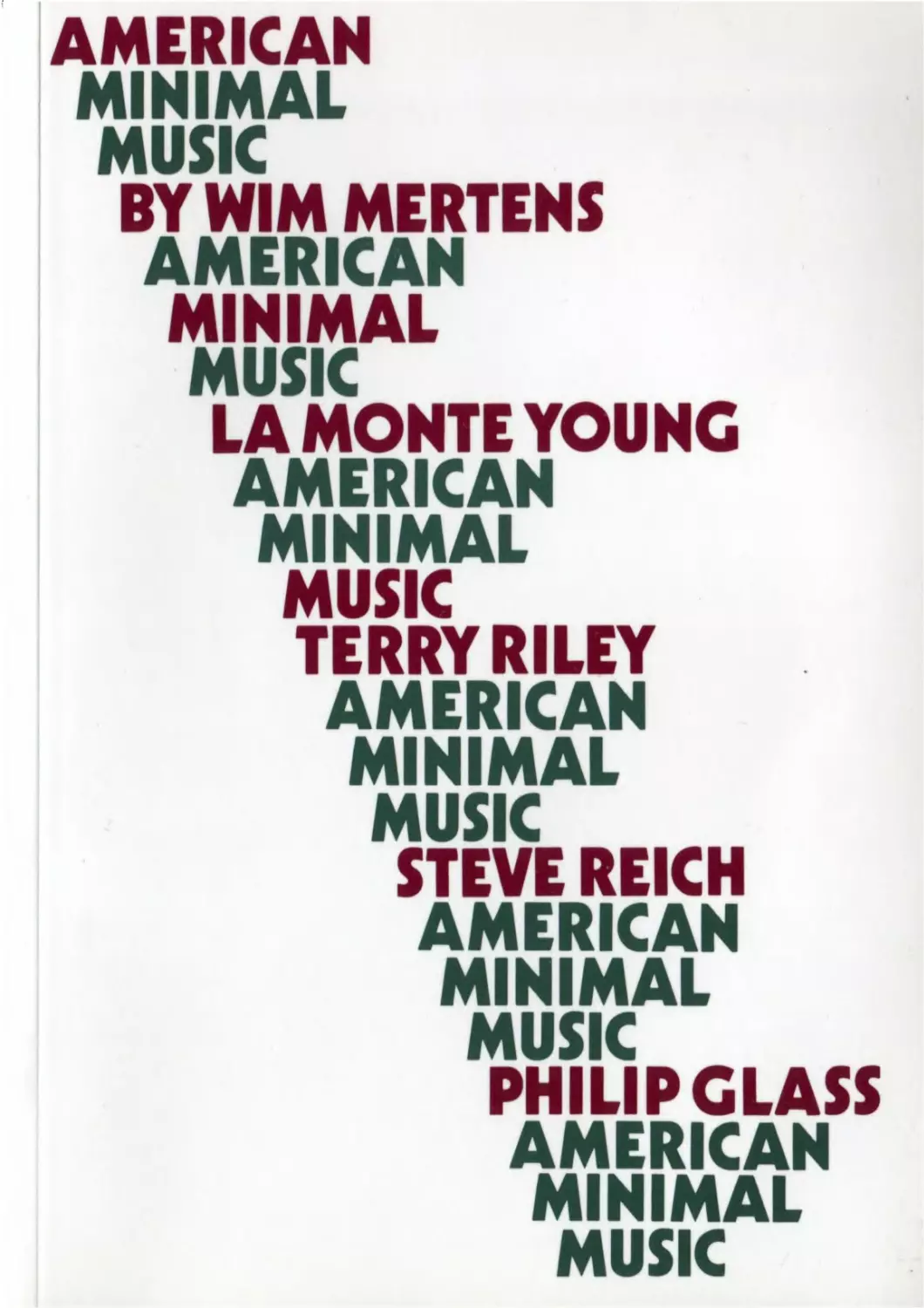


Author: Mertens W.
Tags: art music musical art musical composition
ISBN: 978-1-871082-00-5
Year: 1983

Text
                    AMERICAN
MINIMAL
MUSIC
BYWIM MERTENS
AMERICAN
MINIMAL
MUSIC
LA MONTE YOUNG
AMERICAN
MINIMAL
MUSIC
TERRY RILEY
AMERICAN
MINIMAL
MUSIC
STEVE REICH
AMERICAN
MINIMAL
MUSIC
PHILIP GLASS
AMERICAN
MINIMAL
MUSIC


w	trLr^njr Is lilff
UlTjjUy Vla-y	ТХЦт*Л£

American Minimal Music
To Anne
Wim Mertens
American
Minimal
Music
La Monte Young
Terry Riley
Steve Reich
Philip Glass
Translated by
J Hautekiet
Preface by
Michael Nyman
Kahn & Averill, London
First published in Belgium in 1980
First English edition published in 1983 by
Kahn & Averill
9 Harrington Road, London SW7 3ES
Copyright © 1983 by Wim Mertens
First paperback edition published by Kahn & Averill in 1988
All rights reserved
Reprinted 1991, 1992, 1994, 1999, 2004, 2007
British Library Cataloguing in Publication Data
A catalogue record for this book is available from the British Library
ISBN 1-871082-00-5
ISBN 978-1-871082-00-5
Photoset in 11/12 Plantin
Printed in Great Britain by
Halstan & Co Ltd, Amersham, Bucks
Contents
Preface	7
Part 1:	American Minimal	Music	11
The Composers and	their works	19
La Monte Young	19
Terry Riley	35
Steve Reich	47
Philip Glass	67
Basic concepts of minimal music	87
Part 2:	The historical development of basic concepts
Arnold Schoenberg	96
Webern and post-serialism	99
Stockhausen	101
John Cage	104
Part 3:	Ideology
TW Adorno	114
Libidinal philosophy	118
Bibliography	126
Acknowledgments	128

Preface
The four composers whose work provides the basic material for this
stimulating and provocative study established their individual and
collective musical identities in America in the mid sixties. In 1972
I devoted most of the final chapter of my book Experimental Music
- Cage and Beyond to these composers: information was somewhat
scanty and I was aware of the feeling of breaking dangerous new
ground in describing their work in the context of the ‘Cage tradition’.
At that time Reich’s Drumming and Glass’s Music with Changing Parts
had just appeared, though Riley’s A Rainbow in Curved Air had not,
and the music was just beginning to break away (as far as one could
see from London) from the more or less exclusive following of an
admittedly ever-growing circle of initiates. Although one usually
has to exempt the work of La Monte Young from any generalised
statements about this loosely-connected ‘group’, the music of at least
three of these composers has developed rather startingly in such a
way as to become uniquely accessible to a far more broadly-based
audience than seemed possible in 1972: it has been remarkably suc-
cessful in beginning to break down culturally-erected barriers that
separate the ‘new music’ audience from the ‘popular music’ audience.
This broadening of appeal (a fascinating dialectic of the music
changing the audience and the audience changing the music) can be
neatly symbolised both in terms of where the music has been per-
formed in, say, New York (the shift from private lofts and art galleries
to the Carnegie Hall and the Bottom Line rock club) and in the way in
which it has become (increasingly) available on record (from minority
‘new music’ classification, poorly-financed art gallery records, self-
financed, -produced and -publicised independent labels, to major
8
Minimal music
jazz, rock and classical labels, without any need for classification and
categorisation.)
But paradoxically such a quintessentially American and seemingly
anti-European music has been largely supported and fostered by
European musical institutions: European radio stations, European
music festivals, European concert halls and opera houses and in
Reich’s case, European record companies.
Since 1972 (or even 1974 when Experimental Music was published)
this music has become something of an established fact and the com-
mentator no longer needs merely to describe or proseletyse: it is now
possible, and indeed necessary, to put this music into a broader artistic,
cultural, aesthetic, social, musical and critical perspective. Hence
the value and relevance of Mertens’ book, which approaches this
so-called minimal music from a simultaneously broad and detailed
viewpoint, is both analytical and polemical, distant and personal,
limited to the music itself and yet positioning that music in a wider
aesthetic/ideological context than is customary.
Mertens’ thesis gains strength from its self-imposed limitations:
it deals with the ramifications of the music as music, leaving to other
writers the detailed discussion of other cultural cross-connections —
with minimal art and structuralist film, with rock and non-Western
musical techniques, for example. And Mertens’ personal viewpoint
gains strength also through its exclusively European orientation: the
conceptual, procedural, structural and temporal preoccupations of
these composers is not viewed as arising from a radical break with,
and separation from recent European musical tradition, but simply as
a logical continuation of that tradition. Adorno is invoked as charting
the beginning of the breakdown of this tradition in the works of
Schoenberg (it is interesting that Adorno’s analysis would be far
more accurate if for ‘Schoenberg’ one read ‘Cage’) and in the works
of Deleuze and Lyotard, Mertens has discovered a far more positive
and congenial philosophical and ideological context in which to place
the music of this earlier but still fruitful generation of American
composers.
Michael Nyman
London
1 American Minimal Music

By the designations American Minimal Music or “Repetitive Music”
one usually understands the music of the composers La Monte
Young, Terry Riley, Steve Reich and Philip Glass. These four
American composers were the first to apply consistently the
techniques of repetition and minimalism in their works. Their music
developed in the 1960s in America, and during the seventies became
very successful in Europe as well. At the same time the American
music seems to have influenced or inspired a great number of
European composers, although the nature of this influence and the
identity of this European repetitive music is not the subject of this
book. It is sufficient to indicate that composers like Michael Nyman
and Gavin Bryars in Great Britain, the Dutchman Louis Andriessen,
Richard Pinhas and the group Urban Sax in France, Peter Michael
Hamel and Michael Fahres in Germany, and the Belgians Karel
Goeyvaerts, Frans Geysen and Dominique Lawalree are implicitly or
explicitly concerned with forms of repetition or minimalism in (parts
of) their work. Although these composers generally use analogous
techniques, they do not share the repetitive aesthetics of the four
American composers. Similarly in German space-rock of Klaus
Schulze or Kraftwerk for instance or in the experimental rock of the
(early) XTC or Public Image Ltd (PIL), one can also observe the
influence of repetitive music.
Thus we can see a general trend for which the title minimal music is
only an approximate description. Indeed there are other names in cir-
culation like repetitive music, acoustical an and meditative music which
attempt to pigeonhole this music.
The term minimal music refers to the extreme reduction of the
musical means the four American composers we are here concerned
12
Minimal music
with use in their works. Obvious though this reduction is, one must
ask whether it is important enough to function as a fundamental
characteristic of this music. Strictly speaking the term minimal can
only be applied to the limited initial material and the limited trans-
formational techniques the composers employ, and even this is only
the case in the earlier works of Reich and Glass. Certainly one can
usually observe in this music a dominant equality of timbre and
rhythm, a constant density and a very limited number of pitches. But
in terms of length these compositions are certainly not minimal.
Terry Riley, for instance, is well known for his All-Night-Concerts
and Glass’s Music in Twelve Parts lasts longer than four hours.
Moreover, one can see an increase in the rhythmic and harmonic
complexity of repetitive music as each of the composers themselves
(apart from Young) has developed. While Reich used only six pitches
in Piano Phase (1967), this number increases to nine in Music for
Mallet Instruments, Voices and Organ of 1973. And just like Glass,
Reich expanded his originally limited and uniform instrumentation,
resulting in increasingly differentiated timbres. In Phase Patterns
(1970), Reich introduces a second (melodic) motive while some ten
motives appear in Drumming (1971). Thus the term minimal music is
only partially satisfactory as a label for this tendency.
Moreover, minimalism is not the exclusive property of this
American music, since one finds “minimal” means are just as much a
characteristic of Indian, Balinese and West African music. In fact
ethnic music has itself had a strong influence on the works of these
four American composers: for Young, Riley and Glass the influence
was that of Indian music, while Reich has been influenced by West
African and Balinese music.

Minimal music
13
Repetition is also a basic characteristic of European polyphonic
music of the Renaissance period finding its most eloquent expression
in the so-called ‘syntactic style’ of structural imitation.
Repetition also features in the decorative (as opposed to structural)
imitation of earlier French and Italian secular and sacred music of the
14th century. In the manuscripts TuB (c 1400) and Codex Ivrea (c
1360) one can find repetition used to illustrate the concept of
composition which strives for le jeu avec le son. A remarkable example
is Cum MarteUi, an Italian ballad for three voices, in which a scale
rising from the tonic to the leading note is gradually built up in the
upper voice, and is then broken up in the same manner.
14
Minimal music
2 An example of repetition in the Italian ballad for three voices, (Cum Martelli)
Minimal music
15
In the A rs Nova, the most notable use of repetition is to be found in
the isorhythmic technique, where fixed melodic and rhythmic series
are repeated, usually out of synchronisation. Without attempting to
give an exhaustive summary of the use of repetition in European
music, a final mention should be made of Vexations by Erik Satie, in
which the same motive is repeated 840 times, producing a compo-
sition that lasts something more than eighteen hours.
In addition to the term minimal music, there is also acoustical art
(Ac’ art), which Herman Sabbe has used by analogy with Op Art:
“...while the technique of repetition and multiplication of similar
short cells, linked in a continuous, gradually variegated progression
and transition of one motive to another related motive, produces a
static, though incessantly moving, acoustic texture, that seems to be
an aural analogy to the visual experience of observing an Op Art
painting...”. This definition does .indeed say something about the
composition technique employed — the use of identical or similar
short cells, the importance of repetition, etc. — as it does also about
the psycho-acoustic effects of this music — to produce an acoustic
texture and experience that does seem analogous to the visual
experience of viewing an op art painting.
And certainly La Monte Young’s music undoubtedly parallels in
sound the treatment of colour by certain American painters like
Newman, Kelly and Noland, whose works confront the retina with
vast colour areas that produce unexpected vibrations that appear to
pulsate. On the other hand, one has certain reservations as to whether
the repetitive use of short cells is the most important compositional
technique used by these composers.
If it can be used at all, the term acoustical art only applies to Glass’s
and Reich’s music. Glass is not afraid to introduce sudden, unpre-
pared transitions beside the gradual transitions in his music from
Music with Changing Parts of 1970 onwards. An essential element in
his musical thinking is the disorientation of the listener by upsetting,
in a treacherous or brutal way, what could seem, at first sight, a music
made stable or harmless by the comfort of repetition.
Steve Reich’s development has been similar from Six Pianos (1973)
on, especially in Music for Mallet Instruments, Voices and Organ
(1973), with its use of sudden transitions in keys or measures. These
sudden transitions do not fit the description of the term ac’ art. In
fact, the term is exclusively and entirely applicable only to the music
of Terry Riley.
16
Minimal music
The term meditative music too strictly refers to an extra-musical
event and stresses that in American music a particular effect on the
listener is sought after. Indeed this may be correct, but it is too strong
a devaluation of the music to suggest that it is merely a psychological
instrument of influence.
The term repetitive music — which is also retained in this book —
refers to the decisive nature of the repetition as a structural principle
in contemporary American music, because this music repeats every-
thing that can be repeated. In its early days the repetition concerned
only short or long melodic and rhythmic cells, but later on it was also
applied to chord progressions.
The term repetition, however, can hardly be used for La Monte
Young’s music, since in this case the principle of continuity is
decisive. However, Young did compose some repetitive works —
mainly in his immediate post-Fluxus period — as in his X for Henry
Flynt. On the other hand, we also find a striving for continuity
alongside repetition in the work of Reich and the other composers.
Glass, for instance, produces continuity by repeating complexly
structured patterns. In the works of Riley, Glass and Reich the use of
repetition results in the continuity of the uninterrupted process. This
repetition only applies to the micro-structure of their music — the
macro-structure is only transformative. Young’s approach to rep-
etition is not transformative, and is thus distinguished from the other
three composers. Indeed, Young’s use of continuity can be
considered as a particular form of repetition, so that it is misleading to
speak of an opposition between him and the three other composers:
there is, at most, a difference in stress.
Before sketching the portraits of these four composers, it might be
useful to consider the difference between the use of repetition or
techniques of repetition in traditional Western music and American
repetitive music.
The use of repetition is not new at all. What is new is only the global
musical context in which it is used, and it is only this situation that
allows us to distinguish between American repetition and repetition
in classical music. In traditional music, repetition is used in a pre-
eminently narrative and teleological frame*, so that musical com-
* The term teleology has its origin in the Greek telos (purpose) and originally was a
concept in natural philosophy referring to certain directcdnesses that can be dis-
tinguished in nature, and mainly in living nature. Within the modern science of
nature a distinction is made between teleology and finality. With teleology, the
Minimal music
17
ponents like rhythm, melody, harmony and so on are used in a causal,
pre-figured way, so that a musical perspective emerges that gives the
listener a non-ambivalent orientation and that attempts to inform
him of meaningful musical contents.
The traditional work is teleological or end-orientated, because all
musical events result in a directed end or synthesis. The composition
appears as a musical product characterized by an organic totality. By
the underlying dynamic, dramatising construction, a directionality is
created that presumes a linear memory in the listener, that forces him
or her to follow the linear musical evolution. Repetition in the
traditional work appears as a reference to what has gone before, so that
one has to remember what was forgotten. This demands a learned,
serious and concentrated, memory-dominated approach to listening.
The music of the American composers of repetitive music can be
described as non-narrative and a-teleological. Their music discards
the traditional harmonic functional schemes of tension and relaxation
and (currently) disapproves of classical formal schemes and the
musical narrative that goes with them (formalizing a tonal and/or
thematic dialectic). Instead there appears non-directed evolution in
which the listener is no longer submitted to the constraint of
following the musical evolution.
directedness is defined but one cannot determine scientifically whether there is also
an intention behind it. Here the distinction is made between Zveeck and Absicht,End
and Purpose. We will not retain this distinction, except in the sense of external and
internal musical purposes. The external musical directedness corresponds to what is
above called Absicht and Purpose. It includes the expression of feelings, the symbol-
isation of situations and the imitation of actions. In this sense, teleological music is a
music that has a representative function. (Programme music is a particular example
of this external directedness).
Internal directedness refers to the evolution within the music itself, and not to a
representational content directed from the outside. In Western music, this kind of
directedness is realized through the strong stress on harmony, which can be seen as
an evolutional model aiming at a final climax. Thus, Western music is essentially
dialectical’, development follows from the presence of a conflict between opposites
and finally leads to a situation of synthesis, in which conflicts are entirely or partially
resolved. This can be called narrative by analogy with the evolution of a classical
novel, in which the denouement resolves the conflicts of the plot.
The concepts “teleology” and “narrative” run in parallel so that, as in the case of
teleology, a distinction can be made between the narrative in the external and internal
sense.
3 La Monte Young, Pandit Pran Nath and Marian Zazccla
The Composers and their works
La Monte Young
La Monte Young was born in Bern, Idaho, on October 14, 1935. At
an early age he played guitar, saxophone and clarinet and learned how
to tap-dance. In interviews Yound has said that as a boy he was greatly
impressed by noises like the incessant whistling of the wind, the
humming of insects, running water and the rustling of trees.
Later on he became fascinated by jazz musicians like Lee Konitz,
Eric Dolphy and John Coltrane and from 1955 till 1956 Young studied
composition with Leonard Stein, a colleague of Arnold Schoenberg.
At the University of California, Los Angeles, Young studied music
theory, composition, and ethno-musicology. In the summer of 1959,
he attended Karlheinz Stockhausen’s seminars in Darmstadt and he
made an intensive study of John Cage’s works. In 1960 Young went to
New York to study electronic music with Richard Maxfield, in the
‘New School for Social Research’ where he also met George Maciunas,
the ‘leader’ of the Fluxus ‘movement’. It was only after he had
finished this training that Young began to write music. He worked for
Beatitude, Chester Anderson’s magazine which published important
scores, poems and texts and which seems to have been a stimulus for
Fluxus. The editors of Beatitude invited Young to make a special
edition that did not appear in its desired form, but which became the
foundation of An Anthology (1963), which Young put together with
Maciunas and Jackson Mac Low. This book was a collection of
scores, essays, dance constructions, poetry, concept art, etc., by a
number of artists; Earle Brown, Dick Higgins, Christian Wolff,
Richard Maxfield and Young himself. It was republished by Heiner
Friedrich in Munich in 1970.
With Maciunas and Mac Low, he also set up ‘performances’
involving Joseph Byrd, Henry Flynt, Richard Maxfield and Toshi
20
Minimal music
Ichyanagi. As musical director, Young worked for some years for the
choreographer Ann Halprin, often in conjunction with Terry Riley.
In 1963 he married the painter and light artist Marian Zazeela, with
whom he had worked since 1962. And in the same year he formed
“The Theatre of Eternal Music” with her, an ensemble which in-
cluded Tony Conrad, the well-known producer of minimal movies
and John Cale, which was devoted solely to the peformance of his own
music.
With Zazeela he also compiled Selected Writings, a volume of his
writings and interviews. From 1970 on Young and Zazeela studied
with the Indian musician Pandith Pran Nath. After an intensive
period of concert work in Europe in the first half of the seventies,
Young has performed less and less in public.
La Monte Young’s work can be divided into three periods. From
1956 till 1958 he wrote serial music: between 1959 and 1961 Young’s
work was part of Fluxus; and it is from 1962 that what one would call
his actual repetitive period starts. But there is an extreme continuity
between these three periods, and the transition between periods is a
gradual process that can be illustrated by the comparison of Five
Small Pieces for String Quartet on remembering a Niad (1956) and Octet
for Brass, composed a year later. Both pieces are written in a mainly
serial style, but the length of the sustained notes gradually increases.
Though long notes already appear in Five Small Pieces, Young says he
introduced consciously long notes, sometimes lasting three or four
minutes — within the serial style — for the first time only in his Octet.
Young’s serial works are clearly precursors of his later compositions
in that they favour spare textures with long-held pitches which are
very limited in number.
Anton Webern’s works interest Young particularly. He was at-
tracted by certain aspects of Webern’s music, especially the duality
between its structural variation and the static sound that results from
it. In Webern there is a tendency to produce continuous variations by
using notes in the same octave position throughout a piece, whatever
their position in the row. However, the listener perceives this process
more as a stasis, as if the same information is being repeated over and
over again.
La Monte Young
21
The String Trio for violin, viola, and cello, or for string orchestra
(1958), the most important work of this period, refines the long-note-
style, and results in the elimination of each melodic line in favour of a
harmonic consonance and long periods of silence. This way of working
is opposed to the one he used in For Guitar of the same year, where,
taking into account the playing technique of the acoustic guitar, no
long-held tones appear but only long notes that last three or four
minutes*.
The use of long notes is in itself no novelty, but up till recently they
were only used as a drone over which a melody was placed. For Young
it is precisely these long notes that are the subject of his music. They
do not play the role of an individual part, but they contribute to an
overall sound spectrum, as a result of which the components have a
different duration. The consonance is far more important than the
vertical development of the individual parts. About Trio we can say
that the timbres are deliberately colourless, and the slowly bowed
tones are played without vibrato. The dynamic levels are not constant,
but are limited to the range from pppp to p.
In 1959, Young worked along with Terry Riley for the choreogra-
pher Ann Halprin. Together they experimented with very long,
unusual sounds that are held for minutes or sometimes hours on end.
This method of working, together with the combination of dance and
theatre — so important in Fluxus — and the stress on improvisation,
point to the direction of Young’s later works.
Fluxus is an anti-art movement, a movement of art nihilism and
concretism, attempting to create a close, unbreakable link between art
and life. The movement has George Maciunas to thank for its name.
Maciunas indicated three aspects of Fluxus in a 1963 manifesto: as a
revolution realizing the interaction between art and life, regarded
purely as a means for releasing excess tension, and as catalyst in the
united front of socio-political revolutionaries. The purposes of the
movement are, according to Maciunas, more of a social than of an
aesthetic nature. Art has to become comprehensible to everybody and
he disapproves of art as an object without function, of the artificial
separation between artists and audience, of individualism in art, etc...
In brief, the purposes can be paraphrased under the slogan: “Art is
Life, and Life is Art”. Fluxus can be considered as the musical
equivalent of the ‘Happening’ in visual arts. Fluxus is more anarchistic
* For Guitar (1958) was given its first performance only in December 1979 in The
Kitchen, New York, by Ned Sublette.
22
Minimal music
though, and often expresses itself in aggressive, destructive brutality
and in the deliberate irritation of the audience.
Protagonists from all branches of art worked in Fluxus. Among
them were George Brecht, Dick Higgins, Ben Vautier, La Monte
Young, John Cage, Chieko Shiomi and Nam June Paik.
The start of Young’s Fluxus period can be situated in 1959, when
he first heard John Cage’s music in Darmstadt, more particularly the
works Cage wrote after his String Quartet and his Sonatas and Interludes
for prepared piano: Concert for Piano and Orchestra of 1958, played by
David Tudor, especially impressed Young. In his Lecture I960, he
says that his activities with Ann Halprin were the most decisive in
determining the direction of his later works. Through his improvis-
ations with Riley he discovered that people have always tried to force
sounds to express what the composer wants, and this produces the
kind of boredom he experiences when listening to most traditional
music. “We must let sounds be what they are,” Young says. Young
wants to make it clear that sounds have their own existence, inde-
pendent of human existence. This approach has an educative aspect: a
sound docs not have to be linked successively with another sound to
be interesting; it is interesting in itself, and only when produced fora
very long time can we learn anything from it.
A second important influence in Young’s works is the work in
electronic music he did in 1960 with Richard Maxfield, musical
director in Yoko Ono’s studio and very much appreciated by Young
as sound engineer and composer. As in Young’s work, the stress in
Maxfield’s music is on static composition and progressive development.
Young still retained his convinced Fluxus attitude and without
interruption went in search of new sounds. In 1959-60 Young wrote
pieces of a destructive nature and works where instruments arc
treated in fairly unusual ways, and in which an indeterminate element
plays an important part. Examples arc Vision for eleven instruments
(in which numbers in a telephone directory determine the time and
space in which the thirteen well-defined sounds are created), Piano
Piece for David Tudor No. 1 andComposition 1960 No. 2. He also gives
attention to the social aspects of performance, in Composition 1960
No. 3, No. 4, and No. 6 for example.
[ j Monte Young
23
Piano Piece for David Tudor #1
Bring a bale of hay and a bucket
of water onto the stage for the
piano to eat and drink. The
performer may then feed the piano
or leave it to eat by itself. If the •
the former, the piece is over after
the piano has been fed. If the
latter, it is over after the piano
eats or decides not to.
October 1960
4 Piano Piece for David Tudor No 1
Composition 1960 #2
Build a fire in front of the audience. Preferably, use wood al-
though other combustibles maybe used as necessary for starting
the fire or controlling the kind of smoke. The fire may be of
any size, but it should not be the kind which is associated
with another object, such as a candle or a cigarette lighter.
The lights may be turned out.
After the fire is burning, the builder(s) may sit by and watch
it for the duration of the composition; however, he (they) should
not sit between the fire and the audience inorder that its mem-
bers will be able to see and enjoy the fire.
The composition may be of any duration.
In the event that the performance is broadcast, the microphone
may be brought up close to the fire.	5 5 60
24
Minimal music
Composition 1960 #3
Announce to the audience when the piece will begin and end
if ther? is a limit on duration. It may be of any duration.
Then announce that everyone may do whatever he wishes for
the duration of the composition.	_ , , , л
5-14-60
Composition 1960 #4
Announce to the audience that the lights will be turned off for
the duration of the composition (it may be any length) and tell
them when the composition will begin and end.
Turn off all the lights for the announced duration.
When the lights are turned back on, the announcer may tell the
audience that their activities have been the composition, al-
though this is not at all necessary.	, o
о - 5 • oU
Composition 1960 #6
The performers (any number) sit on the stage
watching and listening to the audience in the
same way the audience usually looks at and
listens to performers. If in an auditorium, the
performers should be seated in rows on chairs
or benches; but if in a bar, for instance, the
performers might have tables on stage and be
drinking as is the audience.
Optional: A poster in the vicinity of the stage
reading: COMPOSITION 1960 *6
by
La Monte Young
admission
La Monte Young
25
(price)
and tickets, sold at stairways
leading to stage from audience,
admitting members of the audience
who wish to join the performers on
stage and watch the remainder of
the audience.
A performance may be of any duration.
July 2, 1960
5 Composition 1960 Xos 2,3,4 & 6
In Composition 1960 No. 3 Young asks that the beginning and
ending of the piece be announced, and indicates that during that
time-period there is total freedom of action. In Composition 1960 No. 4
the audience does not know when the work starts, how it develops and
when it stops; the lights are turned out and after some time — when
the lights are on again — people are informed that the subject of the
piece was the actions and reactions of the audience. Composition 1960
No. 6 portrays best of all the traditional role of performer and audience
by having the former observe the latter.
In Two Sounds, from the middle of his Fluxus period, characteristics
of Young’s later work appear again, namely the use of sustained tones
and a long overall duration. The composer secs sound as atomic, as a
singular event isolated from its surroundings. Dieter Schnebel speaks,
in this context, of “through-composed momentary musical snapshots”.
Young faithfully follows John Cage’s aesthetic since he also wants to
“free sound of all local and physiological ballast”. However, a dif-
ference between Young and Cage lies in Young’s concentration on
only one event, while (Lage’s works treat different events occurring
simultaneously in a given period of time. Young’s Fluxus activities
culminated in the foundation of the “Theatre of the Singular Event”.
The first sound of Two Sounds is generated by a circular friction of
metal against glass, the second through friction of metal against
wood. Al Hansen wrote in his book about ‘happenings’ that this
26
Minimal music
sound was held 15 to 20 minutes; it resembled the grinding of train
wheels, and was greated with shouts and catcalls during the first
performance.
Characteristic of this music is the use of extremely reduced sound
material — only two sounds — and, as will be seen later, the conscious
observation of the effect on the listener. “Simultaneously,” John
Cage remarks, “the attentive listener is struck by the simplicity of the
action and by the complexity of the sound”. Young’s desire is to
penetrate the inner essence of the sound, and he has remarked that the
only way to do this is to sustain the sound for a long time. And it is
significant that Composition 1960 No. 7 consists of an open 5th with
the instruction “to be held for a long time”.
CovnpojiJioh 1^7
6 Composition 1960 No 7
The absence of anarchistic, destructive or aggressive characteristics
in a piece like this makes some critics conclude that Young’s work is
not part of the Fluxus ideal. For others the link with Fluxus exists
because the required length of the piece aims only at the irritation of
the audience, while others consider this work to be part of a transitory
phase to Young’s repetitive period.
In 1962 Young wrote 'The Second Dream of the High-Tension Line
Stepdown Transformer which marks his switch to electronics. For this
he selected four pitches and prescribed which of the four can sound
together and which cannot. The notes concerned have the frequency
ratios 36-35-32-24. This means that, if we assume that the lowest note
is Су, the three others sould be С, C $ (less than half a tone from D)
and D.
La Monte Young
27
The length of the sounds is determined by the performers, but has
to be long enough to enable the listener to distinguish gradually the
overtones and combination tones. The foundation of this music is the
drone', continuous, low, sustained sounds, which Young realized
initially with a frequency generator but from 1969 on with a Moog
synthesizer.
However, at this point Young had not yet made a specific move in
the direction of repetitive music. The works of 1961 do point to a
number of aspects that are shown in this kind of music. Young keeps
concentrating on the singular unique event, and at different points
during that year he wrote the same composition 29 times: Draw a
straight line and follow it. This is the same composition as his Compo-
sition 1960 No. 10 — in fact Young wrote 30 differently dated pieces,
with the instruction Draw a straight line and follow it. The first com-
position that employs actual repetition as a structural principle dates
from 1960 and is known as Arabic Numeral (any integer) for Henry
Flynt or X for Henry Flynt. It prescribes a heavy sound or cluster
being repeated uniformly, regularly and for a long period. The work
differs from the music of other composers of repetitive music in re-
peating one and the same sound and not a motive or succession of
differend sounds. The essence of Young’s Fluxus-inspired works is to
look for a means to let the music explore the world of the sound in an
unusual but therefore more efficient way. Young’s Fluxus period
should be seen as a transition period in which the most important
basic characteristics of his work, like held notes and long duration, are
further developed.
In 1967, Young formed his own ensemble — The Theatre of Eter-
nal Music. He even considered a space for the permanent performance
of his music and thus the “Dream House” project was created in 1964.
Young envisaged this “Dream House” as a space in which people live
and make music. Initially the ensemble consisted of Young, soprano
saxophone; Angus McLise, percussion; Marian Zazcela, voice, and
Tony Conrad and John Cale, strings. Almost all the music that Young
wrote after 1962, such as The 'Tortoise, his Dreams and Journeys,
consists of two levels: one level made up of preselected pitches that
are held continuously, as the basis, the subject of the music, and a
second level of long-held pitches which form the basis for improvis-
ation. On this second level the pitches are also selected according to
which of them are consonant in the improvisation and which are not.
Exceptions from this compositional technique are The Second Dream,
28	Minimal music
Studies in the Bowed Disc, and The Well-Tuned Piano.
The Well-Tuned Piano of 1964 is the most frequently played work
from The Theatre of Eternal Music and is still in Young’s current
repertoire, along with excerpts from Tortoise (see later). The pitches
in The Well-Tuned Piano are selected according to the harmonic
relationship between the notes: only those notes that have an overtone
relationship to each other, or both to a third, can be used. The
relationship between the overtone and the key-tone must be reducible
to a simple fraction. Therefore The Well-Tuned Piano cannot be
played at a keyboard in tempered tuning, because in that tuning only
a G and an A have a frequency that can be expressed in whole
numbers.
7 La Monte Young: The Well-Timed Piano
Why then, one could ask, docs La Monte Young aim for this
precision? The reason lies in the relationship between periodicity and
repetition. Precisely these harmonic sounds can, because of their
proportional relationship to the key-tone, be expressed in whole
numbers, one periodic and regularly repetitive. This mathematic
precision also has physiological consequences. Daniel Caux says that
“the relationship between two or more frequencies can best be
assumed by the human brain when the information is periodic”.
Young becomes increasingly interested in the determination of this
kind of influence on the listener.
1Л1 Моше Young	29
Like The Well-TimedPiano, The Second Dream is a piece that only
consists of one sound line. This also goes for Studies in the Bowed Disc
(1963), a work in which Young and Zazeela bow a gong specially
manufactured for this work by sculptor Robert Morris. Young and
Zazeela decide, independently, how long to bow the gong for,
resulting in a sustained sound mass. Unlike previous pieces, a noise is
produced instead of pitches that are adapted to each other, and
another difference lies in the use of improvisation at ground level.
In 1964 the personnel of The Theatre of Eternal Music changed
and from 1964 till 1966, it included Young, who no longer played the
saxophone but sang instead; Zazeela, voice; Conrad and Cale, strings
and (sometimes) Terry Riley, voice.
The new line-up coincides with the beginning of performances of
'The Tortoise, His Dreams and Journeys, and from 1965 on Marian
Zazeela’s light-environment The Ornamental Lightyears Tracery, is
an integral part of The Theatre of Eternal Music performances. And
just as Young carefully selects pitches and adapts them to each other,
Zazeela groups slides that belong to each other. The intensity of the
“light bundles”, the purity of the colours and the effect of one colour
on another are often adapted to the musical event.
The Second Dream is a direct precursor of The Tortoise. The tor-
toise acts as metaphor for the idea of playing the piece continuously
— a piece which has no beginning or end and which thus cannot be
recognised as a limited wrhole. Young’s performances are meant to be
excerpts of the total work that is supposed to continue between
performances, which themselves only take up the interrupted thread.
'The 'Tortoise music is modal; Young still uses basic pitches, the drones
that are sustained for an unlimited period of time. Young says of these
drones that “they are the first sound in the Tortoise’s life. They are
primitive sounds that do not remember ever to have started and that
are perpetuated in the Dream House project”. The preselected
drones serve as the starting point for an improvisation in which the
overtones are strictly adapted to this key-note. Thus simple intervals
are created in which the continuity of the drone is central and over-
tones are added only to obtain more relief. From the consonance of
key-note and overtones spring combination tones, the so-called sum
and difference tones, which finally results in a very complex sound.
“We do not necessarily experience frequencies as a consequence or as
a melody, they can as well be observed as a proportion to a fixed tone”,
says Young.
30
Minimal music
In Drift Studies (1966), Young experiments with harmonically
adapted sine tones, and is part of the total Tortoise project: they arc
studies in the deviation effects that are created when simultaneous
oscillation produces two or more constant sine waves. These deviation
effects are caused by a change in the phase relation of the sine waves
which, despite the high stability of the oscillators, deviate in pitch.
One gets the “sensational feeling that the body softly starts flowing
off in space and time synchronously with these waves”, says Young.
A second effect of Drift Studies has to do with the division of the air
pressure areas in a room. In the high pressure areas the sound is
louder than in low pressure areas. For Young the positioning and the
spatial mobility of the listener are an integral part of the experience of
the composition. From 1966 on Young always used electronically
generated frequencies to produce his continuous sounds, whereas
previously the drones had been produced by an audio-frequency
generator tuned to a certain pitch, or by a turtle-motor that had
previously been used to run an aquarium filter. But from the end of
the sixties Young produced his drones by means of the ultra stable
sine wave oscillators of a Moog synthesizer built especially for Young’s
work. In 1966 he composed Map of 49 's dream the two systems of eleven
sets of galactic intervals Ornamental Lightyears Tracery. This total
environment, part of the Tortoise, his Dreams and Journeys, consists of
a series of light and sound frequencies whose basis is The Two systems
of eleven categories 1:07:40 AM 3X 67- an adaptation cA2-3PM i2Xl
66-3: 43: AM 28X11 66 for John Cage from Vertical Hearing in the
Present Tense. Vertical Hearing in the Present Tense is a theoretical
work dealing with the total dominance of the harmonic structure of
the music, in which Young describes a method of controlling, with
acute precision, the combined and the generated frequences. {Generated
frequencies are tones produced by the voice, a musical instrument or
an oscillator and combined frequencies are the sum and difference
tones that are produced when two or more generated frequencies
sound together).
Map of 49 ’s Dream also examines the effect of continuous, periodic
sound waves on an audience exposed to these sounds for a number of
hours. By this means Young realised one of his main purposes, namely
the creation of a totally surrounding environment made up of fre-
quency structures in sound and light. The first public performance of
this show was given in 1969 in the Heiner Friedrich gallery in Munich.
Since 1966 Young has had a sound-producing installation in his
La Monte Young
31
S Map of 49's Dreanr. the two systems of eleven sets of Galactic intervals ornamental
Light-years Tracery
house in New York. These systems are audible for 24 hours a day, and
sometimes last for weeks or months. He and Marian Zazeela work and
live in this space and frequently invite people who are asked to inform
them of their reactions, and these are later made the subject of
extensive reports.
In order to master the precise intonation required in the vocal parts
in Map of 49’s Dream, Young and Zazeela have studied with Pandit
32
Minimal music
Pran Nath, whose Indian musical training has given him a very strong
control over vocal pitch. Young says that it is hard to pitch sine tones
without their overtones, and that often too much importance is
attached to melody: “Melody does not exist at all (The Disappearance
of Melody), unless one is forced to hear as melodic the movement of a
group of different simultaneously sounding frequencies, deduced
from one series of overtones to another, due to previous musical con-
ditioning. Even before the first human being went from one fre-
quency to another (melody), the relationship of the second frequency
to the first was predetermined (harmonically) by the overtone-
structure of the key-tone of the first tone. And in the Tortoise’s life,
the drone is the first tone.”


Terry Riley
'ferry Riley was born in Colfax, California, on June 24, 1935. From
1955 till 1957 he studied composition at the San Francisco State
College. Later he worked under Robert Erickson, studied piano with
Duane Hampton at the San Francisco Conservatoire of Music with
Adolf Baller. He financed his studies by working as a ragtime pianist
in the Gold Street Saloon in San Francisco. Riley wrote his first
composition at the age of 19. He formed an improvisation group with
Pauline Oliveros and Loren Rush and during 1959 and 1960 he and
La Monte Young worked with choreographer Ann Halprin. He
finished his studies at the University of California, Berkeley, in 1961
with Seymour Shifrin and William Denny. For two years from 1962,
Riley toured around Europe. In France he performed with a theatre
company and in Scandinavia he took part in ‘happenings’, street
theatre and jazz-concerts. At this time Riley gave his first All-Night-
Concerts, playing saxophone and several keyboard instruments, and
when he also began composing his first repetitive works. Back in New
York in 1964 Riley began to examine the possibilities of electro-
acoustic music.
In 1967, the Royal Academy of Music of Stockholm and the
Swedish Radio invited him to produce musical programmes and give
lectures. In the same year he gave an All-Night-Concert in the
Philadelphia College of Art where An All Night Flight for solo-
saxophone lasting 8 hours and 30 minutes was first performed.
During this period, Riley often worked with Arlo Acton, who
devised spherical loudspeakers to give optimal sound reproduction.
In 1969 Riley received an award for the music he composed for the
film Music with Balls. Like La Monte Young and Marian Zazeela,
Terry Riley has also been a pupil of Pandit Pran Nath.
36
Minimal music
Riley’s music has influenced a number of American and European
avant-garde composers and many jazz and pop musicians. The Soft
Machine’s Moon in June is a clear example of this — in fact, the co-
founder of this group, David Allen, was a good friend of Riley’s. The
English group Third Ear Band also show their debt to Riley in their
use of “modal patterns on the principle of periodic progression”.
With John Cale, Riley recorded the LP Church of Antrax and the
Berlin-based band Agitation Free included his In C in its repertoire.
And, finally, the pop group Curved Air took its name from Riley’s A
Rainbow in Curved Air.
While La Monte Young’s early compositions were influenced by
Schoenberg, Terry Riley was initially influenced by Stockhausen.
For Spectra, a piece with different tempo levels for six instruments,
written during his youth, Riley was awarded the Nicola di Lorenzo
prize; although it evidently borrows from Stockhausen’s Zeitmasse for
five wind instruments, Riley’s modal way of writing is quite remark-
able. The String Quartet of the same period is closer to classical
Western music.
During 1959 and 1960, Riley’s and La Monte Young’s improvis-
ations, which gave their great scope for experiment and accident,
served as accompaniment to Ann Halprin’s dance. Although they
used unconventional means of producing sounds they did not use
non-electronic sound source. Around the same period, Cage’s
influence on their work becomes more and more obvious through the
interest they show in acoustic phenomena as such. In 1960, after their
experiments with Ann Halprin, Riley wrote an untitled work for
two pianos and made various tapes, still showing the influence of
Stockhausen. Though both Young and Riley were interested in the
physiological and psychical effects of music, they both had very
different attitudes to these effects. Riley’s music develops out of a
marginal aspect of Young’s work, namely the repetition that Young
used in A rabic Numeral (any integer) for Henry Flynt and Dorian Blues.
While La Monte Young considers repetition as a controlling mechan-
ism, Riley sees repetition more as a means of forming his unusual
material.
Terry Riley
37
This shows a number of differences between the music of both
composers. Riley replaces the constant in Young’s work with
continuously-evolving repetition and multiplication techniques. A
short motive or sound cell is repeated until the performer decides it
should be changed or replaced. The different cells in such compo-
sitions or improvisations are very closely related to each other. For
Riley, repetition in itself has no purpose other than being a musical
means to “rouse emotional vibrations in the listener”. Indeed Riley
has said that he would have been willing to drop repetition immedi-
ately if another system could have brought him closer to his purpose.
And while Young increasingly restricted compositional freedom,
improvisation assumed an ever more important role with Riley.
Initially he wrote the musical cells in traditional notation and in
pieces left it for the performers to determine the number of rep-
etitions of each cell. But later on Riley restricted his activities to solo
concerts in which improvisation becomes increasingly important.
Riley used two multiplication systems in his solo work: tape-loop, a
looped length of tape that repeats the same figure continuously, and
tape-delay, a method that served as an electronic quasi-feedback
system. Riley used tape loops for the first time in his tape piece The
Five Legged Stool in 1961, and used feedback for the first time in the
1963 soundtrack for Ken Devey’s The Gift. For this production he
collaborated with the trumpeter Chet Baker and his jazz quintet. Pre-
recorded tapes of the group were played back by the sound engineer
with slow echo and were repeated through a feedback system which
built the sounds up in cycles. This was a crucial discovery for Riley’s
succeeding projects, in which the idea of a cyclic structure frequently
occurs. In Dorian Reeds the tape delay technique was used for the first
time. This is a procedure by which a given motive is played by an
instrument recorded and reproduced with a short delay which is
brought about by the relative positions of the recording and replay
heads of the tape machines. A second tape recorder can be used and
placed some feet away from the first so that the original material can
be heard a third time. Dorian Reeds includes a number of elements
such as its instrumentation and the use of basic motifs which he
developed further in Keyboard Studies and In C. Composed in the
Dorian mode, Dorian Reeds can also be named Dorian Winds, Dorian
Voices, and so on, depending on which instruments are used in a
particular performance. The basic figure of the piece consists of the
38
Mini)} in I music
series C G F|? G F$C A, which is repeated throughout, though ad-
ditional motifs vary this series rhytmicallv and melodicallv.
In Keyboard Studies No. 2 (1964), Riley used a series of fifteen
modal figures each of which revolve around two or four notes of the
mode. The first figure is repeated continuously as a background
pulse, against which other figures arc outlined. By means of this
repetition, each figure acquires its own rhythmic and melodic profile.
The vertical combination of sounds is relatively unimportant, since
what is important is the superposition of lines and not a succession of
vertical combinations. At this point, Riley’s melodic/rhythmic music
can again be set against Young’s music with its almost exclusive
emphasis on harmony. Because the performers have the freedom to
create several new patterns (which Steve Reich, in reference to his
own music later called resulting patterns), the result sounds entirely
different from what can be deduced from the score.
П.	,	---- 			 -
10 Keyboard Studies \o2
'Г er г у Riley
39
In Keyboard Studies No. 2 only eight different notes aje used,
though octave doublings make the number up to twelve, spanning
only an octave and a fourth. Overall duration is not determined, and
the length of the separate sounds may be long or short, provided they
are of equal length. Changes in dynamics are not permitted and all
parts have to be performed at an identical volume, namely forte. None
of the individual figures is given any more importance than any of the
others and all notes are struck with equal, even attacks. Riley notates
the fifteen melodic cells in the traditional way, adding infinity signs to
indicate the high number of repetitions required.
The motives develop out of one another. The third figure, for
instance, is an extension of the second, which itself repeats notes of
the first figure in a different order; the last three notes of the fourth
figure are the same as the third; the tenth figure is an inversion of the
second, and so on. The first cell is the basic figure in two respects: it is
both a continuous base figure and a generator of all the other figures.
Many of the Keyboard Studies series were not written down,
because of the emphasis on improvisation. The name Keyboard
Studies is appropriate because Riley literally considered these pieces
or improvisations as daily exercises to be used as preparation for his
solo concerts.
Many of the series of pieces — they were never presented as works —
are not dated, or if they are, only vaguely. Keyboard Studies No. 2 (or
The Untitled Organ) is dated 1966 in John Cage’s Notations^ but
according to Daniel Caux it was written in 1964. Another study in the
series, Keyboard Studies No. 7 (1967) clearly illustrates through its
notation the cyclic design that we find in many of Riley’s compositions.
Three figures are written out on seven concentric circular staves.
The figure on the outside stave is the simplest and only includes four
notes: G, Bb, F, Ab, from which the other figures are deduced. The
next five circles carry the same figure, but are arranged according to
superimposed phase shifts. Thus we find the extended first figure:
g’	ab’	g’	bb’	f’	bb’	ab
g’	ab’	g’	bb’	f’	bb’	ab’
g’	ab’	g’	bb’	f’	bb’ ab’ ...
g’	ab’	g’	bb’	f’	bb’	ab’
........	g’	ab’	g’	bb’	f’	bb’	ab’
40
Minimal music
The middle circle has one more pitch: the seven-note theme of the
previous parts, extended with a high C. All circles have the same
number of notes, namely 56.
11 Keyboard Studies No 7 (1967)
To sum up, we can say that Riley’s works are made up of cells that
are continuously repeated and produce ever-new combinations. Thus
his music is produced by the superimposition of a number of indi-
vidual lines which the listener observes in ever-different ways through
repetition and overlapping of predictable accents. It is characteristic
of this evolving repetition that a dualism gradually emerges between
the micro-structure of the sounds and the macro-structure of the
Terry Riley	4/
composition. The constant change at micro-level is indeed linked to
the texture that remains largely invariable and static. Hence the
suggestion of immobility that Riley’s music gives after some time,
despite the quick tempi. Thus Tim Souster’s opinion that “with
Riley it is not what happens at each moment that is important, but
what counts is the development of the whole time process”.
In 1964, Riley composed In C which is generally considered as the
typical pulse piece, though a pulse was implicit in the regularity of the
repeating figures in Keyboard Studies No. 2 and Dorian Reeds. In C, on
the other hand, is considerably more complex, since there are 53
different figures offering far more rhythmic and melodic variation
than does Keyboard Studies. The composition develops from the idea
of starting loops of different lengths on different tape-recorders
bringing about a constant network of overlappings. All the parts are
regulated by and refer to, the pulse of a continuously repeated high
quaver C. Every part is of equal importance, there is no accompanied
melody and no foreground or background. All performers play from
the same score but they may start at different times and choose the
number of repetitions for themselves. This means that each player
will take a different length of time to run through the cells. The type
and number of instruments are free, the only limitation being that
only instruments capable of playing the prescribed pitches may be
used. Unlike Keyboard Studies, which can be performed as a solo
piece, In C is genuinely and exclusively an ensemble piece.
% Г ¥
f	U* • .	f/r 11 life'll
г йотршм >1
й t. ш t11: w 1111111 ф i ш t Zu
42
Minimal music
12 Thirty-five of the fifty-three figures from In C (1964)
An important feature of In C is the limited improvisational freedom
it gives to the performers. Riley almost exclusively concentrates on
the definition of form that “has to be simple enough to lead the
improvisational ensemble of the musicians through good channels”.
Nobody is allowed to play as a soloist, but at the same time, even
though the form has to be respected, this does not hinder the per-
former’s free expression.
From 1967 on, Riley appeared more and more frequently as
soloist/improvisor in a series of so-called All-Night-Concerts. For
Riley’s music — whose intention was to rouse the listener’s emotional
vibrations — it was necessary to place a large number of loudspeakers
around the audience. “The music has to flow in our bloodstream and
we have to be carried by its bloodstream”, Riley has said.
A Rainbow in Curved Air was composed in 1967 for electronic organ
and clavichord, rocksichord, tambourine and dumbec, all played by
Riley using every technique of overdubbing. At the base of this compo-
sition lies a theme of fourteen notes, consisting of two figures played
by the left hand.
13 Basic left-hand figure from A Rainbow in Curved Air (1967)
Terry Riley	43
The first figure consists of two cells of three notes, the second is a
variant of this consisting of two cells of four notes. The figures and
cells can be combined with each other, though the order within the
cells has to be respected. The melodic evolution of the theme allows
each note to be the beginning or end of a musical phrase. This retro-
grade theme runs through the piece as a loop-part. A definite tonality
is nowhere established. Two plateaus can be distinguised during the
course of the piece, the first being a pure repetition (or pulse) plateau,
the second being built up improvisationally.
44
Minimal music
In Persian Surgery Dervishes (1970-1971) Riley elaborates one of
his favourite figures, namely A G Ab Bb F, which appears in his
works from 1964 onwards. His first improvisations Autumn Heavers
and Untitled Organ (or Keyboard Studies No. 2) use it and it also
appeared in Keyboard Studies No. 7. Except for this one written
theme, one can hardly speak of a score in Persian Surgery Dervishes.
Riley considers the function of notation in general to be more like an
aide-memoire.
It is precisely in the freedom that Riley gives to his performers (for
example, In C or the subsequent Olson III of 1967 for instrumental
ensemble and childrens’ choir) that he differs most obviously from
Young, Reich and Glass, who write music that is much more strictly
organized. First of all Riley is a performer who composes and not a
composer in the narrow sense of the word. As with other composers of
repetitive music one can observe in Riley’s music an increasing
complexity over the years, which in his case results from his increasing
improvising experience. A conductor would be superfluous in Riley’s
music, because all those elements that are usually controlled by a
conductor, are absent from Riley’s music which instead deals with
dynamic nuances, tempo changes, obligatory attacks and so on; and
where tempo and rhythm are concerned, performers can always fall
back on the pulse.
In 1967, Riley realized Poppy Nogood^ a work for soprano saxo-
phone and time-lag accumulator, at festivals in Pennsylvania and
Amagansett (Long Island, New York). (A time-lag accumulator is
used to produce an artificially repeated echo, whose length can be
varied). And around that time, Riley also performed Poppy Nogood's
Phantom Band Purple Modal Strobe Ecsftisy at different locations in
New York, along with a group of dancers and acrobats called The
Daughters of Destruction.
Terry Riley situates his music between the Western tradition and
jazz. According to Riley, in the West, people tend to add too much
material. On the other hand, Riley examines only a small amount of
material intensively, and only when the material is exhausted does he
add something new to it.
Thoug Riley has studied with the Indian master Pandit Pran Nath
since 1970, one cannot find any real influence, since he came to
Indian music more by thinking through his own musical ideas. This is
partly proved by the fact that he does not rely on a fixed form-scheme,
which is an important aspect in Indian improvisatory music.
'Г err у Riley	45
Riley is the only one of the four composers under scrutiny whose
music deviates from the principle of objectivisation of the music.
While Young expressed his concern about the role of the traditional
composer handling sounds to express his thoughts, Riley considers
the idea of free improvisation to be an important aspect of spon-
taneous expression. He says that “the music has to be the expression
of spiritual categories like philosophy, knowledge and truth, the
highest human qualities. To realize this, my music necessarily radiates
balance and rest.”
15 Steve Reich
Steve Reich
Steve Reich was born in New York on 3rd October, 1936, studied
philosophy at Cornell University and composition at the Julliard
School of Music and at the Mills College (California), with Luciano
Berio and Darius Milhaud. He remained in San Francisco for some
time, where he devoted himself entirely to composition until, in 1966,
when back in New York, he set up his own ensemble which has since
grown from three to over twenty musicians. In fact the development
of this ensemble goes hand in hand with the gradual evolution of
Reich’s works.
The influence of ethnic music on his compositions is strong. In
1970 he studied drumming techniques with a master drummer of the
Ewe tribe in Ghana, and in 1973 and ’74 he took part in a seminar on
Balinese gamclan music at the University of California, Berkeley. It is
no coincidence that many of the musicians in Reich’s original
cnscmbjc had studied at Wcstlcyan University, whose extensive
course in ethno-musicology or world music was the first of its kind in
the United States.
In 1972 and ’73, Reich collaborated with the dancer/choreographer
Laura Dean, with whom he gave joint performances in Europe and
America. He was invited to Berlin to be an artist — as part of the
DAAD scheme — and in 1974 he published his Writings about
Music. Reich has had several important commissions, such as the
one from the Holland Festival for which he composed Music for a
Large Ensemble in 1979.
In the early part of 1980 the scores of seven works, written between
1967 and 1973, were published by Universal Edition (London).
48
Minimal music
Steve Reich’s early works are remarkable for the emphasis they put
on the written word and in particular the poetry of William Carlos
Williams, Charles Olsen and Robert Creeley. But he soon began to
feel a lack of freedom when setting texts to music so he began using
extracts from speeches, interviews, sports commentaries, etc. as the
basis of a number of tape pieces, and this gave him a far greater degree
of freedom in handling the spoken word. Reich had already worked
with tape in the soundtrack tape he composed in 1964 for the Plastic
Haircut^ an experimental film by Robert Nelson. Following Riley’s
example, Reich experimented with tape loops and in 1965 he acciden-
tally discovered the process of gradual phase shifting. His intention
had been to let the same loop play against itself, but during the
experiment he noted that the two tape recorders did not run at
precisely the same speed and this produced a time shift between the
two loops. Reich decided to elaborate this principle and continued to
experiment with different loops in unison, allowing them to shift
gradually out of phase with each other. This technique, along with his
free use of textual snippets and his growing interest in repetition, are
the most important characteristics of Reich’s early works.
It's Gonna Rain is a tape piece composed in 1965, and it uses
excerpts from a speech Reich recorded of a black preacher orating
about the deluge. In the first part of this work a gradual phase shifting
process was applied; the second part has a more complex construction
and includes more fragments from the preacher’s text: “Knocking
upon the door, let’s showing up, Alleluia, God, I didn’t see you”.
This series starts with two voices and is spun out by shifting the
phasing of patterns until eight voices are heard. Reich describes this
phase shifting process as “an extension of the idea of infinite canon, or
round in medieval music, in which two or more identical melodies are
played; one starts after the other, as in traditional rounds, but in the
phase shifting process the melodies are usually much shorter repeating
patterns, and the imitations, instead of being fixed, are variable.”
In his Writings about Music, Reich says that the importance of the
phase shifting process lies in its impersonality: once the process has
been set up, it inexorably works itself out, is very precise and leaves
nothing to chance. Come Out and Melodica (1966) were built with the
same means as It's Gonna Rain. Come Out is based on a phrase of a
19-year old boy: “I had to, like, open the bruise up and let some of the
bruise blood come out to show them”. This sentence is repeated three
times and subjected to fragmentation through phase shifting, and in
Sieve Reich	49
this way the piece develops from unison to an incomprehensible
overlapping of text and phonetic fragments.
Melodica did not use vocal materials but uses pitches played on a
melodica; this material is then worked on through a series of tape-
loops. It has the same rhythmic structure as Come Out and was Reich’s
last tape piece before he switched to writing instrumental music.
brom 1967 on, Reich applied the gradual phase shifting process to
instrumental music and in that year he composed Piano Phase for two
pianos, the first of Reich’s pieces in which one can see very clearly the
dualism of stasis and movement that is characteristic of repetitive
music consisting of a fixed part that repeats the basic pattern through-
out the piece while the second part accelerates to take it out of phase to
produce an ever-changing alignment against the first part, resulting
in the stressing of constantly different notes or groups of notes. The
piece is built up cyclically: the second player starts playing a quaver
further on in relation to the first player after each acceleration so that,
eventually, after a certain number of repetitions, both players reach
unison again. Three cycles are run through in this way, and each time
a new cycle begins the basic motive is altered. The first melodic
pattern, from which the others are derived, consists of twelve notes
and uses five different pitches.
J. - co 72
Repeat each bar approximately number of times written z Jeder Takt soil approximate wtederholt werden
entsprechend der angeqetenen Anzahl / Repetez chaque mesure a peu pres le nombre de fois indiqud
now tempo 1
bold tempo 1
16 Figures 1-6 from Piano Phase (1967): phase shifting of the first melodic pattern
50
Minimal music
17 Figures 13-19 from Piano Phase: transition between the first and second sections
Piano Phase is still a fairly rudimentary work and lacks any harmonic
complications. In Violin Phase, written in the same year, the basic
melodic motive becomes more complex harmonically as well as
rhythmically. It is composed for four violins but can also be performed
with three pre-recorded violins and one live violin and is provided
with an extensive accompanying text with performing instructions.
Violin Phase has five sections from which cyclic structure has
entirely disappeared; phase shift is still used but the figures no longer
return to unison. And in addition Reich introduces a second motive in
this work, clearly different from the first in pitch and rhythm. What is
new about the second part of Violin Phase is the appearance of resulting
patterns. When one listens to the repeated figures one may hear the
lower tones forming a particular pattern; then maybe the higher notes
arc heard to form another pattern, and after this, the medium tones
may become linked to lower ones to form yet another pattern. All
these patterns are created by the interlocking of two, three or four
violin parts all playing the same pattern, but out of phase with each
other. Because it is inevitable that the listener will hear and because,
at the same time, the listener decides what he wants to hear and when,
one can understand the psycho-acoustic effect of this music. Reich
says: “Some of these resulting patterns are more noticeable than
others, or become noticeable once they are pointed out. This 'pointing
Sieve Reich	5у
out’ process is accomplished musically by doubling one of these pre-
existent patterns with the same instrument, i.e. a violin in Violin Phase.
The pattern is played very softly, and then gradually the volume is
increased so that it slowly rises to the surface of the music and then,
by lowering the volume, gradually sinks back into the overall texture,
while remaining audible in the whole, as an integrating element in the
entire sound field. The listener thus becomes aware of one pattern in
the music which may open his ear to another, and another, all sounding
simultaneously in the ongoing overall texture of sounds.”
The third section of Violin Phase starts when the resulting patterns
disappear and the violins, now playing in three voices, build up a new
phase shift. When violin two disappears and the third recorded or live
violin starts playing, a new series of resulting-pattern begins. In the
fourth section both resulting patterns and the phase shifting process
are employed. The second violin plays rhythmic motives in a shifting
phase relationship with the other parts which keep repeating. In the
fifth and last section the phase shifting disappears and only resulting
patterns are left. Changes in dynamics occur in this piece, but are
hardly audible because each crescendo in one part is compensated for
by a crescendo in another part, or otherwise happens very gradually.
TAPE TRK 2
(violin i)
(l9)

TAPE TRK 2
(VIOLIN
TAPE TRK 1
(VIOLIN 0
---------------------------------------------------------------------------------------------------------------------------------------------------------------------------------VVV
' v------------------------------------------------------------------------------------------------------------------------------------------------------------------------------occ»l » tlighlty
18 Extract 1'rom Violin Phase (1967): resulting patterns on stave four and alternative
resulting patterns on stave six
52
Minimal music
Subsequently, Reich elaborated these principles in Phase Patterns
(1970) and in Drumming (1971). Chronologically speaking Violin Phase
inaugurates a period during which Reich wrote live electronic music.
He built up a system in which the phase shifting process happens so
slowly that very small rhythmic differences are audible and the one
pattern gradually flows into the other. In this system one first hears
separate notes, played in phase, and then one part moves to its own
tempo that differs only slightly from the original tempo. As an aid to
the performance of this music Larry Owen built a phase varying
metronome for Reich and in 1968, the Phase Shifting Pulse Gate was
ready and was used in two electronic works of 1969, Pulse Music and
Four Log Drums.
19 Pulse Music (1969): for Phase Shifting Pulse Gate
Steve Reich
53
Reich performed Pulse Music for the first time at a concert in the
New School in New York in 1969 and a second time in a modified
form in the Whitney Museum of American Art. Eight oscillators
realize eight different pitches, of which four are put through different
channels, so that the gate has a total capacity of twelve notes. Bars 13
to 16 of this work illustrate how these undoubled notes appear in four
different phase positions. The dotted lines mark the places where
phase shift appears.
For the concert in the Whitney Museum, Pulse Music was preceded
by Four Log Drums — its sole performance. The^czre functioned as an
instrument for programming the four performers, each playing a
wooden percussion instrument with two pitches. The performers
hear the pulsations the доге produces over headphones and their task
is limited to reproducing the pulse they hear through the gate on their
instruments. Tempo and pitch are the same as in Pulse Music, so the
latter therefore starts immediately after bar 14 of Four Log Drums.
20 Four Lok Drums (1969)
54
Minimal music
But Reich was not satisfied with the results of these electronic
machines, so these compositions were soon discarded. One live
electronic piece, however, Pendulum Music of 1968, remains from this
period; it is still often performed and was published in score in 1980.
In this piece three or more microphones, fed through amplifier and
loudspeaker, arc suspended from the ceiling at the same height, so
that they can swing freely. The microphones are suspended in rest
exactly above the loudspeakers so that feedback will be produced
when the mike swings above the speaker. At the beginning of the
performance the performers take hold of the microphones and draw
them towards them. Simultaneously the performers release the
microphones and as they swing over the speakers a series of feedback
pulses is produced. The performers join the audience and when the
microphones arc still and a continuous feedback is heard they take
hold of their microphones again and the piece is over. Pendulum Music
is a clear illustration of Reich’s well-known statement: “Once the
process has been set up it inexorably works itself out.” This also
makes clear how the composer strives for impersonality and the
removal of subjectivity from his music.
PENDULUM MUSIC
FOR MKROPHONES/MPLIFIERS, SPEAKERS AND PERFORMERS
2, If Ofr Цок UiCfrOiAettfS	fa eMs So^rf
лЧ 140AW jit	eFmw.	ox.	swi a. podoftiA *
NotitjM.'	is pfapjel (i<fo ачр№\(л (5 ceauecW -fo а.
цшоксу	ab^t n -jo cl's
fit pqWm	(f Ucfc (ifc a
(Ц jJiMSad	al of -^lu<	сам&Ци
JJS 1» № >l<t иЛол	OCpOlrS gJkOa 01 SailvMjS dthcfa oOck «A
ft e>	4 5Mi«* o-f	Pu($es ЛЛД i&lxj оЖкД a><(^ U d(( (h
(Л AcA	tTK	H-MiwS t>{ "A* d/ftutkf pCudulofcAS.
'fttM S(t J‘L>0 f6 wddt emd fd fat pHOKS ajrA 4i/(/w6
Tie i<> uM	a(( mfle; ^Jt fa t-(<t au	л.
Coutmootf imt	-putlwj out роиЛл of OJ^f>(falUS
/fa sfat
Sieve Reich
55
Having discarded the phase shifting gate, Reich still retained some
of the techniques he discovered through it and applied them in Four
Organs (1970) to live musical instruments — four organs and two
pairs of maracas. The maracas maintain a fast quaver pulse through-
out the piece while the four organs stress certain quavers with a
recurrent 11th chord. The main characteristics of this work are
repetition, rhythmic changes in the organ parts based on the augmen-
tation process and tonal writing. Four Organs evolves in a linear
process rather reminiscent of a slow crescendo; the consonant chord
continually expanded until it appears as a horizontal consonant after
twenty minutes. By means of this lengthening process Reich intends
to obtain slow motion music. The concept of this work grew out of
another composition, Slow Motion Sound of 1967, and this carries the
instruction: “Gradually slow down a recorded sound until it is many
times its original length without changing pitch or timbre.” For
technical reasons this augmentation process was never carried out in a
tape piece, but it is applied in a modified form in Four Organs and in
Music for Mallet Instruments, Voices and Organ (1973). The linear
evolution of Four Organs makes it unique in Reich’s works since his
other earlier works are mostly conceived cyclically: starting in unison,
shifting phase and eventually returning to unison.
-ci 200
0	1
* 111 l-HIHIh —------------*---------
56
Minimal music
21 Four Organs (1970): first and last bars. The chord becomes less dense after 24
beats and entirely disappears after 156 beats
In Phase Patterns, also for four organs and written in the same year
as Four Organs, Reich developed the system of resulting patterns.
The keyboards are played as tuned percussion instruments in Four
Organs but more so in Phase Patterns, where the technical difficulty of
the keyboard writing is voluntarily highly restricted. The complexity
in the work lies elsewhere, namely in the precise rhythmic relations
between the different performers. This stress on the purely rhythmic
element becomes more and more obvious, and this Reich affirmed
when he indicated that this piece made him concentrate seriously on
the study of African percussion techniques.
In Drumming (1970-71), Reich stresses the rhythmic construction
partially by the use of percussion instruments. He wrote this piece
after a study trip to Africa in June/July 1970 and the influence of
African music is obvious. Drumming is a key work in Reich’s output
because it is the last one he wrote in which he uses phasing and
Steve Reich
57
к mono
INPlVlDURL
RtSULTiNfr
РЯТТЕ«Н5
W
К6УМЯР5
TH-rJZ

The first keyboard player begins and is joined in unison by the second at number o. After about
a minute of getting comfortable the second player gradually increases his tempo very slightly so
that he begins to move ahead until, say in about i j-30 seconds, he is one eighth note ahead of the
first performer, as shown at 1. I he dotted lines indicate this gradual movement and the con-
sequent shift of phase relation between the two performers. I bis one eighth note out. of phast
relation is then held while the third and fourth performers bring out several patterns resulting
from this combination of keyboards one and two. Six patterns of this sort are written out at 1.
22 Phase Patterns, bars 0-1. The process of gradually shifting phase relations between
two or more identical repeating figures played on two or more identical instru-
ments.
58
Minimal music
because he introduces a whole series of new techniques. Thus Reich
uses female voices as a part of the instrumental ensemble, by making
them imitate precisely the sound of the instruments. He also
combines instruments with different timbres — here unmixed
through his use of identical instrument groups. In Drumming Reich
makes the timbre changes autonomously, independently of rhythm
and pitch. At the opening of the first part of Drumming Reich
introduces the technique of rhythmic construction in which rests are
systematically replaced by units of sound and units of sound by rests.
Thus, Drumming can be considered as a blueprint of almost all charac-
teristics of Reich’s later works: phase-shifting, resulting patterns,
rhythmic construction and the application of the augmentation
process.
2 3 Bars 1-8 and 93-100 1Yom	( 1971 ): two performers substitute beats for
rests, gradually building up the basic rhythmic pattern
Steve Reich
59
Reich used sudden phase changes, as opposed to the gradual phase
shifting, in some of the tape works he wrote before 1970 but he only
applies it systematically after Clapping Music, composed in 1971 out
of a desire “to write a piece of music that would need no instruments
at all beyond the human body” (in this case two performers clapping
their hands).
J = 160-184 Repeat each bar 12 times/R^petez cheque mesure 12 fois/Jeden takt zwoltmal wiederholer
1	2 ____	3
clap 1 |p у Js <T2 J J J v Л ?<{||J J J у r 1-41
ciap
f
24 Chipping Musk (1971): the basic rhythm and the first two rhvthmic shifts
In this work, two identical rhythmic patterns of twelve quavers arc
played simultaneously in different phase positions. The phase shifts
are not made gradually after twelve repetitions of the same phase
relationship with each quaver, so that the original unison is reached in
the thirteenth figure.
After Clapping Music, Reich decided to discard phase shifting precess
as a compositional technique and concentrated instead on the
techniques of rhythmic construction and augmentation. From this
decision, three new compositions resulted in 1973: Six Pianos, Music
for Mallet Instruments, I roices ami Organ and Music for Pieces of
Az.V Pianos clearly illustrates the process of rhythmic construction and
systematically replaces rests by sound units. Three piano players play
the same eight-beat pattern, but with different notes; the two others
play in a gradually evolving process and in unison one of the figures ol
the other players. First they play the fifth beat of the other performer
on their seventh beat, then the first beat on their third beat, etc... till
pianists four and five integrally perform the same pattern, but two
beats out of phase. At the end of this process all the rests have been
replaced by notes.
60
Minimal music
25 5/.v Pianos (1973): the first eight bars demonstrate the rhythmic construction
Reich has said of this process that he applied it previously in
Drumming, but its use in Six Pianos happens, unlike Drumming,
between different performers playing the pattern against each other.
“The result”, Reich writes, “can be compared to the Drumming-
technique, but the way it is obtained, is basically different."Musicfor
Mallet Instruments, Voices and Organ was finished in May 1973 and
consists of two simultaneous, interrelated rhythmic processes. The
first is the bar-by-bar building up of a duplicate of a repeating pattern
with the duplicate being one or two beats out of phase with the
original, just like in Szx Pianos. This triggers the second process, the
augmentation of a simultaneous but different repeating pattern. The
first process is performed by marimbas against marimbas, and by
glockenspiel against glockenspiel, and to these rhythmic structures
two women’s voices and organ are added. When marimba and
Sieve Reich
61
glockenspiel have reached their point of highest activity, and the
voices and organ have stretched their values to a maximum length, a
third woman’s voice is added and doubles some of the melodic
motives which result from the marimba parts. Then a vibraphone
plays a quick, flowing semiquaver figure with marimbas and glocken-
spiels suddenly playing in unison, while voices and organ again
reduce the length of their notes. This coupled process of rhythmic
construction, augmentation and reduction to rhythmic unison occurs
four times in other parts that are marked by changes in key and
measure. The first part is in F dorian and 3/4, the second in A flat
dorian and 2/4, the third in В flat minor and 3/4 and the fourth
consists of a dominant 11th chord on A flat in 3/4.
Reich’s approach to the human voice \nMusic for Mallet Instruments,
Voices and Organ was entirely new, and he succeeded in using the voice
in such a way that its timbral quality can be called vocal as well as
instrumental. In his Writings about Music, Reich indicated that “the
imitation of instruments by human voices” was one of his main
concerns in the piece; he also announced that there were a lot more
possibilities in this area that he wanted to realize in later compositions.
62
Minimal music
But before concentrating on those pieces, we should look briefly at
Music for Pieces of Wood also composed in 1973. Like Clapping Music
this piece arose from the desire to make music with the simplest
possible instruments, in this case five claves with specified pitches
(А, В, C sharp, D sharp and D sharp an octave higher) played by five
players with strong, resonant, attacks. In fact Reich has said of his
work that “It is one of the loudest I ever composed and no form of
amplification is needed. The piece can eventually be played on tuned
cowbells.”
The structure of this piece is once again based on the rhythmic
structure where rests arc systematically replaced by notes. The work
is divided into three sections whose bar lengths are reduced each
time: 6/4, 4/4 and 3/4.
After 1973, Reich concentrated on composing for large ensembles,
resulting in two important works, Music for 18 Musicians (1976) and
Music for a Large Ensemble (1979). The enlarging of Reich’s performing
group is accompanied by a growth in importance of psycho-acoustic
by-products; in fact one even gets the impression that these effects
play as important a part as the development of the process itself. But
the augmentation of the harmonic and melodic material and the very
precise weighting and combining of different timbre-groups is
particularly noteworthy. Although Music for 18 Musicianshzefcs back
to Reich’s earlier works, its structure, instrumentation and harmony
are new. The basic material consists of a sequence of eleven chords
which are heard at the beginning and the end of the work. These
chords, repeated in pulsing and sustained notes for the length of two
breaths of the bass clarinettists, are examined one by one over a
period of five minutes as the basic harmony over which longer
musical periods arc later elaborated. The different sections of the
work have an arch structure: А В C D С В A. The main focus in Music
for 18 Musicians is on harmony — in fact Reich has noted that the
opening of this work contains more harmonic movement than any
other of his pieces. Rhythmically the work has two distinctive features:
the regular pulse of piano and percussion and the rhythm of the
human breathing in the vocal and wind parts, and the interaction
between them brings about, according to Reich, a remarkable effect
of wave motion. At the basis of the development of Music for 18
Musicians is the rhythmic relationship between harmony and melody.
A single melody may be repeated a number of times but it can be
stressed differently by the rhythm, so that ever-changing tonal
Sieve Reich
63
harmonics appear. These rhythmic and resulting harmonic changes
move against a constantly sustained melodic pattern. The vibraphone
functions as a ‘conductor’ by indicating when the players have to
switch from one section to the next, or when the harmony or melody
should change within a section.
Music for a Large Ensemble had its first performance in Utrecht on
June 14, 1979. The work was commissioned by the Holland Festival
and performed with some of his own musicians and members of the
Netherlands Wind Ensemble. Reich has said that Music for a Large
Ensemble develops out of two previous compositions, Music for Mallet
Instruments, Voices and Organ and Music for 18 Musicians. It employs
more musicians than Reich had ever worked with before and includes
instruments from all sections of the orchestra: strings, woodwinds,
brass and percussion, to which women’s voices are added. The piece
is in five sections, each having a sort of A-B-C-B-A shape. At the
beginning there are some shorter phrases, which grow longer by
means of augmentation, and later on return to their original length by
means of diminution. At which point, the key and/or time changes
and the next section starts. In the middle of each section there arc
some longer and decorative melodic lines that can be heard in the
clarinets and the first violin: these are signs of Reich’s growing
interest in longer and more traditionally-orientated melodies. “This
interest has its roots in my earlier pieces and in my study of the
singing and reciting of Hebrew writings in 1976-77,” Reich has noted.
And his current interest in human breathing as a measure of musical
periodization accounts for the use of four trumpets in this piece. The
piece can be played without conductor: “When much rehearsal time
is available, one can learn to deduce, while listening, from the vibra-
phonist’s signs when one has to move to the next bar. Thus Music for a
Large Ensemble can be considered as a piece of chamber music for a
very large ensemble”, says Reich.
Octet (also composed in 1979) is evidence of Reich’s continuing
interest in more expansive melodic material, and this work, the sub-
sequent Variations for Winds, Strings and Keyboards, along with Music
for a Large Ensemble, formed the programme for the major Carnegie
Hall concert Steve Reich gave in New York on February 19, 1980.
64
Minimal music
ГЬе Carnegie Hall Corporation presents
Steve Reich
Three New Works
Music for a Large Ensemble (1978)
Octet (1979)
Variations for Winds, Strings and Keyboards (1979)
performed by
Steve Reich and Musicians
and guest artists
Percussion
Russ liartenbcrger
James Preiss
Bob Becker
Glen Velez
Gary Schall
David Van Tleghem
Richard Schwarz
Keyboards	Strings
Nurit Tllles	Sbem Guibbory
Edmund Niemann	Chris Flnckel
latrry Karush	Michael Flnckel
Joseph Kubera	Robert Chausow
Steve Reich	Ruth Siegler
l-ouis Peer
Voices	Claire Bergman
Jay Clayton	Jwsiith Sugarman
Elizabeth Arnold	Christine	Gumtpert
Ron Ijtwrence
Woodwinds	Brass
Virgil Blackwell	David Taylor
Mort Silver	l-awrence Benz
Richard Cohen	Douglas Hedwig
Paul McCandless	Marshall Farr
Ed Joffe	James Hamlin
Vivian Burdick	James Dooley
Ellen Bardekoff	Clifford Haynes
Vincent Gnojeck	Richard Schneider
VarUtUm far Wtad*. Strtag* aad Keyboard* (If?*) bar* 4*4-Ml
Tuesday, February19,1980, at 8pm
Carnegie Hall
154 West 57th Street, New York, N.Y. 10019
tickets $10.50, $9.50, $8.50, $7.00, $5.50
at Box Office or call Carnegie Charge (212) 247-7459
State < <mncM on the Art* and The National Endowment ter the Art*

27 Philip Glass
Philip Glass
Philip Glass was born in Baltimore, Maryland, on January 31, 1937.
Initially he studied flute, then piano, harmony and composition with
Louis Cheslock. After studies at the Julliard Music School he studied
with Darius Milhaud (in 1960) and Nadia Boulanger (between 1964-
1966) in France. During his stay in Paris, he worked on a sound track
for a movie and met Ravi Shankar and his tabla player, Alla Rakka. In
1966-1967, Philip Glass stayed in Tibet and India, and during these
trips his interest in non-European music grew and he paid especial
attention to musical traditions based on additive structure principles.
By the end of 1967, Glass had returned to the United States and
settled in New York, where a year later he set up his own performing
group, the Philip Glass Ensemble. His first opera, Einstein on the
Beach, a collaboration with Robert Wilson, was given its premiere in
Avignon in 1976. In 1971, Glass set up his own record label Chatham
Square. He wrote the soundtrack for the film North Star, Marc di
Suvero, for which he obtained a prize at the Chicago Film Festival. In
response to a commission from the Holland Festival in 1977, Glass
wrote an organ composition for the tenth birthday of the De Doelen
organ in Rotterdam and wrote a second opera, Satyagraha, first
performed in Rotterdam in September 1980.
Not much is known about the works Glass wrote before 1966 —
some eighty compositions, of which around twenty were published,
written mainly in what Glass has called “a more traditional style” and
which Glass has disowned since 1968.
Glass’s more personal music is based on repetition in which the
musical figures are structured according to an additive method, and
this method of structuring is, without any doubt, the most charac-
teristic feature of his style. Its origin lies in Indian music, and it can be
68	Minimal music
set in opposition to the Western principle of divisive time division,
with longer units being subdivided into smaller units. The Indian
musician, on the other hand, works with much larger units that are
created by bringing smaller units together which have a structure
different from that of the larger units they finally form. “These larger
units or periods are integrated in a cyclical process. Other cycles with
different rhythms are added afterwards like in a wheel-work: every-
thing works simultaneously in a continuous transformation”, Glass
says.
Before he began to employ additive structures, Glass wrote music
based on repetition and rhythmic cycles, also Indian in origin.
In Strung Out (1967) for electric violin and 600 Lines, written for
Glass’s ensemble, this rhythmic system is developed, but the Indian
OuT
28 Opening of Strung Out (1967) for amplified violin
Philip Glass
principle of additive structuring is not pursued fully. About this
piece, Glass h£s said of Strung Out that it is written in a “personal
style” and that it carries many of the characteristics of his later works.
Its title refers to the way in which the folding score of some twenty
pages is bound; it was first performed in 1968. In the structural sense,
Glass calls this piece self-revealing. The last three notes of the melodic
cell are the basis for a series of note groups that are systematically
extended by the gradual addition of extra notes. This results in a
number of rising and falling phrases, that are sometimes interrupted
by smaller, discontinuous figures. The repetitive structure, the stable
harmony and the use of continuous quavers, along with the aural rec-
ognisability, reveal the basic characteristics of this later music.
The additive principle is applied further in One + One written in
1968. The composer uses two rhythmic cells — to be tapped in a

TU	141	t» bit-
шИк , kli.	er-KMMJLlai!_______________________—
TK<	fur	uuif« Kf*
H- 11,1.1..... .................. ...........---..........
»•)	k.) /
29 One + One (1968)

70
Minimal music
quick tempo by the performer on any table surface amplified by
contact microphones, amplifier and loudspeaker. The rhythmic cells
arc repeated within one series and the series are repeated as wholes
several times in a continuous, regular arithmetic progression.
In Two Pages of 1969, Glass used the additive structure method for
the first time in an ensemble context. The music of Two Pages. Music
in Fifths. Music in Contrary Motion and Music in Similar Motion
comprises a number of long and short melodic figures that are aug-
mented or reduced by the addition or omission of small melodic cells.
Two Pages is in rhythmic as well as melodic unison. Changes in
timbre do not occur in the piece — once the timbre of a certain
performance has been fixed, it remains constant during the whole
performance. The piece is loud and dynamic. (Glass recorded the
work in 1975 with electronic organ and piano).
30 Beginning and end of Two Tai'es (1969)
Philip Glass	77
The melodic material of this composition is reduced to a minimum
and consists of only five pitches (G, C, D, El? and F) and one
rhythmic value (the quaver). Noteworthy are the sudden start and the
unprepared end, which gives the listener the feeling that he or she
only hears a fragment in a permanent musical continuum. Glass says:
kThc best music is experienced as one event, without start or end”.
Music in Fifths, also written in 1969, differs from Two Pages in its
addition of a second melodic line one fifth higher than the first line.
Glass’s purpose is to “create structures with the aid of sounds”. He
docs not use additive processes as a formal scheme, but in order to
create psycho-acoustic effects. “I believe”, he says, “that the listeners
in this matter are one step beyond me. Whereas I, as composer, am
concerned with the structure and formal unity, the attention of my
audience is mainly drawn to the sound itself. I should concentrate
more on the sounding results than on formal aspects.”
31 Extract from Music in Fifths (1969)
72
Minimal music
In 1970, Glass observed a curious acoustic phenomenon while
rehearsing Music in Similar Motion, in a circular concert hall with
wooden walls in Minneapolis. Glass noted that some sustained tones
not actually sung or played arose as psycho-acoustic results of the
dense instrumental texture.
Whereas the basis of Glass’s earlier works was additive structure,
an evolution can be seen after 1970, when he leans towards a growing
vertical differentiation — the use of harmony as a structural principle.
The musical texture has become richer and more differentiated
through the expansion of Glass’s ensemble and the concern with
rhythmic structure is no longer dominant: Two Pages (1968) still
develops in one line, Music in Fifths (1969) uses a parallel interval and
in Music in Contrary Motion (1969) three parts sound together: two
converging and diverging lines, and a third basic line serving as a
support; Music in Similar Motion (1969) starts in two voices and
develops, in the end (from bar 23 on), into four voices. The simple
initial figures are developed differently in both pieces: in Music in
Contrary Motion, the motives are mainly elaborated horizontally,
while in Music in Similar Motion a step is made in the direction of
harmony as a structural principle, and the vertical structure becomes
richer. At the same time, this is Glass’s first work in which the texture
is sufficiently rich to create psyco-acoustic effects. As a result of this
experience, Glass subsequently wrote Music with Changing Parts.
Philip Glass
73
(ini mu UtoiblmlzijTy^njyiT3 Mttt i±iff^f
32 Beginning and end of Music in Similar Motion and Music in Contrary M otion (1969)
74
Minimal music
In Music with Changing Parts (1973), Glass shows some interest in
the acoustic sound phenomena that result from the repetition of notes
and cells, and in the sounds that result from a combination of notes
played by different instruments. Furthermore, he uses Changing
figures, indicated in the score by means of “C, F” and numbered from
1 to 11, — these indicate a (limited) form of improvisation. “In fact”,
says Glass, “this is an open score in which the parts are not fully
written out: the performers play the sounds that are most proper to
the musical structure of the moment”. These changing figures force
the performers, moreover, to listen to each other.

76
Minimal music
Philip Glass
77
Iff (r^AS
33 Examples of ("hanging Figures (CF) and final bars from Music with Changing
Parts (1973)
The use of modulation is a remarkable departure for Glass. After
some 40 minutes, a sudden transition is made in figure 73, without
any preparation or solution in a passage where the A sharps become
natural. This modulation causes a feeling of transition from minor to
major, but as the sense of a clear key is lacking, this could just as well
be written in the dorian mode on С (C, D, Eb, F, G, A, Bb, C). This
sudden modulation causes a psychological dis-orientation of the
listener and contributes also to the feeling of infinity Glass’s music
radiates*.
Glass’s interest in harmonic differentiation continues in Music in
Twelve Parts, written between May 1971 and April 1974. In addition
to the application of previously used techniques like additive process,
repetitive construction, continuous quaver movement, pulsation, a
stable harmony per part and the introduction of sudden modulations
with each transition to a new part, Glass introduces a number of new
techniques. For instance, Part 1 is notable for the presence of a perfect
fifth (F# -Cft ) that is audible continuously as a “new resulting
musical pattern” but is not written as such since it is the result of a
number of overlapping figures.
* It is possible that Glass influenced Reich, who did not introduce sudden
modulations until 57.v Pianos of 1973.
78
Minimal music
34 Extract from Music in 12 Paris - Part 1 (1971)
Philip Glass
79
In addition, Music in Twelve Parts is remarkable for its use of
decorations (Part 9), the variable use of the monodic and polyphonic
writing styles that provides an effect of continuously changing melodic
material (Part 7), the exchange of melodic patterns between different
parts, thus creating a strongly pulsing rhythm (Part 3 and the begin-
ning of Part 4) and the use of harmonic figures functioning as a
structural element, quickly following each other and having a proper
development (Part 12).
With Music in Twelve Parts — a work that lasts four and a half
hours — Glass wishes to confront the audience with a new way of
listening: “The music is placed outside the usual time-scale substi-
tuting a non-narrative and extended time-sense, in its place... When
it becomes apparent that nothing ‘happens’ in the usual sense,'but
that, instead, the gradual acretion of musical material can and does
serve as the basis of the listener’s attention, then he can perhaps
discover another mode of listening — one in which neither memory
nor anticipation (the usual psychological devices of programmatic
music whether Baroque, Classical, Romantic or Modernistic) have a
place in sustaining the texture, quality or reality of the musical
experience. It is hoped that one would be able to perceive the music as
a dramatic structure, pure medium ‘of sound’.”
The idea of harmonisation as structural element is developed by
Glass in Another Look at Harmony, a work in four parts, composed in
1977. Another Look at Harmony is built on the assumption of chordal
equality. Chords are used in a way that takes them outside the tonal
functionalism of the classical system — that is, relatively simple
chords are placed side by side in parallel on different degrees of the
scale, causing the tonal relationship to disappear too. In this piece,
Glass also manages to integrate harmony and rhythmic structure.
Part One, for instance, consists of a series of harmonic plateaus each
generating their own structure, and every key has its corresponding
rhythmic structure. Another example of the link between harmony
and rhythm can be found in Part Two. Here Glass starts out from an
overtly traditional harmonic progression, the cadenza; after a number
of repetitions, this harmonic figure is extended in a rhythmic-
arithmetic manner and an additive process develops.
This overt use of harmony is the link between Another Look at
Harmony and Glass’s first opera, Einstein on the Beachy the 1975
collaboration with Robert Wilson.
80
Minimal music
Philip Glass
81
Wilson has created interest in theatrical circles in the United States
for some years, not least for the unusual length of these pieces. Wilson
considers his pieces as “dream-plays” in which, because of the long
duration, it is impossible for the spectator to sustain a consistent
attention. His pieces bring about an intermingling of external and
internal experiences. It is therefore not surpriseing that Wilson
should at some time have become interested in Albert Einstein,
especially as Einstein discovered that time and space are not only
relative for the movement of objects, but also for the observer who
carries his own time and space with him.
In Einstein on the Beach there are two protagonists: the violin player
performing Einstein, and the spectator. Dancers and actors appear as
schizophrenic un-doublings of the Einstein character and are all
dressed the same way.
The opera is in four acts and lasts more than five hours. There are
recurrent elements: a train, a process and a space ship. The work
presents a quite remarkable co-ordination between staging and
music. Glass’s music is characterized by a seeming immobility and an
apparently infinite duration, just like Wilson’s theatre. There is
hardly any narrative structure — the different scenes are entirely
independent, and seem to be arbitrarily shifted. The singers sing
either note names (solfeggio) or numbers corresponding to the length
of the note. Simple rhythmic patterns, short melodic motives that are
infinitely repeated and simple harmonic progressions are the most
typical features of the music. The most important theme is charac-
terized by the rhythmic development of a cadential formula, and in
fact this cadenza provides the basic material of the whole opera — it is
used in the second, third and fourth Knee Play and provides the main
body of the music in the third scene of the fourth act.
Thus Einstein on the Beach is an important link in the musical
project that Glass began in the spring of 1975 while writing Another
Look at Harmony', harmonic structure has to be directly linked to the
rhythmic structure which itself has to be strongly featured. In tra-
ditional Western music, melody and harmony have always had
priority over rhythm. In Glass’s music, the prior consideration
however is the rhythmic structure, to which harmony and melody
must comply. Parts One and Two of Another Look at Harmony are the
foundation of the first and second scene of the first act of the opera
and they are the starting point from which the material for the other
parts is developed.
82
Minimal music
37 'fhemes from Einstein on the Beach
Philip Glass
83
After this opera Glass wrote another work entitled Modern Love
Waltz. This waltz for piano solo, of 1977, is dedicated to Constance
De Jong and published in Waltzes by 25 Contemporary Composers
(Peters, 1978).
In the same year Glass wrote various compositions for the film
Northstar: Mark Di Suvero*\ a choir work for the Holland Festival in
1977; an organ work for the tenth anniversary of the Doelen organ in
Rotterdam (1978); and Satyagraha^ an opera in three acts which had
its premiere in 1980 in the Netherlands Opera in Rotterdam. Glass
wrote this opera in collaboration with Constance De Jong.
/«r Convener Dt Jong
Modern Love Waltz
PHILIP GLASS
38 Extract from Modern Love Wall; (1977)
* Fragments from Norihsiar were released in 1979 in a disco version by Mike
Oldfield on the LP Platinum (Virgin).
84
Minimal music
39 Extract from Saiyagraha (1980): Act 1, Scene 1, Part 1. Opening bars presenting
the F minor, E flat, D flat and C chord progression which forms the harmonic
base for the first act
Philip Glass
85
40 Extract from Satyagraha: the same chord progression in enlarged orchestration
at fig. 77 in the first part. The additive structure principle enlarges the progression
from 5/8 (the smallest bar) to 17/8; the passage at fig. 77 represents the longest
rhythmic unit in the first act.
86
Minimal music
Mahatma Gandhi is the main character in Satyagraha. The opera
covers the period (1833-1914) during which Gandhi was in South
Africa. Besides Gandhi, Tolstoi, Tagore and Martin Luther King —
all known for their pacifistic ideas — appear in the play. The libretto
is based on Bhagavad-Gita and is sung in the original Sanskrit. The
Bhagavad Gita was an inspiration for Gandhi, it was a guide for good
leadership. Satyagraha is the name which Gandhi gave to his passive
resistance movement (Satya meaning truth and love and Agraha
meaning strength).
During an interview with the composer in New York in June 1979,
he told the author that he is working on a third opera dealing with
historical figures of Egyptian history which he intends to be per-
formed simultaneously with Einstein on the Beach and Satyagraha.
Basic concepts of minimal music
The differences one can find in the compositional techniques that
Young, Riley, Glass and Reich use, in no way obscure the broad
similarities in the basic mechanics of their music and its ideological
connotations. These are most easily delineated by setting them against
the traditional romantic-dialectical musical model.
There is only a very tenuous polemical relationship between repeti-
tive music and romantic-dialectical music — in fact, the guiding
principles of the latter have simply been ignored. But on the other
hand, it is clear that repetitive music can be seen as the final stage of
an anti-dialectic movement that has shaped European avant-garde
music since Schoenberg, a movement that reached its culmination
with John Cage, even though his music has a very obvious polemical-
intellectual background and orientation completely absent from re-
petitive music. So, bearing in mind the way in which repetitive music
had adopted certain avant-garde ideas, it is possible to evaluate
critically the struggle between the avant-garde and the dialectical
model. Thus the real importance of repetitive music lies in the way in
which it represents the most recent stage in the continuing evolution
of music since Schoenberg.
One can, of course, approach the phenomenon of repetitive music
from a number of different angles — for instance, one could focus on
the restorative features of its musical language, such as the restoration
of tonality or the emphasis on rhythmic pulse, or the choice of easily-
rccognisablc sound images. But such an approach seems superficial
and defensive, because no matter how consistently composers of
repetitive music have spoken out against the intellectualism of the
avant-garde (which for Reich, includes Webern and Cage), they
cannot escape its influence.
88
Minimal music
Another possible line of investigation would have been to draw
attention to the open influence of non-European, so-called primitive
music. La Monte Young has been influenced by Japanese Gagaku-
theatre and Indian raga music and he and Terry Riley are both
disciples of the Indian raga master Pandit Pran Nath. Philip Glass has
based his rhythmic systems on the additive time-structures of tabla
music and Steve Reich had adopted certain rhythmic principles from
the music of Ghana and the Ivory Coast, and also from Balinese
Gamelan music. But this use of non-European techniques should not
be regarded as the foundation of their work, but rather as a symptom
of the ability of the modern culture industry to annex a foreign culture,
strip it of its specific social-ideological context and incorporate it into
its own culture products.
In the analysis which follows, traditional dialectical music will be
compared and contrasted with non-dialectical repetitive music from a
number of different viewpoints. For instance, one finds that in
repetitive music the concept of work has been replaced by the notion
of process, and that no one sound had any greater importance than any
other. And as Ernst Albrecht Stiebler wrote: “It is a characteristic of
repetitive music that nothing is being expressed: it stands only for
itself.”
Traditional dialectical music is representational: the musical form
relates to an expressive content and is a means of creating a growing
tension; this is what is usually called the ‘musical argument’. But
repetitive music is not built around such an ‘argument’; the work is
non-representational and is no longer a medium for the expression of
subjective feelings. Glass has written that “This music is not charac-
terized by argument and development. It has disposed of traditional
concepts that were closely linked to real time, to clock-time. Music is
not a literal interpretation of life and the experience of time is different.
It docs not deal with events in a clear directional structure. In fact
there is no structure at all”. And additionally, that “Music no longer
has a mediative function, referring to something outside itself, but it
rather embodies itself without any mediation. The listener will
therefore need a different approach to listening, without the tra-
ditional concepts of recollection and anticipation. Music must be
listened to as a pure sound-event, an act without any dramatic
structure.”
In the Village Voice, Ron Rosenbaum, the critic, wrote of an anti-
apocalyptical music with an extra-historical experience of time,
Basic concepts
89
brought about by discarding teleological and dramatic elements. La
Monte Young has removed finality, the apocalypse, from his music,
and what is left is mere duration and stasis, without beginning or end:
eternal music. In fact, Young has said that his Dream House project is
a permanent, continuous work that has no beginning and goes on
indefinitely.
The conventional idea of the musical work as a totality is no longer
valid, since a repetitive work is essentially a process, a music whose
function is not to represent something outside itself but only to refer
to its own creation. Stoianova has spoken of “...generating the present
at each moment. Aimless wandering without beginning, multi-
directional motion without cause or effect.” And, of course, this
omni-directionality makes causal relationships impossible. A work
becomes a process when it relates only to itself. The most important
characteristic of musical process as defined by Reich is that it deter-
mines simultaneously both the note-to-note details and the overall
form. Reich believes in the work’s gradual inevitability: “Once the
process is set up and loaded, it runs by itself.” Subjective intervention
is strictly ruled out in favour of a complete determinacy. Reich calls
this a particularly liberating and impersonal ritual — he nominally
controls everything that happens in the compositional process but
also accepts everything that results without further modification.
Like Reich, Glass rejects any structure that exists outside the musical
process — the process has to generate its own structure: “My music
has no overall structure but generates itself at each moment.”
In process music, structure is secondary to sound; the two coincide
only in so far as the process determines both the sound and the overall
form. Repetitive music is mono-functional and sounds are not pro-
grammed to achieve a final solution of the opposition between material
and structure. In dialectical music the real drama lies in the opposition
between form and content and the final resolution of this opposition.
But with the removal of logical causality sound becomes autonomous,
so that in a process work no structure exists before sound: it is
produced at each moment. Reich has said that he readily accepts any
unplanned acoustical effects that arise in the course of the process.
These are also important to Glass who said that “What is important is
the immediate physiological effect on the listener.” And La Monte
Young, in particular, experimented with these physiological effects;
he wrote about the W ell-Tuned Piano, his most far-reaching attempt
to systematize these effects, “that each harmonic interval determines
90
Minimal music
a distinct feeling.” What he had in mind was to make a catalogue of
intervals and the feelings they produce, so as to be able to calculate a
measurable effect that could be made on the listener.
In repetitive music perception is an integral and creative part of the
musical process since the listener no longer perceives a finished work
but actively participates in its construction. Since there is no absolute
point of reference a host of interpretative perspectives are possible.
So that goal-directed listening, based as it is on recollection and
anticipation, is no longer suitable and must be in favour of a random,
aimless listening, traditional recollection of the past being replaced by
something akin to a ‘recollection into the future’, actualisation rather
than reconstruction. This ‘forward recollection’ removes memory
from its privileged position.
Stoianova called this a game of ‘iterative monadism’: what matters
is not what the sound may stand for but its physiological intensity, or,
as Young puts it: “One must get inside the sound”.
American repetitive music is an objective music in that, since no
physiological tension is created, there is an ambiguous relationship
with the listener. The music exists for itself and has nothing to do
with the subjectivity of the listener. The latter’s position has become
an ambiguous one: on the one hand he is is freed of intentionality, but
on the other hand he is reduced to a passive role, merely submitting to
the process. Reich had this in mind when he remarked that one can
control everything only as long as one is prepared to accept everything.
What is more important: freedom or manipulation? Liberating the
listener does not seem to be a major concern of repetitive composers.
Since each moment may be the beginning or the end, the listener can
choose how long he wants to listen for, but he will never miss any-
thing by not listening. Some people have commented on the bulldozer
effect of repetitive music, but this effect is erroneous since repetitive
music has brought about a reversal of the traditional position; the
subject no longer determines the music, as it did in the past, but the
music now determines the subject. This reversal results in a shift
towards extra-musical elements. For unlike traditional dialectical
music, repetitive music does not represent a physical event but is the
actual embodiment of this event.
Though Reich and Glass are somewhat less outspoken about the
importance of the aural result, for Young and Riley, this aural result is
music’s only raison d’etre. Riley’s accumulative processes assume a
fundamental distinction between micro-level and macro-level.
Basic concepts
91
Continuous change is achieved by inserting new elements into the
basic form that is repeated and the pulse displaces attention away
from the details of form towards the overall process, so that extreme
variations on the micro-level may paradoxically produce an impression
of immobility. The very rapid patterns that Riley uses produce slow
movements that nevertheless feel like a “vibrating motionless trance”,
which resembles, as Stieblcr noted, a state of weightlessness, which is
precisely the effect that Riley intends to achieve. In fact he has said
that he considers his music has failed if it cannot bring the listener out
of himself. But the opposite process is also possible: La Monte Young
has used the static dimension of music as a means of producing in the
listener the feeling of motion.
To what extent the adoption of a mystical ideology is an inevitable
by-product of the use of repetition is not too clear, though the use of
non-European musical elements has certainly led Riley and Young to
come under the influence of Eastern ideology. To Riley and Young
the aim of music is to get ‘far out’, or as Young put it: “If people don’t
get carried away by my music it is a failure.” For Riley, pulse is a
somewhat Eastern method of getting ‘far out’: “You can get as far out
as you want by relating to a constant.” And the effect of Riley’s music
is achieved by identification with what he calls the total time process.
But the continuous variation in Riley’s accumulative process negates
itself because of its emptiness and leads one to perceive passing time
simply as stasis. Young, on the other hand, refers to identification
with sound as such: “To get into the sound: The sound is God, I am
the sound that is God.” The extended static sounds of La Monte
Young’s music suggest an anti-apocalyptic time as pure duration. Or
as Wolfgang Burde wrote: “Minimal music has discovered the
adventure of macro-time and what is required is no longer an ana-
lytical approach, but a surrendering to a musical stream that will lead
to a new expanded experience of time.” Daniel ("aux made a similar
point when he noted in Riley’s music an attempt to hypnotize the
listener back into a state of innocence.
For Glass and Reich, the removal of dialectical content from music
is in no way connected with mystical ideology. Reich’s music assumes
neutrality of values as a matter of principle. And while his attempt to
use Western sound material in the context of non-Wcstern structural
methods seems at first sight to be merely a technical procedure
without ideological relevance, the fact that both his and Glass’s music
takes place in non-dialcctical macro-time, brings them very close to
92
Minimal music
the mysticism of Riley and Young. Glass has expressed his opposition
to traditional clock-time and denies structured time-relationships
and intentionality. In Western music, the musical argument is the
result of a dialectical subdivision of time. Yet both Riley and Reich
have eliminated this historical negativity: their idea of time is an
empty one, and because of this no real change can take place in their
music, so that a higher level of macro-time, beyond history, is reached,
which has been called now or stasis or eternity. It is this non-historical
character of repetitive music that is the real negation of subjectivity.
Repetitive music attempts to unite the historical subjet with non-
historical time and it is in this way that repetitive music refers to the
mythical ending of history. As the sleeve note of Riley’s Rainbow in
Curved Air says: “And then all wars ended. Arms of every kind were
outlawed and the masses gladly contributed them to giant foundries
in which they were melted down and the metal poured into the earth.
(...) All boundaries were dissolved. (...) The energy from dismantled
weapons provided free heat and light. (...) The concept of work was
forgotten.”
This utopian view of the end of history is reflected in the absolute
unity of form and content. The abolition of form-negativity implies
the abolition of history itself. But in terms of actual historical reality, a
far cry from the utopian world Riley envisages, this unity of form and
content is pure fiction and can only be reached by denying the histori-
cal dimension of music. The use of non-Western structural principles
in repetitive music is evidence of the distinction between form and
the historical-ideological context that accounts for its existence.
Unity of form and content is a symptom of musical positivism and
identification with macro-time is nothing but historical conservatism.
This absolute affirmation of reality as it is, appears to be the extra-
historical realisation of subjective freedom. Yet the freedom this
music claims to offer is merely freedom from history as such. It is
therefore a negative freedom, paradoxically made possible only by a
total addiction to history.
2 The historical development of basic concepts

Historical developments
95
As we have seen, two aspects of American repetitive music are
particularly significant: the replacement of the work-as-object by the
work-as-process, and the unity of form and content. The analysis
which follows proposes to demonstrate how these characteristics
grew out of musical developments in the earlier part of the century,
which saw that progressive decline in the importance of dialectical
principles. Paradoxically, the disappearance of the concept of work-
as-object seems to have resulted from the absolute autonomy of the
work. This autonomy, advocated by Schoenberg, Webern and post-
serialist composers, resulted in the denial of the subject. In addition,
the autonomous work is marked by extreme duality of form and
content and its attempt to produce a strictly objective music, by
means of the total control of sound material. Sound thus became
atomized and, freed from a controlling structure became autonomous
and this autonomy has been developed further by Cage and the
composers of repetitive music. By renouncing control, aleatoricism
succeeded in achieving objectivity of sound where serialism had
failed because of its continued insistence on the duality of form and
content.
T.W. Adorno, in his Philosophy of New Music, was the first writer to
systematize the crisis of the concept of the work-as-object. He took
the music of Schoenberg as his starting point (though much of what
he wrote is more appropriate to Webern), and maintained that it
suffered from a fundamental ambiguity. Because of his dependence
on the romantic ideology, Schoenberg felt that the objectivisation of
music is a development which represents a loss of content. Adorno
calls Schoenberg’s work critical, because although Schoenberg saw
the growing inadequacy of the concept of work, he was at the same
time unable to reject it. Webern removed the romantic elements from
Schoenberg’s musical thinking and in doing so removed the contra-
diction within the work, having the work to isolate itself and interiorize
its own conflicts.
96
Minimal music
Arnold Schoenberg
Critique of the work and work as a critique
Adorno wrote in 1949: “The only important works today are works
that can no longer be regarded as works.” With Schoenberg the
musical work had disintegrated into fragments. Music was no longer
a question of aesthetic values but of moral values. Music could no
longer be convinced of its good conscience when confronted with the
historical crisis. In Doktor Faustus Thomas Mann asked: “Can a work
of art, as a purely aesthetic object, still have a meaningful relation in
our complete uncertainty, our problems and the lack of harmony in
our existence? Has not all art become illusion? And is not even the
most marvellous illusion a lie? Illusion and playfulness confront art’s
conscience and desire to become knowledge.” Music thus acquired a
critical dimension, taking the subject/object contradiction as a starting
point. The contradictions in society at large are mirrored in the
contradictions of form and content, of idea and structure. Adorno
wrote that “closed works assume identity of subject and object, and
that this identity is an illusion, and knowledge, balancing subject and
object is the greater moral value.” Initially, the increased expressive
potential that atonality gave the composer caused the unity of the
work to decrease, and set in motion an eventual disintegration in
which the specific and the general, part and whole, became irrecon-
ciliable. And this increase in expressive potential demanded an
increase in structural organization. And although dodecaphony
consolidated these subjective dynamics it could not bring about a real
reconciliation: the form/content duality remained intact. The 12-tone
technique brought about an equalisation of the musical content. As
Herman Sabbe has written: “The aesthetic equalization of the musical
content is the result of a growth in development technique. Each part
is considered as a variation of the general organisational principle.”
Historical developments	97
This equalization was already apparent in the form and pitch para-
meters, of atonality; dodecaphony applied this pitch equalization
consistently. In the 12-tone system form is completely determined
but this determinacy is imposed externally and remains strictly
outside the musical material, or as Adorno put it: “Music becomes
the result of a process that determines the music without revealing
itself.”
In this manner the total determination of sound led paradoxically
to the internal levelling and atomizing of the material. Since structure
does not grow from a developmental process, since it is determined
from outside the material, it remains foreign to it. Totalitarian
development excludes all articulation of form and brings about its
haphazard fragmentation. The predetermined manipulation of the
tone rows excludes almost all possibility of subjective interventions
and this means that the form falls apart, making any real development
of the material impossible. Adorno states: “When all notes are
completely determined by the structure of the whole, the difference
between the essential and the inessential is obliterated. At all times
this music is equidistant from its centre. There can no longer be any
transition between essential moments, between one theme and the
next and hence themes can no longer exist, and nor, strictly speaking,
can development.” The unity of part and whole was achieved in
dodecaphony at the cost of isolating the parts, because the whole does
not grow organically out of the parts but is imposed from outside;
hence, the parts break up and the whole becomes fragmented. The
principle of the general differentiation of material destroys itself,
since the predominance of variation excludes any real change. The
relationships between pitch elements and form elements are reduced
to random permutational sequences.
Schoenberg’s music has been described as dissonant. Dissonance
stands for the ultimate emancipation of the romantic subject (aton-
ality) which is, however, denied by the dodecaphonic principle of the
series. Extreme subjectivity leads to objective equalization. The
subject determines the music with a rational system but becomes
itself an object in this system. The uniformity of the material in the
series makes expression impossible and leads to subjective indifference.
All the elements of the style that the composer employs to express his
individuality are thus neutralized. Expressive content disappears, or
rather becomes fragmented and can no longer be described as sub-
jective expression. Adorno writes: “The origin of music, like its end,
98	Minimal music
lies beyond the composer’s intention, beyond meaning and beyond
subjectivity. Music becomes a gesture, a gesture close to weeping.”
Schoenberg’s pathos is thus the expression of the denied subject
crushed by the objective order.
99
Historical developments
Webern and post-serialism
The autonomy of the work
Adorno said that “The real abdication of the subject began with
Webern.” Schoenberg’s contradiction, which was at the root of his
pathos, has been removed: the subject is exteriorized in the object,
and the object becomes subject. As Dieter Schnebel noted: “Both
subject and object have been incorporated in the autonomous struc-
ture of the work.” Schoenberg’s pathos resulted from the process
itself. The work interiorizes historical contradictions: “Webern
solves dialectically the contradiction in Schoenberg’s work between
progressive subject and regressive object in so far as he includes
regression in his own work. He reduces the progression/regression
contradiction in favour of equalizing historical material. (...) Webern’s
work is a game of history. Schoenberg saw himself as progressive, and
regression as being in the world outside himself,” Schnebel has
written.
In serial music the social process is neutralized. Serialism reflects a
social situation where the subject is neutralized because of its impo-
tence in the face of the objective order. For Schoenberg serialism was
a method, whereas for Webern it was a generalized paradigm. For
Webern the equalization that Adorno spoke about is fully realized —
musical parameters are autonomous and of equal value, making any
idea of hierarchy impossible. The 12-tone system tends towards the
maximum determination of the material, which results in non-sensual
relationships. Dissonance loses its significance because of its gener-
alised application: through its lack of contrast with consonance,
dissonance is forced to neutralise itself. Serialism extended dodeca-
phonic technique, originally applied only to the pitch parameter, to
the parameters of timbre and intensity. After the second world war
electronic music attempted to set up an integral sound control by
100
Minimal music
investigating the material characteristics of sound, and consequently
the material and structure are at one. Dieter Schnebel remarked that
in this case form is not imposed externally but is produced by the
disposition and the processes of the material. Works are no more than
realisations which are determined by the chosen material and they
produce their form simply through the unfolding of the material.
With this total identification of form and material, post-serialism
reached its highest degree of determinacy; a process which let to
the atomization of the material, and to the understandable label
‘pointillism’. And, in the same way, the extreme differentiation of
micro-forms resulted in a decrease in the differentiation of the
material as perceived by the listener.
In a completely determined system there can be no centre, or
rather the centre is everywhere and nowhere, so that the unity of the
work fragmented. The post-serial work developed a kind of plural
“perspectivism” that differs radically from the traditional dialectical
teleology, because it excludes the possibility of dialectical synthesis.
A goal-directed approach is no longer feasible because all perspectives
are legitimate thus it is no longer possible to reach the ultimate goal,
i.e. the work. Equally absent now are the work’s unique point of view
which does not exist any more, and its hierarchy of parameters.
Henri Pousseur took the notion of the field from physics. A field
presents no causal or dialectical relationships and contains no contra-
dictions. There are, at best, discontinuities between relative, mutually
determined and polarized tendencies that cannot be reduced to one
single identity. In his article Vers un nouvel Univers Sonore, Pousseur
wrote: “Since the only relation between terms is that of mutual
definition, the listener is compelled to relate to an endless network of
relationships. He is to determine his own position and gather as many
points of reference as possible.” In other words, there is no longer a
unique, exclusive way of listening; together with the multitude of
perspectives, the work becomes a multitude of works — it loses its
uniqueness and ‘looks’ different from each position, each focus and
since there is an infinite number of possible positions, the work
becomes infinite.
101
Historical developments
Stockhausen
Moment form or the infinite work
Karlheinz Stockhausen’s development of Moment-form was a logical
continuation of the notion of pluri-perspectivism of serial music and
finally destroyed the concept of the work: “The work has become
hyperconcentrated, as though concentric pressure has been applied
to the material, until it has become so dense that it must explode and
liberate its energy. The infinite form creates ever-new forms that
merge with all others.”
Moment-form is an open and infinite form which Stockhausen
distinguishes from closed form. The latter is characterized by expo-
sition, development and recapitulation, and by the strict dialectical
principles of beginning and ending. In an open form work, the
duration of performance and the duration of perception do not
necessarily coincide. The duration of the performance is in fact of no
importance: various durations can exist for the same piece, since
beginning and ending are left open. (“The piece could have continued
without ending,” wrote Stockhausen.) In addition, the listener is free
since he no longer needs to follow the psychic tension of the work:
“The listener can come and go whenever he wishes to.”
Stockhausen’s Moment-form is based on intensities, no precise line
of development can be predicted and each moment may be one of
minimal or maximal intensity. Only the experience of the moment is
important. This situation comes very close to Stoianova’s definition
of repetitive music as a monadic music. The work as it is performed is
but a fragment of a more permanent work: “These pieces have always
existed and will go on forever.” Stockhausen rejected dialectical time,
so characteristic of traditional Western music, in favour of the actual
time of the moment. He stated that: “Either every moment is import-
ant or nothing is important. A moment is not simply the result of
102
Minimal music
preceding moments, nor the anticipation of moments to come. It is a
personal, centred entity, with its own existence. A moment is not a
fraction of a time-line, not a particle lasting a measured length of
time. Instead, concentration on the now makes vertical incisions in
the horizontal line of time to reach timelessness, which is what I call
eternity: an eternity that does not begin where time has ended but
that can be reached at any moment.” Concentration on the now leads,
as it does in repetitive music, to an extrapolation, a macro-time
beyond history, “a tendency to surmount finite time and death”, says
Stockhausen.
The rejection of dialectical time led Stockhausen, particularly after
1960, to an ever more outspoken mysticism. But Stockhausen did not
relinquish the form/content duality. Moment-form differs from the
repetitive sound monad in that it is still a structure conglomerate of
sounds and not a sound in itself. Stockhausen called this conglomer-
ate a ‘cluster’: “not a developing sequence, but an undirected use of
process brings about an absolute unity of form and content, of struc-
ture and material”. Thus this music requires a fundamentally
different mode of listening. And as the concept of the work disappears,
leading, in the case of Reich and Glass, to neutrality of values, and in
the case of Young and Riley, to mystical ideology.
Since the beginning of the 17th century, Western music has been
characterized by logical-causal development and by climax as the
moment of teleological finality. Through contradictions that are
dialectically integrated — through harmony, melody, rhythm, density
and intensity, etc., — the work creates a physiological tension that
grows towards a climax and then dissolves in relaxation. Repetitive
music has no such obvious directionality: it does not progress along a
straight, logical line but may shift suddenly from one synchrony to
the next (Glass), may move through a process of gradual phase shifting
(Reich), or may be completely lacking in directionality (Young).
In addition, a repetitive work has no real beginning and no real end,
but instead a series of random starting and finishing points. Nor is
there a gradual building up of tension or evolution towards a climax,
but rather what Ivanka Stoianova has called a monadic sound intensity,
where each moment and each sound is a centre in itself. Moreover,
repetitive music lacks a dialectical hierarchy and thus time-field.
Serialism had expanded the permutational indifference of dodeca-
phony but it was impossible to control rationally which permutations
were likely to occur or in what sequence. Thus serialism brought
Historical developments
103
about its own opposite: aleatoricism, that is, music based on chance
operations. A situation has thus arisen in which only a dynamic which
is externally imposed on the immobilized material is now possible;
thematic development has become impossible and is replaced by
indeterminacy, and dialectical development is replaced by random
development.
However, in serialism indeterminacy must necessarily remain a
marginal factor because it has to be submitted to the coherence of the
whole. So one cannot really speak of a genuine aleatoricism in the
case of John Cage, but rather what Sabbe has called a variable form or
a trans-serial aleatoricism'. “Trans-serial aleatoricism attempts to
reconcile the concentration on the moment with the coherence of the
whole into which these moments are to be transcendentally incor-
porated, through the rational action of the composing individual.
Cage, on the other hand, attempts to avoid all disruption of this
concentration and attempts to preserve the aural result from the
intervention of the creating person.” Serial music denies the com-
posing subject since it obliterates itself in the autonomy of the
composed work; whereas for Cage, the composing subject disappears
and the work becomes objective. One can no longer speak of the work
as such.
104
Minimal music
John Cage
The objective work
The thinking of John Cage and that of the composers of repetitive
music has been influenced by scrialism. These composers no longer
show any interest in serial structure, but they are interested in its
aural result, in so far as it is contradictory to its open structure. As has
been shown, serialism leads to an unexpected autonomy of sound,
which weakens the internal teleology of the work.
Christian Wolff wrote: “Complexity tends to reach a point of
neutralization, continuous change results in a certain sameness. The
music has a static character and goes in no particular direction. There
is no necessary concern with time as a measure of distance from a
point in the past to a point in the future, with linear continuity alone.”
It is now not only teleology that has become threatened, but the very
status of the work as well. In autonomous music there is no longer a
dialectic capable of producing a synthesis of the basic contradictions
between form and content. Form and content thus fall apart, and the
irreconciliable duality that ensues threatens the work itself.
This duality was taken as the starting point for Cage and the
composers of repetitive music. The collapse of the concept of work is
not regarded as a failure but rather as one more step towards the
autonomy of the work. When Cage called for “an art which imitates
nature in its manner of operation”, he did not want a break with
nature, but simply a more radical concept of the autonomy of the work.
This is also what Webern had in mind when he spoke about “a work
of nature and not a creation of man”. Aleatoricism maintains the
serialist obsession with objectivity, but from an opposite point of
view: objectivity is no longer the result of the total control of sound
but can only be achieved by abandoning control and by putting the
act of composing between brackets. Hence, paradoxically, the work
Historical developments
can only be truly autonomous and objective to the extent that it ceases
to be a work.
In a sense therefore, aleatoricism and serialism embody totally
contradictory, yet largely parallel tendencies. Pierre Boulez had
already noted this in an article he wrote in 1952, in which he charac-
terized serialism and aleatoricism as parallel opposites. According to
Boulez, each note in Cage’s music has its own individuality which is
not affected by the progression of the composition, so that these notes
can remain neutral: “For Cage, the individual sound is an invariable
entity that in the end produces a comprehensive hierarchical neutrality
in the frequency range.”
Serialism itself took neutrality as its starting point, but only to wind
up with endless differentiation. In his study on serialism, Sabbe also
noted a common perspective: “Cage deals with discontinuity and the
ensuing indeterminacy through underdetermination, while serialists
achieve this by overdetermination. The one provides for nearly
nothing, while the other provides for so much that anything becomes
possible at any moment.” In serial music indeterminacy is the para-
doxical result of over-organization, while for Cage it is the result of
non-organization.
Aleatoricism achieves musical objectivity at the expense of the
work as such. A musical work necessarily presupposes a composing
subject. Serialism has rejected this subject as expressive content but
not as a composing subject. Hence, serialism has less connection with
objectivity than it has with the self-negation of the subject that
submits to the autonomy of the composition. Genuine objectivity
goes further than that and requires the negation of the composing
subject itself. Leonard B. Meyer said that: “Only when art ceases to
be teleological, can it become like nature: objective and impersonal.”
But work and subject need each other: without a composing subject
the notion of the work becomes empty. Instead of a musical content,
Schoenberg introduced a musical argument, and this, according to
Jean-Frangois Lyotard, was replaced by Cage, in turn, with intensity.
The development of musical objectivity and autonomy can be sum-
marized as follows: in traditional dialectical music, musical form is
considered to be the representation of a subjective content, the music
is a musica ficta. In autonomous music (dodecaphony) content is
separated from the subject, through the notion of the objective
musical form, but at the same time, the dialectic as form-dualism has
been conserved: it is a musica fingens. Cage’s aleatoricism goes beyond
106
Minimal music
the opposition of form and content and the work no longer has a
dialectical unity: aleatoricism is a musica figura\ music that represents
nothing, but refers only to itself. Dialectical negativity ceases to exist:
form and content have become one.
From dialectical time to macro-time
John Cage’s professed programme was “to free sound of all psychic
intentionality. Sound is sound and man is man. Let sound be itself,
rather than a vehicle of human theory and feeling.” Cage’s colleague,
Christian Wolff, saw “...sound come into its own. The ‘music’ is a
resultant existing simply in the sounds we hear, given no impulse by
expressions of self or personality. It is indifferent in motive, originat-
ing in no psychology, nor in dramatic intentions, nor in literary or
pictorial purposes. For at least some of these composers, then, the
final intention is to be free of artistry and taste. But this need not make
their work ‘abstract’, for nothing is denied in the end. It is simply that
personal expression, drama, psychology and the like are not part of
the composer’s initial calculation: they are at best gratuitous.” Wolff
wants to do away with representation in music: “...because the
intention would be circumscribed, when so many other forces are
evidently in action in the final effect.”
This move towards musical objectivity becomes more evident
when considered in relation to time in the way it was handled by Earle
Brown, and particularly by Morton Feldman — setting out to disrupt
the dialectical continuity of music by removing all teleological and
logical elements: “I make one sound and then I move on to the next,”
he has said. Traditional causality is replaced by anatomized succession.
To Feldman, music is “unstructured time”, the real object of compo-
sition is to deal directly with time. The emancipation of sound, that
Cage and Wolff spoke about, thus shifts in emphasis to the emanci-
pation of time itself. Earle Brown even said that “the emancipation of
time is far more important than the emancipation of sound. One
should compose as little as possible because the more one composes
the more one gets in the way of time becoming the governing metaphor
of music.”
In aleatoric music, time becomes the most important structural
Historical developments
107
element. However, this is not a dialectical time, but pure metrical
time, so that qualitative progression has been replaced by quantitative
succession, and teleological continuity has completely vanished.
Using time as a structural determinant, Cage reduced the Traditional
dialectical opposition between form and content into the opposition
of silence and sound, music thus being created by filling empty spaces
of time. For Cage, form and content are separate entities: form can
exist without content and content can exist without form. Structure is
in no way determined by the material, but is empty and form becomes
a mere assembling, a growing accumulation of isolated sounds taken
out of logical context. Similarly development is impossible because
sounds are merely juxtaposed and retain their identity. Nor is there a
central focus since each sound is simultaneously centre and perspec-
tive. Music no longer offers a series of rationalized goal-directed
relationships, but is totally determined by the point of view of the
perceiver. Any sound can be the beginning, the continuation or the
end, and no sound is more important than the next. The exclusive
musical perspective found in dialectical teleology has been replaced
by a randomly selected perspective, a phenomenon which Cage called
‘interpenetration’. By this he meant that every musical element in
time and space is related to every other musical element, has an equal
value and works in all directions at the same time, without the existence
of cause-and-effect relationships. The fact that each sound has the
same value implies equally that each sound has no value. Cage sees
sound only as a fragment in the time-continuum. Metrical time is
thus essentially an empty time in which moments remain unfilled and
neutral because they do not progress any more.
Instead of the existential identification with dialectical time that
one finds in traditional music, or the neutralization of time that
occurs in autonomous music, Cage identifies with macro-time, which
transcends history and can therefore be called mythic. The nature of
macro-time is essentially static, and duration is an atomized con-
glomerate of moments, without relation to past or future. As Christian
Wolff said: “It is not a question of getting anywhere, of making
progress, or having come from anywhere in particular, of tradition or
futurism. There is neither nostalgia nor anticipation.” In aleatoric
music, the removal of dialectical content coincides logically with the
removal of history.
108
Minimal music
Music as process >
With Cage, music became experimental because the introduction of
chance operations made its outcome unpredictable. Experimental
composers do not deal with well-defined time-objects, but rather
they outline a situation, a field in which sound may occur. What is
important is not the product but the production process. In this
context Schnebel uses the term Kompositionsprozesse*. “It is not the
aural effect that is prescribed, but the process that generates it.”
In a traditional dialectical work, unity is ensured because product
and process are the same. But dodecaphony introduced the separation
of product and production process because the compositional process
was no longer present in the work but preceded it. The choice of the
series was made outside the composition of the work and was not
determined by it; it was fortuitous.
This separation affects the unity of the work as well. Cage pushes
fortuitousness to its limits by removing all subjectivity from the
compositional process. So all decisive factors are withdrawn from the
composing subject, and this is realized through aleatoric procedures.
The notion of uniqueness is contained in the aleatoric procedure,
which turns the work into a unique and unrepeatable event. Each
different performance can be viewed as a new realization of a work
which remains unfinished since new realizations of it can always be
made. Each realization produces the work for the first time, so that it
is no longer a question of reproduction but one of actualization.
The composer no longer defines relationships between sounds
since these are brought about by chance through operations with the
composer limiting himself to outlining a field in which such sounds
may occur. The composer may indicate relationships that leave a wide
margin for chance to intervene in the moment of performance. This
docs not mean that the performer determines the actual relationships,
as is the case with improvisation, since this would be nothing more
than a means of displacing the problem. Chance events cannot be
controlled by the performer any more than they can by the composer.
Cage made the distinction between “that old music you speak of
which has to do with dealing with conceptions and their communication,
and this new music which has nothing to do with communication of
concepts, only to do with perception.” For Cage, music is physical
production and perception of sounds; because perception is the basis
Historical developments	jqq
of the work, the work becomes open and, as the environment penetrates
the music, it becomes incorporated with it.
The problem of the opposition between art and reality is thus
reversed and solved from within. “Art has erased the dividing line
between life and art. Now it is up to life to erase the dividing line
between life and art,” wrote Cage. The open work adopts the utopian
identification of life with art. Music has an openness to reality and
seeks the end of its existence as a separate category. For Cage, music
fulfils itself when it teaches people how to listen, so that they may end
up preferring the trivial noises of daily life to music.
Cage’s music promotes the identification with the here-and-now of
reality. But reality in this case is not to be considered in an historical
or existential way. In accordance with the principles of his music,
Cage rejects historical time and regards time as strictly metrical, a
mere succession of moments that do not relate to one another.
Identification with the here-and-now presents a category of time
beyond history, which excludes all development. Meyer commented
on this subject as follows: “To experience reality as it is one must
renounce all desires. Man is a part of nature. One must learn to exist
like nature, simply existing without purpose.” Any dialectical
opposition to reality, such as one finds in Schoenberg’s ‘critical’
work, or (in a strictly negative sense) in Webern’s work, is rejected by
Cage in his ecstatic apology for the immediate experience as the
absolute reality. His music is not “an attempt to bring order out of
chaos nor to suggest improvements in creation, but simply a way of
waking up to the very life we’re living, which is so excellent once one
gets one’s mind and one’s desires out of the way and lets it act of its
own accord.”
With Cage’s aleatoricism, the non-dialectical movement in 20th
century music reached its peak. This movement is characterized by
substituting the concept of process for the concept of the work and
by the dissolving of the contradiction between form and content.
Ideologically this results in a (utopian) solution of the contradiction
between art and reality and in the replacing of historical time by
macro-time. The basic ideas of non-dialectical music are similar to
those of (American) repetitive music that were outlined earlier. The
question that must now be considered is how this non-dialectical
movement is to be evaluated, and what the ideological relevance of
repetitive music is.

3 Ideology

Ideology
113
The development of 20th century music is characterized by the
decline of the concept of the work-as-object. The absence of musical
content can be evaluated in several ways. Adorno’s Marxist analysis
leads him to consider the absence of musical content as a form of
alienation, and the decay of the subject in and by capitalism is seen as
a sign of defeat and regression. Diametrically opposed to this dialec-
tical evolution is the analysis of Gilles Deleuze and Jean-Francois
Lyotard, representatives of a recent development in French thought,
usually called libidinal philosophy. For these philosophers, the anti-
dialectic tendency in 20th century music is a liberation from everyday
reality. Gilles Deleuze, in his most important work Difference and
Repetition, develops a form of logic that breaks away from dialectical
thinking, by replacing identity and contradiction with difference and
repetition. Deleuze’s logical system has a political background which
is openly expressed in the writings of Lyotard, who feels that the
universalization of the exchange-value system in modern capitalism
does not lead to alienation, as Marx believed, but to the abolition of
limitations, and the consequent increase in possibilities of communi-
cation. Lyotard agrees with Marcuse’s view that in modern capitalism
opposition has become useless, since it is immediately absorbed by
the system. This brings him to the optimistic conclusion that capital-
ism will destroy itself from within: through a generalized exchange-
value system political economics will become libidinal economics.
This utopian attitude, which is the opposite of Marxist dialectics,
forms the basis of the musical thinking of John Cage and the American
repetitive composers.
114
Minimal music
T W Adorno
In his Philosophy of New Music, Adorno attempts to define the function
of art in a late-capitalist society characterized by alienation. In an
alienated society, art itself must be alienated. Adorno wrote: “Only
out of its own confusion can art deal with a confused society.”
Paradoxically, art criticizes social alienation by absorbing it. Art
refuses reconciliation because as far as general social contradictions
are concerned, this reconciliation could only be an illusion. According
to Adorno, the artist has an insight into his own alienation through
which he can transcend it by elucidating it: “The force of art lies in its
restraint and its capacity to detect decay and to incorporate and
expose it. Art has taken upon itself all the world’s darkness and evil.
Its joy is to admit sorrow. Its beauty is to denounce any illusion of
beauty.” Adorno calls the alienated work of art the negative dialectics
of alienated art. For Schoenberg, this takes the form of a critique. A
work of art expresses the social alienation by destroying the concept
of the work. The shattered form of a critical work reflects the loss of
unity in society. According to Adorno: “Music is truth in so far as it
reflects the negative experience: it deals with real suffering.” The
contradictions or reality disrupt the enclosed nature the traditional
work of art has. Negative dialectics do not lead to a synthesis, because
the dialectic has become trapped in the contradiction, hence negative
dialectics: a synthesis is no longer possible, only a type of dialectic
which remains in the position of contradiction.
Schoenberg, whose work is an expression of this negative dialectic,
formulated his Entkunstlung project in which art is no longer to be
truth, but in which the aesthetic category has been replaced by an
ethical one. Whereas the traditional, closed work of art assumes an
identity of subject and object and the ultimate synthesis of opposites,
the critical work rejects this synthesis, leaving object and subject in
Ideology
115
contradiction. The contradiction between material and structure in
the critical work of art reflects the contradiction between individual
and society in late capitalism. Critical work is based on dissonance, a
metaphor for the totally alienated subject that has lost contact with
social reality. In late-capitalist society the subject is isolated, estranged
from reality and from society.
Dissonance is at the same time both an indication of extreme
subjectivity and the denial of traditional subjectivity. The subject is
confirmed, but only as an isolated and empty entity, which has been
expelled by the objective order and thus doomed to a solitary existence.
According to Lyotard, “Schoenberg regards the reconciliation of
subject and object as a perverted parody, a denial of the subject by the
objective order.” The critical work cannot unite form and content.
Unity is scattered, part and whole are separated. Schoenberg’s work
artificially separates process and aural result, in so far as the aural
result is predetermined by the selection of the 12-tone series, which
is all but imperceptible in the work (i.e. in this context it is often
impossible to perceive the series aurally). The subject submits itself
to a self-selected objective system and becomes excluded. “In the
dodecaphonic system the subject determines the music through a
rational system, but it also becomes an object of this system.” The
subject has then to face total domination by the objective order. It
does not reject this order, nor does it attempt to establish a different
order; it simply affirms itself as the exception, which, of course,
rather confirms the order.
Adorno says that Schoenberg’s work is trapped in contradictions
and therefore represents a negative dialectic. There is no totality and
reconciliation can only represent impotence. This negative dialectic
reacts against the type of dialectic which leads to a synthesis because
this synthesis is seen as an impossible one. But because this negative
dialectic views these contradictions as if they can still bring about a
synthesis, this resistance is still dialectical. This means that
Schoenberg’s work cannot escape from the dialectic: he rejects the
notion of the work but cannot escape from it. Loss of content reflects
alienation and suffering. Schoenberg denies the subject while at the
same time maintaining it as a tragic category, as a crushed, impossible
subject. He denies tonality but retains it, since dissonance without
consonance would be meaningless. All these contradictions have to
do with the remnants of Schoenberg’s bourgeois romantic ideology,
to whose destruction by capitalism he is a witness.
116
Minimal music
Adorno’s analysis of the music of Igor Stravinsky is the counter-
balance of his essay on Schoenberg and is appropriate to all non-
dialectical music. According to Adorno, Stravinsky’s music is a
non-dialectical music which has been taken out of its historical
context. On the one hand, Adorno denounces the separation of form
and content as alienation, but on the other hand, he maintains this
separation as a criterion of truth. Reconciliation of form and content
would be impossible as long as the cause of this separation — social
alienation — is allowed to continue. According to the dialectical
principle that the composer, in confronting his material metaphor-
ically also confronts society, musical contradictions can only be
solved when socio-economical contradictions are solved.
With Cage, the dialectical opposition of form and content disappears.
Consequently, the opposition between art and life also disappears and
music becomes a means of realizing the identification with the here-
and-now. With the disappearance of the dialectical link between form
and content, the historical category of the work is also removed,
replaced by the absolute reality of the immediate experience.
Frangois-Bernard Mache spoke about “a nostalgia for raw innocence
and virginal nature.” Cage’s denunciation of economic alienation is a
metaphysical doctrine of non-activity. History as a whole is blamed as
being an infringement of the natural order.
Cage’s protestant puritanism makes his dream one of a paradise of
innocence, untainted by the tree of knowledge. What began as a
subjective protest against alienation ends with a rejection of subjec-
tivity as the source of all evil. Instead of history, myth is now proposed
as a model. As Clytus Gottwald has said: “According to Cage, once
the subject has been silenced, one returns to pure being.” And Hans
Curjel wrote that “Cage refuses choice. The historical duality of mind
and matter, life and art, is dispensed with.” So Cage’s aesthetic project
leads logically to an ethical project, anticipating the end of history: the
end of economic expansion and political domination and, conse-
quently, the renunciation of the consumer society. Musical nihilism
is accompanied by a politics of social nihilism, which, through the
illusory unity of life and art, results in historical indifference.
Only a dialectical position ensures the historical continuity of the
musical work. Adorno regarded music as a dialectical confrontation
with the progress of time. However, this dialectical position has been
discarded by Cage and by Young, Riley, Reich and Glass. Their
notion of macro-time reduces development to a mere atomized
Ideology
117
succession, so that, paradoxically, it becomes inert and immobile. In
their time-concept there is no longer a role for change. These repetitive
composers use the concept of metrical time, which is devoid of
content. Steve Reich explicitly referred to Cage when he spoke about
strictly metrical time in his processes. About Cage, Herman Sabbe
coined the phrase “isolated monads without relation”, and Clytus
Gottwald said of Reich that he “got round the problem of the
articulation of time by denying the existence of time.”
The most recent development of new music can be summarized as
follows: the general movement against the dialectic has led to the
denial of the historical category. Unity of form and content represents
the repudiation of the contradictions within the very society that
shapes the music that gives up its bond with society. The unity of
form and content assumes that the contradiction between subject and
object, mind and matter is solved. This solution, however, has an
alienating effect because of the absence of synthesis in social reality.
Music is thus no longer related to historical-dialectical reality and
loses its historical continuity. So it returns to non-Western forms that
are then stripped of their historical context and used as mere technical
formulae and procedures.
118
Minimal music
Libidinal philosophy
Libidinal philosophy presents a critical analysis of the negative
dialectic, which Adorno adjudged to be characteristic of the critical
work of art. Jean-Francois Lyotard finds the concept of the negative
dialectic inadequate and it therefore has to be evaluated critically.
One could sum up Lyotard’s position as follows: “Don’t react by
falling back on the outmoded category of the individual subject, but
think in terms of a future perspective with a free circulation of
energy, freed from rule by commodities”.
Lyotard finds that the loss of content in the traditional work is
more than compensated for in the new music by an increase in libid-
inal intensity. He criticizes serial music for the way in which it makes
for a generalized devaluation of the sound material and the reduction
of everything to relationships. In serial music the concept of alienation
no longer refers to the subject, but rather concerns the devaluation of
the sound as libidinal intensity. This devaluation of the sound material
in serial music corresponds, according to Lyotard, with the domi-
nation of exchange-value in neo-capitalism. “The domination of rule
by commodity degrades the material, and thus everything is reduced
to exchange-value and use-value becomes secondary. Only libidinal
intensities can escape being considered as exchange-value.” Thus
Lyotard reacts against the dialectical thinking of Adorno and
Schoenberg (for him their ideas about alienation are not compre-
hensive enough) and he subscribes to the ideas of Cage, because he
works in a non-dialectical manner, has no content and no value system.
Cage’s music, unlike dialectical music, is no longer a “representation
of life” but the immediate genesis of life. It deals with pure libidinal
intensities, sounds without finality or purpose, music that has neither
surface nor depth and defies all representation or identification. A
Ideology
119
monadic intensity remains, which docs not admit of a linear time-
perspective, because traditional development has been replaced by a
metamorphosis without end or teleology. “Any hierarchy is legitimate,
or none is. What is important is the shift of energy,” Lyotard says.
The intensities refer to each other in all directions, and there is no
definite centre: “Development is comparable to a passage without
trace. The intensity exists but has no goal or content. The monadism
of the intensity allows no possibility of representation.” Thus Cage’s
music is no longer a product, a work that could be defined in a
commodity system, but rather a production of productions: not a
representation of intensity but the immediate presence of intensity
itself. Lyotard defends pure libidinal thinking and libidinal art: “One
hears with one’s muscles and one no longer communicates ideas but
mimetic signs and movements.”
Lyotard sees the economic order with its tendency to control
libidinal intensities, as the enemy of this libidinal approach. Extreme
bursts of energy are denied and reserves are constructed for; immedi-
ate gratification is renounced in favour of work that projects this
gratification into an indefinite future. And so labour and the dialectic
principle represent the principle of reality.
Lyotard notes a reversed tendency in the present consumer society:
reserve and providence are abandoned in favour of affluence and
overconsumption. To Lyotard these opposing tendencies undermine
the law of exchange-value. He distinguishes between a political
economy, characterized by scarcity, and a libidinal economy of profusion
and waste. The all-embracing application of the law of exchange-value
in modern capitalism would, according to Lyotard, make the economy
shift from the political to the libidinal. “If capitalism disappears, it
can only happen through excess, because its energy continuously
spills beyond its limits. In contrast to capitalism, Marxism limits, and
once this limit has been passed, is no longer able to integrate its own
oppositions.”
Lyotard concludes that the Marxist doctrine has failed practically
because the oppositions on which it bases its doctrines seem to have
been diminished in modern capitalism by the omnipresent law of
exchange-value. Lyotard says: “On the one hand, capitalism goes
beyond all the limits of pre-capitalist institutions, while on the other
hand its transforming energy permanently undermines its own
boundaries and extends them.”
Lyotard therefore calls every critical opposition, such as Adorno’s,
120
Minimal music
senseless. “Either you leave the hostile territory and don’t waste your
time with criticism, or you stay, keeping one foot in and the other
out.” Thus he refers to the Frankfurt School of Adorno, Horkheimer
and Habermas as still stressing alienation and still thinking in terms
of the subject. Lyotard thinks that “alienation can be evaluated
positively, as a means of destroying capitalism from the inside.”
Lyotard’s viewpoint is resolutely anti-intellectual: “In the age of
the rising libido, being right is not important, laughing and dancing is
what matters.” Whereas political economy is always a matter of limits
and negativity, the libidinal economy stands for the free circulation of
energy. Like Cage, Lyotard proposes a programme to abolish
economic expansion and political determinism. Representatives of
the libidinal movement are called marginals, hippies, shop-lifters,
parasites and all consumers whose consumption has no economic
countervalue, and should in this way undermine the very notion of
value.
Nobody has more thoroughly explored the margins of dialectical
logic than Gilles Deleuze in books like Logique du Sens and Difference
et Repetition. Deleuze’s central notion is that of plural perspective^
which seems to apply admirably to recent developments in music
history. It is no coincidence that the composer Richard Pinhas, a
disciple of the American composers of repetitive music, dedicated his
recent album Rhizosphere to Deleuze. The sleeve note quotes Deleuze:
“It is not enough to introduce a new representation of movement.
Representation is still mediation. A movement has to be created in the
work itself, that can move the mind without any representation. The
movement itself has to become work without mediation.”
Deleuze, like Lyotard, assumes the failure of representation, but he
does not explain it nor does he try to evaluate it, he simply underwrites
it. About the work of art, he says: “The main characteristic of the
modern work of art is the absence of centre, and of convergence. It is a
problematic work and nothing more.” The modern work of art is
problematic in taking, through this decentralization, the form of a
“labyrinth without thread (Ariadne has hung herself).”
Out of Deleuze’s critique of dialectical thought a new problematic
logic is developed. From this logic there emerges the essence of an
object that results from its difference from other objects. This is
contrary to the dialectical method in which4 an object only exists
through its neutralization of the opposition. For Deleuze the de-
centralized work of art is a-dialectical because it replaces the concepts
Ideology	12l
of identity and opposition with those of distinction and repetition. It is
not a question of “reducing opposites to a single identity but of
affirming their distance as that which relates one to the other as being
different”, he says. So instead of opposition Deleuze sees a process in
which two objects are defined by their difference and are subjected to
simultaneous affirmation which in itself affirms their difference.
Thus repetition becomes an affirmation of difference.
Furthermore, Deleuze replaces the identity by that of the field', “a
complex conglomerate of phenomena that are no longer reduceable to
one common denominator”, as he calls it. Because the decentralized
work does not have a teleological development, Deleuze speaks of a
monadic distribution: the singular intensities are in a process that is
ever changing and shifting, generating itself at each moment. This
intensity has no content other than itself: “Each intensity wants to be
itself, to be its own goal and repeats and imitates itself.” Thus, along
with dialectics, the hierarchy of work has been removed. Essential for
the dialectic work is the distinction between model (essence) and its
imitation (the phenomenon), which are hierarchically linked. This
hierarchy is based on the identity of both, and thus on their similarity.
In the decentralized work, the model disappears, and the dialectical
concept of identity is replaced by that of repetition, and there no longer
exists a hierarchy in the work. Deleuze conceives the phenomenon
(imitation) as separate from the essence (the model) and refers to a
simulation (simulacre): a phenomenon that does not represent any-
thing anymore and has no content other than itself as pure intensity.
“The real subject of repetition is the simulation that is no longer
representation.” (Lyotard uses, in this context, the term figure').
These simulations or figures are pre-individual and as a result the
work is а-subjective and anonymous. Repetition in the decentralized
work differs from that in a dialectical work, because it is not static but
differentiating: it is not repetition of the same but of the same as
something else. Jacques Derrida speaks about “an art without econ-
omy, without reserve and without history”. Instead of representation
that is a reproduction of something that existed before, there is
merely presentation: “Pure presence, no reproduction, without inner
difference or duality”. Derrida refers to unities which arc outside
time, that is, take place in a non-time and are nothing short of pure
intensity.
122
Minimal music
Dialectics and the libido
In Das Unbewufite (The Unconscious), Sigmund Freud defined
unconscious libidinal processes and characterized them by the lack of
awareness of contradiction, by mobility, timelessness and by the
substitution of psychic contents for external realities. Freud noted
the absence of negation, doubt and contradiction in the unconscious
system. “The unconscious system is not governed by laws of logic,
especially not by the law of contradiction. Contradictory tendencies
can exist side by side.” In the unconscious system, energy is mobile
and flows freely. It is not determined by a causal teleology but extends
freely over the whole field of representations, resulting in a high
degree of mobility. Because no negativity exists in the unconscious,
there is no dialectical time. “Unconscious processes are timeless, that
is, they are not structured in time, do not change with time and are in
no way related to time.” The timelessness of the unconscious process
is also due to its weak relationship with reality. According to Freud,
“The unconscious takes no notice of reality. The pleasure principle
prevails and everything depends on the strength of the impulse and
its relation to the principles of pleasure and reality.” The unconscious
“substitutes psychic realities for external realities.”
These characteristics of the unconscious process, listed by Freud,
are similar to Deleuze’s description of the art work without centre.
It is therefore no coincidence that the non-dialectical thinking of
Lyotard is often referred to as ‘libidinal philosophy’. Deleuze dis-
cards the idea of representation and replaces it by immediate, actual
intensity. Representation is always reproduction, whereas the thing
itself is pure presence, without reproduction, without internal difference
or duality, according to Jacques Derrida. And because there is no
economy or reserve of intensity, there is no historical category, since
Ideology	j 23
intensity is totally outside time (Derrida uses the term non-time,
which is the self-representation of intensity itself). This libidinal
dimension has only recently been recognized, yet it was already
implicit in Cage’s insistence on the autonomy of sound and it was
ideologically reflected in the denial of history. We maintain that this
libidinal context has been recognized explicitely only by these
American composers of repetitive music. In a musical context this
libidinal content expresses itself in an American music that is charac-
terized by repetition and a process which can be recognised immedi-
ately by the listener. The process shifts the listener’s attention from
the content of change to the mobile game of change itself. In repetitive
music this change is a kind of new content, and in a way one gets the
suggestion of an entirely free flow of energy.
It is somewhat less easy to define the function of repetition in
repetitive music. Freud distinguished between repetition in the
service of Eros, the pleasure principle (die Sexualtriebe), and rep-
etition in the service of Thanatos, the death instinct (die Totestriebe).
In Freudian thinking Eros stands for the ego, representation and
control of intensity. According to Freud, repetition serving Eros is
Bemachtigungstrieh (the desire to control) whereas reproduction is
pleasurable because it is a manifestation of control. To Freud, the
principle of the constant is the basis of the pleasure principle. The ego
strives towards internal stability by reducing libidinal energy. Hence
repetition in the service of Eros is repetition of identical elements and
is therefore reproduction. This is opposed to repetition in the service
of the death instinct; to Freud, Thanatos is a conglomerate of the
libidinal energy that is a permanent threat to the integrity of the ego.
In repetitive music, repetition in the service of the death instinct
prevails. Repetition is not repetition of identical elements, so it is not
reproduction, but the repetition of the identical in another guise. The
processes of repetitive music arc impersonal and this anonimity is
enhanced by repetition, continuing until it can no longer be recognized
and, in the end, must turn against the ego. As has already been pointed
out, repetition in repetitive music is technically identical to repetition
in traditional music. The only difference is the context in which iris
used. In traditional music, repetition is a device for creating recog-
nisability, reproduction for the sake of the representing ego. In
repetitive music, repetition docs not refer to eros and to the ego, but
to the libido and to the death instinct. Process and repetition produce
a shift from the dialectical principle of reality onto the unconscious
124
Minimal music
level, where external realities are replaced by psychic ones.
The ecstatic state induced by this music, which could also be called
a stale of innocence, an hypnotic state, or a religious state, is created by
an independent libido, freed of all the restrictions of reality. Repetitive
music only appears to succeed when the listener consciously discards
his dialectical way of listening. Ecstasy in other words can only occur
when the ego can let go.
Repetitive music can lead to psychological regression. The so-called
religious experience of repetitive music is in fact a camouflaged erotic
experience. One can speak of a controlled pseudo-satisfaction because
the abandoning of dialectical time does not really happen but is only
imaginary. The libido, freed from the external world, turns towards
the ego to obtain imaginary satisfaction. Freud defined this as a
regression and a “return to the infantile experience of hallucinatory
satisfaction”.
To what extent the ecstatic dimension is consciously pursued and to
what extent it may even be the main purpose ofcomposing repetitive
music, is not clear. It is certainly one of the main reasons for its
popularity. The drug-like experience and the imaginary satisfaction it
brings about are even more obvious in disco music and space-rock,
the popular derivatives of repetitive music. This music at least leaves
no room for doubt about its intentions. The same criticism of imaginary
satisfaction can be equally applied to the whole of the non-dialectical
movement. Processes of production without negativity are utopian
and historically unrealistic, like the absolute libido in repetitive
music.
But one must consider the possibility that the current non-
dialectical movement in music and philosophy could be searching for
something quite different from the liberation it claims. Libidinal
philosophy suits the one-dimensional society as described by
Marcuse. He says that late-capitalist society has an extraordinary
capacity to turn emancipatory movements into movements that
accommodate the ruling monopolist powers. “The breaking down of
the ego-functions are intended to create and increase control and to
strengthen the institutional monopolist powers.”
According to Marcuse, the breakdown of dialectics is not a solution
but is a symptom of the disease — the desertion from history in favour
of a utopian world. This can only bring pseudo-satisfaction and will
probably serve to strengthen the historical impasse for the worse.

Bibliography
Part 1
BURDE, W., Rundfunk Manuscript, Berlin, 1974.
CAUX, D., Sur La Monte Young, in Art Vivant, 30, 1972.
LA MONTE YOUNG, Selected Writings. Interview with R. Kostelanez and
H. Friedrick, Munich, 1969.
LENTIN, J.-P., Interview with Phil Glass, in Le Monde de la Musique, Paris,
Editions Le Monde et Telerama, 1978.
NYMAN, M., Experimental Music, Cage and Beyond, New York, Schirmer
Books, 1974.
NYMAN, M., Tim Souster's Night at the Proms, in Tempo, 94, 1970.
REICH, S., Writings about Music, New York, Universal Editions, The Press
of the Nova Scola College of Art and Design, Halifax Canada and
University Press, 1974.
REICH, S., Text Music for Mallet Instruments, Voices and Organ, D.G.G.
27410106.
RILEY, T., Text A Rainbow in Curved Air, CBS S 3461180.
SABBE, H., Stroop uit de Kosmos, in Kunst en Kultuur, 1, Brussels, 1979.
SCHNEBEL, D., Tendenzen in der neuen Amerikanischen Musik, in Avant-
garde, Jazz, Pop, Tendenzen Zwischen Tonalitat und Atonalitat, Mainz-
London, Schott, 1978.
STIEBLER, E., Ueberlegungen zur periodischen Musik, in Avant-Garde, Jazz,
Pop, Tendenzen Zwischen Tonalitat und Atonalitat, Mainz-London,
Schott, 1978.
STOIANOVA, L, Musique Repetitive, in Musique en Jeu, Paris, Seuil, 1977,
pp. 64-74.
Bibliography	127
Part 2
ADORNO, T.W., Philosophic der neuen Musik, Frankfurt/Main, Ullstein
Bucher, 1958.
BOlTLEZ, P., Possibility, in Revue Musicale, Paris, 1952.
CAGE, J., A year from Monday, London, Wesleyan University Press, 1968.
LYOTARD, J.-F., Des Disposilifs Pulsionnels, Paris, Union Generalc des
Editions, Serie 10/18, 1973.
MANN, ^..Doktor Faustus, Frankfurt/Main, Fischer Taschenbuch Verlag,
1975.
MEYER, L.B., Music, the Arts and Ideas, Chicago Press, 1967.
NYMAN, M., Experimental Music, Cage and Beyond, New York, Schirmer
Books, 1974.
POUSSEUR, A., Vers un nouvel Univers Sonore, in Esprit, Paris, 1960.
SCHNEBEL, V)., Denkbare Musik, Keulen, Du Mont-Schauberg, 1972.
STOCKHAUSEN, K., Texte I: Neue Zusammenhdnge zwischen Auffuhrungs-
dauer, Werkdauer und Moment, Keulen, Du Mont-Schauberg, 1959.
STOCKHAUSEN, K., Wie dieZeit vergeht, vciDieReihe, 3, Keulen, Du Mont-
Schauberg, 1959.
Part 3
ADORNO, T.W., Vers une musique informelle, in Quasi una Fantasia, Musika-
lische Schriften II. Frankfurt/Main, 1957.
AURON, D., L'appareil musical, Paris, Union Generale des Editions, Serie
10/18, 1978.
CAGE, J., Я Year from Monday, London, Wesleyan University Press, 1968.
CURJEL, \\.,John Cage, in Melos, 9, 1955.
DELEUZE, G., Logique du Sens, Paris, Union Generale des Editions, Serie
10/18, 1969.
DELEUZE, D., Text R. Pinhas 'Rhizosphere', Cobra COB 37005 12.
DERRIDA, J., L 'ecriture et la Difference, Paris, Collection Tel Quel, Editions
du Seuil, 1969.
FREUD, S., Works X: The Unconscious, London, Imago Ltd.
GOTTWALD, C.,Fragments d'une analyse de Songbooks de Cage, in La Musique
en Projet, Paris, Collection Cahiers Renaud-Barrault, Gallimard, IR-
CAM, 1975.
HAMEL, P.-М., Through music to the self, Tisbury-Wiltshire, 1978.
LYOTARD, J.-F., Des Dispositifs Pulsionnels, Paris, Union Generale des
Editions, Serie 10/18, 1973.
128	Minimal music
LYOTARD, J.-F., and AARON, D., A few words to sing, in Musique en Jeu, 2,
Paris, Editions du Seuil, 1971.
MARCUSE, H., The One-Dimensional Man, Neuered, 1960.
M ACHE, F. B„ A propos de Cage, in Musique enjeu, 2, Paris, Editions du Seuil,
1971.
SABBE, H., Philosophie de la musique la plus recente, essai d’extrapolation a
partir de la Philosophie de la Nouv ell e Musique d'A dorno, in Musique enjeu,
7, Paris, Seuil, 1972.
SMALL, C., Music-Society-Education, London, John Calder, 1977.
ACKNOWLEDGMENTS
Copyright Robert Adler: ex 3
Copyright La Monte Young: exs 4, 5, 6, 7, 8
Copyright Terry Riley: exs 9, 10, 11, 12, 13, p43
Copyright Universal Edition (London): exs 1, 15, 16, 17, 18, 21, 22, 24
Copyright Steve Reich: exs 19, 20, 23, 25, 26
Copyright C Mercereau: ex 27
Copyright Philip Glass: exs 28, 29, 30, 31, 32, 33, 34, 35, 36, 37, 38, 39,40
endpapers: extracts from Music in Contrary Motion

w	^?3	.fg^.t^n.
“ ®J ?ШШ LT U JV £ та’дохс? ^rSJUTO ЩлЙлгСЙа# :4i?
T*yv~vjJ
ди ।Rjffi	r"TlfTH"ТТЛ ГТТ1 *T^ ^Ti•П~П
\1ЦЦЩД. '4 UlitoTtl toj^^totpLl ^JtWr UX3t11U3.U У
♦1 fjtr ?titg ttl! toittl tQW Угх^УиШW	!g.v?rm ?j
to ’-1^5 V	yrjH toi tJU Ixlv yi3 to ^p	yo v tf
tU^jUy VlJ’y T4S3^J Т^цт^гдГ

American Minimal Music
The first book which deals in depth with the school of American repetitive
music, better known as minimal music. The author discusses in detail the
work of La Monte Young, Terry Riley, Steve Reich and Philip Glass and
places them in the tradition of Western music. Minimal music thus
emerges as the latest stage in a development leading from Schoenberg,
Webern, Stockhausen and Cage.
Considering the philosophical thinking of Deleuze and Lyotard, the
representatives of the so-called French ‘libidinal philosophy’, and of
Adorno, the author examines the degree to which the ‘ecstatic dimension’ is
present in this music or is even consciously introduced into it.
As Michael Nyman writes in the preface: ...Merten's book ...is both
analytical and polemical, distant and personal, limited to the music itself and yet
positioning that music in a wider aesthetic!ideological context than is customary.
Photograph courtesy of Ditmar Bellaerts
Wim Mertens, born in Belgium in 1953,
studied Social & Political Science and
Musicology at the Universities of Leuven
and Gent.
For the B.R.T. (Belgian Radio and
Television) he has produced concerts by
Philip Glass, Terry Riley, Steve Reich,
Meredith Monk and others.
He has participated at the New Music
American festivals in New York, San
Francisco and Chicago.
In 1981 Mertens founded his ensemble,
Soft Verdict, and Les Disques du Crepus-
cule have released many of their record-
ings. Recently he wrote the music for the
Greenaway film, The Belly of an Architect.
Kahn Averill
9 Harrington Road, London SV
ISBN 1-871082-00-5
••uh in
WIM MERTENS AMERICAN MINIMAL MUSIC