/


Author: Brindle R.S.
Tags: art music avant-garde musical art musical composition
ISBN: 0-19-315468-4
Year: 1987

Text
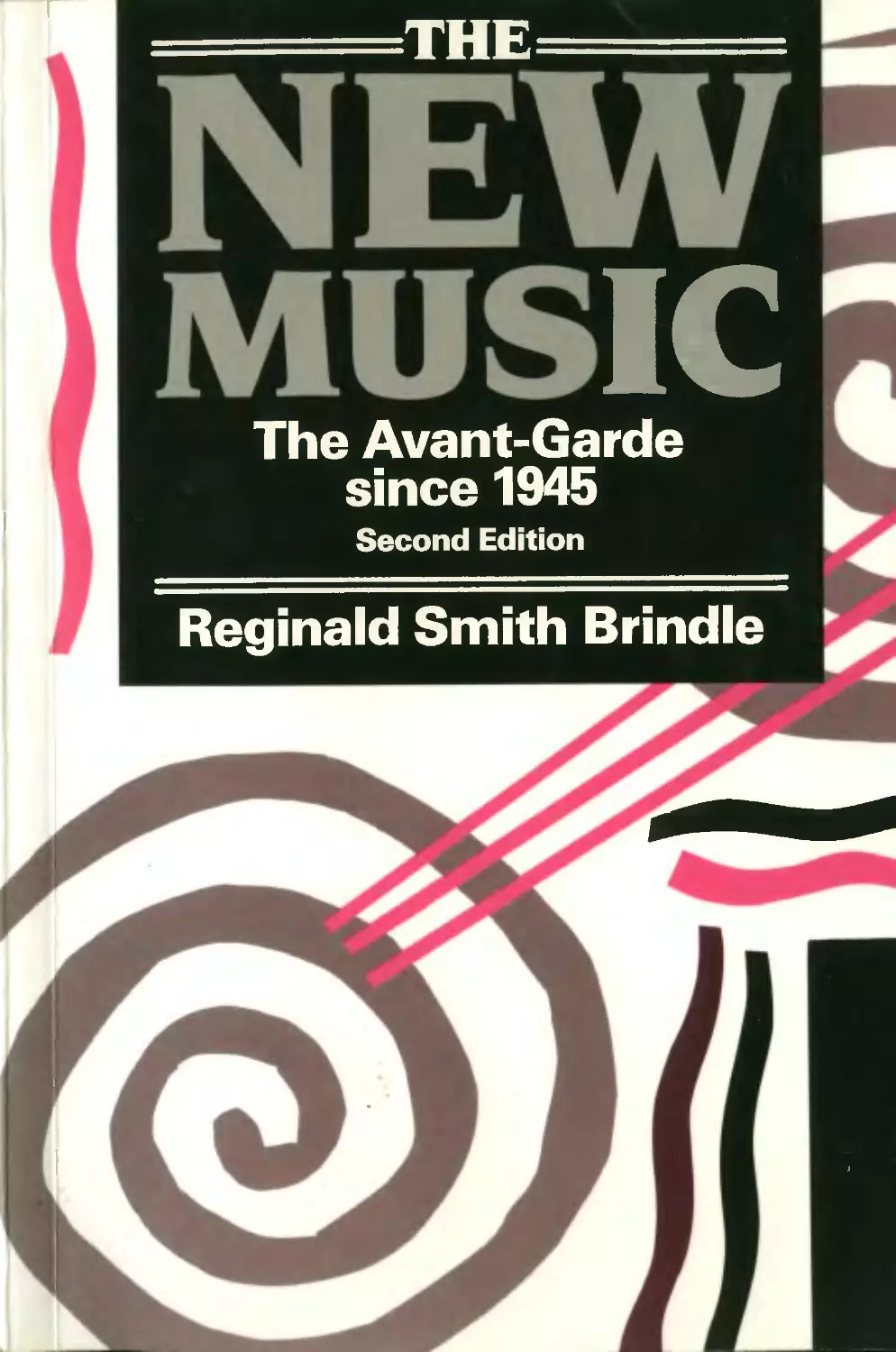
                    Reginald Smith Brindle
NEW
MUSIC
The Avant-Garde
since 1945
Second Edition
The New Music

The New Music
The Avant-garde
since 1945
REGINALD SMITH BRINDLE
Second Edition
OXFORD
UNIVERSITY PRESS
OXFORD
UNIVERSITY PRESS
Great Clarendon Street, Oxford 0x2 6dp
Oxford University Press is a department of the University of Oxford.
It furthers the University’s objective of excellence in research, scholarship,
and education by publishing worldwide in
Oxford New York
Athens Auckland Bangkok Bogota Buenos Aires Calcutta
Cape Town Chennai Dares Salaam Delhi Florence Hong Kong Istanbul
Karachi Kuala Lumpur Madrid Melbourne Mexico City Mumbai
Nairobi Paris Sao Paulo Singapore Taipei Tokyo Toronto Warsaw
with associated companies in Berlin Ibadan
Oxford is a registered trade mark of Oxford University Press
in the UK and in certain other countries
Published in the United States
by Oxford University Press Inc., New York
© Reginald Smith Brindle 1987
First edition published 1975
Second edition 1987
All rights reserved. No part of this publication may be reproduced,
stored in a retrieval system, or transmitted, in any form or by any means,
without the prior permission in writing of Oxford University Press,
or as expressly permitted by law, or under terms agreed with the appropriate
reprographics rights organization. Enquiries concerning reproduction
outside the scope of the above should be sent to the Rights Department,
Oxford University Press, at the address above
You must not circulate this book in any other binding or cover
and you must impose this same condition on any acquirer
British Library Cataloguing in Publication Data
Brindle, Reginald Smith
The new music: the avent-garde since
1945.—2nd ed.
1. Music—20th century—History and
criticism
I. Title
780.904 ML197
ISBN 0-19-315468-4
Library of Congress Cataloging in Publication Data
Brindle, Reginald Smith, 1917-
The new music.
Includes index.
1. Music—20th century—History and criticism.
I. Title.
ML197.B77 1987 780.904 86-33265
ISBN 0-19-315468-4
10 9 8
Printed and bound in Great Britain by
Biddles Ltd, Guildford and King’s Lynn
Contents
1
2
3
4
5
6
7
8
9
10
11
12
13
14
15
16
17
18
19
20
Preface	vii
Acknowledgements	ix
The Historical Background	1
The Post-War Years	3
The Webern Cult	7
The Avant-Garde—Pointillism	15
Integral Serialism	21
Numbers	42
Free Twelve-Note Music	52
Indeterminacy, Chance, and Aleatory Music	60
Improvisation—Graphic Scores—Text Scores	81
Concrete Music	99
Electronic Music	104
Cage and Other Americans	121
The Search Outwards—The Orient, Jazz, Archaisms 133
Theatre	146
Colour—New Instrumental Usages	153
Vocal Music—The New Choralism	163
Notation	175
The Avant-Garde and Society	182
Conclusions—1975	186
Conclusions— 1986	188
Some New Notation Symbols	203
Index	215

Preface
The purpose of this book is to give a concise picture of the more adventurous
evolutions of music since 1945. There is no mention therefore of many major
composers such as Britten, Carter, Copland, Walton, and even Stravinsky, for
their work hardly enters my picture. There is also little biographical detail,
and I have made no attempt to discuss the complete works of any one
composer.
My approach has been highly selective, picking out only those salient
features which marked the paths of avant-garde development. This has some-
times meant the study of a relatively slight work like Feldman’s Projection 7,
while such an important large-scale composition as Penderecki’s St. Luke
Passion is hardly mentioned. Moreover, the book is made up of personal
musical experiences and judgements. Thus it may well omit composers or
works which others may regard as significant.
If these omissions require an apology, I apologize. But for a book of this
sort they are necessary, and I do not regret them.
To my old friends of the Florentine ‘Scuola Dodecafonica’—
Bruno Bartolozzi, Arrigo Benvenuti, Sylvano Bussotti, Alvaro
Company, and Carlo Prosperi.
Acknowledgements
Grateful acknowledgements are due to the following for permission to quote from the works
cited.
Universal Edition
Webern: String Quartet, Op.28. Concerto, Op.24. Variations for Piano, Op.27. Variations
for Orchestra, Op.30
Schoenberg: Five Piano Pieces, Op.23
Stockhausen: Kontra-Punkte. Zeitmasse. Mixtur. Klavierstiick XI. Zyklus. Prozession
Kontakte. Aus den Sieben Tagen. Stimmung
Boulez: Structures. Improvisation sur Mallarme. Le Marteau sans maitre
Bo Nilsson: Quantitdten
Bussotti: Sette Foglie
Bedford: Music for Albion Moonlight
Berio: Circles. Sequenzas III & V. Passaggio. Sincronie
Haubenstock-Ramati: Mobile for Shakespeare
Earle Brown: String Quartet. Corroboree
Cardew: Solo with accompaniment
Logothetis: Agglomeration
Reich: Clapping Music
Rihm: Tutuguri II
Also various quotations from Die Reihe
Ars Viva Verlagy Mainz (Schott & Co)
Nono: Polifonica-Monodia-Ritmica. Il Canto Sospeso. La Terra e la Compagna
Durand & Cie
Messiaen: Mode de Valeurs et d’Intensites.
Colfranc Music Publishing Co.
Vardse: Integrates
Boosey & Hawkes
Maxwell Davies: Antechrist
Schott & Co.
Donatoni: Composition in Four Movements
Suvini Zerboni
Camillo Togni: Tre Capricci
Pousseur: Quintette. Exercises pour piano
Berio: Serenata I. Sequenza.
Donatoni: Black and White. Etwas Ruhiger im Ausdruck
Levine: Parentheses
Buonomo: Percussion time
Kayn: Signals
ACKNOWLEDGEMENTS
Bartolozzi: Concertazione a Quattro. Concertazione per Oboe
Ricordi
Bussotti: Pieces de Chair II. Piano Piece for David Tudor 4. La Passion selon Sade
Renosto: Players
Associated Music Publishers
Brown: Available Forms 2. Folio
PMW- Music Publications Krakow
Dobrowolski: Music for Magnetic Tape No. 1
Bruzzichelli
Barraque: Sequence
Bussotti: Siciliano
Maderna: Oboe Concerto
Leduc
Messiaen: Chronochromie
Peters Edition
Feldman: Projection I. Intersection No. 1. Atlantis. Christian Wolff in Cambridge. Dura-
tions 2.
Ligeti: Volumina. A ventures. Lux Aeterna
Cage: Piano Concerto. Amores. Water Music. Music of Changes II
Englert: Aria for Timpani
Smith Brindle: Three Dimensions. The Death of Antigone
Berberian: Stripsody
Globokar: Voie
Kagel: Sonant (1960/. . . .)
Stockhausen- verlag
Stockhausen: Sirius
1
The Historical Background
Music is the child of its social environment, which in its turn is moulded by the
major events of world history. Very seldom has music formed its environment.
The flames of patriotic fervour which led to the Italian Wars of Independence
were certainly fanned by Verdi’s Sicilian Vespers and Nabucco, but they were
not lit by them. The more sensual brands of pop music may incite today’s
youth to what would once have been called loose moral standards, but it is
not the prime cause of even the least degree of immorality.
Music has always reflected the outside world and sublimated it, breathing
the mysticism of the medieval epoch, the poetry and finesse of the Elizabethan
court, the superficial charms and graces of the rococo period, and so on. In this
century its progress follows the history of peoples and societies as never before,
and this close association of music and society is particularly evident since the
Second World War. So before any study of the more progressive music of the
period can begin, it is necessary to give a glance, however brief, at world history
since 1945. And it is ‘world’ history that matters, for with the enormous de-
velopment of communications the world has become small, and what happens
in the most remote corner of our planet one day can affect the rest of humanity
the next.
Since 1945, two events have occurred which are more significant for mankind
than anything since the birth of Christ. Firstly, atomic bombs were dropped on
Hiroshima and Nagasaki. Secondly, man has walked on the Moon. The first
means that man can destroy mankind in one great holocaust, the second that
we are no longer chained to this earth until its extinction, but can set off into
space on a journey without end.
Inevitably, the discovery of the atomic bomb has had the most immediately
far-reaching consequences. Due to a state of ‘cold war’ between the great
powers, atomic weapons have proliferated so that the whole human race lives
under the threat of annihilation. To add to the state of unease, the world has
lived in a constant condition of minor war. Israel is besieged by the Arab
2
THE NEW MUSIC
States; in Korea and Vietnam the U.S.A, was at war for twenty years; in Latin
America and Africa, brief conflicts flare up and are extinguished at frequent
intervals. There have been over fifty wars in the quarter-century following
1945, though the actual war zones have fortunately remained small.
Further, there are internal divisions within the Eastern and Western blocks.
The different communist ideals of Russia, China, Yugoslavia, and Albania pro-
duce discords between themselves and their satellites; the Western democracies
have political ideologies which are virtually incompatible. Every nation has its
internal conflicts too, of race, religion, class, or age-group.
These events and facts may seem to have little to do with music, but in
reality have gone far towards dictating its developments. The psychological
adjustments we have had to make to live with the atomic bomb are beyond
measure. Peace is not in our souls, and many of us have had to learn to over-
come varying degrees of neurosis. Some seek relief in protest and violence,
others withdraw into anti-establishment groups of a more pacifist nature. Some
reject society completely and acknowledge no responsibility towards it. All
these facts of life are reflected in our music, and as we shall see, make it what it is,
for good or ill.
There is one last historical observation to make. In the distant past, history
moved relatively slowly, and there was only a slow rhythm of change. But the
speed of change has gradually accelerated during the last thousand years, and
there has been a correspondingly increased pace of musical development.
Change in this century has continued to accelerate so that since the Second
World War, successive events of world-wide importance are continually thrust
on us. So music too has changed at a vertiginous speed, and no sooner has one
trend been established than a new development has superseded it.
We have also to consider the social conditions of our times. This is a mech-
anistic age in which technology is rocketing ahead, leaving a wake of social ills
and spiritual disorders. Man, in his real essence, is hardly better off than the
cave dwellers of 40,000 years ago, in spite of all his technological benefits.
Nevertheless, though we may protest, this is the life we all live. The sound of
machines is part of our existence, and inevitably the same kind of sound has
become an integral part of our music.
This, then, is the background to all that has happened in music since 1945.
Yet it must be confessed that the relationship of some musical events to world
history is still by no means clear, for we are far too near our subject-matter in
time to see things in their true perspective.
2
The Post-War Years
Inevitably the Second World War disrupted musical activity, and even the
years which led up to it were troubled ones for many composers. After Hitler
came into power in 1933, many composers fled into exile or withdrew into
artistic seclusion, some to live in extreme poverty (Webern and Bartok), most
of them to encounter a severe setback in their fortunes. The end of the war there-
fore promised the beginning of a new golden era.
After 1945, German composers favoured by the Nazis became discredited,
and though the same discredit did not fall on Italian composers of the Fascist
period (the proscription of Italian composers by the Fascists having been most
moderate) a great wave of revulsion for the art of the totalitarian period swept
both countries and a search began for artistic renewal. This movement quickly
spread through all Western Europe, to the U.S.A., and eventually even as far as
Japan.
But though, with the discrediting of the ‘idols of the Nazi cave’ and the
desire for artistic renewal, a revision of aesthetic ideals and technical resources
was clearly inevitable, it was by no means clear how and where to begin again.
As the radios of Western Europe began to broadcast the wealth of neglected
works by Bartok, Stravinsky, Hindemith, Berg, and Schoenberg, it became evi-
dent not only that the available styles, aesthetics, and techniques were consider-
able, but that these were in considerable contrast with each other.
If music had had to ‘begin again’ at any previous moment in musical history,
there could hardly have been such a wealth of alternatives, or so many contrast-
ing and irreconcilable factors, as in the late Forties. Generally speaking, com-
posers were attracted by the works of Bartok, Stravinsky, or Hindemith and
imitated one or other of their styles; works such as Stravinsky’s Symphony of
Psalms and Bartok’s Music for Strings, Percussion, and Celesta were frequently
imitated during this period. Though in some contrast, the works of these three
composers are not in strong conflict and may be regarded as a continuation of
the style of the Twenties and Thirties. If they had stood alone, the idioms of
4
THE NEW MUSIC
Stravinsky, Bartok, and Hindemith could have been amalgamated in a general
post-war technique of composition of some stability and durability.
But with the circulation of Schoenberg’s serial music, a seriously disruptive
element was injected into the post-war scene and all chance of stylistic and
technical stability was lost. Serialism proposed such radical changes in the
traditional concepts of musical structure (and particularly in form, melody, and
harmony) that it was completely irreconcilable with the works of Bartok,
Hindemith, and the then Stravinsky. And so a conflict sprang up between
serialism and the rest.
This splitting of the musical world into serialists and non-serialists during the
first post-war decade was absolute and lasted for some considerable time, even
after Stravinsky himself became a confirmed serialist during the early Fifties.
Particularly in Western Europe, composers, critics, and performers had to be-
come partisans of one camp or the other; to have a foot in both worlds was
almost an impossibility. To one faction, serialism itself was a virtue, the mechan-
isms of which could lead only to perfection and high artistic merit. To the other
faction, the use of Schoenberg’s series could only produce non-music. Natur-
ally, the polemics of this period are often blind to what really matters—true
artistic value—and many gallons of ink were wasted on vitriolic, highly biased
nonsense. I would like to make public confession that at one time my own
music criticism treated modern non-serial works in very intolerant fashion.
Such prejudice can be excused only on one ground. At that time, such blasts of
uninformed criticism were aimed against serialism, that one was led to counter
them by any means, fair or foul. Good criticism—impartial and constructive—
was almost impossible in such circumstances.
But this straightforward confrontation of serialism and non-serialism was
soon to become further complicated by divisions among the serialists. Some,
striving towards a more ascetic, less emotional language than Schoenberg’s
high-pressure expressionism, seized on Webern’s slender, intellectual concep-
tions as the basis for a new musical language. This so-called ‘Post-Webern’
school will be treated in the next chapter. Others preferred to eschew Schoen-
berg in favour of a milder, Bergian form of serialism, and sought to unify the
new compositional method with tradition.
This bridging of the gap between atonality and tonality, between dodeca-
phony1 (as serialism was sometimes loosely called) and tradition, once seemed
1 ‘Dodecaphony* is a term which has often been used to denote serial music. ‘Twelve-note*, or
in America ‘twelve-tone*, have been similarly used. Strictly speaking these three terms should
refer to music which uses the total-chromatic (of twelve chromatic notes contained within the
octave) consistently and in a free manner, without serial organization. To make sure, how-
ever, that serialism is not intended, it has become customary to refer to ‘free* twelve-note
THE POST-WAR YEARS
5
very important. To many composers of the post-war period it appeared that
between the more conventional musical languages and serialism lay an im-
mense field which must be well explored and made familiar before music could
again move forward. Particularly critical seemed such factors as harmony,
melody, and form. Serialism had changed these so radically, had challenged
traditional concepts so brusquely, that it seemed necessary to spend a long
period reconciling the new language with more orthodox conventions. In fact,
whether they intended it or not, composers of a whole generation dedicated
their efforts in one way or another to the exploration of the field between tonality
and atonality,* 1 and to the integration of serialism into a more accessible musical
language. To name but a few, Fortner and Henze in Germany, Searle and Seiber
in England, Vogel and Liebermann in Switzerland, Dallapiccola, Peragallo,
Riccardo Malipiero, R. Nielsen, and Vlad in Italy—these and many more
sought to blend some facet of serialism with traditional idioms. For some time
it did seem as if a new great extension of the traditional, so-called ‘classical’
dialectic was emerging, as if the old language had been given a new lease of life.
But, too soon, it was all over.
By the early Fifties this phase of recuperation was coming to an end. It was
already clear that there was not going to be a long period of fusion of serial and
traditional elements, of exploration of the vast terrain supposedly lying be-
tween the tonal and atonal worlds. Music was passing on. It was not that the
Schoenbergian language was already exhausted, nor that attempts to fuse the
serial and tonal worlds did not bear good fruit. The truth is that the intellectual
climate of the atomic age demanded to be expressed through sounds completely
different in nature. And these new sounds were characterized by the omission of
traditional elements and Schoenberg’s modification of them, rather than by
their inclusion.
The new sound of the Fifties aimed towards no mellifluous melodies (how-
ever brief), no coherent harmonies and clear-cut forms. In fact, at the time it
music. This is particularly necessary when referring to post-serial music (as opposed to the
‘free-atonalism’ of early Schoenbergian dodecaphony).
1 The word ‘atonal’ was first used early in the twentieth century as a derogatory term, mean-
ing not only ‘non-tonal’, but ‘non-musical*. It was often applied to music which, far from being
‘atonal’, was merely obscure in its harmonic aspects but did not belong clearly to traditional
key systems and so perplexed and offended the listeners of that time. In strict logic, ‘atonality’
is a mistaken term, for whenever two or more sounds are combined, harmonic relationships
are formed. These relationships may be extremely complicated, but the music will not be
completely non-tonal. By now, the meaning of ‘atonality’ has changed considerably and is
today accepted as signifying not non-tonality, but an all-inclusive tonality which includes all
possible harmonic products of the total chromatic space enclosed by the twelve semitones
within the octave.
6
THE NEW MUSIC
was not clear what kind of sound was being searched for, only what was to be
avoided. Composers talked of‘beginning again’ with a ‘tabula rasa*. Every ele-
ment of the musical language had to be subjected to reappraisal and examina-
tion before it could be made part of themew art, which aimed at eradicating any
suggestion of past musical languages.
But in reality the new sound of the Fifties had already been anticipated in one
way and another for some considerable time. Luigi Russolo’s Arte dei Rumori
(‘Art of Noises’) dates from as far back as 1913 and certainly anticipates to a
considerable degree the more percussive, mechanistic music of later days and
even the ‘musique concrete’ of our own time. Pratella’s Manifesto of Futurist
Musicians (1912) and his Technical Manifesto, as well as preaching a music
of the machine age, advocated the use of several technical features, such
as atonality, microintervals, and complex rhythmic figurations, which are typi-
cal of more recent music. Edgard Vardse, in such pieces as Ionisation (1931), and
John Cage, in First Construction in Metal (1939), had already exploited the per-
cussion ensemble and shown how fascinating music could be when written
without reliance on pitched sounds and the melodies and harmonies that go
with them.
These composers, and many others, had already expressed the sounds of a
mechanistic age long before the Fifties. But though the introduction of‘noise’
elements into music has been gradually accepted by composers and public alike,
and has become a characteristic feature of post-war music, the greatest influence
in the ‘beginning again’ was from another source—Anton Webern, who
had been creating his enigmatic, almost passionless art during the previous four
decades. In these four decades his quiet voice was seldom heard. But, as we shall
see, in the years that followed his music became exalted and glorified almost
beyond measure.
3
The Webern Cult
Nobody would have been more astonished than Webern if he could have seen
how his name was revered by a new generation of composers only ten years
after his death. Withdrawn, diffident, and modest, resigned to artistic obscurity
and embittered by the apparent failure of his life’s work, he would have been
overwhelmed to find his name already a legend and his works regarded as
jewels of perfection.
That he should so rapidly have become the idol of a cult is difficult to explain.
His music was not easy to obtain after the war (indeed many of the works on
which his reputation rests were not published until the later Fifties); nor were
performances frequent. At the main platform for the Webern revival—the
Darmstadt Kranichstein Summer School—no Webern was performed until the
Piano Variations Op. 27 in 1948 and some early songs Op. 4 in 1949. Only in
1953, to mark his seventieth birthday, was any quantity of Webern’s music
played—seven pieces.
Gramophone records were scarcer still. Until the mid-fifties, the only
Webern record available in England comprised the Trio Op. 20 and his orches-
tration of Schubert’s German Dances. In the U.S.A. Dial records had eight
pieces on issue in 1954, though these were not obtainable in Europe.1 On the
Continent, only a single piece was issued, the Symphony Op. 21.
It was not until 1957, when Columbia issued Robert Craft’s complete record-
ings of Webern’s music (excluding a number of works without opus numbers,
and transcriptions), that his work could be widely known. Even so this album
could only be obtained in Europe with difficulty. Everything therefore seemed
to militate against a rapid diffusion of his works. Yet the Webern cult grew
apace. Perhaps the very difficulty in hearing his music (or even seeing his scores)
gave it a magic aura, and lent a certain mythological quality to his name.
Much of the early information about Webern has come from Rend Leibo-
witz’s three books Schoenberg et son ecole, Quest-ce que la musique de douze
1 ‘Dollar restrictions* made it difficult to obtain American records until the late Fifties.
8
THE NEW MUSIC
sons ?, and Introduction d la musique de douze sons published in France between
1947 and 1949.1 As a pupil of Webern, few were more qualified than Leibowitz
to discuss his master’s works when he taught at Darmstadt in 1948, though it is
highly probable (if his books are any guide) that his teaching concentrated
largely on Schoenberg’s serial methods, with little mention of Webern’s ‘pre-
formed’ concepts which later became so important for the younger generation.
But in 1949 Olivier Messiaen taught at Darmstadt, and as he was just then
evolving a system of a ‘preformed’ nature analogous to that which Webern
partly aimed towards in his later works, it is probable that Messiaen highlighted
Webern’s models in his teaching.
Both Messiaen and Leibowitz lived in Paris, and as teachers of some of the
most important figures of the new generation (such as Boulez, Henze, and
Stockhausen) they obviously had great influence in post-war events. But it
would be mistaken to attribute the ‘Webern myth’ to them alone. It would be
more accurate to record that Webern and what he stood for was ‘in the air’.
His restraint, lack of bombast, brevity, and intellectual quality made much
appeal, an appeal given all the more allure because one could so seldom hear
his music.
Serialism, particularly in Germany where it had for so long been banned, be-
came a symbol in the post-war years of spiritual and intellectual freedom and
renewal. But if knowledge of Schoenberg had to come first, it became evident
that the younger generation showed distaste for his music, regarding it as heavily
burdened with late romantic expressionism, shackled by traditional melodic
and rhythmic elements, and unsuitable for beginning a new musical language.
Webern’s work, instead, had the great appeal of being rational yet pointing the
way to still further rationalization. Above all, it made the kind of sound com-
posers were looking for and which was so representative of the new times.
Inevitably, enthusiasm for Webern often went too far. His music was perhaps
overrated and he was credited with more radical innovations than he actually
accomplished. But before debating these questions it is best to discuss briefly
what Webern’s innovations really were, and to what ends they were designed.
Webern’s musical language is carefully circumscribed. He did not aim at a
richly varied idiom, full of colourful contrasts, suited to the expression of a wide
gamut of emotions. On the contrary, his music deliberately covers a limited
emotive field and therefore the technical means used are not widely varied.
Moreover, he tended more and more to limit his working material only to those
elements which would best serve his expressive needs, and it was his endeavour
to ‘preform’ these elements (so that an entire work could be derived from a
1 Published respectively in Paris 1947, Lfcge 1948, and Paris 1949.
THE WEBERN CULT
9
minimum of material) which so appealed to the young post-war generation. To
them, this ‘preforming’ represented the quintessence of Webern’s work.
Webern’s circumscription of his musical material was designed to achieve
coherence and homogeneity, to obtain the greatest possible unity. His endea-
vour was to create as many relationships as possible, so that the totality of any
work was built up of interrelated factors which could ideally be reduced to an
absolute minimum of initial material. I shall briefly summarize Webern’s
methods, and his main compositional characteristics, as they often form the
basis of much of the music which was to follow.
He actually wrote very few serial works, and it is striking how the series he
used tended to become more and more similar in construction. In all his series
he used a preponderance of semitones, interspersed usually by thirds. In its
most rational application, this material would be arranged in symmetrical
patterns so that one group of notes would form the basis for the remainder of
the series:
Webern: Series Concerto, Op. 24
The first three-note group (‘O’) is a basic shape or cell on which the other groups
are based. The second group (‘RI’) is a retrograde inverted of the original cell,
the third group a retrograde (‘R’), and the final group an inversion (!’).
Other series have even more relationships between various note-groups
built in:
The inter-relationships here of various two-, three-, four-, and six-note groups
are obviously so profuse that it would be tedious indeed to put them into words.
What is significant is that it was towards such symmetry and cross-relationships
that Webern’s serial formations increasingly tended.
10
THE NEW MUSIC
This grouping of the series into similar cells had inevitable consequences on
the horizontal (melodic) and vertical (harmonic) products of such works. For
example, in his Concerto Op. 24, the two- and three-note melodic fragments
which make up all three movements of the entire work use only the semitone
and third (and their inversions) which make up the series. Harmonically, too,
in the Concerto, Webern never steps outside the limits of the same material.
Two-note chords are always formed from either semitones or thirds (or their
inversions), three-note chords are always made up of a semitone and a third,
and so on. Inevitably, this usage gives great melodic and harmonic unity, but
not variety.
Finally, it is worth mentioning that Webern’s series always gave harmonic
results which avoided all triad chords, scale formations, or ‘cadential bass’
successions (fourths and fifths). In addition, whole-tone groupings were kept
to a minimum. On examining fourteen of Webern’s series from Op. 17 onwards
it will be found that of the 140 three-note chords which can be formed, ninety-
four comprise a semitone and a major or minor third in one way or another. The
remainder are either chromatic or whole-tone groups. The following example
shows the numbers of each kind of three-note chord which can be formed in
these fourteen series, basing each chord, for convenience, on C:
chromatic groups
whole-tone groups
This kind of note grouping was to become characteristic of Webern’s followers,
and indeed set the pattern for the choice of note successions in much of the non-
tonal music written since that time.
Another prominent characteristic of Webern’s music is his preference for
contrapuntal forms. Having been trained as a musicologist, he was well ac-
quainted with the early renaissance use of proportionalisms, hocket, and canon
in all their various forms. Consequently many of his movements are based on
successions of canonic designs. It is particularly in the phrase structure that his
love for early polyphony shows through—in his use of brief, simple rhythmic
cells derived from number proportions. For example, the following section
from the String Quartet Op. 28 is based entirely on the proportion 2:1. Roughly,
this is a double canon, with semitones as basic intervallic units expanded to
major sevenths and minor ninths. The beginning of this section is omitted as it
overlaps previous bars of different material:
THE WEBERN CULT
11
As will be seen, J and J are the smallest time units to which the proportions
2:1 are applied so the element of change is small. But elsewhere, by varying the
duration of the basic unit more frequently, Webern often turns the simplest
material into a surprisingly complex aural result. In the following, the propor-
tions 1:1:1 are used with four different time values to exciting effect:
As well as the proportionalisms so characteristic of his canonic structures,
Webern sometimes used a further kind of ‘precomposition’: throughout a pas-
sage or canon the octave position of certain notes was always fixed. For ex-
ample, the first movement of the Symphony Op. 21 is made up of three canons,
and in each canon the octave for each note is fixed. To add further to the sym-
metry, the notes are positioned so as to form a regular pattern around a central
pitch. The following example shows the disposition of all notes in the first
(double) canon (bars 1 to 26):
12
THE NEW MUSIC
Apart from his use of canon, one of Webern’s most successful formal devices
was his use of mirror patterns. Sometimes a movement would be formed from a
succession of small mirror sections, sometimes it would comprise a single mirror
only.1 The first movement of his Variations for Piano, Op. 27 is made up of
fourteen short mirror structures, each showing abundant evidence of Webern’s
intention to create as many correspondences and interrelationships as possible.
The last movement of the Symphony Op. 21 is a tour de force of mirror struc-
tures. There is an eleven-bar ‘theme’ in mirror form, followed by seven varia-
tions and a coda, each part again being ah eleven-bar mirror. This movement, so
sparse and economical, is one of the most closely reasoned structures in the
whole of symphonic literature.
This reasoned construction of Webern’s music, this maximum of organiza-
tion, seemed to be about to reach its culmination in his penultimate work, the
Variations for Orchestra, Op. 30. During the composition of this work in 1941,
he wrote a letter to Willi Reich1 2 which later led many to believe that the work
was a fully-fledged example of integral serialism. His statement that the work is
‘preformed’ in the first few bars led many enthusiasts in the Fifties to make wild
claims for the Variations which are certainly not true. For Vlad,3 ‘the object on
which the process of variation is exercised is reduced to one infinitely small
factor—the interval between two notes’. That is, according to Vlad, the work
was preformed by the intervals of the series. Nono4 claimed that ‘the construc-
tion follows the twelve-note series in rhythm, timbre, melodic elements, and
harmonic elements’. Winfried Zillig5 went even further and said Webern applied
the serial system ‘to rhythm, the successive entries of voices, even to dynamics,
1 Note the rhythmic mirror already quoted in Ex. 5.
2 The best translation available seems to be that by Humphrey Searle in Walter Kolneder’s
Anton Webern, though unfortunately it omits a vital final sentence. He says: ‘Everything in the
piece is derived from the two phrases stated in the first two bars by double bass and oboe! But
this is still further reduced, as the second phrase, in the oboe, is already retrograde in itself: the
second two notes are the cancrizans of the first two, but in augmentation rhythmically. Then
the first (double bass) phrase follows again in the trombone, but in diminution! And in can-
crizans as to motifs and intervals. That’s how my series is built up, formed from these three
groups of four notes. But the succession of the motifs joins in this retrograde effect, though
using augmentations and diminutions! These two kinds of variation lead almost exclusively
to the ideas of the different variations: this means, motivic alteration only takes place within
these limits, if at all. But by changing the centre of gravity in all possible ways within these two
phrases something new in time-signature, character, etc. keeps on appearing.’ Finally, the
important last sentence taken from another source: ‘The entire development of the piece is
already present in the row of the first few bars: Preformed.’ (Quoted from Anton von Webern:
Perspectives, edited by Demar Irvine.)
3 Roman Vlad, Storia della Dodecafonia (Milan, 1958).
4 Die Entstehung der Reihentechnik (Darmstadter Beitrage, 1958/25).
6 Variationen uber neue Musik (Munich, 1959).
THE WEBERN CULT
13
the tone-colour, and even the expression of each individual note’. In other
words, the series determined just about everything.
This is not the place for an extended investigation of this matter which,
though so important in the Fifties, is now past history. We can, however, take a
brief look at the music:
As will be seen, the double-bass motif uses the proportions 2:2:1:2, which are
reflected in retrograde and in diminution by the trombone (2:1:2:2). The oboe
motif uses the proportions 3:1 together with its retrograde in augmentation. At
the same time, these phrases feature alternations of close and expanded forms
of the semitone and major third (a ‘wide’ form is followed by a close one and
vice versa). These two constructive principles—proportionalisms and interval
alteration—are certainly prominent throughout the Variations, but there
is no indication whatever that they govern the successive entry of voices,
dynamics, tone-colour, and expression. There is indeed much else in the
Variations which cannot be explained away by the preformed principles out-
lined in Webern’s letter (such as the 3:1:2:4 proportions of the viola part
shown in Ex. 7, the overall structure which demands 113 changes of metre in
only 180 bars, etc.), but these should be evident to those who read the score.
What really matters, historically, is that the preformed structure of the V aria-
tions became a significant aspect of the Webern myth. Before the work even
appeared in print, its structural processes (as known from Webern’s letters)1
were already part of the influences pushing composers towards the goal of
integral serialism. For the many followers of Webern, his cerebralism was yet
another inducement to follow his example. In fact, Webern’s proportionalisms
appealed much more widely than to the limited field of the more advanced
younger composers. They began to feature prominently in the works of such
established composers as Dallapiccola from the early Fifties onwards, and even
Stravinsky soon afterwards.
The tenuous, abstract, timeless, almost supernatural music of Webern had
1 Soon after Webern wrote to Reich, he wrote also to Hildegard Jone with a strangely different
explanation of his structuring.
14	THE NEW MUSIC
therefore not only a strong appeal as sound, it also had an intellectual attraction
particularly suited to the inclinations of the post-war generation of composers.
But though Webern’s influence has lasted long, his musical language, so deliber-
ately limited in emotive scope and already so perfect as to be unsurpassable, has
inevitably given way to the different, more forceful needs of others. For those
who were to come—the ‘Post-Webern’ school, or the ‘avant-garde’—Webern’s
music was not so much a model to be copied, as an art form to be expanded into
a widely different language, a language at times so complex that its Webemian
origins are hardly discernible.
4
The Avant-Garde—Pointillism
History is said to repeat itself. The same situations are gradually created and
resolved time and time again. This is because, though circumstances and times
change, man remains immutable. But musical history, on the surface, does not
seem to repeat itself. Music changes substantially from one age to another. It
becomes more complex too, so that we have been led to talk of its ‘development’
and ‘progress’, as if it were improving and growing in stature, almost implying
that development means greater artistic qualities and refinements. But beneath
the surface, things may remain unchanged. What really matters is what music
says to the hearts of men; in themselves development and progress may be
worthless and to give them undue intrinsic value is only to deceive ourselves.
The belief that music must progress is perhaps not new. In 1868 Rossini
wrote: ‘I am obliged to admit that when I read big, ugly words such as Progress,
Decadence, Future, Past, Present, Convention, etc., my stomach heaves with a
motion I find extremely difficult to repress.’ What provoked his outburst was
the ‘Music of the Future’ movement led by Liszt and Wagner—a movement
which has some analogies with music after 1945. Bizet perhaps had the real
answer: ‘It is not the “music of the future”—that means nothing—but... it is
the music of all time, because it is admirable.’
But this ‘towards the future’ mentality has been all too evident since the
Fifties. The ‘avant-garde’1 has looked forward, leading the way towards an
obscure and still indiscernible goal, blazing new paths with great vigour and
resource, though changing course so often that the musical public has been left
bewildered. Eimert2 wrote arrogantly in 1957 ‘today, either music exists as it is
in the vanguard, or it does not exist at all’. Which is of course ridiculous: to look
forward gives no guarantee of aesthetic quality. At times indeed we have seen
1 The term ‘avant-garde’ used of an artistic movement is by no means recent. It can be traced
back for some considerable period, but really came into prominence in France a hundred
years ago to designate the rebel impressionist movement.
8 Herbert Eimert, ‘The Composer’s Freedom of Choice’, in Die Reihe 3 (Vienna, 1957).
16
THE NEW MUSIC
the avant-garde fall into some disrepute, for though it has always included
hard-working, talented musicians, there have been ample opportunities for un-
scrupulous charlatans whose abilities lie in self-publicity rather than musician-
ship. Yet, despite this, something great has been accomplished. A musical
language has emerged which is the quintessence of the spirit of our age, which
succeeds in expressing our most intimate feelings and, it is to be hoped, will
speak with equal significance to men in the distant future.
In retrospect, it is now easy to see why the Webern cult was necessary, and
how, becoming merged into a ‘Post-Webern’ school, it crystallized into a cult of
the Avant-Garde. (Though there has always been an ‘avant-garde’ in music, and
always will be, the term was seized on in the Fifties by the progressives as a new
emblem, signifying their separateness from all else, which, by implication, was
retrogressive.) Cults are necessary to artists, writers, and composers for their
own protection and to create a feeling of artistic security. To be alone is dis-
tressing to all but the greatest few, the prime movers. To others it is a psycho-
logical and artistic necessity to belong to some movement, some cult which is a
protective umbrella against outside dangers. The cult, too, can offer a certain
measure of success. As a simple example, writers of popular music who belong
to either a pop, folk, trad, or rock cult have a consumer market ready to absorb
their output, while to be outside one of these trends is to invite failure and isola-
tion. The avant-garde has therefore been necessary as a cult, even though the
title once meant one thing (following Webern) and by now can mean almost
anything else (sham oriental rites, group happenings, audience hypnosis, way-
out jazz, etc.).
‘Belonging’ to the avant-garde has meant a certain amount of imitation of
the most successful models. Of course this is no unusual situation in music.
Imitation has been the way composers have learned their trade for thousands of
years. But this question of imitation posed a problem for many of the early
members of the avant-garde. For, being by nature revolutionaries, breaking
away from the more conventional paths of post-war music, their first instinct
was for change, not imitation. As a result, their music was made to conform to
a general style, but composers gave their inventive faculties no boundaries of
variety in method.
An exhaustive study of the period would have to investigate a mass of differ-
ent compositional techniques, each the more or less personal product of a
particular composer. Fortunately, this will not be necessary here: so many in-
dividual methods are derived from the same basic principles that it will be pos-
sible to demonstrate only the foundation techniques and ignore more personal
applications.
THE AVANT-GARDE—POINTILLISM
17
Before going on to investigate the beginnings of integral serialism,1 it would
be preferable to dwell for a moment on the characteristics of earlier works
(written around the early Fifties) which, though belonging to the post-Webern
movement, were still not conceived with all-pervading structuralism in mind.
These interregnum works often have very sparse textures, brief phrases tracing
stark, angular melodic outlines, and as often as not very subdued dynamics.
This almost single-note texture, with widely scattered, almost disconnected
sounds and uniformly subdued emotive undertones, came to be called the
‘pointillist’ style1 2—a not inappropriate description. As works of the following
period of integral serialism at first continued the same kind of sound texture,
the term pointillist continued to be used almost throughout the Fifties, until
music changed its character to such a degree that the term was no longer appro-
priate and fell into disuse. Some have said that pointillist music should comprise
only isolated sounds—that each ‘point’ is a separate sound entity, not to be
associated with what has gone before or with what follows. This extreme view
has never been realized in European pointillist music. Just as the eye, in pointil-
list paintings, assembles all the points of colour into overall shapes, so the ear
relates isolated sounds and interprets them as linear communication. (Only in
the music of John Cage are sounds sometimes separated by so much silence that
they can no longer be connected with each other. For example, Cage’s Piano
Music No. 3 comprises only seven widely-separated notes.)
A typical example of the pointillist style of the early Fifties is the opening sec-
tion of Luigi Nono’s Polifonica—Monodia—Ritmica for chamber orchestra,
written about 1951. The first movement is mostly pianissimo, beginning with
touches of cymbal sounds and then whispered pitched notes in relative isola-
tion:
1 Other terms such as ‘total serialism*, ‘total organization’, and ‘predetermined composition’
have also been used to indicate music which has been written with a high degree of organiza-
tion. Their usage has not always been strictly accurate, but being accepted terms they are used
in this text where appropriate.
2 The term ‘pointillism’ is derived from an impressionist style of painting initiated by Georges
Seurat in the 188O’s. Though he preferred the name ‘divisionism’, the word pointillist aptly
describes his method of painting with masses of dots of primary colours which the eye is able
to assemble into colour mixtures and figurative shapes.
18
THE NEW MUSIC
9Khngt trit notitri!
At first each instrument emits single points of sound, but gradually these
move into note groups of two and then three sounds, and eventually these
note cells combine in various ways (eg. 1.3.2.1:1.2.3.1:2.2.3, etc.) to give a
more complex contrapuntal texture with an even flow and (in spite of the
restlessly leaping melodic fragments) almost static atmosphere:
THE AVANT-GARDE—POINTILLISM
19
Pointillist compositions may have large zones of isolated sounds, but in-
evitably, because of the European composer’s instinct to create emotive change,
these precipitate into denser note groups, which may eventually disperse so that
the whole process may begin again. This alternation of rarefaction and con-
densation is strongly featured in Stockhausen’s Kontra-Punkte for ten instru-
ments, where the composer’s aim was ‘the idea of resolving the antitheses of a
many-faceted musical world of individual notes and temporal relationships to
the point where a situation is reached in which only the homogeneous and the
immutable is audible’. In other words, the music begins with widely spaced
instrumental sounds of contrasting timbre, and ends with the uniform colour of
the piano in ‘a two-part, monochrome counterpoint wrested from the antitheses
between vertical and horizontal tonal relationships’.1
1 Karl H. Worner, Stockhausen: Life and Work (London, 1973).
20
THE NEW MUSIC
This work is notable not so much for its pointillist style, as for the way some
passages foreshadow the coming period of integral serialism, with impetuous,
jagged phrases of a new kind, which at that time were almost beyond the limits
of performance:
These flamboyantly contoured phrases and their forward-propelling power are
quite unlike Webern and the music of his close followers. In fact they were virtu-
ally unique in music at that time, foreshadowing the even more irregular kinds
of phrase structures which integral serialism was just about to introduce.
Certain aspects of Kontra-Punkte have been claimed to be predetermined,
such as the ‘Limitations and articulations of the time-space and time-flow’ in
‘macro-regions’ and ‘micro-regions’, while there is said to be some relationship
between the tempi used and the ratios of the frequencies of the first seven
pitches,1 but these structural devices seem to have no perceivable musical signi-
ficance. Yet in the music which was to come, structure was to become so obses-
sively important that to some composers it became an end in itself—so that
poetry could be abandoned in favour of the beauty of mathematics.
1	cf. Dieter Schoebel's analysis of this work in Die Reihe 4.
5
Integral Serialism
The reasons for the beginnings of such a radically new, dynamic movement as
integral serialism have been much debated and never satisfactorily clarified,
perhaps because the reasons are many, perhaps because there has been much
obscure thinking and partisan propaganda. In the early years, adverse critics
would say that such structuralism was a legacy from the excessive regimentation
of Nazi and Fascist politics. (Incredibly, this theory still exists, and as recently
as 1971 one authority told me that the decline of total serialism was due to the
gradual forgetting of Nazi disciplines by central European composers!) Obvi-
ously, post-war composers did not care for such accusations. In 1957, Eimert
wrote emphatically:
At present it is the fashion for empty-headed critics to make out that the systematic
‘management’ of musical material is identical with the terrorist rule of force in totali-
tarian political systems... one such ‘social critic’ of music has in fact attributed to the
twelve-tone system the power to produce detailed programme music, whose only suit-
able counterparts would be concentration camps, machine shops, and the world of
Kafka... To listen to music in which there is systematic order, and to hear in it the
counterpart to political totalitarianism, is just as witless as to appeal to ‘Nature’ when
what one really means is textbook harmony.1
A composer of communist sympathies such as Nono refused equally to
identify the ‘constraints and limitations’ of total serialism with totalitarian poli-
tics:
Comparisons of so-called ‘totally organized’ methods of composition . . . with
totalitarian political systems are... a pathetic attempt to influence the intellect which
understands freedom as anything rather than the surrender of the free will. The
introduction of superficial ideas of liberty and constraint into the creative process is
nothing but a childish attempt to terrify others... to cast doubt on the very existence
of spiritual order, creative discipline, and clarity of thought.1 2
1 Herbert Eimert, ‘The Composer’s Freedom of Choice’, in Die Reihe 3.
2 Luigi Nono, ‘The Historical Reality of Music Today’, The Score (London, July 1960).
22
THE NEW MUSIC
If we can put aside the ‘totalitarian’ theory for the genesis of integral serial-
ism (with the proviso that there is a grain of truth in most cock-and-bull stories),
there are a number of other influences to consider. Firstly, there had been a
tendency for a more rational, even mathematical approach to the arts for some
time. Painting had long since seen cubism flourish, followed by geometric and
almost mechanically conceived graphic styles. In music, Messiaen had already
indicated certain mathematical applications to musical elements in his Tech-
nique de mon langage musical, written as early as 1942; as we shall see, these
principles were furthered and put into concrete form in his Mode de valeurs et
d'intensites composed in 1949. Another composer-scientist had however al-
ready gone to much greater lengths in associating music and mathematics.
Joseph Schillinger published Electricity, a liberator of music as early as 1932,
and when he died in New York in 1943, left two important works: The Schil-
linger System of Musical Composition and his great The Mathematical Basis of
the Arts. These works, published after his death, are of major importance, the
latter having a wide influence on creative art in general. The following sums up
his views on art produced by scientific synthesis:
If art implies selectivity, skill, and organization, ascertainable principles must
underlie it. Once such principles are discovered and formulated, works of art may be
produced by scientific synthesis. There is a common misunderstanding about the free-
dom of the artist as it relates to self-expression. No artist is really free. He is subjected
to the influences of his immediate surroundings... he speaks only the language of his
immediate geographical and historical boundaries. There is no artist known who,
being bom in Paris, can express himself spontaneously in the medium of Chinese 4th
Century A.D.... The key to real freedom and emancipation from local dependence is
through scientific method.1
Here is not the place and time to discuss the pros and cons of Schillinger’s
theories. It is sufficient to record that already in the Forties mathematical and
scientific lines of thought were invading the realms of music. And the moment
was ripe, for with the advent of electronic music in the early Fifties, not only did
music and technology join hands as never before, but control of the electronic
medium was at first based largely on a mathematical approach. Inevitably, such
an approach to electronic music’s basic ‘parameters’, or elements, induced
similar methods in conventional composition. Thus integral serialism and
electronic music composition were in a way complementary to each other.
There is one final and decisive reason for the genesis of total serialism, a rea-
son which has never been made clear despite the avant-garde composer’s natural
tendency to theorize. In the post-war years, one of the most difficult obstacles to
1 Joseph Schillinger, The Mathematical Basis of the Arts (New York, 1948).
INTEGRAL SERIALISM
23
our ‘beginning again’ was our own musical memories. Our minds normally
create only out of what memory suggests. Thinking subjectively, we tend to
reassemble familiar musical patterns. To avoid this needs deliberately objective
reasoning and the use of thought-processes into which memory cannot obtrude.
This was precisely the main reason for the flourishing of integral serialism. It
was, in theory at least, a system of composition which obliged composers to
think objectively and eliminate memory, so that the musical heritage of the past
was blotted out and a completely new music created. Few composers did work
completely objectively; they used a system to eliminate musical memory, but
often kept some ‘parameters’ free so that they could adjust the composition
into a satisfyingly musical end-product. In reality, therefore, musical memory,
instinct, or ‘inspiration’ was only shelved at one stage of composition, to be
reintroduced later (though few composers would have been ready to admit this).
In conversation with Italian composers who adopted total serialism in the
early Fifties such as Nono, Maderna, and Donatoni, I was left in no doubt that
the main reason for the use of predetermined principles was to obliterate mem-
ory. Total organization was, at that time, the only way to create the tabula rasa
on which completely new edifices could be constructed. Furthermore, it was
always evident that what troubled these composers most was their fear of con-
ventional rhythmic configurations. Familiar rhythmic shapes are the most
difficult of all to root out of our subconscious memories, but unless completely
unorthodox rhythmic designs can be created, the new music is still not truly
new. Therefore, since total serialism (or total organization) throws up of its own
accord rhythmic designs which never belonged to music before, it seemed the
most suitable mechanism for creating the new music of the Fifties.
The first European work to be written with total organization in view was
Messiaen’s Mode de valeurs et d'intensites for piano, written in 1949, being part
of the group Quatre etudes de rythme. Milton Babbitt is said to have used similar
procedures in his Three Compositions for Piano in 1948, so it would be unjust
not to record his work here, but unfortunately it remained unknown in Europe
until comparatively recently. Though written in 1949, Messiaen’s Mode de
valeurs can be seen as the fruit of years of development, certain aspects of the
work’s organization appearing as early as 1940 in his Liturgie de Cristal from
the Quatuorpour le fin du temps and later in his Technique de mon langage musical
written in 1942.
Messiaen’s Mode de valeurs is not serial music at all in the Schoenbergian
sense, as the work is not based on a single twelve-note series, but on a ‘mode’
which comprises three ‘divisions’ of twelve notes which can be freely ordered.
The three voices which make up the piano part throughout are based on these
24
THE NEW MUSIC
‘divisions’ in which the octave register, duration, dynamics, and mode of attack
are predetermined for every note. In each of the three divisions, notes of the
same name always have different octave registers, durations, and intensities as
follows:
The upper division (corresponding to the upper piano part) has durations based
on 1 x increasing to 12 x The middle part similarly has durations based
on from 1 to 12 multiples of while the lower part is based on similar multiples
of J4. Messiaen also used twelve modes of attack, and seven degrees of volume,
but it would seem that these were used rather unevenly and distributed without
any specific method except that notes of the same name have different dynamics
and attacks in each division. For example, certain dynamics are omitted from
each division, while though twelve modes of attack are laid down, they are not
fully used (the middle voice in particular being limited in variety as to dynamics
and attack). The music begins as follows:
INTEGRAL SERIALISM
25
As can be seen, Messiaen at first retains the original note order to some extent
in the two upper divisions, and one is led to expect music in the serial manner.
But his mode is really based on a free ordering of the sounds in each division
and as the piece progresses the original ‘falling’ note order disappears. Mes-
siaen’s method here produced music which was somewhat out of the main-
stream of his music, even taking into account the other three pieces of Quatre
etudes de rythnie and others which have since been written according to struc-
tural principles. Strangely enough, too, the Mode de valeurs has remained com-
paratively unknown and little performed, and its status as the prototype of
European total serialism has gone almost unrecognized.
It is ironic that the renown which Mode de valeurs failed to achieve was
abundantly won not only by a pupil of Messiaen, but by a work which carried
exactly the same principles further and was based on exactly the same note
order as Messiaen’s upper ‘division’. This work was the first book of Structures
for two pianos by Pierre Boulez (b. 1925), who had been a pupil of Messiaen
since 1943 and obviously knew Mode de valeurs intimately. The first book of
Structures, written from 1952 on (Boulez sometimes revises and amplifies his
music over a lengthy period), is a work of considerable complexity. It is
therefore not easy to analyse, but as it set the pattern which others followed or
modified, it is necessary to sketch out the main constructive aspects of at least
the first part {Structure la) of this three-part work.1
11	hope to be forgiven for going over material which has already been so well presented by
26
THE NEW MUSIC
As we have already observed, Structures is based on a twelve-note series
derived from Division 1 of Messiaen’s Mode de valeurs*.
In Structure la, all twelve transpositions of the series and their derived forms
(inversions, retrogrades, and inverted retrogrades) are used once each, in a
specific order to be described later. From the original and inverted series Boulez
prepared two tables or matrices of numbers which govern the construction of
many details of the music. The number matrices were obtained by numbering
each note of the original series (1 to 12) and then forming the first matrix from
all transpositions of the original series, beginning on each note in turn. Thus,
the following two series begin respectively on the second and third notes of the
original, and produce the number series shown:
The original and eleven transpositions of the series make up the ‘original’ (‘O’)
matrix as follows (reading left to right):
‘O’ matrix
1	2	3	4	5	6	7	8	9	10	11	12
2	8	4	5	6	11	1	9	12	3	7	10
3	4	1	2	8	9	10	5	6	7	12	11
4	5	2	8	9	12	3	6	11	1	10	7
5	6	8	9	12	10	4	11	7	2	3	1
6	11	9	12	10	3	5	7	1	8	4	2
7	1	10	3	4	5	11	2	8	12	6	9
8	9	5	6	11	7	2	12	10	4	1	3
9	12	6	11	7	1	8	10	3	5	2	4
10	3	7	1	2	8	12	4	5	11	9	6
11	7	12	10	3	4	6	1	2	9	5	8
12	10	11	7	1	2	9	3	4	6	8	5
Ligeti in Die Reihe 4 (and by Eimert in a German publication), but as the analysis of precisely
this work so powerfully influenced a whole generation of composers, it seems right to use
again what, after all, has been so highly regarded.
INTEGRAL SERIALISM
27
Obviously, this matrix can serve for retrogrades of the original series, by read-
ing from right to left (e.g. retrograde of series O5 is 1.3.2.7.11 ... 5)
Similarly, the inversion of the original series is as follows and produces the
number orders shown:
A second ‘inversion’ matrix is then formed by all transpositions of the inversion,
beginning on each note in turn, i.e. 1.7.3.10.12.9. etc. The ‘inversion’ (I) matrix
is therefore as follows (reading left to right):
T matrix
1	7	3	10 12	9	2	11	6	4	8	5
7	11	10	12 9	8	1	6	5	3	2	4
3	10	1	7 11	6	4	12	9	2	5	8
10	12	7	11 6	5	3	9	8	1	4	2
12	9	11	6 5	4	10	8	2	7	3	1
9	8	6	5 4	3	12	2	1	11	10	7
2	1	4	3 10	12	8	7	11	5	9	6
11	6	12	9 8	2	7	5	4	10	1	3
6	5	9	8 2	1	11	4	3	12	7	10
4	3	2	1 7	11	5	10	12	8	6	9
8	2	5	4 3	10	9	1	7	6	12	11
5	4	8	2 1	7	6	3	10	9	11	12
Again, by reading from right to left, retrogrades of the inversions can be ob-
tained.
Having obtained the ‘O’ and T number matrices, these are used to deter-
mine all note durations, dynamics, and modes of attack, as well as to govern the
order in which the note series are used, and also to form an overall plan for note
durations. These may be explained briefly as follows:
Note durations. Throughout Structure la, there is a basic time unit of a demi-
semiquaver multiplied by the numbers in each row of the ‘O’ or T matrices, or
the retrogrades of these (‘R’ and ‘RI’). For instance, the piece begins by Piano I
playing note durations of the series RI5 (12.119.10.3.6.7.1.2.8.4.5). This pro-
duces a succession of durations as follows:
12	И	9	10	3	6	7	1	2	8	4	5
28
THE NEW MUSIC
At the same time Piano II plays note durations of the series R12 (5.8.6.4.3.9.2.1.
7.11.10.12). As Piano I plays the original version of the series and Piano II its
inversion, the result is as follows:
(This forms a complete section of the work, which in all comprises fourteen sec-
tions and sub-sections, the distribution of which will be described later).
Dynamics. Boulez establishes twelve dynamic values, associated with the num-
ber series as follows:
INTEGRAL SERIALISM
29
1	2	3	4	5	6	7	8	9	10	11	12
PPPP	PPP	PP	P	4uasiP	mP	mf	4uasif	f	ff	fff ffff
These are then applied to number successions derived from diagonals of the ‘O’
and T matrices as follows:
Piano II
2	5
6	2
9 2
8 1
8	3
12	7
2	12
6	8
9 8
2 1
2	3
5	7
The diagonals of the ‘O’ matrix then determine the dynamics of the entire
Structure for Piano I and those of the T matrix for Piano II. The dynamics for
Piano I would be as follows:
12	7	7	11	11	5	5	11	11	7	7	12
ffff	mf	mf	fff	fff	4uasiP 4uasiP	fff	fff mf	mf	ffff
23169	7	796132
PPP	PP	PPPP	mP	f	mf	mf	f	mp	pppp	pp	ppp
Each of	these	24 dynamics is	applied	in turn to	each	of the	24 note-series
which make up the part of Piano I. Piano II has similarly 24 dynamic values, one
for each of its twenty-four note-series. It will be noticed that as numbers 4, 8,
and 10 do not occur in the ‘O’ diagonal number series,/?, quasi/, and ff do not
occur in the whole of Piano I. 4 and 10 are also not present in the T diagonals
for Piano IL These discrepancies caused Boulez to make several deviations
from his scheme, which are however not sufficiently important to mention here.
Modes of Attack. Ten modes of attack are assigned:
1	2356789	11	12
>	>	. normal	т sfz =*	7	'
30
THE NEW MUSIC
These are associated with the ten numbers occurring in the following diagonals
(which are the ‘opposites’ of those used for dynamics, and again omit 4 and 10):
Piano II
Again the ‘O’ diagonals determine dynamics for Piano I throughout the Struc-
ture and the T diagonals those for Piano II, though there are many irregulari-
ties. In general, one mode of attack only is used throughout each twelve-note
series.
Ordering of the Note Series. The two number matrices are used to determine the
order of the twelve-note series. All forty-eight versions of the series are used,
twenty-four to each piano. Structure la is divided into two main parts, A and B,
and in each part twelve series are used by each instrument according to the
following master plan:
Note Orders
Piano I	Part A	Part В
	All ‘O’ series in order I1	All ‘RT series in order RP
Piano II	All T series in order O1	All ‘R’ series in order R1
Ordering of the Duration Series. Similarly, each of the forty-eight twelve-note
series has duration successions derived from the number matrices according to
the following plan:
INTEGRAL SERIALISM
31
Duration Orders
	1	1 '	Part A	i ।	।	Part В
Piano I	i All ‘RI’ series in order ( RI1	'	All T series in order R1
Piano II	All ‘R’ series in order * 1	Ri	All ‘O’ series in order RI1
So much for elements of the composition which have been derived more or
less directly from the two number matrices (which in turn were derived from the
twelve-notes series). Many other compositional factors still remain, some being
conceived according to specific plans, others resulting from free choice:
Overall Form. As already mentioned, Structure la comprises exactly the forty-
eight versions of the twelve-note series, subdivided so that each piano plays all
twelve of a certain form of the series (‘O’, T, ‘R’, or ‘RI’) in both parts A and B.
Each series forms a ‘strand’ which lasts exactly one section or subsection, which
is always the same length: 14-2+3. ... +12 = 78 demisemiquavers. Part A
comprises more sections than Part B, in the proportion 8:6, though in Part A
some sections are made up of two or three fast subsections (see below). Each
instrument contributes one, two, or three strands (i.e. complete twelve-note
series) in each section or subsection, and remains silent once in the Structure,
according to the following plan:
I 1			Part A						Part В
Section	1	2a	2b	2c	3	4a	4b	5 1	6	1 i 7 i	8	9 10	11
No. of Strands Piano 1	! 1	1 i2	2		3	1	2	1	3	1	2	! 2 1	3
Piano 2	1	2	1	1	3	1	3	1 I	л	Li	li	2 1' i ;	3
Total Strands	2	4	3	1 1	6	2	5 1 1	11 1	5	3 i 1	4 ! 1	4 j 2	6
24	24
The density of the whole of the Structures la can better be represented in the
following diagram, which reveals the contrast of thick and thin textures
32
THE NEW MUSIC
adopted in Part A, and the more massive density used in the shorter Part B:
It will be noted, however, that the overall formal structure is really a free con-
ception. The only formal relationship with the twelve-note series (or with the
number matrix) is that each section or sub-section is 78 X in duration, which
of course would apply equally to any twelve-note series. So the particular series
used does not govern the form in any way.
Tempi. The speed of each section or group of sections is either ‘lent’, ‘trds
modere’, or ‘modere, presque vif’. Representing these by S, M, and F, (Slow,
Moderate, and Fast), Part A has tempi in the symmetrical order:
M:F:S:F:M
The fast sections (2 and 4) are those with subsections, as one would expect.
Part B, however, has a less symmetrical order of tempi:
S:F:M:F:S:M
At this point, it would seem that we have come to an end of the predetermined
elements in the composition. Several other factors remain:
Octave Register. The octave register used for each note is quite arbitrary except
for two principles: (1) in general, successions of notes in each part are spread
over wide areas and (2) whenever the same note occurs in two or more strands,
it is played at the unison. Octaves are therefore avoided. (Note in Ex. 17 how
Eh and C# are unisons, while other notes which sound close together such as A
and F# are also kept in the same register.)
Rests. Very frequently in staccato passages the note is shown as or and the
remainder of its duration is filled out by rests. This seems to apply to all sections
INTEGRAL SERIALISM
33
where the six modes of attack T v > p0™ 5fz and are used. No other
rest signs are used, except occasionally to clarify the part writing.
Metre, Changes of metre are frequent but conform to no plan. A sense of metre
is so conspicuously absent from this music that its only function is ‘on paper’ as
an aid to performers.
To sum up, Structures la has been composed with devices which ensure that
a twelve-note series not only determines all the note-successions of the music but
also the duration of every note. Furthermore, the series itself determines not
only the order in which the forty-eight serial variants are used but also the order
of duration-series derived from them. The dynamics and modes of attack have
also been devised from the same sources. In all other parameters the composer
had freedom of choice, to varying degrees, though he adopted (perhaps deliber-
ately) abstract plans which limited his scope for free action.
In reality the note-series in Structures la does not directly determine note
durations. It only does this at second-hand, through the number matrix, which
though derived from one form of the series, can then be applied to any other
form of the same series, or indeed to any other series whatsoever. So in reality
number and pitch are not completely integrated, and to a considerable degree
the composition is a numerical abstraction.
A much closer association of pitch and duration was sought by many com-
posers, the ideal being that each note in a series should have a duration derived
from its special position in the note-row. One of the simplest and most-used
solutions has been that each note should be proportional to the size of the
interval which separates it from the next note. For instance, if = a semitone,
then a tone = J4, a minor third = J4, and so on. In the following symmetrical
series of Camillo Togni, for example, each note is given a duration proportional
to the interval which follows it = a semitone):
The following example of (mostly) two-part writing, shows the rather free
manner in which Togni used this system. The ‘theoretical’ duration of sounds is
shown in numbers, but the real duration is often something slightly different.
Sometimes the rests which follow a note are included in its theoretical duration,
sometimes not. At other points, chords usually have durations equal to the
sum of the note-durations they comprise, but not always. This practice of
‘bending’ the system to produce better artistic results is common to most com-
posers, as also is Togni’s obviously free treatment of most other factors such as
34
THE NEW MUSIC
dynamics, octave registers, attack characteristics, formation of chords, and so
on:
One defect in this system is that all transpositions and inversions of a series
(and, with symmetrical series, also all ‘R’ and ‘RI’ forms) will produce the same
rhythmic pattern. For example in Ex. 19 the note-durations always increase
from 1 to 6 and then decrease again. There are ways of overcoming this diffi-
culty, many indeed, but the easiest way to produce variety in durations has been
to use permutations of a series: that is, to alter the note-order by some logical
process. (Why logical? For no reason at all, except that our brains prefer order
to chaos.) It would be tedious to go into permutations at this point (this delight
will be deferred for a more mathematical chapter). It is sufficient to say that
almost 500 million permutations of a series are possible, so that there is ample
material for variety, in durations or any other related factor.
In Togni’s Capriccio No, 2, quoted above, the semitone is equal to a semi-
quaver, so the music always moves at an even pace. But by varying the basic
duration wide contrasts of speed can be produced, as well as periods of growing
tension and relaxation. For instance, if the basic duration is gradually decreased
from J4 through r j^1 and to the music will move faster and faster
(creating tension), whereas if it is gradually lengthened <J>- J. J.
j ") the music slows down and becomes relaxed. Of course various strata
can be formed, moving at different speeds, to give great variety of effect.
Some composers use diabolically inconvenient basic time durations, such as
i— 5:4 —।	r— 7:8	*7—।
semitone = J) or J) ’ w^en combined also with r
produces music which is not only difficult to play, but of a rhythmic complex-
ity which is metrically self-destructive:
INTEGRAL SERIALISM
35
Pousseur: Quintet
36
THE NEW MUSIC
Though the above Quintet by Henri Pousseur (1955) is written in } metre
throughout, the phrase articulations are completely fugitive, giving an impres-
sion of random rhythmic shapes rather than mathematically precise configura-
tions. This enigmatic, almost ‘undefined’, quality of such highly predetermined
compositions is characteristic of much music in the style of total serialism, and
will be further discussed later.
In the last three compositions discussed, the composers endeavoured to
derive the rhythmic articulation of their music from the twelve-note series. The
music determined its own shapes from ‘within’, as it were. But other com-
posers worked in an opposite way. The rhythmic configurations were imposed
on the sounds (normally of the twelve-note series) from the ‘outside’—that is,
they established rhythmic designs to which the note series had to conform. The
rhythmic shapes (and perhaps other parameters) usually had some form of
serial principle as their basis, and even if this had nothing to do with the twelve-
note series being used one can still loosely call it ‘integral serialism’ or ‘total
serialism’. However, when different series are used for different parameters, or
the work is organized by other logical processes, it would be more accurate to
refer to ‘predetermined composition’, or topworks which are ‘totally organized’.
Composers have always ‘predetermined’ their compositions to a consider-
able extent, otherwise they would have been stumbling in chaos from one bar
to another. A good fugue can only be written if its subject has been pre-
constructed to allow a variety of strettos, diminutions, and augmentations,
or to invert well, or to furnish material for interesting episodes. Unfortunately,
today’s composers feel they have to make explicit what used to be taken for
granted, so that they have to decide on the ‘limitations and articulation of the
time space in Microregions and Macroregions’, and discuss group aggregates,
chronometric densities, morphological behaviour, sound-rhythm complexes,
etc. (This arduous terminology often refers to quite simple things like tempo,
loudness, chords, and so on, things we used to predetermine without a lot of
fuss.) However, we must bear in mind that everything is relative. There are
various degrees of serialization and organization, and no successful piece of
music is totally one thing or another. If music is totally organized and the sys-
tems have done their work unmolested by the composer’s fantasy, it is almost
certainly sterile and fruitless.
Predetermined or serial systems which establish the rhythmic shape of the
music from ‘without’ (i.e. not using the twelve-note series) are legion. Webern’s
use of rhythmic proportionalisms was an example, and many systems stemmed
from such simple beginnings. Composers devised highly sophisticated ways of
preparing rhythmic schemes which could preform the whole composition. Some
INTEGRAL SERIALISM
37
schemes are highly complex, embracing higher mathematics. Others are quite
simple. Fortunately, as artistic quality does not depend on complexity, it will
be sufficient to illustrate this system with one or two very simple examples.
Franco Donatoni’s Composition in Four Movements (1955) for piano is based
on permutations of various rhythms. In the first movement four rhythms are
used, (A)	(B)	(C) and (D) which have no retro-
grade possibilities,1 nor are they used in augmented or diminished forms. These
four rhythms occur in perpetually varied order by using permutations. In all,
twenty-four different orders are possible, and these are arranged in various
‘squares’ such as:
A	BCD	D С В A
(D -> £	C D A , DAB*	(2)	> C	B	A	D	4- ' '	В	A	D	C
D	ABC	A D С В
	4	44
Each square can be read off in four directions (though this duplicates the avail-
able orderings), and as this music aims at the maximum of rhythmic variation,
the order of permutations used must obviously avoid monotony and repetition.
In the following example, the permutations D С В A and С В A D have been
used:
The composer has used the scheme freely. Sometimes rhythms are almost
superimposed one on another; he forms chords at strategic points; and all fac-
tors such as dynamics, note register, rests, etc. are quite free. This produces a
dynamic, decisive piece of music which is remarkably varied, given that Dona-
toni’s rhythmic material is so limited.
1 The rhythms belong to the ‘nonretrogradable* variety discussed in Messiaen’s Mon langage
musical, Ch. V.
38
THE NEW MUSIC
The fact that in this piece all rhythms are nonretrogradable and are always
played at the same speed is very limiting. It is usual, therefore, when using this
rhythmic ‘cell’ principle, to exploit the greater variety of retrogradable rhythms,
and to vary their basic duration values (i.e. move faster or slower) according to
the mood of the music, and create tension and relaxation both in each structure
and in the overall design.
A simple extension of the principle of using rhythmic cells is to establish the
rhythmic patterns of the music through a set (or sets) of number proportions.
This will be further elaborated later. For the time being we will use a very simple
example, showing how Luigi Nono uses the numbers 2, 3, 5, 8, 12, and 17 to
construct part of his Canto Sospeso. At the beginning of section No. 6b of the
work these numbers are associated with semiquaver quintuplets (and
quaver triplets )) in the following order:
As will be seen, in the first half 17, 12, and 8 are used with rj? and 5, 3, and 2
Г 5и
with . In the second half, this plan is changed so that and
alternate. These numerical duration values are laid out initially in the following
way:
Once having designed this rhythmic basis, the notes of the series are then applied
in turn as follows:
INTEGRAL SERIALISM
39
After this preliminary draft is arrived at, the notes are then spread among vari-
ous voice and string parts, in different registers, and dynamics are allotted
according to some subsidiary scheme. This section is for full chorus and strings,
but parts which are silent during these bars are omitted:
As will be seen, this scheme creates a gradual increase of movement in the first
three bars, and then a decrease. An ebb and flow of tension is thus established
which characterizes the whole movement, constructed as it is by similar means
throughout. The number orders are retained throughout this fifty-bar piece,
but a speeding-up of the pace of the music is achieved by increasing the use of
rj^ and decreasing in some parts, producing an intensification of
the tragic emotive undertones of this music. The note-series is used ten times,
and is never transposed; in fact most of II Canto Sospeso seems to have been
written with only the original form of the series, without recourse to variants
40
THE NEW MUSIC
or transpositions. The scheme of number proportions outlined above is used
throughout II Canto Sospeso, and though more complex variations on the
principles involved are used to a considerable extent, the whole of this fine,
grandiose work is derived from very little basic material indeed. (While this
work was in progress, I had occasion to see Nono at work. Plans of number
sequences and combinations, note-durations, dynamic-value orders, and so on
were prepared beforehand on large sheets and pinned to the study walls. Then
the composer set to work and laid out the music rigorously according to his
predetermined schemes. It seemed that Nono was intent on observing the rules
of the game, not giving way to his own musical inclinations. Yet II Canto
Sospeso has such drama and poetry that he must have steered the results into a
more musical channel than could ever have been achieved by constructivism
alone.)
One important feature of integral serialism which has so far not been ade-
quately illustrated is the insistence, to the point of obsession, on dynamic con-
trasts. Volume contrasts and different forms of attack are an essential aspect of
modern music, but perpetual change involves the great danger that contrasts
will go unnoticed, and will therefore have no value. In many cases of integral
serialism, where dynamics are allotted individually to each note by some serial
or other mechanical process, one has the impression that the composer has not
only lost all practical sense of what is musically appropriate, but gives the per-
formers an impossible task. And if the player can perform the music, is all his
effort in reproducing every nuance of volume really worth the candle ? For ex-
ample, in Part IV of Boulez’s Le Marteau sans Maitre the viola has to play the
following pizzicato, in contest with xylorimba, vibraphone, small cymbals, and
guitar:
Boulez: Le Marteau sans Mattre
Every note or chord has a different dynamic indication, accents and sforzandi
abound, and the first chord is even split into mf and ff notes. And all this is
‘assez rapide’! (I recall one very experienced flute player who found the dyna-
mics in Le Marteau so difficult to deal with that he ringed every forte in his part
red, every piano green, every mezzo-forte blue, and so on. The result was
brilliant!)
INTEGRAL SERIALISM
41
There is no doubt that integral serialism produced much music that bristled
with difficulties, partly because the mechanisms threw up results which no per-
former could ever have met before. Most classical music, however difficult, has
a certain predictable quality, and once played the music is easily remembered.
It is already partly familiar. But the music of total serialism was unpredictable;
performers had to struggle through it note by note, and memory was slow to
come to grips with such unfamiliar material. Fortunately time passes and to the
players of today the language of yesterday is already half-familiar, so that the
difficulties of the Fifties are now becoming normalities.
To conclude this brief survey of ‘integral serialism’, I would like to quote
what Luciano Berio wrote as early as 1956:
Today, for the first time we have the curiosity of composers whom even our fathers
would not have hesitated to call ‘antimusical’. It is disconcerting to see how the possi-
bility of writing music without being personally involved... has already become part
of the ‘history’ of music.1
Certainly it is possible to write music through cerebral devices, without
getting emotively involved or even attempting to mould it into more artistic
form. But is this really art ? Berio and all the others were under an illusion if they
thought their mechanisms produced the greatest music of the period. On the
contrary, it was only when the composer became master of his system and made
the mechanisms work towards fruitful ends that real creative art came about.
But this is surely what has always happened. All art has its formal schemes,
which in the hands of some give only meagre fruit, while others reap a rich and
abundant harvest.
1 Luciano Berio: 'Aspettidi krtxgianato Formale, in Incontri Musicali', No. 1, (Milan, 1956).
6
Numbers
This chapter may need an apology. To some it may seem superfluous, to others
not thorough enough. I am no mathematician, and find figures tedious, but I
recognize that in music there is more than a mythical magic of numbers. Mathe-
matics is the basis of sound.1 Perhaps mistakenly, the ancient Greeks attri-
buted to the association of music and numbers a predominant place in the
philosophy of the cosmos. Perhaps equally mistakenly, some composers of the
Forties and Fifties tried to build music entirely by numbers. But regardless of
the rights and wrongs of such beliefs, there are incontrovertible mathematical
facts which must be outlined, however briefly. Other numerical data less closely
associated with musical reality, but forming a basis for modem composition,
are also worth some mention, even though they only demonstrate man’s sub-
conscious awareness that there is beauty in numbers, and that they in turn can
make beauty out of chaos.
The ancient Egyptians and Mesopotamians are known to have studied the
mathematical principles of sound, and even in prehistory such instruments as
the ground zither must have made man aware of the proportional relationship
(in string lengths) of one pitch with another. But it was only with Pythagoras
(sixth century b.c.) that a school of researchers set about codifying the mathe-
matics of music and teaching its principles as part of a philosophical moral code.
The musical scale was conceived as a structural element of the harmonious
cosmos, and tonal space was subdivided in such a way as to reflect this harmony.
They devised mathematical descriptions for all the intervals now known in
Western music (including quarter-tones) and a coherent explanation of har-
monic phenomena.
1 Some would regard this as an overstatement, preferring to say that while all sounds can be
analysed in mathematical terms, sound itself is part of physical reality, whereas mathematics
is only a man-made artefact. This would seem to imply that if man had not discovered mathe-
matics, the mathematics of sound would not exist. But in fact the nature of sound depends on
mathematical principles, whether man is able to deduce them or not, and therefore there is a
mathematical reality which is just as actual and absolute as physical reality.
NUMBERS
43
Nature is amazingly mathematical. Sound itself in its musical aspects,
whether of scale formations, harmonic series, or harmony, exhibits a remark-
able array of number proportions. The harmonic series (on which depends not
only the timbre of a sound, but much of conventional harmonic theory) is built
on a rational set of proportions. For example, the following fundamental, G,
has a large number of overtones or harmonics, all of which have a simple arith-
metical relationship with the fundamental:
The above shows only the first sixteen harmonics of a sound, the funda-
mental being called the first harmonic. The number below each note indicates
not only the order of the harmonic series, but also how any harmonic is a
multiple of the frequency of the fundamental tone. Supposing, for example, the
fundamental G corresponds to a hundred vibrations a second (it is in fact 97-99
in the equi-tempered scale), the second harmonic would be 2 X 100, the third
3x100, and so on, while the top G would be 1600 vibrations. Similarly, a
plucked string will give the same harmonic series if it vibrates in all its length
(the fundamental) or if it is touched lightly so as to divide it successively into
halves, thirds, quarters, fifths, etc. (Not all notes of the harmonic series are com-
pletely in tune with modern scales; in fact, some are seriously divergent. In
many cases the modern equi-tempered scale is a compromise.)
Similar proportional principles apply to the ratio of frequencies in intervals :
Interval
Unison
Octave
Twelfth
Double Octave
Fifth
Tenth
Fourth
Major Sixth
Major Third
Minor Third
Minor Sixth
Ratio of
Frequencies
1:1
2:1
3:1
4:1
3:2
5:2
4:3
5:3
5:4
6:5
8:5
44
THE NEW MUSIC
Also, the frequencies of all notes of the diatonic scale have fractional rela-
tionships with the tonic (though small adjustments are necessary to conform
with mean-tone temperament, equal temperament, etc.):
CDEFGABc
1	9/8	5/4	4/3	3/2	5/3	15/8	2
When two notes are sounded together, other less audible tones are produced
as well—the ‘summational’ tone and the ‘differential’ tone. These, as well as
secondary tones derived from them, will be further discussed under electronic
music with relation to ring modulation, but for the time being it is sufficient to
observe that again mathematical relationships apply. The summational tone is
a pitch equal to the sum of the frequency vibrations of the two sounds, the
differential tone is equal to the difference between them. With more than two
sounds, these Pythagorean phenomena still apply in ever more complex ways,
as will be seen later.
This is all relatively simple information. If we were to go further, into more
complex realms of acoustics such as the principles of sound diffusion and
reflection, wave formations, sound absorption, architectural acoustics, electro-
acoustics, etc., we would continue to find that all factors depend on mathe-
matical bases. In fact without adequate mathematical knowledge a full
understanding of the subject is impossible.1 But enough proof should already
have been furnished to show how sound, music, and numbers are inextricably
entwined. Remarkably, even such apparently ‘dehumanized’ sounds as
electronic tones seem to conform with ‘nature’ if they can. For example, in a
voltage controlled studio, sounds can be set up in mobile form, with movement
in staircase or cascade fashion, or even various combinations of mobility can
be created. In such situations, with many sounds in movement, it would seem
that when they can the sounds ‘lock on’ to some succession of natural intervals,
scale patterns, etc. For instance, if one oscillator locks on to rising and falling
over wide areas in minor thirds, arpeggios of diminished seventh chords result—
which may hardly be welcome! However, the point is that this locking on to
natural phenomena is almost certainly due to the predominance of some
mathematical fraction, which tends to put all else into a seemingly natural
order.
Permutations have already had a preliminary mention in the previous chap-
ter. Permutation means the variation of the order of a series (of any numbers,
11 am aware of having over-simplified the basic acoustics, in the interests of a clear exposition
of the subject. For those who prefer to go further, I recommend C. A. Taylor’s The Physics of
Musical Sounds (London, 1965), which through its musicianly approach is a particularly suit-
able publication.
numbers
45
notes, etc.), but usually implies rational and not haphazard variation. Permuta-
tion is resorted to in order to create variety and extra resources. Chinese restau-
rants may have remarkably extensive menus, but on examination the basic
ingredients can be seen to be very few, while it is the permutations which are
many. The possible number of permutations grows astronomically according
to the number of ingredients. Two ingredients have two permutations, three
have six, four have twenty-four, while five have no less than 120 permutations
(Ix2x3x4x5 = 120). Composers who use permutations of the twelve-note
series only scratch the surface of its possible orderings. If a composer used
different permutations of twelve notes at the rate of a hundred each week, it
would take him almost 100,000 years to exhaust the 479,001,600 possibilities.
Permutations are usually arrived at by some logical process such as Boulez
used in forming the two matrices used in Structures la (see pp. 26 & 27). Some of
the first methods of twelve-note permutation were devised by Berg in his opera
Lulu, to create special melodies as leitmotifs. New series were derived from his
basic series as follows:
(leaping over groups of one, two and three notes)
As will be seen, new series are formed by using every fifth note of a repeating
series, or every seventh note, or as in the last example, by ‘leaping over’ first one
note, then two, then three, and then reversing the process. Berg must have in-
vestigated this system of permutation very thoroughly, because only one other
variant would have been possible with such a system, that obtained by using
every eleventh number.
Similarly, one could form new series by writing down odd numbers followed
by even numbers: 1.3.5.7.9.11.2.4.6.8.10.12. This ‘every second number’ pro-
cess can be repeated again and again until the system repeats itself after the
ninth variant:
46
THE NEW MUSIC
(a)	1
(b)	1
(c)	1
(d)	1
(e)	1
(f)	1
(g)	1
(h)	1
(i)	1
1
3	5	7	9	11	2	4	6	8	10	12
5	9	2	6	10	3	7	11	4	8	12
9	6	3	11	8	5	2	10	7	4	12
6	11	5	10	4	9	3	8	2	7	12
11	10	9	8	7	6	5	4	3	2	12
10	8	6	4	2	11	9	7	5	3	12
8	4	11	7	3	10	6	2	9	5	12
4	7	10	2	5	8	11	3	6	9	12
7	2	8	3	9	4	10	5	11	6	12
2	3	4	5	6	etc.
Similar permutations can be formed by using every third, fourth, or sixth num-
ber, though these have only a limited number of variants (eight) and all have a
special limitation in that the first and last numbers are always the same.
Of course one of the most obvious ways of forming permutations is by simple
transpositions of numbers which can be carried out in many logical ways. The
following number-transpositions are elementary, and need no explanation:
So far I have demonstrated several simple means of permutation. More com-
plex and abundant results can now be obtained by permuting one system with
another, and cross-permuting yet again with a third system, and so on. Already,
by these simple means, hundreds of different permutations could be formed.
numbers
47
But are they necessary? It is impossible to imagine a situation where a vast
number of permutations are really needed. If they are used to obtain variants of
a twelve-note series, as soon as permutation begins, any memorable thematic
‘unity’ of a note-series flies with the wind. If instead the purpose of permutations
is to avoid thematic unity (or monotony of note successions), then this can be
just as easily done with few variants as with many. The same is true of permuta-
tions of numbers for application to parameters such as note durations, etc. As
the mind cannot grasp infinite change, or even remember more than a modicum
of variety, few permutations are just as good as many.
A further application of mathematics to music has come about through vari-
ous composers’ attempts to find what we could call a musical Golden Section.
Since the early days of Greek art and architecture, man has been aware that
beautiful proportions obey fixed rules, and that the most perfect beauty is
attained when a great artist’s intuition leads him to vary only very slightly
something which is mathematically or geometrically perfect. The Greeks de-
vised the geometrical proportion known as the Golden Section1 which was
regarded as the key to the mystery of art for many centuries, and has been aban-
doned only in more recent times when symmetry and classical proportions are
sometimes deliberately shunned.2 In music, particularly where the composer
has adopted a more rational approach, it would seem that some kind of‘Golden
Section’ has been the foundation of creative thought. Perhaps, subconsciously,
man needs to work in orderly patterns or proportions, and perhaps in sound as
well as vision these proportions are determining factors in the creation of per-
fect beauty.
The use of a ‘Golden Section’ is not limited to composers of the integral
serialism period. As long ago as 1925, Alban Berg constructed his Lyric Suite
around the composer’s ‘magic’ number 23, a number which determined the
length of movements, metronome markings, and even at some points the num-
ber of notes in chords.3 Olivier Messiaen’s Technique de mon langage musical
1 In its most elementary form, the Golden Section is the division of a line so that the smaller
segment is to the other as that is to the whole. This gives relationships of parts which, formed
into rectangles etc., provide the overall proportions of architectural facades, their sub-
divisions, and smaller details such as doors, windows, decorations, etc. The Section was used
in such a way that a harmonious unity of proportions ran through an entire structure and all
its component parts, while avoiding that exact coincidence and similarity which only produced
excessive formality and stiffness. The ratio approximates to 1:1.618 as in the Fibonacci
Series.
2 Note, however, that one of the most famous modem architects, Le Corbusier, has firmly
sustained the use of the Golden Section. His book, The Modular, contains some interesting
comments on music and mathematics.
8 cf. ‘The Symbolism in Berg’s “Lyric Suite” ’, by Reginald Smith Brindle, The Score, No.
21 (Oct. 1957).
48
THE NEW MUSIC
reveals a ‘marked predilection for the rhythms of prime numbers’ (five, seven,
eleven, thirteen, etc.), and for the ‘strange charm of impossibilities’ which
‘resides particularly in certain mathematical impossibilities of the modal and
rhythmic domains’. It would seem too that Messiaen’s preoccupations with
proportions and number are only one aspect of his religious expression; they
are not merely part of a musical language but an essential constituent of his
theological thought. A striking similarity to the Greek Golden Section is found
in John Cage’s early works. Between the pre-war Construction in Metal and
Music of Changes (1951) the structure of several works is based on a number of
measures having a square root, so that the large lengths have the same relation
within the whole as the small lengths have within the larger units.
In integral serialism, we have already seen how the rhythmic configuration
of music was one of the greatest problems which composers had to solve. The
discovery of new rhythmic shapes through mathematical devices was common
enough, and some of these could be categorized as Golden Sections which be-
came common property, and were adapted by composers to suit their own
ideals. The Fibonacci Series, in which each term is the sum of the previous
two terms (0,1,1,2,3,5,8,13,21,34....), has been widely used to create sets of
duration values, either in whole or in part. For instance, part of the series and its
retrograde (1,2,3,5,8,13,13, 8,5,3,2,1) was used by Luigi Nono in most of II
Canto Sospeso (the slightly different number-set in Ex. 22 and 23 is not typical
of the whole work). Stockhausen used the series also to establish the number of
notes to be played in successive time-periods, especially where controlled im-
provisation was required (as in Mixtur and to a lesser extent in Zyklus).1
Other number-series have been derived from the various sequences of tri-
angular numbers, of which the following shows a simple example:
13	6	10
Other number forms are assembled in the ‘Triangle de Pascal’, used by such
composers as Iannis Xenakis, of which the following is only the first seven rows
(the Pascal Triangle really being an infinite array):
1 As noted previously, the Fibonacci Series is related to the Golden Section proportions, in
that it moves progressively closer to the 1:1.618 ratio as the series increases. It may be regarded
as a Golden Section series expressed in whole numbers, inaccurate at low values but becoming
less so with higher figures.
numbers
49
1	1
1	2	1
13	3	1
1	4	6	4	1
1	5	10	10	5	1
1	6	15	20	15	6	1
1	7	21	35	35	21	7 1
Horizontally, each row corresponds to the coefficients in a binomial expansion.
In practice, this portion of the Pascal Triangle, offering as it does seven different
rows of numbers, gives a greater variety of material than a single series such as
prime numbers (1, 3, 5, 7, 11, 13, 17, etc.) or the Fibonacci Series. It does not,
however, offer the gradual growth of these latter series, and is therefore less suit-
able for determining such parameters as durations, etc.
Note-durations have sometimes been derived directly from pitch frequencies.
In his article ‘How time Passes’,1 Stockhausen elaborates at great length on a
system whereby all note-durations can be in relationship to pitch frequencies
(expressed as cycles per second (c.p.s.) or Hertz Frequencies (Hz)). In such a
case, all durations should therefore logically be expressed in seconds, or frac-
tions of seconds, because existing note durations can only indicate certain
fractions of time and nothing between those fractions. For example, if a funda-
mental tone is represented as 1, with a notational equivalent of a semibreve, it
would be quite easy to write note durations for some notes of the overtone
series (for example, octave = | = J, double octave = i = J etc.). But how is
one to find equivalents for 1/13,1/17, etc., or for notes less than an octave above
the fundamental, which could only be expressed as such fractions as 9/13?
Stockhausen certainly seems to do so, and even resolves far more knotty issues
(but in such a complex way that his article had to be explained in a later edition
of Die Reihe2 by Gottfried Michael Koenig, without significant success).
Stockhausen’s system, however, works best in the electronic medium, where
time durations are simply certain lengths of tape. Pitch frequency also has a
direct relationship with tape length, so that the composer can think only in
Hertz frequencies and centimetres of tape and forget notes, sharps, flats, semi-
breves, semiquavers, etc.
A similar attempt to relate note durations to complex numbers may be
through the use of logarithmic series or square roots. For example, Giselher
Klebe establishes note durations in his Piano Trio, Op. 22 by the square roots of
numbers from 1 to 12, as follows:
1 Die Reihe 3, p. 10.	2 ‘Commentary’: Die Reihe 8, p. 80.
50
THE NEW MUSIC
Series	y/lT	уЯТ	Т/По-		i/т	i/v			д/Т	1ЛТ
Values*	35	33	3-2	30	2-8	26	2-4	23 (2 23)	20	1-7	14	10
Time		oojb	о	p	оХЬ	о J.	oj;	oj	оЛ-	о J	о J) '	V	J >
(Values x 10 semiquaver uniu.)	*To nearest decimal place.
In the ‘Time’ sector the ‘Values’ have been multiplied by ten semiquavers,
though other multiplications are used during the composition. The ‘values’
of the square roots are however not all accurate and it is hard to see any justi-
fication for adopting a mathematical system which requires great accuracy,
only to abandon precise details and results.
Perhaps one of the most remarkable examples of a composer’s trust in the
magical application of mathematics to music is described by Gottfried Michael
Koenig in an article on Bo Nilsson.1 Relating how Nilsson sent his first elec-
tronic composition to Koenig for realization at the West German Radio
electronic studio, Koenig explains that Nilsson could not have had much
experience of electronic music, as he lived so far off in northern Sweden. So, in
case his score proved impossible or inconvenient in ‘particular manipulations’,
he suggested Koenig should use the following formula for ‘aleatoric modula-
tion’ :
z t (a+bx)n+1
(a+b)°dx= (n+1)b +C;noo-1
Such is the composer’s faith in the Golden Section of his choice! But has all
this mathematical application any real musical value? Is a composer’s trust in
the magic of numbers completely misplaced? The answer is not in the least
clear. Regarding constructed music, Adorno said: ‘Those moments in Webern
where, in Schoenberg’s words, a whole book is compressed to a sigh, do not
allay the suspicions about highly constructed music which is essentially poor
although giving the appearance of great concentration. Every composer today
must ask himself about the actual substance of his constructions—and how
much musical substance deteriorates through construction.’2
Many would cry out in contradiction. For the opposite—absence of con-
struction—does not itself guarantee ‘musical substance’. In great art, substance
and construction are not only complementary to each other, but inseparable
parts of a complete unity.
1 ‘Bo Nilsson* by G. M. Koenig, Die Reihe 4,1958.
1 ‘Technique, technology and music today*, by Theodor W. Adorno, published in English in
Ordini (Rome, 1959).
numbers
51
Many composers would indeed regard music with a low constructed content
as inferior to music which has been created by rational meditation. The very
word composition implies deliberation, contemplation, the logical assembling
together of various parts into a unity. Perhaps it would not be far wrong to re-
gard the application of mathematics to music, or indeed any kind of constructiv-
ism, as a process which can stimulate the composer’s talents. The words of one
of the most mathematically minded composers, Iannis Xenakis, seem to suggest
such a sublimation of creative thought through logic and reason by ‘the effort to
analyse certain sound sensations, dissect them, dominate them, and then use
them in our own constructions; the effort to crystallize thought processes which
create sounds and experiment with them in our own compositions... The effort
to make art through “geometry”, thereby giving it reasoned sustenance, which
is less perishable than the impulse of the moment, and therefore more serious,
more worthy of that struggle for higher things which exists in all domains of the
human intelligence.’1
1 Iannis Xenakis: Musiques Formelies, Paris. Note that Xenakis worked as an architect with
Le Corbusier, previously mentioned with regard to the modem use of the Golden Section.
Free Twelve-Note Music
The Integral Serialism of the Fifties could hardly last for ever, though at the
time it seemed to have qualities of permanence and durability which were be-
yond question. The methods of predeterminacy were so varied and yet so well
defined that they seemed certain to determine the pattern of music for some
considerable period. Yet well within a decade, in Europe at least, the system had
already fallen into decline, and though its structures may still be used today,
they have long ceased to be the mainstream technique they once were.1
Looking back, it now seems that integral serialism was bound to exhaust
itself through sheer similarity of results. However the systems were evolved,
permuted, and manipulated, the music always remained within the same
limited confines. After a certain point, nothing strikingly different could
emerge. Even such a die-hard integral serialist as Nono had worked himself out
by Intolleranza 1960 and then abandoned the medium for years. Integral serial-
ism was also bound to reach a limit through sheer performance problems. No
player could faithfully interpret all the diabolical contortions of mathematically
contrived phrase structures, nor could he be expected to tolerate without com-
plaint music which was so incredibly demanding, and yet to him seemed to have
so little to give in reward. And so integral serialism quickly reached an impasse,
through its own limitations and the burdens it laid on performers. But its im-
portance, in both aesthetic and historical contexts, must not be denied. For
it forged a completely new musical language, as different from anything that
had gone before (except Webern) as chalk from cheese, and paved the way to a
new, more spontaneous music which is still the most potent means of emotive
expression today.
Once composers had assimilated the results of integral serialism, once the
kind of sound, the phrase shapes, and note patterns became familiar to them,
1 It would seem that in the U.S.A., however, under the influence of Milton Babbitt, integral
serialism continues to flourish, in the East Coast universities and with composers of the middle
generation.
free twelve-note music
53
the pendulum began to swing the other way. Rigid principles gave way to free
invention, structuralism was abandoned for fantasy, complexity yielded to
simplification. In short, a new, free music evolved, similar in many aspects to
the products of integral serialism, but more varied and spontaneous, and with
deeper emotive foundations. This music, which for want of a better term is
loosely called ‘free twelve-note music’, has proved to be durable, and has con-
tinued to form the hard core of much of the avant-garde production of the last
fifteen years. The break-away from the cerebralisms of total serialism in the
later Fifties in fact went much further than the creation of a free twelve-note
idiom. But the more extreme reactions (involving improvisation, graphic
scores, etc.) will be discussed later, as they are outside the scope of this chapter.
From an historical point of view, free twelve-note music completes a full
cycle spanning half a century, for in reality it is a logical continuation of the
‘free atonalism* evolved in the years prior to the First World War. This free
atonalism, first tentatively explored by Schoenberg and Webern around 1910,
was finally rationalized by the introduction of serialism in 1923. After a period
of interruption due to totalitarian rule and the Second World War, serialism
was carried to a peak of rationalization in the Fifties. Then, as a reaction,
liberalizing processes set in and created free twelve-note composition, reviving
many aspects of the early ‘free atonalism’, but now in a fully evolved state and
forming a completely mature musical language. The cycle was then complete
and serialism had come and gone, but leaving decisive and lasting traces of its
sojourn.
In free twelve-note music, the series is abandoned and note-orders are com-
pletely free. The total-chromatic of all twelve chromatic notes within the octave
is used fairly consistently, but there is no rigid rule, as in serialism, whereby
notes cannot be repeated until all the other eleven notes have been used. In fact
composers seem to have used successions of notes freely according to the re-
quirements of musical expression:
54
THE NEW MUSIC
It will be noted in the above opening cadenza from Berio’s Serenatalfor flute
and 14 instruments (1957) that note repetitions begin to recur from bar 4 on-
wards, and that the total-chromatic is not completely used until the G in bar 5.
There are even tonal note groups and octave repetitions which would hardly be
admitted in serialist circles. In the following example, indeed, from Boulez’s
first Improvisation sur Mallarme, note repetition is an essential characteristic of
the music, in fact there is an almost oriental insistence on one particular group
of notes which runs through the whole of the first section of this piece:
free twelve-note music
55
Such a degree of note repetition is however unusual in free twelve-note music,
the general trend being rather to the contrary.
The rhythmic configuration of free twelve-note music often owes much to
the irregular shapes thrown out by integral serialism. The ‘feel’ of metre is
deliberately eradicated, often by asymmetrical proportions which performers
can hardly be expected to play with complete accuracy:
Bo Nillson: Quantitaten
In this short space, phrases are formed by four notes in the time of three, four
in the time of five, and three beats in the time of four (within which there are two
groups of three notes in the time of two). The pauses, acciaccaturas, and orna-
ments make the exact interpretation of such finely graded durations beyond
human skill and perception. As the music has no indications of tempo or metre,
it would seem that the performer has been given a deliberately impossible task,
like an explorer provided with great detail for a journey which has no point of
departure. Some composers, recognizing that to insist on such demanding
rhythmic designs is farcical (if they cannot be played accurately, nor heard to be
accurate), devised simpler solutions. This process of simplification led to the
adoption, in some cases, of graphic notations which (put loosely) merely sug-
gest what the player should perform, leaving him to invent much of his material,
while placing him under as few restrictions as possible. However, such solutions
go beyond the confines of this chapter and will be discussed later. For the mo-
ment it is desirable to consider only the most conventional solutions, which
generally retain many aspects of precise notation without using exact duration
values, the performer relying very much on the general appearance of the music
and the spatial disposition of the notes:
Meno lento
Pousseur: Exercices
pour Piano
56
THE NEW MUSIC
Here Pousseur has avoided the rigours of precise notation by the introduction of
somewhat imprecise values for grace notes and silences (grace notes are of four
different durations: 4, Jb J)+ and J), while silences are similarly ordered:
rt+ and'T' as well as short and long pauses: and m). This system has
almost substituted one complexity for another, but at least the music is not
chained by notation to a metrical foundation which serves no audible purpose.
The following shows a much freer notation in which sounds have to be
played according to their placing within the bar lines:
Kagel: Sonant (1960/ . . . .)
Each bar is given a specific duration, and as all instruments in the score (guitar,
harp, double bass, and percussion) have bars of different length, the composer
has obviously aimed at producing music of a somewhat indeterminate nature.
FREE TWELVE-NOTE MUSIC
57
(It will be noted that though most note values seem to be quavers, this is not
really so. The horizontal line is merely a means of grouping sounds within each
phrase.)
The following excerpt from Bussotti’s Pieces de Chair II shows this process
of free notation carried a step further. The duration of sounds depends only on
the position of each note horizontally along the stave. As will be seen, the
cardinal points in time are indicated by large notes, these being surrounded by
groups of rapid ornaments written as small acciaccaturas:
The whole passage is indicated to be played in free time, while vertical dotted
lines are used to co-ordinate the parts. Presumably the total duration of the
passage largely depends on the capacity of the singer’s lungs!
Harmonically, free twelve-note music generally follows those principles of
avoiding tonal associations which Webern had already explored before the
First World War—the use of the total-chromatic, avoidance of any suggestion
of triadic formations, and the contradiction (usually by semitone intervals) of
tonal suggestions within any given note group. But whereas Webern’s harmonic
language was thin, free twelve-note music often has a much denser harmonic
texture, with note agglomerations approaching cluster forms (in fact note
clusters themselves are used frequently). Note, for example, how the Bussotti
work quoted above begins with a multinote chord, how the piano part contains
four clusters within such a short space of time, and every note combination
comprises semitone contradictions (or inversions of semitones: major sevenths,
minor ninths, etc.). The Pousseur work quoted above also reveals an abundance
58
THE NEW MUSIC
of similar half-tone contradictions designed to create an atonal norm; in fact
there is hardly a single group of adjacent notes which does not have these semi-
tone conflicts. Finally, the main harmonic characteristic of such music is that
once having established a certain degree of non-tonal atmosphere, this is usually
maintained evenly throughout the work. In other words, harmony as a com-
positional device is virtually disregarded and is used mainly in a negative form.
Conventional contrapuntal forms are also eradicated from free twelve-note
music. Though a strong characteristic of this music is a play of instrumental
voices, there is very rarely any real imitation or use of canonic forms. In any
case, melody is almost universally built of non-repetitive phrases where (except
as in the case of Boulez mentioned above) neither rhythms nor note-successions
ever recur.
Formally, this music is difficult to classify. It would be simple to say that
forms are ‘free’ and conventional structures quite ignored, but in reality com-
plete freedom cannot exist, for it can only lead to disorder. The composer must
lead the listener along a coherent emotive path, through events which have order
and logic, and lead to a goal which has a complete sense of finality and fulfil-
ment. To do this, certain formal principles must be observed. Unity must be
provided by constancy in certain factors, diversity and renewed interest must be
supplied by adequate change and novelty in others. Constancy and change must
be carefully balanced if the music is not to be incoherent, while in addition they
must be coupled with factors creating tension and relaxation which make up
the emotive substructure. As all these various and complex elements are parti-
cular to each work, it is not possible or wise to draw precise conclusions, or
make excessively definitive statements. This is especially true of the music of
indeterminacy and those ‘open-form’ works which will be discussed later, and
in which form may be deliberately left undefined at the composing stage.
Before leaving this brief chapter on free twelve-note music, it must be ob-
served that, as the final product of the cycle embracing free atonalism, serialism,
and integral serialism, it has proved a durable language, but not an all-
embracing one. As will be seen, there have been many other developments since
the Fifties, many of them including compositional methods where no actual
musical notation is written at all. But very roughly, it can be said that where
notation is used, the general norm is the free twelve-note language, while where
notation is not used (in graphic scores, for example) still at some point the
score has to be realized in sound, either by improvisation or in the player’s own
performing version, and again the same free twelve-note idiom would almost
certainly be employed—unless the composer specified other means, which is
extremely rare. In brief, the free twelve-note technique is the central core of a
FREE TWELVE-NOTE MUSIC
59
great deal of the music of recent times. This may not always be apparent, especi-
ally where (as will be described later) composers have searched outwards and
devised apparently new idioms, resurrected archaisms, or embraced oriental-
isms, jazz, etc. But in reality, beneath all the apparent novelty, the free twelve-
note technique remains a constant sheet-anchor, and this must be remembered
in subsequent chapters.
8
Indeterminacy, Chance, and Aleatory Music
As we have already seen, integral serialism, while creating a new musical langu-
age during the Fifties, contained within itself the seeds of self-destruction.
Principally, it was excessively complex, creating performance problems which
were rarely in proportion to the expressive returns. Secondly, the systems, how-
ever diverse, tended to produce works of some uniformity. Free twelve-note
composition was evolved as an escape from the shackles of these cerebralisms,
but in addition further means were employed which proved in the end to have
even more extensive results. These means have been loosely called indetermin-
acy, random or aleatory music, music of chance, or simply improvisation (total,
controlled, or otherwise). It is hoped here to separate these concepts in an
orderly fashion, though it must be remembered that these terms have been used
very loosely. For instance, to one composer indeterminacy may mean com-
pletely random operations, while to another it can apply to music which is well
defined and may have some freedom only in one musical parameter.
Indeterminacy can in fact be partial or total; it can affect a small area of a
composition only or the whole. For instance, the following example shows a
work which is indeterminate in several parameters and precise in others. In this
Projection I for solo cello by Morton Feldman, written as early as 1950, the
timbre is indicated (0 = harmonic, P = pizzicato, and A = arco), and rela-
tive pitch is shown as a square or oblongwritten within one of three boxeswhich
represent either high, medium, or low registers. Durations are indicated ‘by the
amount of space taken up by the square or rectangle’ within the dotted lines
( ! j), which represent four pulses at tempo 72 ‘or thereabouts’. Indeterminate
parameters are: (1) pitch within each of the three registers, (2) dynamics, and
(3) expression:
INDETERMINACY, CHANCE, AND ALEATORY MUSIC
61
From the date of this piece it will be seen that in the U.S.A, indeterminacy
began at a time when European composers were just beginning to wrestle with
integral serialism. In fact a whole group of American composers (including
such major figures as John Cage, Morton Feldman, Earle Brown, Harry Partch,
and Christian Wolff) circumnavigated integral serialism almost completely,
because they were largely unaware of its existence, and in any case its mechan-
isms would have been completely contrary to their artistic creeds.
During the Fifties a considerable artistic void seems to have existed between
the U.S.A, and Europe, at least as far as avant-garde music was concerned, and
this produces a problem of exposition. We can either continue to trace the
path of European music towards indeterminacy, or turn back to before 1950
and follow American indeterminacy through from its infancy to its maturity
and virtual abandonment by its originators. The choice is made even more
difficult by the fact that these two movements are quite opposite. The European
movement is essentially one of simplification, the American one (in some com-
posers at least) proceeds from almost naive and rudimentary concepts of
indeterminacy to greater musical definition and complexity.
Eventually these two movements converge and unite. But here and now it is
impossible to write about both movements simultaneously. I have decided, for
the sake of logical continuity, to follow European music first, and to return to
American music in a later chapter. To save duplication in musical examples,
however, some quotations from American works will be included where
appropriate, while some side-tracking into the American scene will be inevitable
in order to make some matters more explicit.
To return to European music in the Fifties. It is obvious that any composer
using integral serialism should insist on complete definition in all musical para-
meters. He would write with precision down to the most microscopic detail, and
expect performances to be exact reproductions of his work. This absolute
definition seemed to be the logical culmination of hundreds of years of growing
compositional exactitude, from the looseness of Caccini’s harmonic shorthand
(the ‘continuo’) to the precise detail of Webern’s notation. To the integral
serialist, therefore, the concept of indeterminacy was absolutely alien. That
62
THE NEW MUSIC
compositions could be devised without determined form, without musical
events being given specific order or even being notated, seemed completely im-
possible. And yet, once the bonds of total serialism were thrown off, such a
state of almost complete indeterminacy came rapidly, particularly after John
Cage came to Europe in 1958 (a previous visit in 1954 was less notable).
What elements of music can be ‘indeterminate’ ? Pitch, note-duration, form,
sound material, and expression (including dynamics, timbre, etc.). It will be
seen on reflection that even indeterminacy in only one of these parameters can
have far-reaching effects. For instance, if everything in a composition except
pitch is defined, and players are left to choose notes freely, every performance
will produce different melodic, harmonic, and contrapuntal results. Similarly,
if players are given exact notes to play together with expressive indications, but
without precise durations, the vertical coincidence of sounds will be left to
chance, and the harmony and general ethos will vary accordingly.
We will consider the various parameters of indeterminacy one by one, be-
ginning with its temporal applications. Perhaps the first instance of time
indeterminacy in Europe came from the arch-innovator Stockhausen, at a
moment when it seemed that the note durations thrown up by integral serialism
could no longer be contained within time itself:
Stockhausen: Zeilmasse
From this page of Zeilmasse (which signifies ‘tempi’) written for wind quintet in
INDETERMINACY, CHANCE, AND ALEATORY MUSIC
63
1956), we can see how flute and bassoon playing in exact time (J4 = 112) were
set against the oboe playing ‘as slow as possible’, the English horn ‘slow-
quickening’, and the clarinet beginning after a pause of imprecise duration. It
wouldseemthatthereisabsolutely no possibility of this page ever being played
in exactly the same way twice over. It is therefore indeterminate in time to some
degree, yet it will always sound more or less the same, for ‘chance’ is not
allowed much elbow room. Of course, the rhythmic configurations are diaboli-
cally difficult and go beyond the bounds of reason (for instance, how can the
English horn play seven and then five notes in the time of four while beginning
slowly and getting faster?), so this page from Zeitmasse shows how illogical it
had become to use a complex conventional notation to produce results which
could only be approximate. But once the possibility of time indeterminacy was
accepted, even to only a limited degree, composers gradually discarded conven-
tional notation in favour of more legible systems, often based on the spatial
disposition of the notes in the score. For instance, in the following example from
Sylvano Bussotti’s Sette Foglie (Couple for flute and piano), though the notes at
first appear to be semibreves, crochets, quavers, etc., in reality note-durations
depend on the space occupied on the written page:
Though composers often continue to use conventional duration signs (<J,
etc.) as means of indicating only approximate durations, certain forms of pro-
portional notation have been in use for some considerable time, and some are
very satisfactory. For example, the proportional notation used in Berio’s
64
THE NEW MUSIC
Sequenza (1958) for solo flute has been used (with various modifications) ever
since. It is easy to play and represents the composer’s requirements precisely
(perhaps too precisely where real time indeterminacy is aimed at):
(Here Berio indicates that a space of about 3 cm. is equal to 70 M.M. Notes
indicated J4 are separate sounds with their real duration governed by the mode
of attack. Notes with stems joined are held until the next note is sounded. Legato
slurs indicate sounds joined together.)
A much greater degree of time indeterminacy is shown in the following ex-
ample of a comparatively recent work by David Bedford. White notes indicate
legato, black ones staccato. All pitches are given, but throughout this vocal pas-
sage (which lasts about half a minute altogether) each instrument plays six notes
in any order and time, using the signs written above each part in varied succes-
sion. All instruments play piano, except when /’ is written. Short glissandos are
indicated by and	0 signifies harmonic and ^tremolo or flutter-tongue.
In reality, this music is very simple, comprising a 12-note chord throughout,
voice and instruments using the same notes (though G is omitted from instru-
mental parts). The effect will obviously be one of vocal declamation accom-
panied by a restless chord, each note being pinpointed in random fashion, with
varied emphasis and colour:
INDETERMINACY, CHANCE, AND ALEATORY MUSIC
65
66
THE NEW MUSIC
This example shows how indeterminacy in time, coupled with random dynamics
and timbre, can produce a vivid effect with astonishingly simple means. If the
same music had been written in precise notation, with all durations and dyna-
mics indicated, it would have been no more effective but much more laborious
to play. In fact, concentration on exact reproduction of notation would dull the
performance and remove the spontaneity which Bedford’s solution encourages.
Pitch indeterminacy was a much more difficult pill to swallow (for the Euro-
peans) than time indeterminacy. Apart from occasional graphic scores (to be
dealt with later) composers regarded pitch definition as inviolate until the early
Sixties. Around that time we find the occasional daring excursion into unpitched
territory, such as the following rapid cascades of sounds for marimba and
xylophone:

INDETERMINACY, CHANCE, AND ALEATORY MUSIC
67
But of course this was written for instruments with fleeting sounds so that it was
virtually a no-risk venture. Such evanescent sounds could hardly create the
cacophony which European composers feared uncontrolled pitch would cause.
And yet in 1951 Morton Feldman in the U.S.A, had already written for
orchestra in the following extraordinary manner:
Feldman: Intersection I
WINDS
BRASS
VIOLINS
AND
VIOLAS
CELLOS
AND
BASSES
In this fifteen-page score, there is not a single note of defined pitch. Instruments
can play any note within the high, middle, and low ranges indicated. In fact
Feldman’s instructions are so refreshingly brief they can be quoted in full:
The performer may make his entrance on or within each given time duration.
Relative pitch (high, middle, low) is indicated: TT High; П Middle; -°- Low. Any tone
within the ranges indicated may be sounded. The limits of these ranges may be freely
chosen by the performer. Duration is indicated by the amount of space taken up by
the square or rectangle, each box ;) being potentially 4 icti. The single ictus or
pulse is at the tempo 72 or thereabouts. The dynamics are also freely chosen by all
players, but once established, must be sustained at the same level to the end of the
given time duration. A minimum of vibrato should be used throughout by all instru-
ments.
For strings: P = pont.; H = har.; Pz = pizz. The absence of any symbol means
arco.
It will be seen that in Intersection I there are several other indeterminate
parameters as well as pitch: players can choose their own dynamics as long as
notes are sustained at the same volume, and may enter at any time during a
given period. With pizzicato strings, especially, this is bound to create an effect
of movement which is not apparent in the score. It seems obvious, however,
that all fifteen pages of the score are bound to sound very much the same. Thus
this music, in spite of its adventurous conception, offers little variety of sound
texture, musical event, or emotive expression. (This lack of eventfulness was
exactly what Feldman desired, and will be discussed later.)
What is more important to emphasize here is that European composers took
a long time to accept the fact that a large mass of instruments can play random
68
THE NEW MUSIC
sounds of any pitch with a result that can still be termed ‘music’. The whole
European musical tradition has been built on the principle that music can only
comprise precise sounds played at exactly defined moments, and that undefined
sounds played at random can only produce non-music. For composers such as
Stockhausen, Boulez, and Berio, brought up in the ultra-precision of integral
serialism, it was particularly hard to digest the fact that all their exactitude
could be abandoned—in fact Boulez has never accepted such a wild concept
and Berio has hardly embraced it with open arms.
Stockhausen, however, took up pitch indeterminacy in the early Sixties, and
it is interesting to compare his Mixtur for five orchestral groups with Feldman’s
Intersection / in the previous example—see opposite page.
Though Mixtur and Intersection I were written more than a decade apart, and
though both composers were concerned only with relative pitch (high, medium,
and low), these works betray the different mentalities of the two continents.
For the European composer, music must have direction, moving in waves to
emotive consummation. For the American (as exemplified by Feldman and his
followers), music can be without the emotive surge; ideally it lulls the listener
into a relaxed mental withdrawal. Decisive events are therefore to^e avoided.
Note by contrast the rhythmic precision and forward impetus of Stockhausen’s
first three bars, and how the remaining bars, filled with a scattering of pointillist
sounds, grow in density and then thin out. (All the music is in tempo, the indica-
tions in the last three bars showing how many sounds occur during each beat,
but omitting rhythmic designs. This score is written for five instrumental groups
—percussion, woodwind, brass, plucked strings, and bowed strings—with
electronic amplification and ring modulation.)
Pitch indeterminacy, as shown in the previous two scores, obviously pro-
duces note clusters (groups of sounds a semitone apart, or less)—the kind of
sound we were already accustomed to in electronic music’s filtered bands of
white sound. This has had considerable attraction for orchestral composers.
The Polish composer Krzystof Penderecki was one of the first to exploit such
note clusters with intensely poetic effect in his Threnody to the Victims of Hiro-
shima for string orchestra. Some of his clusters are obtained by precise notation
(the strings being so subdivided that each player knows exactly which note to
play) while in other passages symbols indicate that each performer must play ‘as
high as possible’ (JJ, ‘between the bridge and tailpiece’ (d^ ), ‘on the bridge’
(), or using sharp or flat quarter-tones—all devices which produce clusters of
the electronic white sound type already mentioned. In the example on p. 71
from Gyorgy Ligeti’s Volumina for organ both time and pitch indeterminacies
are combined, the thickness of the clusters (for each hand and the pedals) being
INDETERMINACY, chance, and aleatory music
69
TUTTI SEITE s
Stockhausen: Mixtur
WSSIG MOLTO
70
THE NEW MUSIC
shown only approximately. The duration of the passage is not indicated,1 nor is
the registration, except that each hand plays on a different manual. There is a
general crescendo and the passage ends with the left hand holding a high cluster
on the ‘great’ organ with all couplers on (in this piece an assistant controls all
stops and couplers)—see opposite page.
Indeterminacy in form has perhaps more far-reaching results than pitch or
time indeterminacy. The resulting ‘open forms’ have rarely occurred in music
before. True, one may feel like performing only the best fifteen of Bull’s Wal-
singham variations, and even altering their order, but substantially the music
remains the same. To the listener, the music is recognizably and indisputably
Bull’s variations. With open forms or even only ‘semi-open’ forms, the situation
can be quite different.
There is little doubt that form indeterminacy in music came about through
the influence of the visible arts. During the Fifties, painters, sculptors, and
architects exploited a factor which has always existed in the visual arts—that is,
an object when seen from different angles varies in appearance, while in addi-
tion, a number of objects grouped together actually change their relative posi-
tions. A work of visual art can therefore have several forms, or an infinite
variety of forms, and yet remain the same.
A number of analogies between music and the visual arts can now be made.
A group of pictures by different painters are probably best arranged in a certain
order. This corresponds to a concert programme in which the different pieces
have one best order. A group of pictures by the same author could however be
arranged in several ways, some of which are equally preferable. This corres-
ponds to an open-form work like Berio’s Epifanie—a group of seven orchestral
pieces which can be arranged to form three different ‘Quaderni’, or coupled
with five pieces for solo voice to form ten different ‘Epifanie’. Many thousands
of orderings of twelve pieces are possible, but Berio indicates only thirteen. (It
is worth noting that the orderings preferred by Berio are those which create the
most decisive and effective overall emotive concepts.)
To make a further analogy, a painter or sculptor may design a set of coloured
shapes or objects which the purchaser himself can set up in whatever form he
likes. The objects may even be balanced on strings in an unstable equilibrium,
so that at a touch they move about and settle eventually into a new position.
This ‘mobile’ art produces an unending variety of forms. Similarly, music can
be written in short sections which can be arranged by the performer as he
desires (either previous to the performance or while he plays) so that, in theory
at least, every time the music is played, it offers new aspects.
1 Only the total duration of the work is given—sixteen minutes.
Ligeti*. Vbfambia
72
THE NEW MUSIC
Some forms of architecture are based on prefabricated modules. Only a few
different types of basic elements are required to complete a structure which,
though admittedly of a primarily functional nature, such as the Italian Bor-
tolaso System, has aesthetic value. For instance, though wall and window
panels, entrance doors, etc., remain the same, these can be disposed so as to
create buildings of widely different proportions, and of course the basis of
architectural beauty is created by proportions—the balance of masses and their
relative shapes and ‘directions’. Similarly, some composers provide only a few
basic elements indeed which, when differently massed together, form entirely
different sound structures.
A final analogy of open forms with architecture: no building or group of
buildings is ever seen in one way only. Even if an architect designs a whole town
(such as a University City), like ‘mobile’ art it changes with the viewpoint. It
may be first seen from the air at any angle, one may enter it by any sideroad, or
even emerge into it at any point from a subway. Music may have the same ever-
changing form. A work like John Cage’s Atlas Eclipticalis has that bewildering
unknown form one feels on entering a strange city, or (as the title suggests) as
one explores the firmament with but few bearings to lead the way.
While such analogies between music and the visual arts can be used to justify
and illustrate formal indeterminacy in music, we must not be deceived. Music is
fugitive, intangible, while the visual arts are concrete and permanent. Music’s
forms are therefore difficult to perceive, in fact they cannot be observed at all
except in retrospect, when memory is already beginning to fade, while the ob-
jects of the visual arts can be seen and reseen until every aspect is familiar. Now
if one concedes that the language of contemporary music is itself largely enig-
matic and particularly fugitive, it is obvious that to appreciate the many facets
of open forms is beyond the means of any ordinary listener and possibly only of
real significance to the composer himself. Form indeterminacy is therefore a
phenomenon which has unsatisfactory aspects. But it must be admitted that
with certain types of works, in the hands of some composers, open forms are
indisputably valid.
It would be tedious to illustrate every type of formal indeterminacy, or to
quote the lengthy expositions which so often preface these works. So the follow-
ing outlines of a few of the main types of open forms are deliberately brief,
illustrating the general structural concepts only.
One of the first pieces of European music in open form was Stockhausen’s
Klavierstilck XI (1956). This comprises nineteen sections of music scattered
over a large sheet, some sections being fairly long, others very brief, such as
the following:
INDETERMINACY, CHANCE, AND ALEATORY MUSIC
73
The player is directed to play any piece at random, choosing his own tempo,
etc. On finishing that section he then reads the tempo, dynamics, and attack that
follow, ‘looks at random to any other group, which he then plays in accordance
with the latter indications’ (there are six types of tempo, dynamics, and attack).
When groups are played a second time, octave transpositions are to be used.
When ‘arrived at for the third time, one possible realization of the piece is
completed. This being so, it may come about that certain groups are played
once only or not at all.’
Parts of Boulez’s Third Piano Sonata are somewhat similarly conceived. In
two sections—‘Parenthese’ and ‘Commentaire’—there are obligatory and op-
tional structures, the latter being written in brackets and included or omitted as
the performer fancies. The order of the sonata’s four movements can also be
varied. Stockhausen’s Zyklus for percussion has similar bracketed parts and
rectangular areas which contain ‘reservoirs’ of elements which may be included
or excluded according to various rules. In addition, the score can be used upside
down and the performer can begin on any page and then complete the rest in the
given order—see next page.
In all these pieces, the notation, whether in obligatory or optional sections, is
given with considerable exactitude, so that though the ordering and perform-
ance-style of sections may vary, the listener may well find recurring and
recognizable elements in each performance. The situation is more enigmatic,
however, when several players are involved with such open forms. For example,
though each part in Arrigo Benvenuti’s Folia for string quartet is written with
absolute precision in tempo, pitch, etc., the work comprises five sections which
the four players can each play in any order. There are therefore 120 possible
orderings which could occur, but as any performance only comprises a limited,
random choice of section orders, the result is unpredictable, even to the players
themselves (if they really do choose at hazard).
This kind of music, where elements given with complete definition are put in
chance combinations, perhaps comes nearest to what some of us mean by
74
THE NEW MUSIC
Stockhausen: Zyklus
INDETERMINACY, chance, and aleatory music
75
‘aleatory’.1 Though this term is used to mean many things, from a small degree
of indeterminacy to out-and-out improvisation, it would seem that its true
application is only where musical elements are well defined, but used in chance
combinations. If the musical elements themselves were random or undefined,
they could not be put in ‘aleatory’ combinations. After all, one cannot play dice
if the dice are not numbered, nor play cards if they do not all belong to conven-
tional sets. On the other hand, to be strictly accurate, the term aleatory (or
aleatoric, which seems equally admissible) first came into being early in the
period of integral serialism when dice were actually used to determine note
durations etc. This usage in itself probably followed John Cage’s use of dice
and ‘chance’ procedures culled from the Chinese I-Ching treatise. (This volume,
often mentioned casually in avant-garde circles in a superficial way, is really
such an extensive manual on the theory of probabilities that one could almost
call it a philosophical treatise, the contents of which musicians (except Cage)
have barely skimmed over. In any case, its real musical relevance is very limited
indeed.)
A description of Cage’s method of composition based on I-Ching, as applied
in Imaginary Landscape No. IV and Music of Changes, is given in the article
‘Composition’ (1952) included in his book Silence. Basically, the system com-
prises the formation of hexagrams derived from the tossing of coins. He con-
cludes:
It is thus possible to make a musical composition the continuity of which is free of
individual taste and memory (psychology) and also of the literature and ‘traditions’
of the art. The sounds enter the time-space centered within themselves, unimpeded by
service to any abstraction, their 360 degrees of circumference free for an infinite play
of interpenetration. Value judgements are not in the nature of this work as regards
either composition, performance or listening. The idea of relation (the idea: 2) being
absent, anything (the idea: 1) may happen. A ‘mistake’ is beside the point, for once
anything happens it authentically is.
Obviously these results of aleatory methodology are far-reaching. On the one
hand, the system seems to be as constructivist as integral serialism; on the other
‘anything may happen’. In the end, therefore, it would seem necessary when
referring to ‘aleatory music’ to specify what is really meant, if we mean any-
thing precise at all!
Music which comes very close in form to mobile art is often conceived in a
semi-graphic design, so that the performers follow certain paths at hazard.
Roman Haubenstock-Ramati in particular specialized in this type of score, and
his Mobile for Shakespeare (Sonnets 53 and 54) for voice and six players is an
1 From the latin ‘alea’, meaning a game of dice, hence chance, risk, uncertainty.
76
THE NEW MUSIC
ingenious example of this kind of conception. The score is on a single page and
is divided into three areas:
Area I contains twelve musical sections for soprano and percussion 3, area II
comprises ten sections and is for piano and celesta, while area III is limited to
only six sections, for percussion 1 and 2 and vibraphone or marimba. One quarter
of the score (upper right comer) appears as follows:
Each player can begin in any section of his total area and then read clockwise or
anticlockwise in any tempo. As will be seen, the notation is in places quite
INDETERMINACY, chance, and aleatory music
77
specific, in others largely graphic. The soprano part in particular seems very
sketchy, though there is a note in the score to the effect that ‘a fixed voice ver-
sion has been prepared by the composer and is available for performance of the
work’.
The kind of musical construction which is analogous to architecture’s pre-
fabricated module structures usually comprises a number of brief segments
which performers play in varied succession over a given time period. For ex-
ample, the final section of Earle Brown’s String Quartet (1965) comprises a
small set of modules such as the following, which are found in similar form in all
parts:
These eight modules are to be played for a total of between one and two minutes,
the composer’s instructions being:
play events between dotted lines in any order independently (conscious of en-
semble.) if played more than once vary the technique each time (or not) maintain basic
rhythm & pitch, tempi: free, volume of total phrase may be raised or lowered propor-
tionately.1
To complete this necessarily abbreviated picture of formal indeterminacy,
brief mention must be made of schemes where the overall form of a work may
be fairly defined, but the actual musical material taken from other sources. For
example, in Stockhausen’s Prozession the instrumentalists play events taken
from his earlier compositions: ‘the tamtam player draws from MIKRO-
PHONIE I, viola from GESANG DER JUNGLINGE, KONTAKTE, and
MOMENTE, electronium from TELEMUSIK and SOLO, piano from
KLAVIERSTOCKE I-XI and KONTAKTE.’ The instrumental parts con-
tain only sequences of three signs (+, —, and =) which mean:
1 In this and other quotations from American publications, the original punctuation and
spelling are used.
78
THE NEW MUSIC
+ higher OR louder OR longer OR more segments
— lower OR softer OR shorter OR fewer segments
= same (similar) register AND dynamics AND durations AND timbre AND number
of segments
As an example of this skeleton score I quote the beginning of the piano part:
Stockhausen: Prozession
Obviously, this is not a score for every ensemble, particularly as (for example)
there are no viola parts in any of the three works specified. In fact one has the
suspicion that this was a work for a specific occasion (a Vox recording made in
1967) and for specific players. In reality, it would seem that in practical terms
(unless +, —, and = mean much more than seems likely) we have arrived at
formal chaos, at which point we must move on to other things.
Indeterminacy in expression (including dynamics, timbre, and musical
nuances) is already implicit in much that we have already examined. The one
main factor remaining is thus indeterminacy of material means. Some com-
posers are deliberately imprecise in the actual instrumental or vocal forces they
write for. In fact the music itself bears few clues as to which instruments are
preferred. Opposite is a page from Paolo Renosto’s Players which he says ‘can
be played by any instrument or small instrumental group. One or more female
voices may be added’. It would seem, however, that the composer cares little
for the final definitive version of his work, for he adds: ‘the conductor is
expected to prepare the instrumental score for each performance’. I have seen
the actual parts used for some performances of this work and they bear no real
relation to Renosto’s score. In fact a good section of the parts contained one
word: ‘Bedlam’!
Indeterminacy of means is of course a prime characteristic of many works by
Cage; here are a few (abbreviated) specifications: ‘ Variations III, for one or any
number of persons performing any actions’; '34' 46. 776for a Pianist. To be used
in whole or part to provide a solo or ensemble for any combination of pianists,
string players, percussionists’; 'Atlas Eclipticalis. Instrumental parts (86) to be
played in whole or part, with or without Winter Music', 'Concert for Piano and
Orchestra... to be performed in whole or part, any duration, any number of the
above performers, as a solo, chamber ensemble, symphony, concert for Pf, and
Orch., aria.’
Such deliberately indiscriminate performance specifications are unusual,
because Cage himself is unusual. But his example has been followed by many
INDETERMINACY, chance, and aleatory music
79

Renosto: Players

80
THE NEW MUSIC
others, for various individual reasons, so that indeterminacy of performance
means is not an uncommon phenomenon. Of course there is a whole philosophy
(or lack of philosophy) of life behind this apparent lack of interest in the final
realization in sound of one’s work, behind this creation of deliberately un-
finished products. Sometimes valid artistic principles would seem to be in-
volved, at others it would seem that the composer prefers to dissociate himself
from the performance. Such attitudes will be discussed again later.
A last factor in indeterminacy deserves brief mention, what could be called
‘space’ indeterminacy. That is, players are disposed in various positions round
a central audience, or move to different positions, or are even placed in different
locations inside and outside a building. In this way, listeners hear instruments
differently, depending on whether they are nearby or far off, bringing ‘a unique
acoustical experience to each pair of ears’ (as Cage writes in ‘Composition as
Process’, Silence p. 53). In some cases, the audience should preferably move
around in order to hear the various acoustic effects. Indeed no seating should be
provided—ideally performers and audience should be disposed on revolving
platforms and moving staircases.
Of course it would be easy to condemn space indeterminacy as merely an-
other gimmick to hide a composer’s paucity of real musical creation. In some
cases, this may well be so. But if we are only concerned (as we should be) with
constructive criticism, we must observe that the direction of a sound is one of its
inherent qualities, just as much as its tone colour, volume, etc. The use of sound
space, direction, and movement is therefore perfectly valid. In any case it is by
no means a new phenomenon. The Venetians developed directional music four
hundred years ago.
9
Improvisation—Graphic Scores—Text Scores
Improvisation, already implicit to varied extents in indeterminacy, music of
chance, and aleatory music, is a term which needs some explanation and
qualification. Improvisation (from the latin ex improvise—without preparation)
used to mean an unprepared musical performance or ‘extemporization’ based
either on precise themes or musical forms (fugue, theme and variations, passa-
caglia, etc.), or on the free development of musical ideas spontaneously sug-
gested by the imagination, and resulting in a kaleidoscopic succession of events,
often held together by only a tenuous thread.
Jazz improvisation, on the other hand, usually comprises the decoration of
melodies (up to a point where the original theme is no longer recognizable) or
inventions on set harmonic patterns. In both cases the basic harmony is always
well evident. In more recent jazz, however, the harmonic-melodic foundation is
abandoned, and except for the occasional quotation of prearranged musical
ideas, players extemporize in a very free manner. This may feature some inter-
action between players and a loosely prearranged overall form.
Avant-garde improvisation spreads over a similarly wide area, varying from
situations in which the performer is given only a limited degree of freedom, to
schemes which indicate only skeleton details which must be considerably ela-
borated. More rarely, there are even occasions when the performer is virtually
composer, as the score may contain such minimal information that almost
complete improvisation is the only solution. (One must bear in mind that
players are responsible for the success of their programmes, and inevitably have
to present music in the best possible way. This means that improvised passages
must be well prepared, and as no risk can be taken performers may write out
their own ‘version’. They may therefore well contribute more than the com-
poser.)
To illustrate a few examples involving semi-improvisation:
82
THE NEW MUSIC
Berio: Circles
Cage: Concert for Piano and Orchestra

84
THE NEW MUSIC
In example (a) the rectangles or ‘boxes’ indicate a precise time period. The lines
and notes show which instruments should be played by the percussionist, but
the order of sounds is left to his own imagination. Example (b) shows a typical
note grouping which gives only an imprecise suggestion of an ‘event’ which the
pianist must shape into a decisive form. In (c) the approximate design of a piano
passage is given, but the exact details must be created by the player as he
proceeds. At (d) we would appear to be near the graphic designs discussed later,
but in fact this representation of a timpani head shows many exact details
(where and how the head has to be struck, the order of events, volume, relative
pitch, etc.) so that the degree of improvisation is controlled to a considerable
extent.
This problem of controlling improvisation, or rather channelling it into a
musical result of a specific and desirable nature, has preoccupied composers
considerably. Many different methods of indicating improvisation have been
evolved, none of them being completely successful, for they all have to rely on
one intangible factor—they must take it for granted that performers know the
rhythmic designs and note successions most suitable not only to avant-garde
music in general, but to each individual composition. It is no use merely indicat-
ing ‘play as fast as possible’, if the result is going to sound like a Paganini
Capriccio. We have to assume that the player will play as fast as possible using
irregular rhythmic designs, eliminating scale patterns, using a variety of inter-
vals comprising the total-chromatic, etc. This is why, in order to ensure a result
similar to that designed, composers usually make some specific indications. For
example, Earle Brown, in the second and eleventh sections of his Corroboree
for three and two pianos, merely writes as follows for all instruments:
FREE AREA
P«rform«ri Inituti.. -
atquanca and t.mpi Loudnau.
timbrt and ragiiter r.laurt io
ani.mbl. correlation!
60"
But in these few words he ensures that the performers will adhere closely to the
style and content of the music as written out in other sections, and therefore will
play music which is completely in keeping with the rest of the work.
Improvisation on given note successions is most common, especially over
brief periods. There are often additional directions such as ‘fast and irregular’,
‘dynamics only p and‘repeat ad lib.’, etc. :
Sometimes composers resort to fairly evolved systems as a basis for improvisa-
tion:
(a) Donatoni: Black and White
(b) Cardew: Solo with Accompaniment
(1)
(5)
86
THE NEW MUSIC
It is not necessary to go into the considerable descriptive details which preface
the above works. Briefly, the score of Donatoni’s Black and White for two
pianos indicates only which fingers are to be used (each line of the two staves
indicates a specific finger), and whether to play naturals (O) or sharps (ф).
Otherwise, precise notes, durations, and dynamics are omitted. The Cardew
example involves the use of symbols (indicating fairly precise musical events)
which must be well studied and digested before the players can attempt any
kind of performance. In fact, both these examples inhibit improvisation so
much by their complexity that players have to write out their own music. So
what improvisation is this 71
The essence of improvisation is spontaneity, so that ‘controlled’ improvisa-
tion or ‘semi’-improvisation can never fully release the performer’s true fantasy
and ingenuity. Several means have therefore been devised which exploit
players’ extempore qualities more fully. One method has been that devised by
the American Lukas Foss—‘group improvisation’—in which chosen players,
with gifts of spontaneous creativity, are welded together by common stylistic
objectives, musical intuition, and mutual understanding. Lukas Foss has said:
‘One might call it “Action-Music” ... Chamber improvisation lays the empha-
sis on the “performance” resulting from the situation, and puts the responsi-
bility for the choices squarely on the shoulders of the performer. It by-passes
the composer. It is composition become performance, performer's music'1 2
Such group improvisation is also evident in other ensembles specializing in
avant-garde music, while some ‘way-out’ jazz players have developed this kind
of group creativity to a remarkable degree. This intimate interaction of im-
provisational creativity is sometimes built into the structure of some works,
composers deliberately specifying that players should take up cues they may
hear someone else play, and then produce similar material themselves (as in
Stockhausen’s Prozession and Christian Wolff’s Duo IIfor Pianists). This action
of ‘listening to each other’ is of paramount importance if improvised music is
to be valid, if its emotive flow is to be coherent and convincing, and a total form-
fulness is to result. Good improvisation, in fact, may entail not playing, but
listening, most of the time.
11 have seen copies of the Donatoni prepared (in full notation) for performance by some of
the best players in Europe, and if experienced musicians have to do this, it would seem even
more necessary for less able performers. Yet the instructions for both works indicate that both
Donatoni and Cardew expect unprepared improvisation. Donatoni, in fact, says ‘A concert
performance has to take the form of a rehearsal which therefore excludes any previous
reading...’.
2 cf. Contemporary Composers on Contemporary Music, edited by Elliot Schwartz and Barney
Childs (New York, 1967).
IMPROVISATION—GRAPHIC SCORES—TEXT SCORES
87
Good improvisation can produce some of the most convincing music of our
time. As a member of a jury in a composition competition I recently had to
listen to tapes of a number of new works, many of them based on improvisation
to some degree. As far as performances went, the difference in performance
quality between improvised and non-improvised works was striking, so much
so that one was tempted to dismiss ‘through-composed’ works and listen only
to those which entailed improvisation—which was absolutely wrong.
More radical means of stimulating improvisation without the stumbling
block of notation have been used—graphic scores, and what one might term
‘text scores’. Either of these may form a whole composition, or only part of it.
Some graphic scores may indicate distinct musical parameters, as in the Feld-
man, Stockhausen, Ligeti, Haubenstock-Ramati, and Renosto examples
quoted on pp. 67-76 and 79. Other graphic scores may deliberately omit any
notational sign or indication of a musical shape. The composer’s one aim is to
stimulate the performer’s musical creativity through a graphic design. Some
composers are extremely able draughtsmen, and obviously find it irresistible to
turn a musical score into a work of art. Sylvano Bussotti, for example, is quite
outstanding both as an artist and as a musician, so that in some cases one
wonders whether the final page of a score is the consequence of a primarily
visual conception, or whether the music came first. The following example was
derived from a drawing made in 1949 and reset as a music score in 1959:
Bussotti: Five Pieces for David Tudor
Bussotti: La Passion selon Sade
00
THE NEW MUSIC
IMPROVISATION — GRAPHIC SCORES—TEXT SCORES
89
Some of Bussotti’s scores, through their pictorial presentation, became very
enigmatic as music, and the only way to interpret some of his notation would
seem to be through well prepared improvisation. The example opposite from
La Passion selon Sade (1966) shows all kinds of elements—stage directions,
lighting indications, fragments of music, words to be sung (or spoken?), in-
strumentation, gestures, etc., but the exact performance of this page (which
represents up to two minutes of music) will need considerable preparation if a
consistently good presentation is to be guaranteed. More enigmatic still is the
fact that, in spite of all the detail given, Bussotti writes in the bottom left-hand
corner: ‘Free... almost an improvisation of all visual and sound aspects of the
spectacle’.
Earle Brown produced graphic scores in the early Fifties in America, one of
his main influences being the work of artists in New York in the post-war
years. The origin of Brown’s artistic influences really goes further back to the
‘art of determined relations’ or ‘constructivism’ of an earlier European period,
and there is a distinct resemblance between some of his scores and certain pic-
tures of Piet Mondrian, Bart van der Leek, Gerrit Rietveld, and (later) Victor
Pasmore and Fritz Glarner. The following page from Brown’s Folio has strong
affinities with van der Leek’s Geometrical Composition of 1917. It can be per-
formed in any of four positions, the black rectangles indicating various musical
properties such as durations, intensities, intervals. The same score can be used
by several players, who may use different positions of the page, and whose
interpretation of the blank space as silence may vary considerably as to dura-
tion, so that any performance of the work will be an improvisation with quite
unpredictable results:
90
THE NEW MUSIC
In this case there can be very little possibility of co-ordination between the per-
formers, or of that ‘intimate interaction’ which makes for good improvisation.
It is therefore possible to deduce that if this score, when played by a group,
represents ‘chance’, that chance occurs in the form of a tyranny which pre-
cludes what, by mutual improvisation, could be the ‘best’ result. But of course
one of the main principles in accepting chance operations is that of accepting
without reserve (and hence without any desire to ‘improve’) whatever happens.
Chance—in theory—can have neither good nor bad results, but only events.
On the principle that graphic art should need neither comment nor explana-
tion (and that any good picture speaks volumes) a number of examples of
graphic scores follow, without any verbal comment. All these are intended as
guides and stimulants for improvisation or as ‘plans for performance’, though
not all are ‘abstract’ as far as musical details are concerned:
IIIlHXMIXVd -	г
Levine: Parentheses
OT  °  о W	Q ° ф ©Ю	• Г>О> *" 5° ° о г4.	4- Т □ • ! •	В ° В о _ ® □ ЕВ * Ф	гф D в о ф о	?отг. Б О  го
	□ °.B	Е ° ф	 tn	 Т •	□1 ф	□ ° В
--•° о				ф	хч В	Q ПО о
о +- °	□ * tffi	ф	*—	ф 	О	О	ФФ
□	□ + <•>	(В о ЕВ	4 о □	 4- •	В 4, Ф	Ф 0 в
<в>° 4	 ° A	4- TQ	О /Т\	ФЧ	В \в	Ф Т Ф
		- Ф 0			0 +О о	«- ® °	<3
	° о °	в 	□ □		фш °	"оо
O*o +	4- o В	□ О □	Ф 4- 	О 4- □	 1 В	0 4. Ф
+ T •	□ T ffi	•J □	О ° И	• ° □	<Ф>° В	 ° 4-
	0 Ф о	f  • —*		^ОФ о	о Ф°
° Ф  Г*	ЕВ	□ ф	е	о <ф«о	□ •	m □
O "	□ i ф	Ф 4- О	п	о 4- 	Ф	Ф1 4
oro	E °.Ф	<Ф>° 	□ * □	 ° В	О ° ф	Л ° А
	<в>и t	о’ <О>-»	о Иф а	^-<а>а о	_ ® о	+ О
0 ф. °		- <ф>^	ФФ			4	 (J
□ “1 В	О о 4-	в 1Ф	О о О	Фо □	 ;<Ф>	□ о
ф □	Ф ° ф	 t ф	• Т В	□ 1 Ф	Е п •	4- fO
° “IN	В г, □ □		□ ф	о	—*	- .1 - □ г О	— е
E □ О I □		□ о’ +	О<и>	ф ш • оО		□ • Bit
О ° ffi	□ Т 4-	ф (И}	 ° ф	Ф »ф	Ф ° о	в ° ф
О O<5>_				. о п	о ОФ^	и о
	• -h	ф в	0 »Б "*	и	° ф	ф
• ГО	Оо Е		 о 4	□ о 	Е 1 Ф	4- о □
J L.vin. - PARENTHESES
Logothctis: Agglomeration
Kayn: Signals
□isnw маы ан1
16
IMPROVISATION—GRAPHIC SCORES -TEXT SCORES
93
54525	5.Й5	Ж> 15625

к
ч
Stockhausen*. Kontakte
N.B. Only the upper part of this example is a graphic score. It represents the four-channel recording of electronic music and serves as a guide
for the two performers (piano and percussion).
96
THE NEW MUSIC
As regards ‘text’ scores, these comprise verbal descriptions of what should
be improvised. Whole scores can be completed in this way (such as those com-
prising Stockhausen’s Aus den sieben Tagen of 1968), or—as is more often the
case—only a small area of ‘text score’ may be included as an episode in music
otherwise notated normally. Stockhausen’s Aus den sieben Tagen for various
ensembles (from three musicians to any number of players) is a collection of
pieces, each comprising a verse or text which suggests a mood the players must
create, a manner of playing, a certain kind of musical action, combinations of
these, etc. The following two texts (Gold Dust and Right Durations) will give
some idea of the enigmatic nature of these works, some parts of which seem
reasonable enough, others deliberately and fanatically impracticable:
for small ensemble
GOLD DUST
live completely alone for four days
without food
in complete silence, without much movement
sleep as little as necessary
think as little as possible
after four days, late at night,
without conversation beforehand
play single sounds
WITHOUT THINKING which you are playing
close your eyes
just listen
IMPROVISATION — GRAPHIC SCORES —TEXT SCORES
97
for circa 4 players
RIGHT DURATIONS
play a sound
play it for so long
until you feel
that you should stop
again play a sound
play it for so long
until you feel
that you should stop
•and-so on
stop
when you feel
that you should stop
but whether you play or stop
keep listening to the others
At best play
when people are listening
do not rehearse
In his (Sonant i960/....) Mauricio Kagel has one entire movement (Fin III
Invitation au jeu, voix) presented as a text score, each instrument having differ-
ent instructions. Some parts are to be spoken aloud, others must be read and
then interpreted by performance. In the following excerpt of the first fifty-four
seconds of the electric guitar part, words in capital letters must be spoken
aloud, those in small letters determine musical events and manual actions. In
98
THE NEW MUSIC
the left-hand margin, total and partial durations are indicated. The pitch of the
reading voice must fluctuate ‘between normal and quasi falsetto’, the intensity
‘modulated between very soft (whisper) and very loud (almost shouting)’, etc.:
SONANT (I960/....)
for guitar, harp, double bass and membranophones
FIN II / Invitation ou jau, voix
Elactric guitar
Mauricio Kagel
22-/32-
I
pp
54-/20-
FP
I
1-23-/20"
I'43-/20-
MIL FUST, WOULD YOU GIVE A SIGN TO THE OTHER PLAYERS TO MAKE SURE THAT THEY’RE WITH YOU ? AND THEN
PLAY chords composed of tones sounding close together, in the middle register, separated by relatively large leaps.
:	(I WOULD LIKE TO CONVINCE MYSELF - WHATEVER ONE’S INTERPRETATION OF THE EXISTENCE IN THE WORLD OF
: PROBABILITY LAWS - THAT THE SAME PROBLEMS PLAY A PART NOT ONLY IN COMPOSITION, BUT ALSO IN
• LISTENING.)
Might I be so bold as to ask you to ploy the chords strictly periodically, but in such c way thot the vertical density
-continually varied - suggests to the listener an aperiodicity of the intervals of attack. WHY NOT BRING THE TONE-
CONTROL INTO IT ? Have a try. THAT’S RIGHT. A BIT MORE TO THE LEFT ... and then suddenly way over to the right.
Meanwhile keep playing the chords more narrowly and irregularly, till you reach a monadic articulation In low register. Ploy
each note "on the fret". HOW ABOUT A FAST SEQUENCE OF HARMONICS ? If thot doesn’t appeal to you, slide with
fingernail or plectrum slowly along the 6th string. You know that the glimando is brightest when approaching the bridge, and
you can emphasize this with the tone-switch, turned to maximum treble.
rail. (THERE ARE SEVERAL MECHANISMS WHICH IT IS IMAGINABLE TO CREDIT WITH THE ABILITY TO TRANSFORM A
; FLEETING TEMPORAL ORDER INTO A LASTING SPATIAL ONE, AND VICE VERSA. OF COURSE IT’S ALL PURE
Ш. SPECULATION, FOR WE KNOW VIRTUALLY NOTHING OF PROCESSES AT THE DEEPER BRAIN-LEVELS. IF IT EVER
j BECOMES POSSIBLE TO SURVEY THE EFFECTS OF THE EMERGENCY-EPOCH IN THEIR TOTALITY, IT WILL BE EVIDENT
: THAT . . .)
Silent barrt. Violent movements of the left hand between the Vlth and XVIIIth position. Lhe the volume pedal to maximum
effect. At the same time strike the fingerboard with the fingertips of the right hand from XIXth to the bridge, and then
gradually cut down to plucking with the noils.
raU. (THE AUDIBILITY-THRESHOLD OF THE ROOM WILL DETERMINE THE MINIMUM LOUDNESS-LEVEL OF THE PERFORMANCE.
• WE HAVE SPOKEN A LOT ABOUT MOTORIC AUTOMATISMS, OR SPONTANEITY OF MOVEMENT.) Play, using the low
E-string, a chord consisting of three major sevenths. HOLD TQ EXTINCTION I
Ml. (HOW ARE PARTS CONNECTED WITH A WHOLE ? IN SEARCH OF SWITCH-PRINCIPLES.)
I

Sonant is in fact a semi-theatrical work where music, speech, and action fuse
together into one art—see the chapter on ‘theatre’.
We can refer, however, to one characteristic of text scores which should
already be apparent from the Stockhausen and Kagel examples: the musical
substance of these scores tends to be somewhat meagre, because many words
are needed to describe even simple musical events. Many of the fifteen pieces of
Aus den sieben Tagen create in fact very static musical situations. We must bear
in mind, however, that static, slender, intuitive, ritual music was what the com-
poser desired, so that perhaps the suggestive, inspirational verses were the best
guide for the players to compose their own inspired sounds. Perhaps, indeed,
the text serves better than any notated score, for it so strongly evokes mood
rather than action.
10
Concrete Music
There are said to be over 6000 serious works of electronic music today, most of
them produced only in the last decade. The amount of concrete music must be
equally vast. This creative activity has developed mainly through the invention
of two comparatively cheap pieces of equipment—the tape recorder, and the
electronic music synthesizer—which together need cost no more than a moder-
ately priced grand piano. Yet though these inventions are comparatively new,
the idea of electronic music (or some similar kind of sound) has been in some
men’s minds for decades. One can imagine that forty, fifty, even sixty years ago,
men like Russolo, Vardse, Schillinger, and Busoni1 would almost have given
their eyes to have the electronic devices we have today. They had the vision, but
not the means, or at least not quite the means. Electric valve oscillators did
exist in their time, and even the Hammond electronic organ was a product of
the Thirties. But the actual recording facilities were the problem. (One of the
first electronic music compositions—John Cage’s Imaginary Landscape No. 1
(1939)—had oscillator frequencies recorded on two 78 r.p.m. gramophone
records, but normally such a system was too expensive and inflexible to be
practicable.) It took a world war to produce what was almost the right instru-
ment—the wire recorder—which was later replaced by the tape recorder, so
flexible, versatile, and economical that sound could at last be recorded, altered,
manipulated, made permanent, or discarded, with incredible ease and at
negligible cost. Once the tape recorder was perfected (about 1950), and its
potentialities fully realized, other electronic sound equipment (either already
existing or suitably modified) could be assembled to form the first electronic
music studio. But before discussing early electronic music, we must first turn
aside for a moment to observe another artistic development which flourished
through the medium of recording alone—the musique concrete of Pierre
Schaeffer.
Musique concrbte—‘concrete music’—was originally so called to indicate
1 cf. Busoni's Entwurf einer neuen Aesthetik der Tonkunst (Leipzig, 1910).
100
THE NEW MUSIC
that the music was made up of really existing sounds and not of electronic tones.
The sound material comes from real life (it is, in fact, usually carefully studio-
recorded) and is not artificially or synthetically created by electronic means.
Schaeffer’s work is therefore somewhat in opposition to electronic music
proper. Indeed his work in Paris and the Groupe de Recherches Musicales
which he established at the French Radio has always firmly stood its ground in
regarding living sound and no other as its basic musical material. Schaeffer
has always collaborated actively with other composers since his first success in
Symphonic pour un hommeseul (1949), and musicians such as Messiaen, Vardse,
Boulez, Stockhausen, Berio, Luc Ferrari, and Xenakis have been invited to
work in the Paris studio since its early years. Indeed the artistic influence of the
Groupe de Recherches Musicales has been very wide indeed.
Concrete music is a ‘montage’ or assemblage of live sounds which are sub-
jected to two main kinds of treatment: (1) tape manipulation and (2) electronic
modification. Through these two means, relatively familiar sounds can be made
unrecognizable and then reassembled to give the most unexpected results. The
original sounds recorded can be very few indeed; the important thing is that
they should be rich, complex sounds, capable of substantial modification. Tape
manipulation comprises the following main techniques:
1.	Changing speeds. A tape can be recorded at one speed and replayed at an-
other, thus raising or lowering the pitch of sounds. In a single operation sounds
can be raised or lowered several octaves. This also brings about considerable
modifications in timbre. Tape speeds can also be changed during a recording,
to produce glissandos up or down.
2.	Reversing tape direction. A sound played backwards can sound quite strange.
For instance, a reversed percussive sound starts softly, increases to a climax,
and breaks off. Even the tone quality is almost unrecognizable. For instance, a
long piano chord sounds almost like an organ.
3.	Tape cutting and editing. Any part of a sound can be cut out and rejected, or
retained for separate use. Our ears recognize many sounds only by the character
of the ‘transient’ or initial attack, and if this is removed the remainder of the
sound can seem unfamiliar. Cut off the transients of metallic noises and they
sound quite smooth. Use these transients alone and they sound like breaking
glass. Short lengths of such transients assembled together can give astonishingly
rapid and complex effects. More generally, sections of tape can be cut and re-
assembled in any new order.
4.	Tape loops. Short lengths of tape can be made into loops so that when played
back they repeat sounds in ostinato fashion, or perhaps sustain long sounds
almost like organ tones. These are often used for background effects.
CONCRETE MUSIC
101
5.	Superposition of sounds. Sounds from one recording can be added to another,
dynamic levels being controlled and varied in the process. This used to mean
running two different tapes on separate recorders and passing the sounds for
recording on to a third instrument. Today using ‘sound on sound’ facilities this
process can be done with two machines only, one recorder simply adding new
signals to its own tape. Sound on sound controls, in fact, allow one to add layer
on to layer of sound and build up very complex effects even with a single tape
machine. In the process, however, progressive deterioration of the first signals
is inevitable.
6.	Multi-track recording. Tape recorders were first available only in single-
track versions, but two, four, eight, or sixteen tracks may be used today. Re-
cordings can be made on multi-tracks, and then a master tape made giving a
final ‘balance’ to all the material, in which the volume relationships of the origi-
nal tracks may be altered considerably.
7.	Stereophony and Quadraphony.1 Sound from different tracks can be fed into
two, four, or even more widely spaced speakers for what are called stereo-
phonic or quadraphonic effects. There are several different reasons for this
usage, though they may or may not all apply in any one composition. Stereo-
phony (sound produced from two speakers fairly widely spaced, but facing the
listener) originated with two main objectives. Using two-channel recordings,
different sounds can issue from each speaker, so that the listener experiences
directional effects. Instrumental groups can be made to seem in different posi-
tions, antiphonal effects can be introduced, or one kind of sound can be made
to ‘talk’ to another. But an almost greater function of stereophony is the illusion
of space it can suggest. Whereas with a single speaker sound merely enters a
room through a small porthole, with effective stereophony it seems to exist over
a broad area. With still more speakers (quadraphony, etc.) sound can seem to
come from all directions, giving an illusion of great space. In addition, sounds
on each track can be ‘panned’ to different speakers in turn so that the music
seems to gyrate in space. Quadraphony can also be made to simulate special
acoustic conditions. Through transmitting delayed, attenuated, and ‘coloured’
sounds, secondary speakers can be made to give the reflected sounds character-
istic of a great cathedral, or a cavern, or empty city streets. All this adds a
wonderful new dimension to sound. I have heard multi-directional trans-
missions of concrete music by the Paris Groupe de Recherches Musicales in the
great hall of the Grand Palais of the Champs Elysdes, and the effect was far be-
yond all expectations.
1	Though stereophony and quadraphony are not, strictly speaking, aspects of‘tape manipula-
tion’, they are included here as they derive from the exploitation of multi-track techniques.
102
THE NEW MUSIC
Electronic modification of the real sounds used in concrete music usually
takes three forms:
1.	Filtering. Electronic filters in their simplest form are like the tone controls of
a radio, which allow one to add more bass or more treble. In a more developed
form, filters are designed to attenuate frequencies within several frequency
bands: for example, an eight-octave filter permits frequencies to be subdued or
eliminated in any one or more one-octave bands over a range of eight octaves
(most of the audible range). In this way, any complex sound can be made to
seem smooth, hollow, brittle, bright, metallic, or mellow. This is why the sounds
used in concrete music should have a rich sound spectrum. A simple sound (like
a flute) cannot be modified very much, because there is so little to filter out.
2.	Reverberation. This simulates the rapid sound reflections which occur in
most enclosed spaces. Slower, perceptible repetitions of sound produce echo.
Reverberation can be varied so that sounds are either dry and ‘near’, or pro-
longed and distant as if in a bottomless pit. It gives life to sounds and can simu-
late varied acoustic conditions. Reverberations can be achieved by several
means—echo chambers, reverberation plates, tape-delay recordings, electronic
reverberators, or spring devices. Most of these colour the sound slightly, which
may itself in many compositions be a desirable feature.
3.	Ring Modulation. Sounds can be distorted out of all recognition and rendered
extremely complex through ring modulation. Though this treatment can be
applied to the sounds of concrete music, it belongs more legitimately to the
field of electronic music and will be discussed later.
Concrete music has been made with very varied sound sources, though the
basic material on which many pieces are built is often very slender. ‘Piano-tape’
music was very popular in the Fifties, as piano sounds are most adaptable and
a few basic sounds can go a long way. In their Notte in Citta Berio and Maderna
included a long section of piano-tape music which was made entirely of only
four chords. Pieces have been written using only the sounds of scissors or drops
of water falling into a bucket. The manipulation of vocal sounds can produce
a very rich effect. Stockhausen’s Gesang derJilnglinge (1955-6) is a very exten-
sive piece made up substantially of the spoken and sung voice of one boy, so
manipulated and multiplied that at times there seems to be a vast multitude.
Electronic sounds are added but these are always given a simple tone colour, so
as to blend easily. In fact the main compositional technique used has been one
of serializing an array of vocal sounds and setting them in a precise structure.
Inevitably, concrete music has become more and more complex and
accomplished. Multi-track recordings encourage the use of contrasting sound
types, but in general, to be coherent and logical, a babel of jumbled sounds has
CONCRETE MUSIC	ЮЗ
to be avoided. So composers still prefer to select a limited amount of sound
material and build large areas of their compositions with nothing else. The
composer’s bravura may in fact be demonstrated by just how far he can go with
very little.
Though the Groupe de Recherches has preferred to remain isolated from
electronic music, others have taken the very logical step of combining both con-
crete and electronic sounds. After all, the aural results of the two methods are
very similar, and while a composer may find it easy to synthesize certain sounds
electronically, others are easier to produce by live recordings. So inevitably
concrete and electronic music are become blood brothers to a considerable
degree, especially, as we shall see, in the latest developments.
11
Electronic Music
Electronic music, particularly in the early years, was composed in a different
way from concrete music, and this was perhaps a main reason for the initial
separation of the two schools. Concrete music begins with prepared sound
material, which is moulded into its final form by a process of experiment, trial
and error, perhaps following unexpected paths to goals which were never fore-
seen initially. Electronic music, however, was composed like traditional music,
being first conceived in the mind of the composer, then written down, and
finally realized in sound.
The first electronic music studio was established at the Westdeutscher Rund-
funk, Cologne, in 1951 under the directorship of Herbert Eimert. Initially the
medium was developed at a slower pace than Schaeffer’s Concrete Music. It
was not until 1953 that the first demonstration took place, and the first concert
of compositions was not broadcast until late in 1954 (pieces by Eimert, Pous-
seur, Stockhausen, Goeyvaerts, and Gredinger). By 1956 the first plateau of
artistic achievement had been reached with works of undisputed aesthetic value
such as Eimert’s Fiinf Stiicke, Stockhausen’s Gesang derJiinglinge, and Kfenek’s
Spiritus Intelligentiae Sanctus. In the meantime, an electronic music studio had
been established at Radio Italiana in Milan, where Berio’s Mutazioni and Per-
spectives and Maderna’s Notturno followed closely on their jointly composed
Notte in Citta (a montage of concrete music, voice, and electronic sounds).
Subsequent studios followed in locations as far apart as Princeton and Tokyo.
This slower development of electronic music, as compared with concrete
music, according to Eimert ‘seems to lack completely that surfeit of abundant
vitality which so often characterizes new movements’. But the slow develop-
ment was inevitable: (1) very few composers could gain access to studio facili-
ties, (2) whereas concrete music could be composed quickly (complex sounds
being recorded, modified, and reassembled) the electronic music composer had
to labour slowly from the simple towards the complex, each individual sound
having to be built up of various elements, (3) the early studios lacked those
electronic music
105
electronic aids which make for rapid sound synthesis, (4) composers were enter-
ing a new unexplored territory, which seemed so forbiddingly vast that method
had to be established before even a small area of possibilities could be used.
Unfortunately, the method chosen was itself a slow and laborious process,
that of total pre-determination.
The beginnings of electronic music coincided with the development of in-
tegral serialism in conventional instrumental/vocal composition. In all proba-
bility this was no coincidence, but rather the consequence of a close similarity
of ideas in a small group of composers whose sound ideals (whether in the elec-
tronic or conventional media) were very similar. Eimert’s words on electronic
music composition1 read very much like the integral serialists’:
In electronic-serial music ... everything, to the last element of the single note, is
subjected to serial permutation, resulting in a completely new way of composing
sound—the poetics of sound, as the medieval theorist would have called it.
Early electronic music was therefore predetermined—or rather precalcu-
lated, for it was much more practical to use pitch frequencies (expressed in
c.p.s. or Hz) than the conventional names of notes in the chromatic scale. (In
fact any association of electronic sounds with notes of conventional pitch was
avoided from the beginning.) For instance, a sound could be made up of four
tones of unconventional pitch such as 240,380,524, and 632 Hz. These could be
set up on calibrated dials, and then recorded together. As well as the frequencies
of sounds, several other parameters had to be indicated—duration (in tape
length), volume, attack, decay, reverberation time, etc. These data were best
indicated on graph paper, or in some diagrammatic form, so that each sound
structure could be built up in turn, recorded, and spliced on to the master tape.
The recording process was therefore very laborious. A composition could com-
prise hundreds of separately recorded sound events, which might need super-
position one on another, so that the composition of a few minutes of music
could entail weeks of work.
Very few scores of electronic music composition have been published, as
with this medium it is much easier and certainly more profitable to hear the
music than to look at it. Also, a score of electronic music cannot possibly show
all the details involved with sufficient clarity and completeness. For example,
the simplest modification in timbre of a sound would need very complex indica-
tions in a graphic score. Sometimes, however, a score can be used to show the
general overall workplan, giving the durations, volume, and decay of sounds,
but omitting other more precise details. The score on page 106 of Music for
Magnetic Tape No. 1 (1963) by Andrzei Dobrowolski is such a simplified working
1 Herbert Eimert: ‘What is electronic music?* in Die Reihe 1 (Vienna, 1955).
106
THE NEW MUSIC
Dobrowolski: Music for Magnetic Tape No. 1
MUZYKA NA TASM? MAGNETOFONOWA Nr 1
ANDRZEJ DOBROWOLSKI'(1M3)
СамИяМ IM4 kg PWP. FnriM<4<telm« Wgiaaatoe Pahkkk. Wwmmr. PutaU. Р»Ьм4 I. Pafead. Cagpigbi ам1даН м ШАС. lac. N. I.
record of music which comprises electronic ‘tone-mixtures’ and a number of
‘concrete’ sounds (principally sounds recorded in a piano through sympathetic
vibration of the strings with shouted vowels). The score shows a succession of
electronic music
107
tone-mixtures indicated by capital letters (I2, Bi, A, Di, etc.) each comprising
up to twelve sine tones at various pitches and volumes. The duration scale is
19 mm. to 1 second (horizontally) in the lower part of the diagram, the exact
duration of each sound also being shown in figures. For example, the first
sound (tone-mixture I2) is shown as 5 mm. plus 370 mm. decay. The top part of
the diagram shows the intensity, covering a range from —60 dB (‘silence’) to
0 dB (fff). The first sound begins at — 5 dB for 5 mm and then declines to
—44 dB over 370 mm. The fifth sound (after 288 mm.) indicated by a small ‘a’
is a recording of the vowel ‘a’ shouted into piano strings. As will be seen, it lasts
for 529 mm. and increases in volume as shown in the upper part of the diagram.
This score therefore represents a much more complex situation than is at first
apparent, though in actual fact (in that it uses only sine tones) this is fairly simple
electronic music.
The early ‘classical’ electronic studio of the Fifties would comprise the fol-
lowing sound sources:
1.	Sine-Tone Generators. Sine tones are the purest musical sounds, having no
harmonics and comprising a single frequency of even dynamic level. They are
called ‘sine’ tones because in the graphical representation used to show the air
displacement of various types of vibrations, a pure tone is shown by sine
curves. (Other wave forms similarly applied to electronic sounds are square
waves, saw-tooth waves, ramp forms, triangular outputs, etc.) The possibilities
of a classical studio depended on the number of sine-tone generators available.
In order to build up a complex tone of individual timbre, at least eight sine-tone
generators are necessary, so the tendency was to exceed this. Naturally, the
timbre produced depends not only on the disposition of the frequencies (and
their phase-relationship to each other) but on their relative dynamic levels. In
any single superposition of sine tones, even a small rearrangement of the rela-
tive volumes of the component frequencies can make a significant change of
tone colour. Sine-tone generators usually cover the whole audible range, to pro-
duce frequencies from about 40 Hz up to approximately 20,000 Hz.
2.	White Sound Generator. White sound or ‘noise’ comprises all audible fre-
quencies sounding together. The distribution of frequencies is apparently even,
though to the human ear lower frequencies decrease in intensity while sounds in
the upper region tail off at the threshold of an individual’s perception. No fre-
quency remains at a steady dynamic level, so that white sound seems to have a
rapid internal motion within an overall total sound.
3.	Square Wave Generator. Square waves have a rich harmonic content and
therefore produce sounds which contrast with sine tones and are highly desir-
able in the classical studio. Square-wave generators were not always used in
108
THE NEW MUSIC
early studios, but later became standard equipment on account of their richer
sound resources.
The above sound sources, essentially simple in themselves, can be modified
and transformed by various means. We have already discussed tape manipula-
tion methods for concrete music, and all these are equally valid for electronic
music. We have also mentioned means of electronic modifications. These are
again valid, but need to be enlarged on :
1.	Filters. Filters could modify considerably the white sound of early studios
or the complex wave forms which were still to come. In early studios it was
particularly important to be able to modify the only complex sound source—
white sound—so a large bank of filters was used, filters which could attenuate
or cut off sounds within narrow bands over the whole sound spectrum. It was
thus possible either to cut out a narrow band from the white sound spectrum,
or to cut off all sounds except very few. Filters were developed to such an extent
that a single sine tone (or very near it) could be extracted from the whole of
white sound. As we have noted, the frequencies in white sound are ‘mobile’,
they vary continuously in dynamic level in a random manner, so that filtered
bands of white sound seem to be in movement—an attractive characteristic and
in useful contrast to the static quality of sine tones. This random pulsing of
filtered white sounds will be again noted in discussing the dynamic suppressor.
2.	Ring Modulation. When two frequencies are fed into each input of a ring
modulator, only the combination tones (summation and difference tones) are
heard. For instance, if a sine tone of 300 Hz is fed into input A and another of
220 Hz into input B, we will hear the summation tone 300+220 — 520 Hz and
the difference tone 300—220 = 80 Hz. These are combination tones of the
‘first order’. Other tones of the ‘second order’ would also result, being the sum
and difference of one of the generators and one of the first-order tones, and so
on. In theory, second-order tones would be as follows:
2nd Summation tones (Hz) 3004-520 = 820 2204-520 = 740 300+ 80 = 380 220+ 80 = 300	2nd Difference tones (Hz) 300-80 = 220 220-80 = 140
In practice, second-order tones are much fainter than first-order combination
tones, but are sufficiently strong to influence the tone colour. The important
point to bring out, however, is that from only two sine tones, the ring modulator
electronic music
109
has effectively produced eight of varying intensity. Considerable modification
has therefore been effected.
But the above example is of only a simple situation. In usual practice, several
tones are fed into each input of the ring modulator, so that its output consists of
a multiplicity of combination tones of rich effect. In addition, if the relative
volumes of the input tones are altered only slightly, the output timbre can be
significantly altered. In later usages, more complex signals such as square or
sawtooth waves are fed into the ring modulator, so that very dense sounds are
produced. The danger here is that distortion sets in, and one effect becomes in-
distinguishable from another.
3.	Reverberation. Electronic studio reverberation facilities are as described
previously under concrete music. One might add, however, that electronic
sound (unlike the sounds of concrete music) is particularly dry and lifeless.
Reverberation is essential to give it vitality. Electronic composers often went to
great lengths in the use of the echo chamber, tapes being run in both directions
and re-recorded to give pre-echo as well as reverberation. The resulting tape
would then be played through the echo chamber again, even several times, until
the whole character of the original sounds was transformed.
4.	Variable Speed Tape Recorders. Varying speeds are used to speed up or slow
down specific effects. This normally involves pitch changes and glissandos. The
Telefonbau Normalzeit, however, is designed to change the speed of a rhythmic
passage without altering the pitch on the final tape. That is, tape can be fed into
the machine at one speed and across the recording head at another, without any
pitch change taking place on a subsequent replay at the ‘new’ speed.
5.	Dynamic Suppressor. This device allows signals to be cut out below a chosen
dynamic level, and in early studios was one of the few possible means of intro-
ducing random or ‘chance’ elements. For example, any fluctuating signal, such
as the random pulsing of narrow bands of filtered white sound (mentioned pre-
viously), can be passed through the dynamic suppressor so that only peaks
above a certain volume are recorded. Several recordings can be made at other
pitches and with varied suppression, and then the results superposed in various
ways on two recording channels. Finally, signals from the two tracks can be
passed into the inputs of a ring modulator. The resulting output is a com-
pletely new sound with random movement, varied timbre, etc., which can be
used or discarded, passed through the suppressor and modulator again for new
effects, and so on. Such random qualities were hardly looked for by the early
composers, as they preferred predetermined events, but they were eventually
welcomed as the self-generating musical possibilities of electronic equipment
became evident.
по
THE NEW MUSIC
Unfortunately, if an electronic studio has no semi-automotive processes
(such as are found in the later voltage-controlled studios) composition is a slow,
laborious process. With relatively static sounds the composer has himself to
prepare every single element of change, and where change is frequent it may
take several hours to assemble a few centimetres of tape. If all events are pre-
determined, and every sound has to be built up, processed, and spliced bit by
bit into a master tape, the work becomes a drudgery which no mercurial per-
sonality can tolerate. Thus after an initial honeymoon period with electronic
music most composers abandoned the medium, so that it is quite usual, before
Moog invented the synthesizer, to find many composers producing a single
electronic work and then no more. This also possibly explains why the works of
the dedicated pioneers seemed to make most impact on the musical world,
while those that followed have seemed less significant and often of limited
aesthetic value.
Perhaps indeed if Robert Moog had not invented voltage-controlled oscilla-
tors and amplifiers, and then assembled voltage-controlled and selected non-
voltage-controlled components into the so-called ‘synthesizer’ (about 1965),
electronic music would have ceased to be of significant interest to composers.
But the synthesizer changed the situation dramatically. Here was an instrument
which was not only highly labour-saving, and a fascinating and seemingly end-
less source of new sounds, but could be made virtually to play itself in highly
mobile sound patterns which might be either recurrent or completely non-
repetitive. By using a sequencer, the synthesizer can in fact memorize long com-
plex musical structures and play them live without recording and tape editing.
The old predetermined drudgery has therefore gone by the board, most of the
tape splicing and cutting can be forgotten, and at last the composer is free as
never before. For he is free not only to discover the sounds he wants and control
their every nuance, but to work with sounds in movement, to move with them
through space by any devious path he may choose, and finally, having dis-
covered and charted a new sound world, to hear it again at the touch of a
finger. This is truly contact with living sound as never before.
The word ‘synthesizer’ is perhaps unfortunate. It implies that the synthe-
sizer’s objective is to imitate, to create something artificial and therefore by
implication inferior. But in reality it is a highly refined musical instrument in its
own right, with far greater resources than any other, and capable of producing
sophisticated music of no mean aesthetic value which represents our age as no
other. This is the kind of music which interests serious composers—not the
synthesized Bach and pop music which has hit the headlines, and incidentally
synthesized a fair fortune. To reproduce instrumental music on the synthesizer
ELECTRONIC music
111
is highly entertaining in the short term, but to the serious musician the real
potentialities of this miracle box only begin where imitation of any kind leaves
off.
As this is not a treatise on electronic music, it is not possible to dedicate a
large amount of space to the intricacies of synthesizer functions. But it is
necessary to outline their principles in a brief and general survey, showing how
they differ from the ‘classical’ studio. The sound sources in synthesizers are
usually few (as compared with the number of sine-tone generators in classical
studios). This is because the sound sources are usually rich sounds which can be
modified or filtered to give very varied tonal spectrums. For instance, a square-
wave oscillator can be ‘shaped’ to any form between ।, through its standard
form to 1 Jj Triangular outputs (	) can be shaped into
or	, and so on. These shapings not only produce
different tone colours but, as will be seen, can influence significantly the out-
lines of musical structures.
The main working principle of the voltage-controlled synthesizer to be
understood is that though oscillators are used as sound sources, they may also
be used to ‘control’ each other. As a simple example, supposing oscillator 1 is
set to sound a pitch of say 440 Hz, it will emit this tone continuously. If, how-
ever, it is ‘controlled’ by oscillator 2, a square wave, set to a sub-audio pitch of
6 Hz (six pulses a second) its pitch will fluctuate according to the signal strength
of oscillator 2. If the level of the latter is weak, oscillator 1 will have a gentle
vibrato. Increasing the level of oscillator 2 will make the six steps a second in
oscillator 1 gradually larger, passing through interval leaps approximating
roughly to quarter- and half-tones, to tones, thirds, etc., right up to leaps of very
high to very low pitch. This may be graphically illustrated as follows:
Osc. 2 hifh level
112
THE NEW MUSIC
If the shape of oscillator 2 is changed to ________। the high sound will be short
and the lower one long, and so on. If instead it is changed to a triangular wave
( //\// ) oscillator 1 will not leap up and down to notes of precise pitch, but
will execute glissandos, the size of ‘sweep’ being governed by the strength of
control signal of oscillator 2. Changing the shape of	to
or	will make the upward glissandos shorter or longer with respect to
the downward ones.
If a third oscillator is introduced, still more complex results can be obtained.
For example, when oscillator 1 is controlled by both oscillators 2 and 3, using
waveforms of differing periodicity, it will produce sound patterns characteristic
of both waveforms combined. Suppose oscillator 3 is set to a very slow pulse
(say 0-1 Hz, or a complete cycle every ten seconds) with a triangular waveform,
while oscillator 2 is set as before at 6 Hz with a square-wave signal adjusted to
make oscillator 1 fluctuate up and down over a small interval, both controls
combine to produce a stepped or ‘staircase’ formation:
Pitch of
Osc. 1
10 secs
On the slow rise and fall of oscillator 3 (every ten seconds) is superposed the
quicker up-and-down motion of oscillator 2. According to the level and wave-
shape settings of the latter, the ‘steps’ can be scalewise, or up-and-down
‘warblings’; while reshapings of the wave forms of oscillators 2 and 3 will of
course modify the results considerably (e.g. modifying oscillator 3 to
will produce a rapid rise and slow fall in the general musical pattern).
This simple example has shown how the synthesizer, through voltage con-
trol, can produce mobile musical patterns (which the classical sound generators
could not). A further means of producing mobility is through the envelope
shaper, a device which controls the shape of a musical sound (or any other para-
meter such as filtering, reverberation, etc.). The ‘envelope’ of a sound is its
shape in time, how it grows, holds full volume, and then dies. Some sounds have
a sharp attack and immediate decay (e.g. harpsichord, guitar, piano, percussion
electronic music
113
in general) while others grow over a discernible period, are held at constant
volume, and then die quickly (e.g. piano accordion, organ pipe, flute, clarinet).
The envelope shaper has controls to establish the time of attack, sustain, decay,
and ‘off’, so that a repeating sound envelope could be formed as follows:
The duration of an envelope can be set up so that the cycle is complete in a frac-
tion of a second, or may cover a long period, such as twenty seconds. (If the
repetition is sufficiently rapid, the envelope shaper will become a sound source,
having its own audible frequency.) Usually the ‘off’ position can be set for
manual control (normally through a keyboard) so that the envelope shaper can
be set in motion exactly when required (e.g. for playing melodies, or initiating
a cycle of mobile patterns).
The two ways of achieving mobile events so far described can now be com-
bined to produce a degree of unpredictability in musical results. If we set up the
staircase pattern as above (oscillator 1 controlled by oscillators 2 and 3) and
put oscillator 1 through the envelope shaper set out of synchronization with the
slowest oscillator, we will have random samples of the staircase pattern which
fade in and out according to the attack and decay settings. If oscillator 2 or 3
is also controlled by the envelope shaper, considerable modification of the
musical designs can now be produced. And so on.
Synthesizers usually have artificial reverberation facilities and filter controls.
These too can usually be voltage-controlled or shaped by the envelope shaper.
In this way, the degree of reverberation may be made to fluctuate during a cer-
tain musical period, or the sound timbre change from mellow to shrill, etc.
Ring modulation and white sound are also available.
Devices for altering any parameter (oscillator frequency, filter or decay
settings, etc.) are usually built in, and may comprise a two-way joystick, or a
keyboard. The keyboard may have its own tuned oscillator, or it may be set to
act as a voltage control on any other parameter, so that it must not be regarded
only in its conventional sense as something used to play tunes, but as a mechan-
ism which can accurately control all aspects of the synthesizer’s performance.
Further means of voltage control are available through peripheral devices
114
THE NEW MUSIC
such as the random-voltage generator and pitch-to-voltage converter. The
random-voltage generator has voltage control functions similar to oscillators,
except that the voltages produced are irregular and unpredictable. Voltage
changes can however be controlled as to their rapidity of change and the relative
span of voltages produced, so that the effect of the random-voltage generator
can be modified to suit specific needs. The pitch-to-voltage converter can change
musical sounds to voltages, which can then be used for voltage control.
Sequencers are commonly included in synthesizers so that sets of musical
events can be memorized. They are small special-purpose digital computers, to
provide sequences of control voltages to be used on any of the devices in the
studio. Sequencers allow what is played to be recalled and altered in any way,
though the small scale of the device makes for a memory of only a few hundred
events. Some sequencers are able to deal with several musical parameters at
once, so that fairly complex patterns can be built up and stored, to be later re-
played and combined with yet other material if necessary.
Normally, a small synthesizer would have two output channels, each with
filters and level controls, and ‘panning’ devices so that sounds can be gradually
transferred from one output channel to the other. Whereas in early studios
connecting leads had to be fed from one unit of equipment to another, creating
a baffling tangle of patch cords hanging like festoons, the modern synthesizer
has a neat, small matrix board with several hundred holes, and it is sufficient to
push a pin into a hole to connect one device to another. This makes the most
complex patching simple, as long as the functions of the matrix board are clearly
understood. In order to show the use of a matrix board, the figure below shows
a simple nine-pin patch on the London-made VCS3, indicating the path fol-
lowed from sound source to speakers. The sound source is white sound, fed into
the filter at H7. The filtered sound is fed into the envelope shaper at DIO, and
the result is directed into two output channels at Bl2 and Cl 2. Various controls
have however been introduced: the filter is controlled by a slow pulse from
oscillator 3 (triangular form) at N6, while the decay is controlled by both oscil-
lator 1 (ramp shape at L2) and oscillator 2 (triangular shape at L4) again set to
slow pulses. At O16 and Pl 5 the joystick controls the output amplifiers to swing
the sound from one speaker to another and alter its volume. This patch will
produce filtered white sound in repeating irregular waves which can be made to
sound like seawaves beating on the shore, or rolling bursts of thunder, gusts of
wind, etc., according to the various oscillator, filter, and envelope settings:
electronic music
115
EMVElflPE
SHAFEU
NOISE
Г GENERATOR.
source
SIGNALS
E
R
OUT
AMPS
1 2
RING
MOD
R
E
V
E
R
В
osc
1
2
OSC n_|
3
we tee >
INPUT T"
AMPS 2
fw€Q >—
TRAPEZ
etw oio »
RING MOD
REVERB

OSC1
1 2 3
4
4
OSC.
FREQ
s
OUT
AMPS
1 2
JL
3
5
e
7
8.
9
10
11
12
13
14
15
STICK
116
THE NEW MUSIC
Larger synthesizers are usually based on the concept of building together a
number of small ones, each with its own set of oscillators, envelope shaper,
filters, ring modulator, reverberation unit, etc. This is done so that one synthe-
sizer can emit signals to control another, or so that each synthesizer can produce
a different kind of sound and the total result synthesized and recorded. Overall
control can be through a single master sequencer which dictates separately to
each synthesizer. (A composition can be prepared layer by layer, the sequencer
being prepared first with one synthesizer, then synchronizing the sounds of this
with a second one, and so on. Finally the work may be recorded on multi-track
tape.)
From the use of sequencers to fully computerized studios is only a small step,
but unfortunately it is historically too large a leap to take without mentioning
earlier computer developments. At first instruments such as the American
Dataron and Illiac computers were regarded as composing machines which,
programmed with sufficient data and statistics, could reproduce music in given
styles, or even (in the case of the Illiac) evolve its own style and hence its own
entirely original compositions. At this stage, the computer was its own sound
source, and unfortunately could not be a rich and varied one. The machine was
made to carry out instructions producing impulses which, when amplified,
generated particular sounds; but unfortunately these lacked variety both in
timbre and shape (attack, decay, etc.). The easiest waveform for a computer to
produce is a simple square wave. This soon becomes a tiresome sound, especi-
ally if it is always delivered without any attack and decline characteristics,
though it has been sufficient for some computer composers who seek elabora-
tion in rhythm and movement rather than in tone colour. On the other hand, a
computer can be given precise instructions for calculating a series of numbers
representing samples of the instantaneous amplitude of a waveform at many
thousands of samples a second—in other words it can be made to simulate any
waveform—but unfortunately, even simple sounds require a great deal of cal-
culation. Compilation of a wide vocabulary of sounds is therefore a slow and
uneconomic process as computer time is extremely costly. Worse still, the com-
puter needs very elaborate instructions to modulate sounds, moulding them in
timbre, attack, and decay into fine musical nuances, without which finesse
computer music can have little emotive appeal. Though these machines can
accomplish rhythmic complexities at speeds no human performer can ever
approach, if their tonal and expressive resources are limited the effect is indeed
monotonous. But significant progress has been made more recently, particu-
larly in the Eastern states of the U.S.A. With Music File, Bell Telephone, etc.
the resources of impressive polyphonic structuring are being realized, while
electronic music
117
with the use of the digital analogue converter rich waveforms are being created
which can simulate instrumental sounds to perfection. Not only that, but the
physical and temperamental characteristics of performers can be reproduced
to an astonishing degree. For instance, one feels the gathering of a (simulated)
trumpeter’s energies as the music climbs and intensifies, there is a significant
pause for breath before the climax, and then a relaxation of physical concentra-
tion as the music declines into repose. Such performance finesse is indeed admir-
able (though its validity may be questionable), and one must recognize that
without it computer music would remain on an inferior aesthetic plane.
The use of computers with synthesizers, however, is quite another matter.
As we have seen, sequencers can memorize a certain number of musical events
and give precise instructions to a number of synthesizers for performance. But
their memories are limited. On the other hand, even a small desk computer is a
source of immense memory, and coupled with the highly versatile performance
possibilities of synthesizers makes for a very flexible and widely expressive
musical instrument.
The new generation of computerized studios has in fact a different objective
from the old. Whereas previously the computer was regarded as a superhuman
composing machine, producing compositions of its own from given data, in the
new studios the computer is used largely as a memory bank, capable of produc-
ing any sound the composer desires (through synthesizers), memorizing the
sequence of events he establishes, and finally playing the complete work when-
ever required. Information is usually fed to the computer by teletype keyboard
or a special manual controller, though the composer can also override the com-
puter and add musical details through conventional keyboards by switching the
synthesizers by hand. Unfortunately the method of storing up the computer’s
memory (‘programming’) and releasing it in musicianly fashion is still a com-
plex affair, particularly as so many items of‘hardware’ are involved. The figure
on page 118 shows the layout of a computerized studio set up by Peter Zinovieff,
David Cockerell, and Peter Grogono, and for which the most sophisticated
communication language so far evolved (‘MUSYS’) has been invented.
Computer music therefore need no longer be regarded as a mechanized
musical language, but rather one in which the composer’s free inspiration can
be brought into play. He can think in sound and have it reproduced at will, so
that, to a large extent, he can work as subjectively as did Mozart or Rossini.
As yet, however, no computer music of the new generation has made a signifi-
cant mark in the musical world; which brings us to a strange paradox. This
music is so greatly superior to early electronic music, both in artistic stature
and technical brilliance, that it merits wide recognition, and yet it has not
118
THE NEW MUSIC
Teletype
Teletype
Analysing
keyboard
Zero crossing detector
Signal threshold detector
ADC's for manual control
(POT PANEL)
	Oscillators Envelope shapers Filters Amplifiers	Total
	Integrators	computer
	Switches Modulators Reverberation DAC	controlled
Voltage controlled equipment
Recording	f
Mixing	Mechanical
Transferring	computer
Monitoring	controlled
Measurement	(Relays)
Light pen
and display
Loudspeakers
electronic music
119
achieved a fraction of that eclat which greeted the first rudimentary pieces of
Eimert and Stockhausen. In fact this lack of recognition for any particular piece
of electronic music has been a characteristic phenomenon of musical life dur-
ing the last decade—even though interest in electronic music is such that syn-
thesizers are spreading into every university, college, school, and even home.
Perhaps it is the kind of music which has not caught on. It is certainly not the
medium—the momentous success of Walter Carlos’s Switched-on Bach proves
that!
Lastly, we must note the vast change in compositional techniques since the
early Fifties. The first steps in the electronic world were calculated and carefully
measured; the new-found territory was so immense that, fearing its extent,
composers worked only with slide rule and graph paper. But now, if one excepts
certain areas such as the computer studios of the Eastern States, and occasional
European installations such as the IBM at Pisa university, all can be free, com-
posers need no longer fear the immensity of sound-space, and total organization
can at last give way to spontaneity, ingenuity, and free invention—that is, if
composers so wish.
To sum up, electronic music seemed to promise so much in the early Fifties,
but that promise has not so far been fulfilled. Today, technology offers us even
more tantalizing resources. But will great art be achieved ? Those of us who were
impressed by the first electronic miracle may prefer to hold a watching brief,
but there is no doubt that for many of a younger generation the future of music
lies in electronics; its artistic validity is beyond dispute and great works are
bound to ensue.
Viewed dispassionately, however, it must be admitted that electronic music,
as concert music, is no great success. It seldom evokes a warm audience res-
ponse, in fact it sometimes generates no response at all. It is not easy to identify
the reason. Perhaps it is simply that an audience does not care to applaud loud-
speakers; and without applause, a concert is dead. Composers tend therefore
to avoid the ‘captive’ audience, and have their music played as an environmental
atmosphere at (for example) art exhibitions, where the viewers need not behave
as an audience at all. The truth is that an audience needs to respond to a living
presence, to personal artistry. This is why one of the most successful applica-
tions of electronic or concrete music is as an accompaniment to performers
whose musical role is dominant. In such pieces as Babbitt’s Philomel and Nono’s
La Fabbrica Illuminata, the solo singers hold the stage, while tapes provide a
full-bodied accompaniment. In Stockhausen’s Kontakte, the four-track tape
gives out a substantial mass of electronics, but our attention is focused on the
pianist and percussionist, for they are the ‘presence’ of the music. In such ‘live’
120
THE NEW MUSIC
situations, electronics can be a resounding success, and it is perhaps in such
scores (and in film and television sound tracks where again there is the visual
dimension) that the most certain future lies.
12
Cage and Other Americans
It is impossible not to write at some length about that engaging and polemical
figure who has taken Europe by the ears and shaken out the dross—John Cage.
Perhaps the clue to Cage’s music is in his writings—Silence and A Year from
Monday.1 These are mostly derived from his lectures, which are occasionally
very revealing as to his music and philosophy. More often they reveal him as a
master of anecdote (the story of Cage poisoning himself through eating skunk
cabbage is told with a simplicity and skill worthy of Saroyan), while other lec-
tures seem purposelessly absurd, provocative or meaningfully meaningless, e.g.
Lecture on Nothing, 45' for a Speaker, Where are we going? and what are we
doing ? This last (1961) is a set of four independent lectures of forty-five minutes
each, one read by a speaker, the others recorded on tape and played simultan-
eously, or in other combinations. Cage says, ‘1 have therefore made a lecture in
which . . . meaning is not easy to come by even though lucidity has been my
constant will-of-the-wisp.’ A lecture on Indeterminacy (1958) consists of ninety
stories which he has recited with piano accompaniment and radios, or with a
tape recording of his Fontana Mix. Each story must last one minute, whether it
is short or long, and may therefore be unintelligible even if it is audible.
Strangely enough, even in his enigmatic pieces one is left with the impression
of extreme lucidity; something has been greatly clarified. But what? Perhaps a
psychological clarity has been achieved through the growing need to pay no
attention to words, to dissociate oneself from any meaning or emotion. Perhaps
sheer boredom brings liberation, and suddenly things are seen to be so simple,
all the complexities fall away like meaningless sounds...
These writings have analogies with Cage’s music. This may be listened to, or
1 Silence was originally published in the U.S.A, in 1961. Both books were subsequently pub-
lished in London in 1968. From a musical point of view Silence is much more interesting. A
Year from Monday is more socially and politically orientated, as its dedication confirms: ‘To
us and all those who hate us, that the U.S.A, may become just another part of the world, no
more, no less.*
122
THE NEW MUSIC
half-listened to, or not at all. It needs a new listening attitude. As Cage says:1
‘New music: new listening. Not an attempt to understand ... Just an attention
to the activity of sounds.’
This new attitude has not come easily to Europeans, who listen at an intense
level and strive to ‘understand’, even when there is nothing to be understood.
We are so accustomed to delving into a hurly-burly of sounds to grasp the real
core that with the sparseness of Cage we are apt to miss what is nakedly clear.
Sound, for Cage, need have no associations: ‘A sound does not view itself as
thought, as ought, as needing another sound for its elucidation, as etc.; it has
no time for any consideration—it is occupied with the performance of its
characteristics. . . .’ A sound exists in isolation: ‘Urgent, unique, uninformed
about history and theory.’ And paradoxically: ‘A sound accomplishes nothing;
without it life would not last out the instant.’2
To be concise, Cage’s music, like his writings (and lectures), does not neces-
sarily go anywhere; it can exist without meaning, it can be sound, or it can be
silence. Furthermore, all sounds are legitimate and admissible, whether con-
ventionally ‘musical’ or otherwise.
As Cage rightly points out, silence is only relative. His recurrent theme is
that in an anechoic chamber3 we do not hear silence, but a pumping of the
heart and intoning of nerves, while in a concert hall, on these are imposed
inhalations, exhalations, ambient sounds, traffic noises, etc. ‘Silence’ is there-
fore a substratum of sound at about 25-30 dB, while on this, other (‘musical’)
sounds can be overlaid, not in continuity, but casually, now and then. This is
why he can write pieces such as Solo for Sliding Trombone with 20% or less of
instrumental sound in the total time-duration. This is why—to emphasize the
real nature of silence—Cage wrote 4' 33” (1952), for any instrument or en-
semble, with one instruction—tacet. Music, for Cage, is therefore silence
(which is sound at one level), plus other sounds (at a higher acoustic level). The
nature of these sounds is often largely immaterial—they can be radios, speech,
instruments, scratched gramophone pick-ups, and so on.
For Cage, too, music is action. A player’s body, gestures, speech, and actions
are an extension of his instrument, an enlargement of its personality. Cage’s
music can therefore involve players in speech, movement, and gesture, in
theatricalisms which are quite alien to the almost impersonal ‘white tie and
tails’ tradition of European instrumentalism.
Cage was early attracted to Oriental music and philosophy, and he seems
to have been so impervious to Western traditions that the main characteristics
1 ‘Experimental Music* in Silence. 2 ibid.
3 A completely silent room without reverberations.
CAGE AND OTHER AMERICANS
123
of European music are quite absent from his work. From his first works in 1933
to the String Quartet of 1949, his music emanates much more of the East than
the West. There are melodic lines reminiscent of the rhythmic repetitive cycles
of Indian ragas and talas, placid ostinatos, gentle sonorities which recall the
gamelans of Bali and Java, and the bare percussive clarity of Chinese theatre
music. His music is largely devoid of directional harmony (except for the simple
free pentatonic semi-consonance of the String Quartet), and is basically either
entirely melodic or percussive, or combines both elements. The example below
of the prepared piano in Amores (1943) shows the weaving, repetitive melodic
designs with a floating, non-directional harmony which rests as a static back-
cloth to the entire musical section. The strings of all the notes shown are pre-
pared with either bolts, nuts and bolts, or pieces of rubber. The objective is to
produce sounds which are rich in harmonics (those with bolts), resonant in a
metallic way (those with nuts and bolts), or dull but prominent in harmonics
(where rubber is used). Cage says: ‘The total desired result has been achieved if,
on completion of the preparation, one may play the pertinent keys without
sensing that one is playing a piano or even a “prepared piano”. An instrument
having convincingly its own special characteristics, not even suggesting those of
a piano, must be the result.’ The following example does not therefore sound as
pianistic as it looks. The tone is subdued and evanescent, prominent in har-
monics and percussive sounds of different colour:
In 1947, Cage was notably influenced by Zen Buddhism, which leads to a
mistrust of the rational mind and a searching out of ways to nullify its powers
of decision. From this point we find him using various systems with which to
circumvent the memory and constructive will. I have already mentioned his use
in 1951 of I-Ching in Imaginary Landscape No. 4 for twelve radios and Music of
124
THE NEW MUSIC
Changes for piano, in which coins (or marked sticks) are thrown for chance
numbers. Hexagrams of thirty-two or sixty-four numbers are formed, and from
these the various musical elements are determined. Strangely enough, this form
of constructivism was closely allied to European integral serialism which was
emerging almost contemporaneously. The principles are similar, but it is to be
noted that the results, in Cage’s hands, are much more gentle. Music of Changes
is slender and reflective—as if his oriental thought cannot be purged:
This points in no uncertain fashion to the fact that neither Cage’s I-Ching nor
the integral serialist’s systems can really override the composer’s own instincts
and inventive desires; they can only clothe them in a different language.
After using I-Ching in Music of Changes, various other means were devised
to cultivate the element of chance. Template stencils were made and laid over
manuscript paper in various positions, so as to give fortuitous dispositions of
notes. Imperfections in manuscript paper were pinpointed and became the
sources of sound structures. In Atlas Eclipticalis (1961) an immense mass of
material in eighty-six instrumental parts was evolved by laying transparent
paper over star constellations and then transferring them to music manuscript.
It would seem that complex methods of cultivating chance such as EChing
were gradually abandoned, Cage coming to rely on what we may call ‘human
indeterminacy’. Players are given a certain amount of material (as in the Con-
cert for Piano and Orchestra of 1957-8 quoted on p. 82), but may choose
any note-group at random and play as they wish, or not at all.
Eventually, any involvement with notation is abandoned. The Aria for solo
voice (1958) is merely sets of words arranged in bizarre patterns, adjoining
linear pitch indications drawn in colours which suggest mood or manner of
CAGE AND OTHER AMERICANS
125
performance. It may be sung with Fontana Mix (tape) or with parts of the Con-
cert for Piano and Orchestra. In other pieces schemes are provided from which
performers may prepare parts {Variations I and IF), or which indicate certain
activities {Cartridge Music, 1960 and Water Music, on p. 93). Cage thus
gradually disengaged himself from musical definition in any aspect, his main
concern becoming the theatrical exploitation of human indeterminacy in the
three parallel paths of sound, text, and vision.
Some of his theatre seems farcical and provocative, though it is perhaps not
deliberately so, as Cage takes his art most seriously. For him the action is an
integral part of the music—which Europeans failed to understand. Cage out-
raged the critics from his first debut in Europe, and this ‘shocking’ reputation
has remained with him. (H. H. Stuckenschmidt describes the 1954 debut of
Cage and Tudor at Donaueschingen in a typically hostile fashion: ‘One of the
pieces ... 12' 55-677for two Pianists . . . lasted for about thirteen minutes of
chirping, drumming sounds, mostly ejected as explosive staccatos. Occasion-
ally Tudor got hold of a whistle or a toy trumpet and blew cat-calls. Then he
began to bang on some metal with a hammer. Eventually he crawled under his
piano to make running repairs, leaving Cage to play on undisturbed.’)1
As early as 1937 Cage drew attention to the possibilities of the electronic
‘synthetic production of music’ and inevitably taped music of the ‘concrete’
variety has featured in his output over a long period. His most grandiose theatre
has been the result of a year’s work with the Illinois University computer
(Illiac) in 1967 composing HPSCHD. This work, based on harpsichord-type
sounds, comprises fifty-one tapes each of twenty minutes duration which can be
played in any combination, or all at once, together with seven live harpsichords.
The first performance in the assembly hall of Illinois Urbana Campus included
numerous films and slides projected kaleidoscopically on a 340 foot screen
and several transparent plastic curtains. In this way the eyes and ears were sub-
jected to such a massive corpus of sight and sound as the senses have rarely
experienced. The result, however, must not be regarded as anything but an
‘environment’, a background which is alive, but in which nothing can be heard
or seen except in a fleeting manner. Such a work needs not only passive listen-
ing, but passive looking! (Not an easy accomplishment for music critics, if one
reads their comments on the 1972 London Round House production.)
To sum up, Cage has let an enormous draught of fresh air into the stuffy fug
of concert halls. His actual musical influence is hard to pinpoint, for in many
ways his is largely a negative musicality. In America his influence is of one
kind—his cult of ‘silence’ and isolation from musical tradition—whereas the
1 H. H. Stuckenschmidt: Twentieth-Century Music, London, 1969.
126
THE NEW MUSIC
‘shocking’ Cage has been more noticed in Europe. His has above all been a
liberating force, a new philosophical vista, a psychological disintemment from
the nightmare Moses und Aron heritage. He has let us see again the old simpli-
city of things, how a single curve can say more than a labyrinthine delineation,
how music can be rid of the over-sophistication and return to a primeval state of
innocence.
Cage associated closely with Morton Feldman, Earle Brown, and Christian
Wolff in the post-war years. Though all were composers, their main source of
common interest was the visual arts, especially the work of the then thriving
New York school and particularly Jackson Pollock, Willem de Kooning,
Philip Guston, Franz Kline, and Mark Rothko. Later associations with
Jasper Johns and Robert Rauschenberg were particularly close. As composers,
they were all non-European in the sense that they felt no close ties with con-
ventional musical history and tradition, so that they were particularly inspired
by a school of painting and sculpture which began from the raw soil of America
and forged its own future. Regarding art in New York in the early Fifties, Feld-
man writes admiringly that: ‘Anyone who was around in the early 50’s with the
painters saw that these men had started to explore their own sensibilities, their
own plastic language ... with that complete independence from other art, that
complete inner security to work with that which was unknown to them... That
was a fantastic aesthetic accomplishment. I feel that John Cage, Earle Brown,
Christian Wolff and I were very much in that particular spirit.’ Each of these
four, in his own way, pioneered accomplishments in music. Each worked with
‘that which was unknown’ in such a manner as to influence the future of both
American and European music.
Their common ideal was to discover means of composing which, like Cage’s
use of I-Ching, destroyed conventional musical continuity and liberated sounds
from the governance of memory, desire, and the rational mind. Cage says:
‘Where people had felt the necessity to stick sounds together to make a con-
tinuity, we four felt the opposite necessity to get rid of the glue so that sounds
would be themselves. Christian Wolff was the first to do this. He wrote some
pieces vertically on the page but recommended their being played horizontally
from left to right as is conventional. Later he discovered other geometrical
means of freeing his music of intentional continuity.’1
Geometrical means, or ‘graph scores’, were to be a common working
method for Wolff, Brown, and particularly Feldman for some considerable
time. His numerous Projections and Intersections, as well as a large corpus of
other works, are all written according to the graphic system already shown on
1 Cage: History of Experimental Music in the United States in Silence.
CAGE AND OTHER AMERICANS
127
pp. 61 and 67. The simplicity of this system is extreme; it makes composing look
easy, almost too easy. Perhaps Cage’s remarks on this are apt:
There are people who say, ‘If music’s that easy to write, I could do it.’ Of course
they could, but they don’t. I find Feldman’s own statement more affirmative. We were
driving back from some place in New England where a concert had been given. He
is a large man and falls asleep easily. Out of a sound sleep he awoke to say, ‘Now that
things are so simple, there’s so much to do.’ And then he went back to sleep.1
In case this seems to throw doubt on the validity of Feldman’s graph scores
or to the degree of his personal involvement in his compositions I myself must
resort to anecdote. When I first heard Feldman’s solo percussion piece The
King of Denmark I was so struck by the extraordinary beauty of the music that
I wrote to the publisher for a copy. When I saw the score I was much dis-
appointed—for it showed me nothing of the sounds I had heard, but only
squares, rectangles, and numbers. It looked barren, and I assumed the music I
heard had really been improvised. But of course I was looking for what was
not there (conventional notation) and ignored the fact that Feldman’s squares
and numbers were indeed an accurate representation of his music.
With Feldman’s graph scores we must therefore not jump to conclusions.
If they look so devoid of significant sounds, and yet produce music of a specific
quality (allowing for some degree of indeterminacy), we must at least give him
credit for inventing one of the simplest and most effective notations ever used.
I have already illustrated the early graph scores Projection Zand Intersection
I. This notation served Feldman as a basic method over almost ten years.
Various extensions of this essentially simple graphic principle were devised,
usually aimed at indicating more movement of sounds than the early scores
permitted. For example, in his Atlantis of 1958 the graph indicates the number
of sounds to be played within each time unit (each ‘box’ of the graph is equal to
92 MM). Some instruments may combine these sounds into chords (harp,
piano, xylophone, and vibraphone), but usually they are played as soft, flowing
phrases:
1 ibid.
128
THE NEW MUSIC
However, beginning with the Durations of 1960, Feldman moved gradually
into the realm of precise notation. A large number of works are based merely
on successions of sounds of imprecise duration, where instruments begin to-
gether and then play on in their own time:
Sometimes instruments in an ensemble play from ‘one identical part but at their
own speed, in their own time, slowly over-lapping their defined pitches like a
series of reverberations from a single sound source’. (It will be noted that this
situation, where only sound durations are indeterminate, is the exact opposite
of the procedure in his early graph scores, where the duration of sounds was the
only determined factor.) Eventually, even this factor of indeterminacy was
abandoned in works such as Christian Wolff at Cambridge (1963), for un-
accompanied choir:
CAGE AND OTHER AMERICANS
129
This piece, without any text, amounts to no more than sixteen chords, sung very
softly and slowly, and then repeated. Could anything be more simple? Or is it
too simple?1 On the surface, Feldman is arriving at normality, his quality as a
revolutionary has disintegrated, and his work can be compared, perhaps not too
favourably, with that of the ‘ordinary’ composer. Later Feldman works such as
False Relationships and the Extended Ending, On Time and the Instrumental
Factor, and The Viola in My Life, are even written in metre, with conventional
note values, and so on, so that all aspects of indeterminacy are completely
eradicated. Perhaps this complete definition is what Feldman had always
searched for, and this comparatively ‘European’ solution would have served
him all along. Curi ously enough he says of his early graph pieces: ‘After several
years of writing graph music, I began to discover its most important flaw. I was
not only allowing the sounds to be free—I was also liberating the performer. I
had never thought of the graph as an art of improvisation, but more as a totally
abstract sonic adventure’.
This ‘sonic adventure’ of his is just what has appealed to us, for it emanates a
very quiet, cool, and clear vision, a pale, tranquil, almost colourless landscape
which breathes peace and rest as does little other modern music. It is deliber-
ately eventless, hypnotic, and without emotion. Admittedly this is only art of a
limited scale, but as Feldman says: ‘a modest statement can be totally original,
where the “grand scale” is, more often than not, merely eclectic ... My com-
positions are really not “compositions” at all. One might call them time can-
vases in which I more or less prime the canvas with an overall hue of music.’
1 One of Feldman’s latest works, Madame Press died last week at the age of ninety, for instru-
mental ensemble, features two notes a minor third apart played on the flute throughout,
supported by slow, vague chords. This ‘cuckoo* theme (played perhaps ninety times) is cer-
tainly the ne plus ultra of musical simplicity, but is it too much so?
130
THE NEW MUSIC
His music lies, in this analogy, between pictures like Mark Rothko’s Black over
Reds (a completely red canvas, with a black rectangle in the top half) and those
later American canvases which are covered entirely with a single, uniform
colour. But for the comparison to be valid only cool, tranquil colours can be
appropriate.
Earle Brown’s early attempts to override musical memory and personal
volition spanned the two extremes of complete determinism and indeterminacy.
With his Indices (1954), tables of random numbers were used to establish all
musical parameters in a work of significant length and substance. But this
parallel to integral serialism was only a passing phase during a period of graph
structures which are more radical in conception than any other composer con-
ceived at that time. Inspired by Alexander Calder’s ‘mobiles’, Brown designed
graphic scores which could be used in various ways, to give different sound
interpretations of structures which were almost completely indeterminate in
musical terms.
Brown’s Four Systems and various pieces in Folio (1952) are based on music
which can be played forwards or backwards, or upside down, or on designs
which can be played in any position, by any number of players. The designs
often comprise black rectangles of various sizes which are arranged vertically
and horizontally on the page (see Ex. 54), but they have no specific musical
significance. They can be regarded as indicating pitch, volume, duration, and
so on, but these details are best arranged between the players themselves, as long
as unpredictability is preserved. Brown’s objective is to provide a ‘programme’
which can be given identity of a different kind at each performance. In other
words, we have here that mobile, open form which European composers were
to reach out for in the early Sixties, and of which Brown was the real originator.
After such completely indeterminate graphic forms, Brown (like Feldman)
moved towards more precise notation, though preserving the open-form prin-
ciple. Such works as Available Forms 1 and 2 (1961-2) are written out in score,
but with the final form left open. For instance, in Available Forms 2 the orchestra
is divided into two groups, with separate independent conductors. Musical
sections are numbered in such a way that each conductor can signal his group
to play a certain section when he thinks its material suits the situation of the
moment. The form of any particular performance therefore depends on the
reactions of the interpreters and on their mutual understanding. The musical
material also has a certain improvisatory character. The material Brown calls
‘explicit’ is fairly fully notated, but that which is ‘implicit’ comprises linear
patternings which merely indicate a certain kind of activity:
CAGE AND OTHER AMERICANS
131
132
THE NEW MUSIC
In the course of time Brown, like Feldman, has become more conventional in
that his music has become increasingly defined. The open-form concept has
latterly been abandoned in favour of fixed overall forms which have areas of
flexibility within the inner structures. That is, while works like the String
Quartet (1965) and Corroboree for three (or two) pianos, are written with both
explicit and implicit notation and are sectionalized so as to be played ‘straight
through’, the players should interact, moulding one section into another in a
flexible and spontaneous manner. He says:
What I am trying to imply is not only a great responsibility on the part of the per-
formers to perform the work ‘as written’, but also an intense awareness of ensemble
and individual flexibility within the material as written and within this concept of
performance relativity. I would like to think that an intensified sense of human and
sonic presence and intuitive performance contact can be extended beyond the ‘normal’
precision-goal of most chamber music performing, into an area of immediacy of
action-reaction and flexibility, while maintaining the basic shape and character of the
work.1
By altering a couple of words or so, this statement could be taken as an ideal
for all chamber music, however conventional. It serves to illustrate how Brown,
like Feldman, has perhaps unconsciously grown towards the European tradi-
tion after originally denying its influence. Though intimate friends of Cage, they
have been independent of him and beaten their own paths, arriving as it were in
Europe, while some Europeans have been journeying with Cage to America.
This underlines what we brought out at the beginning of the chapter on in-
determinacy. In aspects of musical creation, the paths of many Europeans and
Americans have converged, arriving at a common ground about the mid-
Sixties.
There is no denying that the Americans have had much to contribute to the
more adventurous aspects of contemporary music; in fact, their influence can
only be regarded as a healthy one. It is hard to imagine what European music
would have become if it had continued in isolation, possibly heading further
and further into the complexities of integral serialism, or at least still over-
burdened with its own weighty tradition. We tended to look down on American
art and culture in the early post-war years, but in the end it has been the Ameri-
cans who have let us see how music can legitimately be considerably different
from anything we ever imagined. Their music has led us along fascinating new
paths, and taught us many important lessons, the most important perhaps
being that Europe can no longer afford to live in artistic isolation.
1 Notes to String Quartet.
13
The Search Outwards—The Orient,
Jazz, Archaisms
There have been clear signs that, for some composers, what one might call the
‘classic’1 avant-garde idiom is not enough. Perhaps it is too narrow in its field of
expression, perhaps it is too stereotyped. Certainly it is a kind of communal
language on which it is not easy to impress the stamp of one’s own identity.
Perhaps on the other hand there is nothing wrong with the idion, but some com-
posers are restless for change. (Boulez has shown little desire for change over
twenty years, whereas Stockhausen has knocked down his own house and built
it in a different way for every new work.) Whatever the reasons, composers
have begun to search outwards to enlarge the idiom, gathering inspiration from
the orient, from jazz, from the classics and medieval and renaissance music. In
short, the avant-garde has not only looked ‘forwards’ but ‘sideways and back-
wards’. In this chapter I shall examine the main directions of search.
Musically, the East and West have been rubbing shoulders for only a few
decades, yet already the integration between the two has gone some distance.
Air travel has bridged the chasm which separated the Occident and orient,
migrations of peoples (Pakistanis to England, Jews to Israel, Chinese and
Japanese to the U.S.A.), and armies of occupation (in Japan, Korea, and Viet-
nam) have all made for a rapid intermingling of peoples and cultures.
Earlier, the influence of Eastern on Western music was often a matter of
atmosphere rather than real musical fact. Debussy’s brief experience of Eastern
music at the 1889 Paris exhibition led him to the gentle pentatonicisms of
Voiles (middle section), La Fille aux cheveux de lin, and Pagodes, but not to a
deep acquaintance with oriental music. Yet Debussy’s orientalisms, so per-
fectly wedded to his seductive, impressionist idiom, became an integral part of
French music—the hesitant, pliant melody and semi-immobile harmony, the
subdued tone and lush colouring. Puccini’s Turandot, on the other hand,
1 Of course in a constantly evolving art such as that of the avant-garde, there is no such thing
as a ‘classic’ idiom. By classic, I mean well-established, central, mainstream, something like
the largely undeviating art of Boulez.
134
THE NEW MUSIC
though oriental to a similar degree, had no such influence on Italian music.
Messiaen’s studies of oriental music, particularly Indian, were much more
thorough (see his Technique de mon langage musical). Scales and modes were
analysed, the rhythmic structures of melodies codified, and the results set in
rigorous order. Curiously enough, Messiaen’s music is often very unoriental in
effect, far less so than, for example, Vardse’s Density 2T5 for flute solo (which
one could trace back to Debussy’s Syrinx). Though Messiaen’s melody may be
based on Indian raga principles, it sounds aloof and Northern, and is in any case
THE SEARCH OUTWARDS — THE ORIENT, JAZZ, ARCHAISMS
135
often pushed into the background by a surging flood of complex chromatic
harmony usually presented in dense patterns. The oriental quality of Messiaen’s
music is much more evident in those passages where all the harmony moves in
parallel with a melodic pattern, especially when he evokes the gamelan sound
with keyed percussion groups such as glockenspiel, marimba, vibraphone,
xylophone, bells, etc. as in the example opposite.
This gamelan sound, also propagated by Messiaen’s pupil Boulez, has been
quick to spread through Western music. But we must recognize that though the
origins may be Balinese or Javanese, only the Eastern colour remains, for the
real essence of the music may be quite European.
In the U.S.A, composers were much more open to Eastern influences. Their
lack of a national tradition led them to throw the net wide in their search for
idioms which could be adapted and personalized. Henry Cowell, Alan
Hovhaness, Lou Harrison, Harry Partch, and John Cage experimented with
percussion instruments which evoked oriental effects—gongs, glass bowls,
pyrex dishes, tom-toms, indian drums—while, following Cowell’s experiments,
Cage evolved the prepared piano, with its gentle, naive tone and percussive
colourings. As we have seen in Cage’s Amores (p. 123), the harmonic ‘problem’
could be sidestepped altogether, while with composers such as Hovhaness har-
mony can be trance-like, almost immobile, with a bare shifting of emphases
within an organum-like amalgam of pentatonic notes. Vardse, too, developed a
melodic idiom which with its peregrinations around, above, and below a cen-
tral note seems directly descended from the Indian thematic principles of em-
bellishments of a single tone:
Quite apart from direct musical influences, some composers have been
drawn towards oriental religious thought, with its stress on contemplation, and
the seeking of psychological states beyond the level of consciousness. Music’s
purpose is ‘to sober and quiet the mind’, to induce a state of trance in which one
is completely passive, yet acutely perceptive of divine influences. Such trance-
inducing music has, as we have seen, been Feldman’s purpose, with his long-
held, almost inaudible sounds, shifting almost imperceptibly in timbre and
136
THE NEW MUSIC
tone. Stockhausen’s first product after his visit to the East (Telemusik) may have
been purely documentary. But Stimmung—his real admission of oriental in-
fluences—is the extreme of contemplative, static passivity. Six singers sit cross-
legged around a bowl of light, six electronic tones emerge from concealed
speakers, the singers take up these same sounds, which remain unchanged and
immobile for an hour and a quarter:
6 voices
(2 Sopr. Alto
2 Tea. Bass)
[Each voice may change from
one note to another according
to a ‘form scheme'.]
There are ‘magic names’ and poems which singers take up in turn, according
to a complex system of chance; after a lead from one voice, the others gradually
follow and merge together until a new lead is given. Words are sometimes re-
peated insistently, faster and faster; vowels are taken up and reiterated, their
harmonic contents exaggerated so as to create colour contrasts; consonants are
formed into semi-percussive utterings; almost imperceptibly, the balance of the
chord is changed, so that first one note is dominant and then another. This is
very slender material for seventy-five minutes if the audience is listening in a
Western way, expecting change, forward movement, and development, but if
one listens passively, allowing the trance-like experience to flow warmly through
to the nerve-ends, inducing a yoga-state of peaceful non-perception, one has
for a while won that liberation from earthly ties which Eastern philosophies
cherish.
In some ways, oriental influences have spread over a much wider area than is
at first apparent. For example, the extreme harmonic simplicity of Terry Riley’s
In C, the perpetual ostinatos and tonal immobility of his A Rainbow in Curved
Air, the raga-type melodies, all these surely have Eastern origins? The String
Quartet by Tomas Marco, in which there is only one note—middle C—played
in a thousand ways: is this European or Oriental ? The dispassionate immobility
of Feldman’s music—is this not a child of Eastern thought?
This Eastern immobility is one of the most peaceful things that has happened
in Western music. The restless inquietude of European avant-garde music has
never been able to give the world those moments of peace which are its greatest
current need (hence, perhaps, the listener’s flight back towards the renaissance
and baroque), so it is to be augured that the more pacific aspects of oriental
religion and philosophy will continue to penetrate our music. Unfortunately, as
THE SEARCH OUTWARDS—THE ORIENT, JAZZ, ARCHAISMS
137
imitators of Feldman have discovered, static music has not an infinite market.
And now that Stockhausen has written Stimmung, such a tour de force has
eliminated any possibility of imitation.
So far, we have only looked at Western composers’ appropriations of Eastern
music and philosophy. But there is another side to the coin. European music
has long penetrated Japan (once a big importer of Western musicians) and other
Eastern countries, so that oriental musicians have eventually begun to compose
in the European manner. As we can well see with Japanese and Chinese copies
of our own instruments, the orientals are extremely quick at assimilating tech-
niques and reproducing our own originals, often with vast improvements
(whether in music and art, or the material junk of our lives, such as transistors
or motor cars). So it is not surprising that some Eastern figures have become
prominent in post-war music: the two Matsudairas, the ‘Cageian’ Toshi
Ichiyanagi, Toshiro Mayuzumi, Fukushima, Toru Takemitsu—all Japanese;
the Korean Isang Yun, and the Chinese Chou Wen Chung, whose objective is a
fusion of oriental and occidental idioms. All these write in what one may call a
contemporary style, and show how the cross-fertilization of East and West is
creating a truly international musical language.
Perhaps Cage was right in looking East. If we can ignore the more superficial
and precious chinoiserie which has been thrown up, we must welcome that
clarification which contact with the Orient has wrought in Western music.
After all, the complexity of Stockhausen’s Gruppen for three orchestras was in
danger of leading towards works as hysterically verbose as Schoenberg’s
Moses und Aaron. To compare it to the slender grace of Balinese music is like
comparing the evocative simplicity of a Chinese poem with the weighty ob-
scurity of Finnegans Wake.
A final comment: it is all very well to talk about fusion of the East and West,
the creation of an international musical language, and so on, but if this implies a
subsequent disintegration of native music cultures, the prospect is bleak. The
levelling out of all cultures to a common mean would surely be an artistic
impoverishment. A sameness the world over would be even more stultifying
than a classless society which levels out all social differences. Fortunately, how-
ever, ethnic music cultures have a vitality which may not easily be suppressed.
Jazz1 and pop have one characteristic which makes them almost incompat-
ible with avant-garde music—they are based on a powerful ‘beat’, which is just
1 Today, the word jazz seems to be acquiring a limited meaning, almost as an antonym to pop,
signifying a complex, improvised beat music. I use the term in its wider sense as rhythmic
music of U.S. Negro origin, developing through ragtime, dixie, and New Orleans styles to
swing, hot jazz, progressive, cool, etc.
138
THE NEW MUSIC
what avant-garde composers want to avoid. At the same time they both have
simple melodic lines and conventional harmonies, which again are anathema to
the radicals. So the influence of jazz and pop has been minimal. Nevertheless,
there have been repeated efforts to bridge the gap between jazz and ‘classical’,
sometimes in what may be called parody, sometimes in earnest. Indeed, before
the Second World War composers of considerable stature had lively, if brief,
flirtations with jazz (notably Stravinsky’s Ragtime and Histoire du Soldat,
Milhaud’s La Creation du Monde, Krenek’s Jonny spielt auf, Gershwin’s
Rhapsody, Copland’s Billy the Kid, Hindemith’s Kammermusik No. 1, Lam-
bert’s Rio Grande, and Weill’s Mahagonny and Dreigroschenoper—all pieces
which have stood the test of time). In the Fifties, ‘progressive’ jazz was intro-
duced as an art-form associated with the concert hall. The ‘big band’ of Stan
Kenton became ‘classical’ or the Dave Brubeck Quartet joined up with the
New York Philharmonic Symphony. Conversely ‘serious’ composers such as
Seiber associated with Johnny Dankworth to join jazz band and symphony
orchestra together; Rolf Liebermann, Berio, and Maderna wrote jazz works for
symphony orchestra. Richard Rodney Bennett has written highly competent
jazz scores (including the ballet Jazz Calendar), while Berio’s Allez Hop is a
kind of semi-opera based on popular song, blues, etc., with scoring of the ‘big
band’ type. Perhaps some of these works were written to appeal to popular
taste, but their success has not been spectacular. The real truth is that the
sounds of the jazz band and symphony orchestra don’t mix well, nor do jazz
idioms and symphonic styles. While the one is Dionysian, of the earth, the other
is Apollonian, of the spirit, and our individual sensibilities are attracted to one
or the other, but never to both, at any particular time.
Much happier results came from a different kind of jazz in the Fifties, which,
in contrast with the nervous, forceful be-bop of the Forties, aimed at restraint,
clarity, and intellectual appeal. Different brands were called ‘cool’, ‘west
coast’, or ‘third stream’, but in essence they all shared the characteristics of
almost baroque repose, tight contrapuntal constructions or thin textures sup-
porting meagre, aloof melodic lines. Gunther Schuller, an American avant-
garde composer of some distinction, wrote a fair corpus of‘third stream’ music
which reveals how jazz can reach a high art form in the hands of a trained
musician, and can even be compatible with a twelve-note idiom.
At the same time, one must recognize that jazz improvisers with no real
musical training such as Charlie Parker1 and even the distant Django Rhein-
hardt and Coleman Hawkins laid the foundations for that nervous, concen-
1 Parker begged Vardse to give him lessons in ‘structure’, but died before this could be
arranged.
THE SEARCH OUTWARDS—THE ORIENT, JAZZ, ARCHAISMS
139
trated, almost erratic kind of improvisation which is the basis of much avant-
garde performance. For decades, the only tradition of improvisation had been
in jazz (indeed, in the previous century it had become almost a lost art except in
the organ loft), and without that tradition it is hard to conceive how per-
formers could have faced the challenge of the virtually blank page. More re-
cently, this improvisatory situation has had a new kind of feedback. Modem
jazz has become completely divorced from its origins, the style of some special-
ist groups becoming more and more rarefied. The basic elements—melody,
harmony, beat—have been thinned off until they exist no more. There is no sign
of basic harmony, there is no rhythmic pulse. The only constructive element is
an ‘idea’, which is briefly mentioned here and there. In truth this is group
improvisation of a kind which is almost indistinguishable from ‘classical’ avant-
garde improvisation, except that the former features the jazz structure of solo
instrumental ‘choruses’ and is probably consistently louder and more frenetic,
and lasts longer. Indeed sometimes the same players play both kinds of music.
This shows how the improvisatory muse has gone full circle.
To complete the picture of how jazz and classical are drawn together (though
here it is jazz that does all the borrowing) we can briefly mention the parasitic
filching of Mozart, Tchaikovsky, etc. by pop groups, the re-rediscovery of Bach
through the Swingle Singers, and the switched-on Bach, Scarlatti, and Monte-
verdi by the Carlos & Co. synthesizers. Electronic music is of course commonly
used to make pop—even the village record shop makes a good turnover of
records of synthesized jazz. Thus that ‘diabolus in musica’—electronics
—has become a highly successful tool for commercial exploitation, and
why not?
The search outwards for an expansion of the avant-garde idiom has occasion-
ally been turned towards the past. But as one of the cardinal principles of the
post-Webern school has been to wipe out what has gone before, and begin a
completely new language, any association with the past has usually been care-
fully avoided. And quite rightly. For the quotation, amid sounds in an advanced
idiom, of anything classical or romantic (such as a Beethoven theme or an
excerpt from Verdi) would be like a sock in the eye. Certain things just are not
compatible!
However, looking further back, medieval and even pre-medieval music seems
to offer possibilities. It is so pure, untainted with the more obviously emotive
elements of later music, that it can fit alongside or within an advanced modern
idiom without being incongruous. We must not forget that it was the use of early
renaissance proportionalisms and structures which Webern passed on as a
heritage to the post-war generation, and it was these proportionalisms which
140
THE NEW MUSIC
some used in their particular brand of integral serialism. Some of the post-
Webernites, too, must have researched into early renaissance music, but in those
years there seems to have been only one attempt to unify old music with the
new language—Bruno Maderna’s Musicaper Orchestra No. 2. (Maderna had a
great enthusiasm for medieval and early renaissance music and he used to ex-
change puzzle canons with Nono as a pastime, rather like an interchange of
chess problems.) Maderna’s Musica is based on a logical growth process which
is very successful: a plaintive gregorian-type monody is introduced, which ex-
pands into harmony through organum; counterpoints based on proportional-
isms begin to break up the texture, and these move into the serial sphere until a
pointillist idiom is arrived at. The composition then goes into reverse, the
musical texture gradually returns to the clarity of the beginning, and the piece
moves back to the original canto fermo.
This excursion into archaism does not seem to have been followed up on the
Continent (where the accent has been so much on ‘looking forward’), but in a
more retrogressive musical nation such as England, where in any case there is a
great reverence for early music, the recuperation of elements from the distant
past has come quite naturally. Peter Maxwell Davies showed an early interest
in the use of medieval and renaissance structural techniques in his Prolation for
Orchestra (1958), though the music reveals no really obvious audible relations
with the past. (He gives as his main source of information Morley’s Plaine and
Easie Introduction to Practicall Musick} Similarly, in works such as Alma
Redemptoris Mater (1957) and Ricercar and Doubles on the medieval carol ‘To
Many a Well’ (1959) it is hard to pick out the elements derived from old music.
The general musical texture is in fact rather Webernian, either in a pointillist
manner, or (as one would expect) based on rhythmic proportionalisms, with the
usual diminutions, augmentations, retrogrades, etc. In later works, however,
there is a much bolder confrontation of the old music with the new. For in-
stance, in Seven In Nomine (1964), pieces by Taverner, Bull, and Blytheman are
quoted in relatively undisguised fashion, interspersed by variants in modern
idiom. The problem, of course, is that simply to oppose the old and the new
would be crude and painful. But to integrate them into an expressive unity is by
no means an easy operation. Perhaps one of Maxwell Davies’s most successful
blends of the old and new is in Antechrist (1967), where the archaic theme Deo
Confitemine (see ‘a’ below) runs right through the music, sometimes in old-
fashioned clothes (doubled at the fourth below in quasi-organum, or written
in double canon by contrary motion, etc.), sometimes integrated into a complex
rhythmic structure which ignores tonal centres (as at ‘b’):
THE SEARCH OUTWARDS —THE ORIENT, JAZZ, ARCHAISMS
141
It would seem that in such a score, and his later Hymn to St. Magnus (1972),
Maxwell Davies has worked the more obvious Webernisms out of his system,
and harked back to a more flowing contrapuntal idiom which, apart from its
non-tonalism and metrical conflicts, is a direct descendant of early renaissance
times.
While Maxwell Davies has worked consistently at a music whose idiom
spans many centuries, others have made more sporadic attempts to gather the
distant past within a modern idiom, notably Roger Smalley (using Blytheman’s
Gloria Tibi Trinitas in a large group of works including Missa Brevis, Missa
Parodia I and II, and Gloria Tibi Trinitas I and II), John Tavener, and the
American Charles Wuorinen. There is no doubt that this is a fairly fertile field,
the first fruits of which have barely been seen, but it is also a dangerous one, for
the successful fusion of such contrasting idioms calls for great artistic dis-
crimination.
Later music (classical, baroque, romantic, etc.) has not yet been successfully
integrated within a contemporary idiom, but more recently there has been a
strong movement towards pastiche and the use of parody. Berio’s Sinfonia for
orchestra, singers, speakers, etc., can be likened to a newspaper, with its serious
pages, the sports section, foreign news, fashions, the arts, etc.; or to standing
on a street comer and hearing radios that play symphony and jazz, Swingle
Singers and opera, which is blotted out now and then by people who pass by,
speaking in different languages. Berio uses sizeable sections of Mahler’s Second
Symphony, and makes references to Bach, Schoenberg, Debussy, Ravel,
Strauss, Boulez, Pousseur, and others. Readings include passages from
Beckett’s The Unnamable and James Joyce, as well as odds and ends in different
142
THE NEW MUSIC
languages. Altogether, this melange is extremely attractive and of course
superbly conceived. If it is meant to divert, it certainly succeeds. Yet one has the
uneasy feeling that in the Sinfonia Berio’s musical idiom, usually so constant
and incorruptible, has for once failed him, and he has fallen back on pastiche
as a commercial surrogate. However, he says ‘I consider this Sinfonia also an
exercise on “relativity” of perception of music history’, which statement, if it
can be clarified, perhaps explains the issue.
Peter Maxwell Davies’s use of parody in ‘Missa super L’Homme Arme' has a
much more censorious intent. The interruption of the Mass with foreign
elements (the foxtrot, a speeded up gramophone record, honky-tonk ostinatos,
etc.) is intended as critical comment, depicting the mass as having become de-
generate through what he calls ‘the corruption of the Mass from the inside’.
Though such a concept may be questionable, there is no denying the force with
which Maxwell Davies makes his point. As one can imagine, the juxtaposition
of old music with garish trivia of more recent contrivance is harsh, even brutal,
but of course this is what the parody is intended to be.
Some younger composers, like their contemporaries who wear Victorian
clothes (or accept what we once regarded as overblown, degenerate art as quite
normal), show an unexpected liking for nineteenth-century trivia. John
Tavener, a truly masterly composer who delights in smarmy Victorian hymns,
has featured the luscious ‘Lead kindly light’ in his cantata The Whale, with
admittedly powerful effect. In other cases those who integrate popular music
and ‘our beloved classics’ into an avant-garde texture may be merely indulging
in parody. Perhaps there is an ironic twist to Stockhausen’s use of national an-
thems in Hymnen. In some cases one wonders whether the use of large blocks of
old music is either just laziness or the inability to create original material. We
know that in the past composers borrowed freely from each other. But surely
today, if a composer writes a piece of theatre which contains no other music
than Brahms, he is not a creative musician at all.1 The only musicianship re-
quired is in the choice of musical material.
One sometimes wonders whether the ‘search outwards’, in the case of com-
posers with lesser gifts, is not some form of exhibitionism. On a Saturday after-
noon in Chelsea, one can see people dressed in every manner, in military
uniforms, Victorian gowns, Indian robes, completely naked except for a news-
paper, in cowboy outfits, and so on. What is it all for? Is it merely the need of
individuals to assert themselves, to be different, to escape the sameness of a
monotonous people and a monotonous existence? Perhaps indeed some com-
posers are not composers at all, except in an effort to be different (though being
11 have in fact heard pieces based on Brahms and Wagner.
THE SEARCH OUTWARDS—THE ORIENT, JAZZ, ARCHAISMS
143
different and being highly individual are not the same thing). Hence perhaps
some of the need for pastiche and parody—easy ways of filling the creative void,
easy ways of turning an ironic, critical glance at our society.
To end this chapter on the search outwards, mention must be made of a curi-
ous phenomenon which may have portents for the future—what could be called
a ‘search inwards’ by composing back towards basic material. Through a form
of ‘retro-composition’ or ‘de-composition’, a piece of music is made to dis-
integrate gradually into its basic elements—the exact reverse of normal com-
positional processes. Were it not for the stature of the composer who is leading
this school—Franco Donatoni—one could ignore such extraordinary concepts,
but as his ‘de-composed’ works (those written since 1965) have been played
internationally, his ideals must be considered. Donatoni’s principles are com-
plex and cannot be compressed into a few words. His own extensive theories
(cf. his book Questo),1 written in a singularly competent but impenetrable
language, make tough reading. To put things in a rather simple way, it would
seem that Donatoni regards basic sound material as having an identity of its
own, an identity which for centuries has been smothered by the ego of the
‘composer-creator’. For him, only a truly impartial artisan can take this sound
material and work with it without imposing his own self, allowing it to crystal-
lize of its own accord into pure music, uncontaminated, pristine, and ageless.
His method of working is usually to take a fragment of music (by any composer)
and work with it as ‘material’, gradually liberating the sounds until they are
freed from the original straitjacket, and speak for themselves. For instance,
in Etwas ruhiger im Ausdruck (1967) for flute, clarinet, violin, cello, and piano,
the piece begins with part of the eighth bar of the second of Schoenberg’s Five
Piano Pieces, Op. 23:
etwas ruhiger im Ausdruck
a little quieter in the expression
This material is subjected to Donatoni’s ‘artisanship’—a tour de force of tech-
nical contrivances such as the transposition, inversion, and retrograde of note
1 Adelphi (Milan, 1970).
144
THE NEW MUSIC
patterns, the formation of chords from note-successions and note-successions
from chords, the diminution and augmentation of note durations, ‘accumula-
tions and condensations’, ‘dispersions and rarefactions’, and so on. All this
sounds rather like the machinations of serialism, but of course no conventional
series are used. In actual practice the music gradually loses its rhythmic physio-
gnomy, and becomes ironed out into evenly flowing note patterns which have no
particularly distinctive shape:
The last episode, in the composer’s words, is ‘an attempt, without success, at
reconstructing the original material with the precise scope of re-integrating
Schoenberg’s text. The end must be regarded as an arbitrary interruption of an
experiment which failed.’1 There is a curious excess of rigour in Donatoni’s
attitude. Just as one may note that the only dynamics he permits throughout
Etwas ruhiger are limited to thepp-pppp zone of Schoenberg’s own example, so
also we can see how every technical gambit is worked to its utmost conclusion,
while no individual ‘touch’ is tolerated. No wonder, with such absolutism, that
it was impossible to return to Schoenberg’s original text!
Though one must concede that Donatoni’s ‘retro-composed’ works have
brilliant qualities, particularly in texture and austere, monastic tone, it is diffi-
1 op. cit.
THE SEARCH OUTWARDS—THE ORIENT, JAZZ, ARCHAISMS
145
cult to see how one work can differ widely from another. Differentiation de-
pends precisely on sculpturing sound material into decisive shapes. This means
imposing one’s will on sound material (which in itself has no will of its own).
But this is precisely what Donatoni denies. Perhaps indeed, Donatoni may deny
that it is necessary for one work to be recognizably different from another; in
fact he would probably agree that the liberation of all sound material, and the
elimination of self, can only arrive at a uniform language. Finally we must
observe a curious concordance as well as an opposition between Donatoni’s
work and indeterminacy. While the one is absolutely precise in every detail and
the other more or less indeterminate, in both cases the composer is at the mercy
of the sound material, for it is the quality of the basic material which determines
the ultimate result.
To sum up, the search outwards has both positive and negative aspects. It
may have been instigated by a feeling that the classic free twelve-note idiom of
avant-gardism is too communal, that real self-expression or individuality can
only be achieved through grafting on something more distinctive. This need for
bizarrisms may indeed only be a form of shallow exhibitionism without deep
artistic purpose. But viewed as a whole, the search outwards has inspired a rich
variety of music over an extended period, making an impression of rapid and
continuous ‘developments’.
In reality, however, the situation has been much more static than at first
seems apparent. The basic language—free twelve-note music—has remained
the same. The departures from it have been many, but they hardly constitute
real progress or development towards a new authentic language. They are
really excursions which have given novelty and interest to a period which other-
wise could have been rather dull. After all, how infinitely boring would it have
been if we all (including Stockhausen) had kept on writing more and more
Gruppen for more and more orchestras! In actual fact we have lived through
years which have been as exciting as any others in musical history, even though
many of the changes and developments have been more apparent than real.
14
Theatre
As the exponents of ‘theatre’ or ‘theatrical-performance music’ rightly point
out, the visual dimension of music is no new phenomenon. Since the early
civilizations, music has been a part of ritual; in religious celebrations and
pageantry, music, action, and audience reaction have been closely bound to-
gether. It is therefore logical to extend modern music through visual interest,
and to try to evoke audience response of a more direct nature. The old concept
of concerts performed in comparatively stiff immobility, with a completely pas-
sive audience, is regarded as obsolete. As we have already observed with John
Cage, music can be action—the performer’s movements and gestures can be an
extension of his instrument, an enlargement of its personality. If at some point
performers speak, there need be no surprise if we take this as an integral part of
the sound patterns (note the speech sections we have already cited in Kagel’s
Sonant I960)....) (p. 98).
‘Theatre’ has a longer history in the U.S.A, than in Europe, arid has become
much more widespread. European tradition still clings to conventional ‘con-
cert’ presentations and continues to aim at music of high aesthetic quality,
whereas in the United States a fair proportion of young composers recognize
that if they write a symphony, opera, or oratorio it can never be played (there
are no radio promotions, and concert societies are generally conservative).
They prefer to write (in fact they can only write) for the University campus, and
for limited performing means. Their work, having little future, is more
ephemeral than that of their European counterparts,1 and it is only natural that
ephemeral musical quality should be given more artistic substance through the
quality of theatre. The Universities of Michigan, Illinois, and California are
particularly encouraging towards theatre (whereas Columbia and Princeton,
with their middle-generation reputation for integral serialism, are much less so),
1 The European cult of the ‘first performance’, however, hardly encourages music of lasting
quality. Composers know that second performances are so little in demand that they will
probably never take place.
THEATRE
147
in fact the ONCE group festivals in Ann Arbor, Michigan specialize in giving
opportunities to any composer’s theatre, with no limitations. It is an open
forum, where anything can be tried once. The ONCE creed can be summed up
as follows:
... the dynamics of recent musical evolution have led creative artists to consciously
explore those performance elements which extend beyond the realm of ‘pure music’
and sound. These performance elements can be included in the category of ‘theater,’
and include dance (physical activity, human gesture, and movement of all sorts),
staging (lighting, the juxtaposition and manipulation of stage properties), natural
sounds (the artistic integration of stage-activity sounds and speech), and the spatial
disposition of performance (the means of involvement and confrontation of the
audience-spectator with the performance activities).
Theatre scores can comprise conventional notation, coupled with instruc-
tions for movement, etc., but more generally they comprise instructions for ges-
tures, speech, movement, and free sounds. There may be no score in notation.
Essential aspects of performances are lighting effects and the inclusion of
films, slides, sounds on tape, etc. In fact, the objective is to produce a mixed-
media influence on the senses in general. If words are used (some theatre is
entirely wordless) these may be abstract, meaningless, or occasionally of a pro-
test or semi-political nature. However, theatre does not seek to get too involved
with real life, so that if there is any meaning at all, it is commentary rather than
propaganda. Certainly it is never militant.
Indeterminacy is often a cardinal factor in Cage’s theatre; the elements
(music and movement) are given, but their ordering (or omission) is not deter-
mined but must be planned by certain rules within a given time-span. For
instance, his Theatre Piece (1960) may be performed by from one to eight per-
formers (‘musicians, dancers, singers, et al. To be used in whole or part, in any
combination’). Actions are to be made within certain time periods, the actions
being chosen from a range of twenty nouns or verbs by the performer. Their
significance changes at certain points so that each part can comprise up to a
hundred different actions. The composing means are the materials of Fontana
Mix (a tape montage). Needless to say, the result is a display of unassociated
actions and situations, an assault on the senses of incoherent and incon-
sequential material which must be observed impartially and dispassionately
in the way we have learned to listen to Cage’s music as ‘just an attention to the
activity of sounds’. Intense listening could only lead to exasperation.
The question of audience participation has never been successfully resolved.
Concert audiences are particularly passive. They may laugh occasionally at
Cage’s bird calls,1 but the direct participation that Cage and the exponents of
1 As in Water Music.
148
THE NEW MUSIC
theatre hoped for has never come. Some theatre deliberately seeks to provoke
audience participation: the performers move around the audience and into it.
Sometimes there is even a ‘performing’ audience placed within the real one.
But the real response has been negligible. Perhaps indeed active audience parti-
cipation is not wanted. The first performance of Nono’s Intolleranza 1960 was
interrupted by a political fracas, with fisticuffs in the stalls and stinkbombs in
the orchestra. This is hardly what theatre means by audience participation.
In Europe, though composers have felt the need to accentuate the visual
aspects of performance since the late Fifties, theatre in the American style has
got off to a poor start. True, there has been a certain amount of Cage-inspired
lighthearted play, performers crawling inside and underneath grand pianos at
the Palermo Festival, bursting balloons, setting music on fire, etc., but audiences
have not been co-operative. The ensuing scandals have discouraged concert
promoters from repeating the experiments. (One notes the rapid demise of the
Palermo Festival, a regionally financed project which was hardly the right shop-
window for avant-garde activity, particularly theatre of the horseplay variety.)
Even Stockhausen’s adventure in buffoonery—Originale (1961)—has remained
an unloved essay.
Theatre in Europe tends to be musically more highly developed than its
American counterpart; in fact the theatre element may be minimal. In Berio’s
Circles it only involves the singer moving to various positions (to complete the
‘circle’) and playing on wood chimes. (The surprise that such minimal move-
ment evoked in 1960 shows how differently European and American audiences
react.) In Kagel’s Match the theatre element is only evident in a very roundabout
way—indeed the music is so complete in itself that some people may never
notice the subtlety of Kagel’s joke. His programme note is a serious account of
how, like Tartini, he dreamed an identical dream on three consecutive nights.
Each dream was a complete performance of the same piece of music for two
cellos and percussion. After the third dream Kagel wrote out the music exactly
as he had dreamt it. In the performance (which needs virtuosity of a high order)
the two cellos seem to be playing a duet with percussion accompaniment, but
one gradually becomes aware that in reality they are trying to better each other’s
efforts, while the percussionist acts as a referee, interrupting now and then with
a musical comment. In the end, he breaks up the competition with a flexatone
solo, and shakes hands with the cello he declares the winner. Of course this is all
a legpull, but done with great musicality and refined wit.
Kagel, whom one can regard as Europe’s leader in theatre, attempted one
work which is more on the American pattern—Sur Scene (1959/60). This fairly
extended work, called ‘chamber music theatre in one act’, is for speaker, mime,
THEATRE
149
recorded tape, singer, and three instrumentalists. The performers appear, and
practise spasmodically. The mime enters and performs inconsequent actions.
At last a speaker appears and hesitantly begins a lecture about contemporary
music. As he rambles on, the singer enters, and gradually interrupts, the instru-
mentalists’ musical comments become louder, taped sounds increase, the babble
grows greater, and the lecture becomes incomprehensible. A musical interlude
calms the situation, then the lecture begins again, and so on. On page 150 is a
sample of a more comprehensible part of the lecture.
Sur Scene has never been a spectacular success, and not many attempts have
been made in Europe to surpass it. In 1968, Stockhausen made a further essay
in this medium which was relatively unsuccessful for such a successful com-
poser. This ‘Theater Piece’ called High and Low, which is the centre point of
A us den sieben Tagen, is perhaps more in the American style, but whether this is
so or not its subsequent obscurity is significant. Surely this means that for
Europe works on this pattern have little permanent place, even if written by a
composer of renown.
In order to appreciate the real nature of this kind of theatre, it is worth
quoting the entire piece, which though lasting ‘at least forty minutes’, only
occupies one page of the score :see page 151. The theme is obviously a contrast
between degeneracy and nobility, or ‘beauty and the beast’, but the reader
must decide for himself how forty minutes can be made absorbing with the ideas
given. The music to be played should presumably resemble Stockhausen’s
Kurzwellen, though this is not specifically stated.
In Europe theatre is usually allied to music of good quality, and has perhaps
moved towards two main concepts, one where lighting effects are coupled with
music (as in Stockhausen’s Trans of 1970, again a ‘dream’ product) or one
which is virtually semi-opera with well defined subject matter. For instance,
Nono’s Intolleranza 1960 uses film, slides, recorded sounds, and stage action
ingeniously representing situations (social, political) by lighting effects and
minimum action. Such works as La Fabbrica Illuminata, for recorded tape and
solo voice, are political propaganda, which can only be successfully put across
if lighting effects and film are used. Maxwell Davies’s Eight Songs for a Mad
King has each instrumentalist in a cage, representing both visibly and in music
the birds of the mad King (baritone) who has the rest of the stage to himself.
Sylvano Bussotti’s Passion selon Sade (1966) is an excellently conceived amal-
gam which, in spite of a certain decadent quality of dadaism, turns chamber
music into semi-opera. An organist in a blood-red robe plays massive clusters.
The stage becomes dark. Occasional spots pick out instrumental soloists, the
singer enters in costume, sings, lies on a couch. Darkness. Chains are dragged
Kagel: Sur Sc£ne
Loudness	Pitch	Tempo	Speaker
normal soft	very high low	slow	-> The crisis which today has befallen the musical situation must be viewed, for the time being, as an ultimate consequence of alienation and selfhood, (to the audience) in which musicians, (short pause) after all we cannot, with this never-ending talk about a crisis, lay bare all the problematic constituents of its problematic essence and simply bypass them, and yet we cannot get around the fact, to employ a con- sideration, again we take cognizance of the fact that this obscurity, impenetrability, this absence of resonance in extreme situations is something which—under these circumstances we cannot but reach a conclusion which sound common sense had indicated from the be- ginning: -> our perception at the end of the sound spectrum is by nature dim (long pause) -> I am sitting in the smallest room in my home
loud	high	normal	Just a few more examples in order to characterize <- the diversity
Ф normal	--	slow	of paths opened up by modern thought. Naturally one could mention considerably more. But then it is not our present purpose to give an exhaustive account of this period which in its scientific-intellectual aspect is more busy than produc- tive.
THE NEW MUSIC
theater piece
Stockhausen: From the Seven Days
HIGH AND LOW
MAN
left
on the floor
shabbily dressed
degenerate, an animal
sounds, words, sentences
movements, gestures
of the most disgusting
gruesome,
depraved kind
curses, protests against EVERYTHING!
the MAN mixes his words with
those of the WOMAN
“shit—God’’
CHILD
center
sits on a chair
all three look at the audience
they speak independently
with pauses of varying lengths
all at once, alternating
in each performance a different order
—to some extent a renewal—
or words and gestures
The CHILD repeats words that it hears.
WOMAN
right
stands at a lectern
beautifully dressed
noble, angelic
sounds, words, sentences
few movements, gestures
of the most refined,
exalted and
devout nature
consolation, devotion in EVERYTHING
the WOMAN also has words
of the MAN in her vocabulary
but she may choose
whether or not to say them
This lasts very long (at least 40 minutes). Then the MAN goes to the WOMAN and dances with her for a couple of minutes (waltz? in any case, they
embrace), meanwhile they continue to call out their words: mixed, alternating, together, in the rhythm of the dance, with long pauses, during which
only the shuffling of their shoes is heard.
From the beginning, two noisy, richly-noisy instruments (for example viola with contact microphone and filter and tamtam with microphone and filter)
play along with the man; they suggest to him things ugly and disgusting in nature and expression, or comment, support, ape, complement what he
says and does (also when he says words or makes gestures belonging to the woman). Two instruments with clear pitches (for example piano and
electronium) play along with the WOMAN, correspondingly pure and beautiful.
MAN and WOMAN react to their instrumentalists, freely adding words and gestures (of a similar nature) that occur to them or are suggested to
them.
The musicians prepare themselves for each rehearsal and performance by playing KURZWELLEN, while the MAN and WOMAN listen.
A different CHILD should be used for each presentation.
may 9, 1968
©
152
THE NEW MUSIC
across the stage. Spots reveal the singer and conductor embracing, general
musical denouement. This seems slender material, but the music is striking, the
general effect superb. This seems to be the best category of European theatre—
chamber music expanded through association with a subject or ideal, where
lighting effects and movement make for suggestion rather than action, and
where musical substance is maintained at a high level.
To sum up, European theatre tends towards a continuation of European
tradition (musical substance, relevant meaning). American theatre, on the
other hand, is a forum wide open to experimentalism, creating its own tradi-
tions and conventions. Musical quality is not necessarily relevant: theatre can
be merely a ‘happening’ blessed with spontaneity and nothing else. The concept
of the extra musical dimension (music as vision, as well as sound) is in itself an
excellent one. As we have already seen, it has existed through the ages. Yet we
must have no illusions. If music is allowed to expand too much in its ‘visual
dimension’, while its substance in sound falls into superficiality, its quality may
be highly questionable.
We must not take Cage too literally. His writings regarding theatre are so
persuasive that we are induced to agree that almost anything is valid. But is it?
Just how valid will ‘theatre’ be in the future, unless it has substance?
15
Colour—New Instrumental Usages
While previous developments in instrumental usages were comparatively slow,
in this century they have surged ahead at an accelerating pace. This increasingly
frenetic search for novel instrumental possibilities has been due primarily to a
need for colour contrasts, and for the creation of that brittle, almost metallic
kind of sound which is so representative of our age and has come to dominate
our music. Contrasts in timbre have long contributed to the beauty of music,
especially in the Romantic period, but as modern composers have gradually
discarded the more conventional elements of music—melody, harmony, metre,
etc.—tone colours have become one of the main weapons in the composer’s
armoury.1 In 1908 Schoenberg may have introduced Klangfarbenmelodie
(‘melody of tone colours’) in his Five Pieces for Orchestra as a novelty, but by
now for some composers it is the most vital compositional factor. Indeed, to-
day’s music is made of such shifting and changing sounds, transmuted in such
subtle ways, that the old, more mechanically contrived Klangfarbenmelodie can
be forgotten except as an historical point of reference.
Colour contrasts in modern music up to the Post-Webern period are gener-
ally used in three ways. (1) In the pointillist style, one instrument plays no more
than a very few notes (often one only) at a time, the sounds passing successively
to instruments of contrasting timbre. (2) Broad areas of a composition may be
given over to contrasting tone colours (for example, in Chronochromie Messiaen
allots entire sections in turn to tuned percussion, strings alone, the woodwind
group, etc.). (3) Timbre contrasts may be obtained by exploiting the various
1 Colour research is by no means a recent phenomenon. The following is from a letter written
by Tchaikovsky in 1880: ‘It seems to me that our period differs from earlier ones in this one
characteristic: that contemporary composers are engaged in the pursuit of charming and
piquant effects, unlike Mozart, Beethoven, Schubert, and Schumann. What is the so-called
New Russian School but the cult of varied and pungent harmonies, of original orchestral
combinations and every kind of purely external effect ? Musical ideas give place to this or that
union of sounds. Formerly there was composition, creation; now ... only research and contriv-
ance'
154
THE NEW MUSIC
tonal possibilities of single instruments (for instance, in his string music
Webern calls for rapid successions of contrasting sounds—bowing, pizzicato,
tremolo, harmonics, flautato, etc.—giving a kaleidoscopic effect of fluctuating
timbres). This last usage—the exploitation of individual instrumental effects—
has brought about an increased use of solo instruments and mixed ensembles,
while conversely the preference for ‘solo’ sounds has created a demand for an
ever wider gamut of solo instrumental effects.
In more recent years, however, the rather contrived pointillist and
Webernian-type colour contrasts have fallen out of use in favour of more refined
timbre mutations. This is a direct result of electronic music influences. Any
composer who has worked in an electronic music studio knows that immensely
varied sounds are at his fingertips, but the secret of success lies in limiting the
sound-colour palette to a few associated colours only. One must work within
these limits, avoiding the temptation to introduce other sound-types. (There is
an analogy here with painting. Too much colour contrast makes for blatancy.
Good art is often made by the blending in infinite shades of very few colours.)
Music for orchestra or ensembles too now involves the ‘blending’ process,
where few colours are chosen, but given extensive variation, even distortion
(including electronic filtering and ring-modulation). For instance, the strings in
Penderecki’s Threnody to the Victims of Hiroshima, the brass in Roger Smalley’s
Pulses, the single tam-tam of Stockhausen’s extensive Mikrophonie I, and the
six singers of his very lengthy Stimmung—all these are single colours only. But
through changing and blending of the shades, the composers have discovered
enough colour-mutation to sustain interest over considerable time periods
(especially in the last three works). At the same time—and this is important—
music based on uniform colour has a monolithic strength often absent from
pointilhst-klangfarben compositions. The accent now, therefore, is on discover-
ing and exploiting the timbre-contrast potentials of each instrumental group,
and thus inevitably of each single instrument.
In the last two decades, while the structure of instruments has generally re-
mained unchanged, some have revealed rich, formerly latent possibilities,
others have not to any great extent. But before dealing with each instrumental
group, it would be best (to avoid repetition) to mention certain effects which are
common to most instrumental groups. For instance, most instruments now pro-
duce rapidly reiterated sounds: woodwind and brass fluttertongue, string
tremolos, percussion tremolos and rolls. As composers become ever more
conscious of the need to ‘mould’ and transform sounds, strings, woodwind, and
brass are expected to produce various kinds of vibratos and undulations, as well
as ‘straight’ tone, and to merge one into the other. Most sustained-tone instru-
COLOUR—NEW INSTRUMENTAL USAGES
155
ments are expected to play in quarter-tones or to use similar micro-intervals,
while the use of glissandos, muting, harmonics, and various mechanical noises
and tone distortions is common to all groups.
The strings have been a somewhat disappointing source of instrumental
novelty since 1945. This is because composers such as Bartok and Webern had
already explored their resources so thoroughly that there has seemed little else
to discover. All the main techniques had been exploited: various bowing posi-
tions (normal, near the bridge, on the fingerboard), normal pizzicato and pizzi-
cato with the string rebounding against the fingerboard, natural and artificial
harmonics, tremolo (with the left hand or with the bow), bowing with the wood
of the bow (‘col legno’), beating the strings with the bow, ‘flautato’ (a soft, pale
sound obtained by light left-hand pressure) and so on. However, in their striving
for contrasts composers now use certain effects such as harmonics, tremolo,
glissando (both bowed and pizzicato), and ‘col legno’ considerably more than
in any pre-war music.
Two new usages have come into prominence. One is bowing between the
bridge and the tailpiece. The sounds are naturally out of tune and rather tone-
less, so that on a single instrument the effect is poor. But used with a mass of
strings a pale, ethereal sound results, which resembles soft electronic white
sound (cf. Penderecki’s Threnody). The other new usage is the creation of mech-
anical noises—tapping the instruments with the bow or fingers, slapping the
strings with a wire brush, and so on.
It is possible that we are on the threshold of further developments in string
techniques. Garry Carr, Barry Guy, and other jazz bassists playing amplified
bowed and pizzicato double bass reveal enormous advances in playing agility:
rapid passages in double stoppings, polyphonic playing, the extraction from
such a ponderous instrument of an infinity of light and airy harmonics con-
trasted with harsh, barking timbres and bitter scrapings—all these, coupled
with wide varieties of pedal-controlled amplification, reveal an unexpectedly
overwhelming gamut of sounds from an obviously neglected instrument. In the
more ‘classic’ field, Bruno Bartolozzi (whose Aew Sounds for Woodwind has
created revolutions in the use of woodwind) is now working on developing
string sounds further, though the results have still to become common usage.
These comprise fingerings (similar to artificial harmonic fingerings) which pro-
duce what he calls ‘sonoric amalgams’—combinations of various sounds—
and which produce novel timbres, at least thirteen types of pizzicato, a wide
range of modifications to bowing techniques, etc. Again, the main accent is on
timbre modifications and the discovery of new sound effects.
Woodwind instruments once seemed to have little new to offer, but they have
156
the New music
now revealed rich new fields which are still not fully explored. Whereas previ-
ously the ideal woodwind tone was one of a uniform colour throughout the
instrumental compass, it is now common for composers to exploit and seek to
exaggerate the inherent contrast in tone between the various registers of each
instrument. Furthermore, not only has it become obvious that each instru-
mental register has its own special colour, it is being discovered that there are
big colour contrasts within each register (for instance, the lower notes of the
flute and clarinet can be smoothly mellow or quite harsh—or anywhere between
these limits—according to the way they are blown). Also, deliberately un-
orthodox timbres and attack characteristics (‘transient’ sounds) are being culti-
vated which would once have been quite unacceptable (e.g. ‘breathy’ tone,
untongued attack, fluttertongued and sung attacks, squeaky sounds, etc.). Many
of these unusual timbres and transients are produced by lip control, but recent
discoveries reveal that sounds of the same pitch can be given quite different
colours by the use of a multiplicity of unorthodox fingerings. Woodwind players
can now therefore ‘sculpture’ sounds in an extraordinary way, varying the
timbre, attack, and speed or depth of vibrato from moment to moment, so that
their instruments have a rich variety of expression hitherto undreamt of.
Recent research has yielded yet other possibilities. It has been found that
each woodwind instrument can play a considerable number of chords, com-
prising from two to six prominent sounds. Sometimes the component sounds
have the same tone colour, sometimes they are in contrast. These chords are
produced by special fingerings and lip usages, which serve also to produce un-
usual tones (e.g. ‘broken sounds’, the ‘smorzato’, etc.) and for playing in
quarter-tones. At the moment, professional players show some difficulty in
absorbing these new techniques, but there is no doubt that we are on the
threshold of a new era in woodwind music. For instance the passage on page 157
from Bartolozzi’s Concertazione a Quattro, so full of chords, quarter-tones, and
unorthodox fingerings, has already been played and recorded not by wind
virtuosos, but orchestral players. His recent opera Tutto cid che accade ti
riguarda contains many similar passages for a larger wind section.
Some performers have developed the use of microphones placed inside the
sound tube of woodwind, not for amplification, but to obtain tone modifica-
tions. The sound waves within woodwind tubes have many nodes (correspond-
ing to harmonics, formants, etc.) and a microphone placed at such a node will
enhance particular sounds, while others remain subdued. This produces sound
colourations which have a certain, though limited use. A further source of new
colours is for the player to sing while playing. This can produce quite varied and
unexpected results, according to whether the performer sings in unison with his
COLOUR—NEW INSTRUMENTAL USAGES
157
instrument, at the octave, or at some other interval. Singing can make for varied
tones, ranging from a slight coarseness in the instrumental sound to very dis-
torted timbres. Singing at the octave below, especially with the flute, produces an
attractive sound which appears to be flute sound in low and high zones, with a
‘hole’ between, and with rough vibrations momentarily interrupting the normal
tone. These effects are particularly suited to flute, clarinet, and saxophone.
They are less easily accomplished on the oboe and bassoon, which can, how-
ever, produce a rough initial sound (sung), followed by normal tone (unsung).
Both woodwind and brass (including horns) have a whole range of mechani-
cal and ‘blowing’ sounds (sounds made without producing normal instrumental
tone) which can be used effectively, especially with electronic amplification and
manipulation. Heinz Holliger’s Pneuma for wind ensemble is a very effective
example. A very substantial part of the work consists of mechanical noises
(keys rattling, etc.), blowing into various holes of the instruments without pro-
ducing real tone, singing into the tubes, and so on. Even when the instruments
are at last played ‘normally’, the sounds are so modified electronically that real
woodwind tone is never heard in the whole of the work. This again shows the
influence of concrete music and electronic music.
The brass and horns are also entering a new period which will see enormous
technical developments. While symphonic players have long been stolidly
unenterprising, jazz musicians such as Armstrong, Dorsey, and James have
shown not only the great agility and compass of brass, but their wide tonal and
expressive characteristics. More recently, such avant-garde performers as
158
THE NEW MUSIC
Vinko Globokar and Stuart Dempster have created an even greater revolution
in brass playing. Such players can make trombones not only talk, but sing,
weep, laugh, and scream. No modifications are made to this essentially simplest
of musical instruments. The techniques comprise a wide variety of embouchures
(lip positions), singing into the instrument while playing (producing chords and
polyphony, as well as distorted sounds), flutter-tonguing, stopping the bell, the
use of various mutes, stoppers, rubber plungers and vases, glissandos, special
single and double harmonics, etc. The effects range over a big emotive span from
the grotesque to the sublime. Though such bravura is not within the possibilities
of every player, already other enterprising performers have followed their lead,
and the eventual repercussions on brass playing and music for brass will be
considerable. A few outstanding works in this field are Berio’s Sequenza V,
Barney Childs’s Music for Trombone and Piano, and Robert Erickson’s
Ricercare a 5. The following is an extract from Berio’s Sequenza V:
N.B. The performer uses a metal plunger mute for open (Q) and closed (+)
sounds, according to the indicated pattern. Fast and continuous movement
of the slide is shown by a visual pattern at the point marked ‘slide’, the per-
former producing instrumental sounds as shown above the stave without
concern for the movement of the slide. There are 7 dynamic steps from 1 (as
p as possible), as 7 (as f as possible). Notes with a line through them: as
short as possible; others: held to the next sound.
So far, we have only considered the more conventional instruments. We now
turn to that instrumental group where by far the greatest developments have
taken place—the percussion. Whereas previously percussion instruments were
regarded as the ‘noise-makers’ of the orchestra, or were introduced occasionally
for some special exotic or colouristic effect, by now percussion has not only be-
come an essential instrumental group equal in status to strings, woodwind, and
brass, but frequently plays the major role in orchestral and ensemble music.
Strangely, the revolutionary Viennese School hardly used percussion at all.
But since the Second World War leading composers such as Messiaen, Boulez,
and Stockhausen have brought this group to the fore (though we must recognize
that the percussion ensemble was pioneered in the Thirties by Vardse and Cage
in their mdre obscure days).
COLOUR—NEW INSTRUMENTAL USAGES
159
Percussion’s leap into the limelight has been partly due to the contemporary
composer’s desire for novelty of effect, but there is a more cogent reason. As
outlined at the beginning of this chapter, modern music relies more and more on
timbre contrasts. A rich colour spectrum is one of the composer’s most vital
means of making music, and to him the vast variety of percussion sounds has
been like manna from heaven. Whereas conventional instruments have had
little new to offer, and, worse still, tend to sound ‘classic’ and dated, percussion
instruments are a rich source of fresh, unused sounds of tremendous variety and
emotive potential. So inevitably the last two decades have witnessed a revolu-
tion. The percussion group has moved from ‘almost off-stage’ to the footlights,
and performers have done a lightning change from being the dull boys of the
orchestra to playing the role of virtuosos.
Since 1945, the number of percussion instruments in use has been consider-
ably augmented through three sources. Firstly, Messiaen’s interest in Oriental
music initiated the use of a variety of eastern instruments such as sets of gongs,
tamtams, crotales, temple blocks, wood blocks, wood and glass chimes, Chinese
cymbals, etc., while he grouped tuned percussion instruments on the Bali or
Java ‘gamelan orchestra’ principle to form an orchestral ensemble comprising
xylophone, marimba, vibraphone, and glockenspiel. (These latter instruments
had been used to some extent previously, particularly by such enterprising
orchestrators as the American Henry Cowell, but had never been brought to-
gether as a homogeneous sound mass on a par with strings, woodwind, etc.)
Secondly, a large number of Latin-American instruments have found their way
into serious music, partly through their increasing use in jazz; these comprise,
besides the marimba, several types of drum (bongos, congas, and timbales) and
a variety of struck and shaken instruments of indefinite pitch (claves, cabaca,
chocolo, cuica, guiro, jawbone, maracas, mexican bean, reco reco, etc.). Africa
has been the third source of instruments, mostly different types of drum, many
of which, particularly the wooden slit drum or ‘talking drum’, are capable of
emitting various tones.
Apart from these instruments of ethnic origin, Western musicians are invent-
ing new instruments of their own, some with fine sound characteristics—for
instance, the lujon (large metal tongues fitted in a resonating box) and boobams
(two octaves of small drums fitted with long tuned resonators). The American
Harry Partch writes music for an octave divided into forty-three tones, and has
built special instruments with very novel tonal characteristics, including sets of
enormous glass bells, large marimbas formed of planks and cubes of wood, etc.
Finally, some musicians have experimented with contact microphones which
give entirely new types of percussion sounds. As contact microphones do not
160
THE NEW MUSIC
transmit the natural, fully-resonated sounds of an instrument, but only the
vibrations of a small part of its surface, the resulting amplified sounds are
limited in pitch and usually have unvarying tone colour quite unlike the real
instrumental timbre.
In sum, there has been a great expansion of six types of percussion sound—
produced by metal, wood, and membrane instruments, all in tuned and untuned
forms. Experiments have been made with various types of glass sounds, but
these have not been generally adopted as yet. There have also been many inno-
vations in methods of playing instruments. Novel effects can be obtained by
playing the most commonplace instrument in unusual ways. For example, when
a cymbal edge is stroked with a cello bow, strange ethereal sounds sing out, but
when it is rasped with a serrated edge such as a file or saw, there is a harsh, brittle
jangle of sound. Drums may be played with the fingers, with beaters having
wood, plastic, rubber, felt, or lambswool heads, with brushes, with coins, etc.
These give a wide variety of tones and dynamics. In fact composers and players
are experimenting so intensively that, as far as percussion is concerned, it would
be quite impossible to give even a brief summary of today’s current develop-
ments.
The piano has proved a rich source of new timbres, well suited to the colour
palette of post-war composers. Henry Cowell noted its cluster possibilities as
long ago as 1930 j1 while John Cage’s early experiments with the ‘prepared
piano’ paved the way for a wide range of unconventional usages. In Cage’s pre-
pared piano a selection of bolts, screws, and pieces of rubber are so placed that
a variety of sounds can be produced. Rubber threaded through the strings at
harmonic nodes will give sounds of quiet, pale harmonic quality. Bolts or
screws left free to move will produce buzzing tones, while those fixed firmly will
make for dull, thudding, percussive sounds with little or no ‘piano’ tone. The
prepared piano is therefore suitable for pieces which are partly melodic and
partly percussive in a colouristic way. In Cage’s pieces which exploit this
medium, ranging from Amores (1943) to Sonatas and Interludes (1947), the
‘tuned’ sounds usually form pentatonic scales, and the music has a charming,
withdrawn sound somewhat oriental in character. At least in the hands of Cage,
therefore, the prepared piano is no strident monstrosity. By other means, how-
ever, the piano can be made extremely potent. From early works such as Kagel’s
Transition, beaters of all kinds have been used inside the piano to strike the
strings, producing a remarkable range of colours varying from soft, dull tones
to harsh, metallic clangings. Wire-wrapped bass strings can be scraped with
knife blades, strings can be plucked with the fingers, fingernails, or a variety of
1 Henry Cowell, New Musical Resources (New York, 1930).
COLOUR—NEW INSTRUMENTAL USAGES
161
plectra, and so on. The tone can be modified by pressing strips of plasticine
over the strings and then playing on the keyboard. Quiet, pale tones will result.
If metal rulers are laid over the strings a percussive, clanging effect is obtained.
With the sustaining pedal depressed, one can obtain magnificent cluster sounds
by rapid glissandos over the strings or by striking several strings at once (with
the palms of the hands, knuckles, rulers, blocks of wood, etc.). In short, almost
any physical action will produce novel, interesting sounds from the piano,
though some damage may result. This is also true of the harp and harpsichord,
to a lesser extent (the sounds, not the damage, which will be proportionally
greater). Finally, the use of a microphone inside the piano will greatly enhance
these sound potentialities.
Electronic amplification, which has been used for some time for instruments
of limited volume such as guitar and harpsichord, is now being used for the
voice and other instruments, not so much to give added volume as to produce
effects of echo and distortion. These effects may be quite unlike the original
sounds (as for instance in Stockhausen’s Mikrophonie I for tamtam), or may
simply add some degree of reverberation or echo to give sounds extra warmth
and fullness, together with an impression of space. Live sounds are combined
with their simultaneous electronic modification in a number of Stockhausen’s
works (Mixtur and Profession for instruments and ring modulators, Mikro-
phonie II for choir, etc.), and inevitably other composers have followed.1 But
unless this medium is carefully exploited, the results can be unsatisfactory. Ring
modulation in itself tends to produce a complex tonal spectrum which can be
monotonous and uninteresting without further treatment. At its worst it can
easily produce considerable distortion.
Lastly, in his search for effect the contemporary composer has taken up the
stereophonic usages of the late-renaissance Venetian composers. Stockhausen
revived this fashion with his Gruppen for three orchestras, each in a different
part of the concert hall and each playing different music. Since then, many
works have featured two or more instrumental groups or choirs, so positioned
that the audience hears music from various directions. Though the results are
not always satisfactory (only one small part of the audience can hear a truly
balanced multiphonic effect), this use of various sound-sources gives an attrac-
tive depth to the music and an added spatial dimension. At the same time an
‘action’ element enters into the performance, so that instead of looking and
1 One of the most striking works of this genre is Holliger's Cardiophonie for oboe and three
tapes, in which the player’s own amplified heartbeats and breathing sounds (both live and pre-
recorded) produce a sensation of intense disquiet and turmoil. The oboe itself plays only a
secondary role.
162	THE NEW MUSIC
listening in one direction only, the audience participates more actively by mov-
ing its perceptions from one sound-source to another. ‘Directional music’ has
come to be a permanent factor in the act of both sound creation and listening.
It would hardly be fitting to conclude this chapter without paying tribute to
those performers who have not only tolerated the endless demands of com-
posers, but have risen to every occasion, taking each new development in their
stride. Today we can assume a fairly competent performance, but this was not
always so. Not so long ago one went to rehearsals fully prepared for catas-
trophic results. Nobody played new music willingly. But today the situation is
transformed. A new generation of instrumentalists has emerged which is keen
to meet every challenge, and offers composers a wonderful collaboration.
16
Vocal Music—The New Choralism
If instrumentalists have made rapid strides in the last twenty-five years, even
their rate of progress has been surpassed by the feats of a new generation of
singers, who have not only had to cope with a new kind of music, but have had
to acquire the ability to sing perfect pitch in all circumstances, even in quarter-
tones, and even when they can hardly hear themselves.1 Pre-war singers were a
rather backward race. Their musicianship was by no means equal to even the
mildest ‘experimental music’, and their sense of pitch could be wildly inadequate
(as can be verified by listening to some of the older recordings of works such as
Wozzeck). But all this has changed. The new singers have a musicality equal to
that of any instrumentalist. They have developed a vocal range,2 expressiveness,
flexibility in timbre, and mastery of effect which is far beyond the capabilities of
their predecessors.
Apart from more particular trends, there is a general style of expressive
melody in the free twelve-note idiom which runs through much modern music—
a st vie which often exhibits a vivid lyricism and capacity for word-painting. The
following excerpt from Jean Barraque’s Sequence is typical:
1 Liliana Poli, the Italian soprano specializing in contemporary music, tells me that, singing
with an orchestra at high volume, the only way to gauge pitch is by feeling alone, not by
sound.
2 A range of over two octaves is frequently in demand. This is perhaps why the ‘medium’
voices (mezzo-soprano and baritone) are most in fashion, for they can more easily be extended
in compass both upwards and downwards.
164
THE NEW MUSIC
The irregular rhythmic patternings, strong dynamic contrasts, and large inter-
val leaps are characteristic of this melodic style. They can often build up to a
somewhat over-wrought emotionalism. In fact, if there is a criticism of the way
composers have developed vocal writing, it is that there is too much frenetic
expressionism and too little introspective, calm contemplation. But this is a
characteristic of our times in many things.
Most new vocal usages are primarily directed towards achieving variety of
effect and contrast of timbre. Whereas previously the ideal solo voice was one
with a relatively homogeneous timbre and vibrato throughout its range, today
such uniformity is undesirable. The voice must now be able to produce almost
any degree of vibrato between a straight unmodulated tone and a tremolo
between notes widely spaced apart. The timbre must be variable at will—dark,
light, rich, mellow, thin, vibrant, toneless, and so on. Composers often indicate
the more obvious timbre transformations (e.g. humming, singing with the
mouth closed or the hand over the mouth, consonant noises, vowel sounds only,
‘breathed’ tones, ‘rolled’ sounds, unvoiced sounds, inhaled and exhaled noises,
etc.), but the singer is expected to add appropriate personal tonal effects to
these. Speaking, whispering, and ‘Sprechstimme’ (spoken song) may be intro-
duced into sung passages, while words are sometimes broken up into their com-
ponent vowels and consonants in such a way as to make the text not easily in-
telligible. Decorations such as rapid grace notes and melismas are often profuse,
and form the modern equivalent of the old ‘coloratura’ style.
The products of integral serialism naturally seldom have the suppleness of
the above Barraqud example, and at their worst they tend to be rather rigid and
inflexible. The following example from Luigi Nono’s 11 Canto Sospeso is typical
of this constructivist style. All durations in this tenor solo are derived from
quintuplet semiquavers set in various combinations of the numbers 1, 2, and 7.
(Orchestral parts are constructed with the same material.) The result has a
somewhat angular frigidity, which produces a tensely controlled agony per-
fectly in keeping with the hopeless despair of the text (a letter from a young
Polish prisoner in a Nazi concentration camp ... ‘If all the sky were paper and
all the seas of the world were ink, I could not describe my sufferings, and all I
see around me’):
VOCAL MUSIC—THE NEW CHORALISM
165
J — 4*:
The most conspicuous landmarks in vocal writing have been the works
written by Luciano Berio for Cathy Berberian, who has inspired a generation of
composers (including Cage and Boulez), and has been the leader of a new school
of singers. Cathy Berberian is not only a woman with a voice, but one with a
vivid imagination and a strong stage personality. In collaboration with Berio,
this has produced a highly flexible and decorative singing style, rich in novel
effects, coupled with a stage ‘presence’ and theatricalism which are quite unique
outside the opera house. The following example from Berio’s Circles (1960)
shows the free and florid style of his work, with typical coloratura passages,
sounds of approximate pitch ((J^"), semi-spoken words ‘on the breath’ (J ), etc.:
Berio: Circles
О ther or im)	pos	sib (ly as leap)
A considerably enlarged gamut of effects is found in Berio’s Sequenza HI
(1966) for solo woman’s voice, again specially written for Cathy Berberian.
Only about one-fifth of this piece contains sounds of exact pitch; none of it con-
tains notes of precise duration, or dynamics. The singer is given maximum
freedom of invention in these more ‘musical’ parameters, while contrariwise
details of ‘effect’ and interpretation (usually omitted by composers) are those
written with most exactitude. In the following example taken from about the
middle of this eight-minute piece, the vertical lines indicate divisions of ten sec-
onds duration. Notes on five-line staves are sung at exact pitch, those on or be-
tween three lines are sung in the relative registers, while those printed around a
single line are ‘spoken’ around the pitch shown. At the beginning of the second
bar is an ‘intonation contour’ with tremolos. The remainder of the signs used
are:
- - - «Ф or о---1 = breathy tone, almost whispered.
ф or ф = sung and whispered sounds as short as possible.
L = laughter.
<-0- = breathing in, gasping.
ф = mouth click.
= cough.
(hm) = hand(s) over the mouth.
(hd) = hands down.
+ = with mouth closed.
In the last few decades ensemble singing has become fairly rare, especially in
music of a more advanced idiom. Perhaps this is because the difficulties are just
too arduous to be surmounted without an enormous amount of preparation.
For example, the following extract from Ligeti’s Aventures (written as early as
1962) contains individual soprano, alto, and baritone parts. Though difficult,
they are perfectly possible by themselves, but the real problems rear their heads
when the three parts and the accompaniment (not shown) are put together:
VOCAL MUSIC—THE NEW CHORALISM
167
Fortunately, the extreme complications of such voice parts are less evident in
choral music, though the general tendency is towards a complex sound pro-
duced by much subdivision of parts. As we shall see later with Berio’s Passaggio,
the individuality of parts can be so extreme that only a total sound can be heard,
without any single part being clearly audible. This characteristic haze of sound
may be created in what could otherwise be quite simple musical situations,
transforming them into apparently dense sound-masses. For example, Ligeti’s
Lux Aeterna (1966), for sixteen-part mixed choir, is built on an essentially very
sparse musical skeleton. The music begins as on page 168, with a unison F above
middle C. Other sounds are gradually introduced to form clusters, and the note-
span spreads almost imperceptibly upwards to cover an octave on the A above
middle C. From this point the music then spreads downwards until it ends an
octave lower than the first F. The whole of this movement occupies eight-and-a-
half minutes—a considerable period for such an apparently elementary musical
idea. But, of course, the music does not sound elementary at all. It seems to be
suspended in time, fluctuating tenuously within small areas, the clusters gradu-
ally expanding and contracting almost imperceptibly. Note the metrical sus-
pension, created by avoidance of the beat, and the subdivision of crochets into
three, four, and five parts.
The multi-subdivision of voice parts is often designed to eliminate the old
concept of‘choral melody on the top line’, the prominent notes being so widely
spaced and spread between the parts that no melody can emerge. In the same
way, though a work may have harmonic and contrapuntal aspects, they may
be so discontinuous as to be inaudible. Words are often broken up considerably.
In fact, some composers subdue them almost completely, relying on the colour
of vowels and consonants to produce an emotive ‘landscape’. The colour of
the sounds can entirely replace the intelligibility of the text. To put it the other
way round—the text only serves as musical sound-material, material which by
its own colour recreates the original emotive conception. The example on page
169 from Luigi Nono’s La Terra e la Compagna (1958) is a typical example of
this division of words, and the ‘non-melodic’ voice patternings (the accompani-
ment is omitted). The path of the words ‘terra rossa terra nera’ is shown by
dotted lines. Note that the sounds which really emerge are those marked mp:
top В flat, low C sharp, and top F sharp—all widely separated (this 8-part ex-
tract is actually a simple sample of this twenty-four part work, which at points
reaches a considerable degree of aural complexity).
As an example of one of the most complex pages of choral music we quote
on page 170 the entire second half of Sylvano Bussotti’s Siciliano for twelve male
voices. Knowing Bussotti’s weakness for turning any page of music into a
168
THE NEW MUSIC
Ligeti: Lux Aeterna
Sopran
Alt
J - 56, SOSTENUTO. MOLTO CALMO, .WIE AUS DER FERNE*
SOSTENUTO, MOLTO CALMO "FROM AFAR" *
VOCAL MUSIC—THE NEW CHORALISM
169
Nono: La terra e la Compagna
graphic design (if at all possible), this page at first looks like just another extra-
vagant flight of his imagination. But in actuality it is a much more practical and
logical approach to notation than at first appears. Each voice part is quite
clearly indicated, and if some are printed at odd angles this has not been done
by caprice but so as to include a greater amount of musical material within each
of the seven vertical time-spaces indicated by the dotted lines. Of course, the
problems of pitch, co-ordination, and balance in this music are extreme if per-
fection is really aimed at. But as the composer indicates that this page should be
‘chaotic and unrestrainable: the stone which hides the ant-heap\ it is obvious that
effect is much more important than precision. Too much rehearsal and atten-
tion to detail could produce a finesse which would be quite outside the real
objectives of the composer and could destroy the real spirit of the music. The
enigmatic aspects of the notation therefore have a purpose—to stimulate inven-
tion and avoid too much exactitude.
p = approximate pitch.
f = spoken.
= highest.
Free sounds:	= medium.
Mr = lowest.
P = voiceless, without timbre.
+ = breathed.
170
THE NEW MUSIC
VOCAL MUSIC—THE NEW CHORALISM
171
The spoken chorus is not unique to post-war music. Darius Milhaud’s La
Mort d'un Tyran exploited it as long ago as 1932; in fact, the virile sound of that
work (with an accompaniment of percussion, piccolo, clarinet, and tuba) was
rather raw meat for the audiences of that time. But in the last decade much
choral music features spoken sounds with a whole gamut of effects such as
whispering, consonant noises, unpitched sounds, shouting, murmuring, sibilant
noises, etc. Sometimes speech is indicated with exact duration values in metrical
time, sometimes different pitch zones are required (high, medium, low, etc.).
In practice the difference between speaking in various pitch zones and sung
sounds of approximate pitch is marginal, if the volume is the same. The real
distinction lies in the fact that sung notes should be sustained in volume and
remain at the chosen (approximate) pitch, whereas spoken sounds (unless de-
liberately held) tend to die away quickly and are more modulated in intonation.
(It is notable that the old Sprechgesang or Sprechstimme has largely fallen out
of use in vocal music, at least in its original form notated by Schoenberg, but the
same general effect has been retained by a simple notation which indicates
approximate sung and/or spoken pitches.) The following extract from Vinko
Globokar’s Voie for three choirs and orchestra shows a choral passage in six-
teen parts where the difference between ‘pitched’ speech and singing in approxi-
mate intonation is negligible, the one merging into the other from moment to
moment. (Sustained notes are shown	, short ejaculated sounds |,
and sounds sung with the mouth closed and undulating in pitch are indicated
+-—
Probably the work with the greatest exploitation of choral effects so far
written is Berio’s Passaggio (1961-2),1 written for soprano, two choirs, and
1 Dedicated, significantly, to Milhaud.
172
THE NEW MUSIC
orchestra; so much so that it is difficult to describe the wide variety of techniques
used without making a compendium of choral usages. Choir A is in the or-
chestra, while the soprano occupies the stage and acts out a sort of modern
Passion of Persecution. Choir В is divided into five groups placed among the
audience, and has several functions: commenting on the action and subject
matter in Italian, German, English, and French, taking a part in the Passion
(often with passages in Latin), or identifying the audience with one aspect of
society which is involved in this ‘theatre’. The two choirs, in fact, represent two
opposing sections of society—the persecutors and the persecuted, the haves and
have-nots, the violent and the meek, the revolutionaries and the reactionaries,
and we are left to identify ourselves with one side or the other, for or against the
woman singer who acts out scenes of persecution, arrest, imprisonment, and
social rejection, stumbling through a life of increasing degradation and aliena-
tion. Passaggio is a big canvas, painting the ills of our civilization, generating in
us a feeling of confusion and bewilderment. The music is therefore deliberately
complex, and the choral parts especially so, becoming at times an immense
babel of tongues in a great phalanx of sound. In one section, for example, the
choirs are divided into over forty parts, each voice singing ad lib. a melody or
motif from a different work (including ‘God Bless America’, ‘O Sole Mio’, ‘Go
Down Moses’). The choirs begin separately and quietly, and then build up after
twenty seconds to a strident fortissimo for a further ten seconds. Of course, no
single voice or melody is heard, or intended to be heard. The effect must be one
of an immense sound mass in confused movement.
Sometimes each choir is given only a catalogue of words to speak or ejaculate
over a certain time period. The following, for choir В in the audience, indicates
spoken and sung parts (in approximate pitch) for various voices in the five
groups, using different languages:
Oqueske quecestZ
cest bieh ectraodinain?
СОТОЕ-
•®in sogno	------?aUora------1---------
1----------
-^Teire^pdizei1-----.«Psertire^^fiarrmaebdL----------------------<
^youshouUh*eb«!nh(xn?.in sogrc-l---wbdi--------------------------
—I------------^sleeping-------fendess------1------wenige wisen dd&
4	3	2
4	4	4
Sometimes an entire choir has only a graphic design, which indicates approxi-
mate pitches and durations, and the outlines of various vocal ‘gestures’. In the
VOCAL MUSIC—THE NEW CHORALISM
173
following example, while choir A sings fairly well defined music, with bars in
both definite and indefinite pitch; choir В has a much more approximate score,
ending in outlines representing vocal flourishes which are finally taken up also
by choir A (orchestral parts are omitted, as is also the part for solo soprano):
Much that Berio does looks deliberately irrational; some parts of the score
are merely full of shouted numbers—‘613000^614000^615000’. At another
point a bleating young voice recites: ‘I am a teenager and as most teenagers I
dream about my future I dream of someday being a freshman in college ... I
dream human relations and I dream of getting married, etc.’, while at the same
time one section of choir В recites in Latin (^quod ad hoc bellum ...’) and other
sections ejaculate a sequence of words which begins with ‘biscuits’ and ends
with ‘eight million coffins’. At last choir В shouts ‘spasmodically’ about mega-
tons, coffins, and bombs for twenty seconds in response to a burst of laughter
from choir A. This may all seem confusing. In fact it is deliberately so, intending
to generate in us an overwhelming apprehension at the barbaric cruelties of our
own civilization and its headlong course towards self-destruction. Could this
have been done by more conventional musical means? Perhaps so. But this is
beside the point. The real fact is that Berio’s methods are efficient, their emotive
impact is potent, and they are absolutely appropriate and well blended into the
total musical structure.
In short, the new choral medium has become a highly powerful and expres-
sive force with a whole armoury of new effects. Once again, it is ‘effect’ and
‘colour’ which are the key factors in the new choral exploitation. Composers
are not so much interested in choralism for its age-old beauty of sound, as for
the sensational vigour, stridency, and potency of some unconventional usages
174
THE NEW MUSIC
and the attractive colour and imagery of others. Add to this the use of elec-
tronics, with choral amplification or the colouration and distortion of sounds,
and the panorama is vast. However, there are certain reservations to be re-
corded. Once these new effects have lost their novelty, their impact will be
diminished and they may even become banal. They will then fall out of circula-
tion and be replaced by yet other novelties. In short, we are on shifting sands,
but that is the nature of this world and its music.
17
Notation
Notation has never been more than an approximate indication of composers’
intentions. In the past, certain conventions in performance have compensated
for the shortcomings of notation. But with modern music these conventions are
no longer adequate. Composers have thus sought to set down their requirements
ever more precisely. This has led to a proliferation of complexities which has
certainly not helped performers, for a surfeit of symbols is an obstacle to good
interpretation, however necessary they may be. Further, some music has
changed its character in so many ways that it cannot be written down at all in
conventional notation. Composers of such music have tended to invent their
own systems, which may be ideal for one kind of music but useless for others.
This has led to a profusion of different notational systems, as will already be
evident from the great variety of musical examples quoted in previous chapters.
This is not a situation which can be properly summed up in one chapter—the
subject is far too large. All we can do here is to summarize the cardinal points
and indicate some new notations which, by their logic and growing use, seem
to be emerging as relatively fitting and acceptable notations for much of to-
day’s music. Regrettably, we must ignore certain well evolved systems such as
Klavarscribo and Equitone which have remained in obscurity, probably be-
cause they are so radically different from the old notation.
First, it must be said that conventional notation is still the most suitable way
of setting down conventional music, to be played in a specific metre. Even here
it would seem, however, that certain simplifications are necessary. Composers
often resort to extremely complex subdivisions of time-units to obtain rhythms
which can only be reproduced exactly by computer minds. If one accepts that
precise performance of these rhythms is not strictly necessary, they can be
written in other ways which are much easier to read and to play, and yet sound
almost exactly like the composer’s intentions. For example, the following part
of the flute solo on the final page of Boulez’s Le Marteau sans Maitre, so irregu-
lar in metre and the subdivisions of beats, could be considerably simplified in
176
THE NEW MUSIC
notation in several ways which will become clear later. For the time being, the
version shown at ‘b’ represents a rather rough and ready but much simplified
way of writing the same sounds, without altering the character of the music to
any significant extent:
Of course, Pierre Boulez would hardly agree with such simplistic solutions.
Nevertheless, the question remains—is ultra-complex time notation really
necessary and worthwhile?
A further simplification in conventionally notated music is resorted to by
some composers where a rapid passage is required, but the exact notes used are
not material. For example, in the following passage for string quartet Berio
indicates the number of notes required within a given time space, and their
general range. Even the fingering is shown, but actual notes are given only for
the points of ‘departure’ and ‘arrival’. This makes for a very brilliant effect,
achieved with practical economy of effort:
NOTATION
177
Berio: Sincronie
Sometimes composers make a graphic design which indicates a certain kind of
activity during a defined time period. If the design is unconventional and no
proper explanation is given, the player will be worse off than ever. For instance,
the following two bars for harp in Maderna’s Oboe Concerto appear to indicate
glissandos and expanding and contracting clusters. But these latter are not pos-
sible on the harp, and one can only assume that perhaps Maderna meant rapid
activity within the shaded areas (strangely enough, the same two bars include
two rapid piano parts which are notated in great detail):
There are many instances in conventional notation, where composers go
to great pains to score every note of a large number of parts, whereas a few
simple, concise indications would be sufficient. For example, Ligeti’s Ramifica-
tions for string orchestra or twelve solo strings begins with thirty bars filled with
literally thousands of notes. Each of the twelve parts is fully written out using
exactly the same note groups, but each with the beat subdivided differently
(8,7,6,5,4, or 3 notes to each beat). In short, all instruments play the same notes
but at different speeds. Ligeti really composed a close cluster of sounds which
gradually spread over thirty bars to widely-spread chords, but as he wished to
avoid a static effect and suggest an indistinct sense of movement, each instru-
ment plays (more or less) the same note groups at a different pace. This could
have been achieved by very simple means. The same note groups could have
been indicated in a single part, valid for all players, with directions for each
instrument to play at a different speed. Bar lines would be omitted, an overall
duration for each different note group being sufficient. The actual sound would
be the same as Ligeti’s score, but without thousands of notes laboriously
written by the composer or read by the players.
The real problem in notation occurs with musical situations which are not in
178
THE NEW MUSIC
metrical time. Sometimes this is called ‘free tempo’, but in reality there is no
‘tempo’ at all in the sense of metre (and its conventional subdivisions), but only
an overall duration for each musical section. The problem is how to indicate
the relative length of sounds. Sometimes conventional duration values,
(quavers, crotchets, semibreves, etc.) can still be used to suggest notes of differ-
ent length, as long as musical sections have specific overall timings. This usually
entails performers playing from score so that they can co-ordinate with each
other. Once players get used to the fact that normal note-values are only
approximate indications, they play passages such as the following with great
facility, and without any real need for a conductor:
Smith Brindle: The Death of Antigon
Such a passage can only be written in free time. To put it in the straitjacket of
metre would not only make for a stilted interpretation but would create a
degree of performance difficulty and reading effort which is out of all propor-
tion to the end result.
Lukas Foss recommends a similar use of conventional signs—freed of their
usual duration values—to indicate improvisation which has a defined overall
pattern but is indeterminate as to pitch and real time. The stave is used only to
show the pitch of the first and last notes
1 Music example from an article on Lukas Foss in Contemporary Composers on Contemporary
Music by Elliott Schwarz and Barney Childs (New York).
NOTATION
179
A ‘time notation’ initiated probably by Earle Brown in the Fifties uses a
‘geometric representation of durations’. This is an excellent way of show-
ing the relative duration of sounds, but there seem to be several dis-
advantages. When it is necessary to use accidentals these need space before each
note, so that it is not clear whether this space represents silence or whether
sounds are to be joined together (legato). It is not really clear when legato or
staccato are required, unless such signs are included (sometimes they are, some-
times not). It is also difficult to judge just how rapidly the quickest note-
successions should be played, for the amount of space any group of short notes
occupies on paper cannot be smaller than legibility permits.
‘Proportional notation’ is somewhat similar, but has developed into a more
logical system. We have already noted Berio’s use of this notation in a rudi-
mentary form on page 64. Unfortunately Berio tried to associate the system with
a ‘beat’ to some extent by indicating regular pulses with ictus strokes. The sys-
tem as used in the Berio example also included a large number of conventional
signs—dynamics, staccato dots, slurs, etc. Gradually these compromises with
conventional notation have been reduced, so that all musical parameters are
indicated by an absolute minimum of signs: see the example on page 180. The
duration of sounds is indicated by the length of the horizontal line attached
to the stem of each note, so that the ‘rhythm’ of a phrase is derived from the
proportion of the spaces between notes. Obviously no metre is present. Where
the horizontal line joins several note stems, this does not necessarily mean that
the notes should be played legato. Slurs are used to show legato, and where they
are omitted but the horizontal line is unbroken, notes should be bowed or
tongued separately. Where the horizontal line is broken between notes, this
indicates a silence in proportion to the length of the linear break. The volume of
sounds is shown by the thickness of the horizontal line. A thin line is pianissimo,
a very thick one fortissimo, and so on. Crescendos, diminuendos, and fluctua-
tions of volume are shown by corresponding variations in the thickness of this
line.
180
THE NEW MUSIC
This system seems to be completely comprehensive and satisfactory for all
but keyboard instruments, where the overlapping of many sounds of different
length could not be clearly shown. One small disadvantage seems to be that
while many conventional signs are no longer needed, certain indications such as
staccato, accent, etc. are still indispensable. These interpretative symbols may
always remain as part of any notation, however much we may prefer to simplify
and economize.
NOTATION
181
Unfortunately, with non-metrical notation, instrumental parts cannot al-
ways be copied in the usual way. Sometimes it is necessary for performers either
to play from score, or to have an abundance of cues in order to orientate them-
selves. In most cases, however, the music can be copied out in short timed sec-
tions, so that players can co-ordinate at frequent intervals.
In some musical situations, composers have found it convenient to indicate
the dynamics of notes by their size:
Stockhausen: Zyklus
The rectangles represent time units, and the sounds are played according to
their placing within the rectangle—an example of porportional notation
adapted for percussion sounds.
So much for notations which have emerged as being generally suitable for
much of today’s music. There is no point in illustrating notations which are
peculiar to one composer and have no universality of usage, and unfortunately
every composer has his own bagful of symbols which are by no means the same
as others use. For instance, Kagel’s Sonant {I960)...) is prefaced by a list of 202
symbols (for only four players!), at least 150 of which are not standard usage.
If only a hundred composers were to do the same (which is not absolutely off
the cards), we would then have 15,000 signs and symbols which are different!
One is therefore discouraged from making a comprehensive list of signs and
symbols which have come into recent usage. But it would seem useful to list a
limited few which show signs of becoming standard,1 and these may be found
on pages 188-198.
1 Unfortunately, this list is not completely selective, often showing several alternative symbols
for the same effect. This is because it is quite impossible to select any one sign as being definitely
preferable or more widely used. For further information the reader is referred to John Cage’s
book Notation (Bletchley, 1969) and Erhard Karkoschka’s Notation in New Music (London,
1972). Cage’s book, however, is only a collection of examples of scores, while though Kar-
koschka goes to great length in illustrating the symbols used by a limited selection of com-
posers, he makes no suggestions as to which signs are most suitable. For an extensive discus-
sion of percussion notation, the reader is referred to the author’s book Contemporary Per-
cussion (London, 1970).
18
The Avant-Garde and Society
As I have already said, much that has happened in music has been the result of
outside pressures, music being the product of its environment (which itself
comprises social, economic, and political factors and the philosophies these
generate). Again, we are too near our own times to judge just how these multiple
factors have had their consequences in music. But it is possible to make some
generalizations.
One thing is certain, avant-gardism does not appear to be encouraged in the
People’s Republics of Eastern Europe and China, nor is any form of protest
music or social comment. Avant-garde art only flourishes in the softer, sophisti-
cated airs of the Western Democracies, or in socialist states where artistic
individualism is tolerated (such as Poland or Yugoslavia). In the West, social
comment is not only tolerated but allowed to run riot—to the extent of being
antisocial. The musical avant-garde, however, has not shown itself to be parti-
cularly interested in politics and sociology. If one excludes certain works (such
as Nono’s Intolleranza 1960, Manzoni’s Atomtod, Haubenstock-Ramati’s
America, and Bartolozzi’s Tutto cid che accade) one must record that the work
of the avant-garde, particularly that of leaders such as Boulez, Stockhausen,
and Cage, is singularly dissociated from this world. In choosing to ignore the
starving millions, the destitute and war-ravaged, the nuclear holocaust which
hangs eternally over our heads, we have perhaps been playing a selfish, idle
game. But is not all artistic creation equally egocentric? What may seem so
selfish and futile now may well prove a great blessing to later generations. It is
an age-old paradox that music, the most sublime of man’s creations, has no
material value, but only a potential of spiritual therapy or intellectual appeal.
As regards ‘committed’ composers (those in the West who work closely with
the Communist propaganda machine) there are some interesting paradoxes.
While music in the main Communist countries remains conventional (and there-
fore stagnates), its purpose being to communicate easily with the masses in a
spirit of good cheer and patriotic fervour, in the West the reverse is true. ‘Com-
THE AVANT-GARDE AND SOCIETY
183
mitted’ music is usually in an advanced language, incomprehensible to the
masses. Far from instilling good cheer, it paints the grim picture of capitalist
and imperialist oppression. Particularly notable is Nono’s progress from the
early anti-fascism of Epitaph to Garcia Lorca and condemnation of Nazi
atrocities in II Canto Sospeso and Ricorda quello che ti han fatto ad Auschwitz,
through the pro-Communist works such as Intolleranza 1960 and La Fabbrica
Illuminata, to the anti-Americanism of A Floresta. Notable too is the positive
support given to committed composers by Communist parties in the West. For
example, the region of Tuscany, being Communist, organized about three
dozen provincial concerts of Nono’s music in 1970, which were dutifully
attended by the workers. Bussotti’s opera Lorenzaccio, dedicated to the Com-
munist party, was guaranteed performances at several provincial Italian opera
theatres before it had ever been performed—a most unusual feat! (There is no
need to mention the political colour of the provinces involved in this trans-
action.) Sometimes committed composers work in a curiously isolationist way
—the retro-compositions of Donatoni for example, can hardly contribute much
to the party spirit. (However, Donatoni’s self-denying attitude, his insistence on
artisanship, even the ironing out of his ‘material’ into impersonal, communal
sound patterns, may be a manifestation of an inner willingness to conform with
the anonymity of the masses.) Finally we must record the Maoist phenomenon
of Cornelius Cardew’s democratic ‘Scratch Music’, where in one class of activi-
ties—contrary to the Communist principle of all working together in a com-
mon cause—every individual component of the orchestra goes his own way on a
journey of self-liberation. ‘Music of the people’, collective individualism, or
revolutionary anarchy?
There can be some confusion if politicians’ statements on art are taken as
gospel. Chairman Mao says: ‘In the world today, culture and art and literature
are geared to definite political lines. There is in fact no such thing as art for art’s
sake, art that stands above classes, art that is detached from or independent of
politics.’ Is this really so in Red China? It is certainly not so in music of ‘the
world today’ as we know it. And would one like music to be exclusively ‘geared
to definite political lines’ ?
Again—two rather similar statements. Chairman Mao says: ‘Revolution is
the main trend in the world today.’ Cage also says: ‘Our proper work now if we
love mankind and the world we live in is revolution.’1 But what do the Maoists
think? ‘Cage’s line both in his writings and music helps to sow confusion and
promote disunity, and in so doing definitely support {sic) the most oppressive
class in the world’s history—U.S. Imperialism... The outlook for Cage and the
1 John Cage, A Year from Monday (London, 1968).
184
THE NEW MUSIC
Imperialist Class reeling from one defeat to another both economically and
politically is very dark.’1 It is not my object to comment on such political obser-
vations, but merely to note the contrasting and confusing interpretations of the
most fundamental words like ‘revolution’, ‘imperialist’, etc. Would not Cage
throw a fit if he knew he was supporting the most oppressive class in the world’s
history? One could just as easily prove he seeks to undermine it. For example
he says: ‘U.S. citizens are six per cent of world’s population consuming sixty
per cent of world’s resources. Had Americans been born pigs rather than men,
it would not have been different.’2 And so on. One could quote and requote
without (as far as music is concerned) proving anything whatsoever.
In reality, music and politics are uneasy bedfellows, especially if the music
is couched in an arduous language. A political message can only be put across
effectively if it has absolute clarity, if it is not obscured by music of an impen-
etrable dialectic. Not that one expects political ideology to be so naively
expressed as Mussolini’s Giovinezza\ but Nono’s A F/oresta, for example, is al-
most incomprehensible. The only way to get at its ideological message is to read
the programme notes and ignore the music.
Finally, a curious offshoot of the political scene: if one can judge by the
works of Ligeti and Penderecki, Eastern Europe is the last refuge of great
religious music. While the new music of the West usually avoids religion like the
plague, such works as Ligeti’s Requiem and Lux Aeterna and Penderecki’s St.
Luke Passion are testimonies to the fact that where the Church is persecuted,
it thrives most strongly.
In our world today there are those who are passionately involved in righting
the wrongs of this world—hunger, famine, war, refugees, injustice, etc. Equally
there are those who stand indifferently looking on. There are even those who
regard society as something that owes them a debt, and therefore think anti-
social behaviour a legitimate part of life. Though this may seem to have little to
do with music, in reality it is precisely through these attitudes (concern, in-
difference, anarchism) that so much modern art is born.
Of the three attitudes, it is easy to recognize mildly anti-social behaviour in
some of the more outrageous pranks of La Monte Young, and it is probably
present in the deliberate eccentricities of many a lesser figure. Indifference is
certainly reflected in the escapism of Feldman and Cage, the preciousness of
Boulez and non-involvement of Stockhausen. And is the kind of collective
anonymity to be perceived in some American theatre, many improvisatory
works, and in much electronic and computer music, also a form of indifference,
1 Keith Rowe, ‘Cage Review’ in Microphone (Greenwich, 1972).
2 A Year from Monday.
THE AVANT-GARDE AND SOCIETY
185
just another way of avoiding involvement ? Are some aspects of indeterminacy
founded on an indifference (e.g. unconcern as to pitch, duration, performing
means, etc.) which is both artistic and sociological? Certainly new music, and
the avant-garde in general, has largely avoided real concern for the ills of this
world. In mitigation, it may be said that it is by no means fashionable in artistic
circles to be positively involved or concerned. It is certainly not fashionable to
be patriotic. It is not even fashionable to be a rebel.
What remains? Only the art itself—which is not necessarily negative. After
all, neither Haydn nor Schubert showed any direct involvement in the European
tragedy they lived through. As for Rossini! We must remember, however, that
sometimes an artist may be most concerned for the pains and injustices he sees
around him, and yet this concern may not always show through in his work.
For example, Van Gogh’s early works do reflect the miseries of the peasant
communities of the Brabant, but his last agonizing years in the asylum near
Arles produced canvases which vibrate intensely with the heat and colour of the
South but seem to ignore the tragedy around him—tragedy which in fact
troubled him deeply. The truth is that we cannot expect an artist to crucify
himself for ever for the sorrows of this world.
19
Conclusions—1975
What impresses most in music since 1945 is the sheer pace of events. The
rhythm of change has been frenetic. More has happened in music in these few
years than in any previous five-hundred-year period. In this short book it has
been impossible to give more than an outline sketch of the massive field which
lies between the complete cerebralism of integral serialism and the almost total
haphazardness of ‘happenings’; or to paint in all the developments thrown up
by electronic technology, colouristic expansions, the introduction of orien-
talisms, archaisms, improvisation, Cageian concepts, etc.
The period has been full of vivid experiences (mixed with disappointments),
and challenges to our intellect and to the elasticity of our perception and sensi-
bility. It has overflowed with new ideas and attitudes. But has everything been
‘progress’ and ‘development’? Possibly not. We have certainly witnessed
much destruction (of conventional values) and been bluffed by charlatans.
Equally, we have seen the emergence of ample and highly expressive new
musical resources, with a rich potential which may or may not form the basis
of a more static musical situation for decades to come. But just what has been
‘progress’ is not for us to say: we are too near to judge, though the progress
will be clear enough to our grandchildren, if they are fortunate enough to be
around.
There have been many moments in the last decades when it seemed that
music was reaching a dead end. The raw materials of music—intervals,
melodic steps, harmony, etc.—appeared to lose all significance. The musical
language itself seemed to be disintegrating, and every conventional value
dissipated. Some musical events filled one with despondency. When Cage’s
Piano Concert was played at Venice with players up and down the stairs and
corridors and in the piazza, it was mildly amusing. But when another concert
featured a composer knocking nails into a board for a long, long time, it was
neither funny nor interesting. It was tragic. It seemed to me that the nails were
being knocked into music’s coffin.
CONCLUSIONS—1975
187
One leaves such events in despair. But fortunately hope is renewed. Now
and then something happens which renews the conviction that the avant-
garde is not after all the disintegration of an art, but its continuance and vital
evolution. Such a renewal of hope came to me when I was invited to be a
member of the International Jury of the Paris Biennale. This entailed listen-
ing to tapes of 120 works submitted by twenty-one radio corporations,
representing the best of each country’s younger composers. This could have
been a terrible drudgery, for I detest listening to music in quantity. Instead, it
was a vivid experience which taught me much. It taught me above all that
music is still very alive. That young composers from locations as far apart as
Lima, Budapest, Tokyo, and Cologne have great talents. That the inter-
national language which music has become is a worthy continuance of the
age-old art.
Where do we go next? It would be presumptuous to hazard a guess. Perhaps
from now on the pace will be much slower, with a broader exploration of ex-
isting idioms. Certainly there will be many processes of simplification now
that the means, though so complex, are more under control. It could well be
that our years of obsession with innovation may pass into an era, not of
stagnation, but of quiet assimilation and fruitful creation. Looking back, we
can see that some of man’s greatest music was by no means wildly new, that in
fact it was sometimes distinctly conservative.
Or musical change may continue at an even more vertiginous rate than
before.
The truth is that we cannot see ahead at all. We can only hope and believe
that, in whatever form, music will always continue as the most sublime of
man’s creations.
20
Conclusions—1986
Twelve years have passed since I began The New Music. If those years had
been earlier on—in the Fifties and Sixties—there would now be many new
developments to record. Instead, there is little in the way of genuinely
technical novelty to review, for the last decade has been largely non-
innovatory. Almost as I laid down my pen, the impetus of change ran out,
experimentalism declined, and the predictions of my first ‘Conclusion’
began to materialize. There has been an ‘exploration of existing idioms’;
there have been ‘processes of simplification’, and the years of obsession
with change have passed into an era of ‘quiet assimilation and fruitful
creation’. We will here take a look at this quieter period, review a few
artistic movements, and again try to make predictions about the future,
which promises radical innovations.
An important factor over the last decade has been the wide acceptance of
‘modern’ sound, both instrumental and electronic. At one time, Ligeti’s
LuxAeterna would have quickly emptied most concert halls, but as part of
the film score of Space Odyssey 2001 it has been found not only ‘right’, but
highly poetic. Electronic music is so perfect in some situations (the under-
water world, outer space, T.V. series such as Life on Earth and The Living
Planet) that it has become widely accepted. Indeed, the hard surface and
brittle texture of electronics have become desirable sound factors,
deliberately exploited in pop recordings.
At one time film and T.V. music had to be very conservative, but now
many instrumental scores for the media feature music in a modern idiom,
often based on indeterminacy and improvisation (which have obvious
economic advantages). Indeed, the composers of today’s ‘utility’ music
have assimilated the more accessible avant-garde idioms, and made them
excellent creators of atmosphere. Of course the public would not care for
such music in concert halls, but the point is that given the right circum-
CONCLUSIONS—1986
189
stances, ‘modem’ sound is by now so well absorbed that it is not only
tolerated but accepted without question.
In the decades up to the Seventies, music passed through a state of
‘progress’ such as had never happened before. Not only has change been so
rapid, but the art of composition has become the most intellectual of man’s
artistic activities in any period. But inevitably, there has been a reaction
against increasing cerebralism and complexity. There has been a turning
back towards more conventional musical factors, a re-evaluation of
melody, harmony, and metrical pulse, even by those who have been leaders
of ‘progress’. But the regeneration of older values is not always particularly
obvious. For example, that arch-innovator in instrumentalism, Berio, uses
surprising conventionalisms for the soloist of his cello concerto II Ritorno
degli Snovidenia (1977). There is much melodic material which is almost
Tchaikovskian, far from pointillism and the angularities of avant-gardism.
There are even Paganini’s chromatic runs. This melodic material however,
is set against a complex background which obscures the relative familiarity
of thematic shapes.
Whereas an obvious metrical pulse was once to be quite avoided, even the
mathematical and rhythmically complex Xenakis has turned back to the re-
exploitation of the ‘beat’. In such a work as A'is the metrical pulse is stressed
in a way which would once have been quite out of fashion. The truth is that
metrical energy is a valuable force which cannot permanently be discarded.
In Boulez’s Rituel in Memoriam Bruno Maderna (1975) the composer
takes up several conventional factors which he had avoided throughout his
career. Melody, harmony, and metre are presented as separate well-defined
entities, and are evolved in turn throughout the piece. Though the
orchestral means are elaborate—eight orchestral groups each playing in-
dependently at the conductor’s discretion—and though the melody and
harmony are quite complex, this piece is unusually accessible and poetic.
However, Boulez has avoided other subsequent returns to the past, perhaps
because of his time-consuming involvement with the Paris IRCAM (to be
discussed later).
The most certain evidence that experimentalism has run its course was
probably the issue of Stockhausen’s disc Sirius in 1980. This lengthy work
(96 minutes) is based very largely on a quantity of melodic material which,
at least in appearance, is more conventional than anything he has previously
written. All the material is based on classical patterns such as the following
theme which represents the constellation Aries (the Ram):
190
THE NEW MUSIC
Sopr
J = 107
a - ri - a - ri A ri - es
Ci - re fie - ry [a i a i a i a i]
Note how, especially from a rhythmic point of view, there is hardly a bar or
a note-group which could not have been written during the last century. But
not everything is so simple. The work deals with a wide span of concepts
and philosophies—the universe, constellations, seasons, elements, and their
human associations through a complex network of symbolism and
astrology—so the amount of melodic material is large. For example, the
twelve themes representing the Zodiac alone use about thirty-six staves of
melody, and this is only part of the total material.
In theory, the presentation is simple and almost meagre for such a vast
project—soprano, bass, trumpet, and bass clarinet, together with a restrained
use of electronic music. However, certain factors obscure the melodic
simplicity of Sirius. Even though the voices and instruments are few, the
writing is rarely so thin that melodies stand out clearly. There is instead a
considerable intertwining of parts, variations in their relative speeds, and
thematic modifications, so that the essential characteristics of any melody
are largely obscured. At a first hearing, one can only identify occasional
fragments. In addition, the composer thickens up thematic lines by adding
closely dissonant parallel harmonies, creating a dense effect almost in
cluster fashion. Therefore, though Sirius is in theory eminently melodic, the
actual sound-result of this grandiose project is still within the avant-garde
sound-world. Nevertheless, the ‘turn back’ to melody is complete and
indisputable.
CONCLUSIONS—1986
191
Since 1977 Stockhausen has been working on Licht (Light), a big
sequence of seven operas, one for each day of the week. So far two have
been completed—Donnerstag and Samstag (Thursday and Saturday)—and
confirm that the complete cycle will probably have nothing to do with the
conventions of dramatic opera, but will be a series of diffuse enter-
tainments, embracing concepts of significance, but without a substantial
thread of continuity. Though Stockhausen has his own personal operatic
design, to outsiders the two completed operas seem rather a succession of
lengthy tableaux, with little interrelationship, or even positive coherent
action. Indeed, as Stockhausen has progressed on Licht, he has been evolv-
ing new concepts of theatre, moving away from tradition to such an extent
that while in 1981 Donnerstag could be performed in the Teatro alia Scala,
in 1984 Samstag could only be contained in the Milan sports stadium,
because of his need for space, movement, multi-directional vision and
sound, and exceptional lighting and amplification requirements. In his
world, there is room for anything except prima donnas. From a musical
point of view, it would seem that over the years since beginning Licht, his
thoughts are no longer with musical innovation, but with novelty in
theatre.1
One cannot avoid being struck by Stockhausen’s obsession with length.
Each opera is of almost four-hour duration, so presumably Licht will
eventually involve the composition of up to twenty-eight hours of music
(though as in Samstag, material may be drawn from previous works). This
obsession is not Stockhausen’s alone, for composers in general are produc-
ing much longer works than would have been tolerated in the Fifties. At
that time, works had to be brief, otherwise they would never be played at
all. Now it would seem that length is desirable, even to the point of making
music outlast its point and sink into the depths of tedium.
It has long been recognized that music follows the other arts, being slower
to respond to cultural and extra-cultural influences. So in the factor of
scale, there is the same phenomenon—musical ‘size’ has followed the
modern artist’s outsize canvases, the sculptor’s landscape-size colossi, the
novelist’s 1000-page volumes, and the architect’s immense spans and tower-
ing edifices. Only the poet seems left out—the market for epic poems is long
past.
1 cf. Stockhausen intervista sul genio musicale, Laterza (Rome, 1985).
192
THE NEW MUSIC
To revert to the partial reaction against the avant-gardism of the post-war
decades, it has been inevitable that the revival of conventional musical
factors such as melody, harmony, and metre has had to come about within
musical idioms suited to such elements. This has meant a turning back to
styles prevalent earlier in the century—romanticism, expressionism, and
neo-classicism. However, it is inevitable that not all these have been equally
favoured. Given the general social trend towards a revival of the senti-
mental, impassioned, even extravagant art and culture of the turn of the
century, it is not surprising that in music, a ‘turn back’ has not been
towards the austerities or introspection of neo-classicism, or to abstract
expressionism, but towards romanticism.
In reality, romanticism did not die with Mahler, or disappear under the
blows of Stravinsky’s anti-romanticism. Musical movements never have
complete and sudden eclipses, but tend to linger on and merge with other
styles. So just as the experimentalism of the avant-garde has not suddenly
collapsed, but still has its enthusiasts, so did romanticism keep a minor
place right through this century; indeed it remained as a major force in the
hearts of the music-loving public.
‘Neo-romanticism’ is therefore only a revitalization of what already
existed. However, the artistic atmosphere of today is by no means that of
1900, and such radical changes and evolutions have taken place in the
language of music itself, that a simple return to the former romantic
language would be impossible. It would seem naive and artless. Therefore,
neo-romantic composers tend to use a complex language which may be
warm and sensual, but is by no means simple.
The neo-romantic movement is perhaps too young to have produced
composers of note, in fact it would be unfair to mention any as being
superior. But just for the purpose of illustration, I would mention the works
of Wolfgang Rihm, who seems to represent the mainstream of German neo-
romanticism. The atmosphere of his music certainly has the warm glow of
the romantics, coupled with a sense of the extravagant and fantastic. The
textures tend to be dense, almost turgid, especially when coupled with
harmony which is complex and based on cluster-like note-groups. Metre is
usually well defined, in fact some passages have that dynamic per-
cussiveness which emerged early in this century. With Rihm, expansive
romantic themes are rare, and in fact his most intense melody emerges as
isolated, singing notes, which stand out above dense textures, occasionally
crystallizing in short, frenzied thematic assertions such as the following,
from Tutuguri //(1981-2) for orchestra:
CONCLUSIONS—1986
193
(piu presto possibile)
However much this looks like the isolated sounds of pointillism, there is
instead a very substantial thematic continuity, carried forward on a solid
motoric drive.
My own impression, from what I have heard from similar composers, is
that the lack of restraint and classical refinement makes the title ‘neo-
romantic’ seem erroneous. ‘Neo-expressionist’ would be more accurate, for
the over-emphasis and highly-charged emotion have more affinity with the
old expressionism than with any music of the romantic period.
The most radical reaction to the labyrinthine complexities of avant-garde
music is of course music which is simple and even uneventful, just as in
painting the ultimate reaction to expressionism in the Sixties was the blank
canvas of completely uniform colour. In sculpture too, simplicity went to
the extreme of presenting a single enormous brick or a coil of rope as ‘art’.
The ideal of simplicity was not always completely absent from the pro-
gressive music of the Fifties and Sixties, but the simplicity was only
apparent, not real. Stockhausen’s exploration of the electronic modifi-
cation of a single sound-source (Mikrophonie 7), his research into vocal
timbre mutation in a single chord (Stimmung), and the liberating power of
meditation in intuitive music (Aus den Sieben Tageri) were all based on very
slender musical material, but the individuality of conception and intel-
lectual research behind every composition was novel and profound.
Furthermore, such unique works demanded radical changes of listening
attitudes from audiences.
Instead, the school of ‘minimalism’ which began around 1970 had the
specific aim not only of simplicity and non-cerebralism, but of reducing
demands on the listener’s perception and intellect to a minimum.
Minimalist music is therefore directed towards a specific public—listeners
who prefer to avoid the stress and turmoil of the ‘music of our time’, or
194
THE NEW MUSIC
indeed wish to evade our times altogether. So many of us live through our
days in a state of anxiety—there are never enough minutes to a day or
enough days to a week—that we have a great subconscious need to
experience the ‘neutralization of time’ as a psychotherapy. This is perhaps
why minimalist music is welcome to so many. If it mesmerizes, induces
states of trance, thoughtlessness, timelessness, if it hardly needs to be listened
to at all, this is just what some listeners crave for. This is why minimal music
must have little change; there must never be striking elements of variation,
or vivid new harmonies, for such events would be too disturbing and must
therefore be avoided at all costs. Inevitably, such music must have an
attractive surface sheen, and this is often the most perceptible element.
We have already mentioned the music of Tomas Marco and Terry Riley
on p. 136, music which is immobile—either based on a single sound, or on
an unchanging harmony. But of course musical non-change is a fruitless
ideal, for immobility degenerates into stagnation. Therefore some element
of mobility cannot be avoided. Marco’s single sound had to ‘move’ through
timbre changes and contrasts, phasing, pulses in amplitude, etc. Riley’s sus-
tained harmony had to have mobility created by background ostinatos
which gave the illusion of smooth forward movement, even if no specific
goal was ever reached.
The main protagonists in more recent times of what has been variously
called ‘minimal music’, ‘trance music’, ‘modular music’, ‘phase music’,
and ‘pulse music’ have been the Americans Steve Reich and Philip Glass.
Both have used the ostinato technique to a predominant degree, though
eventually in different ways, and with different reliance on other musical
factors such as melody, harmony, etc. (Of course ostinato usages are cen-
turies old, and the revival of such a simple musical form after the complex
musical language of the post-war decades seemed at first to have no explan-
ation. However, tape loop effects and the use of synthesizer sequencers
must have pointed composers towards the advantages and conveniences of
repeating musical designs.)
During the Seventies, Reich studied African drumming in Ghana, and
Balinese gamelan music and Hebrew cantillation in the U.S.A. None of
these seem dominant in his music, for his ‘minimalism’ eliminates dynamic,
melodic, and harmonic qualities, concentrating only on simple, smooth
ostinato rhythms throughout a piece in cyclic variation. This technique
usually features voices which at first play in unison, and then change their
relationships by small forward shifts in one part only. For example, in
Clapping Music, while one performer claps an unchanging rhythmic
CONCLUSIONS—1986
195
pattern, the other begins in unison, but later moves his rhythm forward
every twelve bars, a quaver at a time, until after twelve changes the per-
formers end in unison:
J = 144-168. Repeat each bar 12 times.
1
Clap 1ft
-7- «О 7	7
2	—	3
7 J	7-	7 :|| etc.
The same principle (sometimes using also augmentations or diminutions)
is applied to music with pitched sounds, note clusters, or sounds of indeter-
minate pitch, but as there is only a negligible element of discernible
harmonic or real contrapuntal movement, the degree of perceptible change
is quite small. The effect of Reich’s pieces is therefore attractively calm and
static, despite rapid movement, exactly opposed to the turbulent emotivity
of the avant-garde school.
Inevitably, as the musical material is deliberately limited, Reich cannot
compose new pieces in abundance except by presenting different sound tim-
bres, as his titles suggest—Drumming, Music for Pieces of Wood, Four
Organs, Music for Mallet Instruments, Voices and Organ, etc. The same
principle of cyclic variation has been taken up by other composers, using
slightly different principles, or including a more tangible melodic,
harmonic, or contrapuntal element than Reich allowed himself. Indeed
Reich’s deliberate technical limitations were so restricting that further com-
positions were superfluous, unless his system changed. This is why later
works on a large scale such as Helene and the choral-orchestral The Desert
Music (1983) use conventional harmonic and melodic constructions which
create an expressive force beyond the minimalist aesthetic. Harmony and
melody are very sustained and slow-moving, with varied ostinato
backgrounds and changes in orchestral colour, so that the music has an
attractive emotive power and vitality.
The minimalist music of Philip Glass began with the same small-scale
ostinato variations of Riley and Reich, but as his work has moved into
bigger spheres such as large-scale operas, he has had to expand the method
so as to cover large musical periods. His solution has been to use the
ostinato in its old large-scale form—the chaconne or passacaglia, with
196
THE NEW MUSIC
well-defined melody and harmony over a repeating eight- or sixteen-bar
bass.
The subjects of Glass’s operas are imposingly large—science is presented
by Einstein on the Beach, politics by Satyagraha (the early political struggles
of Ghandi), and religion by Akhnaten (Egyptian theism), and he insists that
the best music is conceived in ‘world terms’, presumably on a large scale
and with impressively large concepts. To use the old basso continuo in
‘world terms’ would seem to signify the exploitation of its potential for the
creation of large movements through the principles of variation, evolution,
and development. But this is not so. Glass contradicts the concept of evolv-
ing music, and despite the giant proportions of his operas’ subjects, he
attains length in his minimalist way, by sheer repetition. The operas are
successions of set pieces (arias, choruses, interludes, etc.), all based on
chaconnes of considerable length, and without noticeable melodic or
harmonic change. Visually, they are also largely static. A singer may cross
the stage, climb a pole, and then descend again, all in a period of ten
minutes. But nothing else happens.
Glass’s music has been called ‘mesmeric’, ‘uplifting’, ‘mystic’, and full of
‘religious serenity’. Those accustomed to music which demands personal
involvement may find Glass too static and rudimentary. However, for the
composer these qualities are a necessity, for as we have seen, minimalist
music is directed towards a public which prefers withdrawal from this world
rather than involvement in its trials. Nevertheless, there would seem to be a
contradiction in presenting ‘world term’ subjects through the minimalist
aesthetic and music of such meagre resources, even though it may have a
certain attractive exterior quality.
To complete the ‘ostinato’ picture, mention must be made of
Stockhausen’s orchestral Jubildum (1977) as an example of a more complex
conception. Briefly, in this work instruments play twelve-note sequences
repeatedly, but first independently, then gradually slowing down until all
are completely co-ordinated. The effect is therefore one of kaleidoscopic
diffusion gradually resolving into unity, of conflict dispersing into accord.
Therefore, contrary to minimalism’s immobility, we have a constant change
of events moving towards a well-defined goal.
Before leaving the somewhat stagnating world of instrumentalism for the
increasingly active field of technology, mention must be made of works
which bridge the gap between ‘live’ music and electronics. Following
Stockhausen’s example of modifying instrumental sounds electronically,
there has been a fair number of works in which live sounds (instrumental or
CONCLUSIONS—1986
197
vocal) are treated in various ways, some simple, some highly complex. A
player may be accompanied by a replay of his own sounds, through ‘tape
delay’. Instrumental tones may be amplified, filtered, modified with ring
modulation, or may themselves control the output of synthesizers through
pitch-to-voltage converters, to give completely unexpected results.
However, the more evolved forms of treatment easily lead to distortion, or
to excessively complex sounds. These may be so opaque and involved that
they become tiresome and cease to have significance.
Boulez has carried this process perhaps to its ultimate phase in his work
at IRCAM. Since 1981 he has been working on Repons, a piece in which
instrumental sounds are modified by computers (or alternatively, live
sounds trigger off computer reactions). Repons is a ‘dialogue’ between an
ensemble of twenty-four players placed in the centre of a hall and six
soloists playing mallet and keyboard instruments around the outer
periphery of the audience. Each of these six soloists has his sounds modified
before amplification by a technician using the 4X computer system. The com-
puter modification of the percussive sounds can vary in degree, changing
musical phrases only slightly, or producing violent cascades of sound.
As Repons is still not finalized (being another of Boulez’s ‘works in pro-
gress’) it is impossible to give a fair and complete opinion of this work.
I have heard only experimental rehearsals, with much still to be defined.
However, it seems that as the music is already in an advanced idiom, any
excessive computerized elaboration creates obscurity and difficulty in
communication. This seems to have been realized by the composer, as in the
last performance I heard the computer modification of sounds was con-
siderably restrained. My own impression is that Repons has brought music
to the verge of incomprehensibility, and if there is no communication be-
tween the composer and his listeners, he has failed. In music, there is a
strange paradox. Simplicity can so often say much more than the most
sophisticated of intellectualities, but no doubt this is a concept with which
Boulez would not agree.
In the field of ‘pure’ electronic music there has been a large spread of
studios in educational institutions, and, as equipment has become cheaper,
even in private homes. Works still tend to be divided into the two general
categories of musique concrete and music which is all-electronic, but as yet
no piece can be regarded as an unqualified success in the concert hall. On
the contrary, it is obvious that no audience can sit and look at nothing but
loudspeakers. Psychologists state that in any performance, the visual factor
arouses far more awareness than sound; indeed the intellectual substance of
198
THE NEW MUSIC
the music receives only a fraction of a listener’s attention. Inevitably, pieces
featuring live performers as well as electronics are more successful, both
from a visual and an aesthetic point of view. Indeed, for accompanying
soloists, electronic tape can produce far more imposing musical canvases
than a mere pianist or chamber ensemble. For example, one of the most-
performed pieces of Luigi Nono, La Fabbrica Illuminata for soprano and
tape, could hardly be as forceful if massive conventional forces had been
used. The tape is a powerful manipulation of treated choral, mechanical,
and electronic sounds, which give a highly atmospheric accompaniment to
this impassioned protest against the exploitation of human labour.
However, the state of ‘live’ electronics has taken a big step forward
through technological change. Through the introduction of digital synthesis
and the rationalization of equipment, the old electronics studio has become
quite obsolete, for the latest portable synthesizers are more resourceful than
the previous masses of equipment. The performance of ‘live electronics’, on
stage with other musicians, has therefore become quite normal, at least in
the commercial field with pop musicians. Indeed, as the visual spectacle is
so important in rock/pop stage presentations, and electronic devices have
become such a dominant factor in the music, it is here that technological
innovations have been urged on at the most rapid pace. Not only is the
equipment more sophisticated than that designed for ‘serious’ musicians, it
is also more portable, ergonomic, and easily usable.
This drive towards simplification and modest size has brought in many
electronic innovations which are minor revolutions, especially in the field of
amateur and pop music. The mini-keyboard is now a multi-purpose instru-
ment, with pre-set or programmable sounds, auto-rhythms, auto-chords,
bass and arpeggio accompaniments, manual memory, and full digital
recording facilities. String synthesizers can give astonishingly realistic illu-
sions of the full string orchestra. Electronic drum machines replace drum
kits and can play free- or auto-rhythms. Indeed the commercial market
overflows with enterprising novelties aimed at giving large musical
resources, often through unexpected means. For example, the Roland GK
700 guitar synth is basically an electric guitar, but synthesizes a vast array of
sounds ranging from a mighty cathedral organ to gongs and drums.
The truth is that technology is working revolutions which commercial
musicians seize on with enthusiasm, whereas straight musicians fight shy of
change. For example, the conventional bassoon is costly, and mechanically an
extremely complex instrument. The player not only has to stop the basic
fingerholes, but control at least twenty extra keys in an illogical way (some
CONCLUSIONS—1986
199
fingers are overloaded with work, while others have little to do). An electronic
bassoon was invented years ago as a very cheap and simple substitute, but it
has been ignored. Similarly, piano teachers ignore the fine electronic instru-
ments which are so superior to the normal student piano, and are so
economical. Yet though we are blinded by convention, electronics will inevit-
ably lead to many changes, the abandonment of excessively costly and
complex instruments, even the rationalization of the orchestra as we know it.
But at the moment we prefer things as they were.
Nevertheless, composers such as Stockhausen are eager to explore new
sound worlds, and even require special acoustic conditions for performers.
Through electronics, they aim at producing spherical or multi-directional
sound of a very sophisticated nature. This may seem merely eccentric, but in
reality points the way to future ways of listening which may be very
different from our own.
Turning to computer music, we find a radical technological revolution
has taken place, with far-reaching consequences. Indeed, the big computer
studios of not long ago are already obsolete. The original concept of pro-
gramming computers as sound generators through digital processes has
been far superseded. Such a method of sound-creation needs such vast com-
puter resources that the cost is prohibitive, both in equipment and computer
time. Wave-generation by additive synthesis requires a sampling rate of
over 24,000 samples per second for high quality results, and such a rapid
data generation requirement makes it impossible for conventional com-
puters to calculate and produce complex sounds in ‘real time’. This is an
enormous disadvantage to a composer, who needs to work with live sounds.
To overcome such an obstacle meant the development of added facilities
which became increasingly large, more cumbersome, and more complex to
use. Inevitably, composers were not interested in such laborious methods,
nor in crash courses in trigonometry, electronics, acoustics, and computer
programming, so computer music tended to gravitate towards experimental
pieces by scientists intent on proving their systems, rather than on creating
works of high aesthetic quality.
Inevitably, when voltage-controlled synthesizers were introduced, the
dedication of so much computer facilities to sound synthesis went by the
board. Computer resources could instead be limited and concentrated solely
on synthesizer control and memory data. With the eventual spreading of
digital synthesizers in the Eighties has at last come the possibility of
rationalizing equipment, combining digital synthesizer, computer memory
and control, and digital recording, all in one small keyboard unit. A
200
THE NEW MUSIC
composer therefore has at his fingertips an instrument of great potential,
ready to realize any sounds he can conceive, sounds which he can build up or
alter at leisure, and finally play back as a complete and final composition.
Furthermore, the cost is much less than that of a grand piano. Composers
of pop and commercial music have been quick to seize on such facilities. A
composer can create his own film sound track quickly and economically,
with no need for expensive recording sessions. Pop writers can synthesize
the entire instrumental backing for tapes or discs, ready for the vocalist,
without using a single performer.
The ‘serious composer’ has still not realized the potential of such equip-
ment, for he tends to despise methods which simulate real instrumental
sounds. He overlooks the fact that the same digital synthesis equipment can
create any sound he could imagine or wish to use. Indeed, the immediate
future for musical development would seem to depend on the composer’s
acceptance of what technology has to offer. Yet there is a strange paradox.
Anyone with long experience of synthesized sounds knows that ‘new’
sounds are in part an illusion. Conventional instruments cover a big sound
spectrum of what is aesthetically satisfying, so the area of exploration for
‘new sounds’ is small. It is difficult to create new timbres which have no
instrumental associations. Perhaps this is why so often an electronic com-
poser, in his search for novelty, resorts to that distortion and excessive com-
plexity which has little attraction or real distinction.
The digital synthesizer-computer already has ‘software’ on the market to
provide a wide range of prepared material (tone colours, accompaniments,
musical patterns and designs, treatments, voice controls, etc.), so that the
total synthesizer resources can be expanded considerably. Naturally, this
material is directed towards commercial use, and would hardly interest the
‘serious’ composer. It means, however, that more and more unskilled com-
posers can fabricate music of a fairly evolved kind without having any real
knowledge of compositional techniques, or even of the rudimentary facts of
notation, harmony, etc. This will certainly lead to a degrading of the
average quality of music.
The serious composer will naturally wish to use more evolved compo-
sitional means, and create his own personal language. As home computers
become more resourceful yet economical, a composer can couple one of
these to digital synthesizer-computer products, to create tools of con-
siderable resource and finesse. Given suitable ergonomic design, he need
not be concerned with the humbug of computer technology, and will be able
to use his instrument as directly as composers of the past used the piano.
CONCLUSIONS—1986
201
Such intimate contact with a composer’s expressive means is highly
desirable, not only so that he can hear what he writes, but as a stimulus to
invention.
The future of music would therefore seem to be most closely associated
with technological change and development, rather than with radical
changes in compositional techniques, at least for the time being. Research
into the nature of sound and the musical resources of technology have been
undertaken in many universities and in the laboratories of big electronics
institutions such as IBM and Bell Telephone. But no project has had such
high aims as that at Paris IRCAM (Institut pour la Recherche et la Co-
ordination Acoustique-Musique) directed by Boulez. First conceived in
1972, but only opened in 1978, the Institut is housed in a specially designed
building, with a state budget of about four million dollars a year. There is
even an associated orchestra, the EIC (Ensemble InterContemporain).
At first the objectives were limited to research into the nature of sounds,
instrumental timbres, psychoacoustics, and associated subjects, but soon
ideals shifted towards sound-creation of aesthetic quality, particularly
through computer means. This move towards composition came about
partly through the Institute need to prove its value to the public, and partly
through the desire of Boulez and colleagues such as Berio and Globokar to
be less involved with science and pursue more creative work. However,
Boulez’s dream of a happy marriage between scientists and musicians has
not been fulfilled. There have been many disruptions, together with publicity
against an institution which is a monopoly, absorbing most of the national
budget for musical research. To improve its image, IRCAM has undertaken
big public relations campaigns, including guided tours, concerts, seminars
and courses in computer use, etc.
However, even though IRCAM is the most thoroughgoing ‘confrontation
with technology’ in the musical world, and probably the most musicianly
approach to computer music at present in existence, it is strange that though
we may hear of many IRCAM works, so little actually reaches us. In the
normal musical world, there is hardly an echo of IRCAM products, *so it is
difficult to assess their true value. Apparently Berio is now composing a
Sequenza for computer, so perhaps this will eventually open the curtains
and reveal the truth. As things are, while synthesized electronic music can
be heard every day, and can be attractive and completely fitting, computer
music still remains something apart.
Summing up in the general musical scene, it would seem that the major
period of avant-gardism is past, and the most radical upheaval in musical
202
THE NEW MUSIC
history is over. For a while it seemed that genius could only be expressed
through the greatest complexity and erudition, but in the end, it would seem
rather that true genius lies where the profoundest throughts are expressed
with the greatest directness and lucidity. But while it seems certain that the
sound jungles of Repons lead to non-communication, it is enigmatic as to
what simple musical language can become a vehicle for our deepest feelings.
Perhaps that is the next musical revolution.
Nevertheless the avant-garde period has revealed a vitality in music
which, by comparison, makes the other arts seem in decline. And this
musical vitality has spread not only in Europe and America, but as far as
the Orient where great musicianship seems to be erupting almost directly
from the ashes of medievalism. The truth is, we can no longer regard music
as ‘European’, for by now it is multi-continental, and in the end those who
carry it forward with most energy and genius may well belong to the races of
the antipodes.
Some New Notation Symbols
For comments on some of these, see Chapter 17, pages 175-81
MICRO-INTERVALS
ф quarter-tone sharp (or )
|| three quarter-tones sharp ( Or HI , $ )
1 quarter-tone flat (or J
$ three quarter-tones flat (or £ )
CLUSTERS
indication of span of clusters in score
as above, but showing the exact notes to
be played
cluster of white keys (keyboard)
cluster of black keys
204
THE NEW MUSIC
chromatic cluster (keyboard)
harmonic cluster (piano keys depressed silently)
non vibrato
slow vibrato
VIBRATOS
OSCILLATIONS
normal vibrato
fast vibrato
(progressive vibrati (slow vibrato to fast and
vice versa)
quarter-tone oscillation below and above
$
oscillations below and above
pitch fluctuations
NOTE GROUPS
begin and end at any point
(with or without pitch indications)
depart from and return to central tone
(pitches may or may not be indicated)
SOME NEW NOTATION SYMBOLS
205
random durations at approximate pitch
notes repeated ad lib. in duration indicated by
frame
play notes at any time within duration of
bracket
notes played at approximate pitch grouped
within duration of box
lllillilllllliill or JjJllIllli.lllh.
rapid notes in free time (with or
without pitch indications)

continue the note design ad lib. (with or
without pitch indications)
APPROXIMATE PITCH
(in addition to indications above)
high and low notes (or as high or low as possible) or
line indicates central register

approximate pitches indicated on stave
pitches indicated on large number of lines
pitch lines
206
THE NEW MUSIC
INTENSITY
accents
Л >	_ О
strong----------->weak
PAUSES AND EXPRESSIVE INDICATIONS
> V
brief -
V""1	ГП 1 • I or Inn I
------------------------------► very long
accelerando
rallentando
f'—> all dynamics below forte
p all dynamics above piano
maximum change of dynamics, attack, and timbre
[GA] great activity
KEYBOARD SYMBOLS
etc. staccato attack followed by silent
depression of key
5f
key silently depressed when another note is struck
_0___$__ —A__________
-Ay- = or = = =
while others are played)
silent cluster (keys remain depressed
SOME NEW NOTATION SYMBOLS
207
chromatic cluster with arms, which are then
removed and only one note held
Playing inside on strings
P , J .б" , <p pizzicato
Mi , ф , + damped with finger
Pu , x Pizz. with fingernail
¥ glissando with fingernail along a wound string
glissando over the strings
noises on wood or metal parts of piano
—------------------ (using hands, pieces of wood, metal, plastic,
etc.)
% о | strike keys or piano top with fingernails
scrape along bass strings with metal blade
WOODWIND
blow without producing tone
% breath tremolo, without tone
208
THE NEW MUSIC
% , fluttertongue
+ key noise, without tone or
etc.
key noise, with tone held
key trill, without tone
harmonic sound
short glissandi
smorzato effect
BRASS AND HORNS
strike mouthpiece with flat of hand
jjc J strike tongue against mouthpiece
blow without tone
vocal sounds at pitch given, while playing
ф , as short as possible
double or triple tongue
%,	fluttertongue
SOME NEW NOTATION SYMBOLS
209
breathy sound
open (O) and closed (+) positions of
plunger or other bell stopping
STRINGS
? V Г pizzicato rebounding against fingerboard
£ *	' 3	* (with two fingers for sforzandi)
ГП or НП muted
Ш or Fvl unmuted
, ZY, or bow at the bridge
ф’ Ф
play between the bridge and tailpiece (on one,
two or four strings, etc.)
bow on the tailpiece
bow on the bridge at right angles to strings
pizzicato behind bridge
J left hand pizzicato
p strike body of instrument with bow or
* fingertips
exaggerated bow pressure producing
distortion
fluctuating bow pressure
210
THE NEW MUSIC
HARP
pedal positions
DC В EF GA
। l-L-|f-l 1 1 I
all notes flat
.. | | | || | | | | all notes natural
i i i II i j i-1 all notes sharp
ф damp strings
"J- ‘й la table’
-*==*> or s with fingernail
(glissando with pedal
ck —>cЦ pedal portato
c|>---------- pedal	trill
strike body of instrument with knuckles or finger(s)
or vertical glissando along one or more strings
(the above is only a small selection from a profuse number of new harp
symbols, which have no universal usage)
VOICE
+ mouth closed, Q mouth open
t t t murmuring at high pitch, j. | at low pitch
। at various pitches
SOME NEW NOTATION SYMBOLS
211
speaking voice at low pitch, -f T T at high pitch,
at various pitches
ф, о, о-----1 whispered ( or III I____etc.
s	"—"
‘speech song’ (Sprechgesang)
‘speech song’ at approximate pitch
т Г T" ‘ * == Schoenberg’s ‘Sprechstimme’
inhaling sound, -^4 exhaling sound
speak while inhaling
Щ or X mouth clicks
*)•1 falsetto
toneless, without timbre
ф sung and whispered sounds, as short as possible
(The above are by no means standard, and represent only a small selection
of a wide variety of vocal symbols.)
212
THE NEW MUSIC
PERCUSSION
Metals
Crotales
/\ Triangle
_i_ or Suspended cymbal
Pair of cymbals (clashed)
=4= Pedal (high hat) cymbals
/Л Cowbell
—(^ Sistrum
Woods
or /Q\ Tamtam
0 Gong
-ooo or Sleigh bells
VCZ3 Vibraphone
Glockenspiel
_Claves
1—: I Wood block
О Temple block
[I] Log drum
Slit drum
Guiro
Membranes
П Bongos
f T Tambourine
i I Timbales
Flexatone
Tubular bells
Maracas
Castanets
П Wood (or glass) chimes
Marimba
Xylophone
-Q— Ratchet or rattle
□ Tomtom
ГП Wooden-headed tomtoms
Snare drum with snare
SOME NEW NOTATION SYMBOLS
213
I I Snare drum without snare
Q Congas
Q Tenor drum
Ц) Bass drum (vertical)
S Bass drum (laid flat)
Timpani
Indian tablas
Arabic tablas
Sticks or beaters may be indicated as follows:
TT| Hard sticks (wood or plastic heads)
TT Medium sticks (rubber heads)
Soft sticks (lambswool or soft felt heads)
TT Metal sticks
TT Wire brushes
f Bass drum stick
Y Heavy beater (for tamtam etc.)

Index
Acoustics, 42-4
stereophony, 101, 161-2
Adorno, Theodor W., 50 and n.
Aleatory, see Indeterminacy
America, see U.S.A.
Archaisms, 139-42
proportionalisms, 10-11, 13, 36, 139-41
pastiche, 141-2
Architecture, 72, 77
see also Visual arts
Armstrong, Louis, 157
Atonality, 5 n., 6, 53
see also Integral serialism, Twelve-note
composition
Audience involvement, 102, 117, 119, 147-8,
161-2
Babbitt, Milton, 52 n.
Philomel, 119
Three Compositions for Piano, 23
Bach, J. S., 139, 141
Barraque, Jean
Sequence, 163
Bartok, Bela, 3, 4, 155
Music for Strings, Percussion, and Celesta,
3
Bartolozzi, Bruno, 155
Concertazione a Quattro, 156, 157
Concertazione per Oboe, 180
Tutto cio che accade ti riguarda, 156, 182
Beckett, Samuel, 141
Bedford, David
Music for Albion Moonlight, 64-6
Beethoven, Ludwig van, 139, 153 n.
Bell Telephone computer system, 116, 201
Bennett, Richard Rodney
Jazz Calendar, 138
Benvenuti, Arrigo
Folia, 73
Berberian, Cathy, 165
Stripsody, 94
Berg, Alban, 3, 4
Lulu, 45-6
Lyric Suite, 47 and n.
Wozzeck, 163
Berio, Luciano, 41 and n., 68, 100, 138, 165,
189, 201
Allez Hop, 138
Circles, 66-7, 82, 148, 165
Epifanie, 70
// Ritorno degli Snovidenia, 189
Mutazioni, 104
Notte in Citta (with Maderna), 102, 104
Passaggio, 167, 171-3
Perspectives, 104
Sequenza (for solo flute), 63-4, 179
Sequenza III, 165-6
Sequenza V, 158
Serenata /,53-4
Sincronie, 176-7
Sinfonia, 141-2
Bizet, Georges, 15
Blytheman, William, 140, 141
Boulez, Pierre, 8, 100, 133 and n.. 141, 158,
165, 189
and integral serialism, 68
non-involvement, 182, 184
Oriental influence, 134
Improvisations sur Mallarme, 54, 58
Le Marteau sans Maitre, 40, 175-6
Piano Sonata No. 3, 73
Repons, 197, 202
Rituel in Memoriam Bruno Maderna, 189
Structure la, 25-33 passim, 45
Brahms, Johannes, 142 and n.
216
INDEX
Brass, 157-8
Brown, Earle, 61, 130-3
and Cage, 126
indeterminacy, 130-2
‘time notation’, 179
Available Forms 7, 130
A vailable Forms 2, 130-1, 179
Corroboree, 83, 84, 132
Folio, 89-90, 130
Four Systems, 130
Indices, 130
String Quartet, 77, 132 and n.
Brubeck, Dave, 138
Buddhism, 123
Bull, John, 140
Walsingham variations, 70
Buonomo, A.
Percussion Time, 91
Busoni, Ferruccio, 99 and n.
Bussotti, Sylvano
Five Pieces for David Tudor, 87
La Passion selon Sade, 88-9, 149, 152
Lorenzaccio, 183
Pieces de Chair II, 57-8
Sette Foglie (Couple), 63
Siciliano, 167, 169-70
Caccini, Giulio, 61
Cage, John, 61, 165, 182, 186
philosophy, 121-4
Zen Buddhism, 123
politics, 183-4
lectures and writings, 75, 80, 121 and n.,
122 nn., 181 n., 183 and n., 184 and n.
influence, 62, 121, 122, 125-6
indeterminacy, 75, 123-5, 147
use of I-Ching, 124, 126
harmony, 135
theatre, 125, 147, 152
Amores, 123, 135, 160
Aria (for solo voice), 124-5
Atlas Eclipticalis, 72, 78, 124
Cartridge Music, 125
Concert for Piano and Orchestra, 78, 82,
124, 125, 186
First Construction in Metal, 6, 48
Fontana Mix, 121, 125, 147
4' 33", 122
HPSCHD, 125
Imaginary Landscape No. I, 99
Imaginary Landscape No. IV, 75, 123
Music of Changes, 48, 75, 123-4
Piano Music No. 3, 17
Solo for Sliding Trombone, 122
Sonatas and Interludes, 160
String Quartet, 123
Theatre Piece, 147
34' 46'776" for a Pianist, 78
12' 55'677" for two Pianists, 125
Variations I and 77, 125
Variations III, 78
Water Music, 93, 125, 147 n.
Winter Music, 78
Calder, Alexander, 130
California, University of, 146
Cardew, Cornelius, 183
Solo with Accompaniment, 85, 86 and n.
Carlos, Walter, 119, 139
Carr, Garry, 155
Chance, see Indeterminacy
Childs, Barney, 86 n., 178 n.
Music for Trombone and Piano, 158
Chou Wen Chung, 137
Clusters, 57-8, 68, 70
Cockerell, David, 117, 118
Cologne, Westdeutscher Rundfunk, 104
Columbia University, 146
Communism, see Political involvement
Computers, 125, 199
with synthesizers, 116-18, 199, 200
Concrete music, 99-102 passim, 197
use of existing sounds, 100, 102
with electronic music, 103
see also Electronic music
Contact microphones, 159-60
Copland, Aaron
Billy the Kid, 138
Cowell, Henry, 135, 159, 160 and n.
Craft, Robert, 7
Dallapiccola, Luigi, 5, 13
Dankworth, Johnny, 138
Darmstadt, Summer School, 7, 8
Dataron computer, 116
Davies, Peter Maxwell, see Maxwell Davies
Debussy, Claude, 141
La Fille aux cheveux de lin, 133
Pagodes, 133
Syrinx, 134
Voiles, 133
‘De-composition’, 143-5
Dempster, Stuart, 158
Dobrowolski, Andrzei
Music for Magnetic Tape No. 1, 105-6
INDEX
217
Dodecaphony, see Integral serialism, Twelve-
note composition
Donatoni, Franco, 23, 143-5, 183
Black and White, 85, 86 and n.
Composition in Four Movements, 37-8
Etwas ruhiger im Ausdruck, 143-4
Questo, 143 and n.
Donaueschingen, 125
Dorsey, Tommy, 157
Duration, see Rhythm and duration
EIC, 201
Eimert, Herbert, 15 and n., 21 and n.,
25-6 n., 105 and n., 119
Funf Stiicke, 104
Electronic music, 22, 44, 68, 104, 146, 184,
197
basic waveforms and materials, 106-9,
111-12
techniques of composition, 104, 105, 107,
114-15, 119
filtering, 102, 108
reverberation, 102, 109
ring modulation, 102, 108-9, 161
dynamic suppression, 109
tape techniques, 99, 109
modification of existing sounds, 109,
119-20, 154, 156, 157, 161, 174, 198
contact microphones, 159-60
electronics with live performers, 102
119-20, 198
tone colours, 154
spatial effects, 101
audience response, 102, 117-19, 197
see also Concrete music, Synthesizer
Englert, G.
Aria for Timpani, 83
Erickson, Robert
Ricercare a 5, 158
Europe and U.S.A., see U.S.A.
Feldman, Morton, 61, 132, 137
and Cage, 126, 127
and visual arts, 126, 130
and politics, 184
atmosphere, 129, 135, 136
indeterminacy, 127-9
graphic scores, 126-7
Atlantis, 127-8
Christian Wolff at Cambridge, 128-9
Durations, 128
False Relationships and the Extended
Ending, 129
Intersections, 126-7
Intersection I, 67, 68, 87, 127
The King of Denmark, 127
Madame Press died last week at the age of
ninety, 129 n.
On Time and the Instrumental Factor, 129
Projections, 126-7
Projection I, 60-1, 127
The Viola in My Life, 129
Ferrari, Luc, 100
‘Fibonacci’ Series, 47 n., 48, 49
Fortner, Wolfgang, 5
Foss, Lukas, 86, 178 and n., 179
Fukushima, K., 137
Gamelan orchestra, 123, 135, 159
Gershwin, George
Rhapsody in Blue, 138
Glarner, Fritz, 89
Glass, Philip, 195ff.
Einstein on the Beach, 196
Satyagraha, 196
Akhnaten, 196
Globokar, Vinko, 158, 201
Voie, 171
Goeyvaerts, K., 104
Graphic scores, 55, 75-7, 87, 89-90, 169
illustrations, 61, 66, 67, 71, 77, 79, 82-3,
85, 87, 88, 90-2, 94-5,170, 171, 177, 181
see also Notation, Text scores
Gredinger, P., 104
Grogono, Peter, 117, 118 (Ex. 60)
Groupe de Recherches Musicales, 100, 101,
103
Guston, Philip, 126
Guy, Barry, 155
Harmonic series, 43
Harmony, 57-8, 135
Harrison, Lou, 135
Haubenstock-Ramati, Roman
America, 182
Mobile for Shakespeare (Sonnets 53 and
54), 75-7, 87
Hawkins, Coleman, 138
Haydn, Joseph, 185
Henze, Hans Werner, 5, 8
Hindemith, Paul, 3, 4
Kammermusik No. I, 138
218
INDEX
Holliger, Heinz
Cardiophonie, 161 n.
Pneuma, 157
Hovhaness, Alan, 135
IBM, 201
I-Ching, 75, 123-4, 126
Ichiyanagi, Toshi, 137
Illiac computer, 116, 125
Illinois, University of, 125, 146
Impressionism, 133
Improvisation, 184
style and content, 84
notation, 82-4, 85, 178
see also Graphic scores, Text scores
preparation, 81
group improvisation, 86, 89-90, 139
jazz, 81, 86, 138-9
see also Indeterminacy
Indeterminacy, 75, 127, 128, 145, 146,
169-70, 185, 186
form, 70, 72-8 passim, 130, 131
pitch, 60-1, 66-70 passim, 165-6, 172-3
rhythm and duration, 55-8, 62-6 passim,
68, 70, 128, 165-6, 172-3, 176-9 passim
dynamics and expression, 60-1,64, 66, 67,
78, 165-6
means, 78-80
in electronic music, 109-113
reaction to integral serialism, 60, 61-2
see also Graphic scores, Improvisation,
Text scores
Instrumental techniques and usages, 154-61
passim
electronic modification of sounds, 154,
156, 157, 161
Integral serialism, 17 and n., 20, 132, 140, 186
note series, 25-7, 30
rhythm and duration, 23-4, 27-8, 30-1,
33-6, 164-5
‘preformed’, 8, 36-40
see also Proportionalisms
metre and tempo, 32-3
dynamics, 28-30, 40
and free twelve-note music, 53, 58
and electronic music, 22, 105
and vocal music, 164-5
see also Boulez, Structure Ia\ Twelve-note
composition
IRCAM, 189, 201
Irvine, Demar, 12 n.
James, Harry, 157
Jazz, 137-9
see also Improvisation
Johns, Jasper, 126
Jone, Hildegard, 13 n.
Joyce, James, 137, 141
Kagel, Mauricio
Match, 148
Sonant (I960/....), 56, 97-8, 146, 181
Sur Scene, 148-9, 150
Transition, 160
Karkoschka, Erhard, 181 n.
Kayn, R.
Signals, 92
Kenton, Stan, 138
Klangfarbenmelodie, 153, 154
see also Pointillism
Klebe, Giselher
Piano Trio, Op. 22, 49-50
Kline, Franz, 126
Koenig, Gottfried Michael, 49 and n., 50
and n.
Kooning, Willem de, 126
Krenek, Ernst
Jonny spielt auf, 138
Spiritus Intelligentiae Sanctus, 104
Lambert, Constant
The Rio Grande, 138
Le Corbusier (С. Ё. Jeannert), 47 n., 51 n.
Leibowitz, Rene, 7-8
Levine, J.
Parentheses, 90
Liebermann, Rolf, 5, 138
Ligeti, Gyorgy, 25-6 n.
Aventures, 166
Lux Aeterna, 167, 168, 184, 188
Ramifications, 177
Requiem, 184
Volumina, 68, 70, 71, 87
Liszt, Franz, 15
Logothetis, Anestis
Agglomeration, 91
London, Round House, 125
Maderna, Bruno, 23, 138
Musica per Orchestra No. 2, 140
Notte in Cittd, (with Berio) 102, 104
Notturno, 104
Oboe Concerto, 177
INDEX
219
Mahler, Gustav, 192
Second Symphony, 141
Malipiero, Riccardo, 5
Manzoni, G.
Atomtod, 182
Mao Tse-Tung, 183
Marco, Tomas, 194
String Quartet, 136
Mathematical concepts, 20, 22, 42-51 passim
harmonic, series, 43-4
permutations, 44-7
probabilities, 75
proportionalisms (rhythm), 47-50
Matsudaira, Yoriaki and Yoritsune, 137
Maxwell Davies, Peter
Alma Redemptoris Mater, 140
Antechrist, 140-1
Eight Songs for a Mad King, 149
Missa super ‘L’Homme Arme’, 142
Hymn to St. Magnus, 141
Prolation for Orchestra, 140
Ricercar and Doubles, 140
Seven In Nomine, 140
Mayazumi, Toshiro, 137
Messiaen, Olivier, 8, 100, 134-5, 158, 159
Chronochromie, 134, 153
Liturgie de Cristal (from Quatuor pour le
fin du temps), 23
Mode de valeurs et d’intensites (from
Quatre etudes de rythme), 22, 23-5
Technique de mon langage musical, 22, 23,
37 n., 47-8, 134
Michigan, University of, 146, 147
Microintervals, 6, 159
Milan, Radio Italiana, 104
Milhaud, Darius, 171 n.
La Creation du Monde, 138
La Mort d’un Ту ran, 171
Minimalism, 193ff.
‘Mobile’ art, 75-6, 130
Mondrian, Piet, 89
Monteverdi, Claudio, 139
Moog, Robert, 110
see also Synthesizer
Morley, Thomas, 140
Mozart, W. A., 117, 139, 153 n.
‘Music File’ computer system, 116
Musique concrete, see Concrete music
New York school of painters, 126
see also Visual arts
Nielsen, Riccardo, 5
Nilsson, Bo, 50 and n.
Quantitaten, 55
Nono, Luigi, 12 and n., 21 and n., 23, 140
and politics, 148-9, 182-4
A Floresta, 183, 184
Il Canto Sospeso, 38-40, 48, 164-5, 183
Epitaph to Garcia Lorca, 183
La Fabbrica Illuminata, 119, 149, 183, 198
Intolleranza 1960, 52, 148, 149, 182, 183
Polifonica—Monodia—Ritmica, 17-19
Ricorda quello che ti han fatto ad Ausch-
witz, 183
La Terra e la Compagna, 167, 169
Notation, 188-98 passim
rhythm and duration, 63-4, 175-80
phrasing and articulation, 179-80
dynamics, 181
for improvisation, 82-4, 85, 178
for electronic music, 105-7
theatre pieces, 147
see also Graphic scores, Text scores
Oriental music, 133-7 passim
and philosophy, 122-4, 135-6
instruments, 159
gamelan orchestra, 123, 135
Eastern avant-garde composers, 3, 137
Painting, see Visual arts
Palermo Festival, 148
Paris, Biennale, 187
Groupe de Recherches Musicales (French
Radio), 100, 101, 103
Parker, Charlie, 138 and n.
Partch, Harry, 61, 135, 159
‘Pascal Triangle’, 48-9
Pasmore, Victor, 89
Penderecki, Krzystof
St Luke Passion, 184
Threnody to the Victims of Hiroshima, 68,
154, 155
Peragallo, Mario, 5
Percussion, 6, 135, 158-60
gamelan orchestra, 123, 135
Phase Music, 194
Physics of sound, 42-4
Piano, 123, 135, 160-1
Pisa, electronic studio, 119
Pointillism, 17-19 and 17 n., 153, 154
Poli, Liliana, 163
Political involvement, 1-2, 3, 21, 182-5
in theatre pieces, 147, 148, 149
220
INDEX
Pollock, Jackson, 126
‘Post-Webern’ school, 4, 14, 16, 17, 140, 141,
153
see also Integral serialism
Pousseur, Henri, 104, 141
Exercices pour Piano, 55-6, 58
Quintet, 34-6
Pratella, Francesco Balilla, 6
‘Preformed’ concepts, 8-9, 36-40
see also Integral serialism, Proportional-
isms
Princeton University, 104, 146
Propaganda, see Political involvement
Proportionalisms, rhythmic, 10-11, 13, 36,
139-41
in integral serialism, 47-40
Puccini, Giacomo
Turandot, 133-4
Pythagoras, 42
Randomness, see Indeterminacy
Rauschenberg, Robert, 126
Ravel, Maurice, 141
Reich, Steve, 194ff.
Clapping Music, 194, 195
Drumming, 195
Music for Pieces of Wood, 195
Four Organs, 195
Music for Mallet Instruments, Voices and
Organ, 195
Helene, 195
The Desert Music, 195
Reich, Willi, 12, 13 n.
Renosto, Paolo
Players, 78, 79, 87
‘Retro-composition’, 143-5
Rheinhardt, Django, 138
Rhythm and duration
in integral serialism, 23-4, 27-8, 30-6
passim, 47-50, 164-5
indeterminacy, 55-8, 62-6, 68, 70, 128,
165-6, 172-3, 178
‘free time’, 178
notation, 63, 175-80 passim
see also Proportionalisms
Rietveld, Gerrit, 89
Rihm, Wolfgang, 192
Tutuguri II, 192, 193
Riley, Terry, 194
In C, 136
A Rainbow in Curved Air, 136
Rossini, Gioacchino, 15, 117, 185
Rothko, Mark, 126, 130
Rowe, Keith, 184 n.
Russolo, Luigi, 6, 99
Scarlatti, Alessandro, 139
Schaeffer, Pierre, 99-100, 104
Symphonic pour un homme seul, 100
Schillinger, Joseph, 22 and n., 99
Schnebel, Dieter, 20 n.
Schoenberg, Arnold, 3, 50, 141
serialism, 4, 5, 8, 23
free atonalism, 53
Klangfarbenmelodie, 153
Sprechgesang, 171
Five Piano Pieces, Op. 23, 143-4
Five Pieces for Orchestra, 153
Moses und Aron, 126, 137
Schubert, Franz, 7, 153 n., 184
Schuller, Gunther, 138
Schumann, Robert, 153 n.
Schwartz, Elliot, 86 n., 178 n.
Sculpture, see Visual arts
Searle, Humphrey, 5
Seiber, Matyas, 5, 138
Sequencer, 110, 114, 116
see also Synthesizer
Serialism, see Integral serialism, Twelve-note
composition
Seurat, Georges, 17 n.
Smalley, Roger
Gloria Tibi Trinitas I and II, 141
Missa Brevis, 141
Missa Parodia I and //, 141
Pulses, 154
Smith Brindle, Reginald, 47 n., 181 n.
The Death of Antigone, 178
Three Dimensions, 85
Speech
spoken chorus, 88-9, 148-50, 171, 172-3
Sprechgesang or Sprechstimme, 164, 171
see also Theatre pieces
Stereophony and spatial effects, 80, 101,
161-2
Stockhausen, Karlheinz, 8, 104, 133, 158,
189ff., 199
integral serialism, 68
proportionalism, 49 and n.
electronic music, 100, 119
Oriental influence, 136
indeterminacy, 68
political isolation, 182, 184
Aus den sieben Tagen, 98, 193
INDEX
221
Stockhausen, Karlheinz - contd.
Gold Dusty 96
High and Low у 149, 151
Right DurationSy 97
Donnerstagy 191
Gesang der Junglinge, 77, 102, 104
Gruppeny 137, 145, 161
НутпеПу 142
Jubilaumy 196
Klaviefstiicke I-XI, 77
Klavierstiick XL 72-3
Kontaktey 77, 95, 119
Kontra-Punktey 19-20, and 19 n., 20 n.
Kurzwelleny 149, 151
Licht у 191
Mikrophonie I у 77, 154, 161, 193
Mikrophonie IL 161
Mixtury 48, 68, 69, 87, 161
Momentey 77
Originale у 148
Prozessiony 77-8, 86, 161
Samstag у 191
SiriuSy 189, 190
SolOy 77
Stimmungy 136, 137, 154, 193
Telemusiky 77, 136
Trans у 149
Zeitmassey 62-3
Zyklusy 48, 73, 74, 181
Strauss, Richard, 141
Stravinsky, Igor, 3, 4, 13, 192
L’Hist о ire du Soldaty 138
Ragtime у 138
Sympony of PsalmSy 3
Strings, 155
Structuralism, see Integral serialism
Stuckenschmidt, H. H., 125 and n.
Swingle Singers, 139, 141
Synthesizer, 110-17 passimy 199
waveforms, 111-12, 116
sequencer, 110, 114, 116
envelope shaper, 112-13
controls, 113-14
with computers, 116-18
use for pop and classical music, 110-11,
139
simulation of instruments, 116-17
see also Electronic music
Takemitsu, Toru, 137
Tape recorders and tape music, 99, 109
with live performers, 102, 119-20
Tavener, John, 141
The Whaley 142
Taverner, John, 140
Taylor, C. A., 44 n.
Tchaikovsky, P. I., 139, 153 n.
Text scores (illustrations), 84, 93, 96-7, 98,
150, 151
see also Graphic scores, Improvisation
Theatre pieces, 146-52 passimy 171-3
in U.S.A, and Europe, 146, 148, 152, 184
mixed media, 147, 149, 152
indeterminacy, 147
audience response, 147-8
theatrical elements in concert works, 89,
98, 165
Cage, 146, 147
Kagel, 148-9, 150
Stockhausen, 149, 151
‘Third stream’ jazz, 138
Time, see Rhythm and duration
Togni, Camillo
Tre Capricciy 33-4
Tokyo, electronic studio, 104
Tone colours, 19, 153-62 passim
electronic music, 154
voice, 164, 173-4
Total organization, 36-40
see also Integral serialism
Tudor, David, 125
Twelve-note composition, 4-5 n.
free twelve-note music, 53, 58, 145, 163
form, 58-9
harmony, 57-8
rhythm, 55-7
see also Integral serialism
U.S.A., comparisons with Europe, 3, 52 and
n., 121, 122, 125-6, 132, 184
indeterminacy, 61-2, 68
theatre pieces, 146, 148, 152
van der Leek, Bart, 89
Van Gogh, Vincent, 185
Varese, Edgard, 99, 100, 138 n., 158
Density 21'5у 134
Integrates у 135
Ionisation у 6
Venice, 186
Verdi, Giuseppe, 1, 139
Visual arts, 22, 70, 72, 89
pointillism, 17 and n.
and Cage’s school, 126, 130
222
INDEX
Vlad, Roman, 5, 12 and n.
Vogel, Vladimir, 5
Voice
techniques, 163-4
ensemble, 166
choral music, 167-70, 171-4
spoken chorus, 171, 172-3
tone colours, 164, 173-4
in integral serialism, 164-5
see also Theatre pieces
Wagner, Richard, 15, 142 n.
Webern, Anton, 3, 6, 10, 50, 52
characteristics of series, 9-10
forms, 10-11
mirror patterns, 12
harmonic language, 57
free atonalism, 53
proportionalisms, 10-11, 13, 36, 139
tone colours, 154, 155
as musicologist, 10
Webern ‘cult’, 7-8, 13-14, 16
see also ‘Post-Webern’ school
Concerto, Op. 24, 9-10, 11
Five Songs, Op. 4, 7
String Quartet, Op. 28, 10-11
Symphony, Op. 21, 11, 12
Trio, Op. 20, 7
Variations for Orchestra, Op. 30, 9,
12-13
Variations for Piano, Op. 27, 7, 12
German Dances (Schubert, arr. Webern), 7
Weill, Kurt
Die Dreigroschenoper, 138
Mahagonny, 138
Wolff, Christian, 61, 126
Duo II for Pianists, 86
Woodwind, 155-7
Worner, Karl H., 19 n.
Wuorinen, Charles, 141
Xenakis, Iannis, 48, 51 and n., 100, 189
Al's, 189
Young, La Monte, 184
Yun, Isang, 137
Zen Buddhism, 123
Zillig, Winfried, 12-13 and 12 n.
Zinovieff, Peter, 117, 118
This guide to the more adventurous evolutions of music since 1945 —
pointillism, post-Webernism, integral serialism, free dodecaphony, aleatory
and indeterminate music, graphics, concrete music, electronic music,
‘theatre’ — was first published in 1975 and has been reprinted several
times. For this second edition Reginald Smith Brindle has added a new
chapter reviewing developments over the decade or so since the book was
first published. He discusses the decline of experimentalism and the
reaction against increasing cerebralism and complexity as variously
illustrated by the more recent works of Stockhausen, the ‘minimalist’ works
of Reich and Glass, and the partial return to romanticism. He also reviews
the technological revolution which has taken place in computer music, and
concludes that the future of music will for the time being be most closely
associated with technological change and development, rather than with
radical change in compositional techniques.
Reginald Smith Brindle, himself a composer, recently retired from the
University of Surrey where he was Professor of Music.
ALSO BY REGINALD SMITH BRINDLE
MUSICAL COMPOSITION
This book, for students of all levels of ability, first takes the student through
the basic elements, before covering a variety of special subjects such as
writing vocal and choral music, accompaniments, and film and TV music.
SERIAL COMPOSITION
An introductory textbook for students which includes full discussion of
melody-writing, twelve-note harmony, polyphonic writing, forms, stylistic
factors, and orchestration. There is also a discussion of avant-garde
techniques and free twelve-note composition.
NEW SOUNDS FOR WOODWIND
Bruno Bartolozzi
(Translated and edited by Reginald Smith Brindle)
OXFORD
UNIVERSITY PRESS
www.oup.com
O.U.P-