/





Text
                    Beginning with Pauline Kael's first collection of criticism,
I Lost it at the Movies, in 1965 , her books have offered a
chronicle of contemporary filmmaking. She is the only
movie critic to receive a National Book Award (for Deeper
Into Movies, 1973). Movie Love is her twelfth book.

Also by Pauline Kael
I Lost It at the Movies (I 965)
Kiss Kiss Bang Bang (1968)
Going Steady (1970)
The Citizen Kane Book (1971)
Deeper into Movies (1973)
Reeling (1976)
When the Lights Go Down (1980)
5001 Nights at the Movies (1982)
Taking It Allin (1984)
State of the Art (1985)
Hooked (1989)

• • • • • • • • • • • • • • • • • • • • • • •
•
•

~

•
•

~

MOVE
!

~

•

•

~

•
•
• • • • • • • • • • • • • • • • •• • • • • •

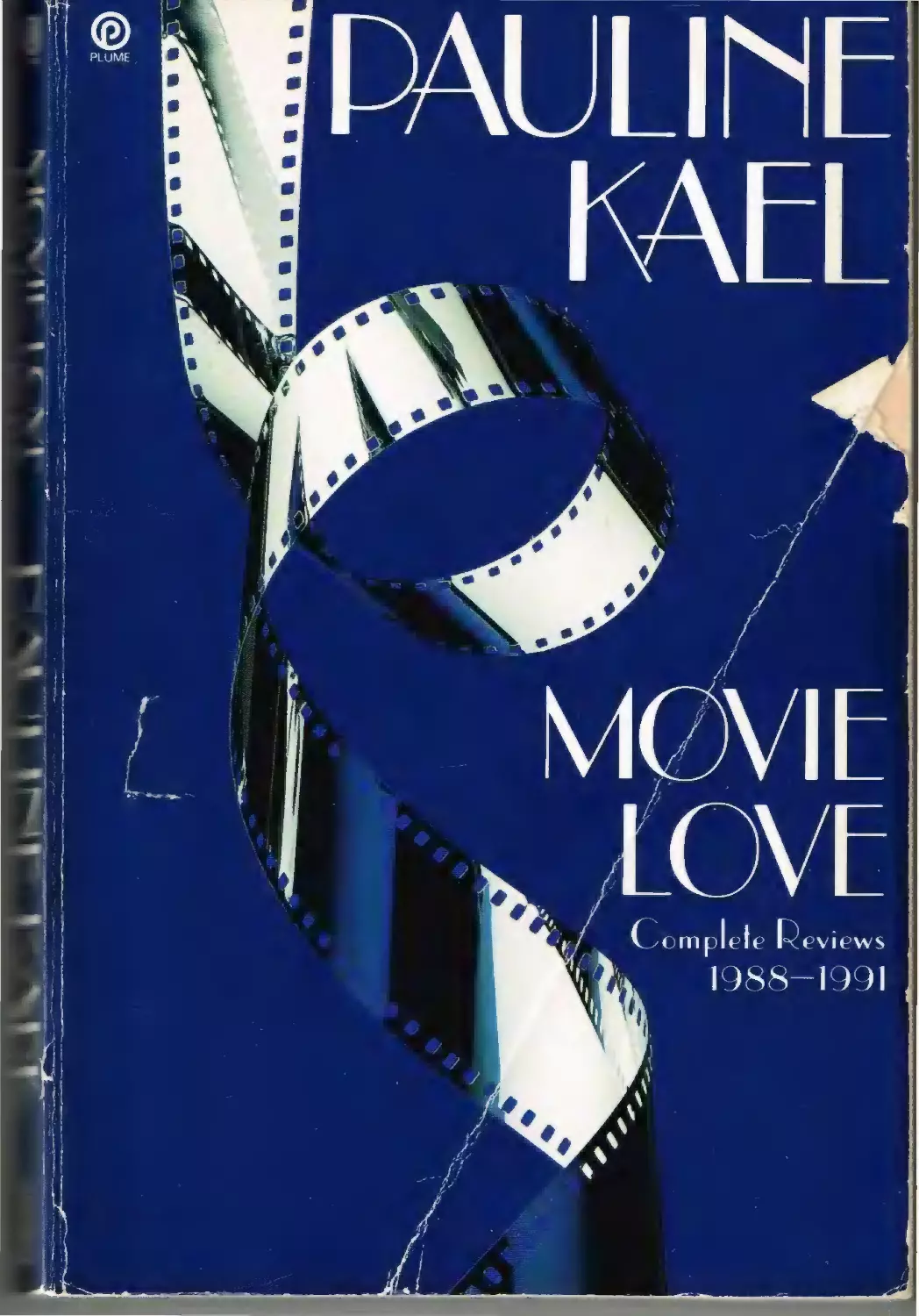
Complete Reviews 1988-1991

PAULINE KAEL

A

WILLIA~1

ABRAHA:'vlS BOOK

®

PLl!ME

PU.:ME
Published by the Penguin Group
Penguin Books USA, Inc., 375 Hudson Street,
New York, New York 10014, U.S.A.
Penguin Books Ltd. 27 Wrights Lane,
London W8 5TZ, England
Penguin Books Australia Ltd, Ringwood,
Victoria, Australia
Penguin Books Canada Ltd, 280 I John Street,
Markham, Ontario, Canada L3R I B4
Penguin Books (N.Z.) Ltd, 182-190 Wairau Road,
Auckland I 0. New Zealand
Penguin Books Ltd, Registered Offices:
Harmondsworth, Middlesex, England
First published by Plume, an imprint of New American Library,
a division of Penguin Books USA Inc.
Simultaneously published in Dutton hardcover edition.
First Printing, September, 1991.
10 9 8 7 6 5 4 3 2 I
Copyright<!"! Pauline Kael, 1988, 1989, 1990, 1991
All rights reserved
All the reviews in this book originally appeared in The New Yorker Magazine from the
years 1988, 1989, 1990 through the present.
All material in the book originally appeared in The New Yorker.

®

REGISTERED TRADEMARK-MARCA REGISTRADA
LIBRARY OF CONGRESS CATALOGING-IN-Pl'BLICATION DATA:

Kael, Pauline.
Movie love/Pauline Kael.
p.
em.
"All material in this book originally appeared in the New Yorker"- T.p. verso.
"A William Abrahams book."
ISBN 0-452-26635-1:
I. Title.
I. Motion pictures--Reviews.
PNI995.K245 1991
791.43 '75--dc20

91-8176
CIP

Printed in the United States of America
Set in Garamond Light
Designed by Eve L. Kirch
Without limiting the rights under copyright reserved above, no part of this publication
may be reproduced, stored in or introduced into a retrieval system, or transmitted, in
any form, or by any means (electronic, mechanical, photocopying, recording, or otherwise). without the prior written permission of both the copyright owner and the above
publisher of this book.
BOOKS ARE AVAILABLE AT QUANTITY DISCOUNTS WHEN USED TO PROMOTE
PRODUCTS OR SERVICES. FOR INFORMATION PLEASE WRITE TO PREMIUM MARKETING DIVISION, PENQUIN BOOKS USA INC., 375 HUDSON STREET, NEW YORK,
NEW YORK 10014.

Contents

Author's Note

xi

BIRD THOU NEVER WERT
Bird 1
Gorillas in the Mist
Patty Hearst 8

5

(October 17, 1988)

WHAT'S WRONG WITH THIS PICTURE?
Another Woman
12
Punchline 16
Madame Sousatzka 20

12

(October 31, 1988)

UNREAL
Women on the Verge of a Nervous
Breakdown 23
Things Change 27

23

(November 14, 1988)

TRIALS
A Cry in the Dark
The Good Mother

30

30
33

(November 28, 1988)

v

Contents

vi

38

GHOSTS
Scrooged 38
High Spirits 42
The Dressmaker 45
(December 12, 1988)

LOVE/HATE
Tequila Sunrise 48
Mississippi Burning 53

48

(December 26, 1988)

THE COMEDY OF EVIL
Dangerous Liaisons
Working Girl 63

57
57

(January 9, 1989)

FOGGED IN
The Accidental Tourist 67
Beaches 72
Dirty Rotten Scoundrels 74

67

(January 23, 1989)

8um

78

Rain Man

78

(February 6, 1989)

MARRIAGES
True Believer 83
High Hopes 87
Three Fugitives 89

83

(February 20, 1989)

KILLERS AND COUSINS
Out Cold 91
Parents 93
Cousins 96

91

(March 6, 1989)

TWO-BASE HIT
New York Stories
(March 20, 1989)

100

100

Contents

TOO HIP BY HALF

vii

106

The Adventures of Baron
Munchausen
106
(April 3, 1989)

LIKE MAD

112

The Dream Team
Crusoe
115
Heathers
118

112

(April 17, 1989)

FASCINATION

121

Let's Get Lost
121
Field of Dreams
126
(May 1, 1989)

YOUNG STUFF

129

Scandal
129
Say Anything
133
(May 15, 1989)

137

TRAMPLED
The Rainbow
13 7
Miss Firecracker
141
(May 29, 1989)

145

HICCUP
Indiana jones and the Last
Crusade
145
Vampire's Kiss
150
(June 12, 1989)

153

STONEWORK
Dead Poets Society

153

(June 26, 1989)

158

THE CITY GONE PSYCHO
Batman
158
Ghostbusters II

164

(July 10, 1989)

A WOUNDED APPARITION
Casualties of War
(August 21, 1989)

166
166

Contents

viii

SATYR

178

My Left Foot
178
Penn & Teller Get Killed
183
184
A Dry White Season
(October 2, 1989)

WHOOPEE

186

The Fabulous Baker Boys
Breaking In
191
johnny Handsome
193

186

(October 16, 1989)

FLOATING

195

Drugstore Cowboy
195
Crimes and Misdemeanors

199

(October 30, 1989)

BOMBS

204

Dad 204
Fat Man and Little Boy
The Bear 208

207

(November 13, 1989)

SECOND TAKES
Henry V
Valmont

212
212
217

(November 27, 1989)

BUSTY, TWISTY, FISHY
Blaze 221
Back to the Future Part II
The Little Mermaid 227

221
225

(December 11, 1989)

PULLING THE RUG OUT
Enemies, A Love Story
229
Driving Miss Daisy
234
(December 2 5, 1989)

229

Contents

ix

MELODRAMA/CARTOON/MESS
Music Box 239
Roger & Me 242
Always 245

239

(January 8, 1990)

POTENCY
Born on the Fourth of july

249
249

(January 22, 1990)

THE 54TH
Glory 256
Internal Affairs

256
262

(February 5, 1990)

TUMESCENCE AS STYLE
GoodFellas 265
The Tall Guy 270

265

(September 24, 1990)

HITS?
Postcards from the Edge
Pacific Heights 276
Avalon 278

273
2 73

(October22, 1990)

MOTHER, HUSBAND, BROTHER
The Grifters 283
Reversal of Fortune 287
Vincent & Theo 289

283

(November 19, 1990)

NEW AGE DAYO REAMS
Dances with Wolves 295
Edward Scissorhands 298
The Sheltering Sky 301
Everybody Wins 306
(December 17, 1990)

295

Contents

x

VANITY, VANITIES
The Godfather Part III 309
The Bonfire of the Vanities 315

309

(January 14, 1991)

THE DOCTOR AND THE DIRECTOR
Awakenings 318
Sleeping with the Enemy 326
L.A. Story 32 7

318

(February 11, 1991)

Index

329

Author's Note

What thou lovest well remains, the rest is dross
What thou lov 'st well shall not be reft from thee
What thou lov 'st well is thy true heritage . ..
Pound, Canto LXXXI

The years covered in this book (1988 to early 1991-the
end of my regular reviewing) have not been a time of great
moviemaking fervor. There were surprises and, in a few
cases, amazements- Women on the Verge of a Nervous
Breakdown; Dangerous Liaisons; Let's Get Lost; Batman;
Casualties of War; My Left Foot; The Fabulous Baker Boys;
Drugstore Cowboy; Enemies, A Love Story; The Grifters;
Vincent & Theo; Everybody Wins. Mostly, though, what has
been sustaining is that there is so much to love in movies besides great moviemaking. The young writer Chuck Wilson reports that his earliest movie memory is of his mother and his
aunt taking him, when he was six, to see Funny Girl, and as
he recalls, "In the final scene, when Barbra Streisand, as Fanny
Brice, sings, 'My Man,' it seems to me that I grew taller, yes, I
leaned forward, some part of me rose up to meet the force
coming from the screen. . . . I was rising to get close to the
woman I saw there. But I also rose to get closer to my self."
xi

xii

Author's Note

An avidity for more is built into the love of movies. Something else is built in: you have to be open to the idea of
getting drunk on movies. (Being able to talk about movies
with someone-to share the giddy high excitement you
feel-is enough for a friendship.)
Our emotions rise to meet the force coming from the
screen, and they go on rising throughout our moviegoing
lives. When this happens in a popular art form-when it's
an art experience that we discover for ourselves-it is sometimes disparaged as fannishness. But there's something there
that goes deeper than connoisseurship or taste. It's a fusion
of art and love.
I am indebted to movie friends-to Ray Sawhill and Polly
Frost, and to John Bennet, Bruce Diones, and Hal Espen at
The New Yorker. I want to thank William Shawn; William
Abrahams, the book editor who has stuck by me from the
first volume through this twelfth; my daughter Gina, and
that most avid of movie lovers, her son William.

MOVIE

Lao£'

,. BRD THOU
.~NEVER

WERT

18ird
The musicians in swing bands wore tails (monkey suits, they
were called) or bright-colored uniforms or spangled zoot
suits; their leaders flashed their teeth and, if they were black,
jiggled and jived. Black or white, they made us feel that
entertaining us and keeping us dancing was the highest calling they aspired to-even if they'd played the same arrangements over and over-and that our happiness was their
happiness. One of the ways the modern-jazz musicians of
the postwar forties let us know that they didn't consider
themselves entertainers was by wearing their street clothes
on-stage. Though this bebop movement was interracial, its
front-runners were black, and men such as Charlie Parker,
Dizzy Gillespie, Thelonious Monk, and Bud Powell ushered
in a new hipster militancy along with the intricate music
that they had developed late at night in Harlem jam sessions-the music they played for themselves. When the
boppers began to get engagements, they didn't care if you
couldn't dance to their music; they wanted you to listenor, rather, they let you listen. Bebop never became widely
1

2

PAULINE KAEL

popular; it was a jazz avant-garde movement, and the music,
which seemed very demanding at the time, angered many
of the older jazz musicians (possibly because bop intellectualized their music, speeded it up, made it abstract, and
brought it new shades of emotion).
The boppers didn't try to be ingratiating; they barely acknowledged the audience's existence. The trumpet man
Dizzy Gillespie-the cutup of the movement, in his beret
and shades and with a little dab of goatee-used his quick,
barbed wit on whitey; he became the symbol of the new
playful yet hostile cool. The alto saxophonist Charlie Parker-Bird, the master of improvisation, and a man known
for his chameleon charm and his cocky arrogance-became
the charismatic figure of the artist who nakedly expresses
himself in his art. Born in 192 0, by 194 5 he was part of a
liberation with its own emblems and signals. As Grover Sales
pointed out in]azz (Prentice Hall, 1984), "Some beboppers
refused to straighten or 'conk' their hair in defiance of a
rigid convention of black show business. Charlie Parker's
close-cropped 'natural' made an early proclamation that
'black is beautiful.' " Parker gave out other messages, in
spite of himself. He was drug-addicted from the age of seventeen until his death at thirty-four, and though he said that
he played best straight, and warned his admirers about the
misery of addiction, he set the potent archetype of the selfdestructive jazz artist. Heroin became the "in" drug for
boppers.
Bird, starring Forest Whitaker and directed by Clint Eastwood, from a script by Joel Oliansky, has just opened, after
being honored at the New York Film Festival. It was hailed
as "the first honest jazz movie" by Parker's biographer Gary
Giddins in the October Esquire, and it's being saluted all
over the place. Yet what I saw was a rat's nest of a movieall flashbacks and rain. Eastwood has been conscientious:
he hasn't commercialized the material. But he hasn't presented it, either, and he doesn't draw you into what he does
present-not even at the basic level of giving you something

Bird

3

see. The picture looks as if he hadn't paid his Con Ed
bill-the black actors are swallowed up in darkness. And,
with the film flashing back and forth, you can't get the hang
of Parker's life, and you don't come out with much understanding of his achievement or what made him a legend.
Though the movie runs two hours and forty-one minutes,
it doesn't indicate what was going on in the postwar period-the resentment that the black hoppers felt toward the
white musicians who had been ripping them off, along with
the agents and record companies and radio stations. (The
hoppers believed that their "difficult," far-out music would
defeat imitators.) And though you're taken inside recreations of the Fifty-second Street clubs and of Birdland on
Broadway, you don't get the bop elation, or the heightened
awareness of sex which the black and white intermingling
brought about, or any hint of the beginnings of the movement among black jazzmen to drop Christianity (as the white
man's religion) and take Muslim names.
Forest Whitaker's Bird trudges off to his gigs around the
country like a jazz version of Willy Loman; he's always fouling up-boozing and doping and smashing things. When his
common-law wife Chan (Diane Venora) tells the doctor who
wants to give him electroshock that he's a very special, creative person, it's the jazz equivalent of "Attention must be
paid.'' The script sinks to the level of attempting to explain
Parker's addiction as his way of soothing the pain of his
ulcer. (He uses heroin instead of Gelusil.) From moment to
moment, Whitaker's performance is richly felt; he's always
believable, and, with his heavy hunched shoulders, he often
looks like the photographs of Charlie Parker (especially in
Parker's last years). Leonard Feather, who knew Parker, says
in the August jazz-Times that five minutes into the picture
he forgot he was watching an actor. Yet Whitaker-maybe
it's because of the way he was directed-comes across as
just a genial big blob of a fellow who can't get his life together. And since this overgrown kid doesn't suggest Parto

4

PAULINE KAEL

ker's glow you don't understand why so many women find
him a turn-on.
Diane Venora brings an experimental, stagy tingle to
Chan's scenes-she gets something going. It's almost incidental that she manages to resemble Chan Parker (who
appears in Celebrating Bird, the 1987 video documentary
co-directed by Giddins and Kendrick Simmons). It's her mastering Chan's low voice that's the key to her performance.
The voice is very controlled and self-dramatizing and slightly
abrasive. (She sounds a little like Ida Lupino doing a goodbad bitch.) And you feel, Of course, this is exactly the kind
of passionate and intelligent jazz-struck girl who'd get involved with a suicidal, sponging genius-martyr like Charlie
Parker. Some of Whitaker's scenes with Venora have a
pricklish originality even when they're loaded with too
much meaning. And a few of his scenes with Michael Zelniker as Red Rodney, the white trumpeter who toured the
South with Parker, have something comic and unresolved
in them-Parker shows a streak of "just kidding" sadism
toward him. As actors, Zelniker and Whitaker play off each
other in a way that Sam Wright (as Diz) and Whitaker don't.
(The dialogue Diz has been given can put you in a dull funk.)
In general, the scenes between blacks don't achieve any kind
of intimacy. But then some of Parker's scenes with whites
are fairly awkward, too, and, except for Chan, the white
women who are attracted to him are photographed like
blond Nazi vampires.
In a late-night scene near the beginning, Charlie Parker
and Chan run into the room when they hear their sick baby
crying, and proceed to stand over the crib quarrelling. Neither one tends to the infant; the crying just disappears from
the soundtrack. (Ramshackle scenes like this one are part of
what the Times respectfully refers to as ''the Eastwood
reuvre. ") It's true that Eastwood has taken pains with Charlie Parker's music. Unreleased tapes as well as studio recording were processed by Lennie Niehaus: in some cases, he
eliminated the backup men and recorded new arrangements

Gorillas in the Mist

5

in stereo, retaining Parker's solos. (All this is said to have
been necessary because of the poor quality of the originals.)
The effect is lovely and pure, but too much like listening to
classics; the combos don't really sound like combos. And,
the way the numbers are scattered through the movie, the
music doesn't build the edgy excitement that drew people
to jazz clubs. Why, then, are jazz critics, and most of the
movie press, too, praising the movie? I think they're impressed by the care and affection that Eastwood put into
producing facsimiles of the bebop people and places and
events. And jazz critics like to see jazz solemnized-that
confers dignity on them. (Of course, stardom is sexy, and
they, like the movie press, love having a reason to interview
a big men's-action star with an reuvre.) And-maybe the
capper-when a man who isn't an artist makes an art film
it's just what they expect art to be: earnest and lifeless.

As the anthropologist Dian Fossey, in Gorillas in the Mist,
Sigourney Weaver storms into a large hotel restaurant in
central Africa, stalks the length of the room, delivers a strident tongue-lashing to a Dutch zoo broker who's having
lunch with his friends, and, cursing loudly, makes her exitall the while carrying a good-sized baby gorilla in her arms,
holding it tenderly, with awe. Weaver's physical strength
alone is inspiring in this movie, and there's a new freedom
in her acting. She's so vivid that you immediately feel Dian
Fossey's will and drive. Weaver's Dian is ecstatic when she
steps off the plane in Africa, and she's enraptured when she's
perched high up on a mountain, crouched down opposite
a giant gorilla, mimicking his language and gestures from the

6

PAULINE KAEL

inside-trying to think the way he does. Weaver is something to see. What happens between her and the animals is
really happening (or, at least, appears to be), and there's joy
in it. It makes everything else-all the acted-out passion and
heroism and melodrama of Dian Fossey's eighteen years on
her mountain-seem tired.
Partly, the picture is disappointing because it's overscaled
at the start. When Dian enters a huge, crowded lecture hall
in Louisville, Kentucky, in 1966, where Dr. Louis Leakey
(lain Cuthbertson) is saying that there are two big adventures left-space and who we are and what made us that
way-we're prepared for a whopping epic. Gorillas doesn't
fulfill the promise of that opening: we never see Dian learn
much of anything about primates or about our origins. Instead, we see her arrive in Africa, form an emotional attachment to a gorilla family, and cut herself off more and more
from people, until she's a fiercely maternal harridan who
can't work with anyone. By then, Weaver's jaw juts out
stubbornly; in her mania, Dian becomes apelike. Yet when
she thinks of happy times with her favorites, her face is
transformed. She blooms. Weaver acts the way she's builtshe's monumental.
The director, Michael Apted, and the screenwriter, Anna
Hamilton Phelan, want us, I think, to see the movie as a
triumphant woman-and-gorillas love story. They probably
want us to be inspired by Dian Fossey as an activist heroine-a woman who made a difference. (A title at the close
tells us that she saved the mountain gorillas from extinction.) But they didn't find a way to fit this inspirational idea
into their account of Dian Fossey's becoming convinced that
she was the only one who knew how to protect the gorillas,
and operating like a half-crazed terrorist. (In her later years,
she probably damaged her cause.)
The movie is quite watchable; it's never sluggish or outright stupid. And it has its high romantic moment-the time
a tough old silverback gorilla puts his hand in Dian's hand.
A photographer (Bryan Brown) sent out by National Geo-

Gorillas in the Mist

7

graphic, which is also financing her work, gets the pictures.
(Shortly afterward, Dian and the photographer make love.)
There's an authentic piece of drama, too, even if it's somewhat muffled: The photographer works out a plan whereby
he and Dian can spend six months a year at her station in
Rwanda and six months in other places-he on assignment,
she doing primate research-and she refuses and sends him
packing. It isn't research she cares about; it's her gorilla family. After he has left, she huddles among the gorillas, in the
rain.
Yet the movie seems to belong to the past of movies rather
than to the modern era. When Dian arrives in the Congo,
she spends six weeks tracking gorillas, and then, when she
and her head tracker, Sembagare Oohn Omirah Miluwi), see
them for the first time, the cinematographer, John Seale,
comes up with the glorious gorillas-in-the-mist vision that's
called for. But before you can suck in your breath, music is
poured on, signifying lyrical exaltation. (The credit reads
"Original music by Maurice Jarre." Hah!) When civil war
erupts in the Congo, and Dian argues with the soldiers who
are telling her to get out of the country, we're given a dose
of agitation music. Miluwi, who's actually a climber and part
of the Mt. Kenya rescue team, gives an affecting, quiet performance, but he's used as a symbolic dignified, loyal native
who knows right from wrong. And when Dian sets up camp
on the other side of the border, in Rwanda, there are cuts
to the tracker's worried reactions whenever she displays her
ruthlessness-terrifying a Batwa Pygmy child to get information from him, or setting fire to the Pygmy poachers'
huts. These shots are like inserts that have been recycled
from a forties epic. Despite its subject, the movie can't be
taken seriously. It's a feminist version of King Kong-now
it's the gorillas who do the screaming.

8

PAULINE KAEL

Paul Schrader lacks a basic instinct for moviemaking: he
doesn't reach an audience's emotions. He doesn't make you
feel empathy with his characters, and he's short on humor.
By temperament, he cools out hot projects. These limitations make it unlikely that his Patty Hearst will appeal to a
large audience. But on its own terms-as a stylized movie
of ideas-this is a lean, impressive piece of work. Nicholas
Kazan's script, which is based on Patty Hearst's own account, Every Secret Thing, comes across as bilge-free. The
film is a distanced presentation of the kidnapping of the
nineteen-year-old heiress, in February, 1974, by an eightmember terrorist group that called itself the Symbionese
Liberation Army, and of the fifty-seven days she spent blindfolded, in a closet, being alternately lambasted as a bourgeois parasite and raped, and of her subsequent participation
in S.L.A. holdups as Tania, the terror she developed of the
F.B.I., and her arrest, trial, and conviction. The whole series
of events is like a nightmare that's all of a piece-a kid's
nightmare that no one's on your side. And it answers the
question that people asked before, during, and after the trial:
Did she become part of the S.L.A. willingly, out of conviction, or was she simply trying to save her life? The movie
shows you that, in the state she was in, there was no difference.
The S.L.A. punished Patty Hearst for being a representative of the rich; so did the jury. The movie errs, I think, in
its quick, cursory glimpses of her early life: it doesn't treat
her as an individual, either. Her prettiness and her bland
manner are used against her, to suggest that she's a nothing,
when they could be used as an indication that she was
trained to hide her emotions under a polite mask-that her
blandness is a form of privacy. And since we're not taken

Patty Hearst

9

inside her character at the beginning, the movie is flat for a
long time. There's some kind of inhuman chic in treating a
victimized young girl as if she had no personality, no soul.
But, offensive as it is, this attitude ties in with the film's
"objective" manner. (The format suggests a staged documentary: we don't find out any more about the S.L.A.
members than Patty does.) And since the movie sticks to a
step-by-step factual view of what happens to her, it does her
justice-cold justice though it is. When her capture by the
S.L.A. is followed by her capture by the police, everything
you've seen starts to add up, and suddenly the film is overwhelming.
Natasha Richardson, the twenty-five-year-old actress who
plays Patty, has been handed a big unwritten role. She feels
her way into it, and she fills it by having Patty react meekly
yet almost furtively to her indoctrination and to the exchanges among the terrorists. Patty's reticence is much more
than a veneer: it's how she deals with the terrorists, whose
next moves she can't predict. (She retreats to being a hidden
observer; you feel her reminding herself to look eager to
please.) Richardson lets us see only a flicker of Patty's feelings toward the men she's forced to have sex with. (It's not
until the trial, when she's specifically asked how she felt
about one of them, that she lashes out with "I hated him.")
In movies, we are always primed to cheer those who fight
back, even when we know that realistically they couldn't.
Here's a passive victim-a girl who is raped in mind and
body, and no longer knows when it started. (In memory
flashes, she sees herself as having been blindfolded when
she still lived at home with her family.) The film's Patty has
a marvellous confused plaintiveness. Nine weeks after the
terrorists bang her on the head and throw her in the trunk
of a car, she takes part in a bank holdup, and only a few
weeks later (in May) the police surround the S.L.A. 's
Southern California bungalow hideout and, after an exchange of thousands of rounds of ammunition, the house
goes up in flames and the six S.L.A. people who were there

10

PAULINE KAEL

are incinerated. Patty, who's away in a motel with the other
two S.L.A. members, Bill and Emily Harris, watches the
shootout and the fire on TV. The commentators and the
police assume she was inside, and she knows that if she had
been she would have burned to death, too. She stares at the
TV and says wonderingly, "They didn't even try to take us
alive." What the terrorists have been telling her-that now
that she's joined up, the police are out to kill her-sinks in;
it traumatizes her, and she cowers in fear in the motel john.
"They think I'm dead," she says. "I am dead." Sixteen
months later, in September, 1975, she is arrested and put
on trial; when she's asked why she didn't run away from
the S.L.A. and she replies "Where would I go?" we feel how
alone and paralyzed she was. She buried Patty Hearst out of
fear, and Tania didn't have anybody. You can hear that buried child in Richardson's voice-thin and girlish here, like
Patty Hearst's. (At one point, though, Richardson hits a contralto tone that evokes her mother, Vanessa Redgrave, whom
she often evokes visually.)
Richardson always has something in reserve-you keep
waiting for what she may show you next. Hiding out with
the Harrises in rural Pennsylvania, she's impressed by the
guts that the fugitive radical Wendy Oodi Long) shows in
standing up to the foolish, irrational Bill Harris (William Forsythe). Wendy is spirited, and Patty draws some strength
from talking with her. But when she's in police hands she's
blocked again: her every attempt to be truthful gets her in
worse trouble. At the trial, she grasps how hopeless her case
is, and, for the first time, she shows a trace of bitterness.
When she's in the Federal Correctional Institute talking to
her father, we see her in full face, and she looks luminously
beautiful. Her words are perhaps too explicit: she says she
has finally figured out what her crime was-"I lived." Her
face transcends the statement.
And the film, I think, transcends its flaws. The idea of
keeping us blindfolded, along with the dazed Patty, is somewhat deadening: keeping us in the dark with her is too con-

Patty Hearst

11

ceptual a notion, and the effect is a little too art-conscious.
Yet the hypnotic formality of the film's conception holds it
all together. Schrader and Kazan are willing to sacrifice immediate pleasure for the full effect. And they show a dry
wit here: Forsythe's performance as the bespectacled white
middle-class Bill Harris who keeps trying to become a black
revolutionary leader is a comedy turn played close to the
vest. (Schrader is making wicked fun of these Che Guevarastyle guerrillas, but he's not just putting them down-he
enjoys their absurdist craziness and even, to a degree, identifies with it.) Dana Delany's lyrical, sweet profile is so incongruous among the S.L.A. faces that it seems almost loony.
Nobody in the group really fits-that's part of what saves
its members from looking like the usual movie terrorists.
When the group's black General Field Marshal Cinque (Ving
Rhames) announces, "I am a prophet," his eyes don't flash
with insane ambition, and when he tells Patty to take her
clothes off, no cataclysmic music is heard. The percussive
score, by Scott Johnson, doesn't wet down the material. Not
once.
OCTOBER 17, 1988

WHAT'S WRONG
WTH THS
PCTURE?

Not so long ago, Woody Allen movies were awaited with
joy; then he began to make tasteful versions of Ingmar Bergman pictures. He has a new one, Another Woman, andWell, I didn't much care for Wild Strawberries the first time.
(An homage, according to Peter Stone, is a plagiarism that
your lawyer tells you is not actionable.) Cast in the Victor
Sjostrom role, Gena Rowlands is Marion, the cold, cerebral
professor looking back over her life and realizing that she
missed the boat: a fearful, prudent careerist, she lost out on
passion, on motherhood, on life itself. (Does she also lack
passion for her work? We're not told, but it's implied.)
The opening music, Satie's "Gymnopedie No. 3," is like
the soothing Vangelis arrangements that are used in commercials for Gallo wines-music that's selected because it
couldn't upset the most delicate sensibilities. (It has the
qualities of a digestif.) The audience laughs, taking the wine12

Another Woman

13

country connection to be a joke. It's a jump ahead of Woody
Allen, who must be so secluded from the world of commercials that he didn't anticipate the reaction. He has become
so conventional in his tastes that this genteel slumber-party
music is his idea of an artistic prelude.
The story has a more intricate design than that of Allen's
Interiors or September. Just turned fifty, the firm-minded
Marion, philosophy professor and director of undergraduate
studies at "a fine women's college," has taken a year off to
write a book and has sublet a second apartment, to work
in. But "reality" leaks through: voices invade her sanctuary.
They're the voices of an analyst's patients, coming through
the air vent from the office next door. And she becomes
obsessed with one voice-that of the tearful, distraught, and
hugely pregnant Hope (Mia Farrow). Marion spies on her,
follows her around Manhattan, and manages to meet her.
Hope's confused feelings awaken Marion to all the risktaking she has put out of her orderly life: as if by magic, she
begins to encounter people she used to know and to flash
back to scenes from her past.
Woody Allen has become an accomplished craftsman, and
he moves around a large group of Marion's intertwined
friends and relatives in the past and the present. The cast
includes, among many others, Blythe Danner, Sandy Dennis,
Martha Plimpton, Gene Hackman, Ian Holm, Harris Yulin,
Philip Bosco, Kenneth Welsh, Bruce Jay Friedman, and John
Houseman and David Ogden Stiers playing Marion's father
in his later years and when she was still a young woman.
(Stiers' voice matches up with Houseman's.) Every detail is
in place, from Sven Nykvist's pristine, mellow images to
Gena Rowlands' designer writing ensembles and her
distinguished-woman hairdo-the braided knot on the back
of her head looks as if it had been cast in bronze. And Marion's voice-overs keep briefing us. The movie is so lucidly
constructed it's like a diagram of all the characters' relations
to each other. It's fluid even during Allen's flourisheswhen, for example, the older Marion talks across time to

14

PAULINE KAEL

her brother Paul as a young man, or when Marion dreams
that she's at the rehearsal of a play about her life. The basic
units, though, are Bergman scenes: Marion's aged father expresses regret that his wife was not the woman he loved
most deeply, and remorse at how he treated Marion and her
brother; there's speculation about whether Marion's first
husband committed suicide; Marion's second husband's first
wife interrupts a party to denounce him; Marion wants to
know why she and this second husband don't have sex anymore; and so on. And Marion's wet, suffering eyes speak of
her misery over what she now recognizes has been a sterile
existence, in which she has been judgmental about everyone but herself. (She is psychoanalyzed by overhearing the
pregnant woman on the analyst's couch.)
Quiet as it is, this is a soaringly ambitious movie; it's
clearly intended as a celebration of Allen's becoming a father (it's his child that Mia Farrow is carrying) and as an
assertion of a new commitment to life, in all its passionate
messiness. Yet, except for a few scenes where the performers' individuality stirs the surface (Hackman, in tip-top form,
sneaks in a hint of eroticism; Sandy Dennis lets loose with
bursts of smudgy, chaotic anger; Martha Plimpton has her
laconic, easygoing freshness; and Blythe Danner hugs herself, wrapping her long fingers around her skinniness like
an American Maggie Smith), nothing in the movie has the
slightest resonance. Bergman's version had at least a mysterious sensuality and raw, gothic images and great disturbing faces that helped you over the banalities and stayed in
the memory. Woody Allen's picture is meant to be about
emotion, but it has no emotion. It's smooth and high-toned;
it's polished in its nothingness.
When Marion, upset, sits down alone and, in voice-over,
tells us, "I thumbed through my mother's edition of Rilke,"
what universe are we in? (One where this isn't recognized
as a line to hoot at.) Woody Allen may identify with Marion's new desire for release, but he's filming a delusionary
world derived from books, plays, and movies, where stick

Another Woman

15

figures accuse each other of betrayals, infidelities, lack of
courage-and it's all weightless. Marion talks of Rilke's black
panther, his symbol of death; and a white mask is displayed-we're told it's from a performance of La Gioconda.
The pregnant woman is named Hope, which is also the title
of a Klimt painting of a pregnant nude exhibited for us;
Brecht is referred to, and Kurt Weill is performed in an enervated version. Marion, who has been in love with order
but realizes it's death and now finds Hope, belongs to a
whole race of cultured zombies.
This is the seventeenth film that Woody Allen (in his early
fifties now) has written and directed; it's easy to believe
that, like Marion, he has trained himself to be overdisciplined. The evidence is here in this howlingly groomed production, which is intended to represent a movement toward
liberation but was made by a man who doesn't even accept
his own humor. A viewer of all Woody Allen's movies-the
comedies and the vacuous dramas-may conclude that he
misstates his problem in Another Woman. You can see in
his comedies that he associates messy emotions with Jewishness and foolishness and laughter. But he wants to escape
all that and be a "serious" dignified artist, so he sets his
dramas in an austere Gentile world. And then what is the
protagonist's tight-nostrilled anguish about? Being repressed. Being a perfectionist. Not being emotional enough.
That was the interior-decorator mother's soul-sickness in Interiors, and it's Marion's soul-sickness here. Woody Allen is
caught in his own Catch-22: his protagonist's problem is not
being Jewish.
Another Woman was made by an upscale control freak.
Even the workplace Marion sublets is in impeccable taste.
The soundtrack music is Bach and Mahler with popular classics in arrangements that seem modulated to go with the
carpeting. The only bright side to all this is that, having
reached a peak of self-rejection, Allen shouldn't need to go
any further in this direction. If there's a tragic waste in his
career, it's that he doesn't place a high enough value on his

16

PAULINE KAEL

own talent; he labors to be an artist like Bergman and turns
into a pseud. If he could just stop dichotomizing himself
between "funny" Allen and "serious" Allen! Maybe even
Marion would recognize that life includes cracking a joke
now and then, and letting in a little rock 'n' roll. How can
you embrace life and leave out all the good vulgar trashiness?

Standup comics appear to come from several groups: bright,
verbal children who clamor for the attention they didn't get
from their families; bright, verbal "born comics," the family
pets who made everyone laugh until their indefatigability
drove everyone nuts (the pets clamor for more of the attention they did get); and other kids-maybe adolescents, or
even adults-who fall in love with comedy. It comes pretty
much to the same thing. They all find a way to remain kids
forever: they turn their talkativeness and their intense, exaggerated reactions into entertainment. It's the handiest vehicle for their hyper-responsiveness. They turn it into
routines because what else can you do with it? Well, David
Seltzer, who wrote and directed Punchline, found something else he could do with it: turn it into pop-psych moral
uplift and sell it.
Seltzer wants us to see the blistering young comic Steven
Gold (Tom Hanks) as "troubled." Seltzer points up Steven's
hostility, his inability to relate to other people, his not understanding what love is. And everything that Seltzer points
up is soggy and only partway believable. (He's the Gail
Sheehy of moviemakers.) Some sharp, high-energy comics
may have had a tantrummy smartass childhood, but as the

Punch line

17

kids' childhood experiences became stylized acts they took
on a satirical, self-lampooning tone. And if the kids became
jazz artists of language and let loose their imaginations we
might hear our own kookiest buried thoughts spring out of
their mouths. Or maybe even-as with Mel Brooks-hear
sprightly thoughts more cockeyed than we'd ever dreamed
of. When touched-in-the-head-gifted-comics like Robin
Williams or Andrea Martin (or Woody Allen) take flight,
they're emancipated from sanity. So why does Seltzer present the gifted Steven Gold as one of the hundred neediest
cases? Because pathos serves Seltzer's purposes, and zest
doesn't.
Hanks convinces you that Steven has to be a comic; he
can't be anything else-or, at least, there's nothing else that
he wants to be. Somehow, the movie uses this against him.
Whiplash-smart and manic, Steven works out at several
places each day and night; his home base is the Manhattan
club the Gas Station, where he earns fifteen dollars a show
plus chits for drinks at the bar. He lives on the money his
doctor father sends him for medical school, but-and here's
the Seltzer touch-Steven can't go on with his studies, because even though he might make an excellent doctor he's
squeamish about blood. He's a tortured fellow-compulsive,
restless, derisive. But Lilah (Sally Field) sees the soft,
suffering child within. She's a New Jersey housewife and
mother of three who hopes to become a comic, and she
wears what I guess is meant to be an all-purpose, practical
coat. It's plaid, with some frowzy animal around the neck,
and it makes her look like a toby jug three feet high. Every
time she put on that grotesque coat, I could feel my gut
tightening; her coat began to stand for everything that's
wrong with the movie.
As Seltzer presents the story, audiences warm to Lilah because she has a wholesome, normal outlook; Lilah incarnates what Steven has been denied, and the movie gives her
an insipid radiance while it pulls back from Steven's aggressive twisted smile and his stabbing vocal rhythms. (These

18

PAULINE KAEL

two are Lenny Bruce and Erma Bombeck.) Essentially, the
movie pulls back from its own subject-standup comics.
Sally Field has an almost scary plaintive look in some scenes,
but the movie never gets very far into why Lilah is running
around buying jokes. We're supposed to dislike Steven's
brashness and desperation, and approve of Lilah because
she's decent and only temporarily driven. This is the kind
of movie in which Lilah's husband in Jersey is tender and
wise when he says, "Someday, Lilah ... you'll remember
that the people in this house loved you whether you were
funny or not.''
You can't have much respect for a writer-director who
falls back on the plot device of a contest to be held at the
Gas Station-the winner will get a shot on the Johnny Carson show. (Is this a Muppet movie?) And Seltzer employs
tricks that used to jerk tears, like having the cheerful, raucous act that Steven performs for the patients in a hospitalthe one routine where he comes across as a man being funny
and not a wiseguy-end with his slipping away to speak
comfortingly to a dying child. The bedraggled plotting
forces Hanks into maudlin situations. Steven gets up to perform, sees his father and brother at a table, and falls apart:
he talks slowly, fumblingly about his childhood humiliations until he's led offstage. Lilah follows him out, and he
weeps on her shoulder. This is the low point of the movie;
it comes to a halt, and Hanks can't save himself, maybe because the breakdown doesn't have any nuances-it's not
grounded in anything believable. In another scene, Steven
and Lilah are in a diner, and he, euphoric about his feelings
for her, urges her to pack up her children and come to him,
and they'll get·married. (He doesn't even have a place for
her to come to; he has been locked out of his apartment.)
She tells him that she loves her husband; anguished, he says
he has nothing to keep him going without her, and he walks
outside into a downpour, la-la-ing the beginning of "Singin'
in the Rain,'' and dancing and miming a long takeoff of Gene
Kelly's solo, with Kelly's blissfulness converted into self-

Punch line

19

dramatizing bitterness and dejection. When his dance is
over, he stands in the rain looking back at her for an instant
of formal eye contact before he disappears from the frame.
Hanks performs this number with such physical grace that
he transcends the banality of the idea and outclasses Punchline.

Sally Field, Hollywood's queen of vulnerability, is too
skillful at what she does; she seems used up, as if she'd hit
her limits a long way back. (It's almost inconceivable that
she once had the range to play the fractured identities of
Sybil.) She doesn't find anything to reveal to us, and her
plucky darlingness is a blight on this movie. To be more
exact, it's the picture that's a blight, because Seltzer's sitcom
style of humor is just like Lilah's. When she learns how to
perform and does her act, we're supposed to be charmed
by the naughty vibrator jokes that pop out of her little head
and "embarrass" her. And we're supposed to see what a
blooming, healthy, nice person she is. The truth of Steven's
character is supposed to be the hurt, not the comedy; understanding this, she knows that he needs to win the contest
more than she does. This shabby plot even undercuts Steven's final routine, which begins bewilderingly.
Field is lucky to have John Goodman, as Lilah's insurancesalesman husband, to carry her. Goodman's cheeks and
chest have become huge, and his role is heavy and domineering at the beginning; but about midway Lilah changes
her hairdo from soft, red, and long to a tightly curled brunette bob (is she imitating Steven?), and she's flustered about
what she has done, and is on the verge of tears-and then
her husband intercepts, sets her at ease, and we see a different side to him. Right there, Goodman takes over. The
conception of the insurance man as the rock that Lilah
cleaves to is no more than a plot convenience, but Goodman makes him into a grinning, big-souled character with a
happy boom of a laugh. His love of her makes her look
substantial instead of just cute-as-a-bug, and the gleam in his
eyes when she's performing saves the creaking last scenes.

20

PAULINE KAEL

As a network scout who praises Steven but doesn't take
the risk of recommending him, Kim Greist (of Brazil) has
the TV functionary's sexy manner down pat. And Mark Rydell, as the baby-faced owner of the Gas Station, is eager,
self-serving, and almost iridescent in his sleaziness. During
the contest, when he's onstage as the m.c., you expect to
see a diamond in his eyetooth; he's so proud and excited
he's like an enraptured gnome.
It's Hanks, stretching his light comedian's skills, who
keeps you watching. While Steven the cutting-edge comic
may be written to be nothing but the tears behind the laughter, Hanks gets under the material, and darkens it. Steven
reaches out to Lilah because she's a mommy; he knows he's
a nit to want a mommy-it's his awareness that keeps him
racing. When Lilah's husband comes into the club, Steven
looks at him with jealousy and anger; this kid knows what
turns him on in a sick way-he's a comic, he's on top of
what bothers him. And he's so manic he doesn't know how
he's going to take his next breath. Steven is most alive when
he's spritzing and not quite in control; I'd like to have heard
him do a jeering riff on a few targets that were at hand, like
the film's perky score and Lilah-the-housewife's kitchen
that's lighted like a margarine commercial and the inserts of
onscreen audiences beaming at Lilah's wholesome humor,
and don't forget the plaid coat.

Shirley MacLaine is outrageously miscast in John Schlesinger's Madame Sousatzka. As a flamboyant, grande-dame piano teacher, of Russian lineage, she glints her eyes and
pinches her tiny lips, she tromps around in layers of clothes

Madame Sousatzka

21

and ropes of beads, whirling her velvet cloak. MacLaine
seems to have entered the Simone Signoret sweepstakes, but
she doesn't project Signoret's generosity-she doesn't spill
over emotionally. MacLaine has flurries of physical mannerisms, but she's tight and held in; she's a wacky witch with
frizzy red hair-she could be Norma Desmond's small-town
spinster sister.
The movie accounts for her Americanness by having her
raised in New York, where her performing career was
wrecked long ago by her dragon of a virtuoso mother; she
lives in London now (in an Edwardian house that is to be
demolished) and devotes her energies and her hopes to the
most prodigious of her students, a fifteen-year-old Indian
boy raised in England, Manek Sen (Navin Chowdhry). Autocratic old Sousatzka battles with the boy's beautiful young
mother (Shabana Azmi) and tries to take him over completely, and, still traumatized from her own failed debut, she
refuses to let him perform in public. The movie is about the
boy's breaking free of her, though he knows he'll remain in
her debt forever. Changing Manek from the Jewish boy of
the 1962 novel, by Bernice Rubens, works fine, but Sousatzka seems to belong to an earlier era than that of the
poised, often amused Manek. Chowdhry, who has impressive, big features in an intelligent face, gives you the sense
of how he feels about his developing powers, and he's fun
when he knows to ignore Sousatzka's bullying. It's a likable,
well-directed performance. And the beautiful Shabana Azmi,
who acts a little broadly, like a Bengali Jane Seymour, makes
you understand her near-hysteria when she has to deal with
Sousatzka. The best scenes in the movie show how Manek
and his mother live, and the perils of their catering business;
there's a wonderful image of Hindu women piled together
in a tiny room watching daytime TV.
The script, by Ruth Prawer Jhabvala and Schlesinger, is
blindingly derivative but thoughtfully worked out. The conflict between teacher and pupil takes place among Chekhovian intimations of life going on among the tenants of the

22

PAULINE KAEL

doomed building: Peggy Ashcroft is Lady Emily, the impoverished landlady; Geoffrey Bayldon is an elderly homosexual osteopath; and Twiggy, who gives an appealingly
understated performance, is an aspiring pop singer who isn't
getting anywhere, except into the beds of artists' reps and
record producers. (Manek, who adores her, pleads with her
to take him into her bed.)
The movie has excerpts from musical classics, and a tense
scene where the boy makes his debut playing the Schumann
Piano Concerto and we're alerted that he won't get through
it unscathed. The musical community may regard the picture as a treasure. Schlesinger is a professional at mounting
a production; it's handsome and textured and reasonably
dynamic, and for some people it may serve as the Red Shoes
of the keyboard. But the core performance is missing. You'd
think that, with all those past lives to draw on, MacLaine
could come up with a crazily noble, dedicated music loveran inspiring tyrant-rather than this rouged and tarted-up
hollow old crank. MacLaine's Sousatzka has no Old World
charm and no New World charm, either. And, without a big,
maddening personality to irradiate it, the movie is like a
prestige best-seller from an earlier era. As a viewing experience, it's laborious-not bad but not enjoyably bad, either.
It should be projected on the wall while you have a polite
lunch at the Russian Tea Room-the wall behind you.
OCTOBER 31, 1988

UNREAL
l~V~~ ~ lVer~ofa

1'ferlMlll& 18r~
Pedro Almodovar may be the only first-rank director who
sets out to tickle himself and the audience. He doesn't violate his principles to do it; his principles begin with freedom
and pleasure. Born in 1951, this Spaniard from hicksville
went to Madrid at seventeen, got a job as a clerk at the
National Telephone Company in 1970, and, during the more
than ten years he worked there, wrote comic strips, articles,
and stories for "underground" papers, acted in theatre
groups, composed film scores, recorded with a rock band,
performed as a singer, and shot films in Super 8 mm. and
16 mm. He absorbed the avant-garde slapstick of the late
sixties and the seventies along with Hollywood's frivolous
and romantic pop, and all this merged with the legacy of
Buii.uel and with his own intuitive acceptance of loco impulses. Generalissimo Franco kept the lid on for thirty-six
years; he died in 1975, and Pedro Almodovar is part of what
jumped out of the box. The most original pop writerdirector of the eighties, he's Godard with a human face-a
happy face.

23

24

PAULINE KAEL

His new Women on the Verge of a Nervous Breakdown,
his seventh feature (since 1980), is one of the jauntiest of all
war-of-the-sexes comedies. Pepa (Carmen Maura), an actress
who works in TV and commercials, and does dubbing, turns
on her answering machine and learns that she has been
jilted. Infuriated at the way her long-time live-in lover, Ivan
(Fernando Guillen), has evaded direct contact with her-he
can lie to the machine without fear of being challengedshe dashes around, on spike heels, in a short, tight skirt,
trying to confront him. Angry and impatient, and imagining
she doesn't want to be in her apartment without him, she
instantly puts it on the market.
Pepa is so wound up about Ivan that although her girl
friend the lightheaded Candela (Marfa Barranco) keeps
phoning and chasing her, asking for help, Pepa, hearing
nothing, answers that she doesn't have time. What Candela
is trying to tell her is that her own lover has turned out to
be a Shiite terrorist who was using her place as a base of
operations, and she thinks the police are after her. Without
registering Candela's words, Pepa takes her in. Meanwhile,
blankly handsome Carlos (Antonio Banderas), who turns out
to be Ivan's son, comes to see the apartment, and brings his
soon to be discarded fiancee, Marisa (Rossy De Palma, who
looks startlingly like the double face of Picasso's 193 7 portrait of Dora Maar). Ivan's earlier lover Lucia Qulieta Serrano)-she's Carlos's mother-arrives in search of Ivan; she
was over the edge for twenty years and has just recouped
her sanity. And when Pepa, on Candela's behalf, consults a
feminist lawyer (Kiti Manver), the woman turns out to be
Ivan's newest lover-and the next candidate for a breakdown. All these women are sleek-legged and chic and made
up as if they were painted in acrylics.
The artificial is what sends Almodovar sky high. The
movie has nothing to do with what passes for nature or
realism. It starts with titles set against divided-screen fashion
and cosmetics layouts that parody the bright, crisp
American-movie openings of the fifties. (All that plugging

Women on the Verge of a Nervous Breakdown

25

away to be Mondrian-new and striking.) Women on the
Verge looks as if it had been made by a mad scientist playing
with chemical rainbow colors-John Lithgow in his lab in
Buckaroo Banzai. When you were a kid, you wondered if
your crayons would kill you if you ate them. These toxic
colors are toxins for the pleasure of it; Almodovar makes
the artificial sexy.
The film's controlling metaphor is right there at the start,
in those sharp-edged layouts: Almodovar is after the phosphorescent glow of cosmetics in women's magazines. (It's
dream-candy color. You don't just see it; you consume it,
lustfully.) Pepa and the others in their short short skirts have
created themselves in the image of hot, desirable women.
They function in the world; they do fine. But when it comes
to men, that sassy image may be all that's holding them together. The lovely, wacky Candela is always speeding between panic and ardor; she talks about being entrapped by
the Shiites, and her earrings-they're little silver espressomakers-dangle alluringly. Except for Lucia (who suspects
the truth about herself), they all know they look great; that's
not a small thing. (Lucia can't keep up her morale; her
makeup slips and blurs.)
The movie links Carmen Maura's Pepa to the Hollywood
goddesses who blew a trumpet to announce that they were
entering the house of passion. Their emotional display was
morbidly fascinating; Almodovar and Maura take off on that
display and go further into it. Pepa looks great even though
she shows some wear and tear. It's in her nature to charge
into things bang, head on, and get scuffed up. She doesn't
mind; she enjoys flaunting the ravages of love. It's also in
her nature to let off steam; she distracts the police, who
come looking for Candela, by giving them a stormy account
of intimate experiences. Almodovar revels in her overdramatizing, but it's never held an instant too long; it's quick
and buoyant. It's taken for granted. Pepa is both overtly
nuts-a coquettish, fluttering wreck-and profoundly sane
and practical. After she gets the kiss-off from the answering

26

PAULINE KAEL

machine, she's so zonked on pills and misery that she accidentally sets her bed on fire. She stares at it for a few seconds, then flips her cigarette into the flames and puts them
out with the hose from the terrace.
Women on the Verge is serenely unbalanced-a hallucinogenic Feydeau play. Mad-again Lucia, in pale pink, rides
to the airport on the back of a motorbike, her wig rising
and blowing in the wind. She's determined to catch up with
Ivan, and he's about to board a plane. Inside the terminal,
her head, seen gliding by above a moving walkway, is the
head of a mythological creature-a wiggy Fate. When the
people in the airport hear a shot fired and try to protect
themselves by hitting the floor, they stay down until Ivan
comes over to Pepa, who has raced Lucia there. Then they
all get up at once, like the dancer-spectators in a musical
version of a gangster picture. The Madrid of the film is a
pop utopia; it's also-as the closing song has it- "Puro
Teatro.''
Almodovar celebrates women because they run the theatrical gamut. Carmen Maura is his star, his muse, his comedienne because she's all histrionics; she doesn't make a
move that isn't stylized. Yet she's snappy. And it won't take
her Pepa twenty years to see through Ivan. Gray-haired,
vain, and elegant, he's the film's MacGuffin-a shell of a
man, and perhaps an archetypal Spanish roue. A dubber by
profession, he's a voice pouring out inanities. It pleases him
to flatter virtually every woman he sees; he's complimenting
himself on his aplomb, his powers of seduction. When he
has something to say that might provoke an emotional response, he'd rather talk into a machine. He's a sly fellow:
while dodging Pepa, he keeps leavin,g messages accusing her
of avoiding him. (He tells her to pack up his clothes and
leave the suitcase with the concierge.) Ivan is right to communicate by machine: as a disembodied voice, he gives the
illusion of masculine strength. In person, he's just a pretty
illusion, like his son, Carlos, and the police officers and the

Things Change

27

men from the phone company who invade Pepa's apartment.
The script began with Cocteau's The Human Voice-the
famous telephone monologue in which a woman tries to
win back the lover who is leaving her. Almodovar had already done a turn on the play in his last film, the 1987 Law
of Desire; this time, the monologue grew into a comic revenge on his old employer the phone company. Pepa grabs
her phone and throws it out the window, and she throws
out its offspring, the answering machine, too. She's paying
them back for the long waits for men to call and the lies
listened to.
This high comedy is the most visually assured of the five
Almodovar movies that have opened here. Law of Desire
and the 1986 Matador were more sultry and erotic; this one
is fizzier, sexier. Earlier, you could see him trusting his
intuitions and taking leaps; now you don't see the risktaking-he's just up in the air flying. The movie is all coincidences, and each new one adds to the crazy brio. What
seem to be incidental jokes turn out to be essential parts of
one big joke. This is a movie where after a while you can't
tell sexy from funny.

Things Change is a modernist version of a sentimental fable.
David Mamet, who directed and was the co-writer (with Shel
Silverstein), gives you the blueprint but not the feeling. The
story is essentially a heart-warmer: Sicilian-born Gino (Don
Ameche), a dignified old Chicago shoeshine man who gets
mixed up with mobsters and is mistaken for a Mafia don,
emerges unscathed because of his simple goodness-his hu-

28

PAULINE KAEL

manity. But it has been directed at a deliberate and unvarying pace. The result is like a Frank Capra-Damon Runyon
movie of the thirties in slow motion.
This is the bare bones of the plot: The mob offers the
impoverished Gino a deal. If he'll confess to a killing that a
man he resembles has been arrested for, he'll serve only
three to five years, and when he comes out he'll be able to
retire to Sicily and buy the fishing boat he has always
wanted. He agrees, and is put in the hands of Jerry Qoe
Mantegna), a "probationary," blundering mafioso assigned
to lowly tasks, who is supposed to spend the weekend holed
up with Gino, coaching him in his story. Gino asks Jerry if
he can go for a walk on the beach; the restless, grandiose
Jerry decides to give the old gent a break, and takes him,
by plane, to Lake Tahoe. That's where Gino is mistaken for
a bigwig, and where he and Jerry become buddies.
Mamet piles on improbabilities in a matter-of-fact style,
and with a minimum of emotion. Most of what a viewer
sees is just Ameche being a straight-backed peasant-a man
of his word-and Mantegna being a confused hoodlum.
There's nothing to look at except their rather mummified
skits. But Mamet cons the audience. He brings it into a hip
complicity with him. He gives people the impression that in
making them wise to the actors' games he's making them
wise to how the world works-that he's letting them in on
life's dirty secrets. And flatness of performance seems to be
part of the point. Marner's minimalism suggests a knowingness, a disdain for elaboration or development. (This was
also his strategy in the first film he directed, the 1987 House
of Games.) People can feel one up on the action, the way
they can when they're watching the David Letterman show.
Or they may feel that Mamet over-controls the actors and
the other elements of moviemaking, and that his approach
takes the fun out of hokum. In Capra's 1933 comic fairy
tale, Lady for a Day (in 1961, he remade it, mawkishly, as
Pocketful of Miracles), Apple Annie, a Times Square peddler, passes herself off as a society matron, with the assis-

Things Change

29

tance of a gang of Broadway racketeers, who are saying, in
essence, "We're as hardboiled as they come, but we have
big, soft hearts." (They also have a colorful lingo.) And in
Hal Ashby's 1974 The Last Detail, where Jack Nicholson,
escorting Randy Quaid to naval prison, decides to give him
a fling, the tension is between the Nicholson character's
generous, paternal impulses and his mean, blowhard cowardliness. (Robert Towne provided rowdy, lewd dialogue.)
Mamet appears to draw from these films (and when Gino's
remarks about the best methods of shoeshining are taken to
be parables, to be drawing a little from the Ashby-Jerzy Kosinski Being There), but the language is blandly arch, and
there's no dramatic tension, just a stiff unease. No one seems
to take a breath on his own.
You expect the trip to Tahoe to be a realization of Gino's
dreams, but Mamet can't give himself over to the fable-he
keeps his hardboiled distance-and so there's no inkling of
what Tahoe might mean to Gino, or of what being treated
as a Mafia don might mean to him. The movie is an extended, undernourished anecdote. Ameche starts repeating
himself early on; Mantegna, a practiced slicker who's all
wrong for fraidy-cat buffoonery, doesn't seem sure whether
he's playing a dumb mug or just coming across as one. Marner's talent is for lowlifers' rancorous scrapping, not for
comic gangsters and buddy love.
You half expect the actual killer-the guy that Gino is
.supposed to resemble-to turn up; you wait for the plot to
be more clever than it is. That's the only suspense the movie
has. Mamet set up a story with a buried theme: the yearning
for a day when men kept their word. And then-it's no
surprise-he couldn't deliver the third act. Gino has a Mafia
lucky coin that keeps saving him, but by the end this device
rings like a lead quarter.
NOVEMBER 14, 1988

TRALS

If A Cry in the Dark had been called "A Dingo Ate My
Baby!" that would tell moviegoers what it's about-it would
be a Cry from the Heart, and they might line up around the
block. But A Cry in the Dark, directed by Fred Schepisi and
starring Meryl Streep, isn't the kind of movie they would
expect to see. Schepisi uses the case of Lindy Chamberlain,
who was tried for murder and convicted, to ask why the
press and the public jeered at her account of seeing a dingo
(the Australian wild dog) slink off from the tent the baby
was in. The film asks why Australians were so eager to believe that Lindy, the wife of a Seventh Day Adventist minister and the devoted mother of two little boys, had killed
her nine-week-old baby girl, while the family was camping
near Ayers Rock, in the Outback, in 1980.
To begin with, there's a lurid, National Enquirer ring to
her story. And it met with the derision of a rough, cynical
people and jangled their national pride. Dingoes are an Australian mascot, and they're not very large (they resemble
coyotes), and Ayers Rock, the great monolith in the desert
which has been a sacred site for the aborigines for over ten
thousand years, is a chief tourist attraction. Australians like
to say it's the biggest rock in the world. And, as Seventh

30

A Cry in the Dark

31

Day Adventists (and so vegetarians), Lindy (Streep) and her
husband (Sam Neill) were "different," and before long were
rumored to be members of a cult with blood rituals. Perhaps
the most damning thing, the thing that made the penniless
and once again pregnant Lindy the most hated woman in
Australia, was that her stoic, matter-of-fact manner was not
what the public expected. TV had accustomed people to
grieving mothers who showed their frailty and their naked
pathos, and here was Lindy on TV-distanced, impersonal,
and bluntly impatient at the endless dumb questions.
It's this that makes the role work so well for Meryl Streep.
She's a perfectionist who works at her roles from the outside in, mastering the details of movement, voice, and facial
expression, and this thinking-it-all-out approach gives her an
aloofness. Of course, she's got the accent; at least, to American ears she's got it-the flatness, the low pitch, and the
combative swing of the phrasing. It seems more fully absorbed than her meticulous accents generally do. And she's
devised a plain, inelegant walk for this woman who has no
time for self-consciousness, and no thought of it, either. The
walk may be overdone: the actual Lindy Chamberlain, when
she appeared on "60 Minutes," didn't move this heavily, as
if she'd just put down a washboard. And Streep definitely
overdoes the coiffure-witchy black hair with the bowl cut
you sometimes see on little boys. But Streep's Lindy has a
consistency-she's practical and unrefined, with no phony
aspirations. And what gives the performance power is that
Streep can use her own aloofness and make it work in the
character. (Even her lack of spontaneity works for her here,
though sometimes she does seem overcontrolled.) Streep
has psyched out Lindy Chamberlain and seen that her hardness (unconsciously, perhaps) serves a purpose: it saves a
part of her from the quizzing and prying of journalists and
lawyers. Lindy, who's scrappy and reacts to fools with
comic disbelief, needs her impersonal manner to keep herself intact. (Maybe the professionally gracious and intelligent
Streep has learned this from her own sessions with reporters

32

PAULINE KAEL

and TV interviewers.) From time to time, Streep suggests
the strong emotions that Lindy hides in public, and we feel
a bond with her-we feel joined to her privacy.
Schepisi, who worked on the script with Robert Caswell
(it's based on John Bryson's study of the case, Evil Angels),
may have got too many things going. He's a superb moviemaker, but in his attempt to do an epic dissection of how
superstitions can spread, and how false the public perception (based on the media) can be, he put together more elements than he could develop. There are wonderful scenes:
early on, at the campsite, a dingo snaps up a mouse so fast
it's like the whirring of the wind; at dusk, right after Lindy
screams that her baby has been taken, the people in the
camp, in panic and confusion, hunt for the infant in the
darkness; and then there's a gigantic, organized search, with
men and women carrying torches seen from a distance, lined
up across the wide screen. (The image has an awesome horror.) Schepisi introduces the Aussies' casual cruelty to the
aborigines. (Their dogs are ordered shot, though they're
nothing like dingoes.) And when public opinion has shifted,
and the self-contained Lindy is thought to be an icy, tough
customer, he gives us vignettes in homes and bars and
glimpses of the workings of the yellow press. (These are
perhaps the weakest scenes: too many uncouth, boisterous
shouts, too much hubbub, and we're not told enough.) He
provides a quick rundown on the forensic scientist far away
in London who has never seen a dingo but concludes that
one wasn't involved. And he keeps briefing us on the Chamberlains. When the trial starts, Lindy is seven months pregnant, and she keeps letting out her dress; by then, her
husband is rattled and almost incoherent. He's losing his
faith and doesn't want to be a pastor anymore. Sitting in the
courtroom, he digs his fingernails into his scalp and bloodies them. The two try to hide from the hostile public, and
press helicopters fly overhead, spying on them, the wind
blast buffeting them. You can see why she tells off the lawyer who advises her to be demure on the stand.

The Good Mother

33

A Cry is never less than gripping, and toward the end,

when new evidence is found, the picture is powerfully affecting. That's a surprise, because the steadiness of tone and
the couple's religious fatalism don't lead you to expect this
wave of pure emotion. But A Cry is scaled to be a masterwork, and it isn't that. It's more like an expanded, beautifully made TV Movie of the Week. And partly this is because
Streep, remarkable as she is (she does some of her finest·
screen acting), seems to be playing a person in a documentary. This is also true of the very accomplished Sam Neill.
Everything that Schepisi does shows integrity, but he
doesn't seem to go down deep enough. The picture doesn't
have the ambiguities or the revelations of drama; basically,
you don't learn much more than you did from the "60 Minutes" segment. And A Cry doesn't show the kind of affection
for the Australian people that would give it a documentary meaning. You come out moved-even shaken-yet not
quite certain what you've been watching.

In The Good Mother, Anna (Diane Keaton), the diffident
young divorced mother of a six-year-old girl, remains on
amicable terms with the lawyer husband who never aroused
her physically. But when she discovers sexual pleasure with
an Irish sculptor (Liam Neeson) and begins to live a more
bohemian existence, her ex-husband sues for the child's
custody on the ground that Anna has allowed sexual irregularities and is an unfit mother. (Once, when she was away,
the child touched the lover's penis.) In court Anna's life is
spread out and subjected to scrutiny, and she's forced into
the humiliating position of claiming that her attempt to raise

34

PAULINE KAEL

her daughter without repressive modesty and concealments
has been wrong, a mistake. Fearful of losing the child, she
buckles under to the court's morality, even offering to give
up her lover.
The movie almost gets at something urgent and unsettling
that's just below the surface of the material: if we go to
court, we may be held to the rules and values we no longer
live by. The movie almost goads us into considering what
our own lives might look like if they were exposed to legalistic examination. Would they seem as uncentered and
weightless as Anna's life? And if we nervously tried to justify
the way we live would we sound like amoral weaklings? But
the movie, directed by Leonard Nimoy, from Michael Bonman's adaptation of the 1986 Sue Miller novel, sticks to a
more specifically feminist view. Nimoy and Bortman ask us
to see Anna as a victim of generations of patriarchal domination. The (pre-Keaton) prologue, which starts with Anna's
childhood summers in Maine-her grandfather (Ralph Bellamy) bullying her sweet grandmother (Teresa Wright) and
crushing her defiant red-haired aunt (Tracy Griffith)-sings
a wan, stale tune. The family pattern of men mistreating
women seems to be laid out for us so we'll understand why
Anna is inhibited and frigid, but when Diane Keaton appears, it's clear that we didn't need all that apparatus just to
read Anna's character. Keaton reveals Anna's repression in
a few abject glances; the apparatus has been set up to prepare us for the plot.
Keaton goes right to Anna's dissatisfaction with herself.
Anna admires women who are passionate-that's what she
has always wanted to be. But, despite her vibrancy, she has
a school-girl look, and she feels mousy, apprehensive, a
hopeless case. She feels ridiculous. Anna, who lives in Cambridge, has no real commitment to her work as a piano
teacher, and her part-time job (she washes test tubes in a
lab) is strictly drudgery. Her only real pride is in being a
good mother. Her daughter has been her joy, her art work;
her maternal passion has been her only passion.

The Good Mother

35

Keaton goes through changes here the way Bette Davis
did in Now, Voyager. Anna comes into her own when she
abandons herself to the Irishman. She's reborn as part of a
family-man, woman, child-in which all three love each
other. She looks sensational, and she's recklessly happy; carnality is everything she hoped for, and more. Then, when
the turnaround comes and she has to go to court, she's
stunned, cowed. Knowing what she means to her daughter,
she's scared of what a separation could do to the child. Her
new confidence dissolves: facing the judge, she's flushed
and self-distrustful. She doesn't know what the right words
are. And in the next phase she's a hysterical wreck until she
dims her own light. For the sake of her child, she accepts
the limited role in her daughter's future which the court
grants her. She learns to live with her loss.
That's where The Good Mother loses a sizable chunk of
the audience. As moviegoers, we're conditioned to want
Anna to shred the thinking behind the court proceedings,
to become impassioned and denounce it, and to walk out
victorious, with her child and her lover. We know that this
sort of heart-swelling triumph is "only a movie," but seeing
the protagonist put up a heroic fight against injustice lifts
our spirits; we come out feeling high, as if we'd won. And
if a heroine loses the first round we expect her to keep on
fighting, or, at least, to recognize how she's been had.
What's the point of presenting melodramatically conceived
characters like the stick of an ex-husband (James Naughton)
if we're given none of the satisfactions of melodrama-if
we're asked to accept a "realistic" ending? Anna just goes
limp on us; she rolls with the punches. And though this is
what her character has been rigged to do from the start, it's
a disturbing letdown for the audience-especially, perhaps,
for feminists, who may see it as a betrayal. The movie wants
to be about the way the patriarchal system can batter women
to a pulp. It does show that conventional-minded men who
are trying to be fair can still believe that it's wrong for a
mother to be sexually active. But since this is the story of

36

PAULINE KAEL

Anna's defeat-and, even harder to take, her meek, uncomprehending acceptance of defeat and her effort to make the
best of it-women can feel it's saying, "That's how it is,
folks. Resign yourselves."
The standard Hollywood triumph would all too obviously
be a fantasy finish. But so, in a different way, is the ending
we're given, which turns the whole movie into a victimization fantasy: losing her child is the price a woman pays
for an orgasm. The big clinker in the movie-and this goes
back to the novel-is that it's a few decades too late. The
message that men will punish women for violating the old
codes still applies, but not everywhere. The movie doesn't
seem to recognize that, with half the children in America
being raised by single parents, the society and the courts are
in flux; of course, this means that it's easier for men to win
custody than it used to be, but it also makes Anna's resignation appear Old World and arbitrary. You sit in the audience thinking that a different judge would have made all the
difference, or that the case might have been won by an attorney less hidebound than the fogey she hires-Jason Robards, in a gloomy brown office that seems to say "All hope
abandon." (Why didn't she go to a woman lawyer?) And so
the whole structure seems shaky. Those earlier generations
with their symbolic characters are piled on to prefigure Anna's being punished for her sexuality; they provide an inevitability that we can't accept.
A movie in which a woman shuts out the man she loves
and gives all her emotional resources to the days that she is
allowed to spend with her child has to be either worse than
this one (so we can enjoy hooting at it) or a whole lot better
(so we can empathize with her in her new, constricted life,
and not notice all the dubious points being racked up). What
The Good Mother does have is the central performances.
Liam Neeson takes a new cliche-the artist as ideal, sensual
man-and plays it with such rhythmic ease that you hardly
question it. He's mellow-voiced and exuberant in the early
sex scenes, and then, as the relationship with Anna deepens,

The Good Mother

37

he has a graceful male-animal presence-silent, erotic. He's
even stronger in the courtroom scenes, where he's cruelly
served up as the scapegoat: in a series of quiet reaction shots,
his face shows the hurt. And Asia Vieira, who plays Anna's
unfearful, inquiring-minded daughter, embodies the freedom that Anna wanted her to have; her crooked grin
matches up with Keaton's bright smile. Nimoy can be proud
of his work with these three performers (though his judgment went to hell in the scenes involving Ralph Bellamy and
Teresa Wright).
Diane Keaton is a delight in the "fulfilled" section. Her
daring is in her spontaneity. She keeps her performance almost alarmingly fresh-the bloom is on it. That's what
makes her so likable. And it's tied in with her gift for making
even closed-in characters transparent to our eyes. We watch
as Anna withdraws further and further, and becomes nothing but a (bland, guilt-ridden) good mother-she won't imperil what remains of her relationship with her child, no
matter what the cost. And, as Keaton plays her, you can't
say Anna is wrong. She's true to her feelings; she loves her
daughter more than anything else. But you resent the movie
(and, to some degree, the novel) for framing the issues this
way-for making it appear that women are now and have
been forever characters in tearjerkers. Even if you credit
Nimoy and Bortman with the best of intentions, they diminish women. The movie has a sickly passivity: Anna caves in
and she still can't win anything except what used to be
called "peace of mind." The kitschy worst of it is that there
are postfeminist young women who will warm to her martyrdom and, responding to the oozing, sad music, clutch
their Kleenex.
NOVEMBER 28, 1988

GHOSTS

Dickens' A Christmas Carol seems like ideal screen material, and it has been filmed over and over again, starting in
1901, and with versions in 1908, 1910, 1913, 1914, 1916,
and so on. Yet as far back as box-office figures go it has
never really been a hit-maybe because it's about a wasted
life. (The spectacle of a miserly old man getting his comeuppance is not particularly enticing.) And maybe the story's
familiarity has worked against it; whatever the latest version
was, people could feel that it held few surprises. If Scrooged,
starring Bill Murray, breaks the jinx (as I assume it will*), the
reasons aren't hard to find. Murray plays the character as
roughly his own age (thirty-seven), and the script, by
Mitch Glazer and Michael O'Donoghue, who teamed up
when they were on the writing staff of "Saturday Night
Live," plays off against the bewhiskered triteness of the
tale; for example, we don't have to be reminded which of
the original characters the new ones are based on. The
best reason is that Scrooged is a striking, outsize entertainment. Murray's Frank Cross, a yuppie egomaniac who's
the youngest network president in history, is the meanest
*It didn't.

38

Scrooged

39

man in television. (That's the same as meanest man in the
world.)
The picture is no more than a blown-up series of skits,
but they come together, and what they're getting at is "TV
has scrooged us, even the kids among us-especially the
kids. It manipulates us and makes us cynical. It debauches
us." Frank Cross is the living essence of TV. Dickens'
Scrooge is a deviation from the norm, but Frank Cross, given
his business environment, is only a crazily heightened version of the norm-and not just in his careerism but in his
hip knowingness. He's casually contemptuous of the people
who work at the network headquarters and of anybody he
encounters outside. He's indifferent to anything but ratings-i.e., his own career. His "personal" pet project for the
holidays is a live telecast of A Christmas Carol, with Buddy
Hackett as a leprechaun Scrooge; it has Christmas-card ''authenticity" with Vegas razzle. But TV itself has taken us beyond the point where the three ghosts could appeal to a
network president's intellect or emotions: Frank Cross has
an answer to everything-he has been delivering heartfelt
messages about the network's obligations for so long that
responsibility and morality are just blah blah to him. It's as
if some Zen therapy was needed to shake him up. So the
three ghosts start beating up on him, and the movie turns
into a comic revenge fantasy.
When the Ghost of Christmas Present-Carol Kane as a
Sugar Plum Fairy out of the Nutcracker-abuses Frank (kick,
slap, wham, pinch), she's a sadistic whirligig. She revels in
punishing him. Carol Kane is a weirdly dainty comedienne,
as she demonstrated as Mrs. Latka Gravas, on "Taxi," and
opposite Billy Crystal in The Princess Bride; here she's a
giggly Pre-Raphaelite angel-witch with gossamer wings and
with glittering stars in her golden curls. Her madness is infectious. (I had a flash of how different Wings of Desire
might have been if she'd played the speechifying winged
aerialist-maybe with her Gravas accent.) The film transports Frank from one place to another by an ingenious de-

40

PAULINE KAEL

vice: pretty Sugar Plum bops him so hard he blacks out, and
then he comes to at his brother's or his secretary's or wherever he can undergo a jolt of recognition.
The structure actually stays quite close to Dickens; it's the
tones that are different. Frank is such a sleazeball son of a
bitch that his self-centeredness keeps us laughing. And the
movie itself is a Christmas cornucopia: it keeps popping surprises. Bobcat Goldthwait is the mild little executive whom
Frank fires on Christmas Eve, never expecting him to return
with a double-barrelled shotgun. John Forsythe, with his
resonant moneyed voice, is the phantom of Frank's old boss,
the network chief who died seven years earlier on the golf
course and wears the moldy remnants of a rakish golf outfit.
(An occasional golf ball emerges from his skull.) Robert
Mitchum is the genteel, polite chairman of the board, who's
even more of a maniacal burnout than Frank. David Johansen (also known as the lounge singer Buster Poindexter) is
an actor of absolute confidence as the grinning cabbie whose
identification card reads "Ghost of Christmas Past." And the
peerlessly wicked John Glover, who may have the highest,
sharpest cheekbones in the acting trade, is the new executive who's bucking to replace Frank; he sports a collegiate
"Tennis, anyone?" haircut. Famous faces keep turning upAlfre Woodard, Nicholas Phillips, John Houseman, Mabel
King, and there are glimpses of Susan Isaacs and Mary Lou
Retton. When four street musicians play "We Three Kings
of Orient Are," they're Miles Davis, Larry Carlton, David
Sanborn, and Paul Shaffer. TV contains multitudes; even the
people behind the box and in the box do time in front of
it.
This satirical extravaganza has a visual advantage over
most big comedies: it's set in a stylized, made-up universe
with deep blues and black backgrounds-suave and velvety.
Its vision of New York is the lacquered city in the sky that
artists used to dream about. The Seagram Building, which
serves as the exterior of the network headquarters, is a seductive emblem of power-especially when the movie has

Scrooged

41

you looking down the steep face of it. Vertigo is part of the
skyscraper's seduction. So is its awesome coldness. And the
modified Deco of the elevators and offices says "Come play
here." The production designer, ]. Michael Riva, and the
cinematographer, Michael Chapman, must have shared a lust
to prove that style can undercut the danger of sentimentality. The heartlessness of the film's beauty is exciting: you're
looking at life in an executive's dark mirror.
Every now and then an image takes over. Michael J. Pollard plays a homeless man whom Frank refuses to help;
Frank sees him next sitting up in an alley with icicles hanging from him, his eyes still shining with love of life. Frank
meets the Ghost of Christmas Future in an elevator, pulls
away the clothes covering the Ghost's chest, and sees what's
inside: a collection of lost souls screaming and gnashing their
teeth. (It's like a wild, stray thought.) Somehow, Frank's
hallucinations manage to be satiric and funny-they're never
just macabre. Though the director, Richard Donner, can't
be said to have a great comic touch, he knows how to scale
the scenes, and he does hit the gags on the button. The
editors take it from there and keep the movie leaping. Even
the dead spots-when, for instance, Karen Allen, as Frank's
onetime girlfriend, grins her Woodstock free-spirit grin and
the camera is transfixed-move fast.
Scrooged uses the Dickens framework for an allegory of a
yuppie rediscovering the sixties spirit (whereas TV, as a selling medium, has been celebrating the yuppie revolt against
the sixties spirit). As the picture goes on, and Frank the powermonger begins to crack, his slicked-down hair gets freer,
messier, and curlier; he begins to suggest a long-haired kid
of the sixties. That's easy. What isn't easy is his attempt
to express his new feelings. When Frank interrupts his telecast and speaks, you hear Murray pleading with the movie
audience, asking people to accept the unhip message of love,
so that "the miracle of Christmas can happen every day."
He's saying, "This isn't so offensive, is it? I know I seem
like an ass up here, but it really would help if people treated

42

PAULINE KAEL

each other with more consideration-you know it as well
as I do." I felt that Murray believed every word-that this
was what the movie was leading up to. It goes against the
grain of the Murray you've come to know, but you're forced
to recognize that he's trying to find an equilibrium between
hip and unhip. He's trying to take the kinks out of his soulor, at least, out of Bill Murray the hipster character's soul.
Since the film's sixties spirit merges with moral uplift, you
may feel your back stiffening. Murray is asking you to believe in the maudlin crap that TV hands you-it's the old
Sunday-school/Capraesque number. (Very likely the moviemakers have no other idea of what the alternative to TV's
zapping the soul out of you could be.) But when you hear
the sentiments you can also hear the intentions behind
them-Murray is trying to push past the "Saturday Night
Live" put-ons. The whole movie breathes his desire to make
direct contact. He's saying hipness isn't all, and the proof is
in the amazing performance he gives. It's a triumphant parody of yuppie callousness. And it's much more: Murray's
freewheeling, screwy generosity is what makes this huge
contraption of a movie work.

In High Spirits, a busload of American tourists arrive at a
castle that's advertised as the most haunted place in Ireland.
The producers may have been hoping for something on the
order of National Lampoon's Irish Vacation with a jigger of
Ghostbusters. But even though they whacked away at the
film, it's still clear that what the writer-director, Neil Jordan
(best known for his 1986 Mona Lisa), was trying for was an
Irish phantasmagoria-a Midsummer Night's Dream, with

High Spirits

43

love swaps and ghostly transformations. The producers put
the film through a series of American previews, then recut
it, removing between fifteen and twenty-five per cent of the
footage, in the hope, it appears, of making it less complex
and less delicate-easier for audiences to understand. All
they succeeded in doing was messing up Jordan's filmnow it's neither one thing nor the other. It has lovely
ephemera, though, and once you're past the first fifteen
minutes or so (which are clumsily antic) the moody texture
can take hold of your imagination. At its best, the film is a
soft Irish kiss.
There may never have been a movie ghost who was as
sexy and ethereal a love object as Daryl Hannah is here.
With her flower-stem neck tilted and her long legs sheathed
in a lacy, diaphanous gown, she's the bride who was murdered by her husband (Liam Neeson) on their wedding night
and has been doomed to reenact the death scene each night
for two centuries. Now one of the Americans (Steve Guttenberg, unfortunately) intercedes. There's paranormal grace
in the way Hannah and Neeson pass through stone walls,
and when Hannah puts her hands through the wall and over
Guttenberg's eyes it's like being teased in a dream. When
she makes love to him by passing her body through his, it's
perfect poetic sex.
Peter O'Toole is the gentleman souse Peter Plunkett,
who's trying to save the labyrinthine Castle Plunkett from
foreclosure and keep the villagers in the jobs that are their
only means of support; he's busily-and ineptly-staging
apparitions for the tourists when the real ghosts come out
of the crumbling walls. (The exteriors were shot at the medieval Dromore Castle, which was once the county seat of
the earls of Limerick and is said to have been a model for
Ludwig's rococo castle in Bavaria, which, in turn, was a
model for the castle at Disneyland.) O'Toole's Plunkett has
a comic heartbreaker of a scene when the ghost of his father
(played by Ray McAnally) appears and the dissolute son becomes plaintive and young-boyish as he chides his daddy

44

PAULINE KAEL

for leaving him without warning or preparation. The keening melancholy in O'Toole's voice hovers in the air long
after Daddy apologizes. (O'Toole's voice is his spirit.)
Beverly D'Angelo does some risky comedy as Guttenberg's rich, unsatisfied wife, who stretches her mouth
wide yowling at him and then, encountering the ghostly
Liam Neeson, melts. D'Angelo doesn't have Daryl Hannah's
heaven-kissing height or the sweet irony that Hannah brings
to her scenes, but she has her own walloping gorgeousness.
She's like a more brass-lunged version of the young Joan
Blondell. Batting her big eyes and swinging her hips, D' Angelo knows how to be the tough city girl and yet make you
understand this girl's yearnings. The character she's playing
is American but she's also Irish; D'Angelo holds the picture
together. Jennifer Tilly is nifty as the flirtatious Miranda, who
has sworn off men (temporarily), and Peter Gallagher is the
doubt-ridden Brother Tony, who is just about to take his
final vows; they have a scene together in a revolving bed
that spins faster and faster. Liz Smith (of A Private Function)
is Plunkett's wonderfully pie-eyed mother; normally it's disturbing when a widow talks of her long-dead husband as if
he were still around-here it's natural. Donal McCann (of
The Dead) is the skunk-drunk tour guide; Martin Ferrero (of
"Miami Vice") is a skeptical parapsychologist; and Mary
Coughlan, who plays one of the villagers, sings an Irish song
in a low, almost conversational voice-its plainness can get
to you. Guttenberg isn't actually bad as an amiable, lovestruck ninny; he shows a tender side, and he's blandly sillyfunny when he recites lyrics by The Big Bopper. But the
role might have more tingle if it were filled by an actor who
could suggest that he was shifting from one love to another,
and that this meant changing realms.
The picture has special effects by Meddings Magic Camera
Company, which are in an altogether different style from
the usual ones, by Industrial Light & Magic. They're less
industrial and more like storybook illustrations. Sprites with
comet tails flit through the air. A white horse speaks in a

The Dressmaker

45

thick brogue. The nuns who gather accusingly around the
tempted Brother have scarily stiff wimples and pinpoint
eyes; they're domesticated demons-something you could
whip up for Halloween. Stones fly out of a wall as if by
command (while O'Toole at his most cadenced expresses
stupefaction). And when the tour bus, which has sunk in a
misty bog, rises and flies you're not sure for a second or
two what's going on. The cinematographer, Alex Thomson,
wants you to stare a little. Nothing looks newly processed;
the magic here feels like magic-it's dark and cobwebby,
and even a little musty. And when an effect doesn't quite
work-like the small boy who turns into a cardboard cutout-you're bothered by its not working, because the conception is promising and you wanted to feel the mystery.
The tattered High Spirits can't be called a good movie, but
I'd call it an inspired one. The repeated reenactments of the
two-hundred-year-old murder are spooky, beautiful, and
passionate; they're a poet's distillation of the mechanical
nature of movies.

Joan Plowright as Nellie, the prudish unmarried dressmaker, and Billie Whitelaw as Margo, the widow with a roving eye who works in a munitions factory, are sisters in The
Dressmaker. They head a cast that includes Jane Horrocks,
as Rita, the seventeen-year-old niece who has lived with the
two since her mother's death, and Peter Postlethwaite, as
her butcher father. The setting is Liverpool in 1944, and the
plot centers on what happens when the sallow, skinny Rita
falls in love with Wesley (Tim Ransom), a Yank from Mississippi. She's frightened of his hands on her and keeps slap-

46

PAULINE KAEL

ping him away. There is certainly a tinge of comedy in the
situation, but there is also a tinge of queasy horror. As you
watch poor Rita in the throes of romance, you perceive that
the movie is about morbid respectability. Plump and placid
in her corset, Nellie, the head of the family, is raging inside;
she would like to kill.
The script, by John McGrath, is a model of fullness and
concision; he has adapted the 1973 Beryl Bainbridge novel
(published here in 1974 as The Secret Glass) so that the
movie develops a cumulative force. Directing his first feature, Jim O'Brien-a major presence in British TV (he codirected The jewel in the Crown)-makes it possible for the
actors to create a maze of claustrophobic subtexts.
The Dressmaker is airless. (It's not a director's movie; it's
an actors' movie.) But this isn't a defect. The airlessness is
part of the tension. You avidly watch every detail: the gloating smiles of a neighbor (Rosemary Martin) whose bosomy
daughter (Pippa Hinchley) gets herself engaged; the lumpyfaced butcher's squeamishness, and his misery when he observes his daughter's unhappiness.
And, of course, you see Plowright's Nellie, with her bright,
beady brown eyes, and her containment; her clothes armor
her like a tank. And you see Whitelaw's Margo, in her
skimpy dresses, frilly at the bodice and tight at the bum.
Maybe it's all the years Whitelaw has given to acting Beckett's plays-her blue eyes stab you. She seems to have become the nakedest of performers. In the novel, Nellie recalls
how Margo looked after she'd been persuaded not to marry
again: "Her face, the look in her eyes for all to see-there
was something indecent in the explicitness of her expression." That's exactly what we see. I doubt if either Plowright or Whitelaw has ever before been this scarily effective
onscreen. Nellie's sureness seems rooted in her flesh. Margo,
the good-time girl, the pushover, feels the force of Nellie's
contempt, and does her bidding.
Beryl Bainbridge is very readable, but you don't feel a
strong necessity in her writing. This almost-really-good as-

The Dressmaker

47

pect of her novels may be liberating to moviemakers. Bainbridge was an actress before she became a novelist, and
possibly the mixed tones of her writing give actors elements
to fuse. Her The Bottle Factory Outing was filmed in Toronto, in 1982, as Heartaches, and the actors (especially
Margot Kidder and Annie Potts) surpassed themselves. Here
the whole cast seems to rise to the occasion. Jane Horrocks'
comic and forlorn Rita hangs on to her idea that Wesley,
the Mississippian, is her boyfriend even when he stands her
up, week after week. Rita's defeated, slumping, eyes-castdown posture stays in your mind. So does Billie Whitelaw's
blinding sky-blue gaze-it feels as if it will stay in your mind
forever.
DECEMBER 12, 1988

LOVE/HATE

Michelle Pfeiffer tells Mel Gibson how sorry she is that she
hurt his feelings. He replies, "C'mon, it didn't hurt that
bad," pauses, and adds, "Just lookin' at you hurts more." If
a moviegoer didn't already know that Tequila Sunrise was
the work of a master romantic tantalizer, Gibson's line
should clinch it. That's the kind of ritualized confession of
love that gave a picture like To Have and Have Not its place
in moviegoers' affections. What makes the line go ping is that
Mel Gibson's blue eyes are wide with yearning as he says
it, and Michelle Pfeiffer is so crystalline in her beauty that
he seems to be speaking the simple truth. (If she weren't
a vision, the picture would crash.) It's a line that Gary
Cooper might have spoken to Marlene Dietrich in Morocco;
it requires youth and innocence in the man and flowerlike
perfection in the woman.
You have to be able to enjoy trashy shamelessness to enjoy old Hollywood and to enjoy Tequila Sunrise. Robert
Towne, who wrote and directed, is soaked in the perfume
of thirties and forties Hollywood romanticism. Chances are
that while you're watching the triangular shuffle of Gibson
and Pfeiffer and Kurt Russell, as Gibson's friend who also
gets involved with Pfeiffer, you'll know you're being had

48

Tequila Sunrise

49

but you'll love it. This old shell game can make you feel
alert and happy-at least, it can when it's brought up to date
with the seductive panache of a Robert Towne.
Tequila Sunrise is about flirtation; it's about Towne's
wanting to give pleasure. Set in San Pedro and the other
beach communities in and around L.A., it has a golden, studied casualness; the cinematographer, Conrad Hall, feasts on
the stars' faces, the three sets of blue eyes, the beachfront,
the water washing through the scenes, the waves crashing
over lovers. All this beauty-and it's about cops and robbers! And not even about that, exactly. Towne has the effrontery to offer us the wizened plot device of the two
friends from school days-one (Gibson) has become a
crook, the other (Russell) a cop-who are in love with the
same girl. But the movie is much too derivative and vague
to be a successful crime melodrama; it doesn't have the
compression of a thriller. There's an emptiness at its center-a feeling of hurt and loneliness, a lesion of vitality.
Gibson's McKussic, a former drug dealer who's desperately trying to succeed in the irrigation business, is driven
to make manic fun of how hard it has been to get out of the
drug trade. He tells Pfeiffer's ]o Ann, "Nobody wants me to
quit. The cops wanna bust me, the Colombians want my
connections, my wife she wants my money, her lawyer
agrees, and mine likes getting paid to argue with them ....
I haven't even mentioned my customers. You know they
don't want me to quit." This special pleading for McKussic's
purity is right at the heart of the movie (and it gives Mel
Gibson a warmer character than he has played before). Mac
is like the Bogart heroes who have finer feelings than people
understand, and his love for Jo Ann is a truer, deeper love
than Russell's Nick Frescia offers. (Mac is also a prodigious
cocksman.) It doesn't take long for a viewer to grasp that
Mac is the writer-director's simplified and idealized version
of himself. Besides, Towne has said that his legal troublesa divorce, and litigation over a couple of movie projectsmade him feel like a criminal, so that it was easy for him to

so

PAULINE KAEL

identify with Mac. (And those who have read interviews
with him won't have much trouble spotting drug dealing as
a metaphor for script doctoring, a lucrative sideline that his
associates wanted him to mainline-his rewrites were a convenience for directors and producers. Drug dealing can also
serve as a tidy metaphor for the messier matter of drug use,
which also makes you feel like a criminal.)
The movie has a lot of talk about friendship, and whether
the bond between Mac and Nick, who's the head of the
narcotics squad in L.A. County, can withstand the pressure
from the Feds to bust Mac, or can withstand Nick's wily
maneuvers to extract information about Mac from ]o Ann.
But the characters aren't centered enough for their subterfuges to amount to much-they're just vagrant impulses that
lead to romantic misunderstandings. Towne's actual legal
troubles involved old, close friends, but in the movie he
doesn't supply the injuries that have been done to Mac and
doesn't pin them on anybody in particular. (Nick hasn't done
any real harm to him, and even when they argue their voices
have the rhythm of friends arguing.) Yet Mac is melancholy,
as if betrayal were in the air he breathed. We do see that
he's bled dry by his ex-wife (Ann Magnuson), who's out for
everything she can get and won't let him see his son if he
doesn't deliver his payments. But his grievances seem cosmic, and he longs for a decent, respectable life. His character is a victim fantasy.
The picture may have a special erotic appeal for women,
because Mac is waiting for the true-heart woman, the woman
whose love is limitless and unconditional, the woman whose
only need is to be a helpmate. That's ]o Ann, a woman who
never lies. (She's the opposite of Brigid in The Maltese Falcon.) ]o Ann, who, with her brother, operates an elegant
Italian restaurant, is soft-spoken and refined-a lady. She
has her own code of honor, her own gallantry. At the restaurant, she's a pro: she's thoroughly in command of seeming in command. And the film equates her smoothness with
the best of traditional values. She isn't up to anything, so

Tequila Sunrise

51

"Mac can put himself in her hands. And she falls in love with
him, supposedly, because she believes that he's been more
truthful to her than Nick has been. It's a priggish, vacuous
ideal-woman role, but Michelle Pfeiffer bursts right through
it. She activates Towne's romantic dream of the good, kind
woman.
Kurt Russell's worldly jokester Nick-a calculating charmer
-gives the plot a little bit of motor, or, at least, an occasional push. And the movie badly needs Russell's brazenness
and his slippery grin; it needs his sly, shiny eyes. Nick locates us in a wisecracking movie tradition, especially when
he razzes the high-muck-a-muck from the federal Drug Enforcement Agency. (J. T. Walsh makes this clown villain the
quintessential flatfoot; it's a classic turn.) But Russell's main
function is as a contrast to Mac, who's the male ingenue
here. Both Nick and Jo Ann want to protect Mac, because
he's a-hurtin'. And because he's a saintly stud.
The movie is a confluence of fantasies, with a crime plot
that often seems to be stalled, as if a projector had broken
down. A good melodramatic structure should rhyme: we
should hold our breath at the pacing as the pieces come
together, and maybe smile at how neat the fit is. Here the
pieces straggle, and by the end you're probably ignoring the
plot points. Raul Julia, who turns up as the Mexican Comandante Escalante, has a big, likable, rumbling presence; his
role recalls the Leo Carrillo parts in movies like The Gay
Desperado, with a new aplomb. And for a few seconds here
and there Raul Julia takes over; he's funny, and he detonates. (The character's lack of moral conflicts gives his
scenes a giddy high.) Then the film's languor settles in again.
An elaborate government sting operation waits while Mac
and Escalante play Ping-Pong, and waits again while they sit
in a boat and Mac talks drivel about bullfighting. (It's the
worst dialogue in the film; for sheer inappropriateness it's
matched only by Dave Grusin's aggressive, out-to-slay-you
score.)
Most of the dialogue is sprightly-it's easy, everyday talk

52

PAULINE KAEL

that actors can breathe to. But Towne's directing is, surprisingly, better than his construction-maybe because when he
plans to direct he leaves things loose. He says, "I make the
character fit the actor, I don't try to make the actor fit
the character." That sounds as if he's highly variable, a modernist. But he isn't. He likes bits from old movies, such as
having the cops who are planning to surprise Mac be so
dumb that they leave peanut shells wherever they've been
posted. The difference between the way Towne handles the
peanut shells and the way a director of the thirties would
have (and did) is that he doesn't sock the joke home; he
glides over it. He wants the effect, yet he doesn't want to
be crude about it, so he half does it. Almost everything in
the action scenes of the last three-quarters of an hour is half
done. Often he gives you the preparation for action and no
follow-through; sometimes the reverse.
Towne's memory is stocked with movie tricks, but what
he really treasures is the rhapsodic buzz of those moments
when two stars hooked into each other's eyes. That's what
saves Tequila Sunrise. His obsessions about friendship and
betrayal don't mesh with the plot (which is off somewhere
floating in cloudland), but his understanding of how movies
work for audiences lightens this movie, keeps it happy. It's
about a guy who wants to say, ''I'm dying from loving you
so much," and a girl who knows that in a hot tub he's "like
a world champion." Traditionally, these feelings are disguised, or kidded, before they're presented in public. Robert Towne puts them right out on the table. (Both Mac and
Nick approach ]o Ann through the pain her beauty causes
them. Nick phones and tells her, ''I'm going to die if I don't
see you.") By rational standards the movie is flimsy and stupid, but by romantic standards it's delectable. The three talented stars are smashing, and the film's paranoid narcissism
is dreamy and pretty. Hollywood glamour has a lot to do
with a moviegoer's braving out the silliness that's part of it.
This is a lusciously silly movie. It has an amorous shine.

Mississippi Burning

53

The director Alan Parker likes to operate in a wildly melodramatic universe of his own creation. In Mississippi Burning, which is set during the Freedom Summer of 1964, he
treats Southerners the way he treated the Turks ten years
ago in Midnight Express. And he twists facts here as he did
there, with the same apparent objective: to come up with
garish forms of violence. We see the white Southerners
burning and beating and lynching, but Parker isn't content
with that. He wants to give the audience violence it can
cheer. A black F.B.I man is introduced so he can threaten
to castrate a white man, and the F.B.I strings up a suspected
Klansman to scare him into testifying against his buddies.
Then, there are the inventions that jack up the plot. A deputy sheriff (Brad Dourif) brutally beats his tiny wife (Frances
McDormand) while his K.K.K. pals watch to make sure he
does a thorough job. She has succumbed to the overtures
of an F.B.I. man (Gene Hackman) and told him where the
bodies of three missing civil-rights workers were to be
found. (Actually, the F.B.I. informant was a man, and he was
given a thirty-thousand-dollar reward for his help.) The entire movie hinges on the ploy that the F.B.I. couldn't stop
the K.K.K. from its terrorism against blacks until it swung
over to vigilante tactics. And we're put in the position of
applauding the F.B.I.'s dirtiest forms of intimidation. This
cheap gimmick undercuts the whole civil-rights subject; it
validates the terrorist methods of th~ Klan.
When black people here are on a march, they look withdrawn, dead-eyed, blank; there's no elation or glory in their
progress down the street. The Civil Rights Act had just been
passed in the Senate, and during that Freedom Summer,
when roughly a thousand students and activists arrived in
Mississippi to set up schools and register blacks to vote,

54

PAULINE KAEL

blacks themselves were busy in the fight for desegregation;
they were holding rallies, staging protests, and forming
picket lines. They were training themselves to take verbal
and physical abuse without being provoked to violence. In
the movie, the blacks are sheeplike and frightened; they
seem totally unprepared. The events here took place eight
and a half years after Rosa Parks refused to go to the back
of the bus, but Alan Parker is essentially putting blacks at
the back again. The picture opens with a fictionalized recreation of the murder of the three civil-rights workersJames Chaney, the local black who was working for CORE,
and two young Jewish activists from up North, Andrew
Goodman and Michael Schwerner-who were in their station wagon and were stopped by Ku Klux Klansmen and
lawmen. Chaney was driving; in the movie, he has been
replaced at the wheel by one of the whites. It's a small detail, but the details add up to a civil-rights movie in which
blacks don't do much of anything except inspire pity and
sympathy in the two F.B.I. men (Hackman and Willem
Dafoe) who are the heroes.
Hackman's Anderson and Dafoe's Ward arrive in the small
town where the three men were last seen; their mission is
to find out what happened to them. Anderson is a burly,
big Mississippian who grew up dirt poor and knows that for
whites to feel that they're better than blacks may be the
only point of pride they've got. He understands, but it disgusts him. He's a complicated, lonely man who no longer
feels at home in the South yet isn't at home with Northerners, either. (Actually, Hackman, a Midwesterner, had never
been in the Deep South before, but you wouldn't guess it
from his performance.) The pale, bespectacled Ward, who
is in charge of the investigation, looks small next to Anderson. He's formal, conscientious, and deeply courteous. A
Harvard Law School man who was at the Department of
Justice before joining the Bureau, he represents the idealism
of the Kennedy era-he's brave and dedicated, but rigid.

Mississippi Burning

55

The man has no common sense. And he inadvertently sets
off a brief war between the Bureau and the Klan.
When the local people, black and white alike, won't tell
Ward anything, he thinks the answer is to bring in more
agents, and after he's got a huge manhunt going and still has
no results he brings in Naval Reserves. The K.K.K. fights the
invasion by attacking black people and burning their
churches. Anderson, who knows how to nose around town
and pick up leads, keeps arguing with Ward, showing him
that he's making the situation worse. At one point, they face
off as if they were going to kill each other, and the movie
turns into a bad imitation of a Western. But what's involved
in the running battle between the two is the central cheat
of the movie. Parker, working from a script by Chris Gerolmo (which he says he rewrote), sets up Dafoe's Ward as a
high-principled official with no resourcefulness or flexibility
or canniness, and says that he represents the only legal way
to tackle the problems. The only alternative, according to
Parker, is the illegal, underhanded methods that Anderson
insists must be used. And, of course, Anderson-an uncommon common man, whom Hackman plays with humor and
buried rage-is the man we identify with. Hackman draws
us to him; he's the star here-he's vivid. And he's the
spokesman for brutality. There isn't even a whisper of a
suggestion that Anderson may get any undue satisfaction
from the b~utal methods that Ward, recognizing his own
defeat, finally allows him to employ. No-they're employed
righteously, for Biblical vengeance. (The common man
knows what those gents from Harvard Law are too educated
to understand.) Parker uses the civil-rights movement to
make a wham-bam Charles Bronson movie, and, from his
blithe public statements, he seems unaware that this could
be thought morally repugnant.
He justifies his small inventions and his big, crude ones in
terms of fiscal responsibility to his backers. Presumably, the
audience needs a whomp in the gut every two minutes. But
if it does, that's because whomping is Parker's basic way of

56

PAULINE KAEL

reaching people, and he sets up a pattern. He pounds you,
in scenes like the one of the K.K.K., armed with clubs, gathering outside a church in which black people are singing.
He won't let go of effects like the lowing of cows in a barn
that's been set on fire. (He takes the title very literally; the
sets keep going up in flames.) Yet, despite the heaviness of
Mississippi Burning, it doesn't necessarily stay with youit's too mechanical, too inexpressive. (There are exceptions:
a night shot of the station wagon, with the three young
men, coming over a wavy, hilly road, followed by two cars
and a truck with no lights; the lovely shades of regret in
some of Hackman's scenes with Frances McDormand; the
cheeriness of the actress Park Overall's remarks in the town
beauty parlor.) Parker is a slicker-a man with talent and
technique but without a sustaining sensibility. Each time I
heard the pulsating music start working me up for the next
bout of violence, I dreaded what was coming. The manipulation got to me, all right, but the only emotion I felt was
hatred of the movie.
DECEMBER 26, 1988

THE COMEDY
OF EVL

In the prologue of Dangerous Liaisons, the Marquise de
Merteuil (Glenn Close) and the Vicomte de Valmont Gohn
Malkovich) are in their homes, with fleets of servants preparing them for the start of their daily social engagements.
And as they're massaged and are given their facials and are
made up and dressed and bejewelled it's as if they were
being readied for a play-or a war. It's a wonderfully shrewd
opening. The director, Stephen Frears, and the screenwriter, Christopher Hampton, who reworked his theatrical
version of the Choderlos de Laclos novel Les Liaisons Dangereuses, take us right into a world of artifice-the customs
and pleasures of French aristocrats in the late seventeenseventies-and keep us so close to these people that we can
examine their lace and their wigs and their skins. The novel,
which was originally published in Paris in 1782, condemned
in court in 1824, publicly burned, and banned for the rest
of the nineteenth century, has a tone and a texture unlike
those of any other novel. Written in the form of highly confidential letters, it is principally about the erotic power
57

58

PAULINE KAEL

games played by the Marquise and Valmont, who were once
lovers but are now allies and co-conspirators. Laclos, an artillery officer who eventually, under Napoleon, rose to be a
general, shows these two aristocrats planning sexual conquests with the cunning and deviousness of military masters, and with far more cruelty, since- their victims don't
know that they have been made pawns in a campaign. The
implication is that the depraved pair stand for their class
(and for what after 1789 was to be known as the ancien
regime). The success of the movie is that in taking you so
far into this systematic debauchery it gets you to feel the
emotions under the clever, petty calculations. (It's like uncovering the carnal roots of chess.) By the end, the artificiality has dissolved and something forceful and shocking has
taken over.
All along, you see the duplicitousness under the Marquise's wholesome, open-faced, pink-and-creamy exterior.
That's what gives the material its comic austerity: you see
what's under her farm-fresh smile, you know the heart that
beats under her charmingly freckled bosom. Lighted by the
marvelous cinematographer Philippe Rousselot (Diva, Hope
and Glory), she looks as "natural" as a Fragonard. But she's
playacting when she makes herself the sympathetic confidante of the conventional-minded ladies of her circle; she
feels utter contempt for them, and she twists and turns them
to her purposes. The storytelling isn't clear enough at the
start: it glides over the plan the Marquise outlines to Valmont. A recent lover who has deserted her is going to marry
a rich virgin, the fifteen-year-old, convent-trained Cecile
(Uma Thurman); to get back at him, the Marquise has
hatched the idea that Valmont should seduce the girl. But
Valmont isn't stimulated by the suggestion; he thinks the
defloration so easy that it's unworthy of his talents. He takes
Cecile on, but only as secondary to a more prestigious target
he has chosen for himself: a devout young married woman
who's a citadel of virtue-Mme. de Tourvel (Michelle Pfeiffer). Somehow, the Marquise's request of Valmont and the

Dangerous Liaisons

59

matter of their former relationship and current alliance aren't
sufficiently weighted, and you're not fully drawn in; for a
long time, you watch the movie as if it were a charmingly
wicked marionette show. And that's how you watch it even
after everything is lucid and you begin to be fascinated. The
Marquise has a grandeur in her manipulativeness: she ruthlessly sets about destroying Cecile, whose mother (Swoosie
Kurtz) is her close friend. The girl herself adores her; to the
Marquise, this is simply an advantage to be used-she'll use
anything to get back at the lover who rejected her.
There are times when the Marquise-a happy widowsounds much like a modern, "liberated" woman. This is
basically faithful to Laclos, who reads like a feminist if you
don't pick up the nuances. Here is a passage from Letter
152, in which the Marquise reprimands Valmont for his
"connubial" manner with her: "Do you know, Vicomte,
why I never married again? It was certainly not for lack of
advantageous matches: it was solely so that no one should
have the right to object to anything I might do. It was not
even for fear that I might no longer be able to have my way,
for I should always have succeeded in that in the end: but
I should have found it irksome if anyone had had so much
as a right to complain. In short, I wished to lie only when I
wanted to, not when I had to." In both novel and movie,
the Marquise is liberated to lie and scheme, and her primary
motive is vicious, vengeful jealousy. At the start, she wants
to pay back the lover who prefers a virgin; near the end,
she wants to destroy Valmont, because he has fallen in love
with the pious prude he set out to amuse himself with. When
he describes his ecstasy in bed with Mme. de Tourvel, the
Marquise recognizes that he's in love, and the color drains
from her face; she's a victim of her feelings, like the men
and women she despises for their weakness. She's enraged;
she feels left out.
The Marquise is actually the opposite of liberated: she is
one of the most formidable examples of hell-hath-no-furylike-a-woman-scorned in all literature. Childless, of course,

60

PAULINE KAEL

she's woman the destroyer, and, despite her reserve and her
control, and her superficial rationality, she pulls the lowest
kind of "feminine" treachery: she cancels the game she has
going with Valmont after he has won, and pins the blame
on him. She's a power-hungry, castrating female as conceived by an eighteenth-century male writer. She's also a
great character, in the way that Richard III is great. She's
polished in her savagery, and the straight-backed Glenn
Close, looking matriarchal and pure (even her teeth are perfect), gives a smooth performance that is by far her best
work onscreen. She may lack the ravaged intensity that
Jeanne Moreau brought to the role in the 1959 modern-dress
version by Roger Vadim, and she's rather bland (though less
so in the second half), but she has terrific bearing, and her
arch Marquise, with her immaculate simulation of propriety,
provides a balance to Malkovich's outre Valmont.
Malkovich takes a little getting used to, because of his
furtive eyes, his pursed lips, his slight speech impediment
(is it a lisp?), and his little moues. Though he wears a powdered wig, he's weirdly far from the conventional movie
image of a French nobleman of the pre-Revolutionary period. Some reptilian men are very successful sexually, but
reptilian and fey make an odd combination. Still, off-putting
as the casting of Malkovich is, it works cumulatively-even
triumphantly. He brings the movie a clowning wit; this Valmont is a cutup and a boudoir farceur. (He uses a trace of
effeminacy as an all-purpose lubricant for a tricky gesture or
line reading.) And when his dark hair is long and loose it
seems to propel him sexually; it helps you make sense of
his conquests. When Gerard Philipe played the role, in the
Vadim version, he was near death, and he didn't suggest the
energy that Valmont requires, but he still had remnants of
angelic good looks, and that helped explain women's attraction to him. (It's generally assumed that angelic-looking men
can get away with plenty-that that's how the devil fools
us.) With Malkovich in the role, Valmont's warped soul is
on the outside. Yet Malkovich gives you the sense that Val-

Dangerous Liaisons

61

mont is a priapic freak, and the movie needs that. The Vicomte is the freak who grows into a romantic. (Once he
does, he's no good to the Marquise.) And, maybe because
this Valmont's depravity is on the surface, along with his
mocking humor, he's likable-he's funny, and his swinishness is fascinating. You can see before the Marquise does
that he's in love with the serious-minded bourgeoise. And
you can see that he's foolish enough, and vain enough, to
try to live up to what the Marquise expects of him, in order
to be thought irreproachably heartless. (He has a left-handed
sense of honor.)
As Mme. de Tourvel, who clings to her conception of
honor, the paradisially beautiful Michelle Pfeiffer is caught
in frightened closeups. Stiff in her tight bodice and her crisp
bonnets, this modest little wife, generous and philanthropic,
seems almost plain. But when passion hits her it overpowers
her. Her face is damp; she's sweaty-Valmont has set her
on fire. And when he rejects her brutally (he just flat out
lets her have it), and she breaks down crying, she's helplessly human, a real person caught in a maze of deception.
This is when the movie comes together. Mme. de Tourvel's
suffering cuts through the decorative formality; suddenly,
the marionettes have blood in their veins. The comedy goes
out of the game, and the viewer may feel slightly stunned
at the impact the movie begins to have. Mme. de Tourvel's
collapse is what all that choice cruelty was pointing toward.
The transition is so affecting partly because of the traplike
construction of the story and partly because Pfeiffer's performance is very simple-it feels true. She makes it totally
convincing that the rake Valmont would experience ecstasy
while releasing Mme. de Tourvel from her Puritan timidity,
yet would be afraid of being laughed at for loving this
woman from a different class-a woman without guile or
wit.
From then on, everything that happens-and it happens
bam, bam, bam-seems part of an unstoppable chain of
events. Frears might almost be letting the story tell itself as

62

PAULINE KAEL

he moves right through the Marquise's declaration of war,
the casualties that follow, and on to the hooting scene (described in Letter 173). Frears' technique is remarkably unaffected. Using American actors (instead of following the
Hollywood tradition of casting British actors as French aristocrats) gives the film a directness, an emotional immediacy.
(Mildred Natwick is admirably straightforward as Valmont's
aged aunt.) So do the speedy, encircling camera movements,
and the ravishing closeups, with every facet of the women's
earrings picking up light. This must be one of the least static
costume films ever shot. (The play version has eighteen
scenes; Hampton says the screenplay has two hundred.) But,
then, by the end this doesn't feel like a costume film: though
the locations include several chateaus near Paris, and the
clothes are magnificent, Dangerous Liaisons is brisk and
unsentimental. There's a minute of a Gluck opera in the
background of two scenes, and when a pause is needed
there's a brief, blissful interlude of singers at a musicale, but
the movie has the let's-get-on-with-it quality that's Frears'
signature.
Possibly there's no way to make a picture this fast (it was
shot in ten weeks) and achieve something comparable in
greatness to the elegant comedy of evil that Laclos left us.
There are dismal clinkers in Hampton's dialogue; he strains
to give the Marquise and Valmont witty dialogue to underline their perversity. (He's saying they're too clever by half.)
And the scenes between the Marquise and Valmont miss out
on sensual excitement: you don't feel an electrical current
crackling between them. But the casting is still strong. (It's
clear that the Marquise has poisoned her capacity to love,
and that she has no means left to express her feelings for
Valmont except by destroying him, the woman he cares for,
and herself.) This is a first-rate piece of work by a director
who's daring and agile. The unfussiness of Frears' approach
is tonic. The movie gets at the important things and doesn't
linger over them. It's heaven-alive in a way that movies of
classics rarely are.

Working Girl

63

The first ten minutes of Mike Nichols' Working Girl is laid
in very deftly, preparing us for a bouncy, updated version
of the Cinderella comedies that Ginger Rogers made in the
thirties between her musicals with Fred Astaire. Tess McGill
(Melanie Griffith), a poor but enterprising girl from Staten
Island, fights off the sleazoid bosses and struggles to break
through the educational-background barriers and climb from
Wall Street secretary to executive. But the Cinderella feeling
must all still be in Nichols' head; the emotion has been relegated to an idea, and a rather grim idea, at that. We're
supposed to be cheered by watching Tess become part of
the establishment: she makes it into the world of mergers
and acquisitions. Her victory is certified when she's ensconced in a cubicle high up in a skyscraper; on the soundtrack, Carly Simon and a women's choir sing exultantly. No,
there's no irony-only fatuity.
Lest we get the wrong idea, the picture makes it clear that
the victory is only for a sweet, feminine girl like Tess-not
for anybody forceful or butch. The villain is Tess's sneaky,
upper-crust boss, played by Sigourney Weaver: she doesn't
just try to steal Tess's big, career-making radio-network idea;
she's also unwomanly. At first, Weaver is a confident, entertaining cartoon of moneyed egomania; she's a genuinely
game actress, eager to be funny. But then the picture demeans her, by making her a ludicrous witch who can't hang
on to her guy or her job. (It even demeans her in small,
gross ways: when she's in the hospital, doctors try to look
under her nightie.) Weaver looks stranded in the last part of
the movie. The director seems to have abdicated, and the
staging is so broad you can't tell whether satire is intended
or just dumb jokes; even with sharp editing, nothing has
any edge.

64

PAULINE KAEL

Is this really the work of the Mike Nichols who is said to
be a miracle man with actors? Tall, skinny-legged Melanie
Griffith is warm and, yes, down to earth and very appealing,
and she has funny bits all the way through. She carries what
there is of the picture. But her funky (and infinitely preferable) performances in De Palma's Body Double and Jonathan Demme's Something Wild are the skeletons rattling in
this picture's closet. The subtext of Working Girl is that
Mike Nichols is trying to let a little bit of tackiness into a
big-budget movie-a little bit of John Waters and Something
Wild. It must have been the funky Melanie that this picture
with its double-entendre title was meant to be about. But
Nichols may be afraid of swinging the door open, and so
Melanie Griffith is ostensibly used for "vulnerability." This
is the kind of star performance in which the heroine's misty
eyes and soft-focus smiles are supposed to turn our brains
to jelly. Since Tess keeps beating her head against a wall
trying to succeed, it wouldn't be inappropriate for her to
look bleary and depressed. But the moviemakers try to conceal Griffith's being out of condition. The camera goes lyrical; it babies her, making her a cuddlebug, and showing us
her firm, round haunches while pretending it isn't doing
what it's doing. (One of the things it's doing is catching her
in black garter belts, push-up bra, and bikini panties; there's
even a peeky porno tease when she bustles about cleaning
Weaver's house while wearing undies.) As the investmentbanker hero, Harrison Ford tries for the casualness of a bigtime smoothie, and he has some style, but, whether because
of what he's attempting or because of the director's listlessness, the film's pacing slackens just when he appears. Ford
does manage to be diverting in moments that have nothing
to do with the tinny plot: a scene where Tess has passed
out and he makes small talk in her direction, and, later, a
scene when he gets a food delivery at the door and goes
back to Tess in bed, whistling "If I Only Had a Brain." (He
suggests a man who keeps himself amused.)

Working Girl

65

The picture does better by some of the players in minor
roles: Joan Cusack (of the euphoric grin) as Tess's happy,
rowdy best friend; Kevin Spacey as a coke-snorting arbitrageur who's an irrepressible lech; and Nora Dunn as the office suckup and priss. But Nichols must have a cummerbund
around his head: the directing is constricted-there's no visual inventiveness or spontaneity. And in his hands the script
(by Kevin Wade) has no conviction: the lines have a lot of
surprise, but the situations (and digressions) are moldy. After Tess gives up her tattooed Staten Island boyfriend (Alec
Baldwin), she returns and has more scenes with him-as if
the tattoos hadn't already told us everything. When Tess
and her investment man get overheated by a deal they've
got going, and rush from a business meeting to their big sex
scene, the movie pokes only the mildest fun at them. The
plot hinges on Tess's making an impression on a fatherly
tycoon (Philip Bosco), who materializes out of an earlier era
of movies; this dear old geezer sees that justice is meted out
to everyone. Yet the way the wedding of the tycoon's
daughter is set up suggests that he lives among twerps and
has spawned a bumpkin. There's a classic piece of inept
plotting: the last-minute introduction of a disk jockey who's
the linchpin of the network deal. It's as if somebody ran
onto the stage waving a telegram just as the curtain came
down on his head.
This Cinderella story seems to have been concocted by
people at the top of the skyscraper who have no fellowfeeling for losers. The film makes the point that Tess, like
the other working-class secretaries, tries to get attention and
does exactly the wrong thing: she puts on so much makeup
she looks like a brainless bimbo, and then she wonders why
the Ivy League graduates get jobs over her. The secretaries
wear their hair scooped up high in front and hanging down
around their shoulders, and it's all teased and whipped and
snarled. Another director might have shown us how pretty
they are in their purple and green and blue eyeshadow and

66

PAULINE KAEL

dishevelled Marie-Antoinette hairdos, but Nichols has them
looking like procuresses. The discrimination against them
should be by the blind Ivy League bosses; here it's by the
blind director.
JANUARY 9, 1989

FOGGED N

The Accidental Tourist begins with the numb grief of a Baltimore man, Macon Leary (William Hurt), whose twelveyear-old son was randomly killed by a gunman in a Burger
Bonanza the year before. A travel writer, Macon turns out
guidebooks for American business people who have to go
abroad but don't want to feel they've left home. Macon has
always been punctilious, a man who likes his comforts; he
hasn't been after pleasure-he's been concerned to avoid
the pain of disorder or the unknown. Now he's gone past
his usual standoffishness: he's become such a depressed
loner that his wife (Kathleen Turner) can't bear the way he
has split himself off from their loss, and leaves him. Stiffly,
timorously, he goes on about his work-an only half-awake
man. The movie, which closely follows the 1985 Ann Tyler
novel it's based on, is about Macon's coming to life.
This happens through the agency of Edward, his dead
son's Welsh corgi, who becomes unpredictable and snappish and, in a fluke accident, causes Macon to break his leg.
Unable to care for himself, Macon has the excuse he needs
to move into his grandfather's handsome Victorian house,
where he grew up, and where his sister, who's in her late
thirties, and his two brothers, in their forties, like him, live

67

68

PAULINE KAEL

together playing the card game they devised as children.
They're four polite, methodical stick-in-the-muds and one
unmanageable dog. It isn't until Edward has become a terror
that Macon sends for a dog trainer, Muriel (Geena Davis)a fiercely eager oddball who lives in a slum neighborhood
with her sickly seven-year-old son. Muriel, who has Fu Manchu fingernails and wears plastic jewelry and jungle prints,
reaches out to Macon and pulls him into her bed; her scruffiness and the messy confusion of her life turn out to be his
salvation. The plot construction is that of a screwball comedy of the thirties: poor working girl has the life force that
upper-class prig needs. But everyone here seems catatoniceven Muriel, whose tense talkativeness is as panicked as Macon's recessiveness and silence. Is she meant to be a forward
version of Macon's shy family? Or does she seem neargrotesque because we're seeing her from Macon's stuffy,
upper-middle-class perspective? I wasn't sure.
Parts of the picture seem to be taking place in a parallel
universe, where people talk a formal, affected English that
sounds counterfeit. And this cheerless universe (it lacks oxygen) seems to belong to William Hurt. Slowed-down, withdrawn Macon isn't just the central character; he's the only
full character. Hurt is made up to look older and very pale;
he gives a shrunk-inside-himself performance. He keeps us
aware of a droll intelligence under the priggishness and the
pain, but it's hidden. Most of the time he does his acting
behind his eyes, as if he expected the camera to pick up his
brain waves, and now and then it just about does that. The
rest of the time, it doesn't, and he pressures you with all
that sad-sack passivity. He's too mopish, too flat-voiced dull.
(Macon must know that his guidebooks are at some level
amusing, that they're self-satires. Hurt could use more resiliency.) It's true that when you're reading the novel everything except Edward's barking and biting does seem to go
on behind the characters' eyes. But in the novel you know
what's happening back there. Watching the movie is like
trying to read a book with the covers closed.

The Accidental Tourist

69

If you're going to write a novel of sensibility on the

screen, it had better be your own novel, your own sensibility. It may be a disaster, but the viewer isn't as likely to
get the empty feeling of being on the outside staring reverently at not very much. There are, of course, ways for moviemakers to get inside a novel of sensibility-even one that's
about loss and inertia-but the voice that attracts the moviemakers is what almost certainly dooms them to failure. They
become dubbers. And in the case of Anne Tyler's novels,
voice is everything; she has a fluky sort of precision-a fidelity to everyday eccentricity-that makes her writing enjoyable. The discreet, painstaking Lawrence Kasdan, who
directed, and wrote the screenplay with Frank Galati, is so
conscious of how he could go wrong by obtrusiveness that
he hangs back. Temperamentally, he may have a real affinity
with Tyler-they both like schematic whimsy. And Macon
neatly packing his suitcase is almost uncannily like the dressing of the corpse in Kasdan's The Big Chill. But Tyler keeps
perking along, while Kasdan is cautious-paralyzed. He
doesn't risk dubbing in his own voice (which isn't a strong
one anyway). This Accidental Tourist has no voice. It's
mute.
The minimal fun of Tourist has to do with our not having
seen people like the Learys on the screen before. And toward the middle of the movie, when we get into the big
family house and hear the four anesthetized siblings saying
the things they've said a thousand times, Kasdan catches a
wry, pixillated family humor. (It's close to Tyler's tone and
to her patented compulsive families.) Amy Wright as the
hopeful, organized sister and Ed Begley, Jr., and David Ogden Stiers as the glum, serious-faced brothers make Hurt's
Macon more believable; they're a fogged-in, reclusive family
unit-they hold to their routines, like the travellers who
follow Macon's guidebooks. They're all trying to keep
senseless killers at bay. And when Macon's publisher (Bill
Pullman) meets the sister and joins the unit you can see why
the family's genteel lethargy appeals to him: he fits in; he

70

PAULINE KAEL

has his own drollness, and the movie becomes funnier when
he's around. The interactions of the Learys, snug in their
home (it's their shell) and dedicating their hours to trivial
pursuits, clearly touch Kasdan right on his funny bone. And
there's something about this family of overgrown children that may touch all of us who grew up among siblings.
But then Kathleen Turner, as the wife, shows up again, and
there's no telling what she's doing or why Macon was married to her or what sort of life they had together before their
son's death. (Did Macon function at normal speed then?)
Turner is the director's worst miscalculation; the novel offered no guidance, and you can't tell what he's directing her
to show. She might be in a different movie, and you begin
to wish she were.
The viewer's hopes all center on Geena Davis's skinny,
volatile Muriel; in this ponderous, dead-zone atmosphere,
the screwball-comedy structure gives you a rooting interest
in her. She's the moral core of the movie-the person with
inferior social status who recognizes the possibility of Macon's becoming a caring person. And once you've seen Macon show some feeling for what her undersized son goes
through living in the slums among bullies you can't help
wanting him to be a father to the boy, especially since Robert Gorman, as the kid, never gives an inch-he's a tough
little weakling. (He isn't photographed to be a shiny-haired
princeling, like the boy in Paris who reminds Macon of his
lost son-a scene that has an almost homoerotic idealization.) Kasdan gets a clear-cut performance from Gorman,
but he seems divided about how he wants Muriel to come
across. A six-foot beauty, Geena Davis is cast against her
looks; no one in the movie seems to notice that she's a fulllipped goddess. Davis has been given frizzy, lopsided hair,
and has been directed to be twitchy and to talk in ungrammatical bursts (much like the Muriel in the novel). At the
same time, Kasdan knows that Geena Davis has a lit-up quality, and he uses her to radiate a number of scenes. By the
end, I was grateful that the cinematographer, John Bailey,

The Accidental Tourist

71

made her so vivid, because in this movie once you're away
from the comically inexpressive faces in the family house
there's nothing to sustain you except looking at Geena Davis. (By then, Edward has gone the way of Hollywood dogs
who have outlived their plot function.)
In a movie with such hesitant tempos, and a rippling John
Williams score that's like some semi-serious Frenchie on a
binge, it's impossible to tell if the desperate Muriel is meant
to be spontaneous. But it's clear that she symbolizes change,
and so moviegoers can extract something inspiriting from
Tourist and see it as a lesson movie like Ordinary People.
That may help to account for some of the good press the
picture has been racking up and the long lines at theatres. I
found Tourist hell to sit through, but it has an audience
appeal: it provides a new romantic myth of the eighties-a
time of widespread remarriage and hoped-for rebirth. The
film's gloominess doesn't keep it from being a crowd
pleaser, because it leads to that final moment when Macon
makes his choice-his "commitment." In the movie, as in
the novel, he abandons his old emotional luggage. Essentially, this is a dating movie, like Claude Lelouch's A Man
and a Woman, but for darker times, for times of lowered
expectations. The audience response indicates that the
movie does get at some of the appeal of a novelist who
writes of Macon's wife telling him that he and Muriel would
be "one of those mismatched couples no one invites to parties," and of Macon's thinking that "he saw now how such
couples evolved. They were not, as he'd always supposed,
the result of some ludicrous lack of perception, but had
come together for reasons that the rest of the world would
never guess.''

72

PAULINE KAEL

18eacf!J£&
Sisters aren't just doing it for themselves-they're also doing it to themselves. Beaches, the first film from Bette Midler's All Girl Productions, probably started out trying to be
truthful to women's experiences. As a mission, that can really snarl you up. The movie is about the lifelong friendship
between two women of contrasting backgrounds-Midler
as CC Bloom, the show-biz-crazy Jewish redhead from New
York, and Barbara Hershey as Hillary Whitney, the repressed wealthy Wasp from San Francisco. They're eleven
years old when they meet on the beach at Atlantic City, in
195 7; they write to each other during their girlhood, then
share a bohemian apartment on the Lower East Side-yes,
they bang on the radiators, and they also fall in love with
the same man (John Heard). Over the decades, they're together in times of crisis, such as the birth of Hillary's baby
daughter, and finally the movie turns into an all-girl Love
Story, with CC (now a singing star) staying at Hillary's side
as she becomes ghoulishly pale from heart disease and lingeringly expires. Through this (slow, slow) deathwatch, CC
learns to transcend her self-involvement; she becomes a better person, and-implicitly-a bigger star. The two friends,
I think we're meant to understand, are two halves of an
ideal woman. And by the end CC's indomitable spirit is in
Hillary's child. (Is this New Age Egyptian-a twist on metempsychosis?)
There's a cadaverous feeling to the movie even before
Hillary starts turning up her toes. Midler's CC has the livingevery-minute quality that makes Midler such a vibrant presence, but Hershey's face has been wiped clean of experience.
Even if you've seen her in The Stunt Man, The Right
Stuff, The Natural, Hannah and Her Sisters, A World Apart,
and other pictures, she's a stranger. Her newly puffed-up

Beaches

73

lips are only part of the change-her face looks as if it had
been carved out of a bar of Ivory soap. And the creepy,
behind-the-screen story of a talented woman turning herself
into a Barbie doll (and acting like one) runs in your head
along with Beaches.
The picture is rich in worst moments. Everything to do
with CC's work at "a little theatre on the West Side" qualifies. And then there's CC in a musical number from her hit
show; the berserk staging is a stunner-! haven't seen anything like this since the "Satan's Alley" number in Stallone's
Staying Alive. There's Hillary, who has (temporarily) broken away from her background, reciting "Free at last." Her
other big scenes are dillies, too. And there's a dinner party,
with the two friends and their husbands at Tavern on the
Green, where CC is hailed as "the toast of Broadway." Almost any scene qualifies except the scenes with Mayim Bialik as CC at eleven; this scrawny kid, with carrot-red hair
and charming protruding teeth, has a show-biz humor that
matches up with Midler and parodies her, too.
Midler also parodies herself. She overdoes herself: her
bubbly life-lovingness is too professional and assured; her
warm inspirational faucet keeps running. She's in good
voice, especially in her pop-ballad version of "Under the
Boardwalk," but the score is maudlin, like the movie. Midler
is showing us her soulfulness the way she did in her baglady mime in Divine Madness. Her instincts take care of her,
and she's never really bad here, but if you ran The Rose, the
first three-quarters of Divine Madness, or Down and Out in
Beverly Hills and then looked at Beaches, I think you'd want
to bash your head against the wall.
In one scene, CC is in Hollywood working in the movies;
when the director, who's a vicious bum, insults her, she
punches him in the face. This reference to the bad experience Midler had on the career-damaging jinxed! might have
more impact if by then you weren't thinking back on jinxed!
almost fondly. Sometimes the nice-guy directors do the performers in, too. Garry Marshall, who directed this picture,

74

PAULINE KAEL

has no feeling for the material-not even false feeling.
Beaches has no outstanding scenes, no highs; it just slogs
along-those worst moments are the film's texture. The
script, by Mary Agnes Donoghue, from Iris Rainer Dart's
novel, outlines the emotions for you. CC and Hillary tell you
things like "We've grown apart." Why are people in the
audience weeping and applauding? It's the idea that gets to
them, not the quality of the rendering. They've been primed
to cry by Love Story and ten million hours of TV viewing,
and maybe even by the sappy side of the women's movement. They've been primed to respond to singing stars who
bare their emotions. Midler's CC is so down to earth it's a
great-lady performance.

I

should have known better, but I looked forward to Dirty
Rotten Scoundrels. Michael Caine and Steve Martin as con
men on the Cote d'Azur, in a remake of the 1964 Bedtime
Story-it sounded plausible. And there's nothing the matter
with the performances. Caine is the slick Continental who
operates very discreetly, very romantically. His confederates drop a few words into the ears of pre-researched
middle-aged rich American women; they let it be known
that he's a deposed prince, and when the women learn that
he is hard-pressed to support the anti-Communist troops
who are trying to liberate his country they press greenbacks
and jewelry into his reluctant hands-enough lucre to keep
him in a great villa high on a cliff overlooking the sea. Martin
is a happy-go-lucky American spaz in wrinkled baggy pants;
he's an improviser, a vagabond who chases after the most
attractive young women he spots, and shamelessly, in a

Dirty Rotten Scoundrels

75

loud, whiny voice, cadges meals and a few bucks off them.
He has never set his sights any higher-not until he stumbles
into Caine's smooth terrain. Then a light dawns in his face;
it visibly flashes on. He blackmails Caine into serving as his
mentor, and, in the movie's most artful, most Buster Keatonlike scenes, he stands and walks and lounges in a simulation
of Caine's nonchalance. But the picture doesn't seem to have
any faith in its own setup. After we watch Martin training
to be dapper and imperturbable, we expect to see him
screwing up and displaying his new sang-froid just when he
shouldn't. Instead, the picture cuts to Caine, as the prince,
discouraging one after another of the amorous women who
want to take a royal husband home to the Midwest; he displays his brother-Martin as mad Prince Ruprecht, who is
locked in the cellar. As Ruprecht, Martin is a simian, bentover combination of the young Jerry Lewis and William
Hickey in Prizzi 's Honor. This was the funniest part of the
1964 version (with David Niven as the sophisticate and Marlon Brando as the Hapsburg idiot), and, though misplaced,
it's funny here, too. What it isn't is fresh or new.
The movie is mildly pleasant; it has amusing moments and
a sunny sheen. But it's unexciting-it has no fangs, no bite
at all. The original version had two big laughs (the Hapsburg
idiot and a shin-whacking scene), and, with all the gloss
that's been added, those are still the big laughs. Frank Oz,
who directed, and Dale Launer, who reworked the 1964
script, by Stanley Shapiro and Paul Henning, are trying to
get the public to buy the same package twice. They retain
some of the worst ideas in the original, in a barely altered
form. Caine is supposed to observe a code: he fleeces only
those who can afford it. And he explains that he's a failed
artist who takes care of beautiful things-the villa and the
grounds and his wines and his art collection. We're supposed to accept him as a basically honorable fellow who's
the custodian of a cultural tradition. (Do the moviemakers
even know they're treating us as suckers?)
Oz and Launer had the chance to spark the women's roles,

76

PAULINE KAEL

by giving the gullible do-gooders distinct personalities. The
prince takes them to bed, and it might have been jolly to
see this man who has such pride in his good taste adapting
himself to their various dreams of a sheik. (If they were
matches for him, he could have been forced to use his wits.)
Couldn't the women at least have been smart and lusty? As
marks, they're too easy-you just don't believe it. They're
dithering dummies, and Oz directs all this neutrally, blandly,
without any comic drama. (If the women didn't blur together, the film's ending would have more point.) Caine and
Martin make a bet on which one can fleece a visiting young
American "soap queen" (Glenne Headly), and she, too, is
sweetly trustful as she listens to the hard-luck stories that
gush out of Martin and the advice she gets from Caine.
Headly's face is a comic mask, but she has no lines that bring
laughs; she suggests a Maggie Smith robbed of her wit. (It
isn't until the very end that she gets a chance to show some
tartness.)
When the two men first meet, the boastful Martin says
that he tells women "what they want to hear." There's a
shade of contempt in the remark, but it's presented as simple, self-serving chatter, and the movie doesn't follow
through. Here are two swindlers who live off women-who
treat women as prey-and the question of how they feel
about them never comes up. If Caine felt put upon by the
aging women's demands or if he were lubricious and enjoyed the game, or both, the movie might not be so square.
It might absorb more of your attention. I've sat through a
lot of worse movies, but this one actually seems proud of
its mediocrity.
It's disappointing to see Caine and Martin with nothing to
do but show off their styles. They preen beautifully. Caine's
comedy is in his tiny jaundiced, disdainful reactions to the
American's antics: he has it down to a faint glimmer in the
eyes, a slight tightening of the mouth, and the radar from
his gleaming hair. The less he does, the more of a master
actor he appears to be. (But if he carried urbanity any fur-

Dirty Rotten Scoundrels

77

ther he'd be dead.) Steve Martin's blank-eyed vulgarian is
wonderfully moronic and crude. Martin takes his cue here
from Caine and plays low comedy with high-comic finesse.
At their best, they're like a vaudeville team zapping each
other and doing a soft-shoe. But the script is such a lazy
ripoff of the past that there's not much juice in the roles:
we seem to be watching the last pressing of the grapes.
jANUARY 23, 1989

STUNT

Rain Man is Dustin Hoffman humping one note on a piano

for two hours and eleven minutes. It's his dream role. As
the autistic savant Raymond Babbitt, he's impenetrable: he
doesn't make eye contact or touch anyone or carry on a
conversation; he doesn't care what anybody thinks of him.
Autistic means self-involved, and Raymond is withdrawn in
his world of obsessive rituals. So Hoffman doesn't have to
play off anybody; he gets to act all by himself. He can work
on his trudging, mechanical walk and the tilt of his head
and the irascible, nagging sameness of his inflections. Autistics aren't known to be jerky like this (they're more likely
to move slowly and fluidly), but Hoffman's performance has
an intricate consistency. Even his tight voice fits his conception.
In dramatic terms, what distinguishes autism from other
behavioral syndromes is that you don't get a direct emotional response from an autistic person. Even after Raymond
is kidnapped by his younger brother, the slimeball Charlie
(Tom Cruise), who hopes to get hold of some of the three
million dollars their father has left in trust for Raymond's
care, Raymond shows no awareness of what's happening to
him. Yet because of the way the director, Barry Levinson,
78

Rain Man

79

sets up the situations there's nothing for you to do except
watch Hoffman intently, microscopically, searching for clues
to Raymond's feelings. And you may begin to think that
you're reading him, that Levinson is bootlegging you teeny
glimmers. What you definitely get is the zigzags of Raymond's head that suggest panic at the violation of his daily
routines. And now and then he lets out a primal bleat or
squawk that alerts you to his terror of a new situation.
The heads of autistics seem to be wired in a closed-off
way, as if their brains were divided into little boxes-little
worlds unto themselves. And this is especially puzzling in
the small percentage who, like Raymond, have surreal talents; he's a wizard-a sci-fi computer mutant-at some
mathematical-memory functions. Hoffman gets to play it all:
a disconnected, pesky child with inexplicable powers. For
close to an hour, it's an entertaining comic turn. Intuitively,
Hoffman seems to understand that we'd enjoy identifying
with Raymond's obstinacy-it's his way to win out over his
crummy brother-and when the audience laughs at Raymond the laughs are always friendly. He's accepted as a
harmless, endearing alien-E.T. in autistic drag. But then the
performance has nowhere to go. It becomes a repetitive,
boring feat, though the boringness can be construed as fidelity to the role (and masochists can regard it as great acting). Slightly stupefied as I left the theatre, I wondered for
a second or two why the movie people didn't just have an
autistic person play the part. (In the seventies, when Robert
Wilson staged his A Letter for Queen Victoria, he used an
actual autistic teen-ager in the show, with babbling, tranceinducing music that seemed to evoke the fixations of an
autistic child.) But with an actual autistic there would be no
movie: this whole picture is Hoffman's stunt. It's an acting
exercise-working out minuscule variations on his one note.
It's no more than an exercise, because Hoffman doesn't
challenge us: we're given no reason to change our attitude
toward Raymond; we have the same view of him from the
beginning of the movie to the end.

80

PAULINE KAEL

Hoffman's crabbed intensity worked marvellously when
he played the paranoiac paroled robber in Straight Time,
and it worked as nippy self-satire when he played the perfectionist actor in Tootsie. But it doesn't feel right here. This
is the fanatic, uncompromising actor in Tootsie playing an
autistic the way he played a tomato. (In his mind's eye he's
always watching the audience watch him.) It's a determinedly external, locked-in performance (and Levinson
makes no attempt, like Wilson's, to take us inside the character by Expressionist means). We're on the outside staring
at this virtuoso apparatus. Hoffman doesn't allow Raymond
a minute of simple relaxed sluggishness; he keeps you conscious of the buzzing of anxiety in Raymond's brain. He
keeps his actor's engine chugging and upstages the movie.
The kidnap plot is no more than a barefaced contrivance
to get the two brothers on the road together. Rain Man has
to get outdoors, or it's just a TV sickness-of-the-week movie;
it cinematizes a TV theme by moving the brothers from
place to place. Their father has left Charlie a 1949 Buick
Roadmaster convertible, and they travel in it, with many a
stop, from Cincinnati to L.A. In the first days, the materialistic Charlie is tantrummy and almost insanely callous; he
shouts crude insults at Raymond. Obviously these scenes
are intended to show how self-centered Charlie is, and how
far he has to go to become a sensitive, loving person; he's
meant to be spiritually autistic. But, oddly, Charlie's jeering
at Raymond doesn't cause you pain. Levinson's directing is
too flaccid for you to feel the scenes sharply; there's no
conviction in them. (This makes the movie easy to swallow,
on a TV level.) And Cruise as a slimeball is just a sugarpuss
in Italian tailoring. He doesn't even use his body in an expressive way. His performance here consists of not smiling
too much-so as not to distract his fans from watching Hoffman. (This could be called "restraint.") Cruise is an actor in
the same sense that Robert Taylor was an actor. He's patented: his knowing that a camera is on him produces nothing but fraudulence.

Rain Man

81

Charlie has felt sorry for himself for years. That's been his
justification for his cheap huckstering; he runs a shady business in L.A., selling imported sports cars that don't quite
meet American regulations. But during the trip-Charlie's
voyage of self-discovery-he has no one to hustle, and (according to plot calculation) is forced back on himself. Levinson lays it out for the audience on a platter: Charlie has
the capacity to change. In due course, after he vents his
exasperation at Raymond's inflexibility, he begins to understand himself better and he learns to care about Raymond.
And when the two brothers touch heads it's clear that the
time they've spent together has affected them both. They've
regained the bond they had when Charlie was a baby and
Raymond sang to him. This heads-together image has its poetry. It also sums up the film's anti-sentimental sentimental
bilge.
Rain Man is getting credit for treating autism "authentically," because Raymond isn't cured; in a simple transposition, it's Charlie who's cured. Actually, autism here is a
dramatic gimmick that gives an offbeat tone to a conventional buddy movie. (Rain Man has parallels to several
scenes in Midnight Run and Twins, but the standard buddymovie tricks are so subdued that they may squeak by as
"life.") The press has been full of accounts of the research
into autism done by Hoffman and Levinson and the principal scriptwriter, Ronald Bass, but what's the use of all this
research if then they rig the story and throw in a big sequence with Raymond using his whiz-bang memory to make
a killing in Las Vegas that takes care of Charlie's money troubles? And what's the point of setting up Raymond's avoidance of being touched if Charlie is going to hold him while
showing him how to dance and Charlie's warm-hearted Italian girlfriend (Valeria Golino) is going to teach him how to
kiss? (Is that something Raymond is likely to be called on to
do?) Everything in this movie is fudged ever so humanistically, in a perfunctory, low-pressure way. And the picture

82

PAULINE KAEL

has its effectiveness: people are crying at it. Of course
they're crying at it-it's a piece of wet kitsch.
Levinson-it's his temperament-stretches out the scenes
until they yawn. You may sit there thinking "And more?"
"And again?" and "We've already been here!" This is the
kind of moviemaking in which you've been there before
you get there.
In the context of a hit like Rain Man-it's the top boxoffice film in the country-it may seem almost naive to suggest that if Raymond is the central character, and the given
of the material is that he can't express his mental state, then
it's up to the moviemakers to do it. Movies have often been
at their most eloquent when the writers and directors and
designers and composers used the possibilities of visual and
aural stylization, of imagination and fantasy, to envision how
the world might be perceived by disordered psyches. (Examples: just about any film noir you can think of, the 1981
M-G-M musical Pennies from Heaven, Blue Velvet, Raising
Arizona, Dreamchild, The Stepfather, De Palma's Carrie,
the BBC miniseries The Singing Detective.) If moviemakers
don't risk shaking up audiences and making our nerves tingle, they're likely to fall back on hauling an autistic savant
to Las Vegas, duding him up, and teaching him to kiss.
FEBRUARY 6, 1989

MARRAGES
Tr~18~

A fast,

tense thriller like True Believer can quicken your
senses. It can jazz you up and make you feel a little manic.
The director, Joseph Ruben, has great timing, and the story
has some elation built right into its structure. It's about a
Manhattan lawyer with a rancid practice: he's been defending drug dealers and getting paid in cash. His new associate
arrives, fresh from law school, and looks at him with disgust. The lawyer is goaded into taking on a case that's outside his drug specialty, and soon his eyes widen at the
possibility-just the bare possibility-that the man he's defending might be innocent. Ruben, who directed the 1984
political-suspense fantasy Dreamscape and the 1987 suburban shocker The Stepfather, has a deft ironic tone. He knows
not to overdo the theme of a disillusioned idealist's rediscovery of his belief in justice. He just lets it seep through
the plot.
In the sixties, the lawyer, Eddie Dodd Games Woods), was
a hero of the counterculture; he had the reputation of being
a fearless champion of civil rights. That's why the just
hatched lawyer, Roger Baron (Robert Downey, Jr.), who was
top man on the Michigan Law Review, wanted to work with
him. Rog made the nai:ve mistake of thinking that Eddie
83

84

PAULINE KAEL

Dodd was still the white knight he'd idolized; the movie
itself is nai:ve about Eddie's golden age. The script, by Wesley Strick, is sharp and gritty, but it mythologizes its William
Kunstler-like figure. Eddie is meant to be a once-authentic
hero, the protector of the weak, who has lost his selfrespect. As a figure, he comes perilously close to the aging,
drunken lawyers of old Hollywood who found their humanity again. (Eddie is a pothead.) But Ruben's moviemaking avoids sogginess: Eddie's tawdry, barbed view of the
world whips you along. And, as Woods plays him-angry,
insomniac, unclean-Eddie has listening posts on the back
of his head. He would hear a whispering mention of his
name in Madison Square Garden. Eddie's graying ponytail,
fastened with turquoise terry cloth, is the vanity he clings
to, the emblem of what he once stood for. It's surprisingly
dignified and handsome, like the chignons of the Founding
Fathers.
When I tried to tell a friend how sensational James Woods
is in True Believer, the friend said, "Yeah, but no matter
how good he is he knows he's better." I can't disagree,
exactly, yet it's the impression he gives of hyperbolic selfregard that makes him seem perfectly cast here (as it did in
Salvador). Almost anyone else I can think of as Eddie Dodd
would be too hammy warm; Woods' flamboyance helps to
dry out the role. If Eddie weren't written as a heroic radical-if he were conceived as a more realistic version of the
blowhards who exploited the protesters of the sixtiesWoods could play him more complexly. That would be a
different movie, but this one does at least recognize that
Dodd has a blowhard. tendency. In one scene he gets heady
on the excitement of having a bunch of reporters around
him, and he brags about what he's going to prove in court;
when he sees Rog listening, he's suddenly shamefaced, like
a kid who's been caught out.
The case involves a young Korean immigrant, Kim (Yuji
Okumoto), who was convicted of shooting a member of a
Chinese gang on the street in Chinatown; Kim has been in

True Believer

85

Sing Sing for eight years, and has just killed a convict who
attacked him. Kim's mother thinks that Dodd may be able
to get him a new trial, because a witness to the original
murder claims that the murderer wasn't Oriental. This witness (played winningly by Tom Bower) has been a patient
in a mental hospital, and he's very obstreperous about his
knowledge that the phone company killedJohn F. Kennedy.
But Dodd manages to use his testimony to wangle a new
trial. Then he's stymied when Kim won't tell him anything.
Something, though, must be fishy about Kim's conviction,
because the district attorney (Kurtwood Smith) offers Dodd
a deal: Kim, who faces forty more years in prison, will be
out in five if Dodd agrees not to bring the case to trial. Dodd
tells Kim about the D.A.'s offer, and Kim turns it down.
That's when Dodd becomes passionately dedicated to Kim's
defense; he feels that Kim gave up the offer for him-that
Kim knew he was itching to fight the authorities. And this
case becomes all he cares about. He gets so hyper that he's
shouting in people's faces. (One guy, appalled, says, "Jesus,
jump back!'')
True Believer can be said to be about Dodd's finding his
lost ideals, but it's basically about pace and drive. The director doesn't use the movie to congratulate himself on
sharing Eddie's ideals; he uses it to make us share the excitement of Eddie's recovering those ideals. The picture is
about Eddie Dodd's body chemistry-the energy and charge
that go into the investigation of what happened eight years
earlier. Eddie doesn't want sleep; he lives off the excitement
of having a cause. It's a marriage of purpose and adrenaline.
He hurtles from one illicit source of data to the next, and
Rog and a private investigator named Kitty (Margaret Colin)
hurtle alongside him. The picture keeps your brain active
processing the information they turn up, and the hardboiled
dialogue is always telling you something twisty and unforeseen. The cinematography, by John W. Lindley (who also
did The Stepfather), has a tabloid harshness. Flashbacks to
the eight-year-old crime, which is seen in bluish-tinted black-

86

PAULINE KAEL

and-white, are ominous, grungy. And the prison killing is
staged with breathtaking assurance. This is true teamwork:
the movie pulses.
Joseph Ruben (he's still in his thirties) works in popular
forms, but there's nothing formulaic about his characters.
Part of the stimulus of True Believer is the rush that you
get from the minor players who keep being brought into
the investigation and the trial. Ruben has a marvellous intuitive grasp of just how long we want to look at a selfrighteous ex-convict (Miguel Fernandes) who runs a
plumbing-supplies factory with ex-con labor, or at an excon (John Snyder) who picks a fight with Eddie. This isn't
the kind of movie that builds suspense by working up your
dread of what's coming next. Ruben and the editor, George
Bowers, get at you viscerally without sacrificing the sophisticated stuff that's going on all the time. They do it by
the vitality of their craftsmanship. As Rog, Downey is never
too much of a baby-faced hayseed; Rog is hip enough to
cover up his gaffes. Margaret Colin gives a fillip to her line
readings; she makes comedy out of cynicism. And Ruben
trusts us enough not to make Kim a soft-eyed sweetie. It's
a pick-me-up of a movie. Nothing great, nothing terribly
distinctive, but the aliveness of the texture can keep you
fascinated. And the case raises an issue that may be new to
movies: how legal trade-offs violate the system of justice.
This is one thriller where you almost never feel you're ahead
of the story.

High Hopes

87

Mike Leigh's wacked-out comedy-drama High Hopes is exuberantly likable without actually being very satisfying. It's
a loosely joined series of sketches about class distinctions
in Thatcherland, which is populated here by rich twits,
pushy yups, and the working poor, who are soulful and full
of humor. The representative figures are three couples: a
shiny-faced champagne dealer and his cool socialite wife; a
boorish, money-making car salesman and his shrieking hysteric of a wife; and a despairing Marxist who scrapes by as
a motorcycle messenger and his companion of ten years,
who works for the city. Nobody produces anything of value
or is creative except waifish Shirley (Ruth Sheen), who lives
with the messenger. I hate to say this, but, yes, she likes to
grow things. Her job is planting trees, and she keeps a garden in a corner of the roof of her apartment building. And
she longs to have a child. Put this way, the movie sounds
like a liberal-left horror, but almost all the lachrymose social
consciousness is side by side with loony, knockabout satire.
This is one English tradition that-we can be thankful-has
not died even among the serious left: delight in extreme,
preposterous silliness. The characters keep turning into absurdist cartoons.
"Devised and directed by Mike Leigh" is the customary
credit for Leigh's work in the theatre, television, and films.
His method is to set up ''a structural surrounding'' and then
ask his actors to "find their characters." He explains, "Characters develop, then relationships, and these I monitor and
follow and push toward a dramatic conclusion of some kind,
so that you get a microcosm of society through improvisation." This doesn't explain how he gets so much rambunctious comedy out of the actors, but it does help to explain
why High Hopes limps along: it isn't really conceived as a

88

PAULINE KAEL

narrative film. It's conceived as a group of skits that the
director will extend and fuse. Yet the best things the actors
do-such as the twits' pixieish sex play-often resist Leigh's
fusing; they're funny out there on their own.
As the twitty nymph Laetitia, Lesley Manville (she was the
young wife in High Season) is a cutup, like Andrea Martin
or Catherine O'Hara, with a little of Mary Beth Hurt's pertness. She has the manner of a colonial master in the section
where the messenger's forgetful old mum (Edna Dore), a
"council tenant" who lives next door to Laetitia's gentrified
abode, has mislaid her key and asks for help. This passage
combines cabaret humor (the unfeeling Laetitia) with
kitchen-sink realism (the tired, confused mum), and even
though the disparity between the two modes is funny I kept
waiting for the modes to come together-for the old woman
with her wandering mind to score off smug young Laetitia.
A skit like this might be liberated if it were in a revue. The
way Leigh uses it, it has a significance that curdles it. Almost
everything in the movie that's jokey and distorted and grotesque plays off the "reality" of the failing old woman's
misery.
The film's virulent contempt for Martin (Philip Jackson),
the newly rich car salesman, goes way beyond his slobby
insensitivity and horniness and Toryism. It probably goes
back to the bohemian left's traditional snobbish hatred of
the prospering middle class (and people who move to the
suburbs). The left can be really good haters, aristocrats of
hatred. But Martin's scenes don't do anything except indict
him. On the other hand, the pretentiousness of his socialclimber wife, Valerie (Heather Tobias), is so hog-wild that it
has a shrill, comic-strip kick to it. She's a laughing case of
nerves.
As if to confound the viewer, scenes that our instincts tell
us shouldn't work-the ones, for example, that show the
sound, loving relationship between Cyril, the messenger,
and his dark-eyed, dark-haired Shirley-are the bedrock of
the movie. Ruth Sheen's Shirley is long-legged and has pro-

Three Fugitives

89

truding upper teeth that give her a little-kid grin, and Philip
Davis's Cyril is stocky, with scroungy blond hair and beard,
and specs and buckteeth. Sheen once played Olive Oyl on
the stage, and Shirley towers over her man in that gauche,
lanky way; she's both plain and beautiful, a Madonna who
has been deprived of a babe. Everything that Shirley does
is expressive, and clearly Cyril appreciates her. They're believable mates, even though the irony that the only true
marriage is that of the unmarried pair can stick in your craw,
along with their spontaneity, their unforced smiles, their
open eyes turned to the future, and the pot smoking that
marks them as good people.
Mike Leigh is an original; he doesn't just bring out characters-he brings out eccentric personalities. And his work
with the cinematographer Roger Pratt is simple yet visionary. The film is never drab, never ordinary. Leigh is a real
filmmaker, and his political vision gives his work substance
and conviction. But he's shaping sentimental screwball microcosms. If an artist can be said to be corrupting absurdism, that's what he's doing. He uses absurdism to modernize
realism, to syncopate it. It still drags its feet.

The Touchstone/Disney executives must make a coach's
speech to cheer on their writers and directors: "Your movie
will succeed only if it's the dumbest movie of the decade.''
Francis Veber, who wrote and directed Three Fugitives,
went at the task strenuously, and, having already made the
French film this one is based on, he had a jump start. Veber
offers a lout's value system and queasy pedophiliac overtones. Big, gruff Nick Nolte plays a veteran armed robber,

90

PAULINE K.AEL

just released from prison, who goes to a bank to open a
small account and is taken hostage by slight Martin Short, a
terrified twerp of an amateur holdup man. Short's motive
isn't meant as a joke: he needs money, to keep his six-yearold daughter (Sarah Rowland Doroff) in a special schoolshe has been mute since her mother died, two years earlier.
That's the setup: the three are variously chased, and chase
each other. During all this, Nolte keeps whamming Short on
the head, using him as a punching bag, and the child-she's
a poker-faced miniature Isabelle Adjani-ignores her devoted father. He's too small for her. She's smitten by big,
blond, blue-eyed Nolte. One night, when he collapses, she
cuddles against him; she speaks when she's in danger of
losing him, and in a near-obscene moment she looks into
his eyes adoringly, touching her face to a pale-blue stuffed
animal he had given her, rubbing against it teasingly, seductively. There's a lewd sneakiness about this crumbum farce.
Everything in it seems designed to humiliate the father, and
you can't tell what's going on when Short-ostensibly for
purposes of disguise-is dressed as a woman and the three
form a nuclear family.
Veber made his reputation by adapting Jean Poiret's play
La Cage aux Folies to the screen: the movie made fun of
macho pretensions. Three Fugitives is a salute to macho.
(The head of Disney is a big guy.) My guess is that Veber
desperately threw in his repertory of tricks, and that, working in this country, he didn't have the instinctive understanding to blend the different elements. (Maybe nobody
could have blended them; certainly nobody should have.)
Even Haskell Wexler's wonderfully realistic cinematography
doesn't fit the movie: it doesn't go with the stylized peoplegetting-banged-in-the-face material and the oozing pathos.
He lighted something that shouldn't have seen the light of
day.
FEBRUARY 20, 1989

KLLERS AND
COUSNS

Out Cold is trim and smart-a handsome, dispassionate
murder comedy that's kept in equilibrium from beginning
to end. The picture has what Dashiell Hammett's Casper
Gutman might have called "a nice malice." It's an American
movie, set mostly in and around San Pedro, California, but
the calm with which the young English director, Malcolm
Mowbray (who made the 1984 A Private Function, with
Maggie Smith and Michael Palin), keeps everything in check
doesn't seem American, exactly. Mowbray's deliberateness
has a lunar dimension. Laughs gurgle out of you unexpectedly. I think this has something to do with the fact that
Mowbray lays things out for us privately. The film's black
jokes don't explode; they don't go public. The film is so
evenly paced it's almost secretive.
Sunny (Teri Garr) can't think of anything except the
money that her vain, beefy husband, Ernie (Bruce McGill),
is spending on other women. She hires a private detective
(Randy Quaid)-a supreme jerk-to get the goods on him,
so she can clean him out in a divorce action. But she's too
91

92

PAULINE KAEL

restless to give the detective even a few days. She grabs a
chance to kill Ernie and make his business partner, Dave
(John Lithgow), think he did it. Ernie and Dave worked as
butchers in the Army, and when they got out they ran a
butcher shop together. Big, shy Dave, a bachelor and a slave
to the business, has always been in love with Sunny; convinced that he killed Ernie by accidentally locking him in
the freezer, he prostrates himself before her, and the movie
is under way.
Lithgow's Dave suggests the mousy young Alec Guinness
in the body of a giant. Dave has a big mug but small, babyish
features. He's a trusting person with a slow-motion brain:
he's just what Sunny needs. There's cleanup work to be
done. Ernie is upright in the freezer, with the chocolatecovered ice-cream bar he was eating frozen to his forehead,
and the lunkhead detective, who thinks he's got pictures of
Ernie's paramour visiting him at the shop, has actually photographed Sunny on the night she stiffed him. As Sunny,
Teri Garr is slim and fast. She moves like a darting goldfish.
And she's like a psychic in reverse: we can read the workings of her mind. We follow her slapdash, opportunistic
scheming as clearly as if her thoughts were comic-strip captions. But neither Dave nor Lester Atlas, the detective-each
of them a hulking six feet four-can read the writing.
Quaid's Atlas, who's sly but doltish, gets everything wrong.
And he's seedy to the core: his professional pride in his
work is expressed in a lecherous smirk. Atlas's emotional
needs are just about satisfied by photographing husbands
with their pants down.
Teri Garr plays her role with a savage, twinkling joy. Why
doesn't her skill get more recognition? I think it's partly
because she holds nothing back, and emotions so shallow
yet so fully communicated belong to caricature, to sketches.
She seems two-dimensional, crisp, weightless. That's why
she's perfect for this movie. A few glints of Sunny's eyes
and a slight nibble of her lip and it's clear just what she's
up to. (When she wants something, she sends out rays.)

Parents

93

Sunny doesn't feel an instant's remorse for killing Ernie;
she's getting her own back. She doesn't feel any pity for
dumb Dave. (Neither do we.) And clumsy, oafish Lester Atlas is just an inconvenience to be got rid of-albeit a big
inconvenience. (His tenacity provides a motor for the plot.)
These monsters are all acted so impeccably that there's
nothing crude about the movie. The repeated shots of hamburger coming out of the grinder are like macabre mood
music. And the clear, clean morning light and the Edward
Hopper streets and storefronts create a world where the
script, by Leonard Glasser and George Malko, plays itself
out in all its linear precision. This small, disingenuous comedy has been buffed to shine like a jewel; the smoothness
of it keeps you giggling.

1Parent&
In Parents, Randy Quaid is terrifyingly outsize. As Nick, who
works as a defoliation expert at Toxico, a chemical plant, in
1958, he's swollen with well-being; when he puffs out his
cheeks, he recalls Zero Mostel in Rhinoceros. Nick has everything he wants: an adoring, obedient wife, Lily (Mary
Beth Hurt), who spends her days working cheerfully in the
kitchen of their split-level home. Situated in suburban Indiana, that house is like a shrine to conformist America of
the fifties. Nick and Lily are both in tip-top shape; they're a
lovey-dovey pair of married sweethearts, like the couples in
Life. And Nick has his golf and his wine cellar (robust red
wine only). All's right with the world-a man's worldexcept for that miserable, finicky little kid Michael (Bryan
Madorsky), Nick and Lily's ten-year-old son, who won't eat
his meat to grow up as big and strong as Daddy.

94

PAULINE KAEL

Parents-in which we're always looking up at Nick
through the eyes of scrawny, scared Michael-starts as a satiric comedy set in the polite repressiveness of the Eisenhower period. Michael intuitively knows that more than this
clean, upbeat, all-American stuff is going on in his home,
but he doesn't know what. He wrestles with nightmarish
visions in which sex and eating meat are all one smeary
chaos. He has no one to turn to until his school psychologist
(Sandy Dennis) calls him in. She wants to know why, when
the children in his class were asked to draw pictures of their
families, he smudged his all over with red crayon.
The first feature directed by the actor Bob Balaban, Parents is a stunning debut, even though the story finally lapses
into gory banality. The script, by Christopher Hawthorne,
is quite good until then. But Hawthorne seems to have got
into a metaphorical plot he couldn't work out: confused
little Michael is a budding version of the hippies of the sixties who thought that their keeping-up-with-the-]oneses
middle-class parents incarnated man-eating capitalist imperialism. The script carries this counterculture fantasy into
horror-movie effects, leaving the satire undeveloped, and
doing away with the ingenuity we've been enjoying. Balaban has the help of some witty people, such as the art director, Andris Hausmanis, who's given Nick and Lily a
dawning-of-the-space-age open-plan house that's an Expressionist jamboree. And the costume designer, Arthur Rowsell, has put Mary Beth Hurt into a series of full-skirted,
pinch-waisted outfits that lampoon the ideal housewife of
the era. The house itself makes low, organic sounds, like a
dragon in a dream; here and elsewhere, Balaban and his team
have learned from David Lynch.
Balaban doesn't need to bow to anyone in his handling
of the actors; his work with the young performers, especially, is wizardly. One look at Michael and we know that
everything about him is a disappointment to his father, and
that Michael knows it. The boy's scenes with Juno MillsCockell, who plays his new school friend, Sheila, are inex-

Parents

95

plicably flaky. And his scenes with Sandy Dennis (who, the
man next to me said, suggested "Shelley Winters crossed
with Jeanne Moreau") go into comedy heaven. This blowsy
psychologist is aware that she gives the impression of being
askew, but she's just naturally uncoordinated-she can't get
herself together. Michael trusts her instinctively just because
she's not together, like his parents. Or, as he puts it to her,
"you're not a real grownup."
Michael's mother is definitely a grownup. He can't get
past her vacuous, picture-perfect role-playing, though he
knows that she loves him. Mary Beth Hurt's Lily is trying so
hard to be a flawless wife that it's like a daily performance.
In her spearhead bra and flouncy skirts and spikes, she's
armored for peppiness; her teeth flash in her pointed
mouth-she's on. Hurt turns herself into a corky cartoon,
using every chance she gets to modulate it with hints of
desperation. Lily's brittle dinky curls could almost be
squeezing her head; she's insanely chipper-she's pitifully
sweet.
Balaban seems to have the knack of encouraging performers to bring out new sides. Quaid shows a spooky wit in the
scenes where Nick reassures Michael about his fear of the
dark: the father's face is impassive, faintly smiling, sinister.
And Nick carves meat with an enthusiasm that is unlike any
expression I've seen on Quaid's face before; he has a new
red-bloodedness in this role. (The worst thing Nick can say
to his wife is "Your son, the vegetarian.") Few screen actors
have shown the range that Quaid has in recent years: his
L.B.J. on television was a phenomenal piece of work, and
he carries it with him-the partly buried joke is that as Nick
he foreshadows the President as defoliator. In Parents-the
right title, yet a hopelessly prosaic one, and a clue to the
unresolved emotions that bring the picture down-Quaid is
Father the Provider as a helpless, neurotic boy sees him: as
devil, as archenemy. He's the father who threatens to give
up on his kid. Quaid has a major comic presence here; his
grin is pure audacity.

96

PAULINE KAEL

Isabella Rossellini and Ted Danson are at the still center of
Cousins, smiling serenely while the others in the cast busily

bang away at their joie de vivre. The pair's quiet normality
gives moviegoers a peaceful sensation: you're not being
asked to identify with the dingalings and obsessives and
high-energy sexpots who surround them-you can simply
rest your eyes on Rossellini. She doesn't have the animation
or the temperament of a trained actress, but this lack of
technique seems to work for her; her unforced expressiveness has a grace-it's as if she were too friendly and sensible
to go in for the usual affectations. In some ways, the less
she does, the better: we're not distracted from gaping at her
eerie pearliness. And since the story gives her an infantile,
skirt-chasing husband (William Petersen), who doesn't see
in her what we do, we feel superior to him-even sorry for
him, when we're not exasperated by him. He's wearing himself down, cluttering his days by sneaking out for quickies,
like the one he has with Danson's frantic, obnoxious wife
(Sean Young). They're rabbits: they meet at a family wedding and hop off together.
That's the day Rossellini and Danson become cousins: her
widowed mother (Norma Aleandro) marries his uncle
(George Coe). It's a union of Italian and Polish families,
in the Pacific Northwest. When the new cousins are left
behind, they speak to each other; they're too tactful to mention it, but they know they have something in commonthey're the injured parties. It turns out that neither has a
happy marriage, and in the weeks that follow they're attracted to each other. But they don't become lovers-partly
because of self-consciousness about their cheating spouses,
and partly because their relatives are so sure they're having
a hot furtive affair. The scenes that show the friendship that

Cousins

97

develops between them are easygoing and likable, but the
plot rigging sticks out: they're not like their spousesthey're made of finer stuff. (Rossellini, with her childlike
gaze, damn near makes you believe it.) They take pristine,
romantic walks in the country. And when their ardor can't
be contained and they do go to bed together they don't hide
their adultery-they're not hypocrites, they're open and
honest. You can't be much more decent and heroic than
they are. Extramarital sex has never been made more innocently pretty. They've been good for too long. So they kick
up their heels: their tryst in a lakeside cabin is blissfully
madcap.
Cousins is a canny Americanization of the celebrated
French makeout movie Cousin, Cousine (1975), which was
so life-affirming it treated the open-hearted lovers' adultery
as frolicsome, free-spirited nonconformity. There was no
dark, turbid side to this sex comedy-nothing concealed or
scary in the characters. That's what gave the French film its
giddy appeal, and Joel Schumacher, who directed the American version, and Stephen Metcalfe, who wrote the adaptation, have kept it that way. In this romantic fantasyland, the
Petersen and Sean Young characters, who are aggressively
anxious about money and getting ahead, are treated satirically; the free spirits, Rossellini and Danson, who are indifferent to worldly success, don't lack anything. Life is a party,
and everybody lives well. I found this American version (it
was shot in British Columbia) somewhat easier to take than
the French one-less pleased with itself, less arch about the
characters' cuddly eccentricities. But the lyrical prosperity,
the dewy, grassy vistas-it's all so thin. And as the picture
goes on and on, and you get its box-office formula-sex
without messiness, family without oppressive closenessyou may begin to feel as if you were in a carefree pink
padded cell.
Bland, dreamy effervescence is what's being sold. The
only break in the whimsical tone comes in the episode of
the videotape that's made by Danson's adolescent son (Keith

98

PAULINE KAEL

Coogan). The boy has shot the initial family wedding, catching as much of the happy, drunken misbehavior as he could,
and when he displays his video at the next big family gathering the relatives are upset to see that he has turned it into
a heavy-handed social-protest art work by crosscutting the
footage with scenes of starvation and calamity. Though this
sequence is lifted from an infinitely funnier sequence in the
film of Mordecai Richler's The Apprenticeship of Duddy
Kravitz, it still has a satirical kick. But Schumacher knows
that his job here is to smoothen any rough edges and keep
the movie restful; he goes right back to staging more weddings, a jolly funeral, and so on. This is the kind of movie
in which the hero blows blues on the trumpet, and his uncle
says of him that he's "a failure in everything except life."
The movie conditions the audience, so that it actually laughs
appreciatively when Danson's father (Lloyd Bridges) tells
him to follow his heart: "You've only got one life to live.
You can make it chickenshit or chicken salad."
People used to respond to the Doris Day sex comedies,
too, and that's what Cousins (with its postponed sex) resembles-except that it isn't so insistently bright, and it's more
woodlandsy, more radiant and idyllic. There are no villains:
the spouses to be cast off are just screwed-up sillies. Petersen's frizzy-haired Don Juan is so anxious that he looks as if
he might scratch himself bald. He chimes with the Sean
Young character. Overdressed and curled and frazzled, she's
a gorgeous wreck. She's also generally lively. But she's subdued compared with Lloyd Bridges, who comes on in roaring good form. (Yes, he overdoes the lusty heartiness, but
the picture can use the shot of energy he brings it.)
Danson's Frankenstein-monster overhanging forehead
saves him from being just a vapidly handsome horn-blower,
and he's quite proficient. He hovers near Rossellini, an affable escort; the script gives him a little flipness-it helps.
And Rossellini, limply "natural" and madonna-like, in simple, loose clothes, a minimum of makeup, and her own hair
(she isn't coiffed up to the sky), brings some kind of reality

Cousins

99

to this pink tosh. Toward the end, when, for a time, her
character is depressed and her eyes show that she has been
crying, a pall is cast over the movie; everything is flabby
while we wait for the restoration of the character's happiness. The only suspense the movie has is: How soon will
she light up again? Rossellini's artlessness holds everything
together. Soft as she is, she's got a collarbone like Garbo's.
MARCH 6, 1989

lWO-BASE HT

As an artist in Martin Scorsese's Life Lessons, the first part
of the anthology film New York Stories, Nick Nolte is more
bricklayer than aesthete, and that's what's great about him.
After the artist's girl tells him she's leaving him, he gets into
a rhythm as he spreads bright colors on a huge horizontal
canvas, and you can see that he has the energy to breathe
life into it. This isn't a matter of physical size; it's his conviction, his sureness. Scorsese is a skinny little guy, but he's
got this energy, too. And he uses Nolte's Lionel Dobie for
good-humored self-satire. Still, Nolte's towering stockiness
does help: he's a wonderful sculptural object-a loping,
gray-bearded beast spattered with paint. He pads up and
down in front of the canvas moving his brushstrokes to rock
and roll, played loud enough to drown out distractions. Dobie works fast. Smiling, he's dancing with his brushes, painting to the music. Scorsese knows that painting to rock is a
cliche, but he also knows that it's a good way for an Action
painter to work. The music turned up high like that unifies
Dobie's impulses. His sensuality is all working together, exciting him, keeping him going.
That sensuality is also the story's comic spirit; Scorsese is
laughing at Dobie while identifying with him. That's what
100

New York Stories

101

makes the little, forty-five-minute film so intensely enjoyable. Even Dobie's possessive love for Paulette (Rosanna Arquette), his assistant, who lives and works in an enclosure
in the loft, is comic. She's just a slip of a girl. Roughly fifty,
he's almost two and a half times her age; he's at least twice
her size. And, though her eyes still shine when she watches
him paint, she's fed up with him-with his slack belly, his
slyness, his genius. She's ready to move on. (It's too bad
that her work doesn't suggest his influence; if she painted
wan imitation Dobies, her plight would have a bit more
pungency.) Dobie is lucky: he's drawn to girls he can impress-he's drawn to groupies. And he's famous enough to
attract an endless supply of them. But he can't let go. He's
so sneakily determined to hang on to Paulette that, like Dostoyevski, whose life is the source of the screenplay that
Scorsese sketched for the writer, Richard Price, Dobie solemnly pledges that if his protegee will go on living with him
he won't touch her.
Dobie torments himself; he torments her. To some extent,
he knows what he's doing: he needs to keep his turbulence
up. He fetishizes every part of her, and especially her leg,
with its fine gold-chain anklet, indolently extended on her
bed. It's a perfect piece of erotic calendar art; he yearns to
kiss that foot. He thinks that it's all he can think about; we
laugh at his roiling frustration, because he somehow pours
it into his work. He's a laboratory: he manufactures the tumult he needs for his painting. Appraising a possible replacement for Paulette, he tries to gauge whether he can fetishize
this girl, too. She doesn't matter to him any more than Paulette does. We enjoy watching this ego furnace of his. (Staring at Paulette's foot, he remarks, "Nothing personal.") The
girls aren't hurt by his manipulations: they're getting what
they want-they're getting entree into the big-time art
world. And we enjoy the rich downtown impasto: the notsurprised-by-anything dealer (suave and grouchy Patrick
O'Neal, with his parched voice), the performance artist
(Steve Buscemi), the young painter (Jesse Borrego), the cops,

102

PAULINE KAEL

the celebrities, the celebrity hounds. It isn't just Dobie's colors that are squeezed out straight from the tube (they land
on his matted hair, his glasses, his Cartier watch, his belly);
Nestor Almendros lights the crowds and parties so they have
this same thick brilliance. No doubt Scorsese feels an affinity
with the Abstract Expressionist idea that the canvas should
be exciting all over; there's a visual buzz going on throughout the movie. This is the SoHo carnival as Scorsese sees it,
zeroing in on objects the way the painter does. He keeps it
all swarming to the (often parodying) music.
I was caught up in the passionate thrashing around that
Scorsese did in The Last Temptation of Christ. His ambivalences and confusions became visible; they were right there
on the screen. And he seemed to have gone straight through
to the sources of his love of moviemaking. He told stories
about a man (he looked like a Flemish Christ) who was perhaps a bit of a fool, and maybe a charlatan, and yet performed miracles, and such is the nature of movie-watching
that (even if you're not a Christian) you wanted more and
more miracles. You wanted him to show those doubters.
Now it's as if Scorsese, having put his fanatic adolescent
perplexities on the screen, had cleared his head. Maybe his
films will no longer have to swing between passivity and
violence.
Life Lessons is his most genial work if jealousy and rejection fuel Dobie's art, happiness fuels it, too. Everything that
keeps him jumping goes into it. The fun of the movie is in
its not taking Dobie or his art too seriously. He's not a man
of much depth, but the picture doesn't wring its hands about
that. Scorsese has lightened up, and in a satisfying way. He's
developed a sense of horseplay. We don't feel he's scoring
off Dobie, because he's scoring off himself. He sees the
comedy of his own compulsiveness in love and art, and he's
able to sustain this vision.
Price's script is rather broad, but, given a halfway-good
role, Nolte takes it all the way. He's a master of the inchoate,
the deeply mixed up. He's like the man with a hoe: you can

New York Stories

103

read his muscles. And he gives this little picture scale and
heft. Dobie, preparing for a new show, stays up all night
painting, aware that Paulette is entertaining a young lover
in her partitioned mini-loft inside the huge loft. He lets up
on the blaring rock and listens to Mario Del Monaco singing
"Nessun dorma," from Puccini's Turandot. For a minute,
his energy flags, and he sits bare-chested, spent-trying to
come to terms with both his fatigue and the pulsating sensations that drive him on. The tenor lifts up his voice in the
sweet anguish of "Nessun dorma" -no sleep, no sleep until
he has possessed the woman who eludes him. And, with
Nolte sitting there listening, you don't have to know what
the words mean to roar with laughter.
The middle story, the thirty-four-minute Life Without Zoe,
directed by Francis Coppola, from a script he wrote with
his seventeen-year-old daughter, Sofia, attempts to use New
York as a city out of the Arabian Nights. The conceit never
takes hold; Vittorio Storaro's fabled golden light comes
across as an aberration; Coppola's head doesn't seem to be
in his moviemaking. Let's not linger over it-just note that
Don Novello brings a little snap to the role of Hector (the
butler who tends to the twelve-year-old heroine, in her
apartment at the Sherry Netherland), and that Carmine Coppola plays a street musician (a flutist) with a tawdry vigor
that actually says something about the city. What about the
plot? Well, it's like those long, boring anecdotes that used
to end with "Isn't it amazing what the mind of man can
conceive!"
There are some genuine laughs in Woody Allen's thirtynine-minute Oedipus Wrecks. He stars in it as Sheldon Mills,
a quiet, dignified lawyer, who, distraught, says to his analyst, ''I'm fifty years old ... and I still haven't resolved my
relationship with my mother." When his mother, Mrs. Millstein (Mae Questel), appears, it's clear that nobody could
resolve a relationship with this demon. A tiny woman, she

104

PAULINE KAEL

seems harmless until you hear her voice: it drills into your
skull and sucks out your brains. There is no answer to anything she says. Poor Sheldon, who has tried to escape the
hideously familiar sound by de-Jewishing his name and becoming engaged to a Gentile (Mia Farrow), doesn't stand a
chance.
His deepest wish is fulfilled: his mother disappears-but
only to return in punishing nightmare form, discussing his
engagement with crowds of people. Clearly, she understands-as we do-that he'd be afraid of dating a Jewish
woman, afraid that she'd turn into his mother. He feels that
if he marries his shiksa he'll escape his mother; he'll grow
up-he'll gain his dignity.
This is Woody Allen's kind of comedy-the situation harks
back to his earlier, funnier films, and the audience is grateful. But what was once peppy and slobby-spirited has
become almost oppressively schematic. This film (with
cinematography by Sven Nykvist) is too cleanly made for
what it's about. It just doesn't have the organic untidiness
that was part of Woody Allen's humor. Even his jokes are
clean now, and his malice has been airbrushed out. He can't
really revive the kind of comedy he used to do. For one
thing, when a man in his thirties is befuddled it can be
charming-you figure he'll work it out. But when he's in
his fifties even his befuddlement has a weight. The little film
itself is too deliberate. It has been a while since Allen directed out-and-out comedy, and here and there his timing
is off. (When the magician is onstage putting swords through
the Great Chinese Box that Mother is in, the scene is flabby
right up until the cut to Sheldon, in the audience, smiling.)
If Allen's pacing were speedier and more casual and erratic,
maybe we wouldn't get the occasional feeling that we're watching waxworks-that he has already done too much of this. (We
especially don't need his sortie into the Chaplinesque; he
reaches for high emotion with something so derivative it cancels itself out.)
But even with the wax, the fumbles, and the absence of

New York Stories

105

the kind of moviemaking excitement that Scorsese charges
us up with, this short-story comedy is very appealing. (It
might be more appealing, and it would definitely be messier, if the mother wasn't simply a demon-if maybe she was
a likable force of nature, with wit and gusto, but still made
Sheldon feel ashamed of being her son.) The movie does
take a surprisingly amiable-if somewhat ambiguous-turn.
From what we see, Sheldon's relationship with his fiancee
is polite and bland; it has no color or warmth-it has no
silliness. And he gives no sign that he knows he's missing
out on anything. But when, at his therapist's suggestion, he
consults a clairvoyant, Treva (Julie Kavner), he finds himself
responding to qualities that mark her as the opposite of his
fiancee. Treva is like a high priestess of slobbiness. Devoted,
caring, anxious, solicitous-and, above all, weepy-she's
everything he has been fighting off.
Woody Allen has written the role that Julie Kavner deserves: she's the cartoon Jewish woman redeemed, and she
plays it superbly-she's a Yiddishe Olive Oyl, a hopeless
involuntary comic. And, even in the guise of Sheldon the
lawyer in tweeds, Woody Allen recognizes her as his soul
mate. The movie is a Freudian vaudeville, worked out with
details such as Sheldon's loose, improved sex life during the
period of his mother's disappearance. It's just after he acknowledges to his analyst that he's happy without her that
everything clamps down on him. Freud was aJewish comic,
too (and his jokes also went on too long).
MARCH 20, 1989

TOO HP BY HALF

If Terry Gilliam's special-effects extravaganza, The Adventures of Baron Munchausen, puts you in a querulous, punitive frame of mind (What did he think he was doing?
Couldn't he at least have drawn us into the movie at the
start?), you may be able to restore your spirits by thinking
about the backers' fury. These financiers from several countries must want to kill this guy who spent, it's estimated,
fifty million dollars. And, in a way, that has to be what he
wants them to feel.
Baron Munchausen, who lived from 1720 to 1797, was a
German cavalry officer who in his later days sat around telling whoppers about his exploits; he was a fibber of geniusa fabulist. When books about him began to come out, starting
in the early seventeen-eighties, he became a prototype of
the fabricator; the movies about him include UFA's lavish
color epic, in 1943, and the Czech animator Karel Zeman's
version, in 1962. After you see the new film, you can reconstruct what Gilliam had in mind: he identifies with Munchausen, and he sees his theme as the liar as artist. His
106

The Adventures of Baron Munchausen

107

Munchausen Gohn Neville) is a poet, a lover, a man of imagination. Gilliam pits him against the practical men who believe in facts and compromise and conformity; their leader
is the chief official, Jackson (Jonathan Pryce), the man of
reason. It doesn't take much intuition to recognize that Jackson, who orders the execution of a military hero (Sting) for
his valor in saving lives-for being outstanding, for accomplishing too much-represents the movie moguls who have
tried to trim and shape Gilliam's work. Specifically, Jackson
could be standing in for the head of Universal, whom Gilliam addressed in a full-page ad in Variety late in 198 5:
''Dear Sid Sheinberg-When are you going to release my
film, Brazil?- Terry Gilliam."
While you're watching Munchausen, the theme of the liar
as artist doesn't emerge. You're not sure what the picture is
about. Somehow, Gilliam is too distracted to indicate who
the Baron is and what his legend is. For a few seconds here
and there, you feel you're in a Piranesi dream world, or
you're frolicking with ancient gods, but the entrancement
never lasts long. You keep being jerked back to a nameless
walled city under siege by the Turks in the late eighteenth
century.
The images are packed, but what's going on in them isn't
directly involving-it's at a remove. For long stretches, just
about every shot is a special effect, and the scenes have the
deadness of special effects without a clear narrative. A huge
production was built on a script, by Charles McKeown and
Gilliam, that seems perfunctory-an assortment of bits. This
is a movie about a storyteller's tales made by a director who
shows no feeling for the magical pleasure an audience experiences at a comedy when the timing is a jamboree, the
episodes have a dramatic shape, and everything dovetails in
a perfect surprise. The elements are here for a fantasy on
the order of The Wizard of Oz and Finocchio and the 1940
Thief of Bagdad, but the conflict-the definition-is missing. So is the innocence. In some area of themselves, Disney
and those who made the other children's classics (and Spiel-

108

PAULINE KAEL

berg, who made E. T.) never grew up. Gilliam, whose style
is bad-boy antic and frenzied, may not have grown up, either (he puts sappy, unfunny wigs on people), but he seems
to deny himself a child's sense of wonder. This movie isn't
for kids.
It should be, though. The Baron, who assesses the threat
of the Turks by riding a cannonball over the battlefield, tells
the besieged townspeople that he can save the city if only
he can locate his four "extraordinary servants," who were
dispersed after the film's first adventure, in the Turkish sultan's palace. The mighty four are the world's fastest runner
(Eric Idle), the world's strongest man (Winston Dennis), the
man who can see the farthest (McKeown), and the man who
can blow hurricane winds (Jack Purvis). Searching for the
four, the Baron travels in a balloon made of women's silk
knickers; he is accompanied by a stowaway, the ten-yearold Sally (Sarah Polley), who's part of a troupe of actors.
The Baron and Sally voyage to a city on the moon; they fall
into the fire god Vulcan's foundry inside the belching Mt.
Etna; they're swallowed by a sea dragon. And they find the
four-now aged-prodigies, who have all lost their powers.
But Gilliam didn't bother to give these prodigies individual
introductions when we first met them, and we hardly seem
meant to care that they are reunited with the Baron and then
regain their gifts. We aren't asked to be sad for them or
happy for them, either. The story is almost devoid of emotional shading.
Except for Eric Idle, who wears shackles and weights to
keep himself on the ground when he isn't whizzing by in a
Road Runner routine, the four are almost faceless. Though
the idea of their looking old in defeat and young in victory
has juicy possibilities, it doesn't come to much. That's the
case with John Neville's perpetually rejuvenated Baron, too.
The movie wants us to see his renewed youth as his reward
for believing in fantasy, but there's no magic in his cycles
of shrivelling and freshening. Neville's courtly performance
seems just what was wanted of him, and yet there's nothing

The Adventures of Baron Munchausen

109

elating in it, no zest. The conception verges on shaggy-dog
preciousness.
This movie is short on characterization and personality.
Whenever a high-energy performer, such as Robin Williams,
as the King of the Moon, or Oliver Reed, as the rampaging
Vulcan, has a chance to dominate the screen, it's like a reprieve. When Vulcan sees the Baron flirting with his wife,
Venus (Uma Thurman), the steam that comes out of his ears
has a burlesque-show kick to it. It hits the spot. That can't
be said of anything that's done by the horses, the elephants,
the thousands of soldiers, or the ladies of the sultan's harem.
At a press conference that Terry Gilliam gave when Brazil
was finally released here, he said, "I like working within
limitations on the budget of a film, so that I can't have everything I want. Say, if we were making Holy Grail again,
and we had all the money we wanted, we would have had
real horses, we wouldn't have had coconuts. I think, given
enough money and time, I could be really mediocre." No
coconuts here.
What saves Munchausen from mediocrity is that you sense
that Gilliam is brainstorming. He goes hippety-hoppety all
over the place. The picture is too dry and too busy to be
considered merely mediocre. And he has his gifts. He retains
an edge of Monty Python's cranky, warped slapstick, and
he has a painter's eye (so does Michael Cimino). There are
fleeting camera moves with real surprise in them, like one
toward the end when the camera pulls back from the site
of a scheduled beheading and rushes through the crowd. In
the red-tinted volcano scenes, Vulcan and his giants (whoin a neat quirky touch-turn out to be shorter than the
Baron) are marvellously hairy and bestial. There are also
scenes that are near-inspired, like the sight of the Baron and
Venus dancing in the air high above cascading waterfalls in
an immense, deep-in-the-earth ballroom; but a bit of conviction-of ardor and awe-is missing. Gilliam isn't a poet.
We perceive the romantic idea; we don't really feel it. And
when the Baron is in the belly of the sea monster, with ships

110

PAULINE KAEL

of many nations marooned there, and the sailors are passing
their time playing cards, Gilliam leaves out the hypnotic,
surreal element that would make the vision indelible.
Maybe the reason we don't feel that the Baron is a rhapsodist, an artistic figure, or that the ending represents the
triumph of the poetic imagination, is that Gilliam isn't a lyrical director. It's not just that he's disjointed and weak as a
storyteller, and that he has a defective sense of rhythm. It's
that his gifts-his gagster's prankishness and his sense of
beauty-don't harmonize. At least, they don't here. It's as if
he rejected the effort needed to make a sequence flow. He
throws things together, trashing his own inspirations. The
city on the moon that Dante Ferretti has designed and the
big, airy, creamy scenes that Giuseppe Rotunno has lighted
don't stay in the memory; they're static and then they're
gone. Gilliam uses banal symphonic music over the battle
scenes to give them the illusion of movement. And the climax of the film-in which the Baron demonstrates that you
merely have to believe in imagination to make the Turkish
siege disappear-is an inept cheat, lacking even the logic of
a dream.
It's my impression that Gilliam was temperamentally more
in tune with the retro-futurist nightmare of Brazil and its
chaotic pop version of Kafka and Orwell. What's called for
here is comic romanticism; that's what the sets are designed
for-they're like architectural drawings made in a dream.
And the quixotic Baron, a ladies' man, hands red roses to
each new woman he meets and is in love with them all. He's
in love with exploring; he's fighting off death because
there's more he wants to see. Gilliam limits him by trying
to pin him down as the opponent of the ''man of reason''a term that has no contemporary point. (We don't really
believe in the man of reason in that sense anymore.) What
Gilliam seems to have in mind is the businessman who looks
at the figures Gilliam is piling up, and pulls the rug out from
under him-the materialist who, in Gilliam's view, doesn't
have the imagination to believe in his vision and support it

The Adventures of Baron Munchausen

111

all the way. He's made a fifty-million-dollar movie about
why he can't get along with the men who back movies. (It's
because he makes fifty-million-dollar movies about why he
can't get along with the men who back movies.) Clearly, he
feels thwarted and trapped: the film features a blind executioner and is full of cages and other images of imprisonment,
such as the monster's belly and the walled city itself.
The closest Gilliam comes to coconuts here is in the rolling, manually operated ocean waves and the other curvy,
ruffled stage effects of Sally's theatre company, before the
play that's being performed (a play about Munchausen)
opens out to show the gigantic scale that movies make possible. This opening out has dazzling potentialities, because
instead of giving us "nature" he gives us tricky false perspectives and enormous painted sets. There's something of
Melies in this scenic approach, and something of Fritz Lang,
too. And Gilliam displays each new set proudly, with a
flourish. But it's not enough to have great design and effects-you must know what to do with them. (Those who
say that the fifty million is all on the screen are giving the
director a dubious compliment.) In Brazil Gilliam attacked
reality; he does it again here. But at some point reality bites
you on the nose.
APRIL

3,

1989

LKE MAD
~ 10remn Temn
Speed freaks will sometimes respond to what you're about
to say; they'll answer a question before it's out of your
mouth, and keep on riffing a few jumps ahead of you. The
air seems electrified by some brilliant form of madness. In
The Dream Team, Michael Keaton's Billy is intuitive in that
wired, double-quick way, and without stimulants. His perceptivity is on overdrive. The mercurial Billy, formerly a
writer, is a wisecracking violent lunatic. Tossing out zingers
because he can't keep them in, he does a running satirical
commentary on what's going on in the New Jersey mental
hospital he's in, and on what's in the minds of the three
other psychotics in his group. He's bored with them; their
phobias and compulsions are old jokes to him. But he's
touchy. If one of them says something he resents, he explodes and smashes things; kicking is his specialty.
Michael Keaton takes his role-the hero of a screw-loose
farce-and makes it funnier than the director, Howard Zieff,
and the writers, ]on Connolly and David Loucka, are likely
to have envisioned, by making it totally plausible. In picture
after picture (Night Shift, Touch and Go, Beetlejuice, Clean
and Sober), Keaton's acting feels uncensored-freehand.
Wearing jeans, a T-shirt, and Nikes, Billy is ready for any112

The Dream Team

113

thing; he bursts into a room like a storm. His velocity is part
of his problem.
The Dream Team has a pip of a comic idea (it's indebted
to an incident in One Flew Over the Cuckoo's Nest). Dr.
Weitzman (Dennis Boutsikaris), the therapist for the group,
decides that the men could benefit from a break in their
routine, and arranges to take them, by van, to a game in
Yankee Stadium. At a pit stop, he witnesses a murder, is
knocked unconscious by the killers, and is hauled away in
an ambulance. The four, stranded in New York City, draw
on their reserves of sanity (and their weird recesses of dementia) to save the Doctor from the killers and take care of
each other. The flaw in the idea is that the quadruple therapeutic story line, which is almost surreally upbeat, makes
the picture seem less quirky than it is.
In the New York streets, the four stay close to the van,
and if they leave they return to it-it's their connection to
the hospital, where they felt safe. Hyperactive Billy becomes the organizer, the whip. He's a fantasist, and his grip
on reality loosens now and then, but he's got a sense of
responsibility. Man Mountain Peter Boyle is also in the
group. He's Jack, a onetime topflight advertising man who
went berserk and has become an exhibitionist with religious
delusions. (He thinks he's Jesus.) Boyle has some of his best
moments onscreen since he was the hulking monster singing "Puttin' on the Ritz" in Young Frankenstein. On the
way to the city, Dr. Weitzman turns on the car radio and
Jack suddenly breaks free of his mania and bounces to the
rhythms of "Hit the Road, Jack." The scene is too short, but
it's a tribute to the restorative powers of shared enjoyment.
Billy can't believe the change in the others: for a few seconds, the usual bickering of the group stops. Jack has a terrific moment at the opposite extreme (i.e., pure lunacy)
when he joins in the clapping to gospel music at a black
people's storefront church: the maniac feels vindicated-he
thinks that he's the source of their joy. Through much of
the picture, Jack keeps flipping from sane to crazy, and when

114

PAULINE KAEL

he visits his swank agency and renews his old antagonisms,
sane and crazy merge.
Zieff' s directing is less ingenious with Christopher Lloyd
as another member of the group-Henry, a former postal
employee, who truckles to authority figures. Maybe the role
is just too close to other parts Lloyd has played; maybe the
finicky Henry is simply too miserably unhinged to be entertaining. (He's pesky rather than funny.) And the fourth-fat,
infantile Albert (Stephen Furst)-isn't up to the film's level
of invention; he belongs to the world of sitcom. He transcends it in at least one scene, though: when he's arrested,
he blushes with pride that the police are taking his picture.
Zieff has a knack for mellow slapstick (as he shows in a
hospital-corridor scene where big Jack plays Jesus the
healer), and although he often falls into standard cornball
staging, he'll come up with surprising changes in tone, like
the scene in an Army-Navy store where the aging shopkeeper Oack Duffy), a veteran of the urban madhouse,
calmly adjusts to the men's insanity. Zieff has a relaxed
touch with the blithe, bearded Dr. Weitzman, and he gives
Lorraine Bracco, as Billy's onetime girlfriend, a chance to
build a character who might love Billy for his manic fantasy
life. And when Zieff falters, there's Keaton demonstrating
what a star can do for a picture. In a restaurant scene, he's
like James Cagney-doing something bad while his face tells
us how thoroughly he's enjoying it. The film isn't the
knockout it might have been if it had a few big wild routines. And, yes, it's sentimental. But the sentimentality isn't
overplayed, and Keaton's fast rap cauterizes much of it. He's
a cross between a mouth and a moonbeam.

Crusoe

115

Caleb Deschanel's Fridayless Crusoe is a variation on the
famous story. This version centers on Aidan Quinn as a
Tidewater Virginia slave trader whose eagerness for profits
leads him, in 1808, to charter a ship in the dangerous autumn months. On board, Crusoe boots the ship's dog,
Scamp-a scrawny, predominantly Airedale mutt-off his
bunk. But when a storm casts the ship against dark rock
formations off an island and only Crusoe and Scamp are
swept onshore alive, the dog becomes his companion. Having Scamp nearby helps him stay rational and hopeful as he
salvages provisions and tools from the wrecked ship, and
this new, tender relationship with Scamp is the prototype
of what happens to the slaver when he encounters natives.
He discovers that cannibals use his island for burial rites
and human sacrifices, and, horrified at witnessing a murder
ritual, he fires a shot, which enables the next scheduled victim to escape and take refuge with him. Crusoe is a little
batty with joy at having this fellow for a servant, a pet, and
a companion for a few hours, and is shattered at losing him.
When Crusoe is caught in a trap and again when he's sinking
in a bog, a native warrior (Ade Sapara) frees him; they become friends as equals-until the warrior is caught by white
men and dragged on board their ship. It's up to Crusoe to
save his black friend from slavery.
This is a movie about how an immature, unfeeling moneygrubber discovers reverence for life. In terms of its ideas,
it's a late-sixties fable made in the late eighties. The narrative
is genuinely childish, in a hippie way. It's laid out in a series
of short scenes (marked by blackouts or simple cuts) that
show the changes in Crusoe and the passage of time. Time
passes plainly, artlessly. Deschanel, who was the cinematographer for Carroll Ballard's 1979 The Black Stallion (as well

116

PAULINE KAEL

as for The Right Stuff and other pictures), has directed only
once before-The Escape Artist, in 1982. He has an instinct
for image magic, but he doesn't know how to make narrative magic happen, and he doesn't want to know. His lack
of skill is frank and deliberate-he's like somebody with a
vocabulary of two hundred simple words. Yet his emotionality and his feeling for atmosphere can carry a viewer along.
He has a style; it comes out of the meekness in the way he
works.
Maybe the film's ambience is affecting partly because Aidan Quinn's Crusoe is a hippie Christ figure-a young man
finding the way to be gentle. Quinn is an intense, romantic
actor, with a touch of the amnesiac about him-especially
in his choked, slurry voice. We're used to hearing stageEnglish diction in movies that are set in the nineteenth century, and he sounds like a careless and apathetic modern
actor. It takes a while to adapt to the idea that a man who's
essentially talking to himself might not clip his words, and
might sound as if he were sleepwalking. That dazed voice
can get to you; it has an eerie way of suggesting a lost child.
Quinn makes it work in roles as different as the hate-filled
psycho in Stakeout, the AIDS victim in the TV film An Early
Frost, and the accuser Chris in the American Playhouse All
My Sons. Slim and curly-topped, with fixated blue eyes, he
isn't hardened; he's a boyish presence on the screen-open,
receptive, a New Age Montgomery Clift. He's the right actor
for Deschanel's conception.
Deschanel isn't concerned about Quinn's talking like a
modern man, because he doesn't really expect you to believe in the period. He's hoping you'll take the movie as a
child's illustrated book, and accept the period as a convention for the fable. His style-it's like finger paintingrepresents a revulsion against professionalism. He's like
Werner Herzog, but without metaphysics. And without
metaphysics hippie craftsmanship is a lot more palatable.
The Robinson Crusoe story has been reimagined so that
it's not a wilderness test of survival-it's a stripped-down

Crusoe

117

search for values, an enforced spiritual retreat. Based on a
script by Walon Green, this Crusoe is spare and evocative;
it tends toward wordlessness and suggests a haiku movie.
Essentially, it's all images of entrapment and freedom-it's
about Crusoe's learning to be a free man. We see the black
warrior's beautifully rounded muscles and powerful frame;
we perceive his physical superiority to Crusoe, who's skin
and bones. Crusoe perceives it, too. And as they work together to build a little sailboat for the warrior it's clear that
Crusoe admires the warrior's intelligence and resourcefulness. Each of them sings a song from his past life, and then,
in perhaps the film's most idealized moment, they swap
songs. If you were in a cynical frame of mind, you might
proclaim this the Brotherhood moment-and, of course, it
is. (The movie is a revised Tempest, in which Prospera and
Caliban find out they're brothers.) But Deschanel is so
sweetly softheaded-so uncorrupted-that even this scene
isn't inflated.
I love Luis Bufiuel's 1952 The Adventures of Robinson
Crusoe, with the rich-voiced Dan O'Herlihy calling out his
loneliness. Deschanel's Crusoe doesn't have the poetry of
that film, or the delirium and passionate sexual longing. But
its innocence is likable. The images recall Ballard's The Black
Stallion, with a more matter-of-fact sense of wonder. During the storm at sea, there are cuts to the frightened geese
and goats who are penned up below deck. After the shipwreck, when Crusoe first opens his eyes onshore a crab
walks by his face and we see it as he does-huge. He looks
at anything that moves autonomously: a snail, a chameleon,
a centipede. He tries to eat them but gives up on the centipede and tosses it to Scamp. Ballard's scenes complete an
action and achieve a fullness, an exaltation; Deschanel cuts
away without anything much happening, yet each homely
detail has a trace of awe. Crusoe is a movie made by a childor, at least, a child at core. I can't say that it's great, but it's
touching. I kept watching with pleasure.

118

PAULINE KAEL

The satirical black comedy Heathers is set in Westerburg
High in Sherwood, Ohio. I assume that's for Sherwood
Anderson, whose "Winesburg, Ohio" stories the movie
evokes. It evokes a bunch of movies, too: Lord Love a
Duck, Carrie, Massacre at Central High, River's Edge,

the John Hughes pictures, and maybe the W. C. Fields
Million Dollar Legs, where all the girls were named Angela. Here Westerburg High's three rich beauties-the elite
group who do their damnedest to make life hell for those
less gilded-are all named Heather. Their reluctant associate in bitchery, Veronica (Winona Ryder), confides to
her diary that she dreams of "a world without Heather."
And a psychotically fearless juvenile delinquent, J.D.
(Christian Slater), shows up at the school and does a Jack
Nicholson-devil impression. This cocksure demon may
have materialized out of what Veronica has written: he
goads her to become his accomplice in making her dream
come true.
Heathers arrived with a very smart promotion, rave reviews, and the widespread suggestion that it would be a
rallying cry for youth but was so diabolically audacious it
would antagonize adults. It doesn't live up to the advance
word. Yes, it's a collection of barbs and sick jokes, but it's
not fun, and it lacks a punch line. The script, by the firsttime screenwriter Daniel Waters, has a lot of prankish, spiky
dialogue and some ingenious slapstick situations; despite
some harshly obscene (invented) Valley Girl slang, it suggests that the picture will lift off into the junior division of
Blue Velvetland. But layers of didacticism weigh it down,
and the young, inexperienced director, Michael Lehmann,
doesn't find the right moods for the gags. Lehmann uses

Heathers

119

hyper-bright colors for a facetious artificial effect; he's razzing the material, hoping for irony.
The premise of the movie is that Westerburg High (which
stands in for all our high schools) is run by the Heathers
because they're the most popular girls in the school: the
other girls want to be them, and the boys want to be the
jocks who get to date them. And so the Heathers' cruel
snobbery is seen as proof of the worm in the American apple: cliques and castes undermine democratic values. The
movie is about how terrible this rule by social popularity is
and how it makes the other students perceive themselves as
miserable failures. But, from what we see, the Heathers
aren't popular-they're just rich bitches. And, from what
we know, high school has many different groups-no one
clique runs the whole shebang.
The script has its wacko inspirations: Veronica and J.D.
disguise the murders they commit as suicides, and the media, the teachers, the parents, and the students deliver plasticized sentiments about "the tragedy of teen-age suicide."
And the middle of the movie-a slapstick sequence in which
two football heroes are killed and their deaths are arranged
to suggest that they were lovers in a suicide pact-has a
good rowdy nastiness. One boy's father assumes the guilt
for not having understood his son's tendencies; the writer
has a malicious talent for pinning down psychological cant.
But the movie doesn't stay a black comedy.
In her heart Veronica doesn't believe the killings are justified. She's in on them, yet she isn't quite in on them. The
picture doesn't know how to end, so she has to save the
school. This turnaround finishes off the satirical possibilities. By then, you may miss the tall, blond Heather Chandler
(Kim Walker), who pelted her victims with vicious oneliners. (Walker has a glittering teen-age bravado, especially
when she drinks her death potion.) Winona Ryder is lovelylooking, but her role is too wobbly and "real" for the mock
outrages that surround it. The pieces of the picture don't fit

120

PAULINE KAEL

together. The writer and the director pull back from their
sadistic gaudiness (which might be more entertaining if it
didn't seem self-congratulatory). Veronica represents their
we-don't-really-mean-it side-we don't want to hurt anybody's feelings. Where's the sting?
APRIL 17, 1989

FASCNATON

Since the beginning of movies, what has made a screen
performer a star has usually been that he or she functioned
as a dream love object for multitudes of people. There are
other kinds of stars, of course, but the glamorous figures
have been the lifeblood of the movies. (And possibly American films have been popular around the world because the
figures we fetishized travelled so well: they fit right into the
amorous longings of many other cultures.)
As a young man, in the nineteen-fifties, the cool jazz trumpeter and singer Chet Baker had the casual deviltry and the
"Blame It on My Youth" handsomeness to become a screen
idol. He looked like James Dean, with deep-set eyes and a
Steve Canyon jaw, and he was slated to appear opposite
Natalie Wood in an M-G-M movie based on his own rise to
stardom in the West Coast jazz scene. But Baker, who was
taking drugs at the age of twenty-four-he later acknowledged that his favorite high was speedballs of heroin and
cocaine-was in so much trouble with the police by then
that he skipped out to Europe. (Robert Wagner played the
jazz-trumpeter role written for Baker; the movie, All the Fine
Young Cannibals, came out in 1960.)
Baker was busted over and over; he served time in Italy,
121

122

PAULINE KAEL

mana~

in the United States, and in Britain, and he
to get
himself deported from several countries. He also got beaten
up, and on one momentous occasion, in San Francisco in
1968, his teeth were knocked out; it was three years (most
of it "on public assistance") before he learned to blow his
horn wearing dentures. But with his face caved in he still
had his musicianship and his romantic glamour, though in
the seventies and eighties it was the glamour of a ravaged
dreamboat. In May, 1988, just a few months before Let's
Get Lost, the documentary about him that Bruce Weber was
preparing, was first shown, at a European film festival, he
died, at age fifty-eight, after a fall from a second-floor window in an Amsterdam hotel near the drug dealers' section
of town. His road manager said, "It was a hot night. He was
probably just sitting on the windowsill and nodded out. One
time too many."
Let's Get Lost isn't primarily about Chet Baker the jazz
musician; it's about Chet Baker the love object, the fetish.
Weber, the photographer who does the advertising spreads
for Calvin Klein featuring well-muscled male torsos, has a
definite "type." His earlier, 1987 documentary, Broken
Noses, centers on the theme of macho as it's exemplified by
a lightweight boxer, Andy Minsker, who coached a club of
kids ranging in age from ten to sixteen. But Minsker comes
across as a lightweight in too many ways. Whatever Weber
was trying to· indicate about macho was elusive, and the
footage becomes somewhat discomforting when the camera
lingers on the little boys' beautiful scrawny chests. Near the
start of the film, Minsker is said to look like a young Chet
Baker, and he does-he's got the jawline and the build. But
he doesn't have Baker's theatrical aura. And when Baker's
languorous music-cool but with a pop sweetness-is heard
on the track while Minsker and his brother roughhouse, you
may feel that Weber is trying to eroticize footage that
doesn't really have much kick. My guess is that by the time
Weber finished Broken Noses, and dedicated it to Baker,
he'd realized that it was a warmup, and that his real subject

Let's Get Lost

123

was the young trumpeter who had fascinated him since he
was sixteen and bought his first Chet Baker record.
Weber proceeded to collect still photographs and film
clips from Baker's early days in L.A. with Charlie Parker (in
1952), Gerry Mulligan (1952-53), and others; from TV appearances in the fifties and sixties; and from quickie movies
that Baker acted in in Italy and Hollywood. These finds are
intermingled with footage of Weber (off camera) hanging
out with the older, ruined Baker and interviewing his friends
and associates, his mother, his wives and children and lovers. (Sometimes Minsker turns up alongside Baker.) Behind
it all is a soundtrack made up of Baker recordings that span
more than three decades-the idealized essence of the man.
And maybe because Weber, despite his lifelong fixation on
this charmer, knew him only as a battered, treacherous
wreck, in the two years before his death, Let's Get Lost is
one of the most suggestive (and unresolved) films ever made.
It's about love, but love with few illusions.
Self-destructive beauties like Chet Baker are attractive to
us in ways we can't quite pin down. When we see him as
he was in the early fifties, on the West Coast, he evokes
terms like "Beat," "cool," "dangerous" -all of them tinged
with doomy romanticism. And the Santa Monica palm trees,
tall against dark skies, are a magical evocation of that smoky
era. Weber's visual intuitions are as lyrical and right as Baker's melodic instincts. (I dug through my dusty pile of 45s
and found ten Baker records; he doesn't sing on any of
them, but you could almost swear you heard the words
coming out of his horn.)
You see Chet Baker as a kid who was out for adolescent
pleasures: convertibles, pretty girls, booze, drugs. He didn't
have to goad himself to master the horn; it came easy to
him-he was a natural. He was out for adolescent pleasures
all his life. And you see how blank his beauty is and how
corrupt he becomes. Weber documents his own obsession
with a beauty who had turned into a sunken-eyed death'shead long before he met him. (The film recalls the scene in

124

PAULINE KAEL

Ugetsu when the artist finds that his dream Lady is an evil
wraith.)
The early photographs of the smooth-chested Baker holding his trumpet aren't by Weber, but they have something
of the animal magnetism of the expressionless, athletic models in Weber's fashion layouts. Baker's soft voice can be
heard on "Imagination [Is Funny]," and he sings in a glossy
pastoral scene from an Italian movie, posed among youthful
picnickers. In his later years, Baker was given to beating up
on women (and he is said to have ratted on his friends to
save himself from arrest). All this time, he was singing romantic songs.
Toward the end, there was an unmistakable whiff of Skid
Row con artistry about him, even though he made two hundred thousand dollars his last year. We get to see what drew
audiences. He went to the Cannes Film Festival in 1987,
when Broken Noses was screened there, and his performance at Cannes, singing Elvis Costello's "Almost Blue," is
part of Let's Get Lost. Wrapped in his romantic myth, he
was always a jazz crooner-his voice was always small. Now
it's a breathy murmur, yet his stoned, introverted tonelessness is oddly sensuous. He sings very slowly, and the effect
is dreamy-the impeccable phrasing sounds like something
remembered from the deep past (though the song is new).
He does what he's been doing for more than thirty-five
years, and the crowd is hushed. He's singing a torch song
after the flame is gone; he's selling the romance of burnout.
(It's a new kind of Dionysian image-not of frenzy but of
oblivion.)
Weber included some rather undistinguished color sequences in Broken Noses; this time, working again with the
cinematographer Jeff Preiss, in 16 mm., he sticks to blackand-white, and it's reticent yet expressive, impassioned. The
film has its lapses, though. At one point, we hear Baker singing on the track while we see him, haggard and sinister (like
a Jack Palance villain), in the Santa Monica sunshine bumping carnival cars. The scene is reminiscent of student films,

Let's Get Lost

125

and it sticks out, because Baker isn't being fetishized herejust pointlessly photographed. Toward the end, Weber
throws in a collage of celebrities at Cannes (past and present) which doesn't belong here. It's padding, and it wrecks
the organization of the last half hour. (At two hours, the film
is slightly long.)
There are also lapses in moral judgment: badgering the
women being interviewed, and setting them against each
other. When the singer Ruth Young, who's from a show-biz
family, is questioned about her relationship with Baker, she's
delighted to perform for the camera, and she's lively, witty,
and tough. (When she sings, it's clear that she modelled her
style on Baker's.) But Carol, the Englishwoman who's the
mother of three of his children, isn't part of show biz, and
she feels awkward when she's asked similar questions. She
doesn't want to bitch about her children's father, and she
doesn't want to offend Baker's mother. (So she blames Ruth
for everything that's gone wrong.) When Carol and also
Baker's mother make it clear that they don't want to talk
about certain matters, Weber keeps the camera on them
while they plead for privacy. Is there perhaps an element of
hostility in the way he presses the women? It's obvious that
Baker has been hell on those close to him-why pry and
compound their pain? Weber is an artist when he directs so
that the imagery appears to be one with Baker's music.
When he becomes more aggressive (and more petty), as he
does with the women, the sequences are just skillful boorish
cinema verite.
Weber spent his own money on Let's Get Lost (over a
million dollars), and, of all movies made for obsessive reasons, this is one of the most naked. It's naked even in the
way that this man in thrall to his "type" shows no bond of
sympathy with the women who are similarly in thrall. Maybe
it took a photographer-director to aestheticize his fetish to
such a degree that it's impossible here to separate Chet Baker
the scrupulously observed subject from Chet Baker the

126

PAULINE KAEL

erotic dream. Let's Get Lost is shamelessly true to the (perhaps universal) experience of infatuation.

Field of Dreams is a crock-a kinder, gentler crock. If the
Reagan era was Eisenhower II, this picture could be construed as the opening salute of the Bush era: Eisenhower III.
(Baby boomers talk counterculture and vote conservative.)
As a rebellious teen-ager of the sixties, the hero, Ray (Kevin
Costner), rejected his father's outlook and the absorption in
baseball they had shared. (His father was a minor-league
player.) Now Ray is a New Age farmer in Iowa, with a hip,
loving wife (Amy Madigan), whom he met at Berkeley, and
a bright little daughter (Gaby Hoffman). But he can't get
over the way he treated his father, who's dead. Walking
among the cornstalks, Ray hears the whispered command
to build a baseball field. When he does it, mowing down
the corn and sinking the last of the family's money into
lights for night games, the spirits of Shoeless Joe Jackson
(Ray Liotta) and the other White Sox who were barred from
baseball for life after the 1919 World Series scandal arrive
and play on the field. Eventually, Ray and his father get their
second chance, too, but not until after he has a mystical
encounter with James Earl Jones as a reclusive writer who's
sacred to the sixties generation (in the 1982 book Shoeless
joe, by W. P. Kinsella, the writer is]. D. Salinger), and also
a mystical encounter with Burt Lancaster as Doc Graham,
who played one inning for the New York Giants.
At some level, the writer-director, Phil Alden Robinson,
must have really believed in this material and felt he had to
make the movie. He may be treating people as if their brains

Field of Dreams

127

were mush, but he'd just about have to be sincere to work
so methodically, putting each new miracle in its narrative
slot. It's not difficult to imagine moviemakers setting out
cynically to make It's a Wonderful Life on the baseball field,
but the result wouldn't be likely to have this (perfectly appropriate) stiff, pictorial cinematography or this just-onemiracle-after-another feeling. And it probably wouldn't have
this doggerel emotion, these corn-fed epiphanies.
All the clumsy elements go together, and they give the
movie a kind of authenticity that puts a strain on a viewer;
you may feel like a pariah if you're not moved. After all,
Ray's Berkeley-trained wife gets to make a riled-up speech
against book burning, and Ray gets to bring his father back
and make him happy-gets to make peace with himself.
(And you can hear the sobs of people in the audience who
haven't been so lucky. Or are these just the usual weepers?)
That the film is sincere doesn't mean it's not manipulative;
it so desperately wants to be liked that it's manipulative with
a clear conscience.
Ray runs around the country (and into the past) carrying
out the orders of the Great Whisperer in the sky. He doesn't
give any thought to the farm, though it's about to be lost
and he and his family ruined. Brainless Ray doesn't have to
do much of anything except smile at Shoeless Joe and crinkle his shiny eyes. He's like a flower child who thinks that
if you remain a child you'll wind up as William Blake. And
that's the point of view of the picture.
The wonderfully hard-edged, bittersweet Amy Madigan
does quick, amused line readings, and in the early scenes
she and Costner spark each other. He's a first-rate romantic
actor, and though for the rest of the movie he's playing an
earnest, visionary boob, he does it with conviction. He's
James Stewart (who is seen in Harvey on the farmhouse TV)
and Gary Cooper in their Frank Capra roles; this is the kind
of American-hero acting in which only good thoughts enter
the hero's mind and moonlight bounces off his teeth. The
other stars lend the film their personalities, but are misused.

128

PAULINE KAEL

James Earl Jones is made such a hearty great writer that his
every moment seems fraudulent. And Lancaster is given
fourth-rate lines and presented as a noble old man. With that
tender, gravelly voice of his, which echoes through our
moviegoing lives, and his cloudy eyes, he doesn't need to
have the audience's responses programmed.
This whimsical fantasy isn't just removed from all reality;
it's removed from its own subject matter. The great baseball
players from the past are simply out there in the mowed-down
cornfield doing something or other; there's no competitive
excitement in it, and no rhythmic beauty. Are Robinson and
his producers so afraid of the supposed box-office curse on
baseball movies that they don't want to risk bringing baseball into the foreground? We never get to feel for ourselves
what it was that made Shoeless Joe and the others love the
game so much they had to come back from the grave to
play it. We never get to feel what Ray's father could express
while tossing a baseball to his son that he couldn't express
any other way. The kick of the game is missing.
Maybe that's because baseball here is a metaphor for the
"old" American values-conformist values. Asked if there is
a Heaven, the spirit of Ray's father replies, "It's the place
dreams come true." Ray looks at the farmhouse and his wife
and child, and says, "Maybe this is Heaven." And the music
soars as Ray and his father play catch-the communion Ray
had refused as a teen-ager. Is the movie saying no more than
that if you challenge your parents' values you may regret it
later? Not exactly, because the religioso context gives Ray's
spiritual distress a cautionary impact. The movie is pretty
close to saying: Don't challenge your parents' values, because if you do you'll be sorry. It's saying: Play ball.
MAY 1, 1989

YOUNG STUFF

Scandal, Oscar Wilde said, is "gossip made tedious by morality," and that's a pretty fair description of Scandal, the
new English film about the Profumo affair. It's understandable that the (first-time) director, Michael Caton-]ones, and
the writer, Michael Thomas, try to avoid the spirit of tabloid
sensationalism. It was the tabloids that, in 1963, exploited
a sexual indiscretion: During July and August of 1961, John
Profumo, the Secretary of State for War in Macmillan's Tory
Government, visited the teen-age showgirl Christine Keeler
at the West End flat of an obliging osteopath, Stephen Ward.
Since Christine also dallied with a Russian who was the assistant naval attache of the Soviet Embassy, the papers took
up the cry of the danger to national security. Profumo, who
at first, in an address to the House of Commons, denied any
impropriety, had to confess his lie, and he resigned from his
Cabinet post. But the hullabaloo about ruling-class depravity
would not die, and eventually the government fell. By then,
Ward, who had been thrown to the mob-tried on trumpedup charges of living off the earnings of prostitutes-had
killed himself. But Scandal, in keeping a tasteful distance
from the prurient tabloids, has replaced· spicy dirt with an
oversympathetic tone and the easy irony that the generous129

130

PAULINE KAEL

hearted Ward (who ran with the upper class but wasn't born
to it) had been made the scapegoat. Ward the victim, played
by John Hurt, is the hero of the picture.
Hurt is an absolute master of pathos, and at first the shadings in his manner are unexpected, but the moviemakers'
soft interpretation of Ward turns Scandal into just one more
English film about the cruelty of the class system. As Hurt
plays him, Ward has a dreamy, awed look in his eyes when
he's girl-watching on the street; he seems to regard life as
infinitely benign. And he has a carefree, giddy vacancy when
he's among lords and ladies. He's highly regarded as an osteopath (Ward massaged and manipulated a number of royal
backs, and many celebrated ones: Averell Harriman's, Winston Churchill's, Elizabeth Taylor's), but he's not very
strongly driven, in physical terms. He seems almost neuter
(like the film itself), and a voyeur rather than an active participant. Where I think the movie goes off is in presenting
Ward as the noble underdog. Even though he wasn't the
paid pimp that the court accused him of being, he pandered
to the sexual appetites of the aristocrats. He picked up hedonistic young working-class girls and trained them to tempt
and tease the upper class; the girls he supplied to the wealthy
and powerful were his ticket into society. (His weekend cottage at Cliveden, Lord Astor's estate, was rented to him for
one pound a year.)
And Ward's voyeurism had a side that the movie doesn't
show: his sitting room was equipped with a two-way mirror, so that he and his guests could observe the action in
the bedroom. He may not have slept with his houseguests,
such as the seventeen-year-old Christine Keeler (Joanne
Whalley-Kilmer) and her sixteen-year-old showgirl pal
Mandy Rice-Davies (Bridget Fonda), but he probably got
what he wanted out of them. Ward the social-climbing panderer couldn't handle success: when he became part of the
circle he'd aspired to, he got so carried away that he began
to fancy himself a diplomat and a James Bond. Scandal sacrifices the rich comic possibilities in the sort of self-loathing

Scandal

131

man who's sexually turned on by being in close proximity
to wealth and power. Instead, it makes Ward a warmly tolerant fellow who just wants to be liked, and tries to turn
the material into a love story between him and Keeler. That
leaves us puzzled; there's something missing. It's the blundering side of this ultra-nice peeper, Stephen Ward. Without
it, what might be a satirical slice of history is a sentimental
docudrama.
Visually, the movie is fairly supple and efficient, but it's
intellectually mediocre. There must be a better angle on the
Profumo affair than humanizing Stephen Ward. Scandal
shows (and tells) us the obvious, and posts little flags at the
sites of groundwork for future plot developments. Stephen
recollects his schoolboy experience of being flogged for a
petty offense that the schoolmasters knew he didn't commit-a scapegoat even then, always the outsider. Some of
this is based on factual material, but it's presented in an
exhausted dramatic format. We observe this kind and loving
man who sorrows for the confused Keeler (after she has
done him in by chattering to the press-for money), and we
observe that yes, Stephen's idle-rich friends desert him when
he's in trouble.
What sustains a viewer is the narrative, with its evocative
details-how Keeler, bored with the middle-aged dignitaries
that Ward introduced her to, took on a West Indian lover
and then another West Indian, and how, as a result of a
violent quarrel between the two, a newspaperman got on
her trail. (She then offered up the story of her earlier gentleman callers, Profumo and the Russian.) There are also details of the public indignation over the decadence of the
"Establishment" -over sadomasochism and spies and naked bathing in Lord Astor's pool. The movie skims the years
from 1959 to 1963, and there's Ward introducing Christine
to hash and her becoming spacey, and the music changing,
and the kinky Victorian repressiveness giving way to London's Swinging Sixties.
Ian McKellen's Profumo, with two bald streaks running

132

PAULINE KAEL

up his skull, may be reminiscent of Martyn Green as the
Lord High Executioner, but he has a wry dignity. No doubt
Profumo's lines had to be written with care that he would
have no grounds for a lawsuit; McKellen doesn't say muchhe communicates the character's thoughts by teeny flickers
of expression. He's rather marvellous at suggesting Profumo's awareness of the risks he's taking when he whips
around town in his Rolls with his ladylike trollop. And the
Dutch actor Jeroen Krabbe, who plays the Russian attache,
has a great camera face and physique. (He can bring a theatricality-a whiff of danger-to a scene.)
But, finally, the movie comes down to the girl: How is
she? And the answer is: Not quite right. Joanne WhalleyKilmer is a skilled actress, and she was doe-eyed perfection
as the nurse in The Singing Detective, but she seems too
polished, too refined here-a little wan. She's incredibly
pretty, the way Olivia de Havilland was when she played in
The Adventures of Robin Hood; you look at her as Christine
Keeler and never quite "get" her. You don't get a fix on
why she obliges older men whom she isn't attracted to, and
you don't believe the film's explanation that she does it for
love of Ward. By the end, we seem meant to find Christine
tragic, but most of us will probably just think her vaguely
unhappy. Deep down, under her genteel exterior, the Christine Keeler of the movie has to be a harlot, and the only
time I felt that Whalley-Kilmer got close to that was in her
first scene, when Christine is doing her act, among the nightclub showgirls, and eying the customers. She has a tarty
coquettishness; you can believe that she's a kid playing at
harlotry-trying it on-and this game plan gives her a cheap,
raw-edged gorgeousness, but she loses it almost at once.
The later Christine is appealing but elusive, unreadable;
maybe that's what the moviemakers wanted, but it doesn't
seem enough.
Bridget Fonda's impudent platinum-blond Mandy-a teenage "kept woman" with the hawk eyes of an old madamis the movie's only wild card. Fonda shows some of the

Say Anything

133

comic flair that her aunt ]ane showed in movies such as The
Chapman Report; her dryness has a provocative, taunting
assertiveness. She's gauchely young and tall, and when she's
flouncing around the night-club dressing room in her spangled scanties she's like an adolescent drag queen. Fonda is
onscreen just briefly, but her gamine crispness makes you
aware of how sickly-holy the film's point of view is.

As the nineteen-year-old jock Lloyd Dobler in the highschool romance Say Anything, John Cusack goes around
Seattle with a hipster's deadpan and question marks in his
eyes. He has a crush on the class valedictorian, Diane Court
(lone Skye), who is a dedicated student and has never socialized with her classmates; she's Lloyd's ideal, and he's
determined to ask her to go to the graduation party with
him. His friends advise him that she's out of his reach;
they're sure she'll turn him down, and under his mask of
confidence (which fools nobody) he's terrified of rejection.
When he gets Diane on the phone, he can't keep up a sequential conversation; he babbles, and talks in spurts-he
riffs. He's irresistible; she says yes. When he's out with her,
his heart is in his mouth, but he knows to talk when he's
nervous, and he makes Diane feel protected and happier
than she has ever been. As for Lloyd, he's found bliss. He
wants to hang on to her-for life.
Say Anything is unabashedly romantic about Lloyd Dobler's capacity to make a commitment. It's a slight movie, but
that's not a put-down. Its slightness has to do with the
writer-director Cameron Crowe's specialty: he's wired into
teen-age flakes and the sloppy, exuberant confusion of high-

134

PAULINE KAEL

school dating. Crowe is great here on oddity and fringe moments; the comedy helps to dry out the romanticism-to
give it lightness and a trace of enchantment. And John Cusack's performance is distinctive enough for you to think
you might remember the name Lloyd Dobler-that he stands
for something, like Jacques Tati's Mr. Hulot. There's a sequence with its own pop magic: when Lloyd feels he's lost
Diane he tries to puzzle out what happened-he talks into
a tape recorder, going over the events of their time together,
as he drives through all the places they went to. And I've
never seen anything like the image of the forlorn Lloyd
serenading Diane with a boom box: he stands in the secluded area outside her house holding the box over his
head, with Peter Gabriel's "In Your Eyes" resonating
among the trees.
Some of the film's best characters and scenes could be
mistaken for throwaways. There's the girl (Lili Taylor) who
comes to the graduation party with her guitar, prepared to
sing sixty-five songs she has written about the perfidiousness of the ex-boyfriend who drove her to attempt suicide.
Crowe lets the scene run long enough for us to see the selfdramatizing elation that's crowding out her self-pity-she's
burstingly angry that she was cheated on, and she wants the
world to know that she's alive now and making music.
Crowe-he wrote Fast Times at Ridgemont High-keeps
faith with teen-agers; he doesn't generalize about them (or
about the older generation, either).
A couple of astonishingly fluid scenes between Cusack
and his real-life sister Joan suggest the love and the tensions
between Lloyd and his older, divorced sister, whom he lives
with-the two of them are Army brats. She crabs at him for
a second when he does a comedy routine with her small
son, and he reminds her that she used to be ''warped and
twisted and hilarious." You feel the sourness of her divorce
and her single-parent situation; everything clues you in to
why Lloyd wants stability and why he's determined that his

Say Anything

135

love for Diane last forever. But none of this is overdone.
John Cusack underplays Lloyd's decency and strengthtakes them for granted. And Crowe and his editor, Richard
Marks, know when to nip a scene off; the movie has abrupt,
eccentric rhythms. You don't feel like a ninny for watching
a high-school movie.
This first picture that Crowe has directed is a lovely piece
of work-despite a dumb idea at its center. When Lloyd is
asked what his goal is, he says, "To be with Diane." He
doesn't know what he wants to do yet; that makes sense.
But there's too much emphasis on Diane's braininess-her
genius. It's as if she were going to be his higher calling, as
in a magnificent-obsession novel. And all the solicitude
about Diane's future as a member of some cosmic think tank
is puzzling, because as Crowe has written her, and as lone
Skye plays her, she's just a nice, intelligent, industrious girla model grind. The talk of her brilliance seems like some
kind of mistake; there isn't a lick of flash or fun in the character. Mostly, she just smiles big.
Diane's father (John Mahoney) has been pushing her to
ever higher academic achievement all her life; they have had
a mutually adoring relationship. Her shift from being close
to Daddy to being close to Lloyd is almost a parody of the
lives of properly raised girls who went directly from their
fathers' houses to their husbands' houses. (In giving Diane
a new protector, the movie seems to be using the excuse of
her high intelligence to treat her as a frail creature.) The
story turns into a battle of wills between Lloyd and the father. John Cusack and Mahoney have to carry the unconvincing melodramatic portion of the plot, but they carry it
stunningly. Mahoney never tries to turn his character into a
lovable fellow; there's a mean, self-serving streak in his Mr.
Court that's almost dazzling. And Cusack is a wonder:
Lloyd's (nearly) blank look tells you that a lot of things are
going on inside him-he has a buzz in his blank face. Cusack
is a joyous performer, and at the party he's joined by the
radiant, blond Kim Walker; Loren Dean, as the face that

136

PAULINE KAEL

launched sixty-five songs; Jason Gould, as an amiable drunk;
Eric Stoltz; Amy Brooks; and Chynna Phillips, among many
others. Every one of them makes you smile. There's no special moviemaking excitement in Say Anything, but Cameron
Crowe is a real director-he loves actors.
MAY 15, 1989

TRAMPLED

Describing the landscape where the heroine, Ursula Brangwen, walks toward the woods in The Rainbow, D. H. Lawrence wrote, "It was very splendid, free and chaotic." That's
true of The Rainbow itself. It doesn't have the dramatic clarity (or the greatness) of its successor, Women in Love, but
it's a passionately heated landmark novel about marriage.
This chronicle of three generations of a farming family is an
attempt to show how marriage worked in the Victorian and
Edwardian periods and why it became subject to new strains
in the industrial age. Ursula, who experiences those strainsand is aware of them-flails at everything around her. While
still in her teens, she's in conflict between her drives and
the repressive claims of conventional marriage. It isn't just
sex she wants; she yearns for sexual and spiritual union. The
novel, which was completed and published in 1915, was
prosecuted for obscenity and ordered destroyed. It's not
hard to understand why. The writing is intensely sensual
and often ecstatic; it's potent-Lawrence makes you feel that
the whole world is panting in rhythm with his language.
And Ursula, trying to break free, challenges Christianity and
colonialism, and questions the other ideas that her fiance,
Anton-an attractive man with a fine, slender body who's
137

138

PAULINE KAEL

in the Royal Engineers-casually accepts. When she expresses her feelings, he hates her. Finally, he wants to marry
her, he wants to kill her. The new movie version, by Ken
Russell (who filmed Women in Love in 1969), doesn't impose an artificial pattern or plot on the material, but it isn't
splendid. Amorphous and unsatisfying would be more accurate.
The pastoral locations are grassy vistas that seem to melt
before your eyes. The Midlands look the way a reader wants
them to look, and the images suggest that the material is
being approached with humility and seriousness. This isn't
one of Russell's lurid, campy pictures. But his underlying
attitudes haven't really changed; the campiness is simply
more restrained. The adaptation, which he did with his wife,
Vivian, is a slapdash job-speeches are borrowed from one
set of characters for another, and incidents are thrown in.
So the themes don't cohere. It isn't clear what the story is
about, besides the one theme that the "modern" woman's
desire for independence leads to turmoil, and that there's
hope in this turmoil. (If Ursula married the officer, who has
no deep connections with her, she'd shrivel.) The movie's
most powerful section is the treatment of Ursula's first jobwhen, at seventeen, she takes a teaching post at a school
where the children of the poor are beaten into whining submission. Russell seems relieved to get away from the difficult, blind anger that's woven into the sexual experiences
of Ursula (Sammi Davis) and Anton (Paul McGann). He
plunges into the Dickensian miseries of the school, where
the contending forces are clearer.
The ads for The Rainbow feature a banner line from the
review in the Times: "Ken Russell is the purest interpreter
D. H. Lawrence could have hoped for." In his worst nightmares. Russell's fidelity (to roughly the second half of the
novel, the part that moves from the previous generations of
the Brangwen family to concentrate on Ursula) is staggeringly superficial. The fault isn't just in the script; it's in how
he has directed Sammi Davis, and how she plays the role.

The Rainbow

139

She made a smart, sunny impression in relatively small, teenager parts in Mona Lisa, Hope and Glory, A Prayer for the
Dying (less sunny), and other movies; and, as the cunning
little schemer-a starring role-in the BBC's Thomas Hardy
adaptation, The Day After the Fair, she had an authentic
horror. (But she didn't have to represent the consciousness
of the Hardy material.) As Ursula, she has a scrappiness that
works well in the school-teaching scenes, but in the rest of
the movie nothing she says seems to have any substance:
her rude, angry lines just pop into her mouth right out of
the script. This Ursula is blank-faced and lightweight. It
makes sense that she should seem surly and withdrawn to
her family and the other characters, but she can't be merely
that to us, or who's going to give us what is the glory of the
novel-Lawrence's intuitive exploration of her feelings and
her imagination? That's what's missing. One of the pioneering feminist heroines-a woman who represents an advance
on previous generations, a woman on a quest-has been
turned into a snippy, closed-off brat.
As if to make up for the passion that's omitted, Russell
adds an episode in which Ursula (when she's still a schoolgirl) poses nude for a dirty-old-man painter (Dudley Sutton),
who becomes furious when she won't let him beat her. And
Russell adds such details as the headmaster maneuvering the
young teacher Ursula into displaying her bottom for him.
But Lawrence's material isn't about scruffy lechery; it's
about sexuality and spirit. Russell's additions detract from
the poetic intensity of what Lawrence was up to, and muddy
the conflicts. Since it's Winifred, the teacher that the schoolgirl Ursula has a crush on, who dares Ursula to go to the
painter's studio, without warning her about his kinks, Winifred seems callous and sadistic. The scenes involving Winifred (Amanda Donohoe) are fairly weird anyway, since
Donohoe, who was the serpentlike fanged vampire in Russell's 1988 The Lair of the White Worm, retains some of her
viperishness here. She's a leering mannish lesbian, who seduces Ursula with soft caresses and anti-male talk, and then

140

PAULINE KAEL

turns about and marries Ursula's plump and prosperous mineowner uncle, played with smiling finesse by David Hemmings. (You couldn't guess from the movie that in the novel
Ursula is the matchmaker.)
Glenda]ackson and Christopher Gable are surprisingly relaxed as Ursula's parents, and (in small details) they show us
how different their sexual life is from hers. The mother
keeps having babies; the father is proud of being able to
support his family, and finds his other joys at the church
organ and in wood carving. The parents' lives are eventful
yet peaceful in ways that Ursula will never know. But will
anybody who hasn't read the novel be able to understand
Ursula the dreamer? Or will they just think she's an impossibly petulant twerp?
Funny thing about this movie: Russell, notorious for overheating most of his pictures, has left the heat out of this
one. He seems to be trying to serve the novel without recognizing what a blazing vision it is, how it stirs a reader.
And he seems to have run out of bravura. (The climactic
scene, in which Ursula is in danger of being trampled by
horses-and perhaps by a marriage based merely on sexual
attraction-is emotionally inert.) The most sensuous moment is very brief. Just after Ursula and Anton meet-when
she isn't quite sixteen-they go into a church that's being
restored. They're secluded there; he opens several of the
miniature buttons on one of the gloves she's wearing, exposing a small bit of flesh, and kisses it. That's at least the
beginning of something.

Miss Firecracker

141

The playwright Beth Henley is a fey, witty observer, with a
knack for impish parody. But her themes are sometimes poetic-she wants us to feel exalted-and she's not a poet. She
doesn't transform her material; the transformation process
goes no further than turning everything into slightly fermented local color. Set in Yazoo City, Mississippi, Miss Firecracker-she adapted it from her 1984 play, The Miss
Firecracker Contest-is a farce about Southern eccentrics
that's at the same time (and here's the death knell) a loving
tribute to the indomitability of screwed-up, lonely dreamers.
Holly Hunter is the waif Carnelle, who was orphaned at
eight and raised with her classier cousins Elain (Mary Steenburgen) and Delmount (Tim Robbins). After tall, willowy
Elain married a wealthy Atlanta businessman and Delmount
went away, Carnelle stayed on alone in the big, decaying
family mansion. Yazoo City isn't rich in opportunities for
Carnelle; she works the gutsucker machine on the assembly
line of a catfish-packing plant. She has just one rhapsodic
memory: it's of the time, back in 1972, when she watched
the triumphal big parade featuring her idol Elain, who had
won the Fourth of July beauty pageant-the Miss Firecracker Contest. Carnelle isn't considered much to look at,
and her effort to gain acceptance by hopping into bed with
local boys has already got her the title Miss Hot Tamale, but
she thinks that if she can just win this year's contest (it's the
last year she'll be eligible) she'll be respected, and she'll be
able to leave town "in a blaze of glory." The movie is about
what Carnelle goes through for the chance of winning (and,
yes, how she discovers true values).
The contest is a rambunctious "This Is Your Life" freak
show. The patrician Elain returns home; she's been asked

142

PAULINE KAEL

to deliver the keynote speech. Delmount, a dilettantish aspiring poet-philosopher, has just been released from the asylum that Elain had him committed to; he comes back to try
to sell the tumbledown house. And he is soon charmed by
Popeye (Alfre Woodard), the black seamstress who's working on the shiny outfit for Carnelle to wear in the talent
competition. (To the tune of "The Star-Spangled Banner,"
Carnelle marches, tap-dances, does cartwheels, and twirls a
red-white-and-blue wooden rifle-all pretty much simultaneously.)
Thomas Schlamme, directing his first feature, has tried for
vividness, and it should be acknowledged that the movie is
never plain boring. But its comic pathos and Southern-gothic
cuteness can grate on you. Almost everything to do with
Carnelle's dream is like some quaint form of torture-it's as
if somebody behind you were whacking you on'the head
and saying "Isn't this priceless?" in one ear and "Doesn't
this girl have gumption!'' in the other. Henley overindividualizes the characters; you get the feeling that a whole
summertime seminar of creative-writing students has gone
to work on each one of them, punching them up. Then
Schlamme directs the actors to brighten them up even more.
Holly Hunter initiated the role of Carnelle on the stage, and
she gives it a determinedly virtuosic stage performance; she
cries and smiles almost as much as Luise Rainer did, and
Rainer wasn't feisty. Schlamme compounds this folly with
closeups of Hunter acting full tilt. Probably from the best of
motives-admiration of Hunter's talent-he force-feeds us
Carnelle's desperation, her courage, and her heartbreaking
pint-size gallantry. So it's just about impossible to laugh at
her.
But even if he didn't-even if he brought the emotions
down a few shades-the material still might not work, because there is something off in Henley's technique. In some
aberrant way (which can work on the stage), her writing is
all exposition; everything is told to us, and it all feels like
anecdotes that are already set from previous tellings-that

Miss Firecracker

143

are finished. Henley is too meticulous a student of playwriting: she positions all the skeletons in the funky closets
and prepares us for each thing that happens-Carnelle and
Elain enter amid a flutter of briefing papers.
Mary Steenburgen, with her calm, deliberate way of talking, isn't bad. At first, she seems to be overdoing Elain's
flower-of-Southern-womanhood diction and her self-adoring
meanness, but then, as the picture goes on, Elain's twanging
pseudo graciousness becomes more effective. You listen to
the elegant trickiness of the line readings; since Elain the
coquette is a false identity that was confirmed when she
won the Miss Firecracker contest, Steenburgen is probably
justified in keeping us aware of the gears grinding. (But Elain
could have been made funnier; we don't need to see that
the actress "understands" the character.) Some of the other
performers provide texture in the background: Ann Wedgeworth and Trey Wilson as the contest officials who sing
during the swimsuit competition; Angela Turner as the blond
contestant who delivers the Scarlett O'Hara "As God is my
witness!" monologue.
But the only element that really makes the movie worth
seeing is Tim Robbins' droll, courtly Delmount. When I first
saw Robbins in a starring role, he was playing the prim civilrights worker in Five Corners, he was good, all right, but I
thought it was a case of sensational casting-! didn't see
how he could play anything else. I assumed that the stiffness
and the idealist's bulging, bumpy forehead and the
squinched-up pug face were the only way he could look.
Then, as the flirty, baby-faced rookie pitcher in Bull Durham, he showed that he could use his six-foot-four frame
for slapstick. And as the "video visionary" in (the generally
negligible) Tapeheads he had an agreeable loose humor.
(When he and John Cusack danced together on a roof, the
scene recalled the relaxed teamwork of the Laurel and Hardy
dances.) But Robbins' Delmount suggests that he could be
a major actor.
He has the gift of looking just right for each of his roles,

144

PAULINE KAEL

and he has a puckish commanding presence here (though
Delmount can't command, because he's a creature of impulses: he never thinks anything out). The role is a baroque
contraption, and that's what Henley is good at; she has a
wonderfully silly talent-Delmount even suffers from gothic
nightmares. Robbins gives the movie some richness; he gives
it scenes that flow, that spill over. He uses his full height
here, and his sweaty hair, curling from the humidity, provides him with an aureole. Delmount, the misfit prince with
a dinky ponytail, has Southern grace and formality along
with a wild, infantile sense of fun. When he's quarrelling
with his sister Elain-and especially when they swing into
a ballroom dance-they have a tingling love-hate intimacy,
something voluptuous that they take for granted. As Elain,
Steenburgen plays off Robbins with a cool, lofty satisfaction; they're marvellous together. Delmount is completely
different in his lovestruck scenes with Alfre Woodard's Popeye: grinning and boyish, he's her heartthrob. The two of
them are so nuttily harmonious they're like Shakespearean
clown-lovers, or Papageno and Papagena-they're spellbound. I wouldn't have guessed that Woodard (who has
played so many put-upon, suffering women) had this kind
of lightness in her. The role is a caricature, but so, of course,
are most of the other roles (underneath their awful rounding). What makes Woodard's Popeye stand out is that, with
a black actress playing the part (it was written in the play as
white), Popeye becomes a black caricature. There's naughtiness in the performance: Woodard's rapt gaze evokes
memories of Butterfly McQueen at her dizziest.
Tim Robbins brings some comic poetry into the movie.
When Delmount is bawling himself out for his own pretentiousness, or watching the pageant and sucking on a little
pipe, he makes you feel that behind his sneaky, demon eyes
he's thinking thoughts no character in a movie has ever
thought before. And he's stimulated by them.
MAY 29, 1989

HCCUP

A friend of mine who's in his early fifties and is eminent in
his field says that when he grows up he wants to be Sean
Connery. He doesn't mean the smooth operator James Bond;
he means the bluff, bare-domed Connery of The Man Who
Would Be King and The Untouchables and now Indiana
jones and the Last Crusade. Connery's physical presence is
assured, contained, insolent; that's what makes this burry
Scotsman a masculine ideal. In The Last Crusade, Connery,
in a droopy mustache and a trim grayish-white beard, is Indiana Jones' scholar father, a medievalist who's too engrossed in his studies to pay much attention to his daredevil
son's archeological adventures. Tweedy and distracted, in
the manner of a Victorian pedant, he's the only surprising
note in The Last Crusade.
"I look for humor in whatever I'm doing," Connery has
said, and he finds it here in his byplay with the man he calls
Junior. Harrison Ford is a master of double takes, and Connery keeps occasioning them. He rags the two-fisted Indy
as if he were still a kid, and uses paternal authority to out145

146

PAULINE KAEL

rank him-even to the point of slapping him in the face for
using "Jesus Christ" as a swear word. Professor Henry Jones,
Sr., is the only man alive who isn't in awe of Indiana Jones.
Each of the two stars carries associations from his past
roles; their scenes together are so charged with personality
that the atmosphere of parody is almost flirtatious. Connery
isn't a subtle actor, but as a presence he has phenomenal
subtlety. And he can be silly: He can introduce little-boy
mischief, and his masculinity is never in doubt. Amusing
himself, he gooses this entire movie along. Ford is a little
dull until he has Connery to play off. Then they nudge each
other skillfully, and the director, Steven Spielberg, knows
just when to cut to the father's sheepish stare, the son's
wolfy grin.
The Connery-Ford clowning distracts us from the doldrums of punches and chases and plot explication. The
movie isn't bad; most of it is enjoyable. But it's familiar and
repetitive-it's a rehash. It makes you recall the oldHollywood wisdom: If they liked it once, they'll love it
twice. The action simply doesn't have the exhilarating, leaping precision that Spielberg gave us in the past (before he
became apologetic about it). Great Spielberg action is so
brilliant it spooks you; it makes you want to cheer-you
leave the theatre laughing at your own excitement. Here
Indy punches out so many people that you weary of the
amplified sound of fist against flesh. (Indiana jones is this
summer's Roger Rabbit, but this time there's no distinction
between live action and animation.) You watch chases by
speedboat and motorbike, tank and airplane and dirigible
(it's 1938), but you don't feel kinetically caught up in them.
Vehicles keep exploding in flames-who cares?
Right at the beginning, in Monument Valley in 1912, when
Indy as a Boy Scout (played by River Phoenix) rescues the
jewelled "Cross of Coronado" from archeological looters
and, escaping from them, hops onto a circus train, falls into
a vat of snakes, grabs a whip from the lion's cage, and is cut
on the chin, we laugh in hip recognition that we're seeing

Indiana jones and the Last Crusade

147

how the adult Indy acquired his phobia, his weapon, and
his scar, even though there's no real wit in it. And we never
get a clear idea of why the head looter resembles the adult
Indy, or why Indy adopts the outward tokens of this
looter-the brown fedora, the leather jacket. We see the
looter give Indy a bit of approval (something he never gets
from his father). Is that meant to be enough cause for Indy
to turn the looter into some sort of good-bad-guy ideal and
to reject his father's soft-tweed-hat tyranny? Spielberg
doesn't seem to want the scenes to snap into clarity; he may
think this fuzziness is artistic ambiguity. Even a complicated
big scene of Indy and a blond art historian (Alison Doody)
trapped in a Venetian catacomb that's full of rats isn't shaped
satisfyingly. Most of the staging is shabby, routine. (A church
stained-glass window that figures in the plot is so glaringly
inauthentic you half expect the fakery to be the point.)
A few images make an impact: Indiana's horse is magnificent in motion, his eyes rolling, his mane flying; the vertical
compositions that show the ancient city of Petra, which was
carved into the rock mountains of Jordan, leave you wanting to see more. I like the device of Indy's father and friends
looking down a cliff to what they think is Indy's grave while
he has climbed up and is behind them, trying to see what
they're looking at. It's a good gag-I've always liked it. And
there are funny, wiggy bits, such as Alison Doody's last
scene, when, after being misdirected almost consistently,
she goes out in glory, with glittering eyes and a lewd smile.
But the only real spin is in Connery and Ford's slapstick.
Their teamwork can't save the movie from the tone deafness that has been afflicting Spielberg's work ever since he
became a consciously inspirational director, as in his dreadful whimsy about rejuvenation in Twilight Zone- The
Movie, and as in The Color Purple and Empire of the Sun.
(Offering mystical guidance seems to be his conception of a
step toward becoming mature and responsible.) This third
film of the Indiana Jones trilogy is virtually a reprise of the
first one (Raiders of the Lost Ark). Spielberg and his asso-

148

PAULINE KAEL

ciate George Lucas, the producer, appear to be retreating to
the pulpy sincerity of Raiders as a way of dodging the rocks
thrown at the second film (Indiana jones and the Temple
of Doom) for being "horrific." They've taken the Raiders
mixture of cliff-hanger and anti-Nazi thriller and religious
spectacle even further. Now the Nazis are after the Holy
Grail-the cup that Jesus drank from at the Last Supper,
which was used to catch the blood that spilled from the
spear wound in His side. In the film's theology (which is
murky at best), the Grail heals mortal injuries and confers
eternal life on anyone who drinks from it. (This is a rejuvenation whimsy, too.) And the script by Jeffrey Boam,
based on a story devised by Lucas and Menno Meyjes, shows
us that Indy and his father, in their search for the Grail, find
each other. Their search is also a search for the divine in all
of us, and John Williams' grandiose score tips us when the
searchers are getting hot.
For a while in the twenties and thirties, art was talked
about as a substitute for religion; now B movies are a substitute for religion. (The pulp adventure is the Grail. Connecting with your dad is the Grail.) And Spielberg hokes up
his B movie by using the Connery-Ford teamwork for
"heart." (He's trying to put back the heart he literally took
out in Temple of Doom.)
Spielberg wants us to feel the two men's yearning for the
father-son relationship they've never had. And to bring them
together he invokes pop Christian symbolism without any
apparent awareness that this may be offensive to those of
other faiths or of no faith-probably to some Christians,
too. Isn't it offensive to him? During a miracle scene, when
Denholm Elliott (as the museum curator who is Indy's superior) crosses himself, it's like a hiccup of old M-G-M.
The Last Crusade is jarring every time it impinges on religious mythology or historical events-as in a scene of a
Nazi rally, with a huge bonfire of books. Spielberg wants to
show his reverence for books, but the slick staging may
make you think that his entire knowledge of history and

Indiana jones and the Last Crusade

149

culture is filtered through movies. (A man who loved books
wouldn't be likely to have approved this follow-the-dots
script.) And when he mixes Saturday-afternoon-serial deathdefying stunts with "real" feelings that we associate with
his own life (such as his pain at having been separated from
his father), the movie feels awkward. It's a joke to us that
Indy can never please his father, because we see Indy's wildass fearlessness. (In a carefree moment, he shoots three men
with one bullet.) Indy isn't just relentlessly victimized by
one physical attack after another; the verbal abuse he receives from his father-the fiercely robust Cannery-adds
a second dimension. It's almost as if Indy were being attacked personally-there's a giddiness to it. His being
treated as a butterfingered kid is better, more original, than
the serious archetypal-Oedipal theme the movie is attempting.
Spielberg seems willing to throw anything into the stew
(there's even a man who's more than seven hundred years
old), but the joyous sureness is missing. He must have begun
to distrust his instincts-to think he was doing the wrong
thing. Directors who made big commercial hits used to feel
guiltless, but Spielberg is too anxious, too well intentioned;
he thinks it isn't enough to give the audience pleasure. Trying to give it what he feels he owes it (wisdom), he softens
and sentimentalizes the action. And, of course, he's being
congratulated for his new, grownup approach: members of
the press are responding to the jump from the goofball connotations of Temple of Doom to the important sound of Last
Crusade. This mediocre movie seems destined to be a tidal
wave of a hit. Spielberg, who was perhaps the greatest of all
pure, escapist movie directors, is being acclaimed for turning into a spiritual simp.

150

PAULINE KAEL

Usually, when an actor plays a freak you can still spot the
feet-on-the-ground professional. Nicolas Cage doesn't give
you that rootedness. He's up there in the air, and when you
watch him in Raising Arizona or Moonstruck it's a little
dizzying-you're not quite sure you understand what's going on. It could be that this kid-he's only twenty-four-is
an actor before he's a human being. That would explain his
having had two front teeth knocked out for his role as the
mutilated Vietnam vet in Birdy; it would explain his eating
a plump, wriggling cockroach in his new film Vampire's
Kiss. These things may not seem very different from Robert
De Niro's going from a hundred and forty-five pounds to
two hundred and fifteen pounds to play the older Jake La
Motta, and De Niro could also be said to be an actor before
he's a human being, but they go in different directions. De
Niro swells and thickens and sinks down; he walks heavyhe's formidable. Cage strips himself, he takes flight, he wings
it. I don't mean to suggest that he's the actor De Niro isonly that, in his own daring, light-headed way, he's a prodigy. He does some of the way-out stuff that you love actors
in silent movies for doing, and he makes it work with sound.
In Vampire's Kiss, he's the whole show. As Peter Loew,
a New York literary agent, he's a fop, a pin-striped sheik
with moussed light-brown hair and a pouty, snobbish stare.
He talks in a poseur's high-flown accent; it's bizarre and yet
right for the character. Locked into all that affectation, Loew
has no way to make connections with anyone.
He's all raw, shattered nerves, He takes out his irascibility
and his uppity sense of power on his scared, foreign-born
secretary (Maria Conchita Alonso), the only person who has
a sense of how weird he is; nobody believes her-people
tell her all bosses are mean and crazy. But this one is really

lftlr.nj)ire's }(iss

151

mean and crazy. His voice gets very high when he's bawling
her out; he doesn't feel any need to hide his hysteria from
her-he lets himself work up a rage. When he talks to his
therapist (Elizabeth Ashley), she isn't alert to how quickly
he's coming unstuck.
Loew is so impressionable he has begun to believe that
Rachel (Jennifer Beals), a chic seductress he has met, is a
vampire who feeds on him. He's sure that he himself is turning into a sunlight-fearing bloodsucker, and he doesn't understand why he hasn't grown fangs. He goes to a novelty
store, buys a cheap plastic set, and begins to wear them.
And his hair becomes lank, his body is crouched over; he
comes to resemble the emaciated, miserly-looking vampire
of Murnau's 1922 Nosjertltu, which he watches on television. He gets that rodent, phantom look.
The title Vtlmj)ire 's }(iss may lead you to expect an erotic
comedy, and when you first hear Loew's swanked-up Ed
Grimley diction you may wait for it to swing into a Transylvanian lisp, but, despite the Manhattan milieu, this is
somewhere between a horror picture and a black comedy.
It may be the first vampire movie in which the modern office building replaces the castle as the site of torture and
degradation. The picture was written by Joseph Minion, who
wrote Scorsese's After Hours, and this script, too, suggests
the avant-garde shorts of the twenties about a young man
trapped in a nightmare. Once again, the women (and Loew
picks up some dazzling beauties, among them Kasi Lemmons as Jackie) are essentially figures in his fantasy world,
rather than characters. The young British director Robert
Bierman, who also did the creepy, terrifying HBO film Apology, works well with the performers, and an eerie score, by
Colin Towns, and the cinematography, by Stefan Czapsky,
help to suggest a madman's city. Yet, the picture seems to
crumble. That may be because the writer and the director
don't distinguish Loew's fantasies from his actual life. Rachel is wonderfully accessorized, with dangling earrings that
pick up the highlights on her fangs, but we need to get some

152

PAULINE KAEL

tipoff to the difference between the fanged Rachel and the
real one, and to what makes her different from the other
women he meets. Why does he feel she's drinking his blood?
The Hemdale people, who backed the film, made cutsespecially in Loew's sessions with his therapist-and, from
reports of people who saw the director's version, key material was removed.
Whether the flaws are the fault of the moviemakers or the
money men-and I've never known the editing by money
men to improve a picture-we miss seeing how and why
the lonely phoney gives in to his delusions. But with Cage
in the role we certainly see the delusions at work. This daring kid starts over the top and just keeps going. He's airily
amazing. At Loew's maddest, Cage's head is held back on
his neckless body and his eyes bulge out like loose marbles.
And this apparition is somehow a plausible part of the singles nightlife and the Manhattan street world.
There's a little caustic humor in the fact that Cage doesn't
give Loew a single likable quality. When Loew meets Jackie
at a bar and condescendingly asks what she does, she says
she's a director of personnel. Asked what he does, he replies, "Literature." You look at that spoiled face and you
never have to think, "Oh, the poor bastard." I liked the
scene in which his lovemaking with Jackie is interrupted by
an enormous bat (it looks as big as an owl) that flies into his
apartment. He says "Shoo!" to it helplessly, and as Jackie
goes out the door she laughs and mimics his "Shoo!" Later,
when he's telling his therapist about the incident, he says
that he was fighting off the bat and he had this new feeling;
he was aroused by the bat. The possibility of its arousing
him is less amusing than his saying he fought it off. That's
how a wimpy male talks after he goes "Shoo!"
jUNE 12, 1989

STONEWORK

In

Dead Poets Society, Robin Williams plays John Keating,
an eager, dedicated teacher with a gift for liberating his students. Crushed, frightened prep-school boys flower in Keating's class. He talks to them about the passions expressed in
poetry, and they become emboldened. The creative impulses they'd kept hidden-or didn't know they had-are
released.
Robin Williams' performance is more graceful than anything he's done before. He's more restrained, yet he's brisk,
enlivening, a perky, wiry fellow. In class, when Keating
gives his attention to a boy who's distressed, you feel that
he intuitively enters into the boy's fears. He's totally, concentratedly there (though the camera is too much there),
and with his encouragement the shy boy makes up a poem
line by line, while standing in class. (In that moment, the
young actor shows us the passion that Keating has been talking about-the passion that transcends the conventional.)
And even when Keating can't help the boys he listens to
them with all his being; he hears them, and he speaks to
them directly. He respects them far more than he does the
other teachers, whom he treats equably, with a few dry
words. Keating's generosity is reserved for the students.
153

154

PAULINE KAEL

An iconoclastic teacher can be off-putting to some of his
charges because he's sure and high-flown and flaky (compared with polite, basically bored teachers). The teacher
who stands out is usually a talker, and that can worry students who are anxious about exams and want to know what
they're going to be graded on. But Keating isn't that kind
of overpowering teacher; he's not like the characters John
Houseman played in Paper Chase and Maggie Smith played
in The Prime of Miss jean Brodie-he doesn't have his students in thrall to him. The scriptwriter, Tom Schulman, has
written a character whose center is his rapport with the
boys. Keating is simply a former Welton Academy honors
student who has just returned from teaching in London, and
Williams carries out this conception. Keating is supremely
tactful; he has no assertiveness-he tries to help the kids
develop on their own-and in emergencies he advises caution.
Williams stays in character, but he understands that a
teacher who wakes kids up is likely to be a standup performer, maybe even a comic, and certainly quick on his
feet. Williams reads his lines stunningly (he's playing a bright
man), and when he mimics various actors reciting Shakespeare there's no undue clowning in it; he's a gifted teacher
demonstrating his skills. That's what he's doing when he
hops around the classroom and makes the kids laugh. I saw
the movie right after reading the just-published Mudrick
Transcribed (College of Creative Studies, University of California, Santa Barbara, California 931 06; $20), a collection
of talks on literature by the late Marvin Mudrick, recorded
by his students. I can't imagine a better book on how an
inspired teacher's mind works; Mudrick's easy rhythms
make you aware of how he arrives at the humor that shoots
up, geyser after geyser. You know at once why his students
would be swept along by his words-he's thinking on his
feet, getting high on his thoughts. And that's what Robin
Williams shows Keating doing: Williams' performing
rhythms reveal the free workings of Keating's mind. If only

Dead Poets Society

155

Dead Poets Society got into the subject of what Keating gives
to teaching and what it gives back to him!
But the movie shifts from one genre to another: the dedicated teacher gives way to the sensitive, misunderstood
kid-in this case, Neil Perry (Robert Sean Leonard), an all-A
student who wants to be an actor. The link is that the
boy, soaring on the confidence he experiences in Keating's
class, lacks the shrewdness and courage to deal with his
rigid, uncomprehending father (Kurtwood Smith). The shift
in genres sidelines the one performer who sparks the viewer's
imagination and substitutes a familiar figure: the usual romantic victim to identify with. Many older moviegoers had
parents who objected to their artistic inclinations, and for
young audiences this may still be an ongoing misery. If you
want to be a musician or a dancer or poet or painter and
your parents don't think you're being practical, this movie,
though it's set in 1959, can feel like your life story. And it
can have you sobbing in regret, self-pity, nostalgia.
The title refers to a secret club that Keating founded when
he was a student at the school and which is now revived by
seven of his boys. On the surface, the club's nighttime gatherings could not be more innocent: the boys recite poetry,
tell ghost stories, socialize. But in a deeper sense these clandestine meetings (at a rough cave in the woods) are an act
of defiance; this is something the boys have organized for
themselves-it isn't controlled by the school. And so, when
the boys' new independence leads to a crisis, they're up
against the slimy, cunning headmaster (Norman Lloyd) and
the parents who have placed them in this exclusive, traditional, disciplinarian setting, and who believe what the
headmaster tells them. (The way the movie is shaped, there
isn't a perceptive parent in the bunch.)
Everything in the movie has been carefully thought out.
The heavy stonework of Welton's twenties-Gothic buildings
contrasts with the primitive natural wildness of the cave.
The crew of Waspy boys have varied psychological profiles.
The doomed Neil Perry is a natural leader. The financially

156

PAULINE KAEL

privileged but emotionally deprived Todd Anderson (Ethan
Hawke) is afraid to speak in class until Keating soothes his
fears. Knox Overstreet Oosh Charles) is comically lovestruck. Charlie Dalton (Gale Hansen) has a streak of wild daring-in his best moment he mocks the school's pomposity,
saying he had a telephone call from God-but he goes off
half-cocked. And so on; it takes a while to sort them out.
The young actors are presentable-even admirable-but
they're all so camera-angled and director-controlled that they
don't have a zit they can call their own.
There are lovely pauses and beautiful transitional shots;
the unhurried storytelling is polished. Peter Weir is still in
his mid-forties and the editing is swift, yet this is conservative craftsmanship. He works the way some of the major
Hollywood directors (William Wyler, George Stevens, John
Ford) did as they got middle-aged. The picture draws out
the obvious and turns itself into a classic.
It's too lulling to watch a movie in which everything is
overprepared. I wanted to claw and scratch at the succession of autumnal images, followed by wintry beauty. Every
textured detail falls into place: the mist in the woods outside
the mythic cave; the glowing skies; Keating taking his boys
outside the classroom; the headmaster's foxy-eyed unctuousness; his brute attempt to break the spirit of a boy he
paddles. Even Neil Perry's killing himself has no messy, bewildering motives-you see exactly what drives him to it,
just as you see that he's the product of a domineering, guiltpushing father and a hysterical, helpless mother, whom he
resembles. His high cheekbones intensify the poignancy of
his death; he's meant to haunt you. Yet the young actor
can't make the suicide credible: we don't feel that the boy
is holding anything back, we don't feel any buried anger.
He's transparent.
When the audience applauded at the end, I was reminded
of the audience reaction twenty-odd years ago to A Man for
All Seasons-a picture with a comparable tasteful romanticism. Most recent American movies, in their crudeness, have

Dead Poets Society

157

escaped this kind of middlebrow highmindedness. Dead
Poets Society is anomalous-a prestige picture. It's on the
side of youth, rebellion, poetry, passion. And, like Weir's
Gallipoli, it has a gold ribbon attached to it. But the film's
perception of reality is the black and white of pulp fiction
(without the visceral excitement). The picture doesn't rise
to the level of tragedy, because it's unwilling to give us an
antagonist who isn't hopelessly rigid. (Neil Perry gets all A's,
so his father can't even have a rational objection to his extracurricular activities.) There's no other side to anything in
this movie-Weir, it appears, is more interested in the elegiac than in the dramatic. And the enthusiasts in the audience seem to be left applauding themselves for being sad,
for being uplifted.
JUNE 26, 1989

THE CTV GONE
PSYCHO

In Batman, the movement of the camera gives us the sensation of swerving (by radar) through the sinister nighttime
canyons of Gotham City. We move swiftly among the forbidding, thickly clustered skyscrapers and dart around the
girders and pillars of their cavelike underpinnings. This is
the brutal city where crime festers-a city of alleys, not avenues. In one of these alleys, Bruce Wayne as a child
watched, helpless, as his parents were mugged and senselessly shot down. Now a grown man and fabulously wealthy,
Bruce (Michael Keaton) patrols the city from the rooftops. He
has developed his physical strength to the utmost, and, disguised in body armor, a cowl, and a wide-winged cape,
and with the aid of a high-tech arsenal, he scales buildings
and swoops down on thugs and mobsters-Batman.
There's a primitive visual fascination in the idea of a
princeling obsessed with vengeance who turns himself into
a creature of the night, and the director, Tim Burton, has
given the movie a look, a tone, an eerie intensity. Burton,
who's thirty, has a macabre sensibility, with a cheerfulness
158

Batman

159

that's infectious; his three films (Pee-wee's Big Adventure
and Beetlejuice are the other two) get you laughing at your
own fear of death.
Seen straight on, the armored Batman is as stiff and strongjawed as a Wagnerian hero. His cowl-mask has straight-up
sides that end in erect ears; he gives the impression of standing at attention all the time. (He's on guard duty.) But something else is going on, too. The eye slits reveal only the
lower part of his eyes-you perceive strange, hooded flickers of anger. When Batman is in motion, what you see can
recall the movies, such as The Mark of Zarro and the 1930
mystery comedy The Bat Whispers, that the eighteen-yearold cartoonist Bob Kane had in mind when he concocted
the comic-book hero, in 1939. Though the Tim Burton film
is based on Kane's characters, it gets some of its funky, nihilistic charge from more recent "graphic novels" about
Batman, like Frank Miller's 1986 The Dark Knight Returns
and Alan Moore's 1988 The Killing joke. This powerfully
glamorous new Batman, with sets angled and lighted like
film noir, goes beyond pulp; it gallops into the cocky unknown.
In the movie's absurdist vision, Batman's antagonist is the
sniggering mobster Jack Napier Uack Nicholson), who turns
into the leering madman the Joker. Clearly, Batman and the
Joker are intended to represent good and evil counterparts,
or, at least, twin freaks, locked together in combat; it was
Jack Napier who made an orphan of Bruce Wayne, and it
was Batman who dropped Jack into the vat of toxic chemicals that disfigured him. That's the basic plan. But last year's
writers' strike started just as the movie was set to go into
production, and the promising script, by Sam Hamm (it
reads beautifully), never got its final shaping; the touching
up that Warren Skaaren (and uncredited others) gave it
didn't develop the characters or provide the turning points
that were needed. With the young hipster Keaton and the
aging hipster Nicholson cast opposite each other, we expect
an unholy taunting camaraderie-or certainly some recog-

160

PAULINE KAEL

nition on Batman's part that he and the Joker have a similarity. And we do get a tease now and then: when the two
meet, their actions have the formality of Kabuki theatre. But
the underwritten movie slides right over the central conflict: good and evil hardly know each other.
At times, it's as if pages of the script had drifted away.
The mob kingpin (Jack Palance, in a hearty, ripe performance) is toppled by Jack Napier, who moves to take control of the city, but we're not tipped to what new corruption
he has in mind. We wait for the moment when the photojournalist Vicki Vale (Kim Basinger), who's in love with
Bruce Wayne and is drawn to Batman, will learn they're the
same person. She's just about to when the scene (it's in her
apartment) is interrupted by the Joker, who barges in with
his henchmen-we expect him to carry her away. The revelation of Batman's identity is suspended (we never get to
see it), and the Joker trots off without his prize. After this
double non-whammy, a little air seems to leak out of the
movie. And it's full of these missed moments; the director just
lets them go. Vicki and Bruce, dining together, are seated at
opposite ends of an immense banquet table in a baronial hall
in Wayne Manor; two thousand years of show business have
prepared us for a zinging payoff-we feel almost deprived
when we don't get it. Yet these underplayed scenes have a
pleasing suggestiveness. The dinner scene, for example, shows
us that Bruce is flexible, despite his attraction to armor. (He
collects it.) And Vicki quickly realizes that the Bruce WayneBatman identity is less important than the question Is he married only to his Batman compulsion or is he willing to share
his life with her?
The movie has a dynamics of feeling; it has its own ache.
Michael Keaton's poor-little-rich-boy hero is slightly dissociated, somewhat depressed, a fellow who can take his
dream vehicle, the Batmobile, for granted. How do you play
a guy who likes to go around in a bat costume? Keaton has
thought out this fellow's hesitations, his peculiarity, his quietness. In some situations, the unarmed Bruce is once again

Batman

161

a passive, helpless kid. (In a triste scene at night, he hangs
by his ankles on gym equipment, rocking softly-trying to
lull himself to sleep.) Keaton's Bruce-Batman is really the
only human being in the movie; he gives it gravity and emotional coloring. This is a man whose mission has taken over
his life. The plangent symphonic score, by Danny Elfman,
might be the musical form of his thoughts; it's wonderfully
morose superhero music.
When Nicholson's Joker appears for the first time, the
movie lights up like a pinball machine: the devil has arrived.
(Nicholson is playing the role Keaton played in Beetlejuice.)
The Joker is marvellously dandified-a fashion plate. The
great bohemian chapeaus and the playing-card zoot suits, in
purple, green, orange, and aqua, that Bob Ringwood has
designed for him have a harlequin chic. They're very like
the outfits the illustrator Brian Boland gave the character in
The Killing joke, and Nicholson struts in them like a homicidal minstrel, dancing to hurdy-gurdy songs by Princethe Joker's theme music. But the grin carved into the Joker's
face doesn't have the horror of the one on Conrad Veidt's
face in the 1927 The Man Who Laughs (where Bob Kane
acknowledges he took it from). Veidt played a man who
never forgot his mutilation. Nicholson's Jack Napier is too
garish to suffer from having been turned into a clown; the
mutilation doesn't cripple him, it fulfills him. And so his
wanting to get back at Batman is just crazy spite.
This may work for the kids in the audience, and the Joker's face stirs up a child's confused fear of-and delight inclowns. (They're like kids made hideous and laughed at.)
But possibly the Joker's comic-book dazzle diminishes the
film's streak of morbid grandeur-the streak that links this
Batman to the reverbs that The Phantom of the Opera and
The Hunchback of Notre Dame set off in us. When the adversaries have their final, moonlight encounter, among the
gargoyles on the bell tower of Gotham's crumbling, abandoned cathedral, they could be like the Phantom of the
Opera split in two, but there's pain in Keaton, there's no

162

PAULINE KAEL

pain in Nicholson. The Joker may look a little like Olivier
as the John Osborne vaudevillian, but he isn't human: he's
all entertainer, a glinting-eyed cartoon-he's still springing
gags after he's dead. This interpretation is too mechanical
to be fully satisfying. And is Nicholson entertainer enough?
He doesn't show the physical elegance and inventiveness
we may hope for.
The master flake Tim Burton understands what there is
about Batman that captures the moviegoer's imagination.
The picture doesn't give us any help on the question of why
Bruce Wayne, in creating an alternate identity, picked a
pointy-eared, satanic-looking varmint. (Was it simply to gain
a sense of menace and to intimidate his prey?) But Burton
uses the fluttering Batman enigmatically, playfully. He provides potent, elusive images that draw us in (and our minds
do the rest). There may be no more romantic flight of imagination in modern movies than the drive that Vicki and Batman take, by Batmobile, rocketing through a magical forest.
Yet though we're watching a gothic variation of the lonelysuperhero theme, we're never allowed to forget our hero's
human limitations. He's a touchingly comic fellow. When
he's all dressed up in his bat drag, he still thinks it necessary
to identify himself by saying, in a confidential tone, "I'm
Batman.''
The movie's darkness is essential to its hold on us. The
whole conception of Batman and Gotham City is a nighttime vision-a childlike fantasy of the big city that the muggers took over. The caped crusader who can find his way
around in the miasmal dark is the only one who can root
out the hoods. The good boy Batman has his shiny-toy
weapons (the spiked gauntlets, the utility belt equipped with
projectile launcher, even the magnificent Batwing fighter
plane), but he's alone. The bad boys travel in packs: the
Joker and his troupe of sociopaths break into the Flugelheim
Museum, merrily slashing and defiling the paintings-the
Joker sees himself as an artist of destruction.
Batman and the Joker are fighting for the soul of the city

Batman

163

that spawned them. We see what shape things are in right
from the opening scenes. Gotham City, with its jumble of
buildings shooting miles and miles up into the dirty skies,
is the product of uncontrolled greed. Without sunshine or
greenery, the buildings look like derelicts. This is New York
City deliberately taken just one step beyond the present; it's
the city as you imagine it when you're really down on it.
It's Manhattan gone psycho. But even when you're down
on it you can get into your punk fantasies about how swollen it is, how blighted and yet horribly alive.
The designer, Anton Furst, seems to have got into that
kind of jangled delight, putting together domes and spires,
elongated tenements, a drab city hall with statues bowed
down in despair, and streets and factories with the coalmine glow of the castles and battlements in Chimes at
Midnight. Gotham City has something of the sculptural
fascination of the retro-future cities in Blade Runner and
Brazil-it's like Fritz Lang's Metropolis corroded and cankered. If H. G. Wells' Time Machine took you there, you'd
want to escape back to the present. Still, you revel in this
scary Fascistic playground: the camera crawls voluptuously
over the concrete and the sewers, and the city excites youit has belly-laugh wit.
When Gotham City celebrates its two-hundredth birthday, the big parade balloons are filled with poison gas-an
inspiration of the Joker's. (He rides on a float, jiggling to the
music; his painted red grin has wing tips.) Paranoia and
comic-book cheesiness don't defeat Tim Burton; he feels
the kick in them-he likes their style. The cinematographer,
Roger Pratt, brings theatrical artifice to just about every
shot-a high gorgeousness, with purples and blacks that are
like our dream of a terrific rock concert. The movie even
has giant spotlights (and the Batsignal from the original
comic books). This spectacle about an avenging angel trying
to protect a city that's already an apocalyptic mess is an
American variant of Wings of Desire. It has a poetic quality,
but it moves pop fast. The masked man in the swirling,

164

PAULINE KAEL

windblown cape has become the hero of a comic opera
that's mean and anarchic and blissful. It has so many unpredictable spins that what's missing doesn't seem to matter
much. The images sing.

Ghostbusters II has a nice, lazy, unforced rhythm. I found
it much more enjoyable than the first Ghostbusters-the actors seem more convivial and the special effects less labored. (Actually, the effects are so frowzy you can just about
ignore them.) It's a big comedy, but it's light on its feet, and
the throwaway jokes are weightless-they ping! and dissolve in the air. You can't remember what you're laughing
at, but you feel great.
The comic premise is that the collective angry energy of
Manhattanites is feeding an underground river of boiling
slime, which is rising; our bad vibes are literally destroying
the city. The Ghostbusters were hounded out of business
five years ago (the city sued them for the mess they made
when they rescued it from poltergeists). They come back
together to drive out a new crop of demons and turn New
Yorkers' attitudes around, so the goo will subside.
Luckily, the director, Ivan Reitman, doesn't need to build
scenes here. The script, by Harold Ramis and Dan Aykroyd,
is a floating crap game, like the scripts for the Hope and
Crosby Road pictures. Assorted comedians simply come in
and out of the scenes dropping one-liners. The chief dropper, Bill Murray, can perform casual miracles with a simple
joke. He actually gets by in scenes where he just plays with
an eight-month-old baby boy. Murray has changed psychologically since the first Ghostbusters: he isn't playing the

Ghostbusters II

165

grungy, derisive outsider anymore-he's mellowed. Yet he's
just as funny. In this movie, he's obviously nuts about the
heroine (Sigourney Weaver) and nuts about the kid. But he
isn't sentimental. I can't think of any other comedian who
has brought off this kind of transition-who has turned into
a friendly, responsible guy while retaining access to the
sources of his comedy. Murray's humor is still different from
anybody else's. (Even when he does a Groucho routine,
posing alluringly on a bed, the come-on is his own.)
In the scene where Murray is the cynical, know-it-all host
of a cable-TV talk show called "World of the Psychic," and
in the courtroom scene, featuring Rick Moranis as the
Ghostbusters' attorney, the movie is like a perfectly
achieved edition of "Saturday Night Live." Ramis (in a pompadour that makes him look like photographs of George S.
Kaufman) has sly, succulent bits as an egotistic sadist; Moranis and Annie Potts make a lovely nerdy team of madly
infatuated nearsighted lovers; and Cheech Marin, in a couple
of cut-in reaction shots, is a winner each time. Ernie Hudson, who has an agreeable (not particularly comic) presence,
gets a big laugh when a ghost train runs right through him
and he looks "spooked." Probably the gag is meant to parody old racist set-ups, but you can't be sure, and it may
leave you uneasy. Apart from that, the movie, even at its
sloppiest (there are a lot of starts that don't go anywhere),
produces nothing but the good vibes its heroes are dedicated to.
The goo-it's pink-has an unfathomable connection with
an evil seventeenth-century Moldavian whose portrait dominates the room where Weaver restores paintings, under the
love-hungry supervision of a geeky bureaucrat named Janosz Poha, played by Peter MacNicol. Poha's Carpathian Upper West Side diction has to navigate through his toothy
smile; it's a precarious journey, and the pure silliness of itall the childish playacting it recalls-can make you surprisingly happy.
JULY 10, 1989

A WOUNDED
APPARTON

Some movies-Grand Illusion and Shoeshine come to
mind, and the two Godfathers and The Chant of jimmie
Blacksmith and The Night of the Shooting Stars-can affect
us in more direct, emotional ways than simple entertainment movies. They have more imagination, more poetry, more intensity than the usual fare; they have large
themes, and a vision. They can leave us feeling simultaneously elated and wiped out. Overwhelmed, we may experience a helpless anger if we hear people mock them or
poke holes in them in order to dismiss them. The new Casualties of War has this kind of purity. If you meet people
who are bored by movies you love such as The Earrings of
Madame De . . . or The Unbearable Lightness of Being,
chances are you can brush it off and think it's their loss. But
this new film is the kind that makes you feel protective.
When you leave the theatre, you'll probably find that you're
not ready to talk about it. You may also find it hard to talk
lightly about anything.
Casualties of War is based on a Vietnam incident of 1966
166

Casualties of War

167

that was reported in The New Yorker by the late Daniel Lang,
in the issue of October 18, 1969. (The article was reprinted
as a book.) Lang gave a calm, emotionally devastating account of a squad of five American soldiers who were sent
on a five-day reconnaissance mission; they kidnapped a
Vietnamese village girl, raped her, and then covered up their
crime by killing her. The account dealt with the kind of
gangbang rape that the Vietnam War had in common with
virtually all wars, except that the rapists here, unable in general to distinguish Vietcong sympathizers from other Vietnamese, didn't care that the girl wasn't Vietcong. This
indifference to whether a candidate for rape is friend or foe
may not really be that much of an exception; it may be
frequent in wartime. What's unusual here may simply be
that a witness forced the case into the open and it resulted
in four court-martial convictions.
A number of movie people hoped to make a film of the
Lang article, and, though it was commercially risky, Warners bought the rights and announced that Jack Clayton
would make the picture-an arrangement that fell apart.
Plans involving John Schlesinger and other directors also
collapsed, but the article may have been the (unofficial)
taking-off point for one film that did get made: Elia Kazan's
low-budget, 16-mm. The Visitors, of 1972, which Kazan
himself financed. He used a prosecution for rape and murder as background material to explain why a couple of exservicemen released from Leavenworth on a technicality
were out to get the former buddy who had testified against
them. Eventually, in 1987, after Brian De Palma had a success with The Untouchables, he was able to persuade Paramount to pick up the rights to the Lang story, which he'd
had in the back of his mind since 1969. A script was commissioned from the playwright David Rabe, the quondam
Catholic and Vietnam vet who had written Streamers and
other plays about the war (and had wanted to work on this
material for some years), but, when De Palma was all set to
film it in Thailand, Paramount pulled out. The picture finally

168

PAULINE KAEL

got under way at Columbia-the first picture to be approved by the company's new president, Dawn Steel. Whatever else she does, she should be honored for that decision,
because twenty years later this is still risky material.
Lang's factual narrative is based on conversations with Eriksson, the witness who testified against the other men, and
on the court-martial records. (The names were changed to
protect everyone's privacy.) Rabe's script follows it closely,
except that Rabe dramatizes the story by creating several
incidents to explain what led to the rape and what followed.
When Eriksson (Michael J. Fox), who has just arrived in
Vietnam, is out in a jungle skirmish at night, a mortar explosion shifts the earth under him; he drops down, caught, his
feet dangling in an enemy tunnel. De Palma photographs the
scene as if it were an ant farm-he shows us aboveground
and underground in the same shot. Eriksson yells for help,
and in the instant that a Vietcong, who has been crawling
toward the dangling legs, slashes at them with his knife,
Sergeant Meserve (Sean Penn) pulls Eriksson out. A minute
later, Meserve saves him again from that Vietcong, who has
come out of the hole to get him.
In the morning, the soldiers enter a peaceful-looking village; they stand near the mud-and-bamboo huts and see a
stream and bridges and, a little way in the distance, paddy
fields where women and elderly men are working, under
the shadow of harsh, steep mountains. The tiered compositions are pale, like Chinese ink paintings. Throughout the
movie, everything that's beyond the understanding of the
Americans seems to be visualized in layered images; this
subtle landscape reaching to Heaven is the site of the random violence that leads to the rape.
Smiling and eager, Eriksson walks behind two water buffalo, helping an ancient farmer with his plowing. Brownie
(Erik King), a large-spirited, joshing black soldier, who is
Meserve's pal-they're both due to go home in less than a
month-cautions Eriksson about his exposed position on

Casualties of War

169

the field and walks him back to where the Sarge is taking
time out, with the other men. They're all relaxed in a clearing near this friendly village, but we become ominously
aware that the villagers in the paddies are evaporating.
Brownie is standing with an arm around Meserve when the
pastoral scene is ruptured: bullets· tear into Brownie from a
V.C. across the stream. An instant later, a guerrilla who's
dressed as a farmer runs toward the group and flings a grenade at them. Meserve spots him and warns Eriksson, who
turns and fires his grenade launcher; by luck, he explodes
the V.C. 's grenade. Then the screen is divided by a couple
of split-focus effects: in one, Eriksson, in closeup, rejoices
at his freak shot and is so excited that he lets the grenadethrower slip away; in another, Eriksson is staring the wrong
way while behind him a couple of women open a tunnel
for a V.C., who disappears into it. Meanwhile, Meserve fires
his M-16 rifle, and then, his face showing his agony, he uses
his hand like a poultice on Brownie's wound. A soldier radios for medical help, and Meserve, never letting go of his
friend, keeps reassuring him until he's loaded on a chopper.
In these early scenes, Meserve is skillful and resourceful.
He's only twenty years old, and as Sean Penn plays him he
has the reckless bravery of youth. He's genuinely heroic.
But Brownie dies (as Meserve knew he would), and back at
the base camp the men, who have readied themselves for a
visit to a brothel, are stopped and told that the village adjoining the base has been declared off limits. It's too much
for Meserve, who has been put in charge of the five-day
mission to check out a mountain area for signs of Vietcong
activity, and later that night he finishes briefing his men by
telling them to be ready to leave an hour early, so they can
detour to a village to "requisition" a girl. Eriksson half thinks
the Sarge is kidding. It takes a while for him (and for us) to
understand that Meserve is not the man he was; only a day
has passed since his friend was killed, but he has become
bitter and vindictive-a conscious trickster and sinner.

170

PAULINE KAEL

Has something in Meserve snapped? Paul Fussell writes in
his new book Wartime that in the Second World War the
American military ''learned that men will inevitably go mad
in battle and that no appeal to patriotism, manliness, or loyalty to the group will ultimately matter." So "in later wars
things were arranged differently," he explains. "In Vietnam,
it was understood that a man fulfilled his combat obligation
and purchased his reprieve if he served a fixed term, 365
days, and not days in combat either but days in the theatre
of war. The infantry was now treated somewhat like the Air
Corps in the Second War: performance of a stated number
of missions guaranteed escape." Meserve, who has led dozens of combat patrols, has reached his limit with only a few
weeks to go; he turns into an outlaw with a smooth justification for anything. (The kidnapping is a matter of cool
planning: the girl can be explained as a "V.C. whore" taken
for interrogation.) When Meserve's five-man patrol, having
set out before dawn, arrives at the village he selected in
advance, he and Corporal Clark (Don Harvey) peer into one
hut after another, shining a flashlight on the sleeping women
until they find one to their taste-Oanh (Thuy Thu Le), a
girl of eighteen or twenty.
The terrified girl clings to her family. Clark carries her out,
and her mother and sister come rushing after him, pleading
in words that are just jabber to the soldiers, who want to
get moving before it's light. They've taken only a few steps
when the mother desperately hands them the girl's scarf.
It's a pitiful, ambiguous gesture. She seems to want Oanh to
have the comfort of this scarf-perhaps it's new, perhaps
it's the only token of love the mother can offer her daughter. Eriksson says "Oh Jesus God" when he sees the men's
actions, even before the mother holds out the scarf. Then
he mutters helplessly, ''I'm sorry." He's sick with grief, and
we in the audience may experience a surge of horror; we
know we're watching something irrevocable. Clark, a crude,
tall kid who suggests a young Lee Marvin, is irritated by the

Casualties of War

171

girl's crying and whimpering, and he stuffs the scarf into
her mouth, to gag her.
The men climb high above the valleys and set up a temporary command post in an abandoned hut in the mountains; it's here that the sobbing, sniffling girl is brutalized.
(Thereafter, she's referred to as "the whore" or "the bitch.")
Eriksson refuses his turn to rape her, but he can't keep the
others from tying her up, beating her, and violating her. He
himself is assaulted when he tries to stop them from killing
her. Eriksson is brave, but he's also inexperienced and unsure of himself. In the few minutes in which he's alone with
the girl and could help her escape, he delays because he's
afraid of being charged as a deserter. The opportunity
passes, and we can see the misery in his eyes. Meserve sees
it, too-sees that Eriksson finds him disgusting, indecent.
And he begins to play up to Eriksson's view of him: he
deliberately turns himself into a jeering, macho clown,
taunting Eriksson, questioning his masculinity, threatening
him. Meserve starts to act out his madness; that's the rationale for Penn's theatrical, heated-up performance. He brings
off the early, quiet scenes, too. When Meserve shaves after
learning of Brownie's death, we see that the hopefulness has
drained out of him. Suddenly he's older; the radiance is
gone. Soon he's all calculation. Although he was coarse before, it was good-humored coarseness; now there's cynical,
low cunning in it. Fox, in contrast, uses a minimum of
showmanship. He gives such an interior performance that it
may be undervalued. To play a young American in Vietnam
who's instinctively thoughtful and idealistic-who's uncorrupted-is excruciatingly difficult, yet Fox never lets the
character come across as a prig. The two men act in totally
different styles, and the styles match up.
And, whatever the soldiers say or do, there's the spectre
of the dazed, battered girl ranting in an accusatory singsong.
The movie is haunted by Oanh long before she's dead. The
rapists think they've killed her, but she rises; in our minds,

172

PAULINE KAEL

she rises again and again. On the basis of the actual soldiers'
descriptions of the girl's refusal to accept death, Daniel Lang
called her ''a wounded apparition,'' and De Palma and his
cinematographer, Stephen H. Burum, give us images that
live up to those words-perhaps even go beyond them. Trying to escape along a railway trestle high up against the wall
of a canyon, Oanh might be a Kabuki ghost. She goes past
suffering into the realm of myth, which in this movie has its
own music-a recurring melody played on the panflute.
That lonely music keeps reminding us of the despoiled
girl, of the incomprehensible language, the tunnels, the hidden meanings, the sorrow. Eriksson can't forgive himself for
his failure to save Oanh. The picture shows us how daringly
far he would have had to go to prevent what happened; he
would have had to be lucky as well as brave. This is basically the theme that De Palma worked with in his finest
movie up until now, the political fantasy Blow Out, in which
the protagonist, played by John Travolta, also failed to save
a young woman's life. We in the audience are put in the
man's position: we're made to feel the awfulness of being
ineffectual. This lifelike defeat is central to the movie. (One
hot day on my first trip to New York City, I walked past a
group of men on a tenement stoop. One of them, in a sweaty
sleeveless T -shirt, stood shouting at a screaming, weeping
little boy perhaps eighteen months old. The man must have
caught a glimpse of my stricken face, because he called out,
"You don't like it, lady? Then how do you like this?" And
he picked up a bottle of pink soda pop from the sidewalk
and poured it on the baby's head. Wailing sounds, much
louder than before, followed me down the street.)
Eriksson feels he must at least reveal what happened to
Oanh and where her body lies. He's a dogged innocent trying to find out what to do; he goes to the higher-ups in the
Army and gets a load of doubletalk and some straight talk,
too. The gist of it is that in normal (i.e., peacetime) circumstances Meserve would not have buckled like this, and they
want Eriksson to keep quiet about it. But he can't deal with

Casualties of War

173

their reasoning; he has to stick with the rules he grew up
with. He moves through one layer of realization to the next;
there's always another, hidden level. The longer Eriksson is
in Vietnam, the more the ground opens up beneath him. He
can't even go to the latrine without seeing below the floor
slats a grenade that Clark has just put there, to kill him.
De Palma has mapped out every shot, yet the picture is
alive and mysterious. When Meserve rapes Oanh, the horizon seems to twist into a crooked position; everything is
bent away from us. Afterward, he goes outside in the rain
and confronts Eriksson, who's standing guard. Meserve's relationship to the universe has changed; the images of nature
have a different texture, and when he lifts his face to the
sky you may think he's swapped souls with a werewolf.
Eriksson is numb and demoralized, and the rain courses
down his cheeks in slow motion. De Palma has such seductive, virtuosic control of film craft that he can express convulsions in the unconscious.
In the first use of the split-focus effect, Eriksson was so
happy about having hit the grenade thathe lost track of the
enemy. In a later use of the split effect, Eriksson tries to
save Oanh from execution by creating a gigantic diversion:
he shoots his gun and draws enemy fire. What he doesn't
know is that Clark, who is behind him, is stabbing her. He
didn't know what was going on behind him after he was
rescued from the tunnel, either. This is Vietnam, where you
get fooled. It's also De Palmaland. There are more dimensions than you can keep track of, as the ant-farm shot tells
you. And the protagonist who maps things out to protect
the girl from other men (as Travolta did) will always be surprised. The theme has such personal meaning for the director
that his technique-his own mapping out of the scenes-is
itself a dramatization of the theme. His art is in controlling
everything, but he still can't account for everything. He
plans everything and discovers something more.
De Palma keeps you aware of the whole movie as a com-

174

PAULINE KAEL

pos1t1on. Like Godard, he bounces you in and out of the
assumptions about movies that you have brought with you
to the theatre. He stretches time and distance, using techniques that he developed in horror-fantasy and suspense
pictures, but without the pop overtones. He shifts from realism to hallucinatory Expressionism. When the wounded
Brownie is flown out by helicopter, the movement of the
yellow-green river running beneath him suggests being so
close up against a painting that it's pure pigment. When Eriksson is flown out, it's at an angle you've never seen before:
he looks up at the rotor blades as they darken the sky. These
helicopters are on drugs.
Great movies are rarely perfect movies. David Rabe wrestles with the ugly side of male bonding; he's on to American
men's bluster and showoff, and his scenes certainly have
drive. But his dialogue is sometimes explicit in the grungypoetic mode of "important" American theatre. The actual
Eriksson was in fact (as he is in the movie) married and a
Lutheran. He was also, as Daniel Lang reported, articulate.
This is Eriksson talking to Lang:
We all figured we might be dead in the next minute, so
what difference did it make what we did? But the longer I
was over there, the more I became convinced that it was the
other way around that counted-that because we might not
be around much longer, we had to take extra care how we
behaved.

Rabe uses these remarks but places them maladroitly (as a
response to something that has just happened), and he makes
them sound like the stumbling thoughts of a folksy, subliterate fellow reaching for truth:
I mean, just because each one of us might at any second
be blown away, everybody's actin' like we can do anything,
man, and it don't matter what we do-but I'm thinkin' maybe

Casualties of War

175

it's the other way around, maybe the main thing is just the
opposite. Because we might be dead in the next split second,
maybe we gotta be extra careful what we do-because maybe
it matters more-Jesus, maybe it matters more than we even
know.

This passage is the heaviest hammering in the movie (and
the poorest piece of staging), but it's also a clear indication
of Rabe's method. De Palma works directly on our emotions. Rabe's dialogue sometimes sounds like the work of a
professional anti-war dramatist trying to make us think. Still,
there's none of the ego satisfaction of moral indignation that
is put into most Vietnam films and what De Palma does with
the camera is so powerful that the few times you wince at
the dialogue are almost breathers.
This movie about war and rape-De Palma's nineteenth
film-is the culmination of his best work. In essence, it's
feminist. I think that in his earlier movies De Palma was
always involved in examining (and sometimes satirizing) victimization, but he was often accused of being a victimizer.
Some moviegoers (women, especially) were offended by his
thrillers; they thought there was something reprehensibly
sadistic in his cleverness. He was clever. When people talk
about their sex fantasies, their descriptions almost always
sound like movies, and De Palma headed right for that linkage: he teased the audience about how susceptible it was to
romantic manipulation. Carrie and Dressed to Kill are like
lulling erotic reveries that keep getting broken into by scary
jokes. He let you know that he was jerking you around and
that it was for your amused, childish delight, but a lot of
highly vocal people expressed shock. This time, De Palma
touches on raw places in people's reactions to his earlier
movies; he gets at the reality that may have made some
moviegoers too fearful to enjoy themselves. He goes to the
heart of sexual victimization, and he does it with a new
authority. The way he makes movies now, it's as if he were

176

PAULINE KAEL

saying, "What is getting older if it isn't learning more ways
that you're vulnerable?"
Cruelty is not taken lightly in this movie. In the audience,
we feel alone with the sounds that come out of Oanh's
throat; we're alone with the sight of the blood clotting her
nose. The director has isolated us from all distractions.
There are no plot subterfuges; war is the only metaphor.
The soldiers hate Vietnam and the Vietnamese for their frustrations, their grievances, their fear, and they take their revenge on the girl. When Brownie is shot, Eriksson, like
Meserve and the others, feels that they've come to fight for
the defense of the villagers who knew about the hidden
guerrillas and could have warned them. They feel betrayed.
Could the villagers have warned them without being killed
themselves? It's doubtful, but the soldiers are sure of it, and
for most of them that's justification enough for what they
do to Oanh. The movie doesn't give us the aftermath:
Oanh's mother searched for her and got South Vietnamese
troops to help in the search; the mother was then taken
away by the Vietcong, accused of having led the troops to
a V.C. munitions cache. De Palma simply concentrates on
what happened and why.
Meserve and Clark and one of the other men feel like conquerors when they take Oanh with them. They act out their
own war fantasy; they feel it's a soldier's right to seize
women for his pleasure. Comradeship is about the only spiritual value these jungle fighters still recognize; they're fighting for each other, and they feel that a gang bang relieves
their tensions and brings them closer together. When Clark
slings Oanh over his shoulder and carries her out of her
family's hut, he's the hero of his own comic strip. These
men don't suffer from guilt-not in the way that Eriksson
suffers for the few minutes of indecisiveness in which he
might have saved Oanh's life. He's turned from a cheerful,
forthright kid into a desolate loner.
At the end, the swelling sound of musical absolution seems

Casualties of War

177

to be saying that Eriksson must put his experiences in Vietnam behind him-that he has to accept that he did all he
could, and go on without always blaming himself. De Palma
may underestimate the passion of his images: we don't believe that Eriksson can put Oanh's death into any kind of
sane perspective, because we've just felt the sting of what
he lived through. He may tell himself that he did all he
could, but he feels he should have been able to protect her.
The doubt is there in his eyes. (I hear that baby's cries after
almost fifty years.) What makes the movie so eerily affecting? Possibly it's Oanh's last moments of life-the needlesharp presentation of her frailty and strength, and how they
intertwine. When she falls to her death, the image is otherworldly, lacerating. It's the supreme violation.
AUGUST 21, 1989

SATYR

In

the middle of My Left Foot, the movie about the Dubliner
Christy Brown, a victim of cerebral palsy who became a
painter and a writer, Christy (Daniel Day-Lewis) is in a restaurant, at a dinner party celebrating the opening of an exhibition of the pictures he painted by holding a brush
between his toes. For some time, he has been misinterpreting the friendly manner of the woman doctor who has been
training him, and who arranged the show, and now, high
on booze and success, he erupts. "I love you, Eileen," he
says, and then, sharing his happiness with the others at the
table, "I love you all." Eileen, not comprehending that his
love for her is passionate and sexual, takes the occasion to
announce that she's going to marry the gallery owner in six
months. In his staccato, distorted speech, Christy spits out
"Con-grat-u-la-tions" so that the syllables sound like slaps,
and then he lashes her with ''I'm glad you taught me to
speak so I could say that, Eileen.'' The restaurant is suddenly quiet: everyone is watching his torment as he beats
his head on the table and yanks the tablecloth off with his
teeth.
It's all very fast, and it may be the most emotionally
wrenching scene I've ever experienced at the movies. The
178

My Left Foot

179

greatness of Day-Lewis's performance is that he pulls you
inside Christy Brown's frustration and rage (and his bottomless thirst). There's nothing soft or maudlin about this movie's view of Christy. Right from the first shot, it's clear that
the Irish playwright-director Jim Sheridan, who wrote the
superb screenplay, with another Irish playwright, Shane
Connaughton, knows what he's doing. Christy's left foot is
starting a record on his turntable; there's a scratchy stop,
and the foot starts it up again-Mozart's Cosz Fan Tutte. A
few toes wriggle to the music, and then in a sudden cut the
bearded head of the man that the musical toes belong to
jerks into the frame, and we see the tight pursed mouth, the
tense face, and the twisted-upward, lolling head with slitted
eyes peering down. He's anguished and locked in yet excitingly insolent. Day-Lewis seizes the viewer; he takes possession of you. His interpretation recalls Olivier's crookbacked,
long-nosed Richard Ill; Day-Lewis's Christy Brown has the
sexual seductiveness that was so startling in the Olivier Richard.
The defiance in Christy's glance carries over when the
film flashes back from the acclaimed young author and artist
in 1959 to the birth, in 1932, of the crippled, twitching
child-the tenth of twenty-two children born to the
Browns-who is thought to be a vegetable. The child actor
(Hugh O'Conor) is a fine matchup with Day-Lewis and does
wonderful work, but the small Christy might affect us as a
Tiny Tim if we didn't have the image of the adult blending
with him. Lying on the floor under the staircase like part of
the furniture, Christy watches the crowded family life dominated by the violent, heavy-drinking bricklayer father (Ray
McAnally), and bound together by the large, reassuring
mother (Brenda Fricker). Despite what the doctors say and
what the neighbors think, Christy's mother persists in believing that he has a mind. One day when he's alone in the
house with her, he hears her fall; pregnant and near term,
she's unconscious at the bottom of the stairs, lying near the
front door. He squirms and writhes, flinging his body down-

180

PAULINE KAEL

stairs, and then banging his foot against the door until a
neighbor hears the commotion, comes to the house, and
sends her off in an ambulance. But when the neighbors
gather they don't praise the boy: they don't realize that he
summoned them. Seeing him there, they think his mother
fell while carrying this moron downstairs. I don't know that
any movie has ever given us so strong a feeling of an intelligence struggling to come out, to be recognized.
Finally one day, the boy, seeing a piece of chalk on the
floor and desperate for some means of asserting himself,
sticks out his left foot (he later described it as "the only key
to the door of the prison I was in"), works the chalk between his toes, and makes a mark on his sister's slate with
it. The family, awed, watches. After that, his mother teaches
him the alphabet, and his brothers push him around outside
in a broken-down old go-cart-it's like a wheelbarrow-so
he can play with them. He speaks only in strangled grunts,
but some members of the family understand him (his mother
always does), and his father, who calls Christy's cart his
"chariot," boasts of his accomplishments. It's a great day
for all of them when this pale, gnarled kid takes chalk in his
toes and, with a gruelling effort at control, writes "MOTHER"
on the floor. (Astonishingly, even at that moment you don't
feel manipulated; the directing is too plain, too fierce for
sentimentality.)
Day-Lewis takes over when Christy is seventeen and, lying flat in the streets, is an accepted participant in his brothers' fast, roughneck games. As goalkeeper for a soccer
match, he stops the ball with his head. The whack gives you
a jolt. It gives him a savage satisfaction; it buoys him up.
Out with his brothers, Christy's a hardheaded working-class
cripple. At home, he paints watercolors. And though he can't
feed himself or take care of his excretory functions or wash
or dress himself, his life is one romantic infatuation after
another-he courts the girls with pictures and poems. (In
some ways, his story is a whirling satire of the Irishman as
impetuous carnal dreamer.)

My Left Foot

181

This is Jim Sheridan's first feature film, but he's an experienced man of the theatre, with a moviemaker's vision and
a grownup's sense of integrity. There's no overacting and
none of the wordiness that crept into Christy Brown's later
books. His autobiography, My Left Foot, published when he
was twenty-two, is a simple account (with perhaps a surfeit
of creditable emotions). His best-known work, the semiautobiographical novel Down All the Days, published when
he was thirty-seven (and smitten with Thomas Wolfe), is the
kind of prose-poetry that's generally described as roistering
and irrepressible. It's a chore to get through. But what a life
he lived! Sheridan and Connaughton know that their story
is not the making of an artistic genius: it's the release of an
imprisoned comic spirit. What makes Christy Brown such a
zesty subject for a movie is that, with all his physical handicaps, he became a traveller, a pub crawler, a husband, a
joker. He became a literary lion and made a pile of money;
Down All the Days, a best-seller, was published in fifteen
countries. The movie may tear you apart, but it's the story
of a triumphantly tough guy who lived it up.
In a section of the film called ''Hell,'' the father is laid off
work, the family has nothing to eat but porridge, and Christy
can't paint, because there's no money for coal-he has to
go to bed. (The boys sleep four to a bed, sardine style.) It
isn't until Christy is nineteen that his mother is able to buy
him the wheelchair that she's been saving for. She's tough,
too: she won't touch the money even during the porridge
days. (She has her own hell: nine of her children didn't survive infancy.) There's nothing frail about these people;
they're strong, and they're uncannily intuitive. The mother,
who has always understood what is going on in Christy, is
aware of the danger that the woman doctor (Fiona Shaw)
represents; the mother worries that the doctor has brought
too much hope to Christy's voice.
The cinematographer (Jack Conroy) brings the family close
to you, and the images of flesh-the broad-faced Juno-like
mother, the sculptural pink jowliness of the father, the girls

182

PAULINE KAEL

in their first experiments with makeup, the raw-faced boyscome at you the way they do in a Dreyer film. In one scene,
a bulging vein divides Christy's bony forehead right down
the middle; sometimes when he tries to talk, he drools spittle. There isn't a wasted shot in the movie. A Halloween
fresco is instantly stored as something not to be forgotten.
And there is a moment that is simply peerless when Mr.
Brown, the head of the house, is laid low; he falls to the
floor-to Christy's province-and Christy is face to face
with his dead father. It's a mythic image. But it doesn't go
on a second too long. Neither does the wake-a real Irish
wake that ends in a brawl. A man there offends Christy, who
uses his talented left foot to kick the glass smack out of the
guy's hand. (Christy loves to drink so he can misbehave.)
Everything goes right with the movie-which probably
means that Sheridan and Connaughton hit the right subject
for them and surrounded Day-Lewis with just the right players. But probably none of it would have worked without
him and his demonic eyes. (At times, Day-Lewis's Christy
uses his eyes to speak wicked thoughts for him, as Olivier's
Richard III did. They're flirts, these characters. As for the
actors, when they're deformed they're free to be more
themselves than ever.) Something central in Day-Lewis connects with what's central in Christy. You could say that they
share a bawdy vitality, and they do, but it's much more than
that. It's in the passion that Day-Lewis has for acting: he
goes in to find (i.e., create) the spirit of the character so that
he can release it. That's how he asserts himself. So he responds to Christy's need for self-assertion and his refusal to
see himself as a victim. Christy Brown died, at forty-nine,
in 1981; he choked on food at Sunday dinner. This great,
exhilarating movie-a comedy about suffering-gives him
new life as a legendary Irish hero.

Penn & Teller Get Killed

183

In the darkness at the start of Penn & Teller Get Killed,
voice-overs are heard-smart, brassy backstage talk. Then
the screen fills with hoopla and a blaze of graphics. The pair
of prankster magicians are on a live late-night talk show; we
see them hanging upside down on camera and standing right
side up on several monitors at the same time. Penn the big
bluffer-six foot six and with brass lungs-yells at the studio audience, "Are we live? Yeah!" He demands of the people that they yell along with him, and they do, repeatedly;
they enter into the lunacy of the screwed-up call-andresponse that he insists on, and the joke builds. It's as if
some new kind of bludgeoning, hip comedy were being invented-as if the Three Stooges had taken over "Saturday
Night Live." But as soon as the loud, bright TV show is
finished, and the studio audience is no longer there, the
film's layer of carny crudeness and excitement-the shootthe-works electricity-thins out.
The script that Penn and Teller wrote for their first appearance as screen stars is meant to take off from Penn's
remark on the talk show that it would be fun if a killer were
stalking him. Basically, the two magicians play murderous
practical jokes on each other, and, the way the material has
been directed, by Arthur Penn (no relation), it seems mechanical and surprisingly blunt. When the movie goes into
a film-noir mode, it isn't sleep-inducing, like the comedy it
calls to mind, the Carl Reiner-Steve Martin Dead Men Don't
Wear Plaid, but it has some of that film's laboriousness. It's
often on the verge of being funny or of being something;
you can weary of your own expectancy.
Teller resembles a number of wide-eyed clowns (Stan Laurel, the young Alec Guinness, Tim Conway, Henry Gibson),
but he doesn't light up anything in our imagination. This

184

PAULINE KAEL

silent, withdrawn, business-suited mime keeps what's funny
to himself; it might be said that his art is in not giving you
much. Penn gives you more than you crave; he means to be
grating and obnoxious, but this is supposed to be a put-on.
It feels like the real thing.
Possibly the two might be more welcome screen presences if they had given their tricks a fanciful context (comparable to the one created in Pee-wee's Big Adventure). But
Penn and Teller's specialty is hipster magic-that is, antimagic; they demonstrate that by practice they can duplicate
the supernatural revelations produced at seances, and can
even effect medical miracles. It would go against the grain
of their act for them to carry the audience along into a fantasy. The pitfall here is that they seem to have lost touch
with the fun in magic-the sheer joy the audience can feel
at sleek trickery. Teller doesn't do the tiny, implausible
tricks that have made their stage shows famous. And they
don't give us jokes; they give us a course outline in sadistic
comedy. When the bullets fly and the bodies pile up we
want it to be funny and macabre, but it's only an intellectual
idea of funny and macabre.

Marlon Brando is airily light as Ian McKenzie, the sardonic
anti-apartheid barrister in A Dry White Season. A na'ive white
schoolmaster (Donald Sutherland) who's had his eyes
opened to the police brutality involved in the death of his
black gardener imagines that he can obtain justice for the
man's family in the courts, and asks McKenzie to take the
case. After many years of fighting for human rights, McKenzie knows that he can't get anywhere with the rigged

A Dry White Season

18;

Johannesburg court, but he goes through the motions anyway. Directed by Euzhan Paley, the young black woman
from Martinique who made Sugar Cane Alley there in 1983,
this new film is much more heavy-handed, and it has the
disadvantage of an earnest, didactic script (by Colin Weiland
and the director, from a novel by Andre Brink). Performers
such as Susan Sarandon, Jurgen Prochnow, Winston
Ntshona, Janet Suzman, Michael Gambon, and Zakes Mokae
sink into the obviousness of their roles and leave no trace.
(Poor, uninspired, virtuous Sutherland is out of it; his characterization is one long whimper.)
Brando hasn't acted for years, but he's masterly, easy.
There's no rust on him. The role is one of those humane,
avuncular, Clarence Darrow knockoffs-the kind that Spencer Tracy and Orson Welles got to play-and his Indianchief profile looks magnificent in court. He's even got specs
pushed up high on his forehead; they give him a Dickensian
air. He performs with such wry, smiling wit that he saves
the picture (at least for the brief time he's onscreen).
The romantic in Brando must have responded to the old
rebel lawyer's romantic gesture. McKenzie is showing everyone that no matter how strong a case he makes, the judge
will rule against him. He's demonstrating the futility of trying to find justice in a corrupt, unjust system. But the audience is meant to see that his labor isn't really futile, that
is serves to put pressure on the government and to wake
people up-it's inspiriting. This applies to Brando's work as
an actor, too. He may think it's futile, but he's wrong-it's
also inspiriting. When he's on the screen, he's king of the
hill and big is beautiful.
OCTOBER 2, 1989

WHOOPEE

In The Fabulous Baker Boys the twenty-nine-year-old
writer-director Steve Kloves glides you through a romantic
fantasy that has a forties-movie sultriness and an eighties
movie-struck melancholy. Put them together and you have
a movie in which eighties glamour is being defined. Kloves
gets you to reminisce in a special way: you have your storedup forties fantasies, and now you see morose people in bars
and night clubs that look left over from those days, and
everybody's shrug about things being run-down is part of
the glamour. If this film has a specific progenitor, it might
be Shoot the Piano Player, Truffaut's comedy about melancholia, in which the piano-player hero wants not to care
anymore-to be out of it. (The heroine says, "Even when
he's with somebody, he walks alone.") Kloves has a new
New Wave vision. He trips you off, inviting you to laugh if
you want to. You feel the heat even if you're laughing.
Kloves has written quick, slang dialogue; most of what's
being said is unspoken. Beau and Jeff Bridges are Frank and
Jack, the Baker brothers of Seattle-a team of pianists who
186

The Fabulous Baker Boys

187

have been working together for thirty-one years, the last
fifteen in cocktail lounges. aack was a child prodigy when
they got their start.) For round-faced Frank, the older
brother (Beau), playing the piano is a livelihood-nothing
more. A settled suburban family man in his early forties, he
handles the business side, picks the music, does the patter
onstage, and worries about his bald spot and Jack's longish
hair and lack of grooming. (As Beau plays him, Frank is the
human center of the movie.) Jack, who's in his late thirties
and lives in a crummy tenderloin apartment, is so fed up
with everything that he can barely stay awake during the
performances. He seems depressed, surly, as if he might
wander off at any moment, but he sits there and goes
through the motions.
Their arrangements-pop classics, standards, and show
tunes-sound dead, and they've been getting fewer dates,
and those in tackier rooms, when Frank proposes that they
take on a girl vocalist. They audition thirty-seven songbirds
who can't carry a tune before Michelle Pfeiffer turns up, as
Susie Diamond, a tough, honest floozy. Asked what kind of
experience she's had, Susie answers that for the last couple
of years she's been "on call for the Triple-A Escort Service."
But when she sings (Pfeiffer does her own singing) she's a
sexy dream-tender, nostalgic, just what's wanted of a
lounge performer. Her interpretations of the standards are
simple and natural in a way that cuts through the thick overlay of pop banality. Once she's part of the act and she and
the Baker boys are on their way up, she says she doesn't
want to sing "Feelings" or "Bali Ha'i'' again, but Frank insists, and when we hear her on "Feelings" she cleans away
the psychodrama, and it actually sounds relatively fresh.
Susie loves to perform, and she has a low-down impudence-she gives the picture its kick. She's a funny girl, not
as innocent or farcical as the lovelorn pixie that Pfeiffer
played in Married to the Mob but with something of that
free personality. Susie has a fast, profane way of saying what
she thinks, and it's disruptive. Without especially meaning

188

PAULINE KAEL

to, she challenges the brothers' relationship. She challenges
it more directly after she discovers that Jack plays jazz piano
when he's playing for himself. (The picture calls what he
plays jazz, but it's not different enough from his bland teamwork-just a little harsher and a lot showier. His jazz is
dubbed by Dave Grusin; the runs sound like colored lights
on waterfalls.) Seeing Jack in his secret jazz world, Susie
knows that this is a different man from the almost pathologically laid-back pianist she's been working with-that he
loves music the way she does-and she's drawn to him.
Frank senses what's going on and becomes more of a fussbudget, nitpicking about Jack's hair and his smoking. The
three of them are beginning to make real money, but .frank
keeps crabbing-nobody's neat enough for him. When
they're at an expensively tasteful resort hotel, booked for
the Christmas holidays, Frank is indignant because Susie is
keeping him up by listening to Ellington at two in the morning.
While the pressures build, you're free-associating with old
movies and smiling in recognition. Pfeiffer's good-bad Susie
recalls the grinning infectiousness of Carole Lombard, the
radiance of the very young Lauren Bacall, and Pfeiffer herself in other movies (and in her eager, fluid performance in
John O'Hara's Naticajackson on PBS). Mostly, it's the emotional states of romantic melodramas that are recalled-the
moments when the hero, hollowing his cheeks, looks like a
god but, for reasons he can't explain, leaves the heroine out
on a limb. Jeff Bridges has never been as glamorously beyond reach as he is here. As Jack, he can show affection
only to a dejected child and an old, sick dog. In the first
scene, Jack has risen from the bed of a woman who asks if
she'll see him again, and she's told "No." As he's closing
the door behind him, she says, "You've got great hands."
Jack is tall, quiet, sensual-a love object who spreads his
long fingers and caresses the keys of a piano. Even when he
plays alone at a jazz joint his face seems sad, blurred, as if
he were remembering what music used to mean to him.

The Fabulous Baker Boys

189

(That's the eighties side of the movie: this Sleeping Beauty
may never fully wake up.)
Everyone has bluesy, narcissistic feelings, and that's what
Steve Kloves is into. The movie is all fake blues, but the
fakeness isn't offensive because it's recognized for what it
is, and respected for the longings it calls up. Dennis Potter
got it right when, in an interview, the critic Michael Sragow
asked him, "Why do popular songs have so much power in
your work?'' He answered:
Because I don't make the mistake that high-culture mongers do of assuming that because people like cheap art, their
feelings are cheap, too. When people say, "Oh listen, they're
playing our song," they don't mean "Our song, this little
cheap, tinkling, syncopated piece of rubbish, is what we felt
when we met." What they're saying is, "That song reminds
us of that tremendous feeling we had when we met.''

Essentially, at The Fabulous Baker Boys we're laughing together at the magnetism of popular music and the magnetism of commercial-movie emotions; they overlap so much
they're practically the same thing. (The story line blends
them.)
And we're laughing at the dazzling happiness that radiates
from Michelle Pfeiffer as she sings eight songs, including
"More Than You Know" and two by Rodgers and Hart"Ten Cents a Dance" and "My Funny Valentine." We laugh
the hardest when she writhes and thrashes about on top of
Jack's grand piano in the ballroom of the resort hotel on
New Year's Eve. Frank has been called away, and Susie finally has her shot at seducing Jack. She goes all out, while
singing "Makin' Whoopee." Kloves and Dave Grusin blow
the opportunity to make the song more of a communication
between the piano and the vocalist, but with Pfeiffer in
deep-red velvet crawling on the piano like a long-legged
kitty-cat and sliding down to be closer to the pianist, something new has been achieved in torrid comedy. Pfeiffer's

190

PAULINE KAEL

dress is red the way Rita Hayworth's dress in Gilda was
black-as a statement. Hayworth hit a peak of comic voluptuousness in that gown, doing striptease movements to "Put
the Blame on Marne," with Anita Ellis's voice coming out of
her. Pfeiffer in red doesn't displace Hayworth; making love
to Jack through her song, she matches her.
Kloves previously had a script produced that he wrote
when he was twenty-two-Racing with the Moon. That
movie was actually set in the forties, and it, too, had a
moody, low-keyed texture and the kind of dialogue that
allows the actors to find their way. But it was too much like
a sensitive first novel. It didn't have Michelle Pfeiffer or anything like the swooniness that this demi-musical has. Kloves
hasn't devised subplots that will pay off late in the story; he
works with melodramatic atmosphere but not with melodrama, and he doesn't give the movie the boost that might
be expected toward the end. It may seem to drift for a bit.
Yet it has a look; the cinematographer, Michael BaUhaus, has
given it a funky languor. By ordinary-movie standards, the
pacing here could be snappier at times-more decisive-but
it's of a piece with the bluesiness. The relaxed, nowhere-togo atmosphere holds the film in a memory vise. The choice
of songs, their placement, and the sound mix itself are extraordinary-so subtle they make fun of any fears of kitschy
emotions. And there's a thrill in watching the three actors,
because they seem perfect at what they're doing-newly
minted icons.
The Bridges brothers don't have to act brotherhood; it
takes care of itself. At one point, Frank is doing his usual
inane, ingratiating patter about himself and his brother, to
yank applause from the audience. Suddenly, the nearcatatonic jack says, "I love you, Frank," in a low, muffled
voice. Is he just being hostile? Or are these true feelings that
he had to express to cauterize the show-biz lies? Frank is so
rattled that he needs to recover himself before going on
with his routine. Kloves lets the two underplay their scenes
together. They don't reach out to us; we reach out to them.

Breaking In

191

18reaJtinu 1fn
John Sayles' script for the Bill Forsyth film Breaking In (the
closing-night presentation of the New York Film Festival) is
confident, off-beat, and shallow, all at the same time. Burt
Reynolds, Casey Siemaszko, and the other actors go looking
for stuff to play that Sayles just hasn't put there. It's my
impression that almost all the Sayles scripts have this deficiency. They're thoughtfully constructed, with neatly placed
shards of irony, but I almost always come out of a Sayles
movie feeling: Is that all? He's the thinking man's shallow
writer-director; he doesn't give us drama, he gives us notions. When he directs his scripts himself, the faults can be
attributed to his clumsiness with the camera, but the Scots
wonder Bill Forsyth does a beautiful, clean job on Breaking
In; I think he's brought out everything that there is to be
brought out, and it still isn't enough. The movie is moderately entertaining, yet it never gets rolling. It has no innards.
And the characters have no interior life. As the sixty-oneyear-old Ernie, the old-pro safecracker from New York
who's operating now in Portland, Oregon, Burt Reynolds
shows his polish in a somewhat impersonal role. (The film
has youth's idea of maturity-i.e., that people become sane
and dispassionate.) Siemaszko is Mike, the nosy, amiable kid
that Ernie takes on as his lookout and apprentice. The levelheaded Ernie is content to live in a tract home on the
fringe of the city and not call attention to himself, but the
kid can't resist flashing his new wealth. Forsyth has always
been partial to fluky adolescents, and Siemaszko (he was
Jonathan, the cartoonist hero of Spielberg's hour-long
"Amazing Stories" film The Mission) gives Mike a wide-eyed
furtiveness; he resembles Michael]. Pollard in Bonnie and
Clyde. Mike keeps bopping around and catching your eye.

192

PAULINE KAEL

He's Ernie's opposite; he's so unstable you don't know what
he's up to, and he doesn't know, either.
Everything is worked out in symmetrical pairs. Ernie
maintains a steady, paying relationship with a prostitute,
Delphine (Lorraine Toussaint), who fixes Mike up with her
apprentice, Carrie (Sheila Kelley), but Mike is smitten with
Carrie and insists that she quit dating other guys and let him
take care of her. She's offended. The irony is less than supple; it's like G. B. Shaw on a bad day. Siemaszko and Kelley
are both very active performers, though; they move right
into their characters, and that helps the movie. (As the fools,
they seem to have more free will than the other characters.)
The film also features a pair of retired crooks (Albert Salmi
and Harry Carey), who are Ernie's card-playing pals, and a
pair of adversarial lawyers (Maury Chaykin and Steve Tobolowsky), who have a satisfyingly cynical-if unconvincing-negotiating session. (Chaykin, a true eccentric actor,
creates suspense by keeping you in doubt about whether
his character is very smart or very dumb.) Ernie and Mike
don't appear to have any strong larcenous impulses, and so
they don't arouse our own. They don't seem meant to: the
film views burglary as a morally neutral trade or skill. (This
is like Nietzsche on a bad day.) At the end, we realize that
we're intended to feel the buddyship of the pair-that
somehow, because of the construction of the story, it's supposed to be self-evident.
All the contrasts and symmetry might be miraculous in a
farce, but in a movie about how professional small-time
criminals live and practice their trades, this formal patterning seems consciously quaint. Forsyth may have imagined
that he could go around the margins of the quaintness and
show us American life out of the mainstream-the stuff you
don't usually see in movies, the life behind the billboards.
But with a Sayles script you go behind the billboards and
there's nobody there.

johnny Handsome

193

doubt if the acting in American movies has ever been as
good as it is right now. It's not just that the general level is
very high; it's that some performers shoot way up above
that level. There are inspired performances in the sort of
popular movies where you don't expect them. Turner &
Hooch is no more than a well-made comic Rin-Tin-Tin
movie, but its light, flexible star, Tom Hanks, transcends it.
Dianne Wiest does high-style comedy in Parenthood-the
kind of acting that won acclaim for Broadway stars in the
thirties. And in the ludicrously feral new revenge melodrama]ohnny Handsome, Morgan Freeman and Forest Whitaker, playing antagonists-a tough-minded veteran police
detective and a warm, idealistic prison doctor-have a couple of scenes together that crackle. Whitaker is planning to
perform plastic surgery on a young hoodlum (Mickey
Rourke), grotesquely disfigured from birth, on the theory
that the kid will go straight if he's made handsome. Freeman
listens to Whitaker and grins in disbelief: how can anyone
be this innocent? Whitaker, with his fine, serious presence,
holds his ground. The antagonism between the two is credible, and it's tickling to see them together. The story is a
tortuous reworking of Joan Crawford's 1941 vehicle A Woman's Face (which was a remake of a Swedish film with
Ingrid Bergman); the big change is that the new film's slant
is cruelly kinky. (It's as if A Woman's Face were redone,
with the Crawford character once again surgically transformed and all-only now in the last scene somebody
throws acid at her.) The movie is hardly worth talking about,
except that, in addition to Freeman, with his sharp wit, and
Whitaker, with his expressiveness, there's someone turning
up every few minutes who goes way beyond competence:
Scott Wilson as Rourke's only buddy, David Schramm as a

194

PAULINE KAEL

money-launderer, Raynor Scheine (a gimmick name?) as a
gun dealer. The director, Walter Hill, must love actors (despite his enthusiasm for having them punched and pistolwhipped).
OCTOBER 16, 1989

FLOATNG

Nihilistic humor rarely bubbles up in a movie as freely as
it does in Drugstore Cowboy. The jokes aren't fully formed,
and they don't seem prepared for; they just occur, almost
passively, as if they were a haphazard part of how the director, Gus Van Sant, looks at things. After trying Los Angeles and New York, VanSant moved to Portland, Oregon,
in 1983. This is the second feature he's made there. The
first, the 1986 Mala Noche (Bad Night), is a story of romantic obsession, shot in 16 mm., mostly in black and white,
and made for twenty-five thousand dollars; it's the story of
Walt (Tim Streeter), a young clerk in a skid-row convenience store, who falls hopelessly in love with a Mexican
boy, a tease who accepts handouts from him but derides
him as a "stupid faggot." Based on a short novel by the
Oregon poet Walt Curtis, Mala Noche has a wonderful fluid,
grainy look-expressionist yet with an improvised feel.
It has an authentic grungy beauty; at moments, it's reminiscent of Jean Genet's short film masterpiece Un Chant
d'Amour.

VanSant's new film is less affecting, but it has a distinctive
drug rust. The screenplay, by the director and Daniel Yost,
is based on an unpublished novel by James Fogle, who has
195

196

PAULINE KAEL

served time in several West Coast prisons for drug-related
robberies. He is now about ten years into a twenty-two-year
sentence in the state of Washington, and is scheduled after
that to do time for a drugstore holdup in Wisconsin. (He's
fifty-two.) Set in 1971, the movie is about two couples who
live together and travel around the Pacific Northwest robbing hospitals and pharmacies, grabbing fistfuls of pills and
capsules. They're like a junkie version of Clyde Barrow's
gang. W oozed out as they are most of the time, and living
from high to high, they plan the robberies in knotty detail.
The group's twenty-six-year-old leader, Bob (Matt Dillon),
takes his duties very seriously; his planning is like a simulation of a working-man's job. But as soon as he's in the
getaway car, with his wife, Dianne (the talented Kelly
Lynch), behind the wheel, he gives himself a fix. The robberies themselves are thrills, but the moving around, the
anxieties, and all the strategy sessions are wearing Bob
down. He has been in prison a number of times, and he
lives in a maze of superstitious thinking: anything that has
ever been associated with trouble with the police becomes
an omen, a source of terror, and so a hat on a bed or the
mention of a puppy can freak him out. (Dillon brings the
role a mixture of macho presence and light self-mockery
that helps set the mood of the film.)
When Bob is high, something in him seems to float free.
His visions (we see them in simple, animated form) suggest
a child's image of the cow jumping over the moon (and the
music suggests lullabies). Yet we can also feel the weariness
in him. The couples are presented as a squabbling family,
and Van Sant keeps us aware of what babies they are, and
of how the drugs make them feel pleasantly unhinged and
give them the illusion that they're being taken care of. Bob
is a baby, but he's also the father; he's smarter than the
others, more responsible, and capable of thinking of the
future. Rick (James Le Gros) is still just a dumb kid, learning
the ropes, and his teen-age girlfriend, Nadine (Heather Graham), is a wide-eyed blond curie-perhaps no more than

Drugstore Cowboy

197

sixteen-who wants to be accepted and have fun. (She's like
an infant Angie Dickinson.) The only one Bob is close to is
levelheaded Dianne; they were childhood sweethearts and
have been together ever since. But he's lost his sex drive
(he may be taking drugs partly to avoid the demands of sex),
and that vacancy in their lives is separating them. By now,
much as drugs mean to him, they mean more to her.
As the strategist, Bob plots the group itinerary so they can
always get high; the four travel by car and send their cache
of drugs ahead by bus, parcelled out to a series of stops.
These four petty thieves scrounging for pharmaceuticals are
so inept that the police are always right on their tails-it's
like a game of Keystone Thieves and Keystone Cops. Their
skill isn't in their thefts; it's in how effectively they hide
their stash. When they go on the road, they cut a hole in
the car floor; if they have to dispose of what they're carrying, they know they'll be all right at the next bus station.
The movie takes us inside a lot of underground attitudes,
and the director likes these attitudes-he enjoys them, even
though he's grown beyond them. The druggies are monomaniacal about leading an aimless existence; they're proud
of wasting their lives. During their robberies (which are generally a shambles), and even during their scrapping, they see
themselves as romantic figures. (They're comic, but they're
not put down for being comic.) When Bob applies to enroll
in a methadone program, he explains to the social worker
(Beah Richards) why people use drugs. He says that they're
trying to "relieve the pressures of their everyday life," and,
speaking slowly, as if he had no idea what example he was
going to come up with, he says, ''like having to tie their
shoes." Dillon delivers a line like this so that it sounds utterly natural. We grasp what he's saying while we sense the
exhaustion behind it. But now it's the drug life that's exhausting Bob.
When Bob is trying to break free, he renews his acquaintance with Father Murphy, the defrocked priest who, years
before, turned him on to drugs. He doesn't resent what the

198

PAULINE KAEL

old man did to him; drugs have given him pleasures that he
doesn't get from anything else. And seeing Bob's tenderness toward the scrawny, formally attired old father figure
helps us understand Bob's nature. But the film errs, I think,
in casting William S. Burroughs as the junkie priest. Dillon
is acting, and Burroughs isn't, quite. He does have a performer's booming voice, and he stylizes his big line about
narcotics' having been "systematically scapegoated and
demonized.'' But elsewhere the movie undercuts its characters' bravado, even as we're amused by it; it doesn't undercut him, and his scenes are too much of a guest-hipster
number. Someone like Roberts Blossom could have played
the role and acted it, staying in tune with Dillon.
Drugstore Cowboy has a superficial resemblance to Bonnie and Clyde, and it may recall the detachment of Repo
Man and something of Jim Jarmusch's comic minimalism.
But Van Sant isn't just a fan of his characters' style; he partakes of it. This is a believable absurdism. Van Sant accepts
the kids in the drug subculture (and in the skid row of Mala
Noche) without glamorizing adolescent romanticism (the
way Rumble Fish did). A speed freak named David (Max
Perlich), a little guy with an overbite, suggests the ratty kid
at school that everybody avoided-can he really be dealing
drugs? You smile every time there's a cut to Nadine's junkie
doll face. (When the actress has a scene where she has to
act a little, she isn't up to it, but a soft face like that would
compensate for a lot worse acting.) Van Sant's films are an
antidote to wholesomeness; he's made a controlled style out
of the random and the careless. He rings totally unexpected
bells. Dianne complains to Bob, "You won't fuck me, and
I always have to drive." Drugstore Cowboy keeps you
laughing because it's so nonjudgmental. Van Sant is half in
and half out of the desire of adolescents to remain kids
forever.

Crimes and Misdemeanors

199

In Crimes and Misdemeanors, Martin Landau is an eminent
ophthalmologist who's trying to get rid of his hysterical mistress (Anjelica Huston) in order to save his reputation and
his marriage (to Claire Bloom). His course of action raises
serious ethical issues, which he discusses with his rabbi
friend (Sam Waterston), who's going blind. That going blind
is quite a touch! No, it isn't meant to be a giggle. It's part of
the film's controlling metaphor. When the doctor was a
boy, he was instructed at home and at the synagogue that
"the eyes of God are on us always." Crimes and Misdemeanors, written and directed by Woody Allen, is a sad,
censuring look at the world-famous doctor and other crooks
in high places who (in Allen's view) have convinced themselves that they can do anything, because they don't think
God is watching.
Landau is at his best when the doctor, trying to calm down
the tiresome woman, can't help showing a New Yorker's
nervous impatience. He brushes aside her claims that she's
made sacrifices for him and he hasn't kept his promises; you
feel the intimacy behind the arguments, and you can see the
signs that his blood pressure is rising. This is the preliminary
bout-it's preparing the audience for the crime to comeand Landau's actor's instinct not to waste any time meshes
perfectly with the doctor's need to get away from this accusing monster. (We aren't asked to have any feeling for
her; we see the situation strictly in terms of her threats to
break up his marriage and expose his financial manipulations.) The doctor's predicament is so stale that Landau's
gestures of impatience are the only saving elements.

200

PAULINE KAEL

Convinced that he has been forced into it, the doctor takes
action to save his hide. Then he agonizes over what he has
done, and in his disordered thoughts he revisits his childhood shul and attends a Seder at his childhood home; he
listens to the old wisdom (If a man commits a crime, he will
be punished), and he hears it crudely challenged. Now the
impatience is ours. Woody Allen isn't a clone of Ingmar
Bergman this time; he's a clone of Arthur Miller. Of course,
there's a difference. In Miller's plays you can see the wheels
grinding but what happens has some punch. Allen keeps a
polite distance. The doctor's self-torture has been worn
smooth by generations of playwrights-it's ponderously
abstract. And there's a difference befitting the era. Miller's guilty father in All My Sons (1947) killed himself.
Allen's much admired doctor who cheats on the most basic
human decencies is meant to be symptomatic of the Reagan
eighties. He learns to live comfortably with his lack
of conscience. (And we can feel morally superior to the
''successful.'')
The tediousness of Woody Allen's attempt to deal with
weighty questions is that he poses them in conventional,
sermonizing terms. He appears to be pinning contemporary
greed and crime on man's loss of belief in God. The movie
represents a peculiarly tony form of fundamentalism. The
sets, the clothes, and Sven Nykvist's cinematography all take
the color out of color; there's no vulgar vibrancy here. And
the cutting is let-the-edges-show modern. But Woody Allen
seems to be telling us that believing there's a God who's
watching us is our only safeguard against committing murder. He opens another possibility by introducing a boring
humanistic thinker-Professor Levy (Martin Bergmann), a
survivor of the camps-who tells us that it's we, with our
capacity for love, who give meaning to the indifferent universe. But this possibility is given a flip finish: the professor's philosophy doesn't sustain him. The picture is saying
that God may not exist but man needs to believe in Him in
order to find meaning in life. (The professor goes the way

Crimes and Misdemeanors

201

of Alain Cuny as the voice of reason in La Dolce Vita.)
Meanwhile, the plot line shows us that the doctor isn't punished, so he stops fearing God. It was only fear that kept
him "moral."
In a parallel story line, where the misdemeanors take
place, Woody Allen himself appears as a grubbing-for-aliving documentary filmmaker-a man trying to be true to
what his camera eye sees. His wife (Joanna Gleason) keeps
denigrating his accomplishments, and can't even be bothered sleeping with him. She's a well-connected woman: her
two brothers are the rabbi and a darling of the media, a
celebrity TV producer, played by Alan Alda. This egomaniac
who is taken for a creative genius is the movie's satirical
villain: he's tall, he's facile-he's everything that the littleguy documentarian fears and despises. And at first the little
guy's raging jealousy is quite funny; it's the comic rage of
the harmless-he's so preoccupied with exposing the producer's phoniness that he can't get anything else done.
Alda plays the enemy with a smug, screwy abandon; it's
almost like an Ernie Kovacs turn. At a party this genius gives,
he's suddenly struck by the brilliance of something that has
come into his head and, afraid of losing it, he pulls out his
tape recorder to preserve it. Alda is the one actor in Crimes
and Misdemeanors who doesn't seem to be on automatic
pilot. His performance may remind you that he used to be
a member of Second City (in New York), and that before his
eleven years on "M* A*S*H" he took on challenges like
Caryl Chessman in TV's Kill Me If You Can. (He may have
become too professionally affable in "M* A*S*H," but he
didn't really earn his bad name until he went overly earnest
in movies like Same Time, Next Year and California Suite,
and in the ones he directed, like The Four Seasons.) The
other actors perform very proficiently, yet (except when I
was watching Landau's nerves being rubbed raw and seeing
how intently Jerry Orbach played the doctor's shady, subdued brother) I didn't feel caught up in anything they said
or did. (That includes even what Claire Bloom said and did:

202

PAULINE KAEL

she has no more than a glorified walk-on.) Woody Allen's
once sharp powers of observation seem dulled here. But the
whirlwind TV genius is alive and making an ass of himself.
The character is cheaply satirized, but you like him for his
self-infatuation.
Did Woody Allen know that he was letting Alda steal the
picture? I think he must have. There's a wide streak of masochism running through this movie. The documentarian is
worse off than Zelig: he falls in love with a Public Television
associate producer (played by Mia Farrow), and they have a
rapport, but he can't compete with the pontificating genius.
The documentarian is the man with impossible ideals, the
total loser; it's the villains who win. Woody Allen is tweaking his own high-mindedness, yet he also appears to be revealing himself more nakedly here than in his other movies;
he appears to be saying, "This is who I am." But it may be
a false nakedness-a giving in to the safety of weakness, to
the feeling that nobody wants an honest man. His bald masochism in the later part of the picture is a betrayal of his
jokester's personality.
The two halves of this movie don't fit together in a way
that sets off reverberations. You can intellectualize connections between them, but you don't feel a connection.
Woody Allen's abrupt changes of tone as he moves from
one set of characters to the other, and overlaps them, keep
you from getting restless; he has become a skillful director.
But he's making the film equivalent of a play of ideas, and
the ideas have no excitement. He's telling us not just what
we already know but what we've already rejected. And it's
awkward to see him playing the pathetic failure-standing
in his editing room against a Chaplin poster and trying to
make time with Mia by showing her footage of the wise,
aged professor who lived through the Holocaust. (When he
had a date with Annie Hall and took her to see The Sorrow
and the Pity, it was a better joke.)
If Woody Allen were interested in drama (rather than pieties), he wouldn't make us reject the emotional plight of

Crimes and Misdemeanors

203

the doctor's mistress. The camera loiters on her rear end, as
if to dehumanize her; she's presented as hulking and insistent, like the knife-wielder in Fatal Attraction. So the doctor's final acceptance of his crime against her has no horror.
The film's emphasis is confusing: the spectator has more
anxiety about the doctor's possibly revealing his crime to
the authorities than about what he does to her. And if you
don't care about this woman-or about the little suffering
documentarian-this is just one more of Woody Allen's
class-act movies. It comes complete with reassuring words
about how most human beings have the capacity ''to find
joy from simple things, like their family, their work, and
from the hope that future generations might understand
more."
There's no avoiding the recognition that Allen has been
coming up more and more with praiseworthy themes. Sam
Waterston, having played Oppenheimer and Lincoln and
William L. Shirer on TV and Sydney Schanberg in The Killing Fields, is perfectly modulated as the blind rabbi, the
good, moral man afflicted by fate. How can the funnyman
who assembled What's Up Tiger Lily? resist putting dirty
words in that exemplary mouth? The answer is that Waterstan's performance here suggests a blue-blooded Woody Allen. And the documentarian, when he's lost everything and
is humbled, looks more dignified than before. Allen himself
is turning into a rabbi. The years that he's been railing
against the universe without definitive answers must have
worn him down, so now he's supplying them.
OCTOBER

3 0,

1989

BOMBS
Vad
In Dad, Jack Lemmon plays a quiet dreamer who supported
his wife and kids by working faithfully at the blue-collar job
he hated in an L.A. Lockheed plant. Now seventy-eight and
retired, with a bald pate and the white fringe of a circus
clown, he's dominated by his wife (Olympia Dukakis); she
does everything for him, enfeebling him. Dad is so repressed he seems senile; he barely walks or talks. But when
his wife has a heart attack and is hospitalized, his Wall Street
investment-banker son (Ted Danson) arrives, moves in with
him, and stirs him to action: the helpless old coot comes
alive. Up to this point, about twenty minutes in, the movie,
which was adapted from the William Wharton novel, and
written and directed by Gary David Goldberg (the "creator"
of the TV series "Family Ties"), has a quiet dramatic logic.
But the only suspense is: How is this film going to be prolonged? The answer is: By one damn episode after another.
It's a short TV series jammed together.
First, the tough, acerbic wife is discharged from the hospital and is upset to find that Dad has become active and
independent. Then it's Dad who has to be hospitalized, and
there's a section devoted to doctors' megalomania and incompetence, and how their blundering causes Dad to go

204

Dad

205

into a comatose state. But the son won't give in to the hospital's bureaucratic policies; he picks his father up in his
arms and carries him out of the place. Soon after, the son
puts Dad in the care of a black doctor (Zakes Mokae), who
has a new treatment for him, and it's discovered that for
decades Dad has had a secret fantasy life-an idyll of living
on a farm, where Mom is warm and supportive. Revived,
Dad begins to integrate this other, joyous life with his ordinary existence: he wears gaudy tropical prints, and socializes with the neighbors. (One of the movie's many
peculiarities is that the images of Dad's dream farm suggest
a nostalgia for an imaginary earlier America; they don't jibe
with his loud new clothes and his wanting to step out.)
Dad is a generic nice guy. He never gets to express any
anger at bossy Mom or show any awareness that she's infantilizing him. He's above hostile feelings; presumably, in his
head he switches over to the farm. What really sinks the
movie is that when his fantasy life breaks through, it, too,
is generic. The two halves of his split personality don't add
up to anything baffling or crisscrossed. For all Lemmon's
comic lightness and dexterity, there's not much he can do
in a scene where Dad is lying in a hospital bed, frightened,
and says to his middle-aged son, "We've never hugged."
The son says, "Want to give it a try?" and Dad says, "I do."
Still, Lemmon is so insufferably nice and boyish and obliging that you feel he deserves the puling lines that Goldberg
gives him.
Lemmon's conception of professionalism is to disappear
into a role; so when a character has no character he doesn't
bring it anything-or anything fresh. At the start, Lemmon
has vanished so completely into the role of the feeble old
fellow that you almost blink your eyes. But when Dad enters his joyous phase he has a familiar Jack Lemmon personality: he's self-pitying, and asks to be loved for his perkiness
and his corny sense of humor. Ted Danson shares in his
vacuousness. Even the gifted Kathy Baker, who plays Dad's
daughter, is just about stumped, although, as her husband,

206

PAULINE KAEL

Kevin Spacey (who two TV seasons back played the gorgeously demented Mel Profitt on "Wiseguy") does manage
a little wry, observant humor.
Making his first movie, Goldberg has attempted to open
his sitcom sensibility to real life; he's filled Dad with therapeutic lore about old age and hospital care, as if moviemaking were a form of community service. It's the most
impersonal personal movie I've ever seen. What comes
through is that Goldberg wants to link the father and the
son in a near-mystical reconciliation. (Basically, it excludes
the wife and the daughter.) This is a son-gives-life-to-hisfather story, and it seems deeply self-serving. (It's as if the
son were trying to prove he could be a better mother-wife
to Dad than old Mom is.)
A few months ago, the Times reported that Goldberg had
sixty million dollars ''drifting'' into his bank account from
the syndication of "Family Ties," a show that began when
a TV executive "suggested that Mr. Goldberg write a series
based on his own life." Goldberg has also said that he
bought the rights to the novel Dad, in 1983, because ''the
guy in the book was so like my father," and that it was only
after five years and fifty drafts that he felt his script did
justice to his father (a postal worker, who died in 1986). He
may have done more than justice to himself. In the movie,
Danson, the Wall Street smoothie, simply gives up the appurtenances of wealth and power to go live with his father
in his (too expensive-looking) tract house. Yes, this movie
is about a good-man father. But he's a simple, passive character. The active good man-the hero and role model-is
the son who rescues the father he loves.
The movie keeps going through permutations until, finally, the hero's devotion to Dad helps him reach out to his
own (estranged, college-age) son, played by Ethan Hawke.
The film's big emotional moment-it yanks tears very discreetly-comes when Danson, with a catch in his voice, says
to Hawke, ''I'm your father." After that, it's O.K. for old
Dad to pass on; he's ready to go, because Danson is lying

Fat Man and Little Boy

207

right next to him on his bed, holding him, protecting him
from fear. This is a saga: three (television) generations.

In Roland Joffe's Fat Man and Little Boy, Paul Newman is
miscast as General Leslie R. Groves, a part that Brian Dennehy played with spectacular verve in the TV docudrama
Day One, which was run earlier this year. Newman is, for
one of the few times in his career, left in the shadows.
Actually, the whole movie is rather indistinct. Joffe and his coscreenwriter, Bruce Robinson, have taken an inherently dramatic subject and got lost in it; the script is a shambles.
Viewers of Day One could see how General Groves and J.
Robert Oppenheimer (David Strathairn) used each other, and
how, once the Manhattan Project was started, it developed
its own momentum, so that dropping the atomic bombs on
Japan was the culmination of all that effort and expense.
Viewers could see that the Project was both a scientific triumph and a moral descent. Directed by Joseph Sargent, from
a script by David W. Rintels, the TV film had genuine complexity and a drive that carried you along all the way to the
horror of the flash and the mushroom cloud. Fat Man and
Little Boy seems to diminish both Groves and Oppenheimer
(Dwight Schultz); at times, you may feel you detect a lofty
contempt in its bald presentation of their motives. What you
can't detect is any new interpretative skills that add to the
other versions of the material (which include the 1947
M-G-M film The Beginning or the End and the 1982 sevenhour TV series Oppenheimer, starring Sam Waterston).
Newman's Groves is gruff and deceitful; the performance
seems held in, yet it's too smooth to be matched by

208

PAULINE KAEL

Schultz-he isn't a forceful enough actor to suggest Oppenheimer's Joan of Arc presence, which kept the collection of
scientists together. In this version, Oppenheimer is just an
arrogant, ivory-tower idealist, and the Machiavellian Groves
seems to pick him for his weakness.
Asked by a nurse (Laura Dern) to dance for her, a young
physicist (John Cusack) does a nifty little number. (The
composite character Cusack plays seems designed to show
that junior scientists can be regular guys who play baseball,
and that Oppenheimer was idolized by the juniors-which
makes his being a false hero all the more reprehensible.)
Natasha Richardson brings her lovely intensity to a scene as
Oppenheimer's old, Communist flame, and Bonnie Bedelia
is provocative as the worldly Mrs. Oppenheimer. The recreation of the expanding Los Alamos complex circa 1943
is convincing. But when it comes to dramatizing the fateful
decisions Joffe just isn't there. He drags in dubious claims
(such as that the mentally ill were used in plutonium experiments), and has characters deliver priggish-sounding
speeches to get across moral points. These English moviemakers may have a target (disarmament?), but their aim is
all over the place. Even the title, which must be meant to
refer to Groves and Oppenheimer as well as to the two
bombs dropped on Japan, doesn't score.

~18ear
The Bear, based on James Oliver Curwood's 1916 novel
The Grizzly King, is a French-made version of the romanticwilderness pulp that Hollywood turned out in the silent era.
A whimpering orphaned bear cub is the most vocal character; two strong, silent hunters and their dog handler are the

The Bear

209

only human beings in sight. The director, Jean-Jacques Annaud, and the screenwriter, Gerard Brach, use only six hundred and fifty-seven words of dialogue, and those are in
English. The setting is supposed to be British Columbia in
1885, but the movie doesn't feel North American. It isn't
meant to. Annaud brings the genre a new bloodiness and a
primitive, lyrical pathos that are intended to universalize the
picture and make it timeless. (The market for it is also expected to be universal and timeless.) When Annaud and
Brach collaborated on Quest for Fire, Brach explained that
the film transcended "languages and nationalities and speaks
to the deepest human experience." This one is supposed to
speak to the deepest animal experience as well, and show
us what animals have in common with us. The story is toldmore or less-from what the moviemakers regard as the
bears' point of view. The hunters see the light, are humbled,
and put down their guns. And so the movie, with its antihunting message, is bound to have its adherents.
Early on, the lonely, frightened cub tries to attach himself
to a huge male Kodiak bear (nine feet two and weighing two
thousand pounds), who has been shot in the shoulder and
growls, rebuffing the infant. The plucky cub's feelings are
hurt, but he ignores the threat, and follows the big bear,
pleading for acceptance; he comes close enough to clean
the wound with his tongue, and soon the two are kissing
and licking. They have "bonded"; the music swells (our
hearts are supposed to be swelling, too), and the film-a
whopping piece of anthropomorphism-gets rolling. (In interviews, Annaud talks about "making a film that would be
honest to animal nature.") Sometimes, as when the cub
dreams of enormous frogs, or when he eats psychedelic
mushrooms, groggily collapses, and has visions of mushrooms turning into butterflies, Annaud seems to be trying
to fuse a live-action form of the Disney storytelling in Bambi
with Czech animation and Jim Henson's animatronic puppetry. All three are used, and you can't be sure exactly what
you're looking at; the real (trained) animals frequently look

210

PAULINE KAEL

like Teddy bears. When there's a spectacular shot of the tiny
bear and the giant bear standing up simultaneously and
looking out over the mountains, you may be charmed and
amused, or you may not be sure how to react, because
you've been listening to too many baby-bear moans and
coos, and looking at too many suspiciously endearing babybear expressions. And you've been drowning in a Philippe
Sarde score that's like Broadway show tunes turned into
baby-bear lullabies. (Suggestions of songs like "Lover, Come
Back to Me" keep starting up.)
The footage was shot in the national parks of the Austrian
Tyrol and Northern Italy (with a closing view of the top
edge of the Canadian Northwest Territories), and the cinematographer, Philippe Rousselot, has given the images the
soft light of the Romantic nature artists. What it all comes
down to is a nature fake-trained animals and mechanical
copies of animals placed in landscapes that faintly suggest
the paintings of Caspar David Friedrich. At times, I felt as if
I were watching hippie Muppets toddle about in Friedrich's
visionary crags and ravines.
This seems harmless. Why does the movie make me feel
angry and disgusted? I think it's the "primal" sell in Annaud's storytelling, which has the big bear avenging himself
on the hunters by clawing their tethered horses, and also
protecting himself by fighting off their pack of ten Doberman pinschers (and destroying a harmless pet Airedale). This
is mixed together with the sweetness of the cub's snuggling
with the big bear. The picture is a combination of raw pulp
and gooey kitsch. It's saying that we shouldn't kill bears,
because they're so much like us-after it fakes the evidence
that they are. And suppose they were different in every conceivable way-should we then gun them down?
Clearly, Annaud put an immense amount of effort into trying to get the animals to act out the parts of the story that
couldn't be faked, yet nothing-literally nothing-really
feels right. Not the birdcalls under the titles or the honeybees that dive at the cub or the rockslide that kills his

The Bear

211

mother, or his sniffles. The moments that work best use the
little bear for a fairy-tale image (like the scene of him trying
to catch the reflection of the moon which he sees in a puddle) or use him as a comedian. At his funniest, he chases a
frog and goes hopping and galumphing along like a life-size
Winnie-the-Pooh, but even this is spoiled by a musical accompaniment that keeps pointing up how toylike he is.
When the story grows more violent-when the Dobermans track the big bear, who climbs ever higher into the
mountains, with the cub following, until the cub can't hang
on to the steep rocks and the big bear comes back down to
rescue him-what we see is only a rough approximation of
what the story line tells us we're seeing. We don't want it
to be a closer approximation: we wouldn't want to see the
Dobermans actually being torn apart. But we can't help being aware that Annaud and Brach devised the plan for a
gory, sentimental myth and then fell back on sleight-of-hand
cutting that never quite covers up the gaps. The human
grunts and groans of the cornered big bear and the cub's
constant crying out in terror are usually as close to telling
the story as the film gets. The movie doesn't exist except
for its dubbed sound effects. When a puma stalks the cub,
the little one seems to be saying, "Oh, oh, whatever should
I do?" It all sounds like a prank by Buck Henry, the screenwriter for The Day of the Dolphin, who supplied the voices
of the baby dolphins-they prattled plaintively, in English.
NOVEMBER 13, 1989

SECOND TAKES

Shakespeare's Henry V, written in 1599, or thereabouts, is
perhaps the greatest jingo play ever conceived. It celebrates
the victory of the underdogs-the English. At Agincourt,
King Henry's valiant archers, outnumbered five to one and
exhausted and fighting on foreign soil, destroy the expensively armored French. When the tally is handed to Henry,
he reads it aloud to his men: the French have lost ten thousand men, the English just twenty-nine. Then the modest,
devout Henry cautions his soldiers not to boast of this victory, and he orders the singing of "Non nobis domine"
("Not unto us, 0 Lord, not unto us, but unto thy name give
glory"). But the play itself is far from modest. Written for
an English audience, it tells us what great fighters we English
are. And we're yeomen, naturally democratic; the French
are sleek courtiers-an army of nobles, and a Dauphin who
jeers at us.
Shakespeare is a jingo showman but he's no jingo fool.
Along with the crowd-pleasing heroism the play offers
doubts and complicated feelings. It suggests that what has
led the Englishmen to Agincourt is military adventurism.
Henry has allowed himself to believe the councillors who
have told him he has a legitimate claim to the throne of
212

Henry V

213

France. Yet the arguments that convince him sound like
monkeyshines; the English are out for conquest.
At the center of this ambivalent patriotic play is the
twenty-seven-year-old king, who is steeling himself for the
responsibilities of leadership, and has given up the disreputable pals of his carousing days. Our Henry isn't merely an
ideal leader, a fair-minded, disciplined, man-to-man king;
he's the ideal Englishman-honest, considerate, bluff-and
so the ideal man. Yet can an audience be meant to love a
man who "killed the heart" of Jack Falstaff with the words
"I know thee not, old man," and orders the hanging of the
petty thief Bardolph, his former drinking companion? King
Henry is too judicious to be loved. But the role is a star
turn: audiences can love an actor for bringing it off.
Laurence Olivier played the part on the screen forty-five
years ago, in a Henry V that he directed, with the encouragement of the British government. Britain was under attack,
and his film caught the mood of the moment. It wasand remains-a heart-lifting triumph; it has bright colors,
trick perspectives, and the enormous charm of childhood
tales of chivalry. Olivier (he was thirty-six) brings a playful,
bashful glamour to the role. His voice rings out thrillingly;
you carry the sound with you forever. The new version,
adapted and directed by its star, the young Shakespearean
actor Kenneth Branagh (pronounced with the "g" silent), in
no way replaces that first Henry, but it finds a niche of its
own. Branagh's Henry V isn't exultant. His approach doesn't
make possible the kind of patriotic triumph joined to an
artistic triumph that Olivier had; the times don't make it
possible, either. This new film reflects (or seems to reflect)
Vietnam, and the Thatcher Government's Falklands War.
Henry's archers with their longbows don't leap about in a
way that suggests Robin Hood's men. The new battle at
Agincourt is a slow-motion dance of bloody horror, and the
victory is shallow and mournful.
Branagh-he was the confused, infatuated young man in
the moonlit water with Jacqueline Bisset in High Season,

214

PAULINE KAEL

and he was Mr. Tansley to Rosemary Harris's Mrs. Ramsay
in the TV To the Lighthouse and Guy Pringle in the series
Fortunes of War-was born into a Protestant working-class
family in Belfast, in 1960. As Henry, he has the flyaway hair
of a schoolboy, and, under his shiny dark-blond mop, his
face is not what used to be called nobly proportioned. The
burning blue eyes, the thin slash of a mouth, the big, determined chin, the trace of baby fat in the cheeks-none of
them match. Together, though, they convey a suggestion of
secret knowledge, and his head, overscaled for his short
frame, rivets attention. He has something of James Cagney's
confident Irishness; he's an intensely likable performer, with
a straightforwardness that drives the whole film ahead.
Each of Henry's scenes with the gallant, intelligent French
herald, Mountjoy (Christopher Ravenscroft), advances the
plot by showing Mountjoy taking ever-larger measure of the
king; their encounters are like signposts in a friendship.
Once Henry is away from the dark palace, where high officials lurk in the shadows, and is out-of-doors, he becomes
a different man-the brave, affable soldier king. (He'd rather
be on his white horse than on his throne.) Part of the fun is
in Henry's surprising everyone by his resourcefulness, and
Branagh plays the same game with the audience. Just after
Henry has learned that his troops-mud-soaked, ragged, and
sick-will have to fight the fresh, finely accoutred French,
he says, "We are in God's hand." Rain comes pouring down
on him, and he raises weary, distrustful eyes to Heaven.
(The touch of irony is Olivier-like, but not too much so.)
And, at Agincourt, just after Henry has learned of the slaughter of the noncombatant page boys he listens to the compulsive chatter of the Welshman Fluellen (Ian Holm), a
pedant on the subject of military discipline, and the man's
nuttiness suddenly gets to him: with tears and blood still
streaking his face, he breaks into laughter. (This daring release feels like pure, spontaneous Branagh.)
This actor's earthy, doughy presence is the wrapping for
his beautiful, expressive voice. Emotion pours out of it with

Henry V

215

surpnsmg ease; he's conversational without sacrificing the
poetry. His readings are a source of true pleasure. Listening
to him, you think, With an instrument like that, he can play
anything.
Yet he puts a symphony orchestra under the great St. Crispin's Day speech (which Olivier delivered a cappella). The
"Non nobis domine" is magnificent as a male chorus joins
the soloist; we hear it over the last view of the carnage at
Agincourt, as Henry walks across the field of corpses, carrying Falstaff's murdered boy (Christian Bale). But then
Branagh thickens the emotion with the rising sound of the
orchestra, and the effect is banalized. He's given to thickening other actors' emotions the same way.
Much of the film has been set at night, with fiery lighting.
Flames and smoke from the siege of Harfleur outline Henry
as he sits on his white horse and inspires his soldiers to· "cry
'God for Harry, England, and Saint George!' " Campfires
and torches illumine the bivouac on the night before battle.
Flickering fires give a Rembrandt glow to the interior of the
inn where Falstaff (Robbie Coltrane) lies on his deathbed.
There's a little too much Rembrandt glow; it's like the lush
underscoring-it's imitation art.
Branagh is not an overnight great moviemaker. His attempts at spectacular effects strain his inventiveness (and
he doesn't come up with anything comparable to the first
flight of the arrows in the Olivier film or to the battle in
Welles' Chimes at Midnight). Olivier staged the play between brackets, moving from the stage of the Globe Theatre
to a larger world of artifice; he used color and design antinaturalistically. Branagh opens the play in a movie-studio
soundstage and attempts a more realistic approach. It's
rather basic, and it's overintense: closeups as a way to
achieve immediacy, with many too many meaningful looks
exchanged. (You may begin to fixate on the actors' trendy
haircuts.) The battle scenes are powerful; shown very close
in, the images of fighting and its aftermath are like details of
a large-unseen-painting. But Branagh, like a clever gifted

216

PAULINE K.AEL

student, prolongs them, overworking his cadavers. He's a
flamboyant realist. He has an appetite for theatrical excesses, as he shows in the deranged, Darth Vader entrance he
gives himself. (He does everything but waggle a false nose
at the camera.) He shows it, too, in some of Derek Jacobi's
carrying-on as the chorus-narrator: Jacobi slithers about from
place to place, and at times he's like a radio announcer at
the racetrack trying to crank up the listeners' excitement.
When the scenes require a light, stylized touch-Katherine
of France (Emma Thompson) being given an English lesson
by her companion (Geraldine McEwan); Henry wooing
Katherine-Branagh echoes the Olivier version, but he can't
quite find a rhythm. Since this fast-paced, fire-and-smoke
movie lacks the formality that would give the courtship
scene a tone, we don't know how to take it when Henry,
having just met Katherine, says, "I love you."
Branagh's interpretation of Henry V emphasizes the price
paid for war: the bloodshed. He's trying to make it into an
anti-war film, an epic noir. But he can't quite dampen the
play's rush of excitement-not with Henry delivering all
those rousing words to his soldiers, calling them "we few,
we happy few, we band of brothers." (Shakespeare shows
how the English language itself can be turned into a patriotic
symbol.) In keeping with his generation's supposed disillusion with war, Branagh has minimized the play's glorification of the English fighting man. His conception of how to
film the play is to look closely at the conniving, the misgivings, the ego wars. He doesn't indicate why the French lost
at Agincourt. We hear the Constable of France (Richard Easton) smugly saying ''I have the best armor in the world,''
but Branagh doesn't show that the French and their horses
were fatally encumbered by their armor and chain mail and
other trappings; when the arrows hit-and obviously most
of them would have hit the horses, whose bodies were more
exposed-the riders fell into the water and mud, and were
too weighed down to get up. They were massacred while
they struggled like beetles on their backs. As Branagh stages

Valmont

217

the battle, with the two sides engaged in hand-to-hand combat, there's no way to understand why the English rather
than the French won (except that God is with them).
But, scene by scene, there's always more than enough to
take in. It's a company of stars: Judi Dench as Mistress
Quickly, calling "Adieu" to her husband, Ancient Pistol
(Robert Stephens); Paul Scofield as the melancholy French
king whose face foretells the doom of his army; Brian
Blessed as Exeter; Richard Briers as cherry-nosed Bardolph;
Alec McCowen as Ely; and on and on. Branagh seems to
have a special gift for bringing out great reactive moments:
Ravenscroft's herald registering the probable consequences
of the mistake the Dauphin has made in insulting this English king; the fear in the eyes of the English as they behold
the hugeness of the approaching French army; Henry himself pretending not to be watching everyone watch him.
Best of all, perhaps, is Ian Holm's Fluellen, too obsessed to
gauge other people's reactions, his bright eyes flashing while
he talks for his own satisfaction. The film's point of view
leaves you without elation, but the actors are so up that you
feel their pride in working on true dramatic poetry.

1Valnwnt
The practiced seducer who is at the center of the Choderlos
de Laclos novel Les Liaisons Dangereuses provides the title
for Valmont, the new movie version, directed by Milos Forman, from the script he prepared with the writer Jean-Claude
Carriere. But there is no Valmont: he's just the blandly
handsome actor Colin Firth, strapping and healthy and
rather harmless. He doesn't have the energy to be a lecher,
or even to make contact with the audience. There's always

218

PAULINE KAEL

the danger that period movies will become intoxicated with
jesters and fire-eaters and village fairs. Valmont has its share,
but it's really into candlelit interiors and pale-rose bodices
and rose-and-gold furniture. The story disappears among the
cushions.
Like the novel, the late 1988 film version, Dangerous Liaisons, directed by Stephen Frears, gave a tightly coiled account of how the Marquise de Merteuil and the Vicomte de
Valmont, French aristocrats in the late seventeen-seventies,
plan their sexual conquests with the cold calculation that
might be given to war games. She wants to get even with a
former lover who is about to marry a teen-age virgin, and
she asks Valmont to debauch the girl, Cecile, before the
wedding takes place; he obliges, and he also amuses himself
by breaking down the resistance of the virtuous young Mme.
de Tourvel. When the Marquise realizes that he has fallen in
love with his prey, she destroys the woman, and Valmont,
and, inadvertently, herself.
That's also the framework of the story that is told here,
except that now it's so lightweight and offhand there's no
sting to it. It's so light you're not really sure what, if anything, happens to Mme. de Tourvel. The nature of the relationship between the Marquise and Valmont isn't clear,
and you can't tell why she turns against him. It's no longer
a tale of the ruthless manipulations of two aristocrats, who
turn innocent people into pawns. I don't know what the
theme could be. The novel is told by an intricate series of
letters; Forman has stated that he and Carriere agreed, "We
would not try to follow what the letters told us had happened-we would try to figure out what really happened
before the letters were written." Looney Tunes! It might be
fun to fantasize from a novel that way, but Forman appears
to think he's getting at some sort of truth. It's all still in his
head. Valmont doesn't have the affected speech that has
often been the curse of costume pictures; the dialogue is
simple. But the scenes don't build to anything; they drift
away.

Valmont

219

Or, worse, they turn into operetta. That's what happens
to the background material that Forman brings in. He shows
us the virgin-obsessed lover, Gercourt Oeffrey Jones), whom
the Marquise arranges to make a fool of, and he makes a
central character of the fifteen-year-old Cecile (Fairuza Balk),
who is infatuated with her seventeen-year-old music teacher
(Henry Thomas). As this material has been worked up, it has
an obviousness that could be mistaken for exuberance.
Luckily, Fairuza Balk (she was Dorothy in Return to Oz)
does show a comic flair for dopey sweetness, and when
Cecile sings, at her music lessons and at a social gathering,
her mixture of innocence and naughtiness is amusing. (A
Forman type, she's a ringer for the young wife in his Amadeus.)
A couple of the performers win out over the bewildering
conception. Meg Tilly, of the Eurasian-princess eyes (you
can't mistake her for anyone else), is a believably sensitive,
modest Mme. de Tourvel. The only sensuality that Valmont
ever shows is in his formal, reserved dance with Tourvel:
the fear of his sexuality which she's trying to repress and
the emotion he doesn't yet know he feels come together.
And the veteran actress Fabia Drake is marvellously entertaining as Valmont's ancient but still worldly aunt; the role
is a bit reminiscent of the wise, lovable dowagers in old
Hollywood costumers, and there are a few too many cuts
to Drake for a laugh, but she's a solid, witty performer.
The actress who suffers most from frequent closeups is
Annette Bening, as the Marquise de Merteuil. She does very
precise, skilled work, but she's shown over and over with
the same flirtatious smiles. This Merteuil is so pretty that we
never get past it to the ugliness in her, or to her strength. If
I hadn't seen Bening do stunning, often harsh work in the
theatre and on television, what she does here would have
made me think her a performer of excruciatingly limited
resources.
Nobody in the movie has any weight. Even the characters'
crimes seem petulant, superficial, not really meant. In an

220

PAULINE KAEL

interview one of the cast members said of Forman, "Milos
was not interested in having us behave like awful people.
He was interested in the humanity of the people, or the
humanness. '' That may help to explain the general insipidity. In the novel, the characters are often most human at
their most awful. It's their humanness that's scary.
NOVEMBER 2 7, 1989

BUSTY, TW STY,
FSHY

The love story of that old raspy-voiced rooster Earl K. Long,
three-time governor of Louisiana, and the young red-headed
stripper Blaze Starr is bawdy and satirical-it's Rabelaisian.
It's a rich subject for a movie, and Ron Shelton, who wrote
and directed Blaze, responds to it. (At least, he responds
intellectually.) 01' Earl was on one of his regular visits to
the Bourbon Street burlesque clubs when he walked into
the Sho-Bar and saw Blaze Starr. Life was a banquet for Earl,
and when he met Blaze he'd found the centerpiece. It was
early in January, 1959, and she had been in New Orleans
only three or four days, but she had been working in Baltimore and Philadelphia and other cities, and was already a
headliner. As she said in the autobiography (Blaze Starr: My
Life As Told to Huey Perry) that's part of the source material
for this movie, she loved stripping as much as 01' Earl loved
politics. He was a white-haired sixty-three when they met;
she was in her slim, rounded twenties-ripe and bouncy.
Earl was a hungry man; she would be the woman he could
never get enough of.
221

222

PAULINE KAEL

Shelton (who made Bull Durham) cherishes Blaze (Lolita
Davidovich, in her first major screen role), and he adores
01' Earl (Paul Newman), who used his swamp smarts to fight
the white supremacists. A.]. Liebling, who covered the Long
politicking of 1959 and 1960 for The New Yorker, adored
him, too. (The articles came out in hardcover as The Earl of
Louisiana, which was reprinted in the good, fat 1982 compendium Liebling at Home.) Liebling, who says that he'd
left New York "thinking of Earl as a Peckerwood Caligula,"
came to regard him as "the only effective Civil Rights man
in the South." Shelton doesn't quite engage with the political ideas, and doesn't quite capture the richness of the love
story, either. For a long time, we don't get into the film.
Newman's Earl doesn't have the natural exuberance that we
expect, and we don't feel as if we're hurtling along dirt roads
in a Cadillac with tail fins. We're watching Earl K. Long, yet
we never get to see his real oratorical genius with poor voters. (Liebling-a man not easily impressed-describes his
own response to an Earl Long speech: "He called for a show
of hands by everybody who was going to vote for him, and
I waved both of mine.")
Shelton skitters over things: we don't feel the full effect
on Earl of that first view of bosomy, overscaled Blaze in the
spotlight; we don't get a moment where it hits us that the
two belong together. But if the movie is a little flat, it's
never boring, and it offers a ribald view of Southern politics
that contrasts with the stern, melodramatic portrait of Earl's
older brother Huey as a fascistic demagogue-a Peekerwood Caligula-in the 1949 film All the King's Men. (An
incident demonstrating Earl's foxiness-he gets jobs for
black doctors and nurses in the state hospital system by pretending to be shocked to see white personnel taking care of
black patients-is actually drawn from Huey Long's life.)
What sustains the viewer's interest is the joke that 01' Earl
doesn't fit the liberal-left stereotypes of what a virtuous politician should be.
The center of the movie is the event in Earl Long's third

Blaze

223

term which became a national scandal and defeated him in
his 1959 gubernatorial campaign. 01' Earl was fighting the
voter-registration law that was being used to disenfranchise
blacks, and, rattled, angry, and maybe a little drunk, he took
the floor of the state legislature and shouted, ''You got to
recognize that niggers is human beings!" The legislators
thought he'd gone crazy-not because of his choice of
words but because of his views. And, with the enthusiastic
help of his estranged wife (who was upset about his dalliance with Blaze), he was given injections of drugs, hauled
off to a mental hospital, and locked up. His beliefs got him
diagnosed as a paranoid schizophrenic. (It's startling to look
at newspapers and news magazines of the period and see
how scathingly they described his outburst as evidence of
insanity.) Confused and incoherent, he was still able to use
his authority as governor to fire the mental-health officials
and appoint a new top man, who promptly released him.
(Afterward, he referred to himself as "a tried and true man,
half crazy and half intelligent.'')
Paul Newman has trouble with his earthy, expansive role.
He just isn't the kind of actor to play a spellbinder who
knows how to work up a crowd. Yes, he's red-faced and
choleric here, and he uses the low, hoarse voice of a lifelong
stump speaker. But it sounds false coming out of him; Newman's Earl Long seems an eccentric husk of a man. Newman
tries hard to play a man of instinct, a man who's dishevelled
and larger than life. And you're aware of the effort. Newman
doesn't transform. He belongs in trim, self-contained rolesthat's what he's built for. (There's something essentially private about Paul Newman.) Yet when he acts what he doesn't
really have in him something works in his favor. We in the
audience are touched by Newman. (We love him the way
Louisiana voters loved 01' Earl.) Our affection for him begins to fill in the character, and his acting fills it in, too. You
can feel Earl's gratitude for Blaze's availability and generosity; this is the woman who liked to call the men she per-

224

PAULINE KAEL

formed for "you li'l ol' evil tomcats"-you can feel how
happy she makes him.
Born circa 1935, the year Huey Long was assassinated,
Blaze came from a family with eleven kids who lived in a
two-room shack in a Dogpatch in West Virginia. She left
home at fourteen and became a carhop, and a couple of
years later she was working in a Mayflower Donut shop;
soon she was an underage stripper. By the time she met Earl,
she'd been through enough to appreciate a courtly big
spender. Lolita Davidovich, a Canadian-born actress (of Yugoslav parentage), resembles the real Blaze Starr and handles
the twang very deftly; she has a lovely, creamy-skinned figure (padded in her clothes) and a wide-faced sensuality, and
she's been given mountainous flaming-red hair. Davidovich
doesn't show the overblown personality of a burlesque star,
but she moves triumphantly in her comic steamy routines.
She touches the right chord: the way she plays the part, you
never doubt that Blaze loves Earl. His being the governor is
part of what she loves about him, but she doesn't stop loving him when he's out of office. Blaze Starr herself-she's
in her mid-fifties now-appears in a scene backstage at the
Sho-Bar. She's in the dressing room that Paul Newman's Earl
comes into-he pays his respects to her with a kiss on her
shoulder.
Shelton isn't a leering director; he's protective of both the
actress and the woman she's playing. He mythologizes Blaze
Starr, in a clearheaded way. Shelton has a lyrical sense of
America (as he showed in Bull Durham). He isn't antagonistic toward his characters. He likes the fast-talking strip-bar
manager (Robert Wuhl) who puts the make on the scared
young Blaze, and he enjoys the Southern politicians: Thibodeaux (Jerry Hardin), La Grange (Gailard Sartain), Tuck
(Jeffrey DeMunn), and old Doc Ferriday (Garland Bunting).
He doesn't find it necessary to condemn the professional
segregationist Willie Rainach (James Harper) or the hotunder-the-collar police captain (Stanley Tucci). They're all
family, like members of Preston Sturges's stock companies.

Back to the Future Part II

225

By the end, when 01' Earl is running for Congress in 1960,
and drives himself so hard that he has a heart attack on
Election Day, we understand his refusal to go to a hospitalor even to lie down-until after the polls are closed. (He's
afraid his voters won't turn out if they hear he's in bad
shape.) On the street, staggering between cronies who hold
him, he greets passersby and calls out "Vote for Earl!" as he
makes it to the hotel lobby, where he can be propped up.
Newman has won us over; we've come to understand that
politics is life to Earl, and it's full of surprises. (He won the
election; it was just fifteen months since he'd been locked
away as insane.)
Ron Shelton didn't have to do much mythologizing with
crude, gallant Earl; almost all the political side of the film is
factual. Shelton just does some juggling here and there,
moving the incidents around. Blaze should be a better picture than it is; it's a lame, rhythmless piece of work. Still,
it's about populism, corruption, and raw high spirits all
working together. It's a last hurrah for a high-powered ol'
tomcat. Paul Newman begins too far into the character; we
have to catch up. By the end, we're with him.

18ack Uv t& 1Futur~
1Part II
Back to the Future Part II is all manic and wacky. It's all
twists. The amiably mad inventor Doc Brown (Christopher
Lloyd) rushes into the frame to tell teen-age Marty McFly
(Michael]. Fox) about new emergencies in the year 2015 or
1955 or an alternate 1985 (brought about by their disrupting
the space-time continuum), and they go hurtling off to set

226

PAULINE KAEL

things right. I've never seen another movie in such a hurry
or with so much shouting. Or maybe I have- Who Framed
Roger Rabbit, which, like this one, was directed by Robert
Zemeckis. But I found Roger Rabbit such a nightmare that
I put it out of mind; it's in a horrible genre all its own.
Future II isn't nightmarish; it's sort of fun. But there's no
real zest in it. It's more like a board game-or a video
game-than a movie.
Zemeckis and his frequent writing partner Bob Gale are
themselves obsessed mad inventors; they devise screwballcomedy contraptions that rival Doc Brown's DeLorean time
machine. Their script for Spielberg's 1941 and-their scripts
that Zemeckis has directed-/ Wanna Hold Your Hand,
Used Cars, and the two Futures-are all marked by mechanical ingeniousness, but usually there's a spark of boyish
impetuousness, too. Their movies are jokes that get carried
away with themselves and swallow the universe. You can
feel the kinetic impulse to go too far that drives these pictures forward; you can share in it, and feel terrific. But Future IJ-which is the middle film of a trilogy-smacks of
the assembly line. All our attention is focused on where Doc
and Marty are in time, which of their multiple selves or their
relatives they're going to run into, and what the bullies Biff
and Griff (both played by Thomas F. Wilson) are up to. The
inventiveness seems to be on a treadmill in a void.
When Doc rushes onscreen (in 1985) and tells Marty that
they have to go to 2 015, because something has gone wrong
with Marty's children, it's just a gimmick to get the picture
off the ground; we barely get a look at "the children" (both
played by Fox). Characters interact with themselves at different ages; they're multiplied all over the place. But the
only humor is in the special-effects multiplication processes
(which probably account for the film's looking so dark);
there's no ingenuity in the creation of the characters themselves. (Making the Marty of2015 a business executive who's
a cringing loser goes against the grain of everything we've
seen Fox do as the young Marty, and the movie seems rather

The Little Mermaid

227

offhand about making Marty's son a wimpish twit.) There
are no performances-except, maybe, in a nasty scene or
two featuring Wilson's young Biff-because the continuum
is too speedy for acting. Marty's girlfriend, Jennifer (Elizabeth Shue), is brought on board the time machine and then
rendered unconscious and slung around like a sack of potatoes. Lea Thompson, who brought a dazed sexiness to the
role of Marty's mother-to-be in the first film, is now split
into three selves, all of them blanks. Christopher Lloyd has
just one real moment; it comes at the end-he evinces surprise and promptly faints.
Future II got made because, as the Universal publicity material puts it, ''in its initial release, Back' to the Future earned over
$350 million worldwide, and emerged as the top grossing
film of 198 5." 0 bviousl y, if Zemeckis and Gale had not
agreed to make the sequels themselves their characters and
conception would have been turned over to other hands.
It's no wonder that the film seems more hectic and more
drab than the first. It doesn't have anything like the first
film's what-the-hell Oedipal humor; maybe so much is at
stake here that Zemeckis and Gale don't feel the freedom to
be funny-they're caught in a machine-driven hysteria. The
inventiveness is fast and furious, but low in spirit. Inventiveness has become a formula. And yet the construction
keeps you going-it's like a frenzied daydream that you
don't want to break off.

Hans Christian Andersen's tear-stained The Little Mermaid
is peerlessly mythic. It's the closest thing women have to a
feminine Faust story. The Little Mermaid gives up her lovely

228

PAULINE KAEL

voice-her means of expression-in exchange for legs, so
she'll be able to walk on land and attract the man she loves.
If she can win him in marriage, she will gain an immortal
soul; if she can't, she'll be foam on the sea.
I didn't expect the new Disney The Little Mermaid to be
Faust, but after reading the reviews ("everything an animated feature should be," "reclaims the movie house as a
dream palace,'' and so on) I expected to see something more
than a bland reworking of old Disney fairy tales, featuring a
teen-age tootsie in a flirty seashell bra. This is a technologically sophisticated cartoon with just about all the simpering
old Disney values in place. (The Faust theme acquires a
wholesome family sub-theme.) The film does have a cheerful calypso number ("Under the Sea"), and the color is
bright-at least, until the mermaid goes on land, when everything seems to dull out.
Are we trying to put kids into some sort of moral-aesthetic
safe house? Parents seem desperate for harmless family entertainment. Probably they don't mind this movie's being
vapid, because the whole family can share it, and no one is
offended. We're caught in a culture warp. Our children are
flushed with pleasure when we read them Where the Wild
Things Are or Roald Dahl's sinister stories. Kids are ecstatic
watching videos of The Secret ojNIMH and The Dark Crystal.
Yet here comes the press telling us that The Little Mermaid
is "due for immortality." People are made to feel that this
stale pastry is what they should be taking their kids to, that
it's art for children. And when they see the movie they may
believe it, because this Mermaid is just a slightly updated
version of what their parents took them to. They've been
imprinted with Disney-style kitsch.
DECEMBER II, I989

PULLNG THE
RUG OUT

Isaac Bashevis Singer sold his novel Enemies, A Love Story,
a movie was made of it, and he still possesses it-that's a
novelist's dream. Singer constructed a post-Holocaust sex
farce with three passionately jealous women in love with a
stealthy, guilt-ridden man. It's about refugees who are lost,
who go on living in New York and chasing each other into
bed after they've vanished from their lives. The director,
Paul Mazursky, has gathered a superbly balanced cast and
kept the action so smooth that the viewer is carried along
on a tide of mystical slyness. It's overwhelming.
Ron Silver is quiet, self-effacing Herman Broder, a middleclass Polish Jewish intellectual who survived the Holocaust
by hiding in a hayloft for three years; Yadwiga (Margaret
Sophie Stein), a Gentile peasant who had been a servant in
his family, risked her life to take care of him. When the war
was over and he learned that his wife and children were
dead, he married the sweet goose Yadwiga out of gratitude
(and maybe a little lust) and brought her to New York with
him. Now it's 1949. Herman and his devoted slavey Yad229

230

PAULINE KAEL

wiga live in Brooklyn, with a window overlooking the Wonder Wheel at Coney Island. He works as a ghostwriter,
turning out sermons and books for a celebrity-lecturer rabbi,
but he tells his wife he's a book salesman; that gives him an
excuse to be away from home. He keeps another residence,
in the Bronx, with his hot-tempered mistress, Masha (Lena
Olin), a survivor of the camps. Herman lives in fear; he's
still in hiding. But when he makes love to Masha he forgets
the terrors of the past. It's the only time he forgets.
Herman invents dangers, and not only because he's anxiously trying to cover up his double domestic arrangements.
The guardedness, the secrecy, the guile are all necessary to
him; they're his strategy for survival. He was furtive even
before he was traumatized by the Holocaust. It's part of Herman's passive nature to lie, rather than to risk showdowns.
He can't make decisions; they have to be forced on him. He
doesn't even initiate the almost constant sexual activity he's
involved in; women keep jumping his bones, and he acquiesces. He doesn't want to give up his shining-eyed, pugnosed Yadwiga, who looks after him as if he were a lord,
and he certainly doesn't want to give up the wild, teasing
Masha, whose sexy voice is enough to fog his senses. When
she thinks she's pregnant and threatens to leave him if she
has to have an abortion, he marries her, too. And when his
first wife, Tamara (Anjelica Huston), who was shot and left
in a pile of corpses but dragged herself to safety, and has
been in a camp in Russia, arrives on Manhattan's Lower East
Side, he doesn't want to give her up, either. He would like
to remain a trigamist. Who can blame him? Ron Silver makes
Herman's predicament understandable. And Herman is understandably terrified of hurting anybody.
Herman conceals basic information about himself from the
rabbi who employs him; he conceals different things from
each of the three women. Then, at a lavish party given by
the rabbi, Herman's worlds collide, and he's confused about
what he's hidden from whom. It's a situation out of a classic
boudoir farce, but Herman and his three wives-Tamara,

Enemies, A Love Story

231

the witchlike, seductive mother figure, with black-dyed hair;
Yadwiga, the natural-blond child; Masha, the lover, with
thick, dark, reddish hair-are not the characters we're accustomed to seeing in Frenchy bedrooms.
It's a central joke of the material that Herman and his Jewish wives, Tamara and Masha, who all suffered as Jews, are
intellectually sophisticated nonbelievers but are emotionally
half-believers. (They abuse God the Sadist, who put them in
the hands of the Nazis.) The only practicing Jew is the simple Yadwiga, who has become a convert in order to be a
dutiful, pious wife to Herman and bear his child. Yadwiga
and her efforts to be Jewish are a source of amusement to
Tamara and Masha. (In a moment of stress, Yadwiga forgets
herself, and makes the sign of the cross.) Tamara and Masha
can't help being Jewish. For them, it's not a matter of religious faith; it's a matter of memories, and of being lost. In
·their nightmares, they're still in Poland. When they wake
up, they're in limbo.
Anjelica Huston's Tamara feels dead because her children
are dead (though they return in her dreams and that invigorates her); she's a strong, capable woman, with an erotic
aura, an accented, Garboesque voice, and knowing, sidelong glances. She takes over a shop specializing in Judaicabooks, ornaments, ritual artifacts-and she holds Herman's
life together. Lena Olin's Masha, who lives with her hyperemotional mother (Judith Malina), quarrelling and making
up, both of them constantly in a state of nerves, is diabolically willful. She lives on tea, cigarettes, and liquor, and
keeps Herman in torment with her hysterical threats that
she'll go away and he'll never see her again. Masha is educated and smart, but she works as a cashier in a cafeteria;
she has no connection with her job, her environment. She
barely notices what country she's in, yet she lives intensely
in the present, and pulls Herman into it with her. She's all
id; she's part Angel of Death.
Ron Silver's owl-faced Herman, with his wise, sneaky expressions, may seem an unlikely pivot for this sex comedy-

232

PAULINE KAEL

he doesn't quite have the spoiled-Jewish-prince narcissism
to attract these women-but the more you see of him the
funnier and more likely he becomes. Herman has fear and
irony in his face, and you can read his thoughts, if you ever
get around to noticing him. If you lift up the brim of his
brown fedora, there it all is. This ghostwriter to a rabbi (he's
also the ghost of the scholars he's descended from) may
sometimes pray, but he only believes in lust and hiding.
Singer puts it simply:
At moments when Herman fantasized about a new metaphysic, or even a new religion, he based everything on the
attraction of the sexes. In the beginning was lust.

And following close upon that is his obsessive, prurient
hunt for evidence of sexual betrayal; he can't bear the possibility that any of his three wives has ever been unfaithful
to him-he schemes and wheedles to find out.
There's no special pleading or self-pity in Mazursky's view
of the characters-not even in his view of ghostly Herman.
These refugees who go on living after they've died retain
their petty follies in an exacerbated form. When Herman
first sees Tamara after the gap of years in which their children have been slaughtered, he says, "I didn't know you
were alive," and she complains, "You never knew." The
movie is full of jokes, such as the moment in a subway station when Herman, who has been commuting to the rabbi's
place and from one domicile to another, can't trust his instincts and has to pause before mounting the steps to Brooklyn, the Bronx, or Manhattan. Herman's love life is a map
of poor-Jewish New York, and when he goes to the rabbi's
apartment, on Central Park West, he climbs the social ladder. The loud, big-hearted rabbi (Alan King) is the picture
of happy assimilation. He would like to help Herman make
his way in the city; he doesn't understand that Herman is a
Jewish Bartleby the Scrivener and can't be helped-he has
to recede, fade away, flee.

Enemies, A Love Story

233

The plot suggests a tragicomic opera, yet Mazursky's tone
is even-tempered, restrained. There's nothing aseptic about
this restraint-it has its own deeply crazy turmoil. But restraint is not what we've come to expect from Mazursky.
He has always adored the show-biz tradition of turning your
own emotionality into something brazenly entertaining.
Here he's warm and sensual without being showy; he seems
fulfilled. The characters go in circles, getting themselves into
sex in order to forget other things and then waking up back
where they were. Mazursky pulls the rug out from under us,
and we drop through the farce.
The movie is richly satisfying; it's an act of homage to a
world-class comedian with a dirty mind of genius. Singer
himself is a ghost who writes: Enemies, which came out in
English in 1972, was his first novel set in America, and was,
of course, written in the ghost language Yiddish. The minor
characters-Malina as Masha's mother, Mazursky as the husband Masha must get rid of in order to marry Herman, Phil
Leeds as Pesheles, the gnomish blabbermouth who reveals
Herman's secrets at the party-seem to have folk roots in
Singer's world. And Lena Olin gives Masha a feverish urgency. Olin's Masha has lowdown prettiness and transcendent beauty. The performance is conceived with a different
kind of verve from that of Olin's bowler-hatted Sabina in
The Unbearable Lightness of Being. Masha gives in to her
impulses like a Dostoyevski heroine. Singer sums her up:
Masha was the best argument Herman knew for Schopenhauer's thesis that intelligence is nothing more than a servant
of blind will.

That's exactly how Olin plays her. Masha, with her irrational intelligence, is heated and bold in a way that gives
the movie the demonism it needs. She and Tamara are both
glinting-eyed sirens, but Masha is Herman's chief sexual enemy. She justifies his need to hide. The soundtrack features
klezmer-a band with a clarinet (played here by Giora Feid-

234

PAULINE K.AEL

man), trumpets, a snare drum, a bass drum, and a guitar or
balalaika, performing a type of medieval Jewish party music.
The sound has a whirling, brassy plangency. It's plaintive
yet pitiless-it goes with the Wonder Wheel and Masha's
tarty walk.

The surprise of the director Bruce Beresford's movie of Alfred Uhry's much honored play Driving Miss Daisy is that
it's been "opened up" just enough to satisfy our curiosity
and make things seem natural, without impairing the structure-which is still a series of two-character sketches. There
are a few dead spots at the beginning, when the camera
loiters in Miss Daisy's house and we seem to be asked to
observe how quiet life was for the tasteful rich in Atlanta in
1948, but after ten minutes or so the film finds its rhythm,
and the spacious house, with its fine woodwork and interior
archways, becomes a character-it has a presence. (And it
helps to make Miss Daisy's economic security palpable.) I
prefer the movie to the stage version, which felt too mild
and sincere and messagey; it's an ingratiating play about race
relations-what the theatre had been waiting for. Uhry, who
did the screen adaptation, seems to have pared away a little
flab. And the movie, by bringing the characters close up,
creates a stronger emotional involvement. The material is
full of manipulative bits-it's virtually all manipulative bitsbut Beresford understands how to work them while cutting
down on their obviousness. He gives them a light, airy texture; he sets them in the sun.
Jessica Tandy is tightfisted, suspicious Daisy Werthan, a
Jewish widow of seventy-two who's determined to do

Driving Miss Daisy

235

things her own way. She drives her own way, and wrecks
her shiny new Chrysler. No insurance company will give
her coverage, so her son, Boolie (Dan Aykroyd), who runs
the cotton mill started by his father and grandfather, suggests she hire a chauffeur to drive her new Hudson. She has
a black housekeeper (Esther Rolle), whom she's been pleased
with for many years, but she's outraged at the idea of adding
to her household: she doesn't want her privacy invaded,
and she regards servants as probable thieves. Seeing her
trapped in her house by her contrariness, Boolie disregards
her wishes and hires a black chauffeur, Hoke Colburn (Morgan Freeman), a widower about a decade younger than she
is. Boolie arranges to pay Hoke's salary (in order to block
her claim that a chauffeur would be a waste of her money)
and sends him over. But Boolie, a relaxed Jewish good-oldboy Southerner, plump and content, can't persuade his
mother to accept the driver as part of her household. It's
up to Hoke to win acceptance. And so we have the entertainment of watching the dignified, shrewd Hoke use all his
wiles on this anxious, straight-backed old biddy, courting
her day after day. At first, she ignores him; then she rebuffs
him. She spurns his efforts to make himself useful about the
house and the garden. He's deferent and patient, saying
"Yes'm" when she puts him down. (He says other things
under his breath.) And finally, after six days, his wellmannered persistence wins out. She lets him drive her to
the Piggly Wiggly (and pecks at him every inch of the way).
That's only the first step in her acceptance of his services;
he goes on courting her for twenty-five years.The movie is the story of the companionship that develops between these two: the thrifty former schoolteacher,
who grew up poor and still sees herself as poor, and the
illiterate, proud, handsome Hoke. Their story is touched by
the changes in Southern life during the years they spend
together; the movie ends in 1973, covering the time of the
civil-rights movement, and that's more than incidental. But
the two are not representative figures. The movie is essen-

236

PAULINE KAEL

tially about how Hoke changes Miss Daisy. Their relationship becomes closer and deeper, and as she ages and
becomes more vulnerable and fearful she comes to accept
him as her best friend.
The movie is really built. Uhry knows how to make the
developments comic: he's got this huffy, ornery woman to
play everything off. As Jessica Tandy's Miss Daisy becomes
older and more dependent on Hoke, she seems to undergo
a spiritual transformation: her skin becomes translucent, she
looks poetically frail. But she doesn't go soft: she's as sharptongued and bossy as ever. I've seen Jessica Tandy in many
movies, going back to her American debut, in 1944, in The
Seventh Cross, and she has never been as lovely and varied
as she is here, at eighty, playing Miss Daisy, from seventytwo to ninety-seven. She's more subtly comic now, and she
risks more; the very old Miss Daisy has the grin of a gamine.
The role (based on Uhry's grandmother, with a few greataunts thrown in) gives her a chance to show glimpses of
what she's learned in a lifetime of acting, and she has the
simple assurance to hold us in her palm. It's a crowning
performance; Miss Daisy is convincingly likable and impossible.
As Daisy's son, Dan Aykroyd sounds more Southern than
she does, and this feels right. By temperament she's not a
relaxed drawler, like Boolie; she speaks like the prim
schoolmarm she was. Aykroyd's Boolie is a man of great
forbearance: he has to be, to get along with his mother and
with his social-climbing, fanny-twitching wife, Florine (Patti
LuPone, in a vital, funny caricature). Boolie is an easygoing
onlooker; he enjoys watching Hoke break down his mother's stubbornness. This may be the first time Aykroyd has
stayed within the limits of a screen character that wasn't
shaped for his crazy-galoot style of comedy, and, with the
help of a first-rate aging specialist, who thickens him, he
handles the twenty-five-year span like a veteran charmer.
He's quite wonderful as the humorous, unheroic Boolie;
maybe the company he was in inspired him.

Driving Miss Daisy

237

Morgan Freeman is a master of irony. The role of Hoke
isn't written with the fullness that went into Daisy; chances
are that Uhry didn't get to observe as many sides of his
grandmother's chauffeur (on whom the character is modelled). But the Memphis-born Freeman-the one Southerner of the three (Tandy is from London, Aykroyd from
Canada)-fills in the character from what he knows of
Southern blacks' verbal styles of accommodation and of selfamusement. Tandy partners him flawlessly; their performances achieve a beautiful equilibrium. But it's his movie.
We identify with Hoke-with his carefulness, his reserve.
We feel the slight tension in his not being able to express
himself directly. The speed and power that Freeman has
shown in other roles are kept out of sight here; instead we
get the low, resonant voice (with high notes when he's harried), the inflections of his "Yes'm," and wit in every line
of his body. He's playing the most courtly and dependable
of black servants of an earlier era, yet he keeps us aware
that this man is never servile; Hoke is always measuring the
distance between white Southerners and himself.
When Hoke has his job interview with Boolie, he tells him
that he likes working for Jewish people, and gradually we
see why. Miss Daisy is stiffly defensive on race issues; she
claims to be free of prejudice. But she frequently senses her
own vulnerability to insult, and she feels a bond with Hoke.
(She detests her daughter-in-law, who doesn't know how to
treat servants-i.e., doesn't understand what's due them.)
The movie is about the love between blacks and whites
Gewish division) at a time when a wealthy Southern Jewish
matron plays mahjongg, is addressed by her servants as Miss
Daisy, and eats alone in the dining room even after she has
become an advocate of civil rights. It's a time when a man
like Hoke goes on weighing his words to the end of his
days.
The movie gives us an insight into the author's background that we didn't get from the play, but it's still a rigged
view of the past. The black man is made upright, consider-

238

PAULINE KAEL

ate, humane-he's made perfect-so that nothing will disturb our appreciation of the gentle, bittersweet reverie we're
watching. Yet there's a memorable unstressed moment
when the radio in the sunny house carries the sound of
Gabriela Benackova singing the numinous "Song to the
Moon," from Dvorak's opera Rusalka, and we get a sense
of how lonely and empty Miss Daisy's life is. And after the
housekeeper dies (at work in the kitchen) Miss Daisy, Boolie,
and Hoke sit together on a bench at the funeral; they listen
to Indra A. Thomas and the Little Friendship Missionary
Baptist Church Choir (of Decatur, Georgia), and maybe
they're thinking, like you, that it's worth dying to have singing like that. The bursting forth of sensuality in that church,
while Miss Daisy sits pale and pinched, is part of the (blessedly) unspoken meaning of the movie. Driving Miss Daisy
retains its coziness and its slightness, but it has been filmed
eloquently.
DECEMBER 25, 1989

MELODRAMA/
CARTOON I MESS

A few years ago, the TV news was dominated by images of
the big, square head of John Demjanjuk, the Ukrainian immigrant who, after decades as a Cleveland autoworker, was
accused of being Ivan the Terrible of Treblinka. We watched
as aged victims swore that Demjanjuk was their torturer,
and we listened as he protested that it was all a case of
mistaken identity, with papers rigged against him by the Soviet bloc. The new Costa-Gavras movie, Music Box, presents us with a fictional case based on Demjanjuk, and it has
that same kind of fascination. Can the witnesses who testify
against the retired Chicago steelworker Mike Laszlo (Armin
Mueller-Stahl) be mistaken, or was he, in his youth, the
monster they describe? Jessica Lange plays Laszlo's daughter, Ann Talbot, who is a lawyer and is defending him at a
hearing that could cost him his citizenship; if he loses, he'll
be sent back to Hungary, where the Communist government is waiting to try him for war crimes. Ann believes that
the case was instigated because her father had been active
in demonstrations against Hungarian dignitaries who have

239

240

PAULINE KAEL

come on visits to the United States, and she may be right
about that. But is there another man hidden inside the kindly
father she has always known?
The emotional core of the movie is that during the trial,
as the Second World War victims give their accounts of what
the sadistic young police officer did to them, Ann begins to
lose faith in her father's innocence. She's a skilled attorney,
and she presses on, but everything she has believed about
the upright, honorable widower who raised her shifts and
crumbles.
When the cast and the script are right for Costa-Gavrasas they are here-he has the knack of giving tempo and
urgency to courtroom scenes. Others try for it; he really
does it. This melodrama has the pull of a thriller. Shot in
and around Chicago and in Budapest, it has no flashbacks
and none of the usual shock apparatus of movies about wartime atrocities: the impact of Music Box comes from the
testimony (and behavior) of the elderly witnesses. We take
in what they're saying, and we watch Ann taking it in. CostaGavras provides a low-key, controlled atmosphere, and Jessica Lange fills it with passion that's begging for release. In
a recent interview, she was quoted as saying, "I love the
sound of the cello." That's her emotional sound in this role:
intelligent, searching, womanly.
Everyone I know wishes we could see Lange in more
fluffy-blonde comedy roles. (We long for another Tootsie.)
But she has been developing a deeper range. Her character
here doesn't have the dimensions of her Frances Farmer,
but within the limits of a melodrama she verges on the
astounding. Lange is one of those star performers-Diane
Keaton is another-whose characters don't necessarily come
on as stars. Ann Talbot is a brunette in plain business suits,
and her being slightly worn makes her beauty more accessible. Her curly hair suggests a bad perm; it sticks out in
funny ways and has no shine, no highlights. (It's as if there
were no hairdresser on the set.) Ann is a busy woman with
other things to think about, and we get to see the workings

Music Box

241

of her mind. The competitive smartness of the opposing
lawyers is always part of the drama of good courtroom movies, and Ann, working against a rather surly government attorney (Frederic Forrest), springs traps with crisp efficiency.
Costa-Gavras is a remarkably lucid storyteller. He doesn't
dawdle, and you have to pay close attention to the courtroom evidence: things are planted very fast, and if you're
not on your toes you'll lose out when the payoffs come.
There's an excitement in this tightly constructed narrative:
it builds, and the complications draw it even tighter. But
you're conscious of how the film is setting you up; the
screenwriter, Joe Eszterhas (who's the son of Hungarian refugees), lays things out almost too professionally. His commercialism can be like cold water in the face, after you've
watched a procession of wonderfully varied character actors putting a lifetime of training into a few minutes of testimony. (Two of the most moving are Sol Frieder, as Istvan
Boday, a bald old man with a goatee, who describes the
murder of his family on the banks of the Danube, and Elzbieta Czyzewska, as a precise, closed-faced woman who describes how she was raped.) Eszterhas uses historical crimes
very astutely, but he forces them into an entertainment
package alongside old-Hollywood devices. The final plot developments (after the music box makes its appearance) are
over-extended, and they feel fake. The focus of the material
goes wrong: what we're watching is suddenly too much
about Ann's suffering-movie-star suffering.
Costa-Gavras seems to have little pockets of innocence
about how Americans live. There is nothing here as far out
of kilter as a lot of the stuff in Betrayed was, but a weirdly
misconceived black character, Georgine (Cheryl Lynn
Bruce), who's some sort of crack legal investigator, floats
around and seems to function as Ann's all-purpose aide. (In
one scene, she turns up in African robes; she out-dresses
her boss.) But Costa-Gavras has his wits about him in the
key relationships. The German actor Armin Mueller-Stahl
keeps the father from becoming too easy for the audience

242

PAULINE KAEL

to decipher: he's a formal, Old World father-you never feel
you know him. (So you understand his daughter's not
knowing him.) And the film balances the daughter's smart
toughness in her cross-examinations with the father's handsome, cold-blue-eyed righteousness. I expected CostaGavras and Eszterhas to show us some connection between
the father's mental dexterity and the daughter's choice of
career, but maybe we were meant to pick that up for ourselves. What counts is the Old World, New World texture
that Jessica Lange brings to toughness. Her beautiful throatiness counts. She has the will and the technique to take a
role that's really no more than a function of melodrama and
turn this movie into a cello concerto.

I've heard it said that Michael Moore's muckraking documentary Roger & Me is scathing and Voltairean. I've read
that Michael Moore is ''a satirist of the Reagan period equal
in talent to Mencken and [Sinclair] Lewis," and "an irrepressible new humorist in the tradition of Mark Twain and
Artemus Ward." But the film I saw was shallow and facetious, a piece of gonzo demagoguery that made me feel
cheap for laughing.
Roger is Roger Smith, the chairman of General Motors,
who, in Moore's account, closed eleven GM plants in Flint,
Michigan, in 1986 (despite big profits), laid off thirty thousand workers, and set up plants in Mexico, where the wage
rate was seventy cents an hour. In the film, he's directly
responsible for bringing about the city's (unconvincingly
speedy) deterioration. Flint, GM's birthplace, is also Michael
Moore's home town, and Moore, a journalist, previously in-

Roger &Me

243

experienced in film, set out, with a camera crew, ostensibly
to persuade Roger Smith to come to Flint and see the human
results of his policies. This mock mission is the peg that
Moore hangs the picture on: he pursues Roger Smith over a
span of two and a half years, from February, 1987, to August, 1989. Moore, who directed, produced, and wrote the
film, and is its star, has defined his approach: "I knew the
theme would be 'looking for Roger' and showing what was
happening in Flint during this time period."
What happens is that Moore, a big, shambling joker in
windbreaker and baseball cap, narrates his analysis of the
ironies and idiocies of what's going on, and deadpans his
way through interviews with an assortment of unlikely people, who are used as stooges, as filler. He asks them broad
questions about the high rate of unemployment and the
soaring crime rate, and their responses make them look like
phonies or stupes; those who try to block his path or duck
his queries appear to be flunkies. Low-level GM publicrelations people make squirmy, evasive statements; elderly
women on a golf course are confused as to what's wanted
of them; visiting entertainers are cheery and optimistic; Miss
Michigan, who is about to take part in the Miss America
Pageant, tries to look concerned and smiles her prettiest.
What does Moore expect? Why are these people being made
targets for the audience's laughter? The camera makes brutal
fun of a woman who's trying to earn money as an Amway
color consultant, and it stares blankly at a woman who's
supplementing her government checks by raising rabbits.
(For a minute or two, we seem to be watching an Errol
Morris movie.) Moore's final jab is at a woman with a Jewish
name, whose job promoting the attractions of the city has
been eliminated. He asks her what she's going to do next.
When she says she's going to Tel Aviv, Moore seems to be
drawing the conclusion that the rats are deserting the ship;
something distasteful hovers over the closing credits.
Moore is the only one the movie takes straight. (Almost
everybody else is a fun-house case.) This standup crusader

244

PAULINE KAEL

appears to be the only person in town who's awake to the
destruction of what used to be a thriving community. And
we in the audience are expected to identify with his puckish
sanity. The way he tells it, the people who run the town are
incompetent twerps. (That's always popular with movie audiences.) He reports that the civic leaders have been thinking about solutions for the decay of the city and have come
up with lamebrained fantasy schemes to attract tourism: a
Hyatt Regency hotel and convention center; AutoWorld, a
theme park; the Water Street Pavilion, a mall. The three
projects are actually built; roughly a hundred and fifty million dollars is poured in, and all three are fiascoes.
I had stopped believing what Moore was saying very early;
he was just too glib. Later, when he told us about the tourist
schemes, I began to feel I was watching a film version of
the thirties best-seller A Short Introduction to the History
of Human Stupidity, and I began to wonder how so much
of what was being reported had actually taken place in the
two and a half years of shooting the film. So I wasn't surprised when I read Harlan Jacobson's article in the
November-December, 1989, Film Comment and learned
that Moore had compressed the events of many years and
fiddled with the time sequence. For example, the eleven
plant closings announced in 1986 were in four states; the
thirty thousand jobs were lost in Flint over a period of a
dozen years; and the tourist attractions were constructed
and failed well before the 1986 shutdowns that they are said
to be a response to. Or let's take a smaller example of Moore
at play. We're told that Ronald Reagan visited the devastated
city, and we hear about what we assume is the President's
response to the crisis. He had a pizza with twelve unemployed workers and advised them to move to Texas; we're
told that during lunch the cash register was lifted from the
pizza parlor. That's good for a few more laughs. But Reagan
visited the city in 1980, when he wasn't yet President-he
was a candidate. And the cash register had been taken two
days earlier.

Always

245

Whatever the reasons for the GM shutdowns, the company had a moral and financial responsibility to join with
government agencies and the United Automobile Workers
in arranging for the laid-off workers to reenter the labor
force. Moore doesn't get into this-at least, not directly.
Possibly he thought that he'd lose the audience's attention
if he did. Maybe he thought that it was implicit in the gimmick of his wanting to show Roger the damage the company
has done, but it's almost perverse of him to pretend that
what's happened is all Roger Smith's fault, and to tell the
story in cartoon form.
The movie is an aw-shucks, cracker-barrel pastiche. In
Moore's jocular pursuit of Roger, he chases gags and improvises his own version of history. He comes on in a give-' emhell style, but he breaks faith with the audience. The picture
is like the work of a slick ad exec. It does something that is
humanly very offensive: Roger & Me uses its leftism as a
superior attitude. Members of the audience can laugh at ordinary working people and still feel that they're taking a
politically correct position.

Was there no one among Steven Spielberg's associates with
the intellectual stature to convince him that his having cried
at A Guy Named joe when he was twelve was not a good
enough reason for him to remake it? True, there are flukes,
and his remake, Always, might have worked at the box office and been acclaimed. But it could have worked only as
a piece of gloppy, down-home mysticism-something unworthy of Spielberg's talent-or as a comedy about what
the movie had once meant to him. Actually, it may be a sign

246

PAULINE KAEL

of his mental health that he couldn't put much conviction
into it. The 1943 picture-a Second World War morale
booster about a flier (Spencer Tracy) who returns from death
to watch unseen over the woman he loves (Irene Dunne)
and encourage her romance with a younger flier (Van Johnson)-has been transposed to the present-day wilderness-firefighting service. Spielberg has caught the surface mechanics
of forties movies. But he seems to have no grasp of how
they worked-of the simplicity that made them affecting.
He starts out with too much danger in one episode after
another, and he overcooks everything, in a fast, stressful
style. All he seems to want to do in each scene is get an
audience reaction.
Balanchine had a simple explanation for his choreographic genius with dancers: I give them what they do best.
Spielberg gives his stars, Richard Dreyfuss and Holly Hunter,
nothing of what they do best. Dreyfuss, a put-on artist, is
just too light for his role as a daredevil hero; his transitions
are too facile. He has been made creamy-skinned and is photographed romantically, but he has no heroic presence. And
when he and Holly Hunter sit in the bar at the airbase (where
the heroine works, too) looking into each other's eyes longingly, there's nothing happening. (Spielberg has piled modern movie conventions right onto earlier conventions. After
the tender thirties-forties scenes, the two characters go back
to her place and sleep together, as they've apparently been
doing all along.) Holly Hunter is a quick and direct actress,
who comes at us with an excess of personality. Spielberg
puts her in endless closeups, and there's not enough going
on underneath. Photographed unflatteringly, she has so little color in her anxious face and she's so twisted with emotion that she begins to seem like a brown twig. A bland,
glassy-faced new actor, Brad Johnson, is the shy pilot who
succeeds the Dreyfuss character in the heroine's affections.
Commenting on how handsome he is, she says he's like
something she won in a raffle. But what you win in a raffle
is a turkey.

Always

247

There is one sequence in the movie that works: Hunter
dances alone, thinking of her dead lover, and his ghost
dances with her-of course, without touching. Almost everything else seems grandiloquent, rushed, confusing. The
very first shot is of two fishermen in a boat on a lake: a
plane, swooping off, comes right at them, and they dive into
the water. Was the pilot a lunatic? Did the fishermen drown?
Basically, it's just a visual gag. Probably Spielberg wanted to
see if he could do his own version of the crop-dusting scene
from North by Northwest. Dreyfuss gives Hunter a white
evening dress, and when she puts it on, the dirty-faced men
in the airbase bar are awed by her "girl clothes"; crowds of
men part for her, as if she were a miraculous vision, and the
firefighters line up in the washroom to get the grease off
their hands so they can take turns dancing with her, to
"Smoke Gets in Your Eyes." It's a fantasy sequence in a
wartime musical, except that it's rhythmless and all wrong.
There are at least a battalion's worth of firefighters in the
scene; we know that these men wouldn't be covered with
grease when they sit drinking beer at night; and the white
dress is a fright, though it hugs Hunter's breasts and can
help to sell the movie. Everything seems off. One moment,
Brad Johnson is the goofus who can't follow orders; the
next, he's the top flying ace. There's nothing in between.
(This guy is a real find: you look at him and you want to
know, "Does he sing?")
Audrey Hepburn, who plays Dreyfuss's supervisory angel,
delivers transcendental inanities in the cadences that have
stoned audiences at the Academy Awards and other filmindustry shebangs; people see her, rise to their feet, and
applaud. She's become a ceremonial icon, ravishing and hollow. Where has the actress gone-the one who gave a magnificent performance in The Nun's Story? There's no hint of
her in this self-parody. But then, what Spielberg wants is
the glowing goddess. John Goodman appears as Dreyfuss's
best friend, and is turned into a fat-jolly-buddy icon. He
saves himself from darlingness, but just barely.

248

PAULINE KAEL

Now that Spielberg is no longer twelve, hasn't he noticed
that there's a voyeuristic queasiness in the idea of playing
Cupid to the girl you loved and lost, and fixing her up with
the next guy? In 1943, it was the finality of death that was
being repressed. What the New Age hell is being repressed
now?
jANUARY 8, 1990

POTENCY

Ron Kovic (Tom Cruise), the hero of Born on the Fourth of
july, believes everything he hears at the Independence Day
ceremonies in Massapequa, Long Island. Pure of heart and
patriotic, he trusts in Mom, the Catholic Church, and the
flag-waving values John Wayne stands for. Ron thinks war
is glamorous; it's how he'll prove himself a man. And so he
joins the Marine Corps, goes to Vietnam, and is shocked to
discover brutality, dirt, and horror.
It's almost inconceivable that Ron Kovic was as innocent as
the movie and the 1976 autobiography on which it's based
make him out to be. Was this kid kept in a bubble? At some
level, everybody knows about the ugliness of war. Didn't he
ever read anything on the Civil War-not even The Red Badge
of Courage? When he was growing up, kids were into black
humor, sarcasm, and put-ons. If he was as vulnerable to media
influences as the movie and the book indicate, wouldn't he
have heard of Catch-22 and One Flew Over the Cuckoo's Nest?
Wouldn't he have looked at Mad? Ron seems to have blotted
out everything that didn't conform to his priggish views. When

249

250

PAULINE KAEL

his younger brother is singing "The Times They Are AChangin' ,'' it doesn't mean anything to him.
Born on the Fourth of july, directed by Oliver Stone, who
wrote the script with Kovic, is committed to the idea of
Ron's total naivete. He's presented as a credulous boy whose
country lied to him. Wherever you look in this movie, people are representative figures rather than people, and the
falseness starts during the opening credits, with the dusty,
emotionally charged Fourth of July celebration in 1956Ronnie's tenth birthday. Massapequa is less than an hour
from New York City on the Long Island Rail Road, but this
set (constructed in Texas) looks like Oliver Stone's vision of
Midwestern America in the fifties-clapboard picturesque.
He uses slow motion to mythologize the drum majorettes.
Even the kids' baseball game is a slo-mo elegy. A lyrical glow
fuses sports and kids playing soldier and civic boosterism
and imperialism. And John Williams' music is like a tidal
wave. It comes beating down on you while you're trying to
duck Robert Richardson's frenzied camera angles. So much
rapture, so soon. I was suffering from pastoral overload before the credits were finished.
Of course Ronnie's country lied to him. Part of growing
up is developing a bullshit detector, and kids usually do a
pretty fair job of wising each other up. Ron Kovic's Candidelike innocence matches that hazy archetypal parade: they're
both fantasies. But they make it easier for him (and the
movie) to blame everybody for not stopping him when he
wanted to be a hero. To Ron, the Marine recruiter (Tom
Berenger) who comes to the Massapequa high school is like
a god. Ron's virginal high-mindedness makes him the perfect patsy for a before-and-after movie. What's in between
is Vietnam and the rise of the antiwar movement.
On Ron Kovic's second tour of duty, in 1968, when he
was a twenty-one-year-old sergeant, his spine was severed,
and he was left paralyzed from the chest down. The movie
is a scream of rage at how he was betrayed, mutilated, neglected; it's also an uplifting account of how he boozed,

Born on the Fourth of july

251

quarrelled with everyone, and despaired until he stopped
being contemptuous of the war protesters and became active in Vietnam Veterans Against the War. Kovic's book is
simple and explicit; he states his case in plain, angry words.
Stone's movie yells at you for two hours and twenty-five
minutes. Stone tells you and he shows you at the same time;
everything is swollen with meaning. The movie is constructed as a series of blackout episodes that suggest the
Stations of the Cross; rising strings alert you to the heavy
stuff. Then the finale-Resurrection-takes Ron into white
light, and John Williams lays on the trumpets.
The central question that's raised is "Why did you tell
me lies about what war would be like?" It's not "Why did
you tell me lies about what the Vietnam War was about?"
-although it shifts into that at times. Stone's most celebrated
film, Platoon, culminated in the young hero's shooting the
man who represented evil, but Born on the Fourth of july
appears to be a pacifist movie, an indictment of all war,
along the lines of Dalton Trumbo's 1939 protest novel
johnny Got His Gun. You can't be sure, because there's
never a sequence where Ron figures out the war is wrong;
we simply see him go from personal bitterness to a new
faith. The morality of taking up arms in Vietnam (or anywhere else) isn't really what the movie is about anyway. The
audience is carried along by Tom Cruise's Ronnie yelling
that his penis will never be hard again. The core of the
movie is Ron's emotional need to make people acknowledge what he has lost. There's a shrill, demanding child inside the activist-a child whose claims we can't deny. And
Stone's visual rant slips by because this kid's outrage at losing his potency is more graphic and real to us than anything
else. It affects us in a cruder, deeper way than Ron's sloganeering and his political denunciations of the war.
What we hear when Ron causes a commotion at the 1972
Republican Convention and shouts at Nixon is a kid who
knows he has lost something and who is going to make an
unholy fuss about it. He's going to be heard. Yes, he's ex-

252

PAULINE KAEL

pressing the rage of other disabled veterans who feel betrayed-wasted in a war we shouldn't have got into. But
what really reaches us is that Ron finds his lost potency
when the Convention cameras are on him. He finds it in
forcing the country to recognize what it did to him and
others like him. He's saying, "You owe me this," or, "Activism is all you've left me, and you can't take it away." And
he's saying, "I paid for what I did over there, and I go on
paying for it. You haven't paid-your shame is greater." He
doesn't really say that, but it's what filmgoers hear and
respond to. The movie, having presented him as the innocent Catholic boy going to war for the glory of God, now
reaps the reward: the audience-some of the audienceexperiences a breast-beating catharsis.
Almost everything else in this antiwar Fourth of July parade that spans twenty years is chaotic sensationalism. When
Ron, in an argument with his mother, drunkenly pulls out
his catheter and says, "It's what I've got instead of a penis,"
and she shrieks, "Don't say 'penis' in this house!" she becomes a comic-strip uptight mom. And when he gets back
at her by yelling "Penis! Penis!" at the top of his lungs, so
the whole neighborhood can hear him, it's a phony, easy
scene. We're supposed to see that his mother denies the
realities of war and every other kind of reality-that this
repressive mom who told him the Communists had to be
stopped was part of the system that deluded him. We're
invited to jeer at her villainy.
A scraping-bottom scene that takes place on a roadside in
the Mexican desert has a druggy, El Topo flavor. The
burned-out, drunken Kovic brawls with another burned-out,
drunken paraplegic (Willem Dafoe), and they spit in each
other's faces, knock each other out of their wheelchairs, and
go on wrestling. The two men, fighting over which one
takes the prize for committing the worse atrocities in Vietnam, are like bugs screaming in the sand; they're right out
of the theatre of the absurd-they've even got dry, rattlesnake sounds for accompaniment-and you have to laugh.

Born on the Fourth ofjuly

253

But it's too showy, too style-conscious; it makes you aware
of how overblown the whole movie is.
In Vietnam, Ron's platoon, thinking they're attacking
Vietcong, massacre a group of village women and children.
Then, during the confusion of a skirmish, Ron kills a
nineteen-year-old soldier from Georgia, but can't fully accept it-it happened so fast. He tells his major about it, and
the major doesn't want to hear it; he doesn't know how to
handle Ron's confession, so Ron is stuck with the sickening
guilt. After Ron is paralyzed and in a wheelchair, he makes
a trip to Georgia to confess to the soldier's parents and
young widow. That may relieve Ron's pain, but what about
the pain he causes the others? (The father had been proud
of the honor guard that came with the body.) The scene
might be affecting if it were staged to show that Ron's need
is so overpowering he can't consider the family's grief. Instead, it suggests that Stone thinks even blind self-expression
is good. (In the book, there's no visit to Georgia. Maybe the
trip took place, and Kovic left it out. But I remember the
scene from an earlier movie, where after the war the protagonist went to the dead soldier's family and asked forgiveness; there, though, the dead soldier was part of the
enemy forces, and the protagonist was offering the family
solace.)
Oliver Stone has an instinct for the symbolism that stirs
the public. He clung to the Ron Kovic story that he first
worked on as a screenwriter more than ten years ago. But
he must never have been able to think the material through.
Born on the Fourth of july seems to ride on its own surface,
as if moviemaking were a form of surfing. Kovic doesn't
turn against the Vietnam War until long after he gets home,
expecting to be welcomed as a hero, and is put in the ratinfested Bronx Veterans Hospital. What would have happened if people had been considerate and kind to Ron, and
talked up his bravery? Would he have gone on being a warmongering patriot? I didn't expect the movie to answer this
kind of question, but I expected it to show enough about

254

PAULINE KAEL

Ron's character for us to make some guesses for ourselves.
We come out knowing nothing about him except that his
self-righteousness-his will to complain and make a
ruckus-is rather glorious. I don't think I've ever seen another epic about a bad loser; I wish Stone had recognized
what he was on to, and shaped the conception. (In essence,
Born is satire played straight. The impotent Ron Kovic holds
the nation hostage.)
How is Tom Cruise? I forgot he was there. Cruise is on
magazine covers. Of course he is-he's a cute kid and his
face sells magazines. And magazine editors may justify their
cover stories by claiming he's turning into a terrific actor.
They may believe it, and moviegoers may assent. Moviegoers like to believe that those they have made stars are
great actors. People used to say that Gary Cooper was a fine
actor-probably because when they looked in his face they
were ready to give him their power of attorney. Cruise has
the right All-American-boy look for his role here, but you
wait for something to emerge, and realize the look goes all
the way through. He has a little-boy voice and no depth of
emotion. (In Vietnam, when Ron barks orders to his squad
there's no authority in his tone; he still has no authority
when he goes in to speak, by invitation, at the Democratic
Convention in 1976.) Cruise does have a manic streak, and
Stone uses it for hysteria. (He might be a tennis pro falling
to his knees and throwing his fists up in the air.) Cruise gets
through Stone's noisy Stations of the Cross without disgracing himself, but he's negligible. Nothing he does is unexpected. He's likable in his boyish, quieter moments, but
when those are over he disappears inside Ron Kovic's receding hairline, Fu Manchu mustache, and long, matted hair.
Oliver Stone has a taste for blood and fire, and for the
anguish and disillusionment that follow. Everything is in
capital letters. He flatters the audience with the myth that
we believed in the war and then we woke up; like Ron
Kovic, we're turned into generic Eagle Scouts. The counterculture is presented in a nostalgic, aesthetically reactionary

Born on the Fourth of july

255

way; it's made part of our certified popular memories. Born
on the Fourth of july is like one of those commemorative
issues of Life-this one covers 1956 to 1976. Stone plays
bumper cars with the camera and uses cutting to jam you
into the action, and you can't even enjoy his uncouthness,
because it's put at the service of sanctimony.
jANUARY 22, 1990

THE 54TH

The Civil War epic Glory is based on fiery, spmt-surnng
material that has never before been tapped for the movies.
On January 1, 1863, the Emancipation Proclamation became
law, and a few weeks later the first black fighting unit to be
formed in the North during the Civil War-the 54th Regiment of Massachusetts Volunteer Infantry-began assembling. The visionary plan, conceived by the abolitionists,
with President Lincoln's blessing, was to prove that black
men had the discipline and valor to stand up against the
enemy. Roughly a thousand freedmen and escaped slaves
signed up. Two of Frederick Douglass's sons were among
the enlisted, and the white officers, who came from prominent anti-slavery families, included a brother of Henry and
William James. The twenty-five-year-old colonel in command of the regiment was the shy idealist Robert Gould
Shaw, the son and grandson of abolitionists; he had left Harvard to enlist, at twenty-one, and had been wounded in the
battle at Antietam Creek. The nobility of the men of the
54th has been celebrated in bronze (in Augustus SaintGaudens' elegiac bas-relief sculpture on Boston Common)
and in poetry (most notably, perhaps, in Robert Lowell's
harrowed For the Union Dead).
256

Glory

257

Glory, directed by Edward Zwick, from a screenplay by

Kevin ]arre that's based partly on Shaw's letters, is affecting
from start to finish, emotionally moving even when the
scenes falter. Visually, it's formal yet lyrical and fluid. The
cinematographer, Freddie Francis, doesn't try for a shocking
immediacy. He uses colors delicately to suggest the vernal
freshness of the land that the soldiers pass through, and he
distances us slightly in the combat scenes. They're like something purified by memory. They're being poeticized, elegized as we see them, but this doesn't strike a false note.
Rather, it seems a way to honor the pastness of the past.
Glory is not as assured in dealing with the infighting that
Colonel Shaw has to put himself through when he recognizes that the high command has no intention of arming the
54th-that the generals mean to use the men only in the
rear area, for manual labor. The Colonel has to outmaneuver
the Army to get his troops into combat.
As the small, sad-faced Shaw, who saw Hell at Antietam
and is determined to prepare his men for what's ahead, Matthew Broderick shows us the misery of a softhearted commanding officer. His Shaw is not a natural hero; he has to
work at it. Even Broderick's drawbacks (the flat tone of his
voice, his relative inexpressiveness) seem to help here. Shaw
is decent, uncertain of himself-a worrier. It's a lovely performance, as remote and touching as a daguerreotype. Broderick keeps a sense of proportion; his presence never
dominates the black actors.
Denzel Washington, Morgan Freeman, and Andre Braugher,
a low-voiced young dynamo from the stage, are performers
of such skill that they're vivid, and almost persuasive, in
hand-me-down roles. Except for Colonel Shaw, the principal characters are fictional, and you know it instantly, because they're the usual representative group of recruits who
bicker and quarrel before they shape up and become fine
soldiers. As Trip, a runaway slave with flogging scars on his
back, Denzel Washington is the high-tension Bogart-Brando
figure-sullen, cynical, smart. As a former gravedigger, a

258

PAULINE KAEL

calm older man who steadies everyone's nerves, Morgan
Freeman is a towering version of the Spencer Tracy figure.
Andre Braugher is a smiling, educated black in specs, a
childhood companion of the Colonel's-they were raised
together. Now he has to learn to live without the urban
amenities; he has to develop his body to match his mind.
(Franchot Tone used to play this part.) The conceptions are
based on white icons, but the actors perform these roles as
if they'd never been played before.
We get to know the three characters in the tent that they
share with a back-country man (the quietly impressive Jihmi
Kennedy), who has a slight stutter and a pure, radiant faith
in God, and with a mute drummer boy. Denzel Washington's ornery, troublemaking Trip jeers at Braugher's ill-atease intellectual for being "a nigger who talks like a white
man"; Trip calls him Snowflake. The putdown recalls the
taunts in black exploitation pictures, and Trip's snarling
manner recalls a whole raft of angry young men strutting
their stuff. His style of defiance is modern; so is Washington's acting style. When he's about to be whipped, he pulls
open his shirt and flips his hands in the air in a gesture that
spells out "Method Actor." He has a modern charge of ferocity; you're aware that it's anachronistic, yet it lifts you
up. The three black powerhouse actors get to play something besides dignity. Their collisions may be based on
scenes worn to the bone, but they have new undercurrents,
a new friction, and, of course, a new face. Braugher, the bookish soldier, with his volume of essays by the Transcendentalists, can no longer talk to his old friend Shaw or the other
white officers he used to be on equal terms with-that
would be "fraternizing"-and he's a freak to his fellowenlistees. His attempts to defend himself when Trip humiliates him are gallant and discombobulated; he seems on the
verge of a nervous breakdown. The way Braugher plays the
role, we don't dissociate ourselves from his physical weakness. We respect his coming apart.
It takes Morgan Freeman to moderate Trip's rage. We first

Glory

259

meet his character at Antietam: there's a lyrical moment
when the wounded Shaw, lying on the ground, feels a boot
testing whether he's dead, and looks up at the tall gravedigger, his head backlighted by the blazing sun, who asks, "You
all right there, Captain?" Now, when Trip, who has picked
a fight with Union soldiers from another regiment, expresses his hatred of the whites, the tall man speaks to him.
As he sees it, whites have been fighting for them-for their
freedom. And whites have been giving their lives; he knows,
because he was digging their graves. With all the moral authority this superb actor can muster, he raises questions in
Trip's head. Freeman's character is saying that not all whites
are their enemies, that some whites (such as Colonel Shaw)
are even willing to die fighting for the end of slavery. Trip's
cynicism about white men has an inflammatory, rabblerousing appeal for movie audiences. But when the gravedigger speaks for the facts, for sanity and justice, he carries the
day. (Of course, the Civil War, which freed four million
slaves, was not initially a war to abolish slavery; it turned
into that through the actions of Lincoln and, some say, of
the slaves themselves-they fled to Union Army posts. But
the gravedigger isn't wrong.)
In the worst of the film's didactic set pieces, Trip refuses
the honor of carrying the regimental colors into battle. He
tells Colonel Shaw that he doesn't want to carry Shaw's flag,
that even if the war ends slavery it won't end racial oppression. But when the flag-bearer falls during the climactic
charge, at Fort Wagner, on]uly 18, 1863, Trip picks up the
colors. Glory gives Trip present-day disaffected attitudes.
Then it says that he became disaffected because his parents
were sold off-he was orphaned and mistreated. Now that
he's found a home in the regiment, he's straightened out.
Disillusionment is used to give the antihero glamour and
hipness, but then the movie wants him to be a foursquare
hero with heart. It's a painfully used-up plot idea, and it
makes Glory seem a bit of a cheat. Denzel Washington brings
passionate conviction to his man-to-man talk about the flag

260

PAULINE KAEL

with Colonel Shaw, but he can't rescue the scene; you half
expect the prescient Trip to proclaim himself a man of the
Third World.
The big Hollywood directors of the thirties and forties
would have given dramatic flourishes like Trip's becoming
the flag-bearer (and the film's final one, by which Trip and
the Colonel are joined forever) a simplistic patriotic flash.
Those directors would have yanked at our emotions. Zwick
doesn't-and he's right not to-but he doesn't throw out
the flourishes, either. He includes them halfheartedly. (He
also includes a touch that's way off key: Colonel Shaw, on
horseback, slashes a series of watermelons. Presumably, he's
destroying stereotypes of blacks.)
The script is just a conventional melodrama. Zwick has
made something more thoughtful than that. He uses James
Horner's (sometimes intrusive) orchestral score and the Boys
Choir of Harlem to compensate for the moviegoer's tendency to see battle scenes simply as exciting spectacle. And
this musical equivalent to the righteousness of the men's
cause can work on you even if you try to fight it. But Zwick
can't always transcend the limitations of what's written:
when the men sing around the campfire on the night before
the battle at Fort Wagner, there's an emotionally perfect image of Morgan Freeman's huge, elongated hands clapping in
syncopation, but there's also a flabby moment when Trip
blurts out, "Y'all's the onliest family I got-and I love the
54th." A scene at an elite Boston party, and Colonel Shaw's
meetings with his venal superior officers and other whites,
could be out of any starchy historical picture, and, despite
the effort to achieve authenticity, the dialogue is frequently
tone-deaf for the period. (The Irish drill sergeant is a clean
century off, and his use of female comparisons to insult the
black soldiers seems witlessly gross.)
Some of the incidents aren't rounded. The movie shows
what happens when the soldiers of the 54th are issued their
pay vouchers and discover that they're to be paid ten dollars a month instead of the thirteen dollars that soldiers in

Glory

261

other units receive. The angry Trip moves among the men,
urging them not to accept, and they rip up their vouchers;
pieces of vouchers flutter in the air, and, in a gesture of
solidarity, the Colonel tears his in two. But the movie fails
to tell us what happens next. Did the men get their equal
pay, and how long did it take? (The historical fact is that
many of the men died in battle before the thirteen-dollar
payment came through.)
The Colonel volunteers his regiment for the foredoomed
task of leading the assault on Fort Wagner, the Confederate
stronghold that guards the entrance to Charleston Harbor.
He and six hundred of his men advance over the sand dunes
toward the fort. We're meant to feel that the soldiers' disciplined attack, with fire coming directly down at themtheir willingness to be annihilated-establishes their right to
be free men. (In the actual battle, forty-two per cent were
killed.) Zwick may not want to put any stress on the Catch22 irony that the black soldiers could prove themselves only
by sacrificing themselves, or the irony that the Colonel's
leading his troops to their death seems meant to represent
the white man's redemption. We in the audience, with our
inescapably modern attitudes, can't help wondering if Shaw,
in volunteering his regiment for the honor of being massacred, wasn't doing just what his racist superior officers
hoped for. But our suspiciousness is beside the point. The
movie Born on the Fourth of july finds its meaning in seeing
through the nation's call for sacrifice; Glory shows the high
cost of war, and yet finds meaning in the sacrifice.
In the early scenes at Antietam, when body parts erupt
and hover in the air, the randomness of the carnage seems
appropriate. By the end, if the movie is to live up to the
feelings it stirs in us, we need to see the bravery of the
troops as they steadily move toward the concentrated firepower of Fort Wagner, the dead piling up on the slopes of
the bastion and on its walls. This defeat (they couldn't take
the fort) is meant to be experienced as a triumph. But the
staging has a leapfrogging clumsiness. Zwick doesn't have

262

PAULINE KAEL

the instinct for images that would burst the written framework. Like the inexperienced Colonel Shaw, he can take
only measured steps. The movie is terribly literal-minded,
with evenhanded pacing, and this fastidiousness mutes it
emotionally. Still, Zwick's failure to inspire the awe that you
feel in front of the Saint-Gaudens memorial or when you
read Lowell's words about "man's lovely, peculiar power
to choose life and die" doesn't make the movie a failure.
Glory isn't a great film, but it's a good film on a great subject.

Mike Figgis's Internal Affairs is art-house sleaze. This label
isn't meant to be totally pejorative: the picture has a creepy,
rhythmic quality that sucks you in and keeps you amused.
It's a sophisticated variant of other L.A. cops-and-cokeand-art-world thrillers, such as William Friedkin's To Live
and Die in L.A. and Hal Ashby's 8 Million Ways to Die.
They were gaudy pulp, but this new one is swank pulpsmoother, better controlled, with expensive-looking couture and an ingeniously nasty subtext. The central character
is a prosperous veteran cop, played by Richard Gere, who
is everybody's friend. He's being investigated by two officers from the Police Department's internal-affairs divisiona righteous, ramrod-straight Latino, played by Andy Garcia,
and his sane, honest partner, Laurie Metcalf. As the team
begins to close in on what makes the Gere character so popular, he contrives to meet the Latino's beautiful blond wife
(Nancy Travis). More than that, he starts talking to the husband about the beautiful blond wife. And you realize you're
seeing a dirty, sexy twist on the !ago-Othello relationship.

Internal Affairs

263

This Iago (Gere) has an advanced case of festering machismo. A womanizer who secretly makes out with his buddies' ravishing wives and is on good terms with his own
wife (Annabella Sciorra) and his ex-wives, he's all sweetness
and caresses with women. He feels no sexual tensions with
them; he uses them like cuddly pets. He loves children, too;
he's got eight, and another on the way. His tensions are in
cuckolding men, or in just making them visualize him in
flagrante delicto with their wives. He goads men to doubt
their adequacy. This sniggering, vengeful interplay with
husbands gives him more satisfaction than seducing their
women. He torments the stiff-backed Othello (Garcia),
boasting of his conquest, and Othello, in a jealous rage, tears
off to confront his wife. When he finds her surrounded by
her friends from the New Contemporary Museum, where
she works, he grabs her and explodes in Spanish, whacking her. Eventually, the plot centers on a variant of Desdemona's handkerchief: a pair of panties. (They're white and
so demure you feel almost certain the woman is innocent.)
Richard Gere looks better with a few years on him. His
thick hair in a brush cut that's either graying or frosted, he
slithers through the picture very dexterously, the smiling
manipulator. You can see why women are drawn to him,
and why men are taken in. He's heartlessly affable. Andy
Garcia, though, gives a one-note, glaring-eyed performance.
Maybe it's the humorlessness of his role that defeats him:
except for his key, violent explosions (which are terrific),
he's so rigid he's barely human. Laurie Metcalf makes more
of an impression than the glamorous babes do. As a topnotch police officer, a lesbian who doesn't try to ingratiate
herself with anybody, she shows a dry wit; it's a strong,
contained performance, tough in just the right way.
Figgis, the English jazz musician and experimental-theatre
man, who wrote, directed, and scored the 1988 Stormy
Monday, worked this time from a very smart script (the first
to be produced) by the American journalist and novelist
Henry Bean. The movie is rather dreamy about the details

264

PAULINE KAEL

of police corruption, and the construction goes wrong toward the end. (Bean and Figgis couldn't seem to think of a
reason for Gere to go where they want him to be.) But this
picture doesn't depend on solid construction or plot logistics. It depends on a sicko undertone and musical rhythms.
Surprisingly, the score (Figgis shares the credit) is ponderous; it's generic psychopathology music-at one point, it's
nothing more than a chic desiccated sound that the woman
next to me suggested might be locusts. The movie represents commercialism that has gone so far into intensity for
intensity's sake that it becomes a minority taste. You can't
recommend Internal Affairs with a straight face-it casts a
slimy-naughty spell. It's bad fun.
FEBRUARY 5, 1990

TUMESCENCE
AS STYLE

Martin Scorsese's GoodFellas has a lift. It's like Raging
Bull, except that it's not domineering. It's like Raging Bull
made in a jolly, festive frame of mind. It's about being a guy
and guys getting high on being a guy. In the Nicholas Pileggi
book Wiseguy, which this movie is based on, the Mafia-led
mobsters are moral runts-and that was the joke of how
John Huston showed them, from the Don on down, in Prizzi's
Honor. But Scorsese, a rap artist keeping up the heat,
doesn't go in for ironic detachment. He loves the Brooklyn
gang milieu, because it's where distortion, hyperbole, and
exuberance all commingle. His mobsters are high on having
a wad of cash in their pockets. The movie is about being
cock of the walk, with banners flying and crowds cheering.
Is it a great movie? I don't think so. But it's a triumphant
piece of filmmaking-journalism presented with the brio of
drama. Every frame is active and vivid, and you can feel the
director's passionate delight in making these pictures move.
When Henry Hill (Ray Liotta), the central character, crosses
a Long Island street to beat up the man who tried to put the
265

266

PAULINE KAEL

make on his girl, the dogwood is in bloom, and all through
this movie we're aware of the ultra-greenness of the suburbs
that the gangsters live in; these thieves are always negotiating their way through shrubs and hedges. Or they're preparing food, ceremonially, gregariously-stirring vats of
sauce, slicing garlic razor thin. We see them in bars and
restaurants, where they take preferential treatment as their
due, and in the tacky interiors of their noisy homes. We see
them hijacking, fencing stolen goods, fixing horse races,
shaking down restaurant owners, committing arson, preparing cargo thefts at the airport, burying murder victims. And
the different aspects of their lives are like operatic motifs.
What's missing? Well, there are no great voices. The script,
by Pileggi and Scorsese, isn't really dramatized; instead,
Scorsese raises the volume on the music, and the guys work
themselves up, get hard, erupt. This isn't the kind of mindless movie that offers up brutality as entertainment, with
good guys versus bad guys. Scorsese offers up brutal racketeering and says this is all there is to these men. Scorsese's
Jake La Motta could do one thing: fight. These guys can do
one thing: steal.
The book is an account of the life of the actual Henry Hill,
as he told it to Pileggi after he entered the Federal Witness
Protection Program, and the movie picks up his story in
1955, with the obliging eleven-year-old kid, half-Irish, halfSicilian, working as an errand boy at the cabstand hangout
of the Brooklyn neighborhood gang headed by Paulie (Paul
Sorvino). As the gang's pet, Henry gets the approval he
wants and plenty of spending money; by the time he's fourteen, he's on the payroll of a construction company and
knows the ins and outs of the rackets. In the years ahead,
crime is a romp for him. He gets a real charge out of pulling
scams side by side with his older pals, Jimmy (Robert De
Niro) and Tommy (Joe Pesci), and when he takes his Jewish
girlfriend, Karen (Lorraine Bracco), to flashy, expensive
places he hands out big tips and is greeted as a celebrity.
(He's twenty-one.) Karen, who's no bimbo (she has a sense

GoodFellas

267

of her worth), likes the danger that emanates from him. His
life has the look of a Puerto Rican Day parade crossed with
a rock concert; she's excited when she sees his gun (the gun
he slugged his rival with). In Raging Bull, the young male
tries to ram his way through a brick wall; in GoodFellas, the
young male finds a welcoming warm spot, first with Paulie
and the gang, and soon with Jimmy and Tommy, and then
with his wife-Karen-and a couple of kids, and a mistress
set up in an apartment.
It's a little off key when Henry reacts to Tommy and Jimmy's acts of violence with puzzled revulsion. During a card
game, Joe Pesci's Tommy, clowning around, shoots a teenager who's slow to serve him a drink. Incidents like thisthey're terrifically well framed-appear to be pointing
toward an awakening sensibility in Henry, but nothing comes
of them, so they seem perfunctory, a sop to conventionality. (De Niro has a scene where he goes berserk, and that
doesn't develop into anything, either.)
The movie's underpinnings could have been linked together: they suggest that the Mafia and other organized-crime
gangs are continually being destroyed from within by raw
male lawlessness. De Niro's Jimmy brings off the theft of a
lifetime-the six-million-dollar Lufthansa heist, until then the
biggest cash robbery in United States history-but he can't
control his troops; they're so undisciplined, such smalltimers at heart, that they start spending ostentatiously, and
paranoiac Jimmy, who wants to keep all the dough anyway,
takes it as a regretful necessity that he has to whack themi.e., bump them off. (There were at least ten murders after
the successful robbery.) Paulie has strict rules against drugs,
because drugs turn men into informers who destroy the
"family." But the family doesn't have the decency (or forethought) to support the wives and children of the men who
are sent to prison, so when Henry is sent up, Karen becomes
his partner, smuggling him dope that he deals inside-it's
like a regular franchise. And he begins snorting cocaine. (The
movie is about how swindling makes you feel alive, and

268

PAULINE KAEL

that's what cocaine can keep you feeling.) By the time Henry
is out of prison and is running a dealership from his Long
Island home, he's a manic wreck, ready to sell out his mentor, Paulie, and every hood he knows. And he feels justified,
because his closest pal, Jimmy, is ready to whack him and
his wife, too.
But Scorsese doesn't weight the incidents dramatically; he
leaves the themes, and even the story, lying there inert. In
a hurried, not very shapely concluding sequence he ties up
some threads and tells us about a few of the characters in
final titles-omitting, though, a high-comic piece of information: Hill was so determinedly crooked he used the new
identity given him by the Witness Protection Program to
start up a new life of thievery and was thrown out of the
program. But then we've learned so little about him. It's
startling to read the title telling us that Henry and Karen
separated after twenty-five years, because we realize we
don't have any knowledge of what kept them together so
long. The picture has scope rather than depth. We see Henry
Hill only from the outside, and he has been made to seem
slightly cut off from the mob life. He has been turned into
a retread of the anxious, dutiful Harvey Keitel character in
Mean Streets, when he needs to be a rat and the motor of
the movie. GoodFellas is like the Howard Hawks Scarface
without Scarface.
Paul Sorvino's Paulie comes through; reluctant to move
his bulk, he basks in his power quietly, and never calls attention to himself. Though Lorraine Bracco's Karen doesn't
get much screen time, she has a hot, bright vitality; she
seems more sexual, more full of go, than her husband. She's
in love with him even when she pulls a gun on him. And
some of the minor players give the movie a frenzied, funny
texture. Tony Darrow is comically desperate as a restaurant
owner who's so exhausted by the mob's harassment that he
pleads with Paulie to accept a partnership in the business.
Welker White brings a nip of assertiveness to her scenes as
a Waspy drug courier who has to have her lucky hat to make

GoodFellas

269

a coke delivery. And all the mobsters and hangers-on and
their women seem to belor:g to their settings. It's just the
three major hoods, played by Liotta, De Niro, and Pesci,
who don't have a strong enough presence.
Scorsese had a great critical success with Raging Bull
(1980), selected by international polls of critics as the best
film of the eighties-a picture in which he presented his
central character as an icon of brutishness. This time, he
wants the central characters to be realistically shallow. But
what flattens the movie isn't that they're shallow sociopaths; it's that these sociopaths are conceived shallowly, the
way they used to be in B pictures. (It wasn't just the low
budgets that were evoked by the term "B picture"; it was
also the unmemorable characters.) When Henry Hill is a
child, he lives across the street from the Mafia cabstand and
observes the sporty life of racketeers as they get in and out
of limos; he wants to make it big like them. The life he
watches is like the images on movie screens that Scorsese
and the rest of us watched, but we're not invited to identify
with his longings.
An actor can play a shallow hood and still be memorable
if we're drawn in to understand the hood's motives and
emotions. (Bogart used to take us pretty deeply into hoods.)
But these actors seem too old for their parts, too settled in.
They get to us only in isolated scary scenes: Pesci's Tommy
demanding "What do you mean, I'm funny?," De Niro's
Jimmy wearing an unnatural smile as he waves Karen into
what might be a death trap.
Yet the moviemaking has such bravura that you respond
as if you were at a live performance. It's Scorsese's performance. He came of age as a director in the early seventies,
at a time when many film enthusiasts were caught up in the
sixties idea that a good movie is always about its director.
There's a streak of metaphoric truth in this, but here Scarsese puts the idea right up front.
The filmmaking process becomes the subject of the movie.
All you want to talk about is the glorious whizzing camera,

270

PAULINE KAEL

the freeze-frames and jump cuts. That may be why young
film enthusiasts are so turned on by Scorsese's work: they
don't just respond to his films, they want to be him. When
Orson Welles made Touch of Evil, the filmmaking process
just about took over-the movie was one flourish after another. But that was 1958, and making a thriller about your
own wallowing love of the film medium was a thrilling stunt.
And Welles didn't drain the characters; rather, he made them
more baroque, to match his flourishes. He filled the screen
with stars. In 1990, when a movie spans thirty years and
runs to epic length, we may miss what big characters can
do-what Nick Nolte's sly Lionel Dobie did for Scorsese's
Life Lessons, in New York Stories, drawing everything together.
Scorsese the arousal junkie makes you feel you'd like to
hang out with him and listen to him tell how he brought off
the effects; he's a master. But this picture doesn't have the
juice and richness that come with major performances. It
has no arc, and doesn't climax; it just comes to a stop. Conceivably the abruptness could work, but I don't think it
does. Will the lift of the moviemaking still carry some people aloft? Maybe, because watching the movie is like getting
strung out on pure sensation. That's Scorsese's idea of a
hood's life. It's also a young film enthusiast's dream of a
director's life, and in Scorsese's case it's not too far from
the truth.

In the English comedy The Tall Guy, Jeff Goldblum is used
for his galumphing bigness-the huge features, the toothy
grin, the sloppy, longish hair. He's used for his good-natured

The Tall Guy

271

outlandishness and the fear that he's about to make a fool
of himself which comes over him just before he does. As an
American actor in London who has spent six years playing
stooge to a detestably smug English comic (Rowan Atkinson), he has lost his confidence and most of his sex drive;
if it weren't for his sneezes-he has hay fever-he'd hardly
know he was among the living. This gangling wreck is paired
with the precise Emma Thompson as the nurse who gives
him his allergy shots. She wears neat, clipped hair and crisp
white uniforms. There's nothing extra about her; she's
stripped down to pure flakiness. At the opening night of an
Andrew Lloyd Webber-style musical, she seems to be the
one person at the Drury Lane who isn't overcome by all the
artistry. It's not that she's sane, exactly; she's an originalher face registers tickled disbelief. Meanwhile, Goldblum's
wild eyes are rolling inside the makeup that encases him:
he's the lead in a new version of The Elephant ManElephant! the musical.
If the SCTV troupe at its peak, in the early eighties, had
made a mild (for SCTV) movie satire of the life of the theatre, it might have had something like the inventive dottiness of The Tall Guy. This picture is the opposite of black
comedy; it's friendly-one-liners spin about and skits seem
to go leapfrogging. (As the stage doorman greets an actor
with "Break a leg!" Goldblum, just coming in, falls on his
face.) This is the first movie that Mel Smith (who's in his
late thirties) has directed, but he's already a veteran stage
director. He's also a comedy writer, and the plump half of
Smith and Jones, the most popular comedy team in Britain.
He turns up here in several bits: he's the blobby-faced fellow who looks like a pixie Alfred Hitchcock. Smith has a
gift for keeping everything broad and loose, and as a director he has the kind of slapstick timing that some comics are
blessed with: Goldblum's going to bed with Thompson in
her tiny apartment turns into a classic destruction orgy.
Richard Curtis, whose first screenplay this is, seems a wizard at writing revue material that all fits together. Basically,

272

PAULINE KAEL

the movie is a series of improvisations on autobiographical
incidents: Curtis worked with Rowan Atkinson at Oxford,
wrote for him for the BBC's "Not the Nine O'Clock News,"
and stooged for him on the stage; he also got hay-fever injections. But I doubt if the picture could have been so satisfyingly silly without an American-specifically, Jeff
Goldblum. There's no pathos in his being banged about
when he's a stooge; he's so big you figure he can take it. At
the same time, his dopey, childlike quality sets off Rowan
Atkinson's lethal genius at playing an articulate swine. (He
doesn't even pretend to have a heart.) The whole cast seems
to be acting in clover: Emil Wolk; Geraldine James; Hugh
Thomas, as the diphead doctor whose hair sticks out like
horns; Anna Massey, as Goldblum's gleaming smart agent;
Kim Thomson, as a curly-haired singer; the insidious Peter
Kelly, as the smarmy mountebank who stages Elephant! The
show's mock-Lloyd Webber lyrics are too tenderly plaintive
to quote; it would be stealing the movie's jokes. The screenwriter, Curtis, has said, in mitigation of his satirical pinpricks, "I love Phantom of the Opera-! regard it as one of
the nine greatest musicals ever written.'' I count that as one
of the thirty-two most forthright statements I've ever read.
SEPTEMBER 24, 1990

HTS?

Meryl Streep just about always seems miscast. (She makes
a career out of seeming to overcome being miscast.) In Postcards from the Edge, she's witty and resourceful, yet every
expression is eerily off, not quite human. When she sings in
a country-and-Western style, she's note-perfect, but it's like
a diva singing jazz-you don't believe it. Streep has a genius
for mimicry: she's imitating a country-and-Western singer
singing. These were my musings to a friend, who put it more
simply: "She's an android." Yes, and it's Streep's android
quality that gives Postcards whatever interest it has.
This tale of a sorrowful, wisecracking starlet whose brassy,
boozing former-star mother (Shirley MacLaine) started her
on sleeping pills when she was nine is camp without the
zest of camp. It's camp played borderline straight-a druggyCinderella movie about an unformed girl who has to go past
despair to find herself. The director, Mike Nichols, is a parodist who feigns sincerity, and his tone keeps slipping
around. What's clear is that we're meant to adore the daughter, who is wounded by her mother's cheap competitiveness. Nichols wants us to be enthralled by the daughter's
radiant face, her refinement, her honesty. He keeps the camera on Streep as if to prove that he can make her a popular
273

274

PAULINE KAEL

big star-a new Crawford or Bette Davis. (She remains distant, emotionally atonal.)
When the novel that the movie is based on-Carrie
Fisher's semi-autobiographical account of her life as drugaddicted Hollywood royalty-was published, in 1987, Fisher
told the Times that she hadn't wanted to write the kind of
book about star parents (hers are Debbie Reynolds and Eddie
Fisher) that makes the child a victim. And she didn't play
that game. But it's the game the movie plays. The script
(which Carrie Fisher wrote, with Nichols' uncredited collaboration) has some funny, barbed lines, but, like everything
else in the movie, they're shaped to show the daughter's
self-deprecating courage and her superiority to the people
she lives among. Streep's Suzanne Vale is a noble victim.
She's also a talented singer, in contrast with her musicalcomedy-star mother, who belts out Stephen Sondheim's
''I'm Still Here" Vegas style, without a trace of musicality.
Nichols directs Shirley MacLaine to overdo the mother's selfpreoccupation; it's a blast-off performance-she's playing
the stale essence of old show biz. Yet MacLaine has a reality
that Streep doesn't have. The cartoon mother is meant to
make a gut connection with the audience.
The tacky, bright-colored movie is watchable in the same
way that Nichols' last film, Working Girl, was. Once again,
there are a lot of people to look at. Dennis Quaid, who plays
the predatory lech that Suzanne falls for, is photographed
in profile, so that he seems to be nothing but a big nose. He
gives a forced, overwrought performance, and his core
speech, in which he reveals what a pig he is, is played off
Streep's sensitive face. The virtuous characters are just as
extreme: Richard Dreyfuss is pure niceness as the doctor
who courts Suzanne, and Gene Hackman is a stern but fair
movie director-a man of weight and authority who serves
as a father figure to her. Hackman manages to give his lines
a personal rhythm-he makes his scenes halfway credible.
Two women in the cast draw the audience to them: Robin
Bartlett, as Suzanne's roommate in a drug-rehab program,

Postcards from the Edge

275

and the striking Annette Bening, in the role of an actress
who has been cast as a lowdown hooker. (For a few seconds, Bening is so alive she seems to run off with Postcards.) Streep does well with the ballad made famous by
Ray Charles, "You Don't Know Me," and she does one tiny
thing that gives you pleasure: in a slapstick routine, she
hangs on to a ledge at the top of a tall building and lifts her
hands in a lovely shrug.
The camp intensity that Nichols gives this newfangled,
near-plotless version of a woman's picture is what makes it
play. (It's this confident showiness that made Working Girl
play better than his earlier Heartburn.) You see how many
obstacles Suzanne faces, and you watch her (like the Working Girl) overcoming them. Nichols loads the scenes with
banal revelations-"insights." The mother is seen as competing with the daughter, but the daughter is never seen as
competing with the mother. Postcards is like Mildred Pierce
told from Ann Blyth's point of view. It's also a variation of
Now, Voyager: Suzanne Vale is first cousin to Bette Davis's
Charlotte Vale, who escapes her repressive mother by going
to a rest home. In the new therapeutic terrain, the ditzy
mother and the smart-ass daughter get to know themselves
(and each other) better. They're both troupers, and when
the detoxified daughter hits the comeback trail the mother
cheers for her. The movie reneges on everything it has said
it was about, and it even provides the heroine with a fine,
upstanding man waiting in the wings. Nichols doesn't go all
the way with camp except in a hospital scene where the
mother is shorn of her wig and photographed mercilessly
without makeup; for a minute, Nichols tops the humiliation
scene in Mr. Skeffington (when pieces of Bette Davis's curly
coiffure fall on the dance floor). Even here Nichols is slippery. The scene is presented as sympathy for the shrivelled
old lady, and admiration of her tough spirit.
There's a deep jadedness in this picture (and in Working
Girl) that can pass for sophistication. Nichols appeals to the
narcissism of show-biz insiders and to the would-be insider

276

PAULINE KAEL

in the rest of us. The assumption of Postcards is the assumption of the tabloids: that all any of us really want is to
be movie stars, and we despise the ordinary ]oes who aren't
rich. The movie brings out the part of us that feels bitchily
superior to our own lives. If Nichols were up front about
what he was doing, we might enjoy his pissing on the
rnings of squares, but Postcards is jadedness pretending
warm good will. There's an element of the gracious host in
Nichols: he keeps retreating into taste.
The key scene is the Hollywood party where Shirley
MacLaine's hairless old trouper in her red wig barks ''I'm
Still Here" and flashes her undies. The party guests love her
style, and even the daughter, watching her, marvels. Nichols
is saying, "You may be appalled, but the whole culture loves
this stuff, and maybe I do, too." At the end, he's got Streep
belting. Glamour and contempt are all mixed up in Nichols'
work. He's acclaimed for being hip to the Zeitgeist.

Those of us who have had years of being pestered by stickler landlords or gouged by self-righteous ones may not work
up much sympathy for the San Francisco lovers played by
Melanie Griffith and Matthew Modine in Pacific Heights.
Their attempt to join the propertied class is thwarted by a
sicko scam artist (Michael Keaton), who takes over one of
the two rental units in their Victorian house and calls the
police when they try to evict him. This situation might have
been sly fun if the director, John Schlesinger, and the scriptwriter, Daniel Pyne, had tempted us to root for the tenant
with the perverted legalistic mind and the fiendish cupid'sbow smile. It's a drag that we're expected to identify with

Pacific Heights

277

the dull young couple, who are meant to be idealized versions of ordinary people like ourselves. I don't know why
the invader tenant hauls around a big collection of telephone books, or why he twiddles with razor blades, though
I suppose that could be a character point-to indicate a
streak of sadism. But then I don't even understand why he
wants to sue the couple and "take over" their newly acquired house, since it's mortgaged to the hilt, and their equity in it can't be a staggering amount. (The plot is loonier
than the tenant.)
What we see isn't really a thriller-it's more like an executive decision to make a thriller. That appears to be how
Schlesinger approached the material. He has his professionalism-it shows in the clean, efficient staging. And he gives
the film an expensive look; he puts money on the screen.
But he scares you only by making you nervous. He might
have come closer to the traditional fun of thrillers if he'd
developed some momentum and given us more of Keaton,
whose knotted forehead suggests a tense, screwed-up little
boy. The movie picks up a gleam of interest when we learn
about the tenant's wealthy background, and we get a bit of
a kick when he plugs Modine. Keaton has a way of being
blandly still when the character is at his deadliest; he's pretty
silky, but with a little help from the writer and the director
he could have been a memorable creep, like Robert Walker
in Strangers on a Train.
For most of the film, Schlesinger tries to get us to care
whether the young landlords are going to stay alive to make
their mortgage payments. Modine's short-tempered frustration may be believable, but it's not amusing; there's nothing
smoldering in this guy-he's just a virile stupe. Griffith
seems meant to be a smart, loving professional woman, right
out of the pages of an up-to-the-minute women's magazine.
Her funky-little-girl voice was a tease in films such as Body
Double, Stormy Monday, and Something Wild; here it's
wearying. (If it's her only voice, she ought to be damn careful how she's cast.)

278

PAULINE KAEL

The film's pleasures are few: the most energetic scene is
a quick, happily irrelevant satire of the Home Shopping Network on TV, and you may find yourself grateful for the
vistas from the top of Potrero Hill (not Pacific Heights),
where the 1886 house is located. A promising cast-it includes the uncredited Beverly D'Angelo, and Laurie Metcalf,
Dorian Harewood, Carl Lumbly, Mako, Tracey Walter, Luca
Bercovici, Guy Boyd, and Tippi Hedren as rich Florenceis all but thrown away. And Schlesinger has some puzzling
lapses: for example, the camera circles dizzyingly during a
conversation between lawyer and client. So it's rather
shocking that he's willing to lay claim to Pacific Heights by
doing a Hitchcock turn: in an elevator scene, he appears as
the menace who turns out not to be the menace. Actually,
he is the menace. He's foisting his boredom on us.

When Barry Levinson writes and directs autobiographical
material, he catches the rhythms of grouchiness, of irritation, of preening in the commonplace remarks that people
make all the time. He's especially virtuosic at catching the
sound of people who know each other too well: they've
bored each other and picked at each other for years, but
they always stop just short of drawing blood. Levinson has
a gift for turning this everyday small talk into comedy routines. He makes familiarity funny, and when his work really
clicks, as it did almost all the time in Diner (1982) and now
and then in Tin Men (1987), it delights audiences in a trueto-life way. But, because of the homely nature of his comedy, when it doesn't click it reverts to tiresomeness. His

Avalon

279

new film, Avalon, a multigeneration epic, limps back and
forth.
In legend, Avalon is an earthly paradise. Levinson uses the
name as his Rosebud: it's carved into the fac;ade of the Baltimore apartment house where the five Krichinsky brothers,
Jews who immigrated from Eastern Europe before the First
World War, make their first American home. From there the
four surviving brothers move into brick row houses, where
they live side by side and raise their children. During the
week, they work as wallpaper hangers, and on the weekends they play waltz music at neighborhood parties. To Levinson, Aval on seems to represent his family's participation
in the American dream, with cousins, uncles and aunts,
grandparents and parents mingling in a convivial, quarrelsome atmosphere. It's what Levinson looks back on as a
golden age: twenty-six relatives would sit down for Thanksgiving dinner, and at family-circle meetings the Krichinsky
brothers would agree to chip in and put up the money to
bring over destitute kinsmen. The film is set mostly during
Levinson's childhood, in the late forties, which he sees as
the period when the golden age begins to crumble-when
his parents move to the suburbs, and TV breaks up the clan's
social patterns, and the brothers have divided into feuding
factions.
Avalon begins as a lulling reverie about the relationship
of the boy Michael (Elijah Wood), who will grow up to be
Levinson, with his paperhanger grandfather, Sam Krichinsky (Armin Mueller-Stahl). I don't find Sam as endearing as
we're meant to. He's one of those life-spirit, storyteller characters, and he has too much Old World soul for me. It's
Sam who makes the points that Levinson wants to put
across; he's full of canny wisdom. And Sam's sweetness to
the boy throws the movie into a wilted dreamland. There's
a moment when old Sam, playing a melancholy piano etude,
says that the boy should take lessons, and I thought, Good,
why don't you try to teach him, so there can be a bone of
contention here-some of the friction of the real world.

280

PAULINE KAEL

It's a relief to have an immigration story that isn't all pain
and hardship; Avalon is unabashedly about people who
prosper. But Levinson has honeyed the past (and made it
look like his film The Natural). Early on, there's a comic
tinge to Sam's feeling that the time of his arrival in Baltimore, in 1914, during the Fourth of July fireworks, was the
high point of his life and of the nation's history, too. After
a while, we seem expected to believe that it really was a
high point of innocent expectations. Then we're shown the
post-Second World War period and the subsequent decades
of desecration. There's a wide streak of fuddy-duddyism in
Levinson's notion that the family used to be the bulwark of
the nation's value system. It may seem unfair to say this, but
at times the movie seems like a product of the cultural wing
of the Republican Party-a lament for those bygone days
when mothers stayed home and watched over their children, and children obeyed their parents, and so on.
There's one character, as played by Elizabeth Perkins, who
never buys into Levinson's vision of how great that past
was: Ann, his mother, who lives with her in-laws, Sam and
Eva (Joan Plowright), during the early years of her marriage
and can't stand their ritual bickering. Listening to the perpetual spats and complaints at family-circle sessions, she's
so bored she's a bundle of tiny frazzled nerves. The conception gives Perkins the chance to sustain her whole performance as a precise, marionettelike turn; the stylization
becomes Ann's ticky personality, and Ann embodies more
truth than the film's thesis. She wants to be with her husband, Jules (Aidan Quinn), and her son Michael; she wants
some freedom from the immigrant generation that's been
running her household. Living in an extended family, Ann
is practically stiff from repressed annoyance, but she's too
decent and too timid to explode. She walks around dumbfounded by her mother-in-law's interference with the smallest details of her life; at times, she might be shaking water
out of her ears. Plowright plays the abrasive mother-in-law
as a woman who's impervious and well satisfied with her-

Avalon

281

self. She imagines she's jovial. (Plowright isn't allowed
enough range, and her performance is a shade too realistic
to be funny, but her shiny shoe-button eyes suggest the tenacity of the woman. She's formidable.)
Aidan Quinn's voice has an emotional timbre that's effective when Jules talks to his wife, Ann, or their son Michael.
It's so emotional I never believed he was the glib, natural
salesman we're told he is, but he's persuasive as an affable,
responsible family man. When Ann-really harried-blows
off some steam and pleads for help, Jules is evasive; he's not
going to get caught between his wife and his mother. His
specialty is keeping the peace. Quinn's Jules also matches
up convincingly with his business partner and opposite
number-his careless, risk-taking cousin Izzy, who is played
by the West Coast standup comic Kevin Pollak. This comic
has the inflections to pep up his lines; he's a true Levinson
actor-he's like a slightly older version of the boys in Diner.
The movie tries to get by with a catchall construction,
and it includes such elements as the arrival of Eva's brother
Simka from Nazi Europe. It's easy to see why Levinson
thought he needed to darken the texture of the story, but
it's already overlong. There's also a likable but out-of-theblue episode: the cousins Jules and Izzy have a double wedding, which is celebrated at a little night club Sam runs-a
hot-jazz night club with black entertainers. This interlude
isn't related to anything else in Sam's character, not even
his love of music. If he had this jazz-loving side, wouldn't
it have spilled over into his grandfatherly scenes with Michael or his arguments with his wife? The Sam we've been
watching is a European moldy fig.
There are scattered fine moments. When the old brothers
sit on a bench together, they themselves are like row houses.
The image of Aidan Quinn working his way down a row
block selling out of a suitcase recalls an earlier time effortlessly, and every time Elizabeth Perkins twists in discomfort
she gets to us; she's in the tradition of]ean Arthur. Levinson
shows skill in his handling of Elijah Wood as the alert little

282

PAULINE KAEL

Michael and Alvin Myerovich as the minuscule patriarch.
And Lou Jacobi is frighteningly forceful as touchy Gabriel
Krichinsky, who never forgives his younger brother Sam for
ordering the Thanksgiving turkey cut before he arrives. But
overwhelming financial success (of the kind Levinson has
had with Good Morning, Vietnam, of 1987, and Rain Man,
of 1988) often turns people into pundits, and Levinson is
preaching his own brand of bourgeois fundamentalism. He
embraces the family as a cure for social ills. I think he got
caught up in a fantasy about rise and fall and began forcing
his material to fit an epic pattern. (Has his family declined?
I bet it's thriving.)
At Levinson's worst, he's as insistent as the Plowright
character. He doesn't play fair with Ann: her desire to be
free is linked with being brainwashed by TV. The scene of
the Thanksgiving with twenty-six relatives spilling from the
dining room into the living room has its rhyming contrast:
a few years later, Jules and Ann and young Michael have
Thanksgiving dinner on three tray tables while they watch
"The Aldrich Family." We're expected to cluck with horror,
but the film's attack on TV is so righteous it can make you
want to defend TV: the show that the three were watching
may have been more entertaining than Avalon.
This movie is an elegy to a mythical past. That's probably
why people emerge from the theatre sniffling. They've been
told they're suffering from soul-sickness-the loss of unity,
harmony, family music. Under the closing titles, Sam plays
the piano sadly, reflectively. And if you close your eyes you
can see Levinson airlifting himself onto Mt. Rushmore.
OCTOBER 22, 1990

MOTHER,
HUSBAND,
BROTHER

Anjelica Huston has a mysterious presence. You can't tell
what its sources are, but it seems related to the economy of
her acting. In Prizzi 's Honor, she used her Brooklyn accent
to open up the character; in Enemies, A Love Story, the
suggestion of pain gave force to each thing she did, especially when she made the pain comic. Huston is already past
the age at which Garbo retired, and there's nothing youthful
about her-but then there never was. (There wasn't much
that was youthful about Garbo, either; being considered
ageless often means looking older than you are.) Huston
doesn't flaunt her androgyny or seem ashamed of it. Agelessness and androgyny are simply among her attributes.
She's overpoweringly sexual; young men might find her
frightening.
That makes casting her as Lilly Dillon in The Grifters an
intuitive sneaky-right decision, because the core of the story
283

284

PAULINE KAEL

is the refusal of Lilly's son, Roy (John Cusack), to have anything to do with her. He's paying her back. In his childhood, she was cold and miserly; she withheld any kindness.
Now that he's twenty-five and has been on his own since
he was seventeen, she shows up. Lilly is tough and she's
seductive; she's the dominatrix as mother, and he's afraid
of her getting her hooks in him.
The Grifters is based on one of the punchier pulp novels
by Jim Thompson-a bitter, somewhat repellent book with
a misanthropic integrity. Published in 1963, it's about three
scam artists (Lilly, Roy, and Roy's bubbly bedmate Moira,
played by Annette Bening)-people who never got a break
and don't give anybody else a break. Each of these chisellers
has his or her own methods and agenda; there's no yielding
by any of them (and no redemption). The film retains
Thompson's hardboiled pitilessness, and a tension is created
by placing these fifties or early sixties characters in nineties
L.A. locations; we feel piqued, jazzed up. Toying with L.A.
film noir, the director, Stephen Frears, and the scriptwriter,
Donald E. Westlake, do twisted, anomalous things. The Elmer Bernstein score tries for a tart, sour Kurt Weill effect,
and doesn't quite bring it off, but Westlake keeps some of
Thompson's slangy, compact dialogue and adds his own,
which has a madcap edge. The movie starts with comic capers, then uses Thompson's class resentment and grim hopelessness to smack us with discord. We're watching a form
of cabaret.
This criminal subculture doesn't come equipped with a
detective as moral explorer. It's a void, where Roy, who
holds a salesman's job as a cover, lives alone by rules he has
devised for himself. A cautious, hard-eyed practitioner of
the "short con" -fleecing cashiers by getting change for a
twenty and slipping them a ten, or playing craps with trick
dice-he doesn't have to worry about doing time in prison.
Roy has repressed any signs of an identifiable personality,
and he does nothing to attract attention; he won't let himself have friends-that's being a sucker. He makes himself

The Grifters

285

colorless, and socks his money away. It's a horrible, grubby
life-a mole's life-and he's an intelligent, handsome kid,
who could have gone to college, who could have lived
among people. It's his angry touchiness about his young
mother (she was only fourteen when she had him) that keeps
him in his miserable isolation. He's getting even with her by
throwing his life away.
Frears introduces the three characters (in the sections of
a vertically divided triple screen) as they arrive at the places
where they're about to do their grifts. Each of the three is
putting on the face that he or she presents to the world.
We're formally meeting three false fronts. It's Lilly's dream
that her son will go straight and be a loving comfort to her,
but she herself works for the Baltimore syndicate: she travels, placing bets at the tracks. Annette Bening's Moira* is a
sex fantasy come to luscious life. She's irrepressible-a real
tootsie-and it takes a while for her adorable, kittenish perversity to make you apprehensive. Moira the smiler has been
trained in big cons-scams that rake in bundles of money
but can also land you in prison-and she's out to make Roy
her partner. Roy likes Moira in his bed, but he was jerked
around by his mother and he's not about to get jerked
around again. He hates feeling that people might want to
make something of him; he's not interested in becoming
anything. Cusack suggests that Roy is cocky enough to think
that he's something already, that he's living on his own
terms.
Roy turns both women down, but he's an innocent compared with these two blondes-the killer mom and the
tease-who are close to the same age. (It's perfect that Cusack gives his most memorable line reading to the word
"Mom.") The two women battle over Roy's essence-the
money that's hidden in the clown paintings in his apartment. In the structure of the film, it's Roy who's the clown.
There's nothing to fill out in a Jim Thompson novel;
*In the movie, it's pronounced Myra.

286

PAULINE KAEL

there's no room for characterization. It's socially conscious
thin stuff. The three are stuck. You grasp the limits of what's
available to them and how hard their dreams hit those limits, and you see them try to break through by using each
other. Frears and Westlake are smart enough not to attempt
to make a big thing of it. They keep it snappy, and heighten
the sexual electricity.
Bening's two-faced little-girl quality is dazzling-just what
film noir thrives on. When Moira blames Lilly for Roy's rejecting her proposition and turns treacherous, Bening makes
the shift convincing; she's a stunning actress and a superb
wiggler. And film noir is enriched by two competing femmes
fatales. Huston's power as Lilly is astounding. This actress
generally plays tightly controlled characters. (Her Gretta
Conroy in The Dead was an exception.) Lilly is usually peremptory, displaying the authority of a woman who has
worked for big-time mobsters for years; her whole existence is based on manipulation and control. She's a thief
trying to outwit the thieves she works for. When she isn't
sure she's succeeding, we can read the terror under the control. She's like a trapped animal when her boss (Pat Hingle),
who thinks she has tricked him, shows up to punish her.
Hingle, sucking on a big cigar, is chilling; as the power m.c.
pulling the strings, he gives what's probably his best performance ever, and Huston matches him. The scene has a jangle; it's Cabaret moved from Berlin to L.A.
Actors are con artists, and our entertainment is in watching them get away with things. When Lilly, at the close,
comes down in the elevator at Roy's apartment hotel, you
may be reminded of Mary Astor in the elevator at the close
of John Huston's The Maltese Falcon, and when, a little before that, Lilly pulls a maneuver on her son that's just about
the ultimate con, you may recall John Huston in Chinatown
saying, "Most people never have to face that at the right
time and right place, they're capable of anything."
The leading characters' acceptance of brutality in Martin
Scorsese's GoodFellas fails to scare us, and it doesn't haunt

Reversal of Fortune

287

us afterward-perhaps it isn't meant to. But by the end of
The Grifters (which Scorsese produced) Lilly's ruthless amorality is shocking-it has weight-and I think that's because
Anjelica Huston is willing to be taken as monstrous; she contains this possibility as part of what she is. And when Lilly
shows her willingness to do anything to survive she's a great
character. At the end of John Huston's The Treasure of the
Sierra Madre, the fortune is dispersed to the winds; here
it's gathered up. Anjelica Huston's Lilly bites right through
the film-noir pulp; the scene is paralyzing, and it won't go
away.

Reversal of Fortune comes to sophisticated hammy life
when Jeremy Irons, as Claus von Bulow, talks to the Harvard law professor Alan Dershowitz (Ron Silver) about representing him. The deep, mellow drawl that comes out of
Irons' von BUlow is a triumph of comic affectation; it's the
voice of self-satisfaction-of a man who likes his vowel
sounds so much he lingers over them. Irons is naturally desiccated; he isn't outgoing, and he doesn't have the bullying
physique that, say, Rutger Hauer might have brought to the
role. He doesn't inspire dread. But with Hauer the material
might not have lent itself to light comedy. Scene by scene,
Irons' glassy aloofness is very funny. What he does is a
mock performance. It's a masterly conceit, and, as such,
it's bizarrely witty. It's what theatre critics used to call "delicious.''
Irons' von BUlow is a pop conception of a decadent aristocrat-a creep so polished and courtly and cynical that he
finds the accusation of murder too banal to be seriously

288

PAULINE KAEL

addressed. The director, Barbet Schroeder, is onto something: an actor playing an actor. At the time of the trial, von
Bulow himself did seem to be mocking the public interest
in him. The movie is a sick-joke docudrama about how his
conviction for trying to kill his super-rich wife was overturned on appeal through the brainpower of Dershowitz and
his team of students and former students. The crowdpleasing satirical subtext is that our super-rich-the heirs and
heiresses of the great fortunes-are useless, bored, unloving, and unloved. They adore titles (even fake ones, like von
Bulow's von), and their adoration puts them at the mercy
of wellborn fortune hunters.
Sunny von Bulow (Glenn Close), who lives on in an irreversible coma, serves, amusingly, as narrator, and the movie
gives the strong impression that she was brain-dead before
she was brain-dead. It also gives the strong impression that,
whether or not von BUlow gave her toxic injections, he
passively collaborated in destroying her by politely catering
to her self-destructive wishes. (He says, "Sunny got what
Sunny wanted,'' as if that explained why he handed more
liquor to his already besotted wife.) So we need feel no
sympathy for Sunny and no active involvement in Claus's
fate. The staging is often amateurish (it's especially disappointing in the scenes where von Bulow gets together with
Dershowitz's team), and Sunny's supposedly lavish decor
looks tired, like the furnishings of an ostentatious seedy hotel, but it's an entertainingly trashy movie-a happy debauch.
Probably most of us would be even happier if it weren't
for the time consumed by Ron Silver as Dershowitz. The
script, by Nicholas Kazan, is skillfully constructed, but it's
based on Dershowitz's book about the case, and he's the
protagonist-the crusading lawyer searching for evidence of
innocence. There's an idea here: the strapping Teutonic
knight, in all his smug, anti-Semitic grandeur, is saved by
the little loudmouth Jew. It turns out to be a bad idea. The
lawyer-client relationship begins with a nifty double take:

Vincent & Theo

289

Dershowitz (in his Groucho mustache) smarts at von Bulow's patrician condescension. And we look forward to
hooting at the lawyer's sanctimoniousness. But soon Ron
Silver is playing healthy, feisty ]ewishness. That this is a
positive stereotype makes it no less a stereotype. Dershowitz's life-enhancing scenes are flatulent, and they're dishonest: the movie seems to be putting us down for enjoying
the scandal satire it's dishing up. And, with Dershowitz's
son Elon as one of the producers (and played as a warm,
laughing son by Stephen Mailer), the film's emphasis on the
lawyer's moral qualms and high principles is blatant grandstanding.
Clearly, Schroeder knows it: he directs Jeremy Irons and,
in the flashbacks, Glenn Close with some flair, but he hasn't
the stomach for lionizing the professor. You get no sense of
intellectual capacity from Ron Silver's performance, and the
scenes in which he works to keep his crew of assistants
steamed up are standard, impersonal TV -emptily energetic. The fun here is that Irons' von BUlow is a depraved
cuckoo. He simply can't resist playing ghoulish comedian
and making Dershowitz his stooge.

In Vincent & Theo, Vincent (Tim Roth) is slight, and has
carrot-colored hair, jagged teeth, and workman's clothes
smeared with paint; his tall, dark younger brother, the art
dealer Theo (Paul Rhys), is turned out like a bourgeois aesthete. But when they're together and flare up, their words
burst out impatiently, spasmodically. They have similar temperaments and a helpless inability to be calm and rational
with each other. The director, Robert Altman, and the

290

PAULINE KAEL

screenwriter, Julian Mitchell, know that we have some understanding of the basic Vincent van Gogh life story-the
loneliness, the self-mutilation, the early death. What they've
given us is an interpretation of the bond between the brothers-the bond that helps to keep Vincent alive while it tears
Theo apart.
Vincent is obsessive about his painting; Theo is obsessive
about Vincent and about his own inability to sell Vincent's
work and help him-he can give him only a pittance. When
Theo gets the telegram from Aries telling him that Vincent
has cut off his earlobe, he takes a minute to be sick and then
goes to him. In Aries, he touches the words that Vincent has
written on the wall of his house: "I am the holy spirit. I am
whole in spirit.'' Theo fits his hand flat against the handprint
Vincent has left on the wall, and we know that Theo will
never be whole in spirit.
At the hospital, Theo takes Vincent's hand. As he sits there
bowed down, Vincent cops a look at him, and there's a
suggestion that Vincent is checking to gauge the depth of
Theo's agony. When Theo returns to Paris, his wife, meaning to comfort him, reaches for his hand; he pulls it away,
refusing solace. Ill with syphilis, he has some of Vincent's
reckless urgency; it's at war with his efforts to make an elegant conventional life for himself and his wife.
The two brothers' names hand-printed on top of swirls of
thick ochre paint form the opening title, and then there's a
flash-forward to the auction at Christie's where "Sunflowers" is sold for forty million dollars. This is the movie's
taking-off place: an irony too obvious to be satirical and too
obvious to be ignored. The film looks at it straight on. The
auction is a union of the worlds the brothers are trapped in,
a culmination of their yearnings and frustrations. Throughout the picture, Altman crosscuts between Theo's attempt
to function as a businessman dealer and Vincent's plunging
further into sun and light and crying out for the companionship he needs to stabilize him.
It has become standard practice to disparage Vincente

Vincent & Thea

291

Minnelli's 1956 Lust for Life, with Kirk Douglas as Vincent-principally, maybe, because it's a big Hollywood production. But it's an honorable big production, and Douglas
and, in the relatively small part of Theo, ]ames Donald are
far from contemptible. What dates it is that Minnelli, following the dramatic conventions of his period, lays everything
out for us, and, desperate not to be cheap or overblown,
he's somewhat pedestrian. The Altman film is emotionally
direct. When we first see Tim Roth's Vincent, he's lying on
top of his bedcovers. The scene might be a still-life until he
blinks and makes sudden, jerky movements with his pipe,
moving it from his mouth to his hand and back again; Theo
is in the room talking to him (about money, as always), and
Vincent's reactions to him are so lightninglike they're almost subliminal. The brothers are inside each other's heads,
and we have an extreme degree of empathy with Vincent.
Without any overt "acting," Roth's Vincent simply gets to
us, and we understand how he gets to Theo. Roth's acting
is a form of kinetic discharge. It's 1879, and this is Vincent
van Gogh taunting Theo with the announcement ''I'm going
to be a painter. What do you think of that?" Yet it's as if he
were someone we'd grown up with-a self-amused, deracinated boy whose crooked, toothy smile drew us to him
though he'd always alarmed us a little.
In the years that the movie spans-van Gogh's life as a
painter, from 1879 to 1890-Vincent studies draftsmanship
and tries to make the art scene, but he begins to be detached
from the life going on around him. He takes part in it politely, but he's not there emotionally-he's only in his work.
Vincent is a zealot about ways of seeing; then, as he becomes more isolated, his art becomes all about what he feels.
And the film seems to pass beyond conventional sophistication and to see things from Vincent's point of view. Altman doesn't simply reproduce the scenes that van Gogh
painted; rather, he brings out responses similar to the responses you have when you look at the paintings. He heads
right for the sensuality, the intensity.

292

PAULINE KAEL

You feel that especially after Vincent has quarrelled with
Paul Gauguin (Wladimir Yordanoff): a field of sunflowers in
the wind is like a sulfur storm overpowering the artist. The
orchestral score, by Gabriel Yared, is soft and lyrical, but
with an exciting overlay of electronic discord-of something deafening. Vincent smashes a canvas among the sunflowers-then uproots a few to take home. Whenever he's
painting, he sticks his brushes in his mouth; now, carrying
the storm back to his room, he licks the paint and muck off
his table, finishes the last of his booze, and takes a swig of
turpentine. He spits out a mouthful, cries out, and takes
another swig. This time, he gets it down. His lifting a knife
to his ear is just the next step. At the end of his life, you
feel the way you do when someone you grew up with dies.
You feel as you do coming out of O'Neill's A Moon for the
Misbegotten: you know that the character couldn't go on
any longer. Vincent ruptures the flesh; he ruptures the canvas.
Theo, who's all big, protruding eyes, can't go on much
longer, either. Throughout, in the crosscut scenes, we've
been steeped in his oppressive workplaces and cramped
apartments. In one scene, he tiptoes among dozens of tiny,
ornately framed pictures laid out on the floor. The walls,
with patterned wallpapers (like Vuillard's) and paintings
hung frame next to frame, always seem to be closing in. And
when he rents a room to commemorate Vincent's paintings-an empty space where he's surrounded by them-and
his wife, ]o (the remarkable young actress Johanna Ter
Steege), and his brother-in-law (Hans Kesting) look at him
as if he's lost his mind, he shuts the door on them. He has
told them the truth-that this art is the most important thing
in his life. With Vincent dead, it's clear that Vincent was
what was pagan and alive in Theo. Alone, he crumples on
the floor like a Schiele figure; he's got nothing left but his
torment. The film moves from Theo in his shrine vanishing
into Vincent's paintings to Theo naked in an institution van-

Vincent & Thea

293

ishing into madness. (He survived Vincent by only six
months.)
This double Passion-play movie is very different from the
other Robert Altman movies (even allowing for how different they are from each other). The theme-the bitter entanglement of art and commerce-holds Altman in a vise of his
choosing. He doesn't go at it glancingly here. This great
theme is his lifelong theme, and, staying with it strictly in
terms of the van Gogh brothers, he's able to release his own
feelings about how an artist's frustrations lead him to acts
of self-destructive fury-cutting off his ear to spite his face.
It's a movie about two sensualists made by a sensualist, who
understands that their bond of love of art is also a bond of
shared rage at the world of commerce. Theo suddenly walks
away from Vincent's funeral, where the glib, fatuous Dr.
Gachet (Jean-Pierre Cassel)-a collector who keeps his
paintings in a vault-is speaking; Theo can't listen to the
pomposities an instant longer.
There isn't a high-flown minute in this movie. It has a
simple, fluid tactility and a quick tempo. Julian Mitchell's
dialogue is to the point, and the scenes aren't resolved;
they're left just slightly askew. Near the beginning, Vincent's prostitute-model Sien (Jip Wjingaarden) blows up at
him because he goes on sketching her when she's on her
break-when she isn't modelling, when she's herself. It's
partly an issue of privacy, but it's also an issue of commerce;
the breaks are her time. Vincent stops and apologizes,
though it's when she is herself that she's a great subject.
Perhaps he's just being politic. (Altman, famed for his spontaneity, his caught moments, allows for a faint ambiguousness.) Vincent takes the pregnant Sien and her small daughter
to an exhibition of a three-hundred-and-sixty-degree painting, a diorama of a seascape that's like an ancestor of motion
pictures, except that it's the spectators who move; the child
goes into the seascape to pee. And there's a high-strung variation on the usual joyous repasts in the French countryside:
Theo, ]o, Vincent, and others are gathered at Dr. Gachet's

294

PAULINE KAEL

table listening to this self-congratulatory fellow shoot the
breeze about Vincent's being cured and as sane as anybody. (When the Doctor is afraid that his daughter Marguerite, played by Bernadette Giraud, is becoming fond of
Vincent, he says that Vincent is a hopeless case.)
Gauguin has an arrogant self-sufficiency that makes it clear
he could never be the admiring friend Vincent longed for;
Vincent was deluded about him. Vincent, trudging along
with his backpack, has only Theo, and he obstinately pressures him, believing that Theo could sell his pictures if he
just tried harder; he wants to believe that things are simpler
than they are. After his experience with Gauguin, he gives
up on humanity. But he still has flickering hopes. Like his
brother, he's drawn to the wholesome, redemptive physicality of creamy-cheeked bourgeois women. Dr. Gachet's
words about his condition close off this possibility.
This daring movie works on its own relentless, celebratory terms. The production design, by Stephen Altman (the
director's son), and the cinematography, by Jean Lepine, are
freshly thought out. With their help, the director gets images-such as the ones of Sien at the beach, staggering into
the surf as she goes into labor-that have something comparable to the power of the paintings. Something devastating is achieved when Vincent in the wheat field where the
crows are cawing sets a canvas on his easel. He draws a line
on it, looks toward what he's about to paint, but is too upset
to make another mark, and enters the picture. The crows
take wing.
The actors and the moviemakers have felt their way into
the van Gogh passion and madness, and come out with an
austere movie. It doesn't flinch from the blunt banality of
saying that there's no place for the artist's singleminded intensity in this commercial world. Which is true yet not quite
true. Altman finds a sliver of an audience.
NOVEMBER 19, 1990

NEW AGE
DAYDREAMS

Afriend of mine broke up with his woman friend after they
went to see Field of Dreams: she liked it. As soon as I got
home from Dances with Wolves, I ran to the phone and
warned him not to go to it with his new woman friend. Set
during the Civil War, this new big Indians-versus-Cavalry
epic is about how the white men drove the Native Americans from their land. But Kevin Costner, who directed
Dances with Wolves and stars in it, is not a man who lets
himself be ripped apart by the violent cruelty of what happened. He's no extremist: it's a middle-of-the-road epic.
Lieutenant Dunbar (Costner), a Union officer, sees that the
Sioux have a superior culture-they're held up as models
for the rest of us-and he changes sides. Costner must have
heard Joseph Campbell on PBS advising people to "follow
your bliss." This is a nature-boy movie, a kid's daydream of
being an Indian. When Dunbar has become a Sioux named
Dances with Wolves, he writes in his journal that he knows
for the first time who he really is. Costner has feathers in
his hair and feathers in his head.

295

296

PAULINE KAEL

Once our hero has become an Indian, we don't have to
feel torn or divided. We can see that the white men are
foulmouthed, dirty louts. The movie-Costner's debut as a
director-is childishly na"ive. When Lieutenant Dunbar is
alone with his pet wolf, he's like Robinson Crusoe on Mars.
When he tries to get to know the Sioux, and he and th'ey
are feeling each other out, it's like a sci-fi film that has the
hero trying to communicate with an alien race. But in this
movie it's the white men who are the aliens: the smelly
brutes are even killing each other, in the war between the
North and the South. Luckily, we Indians are part of a harmonious community. Dances with Wolves has never seen
people ''so dedicated to their families.'' And he loves their
humor.
At the beginning, there's a bizarre Civil War battle sequence with the wounded Lieutenant Dunbar riding on
horseback between rows of Union and Confederate soldiers, his arms outstretched, welcoming bullets in a Christlike embrace, and throughout the movie he is brutalized,
seems dead, but rises again. (Does getting beaten give Costner a self-righteous feeling? Even when it's as unconvincingly staged as it is here?) There's nothing really campy or
shamelessly flamboyant after the opening. There isn't even
anything with narrative power or bite to it. This Western is
like a New Age social-studies lesson. It isn't really revisionist; it's the old stuff toned down and sensitized.
Costner and his friend Michael Blake, who worked up the
material with him in mind and then wrote the novel and the
screenplay, are full of good will. They're trying to show
the last years of the Sioux as an independent nation from
the Sioux point of view. And it's that sympathy for the Indians
that (I think) the audience is responding to. But Costner and
Blake are moviemaking novices. Instead of helping us understand the Sioux, they simply make the Sioux like genial
versions of us. The film provides the groovy wisdom of the
Sioux on the subjects of peace and togetherness: you never
fight among yourselves-you negotiate. Each of the Indian

Dances with Wolves

297

characters is given a trait or two; they all come across as
simpleminded, but so does the hero. Even the villains are
endearingly dumb, the way they are in stories children
write.
There's nothing affected about Costner's acting or directing. You hear his laid-back, surfer accent; you see his deliberate goofy faints and falls, and all the closeups of his
handsomeness. This epic was made by a bland megalomaniac. (The Indians should have named him Plays with Camera.) You look at that untroubled face and know he can
make everything lightweight. How is he as a director? Well,
he has moments of competence. And the movie has an authentic vastness. The wide-screen cinematography, by Dean
Semler, features the ridges, horizons, and golden sunsets of
South Dakota; it's pictorial rather than emotionally expressive, but it's spacious and open at times, and there are fine
images of buffalo pounding by.
Mostly, the action is sluggish and the scenes are poorly
shaped. Crowds of moviegoers love the movie, thoughmaybe partly because the issues have been made so simple.
As soon as you see the Indians, amused, watch the hero
frolicking with his wolf, you know that the white men will
kill it. Maybe, also, crowds love this epic because it's so
innocent: Costner shows us his bare ass like a kid at camp
feeling one with the great outdoors. He's the boyish man of
the hour: the Sioux onscreen revere him, because he's heroic and modest, too. TV interviewers acclaim him for the
same qualities. He's the Orson Welles that everybody
wants-Orson Welles with no belly.

298

PAULINE KAEL

In Tim Burton's Edward Scissorhands, the towers and spires
of a medieval castle rise high in the air right out of the end
of a bare, flat suburban street. The houses and cars in the
suburbs are in a comically limited palette of pastels; the dark
castle is extravagantly junky and macabre, like the setting of
an old horror movie seen on a black-and-white TV. The
amiable suburbanites, cozy in their little square rooms (with
very small windows), see the castle whenever they look up
the street-its tangled shrubs and statues and fallen stones
are a gothic, Expressionist playground-but they hardly
seem to notice it. They refer to it casually and without curiosity as "the mansion."
One day, Peg Boggs, the Avon lady (Dianne Wiest), in her
swing-skirted lavender suit and pillbox hat, having exhausted the sales possibilities among her regular customers
in the neighborhood, sees the castle in her car mirror and
thinks she'll give it a try. She pokes about the deserted,
tumbledown place and is about to leave when a voice says,
"Don't go." It's an adolescent boy, white-faced Edward
(Johnny Depp), who looks like a somnambulist in a German
silent. He has a snarled mop of spiky black hair, melancholy
circles around his eyes, and a tiny Cupid's-bow mouth. It
takes a second to register that the welts on his face are selfinflicted accidental cuts. Edward was created in the castle's
kitchen workshop by an aged inventor (Vincent Price, in
flashbacks), who gave him a gigantic cookie-cutter heart but
died before he could attach the hands he had prepared. Orphaned, Edward is left by himself with two collections of
long, sharp shears dangling where his hands should be. Peg,
ever the professional, dabs at his cuts with astringent from
her sample case, as if he'd cut himself shaving, and she tries
to put a little color on his cheeks. Worrying and motherly,

Edward Scissorhands

299

she feels she can't go back down the street and leave this
polite, forlorn teen-ager, who spends his time whacking
away at the shrubbery, cutting out topiary animals. She invites him to come home with her.
Johnny Depp's Edward is a fairy-tale boy: he's like Harry
Langdon playing Cesare in The Cabinet of Dr. Caligari; he's
like Frankenstein's monster by way of L. Frank Baum. But
the Boggs family accepts him as if he were an ordinary guest
in the house. Peg's husband (Alan Arkin)-a real fifties-style
dad-is the perfect host; he makes the boy feel wanted. And
the assorted suburban matrons welcome him. Gratefully he
transforms their hedges into mythical creatures, and when
they see his skill at trimming a poodle he's turned loose on
their hairdos. They treat him as a minor celebrity and prepare to set him up in a salon. Suburbia is a form of surreal
entertainment here: the physical layouts have an element of
surprise; the score, by Danny Elfman, has an antic sweep to
it. And you develop an affection for the residents because
they make you laugh. But Edward falls swooningly in love
with Peg's daughter (Winona Ryder), whereupon her vengeful boyfriend (Anthony Michael Hall) tricks him into a robbery, and the suburbanites, thinking he's dangerous, turn
against him. And everything sours. We don't want to see
the conventional "dark side" of these people: it's a betrayal
of the film's comic spirit-the material turns into cheesy
plot-centered melodrama.
There's something deeper the matter with Edward Scissorhands: the central idea of a boy who cuts when he wants
to touch. It has no mystery: it's pre-interpreted. And Tim
Burton is being too personal, too tenderly self-serving. Edward is the pure creative artist, who can't be around people,
because he can't help hurting them. He's the person who
can't reach out, can't communicate, can't express his love.
He's the woeful misunderstood kid.
A draftsman director, Burton (he's thirty-two) is the most
original of the younger moviemakers. His comic-book
films-Pee-wee's Big Adventure, Beetlejuice, Batman-are

300

PAULINE KAEL

all conceived graphically, and their hipster, exploding-cigar
funkiness isn't fully explicable. Scissorhands is conceived
graphically, too, but it's plaintive, and it doesn't seem to
want to be more than that. Burton shows us the pale, lonely
kid who feels there's no place for him. (Scissorhands suggests a picture he might have wanted to do when he was
still a teen-age animator.) This representation of his interior
life has to be only one part of it: where's the part that put
the demon Beetlejuice on the screen and let loose the Joker?
That's the interior Burton some of us want to see, not the
droopy one who says, "I've always been a sweet guy."
Johnny Depp's Edward is an emasculated Tim Burton. Edward isn't angry even when he's mistreated; his scissor
hands have no relation to his mild, angelic nature.
A great script might have done something with the vision
of Transylvania looming over suburbia. Burton has said that
the gothic-movie world helped him get through childhood.
Are the suburbanites completely cut off from it, as they seem
to be? (Then what's it doing there?) The script, written by
Caroline Thompson, based on Burton's sketches and the
story the two of them devised, is undernourished. The
movie is a tribute to the seventy-nine-year-old Vincent Price;
it could have used more interaction between the inventor
and Edward, and some suggestion of what the boy was intended for. (With those whirling, rhythmic shears, he should
have become a film editor.)
There's one magical performance: Dianne Wiest's Peg
pushes open the huge castle door, saying brightly, "Hello!
Avon calling!'' -Gracie Allen couldn't have done it with
more radiant daffiness. As a comedienne, Wiest is like a more
accessible Maggie Smith; you delight in her tidy gestures and
wordplay. You like her being an Avon lady: Peg is daintily
stylized-living kitsch.
But when the picture stops being comic it turns into a
different kind of kitsch. Scissorhands is very Christmassy,
and it's likely to be greeted by a congratulatory press-the
kind that says, "At last, Tim Burton shows us what's in his

The Sheltering Sky

301

heart." Well, the terms in which it will be praised should
tell him what's wrong with it. Beetlejuice would have spit
in this movie's eye.

It used to be said of the composer-writer Paul Bowles and
his playwright-novelist wife, Jane, that he was afraid of
nothing and she was afraid of everything. That was before
he published his first novel, The Sheltering Sky, which
seems an elaboration of the remark. The 1949 book was his
semi-autobiographical account of their marriage-an account that fascinated readers by its Olympian closeted tone.
Under the novel's vaporousness is a pop theme: what happens to a modern, dissatisfied woman-a New York artistintellectual-if she's in the Sahara, her husband dies, and
she's enslaved in a harem? She loves it and hates it; she goes
mad. But this is not simply a male writer's version of a woman's harem-whore fantasy: the wife, Kit, seems to be fulfilling the nature and desires that the husband, Port, cannot
fulfill for himself.
Bowles is so private he doesn't let you in on much. Reading the book, you can't tell who is who sexually; stonewalling is Bowles' literary art. But the novel attracted
directors the way Malcolm Lowry's Under the Volcano did.
Movie people talked about it with awe (Robert Aldrich, Nicolas Roeg, and Mick Jagger were among those who thought
of filming it), and when Bernardo Bertolucci got caught up
in it he must have been awed, too. His new The Sheltering
Sky filters out the pop element that gives the book its bit of
kicky horror.
Tall, blond Port (John Malkovich), powerfully built, has a

302

PAULINE KAEL

creamy voice, a soft pout, and slightly weaving hips. It's the
postwar era, and Kit (Debra Winger), his wife of ten years,
wears her dark curly hair cropped but piled high on her
forehead-she looks like a fashionable illustrator's idea of a
spunky lesbian. They're so close a couple they're almost a
single person, yet they're unhappy, petulant, snagged.
They're one person, but they're also isolated from each
other. Even on the rare occasions when they have sex together, there's no passion in it. Most days, they can only
quarrel. Port feels that they'll never be in synch, that he
wants them to reach the country of the unconscious but Kit
holds back. So they go on journeys from the decaying
known to the scary unknown with a third person along as
a buffer. On the 1947 trip that the film covers, it's rich,
handsome, dull Tunner (Campbell Scott). His attentions to
Kit give some sexual edge and jealousy to the married pair,
and his presence binds them closer; he doesn't have their
style, and they treat him as a clod. They're a nasty, brittle
pair, strangling in their style.
Crossing boundless landscapes, the three go from Oran,
in Algeria, to remote villages in the Sahara, because Port
believes in testing himself; he likes rigors and danger, likes
the idea of fearlessness. (It's his special arrogance; it's part
of his narcissism to see himself as an adventurer.) He takes
long night walks in unlighted alleyways and (rather risibly)
lets a pimp steer him to a thieving Arab girl in a tent. Kit,
hugging her hotel rooms and looking at her luggage for reassurance, lets herself be seduced by Tunner. Sneakily, Port
contrives to get rid of him, and the couple, alone, go farther
into the boredom of the desert. We wait and wait for all this
trekking by train and car and bus to start paying off, but
what Bertolucci and his cinematographer, Vittorio Storaro,
give us is flies, squalor, and dunes. (The Sheltering Sky won't
do a lot for North African tourism.) Eventually, with Kit
watching over him but helpless to save him, Port succumbs
to typhoid.
In Bowles' account (as I make it out), Port dies giving

The Sheltering Sky

303

birth to Kit's sexuality, and she becomes him. Fearlessly,
fatalistically, she goes into the desert at night, joins a caravan of merchants, and is raped repeatedly by a crude, feudal
old Tuareg tribesman and a younger Tuareg, who turns her
into his chattel. Bowles' description appears to be his own
fantasy of what the hypercivilized Kit-and Port-really
want. Kit's (Port's) madness is a sexual version of the Heart
of Darkness. The novel is a horror fantasy, like Bowles' most
famous short story, the 1945 "A Distant Episode," about a
French professor of linguistics who comes to North Africa
to study desert dialects: nomads cut out his tongue, dress
him in tin cans, and make him dance like a clown. In that
story (which prefigures the novel), the professor goes madhe becomes the nomads' clown. Bowles' The Sheltering Sky
is high-toned sensationalism; by the end, it has turned into
pulp exotica-the alienated intellectual's version of Valentino's The Sheik.
In the movie, all this is muffled. Bertolucci doesn't make
any big alterations, but the attenuated story becomes even
more attenuated, and after Port's death there's no suspense,
no drama. When Kit goes farther into the desert, you may
think the movie is about changing time zones, and, essentially, you're right. The older rapist is left out, and we don't
feel the fullness of Kit's sexual release, or the fullness of her
debasement when she's one of the women in the seraglio.
She's never raped: the young Tuareg is a tender lover. What
we get is too affectless to be a sex fantasy; affectlessness
itself is the point.
In the novel, Kit becomes all about sex; the movie is about
her giving over to another way of seeing. There may be
nothing the matter with that, except as a viewing experience. The picture goes deep into monotony. Bertolucci has
lost interest in pace and excitement and verve. He's up to
something moral: he's looking outside Western culture,
hoping for an erotic tranquillity-something abstract, like
Islamic art, that will keep you fixated, not moving.
Would I like the movie better if Bertolucci had put in the

304

PAULINE KAEL

novel's cheap thrills? You bet I would. I might have laughed
at the trashiness, but that's better than feeling apathetic. I
don't respect his choice of this material, but, having chosen
it, he might have tried to get at the high-risk desire to be
overpowered, instead of filling the closet with sand and art.
The whole thing has the impressively decadent look of an
Armani ad. Storaro is Storaro. His cinematography is lovely
but unsurprising-in truth, a little stale. (The graceful camels
might be the same ones who posed for him in Ish tar.)
Port isn't simply a repressed homosexual; he's also a repressed heterosexual. He's a furtive, skunky aesthete, a man
of no generous impulses-our worst self-image of white civilization. Bertolucci and his co-scriptwriter, Mark Peploe,
have given Port a gloating moment when, after his session
with the Arab prostitute, he holds up the wallet that she
thinks she has effectively made off with. He has been contentedly nuzzling her ripe melon breasts, but he has to show
her he has outmaneuvered her, even though that gives her
time to make the shrill, trilling cry that alerts her protectors.
(Perhaps Port wants to be chased.) The ingenious Malkovich
brings new character textures to the screen: Port is full of
smug self-hatred.
Winger takes on a definite resemblance to the iconic photographs of Jane Bowles, but what's the point when the
makeup and hairdo aren't attractive on her? (Most people
will just think she's losing her looks.) Winger speaks as if
she were reading; she never seems to get the hang of the
character. (Maybe nobody could, or maybe it would take
someone like the young Katharine Hepburn.) Except for a
bit of derisive mimicry of Tunner, Winger seems to have
nothing to play until Port is feverish and dying. Then she
can show hysterical anxiety; it's as if she suddenly dipped
into surplus emotions from earlier roles.
At the beginning of the picture, we see that Kit has packed
Nightwood in her bag. That's about a woman who becomes
a dog; here she becomes a zombie. When Kit joins the caravan, rides a camel, and is on her way to becoming a con-

The Sheltering Sky

305

tented love slave, we gauge how long she's en route by the
phases of the moon. Her movement into the desert night
seems to be intended as a rebirth. (By the time the caravan
reaches its destination, she looks like a winsome, darkskinned Arab boy. Or is it Port who has come out as a homosexual?) The moon phases in the deep-blue desert sky
are charmingly cartoonish, but probably the mocking tone
isn't intended. (It may be something that happens when Bertolucci gets consciously poetic, as in his 1979 Luna.) Once
Kit is part of the caravan, we're meant to feel that there has
been a shift in her psyche. Bertolucci signals us that she has
moved away from the verbal, from definitions and categories, by giving us a long, silent passage (though he keeps the
trance music-the drums and flutes-going). She has
achieved Port's goal: the country of the unconscious.
The picture never quickens your response to anything.
Rather, it's a New Age way of viewing the desert and its
inhabitants as primal. Rolling benignly on their camels'
backs, the tribesmen are themselves New Agey. We're led
to believe that they're not neurotic, like Port, or dull, like
Tunner. (In this view, the nomads don't have to strive to
be unconscious; it's their heritage.) The seventy-nine-yearold Bowles has been enlisted to play some sort of presiding
expatriate sage; he's like the zombie master when he looks
into Kit's gray-blue eyes and asks her, "Are you lost?" As I
interpret the movie, the wandering Kit, thrown out of the
seraglio, may be lost but she isn't mad: having been transmuted, she's drawn to anonymity and impersonality. You're
left with the impression that she'd rather be a nameless
whore in some Casbah than return to the New York heebiejeebies.
Bertolucci thought about the Paul Bowles novel so much
it disintegrated. If he had filmed "A Distant Episode," he
might have presented the insane professor of linguistics
(who remained in the desert) as having made a sound political choice. I'm pushing it, of course; I'm trying to indicate

306

PAULINE KAEL

that the sensibilities of Bowles and Bertolucci simply don't
fit together.
Just as Bertolucci and his co-writer Peploe suggested in
The Last Emperor that forced reeducation-Communist
brainwashing-had saved Pu Yi's soul, so now they propose
that Kit's blanking out is a form of cultural cleansing, and
that her being used for nothing but sex (like a trained pet:
a dog?) is sexual liberation. I hope I'm wildly overinterpreting this movie, because if I'm not, Bertolucci has become a
caricature of the Western intellectuals who reject Western
values. And at the same time that he's telling us how decadent we are he's making this overscaled, sensuous, sumptuous fantasy that looks as if it's about Lawrence of Arabia's
sex life.

I became ill last January, just as I was about to praise Everybody Wins, in which Debra Winger went further with the
kind of liquid acting that made audiences at An Officer and
a Gentleman stare at her and smile with pleasure. Practically
no one saw her performance in Everybody Wins, or even
heard of it, because the thriller, directed by Karel Reisz from
a surprisingly cool, quirky Arthur Miller screenplay, was
opened without press screenings and was generally taken
for a dud. It disappeared almost instantly and hasn't returned, but it's available on tape, and I wouldn't want to let
the year close without urging you to see it, and shouting
that, despite The Sheltering Sky, Winger is one of the two
or three finest (and most fearless) screen actresses we've
got.
Everybody Wins is set in a (fictional) small, decaying in-

Everybody Wins

307

dustrial city in New England. (The exteriors were shot in
Norwich, Connecticut.) A prominent doctor has been murdered, and his young nephew has been convicted for the
crime. Winger plays a local girl, a seductive sometime
hooker named Angela Crispini, who persuades a private investigator, an outsider (played by Nick Nolte), to look into
the case. She claims that the youth is innocent and that "everybody" knows who the real killer is. The movie asks,
What's going on? Why have the town officials conspired to
convict the wrong man?
The mood-swinging Angela is the chief mystery: Can anything she says be believed? She's always acting things out
on a stage of her own creation. She's out of control, and
Winger makes her irrationality passionately real. Winger's
Angela is soft and boneless and appealingly whory, with an
automatic pretty smile. She wears slips and has breakdowns;
she's all femininity and formlessness-she can become anything at any time. (The director seems to let the actress set
the film's rhythms.) Winger warms up her voice: it's less
husky than usual-more maternal. Her sexuality is never
hyped; she doesn't have to prove it-it's just there. Angela's
switches of personality seem natural and defensive; she gets
haughty and temperamental whenever she's challenged.
You can see why the investigator-Tom O'Toole, a former Boston cop-becomes her lover and her patsy. He's the
literal-minded male who wants to know what's going on.
She's maddening: she behaves in contradictory ways, and
he can't pin her down. She keeps him off balance and in a
courting position. Nolte, playing a lapsed Catholic, wears a
trim beard and has the shaggy bangs of a Richard Burton
priest; Tom is tenderhearted and inexperienced-a lug.
Drawn into an erotically charged game, he always catches
on to Angela's emotional manipulations too late. Angela is
as anxious and deceitful and bewildering as Marilyn Monroe. Arthur Miller has lived in Connecticut a long time and
has carried Monroe in his head a long time. Writing this
script, he put together his exterior life and his interior life-

308

PAULINE KAEL

his An Enemy of the People consciousness and his Marilyn
Monroe problem-and they fuse in a way that cures him of
rectitude. This may be the least prosecutorial writing he's
ever done. When Tom asks Angela what her interest in the
case is and she rattles on, saying things like "Everything's
just one step away from a dream," she's avoiding his question, but her likably odd cadences tell us that she's also
answering it.
For a brief period in the late sixties and early seventies,
moviegoers seemed willing to be guided through a movie
by their intuition and imagination; if this slyly funny picture
about the spread of corruption had been released then, it
might have been considered a minor classic. It's satirical in
an odd, hallucinatory way. There are fresh (often startling)
scenes, with Frank Military as the kid who's falling apart in
prison and becoming suicidal; with Kathleen Wilhoite as a
stoned girl whose mentor (Will Patton) knuckles her on the
head when she tries to join a conversation, and then comforts her; with Frank Converse as the State's Attorney; with
Judith Ivey as Tom's sister; and with Jack Warden as a retired federal judge. (And Nolte, in his priestly mode, has a
fine, tense scene in which he persuades the killer to confess.) Except for the innocent kid, practically every male
character we meet has had carnal relations with Angela. By
the end, we know why she has to save him: she's tormented
by her sense of justice. It may be her only torment that she
can do anything about. The picture is a classically constructed detective story, with a mysterious woman who
lures the fact-oriented man into something that ramifies in
every direction and is way over his head. (But he's dogged.)
Maybe the only reason Winger's performance hasn't been
hallowed is that it hasn't been seen.
DECEMBER 1 7, 1990

VANTY VANTES
~ GtadfatlluT 1Part Ill

At the end of The Godfather Part II (1974), the story was
complete-beautifully complete. Francis Ford Coppola
knew it, and for over a decade he resisted Paramount's pleas
for another sequel. But the studio's blandishments became
more honeyed, his piggy bank was smashed, and late in 1988
he had an illumination: he discovered how the story should
be continued. Michael Corleone would be in his King Lear
phase, with his empire slipping from his hands. Michael, he
announced openly, without shame, was going through what
he himself had been going through. In Coppola's thinking, he
had become his own tragic hero. (Mario Puzo, who wrote
the 1969 novel on which the films were based, and collaborated with Coppola on the screenplays, held his tongue.)
Most of the emotional force went out of Coppola's moviemaking in the late nineteen-seventies, when he was working
on Apocalypse Now, and it has never fully come back.
Pictures such as One from the Heart, The Outsiders, Rumble
Fish, Tucker, and The Cotton Club were preceded by so
much buildup in the press that early audiences kept being
stunned to find an empty shell of a movie. We've never had
another director whose fall was so prolonged, or one who
harangued the press so bitterly, blaming it for his burnout
309

310

PAULINE KAEL

and his miscalculations. Coppola makes himself the issue.
After each new film, he was so nakedly hurt and upset that
you couldn't help becoming involved in his pain. (For a
while, he was Tucker, the victim of the big car companies.)
By now, you can't discuss his movies apart from discussing
him-he's made it impossible. He blames the press for that,
too.
Coppola has been licking his wounds publicly for over a
decade. He's turned his exhaustion and wound-licking into
the subject of The Godfather Part III. Its emblem is the
sagging face of Michael Cor leone (AI Pacino ), the Godfather.
In the first film, Michael became a killer for the sake of his
family. (He treated it as his duty to kill his sister Connie's
treacherous husband.) In Godfather II we saw that it wasn't
family he cared about now-it was power. Predatory and
vicious, he'd killed his poor weakling brother Fredo. He'd
put himself beyond redemption, and at the end he had lost
his wife Kay (Diane Keaton) and was alone with his two
pampered children and Connie (Talia Shire). Yet in III we're
supposed to believe in a remorseful, basically good Michael
Corleone. Twenty years have passed, and now he's trying
to give his family a good name and protect his daughter
Mary's innocence. (That is, he's trying to keep her in ignorance of his murderous past.) He has moved the family
wealth out of gambling and into banking and investments,
but the other mobsters resent his climb toward respectability, and-here's the tricky element-the higher he moves in
international banking circles, the crookeder the action, and
the more he is victimized. Godfather III is about worldwide corruption.
Trying to put the Corleone family above reproach, Michael enters into negotiations with the Vatican; it has the
standing to launder his money and his name. (That seems
to be his way of expiating his crimes.) Michael, it turns out,
is honorable compared with the big-time grandees who deal
with the Vatican. It's Michael who tries-and fails-to save
the life of Pope John Paul (Raf Vallone); he is poisoned by

The Godfather Part III

311

the consortium of European financiers. (Since the movie is
set in 1979 and 1980, Michael was doomed to failure; John
Paul actually died in 1978.)
The first two Godfather movies are peaks in our moviegoing experience. In their combined seven and a half hours,
they're our gangster epic, our immigration epic, our national passion. They belong to us. So we care about this
huge, ambitious new project; watching the sequences, we
pull for Coppola, worrying about whether he'll be able to
bring them off. Lightning didn't strike three times; the movie
is lumbering. Yet I was relieved-! felt he could get by with
it. It resembles the first two pictures, and there's always
something happening. I don't think it's going to be a public
humiliation, and it's too amorphous to damage our feelings
about the first two.
Godfather III feels as if it had been ripped from Coppola's
hands before he could shape it and finish it. That's probably
what happened; he may have needed two or three months
longer, though chances are that if he had been given a year
it would still be messy. This picture isn't just unpolished
and weakly scored; it lacks coherence. The internal force
has vanished from his work, but you still expect some narrative flow; instead, he reaches for awesomeness. Trying to
make a masterpiece, he resorts to operatic pyrotechnics that
don't come out of anything.
Coppola chose to make The Outsiders in the style of Gone
with the Wind; he's made Godfather III in the style of the
earlier Godfather movies. But there's no connection anymore between Coppola and this style. The sensibility is different; the quality of feeling-what gave the films their
lyricism and made the public bond with them-is gone.
In the first two Godfather pictures Coppola took opportunistic, sensationalist material and turned it into drama. In
Godfather III you catch glimpses of news stories. Joe Mantegna, as the smooth-faced hoodJoey Zasa, is like Joey Gallo
dressed in John Gotti's wardrobe, and the package deals
with the Vatican recall the Sindona affair. But Coppola

312

PAULINE KAEL

doesn't transform the sensationalist material; he just presents
it, with an aura of solemnity.
Michael now lives in a New York penthouse and buys
himself the Order of St. Sebastian by donating a hundred
million dollars to the Vatican to distribute to the poor of
Sicily. The amounts bandied about are trashily large: he
agrees to hand the Vatican six hundred million dollars more,
and is swindled. These transactions illustrate why Michael
can't go on as Godfather. The point appears to be that he
was meant for something better. He's grieving, and you get
the sense that it's not for the brother and brother-in-law
he killed, or his first wife and his brother Sonny, whom others
killed, or his dead parents; it's for the lost possibilities in
himself. The action doesn't seem attached to anything, because Michael's passions are spent and his thoughts are elsewhere. He wants out. Coppola might be saying, "I shouldn't
have to be doing this. I've already made this picture."
Al Pacino gives a good morose performance, with deep
pouches under his eyes. He plays the role with fine professionalism, but it's no longer a startling role, with hidden
currents that suddenly come to the surface; it's limited and
monochromatic. Robert Duvall's Tom Hagen isn't around,
and he's missed; Pacino has no one to play off. Michael
doesn't reveal himself with the old sneak of a don who pretends to be harmless (a too effusive performance by Eli Wallach) or with his lifelong henchman Al Neri (Richard Bright);
he's a silent, solitary figure, his body hunched over, his face
a mask of lethargy. It's a mistake, I think, to have given him
no new sex partners and left him clinging nobly to his forlorn love for his ex-wife, Kay. It's great to see Diane Keaton,
but she has always seemed wasted in this poorly written
role; now eons have passed, and Kay is still dropping bland
moral judgments. She and everybody else keep telling Michael that they love him and forgive him-how much reassurance does Coppola need?
After Michael's son, Anthony (Franc D'Ambrosio), refuses
to study law and goes off to become an opera singer, Mi-

The Godfather Part III

313

chael takes on the training of his nephew Vincent (Andy
Garcia), his brother Sonny's illegitimate son (in King Lear,
Edmund, the bastard). Sonny was a hothead; Vincent is a
torpedo, a killer without guilt pangs. His speed in violence
suggests a kinetic self-realization with a gun. Physically, Garcia is well cast. He has a widow's peak, and he flashes fire,
or his liquid brown eyes twinkle, or he speaks with a sexy
undertone. But the illusion never takes hold. Where are the
scenes in which Michael would recognize that Vincent has
the steel and cunning to hold power? Michael seems to turn
his empire over to a loyal bodyguard. The movie appears to
be saying that Michael recognizes that in this depraved world
Vincent, with his killer instincts, is the man for the job-the
man that Michael now thinks he never was. Maybe that's
too self-serving for Coppola to make it more explicit.
The Irish actor Donal Donnelly-he was the drunken,
stuttering Freddy in The Dead-is perfection as the mealymouthed Vatican banker Archbishop Gilday. And as a photojournalist whose casual bedroom date with Vincent puts
her in the middle of an attempted hit, the frisky Bridget
Fonda has comic electricity popping out all over. As Michael's financial adviser (a replacement for Duvall), George
Hamilton, loitering in the background, looks as if he were
born encased in a stretch limo; too bad he has nothing to
do. Negative publicity about the movie has centered on
Coppola's daughter Sofia, who plays Michael's adored
daughter, Mary. It's obvious that this teen-age girl is not a
trained actress; she seems uncomfortable at times, and her
voice (or a dubber's voice) lacks expressiveness-which is
a serious flaw in her last scene. But she has a lovely and
unusual presence; she gives the film a breath of life, and I
grew to like her. (What I didn't like was that Coppola makes
you feel protective toward her. And there's one layer too
many when she says ''Dad'' at the end.)
The strongest performance-in terms of sheer animal
strength and suggestions of emotional reserves-is given by
Talia Shire, whose Connie calls up dark plotting women like

314

PAULINE KAEL

Livia in I, Claudius, and Lady Macbeth, and Lucrezia Borgia;
she's tough. It's Connie who angles Vincent into the family;
when she's fed up listening to him talk about how he wants
to kill one of the Corleones' enemies, she says "Do it," and
her words have the kinetic charge of his actions. Part of
Connie's silent-movie witchiness is in her resemblance to
Pacino's ravaged Michael, and part is in her reflective,
knowing half smile. Connie acts like family: when she says,
"Come on, Michael," it's in a gutsy, impatient voice that
only she would dare to use.
Visually, Godfather III is disappointingly soft and dark;
it's so toned in to the earlier films that it seems to belong
to a brown past. (The processing must be at fault: the film
looks as if it were already on TV.) The core colors of the
three movies come through in the blood-red silks and velvets, burnished dark wood, and gold details of the operahouse scenes in Sicily, where Anthony makes his debut as
the tenor in Cavalleria Rusticana. This Sicilian opera about
La Vendetta represents where the saga of the Corleones began, when young Vito's parents were murdered. And while
the music goes on, a series of assassinations is carried outan echo of the assassinations that ended the first film. The
picture might have had some fresh wit if we'd seen that now
that the Corleones were in the legitimate business world
they had lawyers do their dirty deeds. Instead, it's the same
old bang-bang, and this time there's no horror in the bloodshed-only grandiosity. (You may not even be quite sure
who's doing what, or why.) When Michael has his big scene
on the steps of the opera house, with a prolonged silent
scream and then an actual scream, we don't experience his
agony. His later, final moment seems just an addendum, a
mistake.
There's no conviction in Michael's atonement, and none
in Vincent's fire, either. Godfather III looks like a Godfather movie, but it's not about revenge and it's not about
passion and power and survival. It's about a battered moviemaker's king-size depression.

The Bonfire of the Vanities

315

Brian De Palma walked right off a cliff when he made his
version of the Tom Wolfe novel The Bonfire of the Vanities.
Other movies about the political circus surrounding a criminal trial (movies such as His Girl Friday and Roxie Hart)
encouraged us to sympathize with the innocent defendant.
In the Wolfe novel-a satirical expose of how democracy
works in New York in the eighties-the rich, seemingly secure Wasp Sherman McCoy is caught in the justice system.
He and his mistress, in his Mercedes, hit a young black man;
as a result, pressure groups, politicians, and newspapermen
are out to get him, and they break him. But if the movie
allowed us to feel a natural empathy with McCoy it would
violate Wolfe's deliberately heartless, mocking tone. So De
Palma tries for a rollicking impersonality. Intending to use
the big city as a flamboyant comedy set, he comes up with
an expressionist stylization of the Preston Sturges
conniption-fit comedies: exaggeratedly large rooms, high
and low perspectives, and people looming in the shots. At
times, the decor suggests the super-artificial scene designs
in A Clockwork Orange. It's ingenious; there's clever thinking behind it. And it's a fizzle. The movie has a shrill sprightliness; it's like a sci-fi version of a loud, over-bright screwball
comedy.
Bonfire has a throwaway quality: bizarre, glittering things
go by so quickly they don't take time to salute themselves.
At the beginning, there's a splendiferous view looking down
on Manhattan from the wing of a gargoyle on the Chrysler
Building. And then, in a showpiece tracking, Steadicam shot
that goes on for five minutes, elevator doors open and close

316

PAULINE KAEL

at the instant required; the precision is the .gag, but it misses
being really funny because it's too precise. It's ahead of us.
All through the movie, De Palma's timing is off, as if his
instincts had gone on holiday. You feel a kind of fanaticism
in his directing: he's planned everything-it's an exercise in
wrong-headed style.
The picture grates on your nerves: you sit there listening
to Melanie Griffith's metallic whine and you watch Bruce
Willis fail at the simple task of playing a comic drunk. These
are talented people-what's happened to them? Just about
everybody in the cast seems keyed up too high. Tom Hanks
(as Sherman McCoy), Morgan Freeman, F. Murray Abraham,
Kim Cattrall, John Hancock-they all seem caught in a frenzied competition to overdo everything.
Hanks has his moments. When McCoy, at his brokerage
firm, stands preening, with his chest flung out, he looks fit
and invulnerable-a newly hatched fool. After his arrest, his
face is frozen; he smiles inappropriately-a sickly, terrified
smile. But the picture slights his being put behind bars and
how he's affected; the scenes are fast and hysterical, without
momentum. So the central episode of the story doesn't sink
in, and there's no satirical fun in McCoy's terror. We don't
really get to see that all the elements in the city which he,
in his smugness, has ignored-the full range of people on
the make-are using him to advance their careers.
The movie has two points of view, and they don't jibe.
In the final courtroom scene, Freeman, as the judge, makes
a speech that shames the political operators and agitators,
and brings them to their senses. The movie descends to Capraesque sincerity at this point, so we have to assume that
it's the message we're to take home. But Willis, as the tabloid journalist who exploits McCoy's predicament, is the
cynical narrator, and he's the winner-he profiteers on a
profiteering decade. Literary prizes are lavished on his book
about the case, and we're supposed to find this swine's triumph ironic and hilarious. A subway scene where he gets
to know McCoy and recognizes what he's done to him has

The Bonfire of the Vanities

317

no follow-through; effective scenes with Richard Libertini,
Robert Stephens, Andre Gregory, and Alan King don't add
up to enough. Whatever one's feelings about the Wolfe
novel (I disliked it), it works. Michael Cristofer's thin script
doesn't; it's as if he had been hired to make the worst adaptation that could be made. And the score, by Dave Grusin,
never clues you in; totally distanced from the action, it's in
some tinkling world of its own.
De Palma, who showed a genius for sophomoric comedy
in his youth, had already made his Bonfire of the Vanities.
It was the daring race-relations jamboree Hi, Mom! (1970).
And he made a slapstick rock-musical Bonfire called Phantom of the Paradise (1974). You see that crazy-house bravura here in the swirling overhead shots and Dr. Strangelove,
Touch of Evil camerawork, in the love of visual detail, in
the intricate patterning of tiles and bricks. But the story is
overwhelmed by a style that's meant to be dizzyingly aggressive. What's missing is the shock and offensiveness that
could give the commotion some point. The picture keeps
pulling back from the true outrageousness of borderline racist humor-the only thing that could save it. That was what
gave the novel its hostile charge. Without that, not only
does the movie miss the target, you don't know what the
target is.
jANUARY 14, 1991

THE DOCTOR
AND THE
DRECTOR

The neurologist Oliver Sacks is a supremely odd and complicated man. This bearded giant, a motorcyclist, a fern
lover, and a weight lifter (who has been known to squatpress six hundred pounds), has a passionate curiosity about
people. Born in London, in 1933, of physician parents who
trained in neurology, and with two older brothers who became physicians, he grew up in a household where everybody swapped medical stories, and he has developed the
clinical case study into an art form. Published as collections
of essays, his narratives about his patients are speculative,
exploratory, and maybe a little mad. He's drawn into his
patients' aberrant states-he sees their abnormalities as brilliantly unique forms of consciousness to be charted-and,
as he attempts to interpret them, he's drawn in further and
further. He never closes off a subject; he goes on raising
more possibilities, and his emotional essays sprout foot318

Awakenings

319

notes-excursions into ideas he's trying out. Reading him,
you're absorbed in the play of his mind. (You may suspect
that he is, too-that he's half bewildered by himself.) He
probably makes more outre reaches of the imagination than
any other essayist, and you might think you were reading
freak-show detective stories if it weren't for the transforming power of his childlike sincerity and his toughmindedness. Following him down a byway in a footnote,
you think, This is loony, and then, as you read more of the
tiny print, it doesn't seem so farfetched-it seems marvellously plausible. You entertain the idea, conscious that his
interests are encyclopedic and he could go on footnoting
forever.
A few months before the literary critic Anatole Broyard
died last year, he wrote, "My ideal doctor ... would resemble Oliver Sacks. . . . I can imagine Dr. Sacks entering my
condition, looking around at it from the inside like a benevolent landlord with a tenant, trying to see how he could
make the premises more livable for me. He would see the
genius of my illness. He would mingle his daemon with
mine; we would wrestle with my fate together."
Sacks is like a mythological physician: part philosopher,
part medicine man-a specialist in illnesses so peculiar that
they double as miracles. His 1983 essay The Man Who Mistook His Wife for a Hat (it came out in book form in 1985)
was turned into an opera, and the opera was turned into a
movie. His 1973 book, Awakenings, about administering a
drug that woke up patients who had been frozen in apathy
for decades, inspired poems and stories, and was the basis
for a remarkable 1974 documentary by Yorkshire Television
and for several radio and stage adaptations, including Harold Pinter's 1982 one-act play A Kind of Alaska.
The new, Hollywood Awakenings, directed by Penny
Marshall, who made Big, is far from a terrible movie. Marshall is talented and persuasive; she understands tone and
pace. But her talent is to work the audience. There's an
underlying conflict between Marshall, who comes from a

320

PAULINE KAEL

show-business family, and Sacks, the fabulist of illness. She
exalts the normal, and she keeps zapping us to feel the humanistic, the obvious. (Her forte is to make blandness ring
true.) The producers sent her the script before she'd read
the book, and the scriptwriter, Steven Zaillian, had prepared
the way for her approach by turning Sacks' tragicomedy of
brainsickness into a do-gooding synthesis of three Academy
Award winners: Charly, One Flew Over the Cuckoo's Nest,
and Rain Man.
In the years between 1916 and 192 7, during and after the
flu epidemic that affected half the world's population, there
was also an international epidemic of encephalitis lethargica-virus-borne sleeping sickness-which took or blighted
the lives of about five million people. Some of the survivors
recovered but later developed an advanced form of Parkinson's disease, with tremors and tics and twisted, bent-over
bodies, and they relapsed into a vegetative state and remained nearly motionless and speechless for decades. In
1966, Oliver Sacks, who had trained in medicine at Oxford
and in London, and had moved to this country in 1960,
began working in a Bronx hospital for the chronically ill,
where there were about eighty of these "living statues." In
the spring and summer of 1969, he gave them L-dopa, which
had previously been given only for ordinary, mild Parkinson's.
The book Awakenings is Sacks' account of how the individual patients-twenty in particular-responded. It's
about their exuberance when they woke from their trances,
and then their anguish when they recognized that they were
in their fifties and sixties, and their lives had been used up,
and it's about their confusion when each reacted to L-dopa
differently and they ran into what Sacks calls "radical trouble." Some of them went quite mad, and in agitated ways.
In an epilogue that appears in the expanded 1983 edition
and in the further expanded 1990 edition, Sacks includes
follow-up material on their subsequent ordeals. It's an unbelievably rich story. Sacks makes you feel how much is at

Awakenings

321

stake for each one of them. You feel how trapped they are
in their uncontrollable bodies.
In the movie, Sacks has turned into Dr. Sayer (Robin Williams)-kind but sweetly inept and distant from everyone.
Sacks' eccentricities have been used as the homey, lovable
foibles of a movie genius circa Paul Muni. (Dr. Sayer is always fumbling to make a note on his hand or his sleeve,
because he doesn't remember to carry a pad of paper; he
panics about where his glasses are when they're on his nose;
his shirttails hang out; and so on.) You'd think you were
going to get the story of a humble scientist who makes a
great discovery; that's the model for much of the movie.
Dr. Sayer's intuition tells him that the statues are "alive inside" -a possibility that other doctors reject-and he finds
ways to prove it. When he sees a Ouija board at the hospital,
he's struck by an idea: he gives one to a benumbed patient,
Leonard (Robert De Niro), and Leonard taps out a reference
to Rilke's lines about the caged panther.
The movie's Leonard is the test case-the first one to be
given L-dopa. When he awakens, he seems to be a quiet,
average sort of fellow-not the kind of man who'd quote
Rilke, or anybody else. The poetic allusion is a tattered remnant from Sacks's case history, which tells us that though
Leonard's post-encephalitic disease began when he was fifteen, he graduated from Harvard and was finishing his Ph.D.
thesis when he became so incapacitated he couldn't go on.
He was hospitalized in a nearly petrified state when he was
thirty, but, with the help of his mother, he had gone on
reading; he could make tiny voluntary movements with one
hand, and he used an alphabet board to turn out book reviews for the hospital magazine. There was no mystery
about whether he was "alive inside"-he'd been tapping
out his side of literary conversations with Sacks for several
years before he took L-dopa. (Sacks described Leonard's
book reviews as showing "a vital, humorous, and at times
Rabelaisian relish for the world.'')
On being physically liberated, De Niro's Leonard doesn't

322

PAULINE KAEL

exhibit the hyperbolic joy of Sacks' Leonard, who speaks in
"a loud and clear voice" and is suddenly "drunk on reality." De Niro's Leonard has a genteel romance with Paula
(Penelope Ann Miller), a lovely young woman who comes
to the hospital to visit her paralyzed father; this courtly
Leonard is nothing like Sacks' Leonard, who within a few
weeks of awakening had formed an image of himself as "a
Dionysiac god packed with virility and power'' and had
"started to masturbate-fiercely, freely and with little concealment-for hours each day." In the movie, after a frenzied paranoid phase and the return of his tremors and tics,
Leonard feels himself reverting to helplessness, and, eager
to help others, he calls to the doctor to photograph what's
happening, and exhorts him, "Learn from me! Learn .... "
This bears some relation to a passage in a fifty-thousandword autobiography that Sacks' Leonard had typed out during a three-week high. He'd written, "I am a living candle.
I am consumed that you may learn. New things will be seen
in the light of my suffering." But that was euphoria. In the
later editions of Awakenings Sacks documents Leonard's last
days, when he was ill and emaciated and, after twelve years
of experiments with L-dopa and other drugs that failed, he
was once again given L-dopa. Sacks writes, "I was in the
clinic when the ward phoned to say that Leonard had 'come
to.' Astounded, and fearful, I rushed to his bed. He had an
enormous voice now, and he yelled his soul out: 'Hell and
damnation! Fucking DOPA, fucking miracle. Look at me
now-I'm falling apart. I'm dying, almost dead, and now
you resurrect me with L-DOPA! This is a stinking miracleobscene-a lot worse than Lazarus. . . . For Christ's sake
stop it, and let me die in peace.' I stopped it, of course, and
let him be.''
The movie douses everything fiery. Everything is shaped
for you to root for the resurrections, and then nothing much
happens. Even the flapper salaciousness that a little old
woman in the book had preserved from the twenties is gone.
The humanism is so pallid that the awakened patients don't

Awakenings

323

seem very different from the way they were in their comatose states. Though the movie medium would make it possible for a series of awakenings over days and weeks to be
edited together so that we could have a short spell alone
_with each of the film's roughly fifteen patients, and a chance
to respond to the rhythmic variations of how they come to
speak and move, the moviemakers chose to falsify what
happened and have the whole troupe awakening at the same
time. They're a blur, with famous performers, such as Anne
Meara and Judith Malina and Dexter Gordon, turning up like
special guest sleepers.
After raising the false question "Are they alive inside?,"
the movie doesn't really answer it-doesn't make it clear if,
when they were thought to be braindead, they actually
knew what was going on around them and were cognizant
of rough treatment or neglect. (When awakened, did they
recognize the people who'd been caring for them?) Paula,
the woman whom Leonard develops the crush on, says that
she doesn't know if her father (who's had a stroke) is conscious of her visits; Leonard tells her, "He knows. Your father. He knows you visit him." But it seems as if Leonard is
just reassuring her. (He's not an expert on strokes; we're
being fobbed off.) In Sacks' account, the torpid patients are
aware in dreamlike ways, and their symptoms reflect what's
happening to them in the hospital. The movie is less interested in the interior life of the "frozen" patients than in
setting up a symmetrical plot pattern: the awakened patients
may regress to a stuporous despair, but Dr. Sayer awakensi.e., he loses his fear of human contact. Could anyone think
there was an equivalence here?
This is another of Robin Williams' benevolent-eunuch
roles. He's the good man here, as he was in Good Morning,
Vietnam and Dead Poets Society, and he does a fine job of
it: he shows the warmth and reticence and empathy that Dr.
Sayer needs. Sayer needs something else, though, in order
to be a real character: some ruthlessness, perhaps, or more egotism-something to keep him from being a noble fud. And

324

PAULINE KAEL

Williams shouldn't have to hold himself in like this. He'd
better move on, before he turns into the movies' permanent
winsome messiah. As the head nurse, who breaks through
to Dr. Sayer, Julie Kavner has something of Peggy Ashcroft's
transcendent plainness. She doesn't overdo her fluky inflections or her comedy timing; with almost no material, and
with a role that's an embarrassment, she gives the best performance in the movie. Yet Penny Marshall can't help herself; she's a cajoler. Knowing that Kavner is the real thing,
she still uses her to touch us and touch us and touch us.
As for De Niro-well, when you're playing a silent, somnolent person who wakes up and soon afterward erupts into
madness, you certainly give the impression that you're acting. Twitching and shaking (impressively), De Niro is upping
the ante on Dustin Hoffman's autistic savant in Rain Man.
This is not a field of acting that commands respect. In My
Left Foot, Daniel Day-Lewis played the arrogant sensualist
inside the deformed body; that's not the kind of thing De
Niro is doing. He's giving you an actor's idea of a decent
guy who'll be appealing to people. There's the smile of
happy complicity between Dr. Sayer and the awakened
Leonard. There's Leonard, on his feet, opening his arms to
greet his mother. (You may never be able to scrape off
Randy Newman's syrupy "awakening" music.) When Leonard is coming apart and says goodbye to Paula-to his dream
of a normal life-she dances with him in the cafeteria, without music, and her nearness to him keeps him peaceful. The
scene is performed with great tact; we're being pressured
by that tact. And when Leonard, writhing with jerks and
tics, goes back to the ward and, from behind the grate on
the window, watches Paula go down the street, his symbolic imprisonment-once again the caged panther-is simply more than we need. Mostly, the too-muchness is
Marshall's, but sometimes it's clearly De Niro's. When he
holds out his arms to his mother, he knows he's a poster
boy.
Of course, we're affected by people coming to active life

Awakenings

325

after decades of stillness-how could we not be? But this
forced banalizing of our emotions is show-business shtick.
The patients don't exist except as fodder for pathos.
The movie is all about the doctor being a caring individual. Oliver Sacks, who's sensitized to prodigious kinds of
experience, is turned into an absent-minded professor banging his head. The movie is at its most nakedly manipulative
in another cafeteria scene where, just after Leonard has revived, Dr. Sayer pleads for the money to give L-dopa to the
fifteen remaining post-encephalitic patients, and his supervisor (John Heard) says it would cost more than he's got.
Overhearing this, the head nurse comes over to their table
and hands the boss her personal check, and then the other
nurses and the orderlies come over and hand him their personal and payroll checks. It's Dickensian, and Marshall, who
values a warm huggy, pushes it further. The supervisor sets
up a meeting with the hospital benefactors; they look at film
of Leonard before and after, and when they (simultaneously)
start writing checks Dr. Sayer's eyes fill. He's shilling for us
to cry.
Sacks was technical adviser on the production, and in the
latest edition of the book (it keeps growing, like a journal)
he includes a description of the making of the movie. This
piece of puffery mars the book, but it's invaluable as an
example of the higher self-deception. Sacks wants to dissociate himself from the script's inventions without damning
them. And so he writes, "There was a fine dramatic ending
which moved me as I read it, even though, factually, it was
completely untrue," and "While in some ways [the script]
aimed at a very close reconstruction of how things had been,
it also introduced a plot, several plots, which were entirely
new. But I saw that this was necessary, and I liked many of
the dramatic inventions (though I had reservations about
the creation of a violent psychiatric ward ... ). '' He writes
about guiding the director and Robin Williams and De Niro
to various hospitals where they could obseve the patients
and talk to them, and he expresses his awe of De Niro for

326

PAULINE KAEL

mastering the symptoms of Parkinson's. And then he writes,
of watching the mass awakening being shot, ''What was
overwhelming for me was the truth of this scene. Steve Zaillian had invented it, but he had invented it right." Philosopher, ideal doctor, sucker.

In Sleeping with the Enemy, Julia Roberts doesn't have the
vivid big grin that gave last year's Pretty Woman its spark.
She has been turned into a blank goddess; she's touching,
at moments, yet the way the camera fawns on her she could
be posing for stills. She plays a frightened young wife who
fakes her death and changes her identity to escape her rich
husband (Patrick Bergin), a psychopathic perfectionist. Julia
Roberts is an incredible object-you can at least see why a
perfectionist would want to hang on to her. But, watching
her as she innocently digs clams on Cape Cod, you may
have premonitions of dullness. And when she escapes her
posh, sterile beach house and takes on her new identity in
Cedar Falls, Iowa, the wholesome town where she feels at
home, she's happily caught up in a Fourth of July celebration, and then-our cup runneth over-she gets to go to a
carnival. When she agrees to have dinner with a sincere
young man (Kevin Anderson) who teaches drama at a local
college, she arrives to find he's burned the roast. Do men
in the movies always have to burn the dinner so we'll know
they're straight?
You might expect the plot to have a few surprise twists,
but the script, by Ronald Bass, out of a novel by Nancy
Price, is one letdown after another. Joseph Ruben, who directed, has proved himself a smart tease and trickster; he's

L.A. Story

327

brought off three thrillers in a row-Dreamscape (1984),
The Stepfather (1987), and True Believer (1989). And he
does a smooth job here, with snappy editing every time
there's a cut to the enraged husband on the wife's trail. But
a lousy piece of music well conducted doesn't get you very
far.
The whole movie is spent waiting for the husband to arrive. Meanwhile, we look at Julia trying on outfits in the
college theatre's costume room. Sleeping with the Enemy is
a glossy combination of secondhand showing-off-Julia
scenes from Pretty Woman and secondhand scares from The
Stepfather. A little tawdriness would have helped. I was reminded of Roy Blount's
Blondes who don't go far enough,
Film that isn't nair enough.

The jokes in L.A. Story spin by as if choreographed by summer breezes. Carl Reiner has been heard to say of Steve
Martin, "There's a mysterious man in there who comes out
when he writes his own scripts." On the evidence of L.A.
Story, which Martin wrote and stars in, it's a mysteriously
happy man. Maybe Martin couldn't have written this autobiographical fantasy if Woody Allen hadn't made Annie Hall
and Manhattan, but what he loves about L.A. is what Allen
rejected it for: its pleasure-loving, materialistic irresponsibleness. Allen sees moral lightness as immorality, as evil; he
didn't ever seem to get the humor of L.A.
Martin's movie is a take on Annie Hall that turns it inside
out. His attitudes are close to the ones that Paul Mazursky
developed, starting with the script of I Love You, Alice B.

328

PAULINE KAEL

Toklas! and running through his whole series of L.A. movies: Bob & Carol & Tea & Alice, Alex in Wonderland, Blume
in Love, and Down ana Out in Beverly Hills. Mazursky was

a New Yorker, but he fell in love with the loop-the-loopiness
of L.A.-he didn't fight the pleasure or crab at it. For Martin,
who grew up in Southern California, superficiality is the
norm. L.A. Story is totally inconsequential, and he accepts
that-it doesn't bother him. He isn't afraid of silliness. And
that's what makes the movie such a light-headed joyride for
an audience.
As Harris K. Telemacher, a clowning TV weatherman,
Martin is split between his wonder-struck obsession with a
British journalist, played by Victoria Tennant (in an Annie
Hall hat), and the carefree high of sex without love, represented by a bouncy nymph played by Sarah Jessica Parker.
That's all there is, really-that and the jokes and the atmosphere and a batch of sharp performers (Rick Moranis uncredited, Marilu Henner as a tough dame with a cold stare, Susan
Forristal as Martin's pal, M. C. Shan as a waiter-rapper, and
Richard E. Grant, Kevin Pollak, and Patrick Stewart, among
others). What keeps most of it airy and tingling is the artfulness of the director, the English TV ace Mick Jackson
(who's best known here for his mini-series A Very British
Coup, starring Ray McAnally), and the talents of the cinematographer, Andrew Dunn; the editor, Richard A. Harris;
and Peter Melnick, who provided a funny, lilting score.
Sometimes the jokes aren't fresh: there's a particularly
long, dull one about a painting. And things don't move fast
enough toward the end. I think that's because Martin, an
old-fashioned romantic at heart, doesn't see that Sarah Jessica Parker, twirling around him, her long, curly hair like
eiderdown, is the natural heroine of an L.A. movie. She's
the spirit of L.A.: she keeps saying yes.
FEBRUARY 11, 1991

Index

Abraham, F. Murray, 316

Accidental Tourist, The, 6771
Adjani, Isabelle, 90

Adventures of Baron
Munchausen, The, 106-11
Adventures of Robin Hood,
The, 132
Adventures of Robinson
Crusoe, The, 11 7
After Hours, 151
Aida, Alan, 201-202; dir., The
Four Seasons, 201
Aldrich, Robert, 301
Aleandro, Norma, 96

Alex in Wonderland, 328
All the King's Men, 222
Allen, Gracie, 300
Allen, Karen, 41
Allen, Woody, 17, 103-105;
dir., Annie Hall, 202, 327;
Another Woman, 12-16;

Crimes and Misdemeanors,
199-203; Interiors, 13, 15;
Manhattan, 327; Oedipus
Wrecks, 103-105;

September, 13; What's Up
Tiger Lily?, 203; Zelig, 202
All My Sons, 116
All My Sons (Miller), 200
All the Fine Young Cannibals,
121
Almendros, Nestor, 102
Almodovar, Pedro, dir., Law
of Desire, 27; Matador, 27;

Women on the Verge of a
Nervous Breakdown, 23-27
"Almost Blue," 124
Alonso, Maria Conchita, 15051
Altman, Robert, dir., Vincent
& Thea, 289-94
Altman, Srephen, 294
Always, 245-48
Amadeus, 219
"Amazing Stories," 192
Ameche, Don, 27-29
Andersen, Hans Christian,
227-28
Anderson, Kevin, 326
Anderson, Sherwood, 118
An Early Frost, 116

329

330

Index

Annaud, Jean-Jacques, dir., The
Bear, 2 08-11; Quest for
Fire, 209
Annie Hall, 202, 327
Another Woman, 12-16
Apocalypse Now, 309
Apology, 151
Apprenticeship of Duddy
Kravitz, The, 98
Apted, Michael, dir., Gorillas
in the Mist, 5-7
Arkin, Alan, 299
Arquette, Rosanna, 101, 103
Arthur, Jean, 281
Ashby, Hal, dir., Being There,
29; 8 Million Ways to Die,
262; The Last Detail, 29
Ashcroft, Peggy, 22, 324
Ashley, Elizabeth, 151
Astor, Mary, 286
Atkinson, Rowan, 271
Awakenings, 318-26
Awakenings (Sacks), 319, 32021
Aykroyd, Dan, 164, 235-37
Azmi, Shabana, 21
Bacall, Lauren, 188
Back to the Future, 226,
227
Back to the Future Part II,
225-27
Bailey, John, 70-71
Bainbridge, Beryl, 46-47
Baker, Chet, 121-26
Baker, Kathy, 205
Balaban, Bob, dir., Parents,
93-95
Balanchine, George, 246
Baldwin, Alec, 65
Bale, Christian, 215
Balk, Fairuza, 219
Ballard, Carroll, dir., The
Black Stallion, 115, 117

Ballhaus, Michael, 190
Bambi, 209
Banderas, Antonio, 24
Barranco, Maria, 24
Bartlett, Robin, 274
Basinger, Kim, 160, 162
Bass, Ronald, 81, 326
Batman, 158-64, 299
Bat Whispers, The, 159
Baum, L. Frank, 299
Bayldon, Geoffrey, 22
Beaches, 72-74
Beals, Jennifer, 151
Bean, Henry, 263, 264
Bear, The, 2 08-11
Bedelia, Bonnie, 208
Beetlejuice, 112, 159, 161,
299, 301
Beginning or the End, The,
207
Begley, Ed, Jr., 69
Being There, 29
Bellamy, Ralph, 34, 3 7
Benackova, Gabriela, 238
Bening, Annette, 2 19, 2 7 5,
284-86
Bercovici, Luca, 278
Berenger, Tom, 250
Beresford, Bruce, dir., Driving
Miss Daisy, 234-38
Bergin, Patrick, 326
Bergman, Ingmar, 16, 200;
dir., Wild Strawberries, 12,
14
Bergman, Ingrid, 193
Bergmann, Martin, 200-201,
202
Bernstein, Elmer, 284
Bertolucci, Bernardo, dir., The
Last Emperor, 306; Luna,
305; The Sheltering Sky,
301-306
Betrayed, 241
Bialik, Mayim, 73
Bierman, Robert, dir.,

Index
Apology, 151; Vampire's Kiss,
150-52
Big, 319
Big Chill, The, 69
Bird, 1-5
Birdy, 150
Bisset, Jacqueline, 213
Black Stallion, The, 115, 11 7
Blade Runner, 163
Blake, Michael, 296
Blaze, 221-25
Blaze Starr: My Life As Told
to Huey Perry (Starr), 221
Blessed, Brian, 21 7
Blondell, Joan, 44
Bloom, Claire, 199, 201202
Blossom, Roberts, 198
Blount, Roy, 327
Blow Out, 1 72
Blue Velvet, 82
Blume in Love, 328
Blyth, Ann, 275
Boam, Jeffrey, 148
Bob & Carol & Ted & Alice,
328
Body Double, 64, 277
Bogart, Humphrey, 49, 257,
269
Boland, Brian, 161
Bombeck, Erma, 18
Bonfire of the Vanities, The,
315-17
Bonfire of the Vanities, The
(Wolfe), 315, 317
Bonnie and Clyde, 191, 196,
198
Born on the Fourth of july,
249-55, 261
Borrego, ]esse, 101
Bortman, Michael, 34, 3 7
Bosco, Philip, 13, 65
Bottle Factory Outing, The
(Bainbridge), 47
Boutsikaris, Dennis, 113

331

Bower, Tom, 85
Bowers, George, 86
Bowles, Paul and Jane, 301-306
Boyd, Guy, 278
Boyle, Peter, 113-14
Boys Choir of Harlem, 260
Bracco, Lorraine, 114, 266-69
Brach, Gerard, 209, 211
Branagh, Kenneth, dir., Henry v;
212-17
Brando, Marlon, 75, 184-85, 257
Braugher, Andre, 257-62
Brazil, 107, 109, 110, 111,
163
Breaking In, 191-92
Brecht, Benoit, 15
Bridges, Beau, 186-90
Bridges, Jeff, 186-90
Bridges, Lloyd, 98
Briers, Richard, 217
Bright, Richard, 312
Brink, Andre, 185
Broderick, Matthew, 256-62
Broken Noses, 122, 124
Brooks, Amy, 136
Brooks, Mel, 1 7
Brown, Bryan, 6-7
Brown, Christy, 178-82
Broyard, Anatole, 319
Bruce, Cheryl Lynn, 241
Bruce, Lenny, 18
Bryson, John, 32
Buckaroo Banzai, 2 5
Bull Durham, 143, 222, 224
Bufiuel, Luis, 23; dir., The
Adventures of Robinson
Crusoe, 117
Bunting, Garland, 224
Burroughs, WilliamS., 197-98
Burton, Tim, dir., Batman,
158-64, 299; Beetlejuice,
112, 159, 161, 299, 301;
Edward Scissorhands, 298301; Pee-wee's Big
Adventure, 159, 184, 299

332

Index

Burum, Stephen H., 172
Buscemi, Steve, 101
Cabaret, 286
Cabinet of Dr. Caligari, The,
299
Cage, Nicolas, 150-52
Cagney, James, 114, 214
Caine, Michael, 7 4-77
California Suite, 201
Campbell, Joseph, 295
Capra, Frank, 42, 127; dir., It's
a Wonderful Life, 127; Lady
for a Day, 28-29; Pocketful
of Miracles, 28
Carey, Harry, 192
Carlton, Larry, 40
Carrie, 82, 118, 175
Carriere, Jean-Claude, 217, 218
Carrillo, Leo, 51
Cassel, Jean-Pierre, 293-94
Casualties of War, 16677
Caswell, Robert, 32
Catch-22, 249
Caton-]ones, Michael, dir.,
Scandal, 129-33
Cattrall, Kim, 316
Celebrating Bird, 4
Chamberlain, Lindy, 30-33
Chaney, James, 54
Chant of jimmie Blacksmith,
The, 166
Chaplin, Charles, 104
Chapman, Michael, 41
Chapman Report, The, 133
Charles, Josh, 156
Charles, Ray, 275
Charly, 320
Chaykin, Maury, 192
Chimes at Midnight, 163,
215
Chinatown, 286
Chowdhry, Navin, 21

Christmas Carol, A (Dickens),
38-42
Cimino, Michael, 109
Clayton, Jack, 167
Clean and Sober, 112
Clift, Montgomery, 116
Cliveden, Lord Astor's estate,
130
Clockwork Orange, A, 315
Close, Glenn, 57-62, 288, 289
Cocteau, Jean, 27
Coe, George, 96
Colin, Margaret, 85, 86
Color Purple, The, 147
Coltrane, Robbie, 215
Connaughton, Shane, 179,
181' 182
Connery, Sean, 145-49
Connolly, ]on, 112
Conroy, Jack, 181
Converse, Frank, 308
Conway, Tim, 183
Coogan, Keith, 97-98
Cooper, Gary, 48, 127, 254
Coppola, Carmine, 103
Coppola, Francis Ford, dir.,
Apocalypse Now, 309; The
Cotton Club, 309; The
Godfather, 166, 310, 311;
The Godfather Part II, 166,
309, 310, 311; The
Godfather Part III, 309-14;
Life Without Zoe, 103; One
From the Heart, 309; The
Outsiders, 309, 311; Rumble
Fish, 198, 309; Tucker, 309
Coppola, Sofia, 103, 313
Costa-Gavras, dir., Betrayed,
241; Music Box, 239-42
Costello, Elvis, 124
Costner, Kevin, 126-28; dir.,
Dances with Wolves, 295-97
Cotton Club, The, 309
Coughlan, Mary, 44
Cousin, Cousine, 97

Index
Cousins, 96-99
Crawford, Joan, 193-94, 274
Crimes and Misdemeanors,
199-203
Cristofer, Michael, 317
Crosby, Bing, 164
Crowe, Cameron, dir., Say
Anything, 133-36
Cruise, Tom, 78, 80-81, 24955
.
Crusoe, 115-17
Cry in the Dark, A, 30-33
Crystal, Billy, 39
Curtis, Richard, 271-72
Curtis, Walt, 195
Curwood, James Oliver, 208
Cusack, Joan, 65, 134
Cusack, John, 133-36, 143,
208, 284-86
Cuthbertson, lain, 6
Czapsky, Stefan, 151
Czyzewska, Elzbieta, 241
Dad, 204-207
Dad (Wharton), 204, 206
Dafoe, Willem, 54-55, 252
Dahl, Roald, 228
D'Ambrosio, Franc, 312, 314
Dances with Wolves, 295-97
D'Angelo, Beverly, 44, 278
Dangerous Liaisons, 57-62,
218
Danner, Blythe, 13, 14
Danson, Ted, 96-99, 204-207
Dark Crystal, The, 228
Dark Knight Returns, The
(Miller), 159
Darrow, Tony, 268
Dart, Iris Rainer, 74
Davidovich, Lolita, 222-25
Davis, Bette, 35, 274, 275
Davis, Geena, 68, 70-71
Davis, Miles, 40
Davis, Philip, 89

333

Davis, Sammi, 137-40
Day, Doris, 98
Day After the Fair, The, 139
Day-Lewis, Daniel, 178-82, 324
Day of the Dolphin, The, 211
Day One, 207
Dead, The, 286, 313
Dead Men Don't Wear Plaid,
183
Dead Poets Society, 153-57,
323
Dean, James, 121
Dean, Loren, 13 5-36
De Havilland, Olivia, 132
Delany, Dana, 11
Del Monaco, Mario, 103
Demjanjuk, John, 239
Demme, Jonathan, dir.,
Married to the Mob, 187;
Something Wild, 64
De Munn, Jeffrey, 224
Dench, Judi, 217
Dennehy, Brian, 207
De Niro, Robert, 150, 266-70,
321-26
Dennis, Sandy, 13, 14, 94, 95
Dennis, Winston, 108
De Palma, Brian, dir., Blow
Out, 172; Body Double, 64,
2 77; The Bonfire of the
Vanities, 315-1 7; Carrie,
82, 118, 175; Casualties of
War, 166-77; Dressed to
Kill, 175; Hi Mom!, 317;
Phantom of the Paradise,
317; The Untouchables, 145,
167
De Palma, Rossy, 24
Depp,Johnny, 298-300
Dern, Laura, 208
Dershowitz, Alan, 287-89
Dershowitz, Elon, 289
Deschanel, Caleb, dir., Crusoe,
115-17; The Escape Artist,
116

334

Index

Dickens, Charles, 38-42
Dickinson, Angie, 197
Dietrich, Marlene, 48
Dillon, Matt, 196-98
Diner, 278, 281
Dirty Rotten Scoundrels, 7 477
Disney, Walt, 107-108
"Distant Episode, A," 303, 305
Diva, 58
Divine Madness, 73
Donald, James, 291
Donnelly, Donal, 313
Donner, Richard, dir.,
Scrooged, 38-42
Donoghue, Mary Agnes, 74
Donohoe, Amanda, 139-40
Doody, Alison, 147
Don~. Edna, 88
Doroff, Sarah Rowland, 90
Dostoyevski, Fyodor, 101
Douglas, Kirk, 291
Dourif, Brad, 53
Down All the Days (Brown),
181
Down and Out in Beverly
Hills, 73, 328
Downey, Robert, Jr., 83-86
Drake, Fabia, 219
Dreamchild, 82
Dreamscape, 83, 327
Dream Team, The, 11214
Dressed to Kill, 17 5
Dressmaker, The, 45-47
Dreyer, Carl, 182
Dreyfuss, Richard, 246-47,
274
Driving Miss Daisy, 23438
Driving Miss Daisy (Uhry),
234
Dr. Strangelove, 31 7
Drugstore Cowboy, 195-98
Dry White Season, A, 184-85

Duffy, Jack, 114
Dukakis, Olympia, 204, 205
Dunn, Andrew, 328
Dunn, Nora, 65
Dunne, Irene, 246
Duvall, Robert, 312

Earrings of Madame De ... ,
The, 166
Earl of Louisiana, The
(Liebling), 222
Easton, Richard, 216
Eastwood, Clint, dir., Bird, 1-

5
Edward Scissorhands, 298301
8 Million Ways to Die, 262
Elfman, Danny, 161, 299
Elliott, Denholm, 148
Ellis, Anita, 190
Empire of the Sun, 14 7
Enemies, A Love Story, 22934, 283
Enemies, A Love Story
(Singer), 229
Enemy of the People, An, 308
Escape Artist, The, 116
Eszterhas, Joe, 241, 242
E. T., 108
Everybody Wins, 306-308
Every Secret Thing (Hearst), 8
Evil Angels (Bryson), 32
Fabulous Baker Boys, The,
186-90
"Family Ties," 204
Farrow, Mia, 13, 14, 104, 202
Fast Times at Ridgemont
High, 134
Fatal Attraction, 203
Fat Man and Little Boy, 207208
Faust, 227-28

Index
Feather, Leonard, 3
Fiedman, Giora, 233-34
Fernandes, Miguel, 86
Ferrero, Martin, 44
Ferretti, Dante, 110
Field, Sally, 17-20
Field of Dreams, 126-28, 295
Fields, W. C., 118
Figgis, Mike, dir., Internal
Affairs, 262-64; Stormy
Monday, 263, 277
Firth, Colin, 217-18
Fisher, Carrie, 274
Fisher, Eddie, 274
Five Corners, 143
Fogle, James, 195-96
Fonda, Bridget, 130-33, 313
Fonda, Jane, 133
Ford, Harrison, 64, 145-49
Ford, John, 156
Forman, Milos, dir., Amadeus,
219; One Flew Over the
Cuckoo's Nest, 113, 320;
Valmont, 217-20
Forrest, Frederic, 241
Forristal, Susan, 328
Forsyth, Bill, dir., Breaking
In, 191-92
Forsythe, John, 40
Forsythe, William, 10, 11
For the Union Dead (Lowell),
256
Fortunes of War, 214
Fossey, Dian, 5-7
Four Seasons, The, 201
Fox, Michael J., 168-77, 22527
Francis, Freddie, 2 57
Frears, Stephen, dir.,
Dangerous Liaisons, 57-62,
218; The Grifters, 283-87
Freeman, Morgan, 193, 23538, 257-62, 316
Fricker, Brenda, 179
Frieder, Sol, 241

335

Friedkin, William, dir., To Live
and Die in L.A., 262
Friedman, Bruce Jay, 13
Friedrich, Caspar David, 210
Furst, Anton, 163
Furst, Stephen, 144
Fussell, Paul, 170
Gable, Christopher, 140
Gabriel, Peter, 134
Galati, Frank, 69
Gale, Bob, 226, 227
Gallagher, Peter, 44
Gallipoli, 15 7
Gambon, Michael, 185
Garbo, Greta, 99, 283
Garcia, Andy, 262, 263, 313,
314
Garr, Teri, 91-93
Gauguin, Paul, 292, 294
Gay Desperado, The, 51
Genet, Jean, dir., Un Chant
d'Amour, 195
Gere, Richard, 262-64
Gerolmo, Chris, 55
Ghostbusters, 42, 164
Ghostbusters 11, 164-65
Gibson, Henry, 183
Gibson, Mel, 48-52
Giddins, Gary, 2, 4
Gilda, 190
Gillespie, Dizzy, 1, 2
Gilliam, Terry, dir., The
Adventures of Baron
Munchausen, 106-11;
Brazil, 107,109,110,111,
163; co-dir., Monty Python
and the Holy Grail, 109
Giraud, Bernadette, 294
Glasser, Leonard, 93
Glazer, Mitch, 38
Gleason, Joanna, 201
Glory, 2 56-62
Glover, John, 40

336

Index

Godard, Jean-Luc, 23, 174
Godfather, The, 166, 310,
311
Godfather Part II, The, 166
309,310,311
Godfather Part III, The, 30914
Goldberg, Gary David, dir.,
Dad, 204-207
Goldblum, Jeff, 270-72
Goldthwait, Bobcat, 40
Golino, Valeria, 81
GoodFellas, 265-70, 28687
Goodman, Andrew, 54
Goodman, John, 19, 247
Good Morning, Vietnam, 282,
323
Good Mother, The, 33-3 7
Gordon, Dexter, 323
Gorillas in the Mist, 5-7
Gorman, Robert, 70
Gould, Jason, 136
Graham, Heather, 196-97, 198
Grand Illusion, 166
Grant, Richard E., 328
Green, Martyn, 132
Green, Walon, 117
Gregory, Andre, 317
Greist, Kim, 20
Griffith, Melanie, 63-65, 276,
277, 316
Griffith, Tracy, 34
Grifters, The, 283-87
Grizzly King, The (Curwood),
208
Groves, General Leslie R.,
207-208
Grusin, Dave, 51, 188, 189,
317
Guillen, Fernando, 24
Guinness, Alec, 92, 183
Guttenberg, Steve, 43, 44
Guy Named joe, A, 245-46
"Gymnopedie No.3," 12

Hackett, Buddy, 39
Hackman, Gene, 13, 14, 5356, 274
Hall, Anthony Michael, 299
Hall, Conrad, 49
Hamilton, George, 313
Hamm, Sam, 159
Hammett, Dashiell, 91
Hampton, Christopher, 57, 62
Hancock, John, 316
Hanks, Tom, 16-20, 193, 316
Hannah, Daryl, 43, 44
Hannah and Her Sisters, 72
Hansen, Gale, 156
Hardin, Jerry, 224
Hardy, Oliver, 143
Hardy, Thomas, 139
Harewood, Dorian, 2 78
Harper, James, 224
Harris, Bill and Emily, 10, 11
Harris, Richard A., 328
Harris, Rosemary, 214
Harvey, 127
Harvey, Don, 170-71, 173,
176
Hauer, Rutger, 287
Hausmanis, Andris, 94
Hawke, Ethan, 156, 206
Hawks, Howard, dir., His Girl
Friday, 315; Scarface, 268;
To Have and Have Not, 48
Hawthorne, Christopher, 94
Hayworth, Rita, 190
Headly, Glenne, 76
Heard, John, 72, 325
Hearst, Patty, 8-11
Heartaches, 47
Heartburn, 275
Heathers, 118-20
Hedren, Tippi, 278
Hemmings, David, 140
Henley, Beth, 141-44
Henner, Marilu, 328
Henning, Paul 75
Henry, Buck, 211

Index
Henry V, 212-17
Henry V (Shakespeare), 212,
216
Henson, Jim, 209
Hepburn, Audrey, 247
Hepburn, Katharine, 304
Hershey, Barbara, 72-73
Herzog, Werner, 116
Hickey, William, 75
High Hopes, 87-89
High Season, 88, 213
High Spirits, 42-45
Hill, Henry, 265-70
Hill, Walter, dir., johnny
Handsome, 193-94
Hi Mom/, 317
Hinchley, Pippa, 46
Hingle, Pat, 286
His Girl Friday, 315
"Hit the Road, Jack," 113
Hoffman, Dustin, 78-82, 324
Hoffman, Gaby, 126
Holm, Ian, 13, 214, 217
Hope, Bob, 164
Hope and Glory, 58, 139
Horner, )ames, 260
Horrocks, Jane, 45-46, 47
Houseman, john, 13, 40, 154
House of Games, 28
Hudson, Ernie, 165
Hughes, John, 118
Human Voice, The (Cocteau),
27
Hunchback of Notre Dame,
The, 161
Hunter, Holly, 141-44, 24647
Hurt, John, 129-32
Hurt, Mary Beth, 88, 93-95
Hurt, William, 67-71
Huston, Anjelica, 199, 203,
230-34, 283-87
Huston, John, dir.,
Chinatown, 286; The Dead,
286, 313; The Maltese

337
Falcon, 286; The Man Who
Would Be King, 145;
Prizzi's Honor, 75, 265,
283; The Treasure of the
Sierra Madre, 287

Idle, Eric, 108
I Love You, Alice B. Toklas/,
327-28
"Imagination [Is Funny]," 124
''I'm Still Here," 274
Indiana jones and the Last
Crusade, 145-49
Indiana jones and the Temple
of Doom, 148, 149
Interiors, 13, 15
Internal Affairs, 262-64
"In Your Eyes," 134
Irons, Jeremy, 287-89
Isaacs, Susan, 40
Ishtar, 304
It's a Wonderful Life, 127
Ivey, Judith, 308
I Wanna Hold Your Hand,
226
Jackson, Glenda, 140
Jackson, Mick, dir., L.A. Story,
327-28; A Very British
Coup, 328
Jackson, Philip, 88
Jackson, Shoeless joe, 126,
127, 128
Jacobi, Derek, 216
Jacobi, Lou, 282
Jacobson, Harlan, 244
Jagger, Mick, 301
James, Geraldine, 272
)armusch, Jim, 198
Jarre, Kevin, 257
)arre, Maurice, 7
jazz (Sales), 2
jewel in the Crown, The, 46

338

Index

Jhabvala, Ruth Prawer, 21
jinxed!, 73
Joffe, Roland, dir., Fat Man
and Little Boy, 207-208
Johansen, David (Buster
Poindexter), 40
johnny Got His Gun
(Trumbo), 251
johnny Handsome, 193-94
John Paul, Pope, 310-11
Johnson, Brad, 246, 247
Johnson, Lyndon B., 95
Johnson, Scott, 11
Johnson, Van, 246
]ones, James Earl, 126, 128
Jones, Jeffrey, 219
Jordan, Neil, dir., High Spirits,
42-45; Mona Lisa, 42, 139
Julia, Raul, 51
Kafka, Franz, 110
Kane, Bob, 159, 161
Kane, Carol, 39-40
Kasdan, Lawrence, dir., The
Accidental Tourist, 67-71;
The Big Chill, 69
Kaufman, GeorgeS., 165
Kavner, Julie, 105, 324
Kazan, Elia, dir., The Visitors,
167
Kazan, Nicholas, 8, 11, 288
Keaton, Buster, 75
Keaton, Diane, 33-37, 240,
310, 312
Keaton, Michael, 112-14, 15864, 276, 277
Keeler, Christine, 129-32
Keitel, Harvey, 268
Kelly, Gene, 18
Kelley, Sheila, 192
Kelly, Peter, 272
Kennedy, Jihmi, 258
Kesting, Hans, 292
Kidder, Margot, 47

Killing Fields, The, 203
Killing joke, The, 159, 161
Kill Me If You Can, 201
Kind of Alaska, A (Pinter), 319
King, Alan, 232, 317
King, Erik, 168-69, 174, 176
King, Mable, 40
King Kong, 7
King Lear, 309, 313
Kinsella, W. P., 126
Klein, Calvin, 12 2
Klimt, Gustav, 14
Kloves, Steve, dir., The
Fabulous Baker Boys, 18690
Kosinski, Jerzy, 29
Kovacs, Ernie, 201
Kovic, Ron, 249-55
Krabbe, Jeroen, 132
Kunstler, William, 84
Kurtz, Swoosie, 59
La Cage aux Folies (Poiret), 90
Laclos, Choderlos de, 57-62,
217
Lady for a Day, 28-29
Lair of the White Worm, The,
139
La Motta, Jake, 266
Lancaster, Burt, 126, 128
Landau, Martin, 199-203
Lang, Daniel, 167, 168, 172,
174-75
Lang, Fritz, 111; dir.,
Metropolis, 163
Lange, Jessica, 239-42
Langdon, Harry, 299
Last Emperor, The, 306
L. A. Story, 327-28
Last Temptation of Christ,
The, 102
Launer, Dale, 75-76
Laurel, Stan, 143, 183
Law of Desire, 27

Index
Lawrence, D. H., 137-40
Le, Thuy Thu, 170-77
Leeds, Phil, 233
LeGros, James, 196
Lehmann, Michael, dir.,
Heathers, 118-20
Leigh, Mike, dir., High Hopes,
87-89
Lelouch, Claude, dir., A Man
and a Woman, 71
Lemmon, Jack, 204-207
Lemmons, Kasi, 151, 152
Leonard, Robert Sean, 155,
156, 157
Lepine, Jean, 294

Les Liaisons Dangereuses
(Laclos), 57-58, 217
Get Los~ 121-26

Let~

Letter for Queen Victoria, A,
79, 80
Levinson, Barry, dir., Avalon,
278-82; Diner, 278, 281;

Good Morning, Vietnam,
282, 323; The Natural, 72,
280; Rain Man, 78-82, 282,
320, 324; Tin Men, 278
Lewis, Jerry, 75
Libertini, Richard, 317
Liebling, A. J., 222
Liebling at Home (Liebling),
222
Life Lessons, 100-103, 270
Life Without Zoe, 103
Lindley, John W., 85
Liotta, Ray, 126, 127, 128,
265-70
Lithgow, John, 25, 92
Little Friendship Missionary
Baptist Church Choir, 238
Little Mermaid, The, 227-28
Lloyd, Christopher, 114, 22527
Lloyd, Norman, 155
Lloyd Webber, Andrew, 271,
272

339

Lombard, Carole, 188
Long, Earl K., 221-25
Long, Huey, 222
Long, Jodi, 10
Lord Love a Duck, 118
Loucka, David, 112
"Lover, Come Back to Me," 210
Love Story, 7 4
Lowell, Robert, 256, 262
Lowry, Malcolm, 301
Lucas, George, 148
Lumbly, Carl, 278
Luna, 305
Lupino, Ida, 4
LuPone, Patty, 236
Lust for Life, 290-91
Lynch, David, 94; dir., Blue
Velvet, 82
Lynch, Kelly, 196, 197, 198
McAnally, Ray, 43-44, 179,
182, 328
McCann, Donal, 44
McCowen, Alec, 217
McDormand, Frances, 53, 56
McEwan, Geraldine, 216
McGann, Paul, 137-40
McGill, Bruce, 91-92
McGrath, John, 46
McKellen, Ian, 131-32
McKeown, Charles, 107, 108
MacLaine, Shirley, 20-22,
273-76
MacNicol, Peter, 165
McQueen, Butterfly, 144
Madame Sousatzka, 20-22
Madigan, Amy, 126, 127
Madorsky, Bryan, 93-95
Magnuson, Ann, 50
Mahoney,John, 135
Mailer, Stephen, 289
"Makin' Whoopee," 189
Mako, 278
Mala Noche, 195, 198

340

Index

Malina, Judith, 231, 323
Malko, George, 93
Malkovich, John, 57-62, 301305
Maltese Falcon, The, 286
Mamet, David, dir., House of
Games, 28; Things Change,
27-29
Man and a Woman, A, 71
Man for All Seasons, A, 156
Manhattan, 327
Mantegna, Joe, 28, 29, 311
Manver, Kiti, 24
Manville, Lesley, 88
Man Who Laughs, The, 161

328; Enemies, A Love Story,
229-34, 283
Mean Streets, 268
Meara, Anne, 323
Meddings Magic Camera
Company, 44
Melies, Georges, 111
Melnick, Peter, 328
Metcalf, Laurie, 262, 263, 278
Metcalfe, Stephen, 97
Metropolis, 163
Meyjes, Menno, 148
Midler, Bette, 72-74
Midnight Express, 53
Midnight Run, 81

Man Who Mistook His Wife
for a Hat, The (Sacks), 319
Man Who Would Be King,
The, 145

Midsummer Night's Dream, A,

Marin, Cheech, 165
Mark of Zarro, The, 159

Marks, Richard, 135
Married to the Mob, 187
Marshall, Garry, dir., Beaches,

72-74
Marshall, Penny, dir.,
Awakenings, 318-27; Big,
319
Martin, Andrea, 17, 88
Martin, Rosemary, 46
Martin, Steve, 7 4-77, 183,
327-28
Marvin, Lee, 170
Marx, Groucho, 165
"M* A *S*H," 201
Massacre at Central High,
118

Massey, Anna, 272
Matador, 27

Maura, Carmen, 24-27
Mazursky, Paul, dir., Alex in
Wonderland, 328; Blume in
Love, 328; Bob & Carol &
Ted & Alice, 328; Down and
Out in Beverly Hills, 73,

42-43
Mildred Pierce, 275

Military, Frank, 308
Miller, Arthur, 200, 306-308
Miller, Frank, 159
Miller, Penelope Ann, 322
Miller, Sue, 34
Million Dollar Legs, 118
Mills-Cockell, Juno, 94-95
Miluwi, John Omirah, 7
Minion, Joseph, 151
Minnelli, Vincente, dir., Lust
for Life, 290-91
Minsker, Andy, 122, 123
Miss Firecracker, 141-44
Miss Firecracker Contest, The

(Henley), 141
"Mission, The," 191
Mississippi Burning, 53-56

Mitchell, Julian, 290, 293
Mitchum, Robert, 40
Modine, Matthew, 276, 277
Mokae, Zakes, 185, 205
Mona Lisa, 42, 139
Monk, Thelonious, 1
Monroe, Marilyn, 307-308
Monty Python, 109
Monty Python and the Holy
Grail, 109

Index
Moon for the Misbegotten, A
(O'Neill), 292
Moonstruck, 150
Moore, Alan, 159
Moore, Michael, dir., Roger &
Me, 242
Moranis, Rick, 165, 328
Moreau, Jeanne, 60, 95
Morocco, 48
Morris, Errol, 243
Mastel, Zero, 93
Mowbray, Malcolm, dir., Out
Cold, 91-93; A Private
Function, 91
Mr. Skeffington, 275
Mudrick, Marvin, 154
Mudrick Transcribed, 154
Mueller-Stahl, Armin, 239-42,
279-82
Mulligan, Gerry, 123
Muni, Paul, 321
Murnau, F. W., dir.,
Nosferatu, 151
Murray, Bill, 38-42, 164-65
Music Box, 239-42
Myerovich, Alvin, 282
My Left Foot, 178-82, 324

341

from the Edge, 273-76;
Working Girl, 63-66, 274, 275
Nicholson, Jack, 29, 118, 15964
Niehaus, Lennie, 4-5
Nietzsche, Friedrich, 192
Night of the Shooting Stars,
The, 166
Night Shift, 112
Nightwood, 304
Nimoy, Leonard, dir., The
Good Mother, 33-37
1941, 226
Niven, David, 75
Nolte, Nick, 89-90, 100-103,
270, 307-308
"Non nobis domine," 212,
215
North by Northwest, 247
Nosferatu, 151
"Not the Nine O'Clock
News," 272
Novello, Don, 103
Now, Voyager, 35, 275
Ntshona, Winston, 185
Nun's Story, The, 247
Nykvist, Sven, 13, 104, 200

Natica jackson, 188
O'Brien, Jim, dir., The
Dressmaker, 45-47; The
Natural, The, 72, 280
Natwick, Mildred, 62
jewel in the Crown, 46
Naughton, James, 35
O'Conor, Hugh, 179
Neeson, Liam, 33, 36-37, 43, 44 O'Donoghue, Michael, 38
Oedipus Wrecks, 103-105
Neill, Sam, 31, 33
"Nessun dorma," 103
Officer and a Gentleman, An,
Neville, John, 107-109
306
Newman, Paul, 207-208, 222- O'Hara, Catherine, 88
O'Hara, John, 188
25
Newman, Randy, 324
O'Herlihy, Dan, 117
New York Stories, 100-105,
. Okumoto, Yuji, 84-85
Oliansky, Joel, 2
270
Nichols, Mike, dir., The Day of Olin, Lena, 230-34
the Dolphin, 211;
Olivier, Laurence, 162, 179,
Heartburn, 275; Postcards
182; dir., Henry v; 213-16;

342

Index

Olivier, Laurence (cont.)
Richard III, 179, 182
O'Neal, Patrick, 101
O'Neill, Eugene, 292
One Flew Over the Cuckoo 's
Nest, 113, 249, 320
One from the Heart, 309
Oppenheimer, 207
Oppenheimer,]. Robert, 207-208
Orbach, Jerry, 201
Ordinary People, 71
Orwell, George, 110
Osborne, John, 162
O'Toole, Peter, 43-44, 45
Out Cold, 91-93
Outsiders, The, 309, 311
Overall, Park, 56
Oz, Frank, dir., Dirty Rotten
Scoundrels, 7 4-77

Pacific Heights, 276-78
Pacino, Al, 310-14
Palance, Jack, 124, 160
Paley, Euzhan, dir., A Dry
White Season, 184-85;
Sugar Cane Alley, 185
Palin, Michael, 91
Paper Chase, 154
Parenthood, 193
Parents, 93-95
Parker, Alan, dir., Birdy, 151;
Midnight Express, 53;
Mississippi Burning, 53-56
Parker, Chan, 4
Parker, Charlie, 1-5, 123
Parker, Sarah Jessica, 328
Patton, Will, 308
Patty Hearst, 8-11
Penn, Sean, 168-77
Pee-wee's Big Adventure, 159,
184, 299
Penn, Arthur, dir., Bonnie and
Clyde, 191, 196, 198; Penn
& Teller Get Killed, 183-84

Penn & Teller Get Killed, 18384
Pennies from Heaven, 82
Peploe, Mark, 304, 306
Perkins, Elizabeth, 280-82
Perlich, Max, 198
Pesci, Joe, 266-70
Petersen, William L. 96, 97, 98
Pfeiffer, Michelle, 48-52, 58,
59, 61, 187-90
Phantom of the Opera, The,
161
Phantom of the Paradise,
317
Phelan, Anna Hamilton, 6
Philipe, Gerard, 60
Phillips, Chynna, 136
Phillips, Nicholas, 40
Phoenix, River, 146
Pileggi, Nicholas, 265, 266
Finocchio, 107
Pinter, Harold, 319
Platoon, 2 51
Plimpton, Martha, 13, 14
Plowright, Joan, 45, 46, 28082
Pocketful of Miracles, 28
Poindexter, Buster, 40
Poiret, Jean, 90
Pollak, Kevin, 281, 328
Pollard, Michael J., 41, 191
Polley, Sarah, 108
Postcards from the Edge, 27376
Postlethwaite, Peter, 45
Potter, Dennis, 189
Potts, Annie, 47, 165
Powell, Bud, 1
Pratt, Roger, 89, 163
Prayer for the Dying, A, 139
Preiss, Jeff, 124
Pretty Woman, 327
Price, Nancy, 326
Price, Richard, 101, 102
Price, Vincent, 298, 300

Index
Prime of Miss jean Brodie,
The, 154
Princess Bride, The, 39
Prizzi's Honor, 75, 265, 283
Prochnow, Jurgen, 185
Profumo, John, 129-32
Pryce, Jonathan, 107
Pullman, Bill, 69-70
Punchline, 16-20
Purvis, Jack, 108
"Put the Blame on Marne,"
190
"Puttin' on the Ritz," 113
Puzo, Mario, 309
Pyne, Daniel, 276
Qu~d, Randy, 29, 91-95, 274
Questel, Mae, 103-104
Quest for Fire, 209
Quinn, Aidan, 115-17, 280-82

Rabe, David, 167, 174-75
Racing with the Moon, 190
Raging Bull, 265, 266, 267,
269
Raiders of the Lost Ark, 14748
Rainbow, The, 13 7-40
Rainbow, The (Lawrence),
137-40
Rainer, Luise, 142
Rain Man, 78-82, 282, 320,
324
Raising Arizona, 82, 150
Ramis, Harold, 164, 165
Ransom, Tim, 45
Ravenscroft, Christopher, 214
Reagan, Ronald, 244
Red Badge of Courage, The,
249
Redgrave, Vanessa, 10
Red Shoes, The, 22
Reed, Oliver, 109

343

Reiner, Carl, 327; dir., Dead
Men Don't Wear Plaid, 183
Reisz, Karel, dir., Everybody
Wins, 306-308
Reitman, Ivan, dir.,
Ghostbusters, 164;
Ghostbusters II, 164-65;
Twins, 81
Repo Man, 198
Retton, Mary Lou, 40
Return to Oz, 219
Reversal of Fortune, 287-89
Reynolds, Burt, 191-92
Reynolds, Debbie, 274
Rhames, Ving, 11
Rhinoceros, 93
Rhys, Paul, 289-94
Rice-Davies, Mandy, 130-33
Richards, Beah, 197
Richardson, Natasha, 9, 10, 208
Richardson, Robert, 250
Richler, Mordecai, 98
Right Stuff, The, 72, 116
Rilke, Rainer Maria, 14, 15
Ringwood, Bob, 161
Rintels, David W., 207
Riva, J. Michael, 41
River's Edge, 118
Robards, Jason, 36
Robbins, Tim, 141-44
Roberts, Julia, 326-27
Robinson, Bruce, 207
Robinson, Phil Alden, dir.,
Field of Dreams, 126-28
Roeg, Nicolas, 301
Roger & Me, 242-45
Rogers, Ginger, 63
Rolle, Esther, 235
Rose, The, 73
Rossellini, Isabella, 96-99
Roth, Tim, 289-94
Rotunno, Giuseppe, 110
Rourke, Mickey, 193
Rousselot, Philippe, 58, 210
Rowlands, Gena, 12-16

344

Index

Rowsell, Arthur, 94
Roxie Hart, 315
Ruben, Joseph, dir.,
Dreamscape, 83, 327;
Sleeping with the Enemy,
326-27; The Stepfather, 82,
83, 85, 327; True Believer,
83-86, 327
Rubens, Bernice, 21
Rumble Fish, 198, 309
Runyon, Damon, 28
Russell, Ken, dir., The Lair of
the White Worm, 139; The
Rainbow, 137-40; Women
in Love, 137, 138
Russell, Kurt, 48-52
Russell, Vivian, 138
Rydell, Mark, 20; dir., The
Rose, 73
Ryder, Winona, 118-20, 299
Sacks, Oliver, 318-26
Saint-Gaudens, Augustus, 256,
262
Sales, Grover, 2
Salinger,]. D., 126
Salmi, Albert, 192
Salvador, 84
Same Time, Next Year, 201
Sanborn, David, 40
Sapara, Ade, 115
Sarandon, Susan, 185
Sarde, Philippe, 210
Sargent, Joseph, dir., Day One,
207
"Satan's Alley," 73
Sartain, Gailard, 224
Satie, Erik, 12
"Saturday Night Live," 38, 42,
165, 183
Say Anything, 133-36
Sayles, John, 191, 192
Scandal, 129-33
Scarface, 268
Scheine, Raynor, 194

Schepisi, Fred, dir., A Cry in
the Dark, 30-33
Schlamme, Thomas, dir., Miss
Firecracker, 141-44
Schlesinger, John, 167; dir.,
Madame Sousatzka, 20-22;
Pacific Heights, 276-78
Schrader, Paul, dir., Patty
Hearst, 8-11
Schramm, David, 193-94
Schroeder, Barbet, dir.,
Reversal of Fortune, 287-89
Schulman, Tom, 154
Schultz, Dwight, 207-208
Schumacher, Joel, dir.,
Cousins, 96-99
Schwerner, Michael, 54
Sciorra, Annabella, 263
Scofield, Paul, 217
Scorsese, Martin, 105; dir.,
After Hours, 151;
GoodFellas, 265-70, 28687; The Last Temptation of
Christ, 102; Life Lessons,
100-103; Raging Bull, 265,
266, 267, 269
Scott, Campbell, 302
Scrooged, 38-42
SCTV, 271
Seale, John, 7
Secret Glass, The (Bainbridge),
46
Secret of NIMH, The, 228
Seltzer, David, dir., Punchline,
16-20
Semler, Dean, 297
September, 13
Serrano, Julieta, 24
Seventh Cross, The, 236
Seymour, Jane, 21
Shaffer, Paul, 40
Shakespeare, William, 212,
216
Shan, M. C., 328
Shapiro, Stanley, 75

Index
Shaw, Fiona, 181
Shaw, George Bernard, 192
Shaw, Robert Gould, 256-62
Sheehy, Gail, 16
Sheen, Ruth, 87, 88-89
Sheik, The, 303
Shein berg, Sid, 107
Sheltering Sky, The, 301-306
Sheltering Sky, The (Bowles),
301-306
Shelton, Ron, dir., Blaze, 22125; Bull Durham, 143, 222,
224
Sheridan, Jim, dir., My Left
Foot, 178-82, 324
Shire, Talia, 310, 313-14
Shoeless joe (Kinsella), 126
Shoeshine, 166
Shoot the Piano Player, 186
Short, Martin, 90
Short Introduction to the
History of Human
Stupidity, A, 244
Shue, Elizabeth, 227
Siemaszko, Casey, 191-92
Signoret, Simone, 21
Silver, Ron, 229-34, 287-89
Silverstein, Shel, 27
Simmons, Kendrick, 4
Simon, Carly, 63
Singer, Isaac Bashevis, 229,
232, 233
Singing Detective, The, 82,
132
"Singin' in the Rain," 18-19
"60 Minutes," 31, 33
Skaaren, Warren, 159
Skye, lone, 133-35
Slater, Christian, 118
Sleeping with the Enemy, 32627
Smith, Kurtwood, 85, 155
Smith, Liz, 44
Smith, Maggie, 14, 76, 91,154,
300

345

Smith, Mel, dir., The Tall Guy,
2 70-72; Smith and Jones,
271
Smith, Roger, 242-45
Snyder, John, 86
Something Wild, 64, 277
Sondheim, Stephen, 274
"Song to the Moon," 238
Sorrow and the Pity, The, 202
Sorvino, Paul, 266-70
Spacey, Kevin, 65, 206
Spielberg, Steven, dir.,
Always, 245-48; The Color
Purple, 147; Empire of the
Sun, 147; E. T., 107-108;
Indiana jones and the Last
Crusade, 145-49; Indiana
jones and the Temple of
Doom, 148, 149; "The
Mission," 191; 1941, 226;
Raiders of the Lost Ark,
147-48; co-dir., Twilight
Zone-The Movie, 147
Sragow, Michael, 189
Stakeout, 116
Stallone, Sylvester, dir.,
Staying Alive, 73
Starr, Blaze, 221-25
Staying Alive, 73
Steel, Dawn, 168
Steenburgen, Mary, 141-44
Stein, Margaret Sophie, 229-33
Stepfather, The, 82, 83, 85,
327
Stephens, Robert, 217, 317
Stevens, George, 156
Stewart, James, 127
Stewart, Patrick, 328
Stiers, David Ogden, 13, 69
Sting, 107
Stoltz, Eric, 136
Stone, Oliver, dir., Born on
the Fourth of july, 249-55;
Platoon, 2 51; Salvador, 84
Stone, Peter, 12

346

Index

Storaro, Vittorio, 103, 302,
304
Stormy Monday, 263, 277
Straight Time, 80
Strangers on a Train, 277
Strathairn, David, 207
Streamers (Rabe), 167
Streep, Meryl, 30-33, 273-76
Streeter, Tim, 195
Strick, Wesley, 84
Stunt Man, The, 72
Sturges, Preston, 315
Sugar Cane Alley, 185
Sutherland, Donald, 184-85
Sutton, Dudley, 139
Suzman, Janet, 185
Sybil, 19
Symbionese Liberation Army
(S.L.A.), 8-11

Three Stooges, The, 183
Thurman, Uma, 58, 109
Tilly, Jennifer, 44
Tilly, Meg, 219
Tin Men, 278
Tobias, Heather, 88
Tobolowsky, Stephen, 192
To Have and Have Not, 48
To Live and Die in L.A., 262
Tone, Franchot, 258
Tootsie, 80, 240
To the Lighthouse, 214
Touch and Go, 112
Touch of Evil, 270, 317
Toussaint, Lorraine, 192
Towne, Robert, 29; dir.,
Tequila Sunrise, 48-52
Towns, Colin, 151
Tracy, Spencer, 185, 246, 258
Travis, Nancy, 262, 263
Travolta, John, 172, 173

Tall Guy, The, 270-72
Tandy, Jessica, 235-38
Tapeheads, 143
Tati, Jacques, 134
Taylor, Lili, 134
Taylor, Robert, 80
"Taxi," 39
Tempest, 117
Tennant, Victoria, 328
Tequila Sunrise, 48-52
Ter Steege, Johanna, 292
Thief of Bagdad, The, 107
Things Change, 27-29
Thomas, Henry, 219
Thomas, Hugh, 272
Thomas, Indra A., 238
Thomas, Michael, 129
Thompson, Caroline, 300
Thompson, Emma, 216, 271
Thompson, Jim, 285-86
Thompson, Lea, 227
Thomson, Alex, 45
Thomson, Kim, 2 72
Three Fugitives, 89-90

Treasure of the Sierra Madre,
The, 287
True Believer, 83-86, 327

Tucci, Stanley, 224
Truffaut, Franc;;ois, dir., Shoot
the Piano Player, 186
Trumbo, Dalton, 251
Tucker, 309
Turner, Angela, 143
Turner, Kathleen, 67, 70
Turner and Hooch, 193
Twiggy, 22
Twilight Zone-The Movie,

147
Twins, 81

Tyler, Anne, 67, 69
Ugetsu, 124
Uhry, Alfred, 234, 236, 237
Unbearable Lightness of
Being, The, 166, 233
Un Chant d'Amour, 195

"Under the Sea," 228

Index
Under the Volcano (Lowry),

301
Untouchables, The, 145, 167
Used Cars, 226

Vadim, Roger, dir., Les
Liaisons Dangereuses, 60
Valentino, Rudolph, 303
Vallone, Raf, 310-11
Valmont, 217-20
Vampire's Kiss, 150-52
Vangelis, 12
Van Gogh, Vincent and Theo,
289-94
Van Sant, Gus, dir., Drugstore
Cowboy, 195-98; Mala
Noche, 195, 198
Veber, Francis, dir., Three
Fugitives, 89-90
Veidt, Conrad, 161
Venora, Diane, 3, 4
Very British Coup, A, 328
Vieira, Asia, 3 7
Vincent & Theo, 289-94
Visitors, The, 167
Von Bulow, Claus, 287-89
Von Bulow, Sunny, 288, 289

Wade, Kevin, 65
Wagner, Robert, 121
Walker, Kim, 119, 135
Walker, Robert, 277
Wallach, Eli, 312
Walsh,]. T., 51
Walter, Tracey, 278
Ward, Stephen, 129-32
Warden, Jack, 308
Wartime (Fussell), 170
Washington, Denzel, 257-62
Waters, Daniel, 118
Waters, John, 64
Waterston, Sam, 199, 203,
207

347

Weaver, Sigourney, S-7, 63,
165
Weber, Bruce, dir., Broken
Noses, 122, 124; Let's Get
Lost, 121-26
Wedgeworth, Ann, 143
Weill, Kurt, 15, 284
Weir, Peter, dir., Dead Poets
Society, 153-57, 323;
Gallipoli, 15 7
Weiland, Colin, 185
Welles, Orson, 297; dir.,
Chimes at Midnight, 163,
215; Touch of Evil, 270,317
Wells, H. G., 163, 185
Welsh, Kenneth, 13
Westlake, Donald E., 284, 286
Wexler, Haskell, 90
Whalley-Kilmer, Joanne, 12932
Wharton, William, 204
Where the Wild Things Are,

228
Whitaker, Forest, 2, 3-4, 193
White, Welker, 268
Whitelaw, Billie, 45, 46, 47
Who Framed Roger Rabbit?,

146, 226
Wiest, Dianne, 193, 298-300
Wild Strawberries, 12, 14
Wilhoite, Kathleen, 308
Williams, John, 71, 148, 250,
251
Williams, Robin, 17, 109, 15356, 321-26
Willis, Bruce, 316-17
Wilson, Robert, 79, 80
Wilson, Scott, 193
Wilson, Thomas F., 226
Wilson, Trey, 143
Winger, Debra, 302-308
Wings of Desire, 39, 163
Winters, Shelley, 95
"Wiseguy," 206
Wiseguy (Pileggi), 265

348

Index

Wizard of Oz, The, 107
Wjingaarden, Jip, 293, 294
Wolfe, Thomas, 181
Wolfe, Tom, 315, 317
Wolk, Emil, 272
Woman's Face, A, 193
Women in Love, 137, 138
Women on the Verge of a
Nervous Breakdown, 23-27

Wood, Elijah, 279-82
Wood, Natalie, 121
Woodard, Alfre, 40, 142, 144
Woods, James, 83-86
Working Girl, 63-66, 274, 275
World Apart, A, 72
Wright, Amy, 69
Wright, Sam, 4
Wright, Teresa, 34, 3 7
Wuhl, Robert, 224
Wyler, William, 156
Yared, Gabriel, 292
Yordanoff, Wladimir, 292

Yost, Daniel, 195
"You Don't Know Me," 275
Young, Ruth, 125
Young, Sean, 96, 97, 98
Young Frankenstein, 113
Yulin, Harris, 13
Zaillian, Steven, 320, 326
Zelig, 202

Zelniker, Michael, 4
Zeman, Karel, 106
Zemeckis, Robert, dir., Back
to the Future, 226, 227;
Back to the Future Part II,
225-27; I Wanna Hold
Your Hand, 226; Used Cars,
226; Who Framed Roger
Rabbit?, 146, 226
Zieff, Howard, dir., The
Dream Team, 112-

14
Zwick, Edward, dir., Glory,
256-62

MENTOR

SIGNET

lrA\11\1~

A\

lfll?l()~lr

ll?,()W

Sl~\1r
(0451)

0

DOUBLE EXPOSURE: Fiction into Film by Joy Gould Boyum. A
fascinating analysis of eighteen movie adaptations. Here is an eye·
opening scrutiny of contemporary films that succeed, fail, or even
transcend their literary source when two parallel art forms join forces
at the movies. Includes: The Great Gatsby, Jess, Apocalypse Now, A
Clockwork Orange, Death in Venice, Slaughterhouse Five, and more!
"Valuable ... provocative ... intelligent."-Judith Crist. (626958-$4.95)

0 THE LIVELIEST ART by Arthur Knight From the nickelodeon to
the wide screen, here is a fascinating appraisal of a unique art and
the heroes, villains, hits and flops that have shaped its first half
century. With 31 illustrations
(626524--$4.95)

0 AN INTRODUCTION TO AMERICAN MOVIES by Steven C. Earley.
The most comprehensive history of the movie industry, this excellent
guide analyzes every major film genre for plot, acting, directing, and
cinematic techniques. "Immensely readable, handsomely illustrated
and excellently written, it's an important addition to the film library.
. . ."-Variety. Glossary, Index, and eight pages of photos.
(627253-$5.95)

0 LEONARD MALJIN'S TV MOVIES AND VIDEO GUIDE, 1991 Edi·
tion. The complete guide to TV movies and videocassette listings,
with more than 19,000 films and over 500 new listings. It describes
films so bad they're good, and so good they're legends. Plus, there's
all the essential information: director, stars, date, color or black·and·
white, original length, key songs-and a concise summary and review
of each film.
(167481-$6.95)
Prices slightly higher in Canada.
Buy them at your local bookstore or use this convenient coupon for ordering.

NEW AMERICAN LIBRARY
P.O. Box 999, Bergenfield, New Jersey 07621
Please send me the books I have checked above. I am enclosing$-,--,--,---(please add $1.00 to this order to cover postage and handling). Send check or money
order-no cash or C.O.D.'s. Prices and numbers are subject to change without notice.
Name _ _ _ _ _ _ _ _ _ _ _ _ _ _ _ _ _ _ _ _ ___
Address _ _ _ _ _ _ _ _ _ _ _ _ _ _ _ _ _ _ _ _ __
City _ _ _ _ _ _ _ _ _ _ State _ _ _ _ Zip Code _ _ __
Allow 4·6 weeks for delivery.
This offer. prices and numbers are subject to change without notice.

M4X

Plume

(0452)

0 WONDERLAND AVENUE: Tales of Glamour and Excess by Danny Sugerman. A chilling recreation of life-and near death-as a close friend of The
Door's lead singer Jim Morrison in rock & roll's fastest lane. "Outrageous ...
somewhere between Hollywood Babylon and Less Than Zero."- The New York
Times Book Review
(263808-$10.95)

0 ELVIS IN HOLLYWOOD, Photos from the Michael Ochs Archives with text
by Steve Pond. 100 stunning black and white photographs that show Elvis
the way we want to remember him: youthful, arrogant, sneering, sly, defiant-the
pure essence of the '50's rock & roll bad boy. All taken from the filming of
Love Me Tender in 1956.
(263786-$12.95)

0 PARTY OUT OF BOUNDS: The 8-525, R.E.M and the Kids Who Rocked
Athens, Georgia by Rodger Lyle Brown. An insider's look at the frenzied
phenomenon of an underground rock music culture that sprang from a lazy
Georgia college town-spawning such supergroups as The 8-52's and R.E.M.
(266319-$9.95)

0 "E" IS FOR ElYIS: An A-to-Z Illustrated Guide to the King of Rock and
Roll by Caroline Latham and Jeannie Sakol. This fascinating A-to-Z
cornucopia of information, trivia, news, and gossip includes 35 revealing photographs and many hundreds of entries on all aspects of Elvis-his public
triumphs and private heartaches, his tragic life and mystery-shrouded death.
(266408--$9.95)

Prices slightly higher in Canada
Buy them at your local bookstore or use this convenient coupon for ordering

NEW AMERICAN LIBRARY
P.O. Box 999, Bergenfield, New Jersey 07621
Please send me the books I have checked above. I am enclosing $
(please add
$1.50 to this order to cover postage and handling). Send check or money order-no cash or C.O.D.'s.
Prices and numbers are subject to change without notice.
Name___________________________________________________
Address __________________________________________________
City_____________________ State._________ Zip Code _____________
Allow 4·6 weeks for delivery.
This offer is subject to withdrawal without notice.

PL55W

SIGNET

(0451)

STARS OF THE SILVER SCREEN:
THE LADIES BEHIND THE LEGENDS
0

FASTEN YOUR SEAT BELTS: The Passionate Life of Bette Davis
by Lawrence J. Quirk. The secrets of Hollywood's most defiant
superstar revealed-from the childhood that haunted her to her
four marriages and countless affairs. Quirk uncovers the fury in her,
the fight, her hunger and genius.
(169506---$5.95)
D MARilYN: Norma Jean by Gloria Steinem. The nationwide bestseller. Includes 16 pages of rare and intimate color photographs. "Gloria
Steinem explores the real woman behind the bombshell persona."Newsweek
(155963-$4.95)
D KATE: The Life of Katherine Hepburn by Charles Higman. For
the first time Hepburn has authorized a writer to interview her
friends and colleagues about her career, her life, and her romantic
involvements. This is a portrait of the most tempestuous superstar
of them all.
(157397-$4.50)
"Prices higher in Canada.

Buy them at your local bookstore or use this convenient coupon for ordering.

NEW AMERICAN LIBRARY
P.O. Box 999, Bergenfield, New Jersey 07621

Please send me the PLUME BOOKS I have checked above. I am enclosing S,-----(please add $1.00 to this order to cover postage and handling). Send check or money
order-no cash or C.O.D.'s. Prices and numbers are subject to change without notice.
Name _ _ _ _ _ _ _ _ _ _ _ _ _ _ _ _ _ _ _ __
Address _ _ _ _ _ _ _ _ _ _ _ _ _ _ _ _ _ _ __
City _ _ _ _ _ _ _ _ _ State._ _ _ __Lip Code _ _ __
Allow 4-6 weeks for delivery.
This offer subject to withdrawal without notice.

M96X

ONYX

SIGNET

{0451)

6EHinO THE /CEnEJ WITH THE fTARI
0 JANE FONDA: An Intimate Biography by Bill Davidson. Davidson,
a leading journalist and Hollywood insider, vividly tracks every shifting
stage of Jane Fonda's remarkable life. Here is a revealing look at
one of America's most controversial actresses. {170288-$4.95)

0 NORMA JEAN: My Secret Life With Marilyn Monroe by Ted
Jordan. Learn about her relationships. Her most intimate words
and moments. The truth about her famous Red Diary and her controversial death. This is the inimitable Marilyn as she should be
remembered. With total candor. With justice. And with love.
{169123-$4.99)

0 GODDESS: The Secret Lives of Marilyn Monroe by Anthony
Summers. Marilyn Monroe-her roller-coaster life ... her deceptionshrouded death ... her divided secret self ... her legion of lovers
... her intimacies with John and Robert Kennedy ... her Mafia
connections.... With a sensational new chapter exclusive to this
edition and a wealth of unforgettable photographs. "Mesmerizing!"
-Boston Globe
{400143-$5.95)
Prices slightly higher in Canada.

Buy them at your local bookstore or use this convenient coupon for ordering.

NEW AMERICAN LIBRARY
P.O. Box 999, Bergenfield, New Jersey 07621

Please send me the books I have checked above. I am enclosing$-:-----(please add $1.00 to this order to cover postage and handling). Send check or money
order-no cash or C.O.D.'s. Prices and numbers are subject to change without notice.
Name_____________________________________________
Address._____________________________________________
City_____________________State ____________~..ip Code _ _ _ __
Allow 4-6 weeks for delivery.
This offer subject to withdrawal without notice.

R31Y

90000>