/





Text
CARGO COLLECTIVE
Scan To Listen
FU MANCHU
μ-ZIQ
MELANIE
THE RETURN OF TOMORROW
GRUSH
NEIGHBOURHOOD SONGS
IMMERSION
WITH THOR HARRIS/CUBZOA
NANOCLUSTER VOL.2
AT THE DOJO RECORDS 2LP / CD
PLANET MU LP / CD
NEIGHBOURHOOD RECORDS 6CD BOX SET
Fu Manchu’s first new album in 6 years, and they made
sure that it was worth the wait. Conceived of as a vinyl
listening experience,both LPs are 45RPM for the
thickest possible sound.
Mike Paradinas, veteran producer and Planet Mu label
owner has written a new album called ‘Grush’ and it’s
full of weird bangers that reclaim the ‘dance’ part of the
woeful term IDM.
0WFS5SBDLTPGVOSFMFBTFESBSFSFDPSEJOHTt*O
depth liner notes by critically acclaimed journalists
%BWF5IPNQTPO.BSL1BZUSFTTt6OTFFOQIPUPT
t.BTUFSFEBVEJPSFTUPSFEJOTUVEJPTJO-POEPO
Sweden.
SWIM ~ 2X10” / CD
Built around Colin Newman (Wire) & Malka Spigel
(Minimal Compact ) with various guests, Thor Harris
(Swans) & Cubzoa (Jack Wolter from Penelope Isles).
THE FLIRTATIONS
ICEBOY VIOLET & NUEEN
STEVE PILGRIM
POND
STILL SOUNDS LIKE THE FLIRTATIONS
YOU SAID YOU’D HOLD MY HAND
THROUGH THE FIRE
(FEATURING PAUL WELLER)
STUNG!
BEAUTIFUL BLUE
SPINNING TOP RECORDS LP / CD
Features the trio’s iconic soul sound with contributions
from the Dap King horns & a song co-written by Stevie
Wonder. Serious soul collectors will definitely want to
track down the latest material from the group
responsible for the hit “Nothing But A Heartache.”
HYPERDUB LP / CD
MUDDY LEAF RECORDS LP / CD
Magical, intimate, heartfelt, lucid, sometimes
anguished, often enchanting, always hopeful, with richly
detailed production, smudgy drill-laced beats, and a
powerfully wrought malevolent ambience.
Working with Paul Weller as producer and co-writer on
his 5th studio album, Liverpool troubadour Steve Pilgrim
releases the achingly melancholic “Beautiful Blue” on
Ltd Vinyl and CD.
On Stung!, Pond gleefully, madly, and willfully lean into
double-LP largesse, tapping the spirit of Tusk and Sign
‘O’ the Times by funneling 14 songs into an unfettered
and splendid hour of listening pleasure.
THE FOLK IMPLOSION
THE MOUNTAIN GOATS
PREVIOUS INDUSTRIES
O TERNO
WALK THRU ME
THE CORONER’S GAMBIT
SERVICE MERCHANDISE
<ATRÁS/ALÉM>
FLIRTATIONS RECORDS LP / CD
JOYFUL NOISE RECORDINGS LP / CD
MERGE RECORDS LP / CD
MERGE RECORDS LP / CD
PSYCHIC HOTLINE LP / CD
Lou Barlow (Dinosaur Jr.) and John Davis reunite as The
Folk Implosion, the duo behind the soundtrack for 90’s
cult film Kids and hit single “Natural One”, for their first
album in 25 years.
Released on the precipice of the Mountain Goats’
breakout albums All Hail West Texas and Tallahassee,
The Coroner’s Gambit is an introspective epic that
stands as one of Darnielle’s best outings in any era.
Previous Industries is Open Mike Eagle, Video Dave,
and STILL RIFT. Three distinct voices weaving their way
through nostalgia, heartbreak, and joy, building
something new from the cultural rubble of a shared
past.
<atrás/além>, the DIY masterpiece from the
foundational Brazilian indie rock band O Terno, is now
widely available on vinyl for the first time. Members
include Tim Bernardes!
LUKE TEMPLE AND
THE CASCADING MOMS
PETER BIBBY
REZN
ERIC CHENAUX TRIO
DRAMA KING
BURDEN
DELIGHTS OF MY LIFE
CERTAIN LIMITATIONS
SPINNING TOP RECORDS LP
SARGENT HOUSE LP / CD
CONSTELLATION 180G LP / CD
Peter Bibby’s latest album, Drama King further solidifies
his reputation as “a master of the gritty earworm.”
Produced by Dan Luscombe (Amyl and the Sniffers) and
mixed by White Denim’s Josh Block.
On their new album Burden, Chicago based band REZN
mine the stark monochromatic depths of underground
metal and fused them with the kaleidoscopic delights of
psychedelia, prog rock, and shoegaze.
“One of the all-time great singing voices in popular
music” (The Guardian) “As delicate and lovely as a rare
orchid” (Uncut) Chenaux presents his sublime new trio
featuring Ryan Driver and Philippe Melanson.
WESTERN VINYL LP
Known for Here We Go Magic and Art Feynman, Luke
Temple’s signature grooves and melodies shine on this debut
with influences from Dire Straits and The Velvet Underground.
AN
AMALGAMATION
OF
RECORD
SHOPS
AND
LABELS
DEDICATED
TO
BRINGING
YOU
NEW
MUSIC
IRELAND: DUBLIN - SPINDIZZY / KILKENNY - ROLLER COASTER SCOTLAND: DUNDEE - ASSAI / EDINBURGH - ASSAI / EDINBURGH - THORNE RECORDS / GLASGOW - ASSAI / GLASGOW - LOVE MUSIC / GLASGOW - MONORAIL WALES: ABERYSTWYTH - ANDY’S RECORDS / CARDIFF - SPILLERS / NEWPORT - DIVERSE / SWANSEA - DERRICKS NORTH- WEST: LIVERPOOL - 81 RENSHAW LTD / LIVERPOOL - PROBE / LIVERPOOL - ROUGH TRADE / MANCHESTER - PICCADILLY RECORDS / NANTWICH - APPLESTUMP RECORDS LTD /
PRESTON - ACTION RECORDS NORTH-EAST: BINGLEY - FIVE RISE / HARROGATE - P & C MUSIC / HEADINGLEY - VINYL WHISTLE / HUDDERSFIELD - VINYL TAP / LEEDS - CRASH / LEEDS - JUMBO RECORDS / NEWCASTLE - J G WINDOWS / NEWCASTLE - BEATDOWN /
NEWCASTLE - REFLEX / SHEFFIELD - BEAR TREE / SHEFFIELD - RECORD COLLECTOR / SHEFFIELD - SPINNING DISCS MIDLANDS: CAMBRIDGE - LOST IN VINYL / CAMBRIDGE - RELEVANT / COVENTRY - JUST DROPPED IN / LEAMINGTON SPA - SEISMIC / LEIGHTON
BUZZARD - BLACK CIRCLE / LETCHWORTH - DAVID’S MUSIC / LOUTH - OFF THE BEATEN TRACK / NOTTINGHAM - ROUGH TRADE / OXFORD - TRUCK STORE / OXON - STRUMMER ROOM RECORDS / WITNEY -WITNEY TRUCK SOUTH: BEXHILL ON SEA - MUSIC’S NOT
DEAD / BLANDFORD FORUM - REVOLUTION ROCKS / BRIGHTON - RESIDENT / GODALMING - RECORD CORNER / LEIGH-ON-SEA - FIVES / LONDON - BANQUET GRAVITY / LONDON - CASBAH / LONDON - FLASHBACK / LONDON - ROUGH TRADE EAST / LONDON ROUGH TRADE TALBOT RD / LONDON - SISTER RAY / LUTON - VINYL REVELATIONS / NORWICH - SOUNDCLASH / NORWICH / VENUS VINYL / ROMSEY - HUNDRED / SOUTHSEA - PIE & VINYL / SOUTHEND ON SEA - SOUTH RECORDS / ST ALBANS - EMPIRE RECORDS
/ ST LEONARDS -TOUGH LOVE ST LEONARDS / WATFORD - PARADE VIBES / WIMBORNE - SQUARE RECORDS / WHITSTABLE - GATEFIELD SOUNDS / WINCHESTER - ELEPHANT RECORDS SOUTH WEST: BRISTOL - ROUGH TRADE / CHELTENHAM - BADLANDS / FALMOUTH - JAM FROME - RAVES FROM THE GRAVE / MARLBOROUGH - SOUND KNOWLEDGE / TOTNES - DRIFT MAILORDER AND INTERNET ONLY STORES: BLEEP.COM / BOOMKAT.COM / JUNO / NORMANRECORDS.COM / PEBBLE RECORDS CO.UK / RECORDSTORE.CO.UK
WWW.CARGORECORDS.CO.UK
CON T EN T S
LONDON ✦ MEMPHIS ✦ DENVER
ISSUE 369
FEATURES
26 IAN GILLAN From
“You know
there’s this
composer named
Bartók? That’s
what I want to
do. I want to go
to bars and listen
to people tok.”
TOM WAITS, P48
Hounslow to the Lake Geneva shoreline,
Deep Purple’s air-raid siren recounts a
hard rock life. “You’ve got to get outside
of a formula,” he tells Mark Blake.
32 STEVE ALBINI
Gone before his time: the Big Black/
Shellac mainman, uncompromising
‘recorder’ of bands, and one of the
crucial shaping forces of modern
alternative rock.
38 LEAD BELLY From a new
book exploding the myths around folk
and blues trailblazer Huddie Ledbetter,
the story of the landmark show that
revealed him to the world.
44 NATHANIEL
RATELIFF The testifying
frontman and soul-scouring songwriter
on his long, slow slog from penury to
the play-offs, and the key role of the
much-missed Richard Swift.
48 TOM WAITS How the
beatnik bard found himself on the road
between Tijuana, San Diego and Los
Angeles, and became ‘Tom Waits’ on
The Heart Of Saturday Night.
56 THE CHAMELEONS
Chiming guitars? Check. Tormented
singer? Check. Ornery attitude to ‘the
biz’? Check. The unlikely renaissance of
the Great Lost Overcoat Band of the ’80s.
62 WAR As a splinter of the funk
juggernaut prepare to play Chaka
Khan’s Meltdown festival, MOJO corrals
all the factions. “We were raw and real,”
they tell Lois Wilson.
COVER STORY
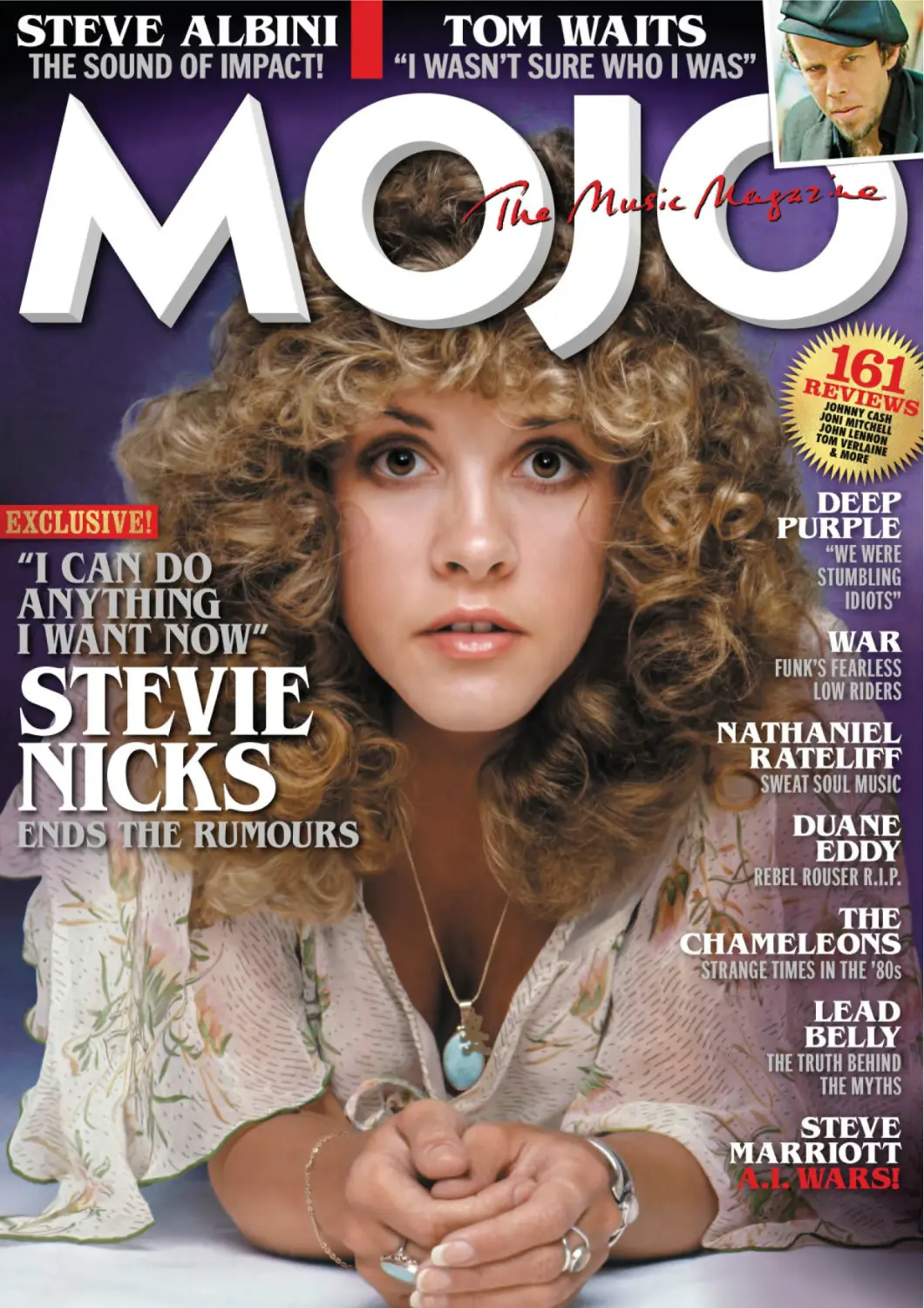
66 STEVIE NICKS The
ultimate rock diva on Fleetwood Mac
fame, solo stardom, the “lost years” of
addiction and owning the stage, still, at
76. Plus! Mick Fleetwood offers a hymn to
her… and a eulogy for his storied band?
Scott Smith/Govinda Gallery
AUGUST 2024
MOJO 3
Re-Modelled: Linda
Thompson on her
new Proxy Music LP,
Filter, p80.
REGULARS
9
ALL BACK TO MY PLACE
Nancy Sinatra, Mark Arm and Samantha
Morton throw open their record boxes.
106 REAL GONE Dennis ‘Machine Gun’
Thompson, David Sanborn, Jimmy James,
Richard Tandy, Doug Ingle and more, farewell.
112 ASK MOJO Which cheerful sounding
songs conceal grimness at their hearts?
114 HELLO GOODBYE They were
sounding strong, then a sudden blow hit them.
Geoff Britton recalls joining and leaving Wings.
Going deep:
“spectral siren”
Cindy Lee dives
in, Rising, p24.
WHAT GOES ON!
12
DUANE EDDY The guitarist who
twanged the world with Rebel Rouser, Peter
Gunn and more left us in April. Phil Alexander
recalls Eddy the man and the legend.
16
STEVE MARRIOTT So, AI is
being trained to – they claim – sing like the
unmistakable voice of the Small Faces and
Humble Pie? Steve’s daughter Mollie and the
Marriott Estate have their say.
18
SQUEEZE Difford and Tilbrook are back
20
GRAHAM GOULDMAN 10cc’s
21
LOUIS ARMSTRONG He was a
in the studio, working on not one but two new
albums. Except one of them is not technically
new. Baffled? Time for an explanation.
master songwriter is in Confidential mood, and
talks reuniting with Kevin Godley, producing
the Ramones, and new LP I Have Notes.
giant of jazz and a roving ambassador for hope
in a troubled world. Now a special Satchmo
album is about to be released – but why was it
so significant for him? All will be revealed.
MOJO FILTER
78
NEW ALBUMS Johnny Cash demos
92
REISSUES John Lennon’s Mind Games
reupholstered, plus Linda Thompson, Aaron
Frazer, Lankum, Cassandra Jenkins and more.
re-evaluated, plus Tom Verlaine and Zappa.
102 BOOKS Joni Mitchell examined, plus 500
Years Of Black British Music, Questlove’s history
of hip-hop and Billy Childish’s singular career.
104 SCREEN Does Disney’s new TV doc about
The Beach Boys properly push the boat out?
MOJO ISSN 1351-0193 (USPS 17424) is published 12 times a year by H Bauer Publishing Ltd, Media House, Peterborough
Business Park, Lynch Wood, Peterborough PE2 6EA United Kingdom. Airfreight and mailing in the USA by agent named
World Container INC 150-15, 183rd St, Jamaica, NY 11413, USA. Periodicals Postage Paid at Brooklyn, NY 11256.
POSTMASTER: Send address changes to MOJO, Air Business Ltd, c/o World Container INC 150-15, 183rd St, Jamaica,
NY 11413, USA. Subscription records are maintained at Bauer Media, Subscriptions, CDS Global, Tower House, Sovereign
Park, Lathkill Street, Market Harborough, Leicester LE16 9EF, United Kingdom. Air Business Ltd is acting as our mailing agent.
THIS MONTH'S CONTRIBUTORS INCLUDE...
Sheila Curran
Bernard
Sheila is the Emmy and Peabody
Award-winning writer of Bring
Judgment Day: Reclaiming Lead
Belly’s Truths From Jim Crow’s
Lies, which she adapts for MOJO
from page 38. She is an associate
professor in the Department of
History at the University at Albany, State University of New York.
4 MOJO
Sam Emerson
Martin Aston
Sam, who took this month’s cover
shot, wanted to be a photographer from elementary school. He
shot the Stones at Altamont, and
The Osmonds across America,
worked with Fleetwood Mac and
collaborated on Michael Jackson’s Billie Jean video. “Not only
did I follow my dream,” he says,
“but I truly lived it as well.”
MOJO contributor Martin first
interviewed Manchester postpunks The Chameleons in 1985 at
London’s landmark den of iniquity the Columbia Hotel. Thirtynine years later, he travelled to
their headquarters to discuss the
re-formed group’s unofficial status as Britain’s Great Lost ’80s
Band over a lovely cup of tea.
Vanessa Tignanelli, Sean James, Peter Crowther
Rock of ages: lost
Johnny Cash demos
dug up and polished,
Lead Album, p78.
ONE
HAND
CLAPPING
Paul McCartney
& Wings
/ LY H V WX GL R V HV V LR QV IU RP
Q HZ O \ PL [ HG D Q G DY D LO DE O H
I RU WK H I LU VW WL PH
) H DW XU L QJ S U HY LR X VO \ X QU HO H DV HG WU DF N V
/321/,1((;&/86,9(ʛ /3 & ' 6 75 ( $0 ,1 * ' 2: 1 /2 $' $7 0 26
$ 9$ ,/ $ %/ ( 7+ - 8 1(
) RU PR UH LQ IRU PD WLR Q YLV LW 3D XO0 F& DUW QH\ F RP
2 QH+ DQ G&O DSS LQ J
MOJO
SECOND HAND
NEWS
Minden Pictures/Alamy, Brian Rasic/Getty Images, Andy Willsher/Getty Images, Laura E. Partain, Sam Holden, Mike Coppola/Getty, Alissa Anderson, Michael Ochs Archives/Getty Images
THE SONGS OF
STEVIE NICKS & FLEETWOOD MAC
1 STEVIE NICKS
Rooms On Fire
In the sleevenotes to her 1991 comp,
Timespace, Nicks recalls recording
this single in an LA castle, where she
became involved with the record’s
producer, Rupert Hine. “It seemed to
me that whenever Rupert walked into
one of these old dark rooms,” Nicks
wrote, “that the rooms were on fire.”
Written by Stevie Nicks, Rick Nowels. ISRC:
USAT20900676 Published by Welsh Witch Music,
admin by Warner Tamerlane Publishing Corp,
Future Furniture Music - ASCAP, Welsh Witch
Music, BMI, Future Furniture Music, controlled by
Colgems - EMI Music Inc. 1989 Modern Records
Inc. Licensed courtesy of Warner Music UK Ltd
9 THE AUTUMN
DEFENSE
Sentimental Lady
Beyond the familiar marvels of the
Peter Green and Buckingham/Nicks
eras, Fleetwood Mac’s lesser-known
periods also provide some great
options for cover artists. Exhibit A:
the filigreed country-rock of
Sentimental Lady, from 1972’s Bare
Trees. Here, it’s delicately handled by
The Autumn Defense – AKA Wilco’s
John Stirratt and Pat Sansone.
Written by Robert Welch. Published Kingstreet
Media Publishing Limited 1972. ©Yep Roc Records
2014. ISRC USY1R1438202
6 MOJO
2 PRIMAL SCREAM
(FEATURING LINDA
THOMPSON)
Over & Over
Linda Thompson, as our review of
her new album on page 80 makes
clear, can no longer sing her own
songs. But here, in 2008, the folk
legend steps in as nuanced duetting
partner to Bobby Gillespie, turning
Christine McVie’s Tusk opener into
deep-fried soul.
3 CAITLIN ROSE
4 THE TWILIGHT
Caitlin Rose’s 2010 debut, Own Sides
Now, unveiled a young Nashville
singer-songwriter of uncommon skill
and maturity. Among her own
Americana gems, however, was this
cover of Stevie Nicks’ own brilliant
excursion into country. That’s Alright
first surfaced on Fleetwood Mac’s
1982 album, Mirage, but was written
nearly a decade earlier, when the
Buckingham Nicks duo were working
on their self-titled debut LP.
What Makes You
Think You’re The One
That’s Alright
SINGERS
Another selection from Tusk, Lindsey
Buckingham’s spiky cut is treated to
a soul-grunge treatment by Greg
Dulli and his Twilight Singers. From
the Singers’ She Loves You LP, that
also features their takes on songs by
Skip James, Björk, Billie Holiday,
Marvin Gaye and John Coltrane.
Written by Stevie Nicks. &©2010 Names Records
Ltd. Copyright Control. From Own Side Now
(NAMES42). ISRC: GBQWS0700083
Written By Lindsey Buckingham. Published by
EMI Music Publishing. ISRC: GBBTF0400184.
&©2004 One Little Independent Records.
From She Loves You (One Little Independent
Records) www.olirecords.com
10 BEDOUINE
11 STEVIE NICKS
12 RICH ROBINSON
The one Rumours song here is this
intimate version of Christine
McVie’s Songbird. It’s courtesy of
Bedouine, AKA Azniv Korkejian, a
Syrian-American singer-songwriter
who first made her name working
with Matthew E White and his
Spacebomb collective. Songbird
comes from her third LP, Waysides.
Stevie herself again, and another
terrific song that was left on the
shelf during the Buckingham Nicks
era. Considered for inclusion on
various Mac albums including Tusk,
Sorcerer was eventually recorded
by Marilyn Martin in 1984, before
Nicks finally did it justice on 2001’s
Trouble In Shangri-La. The other
singer here is Sheryl Crow, who also
co-produced the track.
An oft-overlooked treasure from the
first tentative manoeuvres of the
Mac in the wake of Peter Green’s
departure, Station Man originated
on 1970’s Kiln House, a Southernaccented blues-rocker helmed by
Danny Kirwan, with writing assists
for John McVie and Jeremy Spencer.
The latter’s slide mastery is fittingly
honoured here by Rich Robinson,
on one of his fine solo albums away
from The Black Crowes, 2011’s
Through A Crooked Sun.
Written by Christine McVie. ISRC: GBDVX0800024
Published by Careers / BMG, FLEETWOOD MAC
MUSIC BMI. 2008 B-Unique Records Ltd Licensed
courtesy of Warner Music UK Ltd
Songbird
Written by Christine McVie. Published by
Hipgnosis. Self-released track distributed by The
Orchard. Copyright Bedouine Music. Christine
McVie published by Hipgnosis. &©2021
Bedouine Music. From Waysides. www.
BedouineMusic.com
Sorcerer
Written by Stevie Nicks. Published by Welsh
Witch Music, BMI. 2016 Atlantic Recording
Corporation. Licensed courtesy of Warner
Music UK Ltd. ISRC: USRH11604615
Station Man
Written by Jeremy Spencer/Daniel Kirwan/John
McVie. Concorde Int. Mgmt. ISRC GBCBR1500449
I
N THIS MONTH’S MOJO, STEVIE NICKS TELLS OF WHEN SHE
was “a terrible waitress”, retreating home after shifts to work
at her songwriting. The art involved “lighting a candle or
some incense, making [the bedroom] my sanctuary,” she
remembers, “and sitting on the floor, writing – that was my idea
of a good time.”
It’s a romantic tale that plays into our image of Nicks – the dark
nights, the naked flames, the lace fluttering in the breeze, a cockatoo,
perhaps, to hand. But it also exposes an artist dedicated to put in the
hard work and hone her craft. For this latest MOJO CD, we’re fortunate
to have some powerful examples of how that craft flourished, with
three of our favourite tracks from Nicks’ solo catalogue. But we’ve
also taken the opportunity to see how her songs – and the songs of
her predecessors and bandmates in Fleetwood Mac – could endure
as covers by other artists. From lilting reggae to psychedelic grunge;
from Peter Green to Stevie Nicks, via Christine McVie, Lindsey
Buckingham, Bob Welch and Danny Kirwan, it’s testament to how
the Mac’s many brilliant songs transcend temporal soap operas.
You can, it seems, go your own way…
5 STEVIE NICKS
6 VETIVER
7 DENNIS BROWN
Note that auspicious songwriting
credit in the small print: Annabel
Lee is a co-write between Nicks and
one Edgar Allan Poe, taken from her
last album of new songs, 2011’s In
Your Dreams. A magical setting of
proto-goth Poe’s last completed
poem, it’s also one of Nicks’ very
finest solo tracks – a shimmering,
folk-infused melody amped up for
maximum dramatic impact.
If The Twilight Singers successfully
turned one of Lindsey Buckingham’s
Tusk songs into something bigger
and fiercer, Vetiver here lean
harmoniously into the rustic campfire
singalong vibes of Save Me A Place.
The San Francisco band were key
players in the freak-folk movement
of the early 2000s, frontman Andy
Cabic going on to be a frequent
collaborator with the scene’s pin-up
boy, Devendra Banhart.
Black Magic Woman is the rare
Fleetwood Mac song where a cover
version might actually be better
known than the original – Santana’s
take on the Peter Green classic hit
the US Top 5 in late 1970. We’ve
plumped, however, for this
exquisite Jamaican single from
1972, where Dennis Brown and
Sunshot Records producer Phil Pratt
make languid reggae capital out of
Green’s Latin-tinged blues.
Written by Lindsey Buckingham. Published by
– Fleetwood Mac Music, Rights Society: BMI. From
the EP Between (dicristina) www.midheaven.com
Written by Peter Green. Bourne Music Ltd.
Produced by Phil Pratt. 1972 Sanctuary Records
Group Ltd., a BMG company ISRC: GBAJE7200548
Annabel Lee
Alicia J Rose, MediaPunch Inc/Alamy Stock Photo, Richard Dumas
Written by Stevie Nicks, Edgar Allan Poe.
Published by Welsh Witch Music, BMI. Welsh
Witch Music, BMI Licensed courtesy of Warner
Music UK Ltd. ISRC: USRE11100231
13 DENIZ TEK
Oh Well
Fleetwood Mac might not be a band
routinely covered by punk artists,
but there are thrilling exceptions
– starting with this blitz through the
Peter Green signature tune. Deniz
Tek is the Michigan native who
played a foundational role in the
Australian punk scene, most
notably with Radio Birdman (you
can hear them on the Punk Nuggets
CD that came with MOJO 358).
Written by Peter Green. Published by Kingstreet
Media Publishing Ltd. (BMI) ©2014 Deniz Tek.
From the single ‘Crossroads’ b/w ‘Oh Well’, (Career
Records 45-2348) www.deniztek.com
Save Me A Place
14 MELVINS
The Green Manalishi
(With The Two Pronged
Crown) (Part 1)
No messing with this one either,
as the Washington state grunge
archetypes tune into the
psychedelic sludge potential of
Peter Green’s bad-trip magnum
opus, the last song he recorded
with Fleetwood Mac. From the
Melvins’ tenth album, 1999’s The
Maggot – “Makin’ me see things
I don’t wanna see…”
Written by Peter Green. ISRC: US4N8060008.
From The Maggot, 1999 Ipecac Recordings.
www.ipecac.com/artists/melvins
Black Magic Woman
15 JONATHAN
WILSON
Angel
Not to be confused with the Stevie
song on Tusk, this is FM’s other
Angel, written by Bob Welch for
1974’s Heroes Are Hard To Find. LA
guitarist Jonathan Wilson expands
on the original’s fluid jam, showing
the chops that have scored him gigs
in Roger Waters’ band, as well as
producing Father John Misty. Jason
Borger slays on organ, by the way.
Written by Bob Welch. From the EP ‘Slide By’.
&© 2014 Bella Union Records, under licence to
[PIAS] Published by Rock Hopper Music Group &
IAFDSFBD, BMI Music Group ISRC: GBBRP1446904
8 THE
DECEMBERISTS
Think About Me
Another selection from Tusk, with
Pacific North-West indie auteurs The
Decemberists making hay with the
pop-boogie of McVie’s Think About
Me. From a 2007 covers LP by
Portland, Oregon, bands that also
includes Dandy Warhols essaying
The Cult’s She Sells Sanctuary.
Written by Christine McVie. The Decemberists (in
2003): Colin Meloy, Jenny Conlee, Chris Funk, Jesse
Emerson, Rachel Blumberg. Produced by The
Decemberists with Adam Seltzer. Recorded at
Type Foundry Studios, Portland, OR, February/
March 2003. http://decemberists.com
“THERE’S
NO CHANCE
OF PUTTING
FLEETWOOD
MAC BACK
TOGETHER.”
STEVIE
NICKS
SPEAKS
TURN TO
PAGE 66
A dark and
dangerous book
OUT
NOW
from the Punkrock Penny Lane, Dana Miller
As reflection of a lifetime spent obsessively reading around deep-burning women’s
issues and the forest as an entity, Never Née Fey is a two-part, full-length chapbook
containing a reverse-order narrative series of Dana’s most fanged wolf-woman
poetry, composed over the course of the past fifteen years and handling disarming
themes such as the excavation of damseldom, pastoral femme-feralia, Irish mysticism,
and the leather-feathered underthings of the real rock-n-roll highway life.
Consisting of inverted twin parts, “Viologens” and “Concrete Vellum,”
the first might be thought of as the gore and glamour that
make the pyrrhic victories of the second possible.
ABOUT THE AUTHOR
Dana Miller is a wicked wordsmith, giggling provocateuse, and
mega-melomaniac from Atlanta, Georgia. Her poetic syllables like to trundle in
the wilds—usually in search of a Pooh-inspired smackerel or two. Oxford, England
is her forever spirit-home and Radiohead is holding the last shard of her girlhood
heart. Never Née Fey is Dana’s first full-length book of poetry.
GET YOUR COPY NOW
www.finishinglinepress.com/product/never-nee-fey-by-dana-miller/
danalynnmiller.com Q www.linkedin.com/in/stereojunglechild/
Nancy Sinatra
STILL WALKIN’ ALL OVER YOU
What music are you currently
grooving to?
Currently Beyoncé, Chris Stapleton,
Nathaniel Rateliff, Billie Eilish and
Wilco. But forever and always The
Beatles, The Beach Boys, The Everly
Brothers and Dolly Parton. And I
still love the standards – they still play
that old stuff out here!
What, if push comes to shove, is
your all-time favourite album?
If I could choose only one, it’d be
one of these three: Tony Bennett’s
The Movie Song Album, Dad’s The
Concert Sinatra and Johnny Mathis’s
Open Fire, Two Guitars.
What was the first record you ever
bought? And where did you buy it?
Probably Ruth Brown. Maybe Teardrops From My Eyes or Lucky Lips?
I used to shop at Wallichs Music City
at the corner of Sunset & Vine.
Which musician, other than yourself, have you ever wanted to be?
Easy. Carly Simon. She’s such a
thoughtful lyricist and creates wonderful melodies, plus I love her voice.
What do you sing in the shower?
Haha! What don’t I sing in the shower?! Most of the time, it’s something
that I heard earlier in the day, or
something that one of my granddaughters is learning.
What is your favourite Saturday
night record?
Francis Albert Sinatra & Antônio
Carlos Jobim. It’s gorgeous, romantic,
melancholy and sentimental. Which,
at my age, describes a pretty good
Saturday night.
And your Sunday morning record?
In the past, my Sunday morning
music may have been a Smiths LP or
one from David Bowie, as I spent
time with my kids. These days it
would be Tony Bennett’s The Movie
Song Album again, or maybe Paul
McCartney’s Egypt Station and Ram.
Nancy’s 1966 LP How Does That Grab
You? is reissued by Light In The Attic.
A LL B AC K TO MY PL AC E
THE STARS REVEAL THE SONIC DELIGHTS GUARANTEED TO GET THEM GOING...
Samantha
Morton
ACTRESS, DIRECTOR,
SINGER
What music are you currently
grooving to?
Recently it’s been Ibrahim Hesnawi,
the Libyan reggae artist, Lonnie
Liston Smith’s Cosmic Funk and
Sault, which feels very fresh and
epic and pure.
What, if push comes to shove, is
your all-time favourite album?
That’s unanswerable, but three that
I can’t live without, in the same
way as air and water, are The White
Album by The Beatles, Signing Off
by UB40 and Exodus by Bob Marley
& The Wailers.
Emily Rieman, Amanda Erlinger, Anton Corbijn
What was the first record you ever
bought? And where did you buy it?
The first record I remember buying
was Musical Youth’s Pass The
Dutchie, which came with a free
poster, from a market stall in Hyson
Green in Nottingham. I think my
brother chipped in to get it. But the
first kind of teenage music that I
remember buying were tapes of
The Charlatans’ Some Friendly and
Deee-Lite’s World Clique, which had
Groove Is In The Heart on it, from
Selectadisc in Nottingham.
Which musician, other than yourself, have you ever wanted to be?
I’ve never desired to be anyone
other than myself, warts and all.
Though I used to fantasise about
Madonna fostering me when I was
very little.
What do you sing in the shower?
I don’t. I’ve got, you know, kids
and animals and life and work to
do. But if I did, it would be Vera
Lynn or Gracie Fields, old lady
warbly songs.
What is your favourite Saturday
night record?
If it’s Saturday night and all about
dancing, I’ll listen to DJs – Frankie
Knuckles or a bit of hip-hop. If I’m
somewhere and I’ve got to be on
point or something, I’ll listen to
Glenn Gould’s Bach: The Goldberg
Variations or whatever. And I love
Fontaines D.C.
And your Sunday morning record?
Miles Davis’s Kind Of Blue. And
I’ll have Cerys Matthews on, so
whatever her selection is.
Sam Morton’s Daffodils & Dirt is released
on June 14 via XL Recordings.
Mark Arm
MONSIEUR
MUDHONEY
What music are you currently
grooving to?
Skull Practitioners’ Negative Stars,
The Saints’ Prehistoric Sounds and
Bill Withers’ Still Bill are in high rotation in my casa [NB: Mark is calling
from “hot and humid Costa Rica,
despite limited wifi connectivity”].
What, if push comes to shove, is
your all-time favourite album?
I hate narrowing it down to one
album, but when I’m pushed into a
corner, it’s gotta be Fun House by
The Stooges. It’s been there for me
for so long now and it has all the
emotions: horny, high, freaked out
and desperately trying to convince
yourself that you feel all right.
What was the first record you ever
bought? And where did you buy it?
Desolation Boulevard by Sweet – the
US version, which is pretty much a
‘best of’ the UK version and Sweet
Fanny Adams, at a long-gone local
chain in Bellevue, WA. I had the Fox
On The Run 7-inch and when Ballroom Blitz hit the Top 40, I said to
“Fun House by
The Stooges
has all the
emotions:
horny, high,
freaked out…”
myself, I bet the album is all killer
and no filler! And I was right.
Which musician, other than yourself, have you ever wanted to be?
Paganini. I think it would be incredible to be the guy who inspired
Yngwie Malmsteen.
What do you sing in the shower?
(Sings) ”Singing in the bathtub/I’m
happy once again/Watching all my
troubles/Go swinging down the
drain/Singing through the soap
suds/Life is full of hope/You can sing
with feeling/While feeling for the
soap” [an old bathtub favourite from
the 1929 Show Of Shows].
What is your favourite Saturday
night record?
Either Eternally Yours by The Saints
or Black Unity by Pharoah Sanders,
depending on the Saturday night.
And your Sunday morning record?
Alice Coltrane is a go to: Journey
In Satchidananda, Huntington
Ashram Monastery, Universal
Consciousness, etc.
Mudhoney tour the EU and UK from
August 30.
MARK ARM
MOJO 9
H Bauer Publishing
The Lantern
75 Hampstead Road
London NW1 2PL
Tel: 020 7437 9011
Reader queries: mojoreaders@
bauermedia.co.uk
Subscriber queries: bauer@
subscription.co.uk
General e-mail: mojo@
bauermedia.co.uk
Website: mojo4music.com
Editor
John Mulvey
Senior Editor
Danny Eccleston
Creative Director
Mark Wagstaff
Production Editor
(Entertainment)
Simon McEwen
Associate Editor
(Reviews)
Jenny Bulley
Associate Editor
(News)
Ian Harrison
Deputy Art Editor
Del Gentleman
Picture Editor
Matt Turner
Senior Associate Editor
Andrew Male
Contributing Editors
Phil Alexander,
Keith Cameron,
Sylvie Simmons
Theories,
rants, etc.
MOJO welcomes correspondence for publication.
Write to us at: MOJO, H Bauer Publishing, The Lantern, 75 Hampstead Road,
London, NW1 2PL. E-mail to: mojoreaders@bauermedia.co.uk
´,:,//$/:$<6%(7+(.,1'2)381.
WKDWVKLWVRQ6WHHO\'DQµZURWH6WHYH$OELQLRQ7ZLWWHUEDFNLQ)HEUXDU\$VHULHV
RIZLWKHULQJSRVWVIROORZHGDERXW´WKDWFRFDLQHVKLWPXVLFµLQFOXGLQJVHYHUDOODPSRRQLQJ
SHRSOHLQKLVFRPPHQWVZKRSOHDGHGD'DPDVFHQHFRQYHUVLRQWR6WHHO\'DQLQROGHU
DJH´,·YHQHYHUIHDUHGDJLQJWKHUHLVJHQXLQHZLVGRPLQH[SHULHQFHDQG,WU\WRDSSUHFLDWH
WKDWDVP\\RXWKIXOFDSDFLW\IRURWKHUWKLQJVIDGHVµ$OELQLUHSOLHG´1RWWKDWWKRXJK
1HYHUWKDWµ
$OELQL·VWKRXJKWVRQ)OHHWZRRG0DFGRQ·WDSSHDUWRKDYHEHHQUHFRUGHGIRUSRVWHULW\
%XWWKHUHLVDFHUWDLQNDUPLFEDODQFLQJWRWKLVLVVXHRI02-2EHLQJRQHWKDWPRXUQV
WKHVKRFNLQJORVVRI$OELQLDJHQXLQHXQGHUJURXQGUHYROXWLRQDU\ZKLOHFHOHEUDWLQJD
PDLQVWUHDPVXSHUVWDUOLNH6WHYLH1LFNVRQWKHFRYHU$OELQLFDSDEOHRIERWKWUHQFKDQW
DHVWKHWLFFRQVLVWHQF\DQGHYROYLQJVHOINQRZOHGJHPLJKWKDYHFDYLOOHGDWVKDULQJPDJD]LQH
VSDFHZLWKVXFKDQHVWDEOLVKPHQWILJXUH
1LFNVWKRXJKVRPHWKLQJRIDQXQFRPSURPLVLQJ
WUDLOEOD]HUKHUVHOISUREDEO\QHYHUFRQVLGHUHGKLULQJKLPDVHQJLQHHU1HYHUWKHOHVVWKLV
LVWKHEURDGFKXUFKWKDWZHWU\WREULQJWRJHWKHULQHDFKLVVXHRI02-21RWHYHU\SDUW
RIWKHFRQJUHJDWLRQPLJKWJHWRQZLWKHDFKRWKHUEXWWKHQRLVHWKH\·UHDOOPDNLQJFDQ
RIWHQWUDQVFHQGROGSUHMXGLFHVDQGWULEDOOLQHV)RUVRPHRIXVDQ\ZD\«
Thanks for their help with
this issue: Keith Cameron,
Chris Catchpole,
Ian Whent, Matt Hurrell.
This month’s contributors:
John Aizlewood, Phil Alexander,
Martin Aston, Mike Barnes,
Sheila Curran Bernard, Mark Blake,
Glyn Brown, John Bungey,
Keith Cameron, Chris Catchpole,
Stevie Chick, Andy Cowan,
Grayson Haver Currin,
Max Décharné, Tom Doyle,
David Fricke, Andy Fyfe, Pat Gilbert,
David Hutcheon, Jim Irvin,
David Katz, Ted Kessler,
Andrew Male, Bob Mehr,
James McNair, Kris Needs,
Lucy O’Brien, Mark Paytress,
Andrew Perry, Clive Prior,
Jon Savage, Victoria Segal,
David Sheppard, Michael Simmons,
Sylvie Simmons, Mat Snow,
Irina Shtreis, Ben Thompson,
Kieron Tyler, Charles Waring,
Roy Wilkinson, Lois Wilson,
Jim Wirth.
This month’s photographers:
Cover: Sam Emerson (inset: Richard
Creamer/Michael Ochs Archives/
Getty Images) Berenice Abbott,
Tibor Bozi, Andy Catlin, Sam
Emerson, Alysse Gafkjen, Gijsbert
Hanekroot, Michael Putland, Popsie
Randolph, Leni Sinclair, Scott Smith,
Jim Steinfeldt, Ben Wolf.
MOJO SUBSCRIPTION HOTLINE
0185 8438884
For subscription or back issue queries contact
CDS Global on Bauer@subscription.co.uk
To access from outside the UK
Dial: +44 (0)185 8438884
10 MOJO
-2+108/9(<(',725
Come on, man, quit
goofing around. This
is serious business.
I’m out there on the
frontlines liberating
people with my music
7KUHHÁDVKEDFNV/DWH
V
DJLJE\6SOLW(Q]DW
/HLFHVWHU3RO\(UDVHUKHDGKDLUVW\OHVFORZQPDNHXS
3LHUURWRXWÀWV*UHDWVKRZ²VRPHZKHUHEHWZHHQDUW
URFNDQGQHZZDYH:H·UHDWWKHIURQWDQGDWWKHHQG
WKH)LQQVHWDOOLQHWKHVWDJHEHQGLQJRYHUWRVKDNH
KDQGVGULSSLQJVZHDWRYHUXVDOO(DUO\·
VQRZ
LW·V
&URZGHG+RXVHDWWKH'H0RQWIRUW+DOO/HLFHVWHU
$WVRPHSRLQWGUXPPHU3DXO+HVWHUYDQLVKHVRQO\WR
UHDSSHDUDERYHXV+HEDODQFHVRQWKHUDLORIWKHEDO
FRQ\ZKLFKKHSURFHHGVWRVNLSDURXQG(DUO\
ZH·UHSXOOLQJRXUFDVHVRQWRWKHEULGJHRXWVLGHRXU
KRWHOLQ9HQLFHRQRXUZD\WRFDWFKDERDWDEXV
DQGDSODQHEDFNKRPH7KHUHVWDQGLQJRQWKHEULGJH
LV1HLO)LQQJD]LQJDURXQGWDNLQJLWDOOLQ7KHZD\
\RXGRLQ9HQLFH:H·GOLNHWRVWRSDQGWHOOKLPKRZ
PXFKZHORYHEveryone Is HereZKLFKZH·YHEHHQ
OLVWHQLQJWRIRUWKHODVW\HDUEXWWKHPRPHQWSDVVHV
DQGZHPRYHRQ
,QWHUHVWLQJLQWHUYLHZZLWK1HLOLQ02-2EXW
QRPHQWLRQRIEveryone Is HereWKHJUHDW/3KH
PDGHZLWK7LPDQGDVJRRGDUHFRUGDVHLWKHURIWKHP
KDVHYHUPDGH
,Q\RXUH[FHOOHQW3DXO:HOOHUDUWLFOHLQ02-2
,ZDVVXUSULVHG\RXIDLOHGWRPHQWLRQKLVFROODERUD
WLRQZLWKWKHODWHJUHDW-RKQ0DUW\Q,Q3DXO
FRQWULEXWHGWROn The CobblesWKHÀQDOVWXGLRDOEXP
LQ0DUW\Q·VOLIHWLPHSOD\LQJ:XUOLW]HUSLDQR+DP
PRQGDFRXVWLFJXLWDUDQGEDFNLQJYRFDOVRQVHYHUDO
WUDFNVPRVWQRWDEO\8QGHU0\:LQJ:HOOHUZDV
DPRQJWKHJXHVWDUWLVWVDWWKH&HOWLF&RQQHFWLRQV
WULEXWHVKRZWR0DUW\QLQ
+HSHUIRUPHGYHU
VLRQVRI'RQ·W:DQQD.QRZ%DFN'RZQ7KH5LYHU
DQG6ZHHW/LWWOH0\VWHU\DWWKH*ODVJRZHYHQWZKLFK
FRLQFLGHGZLWKWKHWKDQQLYHUVDU\RI0DUW\Q·V
GHDWK$VWKLV\HDUPDUNVWKHWKDQQLYHUVDU\LVQ·WLW
DERXWWLPHIRUD02-2UHWURVSHFWLYHRIWKHMD]]URFN
PDYHULFN·VDPD]LQJ\HDUFDUHHU"
Ian & Lisa Roberts, Leicester
Tony Smith, Kettering
Miss Dumbum ain’t your
teacher today, I am
<RXULQWHUYLHZZLWK-RQ$QGHUVRQ>02-2@ZDV
LQWHUHVWLQJDQG,ZDVSOHDVHGWRVHHKLVFRPPHQWV
DERXW9DQJHOLV2QHTXLEEOHWKRXJK²-RQH[WROVWKH
virtues of “two albums in the mid ’70s that opened
[his] consciousness”, one of which was Vangelis’s Création Du Monde. However, Création… was actually just
WKHÀUVWWUDFNRQ6LGHRIJURXQGEUHDNLQJ9DQJHOLV/3
L’Apocalypse Des Animaux$OWKRXJKWKLV/3ZDVUHOHDVHG
in 1973, the music was written for a 1971 nature
documentary, more than half a decade before ambient
music was even a gleam in Brian Eno’s eye.
<RXFRXOGPDNHXSIRUWKLVERRERRE\SURYLGLQJ
some proper coverage of Vangelis. The great man’s
oeuvre spans enormous breadth, from perhaps the
JUHDWHVWÀOPVFRUHRIDOOWLPH%ODGH5XQQHUWRKLV
URFN·Q·UROOFRQWULEXWLRQVYLD$SKURGLWH·V&KLOG7KH
album 666 is notorious, of course, but that is just
the tip of the proverbial iceberg. Furthermore, most
people don’t understand that he was able to generate
WKHVHJODFLDOFRPSRVLWLRQVOLYHLQUHDOWLPH+LVZRUNV
PD\VRXQGOLNHPXOWLWUDFNUHFRUGLQJVEXLOWXSSDLQVWDNLQJO\RQHOD\HUDWDWLPHEXW9DQJHOLV RQHGXGH
was decades ahead of his time, developing custom
equipment that enabled him to generate these recordLQJVOLYH(YHQ%ODGH5XQQHUZDVSHUIRUPHGOLYHZKLOH
WKHÀOPZDVVFUHHQHGLQIURQWRIKLP$WUXHJHQLXV
We shall teach
rock’n’roll to the world
OK, so just… verbal abuse?
Oh, you wanna
learn something?
Scott Bodarky, via e-mail
7KDQNVIRUWKHGHWDLOHGGHOYHLQWRWKHFUHDWLRQRI6FRWW
:DONHU·VClimate Of Hunter and its aborted sequel
[MOJO 367]. Infuriating how such a talent could
prevaricate for so long, and then in the home straight
abandon what he could do so movingly in favour of wilfully discomforting us, turning away from channelling
EHDXW\DQGOLJKWWRLQVWHDGYRPLWXSELOHDQGGDUNQHVV
SF, Derbyshire
Let’s get out there
and melt some faces
I feel bound to point out a misapprehension in your
otherwise excellent piece on Kate Bush [MOJO 367].
<RXTXRWH6LPRQ'UDNHKHUFROODERUDWRURQWKH
GHVLJQFKRUHRJUDSK\RIKHU7RXU2I/LIHVKRZLQ
as saying “she was a pioneer, there wasn’t anyone doing
anything quite that ambitious then.” He obviously
KDGQ·WVHHQ7KH7XEHV
DQ\RQHOXFN\HQRXJKWRZLWQHVV
one of the gigs on their 10-date residency at Hammersmith Odeon in 1977 will have seen a show every bit
as theatrical as those put on by Ms Bush, featuring numerous dancers and props vividly expressing the satire
LQWKHLUVRQJV,NQHZQRWKLQJRIWKHPDQGWKHLUPXVLF
DWWKHWLPHEXWWRRNDFKDQFHDQGWKHSHUIRUPDQFHKDG
me open-mouthed in astonishment. Whilst the resultLQJOLYH/3LVVWLOOZHOOZRUWKDOLVWHQLW·VDVKDPHWKHUH·V
no visual accompaniment. Believe me, Gabriel-era
*HQHVLV 0U'UDNH·VTXRWHGSRLQWRIUHIHUHQFH FDPH
nowhere near to The Tubes when it came to theatrics.
Antony Randle, Glastonbury
There used to be a way
to stick it to The Man
I’m waiting excitedly for the next MOJO letters page,
purely for the pearl-cOXWFKLQJUHVSRQVHVWR5LFKDUG
7KRPSVRQ·VRSLQLRQVRQ6KDQH0DF*RZDQDQG6LQpad O’Connor [MOJO 367]. As someone said, opinions
DUHOLNHDUVHKROHV²ZH·YHDOOJRWRQH$QGDVVRPHRQH
ZKRORYHVDOOWKUHH,·GOLNHWRWKLQNWKHVDGO\GHFHDVHG
WZR²ZKRZHUHQHYHUVKRUWRIUREXVWSRLQWVRIYLHZ
WKHPVHOYHV²ZRXOGDJUHH7KH\PLJKWHYHQKDYHKDG
some fruity opinions on Thompson themselves…
Richard Rees, Walthamstow
As a lapsed former subscriber, I haven’t read MOJO
IRUVRPH\HDUV+RZHYHU,SLFNHGXS02-2ZLWK
/LDP*DOODJKHUDQG-RKQ6TXLUHRQWKHFRYHUDQGZDV
blown away. Not only was that feature fantastic, but
WKRVHRQWKH%XWWKROH6XUIHUV0LFKDHO+HDG/HQQ\
.UDYLW]0DUYLQ*D\HDQGHYHQ6WHHO\'DQZHUHFRPpelling. I read the magazine from cover to cover and
TXLFNO\SXUFKDVHGDQ/3E\(PDKR\7VHJH0DULDP
*HEUXEDVHGRQ\RXUUHYLHZ7KHLFLQJRQWKHFDNH
ZDVDUHYLHZRIDUHLVVXH,KHOPHG²Two Tons O’ Fun.
Ian Shirley, via e-mail
$VDGHFDGHVORQJUHDGHURI02-2,DOZD\VORRN
forward to what great music you’ll cover every month.
MOJO 366’s story of Wayne Kramer’s passing pulled
PHLQEXWZKHQ,VDZWKHLQWHUYLHZZLWK3KLO0DQ]DQHUD,UHDOO\SHUNHGXS,·YHQHYHUEHHQDELJIDQRI
5R[\0XVLFEXW0DQ]DQHUD·VVROR/3VDQGKLVRWKHU
JURXSVKDYHDOZD\VEORZQPHDZD\%XW,ZDVVKRFNHG
there wasn’t a mention of one of my absolute faves,
KLV
VRORLQVWUXPHQWDODOEXPPrimitive Guitars²D
WUXHWRXUGHIRUFHZLWK6RXWK$PHULFDQURRWVUK\WKP
RG\VVH\VELJVZHHSLQJVRXQGWUDFNVDQGWKHJHQWOH
FDWKHGUDOWRQHVRI(XURSH7KHUHDONLFNHUVDUH
WKHHOHFWURIXQNRI,PSRVVLEOH*XLWDUDQGWKHLQWHQVLW\
RI%LJ'RPH3HUKDSVDIRUJRWWHQPDVWHUZRUNEXW,
still play it often.
Roger White, via e-mail
A funny little footnote
on my epic ass
02-2UHDOO\QHHGVWRWDNHDERZIRULWVDWWHQWLRQWR
musical diversity, often shown in very unique ways.
,KRSH,·PQRWWKHRQO\UHDGHURI02-2ZKR
noticed that it featured not one, not two, but three
reviews of albums headed by… vibraphone players.
6XUHO\WKLVLVVRPHVRUWRIUHFRUG".XGRVWR02-2
Music is not the sole domain of stringed instruments!
Norman Gaines, Hartsdale, NY
I will see you cats
on the flip-flop later!
,·PJRLQJWRVD\(DV\5Lder, for MOJO 368’s letters
SDJHÀOPTXRWHV´*LW\HUGDPQKDLUFXWµ
John Wilson, via e-mail
SAVE MONEY ON NEWSSTAND PRICES!
AND GET MORE FROM
BECOME A
SUBSCRIBER AND
GET EXCLUSIVE
REWARDS AND
CONTENT
MO J
SEE PAGE 23
MAKEO
S
FOR DETAILS... A G
RE
GIFT!!AT
!
Head of Magazine Media
Clare Chamberlain
MD Bauer Media Advertising
Simon Kilby
Head Of Magazine Brands Anu Short
Brand Director Joel Stephan
Media Planner Ricky Duff
Regional Advertising Katie Kendall
Classified Sales Executive
Imogen Jackaman
Inserts Manager Simon Buckenham
Production Manager Carl Lawrence
Sales Operations Executive,
BMA Finance Helen Mear
Co-CEOs of Bauer UK Print Business
Helen Morris, Steve Prentice
EA to CEOs Vicky Meadows
Chief Financial Officer, Bauer
Magazine Media UK Lisa Hayden
EA to CFO Stacey Thomas
Director Of Magazines Lisa Sinclair
Director Of Brand & Content
Sophie Hearsey
Publisher, Premium and
Entertainment Lauren Holleyoake
Group Production Lead Jenny Croall
PA to Publisher/Director Of
Magazines Tayla Todd
Commercial Director - Entertainment
Gemma Dick
Commercial Marketing Director
Liz Martin
Managing Editor Michelle Thorn
Editorial Assistant Whitney Jones
MOJO CD and Honours Creative
Director Dave Henderson
Senior Events Producer
Marguerite Peck
Business Analyst Tracey Pickering
Marketing Manager Sarah Norman
Marketing Executive Madeleine
Munro-Hall
Direct Marketing Manager Julie Spires
Direct Marketing Assistant
Holly Aston
Printing: William Gibbons
Subscription queries: To contact us about subscription orders,
renewals, missing issues, back issues or any other queries,
please email bauer@subscription.co.uk or call our UK number
on 01858 438884. To manage your account online visit https://
secure.greatmagazines.co.uk/Solo
For enquires on overseas newsstand sales
e-mail kristina.koshevaya@seymour.co.uk
No part of the magazine may be reproduced in any form in
whole or in part, without the prior permission of H Bauer
Publishing. All material published remains the copyright of H
Bauer Publishing and we reserve the right to copy or edit any
material submitted to the magazine without further consent.
The submission of material (manuscripts or images etc) to H
Bauer Publishing, whether unsolicited or requested, is taken
as permission to publish that material in the magazine, on the
associated website, any apps or social media pages affiliated
to the magazine, and any editions of the magazine published
by our licensees elsewhere in the world. By submitting any
material to us you are confirming that the material is your own
original work or that you have permission from the copyright
owner to use the material and to authorise H Bauer Publishing
to use it as described in this paragraph. You also promise that
you have permission from anyone featured or referred to in
the submitted material to it being used by H Bauer Publishing.
If H Bauer Publishing receives a claim from a copyright owner
or a person featured in any material you have sent us, we will
inform that person that you have granted us permission to use
the relevant material and you will be responsible for paying
any amounts due to the copyright owner or featured person
and/or for reimbursing H Bauer Publishing for any losses it has
suffered as a result. Please note, we accept no responsibility for
unsolicited material which is lost or damaged in the post and
we do not promise that we will be able to return any material.
Finally, whilst we try to ensure accuracy of your material when
we publish it, we cannot promise to do so. We do not accept
any responsibility for any loss or damage, however caused,
resulting from use of the material.
For syndication enquiries go to: syndication@bauermedia.
co.uk H Bauer Publishing is authorised and regulated by the
FCA (Ref No. 845898). Distributor: Frontline, 1st Floor, Stuart
House, St Johns Street, Peterborough PE1 5DD. Tel: 01733
555161. H Bauer Publishing is a company registered in England
and Wales with company number LP003328, registered
address The Lantern, 75 Hampstead Road, London, NW1 2PL.
VAT no 918561701
COMPLAINTS: H Bauer Publishing is a member of the
Independent Press Standards Organisation (www.ipso.co.uk)
and endeavours to respond to and resolve your concerns
quickly. Our Editorial Complaints Policy (including full details
of how to contact us about editorial complaints
and IPSO’s contact details) can be found at www.
bauermediacomplaints.co.uk
WITH A SUBSCRIPTION!
SAVEFF
O
£££ V
ER
O
C ICE!
PR
MOJO 11
Guitar hero: Duane Eddy
in New York in 1958, his
breakthrough year;
(opposite) Eddy with
his signature model
Gretsch G6120DE guitar,
London, June 11, 2010.
The Big Twang
Inspirational guitar great
Duane Eddy left us on April 30.
Phil Alexander bids farewell.
Number 6 in the Billboard Hot
100 in August ’58, providing his
first million-seller and kicking
off a string of 15 major hits.
Having effectively been
a jobbing musician for the
previous four years, Eddy
– now armed with his trusty
Chet Atkins Gretsch 6120 –
turned 20 and hit the road with
his band The Rebels. One of
their first stops was American
Bandstand, Dick Clark’s TV show
in Philadelphia. A further
appearance on a live Clark
nationwide broadcast followed
on a Saturday night. “It was
seven o’clock and we’d have 63
million people watching us,”
smiled Eddy, recalling what
he described as “a glorious
summer” where rock’n’roll
appeared at the height of its
powers and he was its first
anointed guitar hero.
Touring constantly and harnessing the power of radio and TV to grow
a huge audience, his instantly identifiable
playing – always tasteful rather than needlessly flash – inspired a generation around
the world to pick up the guitar. Eddy and
Hazlewood also realised the importance of the emerging album market.
Eddy’s debut LP, Have ‘Twangy’ Guitar
Will Travel, hit the Top 5, staying on the
charts for a staggering 82 weeks and
spawning five hit singles.
For all the album’s success, however, Eddy was not enamoured with
the word ‘twangy’.
“We were just working in the studio
and one of the guys said, ‘Man, that
guitar sounds twangy’, and [co-producer] Lester Sill just started falling
down laughing, so it just became a
running joke. ‘Is that twangy enough?’ To be honest, I
thought it was rather corny and undignified,” he said.
In truth, Eddy admitted the term served him well down
the years and nowhere is his twang more prevalent than on
his celebrated re-working of Henry Mancini’s Peter Gunn
theme. Released in Britain in 1959, it provided Eddy with
his first UK Top 10 hit and repeated the trick three decades
later when he re-worked it with British synth-pop mavericks
The Art Of Noise in 1986, scooping a
Grammy in the process. Not bad when
you consider that the original was an
impromptu filler track recorded as an
afterthought for Eddy’s second album,
Especially For You.
OOLIDGE, ARIZONA. 1951. A
fresh-faced 13-year-old New
York-born kid has just arrived in
town. He takes his bike, goes exploring and discovers a new world: the
desert. “I fell in love with all that space,”
recalled Duane Eddy when we spoke
in 2010. “You could just lose yourself
out there. Musically, I could always go
out into the desert with just an acoustic
guitar and write a song.”
Eddy, of course, is known for that
sound. The ‘twang’, as it became
known. You can hear it on classic tracks
like Rebel Rouser, Ramrod, Cannonball
or any of the 45s from Duane Eddy’s
early hot streak – the unmistakable
bending of those reverb-soaked,
low-end strings delivered in a classy,
unadorned manner against a driving
rhythm designed for maximum impact.
Listen a little closer to a deeper cut like
the beautiful First Love, First Tears, for
example – and you hear something else:
a faraway melancholy which hails straight
from those desert ride-outs.
Born on April 26, 1938, in Corning, a small
town in upstate New York, Eddy discovered
his father’s acoustic guitar in their basement
at the age of “five or six”, going electric a
few years later when his aunt bought him an
Electromuse lap steel and an amp. Soaking up
pop and big band music, he soon discovered his
own heroes in the form of country pioneers Hank
Williams, Jimmie Davis and Gene Autry. At the age
of 12 he made his first radio appearance when he
and his classmates performed a version of ’40s
classic, The Missouri Waltz, on a local station.
Radio would play a crucial role in Eddy’s development. His father, Lloyd, was managing the local
Safeway store when he met Jim Doyle, a DJ on
KCKY, who parlayed Duane into recording a version of Chet
Atkins’ Spinning Wheel for broadcast on his early morning
Farm Hour show. A more significant connection emerged
when Doyle was replaced by what Eddy refers to as “a new
guy who’d just gotten out of broadcasting school.” His name
was Lee Hazlewood.
Eleven years older than Eddy, Oklahoma-born Hazlewood
was ambitious and made the decision to manage Duane,
offering to co-write and produce his
records in the process. The first single
the pair cut was under the moniker of
Jimmy And Duane, the duo Eddy had
formed with his high school pal, Jimmy
Delbridge. When Hazlewood landed
a job at a station in Phoenix 70 miles
away, he took Eddy with him. Noting
the late 1957 success of Raunchy,
rock’n’roll’s first instrumental hit,
he suggested his charge write
something similar.
The result was Eddy’s debut 45
DUANE EDDY
Moovin’ N’ Groovin’, released on the
Philly-based Jamie label. Though it
stalled at 72 in the national charts, its
follow-up, the riotous, sax-blasted
Rebel Rouser, caught fire. It peaked at
C
Getty (2)
“It was seven
o’clock and
we’d have 63
million people
watching us…”
ONDON, ENGLAND. JUNE 10,
2010. An elegant, silver-bearded
72-year-old man and his wife sit
at a table next to a bunch of luminaries
at the MOJO Honours List, this magazine’s then-annual gong show. “Hello
Kenny, great to meet you,” says one
of the guests, mistaking our man for
Kenny Rogers. Duane doesn’t have the
heart to correct him and simply smiles.
Later, he will reflect on this case of ➢
L
MOJO 13
W H AT G O E S O N !
Purple
Duane
Five prime slices of Eddy.
Moovin’ N’ Groovin’
(SINGLE, JAMIE, 1958)
Duane and producers Lee Hazlewood and
Lester Sill unleash the mighty twang. Cut at
Ramsey Recorders in Phoenix using a huge
grain silo echo chamber, then supercharged
with Plas Johnson’s booting sax, it
established Eddy’s signature sound.
Rebel Rouser
(SINGLE, JAMIE, 1958)
➣
mistaken identity, “Well, I guess I
have been away for
a while.”
And yet his
absence has not
erased his imprint
on modern music.
It’s a point borne
out by the fervour that greets him when he
steps on-stage to receive the MOJO Icon
Award from life-long fan and fellow guitar
stylist Bill Nelson, who’s brought a copy of the
first single he ever bought, Eddy’s highest
charting US and UK hit, Because They’re
Young, released in
April 1960. That year also saw Eddy cut one
of his finest albums, Songs Of Our Heritage.
“You could argue that it was the first
‘unplugged’ album, although we weren’t
clever enough to call it that,” he said of a
record which showcases him at his most
subtle, reflecting influences that extend into
blues, jazz and folk.
While Eddy continued to record and
tour constantly, 1964 was a watershed year.
While the likes of The Beatles idolised Duane
and his peers, the British Invasion relegated
American rock’n’roll pioneers into has-beens
almost overnight. “Suddenly, I wasn’t hot any
more. I thought, I’ve had my five-year run and
that’s pretty much it. And I was exhausted
Forever young: (from top) Duane Eddy with
The Rebels on American Bandstand, August 5,
1958; Eddy on-stage with The Art Of Noise, 1986;
rebel rousing with (from left) Richard Hawley,
Shez Sheridan and Eddy, Warwick Arts Centre,
Coventry, May 28, 2012.
anyway from constantly being on the road,”
he explained.
While the hits
dried up, the respect
afforded him by fellow
musicians remained.
Eddy’s so-called ‘wilderness years’ involved
producing Phil Everly’s
1973 album, Star
Spangled Springer,
and working with
fellow Coolidge
resident and friend
Waylon Jennings.
In that same year,
just as he began
to find out how
short-changed he’d
been in terms of
royalty payments,
he met his future
wife Deed. “From
then on, it didn’t
matter what happened. I was a happy man,”
he said. His full return to playing live came in
1983, and was followed by success with The
Art Of Noise and then a self-titled 1987 album
for Capitol co-produced by famous fans Paul
McCartney and Jeff Lynne.
Viewed as Nashville royalty in later life,
Eddy found himself name-checked by
everyone from Bruce Springsteen through
to Richard Hawley. The latter would
prove crucial to Duane’s rehabilitation as
a genuine architect of modern music, the
pair recording Eddy’s final album, 2011’s
acclaimed Road Trip, in Sheffield. Hawley and
his band would also join Eddy at the final
London show Duane played at The Palladium
in October 2018, the duo blasting their way
“Suddenly,
I wasn’t hot
any more… I
was exhausted
anyway.”
DUANE EDDY
14 MOJO
Eddy’s big-league debut.
More fine sax (courtesy of
Gil Bernal), plus background
shouts by LA vocal group
The Sharps. He promoted it
on a Dick Clark outdoor TV
broadcast, driven around on the platform of
a giant fork-lift.
Quiniela
(FROM ESPECIALLY FOR YOU, JAMIE, 1959)
A gently swinging jazz
track, derived from the
1920s standard St. James
Infirmary, with Al Casey on
piano. Eddy tackled many
different styles, but this
early step away from the pure twang was
one of his most successful.
Peter Gunn
(SINGLE, JAMIE, 1959)
Eddy’s powerhouse and
arguably definitive take on
Mancini’s title music for the
1958 TV detective series.
Steve Kreisman earns every
cent of his money on sax as
Duane drives inexorably on, at midnight,
into the heart of the city.
Play Me Like You Play
Your Guitar
(SINGLE, GTO, 1975)
Cut in Britain and written by songwriter
Tony Macaulay with original Seekers
guitarist Keith Potger, this was Eddy’s first
UK chart entry in over
a decade, and his Top
Of The Pops debut.
Reprised during his
triumphant 2011
Glastonbury
performance.
Max Décharné
through Chuck Berry’s
Memphis Tennessee
and Fats Domino classics My Blue Heaven
and Blueberry Hill.
Those covers said much about Eddy’s
gracious view of artists that influenced him.
His heart, he said, lay in country music but
he was fortunate enough to play rock’n’roll.
A gentle man in the truest sense of the term,
to spend time with Eddy was to enjoy stories
from an extraordinary life, delivered with
great warmth, humour and humility. His
passing from cancer on April 30, four days
after his 86th birthday, closes the door on a
golden age of rock’n’roll – a time when the
world sounded young and full of possibilities.
A time for which Duane Eddy provided an
eternal soundtrack.
W H AT G O E S O N !
Genuine article: it’s all
or nothing for Steve
and Mollie Marriott.
AI STEVE MARRIOTT SINGS:
“THE ULTIMATE SLAP IN THE
FACE” OR “BEAUTIFUL”?
E’S BEEN gone since April 1991, but
in other ways Steve Marriott never left.
Via his R&B, rock and blues recordings
with the Small Faces, Humble Pie and as a solo
player, this preternaturally gifted white soul
singer never lets you down. Now, though, his
estate has moved into as-yet uncharted areas.
Using machine learning, an AI-generated
likeness of Marriott’s voice has already “sung”
a version of Georgia On My Mind.
There are no plans to release it yet, but
responses from those that knew and loved the
man have been decisive. So far, Small Faces
drummer Kenney Jones and Humble Pie’s
Peter Frampton and Jerry Shirley, plus Robert
Plant, David Gilmour, Paul Weller, Paul Rodgers, Joe Brown and others have all opposed
the move, after Marriott’s daughter Mollie, a
singer herself, asked for their support.
´,ÀUVWKHDUGDERXWLWLQ)HEUXDU\ZKHQ
[Pie drummer] Jerry Shirley called,” says Mollie. “My brother [Toby] heard it and was really
upset. He said, ‘it sounds really messed up, it
sounds dead.’ It cut us deep because Georgia
On My Mind is a song that my dad used to
play at the piano, it was his favourite song. I
thought, We really need to really shout about
this. I reached out to dad’s friends and they
H
change,” says France, who says the response
from younger listeners has been positive.
“The genie is out of the bottle. It cannot be
stopped… [his widow] Toni Marriott said,
‘it’s like having Steve back in the room.’ It’s
were, ‘We back you on this 100 per cent.’”
not about the money, it’s about bringing the
Chris France, MD at Steve Marriott
voice of her husband back from the dead.”
Licensing Ltd, says the idea came from LA
Mollie stresses that she doesn’t see the
indie Cleopatra Records. “We decided to see
situation as comparable with The Beatles’
what transpired from trying out a recording
AI-assisted Now And Then, or that respectful
before signing any deal,” France tells MOJO.
voice extraction/audio restoration is wrong.
“From what I understand real musicians were She also differentiates between the bit-of-alaugh online case of a virtual Phil Collins singengaged and a singer sang the song. Then AI
ing Dua Lipa’s Houdini.
and machine learning were
Of the Marriott estate, she
used to make the track using
“It’s totally
adds, “people are seeing it as
Steve’s voice. We think it captures him beautifully.”
a family feud, which is so not
wrong
Mollie Marriott disagrees.
the case – when my dad died,
to take
“It’s just the ultimate slap in the
there wasn’t a will, so [Toni]
face now to Dad,” she says. “It
got everything and there’s been
someone’s
was bad enough when he was
nothing since.” She has, she
soul away,
alive and being taken advantage
says, taken legal advice.
of. This is so offensive to
“I said [to his eminent supand try to
somebody who I feel had the
porters], this is also about you.
recreate
most incredibly alive, raw and
There’s not one single contract
soulful vocal – it’s just gonna
that anyone has signed that says
it, without
remove all of that. It’s totally
anything about AI. My dad was
their
wrong to take someone’s soul
so old fashioned. He had a lot
consent.”
away, and try to recreate it,
of mental struggles anyway and
without their consent.”
would really struggle the way
MOLLIE
the world is at the moment. He
“I am well aware of the
MARRIOTT
would not have wanted this.”
opposition. As one gets older
Ian Harrison
one often becomes less open to
Getty
GIMME FIVE… SONGS ABOUT TOKYO
16 MOJO
Japan
Santo & Johnny
Pizzicato Five
Sandie Shaw
Life In Tokyo
Tokyo Twilight
Tokyo’s Coolest Sound
Tonight In Tokyo
(ARIOLA, 1979)
(CANADIAN-AMERICAN, 1962)
(SEVEN GODS, 1991)
(PYE, 1967)
Co-written
with Giorgio
Moroder, and
marking the
end of their
Dolls-fan rock phase, David
Sylvian and co fantasise
about how curious living in
the Japanese metropolis can
be. It took three releases and
some remixing to finally be a
hit in 1982.
The Farina
brothers
incorporate
some
cod-Japanese
elements into their steel
guitar modus; as usual, the
listener is blissfully
Mogadon’d into submission.
From the Around The World…
LP, which also salutes
Moscow, Rome and Istanbul.
From the
London-ParisTokyo EP, a
ska-Moog
melodica
skank from the ’60s-minded
cut-and-pasting Shibuya-kei
duo. Loyal to the old
hometown, they also gave
us Voyage À Tokyo, Mon
Amour Tokyo and Nonstop
To Tokyo.
With some
clunky
‘Japanese’
sonic
identifiers,
a song of missing your
international loved one
(“I can just picture him
having a smoke” – that’s
romance). A Number 21 hit,
Sandie also sang a Spanish
version.
The Horace
Silver Quintet
The Tokyo Blues
(BLUE NOTE, 1962)
Cut after a visit
in 1961, this
US-recorded
LP finds the
pianist and
group playing a mix of Latin
rhythms and hard bop,
with the title song’s elegant
shimmy joining Sayonara
Blues as a cool salute
to Japan.
PLUS SPECIAL GUESTS
IN CONCERT
(London ONLY)
(All shows EXCEPT London)
(ALL SHOWS)
11 AUGUST
LONDON PALLADIUM
12 AUGUST
BOURNEMOUTH PAVILION THEATRE
13 AUGUST
BIRMINGHAM SYMPHONY HALL
TOO CLOSE FOR COMFORT
OCTOBER 2024
MON 14 GLASGOW OVO HYDRO
FRI
18 LEEDS FIRST DIRECT ARENA
WED 16 BIRMINGHAM UTILITA ARENA SUN 20 LONDON EVENTIM APOLLO
THU 17 MANCHESTER AO ARENA
MON 21 LONDON EVENTIM APOLLO
AEGPRESENTS.CO.UK | AXS.COM | TICKETMASTER.CO.UK | ALICECOOPER.COM
AEGPRESENTS.CO.UK AXS.COM TICKETMASTER.CO.UK CHRISISAAK.COM
AEG PRESENTS IN ASSOCIATION WITH UTA
M R
J O E
J A C K S O N
P R E S E N T S
Two Rounds of Racket Tour
02 & 03 SEP • LEEDS
CITY VARIETIES MUSIC HALL
05 SEP • GLASGOW
THEATRE ROYAL
LOW TICKETS
07 SEP • GATESHEAD
LOW TICKETS
THE GLASSHOUSE INTERNATIONAL CENTRE
08 SEP • MANCHESTER
OPERA HOUSE
11 SEP • LIVERPOOL
OLYMPIA
12 SEP • BUXTON
OPERA HOUSE
14 SEP • CARDIFF
NEW THEATRE
15 SEP • OXFORD
NEW THEATRE
AEGPRESENTS.CO.UK
AXS.COM
10
12
14
15
17
18
Portsmouth Guildhall
Buxton Opera House
Birmingham Town Hall
Bath Forum
London Alexandra Palace Theatre
London Alexandra Palace Theatre
TICKETMASTEr.CO.UK
JOEJACKSON.COM
17 SEP • BRISTOL
BRISTOL BEACON
LOW TICKETS
18 SEP • POOLE
LIGHTHOUSE
21 SEP • LONDON
PHOTO BY MARK SELIGER
OCTOBER
03 Manchester O2 RITZ
04 Glasgow O2 Academy
06 Brighton Dome
07 Leicester De Montfort Hall
08 Cambridge Corn Exchange
PALLADIUM
22 LDSEP
OUT • LONDON
SO
PALLADIUM
24 SEP • IPSWICH
REGENT THEATRE
25 SEP • WOLVERHAMPTON
ELVISCOSTELLO.COM
AEGPRESENTS.CO.UK
AXS.COM
TICKETMASTER.CO.UK
AEG Presents
THE HALLS
AEG PRESENTS, DF CONCERTS AND PVC IN ASSOCIATION WITH ITB
WED 30 OCT
CARDIFF
UTILITA ARENA
+ SPECIAL GUESTS
THU 3 1 OCT
NOTTINGHAM
MOTORPOINT ARENA
SAT 02 NOV
GLASGOW
OVO HYDRO
FRI 08 NOV
MANCHESTER
AO ARENA
SAT 09 NOV
LEEDS
FIRST DIRECT ARENA
MON 1 1 NOV
LIVERPOOL
M&S BANK ARENA
VERY SPECIAL GUEST
WED 13 NOV
BIRMINGHAM
UTILITA ARENA
SAT 16 NOV
NEWCASTLE
UTILITA ARENA
FREEDOM TOUR
UNITED KINGDOM 2024
FRIDAY 07 JUNE 2024
SUN 17 NOV
LONDON THE O2
AEGPRESENTS.CO.UK / AXS.COM / TICKETMASTER.CO.UK / SEETICKETS.COM
AEG PRESENTS BY ARRANGEMENT WITH CAA
ELBOW.CO.UK | AEGPRESENTS.CO.UK | AXS.COM | TICKETMASTER.CO.UK | SEETICKETS.COM
“I felt very emotional,
listening to these
young guys and the
songs that they’d
written together.”
CHRIS DIFFORD
FACT SHEET
Title: Trixie’s
Due: TBC
Production: Owen
Biddle
Songs: TBC
The Buzz: “We’ve
finished one record
and the other one
is sort of threequarters done. We’d
cut Trixie’s maybe
for a week, and then
do the new album,
and then go back.
The beauty of that
is we can carry on
writing, and come
up with lots of other
ideas. I don’t think
we’ve ever had this
kind of lead up to
making an album
ever.” Chris Difford
Up to their old Trix:
Squeeze’s Glenn
Tilbrook (above) and
Chris Difford (right) get
prolific in the studio.
FINALLY! SQUEEZE RECORD
50-YEAR-OLD LP TRIXIE’S
(AND ANOTHER ALBUM)
HE FIRST TWO years we were
together, we managed to get
three gigs,” says Squeeze’s Glenn
Tilbrook, looking back to the early days of the
group he and Chris Difford formed as teenagers in Deptford in 1973. “So we weren’t exactly
busy doing anything other than writing. It’s
extraordinary how productive we were then.”
Belated fruits of those days will be released in freshly recorded form later this year
on new, hour-long album Trixie’s. Where have
these songs been all this time? Zooming from
home in Sussex, Difford holds up a vener-
“T
Deborah Anderson, V. Arbelet
A L S O WO R K I N G
18 MOJO
…JON ANDERSON (right)
releases TRUE in August,
recorded with touring
group The Band
Geeks. It “harkens back
to Yes’s classic ’70s
sounds as well as to
their latter-day success
with the LP 90125,” we
understand …in May,
FRANZ FERDINAND stated,
gnomically, “a year after hitting
record, the final fader falls to infinity”
able Philips Standard Quality C60 cassette.
It contains demos which were recorded,
intriguingly, on a 4-track owned by The Only
Ones’ Peter Perrett 50-odd years ago. Difford
discovered the songs in his loft, but it was
only when an old friend found a better quality copy that they properly listened in late ’23.
“We were surprised at how advanced it was,”
says Difford. “I felt very emotional, listening to
these young guys and the songs that they’d
written together.”
Work began at Tilbrook’s Raindirk deskequipped studio in Charlton in February ’24.
…PAUL HEATON’s new solo LP
arrives in autumn. Produced by
Ian Broudie, guests include
Glasgow singer Rianne
Downey and Mancunian
voices Yvonne
Shelton and Danny
Muldoon …JON
HOPKINS’ Ritual arrives
on August 30. “It feels
like a tool, maybe even a
machine, for opening
portals within your inner
world,” he ponders. “Maybe it’s
also the story of creation, destruction
”When you walk into it, you’re walking into
Glenn’s mind,” says Difford. “It’s full of his
memorabilia, like a Squeeze museum.” ExRoots man and Squeeze bassist Owen Biddle,
who Difford and Tilbrook are quick to praise,
produced: working days started late morning
and finished before six.
“We don’t want it to be a pastiche of a ’70s
record,” says Tilbrook, “but we have used stuff
that was available at that time. An RMI piano,
which Jools [Holland, original Squeeze keyboardist] had, features a reasonable amount
– it has a charming sound, very unique.”
As for a concept, Difford says, “I was very
deep into reading Damon Runyon books at
the time – seedy New York life in the ’40s and
’50s, nightclubs and gangsters. So the songs
are built around what I imagined that would
have been like musically.”
“If you put the songs next to Squeeze’s
first album, which I love, this is better, without
a shadow of a doubt,” says Tilbrook. “Squeeze
actively dumbed down for the first record,
which was no bad thing.”
Twenty-six “refined and sparse” songs
have been cut, says Tilbrook. They’re not all
destined for Trixie’s: the group are also recording a new LP which they’ll complete early
next year after touring.
“There are songs written from an emotional point of view and songs written from
a more thoughtful view,” says Difford of this
second set. “There’s one about people in a
care home that fall in love and get married.
That’s something I wouldn’t have done when
I was 16, 17.”
The past may inspire Squeeze further as
they enter their sixth decade of existence:
Tilbrook adds that there are “three more albums’ worth of really good songs that we just
never did anything with.” The allure of the
new will drive them on, though. “The material
we have is outrageous,” says Tilbrook. “It really is the best stuff we’ve written, I think.”
Ian Harrison
Squeeze’s 50th anniversary tour runs from 4
October 4 to November 22. For dates and tickets,
see Squeezeofficial.com
and transcendence” …of the new
LEMONHEADS LP, recorded in Brazil,
Evan Dando observed, “I can’t
wait to get it finished”
…DAVE GILMOUR’s Luck
And Strange is released
on September 6. Guests
include Steve Gadd,
Roger Eno and Floyd
keyboard player Rick
Wright, recorded in
2007: it’s produced by
Gilmour and Charlie
Andrew, who’s previously
worked with Alt-J, Madness and James
…Coral guitarist PAUL MOLLOY
releases solo LP The Madmen Of
Apocalypso in September.
Expect “ragtime-doomfolk-jazz” and a concept
album exploring a world
losing its mind …MIKI
BERENYI TRIO (left)
release their debut LP
next year. “It’s a
challenge to not have
a drummer, and to use
more programming, but
the essence of the music is still
guitars and melody,” says Berenyi…
Notes to self: Graham
Gouldman’s songwriter
radar is always up.
reception. Would I be open to more
of that kind of thing? Yeah. Pause!
GOLDEN
GRAHAMS
Gouldman’s
top five
writers (and
their songs).
1 Jimmy Webb If
These Walls Could
Speak (FIRST RELEASE
GLEN CAMPBELL, LIGHT
YEARS, MCA, 1988)
2 Paul Simon Run
That Body Down
(FIRST RELEASE PAUL SIMON,
PAUL SIMON, CBS, 1972)
3 Lennon &
McCartney
Norwegian Wood
(FIRST RELEASE THE BEATLES,
RUBBER SOUL, PARLOPHONE,
1965)
It could be said your songs are
more famous than you are – people
arguably associate For Your Love
with The Yardbirds rather than
its composer…
When I was in The Mockingbirds, we
were one of the warm-up bands on
Top Of The Pops, keeping the audience
amused before the actual show. One
week we were on, The Yardbirds did
For Your Love. People said, “Isn’t it
weird? You’ve given your song away.”
I had no problem with it. Who
wouldn’t want The Yardbirds
recording one of your songs? That
started off a very successful songwriting career for me. So it was a slightly
strange but lovely thing to have.
4 Billy Joel
Allentown (FIRST
As a staff writer with Kasenetz-Katz
you wrote bubblegum pop songs.
Was bubblegum bad?
5 Bacharach &
No – it’s shit. Like, Killer Queen is a
David Walk On By
classic record. You could say it’s a pop
(FIRST RELEASE DIONNE
WARWICK 45, SCEPTER, 1964)
record, but is it bubble-gummy? I
dunno, I don’t like pigeonholing stuff.
There’s great music and not great music. That
period was definitely a sort of Brill Building-type
experience, and not one that I particularly
enjoyed. However, there was a silver lining to it
in that it was one of the catalysts for bringing
10cc together. I never looked back on that with
any ill will.
RELEASE BILLY JOEL, THE
NYLON CURTAIN, COLUMBIA,
1982)
In 1981 you produced the Ramones’
Pleasant Dreams.
We were strange bedfellows, but it worked out
really well. They said they thought the songs
they wrote were like mine – I couldn’t agree
with that – but we sort of met somewhere
because of the British Invasion. Joey was a
pleasure to work with, quite fastidious. I since
found out that Johnny hated the album, but I
think he hated everything. There was a bit of
animosity, I believe, but I didn’t really pick up on
that [during the recording Johnny ran off with
Joey’s girlfriend and they reputedly never spoke
again]. The next year, I did an album with Gilbert
O’Sullivan. That says something.
Graham Gouldman
10cc’s master songwriter talks
The Yardbirds, Ringo, and the
pros and cons of bubblegum.
ORN IN SALFORD in 1946, Graham
Gouldman was elected to the Songwriters Hall Of Fame in 2014. Anyone who’s
listened to pop music will know why he’s there
alongside Bacharach and David, Jimmy Webb,
Lennon and McCartney and the hallowed rest.
He penned ’60s hits for Herman’s Hermits
(No Milk Today), The Hollies (Bus Stop),
The Yardbirds (Heart Full Of Soul) and more,
wrote for bubblegum pop factory KasenetzKatz in New York, and then co-founded
compulsive experimenters 10cc in 1972.
0LOOLRQVRIVDOHVODWHUZLWK
·VPDJQLÀFHQW
I’m Not In Love their claim to immortality,
he’s still sustaining, touring with his incarnation of 10cc and his Heart Full Of Songs
project, and recording new LPs, of which
I Have Notes is the latest.
Alamy
B
20 MOJO
On I Have Notes, you’re joined by heavy friends
including Ringo, Brian May and Hank Marvin.
I know people, and I’m not ashamed to call on
them. You think, I’d love to hear Hank Marvin
play on that [When You Find Love], because it
would suit the song or the music, you know?
He’s always been an absolute hero of mine.
And Couldn’t Love You More was so blatantly
Beatles-y that there was only one person to ask
to play on it – Ringo. But it has to be appropriate. You don’t ask just for the
sake of it.
You also had ex-10cc friend
Kevin Godley join you
on-stage at London’s Royal
Albert Hall in March.
We did. That was something.
Doing Old Wild Men [’74 10cc
song about tired veteran
rockers] seemed appropriate.
And then he did [1985 Godley &
Creme hit] Cry, and it really was
a moment. He got a wonderful
How do you, er, write a song?
It’s a bit of a mystery, actually, the act of holding
a guitar and basically fucking around until you
get a nice chord sequence that suggests a
mood… things happen, and you don’t know
why they happen. When we close our 10cc show
we play Wichita Lineman. Now there’s a great
song. It feels right and it resonates. What does it
mean? I’m not sure. That’s the beauty of it.
Tell us something you’ve never told an
interviewer before.
I love to cook, and I collect guitars. Boring!
Actually, we go with a walking group, and I find
that very creative. If I’ve got
stuck with a song, it’s almost
like meditation. When I get
home, I’ll go, Oh, I know what
to do now. Your songwriter’s
radar is always up, and you
never stop learning. Regarding
my creative brain, I’m still like
a 19, 20-year-old in my head.
“The
Ramones
and I were
strange
bedfellows.”
GRAHAM
GOULDMAN
As told to Ian Harrison
I Have Notes is released on July 5 on
Lojinx, and launches at the Holborn
Pizza Express on July 1 and 2. 10cc
tour the UK from October.
Ron Sexsmith
A craftsman remembers, in awe,
Golden Hour Of The Kinks
(Golden Hour, 1977).
I was, like, 15, in my
hometown of St. Catharines
in Ontario. I think my dad
was taking me to soccer
practice or something, and
All Day And All Of The Night
came on the radio. I just flipped out at
the rawness and exuberance. I used to
cut people’s grass so I could afford to
buy records, and the very next day I went
to my local Sam The Record Man and
Golden Hour Of The Kinks stuck out.
$3.99 and 20 songs? A good deal.
When I got it home and played it, it
was one of those ‘Where have you been
all my life?’ moments. It starts with Days,
then it’s Wonder Boy, then Autumn
Almanac, which is about five songs in
one, then Waterloo Sunset, which is like
a painting… you almost had to take the
needle off then and just contemplate
them, like, Am I dreaming? It’s an
embarrassment of riches. I could relate
to Ray Davies in a way – he seemed a bit
awkward, and he sang a bit flat, and he
had a good sense of humour, but he
wasn’t always winking at you like it was
so ironic that it didn’t emotionally
connect. It really turned my world upside
down and I became so obsessed that I
drove everyone up the wall with it. It
really ignited my whole songwriting
thing. There wasn’t really anything you
couldn’t write about, and I wanted to
write about the full range of experience,
and I learned that from him.
I’ve met him since, as a fan a few
times, and when he curated the
Meltdown festival in 2011, we sang a
song of his called Misfits at the Royal
Festival Hall. He was very kind. He even
kissed me on the cheek one time when I
was standing in the wings in Toronto and
he was getting himself all worked up
getting ready to go on-stage. Even if he
had been a jerk, I still would have loved
him, because he just changed everything.
As told to Ian Harrison
W H AT G O E S O N !
FINALLY! LOUIS ARMSTRONG’S
LAST HURRAH LIVE IN LONDON
OUIS ARMSTRONG,” says
expanded edition adds extras and alternaRicky Riccardi, Director of
tive takes to create what amounts to a career
Research Collections at the Louis
retrospective. The hits are here – What A
Armstrong House Museum in Queens,
Wonderful World, Mack The Knife, Blueberry
“is having a moment.”
Hill and the rest – plus less commonly-known
He’s been gone since 1971, but the man
material, such as Ole Miss, which he played
they called Satchmo – a trumpet-maestro jazz as a teen in New Orleans in 1916, and his
titan, the gravel-and-velvet voice who duetted career-long signature song When It’s Sleepy
with Ella Fitzgerald, and much more – is doing Time Down South. These are sublime perfornicely this decade. As well as an impending
mances – you don’t have to support LiverBroadway musical and a smart new wing for
SRROWRPDQIXOO\VWLÁHDVREDWWKHSUHYLRXVO\
his New York museum, Sacha Jenkins’ 2022
unreleased version of You’ll Never Walk Alone
ÀOPSRUWUDLW/RXLV$UPVWURQJ·V%ODFN %OXHV – but as Riccardi explains, they are poignant
re-evaluated him as “a lightning rod” of his
for other reasons.
time rather than the kindly old gent who sang
“Two months after he was in London, he
Hello, Dolly and The Bare Necessities.
was in intensive care,” he says of Armstrong’s
Another reminder of his timeless genius
heart and kidney problems. “The doctors said
arrives in July. Louis In London documents
he should retire, and he spent the last two
performances for the BBC with his All-Stars
years of his life trying to get back there. But
band in July 1968, soon after he’d hit UK
that night, everything locked in. Who knows
Number 1, aged 67, with What A Wonderful
what he was feeling inside, but he’s pouring
World. With a recording life going back to
his heart out and putting on the best show
1923 with King Oliver’s Creole Jazz Band, he
imaginable, even at the eleventh hour. It really
was back to rude health after dental work had
captures the last hurrah. We can hold it up and
affected his embouchure. “He loved this
say, this is a genius in the 1920s, and a genius
concert and he wanted people to hear it,” says in the late 1960s.”
Riccardi. “Remember, he’s also the greatest
Riccardi adds that thanks to Armstrong’s
copious written and homesinger jazz ever produced and
recorded archives, a more
despite his age he does not
run out of steam when he’s
“It’s beautiful, nuanced picture of him as
“a civil rights pioneer” is
playing, he actually gets
like it sums
becoming accepted. “He was
stronger as it goes on. There’s
playing a long game with posthis late-career embrace of
up his
terity. He revolutionised jazz
wisdom and sentimentality
entire life.”
and revolutionised American
that in lesser hands could
RICKY RICCARDI
popular music and broke
come off as corny. It’s really
down barriers for his race. We
kind of beautiful, like it sums
still need a message of hope,
up his entire life. When the
and 50 plus years later, we can
BBC sent him a copy, he gave
look to Louis Armstrong to
it to musicians and friends
deliver it.”
– he wrote on the box, ‘For
Ian Harrison
The Fans.’”
Though some tracks have
Louis In London is released by Verve
been released before, this
on July 12.
“L
Kerry Vergeer, ©BBC Photo Archive
L A ST N I G H T
A RECORD
CHANGED
MY L I F E
Ron plays his Sexsmith At Sixty shows in
Manchester (Nov 8) and London (Nov 10).
Wonderful life: Louis Armstrong
delivers his last hurrah in 1968;
(above) new LP Louis In London
and Satchmo’s scrawl on his
‘For The Fans’ gift.
Anti-folk hero: (left) Ani
DiFranco – Havana laugh
in 1996; (right) Ani today,
still taking “the DIY
thing all the way.”
C U LT H E R O E S
ANI WONDER
Definitive DiFranco,
times three.
Ani DiFranco
(RIGHTEOUS BABE, 1990)
After inviting her to Paisley
Park, Prince commented that
DiFranco was so indefatigaLiving In Clip
ble because “she’s never had
(RIGHTEOUS BABE, 1997)
DFHLOLQJµ7KHÁLSVLGHRI
DiFranco admits
course, is she seldom had a
Righteous Babe, and released
her studio albums
VROLGÁRRUEHQHDWKKHUHLWKHU
sometimes lack
KHUVHOIWLWOHGÀUVWDOEXPLQ
the intensity of
“It was always a very shoe1990. “I didn’t really mean to
live performances.
string organisation,” she says.
start a label,” she says. “It was
With a trio including Gang Of
“It still is! The only regret,
just something I wrote on my
Four’s Sara Lee on bass, it acts
though, is that because I took
ÀUVWFDVVHWWHVEXWIURPWKH
as a fiery best-of for her first
the DIY thing all the way,
seven albums.
idea it became a reality.”
some really good songs maybe
Taking inspiration from
Binary
didn’t get documented as well
folk elders such as Woody
(RIGHTEOUS BABE, 2017)
as they deserved.”
With cameos
Guthrie and her long-time
from Ivan Neville,
Today the bisexual
mentor Pete Seeger, with
Justin Vernon,
mother of two is quite the
whom she started a penpal
Maceo Parker and
Renaissance woman. With
relationship in the early ’90s,
Gail Ann Dorsey,
new story-packed and
the songwriter duly built
these stretches into jazz and
sonically adventurous album
on the stripped guitar and
rock include the pained but
Unprecedented Sh!t out in July,
ultimately justified Pacifist’s
vocals of that debut: over
Lament: proof, if it were
she’s currently starring as
23 albums in 34 years, she’s
needed, of how she’s in it
Persephone in the Broadway
won Grammys, duetted with
for the long haul.
musical Hadestown – based
Cyndi Lauper, Kris Kristofferon the album and book by
son and Greg Dulli, written
Anaïs Mitchell – and is also about to publish
and performed with Prince, toured with Bob
Dylan, been covered by Chuck D, and agitated her second children’s book, Show Up And
Vote. “Voting is a service,” she says. “It’s not
for abortion rights, peace and environmental
causes. It’s her ability to take these themes and supposed to feel gratifying.”
“I just have to be true to myself,” she says
combine them with the personal that unites
her disparate, often disenfranchised audience. of her multi-headed assaults on complacency.
“If anybody wants off the boat… then I’ll just
Throughout, occasional big money record
company offers were rebuffed – as document- have a lighter boat.”
Andy Fyfe
ed on the song The Million You Never Made,
from 1995’s Not A Pretty Girl – and eventually
Unprecedented Sh!t is out on July 12 on
her resolve attracted the attention of Prince.
Righteous Babe.
ANI DiFRANCO, ANTI-FOLK
ACTIVIST STILL BRINGING
UNPRECEDENTED SH!T
NTI-FOLK SINGER-songwriter,
political activist, feminist icon and
LGBTQ+ rights campaigner: it
shouldn’t be surprising that Ani DiFranco
has also been a pioneering force in independent music for over three decades. The seeds
of self-reliance were sown within her from
an early age.
“My mother wasn’t much for parenting,”
the Italian-Canadian recalls of her childhood
in Buffalo, New York. “I was encouraged to
be independent. As a pretty young kid I remember her saying, ‘I trust your judgement’,
and going back to her business. That was the
template for me becoming very self-directed.”
By 15, already a veteran of the Buffalo coffee house scene, DiFranco was emancipated
from her parents and in control of her own
destiny. By 19 she’d started her own label,
Bonnie Schiffman/Getty, Danny Clinch
A
22 MOJO
“I didn’t really mean
to start a label. It
was just something
I wrote on my first
cassettes.”
ANI DiFRANCO
The blueprint for
everything that
would follow, her
staccato finger
picking and
strident lyrics were already
well-honed on this debut.
Horrifyingly, the words of
right-to-choose track Lost
Woman Song are still chilling
34 years later.
FREE
DIGITAL
ACCESS
INCLUDED
!
SUBSCRIBE TO
GET 12 ISSUES OF
MOJO AND SAVE
£16 A YEAR ON
SHOP PRICES
A MOJO SUBSCRIPTION INCLUDES:
print copy of MOJO
• The
delivered to your door
each month
subscriber-only
• Exclusive
covers
• Bespoke CDs
access to our
• Free
digital editions
• Free UK delivery
SUBSCRIBE TODAY, WHEREVER YOU ARE IN THE WORLD
greatmagazines.co.uk/mojo Or call 01858 438884
‡
Terms & Conditions: *Saving applies to lowest priced subscription option. The minimum term is 12months. Offer closes on 17/07/24. Subscriptions will start with the next available issue.
Offers cannot be used in conjunction with any other offer. Order line open 0800hrs – 2100hrs (Mon-Fri). 1000hrs – 1600hrs (Sat). Calls may be monitored or recorded for training purposes.
Call costs from mobiles vary according to the calling plan chosen. Typically, they are included in free call packages. However, if you call an 01/02 number outside of any inclusive minutes, they
can cost between 3p and 65p per minute. Calls from landlines to 01 numbers are typically charged up to 16p per minute. Many providers charge a 23p call set-up fee (or ‘connection charge’),
but this can vary. Please refer to ofcom.org.uk for updated pricing. Costs for calls from overseas vary depending on the location. For general terms and conditions please visit: www.
greatmagazines.co.uk/offer-terms-and-conditions
SCAN HERE
MOJO R I S I N G
“A spectral siren in
a fur coat singing
timeless melodies
through the gloom.”
JESSICA PRATT ON CINDY LEE
FACT SHEET
WHO IS CINDY LEE?
ON THE TRAIL OF 2024’S
MOST MYSTERIOUS
UNDERGROUND STAR
OR A RECENT MOJO profile, the Californian singer-songwriter Jessica Pratt
was asked who had most influenced her
new album, Here In The Pitch. Pratt nominated
Cindy Lee. “A spectral siren in a fur coat singing timeless, lonesome melodies through the
gloom,” declared Pratt of Lee, poetically. “My
favourite guitarist by far. Nobody is making
music like this. A truly underground artist.”
It was a concise but precise summary of
Cindy Lee, the ghostly drag queen alter-ego
of Patrick Flegel. Flegel – who uses they/them
pronouns – is a Canadian-raised, North Carolina-based singer-songwriter and guitarist who
was formerly the frontperson of Calgary postpunk quartet, Women, and who now makes
eerily soulful music referencing classic ’60s US
pop mostly unaccompanied on a variety of
instruments under the Cindy Lee moniker.
It was also a timely recommendation. For
a couple of weeks later, in April, a magnificent
two-hour double Cindy Lee album called
Diamond Jubilee suddenly appeared on Lee’s
rickety website. It was greeted with adulation across the internet’s music sites, but the
curious had to dig deep to find it. Diamond
Jubilee, Cindy Lee’s seventh album since 2012,
Vanessa Tignanelli
F
24 MOJO
● For fans of: The
Velvet Underground,
The Supremes,
Patsy Cline, Ennio
Morricone, Guided
By Voices
● Flegel’s previous
band Women
included their
brother Matt on
bass and released
two well-received
albums before a fight
on-stage in Canada
between Patrick and
the rest of the band
paused them in 2010;
guitarist Christopher
Reimer subsequently
died in his sleep in
2012, ending the
group.
● The Flegels were
a musical family.
At get-togethers
“everyone would
grab guitars and
blast through songs”,
but cut-off from
a live music scene
in remote Canada,
Patrick relied on
trusted sources for
musical guidance,
“like MOJO, that’s
how I found out
about Orange Juice
and Josef K.”
Diamond Jubilee
celebration: Cindy
Lee’s latest is
profoundly sad yet
melodically uplifting.
tainly Cindy Lee’s masterpiece, a big
step forward from previous releases
where an acute ear for melody and
Flegel’s intricate playing could be
shrouded sometimes in noisy dissonance (what Flegel characterises
as their “fuck you, Dad, music”).
On Diamond Jubilee, Cindy Lee
is the Lou Reed of Pale Blue Eyes
singing in a grief-stricken falsetto,
is only available as a single-track
delivering songs moulded from the
two-hour YouTube video, or you can
haunted fragments of 1960s girl
pay $30 directly via their website for
groups, nocturnal country, drowsy
heavy-duty WAV files of all 32 tracks.
psychedelic pop and the eternal
This unusual form of label-free direct
longing of the heartbroken. It’s
marketing serves both an important
profoundly sad music, yet like all
business and creative imperative.
good soul music it’s melodically
As Flegel explained in a rare 2020
KEY TRACKS
uplifting. At the core of each of the
● Dreams Of You
interview, “I’ve lived below the pov● Wild One
songs is a tale of mourning: a desire
erty line my entire adult life. I love
● Stone Faces
for a person, a place, a time, a feelmaking music. If I weed out streaming – all gone.
ing services, I can make enough
Gone too, suddenly, are all of Cindy Lee’s
money to pay rent too.” Flegel then released
North American tour dates for the rest of
a Cindy Lee album later that year called Cat
2024, each of the remaining shows scored out
O’Nine Tails directly to fans. “I ditched the
record label [because] people are sending me on their website. Social media has subsequently been filled with concerned ticket
money for downloads, which means I can pay
holders: Flegel’s previously described years
my fucking bills,” they said.
of debilitating ill-mental health. In late 2023,
Flegel responded by e-mail to MOJO’s
though, Flegel also outlined a future
interview request saying, “Cindy has stopped
where Diamond Jubilee would land soon:
doing press, but thank you for listening.” One
can therefore only assume that meeting finan- “I just wanna purge a bunch of this stuff,
[then] prioritise hanging with different
cial commitments may not be an issue curfriends, making records like that…” As ever,
rently, given the wave of unanimous critical
keep a regular eye on the Cindy Lee website –
praise Diamond Jubilee’s received, transformhttps://www.geocities.ws/ccqsk/
ing a resolutely underground artist into the
Ted Kessler
year’s word-of-mouth breakthrough. It’s cer-
MOJO PLAYLIST
FROM GUATEMALA TO MEXICO
CITY: THE FREAKY CELLO
GROOVES OF MABE FRATTI
Uncertainty is a recurring theme in Fratti’s
HEN MABE FRATTI launched
work, so it’s appropriate that she never
herself into Mexico City’s buzzing
planned to be a cellist. Born in 1991 and raised
free improvisation scene, her
playing was much like her speech: fast, enthu- in Guatemala City, she wanted to learn to play
siastic, overflowing with ideas. “I was thinking the saxophone, but lung problems made
strings the more sensible choice. While her
about everything that I had discussed about
parents encouraged religious and classical
improvisation, so there was no improvisation
music, Fratti first learning about performance
at all,” she explains with a laugh. “Then I feel
from playing in church, she found teenage
that my listening improved.” She started to
friends who guided her towards Arthur Rusenjoy the dialogue, the conversation. “My
sell and Cocteau Twins. The great catalyst for
favourite part is when you find that moment
her current music, however,
of exquisite communication.”
came in 2015, when she was
The Guatemalan cellist and
invited by the Goethe Institute
singer’s fourth solo album,
to play a residency in Mexico
Sentir Que No Sabes (‘Feel
City where she “became very
Like You Don’t Know’) is full
addicted to seeing free jazz
of those moments. The Brian
and free improvisation. I don’t
Eno-shimmer of Pantalla
want to say punk, but it’s kind
Azul (‘Blue Screen’) takes the
of like there’s punk in it, right?”
ominous computer crash mesThis vibrant and fastsage as its central metaphor;
MABE FRATTI
mutating scene led her to
Enfrente (‘In Front’), showing
meeting Tosta and the memFratti’s deep love for Talk Talk,
bers of her collective Amor Muere, who last
is about trying to find meaning in a slippery
year released their album of nervy, exploded
world. Her last solo album, meanwhile, was
soundscapes, A Time To Love, A Time To Die.
called Será Que Ahora Podremos Entendernos
Still, she speaks of her ever-growing nostalgia
– ‘Will We Be Able To Understand Each Other
for Guatemala, “super-sad” that she had to
Now’. It’s a question at the heart of Fratti’s
leave to find an artistic infrastructure. She
music, which takes a Björk-like approach to
rummages for a picture of Guatemala City’s
pushing intricate song structures out of their
Centro Cultural Miguel Ángel Asturias,
comfort zones with synthesizers, brass and,
designed to resemble both volcano and
on Quieras O No, vocoder.
jaguar. It’s the national theatre, and she longs
“I really enjoy experimentation,” Fratti
to play there one day.
says, sheltering from the midday sun of a
As Sentir Que No Sabes suggests, Fratti is
Mexico City heatwave in her home studio. It
revelling in possibility, the album even featurwas here where she and the musician Héctor
ing a “pro-confusion” poem on its sleeve.
Tosta, her partner and the producer of Sentir
“One of the things about uncertainty is that it
Que No Sabes, started work on the record,
lets you learn stuff, right?”
seeking a “freaky” groove. “How to nurture
FACT SHEET
she says. “It’s an open
music with experimentation? How far can I
● For fans of: Julia
create that tension? I really admire people like door. It’s like a horizon.”
Holter, Arthur
Victoria Segal
Scott Walker or Talk Talk. The older they got,
Russell, Talk Talk
●
In 2021, Fratti
the more they would expand that tension.
Sentir Que No Sabes is out
united with German
June 28 on Unheard Of Hope.
I want that for my life – but who knows?”
W
“I really
admire
people like
Scott Walker
or Talk Talk.”
High tension line:
Mabe Fratti is
revelling in
possibility.
producer and former
Einstürzende
Neubauten and
Malaria! member
Gudrun Gut to
collaborate on their
climate-changing
album Let’s Talk
About The Weather.
● Fratti also plays
with her partner
Héctor Tosta as
Titanic; their first
album, Vidrio, came
out in 2023.
KEY TRACKS
Melissa Lunar, Associated Press/Alamy
●
●
●
Kravitz
Quieras O No
Pantalla Azul
The month’s best Floydness, banjo
freak-outs and old-school rap.
NICK CAVE & THE BAD SEEDS FROGS
1roves
Nick reflects on Cain and Abel as his mind
in earthly ecstasy, with choir and
strings. From new LP Wild God, out August 30.
Find it: YouTube
DAVID GILMOUR THE PIPER’S CALL
2experience
From new LP Luck And Strange, a voice of
warns of fame’s devilish temptations, with a satisfyingly meaty guitar solo.
Find it: YouTube
DEVOTO
3 HOWARD
BREAKDOWN
The Buzzcocks’ Spiral Scratch
fave, recreated with Fairlight
stabs and dance beats? From
new Devoto collection Designoid, twinned
with rebooted Buzzkunst LP Special Sauce.
Find it: streaming services
COMMON & PETE ROCK DREAMIN’
4
Sampling Aretha, a rolling ’90s rap reverie
remembering Biggie, Gladys Knight, MLK
and more inspirational figures. From album
The Auditorium Vol. 1.
Find it: streaming services
BRUCE SPRINGSTEEN & THE E STREET
5
BAND A RAINY NIGHT IN SOHO
In tribute to Shane MacGowan in Dublin, one
of his finest songs conveyed with tremors of
the past and a great emotional flood.
Find it: YouTube
NATHAN BOWLES TRIO
6
THE TERNIONS
Take a left turn off the autobahn onto a
North Carolina dirt track for this mesmerising
eight minutes of backwoods motorik.
Banjos für immer!
Find it: Bandcamp
SNARSKICIRCUSLINDY7
BAND I DON’T THINK
I’LL EVER SLEEP WITH
YOU AGAIN
Go-Between Lindy Morrison,
Triffid ‘Evil’ Graham Lee and Blackeyed Susan
Rob Snarski come together for literate NYCvia-Melbourne rock with harmonies. From
mini-LP I Know I Know.
Find it: Bandcamp
SLEAFORD MODS GIT SOME BALLS
8
From the Divide And Exit 10th-anniversary
reissue, a bonus track of twitchy desperation
comparing Tories to cannibals.
Find it: streaming services
THE
9 THE
COGNITIVE DISSIDENT
From new LP Ensoulment, Matt
Johnson whispers of a world
inverted by hidden forces, over
terse and bluesy uneasy-listening.
Find it: YouTube
MANU CHAO VIVA TU
10
Franco-Spanish rambling man Chao
rumbas a sun-flecked song of self-acceptance
and love as revolutionary act.
Find it: YouTube
MOJO 25
THE MOJO INTERVIEW
The junior pole vaulter-turnedvocal acrobat in Deep Purple
on the dreams and the screams,
rucks with Ritchie Blackmore,
‘being’ Jesus, the farcical
Sabbath stint, and… what’s this?
Something you might mistake
for wisdom? “We were stumbling
idiots,” admits Ian Gillan.
Ben Wolf, Jeffrey Fowler
Interview by MARK BLAKE • Portrait by BEN WOLF
AN GILLAN KEEPS A RECORD PLAYER AT HIS HOME
turned into open warfare during 1973, and the two went their sepstudio in the historic seaside town of Lyme Regis, Dorset.
arate ways. Away from Purple, Gillan formed two namesake bands,
“It’s a top-class turntable,” divulges Deep Purple’s lead
the second of which scored Top 10 hits and headlined arenas.
YRFDOLVW´,ÀQGWKHDFWRISXWWLQJDUHFRUGRQYHU\WDFWLOHµ
Gillan and his nemesis were reconciled when Deep Purple Mark
When the mood strikes, Gillan’s man cave reverberates
II re-formed in 1983. But the singer’s restless urge to “shake the
to the analogue sound of his favourite Elvis Presley and Loutree” versus former session ace Blackmore’s desire for hits would
see the vocalist leave and rejoin again, before Blackmore quit Purple
is Armstrong LPs. But the deck is also hooked up to a device which
for good.
can convert Hound Dog and What A Wonderful World into MP3s.
For all his singlemindedness and bravado, Gillan is a reluctant
“And there’s a CD player, a mini-disc player, everything,” he adds.
bandleader, and seems happiest in Deep Purple, whose multiple
Today, Deep Purple – the group he still fronts – are a similar
Indian Summers have seen them carve out a successful post-Blackblend of vintage and modern, having just acquired a new guitarist,
more career since the mid-1990s. =1 follows an unbroken run of
Simon McBride, for their 23rd studio set, =1. On Gillan’s watch,
four UK Top 30 studio albums recorded with seasoned producer
Deep Purple Mark II recorded the benchmark ’70s rock albums,
Bob Ezrin.
Deep Purple In Rock and Machine Head. But there was more to
Twenty years ago, Ian Gillan was asked how many songs he’d
the group and its frontman than brute force. Purple’s love of
written. His PA totted them up and came back with 520. “But I was
improvisation meant Gillan’s job often involved “riding the pony,
watching a documentary about Dolly Parton and she’s written over
and hanging on for dear life.”
5,000,” he notes in awe. This realisation partly
In the years that followed, mimicking his
inspired the title of Lazy Sod from the new alvoice as heard on Highway Star, Black Night
WE’RE NOT WORTHY
bum. “And I still write every day,” offers Gillan.
and Smoke On The Water became the holy grail
J Mascis salutes “a totally
“I haven’t stopped yet.”
for heavy metal vocalists, not least his biggest
awesome”
frontman.
disciple, Iron Maiden’s Bruce Dickinson. Many
What was the first music that made an
“My brother had Machine
aspired to Gillan’s paint-stripping scream and
impression on you?
Head, and I played it to
many more adopted his hippy caveman image,
The world had changed and Frank Sinatra had just
death. When I started
gone out of fashion. Bill Haley had a great song
but few matched the raw power and sensitivity
playing drums Ian Paice
with Rock Around The Clock, but he always
was a real influence.
he displayed on Child In Time from Purple’s
seemed like he was pretending. The real rock’n’roll
But Ian Gillan is a totally
benchmark live album Made In Japan.
awesome frontman. It’s
was Little Richard, Elvis and Jerry Lee Lewis. Buddy
Creative friction between Gillan and Deep
insane how high he can go. I just can’t
Holly, too. Strangely, Buddy had a gentler, quieter
do it, and I’ve tried! In a band of virtuosos
thing going on, but he was definitely rock’n’roll. ➢
Purple’s mercurial guitarist Ritchie Blackmore
he totally held his own.”
MOJO 27
➣
Your Scottish father, Bill, and English
mother, Audrey, split up when you were
a child. Were they supportive of your
musical career?
Not to start with. The times were different back
then. My dad was a sergeant in the army
catering corps. They both had expectations of
a career and at least something involving
further education.
Apparently, you were asked to leave
Hounslow College after an incident with, in
your words, “a heavy volume of Chaucer”
and a “teacher left holding his head.”
Yes, but we parted company over a combination
of things. My mother scrimped and saved every
penny to send me to this private school. But we
lived on a council estate, so I didn’t fit in – walking to school in a striped blazer and a peaked
cap that could be seen from the moon. Then
when I got to school I was still the kid from the
reservation. So I tried to fit in with both
elements. You change the way you behave just
to be part of the current normality.
Is it true you became a competitive pole
vaulter at your next school, Acton County
Grammar?
Yes. I competed at the Southern Schools
Championship at White City, and I was hopeless.
I used to own a hotel and told some of the
customers about this. A couple of days later, one
of them came back and said, “I’ve done some
research. I have the record books and you’re not
in any of them. You’re lying.” I said, I came last.
They didn’t put me in the books. They’d just
introduced the bendy pole and all the hotshots
had one, whereas I still had to use the school’s
aluminium pole, which didn’t bend, and
wrenched your arms out of your sockets.
In your autobiography, you wrote about
having an epiphany after seeing an Elvis
film: “I wanted to be up there in big letters
with bright lights – a cowboy, a spaceman,
even a gangster… as long as it was heroic
and glamorous.”
I think the film was Love Me Tender, but it was
definitely Elvis that kicked it off. I didn’t want
to be a film actor. But I thought I could become
a singer if I became a star first – that’s the
easiest route.
with my mum and my sister, Pauline, on a $99
Greyhound bus touring ticket. The factory
wouldn’t let me go but I went anyway. America
was unbelievable then. You went through
towns in Montana and North Dakota and they
still had horses hitched up to the rail outside
the honky-tonk bars.
Your first live performance was at St
Dunstan’s Youth Club in Cranford, Middlesex, in 1962. How did that come about?
I’d stopped this guy in the street who I knew
played guitar and said I was looking for guitar
players. Half a dozen turned up at my house on
a Saturday morning. After an hour my mum
threw us out because we were jumping on the
furniture. We didn’t have any money but we
were allowed to rehearse at the youth club by
doing a performance on a Saturday night.
When did music became a career?
Was it any good?
No, it was a complete shambles (laughs). There
weren’t enough people in the group so I was
the drummer and singer. My dad bought me a
drum kit from a pawn shop. It had a Salvation
Army bass drum that had no pegs and rolled
across the floor the moment the vibrations
started, and a hi-hat with one cymbal. I had
this big old Grundig tape recorder with a
microphone and I had to bend down to sing
into it. But it was amazingly exciting. Everyone
had to have a stupid stage name back then,
and I was Jess Thunder.
Another of your early groups, The Javelins,
followed in The Rolling Stones’ footsteps,
playing the Crawdaddy club and Station
Hotel in Richmond, but you still had a
day job.
Yes, I had a job in an ice machine factory. I was
in the office, but I got fired and when I came
back they put me on the factory floor.
Why were you fired?
I had the chance to go to America for six weeks
A LIFE IN PICTURES 2
I turned pro when I joined [north-west London
harmony group] Episode Six [in 1965]. We made
a few singles that didn’t get played much on the
radio, but we used to do a lot of outdoor promotions for Radio London and other stations. David
Bowie was on one of them with us promoting
his single, The Laughing Gnome.
Wasn’t Tony Blackburn an early Episode Six
champion?
Tony Blackburn was a DJ on Radio London and
at one of these promotions – maybe [motor
racing track] Brands Hatch – he came out and
insisted on singing a song with Episode Six
(sighs). We didn’t have the balls to tell him to
bugger off. I’m being diplomatic here…
When did you start writing songs?
I learned from Episode Six’s [and future Deep
Purple] bassist Roger Glover. In those days
you went down Tottenham Court Road to a
publisher and they gave you a song. Episode
Six never got one from the top drawer, it was
always the bottom drawer. But we were allowed
to record Roger’s song, That’s All I Want, as a
B-side [to 1966’s Put Yourself In My Place]. It was
a great inspiration, and Roger and I spent about
four years writing some truly horrendous songs,
but it was an education.
The original Mark I Deep Purple had made
three LPs before you and Roger Glover
joined in Summer 1969. Were you a fan?
Yes. I had all three albums and I thought they
were fantastic. The sound they made sent
shivers down my back. We still play [the 1968
3
Purple reign: Ian through the ages.
1
2
3
Taking tea: a young Ian
Gillan enjoys a cuppa in the
early 1950s.
Courtesy Ian Gillan, Alamy, Barry Plummer (2), George Bodnar/Iconicpix (2), Getty
Spear head: Gillan (centre)
and his band The Javelins
in the early 1960s.
Doing it by the number:
Episode Six Mk4 (from left)
Graham Carter, Tony Lander,
Sheila Carter, Roger Glover,
Gillan, Mick Underwood, 1969.
4
The comet is coming:
Deep Purple (from left)
Jon Lord, Gillan, Ritchie
Blackmore, Ian Paice
and Glover performing
Fireball on Top Of The
Pops, December 1971.
7
Purple patch: returning to
the DP fold, (from left)
Lord, Blackmore, Glover,
Paice, Gillan, Hamburg,
September 1984.
8
Finding the key: the
video for Deep Purple’s
Portable Door, the first single
from new LP =1.
9
Deep in thought: Ian in
1972. “The great thing
about heavy metal is it’s like
railway lines – it goes exactly
where you want it to go.”
5
“Bandleader”, but
not boss, in Gillan:
(from left) Colin Towns,
Mick Underwood, Ian,
John McCoy, Bernie
Tormé, London,
July 1980.
6
Back in Black
Sabbath: (from
left) Tony Iommi,
Bev Bevan, Gillan,
Geezer Butler, Spain,
September 14, 1983.
28 MOJO
1
4
single] Hush now. But with the greatest respect
to their original singer Rod Evans, it wasn’t the
songs, it was the sound of the band. Purple has
always been primarily an instrumental group.
What do you recall about your first Deep
Purple gig at London’s Speakeasy in
July 1969?
It was the only time I had a little bit of moisture
in my eye. We’d had a couple of rehearsals and
it sounded great but I remember looking across
at Roger and thinking, This is it, mate. We’ve
arrived. Maybe not arrived, because we were
still only on 20 quid a week. But we’d found
our niche and the band we’d
been looking for.
What made Deep Purple so
special?
There was already a set
relationship between [keyboard
player] Jon Lord and [guitarist]
Ritchie Blackmore and [drummer]
Ian Paice, but Roger slotted into
the rhythm section so well. But
what solidified the new line-up
was that Roger and I also arrived
as a songwriting team.
Just after you joined Deep Purple, Tim Rice
and Andrew Lloyd Webber offered you the
title role in their musical Jesus Christ
Superstar. Were you tempted?
Not in the slightest. The writing, the melodies,
the lyrics were fantastic. The only thing that
wasn’t was the budget. But it was a great
experience recording the album. It only took
three hours to do the vocals. I had some trouble
with the sayings from the cross [on The
Crucifixion]. Suddenly the seriousness of it hit
me and made me insecure. Tim gave me some
advice, “Don’t think of Jesus as a great spiritual
or religious figure, think of him as an historical
beginning, time your entrance until the
moment you start singing.” And I still do that
today with Deep Purple – and it’s all down to
Dusty Springfield.
Deep Purple In Rock went to Number 4 in the
UK albums chart and the single, Black Night,
peaked at Number 2. How did it feel to be in
a hit group?
We were stumbling idiots, to be honest,
but we did it with such confidence. What I
remember the most from that time is the
freedom. Everything on that album started with
a groove or a riff. Deep Purple still works like
that now. But it all happened
naturally and quickly.
“My dad bought me a
drum kit from a pawn
shop. It had a Salvation
Army bass drum that
rolled across the floor.”
Deep Purple were in a state of flux, though.
The group began work on Deep Purple
In Rock, in October 1969, only to release
the rock-classical crossover Concerto For
Group And Orchestra in January 1970. Was
that confusing?
Yes, and I didn’t appreciate Concerto… for many
years. In the scrapbook of memories I keep
in my head, one is of Jon Lord in his flat in
Harbledown Road in Fulham, with manuscripts
all over the floor, the furniture and Sellotaped to
the wall, frantically writing this mad concerto.
Of course, we were not enthralled at the time,
because we were embarking on a different path
in the studio. But it really was an amazing,
original piece of music.
figure. Imagine you’re Napoleon or Winston
Churchill…” That put me at ease.
Your arrival marked the beginning of a much
heavier Deep Purple and the emergence of
‘Ian Gillan, Rock Star’. Where did that voice
and persona come from?
I’d been impersonating my idols and scratching
around for years to find my sound. Episode Six
was a vocal harmony group, so I only sang at a
certain level. Deep Purple unlocked the door.
But I learned about stage craft when Episode Six
toured with Dusty Springfield [in 1966]. I asked
the compere, Have you got any tips, Mister?
(laughs). He said, “You sound great, but you
don’t start singing until 20 seconds into the
intro on the first song. Don’t be on-stage at the
9
5
6
7
8
Your relationship with Ritchie
Blackmore became infamously
volatile, but how was it at the
beginning?
It was fine at the beginning. We
used to room together and try
and out-do each other with
pranks and stuff. But it was a
gentle conflict to start with.
Deep Purple Mark II entered
their imperial phase with
the UK Number 1 albums Fireball and
Machine Head in 1971 and ’72, Machine
Head making the US Top 10. Did success
go to your head?
Of course it did. Look, you’re a kid off a council
estate in west London, and all of a sudden
you’ve got so much money, you don’t have
any in your pockets, because someone else is
carrying it for you. You’re surrounded by people
saying, “Oh yes! That awful thing you did just
now was pure genius!” The equivalent today
would be footballers, but at least they’re trained
for the media. We had no idea. But you only
learn humility by having it beaten into you.
What made you leave Deep Purple the first
time in summer 1973?
➢
Fighting his corner:
Ian Gillan in 2024 –
still climbing up the
hill and seeing further.
“You’re a kid off a council estate, and all of a
sudden you’ve got so much money. You only
learn humility by having it beaten into you.”
➣
Ben Wolf
I thought it had started getting too safe and
calculating. The songs on [1973’s] Who Do We
Think We Are were a bit predictable. The fire and
the danger and the energy weren’t there any
more. But it was personal circumstances and
disenchantment with the management too.
Problems between Ritchie and I had become
more serious, but, looking back, I was probably
as big an idiot as Ritchie was.
After you left, Roger Glover was fired. Deep
Purple Mark III included a new vocalist,
David Coverdale, and bassist, Glenn Hughes.
Did you pay much attention to them?
You can’t put your finger on how to deal with
it at that age, so I ignored everything. But
obviously I did hear the songs on [Purple’s next
two albums] Burn and Stormbringer. Great, just
not for me. It was exactly how Ritchie likes
things – very well-structured and predictable,
and I don’t mean that in a bad way. But it didn’t
have that edge. It wasn’t …In Rock and Machine
Head, for sure.
After Deep Purple, you took a break from
music, and opened a hotel and a motorcycle
30 MOJO
business before going bankrupt. Does this
tally with your earlier comment about
“having so much money, someone else is
carrying it for you”?
Yes, and they never gave it back (laughs). It was a
steep learning curve, but being a post-adolescent dickhead, you don’t learn quickly. It wasn’t
until later in the ’70s when I hooked up with Phil
Banfield, who’s still my manager, that I started
getting some guidance on how to look after
that side of things.
Between 1976 and ’78, The Ian Gillan Band
made three albums of progressive jazz-rock
in the era of new wave. Did you feel like you
were swimming against the tide?
I felt like I was swimming up the waterfall!
The thing is, I drift – and I drifted into good
musical company. The material I wrote
came from the band [which included
ex-Roxy Music bassist John Gustafson and
former Spencer Davis Group guitarist Ray
Fenwick]. But it dawned on me when we
were playing a festival in Sweden. I forget the
song, but it had a really jazzy riff and people
were trying to groove to it and falling over. It
was head music.
There’s a story that Phil Banfield took you
aside around this time and suggested you do
something more commercial…
That’s absolutely what happened, but [Ian Gillan
Band keyboard player] Colin Towns was the
reason for changing the line-up. He wrote a
song called Fighting Man [a Child In Time-style
heavy power ballad] which I thought was worth
trying, and the others started sniggering –
“We’re not playing that.” So I ended up leaving
my own band.
Your next group, Gillan, were much heavier
and were pitched by the press as rivals to
Ritchie Blackmore’s Rainbow and David
Coverdale’s new outfit, Whitesnake. You
scored several UK Top 5 albums and singles,
so why did you split?
Gillan was a good band before it self-combusted. But I was dealing with five people [Colin
Towns, guitarists Bernie Tormé and, later, Janick
Gers, bassist John McCoy and drummer Mick
Underwood] and I was the leader. Bernie Tormé
was cool, and a great guitar player, but he had
a bit of a temper [Tormé quit in 1981 after
refusing to play Top Of The Pops on his day
off]. What I realised, though, is you can be a
bandleader but you can’t be a boss. It’s music,
not a factory.
There was some acrimony, wasn’t there? But
at the time you blamed the break-up on
problems with your voice.
Janick was fine, Colin retreated, but the personal
relationships with Underwood and McCoy were
not good. I did have throat problems and they
got sorted out later. But the band was already
over, I could see it coming. Really, I prefer to be
completely solo or in Deep Purple. When you’re
in a band and it’s so-and-so and the so-and-so’s,
it takes a lot of emotional energy.
Your next venture, joining Black Sabbath in
1983, surprised everybody, though.
Tony [Iommi, Sabbath guitarist] and Geezer
[Butler, bassist] said, “Do you fancy a drink?”
And then the next morning I got a call from Phil
saying, “I just had a call from [Sabbath’s
manager] Don Arden saying you’re the new
singer in Black Sabbath.” Really? “Yes. Apparently you got drunk yesterday and agreed to it.”
Oh, right. OK. I can’t remember. He said, “I think
you should talk to me before you make career
decisions like this.” I said, What shall I do? He
said, “It’s brilliant. Just do it.”
Was your Sabbath stint destined to be a
long-term project?
No, it was just a year. It was fun, but the words
to some of the songs – Iron Man and War Pigs
– wouldn’t sink in. My brain kept rejecting them,
so I had a prompt book at the front of the stage,
which was fine during rehearsals, but on the
night, there was shoulder-high dry ice, so I
couldn’t see the lyrics. I think it was at the Maple
Leaf Gardens in Toronto, when I crouched down
to read the book, the floor lights came on and
blinded me. It was like a comedy sketch.
Deep Purple Mark II re-formed soon after.
Was the reunion inevitable?
Yes, because I had already gone to see Jon Lord
socially. Jon made a few calls and Ritchie and
the other guys were up for it once Ritchie
finished some commitments with Rainbow. Our
first rehearsal in Stowe in Vermont was a magic
moment – Ritchie had the biggest smile on his
face. Problems only emerged a bit later.
between us. I’ve sent loads of e-mails over
time, but there’s a great blockage in his office
[Blackmore is managed by his wife and musical
partner Candice Night’s mother, Carole Stevens].
I’ll go no further, but they’ve put a very
protective wall around him.
Is Deep Purple run as a democracy?
Yes, we take a vote, by e-mail, if there’s anything
contentious. It usually happens once every two
or three months.
How is the dynamic in the band now?
I shouldn’t be saying this, but I can’t stand Roger
Glover. He’s just so nice. No, I’m extremely fond
of Roger, they’re all amazing, but I’ve never seen
so much disparity in a band, in terms of social
graces, politics and ambition. It’s like throwing a
cluster bomb into a room. It works perfectly as
long as we avoid politics and religion – just like
in any good pub – and stick to safe subjects like
sport and music. We’re a band of brothers on
the road, but as soon as the tour is finished we
don’t want to see each other again. Although
GILLAN’S GLORIES
Three highlights from an
eclectic career, by Mark Blake.
THE HEAVY HITTER
Deep Purple
★★★★★
Deep Purple In Rock
(EMI HARVEST, 1970)
Gillan’s sense of Deep Purple
as “primarily an instrumental
group” forced him to turn his
voice into an instrument to
compete with Jon Lord’s
Hammond and Ritchie
Blackmore’s guitar. The transformation from
Episode Six crooner to Hounslow’s answer
to Robert Plant is extraordinary. Gillan
blueprints his trademark whisper-to-a-shout
on Bloodsucker, Child In Time and Speed King.
But the scream that launched a thousand
imitators is best sampled on Into The Fire.
THE HOLY ROLLER
Various
★★★★
Jesus Christ Superstar:
Original Soundtrack
(DECCA/MCA, 1970)
Purple Mark II’s comeback album, 1984’s
Perfect Strangers, was a UK Top 5 hit. Then
you were fired in 1989, and rejoined in ’92,
before Ritchie left a year later. Why couldn’t
that band stay together?
Human chemistry is a complex thing. When
we did Perfect Strangers, we’d all been apart for
10 years, we’d all got on with the growing-up
process and progressed at different speeds –
I became a father in 1983 so that was a huge
change – and we’d all had a taste of running
our own lives.
By the end, you and Ritchie had to be kept
apart until showtime. Do you ever think you
two could have just sat down and worked
out your problems?
On one level we could have done. But – and I’m
trying to be as objective as I can – I also think
Ritchie leaving was the best thing that could
have happened for Purple. Perversely, my
leaving in ’73 was probably the best thing that
could have happened too. It’s like shaking the
tree – it produces more fruit next year.
Do you have any social contact with Ritchie
Blackmore now?
Not really, but I think there’s a good vibe
Gillan had just joined Deep
Purple when aspiring musical
theatre impresarios Tim Rice
and Andrew Lloyd Webber
lured him away, temporarily, to
play Jesus on their rock opera
soundtrack. “Andrew told me to improvise, but
not too much,” recalls Gillan, who brought
plenty of thespian drama to Gethsemane (I
Only Want To Say) and threw in a trademark
scream at 2:26 minutes as impassioned as any
found on …In Rock.
THE COMEBACK KID
Gillan
★★★★
Glory Road
(VIRGIN, 1980)
The Gillan logo adorned many
a denim waistcoat in the early
’80s. Gnarlier than rivals
Whitesnake and Rainbow, they
were the original motley crew:
all goatee beards, bald pates
and Adam Ant-style war paint. But Glory Road
became a UK Number 3 hit, with Unchain Your
Brain and No Easy Way a reminder, in the era of
Iron Maiden, Saxon, et cetera, of the boss’s
status as the archetypal hard rock frontman.
since Simon joined, the interaction has
improved. We’re all talking to each other more.
Simon McBride replaced Ritchie’s replacement, Steve Morse, who’d served over a
quarter of a century in Deep Purple. How is
it having a significantly younger musician
in the band?
Simon’s as old as I was once [he’s 45]. It’s
remarkable. It just takes one little thing and
everything changes in Deep Purple, but it’s
been a renaissance, really.
Was there ever pressure on you to keep
writing songs like Speed King and Strange
Kind Of Woman?
Yes, but you’ve got to get outside of expectations and outside of a formula. I ran out of ideas
even before the Gillan band (laughs). I was
getting older, and couldn’t write any more
songs about fast cars and loose women.
That was fine when I was young and selfobsessed – “Oh, another car song! Yeah man,
this is rock’n’roll!”
There’s a streak of very dry British humour
in some of the titles on this new album:
Portable Door, Old-Fangled Thing, Lazy
Sod… What inspires you now?
The first essay I wrote at school was about a
doorknob. I wrote about feeling handled,
fondled, twisted, turned and slammed shut.
I brought a doorknob to life. I’ve carried a
rough book with me since school, and I make
notes in it – about people, places, quirky
situations. That song title Portable Door
came from me thinking, Wouldn’t it be handy
to carry a portable door around, then you
could slip in and out of situations whenever
you wanted…
Are you flattered by how much groups
such as Iron Maiden and Metallica have
taken from Deep Purple?
It’s flattering and it’s fantastic. The great thing
about heavy metal is it’s like railway lines – it
goes exactly where you want it to go. But while
it gets your skull going, it does nothing for your
hips. (Pauses) I had a funny thought the other
day, imagining an old married couple in their
eighties, putting their leather gear on and
celebrating a wedding anniversary in a village
hall. Someone puts on Ace Of Spades and the
husband says, “Darling, they’re playing our
song, shall we dance?”
Have you ever not played Smoke On The
Water during your time in Deep Purple?
I don’t think so, no. But we move it around the
set. The set’s getting another shake up in a few
weeks’ time too. YouTube has created a different
dynamic though. I remember a comedian
saying that the death of his career was when he
went on television. He played a club the next
day and nobody laughed because they’d heard
all his jokes the night before. Now you’ve got
people who watch every gig on their phone
and become an armchair critic. But they’re not
experiencing the congregational euphoria of
being at a live show.
What’s next?
I’m coming up to (deliberately mumbles the word
‘eighty’) next year, and what I’d like to do is just
carry on until I drop. I don’t really mean that,
but carry on until I haven’t got the strength
any more. But in order to do that you’ve got to
husband your resources, put some magic in
your life, and take some time off, which I’m
going to do next summer. One thing I’ve
learned is the further through life you go,
the higher you climb up the hill and the
M
further you can see.
Deep Purple’s new album =1 is released July 19 on
earMUSIC. The band tour the UK from November 4.
MOJO 31
STEVE ALBINI 1962-2024
Tibor Bozi/Redux/Eyevine
INTIMIDATING, INSPIRING, WISE – SOMETIMES DUMB – STEVE
ALBINI, WHO PASSED LAST MONTH, WAS A ONE-OFF. IN BIG
BLACK AND SHELLAC HE REDEFINED HOW A BAND COULD SOUND,
AND WHAT IT COULD SAY. AND ON THE HUNDREDS OF RECORDS HE
ENGINEERED HE ESTABLISHED A NO-FRILLS PHILOSOPHY THAT CLIENTS
AND FRIENDS INSIST WILL REMAIN A PARADIGM. “HE HAD ALL THIS
KNOWLEDGE, BUT HE WAS NOT LORDING IT OVER YOU,” THEY TELL
GRAYSON HAVER CURRIN.
PHOTOGRAPHY BY TIBOR BOZI.
TEVE ALBINI STOPPED BY THE SESSIONS FOR SLINT’S SPIDERLAND, ALTHOUGH HE WASN’T
happy about the circumstances.
In 1987, three years before Slint cut their lionised second album in a Chicago studio, Albini had
captured the chaotic debut of the four teenage Kentuckians. He was 25, an iconoclastic punk provocateur who was not only reaching the end of his run with his demented industrial-hardcore band, Big
Black, but also rapidly developing a reputation as an acerbic fellow who would record your band on the
cheap and quick. For a few days that fall, he and the upstarts met at Studiomedia in the Chicago suburb
RI(YDQVWRQDQGWULHGWRÀJXUHRXWZKDWH[DFWO\WKH\ZHUHGRLQJ
´:HGLGQ·WZDQWD%LJ%ODFNSURGXFWLRQDQ$OELQLSURGXFWLRQ:HZDQWHGWRH[SHULPHQWWRGRDQ\
crazy idea,” remembers then-Slint guitarist David Pajo. “And he really loved that, and it was all us encouraging Steve. He came up with these ideas – tape loops, mikes swinging on each side of the singer’s
head, putting a contact mike on his throat, setting up secret mikes and recording conversations.”
The madcap process made for wonderfully madcap results on Tweez. Albini loved the record, becoming, as Pajo reFDOOV6OLQW·VÀUVWWUXHFKDPSLRQHYHQVLQJLQJWKHLUSUDLVHVWR%LJ%ODFN·VQHZODEHO7RXFK$QG*RZKRSDVVHG7KHLU
dark Kentucky humour dovetailed with his own bilious jokes. When he asked Slint to not name him as producer when
WKH\ÀQDOO\UHOHDVHGTweez in July 1989, they obliged: “Engineered by some fuckin’ derd niffer,” the credits read, employing drummer Britt Walford’s neologism for, essentially, someone who enjoys the aroma of shit.
“He was up to try stuff, having a good time in the studio,” Pajo says of their unconventional methods. “It was almost
like a show, where he was performing with us. He was thrilled that other people were interested in the same stuff he was.”
But by the time they returned to Chicago to record their second album, Slint knew more about what they wanted –
long arcs or quick slashes between grace and power, the core of what would become post-rock. They thought Brian
Paulson, who had recorded their Kentucky kin in Bastro, could get those sounds. Albini was not amused. One night
when he was working not far away with The Jesus Lizard on 1991’s Goat, he and the band dropped in on Slint and Paulson, presumably to see if they wanted dinner. Slint were deep in late-night Spiderland sessions, so they passed.
“So he inspected the mikes and the placements really fast,” remembers Pajo. “And he just said, ‘You guys are all pussies.’ And he left.”
Steve Albini loved making records, in seeing or hearing or pondering how they were done. In fact, between those
6OLQWUHFRUGLQJVDQGKLVÀQDOVHVVLRQVLQHDUO\0D\WKLV\HDUZKHQKHGLHGRIDKHDUWDWWDFNDWKHZRUNHGRQQHDUO\
RIWKHP+LVVWXGLR(OHFWULFDO$XGLREHFDPHV\QRQ\PRXVZLWKHIÀFLHQWHFRQRPLFDOPXVLFPDNLQJ$FURVVIRXU
GHFDGHVDVRQHRIWKH8QLWHG6WDWHV·PRVWSUROLÀFHQJLQHHUV KHUHVLVWHGWKHWHUP¶SURGXFHU· KHGHYHORSHGDGLUHFW➢
32 MOJO
Electric mainline:
Steve Albini, on
tour with Shellac
in Germany, 2002.
Spitting out sparks: Big Black’s Albini and Santiago Durango, London ULU, February 6,
1987; (opposite, clockwise from top left) Albini at London’s Mean Fiddler prior to a
Rapeman gig, October 6, 1988; Big Black, 1987 (from left) Durango, Albini, Dave Riley;
Albini (centre) in 1979 at a school newspaper editorial meeting, Hellgate High, Missoula,
MT; The Jesus Lizard, 1993 (from left) Duane Denison, David Yow, Mac McNeilly, David
Sims; Slint, 1991 (from left) Britt Walford, Brian McMahan, Todd Brashear, David Pajo.
➣
Richard Bellia (2), Camera Press/SteveDouble, Steve Gullick, Seth Poppel/Yearbook Library, Touch & Go Records
approach to in-the-room recording that aimed to capture a
band at its best but little else.
Several of his efforts – the Pixies’ Surfer Rosa, Nirvana’s In Utero,
P.J. Harvey’s Rid Of Me, Joanna Newsom’s Ys – remain landmarks.
But the linchpin of Albini’s legacy is its ecumenical span, how he
would put most anyone’s sound to tape in a way that indulged their
art through his craft. Whisper-quiet singer-songwriters, wall-ofsound drone metal, nail-biting punk from multiple continents:
Albini recorded it all.
Except Spiderland, something he resented until he heard it: “He
was like, ‘Oh, this is cool,’” says Pajo. “It just passed.”
TEVE ALBINI MAY HAVE BEEN OLDER THAN SLINT,
but he was still a lot to take in the ’80s.
Bullied by boys and out of luck with girls in Missoula, Montana, he headed to Northwestern University in Evanston to study
journalism. He unloaded his uneasy past with an aggressive tongue,
both in his writing and in the serrated, slapdash recordings he’d
started to make as Big Black. He wanted to show everyone he was
the most extreme person they knew, that no punk could go harder.
+RQHVWO\KHVFDUHG3DMRZKHQWKH\ÀUVWPHWRXWVLGHD%LJ%ODFNWULple-bill with Urge Overkill and Squirrel Bait in a small Kentucky
town in May 1985.
“He seemed crazy – deathly skinny with this mad scientist look
and fedora,” says Pajo. “He wore his guitar strap weird, and he
would scream into his pickups. He looked like a human insect.”
This version of Albini is very familiar to David Grubbs, another
Louisville teen who had not only seen Big Black as a high-schooler
visiting Northwestern but also been gifted a few mixtapes made by
Albini and featuring Leonard Nimoy and Scratch Acid. Grubbs’
band, Squirrel Bait, opened that 1985 show. “When I met him, he
was a really harsh person, but a genuinely funny person, a comedian,” says Grubbs. “And no one was spared this caustic wit. He described me to my face as looking like Ernest Borgnine.”
$WOHDVWDWÀUVW$OELQLGLGQ·WFKHFNKLVDEUDVLYHKXPRXURUIUDQN
opinions at the studio door. When Grubbs’ new band, Bastro, employed the same drum machine as Big Black, Albini had thoughts.
S
34 MOJO
Grubbs admits he wanted input, since Albini was like “a brilliant,
sarcastic older brother” whose music he loved. But Albini didn’t
temper his medicine.
“It was this abrasive Albini manner: ‘You’re telling me you want
WRDGGDQRWKHUJXLWDUSDUWWRWKLV"7KDW·VÀQHLI\RXZDQWWKLVUHcord to be utter dogshit,’” Grubbs says, laughing. “That was how he
expressed his friendly engineer advice.”
Grubbs was struck, then, when he arrived in Cannon Falls, Minnesota, a town of a few thousand just south of Minneapolis, in the
mid ’90s. Will Oldham had assembled a new crew to record what
became Palace’s 1996 album Arise Therefore, with Albini. The sessions were booked for Pachyderm, a residential studio set in a
whimsical house built by the scion of a local malt company. The day
they arrived, a foot of snow dropped, marooning them on site. “It
felt like the best location for a recording studio I could imagine,”
says Grubbs. “You can really focus.”
Albini seemed totally at ease, ready to document the musicians
as they worked rather than impose his ideals. Oldham did as much
as possible in a single take, mostly agreeing to a second or third to
FKDQJHDPHORG\RUDNH\RQWKHÁ\:DQWLQJWRLPPRUWDOLVHDQGQRW
perfect, Albini loved that instinct.
“Steve was such a light hand on the wheel. He never interposed,
didn’t dominate the session with his personality. He had become so
attentive,” Grubbs remembers. “It was some combination of mellowing and ripening – so mature, thoughtful, serious, excellent at
what he did. He wanted to follow the musicians.”
NDEED, BEGINNING IN THE VERY LATE ’80S, ALBINI
found success less in the landmark records he captured than in
the code he cracked for doing so. Sure, he’d tinker with microphones and placements, but he left musical experiments to the
band – ideally, before they rendezvoused. He loved a group who
NQHZKRZWRSOD\+LVTXHVWLRQWKHQEHFDPHKRZFRXOG\RXÀnesse a no-frills approach, and quickly?
“I was very excited and a little apprehensive, because I had never
met Steve. I only knew him from reading or hearing things he had
said,” admits Duane Denison of his trip to Chicago in early 1989 to
I
“HE SEEMED CRAZY –
DEATHLY
SKINNY
WITH THIS MAD
SCIENTIST
LOOK AND FEDORA.
HE LOOKED LIKE A
HUMAN INSECT.”
DAVID PA JO
record Pure, The Jesus Lizard’s debut
(3´,ZDVFRQÀGHQWLQWKHPXVLFDQG
we had it together. So we hit it off.”
7KHLUPRPHQWRIPXWXDOUHVSHFWDUULYHGHDUO\LQWKHVHVVLRQZKHQ'HQLVRQDVNHGIRUDGDVKRIVODSEDFNGHOD\²
WKDW LV ZKHQ RQH QRWH HFKRHV YHU\
EULHÁ\DVLQHDUO\URFNRUFRXQWU\²IRU
WKH WUDFN %ORFNEXVWHU 6XUH $OELQL
could GRWKDWEXWLWVHHPHGWRRXQXVXDO
IRU7KH-HVXV/L]DUG·VVOLFLQJEHOOLJHUHQFH´:K\"µKHZRQGHUHG
´,VDLG,ZDQWHGWRVRXQGOLNH6FRWW\
0RRUH ² WKH SRVWPRGHUQ 6FRWW\
0RRUHµ'HQLVRQUHFRXQWVIURPKLV
EDFNSRUFKLQ1DVKYLOOHQDPHFKHFNLQJ(OYLV
3UHVOH\·VIRXQGDWLRQDOJXLWDULVW´+HORRNVDWPH
IRUDFRXSOHRIVHFRQGVWKHQJRHV ‘That’s an
excellent idea.’”
'HQLVRQPDUYHOOHGWRRDW$OELQL·VHIÀFLHQF\
HYHQZKHQLWVRPHWLPHVFKDIHG:KHQWKHEDQG
IUHWWHGLWQHHGHGDQRWKHUWDNHKHZRXOGRIWHQ
VD\WKH\KDGLWWRPRYHRQ$QGLI\RXQHHGHG
WZRWDNHVWRJHWVRPHWKLQJ$OELQLZDVDUD]RU
EODGHZKL]FXWWLQJDQGELQGLQJPDJQHWLFWDSHLQ
WKHSHUIHFWSODFHWRPDNHIRUDQRZXQLÀHG
WUDFN´7KDWZDVQHUYHZUDFNLQJEHFDXVH\RXFRXOG
SRWHQWLDOO\UXLQVRPHWKLQJHYHU\ERG\ZRUNHGRQIRU
KRXUVµ'HQLVRQVD\V´%XWKHZDVWKHIDVWHVWDQG
PRVWVXUHKDQGHGSHUVRQ,HYHUVDZRUZLOOHYHUVHHµ
$OELQLOLNHG7KH-HVXV/L]DUGVRPXFKKHMRLQHG
WKHPRQWKHURDGSXOOLQJUDUHGXW\DVDWRXULQJHQJLQHHU/DWHLQ
GXULQJD1RUWK&DUROLQDVKRZ
ZLWK6RQLF<RXWKWZRNLGVLQWURGXFHGWKHPVHOYHV
0DF 0F&DXJKDQ DQG /DXUD %DOODQFH
ZKRVHEDQG6XSHUFKXQNKDGMXVWLVVXHGLWVGHEXW RQ 0DWDGRU 7KH\ ORYHG KLV PXVLF 0F&DXJKDQKDGVHHQ%LJ%ODFN·VÀQDOUXQDVDVWXGHQWDW&ROXPELD8QLYHUVLW\ DQGWKHUHFRUGV
KH·GEHHQPDNLQJ:RXOGKHWKH\ZRQGHUHGFXW
WKHLUQH[WRQH"
7KHQH[W\HDU6XSHUFKXQNURXWHGWKHWDLOHQG
RIWKHLUÀUVWSURSHUQDWLRQDOWRXUWKURXJK&KLFDJRZKHUHWKH\MRLQHG$OELQLDWWKHVRUWRIRVWHQWDWLRXVVWXGLRZKHUHPDMRUODEHOVVSHQWPDMRUFDVK
%XWLI6XSHUFKXQNUHFRUGHGGXULQJWKHODWHVKLIW
IURPSPWRDP$OELQLVDLGWKH\FRXOGOHDYHZLWKDQDOEXPLQWKUHHGD\V
´,UHPHPEHUEHLQJLQWLPLGDWHGDQGQHUYRXVEHFDXVH
KH·GDOUHDG\GRQHVRPXFKµVD\V0F&DXJKDQRIWKHVHVVLRQVIRUZKDWEHFDPH
·VNo Pocky For Kitty. “But he
NQHZKRZWRZRUNDOOWKLVVWXIIWKDWZDVKLJKHQGHYHQ
WKRXJKZHZHUHQ·WWU\LQJWRVRXQGKLJKHQG+HKDGDOOWKLV
NQRZOHGJHEXWKHZDVQRWORUGLQJLWRYHU\RX+HWUHDWHG
XVYHU\PXFKOLNHHTXDOVOLNH¶:H·UHDOOKHUHIRUWKH
VDPHSXUSRVH·µ
7KHSUHVVXUH0F&DXJKDQUHPHPEHUVZDVPLQLPDODVLI$OELQLNQHZKHZDVZRUNLQJZLWKD\RXQJ
band teetering on the edge of a breakthrough.
7KH\·GWDNHIUHTXHQWVWUROOVWRDQHDUE\JURFHU\VWRUH
WREX\$OELQL·VIDYRXULWHFRRNLHD3HSSHULGJH)DUP
VQDFNFDOOHG&KHVVPHQ
$QGXQOLNHZLWK%DVWURMXVWWZR\HDUVEHIRUH$OELQLGLGQ·WPHHWWKHLUHQWKXVLDVPIRUDGGLQJ
VD\DQRWKHUJXLWDUSDUWZLWKGLVGDLQ+H·GVLPSO\UHPLQGWKHPWRKDUQHVVWKHIHHOLQJWKH
WLPH
LIWKH\LQVLVWHGVXUH´+LVWKLQJZDV¶,·P
FDSWXULQJZKDW\RX·UHGRLQJ,I\RX·UHKDSS\
ZLWKLWJUHDW·µ0F&DXJKDQVD\V´+HGLGQ·W
ZDQWXVWRJHWKXQJXSRQEHLQJSHUIHFWEHcause that’s not what we were doing there.”
<7+(7,0(1,1$1$67$6,$·6%$5(
EXWHPRWLRQDOO\IUHLJKWHGVRQJVEHJDQWR
EXEEOHWRZDUGDWWHQWLRQLQ1HZ<RUNLQ
WKHODWH·
VVKHNQHZOLWWOHDERXW$OELQL·VDOUHDG\VSUDZOLQJUpVXPp6KHPDGHPXVLFZLWKRXW
QHFHVVDULO\IROORZLQJLW%LJUHFRUGODEHOVZHUHVWLOO
UHODWLYHO\ÁXVKZLWKFDVKKRZHYHUGDQJOLQJGHYHORSPHQWGHDOVWRSURPLVLQJDFWV²LQFOXGLQJ1DVWDVLD:K\QRWVKHZRQGHUHG"
%XWKHUSDUWQHUDQGFROODERUDWRU.HQQDQ*XGMRQVVRQEDXONHGDWWKHLGHDVKHPLJKWQHHGWR
FKDQJHKHUVRQJVVFXOSWXUDOO\GHOLFDWHEXWVWHHO\
´¶7KLVLVEXOOVKLW·µ1DVWDVLDUHPHPEHUV*XGMRQVVRQ VD\LQJ ´¶:H GRQ·W ZDQW WR PHVV
DURXQGZLWKWKHVRXQG:HMXVWQHHGWR
UHFRUGLWOLYHDQGWKLVSHUVRQ·VUHDOO\JUHDW
²6WHYH$OELQL·µ
*XGMRQVVRQPDLOHG$OELQLDGHPRFDVVHWWHLPSORULQJKLPWRUHFRUG1DVWDVLD
ZLWKRXWUHDOLVLQJ$OELQLZRXOGZRUNZLWK
DOPRVWDQ\RQH6WLOOZKHQKHVDLG\HV
WKH\ZHUHHODWHGVWDUWLQJDIXQGGULYH
VRWKH\FRXOGSDFNSHRSOHLQWRD ➢
B
MOJO 35
A RICH MAN’S 10-TRACK
A STEVE ALBINI MIXTAPE, COMPILED BY MOJO,
ANNOTATED BY DANNY ECCLESTON.
BIG BLACK
SHELLAC
(from Atomizer, Homestead, 1986)
Albini’s paraindustrial trio
(quartet, if you
include Roland the
drum box) make like
a machine grinding
human bodies while Albini-asnarrator distils Midwest smalltown alienation into an act of
self-immolation. The guitars, or
whatever they are, in the chorus
at 2:50 (and subsequently) are
terrifying and beautiful.
(from At Action Park, Touch And Go,
1994)
After the business
with In Utero, Albini
the Artist reemerged in a realm,
once more, that he
could control. Here,
his guitars define ‘staccato’ while
his narrator, left “naked out here
in the sun”, describes the status of
the listener in most great Albini
recordings. His guitar playing on the
entire album is preposterously great.
PIXIES
PAGE & PLANT
(from Surfer Rosa, 4AD, 1988)
The first album
‘recorded by Steve
Albini’ heard by
most alternative
rock fans, certainly
the first to establish
an Albini mythos. His audio verité
aesthetic (OK, plus amazing
songs) is the root of the album’s
timelessness. And here, the feel of
a hot, dry room encases Cactus’s
febrile madness. Dave Lovering’s
snare drum is mind-shattering.
(from Walking Into Clarksdale,
Mercury, 1998)
The Led Zep pair’s
reunion album could
have been blown to
parodic size, but
they had the right
man in the control
room. On this reflective slice of
frayed psychedelic rock, everyone
– Plant, Page, Plant’s then-rhythm
section – are in humble balance,
sounding more vital than on
anything they’d recorded since
Physical Graffiti.
SUPERCHUNK
WHEN THE WORLD WAS YOUNG
SEED TOSS
JOANNA NEWSOM
(from No Pocky For Kitty, Matador,
1991)
Do Steve Albini
records sound
nasty? Not really,
or not always.
Here he helps
lend saw-toothed
intensity to Mac McCaughan and
co’s post-hardcore heartbreak-pop.
The idea of A Performance – the
thrilling sense that this song only
sounded like this on this day at this
time – is a theme in Albini-recorded
music. Oh, and feedback.
(from Ys, Drag City, 2006)
There was more to
Albini than savage
guitars and flinty
drums. Here his
stark regimen
captured Newsom’s
baroque vocal and delicate harp
filigree with limpid purity. What did
he think when he heard her trill,
“Push me back into a tree/Bind my
buttons with salt/And fill my long
ears with bees”? We’ll never know.
P.J. HARVEY
FROST
MAN-SIZE
SAWDUST AND DIAMONDS
SUNN O)))
(from Rid Of Me, Island, 1993)
Albini recorded
Harvey’s second
album at Pachyderm
studios in tiny
Cannon Falls,
Minnesota (a
Big Black song title manqué)
and brought out everything raw
in Harvey’s new songs of lust,
obsession and betrayal. With its
in-your-face guitar and arson
subplot, this song could easily have
been written with Albini in mind.
(from Pyroclasts, Southern Lord,
2019)
On Pyroclasts and
its Life Metal sister
album, Albini cut the
Seattle dronelords’
vast noisescapes
entirely analogue.
Having crossed working with
Albini off his “bucket list”, Sunn
O)))’s Stephen O’Malley said his
recordings made you feel like
“you’re in front of the amplifiers”.
You can’t imagine a greater
compliment.
NIRVANA
NINA NASTASIA
(from In Utero, DGC, 1993)
Did high-profile
artists come to
Albini looking
for absolution –
an antidote to
mainstream success
or (re)baptism in the waters of punk?
That’s partly what Nirvana sought,
and though In Utero’s singles were
remixed, much to Albini’s public
chagrin, the whole is very much
still his work. Has it dated better
than Nevermind? Yes.
(from Riderless Horse, Temporary
Residence Limited, 2022)
Albini had been
recording Nastasia
since her Dogs debut
in 2000. Here, he
helped her make
sense of her abusive
relationship with her former
partner/manager, and his
subsequent suicide. On a song
where any frill would seem a
betrayal of Nastasia’s forensic
honesty, Albini was clearly the
man for the job. Stark.
FRANCES FARMER WILL HAVE
HER REVENGE ON SEATTLE
Heavy mettle: some of engineer
Albini’s many satisfied clients
(clockwise from top left) Kim Deal
with SA in Austin, 2018; Nirvana in
Seattle, 1993; Polly Harvey, 1993;
Robert Plant and Jimmy Page, 1998.
THIS IS LOVE
JEALEX Photo/Getty Images for SXSW, Mike Hashimoto/IconicPix, Mick Hutson/Getty, Steve Rapport/Getty
CACTUS
DOG AND PONY SHOW
➣
KEROSENE
Chicago-bound van in the autumn of 1999. Nastasia was intimidated not by Albini or his infamous wit but by the act of recording
itself. He put her at ease in his unorthodox way – reading a magazine while they worked.
“He said to me, ‘This is what I do. It’s not that I’m not interested
or not listening. It helps me listen intently,’” she says with a smile. “I
hadn’t even thought, Oh, he hates my music, but it was so sweet that
he didn’t want to offend me.”
In fact Albini turned out to be an instant Nastasia fan. He introduced her music to John Peel – “a huge thing, you know?” – and
became a lifelong friend. They worked together on most every album she ever made, including the 2022 wrecking ball, Riderless
Horse, made in the wake of Gudjonsson’s suicide. “When I think of
Steve, I think of him as an absolute gentleman, which might be funny for some people’s experiences,” she says, chuckling.
In some ways, Albini served as the safety net between Nastasia
and the sort of major-label trap he famously decried in his 1993
VFUHHGIRUWKHMRXUQDO7KH%DIÁHU7KH3UREOHP:LWK0XVLF
“Whenever I talk to a band who are about to sign with a major laEHOµKHEHJDQ´,LPDJLQHDWUHQFKDERXWIRXUIHHWZLGHDQGÀYH
IHHWGHHSPD\EH\DUGVORQJÀOOHGZLWKUXQQ\GHFD\LQJVKLW«µ
(0($17,7$)7(57+(:('',1*35(6(176,*1('
WR5&$LQWKHODWH·VWKH\ZDQWHGWRZRUNZLWK$OELQLLQspired by his work on Surfer Rosa. The collaboration was a
success – 1991’s Seamonsters overturned many opinions on the
band – and the relationship continued. The Wedding Present were
even contemplating making an album with him in 2025. Still, Albini
QHYHUJRWRYHUWKHIDFWWKDWWKH\ZHUHRQ5&$´+HPDGHWKHQRLVH
RI¶<HDKLILW·VZRUNLQJIRU\RXWKDW·V2.·µVD\VVLQJHU'DYLG
Gedge. Then Albini would add, “‘At some point, they’re going to
screw you.’”
Gedge says that never happened to The Wedding Present, but,
soon enough, it happened to Albini. After becoming the world’s
biggest band with Nevermind, Nirvana courted the guy with the Chicago home studio to get back to basics. He accepted, so long as he
could eschew royalties on a record predestined to sell millions. “I
would like to be paid like a plumber,” he said in a letter to the band.
H
Mr Fixit: Albini at his Electrical
Audio studio, Evanston, IL, July
24, 2014; (right) Shellac at
Primavera Sound, Barcelona,
2018 (from left) Albini, Todd
Trainer, Bob Weston; (below) The
Wedding Present at Pachyderm
Studios, Cannon Falls, MN, 1991.
“IT WAS THIS ABRASIVE
ALBINI MANNER: ‘YOU WANT TO ADD
ANOTHER GUITAR PART?
THAT’S FINE, IF YOU WANT THIS
RECORD TO BE UTTER DOGSHIT.’”
Brian Cassella/Chicago Tribune/Tribune News Service via Getty, Jordi Vidal/Getty, Martyn Goodacre/Getty
DAVID GRUBBS
The sessions were classic Albini,
compact and streamlined, with Kurt
Cobain singing most of the vocals in one
eight-hour span. But the band soon
fretted about what they’d made, and Albini demurred at their request to mix it
again. It sat on the shelf for months,
with R.E.M. mainstay Scott Litt eventually giving some singles a facelift. On release in September 1993 In Utero wasn’t a Nevermind -scale blockbuster, but it remains, as
intended, one of the rawest mainstream rock records ever made.
Albini the hardline indie advocate did not necessarily shun attention. In Big Black and its successor, the objectionably named Rapeman, he
had made sport of sensationalism, using prurience, violence, and hate like barbs in a cudgel.
Those instincts softened to a degree in Shellac,
the band he formed with drummer Todd Trainer and bassist/recording colleague Bob Weston in 1992. Built on sonic intensity and
rhythmic precision, they became Albini’s creative vehicle for 30
years (a sixth studio album, To All Trains, was released, posthumously, on May 17 and is reviewed on page 81). In that time, Albini’s
lyrics became less about facile shock than a shocking sort of storytelling, where depraved men did desperate (and, sometimes, very
funny) things. The class clown was growing up.
In the 21st century, Albini increasingly addressed the errors of
his puerile aggression, how stupid and offensive his statements
could be. He still did dumb things, like a 2011 attack on the rap collective Odd Future where he used the n-word. “That’s my fault,” he
later told Mel Magazine. “That’s just cultural ignorance.” By learning to listen to the world as he had to bands, Albini embraced the
rarest of all punk attitudes – regret.
“The master of shock was very good at what he did,” says David
Pajo. He recalls a party Rapeman played where Albini made his way
WRWKHVWDJHZLWKDFDPSVWRYH·VÁDPHVKRRWLQJIURPKLVSRFNHW
daring anyone to get in his way. When Pajo hung out with Albini a
month before he died, Albini was still lamenting that he’d
once thought “Rapeman” was clever.
“A lot of people don’t move out of that ‘edgelord’ shit, and
they age disgracefully,” says Pajo. “That he recognised the error of his ways so deeply was amazing to see. The person he
became was so warm – even the look in his eyes was tender.”
ASON GROTH HAD EXACTLY A YEAR TO
worry about recording with Steve Albini.
In November 2002, the guitarist was fresh
out of college and in a slew of local Indiana bands
when he joined Songs: Ohia. The night he enlisted,
singer Jason Molina handed him an unmastered CD
of a new album, Magnolia Electric Co., recorded with
Albini, and told him to learn it. Molina planned to
take this new crew to Electrical Audio in November
2003 to cut whatever they’d been doing live.
Groth spent the next year in a van, playing shows
by night and studying Albini’s back catalogue by day.
He’d met Albini once at a merch table at a Breeders show, but he
remained some fantastic demigod.
´,ZDVWHUULÀHG,GLGQ·WZDQWWRVD\WKHZURQJWKLQJ,ZDQWHGWR
ask so many questions about Nirvana,” remembers Groth of the
sessions that became What Comes After The Blues. “But within a day
and a half, he’d just become a guy in the band – answering tone
questions, being excited I had an MXR distortion pedal.”
%XW*URWKÀQDOO\IHOWDWHDVHZKHQKHDQGNH\ERDUGLVW0LNH.DSinus stepped to the microphone to sing big, country harmonies.
Albini’s feedback could be inscrutable, often simply asking a band if
WKH\OLNHGZKDWWKH\·GGRQH%XWZKHQWKHGXRÀQLVKHG$OELQLFXW
through the talkback microphone and grinned: “‘Gentlemen, that
was the cat’s pyjamas,’” Groth says. “He was not only on the team
but wanted us to succeed, too.”
That is, he wanted the album to be as good as it could be, given
the songs a band had and the tools he had perfected through 40
years of constant output. And yes, if possible, he liked to be the one
to engineer said record, not the one stopping by to see if old friends
wanted dinner.
M
J
MOJO 37
Berenice Abbott/Getty Images
38 MOJO
HE WEATHER WAS MILD – JUST UNDER 50
degrees fahrenheit, with light rain – on Wednesday,
December 26, 1934, as 67-year-old white folk music
collector John Lomax and his 19-year-old son, Alan,
arrived in Philadelphia, Pennsylvania, eager to show
off their most important discovery to date: 45-yearold Black musician Huddie Ledbetter, the man at the wheel of Lomax’s
car. For the previous three months, unpaid, Ledbetter had served as
Lomax’s chauffeur and personal attendant, while also providing invaluable assistance as Lomax collected Black folk music on behalf of the
US Library of Congress. Most often, they recorded in prisons, where
African-Americans were incarcerated in numbers vastly disproportionate to their presence in the general population. Together, they worked
their way through the southern states of Texas, Louisiana, Mississippi,
Alabama, Georgia, South Carolina, and North Carolina.
1RZÀQDOO\/HGEHWWHUZDVUHWXUQLQJWRDUROHLQZKLFKKHZDV
PRVWFRPIRUWDEOH
SHUIRUPHU,Q3KLODGHOSKLDKHZRXOGIDFHKLVÀUVW
audience in the North. Lomax had arranged for Ledbetter to appear
at the annual gathering of the Modern Language Association, an academic conference that drew some 1,000 attendees. Lomax worked
hard to ensure that reporters would be there. If all went well, who
knew? Lomax and Ledbetter both hoped that recording, radio, and
other engagements might follow. Ledbetter, who had grown up herdLQJFDWWOHWDPLQJKRUVHVDQGZRUNLQJWKHÀHOGVKDGGUHDPVRIIROlowing in the footsteps of Gene Autry, the popular ‘Singing Cowboy’.
The Benjamin Franklin Hotel in Philadelphia, where the MLA ➢
Into the light: Huddie Ledbetter,
AKA Lead Belly, Greenwich
Village, New York, circa 1945.
All the world’s a stage: (clockwise
from left) Ledbetter the dapper
performer in Dallas, circa 1910-15;
folklorist John Lomax, c.1935-36;
Ledbetter (no hat, striped shirt,
right and behind open-shirted
man) at Angola prison, July 1934;
‘Lead Belly’ singing in overalls,
New York, January 4, 1935.
Courtesy of the Estate of John A Lomax, Alamy, ProQuest Historical Newsapers, Courtesy of the Lead Belly Estate, Murfreesboro, Tennessee (4)
➣
convention was being held, was a grand
building of red brick and limestone, 18 stories high, with more than 1,200 rooms. The
MLA was not segregated, but the hotel hosting the group was, and
so Ledbetter dropped the Lomaxes off, parked, and then walked a
mile farther until he reached a rooming house that welcomed Black
JXHVWV+LVÀUVW´VKRZµDV/RPD[FDOOHGLWZDVQRWXQWLO)ULGD\
HYHQLQJ7KLVOHIW/HGEHWWHUDELWRIWLPHWRUHVWUHÁHFWDQGPD\EH
check out Philadelphia’s nightlife. He and his beloved, battered
12-string guitar, painted green, held together with string, settled in.
ORN IN NORTH-WEST LOUISIANA IN 1889, HUDDIE
/HGEHWWHUZDVIRXU\HDUVROGZKHQKLVSDUHQWVPRYHGWKH
IDPLO\RYHUWKHERUGHUWR7H[DV+LVPXVLFDOWDOHQWZDVDSSDUHQWHDUO\RQ+LVFRXVLQ4XHHQ3XJKUHPHPEHUHGKLPSOD\LQJD
PRXWKKDUSDVDFKLOG2QHGD\/HGEHWWHUWROGKHUIDWKHUKLVXQFOH
Kemp, that he wanted a windjammer: a button accordion.
´0\GDGG\VDLG¶:HOO\RXKHOSPHÀQGVRPHRIWKLVIDWSLQHDQG
,·OOFDUU\LWWR6KUHYHSRUWDQGVHOOLWDQG,·OOJHW\RXDQDFFRUGLRQ·µ
3XJKVDLG´+XGGLHZDVQ·WQRWKLQJEXWDER\>EXWKH@JRWWKHSLQH
DQGWKH\ZHQWRQWR6KUHYHSRUWLQWKHZDJRQVROGWKHSLQHDQGJRW
WKHDFFRUGLRQµ
Ledbetter’s niece, Viola Batts, said a little rocking chair he’d had
DVDFKLOGZDVSDVVHGGRZQWRKHU´7KH\VDLGEHIRUHKLVIHHWFRXOG
WRXFKWKHÁRRULQWKDWOLWWOHURFNHUKHZDVSOD\LQJWKHDFFRUGLRQµ
)RU D WLPH /HGEHWWHU DQG KLV FRXVLQ (GPRQ /HGEHWWHU
SHUIRUPHGWRJHWKHU´,WDXJKWKLPWRSOD\WKHVL[VWULQJJXLWDUµ
(GPRQVDLG´+HZDVDTXLFNOHDUQHU+HZDVWKH>RQO\SHUVRQ@,
NQHZZKRFRXOGMXVWSLFNXSDQLQVWUXPHQWDQGSOD\LWOLNHKHKDG
OHVVRQVµ0DUJDUHW&ROHPDQDFKLOGKRRGIULHQGVDLGWKDWWKHÀUVW
QLJKWKHKDGKLVQHZJXLWDUKHWDXJKWKLPVHOIWRSOD\7KHUH$LQ·W1R
&RUQ%UHDG+HUHDQGVRRQDIWHUFRXOGSOD\)UDQNLH:DV$*RRG
Woman and Boll Weevil Blues, as she recalled the songs.
,QDQHUDEHIRUHUDGLRRUSKRQRJUDSKUHFRUGVDQGZLWKYHU\
little access to sheet music, Huddie had learned these songs (the
ÀUVWWZRQRZEHWWHUNQRZQDV&RUQ%UHDG5RXJKDQG)UDQNLH$QG
$OEHUW IURPKLVXQFOHVDQGRWKHUV$V-RKQ/RPD[H[SODLQHGPDQ\
were traditional, emerging from a range of cultures in the US South,
40 MOJO
but Ledbetter made them his own,
in addition to composing his own,
original music. Soon enough, HudGLHZDVEHLQJDVNHGWRSOD\DWVFKRROUHFLWDOVDQGWKHQVDLG&ROHPDQIRU´DOOWKHELJSDUWLHVDQGGDQFHV+HZDVQRWHGWREHWKHEHVW
GDQFHUDQGJXLWDUSOD\HUDURXQGµ
2WKHUVDOVRSUDLVHG+XGGLH·VGDQFLQJ´+HZDVWKHÀUVWSHUVRQ
,HYHUVDZWDSGDQFLQJµKLVQLHFH,UHQHVDLG´6RPHWLPHVQHLJKERXUVLQWKHFRPPXQLW\ZRXOGFRPHE\7KH\ZRXOGKDYHFRPSHWLWLRQVWRVHHZKRFRXOG¶FXWLW·FDOOHGLW¶&XW7KH3LJHRQ:LQJ·µ
$VWKH\JUHZROGHU(GPRQDQG+XGGLHEHJDQWUDYHOOLQJWRJHWKHU´6RPHWLPHVKHSOD\HGDPDQGROLQDQG,·GVHFRQGKLPZLWKD
JXLWDUDQGVRPHWLPHVZHSOD\HGWKHJXLWDUWRJHWKHUµ(GPRQVDLG
´8VHGWRSOD\DOO>DURXQG@KHUHXSWR0RRULQJVSRUWRYHUWR/HLJK
DQGEDFNRQWKH-HWHU3ODQWDWLRQµ$FFRUGLQJWR(GPRQKLVFRXVLQ
+XGGLH´OLNHGWKHZHHNHQGH[FLWHPHQWRIEHLQJLQWRZQDQGDOO
WKHJOLWWHUWKDWZHQWZLWKKLPµ(GPRQZDQWHGDGLIIHUHQWOLIHIRU
himself, and so Ledbetter set out on his own. He often travelled
EHWZHHQJLJVRQKLVSUL]HGKRUVH%RRNHU7KHKRUVHZDV´EODFN
as a crow and he had a blaze face and all four of his feet were white
VWRFNLQJIHHWµ3UHVWRQ%URZQDIULHQGUHPHPEHUHG/HGEHWWHU
´KDGWKDWKRUVHVKLQLQJDOOWKHWLPHµFRQÀUPHG/HGEHWWHU·VQLHFH
+HKDG´DUREHDFURVVKLVODSNHHSLQJKLVVXLWIURPJHWWLQJKDLURU
ZKDWHYHURQLW$QGWKDW·VKRZKHWUDYHOOHGZLWKKLVJXLWDUµ
Ledbetter married in 1908, and sometime around 1910, he and
KLVZLIH$OHWKDUHORFDWHGWRWKH'DOODV)RUW:RUWKDUHDRI7H[DV
7KH\HDUQHGPRQH\DVIDUPODERXUHUVDQGVSHQWWKHRIIVHDVRQLQ
Dallas, where Ledbetter worked to establish himself as a performer. There is a full-length portrait of him during this period, taken
in a professional photographer’s studio against a scenic theatrical
backdrop. The image is undated, but it was OLNHO\WDNHQEHWZHHQ
DQG
/HGEHWWHU·VIDFHXQPDUNHGE\VFDUVLVEULJKWDQG
RSHQ,QODWHU\HDUVRQKLV1HZ<RUN&LW\VWDWLRQHU\KHZRXOGXVH
WKLVSRUWUDLWWRDGYHUWLVHKLV´JXQWDSGDQFLQJµ
7KHVH \HDUV LQ 'DOODV ZHUH D KLJKOLJKW RI /HGEHWWHU·V HDUO\ OLIH DQG LW ZDV OLNHO\ LQ 'DOODV WKDW KH ILUVW FDPH
DFURVV DQG TXLFNO\ DGRSWHG WKH VWULQJ JXLWDU +H DOVR
teamed up with other performers, including Blind Lemon
Looky yonder: Lead Belly with
his windjammer accordion,
1942; (left, top) the newly married Huddie and Martha Promise
Ledbetter in Connecticut, early
1935; (left, below) Lead Belly
with trumpeter Bunk Johnson
at the Stuyvesant Casino, New
York, circa June 1946.
Jefferson, his junior by about five
years. Ledbetter composed a song
about riding the rails with Jefferson,
Silver City Bound.
“We used to play all up and around
Dallas, Texas-Fort Worth. We’d just get
on the train,” Ledbetter told music producer Frederic Ramsey, Jr. “I’d get Blind
Lemon… and we’d get our two guitars, ride
anywhere and didn’t have to pay no money in
them times.”
EDBETTER’S FUTURE SEEMED BRIGHT, AND HE
and his wife were likely excited as they travelled back to
his parents’ farm in Texas in June 1915. There, with family and friends, they would celebrate the 50th anniversary of Juneteenth – June 19, 1865 – the day that enslaved people in Texas
ÀQDOO\OHDUQHGWKDWLQ-DQXDU\WKH86&RQJUHVVKDGSDVVHGWKHWK
Amendment, abolishing slavery. But on the Saturday before the
holiday, possibly while performing at a party, Ledbetter was caught
up in what one newspaper called a “shooting scrape.” It was the
ÀUVWRIVHYHUDOKLJKO\TXHVWLRQDEOHHQFRXQWHUVKHZRXOGKDYHZLWK
southern law enforcement. This time, he was convicted of “carrying a pistol” and sentenced to a county road crew – a chain gang
– from which he escaped. But within a few years, he was again in
custody, this time at the notorious state prison farm at Sugar Land,
near Houston. While incarcerated, he had a chance to perform for
Texas Governor Pat Neff, who promised to pardon him, which he
GLGRQKLVODVWGD\LQRIÀFH-DQXDU\
Five years later, Ledbetter – now living in Louisiana – was returning home from his day job as a maintenance worker when he
paused to listen to an all-white Salvation Army band. Onlookers
took offence at his presence, and in the melée that ensued, one of
the band members, whom Ledbetter had known since childhood,
was slashed in the arm. Ledbetter was arrested on a charge of attempted murder. That night, a mob came to the local jail, intent
on lynching him, but they were stopped by deputies. Ledbetter was
FRQYLFWHGDQGRQ)HEUXDU\
VHQWHQFHGWRDWHUPRI
years of hard labour at the Louisiana
State Penitentiary at Angola.
It was there that he met John and
Alan Lomax, touring the South in
search of folk music in the summer of
7KH\DUULYHGRQ6XQGD\-XO\
and stayed for four days in hot, muggy
weather. Lomax grumbled that on this vast
prison farm, “Negro prisoners [were] not allowed to sing as they work,” thus limiting their
search. But at Camp A, they were introduced to
“Huddie Ledbetter – called by his companions Lead Belly” who “was unLTXHLQNQRZLQJDYHU\ODUJHQXPEHURIWXQHVDOO
RIZKLFKKHVDQJHIIHFWLYHO\ZKLOHKHWZDQJHGKLVVWULQJJXLWDUµ
As an added bonus, Ledbetter was well-versed in the type of “Negro
folk songs” the Lomaxes were especially seeking.
7KHIROORZLQJ\HDUDUPHGZLWKEHWWHUUHFRUGLQJHTXLSPHQWWKH
Lomaxes returned to Angola to record Ledbetter again. A month
ODWHURQ$XJXVW
/HGEHWWHUZDVUHOHDVHGIURPSULVRQ
Despite the stories Lomax told, in which he gave himself credit
for Ledbetter’s freedom, the discharge was routine, a result of
Ledbetter’s “good time” allowance. By then, Ledbetter and Lomax
had been corresponding regularly. Lomax’s son had become ill, and
Lomax badly needed someone to help with the remaining months
of that year’s collecting. He arranged to meet up with Ledbetter
in Marshall, Texas at the end of September. “Come prepared to
travel,” Lomax had wired. “Bring guitar.”
2:21'(&(0%(5
$)7(50$1< WEEKS
and thousands of miles travelling between southern prisons, Lomax and Ledbetter were in Philadelphia, joined by
Alan. The Friday night performance for the Modern Language Association was scheduled to follow a ticket-only, semi-formal dinner
for MLA attendees and the press. Ledbetter was not invited to the
dinner, but instead hid in Lomax’s hotel room, waiting to be called.
Finally, it was time for “Negro Folksongs and Ballads, presented by
JOHN AND ALAN LOMAX with the assistance of a Negro Minstrel from Louisiana,” as the programme read. The crowd was ➢
MOJO 41
Getty (3), Alamy, Samer Ghani
➣
thrilled. “His singing and playing while
seated on the top centre of the banquet taEOH«EHIRUHDVWDLGDQGGLJQLÀHGSURIHVVRrial audience smacked of sensationalism,”
Lomax reported.
That night, and at the next morning’s
event, Lomax had upped the drama by
using Ledbetter’s prison moniker rather
than his real name. “Comments on Negro
Folksongs,” the Saturday programme read,
“illustrated with voice and guitar by Negro
convict Leadbelly of Louisiana.” As further
insult, Lomax insisted that Ledbetter perform in the clothes he had been wearing
when they met up in late September. Ledbetter had eagerly discarded these after the
Lomaxes provided him with an assortment of
used suits, shirts, ties, and shoes. But Lomax
VDYHGWKHRXWÀWDSSDUHQWO\SUHVXPLQJLWZDV
prison-issue; he described it as “an old hat, a
blue shirt, a patched pair of overalls and rusty,
yellow shoes.”
It was not the prison stripes most
often associated with convicts,
but to Ledbetter, who had always been fastidious about his
appearance, it was degrading. His niece, Viola Batts,
remembered her uncle’s
care with his appearance,
even on days when he was
KHDGHGLQWRWKHÀHOGVWRZRUN
“Everything had to be just so,”
she said. “His overalls were washed,
starched, and ironed. Clean one ever y
day.” He dressed up even more to perform.
Preston Brown remembered that “he had
JRRGFORWKHV+LVZLIHXVHGWRÀ[KLVVKLUWV
looked like they came out of a laundry. White
shirt, black tie.” Years later in New York City,
musician Walter ‘Brownie’ McGhee cut
short a stay at the Ledbetters’ apartment because he couldn’t live up to the performer’s
standards. Quoting Ledbetter, McGhee said,
“You’re a professional, Brownie, your guitar
goes in a case. And a necktie. You don’t take
your coat off on-stage.”
And so, on that December night in
Philadelphia, as John Lomax introduced the
guitar player in rough dungarees and a work
shirt, the audience could not have known
that he was a multitalented dancer, singer,
and musician; nor that he was a seasoned
performer with a deep repertoire; nor that
he was an essential and unpaid assistant who
worked long hours alongside Lomax to enhance the archives of the Library of Congress.
Instead, Lomax presented Ledbetter in terms
of his race and imprisonment.
)URPWKHUHDVWKHÁRRGJDWHVRIQDWLRQDO
publicity opened and as radio producers, recording executives, and publishers expressed
interest, it was Lomax’s version of Ledbetter
that was accepted. Lomax told reporters that
“Lead Belly…was a ‘natural,’ who had no
idea of money, law or ethics and who was possessed of virtually no self-restraint.” Despite
the growing presence of civil rights groups
and a spate of exposés of southern prison
42 MOJO
Lead Belly’s recordings of this
prison work song have always
fascinated Nichols. “I used to
play this song a lot,” he says.
“It’s not obviously a protest
song but it definitely is.
And it’s still relevant:
in places like Texas and
Louisiana, there’s still
a culture of brutality in
prisons. But I also hear the
hope in this, the dream of
a better life.”
One of the most influential recordings in
the history of popular music, the model
for Lonnie Donegan’s skiffle version
which lit the torch for British rock’n’roll.
“I love how this is like an advert for the
railroad,” says Nichols. “This aspect of
folk music – as a record of contemporary
events and how people felt about them
– it’s like a history lesson.”
About nine Black teenagers arrested
in Alabama in 1931, convicted of rape,
and freed, finally, after multiple
appeals. “This story has never gone
away,” says Nichols. “It’s Emmett Till,
it’s the Central Park Five. Today it’s seen
as a risky thing to discuss this kind of
stuff directly in your art. But here was
a Black artist in the ’30s, speaking up.
He was totally fearless.”
Another prison song, with the
lights of the passing night
train representing the
faint hope of freedom.
“Lead Belly’s story, his
incarceration, is really
interesting,” reflects
Nichols. “But I always
wondered why his
criminal past makes him
more ‘authentic’. For white
folk singers, it was enough to
sing the songs.”
Lead Belly reflects on a visit to
Washington DC, where rooming house
renters refused to accommodate him
and his wife Martha. “This is another
of those timeless experiences of the
United States,” Nichols notes, “and
another testament to Lead Belly’s
courage. He made it so clear what he
thought. It’s in all the songs.”
Danny Eccleston
life, no journalist questioned the details of Ledbetter’s arrests, trials, and detention. Instead,
newspapers baited readers with the Lomax narrative, with headlines such as “Sweet Singer of
the Swamplands Here to Do a Few Tunes Between Homicides”.
OMAX WAS THRILLED BY THIS
notoriety. “The term bad n[—] only
added to his attraction,” he wrote in
Negro Folk Songs As Sung By Lead Belly, the
1936 book he and his son wrote, which would
GHÀQH+XGGLH/HGEHWWHUIRUJHQHUDWLRQVWR
come. The book had a 26-page section, purportedly autobiographical, titled “Lead Belly
Tells His Story”.
In unpublished material, the Lomaxes acknowledged that they had reconstructed these
stories, “not as accurate biographical material
but as a set of dramatic tales” with an “overemphasis” on Ledbetter’s “violent and criminal
side”. Ledbetter hated the book and the headlines, but was, at least for a while, boxed into
an identity that might earn some much-needed
income. He agreed to wear prison stripes for a
1935 episode of The March Of Time
newsreel, distributed in movie
theatres nationwide beginning in
March. A year later, after he had
broken with John Lomax, he
wore them again during an illfated run at the Apollo Theatre
in Harlem. But he soon returned
to his own standards of performance and dress, using “Lead Belly” as a stage name but signing letters
“Huddie Ledbetter”.
Yet the Lomax narrative continued to haunt
KLP,Q
QRZ\HDUVROGDQGÀQDOO\VXSporting himself, in part, through his music –
playing at the Savoy, the Labor Stage Theatre,
and elsewhere – he was arrested again. He had
LQWHUYHQHGLQDÀJKWEHWZHHQWZo guests at the
Judgement time: Lead Belly
with Woody Guthrie playing in
photographer Stephen Deutch’s
Chicago apartment, c.1940; (far
left, clockwise) Lead Belly at the
National Press Club, Washington
DC; Lead Belly fans The Weavers,
1953; Folkways’ Moe Asch, 1960.
apartment he shared with his second
wife, Martha, on New York’s Lower
East Side. The jur y found Ledbetter guilty of assault but recommended
clemency. “No,” the judge said, having reviewed old prison records and the
raft of inaccurate stories about Ledbetter.
´(YHU\WLPHKHJHWVGUXQNKHZDQWVWRÀJKW
somebody.” Ledbetter served six months in
the jail at New York’s Rikers Island.
Before and especially after his release from Rikers, Huddie Ledbetter continued to build a life and caUHHUÀQGLQJZHOFRPHDPRQJIRONPXVLFLDQVDVZHOODV
social and political activists of the late 1930s and 1940s.
He appeared regularly in clubs, on-stage, and on the
radio. He also returned to recording studios, where
he made records on his own and with other musicians.
In the 1940s, he spent a couple of years in Hollywood,
hoping to break into the movies, although it never happened. Instead, Ledbetter became a role model and
mentor to a generation of younger performers, including Pete Seeger, Josh White, Woody Guthrie, and
Brownie McGhee. In an essay, published by Moses
Asch (founder of the Folkways label), Guthrie described staying with the Ledbetters at their walk-up
apartment on East 10th Street in New York, “three
little rooms painted a sooty sky blue,” he wrote. “I
watched him set after breakfast, look down eastwards out of his window, read The Daily News, The
Daily Mirror and The Daily Worker. I listened as he
WXQHGXSKLV7ZHOYH6WULQJ6WHOODDQGHDVHGKLVÀQgers up and down along the neck in the same way the
library and museum clerk touched the frame of the
best painting in their gallery.”
In May 1949, Ledbetter travelled outside the
8QLWHG6WDWHVIRUWKHÀUVWWLPHLQKLVOLIHSHUIRUPLQJDVHULHVRI
concerts in Paris, France. For several months, his health had been
declining, and he needed a wheelchair to get around. On June 15
of the same year, he gave an hour-long concert at the University of
Texas in Austin, the alma mater and former employer of John Lomax, who had died the previous year, on January 26, 1948, at the age
of 80. Ledbetter began the concert with Goodnight, Irene, which
he called his “theme song”; he said
he’d learned it as a child from his
uncles. The performance was
bittersweet: doctors in Paris had
diagnosed him with amyotrophic
lateral sclerosis (ALS), and this
would prove to be his last concert.
Huddie Ledbetter died in New
York on December 6, 1949, at the age
of 60. By then, press coverage of him had
become celebratory. “‘Lead Belly,’ Who
Won International Fame as Interpreter of Negro Folk Songs, Is Dead,” reported The New York
Times, accompanying the write-up with a photograph
of Ledbetter in a formal suit and bow tie. Alan Lomax,
who remained in touch with the performer even after
his father and Ledbetter severed ties, produced a memorial concert, Take This Hammer, held at New York’s
Town Hall in January 1950. At the programme’s start,
Lomax announced thaWWKLVZRXOGEHWKHÀUVWSXEOLF
memorial to an American folk singer. “Lead Belly came
before all the rest of us,” he said, “busting open the
doors for us all.” Over the next decades, Lead Belly’s
PXVLFZRXOGJLYHULVHWRWKH8.·V¶VNLIÁHFUD]H·DQGLQÁXHQFHSHUIRUPHUVLQFOXGLQJ2GHWWD-DQLV-RSOLQ7KH
Beatles, Kurt Cobain, among others.
Yet despite the accolades, Huddie Ledbetter himself
ZDVQHYHUDFRPPHUFLDOVXFFHVV:KHQKHÀUVWHQWHUHG
the ARC recording studios with John Lomax in January
1935, he had recorded Goodnight, Irene, but it was never
released. Now, in July 1950, Decca released a recording
of the song performed by The Weavers, a young white
quartet that included Pete Seeger, Lee Hays, Fred Hellerman, and Ronnie Gilbert, all friends of the Ledbetters.
The song dominated the radio waves and, sold on 10-inch
78 rpm records as well as the brand-new 7-inch 45 rpm
format, it spent 13 weeks at Number 1 on the Billboard chart, the
M
ÀUVWEUHDNRXWKLWRIWKHPRGHUQIRONPXVLFPRYHPHQW
This material is adapted from Bring Judgment Day: Reclaiming Lead Belly’s Truths
From Jim Crow’s Lies, published by Cambridge University Press on July 11. Sheila
&XUUDQ%HUQDUGLVDQ(PP\DQG3HDERG\$ZDUGZLQQLQJZULWHUDQGÀOPPDNHU
and an associate professor in the Department of History at the University at Albany,
State University of NeZ<RUN
MOJO 43
MOJO PRESENTS
NATHANIEL RATELIFF &
THE NIGHT SWEATS are
the soul-stirring redemption
revue taking America, and
the world, by storm. But it’s
been a hard road, beset by
booze, bereavement, doubt and
despair, for their forthright
frontman. “I guess I’ve just
realised you can be who
you are,” he tells GRAYSON
HAVER CURRIN.
Photography by ALYSSE GAFKJEN
Alysse Gafkjen
HEN NATHANIEL RATELIFF FIRST VISITED THE OREGON STUDIO OF
Richard Swift in 2014, he instantly knew he was working with a kindred spirit. They’d
met in sordid clubs on tours with other bands, and Rateliff was familiar with Swift’s
CV: a string of warped soul records, stints in The Shins and The Black Keys, production credits for Damien Jurado and Foxygen.
But working with Swift on his own songs, accompanied by his new Denver-based
EDQG7KH1LJKW6ZHDWV5DWHOLIIIHOOKDUG´,WIHOWOLNHÀQGLQJDORVWVLEOLQJµVD\V
5DWHOLII´+HZRXOGEHOLNH¶<RX·UHP\WZLQ·$QGZHZHUHERWKGULQNLQJWKHVDPH,FRXOGKDQJZLWKRXWMXGJHPHQWµ
On a bluebird Sunday afternoon, with light cascading through the windows of his home in the Rocky Mountain
IRRWKLOOV5DWHOLIIUHFDOOVQLJKWVZKHQKHDQG6ZLIWUDJHGVRKDUGWKH\VOHSWXQWLOSP6WLOOWKH\ÀQLVKHGWKH1LJKW
Sweats’ self-titled 2015 debut for Stax. Rateliff was in his mid-thirties; after a series of folk LPs failed to create a sustainable career, he wondered if this was his last chance. By year’s end, the horn-gilded Night Sweats were an American
sensation after S.O.B. – a frenzied anthem about enduring delirium tremens – went viral, sold records, and packed clubs.
%XWDVWKHEDQGSUHSDUHGWRÀQLVKLWVIROORZXSTearing At The Seams, the recently divorced Rateliff headed to an
Arizona treatment centre to dry out. Swift cut back, too. Their sans-booze sessions in October 2017, again in Swift’s
studio, revealed another strata of chemistry, so deep the band wondered if they should leave Denver.
“The guys loved it: ‘We should buy a house here. We could be closer to Richard, make more music more freTXHQWO\·µUHPHPEHUV5DWHOLIIIURZQLQJDVKHÀQJHUVKLVWKLQEURZQEHDUG´%XWE\WKHVSULQJKHKDGWXUQHG+LV
OLYHUDQGNLGQH\VVWDUWHGIDLOLQJµ
Swift died in July 2018, four months after the record’s release. At his funeral, his wife, Shealynn, delivered a stark
ZDUQLQJWRKHUKXVEDQG·VGULQNLQJEXGG\QHDULQJ
´:HFDQ·WGRWKLVIRU\RXµ
HE LAST SIX YEARS FOR RATELIFF HAVE BEEN A NEGOTIATION BETWEEN THE PROPENSITY
to indulge and the drive to endure. On one hand, The Night Sweats offer one of contemporary music’s most
ecstatic on-stage experiences, their soul clatter led by a burly, tattooed man moving like a cross between Van
Morrison and James Brown. Off-stage, they’ve operated on the edge, even tangling with Canadian border patrol over
substances in suitcases.
➢
T
44 MOJO
Nat’s entertainment:
Nathaniel Rateliff in
his studio, Denver,
Colorado, 2024.
Going South: (clockwise from
below) Nathaniel goes for a ride;
Rateliff (centre) and The Night
Sweats (Joseph Pope, far left,
Pat Meese, fourth left), 2024;
Rateliff and band go walkabout,
Newport Folk Festival, 2017;
new LP South Of Here.
“YOU CAN CREATE A GREAT
LIFE, BUT YOU END THE
SAME WAY YOU STARTED
– YOU NEED HELP.”
Nathaniel Rateliff
Alysse Gafkjen, Danny Clinch, Adam Kissick, Getty
➣
“Partying has always been interwoven in how we
are together,” says Pat Meese, the band’s longtime
drummer and music director. “The drinking was just
part of it.”
On the other hand, The Night Sweats’ rock’n’roll
ride began when most members were nearing or beyond 30. Bassist Joseph Pope had already survived cancer. Rateliff – the oldest member, now a 45-year-old
stepfather – lives with constant back and hip issues; a doctor says he
will need neck surgery or risk the feeling in his hands. Rateliff, Meese
and Pope are all working at their respective versions of sobriety.
Meanwhile, Rateliff the singer and songwriter has grown in craft
and nuance, becoming a favourite of famous mentors and peers. He
has written for and sung with Mavis Staples, become a duet partner to Margo Price, and befriended both Willie Nelson and the
late John Prine. “John just really took to him,” remembers Prine’s
widow Fiona. “I don’t know if there was a father-son element, or
maybe he saw a little of himself.”
How, then, to balance the sensitive stylist with the party band?
Perhaps as Rateliff and The Night Sweats have done on their new
LP, South Of Here, an astonishingly honest assessment of midlife unHDVHIROO\DQGJULHI)RULWVÀQDOHWKHGHFHSWLYHO\SHSS\7LPH0DNHV
Fools Of Us All, Rateliff considers his relationship with Pope, his
best childhood friend. He wonders how they got so wounded, where
they go next.
“I was just thinking about the pointlessness of everything: you
work so hard, but you’re just getting old, too,” admits Rateliff, sighing until he laughs. “You can create a great life, but you end the same
way you started – you need help.”
ATELIFF HAD TO WORK HARD. BORN IN SMALLtown Missouri to religious parents, he began mowing lawns
early, recognising that his parents struggled to pay basic
bills. His father, a carpenter, made $8,000 for his family of four during good years. Rateliff stocked shelves at the same grocery store
where his mom fried chicken and doughnuts. “We were broke,”
R
46 MOJO
he remembers, “but we were never hungry. We
hunted. The last place we lived, the landlord cut
a one-acre garden, so I was out there weeding.”
Being the doughnut lady’s son did few favours for his self-image as the “chubby, quiet,
awkward kid.” Bullies on his bus crowded
around his seat, slapping him and calling him
names – “just torturing me, really,” he says.
When his dad urged him to defend himself,
Rateliff dislodged a tormentor’s tooth, then raced off the bus. “It
felt fucking awesome,” he says, grinning.
When Rateliff was 14, though, his father died in a car crash. He
quit school and worked more, sharing a house with friends while
serving sandwiches at Subway. He became a janitor at the high
school he should have attended.
The family had made music together in church, Rateliff taking
XSGUXPVDWVHYHQ6RRQDIWHUWUDJHG\VWUXFNKHJRWKLVÀUVWJXLWDU
and started studying LPs his father had tucked into the garage after
choosing religion over revelry: Led Zeppelin, Muddy Waters, Big
Bill Broonzy. (Some of those LPs now line a wall in Rateliff ’s living
room.) A 12-string guitarist, his mother loved James Taylor and
Gordon Lightfoot.
Rateliff and Pope cruised town, listening to oldies, then split for
the Denver suburbs, joining a Christian service organisation. “It felt
like life depended on leaving,” says Pope, who recalls being given
homemade meth by a relative for his birthday.
Ghosts followed. Pastors in Colorado talked about how victims
didn’t exist, an idea Rateliff couldn’t parse. He’d been reared on the
poverty line, lost his father, and been sexually molested by an uncle.
What choices did he have? He left the church and, with Pope, worked
long hours of manual labour as they started and discarded bands.
Rateliff spent a decade pulling night-shifts for a trucking company,
listening to an area radio show called Doo Wop Sunday, singing along.
“My voice sat really well in that music,” he remembers. “No one
was teaching me how to sing, but you could just feel the different
parts, how it resonates. There was a trail of discovery.”
For years, those discoveries lay largely dormant. Pope and Rateliff
No Sweat: (clockwise from left)
Born In The Flood (from left)
Rateliff, Mike Hall, Pope, 2005;
Nathaniel (far right) in early
band 76 Drown; Rateliff
on-stage in Franklin, Tennessee,
2023; Pope and Rateliff hang
out with Willie Nelson, 2019.
SWEATING
BULLETS!
Four sides of
Nathaniel Rateliff,
compiled by Grayson
Haver Currin.
BORN IN THE FLOOD
★★★
If This Thing Should Spill
(SCI Fidelity, 2007)
Pope and Rateliff’s
post-millennial indie
rock quartet speaks
to a specific time and
sound, when Pitchfork
and NME were
christening Tapes ’n Tapes and Bloc
Party as the respective bands saving
rock’n’roll. Their radiant Anthem and
drifting On A Good Day presaged
Rateliff’s wonderful polarity as a stylist.
NATHANIEL RATELIFF
& THE NIGHT SWEATS
DQFKRUHGDURFNEDQG%RUQ,Q7KH)ORRGKDLOHG
by locals as the next big thing. They downshifted
into Nathaniel Rateliff & The Wheel, a heavylidded folk group with charming tunes and auspicious record deals. As The Wheel slowed, Rateliff
contemplated a full-time return to gardening.
But then, in April 2013, The Night Sweats
played their first show at Denver’s Bluebird
Theater. Rateliff bounded around the stage in all
black, shouting out S.O.B. as if slapping the steering wheel of his late-shift truck. “Of all the amazing things I’ve been a part of, that was something
QHZµUHPHPEHUV3RSH´7KHUHZDVFDWKDUVLV)RU
everybody in that room, it represented hope.”
HE NIGHT SWEATS DIDN’T ACTUALLY
leave Denver when they were smitten
with Swift. They instead became ambassadors for their mountain city. To wit, tonight, a
0RQGD\LQ0D\WKH\·YHEHHQFDOOHGLQWRVLQJWKH
National Anthem for Game 2 of the Denver NugJHWV·VHPLÀQDOVHULHVDJDLQVW0LQQHVRWD7LPEHUwolves. A basketball punchline for nearly half a
century, the Nuggets took the NBA title in 2023
EXWORVWWKHÀUVWJDPHLQWKLVWLH 0LQQHVRWDZLOO
eventually triumph, 4 games to 3.)
Having done this a half-dozen times, The
Night Sweats are unfazed by the bright lights of
the 21,000-seat Ball Arena, a place they’ve twice
sold out. Rateliff, though, is stressed by a second
job that came as a late-breaking surprise: shootLQJWKHFHUHPRQLDOÀUVWIUHHWKURZ,QDSULYDWH
suite upstairs, he paces nervously, stretching his
back and rehearsing his form. “I just like to know
what I’m supposed to be doing,” he says, as he
ÀGJHWVZLWKD1XJJHWVFDS´,ZDQWWRGRLWULJKWµ
After the anthem, the band shuffles to a
T
★★★★
Nathaniel Rateliff &
The Night Sweats
(Stax, 2015)
“I made it my personal
intervention,” Rateliff
sings during the
gorgeous mid-album
ballad Wasting Time.
That’s how The Night
Sweats’ debut works, too – a decision
made to try something new that, in
turn, felt like a lightning bolt. This
is unapologetic soul revivalism,
unabashed and urgent, with horns
that reach skyward.
NATHANIEL RATELIFF
★★★
And It’s Still Alright
(Stax, 2020)
Rateliff’s first so-called
solo record in seven
years arrived after
fame, divorce, and
Richard Swift’s
death. He struggles
somewhat to be the quiet version of
the Night Sweats guy, but the best
moments here – You Need Me, Tonight
#2, the title cut – are tender, tense
transmissions from adulthood’s edge.
NATHANIEL RATELIFF
& THE NIGHT SWEATS
★★★★
The Future
(Stax, 2021)
Today, Rateliff has
mixed emotions about
The Night Sweats’
relatively mellow third
LP, recorded as he
fretted about his
relevance. But Survivor is a prime
example of how to bring S.O.B.’s
primal swagger to bear in a more
sophisticated fashion, Face Down
In The Moment an exquisite hymn
about forgiving yourself.
courtside corner while Rateliff drifts toward
the basket. A security guard asks if anyone
wants to gamble. Night Sweats saxophonist
Andy Wild forks over $50. Rateliff misses the
lob, but Wild is happy to lose. “I didn’t think
he’d make it,” Wild confesses. “Still, I’m not
going to bet against my guy.”
Back upstairs, even as the Nuggets careen
toward what is ultimately a 26-point loss,
Rateliff relaxes. He often talks about The Night
Sweats as a family, discord and delight implied.
Tonight, that is tangible. His stepdaughter
cheers alongside Pope’s daughter; the father of
KLVORQJWLPHSDUWQHUÀOPPDNHU7D\ORU0F)DGden, crosses his arms and scowls at every snafu.
And as attendees Pharrell Williams and TiësWRÁDVKXSRQWKHKXJHVFUHHQLWEHFRPHVFOHDU
Rateliff is not the biggest pop star in the room,
even if it’s his home court. He is simply a local bandleader and songwriter trying to manage
those sometimes oppositional roles while having
a life beyond the job. It’s the battle that propels
South Of Here, a record where he wonders if he’s
breaking down or breaking through, if his story
is one of redemption or being hamstrung by history. “I’m tired of waiting on myself,” he repeats
GXULQJLWVHPRWLRQDOORGHVWDU&HQWHU2I0H
Late in the game’s third quarter, Rateliff
climbs from his seat to lean against a wall. He
ponders what he wants from music, from life.
“It’s easy to get stuck in your head about how
you’re supposed to sound, who you’re supposed
to be,” he says. “I guess I’ve just realised you can
be who you are.”
The Nuggets are down 30, but Rateliff heads
back to the front row, anyway. He’s not going to
give up on his guys, either.
M
MOJO 47
G
N
I
H
T
E
M
SO
E
H
T
FOR
D
N
E
K
W EE
Swimming with sharks:
Tom Waits gives it his best
shot, San Diego, 1974.
The Heart Of Saturday Night, released 50
years ago, lit a path for TOM WAITS’ next
decade of music-making. Beat poetry and noir
jazz entwined and his roots in rough-andtumble San Diego showed through in his first
truly Waitsian oeuvre. “All the elements
were there,” discovers SYLVIE SIMMONS,
“ready to be drawn out.”
Photograph: SCOTT SMITH
LOS ANGELES, 1974
N A TINY BUNGALOW AT THE BACK OF AN OLD
house in Silver Lake, Los Angeles, Tom Waits is perched on
a corner of a cluttered couch, cigarette in mouth, writing.
The room is strewn with newspapers, magazines, full ashtrays,
empty bottles, books, stacks of jazz LPs and, everywhere you look,
notepads and paper scribbled with poems, potential song titles
and overheard conversations. At Asylum Records’ directive, Waits
is writing a bio/press release for his second album, The Heart Of
Saturday Night.
“Born December 7, 1949, in Pomona, California,” he writes.
“I drink heavily on occasion and shoot a decent game of pool. I like
VPRJWUDIÀFNLQN\SHRSOHQRLV\QHLJKERXUVDQGFURZGHGEDUVµ
His idea of “a good time”, he adds, “is a Tuesday evening at the
Manhattan Club in Tijuana” – that is, the 1920s lounge bar across
the US/Mexico border from San Diego, the city the Waits family moved to when Tom was around 10. From his late teens on,
Waits had sung and played guitar at just about every small venue San
Diego had to offer. Folk clubs mostly, like Folk Arts, then the Heritage, where for a while he worked as doorman.
Which was all well and good, but Waits wanted more. Every
Monday at the crack of dawn he’d take an early Greyhound bus to
LA to try for a spot at the Troubadour’s weekly hoot nights for new
artists. This involved standing in a long line of musicians outside ➢
Scott Smith (courtesy Chris Murray/Govinda Gallery)
I
MOJO 49
One for the road: (clockwise)
Tom Waits gets in tune during the
Closing Time album cover shoot,
1972; Waits’ manager Herb Cohen,
1971; Jack Kerouac in New York,
1958, reading his short story Neal
And The Three Stooges.
Scott Smith ( courtesy Chris Murray/Govinda Gallery), Getty, Alamy, Ed Caraeff/Iconicimages
➣
the club all day, waiting for an audition or rejection, followed by the 130-mile bus ride home.
Waits’ West Coast travels, the interplay of San
Diego and Los Angeles, would be encoded in the
grooves of The Heart Of Saturday Night –
KLVÀUVWHVVHQWLDOO\Waitsian album. Getting
there wouldn’t be straightforward, but he
was starting in the right place. The Troubadour teemed with promoters, music journalists, record companies and managers,
including Herb Cohen, a music biz impresario with a roster including Lenny Bruce,
Tim Buckley, Linda Ronstadt, Lord Buckley
and Frank Zappa, with whom he’d launched
the Straight/Bizarre record label. It was at
a hoot in 1971 that Cohen heard Waits,
started managing him and gave him a
publishing contract.
He was signed as a songwriter, not a singer-songwriter, but upon
moving to LA Waits seemed happy to be a one-man California Brill
Building. He wrote country songs, comedy tunes and ballads, the
kind he’d imagine Ray Charles singing. He continued to play Monday nights at the Troubadour and in 1972, when David Geffen, cofounder of the new label Asylum Records, heard him sing his song
Grapefruit Moon, he offered him a recording contract.
A Tom Waits fan who’d only heard 1983’s 6ZRUGÀVKWURPERQHV
and the banging, clattering, shamanistic music that followed, might
EHVXUSULVHGKHDULQJKLVÀUVWDOEXP
·V&ORVLQJ7LPH. Waits’
voice wasn’t gravel yet and some songs could have worked on a
Sinatra record as well as on a laid-back California country rock
album. The opener, Ol’ ’55 – a mellow beauty, giddy with joy, about
driving down the freeway in the early hours of morning after a
glorious night before – was covered, at Geffen’s suggestion, by the
Eagles on their 1974 double-platinum On The Border and sounded
entirely at home. But Waits felt no kinship with his labelmates and
50 MOJO
had no interest in Laurel Canyon. His California was more the dark, smoky dive bar in an
imaginary ’50s noir movie. It was broken people and broken lives. He liked his “hovel” in
Silver Lake – then a sketchy, low rent neighbourhood – its characters, and its proximity to
/$·VGHFLGHGO\XQJHQWULÀHG'RZQWRZQZLWKDOO
its insanity and promise.
Touring his first album, he’d spent a lot
more time than he’d liked opening for Zappa, and
having insults and hard objects thrown at him by Frank’s
fans. It hurt. “A really hard time,” Waits told me, 30 years
later, “3,500 people united together chanting, ‘You suck.’
But,” he added, “I think I wanted some resistance. So that
I would really be genuinely committed to what I wanted
to do.”
In his The Heart Of Saturday Night press release he
wrote, “I’ve done more travelling in the past year than
I ever did in my life so far. I’ve tasted Saturday nights in Detroit, St
Louis, Tuscaloosa, New Orleans, Atlanta, NYC, Boston, Memphis,”
and, despite all this, “I remain in relative obscurity.”
SAN DIEGO, 1969
HILE THE HEART OF SATURDAY NIGHT WOULD
be written and recorded in Los Angeles, its roots were
embedded in the colourful port city a two-hour-plus
drive to the south. Here, in 1969, Waits had bonded with Francis
Thumm, a future off-and-on collaborator and for 16 years from
1971 a member of the illustrious Harry Partch Ensemble that had a
big effect on Waits’ later music.
As he tells MOJO in 2024, Thumm was studying classical piano
when he heard from his teacher’s son about this “cool guy” he knew
from school who was also into music: “It was Tom.”
Waits showed up at Thumm’s house with an armful of
records and they took it in turns to play their selections,
W
“I WASN’T SURE AT
THAT POINT IF I KNEW
WHO I WAS. I WAS
FLAILING ABOUT,
TRYING TO FIND MY
OWN VOICE.” Tom Waits
Nighthawk on Easy Street:
Waits lights up San Diego, 1974.
doing their damnedest to out-cool each other. “I played something
off Abbey Road and then Tom played Hit The Road Jack,” recalls
Thumm. “And he played it on guitar and sang a little bit. I thought,
Wow, this is great. He hadn’t written anything yet but he was really
into harmony.”
While a classical specialist, Thumm was reaching into popular
music, its world of melody and chords. “Tom would come over to
my house and we would sit there and sing songs,” he says, “terribly
old but beautiful songs, like Someone To Watch Over Me or The
Man I Love. We became very fast musical friends and the basis was
musical discovery.”
Thumm witnessed the musical changes in Waits. When the singer played a local folk club gig, Thumm was there, watching. “He was
playing guitar and kind of slipping out of the folk scene, kind of the
same thing with Dylan, like, ‘Fuck it, I’m tired of being the folky
guy.’” He could see Waits was shy, “but at the same time he had a
theatrical appeal and a persona, so there was that kind of dichotomy
between the shyness and this real theatrical sense.”
Thumm took Waits to see a concert by piano master Arthur
Rubinstein. It had a “tremendous impact” on the singer, he says.
“If I showed Tom anything I was interested in with the piano,
he’d start spinning it into something he could use,” says Thumm.
“And that’s where the writing started. This little chromatic run on
the piano – ‘Oh yeah, wait a minute, let me…’ and then he’d play
something. He was absolutely the most creative person. He said one
time, which is kind of a cute pun, ‘You know there’s this composer
named Bartók? That’s what I want to do. I want to go to bars and
listen to people tok. I want to hear what people are doing.’ So he
already had this idea of exploring a scene or a milieu or whatever,
and adapting it. The idea of late night and the romance of all that
was very big with him. And of course he liked Kerouac.”
A
MONG THE BOOKS IN WAITS’ SILVER LAKE HOME
in 1974 were the complete works of Jack Kerouac. He’d
happened upon the Beat writers on the cusp of teenage-
hood. Kerouac’s On The Road saved his life, he would say. In a
feature in MOJO’s 200th issue – ‘What’s He Reading In There?’
– Waits said, “Before I found Kerouac I was kinda groping for
something to hang onto, stylistically.”
As Waits described it to me, Kerouac was not just a hero but
a surrogate father. Ever since Waits’ own dad packed up and left
ZKHQKHZDVKH·GEHHQORRNLQJIRU´IDWKHUÀJXUHVµKHVDLG´,
needed parental guidance or something.”
Actually, Kerouac and Waits’ dad had things in common. Frank
Waits – later immortalised in the song Frank’s Wild Years on SwordÀVKWURPERQHV, as well as a 1986 musical theatre work and the 1987
album )UDQNV:LOG<HDUV– were both heavy-drinking, music-loving,
bilingual men, with an aversion to middle-class suburban life and a
need for freedom that outweighed any guilt about the damage to the
wife and kids left behind.
Although by profession a teacher of Spanish, “my father was a
singer,” Tom told me. “Mariachi music was his big love. If you went
to a restaurant in Mexico with my dad, he would invite the Mariachis to the table and give them two dollars for a song, and then KH
would start to sing with them and he would wind up leaving with
WKHPDQGZHZRXOGKDYHWRÀQGRXUZD\EDFNWRWKHKRWHORQRXU
own, and dad would come home a day later, because he fell asleep
on a hilltop somewhere looking down on the town.”
Waits told me of his teenage pilgrimage to San Francisco,
when the city teemed with hippies. Where the latter headed to
Haight-Ashbury, Waits made a beeline for City Lights, the North
Beach bookstore that Beat poet Lawrence Ferlinghetti co-founded
in the ’50s.
“I was looking for Jack Kerouac,” Waits said, “determined to
ÀQGVRPHRQHDWOHDVWZKRXVHGWRNQRZKLP,NQHZWKHEDUVKH
went to from the books. I remember meeting Lawrence Ferlinghetti. I got his autograph on a book. And I would go and sit by the
window with a cup of coffee and look out at the street and spend
hours there trying to conjure up that world.”
“The romance of it all was very big with him,” says Thumm.
There was something “almost like a journalist” – the cub reporter on the night-shift – in the way Waits immersed himself in this
imagined place and time. Waits was very taken with the Beats’
narrative sense and the union of spoken word and jazz. His “main
instrument”, he said, was “vocabulary”.
There was also something of the stand-up comic about the
young Waits. Fantastic tales, seemingly made up on the spot, became a big part of his stage technique – and also, as journalists
would attest, his interviews. Back in San Diego, Waits and Thumm
would improvise sketches for hours.
“I would say, OK, so now we’re these two guys at a bar who are
talking about this or that, and we’d put on the background music,
and do an improvisation,” Thumm recalls. “Or I’d say, I’m going to
be this truck driver, a real hard-edged son of a bitch who decides to
give piano lessons, and Tom would be the little kid coming in. We’d
do all these different narratives and soundtrack them. There was a
lot of humour and jokes and stuff.”
A favourite of the pair was the black comedian Rudy Ray Moore
– later to star as the titular pimp in the blaxploitation classic
'ROHPLWH²DQGKLVDOEXPVRIORQJÀOWK\QDUUDWLYHVUHFRUGHGZLWK
piano, bass and drums.
“All these things were seeds,” Thumm concludes. “Tom came
out not fully-formed, but all the elements were there, ready in some
way or another to be drawn out.”
➢
MOJO 51
tarists Peter Klimes and Shep Cooke, drummer John Seiter – and
ERRNHGDVWXGLR´7KHRQO\SODFH,FRXOGÀQGZDV6XQVHW6RXQG
which is one of the best studios in Hollywood, but they only had
10am until 6pm and they were all night owls! But I tell you what,
after the second day we loved it. Everybody was sharp as a tack.”
It’s a striking debut, touched with jazz and tasteful strings, warm
vocals and a heap of good songs: the smoky, instrumental title
track; the suggestive barroom blues Ice Cream Man; the late-nightpiano-bar Midnight Lullaby – one of Waits’ beautiful cradlesongs
for grown-ups.
When I asked Waits in 2004 what, looking back, he thought of
his debut, he said. “I wasn’t sure at that point if I knew who I was. In
those days I think I really wanted to see my head on somebody else’s
ERG\,ZDVÁDLOLQJDERXWWU\LQJWRÀQGP\RZQYRLFHµ
'LGKHFRPHFORVHUWRÀQGLQJLWRQKLVVHFRQGDOEXP"
“Yeah. There was spoken word on there. It was very ill-formed,
but I was trying.”
LOS ANGELES, 1974
AITS’ ORIGINAL TITLE FOR HIS SECOND
album was Looking For The Heart Of Saturday Night. In
his press release he wrote that he believed it to be “a
comprehensive study of a number of aspects of this search for the
centre of Saturday night, which Jack Kerouac relentlessly chased
from one end of this country to the other.” At the front of his mind
was KerRXDF·VH[SHULPHQWDO·V
novel Visions Of Cody. Musically, the sound he heard in his
LOS ANGELES, 1972
head was a combination of TheINCE SIGNING HIS
lonious Monk, Randy Newman,
publishing deal in 1971, Waits
George Gershwin, Sinatra and
had worked hard at his writingRay Charles.
for-hire job. He demoed enough mateDavid Geffen hired Bones
ULDOWRÀOOWZRDOEXPVPDWHULDO&RKHQ
Howe to produce it. Howe, also
busily circulated among potential artists
a jazz drummer and engineer,
(Cohen’s Straight/Bizarre would release
had an impressive resumé that intwo albums of Waits demos in 1991 and
cluded Elvis Presley, Frank Sinatra
1993). So in 1972, when time came
and Ella Fitzgerald. Waits had liked
to record his debut LP, there was no
working with Jerr y Yester and
shortage of songs. “They were cooked
would rather not have had to deal
and ready,” the album’s producer Jerry
with someone new, but as instructYester says. Though still in his twenties,
ed he sent Howe a demo tape of the songs. The
Yester had a long history as a solo artist, a former
producer, himself a fan of the Beats, told Waits
member of The New Christy Minstrels, Lovin’
he heard a lot of Kerouac in them. It was music
Spoonful and Rosebud, a duo with then-wife Judy
to Waits’ ears.
Henske, and production credits including Tim
$WWKHLUÀUVWPHHWLQJ+RZHWROG:DLWV
Buckley’s 1969 album Happy Sad.
that
back in his engineering days he had put
When Asylum asked him to produce Waits’ detogether
an LP called The Beat Generation from
but, Yester called the singer and invited him to his
four hours of tapes of Kerouac reading his pohouse in Burbank. He seemed “shy and retiring,”
ems. Waits in turn introduced Howe to one of
says Yester today, “not a blustery kind of person at
his favourite albums: Poetry For The Beat Genall. We all loved him. I had a tape recorder set up
eration, on which Kerouac’s readings were acand I said, I just need you to record the songs so I
companied by the jazz pianist Steve Allen.
can get used to them, and he started playing them.
*HIIHQKDGVSHFLÀFDOO\WROG+RZHWKDWKH
And my wife Marlene, who was washing the bathdidn’t
want “a jazz album”, but to all intents
tub at the time, she said, ‘Screw this!’ and she came
DQGSXUSRVHVDORÀMD]]DOEXPZDVZKDW+RZH
in and we listened to the whole set and it was aband Waits began to make with a small combo
solutely wonderful. And the conversation between
Searching for the perfect
in April ’74.
WKHVRQJVLWZDVMXVWWHUULÀF,VWLOOKDYHWKHWDSH,
beat: Bones Howe, producer of The Heart Of Saturday
“They chose to have a very sparse back-up
haven’t released it, and I don’t think Tom would
Night; (top) Waits in 1974.
like it if I did, but anyway, it’s one of my treasures.”
situation,” says Jim Hughart, who was hired to play
Waits and Yester became close. “I spent a lot of time
stand-up bass. Hughart had previously worked with
with him,” says Yester. “We’d play pool a lot. He didn’t have a car
Ella Fitzgerald, Duke Ellington and Chet Baker. “There weren’t
then so I would taNHKLPSODFHV,WRRNKLPWRJHWKLVÀUVWFDULQ
many musicians when we started. It was basically [drummer] Jim
LA. I picked him up and drove him to a car lot in Burbank. I think
Gordon and myself.”
LWZDVWKHÀUVWSODFHZHZHQWDQGWKH\KDGD·&DGLOODFLQJUHDW
Howe had to tell Hughart who Waits was, “and even Bones
shape, just black and beautiful. He bought it right on the spot. Next
didn’t seem to know much about him at the time. I have foggy rectime he came over to my house with it, it was full of junk and burger
ROOHFWLRQVµVD\VWKHEDVVLVW²KH·V\HDUVROGDQGSOD\HGRQÀYH
wrappers! He said, ‘A car is like a suit. You’ve got to break it in.’”
of Waits’ ’70s albums – “but it seems to me that Tom didn’t have
much to say. He wasn’t a dynamic leader, he’s a very shy-type ➢
Yester assembled a band – upright bass player Bill Plummer, gui-
W
Scott Smith (2) ( courtesy Chris Murray/ Govinda Gallery), Getty
S
52 MOJO
“BONES HOWE
WAS RUNNING
THE THING, BUT
NOT WITH AN
IRON FIST. HE WAS
ALWAYS GENTLE
WITH TOM.”
Jim Hughart
Late night final: Waits
tries before he buys,
Los Angeles, 1974.
➣
person when it comes to strangers, and there weren’t any strict
rules on what we came up with on the songs. Bones was running
WKHWKLQJEXWQRWZLWKDQLURQÀVW+HZDVDOZD\VJHQWOHZLWK7RPµ
The Heart Of Saturday Night LVDFRQFHSWDOEXPRIVRUWV7KHVWUD\
sounds from the street in the title track create the feel of a latenight noir as our hero gets behind the wheel and barrels into the
unknown. Waits the journalist/storyteller adds lyrical detail – the
crack of pool balls, the buzzing neon sign – and Waits the heartbreaking sentimentalist points out the melancholy tear in the eye.
In Beatnik style, he speaks instead of sings two of the songs, reFLWLQJWKHZRUGVRI'LDPRQGV2Q0\:LQGVKLHOGDQG7KH*KRVWV
2I6DWXUGD\1LJKW $IWHU+RXUV$W1DSROHRQH·V3L]]D+RXVH RYHU
WKHEDVVDQGGUXPV+XJKDUWUHFDOOV:DLWVFRPLQJLQWRWKHVWXGLR
one day, pockets stuffed with pieces of paper, one of which bore the
ZRUGVIRU'LDPRQGV«+XJKDUWVD\V:DLWVKDGKLPPDNHXSWKH
bass line while he narrated.
'LDPRQGV«·KLJKZD\QDUUDWLYHLWVJOLPSVHVRI2FHDQVLGHDQG
6DQ&OHPHQWHHYRNLQJ:DLWV·UHJXODUGULYHVEHWZHHQ6DQ'LHJRDQG
LA, is one of a handful of songs that connect to his former home
FLW\7KH*KRVWV«QDPHVWKHSL]]HULDZLWKWKHMXNHER[DQGSRRO
room where Waits worked part-time as a school kid and full-time
ZKHQKHOHIWVFKRRO&ORVHE\WKH6DQ'LHJR%D\1DYDO6WDWLRQLW
ZDVZKHUHKHJDWKHUHGDZHDOWKRIPDWHULDOZDWFKLQJDQGHDYHVdropping on the colourful clientele. And there appears to be more
WKDQDWRXFKRIKRPHVLFNQHVVLQWKHH[TXLVLWH6DQ'LHJR6HUHQDGH·V
´,QHYHUVDZP\KRPHWRZQXQWLO,VWD\HGDZD\WRRORQJµ:DLWVVDLG
he wrote the song with Ray Charles in mind.
As a whole, The Heart Of Saturday Night built on Closing Time’s
VWUHQJWKV:DLWVSURYHGKHFRXOGVWLOOVLQJDERQHDFKLQJEDOODG
«6HUHQDGHLVDK\PQZKRVHFKXUFKLVDGLYHEDU EXWHYHU\WKLQJ
VHHPHGPRUHLQGLYLGXDOULJKWGRZQWRKLVGHHSHUPRUHJUDYHOO\
YRLFH,QWHUYLHZHGE\+RZDUG/DUPRQDW.3).5DGLRMXVWEHIRUH
its release, Waits seemed pleased with the direction he was going.
´,OLVWHQWRLWDORWDWKRPHµKHVDLG´6R,WKLQNLW·VDJRRGUHFRUGµ
Certainly, it was a record that more thoroughly represented who
he was and the path he wanted to take.
Last orders: (from
left) Tom Waits, Allen
Ginsberg and David
Blue, New York, 1975.
BEATS WORKING
Among many places the relationship
reappeared was the song Jack &
Neal/California, Here I Come on
Foreign Affairs in 1977. On the album
Jack Kerouac Reads On The Road
from 1999 Waits teamed up with
Primus on a track titled in tribute to
On The Road, which turned up again
on Waits’ Orphans: Brawlers, Bawlers
& Bastards rarities compilation in
WHEN TOM WAITS discovered the
2006. Orphans would also house
Beats, he bought some black
a version of Kerouac’s Home
shades and a subscription
I’ll Never Be that Waits
to Downbeat magazine.
sang at a memorial to
“WAITS
He was curious about
Kerouac’s fellow Beat
the style more than
Allen Ginsberg in
LIKENED THE
anything, he said.
June ’97. Later still,
WAY
KEROUAC
As for poetry, Waits
Waits appeared at
USED
WORDS
TO
hated being called
the 2010 Lawrence
a poet. The word
THE WAY MILES Ferlinghetti tribute at
had a “stigma”, he
DAVIS PLAYED San Francisco’s Herbst
said, doubtless a
Theater, performing
TRUMPET.”
hangover from
Fortune from the
school days. It
poet’s A Coney
was in the role of
Island Of The
“storyteller”, he
Mind collection,
insisted, that he
which Waits had
started attending
set to music.
the Wednesday
A Beat with
night Poetry
whom Waits
Workshops at
actually worked,
Beyond Baroque in
and closely,
Venice Beach, LA.
was William
The place
Burroughs. When
dated back to
Robert Wilson,
1968 when the
the experimental
neighbourhood
theatre director,
was cheap. The
asked Waits to compose
founder’s intention
songs for his 1990
was to publish an
operetta The Black
experimental literary
Rider, Burroughs – who
magazine and books,
wrote the libretto –
and the Beats were his
went from mentor
muse. Over time it grew
to collaborator.
into a large cultural
“We went to his
centre, its workshops
house and hung out
hosting countless
and I saw some of his
noted poets and
shotgun paintings,”
musicians including
said Waits, referring to
Patti Smith and later John Doe and
artworks where Burroughs, always
Exene Cervenka of LA punk group X.
fascinated by firearms, had shot at
Among the first things Waits
pressurised spray paint cans in front
tried out there was Diamonds On
of a canvas. “We talked about the
My Windshield – which was also
story and all these songs started
published as a poem in The Sunset
occurring to him.”
Palms Hotel ’zine. Waits demoed
The collaboration with
it in 1971 and recorded it in 1974
Burroughs, then already in his
for The Heart Of Saturday Night –
mid-seventies, was “transforming”,
an album he told KPFA radio was
Waits said: “You get a chance to go
written in Kerouac’s honour. How
up on the wire without a net and
much of Nighthawks At The Diner
you really find out what kind of
was premiered at Beyond Baroque
resources you have, because you’re
is unknown but the Beat style is all
with someone who has a whole
over it. Waits loved the sound of
community inside of them. So for
spoken word with bebop jazz. He
me, because I had been reading
likened the way Kerouac used
Burroughs since I was a teenager, it
was an acknowledgement and a rite
words to the way Miles Davis
of passage. That was a heavy thing.”
played trumpet.
Sylvie Simmons
The Beats never really left Waits.
Tom Waits’ debt to
Kerouac, Ginsberg,
Burroughs et al,
and how he repaid
it, by SYLVIE
SIMMONS.
DENVER, 1974
6 6221 $6 +,6 6(&21' $/%80 :$6 '21(
:DLWVZDVEDFNRQWKHURDG$YHQXHKHZDVSDUWLFXODUO\IRQGRIZDV(EEHW·V)LHOGDVHDWFOXELQ'HQYHU
&RORUDGR7KHFLW\KDGWhe added attraction of being where Neal
&DVVDG\²WKH8U%HDWQLNRQZKRP.HURXDFKDGEDVHGKLV2Q7KH
Road character Dean Moriarty – grew up in a skid row hotel with
his alcoholic father.
´7KHSODFHJRWWRUQGRZQLQXUEDQUHQHZDOµVD\V:DLWV·IULHQG
DQGWKHQUDGLR'-/LVD)OHHWZRRG´EXWQHDUE\ZDVWKH2[IRUG
+RWHODQGWKDW·VZKHUH7RPZRXOGXVXDOO\VWD\,WZDVDWUDQVLHQW
KRWHODEORFNIURPWKHWUDLQVWDWLRQ7RPVDLGLWZDVWKHEHVWSODFH
WRZULWHµ
It’s hard to imagine a more Waitsian place than a cheap hotel
ZKHUHDV)OHHWZRRGGHVFULEHVLW´WKHQLJKWFOHUNZDVDVLQLVWHU
ORRNLQJPLGJHWDQGHYHQWKRXJKWKH\UDUHO\KDGDQ\RQHWKHUHZLWK
OXJJDJHWKH\KDGDEHOOPDQLQDWUDGLWLRQDOEHOOPDQ·VRXWÀWH[FHSW
that the pants were too small and came down to the middle of his
OHJVDQGKH·VDERXW
\HDUVROGµ
)OHHWZRRGPHW:DLWVZKHQKHUIULHQG&KXFN(:HLVV²DOVRD
GLVFMRFNH\DQGDVRPHWLPHSOD\HULQWKHYHQXH·VKRXVHEDQG²VDZ
KLPSOD\(EEHW·V)LHOG´+HVWDUWHGVD\LQJ¶<RX·YHJRWWRVHHWKLV
JX\·µ²DQGDIHZPRQWKVODWHUVKHGLG
´&KXFN(7RPDQG,KDGJUHDWDGYHQWXUHVLQ'HQYHU:HZRXOG
VWD\XSDOOQLJKWSUHWW\PXFKHYHUy night, at the Reese Coffee
+RXVHQH[WWR(EEHW·V)LHOGDQGWDONDERXWPXVLFµ)OHHWZRRG
UHFDOOV´:H·GNLQGRIWLPHWUDYHORXUVHOYHVLQWRWKH&RWWRQ&OXELQ
WKH·V&KXFNZDVDQH[SHUWRQROGKLSVWHUWDON7KH\ERWKKDGD
JUHDWHDUIRUODQJXDJHµ
7KHWKUHHZRXOGKDYHFRQWHVWV)RULQVWDQFHZKRFRXOGFRPH
up with the most colourful phrase to describe how cold it was?
:DLWVKDGDOUHDG\LQWRQHG´FROGHUWKDQDZHOOGLJJHU·VDVVµRQ'LDmonds On My Windshield. Not to be outdone, Weiss came up with
Getty (4), Sherry Rayn Barnett
A
Saturday’s kids: (clockwise from left)
Waits in Hollywood, 1974; Tropicana
buddy Chuck E Weiss circa 1980; Closing
Time producer Jerry Yester; Waits onstage at McCabe’s, Santa Monica, 1975.
“TOM’S CADILLAC WAS FULL OF JUNK AND BURGER
WRAPPERS. HE SAID, ‘A CAR IS LIKE A SUIT.
YOU’VE GOT TO BREAK IT IN.’” Jerry Yester
“Colder than a gut shot wolf dog with nine sucking pups pulling a
number four trap up a hill in the dead of winter with a mouthful of
porcupine quills.”
Once back in LA, Waits called and invited the two of them to
join him: “We’re going to play music, we’re going to just tear the
town apart.”
Weiss moved into the Tropicana Motel, the storied, low-rent
home-from-home for musicians six blocks from the Troubadour. At
Weiss’s urging, Waits left Silver Lake and moved in next door.
“They were like Siamese twins,” is how Paul Body describes
Waits and Weiss. “If you see one you see the other.” Since 1974
Body was the Troubadour’s doorman. Waits and Weiss spent hours
there, playing or hanging out, “and we just started talking and beFDPHIULHQGVµ%RG\·VÀUVWLPSUHVVLRQRI:DLWVZDVWKDW´KHORRNHG
like he was in LA in the ’50s, not the ’70s, which was a time when
the Eagles and Jackson Browne and the whole country rock thing
ZDVKDSSHQLQJ+HGLGQRWÀWLQWRWKDWDWDOO+HGUHVVHGGLIIHUHQWO\
SHJJHGSDQWVSRLQWHGVKRHVOLNHKHZDVRQORFDWLRQIRUDÀOPQRLUµ
After hours, Body, Weiss and Waits would go to Canters, the allnight Jewish deli and cocktail lounge, Duke’s coffee bar and diner
attached to the Tropicana, the Pantry Steak House downtown, or
Waits’ Tropicana bungalow, which was, if possible, even more of a
bombsite than his Silver Lake place.
As to Waits’ shows around The Heart Of Saturday Night, Body
recalls that they had “a different vibe to Closing Time. He would be
funny and stuff like that and then do his songs. He was beginning
to be ‘Tom Waits’. I remember one night he segued from (Looking For) The Heart Of Saturday Night to Sam Cooke’s Cupid, and
that’s when I said, Yes, this guy has something.”
PUTNAM COUNTY, 1975
HE HEART OF SATURDAY NIGHT DIDN’T CHART. BUT
Asylum stuck by Tom Waits, even when he decided his next
release would be a live album of new, unknown songs played
in front of an invite-only audience (including Weiss, Fleetwood,
Body and most of the Troubadour crowd and staff) with his Heart
Of… band backing him.
There were two shows recorded in LA’s Record Plant studios on
July 30 and 31, 1975. Chairs and tables were set up with booze and
potato chips, and a stripper as a warm-up act (Bones Howe recalled
that “her name was Dewana and her husband was a taxi driver”).
:DLWVWKHEDUÁ\FRPLFMD]]PDQEDOODGHHUDQGUDFRQWHXUZDVRQ
PDJQLÀFHQWIRUP
Released in October 1975, Nighthawks At The Diner crept into
the lower end of Billboard’s Top 200. Behind the scenes, Asylum
was allegedly perturbed. But, as Waits told Mick Houghton in one
of his interviews to promote the record, “Right now what I’m doing
is no longer what I do, it’s what I am.”
M
T
MOJO 55
UP THE DOWN
Turn and face the strange:
The Chameleons (from left)
Dave Fielding, Mark Burgess,
Reg Smithies and John Lever,
First Avenue nightclub,
Minneapolis, 1987; (below)
1986’s Strange Times LP.
56 MOJO
The great, underrated overcoat band of the ’80s, with an anguished
singer and mercurial guitarist to rank with the decade’s lauded stars,
THE CHAMELEONS chose their own path over the road to fame
DQGIRUWXQH5HFRQYHQLQJIRUDÀIWKDOEXP\HDUVVLQFHWKHLUÀUVW
ROGZRXQGVVWLOOVPDUWEXWWKHLUGHÀDQFHVKLQHVDVKDUGDVHYHU
´(YHU\WKLQJSHRSOHORYHDERXWXVLVHYHU\WKLQJZHIRXJKWIRUµ
WKH\WHOOMARTIN ASTON3KRWRJUDSK\E\JIM STEINFELDT.
OSTING ON HIS INSTAGRAM
account on March 22, 2018, Noel
Gallagher raised the subject of Strange
Times, the third album by Mancunian
alternative rock band, The Chameleons.
“I’d forgotten how much this album
meant to me,” he wrote. “It came out
in ’86. I was 19!! I’ve been listening
to it every day since and I have to say it’s blown my mind…
DJDLQ,WPXVWKDYHLQÁXHQFHGP\HDUO\\HDUVDVDVRQJ
writer because I can hear ME in it everywhere!!…”
Reminded of this tribute in April 2024, Chameleons singer/bassist Mark Burgess is not exactly overcome
with gratitude.
“I don’t give a shit,” he bristles. “Not really. I’ve had
people throw their arms around me, crying, saying they
love our music so much. Now, that touches me. If David
fucking Bowie said it, someone I worship…”
Mention other artists who have acknowledged a debt to
The Chameleons’ intense, brooding sound – Interpol, The
Stone Roses, Suede, The Verve, Smashing Pumpkins, The
Flaming Lips, The Horrors, Moby, it’s quite the list – and
Burgess is similarly dismissive. “I don’t hear it,” he says.
“Maybe because I’m in the middle of it. No perspective.”
Those who encountered Burgess in the ’80s, ’90s and
more recently, will recognise the prickliness. A sensitive
character whose feelings – even now, at the age of 64 – are always close to the surface, he’s never knowingly undervalued
his band. Yet, unlike their peers in the mid-’80s atmospheric
post-punk stakes – U2, The Cure, Siouxsie & The Banshees,
Echo & The Bunnymen – and despite melodic gifts and emotional power crystallised on at least two classic albums of the
era, The Chameleons failed to become household names.
From beneath still-dense, some might say Gallagher-esque, eyebrows and a shaggy mop of hair, Burgess
admits that, to some degree, they may have brought that
on themselves.
“We would never play the game,” he says. “Everything
people love about us is everything we fought for: the sound,
the artwork, how long the songs are. All the other stuff –
videos, having the right look, miming on TV, writing hits
– we weren’t interested.”
Jim Steinfeldt/Getty
N
EARLY 40 YEARS AFTER
young Noel Gallagher’s epiphany, what remains of the original
Chameleons are at Oxygene Studios on
the outskirts of Manchester’s city centre,
UHFRUGLQJZKDWZLOOEHWKHLUÀIWKDOEXP
23 years after 2001’s reunion album
Why Call It AnythingLWVHOIWKHÀUVWVLQFH
Strange Times in 1986.
➢
MOJO 57
Courtesy Tony Skinkis, Getty, Ian Tilton
➣
Treating MOJO to a playback of their new single
Where Are You? – though typically tense and dark, a
surprisingly succinct Chameleons for a change – Burgess
paces around the control room, chatting away. Original guitarist and artwork supremo Reg Smithies, as reserved
as Burgess is talkative (“When you talk to Reg,” Burgess warns, “it’ll be like getting blood out of a stone”),
sits silently practising his guitar. Danny Ashberry, the
EDQG·VÀUVWSHUPDQHQWNH\ERDUGLVWLVDOVRSUHVHQW
QHZ
guitarist Stephen Rice and drummer Todd Demma are
at their respective homes in Devon and America. Notably absent from the fold are The Chameleons’ other
two founders: drummer John Lever, who died in 2017,
and Dave Fielding, whose beautifully billowing guitar
KHOSHGGHÀQHWKHEDQGZLWK-RKQ0F*HRFKOHYHOVRI
ÀQHVVHEXWZKRUHPDLQVDVKDGRZ\SUHVHQFH
Lever had yet to join The Chameleons when the othHUWKUHH²IULHQGVIURPVFKRROLQWKH*UHDWHU0DQFKHVWHUVXEXUE
of Middleton – took the train to London to hand their demo tape
to John Peel, who was so enamoured he offered them a session the
same day. Before that, Fielding and Smithies had bonded in their early
teens, and after they both saw David Bowie’s 1973 show at Manchester Free Trade Hall, Fielding began teaching Smithies to play guitar.
In the year below them and an only child, Burgess admits he was
“always seeking validation.” An intervention by one of his teachers – “a violent sadist, I saw him once nearly kill a kid” – had the
opposite effect. “I didn’t attend school for a year,” says Burgess.
“And when I did, I started questioning everything: relationships,
ethics, morality. I’d ask questions in religious studies, but I was shut
down, even punished. I’ve felt alienated ever since.”
Accepted into punk’s home for alienated outsiders, Burgess
learned bass, and joined The Cliches. Fielding and Smithies formed
the more melodic Years, but after seeing a Cliches show, Fielding
asked Burgess to jump ship. “I wasn’t that fussed, really,” says Bur-
58 MOJO
gess. “I wanted to study drama. Dave was
the driving force then.”
After the Peel session was broadcast
on June 8, 1981, the Chameleons’ lives
changed overnight. “We didn’t have a manager,” says Burgess, “and we weren’t ready
for the shark frenzy when a band gets hyped.
We were naive, idealistic, bewildered – but at
least we were tight as friends. I heard the guy at
Virgin Publishing say, ‘They could be the next
U2,’ not realising he meant us. In our heads,
we felt more in common with The Fall.”
Comparisons with U2 would consolidate
after Fielding discovered the Roland RE-301
Chorus Echo, coating songs anchored by BurJHVV·VGXELQÁXHQFHGEDVVDQGQHZDGGLWLRQ/Hver’s rock-solid drumming in similarly elevating
effects. New demos were mailed to The Fall’s then label Rough Trade,
DQGRWKHULQGHSHQGHQWV´%XWWKH\NHSWVD\LQJ¶*RWRDPDMRU·EHcause we sounded so big,” says Burgess. “Factory? We played the local
band night at the Haçienda and drew 900 people, whereas other bands
drew 50. But even years later, Tony Wilson said, ‘Who are The ChameOHRQV"·:HIHOWQRDIÀQLW\ZLWK)DFWRU\LWZDVWRRPXFKRIDFOLTXHµ
With Burgess outvoted (“Reg always agreed with Dave, and John
would abstain”), the band signed with CBS, home of The Clash, and
found themselves paired with U2 producer Steve Lillywhite. “The
ÀUVWGD\RIUHFRUGLQJµ%XUJHVVVD\V´6WHYHKRRNHGXSD/LQQ'UXP
‘What for? We already have a drummer.’ Steve said, ‘How many hit
records have you had?’ and shut us down.”
However, The Chameleons did win the battle over the choice of
debut single, nixing Lillywhite’s preference for the more commercial
The Fan And The Bellows. “In Shreds blew away everything else that
session,” says Burgess. “We told Steve: Don’t tame the reverb or
FRPSUHVVWKHVRXQG&%6ZHUHKRUULÀHGµ
Lizard kings: (from far left) The
Chameleons’ (from left, Fielding,
Smithies, Burgess, Lever) first
promo photograph, 1981; Mark lays
down a bass line, October 15, 1986,
Netherlands; come rain or shine…:
(from left) Burgess, Fielding, Lever,
(front) Smithies, Middleton, 1986.
“I HEARD THE GUY AT VIRGIN
PUBLISHING SAY, ‘THEY COULD
BE THE NEXT U2.’ WE FELT
MORE IN COMMON WITH
THE FALL.” Mark Burgess
A
POUNDING, PASSIONATE SLAB OF ANGER, IN SHREDS
didn’t stand a chance on daytime radio. “CBS released it
with minimal support,” says Burgess. When the next prospective producer suggested changing band arrangements and
shortening song lengths and the band refused, CBS dropped them
the next day. “Maybe it was a mistake,” says Burgess. “But we were
young, and full of arrogance… or self-belief.”
Again, at Fielding’s insistence, The Chameleons signed to
Virgin offshoot Statik. At least the band were allowed to co-produce
(with engineer Colin Richardson) their debut album, Script Of The
Bridge. Lasting 58 minutes – uncommonly long for one piece of
YLQ\O²LWIHDWXUHG6PLWKLHV·FRYHUDUWWKHÀUVWRIVHYHUDOVWULNLQJ
Dali-inspired designs.
In the corners of the cover, four drawings represented “our
adventures as a gang of mates,” Smithies explains: the castle on
Loch Ness, the war monument on a hill outside Middleton, the
bridge that crossed the nearby motorway (“We were all tripping,”
Smithies grins, “and our mate Ken said, ‘What’s the script with this
bridge?’”). But it was the central image – a crying child’s face with
a rainbow running through its cracked brain – that caused confusion. Sounds’ reviewer wrote, “Despite its chocolate box cover…”
Others thought it looked too New Age, or too prog. Even Smithies
had his doubts.
“I think we could have got a lot further if we’d had proper album
covers,” he says. “They made us look very indie, like we’re only going to reach a certain level. Someone said they’re iconic, but iconic
is Joy Division covers, or The Smiths. But it was about being handmade, the DIY tradition that we came from.”
A more concrete problem was the major label mindset of Statik,
who licensed The Chameleons to MCA in America for six albums,
“even though we were only contracted to Statik for three!” exclaims
Burgess. “When we refused to extend our contract, they cut us off –
we were forced to sign on.”
Adding insult to injury, the MCA version of Script Of The Bridge
dispensed with four of its tracks, enraging the band. A nine-month
impasse ensued before an unusually candid record label press release reported, “The Chameleons seemed primed for greater things
but an idealism tough enough to daunt any label caused a breach
between the band and Statik…”
To free themselves of the label, the band needed another album
and quickly. The result, What Does Anything Mean? Basically, was too
OLNHWKHÀUVWDQGQRWDVVWURQJ´:HGLGQ·WZDQWWRJLYH6WDWLNDQ\
more songs than we needed to,” Burgess explains. Not that there
was a vast pool to choose from.
“Things had got tense,” Burgess continues. “Getting people to
rehearse and write, suddenly it was a chore. Socially, we didn’t see
each other any more. Dave was off all the time doing all sorts of shit,
which I won’t get into. I believe he had this insecurity, that deep
down he didn’t believe he was good enough. And that he kept trying
to escape from himself. It pulled the rug out from under us.”
Even in its truncated form, Script Of The Bridge – helped by the
ULVLQJLQÁXHQFHRIFROOHJHUDGLR²KDGIRXQGDQ$PHULFDQDXGLHQFH
and US major Geffen offered a deal.
“Geffen got us writing again,” says Burgess, “songs unlike anything we had done before.” Cure producer Dave Allen helped fashion a more muscular, streamlined Chameleons, but Geffen’s attempts to get the band to consider writing a hit single fell on deaf
ears. “We called the record Strange Times,” says Burgess, “given we
were in the absolute midst of Thatcherism, the culture of materialism, like punk never happened.”
The album underlined everything unique about The Chameleons: a towering, open sound that married opposing attributes of
aggression and vulnerability – a delicate balance that played out in
the group’s internal politics. “Band relationships were worse than
ever,” recalls Burgess. “Dave and me almost came to blows.”
Enter Tony Fletcher, who worked for the local promotions
agency Kennedy Street Enterprises. With his guidance, the future
suddenly looked more promising for The Chameleons.
➢
MOJO 59
“I DON’T UNDERSTAND
WHY IT’S LASTED; IT’S NOT
LIKE WE WERE A MAJOR
BAND. MAYBE IT’S BECAUSE
WE DID WHAT WE WANTED.”
Reg Smithies
Calmer Chameleons: (clockwise from above
left) Fielding and Smithies in The Reegs,
1991; ChameleonsVox (from left) Todd
Demma, Burgess and Smithies on-stage,
The Ritz, Manchester, December 2023;
Burgess shows his best side; estranged
guitarist Dave Fielding; the band on-stage
during their first reunion, August 2001.
➣
“Tony took us under his wing,” says
Burgess. “He represented stability,
YHU\PXFKDIDWKHUÀJXUH7KHWHQVLRQV
evaporated. Then he was gone.”
Only weeks after Fletcher agreed to
RIÀFLDOO\PDQDJHWKHEDQGKHGLHGRID
heart attack. Soon after, The Chameleons fell apart. “Mark tends to blame our
manager’s death for the split,” Dave
Fielding told this writer in 1997. Yet the
guitarist also claimed that Burgess offered no explanation or warnLQJRIKLVGHFLVLRQWROHDYH´7KHÀUVW,NQHZZDVZKHQKHDQG-RKQ
formed a new band.”
´&RPSOHWHO\IDOVHµSURWHVWV%XUJHVVWRGD\´-RKQKDGVDLGKH·G
KDGHQRXJKDQGWKDW'DYHZDVRXWRIFRQWURO,WROG'DYHDERXW
-RKQOHDYLQJDQGWKDW,ZDVVHULRXVDERXWOHDYLQJWRR'DYHVWDUWHG
going on about getting away from Geffen… just how many times
PXVWZHFKDQJHODEHOV",WROG5HJ
JLYHPHDUHDVRQWRVWD\+HMXVW
SDUURWHGZKDW'DYHVDLG$OO,ZDQWHGWRKHDUZDV,VWLOOZDQWWREH
in a band with you.”
Mick Peek (2), Getty (2)
I
17+(,532037+(&+$0(/(216·)$9285,7(/,9(
HQFRUHZDVDFRYHURI$OWHUQDWLYH79·VFRPEXVWLEOH6SOLWWLQJ,Q
7ZR,WZDVDQXQFDQQ\SURSKHF\RIZKDWKDSSHQHGQH[W
)LUVW0DUN%XUJHVVDQG-RKQ/HYHUIRUPHG7KH6XQ$QG7KH
Moon with guitarists Andy Clegg and Andy Whitaker from the band
Music For Aborigines, releasing a self-titled album on Geffen in
1988, very much in the realm of The Chameleons.
´7KH6XQ$QG7KH0RRQZDVJHWWLQJEDFNWRZKDWLWZDVDOODERXW
writing songs with mates without any bullshit,” says Burgess. “But
,TXLFNO\UHDOLVHGWKHRWKHUJX\VMXVWZDQWHGWRVWHSLQWR'DYHDQG
5HJ·VVKRHVDQGDVHFRQG/3ZRXOGEHOLNHWKHÀUVWMXVWQRWDVJRRGµ
)LHOGLQJDQG6PLWKLHVIRUPHG7KH5HHJV DIWHUWKHLQVHFWRLGDOLHQVLQD3KLOLS.'LFNQRYHO ZLWKYRFDOLVW*DU\/DYHU\HYHQWXDOO\
UHOHDVLQJWZR/3V
·VReturn Of The Seamonkeys and 1993’s Rock
60 MOJO
The Magic Rock´7KH5HHJVSOD\HGYHU\IHZJLJVµVD\V6PLWKies. “We never had any money for anything. Or a drummer.”
)LHOGLQJSURGXFHGORFDOEDQGVLQFOXGLQJ,QVSLUDO&DUSHWV
EXWDOVRZRUNHGDVDURDGLHDQGDVKRSDVVLVWDQW/HYHUPHDQZKLOHRSHQHGDQDQWLTXHVVKRS´,PDGHTXLWHDIHZTXLGµ
KHWROGPHLQ
´EXW,SLVVHGDOOWKHSURÀWVXSWKHZDOOµ
Burgess also slipped out of the limelight. After part-time
work as a bricklayer and removal man while he recorded a set
RIDFRXVWLFGHPRV ODWHUUHOHDVHGDVWKHDOEXPZima Junction
teaming up with the late singer-songwriter Brian Glancey was
another frustrating collaboration. “Brian wanted us to meet A&M,
EXW,ZDVQ·WJRLQJWRVLJQZLWKDPDMRUDJDLQ+HSXWPHXQGHUDORW
RISUHVVXUHZKLFKJDYHPHDQ[LHW\DWWDFNV,KDGWRJHWDZD\²DQG
WKHQ,JRWDQRIIHULQ6FRWODQGµ
7KHRIIHUZDVDMREKHOSLQJUHVWRUHDVPDOOFRXQWU\HVWDWH,W
took Burgess three years, but he continued to make demos. Back in
0DQFKHVWHUKHKHDUGIURP/HYHUZKRKDGEHHQERRNHGIRUDVKRUW
tour of Chameleons songs. Burgess agreed to front it, but subseTXHQWWHDPXSVZHUHEHVHWE\OHWGRZQV2QWRSRIWKDW´P\PDUULDJHEURNHGRZQµVD\V%XUJHVV´,HQGHGXSPRYLQJWR*HUPDQ\
WRKHOSP\EHVWIULHQGUXQDUHFRUGODEHOFDOOHG5HG6XQDQG,PHW
my second wife there.”
Dave Fielding was also looking to forge a relationship. He and
Burgess had buried the hatchet around 1997’s Chameleons compilation Return Of The Roughnecks. “There was never any doubt about
XVZRUNLQJWRJHWKHUDJDLQµ)LHOGLQJWROGPH´,WZDVMXVWDTXHVWLRQRIZKHQµ,QKHPDGHWKHPRYH´,ZDVVKRFNHGµVD\V
%XUJHVV´%XW,DJUHHGEHFDXVH,ZDQWHGP\IULHQGVEDFN7KH\
ZHUHOLNHEURWKHUVWRPH7KDWZDVP\ZHDNQHVV
WKLVGHVLUHIRU
brotherly camaraderie.”
But while making Why Call It Anything, it became clear the issues
that had derailed the band after Strange Times hadn’t gone away.
6D\V%XUJHVV´,FRXOGQ·WJHW'DYHWRUHKHDUVHDJDLQ0H5HJ
DQG-RKQGLGPRVWRIWKHIRXQGDWLRQV:KHQ'DYHGLGWXUQXS
KHHOHYDWHGHYHU\WKLQJ²KHDOZD\VGLG²DQG,VDZWKHDOEXPDVD
starting point to something special, but it never happened. In any
case, the album polarised our audience. Most fans wanted to hear
a record that sounded like The Chameleons from 20 years ago, but
we weren’t interested.”
Breaking point was reached when Burgess discovered he was the
only Chameleon to arrive in Athens for a show. “Dave didn’t like
that I’d told him he was a ‘doleite’ – someone on the dole because
he’s too bone idle to work. John felt he wasn’t being paid enough,
and Reg wouldn’t come because the others wouldn’t. I thought we
could sort it when I got back, but I read on the local band forum
that we’d split up. I’ve not talked to Dave since.”
T
WENTY-THREE YEARS HAVE ELAPSED SINCE THAT
impasse. It would take Dave Fielding another 21 years to
release a solo album, the instrumental Northern Star. Conversely, instead of trying to escape The Chameleons’ shadow, Burgess has embraced it. In 2005, he and Corsican guitarist/drummer
Yves Altana formed a new band, Bird, but half the setlist was made
up of Chameleons songs. In 2009, Lever and Burgess reconnected
for some shows, which turned into the more permanent ChameleonsVox. Internet word-of-mouth has enabled the band to consistently tour, but their one EP of new songs didn’t feature Lever,
and he left the band in 2013. His death in 2017, obituaries read,
followed a short illness.
The truth, says Burgess, is darker. “We’d got John on the wagon,”
he says, “and he was soon drumming like a 30-year-old. Eighteen
months later, he fell off, got worse and worse, until his liver gave out.”
In 2018, Smithies was a surprise guest at the now-annual
ChameleonsVox Manchester Christmas show. “I didn’t plan it,” he
shrugs. “I just said to my partner, It would be good to play, for old
time’s sake.” A father of two, Smithies had been working at homeware giant B&Q for 10 years, “but I said, If I could earn enough
with the band, I’ll leave – so I did.”
What does his best friend, Dave Fielding, make of him rejoining?
“Me and Dave fell out a few years ago, over something silly,” says
Smithies. “But I won’t talk about people if they’re not here.”
“With Reg back,” insists Burgess, “it’s The Chameleons again.”
“It’s not The Chameleons as it was, but it’s good,” says Smithies. “I don’t understand why it’s lasted; it’s not like we were a major
band. Maybe it’s because we did what we wanted. I still buzz off
Mark’s lyrics on-stage, and his lyrics for the new album are great.”
In Oxygene’s control room, a white board has a list of song titles,
including Where Are You? – not, as it could well be, addressed to
'DYH)LHOGLQJEXWVD\V%XUJHVV´DERXWÀQGLQJ\RXUVRXOPDWHWKH
person to spend the rest of your life with.”
The intriguingly titled David Bowie (Take My Hand) has equally
deep origins. “Yeah, very personal,” says Burgess, looking down.
“I came very close to suicide, about three months ago. I spent the
darkest 36 hours of my life in a hotel room. I had my heart broken.”
How did he get through?
´0XVLF)ULHQGVµKHVD\VÀJKWLQJEDFNWHDUV´,ZDVWKLQNing, Rock’n’Roll Suicide, ‘Give me your hands… Give me your
hands…’ I’ll fucking take them, pull me out! And it did.”
“Mark has always worn his heart on his sleeve,” says Smithies.
“I search for meaning,” explains Burgess. “I believe that’s why
we live, to evolve and learn, and that everything happens for a reason. If what’s happened to me has any meaning, it’s so I can pour
it all into this new album, because thousands of people might hear
something that resonates.”
And what meaning does Burgess glean from The Chameleons’
status as a Great Lost Band?
“I realise most people aren’t even aware we exist,” he concedes,
“but I don’t question it. When people ask me about being cult legends, what they mean is, ‘Do you wish you’d made more money?’
Not really, because this has given me freedom. Had we been bigger, the music wouldn’t have been the same. The music is real, and
that’s what matters in the end.”
M
Where Are You? is out now. A new Chameleons LP follows in the autumn. The
band tour the UK in August and December.
CELEBRATION
OF THE LIZARDS
Six albums containing
all the colours of
The Chameleons.
By MARTIN ASTON.
SCRIPT OF THE
BRIDGE
★★★★★
(Statik, 1983)
A landmark debut,
of the same calibre
as Joy Division,
U2 and the
Bunnymen. From
loud (opening
juggernaut Don’t Fall) to quiet
(aching finale View From A Hill is
almost ambient), Script… covers
post-punk terrain with anthemic
vitality. Only time to sample one
track? Second Skin is a masterclass
in ebbing, flowing tension.
WHAT DOES
ANYTHING
MEAN? BASICALLY
★★★
(Statik, 1985)
The production
and songwriting
falls short of its
predecessor’s
peaks and
consistency, but
the politically raging Singing Rule
Britannia (While The Walls Close
In) and Perfume Garden’s tribute
to John Peel remain in the band’s
live set for good reason. The CD
reissue adds the fantastic In Shreds/
Nostalgia single and album demos.
STRANGE TIMES
★★★★
(Geffen, 1986)
With a ‘proper’
producer, they
found a new levity
and space without
compromising
muscle and sinew.
The hypnotic Swamp Thing grew
from a rehearsal-room blues riff;
Soul In Isolation is arguably their
most epic of epics. Comes wrapped
The right profile:
Burgess in
Rotterdam,
mid-’80s.
in Smithies’ most off-the-wall cover
art: the brain-blown figure was
modelled on disgraced politician
Jeremy Thorpe!
STRIP
★★★
(Paradiso, 2000)
With drummer John
Lever unable to join
the initial reunion
rehearsals, the
others cracked on
unplugged, and
loved the results enough to release
them. On songs drawn from the three
preceding albums, melodies and
words gain new focus. Includes early
rarity Nathan’s Phase, predicting
danger ahead (“The streets of
London are paved with lead”).
WHY CALL IT
ANYTHING
★★★★
(Artful, 2001)
Given the stress of
making their
reunion album,
WCIA sounds
surprisingly strong,
and – considering
the 15-year gap – surprisingly like
Strange Times’ sequel. More
unexpected treats: the dreamily
drifting Miracles And Wonder
co-stars reggae toaster Kwasi
Asante. “Americans particularly
couldn’t get their heads around
that,” says Burgess.
DALI’S PICTURE/
LIVE IN BERLIN
★★★★
(Imaginary, 1993)
Copious live, radio
session and rarities
collections have
served Chameleons
fans well. This one,
collecting demos
that pre-date the debut album,
capture an unvarnished band,
straining at the leash, with gnarlier
guitars. The live half – featuring six
Script songs from a 1983 show at the
Loft in Berlin – is Burgess’s favourite
of their live releases.
MOJO EYEWITNESS
A funk-soul-Latin-rock band from Long Beach, they collided
with a lost Eric Burdon in 1969: together they got free, jammed
with Hendrix and hit big with the acid-soaked Spill The Wine.
War did even better after Eric jumped ship mid-tour, reaching
US Number 1 with 1972’s conscious The World Is A Ghetto
and setting stages alight. “We were musically waging
war against war,” recall the group who rode a tank down
Sunset Strip. “We never stopped.”
Interviews by LOIS WILSON • Portrait by GIJSBERT HANEKROOT
Combat rock-funk-soul…:
War (from left) Papa Dee
Allen, Eric Burdon, Harold
Brown (obscured), Morris ‘BB’
Dickerson (obscured), Charles
Miller, Lee Oskar, Hilversum,
Netherlands, 1971.
Gijsbert Hanekroot/Redferns/Getty
Harold Brown: [Guitarist] Howard Scott
and I formed The Creators in 1961 when
we were in high school. I was from Long
Beach, he was from Compton. We wore
blue jackets and I used to draw a
moustache on with my mom’s eyebrow
pencil to try and look older. We had
Howard’s nephew Morris ‘BB’ Dickerson
on bass and Lonnie Jordan on keyboards.
We were one of the first black groups to
play the Sunset Strip and we used to
open for The Righteous Brothers and Ike
& Tina Turner.
Lonnie Jordan: We did covers: Otis
Redding, Wilson Pickett, James Brown,
Little Richard, Mongo Santamaría, Harry
Belafonte. We were raw and real and that
mix helped sketch out what War became.
HB: Howard got drafted in 1966. When he
came home I said, Let’s give it one more
chance, so we called ourselves Nightshift
because I was a machinist on the
nightshift. Papa Dee [Sylvester D Allen,
percussionist] was on percussion. I’d seen
him at a gas station, he was playing his
bongos between his legs and conga in
front of him. I’d never seen anything like it.
Lee Oskar: I was jamming at Thee
Experience [on Sunset Boulevard] with
Blues Image [in 1969] and Eric Burdon
came in and played and we connected.
The Animals were superstars to me and
I was starstruck. We started playing
together and I ended up sleeping on
his couch.
Jerry Goldstein: I was a producer and
writer in New York and I met Eric when
The Animals played the Paramount and
we stayed in touch. That was 1964, so fast
forward five years to I’m in LA and he
came to my office, he was despondent,
said how he was giving up on music and
going back to Newcastle. I was working
with Nightshift, they were Latin,
➢
MOJO 63
Ready for action: (clockwise from
left) War circa 1975 (clockwise
from left) Papa Dee, Charles Miller,
Lonnie Jordan, Lee Oskar, Harold
Brown, BB Dickerson, Howard
Scott; (from left) Oskar, Scott,
Dickerson and Miller warm up,
Atlanta, Georgia, 1975; Dickerson
in Native American headdress,
1976; a hippy lost in music at the
Hyde Park Pop Festival, 1970;
Papa Dee in action, 1976; Scott
leading the charge, London, 1976.
“JIM MORRISON WAS
DRESSED IN A SUPERMAN
OUTFIT… ERIC SHOT OUT
THE CHANDELIERS.”
LONNIE JORDAN
➣
jazz, funk, rock, and I said he might be
interested. We went to The Rag Doll in Hollywood, me, Eric and Lee Oskar to see them.
LO: Nightshift were backing Deacon Jones the
footballer. We walked in and he was on-stage
doing one-arm push-ups and singing a ballad.
LJ: We had The Mirettes singing with us who
had been in The Ikettes and they went on to
have a hit with In The Midnight Hour. We knew
Eric Burdon was coming down and this
harmonica player with this natural Afro jumped
up and started playing with us. We thought it
was Eric but it was Lee.
JG: I called Eric the next day and said, “What do
you think of the band?” He said, “We’re rehearsing together at 4 o’clock.” At the rehearsal Eric
fired the horn section and background singers.
HB: We rehearsed in SIR [Studio Instrument
Rental] on Santa Monica and Vine. One day
Charles W. Miller was walking down the street
and he’d grown up near me, I used to hear him
playing in his house and I said to him, You’re just
who we need, and he became our horn player.
Snoop Dogg lived not far away and he’d be on
his tricycle riding up and down the street while
we rehearsed.
LO: We did our first gig in June 1969 at Mother
Lizard’s Ball club in San Bernardino. We did
Nights In White Satin, Paint It Black, Mother Earth,
Tobacco Road. Then Eric would read a poem or
free associate lyrics and we’d start jamming
behind him and new songs would evolve from
there. That improvisation that Eric encouraged in
us was liberating and brought the best out of us.
64 MOJO
LJ: There was a
backlash about the
name War, but for us
we were making a
statement. We were
musically waging war
against war, not just
Vietnam but all the
wars going on around
the world.
JG: Our second show was at the Devonshire
Downs pop festival (AKA Newport ’69) with
100,000 people. Jimi Hendrix was headlining and
The Doors and Marvin Gaye were on the bill. We
followed Creedence Clearwater Revival. Then we
went out on the road for eight months to a year.
Eric Burdon: I worked with War in the worst
kind of crap houses from here to Alaska. We just
kept building and building until eventually we
were successful.
LJ: Our manager Steve Gold and Jerry Goldstein
held big parties almost every night up in Beverly
Hills. One time Eric and I were at the piano and
Jim Morrison, who was dressed in a Superman
outfit, he jumped up on the piano and the lid
came slamming down and just missed our
fingers and Eric rushed upstairs, got his gun and
shot out the chandeliers.
LO: No one would ever tell anyone else what
to do in the studio. We would get into fights if
we did that. We went in, we set the tapes rolling
and we just jammed. [Engineer] Chris Huston
and Jerry Goldstein took the jams and cut them
into however many minutes were needed for
the single or album edit. We put out our first
single [May 1970’s] Spill The Wine
and it hit Number 3. Then we did
Eric Burdon Declares “War” and The
Black-Man’s Burdon and they were
hits too.
HB: We got our first gold record for
Spill The Wine and I didn’t want it to
go to my head so I threw it on the
ground and stomped on it.
LJ: On our first trip to the UK we flew on a Pan
Am 747, there was a bar upfront and Ella
Fitzgerald was singing. We played Hyde Park
[on September 12, 1970] with Canned Heat,
John Sebastian and Michael Chapman. The NME
headline read, “Burdon And War: Best Live Band
We’ve Ever Seen.”
LO: Then we did two nights at Ronnie Scott’s.
We were the first rock group to play there. Jimi
Hendrix was friends with Eric and he came down
on the first night and then jammed with us the
second [September 16, 1970]. He died the next
day. It was a huge shock.
HB: We were always on the road the whole time,
we never stopped. We travelled in a station
wagon with a trailer across the US and we’d see a
radio station tower and we’d head for it and introduce ourselves and give the deejay our 45 and
get us some airplay. It was old school.
LO: I think with Eric, he was exhausted from
being on the road and stressed from all the
expectations placed on him, and he was
disillusioned. We did a European tour [in January/
February 1971]. We were playing London and he
didn’t show. We thought the audience would
Friends united: War (from left)
Jordan, Papa Dee, Dickerson,
Scott, Miller, Oskar and Brown
during the cover photo shoot
for 1977 album Galaxy.
DRAMATIS
PERSONAE
● Lonnie Jordan
(singer, keyboards)
throw beer bottles at us but they went
nuts. Eric had gone to his parents in
Newcastle.
EB: War started to flower by themselves
and I realised it was time for me to sort
of ease out and let their thing happen.
JG: The concept was always Eric Burdon
and War and then War as a separate entity.
I got them a deal with United Artists and
we went in to do the first War album.
There was lots of creating in the studio
and we were self-contained, we could
do it all.
Getty (10)
LJ: For publicity for [1971’s] War we rode
on the outside of a US Army tank down
Sunset to Tower Records. We wanted to
wake people up. We had three consecutive [R&B Chart] Number 1 albums with
[1972’s] The World Is A Ghetto, [1973’s]
Deliver The Word and [1975’s] Why Can’t We
Be Friends?.
HB: Our music spoke to people. Why Can’t
We Be Friends?, that was us seeing we had
more in common on the inside; that we all
just want love and respect and it doesn’t
matter if we look different on the outside,
and NASA beamed that one out to the
Soviet cosmonauts and US astronauts
during the first joint US-Soviet space
flight [the Apollo-Soyuz Test Project in
1975]. That’s how far-reaching our music
went. Then Low Rider, which gave us our
[US R&B] Number 1 in 1975, that was
Charles [Miller, on lead vocals], we’d
cruise in his 1948 Chevy.
● Lee Oskar
(harmonica)
● Harold Brown
(drums)
● Jerry Goldstein
(producer)
● Eric Burdon
(singer)
Bobby Womack: I remember
doing Philadelphia with War [in
October 1972]. They’d done The
World Is A Ghetto and they blew
me away. In concert they were a
very different sounding band to
what they were on album. They
did these long jams, and they’d
all solo, it was damn funky. The
audience loved them and they’d
play for hours and hours and only
stop when someone pulled the
plug on them.
LO: In the beginning it was a family
but little by little it started falling
apart, we found out the agreements we’d signed weren’t so good.
Even if we had got what we were
promised, they still wouldn’t have
been good.
LJ: We put out the Greatest Hits
in 1977 and then went on hiatus.
I woke out of the fog when the
lawsuits started hitting me and
the divorces.
Friends. We’re not allowed to use the name
‘War’. Jerry Goldstein has the trademark.
Lonnie is the only original member in the
current line-up.
JG: It’s Lonnie’s band, he’s the OG, he picks
the members, he does what he wants to do
musically. If he wants to bring the guys back
in the band then that’s his option.
LJ: I didn’t like myself when I was younger.
I had a bad attitude and I realised I couldn’t go
any further with it and I needed an out and that
out was to re-communicate with my music and
my audience. We did [1994’s] Peace Sign, but the
reality is getting hands on, going out there and
letting the people know War still exists and
playing shows.
JG: [Will there be a time when everyone comes
back under the War umbrella?] This is what it
is now, I can’t predict the future. But we are
eventually going to get in the Rock & Roll Hall
of Fame and we will probably play together at
that, and next year will be the 50th anniversary
of Why Can’t We Be Friends?, and we are going to
do a box set on that and take it from there.
HB: BB left then Charles Miller
was murdered [in 1980] and I got
tired and [in 1983] I left and went
to study computer science. Then
Papa Dee transitioned [passed
away] in 1988 on-stage.
HB: I would like to see all the surviving members
come back together. Lonnie and Howard and
Lee and myself, and for us to do brand new
music. As I told Jerry Goldstein, we all need
to come together and do us a giant Why Can’t We
Be Friends? Tour. Because how can I tell everyM
body to be friends when we ain’t friends?
LO: In 1993 we started the Lowrider
Band, me, Harold, Howard and BB
Dickerson [who died in 2021]. I’ve
also got the group Lee Oskar &
War play London’s Royal Festival Hall as part of
Chaka Khan’s Meltdown on June 21. Bobby
Womack interview from 2011. Eric Burdon interview
by Ann Moses, 1971.
● Bobby Womack
(soul legend, fan)
MOJO 65
Journey
of
Bereft of Christine, and broken with Lindsey (or so it seems) for good,
STEVIE NICKS soldiers on, her Hyde Park show in July a testament
to the power of her personality. Fifty years since she joined the band that made
her name and wrote songs that gave them new life, it’s time to do something
for herself. “I can do anything I want now,” she tells BOB MEHR,
“and not have to worry about going back to Fleetwood Mac.”
Sam Emerson
Portrait by SAM EMERSON.
66 MOJO
N 1959, WHEN STEVIE NICKS WAS 11 YEARS OLD, HER MOTHER BOUGHT HER
a gift – a new doll introduced by toy maker Mattel, designed to be the very embodiment of
glamorous American womanhood.
´0\PRPJDYHPHWKHÀUVW%DUELHµUHFDOOV1LFNV´DQGVKHZDVDWDOOEHDXWLIXOJLUOLQD
bathing suit with blonde hair, black eyeliner and heels. And I looked at Barbie and I looked at
myself, tiny little thing that I was, and I thought, God,·OOQHYHUEHKHUµ
6L[W\ÀYH\HDUVODWHU%DUELHKDVEHFRPH6WHYLH1LFNV²TXLWHOLWHUDOO\/DVWIDOO0DWWHO
rolled out a new version of the iconic toy modelled after the singer, down to her signature
black chiffon clothing, tambourine and feathered coif.
´,ORYHKHUµVD\V1LFNVRIKHUPLQLPH´,·PDOZD\VWDNLQJSLFWXUHVRIKHU,WDONWRKHU,WKLQN
VKH·VUHDOµ1LFNVODXJKV
´3HRSOHDUHOLNH¶6WHYLHZH·UHJHWWLQJDOLWWOHZRUULHGDERXW\RX·µ
,W·VDODWHVSULQJQLJKWLQ/RV$QJHOHVDQG1LFNVLVLQDQH[SDQVLYHPRRGDVVKHFRQVLGHUV
WKHFRVPRORJ\RIKHUUHPDUNDEOHOLIHDQGFDUHHU,QDVHQVHWKH%DUELHVWRU\SHUIHFWO\HQFDSsulates the way in which the world has bent to her will for nearly 50 years.
$VDPHPEHURI)OHHWZRRG0DF²ZKLFKVKHMRLQHGLQ
²VKH·VFRPHWRGHÀQHDQGLQPDQ\ZD\V
GRPLQDWHWKHJURXS$WWKHKHLJKWRIWKHEDQG·VPXOWLSODWLQXPSHDNVKHZRXOGYHQWXUHRIILQWRDVROR
FDUHHUZLWKDQHTXDOO\VXFFHVVIXOGHEXW Bella Donna, eventually earning distinction as one of the only
women elected to the Rock and Roll Hall of Fame twice.
7KHVHGD\VPXOWLSOHJHQHUDWLRQVRIVWDUV²LQFOXGLQJWKHELJJHVWFRQWHPSRUDU\SRSDFWVIURP7D\ORU
6ZLIWWR%H\RQFpWR/DQD'HO5H\²DOOSD\KRPDJHWR1LFNV$WVKH·VDUJXDEO\DWWKHKHLJKWRIKHU
FXOWXUDOUHOHYDQFHDQGSRSXODULW\SOD\LQJPDVVLYHVKRZVWKURXJKRXWWKHZRUOG
´/RRNDWWKHSRZHUDQGMR\VKHEULQJVWRSHRSOHµVD\VKHUIULHQGDQGORQJWLPHEDQGPDWH0LFN)OHHWZRRG´6KH·VOLNH(GLWK3LDI7KH\ORYHKHU7KH\IHHOKHU$QGIRUJRRGUHDVRQ+HUVWRU\²DQGKRZVKH
KDVVXVWDLQHGLWRYHUDOOWKHVH\HDUV²LVPRQXPHQWDOµ
´6KH·VDIRUFHµQRWHV1LFNV·ORQJWLPHFROODERUDWRU7RP3HWW\ 7KH+HDUWEUHDNHUVNH\ERDUGLVW
%HQPRQW7HQFK´$QGLW·VQRWMXVWVRPHLFRQLFSRSVWDUWKLQJRUDERXWWKHZD\VKHORRNVRUKHUVW\OH ➢
She’ll put a spell
on you: Stevie
Nicks in 1977.
➣
Artist after artist – mostly women – talk
DERXWKHUDVDFUHDWLYHLQÁXHQFHDVDQH[ample of someone who just shone through
in the midst of all the men in this business.
She’s had a huge impact on things in a way
that people don’t even realise.”
Fellow Heartbreaker Mike Campbell –
who’s also written and produced projects
for Nicks over the years – says it’s her total
commitment that makes her so compelling.
´6WHYLHGRHVQ·WKDYHDIDPLO\+HUFDUHHU
KHUDXGLHQFHWKDW·VKHUOLIHµVD\V&DPSEHOO
“She has a way of connecting with people in
WKLVYHU\SDVVLRQDWHUHDOZD\$QG,WKLQN
that’s why she’s so beloved. She’s really
XQOLNHDQ\RWKHUURFNVWDU,FDQWKLQNRIµ
1.((3,1*:,7+$1$57,67:+26(
signature VRQJ5KLDQQRQEXEEOHVZLWK
FRQQRWDWLRQVRIZLWFKFUDIW1LFNVVHWV
KHULQWHUYLHZZLWK02-2IRUPLGQLJKW²EXW
UHFRQVLGHUVDWWKHODVWPLQXWHPRYLQJXSWKH
schedule a couple hours. She’s ensconced
in one of two residences she keeps between
LA’s westside beach communities of Santa
0RQLFDDQG3DFLÀF3DOLVDGHV6KHGHVFULEHV
KHUELJKRXVHDVD´JRWKLFµPDQRUEXLOWLQ
´,FDPHKHUHIRUWKHSDQGHPLFµVKH
VD\V´,OHIWP\PRGHUQRQHEHGURRPFRQGR
and came to this house to feel safer.
´:KHQ&RYLGKDSSHQHG,JDYHLQYHU\
TXLFNO\WRWKHIDFWWKDWZHZHUHVFUHZHGµ
VKHFRQWLQXHV´,MXVWZDWFKHGDORWRIPLQL
VHULHVDQGPRYLHVDQG,GLGQ·WZULWHDQ\WKLQJ
IRUWKHÀUVWFRXSOH\HDUV,GLGQ·WHYHQVLQJ,
ÀJXUHG7KLVLVZKDWWKHXQLYHUVHKDVLQVWRUH
IRUXVULJKWQRZ,·OODFFHSWLW7KDW·VWKHZD\
,·YHDOZD\VEHHQµ
*ODQFHDFURVVWKHFDUHHURI6WHSKDQLH/\QQ
Nicks and you can see how she might detect the
guiding hand of fate. Born in Arizona in 1948 and
UDLVHGDFURVVWKHZHVWHUQ8QLWHG6WDWHV²7H[DV
8WDK1HZ0H[LFR&DOLIRUQLD²KHUOLIHVHHPHG
to unfold in a series of cinematic set-pieces.
7KH ILUVW FDPH ZKHQ VKH ZDV QLQH \HDUV
old and living in El Paso when her grandfather
YLVLWHG$DURQ-HVV¶$-·1LFNVZDVDFRXQWU\VLQJHU
URXQGHUDQGSRROKXVWOHUZKRPDUULHGDVWULFWO\
UHOLJLRXVZLIHDQGWKHQSURPSWO\GLVDSSHDUHG
returning periodically to sire three sons including Nicks’ father. “He really gave up his family to
JRRQWKHURDGµVD\V1LFNV´0\GDGDQGXQFOHV
IHOWDEDQGRQHGLQDZD\EHFDXVHP\JUDQGIDWKHU
chose music.”
2QHGD\$-VKRZHGXSZLWKDSLFN
up truck full of 45s for his granddaughter. “He sat and played every record for
PHµUHFDOOV1LFNV´7KHUHZDV%XGG\
+ROO\ DQG 7KH (YHUO\ %URWKHUV DQG
some real hardcore country music too.
´$V,ZRXOGOLVWHQWRDOOWKLVVWXII,
ZRXOG EH VLQJLQJ DORQJ ,W·V QRW OLNH
DQ\ERG\KDGHYHUWDXJKWPHWRVLQJ
·FRVQRERG\KDG+HVDLG¶6WHYLH\RX
FDQVLQJ$QG\RXFDQVLQJKDUPRQ\·,
GLGQ·WHYHQNQRZZKDWKDUPRQ\ZDV,V
WKDWJRRG"%XWKHOLNHGP\YRLFHDQGKH
ZDVNLQGRIDEDGDVVVR,MXVWWKRXJKW,
can do this.”
:KLOH PXVLF FDPH WKURXJK KHU
Getty (3)
I
68 MOJO
JUDQGIDWKHUDVHQVHRIGULYHZDVSURYLGHG
E\KHUIDWKHU-HVV1LFNVZDVDVPDUWKDUG
ZRUNLQJVRUWZKRZHQWIURPEDURZQHUWR
EHHUGLVWULEXWRUHYHQWXDOO\ULVLQJWR9LFH
3UHVLGHQWRIWUDQVSRUWJLDQW*UH\KRXQGDQG
later President of pharmaceutical conglomerate Armour/Dial.
As her future boyfriend and bandmate
/LQGVH\%XFNLQJKDPZRXOGWHOO02-2LQ
´+HUGDGZDVDPELWLRXVDQGZLOOLQJ
to uproot his family over and over in order to
NHHSPRYLQJXSWKHFRUSRUDWHODGGHU,WKLQN
that affected her on some level – it taught her
how to make a splash.”
(YHQEHIRUHVKHZDVDVWDU1LFNVUHFDOOV
PDNLQJDVSODVKDVDVWXGHQWDW6DQ-RVH6WDWH
University in the late 1960s.
´,·GPDQDJHGWRJHWWR6DQ)UDQFLVFRWR
WKHVWRUHZKHUH-DQLV-RSOLQJRWKHUFORWKHV
DQGSLFNHGXSWZRIDQWDVWLFRXWÀWVµVD\V
1LFNV´,ZRXOGSXWWKRVHRQDQGIXQNWKHP
up with heels and just walk through the
FDPSXVZLWKP\*R\DJXLWDUDQGLWZDVOLNH
WKH5HG6HDSDUWHG,WZDVMXVWP\DWWLWXGH
People would be like ‘Who’s that?’ ,ORYHG
WKDWIHHOLQJ¶<RXGRQ·WNQRZZKR,DPQRZ
EXW\RX·OONQRZVRRQ7KHGD\ZLOOFRPH·µ
Nicks’ entry into the music business
came when she joined Buckingham’s band
)ULW]LQ
7KHWZRKDGÀUVWPHWDWD
\RXWKJDWKHULQJLQKLJKVFKRROZKHQ1LFNV
began spontaneously harmonising on a verVLRQRI7KH0DPDV$QG7KH3DSDV·&DOLIRUnia Dreaming that Buckingham was playing.
Fritz was a hardworking band that got a
glimpse of the big time opening Bay Area
VKRZVIRU-RSOLQDQG-LPL+HQGUL[HYHQDV
Nicks continued with her studies as a speech
communication major.
´, DOZD\V WROG P\VHOI LI LW FRPHV GRZQ WR
LW , FDQ EH D WHDFKHU DQG VRPHKRZ ZRUN P\
PXVLFRQWKHVLGHµVKHVD\V´%XW,QHYHUUHDOO\
EHOLHYHGWKDW,NQHZ,·GIRXQGP\SDVVLRQ,ZDV
on a mission.”
5,7= :(5( *22' (128*+ 72
garner the attention of record producer
.HLWK2OVHQ´+HOLNHGWKHJURXSDQGZDQWed us to come down to LA and do a showcase for
VRPHUHFRUGFRPSDQLHVµUHFDOOV1LFNV´:HVHW
up in a room and played for some label people. AfWHUZDUGWKHZRUGIURP.HLWKZDV
¶7KH\ORYHG\RX
DQG/LQGVH\EXWGRQ·WORYHWKHUHVWRIWKHEDQG·µ
,WZRXOGVRRQVSHOOWKHHQGRI)ULW]
´,WZDVWRXJK«EXWLWZDVIDWHµVD\V
1LFNV´,WZDVQRWJRLQJWRKDSSHQIRU
WKRVHÀYHSHRSOH%XWZKDWWKDWGLGIRU
/LQGVH\DQG,ZDVSUHSDUHXVLQDZD\WR
be on-stage in front of huge audiences
VWDQGLQJQH[WWRHDFKRWKHUµ
Buckingham and Nicks moved
to Los Angeles together and began a
romantic relationship that would last
DQRWKHUVHYHQ\HDUV:KLOH%XFNLQJKDP
ZRUNHGRQVRQJVDQGGHPRVDWKRPH
Nicks made ends meet working a series
of waitressing jobs.
´2KJRG,ZDVDWHUULEOHZDLWUHVVµ
VKHDGPLWV´,OLHGP\ZD\LQWRDOOP\
ZDLWUHVVMREV,KDGQHYHUZRUNHG ➢
F
“LOOK AT THE
POWER AND JOY
STEVIE BRINGS TO
PEOPLE. SHE’S
LIKE EDITH PIAF.
HER STORY IS
MONUMENTAL.”
Mick Fleetwood
Gold dust woman: Nicks on-stage
with Fleetwood Mac, Alpine
Valley Music Theatre, East Troy,
WI, July 19, 1978; (opposite, from
top) Stevie with mother Barbara
at the 1978 Grammy Awards;
Nicks with Taylor Swift at 2010’s
Grammys; Barbie channels
her inner Stevie Nicks.
HEART SONGS
Stevie Nicks’ romantic rollercoaster, in 20 recordings.
Dreams
(Fleetwood Mac, Rumours, Warner
Bros., 1977)
Written by Nicks in “10
minutes”, FM’s only US
Number 1 is delivered as
both blessing and curse.
She fluently controls the
break-up narrative, coolly suggesting
she’s achieved enlightenment quicker
than her former lover. The spare
‘Take 2’ on the album’s 2013 deluxe
reissue underlines her vocal power,
particularly on “What you had/
And what you lost”. VS
Gold Dust Woman
Crying In The Night
(Buckingham Nicks, Buckingham
Nicks, Polydor, 1973)
Resurrected by Nicks
on her 2016 tour, this
song ostensibly warns
against a heartbreaker
and her wiles. There are
indications, however, that Nicks is
rooting for this “tarnished pearl”; a
jubilation in her phrasing, a languid
pleasure at the prospect of this
emotional wrecking ball being
“back in town”. Cry harder. VS
Frozen Love
(Buckingham Nicks, Buckingham
Nicks, Polydor, 1973)
Fortuitously, Lindsey and Stevie
already sounded like FM before
they joined. Lo, an obvious shoreup shoo-in when Mick Fleetwood
heard this shape-shifting, proggy
blend of folk blues, dazzling AOR
harmonies and feral lead guitar. The
precocious holy grail of the Mac’s
most combustible couple. Helpfully,
Jim Keltner drummed. JMc
Rhiannon
(Fleetwood Mac, Fleetwood Mac,
Reprise, 1975)
Essayed live by
Buckingham Nicks
as a pacy rocker,
with FM this was
far dreamier and
hypnotically groovy, blueprinting
Nicks’ atmospheric contributions
to the group. Re: the titular
Rhiannon. Nicks wasn’t aware at
the time of the mythic Welsh figure;
instead, she was inspired by the
witchy presence in Mary Leader’s
spooky 1972 novel Triad. TD
Sam Emerson
Silver Springs
(Fleetwood Mac, B-side to Go Your
Own Way, Warner Bros., 1976)
“You will never get
away from the sound
of the woman that
loves you,” Nicks vows
in the final minute of
her Buckingham break-up tirade,
shouting her bandmate down.
Inspired by a Maryland road sign,
this vengeful beauty mightily
traces what could have been
irrevocably soured into what
would never be. GHC
(Fleetwood Mac, Rumours, Warner
Bros., 1977)
Appropriating the name of Gold
Dust Lane, Wickenburg, in her native
Arizona, Nicks wove a narrative that
was the story of Rumours in essence:
broken hearts, too much cocaine.
Originating as a folk song, it became
something altogether darker and
more soulful, Nicks writing in third
person to distance herself from
direct confession. TD
I Don’t Want To Know
(Fleetwood Mac, Rumours, Warner
Bros., 1977)
The Buckingham Nicks throwback that
replaced the more harrowing Silver
Springs on Rumours, this countrycousin showdown isn’t yet so mired
in bitter recrimination that it can’t
enjoy the fight. From the deceptively
laconic Sweet Jane intro onwards,
Nicks maintains flashing June-andJohnny eye contact, kindling an
on-off passion until sparks fly. VS
Sara
(Fleetwood Mac, Tusk, Warner Bros.,
1979)
A six-minute epic
forgivingly directed at
her friend Sara Recor,
the cause of Nicks’
break-up with Mick
Fleetwood. Sara was also the name
the singer imagined for the child
she might have had with the Eagles’
Don Henley (had she not elected
for a termination), making the lines
“There’s a heartbeat/And it never
really died” all the more poignant. TD
Edge Of Seventeen
(Stevie Nicks, Bella Donna, Modern/
Atco, 1981)
Part-born of a misheard
conversation (the
speaker – Tom Petty’s
wife Jane – had said
‘age’ not ‘edge’), this
is ostensibly one hook thrillingly
elongated via Nicks’ gutsy, intense,
fully lived-in vocal. The deaths of a
close uncle and John Lennon had
left her raw; the song’s “white
winged dove” symbolised the
soul’s transit beyond. JMc
Leather And Lace
(Stevie Nicks, Bella Donna, Modern/
Atco, 1981)
Nicks pitched this to husband-and-
wife duo Waylon Jennings and Jessi
Colter. They took the title for their
debut LP but passed on the song.
Instead, ex-couple Stevie and Don
Henley bagged a US Top 10 hit by
revisiting their affair, but with Nicks
taking over the song and relegating
her old beau to a secondary role. MB
Stop Draggin’ My
Heart Around
(Stevie Nicks, Bella Donna, Modern/
Atco, 1981)
Nicks’ early solo-career collaborations seemed a pointed ‘See? I don’t
need you’ caution to her Mac
confrères. Sultry and enraged by
turns, this song awakened Nicks’
inner Janis Joplin/Grace Slick, her
phrasing exquisite. Duetting with
Tom Petty, she rejuvenated a song
The Heartbreakers had mothballed,
taking it to Number 3 in the US. JMc
Gypsy
(Fleetwood Mac, Mirage, Warner Bros.,
1982)
Gypsy shuns Nicks’
often abstract lyricism
for a more straightforward narrative. Here,
superstar Stevie pines
for “The Velvet Underground” – a
San Francisco boutique where she’d
window shop for clothes she couldn’t
afford – and “back to the floor” where
she and Buckingham slept on a
mattress, over a nursery rhymesimple melody and chorus. MB
I Will Run To You
(Stevie Nicks, The Wild Heart, Modern,
1983)
Harmonies were key
for Nicks in Fleetwood
Mac, but this song –
written by Tom Petty
and played by his
Heartbreakers – underlines how
intuitive and idiosyncratic her sense
for them was. After taking the
second verse herself, Nicks flits in
and out of the third, bending and
stretching lines to afford this duet
its desperate devotion. GHC
Has Anyone Ever
Written Anything
For You?
(Stevie Nicks, Rock A Little, Modern,
1985)
“The most committed
song I ever wrote,”
said Nicks of a Keith
Olsen co-written piano
ballad inspired by the
death of then-amour Joe Walsh’s
three-year-old daughter. A
harrowing yet comforting declaration of love (“If it’s all I ever do, this is
your song”), all the more powerful
for Nicks’ vocal restraint. JA
Rooms On Fire
(Stevie Nicks, The Other Side Of The
Mirror, Modern, 1989)
A love song to its
producer Rupert Hine,
this was not Nicks’ first
to giddily testify to
the magic and fire
of connection whilst fearing its
impermanence, but Rooms On Fire
proved she could equal her greatest
Mac efforts, faintly echoing Sara’s
golden chords with an equally seam-
less groove that glides from simmering verse to elevated chorus. MA
Landslide
(Fleetwood Mac, The Dance, Reprise,
1997)
When Nicks cut
Landslide for FM weeks
after joining, she was
26. Poor, tired, and
doubtful, she’d penned
it staring at Aspen’s avalanche-prone
peaks as Buckingham toured with
Don Everly. If her questions of
maintaining faith in art and love first
felt premature, they were hard-won
and real on this ’97 live LP, with Nicks
at 50’s edge, age having added
wisdom and grain. GHC
Sorcerer
(Stevie Nicks, Trouble In Shangri-La,
Reprise, 2001)
Written in the
Buckingham Nicks era,
gifted to Marilyn Martin
for 1984’s Streets Of
Fire soundtrack (Nicks
sang backing vocals), Nicks didn’t
tackle Sorcerer herself until 2001.
Co-producer Sheryl Crow gives it a
rock hue, but it’s Nicks at her most
cynical and vocally focused. Why
did she leave it so long? JA
Say You Will
(Fleetwood Mac, Say You Will, Reprise,
2003)
Rather jaunty by
late-period Mac
standards and given
an unlikely coda by
children’s voices (Nicks’
niece, John McVie’s daughter), it’s an
impeccable plea – more confident
than desperate – for another shot at
a relationship (“if I can get you to
dance”), with Buckingham or,
perhaps, the recently departed
Christine McVie. JA
Annabel Lee
(Stevie Nicks, In Your Dreams, Reprise,
2011)
From an album that
played up her role as
Queen of Mysticism,
Nicks took on – and
embellished – King of
Fatalism Edgar Allan Poe’s poem,
whose titular heroine’s premature
death inspired endless, yearning
grief. Another paean, then, to love’s
evanescence, with Nicks’ seasoned
vocal melody locating the sweetest
spot between English folk and
American AOR. MA
Beautiful People
Beautiful Problems
(Lana Del Rey, Lust For Life, Polydor,
2017)
Nicks declared Lana
Del Rey a fellow “witchy
sister”. Theirs was the
perfect eldritch
partnership, and this
ballad uses their two voices as lead
instruments, with Nicks playing the
wiser, older sibling. “My heart is soft,
my past is rough,” she purrs; a line
which could have been written for
her. And who’s to say it wasn’t? MB
By John Aizlewood, Martin Aston, Mark
Blake, Grayson Haver Currin, Tom Doyle,
James McNair, Victoria Segal
Dreams come true: (clockwise) Fleetwood Mac win
the Album Of The Year Grammy for Rumours, 1978
(from left) producer Richard Dashut, Nicks, Lindsey
Buckingham, Mick Fleetwood, Christine McVie,
John McVie; Nicks in Senior Year at Menlo-Atherton
High, 1966; Nicks and (far right) Buckingham in
Fritz, 1967; on-stage in Oakland, CA, 1977.
“PEOPLE WOULD BE LIKE ‘WHO’S THAT?’ I LOVED
THAT FEELING. ‘YOU DON’T KNOW WHO I AM
NOW, BUT THE DAY WILL COME.’” Stevie Nicks
Getty (2), Seth Poppel/Yearbook Library
➣
anywhere. I didn’t even know how to open a bottle of wine. I
always just talked somebody else into doing it for me.”
In between shifts, Nicks was pouring out songs. “Going into my
bedroom, lighting a candle or some incense, making it my sanctuDU\DQGVLWWLQJRQWKHÁRRUZULWLQJ²WKDWZDVP\LGHDRIDJRRG
time,” she says. “I’d take a poem, I wrote lot of formal poetry then,
and get the guitar or eventually we got an old piano for free, and I’d
put the songs together.”
After a year or so, Buckingham and Nicks secured a record deal
with Polydor, and began work on their debut album with producer
Olsen and a crew of top West Coast session players including guitarist Waddy Wachtel.
“One day Keith said to me, ‘I got a couple down from Northern California, you’re gonna love them,’” recalls Wachtel today.
“‘They’re great singers, really great writers, but the guitar player
does everything by himself. He doesn’t know how to work with
anyone else. I need you to play with him and get him used to playing
with someone else.’”
Wachtel recalls Nicks as “a great singer, you could tell that right
away. She was a lot more innocent then, perhaps. I guess we all
were. But Stevie didn’t drink, she didn’t smoke, she hadn’t taken
any of the drugs that almost ruined her life. All that came later.”
By the time the Buckingham Nicks album was ready for release in
1973, all involved were convinced the record would be a hit. When
LWÁRSSHGDQG3RO\GRUORVWIDLWKLQWKHDFWHYHU\RQHZDVGXPEstruck. “We couldn’t understand it,” says Nicks. “We felt we’d
made the best album we could ever make.”
Unbeknownst to the band, the record was actually building a buzz in several southern markets, but the label didn’t see a
future for the duo and dropped them. The pair began working
on demos with Olsen for a second record that would never come
to pass. Nicks still sees this as the ‘what if?’ moment in her and
Buckingham’s lives.
“If we’d had a three-record deal, like everyone else did at the
time, and had a chance to make another album, it would’ve been
spectacular, and probably would’ve been a success,” she says. “If
I was really the witch everyone thinks I am, I would’ve waved my
wand and made that happen. That would have changed everything
for us. That’s the only thing that could have really gotten in the way
of Fleetwood Mac’s destiny.”
T
HE STEVIE NICKS STORY MIGHT HAVE TURNED OUT
quite differently if Mick Fleetwood hadn’t gone out for a carton of milk. “Divine intervention,” says the drummer of ➢
MOJO 71
Life becomes a landslide: Nicks
recording Fleetwood Mac in Sound
City Studios, Los Angeles, 1975;
(right, top) with Christine McVie at
the Omni Coliseum, Atlanta, June 1,
1977; (below) the Mac at Wembley
Arena with UK sales awards for
Rumours and Tusk, June 1980.
Fin Costello/Redferns, Getty (5), Alamy (2)
➣
the series of events that would change the
course of his band, and Nicks’ life.
By late 1974, the latest incarnation of
Fleetwood Mac – Fleetwood and his longtime bassist partner John McVie, the latter’s
wife, keyboardist/singer Christine McVie,
and American guitarist Bob Welch – had
relocated from the UK to Southern California
to be closer to their label, Warner Bros, and were coming
off a reasonably successful album, Heroes Are Hard To Find,
which had just made the lower rungs of the US Top 40.
The rest is rock history boilerplate. Fleetwood bumped
into Olsen, who turned him on to Buckingham Nicks.
Welch bailed and Fleetwood offered Buckingham his berth
in the band. Buckingham agreed, on the condition that
Nicks came too.
“Of course, I accepted those terms,” says Fleetwood, laughing, “and Stevie’s never forgiven me. All
joking aside, it became very evident to Christine, John,
and myself that the songwriting, the musicality of these
two people, they came as one into Fleetwood Mac.”
For Nicks, joining the band brought the immediDWHEHQHÀWRIDQHZEHVWIULHQGLQ&KULVWLQH0F9LH
´,KDGDJLUOIULHQGZKRZDVÀYH\HDUVROGHUWKDQPH
and fabulous,” she says. “I loved her instantly. I had so
PXFKIXQZLWK&KULVWLQHIURPWKHÀUVWPRPHQWDQG
that never ended while we were together.”
In 1975, Buckingham and Nicks hit the ground running
in Fleetwood Mac’s new line-up. “It was great,” says Nicks,
´HVSHFLDOO\IRU/LQGVH\DQG,²ZH·GEHHQÁ\LQJE\WKHVHDWRIRXU
pants for so long, barely scraping by.
“What happened was we immediately started getting paid. We
got $250 a week, then $500 a week, then $800 – there was money
everywhere in our place,” she says. “I could actually walk down
Ventura Boulevard and see a dress in a shop window and buy it. I
had trained myself never to even look. So joining Fleetwood Mac,
72 MOJO
the whole thing, was a like a huge dream come true.”
The dream of Fleetwood Mac would quickly
grow beyond Nicks’ ability to buy some nice frocks.
Propelled by relentless touring and hit singles in Nicks’
Rhiannon and Christine McVie’s Say You
Love Me, their self-titled 1975 LP climbed
slowly, over 15 months, to Billboard
Number 1. That would set the stage for
the release in 1977 of Rumours, a record
that would turn Fleetwood Mac into the
biggest band in the world – selling 13 million copies at the time, on its way to the
40 million mark.
But the making of the album was accompanied by constant drama – as Buckingham and Nicks and the McVies broke
up, and Nicks and Fleetwood later had
a brief affair. “What we had to do during
the making of Rumours was live in denial,”
observed Buckingham in 2015. “We had to
take all these emotions and conceal them all
and get on with what needed to be done. There
was no closure.”
Rumours songs famously mapped the topography of their writers’ relationships with
exquisite, deceptively streamlined ache – and
the songs kept those stories alive long after the
protagonists wished them left behind. Nicks’ Dreams – with its
instruction to an ex-lover to “listen carefully/To the sound of your
loneliness” over a gently relentless groove – remains arguably the
most exquisite of them all. It’s certainly, with over one and a half
billion plays on Spotify, the most regularly revisited.
7RGD\UHÁHFWLQJRQWKHPXFKGLVVHFWHGWXPXOWRIWKHHUD1LFNV
is silent for a long moment. She sighs and offers simply that, “it was
a lot to experience – and it all happened very fast. In a way, it still
seems sort of unreal.”
All that glitters: (clockwise from far left) Nicks with (left) Jimmy
Iovine and soon-to-be husband Kim Anderson, January 18, 1981;
Stevie with Waddy Wachtel, 2012; Nicks joins Tom Petty & The
Heartbreakers, October 20, 2006; the Mac in 1987, with Rick Vito
(front, far left) and Billy Burnette (back, far right); Fleetwood
Mac’s Rock and Roll Hall of Fame induction, 1998 (from left)
Peter Green, McVie, Nicks, McVie, Fleetwood, Buckingham.
“RUMOURS WAS A LOT TO EXPERIENCE – AND IT
ALL HAPPENED VERY FAST. IN A WAY, IT STILL
SEEMS SORT OF UNREAL.” Stevie Nicks
TEVIE NICKS WAS 15 WHEN SHE CAME UP WITH HER
ÀUVWVRQJ²WKHUDWKHUGUDPDWLFDOO\WLWOHG,·YH/RYHG$QG,·YH
/RVW²DPRPHQWWKDWRSHQHGWKHÁRRGJDWHVIRUKHUZULWLQJ
%\WKHODWH·VDV)OHHWZRRG0DF·VIDPHKLWQHZKHLJKWV1LFNV
IRXQGKHUVHOIDWDSUROLÀFSHDNDQG\HWLQFUHDVLQJO\IUXVWUDWHG
´(YHU\WLPHZHPDGHD)OHHWZRRG0DFUHFRUG,·GKDYHVRQJV
OHIWRYHUµVKHWROG02-2LQ´,·GEHVLWWLQJDWWKHSLDQRDQG
&KULVWLQHZRXOGZDONWKURXJKDQGJR‘Oh my God – she’s writing
another song!’”
<HWLWZDV%XFNLQJKDPZKRWRRNWKHFUHDWLYHOHDGRQWKH0DF·V
DPELWLRXVIROORZXSWRRumours
“TuskZDVDKXJHVWDWHPHQWVSDZQHGIURP/LQGVH\DQG,VHQVHG
KHQHHGHGWRPDNHLWµVD\V)OHHWZRRGWRGD\´,NQHZWKDWLI,RUWKH
EDQGVXIIRFDWHGKLVQHHGWRH[SDQGLQWRGLIIHUHQWLGHDVPRVWOLNHO\
KHZRXOG·YHGHSDUWHG6RZHPDGHTuskDQGDFWXDOO\LW·VRQHRIP\
IDYRXULWHDOEXPVWRWKLVGD\µ
%XW%XFNLQJKDP·VFRQWURORI Tusk ZRXOG²LQDVHQVH²SXVK
1LFNVWRZDUGVDVRORFDUHHUDVVKHVDZKHURZQPDWHULDOSLOH
XSXQXVHG
´:KHQ\RX·UHLQDEDQGZLWKWKUHHZULWHUVDQG\RXGRDUHFRUG
HYHU\WZRRUWKUHH\HDUV«WKDW·VQRWPXFKIRUVRPHERG\WKDW
ZULWHVDVPXFKDVPHµ1LFNVWROG02-2·V6\OYLH6LPPRQV´,
WKLQNWKDW)OHHWZRRG0DFZDVWHUULÀHGDWÀUVWWKDW,ZDVJRLQJWRJR
DQGMXVWGRWKHVRORFDUHHUµ
7RGD\0LFN)OHHWZRRGGRZQSOD\VDQ\IHDUVKHPD\KDYHKDG
DERXW1LFNV·RWKHUSURMHFWV
´7KHRQO\UHDVRQLWZRXOG·YHEHHQDWKUHDWWRWKHEDQGLVLIZH·G
KDYHVDLG¶6WHYLH\RXFDQ·WGRLW·µKHVD\V´:HZHUHDOOVROXFN\WR
EHGRLQJZKDWZHZHUHIURPWKHPRWKHUVKLSNQRZQDV)OHHWZRRG
S
0DF,IHOWLIWKHPRWKHUVKLSFRXOGQ·WKDQGOHVRPHRQHJRLQJVROR
ZH·UHGRQHDQ\KRZµ
,Q
1LFNVEHJDQZRUNLQJZLWK DQGODWHUGDWLQJ SURGXFHU
-LPP\,RYLQH+DQJLQJDURXQGVHVVLRQVKHZDVSURGXFLQJIRU7RP
3HWW\$QG7KH+HDUWEUHDNHUVVKHRIWHQMRNHGWKDWVKHZDQWHGWR
EHFRPHWKHVL[WK+HDUWEUHDNHU´2KVKHZDVQ·WNLGGLQJDERXW
WKDWµFKXFNOHV%HQPRQW7HQFK´6KHUHDOO\GLGZDQWWREHLQWKH
+HDUWEUHDNHUV%XWWKHEDQGZDVFRPSOHWHµ
,QVWHDG 1LFNV EHJDQ ZRUNLQJ ZLWK 7HQFK DQG YDULRXV
+HDUWEUHDNHUV²DVZHOODVPHPEHUVRIWKH(DJOHVDQG%UXFH
6SULQJVWHHQ·V(6WUHHWEDQG²RQDVRORUHFRUG
´)OHHWZRRG0DFZDVSHUIHFWIRUKHUµVD\V+HDUWEUHDNHUVJXLWDU
LVW0LNH&DPSEHOO´%XW,WKLQNVRPHWLPHVHYHQZLWKDEDQG\RX
ORYH\RXJHWWRWKLQNLQJ0D\EH,FRXOGGRVRPHWKLQJHOVHRXWVLGH
RIWKHJURXSPD\EH,FRXOGJURZLQWKHSURFHVVµ
7HQFKZRUNHGZLWK1LFNVFORVHO\LQDVVHVVLQJDQGDUUDQJLQJKHU
VRQJV´,ZRXOGJRWR6WHYLH·VFRQGRLQ0DULQDGHO5H\µKHUHFDOOV
´:HVSHQWPRQWKVJRLQJWKURXJKWKHVHFDVVHWWHWDSHVVKHKDGZLWK
VRQJDIWHUVRQJWKDW)OHHWZRRG0DFKDGQ·WFXW$QG,ZRXOGVLWDW
WKHSLDQRZLWK6WHYLHDQG>EDFNLQJYRFDOLVWV@6KDURQ&HODQLDQG/RUL
3HUU\DOOVLQJLQJZRUNLQJWKHPRXW,ZDVLQKHDYHQµ
7KHVHVVLRQVZRXOGDOVRUHXQLWH1LFNVZLWK:DGG\:DFKWHO´,
JRWDFDOORXWWDQRZKHUH
¶-LPP\,RYLQHZDQWV\RXDW6WXGLRWRGR
D6WHYLH1LFNVVRORDOEXP·µVD\VWKHJXLWDULVW´6WHYLHDQG,KDGQ·W
VHHQHDFKRWKHULQDFRXSOH\HDUV7KH\·GEHHQZRUNLQJIRUPRQWKV
ZLWK%HQPRQWDQGWKHJLUOV$QGVKHVWDUWHGOD\LQJRXWWKHVRQJV
DQGLWZDVUHDOO\LPSUHVVLYH,WZDVGHHS:KHQ(GJH2I6HYHQWHHQ
ZDVSUHVHQWHGWRPHLWZDVOLNH:RZ'DPQ6WHYLHµ
$IHDWRITXLQWHVVHQWLDO1LFNVDOFKHP\(GJH2I6HYHQWHHQ➢
MOJO 73
Here we go again:
Nicks and Fleetwood
at the Rock’N’Run
Benefit concert,
UCLA, April 1, 1983.
➣
combined a mystical meditation on the deaths of her uncle Bill
and John Lennon, a story told by Tom Petty’s wife Jane Benyo about
ZKHQWKHFRXSOHÀUVWPHWDQGDQRUQLWKRORJLFDOVQLSSHWDERXWWKH
FDFWXVGZHOOLQJ¶ZKLWHZLQJHGGRYH·1LFNVUHDGRQDÁLJKWIURP
Phoenix to LA. To a copper-bottomed melody, it remains a testament to her craft and to her tenacity.
´,ZDVVFDUHGWHUULÀHGP\VRORUHFRUGZRXOGEHDIDLOXUHµVKH
FRQÀGHVWRGD\´6RZHZRUNHGRQWKRVH>VRQJV@SUDFWLVHGZLWK
%HQPRQWDQGWKHJLUOVHYHU\QLJKW%\WKHWLPHZHJRWLQWRWKHVWXGLR,ZDVZHOOSUHSDUHG,ZDVWRWDOO\IRFXVHGµ
Released in the summer of 1981, Bella DonnaZRXOGJRRQWR
VHOOIRXUPLOOLRQFRSLHVVSDZQIRXUKLWVLQJOHV LQFOXGLQJGXHWV
ZLWK3HWW\RQ6WRS'UDJJLQ·0\+HDUW$URXQGDQG'RQ+HQOH\
ZLWK/HDWKHU$QG/DFH DQGKLW1XPEHURQWKH%LOOERDUGDOEXPV
FKDUW7KHDOEXPUHSUHVHQWHGDWRWDOWULXPSKIRU1LFNV²DQG
VLJQLILFDQWO\ RQH RXWVLGH RI )OHHWZRRG 0DF DQG DSDUW IURP
/LQGVH\%XFNLQJKDP
+,/(+(5&$5((55($&+('1(:+(,*+76,1
WKH·V²VKHUHOHDVHGDIXUWKHUSDLURISODWLQXPVRORHIforts with 1983’s The Wild Heart and 1985’s Rock A Little
²1LFNVDOVRKDGWRUHFNRQZLWKDYDULHW\RISHUVRQDOVWUXJJOHV
%\WKHPLGGOHRIWKHGHFDGHVKHHQWHUHGUHKDEWRRYHUFRPHD
FULSSOLQJFRFDLQHDGGLFWLRQEHIRUHGHYHORSLQJDQHYHQPRUHGHYDVWDWLQJQHDUGHFDGHORQJUHOLDQFHRQWKHSUHVFULSWLRQPHGLFDWLRQ
Klonopin, which required a 47-day hospital stay to detox.
´,ORVWDORWRISURGXFWLYH\HDUVµVD\V1LFNVWRGD\´,FRXOGKDYH
WXUQHGRXWVHYHUDOPRUHVRORUHFRUGVGRQHPRUHZLWK)OHHWZRRG
0DF7KHUH·VVRPXFK,FDQQHYHUJHWEDFNIURPWKDWZKROHWLPHµ
Are Fleetwood Mac really finished?
$VWULQJRIKLJKSURÀOHURFN·Q·UROOURPDQFHV²ZLWK-'6RXWKHU
'RQ+HQOH\DQG-RH:DOVK²DOVRFDPHDQGZHQWZKLOHKHURQO\
BOB MEHR asked MICK FLEETWOOD.
PDUULDJHZDVDEULHIJULHIVWULFNHQXQLRQZLWK.LP$QGHUVRQWKH
destroyed some 80 per cent of its
FOR MICK FLEETWOOD – the one
ZLGRZHURIKHUFKLOGKRRGEHVWIULHQG5RELQZKR·GGLHGRIOHXNDHhomes and businesses, including
constant figure and unwavering
PLDVRRQDIWHUJLYLQJELUWKWRDVRQ0DWWKHZ 1LFNVZRXOGODWHU
his
long-running
restaurant,
force during the entire 57-year
SXWKHURQHWLPHVWHSVRQWKURXJKFROOHJHDQGEHFRPH´*UDQGPD
Fleetwood’s, on Front Street.
journey of Fleetwood Mac – the
“It was a hardcore hit for
last few years have been, by his
6WHYLHµWRKLVFKLOGUHQ
everyone on this lovely little island,”
own admission, a personal and
%XW1LFNVZRXOGQHYHUUHPDUU\RUKDYHFKLOGUHQRIKHURZQ´,Q
says Fleetwood. “I mean, we’re just
professional challenge.
DZD\,·PVXUSULVHG,GLGQ·WKDYHDEDE\µVKHVD\VDGGLQJWKDWVKH
lucky to be here – but there was a
When the most recent
lot of terrible loss, lots of people
incarnation of Fleetwood Mac –
XOWLPDWHO\FKRVHKHUFDUHHU´DQGP\PXVLFDQGZKDW,GRµ
without homes, people who
Fleetwood, John McVie, Christine
7KURXJKLWDOO1LFNVFRQWLQXHGWRQDYLJDWHWKHRQJRLQJVRDS
were badly affected.”
McVie and Stevie Nicks, aided by
RSHUDRI)OHHWZRRG0DF6KHTXLWWKHJURXSLQ
IRXU
Nearly a year after
Neil Finn and Mike Campbell –
“BELIEVE
\HDUVDIWHU%XFNLQJKDPKDGGRQHWKHVDPH<HWLWZDVDV
the fires, Fleetwood
played the last show of a year-long
says the residents
world tour in November 2019, the
LIWKHEDQG·VJUDYLW\DQGKLVWRU\ZDVLUUHVLVWLEOHDQGD
IT
OR
NOT,
of Lahaina “are
drummer didn’t think it would be a
RQHRIISHUIRUPDQFHDW%LOO&OLQWRQ·V3UHVLGHQWLDOLQDXI’M ACTUALLY
making progress.
final farewell.
JXUDWLRQLQ
SUHVDJHGDIXOOUHIRUPDWLRQRIWKHRuAnd people are
“There was a full intention,
STARTING TO
coming back to the
without waiting too long, that
mours line-up in 1996, followed by a series of successful
island, which gives
we’d go and pick things back up,”
SING – SO GOD /3VDQGOXFUDWLYHWRXUV ZLWK&KULVWLQH0F9LHÁLWWLQJLQ
us a lot of hope of
says Fleetwood. “That we’d play
HELP YOU!”
DQGRXWRIWKHEDQG RYHUWKHQH[WWZRGHFDGHV
coming through
stadiums, big shows and festivals…
7KHODVWJUHDWWZLVWLQWKH)OHHWZRRG0DFVWRU\ZRXOG
this. It just takes time.
and then at that point it was heading
Mick Fleetwood
I’m even starting to
towards us saying goodbye.”
SURYHÀWWLQJO\GUDPDWLF,QWKHJURXSZDVVHWWRWRXU
think about bringing back
However, in early 2020 – just
HVVHQWLDOO\VWDUWLQJZKDWORRNHGWREHDORQJFHOHEUDWRU\IDUHmy crazy little restaurant. It
after Fleetwood led an all-star
ZHOOUXQ%XWWKDW-DQXDU\GXULQJDKLJKSURÀOH*UDPP\0XVLFwas a place where people around
concert tribute to late Mac
here would gather and commune.”
founder Peter Green at the London
&DUHVHYHQWKRQRXULQJWKHJURXSVRPHWKLQJZHQWZURQJEHWZHHQ
More recently, Fleetwood has
Palladium – lockdown scuttled
%XFNLQJKDPDQG1LFNVZKR·GPDLQWDLQHGDQXQHDV\ZRUNLQJ
sought solace and found renewed
further touring plans. An even
UHODWLRQVKLSGXULQJWKHUHXQLRQ\HDUV
inspiration in playing music again.
bigger blow to the future of
5HSRUWHGO\ %XFNLQJKDP JURXVHG WKDW WKH EDQG·V RQVWDJH
“I had to just get off my bottom,”
Fleetwood Mac came in November
he says. “I was sitting around
of 2022, with the death of
HQWUDQFHZDVVRXQGWUDFNHGE\1LFNV·5KLDQQRQZKLOH1LFNVZDV
twiddling my fingers for a long time.
Christine McVie.
DSSDUHQWO\DJJULHYHGWKDW%XFNLQJKDPZDVVPLUNLQJGXULQJKHU
I finally plugged into the fact that
Though Fleetwood is open to
VSHHFK 2WKHUYHUVLRQVSXWWKHVFKLVPGRZQWRFRQÁLFWVRYHU
I’m a drummer, I need to go play.”
the idea of adding a final chapter to
Fleetwood confirms he’s in the
the band’s story (see main piece), he
WRXULQJSODQVZLWK%XFNLQJKDPZDQWLQJWRGHOD\WKHEDQG·VGDWHV
middle of making a new solo record,
is mostly resigned to the fact that
VRKHFRXOGVXSSRUWDVRORSURMHFW 5HJDUGOHVVLWVRRQEHFDPH
his first in 20 years. “And believe it or
Fleetwood Mac, or as he puts it
FOHDUWKDW1LFNVZDVQRORQJHUZLOOLQJWRVKDUHDVWDJHRUDEDQG
not, I’m actually starting to sing – so
“the mothership”, may be
ZLWK%XFNLQJKDP$IHZPRQWKVODWHUKHZDVÀUHG%XFNLQJKDP
God help you,” he adds, laughing.
harboured permanently.
In between work on the project,
“It’s been a strange time for
ÀOHGDODZVXLWDJDLQVWWKHJURXSZKLFKZDVTXLFNO\VHWWOHG²WKRXJK
Fleetwood will spend part of the
me,” admits Fleetwood. “Losing
recriminations in the press between the two sides would continue
summer in the UK, where he’s
sweet Christine was catastrophic.
IRUVHYHUDO\HDUV
planning on attending Nicks’ Hyde
And then, in my world, sort of losing
Park concert in July, as well as shows
the band too. And I [split] with my
+HDUWEUHDNHUVJXLWDULVW0LNH&DPSEHOOVWLOOUHHOLQJIURPWKH
by recent bandmate Neil Finn’s
partner as well. I just found myself
GHDWKRIKLVORQJWLPHFROODERUDWRUEDQGOHDGHU7RP3HWW\WKHSUHYLgroup Crowded House and his old
sort of licking my wounds.”
RXV\HDUZDVDVNHGWRWDNH%XFNLQJKDP·VSODFHRQJXLWDU´,WZDVD
pal, ZZ Top guitarist Billy Gibbons.
Then, last summer, Fleetwood’s
VWUDQJHYRUWH[RIFLUFXPVWDQFHVµVD\V&DPSEHOOWRGD\´0\EDQG
“I’m gonna get myself a vicarious
adopted home of Maui, Hawaii –
W
specifically the city of Lahaina – was
ravaged by a series of wildfires
that killed over 100 people, and
fix,” says Fleetwood. “For once, I get
to be a punter in the audience and
see them do all the work.”
Richard E Aarons/Redferns
“LOSING SWEET CHRISTINE
WAS CATASTROPHIC”
Leather and lace: (clockwise
from left) Stevie Nicks and Tom
Petty during their 1981 tour;
Nicks on-stage at Hyde Park,
London, June 26, 2011; singing
Don’t Stop with President-elect
Bill Clinton and Michael Jackson
at 1993’s Presidential Gala;
Nicks makes up backstage, 1985.
“THERE IS NO CHANCE OF PUTTING FLEETWOOD
MAC BACK TOGETHER IN ANY WAY. WITHOUT
CHRISTINE, IT JUST COULDN’T WORK.” Stevie Nicks
Backgrid UK, Getty (2), Alamy (2)
had ended tragically the way it did, and
Lindsey and Stevie had a falling out where
they weren’t comfortable being on-stage.”
Campbell says it was Fleetwood who
called with the offer to join the band, along
with Crowded House’s Neil Finn, as part of
an expanded touring version of the Mac. “I
was still going through my grief and wasn’t
sure,” says Campbell. “But I decided I’d do
it and we had a beautiful two years touring
the world. It helped me through my grief,
and it helped get them through their issues
with Lindsey. And it was a great band.”
Nicks says she’s especially proud of both Buckingham-free iterations of Fleetwood Mac.
“When Lindsey left around [1987’s] Tango In The
Night, we replaced him with Billy Burnette and Rick
Vito, two great musicians and singers, and it was a
really good, fun tour,” she says. “This last time we
brought Mike and Neil and that went very well too. That
worked because Christine and John and Mick and me, we
threw our hearts into it.”
ESPITE WHAT SHE DESCRIBES AS AN
enduring affection for Fleetwood Mac,
Nicks’ relationship to the group fundamentally changed following the “devastating” loss of
Christine McVie. Already battling cancer, McVie died
following a stroke in the autumn of 2022.
“It was all stunningly strange, because there
wasn’t any lead up to it,” says Nicks. “We got a call,
D
and I was going to rent a plane and go see her, but her
family said, ‘Don’t come, because she may not be here
tomorrow.’ And the next day, she passed away.
“I wanted to go there and sit on her bed and sing to
KHU²ZKLFKGHÀQLWHO\ZRXOGKDYHPDGHKHUSDVVDZD\
faster,” jokes Nicks, through tears. “But I needed to be
with her. And I didn’t get to do that. So that was very
hard for me. I didn’t get to say goodbye.”
Since McVie’s death Nicks has been adamant that she
no longer considers Fleetwood Mac a going concern.
“Without Christine, no can do,” she says.
“There is no chance of putting Fleetwood
Mac back together in any way. Without her,
it just couldn’t work.”
While Fleetwood Mac operated successfully between 1998 and 2014 largely without McVie, her absence heaped more onus
on Nicks and Buckingham to front the band
in tandem. But, as she explains, a détente
between her and Buckingham – the two
last crossed paths at a memorial service for
Christine McVie in early 2023 – wouldn’t
QHFHVVDULO\FOHDUWKHZD\WRDÀQDOWRXU
“Even if I thought I could work with Lindsey again, he’s had some health problems,” says
Nicks, referring to Buckingham’s emergency
open heart surgery in 2019. “It’s not for me to
say, but I’m not sure if Lindsey could do the kind
of touring that Fleetwood Mac does, where you
go out for a year and a half. It’s so demanding.”
For Mick Fleetwood, Nicks’ position on ➢
MOJO 75
“STEVIE HAS A WAY
OF CONNECTING
WITH PEOPLE IN THIS
VERY PASSIONATE,
REAL WAY. SHE’S
UNLIKE ANY OTHER
ROCK STAR I CAN THINK
OF.” Mike Campbell
“I don’t intend to stop”:
Nicks takes a bow with
Fleetwood Mac, 1978.
➣
the band has left him at somewhat of a loose end (see side panel).
As one who’s managed to navigate the politics of the group for nearO\\HDUV)OHHWZRRGVD\VZLWKSUDFWLVHGGLSORPDF\WKDWWKH0DF
deserves a more satisfying ending.
“It’s no secret, it’s no title-tattle that there is a brick wall there
HPRWLRQDOO\µVD\V)OHHWZRRGRIWKHLPSDVVHEHWZHHQ%XFNLQJKDP
and Nicks, both of whom he stays in contact with. “Stevie’s able to
speak clearly about how she feels and doesn’t feel, as does Lindsey.
But I’ll say, personally, I would love to see a healing between them –
and that doesn’t have to take the shape of a tour, necessarily.”
)OHHWZRRG·VIHHOLQJVHFKRZKDW%XFNLQJKDPWROGWKH1HZ<RUN
Times in 2021. “I’ve known Stevie since I was 16, so I would like to
WKLQNWKHUH·VDEHWWHUZD\IRUXVWRÀQLVKXSWKDQZHÀQLVKHGXSµ
KHVDLG´1RWMXVWIRU)OHHWZRRG0DFDQGIRUWKHOHJDF\EXWMXVWIRU
the two of us.”
,&.6)21'/<5(0(0%(56+(59(5<),56738%/,&
performance, age 12, at a grade school talent show.
“Me and my friend Colleen, we choreographed a tap
dance routine to Buddy Holly’s Everyday,” she recalls. “We practised on my porch for weeks ’til we got it perfect.”
Stepping out in front of audiences remains in her blood and,
ZLWK )OHHWZRRG 0DF·V IXWXUH XQFOHDU DW EHVW 1LFNV KDV EHHQ
performing solo shows with a renewed vigour. Still, with more than
two years off due to Covid, Nicks says she had to get into training.
“I went on the treadmill and danced to Halsey for six or seven
months. Danced to I Am Not A Woman, I’m A God over and over
until I got my mojo back,” she says, laughing. “Pardon the pun.”
Over the past year, Nicks has been moving between her own
headlining shows and sharing stadium bills with Billy Joel.
“I feel like I’m a better performer than I’ve ever been,” she says,
“and maybe that’s because of the years we had off and were banished from the road. I certainly appreciate being able to go on-stage
now more than ever.”
These days Nicks’ concerts are less elaborate productions, more
GHHSO\IHOWVWRU\VHVVLRQV´,MXVWZHDURQHFRRORXWÀWIRUWKHZKROH
thing and tell a lot of tales,” she says. “I have a really good time putting my stories in and out of the songs. That part has been fun.”
The most dramatic change in her touring experience has been a
strict policy, to protect herself from Covid, of not socialising outside
of her bubble. “I don’t get to see friends or hang out or go to dinner
any more, which used to be a big part of touring for me,” she says.
“I don’t get to do anything now – except go on-stage and put it all
into the show.”
By her own reckoning, Nicks is also singing better than she ever
Getty
N
76 MOJO
has. Benmont Tench, who went on the road with Nicks in 2022,
says her vocals are “astounding. She sings lower now, but it was
really amazing to be on that stage and listen to her sing like that
night after night.”
Mike Campbell notes that the quality of Nicks’ performance is
no accident. “Stevie has a really strong work ethic,” he says. “She
takes her voice seriously. She has her voice coach on tour who works
with her every day. And she still sings great now because she works
at it. She doesn’t just coast along.”
In terms of new music, Nicks released an emotional plea ahead
of 2020’s US Presidential election called Show Them The Way (cowritten with producer Greg Kurstin, and featuring Dave Grohl) and
DFRYHURI%XIIDOR6SULQJÀHOG·V)RU:KDW,W·V:RUWKLQ%XW
it’s been a decade since she last put out a solo album, something
that may change soon.
´$WWKHHQGRIWKHSDQGHPLF,ÀQDOO\VWDUWHGWRZULWHDJDLQµVD\V
Nicks. “I’ve got this song about women’s rights that I think is really
strong. And I wrote a song called The Vampire’s Wife, which is one
of the best things I’ve ever written. It’s a story song, like Gypsy’s a
story song, and Rhiannon’s a story song. So maybe that’s the beginning of an album.”
ICKS PLANS TO GO INTO THE STUDIO LATER THIS
summer. Before that, however, she will return to Europe
for a run of dates, including her headlining show at Hyde
Park in July. Her previous appearance at the venue came in 2017,
on a bill with Tom Petty, as the two performed together just months
before his passing. “That’s the last time I saw Tom,” says Nicks.
“That was a really good way to be able to say goodbye to him.”
A big part of Nicks’ sets these days are tributes to fallen friends,
including Petty and Christine McVie.
“I do [Landslide] and we have beautiful video montage of me
and Chris,” says Nicks. “I can never look at it, though, when I’m
singing, because I’ll just get hysterical and sob. The world is a little
bit of an empty place without her.”
Although she’s lost several musical comrades, Nicks continXHVWRÀQGFRQQHFWLRQLQKHUEDQGZKLFKLQFOXGHVGHFDGHVORQJ
collaborators Sharon Celani and Waddy Wachtel.
“When I walk on-stage, I couldn’t be prouder of my band,” says
1LFNV´,PHDQ,ZRXOGUDWKHUQRWEHIUHHGXSIURP)OHHWZRRG
Mac, because of Christine. But I’m in a place where I can concentrate on my solo work. I can do anything I want now, and not have to
ZRUU\DERXWVWRSSLQJDQGJRLQJEDFNWR)OHHWZRRG0DFµ
$WWKHVDPHWLPH1LFNVDGPLWVWKDW´)OHHWZRRG0DFLVDOORYHU
P\VHW1RZWKDWWKHUHLVQRPRUH)OHHWZRRG0DFWKDWRSHQVWKH
door for me to do other songs, like The Chain, that I’ve never done
>VROR@,ZLOONHHSWKHPXVLFRI)OHHWZRRG0DFDOLYHIRUDVORQJDV
I can.”
In the end, Nicks plans on carrying on as she always has. “To get
XSDQGGDQFHDQGSXWRQRXWÀWVDQGVLQJDQGWHOOVWRULHVWKDW·VZKDW
I’ve done since I was a kid, since I was a little girl,” she says. “I was
GRLQJWKDWEHIRUH,PHW/LQGVH\EHIRUH,MRLQHG)OHHWZRRG0DF
and I’m still doing it. I don’t intend to stop.”
M
N
MOJO FILTE R
YOUR GUIDE TO THE MONTH'S BEST MUSIC
EDITED BY JENNY BULLEY jenny.bulley@bauermedia.co.uk
CONTENTS
78 ALBUMS
• Johnny Cash cache: unheard demos newly
re-imagined by Nashville ringers
• Linda Thompson invites all-star guests
to voice her Proxy Music
• Gently devastating, Cassandra Jenkins
• Aaron Frazer: soul star of the retro-future
• Hello, Mr Magpie: Jake Xerxes Fussell returns
• Plus, Shellac, Dirty Three, Marc Almond,
Nathaniel Rateliff, Lankum, Mabe Fratti,
Zara McFarlane, Pat Metheny, Diamanda
Galás and more.
92 REISSUES
• Brain box: extravagant reissue of John
Lennon’s Mind Games
• Tom Verlaine’s undervalued solo
albums reappraised
• File Under: Barry Ryan – how a pop puppet
came to life
• Plus, Neil Young, Cluster, Loleatta Holloway,
Wings, Delroy Wilson, Grateful Dead and more.
100 HOW TO BUY
• Space-age prophet, Sun Ra.
102 BOOKS
• A scholarly examination of Joni Mitchell.
104 SCREEN
• Can Disney’s new Beach Boys documentary
catch a wave?
INDEX
“The Beach Boys’
success was built
on a foundation
of profound
dysfunction.”
JIM WIRTH WATCHES
A LOVE STORY UNFOLD.
SCREEN P104
Actress
Allen, Marina
Almond, Marc
Animal Collective
Bad Breeding
Beachwood Sparks
Beak>
Bed Maker
Bedford, Naomi &
Simmonds, Paul
Bernocchi/Chaplin
Brown, Roy
Cash, Johnny
Cigarettes After Sex
Clark, Guy
Cluster
Cranes
Deep Purple
DiFranco, Ani
Dirty Three
Folk Implosion, The
Francis, Winston
Fratti, Mabe
Frazer, Aaron
Fussell, Jake Xerxes
Gabriel, Rui
Galás, Diamanda
Goddard, Joe
Grateful Dead
Guided By Voices
Harriott, Derrick
Hermanos Gutiérrez
87
83
81
94
84
88
81
83
86
82
99
78
82
96
95
99
81
89
81
84
88
83
82
86
88
88
83
99
82
95
89
HiFi Sean &
McAlmont, David
82
Holloway, Loleatta 96
Huun-Huur-Tu, Rizzo,
Carmen & Harrison,
Dhani
84
Ishibashi, Eiko
87
Jenkins, Cassandra 85
Joy, The
89
Kasabian
83
Kiiōtō
87
Kokoko!
87
KRM & KMRU
87
Land, Harold
95
Lankum
83
Lennon, John
92
Loma
84
McFarlane, Zara
84
McKiel, Jon
86
McMorrow, James
Vincent
86
McNiff, Jason
88
Mesfin, Jorga
96
Metheny, Pat
89
Myeye & JUICEBOX 88
Nonkeen
87
Peyroux, Madeleine 89
Pond
88
Pretenders, The
99
Rascals, The
96
Rateliff, Nathaniel
& The Night Sweats 81
Redd Kross
Russell, Arthur
Ryan, Barry
Shellac
Spiritualized
Sprung Aus Den
Wolken
Stevens, Sufjan
Susanna
Thompson, Linda
Travis
VA: Petty Country
VA: The Observer
Roots Collection
VA: Rusty Egan
Presents Blitzed!
VA: Breaker’s
Revenge
VA: Sing Out!
VA: Thom Bell –
The Sound Of
Philadelphia Soul
1969-1983
Verlaine, Tom
Vincent, Robert
Wilson, Delroy
Wings
Wolf, Patricia
Woo
Young, Neil With
Crazy Horse
Zappa, Frank
86
90
97
81
94
95
94
84
80
81
89
96
96
95
95
96
94
84
99
99
83
99
94
95
MOJO 77
F I LT E R A L B UM S
The stone tapes
Demos found by Cash’s son lead new arrangements of songs a struggling star sang
before Rick Rubin arrived. By Grayson Haver Currin. Illustration by Peter Crowther.
those demRVUHPDLQHGIRUJRWWHQXQWLO-RKQ&DUWHU
&DVKWKHRQO\NLGRIERWK-RKQQ\DQG-XQHIRXQG
WKHPDQGZRQGHUHGZKDWEHVWWRGRZLWKWKLVÀQDO
WURYHRIVRQJV&RXOGWKH\DIÀUPKLVIDWKHU·VVWDWXVDV
PRUHWKDQDPLJKW\FRYHUDUWLVWGXULQJKLVÀQDO\HDUV"
Songwriter
+HGXPSHGWKHVHVVLRQVLQWRVRIWZDUHSHHOHGRII
MERCURY NASHVILLE/UME. CD/DL/LP
KLVIDWKHU·VYRLFHDQGDVVHPEOHGDPRWOH\EXQFKRI
N EARLY May, the crooning country star Randy
DFHV²0DUW\6WXDUW9LQFH*LOO'DQ$XHUEDFK'DYH
Travis released Where That Came From, a glowing
5RH3HWH$EERWW²WRVWLWFKIXOODUUDQJHPHQWVDURXQG
EXWVRPEUHVKXIÁHDERXWDPDJLFORYHKH·GORVW,W
WKHPWRVZHHSWKHYRLFHRI&DVKDQGKLVWXQHVEDFN
was a ringer for the deftly melodramatic tunes that
IURPDGXVWELQRIGHPRVXVLQJWHFKQRORJ\·VEXUJHRQmade Travis, with his curiously curling Southern
LQJWLPHKRSSLQJSRZHU
WZDQJRQHRIWKHIRUP·VNH\ÀJXUHVEHJLQQLQJLQWKH
2SHQHU+HOOR2XW7KHUHSUHVHQWVLQVWDQWFDXVHIRU
“Songwriter
is
a
PLG·V'LJJLQ·8S%RQHV)RUHYHU$QG(YHU$PHQ
SDXVHLWVSXOVLQJEHOOVJRWKLFEDFNJURXQGYRFDOVDQG
worthy effort H[DJJHUDWHGVWULQJVDWWHPSWLQJWRSXW&DVKLQFRQYHU2Q7KH2WKHU+DQG
WKHQHZWXQHUHSUHVHQWHGD
renaissance for Travis, hingeing on the same deft lyrical
VDWLRQZLWKDIXWXUHKHQHYHUNQHZ²QDPHO\WKHSRVWbecause it
SOD\DQGLGLRV\QFUDWLFWRQHDVWKRVHVRQJVWKDWPDGH
reinforces the PRGHUQRXWODZXSGDWHVRI6WXUJLOO6LPSVRQ,WLVDIWHU
KLPIDPRXV)RUWKHSDVWGHFDGHWKRXJK7UDYLVKDV
DOO&DVK·VVRFLRSROLWLFDODQGYDJXHO\VXUUHDOSUD\HU
VWUXJJOHGWRVSHDNOHWDORQHVLQJDIWHUDOPRVWEHLQJ
humanity of a IRUGLYLQHUHOLHISULPH6LPSVRQWHUUDLQ,WEULPVZLWK
NLOOHGIROORZLQJDVWULQJRILQIHFWLRQVDQGDPDVVLYH
star who could HDUO\·
VUHIHUHQFHVWRWKH3DOH%OXH'RWDQGQHW
VWURNH:KHUH7KDW&DPH)URPWKHQFDPHIURP$,
ZRUWK+RZHYHULQWULJXLQJLWPD\EHLWVUHQGHULQJ
which had absorbed the successes of his seemingly lost
seem like some KHUHVXJJHVWVGURSSLQJRIIDORQJWLPHKHUPLWLQWKH
SDVWWRVWDNHDSRWHQWLDOIXWXUH
UXVKRIPLGWRZQ0DQKDWWDQDQGWHOOLQJKLPWRÀJXUH
untouchable
([SHFWPXFKPRUHRIWKLVIURPFRXQWU\PXVLF
LWRXW&DVKZRXOGKDYHKDGOLWWOHFRQWH[WIRUWKLVVRKH
LQ\HDUVWRFRPH'HVSLWHWKHFRQWLQXDOO\ZLGHQLQJ
VRXQGVOLNHDVWUDQJHUPDVTXHUDGLQJLQDVWUDQJHODQG
god.”
VFRSHRILWVVRXQGDQGLWVVSRUDGLFVWHSVWRZDUGLQFOX%XWWKHFUHZVPDUWO\FXUEVLWVUHYLVLRQLVWLPSXOVHV
VLRQFRXQWU\KDVIRUHYHUEHHQGHÀQHGE\DNLQGRI
IRUWKHVXEVHTXHQWWUDFNV7KH\OHW&DVKOHDG
DQWHGLOXYLDQLGHDOLVPDJHWEDFNWRWKHKRPHVWHDGQRVWDOJLDIRUWKH
arrangements that alternaWHO\VXJJHVWWKHURFNHWIXHOGLUHFWQHVVRI
ZD\WKLQJVZHUH$QGVRLWJRHVQRZZLWKDQXQZDYHULQJGHYRWLRQWR
7KH7HQQHVVHH7KUHHWKHNLQGRIGHHSHQVHPEOHV5XELQVRPHWLPHV
LWVE\JRQHIRUHEHDUV+DQN:LOOLDPVRU-RKQQ\&DVK/RUHWWD/\QQ
assembled foUKLPRUDFRXQWU\SROLWDQVWDWHRIJUDFH3RRU9DOOH\
*LUODORYHOHWWHUWR-XQHDQGKHU)LUVW)DPLO\2I&RXQWU\LVULSSOLQJ
RU:D\ORQ-HQQLQJV&KDUOH\3ULGHRU*HRUJH-RQHV
WKHVHDUHÀJXUHV
DQGOHDQ:HOO$OULJKWDZLQNLQJVNHWFKRIODXQGURPDWVHGXFWLRQLVDV
WREHZRUVKLSSHGQRWZD\ODLG$QGLIWKHUH
KRWDV1DVKYLOOHEODFNWRSFRPH$XJXVW$QG'ULYH2QDQHPSDWKHWLF
LVDZD\IRUWHFKQRORJ\WRUHYLYHWKHFRUSVH·V
DQWKHPIRUSHHUVWKDWZHUHVFDUUHGE\WKHPDGQHVVRI9LHWQDPEXW
YRLFHZDJHUPRVWHVWDWHVZLOOXVHLWHVSHFLDOO\
OLPSHGWKHLURZQZD\LQWRWKHIXWXUHLVEXWWUHVVHGE\JUXPEOLQJEDVV
DVPDQ\RIWKHJHQUH·VPDUTXHHLFRQVQHDU
DQGZDOOSDSHUHGZLWKZLVSVRIQRLVHWZLQUHPLQGHUVRIWKDWHUD·V
ZKDWPXVWEHWKHLUÀQDO\HDUV
HQGXULQJVRFLDOGLVVRQDQFH
,QWKDWFRQWH[WLWLVWHPSWLQJWRGLVPLVV
%XWLWLVLQWKHHQG&DVK·VVRQJVWKDWVWDUKHUHLPEXHGQRWRQO\
Songwriter²WKHQHZDOEXPIURP-RKQQ\
ZLWKKLVKXPEOHKLVWRU\EXWWKHOHVVRQVRIZKDWKH·VZLWQHVVHGRQ
Cash, who died two decades ago in NashWKHUROOHUFRDVWHUIURPSHQXU\WRFHOHEULW\WRQHDUPDGQHVV'XULQJ
YLOOHDWDJH²DVDWEHVWVRPHGHVSHUDWH
6SRWOLJKWKHZLVKHVDZD\WKHXQUHOHQWLQJJORZRIIDPHKRSLQJWR
DWWHPSWWRNHHSKLPDURXQGDQGDWZRUVWD
VKLHOGKLPVHOIIURPWKHZD\VLWZLOOH[SRVHKLP$FKDUDFWHUVWXG\RID
F\QLFDOFDVKLQ,QWKHHDUO\·
V&DVKOLNH
BACK STORY:
WUXFNGULYLQJVLQJOHPRWKHUZKRÀQGVWKHOLIHVXVWDLQLQJVRODFHVKHVR
many of his fellow elders, was too old to be
ALTERNATIVE
GHVSHUDWHO\QHHGVLQWKHVRRWKLQJLIWRUPHQWHGVRQJVRI-DPHV7D\ORU
FRQVLGHUHGFRROEXWWRR\RXQJWREHXQDSRORENDING
6KH6DQJ6ZHHW%DE\-DPHVGRXEOHVDVDQH[SUHVVLRQRIHPSDWK\DQG
JHWLFDOO\IHWHGZLWKWKHODXUHOVRIOHJDF\7KH
● “Can you believe we
made it through the
DSRUWUDLWRIPXVLF·VKLJKHVWSRZHU$QG+DYH<RX(YHU%HHQ7R/LWWOH
·VKDGEHHQURXJKDQGWXPEOHIRU&DVK
’80s?” Johnny Cash sings
5RFNLVDFKDUPLQJSDHDQWRKLVEHQLJKWHGKRPHODQGWRORYLQJVRPHZKLOHGDXJKWHU5RVDQQHÁLUWHGZLWKVSLN\
with a laugh at one
WKLQJRWKHUVODPSRRQ´,W·VWKHODQGRIP\IDPLO\'RZQLQ&OHYHODQG
crossover success, her father faltered both
point during Songwriter.
Indeed, after struggles
&RXQW\µKLVYRLFHERRPVVPLOHDXGLEOH´,W·VZKHUHP\PDPDDQG
GXULQJUHSHDWHGUHKDEVWLQWVDQGDPDQJOHG
with drugs and record
GDGG\ZHUHERUQ:KHUHWKHVLQJLQJSLQHVJURZµ
UHODWLRQVKLSZLWK0HUFXU\5HFRUGV$PLG
labels during that
7KHSRZHURI&DVK·VAmericanVHULHVVWHPPHGLQSDUWIURPLWV
WKDWGROGUXPLQ
KHFXWVRPHGHPRV
troubled decade,
Cash wondered where
UHODWDELOLW\²DWUHDVXUHGYRLFHRIWKHSDVWPDNLQJDPHVPHULVLQJJDPH
RIQHZVRQJVDW/6,6WXGLRVWKHQEHLQJUXQ
to turn with his career.
RINDUDRNHIURPVRQJV\RXPLJKWORYHDQGEHVXUSULVHGWRKHDUKLP
E\KLVVWHSGDXJKWHUDQGVRQLQODZ)HOORZ
In 1993, he cut acoustic
VLQJ7KHUHZDVDUHFRJQLWLRQLQWKHDVWRQLVKPHQW%XWRQSongwriter,
LFRQRFODVW:D\ORQ-HQQLQJVDGGHGRFFDVLRQDO
demos in a Nashville
studio but set them
there is a recognition in the ordinary, in the way a sexagenarian
harmonies, but the sessions were otherwise
aside when Rick Rubin
RVWHQVLEO\DWWKHQDGLURIKLVFDUHHUORRNVEDFNRQKLVOLIHWRPDUYHO
VLPSOH²&DVK·VJXLWDUDQGWKDWVLQJXODUO\
came calling. Salvaged
DWLWVERXQW\IURPIDPLO\DQGKRPHWRORYHDQGVXUYLYDO7KHVHVRQJV
VWHQWRULDQYRLFHDWRXFKRIWHQGHUQHVVVOLSby his son and
ZRXOGQRWKDYHVSDUNHGWKHPLUDFOHRI&DVK·VODVWDFWOLNHWKRVH5XELQ
re-imagined by a set
SLQJLQWRKLVWRQHQHDUWKHHQGRIPLGGOHDJH
of Nashville ringers,
recordings, but WKH\DUHUHPLQGHUVRIWKHUHDOSHUVRQEHKLQGWKDW
7KHODVWGHFDGHRI&DVK·VOLIHLVQRZORUH
including Marty Stuart,
DVWRQLVKLQJÀQDOHRIWKHIHHOLQJVKHIDFHGDQGZURWHEHIRUHKHYRLFHG
D\HDUODWHUKHSDUWQHUHGZLWK5LFN5XELQ
these 11 songs imagine
WKHPWKURXJKWKHZRUGVRIRWKHUVSongwriterLVLQGHHGDE\SURGXFW
FXWPXOWLSOHYROXPHVRIWKHLUVWDUNAmeria scenario where Cash
finds a second act
of music rendered on a digital frontier; it is a worthy effort because it
canVHULHVDQGULJKWO\IRXQGKLVSHUFKDVDQ
singing images of his
elder statesman not only of country but of
UHLQIRUFHVWKHKXPDQLW\RIDVWDUZKRLQKLVODVWGD\VFRXOGVHHPOLNH
past, not others’ songs.
international redHPSWLRQ,QWKDWKXEEXE
some untouchablHJRG
Johnny Cash
★★★★
Alan Messer
I
78 MOJO
“Sometimes I
wish I could sing
a line my way…”
Linda Thompson speaks to
Sylvie Simmons.
When you were writing these songs, did you
have the ‘proxy’ idea in mind?
“I didn’t have a fixed idea for the record. To say I
work piecemeal is putting it mildly. Also, I started
it so long ago I can’t rightly remember.”
Over what period of time did you write them?
Are there more where these came from?
“I have songs hanging about for years. This
took some time. God knows why I procrastinate
so much, it’s not as if I have a ton of time left.
I always say I won’t do more. It might be true
this time.”
Did you have these particular singers in mind
for individual songs?
“I didn’t have particular singers in mind though
I have a collection of singers I like to work with.
Thompsons. McGarrigle-Wainwrights. Carthys
and Watersons, and, of course, my kids and
in-laws. Nobody said no. I know where the
bodies are buried!”
For your pleasure
Sylvie Simmons delights in
Thompson’s new release.
Linda Thompson
★★★★★
Proxy Music
STORYSOUND. CD/DL/LP
IT SEEMS more accident than design that
/LQGD7KRPSVRQ·VÀUVWQHZVRORDOEXPLQRYHU
DGHFDGHVKRXOGDUULYH\HDUVDOPRVWWRWKH
GD\VLQFHKHUÀUVWDOEXPDVKDOIRIDGXRZLWK
KHUWKHQKXVEDQG5LFKDUG7KRPSVRQZDV
UHOHDVHG%XWWKH\KDYHVRPHWKLQJLQFRPPRQ
I Want To See The Bright Lights Tonight (1974)
ZDVDEULOOLDQWUHFRUGDQGVRLQLWVRZQZD\LV
Linda’s Proxy Music
7KHWLWOHUHIHUVWRWKHIDFWWKDWWKRXJK/LQGD
ZURWHRUFRZURWHWKHVRQJVRQWKLVDOEXP
VKHKDQGHGWKHPRYHUWRRWKHUVWRVLQJ+DG
WR'\VSKRQLDWKHUDUH
FRQGLWLRQWKDW·VEXJJHGKHU
RQDQGRIIIRU\HDUVDSSHDUV
WRKDYHÀQDOO\VLOHQFHGRQH
RIWKHPRVWUHYHUHGIHPDOH
YRLFHVLQ%ULWLVKIRONDQG
URFN7RXJKDVWKDWPXVW
EHWRWDNHLWGRHVQ·WVHHP
WRKDYHGHQWHGKHUVHQVHRI
KXPRXU7DNLQJWKHWLWOH·V
80 MOJO
SXQDVWHSIXUWKHUWKHSKRWRRQWKHVOHHYHKDV
WKHUHFXPEHQW\HDUROGSRVLQJLQWKHLGHQWLFDOIURXIURXRXWÀWDVWKHPRGHORQWKHFRYHURI
5R[\0XVLF·VÀUVWDOEXPFRPSOHWHZLWKLGHQWLFDOKDLUDQGPDNHXS
6HULRXVO\WKRXJKLW·VDIDEXORXVUHFRUG$
XQLTXHNLQGRI9DULRXV$UWLVWVWULEXWHDOEXP
ZKHUHLWVVRQJV²QRWDEDGRQHDPRQJWKHP
²DUHQHZDQGSUHYLRXVO\XQUHFRUGHGDQGWKH
VLQJHUVKDQGSLFNHGIRUHDFKE\WKHVRQJZULWHU
DQGKHUVRQ7HGG\7KRPSVRQZKRDOVRFR
SURGXFHGDQGSHUIRUPHG7KHUH·VTXLWHDIHZ
7KRPSVRQIDPLO\PHPEHUVDPRQJWKHSUR[\
SHUIRUPHUVLQFOXGLQJH[KXVEDQG5LFKDUG
JUDQGVRQ=DNDQGGDXJKWHU.DPLZKRGRHVD
ORYHO\MRERQEHDXWLIXORSHQLQJVRQJ7KH6ROLWDU\7UDYHOOHU7KHUHVWRIWKHOLQHXSFRQVLVWVRI
FORVHIULHQGVDQGPXWXDOIDQV
,WZRXOGKDYHEHHQZRQGHUIXOWRKHDUKRZ
WKHVRQJVZRXOGVRXQGZLWK/LQGDVLQJLQJ
WKHP+HUYRLFHKDGDGDUNQHVVDQGGHSWKRIVDGQHVV
WKDWZRXOGEHSHUIHFWRQ
GUDPDWLFGRRP\7KUHH
6KDN\6KLSV IHDWXULQJ7KH
8QWKDQNV DQGJRUJHRXV
IRONVRQJ0XGODUN IHDWXULQJ7KH5DLOV %XWLW·VKDUG
WRIDXOWDQ\RIWKHSUR[LHV
7KHUH·VVRPHIHHOJRRG
Does hearing other singers sing your songs
change your relationship to the songs?
“I manage to remain a bit dispassionate about the
material. I trust myself or Teddy to pick the right
person for the job. Sometimes I wish I could sing
a line my way, but not often.”
Were you there for the recordings?
“I was there for a few of the recordings. The one I
remember most was The Proclaimers track. They
are so lovely and we had fun and I love Edinburgh.”
Can you sing at all?
“I can’t sing at all. My vocal cords don’t work
properly. I don’t even dream about singing,
strangely enough. Those days are gone.”
It’s hard to look at the cover photo without
smiling. What gave you the idea?
“The idea for the cover just came to me. I thought
it was funny. It had provoked quite a bit of
attention. I never designed my own record
sleeves before. Perhaps I should have!”
VRQJV 7KRVH'DPQ5RFKHVWKHVLQJDORQJWKDW
FORVHVWKHDOEXP DQGSOHQW\RIÀGGOHVDGRQ
%RQQLH/DVV 7KH3URFODLPHUV DQGIDQWDVWLFRQ
7KDW·V7KH:D\7KH3ROND*RHV (OL]D&DUWK\
7KLVUHYLHZHU·VKLJKOLJKWV"0DUWKD:DLQZULJKWDORQHDWWKHSLDQRVLQJLQJ2U1RWKLQJ
$W$OOKHDUWEUHDNLQJLQWKDW0F*DUULJOHVZD\
KHUEURWKHU5XIXVVRXQGLQJOLNHDFKRLUER\LQ
DPLUURUEDOOHGQLJKWFOXEFURRQLQJWKHUHWUR
'DUOLQJ7KLV:LOO1HYHU'R$QG-RKQ*UDQW
VLQJLQJDORYHO\VRQJFDOOHG-RKQ*UDQWWKDW
VRXQGVMXVWOLNHD-RKQ*UDQWVRQJDERXW
-RKQ*UDQW·VHQFRXQWHUZLWK/LQGD7KRPSVRQ
,QDOOGHOLJKWIXO
Tom Oldham
Linda Thompson:
her songs, her rules.
F I LT E R A L B UM S
Shellac
★★★★
To All Trains
TOUCH AND GO. CD/DL/LP
The news still stings. So do
the mightiest power trio.
It is safe to
assume Steve
Albini – the
workhorse of
independent
records with
high fidelity and low bullshit
– would have hated a handicap
earned by dying, as he did in
early May. Let’s be frank, as
he’d prefer: what may prove to
be Shellac’s last album is not
their best, however cinematic
such a crescendo seems. It is,
however, a perfectly Shellac
exit, the power trio rendered
with seismic force (those
drums!) and endless
manoeuvrability (those
razorwire riffs!). Albini squares
up against, well, whatever he
wants with that square-jawed
bark: dudes acting tough in
their little bands, men broken
by mere existence (is that…
a nod to Metallica on
Wednesday?), the persecutions
of the past. It is sentimental
and raw, demented and
ultimately reaffirming.
“Without regrets, we have no
progress,” sneers Albini, who
worked recently to make
public amends for his former
edgelord ways. If that’s the last
testament of this singular
powerhouse, hold it close.
Grayson Haver Currin
Beak>
★★★★
while a drum roll at 2:43
chicanes hitherto drifty Bloody
Miles into On The Corner-style
electro-funk. Ever
unpredictable and inspired,
>>>> is anything but
run-of-the-mill.
Andrew Perry
Nathaniel Rateliff
& The Night
Sweats
★★★★
South Of Here
small-town desolation
(Heartless) and drunken
despair (Cars In The Desert).
These, though, are deep,
rewarding songs, rich in
authorly detail, which, not for
the first time, position Rateliff,
still only 45, as a new
Springsteen.
Andrew Perry
STAX. CD/DL/LP
★★★
LA Times
Deep Purple
Letter from America: tenth
album from enduring
Scottish band.
=1
It’s been 28
years since
Travis released
debut single
All I Want To
Do Is Rock
and while time has naturally
tempered that initial show of
exuberance, they have never
really fallen out of step with
their self-declared calling. LA
Times, their first album since
2020’s 10 Songs, shows their
gift for singalong melancholy
remains undimmed. Fran
Healy, always fluent in hope
and sadness, lets his voice pool
eloquently through these
songs, a hazy shade of winter
seeping through Bus, Alive
turning into a folk rock I Will
Survive. The title track,
inspired by the singer’s
experiences in his adopted
hometown of Los Angeles,
goes a little bit We Didn’t Start
The Fire, but like Gaslight and
irreverent old-school protest
song I Hope That You
Spontaneously Combust, it
does emphasise that Travis
always had some side to them.
It’s unlikely to set anything
alight, but LA Times still leaves
a warm glow.
Victoria Segal
★★★
Producer Bob Ezrin returns
to shepherd Purple’s
sprightly latest.
Rateliff, who
broke through
with 2015’s
soul-charged
drinking
anthem S.O.B.,
attributes the two-way pull in
his music to being a Libra.
After starting out in the ’00s as
a brooding, country-tinged
Americana songsmith, the
formation of NR&TNS saw him
unleash his inner Otis Redding,
with a side order of hard liquor,
and his horn-toting combo
quickly landed at a reactivated
Stax. Their third LP in 2021,
however, tipped the scales
towards rustic introspection,
and, with their exceptional live
show frustratingly off-road, it
sank commercially. Three years
on, again, the brass section
are scantly employed, tempos
remain slow-to-medium bar
an upsurge on the closing two
tracks, and lyrics plumb depths
of mid-life melancholy
(Remember I Was A Dancer),
Travis
BMG. CD/DL/LP
EARMUSIC. CD/DL/LP
Colorado R&B sensations
defer to their leader’s
singer-songwriter side.
of Now You’re Talkin’ briefly
breaks character to nod at
Purple classic Highway Star.
James McNair
“Don’t mind
me… I’m a lazy
sod,” sings Ian
Gillan. Other
daft lyrics such
as “Mother
nature’s keeping her socks on”
support his confession, but
Deep Purple’s indomitable
frontman remains in fine voice
and, musically at least, they
sound reborn here. The
catalyst is Northern Irish guitar
ace Simon McBride, Steve
Morse’s successor since 2022,
and a stellar soloist as he and
keyboardist Don Airey trade
lightning licks reminiscent of
Airey and Gary Moore’s ’70s
fusion outfit, Colosseum II.
Portable Door – wherein Gillan
imagines a handy portal via
which to escape bores – is
more gratifyingly silly, while,
galvanised by McBride, the
venerable rhythm section of
Roger Glover and Ian Paice has
a tiger in its tank throughout.
Pleasing, too, that the
larynx-shredding punk-metal
Dirty Three
★★★
Love Changes
Everything
BELLA UNION. CD/DL/LP
Warren Ellis’s instrumental
trio, extemporising freely
after 12 years away.
When Ellis’s
commitments
as Nick Cave’s
wingman
deepened both
within the Bad
Seeds and Grinderman, and
as a two-man film-scoring unit,
it was perhaps inevitable that
The Dirty Three – the horse he
rode in on – would be put out
to pasture. In its initial lifespan,
huge, volatile, three-way
compositions, boiled down
from hours of jamming
together, reached an
accessibility zenith with 2005’s
Cinder. As the members
scattered across three
continents and recordings
became fewer and further
between, Toward The Low Sun
(2012) felt more like raw
improv, and so it is here, across
six simmering movements. The
first launches an intensifying
scuzz-rock groove, before
jarringly splicing straight
into the second’s opposing
sound-world of meditative
cyclical piano chords, puttering
beats and desolate FX. The
remaining four feel somewhat
like Necks-y exercises in filling
the tabula rasa on the fly, with
value-added viola. Ultimately,
it’s hard to escape the
conclusion that they’ve scaled
greater heights with more time
and pre-writing.
Andrew Perry
>>>>
INVADA. CD/DL/LP
Nick Spanos
Krautrock-inspired Bristol
trio’s fourth outing.
Follow-up, visibly, to
2018’s >>>
Not for the first
time (they took
similar
measures circa
2012’s >>),
Beak> required
a period sequestered alone, on
this occasion in a house near
Portmeirion, to ‘de-normalise’
themselves from the
tendencies which infected
their music while touring.
Perhaps gratuitous crowdpleasing crept in on-stage;
maybe parts of >>> erred
towards conventional indie
rock. Here, Geoff Barrow
(drums, also in Portishead),
Billy Fuller (bass, Robert Plant’s
Sensational Space Shifters),
and Will Young (guitar/synths,
Modern Nature) get back to
their whacked-out,
unguessable best, spiriting
up nine slices of off-centre
Can-ish groove (The Seal,
Ah Yeh), skewed West Coast
harmony (Hungry Are We)
and early-Factory alt-disco
experimentalism (Secrets).
Fabulous mid-track left-turns
abound: at 4:19, Denim’s
woozy weave of mellotron
and electric picking suddenly
admits amp-blazing metal
riffage for the closing minute,
Marc Almond
★★★★
I’m Not Anyone
BMG. CD/DL
Astute covers album celebrating
45 years of music-making.
MARC ALMOND has always had a way
with a cover version, from Soft Cell’s
gloriously offbeat takes on Tainted Love
and What? to his tingling duet with
Gene Pitney on Something’s Gotten
Hold Of My Heart. On I’m Not Anyone,
Almond’s 27th solo album, he’s in his
element re-imagining 11 songs by such
disparate acts as Blue Cheer and Mahalia
Jackson, inhabiting and internalising
each one of them; every hurt, every joy.
$FDVHLQSRLQW0DUPDODGH·V5HÁHFtions Of My Life, which in his hands,
sounds both epic and vulnerable, as if
Scott Walker had recorded it originally.
If you’re feeling sensitive, it might just
tip you over the edge. And if
that doesn’t, then the emotional
drama he brings to Rita & The
Tiaras’ Northern soul gem Gone
With The Wind (Is My Love)
PRVWGHÀQLWHO\ZLOO
Bitter-sweet
Almond: Marc ups
the emotional
drama on his new
covers album.
Lois Wilson
MOJO 81
Blue-eyed soul: Aaron
Frazer stylistically
ventures back and
forth in time.
Soul on a roll
Soul traditionalist employs samples
and hip-hop beats to fine modern
retro effect. By Tom Doyle.
Aaron Frazer
★★★★
Into The Blue
DEAD OCEANS. CD/DL/LP
GREAT SINGING drummers rarely stay
behind the kit forever. Such was the case with
Aaron Frazer, the sticksman whose standout
lead vocal turn on Indiana soul revivalists Durand Jones & The Indications’ self-titled 2016
Bernocchi/
Chaplin
★★★★
The Same And
The Other
CURIOUS MUSIC. CD/DL/LP
Veteran avant-garde
electronica practitioners
find a new groove.
Pivoting
between
pulsing,
techno-ish
deep grooves
and meditative
ambient soundscapes, Eraldo
Bernocchi and Christopher
Chaplin’s first album together
is the gratifyingly accessible
side of avant-garde
electronica. While both in
their early sixties, and sharing
strong track records in
experimental electronic music,
the friendship between Italian
Bernocchi and Swiss-born Brit
Chaplin (youngest son of
Charlie) is relatively new, the
duo having met at a festival
in 2019. Visual artist Paula
Mattioli provided conceptual
inspiration for an album that
offers pause for reflection.
Driven along by a subdued,
syncopated rhythm and
punctuated by animalistic
bellows, Orbicular is as much
82 MOJO
debut album, the showstopping ’60s-fashioned
EDOODG,V,W$Q\:RQGHU"ÀUVWEURXJKWKLV
dreamy Smokey Robinson falsetto into the
spotlight. A solo album, Introducing…,
perhaps inevitably followed in 2021,
produced by Dan Auerbach and toeing the
retro line from the ’60s into the ’70s political
soul of Marvin and Curtis.
As a Baltimore-born child of the 1990s,
KRZHYHU)UD]HUZDVDKLSKRSKHDGDWÀUVW
absorbing the beats on albums by Nas and The
Roots that informed his drumming from the
age of nine. On this second solo record, he
returns to mine that inspirational seam once
again, in cahoots with co-producer Alex Goose
about the space between
notes as the music itself. By
contrast, Foursquare straps
itself to a tempo that could
sway open-minded
dancefloors, its soundbed of
celestial voices ripped into by
metallic, percussive shards.
A collaboration of deep
experience but still offering
something fresh.
Stephen Worthy
Hifi Sean & David
McAlmont
★★★★
Daylight
PLASTIQUE RECORDINGS. CD/DL/LP
Dancefloor maestros’
second instalment “explores
the colours of summer”.
First came
the lockdown
album Happy
Ending, a
nuggety slice
of soul, disco
and synth-pop from two
experts in the field: DJ/
producer/former Soup Dragon
Sean Dickson and equally
seasoned vocalist David
McAlmont. The quasi-concept
Daylight reflects brighter
times, with a larger proportion
of disco-leaning euphoria.
Following the first album’s
lyrical streak of hedonism and
escapism, Daylight embraces
the prospect of love and
settling down (especially You
Are My and Golden Hour). And
if the lyrics acknowledge that
daylight eventually fades to
night (Living Things: “I went to
war with age and age won”),
the album’s overriding mood
is captured by the title track’s
gospel choir sample: “daylight,
sunshine, dance, embrace.”
Martin Aston
Cigarettes
After Sex
★★★
X’s
PARTISAN. CD/DL/LP
Third album from Texan
band whose name doesn’t
get any less ick.
Slowly, and
by stealth,
Cigarettes
After Sex have
grown quietly
massive, filling
arenas from the O2 to Madison
Square Garden – a staggering,
if slightly baffling achievement
for a dreampop band who
trade in hushed, largely
dynamic-free music, like a
(Freddie Gibbs/Madlib). Fly Away even samples
the 1992 song of the same name by Texan R&B
boy band Hi-Five and re-imagines it with a
boom bap beat and slip-and-slide vocal delivery
closer to D’Angelo.
Into The Blue is still a record rooted in soul
WUDGLWLRQV
3D\EDFNLVDWDOFRQWKHGDQFHÁRRU
Wigan Casino groover in which the singer frets
about his own karmic debt; Perfect Strangers,
with its snaking guitar line and doo wop vocal
harmonies, sounds like it’s being sung on a
Brooklyn street corner in 1959.
But also Frazer is clearly in tune here with
those gently pushing the genre forward sonically.
,QÁR·VWUDGHPDUNYRFDOSURGXFWLRQWHFKQLTXHV
for Michael Kiwanuka and Sault – thinning
RXWPHORGLFÀJXUHVWRUHYHUE\USPHIIHFW²
clearly provide the inspiration for the haunting
hooks of I Don’t Wanna Stay, before the track
soars into celestially-voiced passages reminiscent of the grand orchestral designs of David
Axelrod. Similarly, the bedrock of The Fool
sounds as if it could have been a rehearsal
room jam round Sault’s studio, before Frazer
invokes the spirit of The Delfonics.
Frazer says that this record was made after a painful break-up and a relocation from
New York to California. The hypnotic title
track documents his trip driving west, like
the soundtrack to a heat haze montage in an
early-’70s road movie, with just a hint of Morricone in the strings to open up the desert vista.
Elsewhere, Dime is a cooing and earwormy
English/Spanish pop duet with Chilean singer/
drummer Cancamusa (and so clearly a kindred
soul) and Easy To Love brings gospel vibes to
a glittering disco groove à la Gabriels. Time
Will Tell, meanwhile, zaps the listener into a
tantalising alternate reality where Smokey made
a record with Steely Dan in ’72.
Ultimately, by stylistically venturing back
and forth in time, Aaron Frazer has struck
gold with Into The Blue, a multifaceted soul
album that blurs the past, the present and the
possibilities of the future.
drugged-out version of The xx.
Inspired by a heartbroken
drive undertaken by singer
Greg Gonzalez while listening
to Sade’s 2000 track By Your
Side, X’s refines the formula,
the result being slow-burn
intimacy with a hedonistic
edge. “We wanted to fuck like
all the time,” Gonzalez
overshares in Tejano Blue,
while Dark Vacay details a
holiday spent “on pills and
lines… sipping Château Lafite
Rothschild”. There are gothy
antecedents here – Baby Blue
Movie sounds like the ’80s
Cure over-medicated in the
Hollywood Hills – and if it
sustains a certain moodiness,
X’s adheres to a tonally
one-note atmosphere.
Tom Doyle
Guided By Voices
★★★★
Strut Of Kings
GBV. CD/DL/LP
The notoriously prolific
band’s only album this year
– Robert Pollard promises.
Having spent the years since
their 2016 reunion giving
the fans what they want –
triumphalist indie-rock, and
lots of it (17 albums’ worth, in
fact) – bandleader Robert
Pollard says Guided By Voices
will release only one album in
2024. But Strut Of Kings gives
the faithful plenty to chew
over. Alongside the easily
digestible fist-pumpers Pollard
can write in his sleep (Fictional
Environment Dream), GBV’s
fortieth also fields knottier,
more complex material.
Olympus Cock In Radiana (its
jagged rhythms and angular
bombast suggesting Wire
playing prog) and the
marvellously downcast
folk-rock of Bit Of A Crunch
evoke the darker, more
nuanced opuses of Pollard’s
late-’90s era (Mag Earwhig!
and Not In My Airforce). Pollard
sounds more curious and
engaged here than on some
recent releases, and the result
is the most compelling GBV of
their third act.
Stevie Chick
F I LT E R A L B UM S
Patricia Wolf
★★★
The Secret
Lives Of Birds
NITE HIVE. DL/MC
Bills Bills Bills: flights of
fancy from Portland-based
soundscaper.
Birdsong is
often the go-to
field recording
for artists
hoping to
add a bit
of thoughtful pastoral
atmosphere to their work,
a chirruping shortcut to
calmness, contemplation, even
hope. Oregon musician and
sound designer Patricia Wolf
isn’t averse to those moods on
The Secret Lives Of Birds, but her
interests in ornithology run
deeper than a few cosmetic
feathers. Pairing grand
electronic murmurations with
her recordings of different
species, she catches both the
untrammelled strangeness of
the wild – the disorientating
plunge of Rufous
Hummingbird Dive Display,
the wow and flutter of
Nocturnal Migration – and the
vulnerability of birds during
ecological crisis. Mourning The
Varied Thrush That Struck A
Window And Died is a sombre
elegy, while I Don’t Want To
Live In A World Without Birds
amplifies tiny voices. It’s like
being in a hide: hushed,
intimate, and ultimately
oddly moving.
Victoria Segal
phenomena such as artificial
intelligence and social media.
Placed in the modern setting
and told in the universal
language of folk music, her
tales all ring true.
Irina Shtreis
tension and mystery hovers in
the spaces. Further enriched
by the palate of Fratti’s cello
and Tosta’s brass, Sentir… is an
extraordinarily possessed,
uncanny world of its own.
Martin Aston
Hayden Thorpe stands out, his
warm falsetto helping twist
Summon into an understated
house fantasia. In all,
Harmonics is unfailingly joyful
and, sometimes, triumphant.
Stephen Worthy
Bed Maker
Joe Goddard
Kasabian
Bed Maker
Harmonics
Happenings
relentless, appropriately
exhausted.
Chris Nelson
★★★
★★★
★★★
DISCHORD. DL/LP
DOMINO. CD/DL/LP
COLUMBIA. CD/DL/LP
Debut album from longtime
punk players. Produced by
Ian MacKaye.
Hot Chip man’s dancepop treatise on
untrammelled joy.
Twenty years after their first
album comes their eighth.
Yes, Bed Maker
sound very
DC-punkcirca-1992. Not
a bad thing on
its own. An
even better thing? They bring
three decades’ worth of life
lived to the buzz, clank, and
rumble. Vin Novara’s drums –
his rhythms are unexpected,
but never out of place – feel
especially of that time and
place. And yet the lyrics,
delivered in waves and sneers
by Amanda MacKaye
(ex-Desiderata, longtime scene
organiser, and sister to Fugazi’s
Ian) convey an empathy
sometimes unavailable to
younger folk. It’s detectable on
the seeming re-assessment of
’90s punk tactics, Two Left
Feet, in light of a world today
that’s more dangerous than
ever. “To take the bite out, we
should have kicked your teeth
in,” she says. It’s more palpable
still on Fool’s Errand, the
sketch of a caregiver who
prioritises everyone’s needs
but their own. Appropriately
Mabe Fratti
★★★★
Sentir Que No Sabes
UNHEARD OF HOPE. CD/DL/LP
Guatemalan experimental
singer/cellist’s most
accessible statement yet.
Mabe Fratti appears to have
boundless energy. Between
2019 and 2023, she released
three solo albums, a fourth in
collaboration with Malaria!
singer Gudrun Gut, and two
more with collective Amor
Muere and as a duo, Titanic,
with her Mexican partner, jazz
musician Héctor Tosta. They’re
all different records too, as
Fratti varies the inputs of
minimalist electronica, jazz,
ethereal chamber music and
torch song that feed her
vision. Tosta is again involved
here, yet Sentir Que No Sabes
(‘Feel Like You Don’t Know’) is
her most song-based record,
sometimes reminiscent of
a beats-free Portishead;
Tropicália queen Gal Costa is
another touchpoint for this
smouldering, sensual noir
music, though a suspenseful
Joe Goddard
and fellow Hot
Chip member
Alexis Taylor
recently
opened an east
London studio called Relax
And Enjoy. It’s a credo
apparent on Goddard’s third
solo album – whose eclectic
guest list combine to celebrate
the value of creatively letting
go. Harmony, both musical and
inter-personal, is a key focus
on a record that hops from
pop to rap and along the
dance music continuum. The
sweet-natured Moments Die,
a Caribou-like twirl of
dance-pop featuring Brooklynbased vocalist Barrie, cosies
up next to Progress, where
Ibibio Sound Machine’s shrill
Afro-calypso horns battle with
ray-gun pulses in unabashed
Europop style. When Goddard
himself provides vocals –
notably on Follow You and On
My Mind – it adds necessary
cohesion. Amid the
collaborative miscellany,
ex-Wild Beasts frontman
Two LPs
beyond the
awkward
departure of
singer Tom
Meighan,
Kasabian still haven’t quite
regained the swagger of their
pomp, but if 2022’s The
Alchemist’s Euphoria was an
attempt to steady the ship,
Happenings finds them keen to
steam ahead. “Not here for a
long time,” declares singer
Serge Pizzorno on Algorithms
which closes a 29-minute, fillerfree LP, “here for a good time.”
Short it may be, but
Happenings is full of ideas,
from Kasabian’s trademark
processed beats – super heavy
on How Far Will You Go and
standout Hell Of It; super
poppy on Darkest Lullaby –
to the Chili Peppers-inflected
verses of Passengers and its
shoutalong chorus. Right now,
they seem in as good a place as
they’ve been for years, and that
they’re doing it so succinctly
bodes well. As someone once
said, less is more.
John Aizlewood
Marina Allen
★★★★
Eight Pointed Star
FIRE. CD/DL/LP
Steve Gullick
The LA-based songwriter’s
third LP ponders the limits
of reality.
“Love is sitting in your
beloved’s loneliness and
letting it be/Letting the truth
unravel it amazes you, well
that’s love to me.” On Deep
Fake, Marina Allen muses on
how technology affects our
sense of reality. While
musically the context is
familiar (hints of Joni Mitchell’s
Blue come to the fore), lyrically
Allen’s world is strikingly
idiosyncratic and
kaleidoscopic. With its title
referring to a compass, Eight
Pointed Star suggests a journey
as a metaphor for creativity
and self-discovery. Hence, the
theme of ancestry is explored
on Red Cloud, invoking spirits
of the past with vocals and
melody that stream down like
rivulets. Still, this is not an
escapist record. Allen
confronts contemporary
Dark stars:
Lankum rip up
the cosmos
in Dublin.
Lankum
★★★★
Live In Dublin
ROUGH TRADE. DL/LP
A nightmare on Vicar
Street: folk horror
merchants in the flesh.
“WHAT WE ARE trying to do is rend
a ginormous tear in the very fabric of
time and space itself,” says Ian Lynch
as Lankum complete
an epic glower through
The Wild Rover on this
expanded version of
a 2023 Record Store
Day release. “So if you
want to join us, come
along.” Colossal (by
folk standards) sales of last year’s False
Lankum suggest plenty have joined the
Dubliners on their cosmic quest, with
this release showing how producer and
soundman John ‘Spud’ Murphy has
souped up the foursome’s acoustic instruments to send a shiver through big
venues. On A Monday Morning and
Go Dig My Grave represent “the hits”,
while on the digital version The Young
People and Hunting The Wren capture the existential shudder of 2019’s
The Livelong Day. A laudable stop-gap
release while they ponder which part
of the cosmos to rip through next.
Jim Wirth
MOJO 83
Ghostly delights:
Loma go beyond
on their third LP.
Robert Vincent
★★★★
Barriers
THIRTY TIGERS. CD/DL/LP
Merseyside singersongwriter accentuates the
personal on fourth album.
Loma
★★★★
How Will I Live
Without A Body?
SUB POP. CD/DL/LP
Far-flung trio give a masterclass
in atmospherics.
AT TIMES, Loma’s singXODUÀOPLF
WKLUG/3IHHOVDVPXFK05-DPHV
JKRVWVWRU\DVDOEXP/DUJHO\UHFRUGHGLQDIRUPHUFRIÀQPDNHU·V
ZRUNVKRSLn snowbound Dorset, it’s
The Folk
Implosion
★★★
FRORXUHGE\IRXQG
VRXQGVDQGDGHOLFLRXV
RIWHQKXVKHGFODXVWURSKRELDOHDNLQJSLSHV
REVROHWHDQVZHUSKRQH
messages and natural
ZRUOGVRXQGVEOHHGLQJDFURVVDPELHQWSLDQRVSLGHU\ZRRGZLQGDQGLPSUHVVLRQLVWLFJXLWDUV5HXQLWHGKHUH
WRH[SORUHWKHPHVRIORVVLVRODWLRQ
DQGDJRUDSKRELDSRLVHGVLQJHU(PLO\
Cross and multi-instrumentalists
'DQ'XV]\QVNLDQG-RQDWKDQ0HLEXUJ
are normally based in the UK, US and
Bad Breeding
★★★
*HUPDQ\UHVSHFWLYHO\
but How Will I Live…
IHHOVOLNHDSRUWDOWRVRPH
HVRWHULFEH\RQGZKHUH
minimal jazz, obtuse
LQGLHDQGIRONKRUURU
FROOLGH2PLQRXVFDOPO\H[HFXWHG
highlights I Swallowed A Stone,
Unbraiding and How It Starts are
PDUYHOVRIZRUOGEXLOGLQJ
PDJLFDO
DOPRVWP\VWLFDOVSDFHV\RXFRXOG
LPDJLQH0DUN+ROOLVRU%HWK*LEERQV
5XVWLQ0DQLQKDELWLQJ
revolutionary purpose.
Andrew Perry
Contempt
James McNair
Huun-Huur-Tu,
Carmen Rizzo &
Dhani Harrison
★★★
Walk Thru Me
ONE LITTLE INDEPENDENT. CD/DL/LP
JOYFUL NOISE. CD/DL/LP
Stevenage hardcorists’
treatise on austerity and
eco-catastrophe.
★★★★
Meditations On Love
DARK HORSE. DL/LP
Two albums
ago, these
Hertfordshire
anarchoinspired
diehards
landed at their natural home:
since the mid-’80s, OLI has
been run by Flux Of Pink
Indians’ bassist Derek Birkett.
Following 2016’s self-titled DIY
debut, the quartet have
chipped away at updating
Flux’s 1982 classic, Strive To
Survive Causing Least Suffering
Possible, with max-impactful
production and contemporary
polemical ire. Here, they
achieve a peak in neohardcore brutality: after
Temple Of Victory opens with
a relatively medium-paced
squall of fury, most of
Contempt thunders by at
breakneck velocity, its
ferocious intensity and
fearsome collective oomph
putting even Frank Turner-era
Gallows in the shade.
Christopher Dodd’s lyrics rail
at the UK political class’s
attitude towards their public,
and endorse rage and violence
as the only viable response.
Guitarist Idris Mirza finds
fleeting windows for
Zappa-esque angular
flourishes (Devotion) and
Slayer-style solo blasts
(Retribution); otherwise BB
remain single-mindedly
focused on their in-the-red
SUSANNASONATA. CD/LP/DL
Norwegian singer’s fervid
exploration of matters
of the heart.
Tuvan throat singers,
Coldplay engineer and
Beatles scion. Together
at last.
Susanna
Wallumrød
sings “There is
a heart longing
to be free”
during
Meditations On Love’s second
track Big Dreams. Next, in
Leave Behind, she asks “Will
there be love/Will there be
trust?”, and refers to “A man
gone astray.” Her voice is
anguished, cracked. The
emotional disruption
seemingly central to her
first collection of all-new,
self-composed songs since
2016’s Triangle has, accordingly,
caused her to reconfigure her
music. The solo-with-a-piano
directness is gone. So has the
twinkling otherness of Susanna
And The Magical Orchestra.
While Meditations On Love’s
10 songs are bound together
by her voice and the lyrical
continuity, there are dives into
jazzy impressionism, intense
balladry and gothic-style
haziness. Pearls Before Swine
embracing Laura Nyro
encapsulates it. Assembling
musicians from the electronica,
folk and jazz spheres to frame
her disquisitions, she has
fashioned a disquieting,
gripping artefact.
Kieron Tyler
It’s a clash of
three very
different
worlds, but
theoretical
opposites
can attract in practice.
Huun-Huur-Tu (‘Sunbeams’
in English) have been pushing
the boundaries of Tuvan
folk music for three decades
now. Their frequent
collaborator, Prague-based
Carmen Rizzo, may be the
only man alive to have worked
with both Paul Oakenfold
and Grant-Lee Phillips,
while Dhani Harrison has
followed his father’s questing
musical instincts. Here, the
Tuvans, especially Kaigal-ool
Khovalyg’s strident vocals,
dominate on first listen, but
he’s just as effective when
he’s following the piano on
Remembering Ulatay River.
The westerners bring their
own food to the table, so
there’s subtle keyboards
which hint at Dvorak’s New
World Symphony on Boidus,
while Song Of The Caravan
Rider gallops along in folk
fashion and the haunting
Mazhalyk moves at a glacial
pace and is all the better for it.
Seamless.
John Aizlewood
Erstwhile movie
soundtrackers Lou Barlow
and John Davis reunite.
Fired from
Dinosaur Jr. in
1989 over a
beef about
songwriting
input (amongst
other dysfunctions), Lou
Barlow soldiered on with his
lo-fi sideline, Sebadoh, until a
soundtrack gig on Larry Clark’s
controversial grunge-era teen
movie Kids with a more loops/
beats-driven new project
alongside John Davis yielded
The Folk Implosion their 1995
transatlantic hit Natural One.
The two concerns co-existed
for a few years, but after Davis
quit acrimoniously following
an unsuccessful Interscope
deal, only one more Implosion
LP was forthcoming, until this
reconciliation effort with
Davis. Where the original
incarnation chimed with the
late-’90s excitement
surrounding rock/dance
fusioneers like The Beta Band,
Walk Thru Me feels less vibey
and cutting-edge, with
occasional polemical tunes
reedily voiced by Davis, and
Barlow brooding on grown-up
issues like parenthood (My
Little Lamb) and battling
depression (Crepuscular)
– not different enough from
latterday Sebadoh, or indeed
solo Barlow, surely, to reprise
1995’s commercial uplift.
Andrew Perry
84 MOJO
Susanna
Dreamers In The Field
Crosby-born
Robert Vincent
might be more
of a household
name if he
hadn’t released
2020’s superb In This Town
You’re Owned album just as
Covid hit. The record
nevertheless won acclaim and
awards, but left Vincent far
outside the mainstream, like
a Liverpudlian Ron Sexsmith,
whose music this latest LP
bears more than a passing
resemblance to. Where
that last album dealt with
fractured politics and social
disintegration, Barriers is all
about the personal: the
problems, issues, guilt and
hope that come with lowering
those titular barriers rather
than erecting them. Tracks
such as The Insider (with a
video starring actor and
Vincent superfan David
Morrissey), The Hard Way,
where Vincent truly opens up
his phenomenal vocal chords,
and Lost Souls, with more than
a hint of Little Feat’s chicken
grease blues, should justly go
some way towards restoring
his career arc.
Andy Fyfe
Zara McFarlane
★★★★
Sweet Whispers:
Celebrating Sarah
Vaughan
ETERNAL SOURCE OF LIGHT.
CD/DL/LP
Versatile British singer
marks US jazz great’s
centenary with stirring
tribute set.
Cherry-picking
selections from
Vaughan’s vast
repertoire,
Sweet Whispers
confirms east
London’s Tomorrow’s Warriors
alumni McFarlane as a class
act. Ranging from a coquettish
take on Mean To Me (from
Vaughan’s self-titled 1950
debut) to an edgy, minimalist
run-through of Marvin Gaye’s
Inner City Blues and an
audacious, steel drumenhanced rewiring of
Obsession (from Vaughan’s
1987 swan song Brazilian
Romance), McFarlane inhabits
her songbook, eking out fresh
meanings and truths.
Unashamedly old-school
backing from a core quartet
of Giacomo Smith (sax), Joe
Webb (piano), Ferg Ireland
(bass) and Jas Kayser (drums)
plays to her storytelling gifts,
McFarlane slipping from
earthy to silken, becalmed to
dramatic – all in one song on
The Mystery Of Man – on a rare
covers project defined by
individualism and style.
Andy Cowan
F I LT E R A L B UM S
Crystal method acting:
Cassandra Jenkins
looks for a silver lining.
Apocalypse, now!
New Yorker gently brings down
fire from heaven. By Jim Wirth.
Cassandra Jenkins
★★★★
My Light, My Destroyer
SECRETLY CANADIAN. CD/DL/LP
WALKING THE pet shop aisles, auteur
Cassandra Jenkins wonders whether – despite
craving warm company – she really has the right
to bring another fragile creature into her life.
“Don’t wanna take you home,” she sings,
addressing the bunnies and guinea pigs on
slacker pop stumble Petco, one of many
highlights of her third LP. “Just because I’m
trying to be less alone.”
Jewel-sparkly and gently devastating, My
Light, My Destroyer is a record about vulnerability and the search for meaning in a godless
universe, which holds on to a quiet belief that
some overwhelming revelation could yet come
along and make sense of it all. “Pull me apart, I
want to see who I am,” Jenkins sings, willing on
a transformative meteorite amid the Skylarking-
era XTC strings of Omakase.
“Pull me apart, put me back
together again.
Jenkins’ second album
– 2021’s An Overview On
Phenomenal Nature – mined
not dissimilar ground, the
thirtysomething documenting her quest to move on after a grim period
which included the suicide of Silver Jew David
Berman, on the eve of a tour where she was set
to be part of his backing band. A patchwork
quilt of accidental wisdom gleaned from New
York conversations, her signature tune Hard
Drive was a delicious mix of homeopathy jazz
and indie-pop pitter-patter, casting Jenkins as
a modern-day Joni Mitchell with a bit of a
thing for healing crystals. It proved a tough
act to follow.
Jenkins abanGRQHGDÀUVWDWWHPSWWRPDNH
a third album and started again, with local
luminaries like Hand Habits’ Meg Duffy and
Katie Von Schleicher among the reworked
My Light, My Destroyer’s substantial supporting
cast. The many hands, however, make for
enlightening work.
Opener Devotion is
Jenkins’ own private Astral
Weeks, a gently strummed
plea for salvation warped
into something transcendental by her acute
UHÁHFWLRQVRQWLPHSDVVLQJ
(“the clock hit me like a
hammer”) and some weepy
Hovis ad brass.
Faint hope springs eternal on the grunge-y Clams Casino, even though
hotel living fails to deliver a reason to believe;
“I’ve been out looking for a silver lining,” she
sings. “Just found a stray hair in the bedding.”
A local news report on William Shatner’s 2021
WULSLQWRVSDFHEHFRPHVDUHÁHFWLRQRQWKH
fragile beauty of existence on Aurora, IL, while
a masseur fails to cure a broken heart on lead
single The Only One. “How long will this pain
in my chest last?” Jenkins asks. The answer,
as she knows only too well: probably forever.
My Light, My Destroyer recognises the faults in
the human condition; pain, isolation, grief are
all inescapable, but the possibility of love and
redemption are the payback. Devotees of Judee
Sill, loved-up Bill Callahan and When Harry Met
6DOO\ZLOOÀQGLWEULJKWH\HGJORVV\RIFRDWDQG
gentle of snout. Take it home. Feel less alone.
MOJO 85
Natural wonder:
Jake Xerxes Fussell
is guided by the
greater good on his
latest offering.
Vocation, vocation
Fifth album from North Carolina
folklorist. By Victoria Segal.
Jake Xerxes Fussell
★★★★
When I’m Called
FAT POSSUM. CD/DL/LP
WITH ITS GRIEVING linnets and murderous
sparrows, morbid pagan nursery rhyme Who
Killed Cock Robin? is usually an unnerving listen,
a litany of faintly sinister avian symbolism from
the murkiest past. Jake Xerxes Fussell’s version
on When I’m Called, however, comes with a genuine mournfulness (it’s “Poor Robin” here), the
James Vincent
McMorrow
★★★★
Wide Open, Horses
NETTWERK. CD/DL/LP
Mark Sloan
Seventh folk-rock album
from deceptively successful
Irish singer-songwriter.
A Number 1 artist in his
homeland, collaborating
with Drake, soundtrack
contributions to Game Of
Thrones, one billion-plus
streams… safe to say much of
James Vincent McMorrow’s
career has exceeded
expectations since his
exquisitely tentative debut
album Early In The Morning
in 2010. It’s testament to his
current pulling power that
McMorrow booked Dublin’s
1,200-capacity National
Concert Hall for two nights to
road test the songs on Wide
Open, Horses a year before
releasing the album. And the
love is fully justified. From the
86 MOJO
crow, the lark and the preacher owl all humanised
E\WKHÀUPVLQFHULW\RI)XVVHOO·VYRLFH
No matter whose story the singer and guitarist is telling – bird, schoolchild, lover, traveller
– that clarity is sustained throughout When I’m
Called, the follow-up to 2022’s Good And Green
Again. If his reputation as a song-collector and
interpreter makes him the magpie of the Poor
Robin procession – the folklorists’ child scourLQJKHGJHURZDQGÀHOGUHFRUGLQJIRUDJOLQWRI
something silvery – he carefully displays the
songs he gathers in his own elegantly crafted settings, respectfully showcasing their lustre.
Ribboned with piano, dobro, synth and
string arrangements from producer James
Elkington and contributions from Joan Shelley,
existential angst of opener
Never Gone (“Cuz what the fuck
are any of us really doing here?
Do we even exist at all?”) to the
scuzzrock bombast of Darkest
Days Of Winter and Meet Me
In The Garden’s folktronica,
McMorrow covers similar
ground to before – albeit with
slightly more swearing –
fighting meaninglessness
and attempting to order the
chaos of life.
Andy Fyfe
Naomi Bedford
And Paul
Simmonds
★★★★
Strange News Has
Come To Town
WILLOW RECORDINGS. CD/DL/LP
Fourth album from spirited
folk-roots country duo.
Following
2020’s
Appalachian
celebration
Singing It All
Back Home,
Naomi Bedford and long-term
partner/collaborator Paul
Simmonds (from The Men
They Couldn’t Hang) have
created a rich, resonant,
and more personal album. The
pair explore themes of anxiety,
love and resilience in new
songs like Optimist and I Love
You Too (co-written with Del
Amitri frontman Justin Currie).
Teaming up with producer/
multi-instrumentalist Ben
Walker, they also update the
political folk song with the
scathing lyrics and wah-wah
guitar of Opposite Day, and
Asylum, a dark tale about three
cross-Channel migrants. But
most affecting of all is the
centrepiece – the traditional
song A Blacksmith Courted
Me. Bedford has a way with
betrayal and murder ballads
and women scorned, and she
turns this into an eerie,
scorching tour de force.
Lucy O’Brien
Redd Kross
★★★★
Redd Kross
IN THE RED. CD/DL/LP
Following their 2023
documentary film,
the McDonald brothers’
melody-rich, 18-song
splurge.
Forty-five
years since
they crashed
the LA punk
scene when
singer-guitarist
Jeff McDonald was 15 and
bassist Steve just 11, Redd
Kross are celebrating with a
rock-doc, a memoir and this
Robin Holcomb and Blake Mills, When I’m
Called is constructed from diverse materials. Feathered with lovely strings, Cuckoo!
is a version of a 1930s song written by
Benjamin Britten and lyricist Jane Taylor;
Andy, meanwhile, is a country diss-track by
the artist Maestro Gaxiola, who recorded
it in 1986 as a this-town-ain’t-big-enough
challenge to an unlikely rival (“You can tell
Andy Warhol/The ghostrider’s on his way”).
The oddly profound title track, meanwhile, is
proper found sound, built around words Fussell
saw childishly scrawled on a bit of jettisoned
paper: “I will answer when I’m called/I will not
breakdance in the hall/I will not laugh when
the teacher calls my name.” It’s like Calvin And
Hobbes covering late-period Leonard Cohen.
That these curious artefacts can sit alongside
Fussell’s reworkings of old songs – the
soldier-and-lady entanglement of One Morning
In May, brass-rubbed Scottish broadside ballad
)HHLQJ'D\ERWKSDUWO\KRQRXULQJÀHOG
recordings made by Fussell’s late mentor
Art Rosenbaum – is testament to his compassionate delivery and the graceful depth of the
arrangements. Going To Georgia has the ring
of Supper-era Bill Callahan, the warning to
women of untrustworthy men giving way to a
sparkling cosmic wonder. On sea shanty Gone
To Hilo, there’s a touch of Karen Dalton in his
sorrowing voice – not so much her otherworldOLQHVVEXWKHUQDWXUDOÁRZLQJDIÀQLW\ZLWKWKH
songs she chose.
There are threads that glitter through this
disparate collection – passing seasons, changing
fortunes, the lure of the road – but it’s this ease
and connection that gives When I’m Called its
cumulative power. Like a medieval mason,
Fussell might leave his own unshowy mark on
his material, but there’s a sense it’s the greater
good that guides him, the need to gesture
towards the many mysteries out there, bird
funerals and all.
confidently self-titled
double-LP – only their seventh
since 1982’s snotty Born
Innocent. For 2019’s Beyond
The Door, Steve’s partner-inrhythm in latter-day Melvins,
Dale Crover, occupied the
drum stool; this time, they
hired Josh Klinghoffer,
ex-guitarist with Red Hot Chili
Peppers, who also produced.
Here, Candy Coloured
Catastrophe and the
cosmically contemplative
The Main Attraction crank
up a punk psychedelia akin
to Strawberries-era Damned,
while What’s In It For You and
Terrible Band (a hilarious
take-down of insane frontmen)
revisit RK’s familiar Beatles-gonew wave powerpop. Both
energy and melodies hold
strong throughout, and,
suitably topped off with Ballad
Of Mott-style self-chronicling
finale Born Innocent, Redd
Kross is these Angelenos’
defining epic.
Andrew Perry
Jon McKiel
★★★★
Hex
YOU’VE CHANGED. CD/DL/LP
Cottage industry seeks
to expand.
He’s been making albums
since 2006’s self-titled,
self-released debut, but
Jon McKiel, a former punk
from the hardscrabble
industrial town of Amherst,
Nova Scotia has remained
elusive, probably deliberately.
Elegant and under-stated,
Hex isn’t going to catapult
him into the mainstream, but
it’s a mighty leap forwards.
McKiel’s way, shown to best
effect on the title track, is to
layer subtle guitar loops,
snatches of melody and echo
alongside dream-like vocals,
way down in the mix. Like
McKiel’s best work, it’s as
hypnotic as Ben Howard
without the folky leanings,
but unlike the rest of the
album, there’s saxophone.
Elsewhere, he tackles a Terry
Jacks cover, strumming his
way through Concrete Sea
(a pre-Seasons In The Sun
Top 20 Canadian hit). Hex isn’t
really about individual tracks,
though: it’s about mood and
feel. Overwhelmingly, the
feel is good.
John Aizlewood
E X P E R I M E N TA L
B Y J O H N M U LV E Y
Nonkeen
★★★★
All Good?
LEITER. DL/LP
Nils Frahm-led avant-garde
trio reunite to pay homage
to possibly fictitious jazz
fusionist ‘Herbert Laser’.
Nonkeen
debuted in
2016, but their
history
stretches back
to school in the
late ’80s and, they maintain, a
shared admiration for cult
electronic jazz pioneer Herbert
Laser. Worlds away from
Frahm’s day job as ambient
piano king, All Good? taps
deep into Laser’s experimental
‘Laserjazz’ mindset, a cosmic
tussle between Frederic
Gmeiner’s skittering beats,
Sebastian Singwald’s staccato
bass lines and lapping waves
of synths, offset with more
reflective organ and Rhodes.
While Frahm’s sorrowful
tinkering on That Love and Will
Never builds into a sustained
wash on Product, Mark is a
rhythmic exercise in
palpitating atmospherics that
lets Gmeiner escape his leash.
A little arch at times (the song
titles combine to form
supposed old Laser quotes,
including punctuation), its 64
minutes are as distinct and
diverting as its inspiration.
Andy Cowan
Actress
★★★★
Statik
SMALLTOWN SUPERSOUND. DL/LP
Calming collection of
cerebral alt-techno and
skewed ambient.
Shuhei Kojima
England’s
Football
Association
is much
criticised, but a
grant gifted to
former West Bromwich Albion
player Darren Cunningham
helped launch a new career
that has seen him become one
of electronic music’s most
forward-thinking, essential
artists. His tenth album as
Actress is a beautifully poised
collection of deep, off-kilter,
quasi techno and smudged
ambient. Wave after wave of
soporific beats and hypnotic
soundscapes act as aural
tranquillisers, a tone set by the
incongruously titled,
soft-focus opener Hell. Here,
an almost imperceptible salvo
of white noise is gradually
punctured by skewed, staccato
beats, fragments of elegant
melody and Aphex-like acid
squelch. From this point,
Actress expertly meanders
from pitch-shifting slo-mo 4/4
(Rainlines) to ambient (Ray)
and on to gentle reggaeton
(Dolphin Spray). If the title
suggests an artist standing
still, the music within is
anything but. It’s a
transportive and frequently
bewitching experience.
Stephen Worthy
KRM & KMRU
★★★★
Disconnect
PHANTOM LIMB. DL/LP
The Bug’s Kevin Richard
Martin and Kenyan field
recordist Joseph Kamaru’s
speaker-quaking union.
Birds of a feather in their
explorations of shadowy
sonics, KRM & KMRU don’t
stand on ceremony on their
first joint outing, based around
two lengthy, notably
drum-free movements.
Differences is as intensely
focused as Martin’s work as The
Bug but the pace is
disturbingly slow, conjuring
barren, windswept moorland
over a brittle bass motif.
Kamaru’s softly spoken words
amid Arkives’ discomfiting
drones drags listeners to
unexpected depths, his voice
a ghost in a machine of
otherworldly chorales,
siren-like synths and heaps of
static. Four wobbly but no less
acute shorter variations reveal
a wealth of below-surface
detail on an outing that’s
repetitive, foggy and
transporting, albeit in a
disorienting way. The dancehall just got more haunted.
Andy Cowan
KRM (left) & KMRU:
ghostdancing the
night away.
Kokoko!
★★★★
Butu
TRANSGRESSIVE. CD/DL/LP
Cacophonous nocturnal
beats from Kinshasa
electro-dance troupe.
Fusing the
homespun
electronica
of fellow
countrymen
Konono No. 1
with ’90s Jamaican ragga’s
shouty vocal, Kokoko!’s name
means ‘knock-knock’ in
Lingala, and their explosive
2019 debut Fongola exposed
the tense energies currently
governing the Democratic
Republic of Congo’s capital
city. At that formative stage,
Brittany-born producer Xavier
Thomas, AKA Débruit, corralled
the sounds of DIY scrap metal
instruments, while vocalist
Makara Bianko barked political
messages shrouded in allegory
to avoid incarceration under
President Félix Tshisekedi’s
regime. This time out, Butu
(‘the night’) introduces a little
sophistication: after Butu Ezo
Ya’s opening sounds of traffic
noise, synth riffs weave
through Bazo Banga’s glorious
clatter, and later bring a
house-y sashay to Mokili and
Salaka Bien. The street party
may have now moved indoors,
but it’s hardly a classy joint:
Kokoko! again deliver a
banging, agitational rave-up
that’s impossible to stay a
wallflower to.
Andrew Perry
Eiko Ishibashi
★★★★
Evil Does Not Exist
DRAG CITY. DL/LP
It’s in the trees. It’s coming…
Eiko Ishibashi’s importance to the director Ryusuke Hamaguchi is
evidently so great he now seems to be constructing entire films
around her musical prompts, rather than vice versa. That’s the
apparent backstory to Evil Does Not Exist, with Ishibashi asking
Hamaguchi to shoot some footage to accompany her live shows,
and Hamaguchi parlaying the idea into a beautiful and unsettling
full-length movie, set mostly in deep forest outside Tokyo. After
the brilliantly empathetic work she did for Hamaguchi’s
Oscar-winning Drive My Car, his attachment is understandable,
and Ishibashi’s latest score is again subtle, delicate, but robust
enough to blossom away from the film itself. It’s her balancing of
disparate elements that’s so impressive: Górecki strings,
microtonal electronica, a flutter of jazz drums, ECM atmospheres,
a little Metheny-ish guitar provided by Jim O’Rourke. A score
where the serene and the unsettling are flipsides of the same
coin – much, of course, like the film it accompanies.
ALSO RELEASED
Kiiōtō
★★★
As Dust We Rise
Powers/Rolin Duo
Kate Carr
Clearing
Midsummer, London
★★★★
★★★★
NUDE. CD/DL/LP
ASTRAL EDITIONS. DL/LP
PERSISTENCE OF SOUND. CD/DL
Atmospheric collab between
half of Lamb and Urban
Cookie Collective founder.
The Ohio duo’s
second terrific
album of 2024,
following Activator
with drummer
Jayson Gerycz, finds Jen Powers’
hammered dulcimer and
Matthew J Rolin’s guitars in full
unanchored flight. Peridot’s
opening grind suggests kinship
with the new Dirty Three album,
but the ensuing multi-string
fantasias align them closer
to Robbie Basho; ecstatic
backporch sessions mapping
a trajectory from the rustic to
the cosmic.
Sound artist Kate
Carr spent last year’s
summer solstice
following the
Thames from one
side of the capital to the other,
making field recordings as she
went. The resulting LP initially
resembles an audio
documentary, but gradually
reveals itself to be more artful
and disorienting, as street noise
and overheard banalities elide
into hyper-detailed ambience.
Listen out for “swan rescue”!
“I was born in
the living
room,” sings
Lou Rhodes
on Hem, the
opening track
on As Dust We Rise, guttering
piano and flickering backing
vocals casting strange shadows
around her. “My mama nearly
died there.” It’s a dramatic start
to the debut from Lamb
frontwoman Rhodes and
keyboardist (and entomologist)
Rohan Heath, the man behind
1993 dance hit The Key The
Secret. The pair’s fierce
storytelling drive powers these
songs: New Orleans provides
material for the languid
Josephine Street and Spanish
Moss; Painkiller is an ironically
smooth opioid-crisis love song,
while the parlour trip-hop of
Song For Bill pays tribute to
jazz pianist Bill Evans. Rhodes’s
richly grained voice elegantly
sets every scene but As Dust
We Rise is best on the Beth
Gibbons starkness of Hem, or
Ammonite’s glitchy automata
pop, the duo’s experimental
impulses pushing them into
stranger shapes.
Victoria Segal
Drew Gardner
★★★★
Jennifer Walshe
& Tony Conrad
★★★
Cygnus A
In The Merry
Month Of May
CENTRIPETAL FORCE. DL/LP
BLUE CHOPSTICKS. DL/LP
There’s a small
trend of virtuoso
fingerpickers
moving outside
their comfort zones,
exemplified by the ongoing work
of Drew Gardner. As half of
Elkhorn, Gardner switched from
guitar to vibraphone for last
year’s lovely On The Whole
Universe In All Directions, and here
he focuses on zither, with
rapturous glissandos that betray
New Weird America’s ongoing
love affair with Alice Coltrane –
no bad thing, obviously.
“We’ve been sitting
on this one for a
minute,” admit Blue
Chopsticks, this
being the last studio
recordings of the avant giant
Conrad, who died in 2016.
Conrad’s violin is wilder and
scratchier than the austere
Dream Syndicate drones of
legend, but it’s Irish composer
Walshe’s unfettered vocalese that
dominates here – challenging
Dadaist scat that’s not quite what
you’d expect from an Oxford
Professor Of Composition. JM
MOJO 87
F I LT E R A L B UM S
Diamanda Galás
always a marvel, shines like
never before.
Andy Fyfe
★★★
In Concert
TAMOKI-WAMBESI. CD
Rui Gabriel
★★★★
Typically unflinching,
unembellished live
performances by the
formidable Greco-American
icon, captured in Chicago
and Seattle in 2017.
★★★★
Stung!
SPINNING TOP. CD/LP
Tenth album from rapidly
evolving Australians.
They began as a Perth
psychedelia act, moved into
Tame Impala’s orbit (Jay
Watson somehow manages to
drum for both bands) and their
most recent album, 9, finally
took Pond to the Australian
Top 10. What now? It’s
complicated. Citing Tusk and
Sign O’ The Times, they’ve gone
down what used to be called
the sprawling double album
route with a 14-song
whirlwind of dazzling
approaches. There’s So Lo’s
Prince-like guitar introduction,
but the eight minutes of Edge
Of The World Pt. 3 begins with
a drone organ and ends in
kitchen-sink wonder. The
instrumental Elf Bar Blues
would have settled snugly into
Giorgio Moroder’s Midnight
Express soundtrack, O UV Ray
almost drowns in its own
harmonies, and the near title
track (I’m) Stung is a pop
stomper. Like the best double
albums, all rock life is here.
John Aizlewood
Where others
sing, Diamanda
Galás emotes,
her fearsome
vocal delivery
a thing of
howling catharsis expressing
not merely personal anguish
but that of oppressed or
forgotten peoples, whether
those of her Anatolian and
Middle Eastern heritage or
Aids victims. Alone with her
piano, the repertoire on In
Concert is characteristically
catholic, everything from a
wracked, abstracted take on
1970s Greek protest song O
Prósfigas (The Refugee) to a
gothic reworking of the Ronnie
Earl/Duke Robillard ballad A
Soul That’s Been Abused
(imagine Nina Simone infused
with the sulphurous spirit of
the witches from Macbeth).
Throughout, the then
61-year-old Galás evinces the
undiminished power of her
imperious yet malleable vocal
instrument, as capable of
awe-inducing incantation, as
on Greek lament Ánoixe Pétra
(Open Tombstone), as it is
moments of surprising
intimacy, such as during a
tender reading of Mexican folk
song La Llorona.
David Sheppard
Compassion
CARPARK. CD/DL/LP
Jason McNiff
★★★★
Everything’s A Song
TOMBOLA. CD/DL/LP
Ninth studio LP from UK’s
premier folk guitar picker.
Over eight previous albums
released steadily since the
turn of the millennium,
Bradford-born Jason McNiff
has proven himself to be
one of the UK’s greatest
finger-picking talents, up there
with his one-time mentor Bert
Jansch. Recorded in a tiny
studio in his adopted south
coast home, Everything’s A
Song – not so much an LP title
as McNiff’s personal creed – is
his best offering so far. Having
spent much of the last year
touring a Leonard Cohen
homage night with
Gibraltarian poet Gabriel
Moreno (who also co-wrote
the closing title track), it’s not
surprising this album carries
echoes of the great Canadian.
Occasionally McNiff branches
away from acoustic to Mark
Knopfler-esque electric guitar,
backed by gently brushed
drums and upright bass, but
the stars here are the optimism
of his lyrics and especially his
finger-playing which, while
The Venezuelan half of indie
rockers Lawn goes solo.
As Lawn, Rui
Gabriel and
Mac Folger’s
sharp, jittery
rock
triangulates
the space between The Shins,
Parquet Courts and Pavement.
Gabriel’s solo debut instead
opts for a gorgeously warm,
light-footed pop that roams
freely. Dreamy Boys is a wistful
Elliott Smith; Hunting Knife
canters like Belle And
Sebastian; Eyes Only recasts
the Velvets’ Sweet Jane riff as
a summery Modern Lovers;
Money’s piano-based groove
looks to Madchester. This
successful venture into
melodic indie comes with sage
singer-songwriter reflection,
as thirtysomething husband
and parent Gabriel recalls an
irresponsible youth and, as a
South American relocated to
New Orleans, an outsider’s
perspective on his US
neighbours, who don’t
see much of that titular
compassion. That he saves for
a neighbour’s grumpy dog
(End Of My Rope), his wife (If
You Want It) and the carefree
Rui Gabriel he had to let go
(Change Your Mind).
Martin Aston
Smooth
crooner
Winston
Francis and
singer/
producer Roy
Cousins were neighbours
when recording at Studio
One in the 1970s; now the
longstanding friends have
reconnected at the Wirral’s
Glass Studios for a new album
that blends tasteful cover
versions with inspired
originals. Renditions of The
Melodians’ Everybody Bawling
and Delroy Wilson’s I Don’t
Know Why ride vintage
rhythms, and Francis’s
interpretation of the
Abyssinians’ Declaration
Of Rights is delivered with
passion, while the originals
are all the more impactful:
I Conquer The Devil Last
Night has Francis battling a
coke-wielding Satan, with
sharp harmonies from AJ
Franklyn of The Chosen Few,
and Jah Music is a laid-back
salute to reggae’s longevity;
Can’t Do Without You pays
homage to wife Angela. With
Francis’s voice in fine fettle
and Cousins in command of
the proceedings, the result is
pure quality throughout.
David Katz
Myeye &
JUICEBOX
Psyche Gems
JAKARTA. DL/LP
★★★★
Hook-up between LA
rapper and Norwegian
beatmakers explores soul,
jazz and psych.
Across The River
Of Stars
CURATION. CD/DL/LP
The Californians’ first in a decade
brings “hope, nutrition and solace
for our troubled times.”
88 MOJO
Studio One alumni reunite:
Mr Fixit meets Roy Cousins
in Liverpool.
★★★★
Beachwood
Sparks
THAT THE SPARKS are still avid
Byrders is clear even before they
name-check Gene Clark’s Silver
Raven on Gentle Samurai, but even
LIWKHLUSRRORILQÁXHQFHVUHPDLQV
undisturbed, they sound passionately
DÁDPHKHUH:LWK
Black Crowe Chris
Robinson back in the
alt-country producer
UROHKHÀUVWHQMR\HG
with The Jayhawks’
Gary Louris, Across The
River Of Stars is a
succinct record about
wisdom accrued
through adversity, its
layered arrangements packing subtle
psych tropes and world-weary
YRFDOKDUPRQ\´$VKHVIDOOLQJLQWKH
★★★★
Unfinished Business
INTRAVENAL SOUND OPERATIONS.
CD/DL/LP
Pond
Winston Francis
Watermelon men: avid
Byrders Beachwood
Sparks go in search of
life’s meaning.
yard,” sings Chris Gunst,
parsing mother earth’s
tattered blueprint on the
Neil Young-like Torn In Two, while
Faded Glory’s sun-dappled Polaroid
SRUWUD\VWLPH·VZRXQGLQJDUURZ
Don’t be fooled E\MR\RXVKRQN\
tonk opener My Love My Love’s talk
of tears turning to gold; there is stark
realism and a search for life’s meaning
DFURVVWKLVULYHU
James McNair
When laid-back
LA rapper
JUICEBOX held
an impromptu
Instagram jam
session with
Norwegian duo Myeye in 2021,
he got more than he
bargained for. Myeye’s Simen
Hallset and Henrik Norbakk
lent him their 10-year archive,
a meld of airy strings,
gossamer synths and
sun-dazed beats ideal for a
close-miked confessional rap
style that’s half Q-Tip, half Day
One’s Phelim Byrne. It works to
dreamy effect on the uptempo
Switchboard, warped ’60s
exotica of Philosofees and
Quartersnaps’s easy piano,
Myeye’s fluid beat science
recalling early Avalanches,
Daedelus, even Lemon Jelly.
Flute-laced standout All Lives
Don’t Matter shows the steel
behind Juicebox’s
conversational delivery, his
takedown of modern America
ending with a resigned “Fuck
the cops, fuck the government
and fuck you too” delivered in
the best possible taste.
Andy Cowan
WORLD
B Y D AV I D H U TC H E O N
Hermanos
Gutiérrez
★★★★
Sonido Cósmico
EASY EYE SOUND. CD/DL/LP
Spaghetti western scores
meet ’50s Latin America on
Swiss-Ecuadorian brothers’
super-chilled fifth LP.
Partly inspired
by Denis
Villeneuve’s
epic Dune
adaptation,
Hermanos
Gutiérrez have no trouble
evoking sun-baked desert
landscapes. On their second
outing with producer Dan
Auerbach, the Black Keys man
is highly attuned to Estevan
and Alejandro Gutiérrez’s
blend of heavily reverbed
guitars, whether scoring
a great lost western theme
in Abuelita, its rhythm guitar
like a clip-clopping horse,
or delivering sensual lament
Lágrimas Negras, steeped in
cumbia. Hermanos Gutiérrez’s
songs are highly deceptive,
much more than the sum of
their delicately interwoven
parts and finger-picked
melodies, with Auerbach
adding squeezebox, sparse
percussion and organ
enhancements. The intimate
strings that lace the title
track’s elegiac sequence of
pedal-effect guitar movements
is a fresh high, the shadowplaying six-string storytellers
surpassing the limitations of
their intimate format.
Andy Cowan
Various
★★★
Petty Country:
A Country Music
Celebration Of
Tom Petty
BIG MACHINE. CD/DL/LP
Country artists cover
20 Tom Petty songs.
Tribute LPs
can be a
mixed bag:
a reminder of
what great
songs the
subject of their homage wrote,
but also of how perfect they
sounded sung and played by
that artist, in this case Tom
Petty And The Heartbreakers.
There’s quite a variety of
country musicians here. Most
tend to play their selection
pretty straight, though
Rhiannon Giddens has an
interesting take on Don’t
Come Around Here No More.
As for all the additional banjos,
fiddles, mandolins and steel,
given Petty’s deep roots in
country they don’t sound
particularly out of place –
though the flailing banjo
intro to Dierks Bentley’s
version of American Girl
is a bit of a shock. It’s the
old school who provide
this collection’s highlights:
Marty Stuart (I Need To Know);
Steve Earle (Yer So Bad); and
Willie and Lukas Nelson
(Angel Dream #2), with top
prize going to Dolly Parton’s
Southern Accents, a tour
de force.
Sylvie Simmons
Pat Metheny
★★★★
MoonDial
BMG. CD/DL/LP
Contemplative originals
and standards played on
solo baritone guitar.
Pat Metheny still rises at
4.30am each day to play music,
and these pieces feel like
morning meditations; centred,
transporting tunes hatched
before the day proper intrudes.
Deft originals such as Falcon
Love and MoonDial’s title track
demonstrate Metheny’s flair
for mood-setting/re-setting via
choice harmonic components,
the effect reminiscent of the
kind of subtle gradations in
stage-lighting that take time
for your brain to clock. It was
seeing The Fabs on The Ed
Sullivan Show that first
galvanised Metheny, so a take
on Macca’s ever-malleable
Here, There And Everywhere
figures, plus there’s a gorgeous
version of My Love And I, as
composed by David Raskin for
the 1954 western Apache.
Through it all, Metheny’s sole
medium is a guitar built by
luthier extraordinaire Linda
Manzer. Thanks to his
cloistered affair with the
instrument, everybody wins.
James McNair
Jim Herrington
Shadow play:
Hermanos Gutiérrez’s
Alejandro (left)
and Estevan.
Madeleine
Peyroux
★★★★
Let’s Walk
THIRTY TIGERS. CD/DL/LP
The self-effacing singersongwriter’s first album
in six years.
She found
success 20
years ago
recording
wistful covers
of Cohen and
Dylan – with the spirit of Billie
Holiday always nearby. The
story of Peyroux’s career since
has been her growth as a
writer of originals inspired by
rootsy Americana of every
stripe. The 10 tracks here were
co-composed with regular
collaborator Jon Herington,
AKA Steely Dan’s current
guitarist. A haunting
meditation on the state of
America in the age of
Trumpery (How I Wish) is the
highlight, preceding the title
track’s rousing gospel call to
civil rights action. In contrast,
she also documents the
intimate and personal
(Nothing Personal). The mix
of jazz, folk, gospel and blues,
the languorous slur of her
voice, the woody instrumental
textures and unhurried pace
are all familiar. But there’s
novelty, too – a jokey
Caribbean-tinged tirade
against the mosquito,
plus some closing spokenword advice on eating right
and living right (which
Peyroux acolytes probably
already follow).
John Bungey
The Joy
★★★★
The Joy
TRANSGRESSIVE. CD/DL/LP
Mesmeric debut from a young
Zulu vocal quintet.
It sounds too good to be true: five members of a South African
choir get to a practice early, mess around and realise what they
have is the real deal. Ladysmith Black Mambazo will get a lot
of comparative name-checks, but The Joy’s sound is their own:
if the harmonies highlight their Zulu upbringing, and of lives
spent listening to isicathamiya music, there’s much in their
arrangements which could come from the street corners of New
York, from The Belmonts, Teenagers and Del-Vikings. Primary
lead vocalist Duzie has to be one of the finds of the year, soaring
above his bandmates’ backing, but it’s easy – and rewarding – to
lose him entirely and focus on the bass lines or tenors so tightly
locked you could mistake them for Des Voix Bulgares. Start with
the single, You Complete Me, and you’ll be smitten.
ALSO RELEASED
Ani DiFranco
Flavia Coelho
Gordan
Unprecedented Sh!t
Ginga
Gordan
RIGHTEOUS BABE. CD/DL/LP
PIAS/LE LABEL. CD/DL/LP
GLITTERBEAT. CD/DL/LP
In a project oozing
with life, the
Brazilian star’s fifth
album finds her
trying to make
sense of the myriad music
styles she heard on Rio’s Rádio
Fluminense in the 1990s, but
mixing them all up in a blender
that is unmistakably Coelho.
There’s timba here, and
amapiano, funk and some
kitschy telenovela soundtracks.
It’ll definitely put a smile on
your face.
Featuring the
unforgettable
sounds of Serbian
vocalist Svetlana
Spajić, the trio’s
second album is a mix of
traditional Balkan singing and
experimental percussion and
electronics. In western Dalmatia,
folklore-based tracks such as
How A Mountain Fairy Divided
The Two Jakšić Brothers are
considered to be pure pop,
though it’s the groovier The
Bell Is Buzzing that has true
crossover potential.
★★★★
Prolific alt-folk activist
delivers 23rd studio album.
Since launching
her own label,
DiFranco has
roared or
crooned
uncompromising truths, a distaff Woody
Guthrie mixing in everything
from funk to hip-hop. In
this filmic offering, all
commentators observe our
crumbling landscape. Spinning
Room is a jazzy analysis of
troubled exhaustion where
you still need a pill to sleep; the
protagonist of Virus endures
the pandemic while a violin
strafes with Kurt Weill anxiety.
On the dark, drum-lead chant
Baby Roe, DiFranco sounds like
Billie Holiday as she upbraids
the overturners of Roe v Wade
(“We’re so wigged out/Yeah,
we’re so devout”), before
pleading for “the path of least
suffering”. The title track
features a grim bellow against
shredded feedback – a Mad
Max world – and New Bible is a
droll Deep South dream about
an off-grid life. The central
message is optimistic, though:
we’re still not doomed – if we
each do something.
Glyn Brown
★★★
★★★
Alessandro
‘Asso’ Stefana
Arthur Melo
Alessandro ‘Asso’ Stefana
Mirantes Emocionais
IPECAC. CD/DL/LP
WONDERFULSOUND. DL/LP
Known for playing
with Vinicio
Capossela and
Guano Padano, the
Italian guitarist has
also been spotted in P.J. Harvey’s
band (she exec produces here).
It’s an album of two halves: the
first updating Asso’s love of
spaghetti western ambience; the
second, featuring the vocals of
Kentucky legend Roscoe
Holcomb (1912-81). Together,
they build something weightless,
floating between earthy folk
and ethereal improvisations.
The Brazilian
composer’s third
album – there have
also been a couple
of soundtracks
– features disorientating
psychedelic bossa nova (the
electric sitar highlights the
strong 1960s California vibes,
but Khruangbin are an obvious
mood on Dama Da Noite, and
there’s even an unlikely hint
of Pixies’ Debaser on Do
Colostro Ao Osso). A softly
spoken album that hides
unusually creepy depths. DH
★★★★
★★★★
MOJO 89
F I LT E R A L B UM S E X T R A
Joshua Massad &
Dylan Aycock
★★★★
Two Improvisations
SCISSOR TAIL. DL/LP
Open-minded folk guitarists
have been co-opting Indian
ragas into their work since the
days of John Fahey. Still, this set
of 12-string, tabla and sitar
freestyles, partly recorded at
Leon Russell’s Church Studio
in Tulsa, proves it remains a
transportingly good idea. JM
Elijah McLaughlin
& Caleb Willitz
★★★★
Morning Improvisations/
Evening Abstractions
CENTRIPETAL FORCE. DL/LP
Guitarist McLaughlin’s previous
albums have been notionally
folk, but this latest, with sound
artist Willitz, is more expansive:
heroic jams that orbit jazz, Dark
Star psych, post-rock and all
unstable points in-between. JM
Cola
Glasshopper
The Gloss
I’m Not Telling You
Anything
★★★
FIRE TALK. CD/DL/LP
★★★★
Danny Paul
Grody Duo
★★★★
Arc Of Night
Hiatus Kaiyote
★★★
Love Heart Cheat Code
BRAINFEEDER. CD/DL/LP
Post-punk savvy Montreal trio
cite the DIY brawn of Dischord
and SST, though their second
LP boasts more melody than
muscle. Pathos, clatter and Tim
Darcy’s Malkmus-esque deadpan
define Albatross’s Strokes-ish
hustle, Pulling Down’s R.E.M.
melancholy and the oblique,
anxious Keys Down If You Stay. JB
CLONMELL JAZZ SOCIAL. CD/DL/LP
THREE LOBED. DL/LP
Glasshopper’s second bursts
with emotional intensity. From I
Go To Bed By 10pm’s twangy
propulsion to Take Out The Sun’s
ruminative sprawl, this
intersecting sax/guitar/drum trio
re-prove their mettle as wordless
storytellers with a laser focus. AC
Yin to 2023’s Arc Of Day yang, San
Francisco guitarist Grody now
honours duetting percussionist
Rich Douthit, heading deeper
into a plangently twanging,
meditative space. A California
correlative to Dean McPhee’s
Pennine kosmische, perhaps. JM
Hiatus Kaiyote’s fourth LP is
dominated by hooky, boisterous
neo-soul spliced with inventive
rhythms and the jazzy textures
of Nai Palm’s voice. Their talent
for maximalism is evident on
the jagged, urgent Cinnamon
Temple and a wonderfully trippy
inversion of Jefferson Airplane’s
White Rabbit. AC
Nightjar
O.
Pataka Boys
Ruth Theodore
Mala Leche
WeirdOs
Thugs From Amritsar
I Am I Am
★★★★
★★★★
★★★★
★★★
LEWIS RECORDINGS. CD/DL/LP
SPEEDY WUNDERGROUND. CD/DL/LP
AZADI. DL/LP
RIGHTEOUS BABE. CD/DL/LP
After contributing beats to Pan
Amsterdam’s Ha Chu in 2020,
Doves’ Jimi Goodwin returns
under his new production
mantle. He rips through echoed
dub, twisted funk and spectral
psych with abandon, coaxing
twitchy raps from Homeboy
Sandman, Guilty Simpson and
Sleaford’s Jason Williamson. AC
Physicality ripples through
WeirdOs. From the punchy
riffology of 176 and dance
energy of Micro, to the doomy
metallic sprawl of Slap Juice,
baritone sax-ist Joseph Henwood
and drummer Tash Keary play
fast and loose. An urgent debut
perfect for anyone grieving The
Comet Is Coming’s demise. AC
This tag-team between the
strident raps of ex-Foreign
Beggars MC PAV4N and staccato
flow of Birmingham’s Sonnyjim
finds them tracing their Desi
heritage over Kartik’s irascible
productions. The beatmaker
matches their wit, combining
trippy pianos with Asian strings
and spliced soul samples. AC
Now on Ani DiFranco’s label,
Theodore’s urgent, confessional
songs are verbally intense, full of
scattershot imagery and wisdom.
Whenever overload seems
imminent (the jazz-schooled
Conor Oberst of People People)
she delivers another sharp line
about science or nature, while
confronting her life head on. JB
EXTENDED PLAY
In The Light Of
The Miracle
BE WITH
LONG OVERDUEÀUVW
FRPPHUFLDOLQFKVLQJOH
UHOHDVHRIRQHRIWKHXQGRXEW
HGKLJKOLJKWVRIWKHDEXQGDQW
$UWKXU5XVVHOOoeuvre²WKHIDFW
WKDW3KLOLS*ODVVDQG*LOOHV
3HWHUVRQKDGSUHYLRXVO\WULHG
DQGIDLOHGWRJHWWKLVUHPL[WR
PDUNHWJLYHV\RXVRPHLGHD
RIWKHUDQJHRILWVPXVLFDO
FDWFKPHQWDUHD7KHDGGLFWLYH
DJRJ{OLQHRIWKHPLQXWH
'DQQ\.ULYLW$VLGHJRWRQH
RIWKHELJJHVWFKHHUVRIWKH
QLJKWDWWKHHXSKRULF%DUELFDQ
WULEXWHVKRZKHUDOGLQJWKH
UHFHQWSXEOLFDWLRQRI5LFKDUG
.LQJ·VDUFKLYDOWUHDVXUHWURYH
7UDYHOV2YHU)HHOLQJ7KH
PLG·
V7RQ\0RUJDQUHPL[
RQWKH%VLGHLV
DELWPRUHURXWH
RQHEXWKDVDQLFH
FDPHRIURP$OOHQ
*LQVEHUJ
Ben Thompson
90 MOJO
All agogô:
the miraculous
Arthur Russell.
Emilíana Torrini
★★★★
Miss Flower
GRÖNLAND. CD/DL/LP
Torrini’s wise, intimate voice
conveys a rich blend of social
history and inscrutable
electronic pop (she co-wrote
Slow for Kylie Minogue), based
on a cache of love letters sent to
a friend’s mother in the 1960s.
Unconventional portrait songs
for an intriguing, socially
progressive woman. JB
The Very
Things GXL
★★★★
Mr. Arc-Eye (Under
A Cellophane Sky)
FOAD MUSICK. DL/LP
Redditch’s Dada-punks return
after 36 years. Fans of their old
macabre ooze will lurch to the
delirium, sax and sinister
samples. Guitarist Dallaway and
drummer Disneytime are in: will
The Shend be tempted back? IH
Tom Lee
Arthur Russell
MOJO’S FINEST WRITING ON R.E.M.
IN A SINGLE DELUXE VOLUME
AVAILABLE NOW !
Buy online at greatmagazines.co.uk/mojo-specials
F I LT E R R E I S SU E S
Brain surgery
Lennon’s act of contrition; his fourth solo album gets a lavish,
rejuvenating box-set treatment. By David Fricke.
of parts from the 1970 home demos Make Love,
Not War and I Promise (not here but issued in the
1998 John Lennon Anthology box), Mind Games’ title
hit lacked the profound economy of its obvious
model, Imagine. Yet an early, skeletal outtake in this
Mind Games:
set highlights the doo wop in Ken Ascher’s piano
Ultimate Collection
WULSOHWVDQG/HQQRQVLQJVZLWKGHÀDQWDVVXUDQFH
CAPITOL/UME. CD/DL/LP
even when his lyrics go off the rails (“Millions of
mind guerillas/Putting their soul power to the
N APRIL 2, 1973, John Lennon and Yoko
karmic wheel”). In a Raw Studio remix with the
Ono held a press conference in New York
band, Lennon’s vocal is up front with no reverb or
City to announce their latest peace project:
double-tracking; drummer Jim Keltner spikes his
the birth of a nation. Nutopia was “a conceptual
sturdy time with wake-up rolls into the next verse;
“The Mind
country”, they said in a statement, with “no land,
guitarist David Spinozza brings the reggae tang
no boundaries, no passports, only people.”
Games you get and
in the bridge.
Citizenship was awarded by declaring “your
in this lavish,
Mind Games’ classic-Lennon ballad was, in fact,
awareness of Nutopia.” The statement was actually
hiding in plain sight, over on side two. I Know (I
dated April 1 – April Fool’s Day.
rejuvenating
Know) was tenderly articulated revelation (“The years
Nutopia was one of the couple’s “mind games”,
treatment is
have passed so quickly… I am only learning/To tell
Lennon admitted to the press corps. “We put the
the trees from the wood”) with a Liverpool-country
thought out, then we’ll react to whatever the reaction
the several
hook descended from Let It Be’s I’ve Got A
is.” There was underlying tension in the gag. Lennon
brighter, bolder guitar
Feeling, in the misted-treble tone of Dear Prudence.
ZDVHIIHFWLYHO\VWDWHOHVVÀJKWLQJGHSRUWDWLRQIURP
the US by the Nixon administration. The ex-Beatle
albums it might Incredibly, Lennon never released it as a single.
song now gets sublime, lustrous resurrection
was soon homeless as well, evicted by Ono from their
have been…” The
in an Ultimate mix of the album track. And there is
newly purchased apartment in the Dakota as their
a surprising jolt of Cavern-Hamburg swagger in
marriage hit the rocks.
the Elemental version. The guitar is more forward,
Before he left New York in October 1973 for his
and Lennon’s singing has a jaunty edge, particularly in the harmonies.
‘Lost Weekend’ in Los Angeles, Lennon was apologising profusely,
Sometimes penance can be fun.
pleading for reunion, on Mind Games, his fourth solo album,
recorded at the Record Plant that summer and released in November.
Tight A$ and Meat City still sound like they were on the wrong
One Day (At A Time), Out The Blue,
album. The tossed-off quality of the writing doesn’t help. Yet both
I Know (I Know) and You Are Here were
ravers, in retrospect, were a dry run for Lennon’s chaotic covers
all slow-dance mea culpa, Lennon writing
valentine Rock ’N’ Roll, while the remixing here uncovers lively,
as obsessively about guilt and need as he had
instrumental details and a spirit of engagement that would have
about his devotion to Ono on 1970’s John
done the later album a lot of good. Ignore the strained punning,
Lennon/Plastic Ono Band and 1971’s Imagine.
DQG7LJKW$LVLQWKHÀQH·VIRUZDUGWUDGLWLRQRI7KH%HDWOHV·
He even tried to get a message through in
1969 single The Ballad Of John And Yoko and the rockabilly
amateur Japanese, on bended knee in
psychiatry in Imagine’s Crippled Inside: a thumping, descending
Aisumasen (I’m Sorry).
lick straight from Sun Records heaven; the country-rock vengeance
It didn’t work. Lennon spent 18 months in
of Sneaky Pete Kleinow’s police-siren wails on pedal steel guitar.
BACK STORY:
Mind
Games
²ÀOOHGRXWZLWKSHDFH
exile
while
0HDW&LW\LVFORVHUWRD&DSWDLQ%HHIKHDUWSDUW\LQWKHULIÀQJDQG
THE KID
march tunes and ’50s-rock revivalism in
beat math, more agile and biting in Raw Studio form. There’s no
● Just credited as
VWLOWHGQHR3KLO6SHFWRUÀGHOLW\²EDUHO\PDGH
getting around the lyrics – pure nonsense – but Lennon delivers
“Jimmy” on Mind Games’
inner sleeve, Jimmy
it into Billboard’s Top 10, a decent recovery
’em like Revolution.
Iovine (above) – future
DIWHUWKHUDGLFDOFKLFPLVÀUHRI
·V
Some
Warning: the only rarity of note in this reissue, outside the remix
engineer-producer
Time In New York City but not enough to dispel
narrative, is Lennon running down I’m The Greatest in a near-Beatles
(Springsteen, Petty, U2);
label boss (Interscope)
the suggestion of a spent force. “It sounds like
reunion with George Harrison and Ringo Starr – and that’s tucked
and audio entrepreneur
outtakes from Imagine,” Robert Christgau
away as a hidden bonus track. The Mind Games you get instead, in this
(Beats headphones)
wrote in Creem, one of the kinder reviews.
lavish, rejuvenating treatment, is the several brighter, bolder albums it
– was a junior tech at
the Record Plant
Quoted in the massively detailed book that
PLJKWKDYHEHHQRQWKHZD\WRWKHRQHWKDWIHOOÁDWLQ
´,ZRXOG
“moving microphones
accompanies this extravagant reappraisal of
love to take the band from Mind Games on the road… It would really
around and sweeping
the floors,” Jim Keltner
his least regarded solo album, Lennon
be something else,” Lennon says in the book of the crew he dubbed
recalls in the box-set
summed
up
Mind
Games
as
“an
interim
record
the Plastic U.F.Ono Band, which included saxophonist Michael
book. “I still remind him
between being a manic, political lunatic to
Brecker and bassist Gordon Edwards from the session-cats combo
[that] he used to be
Little Jimmy. He was
back to being a musician again… And my idea
Stuff. Imagine that tour, if you can.
the first one to come up
of fun with music was to sing.”
It’s also striking to see Ono’s constant, supportive presence in
to me in the morning…
That voice is a recurring wonder – a nasal
photos from the studio and quotes transcribed from tape reels, even
My eyes were barely
open. I’d hear this voice
Scouse weapon of verve and candour, just as
as she and Lennon drifted apart. “It’s getting beautiful in the end, you
calling me: ‘You want
commanding
in
near-whispered
contrition
–
know,” she tells him after a take of Out The Blue, robust gospel-rock
coffee? How ’bout
across the new, forensic breakdowns of
gratitude addressed directly to her.
cigarettes?’ It’s so
amazing to think of
each song on these six themed-mix CDs
“All my life’s been a long slow knife,” Lennon sings at one point,
what he went on
(Ultimate, Raw Studio, Elements, etc.),
“I was born just to get to you.” He wasn’t playing mind games.
to achieve.”
produced by Lennon’s son Sean. A recycling
He just wanted to come home.
John Lennon
★★★★
Library Of Congress/Science Photo Library
O
92 MOJO
State of mind: John
Lennon and Yoko Ono
go in search of Nutopia,
New York, April 2, 1973.
Over the Moon:
Tom Verlaine gets
noir-ish on his last
three solo LPs;
(below) the muchoverlooked Songs
And Other Things.
Animal
Collective
★★★★★
Merriweather Post
Pavilion
DOMINO. LP
Fifteenth anniversary
double vinyl repress of
neo-psychedelic classic.
Marquee cha-cha
Lightning striking itself: the
master’s last three, cruelly
undervalued, solo albums.
By John Mulvey.
Tom Verlaine
★★★★
Warm And Cool/Around/
Songs And Other Things
REAL GONE. LP
IN 2006, Tom Verlaine told the New York
Times that his life’s work was now “struggling not to have a professional career” and,
by most measures, he was making a decent
ÀVWRILW,QWKHÀQDO\HDUVRIKLVOLIH9HUlaine released just three solo LPs and one
Television reunion set, keeping his hand in
with occasional Television tours and Patti
6PLWKFDPHRV$IWHUKLVGHDWKLQ-DQXDU\
LWEHFDPHDSSDUHQWZKDWKH·GDFFXmulated to distract him from making music: a collection of 50,000 books, sold off in
DYDVW%URRNO\QJDUDJHVDOHODVW$XJXVW
The obituaries following Verlaine’s
GHDWKSUHGLFWDEO\IRFXVHGRQWKHÀUVWWZR
7HOHYLVLRQDOEXPVDQGKLVÁRZHULQJDV
a cerebral revolutionary and stingingly
SUHFLVHJXLWDUWHFKQLFLDQ
DÀUVWJHQSXQN
at aesthetic odds with most of his descendDQWV+LVVRORDOEXPV²WKHVL[PDMRUODEHO
efforts that came fairly swiftly after Television’s demise, never mind the three lowNH\HSLVWOHVIURP
DQG²ZHUH
PRVWO\HOLGHGRYHU
But those last three albums, reissued
now after a long period of unavailability,
show how Verlaine’s mission stealthily endured, even as he tried to
DYRLGWKHPXVLFEXVLQHVVKXVWOH
·VWarm And Cool originally
VQHDNHGRXWLQFORVHSUR[LPLW\WR
Television’s self-titled reunion,
an instrumental set recorded in
two and a half days with bassist
94 MOJO
Patrick Derivaz and Television’s brilliant,
MD]]OLWHUDWHGUXPPHU%LOO\)LFFD7KH
prevailing mood is noir-ish, provisional,
9HUODLQH·VWRQHÁXFWXDWLQJEetween needleSRLQWIULFWLRQDQGVSHFWUDOWZDQJ6DXFHU
Crash resembles a classically brittle Verlaine
VRORLVRODWHGDQGUHFRQWH[WXDOLVHG6SLULWXDOPHDQZKLOHLVDOOO\ULFDOÁHFNVDQG
PHGLWDWLYHLQWHQVLW\²OLNHDPELHQWPXVLF
constructed out of a Marquee Moon sample,
or Michael Rother attempting She Moved
7KURXJK7KH)DLU
Fourteen years later, Verlaine again
paired an instrumental LP with a more
FRQYHQWLRQDORQHAround, recorded in two
GD\VLQ
DQGP\VWLI\LQJO\OHIWRQWKH
shelf for a decade, is ostensibly a sequel to
Warm And Cool)LFFDDQG'HULYD]UHWXUQ
as discreet back-up, and a clutch of tracks
²WKHRSHQLQJ7KH22I$GRUHFKLPLQJ
VWXQQHU(LJKW\(LJKWV²SODFH9HUODLQHDWWKH
PLGSRLQWEHWZHHQ-RKQ)DKH\DQG&KLFDJR
post-rock (though one suspects he may have
EHHQEOLWKHO\REOLYLRXVRIWKHODWWHUDWOHDVW
Warm And Cool and Around are both lovely rediscoveries, but it’s the second 2006
album, Songs And Other Things, that’s been
PRVWHJUHJLRXVO\RYHUORRNHG²LI\RXORYH
Marquee Moon and Adventure\RXGHÀQLWHO\
need to acquaint or reacquaint yourself with
Songs And Other Things%OXH/LJKWIRULQstance, has something of Torn Curtain’s taut
GUDPDZKLOH)URP+HU)LQJHUVVXJJHVWVD
path not taken around the cusp of the ’80s,
RI9HUODLQHDVD&%*%VFKRROHG7RP3HWW\
These are authentically great Verlaine songs,
and The Earth Is In The Sky is the best of
all, vibrating with the grandeur he could
VXPPRQLQVSLWHRIKLVLQKHUHQWFDXWLRQ
“I’ve come to see that perhaps I’ve not said
much,” he drawls around the three-minute
PDUN´EXWZKHQQH[WZH
meet I’ll untie this tongue
RIPLQHµ,WLVRXUORVVLI
not necessarily Verlaine’s,
that he never untied it on
UHFRUGDJDLQ
Titled after
a woodland
amphitheatre
in Columbia,
Maryland
where
members of Animal Collective
saw inspirational concerts
during their formative years,
2009’s Merriweather Post
Pavilion set a new bar for trippy
electronica. It caught them at a
juncture where the temporary
departure of guitarist Deakin
(Josh Gibb) and the arrival of
producer Ben H. Allen (Gnarls
Barkley, Puff Daddy) brought
new angles, added polish and
low-end heft. In the studio,
hand-triggering samples and
’80s analogue synth sequences
coated in echo and reverb,
they indulged in hall-of-mirror
improvisations, conducted
while the band were playing
loud and through PA systems,
to capture the swirling energy
of their live shows, as best
evidenced here by polyrhythmic thumper Brother
Sport. Standout My Girls took
The Beach Boys onto the rave
dancefloor and the overall
result was an avant-garde pop
that bent its influences into
something utterly unique.
Tom Doyle
Spiritualized
★★★★
Songs In A&E
FAT POSSUM. CD/DL/LP
Jason Pierce’s sixth outing,
from 2008: the one that
nearly killed him.
Circa 2005,
Spiritualized’s
auteur had
nailed basic
tracking for a
swift follow-up
to 2003’s Amazing Grace, when
double pneumonia took him to
the brink of expiry. Only after a
two-year recovery and struggle
to re-engage did he complete
Songs In A&E, its title referring
both to his hospitalisation
and the keys the songs were
written in. If a new cover photo
of Pierce’s taped wrist mirrors
Amazing Grace’s trackmark-free
arm, he’d intended …A&E to be
similarly unelaborate, unlike
1997’s painstakingly
orchestrated Ladies And
Gentlemen… Much of it follows
2007’s Acoustic Mainline live
format, with blissful texture
from Rhodes piano and a
gospel choir. Ramalama
scorchers I Gotta Fire and Yeah
Yeah find Pierce howling like
Damo Suzuki, but Death Take
Your Fiddle and Goodnight
Goodnight, though written
pre-illness, chillingly document
their author’s brush with
mortality. On release, overshadowed by its backstory,
what a neglected triumph
it was.
Andrew Perry
Sufjan Stevens
Neil Young With
Crazy Horse
★★★★
Early Daze
REPRISE. CD/DL/LP
Previously unheard 1969
recordings with the Horse.
This is a treat.
Not because
it’s teeming
with unknown
songs – there’s
just 10 in all,
and none a die-hard fan
wouldn’t recognise from one
or other of Young’s releases or
the Horse’s self-titled debut.
What’s special is the feeling
you get that you’re sitting in
the control room during one
early studio session, witnessing
how Young and his first new
band since Buffalo Springfield
– actually a band in its own
right, Danny Whitten, Ralph
Molina and Billy Talbot, with
guest Jack Nitzsche – started
working on these then-new,
now-iconic songs. A heap of
highlights: Helpless, a touch
less forlorn than on Déjà Vu;
a new mix of retro-sounding
Everybody’s Alone; a more
country rock Wonderin’ than
the Shocking Pinks’ version;
a heartaching Look At All The
Things; gorgeous harmonies
on Birds; and classics like Down
By The River and Cinnamon
Girl. Short but definitely sweet.
Sylvie Simmons
★★★★
Seven Swans
ASTHMATIC KITTY. CD/DL/LP
Twentieth anniversary
reissue of singersongwriter’s magical
mystical tour.
Mystery is
key in Sufjan
Stevens’
songwriting,
but even by
his numinous
standards, 2004’s Seven Swans
gestures towards something
ineffably strange. Produced by
Daniel Smith of the cultish
Danielson Famile, Seven Swans
largely picks up its cosmic static
through banjo, acoustic guitar
and home-spun vocals, as well
as its heavy biblical content –
Abraham’s spare revelations,
The Transfiguration’s dance
towards the light, the title
track’s end-times shanty. Yet
you don’t need a concordance
to feel the spiritual pull of The
Dress Looks Nice On You,
a woodcut version of This
Woman’s Work, or bonus
7-inch single track I Went
Dancing With My Sister (if
R.E.M. had joined a Doomsday
cult while recording
Document’s side two). Its
impact on Generation
Boygenius is clear, but Seven
Swans remains a rock of
Stevens’ often visionary
back catalogue.
Victoria Segal
Andy Catlin
F I LT E R R E I S
Frank’s wild year:
Zappa and The Mothers
Of Invention get loud
and ugly in 1968.
Cluster
★★★★
Zuckerzeit
BUREAU B. DL/LP
German electronic
benchmark gets a 50th
anniversary re-airing.
Moving,
alongside their
sometime
Harmonia
bandmate
Michael Rother
from Berlin to an idyllic artist
commune in Forst, Lower
Saxony, would transform the
music of Cluster’s HansJoachim Roedelius and Dieter
Moebius. With endless hours
to kick back and experiment,
Zuckerzeit (‘sugar time’) found
them largely discarding the
dense, metallic signature of
earlier albums like Cluster II in
favour of skittering drum
machines interlaced with
by-turns impish, dolorous and
soaring synthesizers, in the
process forging an almost
cartoonish primary colour
palette – as much an analogue
for teeming nature as
gleaming futurism. Itchy,
effusive essays like Hollywood
and the almost electro-pop
Heiße Lippen marry whimsical
melody with frisky rhythm and
mysterioso texture, while the
elegant Rosa and gently
burbling Marzipan signpost
the bucolic pastoralism of
1976’s Sowiesoso, arguably
Cluster’s best, and their
subsequent work in tandem
with Brian Eno.
David Sheppard
Frank Zappa &
The Mothers Of
Invention
★★★★
Whisky A Go Go, 1968
ZAPPA/UME. CD/DL/LP
A long, legendary night with the
original, Ray Collins-fronted Mothers.
“IT’S PRETTY hard to record what
we do because it gets so loud and
Various
Derrick Harriott
★★★★
Sings Jamaican Reggae
DUB STORE. LP
George Rodriguez
Vinyl reissue of long-lost
early reggae gem.
After the
demise of
pioneering ska
quartet the
Jiving Juniors,
frontman
Derrick Harriott became the
first self-produced artist in
Jamaica, commanding a
strong following on both sides
of the Atlantic, thanks to
overseas releases on Blue Beat
and Island. Sings Jamaican
Reggae was recorded at
Federal Studios in 1969, just
after it upgraded to eighttrack, with Boris Gardiner
in charge of the musical
arrangements and Bobby Ellis
directing the horns. Soul
favourites like The
Temptations’ The Girl’s Alright
With Me and The Tams’ It’s All
Right (You’re Just In Love) have
been completely reconfigured
for Jamaican ears; faster in
pace and demarcated by
Caribbean cadences. Harriott
ups the musical ante on the
originals: Long Time has
intricate picking from guitarist
Hux Brown and nyabinghi
drummers Bongo Herman and
Les drive Have Some Mercy to
a frenzied fever pitch.
David Katz
★★★★
Arthur Baker Presents
Breaker’s Revenge
ugly,” Zappa explains during
WKHÀUVWRIWKUHHRQHKRXU
VHWVWDSHGWRZDUGVWKHHQGRIWKH
RULJLQDO0RWKHUV·OLIHVSDQ1HYHUWKH
OHVVXJOLQHVVRIVRUWVZDVFHQWUDOWR
=DSSD·VZRUN7DNHRSHQHU:KLVN\
,PSURYLVDWLRQ
(SLVRGH%HJLQ
QLQJZLWKDFLUFXVVW\OHGUXPUROO
it continues with comical sax toots
DQGJDPHODQVW\OHSHUFXVVLRQEHIRUH
=DSSDVD\V´7DNH\RXUFORWKHVRII µ
DQGWZRGUXPPHUVEHDWRXWDWRP
tom rhythm in the strangest time
Sprung Aus Den
Wolken
★★★
1981 – West Berlin
SOUL JAZZ. CD/DL/LP
BUREAU B. CD/DL/LP
Famed electro producer
selects the breakdance
tracks that matter before its
Olympic debut in Paris.
Light industrial sounds
from post-punk Germany.
One of
hip-hop’s four
pillars
(alongside
emceeing,
deejaying and
graffiti), breakdancing will be
globally recognised at 2024’s
Olympics. Tapping deep into
the block party origins of
Grandmaster Flash, Jazzy Jay
and Kool Herc’s early DJ sets,
Baker’s 20-tracker marries
essential well-knowns with
more critical obscurities. Afrika
Bambaataa’s audacious meld
of Kraftwerk riffs and off-time
raps on Planet Rock, Jackson
5’s good-footing disco missile
Dancing Machine and Baker’s
own title track keep pulses
high, Gavin Christopher’s
speedy piano refrains on the
latter prefiguring house by
some distance. Elsewhere, the
thrust of Badder Than Evil’s
Blaxploitation staple Hot
Wheels, conga-enhanced Latin
funk of Candido’s Soulwanco
and Mongo Santamaria’s
percussive tour-de-force Cloud
Nine mitigate any B-boy
concerns about omissions.
Andy Cowan
Founded by
artist Kiddy
Citny in 1980,
Sprung Aus
Den Wolken
(“Jump From
The Clouds”) emerged from
the West Berlin underground
of Einstürzende Neubauten
and Malaria!. This compilation
combines their self-titled 1981
debut EP with tracks harvested
from early cassettes, among
them the skeletal Bad Seeds
lament Pas Attendre, used by
Wim Wenders on the
soundtrack of 1987’s Wings Of
Desire. Their paint-spattered
post-punk and industrial debris
come with an authentic tang of
basement, workshop and
squat. Dub & Die’s sinister
samba exhibits a surprisingly
nimble Cabaret Voltaire
experimentation; the
stentorian groove of Komm
Her, Sing Mit (“Come Here, Sing
With Me”) bends towards The
Pop Group. Leidenschaftlich
(“Passionate”), meanwhile,
plays out over an ironically
deadpan 12XU clatter. Abrasive
yet playful, 1981 – West Berlin
crackles with historical static
but also, pleasingly, an
undimmed creative urgency.
Victoria Segal
VLJQDWXUH7R
SRSWUDLQHGHYHQ
psychedelicised ears, it’s grotesque
²DQGVWLOOXQVXUSDVVHGLQWHUPVRILWV
JHQUHEXVWLQJSOD\IXOEXWVHULRXV
DWWLWXGH:KLOHGRRZRSSDVWLFKHV
DQGRQVWDJHDQWLFVFDQWU\WKH
SDWLHQFHPXFKKHUHIURPWKLVORQJ
JORULÀHGHYHQLQJOLYHVXSWRWKHK\SH
$QGWKHUH·VDUDUHOLYHDQGH[WHQGHG
YHUVLRQRIHDUO\0RWKHUVHSLF%URZQ
6KRHV'RQ·W0DNH,WWRR
Mark Paytress
Various
Harold Land
Sing Out!
Choma (Burn)
★★★★
OWSLEY STANLEY FOUNDATION.
CD/DL
A musical snapshot of
Northern California, 1981.
Hippy clown
and selfproclaimed
“flower geezer”
Wavy Gravy
hosted this
benefit concert in Berkeley,
California in 1981 to raise
money for eyesight-saving
procedures in the Third World
and in the process created a
soundtrack of the era’s hip
community. Kicking things off
is Country Joe McDonald of
The Fish who sings his
environmental anthem Save
The Whales and leads the
infamous F-U-C-K Cheer,
followed by the anti-war
Feel-Like-I’m-Fixin’-To-Die Rag.
Country-folk singer-songwriter
Rosalie Sorrels and gentle
balladeer Kate Wolf follow. But
the highlight is a reconfigured
acoustic version of the Grateful
Dead with Jerry Garcia and
Bob Weir, accompanied by
rhythm section. Performing
mostly traditional material,
they’re at the top of their
game, with Garcia picking up
a storm. The sound is mixed
by acid king and sonic genius
Owsley Stanley, whose
foundation sponsors this
historical release.
Michael Simmons
★★★★
WEWANTSOUNDS. LP
Hard-bop saxophonist’s
percussive 1971 outing blurs
the lines between modality,
post-bop and funk.
A veteran of
Clifford Brown/
Max Roach’s
hard-bopping
quartet and
soloist in
Gerald Wilson’s orchestra,
Land enhanced his leader
status via his 1970s partnership
with vibraphonist Bobby
Hutcherson. The long title
track stretches the
compositional understanding
from predecessor A New Shade
Of Blue to the max, with Land’s
flailing flute and Hutcherson’s
manic marimba offset by
keyboard toplines from Land’s
son Harold Jnr and Bill
Henderson. The album’s heavy
low-end, courtesy of double
drummers Ndugu and Woody
Theus plus bassist Reggie
Johnson, is particularly
impactful on Black Caucus,
a strident comment on
then-recent black power
gatherings in Washington DC
that taps into Miles Davis’s
early fusion. Elsewhere, the
impressionistic Up And Down
and relaxed Our Home reveal
a precision to Land’s playing
that’s beautifully matched by
his counterparts.
Andy Cowan
MOJO 95
Various
★★★★
Rusty Egan Presents Blitzed!
DEMON. CD/LP
We’re nightclubbing, we’re what’s
happening: 4-CD set from sceneshaking DJ.
BETWEEN 1979 and 1980, Rusty Egan
was the DJ at Covent Garden wine bar and
’80s pop star nursery the Blitz Club, scenesetting for an adventurously dressy clientele
keen to tap back into the glamorous
art school spirit of Roxy Music and David
Bowie. Dismayed by arriviste ‘New
Romantic’ compilations, Egan has here
reconstructed his echt 1980 sound, one of
those up-for-grabs moments when the lines
between punk, pop, disco and electronic
music were blurred and everything was best
accessorised with a faint sense of transgression (The Normal and Throbbing Gristle
are present) and, if possible, a European
accent (hello, Gina X Performance’s No
GDM). Kraftwerk and
Orchestral Manoeuvres In
The Dark provide the energy;
Human League, Hot Chocolate and Cerrone turn up the
heat – but there’s a whole Iggy
Pop-approved night out here.
The Number 1 set in heaven?
It would be no surprise.
Superstar ’80s
DJ, here we go…:
Rusty Egan blurs
boundaries in
the Blitz Club.
Various
★★★★
Didn’t I Blow Your
Mind? Thom Bell: The
Sound Of Philadelphia
Soul 1969-1983
ACE. CD/DL
A second excellent volume
of the R&B producer’s work
follows 2020 set Ready Or
Not Thom Bell…
© Peter Ashworth
Thom Bell did indeed blow
minds time and again, his
productions and
arrangements on The
Delfonics, The Stylistics et al
taking soul music to a new
level of sophistication with the
use of celeste, French horn and
harpsichord; instruments then
not associated with R&B. This
second volume of his work is
packed with hits, from all
those groups, plus The
Spinners and Dionne Warwick,
here individually and together
on 1975’s sumptuous Then
Came You, which gave Bell his
first of surprisingly only two
US Number 1s as a producer.
Meanwhile, the inclusion of
Deniece Williams’ Silly and
Phyllis Hyman’s Let Somebody
Love Me – both intimate,
twinkly meditations on
romance – highlight Bell’s
less celebrated but no less
important role in shaping the
96 MOJO
Victoria Segal
’80s phenomenon of seductive
R&B known as ‘quiet storm’.
Lois Wilson
The Rascals
★★★★
It’s Wonderful: The
Complete Atlantic
Studio Recordings
NOW SOUNDS. CD
The first seven albums,
plus rarities, prove that
there was more to them
than just Groovin’.
Formed in
1965 and still
touring with
original
members Felix
Cavaliere and
Gene Cornish, New Jersey’s
Rascals racked up four gold
albums in the US, although
their British career is
essentially 1967’s sublime Top
10 single Groovin’. These 152
tracks cover the golden period
from 1966’s self-titled debut
(they were The Young Rascals
for the first three albums here)
via the creative expansion
where Boom, Dino Danelli’s
14-minute drum solo from the
Freedom Suite concept album,
still brings its own challenges
for the unwary listener, to
1971’s unjustly neglected
Search And Nearness. They
evolved from a youthful,
covers-heavy band whose
turbo-charged demolition
of Like A Rolling Stone was
almost definitive, into a more
complex and innovative
proposition where flutes
fluttered though Nubia, Glory
Glory featured The Sweet
Inspirations and the damning,
Cavaliere-penned America The
Beautiful merged military
drumming, banjo-twanging,
brass and proto-rap.
John Aizlewood
Loleatta
Holloway
Heart, an emotional jumble
with spoken monologue, and
Only You, a sensual duet with
Bunny Sigler.
Lois Wilson
★★★★
SOUL MUSIC. CD/DL
The towering American
songwriter without frills.
As compiled and produced
by Rodney Crowell.
Four albums expanded over
as many CDs, plus a bonus
disc of remixes and rarities.
Under producer Norman
Harris, Loleatta Holloway hit
her disco apogee across 1977’s
Loleatta, 1978’s Queen Of The
Night, 1979’s Loleatta Holloway
and 1980’s Love Sensation. All
recorded in Philadelphia, they
built upon her raspy gospel
fervour, drawing a direct line
back to her church roots in
Chicago. Among the much
sampled club hits aided by
coffee and Vicks VapoRub, are
1977’s Hit And Run and 1981’s
Love Sensation (its long notes
feature on Black Box’s Ride
On Time). While a couple of
powerful ballads also demand
attention: the gorgeous Sam
Dees-written Worn Out Broken
★★★
The Observer Roots
Albums Collection
DOCTOR BIRD. CD
Three late roots LPs and
bonus tracks produced by
Niney The Observer.
Singles ruled
Jamaica in the
’60s and early
’70s, with LPs
holding greater
currency in
roots reggae’s subsequent
heyday. Once inventive
producer Niney The Observer
embraced the form, he
brought the re-formed
Ethiopians to Treasure Isle
Studio to cut Slave Call with
the Soul Syndicate band, the
resultant LP a meditative set
with nyabinghi underpinnings.
Then, after Freddie McGregor
left Studio One, Niney brought
him to the rival Channel One
Studio for the popular Mr
McGregor LP, mixing hefty
roots reggae originals with
sensitive soul covers, the
follow-up Showcase featuring
extended mixes of the defiant
Chant It Down and the breezy
Lovers Rock JA Style. The
bonus tracks on this 2-CD set
include heavyweights Gregory
Isaacs, Johnny Clarke, Horace
Andy, Ken Boothe, Delroy
Wilson and The Heptones, as
well as Niney himself.
David Katz
Guy Clark
★★★★
We’re Getting
Stronger – The Gold
Mind/Salsoul
Recordings 1976-1982
Various
Truly Handmade
Volume 1
TRULY HANDMADE. CD/DL/LP
“I’m just cursed
with artistic
integrity,” Guy
Clark said of
himself with no
false modesty
and a touch of sarcasm. He
loathed his early albums,
recorded in Nashville and
laden with production
curlicues, much preferring his
later stripped-down releases.
Despite having written some
of the greatest country songs
of all time – such as L.A.
Freeway, heard here – the
native Texan considered
himself a folk singer, not a
country singer. Producer
Rodney Crowell compiled
these solo acoustic demos,
the Volume 1 indicating there’s
more to come. Half have never
been heard in any form. For
instance, Miss Alice Pringle is
a poignant ode to an elegant
spinster that was written
before Guy would grace us
with recordings. And most
Clark fans know his catchy
Don’t Let The Sunshine Fool
You from pal Townes Van
Zandt’s 1972 cover.
Michael Simmons
Jorga Mesfin
★★★★
The Kindest One
MUZIKAWI. DL/LP
Wider release of Mulatu
Astatke sax protégé’s 2007
solo debut.
A teenage regular at Mulatu
Astatke’s African Jazz Village
in Addis Ababa, Jorga Mesfin
started making waves in the
early ’00s as co-founder of
Atlanta Ethio-jazz group
Wudasse. Unafraid to tap into
the artistry of prime Astatke,
Mahmoud Ahmed or Hailu
Mergia, the sound of his debut,
first issued as The Kind One,
is largely his own. While his
tender soprano only speaks
at the death of Thanksgiving,
adding long-held notes to its
ebbing, flowing pianos, it cuts
like snakes across grass on
Tizita and the wraithlike
title track as Teferi Assefa’s
skittering percussion shifts
like sand. Elsewhere, Longing
lives up to its title and Indian
classical themes pervade Ye
Abay Gizo on a contemplative
offering on par with his
haunting score for Haile
Gerima’s 2008 film Teza.
Andy Cowan
Twins’ peak: Barry
(left) and Paul
Ryan in 1965.
F I L E U N D E R ...
Orchestral manoeuvres
Underachieving pop-puppet
twins take control, book an
orchestra and zoom to the
top. By Jim Irvin.
ANDSOME TWINS from Leeds in
Mod-friendly suits, Paul and Barry
Ryan, the sons of ’50s British TV variety star Marion Ryan (“the Marilyn Monroe
of popular song”) broke through in 1965 with
songs written by Tom Jones stalwart Les Reed.
Too unruly for cabaret but not exactly hip,
well-liked for their youthful charm, but seen
as slightly gimmicky – a cover of The Paris Sisters’ I Love How You Love Me retooled with
bagpipes wasn’t what anyone ordered – their
decent pop singles often ended up as turntable
or mid-table hits. For example, their rousing
pirate radio fave, Keep It Out Of Sight, written
by Cat Stevens, should have risen higher than
Number 30.
Listening to contemporary interviews,
you can’t tell them apart. But there was one
marked difference. Paul mistrusted the limelight, whereas Barry basked in it. After a run
RIÁRSV3DXOSURSRVHGDQHZDUUDQJHPHQW
Barry would go solo and Paul would provide
all the material. A particularly bold plan, as
he’d not written any songs before. But at a
showbiz party in 1968, Richard Harris gave
the brothers a sneak preview of MacArthur
Park. Impressed and inspired, Paul was convinced he could write something with similar
scope, locked himself away for three days and
emerged with Eloise, an unignorable six-minute pop epic that starts with someone cackling
Getty
H
ily ambitious writer. There are shades of Brian
Wilson in Sunday Theme. Stop The Wedding
is like a warped tribute to Nina Simone’s I Put
A Spell On You. Feeling Unwell, an unsettling
study of insanity, is one of the most peculiar
songs you’ll ever hear. Within a few years Paul
would have songs cut by Frank Sinatra (I Will
Drink The Wine). Barry wrote his own songs
DQGWULHGRWKHUFROODERUDWRUVIRUPLVÀUH
album Sanctus, Sanctus Hallelujah – Paul’s title
song a cloying piece of on-the-nose Christian
pop that even Cliff Richard might have considered too much – including From My Head
To My Toe, a blatant tilt at the Brit-bubblegum
of the period, produced by Wayne Bickerton
(Flirtations, Rubettes) and written by Russ
Ballard (Argent, Rainbow)
which required Barry to
sound anonymous.
Seven years later, with
good work going unnoticed
²RQHRIIÁRSVRQODEHOV
like Dawn, Bell and Private
6WRFN²%DUU\ÀQDOO\VWHSSHG
away from music to pursue
another love, becoming an indemand fashion and portrait
photographer. Six of his portraits were purchased by the
“An excellent
National Gallery. Paul sadly
died of lung cancer, aged 44,
digest of the
LQ
%DUU\GLHGMXVWDIHZ
idiosyncratic
years ago. This is an excellent
and deliciously digest of the idiosyncratic and
deliciously overblown pop
overblown
they conjured together.
maniacally over an orchestra and builds from
there. It actually rose higher than MacArthur
Park, to Number 1 on some charts.
It was a promising start. Barry Ryan was
soon having hits all over Europe with his
brother’s extravagant compositions. He was
especially popular in Germany. But excellent
singles like The Hunt and Magical Spiel failed
to match Eloise’s success at home, stalling
PLGWDEOHDJDLQ%DUU\KDGÀUVWFUDFNDW&DW
Stevens’ evergreen Wild World but missed its
potential as a single (perhaps because the choUXVZDVQ·WTXLWHÀQLVKHG 7KHSUHSRVWHURXV
Red Man, a big hit in France, complete with a
KXJHFKRLUDQG&RVVDFNVW\OH´+H\µVIDLOHGWR
get a UK release.
All of the above appear
on a brimming 5-CD set,
Barry Ryan – The Albums
1969-79 ★★★★ (Cherry
Red), a complete overview
of his disparate and fascinating output, including two
Europe-only albums and
one unreleased, plus loads of
non-album singles. Hear this
pop journeyman travel from
late-’60s orch-psych (What’s
That Sleeping In My Bed) to
mid-’70s camp-glam (Do
That). Barry wasn’t afraid
to mix it up vocally, veering
from the muscular Eloise to
the sylvan choirboy tone of
Kristan Astra Bella. For a novice, Paul was an extraordinar-
pop they
conjured…”
MOJO 97
B U R I E D T R E A SU R E
CREDITS
Tracks: Black And
White/Dynamite/
She’s Not Worried/
The Fight/
Espionage/
Tearjerkin’/Cycles Per
Second/Bad
Reputation/Big
Brown Eyes/I’m In
Love/Moving In Your
Sleep
Personnel: Gene
Holder (bass), Peter
Holsapple (guitar,
vocals), Will Rigby
(drums), Chris
Stamey (guitar,
vocals)
Producer: Alan
Betrock and The dB’s
Released: 1981
Recorded: Blue
Rock Studio, New
York
Current
availability:
Propeller CD/LP
Up to 11: The dB’s in 1981 (from
left) Chris Stamey, Gene Holder,
Peter Holsapple, Will Rigby;
(below) the “bean tin” cassette
version of the debut LP.
cratic once Peter joined,” says Rigby.
“It became a two-songwriter band
very quickly.”
As they rubbed shoulders with
the Contortions and the Bush Tetras, The dB’s found late-’70s New
York a cheap place to dream. “It was
run down,” explains Rigby, who
waited restaurant tables with Stamey
while Holsapple worked behind the
counter in a record shop, rustling up
money for more time at Blue Rock
Studio in SoHo.
´:H·GGRÀYHRUVL[WUDFNVDQG
then we needed more money to
ÀQLVKWKHPµVD\V+ROVDSSOH
“Money came in dribs and drabs,”
adds Rigby.
New York Rocker editor Alan
Betrock was listed as producer as an album
gradually came together, but Stamey was the
band’s driving force – in and out of the studio.
As Rigby puts it: “He’s a make-the-phonecalls-and-get-things-done guy.”
A more-is-more writer, Stamey’s intense
contributions to Stands For Decibels include
the channel-hopping Cycles Per Second, the
wistful She’s Not Worried, and the multicoloured I’m In Love, his philosophy degree
from New York University perhaps feeding
into his songs. “Hypnagogic,” is the word
Rigby uses to describe Stamey’s style. “His
lyrics tend to have pretty heavy intellectual
concepts involved.”
´<RX·UHQRWJRLQJWRÀQGDQ\RIWKDWLQ
my songs,” jokes Holsapple, but if the future
Holsapple and Rigby were in the year below
R.E.M. side-man’s love of British Invasion pop
future bandmates Chris Stamey and bassist
and The Left Banke shines through Bad RepuGene Holder at RJ Reynolds High School,
falling in and out of numerous bands together tation and Big Brown Eyes, he is also responsible for Stands For Decibels’ shimmering closer
(including Rittenhouse Square, who put out
Moving In Your Sleep. It’s
a self-released album as far
sophisticated, nuanced, and
back as 1972).
evidently not what American
Stamey was bewitched after
A&R men wanted at the time.
hearing Big Star on a forwardAs The Knack’s My
thinking local radio station,
Sharona hit big, The dB’s felt
and gradually moved into Alex
their time might be coming,
Chilton’s orbit, moving up to
but Albion were the only label
New York to back the mercurial
interested in the completed
singer in the Cossacks, and fallStands For Decibels. The band
ing in with Television guitarist
took some comfort in the fact
Richard Lloyd. In 1978, he rethat Blondie only broke the
leased the superb (I Thought)
US after becoming stars in
You Wanted To Know single
“We were
the UK. As it happened, …
on his own Car label as Chris
trying to be
Decibels was fated to share the
Stamey And The dB’s, and
fate of many of their favourite
sensing that something might
really smart
records; unremarkable sales
be happening, invited his old
and really
offset by a small battalion of
schoolmates up to help out.
true believers.
good.”
With Holder and Rigby
“A lot of the groups we reestablished as his rhythm
WILL RIGBY
ally loved didn’t sell a lot in the
section, Stamey drafted in
States,” says Holsapple, who
Holsapple as a keyboard
played with the group until
player, but did not try to
their 1988 split, and again
rein in his songwriting;
from 2005. “The Move, The
the new-look dB’s made
Zombies, Duncan Browne,
their debut in 1980 with a
ZKHUH\RXZRXOGÀQGQHZ
Holsapple song, Black And
stuff every time you listened.
White; an NME Single Of
We really strove to make
The Week which sounds like
records like that.” He pauses,
all of The Move’s greatest
hits being spun simultanequietly triumphant. “And I
ously at 78 rpm.
think we succeeded.”
“It was basically demoJim Wirth
Follow The Louder
This month on rock obscuria’s
MIA list, powerpop gold
from no wave NY.
The dB’s
Stands For Decibels
ALBION, 1981
OOMING MOJO from home in the
southeastern US, Peter Holsapple
scampers off screen to pull out the
bizarre cassette edition of The dB’s’ debut LP.
“It’s all rusty now, but it came in a bean tin,”
he explains. “Inside there is a cassette and a
dB’s sticker. Albion Records did a beautiful
job. At the Virgin store on Oxford Street, they
had a front window with these all stacked up.”
Recorded and conceived in New York by
four schoolmates from Winston-Salem, North
Carolina, Stands For Decibels was released in
Europe only in early 1981. Moody post-punk
Britons were unmoved by this force-10-galepaced one-upping of Big Star’s #1 Record.
However, with Stands For DecibelsÀQDOO\EHLQJ
OLQHGXSIRUDÀUVWYLQ\OUHOHDVHLQWKH867KH
dB’s can take comfort from the fact that their
debut has lost none of its aggressively quirky
freshness during its 43 years in the can.
“We were trying to be really smart and really good,” says drummer Will Rigby, mindful
in retrospect that The dB’s might have found
a larger audience had they managed to dumb
it down a little. “In one way we were in that
powerpop pigeonhole, but I like to think we
had a little more going on than that. A lot
more actually.”
Die-hard Anglophiles who swam against
the tide of Southern rock in their hometown,
Stefan Wallgren
Z
98 MOJO
Solid Senders or Louis Jordan’s
Tympany Five. The hits dried
up, but Brown kept up the
quality right until the close of
the 1950s.
Max Décharné
Cranes
★★★★
Number 5 in America, and
Number 11 back in the UK, but
even now Middle Of The Road
remains the band’s most
visceral, unhinged moment.
Like Middle…, there are no
frills on this first vinyl release
of the 2018 remaster, but it
doesn’t need any.
Andy Fyfe
Fuse
Paul McCartney
& Wings
★★★★
One Hand Clapping
CAPITOL. CD/DL/LP
Double album soundtrack of
abandoned live-in-thestudio 1974 film.
By August ’74, Wings seemed
to be finally coalescing – Band
On The Run was Number 1 in
the UK and a second
incarnation of the group
(featuring Glaswegian guitar
prodigy Jimmy McCulloch and
hard-playing, karatepractising London drummer
Geoff Britton) were on a roll
after recording the zippy
Junior’s Farm single in
Nashville. One Hand Clapping
was conceived as a Let It
Be-styled studio documentary,
shot over four days at Abbey
Road, but was ultimately
canned, due to the volatility of
a line-up that wasn’t to last a
year. With its tracks freshly
remixed by Giles Martin, this
short-lived band now sound
freewheeling and powerful,
particularly when hammering
through Soily or amping up
the Quo-like boogie rock
factor in Hi, Hi, Hi. A rare (and
improved) document of a
more muscular Wings.
Tom Doyle
DADAPHONIC. CD/DL/LP
Rare, early recordings from
Portsmouth’s most gothic
group. Martin Hannett was
a fan.
Cranes
co-founders,
siblings Alison
(vocals) and
Jim Shaw
(guitar), would
soon discover beauty and
contrast, but this, their 1986
debut – limited to just 200
copies on cassette – was
captured on a four-track
Portastudio, and sounds like
they’re emanating from a cave,
in a dank blur of reverb, and
drawing on industrial music’s
clank as much as early
Banshees. Alison’s Baby Jane
vocals are buried in the murk,
so you’ll need a lyric sheet to
decipher the likes of “It’s a slow
degenerating hole/Our
blistering ideals abound.”
Despite the lower-than-fi
recording, the mood is
uncanny and affecting, its
gothic purity haunting in all
the right places. Still, the
more rounded spirit of bonus
track New Liberty, recorded
in 1987, shows they were right
to move on.
Martin Aston
Roy Brown
★★★★
Roy Brown – Rocks
BEAR FAMILY. CD
Beth Lesser
The up-tempo side of Mr
Good Rocking Tonight,
1947-60.
A key post-war
R&B singer and
songwriter
who
influenced
many future
stars – B.B. King, Little Richard
and Elvis being obvious
examples – Roy Brown cut an
impressive string of jumping
sides for labels like DeLuxe,
King and Imperial, which pack
a formidable punch when
rounded up together like this.
His self-penned calling card
Good Rocking Tonight,
recorded in 1947 at Cosimo
Matassa’s studio in New
Orleans, features a booting
horn section, while the
knowingly salacious lyrics of
Butcher Pete (1949) and Good
Rockin’ Man (1951) have little
to do with your friendly high
street food purveyor or with
comfortable front-porch
chairs. A particular highlight is
Riding High (1949), which
echoes the earlier boogiedriven intensity of Roy Milton’s
The Pretenders
★★★★
Learning To Crawl
SIRE. LP
When The Pretenders
became heavyweights.
After sacking bassist Pete
Farndon, and the cocainerelated death of Chrissie
Hynde’s main musical foil
James Honeyman-Scott just
two days later, The Pretenders
went on hiatus, only to return
two years later with their most
successful album. By then
Farndon, too, had died
following a heroin overdose,
so a revolving door of players
helped Hynde and drummer
Martin Chambers heave their
third album over the line
before the line-up again
settled with Robbie McIntosh
and Malcolm Foster. The
smooth pop of Show Me,
Christmas favourite 2000 Miles
and Back On The Chain Gang’s
“ooh, ah” backing vocals
launched the album to
Grateful Dead
★★★★
From The Mars Hotel
RHINO. CD/DL/LP
Band’s 50th anniversary
editions roll on with the
three-disc deluxe version
of a fan fave.
The prize inside Dead reissues
is typically an archival live
show. Here it’s May 12, 1974,
their first time on the road
with the gargantuan and
ill-fated Wall Of Sound speaker
system. The show is a bit
slapdash, but you can hear the
Dead having fun on such
origin stories as Truckin’ and
The Other One, knowing they
do things their own way. But
the bigger charms this time
are the Mars Hotel demos for
China Doll and U.S. Blues. In
front of crowds of thousands,
the conversation about suicide
in China Doll can be too much.
Jerry Garcia’s home demo
takes place in the quiet,
empathetic space it was meant
to be. The questionablypatriotic U.S. Blues is stuffed
with lyrics that shifted,
changed shape, or were
replaced – appropriate given
the band’s ongoing
adventures into the
kaleidoscope of American
music.
Chris Nelson
Woo
★★★★
Xylophonics + Robot X
INDEPENDENT PROJECTS. CD/LP
Celebration of the veteran
British sonic mavericks.
South-west
London
brothers Clive
and Mark Ives
have made
music since
1972. Their first album
appeared in 1982. LA’s
Independent Projects picked
up on them in 1989, so it’s
fitting this lovingly packaged
reissue is on an imprint they
have history with. 2017’s
Xylophonics drew from tapes
recorded in the 1990s. 2016’s
Robot X reconfigures four-track
tapes from the 1980s. Both
albums drew from concerns
homo sapiens might be
supplanted by humanoid
Playing it cool:
‘Dean of Reggae’
Delroy Wilson gets
anthologised.
Delroy Wilson
★★★★
The Cool Operator
GORGON/VP. CD/LP
Rocksteady, roots and soul
covers from the Dean of Reggae.
JAMAICA’S FIRST child star, Delroy Wilson began his
career at Studio One as a pre-teen in the ska years, cutting
LQÁXHQWLDOKLWVEHIRUHKLVYRLFHEURNH.QRZQDVWKH'HDQRI
Reggae because younger singers emulated his style, Wilson
VXEVHTXHQWO\IRUJHGDVWURQJZRUNLQJUHODWLRQVKLSZLWK
%XQQ\¶6WULNHU·/HHZKRVHRXWSXWIRUPVWKHEXONRIWKLV
FRPSLODWLRQPL[LQJVRXOFRYHUVZLWKLQVSLUHGRULJLQDOV
3DVVLRQDWHO\UHQGHUHGDGDSWDWLRQVRIIRUHLJQKLWVVXFKDVWKH
,VOH\%URWKHUV·7KLV2OG+HDUW2I0LQHDQG7KH7HPSWDWLRQV·*HW5HDG\ZHUHKXJHO\SRSXODUDQG:LOVRQPDNHV
FRYHUVRI7KH:DLOHUV·,·P6WLOO:DLWLQJDQG$OWRQ(OOLV·V
/LYH$QG/HDUQDOOKLVRZQ2IWKHRXWVWDQGLQJRULJLQDOVWKH
GHWHUPLQHG%HWWHU0XVW&RPHZDVFRRSWHGE\WKH3HRSOH·V
National Party during their 1972 election campaign and
0DVK8S,OOLWHUDF\HFKRHGWKHXWRSLDQRSWLPLVPRI0LFKDHO
0DQOH\·VGHPRFUDWLFVRFLDOLVPH[SHULPHQW
David Katz
robots, and fittingly, what’s
heard here fuses the organic
with the electronic. Robot X is
the more abstract, but each
album is emblematic of their
fusion of kosmische-leaning
electronica, tuned percussion
and woodwind instruments:
pastoral, exotica-tinged and
frequently beautiful. They’re
approximate pointers, but
Another Green World Eno and
the bucolic side of Cluster just
about capture it. Wonderful to
see the free-spirited Woo
treated with due respect by
this diligent reissue.
Kieron Tyler
MOJO 99
Lost in space-jazz: Sun Ra
and his Arkestra boldly
went where no musicians
had gone before.
It’s After The
10
End Of The
World
MPS, 1970
You say: “No comfy cuddles
for the uninitiated, go
straight inside the hot
swirling cauldron.”
@Mike220870, via X
CAST YOUR
VOTES…
Sun Ra
Sonny Blount’s catalogue is home to
a vast array of intriguing and unique
music, visited by Andrew Male.
The Heliocentric Worlds Of Sun Ra,
Volume One, and a Monday night
ACK IN 1935, whilst training in music education
residency at Slugs’ nightclub playing
at A&M college in Huntsville, Alabama, 21-yeara wonderful kind of future jazz that blended big-band
old Herman Poole Blount was abducted by aliens. swing with frantic twisted saxophone shrieks, soothIn his retelling, Blount was taken to Saturn on a beam of ing gamelan chimes and Afro-futurist free-for-alls that
light where he was informed of Earth’s impending anHQWHUWDLQHGDQGLQÁXHQFHGYLVLWRUVVXFKDV&DQQRQEDOO
nihilation and made a spokesperson for survival, free to
Adderley, Charles Mingus, Art Blakey and Max Roach.
impart messages of enlightenment for a doomed planet. Then, the rise of black nationalism in late-’60s America,
Now, whether or not you believe Blount was truly
coupled with a move to Philadelphia in 1968, resulted
spirited away by extraterrestrials, it’s important you
in the image and sound most associate with the Sun Ra
believe that Blount believed. For without that visionArkestra: a wild pageant of brightly coloured costumes,
ary encounter Blount would not have devoted himself
ÁDLOLQJGDQFHUVDQGGXHOOLQJLQVWUXPHQWVDQGWKHYRFDO
to music. Between 1935 and 1943 he transformed his
front-of-stage presence of the incredible June Tyson,
SLHFHVZLQJRXWÀWWKH6RQQ\%ORXQW2UFKHVWUDLQWR WKDWEHJDQWRLQÁXHQFHZKLWHURFNJURXSVVXFKDV7KH
the top jazz band in Alabama before moving to Chicago
Stooges and MC5. European tours followed, and cheap,
where he recorded with Wynonie Harris, Fletcher
self-released LPs available through mail order helped
spread the word for this collective, inclusive, ecstatic
Henderson, and Coleman Hawkins, absorbed ideas of
music. Ra died in 1993 and the chalAfrican-American self-esteem and,
lenge for the discerning collector is
in 1952, legally changed his name
“‘Play what
the sheer volume of records he left
to Le Sony’r Ra. As Sonny changed,
behind. Here I’ve tried to limit myself
so did his music, morphing into a
you don’t
to original LPs that show the range
kind of mutant hard-swinging bop,
know,’ Sun Ra
and breadth of the Arkestra, consignGHÀQHGE\WKHVZLUOLQJWHQRUVD[RI
ing collections to the Now Dig This
John Gilmore. “They had a little chaos
would tell his
VHFWLRQ,W·VQRWGHÀQLWLYHLWFDQ·WEH
going on,” Ra alumnus Marshall Allen
musicians.”
and some might consider the entire
told me in 2020. “Rhythm against
rhythm. I didn’t know what was going
project doomed from the start but,
RQEXWHYHU\RQHZDVFRQÀGHQWLQDOO
as the great man himself said, “The
this chaos.”
possible has been tried and failed.
By 1961 the Arkestra were based in
Now it’s time to try the impossible.”
B
Getty, Gems/Redferns/Getty
New York, rehearsing and recording constantly. “Play what you don’t
know,” Ra would tell his musicians.
By the mid ’60s they’d picked up a
hipper crowd of followers through
albums such as 1965 ESP release,
This month you
chose your Top 10
Sun Ra LPs. Next
month we want
your Man Top 10.
Send selections via
Twitter, Facebook,
Instagram or
e-mail to mojo@
bauermedia.co.uk
with the subject
‘How To Buy Man’
and we’ll print the
best comments.
100 MOJO
OK, assuming you started
with Lanquidity and worked
your way back, you are finally
ready for this. Recorded at the
Donaueschingen Jazz Days
and Berlin Jazz Festivals in
1970, here is the 21-member
Intergalactic Research Arkestra
in full uninhibited noise mode.
It comes with fair warning, as
vocalist June Tyson repeats the
phrase “strange world” until it
becomes “a whirl, a whirl” and
wailing horns, moaning electric
organ, howling synths, strange
strings, skittering drums and
sheets of iron replicate the
otherworldly soundscape of
a post-apocalyptic earth. But
lean into the roiling sonic storm
that is Myth Versus Reality, and
there is a kind of ecstatic hallucinogenic joy to be found.
Angels And
4
Demons At
Play/The Nubians
Of Plutonia
EVIDENCE, 1993
You say: “Angels… eight
succinct tunes, 23 mins long,
high banger content.” Neil
Campbell @astralsocialite,
via X; “Nubians: Afro-cosmic
music in 1958!” Wrongtom
@TheWrongtom, via X
Bending the rules slightly to
include this CD/vinyl twofer,
but what a twofer! Although
both were originally released in
the mid ’60s on Ra’s own Saturn
label the session dates range
from 1956 to 1960. Nubians
might best be described as
rhythm-centric Ellingtonian swing fixed around the
hypnotic sax riffs of Marshall
Allen, John Gilmore and James
Spaulding, while Angels moves
from the gentle, laid-back
north African eddies of Tiny
Pyramids to a series of driving
urban bop grooves, many
reliant on the bewitching cry of
Marshall Allen’s reedy flute.
H OW T O B U Y
In A
Disco 3000
9 Fate
Pleasant Mood 8
EL SATURN, 1978
SATURN RESEARCH, 1965
You say: “My introduction to
Sun Ra. Beautiful ballads
[which I] once played to a
packed room of Buddhists…
A favourite.” Stanley Bad
@Stanley_Bad, via X
Recorded by a bare-bones
Arkestra in 1960, just at the
end of their time in Chicago,
with Sun Ra on acoustic piano,
Gilmore on tenor sax, Allen on
alto sax and Ronnie Boykins on
bass. And with Phil Cohran and
George Hudson on trumpet,
Nate Pryor on trombone and
the killer twin-drummer set-up
of Eddy Skinner and Jon Hardy,
this is the sound of big band
jazz as heard while on LSD, with
tradition beginning to go out
of phase and take on pleasant
elements of echo, dissonance
and distortion. It’s often hard to
work out what Sonny was doing
as a bandleader. Here you hear
it, with Sonny’s piano speaking
its own strange language and
everyone else understanding
exactly what to do.
You say: “This is how I want
my Sun Ra, clattering
madness followed by
languid beauty.” Lea Hurst,
via mojo4music.com
Recorded as a quartet in 1978 at
the Teatro Cilak in Milan, this is
the ideal listening experience
for anyone who’s ever asked
how far out the Arkestra went
when playing live. The title track
is 30 minutes of Sonny’s punishing electronic swirls on the Crumar Mainman organ coupled
with John Gilmore’s thrilling
tenor sax, Michael Ray’s Milesian trumpet and Sonny himself
filling in on drum machine
rhythm. There is a significant
mood shift as Sonny moves on
to piano for the Coltrane-like
ballad Echoes Of The World and
Sky Blues’ joyful Second Line
New Orleans groove. If you can,
get yourself the 2-CD Art Yard
reissue (includes the previously
mentioned tracks) for the full
euphoric experience, complete
with a radiant version of We
Travel The Spaceways.
The Night of
Is
7Moon
The Purple
6 Space
The Place
BLUE THUMB, 1973
THOTH INTERGALACTIC, 1970
You say: “Accessible gem but
still with a large enough
dollop of weirdness. Far out
but strangely comforting.”
Andrew @AEHall117, via X
Often dismissed for its seeming
lack of seriousness, this is arguably one the Arkestra’s best
small-group sessions. Sonny
leads the way on space-age
mini-Moog and a decidedly
funky RMI Rock-si-chord keyboard (also featured on Terry
Riley’s 1969 A Rainbow In Curved
Air tour) while bassist Stafford
James provides deliciously
greasy bass rhythms and John
Gilmore doubles up on saxophone and (abstract) small-kit
drumming. The result is a kind
of space-punk pop exotica
occasionally interspersed by
blistering Gilmore alto sax (particularly on the Messiaen-like
jazz clatter of A Bird’s Eye View
Of Man’s World) and deeply
groovy film-score funk (Dance
Of The Living Image).
You say: “Space Is The Place
(yeah yeah yeah yeah)
space is the place…!”
David Rubyan-Ling
@RubyanDavid, via X
Designed as a definitive artistic
statement and an overview
of the Arkestra’s musical
philosophy, this 1973 LP is
defined by its epic opening
title track, a 20-minute union
of incantatory “Space is the
place” vocals and intertwining
big band horns that gradually
move from the harmonic to
the ecstatic to the cacophonic,
taking the listener deep into
the wild sonic mindset of the
Arkestra acolyte. By contrast,
the lurching small-group swing
of Images, the meditative
Discipline 33, the skittering
synth-horn abstractions of Sea
Of Sound and Rocket Number
Nine’s bleeping Clanger funk
sound relatively orthodox, as
if the listener’s brain has been
realigned to accept the Sun Ra
sound as regular and normal.
Cosmic Tones
5Therapy
For Mental
SATURN, 1967
You say: “I agree with what
George Clinton said, ‘This
boy was definitely out to
lunch – the same place I eat
at.’” Simon Moore, via e-mail
The Arkestra’s move to New
York in 1961 brought with
it a change in philosophy.
Redubbed The Solar Arkestra,
the Myth-Science Arkestra and
the Astro-Infinity Arkestra,
the group set their sights on a
new form of “space music” in
which the past was dead and a
new future must be found. Recorded at The Choreographer’s
Workshop, NYC, late 1963 but
not released until 1967, this is
organic, acid-free psychedelia,
expressed through a kind of
frangible improv funk that
seeks out a proto-Can groove
through haunted mellotron,
abstract no wave drumming
and Robert Cummings’ booming bass clarinet. NB: should
probably not be used for
mental therapy.
NOW DIG THIS
In
Silhouette
3 The Magic City 2 Jazz
SATURN RESEARCH, 1966
You say: “The Arkestra [take]
traditional big band
dynamics and turn them
inside out. Ellington by way
of Esquivel and Messiaen.”
“Lou”ReedTyranny
@nakedfoul, via X
You say: “Big fan of 1959’s
Jazz In Silhouette. It’s
accessible and still slightly
weird.” Moseley Record Fair
@MoseleyRecFair, via X
Repurposing a promotional
slogan for Sun Ra’s birthplace
Birmingham, Alabama, as well
as referencing the Bible, Paradise Lost and The Wizard Of
Oz, this fully-improvised New
York session is one of five LPs
the Arkestra released in 1966.
It begins with the 26-minute
title track, a site of dreamlike
wonder and frenetic nightmare
that sits somewhere between
Robert Graettinger’s infamous
big band noir score City Of
Glass and cavernous avantgarde disorientation. Coupled
with the intense, cascading The
Shadow World and abstruse
space-age miniatures Abstract
Eye and Abstract ‘I’, The Magic
City is a landmark of mid-’60s
collective improvisation on a
par with Coltrane’s Ascension.
Still curiously disregarded by
many Ra purists who consider
it too straightforward, and bop
aficionados who consider it too
out there, Jazz In Silhouette is, in
fact, one of the greatest jazz LPs
ever recorded. In its melodic
assurance on Enlightenment,
it might be anyone from
Mingus to Ellington, while John
Gilmore and Marshall Allen’s
frantic playing on the big band
grooves of Saturn and Velvet
point the way forward to the
post-bop ‘anti-jazz’ of Dolphy
and Coltrane. At times lush and
romantic, at others abstract
and transcendent, it’s an LP
that sounds simultaneously
modern, avant-garde and timeless. The more you listen, the
more you hear what’s going on
beneath the mysterious sound
of revolutionary chaos.
EL SATURN, 1959
1Lanquidity
PHILLY JAZZ, 1978
You say: “Definitely Lanquidity. One of Sun Ra’s most
accessible albums whilst still being a very rewarding listen.”
Julio Maria Martino @JulioMMartino, via X
Recorded by disco and no wave producer Bob Blank on the night of
July 17, 1978, following an Arkestra performance on Saturday Night
Live, this is a gorgeously woozy entry point into Sun Ra’s megaverse.
Led by the pensive, pointillistic groove of Ra’s electric keyboard, the
group follow in a laid-back layered procession of woodwinds, horns
and Echoplexed twin guitars, while Richard Williams’ oily bass and
the small-kit drums of Artaukatune lay down a distinctly lazy funk
groove. The genius of the record is how its deceptively simple minimalistic patterns gradually pull you in. By the swirling, psychedelic
11-minute closer There Are Other Worlds (They Have Not Told You
Of), with its whispered intonations of cosmic enlightenment, you’ll
be a true Arkestra convert, ready to investigate other stellar releases
from this period: Sleeping Beauty, Strange Celestial Road, On Jupiter
and God Is More Than Love Can Ever Be.
If you’ve cheated and you’re
reading this first to find
Best Of recommendations,
then may we suggest the
Marshall-Allen compiled
primer In The Orbit Of Ra
(Strut/Art Yard), Gilles Peterson
Presents: To Those Of Earth…
And Other Worlds (above,
Strut, 2015) and the glorious
2-CD Singles compilation
(Evidence, 1996). Biography
wise, there is John Szwed’s
groundbreaking Space Is The
Place (Canongate, 2000) Paul
Youngquist’s deep-dive
exploration A Pure Solar
World (University Of Texas
Press, 2016) and William Sites’
masterful Sun Ra’s Chicago
(University Of Chicago Press,
2021). Film wise, there is
of course Afrofuturist sci-fi
oddity Space Is The Place
(John Coney, 1974) and
Robert Mugge’s revelatory
1980 profile A Joyful Noise,
but we are still waiting
for the definitive modern
documentary; and no,
that shoddy BBC4 effort
doesn’t count.
MOJO 101
Travelling woman: Ann
Powers is, eventually,
dazzled by Joni Mitchell’s
perpetual motion and
periodic renewal.
WHAT WE’VE
LEARNT
Both sides now
fellow Mitchell scholar who has persuasively
written about unexpected intersections of
race and culture. “To really accept how fucked
up her racial politics are does cost you something,” Grier tells Powers. Yet, Grier acquiTravelling: On The
esces, the art remains great.
That is the only time Powers cedes pages in
Path Of Joni Mitchell
Travelling. It is a telling moment for how she
wrestles with Mitchell at large – completely
and without apology, upending myths to
Ann Powers
look for truth beneath them and questioning
HARPER COLLINS. £25
accepted narratives about so-called genius
OMETHING ASTONISHING happens
and the genesis thereof. She mines Mitchell’s
about three-quarters through Travelling,
contradictions like veins of unknown riches;
the informed and argumentative new
you will not agree with everything, a lesson of
examination of the life, career and legacy of
Mitchell’s oeuvre as of this book.
Joni Mitchell. Ann Powers – one of the United
Powers fastidiously digs into both lyrics
States’ most commanding music critics, everand music here, looking for traces of truth
UHDG\ZLWKWKRXJKWIXODSSUDLVDOVRIGLIÀFXOW
in the stories Mitchell sang and following
questions – hands over 10 pages to another
her stepwise quest as a restless bandleader.
writer. Powers has been wrestling with the
Hoping not to fall under her subject’s fabled
infamous cover of Don Juan’s Reckless Daughter spell, Powers did not attempt to interview
and its oft-forgiven image of Mitchell in black- Mitchell, but candid talks with a dozen other
face, a black man she dubbed “Art Nouveau”.
witnesses – Graham Nash, Larry Klein, James
She is considering the assorted
Taylor, et cetera – offer fresh
contexts: Mitchell’s other
exposition. More important
“Powers mines than biography, though, is
appropriations, her black collaborators, works that might
the way that Powers connects
Mitchell’s
have motivated her, the power
of Mitchell’s work to
contradictions decades
struggles of a white woman.
the wider world, from feminist
like veins
She hits a wall: “Confronting
ebbtides and complicated
Mitchell’s racist moves… reracial barriers to demographic
of unknown
quired me to check my own.”
trends and cultural lodestars,
riches.”
And so Powers prints her
all things Mitchell pulled from
and pushed against.
interview with Miles Grier, a
An erudite tangle of history,
criticism and memoir, ripe for
debate. By Grayson Haver Currin.
★★★★
Getty
S
102 MOJO
● Around the time
of 1985’s Dog Eat
Dog, Mitchell was
so smitten with
The Police and
drummer Stewart
Copeland that she
tried to recruit
them for sessions.
Schedules, alas,
didn’t allow it.
● Inspired by Stevie
Wonder, Mitchell
wanted to use a
Moog synthesizer so
badly on Court And
Spark that she took
long-time engineer
Henry Lewy to a
Wonder session.
He said no, but it
happened on The
Hissing Of Summer
Lawns.
● Through the ’70s,
Mitchell indulged
therapy, meditation,
analysis, yoga,
and possibly
psychedelics to
sort through the
struggles of her
past, but not a
macrobiotic diet.
She “enjoy[-ed] hot
dogs too much,”
writes Powers.
● So that her bands
in the ’70s could
better understand
Mitchell’s rhythmic
impulses,
percussionist and
L.A. Express
drummer John
Guerin – who dated
her for a time –
transcribed the
swivels and shakes
of her hips.
● Moon At The
Window, from
1982’s Wild Things
Run Fast, lifts lyrics
from the goodbye
letter from her
daughter’s father,
who left her when
she was three
months pregnant.
His words came
from Buddhist
monk Ryōkan.
Powers is fond of a
third-hand concept called
“the broken middle,”
where some novel movement creates a rupture in
the moment and, so, the
possibility of something
new. She successfully applies that concept not just
to Mitchell’s fusion but her
life at large. Travelling itself
is a kind of broken middle,
as Powers links her own
life to Mitchell’s, looking
for elements that resonate
as a listener, woman, artist
DQGKXPDQ,IDWÀUVWWKDW
feels solipsistic, the strategy
eventually squares up to the
question of what we seek in
art – sometimes, at least, bits of ourselves.
$VFHSWLFDODGPLUHUDWEHVW3RZHUVÀUVW
resisted the idea of a book about Mitchell.
Those doubts afford Travelling friction and
depth. By the end, though, Powers too has been
swept inside Mitchell’s universe, dazzled by her
perpetual motion and periodic renewal. Just as
she starts to slide inside the tidy redemption arc
of Mitchell’s recent return, however, she slips
the hold and remembers that clean endings
never behoved Mitchell. “What you gave us was
the chance to say everything that isn’t nice. To
be neurotic, mean, confused, rude,” Powers
writes, frowning slightly at the throne-enVFRQFHGÀJXUHRQVWDJH7KDWFRQFOXVLRQPD\
smart, but Powers’ best play throughout Travelling is never to reduce Mitchell to some easy
image. So many more are doing that, anyway.
F I LT E R B O O K S
Beyond The
Bassline: 500
Years Of Black
British Music
★★★★
Paul Bradshaw (Ed)
BRITISH LIBRARY PUBLISHING. £35
From the Tudor court
to grime, a fascinating
round-up of a rich
cultural legacy.
Thanks to centuries of forced
migration, black British music
goes back much further than is
widely known. This beautifully
curated book of the British
Library exhibition – worth it
for the photography alone – is
a highly readable, fascinating
corrective. It excels at
providing a historical
perspective, not least in Dalia
Al-Dujaili’s perceptive essay on
the ocean, while putting
pioneers in context: be they
royal court trumpeter John
Blanke, street fiddler Billy
Waters, composer Samuel
Coleridge-Taylor, ragtime
pianist Winifred Atwell (the
first black artist to score a UK
Number 1) or jazz singer Cleo
Laine. But while roots reggae,
lovers rock, gospel, ska, jungle
et al are rightly given fulsome
coverage, hip-hop – arguably
the greatest artform of the late
20th century, open in its
activism – is denied narrative
space, its eloquent architects
reduced to a desultory spread
of album sleeves.
Andy Cowan
1967
★★★★
teenage neck – he writes
astutely about the repressions
and traumas of his parents –
but he still picks up flashes of
psychedelic semaphore: The
Beatles, The Incredible String
Band, Pink Floyd, a happening
organised by wisdomdispensing Winchester School
Of Art luminary Brian Eno
(“Thinking that everything
has a purpose is a hang-up,
you know?”). Dense with
time-travel reminiscence and
sharp musical analysis, 1967
comes closer than most to
showing how music can switch
on the lights, switch on a life.
Victoria Segal
There Was
Nothing You
Could Do: Bruce
Springsteen’s
‘Born In The
USA’ And The
Death Of The
Heartland
★★★★
Steven Hyden
HACHETTE. £28
Forty years after the ‘future
of rock’n’roll’ finally took
it to the bank, childhood
fan Hyden reassesses
Bruce’s blockbuster.
Maybe it was
Roy Bittan’s
acquisition of a
Yamaha CS80
following Steve
Porcaro’s synth
atmospherics on
Toto’s Africa and Thriller, or Jon
Landau bullying Springsteen
into writing first single
Dancing In The Dark, or Chuck
Plotkin proposing bookending
the LP with the title track and
My Hometown, but Born In The
USA remains Springsteen’s
broadest statement, if not his
best. Hyden’s thoughtful yet
chatty deep dive explores how
the Boss and his ‘ass-cheeks’
triumphed and yet proved the
last time heartland rock could
convincingly champion an
ameliorative account of the
American way. Welcome To The
Jungle was just around the
corner…
Mark Cooper
Robyn Hitchcock
LITTLE BROWN. £22
Al Pereira/Getty
Way back in the 1960s:
singer-songwriter explores
his year zero.
The first time
Robyn Hitchcock
heard Desolation
Row, he was a
13-year-old
boarder sweeping
the hall at
Winchester School. “Like a
child abandoned in the forest
who thinks the first creature
they see is their new parents,
so I… convert to Bob Dylan,”
the Soft Boy and solo artist
writes in his delightful yet
deeply melancholy memoir
1967, a year in the life of an
uptight schoolboy on the brink
of revelation. The cold hand of
an earlier Britain is on his
Hip Hop Is
History
★★★★
Questlove
WHITE RABBIT. £25
Roots drummer and Summer
Of Soul filmmaker’s riveting
personal take on rap’s first
half-century.
As 2013’s memoir
Mo’ Meta Blues
established,
Questlove is
an unabashed
music geek and
completist, a man
who memorises linernotes
and grapples with historical
perspectives – part fanboy,
part student, part philosopher.
Those combined perspectives
ensure Hip Hop Is History is a
compelling romp, as Questlove
tackles rap in five-year chunks,
via its drugs of choice, ending
with 16 pages of carefully
curated recommended
listening. He’s at his best
veering off-road – treading
nimbly through the 2Pac/
Biggie beef (he was at the
Source Awards that stoked the
flames), explaining his initial
reservations about Dr Dre’s The
Chronic (it sampled his parents’
band Congress Alley) – and
navigating hip-hop’s lawless
post-millennial eras and
technological advancements
with hard-won insights.
Questlove has been through
changes in the last decade –
he’s won an Oscar, gained a life
coach, started breathing
exercises – but at heart he’s
a music obsessive with an
undimmed gift for telling
a rattling yarn.
Andy Cowan
The Secret Public
★★★★
Jon Savage
FABER. £20
Substantial, revealing
saga of LGBTQ cultural
revolutionaries.
For too long, the author
argues, the seismic impact of
LGBTQ artists on post-war
popular culture was “coded,
hidden, secret.” Enriched by
meticulous research of
political shifts, media coverage
and fashion (Teddy Boys,
Mod and denim owe much to
subterranean queer culture),
Savage picks five eras on
which to elaborate, starting
with 1955’s ‘big bang’ of Little
Richard, Johnnie Ray and
James Dean, which blurred
the demarcation between
conventional masculinity and
Just what Dr Dre
ordered: Questlove’s
Hip Hop Is History is
a compelling romp.
femininity, perfect timing for
the new era of television and
influencing Elvis in the
process. 1961’s Brit-pop boom
expanded those boundaries,
mentored by music industry
operators Larry Parnes, Joe
Meek and Brian Epstein.
Through 1967’s cusp-ofliberation embodied by Dusty,
Janis, Warhol and the Velvets,
to 1973’s shattered-glassceiling of Bowie and dance
music’s founding fathers, and
on to 1978’s punk and Saturday
Night Fever phenomena, they
all have in common an almost
sociopathic bravery; with so
much at risk, these insurgents
acted like they had nothing
to lose.
Martin Aston
To Ease My
Troubled Mind:
The Authorised
Unauthorised
History Of Billy
Childish
★★★★
Ted Kessler
WHITE RABBIT. £30
The many-faceted career
of Chatham, Kent’s finest.
Any biography attempting
to explain the life of a man
who has produced a vast
array of LPs, singles, poems,
novels, photographs and
thousands of paintings is
necessarily selective. Much
of that activity happened
below the cultural radar,
which seems to have
bothered Childish not at all
– even his 1993 single (We
Hate The Fuckin’) NME was
a knowing wind-up rather
than a complaint. With a nice
irony, long-time NME staff
writer Ted Kessler has now
done a fine job of tracing the
threads of Childish’s singular,
sometimes traumatic life,
interviewing Billy himself,
family and band members,
former lovers, plus record
company and art world
collaborators. Inevitably,
there are absences, and
the significant role of the
Vinyl Japan label is barely
mentioned, but it’s an
engrossing tale of someone
following their own path
regardless, whose artworks
now change hands for serious
money, and is feted by the
very institutions and
publications that previously
dismissed him.
Max Décharné
F I LT E R S C R E E N
Boy wonder: The Beach Boys’
Brian Wilson recording Pet
Sounds, LA, 1966; (above) the
band (from left) Al Jardine,
Mike Love, Dennis, Brian and
Carl in 1964 – their success
was built on dysfunction.
and never quite recovered fURPIDLOLQJWRÀQish follow-up album, Smile. “Van Dyke Parks
and I used to take uppers and write songs
together,” giggles Brian, looking giddy in an
Quite how long ago The Beach Boys
old interview. “We’d write our heads off.”
became such a grim enterprise is a question
Given that Love, Jardine and late arrival
WKDWKDQJVLQWKHDLUWKURXJKRXWWKLVÀOP
ZKLFKEHQHÀWVIURPSOHQW\RIH[FHOOHQWSULYDWH Bruce Johnston are now the only remaining
lucid Beach Boys (Dennis drowned in 1983,
photos and home cinema clips. To start with,
Carl died in 1998), there is plenty of talk
Brian Wilson’s obsession with harmony
of the importance of the non-Brian members.
group The Four Freshmen dovetailed with
“None of them would be
youngest brother Carl’s yen for
able to shine without each
rock’n’roll, with sexy midother,” says guest pundit
dle brother Dennis, cousin
Janelle Monáe.
Mike Love and pitch-perfect
However, while the BrianAl Jardine joining to forge the
light 1970s albums – 6XQÁRZHU,
next-gen surf act in 1961.
6XUI ·V8S, Holland – now atThey sounded great
tract plenty of attention, the
together, but fun fun fun was
ÀOPKXUULHVWKHQDUUDWLYHWRDQ
rare once business, and the
end in the mid-1970s, when
Wilsons’ monstrous, jealous
the success of the Endless Sumfather Murry got involved. A
PHUcompilation prompted The
recording of a drunk Murry
Beach Boys’ relaunch as the
berating his sons during a lateultimate good-time oldies act.
’60s recording session could
Such party-hearty hardbe something from an Arthur
headedness became their
Miller play. “Brian, I’m a genius
Love-guided brand, but as it
too,” he barks at one point.
plays out with a brief scene
“I’ve protected you for 22
“Obsessives
of the surviving members toyears but I can’t go on if
will delight in
you’re not going to listen
JHWKHUWKLVÀOPFDQQRWLJQRUH
to an intelligent man.”
that their success was built
the vintage
The rest is familiar: The
on a foundation of profound
footage, but
%HDFK%R\VGHÀned the
dysfunction. Obsessives will
the story
California dream, then Brian
delight in the vintage footage,
had a breakdown, made the
but the story remains unreremains
sensational Pet Sounds while
solved, and nothing anybody
unresolved…”
can do can change that.
the band toured without him,
Imperfect harmony
New TV documentary is rich in
archive footage but offers no
satisfying resolution. By Jim Wirth.
The Beach Boys
★★★
Dir: Frank Marshall,
Thom Zimny
DISNEY+. S
IS FACE crumpling at the end of this
latest airbrushing of the Beach Boys
saga, Mike Love explains the state
of relations between him and the band’s
troubled artistic director Brian Wilson.
“There have been ups and downs in our
relationship and these days we don’t really
talk much,” says the on-off panto villain of
band legend. “But if I could, I’d probably
just tell him that I love him. And nothing
anybody can do can erase that.”
If Peter Jackson’s rapturous Get Back
documentary siphoned off some of the bad
blood that poisoned The Beatles’ story, Frank
0DUVKDOODQG7KRP=LPQ\·VÀOPVWUXJJOHV
WRÀQGDVLPLODUO\UHGHPSWLYHFRQFOXVLRQWR
the melodrama of California’s adult-pop
pioneers. Now living under a conservatorship,
a frail-looking Brian Wilson appears early
on. “When I was young I learned to sing
harmony with my family,” he says. “That was
a long time ago.”
Michael Ochs Archives/Getty Images
H
104 MOJO
3
5
T
H
A
N
N
I
V
E
R
S
A
R
Y
& friends by arrangement with NEIL O’BRIEN ENTERTAINMENT presents
PLUS SPECIAL GUEST
MARTIN
McALOON
(PERFORMING THE SONGS
OF PREFAB SPROUT)
2024
07.12 Bristol O2 Academy
11.12 Edinburgh O2 Academy
12.12 Manchester O2 Ritz
13.12 Birmingham O2 Academy
2024
WED 14th AUG GLASGOW SAINT LUKE’S
FRI 16th AUG NEWCASTLE O2 CITY HALL
SAT 17th AUG MANCHESTER O2 RITZ
SUN 18th AUG WOLVERHAMPTON WULFRUN HALL
WED 21st AUG BRIGHTON CONCORDE 2
THU 22nd AUG LONDON O2 SHEPHERD’S BUSH EMPIRE
20.12 London O2 Shepherd's Bush Empire
INDIE TIL I DIE ...
+
DJs
SUNTAON /
LET
P
TEM MES
JA
HALL
Photo by Gregory Nolan
visit thiswasourscene.com
OCTOBER 2024
FRI 04
EDINBURGH
O2 ACADEMY
SAT 05
GLASGOW
O2 ACADEMY
FRI 11
NEWCASTLE
O2 CITY HALL
SAT 12
MANCHESTER
O2 VICTORIA WAREHOUSE
FRI 18
BIRMINGHAM
O2 ACADEMY
SAT 19
LONDON
O2 ACADEMY BRIXTON
National
Tour
2024/5
& friends by arrangement with Selective Agency & Hug Live presents
plus special guests
BLOOD AND BUBBLEGUM
TOUR 2024
OCTOBER
25 CARDIFF CLWB IFOR BACH
26 SWANSEA SIN CITY
NOVEMBER
01 NOTTINGHAM METRONOME
02 SOUTHEND CHINNERY’S
08 MANCHESTER GORILLA
09 LEEDS THE OLD WOOLLEN
15 PAISLEY THE BUNGALOW
16 NEWCASTLE THE CLUNY
22 HITCHIN CLUB 85
23 SOUTHAMPTON
ENGINE ROOMS
29 BRIGHTON THE ARCH
30 CHESTER THE LIVE ROOMS
DECEMBER
06 LONDON
O2 ACADEMY ISLINGTON
07 NORTHAMPTON
THE BLACK PRINCE
13 BIRMINGHAM O2 ACADEMY2
20 LIVERPOOL O2 ACADEMY
SPACEBANDUK.CO.UK
plus special guest
2024
Sat 19 Oct LEICESTER O2 ACADEMY
Fri 25 Oct SHEFFIELD O2 ACADEMY
Sat 26 Oct LIVERPOOL O2 ACADEMY
Fri 08 Nov BRISTOL O2 ACADEMY
Sat 30 Nov MANCHESTER O2 RITZ
Fri 20 Dec OXFORD O2 ACADEMY2
Sat 21 Dec BOURNEMOUTH O2 ACADEMY
2025
Fri 24 Jan NEWCASTLE O2 CITY HALL
OCT 1 GLASGOW O2 ACADEMY
OCT 2 MANCHESTER O2 RITZ
OCT 3 LONDON O2 FORUM KENTISH TOWN
OCT 5 LONDON O2 SHEPHERD’S BUSH EMPIRE
OCT 6 BRISTOL O2 ACADEMY
thesmyths.net
AND EFN CONCERTS PRESENTS
2024
in association with SPIDER TOURING present
FRI 13 DEC
LEICESTER
O2 ACADEMY
SAT 14 DEC
BOURNEMOUTH
O2 ACADEMY
2025
PLUS
SPECIAL
GUESTS
SAT 08 MAR
EDINBURGH
O2 ACADEMY
SAT 10 MAY
LONDON
O2 ACADEMY
BRIXTON
ELVANA.CO.UK
Saturday 14 December 2024
O2 ACADEMY ISLINGTON, LONDON
2024
THU 17 OCT
BIRMINGHAM O2 ACADEMY2
FRI 18 OCT
LIVERPOOL O2 ACADEMY2
SAT 19 OCT
LONDON O2 ACADEMY ISLINGTON
RE AL GONE
Shooting star:
Dennis Thompson
prepares to get into
the groove, 1969.
instead of studying mechanical
engineering at Wayne State
University.
Naming Elvin Jones, Mitch
Mitchell, Keith Moon and
Motown as influences,
Thompson insisted, “You had to
have the groove. You had to have
propulsion and a smattering of
explosive trick licks. You had to
create what many called ‘drive’.”
This further consolidated his
‘Machine Gun’ soubriquet as the
MC5 honed their full-bore stage
show. The band’s amped-up
Motor City blues became
charged with free jazz liberation,
provocation and insurrection
after manager John Sinclair made
them house band at Detroit’s
Grande Ballroom in 1966.
Against escalating notoriety
and police harassment, the band
recorded incendiary live debut
Kick Out The Jams at the Grande,
before ditching their soon-to-beincarcerated manager for an
easier life with Atlantic.
Thompson felt inexperienced
producer Jon Landau’s
regimented rock’n’roll
basics neutered 1970’s
Back In The USA, citing
’71’s High Time as his
favourite. He also
admitted his escalating
heroin habit
exacerbated the MC5’s
THE LEGACY
subsequent demise.
The Album: Kick Out
The Jams (Elektra,
Cleaning up, he joined
1969)
Stooges guitarist Ron
The Sound: The
Asheton in The New
band agitated in
Order and later, with
vain for another
crack at capturing
Radio Birdman
their riotous live
members, New Race.
onslaught, but here
Between 2003-2012,
the excitement is
overwhelming and
surviving MC5 members
tangible. Thompson
Thompson, Kramer
drives Ramblin’ Rose,
and Michael Davis
Come Together and
successfully reunited as
the title track with
pressure cooker
DKT/MC5. The drummer
dynamics, complex
also contributed to
fills and ram-raiding
Heavy Lifting, the as-yet
energy, his beats
rooted in Motown
unreleased last MC5
rhythms. “We just
LP masterminded by
accelerated it,”
Kramer before his
he said.
death in February.
Thompson was
Attending Linkin Park High
in hospital recovering from
School, Thompson met Wayne
an April heart attack when
Kramer in 1963, their garage
news came the MC5 were finally
band the Bounty Hunters leading being recognised by the Rock
to his joining the nascent MC5
and Roll Hall of Fame after six
failed nominations over two
decades. 2024 had already
claimed Kramer and Sinclair
– who join departed Rob Tyner,
Fred ‘Sonic’ Smith and Michael
Davis – so Thompson looked
forward to accepting the
‘Musical Excellence’ gong in
October on their behalf as he
DENNIS THOMPSON
was moved to a Michigan
rehabilitation centre. Sadly,
this long overdue honour will
now be totally posthumous.
Kris Needs
The Smoking Gun
Last MC5 man standing,
Dennis ‘Machine Gun’
Thompson joined his
brothers on May 8.
ENOWNED FOR the
extraordinary blend
of brutal power and
pin-sharp precision that
propelled the MC5 and earned
his ‘Machine Gun’ nickname,
Dennis Thompson maintained
that his hugely influential style
came from the band being
unable to afford a microphone
for his drum kit. Drowned out
by their Vox Superbeetle amps
cranked to 10, he said, “I started
Leni Sinclair/Michael Ochs Archive/Getty Images
R
106 MOJO
hitting the drums harder and
harder to get heard, breaking 1
5 to 20 sticks per show.”
Resilient to the end,
Thompson was the last surviving
member of the band that defined
Detroit-style high energy
rock’n’roll and gave punk core
blueprints on their three albums
released between 1969 and ’72.
The Detroit native born Dennis
Tomich, on September 7, 1948,
started playing drums at the age
of four. His older brother’s bar
band rehearsed in the basement,
leaving their drums for
Thompson to practise on. At 10
he was playing weddings and
joined his brother’s band at 13.
“I started
hitting the
drums harder
and harder…”
David Sanborn
Alto saxophone supreme
BORN 1945
WHILE OFTEN associated with the
‘smooth jazz’ format, David
Sanborn said he didn’t claim to be a
jazz player, seeing himself more as
an R&B, funk and pop musician.
From this undogmatic attitude
followed a long and fulfilled career
which was freer than his detractors
allowed. Born in Tampa and raised
outside St. Louis, he suffered from
polio as a child: aged 11 he took up
sax to improve his breathing,
sitting in with blues greats Albert
King and Little Milton aged just 14.
After studying music at university,
he played Woodstock with the Paul
Butterfield Blues Band, toured with
Stevie Wonder (that’s him on
Tuesday Heartbreak on 1972’s
Talking Book) and provided the solo
on Bowie’s Young Americans in
1974. He also lent his instantly
familiar, assured and silken style to
recordings with James Brown, Gil
Evans, Aretha Franklin, B.B. King,
The Rolling Stones, Ian Hunter,
Bruce Springsteen, Jaco Pastorius,
Paul Simon, Elton John, James
Taylor, the Brecker Brothers, Steely
Dan, Ween, the Eagles, Mark
Murphy, and many more. A
productive solo artist from 1975’s
Taking Off, and winner of multiple
Grammys, the never-idle Sanborn
also guested with the house bands
for Saturday Night Live and Late
Pictorial Press Ltd/Alamy Stock Photo, Gamma-Rapho via Getty Images, Fin Costello/Getty, Getty
Deep sax: David
Sanborn – taking risks
and taking off.
Night With David Letterman, and
co-hosted genre-crashing US cable
TV show Sunday Night/Night Music
from 1988 to 1990, where guests
included the likes of Lou Reed, Sun
Ra, Mavis Staples, Miles Davis,
Leonard Cohen, Willie Dixon and
Nick Cave, complete with climactic
all-star jams. He was also a radio
broadcaster and podcaster, and
hosted his online Sanborn Sessions
from 2018. His final LP was that
year’s This Masquerade, and despite
suffering from prostate cancer he
was still playing gigs until early
this year, with more in the calendar.
“You have to go out there and
take a risk, and maybe fall on
your ass,” he reflected. “It’s about
the aspiration.”
Ian Harrison
Jimmy James
British-Jamaican soulman
BORN 1940
AFTER RECORDING solo hits in
Jamaica and working for the
national tax office, Jimmy James
joined hotel/club dance band The
Vagabonds. In 1964, the same year
they cut the albums The Fabulous
Vagabonds (for Chris Blackwell) and
Ska-Time, they came to Britain to
play for West Indian audiences,
initially for six months. James
stayed for life. Riding the soul
boom at the Marquee, they met
Mod fixer Pete Meaden, supported
The High Numbers/The Who and
Soul wanderer:
Vagabond
Jimmy James.
plugged into a London scene soon
to start swinging: Meaden also
produced their 1966 LP The New
Religion. A familiar, hardworking
presence on the UK club circuit,
James had three UK Top 40 chart
entries, including Red Red Wine in
1968 and summer 1976’s Top 5
single Now Is The Time, recorded
with a new Vagabonds line-up after
the originals’ 1970 split. Staying
true to his soul roots, he continued
to play live until 2021.
Clive Prior
Doug Ingle
Iron Butterfly organ/singer
at the Whisky A Go Go (they
opened for The Doors and Janis
Joplin, among others), they were
signed, with Ingle playing classical
and jazz-influenced organ and
singing on three LPs. After a series
of line-up changes, a burnt-out
Ingle left in December 1971, but
took part in re-formations from
1978 to 1999. His most famous
song, meanwhile, inspired covers
by groups ranging from Slayer and
James Last to Boney M, and
enjoyed an afterlife as a film cue,
most notably on Michael Mann’s
1986 movie Manhunter.
Ian Harrison
BORN 1945
Richard Tandy
HAD DOUG Ingle
not downed a
gallon of wine and
drunkenly slurred
the words to
drummer Ron
Bushy, Iron
Butterfly’s
acid-fried hit of 1968 In-A-GaddaDa-Vida would have been entitled
In The Garden Of Eden. Instead, his
wonkily-titled 17-minute song
became a classic of hard rock, a US
Top 30 hit in edited form, and the
title song of a quadruple platinumselling LP. Born in Omaha, Ingle was
in San Diego when he founded Iron
Butterfly – so called because they
were “light yet heavy” – in August
1966. After becoming house band
ELO keyboardist
“Ingle’s 1968
hit In-A-GaddaDa-Vida
became a
classic of
hard rock.”
BORN 1948
AFTER PLAYING
with The Uglys, The
Move (that’s him
on harpsichord on
their 1968 Number
1 Blackberry Way)
and Trevor Burton’s
Balls, Brum-born
Richard Tandy joined the Electric
Light Orchestra with Roy Wood,
Jeff Lynne and Bev Bevan in 1972.
He remained for the rest of the
group’s career. Initially a bassist,
the self-taught pianist became a
huge part of the ELO sound,
playing a wide array of keyboards
and synths on massive sellers
including Out Of The Blue (1977)
– and its spaceship-assisted stage
show – and Discovery (1979).
Known as “the quiet man of ELO,”
Tandy later played on Lynne’s other
production projects, appearing on
albums by George Harrison, The
Everly Brothers, Dave Edmunds
and Tom Petty, among others.
When Lynne re-formed ELO in
2014, he again called Tandy, his
right-hand man.
Ian Harrison
MOJO 107
Yodel hero:
Frank Ifield.
John Barbata
‘Spider’ John
Koerner
Drumming man
BORN 1945
Frank Ifield
Yodelling hitmaker
BORN 1937
RAISED IN Australia, Coventry-born
Frank Ifield said he learned to
yodel to soothe a cow which was
aggressive when being milked.
He returned to Britain in 1959 and
soon found easy, country-style
success with four trill-flecked UK
Number 1s and nine more Top 40
hits, ending in 1966. He collided
with the rock era when The Beatles
supported him on a 1963 British
tour (the Fabs covered his biggest
US hit I Remember You live). In the
US, the enterprising Vee-Jay label
hastily concocted the rare The
Beatles And Frank Ifield On Stage LP
in 1964. Ifield later remarked of this
curious splicing, “I was called upon
once more to assist The Beatles.”
Much lauded in Australia, he retired
from performance in the late 1980s
but later returned to the stage. He
published his memoir I Remember
Me in 2005.
Ian Harrison
JOHN BARBATA
was in high school
in San Luis Obispo,
California when
his surf band The
Sentinals had a
regional hit with
moody twanger
Latin’ia in 1963. It was the first of
many bands he’d drum for: in 1967
he joined The Turtles, his first
recording date being the group’s
biggest hit Happy Together. After
that band’s 1970 split, Barbata
joined Crosby, Stills, Nash & Young,
appearing on 1971’s live album 4
Way Street and each member’s solo
recordings, including Neil Young’s
1970 protest song Ohio. Barbata
also drummed with Jefferson
Airplane/Starship, and offshoots,
from 1972 until 1978, when a car
accident forced his retirement.
As a session man he played with
The Everly Brothers, The Byrds,
Linda Ronstadt, Ry Cooder, Judee
Sill, John Sebastian, JD Souther
and David Blue. He later found
God and made Christian music
in Oklahoma, and published his
memoirs in 2005.
Clive Prior
Bluesman, folk singer
BORN 1938
IN CHRONICLES:
Volume One,
Bob Dylan recalled
meeting folk
player John
Koerner in 1963
in Minneapolis,
noting his “look of
perpetual amusement… we hit it
off right away.” Born in Rochester,
New York, Koerner gained his
nickname for his long limbs and
agility at climbing. After brushes
with education and the Marines, he
played in the trio Koerner, Ray &
Glover, releasing Blues, Rags And
Hollers, a favourite of John Lennon
and David Bowie, in 1963. After a
spell in a duo with Dylan, he cut
solo debut Spider Blues in 1965, and
the folk rock Running, Jumping,
Standing Still with Willie Murphy in
1969. After a spell in Denmark, he
returned to Minneapolis in the
early 1970s and continued to write
and record at his own pace,
releasing final LP What’s Left Of
Spider John in 2013 and retiring
from performance in 2023.
Ian Harrison
Pictorial Press Ltd/Alamy Stock Photo, John Byrne Cooke Estate/Getty, Gary Miller/Getty, Michael Putland/Getty, David Redfern/Getty, Rick Diamond/Getty
THEY ALSO SERVED
DICKS SINGER GARY
FLOYD (below, b.1952)
fronted the Austin, Texas
punks from 1980’s debut 45
Dicks Hate The Police.
Opposed to Reagan’s
America – their logo
included a
hammer and
sickle – Floyd’s
larger-than-life
homosexuality
added edge to
their confrontational stance.
Saluted in song by
Butthole Surfers, Floyd
split the band in 1986 after
two LPs; their songs were
later covered by Mudhoney
and the Jesus Lizard, and
Floyd reconvened the Dicks
intermittently from 2004.
SONGWRITER RICHARD
M. SHERMAN (b.1928)
wrote, with his brother
Robert, such familiar songs as
Supercalifragilisticexpialidocious, Chim Chim Cher-ee
and I Wan’na Be Like You for
films including Mary Poppins,
Chitty Chitty Bang Bang, The
Jungle Book and Bedknobs
And Broomsticks. Garlanded
with awards, the brothers
also wrote You’re Sixteen,
a hit for Johnny Burnette
and Ringo Starr.
BASSIST CHARLIE
COLIN (b.1966) cofounded California rockers
108 MOJO
Train, whose Drops Of
Jupiter was a US Top 10
success in 2001. He left the
group in 2003 and later
played with Painbirds and
The Side Deal.
joined Dave Stewart’s
Spiritual Cowboys; later
vehicles included Miss
World and work with
Shakespears Sister, Roger
Taylor, Vegas and Rialto.
FOUNDER MEMBER
of US folk
revivalists The
Limeliters,
ALEX
HASSILEV
(b.1932) was a
multi-lingual
singer, banjoist
and guitarist of
Russian/French heritage.
From 1959, The Limeliters
released 13 LPs: after their
1965 split, Hassilev released
two solo LPs and produced
1967 proto-Moog LP The
Zodiac: Cosmic Sounds with
Mort Garson. He rejoined
The Limeliters in 1981, and
toured until 2006.
SINGER AND BASSIST
RANDY FULLER (b.1944)
co-founded The Bobby
Fuller Four with his older
brother, Bobby. Born in New
Mexico, they formed their
group in 1962 and relocated
to El Paso, Texas. In the early
’60s the group had a string of
minor hits before their cover
of The Crickets’ I Fought The
Law went to Number 9 in the
US charts in 1966. Following
Bobby’s mysterious death
later that year, Randy released
music under The Randy
Fuller Four but was unable
to replicate the success of his
previous group.
KEYBOARDIST, singer and
songwriter JONATHAN
PERKINS (b.1958) joined
the group that would become
XTC in 1974 for gigs and
demos. In 1976 he left to front
his own band Stadium
Dogs, and then joined
Original Mirrors with
Ian Broudie from
1979 to 1982. In
the late ’80s he
led Jonathan
Perkins And
The Flame and
PRODUCER JOE THOMAS
(below, b.1956) worked with
Brian Wilson on The Beach
Boys’ country LP Stars And
Stripes Vol. 1 in 1996, and with
Brian’s daughters as The
Wilsons in 1997. In
adult-contemporary fashion,
Thomas also co-produced
Brian Wilson’s 1998
album Imagination,
after which the
pair exchanged
lawsuits.
Thomas later
received credit
for The Beach Boys’ That’s
Why God Made The Radio in
2012, and co-produced
Wilson’s No Pier Pressure
in 2015.
KEYBOARDIST JOHN
HAWKEN (below, b.1940)
played in Surrey’s Nashville
Teens and hit big with
Tobacco Road in 1964. He left
in 1968 to join Renaissance,
toured with Spooky Tooth
before their 1970 dissolution
and also played with yob
rockers Third World War,
Vinegar Joe, and The
Strawbs. Relocating to the
US in the 1980s, he rejoined
his old bands and played the
blues in New Jersey.
BASSIST RONNIE KING
(b.1947) played with Toronto’s
The Stampeders, whose
hits included
Juno-winning 1971
single Sweet City
Woman and
1975’s Hit The
Road Jack,
featuring
Wolfman Jack.
Splitting in 1979,
they re-formed in
1992 and continued
touring with the flamboyant
King dubbed the group’s
own Keith Richards.
DRUMMER JON
WYSOCKI (b.1971) was
a founder member of
Massachusetts nu-metallers
Staind in 1995. After playing
on three consecutive US
Number 1 albums, he left the
group in 2011.
HAIRDRESSER KEITH
WAINWRIGHT MBE
(b.1944) cut swinging
’60s hair for The Walker
Brothers, The Move, Cat
Stevens and others. Later,
he designed canonical punk
coiffures for Derek Jarman’s
films, consulted on The Great
Rock ‘N’ Roll Swindle, and
earned sleeve mentions from
Roxy Music, Ian Dury, Pet
Shop Boys and more.
VIOLINIST WENDY
RITSON (b.1934) was a
member of Keith Tippett’s
prog-jazzers Centipede,
who she joined under her
married name Wendy
Treacher. A student
at the Royal
Academy of
Music, she
worked as a
cab driver and
violin teacher
before joining
Centipede, a
collective of over
50 musicians, in 1970
and played on their 1971
album Septober Energy.
She later trained as a
psychotherapist and
taught violin until 2022.
Jenny Bulley, Chris Catchpole
and Ian Harrison
C R AT E D I G G E R S A S S E M B L E !
Join ANDREW MALE and his famous
guests as they hunt down unheralded
gems, reconsider classic albums and
bring you the very best new music.
PODCAST
Listen now to episodes starring
R.E.M., THE WATERBOYS, IDLES,
TOYAH WILLCOX & ROBERT FRIPP,
JIM O’ROURKE, RICKIE LEE JONES,
SONIC YOUTH, DEXYS,
THE CORAL, NATALIE MERCHANT
and many more.
AVAILABLE ON APPLE, SPOTIFY, PLANET RADIO,
AND ALL YOUR REGULAR PODCAST PLACES.
www.mojo4music.com/podcast
SCAN ME
TO LISTEN
T I M E M AC HIN E
Dropping the bomb: (clockwise from
above) Public Enemy (clockwise from
bottom right) Chuck D, Flavor Flav,
Professor Griff, Terminator X and S1W
in 1988; (right) PE bring the noise onstage in New York, August 1988; PE’s
provocative and combative second LP.
JULY 1988 …Public
Enemy crash the mainstream
Alamy (4), Getty (3), Shutterstock
JULY 23 This month, record shop
owner Tommy Hammond of
Alexander City, Alabama was charged with
selling pornography – to wit, hip-hop albums
including tapes by Florida smut-peddlers
2 Live Crew. Cue a moral panic which ended
with a free-speech victory in court in 1990.
Rude rap debates apart, today something
far more seditious, incendiary and
threatening to civic order had arrived. Long
Island hip-hop militants Public Enemy’s
second album It Takes A Nation Of Millions To
Hold Us Back had entered the US LP charts at
Number 79; furthermore, in the UK the album
was at Number 8, while its second single
Don’t Believe The Hype – a frenetic broadside
against the critics of the Village Voice and
Spin – had gone Top 20. “I wanted something
you could drive to and really wreck shit to,”
lead rapper Chuck D later told MOJO of the
single. “[The album is] 60 minutes exactly of
a radio show experience, with no dead air.”
It was a moment of some satisfaction for
the group. Their 1987 debut Yo! Bum Rush
The Show was immense, but had peaked
at Number 125. Bristling, no doubt, that
their Def Jam labelmates the Beastie Boys
and LL Cool J had both gone Top 5 with
their last releases, PE regrouped. Initially
110 MOJO
entitled Countdown To Armageddon,
the group envisaged an epic diagnosis
of the state of America that would equate
to a hip-hop What’s Going On. Accordingly,
they decided to concentrate their firepower,
to be more enraged and even faster, on their
next transmission.
Any consideration of It Takes A Nation
Of Millions… must begin with the sheer,
heart-quickening density of its lyrical content
and funk, jazz and rock-packed sonics. Work
began in Long Island in February 1987, and
continued at New York spaces including
storied hip-hop spot Chung King Studios.
Hank Shocklee of PE production team The
Bomb Squad later recalled the experience to
Billboard. It went back to his background in
“Now it’s more
fashionable to
have a gold brain
than a gold chain.”
CHUCK D
jazz, he said, recalling how, in records by
Coltrane, Monk and Miles, “everybody was
playing at different time signatures and even
different key signatures… [they] made it all
work together.” He added that he and Chuck
D also drew on Pollock and Basquiat’s
slap-it-on painting techniques and standing
in the middle of competing hip-hop sound
systems in Coney Island where, “all the
frequencies gelled and became one sound.”
The producer would also admit to
deliberately mistreating the vinyl he sampled
to make it sound grittier and harder. The grit
and toughness continued in the tracks. It
Takes A Nation Of Millions… was and remains
combative and provocative. Its core message
is black resistance and empowerment,
a mental fight between Malcolm X, Marcus
Garvey and The Black Panthers and the racist
power structures of the capitalist world.
There was, inevitably, controversy. Its furious
lead single Bring The Noise declared the
Nation of Islam leader Louis Farrakhan – who
was accused of anti-semitism, racism and
homophobia – to be a ”prophet”. In May in
NME Chuck D argued, “We’re not anti-white.
Whites are anti-black. Point blank. That’s
the whole reason we’re screaming.”
Yet the album was also irresistible, with
ALSO ON!
a dizzying, in-the-red use of samples
including Slayer, Anthrax and Queen
alongside Funkadelic, James Brown
and Isaac Hayes. There was also a certain
humour, to UK listeners at least, when, on
sirens-heavy track one, UK hip-hop jock
‘Dangerous’ Dave Pearce – then presenter
of Radio London’s A Fresh Start To The Week
– was heard introducing Public Enemy at
their Def Jam Tour ’87 date at the
Hammersmith Odeon.
When It Takes A Nation Of Millions…
was released, Public Enemy were back on
the road, supporting Run-DMC in the US.
While the records were hardcore, the live
PE experience was celebratory, with
Terminator X on the decks, court jester
Flavor Flav and choreographed militia
the Security Of The First World amping up
the crowd, and Chuck D booming his furious
polemic, sportscaster-style. For all the
uncomfortable debate, he believed PE were
on the side of the angels. In July 9’s Melody
Maker, he told The Stud Brothers, “the gold
chain, the fucking BMW, all the fruits of
drugs dealers or whatever. We shot that
down. Now it’s more fashionable to have
a gold brain than a gold chain.”
It’s arguable that since Public Enemy’s
heyday – 1990’s Fear of A Black Planet was
another all-time hip-hop mind-bomb – the
gold chain has again supplanted the gold
brain in rap. Yet PE have endured, and, says
Flavor Flav, new music is coming. As Chuck
D told MOJO in 2019, “I have seven Ps that
I think are essential: Plan, Prepare, Plant,
Patience, Pick, Practice, Perform. And don’t
necessarily worry about popularity.”
Ian Harrison
TOP TEN
PANEUROPE
SINGLES
JULY 9
KÉ YÉ KÉ
1YÉ
MORY KANTÉ
THEME FROM
2
S’EXPRESS
S’EXPRESS
(BARCLAY)
(RHYTHM
KING/MUTE)
TIME’S UP
Boy wonder: Brian
Wilson goes solo,
Malibu, July 7, 1988.
Brian Wilson
returns
JULY 12 Brian Wilson’s self-titled solo
debut is released. His first
production since 1977’s The Beach Boys
Love You, his controversial therapist
Dr Eugene Landy is named as “executive
producer” and co-writer on the
synthesizer-based record, while Jeff
Lynne, Andy Paley, Russ Titelman and
Lenny Waronker are also credited.
Regarding The Beach Boys, Brian tells
The Guardian, “I feel bad about the guys,
’cos they need my guidance, my musical
genius… but Gene [Landy] said, ‘Look,
we don’t have to record with The Beach
Boys…’” Brian Wilson reaches US Number
54; released on July 18, The Beach Boys’
single Kokomo reaches US Number 1.
Wilson’s solo follow-up, Sweet Insanity, is
scrapped: a 1992 restraining order forbids
Landy from contacting him again.
2
The KLF, as The Timelords
(above), are at UK Number
8 with their novelty Dr Who
single Doctorin’ The Tardis.
This month’s Record Mirror
has an “interview” with
the song’s singing car Ford
Timelord, who says, “In the
past 700 years I’ve been… a
refreshment tent at the Battle
Of Trafalgar and a hippy down
the front at Woodstock.”
LOVESEXY BOY
begins his 69-date
Lovesexy tour in Paris. As
8wellPrince
as seven Wembley Arena
shows there’s a secret London
gig at the Camden Palace on
July 25. In September he has
four days off before beginning
the American leg.
REVOLUTION JOE
In cahoots with anarchist
group Class War, Joe
13Strummer
and his group The
NIN’ALU
3 IM
OFRA HAZA
N’IMPORTE
4
QUOI FLORENT
PAGNY
(HAD
ARZI/GLOBE STYLE)
(PHILIPS/
DISQUES PÊCHE)
I OWE YOU
5BROS
NOTHING
ASIMBONANGA
6& SAVUKA
JOHNNY CLEGG
TWIST
7THETHE
(YO, TWIST!)
FAT BOYS
(CBS)
(EMI)
WITH CHUBBY
CHECKER (TIN PAN
APPLE/POLYDOR)
GIMME HOPE
8EDDY
JO’ANNA
GRANT
BOYS SABRINA
9
FAIM DE
10 J’AI
TOI SANDY
(ICE)
(FIVE RECORDS)
(CARRERE)
Latino Rockabilly War begin
their Rock Against The Rich
Tour of Britain. The 22 dates
include local support acts,
with The La’s appearing in
Liverpool on July 15.
CD TIMEBOMB
A Guardian warning that
“compact discs will self16destruct
within eight years”
due to ink eating through the
disc’s lacquer is poo-pooh’d
by a report in Billboard.
NICO DIES
former Velvet
Underground and solo
18singer,Nico,
dies after falling
off her bike and suffering
a cerebral haemorrhage in
Ibiza. She played her last gig
in Berlin on June 6.
Eastern promise:
Ofra Haza in at
Number 3.
AD ARCHIVE 1988
They know it’s over: The
Smiths’ Morrissey (left) and
Johnny Marr on-stage at
Wembley Stadium with
Simple Minds’ Jim Kerr (right).
SMITHS TO RE-FORM?
JULY 23 A year after their split, Rough
Trade reissue The Smiths’ 45s
William, It Was Really Nothing, What Difference
Does It Make?, Panic and Ask on CD. They duly
re-enter the independent charts. A week
later, it’s reported in the music press that the
band are to re-form with Morrissey and Marr
augmented by guest musicians. Morrissey,
whose Everyday Is Like Sunday has recently
exited the Top 40, says nothing, while Marr’s
musical statement of the month is joining
Simple Minds for a version of Summertime
Blues at the Nelson Mandela 70th birthday
concert at Wembley Stadium on July 11.
Fans, who get to hear Smiths live LP Rank in
September, are still waiting for the re-formation.
Only 15,000 winning wrappers, so not great
odds, but “chew your brains out” and you could
get $3 off The Joshua Tree and Bad. Result.
MOJO 111
Sweet ’n’ sour: (clockwise
from left) Freda Payne
performing Band Of Gold
in 1970; vamping it up: The
Damned’s Dave Vanian in
1977; the Fabs’ muchbootlegged US debut on
Vee-Jay; playing the Dane:
Richard Hawley has been
credited as scoring music
for the film Denmark.
Which hits concealed
hidden trauma?
Getty (3)
Let us answer your rock’n’roll
queries and settle musicrelated arguments.
I was assured by a friend that Lou Reed’s Perfect
Day is about being on heroin. What other songs
found success despite their rather heavy origins
and lyrical content?
Tony Graham, via e-mail
MOJO says: Sweet-sounding hits with a dubious
subtext is a rich area for study. A good example is
hoary wedding party favourite of yore, Band Of
Gold by Freda Payne, which is, of course, about a
newlywed couple who split immediately, possibly
because the male partner can’t consummate the
marriage. Like that record, some big hits are
singable and toe-tapping, as long as you
don’t listen to the words too closely:
see Gilbert O’Sullivan’s Alone Again
Naturally (futility and suicide),
The Police’s Every Breath You
Take (coercive control and/
or stalking) and Hanson’s
MMMBop (“You have so many
relationships in this life/Only one
or two will last” – thanks, lads).
Other good crossed-wire hit
songs include Springsteen’s
Born In The USA (distinctly
not a patriotic anthem, though
Republican politicians have
attempted to employ it as such), James
Taylor’s mellow Fire And Rain (which details
the suicide of a friend and recovery from drug
addiction) and The Strawbs’ Part Of The Union
(actually a song critical of industrial action).
There are also several perky ’80s songs about
nuclear war – try Walk The Dinosaur by Was (Not
Was), Strawberry Switchblade’s Since Yesterday
and 99 Red Balloons by Nena, all of which went Top
10. For grisly origins that may colour reactions once
known, a special mention must go to Dancing In
The Moonlight, a hit for King Harvest in 1972
112 MOJO
and for Toploader in 2000,
which was written by keyboardist
Sherman Kelly after he was
attacked and left for dead by a
criminal gang in St Croix in the US
Virgin Islands. Incidentally, Lou Reed said Perfect
Day was categorically not about smack. Anyone
got any favourite radio-friendly songs with
murky beginnings?
OBSCURE PUNS REVISITED
RE: A Pun Too Far (Ask MOJO 367) Examples of
musicians with punny stage names include Fee
Waybill of The Tubes (better known as Quay
Lewd, after the downer drug Quaalude), Geoffrey
MacCormack, who worked with David Bowie
under the pseudonym Warren Peace (War And
Peace, geddit?) and the neat-neat-neatest of
them all, The Damned frontman David
Lett, AKA Dave (Transyl) Vanian.
John Burscough, North Lincs
MOJO says: Thanks are also
due to other readers: Simon
Dixon pointed out that there
was a clue in Sandie Shaw/
Sandy Shore as, “she always
performed in bare feet as if
she were strolling down the
beach.” Arry Williams noted
that the singer of Department S
was called Vaughan Toulouse,
and added, “I believe he originally
toyed with the name Vaughan
Tourun.” Ciarán Gaynor wrote,
“A punning musical name that’s so obvious
you could miss it is Boy George, being a pun
on the very British exclamation, ‘By George!’”
Keep ’em coming, please!
WHAT’S THE MOST
BOOTLEGGED RECORD?
I was reading about Frank Wilson’s super-rare
soul single Do I Love You (Indeed I Do), and one
online commentator used the fabulous phrase,
“my original fake pressing reissue bootleg.” It got
me thinking, what is the record that’s been
pirated the most?
Ian Ratcliff, via e-mail
MOJO says: It’s impossible to say categorically,
but there are reasons to think that it’s the 1964
US LP Introducing… The Beatles, the reason being
that, after the litigation between the Capitol and
Vee-Jay labels, multiple companies pressed up
copies of the legally contested release for decades.
In fact, according to Mitch McGeary’s fascinating
rarebeatles.com site, “It seems almost every copy of
this album that turns up is a fake… more variations
of this album exist than perhaps any record ever
issued by any artist.” He adds that some bootlegs
are superior in quality to the originals. Does anyone
have a complete set of them, though?
HELP MOJO
On a cruise about two years ago, I saw the movie
Denmark (AKA One Way To Denmark, a 2019 film
where Rafe Spall leaves Wales to find a better life
in a Danish prison). I’m looking for the origin of
the title song, whose lyrics run, “I feel small/Am
I here at all/I feel grey/I might just fade away.”
According to IMDB, the score for the film is
attributed to Richard Hawley, but I can find no
listing of the film’s music anywhere. Any help
you can offer?
Rich Chown, via e-mail
MOJO says: We asked Richard Hawley’s manager
who couldn’t tell us. Can anyone out there shed
any light?
CONTACT MOJO
Have you got a challenging musical question for the MOJO
Brains Trust? E-mail askmojo@bauermedia.co.uk and
we’ll help untangle your trickiest puzzles.
MOJO C OM PE T I T I O N
ANSWERS
MOJO 367
Across: 1 Donald
Fagen, 7 Moaner,
10 New Rose, 11
Neighbours, 12 Doe,
14 Trifle, 16 Heads,
17 Lawrence, 18 Rae,
19 ICA, 20 Garage, 21
Adams, 22 Russians,
24 MOR, 25 PRS, 26
Tattva, 27 Tango,
28 Etcetera, 30 NB,
32 Rune, 34 Bytes,
35 Egg, 37 Ark, 38
America, 41 RZA, 43
Tupelo, 44 Paradise,
46 Argus, 47 ATPR, 49
Shapes, 50 Academy,
52 Gruppo, 53 Ten,
55 Gloria, 56 Lard, 57
Groupie, 58 XO, 59
Ole, 60 Phoenician,
62 NATO, 64 Dat, 65
Nostradamus.
Down: 1 Don’t
Fear The Reaper,
2 Nowhere Man, 3
Lionheart, 4 Freda
Payne, 5 Genesis P.
Orridge, 6 Neil Larsen,
7 Mohawks, 8 Adore,
9 Eurocentric, 13 OD,
15 Reagan Youth, 23
Steve Marriott, 29
Tea Set, 31 Bez, 33
UK, 36 Gap Band, 39
Iggy Pop, 40 Asshole,
41 Roustabout, 42
Dreadlocks, 45 Say,
48 PG, 49 SPG, 51
Madonna, 54 Agenda,
58 XI, 60 PHD, 61 NIN,
63 OCS.
Anagram: Florian
Schneider.
Winners: James
Christie of Brighton
wins a pair of Renauld
luxury sunglasses
with a real piece of
Elvis’s shirt housed
within the lens.
Heaven Up Ear
Win! Melomania M100
headphones from
Cambridge Audio.
that one of the voice prompts features
the non-fruitier tones of Matt Berry).
Worth £169 each, we have TWO to give
away. How to enter: complete the crossword
and take the letters from each coloured
square and rearrange them to form the
name of a musician. Visit www.mojo4music.
com/crossword and fill out the form, along
with your answer, in the provided field.
Entry is free and closes at midnight on
August 2, 2024. Winners are selected
at random. For the rules of the quiz, see
www.mojo4music.com.
ROM TRUSTED hi-fi specialists
Cambridge Audio, Melomania M100
wireless headphones boast a plethora
of outstanding features. Try active
noise-cancellation, high-fidelity wireless
playback, customisable EQ settings and up
to 52 hours of battery life; for powerful,
controllable sound, they also use Class AB
amplification, as found in Cambridge Audio’s
award-winning amps! (We won’t mention
F
1A
2
1
2
Visit: www.cambridgeaudio.com
3
4
5
11
6
10
6
8
7
B
9
11
10
13
13
8
7
12
14
17
18
13
14
19
15
ACROSS
1 see photoclue A (5,6)
7 The Move’s Mr Kefford (3)
9 Lisa ‘Left Eye’ Lopes’s R&B group (3)
10 Iggy LP which declared, I’m Bored (3,6)
11 Pretenders song covered by EBTG (3)
12 London suburb hailed in song by PiL (5)
13 Wishbone Ash’s trip to Lourdes in ’71? (10)
16 Nik Turner’s post-Hawkwind band (3)
17 DJ Armando’s song for androids? (8)
18 They hit in ’95 covering I’m A Believer
with Reeves & Mortimer (1,1,1)
20 George Michael’s label (6)
23 Dublin prog-folkers (3)
25 Their singer Jonathan Davis is known
for playing bagpipes (4)
26 Mickie Most’s label (3)
27 Lone Ranger’s sheepdog cut? (6,3)
28 Interior, Fiat or Meade Lewis (3)
29 Naughty By Nature’s rapper/actor (6)
30 The Factory label’s catalogue
designation for singles, clubs, more (3)
31 Danielle Dax’s Bloaters (4)
33 Howlin’ Pelle Almqvist’s itches? (5)
34 Goldie’s unwavering debut (8)
35 Unthanks album with a King Crimson
cover (4)
37 Sarah Blasko had ----- Of Field in 2018 (5)
38 Early Every Brothers label (7)
40 Steel Pole Bath Tub LP for gardeners? (5)
42 Posthumous Moondog recording with
Ensemble Bracelli (3)
43 Mick Farren’s “total assault” vehicle The
-------- (8)
44 AKA a hip-hop orator (5)
47 Bill Black’s Combo’s song for a cartoon
bear (4)
48 Walter Wegmüller deals in ’73 (5)
49 Roger Taylor’s odd-man-out LP (8)
50 Albert Kuvezin’s Tuvan throat-singers
(3-3)
51 Bass luminary Nathan ---- (4)
52 Gallant’s R&B contender from 2016 (5)
53 New Jersey broadcaster where Jeff
Buckley made his radio debut (1,1,1,1)
55 AKA Keith, Greg and Carl (1,1,1)
56 Joanna Newsom LP with Van Dyke
Parks and Steve Albini (2)
57 Southend band with hit Anthem (1,3)
58 Roy Harper album with When An Old
Cricketer Leaves The Crease (1,1)
59 Cheers! It’s Oscar Peterson and
Stéphane Grappelli, live in Copenhagen (4)
60 Shooz, Colours or --yorican Soul (2)
62 LA Express took one at Midnite (5)
63 Gloomy day of the ‘Hungarian Suicide
Song’ (6)
64 See photoclue B (7)
DOWN
18
19
18
19
21
20
21
25
30
34
31
27
23
41
32
48
38
39
45
44
52
53
48
49
57
54
57
55
46
50
62
56
58
61
45
61
52
53
46
54
57
51
60
38
42
43
47
55
33
37
36
44
41
31
30
37
40
Getty (3)
24
31
35
39
63
23
30
29
32
62
22
22
26
28
47
17
16
20
52
59
62
69
56
64
C
1 1988 Hothouse Flowers hit (4,2)
2 Frankie Laine’s western theme of ’59 (7)
3 Stephen O’Malley’s drone supergroup (7)
4 Heavy Stereo, needing pest control in
’96? (5,2,1,4)
5 Legendary guitarist and inventor (3,4)
6 Red-eyed style played by Sleep, Kyuss,
Electric Wizard, etc (6,4)
7 See photoclue C (5,4)
8 Traveling Wilburys’ 1989 song of zen
acceptance (3,2,3,4)
14 The Fall reflect on King William III’s
accession (1,2,7,5)
15 Consent to Oasis’s greatest B-side? (9)
19 Samantha, Noosha or Lucas (3)
20 Serj Tankian’s was Honking (8)
21 Harold Mabern plays for the youth in
1970 (6,3,5)
22 Neil Young & Crazy Horse experiment in
’91 (3)
24 Betty Everett sings Goffin & King in ’64
(1,4,4,3)
30 Loretta Lynn’s bunch-of-fives City (4)
32 Japanese punks The Mods channel The
Coasters? (7,3)
36 Zappa’s biggest hit LP, ---------- (’) (10)
37 Earl Brutus plead for a member’s life in
’98, with Stylophone (4,3,3)
39 A Rolling Stone and a Pretty Thing (4,6)
41 On Dylan’s Blood On The Tracks (5,4)
45 Lewisham solo singer who’s been
singing with Dave Okumu (4)
46 French music giant Edith ---- (4)
57 Always Illmatic (3)
59 Pre-reggae Jamaican music form (3)
61 UK label of Buzzcocks, Stranglers, etc (2)
MOJO 113
Flying high: Wings
(from left) Paul and
Linda McCartney,
Jimmy McCulloch,
Denny Laine, Geoff
Britton, 1974.
Geoff Britton and Wings
It began with playing Lucille in
Camden – and ended in the
French Quarter in New Orleans.
Michael Putland/Getty (2), Courtesy Geoff Britton
HELLO APRIL 1974
I was running the karate club in West
Wickham, and one of the members was Cliff
Davis, the manager of Fleetwood Mac. In a
break, he said, “Do you know about the
McCartney audition for Wings? Do you fancy
going for it?”
He gave me [McCartney’s company] MPL’s
phone number, and when I called this
charming bloke, Alan Crowder, said he’d
put me on the list. They’d hired the Albery
Theatre on St Martin’s Lane and shortlisted
52 drummers! Mitch Mitchell was there. We
played with session musicians, Paul and the
management were sat to one side.
After that I got a call to come to the Electric
Ballroom in Camden Town, on a shortlist of
five, to play with Paul and the band. He’s
about a foot in front of me – I’m thinking,
Fuck! I’m sitting behind Paul McCartney! –
and he says, “Do you want to
do Lucille?” I said, The Everly
Brothers’ version or Little
Richard’s? He said, “Let’s do
the Everlys’.” So we have a
blow and everyone is very
nice. Then I get another call
saying, “Come and spend
the day.” After that, I was out
jogging, and my now
ex-wife opens a window
and shouts out, “Paul
McCartney’s on the phone!”
Telling me I got the gig.
We were about to go
to America, and I was a bit
worried that I might be
experiencing a Scottish cell
for a few months [his last
group The Wild Angels had
114 MOJO
legal bother after flitting from a Glasgow
hotel, later declared ‘Not Proven’]. Then I was
training in my mum’s garden and I broke my
big toe, and I’m limping around with a great
big plaster cast on. I said, God, this is all I need.
There were slight little upsets when we went
to Curly Putman’s farm in Tennessee [in July
’74], but when we were jamming, I knew there
was some glue there. When we came back,
we went into Studio Two and did [live-inAbbey Road doc] One Hand Clapping. Some
of it was the first time, some of it was just a
couple of run-throughs, some of it was just
whacked straight out, full on. I knew then that
we were good.
GOODBYE JANUARY 1975
I remember saying when we were going off to
New Orleans [to record Venus And Mars], I’m
really not looking forward to this. It felt like
you had to re-establish yourself every day.
Musically we were pretty tight and getting
better – Jimmy [McCulloch] was a great
guitarist and Denny [Laine] was a talented
all-round guy – so I thought, This should be
OK. But Jimmy and Denny,
they just didn’t warm to me.
I don’t drink, I don’t smoke,
I don’t toke. We were on
different wavelengths. When
I was in The Wild Angels, we
really were all mates. The
Paul thing was obviously a
whole different dynamic.
Like I said, we’d had
problems in Nashville
[McCulloch threw an ashtray
at the control room window
at Sound Shop Studios and
was arrested for drunken
driving]. Paul was furious,
and I said, We’ve got some
magic here so we should
try and iron it out.
Unfortunately, they didn’t
“It felt like
you had to
re-establish
yourself
every day.”
GEOFF BRITTON
have the same genuine honesty when the
boot was on the other foot.
When we weren’t in the studio putting
stuff down for Venus And Mars, we went out.
We saw Professor Longhair, all that stuff
was great. And then suddenly I got shafted.
I remember it very well. I got a knock on the
door [of his French Quarter hotel] and in came
Paul, I’m not sure if he had Linda with him,
and Denny. And he just said that was it, it was
all over for me. That was the end of my tenure
in Wings. I stayed with some karate guys and
trained with them a bit and then wound my
way back to the UK.
I was fitted up as far as I’m concerned.
Tony Dorsey, who was doing the brass
arrangements, I felt this guy just didn’t like
me. They replaced me with his mate [Joe
English]. Such a cutthroat thing, to get on at
all costs. I think I was a bit naïve, though the
stuff I recorded was used, and respected. My
sadness is that what we had in that studio was
what we were capable of, and I never got the
chance to be part of that. Listening to One
Hand Clapping, if that ain’t a great band…
there was really no reason to fuck with it. I was
very bitterly disappointed. But life moves on.
As told to Ian Harrison
Wings’ One Hand Clapping is released on June 14
on Capitol/Ume.
For the chop:
McCartney and Britton
before the end; (left)
Geoff today.
yl records and CDs
ity collections of vin
al
qu
L
AL
g
in
w
vie
in
vel to you.
We are interested
and Ireland. We’ll tra
UK
e
th
ut
ho
ug
ro
ts
ANYWHERE th
one of our specialis
ld like to talk with
ou
w
u
yo
if
e
in
ch
Ma
Contact The Sound
ing appointment.
w
vie
or to arrange a
ndent Record Shop
pe
de
In
d
he
is
bl
ta
Es
Reading’s Longest
s and CDs
-hand vinyl record
nd
co
se
d
an
w
ne
g and selling
Specialists in buyin
across all genres.
hine.uk.com
info@thesoundmac
07786 078 361
0118 957 5075
ading,
24 Harris Arcade, Re
Berkshire RG1 1DN
o
.c
k
.u
e
in
h
c
a
m
d
n
u
o
thes
m
the new album - out now