/





Text
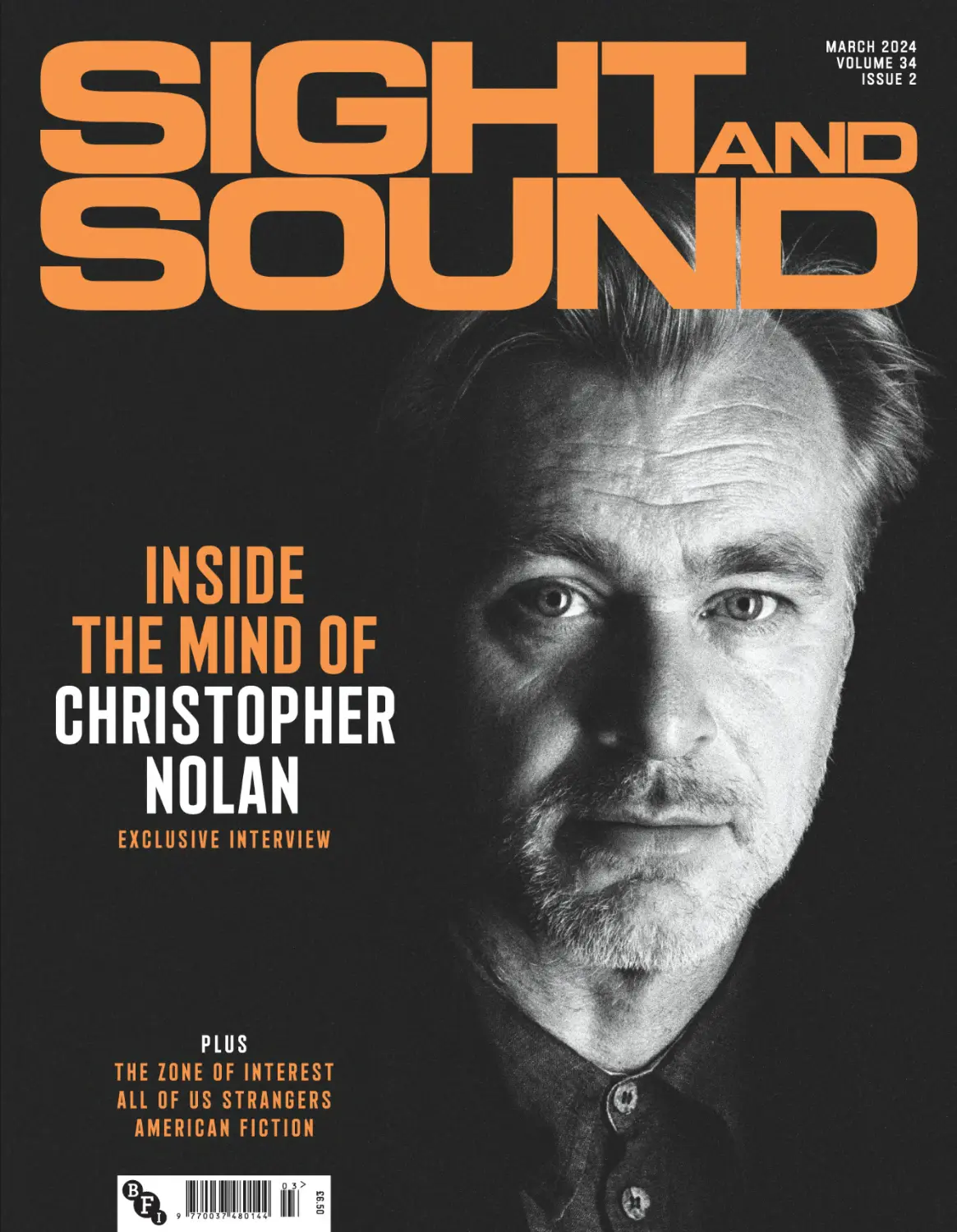
                    March 2024
volume 34
issue 2

Inside
the mind of
Christopher
Nolan
Exclusive interview

Plus
The Zone of interest
All of us Strangers
American Fiction
£6.50

“A MASTERFUL DEBUT”

“A REAL DISCOVERY”

INDIEWIRE

ROGEREBERT.COM

OFFICIAL ENTRY: CHILE
BEST INTERNATIONAL FEATURE FILM
96TH ACADEMY AWARDS®

“A SCORCHING WESTERN ON CHILE'S
BLOOD-SOAKED NATIONAL MYTH”
THE PLAYLIST

A FILM BY

IN CINEMAS

FELIPE GÁLVEZ

FEBRUARY 9

15

Strong violence, injury detail,
sexual violence, very strong
language.

mubi.com/settlers

CONTENTS

THE ZONE
OF INTEREST
The placid domestic life of Auschwitz
commandant Rudolf Höss and
his family is the focus of Jonathan
Glazer’s film, a chilling exploration
of everyday evil. Here the director
tells Jonathan Romney why it
required a new cinematic language

24

40

52

62

A billion-dollar return for
Oppenheimer has confirmed
the director’s unique ability
to sell complex, cerebral
themes to a mass audience.
As Nolan prepares to receive
a BFI Fellowship, he talks
to James Bell about physics,
collaborations and influences

Andrew Haigh’s brilliant,
haunting tale of grief and
longing follows an introverted
screenwriter coming to terms
with the traumas of his youth.
Arjun Sajip speaks to the
director and his leading men
Andrew Scott and Paul Mescal

As Perfect Days, his low-key
drama about a Japanese
toilet attendant, reaches
UK screens, the director
tells Nick Bradshaw
about the filmmakers
who have inspired him,
from Nicholas Ray to
Ozu Yasujirō

Like much of his work,
This Blessed Plot takes an
idiosyncratic look at
Englishness. The director
and his screenwriter
Adam Ganz talk about
teasing boundaries
between documentary and
fiction. By Ryan Gilbey

CHRISTOPHER NOLAN

COVER PHTOGRAPH: MAGNUS NOLAN

IN THIS ISSUE

56

48

ALL OF US STRANGERS

WIM WENDERS

AMERICAN FICTION

Cord Jefferson, director of the literary satire, and lead actor Jeffrey Wright discuss
the limits placed on Black storytelling, the struggle for creative freedom and the
critical importance of open discussions about race. By Charlie Brinkhurst-Cuff

MARC ISAACS

MARCH 2024

102

REVIEWS

ALICE GUYBLACHÉ

EDITORIAL
The power of needle drops

9

OPENING SCENES

IN THIS ISSUE

· Opener: Cillian Murphy
in Small Things like These
· Editors’ Choice
· In Production: Aneil Karia,
directing Riz Ahmed in Hamlet
· Interview: Lois Patiño on Samsara
· In Conversation: co-directors of
The Kitchen Kibwe Tavares and
Daniel Kaluuya
· The Ballot of… Steve McQueen
· Mean Sheets: posters for Yorgos
Lanthimos by Vasilis Marmatakis

18

LETTERS

20

TALKIES
· TV Eye: Andrew Male on
David Leland’s devastating
writing for television
· The Long Take: Pamela
Hutchinson is dressing the part
· Flick Lit: Nicole Flattery on the
wild magic of Liz Taylor and
Richard Burton’s romance

114

ENDINGS
· The bitterly cynical finale of
The Wages of Fear, Henri-Georges
Clouzot’s white-knuckle
ride through the mountains
in the company of a pair of
trucks carrying cargoes of
nitroglycerine, is truly explosive

FROM THE ARCHIVE

6

Shining a light on
the world’s first
female director

111

THIS MONTH
IN… 1954
Grable, Bacall
and Monroe on
the cover, with
Welles inside

CONTRIBUTORS

68 | FILMS
·
·
·
·
·
·
·
·
·
·
·
·
·
·
·
·
·
·
·
·
·

The Taste of Things
The Goldfinger
The Promised Land
Origin
Evil Does Not Exist
Mean Girls
Your Fat Friend
The Disappearance of Shere Hite
The Persian Version
Bad Behaviour
This Blessed Plot
Perfect Days
Eureka
Occupied City
Out of Darkness
Someone’s Daughter, Someone’s Son
The Kitchen
Wicked Little Letters
Gassed Up
The Iron Claw
American Fiction

JAMES BELL

is senior curator of fiction at the BFI
National Archive, and was formerly
features editor at Sight and Sound. At
BFI Southbank he has programmed
‘Cinema Unbound: The Creative
Worlds of Powell + Pressburger’
and the Film on Film Festival.

88 | DVD & BLU-RAY
· The Criminal Acts of Tod Slaughter:
Eight Blood-and-Thunder
Entertainments, 1935-1940
· The Circus
· Desire
· The Frightened Woman
aka Femina Ridens
· Rediscovery: The End of Civilization:
Three Films by Piotr Szulkin
· Archive TV: Hamlet at Elsinore
· Mean Streets
· Honor Among Lovers
· An American Tragedy
· Elegant Beast
· A Moment of Romance
· Lone Star
· Lost and Found:
In Pursuit of Excellence

CHARLIE BRINKHURST-CUFF

is an award-winning freelance
journalist and book editor. She is
a columnist at Stylist and writes a
weekly newsletter on the culture of
friendship called The Companion.

96 | WIDER SCREEN
· Alex Ramon explores John Akomfrah’s
hypnotic multi-channel installation
Arcadia and Henry K. Miller
watches Marco Bellocchio’s
gripping TV series Exterior Night

98 | BOOKS
· Philip Kemp on a new biography
of the Warner brothers,
Rastko Novaković on
Marguerite Duras as director,
Annabel Bai Jackson on Hitchcock’s
storyboards, Katie McCabe on the
art of the needle drop and
Sam Wigley on 20 years of critical
writing at Reverse Shot

RYAN GILBEY

writes for the Guardian and was film
critic for the New Statesman from
2006 until 2023. He is currently
working on It Used to Be Witches, a
book about queer cinema, for Faber.

ALSO IN THIS ISSUE

Alex Ramon, Catherine Wheatley,
Laura Staab, Sinéad Gleeson,
Hannah McGill, Leila Latif,
Brad Stevens, Kate Stables,
Christina Newland, Nicolas Rapold,
Leigh Singer, Caitlin Quinlan,
Kambole Campbell, Tom Charity,
Adam Nayman and more

EDITORIAL

Mike Williams
@itsmikelike

The best needle drops
in movies take a song
and pictures and
create a whole new
cognitive experience
out of the alliance

Sophie Ellis-Bextor’s 2001 hit ‘Murder on the
Dancefloor’ had an unexpected renaissance in
January thanks to Emerald Fennell’s divisive film
Saltburn. In a scene dripping with viral intent,
Barry Keoghan’s cuckoo-in-the-nest struts naked
down the halls of a gaudy mansion, swinging his
bits in time to the beat. The song reached No. 2 in
the UK Singles Chart, matching the highest position of the original release. Whatever critics and
cinephiles might think of the film, Ellis-Bextor’s
revival is a great story that shows cinema’s ability
to influence a vast audience’s listening habits hasn’t
diminished in the 30 years since Wayne’s World
(1992) introduced a generation of moshing xennials to Queen’s ‘Bohemian Rhapsody’.
Fennell’s use of Ellis-Bextor’s track is known as a
‘needle drop’ – a catchy term for licensing pre-existing music for a scene that complements or counters the happenings on screen, but you didn’t need
me to tell you that. In his riveting new book, The
Needle and the Lens: Pop Goes to the Movies (reviewed
on page 100), music critic Nate Patrin posits that
needle drops “place the film in a world that’s not
hermetically sealed off from the intrusions of other
pop culture media, but more in keeping with
our own”. Chosen well, a great needle drop can
redefine and entwine both the song and the film,
becoming surrogate music videos in our jukebox
of memories. Try listening to the Rolling Stones’
‘Jumpin’ Jack Flash’ without thinking of Johnny
Boy walking into Tony’s bar in Martin Scorsese’s
Mean Streets (1973), ‘Diamonds’ by Rihanna without visions of Marieme and her friends dancing in
sisterly bliss in Céline Sciamma’s Girlhood (2014),
Bob Dylan’s ‘Hurricane’ without seeing Wooderson entering the Emporium in Richard Linklater’s
Dazed and Confused (1993).
I could have picked a thousand different scenes
here, from Corona’s ‘Rhythm of the Night’ in Beau
travail (1999) to The Doors’ ‘The End’ in Apocalypse
Now (1979) to Elliott Smith’s ‘Needle in the Hay’ in
The Royal Tenenbaums (2001) to B.J. Thomas’s ‘Raindrops Keep Fallin’ on My Head’ in Butch Cassidy and
the Sundance Kid (1969) to Public Enemy’s ‘Fight the
Power’ in Do the Right Thing (1989), ad infinitum.
Every one of them has transcended the juxtaposition of music and pictures.
Joining the list of great needle drops is Andrew
Haigh’s use of Frankie Goes to Hollywood’s ‘The
Power of Love’ in his new film All of Us Strangers,
in which Andrew Scott plays a writer whose
attachment to reality becomes increasingly foggy
as he struggles to process the loss of his parents
and his search for himself. A beautiful and deeply

emotional meditation on grief, Scott, Paul Mescal,
Claire Foy and Jamie Bell are all able to convey a
lifetime of baggage and regret with a look or a
smile. These performances, along with Haigh’s
confidence to not over-explain and allow his magic
realism to just be, give the film a dreamlike tone.
Tethering this dream to the urban and suburban
worlds that Scott’s Adam flits between are the
needle drops, which evoke the feelings of a boy
growing up gay in the bleak mid-80s.
Haigh’s use of ‘The Power of Love’ is interesting
in that it becomes greater than an emotional guide
for the audience and more of a thematic reference
point returned to throughout; on a flickering TV
set, in snippets of dialogue, the song becomes as
much a character in the film as the actors. My reading is that while needle drops tap into deeper emotions for both characters and the audience, All of
Us Strangers is a feature-length essay responding to
the memories and feelings stirred within Haigh at
hearing this particular song and being transported
back to such a formative time in his life. As he tells
Arjun Sajip on page 40, “Music is such a brilliant
time-traveller; you can immediately access those
feelings.” While the film, an adaptation of the 1987
novel Strangers by Yamada Taichi, is not strictly
autobiographical, what Haigh has produced is, to
me, the biography of a feeling, and the film is as
brilliant as that sounds.
Haigh has often been talked up as a key figure
in post-Jarman filmmaking, and while that might
be reductive it at least points to the esteem in
which he is held. On 19 February, three and a bit
weeks after the release of All of Us Strangers, it will
be 30 years since Derek Jarman died. Watching
Haigh’s film set me off down a musical rabbit hole
of Frankie, Erasure and Pet Shop Boys, which of
course then led me to Jarman’s videos for PSB and
The Smiths, which like the best needle drops in
movies take a song and pictures and create a whole
new cognitive experience out of the alliance. In five
minutes of hoods and chains and fire in his video
for ‘It’s a Sin’ he packs in more drama, action and
subtext than many films can manage in two hours.
It’s a quirk of the way that Sight and Sound ’s films
of the year are compiled that our critics, many of
them international festival-hoppers, vote for work
by the year in which they see it, not the year in
which it is officially released. If we were stricter
about these date parameters and All of Us Strangers
hadn’t earned a single vote in 2023, there’s a good
chance that the film of 2024 would have come out
in its first month. Here’s to a great year as we discover what else might make that list.

ILLUSTRATION BY FERNANDO COBELLO; BYLINE ILLUSTRATION PETER ARKLE

Why the power of needle drops remains an
undying, death-defying force in filmmaking

“Emerald Fennell displays a

wickedly twisted
imagination”

“crackling, clever dialogue”

FOR YOUR CONSIDERATION
IN ALL CATEGORIES INCLUDING

BEST PICTURE
BEST ORIGINAL SCREENPLAY
EMERALD FENNELL

AmazonMGMStudiosGuilds.com

★★★★★

'A NAIL-BITING DRAMA'
EMPIRE

THIS THRILLING, CLASSIC OF WORLD CINEMA IS NOW
AVAILABLE AS A 4K UHD BLU-RAY!
INCLUDES A NEW VIDEO ESSAY, AN ILLUSTRATED BOOKLET, AND INTERVIEWS.

BFI MEMBERS ENJOY 15% OFF

OPENING SCENES

9

OPENING SCENES

Cillian Murphy drama
to open Berlinale
The actor’s first film since Oppenheimer
is a quiet, pained drama about the
Magdalene Laundries in Ireland, where
young pregnant women were sent to work
and their babies were sold for adoption
BY SINÉAD GLEESON

ABOVE
Cillian Murphy in
Small Things like These

After the huge success of Oppenheimer,
which has included Oscar, Bafta and
Sag nominations and a Golden Globe
win for Cillian Murphy, many are curious to know where the actor will go
next. In fact, his subsequent film got off
the ground thanks to an on-set conversation with his Oppenheimer co-star Matt
Damon. The pair were on a night shoot
in the desert, and between takes Damon
discussed his new production company
Artists Equity. Murphy confided that he
was excited about a script based on the
2021 historical novella Small Things like
These by the Irish writer Claire Keegan;
when Damon read it, he immediately
came on board as an executive producer,
along with Ben Affleck.
“It happened quickly,” Murphy says on
a video call from his Dublin home. “Normally these things never do, you know? I
read constantly, and I love Claire’s work,
so I assumed the rights to her novel
wouldn’t be available, but they were –
and I had an inkling it could be very cinematic.” Given his current success, many
in the industry might have assumed he
would gravitate to a big-budget project,

but Murphy was determined to make
this film. “We were already trying to get
Small Things off the ground and then
Oppenheimer came along. The scale of any
project is secondary – it’s always about
the quality of the writing.”
Murphy’s role in Small Things like These
is a big contrast to his performance in
Christopher Nolan’s blockbuster. Bill
Furlong, a father of five daughters,
works as a coal delivery man in 1980s
Ireland. One key early scene – in which
a soot-faced Murphy makes a delivery
to a local convent – leads to a sequence
of painful events. He sees a young girl
pleading with her mother, who attempts
to force her through its forbidding doors.
The camera focuses on Murphy’s face,
clouded with shame at witnessing something he shouldn’t, and a haunted awareness that something unjust is happening. Later, he meets a girl called Sarah,
his mother’s name, which adds deeper
meaning. The film offers a glimpse of Ireland’s Magdalene Laundries, notorious
institutions that took in pregnant girls
and forced them to do unpaid manual
labour, while their babies were in effect

OPENING SCENES

10

sold for adoption. Watching Small Things
like These, it’s hard not to feel a familiar
rumble of anger, exacerbated by the fact
that although the story feels old, the
last Magdalene laundry in Ireland only
closed in 1996. “It feels like a completely
different country now,” Murphy says,
“but the events in the film take place in
living memory. It’s a small book, but not
a small story – not politically or emotionally, and not to me.”
This isn’t the first work of Keegan’s to
make it to the big screen. The Quiet Girl
(2022), based on her novella Foster (2010),
became the first Irish-language film to be
nominated for an Oscar. Small Things is
less about what happens behind the grim
convent walls than about Furlong’s own
psychological turmoil, following another
shocking event in the priory. The film
expands on the book’s themes of intergenerational trauma and how patterns
in communities can repeat. Murphy is
superb in the role, subtle and physical,
tending towards silences and gestures.
“The book’s title is about this accumulation of incidents over Bill’s life,” says the
actor, “and when we meet him over the
course of that Christmas, he’s brought to
this sort of awakening of his own past.”
It can be difficult to transfer such internalised quiet moments to screen. Screenwriter Enda Walsh stuck very closely to
the original text and felt “the less we gave,
the more space there was for an audience
to feel it. It gathers its own anxiety.”
Murphy had collaborated with Walsh
on his plays Misterman (2011) and Ballyturk (2014), and the playwright gave him
his first ever stage role in Disco Pigs in 1996
(he also starred in a 2001 screen version).
Walsh jumped at the chance to work
with the actor again. “Cillian doesn’t
allow things to get general – many people
in this business do – so you end up disappointed that you didn’t make exactly the
work you wanted to make. As a producer
he made some excellent calls in the edit,
as well as putting together a really great
cast and crew.”

Bill’s wife is played by Eileen Walsh,
who starred with Murphy in Disco Pigs on
stage. There’s a strong sense that Murphy
is motivated by trust when it comes to
those he works with. “The thing about
re-collaboration is that you go straight
to the work. There’s no sounding people
out, or testing the waters. Our director
[Tim Mielants] said that when he put
the camera on Eileen and me for the
first time, he could feel the history – and
she’s sensational in the film. So, I’m a big
believer in using that trust and friendship
and transferring it over into film, or theatre. I think it really helps.”
Murphy had also worked with
Mielants on Peaky Blinders (2013-22)
and wanted to find a way team up with
him again. “He’s a real artist and is
extraordinary with actors. I also liked
the fact that he’s Belgian, not Irish.
If you look back at a lot of the great Irish
films of the last 20 years, many are made
by directors who are not from Ireland.
With a film like this, it was important
to have some distance from the subject.”
This is Murphy’s first time producing
a film; he credits his production partner
with doing “most of the heavy lifting… I
was very much a creative partner in terms
of script, score and editing, but I learned
lots about actually putting a film together
and really enjoyed it.” It was shot in New
Ross, County Wexford, where the book
is set, using the town’s actual convent and
a real house as the family home. A palette
of greys and browns throughout highlights the poverty of an era of mass emigration and job scarcity. The sound was
designed by Senjan Jansen – sonorous
church bells, fretful geese – and it cleaves
to the audio trajectory of the whole film:
minimal, prone to silences, offering the
audience a neutrality where they can
make up their own minds. On 15 February, Small Things like These will become the
first Irish film to open the Berlinale. It’s
tender, understated, humane and unsentimental; and a timely reminder to never
forget the horrors of the past.

ABOVE Bill Furlong (Cillian Murphy) and Sarah (Zara Devlin) in Small Things like These

Six picks from the Berlin film festival
BY THOMAS FLEW AND ISABEL STEVENS

ARCHITECTON
(VICTOR KOSSAKOVSKY,
GERMANY/FRANCE)

THE EMPIRE
(BRUNO DUMONT, FRANCE)

After recent odes to water
(Aquarela, 2018) and pigs
(Gunda, 2020), the Russian
filmmaker puts humankind
under his lens with this study
of cement and architecture.
Be ready for surprises if his
quote to British Cinematographer
is a steer: “My next film is
a comedy about building
a futuristic city. As for the
camerawork, it will be
revolutionary… but also a
surprising utopian vision.”

After a rumoured appearance
at 2023’s Cannes film festival
never materialised, Dumont’s
science-fiction feature has
finally found a home in Berlin.
Starring Lyna Khoudri and
Camille Cottin, this riff on Star
Wars (1977) features warring
intergalactic travellers crashlanding in a working-class
French coastal village. Expect
off-brand lightsabers and
lashings of spectacular VFX
– alongside Dumont’s usual
off-kilter sense of humour.

DAHOMEY
(MATI DIOP, FRANCE)

I SAW THE TV GLOW
(JANE SCHOENBRUN, US)

BLACK TEA
(ABDERRAHMANE SISSAKO,
FRANCE/MAURITANIA)

LOVE LIES BLEEDING
(ROSE GLASS, UK)

Diop’s much-anticipated
follow-up to Atlantics (2019)
sees her working in nonfiction,
examining the colonial
relationship between France
and the Kingdom of Dahomey
(now Benin) via 26 artworks
which were restituted to Benin
in 2021, more than 100 years
after being taken to France. A
close exploration of the objects
is combined with scenes of
contemporary university
debate, which connect colonial
history to modern-day politics.

Ten years after Timbuktu (2014),
Sissako returns with the story
of an Ivorian woman who
absconds from her wedding
and travels to a district of
Guangzhou with ties to the
African diaspora. There she
meets and falls in love with
a local tea seller, in what
promises to be a romantic
affair. Sissako is said to have
been inspired by a favourite
restaurant, run by an AfroChinese couple.

Schoenbrun’s sophomore
feature swiftly wends its way
from Sundance to Berlin,
where it plays in the audiencefocused Panorama strand.
Justice Smith and Brigette
Lundy-Paine are teenagers
who become close friends via
a shared favourite TV show.
Described by Schoenbrun as
“emo horror”, I Saw the TV Glow
continues her fascination with
the strangeness of adolescence
first explored in We’re All Going
to the World’s Fair (2021).

A bodybuilder, Katy O’Brian
(The Mandalorian, 2019-) and
her gym’s manager, Kristen
Stewart, fall in love, and then
find themselves embroiled in
a mire of criminality, in Glass’s
second feature. Set outside
Las Vegas’s city limits, where
the bright lights give way to
something murkier and violent,
this Sundance premiere
promises genre trappings
married to the distinct style
seen in Glass’s debut Saint
Maud (2019).

11

EDITORS’ CHOICE

GLASGOW FILM FESTIVAL

EMERGING FILM CURATORS SERIES

Barbican, until 24 March
By the time you read this, the intriguing
programme of events cooked up by the
Barbican’s emerging curators will be
underway, with films on neurodiverse
cinema and a screening of rarely seen
avant-garde works directed by Yugoslav
women (that event is sold out, but do
seek out the featured Home Movies,
2006, a film diary by Vukica Djilas).
Thankfully you can still catch Changing
with the Tides (24 March) – four shorts
about fishing, among them Vittorio De
Seta’s intoxicating Sicilian spearfishing
documentary The Age of Swordf ish (1955,
pictured above). The suspense of the
swordfish hunt and the slow, folkloric
rhythms of this ancient fishing practice
are captured from dusk to dawn, over 11
minutes. Not for nothing did Scorsese
describe De Seta as “an anthropologist
who speaks with the voice of a poet”.
Katie McCabe, reviews editor

SCREEN DEEP: HOW FILM AND TV CAN SOLVE RACISM AND SAVE
THE WORLD

Faber
Film and TV journalist Ellen E. Jones searches for media representation that can
dismantle racism, tracing the journey from “a screen culture that represents only one
small section of human experience, towards a deeply rooted diversity that can fill
in the blanks for everyone”. Sharing her personal experiences as a mixed-race critic
and interviewing filmmakers including Shola Amoo and Aleem Khan, Jones creates
a history that spans from the silent era to the TikTok age and steps smartly over the
qualms of those who feel that analysing the racial politics of popular entertainment
is like “shooting mosquitoes with an elephant gun – over-elaborate, messy and bound
to ruin the house party for the other guests”. Clear-sighted and necessarily sceptical
of overhyped diversity initiatives, Screen Deep nevertheless finds room for a certain
optimism. Hope, argues Jones, is to be found in the audiences who demand more.
Pamela Hutchinson, Weekly Film Bulletin editor

QUENTIN BY TARANTINO

MAGICAL REALISM: THE FILM FABLES OF THE TAVIANI BROTHERS

BFI Southbank, until 12 March
Curated by Adrian Wootton, this two-month retrospective of the Italian filmmaking
brothers Paolo and Vittorio Taviani celebrates the protean nature of their lengthy
career, which stretches back to the mid-50s. It’s parcelled under four thematic
headings, which in the February instalment include ‘The Politics of Rebellion’ and
‘Classic Literature’. Highlights from both months include Padre Padrone (1977), which
won the Palme d’Or that year, The Night of San Lorenzo (1982), Caesar Must Die (2012)
and, a personal favourite, Kaos (1984, pictured above). One of the great films of the
80s, it consists of four Sicily-set Pirandello stories that feel uncannily elemental and
lean heavily into local myth and folklore, regularly slipping the border between reality
and the fantastical. The brothers conjure a miraculous ending in a coda that depicts
an epiphany experienced by a middle-aged Pirandello, pierced by loss and sorrow at
the elusive mystery of the past on a return visit to Sicily. If the magic alluded to in the
season title is anywhere, it’s right here.
Kieron Corless, associate editor

Titan Comics
Graphic artist Amazing Améziane lifts
extracts from interviews with Quentin
Tarantino across his career to create
this illustrated, self-narrated, life story
of the director, which acts as the first
instalment of a trilogy of graphic
novels. Volumes on Martin Scorsese
and Francis Ford Coppola will follow
later in the year. There’s no original
material from Tarantino, and the book
holds few surprises for dedicated
cinephiles, but the presentation is
original and breathes new life into
the interview excerpts, making this as
attractive to completists as it will be to
newbies looking for a way into such a
totemic figure.
Mike Williams, editor-in-chief

HOW TO BE A HUMAN: FILMS
BY AKI KAURISMÄKI

Mubi
To accompany its digital release of
Kaurismäki’s latest deadpan marvel
Fallen Leaves (pictured above), Mubi
has assembled ten of the Finn’s previous
works. From his early Helsinki-set
‘Proletariat’ trilogy (Shadows in Paradise,
1986; Ariel, 1988; The Match Factory
Girl, 1990), which mesh bleak social
realism with dark humour, to his
recent immigrant fables Le Havre (2011)
and The Other Side of Hope (2017), this
rich collection is perfect for anyone
looking to explore the work of one
of European cinema’s most singular
humanist filmmakers.
Thomas Flew, editorial assistant

OPENING SCENES

28 February – 10 March
Alice Rohrwacher’s mesmerising,
magical La chimera, about an Italian
gang on the hunt for buried antiquities
(starring Josh O’Connor, pictured
above, and Isabella Rossellini), is the
jewel in the crown of the 20th edition
of the festival which has, until recently,
been the nimble, dandier Scottish
film event, upstaging staid old-timer
Edinburgh before the latter’s return to
its peak summer perch. Other eccentric
delights include Luna Carmoon’s
distinctive debut Hoard, Bertrand
Bonello’s ambitious AI sci-fi The Beast
and Radu Jude’s acerbic satire Do Not
Expect Too Much from the End of the World.
Do expect a lot from the festival’s
archive offerings – free early morning
screenings and a programme devoted to
Mexican-born Hollywood star Dolores
del Río.
Isabel Stevens, managing editor

Recommendations from the Sight and Sound team

12

IN PRODUCTION
Aneil Karia’s
Hamlet

OPENING SCENES

BY THOMAS FLEW

When I call Aneil Karia in January to
discuss his new film Hamlet, a retelling
of the Shakespeare tragedy starring Riz
Ahmed, the director is sitting in a suite
in Soho at the beginning of the editing
process. “It’s nice, on a purely material
level, to not be standing somewhere in
rural England in the freezing cold at
night-time,” he admits.
Karia explains that his introduction
to this long-gestating project came via
Ahmed, with whom he’d co-written his
2020 short The Long Goodbye, which won
the Oscar for Best Live Action Short.
“Riz and Mike [writer and co-producer
Michael Lesslie] had been developing
this for a long time previously, but were
yet to reach out to directors. Riz decided
to send [the screenplay] to me… and I
kind of sat with it for a while – I didn’t
know how to react because I had a difficult relationship with Shakespeare at
school and my immediate thought
was, ‘I’m not the person for this.’ I think
that instinctive response made them
more curious, because they were looking to break open Shakespeare to a
different audience.”
This Hamlet is set in modern-day
London but the original verse will be
retained, although other elements of the
story will, Karia reveals, be pared back.
“We’ve lost certain iconic characters, it’s
a bit more of a lean version. The broad
shape of the play is pretty faithful, but
we have just streamlined it.” Also kept is
the death-filled conclusion. “It’s about as
bloody as it gets,” Karia tells me with a
chuckle. The tight cast comes from both
the UK and India; alongside Ahmed
as Prince Hamlet are Morfydd Clark
as Ophelia, Joe Alwyn as Laertes, Art
REHEATING THE COLD WAR
With Pacifiction (2022) having brought
Albert Serra’s distinctive cinema new
levels of public recognition, many
will be eagerly anticipating his next
feature Out of This World, on which
production will start this summer.
Exploring “the eternal rivalry between
Russia and the USA”, it will follow
an American delegation which travels
to Russia during the war against
Ukraine. Knowing Serra, neither
side is likely to get off lightly in what
sounds like a fascinating satire. It
is slated for a 2025 premiere.
MORE OF MILO
Arnaud Desplechin has revealed
that the cast of his upcoming
Spectateurs! will be led by the
young Milo Machado Graner,

‘Hamlet is the
son of a property
developer who
immigrated to
the UK in the
70s and later
pursues wealth
at the expense of
his community,
ethics and
cultural roots’
ABOVE
Karia (left) and Riz Ahmed
(second from right) on set

BELOW
Milo Machado Graner
in Anatomy of a Fall

Malik as Claudius, Sheeba Chaddha as
Gertrude, Avijit Dutt as Hamlet’s father
and Timothy Spall as Polonius.
As well as stripping back the story, this
production has chosen to make Hamlet’s
meeting with his father’s ghost an indication of a mental health crisis. Here
– unlike in Shakespeare’s original play –
Hamlet is the only person who can see
the spirit. Karia notes: “From the onset,
his sanity is kind of in question, both
by us and by himself.” Also significant,
says Karia, is Hamlet’s cultural identity
(Ahmed will become the first BritishAsian actor to play Hamlet on film).
In this version, “Hamlet is the son of a
property developer who immigrated to
the UK in the 70s and who later in his

life began to pursue wealth and power
at the expense of his community, ethics
and cultural roots.” With his father’s
death, Hamlet is brought back into the
family fold and has to reckon with what
Karia describes as “a backdrop of relentless capitalism, and the endless pursuit of
wealth and growth at the expense of our
own identity and morality”.
Following a brisk shoot in London
and Surrey in late 2023 – “It was a classic UK independent film shoot. Cold,
a lot of nights, never enough time as we
quite needed.” – Karia hopes that postproduction will conclude this summer.
The film will then, he says, seek its home
in festivals. If we’re lucky, we could be
seeing it this year.

whose breakout role came as the son
in Justine Triet’s Anatomy of a Fall.
The docufiction project, which has
been described by its distributor
rather uninspiringly as “a love letter
to cinema”, will also star Mathieu
Amalric and Françoise Lebrun.

years. It will be Safdie’s first solo
directorial credit – his brother Josh
is not involved in the production.

FIGHT CLUB
An unlikely collaboration sees
Dwayne Johnson teaming up
with Benny Safdie for his latest
A24 project. Johnson will play
Mark Kerr, a real-life mixed
martial arts fighter,
in The Smashing
Machine, a project
that the pair
have reportedly
been working
on for five

BONES OF CONTENTION
Sally Potter’s next film Alma will
enter the co-production market at the
Berlinale. The story centres around the
scattering of an archaeologist’s ashes,
and family rivalries. Speaking to the
Guardian about it in 2022, Potter said
that it “deals with how the English
relate to their history, this nostalgia for
a nonexistent past. It’s bleakly funny.”
HERTZFELDT WISHES
A brief but exciting announcement
from animator Don Hertzfeldt
revealed his next film, ME, will
come out this year. All other
details remain under wraps.

IN FOCUS
The Laos picture show

NEWS

13

Stories in brief

Lois Patiño’s documentary takes the viewer on a profound inner
journey, one that should be approached with eyes wide shut
BY ARJUN SAJIP

ABOVE Lois Patiño’s Samsara

have any light on screen; it was going to be a
sonic experience with your eyes closed. A little
bit later, I started to add light. Derek Jarman’s
Blue [1993] was absolutely a reference – the
use of light in its most essential essence. In
a more conceptual way, there were also Stan
Brakhage’s films, where he painted on the celluloid, inspired by hypnagogic images. I had all
these references in my head. But I knew that
for this idea to feel strong, radical and unique,
it could not be an experimental film – it had to
be a narrative film.”
Patiño may not see Samsara as experimental, but the flashes of light in the lengthy central sequence are almost blinding on the big
screen. Was this a way of punishing viewers
who declined his invitation for them to cerrar los
ojos? “It was more about exploring a perceptual,
even neural experience,” the director maintains.
“If you use one frame of light and one frame of
darkness compared to five frames of light and
five of darkness, it really changes the designs
you see on the inside of your eyelid. Even when
your eyes are closed, your ocular nerves are still
very active in a way that you’re not used to.”
Through the gentleness and sensitivity of
his direction, Patiño avoids making the film
an exercise in othering. “I like to bring beauty
to the image. And this can sometimes take
you closer to exoticism. I don’t want to avoid
recording the waterfall, because it really is
amazing, but the distance between making a
postcard and creating an interesting image is
very small.
“At the same time, the film is not only about
the Buddhist temples or Zanzibar. So there
being some distance helped with approaching this supra-layer of the film – the sense of
spirituality and different conceptions of it. In
some ways, being a foreigner helped a little bit.”
Samsara is out now in UK cinemas and
was reviewed in our last issue

Lee Sunkyun in Bong Joon Ho’s Parasite (2019)

CALL TO INVESTIGATE STAR’S DEATH
Following the suicide of actor Lee
Sunkyun, prominent figures in the
South Korean film industry, including
Bong Joon Ho, are drawing attention to
the high number of suicides in Korea’s
entertainment industries; they are calling
for an investigation into police methods
and for media companies to reflect on
their sensationalism. The 48-year-old
star, best known internationally for his
role in Parasite and the films of Hong
Sangsoo, was under investigation for
alleged drug use at the time of his death.
GIVANNI GETS BAFTA HONOUR
Curator, writer and archivist June
Givanni will be honoured with an
Outstanding British Contribution
to Cinema award at this year’s Bafta
ceremony. Givanni, who created and
continues to co-edit the Black Film
Bulletin, which is published in Sight and
Sound twice a year, is being recognised
for her work in founding the June
Givanni Pan African Cinema Archive.
TUTTLE CONTROL
It’s all change at the Berlinale with
this February’s edition the last to be
run by artistic director Carlo Chatrian
and executive director Mariëtte
Rissenbeek. Taking their place will
be Tricia Tuttle, whose appointment
returns the Berlinale to a single-director
model. Tuttle’s most recent role was
running the BFI London Film Festival
for five years before leaving in 2023.

THINGS CHANGE
Yorgos Lanthimos’s Poor Things has
raised eyebrows around the world with
its open attitude to sex. This openness
was not altogether welcome to the
British Board of Film Classification,
which for the film’s UK release
demanded a cut in a scene in which
a father brings his young sons to the
brothel where Emma Stone’s Bella
Baxter works. A BBFC statement
explained, “We informed the distributor
we would be likely to classify the
film 18 on condition that changes be
made to one short sequence depicting
sexual activity in the presence of
children. This is in accordance with the
Protection of Children Act 1978.” The
film then collected its 18 certificate.

OPENING SCENES

About half an hour into Samsara, director Lois
Patiño gives us a frontrunner for the most ravishing shot of the year: a group of novice monks
in saffron robes walking before the majestic
Kuang Si Falls in Laos. If the sequence is
strikingly composed, that goes for the film as a
whole: after almost an hour observing monks
and witnessing the final days of Mon, an old
woman in rural Laos, we’re invited to close our
eyes for around 15 minutes as coloured lights
intermittently flash on a black screen and a
soundscape takes over. We are accompanying
Mon’s soul as it passes through the bardo – the
liminal state between death and rebirth – and
into… the body of a goat in Zanzibar, where we
spend the film’s second half, in the company of
a group of women seaweed farmers.
Shot on 16mm, the film is a significant departure for Patiño, whose previous two features
were filmed on the coast of Galicia in northern
Spain, where he is from. Samsara is a Buddhist
notion that has to do with humans’ cyclical
existence and reincarnation; to explore it, the
director wanted to shoot in a Buddhist country. But several films with spiritual leanings
have already been filmed in Tibet, and Thailand already has Apichatpong Weerasethakul.
(“I wanted to try to avoid comparisons with
him,” Patiño says, “as I know I’m also doing
slow cinema and the inevitable links would be
drawn.”) Patiño lit on Laos – a country rarely
seen on Western screens – and used The Tibetan
Book of the Dead as a way into the central theme;
a boy reads it to Mon in the days before she dies.
Patiño points out that Book of the Dead is a
Western name for the Bardo Thodol, a title that
means something more like “liberation in the
intermediate state by way of listening”. Listening is the sense that is activated by the film’s
remarkable interlude. “The idea of asking the
audience to close their eyes came to me before
I finished shooting my previous film, Red Moon
Tide [2020],” Patiño says. “I was not going to

14

OPENING SCENES

TAVARES/K ALUUYA PORTRAITS: GET TY IMAGES; JEWISON PORTRAIT: BFI NATIONAL ARCHIVE

IN CONVERSATION

Daniel Kaluuya and Kibwe Tavares
The co-directors talk about their near-future social housing drama The Kitchen
INTERVIEW BY LOU THOMAS

Daniel Kaluuya and Kibwe Tavares’
directorial debut The Kitchen focuses
on a rundown housing estate in a
near-future London in which Izi
(Kane Robinson) dreams of escape to
a yuppie flat. At his job in ecological
funeral home Life After Life, Izi bumps
into Benji (Jedaiah Bannerman),
the teen son of his ex-girlfriend. He
takes the boy under his wing and
helps him avoid getting caught up
with local motorbike gangs and
violent police raids on the Kitchen.
The project took ten years to come
to the screen. Kaluuya, who co-wrote
the screenplay with Joe Murtagh,
had been inspired by a story he heard
while waiting to get a haircut in
Holloway Road, north London.
Like Tavares, Kaluuya is a London
native and their film blends social
realism and science fiction while paying
tribute to their home city. It was shot
largely on location, with parts of the
Barbican Centre, Bethnal Green and
Angel making it into the final cut.
Ahead of its world premiere
as the closing night film at the
2023 BFI London Film Festival
in October, Kaluuya and Tavares
sat down to discuss the themes
and creation of their film.

dk

KT

You had the initial idea for The
Kitchen in 2011. What sparked it?
(Daniel K aluuya) I was at a barber
shop. Some guy was talking about
smash-and-grabs. He was boasting
about it, loud. Telling everyone.
A bit mad. I was listening, like,
“I really want to watch that film.
That’s a sick film.” I went back
to the barber shop and didn’t
see him again. Then I found out
they were robbing million-pound
diamonds [and selling them on]
for, like, £200. I’m, like, “What
the fuck is that?” That’s London.
There’s something happening
there: that’s class, that’s everything.
Izi and Benji’s relationship is at
the heart of the film. How did
you work with Kane Robinson
and Jedaiah Bannerman to
get those performances?
(Kibwe Tavares) Jed was new to
acting, so it was introducing him
into how the process is going to
work. We went bowling together in
Croydon to get to know each other.
His auntie, Sheila Nortley, she’s
a producer, so he’d been adjacent
to sets but never in the middle of
one. You need to prepare him for

what it’s going to be. Suddenly, at
13, there’s a hundred people looking
at you. Him and Kane started
to find a rhythm together and
started to take their cues off each
other. You start to see that come
alive, especially later in the film.
DK

DK

KT

Jed would give notes – him being
a 13-year-old – saying, “That’s
wank.” Then Kane has incredible
instincts as an artist and it’s
about bringing them together
and making something true.
Where you inspired by any
other London-set sci-fi films,
such as Alfonso Cuarón’s
Children of Men [2006]?
I can’t speak for the director’s
intention, but from my interpretation
Children of Men felt very grey.
This is different, a celebration
of pop, life and people – but it’s
the same city. There were a lot
of parallels there, but how do we
make it feel like what’s out there
as opposed to what we’ve seen?
What are you trying to say about
the process of gentrification?
We spent a lot of time around

‘I see a lot of
working-class
films, like,
“Who would want
to live there?”
You’re not going
to show the bits
that are actually
amazing about it,
that community,
that banter?’
DANIEL KALUUYA

ABOVE
The Kitchen, with
Hope Ikpoku Jr (centre)
RIGHT
Kibwe Tavares and
Daniel Kaluuya

15

London talking about people getting
pushed out. Once you get to the
point of “where is out?”, what does out
become? It became about this idea of
dystopia, which lies in the London left
behind if you pull out all the things
that make London rich and alive and
interesting. The Kitchen, although
it would be hard to live in, isn’t [a
dystopia], because it’s become a place
we recognise as the city squashed
together, like London’s last village.

KT

DK

DK

DK

Can you tell me about Arsenal
legend Ian Wright in the role of
estate DJ Lord Kitchener?
He’s so open, willing to learn, to
listen. He’s a very emotional guy.
He’s got a lot of soul. Obviously,
Ian Wright’s a hero but we love him
for who he is, not just what he did and
what he does. He captures a London
that needed to be captured in the
film, a generation we’re all from.
Although the film is necessarily
dark in places, it’s also a
celebration in some senses.
What was your objective?
I wanted that. A lot of time I see a
lot of working-class films, like, “Who
would want to live there?” But a lot
of people live there. You’re not going
to show the bits where they’re having
fun, you’re not going to show the
bits that are actually amazing about
it? You’re not going to show that
community, that banter? It’s banter
central – who could be the quickest?
Go to a market, it’s about who could
be the quickest about getting the

DK

OBITUARY

Which recent films made by London
directors have caught your eye?
I can’t wait to catch up. I’ve got a list.
I want to watch Scrapper and Rye Lane.
London’s going through a real moment
and we’ve got to own it. I do believe
in London. We could be ourselves, be
specific and tell global stories about
big themes like New York does.
The ending leaves things ambiguous.
Can you tell me your intention?
It ends in community, family, home.
I feel a lot of other working-class
dramas around the world go, “I hate
this place.” I felt the writer and director
is saying these places are shit. I didn’t
want to tell that story, but to tell the
story you have to show a man that
hates it from the beginning. Which is
true, you can see it from people that
vote against their interests. They hate
where they are. They are aspiring.
They dress it as “I want to be that,” but
our subtext is like, “I hate being this.”
Who’s that person? The majority
of the country. It’s not a bad thing.
Let’s talk about that person. Why
do they think that way? How are
they right or wrong? Actually
give a balanced argument and see
that journey of how to appreciate
what it is, where we’re from. It’s
about valuing where we’re from.
The world is in a difficult spot at
the moment – in many different
ways – but the one thing people
always have is where they’re from.
It represents connection to something
that you were born into. You should
embrace that, in the same way
Lady Bird [2017] did, in the same way
The Wizard of Oz [1939] does. There’s
no place like home. It’s an archetype.
The Kitchen is streaming on Netflix now
and is reviewed on page 83

Norman Jewison
JULY 21 1926 – JANUARY 20 2024
BY SAM WIGLEY

Bobby Kennedy once told seven-time Oscar
nominee Norman Jewison, who has died at
the age of 97, that timing is everything. Had
he been around in Hollywood’s Golden Age,
the versatile Canadian might now be ranked
alongside such heroes as William Wyler and
Fred Zinnemann. A master storyteller with
a confident visual sense, it seemed there
was nothing that Jewison couldn’t do. But
he was at his peak when the studio era was
fading and the critics fêting the Easy Riders
and Raging Bulls of New Hollywood didn’t
always recognise the aesthetic acuity behind
his intellectual integrity.
He began in television in the 1950s and
some of the energy of his renowned live
shows would carry over into his early Doris
Day comedies. Replacing Sam Peckinpah on
The Cincinnati Kid (1965), he not only proved
he could handle a difficult star like Steve
McQueen, but brought visual flair to the
gambling drama’s pivotal poker sequences.
This dynamism would be more in evidence
when actor and director reunited for the
caper film The Thomas Crown Affair (1968),
which used split screens and swirling cameras to inject pace into the teasing action.
Accustomed to fighting his corner as a
Protestant kid subjected to antisemitic bullying because of his surname, his sensitivity
to injustice was heightened by the racism he
witnessed on a post-war road trip through
the segregated South and he channelled his
outrage into In the Heat of the Night (1967).
Courageous for its inflammatory times, this
Mississippi clash between a Black city detective (Sidney Poitier) and a bigoted smalltown sheriff (Rod Steiger) won the Oscar
for Best Picture less than a week after Martin
Luther King Jr had been assassinated.
Later, he courted controversy with vibrant
religious musicals Fiddler on the Roof (1971)
and Jesus Christ Superstar (1973) and the violent anti-corporate sci-fi Rollerball (1975).
There was even an edge to Moonstruck (1987),
an ebullient romcom set amid Brooklyn
Heights’s Italian-American community which
echoed his perennial theme of betrayal: it
earned him Berlin’s Silver Bear and the film
three Oscars.

OPENING SCENES

DK

Is there a wider point being made
about what buildings and structures
do to people as a living environment?
I think the thing that comes across
is the idea of how temporary these
people are because they can get moved
at any point – they’re essentially under
threat. People have become resourceful
from that. In the market, they’ve
built their own structures, turned
things into their own shops. It’s about
innovation and technology, people
reappropriating and reusing things.

cheapest deal. It would be inauthentic
to not have that in the film while still
tackling serious issues. It’s how you
handle it. There’s always humour
in those dark moments. Some of
the funniest jokes are at funerals.

16

THE BALLOT OF…
Steve McQueen
Each month we highlight a voter in our Greatest Films of All Time poll.
Here the English artist and director of Shame, 12 Years a Slave and
Occupied City, which is out now, shares his choices

ZÉRO DE CONDUITE
(JEAN VIGO, 1933)
This was one of those movies
that’s stuck with me from
when I was young and getting
into cinema. It was all about
liberation and freedom, all about
play and discovery and defying
conventions in a boys’ school.
COUCH (ANDY WARHOL, 1966)
I saw this for the first time when
I was about 19, at Goldsmiths
[University, London]. Some
guy came with a 16-millimetre
projector and he was projecting
it at 18 frames per second. I was
mesmerised; it was just below
the rate of your heartbeat and it
was pulsating, hypnotising.
LA RÈGLE DU JEU
(JEAN RENOIR, 1939)
It’s about the state of play: the
haves, the have-nots. It’s all
about the game and I think it’s
so beautifully done. It reminds
me of desperate people in
desperate places.

‘The music in
Le Mépris, and the
whole idea of Michel
Piccoli and Brigitte
Bardot’s slow breakup, made a huge
impression on me’

LE MÉPRIS
(JEAN-LUC GODARD, 1963)
The music in this movie
and the whole idea of the
slow break-up of the couple,
played by Michel Piccoli and
Brigitte Bardot, made a huge
impression on me: as did
its pace and way of looking
and the use of time. It’s one
of Godard’s best movies.

DO THE RIGHT THING
(SPIKE LEE, 1989)
I remember seeing it for the
first time. My god. It was one
of the most exciting things
I’d seen. When I saw it, we
were living it. A lot of these
films I’m mentioning are films
from the past. This was a film
of the present, in 1989 when I
saw it, and it was electrifying.
Again, that’s what a film can
do as an object, and how it
can gauge the temperature or
the climate of the moment.
It’s even more rare today to see
a picture that says something
about the here and now.
ONCE UPON A TIME
IN AMERICA (SERGIO
LEONE, 1984)
A film about time and regret.
There’s something in Ennio
Morricone’s music: it’s such a
force in the trajectory of the
film. It’s got this wave to it, and
it’s beautiful. It’s one of those
occasions when I was in a
cinema and lost a sense of time;
I was living within the film.
It was fantastic. My biggest
memory of this film is the kid
on the top of the staircase,
rather than being with a girl,
eating all the cream off the
cake. For me that’s the most
beautiful scene in the film.

TOKYO STORY
(OZU YASUJIRŌ, 1953)
For something ostensibly so
foreign to me, how Tokyo Story
depicts the life of a family
was extremely familiar; it was
recognisable. It’s so close to a
reality I know. That happens
sometimes: you see things
through other people’s eyes
and it’s so intimate, so close.
It’s like, how do they know?
SINGIN’ IN THE RAIN
(STANLEY DONEN &
GENE KELLY, 1952)
I love, love, love Gene Kelly.
The exuberance. Even in the
title. Right now we should all
be singing in the rain. Life is
about singing in the rain, and
this film articulated that in
such a spectacular way.
BEAU TRAVAIL
(CLAIRE DENIS, 1999)
It’s a meditation and it’s
undeniable on its own terms.
You have to tune yourself into
it, almost like a radio, into
that frequency.
Occupied City is reviewed on page 81
ABOVE Brigitte Bardot
in Le Mépris (1963)
LEFT Brahim Hadjadj
in The Battle of Algiers (1966)

STEVE MCQUEEN PORTRAIT: JAMES STOPFORTH

OPENING SCENES

THE BAT TLE OF ALGIERS
(GILLO PONTECORVO, 1966)
This movie is such a great
example of what cinema can do.
Going beyond entertainment
and actually crossing over into
the everyday. It became a rallying
call for action. It was the last
screening I attended at my
favourite cinema, the Lumiere
in London, before it closed [in
1997]. I remember seeing the
owner in the front row swigging
back vodka. I was in tears.

17

MEAN SHEETS
Vasilis Marmatakis creates
poster art for Yorgos
Lanthimos that’s as vibrant
and strange as his films are
BY THOMAS FLEW

The Lobster (2015)

OPENING SCENES

Vasilis Marmatakis’s posters for Yorgos
Lanthimos’s Poor Things are much like
the film they represent – dazzling at
first glance, but also containing detail
and complexity that leave a lasting
impression. The alternative poster
(pictured right) shows Emma Stone’s
Bella Baxter in a traditional pose for
painted portraiture, her arms crossed
delicately. But where her head should
be, another Bella is emerging, mirroring
not only her father figure Godwin’s
anatomical experimentation, but also
literalising Bella ‘coming out of her
shell’, as she does throughout the film.
It’s no surprise that Marmatakis is
able to include such complexity in his
artwork; as he explains via email, he is
involved in Lanthimos’s projects from an
early stage. “I was sent the script, after
reading the [Alasdair Gray] book, and
shortly after I had the chance to visit the
shooting in Hungary. Following filming,
I acquired all the unedited photography
from the set. This poster depicts the
intense and awkward moment when
you bring your new self to the world.”
Designing posters for the Greek
director from Dogtooth (2009) onwards
has only strengthened the bond between
the pair. Yet since The Lobster (2015),
Lanthimos has worked with Englishlanguage stars, whose prominence on
posters is a prerequisite for marketing
purposes. Despite that, Marmatakis has
shown himself able to match what he
describes as Lanthimos’s “very daring
and distinctive visual language”.

The international poster for The Favourite (2018)

Alternative poster for Poor Things

18

OPENING SCENES

READERS’ LETTERS
PILGRIM’S PROGRESS
Living in Australia, I’ve been a subscriber to Sight and Sound for probably
30 years. Every month I used to read,
a trifle wistfully, scattered among the
articles, reviews and interviews that I
bought the magazine for, the tantalising details of current and promised
BFI seasons – all so far away, so enticing, so out of reach.
Then last month my wife and I
had occasion to be in England for
two days, and one of those days was
free. October was the start of the
Powell and Pressburger season, and
screening on that particular day at
BFI Southbank were I Know Where
I’m Going! (1945) and A Canterbury
Tale (1944). It was the decision of a
moment – I booked tickets as soon as
they became available.
When the day came, we walked
along the South Bank past crowds of
sightseers, a Charlie Chaplin impersonator, a petite young saxophonist
belting out the classics, escape artists
and the clatter of skateboards echoing from the concrete underbelly of
the Southbank Centre. We had an

espresso by the river and then found
the BFI and sampled its pleasures:
the Mediatheque, the library, buying
a film book in the shop, sitting in the
lounge among the bright young filmmakers writing their grant applications and third drafts, feeling hungry,
having lunch.
Before we knew it, it was time for
the first screening – I Know Where I’m
Going! A new restoration, a cinema
with a curtain, a wonderful film – it
was everything I’d hoped for in my
first encounter with a BFI season.
And then that evening we came back
for A Canterbury Tale, with an evocative introduction by the critic Thirza
Wakefield, a film with a special relevance to our situation.
Walking back to our hotel along
the embankment that night, bathed
in the cheerful pink neon glow of the
London Eye, I felt the warm satisfaction of a day well spent. I had made
my pilgrimage and discovered that
12,000 miles is, after all, not too far to
go to see a film (or two).
Martin Gordon, via email

I had made my pilgrimage and discovered that 12,000
miles is not too far to go to see a film (or two)

Get in touch
Email: sightandsound@bfi.org.uk
Twitter: @sightsoundmag
By post: Sight and Sound, BFI,
21 Stephen Street, London, W1T 1LN

TÁRRED AND FEATHERED
Unlike Jessica Kiang (‘The best films
of 2023’, S&S, Winter) I found Tár
unengaging, heavy-handed, overlong
and far too pleased with itself. But
worse than this was its racism.
The scene in which Tár bullies a
male student of colour tells us nothing about his perspective: he is simply
a narrative prosthetic to develop the
characterisation of Tár herself (with
the film asserting its liberalism by
distancing itself from such appalling
behaviour). The final scenes of the
disgraced conductor travelling and
MONSTER HIGH
Blown away tonight by my first viewing of Yamazaki Takashi’s Godzilla
Minus One, a return to the film’s
horror-monster core as a powerful
metaphor for the near destruction of
Japan during World War II. The war
reduced Japan to ground zero with
two atom bombs and then along
comes Godzilla to take things to
‘minus one’, an eloquent summation
of the desperation faced by a nation.
Yamazaki’s take is a well-crafted
human story of people trying to survive and start again. It leans into the
monster’s backstory, which is at times
genuinely chilling. It manages to distil
all that past war anger and angst while
also hinting at more recent problems,
notably the Fukushima nuclear accident of 2011 (and one could analogise
with other terrible war zones right
now). Sound and visual effects are

GOLDEN ARCHERS Wendy Hiller, Roger Livesey in I Know Where I’m Going! (1945)

SCALA MEMORIES
It was at the Scala that I first saw
such masterpieces of world cinema
as Ozu’s Tokyo Story (1953), Tarkovsky’s Stalker (1979) and Rivette’s Céline
and Julie Go Boating (1974) (‘Scala
spirit’, S&S, Winter). The rumble
of Northern Line trains beneath the
building seemed particularly appropriate for Stalker!
Alan Pavelin, Chislehurst, Kent

DIRTY PRETTY ‘THINGS’
Poor Things is the best, boldest movie
of 2023. Stone is superb – some suggest Ruffalo’s miscast, but I think
it’s his public image as an extreme
liberal colliding with his role as an
exploitative cad. I love the moment
when he heads for Bella on the dance
floor and gives a casual kick to the
side: exquisite insouciance!
Michael Jenning, via Facebook

The war reduced Japan
to ground zero with two
atom bombs and then
along comes Godzilla to
take things to ‘minus one’,
an eloquent summation
of the nation’s desperation
FURY OF THE GODZILLA
Godzilla Minus One

BUM NOTE Cate Blanchett in Todd Field’s Tár

working in Thailand use the setting
to symbolise her professional failure.
Again, the people she encounters here
have no function except to confirm her
narrative arc. As the comedian Hasan
Minhaj put it: “The worst thing that
can happen to a white woman is being
forced to work with Asian people.”
Of course, this unthinking Eurocentrism has a long history. But it
needs to be called out, not tacitly
endorsed as it has been by much of
the coverage of Tár.
Thomas Austin, Brighton

skilfully deployed and there’s a terrific twist on the usual post-credits
sequence. Satō Naoki’s score pulses
along with edgy, tense portentous
rhythms, not so much a Rite of Spring
as a relentless Rite of Ragnarok.
Laced through it is Ifukube Akira’s
haunting original theme for Honda
Ishirō’s Godzilla (1954), with its hammering ominousness. An altogether
brilliant marking of 70 years of
Godzilla’s monstrous movie madness.
Mark Hall, Perth

TALKIES

TV Eye

Andrew Male
@Andr6wMale

David Leland’s devastating television plays still
have much to teach us about institutional brutality
David Leland, who died in December
aged 82, was a writer and director fascinated by nonconformists and their subjugation. While his cinematic work, in films
such as London underworld thriller Mona
Lisa (1986, co-written with Neil Jordan)
and the two films inspired by the life of
brothel-keeper and hostess Cynthia Payne,
Personal Services and Wish You Were Here
(both 1987), concentrated on individuals,
his early writing for television was specifically interested in institutions and the language they employ as a means of control.
The Leland ur-text is arguably 1981’s PsyWarriors, his first play for TV, which concerns a trio of possible terrorists (Rosalind
Ayres, John Duttine, Derrick O’Connor)
subjected to relentless psychological abuse
by four military psychologists (Anthony
Bate, Colin Blakely, Warren Clarke,
Julian Curry). Directed by the great Alan
Clarke, Leland’s play is an unremittingly
brutal experience in which we see the trio
stripped naked, degraded and humiliated
in sterile cages, toilet cubicles and whitetiled shower blocks, their plight documented by Clarke’s harshly lit static-camera tableau. Even after the play’s ‘twist’ is
revealed – the ‘terrorists’ are, in fact, British
soldiers being trained to withstand interrogation – the dehumanisation continues,
the psychologists now bent on creating the
ultimate combat subject: an emotionless
fighter of utmost dedication.
The Cambridge-born Leland, who
had originally written Psy-Warriors in the
late 70s while working as a producer and
director at London’s Royal Court Theatre, based much of the play on declassified
reports on the British army’s interrogation
techniques in Northern Ireland, and its
broadcast on 12 May 1981, just one week
after the death of IRA hunger striker
Bobby Sands, lent it a vivid relevance.
Yet it is a play that continues to hum
with foul, pertinent purpose today. Take
the speech Blakely’s psychologist Northey
gives to one of the soldiers about “ultimate
cures” of political ideology. “To destroy the
ideology you destroy the people,” he says.
“Destroy the whole nest. Genocide. Some
little whelk living in a cardboard box in Palestine, his grievance is genuine… They are
forced to answer violence with violence.

They kill to breathe. If you wish to subdue
this enemy you must exterminate it.”
As a standalone play, Psy-Warriors is a
magnificent work – angry, disturbing, prescient, acute – and rewatching it in the early
days of 2024, against the backdrop of what
is happening in Gaza, makes for sobering
viewing. It becomes ever-more resonant
when you also consider that Leland took
the play’s themes of ideological suppression, psyops and bureaucratic language
and threaded them through the quartet
of early 80s TV plays he wrote about the
British education system.
Commissioned by Margaret Matheson at Central Television, who effectively
gave Leland carte blanche (“It can run for
12 weeks, 20 weeks, an hour every week…
whatever you want”), the four plays were
Made in Britain, Birth of a Nation, Flying
into the Wind and R.H.I.N.O.; Really Here
in Name Only (all 1983). Best remembered
today are Made in Britain (also directed by
Clarke) in which Tim Roth debuted as
the sociopathic, racist (and viciously intelligent) skinhead Trevor, destined for a life
of institutionalisation, and Birth of a Nation
(directed by Mike Newell), in which freshfaced Jim Broadbent plays an idealistic
teacher fighting against the authoritarian
teaching methods in his new comprehensive school.
In both films Leland presents the education of children as a similar yet milder
process of psychological warfare to that
in Psy-Warriors. Made in Britain ends with
Trevor beaten into submission by two

Leland had a
bleak view of the
education system
but one that was
rooted in emotional
and actual truth

ABOVE
Deltha McLeod as Angie
in David Leland’s 1983
television play R.H.I.N.O.;
Really Here in Name Only

police officers before being told: “At home,
at school, at work, in the street, you will
respect authority and you will obey the
rules just like everybody else. That’s discipline… Shut it, and keep it shut.” In Birth
of a Nation, meanwhile, we meet a headmaster, Vic Griffiths (Robert Stephens),
who believes corporal punishment is the
last tool in the teaching handbook that can
stop kids from turning into “spotty yobs…
smoking Silk Cut and hating our guts”.
It’s a bleak view of the education system
but one rooted in emotional and actual
truth. Nowhere is that more in evidence
than in the most underrated play of the
four, R.H.I.N.O. Directed by Jane Howell,
and shot in hazy, melancholy greys by
Chris Menges, the play concerns British Jamaican teenager Angie (Deltha
McLeod, magnificent in her only role),
who truants from school to help raise
her absent elder brother’s young son.
Leland’s intent here is to show the way in
which Angie’s path to institutionalisation
is swifter and more brutal because of her
teachers’ and social workers’ unconscious
(and conscious) racism. As such, the film
feels like a distinct precursor to Steve
McQueen’s 2020 film Education, based
on the real-life policies of 1970s London
councils that transferred a disproportionate numbers of Black children from
mainstream education to schools for the
“educationally subnormal”. The difference
is that McQueen’s film is a work of history and ends on a note of hope, whereas
R.H.I.N.O. ends with arguably the starkest image of the entire Leland quartet;
Angie stripped naked and forced to bathe
in front of two white female detention
centre workers. It’s an image straight from
Psy-Warriors – education as subjugation
– but also one that remains horribly relevant, calling to mind the 2022 news story
about Child Q, the Black girl at a Hackney school taken out of an exam and stripsearched for cannabis by two female Met
officers. Forty years on, Leland’s works
continue to resonate, as do the final words
he gives to Angie: “It’s not right, y’know.
It’s not right.”
Andrew Male is a freelance critic
who lives in South London

BYLINE ILLUSTRATIONS: PETER ARKLE

20

21

The Lon g Ta k e

Pamela Hutchinson
@PamHutch

ILLUSTRATION BY MARC DAVID SPENGLER

From Claudette Colbert to Priscilla, I’ve always
clung to the coattails of cinematic fashion
The very best films get under your skin.
Today, however, I write in praise of the
films that lie next to it. By which I mean:
films that change your life are wonderful,
but films that change your wardrobe are
some of my favourites.
So the story goes, it was 90 years ago
that sales of men’s vests began to plummet.
The culprit: Frank Capra’s It Happened One
Night (1934), which is rereleased in cinemas
in February. This immaculate screwball
comedy contains a memorable scene in
which Clark Gable unbuttons his shirt, to
reveal… nothing but skin. If a heartthrob
such as Gable was happy to go about his
day without an undershirt on, then, so
the logic goes, the average American male
would henceforth happily forego cosiness
for sex appeal. It Happened One Night won
five Academy Awards, but this accomplishment, divesting the male population
of their vests, is far more distinctive.
In the same decade, Paramount’s
Adolph Zukor let it be known that following Marlene Dietrich’s appearance in
a tuxedo during Morocco (Josef von Sternberg, 1930) department stores across the
United States “were raided for their small
supplies of women’s slacks”. And when
Joan Crawford wore extravagantly puffed
sleeves in Letty Lynton (Clarence Brown,
1932), a firm called the Modern Merchandising Bureau hastily put an imitation
of the dress into production and on sale
in Macy’s department stores. Designer
Adrian considered the frock “amusing but
a trifle extreme”, but British Vogue reported
that its influence was running rampant:
“Lots of little girls, who saw that picture,
felt that they would die if they couldn’t have
a dress like that. With the result that we
have been flooded with little Joan Crawfords.” This, despite the fact that the film
was pulled from circulation for legal reasons and so hardly reached the audience
those sleeves deserved. Perhaps this is a
testament to the power of elegant stills in
fan magazines.
You may be raising a sceptical eyebrow – nice, you look just like Crawford
– and you’d be right to do so. The ‘Letty
Lynton effect’ endured, but the first two
cases smack more of studio publicity than
consumer research. As historian Amber

I might look
ridiculous in the
chevron-striped
jacket Claudette
Colbert wears in
It Happened One
Night, but I would
dearly love the
chance to try one
on to find out

Butchart points out in her excellent The
Fashion of Film (2016), a bible for those of
us besotted with screen style, there were
more pressing reasons for working women
in the 1930s to shop for trousers than devotion to Dietrich. But I bet one thing is
true. The women who did buy trousers or
a Letty Lynton dress after a night at the
cinema, the men who ditched their vests
with Gable in mind, before a hot date, each
one of them had a little extra swagger in
their step when they made their choice.
Personally, I love to read fashion magazines, but the outfits that really catch my
imagination are those that I have seen on
the big screen. I might look ridiculous in

the chevron-striped jacket Claudette Colbert wears in It Happened One Night, but I
would dearly love the chance to try one on
in the dressing room and find out.
It’s a chic jacket, but it’s the way that
Colbert wears it, or rather the fact that
she does, that makes it covetable. Cinema
costume designers aren’t dressing mannequins, but characters, played by charismatic stars. I admire the stripes, but I
clearly fancy the idea of being (briefly) a
witty, runaway heiress played by a chic
1930s movie star even more. What’s that
they say? Dress for the job you want. Well.
Witty, runaway heiress sharing close quarters with a vestless Clark Gable – that’s
clearly the job I want.
Or perhaps a runaway American in
Paris? I have spent most of my adult life
sporting a version of the pixie-cut hairstyle
you see in my byline picture at the top of
this page. A choice made earlier in life, but
then reinforced by seeing Jean Seberg, and
her gamine blonde crop, in À bout de souffle (Jean-Luc Godard, 1960) at an impressionable teen-age. I may have grown that
style out now, but I have not grown out of
shopping at the cinema. Movies continue
to influence my sense of style. I am not in
the right demographic to join the young
TikTokers creatively composing outfits
that emulate the elegantly debauched mid00s chic of Venetia from Saltburn, but I
remain vulnerable in other ways. Recently
I have been touring cinemas to talk about
the films of Powell and Pressburger, sporting a pair of scarlet shoes with straps and
a block heel that hints heavily at the 1940s
– my homage to Moira Shearer.
Back to contemporary, the 1960s outfits designed by Stacey Battat for Priscilla
naturally left a deep impression, although
many of the fashion choices in that film
are far from liberating. Still, a week after I
saw the movie I was spritzing Ms Presley’s
scent of choice, Chanel No 5, in the airport
duty-free and remembering her final drive
through the gates of Graceland. If cinema
is an escape from reality, then it seems that
I am ready to run away, but only once I am
properly dressed.
Pamela Hutchinson is a freelance
critic and film historian

TALKIES

Flic k L i t

Nicole Flattery
@nicoleflattery

The barbaric cruelty of Burton and Taylor’s screen
lovers offers a tragic glimpse of their real lives
Mike Nichols’ 1966 adaptation of Edward
Albee’s play Who’s Afraid of Virginia Woolf ?
is a film that basks in slovenliness and dereliction – bra straps slipping; the kitchen
sink cluttered with dirty dishes; insults
hurled; a couple constantly, and catastrophically, sozzled. One of the first lines
uttered by Elizabeth Taylor’s Martha on
entering her own home is, “What a dump”
(incidentally, she is quoting a Bette Davis
line in Beyond the Forest, 1949). Who’s Afraid
of Virginia Woolf ? is about a couple who
might actually hate each other. They’re not
pretending; this isn’t an enemies-to-lovers
plotline in which their furious anger will
eventually be resolved. It’s marriage at its
most barbaric – these resentments will only
accumulate. And they’re the lucky ones – at
least the energy to emotionally torture each
other remains. The electric fighting, the
viciousness, Taylor demanding that Richard Burton’s George fix her another drink,
darling: it’s so destructive, demonic and
alive it could be real. Then you remember
it was real. Taylor famously stole Burton
away from his nice Welsh wife on the set of
Cleopatra (1963). Taylor’s ex-husband Eddie
Fisher said that Taylor once gave him some
advice, “When you want something, just
scream and yell.” Why shouldn’t it work? It
worked her whole life.
I rewatched Who’s Afraid of Virginia
Woolf ? after reading Roger Lewis’s excellent and extensive Richard Burton and
Elizabeth Taylor biography Erotic Vagrancy.
The subtitle reads: Everything About Richard Burton and Elizabeth Taylor. This isn’t
bravado; really, it’s more of a threat – the
book is over 600 pages long. Then again, it
doesn’t feel like it. Who knew marriage and
divorce could be this much fun? Lewis has
managed to create something bigger and
more extravagant than a biography. He has
a certain disdain for the reiteration of basic
facts, how little the biographical details of
our lives make sense when they’re simply
recounted chronologically. What do names
and dates ever tell us? As a result, Erotic
Vagrancy is stranger, wilder, more dreamlike and surreal. It’s as wilful and untamed
as its two subjects – and in Taylor, the pampered child star, and Burton, the workingclass son of the Welsh valleys, Lewis has
found a couple with seemingly unceasing,

The biography
Erotic Vagrancy
manages to be
both beautiful
and ugly, romantic
and putrid, which
befits Burton
and Taylor:
their love, their
style, their era

ABOVE
Richard Burton and
Elizabeth Taylor in
Mike Nichols’ Who’s Afraid
of Virginia Woolf ? (1966)

out. Burton, however, is more intriguing
because maybe none of this should have
happened, a fact he remained conscious
of his whole life. Burton’s life had the ring
of a fairytale: the neglectful father, the boy
rescued by a kindly stranger (in Burton’s
case, his sinister and manipulative mentor
Philip) who is then elevated to power,
obscene wealth, adoration, excitement.
He even gets the princess (in their later
years, Taylor and Burton had the status
and demeanour of royalty). But, the problem always is: you can’t go home again.
Burton, brutish and vulgar, emerges as the
real tragic figure in Erotic Vagrancy. By the
end of his life, he was lonely, poisoned by
drinking and greed, and intelligent enough
to know he was squandering his talent. As
Nichols said (and it’s a quality he capitalised on in Who’s Afraid of Virginia Woolf ?):
“I think Richard was in love with ruin…
nothing is more romantic than waste.”
Lewis recounts the start of their affair
– Taylor abandoning Fisher, whom she
had stolen from Debbie Reynolds; Burton
deserting sweet and long-suffering Sybil
– as a diary. They were in love with each
other, but they were also in love with their
own myth-making. Their beginnings are
orgiastic, unbelievable. The paparazzi, the
spiralling budget, the warning letter from
the pope, the jewels, the drinking, the hospital trips, the suicide attempts (“Taylor
said, ‘You’re leaving in the morning? I’m
leaving right now’ and swallowed a handful of Seconal.”). Burton drily remarked,
“I left a perfectly good woman to be with
a lunatic.” They married, divorced, remarried. Not all of it – perhaps, none of it – was
just for show: when Burton died, Taylor’s
then-boyfriend Victor Luna said, “I realised then how deeply she was tied to this
man, how vital a role he had played in her
life.” Erotic Vagrancy manages to be both
beautiful and ugly, romantic and putrid,
which befits Burton and Taylor, their love,
their style, their era which is long gone. But
we’ll always have Martha and George in
Who’s Afraid of Virginia Woolf ?, going home,
opening the front door and getting ready
for the fight of their lives.

devouring appetites. Burton and Taylor
continue to seize hold of the public imagination; Jack Thorne’s play The Motive and
the Cue (directed by Sam Mendes), about
John Gielgud’s 1964 production of Hamlet,
recently transferred to London’s West End,
following a sold-out run at the National
Theatre. Johnny Flynn and Tuppence
Middleton take on the larger-than-life pair.
In Erotic Vagrancy Taylor and Burton
get a section each before they meet on the
chaotic set of Cleopatra (hers is titled ‘Wet
Dreams’ and his ‘Wild Jenk’). I confess
to finding his background more interesting, his story of ascension far more riveting. Taylor had it all from the beginning:
beauty, a career, talent, a full understanding
of her physicality and its effects. She had a
certain lifestyle – in fact, she pioneered a
certain lifestyle. “I mean, I love presents,”
she said once, a grand understatement.
This section, however, does remind you
that Taylor, despite her diva behaviour
or maybe because of it, was a gifted and
special actress; it prompted me to rewatch
Giant, the 1956 Texan oil epic and James
Dean’s final film. BUtterfield 8 (1960), for
which Taylor won her f irst Academy
Award (her second was for Who’s Afraid Nicole Flattery’s novel ‘Nothing Special’
of Virginia Woolf ?), is also worth seeking is published by Bloomsbury

23

25

CHRISTOPHER
NOLAN
A SHOWMAN’S ODYSSEY
The multiple Oscar nominations for Oppenheimer, together with box office
of $1 billion, have confirmed the director’s unique ability to sell complex,
cerebral themes to a mass audience. As he prepares to receive a BFI Fellowship
for his outstanding contribution to cinema, he talks about filming physics,
creative collaborations and the filmmakers who were his own greatest influences

IMAGE: MAGNUS NOLAN

BY JAMES BELL

Christopher Nolan was eight years old
when he first picked up a film camera.
Spotting their middle son’s unusually
focused enthusiasm for cinema,
his American mother and English
father gave him a Super 8 camera
for his birthday, and the obsession
that followed was immediate and allconsuming. Nolan was soon directing
his own small movies – stop-motion
shorts which made resourceful use of
his action-figure toys, and the assistance
of family and friends. A child of the
70s, his imagination had been fired
by science-fiction films like Star Wars
(1977) – the movies themselves, but
also the accompanying excitement:
the posters, the trailers, the inescapable
merchandise. What captivated Nolan

above all, though, was the craft and
process that went into making a film:
the alchemy that occurred when two
shots were edited together to create
something entirely new in the mind
of the viewer; the control it gave
him to steer an audience through a
narrative of his own creation, slowing
or accelerating the impression of time
passing; and most of all the unique
effect of seeing an image captured on
physical, tangible film stock itself –
precious and fragile, something that
he could hold in his hands, manipulate
and gaze at, frame by frame.
Four decades on, that obsession
remains undimmed. The Super 8 film
stock may have given way to largeformat 65mm Imax film, the roped-in

family and friends replaced by the most
accomplished and creative craftspeople
in cinema, and the toy action figures by
some of the most renowned actors in
the world, but sitting at the centre of it
all, Nolan remains the same passionate,
deeply committed film lover that he
was at the beginning; someone who
has used his considerable influence
to ensure the survival of the very
things that so inspired him as a child –
physical film itself and the irreplaceable
magic of the cinema experience.
The critical praise and astonishing
commercial success that greeted
Oppenheimer (2023) have only confirmed
Nolan’s unique position in cinema today.
Who else could have written, got
financed and then directed a three-hour,

CHRISTOPHER NOLAN

$100 million studio film about the life
of the brilliant but flawed ‘father of the
atomic bomb’? A film that explores
the reverberations of Oppenheimer’s
life through American politics and
the world of science – not to mention
the profound implications of atomic
weaponry for humankind. And who but
Nolan would have seen that film become
an unprecedented box-office hit, taking
$1 billion worldwide (and counting)?
Drawing from American Prometheus:
The Triumph and Tragedy of J. Robert
Oppenheimer, Martin Sherwin and Kai
Bird’s Pulitzer Prize-winning 2005
biography, Nolan’s film is in many ways
a summation of his career to date, even
as it seems to promise a fascinating
move into new territory. It exemplifies
the combination of virtuoso filmmaking
technique, inventive narrative structures,
and uncompromised but popular
appeal that have distinguished all of
his films. The rapid ascent of Nolan’s
career is dizzying to consider. After his
‘no-budget’ debut Following in 1998,
Nolan had a breakout indie hit with
Memento in 2000, a modern noir with
an intricate, fractured structure and
brilliant play with time and memory
that established ‘Nolan-esque’ as
an adjective. The reworking of the
Norwegian thriller Insomnia followed
in 2002, the success of which convinced
Warner Bros to entrust Nolan with
its Batman property, on which he
surpassed any expectations over three
films – Batman Begins (2005), The Dark
Knight (2008) and The Dark Knight Rises
(2012) – which not only reinvented
the superhero movie, but shattered
many of Hollywood’s assumptions
about what a summer blockbuster
could be. Alongside those, Nolan also
proved that ambitious, distinctively
original ideas – often co-written with
his brother, Jonathan Nolan – could
still be made at scale in Hollywood,
with The Prestige (2006), Inception
(2010), Interstellar (2014), Dunkirk
(2017) and Tenet (2020). Unusually for
a Hollywood filmmaker, Nolan has
worked repeatedly with a loyal group
of actors and crew throughout his
career, none of whom have been more
important than his wife Emma Thomas,
who he first met at university over 30
years ago, and who has co-produced
every one of his films since Following.
We meet at Nolan’s smart, light-filled
office building in Hollywood, the day
after Oppenheimer has triumphed at the
Golden Globes. Framed posters of
Nolan’s films proudly adorn the walls,
and if the previous night’s celebrations
had run into the early hours, he shows
little sign of fatigue, and is unfailingly
attentive and engaged throughout.
Hollywood may have been home
for Nolan and Thomas for more
than two decades now, but there are
some giveaway English habits that
clearly remain hard to break, and he
jumps up repeatedly to refill cup after
cup of Earl Grey tea as we talk.

ON OPPENHEIMER

26

james bell: I saw Oppenheimer again a
couple of nights ago at the BFI Imax
in London. It was completely sold out,
with all different ages in the audience.
The usher at the start said, “Hands up,
who’s seen it twice, three times, four,
five, six?” and the hands kept going up.

It’s broken the
house record there, which is shocking.
As it also has playing on Imax at the
Grauman’s Chinese Theater, down the
road from here, which is the most famous
cinema in the world. And we didn’t
just break it, we doubled it. It’s mad.

c h r i s to p h e r n o la n:

It’s surely a surprise for
this film particularly?

One hundred per cent a surprise.
I’ve had the good fortune in my career
of having things catch fire a couple
of times, and you ride that wave, but
there’s something special with this
project. I had a lot of confidence in the
interest of the story, but no, I never
imagined a popular hit on this level.
Why do you think it has resonated
so widely? Are there themes that
have captured the times?

It’s dangerous to ‘Monday morning
quarterback’, as the expression goes, but
I was convinced this story was the most
dramatic I’d ever encountered. When
I would talk to the marketing people
at Universal, I kept coming back to
something I referenced in Tenet [2020],
of these scientists saying, “We’re going
to detonate the first nuclear device,
and we can’t completely eliminate
the possibility that it might destroy
the entire world.” There’s never been
another moment like that, and you
couldn’t make a credible moment like
that in fiction either – nobody would
believe it. But this really happened.
I pushed them to back it as a
blockbuster, because we knew we were
pulling out in the summer, and wanted
to open it widely. There’d been a gap
in movies: there’s the Roland Joffé film
from 1989 that Bruce Robinson wrote,
but even with the title Fat Man and
Little Boy, its focus was a little wider.
The idea of looking at Oppenheimer as
a Promethean or Faustian figure, and
using that to access this pivot point in
world history, was waiting to be done.
Did you consciously avoid looking at
other films about Oppenheimer?

OPPOSITE
Cillian Murphy in the title
role of Oppenheimer

You do. I didn’t look at Fat Man and Little
Boy, or at the [1989] TV movie Day One,
with David Strathairn as Oppenheimer.
I have to pretend that no one’s ever looked
at this before. What I’ve found dealing
with real material is I find a point where
I have to treat it as if I’m making it up.
So, I did my research, read American
Prometheus, but then when I sit down and
write the screenplay, I have to imagine
I’m inventing it all, otherwise it would

slip into docudrama. We’re not making
a documentary; I have to interpret it.
Did the idea of making a film
about Oppenheimer pre-date your
reading of American Prometheus?

It’s a tough one to answer, things do sneak
up on you. We included the Oppenheimer
reference in Tenet, and people seemed
to grab hold of it. Then as a wrap gift
on Tenet, Robert Pattinson gave me a
book of speeches that Oppenheimer
had made in the early 50s, trying to deal
with the consequences of what he’d
done. It was very dramatic reading.
Chuck Roven, who produced the Dark
Knight trilogy with Emma and myself,
suggested I read American Prometheus. Any
time you’re dealing with real-life material,
it’s so much easier if you have a credible
source, even from a legal or a copyright
perspective. Knowing that you’ve got 700
pages of the finest possible research, that
suddenly becomes a practical proposition.
And the way Kai [Bird]and Marty
[Sherwin] wrote this book is beautiful.
It seems to be chronological, then as
you adapt it, you realise it’s a lot more
subtle and sophisticated in the way it
interweaves different elements of his life.
There were two things that hooked me
immediately. One was that the communist
associations were real. I mean, he wasn’t
a member of the Communist Party, but
he was absolutely buried in communism.
I’d heard the story of Oppenheimer and
McCarthyism. No, actually he was very
much exploring communist ideas, but
that only makes the story richer. And then
the fact that he and his brother liked to go
camping in Los Alamos – it’s so personal.
There’s a tendency to reject the ‘great
man of history’ idea. Certainly, when I
made Dunkirk, I didn’t want generals
pushing things around maps, I didn’t
want Churchill, I wanted the collective
experience of that historical event. But
would the bomb have happened without
Oppenheimer? Maybe it would have,
but that’s a different world. In the one
we live in, he went to Leslie Groves
[the lieutenant general in charge of the
Manhattan Project, played by Matt
Damon in the film] and said, “Put me in
charge, and let’s make it in New Mexico.”
It required an individual to bring the
atomic bomb into the world – he’s the
father of it, whatever that means.
He was like a director in a way, bringing
different talents and resources to bear.
It’s that personal focus with the magnitude
of the historical event that is unusual
about the story. It’s probably one of the
reasons for the financial success of the
film, because an individual’s relatable,
and Cillian’s performance pulls you in.
In terms of Oppenheimer’s structure,
it’s in fact not so far from many of your
other films, in that you have central
protagonist/antagonist figures, but
here the telling is refracted through the
subjective recollections of each. You’ve
spoken about how genre conventions

‘There’s a tendency to
reject the ‘great man of
history’ idea… But would
the bomb have happened
without Oppenheimer?
Maybe it would have, but
that’s a different world’
interest you, in that you enjoy
working with but exploding audience
expectations. Was this an opportunity
to take the biopic and explode it?

What I’ve found is that the biopic doesn’t
really exist as a genre, or doesn’t have a
set of conventions if it’s done right. It’s
something said about a movie when
it’s not quite working. No one looks
at Lawrence of Arabia [1962] and calls it
a biopic. When you look at what the
so-called conventions of the genre are,
it’s things that people carry in their heads
from the bad movies that they didn’t like.
But I said, OK, at the start I see an
origin story. Then I see this heist movie
in the middle – the Manhattan Project is
the ultimate ‘putting the team together’
race against time. And the third act,
which becomes the framing of the entire
project, is a courtroom drama. I found
while making Inception that there are two
genres in which words are particularly
powerful for the audience, that make
them sit forward. One is the heist movie,
where people want to hear the plan,
the jargon. The other is the courtroom
drama. Anything framed in that context
will immediately make you listen to
every nuance of what a person’s saying.
Those genres together are very winning.
It was an interesting combination.
In the introduction to the published
script, Kai Bird says the film should
reignite – his word – the debate around
nuclear weapons. He also says that
one consequence of the 1954 hearings
was that scientists were scared away
from that kind of involvement in the
political machinery, to the detriment
of us all. In making the film, did you
feel it could have a real-world impact?

Well, there are a lot of issues wrapped
up in that question. I’ve told this story a
lot, but when I mentioned to one of my
teenage sons what I was working on,
he said, “Dad, nobody worries about
that. Nobody my age thinks about
nuclear weapons.” I was shocked, then
I thought, well no, the focus on what
we can worry about is finite. Climate
change and the difficulties that poses
have taken people’s attention off the
threat of nuclear war. It seemed to
me that the stakes of the story were
so dramatic, I didn’t agree there’d be
a problem, and in fact maybe that’s
a reason to make the film, not in a
self-righteous way – I don’t believe
in films carrying a message, you have
to make a film for the story – but

28

it did make me mindful of the fact
that the unique threat to mankind of
nuclear weapons would have to be
conveyed within the text of the film.
We couldn’t just assume it was
something people worry about as much
as I worry about it. I’m 53, I grew up
in the 80s in the United Kingdom,
when the threat of nuclear weapons
was throughout pop culture, from
Raymond Briggs’s When the Wind Blows
[1982] to Threads [1984]; Sting’s song
‘Russians’ [1985] is where I first heard
the name Oppenheimer. But you get
later generations who haven’t been
exposed to that level of pop-cultural
fear of Armageddon. It made the story
more dramatic to not assume that
everybody in the audience would be
worried about it, but to try and infect
them with that through the way the
characters act. You’re in Oppenheimer’s
head as you start to realise the beautiful
potential of quantum physics, but
there’s also the fear of reappraising
reality in the radical way that they did,
and the destructive power it led to.
Might people have also responded
to the theme of the cynical
manipulation of bureaucratic
power, which feels all too timely?

meant to the position of science in the
world. Because scientists had never
before won a war, they had never been
the absolute heroes of the day. The
bombings were understood to have
had appalling consequences for the
people of Japan, but it was also seen
as enabling the victory and the end of
World War II. So, scientists suddenly
had a seat at the table in politics and
in the popular imagination. They were
the people with answers. People like
Oppenheimer were going to tell us
how to manage the thing that they had
discovered. But it didn’t last long.
And the fact that Oppenheimer
became inconvenient to the policy
makers meant he needed to be taken out.
And, yes, I don’t think there’s ever been
a moment since then where scientists
were quite so able to capture popular
imagination – after the moon landings,
possibly. It’s a much longer conversation,
but what that’s meant to the current
world is that the relationship between
scientists and government plays out in
the public arena, which is awful. It drags
science down, because scientists feel
they have to dumb down what they’re
talking about because they’re appealing
to the masses rather than trying to
give expert advice on policy matters.

I think it is. Kai’s right, the security
hearings had a chilling effect, but it has
to be understood within the context
of what Hiroshima and Nagasaki had

Are we at a similar “lifting the rock
without being ready for the snake
that’s revealed” moment with AI, to
quote Oppenheimer in the film?

I think we are. Some AI researchers refer
to this as their ‘Oppenheimer moment’,
and I think they’re right to be looking at
his story for at least a warning, even if
there aren’t many answers. But I’m also
concerned about the reductive nature of
the parallels, because when push comes
to shove the biggest fear with AI is that
it would launch nuclear weapons. My
personal opinion is that nuclear weapons
are a singular threat to humankind.
As I’ve talked more about the film,
I’ve become aware of the fact that
the note of dramatically necessary
despair at the end is a little at odds
with what I consider the reality of
policy-making in the post-nuclear
age. If you look at arms reduction
from 1967 to the present day, almost
90 per cent of warheads have gone
away. There are plenty of things that
have to be done and can be done with
managing the threat of nuclear weapons,
so despair is not the appropriate
response. But it is very dramatic.
Rather like Powell and Pressburger
with the Archers, you’ve worked
consistently with many of the same
actors and key creative crew over
many years on your films – with some
changes over your past three, such
as the introduction of production
designer Ruth De Jong, composer
Ludwig Göransson and editor Jennifer
Lame. How do you approach those
kinds of creative collaborations?

‘The biopic doesn’t
really exist as a
genre, or doesn’t
have a set of
conventions if it’s
done right. It’s
something said
about a movie
when it’s not quite
working. No one
looks at Lawrence
of Arabia and
calls it a biopic’

BELOW
Cillian Murphy (left) as the young
J. Robert Oppenheimer, lying in bed,
gazing at a vision of spinning electrons
– created in camera using spinning
lights on thin rods
OPPOSITE
Nolan seen through the
spinning ‘electrons’

CHRISTOPHER NOLAN

to create images that were suggestive
of one or the other, then by cutting
them together, they can live as one
thing in the audience’s mind, and start
to suggest a solution to this impossible
problem. I can talk about it for hours
because it really was one of the most
exciting cinematic experiences I’ve
ever had. It’s more important than a lot
of people realise. I said to Andrew at
the beginning of the shoot, there will
be very few visual effects shots, but
they’re the crux of the whole thing.

IMAGES: MELINDA SUE GORDON/UNIVERSAL PICTURES

You’ve spoken before, particularly with
reference to Memento and Insomnia,
about how characterisation in those
films, because they’re essentially
modern noirs, is signalled by plot
and action. Did you approach the
actors differently here? Was it a
move to a kind of interiority in the
psychology of the characterisation?

It’s different with different people and
different crafts and disciplines. So
even though Hoyte [van Hoytema,
cinematographer on Nolan’s films
since Interstellar] and I have worked
together for years, for example, we
try to evolve our relationship on each
film in unforced ways – like pushing
forwards with black-and-white Imax
photography [Nolan worked with
Kodak to develop brand new largeformat black-and-white Imax film].
I hadn’t worked with Ruth before,
though I’d admired her work. She
came up under Jack Fisk, who’s one of
the great naturalistic designers. She
worked on There Will Be Blood [2007]
with him. I was very excited to bring
somebody on who had a different set
of references and a different way of
looking at things than I did. Hoyte
had just worked with Ruth on Jordan
Peele’s film Nope [2022]. She just didn’t
put a foot wrong. On every set we
walked on to, or every location, every
place was dressed perfectly. She created
a world that you could lose yourself in.
One of the most interesting cinematic
experiences I’ve ever had was working
with Andrew Jackson on the visual
effects for Oppenheimer. He was the
first person I showed the script to after
Emma, because I knew I wanted to use
analogue methods, and I knew it would
take him time to figure it out. It was this
very pure, experimental collaboration
where he went off for months by
himself, and then worked with Scott
Fisher, the special effects supervisor.
They had to find how to make these
shots showing potential energy within
dull matter, and the Trinity Test is
obviously the ultimate example. But
rather than doing everything post
production, the visual effects department
were there the whole way through. So,
if we were all shooting in Room 2022
[the office where Oppenheimer’s security

clearance interviews took place], which
was this tiny Portakabin factory, they
had a giant tent set up in the parking
lot. We bounced back and forth.
His in-camera analogue visual effects
reminded me of Douglas Trumbull’s
work on Terrence Malick’s The
Tree of Life [2011], or Kubrick’s 2001
[1968]. Was Trumbull an influence?

Those were the kind of models we
were looking at. Certainly 2001, where
there was a lot of work done at the very
beginning by Kubrick and Trumbull on
the more abstract elements, before they
got into the specific miniatures. And
Tree of Life, and a lot of experimental
cinema, Tarkovsky… But ultimately
it was about looking internally
rather than at previous references.
When I went to the Institute for
Advanced Study [at Princeton] for
the first time, I met with the director,
Robbert Dijkgraaf, who holds what
had once been Oppenheimer’s job. He
asked about the project and we talked
about quantum physics and trying to
convey this radical shift in the way you
look at the world. He said this alarming
thing, which was: “A lot of physicists
were resistant to it, because they could
no longer visualise the atom,” which to
a filmmaker about to make a film about
splitting the atom is terrifying. He said,
“You’re looking at overlaying energy
fields. You’re looking at wave-particle
duality. It’s not ping-pong balls spinning
around each other. It’s impossible to
visualise.” I started thinking, what could
cinema do? And I realised editing is
the key. So, Eisenstein’s shot A plus
shot B equals thought C – you don’t
get that in physics, you don’t have that
in pure logic terms. That’s a thing that
movies can do that other artforms can’t.
So, for example, with particle-wave
duality, if Andrew were to find a way

‘I think Cillian
saw it in slightly
different terms
than I did, but
that’s the way
interesting
movies get made.
He had to view
Oppenheimer as
a human being,
he couldn’t view
him as just a
genius and a
mastermind’

In some ways it’s different because
it is about interiority. But you’re not
completely abandoning the noir
association, because yes, character is
defined through action in noir, but you
also have characters dissembling a lot,
so there are layers of motivation behind
behaviour. If one looks at Oppenheimer
very carefully from a narrative point of
view, you find narrative payoffs to the
ambiguities in a relatively conventional
sense, and that was important to me,
because I wanted a mainstream audience
to be able to enjoy layers of meaning,
layers of ambiguity, but also fuse them
together with something that you can
grab hold of. So, the contrast between
Oppenheimer’s apparent loss of the
[1954] security hearing and then the
idea of Strauss’s [1959 Senate] hearing,
that Oppenheimer actually winds up
winning – he is ahead of the game and has
decided there’s intentionality in the idea
that by being a passive martyr, history will
remember him more kindly, which was
an unqualified success in his reasoning.
That’s my interpretation of Oppenheimer.
Did you encourage Cillian Murphy
towards that interpretation?

I think Cillian saw it in slightly different
terms than I did, but that’s the way
interesting movies get made. He had
to view him as a human being, he
couldn’t view him as just a genius and a
mastermind. But to me one of the most
interesting moments of the film is when
Kitty [Oppenheimer’s wife, played by
Emily Blunt] says to him, “Did you think
if they tarred and feathered you, the world
will forgive you?” And the way Cillian
says, “We’ll see” manages to nail it in a
way I didn’t know was possible, because
it’s very pure to the truth of the character,
but it’s also a wink to the audience,
asking “So, how do you feel about him?”
And he manages to do that without
breaking the fourth wall. For some people
the moment may slide by unnoticed,
but hopefully you feel it, at least.

29

Many. The first film I can remember seeing
is Snow White and the Seven Dwarfs [1937],
and hiding terrified under the seat when
the evil queen turns into the old crone.
The physicality of being behind the seat,
of being in an audience, I remember
vividly. I also remember going to see 2001
in the then Leicester Square Theatre with
my dad, which would have been a 70mm
projection. I remember the scale of the
image. They rereleased it after Star Wars
[1977], so it would have been 1978, when
I was eight years old – such was my interest
in science fiction. I can’t claim to have
understood it when I was eight, though
in a way, perhaps I understood it more.
I also remember becoming aware of
the sound of movies, particularly after the
wider introduction of Dolby SR in the
mid-80s, when sound got more and more
physical. Sound has got more powerful
in movies over my lifetime. You started
to get those wonderful, metallic lowend sounds that you get in war films,
of machinery and those things. How they
create a sense of physicality is unique
to the medium and very important.
That’s interesting, because as with
all of your films, the sound design
in Oppenheimer is very layered
and striking. Is the role of sound
design something that isn’t fully
appreciated or understood?

The thing with sound is people are less
consciously aware of how it works than
they are with other narrative elements, or
music, so there’s a lot to be played with.
Right back to Insomnia [2002], I remember
asking the sound mixers to take the sound
to absolute silence at a particular moment,
just for half a beat, and they wouldn’t do
it. It took days to convince them. It was
something that just wasn’t allowed to
happen in a Hollywood film. The worry –
and they weren’t wrong – was that it made
people uncomfortable to hear complete
silence, because the sound of the cinema
itself can’t be the sound of the movie.
Sound design is actually a very
conservative force in movies, which is
why so much money is spent on it in
Hollywood. It’s a wonderful playground
with incredibly talented people, but when
you mess with it, it unsettles people.
With Interstellar [2014], for example, a lot
of people were very uncomfortable with
the sound. I was pleased that the crew
wound up getting nominated for Oscars
on it because their work was amazing.
Hoyte and I shot the film in a very stripped
down and realistic way. There was a lot of
handheld camera and jamming into tight
corners, to try to let it live in the real world.
The sound designer Richard King, who
I worked with for several years, came with
a whole array of multi-layered sciencefiction sounds – of doors that hissed, and

IMAGE: BFI NATIONAL ARCHIVE

ON FORMATIVE INFLUENCES

Do you recall a formative childhood
film experience when you came
to love going to the cinema itself –
the audience, the atmosphere,
the whirring of the projector?

CHRISTOPHER NOLAN

so on. And I said, “What if we don’t
use any of that, just use the production
sound and enhance it a little bit?” So,
you’re hearing the footsteps on set, it’s
not all cleaned up and it’s very grubby,
very real. He’d designed this incredible
sound kit for Tars, the robot, and I made
him replace it with a couple of filing
cabinet drawers! But that had the right
sort of ‘non-sound-designed’ quality.
It actually came from a remark that
Hans Zimmer made to me. He was
working with temp visual effects on some
other movie, and he said, “The sounds
keep getting bigger and bigger, which
makes the images look faker and faker.”
I realised that, if you’re going to go to all
the trouble of having Hoyte hand-hold
the camera, have the lighting be natural,
not use green screen, surely you should
be doing the same with the sound. That
was a big reason that the Interstellar
track got under people’s skin, but over
time, it’s come to be more accepted.

IMAGE: ALAMY

Going back to formative film experiences.
Scorsese talks about seeing Citizen
Kane [1941] when he was young, and
it being a moment that he realised
a film was ‘directed’ – that there was a
guiding intelligence behind a film. Did
you have a similar encounter, and with
your interest in narrative structure, was
there something you saw or read that
first made you consider those elements?

I had a very specific moment where I had
watched Blade Runner [1982] – at home
on VHS, not in the cinema because I was
then too young. I became obsessed with
it, the beauty of the density and layering
of the imagery. And then, when I was old
enough, I watched Alien [1979], and as
when you hear two pieces by the same
musician, or read two books by the same
writer, I distinctly remember realising
it was the same mind behind these two
different movies. I had been making my
own films, just shooting things and cutting
them together, but suddenly, at the age
of 13 or 14, I understood directing – the
closest thing to what defines filmmaking
for me. Realising that there was a mind
controlling that aesthetic, that feeling at
the end of the film. And it wasn’t any one
thing: it was photography; it was sound;
it was costumes… It was control over
the whole mise en scène. My realisation
was very particular to Ridley Scott,
and my love for his films and obsession
with the way he was doing things.
From a narrative point of view, that
was slightly later. There were a number
of different influences, some literary.
Graham Swift’s novel Waterland [1983]
was a book we had to read in school.
It has multiple timelines, and the way
it cuts between them and how effective
that was, combining history with the
present. I happened to read that around
about the same time as I watched Alan
Parker’s Pink Floyd: The Wall [1982], which
is a truly remarkable, impressionistic
film. Like, what the fuck is that movie?
It’s quite marvellous. The way he uses

‘When I started
in films with
Following and
Memento, it
was still seen
as radical or
unusual not to
tell the story
chronologically,
which has never
been the case
in literature –
right back to
The Odyssey’

ABOVE
Jeremy Theobald in
Christopher Nolan’s
Following (1998)
OPPOSITE
Sigourney Weaver as
Ellen Ripley in Alien (1979)

the production design, the different
timelines, the intermingling of
memory, dream, things like that, it
was very influential on me. And the
cinema of Nicolas Roeg, in particular,
the editing rhythms and the way
he used things other than narrative
and chronological progression,
that all started to click with me.
You didn’t go to film school, but
instead studied English literature
at University College London
[UCL], where you encountered
Jorge Luis Borges’s stories, but in
fact you already had an interest in
the kind of playfulness with time
and narrative found in his writing?

I wouldn’t call it playfulness, I
would call it an instinctive, organic
understanding that you get from
those works that you don’t have to
just tell a story from beginning to
end. It’s really only in the cinema of a
number of years before the 1980s and
90s that it’s demanded. My personal
theory, which I’ve never bothered to
research academically, is that television
is what straightens out the narrative
of Hollywood films for thirty-odd
years, and it’s when VHS comes along
that it starts to get freed up again.
Because what happens in the
television era is, TV is the big ancillary
market, linear television becomes the
way Hollywood films are paid for,
and so they demand a narrative that
you can follow even as the world’s
distractions come upon you. So,
the pizza deliveryman comes, you’re
watching a film at home in 1975, you
go and pay for the pizza, you sit back
down. You don’t just pick up right
where you left off, so you can’t have
missed some fundamental thing, and
the more linear the story, the better.

Post-1982 or ’83-ish, you hit pause,
you go pay for the pizza and you hit
play again – you don’t miss anything.
I think Disney were the first studio
to realise that home video changed
the nature of the films they were
putting out. They weren’t doing it
in a narrative sense, but they started
layering the animation more and more,
because they knew that kids would
watch these films again and again.
So, there’s also a visual density that
comes in right about then – at the
same time, Ridley Scott was making
Blade Runner and stuffing the frame
with all these different things; there’s
too much to take in on one viewing.
Then when Tarantino comes in in the
early 90s, you start getting that same
density in narrative. And a lot of that is
because you can now own a film in the
way you own a piece of music, you can
control it in a way; it doesn’t just pass
across you the way it does on television.
That’s a big reason why, when I started
in films with Following and Memento, it
was still seen as radical or unusual not
to tell the story chronologically, which
has never been the case in literature.
You go back to The Odyssey, it’s never been
the case that you’re supposed to tell a
story from beginning to end. That’s been
the exception in every other narrative
medium, it’s really only in movies
that that was for a time demanded,
and I don’t think it is any more.
With your own emergence in the late
90s, you were in some ways quite
anomalous to the moment, and yet…

No, I was very much of it, actually, the
way filmmakers always are. Someone
interviewed me for a book they
published about the films that came
out in 1999, because Following came
out in the UK in 1999, and in the same

31

CHRISTOPHER NOLAN

When you were at UCL you were
president of the Film Society.
How much of a film education
was that? Were you programming
and screening films, or was it
more about making them?

It was a great environment. It was in the
basement of the Bloomsbury Theatre,
where the Film Society still is. You
go through the coffee bar and down a
couple of floors and there’s this wonderful
windowless basement. The way the
economics of it worked, you’d screen
35mm films in the Bloomsbury Theatre,
which is a beautiful 400-seat cinema.
And that was for the student body.
You’d sell tickets at a reduced price, and
use the profits from that to finance 16mm
production, so it was a combination
of programming and production.
What would you be screening?

It was pretty straight second-run
distribution. So, it was Hollywood
movies, two, three months after they
hit the West End, and you could see
them at student prices. Mostly we were
trying to show things that we thought
the students would be interested in,
and then we’d do an all-night film show,
things like that. The first time I saw
Withnail and I [1986] was at a UCL
all-night film show. That one stuck
with me forever. It’s a great favourite of
Emma’s and myself. UCL didn’t have
any full film courses, it was entirely
student-run, it was just the students
passing on knowledge to each other.
You and Emma Thomas met at
UCL, and have had a personal
and professional relationship ever
since [Thomas has produced all
of Nolan’s features]. How does the
dynamic work, in a creative sense?

I’ve never really analysed it; we’ve just
always worked together since the early
days. We ran the film society together,
we made short films together… we have
different skill sets, I suppose. She’s
interested in facilitating and trying
to be practical about combinations
of people and places. It’s not that I’m
the crazy dreamer and she pours cold
water on things; I have a very practical

sensibility too. But she’s a people person,
she’s got an incredible understanding
of film craft and technique, and... she’s
the best producer around by far.
But producing’s a difficult job to pin
down, everybody does it differently. She’s
the first person I show a script to when
I finish, but she doesn’t like to see pages
at a time. And then we start some hard
conversations about how it’s going to
work. For me, it’s the joy of working with
somebody who has a wealth of hands-on
knowledge, but no agenda. The problem
with the politics of films, particularly
when you start spending huge amounts
of money, is that you get a lot of people
who can’t be completely straightforward
about what they think. So having
somebody that you have a totally honest
communication with is so important.
On the subject of money, André
Gide once said “art is born of
constraint, thrives on struggle,
and dies in freedom”. As your own
budgets have got bigger, have you
faced a challenge reconciling…

…an excess of freedom, as it were?
Yes.

Oh, no. The wonderful thing about
large-scale filmmaking, in my experience,
is it’s exactly the same as a tiny-scale
independent movie: you never have
enough time, you never have enough
money for whatever it is you’re trying
to do. It’s the nature of budgeting:
you chase your own tail, so if they give
you more money, you try and do more.
Everything Emma and I have ever done,
our philosophy’s always been to take the
money and put it on the screen. So, we
don’t waste money pampering movie
stars, or whatever. We’ve always taken
the view that you back into a budget,
so Emma’s very good at looking at what
we want the film to cost relative to how
we think we can sell it. And then we
take that to the studio as a package.
When you’re making a film like
Dunkirk, for example. To do that for
under $100 million at the time was sort
of inconceivable, when you’ve got, I
don’t know, five different ships that keep
sinking. But you take the challenge to
your department heads. So, Scott Fisher,
the special effects guy I’ve worked with
for years, would say “OK, what if when
the torpedo hits, water floods it and
the lights go out?” And I’m like, “That’s
great.” Talk to Hoyte about it. Talk to
the stunt guys. I remember very clearly
going to production with Emma and
facing situations where we thought,
“How are we going to do this?” At one
stage she said to me, “Maybe we should
have asked for more money?” And I said,
“No, I now see this. Even if you gave
me more money, I don’t want the lights
on.” What the team has come up with,
knowing we can’t show everything, is
way more dramatic. Constraints are
always useful, they’re part of the process.

That principle of responding to the
demands of each project and the
means available to you goes back to
your first feature, Following, where you
deliberately leaned into the uncanny
quality a low budget can bring, in order
that the audience weren’t distracted
by the production limitations.

Yes. That was one of the smarter things
I’ve done in my life, because I was
fascinated by low-budget films and the
eerie, uncanny quality they have, and I
tried to go with a story that wouldn’t
suffer from that. That’s very self-conscious
in some ways, but there’s a hard-headed
realism to that decision that has stood
me well ever since. It’s not unlike the kind
of decision-making process that Emma
and I go through when we look at budget
today. Too often people divorce the film
from the theatre. If you’re putting on a
West End production of Guys and Dolls,
you’re not thinking about the singing
and dancing independently from the
proscenium in which it will appear,
and that’s filmmaking for us; we’re not
thinking of it as something that streams
here or there, or comes up on your phone.
The information of the narrative isn’t
separate from the form in which it goes
out in the world, which for us has long
been 15,000 screens around the world at
the same weekend. Not to say there aren’t
different formats, different sizes of screen,
different sound systems… but we’re
ready for that moment when marketing
and distribution come together. We’re
putting on a show, and the projectionist
has final cut, as it were. The theatres, the
popcorn and the seats, all the rest of it,
it’s part of what the film is, and we have
that in mind from the very beginning.
The cultural imprint a film makes
includes so much more than just
the film itself. Kubrick, to take one
example, was extremely involved in
overseeing the trailers and marketing
material for his films. How involved
are you in that kind of work?

OPPOSITE
Christian Bale as Batman and
Heath Ledger as the Joker in
The Dark Knight (2008)

Oh, massively. My father worked
in marketing, and I’ve always been
interested in it. To me you can’t look at
Oppenheimer separate from its marketing
campaign. It’s back to the way Emma
and I look at how our films go out to
the world: we are putting on a show,
and the marketing campaign is part of
that. No one sees a film in a vacuum,
and it’s unrealistic to think that they can
or should. It’s a complicated balance,
because when you’re doing studio films,
you need the marketing department
owning the campaign. I’ve worked with
some wonderfully creative people at the
studios, but they need help and guidance
– they’re trying to figure out what the
film is, because they’re working before
the film has even been finished. Emma
and I make a lot of contributions, then
when they start producing materials,
I’ll look at them and we’ll make changes,
but we don’t produce them ourselves.

IMAGE: BFI NATIONAL ARCHIVE

year there was Being John Malkovich
and The Matrix and The Sixth Sense...
which tells you everything you need to
know. We’re all of the same world and
we’re reacting against it, trying to bring
something new to it. One of the things
about being a filmmaker, in Hollywood
in particular, is that you have to make
peace with the fact that however different
and radical you feel you’re trying to be,
in the fullness of time you will be seen to
have been part of the era. You’re part of
a community, particularly in a craft that
involves so many people, and so much
in the way of resources, so you’re going
to be taking influences from everyone.

ON HIS EARLIER FILMS

32

Your breakthrough came with
Memento. It was independently
produced, but nevertheless a big step
up from Following. Did you envisage
yourself one day working in the studio
system, or imagine that you would
continue to make films independently?

Every film I’ve ever done is a complete
experience in itself. I’m not thinking
about how making one film will affect
the making of another. In the case of
Memento, I felt I had an idea for how
to tell a story in a way that I hadn’t
seen before. And the value of that is
evident in a business sense. That is
to say, if you look at what the studios
are doing, the role of the independent
filmmaker is to do something that
couldn’t get made through the studio
system. I don’t think anyone goes to
see low-budget independent films
to see a cheap version of a studio
film. They go to see something that’s
fundamentally different in the DNA
of the project. And that’s absolutely
what we tried to offer with Memento.
But one interesting thing about
large-scale Hollywood filmmaking is
that those are usually the films that we
first engage with as kids. So, from loving
Star Wars and 2001 and The Spy Who

Loved Me [1977] – these films from my
youth – the potential of the Hollywood
blockbuster was always there.
Insomnia marked your step into studio
filmmaking. It’s sometimes cited
as an outlier in your filmography.
Does it feel that way to you?

Not at all. One of the reasons people
might look at it that way is because I
didn’t take a screenwriting credit on
it. Hillary Seitz wrote the screenplay,
and I did a lot of rewriting on it,
but I felt it was appropriate for
her to have the credit. But people
shouldn’t misunderstand from that
that I wasn’t as fully invested in it as
every other film I’ve ever done.
And whilst it was a studio project,
I was able to get on it through the
intervention of Steven Soderbergh,
the original Sundance kid. He helped
me transition to the world of studio
filmmaking in as independent a way
as possible. It’s a film that I look back
on with great fondness. Working with
Al Pacino, Robin Williams and Hilary
Swank was an incredible experience.
Sometimes, when people look for
connections in your work, they look
more at things like budget level than at
the filmmaking itself. If you compare it to
Oppenheimer, for example, there’s a similar
attempt to try and convey the subjective
experience of the protagonist. In the case
of Pacino’s character, he’s suffering from

a distortion of perception due to lack of
sleep, and it’s not a million miles away
from what I’m trying to do with showing
Oppenheimer’s internal process,
particularly at the beginning of the film.
Soderbergh was an early champion
of Memento, and you’ve been friends
since. He’s always been excited
by the possibilities that different
mediums afford in terms of narrative,
and has made films, TV series,
web series, that experiment with
the medium itself. Given your own
interest in narrative and form, is
that something that interests you?

I always pay close attention to everything
he does. He’s a wonderful filmmaker,
and an incredibly accomplished,
creative person. Where he and I differ
is, I’m less interested in challenging
the frame around the film, if you like.
I’m happy with the cinema screen and
the potential that affords you. Steven
has tried all kinds of different ways to
literally reinvent the medium itself.
And whilst I find that exciting to
watch from the outside, as a filmmaker
myself, I feel such a limitless set of
possibilities in what can go on the
cinema screen that I feel I’ve got my
work cut out filling that, let alone trying
to smash through it the way he does.
The success of Insomnia led to
Warners entrusting you with the

‘I don’t think
anyone goes to
see low-budget
independent films
to see a cheap
version of a studio
film. They go to see
something that’s
fundamentally
different in the
DNA of the project.
And that’s what
we tried to offer
with Memento’

ABOVE
Guy Pearce as Leonard Shelby
in Nolan’s breakthrough
film Memento (2000)

IMAGE: SHUT TERSTOCK

It also helps me as I’m making the film,
because it reminds me of the things
the audience is going to need, and
what the narrative spikes need to be.

CHRISTOPHER NOLAN

Batman property. In taking on an
existing franchise with Batman
Begins, did you worry that your
identity could be subsumed?

The question of my identity being
subsumed by a franchise is a very
different one in 2024 than it was in 2003,
when I started talking to Warners about
it. Back then, doing a large-scale studio
project with a property like Batman
was a way to express your personality
as a filmmaker – it was an outlet for that
creativity. I saw it as an opportunity to
dive into the world of action filmmaking
that I loved growing up, and put my
stamp on it. Franchise filmmaking has
changed a lot in the years since. As with
every other type of film that a studio
makes money from, over time, there’s
an increasing attempt to control it and
minimise the role of the director. But
that wasn’t the case then. The way films
were being made in the early 2000s,
the danger of subsuming my identity
would have been far greater if I had
taken on a large movie-star project.
Those were the films that the studios
were managing very closely at the time.
Batman Begins was successful,
but The Dark Knight became a
cultural phenomenon. You shot
it in Chicago, where you had lived
with your parents when you weren’t
at boarding school in England,
and it has a thrilling sense of being
contained in an urban geography.
As well as those personal resonances,
Chicago also, of course, has cinematic
associations as the city of the mob.
Would you describe it as a city film?

I knew the architecture of Chicago very
well and felt it had been underutilised
in movies. I saw opportunities for it to
contribute to what Gotham could be.
It was a very conscious decision with
The Dark Knight to view the city as the
playground of the film, but the city on
a global scale. So just as with Batman
Begins, we do leave Gotham at the
beginning – we go to Hong Kong.
It was important for us to contextualise
Gotham as a world city, so that it didn’t
have the expressionist, ‘villagey’ feel
that Tim Burton had so brilliantly
brought to life in his Batman films.
We were looking for something more
like the Los Angeles of Michael Mann’s
Heat [1995] – the modern American city.
And Gotham is the modern American
city on steroids. So, we pushed further in
the direction of modernism, of location
shooting. Nathan Crowley, my designer
on those films, had actually pushed for
a more modernist approach to Batman
Begins, but I restrained that because we
were new to the character, and we didn’t
want to alienate the existing audience.
You’re challenging the boundaries of
familiarity, so we focused on reinventing
things like the Batmobile, and giving
a more realistic edge than had been
attempted with the character.

But going into The Dark Knight,
we were able to push further into a
modernist, location-based approach
to portraying Gotham. It’s interesting
you use the word contained, because I
don’t actually feel the film’s contained.
The scale of the film is massive, but it’s
achieved in a different way than it was in
Batman Begins, which is a globetrotting
film with a lot of different environments
and expressive elements. The Dark
Knight is very much a city film – and it’s
a film noir. It was heavily influenced by
Michael Mann, but also Fritz Lang –
The Testament of Dr. Mabuse [1933] and
M [1931]. It’s the architecture of the
city as a character itself. I had Jonah
[Nolan’s brother Jonathan, co-writer
of the film] look at The Testament of
Dr. Mabuse in regards to the Joker,
and the way in which the criminal
mastermind would integrate with the
architecture of the city. He brought
that into the modern era in a way that
I was really able to get my teeth into.
Did you point Heath Ledger to
cinematic references like the Dr
Mabuse character for how he would
craft his performance as the Joker?

It was cinematic references somewhat,
but also literary and artistic. So, we
talked about the novel of A Clockwork
Orange as well as the film – the character
Alex as he is in the novel, as well as
[Malcolm] McDowell’s portrayal [in
Kubrick’s film]. Also the art of Francis
Bacon in terms of the distortion of the
face that the make-up and the scars
could bring. We had a lot of wideranging conversations. I certainly didn’t
want to view the Joker – and Heath
didn’t – in terms of existing cinematic
tropes. We tried to be broader than that.
There can be the tendency after the
fact to view the success of any film
as inevitable, but Emma Thomas
spoke recently about how making
Inception after The Dark Knight felt
at the time like a huge gamble.

It was mad as a box of frogs! The studio
got the script, and saw it as challenging.
But coming off the success of The Dark
Knight and us wanting to do it next,
they took a leap of faith. But this was
the Warner Bros of The Matrix [1999],
so we were able to give them some
context for the potential success of it –
to say, what if it captured the popular
imagination the way The Matrix had?
Of any of the films we’ve done, until
Oppenheimer, Inception was the most
improbable success. It certainly felt that
way at times in the edit suite. I remember
being a few weeks in, and Lee Smith,
my editor, and myself, felt like we’d
made an enormously expensive art film
that would never work for an audience.
We had a couple of tense weeks where
we could not figure out how to make
it comprehensible. In the end we did,
but it was a lot of sleepless nights.

‘I don’t have
drawers full of
fully realised
ideas for films
that I’ve not
been able to
make. I’ve got a
lot of stillborn
ideas, or things
that just didn’t
sustain, and I
have others that
I worked on for
years – Inception,
for instance,
I took with me
for decades’

Michael Powell used to say that for
every project he made, he had ten that
remained unmade. Has that been true
for you? Is there a filing cabinet full
of abandoned scripts? At one stage
in the 2000s you were working on a
project about Howard Hughes.

It’s hard to know what Powell was
referring to exactly. I certainly don’t
have drawers full of fully realised ideas
for films that I’ve not been able to
make. I’ve got a lot of stillborn ideas,
or things that just didn’t sustain, and I
have others that I worked on for years
– Inception, for instance, was something
that I took with me for decades. The
tricky thing with the development
of ideas is if you pour too much into
them, and this is slightly the case with
my Howard Hughes project. I was
happy with the script, but in a way the
process of writing it became the creative
fulfilment of it. I’m actually happy that,
in a way, it found its ultimate expression
in Oppenheimer. It taught me a lot
about how to approach that material.
You’ve said in the past that you don’t
want people to have you in mind
as they watch your films, but the
success of Oppenheimer is surely
due in part to the fact that your
name is now the draw, and that
the ‘Nolanesque’ has become an
adjective, so is that unavoidable?

When you talk about becoming an
adjective, as it were, that’s not the
specific fear, because having stylistic
connections is not my concern. I love
filmmakers like Ridley Scott or Terrence
Malick or, of course, Kubrick, who
have a very strong sense of style and
authorship to what they’re doing. I
love the fact that all Fritz Lang’s films
feel connected. To me it’s about not
having who I am as a person distract.
That’s why I don’t really love doing
interviews, I don’t really love being out
in front. I want the work to speak for
itself. But having identifiable tropes
within the work, I don’t have a problem
with at all. Also, I don’t want to be
self-conscious about what I do, so if
I’ve found something in The Dark Knight
that works for an audience, if it’s also
the right tool for Tenet, then I’m not
going to avoid using it. But myself, as a
person, that’s nothing but a distraction.
When you recently accepted an
award from the New York Film
Critics Circle, you spoke about the
value of film criticism. When you
were starting out, how much did
you engage with schools of film
criticism, or particular magazines?

I was always very mainstream in my
approach to reading about film, I didn’t
get too much into film theory or the more
esoteric side. I did read Sight and Sound
but, you know, I also read... what’s the
free one we used to get in cinemas?

35

36

Was it Flicks?

Yes, Flicks and then there was Film
Monthly, all of those. Then in America
when I was in my teens Premiere was a
fantastic film magazine. I remember
watching Siskel and Ebert when I was
living in Chicago when I was nine or
ten, and they started on the local station
with the show called Sneak Previews. It
was those kinds of mainstream critics,
I wasn’t reading Pauline Kael books at
the time, but as I say, I did read Sight
and Sound, although sometimes I got
stuck trying to figure out what words
like hermeneutics meant! I still don’t
know what it means, come to think of it.
Was there a film studies or film history
component to your studies at UCL?

work. I certainly don’t in any way try to
invalidate somebody’s interpretation.
I like the work to speak for itself, and
that’s because it speaks differently to
different people. When I was at UCL,
I had the mindset of, if a filmmaker
didn’t exactly intend it to be that, how
can you put that interpretation on it?
How can you be presumptuous about
the subconscious of the filmmaker?
But over time I’ve made peace with
that idea – and I’d get much more
out of a film studies course today.
You started your career in Britain,
but have been in Hollywood since
your second feature. Do you consider
yourself to be a British filmmaker?

It’s a difficult question, because I do and
I don’t. Not to compare myself to these
I only recall taking one class, and hearing figures, but the filmmakers who spring
my fellow English literature students
to mind are people like Hitchcock and
apply the tools of literary criticism to
David Lean, who worked in both places.
movies, which didn’t sit very well for
I view myself as a Hollywood filmmaker
me. I already at that point was pretty
– I happen to live in Hollywood right
aware of the craft and the technology
now, but that’s beside the point; I’ve
that went into it, if you like, and I was
always viewed Hollywood filmmaking
a little uneasy with applying those
as a language. So, I view David Lean
modes of literary criticism. But over
as a Hollywood filmmaker, I view
time I’ve come to appreciate it more.
Alfred Hitchcock as a Hollywood
Maybe I don’t necessarily fully
filmmaker, I even view Nicolas Roeg as
understand the symbols I might grasp
a Hollywood filmmaker. My influences
in my work, but as I’ve matured, I’ve
are very international, and always
learned to trust that, and that validates
have been, but I’ve always gravitated
the more esoteric interpretations of my
towards, I suppose I could say, the

‘The filmmakers
I grew up with
who have never
had enough
attention paid
to them are the
group of five
British directors
who came from
advertising in
the 1970s: Ridley
Scott, Tony Scott,
Alan Parker,
Hugh Hudson
and Adrian Lyne’

most universal filmmaking language.
So even taking on a very British subject
like Dunkirk, I tried to make that film
to appeal to an international audience.
Who are some of the key British
filmmakers who have most inspired
you? You’ve already mentioned Ridley
Scott, Alan Parker and Nicolas Roeg.

The filmmakers I grew up with who
have never had enough attention paid
to them are the group of five British
directors who came from advertising in
the 1970s: Ridley Scott, Tony Scott, Alan
Parker, Hugh Hudson and Adrian Lyne.
They transformed Hollywood, and were
utterly British in their formation, their
upbringing, their sensibilities. They
all came to Hollywood and absolutely
transformed it. They became Hollywood
directors, but their Britishness is
undeniable. Those guys defined what
the visual language of Hollywood movies
was going to be from the 1980s onwards,
and their influence is still seen and felt.
Do you consider yourself to
be in a lineage with them?

BELOW
Marvin Campbell and
Joseph Gordon-Levitt
in Inception (2010)

Yes. There’s an interesting relationship
between Dunkirk and [Hudson’s] Chariots
of Fire [1981], for example. It’s British, but
it also clearly works for an international
audience. But ultimately, it’s reductive to
speak in terms of national characteristics

when you’re talking about films. Because
of the English language, it’s been easier
for British filmmakers to work in both
worlds. Things are not easy to define
and nor are the films themselves: this is
a British film, this is an American film.
I mean, where do you put Orson Welles?
Money from here, there and everywhere,
started off in Hollywood as an absolute
Hollywood filmmaker, got two movies in
and was booted out! Almost everything
else is shot elsewhere, the money’s from
other places, the distribution…
Has that pool of inspirations remained
faithful through your career, or have there
been more recent artistic encounters
that have impacted you as deeply? Does
it become harder to have that kind of
response to films as you get older?

I think it does. The clearest way to explain
that to somebody who isn’t themselves
a filmmaker is to talk about what music
you liked when you were a teenager, and
how it got into your heart and your brain
in a way that it’s difficult for subsequent
music to do. There’s something about
those teenage years where you’re figuring
out the world and your place in it, where
those things are very near and powerful as
influences. Subsequently, the world we all
live in is equally powerful in its influence,
but it tends to be less immediately
identifiable to you as an individual.
We’re living in the streaming age.
How do you see your place in that
new landscape, and where do you see
your work heading from this point?

It would have been a more open-ended
question a few years ago. As of now,
sitting here on the other side of a billiondollar box office on Oppenheimer, the
idea that theatrical is under threat…
it’s put in perspective. I intend to keep
doing what I love doing in whatever
form seems the most appropriate. But
I love the medium of film, and I love
the medium as it exists. Streaming
ultimately is only going to enhance that
because it provides alternative licensing
opportunities, alternative revenue funding.
I think streaming will be to theatrical
film what VHS and then DVD was.

IMAGE: BFI NATIONAL ARCHIVE

But do you see streaming having an
impact on film form, in the way that you
were describing television’s impact on
cinema between the 1950s and the 1980s?

That’s not something I see at the moment
because the most important thing about
streaming is individual control over the
timeline, and that’s existed since the
birth of VHS. It’s greatly affected form
in television, though, so the idea of
continuous binge-watching is changing the
way TV makers approach what they do in
radical ways. I haven’t become conscious
of any particular effect on theatrical
film because it operates in a different
way. Then again, ask me in ten years, I’ll
probably have a better perspective on it.

ON PHYSICAL FILM AND PRESERVATION

CHRISTOPHER NOLAN

Given the breadth of the audience
you now have, is there a sense
of responsibility to use your
position to open up aspects of film
history to people who otherwise
wouldn’t encounter it?

Definitely. I’m on the board of the Film
Foundation with Scorsese, and both
Emma and myself are very involved with
the BFI, in photochemical restoration.
But I’ve never dived with quite such
vigour into the history of film. A lot
of our time and effort has gone into
advocating for film and photochemical
work. For example, Emma and I were
instrumental in keeping Kodak making
film ten years ago, when they were about
to stop production. And also supporting
the theatrical experience, which has
been under such threat in the last few
years – and frankly has always been
under threat since television came along.
Look back at old film magazines from
the 1950s, you’ll find exactly the same.
Has the situation with film improved
since you first did the series of
events spotlighting the issue at film
festivals in 2015, with [the British
artist filmmaker] Tacita Dean?

It’s massively improved. With Emma’s
help, and Tacita and other filmmakers –
I worked with Quentin Tarantino and
Paul Thomas Anderson, among others
who love film – we were able to ring the
alarm bells and say, it’s now or never,
you’ve got to stand up for what you want
to be able to continue making. They all
came together quite marvellously. The
situation’s vastly improved. The head of
Kodak was telling me the other day that
they’re making a good profit in 35mm,
and are running their machines 24/7.
Lot of young people are using film, like
Charlotte Wells [the director of Aftersun,
2022]. I want to keep pushing. I’d love
to see filmmakers cutting negative
again and printing photochemical,
because it’s such a beautiful way to make
a film. When you saw Oppenheimer at
the BFI Imax, that’s a first-generation
photochemical print, and there’s just
nothing like it. The thing that damaged
film and the Filmmakers Alliance was
the DI [digital intermediate], because
once you start crushing all that lavish
information through a digital pipe and
then recording it out, it’s not quite the
same; you’re simplifying the information
to a degree. When you get to see a pure
photochemical print, it’s really wonderful.
As in music, with compressed
digital audio files, it’s remarkable
that we as an audience have
accepted the drop-off in quality.

Well, it’s invisible to begin with. I
talk about the developing perception
but human perceptions are always
developing. The fact that a technical
trick fools you, does not mean that
it will always fool you. People don’t

necessarily understand it until you point
out visual effects, and say, look at the
way in which they fooled audiences of
the time and then they had to invent
new tricks, and more new tricks. Every
time they say this is the most photo-real
creature and it has more hairs per square
inch than any other computer graphic,
whatever – ten years later it will look
ridiculous. Our eyes are ruthless, and
so when you allow engineers to set the
agenda for what’s the highest frequency
human beings can hear, what number
of colours will fool the eye, they’re not
taking into account overtones in sound,
or… I sometimes liken it to a rather
esoteric comparison, but this is for
Sight and Sound! Are you familiar with
Brownian motion? Brownian motion
is when you see sunlight streaming in a
window and you see dust mites and they
move in these random patterns. They’re
moving because the air molecules are
vibrating and they’re hitting the dust
particles. So, in other words, you’ll never
see the movement of an air molecule,
but you can see the movement of dust
particles affected by molecules. And
imagery and sound technologies are
full of these things that to an engineer
are considered invisible or inaudible.
I’ve come to believe over the years
that photochemical imagery will never
actually convert to digital – they’re just
different, so they’re always going to feel
different. And the emotional quality
of film and the way it mimics the way
the eye sees is a really powerful tool
creatively, so I’m passionate for new
generations of filmmakers to be able
to use that, to see what they will do.
In terms of its uses as a creative tool,
do you mean the way the practical
implications of using film impacts
on the aesthetic choices you make?

Tacita Dean calls it “the resistance of the
medium”, which is, if you’re sculpting
in clay and the clay pushes back and
speaks to your hands, it changes and
affects the way you make the object. I’m
talking about dolly tracks and camera,
and forcing yourself into particular
modes of creativity. Those do become
defining characteristics of the work and
you have to trust them. They’re always
going to be different for film than they
are for digital or any other format,
just as location shooting is to stage.
Another term Tacita taught me from
the art world is ‘medium specificity’,
which is about distribution and it’s very
specific. It basically says, if you hang
a print of a Picasso in a gallery, you
can’t tell people it’s a painting, so why
should you be able to show a DCP
[digital cinema package] of a Powell and
Pressburger film and pretend that’s the
original work – it’s not. Both concepts
have become incredibly important to me.
Shooting and then releasing on film
also requires an exhibition sector
that can screen it. Certainly, in the

37

38

They’re all unique to the way in which
a film is made. It’s back to medium
resistance: if you know the particular
way the film stock and print stock is
going to work, the DP will light in a
particular way. They’re always looking
for the end quality. I have my own film
projector, so I view prints all the time,
and the emotional quality of a work is
subtly but importantly enhanced by
watching it in its true meaning – they’re
just different, they really are. It’s not
to dismiss digital: digital acquisition,
digital presentation, it’s good for
different things. But it’s important
that people realise the difference that
watching well-projected film can give
you. Another point Tacita makes so
clearly is that film is not a technology,
it’s a medium, and a medium is timeless.
The medium is a set of choices you
have to work with at a particular
thing – stone-carving, wood-carving,
whatever it is. Whereas technologies
get superseded, so, one digital camera
gets superseded by another.
It’s heartening to me that, certainly
on Oppenheimer, the performance of our
film prints were so successful compared
with any other distribution format,
and that young people in particular
really sought out and enjoyed the film
experience. It’s easy to blame cinema
chains or cinema owners, but the truth
is they keep being sold on how you
can save costs, so everything about
movies gets chipped away. The fact that
there isn’t a projectionist in a digital
multiplex is not a good thing: I went
to a showing of a film last year and the
projector broke down, there was no
one who could fix it, no one who could
reboot it; they have no one there.

IMAGES: SHUT TERSTOCK (2); BFI NATIONAL ARCHIVE (2)

UK there has been an encouraging
revival of interest in seeing films on
film, with independent programming
collectives organising events, and
of course what is done at BFI
Southbank and other independent
cinemas, and with the first edition
of the BFI Film on Film festival
last summer, where it wasn’t just
about seeing a feature on a 35mm
print, it was about seeing different
film stocks: nitrate, 16mm, 8mm,
dye-transfer Technicolor – all
this variety of experience.

‘I pitched doing
an “unrestored
version” of 2001
to the brass at
Warners and
they let us do it,
and we took it to
Cannes. It was
just amazing to
see. No digital
this, no digital
that, just straight
photochemical’

We need to invest in training
projectionists to make
that a viable career.

Totally. And that’s the studios and the
theatre chains together. They’ll talk
about projectionists now as if you
were talking about brain surgeons or
the most obscure sort of linguistics
professor, because it suits them to say
no one knows how to use machines
any more. It’s not true at all. There are
all kinds of projectionists out there,
and people willing to learn and get
trained. It’s a lot of fun, it’s a great job,
but they just don’t want to pay for it.

ABOVE
Stanley Kubrick’s 2001:
A Space Odyssey (1968)

The position of film archives here
is crucial. What are your views on
what archives should be doing?

I have very strong feelings, which I’ve
been presenting through my position
on the National Film Preservation
Board in the US. I always talk about
the photochemical backbone of film
preservation, and I have been trying
to encourage experts and archivists for
years to say what they really need and
really think. Because for too long they
have been in a mode of digital: we want
to digitise the collection, the collection’s
decaying to vinegar and we need to
digitise it. And you say, OK, are you
going to throw your negatives away?
No, that’s not really what you want to
be doing. Digitising is for access, and
that’s great. And the kind of access
that digital has given to the history of
film is unlike anything in the last few
decades. But it’s a separate thing. You
need to maintain a photochemical
infrastructure to maintain the elements,
but also to be able to print new elements
that can present the film the way it
was, or be used to digitise effectively.
For too long – between the early
2000s until about ten years ago –
archivists around the world were either
discouraged or afraid to talk about
film; everything was about digitisation,
because that was what was getting
the money. And what I’ve been trying
to say to archivists any time I get the

chance, is, you have a responsibility
to tell the truth, and the truth is we
need labs, we need photochemical, we
need film stocks. We have to be able
to maintain this infrastructure. It can’t
go away because digital can’t replace
it. It can give us wonderful access,
but you’ve also got to point out the
irreducible fact of film assets being
the precious part of any argument.
The other thing that I think is very
important to mention is what the art
world terminology, through Tacita,
has brought to restoration projects.
One of the key rules in the art world
is that restorations be reversible,
because the manner of restoration
changes over time. So, there are a lot
of early 2000s restorations of old films
that have been done with too much
noise reduction, something that’s very
apparent now on higher definition
monitors, and they need to be redone.
What that tells you, which I think
most archivists know anyway, is that
when you scan out a new 4K negative,
that can never be the authoritative
version of the film; it’s just the latest
restoration. You have to be able to go
back to the original source and make
it an 8K or a 12K or an 18K, because
there’s never going to be a defining
resolution for an analogue format.
What’s encouraging is that the
shift is aligning with the revival of
interest in actually seeing prints.

CHRISTOPHER NOLAN

Exactly, it’s essential. It’s much easier
for a body like the BFI to make the
case for film when people are actually
able to see it and enjoy it. That was
why money for digitisation was flowing
reasonably well, because people
could see the results: “It can go on our
website, we can make a DVD.” So,
it’s very important to be continually
projecting film, and continuing to print
things. It helps people understand
the value. And the more that new
young filmmakers can be exposed
to print film, the better. People feel
the difference when they see it.
Do you feel that, as with a unique
museum object, audiences should
have access to their cinematic heritage
in the form of original prints?

I feel very strongly that that’s the case.
But I also feel we should be making new
prints from the best elements possible as
often as possible. What I liked about the
100 film prints project, for instance [the
BFI has just completed the ‘Keep Film
on Film’ project to make 100 new film
prints of classic titles], was that it gave
an achievable goal and really focused
attention on the idea of producing these
prints so people could see the films the
way they were originally intended.
I was involved in a project to make a
new print of 2001 – Ned Price [former
vice president of restoration] at Warner
Bros, myself and Hoyte. It came about
when Ned said to me that the 50th
anniversary of 2001 was coming up.
He knew of an IP [interpositive] that
had been struck in the 90s, because
he’d been responsible for it for a home
video release, but they had pulled
the funding, so they hadn’t made the
IN [internegative]. But he said we
could take the IP and make an IN,
put the original Metrocolor, MGM
lab timing lights on it and make a
print that would be close to what
audiences at the time would have seen.
We call it the ‘unrestored version’.
I pitched that to the brass at Warners
and they let us do it, and we took it to
Cannes. It was just amazing to see. No
digital this, no digital that, just straight
photochemical. And because we made
a couple of INs, we were able to make
a number of prints that went out to
different archives – so the branching
network of photochemical isn’t to be
underestimated. This is why IP and IN
stock is so important because, yes, you
don’t want to make multiple prints off
an original camera negative, but if you’ve
got a good element, and if you can then
make two of it and then 20 prints from
that, you’re making as many prints as
the world is going to need of a 50-yearold film for the foreseeable future.
I do feel really strongly about it all.
Christopher Nolan’s BFI Fellowship will be
presented at the BFI chair’s dinner in London
on 14 February. On 15 February there is an
in-conversation event at BFI Southbank and
a special introduction to Tenet at BFI Imax

SETTING
THE TONE

When going into production,
Nolan often screens
films as reference points
for the crew. Here are
three of the inspirations
behind Oppenheimer

THE HILL

SIDNEY LUMET, 1965

THE TRIAL

ORSON WELLES, 1962

AMADEUS

MILOŠ FORMAN, 1984

“As is often the case, you screen
prints [for the crew] and you think
it’s for one thing and it becomes
another. So, we watched [some]
black-and-white f ilms because we
were shooting large-format black and
white for the f irst time. We screened
The Hill, an extraordinary piece of
work. But it wasn’t just the black
and white, it was the way he moves
the camera. It’s pre-Technocrane,

pre-Steadicam. It has what [Nolan’s
regular cinematographer] Hoyte van
Hoytema wonderfully referred to
as “people with a heavy camera and
a dolly and a lot of ambition” in how
it f inds a way to get the camera in
places. We decided to shoot that way
– we have no Steadicam, everything
was on the track or handheld, which
actually proved to be freeing in
its limitations.”

“We screened this also for the black
and white; the way Welles uses the
trial scenario – the balconies of people
jeering – informed a lot about the use
of architecture to portray bureaucracy
and the machine under whose wheels
you get crushed. What I realised from
that is that the contrast [in Oppenheimer]

between the 1954 security hearing
and the 1959 senate hearing had to be
massive. One has to be absolutely tiny
and claustrophobic – we shot it with an
Imax camera in a room seven feet wide
– and the other was a big balcony, lots of
extras, flash bulbs, out in the grandeur
of the theatrical political machine.”

“This was also a big inspiration, the
duality in it. Its writer, Peter Shaffer,
played fast and loose with Mozart and
Salieri’s dynamic. Now, with Lewis
Strauss [Robert Downey Jr] and
Oppenheimer, I didn’t have to play
so fast and loose, because their most
petty misunderstandings are all so well
documented. But this almost taking
of sides between the atomic bomb and
hydrogen bomb was a wonderful help
when you’re looking for the personal
and relatable expression of complex

scientific ideas… Because Oppenheimer
had fought the hydrogen bomb and
Strauss and Edward Teller [the ‘father
of the hydrogen bomb’, played by
Benny Safdie], once the atomic bomb
was a reality, wanted it to move to
the hydrogen bomb, it set up these
two threads. You get a rivalry story.
It opened up how I could dramatise
otherwise quite esoteric arguments.
Everyone can relate to Oppenheimer
being a bit of a dick to Strauss and
think, that’s maybe not a great idea.”

39

41

IN A LONELY PLACE
Andrew Haigh’s brilliant, haunting tale of grief and longing, All of Us Strangers, follows an introverted
screenwriter coming to terms with the traumas of his youth. Arjun Sajip speaks to the director
about why he wanted the film ‘to exist within the cracks of other genres’, and to leading men
Andrew Scott and Paul Mescal, who offer insights into their electric performances

There’s a scene in Andrew Haigh’s 2011
breakthrough feature, Weekend, that sees
the film’s two leads tenderly talking in
bed. Glen (Chris New) is an artist; his
current project involves conducting and
collecting morning-after interviews with
the new men he sleeps with. Russell (Tom
Cullen), a lifeguard whose quiet charms
have drawn deep, ineluctable feelings from
the commitment-phobic Glen, asks him
what he hopes to glean from harvesting
these thoughts.
“Well, you know what it’s like when you
first sleep with someone you don’t know?”
says Glen. “You become this blank canvas,
and it gives you an opportunity to project
on to that canvas who you want to be.” He
explains that while this happens, “this gap
opens up between who you want to be
and who you really are. And in that gap, it
shows you what’s stopping you becoming
who you want to be.”
Exploring this pregnant gap, the gaps
that can develop between people and the
gaps that can suddenly dissolve between
the periods in people’s lives has been a
throughline of Haigh’s rich body of work.
45 Years (2015), his follow-up to Weekend,
saw the easy harmony between Geoff
and Kate (Tom Courtenay and Charlotte Rampling) irrevocably disturbed,
on the cusp of their 45th anniversary, by a
letter informing Geoff that the love of his

younger years, who died in a mountaineering accident, has been found frozen in
the rock face; it soon becomes clear she’s
been frozen in Geoff ’s mind, too, as a longcached but ever-precious memory – much
to Kate’s increasing pain.
Courtenay impressed Haigh so much
that he remains the only actor Haigh has
worked with twice: the director gave him
a small part in The North Water, a 2021
BBC miniseries set aboard a 19th-century
whaling vessel. Haigh’s most conventional
work, it nonetheless featured a telling aesthetic device: to illustrate the protagonist’s
guilt about his misdeeds during his time in
colonial India, scenes and characters from
his past intrude with visceral physicality
into his Arctic ship-bound present.
MEET THE PARENTS
Haigh’s latest film, All of Us Strangers, mixes
several of these preoccupations and formal
ingredients into an extraordinarily intense
cocktail of grief, longing and buried traumas. A deeply personal take on the 1987
novel Strangers by the late Japanese author
and scriptwriter Yamada Taichi, it follows
the attempts of lonely screenwriter Adam
(Andrew Scott) to illuminate and heal
the emotional wounds that have stricken
his spirit: the death of his parents when
he was 11, and his growing up gay during
the Aids crisis. In Haigh’s vision, these

‘For me, the film is
less about Adam
coming out to
his parents, and
more about how he
felt growing up –
the shame and fear
and terror. How
the world treated
us and made us
feel is all still there’
A N D RE W H A I GH

OPPOSITE
Andrew Scott as Adam
in All of Us Strangers

traumas are intertwined: Adam’s parents’
early demise has robbed him of the chance
to come out to them, to truly feel known by
those he needed most. This yearning for
parental warmth and recognition is given
inspired visual expression: Adam has several increasingly heart-rending encounters
with young versions of his mum and dad,
who look as they did before their death –
that is to say, younger than he is now – and
embarks on the difficult conversations he’s
clearly wanted to have for decades.
Though this elegant aesthetic conceit
will be familiar to those who’ve seen Céline
Sciamma’s Petite maman (2021), in which a
young girl bonds with a girlhood version
of her mother, Haigh is working with
darker materials. (The first adaptation of
Yamada’s novel, 1988’s The Discarnates, was
a horror film.) Despite the communitarian
tweak to the book’s title, All of Us Strangers
is a song in the key of loneliness; it’s only
fitting that it doesn’t look or feel like any
other movie. “I wanted it to exist within
the cracks of other genres,” Haigh tells me
when I speak with him during the BFI
London Film Festival in the autumn. The
distinctiveness he was aiming for had a thematic grounding: Haigh is articulating a
highly specific experience in All of Us Strangers, and makes his fullest use yet of the
camera’s poetic possibilities to do so. The
very first shot frames the London skyline

42

ANDREW HAIGH

from a distance, in the melancholy blue
of a suspended twilight, before Adam’s
face gradually materialises over the scene,
bathed in red from the embers of the sun,
surveying the city at a desolate remove
from behind a pane of glass.
“I felt we had to start this film with
something that felt deeply unusual,
because so much oddness happens in the
film,” explains Haigh. “I couldn’t start from
a totally realistic place, because [then] you
wouldn’t buy into what happens later. I
didn’t want viewers to start laughing when
Adam sees his parents again.” Crucial to
the whole endeavour was the immediate creation of “a kind of liminal space,
and how that would develop through
the film so you become more and more
untethered but at the same time far more
emotionally engaged”.
The sense of unreality established by the
opening shot is developed by the primary
setting: a vast new tower block somewhere
in London. It’s a soulless edifice, save for
the two souls who inhabit it: a few floors
above Adam lives Harry (Paul Mescal),
a troubled man whose shy smile masks a
ravenous hunger for human connection.
One evening, he turns up at Adam’s door
and, bottle of whiskey in hand, propositions him.
Adam gently turns him down: he’s been
trying to work, and though he’s already
been tempted from his desk by reality TV
shows and 1980s reruns of Top of the Pops,
a one-night stand would be a distraction
too far. Even Harry quietly saying “There’s
vampires at my door” – a half-drunk halfquote of the heart-on-sleeve ballad ‘The
Power of Love’ by Frankie Goes to Hollywood – fails to do the trick, but it does
foreshadow the importance of popular
songs in both setting the emotional tone
and drawing out central themes, a Haigh
trademark also evident in 45 Years, with its
devastating use of The Platters’ ‘Smoke
Gets in Your Eyes’.
Haigh is forthright about the importance of good needle-drops: “Anyone who
uses them well understands the power
that music has [to help us] understand and
express emotions that we can’t. If songs do
heavy lifting in my films, it’s because they
do heavy lifting in our own lives. Music
was so important to me growing up – I
spent my whole life buying records. It
helped me understand the world, and how
I felt about the world.”
Songs by gay icons recur throughout the
film; they’re the closest link Adam has to
anything resembling a queer community,
and meant a lot not only to Haigh but to
Scott, who grew up gay in the 90s. Immersing himself in music was how he prepared
for the role. “With this [film], because it
was all about nostalgia, I listened to a lot of
Pet Shop Boys, Erasure and all that music
of the time,” Scott says. “They were very
much baked into the screenplay. Music
is such a brilliant time-traveller; you can
immediately access those feelings.”
For Haigh, nostalgia is a plush rug laced
with nails. That Adam’s first ‘reunion’ with
his parents (played by Jamie Bell and
Claire Foy) in his childhood home feels

warmer and more grounded than anything in the preceding scenes, despite his
parents being ghosts or projections, indicates the extent of Adam’s dislocation: he
is, literally and figuratively, at home in the
past. But he gets a rude awakening during
a later encounter in the kitchen with his
mum, who, over a cup of tea, persistently
enquires about a girlfriend, prompting
Adam to come out on the spot. It doesn’t
go well. “What parent wants to think that
about their child?” she snaps. Not for the
last time, Adam grows teary.
It’s one of several loaded dialogues
whose power resides in their naturalism,
believability and disarming directness,
given a peculiar charge by the supernatural setting. As if to underline how personal
this film is to its director, Haigh opted
to shoot these scenes in his own childhood home in Croydon, south London.
“I think that added a kind of authenticity
and a sensitivity to the shoot itself,” reflects
Scott, who, like Haigh, grew up in a suburban semi. “You felt that this really happened here, these kinds of stories really do
emerge in these kinds of places… It absolutely opened us up.”
Haigh’s parents are still alive; unlike
Adam, he had the chance to come out to
his mum and dad, though he didn’t do so
until his mid-20s. But that’s not to say the
scenes with Adam’s parents don’t articulate
experiences Haigh and other gay men of
his generation still find painful today. “The
idea that you only come out once is ridiculous: you spend your whole life coming out,
whether it’s to a taxi driver or when checking into a hotel,” says Haigh – an observation that adds an extra layer of estrangement to that kitchen scene between Adam
and his mum. “My parents absolutely have
been supportive, but that’s not to say it
hasn’t been complicated at times. I wanted
to explore those complications.”
He continues: “For me, [the film is] less
about Adam coming out to his parents,
and more about how he felt growing up
– the shame and fear and terror. The conversations he has with his parents come to
reflect how he felt in the 80s and 90s. How
the world treated us and made us feel is all
still there. We’re told everything’s better,
and everyone seems to have forgotten how
it was; sometimes we pretend we’ve forgotten. But we haven’t. I wanted to get to
that place where that pain is lurking just
under the surface, and out it comes again.
I’m 50 now, and I still feel it, and so do lots
of people of my generation… I wanted to
dig into [how that pain] can stop us living
fulfilled lives.”
All this is enough for one film, you might
think; but Haigh delicately interweaves
these scenes with ones set in ‘the real
world’, where Adam, regretting spurning
his nocturnal visitor, is tentatively embarking on a relationship with Harry. Younger
than Adam, less haunted by the spectre of
Aids, Harry has long been out to his parents, but remains the black sheep of the
family despite their acceptance of him. The
film suggests that queerness still engenders loneliness, despite the gay communities and found families that frequently form

‘Often you see
films that are
full of amazing
performances,
but they’re all in
their own film.
And it would
break my heart if
people thought
that was true
of this film’
PAU L M ES CA L

RIGHT
Paul Mescal as Harry

44

ANDREW HAIGH

such a key part of the queer experience
in popular culture (including the 201415 HBO series Looking, ten episodes of
which were directed by Haigh). We come
to know so little about Harry, besides his
concupiscence, that it’s hard to escape the
implication that his bottomless sadness is
tied to his sexuality.
“The biggest thing for me is how a lot
of queer people just feel separate from
their family, even after they’ve come out,”
Haigh says. “There’s a separation, they feel
a drift away from their family, because they
are still different… I refuse to accept that
it’s no longer hard for people to come out.
You’re still saying to your parents, ‘I am not
like you.’ And that’s a pretty fundamental
thing to say.”
A SHOT OF MESCAL
Several directors have recently cast Mescal
in films with an in-built ontological quirk:
in Charlotte Wells’s Aftersun (2022) he
plays someone who largely exists in a
woman’s memory; in Garth Davis’s Foe
(2023) he plays a clone. All of Us Strangers
continues this trend, though the specifics
of the sledgehammer twist are best left
unspoiled. Perhaps these directors cast
him for the soft-spoken groundedness
he brings to high-concept contexts. We’ll
likely see a different side of him in Ridley
Scott’s upcoming Gladiator 2, which will
solidify his status as a Hollywood leading man; in All of Us Strangers, his role is
pivotal but ultimately secondary. “It’s a
stretch to come in in a supporting capacity, and have to position yourself in a way
that is serving both the director and the
lead actor,” Mescal says. “That was a really
fun challenge, because you’re trying to

‘Because the film
was all about
nostalgia, I
listened to a lot
of Pet Shop Boys,
Erasure and all
that music of the
time. Music is
such a brilliant
time-traveller; you
can immediately
access those
feelings’
AN DR EW S COT T

RIGHT
Jamie Bell and Claire Foy as Dad
and Mum, with Andrew Scott
as their son Adam
BELOW
Andrew Haigh

modulate your performance in relation to
theirs. You’re always trying to do that with
another actor, but [it’s] especially [the case
here]. Often you see films that are full of
amazing performances, but they’re all in
their own film. And it would break my
heart if people thought that was true of
this film.”
It isn’t: his front-footed sexuality, and the
confidence he erects to hide the abyss in his
soul, play beautifully against Scott’s wideeyed, guileless performance, surely the
greatest of his career. Its childlike elements
make it a highly unusual lead role. “I don’t
think you think [when watching it], ‘Oh,
that’s a very physical role,’ but to me, in a
very subtle way, it is,” Scott observes. “Children with their parents have a particular
type of tactility and sensuality when they’re
young – it’s unlike any other physical relationship. So without going over the top, I
wanted to give a sense of a childlikeness
– thinking about how I would position
myself in relation to them… And then all
the physicality and tactility that’s required
in a newfound romantic and sexual relationship. Particularly because Adam is
lonely, he probably wouldn’t have had a lot
of physical touch with other human beings
in a long time, so how he conjures that up
is part of the storytelling.”
Performance is, of course, key to a project of this nature, but the film is heightened

by stellar contributions from the entire
creative team. Jamie Ramsay’s 35mm
cinematography captures the ambrosial
warmth of childhood memory, the clinical
utilitarianism of 21st-century apartment
blocks and a nightmarishly Lynchian shot
of a brief dissociative episode on the Tube.
Haigh wasn’t tempted to heighten the
sense of alienation by shooting on digital
for the high-rise scenes: “I thought the way
to keep [past and present] linked was to
make it all feel visually continuous, so you
didn’t suddenly feel like, ‘Oh, we’re going
into a rose-tinted sepia version of the past.’
The past feels as present for Adam as the
present does.
“My argument for using film on All of Us
Strangers was that everything in it is very
analogue: it’s old records, it’s photographs,
things burnt into material physically,”
Haigh continues. “So it makes sense that
the film is like that: with light being burnt
on to celluloid, essentially. It made more
sense to me than digital, which is basically
noughts and ones.” Modernity encroaches
in Joakim Sundström’s sound design, in
which rapid-fire bleeps come to resemble
haywire Morse code or a jammed dial-up
tone, a nice ironic touch in scenes where
communication is key. And the aforementioned opening shot is just the first example of the film’s strikingly expressionistic
bent: a nightclub scene in which shards

of white light separate Adam and Harry
as if beamed in from another dimension is
exquisitely realised.
The whole movie walks a tonal tightrope, but two moments in particular
see Haigh taking real risks. Adam’s first
encounter with his dad, early in the film,
is initially framed as a cruising in the park.
This could simply be Haigh setting up
the ghost reveal, and perhaps there’s an
element of cheeky provocation. But it gets
at the nature of accessing the innermost
recesses of one’s mind: it’s there, after
all, where desires and longings – social,
sexual, familial – are still inchoate, waiting to be realised and articulated. This
idea is developed more explicitly in a
bold sequence towards the end: Adam,
dressed in adult-size children’s pyjamas,
climbs into bed with his parents. Face to
face with his mother, their noses almost
touching, he hears his dad softly saying:
“Son?” Adam turns, and finds not his
father but Harry.
“It’s an extraordinary scene,” says Scott.
“I love that it merges from childhood to
adulthood in the storytelling. The idea
that we could create that kind of shot was
really exciting, almost theatrical in a way –
like something you’d have to do on stage.
“That sense of traversing the ridiculous,
the absurd and the very heartfelt is such a
difficult place to get to tonally, because of

course it could just seem ridiculous. It’s
one scene I’m incredibly proud of, because
there are so many aspects to it: the performance aspect, the technical aspect, what
the camera’s doing.”
PLEASURE AND PAIN
If Haigh’s strategy is high-risk, it’s also
high-reward: the film has been rapturously received by festival audiences. But
it’s dismaying to note that even now, the
film might be ‘too gay’ for some. Haigh
tells me that at a preview of the movie in
Islington in London – held at distributor Searchlight’s request and exhibited to
viewers who, on paper, ought to have liked
the film – 15 people walked out at the sex
scene between Adam and Harry. Parts of
the multi-thousand-page market-feedback
booklet that followed must have felt like
a kick in the teeth: according to Haigh,
“When you read the answers to questions
like, ‘What is the reason you wouldn’t recommend this film to a friend?’, the biggest
percentage said, ‘The gay stuff.’
“It was quite upsetting,” says Haigh.
“You show any film and you feel vulnerable,
but I was showing a film that is personal
to me, so it felt like a personal rejection. A
bit like in the film, where the homophobia
experienced in the past re-emerges. I do
think we live in a time that is lying, a bit,
about the world being fine and great now.

‘The idea that
you can define
your identity
quickly and easily
makes no sense
to me. It’s always
changing, and it’s
still changing now’
A N D RE W H A I GH

You don’t have to scratch very hard under
the surface to feel all of that [pain].”
Clearly that pain has sat with Haigh
for many years. In Weekend, later on in that
bedroom conversation between Glen and
Russell, who is an orphan, Glen offers to
role-play Russell’s father, so Russell can
role-play coming out to his dad. The ensuing moment is funny, tender, heartbreaking – so deep that 12 years later, Haigh has
been able to spin an entire film out of it,
just as 45 Years was spun out of a 20-page
short story. That he’s managed to craft
another landmark of queer cinema is testament to his imagination, his empathy and,
crucially, his growth. Among other things,
All of Us Strangers is recognition that Glen’s,
and perhaps Weekend-era Haigh’s, notion of
‘who you really are’ is simplistic – that there
is no such thing as the unified, unitary self,
that selfhood is a constant process of negotiation, shaped by others as well as by our
relationship with our past. “The idea that
you can define your identity quickly and
easily makes no sense to me,” says Haigh.
“It’s always changing, and it’s still changing
now. Me as a filmmaker and me in private
– there’s a difference there I don’t quite
understand sometimes. I’m constantly
trying to navigate those two worlds.”
All of Us Strangers is out now in UK cinemas
and was reviewed in our last issue

ANDREW HAIGH

QUEER
CINEMA
CLASSICS
Andrew Haigh on his
favourite queer movies

I like Ira Sachs’s films [Passages, 2023;
Love Is Strange, 2014] a huge amount.
He’s delving into the complexities of the
queer experience in a really interesting,
sometimes confrontational way that is
the essence of good queer cinema. It’s
not telling stories for the mainstream,
it’s telling the stories he wants to tell.
My enjoyment of queer cinema runs
the gamut. I love Hettie Macdonald’s
Beautiful Thing [1996], which I saw
before I came out. It’s heartbreaking
and joyous and funny, and I watched it
a lot. I would never make that film, but
I love that it exists – it’s a really sweet,
tender depiction of young gay love.
Todd Haynes is a wonderful
filmmaker, and when he does delve
into stories of same-sex love [Poison,
1991; Carol, 2015], I adore it. Other
great queer relationships on screen:
Merchant-Ivory’s Maurice [1987], Gus
Van Sant’s My Own Private Idaho [1991],
Wong Kar Wai’s Happy Together [1997].
It’s funny: growing up, I didn’t
watch queer films. I didn’t even see
My Beautiful Laundrette [1985] till my
twenties. Probably I didn’t watch them
because I was terrified of watching
them. What’s interesting is, even as a
gay person, you put yourself into other
stories of loneliness or repression,
like Brief Encounter [1945]. One of my
favourite films when I was young was
9 to 5 [1980] – I felt like I was all of those
characters! Sometimes, in the modern
conversation, that gets lost: you can put
yourself into all kinds of stories. One
of my favourite films is Black Narcissus
[1947]: somehow, I feel connected to
those characters. And I’m certainly not
a nun who’s moved to the Himalayas.
That’s the beauty of cinema: you
can attach to the loneliness of that
character, or their desire to find
something in something else. Saturday
Night and Sunday Morning [1960] is one
of my favourite films, and I used that,
not other queer films, as a reference
point when I made Weekend [2011]. Not
just because it was shot in Nottingham
– it felt like there was a greater
similarity, about trying to understand
how you fit into the world. Because
that is the queer experience – it’s not
necessarily, “I’m in love with men.”
FROM TOP
Ira Sachs’s Passages (2023),
Hettie Macdonald’s Beautiful Thing (1996),
Wong Kar Wai’s Happy Together (1997),
David Lean’s Brief Encounter (1945) and
Karel Reisz’s Saturday Night and Sunday Morning (1960)

IMAGES: BFI NATIONAL ARCHIVE

46

THE
WRIGHT
STUFF

Jeffrey Wright, the Oscar-nominated star
of the literary satire American Fiction, and
its director Cord Jefferson discuss the limits
placed on Black storytelling, the struggle
for creative freedom and the critical
importance of open discussions about race
BY CHARLIE BRINKHURST-CUFF

American Fiction, which in some spaces is
being touted as this generation’s greatest
satire, spends much of its two hours walking a tightrope, balancing difficult and
complex themes around Black storytelling
to great comic effect. That it manages to
do so is down to the gravitas of its lead, Jeffrey Wright, its stellar supporting cast and
the vision of screenwriter and first-time
director Cord Jefferson. The pair are currently jetting around the world on a publicity tour and recently came to London for a
brief, slightly jetlagged stopover.
The film tells the story of Thelonious ‘Monk’ Ellison (Wright), a novelist
and professor at a prestigious university
who is pressured into taking a leave of
absence after getting into a disagreement
over racial language with one of his white
students. He returns to his middle-class
family home, clashes and bonds with his
siblings, Lisa and Clifford (Tracee Ellis
Ross, Sterling K. Brown), and ailing,
austere mother, Agnes (Leslie Uggams),
and, disgusted with the state of a publishing industry that thinks his novels aren’t
Black enough, decides to write a book
that leans into ‘ghetto’ stereotypes. After
challenging his beleaguered agent to sell
it to prove a point, the book, My Pafology
(later retitled Fuck), becomes a hit and
Monk is unwillingly swept into a new
world of literary success.
Wright and Jefferson, I’m warned before
the interview, are both talkers. Excellent, I
think. This is exactly the type of film that
warrants debate, discussion and examination. I meet Wright first, and immediately warm to his polite geniality (which

at the end of the interview, extends to an
offer of a chocolate cookie to see me on
my way). Wright’s breakthrough came
nearly 30 years ago as the charismatic but
self-destructive artist in Basquiat (1996), a
performance that drew praise for its sensitivity and nuance. “Particularly distinctive,”
noted Sight and Sound, “is the repertoire of
poses and movements Wright evolves to
capture Basquiat’s aloof coquettishness
– his floaty, camp shuffling as he walks
through New York streets, or his slow,
intricate hand gestures.” Until American
Fiction, supporting characters have mostly
been his lot, from Bond to The Batman
(2022), although television offered Wright
more expansive roles, notably Westworld
(2016-22), which required him to play both
a Frankenstein-esque scientist and his
robot doppelganger.
A former journalist, Jefferson broke into
screenwriting around 2014, later working
on shows including The Good Place (20162020) and Succession (2018-23). He is still
getting used to the spotlight – and other
elements of Hollywood. American Fiction
is his directorial debut, and he had things
to learn. “We all knew and respected his
limitations from the beginning. We all put
shoulder to the wheel,” says Wright, taking
a quick pause. “However, what can’t be
learned is the quality of great leadership.
Not everyone can do that. And that’s what
directing is, as well. It’s about leading a
group of people toward building a vision.
Cord was a wonderful leader.” The script
was also full of direction: “Cord had written so much tonal detail into the script,
that we all knew what notes to play.”

J

efferson first came across Erasure, the 2001
book by Percival Everett that inspired
American Fiction, in 2020. He was drawn to
it as someone, he says, who is “constantly
willing” to change his mind. “It is hard to
always interrogate your beliefs and the systems and institutions you’re in. But I think
that if you want to be creative, you can’t let
your mind stagnate,” he says. By creating
layered, interesting characters, he wants
viewers to make up their own minds on
the arguments around Black storytelling
that the movie portrays, much as he has
learned to do.
“I had a very weird background. Growing up, my father was a Black Republican
and my mother was a white liberal,” Jefferson says. “I was raised in a household in
which no opinion was taken for granted.
I wasn’t spoon-fed lessons about morality
or politics. It was like a dialectical exercise
around the dinner table in my house.” He
remembers his dad challenging him as a

teenager after he had seen a controversial
picture of a pregnant Demi Moore on
the cover of Vanity Fair in 1991 and called
it “gross”. His dad questioned why he was
parroting conservative talking points, and
told him to “never, ever take somebody
else’s opinion as your own: the world is
yours to figure out.”
It was important, then, for him to strike
a balance in the film. A key scene for Jefferson was between Monk and an author
named Sintara Golden (Issa Rae), who
Monk thinks writes trashy fiction and
monetises Black life for white consumption. They debate the literary merits of
her work, Monk arguing that her portrayals of Black life “confine us” and that he
sees the “unrealised potential” of Black
people in America, while Golden argues,
“Potential is what people see when they
think what’s in front of them isn’t good
enough.” This is, at its heart, a debate
that shows what happens when class,

respectability politics and art crash into
each other. “I never wanted the movie to
feel like Monk is this crusading hero and
she’s this villain,” Jefferson says. “When
it comes to what kind of art should this
person make? What kind of art is good art
and what kind of art is bad art? That’s just
pure opinion.”
Wright adds that even though Monk is
a middle-class character whose ideologies
around storytelling open up questions as
to which Black stories get told and which
don’t, he and Jefferson were very firm on
not wanting American Fiction to place the
“Black bourgeois on a pedestal”. Wright
adds, “I find that to be rather repugnant.
We didn’t want this story to be classist.
Even though Monk himself may be classist at times, in certain ways. We wanted
him and the family to be flawed, to be
at times wrong and to be authentically
human,” Wright references the storyline of
Monk’s family’s live-in housekeeper, Lorraine (Myra Lucretia Taylor), who eventually leaves the family to get married. “Inside
the palette of the narrative it’s also just
another example of the common humanity of Black folks, which is, in some ways,
uncommon and extraordinary because we
don’t often see it on film.” He credits Taylor’s performance with “creating an atmosphere that made me believe that we were a
family. The role she’s playing is not an easy
one. And there’s a cinematic history of that
type of role. But she played it with such an
authentic humaneness and a genuine love.
And also a pragmatism.”
It was Taylor who recently said in an
interview that American Fiction boasted
a “smart set” during filming, with people
always talking about different, interesting
aspects of the narrative. Wright chuckles
when he hears this. “In America, it’s going
a bit out of style but I enjoy being in a
smart room. It’s healthy, particularly when
you’re making a film. I’ve been on film sets
with a group of reasonably smart people
who are conspiring to be much dumber
than they actually are,” he says, adding
that Jefferson is a “sharp observer” of race
and culture.
Jefferson thinks he is particularly
attuned to the “absurdity” of race, having
grown up in a household in which his
mother had been disowned by her family
because of his father’s race. “I would send
letters to my maternal grandparents, and
they would return those letters unopened,”
he says. His mother explained to him that
for her, nothing as trivial as race could
ever make her stop loving him. “We’re all
just human beings. And this idea that the
colour of your skin says anything important
about you is pointless,” Jefferson says. “And
then also that the world is complicated and
complex, and that you need to figure it out
on your own and think for yourself. Those
are very early lessons for me.”
Jefferson wants to make it clear that a
key lesson of the film is not to shy away
from having conversations about race. “I
did a piece of press recently where a guy
started stammering when he was asking
me a question about race in the film,” says
Jefferson. “He said, ‘I’m just so sorry. I feel

IMAGE: ELIAS WILLIAMS/NEW YORK TIMES/REDUX/EYEVINE

50

AMERICAN FICTION

‘If you want to
be creative, you
can’t let your
mind stagnate…
Growing up,
my father was a
Black Republican
and my mother
was a white liberal.
I was raised in a
household in which
no opinion was
taken for granted’
C O R D J EF F E RS ON

PREVIOUS PAGE
Jeffrey Wright as
Thelonious ‘Monk’ Ellison
OPPOSITE
Cord Jefferson
ABOVE
Issa Rae as author Sintara Golden
and Nicole Kempskie as a book
festival moderator in American Fiction

nervous talking about this stuff.’ I mean, he
was a white guy. It’s like, ‘Man, you can ask
me a question.’ Like, ‘It’s OK to ask questions about this stuff.’ These are themes in
the film.”
The day before I meet Wright and
Jefferson, the film is nominated for two
Golden Globes, and since then it has
picked up five Oscar nominations, for Best
Picture, Best Actor for Wright, Best Supporting Actor for Sterling K. Brown, Best
Adapted Screenplay and Best Original
Score. “It’s a kind of curious, weird layer
that is placed over our work, where we are
judged, and we are judged, one against the
other,” Wright says. “But at the same time
if they’re giving these things away, this type
of recognition, it’s better to receive it, I suppose, than to not.”
The all-white PR team in the room with
me seem nonchalantly pleased with the
nominations too, but, it strikes me, considering that a significant portion of the
movie is spent critiquing the type of white
gatekeepers who work behind the scenes
at award ceremonies, that in becoming a
successful film and a critical darling, American Fiction has become even more meta
than its content could have predicted.
“It could be a bit meta,” Wright admits
when I put this idea to him. “But maybe
that speaks to its healthy self-awareness.
And I don’t think our sights were set solely
on any one group in making this film: the
observations are broader than that. The
pressures Monk faces from the outside,
as a creative person and professional, are
really specific, but also are a type of metaphor for a general misperception of the
individual… As a Black man, in society at

large, I could walk down the street, even in
my neighbourhood in Brooklyn, and read
the preconception in the eyes of people
who have newly moved there. And how
dangerous or not I might be.”
Both Wright and Jefferson can recall
times when they have had to consider
their principles concerning their race
and work opportunities. They haven’t
necessarily been in Monk’s position, of
having created something they regret and
having to manage the fallout from that,
but Wright says he’s “turned down a lot
of stuff ”, and thinks that though there are
a lot more opportunities for Black actors
than there once were, the (white) people
greenlighting projects generally remain
the same. They got lucky with American
Fiction, he thinks. “It was a Black woman
[Alana Mayo] who took interest from
very early on. It was because of her interest that financing happened,” Wright says.
Jefferson recounts a time when he turned
in a script and had a note from an executive to “make a character Blacker”. “I said,
‘I will indulge this note if whoever gave it
to you will sit down in front of me and tell
me what it means to be Black,’” he says,
chuckling. Needless to say, that conversation did not take place.
HONOURING A DEBT
Wright and Jefferson point out that they
are standing on the shoulders of giants.
“We only have to look in this film at Leslie
Uggams [who plays Monk’s mother], to
see where she came from and what she
had to face as a woman who started her
career as a child in the 50s. When we
look even further back to Bert Williams,

the beginning of Black representation in
cinema, there have been a lot of people
who have fought battles for us. We have
a tendency to ignore history.” To me, it
feels as though there has been an uptick
in interest in projects that centre the creative experiences of people of colour in
problematic white industries in the past
couple of years (R.F. Kuang’s novel Yellowface and the Disney series The Other
Black Girl spring to mind), but in reality,
as Aisha Harris argued in a recent essay
for NPR, “every era gets at least one or
two notable social satires wrestling with
the tension between Black art and commerce”. Jefferson references one of them,
the 1987 satire Hollywood Shuffle, about a
Black actor’s search for a serious film role,
as a direct influence. It was a film he first
watched as a child.
“It was very weird. And unlike anything
else. It was very difficult to get made
because it was so weird. I’m here because
of that movie,” he explains. “If anything,
I hope that I can crack the door open for
people who are trying to say something a
little bit different. That to me would be the
biggest honour in the world.”
Wright adds: “Our film ultimately is
about a man who desires to be creatively
and intellectually free.” Do you feel creatively and intellectually free, I ask him?
“Yeah, sometimes,” he says, solemnly.
“Sometimes. I have fleeting moments. I
appreciate them. And I think that I had a
series of fleeting moments while working
on this film.”
American Fiction is out now in UK
cinemas and is reviewed on page 86

51

53

WIM WENDERS
At the Movies with...

As Wim Wenders’ Perfect Days, a low-key drama about a Japanese toilet attendant, reaches UK screens just a
few short months after Anselm, his portrait of the artist Anselm Kiefer, the director looks back at the filmmakers
who have inspired him, from his New German Cinema contemporaries to Nicholas Ray and Ozu Yasujirō
INTRODUCTION AND INTERVIEW BY NICK BRADSHAW

Born in August 1945 in the RuhrRhine industrial heartland of a
Germany in ruins, Ernst Wilhelm
‘Wim’ Wenders grew up with an
artistic bent in a nation with its mind
on economic renaissance. Shunning
a culture of materialism and moral
evasion and drawn to the freedom
and exuberance of American pop and
underground, he roamed his way into
filmmaking as an artform that could
encompass all his passions, from
painting to music to architecture, and
express and channel his roving spirit.
Loners, watchers, wayfarers
drifted through the 70s road movies
that made his name – taciturn odd
couples in the transatlantic Alice in

PORTRAIT BY DONATA WENDERS

‘My first experience with
movies was when I was
seven. I had never seen
moving images. But now
I had a projector and
could run films forward
and backward, fast and
slow; it was the greatest
thing I’d ever seen’

LEFT
Wim Wenders
RIGHT
Perfect Days

the Cities (1974) and borderland Kings
of the Road (1976), a wannabe writer
crossing Germany in The Wrong
Move (1975) – and the international
arthouse hits that followed over
the next decade: Bruno Ganz’s
reluctant killer in Patricia Highsmith
neo-noir The American Friend (1977);
Harry Dean Stanton traversing
the American south-west in Paris,
Texas (1984); angels pitying Berlin’s
bustling loners in Wings of Desire
(1987). Wenders ranged ever wider,
cinematically and geographically.
His fiction escapades (Until the
End of the World, 1991; Faraway,
So Close!, 1993; Don’t Come Knocking,
2005) drew mixed reactions, but

he built an increasingly impressive
catalogue of documentaries bringing
him into the orbit of fellow artists:
ailing filmmaker Nicholas Ray
(Lightning over Water, 1980) and the
late Ozu Yasujirō (Tokyo-Ga, 1985),
son and blues musicians (Buena
Vista Social Club, 1999; The Soul of a
Man, 2003), German choreographer
Pina Bausch (Pina, 2011), Brazilian
photographer Sebastião Salgado
(The Salt of the Earth, 2014).
The two films he made last
year show Wenders firing in both
registers. Released in the UK
in December, Anselm is an aptly
monumental 3D documentary of the
artist Anselm Kiefer, reflecting on

German history through Wenders’
contemporary and compatriot
(Kiefer’s son Daniel and Wenders’
great-nephew Anton play scenes
as younger Anselms) while using
Kiefer’s cavernous studio bunker to
craft a portrait of masterful poise
and layered mise en scène. Perfect Days,
by contrast, is a near-impromptu
mini-fiction shot on location around
Tokyo’s Shibuya ward, tracing the
everyday bliss of Yakusho Kōji’s
monastic public loo cleaner and his
pure-present pleasures, including
analogue nature photography and
cassette pop classics. Unabashedly
nostalgic and unhip, it’s also
beguilingly light and tantalising.

54

EARLY CINEMA EXPERIMENTS
My first experience with movies was
when I was seven. My father found in
the attic an obsolete 9.5mm projector
he had played with as a boy in the 1920s,
which had miraculously survived the
war. And with it were 20 little reels
of tiny one-minute films: Laurel and
Hardy [pictured right], early animation
movies, two little scenes by Chaplin. I
had never seen moving images. And now
I had this projector and could run them
forward and backward, fast and slow;
it was the greatest thing I’d ever seen.
And because none of my friends knew
movies, I got invited to every birthday
party and became the projectionist with
his treasure box of 20 movies. That left
an impression. I still never thought I
could become a professional filmmaker
– the culture in Germany then was not
such that one could think of becoming a
director – but I had a love for cinema.
I grew up in the Ruhr district – in
Düsseldorf, a very industrial area, coal
and steel, very dusty, dirty. I still love that
area, and working-class cities like it. But
I went to high school in Oberhausen,
and every year when the film festival took
place I skipped school and smuggled
myself in. It was strictly avant-garde and
experimental cinema. That was where
I got a taste for American underground
movies – where, for example, I saw for
the first time a movie by a certain Andy
Warhol, and Stan Brakhage, Michael
Snow and all these kinds of guys. I was
there when the Oberhausen Manifesto
was launched but as a writer for my
school paper.
My other huge passion as a kid was
comics: ‘Krazy Kat’, an early twentiethcentury comic strip, very abstract, almost
like de Chirico, and very funny, utterly
sophisticated. I drew comic strips as a
kid, and even when I was a painter.
I love abstract animation too, especially
the Canadian school; Norman McLaren
was a great influence. That’s strange
to say if you become a storyteller and
filmmaker, but comic strips are a great

‘I went to Paris to study and got sidetracked by the Cinémathèque. I saw up to six
movies a day – more than 1,000 films – and that changed the course of my desire’
school for storytelling and for knowing
when you need a close-up or a wide shot.
I only realised later I could draw on
that knowledge.
Then I studied philosophy and
medicine and God knows what, and
finally gave it up to become a painter. I
went to Paris to study and got sidetracked
by the Cinémathèque française, because
I had a cold room and needed somewhere
cosy, and for 20 cents you could see a film
at the Cinémathèque, and the next film
too if you stayed in the toilet in between.

So I saw up to six movies a day, seven
sometimes – more than 1,000 films –
and that changed the course of my desire.
I could never decide what I wanted to
paint; I also played the saxophone;
I wrote; I wanted to become an architect;
and I realised movies was all of that
rolled into one. So I bought a Bolex
camera and made my first short films.
And eventually enrolled in film school,
even if I didn’t learn anything there, but
with my colleagues made several little
films, and I was the only one who owned

a camera, so became the cameraman
for everybody.
The other influence was music. I might
have stuck to my philosophy and medicine
studies if people of my age in England had
not started to make rock ’n’ roll. I went to
London as soon as I could and saw The
Kinks, The Pretty Things, The Rolling
Stones. That was the wind under my
wings, the energy that allowed me to dare
to become a painter, then a filmmaker.
I would not have had the courage without
The Kinks and the others.

And we were in no way competing.
Werner’s films, I wouldn’t have known
how to make them, and Rainer Werner’s
films were a world of his own. He had
his gang and I mine. But we really
supported each other, knowing our only
possibility was the fact we stood up for
each other and that any of us as a single
fighter was dead. So we showed each
other our movies before we finished
them. We invited each other to each
other’s screenings. A success for one of
us was a success for all.
It’s hard to think like that now…
I teach and I see lots of young people
who almost immediately feel they have to
fight against others to define who they
are. We came out of a unique cultural
and social context in which we wanted
to connect to something that didn’t exist
any more, or invent it from scratch.
In a way it was a privileged situation.
Today no young filmmaker starts from
scratch. It’s a very established desire to
want to become a filmmaker, and it’s
much harder to define your stance.
ABOVE RIGHT
Rainer Werner Fassbinder, Werner Herzog and
Wim Wenders in Wenders’ 1982 film Room 666

‘My heroes were American storytellers and underground
filmmakers. Werner Herzog was rooted in German
expressionism. Werner Rainer Fassbinder loved
Douglas Sirk’s melodramas. We didn’t really have
anything in common except the desire to make movies’

IMAGES: BFI NATIONAL ARCHIVE (4)

NEW GERMAN COMRADESHIP
New German Cinema was an act of
incredible solidarity. We lived in a
country where nobody wanted us:
there was no film culture, it had been
eradicated by the Nazis. The production
that happened was heimat film culture –
strange corny movies that happened in
the mountains – or porno movies; but
generally German film culture was down
to zero. Of my generation, there weren’t
many of us, a dozen or so – [Volker]
Schlöndorff was a few years older, he
had a more traditional upbringing and
was director’s assistant to Louis Malle in
France – but the rest had no film-cultural
upbringing. And there was no landscape
that would’ve enabled us to produce or
distribute or get our films seen.
We didn’t overlap. Each of us had our
own tradition. I brought mine from
painting, and from the Cinémathèque;
my heroes were American storytellers and
underground filmmakers. Herzog was
deeply rooted in German expressionism,
Lang and Murnau. Fassbinder loved
Douglas Sirk’s melodramas and had a
very raw idea of cinema. We didn’t really
have anything in common except the
desire to make movies.

AT THE MOVIES WITH… WIM WENDERS

THE OPEN NATION OF CINEMA
I started as a filmmaker when I still had
touch with people who had done this at
the very beginning. Henri Alekan, the DP
on Wings of Desire [1987], had worked in
silent cinema. And I worked with actors
who had worked with Fritz Lang. So I
owed a lot to the freedom and generosity
I was received in, this open society of
filmmakers. It liberated me from the
prison I was living in as a young man.
West Germany was the most materialistic
society on the planet because it was all
about building up and forgetting the past.
And then you saw this liberty, these open
spaces of people in America.
I did try to find some of my heroes
and actually became friends with them.

Even that was a privilege. I still regret
not knocking on Fritz Lang’s door when
he was living in Los Angeles. But I was
courageous enough to knock on Nicholas
Ray’s [pictured right in Ray and Wenders’
1980 film Lightning over Water], and I met
Sam Fuller and other great people who
had invented the kind of filmmaking
I was growing aware of: storytelling
without scripts, where film and living
and travelling were one thing. Everybody
thinks of Hollywood studio cinema as
something very structured; but inside that
tradition were rebels like Ray, who made
movies day to day and wrote every night.
That’s how I was used to working, doing
it like a poem. I didn’t know any other way.

‘Everyone thinks of Hollywood studio cinema as very
structured. But there were rebels like Nicholas Ray’
DISCOVERING OZU
I discovered Ozu in New York, in the
mid-70s, when a distributor of mine,
Dan Talbot, acquired four Ozu movies
and was [one of ] the first to show them
in the West [Ozu’s An Autumn Afternoon,
1962, is pictured left]. He had done so
on the recommendation of a Brooklyn
housewife who had seen an Ozu movie
in the Japanese cultural institute, by
chance, then wrote to every American
distributor that the greatest movies
on the planet were not American but
Japanese, by this director, and they
should look at them and distribute
them. And Dan Talbot got one of these
letters and he was the only one who
reacted, who went to the Japanese
Institute and said, “Do you have any
movies by… what is his name… Ozu?”
They showed him four and he
acquired the rights. He recommended
I see them, and I watched them, all

day long. Then I travelled to Tokyo to
see more and realised: if I had been
starting as a filmmaker ten years later,
he would’ve been my master, but it was
a little too late. But I was fascinated
by the purity and the humanness and
kindness of those movies. There was so
much air and breathing room in them.
I felt I’d never seen a family until I
saw Ozu’s films. And I really felt the
fathers there were universal fathers and
the children were universal children.
And even if they were Japanese faces,
they were closer to me than any father
or grandfather or grandmother I’d ever
seen in the movies. And mankind should
know these movies because they were
so deep and universal and gentle and
full of kindness. So I made this little
movie, Tokyo-Ga [1985], to spread the
message that there was once a paradise
of filmmaking that no longer existed.

‘I was fascinated by the purity and kindness of Ozu’s
movies. There was so much breathing room in them’
A DOCUMENTARY REVIVAL
I’ve been lucky enough to live into the
digital age and see a great part of the
history of cinema. As the entire film
culture changed, I slowly had to adapt.
That’s why I’m doing a lot of documentaries
now [such as Anselm, right], because I can
still work the way I was used to.
When I discovered road movies, they
were like documentaries, except you had
a story. But the whole approach was like
documentary: you would start from day to
day, shooting chronologically. You would
never have a script. Kings of the Road [1976]
had half a page. Today filmmaking is very
regulated and pressed into formulas;
if I tried to raise funds with a half-page
[treatment], I couldn’t get it made.
With a documentary you don’t know
where you’re going. It’s a process of
discovery, and that is the fun of it; for the
audience too. You feel in every frame it is
not premeditated and not preconceived.
In a way my first documentary was
Lightning over Water [1980], with Nicholas
Ray. He wanted to die working, so we
said: “Let’s try to tell a story together, from
one day to the next, and start tomorrow.”
We tried to carry on the character he
played in The American Friend [1977],

but his force and strength weren’t enough.
So the film became a documentary about
the last weeks and months of his life.
Of course we had doubts… But his doctor
said, “If you pull the plug, he’s gonna be
dead tomorrow; that’s what’s keeping him
alive.” So we continued a movie that was a
lot about his courage to show something
so utterly human.
I’m excited documentaries have come
back in a big way; they seemed totally
gone by the 80s or 90s. As much as
huge parts of cinema have moved into
the realm of fantasy, another part has
returned to the realm of reality and still
has great liberties.
Anyway, I always felt the borders
didn’t exist. I shot my most fictional
films like they were documentaries
and my documentaries like they were
fiction. You think Buena Vista Social
Club is a documentary, but I know it’s
an outrageous fairytale. So I think the
boundaries are completely blurred.
Perfect Days is released in UK cinemas on
23 February and is reviewed on page 79. Anselm
is out now in UK cinemas and on VOD. A Wim
Wenders Blu-ray boxset is available from Curzon

55

‘THAT’S THE HORROR –
THERE’S NOTHING REMARKABLE
ABOUT THESE PEOPLE AT ALL’
The placid domestic life of Auschwitz commandant Rudolf Höss and his family is
the focus of Jonathan Glazer’s The Zone of Interest, a chilling exploration of
everyday evil. Here the director explains why the project required a new cinematic
language that resisted the conventions of traditional filmmaking
BY JONATHAN ROMNEY

Jonathan Glazer’s latest feature could
easily have been called ‘Ordinary People’.
The official one-line synopsis for The Zone
of Interest makes it clear that this is a film
about an ideal of everyday domesticity, but
in a uniquely dark context: “The commandant of Auschwitz, Rudolf Höss, and his
wife Hedwig strive to build a dream life for
their family in a house and garden next to
the camp.”
This may sound like a grimly dubious
proposition for a fictional fantasy about
the Holocaust, yet it is a matter of historical fact: during his command at Auschwitz, SS – Obersturmbannführer Höss,
his wife Hedwig and their five children
did indeed live in a house immediately
adjoining the concentration camp, separated from it by the wall of their garden.
The house still stands on the original site
in Oświęcim, Poland. You can see it at a
distance if you visit Auschwitz, and you
can imagine – if you can stand to – what it
might have meant to live in comfort there,

as perpetrators and as beneficiaries, with
an estimated 1.1 million deaths converted
into the Höss family’s pampered comfort.
Of this diptych of an adjoining heaven
and hell, The Zone of Interest makes a
point of showing us only the tainted
heaven. Hell is left to our imagination; it
remains an off-screen space whose nature
is alluded to by sound design. Some
screen dramas about the extermination
camps have chosen to make their horrors
explicit through detailed reconstruction.
Others have been firm about not representing what many consider by its very
nature unrepresentable; that is very much
the line Glazer takes, and it determines
the cinematic language of an extraordinary work.
Central to this German-language feature is the domestic life of the Hösses,
played by Christian Friedel (Michael
Haneke’s The White Ribbon) and Sandra
Hüller (Toni Erdmann, 2016; and last year’s
Cannes Palme d’Or winner Anatomy of a

Hannah Arendt’s
famous line about
‘the banality of
evil’ acquires a
new concreteness
in Glazer’s
depiction of a
family living the
bourgeois dream

ABOVE
A gathering takes place in the
garden of Rudolf Höss’s family
house beside the perimeter wall of
Auschwitz, in The Zone of Interest

Fall). Rudolf is depicted as a devoted husband and father, a lover of the outdoors,
and – in Friedel’s characterisation – as a
somewhat ineffectual figure, an overgrown
boy dressing up in self-important uniform.
But he is also a bureaucrat whose talent,
we hear, is for converting theory into practice; rather, it is his mental capacity to see
murderous practice as theory, as management technique, that underlies his blankly
detached ability to live and act as he does.
Hedwig, meanwhile, is forever occupied
with the daily business of running a middle-class house – supervising her maids
and cooks, tending her perfectly manicured garden, introducing her baby to the
joy of flowers. It is the daily mundanity of
the family’s contented, busy life that makes
the film so disturbing. Hannah Arendt’s
famous line about ‘the banality of evil’
acquires a new concreteness in Glazer’s
depiction of a family living the bourgeois
dream – here, a dream parasitic on the suffering of countless others.

So many films that take on these perpetrators,” Glazer tells me, “either intentionally or
unintentionally fetishise them – they make
them not us, they make them monsters.
And the most horrifying thing is that they
weren’t. Through very detailed research
– we employed a couple of researchers to
trawl through the Auschwitz archives for
any mention of the Höss family – I started
piecing together a sense of who they were.
They were terrifyingly ordinary.
“Everything we found is that they were
Mr and Mrs Smith from Number 26.
That’s the horror – there’s nothing remarkable about these people at all.”
Glazer’s film shares its title with the
2014 novel by Martin Amis, of which it is
ostensibly an adaptation (the title comes
from the official term for Auschwitz and its
environs, Interessengebiet, a prize specimen
of Third Reich euphemism). In its dispassionate focus on the Höss household, the
film is very different from Amis’s expansively picaresque novel, in which characters
based on the couple are part of a broader
intrigue. Nevertheless, says Glazer, reading
a preview of the novel was the decisive catalyst for a project he had been contemplating for years, although the right approach
eluded him.
“What the novel did was to give me that
first spark of perspective. I’m always looking for a point of view when I start a project.
It’s a ferocious book. I knew I was going to
make a film about the perpetrator, but the
novel unlocked that for me.”
What also provided a key was discovering how to make the film: notably, devising a
method for avoiding everything that could

distort its theme by being conventionally
cinematic. “I found it really impossible to
consider filming these characters in their
world using the conventions of filmmaking
– lights and lenses and the beautifying that
happens, the glamorising.
“It became essential to find a language
where I could retain a critical distance
from these people without getting caught
in their psychology, their interiority and all
the things that cinema can do so well.
“I was trying to photograph this film in
a way that felt like we were dropping into
their lives in real time – staying away from
any drama, just watching them move,
watching them behave, and documenting
it, really. I thought of it as a document more
than a film.”
Glazer wanted to film as if in the present
tense, to avoid any comfortable reassurance
that we were watching the distant past.
Reworking a method he had used in Under
the Skin (2013), Glazer and director of photography Łukasz Żal decided to use multiple hidden cameras in the house and garden
that were minutely recreated by production
designer Chris Oddy in Oświęcim, close to
the camp. Neither cameras nor crew were
visible to the actors, who could therefore
work without immediate consciousness of
being filmed. The action was shot in long
takes, with different scenes sometimes
filmed simultaneously, so that the cast
appeared not to be performing but simply
to be under observation – a process Glazer
compares to Big Brother-style reality TV.
What is essential is a sense of the everyday, as absurd as that might sound: the
idea that whatever atrocities were taking

place over the garden wall, within the family’s protected sphere a kind of heightened
normality is being preserved. That normality includes Rudolf reading the children
bedtime stories, and Hedwig doing her
daily Hausfrau rounds (Hüller has adopted
a singularly brusque, businesslike gait for
the role). It also involves moments of intimacy that, under the circumstances, can
only strike us as obscene: a cosily flirtatious
moment as the couple lie in adjoining beds,
Hedwig fondly suggesting that Rudolf
take her again to a spa they once visited.
There is also a visit from Hedwig’s mother,
to whom she boasts of the paradise she
and Rudolf have created: “He calls me the
Queen of Auschwitz,” she coyly notes. And
there is an argument between the couple:
when Rudolf announces that he is being
assigned elsewhere, Hedwig rages at the
thought of losing the happy nest she has
made for herself. This scene, which could
be from any executive household, VW or
Siemens, is based on the real-life testimony
of a Polish gardener, who overheard the
Hösses’ discussion.
Other moments indirectly, but more
closely, evoke the horror of the camp.
Hedwig distributes gifts of linen and lingerie to her staff, items we know have been
confiscated from the murdered – one of
the moments in which the film refers to the
knowledge we bring to it, rather than spelling it out.
This address to the viewer’s knowledge is
also at work in Johnnie Burn’s sound design:
he and Glazer have said that there are two
films in The Zone of Interest, one we see and
one we hear. The latter is a meticulously

sculpted, sometimes near-subliminal backdrop of industrial noise, cries, sounds we
might prefer not to identify too closely. The
effect is played for understated irony when
Rudolf and his son, walking in the country,
hear a bird call but not the human yelling
in the background – a chill reminder of the
family’s selective consciousness. “The film,
I hope, is subconsciously communicating,”
says Glazer. “It requires the viewer to bring
themselves to it, to see those images and
complete those images. It’s what you bring
to it.”
The performance style of Friedel and
Hüller is based partly on the idea that the
behaviour of the Hösses, and so many like
them, was defined by an erasure of the reality that surrounded them, and of their own
actions: as Glazer notes, it is what Arendt
calls ‘non-thinking’.
“There’s profound disassociation going
on. I remember Sandra asking me, ‘Is
Hedwig moved by anything?’ and I said,
‘She’s a human being, of course she’s moved
by things. The question to ask is not what is
she moved by, but what isn’t she moved by?’
“What Sandra did brilliantly in her portrait of Hedwig was activity, a kind of relentless activity in her mind that wasn’t reflecting on anything – there was no reflection
because there was no stopping to think. On
a very simple physical level, keep moving,
keep doing things – because the more you
occupy yourself with tasks, left and right,
nonstop all day all night, the less you’re
ever going to consider reflecting. I just
don’t see how it would have been possible
for anybody to live there had they stopped
to reflect.”

‘I was trying to
photograph this
film in a way
that felt like we
were dropping
into their lives in
real time – just
watching them
behave, and
documenting
it, really. I
thought of it
as a document
more than a film’

OPPOSITE TOP
Sandra Hüller as
Hedwig Höss
ABOVE
Christian Friedel as
Rudolf Höss

A RESPECTFUL DISTANCE
The Zone of Interest makes us reflect precisely
through what it doesn’t show. What happens inside the camp itself is never seen,
only heard at a distance. Glazer’s policy of
not showing is very much in keeping with
a long-standing cinematic debate on the
ethics of representing the camps. A taboo
on showing, particularly associated with
Claude Lanzmann, director of the encyclopaedic documentary Shoah (1985), is also
at the heart of a famous French argument
against spuriously emotive images of the
Holocaust: Jacques Rivette’s condemnation of a particular tracking shot in Gillo
Pontecorvo’s 1960 Kapo, which he accused
of “abjection” because it presumed to put us
viewers, as critic Serge Daney later put it,
“in a place where we did not belong”.
The Zone of Interest is a rare Holocaust
drama that finds a way of observing – and
speaking through – that proscription, a
notable precedent being László Nemes’s
Son of Saul (2015), in which the atrocities
taking place were obscured by the protagonist, always present in close-up. Nemes and
Glazer’s films stand at a stark remove from
those films that show it all, say it all, however honourable the intentions (Schindler’s
List, 1993), or however misguided (the grotesquely dewy-eyed Life Is Beautiful, 1997).
“Filmmakers can fall into a terrible place,”
Glazer says. “These images are not to be
shown, in my opinion. They’re not to be recreated and they can’t be recreated – however
skilful filmmaking could be, it’s not possible
to look into that abyss. And to do it, and to
fall short of doing it, is to reduce it.”
The central proposition of The Zone of

Interest – the proximity of death and domesticity – does not, however, account for the
entire film, nor is it altogether true that
Glazer always maintains a strictly detached,
stylistically uninflected mode. The film does
not only depict the Höss home: in its latter
section we follow Rudolf to Berlin for a
conference (it could almost be a corporate
board meeting) about the extermination
programme. He also attends a lavish reception, its centrepiece a swastika carved from
ice – one of the few moments when Zone
crosses over with standard World War IIdrama iconography.
And some of the film’s effects come across
as highly rhetorical. Mica Levi’s austere,
spare music evokes a chorus of lamenting
souls, preparing us at the very start for a
descent into hell. There is also a sequence
of close-up studies of flowers, with a rose
dissolving to an empty screen in blood red.
Such flourishes disrupt the film’s ostensibly
observational quality with a more expressionistic tone, arguably a jarring one –
giving Zone an uneven polyphonic complexity that leaves you wondering whether the
film would have been better or worse had it
opted for a stricter formal purity.
There are also perplexing images in black
and white of a young girl, seen at night
hiding apples in mounds of earth, as food
for prisoners who might find them on their
labour rounds: seeming hallucinations, the
girl’s body glowing in an unearthly way. Yet
these images are as rooted in the real as anything else in the film. Shot with a thermal
camera for night vision, they refer to the
youth of an elderly Polish woman, Alexandra, whom Glazer met in the Oświęcim

THE ZONE OF INTEREST

area, and who told him about her wartime
actions with the local resistance.
“She told me these stories not because
she thought she was doing anything
remarkable, it was just a simple human
act. It was so necessary to know that there
was also goodness – I had to include that in
the film. The choice to shoot her with the
thermal camera was simply the tool – how
can I see her at night in a field in 1943 if I’m
not using any movie lights?
“She’s a force for me. She glows, quite
literally. For me the imagery made sense
because it came from necessity. What is the
tool? I always trust that. The aesthetic that
comes with it is almost an afterthought.”
There is also a significant departure
near the end of the film: Rudolf, alone in
Berlin, appears for a moment to see into
the future, into our own documentary present. We see the museum that preserves
Auschwitz as a site of remembrance, and
its exhibits, the piles of shoes and suitcases
that once belonged to the dead. For many
visitors to the site, this is perhaps the most
painfully concrete evocation of the lives
that ended here – this massive accumulation of orphan objects, standing in for all
those who once wore them, carried them,
whose lives they once contained.
THE MOMENT OF TRUTH
An immensely bold and significant achievement, The Zone of Interest has been almost
universally acclaimed, notwithstanding
some dissenters (Manohla Dargis in the
New York Times and the New Yorker’s Richard Brody being the most scathing). But
it is being released at a singularly fraught
moment. Glazer presented Zone at the
New York Film Festival the day after the
massacre perpetrated in Israel by Hamas
on 7 October. That was followed by Israel’s

relentless retaliatory onslaught on Gaza,
and the resulting international resurgence
of antisemitism.
The new climate is a painfully delicate one for the kind of themes Glazer
addresses: a student at Columbia University recently reported in the US Jewish
news website the Forward that her professor said it was “inappropriate” for her to
screen excerpts from Shoah in a class, telling her, “This is a particular moment where
Jewish suffering is not what people want to
hear about.” (The idea that the historical
reality of the camps is the wrong story at
the wrong time must strike one as a very
particular new strain of Holocaust denial).
Glazer’s film certainly leaves us thinking
about something broader than the events
of WWII. It brings home how easy it is
for us to exist within our own bubbles and
not think ourselves directly concerned by
the violence and deprivation in the wider
world. (But can you see the Holocaust as
any sort of metaphor? Is that to deny the
specificity of that unthinkable event?)
So where does the present moment
leave The Zone of Interest, a Holocaust drama
by a Jewish director? “It’s very complicated
timing,” muses Glazer. “I can see how
easily the film can become propagandised
or used from this position or that position.
“I made this film to talk about our capacity as human beings for violence, and our
capacity to disassociate ourselves from the
horrors committed in our name. Whatever
your politics are, whatever you feel about
these current horrors, I hope the film
speaks to the fact that that is part of who
we are. And that is something that each
and every one of us needs to deal with.”
The Zone of Interest is out in UK cinemas on
2 February and was reviewed in our last issue

‘These images
[of the Holocaust]
are not to be
shown, in
my opinion.
They’re not to
be recreated
and they can’t
be recreated –
however skilful
filmmaking
could be, it’s not
possible to look
into that abyss’

DOCUMENTING
ATROCITY
Jonathan Glazer on the ethical
challenges involved in approaching
the Holocaust as a subject for film,
and the unimaginable reality
of the true horror
ON EVOKING AUSCHWITZ
THROUGH SOUND

‘I’m still wrestling
with it… There was no
impulse in me to re-enact
these atrocities in any
way, or to show them.
If you know anything
about this subject, you
understand what the
sounds that imbue the film
represent. Even so, I’m still
examining the ethics of a
sonic re-enactment –
I didn’t feel like ethically
I’m off the hook.’
ON DEPICTING RUDOLF HÖSS

BELOW
Jonathan Glazer (left) with
director of photography
Łukasz Żal on the set

‘Primo Levi said Höss
wasn’t made of any
different clay than any other
member of the bourgeoisie
in any country… In order
to see the similarities with
ourselves, I couldn’t fall
into the trap of looking
for an evil, monstrous
performance… I wanted
to cast somebody who felt
like the descriptions that
testimonies [give] –
the description of the man
was just deeply undynamic.’
ON A MOMENT OF REVELATION

‘I was in the real Höss
garden, [seeing] the
proximity of the house
and camp… and that wall…
on the one side their
garden, on the other
side the camp… Then
I went to the camp and
I looked at the same
wall from the other side,
and I imagined children
splashing in that pool.
That’s the sound prisoners
would have heard.’

IMAGE: KUBA K AMINSKI

60

HETTIE MACDONALD
AND JONATHAN HARVEY’S
MUCH-LOVED QUEER ROMANTIC
COMEDY IS FINALLY
RELEASED ON BLU-RAY
INCLUDES NEWLY RECORDED COMMENTARY
AND A Q&A WITH THE CAST AND CREW

ORDER FROM
BFI MEMBERS ENJOY 15% OFF

THE
CURIOUS
WORLDS
OF
MARC
ISAACS

63

Like much of his work, Marc Isaacs’ This Blessed Plot takes an idiosyncratic look at a gallery of characters
who shed light on the contradictions that lie at the heart of notions of Englishness, this time in the form of
a scripted reality portrait of an Essex town haunted by the ghosts of its past. Here the director and the film’s
screenwriter Adam Ganz talk from the set about teasing the boundaries between documentary and fiction
B Y R YA N G I L B E Y

It is a tranquil Sunday morning in Essex,
south-east England, and a house is being
haunted. “I don’t say too much for a ghost,”
confides Sue Mallendine, whose white
night-dress and powdered face match her
naturally snowy locks. “It’s mostly been
facial expressions.” For now, she is standing in the corner of the bedroom, watching as the hulking, stubble-headed Keith
Martin, who plays her grieving husband in
the film, changes the sheets. “Look at him
with affection, Sue,” says the director, Marc
Isaacs, resting the camera on his shoulder.
Then he turns to Keith: “You’re going off
to meet the stonemason next, so have that
on your mind.” With a suitably sombre
aspect, Keith lifts and shakes the duvet,
letting it fall to reveal Sue looking on from
the afterlife.
Somebody compliments her once the
take is finished, but she laughs it off. “I
think Helen Mirren can sleep easy,” she
says. For the next scene, everyone shuffles
downstairs but it soon becomes apparent
that Sue’s car will be visible through the
window. Could she move it out of shot?
The lanky screenwriter Adam Ganz flattens against the wall as she squeezes past
him, keys in hand. “Not often you see a
ghost driving a car,” he marvels.
This Blessed Plot, the film underway here,

is no ordinary ghost story. It represents for
its director a further advance along a path
that began with his 2020 drama-documentary hybrid The Filmmaker’s House. Until that
point, the 56-year-old Isaacs, who started
out as a protégé of Paweł Pawlikowski
on Twockers (1998) and Last Resort (2000),
and now counts Louis Theroux among
his admirers, was renowned for a string
of droll but essentially straight-shooting
documentaries. These include Philip and
His Seven Wives (2005), his portrait of a
second-hand furniture dealer who declares
himself a Hebrew king in the Sussex town
of Hove, and The Road: A Story of Life and
Death (2012), which flits back and forth
between immigrants of assorted nationalities scattered across north-west London.
The critic Mike McCahill described the
director in 2013 as “British cinema’s preeminent people person, locating strangeness, melancholy and joy in the urban landscape, and those who inhabit it.”
At the start of 2022, the Pompidou
Centre staged a joint retrospective of his
films with those of the French documentarist Denis Gheerbrant. Though Isaacs
has worked mainly in Britain, he captures
a sense of transience and instability that
is universal. He has a knack for identifying spaces where the bustle of everyday

life comes momentarily into focus: the
passenger elevator in a tower block in his
debut, Lift (2001); the courtroom steps in
Outside the Court (2011); a roadside refreshments van in the East Midlands in Outsiders (2014), where customers chew on bacon
rolls (“Local pig, I take it?”) and bemoan
the influx of “Europeans” and “Muslims”
as foreign workers pick vegetables in the
fields behind them.
Frustrated by the mainstream trend for
plot-heavy or crime-oriented documentaries, which has seemingly killed off commissioners’ interest in his reflective character studies, Isaacs took an inspired swerve
five years ago into the sort of scripted
reality project more readily associated
with Iranian cinema. The Filmmaker’s House,
made in 2019 and released two years later
into a pandemic-blighted landscape, takes
its cue from Jafar Panahi’s This Is Not a Film
(2011) by confining itself to… well, the filmmaker’s house.
It was mostly shot in Isaacs’ east
London home, where he contrived to
bring together assorted locals – a Pakistani neighbour, a Colombian cleaner, an
unhoused Slovakian man and a British
builder. Their semi-scripted interactions
form a disquisition on the nature of community and post-Brexit insularity (though

Though Isaacs
has worked mainly
in Britain, he
captures a sense
of transience and
instability that
is universal.
He has a knack
for identifying
spaces where the
bustle of everyday
life comes
momentarily
into focus

OPPOSITE
(Clockwise from top left)
All White in Barking (2007), Lift (2001),
Calais: The Last Border (2003),
The Road: A Story of Life and Death (2012),
The Filmmaker’s House (2020)
BELOW
Lori, the documentary maker ‘played’
by Yingge Lori Yang in This Blessed Plot

64

that B-word isn’t mentioned) as the film
progresses from the anthropological to
the outright farcical. “I’ve never had a
purist approach to documentary,” says
Isaacs, who considers the film merely “a
new form for telling the kind of stories I’ve
always told”. He has made no bones about
including staged elements in the past:
those customers in Outsiders, for instance,
were ‘cast’ from a nearby town and bussed
in. But in the aftermath of the fourth-wallbreaking climax in The Filmmaker’s House,
it was hard to see how he could return to
‘straight’ documentary.
He hasn’t. After finishing the film, which
he co-wrote with Ganz, they discussed the
idea of making another project starring
the builder from that picture – a figure
who personifies some of the conflicts and
contradictions in the national character
with which Isaacs has long been preoccupied. That builder is Keith, who is now
at the centre of This Blessed Plot (which was
initially titled ‘Keith of England’). Wanting
to make a second film with him led Isaacs
to settle serendipitously on the picturesque
Essex town of Thaxted, where Keith was
living, as the new film’s location. Only then
did he and Ganz discover that the place is a
treasure trove of ideas and symbols relating
to Britishness, spirituality, political ideology and the ways in which art can foster,
preserve and prolong ritual. It transpired
that English composer Gustav Holst had
lived in the town, and that his hymn ‘I Vow
to Thee, My Country’, heard at the funerals of Winston Churchill, Princess Diana
and Margaret Thatcher, is based around
a melody which he called ‘Thaxted’. The
town was also home to the late Reverend

Conrad Noel, a founding member of the
British Socialist Party who was nicknamed
the ‘Red vicar of Thaxted’.
Some of the supporting parts in This
Blessed Plot are played by familiar figures
from Isaacs’ documentaries. The spectral
Sue, for example, was one of the subjects of
All White in Barking (2007), made when the
far-right British National Party had gained
a foothold in the Essex borough of Barking and Dagenham: it is she who is gently
coaxed by Isaacs in that film into accepting a dinner invitation from her Nigerian
neighbours. Another former documentary
subject, Norman Cullis, was one of the
bankers featured in Isaacs’ Men of the City
(2009); he resurfaces now, one heart attack
later, in the role of Sue’s brother. Footage
of Sue and Norman in their previous outings with the director are spliced into This
Blessed Plot as fleeting flashbacks, creating
a poignant then-and-now effect as well as
establishing a crossover of personnel in the
Marc Isaacs Cinematic Universe.
“Having somebody I’d filmed before
opened up our thinking about the idea of
film itself as a ghost,” explains Isaacs. Ganz
seizes on that: “I was fascinated by this idea
of film as a ghost, and how we think about
things differently once they’ve been filmed.
All the people who Marc has filmed are
both themselves and not themselves.” After
appearing previously as documentary subjects, Sue and Norman’s role here playing
fictional characters raises questions around
ideas of authenticity and performance.
Putting non-professional actors in documentary-adjacent contexts is another very
Iranian concept, redolent of Abbas Kiarostami’s ‘Koker’ trilogy (1987-94) and Close-up

ABOVE
Marc Isaacs
BELOW
The Filmmaker’s House (2020)

(1990), Mohsen Makhmalbaf ’s A Moment
of Innocence (1996), Panahi’s The Mirror
(1997) and Samira Makhmalbaf ’s The Apple
(1998). Nor is it without precedent in British cinema. A clear through-line is traceable to Isaacs’ recent work from Jack Kazan’s
pseudo-documentaries A Bigger Splash
(1973), featuring David Hockney and his
coterie, and Rude Boy (1980), in which a fictional roadie inhabits the apparently real
world of The Clash – an approach borrowed by Michael Winterbottom for his
Wolf Alice film On the Road (2016).
Keith again plays a version of himself in
the new picture: it’s his personal museum
of Arsenal memorabilia that we see on
screen, and his real memories of his late
father that he discusses. The situation he is
placed in, though, is entirely constructed.
He is shown deciding on the inscription
for Sue’s gravestone (in reality, his own wife
is alive and well) and is visited by an old
friend known as ‘Uncle’, recently released
from prison after being convicted of
money laundering. Uncle, aka Paul Bettie,
a former roadie for Paul McCartney and
Led Zeppelin, is a friend of Keith’s, and
really has done time for similar offences.
Meanwhile, a young Chinese documentarist named Lori, played by the filmmaker
Yingge Lori Yang, arrives in Thaxted with
her camera. Once there, she finds that, in
the manner of The Sixth Sense (1999), she
can see – and hear – dead people. First, Sue
asks Lori to pass on a message to Keith
from beyond the grave. Then the late Reverend Noel starts cooing in her ear. (His
soothing tones are provided by Ganz.)
When he asks what she makes films about,
Lori replies, “I came here to find out.”
The same might be said of Isaacs, who
often seems to be discovering his own attitude to his subjects as he films them. In
The Filmmaker’s House, he ‘played’ himself as
an occasionally irritating unseen presence,
needling his performers to speak to him in
the midst of their fictional grief or fatigue.
(They usually ignored him.) Lori serves a
similar function here. On the second day I
spent on set, Isaacs directed her in a scene

MARC ISA ACS

outside the Thaxted Guildhall, during
which she interviews Uncle, who has a pair
of handcuffs dangling from one wrist. She
protested to Isaacs that she felt as if she
was annoying Uncle. “But you’ve got to,”
he reassured her. “You’re playing an annoying filmmaker!”
Twice in This Blessed Plot, Lori is ordered
by Keith and Uncle to stop filming. On
other occasions, though, her camera is
invoked as a witness: Keith asks her to
keep it running during a confrontation; and
Maggie Catterall, a member of the church’s
deanery synod, calls upon the young filmmaker to shoot a get-together marking the
anniversary of the death of her husband, a
prominent Morris dancer. Isaacs himself
has sometimes been regarded warily – “I
think we’ve had enough of you, thank you
very much,” says one resident of the coastal
town portrayed in his BBC film The Curious World of Frinton-on-Sea (2008) – but the
people of Thaxted recognise the part that
cinema can play in memorialising and fortifying tradition. “It’s so nice to have a filmmaker here again,” purrs Reverend Noel.
Again? As This Blessed Plot shows, Isaacs
is treading in illustrious footsteps: his film
incorporates excerpts from the Boulting
brothers’ short Ripe Earth (1938), which
was shot in Thaxted and includes footage of Reverend Noel leading the harvest
thanksgiving service, while Pasolini featured a shot of the town’s windmill in The
Canterbury Tales (1972).
As the ingenuous cast inhabit their
characters, that concept starts to extend
to the film’s broader vision of a town – and
an entire country – performing a version
of itself. In the case of Thaxted, it is one

involving Morris dancing, bell ringing
and other sorts of incantatory pageantry
in which the community is invested. (This
Blessed Plot announces itself at the outset as
“a documentary fiction film pageant”.) As
in any country, the individuals here preside over archives with which they make
sense of history and their place in it. Keith’s
Arsenal museum and Maggie’s teddy bear
collection allow them to commune emotionally with the past; the peripatetic
Uncle keeps his passports as evidence
of the people he has been and the places
he’s visited.
The tension between reality and performance isn’t so much exploited by the film
as elided. At one point, Lori asks Keith
and Uncle to restage their tearful reunion
for her because she didn’t have her camera
running the first time. “It’s a point in the
film where it changes everything in a way
because you’re suddenly conscious of them
performing themselves,” Isaacs notes.
When the men repeat their movements
and dialogue, it is the second take, the
ostensibly fake one, which feels emotionally
alive (though both are obviously scripted).
That relationship between film, identity
and truth is at the core of This Blessed Plot.
“Marc and I had some conversations about
how you film things that aren’t there or talk
about things that are important but also
invisible,” says Ganz. “I suppose the invisible things are ideologies or stories, or the
power of what it is people believe in. We’ve
seen with Brexit that the ideas and narratives of the past were much more important than facts about the present.”
But then Isaacs is accustomed to making
films set in nebulous or liminal spaces.

‘I was fascinated
by this idea of film
as a ghost – how
we think about
things differently
once they’ve
been filmed.
All the people
who Marc has
filmed are both
themselves and
not themselves’
A DA M GA N Z

BELOW
‘Lori’ filming Keith Martin,
who ‘plays’ Keith in This Blessed Plot

Reflecting in The Road on people who leave
their homeland for a foreign country, he
described “an uncertain space, neither here
nor there”. It is this “in between state”, as
he puts it, where much of his work resides.
In The Road, Billy, an Irish ex-labourer in
declining health, is asked how he ended
up in London. “I lost my way in the fog,”
he says with a sigh. Iqbal, who has come
from Kashmir, knows that “as an outsider
you can just disappear”. This Blessed Plot,
perhaps more than any of his other films,
is an act of concentrated remembrance,
examining and honouring tradition without condescension.
The beauty of Isaacs’ work is that
nobody who passes in front of his camera
can ever truly be said to have fallen through
the cracks. Perhaps with one exception: on
set in Thaxted, the director tells me about
a storyline involving Lori’s boyfriend.
“It was extraneous so we cut it,” he says.
This is the first Lori has heard of it.
“So I don’t have a boyfriend any more?”
“Oh, didn’t I tell you?”
“I need some time to get over this!” she
says, laughing.
“Don’t worry,” Isaacs replies. “He was
just fictional.”
More than a year later, I text Lori to ask
what she makes of This Blessed Plot. “It’s a
weird film for sure,” she says, adding a
laughing emoji. “I don’t feel that’s myself.
The memory feels too far and separated
from my real life. Thaxted is like a theme
park. I almost don’t remember anything
now.”
This Blessed Plot is out now in UK cinemas
and is reviewed on page 78

65

R E
V
68

00

The Taste of Things, The Promised Land,
Evil Does Not Exist, Mean Girls,
The Disappearance of Shere Hite,
This Blessed Plot, Perfect Days,
Eureka, Occupied City, The Kitchen,
The Iron Claw, American Fiction
and more

Lorem Ipsum

FILMS

W S

98

BOOKS
The lives of the Warner brothers,
the cinema of Marguerite Duras,
Hitchcock’s storyboards,
movie needle drops and
Reverse Shot anthologised

LOREM

88

I E

DVD & BLU-RAY
The Criminal Acts of Tod Slaughter,
The Circus, Desire, The Frightened
Woman, Three films by Piotr Szulkin,
Hamlet at Elsinore, Mean Streets,
Honor Among Lovers, An American
Tragedy, Elegant Beast, Lone Star
and more

96

WIDER SCREEN
John Akomfrah’s multi-channel
installation Arcadia, and
Marco Bellocchio’s latest take
on Italy’s greatest political
scandal, the Moro affair

68

The Taste
of Things
FRANCE/BELGIUM 2022
CERTIFICATE 12A 135M 13S
DIRECTOR
PRODUCED BY
SCREENPLAY/
ADAPTATION/DIALOGUE
LOOSELY BASED ON
LA VIE ET LA PASSION
DE DODIN-BOUFFANT BY
CINEMATOGRAPHY
EDITING
ART DIRECTION
COSTUMES
CAST

TRAN ANH HUNG
OLIVIER DELBOSC
TRAN ANH HUNG
MARCEL ROUFF
JONATHAN
RICQUEBOURG
MARIO BAT TISTEL
TRAN NU YÊN KHÊ
TRAN NU YÊN KHÊ
JULIET TE BINOCHE
BENOÎT MAGIMEL
BONNIE CHAGNEAURAVOIRE

SYNOPSIS

In f in de siècle France, celebrated gourmand
Dodin creates elegant dishes that attract
diners from all over the world. He is assisted
by cook Eugénie, who has been his lover
for 20 years but refuses to marry him, maid
Violette and Violette’s niece Pauline.

FILMS

REVIEWED BY

CATHERINE WHEATLEY

Who would be a chef? From Boiling Point
(2021) to The Bear (2022-), film and TV in
the 2020s show the culinary arts to be a
vicious, brutal vocation; one that tears
apart families, destroys friendships and
leaves both viewers and characters on the
verge of a heart attack – literally, in some
cases. Even the gentle charms of The Great
British Bake-Off (2010-) belie a cut-throat
edge, revealed in rapid editing, whip pans
and close-ups that tighten the screws on
increasingly agitated competitors.

Against this sweaty, sweary backdrop
of contemporary cooking on screen,
Tran Anh Hung’s The Taste of Things
emerges as an endearing anachronism:
a gentle love story and a paean to the
pleasures of a carefully prepared meal.
Benoît Magimel and Juliette Binoche –
formerly a real-life couple – have a delicate chemistry as Dodin and Eugénie,
a wealthy gourmet and his stoical souschef. Dodin is renowned throughout the
world for the exquisite menus he invents;
Eugénie helps him bring these ideas to
life, working methodically in the cellar
kitchen while Dodin hosts his wealthy
guests in the salon above. The pair have
lived and worked together, and occasionally slept together, for more than 20
years. As the film opens, they are preparing a multi-course menu with the help of
maid Violette and her niece Pauline, who
serves in the film’s early stages as the audience’s surrogate, eyes widening as she
takes in the sumptuous sights and smells
that fill Dodin’s well-appointed kitchen.
At first glance, the splendid production design and warmly lit atmosphere
seem to place Hung’s film in French
cinema’s tradition de qualité. The setting
(turn-of-the-20th-century rural France),
soundtrack (whimsical birdsong and
the creaking of crickets) and costuming
(butter-yellow muslin frocks, straw boaters, and heavy linen aprons the bluishgrey colour of bone china) places the film
in a lineage that runs from Marcel Pagnol
to the 1980s boom years of Claude Berri,
when his versions of Pagnol, Jean de
Florette and Manon des Sources (both 1986),
topped the international box office and

sent British expats flocking to Provence
in pursuit of a tumbledown cottage amid
the lavender fields. Fittingly for a film
about ‘the autumn of life’, the stars have
aged beautifully into the parts. Binoche
is fine-lined but flush-cheeked, her dark
hair piled upon her head, tendrils floating
down just so. Magimel, once so lithe and
callous, now has the swagger and twinkle
that we once associated with a middleaged Depardieu. Little wonder that
Hung’s film was picked over Justine Triet’s spiky, stark Anatomy of a Fall (the latter
won the Palme d’Or at Cannes 2023, but
Hung took home the prize for best director) as France’s submission for Best Foreign-Language Film at the 2024 Oscars:
The Taste of Things is a nostalgic reminder
of French film at its most exportable.
That is one tradition in which the film
stands. The other is what might be called
the gastro-film, a small but significant
genre which also had its heyday around
the late 80s and early 90s, and which
includes works such as Babette’s Feast
(Gabriel Axel, 1987), Tampopo (Itami Jūzō,
1985) and Like Water for Chocolate (Alfonso
Arau, 1992). These are films that you
don’t want to watch on an empty stomach – or if you do, you need to have good
dinner reservations lined up afterwards.
Among the dishes that The Taste of Things
serves up are a perfectly clear consommé,
its surface dotted with droplets of oil; a
gleaming puff pastry vol-au-vent, piled
high with pale green asparagus and thick
cream; a roasted rib of veal, sticky-golden
and smoking. There is much talk of wine
here (“the intellectual side of a meal”, says
Dodin, who likes to speak in aphorisms),

More than simply
a film about food,
The Taste of Things
is a reflection on
artists, and the
ways in which
they communicate
through their
work, and the
peculiar pleasures
and anxieties
that brings

THE ART OF THE MEAL
Benoît Magimel as Dodin, below;
Juliette Binoche as Eugénie,
Magimel as Dodin, above right

69

Q&A

Tran Anh Hung
DIRECTOR
BY

a spatula spreading vanilla cream across
the grainy surface of a sponge cake. The
male diners are given to expounding on
the origins of dishes, and lovely little gastro-facts are dropped throughout. Did
you know, for example, that the French
refer to a Baked Alaska as a ‘Norwegian
Omelette’, or that egg whites are the perfect insulator for ice cream?
More than simply a film about food,
then, The Taste of Things is a reflection
on artists, and the ways in which they
communicate through their work, and
the peculiar pleasures and anxieties that
brings. Asked why she doesn’t share the
table with their guests, Eugénie demurs
that her cooking is her contribution to
the conversation. The cook, that is, like
the writer or the painter, sends out a
passionate utterance to the world and
waits to learn how it will be received. In
the film’s most tender moment Dodin,
who has prepared a bespoke menu for
Eugénie, nervously asks to watch her eat.
Since we have witnessed his efforts in
the kitchen, the twisting of his body and
scalding of his fingers and labouring of
his breath, the request is imbued with a
clear vulnerability. As the film progresses,
it also reveals itself to be about grief, and
rebirth, and what happens when there is
no one to receive what we so desperately
want to give – a theme that also shaped
Hung’s earlier works The Scent of Green
Papaya (1993) and Norwegian Wood (2010).
Of course, the temptation with writing
about any foodie movie is to descend into
metaphor, particularly when romance is
involved. The scholar Alice Guilluy has
written eloquently about the tendency
among critics to dismiss romances as
“sugary confections”, implying, of course,
that they’re akin to junk food: lacking substance or value. No doubt about it, The
Taste of Things fits the clichés. It is a feast
for the senses; the perfect balance of salt,
heat, acid, fat; an exquisite delicacy and
a thing of substance. But it is more than
that besides. In a way, the food is the least
interesting thing about it.
In UK cinemas from 14 February

Q Your leads, Juliette Binoche and
Benoît Magimel, were in a reallife relationship, but have been
separated for 25 years. What was it
like bringing them back together?
A I never thought about this. In fact,
I didn’t know that story. When I
cast Juliette, Benoît was really hot,
because he won the César Award
for Best Actor two years in a row.
And I really liked him as an actor.
He can be very fragile. And it was
important for the role that he has
this softness. Juliette, she’s a very
strong woman, you know, on screen
and in life. So I needed him to be
different, to be the other side…
I wanted him from the beginning.
Juliette thought that he would
refuse. But finally, he accepted.
Q Bonnie Chagneau-Ravoire, who
plays the young assistant Pauline,
discovers the food along with
the audience. What were you
looking for when you cast her?
A I needed her to chew very well.
We need to see that what she’s
eating is good. I always like to
classify actors by the way they eat.
I don’t know how to say it – some
actors, they eat very well, and
[others] you don’t feel they deserve
their food when they eat it. So
for the movie, it was important.
Q Your 1993 debut The Scent
of Green Papaya also has a
relationship with food and its
preparation. Has it always been
an important focus for you?
A Oh yes. When I was a child, my
family was poor, so where we lived,
everything was quite ugly. And the
only place that had beauty was the
kitchen. You could see all these
colours: vegetables, fruits, animals,
fish... And also my mother [is] a
very good cook. When I got back
from school, the first question that
was asked was, ‘What do we have
for dinner?’

FILMS

as well a charming picnic at a long trestle
table that echoes Pierre-Auguste Renoir’s
1881 painting Luncheon of the Boating Party.
We’re even treated to a sequence in which
Dodin and his friends feast on the most
esoterically Gallic of delicacies: ortolans,
the tiny birds that are tricked into gorging
themselves on figs and nuts, drowned in
Armagnac and eaten whole, with a handkerchief draped over the diner’s head (this
is not, let it be said, a film for vegetarians).
Adapted by the director from the 1924
novel The Life and Passion of Dodin-Bouffant
by Marcel Rouff, the film is partly based
on the legendary real-life gastronome Jean
Anthelme Brillat-Savarin (1755-1826).
Hung takes his time detailing the preparation and consumption of Dodin’s meals.
Seasons are marked by the garlands of
flowers that decorate the kitchen, the
bouquets of herbs and vegetables that he
cooks with: tomatoes for summer, mushrooms for spring, pumpkin for autumn.
The passing of the hours is marked by
the shifting of the light through the windows of Dodin’s chalk-washed kitchen
and the waning levels of wax in the silver
candelabras that adorn his dining table.
In one particularly moving sequence, the
camera twice makes a 360-degree pan,
and as it does the shadows recede and
the years fall away. It’s elegant, subtle and
all very tasteful.
Jonathan Ricquebourg’s restless
handheld camera brings a freshness
to the genre, though. Weaving and
hovering, moving in – almost shyly – to
linger for just a moment and then shifting its attention elsewhere, it’s both an
observer of and a participant in the wellchoreographed dance that Dodin and
Eugénie perform around their kitchen,
a pas de deux set to the clatter and scrape
of cutlery on china plates, ladles on
silver sauce boats. There are not many
salivating long takes of steaming dishes
here (although the ones that do feature
make quite an impression). Instead, the
focus is on the process of cooking: the
heft of a brim-full pan carried from oven
to counter; the muscular hands that toss
oil through leaves; the soothing vision of

K ATIE MCCABE

70

The Goldfinger
HONG KONG/CHINA/FRANCE 2023
CERTIFICATE 15 125M 53S
DIRECTOR
PRODUCER
WRIT TEN BY
CINEMATOGRAPHY
EDITORS
PRODUCTION DESIGN
MUSIC
COSTUME DESIGN
CAST

FELIX CHONG
RONALD WONG
FELIX CHONG
ANTHONY PUN
WILLIAM CHANG
CURRAN PANG
ERIC LAM
DAY TAI
KILROY YUEN WAI YING
TONY LEUNG
ANDY LAU
CHARLENE CHOI

SYNOPSIS

Hong Kong, 1983. As Independent
Commission Against Corruption
investigator Lau Kaiyuen interrogates
suspects and associates, property speculator
Henry Ching’s nefarious career since he
arrived in Hong Kong in 1970 is gradually
explored. After his key business partners
have met unexplained deaths, Ching is finally
sentenced to jail in the mid-1990s.

FILMS

REVIEWED BY

TONY RAYNS

Despite co-scripting the Infernal Affairs
trilogy (2002-03), Felix Chong is largely
unknown to UK audiences. The director or co-director of his own scripts since
2009, Chong’s expertise is in turning
true-ish crime stories into viable generic
entertainments, and in The Goldfinger, an
extended riff on a real-life Hong Kong corruption scandal of the early 1980s, he does
exactly that. More interesting than the
storyline, though, is the underlying determination to give the ailing Hong Kong
film industry a shot of adrenalin. The
film’s generous budget and lavish staging
(complete with meticulous recreations of
1980s fashions and technology), plus the
careful avoidance of anything that could
give the censors in Beijing cause for concern, show that everyone concerned was
aiming to produce a blockbuster. Pairing
Tony Leung and Andy Lau as on-screen
adversaries for the first time since Infernal
Affairs underlines the film’s ambitions.

Chong’s script is based fairly closely
on the downfall of the Carrian Group in
1983, with the group’s founder-chairman
George Tan reinvented as Henry Ching,
played as an opaque cipher for ruthless
cunning by Tony Leung. The real-life
George Tan arrived in Hong Kong as a
Singaporean bankrupt in the early 70s;
the film’s Henry Ching is shown arriving
on a cargo boat from nowhere in particular, living in a tiny rented space and pulling off a smart financial swindle with the
help of rich kid K.K. Tsang (Simon Yam),
who becomes Ching’s regular business
partner. The Goldfinger zips through that
backstory in a concise prefatory chapter, which also notes the founding of the
Independent Commission Against Corruption (ICAC), initially to tackle major
problems in the police force, before cutting sharply to “Eleven years later” – and
the start of an ICAC operation to bring
down Henry Ching, by then an ‘untouchable’ business magnate with matchless
social connections.
The film charts Henry Ching’s rise and
eventual downfall through the prism of
the ICAC investigation, starting with his
arrest by senior officer Lau Kaiyuen (Andy
Lau in a glorified supporting role) after
a guided tour of the conference rooms,
kitchen and art-gallery displays of his ultraopulent office. Snatches of testimony from
witnesses and associates at ICAC HQ
become triggers for flashbacks to the key
events and phases in Ching’s career: his
first significant real-estate acquisition (the
resonantly named Golden Hill House),
the expansion into overseas investments
led by K.K. Tsang, success in twisting the
arms of Hong Kong’s four major banks to
secure huge loans. Chong echoes The Wolf
of Wall Street (2013) in showing hordes of
near-nude women deployed to celebrate
market successes and reward duped
investors, but shows Ching himself to be
in effect asexual. He’s seen acquiring an
exceptionally capable personal assistant
(Carmen Cheung, played by pop star
Charlene Choi), and goes on to name his

growing conglomerate after her, but the
film leaves questions about their personal
relationship unresolved and shows Ching
pressing Carmen to sleep with stockbroker Chung (Michael Ning), knowing that
he will be an essential ally. From that point
on, Ching is always shown as celibate. His
feelings about the violent, unexplained
deaths of close associates like Carmen and
Chung are not shown.
As in his co-directed Overheard trilogy
(2009-14) and his Chow Yunfat vehicle The
Counterfeiter (aka Project Gutenberg, 2019),
Chong’s by-numbers approach to characterisation and individual psychology is
sidelined by florid visuals. Gold is inevitably the dominant motif, but he splashes
everything from slam-bang montages
(some integrating documentary footage)
to carefully engineered visual coups across
the screen, just as directors like Tsui Hark
and John Woo did in the good old days of
Hong Kong movies. The need for political caution mandates the invention of a
Muslim country in south-east Asia called
‘ Timurlaysia’ and the downplaying of
British colonial involvement in Ching’s
schemes (although ‘Rule Britannia’ is sung
at one point); Chong has Henry Ching
brag about having “far more powerful”
people behind him, but doesn’t speculate
who they might be. Philippine president
Ferdinand and First Lady Imelda Marcos
(played by actors) are shown welcoming
Henry Ching, but suggestions of KGB
involvement and battles over drugs in
the Golden Triangle are dismissed as
unfounded rumours.
The Goldfinger shows the ICAC investigation finally bringing Henry Ching to
book, but stresses how long it took and
how much it cost. It was of course the
colonial government that created the
ICAC, so no specific blame is attached
to unseen colonial officials. How the story
resonates with Hong Kong’s new situation under China’s National Security Law
is left unexplored.
In UK cinemas now

HOT PROPERTY
Tony Leung as Henry Ching

71

The Promised Land
DENMARK/GERMANY/SWEDEN/CZECH REPUBLIC 2023
CERTIFICATE 15 127M 21S

BASED ON THE BOOK
K APTAJNEN OG ANN
BARBARA [THE CAPTAIN
AND ANN BARBARA] BY
CINEMATOGRAPHY
EDITOR
PRODUCTION DESIGN
MUSIC
COSTUME DESIGN
CAST

NIKOLAJ ARCEL
LOUISE VESTH
ANDERS THOMAS
JENSEN
NIKOLAJ ARCEL

IDA JESSEN
RASMUS VIDEBÆK
OLIVIER BUGGE COUT TÉ
JET TE LEHMANN
DAN ROMER
KICKI ILANDER
MADS MIKKELSEN
AMANDA COLLIN
SIMON BENNEBJERG

SYNOPSIS

A retired Danish officer, Ludvig von
Kahlen, petitions the royal court to cultivate
the barren Jutland heaths and attain a noble
title, but runs afoul of a local magistrate
trying to monopolise the territory. The two
men become locked in a battle of wills that
eventually turns violent, pushing Ludvig to
and eventually past his limits.
REVIEWED BY

ADAM NAYMAN

The title of The Promised Land refers – with
no little irony – to the hard, windswept
heath being claimed by a penniless but
enterprising Danish soldier with designs
on extracting its putative bounty. More
specifically, our man dreams of becoming Europe’s first ever potato magnate, an
aspiration that, for various reasons, keeps
exceeding his callused grasp. But the
phrase also evokes a rarefied plateau of
movie stardom, a Valhalla whose inhabitants can reliably shoulder the rigours and
risks of a big budget international co-production and carry it across the finish line.
Thus do the aspirations of character
and actor converge in Nikolaj Arcel’s

who never met an advantage he couldn’t
press, from physical and verbal abuse to
rape and blackmail. He’s almost programmatically hateful (the film’s Danish title
translates as ‘The Bastard’), and to the
extent that The Promised Land has suspense, it’s less to do with whether Ludvig
is going to take a piece out of his rival but
how much, and whether there’s gonna be
any of ol’ Frederik left over to bury in the
cold, hard Jutland soil.
Stoking an audience’s bloodlust isn’t
hard, exactly, but doing it in the guise of
a handsome, stately period piece is tricky:
there’s a reason only a few filmmakers
– like, say, Quentin Tarantino – deal in
prestige exploitation. That’s a high bar,
but taken strictly on a technical level, The
Promised Land is impressive stuff, even if
it ultimately feels more assembled than
realised. Cinematographer Rasmus Videbæk gives the landscapes a painterly
glint without sacrificing tactile grit; Dan
Romer’s score is powerful without being
overbearing; Olivier Bugge Coutté cuts
with a mix of stateliness and urgency. In a
movie like this pacing is everything, and
Arcel – last seen slogging his way through
Stephen King’s fantasy landscape in The
Dark Tower (2017) – knows how to deliver
atrocities at regular intervals en route to
a final reckoning. It’s all pretty shameless, which isn’t a criticism. With a movie
this stolid and satisfying, apologies – like
indoor plumbing – are for wimps. As
for Mikkelsen, he’s having a great time.
Ludvig’s stoic, angular countenance may
or may not contain multitudes, but every
so often, there’s a hint of a grin. It’s the
slight, self-contained smile that comes
with a job well done. The Promised Land
is a meaty movie – and thanks to Ludvig’s
efforts, you can have fries with it as well.
In UK cinemas from 16 February

LIFE SPUDDY
Gustav Lindh as Anton
Eklund, Mads Mikkelsen
as Ludvig von Kahlen

FILMS

DIRECTOR
PRODUCER
WRIT TEN BY

18th-century epic, which finds Mads
Mikkelsen making a convincing bid for
the A-list. In America, the actor has parlayed his demonic handsomeness into a
series of featured villain roles, including
a battle with no less than Indiana Jones
last summer; in his homeland, though,
he’s a leading man, tasked with embodying hard-bitten heroism in the John
Ford mould. His character, a strapping
physical specimen by the name of Ludvig
Kahlen, is a man building his own little
corner of civilisation from the ground up;
he sweats, glowers and suffers, a lonely
silhouette against the horizon. After just
a few backbreaking scenes of reaping and
sowing, you want to pick up a shovel and
help, or at least buy the poor guy a nice,
crisp lager.
The question of what exactly drives
a man like Ludvig is left not only unanswered by Arcel and Anders Thomas
Jensen’s screenplay, but also unasked:
his defiance is just a naturally occurring
phenomenon, like the wind and the rain.
(The story is adapted from a historical
novel by Ida Jessen). Similarly, the political subtext of a military man looking
for a piece of the land he’s spent his life
defending on behalf of a benevolent but
detached monarchy is present but not
developed, probably because there’s too
much plot to get through. Ludvig must
contend with not only the elements,
which are harsh bordering on intractable, but also human competitors: his
decency and drive make him the natural
envy of some snivelling aristocratic rivals,
chief among them Frederik De Schinkel
(Simon Bennebjerg). Where Ludvig
assembles a motley crew of ranchers and
field hands and treats them kindly despite
their outcast status – showing himself to
be above the social and racial prejudices
of his era – Frederik is an abusive monster

72

Origin
DIRECTOR
PRODUCERS
SCREENPLAY
INSPIRED BY THE BOOK
CASTE: THE ORIGINS
OF OUR DISCONTENTS BY
CINEMATOGRAPHY
EDITOR
PRODUCTION DESIGN
MUSIC
COSTUME DESIGN
CAST

AVA DUVERNAY
PAUL GARNES
AVA DUVERNAY
AVA DUVERNAY

ISABEL WILKERSON
MAT THEW J. LLOYD
SPENCER AVERICK
INA MAYHEW
KRIS BOWERS
DOMINIQUE DAWSON
AUNJANUE ELLIS-TAYLOR
JON BERNTHAL
NIECY NASH-BET TS
VERA FARMIGA

SYNOPSIS

Appalled by the Trayvon Martin killing,
author Isabel Wilkerson embarks on a quest
to explore oppression by linking historical
atrocities in Nazi Germany and segregationera America, to Dalit oppression in India.
To unify them, she creates an overarching
global ‘caste system’ theory, all the while
battling a succession of personal losses.

FILMS

REVIEWED BY

K ATE STABLES

Ava DuVernay’s films are illuminated
by their intense explorations of social
injustice. Committed to putting Black
history and the horrors of systemic
racism on screen, she forged charismatic
drama from the civil rights struggles
in Selma (2014) and created a coruscating documentary analysis of how Black
male incarceration feeds the US detention industry in 13th (2016). So Origin,
which uses a dramatic frame to meld
global historical atrocities with complex
social theory, is an ambitious creative
leap for DuVernay and at the same time,

a natural progression. Adapted from
Isabel Wilkerson’s 2020 bestseller Caste:
The Origins of Our Discontents, a hefty factual tome exploring the enduring existence of caste systems, it unrolls the book
on screen as a personal journey of discoveries for Wilkerson (deftly played by
Aunjanue Ellis-Taylor). When she takes
on a commission to write about Trayvon Martin’s killing (the film opens with
a chilling dramatisation of his murder
and uses the real-life 911 call recordings
with startling effectiveness), Wilkerson
begins to suspect that America’s racist
violence is part of a bigger global picture
about embedded hierarchies and social
subjugation, which she becomes eager
to uncover.
Urged by her cousin Marion (a punchy
Niecy Nash-Betts) to make her dense
academic work about “real people, real
things”, the film’s investigation weaves
in affecting personal historical vignettes
from Nazi Germany and the segregationera South, alongside Wilkerson’s domestic life. Laid in around this to provide
context are conversations with German
and Indian scholars about the Holocaust
and the oppression of Dalit ‘untouchables’. It forms an intriguingly layered
structure, which works hard to explore
connections between its many threads
(such as a horrifying German transcript
revealing that the Nazi race laws were
directly inspired by the US Jim Crow
statutes enforcing Southern-state segregation). Cinematographer Matthew
Lloyd shoots all the strands in handsome, nicely textured 16mm which gives
the film aesthetic unity, utilising frequent

CASTE ADRIFT
Jon Bernthal as
Brett Hamilton,
Aunjanue Ellis-Taylor
as Isabel Wilkerson

close-ups for an intimate feel throughout,
aided by Kris Bowers’s lush, violin-filled
score. But as the film progresses, this
crowded template becomes unwieldy.
Potentially gripping subplots involving
groundbreaking Black anthropologist
Allison Davis working undercover in
the Deep South in the 1930s, or the story
of Nazi-defying German-Jewish couple
August Landmesser and Irma Eckler, are
reduced to simple highlights that reflect
Wilkerson’s search for a unifying theory.
Grief spurs Wilkerson on after a series
of sudden family losses, and Ellis-Taylor
is excellent here as a woman sideswiped
by sorrow. Her thoughtful performance
elevates what could have been a sentimental swerve in the main story (DuVernay’s 2010 drama I Will Follow shows off
an equally unvarnished view of bereavement). Whether clinging to Marion in
misery, defusing a Maga-hatted plumber’s
hostility, or staring down a German academic’s patronising attempt to squash her
‘caste’ theory, Ellis-Taylor’s performance is
poignant, yet always powerful. But as the
film’s driving force, she’s its only rounded
character – in a film this crammed, even
her partner Brett (a supportive Jon Bernthal) and her beloved mother are pretty
one-note. Origin moulds Wilkerson’s own
story, along with the others, until all the
drama is pressed into the service of her
globe-trotting investigation. By the time
Wilkerson is in Mumbai, mourning a
family death while getting a crash course
on Dalit hero B.R. Ambedkar’s early
20th-century activism against Indian
caste discrimination, the film has the faint
air of an extra-mural lecture, alongside its
more melodramatic notes.
In creating a layer-cake of stories to
show Wilkerson’s concept of caste as
an immutable social hierarchy, DuVernay provides a host of valuable talking
points. Her film will undoubtedly spread
Wilkerson’s thought-provoking insights
far beyond her book’s readership. But
as the thesis finally comes together, the
narrative buckles under the weight of her
material. A confusing welter of dramatised snapshots of Middle Passage and
Holocaust atrocities illustrate the horrific
effects of the caste system ‘pillars’ (including endogamy and legalised terror) that
Wilkerson lists on a whiteboard. This
profusion threatens to obscure the film’s
most piercing stories, like that of a Black
boy in the 1950s who was towed around
a Southern whites-only pool on a lilo but
loudly forbidden to even touch the water,
while his Little League teammates swam
freely. DuVernay shoots this sequence
with a tender watchfulness, coupled with
a controlled rage that stamps the shameful scene into your memory. Origin is
chock-full of these compelling moments,
but as a drama its audacious reach
exceeds its grasp. It makes you long for
the documentary series that would have
given Caste room to explore its fascinating
dives into global history, and our shared
humanity, at length.
In UK cinemas from 8 March

73

Evil Does Not Exist
DIRECTOR
PRODUCER
WRIT TEN BY
ORIGINAL CONCEPT
CINEMATOGRAPHY
EDITORS

SYNOPSIS

The small, eco-conscious community of
Mizubiki, an idyllic forest area near Tokyo,
is unnerved by a proposal from an outside
developer to create a glamping site that
could pollute the village water supply.
Rebuffed by the residents, two employees
from the company seek the advice of local
odd-job man Takumi, in the hopes of getting
people on side.
REVIEWED BY

NICOLAS RAPOLD

The love for Hamaguchi Ryūsuke’s Drive
My Car, which won an Academy Award
for Best International Feature in 2022,
can feel like a dream at times. Hamaguchi’s refraction of Chekhov endures, but
fans could still fret over how the director
could manage a comparable follow-up.
The beguiling Evil Does Not Exist, with
its story of a community’s defiance of an
intrusive land development, puts fears to
rest and reconfirms Hamaguchi as one of
today’s greatest dramaturges.
Plot summaries describe the setting,
Mizubiki Village, as close to Tokyo,
which might make it sound like a suburb,
but that couldn’t feel further from the reality of this sylvan hamlet. A hypnotic opening shot of treetops, tracked from below,
sets our clocks to local time, as it were,
establishing the film’s rural rhythms and
exquisite score. Takumi (Omika Hitoshi)
is a jack-of-all-trades and knowledgeable

which creates a robust structure quite
apart from the dramatic development –
almost as if it’s channelling the interiority
of nature, and of a specific place, though
even that feels like oversimplification; the
score can also cut out abruptly to unsettling effect. Hamaguchi and Ishibashi
also worked together on Drive My Car:
incredibly, Evil Does Not Exist emerged
out of her asking the director to shoot
material for a live performance. (Last
year, Ishibashi performed her music to
Gift, a film by Hamaguchi that uses the
same material without dialogue.)
The feedback meeting that crystallises
the conflict between the villagers and the
glamping concern has recent cinematic
kin in the town hall meeting of Cristi
Mungiu’s R.M.N. (2022) or the teacherparent gathering in Radu Jude’s Bad Luck
Banging or Loony Porn (2021). But Hamaguchi puts his scene earlier, letting us
track how the tensions seep throughout
the community, without letting the film
be overtaken or defined by the seemingly
intractable dispute. Kitagawa Yoshio’s
lambent cinematography lets us breathe
in the natural beauty of their woodsy surroundings, though the movie does not
hold up their way of life as somehow pure.
The ambiguous ending lands all the
more jarringly after the preceding orchestration of mood and drama. Not only is it
a departure from what came before, but
it’s unclear what to make of it. Rather
than frustrate, though, it feels like the
kind of adventuresome move that might
succeed in bottling something of the
unpredictable nature of human behaviour. Evil Does Not Exist – Hamaguchi
has said the title entered his mind while
visiting the film’s locations – shows a filmmaker willing to muss up his own conceits and take gratifying risks when we
least expect them.
In UK cinemas from 1 March

RISING GLAMP
Nishikawa Ryō as Hana

FILMS

PRODUCTION DESIGN
MUSIC
CAST

HAMAGUCHI RYŪSUKE
TAK ATA SATOSHI
HAMAGUCHI RYŪSUKE
HAMAGUCHI RYŪSUKE
ISHIBASHI EIKO
KITAGAWA YOSHIO
HAMAGUCHI RYŪSUKE
YAMAZAKI AZUSA
NUNOBE MASATO
ISHIBASHI EIKO
OMIK A HITOSHI
NISHIK AWA RYŌ
KOSAK A RYŪJI

local, though it seems as if he would be
content keeping to himself, chopping
wood, and doting on his eight-year-old
daughter Hana (Nishikawa Ryō), whose
mother seems to have passed away. Trouble brews for Mizubiki in the form of a
planned glamping site catering to citydwellers who want to get out of town. As
if the project wasn’t already an affront –
glamping, not even camping? – Takumi
and his neighbours attend a company
presentation by hired flacks who know
enough only to parry questions. Amid
a simmering mood, one villager after
another punctures their talking points
and explains the problems: water pollution from the site’s septic tank, risk of
forest fires because of insufficient staffing,
disruption of migrating wildlife, a threat
to local businesses. The mood among
respondents varies – mostly civil if wildly
impatient – but while someone else nearly
gets physical, it’s Takumi’s flat rebuffing of
the project that sticks in the mind.
Hamaguchi steers clear of the traditional ecological drama this impasse
might invite, in part with his elegantly
diffuse approach (he co-edited the film
with Yamazaki Azusa). The story briskly
humanises the two company reps by
showing them out of hours, driving back
to the city and venting over the bruising
reception. Takahashi (Kosaka Ryūji) ribs
the more reflective Mayuzumi (Shibutani
Ayaka), who confessed their ignorance
during the meeting and, it seems, meant
the sentiment fairly genuinely. Goaded
by Tokyo co-workers whose bad-faith
strategising reflects a daunting corporate
relentlessness, they make a return visit.
How exactly that plays out is best left
unrevealed, though it starts with Takahashi and Mayuzumi trying to make
let’s-grab-a-beer inroads with Takumi.
The mystery that Hamaguchi maintains
around the direction of the film is sustained by Ishibashi Eiko’s shifting music,

75

Mean Girls
USA 2024 CERTIFICATE 12A 1 12M 3S
DIRECTORS
PRODUCED BY
SCREENPLAY
BASED ON THE STAGE
MUSICAL MEAN GIRLS
BOOK BY
MUSIC BY
LYRICS BY
CINEMATOGRAPHY
EDITED BY
PRODUCTION DESIGN
MUSIC
COSTUME DESIGN
CAST

SAMANTHA JAYNE
ARTURO PEREZ JR
LORNE MICHAELS
TINA FEY
TINA FEY
TINA FEY
JEFF RICHMOND
NELL BENJAMIN
BILL KIRSTEIN
ANDREW MARCUS
KELLY MCGEHEE
JEFF RICHMOND
TOM BROECKER
ANGOURIE RICE
AULI’I CRAVALHO
RENEÉ RAPP

SYNOPSIS

Home-schooled innocent Cady Heron
lands in a Chicago high school from
Kenya and hatches a covert plot with arty
outsiders Janis and Damian to dethrone
social queen Regina George and her Plastics
girl clique. When Regina reclaims Cady’s
crush Aaron as her own boyfriend to spite
her, it’s all-out war.
REVIEWED BY

K ATE STABLES

WRY SCHOOL MUSICAL
Jaquel Spivey as Damian,
Angourie Rice as Cady,
Auli’i Cravalho as Janis

an exuberant fantasy element in the song
stagings gives the film a distinct Glee
(2009-15) feel, a show much influenced
by the OG Mean Girls.
To counteract any suggestion of oldschool musical stuffiness, the film’s form
is fashionably meta, with Janis and
Damian narrating as they make the film
on a phone (“Oh no, we’re Cloverfielding”), and slick stage-style elisions, like
one from a Chicago garage door to the
Kenyan savannah. Social media, today’s
Burn Book, is heavily present on screen
(though the original keeps its key role)
with Regina and Cady’s popularity
swings expressed via TikTok-style phone
videos from North Shore High students
praising or trashing them.
What’s been lost though is the sharp,
sometimes uncomfortably edgy tone of
the first Mean Girls. Though the first film’s
casual racism has been thankfully excised
(no teen Asian girlfriends fighting over
Coach Carr), shaving off the harsher
girl-to-girl insults means it’s just not spiky
enough. The 2004 film reflected Noughties misogyny, when media jeering at the
bodies and behaviour of Britney Spears,
Paris Hilton and the film’s star Lindsay
Lohan reached peak persecution. Mean
Girls’ original call for female solidarity
comes out of that toxic time. Now, all that
really rhymes with the Noughties are the
costumes, which mirror today’s Z taste
for Y2K fashion in a welter of teeny tops,
pink miniskirts and cargo pants.
Most striking is how turning it into
a musical has altered the character balance of the movie. Adding songs shows
up Cady as a passive protagonist, pushed
into action by Regina (who wants power)
and Janis (who wants revenge). Rice is
excellent at conveying Cady’s innocence
but lacks the appetite that Lohan’s Cady
had for a Plastic power-play. Her sweet,
light voice doesn’t help, with wistful solos
like ‘Stupid with Love’ easily overshadowed by the full-cast bangers. This time,
Regina and Janis are the real motors of
the action. Reneé Rapp (reprising her
Broadway role) reimagines Regina, casting off the ice-princess persona. Gloriously entitled, full of Main Character
Energy, and shot so that she towers
over quaking classmates, Rapp stills
rooms with vampy, spotlit numbers like
‘Someone Gets Hurt’. But the film’s real
standout is Auli’i Cravalho’s Janis, full of
vim and snark, her indie-rock anthem ‘I’d
Rather Be Me’ blowing away everything
else in the last act. The camera pelts after
her as she hares through the school, questioning why girls are always pressured to
be ‘kind’. Ironically, its a pressure also felt
in the film’s neutered play-nice maxim
“Calling someone stupid doesn’t make
you any smarter.”
The makers may be hoping for a Barbie
girls-night-out bonanza, banking on the
film’s mix of a girly-pink aesthetic with
nostalgia, and a shot of low-proof feminism. But this catchy, retooled cautionary
tale ain’t that grool.
In UK cinemas now

FILMS

Get in, loser, we’re going to another fun,
pink-hued, faintly feminist feature. The
much-memed millennial high-school
comedy Mean Girls (2004) has been
rebooted as part of Hollywood’s strange
circular economy, which sends hit films to
Broadway and beyond, then funnels them
back onscreen, Hairspray style. Still, a film
musical must add something to the original, and this bouncy, high-energy remake

stages its musical numbers adroitly to
bring smart character insights and playful
fantasy to the party. The hallowed story
remains unaltered, however, despite the
2024 setting: previously home-schooled
teen Cady Heron (a disarming Angourie Rice), just arrived in Chicago from
Kenya, covertly works to bring down
high-school queen-bee Regina George
(Reneé Rapp) and her ‘Plastic’ clique,
with help from outsider friends Janis
and Damian. Even Tina Fey’s sardonic
schoolteacher is still in place, along with a
host of well-loved lines that are still trying
to “make fetch happen”.
First-time directors Samantha Jayne
and Arturo Perez Jr’s punchy staging of
Jeff Richmond and Nell Benjamin’s sly
– but musically middling – numbers give
this retread some grip. They’re at their
best mocking the mixed messages of
teenage girlhood, as seen with ‘Sexy’, a
celebration of anything-as-long-as-it’s-sexy
Halloween costume pressures, delivered
with zeal by Avantika Vandanapu as dim
Plastic Karen. Or ‘Revenge Party’, which
brings an art-class craft-paper aesthetic
and drama-club zip as Janis and Damian
whizz through plans to dethrone Regina.
By staging the songs as an interior narrative for characters, they bring out
their teenage yearnings and self-mythologising (a mood the directors mined
for twentysomethings in their 2016 TV
shorts series Quarter Life Poetry). Choreography also niftily intensifies the mood,
with a jungle’s-worth of animal moves
unleashed in the school grounds in the
social order satire ‘Apex Predator’. Using

76

Your Fat Friend
UK/USA 2023
CERTIFICATE 15 93M 54S
DIRECTOR
PRODUCER
WITH WRITING BY
CINEMATOGRAPHY
EDITOR
MUSIC

JEANIE FINLAY
JEANIE FINLAY
AUBREY GORDON
STEWART SKYLAR
COPELAND
ALICE POWELL
TARA CREME

SYNOPSIS

A documentary, filmed over six years, that
follows the writing career of Aubrey Gordon
– who found fame writing online essays
about fat acceptance under the pseudonym
YrFatFriend – as she prepares to publish
her first book. Interview footage with
Gordon and her family members shows the
difficulties of challenging anti-fat bias.

FILMS

REVIEWED BY

K ATIE MCCABE

A little known 1960s girl group called
The Fabulettes once sang that if you
want to lose weight, all you gotta do is
“Fall in love with a man that you can’t
trust / One who won’t treat you right/
And while he’s out messin’ ’round / Worry
’bout him every night.” Those are real
lyrics, from a real song called ‘Try the
Worryin’ Way’ that plays from the phone
of documentary subject Aubrey Gordon,
the Portland, Oregon, author and podcaster who found a global audience writing about anti-fat bias under the pseudonym YrFatFriend. Gordon, as we’ll see
throughout Jeanie Finlay’s documentary,
has an endearing way of skewering dietculture absurdities while revealing the
harm they cause. The Fabulettes’ lyrics
are no more ridiculous than the messaging we see in Gordon’s collection of retro
diet books, which Finlay flashes on the
screen in a montage reminiscent of Listen
Up Philip (2014). One memorable 1980s
cover – Help Lord… The Devil Wants Me
Fat!, featuring a cherry-topped ice-cream
sundae photographed as if it were under
police interrogation – inspired the poster
for this film.
We can laugh it off as archaic, but little
has changed. Gordon points out that
many of the books are just the shoulderpad era versions of keto or paleo diets,
selling ideas that are repackaged and
peddled each decade, even though, she
says, more than 90 per cent of diets fail
to lead to weight-loss in the long term.
Contemporary attitudes towards fatness
– and by extension fat people – remain
hostile. Gordon’s eloquent essays, from
which Finlay extracts lines that pulse
across the screen, speak of a world full
of “physical spaces that never anticipated
your size” – unusable theatre seats and
refunded plane journeys. Even among
friends, there is an accidental cruelty to
be found in conversations where they
ridicule their own bodies, discussing, as
Gordon puts it, “how to avoid the horrible fate of looking like me”.
Finlay’s docs often deal in hidden identities – the Scottish rappers Silibil N’
Brains who swindled the music industry in The Great Hip Hop Hoax (2013), the

FAT CHANCE
Aubrey Gordon

masked singer Jimmy Ellis in Orion: The
Man Who Would Be King (2015). Your Fat
Friend was intended as a story of Gordon
revealing her identity to the public,
but the pandemic shifted the timeline,
giving more space for Finlay to explore
Gordon’s relationship with her parents
– her mother Pam, maker of vibrant Paul
Klee-ish paintings, and father Rusty, a
laconic but loving pilot who left when
Gordon was a teen, emerge as key characters. Finlay takes her time teasing out
of them conversations that lead to quiet
revelations. When told that Aubrey felt
watched while eating growing up, Rusty
responds – “I know she did, because I
was the one watching her.”
Finlay approaches the material much
as Gordon does her friends and family’s relationship with anti-fatness – soft,
generous, questioning, and filled with
empathy. At a Thanksgiving dinner,
which is of course being filmed because
of Gordon’s work debunking diet myths,
a guest is heard talking about food regret
before the plates have been cleared.
Gordon gives a tight smile, clearly frustrated but patient. Like most of us, she
picks her moments to challenge such cognitive dissonance in loved ones.
These casual, at-home scenarios make
up much of the film, Finlay more an
unseen guest at the table than fly-on-thewall. But there is the occasional flourish.

Serene moments of Gordon floating,
starfished, in a lake break up the less
intriguing shots of web pages and supportive celebrity tweets (James Corden,
Monica Lewinsky) that communicate
the virality of Gordon’s writing. With
that virality comes the backlash – vicious
responses to her work are projected on
to Gordon’s wall as she stares at a screen.
It’s a familiar technique, but one that hits
on the tension inherent in advocating
for change using individual experience.
Personal stories can change minds – but
sharing them opens the door to personal
abuse: “It’s like giving people a road map
for how to hurt me,” Gordon says.
But she pushes on, secures a book
deal, launches the podcast Maintenance
Phase, which brings her activism to an
even wider audience (its episode on the
junk-science behind BMI, which we see
being recorded here, is worth a listen).
Pam observes her daughter’s ascent
with pride, but tells Finlay that memories are starting to bubble up. She shares
her regret at bringing Gordon to Weight
Watchers as a teen, and gets to the core of
what TikTok loves to call a ‘generational
curse’: “You do the best you can with
what you’ve got at the moment,” she says.
Which begs the question – what will we
do now, with what we’ve got?
In UK cinemas from 9 February

77

The Disappearance
of Shere Hite
USA 2023 CERTIFICATE 15 118M
DIRECTOR
PRODUCED BY

CINEMATOGRAPHY
EDITED BY
SCORE BY
VOICE CAST

NICOLE NEWNHAM
NICOLE NEWNHAM
MOLLY O’BRIEN
R.J. CUTLER
ELISE PEARLSTEIN
KIMBERLEY FERDINANDO
TREVOR SMITH
ROSE BUSH
EILEEN MEYER
LISBETH SCOT T
DAKOTA JOHNSON

SYNOPSIS

Documentary about the feminist sexologist Shere Hite –
author of The Hite Report (1976) – exploring how her work on
gender and sexuality shocked the US establishment, then
disappeared from the cultural conversation.
REVIEWED BY

SOPHIA SATCHELL-BAEZA

THE TORTOISE AND THE HAIR Shere Hite

You’re likely familiar with the Kinsey
Reports, but have you ever heard about
The Hite Report? This groundbreaking
study of female sexuality, published at
the crest of feminism’s second wave in
1976, sold over 48 million copies worldwide. So yes, you probably should have
heard of it, and its author Shere Hite
(1942-2020). Nicole Newnham, who codirected the 2020 documentary on disability activism Crip Camp, has pulled off
the rare feat of mining the life and work
of a forgotten pioneer in a way that really
does feel like a rediscovery. As stylish
and dynamic as its mercurial subject,
The Disappearance of Shere Hite marshals
a convincing argument that Hite was
deliberately ‘cancelled’ (to use a more
contemporary term) in the wake of rightwing-fuelled culture wars and negative
public press.
Though we don’t get to Hite’s childhood until much later, the film follows
a broadly linear narrative, moving from
Hite’s heavy-hitting intellectual ambitions in grad school through to a modelling career based on her Pre-Raphaelite
good looks and urgent need to make the
rent – in fact, it was Hite’s involvement in
the ultra-sexist “Olivetti girl” typewriter
ad campaign that propelled her into participation in the women’s liberation movement, to the delight of fellow activists.

Hite’s research process and subsequent fall from grace form the meat and
bones of the film. The Hite Report was
compiled from thousands of anonymous
questionnaires, many of which Hite disseminated across America from the back
of a motorbike. She was later accused of
being unscientific in her methods – not
only, it must be said, by those trying to
discredit her findings, as the film implies.
Regardless, the anonymity of her surveys
granted women the freedom to open up
about their sex lives in ways they hadn’t
been able to before. Hite asked all the
right questions, and they responded:
freely and in droves.
It is a small niggle, but there is a creeping tendency in recent documentaries to
get celebrities to stand in for the missing
voice of their subjects, whether or not
they actually sound like them. Dakota
Johnson may bring to life Hite’s writing,
but her voice evokes that uncanny quality
of familiarity that can frequently take the
viewer out of the narrative. Nevertheless,
The Disappearance of Shere Hite is a fascinating portrait of a brilliant if difficult public
intellectual who was unafraid to ask the
questions others hadn’t, shining a light
on the dark matter of female sexuality in
ways that are still revolutionary today.
In UK cinemas now

FILMS

When Leila’s work screens at the New York Film Festival,
her mother growls ‘You did this to hurt me’
THE PERSIAN VERSION

The Persian Version
CERTIFICATE 15 107M 22S
DIRECTOR
PRODUCED BY

WRIT TEN BY
CINEMATOGRAPHY
EDITORS
PRODUCTION DESIGN
MUSIC
COSTUME DESIGN
CAST

MARYAM KESHAVARZ
ANNE CAREY
BEN HOWE
LUCA BORGHESE
MARYAM KESHAVARZ
PETER BLOCK
CORY NEAL
MARYAM KESHAVARZ
ANDRÉ JÄGER
ABOLFAZL TALOONI
JOANNE YARROW
FIRAT YUNLUEL
ROSTAM BATMANGLIJ
DILA BAYRAK
BURCU YAMAK
LAYLA MOHAMMADI
NIOUSHA NOOR
BIJAN DANESHMAND

SYNOPSIS

Queer writer/filmmaker Leila finds herself pregnant
after a one-night stand and decides to keep the baby.
Her pregnancy leads to conflict with her mother
Shireen, who when Leila’s father became ill spent
Leila’s childhood becoming a real estate mogul
while raising nine children, and who is deeply
unimpressed by Leila’s choices.
REVIEWED BY

LEILA LATIF

DISAPPROVAL RATING
Niousha Noor as Shireen

When young filmmaker Leila (Layla
Mohammadi) looks to camera and deadpans, “Obviously I’ve got some issues
with culture,” she isn’t kidding. As she
breaks the fourth wall to deliver the
line, she’s mid-coitus with a man in drag,
having just won a Halloween competition for a half burka/half bikini costume.
As an Iranian American, her two homelands have been in some form of conflict
all her life, and her identity is made trickier still by demanding parents and eight
brothers. Then, an unwanted pregnancy
consolidates her place as family “fuckup”. But The Persian Version is never as
depressed as its protagonist, committing
to exuberance through Cindy Lauper
dance numbers in 1980s Iran and illadvised 90s hairdos. The plot rambles
through space and time and into a film
within a film, taking on immigration,
parenthood, queerness, sibling
rivalries, intergenerational traumas, mortality, and addiction;
unsurprisingly it is a little
chaotic at times.
The most compelling
scenes come from the
fraught relationship
between Leila and
her mother Shireen
(played in childhood
flashbacks by Kamand
Shaf ieisabet, and as an

adult by the outstanding Niousha Noor).
They have diametrically opposed views
on the path Leila’s life should take: in a
moment plucked from some dark alternative Fabelmans, when Leila’s work screens
at the New York Film Festival, the audience applauds but Shireen growls “You
did this to hurt me.”
Family expectations weigh heavily on
the only daughter – Shireen complains
that both Leila and her drug-addict
brother were influenced by ‘bad friends’:
Leila bites back, “Yes, my friends forced
me to get two masters degrees while [he]
was living in a crack house.” But while
their squabbles are played for laughs, the
performances pick out a grudging respect
and underlying affection, along with a
slow realisation that they cannot entirely
blame each other for their unhappiness.
The film is at its best when it slows to
luxuriate in the specificities of Leila and
Shireen’s disharmony. Writer-director
Maryam Keshavarz is best known for
queer thriller Circumstance (2011) and the
self-serious political drama Viper Club
(2018), but has a knack for the rhythms
of comedy, and for the way it can butt up
against profound tragedy. In a film where
characters are strikingly lacking in selfawareness, she has a clarity of vision that
unveils emotional and cultural truths.
In UK cinemas from 22 March

78

Bad Behaviour
NEW ZEALAND/USA 2023 CERTIFICATE 15 107M 27S
DIRECTOR
PRODUCERS
WRIT TEN BY
CINEMATOGRAPHY
FILM EDITOR
PRODUCTION DESIGN
MUSIC
COSTUME DESIGN
CAST

ALICE ENGLERT
DESRAY ARMSTRONG
MOLLY HALLAM
ALICE ENGLERT
MAT T HENLEY
SIMON PRICE
HEATHER HAY WARD
CAMERON TULILOA MCARTHUR
ALICE ENGLERT
KIRSTY CAMERON
JENNIFER CONNELLY
ALICE ENGLERT
BEN WHISHAW

SYNOPSIS

Former child star Lucy, emotionally disturbed, goes to a
retreat in the Oregon woods presided over by guru Elon
Bello. Meanwhile her daughter Dylan is in New Zealand,
acting as a stunt artist in a fantasy film. At the retreat, Lucy
becomes infuriated by a confident young model/influencer.
REVIEWED BY

PHILIP KEMP

SAGE THOUGHTS Ben Whishaw as Elon Bello

“Don’t hope! Don’t ever, ever give in to
hope! Just be!” So rants Elon Bello (Ben
Whishaw) as self-styled ‘spiritual guide’
and leader of the ‘Being Lost’ retreat in
the woods of Oregon. That pretty much
all cult leaders are phoney, pretentious
and just in it for whatever cash they can
milk from the gullible is something of a
Hollywood cliché, but Whishaw, reliable
as ever, nails it with subversive accuracy.
The cast assembled by Alice Englert
(which includes herself ) is the strongest
element of her debut feature, more than
making up for any weaknesses in plot
and tone. As the emotionally disturbed
former child star Lucy who joins Bello’s
retreat, Jennifer Connelly compels attention, exuding a raw desperation that at
once fascinates and repels as she barely
contains her destructive rages (at herself
and almost everyone around her),
Englert matches Connelly for intensity, playing Lucy’s daughter Dylan, now
working as a stunt artist on a fantasy film
being shot in New Zealand. Englert
draws to some degree on her own complex experience as a child actress and
as daughter of Oscar-winning director
Jane Campion (who has a small role as
the doctor Dylan consults after an on-set
injury). According to the production
notes, “ The film was inspired by the
numerous spiritual retreats [Englert]

attended over the years alongside her
mother,” and “most of the characters in the
film are retreat archetypes that she herself
has played at one point or another”.
The precarious interplay between
Connelly and Englert – and to a lesser
degree between her and Whishaw, Dasha
Nekrasova (as a conceited fellow retreatist who incurs the full force of Lucy’s fury)
and Karan Gill (the lawyer called in to
defend her against a charge of assault)
potently sustains the black humour and
the narrative tension – barring a few
moments where matters seem to slide
out of control. An animated passage
involving an imagined plane crash feels
irritatingly irrelevant, and two brief (and
unexplained) shots of a bearded character lurking in a cave make no sense at all.
It could be that as director, sole scriptwriter, lead actor and even co-composer,
Englert took on too much for a debut feature. Still, the performances compensate
– and shot almost entirely in lush New
Zealand forests, lovingly photographed
by Matt Henley, the visuals are glorious throughout. Given that the movie
is rarely boring, its strengths counterbalancing its faults, it could well be that
Englert is headed for a directorial career
that will one day rival her mother’s.
On Amazon Primc, iTunes, Sky and other platforms now

FILMS

The film is defiantly artisanal: unpolished field sound,
staccato editing, non-professional performances
THIS BLESSED PLOT

This Blessed Plot
UK/FRANCE 2023
CERTIFICATE 15 7 7M 58S

MARC ISA ACS
LYDIA KIVINEN
ADAM GANZ
MARC ISA ACS
MARC ISA ACS
SARAH GONZALEZ CENTENO
KEITH MARTIN
SUSAN MALLENDINE, ‘SUE’
PAUL BET TIE, ‘UNCLE’
MARGARET CAT TERALL , ‘MAGGIE’
NORMAN CULLIS
YINGGE LORI YANG, ‘LORI’

DIRECTOR
PRODUCER
WRIT TEN BY
CAMERA
EDITORS
CAST

SYNOPSIS

A docudrama about the Essex town of Thaxted and
its heritage, as discovered by a visiting young Chinese
documentarian who spends time with several local
characters – notably, the recently widowed Keith. A plot
unfolds, as does the town’s history.
REVIEWED BY

NICK BRADSHAW

SUSTAINABLE ELEGY This Blessed Plot

Marc Isaacs’ last film, The Filmmaker’s
House (2020), focused on himself as
master of a circus of neighbours, contractors and a homeless local man during
the pandemic. With This Blessed Plot, he
escapes from London up the M11 and the
B1256, and into the mists of olde England. He stays out of the picture, though
the presence of a younger outsider filmmaker, Lori, who is Chinese, searching
for a subject and for her filmmaking self,
only emphasises his off-screen direction.
To Thaxted in Essex we go. Lori takes
a room with widow Maggie, who gives a
tour of the parish church (an exemplar of
English Perpendicular Gothic). Here she
hears from the film’s narrator, the church’s
late Christian Socialist vicar, Conrad
Noel, dead 80 years. In the cemetery she
also meets local man Keith – Isaacs’ fencebuilder in The Filmmaker’s House – who is
composing the inscription for his late
wife’s tombstone: he is thinking “Loyal,
loving and true”. Then he breaks out in
an effusive speech hymning the praises
of England. (The words, which give the
film its title, are John of Gaunt’s deathbed speech in Shakespeare’s Richard II,
though shorn of Gaunt’s lament that the
country has now been sold on the cheap.)
‘Plot’ perhaps does double duty here.
In The Filmmaker’s House, Isaacs’ producer
told him buyers now only want documentaries about sex, death or crime. This

Blessed Plot delivers all that, with a subtle
wink, but is otherwise defiantly artisanal:
unpolished field sound, staccato editing,
uncertain non-professional performances.
Shortly after Keith has shown Lori his
shed shrine of Arsenal memorabilia (her
deadpan response to Keith’s framing of
Aaron Ramsey’s unwashed FA Cup Final
shorts is delicious), he receives a visit from
‘Uncle’, fresh from prison. Lori meets the
ghost of Keith’s widow, Sue, who wants
him to know that “Loyal, loving and true”
may not be her most apt epitaph. And the
debt collectors are on to Keith…
Grief, betrayal, madness, a dead narrator… Isaacs may not have pitched his
film as the Sunset Blvd. (1950) of provincial
Essex, but he goes long on the ghosts of
English heritage and culture in what’s
billed as a ‘Documentary Fiction Film
Pageant’. He folds in Noel’s friend and
neighbour Gustav Holst and his music;
archive clips from the Boulting brothers’
local harvest documentary Ripe Earth
(1938) and Pasolini’s Canterbury Tales
(1972), shot at the windmill – and Noel’s
Thaxted Morris Men, the oldest revival
side in the country. All this and, perhaps
most unexpected, an a cappella graveside rendition of Tim Hardin’s ‘Reason
to Believe’ – a song of retrospection and
defiant reclamation.
In UK cinemas now

79

Perfect Days
JAPAN/GERMANY 2023
CERTIFICATE PG 124M 50S
DIRECTOR
PRODUCED BY
PRODUCERS
WRIT TEN BY
CINEMATOGRAPHY
EDITOR
PRODUCTION DESIGN
COSTUME DESIGN
CAST

WIM WENDERS
YANAI KOJI
WIM WENDERS
TAK ASAKI TAKUMA
WIM WENDERS
TAK ASAKI TAKUMA
FRANZ LUSTIG
TONI FROSCHHAMMER
KUWAJIMA TOWAKO
IGA DAISUKE
YAKUSHO KŌJI
EMOTO TOKIO
NAK ANO ARISA
YAMADA AOI

SYNOPSIS

Hirayama, a Tokyo toilet cleaner, maintains
a disciplined, near-speechless solitary
life, concentrating on the minor everyday
pleasures of music, literature and nature.
When he can, he tries to help by listening
to those he encounters, such as Takashi, his
greedily lovestruck young colleague; Ami,
the complicated young woman Takashi
adores; his angry niece Niko; and the
unnamed regretful ex-husband of Mama, the
owner of a restaurant he visits on weekends.
REVIEWED BY

NICK JAMES

FILMS

The 21st-century f iction f ilmmaking
career of Wim Wenders has been exasperating for fans of the early work of
wonderment and charm that made him a
pillar of the New German cinema in the
1970s and 80s. What a delightful surprise,
then, that Perfect Days is his best and most
winning fiction film since Wings of Desire
(1987), both an example of late style evolving out of a return to first principles and,
more simply, of Wenders adapting the
documentary approach, which has rarely
failed him, to a fictional subject.
The film follows the daily routine of
Hirayama (Yakusho Kōji), a middle-aged
cleaner for The Tokyo Toilet, a private
contractor which manages newly redesigned facilities in the Shibuya ward.
Hirayama has reduced his life to a routine
worthy of a Paul Schrader protagonist,
except that he seems free of the angst
essential to Schrader’s subjects. He rises
in his tiny apartment (lit in early morning purples and greens reminiscent of the
lighting style of the late Robby Müller,
the cinematographer for Wenders’ early
triumphs), does his bathroom grooming,
mists his plants and, crucially, as he steps
out he looks up at the sky cheerily, as if
greeting the new day.
A coffee from the vending machine
opposite his door acquired, he gets in his
work van and chooses which audio cassette he will put on. It is one of this film’s
achievements that, although three of his
choices, played at different points, might
be considered on the nose – first, ‘The
House of the Rising Sun’ by The Animals
(in a film set in Japan); second, a Lou
Reed song you know, from the film’s title,
is inevitable; and third, a Nina Simone
finale whose familiarity would normally
hurt – none of them are, because there’s
a delicacy at work here, a naivety that
comes off mainly because of Yakusho’s

TOKYO RHAPSODY
Yakusho Kōji as Hirayama,
Nakano Arisa as Niko

exquisite portrayal of Hirayama (done,
I’m told, without rehearsal).
Hirayama’s day continues with him
cleaning, always removing himself when
interrupted by people caught short. He
has a sandwich lunch in the same garden,
where he uses an analogue camera to
photograph the canopy of trees, and nods
at a young woman who treats him with
suspicion. In the evening, he visits a sentō
bathhouse and eats at his regular bar-cafe
where the owner says “For a hard day’s
work” when he lays the food before him.
After reading Faulkner or Highsmith
in bed, he dreams in black and white of
shifting, overlapping, dissolving images
from nature, the effectiveness of which
are enhanced by the film’s 1:33:1 ratio.
Although the daily routine establishes
the film’s tone and themes, its minimal
script (by Takasaki Takuma and Wenders) was adapted from short stories: one
dealing with attempts by Hirayama’s
dilatory junior colleague Takashi (Emoto
Tokio) to woo Aya (Yamada Aoi), a girl
beyond his means (whose look faintly
echoes Nastassja Kinski’s in Paris, Texas,
1984); another about Niko (Nakano
Arisa), Hirayama’s young niece, turning
up at his tiny apartment after a row with
her bourgeois mother; a third concerning
the romantic fate of the hostess/singer of
a restaurant he frequents at weekends.
A man of few words, Hirayama is more
an observer of these mini dramas than

a participant. Central to his attitude to
life is komorebi, the Japanese word for the
shimmering of light and shadow created
by leaves swaying in the wind, something
that exists once, only at that moment. He
sees uniqueness in every event.
This reaching for a workaday wisdom
is aided by the constant accretion of telling detail. I know nothing about Shinto,
though I understand the cleaning of
toilets is thought to be an important
discipline for those studying Buddhism.
It’s important, too, that in his pleasures,
Hirayama sticks to analogue culture,
because, in terms of the simple capturing
of everyday life, cellphone video can be
said to have stolen the director’s thunder.
In his 1991 book The Logic of Images Wenders wrote, “I want my films to be about
the time in which they are filmed, and to
reflect the cities, landscapes, objects and
people involved in them.” His key enthusiasm was for real life as found in front of
the film camera. But as soon as we could
all film everything using our phone cameras, the importance of the record being
captured in analogue media needed to be
justified. The argument here seems to be
that the imperfections of audio cassettes
and emulsion film enhance komorebi. If
that’s the thought it takes to bring Wenders back to the effective delicacy of this
portrait, I’m all for it.
In UK cinemas from 23 February

80

Eureka
FRANCE/ARGENTINA/GERMANY/PORTUGAL/MEXICO/ITALY/USA/
SWITZERLAND/UK/THE NETHERLANDS 2023
CERTIFICATE 15 147M 3S
DIRECTOR
PRODUCERS
WRIT TEN BY
CINEMATOGRAPHY
PORTUGAL/MEXICO:
USA:
EDITOR
PRODUCTION DESIGN
PORTUGAL/USA:
MEXICO:
MUSIC
COSTUME DESIGN
PORTUGAL:
MEXICO:
CAST

LISANDRO ALONSO
MARIANNE SLOT
CARINE LEBLANC
LISANDRO ALONSO
FABIAN CASAS
MARTIN CA AMAÑO
TIMO SALMINEN
MAURO HERCE MIRA
GONZALO DEL VAL
MIGUEL ÁNGEL REBOLLO
IVONNE FUENTES
DOMINGO CURA
GABRIELA FERNÁNDEZ
NATALIA SELIGSON
VIGGO MORTENSEN
CHIARA MASTROIANNI
ALAINA CLIFFORD
SADIE LAPOINTE

SYNOPSIS

Unfolding in three parts, Eureka opens with the arrival
of a gunslinger in a corrupt frontier town. In the second
part, set on the Pine Ridge Reserve in South Dakota,
a tribal cop, Alaina, goes out on patrol. Finally, in the
Amazon in the 1970s, an Indigenous man goes on the
run after killing another over a woman.

FILMS

REVIEWED BY

TOM CHARITY

“Always remember: space, not time. Time is a fiction invented by men.” So says Sadie’s grandfather, a
Lakota elder, before he gives her the medicine which
will transform her, literally, and open up the last third
of Lisandro Alonso’s shape-shifting triptych Eureka.
Certainly the new film picks up from where Alonso’s last feature, the Patagonian western Jauja (2014),
left off, no matter that there are nine years between
them. And this multinational co-production seems
like it will traverse a similar trajectory, beginning
with cowboy Viggo Mortensen arriving in a dusty,
dirty western town – scantily clad sex workers and
trigger-happy gunslingers – apparently (still!) in
search of his missing daughter.
But this monochrome first section is a feint, an
intentionally crude, ultimately parodic Euro western which, one might speculate, exists primarily to
furnish bankable names – Mortensen, Chiara Mastroianni – to float the movie Alonso really wants
to make, which is a riposte to the colonial western
dynamic, homing in on rather less ‘bankable’ Indigenous actors (or non-professional actors, as the case
may be) like Sadie Lapointe (pictured below) and
Alaina Clifford, neither of whom has
a prior IMDb credit.
At any rate, after some 20 minutes of sub-Leone shoot-’em-up,
we zoom out of the frame to

discover that the action is playing on an (unwatched)
TV in the home of a contemporary Pine Ridge
Lakota Nation police officer, Alaina, who is preparing to head out on night patrol, and her niece, Sadie,
who coaches high-school basketball.
It’s an abrupt and audacious transition, a Eureka
moment if you will, wrenching us from black-andwhite to colour, from the fabricated historical reality of the potboiler western (shot in Portugal and
Almería in Spain) and dumping us in wintry South
Dakota. After the phoney dramatics of the prologue,
this second movement marks a reversion to the minimalist, vérité-infused ambience of Alonso’s earlier
work: lengthy, slow takes in medium shot, no score
(the saloon music in the western is diegetic, though
it still evokes the John Ford songbook), and inert
scenes that begin earlier, and end later, than storytelling demands, insisting instead on the primacy
of situation, place, environment. “Space, not time.”
In this mode, even inherently dramatic situations
– Alaina is called to a domestic dispute where a
woman threatens another with a knife – are denied
the heroic/histrionic catharsis we’re used to seeing
in the movies. The knife woman poses more harm
to herself than anyone else, and will spend a good
part of the next half hour handcuffed in the back
of Alaina’s patrol car complaining that she needs
to pee. Heading next to a casino after reports of
gunfire, Alaina finds nothing but an empty crime
scene, the antagonists long since dispersed, and her
own thread in the movie likewise tapers off into an
Antonioni-esque vanishing point.
This is not to say that Alonso is impervious to
the endemic poverty and damage he records on the
reserve. On the contrary, the background – the space
– is the entire point. And then the question becomes,
how to respond? Eureka – drawing conspicuously
from Apichatpong Weerasethakul’s playbook –
implies that nothing less than a paradigm shift is
required, a visionary leap into the realm of deep spiritual knowledge, magic and anthropomorphism.
In the movie’s last and most resonant movement, sympathetic, sad-faced Sadie is transmuted
and transported from the bleak Badlands winter
into the hot, lush Brazilian jungle in the 1970s, to
eavesdrop on an Indigenous ceremony involving a
young woman and a couple of young men who relate
their dreams to a shaman. Now with fluid pans and
oneiric lap dissolves, Timo Salminen’s cinematography draws us into an edenic setting as an age-old
parable of rivalry and desire plays out.
More radical than Jauja, Eureka is not just an antiwestern, but a decolonised western, putting Indigeneity front and centre, and forging a new, liberated
form that transcends genre and, indeed, the deeper
Western tradition that harks back to Ancient
Greece in terms of dramatic convention.
Alonso’s academic commitment to the
longueurs of ‘slow cinema’ is bound to try
the patience of anyone inculcated in the
‘fiction of time’, which is most of us, and it
may be problematic that the movie’s most
compelling personality is a jabiru stork,
but when all is said and done, Eureka – like
Apichatpong’s Memoria (2021) – is
a bold attempt to unmoor
us, switch around the
signposts and un-map
terra cognita, embracing both mystery and
simplicity as the keys
to possibility.
In UK cinemas
from 16 February

Q&A

Lisandro Alonso
DIRECTOR
BY

ARJUN SAJIP

Q You’ve mentioned that you wanted
to shoot a western because
westerns are entertainment, and
should be on screen. What else
about the genre appealed to you?
A When I finished shooting Jauja,
I kept thinking about those [Native
Americans] that suddenly appear
in some sequences. I asked myself
why I hadn’t shot more on them,
and said, “OK, for my next project,
maybe I should go in that direction,
with the Indigenous people.
Who in film represents them?” …
Then I realised that westerns don’t
really represent them at all – how
they walk, how they breathe, what
projections they have in life, or
how they live in the present day.
Q Do you have favourite westerns?
A Of course I still enjoy westerns
a lot, but after making Eureka
[I realised] they really don’t
represent anything. They were
just made as entertainment, to
make money. It’s not ethnographic
work, mostly. Even if you go to
my favourite western, The Searchers
[1956] – I like John Ford, obviously,
and the way he frames – I take it as
super artificial. Sometimes I read
criticism or essays that analyse
those films’ [relationship to] the
history of the US, but I don’t think
[westerns are] about that. It’s
just John Wayne trying to create
some kind of lore of his own.
Q Your films Los muertos (2004),
Jauja and now the western
segment of Eureka feature a man
looking for his daughter. But
here it’s no longer the backbone
of the narrative; you’re reducing
it to a conscious construct.
A I’m a huge fan of Aki Kaurismäki,
and it’s always more or less the
same kind of film, characters,
friends, family. I love that, and if
I want [something else, I’ll go to]
another filmmaker… But I like to
[develop] new tools, and I think
I do that with every film I make.

81

Occupied City
THE NETHERLANDS/UK/USA 2023
DIRECTOR
PRODUCED BY

TEXTS WRIT TEN BY
INFORMED BY THE BOOK
ATLAS VAN EEN BEZET TE
STAD AMSTERDAM
1940-1945 WRIT TEN BY
CINEMATOGRAPHY
EDITED BY
CO-EDITOR
MUSIC
NARRATED BY

STEVE MCQUEEN
FLOOR ONRUST
STEVE MCQUEEN
ANNA SMITH TENSER
BIANCA STIGTER
BIANCA STIGTER

BIANCA STIGTER
LENNERT HILLEGE
X ANDER NIJSTEN
STEVE MCQUEEN
OLIVER COATES
MELANIE HYAMS

SYNOPSIS

A documentary tracking locations and
buildings in Amsterdam where significant
events took place during the Nazi
occupation of the city between 1940 and
1945. Over contemporary footage of the city,
shot during the Covid crisis between 2020
and 2022, a voice records events that took
place at each address.
REVIEWED BY

ROGER LUCKHURST

IT HAPPENED THERE
Occupied City

at some addresses ends with the abrupt
word ‘demolished’. This memorialises
what has been completely erased, and
makes the viewer cherish all the more
those sites in the city that have survived.
This sound/image decision is the reverse
of Stigter’s own documentary Three Minutes: A Lengthening (2022), which stays
solely with archive footage, manipulated,
slowed down, stopped, rerun again and
again, against a soundtrack of commentary from unseen figures. The films make
a striking pair.
Throughout the epic duration of Occupied City, juxtapositions of sound and
image at each site, their convergence
and divergence, hold your attention.
McQueen has said on the festival circuit
that one impetus for the film was learning
that his daughter’s school in Amsterdam
had been the site of an SS interrogation
centre, his son’s school a prison. How
does a city survive the weight of this history? Some places have become memorials – the Hollandsche Schouwburg
theatre, which served as a deportation
centre for Jews from 1941-44, became a
museum in 1962, and the camera moves
slowly over the list of 6,700 surnames of
deported families that was installed there
in 1992. At other sites, where the public
humiliation and murder of Jews took
place, bland shopping malls now stand.
Where the Nazis looted Jewish businesses with impunity, outlets for Tesla or
Prada are seen boarded up for lockdown.
It is the nature of public space
that produces the most compelling

juxtapositions. There are ceremonial
events for King’s Day, and a giant boozeup on the streets that defies all lockdown
rules. There are military commemorations of liberation in May 1945: victories
are easier to remember than defeats.
McQueen records the socially distanced
official ceremonies offering formal apologies for Amsterdam’s role in slavery in the
Dutch East Indies. There are also street
protests – in squares where the Dutch
Nazi Party once displayed their power,
the police move in on anti-vaxx protesters. There is a section recording a large
environmental protest moving through
the main streets of the city, which implies
hope for a new commitment to the future
against a darker past. But there is also
footage of the formal events following the
shocking murder of the investigative journalist Peter de Vries in July 2021, assassinated as he left a TV studio in the city.
Watching Occupied City after the Dutch
elections of 22 November 2023, when the
far-right politician Geert Wilders gained
the largest share of the votes, makes the
film a necessary record of the imperative
to remember the actual consequences of
fascist rule. Alongside McQueen’s blistering documentation in Grenfell (2023)
of the brutal mix of atrocity and erasure
around the deaths of 72 people in a tower
block fire in London, Occupied City continues the director’s impressive run of
engagements with the burden of history
on the present.
In UK cinemas from 9 February

FILMS

Steve McQueen’s film is based on a systematic documenting of every address
in Amsterdam mentioned in his partner
Bianca Stigter’s book, Atlas of an Occupied
City, Amsterdam 1940-1945 (2019). These are
places of atrocity and resistance, complicity and defiance, memory and forgetting:
all the moral complexities of being under
occupation. From 2,000 sites filmed in
36 hours of footage, McQueen edited a
version for cinematic release that runs
more than four hours long. It is shaped
as a film, but this may not be the material’s only or final form.
While the book is structured by district, street and address, the film is more
haphazard. Camera styles are mixed: a
distant, pitiless stare; hand-held tracking
among children sledging in snow, or protesting crowds; hitching a ride on a tram;
occasional liberatory swooshing droneglides through empty night-time streets.
McQueen used 35mm film to commit to
the danger (and expense!) of the moment
of filming, and the aspect ratio is portrait,
not landscape. It is a fine addition to the
‘city symphony’ genre as much as an act of
remembrance against modernity’s will to
forget its own difficult history.
The film is a hybrid that has echoes
ranging from Patrick Keiller’s London
(1994) to Susan Hiller’s J. Street Project (her
2009 photographic and video record of
every surviving Judenstrasse in Germany).
Shot across the years 2020-22, Occupied
City may also prove to be one of the great
records of how Covid transformed city
spaces and foregrounded the politics of
urban assembly.
The image is always contemporary
Amsterdam. Like Claude Lanzmann’s
Shoah (1985), it includes no archive footage from the war. The dense voiceover,
read in neutral tones by Melanie Hyams,
calmly records the events that took place
at each address: executions, suicides,
deportations, resistance, subversion,
acts of defiance. The summary of events

82

Out of Darkness
UK/USA 2021
CERTIFICATE 15 87M 15S
DIRECTOR
PRODUCED BY
WRIT TEN BY
STORY
TOLA LANGUAGE
CINEMATOGRAPHY
EDITOR
PRODUCTION DESIGN
MUSIC
COSTUME DESIGN
CAST

ANDREW CUMMING
OLIVER K ASSMAN
RUTH GREENBERG
ANDREW CUMMING
RUTH GREENBERG
OLIVER K ASSMAN
DANIEL ANDERSSON
BEN FORDESMAN
PAULO PANDOLPHO
JAMIE LAPSLEY
ADAM JANOTA BZOWSKI
MICHAEL O’CONNOR
SAFIA OAKLEY-GREEN
KIT YOUNG
CHUKU MODU

SYNOPSIS

45,000 years ago. A band of early humans
arrive in a new land and are beset by an
unseen enemy the elder Odal suggests is a
demon. Heron, son of the leader Adem, is
taken into the woods. The attacks resume
and Beyah, a young girl, takes steps to resist.

FILMS

REVIEWED BY

KIM NEWMAN

The history of prehistory on film goes
back to the earliest days of cinema,
with D.W. Griffith directing Man’s Genesis in 1912. The plot of that 17-minute
saga turns on a societal shift whereby
Weakhands (Robert Harron), a clever
but slight hero, fashions the first club
and is able to defeat the bully Bruteforce
(Wilfred Lucas), signalling a shift away
from strength towards intelligence as the
dominant characteristic of humanity.
Other significant events in the early
history of mankind feature in One Million
B.C. (1940) and its remake One Million
Years B.C. (1966) – which both chronicle
battles between the brutal Rock tribe and
the more ingenious, pacifist Shell Tribe
but throw in crowd-pleasing yet ridiculously anachronistic dinosaurs for matinee action – and Jean-Jacques Annaud’s
serious anthropological speculation Quest

for Fire (1981), which follows a band of
proto-humans on a journey that’s also a
technical advance. These literally primal
stories float about in the mists of Andrew
Cumming’s feature debut Out of Darkness (previously titled The Origin), which
constantly sets itself up as not just about
a key moment in history but about the
way storytelling represents such turning
points. Man’s Genesis is framed by an old
caveman telling his grandchildren how
they came to be civilised. Here, storytelling is also spin. What is in essence a
small act of genocide is justified around
the campfire by reframing a territorial
conflict between disparate branches of
humanity as a struggle between true men
and monsters.
Out of Darkness begins with a small
band gathered around a fire that stands
as a lone beacon in a world of deep night.
Heron (Luna Mwezi), young son of
leader Adem (Chuku Modu), demands
stories. Characters are always trying to
define their roles in an extended family
saga, aware that those with no plot purpose will be written out. Competing versions of their situation on a new shore are
put forward by the dominant narrators.
This is either a heroic pioneer narrative
or a horror story about venturing into a
cursed land.
Beyah (Safia Oakley-Green), a ‘stray’, is
attached as a back-up child-bearer should
Adem’s mate Ave (Iola Evans) miscarry
(again) or die in childbirth. When Beyah
begins to menstruate, Ave tells her that
her place is more secure now she has a
use. Later, after Adem has been horribly
mutilated while attempting to retrieve
Heron from unseen creatures, Beyah
steps in to put him out of his misery with
a stone dagger when his brother Geirr
(Kit Young) can’t bring himself to take
responsibility. It’s also Beyah who suggests the act that makes us wonder who
the real monsters are in these woods

– that the survivors should eat Adem
to get through the night. Nevertheless,
when Odal (Arno Luening) – characterising himself as ‘Wisdom’ – lists the individual qualities that make each member vital
to survival, he tags the stray as the most
suitable sacrifice to appease the demon.
Shot in bleak Scots landscapes, Out of
Darkness plays like a savage quest saga,
with overtones of Nicolas Winding Refn’s
Valhalla Rising (2009) or even Beowulf
(2007). It’s filmed as a horror movie, with
jump scares and slow-build chills, literally
wallowing in bloody earth at one point.
The narrative progresses from the shore
through the woods and up into mountain caves – all locales of myths in the
making – and in the climax, the survivors
of the tribe venture into a cave to confront demons, as in such gruesome fringe
horror items as Sergio Martino’s Prisoner
of the Cannibal God (1978) or S. Craig Zahler’s Bone Tomahawk (2015). In these films,
the survivors of primitive forms of man
persist in out-of-the-way places; unwary
compromised travellers venture into their
world and are rent bloodily to pieces. The
demonising of ‘caveman behaviour’ or of
extinct hominids is deeply ingrained in
our culture – there are horror films called
The Neanderthal Man (1953) and Trog (1970)
– as if the odious Odal had won his propaganda war.
Cumming and screenwriter Ruth
Greenberg slip in a counter-argument.
Oakley-Green’s spunky, resourceful,
determined Beyah is a tribal heroine in
the making; but even this ‘final girl’ might
qualify as oppressor rather than saviour.
When the mask comes off the ‘monster’,
the story is reframed as an inept invasion – murderous and deadly, repaying
even attempts at kindness with expert
violence. We’re left to contemplate what
exactly this has been the origin of.
In UK cinemas from 9 February

FUR AND LOATHING
Out of Darkness

83

Someone’s Daughter,
Someone’s Son
UK 2022
DIRECTOR
PRODUCED BY
CINEMATOGRAPHY
EDITOR
MUSIC
NARRATOR

LORNA TUCKER
CLAIRE LEWIS
CHRISTOPHER HIRD
SAM BROWN
DAVID POT TER
ROBIN SCHLOCHTERMEIER
COLIN FIRTH

SYNOPSIS

A documentary about homelessness in the UK. Director
Lorna Tucker speaks to people about their experiences of
living on the streets and recalls her own past as a teenage
runaway. The film explores a variety of solutions to this
problem, from selling the Big Issue to possible changes in
government policy.
REVIEWED BY

PHILIP CONCANNON

CHILL STREET BLUES Earl Charlton

In the May 1997 edition of the Big Issue,
the ‘Missing Persons’ feature contained a
photograph of a 15-year-old girl who had
been out of contact with her family for two
months. Lorna Tucker ultimately spent
18 months on the streets before finding a
way out, and her documentary Someone’s
Daughter, Someone’s Son, is a clear-eyed look
at the problem of homelessness, which recognises its severity and complexity but also
emphasises the possibility of change.
Tucker recounts her troubled teenage years in interview segments that
are filmed in an oddly coy fashion – her
identity disguised by shaky close-ups of
abstract body parts – but the most illuminating and affecting material comes in her
more straightforward conversations with
past or current rough sleepers. As these
interviewees share their stories, patterns
emerge: children fleeing homes broken by
addiction and violence; women forced to
choose the vulnerability of the streets over
a domestic abuse situation; the lack of safe
options for people seeking a bed for the
night. “I’ve known people come in clean
and walk out the biggest addict going,” one
says, talking about homeless shelters.
Tucker has chosen her subjects well.
They are open, thoughtful and endearing,
none more so than Earl, a former drug
addict who is now a support worker for
the homeless in the north-east of England.

It’s moving to watch him fight back tears
as he recalls the pride he felt when given
the chance to train as a barista and earn an
honest wage, although he also gets a laugh
when admitting his initial response was
“I’d be a brilliant barrister!” The dignity
of work and the importance of investing
people with a sense of self-reliance and
purpose are key themes here, with the Big
Issue co-founder John Bird an impassioned
and articulate speaker when discussing his
magazine’s impact.
In the final 20 minutes of this compact
film – less than 90 minutes long – Tucker
meets charity workers to discuss what can
be done by government to tackle homelessness. Someone’s Daughter, Someone’s Son
is intended as a conversation-starter, and
post-screening debates will hopefully
continue to amplify this issue, but whatever impact Tucker’s film has, it’s valuable
for the way it gives the homeless a space
where they can tell their own stories and
forges a connection between the audience
and people we may walk past every day.
“We’re not scumbags, we were like them
once,” one woman says. “We’re still human
beings. We’re not invisible.” In making this
documentary, Tucker has given the homeless community what they desire most, the
opportunity to be seen and heard.
In UK cinemas from 16 February

THE KITCHEN

The Kitchen
CERTIFICATE 15 106M 59S
DIRECTORS
PRODUCED BY
SCREENPLAY
CINEMATOGRAPHY
EDITORS
PRODUCTION DESIGN
MUSIC
COSTUME DESIGN
CAST

DANIEL K ALUUYA
KIBWE TAVARES
DANIEL EMMERSON
DANIEL K ALUUYA
DANIEL K ALUUYA
JOE MURTAGH
W YAT T GARFIELD
MAYA MAFFIOLI
CHRISTIAN SANDINO-TAYLOR
NATHAN PARKER
ALEX BARANOWSKI
LABRINTH
P.C. WILLIAMS
K ANE ROBINSON
JEDAIAH BANNERMAN
HOPE IKPOKU JR

SYNOPSIS

London, 2044. Izi lives in the Kitchen, the city’s last social
housing estate, under constant siege by police. He works
at a funeral home and is saving to move into a luxury
apartment but becomes torn between his aspirations and his
responsibilities to an orphaned child he meets.
REVIEWED BY

K AMBOLE CAMPBELL

RAID RUNNER Kane Robinson as Izi, Jedaiah Bannerman as Benji

You could throw a dart at a map of
London and have a good chance of hitting
an example of the city’s erosion of social
housing not too far away from the premise of The Kitchen: the film feels steeped in
London’s history of housing development
and attempted social cleansing. It centres on an occupied estate known as ‘The
Kitchen’, where householders refused to
move out after it was bought from under
their noses – the scenes of violent police
action recalling Southwark Council’s eviction of Aylesbury Estate residents in 2015
in favour of a ‘regeneration’ project.
The future we see in this f ilm, codirected by Daniel Kaluuya and Kibwe
Tavares, is the endpoint of the Thatcherite ‘Right to Buy’. The demise of the city’s
social housing which that policy accelerated has more recently snowballed, with
encroaching gentrification and aggressive
redevelopment – an invasion of soulless
luxury apartments, doomed to be left
mostly unoccupied.
The world-building is the film’s most
interesting aspect (and not just because
Ian Wright plays this film’s answer to the
DJ Mr Señor Love Daddy in Do the Right
Thing, 1989). At first glance, this future
mostly registers as standard Black Mirrorcore, full of holographic signs and invasive
advertising, the reach of the larger-scale
shots perhaps exceeding the grasp of the
film’s visual effects. Some of the more

concrete details – like robbers wearing
masks made out of discarded Nike Air
Max heels – work better. What stands out
is how Kaluuya and Tavares invest in the
relationship between people and architecture – the estate is full of communal solidarity, rather than an affirmation of rightwing ideas about such places. While the
city outside the Kitchen is quiet, lifeless,
inside it’s full of life, a melting pot existing in antithesis to the cold, glass-covered
luxury developments that have been taking
over London (Andrew Haigh’s All of Us
Strangers paints a similarly damning picture
of such buildings).
What takes place within this setting,
however, feels less novel or urgent. The
main character, Izi (Kane Robinson, aka
Kano – Sully in the C4/Netflix drama
Top Boy, 2012-23) is looking to escape – he
has a month to claim a shiny new flat. He
meets a young boy, Benji; the trajectory
of their relationship, as Izi weighs up his
future against the boy’s, is rather predictable. As a result, the film feels unmoored,
apart from brief moments where it ties
communal pain to the threat of eviction
and acts of revenge. It’s a shame that The
Kitchen’s ambient qualities — its implicit
messaging about housing and its sociopolitical impact – are more interesting than
its human components.
On Netflix now

FILMS

This future mostly registers as standard Black Mirror-core,
full of holographic signs and invasive advertising

84

Wicked Little Letters
FRANCE/UK 2023
CERTIFICATE 15 100M 4S
DIRECTOR
PRODUCED BY

WRIT TEN BY
CINEMATOGRAPHY
EDITOR
PRODUCTION DESIGN
MUSIC
COSTUME DESIGN
CAST

THEA SHARROCK
GRAHAM BROADBENT
PETE CZERNIN
ED SINCLAIR
OLIVIA COLMAN
JO WALLET T
JONNY SWEET
BEN DAVIS
MELANIE ANN OLIVER
CRISTINA CASALI
ISOBEL WALLER-BRIDGE
CHARLOT TE WALTER
OLIVIA COLMAN
JESSIE BUCKLEY
ANJANA VASAN

SYNOPSIS

Littlehampton, the 1920s: devout Christian Edith Swan
receives anonymous obscene letters. She blames Irish
neighbour Rose Gooding, but local police officer Gladys
Moss has other suspicions.
REVIEWED BY

CAITLIN QUINLAN

EPISTLE PACKIN’ MAMA Jessie Buckley as Rose, Olivia Colman as Edith

We begin at the 19th letter. A quivering
Edith (Olivia Colman) listens as a police
officer reads aloud the lurid taunts and
insults written to her by the anonymous
correspondent who has been sending
explicit letters to her for weeks. It’s a scene
of absurd comedy, made even more amusing by the letter writer’s penchant for ‘foxy
ass’ as an adjective. Poor, pious Edith is
beside herself and so are her mother
(Gemma Jones), who trembles with stress,
and her father (Timothy Spall), who froths
at the mouth with rage.
The people of Littlehampton – on the
south coast, not far from Worthing – all
believe neighbour Rose (Jessie Buckley)
is to blame, a boisterous single mother
who swears like a sailor and has, as the
locals say, “a general attitude of Ireland”.
Rose herself is adamant she is not responsible, but as the letters keep coming and
Rose keeps drawing attention to herself
through uncouth behaviour, the police
have no choice but to arrest her. Little
by little, though, cracks appear in Edith’s
character and other women in the community, each wronged by Edith in the
past, rally around Rose. With the help
of Gladys Moss (Anjana Vasan), an overlooked female police officer struggling to
prove herself to her male colleagues, Rose
takes a stand against Edith and plots to
prove her own innocence.

While Wicked Little Letters is perfectly
comfortable viewing, well-paced and
funny in patches, it cannot escape the
humdrum storytelling that too often
plagues British period dramas: it has no
bite; the stakes are too low. The content
of the letters is prime fodder for comedy,
but the film’s dark humour is never taken
far enough. Jokes are, instead, rehashed
over and over (did you know Gladys is a
woman police officer?). An interesting discussion between women of the sociopolitical implications of World War I for their
lives is quickly dismissed, though drawing
out that issue could have made for a more
compelling take on this bizarre true story.
Colman and Buckley make strong sparring partners as Edith and Rose clash over
their stark differences. But their characters’ curious backstories are not mined
for greater detail and instead supply only
superficial explanations for their behaviour. Where director Thea Sharrock succeeds is in the playful setting of the Littlehampton community, where eccentric
characters fit together in entertainingly
daft ways, even if this does become overly
cute at times. It’s a film that doesn’t quite
manage to rise above the mundane, missing a clear opportunity for something
much more devilish.
In UK cinemas from 23 February

FILMS

The content of the letters is prime fodder for comedy,
but the film’s dark humour is never taken far enough
WICKED LIT TLE LET TERS

Gassed Up
UK 2023
CERTIFICATE 15 102M 28S
DIRECTOR
WRIT TEN BY
CINEMATOGRAPHY
EDITOR
PRODUCTION DESIGN
MUSIC
COSTUME DESIGN
CAST

GEORGE AMPONSAH
ARCHIE MADDOCKS
TAZ SKYLAR
STEFAN CIUPEK
RICHARD KET TERIDGE
IAN BAILIE
HENRY COUNSELL
K AREN SMYTH
STEPHEN ODUBOLA
TAZ SKYLAR
STEVE TOUSSAINT

SYNOPSIS

Young London men in a moped gang engage in street
robberies for an Albanian crime syndicate, though Ash only
does so to support his younger sister and addict mother. As the
gang gets embroiled in more dangerous, violent jobs, Ash must
choose between friends and his – and his family’s – safety.
REVIEWED BY

LEIGH SINGER

MOPEDS MOST WANTED Stephen Odubola as Ash, centre

George Amponsah’s 2015 documentary The
Hard Stop is a fierce, clear-eyed analysis of
the police killing of Mark Duggan in 2011
and the violent repercussions that followed
on Britain’s streets – the film is unflinching
and unsettling in a way rarely seen in mainstream TV docs covering similar ground.
His debut feature, however, poses no such
problems. In trailing a group of London
youths engaged in moped thefts, the film
seems content to recycle every genre cliché
of the urban crime cautionary tale for
primetime approval.
It’s apparent from the very first scenes:
aerial shots of the City; the camera tracking in circles around the bantering, postspree mates, each announced with his
name on screen; sinister, one-note Albanian gang bosses holding court in a shadowy warehouse... The opening may be
scored to Benzz’s pounding grime anthem
‘Je m’appelle’ but such images announce
a thriller without its own identity. Even
Londoners would be hard pushed to identify the specifics of the neighbourhood
these kids inhabit, reduced as it is to an
impersonal series of high streets, clubs and
council estates.
Screenwriters Taz Skylar – doubling
up to play leader of the pack Dubz – and
Archie Maddocks may be genuinely interested in what makes young men take
short cuts into a lifestyle of quick cash and
instant street respect, but the film itself

takes the easy way out when outlining their
group. Loose cannon Roach (Craige Middleburg) gets a single scene with his violent
father, as if that’s sufficient to explain his
own hair-trigger volatility. Our protagonist
Ash (Stephen Odubola) is given licence
for his involvement in crime, because it’s
only really to provide for his younger sister
and fund rehab for his ailing, often-absent
mother. There’s little sense of him exploring a burgeoning sense of ill-gotten power,
or his own dark side. For a film dealing
with thorny social problems, it’s decidedly
unproblematic, even schematic.
An enjoyable rap battle early on and the
occasional dream or flashback sequence
allow Amponsah more leeway to flex his
undoubted talents and break free of the
narrative straitjacket. But in almost every
other respect, there’s little here to match
the in-depth exploration of toxic street
masculinity in the Channel 4/Netflix
series Top Boy (2011-23), or to grapple with
crime-coerced, broken family dynamics as
thoroughly as Henry Blake’s County Lines
(2019). The film’s title is slang for having
delusions of grandeur or being overhyped;
in fact, Gassed Up’s relatively modest aspirations belie such self-aggrandisement. But
prioritising generic formulae over tough,
soul-searching questions is a dead end;
more full stop than hard stop.
In UK cinemas from 9 February

85

THREE MORE...
WRESTLING
PICTURES
BY

THE WRESTLERS’ BREED Harris Dickinson as David Von Erich

The Iron Claw
USA/UK 2023
CERTIFICATE 15 132M 2S
DIRECTOR
PRODUCED BY

SYNOPSIS

In late 70s and early 80s Texas, the Von Erich family sought
to elevate the family business of wrestling to the highest level
with their four sons. Patriarch and former wrestler Fritz (Holt
McCallany) is a hard-driving coach to his boys, while oldest son
Kevin (Zac Efron) is the favourite to become champ until all
their lives are rocked by a series of family tragedies.
REVIEWED BY

CHRISTINA NEWLAND

At one point in Sean Durkin’s anguished, beautiful melodrama The Iron Claw, the patriarch of the Von Erich wrestling
family sits at a table and matter-of-factly lists which sons
are his favourites, adding that the pecking order is always
subject to change. The film and its characters move on from
it swiftly – in fact, it almost plays as a joking encouragement
for these young men to reach their athletic goals, such is the
light tone. But this fearsome competitive drive has deadly
consequences, and The Iron Claw elegantly and expertly
paints a portrait of how hard-driven masculine legacy can
both enrich and devastate a family.
The story is one of real wrestling legend: the so-called
‘curse’ of the Von Erich wrestling family, four good-looking
brothers and a former wrestler dad who pushed them to
fame and fortune. But grief and loss would puncture their
lives and relationships, eventually leaving only one of the
brothers surviving in its wake. Even if you have some awareness of the rise and fall of 1980s wrestling superstars, and the
impending, unthinkable tragedies that befell them, there is
no way to brace yourself for the cascading horrors of the film,
or for how effective its gentle visual language is.
Holt McCallany is brilliant as Fritz, the de facto dictator
of the Von Erich clan, whose wrestling career in the 1950s
is the backdrop to the ambitions he has for his four boys.

In UK cinemas from 9 February

NIGHT AND THE CITY (1950)
Hustler Harry Fabian
(Richard Widmark) has a
scheme to take control of
‘all wrestling in London’
away from gangster Kristo
(Herbert Lom) by pitting
Kristo’s own father – a
master of traditional
Graeco-Roman wrestling
– against Kristo’s top
goon the Strangler. The
opponents are played
by real exponents of the
classical and debased form
– Stanislaus Zbyszko and
Mike Mazurki.

SANTO VS. THE VAMPIRE
WOMEN (1962)
Mexican wrestler Rodolfo
Guzmán Huerta, who
fought under the name
‘El Santo’, expanded his
stardom from the ring
to the big screen with a
series of fanciful, bizarre
adventures in which he
played himself – never
removing his signature
silver mask – and fought
against all manner of
evil. Here, Santo battles
vampire queen Zorina
(Lorena Velázquez) and
her fanged hordes.

…ALL THE MARBLES (1981)
Also known as The California
Dolls. A road movie with
Peter Falk as the manager
of a tag-team of women
wrestlers (Vicki Frederick,
Laurene Landon) who
overcome opponents and
other obstacles en route to
a big bout in Las Vegas.
Director Robert Aldrich
knowingly evokes classic
boxing pictures like
Body and Soul (1947) while
putting a subversive spin
on the fight flick, delivering
a female counterpart
to his own classic male
sport movie The Mean
Machine (1974).

FILMS

WRIT TEN BY
CINEMATOGRAPHY
EDITOR
PRODUCTION DESIGN
MUSIC
COSTUME DESIGN
CAST

SEAN DURKIN
TESSA ROSS
JULIET TE HOWELL
SEAN DURKIN
ANGUS LAMONT
DERRIN SCHLESINGER
SEAN DURKIN
MÁTYÁS ERDÉLY
MAT THEW HANNAM
JAMES PRICE
RICHARD REED PARRY
JENNIFER STARZYK
ZAC EFRON
JEREMY ALLEN WHITE
HARRIS DICKINSON
HOLT MCCALLANY

There’s Kevin (Zac Efron), the most sensible and clearly
the most serious about his plans to become heavyweight
champ, judging by his sculpted physique (his bulging, faketanned bicep is caught in focus very early in the film, the
shot lingering just long enough to make its point). Then
there’s Kerry (a quietly sullen Jeremy Allen White), aspiring
Olympian and party boy, who comes home to the ranch to
join the family business. There’s David, Kevin’s best friend,
thinner and less physically threatening but great ‘on the mic’,
talking in promos and egging on the crowd – he’s animated
by a lovable, fringe-jacketed Harris Dickinson with an airy
attitude, and provides a certain sprightly sense of mischief
in contrast to the self-seriousness of his brothers Kevin and
Kerry. Finally, there’s Michael (Stanley Simons), the baby of
the bunch, more interested in becoming a rock ’n’ roll star
than a wrestling one; constantly harassed by his father for
his relative lack of strength and agility, he is shy and sorely
aware of his inability to fill his brothers’ shoes. These boys
eat, drink, wash, pray, fight and, most importantly, wrestle
together: they are totally enmeshed.
Durkin and director of photographer Mátyás Erdély (also
his DP on The Nest, 2020) film the brothers’ relationship with
care and tenderness, capturing their closeness through the
sun-dappled Texan summers of the early 1980s: radio rock
playing, kegs of beer at a tailgate party, and cut-off denim for
tanned boys and girls alike, with nary an un-cowboy-booted
foot to be seen. In a charming single tracking shot through
a parking lot at one of the Von Erichs’ wrestling shows, a
young woman (Lily James) comes to ask for an autograph,
the camera language making it clear that this is the romance
of Kevin’s life. As tragedies mount, Durkin handles the shifts
in tone through subtle but effective use of light and space.
After the loss of one brother to a sudden health problem, the
bright prettiness of the film’s Texan summers looks flat and
denatured, rooms drawing smaller with gloom and shadow.
Efron’s already widely praised central performance strikes
a balance between innocence and experience, hulking
physicality and deep inner turmoil. He is the oldest brother
(though only because his family lost their firstborn as a boy,
prefacing the tragic series of events to come), and he is frequently devastating in this part. In more than one sequence
in the final half hour, his facial expressions have the power
to floor the viewer: a pool of unwept tears in his eyes and
a crease in his brow. His Kevin is a person left so emptied
out by loss that each incident seems to be changing him on
a cellular level in front of your eyes. Few films leave such a
palpable ache, and it figures its masculine melodrama with
such tenderness. Grief is a love enduring – and this is a film
that will endure.

KIM NEWMAN

86

American Fiction
USA 2023
CERTIFICATE 15 116M 35S
DIRECTOR
PRODUCED BY

WRIT TEN BY
BASED UPON THE NOVEL
ERASURE BY
CINEMATOGRAPHY
EDITOR
PRODUCTION DESIGN
MUSIC
COSTUME DESIGN
CAST

CORD JEFFERSON
BEN LECLAIR
NIKOS K ARAMIGIOS
CORD JEFFERSON
JERMAINE JOHNSON
CORD JEFFERSON
PERCIVAL EVERET T
CRISTINA DUNLAP
HILDA RASULA
JONATHAN GUGGENHEIM
LAURA K ARPMAN
RUDY MANCE
JEFFREY WRIGHT
TRACEE ELLIS ROSS
JOHN ORTIZ

SYNOPSIS

Thelonious ‘Monk’ Ellison is a literature
professor and novelist whose highbrow
works of fiction sell poorly. Angered by
the accusation that his writing ignores
‘the African-American experience’, Monk
pseudonymously pens a stereotypical ‘Black’
novel which gains widespread acclaim.
Monk tries to manage the consequences
of his deception while dealing with his
mother’s worsening Alzheimer’s disease.

FILMS

REVIEWED BY

ALEX RAMON

Given the (still surprisingly prevalent)
opinion that, to quote the critic and biographer Anne Chisholm, “films cannot
show thought or writing”, it might not
come as too much of a surprise that the
novels of Percival Everett have not been
considered likely candidates for cinematic adaptation. A professor of English

at the University of Southern California,
Everett writes wry semi-postmodernist
fiction that combines wild humour with
academic savvy; his work delights in the
kind of literary allusions and narrative
and linguistic game-playing that are often
quickly dismissed as uncinematic.
Kudos, then, to Cord Jefferson for
being the first person to take up the challenge of bringing Everett’s self-reflexive
work to the screen. Jefferson, a television writer whose credits include The
Good Place (2017-19) and Watchmen (2019),
here makes his directing debut with an
adaptation of Everett’s 2001 novel Erasure, a stinging satire on the American
publishing industry and, in particular, its
pigeonholing of Black authors. If the end
result ultimately simplifies the satire and
sentimentalises the elements of family
drama in Everett’s text, the film remains
a creditable debut, and boasts a raison
d’être in a terrific performance by Jeffrey
Wright, here clearly relishing his best lead
film role since his debut in Julian Schnabel’s Basquiat (1996).
As Thelonious ‘Monk’ Ellison, Wright
plays a (deliberately) thinly disguised
version of Everett himself: a Californiabased African-American academic and
writer whose dense, allusive novels are
ignored by the public and deemed ‘not
Black enough’ by publishers (yet still end
up in the African American studies section of bookstores).
The film’s more confident first half (set
up with the coolest of credits sequences)
is adept at conveying the expectations and

GHET TO BLASTER
Erika Alexander as Coraline,
Jeffrey Wright as
Thelonious ‘Monk’ Ellison

frustrations that lead Monk to an aberrant action. Under a blues-referencing
pseudonym, he pens and submits a stereotypical ‘ghetto’ novel initially named My
Pafology which gains immediate critical
and commercial success. Monk’s efforts
to maintain this literary deception as fame
and a film deal come his way are interwoven with various personal issues. These
include the declining mental health of his
mother (Leslie Uggams), conflicts with
his freshly out-of-the-closet brother (Sterling K. Brown), and a budding romance
with a neighbour (Erika Alexander).
One of the pleasures of Everett’s novel
is the way it places the reader in its protagonist’s conflicted, creative headspace.
In its most astute moments, Jefferson’s
film also achieves this: the sequence in
which Monk begins creating My Pafology
– the characters appear before him, arguing with each other and talking back to
him – is great, but sadly this remains the
only dramatised insight we get into the
content of the pastiche novel. Mostly, a
sense of interiority comes from Wright’s
performance, which raises big laughs
from the incongruity of Monk’s codeswitching – performing his surly, ‘fugitive’
literary alter ego for publishers – but also
digs into the frustration, defensiveness
and anger that motivated the hoax in the
first place. Monk’s sense of outsiderness
within his own family is also well conveyed, even if the family tensions emerge
rather broadly.
As American Fiction progresses its intentions also become more transparent. The
film’s insistent target is the knee-jerk
fawning over narratives of Black trauma
by the liberal white literary establishment
(and its Hollywood counterpart). But
where Everett stacks up reverberating
ironies that lead the protagonist to an
existential crisis, Jefferson resorts more
to sitcom-style shorthand. The central
joke is stretched thin, especially in the
late scenes of Monk’s interactions with a
mostly white literary jury; more problematically, the satire seems to express scepticism about interracial relationships at the
personal level. (“I’m glad you’re not white,”
Monk’s mother tells his lover, to which
the inevitable response is: “Me too.”) At
times it feels like Jefferson has uncritically filtered Everett’s novel through the
prism of Jordan Peele’s Get Out (2017). A
braver approach, in contrast, might have
updated the satire to address not only the
clichéd depictions of slavery and contemporary urban life highlighted here, but
the extraordinary appeal to white audiences and critics of a film such as Peele’s.
Jefferson fashions a boldly meta climax
that expresses some of the eccentric
energy of the source material on its own,
very cinematic terms. Such a wilder, more
consistently risk-taking stylistic approach
would have been to the film’s benefit,
but, despite the evident compromises, if
American Fiction kicks off a belated run of
Everett adaptations, American cinema
will be all the richer for it.
In UK cinemas now

limited edition

Sight and Sound
framed cover prints
Ready to hang on your wall
s i g h ta n d s o u n d p r i n t s.c o m

88

The Criminal Acts of Tod Slaughter:
Eight Blood-and-Thunder
Entertainments, 1935-1940
While Hollywood was serving up gangster, horror and screwball
comedy, British cinema was busy reheating Victorian morality tales,
with enjoyably creaky plots, wicked squires and fallen maidens

DVD & BLU-RAY

REVIEWED BY

ROBERT HANKS

We tend to assume that fictional characters are, or are intended to be, complex
and realistic, with recognisable motives
for doing what they do: and so we ask
questions like ‘Why did Hamlet kill Polonius?’ or ‘Why did Michael kill Fredo?’
and expect answers rooted in psychology and circumstance, as if they were real
people with actual reasons. But in any
fiction in which plot matters at all, the
reason why characters do what they do is
often that the story needs them to.
This is worth keeping in mind when
talking about Tod Slaughter (18851956). In the 1920s, Slaughter became
celebrated as an actor-manager, staging
revivals of creaky Victorian melodramas
at the Elephant and Castle Theatre in
south London. He started out playing
heroes, branched into comic roles, and
found his niche playing villains, most
famously Sweeney Todd (hard not to

think that he wasn’t steered at some level
by his name, which was not invented).
This entertaining set from Indicator contains eight films he made between 1935
and 1940, produced and mostly directed
by George King, designed to cash in on
his stage notoriety, along with several
shorts that one way or another exploit
the Slaughter brand.
Slaughter’s range as an actor was not
wide: in most of these films he plays
some variation on a wicked aristocrat or a
respectable businessman, sometimes peremptory, sometimes unctuously pious; in
either case, he is hiding a criminal secret,
and commits several murders with giggling glee. Lines are repeated from film
to film – in both Maria Marten, or The
Murder in the Red Barn (Milton Rosmer,
1935) and Crimes at the Dark House (David
MacDonald, 1940), his wicked aristo
tells a poor country girl misled into

Maria Marten,
or The Murder in
the Red Barn
Sweeney Todd:
The Demon Barber
of Fleet Street
The Crimes of
Stephen Hawke
It’s Never Too
Late to Mend
The Ticket of
Leave Man
Sexton Blake and
the Hooded Terror
The Face at
the Window
Crimes at the
Dark House

expecting marriage that she will instead
be “a bride… of death!” It seems to have
been almost a contractual obligation for
him to end a film by pointing out to an
accusing mob that he might have only
one bullet, but that means death for one
of them – which one shall it be?
His fans included Graham Greene,
who in a review of The Face at the Window
(George King, 1939) counted him “certainly one of our finest living actors;
we see in this picture at whose feet Mr
Laughton must have sat – that dancing
sinister step, the raised shoulder and the
flickering eyelid.” It’s possible Greene was
just out to épater les bourgeois (at any rate,
five minutes of any Charles Laughton
performance will demonstrate that he
had far more depth and energy); but he’s
right that criticisms of Slaughter as a
ham don’t quite hit the mark. If anything,
Slaughter is somewhat inexpressive, by
which I don’t mean that his face is blank
or impassive; it’s more that, rather than
expressing emotions, he indicates them:
“Here I am being lecherous,” he seems
to say, “and now here I am being greedy.
And look, I’m murdering this girl and
having a lot of fun doing it.” You can’t
imagine Slaughter ever pausing to ask
a director “What’s my motivation?” He’s
playing formalised figures, each carrying
out his function in the plot. If the films
were more overtly comical, you might
compare them to pantomime; if they were
several shades darker, you might compare
them to Greek tragedy, though the bloodiest action isn’t tucked away off stage.

89

Slaughter plays formalised figures, each carrying
out his function in the plot. If the films were
more overtly comical, you might compare them
to pantomime; if they were several shades darker,
you might compare them to Greek tragedy, though
the bloodiest action isn’t tucked away off stage

IMAGES: BFI NATIONAL ARCHIVE

1936) begins in a radio studio, with a
spoof edition of In Town Tonight that features an interview with Slaughter, who
gloats over the murders he has committed on stage and starts to explain who
Stephen Hawke is.
Stephen Hawke is not, in fact, a Victorian
melodrama but a deft pastiche: Slaughter
is a respectable money-lender leading a
double life as a notorious burglar known
as ‘the Spine Breaker’. It’s Never Too Late to
Mend (David MacDonald, 1937) and The
Ticket of Leave Man (King, 1937) are both
the genuine article, their plots interleaved
with once-topical swipes at the penal
system – the awful conditions of prisons
in the first, the difficulties confronting
ex-convicts in the second. Sexton Blake
and the Hooded Terror (King, 1938) is the
sole film set in the modern world, with
George Curzon as the detective; Slaughter plays the leader of a secret criminal

HARSHING THE MELODRAMA
Johnny Singer as Tobias,
Bruce Seton as Mark,
Tod Slaughter as Sweeney
Todd in Sweeney Todd: The Demon
Barber of Fleet Street (1936);
Lawrence Hanray as Lawyer
Crawley, Slaughter as
Squire Meadows in It’s Never
Too Late to Mend (1937)

George King/Milton Rosmer/
David MacDonald; UK 1935-40;
Powerhouse/Indicator; region-free
Blu-ray, 4 discs; b&w; English
SDH; Certificate 12; 545 minutes;
1.37:1. Extras: audio commentaries;
interviews with Slaughter fans
and family; short audio plays of
Maria Marten and Sweeney Todd,
starring Slaughter, with optional
Current 93 music; various shorts
featuring Slaughter; London After
Dark (1926) – first known footage of
Slaughter, plus optional Current 93
soundtrack; visual essay on actors
who worked on Slaughter films;
appreciation by writer Stephen
Thrower; image galleries; booklet.

DVD & BLU-RAY

It’s an intriguing approach, supplemented in the earlier films by subBrechtian framing devices that place the
action firmly within quotation marks:
Maria Marten, based on one of the bestknown Victorian melodramas, opens
at a provincial theatre some time in the
mid-19th century, with a master of ceremonies introducing the characters in
front of a flapping cloth backdrop (“That
scoundrel Squire Corder, whose blood
may be blue, but whose heart is black as
night. That’s Tod Slaughter himself!”).
Sweeney Todd: The Demon Barber of Fleet
Street (King, 1936) has a present-day Fleet
Street prologue, in which a middle-aged
gent pops into ‘Sweeney Todd Ladies’
& Gents’ Hairdressers’ for a shave, and
is treated by the current proprietor to
an account of his predecessor’s parallel
careers in barbering, homicide and pastries. The Crimes of Stephen Hawke (King,

organisation, the Black Quorum, masquerading as a wealthy stamp-collector.
The Face at the Window, the outstanding
film here, is an atmospheric drama with
echoes of Frankenstein, set in the Paris of
‘The Murders in the Rue Morgue’ (1841)
and Fantômas (1911), a gothic metropolis
haunted by an ululating killer known
as Le Loup; Slaughter’s French aristocrat is, goatee apart, pleasingly indistinguishable from his English country
squires. Finally, Crimes at the Dark House
is billed as an adaptation of Wilkie Collins’s The Woman in White (1860), though
only names and vestiges of the plot are
retained, with a subplot about a Tichborne-style impostor baronet grafted on.
Though the stories creak, the films
are well made: these beautiful restorations allow you to see how much King
and his deputies do with shadow. The
supporting casts, often drawn from
the same stock company, contain some
very talented performers – Stella Rho
stands out in Sweeney Todd with a sarky,
threatening Mrs Lovatt; and it’s a
bonus to see Eric Portman and David
Farrar before their glory days as leading
men for Powell and Pressburger. The
unscripted audio commentaries by a
miscellany of film historians are a mixed
bag, but Josephine Botting and Dave
Thomas on The Ticket of Leave Man and
a garrulous Kim Newman and Stephen
Jones on Sweeney Todd are particularly
information-packed. Stephen Thrower’s
thoughtful survey of Slaughter’s career is
the pick of the extras.

90

THE CIRCUS

DESIRE

Charles Chaplin; US 1928; Criterion; Region
B Blu-ray; b&w; silent, with English intertitles;
Certificate U; 72 minutes; 1.33:1. Extras:
commentary by Chaplin biographer Jeffrey
Vance; new interview with son Eugene Chaplin;
1969 Chaplin interview; video essay on films
effects and design; 2003 documentary on the
film; 1998 audio interview with Chaplin music
associate Eric James; deleted scenes with new
score; outtakes with narration and rushes;
outtakes from 1968 recording session for song;
footage of 1928 premiere; trailers; booklet.

Frank Borzage; US 1936; Powerhouse/Indicator;
Region B Blu-ray; b&w; English SDH;
Certificate U; 64 minutes; 1.37:1. Extras: audio
commentary by critic Nathaniel Bell, historian
David Del Valle; 1958 Borzage audio interview;
video essay on Gary Cooper by Nathalie Morris;
1937 radio adaptation, with Dietrich, Herbert
Marshall; trailer; image gallery; booklet.

DVD & BLU-RAY

REVIEWED BY

HENRY K. MILLER

The unprecedented and probably
unrepeatable fame that Charlie
Chaplin won for himself in the 1910s
rested on a series of half-hour-ish long
films that came out sometimes at a
rate of two a month. A decade later,
The Circus took two years to make, and
could never have met the expectations
its lengthy gestation had raised.
Chaplin’s last film of the silent era,
though not his last silent film, it then
disappeared for the next 40 years, and
while it has been duly ‘rediscovered’,
The Circus has always been one of
his less well-regarded films. It has
a brilliant opening sequence, and
a resonant ending, but much of
what comes between – the Tramp
inadvertently becoming the star of a
touring circus – is routine.
That opening was filmed at Venice,
California (long since absorbed into
Los Angeles), location of some of
Chaplin’s earliest films, and the whole
film is saturated with nostalgia for the
plebeian entertainments the cinema
was busy replacing – and for an earlier
phase of the cinema. The coming
of sound, which coincided with The
Circus’s production, represented
not only an aesthetic setback – from
Chaplin’s point of view – but also the
further capture of American cinema
by big business, more specifically
big electricity, in concert with its
increasing focus on the middle-class
audience. Seen in this light, the
ending of the film, with the Tramp left
behind as the circus moves on, strikes
a note of defiance.
DISC: Unusually for the often
parsimonious Criterion, this is a
full package with copious extras
running to audio outtakes of the new
song Chaplin recorded for the film
(called, cough, ‘Swing, Little Girl’)
on its re-release in the late 1960s.
Chaplin kept about six hours of
rushes from The Circus, and selections
from these make for some of the
most fascinating material on the disc,
capturing Chaplin, cast and crew in
the act of making, and showing in
the background a still very sparsely
populated, small-town-looking
Sunset Boulevard.

REVIEWED BY

LAURA STA AB

When Marlene Dietrich is around, it’s
possible to feel pity for Gary Cooper.
While the actors were shooting Josef
von Sternberg’s Morocco (1930), the
director made a foe of Cooper by
framing him and Dietrich as though
he were looking up at her. Who would
dare? Not Frank Borzage in Desire
(1936) – but if the camera angles here
were kinder to the American actor’s
sense of self-worth, the compensation
wasn’t: Dietrich was paid more than
twice as much as Cooper for their
second feature together, a romantic
crime caper that reunited the two
stars to nationwide swooning.
Cooper and Dietrich sparkle next
to one another as Tom, a car engineer
from Detroit, and Madeleine, a
European jewel thief. Earning
$200,000 for her slinking turn of
devious feminine wiles, Dietrich
could have purchased the costly pearl
necklace that catalyses the film’s
narrative twice over – but where
would be the excitement in that?
Watching her tie both a jeweller and
a psychiatrist into knots in the first
act is hilarious fun – exactly the sort
of mischief one expects from a film
that has Ernst Lubitsch attached as
co-producer and stand-in director
for Borzage.
Sybarite off screen as well, Dietrich
went on to buy a clankingly enormous
bracelet of diamonds and rubies after
starring in this film; it sold at auction
last summer for $4,500,000. Desire
drifts towards a neat and satisfying
ending but Dietrich’s own image of
happiness might have resembled the
opening credits instead: lustrous
pearls held to bare flesh, cascading
over a beating heart.
DISC: In addition to audio commentary
on the film by Nathaniel Bell and
David Del Valle, two archival
treasures are appended to this 4K
restoration: a radio version of the film
from 1937 (with Dietrich, but Herbert
Marshall instead of Cooper) and a
40-minute conversation with Frank
Borzage, recorded in 1958.

THE FRIGHTENED WOMAN AKA FEMINA RIDENS
Piero Schivazappa; Italy 1969; Shameless; Region B Blu-ray; in Italian, with
English subtitles, or English dubbed version; Certificate 18; 90 minutes;
1.85:1. Extras: interviews with Schivazappa, star Dagmar Lassander.
REVIEWED BY

SOPHIA SATCHELL-BAEZA

A young female journalist researching male sterilisation is
kidnapped by a sadistic philanthropist with performance
anxiety in Piero Schivazappa’s sexy, stylish take on gender
warfare. Dr Sayer, played with appropriate froideur by
veteran French actor Philippe Leroy, subjects Maria (an
excellent Dagmar Lassander) to increasingly demeaning
sex games, in a bid to keep hold of his rapidly ebbing virility.
Loosely modelled on the Marquis de Sade, Sayer claims to
murder women at the point of orgasm, getting his kicks out
of seeing them lost “in the grip of fear”. But tables soon turn,
and dominant and submissive roles are exchanged.
The Frightened Woman was originally released in the UK as
The Laughing Woman, a translation of Femina Ridens, the Latin
phrase that was its title back in Italy. It contains several of
the surface elements of giallo, but lacks the key ingredient
of murder-mystery, instead unfolding as a masterfully ironic
drama about the dynamics of gender at a pivotal historical
moment. Made in 1969 during the early days of feminism’s
second wave, and amid the sexual revolution that the Pill
helped engineer, The Frightened Woman casts a fascinating
look at male anxiety in the face of female independence and
reproductive agency. It’s also a glorious send-up of fragile
masculinity: “I must have faith in my virility,” Dr Sayer
intones, unconvincingly. Lassander’s infamous coffee-table
striptease – remarkably economical in its reliance on only
medical gauze and a bottle of J&B whisky – is a sight to
behold. But there are plenty more visual treats in store in
this film, which plays out its war of the sexes across kinky
sex dungeons, amphibious cars, ornate castles and bucolic
nature walks, with rude surrealist sight-gags aplenty.
With its far-sighted treatment of reproductive gender
politics and ravishing set design, it’s remarkable that this
was Schivazappa’s debut feature film, and even more so that
he didn’t go on to do much else, apart from television series
and the 1986 erotic drama Lady of the Night. In an interview
with the director, included here as an extra, Schivazappa
claims that he was inspired to make the film after seeing the
French-American artist Niki de Saint Phalle’s sculpture
Hon in Stockholm, a mammoth reclining woman that you
enter through the vagina. Somehow reconstructed for
the film, the rainbow-coloured sculpture’s shining teeth
clamp down on a dancing skull in one of several references
to castration anxiety and the destructive nature of female
power. A feminist, BDSM revenge drama with a satisfying,
knife-jerking twist and the grooviest of Stelvio Cipriani
scores, The Frightened Woman raises prescient social issues
that would come to the fore much later. Oh bondage,
up yours!
DISC: Shameless released the film back in 2008 and their
new 4K scan and restoration should be seen as the definitive
version of Schivazappa’s film. It has been approved by the
director as the version to watch, and you can see why: for
one thing, the vivid colours of the pop art set designs and
futuristic Enrico Sabbatini costumes really do pop.

REDISCOVERY

91

WAR OF THE WORLDS:
NEXT CENTURY
O-BI, O-BA: THE END
OF CIVILIZATION
GA-GA: GLORY TO
THE HEROES

BY

HANNAH MCGILL

GALLOWS POLE
Marek Walczewski as Soft’s
boss in O-Bi, O-Ba: The End
of Civilization (1985)

These apocalyptic, savagely satirical science-fiction films from
behind the Iron Curtain combine the Pythonesque with the
Tarkovskian. Maybe the world is at last ready to appreciate them

The prolific Polish director and professor Piotr Szulkin, who died in 2018 at
the age of 68, has been characterised
as occupying a point between Andrei
Tarkovsky and Terry Gilliam. As three of
his most admired films make their UK
Blu-ray debut, it’s not hard to see why:
both Tarkovsky’s grandiose, sombre
excursions to the limits of human understanding and Gilliam’s madcap duels
between the individual and whatever
apparatus restricts their liberty are readily recalled by these key Szulkin works.
The comparisons don’t imply either unoriginality or superfluousness, however.
Szulkin was exploring existential science-fiction cinema contemporaneously
with both Gilliam and Tarkovsky, with
his Golem being released the same year as
Stalker (1979) and the neon-lit nightmare
bureaucracies of his War of the Worlds:
Next Century (1981) predating those of
Gilliam’s Brazil (1985). And if many of
the elements with which Szulkin conjures will be familiar to those who know
their literary and cinematic dystopias,
the manner in which he deploys them
– at once dreamy and hectic, grotesque
and sophisticated, cheeky and severe – is
all his own, and particularly fascinating
in terms of how it negotiated the censorship under which he was operating in the
Poland of the 1980s.
As Daniel Bird explains in the excellent
commentary to O-Bi, O-Ba: The End of
Civilization (1985) included here, Szulkin’s

embrace of science fiction tropes, theatricality and flamboyant, colour-drenched
visuals also makes him an intriguing and
somewhat neglected outlier in the Polish
cinema scene of the time. The so-called
‘cinema of moral concern’ that attended
and followed the fall of Communism
in Poland, dominated by the work of
Krzysztof Zanussi, Agnieszka Holland and Krzysztof Kieślowski, broadly
favoured seriousness, subtlety and naturalism. Szulkin’s lurid visions, meanwhile,
largely found their audiences on the
international festival circuit, among science-fiction specialists. Though Szulkin
was of course operating on a fraction of
their budgets, Hollywood films like Blade
Runner (1982) and even (with its vision of
a ‘used universe’) the behemoth Star Wars
(1977) are as relevant to Szulkin’s aesthetic
– what Bird calls his “rundown, retro,
broken, bricolage” approach to futurism – as the contemporaneous output of
his own territory. Comedy in the crude,
ramshackle vein of Monty Python and
John Carpenter’s Dark Star (1975) is also
liberally represented. If these tastes and
tendencies set Szulkin apart at the time,
they now lend his films a rather fascinating sense of freshness and prescience. A
current era notably appreciative of genre
crossovers, of savagery in satire, and of
science fiction as a useful frame for allegorising pretty much everything, would
seem ideally positioned to appreciate
them anew.
War of the Worlds: Next Century reimagines H.G. Wells’s alien invasion classic as
a satire on totalitarianism and media that
shares some of its supercharged indignation with Sidney Lumet’s Network (1976).
Our news anchor here is Iron Idem, blisteringly played by Roman Wilhelmi – an
upbeat, ever-smiling figure, on camera at
least, adored by audiences for his positivity. When an advanced race of Martians
takes over, Idem is strongly encouraged
to push their agenda, which includes an
unsettling demand for mass blood donation. He is willing to play along, particularly once the Martians kidnap his wife
Gea (played by another Polish acting
legend, Krystyna Janda). Being a puppet
is deemed insufficient, however: what is
demanded of Idem, as of Winston Smith
in Nineteen Eighty-Four, is that he love his
new masters. “All we need is love,” they
tell their citizens. “And blood.”
In O-Bi, O-Ba: The End of Civilization,
human society as we know it has largely
been swept away by some sort of apocalypse. What survives is an underground

community of survivors, sustained by
scraps, memories and hope – represented by the shared myth of a coming
ark that will one day rescue them. But of
course, hope itself can be manipulated,
and myths deployed to justify repression. Through the idea of an ark, Szulkin
explores our desperation to believe,
whether in a god, a system, or some sort
of coming change. Life, meanwhile, is
what happens while you’re dreaming of
or fighting about your ark. Another titan
of Polish cinema, Kiéslowski’s frequent
muse Jerzy Stuhr, leads as Soft, a “persuasion expert” employed to maintain public
morale; Janda once again co-stars.
The final film offered here, Ga-Ga:
Glory to the Heroes, is perhaps the wackiest
and most wayward of three, with more
Pythonesque flights of comic horror
fancy and less of the regretful yearning
detectable in its two predecessors. Earth,
this time, is no dystopia: it’s doing fine, so
much so that none of its happy citizens
is interested in space exploration. Its
less happy ones, however – its prison
population – it can force into barely serviceable spacecraft, in vague pursuit of
knowledge, or at least out of the way.
What should these pioneers discover
but a mirror Earth – one where they are
promptly corralled into participation in
bloodthirsty televised spectator sports.
Again, Szulkin seems as much exercised
by media excesses as by government overreach; this dystopia of managed pleasures
and brutalities recalls The Year of the Sex
Olympics (1968) and Logan’s Run (1976).
The three f ilms are presented in
2K restorations overseen by Szulkin,
director of photography Witold Sobocinski and sound engineer Nikodem
Wolk-Laniewski, with additional restoration work by Radiance Films. A
limited edition 80-page booklet featuring new writing by Michal Oleszczyk,
Olga Drenda, Ela Bittencourt, Piotr
Kletowski and Daniel Bird is included.
Extras on the individual discs are impressive, with a particularly rewarding interview with production designer Andrzej
Kowalczyk alongside O -Bi, O -Ba, a
documentary on cinematographer Zygmunt Samosiuk packaged with War of the
Worlds, and all three films accompanied
by examples of contemporaneous and
relevant short films and new artwork.
Commentaries are immensely helpful –
although a general plea is hereby logged
for commentators to please… slow…
down, especially when discussing dense
and unfamiliar films!

DVD & BLU-RAY

Piotr Szulkin; Poland 1981/1985 /1986;
Radiance; region-free Blu-ray,
3 discs; in Polish, with English
subtitles; certificates TBC; 96/88/84
minutes; 1.85:1. Extras: 2012
documentary on cinematographer
Zygmunt Samosiuk; video essay
by Dobrotka Wieckiewicz on
science-fiction, surrealism and the
grotesque in Polish cinema; short
film Labyrinth (Jan Lenica, 1963);
interview with production designer
Andrzej Kowalczyk; short film
Cages (Miroslaw Kijowicz, 1967);
archival interview with Szulkin and
writer Tadeusz Sobolewski; short
film Banquet (Zofia Oraczewska,
1977); audio commentaries by
Michael Brooke (O-Bi, O-Ba)and
Daniel Bird (Ga-Ga); booklet.

The End of Civilization:
Three Films by Piotr Szulkin

ARCHIVE TV

92

Philip Saville; UK 1964;
BBC iPlayer; b&w; English
SDH; 170 minutes; 1.33:1

ROBERT HANKS

DVD & BLU-RAY

BY

DANISH, BLUE
Christopher Plummer as Hamlet

Hamlet at Elsinore
It’s a moot point whether this Anglo-Danish
co-production, which took Shakespeare on location
to mark his 400th birthday, really captures the power
of the performances, but it’s well worth your time

A depressing aspect of modern news
culture is the tendency to reduce acting
careers, however distinguished, to their
roles, however insignificant, in one or
two popular film or TV productions: you
can spend your career being acclaimed
for your stage interpretations of Shakespeare and Ibsen, and being a muse to
Derek Jarman and Peter Greenaway, but
when you make that final exit, the thing
the headline writers will mention is the
time you appeared as a Silurian in Doctor
Who or had a walk-on part in a Bond film
or an MCU exercise.
When Christopher Plummer died
three years ago, he at least escaped that
fate, but naturally the obituaries all
started with The Sound of Music (1965),
a film he by all accounts disliked. By
the time he played Captain von Trapp,
though, he’d already had a remarkable
stage career: after success on Broadway,
he played a string of Shakespearean leads
at Stratford, Ontario, then crossed the
Atlantic to conquer the other Stratford
as Richard III for the RSC. The same
year, 1961, he won the Evening Standard
award for best actor, playing Henry II in
Jean Anouilh’s Becket in London. Critics
commented on his grace and dynamism;
he was compared repeatedly to the young
Laurence Olivier.
That comparison crops up in a funny
and generous interview given by Steven
Berkoff about working on Hamlet at
Elsinore (1964): both film and interview

are on BBC iPlayer for the foreseeable
future. The young Berkoff had a small
role – Luciano, the poisoner in the playwithin-the-play – but the job made a
deep impression. Hamlet was played by
Plummer: “He was electrifying. I’d never
seen anything like it… I became a better
actor through watching him.” Sixty years
on, Berkoff (perhaps best known as the
villain in Beverly Hills Cop, 1984) – rhapsodises: “Dynamic yet bizarre and lyrical…
The power of that man’s voice. It leapt to
heaven.” During rehearsals in London,
Berkoff went to the cinema to see Olivier’s 1948 Hamlet (perhaps best remembered for having two future Doctors in
the cast – Patrick Troughton as the Player
King, and Peter Cushing as Osric), and
was bowled over: he thought Olivier was
even better than Plummer. But next day,
in rehearsals, “Oh, I thought, no no, he’s
better than Olivier, and went back to
the movie. Is it Olivier? Yeah. No, is it
Plummer?”
Watching Plummer 60 years later,
you can see what he means, without
necessarily feeling the force Berkoff talks
about. His Hamlet at times seems a
little too expansive, a little too mannered
and nostril-twitching for the camera,
though it has impressive touches – as
when, in soliloquy, he reaches the line
“Frailty, thy name is woman” and shoots
a fierce glance at the camera: accusing?
Collusive? Satirical? But the physical
dynamism the critics talked about is evident – his sword fight with Laertes is a
real work-out – and there’s no question
that he is in charge; the other actors are
moving around him, responding to him.
He has fine support from Robert Shaw
(perhaps best remembered as Donald
Grant in From Russia with Love, 1963) as
a bluff, slightly oily Claudius, eyes flickering warily sideways, clearly overestimating his own charm and majesty, and
June Tobin’s poised, genteel Gertrude,
keeping up appearances until almost the
last moment. His scenes with Jo Maxwell Muller’s Ophelia are less successful, partly because of the obviousness of
the age gap (she was a young-looking 18,
Plummer a mature 34), but also because
she projects a little too much underlying
anxiety – good mad scenes, but it’s hard
to feel the romance. The real revelation
is Michael Caine (perhaps best known
for The Muppet Christmas Carol, 1992) as
Horatio: there’s a real sense of intimacy
between him and Plummer – they did
become very close friends – and he turns
out to be a natural at speaking verse,

giving it a conversational emphasis without losing the rhythm; it’s a real shame
this is the only Shakespeare he ever did.
The gimmick of this Hamlet was that
it was shot at Kronborg Castle in Helsingør, the modern-day Elsinore. Performing Hamlet there was already something
of a tradition: Olivier mounted a production in the 1930s, with Vivien Leigh as
his Ophelia, and Michael Redgrave and
Richard Burton had both followed him
in the 50s. But this was a departure, a
lavish co-production between the BBC,
which supplied the creative team, and
Danmarks Radio, which contributed the
location, 200-plus extras, 40 engineers,
outside broadcast cameras and, thankfuwlly, rather higher-quality video tape than
the BBC was used to.
The shoot had its complications,
including poor weather and regular
blasts from the local foghorn, but director Philip Saville mostly uses the location shrewdly. In the opening scene, in
which Horatio, Marcellus and Bernardo
encounter the ghost of Hamlet’s father
on the battlements, darkness, wind and
sea spray create a wildness and excitement that clunky editing can’t dispel;
and the ghost is neatly done – he’s never
seen, only heard, a loud, distorted whisper from behind the camera. Indoors,
the camera is used well, flowing along
long corridors, closing in on Plummer in
soliloquy, capturing the very clear light;
wide, high-ceilinged chambers pull Hamlet’s griefs out of their private context into
the affairs of state. The text is cut quite
boldly, losing some famous speeches but
moving briskly, with scenes and moments
that stick in the mind: a kabuki-style
dumb-show, featuring Berkoff and, as the
Player Queen, Lindsay Kemp (perhaps
best remembered as Alder MacGreagor
in The Wicker Man, 1973); the gravedigger
(Roy Kinnear, perhaps best remembered
as Veruca Salt’s father in Willy Wonka &
the Chocolate Factory, 1971) picking Yorick’s
skull out of the earth and laughing himself silly at the very thought of the jester’s
madcap antics. One thing that sticks for
the wrong reasons is Donald Sutherland (perhaps best known for The Eagle
Has Landed, 1976, and the video for Kate
Bush’s 1985 single ‘Cloudbusting’), who
plays the Norwegian interloper Fortinbras with an accent that’s presumably
intended as Scandinavian but has definite shades of Lugosi Transylvanian. All
in all, though, it’s a fascinating, satisfying
spectacle: the BBC has definitely upped
its archive game.

93

MEAN STREETS
Martin Scorsese; US 1973; Second Sight; region-free 4K UHD + Region
B Blu-ray (available separately or as limited edition dual format package);
English SDH; Certificate 15; 112 minutes; 1.85:1. Extras: commentary by
Demetrios Matheou and David Thompson; scene-specific commentary
by Scorsese and actor Amy Robinson; interview with producer Jonathan
Taplin; appreciation of the film by Catherine Wheatley; introduction,
interview and Q&A with Scorsese at 2011 Lincoln Center screening;
interview with screenplay c0-writer Mardik Martin; archive featurettes Back
on the Block, Home Movies; out-takes; trailer; booklet (limited edition only).
REVIEWED BY

PHILIP KEMP

DISC: Lavish and informative extras, especially the voiceover
commentary by Demetrios Matheou and David Thompson.

AN AMERICAN TRAGEDY

Dorothy Arzner; US 1931; Powerhouse/
Indicator; Region B Blu-ray; b&w; English
SDH; Certificate PG; 76 minutes. Extras: audio
commentary by Eloise Ross; archival audio
recording of cinematographer George Folsey;
Lucy Bolton on Ginger Rogers; short films on
women in the US Army Hail and Farewell! (1943),
To the Ladies (1944); image gallery; booklet.

Josef von Sternberg; US 1931; Powerhouse/
Indicator; Region B Blu-ray; b&w; English
SDH; Certificate PG; 96 minutes. Extras: audio
commentary by Josh Nelson; archival audio
recording of Sternberg and cinematographer
Lee Garmes; discussion of the film by
Tony Rayns; video essay by film historian
Tag Gallagher; image gallery; booklet.

REVIEWED BY

LAURA STA AB

It takes Dorothy Arzner less than two
minutes to upend expectations about
where men and women belong in
Honor Among Lovers. In a boardroom
looking out on the New York City
skyline, nine businessmen are
deliberating on a deal. One associate
is missing; the chair of the table calls
in the absentee’s secretary. Arzner’s
notions of secretarial duty, of course,
went beyond typing and keeping
tabs on a diary: when she arrived at
Paramount Pictures as a typist herself
in 1919, she already had aspirations to
direct. And so Julia Traynor, played
with characteristic poise and wit by
Claudette Colbert, is not just any
secretary in this feminist-minded film.
By the end of the meeting, she has
engineered approval for an audit on
behalf of her employer – a man who
would, for his part, rather plan cruises
and pick out jewellery than do too
much work.
Although this new release is billed
as a ‘sizzling pre-Code love triangle’,
Honor Among Lovers is a more or less
conventional narrative about an
ambitious woman presented with two
options for marriage: her employer,
Jerry Stafford (Fredric March), and
a broker, Phillip Craig (Monroe
Owsley). Bed-hopping is minimal
and the rapport – while it has a few
flirtatious winks – not half as ribald
as ‘sizzling’ might suggest. What
the pre-Code moment allowed the
lesbian filmmaker was not so much
naughtiness as a chance to cast doubt
on the value of matrimony. Set the
year after the Wall Street Crash, Honor
Among Lovers mirrors bad investments
on the market with bad investments in
affairs of the heart. Our heroine might
be empowered to make decisions
on her own and of her own – but in
this romantic comedy tapped into
calamitous numbers on stock tickers,
her speculation about who to wed is
not always sound.
DISC: Assembling a troika of women
critics and scholars to reflect on
Arzner’s film, the limited edition
disc includes an audio commentary
by Eloise Ross, a booklet essay by
Pamela Hutchinson and a short
video essay by Lucy Bolton on
Ginger Rogers, who has an early
supporting role.

REVIEWED BY

HENRY K. MILLER

Made in the midst of his run of films
with Marlene Dietrich, and clouded at
the time by lawsuits and bans – it was
never released in Britain – Sternberg’s
adaptation of Theodore Dreiser’s
novel has also been overshadowed
by George Stevens’s A Place in the Sun
(1951), adapted from the same source.
In Dreiser’s conception, the titular
tragedy was meant to embrace not
only the drowning of factory worker
Roberta, more or less murdered by
her straying boyfriend Clyde, but also
Clyde’s whole trajectory, seen as an
indictment of American capitalism.
That is not quite how Sternberg
plays things: as portrayed by Phillips
Holmes, Clyde is a man without
qualities, his motivations skin-deep,
his head comically easily turned by
wealth and beauty, in the person of
equally shallow society girl Sondra
(Frances Dee). Whereas Stevens’s
equivalents, played by Montgomery
Clift and Elizabeth Taylor, are
sympathetic, thoughtful characters,
Sternberg reserves such sympathy as
he has for Roberta, played by Sylvia
Sidney in her breakthrough role.
But his real aim seems to have been
to paint a dispiriting picture of the
proverbial senselessness of Clyde’s
actions, up to and including murder
– or at best manslaughter – prompted
neither by deep-rooted psychology
nor by overwhelming transient
emotion; and Clyde is not shown
as a particularly aberrant specimen.
It is bound to be less entertaining
than the Dietrich films, but An
American Tragedy is a bracing example
of pre-Code Hollywood at its most
corrosive. Points of interest include
the numerous factory scenes, largely
avoided by Stevens, and particularly
the factory sounds.
DISC: Highlights of this handsome
Indicator edition include a long
interview with cinematographer Lee
Garmes, covering his whole illustrious
career, and a booklet essay by Jeff
Billington about Eisenstein’s attempt
to make the film for Paramount a year
before it was assigned to Sternberg.
In his projected version Clyde was not
really guilty, having been ideologically
impelled into his role as murderer –
it was actually society that left his
girlfriend to drown.

DVD & BLU-RAY

This was the movie that boosted Robert De Niro’s career
and gave Martin Scorsese his directorial breakthrough.
Fifty years on it still looks pretty good – vivid, funny
and ultra-dramatic, with mobile tracking and slow-mo
techniques borrowed from some of Scorsese’s favourite
filmmakers, such as Fellini and Powell and Pressburger.
The action’s set almost entirely in the area where Scorsese
himself was born: New York’s Little Italy, some ten blocks
on Manhattan’s East Side – though in a 26-day shoot most
of the interiors were shot in LA – and the characters are
closely based on people the director grew up with. Much use
is made of the Festival of San Gennaro, held in September
and dedicated to St Januarius, patron saint of the district
as well as of Naples. Religion features strongly: the first
voice we hear (that of Scorsese) tells us, over a blank screen:
“You don’t make up for your sins in church. You do it in the
streets. You do it at home. All the rest is bullshit and you
know it.” Almost everybody swears by ‘Jesus Christ and the
soul of my mother’; and crucifixes and pictures of the Virgin
Mary show up in countless scenes.
This is a semi-criminal society of random violence.
Furious fights break out without warning, and cease as
abruptly, though most lethal shootings are held over until
the climax. Almost everyone is involved in criminality of
one sort or another, and the cops are no less corrupt; one
Black cop, mentioning that he’s off to New Jersey, is offered
a bribe to keep quiet and at once changes his destination to
Philadelphia. Racism, sexism, homophobia and misogyny
are rampant; the sole major female character, Teresa (Amy
Robinson), is abused by her boyfriend Charlie (Harvey
Keitel), though he claims to love her.
But the chief plotline concerns Charlie and Johnny
Boy (De Niro), Teresa’s cousin, a drunken wastrel and
self-described stronzo (idiot) who owes money to almost
everyone in the community, and especially to Michael
(Richard Romanus), the local loan-shark. Charlie, beset by
his overwhelming sense of Catholic guilt and loyalty (such
as is) to Teresa, does his best to make Johnny see sense and
defend him from his furious creditors, but it’s a hopeless
task. Scorsese likes to compare them to Laurel and Hardy,
or Abbott and Costello.
De Niro was top-billed. Watching the film today, though,
it’s Keitel who stands out (in a role originally offered to Jon
Voight). De Niro essentially plays the same irresponsible
knucklehead throughout; Keitel’s performance constantly
shifts our perspective, as we learn more about the
contradictory impulses and influences pushing him this way
and that.

HONOR AMONG LOVERS

94

ELEGANT BEAST

A MOMENT OF ROMANCE

Kawashima Yūzō; Japan 1962; Radiance; Regions
A + B Blu-ray; b&w; in Japanese, with English
subtitles; Certificate 15; 96 minutes; 2.35:1; Extras:
interviews with critic Sato Toshiaki, filmmaker
Toyoda Toshiaki; visual essay by Tom Mes on
post-war architecture in Japanese cinema; booklet.

Benny Chan; Hong Kong 1990; Radiance;
Region A + B Blu-ray; in Cantonese, with
English subtitles; Certificate 18; 92 minutes;2.35:1.
Extras: archival audio interview with Chan;
visual essay on genre tropes by David Desser;
audio commentary by Frank Djeng; trailer.

DVD & BLU-RAY

REVIEWED BY

KIM NEWMAN

A family of four live in a two-room
flat in a Tokyo danchi – a brutalist
apartment block – on an upper floor
of a building with no lift. They have
only secured this niche through
unscrupulous behaviour.
Embittered navy veteran Tokizo
Maeda (Itō Yūnosuke) and his
uncritical wife Yoshino (Yamaoka
Hisano) have pimped their daughter
Tomoko (Hamada Yūko) as the
mistress of pulp novelist Yoshizawa
(Sanzaka Kyū), who has rented this
flat as a love nest only to find the
whole family occupying the place.
Yoshizawa has been persuaded to
sponsor Tomoko’s brother Minoru
(Kawabata Manamitsu) for a job with
his agent. Minoru has not only run up
bar bills around town in the writer’s
name but embezzled large sums from
the firm. The family wheedle and
manoeuvre in their cramped space as
– over a busy day or two – the pigeons
come home to roost. Gradually, the
Maedas realise they have been outtricked by an even more duplicitous,
more determined con artist.
Among the final films of busy,
underappreciated Kawashima Yūzō,
Elegant Beast was scripted by Shindo
Kaneto – later the director of Onibaba
(1964) and Kuroneko (1968), and
curiously little-mentioned in the extra
features. A single-setting movie, with
a very few scenes on near-symbolic
stairs to give relief from the Maeda
flat, this finds Kawashima elaborating
on the claustrophobia by viewing
action from strange angles, as too
many people cram into too little space
and a meticulously tied knot of plot
unravels through timed revelations.
In a rare instance of using the wide
screen to stress confinement, the
’Scope frame emphasises the lowness
of the ceilings. Blackly comic, with
a superb ensemble playing venal
hypocrites on the take, the film chews
over the changes in post-war Japanese
society almost as an anti-Ozu movie.
Here, the generations are bound
– barely provisionally – by naked
selfishness rather than noble selfsacrifice, in a city which rewards only
the sleekest predators.
DISC: Of the contextualising pieces,
Tom Mes’s The Age of the Danchi – on
the type of concrete housing featured
in the film – is the most interesting.

REVIEWED BY

KIM NEWMAN

An unashamed melodrama, this is
a delirious concoction – drawing
on many Hong Kong precedents
but also on half-memories of Rebel
Without a Cause or West Side Story as
its archetypal characters – good-bad
but cool boy, privileged princess girl,
treacherous nemesis, faithful comedy
pal, honourable triad big brother
– race through a plot that see-saws
between fast and furious action and
lush teen-magazine love story.
It’s actually a nonsensical, even
offensive story – sympathetic
characters act just as foolishly or
cruelly as the baddies, if with much
more style – but director Benny
Chan gives it the full cusp-of-the-90s
treatment. The film mingles blood
and tears throughout, awash with
shimmering neon, wailing electronic
music, bursts of kinetic violence and
a subliminal sense of despair that this
moment is already passing, which
some might link to the prospect of
changes in the governing of Hong
Kong – though noirish fatality was
built into the genre from Hollywood
couple-against-the-world exemplars
like You Only Live Once (1937) and They
Live By Night (1948).
Wah Dee (Andy Lau) reluctantly
drives the getaway car after a brutal
jewel robbery carried out by a gang
to which he feels an obligation, and
takes passing teenager Jo-Jo (Jacklyn
Wu) hostage to escape the cops.
He resists pressure from gang nasty
Trumpet (Wong Kwong-leung) to kill
the witness and she refuses to identify
him to the cops. They fall in love,
more romantically than erotically, but
the forces of crime, law and her rich
parents combine to break them apart.
Lau never looks more beautiful than
when bleeding, and spends much of
the film in gorgeous agony – leaking
scarlet on his all-white wedding tux in
a rainswept climax – while characters
as stark and stylised as paper puppets
harry the hero from all sides. Some
on-the-street action prefigures the
Fast and the Furious series, as Wah Dee
participates in illegal race meets, but
the real obsession here is not with
the machines but the martyrdom of
doomed youth.
DISC: An essay by David Desser,
which ranges through decades of
Hong Kong cinema history to put
A Moment of Romance in context, is
especially handy.

LONE STAR
John Sayles; US 1996; Criterion; region-free 4K UHD +Region
B Blu-ray dual format, 2 discs (Blu-ray also available separately);
English SDH; Certificate 15; 135 minutes; 2.39:1. Extras: new
conversation between Sayles and filmmaker Gregory Nava; new
interview with cinematographer Stuart Dryburgh; trailer; booklet.
REVIEWED BY

ARJUN SAJIP

A group of adults is sitting around a table, discussing
changes to a history curriculum. It’s getting heated, with
one person laying down limits on how much immigrants’
perspectives should be incorporated into historical
narratives. “If you’re talking about food and music and all, I
have no problem with that,” this person says. “But when you
start changing who did what to who…!” A younger colleague
points out, “We’re not changing anything; we’re just trying
to present a more complete picture.” The knee-jerk response,
exquisitely unself-aware: “And that’s what’s got to stop!”
Are we at a National Trust governance meeting, fielding
indignant objections from ‘Restore Trust’ advocates? Or
in a Florida university boardroom, caught in the bulldozer
politics of Governor Ron DeSantis’s ‘war on woke’? It could
easily be either – one reason among many why John Sayles’s
Lone Star, in which this discussion takes place between
teachers in a high-school classroom, still feels bracing after
nearly 30 years.
This sort of scene – in which key themes are compressed,
underlined and staged as a sort of debate – occurs in several
Sayles films; in this particular instance, what’s at stake is
the distinction between sticky reality and seductive myth, a
notion explored more intimately in the movie’s main plotline:
quiet Texas sheriff Sam Deeds (Chris Cooper) investigates
whether or not his late father Buddy, who was also a
lawman, really was the saintly figure the local community
has made him out to be.
A similar faultline runs through two of the film’s other
key relationships: Sayles threads these and other narratives
together seamlessly, slipping elegantly between genres
(detective story, western, romance) and languages (English,
Spanish), but his most forceful and ingenious refutation of
the boundaries we let divide us is in the mise en scène: Stuart
Dryburgh’s carefully panning camera repeatedly takes us
from present scene to flashback and vice versa without
cutting. The faultlines between communities, generations
and versions of the past have never been transcended
more gracefully.
DISC: Sayles supervised this remarkably rich restoration
and was interviewed by filmmaker Gregory Nava for
the disc (an apt pairing – Nava directed the classic 1983
immigrant epic El Norte). Given how illuminating Sayles’s
audio commentaries usually are, it’s a shame he couldn’t be
persuaded to supply one for this release.

LOST AND FOUND

95

John Cassavetes, US 1966
BY

BRAD STEVENS

At first glance, this all but forgotten TV drama about a college
‘golden boy’ assailed by fear of failure hardly seems like a John
Cassavetes project. But a closer look shows how much it has in
common with the director’s later, better-known pictures

To describe ‘In Pursuit of Excellence’
(1966), an episode of the anthology
show Bob Hope Presents the Chrysler Theatre directed by John Cassavetes, as ‘lost’
would be something of an understatement. None of the standard Englishlanguage books on Cassavetes – by Ray
Carney, Tom Charity and George Kouvaros – even hint at its existence. Indeed,
it seems not to be widely known that, in
the decade separating his first ‘real’ films,
Shadows (1958) and Faces (1968), Cassavetes directed not only two putatively
commercial studio features, Too Late Blues
(1961) and A Child Is Waiting (1962), but
also several television segments: five
episodes of Johnny Staccato (1959-60), a
series in which he starred as the eponymous jazz-playing private eye, and two
episodes of The Lloyd Bridges Show: ‘A Pair
of Boots’ (1962) and ‘My Daddy Can Lick
Your Daddy’ (1963), the latter co-written
by Robert Towne.
‘In Pursuit of Excellence’ is the last of
his directorial TV credits, and the only
one made for a one-hour (as opposed
to half-hour) slot – which amounts to a
little over 45 minutes run-time. Given
the total lack of background information, comments concerning its production history must remain speculative.
We do know that it was broadcast on 22
June 1966, which suggests it was made
after principal photography on Faces had
been completed in 1965, during the threeyear period in which that film was being

edited and reshot (Cassavetes regular
Fred Draper, who figures prominently in
the opening section of Faces, playing himself, has a small part here). It turned up in
at least one New York retrospective dedicated to Cassavetes, in 2005, but otherwise remained inaccessible until a goodquality recording from a VHS source
(lacking Bob Hope’s opening and closing
remarks) appeared recently on YouTube.
Cassavetes, who had already acted in
two episodes of The Chrysler Theatre (one
of them directed by Sydney Pollack), is
credited as both director and (uniquely
so far as his TV output is concerned)
writer, though the story is attributed to
Ken Kolb. And, at least superficially, the
narrative – dealing as it does with ethics
on a US college campus – has more in
common with Kolb’s 1967 novel Getting Straight (filmed by Richard Rush in
1970) than with anything in its director’s
oeuvre. Yet the sense of Cassavetes struggling to get to grips with an environment
– not just educational, but also televisual
– in which he feels uncomfortable is one
of the things that makes ‘In Pursuit of
Excellence’ so distinctive.
Glenn Corbett, best known for his
work with Samuel Fuller, stars as Dave
Gammon, a promising athlete who
cheats in college exams in order to avoid
compromising his achievements on the
running track. What enables this clichéd
plot to rise above the norm is that Dave
is tormented by self-doubt – not simply
guilt concerning his unethical conduct,
but something far more nebulous, which
takes us into traditional Cassavetes territory: the fear that he is somehow failing in a performative sense, concealing
his strenuous efforts to study lest they
endanger his public image as a laid-back
jock (which he describes as a “charade”).
Dave experiences nightmares in which he
is exposed as a cheat, but the subtle irony
is that this kind of disclosure might well
prove less embarrassing than the revelation that he has been secretly devoting
himself to scholarly activities.
Corbett’s blandly rugged good looks
hardly seem to be of the kind likely to
interest Cassavetes, any more than the
bright lighting and orthodox framing
demanded by 1960s television would naturally appeal to him. Yet these ‘limitations’
prove central to ‘In Pursuit of Excellence’,
focused as it is on relentlessly probing to
determine what might be found behind
smooth veneers, teasing out truths that

the surfaces seem to conceal but, in a
very real sense, reveal. Corbett’s nuanced
performance is essential to this achievement, and it is not even necessary to recall
that Martin Scorsese worked with Cassavetes on Minnie and Moskowitz (1971)
to discern anticipations of Scorsese’s
films with Leonardo DiCaprio, which
repeatedly interrogate the star’s glamorous persona by casting him as characters
whose ability to ‘act’ convincingly is called
into question.
Dave’s nightmares (which initially
appear to be occurring in ‘reality’) are
especially fascinating in that they predict
the use of dreams in Love Streams (1984),
a film which also implies that the confusions and compromises of quotidian
existence might be not simply rehearsed
by, but actually resolved through the
dreaming process (in this reading, The
Killing of a Chinese Bookie, 1976, can be
seen as one long dream). Tellingly, the
two characters who offer the most extensive criticisms of Dave’s behaviour – his
fiancée Carol West (Joanne Medley) and
his English tutor Dr Hayes (Ed Begley)
– are linked in the dream (wherein they
appear to merge, Dave lashing out at
both ineffectually), although they never
encounter each other in everyday life;
by contrast, his prospective father-inlaw (Hitchcock favourite John Williams – his English accent speaking
volumes – playing a character rather
unfortunately named Fred West), who
offers only urbanely cynical approval, is
conspicuously absent, remaining firmly
rooted in a mundane world of physical
existence where pragmatism trumps
abstract ideals.
What’s most admirable here is the ease
with which Cassavetes’ renegade nonconformism (expressed aesthetically in
the restless camerawork of those films
over which he exerted absolute control)
manages to accommodate the conventional humanism that distinguished
much of the better American television
of this time. It is not a contradiction, and
might even be of central importance, to
insist that the introductory speech made
by Dr Hayes – who demands that his literature students demonstrate “a sincere
appreciation of the subject, and the relation of the subject to life” – can be perceived as overbearingly pompous while
nevertheless functioning as an eloquent
summary of what Cassavetes is attempting in this small gem.

DVD & BLU-RAY

GILT COMPLEX
Glenn Corbett as Dave Gammon,
Joanne Medley as Carol West

In Pursuit of Excellence

Contact zones:
John Akomfrah’s Arcadia
The artist-filmmaker’s hypnotic multi-channel film offers a poetic exploration
of colonialism that radically subverts traditional narratives of European
might by emphasising the powerful role played by environmental factors

WIDER SCREEN

BY

ALEX RAMON

Arcadia, the latest immersive multiscreen work by John Akmofrah, currently presented at The Box gallery in
Plymouth, is a richly detailed, sensuous
and allusive exploration of the complex interchanges inherent in colonial
encounters.
“ There was always traffic between
location, place, environment and bodies,”
Akomfrah remarked in James Harvey’s
recent study of the artist-filmmaker.
Among the UK’s most formally daring
and theoretically informed creators,
Akomfrah here touches on the thematic
continuities that have driven his work
over the past 40 years, from racial strife in
Britain explored in his canonical experimental documentary Handsworth Songs
(1986) to what might be termed the ‘ecological turn’ of his more recent output,
evident in pieces including Vertigo Sea
(2015) and Purple (2017).

Indeed, even as his practice has moved
from cinema and TV to more hospitable
gallery spaces, from single-screen films
deeply influenced by the philosophy of
montage to expansive multi-channel
installations, Akomfrah’s work has
retained several distinctive elements.
These include a research-rich collaborative process defined by critical interrogation and creative juxtaposition of archival
materials, and, as the quote above suggests, a concern with the impact of the
human on the environment – and vice
versa – especially in contexts involving
race and migration.
The kind of ‘traffic’ to which Akomfrah
alludes is freshly explored in his latest
work. Arcadia was co-commissioned by
The Box, Hartwig Art Foundation in the
Netherlands and Sharjah Art Foundation in the United Arab Emirates (where
it premiered during last year’s Sharjah

The five screens
juxtapose
astonishing
images of
storms,
seascapes,
beaches and
mountains with
microbes,
pulsing larvae,
and smallpox
sufferers

BELOW
John Akomfrah’s Arcadia

Biennial). The hypnotic 50-minute film,
presented over five screens arranged in
a cross shape, engages deeply with the
notion of the ‘Columbian exchange’.
Named for Christopher Columbus and
related to European colonisation and
global trade, the term was first employed
by the historian Alfred W. Crosby in
his work on the biological and cultural
exchanges that occurred between the
‘old’ and ‘new’ worlds. It was subsequently widely adopted by academics
to refer to the transfer of plants, animals,
precious metals, commodities, populations, technology, diseases and ideas
between the Americas and Afro-Eurasia
from the late 1400s.
Arcadia offers a fluid journey through
seasons, across continents and time periods, infused with a deep sense of the spiritual, in which associations are evoked
rather than asserted. The five screens
juxtapose astonishing images of storms,
seascapes (liquidity remains as central as
ever to Akomfrah’s visual imagination),
beaches, ice fields, mountains and forests,
with microbes, pulsing larvae, cells and
smallpox sufferers. The visual richness
is complemented by a typically detailed
soundscape that encompasses readings from texts both classical and contemporary: fragments of Artemidorus’s
Interpretation of Dreams, written around
200AD, are intoned alongside passages
of John Milton’s Paradise Lost. Poems referencing the wind by Sylvia Plath and
Clark Ashton Smith are quoted, while
Indigenous song combines with opera:
an aria from Giacomo Meyerbeer’s 1865
L’Africaine, which fictionalised the life of
the Portuguese explorer Vasco da Gama.
Akomfrah’s gift for bringing such disparate elements into dialogue results in
a work that, among other things, radically subverts conventional accounts of
human will and might in relation to the
colonial project. Arcadia represents “a
way of turning back and looking at the
moment when the thing began”, Akomfrah tells me when we meet at The Box.
“It’s about digging down further into
colonial phantasy and trying to shift the
agentive forces away from being completely focused on brain and brawn and
tissue... human stuff. Because sometimes
it’s not about that. I mean, I wasn’t there,
but I bet you any money that at some
point conquistador-like figures thought:
‘Blimey, we didn’t have to do that much...
This is going better than we thought it
might!’ At some point they must have
thought the gods were showering them
with good fortune. But, after the event,
the story is always told as if all of it was
down to their ability.”
Though originally commissioned as a
work reflecting on the 400th anniversary
of the sailing of the Mayflower to Cape
Cod, Arcadia evolved substantially in
response to the 2020 pandemic. As Akomfrah told Jelena Sofronijevic of the Empire
Lines podcast, Covid proved influential in
terms of his historical thinking, leading
him to question “exactly why there were
all these strange occurrences: why when

IMAGE: © SMOKING DOGS FILMS; COURTESY SMOKING DOGS FILMS AND LISSON GALLERY

96

97

John Akomfrah: Arcadia is showing at The
Box, Plymouth, until 2 June. Akomfrah
will represent Great Britain at the Venice
Biennale from 20 April – 24 November

‘Europeans
took with them
viruses which
devastated
large swathes
of the Americas.
Before the
pandemic the
connections
hadn’t been
made, for most
of us, between
viruses and
colonisation’

Anatomy of a murder

ABOVE Exterior Night

Marco Bellocchio’s gripping Exterior Night, exploring the
1978 murder of Italian president Aldo Moro, revisits some
of the director’s old concerns in fascinating new ways
BY

HENRY K. MILLER

The abduction and murder of Italian
president Aldo Moro by members of
the Red Brigades, in 1978, had a chastening effect on the Italian left. In its
immediate aftermath Marco Bellocchio,
then strongly identified with the left and
responsible for a series of caustic dramas
about the institutions of Italian society
– family, church, schools, press, politics,
army – turned introspective. Later, in his
talking-head documentary Broken Dreams
(1995) and the feature Good Morning, Night
(2003), he treated Moro’s killing directly,
in the latter case from the restricted point
of view of a female captor, increasingly
disillusioned with the task she and her
comrades have taken on.
The first episode of the six-part Rai
series Exterior Night, which Bellocchio
directed at the age of 82, immediately
before making Kidnapped (2023), begins
with a pre-credits dream sequence, picking up from the end of Good Morning,
Night, in which Moro seemed to have
been set free, showing him being visited
in hospital by the prime minister, Giulio
Andreotti. Exterior Night broadens the
scope of the earlier film – one of Bellocchio’s best – to take in a panorama of
political actors, but retains its subjective
quality. Each of the first five episodes tells
the story from the point of view of one of
those involved, starting with Moro himself, before the sixth wraps things up.
The events of March-May 1978 have
long been a focus for conspiracy theories. Moro was about to take Christian
Democracy, the party that had held
power practically since the war, into coalition with the Communists. Keeping the
Communists out of power was Christian
Democracy’s prime raison d’être, making
Moro a target for the right wing of his
party, the neo-Fascists and the Americans, as well as the radical left. One might
come away from Il divo (2008), Paolo
Sorrentino’s frenetic Andreotti biopic,

thinking they were all in it together – with
the Mafia thrown in for good measure.
Exterior Night is more subtle. The
second episode, following interior minister Francesco Cossiga, begins with a
reference to the secret society Loggia
P2, but then shows an American hostage
negotiator accusing the Italians of seeking
too many motives, too many explanations.
We are left to decide whether we agree,
but the American’s judgement is shown to
be poor. The salient fact is that Andreotti’s
government refused to negotiate with the
Red Brigades, and in the third episode
characters speculate that government
agents sabotaged the efforts of Pope Paul
VI – that episode’s main character, played
by Toni Servillo – to intercede.
A strength of Bellocchio’s series is that
it does not take it as self-evident that the
government should have taken a softer
line. There is a genuine dramatic conflict,
made richer with each episode, as new
perspectives are introduced. In the fourth
it is that of the Red Brigades’ Adriana
Faranda, similar to the fictional protagonist of Good Morning, Night, on which this
episode is a fascinating variation.
The crux of it comes when her lover
reveals that he thinks the best they can
hope for is to be “heroic losers” – that
he sees no prospect of victory, whereas
she sacrificed her youth for a revolution.
Without making the point directly, the
episode raises the question of whether
not negotiating with the Red Brigades
made them appear to be a more serious
political force than they were; so that,
paradoxically, giving in to their demands
would have been the stronger move.
Exterior Night has been shown as two
features, but its episodic structure makes
it a genuine serial, and one that reveals
new dimensions to Bellocchio even in his
ninth decade.
Exterior Night is available to stream on Channel 4 now

WIDER SCREEN

the pilgrims arrived in the 1600s there
was no one there. This sense that you
get from most narratives is of the ‘new
world’ as a kind of terra incognita. [But]
earlier Europeans had taken with them
viruses, especially smallpox, which devastated, in genocidal proportions, large
swathes of the Americas. The connections hadn’t been made, for most of us,
between viruses and colonisation.”
Presenting the work in its current setting – a port city continuing
to reckon in increasingly engaged,
creative ways with its own past – was
also influential. Having made Tropikos
(2016), an exploration of the UK’s connection to the slave trade, as a commission for the River Tamar Project,
Akomfrah welcomed the opportunity
to return to the area for Arcadia, and
the new film engages directly with the
earlier one. “For my interests, Plymouth is a big place to come to,” Akomfrah says. “It’s somewhere that threw
up this extraordinary range of figures.
All these ‘adventurers’ – and I’m saying
that politely – came from the area, from
Francis Drake to the Hawkins family.
In addition, Plymouth had an amazing ship-building capacity that really
ramped up in the 17th century. I was
interested in that, because the way in
which many of these ships were built
made two things absolutely possible:
one was whaling and the other was
Atlantic slavery.”
During part of its run at The Box,
Arcadia played next door to a new short
film by south-west-based filmmaker and
activist Ashish Ghadiali. His Planetary
Imagination, another five-screen work,
fascinatingly examines connections
between climate change and migration,
drawing on archive ranging from interviews with Arthur C. Clarke to footage
of locals talking about their experiences
of racial prejudice.
Akomfrah’s work has been exhibited
more widely than ever in recent years,
and this year he’ll represent Britain at
the Venice Biennale. Yet the premiering
of such vital, exploratory films as his and
Ghadiali’s in locations still sometimes
perceived as peripheral, and patronised
by the London-centric as ‘the regions’,
is significant, constituting its own kind
of subversive decentring. “The work
needs to disperse because it’s usually
referencing histories from a particular
place,” Akomfrah says. “Plymouth is
a kind of New York, if you will, of the
16th century. It’s a big place, big reputations, big industries that changed and
defined the world. Yet it doesn’t look
like what you might expect a powerful place to look like. For me, there’s a
metaphor in that for our contemporary
world. Often things that don’t on the
surface appear or feel ‘important’ really
are, and they require investigation and
re-interrogation.”

THE WARNER
BROTHERS
CHRIS YOGERST
UNIVERSITY PRESS
OF KENTUCKY
360
9780813198019

AUTHOR
PUBLISHER
PAGES
ISBN

BOOKS

REVIEWED BY

PHILIP KEMP

This is a tough book to review. Not
because it’s badly written or hard to read.
Quite the contrary, in fact: there’s just so
much in these pages, so many fascinating
stories and riveting accounts of events,
and all so well told, that it wouldn’t be
difficult to write a review 5,000 words
long – or more.
Still, here goes. Like David Thomson’s
Warner Bros: The Making of an American
Movie Studio, published in 2017 by Yale
University Press in its ‘Jewish Lives’
series, Yogerst’s book inevitably majors
on Jack, youngest and most flamboyant
of the four brothers who, starting with
no more than a few hundred dollars,
founded “the best studio there ever was”.
But his eldest brother Harry, president of
the studio, shows up nearly as often. The
contrast between the two could scarcely
have been greater. Harry, a pious and
observant Jew, appears to have remained
wholly faithful to his wife Rea throughout
the 51 years of their marriage. Jack married twice and was constantly unfaithful,
regarding all the women at Warners, staff
and actors alike, as fair game – along with
any other attractive female he met.
The two middle brothers feature less.
Albert, a quiet man, worked mainly as
Warners’ treasurer until his retirement
in 1956. Sam, who had worked as hard
as his brothers to set up the studio,

died age 40 of a sinus infection in 1927,
the night before Warners’ huge hit with
Hollywood’s first sound movie, The Jazz
Singer. Some of the contrast between
the brothers may stem from their childhoods. The three eldest were born in a
ghetto in what was then Russian Poland,
and experienced harsh antisemitism. Jack
was born in London, Ontario, after their
father Benjamin emigrated to Canada.
But Jack remained proud of his Jewish
faith. Between Hitler’s access to power
in 1933 and his declaration of war on the
US after Pearl Harbor, Warners was the
first major Hollywood studio, as Yogerst
puts it, “to put decency ahead of profit”
and refuse to distribute its films in Germany. The other studios apart from Universal, though almost all run by Jewish
businessmen, were too conscious of the
sizable income they earned over there.
Further intimidated by Georg Gyssling,
the German consul in Los Angeles, and
by pro-Nazi US outfits like the Friends
of New Germany and the German-American Bund, they kept right on selling their
movies to the Nazi state until December
1941. Warners not only refused to do so
but put out openly anti-Nazi movies, such
as Anatole Litvak’s Confessions of a Nazi
Spy (1939).
This staunch anti-Nazi stand would
rebound on the studio with the onset
of the post-war anti-communist panic.
During the war Warners had made one
of the most openly pro-Russian movies
with Michael Curtiz’s Mission to Moscow
(1943), based on the memoirs of Joseph
E. Davies, former US ambassador to
Moscow. True, the film let Stalin and his
terror off very lightly – but then in 1943
Russia and the US were allies.
In 1947 the House Un-American Activities Committee (Huac) leapt on that

There’s so
much in these
pages, so many
fascinating
stories and
riveting accounts
of events, and
all of it is so
well told

BELOW
Jack Warner

film, as well as several other Warner wartime productions such as Destination Tokyo
(1943), as evidence that the studio was “a
hotbed of Communists”. They reached
further back into Warners’ pre-war
movies, claiming that these too showed
“pro-Commie bias”, and alleged that the
studio was seething with leftist directors,
writers and actors, among them Walter
Huston, his son John, Vincent Sherman,
Delmer Daves, Sterling Hayden, Dalton
Trumbo, John Howard Lawson, Olivia
de Havilland, John Garfield – and even
Cary Grant!
According to Harry Warner’s daughter
Betty, her father was not afraid of Huac.
Jack, though, was – and reluctantly caved
in before the committee and its gavelwielding chairman, J. Parnell Thomas.
He was the first to testify on the “Communist infiltration of Hollywood”. Mission
to Moscow apart, Huac was near-unable to
identify “Commie propaganda” in other
Hollywood movies, but by this stage it
hardly mattered. The grotesque ritual of
‘naming names’, whereby a witness who
confessed to membership of the Party
could escape further censure by identifying other “Party members”, had taken
over. Elia Kazan, who had joined Warners as an actor in 1938, was almost obsequiously ready to do so.
Jack’s capitulation was uncharacteristic. Before 1945 he was renowned at
Warners, and in Hollywood generally,
for getting into furious arguments (and
sometimes even fist-fights) with actors,
directors and studio personnel generally. He didn’t always win: famously, de
Havilland “became the biggest thorn in
Jack Warner’s side”, rejecting scripts she
thought unworthy of her. Jack responded
by suspending her seven times in five
years, which meant the suspensions
were added to the end of her contract.
In 1943 she took her case to the California supreme court, which ruled in her
favour. “The seven-year contract maximum is still referred to as the de Havilland Law.”
But this pugnacity (often disapproved
of by Harry) had already manifested itself
when, “in the early 30s, the studio gained
a reputation for lightning-fast production
of snappy, pertinent films”. While MGM
was churning out lush Technicolor
romances, Warners created low-budget,
hard-hitting, socially aware movies tackling crime, gangsterism, poverty and
social injustice. (These, of course, provided further ammunition for Huac.)
In February 1956, after five decades
in the business, the brothers sold 90
per cent of their collective holdings to
a Boston banker, Serge Semenenko.
“They got into the film industry together,
and they should leave together,” it was
agreed, “respecting the wishes of their
dead father.” But Jack, devious as ever,
pulled a fast one. Brokering a deal with
Semenenko, he bought his way back
into the company to serve as president.
Harry never spoke to him again. It’s a
sad coda to the story of “the best studio
there ever was”.

IMAGE: BFI NATIONAL ARCHIVE

98

99

My Cinema
AUTHOR
TRANSLATED BY
PUBLISHER
PAGES
ISBN
REVIEWED BY

MARGUERITE DURAS
DANIELLA SHREIR
ANOTHER GAZE EDITIONS
408
9781738460908

RASTKO NOVAKOVIć

When Marguerite Duras turned her
hand to film directing she was 53, an
acclaimed author and disillusioned communist; May 1968 was just around the
corner. She was a veteran of many battles
– a resistance fighter during World War
II and a fierce supporter of Algerian independence (both in her pronouncements
and by sheltering FLN members in her
apartment). She was not new to cinema
– her famous script for Alain Resnais’s
Hiroshima mon amour (1959) had helped to
break the floodgates for the New Wave.
The film was withdrawn from Cannes
under political pressure to avoid a diplomatic scandal with the US. Far from the
political drive of the late 60s, she wrote
then: “It is only because I haven’t the
strength to do nothing that I make films.”
But she turned them out at a furious
pace, sometimes three a year.
My Cinema underscores that Duras
was a guerrilla filmmaker. We read that
her second feature was “made collaboratively and no one was paid except for the
technicians and electricians”. Film after
film she returned to the same characters
and themes, shot in hotels and ruins,
by the sea, often with huge mirrors and
insistent musical themes. Taken together
they are like a frieze or tapestry. The book
helps to show how she integrated her distinctive writing voice by filming her plays

and novels. It also traces how she merged
her writing voice and her reading voice
as she gradually made more of an appearance in the films. It is fitting then that My
Cinema is the voice of Duras: writing to
technicians and actors, dialoguing with
critics, reflecting on her motivations and
answering questions. She is self-critical
and revealing about her intentions and
where she thinks she missed the mark.
She never rests on her laurels, but pushes
on. For example, a year after completing
her acclaimed India Song (1975), drenched
in the decadence of colonialism, she
remade it. This time, the actors (who
never spoke but were enveloped by a
voice-off soundtrack) were removed and
what remains is ruined buildings and the
intensity of the text. Duras was battling
demons. Born into colonial Viêt Nam,
she spoke about that system openly: “All
the rubbish of our colonies – is me.”
My Cinema is published by the imprint
of the feminist magazine Another Gaze
and translated by its co-founder Daniella
Shreir. Another Gaze has already broken
ground by streaming Duras’s television
work, never seen outside France. The
book’s language is accessible and Shreir’s
notes provide essential context. This is
the definitive companion to Duras’s films
and it should reignite a passion for her
films in the English-speaking world.

MY CINEMA

Alfred Hitchcock
Storyboards
AUTHOR
PUBLISHER
PAGES
ISBN
REVIEWED BY

TONY LEE MORAL
TITAN
144
9781789099546
ANNABEL BAI JACKSON

Leafing through Alfred Hitchcock Storyboards makes the production of a Hitchcock film seem a little bit affectless.
Governed by exhaustive, authoritative
storyboards, filming appears to have
consisted of a by-the-numbers transition
from sketch to screen, in which revisions
are minimised and actorly spontaneity
curbed. While creating his phantasmagoric images of death and desire,
the Master of Suspense “rarely looked
through the camera, since it was the photographic equivalent of an image he had
storyboarded earlier”. Hitchcock as an
inflexible virtuoso of pre-production is a
common narrative – his apocryphal ‘all
actors are cattle’ quip remains infamous
– and it’s a take that has been challenged
over the past two decades. Yet Tony Lee
Moral is committed to the idea of Hitchcock’s unwavering mind’s eye, and the storyboards serve as convincing evidence.
Beautifully reprinted from archival
papers, these storyboards from 11 films
– nearly all of which were drawn by storyboard artists rather than Hitchcock himself – are given plenty of space in coffeetable book style, their etchings bold and
prominent beside lighter chunks of text.
They are as revealing for their compositional resemblance to onscreen scenes as
for their often evocative and imaginative
furnishings. Shadowy, impressionistic
drawings find Scottie and Madeleine

among the toweringly erect redwoods
in Vertigo (1958); Edvard Munch-inspired
mood sketches for The Birds (1963)
envisage a storm of seagulls like rebelling angels; and a fantastic spread of 70
excerpts from initial designs for Psycho
(1960) present Marion’s dying figure
in hysterical spindly lines. In the most
interesting of these storyboards, the line
between function and artistry, notation
and expression, is tested: the draped
and gashed eyeballs from the Dalí dream
sequence in Spellbound (1945) may not be
a standalone work of art, but who’s to say
they’re nothing more than a substitute for
an onscreen rendering?
While kudos is given to Hitchcock’s
storyboard artists – Dorothea Holt, Saul
Bass and Henry Bumstead et al – the
book tends to skim over analysis of possible instances where storyboards might
have failed Hitchcock, or Hitchcock the
storyboards. More idiosyncratically, a
thread of the text pivots on turning these
illustrations into a teachable exercise. “It
is an incredibly exciting time to be a content creator today, as the wealth of mobile
devices and apps makes it very easy to
upload videos and share content,” Moral
writes. Sure, it is; but can you envision
TikTok stars or ASMR channels hauling in the illustration boards? And do we
really need this appeal to generational
relevancy to keep Hitchcock interesting?

BOOKS

My Cinema underscores that Duras was a guerrilla filmmaker…
taken together her films are like a frieze or tapestry

100

The Needle and the Lens:
Pop Goes to the Movies
from Rock ’n’ Roll
to Synthwave
NATE PATRIN
UNIVERSITY OF
MINNESOTA PRESS
264
9781517913243

AUTHOR
PUBLISHER
PAGES
ISBN
REVIEWED BY

K ATIE MCCABE

In Blue Velvet (1986), Roy Orbison’s ‘In
Dreams’ is deployed with disorienting
creepiness, lip-synced by Dean Stockwell’s Ben, a baroque “candy-coloured
clown”, in front of an increasingly twitchy
Frank Booth. The moment was especially unsettling for Orbison himself, who
sat watching Blue Velvet on its release, only
to hear his vulnerable ballad used without his prior knowledge. This anecdote
appears in music journalist Nate Patrin’s
‘The Needle and the Lens’, and raises
a question that the author eloquently
explores in its pages: what happens when
a song that was never intended for a film
finds a new life – and often a new meaning – through its use on screen?
That strange, symbiotic relationship
between movies and pop is one Patrin
investigates through 16 films (all American bar one), each with its own chapter,
and the 16 songs they “lifted… appropriated, or revitalised”. Some choices have
been well covered elsewhere (Simon &
Garfunkel’s ‘The Sound of Silence’ in
The Graduate, 1967); others less so (Dinah
Washington’s ‘This Bitter Earth’ in Killer
of Sheep, 1978). (Patrin includes 24 more
needle drops in a brief ‘Outro’ section.)
The chapter structure allows him to be
entertainingly discursive, giving potted
histories of music genres that are sharply
observed. A frenetic assessment of the

late 1990s electroclash music wave for a
chapter on the use of Electric Youth’s ‘A
Real Hero’ in Drive (2011) segues into the
idea that Nicolas Winding Refn’s film
got lumped into a tired “throwback aesthetic” by coming after a decade of “popular culture steeped in 1980s revivalism”. A
chapter on the ‘Bohemian Rhapsody’ car
scene in Wayne’s World (1992) examines
how big-haired hard rock unnerved middle-class music fans who “saw themselves
as above such things as five-minute guitar
solos and lyrics about wizards”.
Patrin’s writing is studious, witty and
at times (enjoyably) snarky, making concise points that often weave together
disparate strands of pop culture analysis.
The detail can be overwhelming, but
the trivia is addictive: Dylan wouldn’t
give his blessing for his version of ‘It’s
Alright Ma (I’m Only Bleeding)’ to be
used in Easy Rider (1969); Wes Anderson
couldn’t get the original ‘Hey Jude’ signed
off for The Royal Tenenbaums (2001). And
it was Orbison’s ‘Crying’ that Lynch had
initially wanted for Blue Velvet, before
he found ‘In Dreams’. After he got over
his shock, Orbison came to appreciate
the film’s impact on his career. Patrin
describes how Stockwell even sang ‘In
Dreams’ at a tribute concert after Orbison’s death, the scene “translated, with
unnerving ease, into a beautiful eulogy”.

BOOKS

Nate Patrin’s writing is studious, witty and at times (enjoyably) snarky, making concise
points that often weave together disparate strands of pop culture analysis
THE NEEDLE AND THE LENS: POP GOES TO THE MOVIES FROM ROCK ’N’ ROLL TO SYNTHWAVE

Reverse Shot:
Twenty Years of
Film Criticism in
Four Movements
MICHAEL KORESKY &
JEFF REICHERT
MUSEUM OF THE MOVING IMAGE
344

EDITED BY
PUBLISHER
PAGES
REVIEWED BY

SAM WIGLEY

Chris Wisniewski’s Reverse Shot review
of Cristian Mungiu’s Beyond the Hills
(2012) begins with a definition of what
film criticism is – “if it’s done right” – and
what it isn’t. It “isn’t necessarily about the
assignation of value”, which “boils down
to a question of taste”. “Instead, the best
criticism deals first and principally with
what is there on the screen: the shape and
composition of the image, the rhythm of
the editing [...] and so on…”
The point is echoed in a recollection by
the programmer and critic Ashley Clark
– writing one of this new anthology’s section intros – of the line-by-line editorial
notes he received from Reverse Shot coeditor Michael Koresky after submitting
a draft review of Trance (2013). “There’s a
tendency in a few areas to be overly cute,”
Koresky had fed back, “as opposed to
really digging into the film and talking
about what’s onscreen.”
Such unfashionable dedication to
close interpretation – along with lengthy
word counts and that exacting editorial
process – may explain why this New Yorkbased publication has remained not only
a beacon for quality film writing but also,
in so many cases, the domain for the internet’s best piece on a given film. In commemorating the site’s 20th anniversary
with this roughly chronological selection
of its reviews and essays, Koresky and
co-founder Jeff Reichert come full circle

on a project that, at the dawn of the blogging era, perversely began life on paper
as a zine before making the move online.
Internet film culture in the early 2000s
was largely a dead zone of fan-oriented
platforms, but digging into the earliest
writings here affirms a site quickly setting an Olympian standard for online
movie analysis, pole-vaulting even over
many esteemed print publications with
less space to play with on the page.
The book cherry-picks from the site’s
archive in ‘four movements’, each spanning around five years, and to read it from
end to end is to feel the socio-historical
background music crossfade from the
‘war on terror’ up through the pandemic
– the “what’s onscreen” always soaked in
and oftentimes illuminating the world
beyond. Any one essay gives you a taste
of the levels of insight routinely put to
bear by its shifting stable of contributors,
including Nick Pinkerton, Genevieve
Yue, Eric Hynes and Devika Girish.
Cannily, Koresky and Reichert fill the
contents with nuanced raves rather than
smart takedowns, so the book also maps
out a constellation of many of the richest
21st-century films; the ones that are still
surrendering their meanings and that –
from Claire Denis’s The Intruder (2004) to
Terrence Malick’s A Hidden Life (2019) –
have the most to yield via Reverse Shot’s
penetrating commentaries.

FROM THE ARCHIVE

OUT OF OBLIVION

T

Paris-born Alice Guy-Blaché was the first woman film director, responsible for making
hundreds of films on both sides of the Atlantic. Sadly few nowadays remember
this pioneering great of the early cinema – she surely deserves better
SIGHT AND SOUND, SUMMER 1971. BY FRANCIS LACASSIN

here are enough women filmmakers now
for it to be easy to forget just how recent
a phenomenon they are. Yet it was only in
the 1950s, with the growth of television
and the decline of the big studio monopolies, that they began to come into their
own. Until 1939, there were only a dozen
women directors in the world. From 1915
to 1925, you could count them on the fingers of one hand. In 1914 there were two
of them. And before that there was only
one: a Frenchwoman named Alice Guy.
Alice Guy was not only the doyenne of
women filmmakers. She was also the only
one to have been in at the birth of the
cinema. Her career, which ended in 1920
in the United States, began in the 19th
century in Paris, at Buttes-Chaumont,
where she built the first Gaumont studio;
today the site is occupied by the ORTF
television studios.
Her work was also the most prolific:
approximately 200 reels between 20 and
680 metres long (in terms of contemporary projection speeds, between one and

40 minutes) up to 1906; more than 70 tworeelers and features between 1910 and 1920.
She founded and directed, or contributed
to the founding in the United States of,
four production companies and one distribution company. She took on the Edison
Trust, by braving its ban on productions
over two reels long. But, as far as posterity
is concerned, it is better to come second or
third than first.
Inaugurated in the prehistoric period
and over before the history of the cinema
was born, Alice Guy’s career on both sides
of the Atlantic has been either forgotten
or attributed to other people. But a meeting with her, our subsequent correspondence, and research in New York and Los
Angeles, have enabled me to reconstruct
her story.
Alice Guy was born in Paris on 1 July
1873, in a comfortable bourgeois family
which was bankrupted on three separate
occasions, once as a result of an earthquake. At the age of four, she went with
her family to Santiago (a long journey:

there was still no Panama Canal), left
Chile again at the age of six, and was
later educated at a convent in Paris. On
her father’s death, determined to ensure
her independence, she learned shorthand
typing, still a rare accomplishment. Her
mother ran various charity committees
and at one of them she met some of Léon
Gaumont’s family. Alice was hired by
Gaumont as a secretary.
In 1885 the Gaumont organisation had
taken over the Comptoir de Photographie.
It manufactured films and cameras, and
the Lumière brothers’ invention led them
to take an interest in the cinema. In 1896,
with the collaboration of the engineer
Georges Demenÿ, Gaumont launched
a 60mm camera. In 1897, with Decaux,
he marketed a 35mm combined cameraprojector. This was followed in 1898 by an
inexpensive machine designed solely for
projection: the ‘Gaumont Chronophotographe’, mass-produced and aimed at film
exhibitors. As an accessory for demonstration purposes, Gaumont had hitherto

IMAGE: ALAMY

102

FROM THE ARCHIVE

The success of Léon Gaumont’s projector obliged him to provide customers
with fiction films along the lines of those made by Pathé. He entrusted his
active secretary with the organisation of this. With no resources and no
qualified staff, Mademoiselle Alice decided to tackle the job herself

IMAGES: ALAMY (2), BFI NATIONAL ARCHIVE (1)

104

105

OPPOSITE TOP
Alice Guy-Blaché (far left) on
location in Florida, directing
Bessie Love in The Great Adventure
OPPOSITE BOT TOM
Guy-Blaché at work
ABOVE
Guy-Blaché shooting The Birth,
The Life and the Death of Christ
on location in Fontainebleau,
France, in 1906

produced a few reels of factual or news
footage. The success of his new machine
obliged him to provide customers with
fiction films along the lines of those made
by Pathé. He entrusted his active secretary
with the organisation of this new branch.
With no resources and no qualified staff,
Mademoiselle Alice decided to tackle the
job herself.
In the small garden of her boss’s house in
the factory grounds, she set up a few backdrops and with the help of a much amused
friend, Yvonne Mugnier-Serand, she shot
La Fée aux choux. In a picture postcard vein
of humour, it tells the story of a woman
who grows children in a cabbage patch.
This first effort was well received, and as
she’d enjoyed the experience its author
decided to continue her new career. She
had plenty of time for it: it was only a question of producing a total of anything from
12 to 20 very short films a year.
For her next films, Alice Guy managed
to obtain a few professional performers.
The only people willing to risk appearing in films and ready to work for the fees
Gaumont offered were acrobats, vaudeville actors like Henri Gallet, or chansonniers like Roullet Plessis. Occasionally, in
exceptional circumstances, she was able to
hire some of the famous clowns of the age.
She tackled every genre – fairytales and
fantasies, saucy comedies, trick comedies,
religious subjects.
Alice Guy told me that all the films produced by Gaumont up to the autumn of
1905 can be attributed to her, except for a
few films made in 1904 and 1905. It was difficult for her to deal single-handed with the
ever-increasing demand for films. Moreover, she wanted to devote herself to longer,
more elaborate pictures. Under the title of
Esmeralda, she was planning an adaptation

of Victor Hugo’s The Hunchback of Notre
-Dame; and of course she had to bring out
a life of Christ – The Birth, the Life and the
Death of Christ – to compete with the one
Pathé had just released. These two films –
both ‘superproductions’ in their day – were
released in December 1905 and January
1906 and were respectively 290 and 680
metres long: they both involved extensive
casts, particularly the second. The job of
handling 300 extras, scraped from the
bottom of the barrel and reluctant to be
bossed around by a woman, led Alice Guy
to hire a kind of production manager who
would be part assistant and part director.
Her choice fell on Victorin Jasset (18621913), producer at the Hippodrome (now
the Gaumont-Palace) of popular historical
reconstructions – Vercingetorix, Joan of
Arc, etc. Which is how Esmeralda and The
Birth, the Life and the Death of Christ came to
be wrongly attributed to Jasset, who was
merely the directress’s assistant.
THE SPIRIT OF ST LOUIS
In the autumn of 1905, Gaumont deposited a pile of scripts on the desk of his artistic directress written by Louis Feuillade.
Alice Guy liked the scripts, sent for their
author and asked if he’d like to direct the
films himself. But Feuillade, who had just
become a father, was reluctant to give up
the security of his job with the Revue Mondiale. He suggested that she might instead
try Etienne Arnaud (1879-1955), a friend
from L’Hérault with whom he had written
a one-act verse play, Le Clos, and founded
the Toro-Club of Paris.
Feuillade’s energy and cheerfulness
usually infected everyone who worked
with him, and he got on very well with
Alice Guy. Promoted to being the company screenwriter, he brought her three

scenarios regularly every week until – not
many months after, according to Alice
Guy – he gave up journalism for film direction. His invention was so prolific that for
the next year or so he continued to provide plots for most of the films made by
his colleagues.
With Arnaud, Feuillade, Bosetti and
J. Roullet-Plessis, another actor turned
director, to meet most of Gaumont’s
needs, Alice Guy could spend more time
on her own films; and on the company’s
new department. Gaumont had always
believed in talking pictures. In 1905 he marketed the ‘Chronophone’, which combined
sound recorded on a wax cylinder with the
filmed image, and throughout 1906 and
until the spring of 1907, Alice Guy was
kept busy directing some hundred films for
the Chronophone. She didn’t meanwhile
lose interest in silent film. In 1906, eager to
film the bullfights at Nîmes, she decided
to take advantage of the trip to film adaptations from Provençal literature. Feuillade,
co-opted into the party as scriptwriter, was
allowed to work on the direction of certain
films (among them Mireille, after Frédéric
Mistral) whenever the shooting involved
practical difficulties for a woman. Such
as? “Climbing up into a tree, for instance,”
Alice Guy explains. Although the first
negative of Mireille was damaged, the
month-long trip was both productive and
agreeable. It was during this expedition
that Alice Guy fell in love with the party’s
English cameraman, Herbert Blaché, and
soon after she married him.
In 1907 Blaché was put in charge of
Gaumont’s New York office. Intending to
accompany him, his wife gave up directing films and also had to resign from her
post as artistic director for the Gaumont
Company. Léon Gaumont thought he

FROM THE ARCHIVE

The job of handling 300 extras, scraped from the bottom of the barrel and
reluctant to be bossed around by a woman, led Alice Guy to hire Victorin
Jasset as a kind of production manager who would be part assistant and part
director. This is how some films came to be wrongly attributed to him

IMAGES: BFI NATIONAL ARCHIVE (2), ALAMY (2)

106

107

In 1905 Gaumont marketed the Chronophone, which combined
sound recorded on a wax cylinder with the filmed image,
and throughout 1906 and until the spring of 1907, Alice Guy
was kept busy directing 100 films for the Chronophone.
She didn’t meanwhile lose interest in silent film

OPPOSITE TOP
Bessie Love and Flora Finch
in The Great Adventure (1918)
OPPOSITE BOT TOM
La Fée aux choux
TOP
Alice Guy-Blaché
RIGHT
The Birth, the Life, and the
Death of Christ (1906)

FROM THE ARCHIVE

might find a replacement by enticing
someone away from Pathé; specifically,
he had Albert Cappellani in mind. But
Alice Guy assured him that the man he
needed was already working in his own
company: Louis Feuillade. Gaumont
took her advice, and the future director of
Les Vampires took up his new position on
1 April 1907.
Gaumont’s New York branch was on
Congress Avenue, a long way from Manhattan in the suburb of Flushing. Just outside its doors there was open countryside:
wild woods and lakes that seemed made
for location shooting. But, unlike Pathé,
Gaumont’s foreign branches were not supposed to engage in production. The New
York branch was set up to function as an
agency and print laboratory, and Blaché’s
job was to show Gaumont productions to
American exhibitors and to take orders for
them. Paris would then send him the negatives, he would make however many copies
he needed for the American market, title
them in English and return the negatives
to La Villette.
After two years, during which she gave
birth to a daughter and adapted to her new
life, Alice Guy began to feel bored with life
as a mere wife and mother. Nostalgic for
her former profession, she had the idea
of making for the American public films
designed to its tastes and performed by
American actors. Since Gaumont was
unwilling to take the risks involved in
foreign production, and her husband was
under exclusive contract, she had to venture into business on her own. She did,
in theory, have an outlet for her films: the
clients her husband had contacted on Gaumont’s behalf.
On 7 September 1910, the Solax Company was registered: president, Alice

Blaché; business director, George A.
Magie. Although the company had an
office in Manhattan – 147 Fourth Avenue,
on the corner of 14th Street – it actually
operated from the Gaumont building in
Flushing, where Alice Guy used the print
lab and commandeered a space for shooting interiors. The countryside around
Flushing provided her locations. She
engaged a cameraman, John Haas, who
photographed most of her films; she got
her chief designer and former collaborator
on The Birth, the Life and the Death of Christ,
Henri Ménessier, to come over from Paris.
From 21 October 1910 until June 1914,
under its trademark of a blazing sun, the
Solax Company produced some 325 films
of assorted lengths and types. At least 35 of
them were directed by the company’s lady
president, the rest being made by Edward
Warren, the company’s principal director,
and by Harry Schenk. Throughout Solax’s
existence, Alice Guy personally directed an
average of one film a month.
Released on 21 October, Solax’s first
production, A Child’s Sacrifice, was made
by Alice Guy; the story of an eight-yearold girl (played by Magda Foy, the ‘Solax
Kid’). Her father is a worker out on strike
and her mother is ill, so she tries to sell her
doll to a junk-dealer. Seeing her distress,
he buys the toy and then gives it back to
her as a present. The little girl does not
content herself with bringing a few pennies into the starving household; she also
intervenes to prevent bloodshed in a quarrel provoked by the strike. Another of
Alice Guy’s successful melodramas, Falling
Leaves, was distributed in France. It’s the
touching story of a little girl who believes
she can stop her big sister dying of TB by
going out into the garden at night and putting fallen leaves back on the branches: the

To the great
surprise of critics,
who were not
yet used to this
type of thing, in
March 1912 Alice
Guy set fire to a
car in the studio
yard – ‘a Darracq
only three years
old’ – for a crime
story entitled
Mickey’s Pal

BELOW
Doris Kenyon in
The Ocean Waif (1916)

doctor hints that the sister will die at the
end of the autumn.
The director did not forget her recordings for the Chronophone: in 1912 she
filmed two operas, Mignon and Fra Diavolo,
both three-reelers with orchestral accompaniment. Nor did she lose interest in
tougher subjects. Making good use of a trip
to Washington, she shot a series of ‘military
scenes’, most of which were really cowboy
pictures. The woman who had directed
Les Apaches de Paris and Le Crime de la Rue
du Temple turned out for Solax such thrillers as The Rogues of Paris, The Million Dollar
Robbery and The Sewer. The script for this
last film was by her designer, Ménessier,
who had no hesitation in digging trenches
and pools in the undeveloped land around
Flushing. One of the film’s main attractions was an attack on the hero by genuine
sewer rats, specially trained by an expert.
The directress spared no effort or expense
to achieve realism or sensational effects. To
the great surprise of critics, who were not
yet used to this type of thing, in March 1912
she set fire to a car in the studio yard (“a
Darracq only three years old”) for a crime
story entitled Mickey’s Pal. This scene was
directed by Edward Warren at the express
request of Herbert Blaché, who was somewhat alarmed at the prospect of his wife
filming fires and acrobatics on the struts of
the Brooklyn Bridge, using wild animals
and setting off explosions. He did allow
her to have animals on the set in The Beasts
of the Jungle, but he strictly forbade her to
use dynamite, standing in for her as director on scenes of The Yellow Traffic which he
considered too dangerous.
Alice Guy made two further excursions
into the realm of the fantastic: The Pit and
the Pendulum and The Shadows of the Moulin
Rouge, both made in 1913. Looking back for

IMAGE: ALAMY

108

109

the last time to the trick comedies of the
heroic age of Gaumont, she introduced –
with the collaboration of the indispensable
Menessier – a short animation sequence
into a 1912 melodrama, Hotel Honeymoon,
in which the moon came to life and smiled
at the lovers. She may also have been the
director of In the Year 2000, a satire in which
women ruled the earth. In any case, it
would have been consistent with her character and sense of humour.

Delighted by
the touch of
exoticism Alice
Guy-Blaché
brought them, the
press published
her photo. In
her working
clothes, with a
megaphone in
hand, protected
from the sun
by an immense
hood, standing
on a piece of
scaffolding to
direct a scene

WISE GUY
At first Alice Guy tried not to draw attention to her unique position as the world’s
only woman film director: a sensible precaution in the face of a milieu where skill
in manipulating stock clichés was more
appreciated than intuition or sensitivity.
But when they discovered her existence,
the trade press took an attentive interest in
this charming Frenchwoman whose gentleness on the set disguised such astonishing energy. Delighted by the touch
of exoticism she brought to them, they
published her photo. In evening dress. In
her working clothes: with a megaphone
in her hand, protected from the sun by
an immense hood, standing on a piece
of scaffolding to direct a scene from Fra
Diavolo. They reported every word and
gesture of the woman whom they called
not Mrs Blaché but – toujours la politesse –
Madame Blaché.
Solax was highly successful – its films
were popular and sold well. Consequently,
in January 1912 she was able to announce
that she had acquired a site on the other
side of the Hudson, on Palisades Avenue
at Fort Lee, where she was planning to
build a modern studio. Along with the
Pathé studio and Eclair, where Etienne
Arnaud had just arrived, Solax helped
to make Fort Lee the capital of a FrancoAmerican cinema. The new building,
which contained a large studio with twostorey-high glass windows facing south,
was equipped with a laboratory capable
of printing 6,000 feet of positive film a
day. And meanwhile, on 3 February 1912,
at Weber’s Theatre on Broadway, Solax
organised its first gala evening, attended
by everyone from the New York film world.
Almost as soon as he was released
from his exclusive contract to Gaumont
in October 1913, Herbert Blaché founded
and became president of Blaché Features
Inc (vice-president: Alice Guy). It soon
replaced Solax, which ceased its bi-weekly
productions on 3 October. But five Solax
films which were already under way were
distributed under the old label at the rate
of one a month. Unlike Solax, the new
company made only dramas – especially
adventure stories – and these were a minimum of four reels long. Alice Guy inaugurated the production side of the company
on 17 November with The Star of India. Of
the 14 films made by Blaché Features Inc
from November 1913 until its disappearance in November 1914, nine were made
by her; the others were directed by Harry
Schenk or by Blaché himself.
With his indomitable passion for founding companies, Blaché set up a new one in

April 1914 with capital of $500,000. The
US Amusement Corporation: vice-president Alice Guy; managing director, Joseph
M. Shear. The aims of the company were
set out by its president in a manifesto entitled The Life of a Photodrama: the time had
come to acknowledge the development of
the cinema, to make it more of an artform
and to produce masterpieces. One could
achieve this by adapting literary classics
neglected by the cinema. Or one could
do it less expensively and with less risk by
bringing stage adaptations to the screen.
In practical terms, this meant that the
company was proposing mainly to adapt
plays which would be performed – and
this was the innovatory part of the project
– by actors who had successfully appeared
in them on the stage. This concern with
quality and culture struck a new note in the
materialist American cinema; the scheme
also offered all the disadvantages which
Feuillade had vigorously denounced as
early as 1911, at the time of his attacks on
‘Le Film d’Art’ and ‘La Société Cinématographique des Auteurs et Gens de Lettres’. Namely, the death of the original
script and the takeover of the cinema by
the theatre.
Alice Guy’s contribution to the activities
of the US Amusement Corporation was
represented by three films released early
in 1917: The Adventurer (from the novel by
Upton Sinclair), The Empress and A Man
and the Woman (based on Zola’s Nana).
From January 1917, the former Solax studio
at Fort Lee was rented by Blaché to Apollo
Pictures; its subsequent tenants, before it
was sold and pulled down around 1920,
included Albert Cappellani.
But the Blachés’ departure from their
Fort Lee studio signified the end of an
era. By 1917 it was already impossible for
independents to survive and the future
belonged to the big companies, as the
Blachés were to discover to their cost.
Pathé Exchange released Alice Guy’s last
two films: The Great Adventure, with Bessie
Love, in March 1918; and Tarnished Reputation, based on a screenplay by Léonce
Perret, in June 1920. Her husband, however, obtained a reprieve. In 1920 he
directed Buster Keaton’s first feature, The
Saphead, and Ethel Barrymore’s first film,
The Hope. In 1923 he joined Universal,
becoming their production director in
1925 and supervising, among other things,
all the Hoot Gibson westerns. He left the
cinema in 1929 with the coming of sound.
The pioneer days of the New York
cinema were gone for good. And the
passers-by glancing into the window of a
small lampshade shop in downtown Los
Angeles little suspected that its owners
had been pioneers of both the French
and the American cinema. The French
attributed Alice Guy’s films to Jasset. And
the Americans had quite forgotten that
‘refined Frenchwoman Madame Blaché’.
In a recent interview about her one film as
director, Lillian Gish remembered quite
clearly that before her own venture there
had been a Frenchman whose wife had
also directed films. But the name completely escaped her.

‘IT SEEMED EXTRAORDINARY TO ME –
IT WAS THE BIRTH OF CINEMA’:
THE LIFE OF ALICE GUY-BLACHÉ
Alice Guy was born on 1 July 1873 in
Saint-Mandé in France. She began in the
film industry as secretary to Léon Gaumont,
who agreed to her request to script and
direct her first moving-image picture,
La Fée aux choux in 1896, to demonstrate the
entertainment potential of his company’s
new motion-picture camera, in the process
becoming the world’s first female director.
Some historians credit Guy with being the
first person to direct a narrative film, before
Georges Mélies. From 1896 to 1906 Guy was
Gaumont’s head of production (and probably
the only woman filmmaker worldwide),
directing and producing hundreds of one-reel
films notable for their energy, daring and use
of outdoor locations. She was also a pioneer
in using audio recordings synced with
images on screen by means of Gaumont’s
Chronophone system.
In 1907 Guy married an English cameraman
Herbert Blaché and resigned her position
at Gaumont. She worked with her husband
managing Gaumont’s interests in the US,
before they set up their own company,
Solax, the biggest pre-Hollywood cinema
production facility in the US, in New York.
Guy-Blaché directed numerous films for the
outfit, including marriage dramas and action
fare, and helped make it such a success that
it moved to bigger premises. Guy-Blaché
managed the new studio, making her the first
woman ever to do so. Its success continued
for two years until the arrival of bigger
studios in Hollywood put the company out
of business. Herbert Blaché secured work
directing features for the Hollywood majors,
which Alice often helped out on, but she was
not able to secure any solo directorial jobs.
The couple divorced and Alice moved back
to France, but she was unable to find work
in the French film industry either. Over time
her contribution was forgotten and some of
her work misattributed to male colleagues.
She was finally recognised and awarded the
Legion of Honour in 1953, and died in
New Jersey on 24 March 1968, aged 94.

THE ORIGINAL ISSUE
PUBLISHED IN

SIGHT AND SOUND, SUMMER 1971
INTERVIEW BY

FRANCIS LACASSIN

ADVERTISING FEATURE

1954

THIS MONTH IN…
The release in 1953
of Henry Koster’s
The Robe, the
first film to use
CinemaScope,
prompted Ernest
Lindgren, founder
and first curator
of what became
the BFI National
Archive, to open
this issue with
musings on
its potential,
which various
writers – almost
all of whom are directors – pick up on in later pages.
Lindgren himself appears to adopt a come-what-may
attitude to the matter: “Has it come to stay? Is this
indeed a new step forward in the development of the
film? The only thing which can be said with certainty is
that the commercial sponsorship of this new technical
development will give directors and scriptwriters the
opportunity to explore its possibilities. If they find
it gives them greater freedom and range… it is likely
to stay; if, on the other hand, they find it involves
more loss than gain, it is hardly like to survive.”
COVER
The stellar trio of Betty Grable, Lauren Bacall and Marilyn Monroe grace this issue’s
cover in a still from How to Marry a Millionaire, directed by Jean Negulesco and only
the second film to be released in CinemaScope format after The Robe. Deputy editor
Penelope Houston was generally lukewarm but found a few elements to savour.
“Of the players, Marilyn Monroe (a short-sighted blonde who would rather run
into the furniture than wear spectacles) and Betty Grable (who seems to rely
mainly on a bright, eager-to-please smile) contribute little more than their
presence; but Lauren Bacall, the most ruthless and most elegant of the trio,
and William Powell, as a genial, middle-aged millionaire, play with stylish and
good-humoured assurance.”

111

ORSON WELLES

Never lost for words or short of a
strong opinion, Welles (pictured below)
weighed in on the CinemaScope debate
in trenchant manner.

REVIEWS
THE ROBE
In his review of the biblical epic
(pictured above), director Basil
Wright offered a balanced appraisal of
CinemaScope’s potential.
“But to lovers of the film medium
the CinemaScope principle – whose
greatest gift may be its enormous
emphasis on flatness – is something
which may give them, through the
first film director of genius who
uses it, something of the quality
sought hitherto by the Griffiths,
the Stroheims and the Eisensteins.
But let us also leave room for the
other artists who, like Vigo, are
content, and rightly content, with
a tiny screen, and images of great
import seen as in a glass darkly.”

“When someone asked Cocteau what
he thought of the wide screen, he said:
‘ The next poem I write, I am going
to get a big sheet of paper.’ We must
stop thinking in terms of technique.
I do not think the film public deserves
anything bigger or better than it has
got already. Films are big enough for
a while.”

‘When someone asked
Cocteau what he thought
of the wide screen,
he said: “The next poem
I write, I am going to
get a big sheet of paper.”
We must stop thinking
in terms of technique’

FROM HERE TO ETERNITY
Yet another director, Karel Reisz, was
underwhelmed by Fred Zinnemann’s
Hawaii-set wartime drama.
“Montgomery Clift, though miscast,
plays with his customary intelligence
and is well supported by Deborah Kerr
– unexpectedly at ease as a sexy blonde
– Frank Sinatra, Burt Lancaster
and Donna Reed. But, good though
much of the acting is, and well though
isolated sequences are realised, one
never really believes in the world the
film depicts. Zinnemann seems much
happier with less established players
and with simpler, less pretentious
stories; and he needs a subject he can
believe in.”
THE HEART OF THE MAT TER

Director Tony Richardson pens an
excellent survey of the films to date of
Luis Buñuel (pictured left), concluding:
“ To see Buñuel in any artistic context
one must look beyond the cinema
to the piercing, insolent seers of his
own nation, to Goya, El Greco, the
Picasso of Guernica. Without honour
in his own country, he is a Spaniard
first and last. How his vision
will alter is difficult to foresee.
Perhaps, as with Goya or the
Mexican [caricaturist and painter]
Orozco, it will become crueller,
less supportable; but in all his
later films there are signs of a
new resolution, a calmer, though
not less clear-eyed wisdom.”

Penelope Houston was respectful of
George More O’Ferrall’s adaptation
of the Graham Greene novel, starring
Trevor Howard as a British security
officer stationed in Sierra Leone during
World War II who falls in love with a
younger woman.
“ The conviction that Graham Greene’s
novels transfer easily to the screen
dies very hard, although in one film
after another the mainspring has been
taken out of his work, the acrid flavour
dissipated, the characters neutralised…
The main asset of The Heart of the
Matter is its transparent honesty of
intention (given) the very considerable
problems involved in adapting a novel
of this type to the commercial cinema.
Within its limitations, the film meets
them intelligently and honestly: it is
never less than respectable.”

ELSEWHERE IN THE ISSUE
· Reviews of Vincente Minnelli’s
The Band Wagon and Jacques Tati’s
Les Vacances de M. Hulot.
· René Micha muses on the Don Juan
element in Charlie Chaplin.
· Three years in, a report on the
X certificate (remember that?).
· A look at the different ways Mount
Everest has been filmed.
A 12-month subscription to Sight and Sound
includes full access to the 91-year archive
of the magazine. Visit bfi.org.uk/sightand-sound/magazine/subscriptions

IMAGES: BFI NATIONAL ARCHIVE

INSIDE STORY

EDITORIAL
EDITOR-IN-CHIEF
MANAGING EDITOR
ASSOCIATE EDITOR
REVIEWS EDITOR
EDITORIAL ASSISTANT
WEEKLY FILM BULLETIN EDITOR
BFI DIGITAL EDITOR
BFI DIGITAL FEATURES EDITOR
CHIEF SUB-EDITOR
SUB-EDITORS
CREDITS SUPERVISOR
CREDITS ASSOCIATES
ART DIRECTOR
ASSISTANT DESIGNER
2021 REDESIGN

Mike Williams
Isabel Stevens
Kieron Corless
Katie McCabe
Thomas Flew
Pamela Hutchinson
Henry Barnes
Sam Wigley
Jamie McLeish
Robert Hanks
Liz Tray
Patrick Fahy
Kevin Lyons
James Piers Taylor
Leo Field
Bruna Osthoff
Pentagram

PUBLISHING
PUBLISHING COORDINATOR Hannah Gatward
ADVERTISING ENQUIRIES Media Shed
Tim Porter
0203 137 2406
timp@media-shed.co.uk
NEWSSTAND AND BOOKSHOP
DISTRIBUTION Seymour
020 7429 4000
info@seymour.co.uk
MMS Ltd
info@mmslondon.co.uk
ORIGINATION Rhapsody
COLOUR REPRODUCTION DawkinsColour
PRINTER Walstead Group
TYPEFACES Plaak / 205TF
Big Caslon / Font Bureau
Caslon Ionic / Commercial Type

EDITORIAL ENQUIRIES
21 Stephen Street
London W1T 1LN
020 7255 1444
bfi.org.uk/sightandsound
sightandsound@bfi.org.uk

SUBSCRIPTIONS
020 8955 7070
sightandsound@
abacusemedia.com
Annual subscription rates:
UK £50, Eire and ROW £75
15% discount for BFI members

NEXT ISSUE
Digital edition available from
4 March
On UK newsstands from
7 March

SOCIAL MEDIA
Facebook: SightSoundmag
Twitter: @SightSoundmag
Instagram: @sightsoundmagazine

VOLUME 34 ISSUE 2
ISSN 0037-4806 USPS 496-040
Sight and Sound is a member of the Independent Press Standards Organisation (which regulates the UK’s magazine and newspaper industry).
We abide by the Editors’ Code of Practice and are committed to upholding the highest standards of journalism. If you think that we have
not met those standards and want to make a complaint please contact mike.williams@bfi.org.uk. If we are unable to resolve your complaint,
or if you would like more information about IPSO or the Editors’ Code, contact IPSO on 0300 123 2220 or visit www.ipso.co.uk
Sight and Sound (ISSN 0037-4806) is published by the British Film Institute, 21 Stephen Street, London W1T 1LN and distributed in the USA
by UKP Worldwide, 3390 Rand Road, South Plainfield, NJ 07080
Copyright © BFI, 2024. The views and opinions expressed in the pages of this magazine and on its website are those of the author(s) and are not necessarily
those of the BFI or its employees. The contents of this magazine may not be used or reproduced without the written permission of the Publisher.
The BFI is a charity, (registration number 287780), registered at 21 Stephen St, London, W1T 1LN

ENJOY OUR
COMPLETE
ARCHIVE
DIVE INTO THE SIGHT AND SOUND VAULTS
AND BECOME A SUBSCRIBER.

ALL SUBSCRIBERS TO SIGHT AND SOUND GET
DIGITAL ACCESS TO OUR OVER 90-YEAR ARCHIVE,
FEATURING INTERVIEWS WITH AND ESSAYS
ON THE MOST IMPORTANT AND INFLUENTIAL
FILMMAKERS IN THE HISTORY OF CINEMA.
“THE FACT THAT SIGHT AND SOUND IS STILL PUBLISHING
AFTER ALMOST 100 YEARS GIVES ME HOPE.” LUCA GUADAGNINO

BFI.ORG.UK/SIGHT-AND-SOUND/SUBSCRIPTIONS

1 14

ENDINGS

The Wages of Fear (1953)
The bitterly cynical finale of Henri-Georges Clouzot’s whiteknuckle ride through the mountains in the company of a pair
of trucks carrying cargoes of nitroglycerine is truly explosive
BY ARJUN SAJIP

How different would history’s lists of
film festival winners look if laureates
were anointed by audience vote rather
than by illustrious juries? Between 1952
and 1955, the Golden Bear victor at the
Berlinale was decided by festivalgoers,
and the result was a quirk in awards
history: 1953’s winner, Henri-Georges
Clouzot’s 153-minute nerve-shredder
The Wages of Fear, remains the only film
ever to clinch the top prize at both
Berlin and the Cannes Film Festival.
It was a mid-career triumph for
Clouzot and a launchpad for Yves
Montand, a chansonnier and former
supporting player who became an international movie star on the strength of
his performance here as Mario, a rakish
reprobate desperate to flee the Latin
American backwater of Las Piedras,
a kind of purgatory for criminals lying
low. Mario gets his chance – along with
three other grimy expats living in the
town – when an American oil company
with operations in the region offers four
drivers $2,000 each to transport two
trucks’ worth of lethally combustible
nitroglycerine across 500 kilometres of
perilous terrain.
Everything about the film is bravura,
from its opening stretch (it spends 35
minutes simply painting a lively if pessimistic picture of conditions in Las
Piedras, before setting up the high concept) to the white-knuckle journey itself,
steeped in sweat, petrol and, increasingly, blood. By the end of the trip, what
began as a collaborative endeavour has
taken on a Darwinian dimension. The
truck driven by Bimba (Peter van Eyck)
and Luigi (Folco Lulli) has blown skyhigh without warning on an ostensibly
safe stretch of road, and Mario and Jo
(Charles Vanel, who went on to win
Best Actor at Cannes for the role) have
managed to navigate through a viscous
lake of petroleum that’s gushed from
a burst pipe, at the cost of Jo’s left leg,
crushed by one of the truck’s enormous
wheels. As Jo, back in the passenger
seat, succumbs to his injury, Mario rolls
up to their destination and delivers the
payload alone.
The nitroglycerine has a perverse
purpose: igniting it strategically is the
only way to dam up the gas pocket that’s
been feeding a series of roaring, uncontainable explosions for several days, at
huge cost to the American oil major.
By structuring the narrative around the
nitroglycerine, Clouzot – like Georges

Arnaud before him, who wrote the
novel the f ilm is based on – frames
proceedings with the bleak implication that destruction and conflagration
are essential to man’s methods. It renders Mario’s victory against the odds
depressingly hollow and bitterly ironic,
stripping it of the heroism that might
have accompanied the undertaking.
But the ironies are just beginning.
The next day, Mario, who’s been paid
Jo’s share of the money as well as his
own, bids adieu to the derrick managers, nonchalantly rejecting the chauffeur
they offer him: “No thanks – when someone else is driving, I’m scared.” We seem
to be in for a triumphant homecoming:
the workers merrily wave him goodbye;
Mario casually splashes through the
petrol lake that claimed Jo’s life; and
500 kilometres away, Mario’s ardent
lover Linda (played by Véra Clouzot,
the director’s wife) is told by the local
bar proprietor that her paramour is on
his way. Strauss’s ‘Blue Danube’ waltz is
playing on the wireless; Clouzot begins
cross-cutting between the waltzing barflies of Las Piedras and Mario, who,
listening to the same tune on the truck
radio, is conducting a waltz of his own,
insouciantly swerving his juggernaut
steed this way and that along the high
mountain passes.
The waltz may conjure images of
ballroom gentility, but it began as a
dance of the underclass, its practitioners’ clasping of each other’s bodies
seen by many as vulgar. So it’s a perfect choice of music here: for all his
freewheeling, Mario is locked in fate’s
tight embrace, and as the cross-cutting
intensifies, so does his metaphysical pas
de deux with Linda. She faints on the
dancefloor, and he careens off a cliff.
Thanks to Clouzot’s mordant montage,
this is the most intimately bonded the
two lovers have ever seemed.
It’s an ending so cynical it undercuts
the political bite of the opening third. Is
Mario’s fate inevitable, a consequence
of his worthlessness under multinational capitalism? Or is his senseless
death the result of his own bottomless
appetite, not for money but for adrenaline, for life itself? From Las Piedras
(Spanish for ‘the stones’) to the rocks of
oblivion at the foot of a cliff: his odyssey
has taken him nowhere at all.
A 4K UHD Blu-ray of The Wages of Fear is
released by the BFI on 19 February

Is Mario’s fate inevitable, a consequence
of his worthlessness under multinational
capitalism? Or is his senseless death the
result of his own bottomless appetite, not
for money but for adrenaline, for life itself?

ABOVE Yves Montand as Mario and
Véra Clouzot as his lover Linda
in the film’s closing montage

In cinemas from

22 February
HHHHH HHHHH
The i

Evening Standard

HHHHH HHHHH
TimeOut

Financial Times

HHHHH HHHHH
WhatsOnStage

BroadwayWorld

HHHH

HHHH

Telegraph

adapted by Simon Stephens
directed by Sam Yates
designed by Rosanna Vize

Find your venue

ntlive.com

Photograph (Andrew Scott) by Marc Brenner.

Presented by

Independent