/


















































































































Similar


Text
THE CAMBRIDGE
HISTORY OF
CHINA
VOLUME 12
REPUBLICAN CHINA
1912-1949
PART 1
THE CAMBRIDGE HISTORY
OF CHINA
General Editors
Denis Twitchett and John K. Fairbank
Volume 12
Republican China 1912-1949, Part 1
Cambridge Histories Online © Cambridge University Press, 2008
Cambridge Histories Online © Cambridge University Press, 2008
THE CAMBRIDGE
HISTORY OF
CHINA
Volume 12
Republican China 1912—1949, Part 1
edited by
JOHN K, FAIRBANK
CAMBRIDGE UNIVERSITY PRESS
CAMBRIDGE
NEW YORK PORT CHESTER
MELBOURNE SYDNEY
Cambridge Histories Online © Cambridge University Press, 2008
CAMBRIDGE UNIVERSITY PRESS
Cambridge, New York, Melbourne, Madrid, Cape Town, Singapore, Sao Paulo
Cambridge University Press
40 West 20th Street, New York, NY 10011-4211, USA
www.cambridge.org
Information on this title:www.cambridge.org/97805212354l9
© Cambridge University Press 1983
This publication is in copyright. Subject to statutory exception
and to the provisions of relevant collective licensing agreements,
no reproduction of any part may take place withour
the written permission of Cambridge University Press.
First published 1983
6th printing 2005
Printed in the United States of America.
A catalogue record for this book is available from the British Library.
ISBN-13 978-0-521-23541-9 hardback
ISBN-10 0-521-23541-3 hardback
Cambridge University Press has no responsibility for
the persistence or accuracy of URLs for external or
third-party Internet Web sites referred to in this publication
and does not guarantee that any content on such
Web sites is, or will remain, accurate or appropriate.
Cambridge Histories Online © Cambridge University Press, 2008
GENERAL EDITORS’ PREFACE
As the modern world grows more interconnected, historical under¬
standing of it becomes ever more necessary and the historian’s task ever
more complex. Fact and theory affect each other even as sources pro¬
liferate and knowledge increases. Merely to summarize what is known
becomes an awesome task, yet a factual basis of knowledge is increasingly
essential for historical thinking.
Since the beginning of the century, the Cambridge histories have set
a pattern in the English-reading world for multi-volume series containing
chapters written by specialists under the guidance of volume editors. The
Cambridge Modem History, planned by Lord Acton, appeared in sixteen
volumes between 1902 and 1912. It was followed by The Cambridge Ancient
History, The Cambridge Medieval History, The Cambridge History of English
Eiterature, and Cambridge Histories of India, of Poland, and of the British
Empire. The original Modem History has now been replaced by The New
Cambridge Modern History in twelve volumes, and The Cambridge Economic
History of Europe is now being completed. Other Cambridge Histories
recently undertaken include a history of Islam, of Arabic literature, of the
Bible treated as a central document of and influence on Western civiliza¬
tion, and of Iran and China.
In the case of China, Western historians face a special problem. The
history of Chinese civilization is more extensive and complex than that
of any single Western nation, and only slightly less ramified than the
history of European civilization as a whole. The Chinese historical record
is immensely detailed and extensive, and Chinese historical scholarship has
been highly developed and sophisticated for many centuries. Yet until
recent decades the study of China in the West, despite the important
pioneer work of European sinologists, had hardly progressed beyond the
translation of some few classical historical texts, and the outline history
of the major dynasties and their institutions.
Recently Western scholars have drawn more fully upon the rich tradi¬
tions of historical scholarship in China and also in Japan, and greatly
advanced both our detailed knowledge of past events and institutions,
v
Cambridge Histories Online © Cambridge University Press, 2008
VI
GENERAL EDITORS* PREFACE
and also our critical understanding of traditional historiography. In
addition, the present generation of Western historians of China can also
draw upon the new outlooks and techniques of modern Western his¬
torical scholarship, and upon recent developments in the social sciences,
while continuing to build upon the solid foundations of rapidly pro¬
gressing European, Japanese and Chinese sinological studies. Recent
historical events, too, have given prominence to new problems, while
throwing into question many older conceptions. Under these multiple
impacts the Western revolution in Chinese studies is steadily gathering
momentum.
When The Cambridge History of China was first planned in 1966, the aim
was to provide a substantial account of the history of China as a bench
mark for the Western history-reading public: an account of the current
state of knowledge in six volumes. Since then the out-pouring of current
research, the application of new methods, and the extension of scholarship
into new fields, have further stimulated Chinese historical studies. This
growth is indicated by the fact that the History has now become a planned
sixteen volumes, but will still leave out such topics as the history of art
and of literature, many aspects of economics and technology, and all the
riches of local history.
The striking advances in our knowledge of China’s past over the last
decade will continue and accelerate. Western historians of this great and
complex subject are justified in their efforts by the needs of their own
peoples for greater and deeper understanding of China. Chinese history
belongs to the world, not only as a right and necessity, but also as a
subject of compelling interest.
March 1982
JOHN K. FAIRBANK
DENIS TWITCHETT
Cambridge Histories Online © Cambridge University Press, 2008
CONTENTS
General editors’preface Page v
List of maps
List of tables
Preface to volume 12
1 Introduction: Maritime and continental in China’s history
by John K. Fairbank, Professor of History, Emeritus, Harvard University
The problem of foreign influence 1
Maritime China as a minor tradition 9
The treaty-port mixture 20
2 Economic trends, 1912-49
by Albert Feuerwerker, Professor of History, University of Michigan,
Ann Arbor
Introduction: an overview 28
Population 34
National income 37
Industry 41
Agriculture 63
Transport 91
Government and the economy 99
Foreign trade and investment 116
3 The foreign presence in China
by Albert Feuerwerker
The foreign network 128
Diplomats 154
Missionaries 165
Chinese government agencies 177
Economic interests 192
vii
Cambridge Histories Online © Cambridge University Press, 2008
CONTENTS
viii
4 Politics in the aftermath of revolution: the era of Yuan Shih-k’ai,
1912-16
by Ernest P. Young, Professor of History, University of Michigan, Ann
Arbor
The ambiguous legacy of the revolution 209
The structure of the new order 213
Political parties and constitutional government 217
Yuan Shih-k’ai on the issues 225
The Second Revolution 228
The Dictatorship 237
Yuan’s monarchical movement 246
5 A constitutional republic: the Peking government, 1916-28
by Andrew J. Nathan, Professor of Political Science, Columbia University
Social and intellectual roots of constitutionalism 259
The Peking government 263
The political role of the modern banks 268
Factionalism and personal connections 271
Election of the Anfu parliament, 1918 274
Decline of the constitutionalist ideal, 1922-28 278
6 The warlord era: politics and militarism under the Peking government,
1916-28
by James E. Sheridan, Professor of History, Northwestern University
The view from the provinces: warlords and warlordism 284
The view from Peking: militarism and instability 307
Warlordism and Chinese society 317
7 Intellectual change: from the Reform movement to the May Fourth
movement, 1895-1920
by Charlotte Furth, Professor of History, California State University at
Long Beach
Evolutionism in reform thought 322
National Essence and the future of Confucianism: the emergence of
Neo-traditional alternatives 350
Social utopia and the background of the May Fourth movement
374
Cambridge Histories Online © Cambridge University Press, 2008
CONTENTS
IX
8 Themes in intellectual history: May Fourth and after
by Benjamin I. Schwartz, Professor of History and Government, Harvard
University
The May Fourth incident 406
Progress and nationalism 409
Revolution 415
The 1911 Revolution and the ‘New Culture’ 419
May Fourth and its consequences 427
Introduction of Marxism-Leninism 430
Problems and ‘-isms’ 43 3
The theme of popular culture 43 5
‘Neo-traditionalism’ - finding truth in the heritage 437
The debate on science and human life 439
The ascendancy of Marxism 444
9 Literary trends I: the quest for modernity, 1895-1927
by Leo Ou-Fan Lee, Professor of Chinese Literature, the University of
Chicago
Late Ch’ing literature, 1895-1911 452
Butterfly fiction and the transition to May Fourth (1911-17) 461
The May Fourth era, 1917-27 464
10 The Chinese Communist Movement to 1927
by Jerome Ch’en, Professor of History, York University, Toronto
Conversion to the doctrine 505
Foundation of the party 514
Tension in the first united front 518
11 The Nationalist Revolution: from Canton to Nanking, 1923-28
by C. Martin Wilbur, Professor of History, Emeritus, Columbia University
Creating a revolutionary movement 5 27
Competition and dissension within 5 5 3
The drive to unify China - first phase 575
Conflict over revolutionary goals 603
Mounting problems for the Wuhan regime 639
The communists turn to rebellion 673
The final drive - Peking captured and Nanking the new capital
697
Cambridge Histories Online © Cambridge University Press, 2008
X
12 The Chinese bourgeoisie, 1911-37
by Marie-Claire Bergere, Professeur a I'Institut National des Langues
et Civilisations Orientates, University de Paris III
The birth of a Chinese bourgeoisie 722
1911: the invisible bourgeois revolution 729
The golden age of Chinese capitalism, 1917-23 745
The political failure of the bourgeoisie 762
From economic crisis to political abdication, 1923-27 787
The return of bureaucracy and decline of the bourgeoisie, 1927-37
809
bibliographical essays 827
bibliography 859
Glossary-Index 927
Cambridge Histories Online © Cambridge University Press, 2008
MAPS
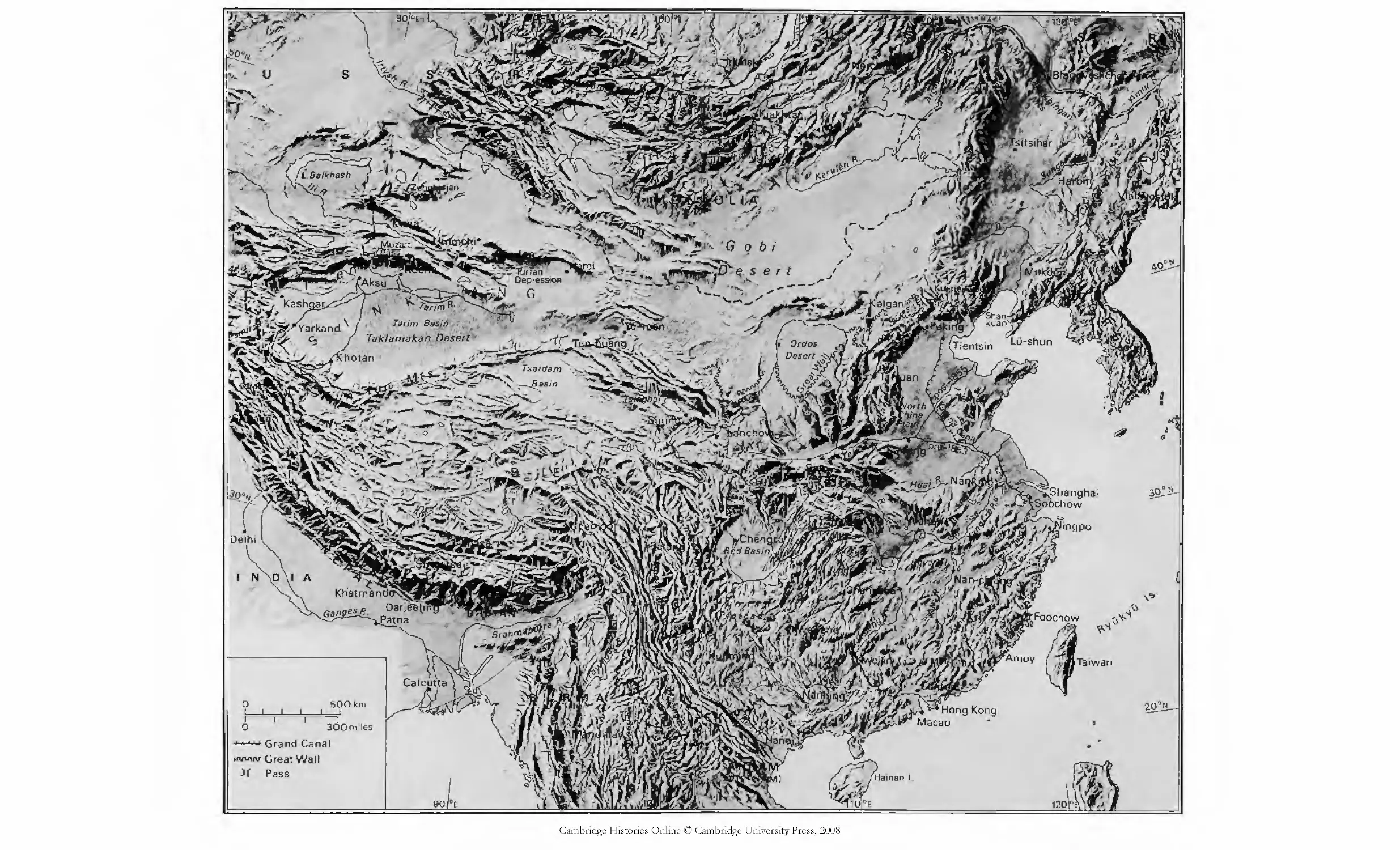
1 Republican China - physical features xii
2 Provinces of China under the Republic 30
3 Major crop areas 65
4 Railways as of 1949 92
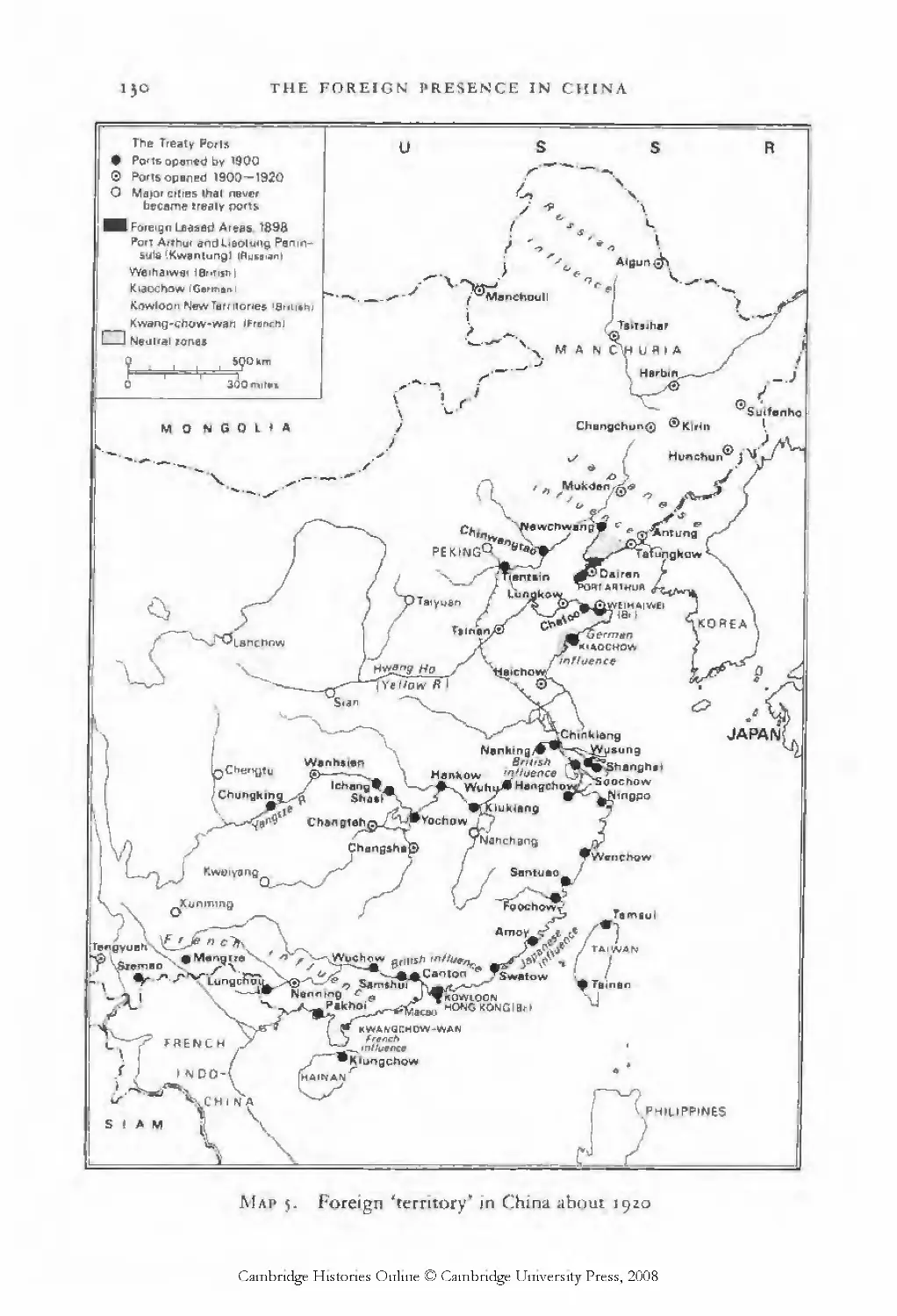
5 Foreign ‘territory’ in China about 1920 130
6 Treaty ports - Shanghai ca. 1915 134
7 Treaty ports - Tientsin ca. 1915 138
8 Wuhan cities ca. 1915 140
9 Distribution of warlord cliques in 1920 298
10 Distribution of warlord cliques in 1922 299
11 Distribution of warlord cliques in 1924 300
12 Distribution of warlord cliques in 1926 301
13 Kwangtung and Kwangsi in the early 1920s 5 54
14 The Northern Expedition 1926-28 580
15 Hunan and Kiangsi during the Northern Expedition 582
16 Hupei 584
17 The Lower Yangtze region 615
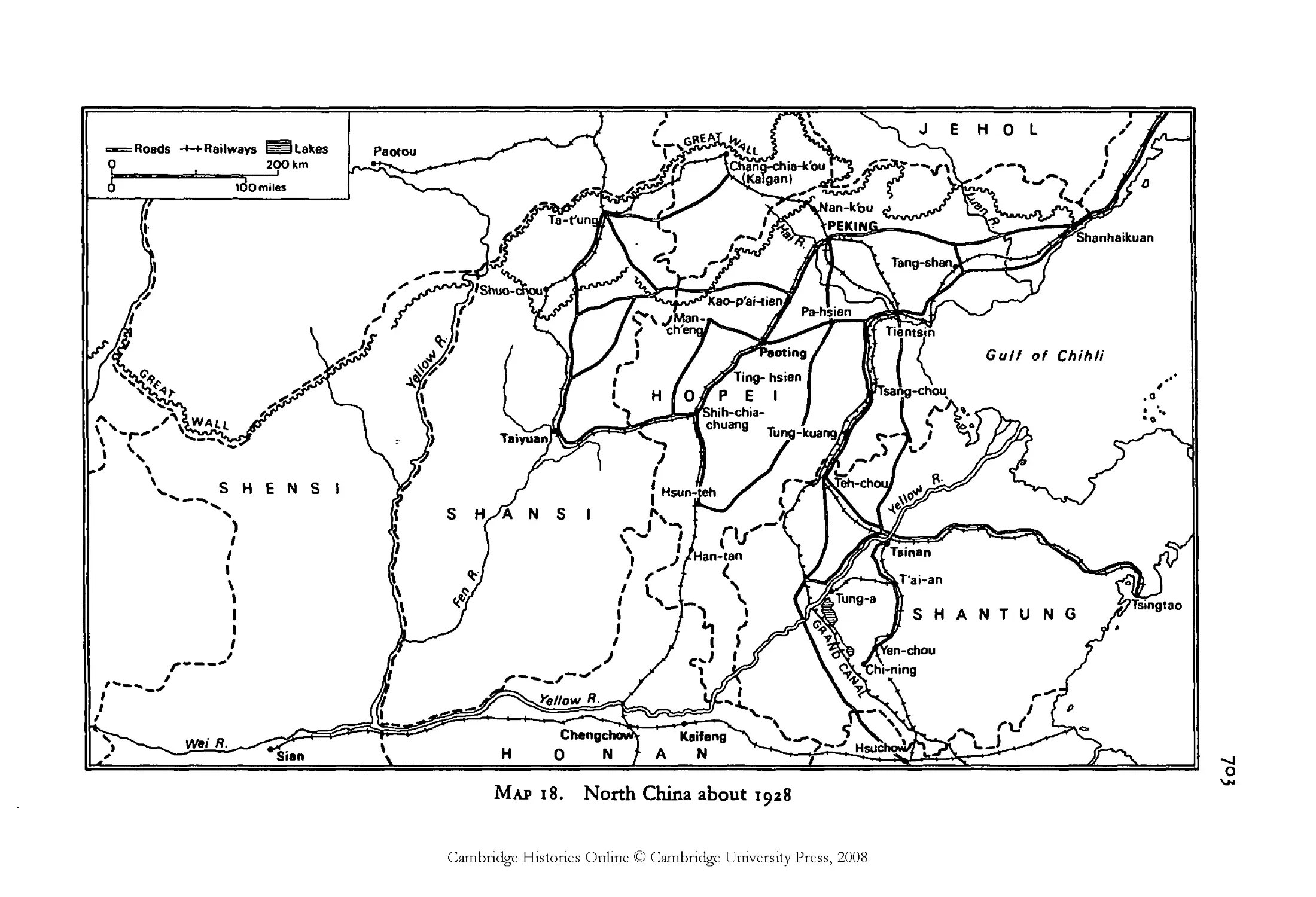
18 North China about 1928 703
xi
Cambridge Histories Online © Cambridge University Press, 2008
Cambridge Histories Online © Cambridge University Press, 2008
,-Tsitsihar
I Balkhash
-j^QnjB^uSga/r ;
. w
^ rarim Г;
Tarim Basin .
Taklamakan Desert
Yarkand
Orders
Desert *■,
.Tientsin
hotan
Tsai dam
—^fiasin
'"■^Shanghai
'Soochow
mgpo
\fcheng
fed BasirA
Kh'at ma
Gan9SZ* Darjft(ifl
^ ' ~~iPatna
Foochow
Brahes
Taiwan
Macao
Hainan I
500 km
I i 1
300mi!es
3rand Canal
3reat Wall
Pass
Cambridge Histories Online © Cambridge University Press, 2008
TABLES
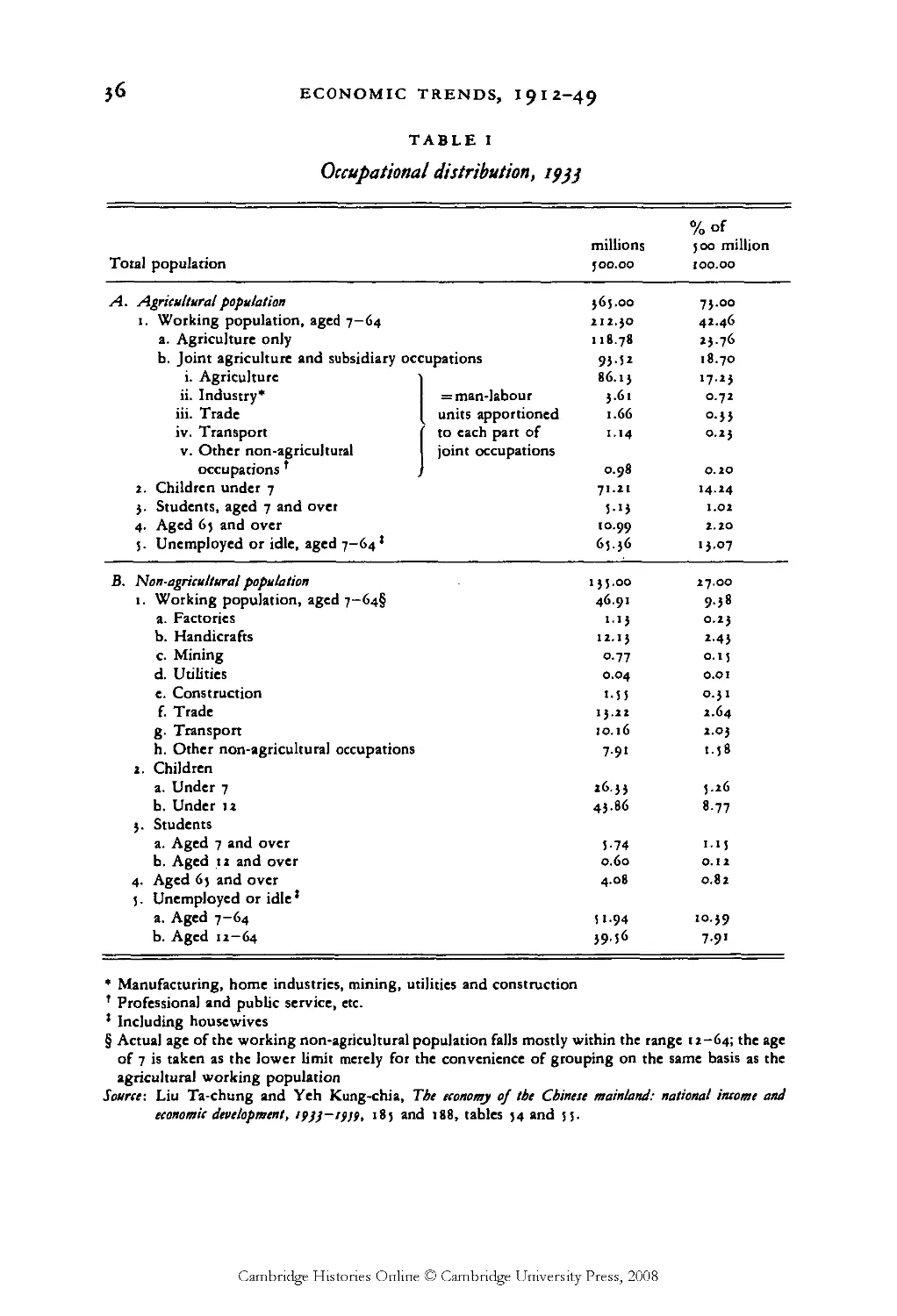
1 Occupational distribution, 1933 36
2 Domestic product, 1933 37
3 Gross domestic product, 1914-18, 1933, 1952 39
4 Output and employment in modern industry, 1933 44
3 Relative quantities of output of selected industrial products, electric
power, and coal in Kuomintang-controlled areas, 1933, 1938-46 46
6 Index of industrial production of Mainland China, 1912-49 50
7 Handicraft production as percentage of gross value-added in 14 pro¬
duct groups, 1933 52
8 Sources of cotton cloth supply, 1875-1931 54
9 Output and number of workers in Chinese- and foreign-owned
factories, 1933 58
10 Percentage of total output by Chinese and foreign firms in selected
industries 60
11 Output of the several sectors of agriculture, 1933 64
12 Gross value of farm output, 1914-57 64
13 Physical output of plant products, 1914-57 66
14 Index numbers of agricultural prices, terms of trade, land values,
farm wages, land tax, 1913-37 68
15 Distribution of rural land ownership, 1934-35 78
16 Tenancy, rented land, farm size, rent systems, and rental rates in the
1930s 81
17 Percentage of farm families in various ownership categories 84
18 Sources of farm credit, 1934 88
19 Index numbers of passenger miles and freight ton miles carried on
the Chinese government railways, 1912-47 97
20 Reported receipts and expenditures of the Nanking government,
1928—37 106
xiv
Cambridge Histories Online © Cambridge University Press, 2008
LIST OF TABLES XV
21 Note issue and price index, 1937-48 114
22 Foreign investments in China, 1902-36 117
23 Foreign investment in China, 1902-36, by creditor country 118
24 Foreign direct investments in China by industry 119
25 Geographical distribution of foreign investments in China, 1902,
1914, 1931 120
26 Values and index numbers of foreign trade, 1912-36 122
27 Balance of international payments, 1903, 1930, 1935 123
28 Composition of foreign trade 124
29 Distribution of foreign trade among trading partners 126
30 Estimated number of foreign ‘firms’ and residents in China 148
31 Growth of the Protestant church in China 168
32 Relative strengths of Protestant denominations, 1919 169
33 The largest Protestant missionary societies, 1919 171
34 Protestant missionary schools and enrolments, 1919 174
35 Indoor Staff of the Customs Revenue Department, 1915 184
36 Foreign shares in coal mining and cotton textile industries 200
37 National-level legislative organs of the early Republic 265
38 Increase in population of some Chinese cities over the war years 751
39 Principal secular foreign periodicals in China 834
Cambridge Histories Online © Cambridge University Press, 2008
Cambridge Histories Online © Cambridge University Press, 2008
PREFACE TO VOLUME 12
On romanization
One achievement of the revolution has been to set up an official system for
transcription of Chinese sounds into alphabetic writing. This system,
known as pinyin, one hopes may bring uniformity into a formerly chaotic
situation, in which the sinologists of each foreign power had devised
their own national systems of romanization - English, French, German,
Russian, etc.
In the English-reading world the Wade-Giles romanization after the
turn of the century gradually became accepted for scholarly work, despite
its idiosyncrasies - for instance, its use of an apostrophe as an aspiration
mark to distinguish, for example, T (written in Wade-Giles T’) from D
(Wade-Giles T), P (P’) from В (P), К from G, etc. Despite this clumsy
feature, Wade-Giles became by 1949 the most widely used system,
enshrined in countless reference works, official documents, and the general
literature of the field. For example, the four major biographical diction¬
aries in English of Chinese personages from 1368 to 1965 (totalling eleven
volumes) all use Wade-Giles. Moreover, because of the foreign presence
in China, the historical record is partly non-Chinese. It is for this reason -
that Wade-Giles is still the dominant system in some of the sources and in
the research tools of the period covered in this volume - that we continue
to use it here. The use of the new pinyin system in this volume would
greatly complicate the work of researchers.
Acknowledgements
The editor is most indebted to the authors for their unremitting patience
and cooperation, so necessary for this sort of enterprise; to Katherine
Frost Bruner for indexing and to Joan Hill for administrative and edi¬
torial assistance; to Chiang Yung-chen of the Harvard Graduate School
for essential bibliographical assistance and to Winston Hsieh, the Univer¬
sity of Missouri, and Guy Alitto, the University of Chicago, for biblio¬
graphic consultation. We are indebted for support of editorial costs to the
Ford Foundation and to the National Endowment for the Humanities
xvii
Cambridge Histories Online © Cambridge University Press, 2008
xviii
through the American Council of Learned Societies. A working con¬
ference of contributors was held in Cambridge, Mass, in August 1976 with
the assistance of the Social Science Research Council. During the gesta¬
tion period earlier versions of chapters z, 3 and iz were published as
separate booklets. Now they are born again.
JKF
Cambridge Histories Online © Cambridge University Press, 2008
CHAPTER 1
MARITIME AND CONTINENTAL IN
CHINA’S HISTORY
The 37 years from 1912 to 1949 are known as the period of the Chinese
Republic in order to distinguish them from the periods of more stable
central government which came before and after. These years were
marked by civil war, revolution and invasion at the military-political
level, and by change and growth in the economic, social, intellectual and
cultural spheres. If we could neatly set forth in this first chapter the
major historical issues, events and Chinese achievements in these various
realms, the following chapters might be almost unnecessary. In that
case, however, the cart would be in front of the horses.
Our new view of the republic must come from several angles of ap¬
proach. Only one is pursued in this introductory chapter, yet it appears
to serve as a central and necessary starting point.
THE PROBLEM OF FOREIGN INFLUENCE
China’s modern problem of adjustment has been that of a dominant,
majority civilization that rather suddenly found itself in a minority
position in the world. Acceptance of outside ‘modern’ ways was made
difficult by the massive persistence of deeply-rooted Chinese ways. The
issue of outer versus inner absorbed major attention at the time and still
confronts historians as a thorny problem of definition and analysis.
Anyone comparing the Chinese Republic of 1912-49 with the late
Ch’ing period that preceded it or with the People’s Republic that followed
will be struck by the degree of foreign influence upon and even participa¬
tion in Chinese life during these years. The Boxer peace settlement of 1901
had marked the end of blind resistance to foreign privilege under the
unequal treaties; students flocked to Tokyo, Peking proclaimed foreign-
style reforms, and both weakened the old order. After the Revolution of
1911 the outside world’s influence on the early republic is almost too
obvious to catalogue: the revolutionaries avoided prolonged civil war
lest it invite foreign intervention; they tried in 1912 to inaugurate a
constitutional, parliamentary republic based on foreign models; President
1
Cambridge Histories Online © Cambridge University Press, 2008
2
introduction: maritime and continental
Yuan Shih-k’ai’s foreign loans raised controversy; the New Culture move¬
ment after 1917 was led by scholars returned from abroad; the May
Fourth movement of 1919 was triggered by power politics at Versailles;
the Chinese Communist Party (CCP) was founded in 1921 under Comin¬
tern prompting; Sun Yat-sen reorganized the Kuomintang (KMT) after
1923 with Soviet help; the Nationalist Revolution 1925-27 was inspired
by patriotic anti-imperialism. Truly, the early republic was moved by
foreign influences that were almost as pervasive as the Japanese invasion
was to become after 1931.
Yet the term ‘foreign’ is highly ambiguous and may trap us in needless
argument. It requires careful definition. For example, among the ‘foreign
influences’ just listed, some were events abroad, some were models seen
abroad and imitated in China, some were ideas of foreign origin which
animated Chinese returned from overseas, some were events in China in
which foreign people or ideas played a part. The situation was not simple.
Since the ‘foreign’ elements in Chinese life during this period were so
widespread, clarity demands that we make a series of distinctions or
propositions. First of all, most readers of these pages probably still
perceive China as a distinct culture, persistent in its own ways, different
from ‘the West’. This assumption, reinforced by common observation,
stems from the holistic image of‘China’ conveyed by Jesuit writers during
the Enlightenment and further developed by European Sinology. It
represents an acceptance in the West of an image of China as an integrated
society and culture, an image that formed the central myth of the state
and was sedulously propagated by its learned ruling class.' Still dominant
in Chinese thinking at the turn of the century, this idea of ‘China’ as a
distinct cultural entity made ‘foreign’ into something more than the mere
political distinction that it sometimes was among Western nations.
Second, we must distinguish the actual foreign presence. There were
many foreigners within the country - scores of thousands residing in the
major cities, most of which were treaty ports partially foreign-run;
hundreds were employed by successive Chinese governments; and several
thousand missionaries were at stations in the interior. Add to these the
garrisons of foreign troops and foreign naval vessels on China’s inland
waterways, and we can better imagine the ‘semi-colonial’ aspect of China
under the unequal treaties that continued to give the foreigners their
i On Sinology and the ‘self-image of Chinese civilization’, see Arthur F. Wright, ‘The study
of Chinese civilization’, Journal of the History of Ideas, 21.2 (April-June i960) 233-55. In
developing this essay I have greatly benefited from comments of Marie Claire Bergere,
Mark Elvin, Albert Feuerwerker, Kwang-Ching Liu, Philip A. Kuhn, Denis Twitchett and
Wang Gungwu.
Cambridge Histories Online © Cambridge University Press, 2008
THE PROBLEM OF FOREIGN INFLUENCE
3
special status and privileges. This volume devotes a chapter simply to
describing ‘the foreign presence’. By any definition it had many of the
features of a self-contained sub-culture transplanted and flourishing
symbiotically in Chinese surroundings.
From this picture of the foreign establishment with its own way of
life we can understand why the Nationalist Revolution of the 1920s
erupted in anti-imperialism. The imperialist presence served as a target
for a more unified revolutionary effort.
Yet this revolutionary effort itself represented other foreign influences.
The revolution had always had foreign helpers. The Revolutionary
Alliance led by Sun Yat-sen was organized among Chinese youths in
Tokyo in 1905 under Japanese prompting. It was financed by Chinese
merchant communities overseas and used the protection of the foreign
administrations in Hong Kong and Shanghai. Later the emissaries of the
Soviet revolution inspired both the founding of the CCP and the reor¬
ganization of the KMT. Thus, the revolution used foreigners, their aid,
ideas and methods to attack the foreign establishment as its target within
the country.
A third distinction or proposition, however, is that China’s history
had to be made by Chinese themselves, not by foreigners. Indeed, when
the history of this period was recorded in Chinese, a funny thing hap¬
pened - the foreigners were almost lost to sight. The inspector-general
of customs, Sir Francis Aglen, might collect and even impound the Mari¬
time Customs revenue. Sun’s adviser, Michael Borodin, might draft the
KMT constitution. The Soviet General Blyukher (‘Galen’) might work
out Chiang Kai-shek’s battle plans. But none of them, though in positions
of considerable authority, was Chinese. All were played down if not
pretty generally left out of the Chinese record. This historical facelessness
of the foreigners in China not only reflected modern patriotic pride,
denying outsiders a basic role in Chinese life. It also conformed with a
long tradition that the Marco Polos and Ibn Batutas who turned up from
Western Eurasia had no place in the Chinese record because they were
outside the culture. China’s society retained its integrity. It was bounded
by the Chinese language and writing system. Foreign individuals figured
in its history only when, like Matteo Ricci or Robert Hart, they spoke
and wrote Chinese sufficiently well to be documented.
There was a colourful history of the foreigners-in-China, but it was
their history, not China’s. When the Anglo-American ADC (Amateur
Dramatic Club) in the International Settlement governed by the Shanghai
Municipal Council put on the Pirates of Penzance with stentorian eclat,
it was an event in China, but not in Chinese history. The foreigners’
Cambridge Histories Online © Cambridge University Press, 2008
4
introduction: maritime and continental
experience was separate from the Chinese experience. Ibsen’s Л doll's
house had influence because Hu Shih brought it within the cultural gates.
This amounts to saying that Chinese history is not one’s idea of what
happened in China but, rather, one’s idea of what happened to the Chinese
people. According to this view, the vital entities of modern times are the
peoples with their national states and cultures. It is natural for most
national chroniclers of events to follow the thread of their own ethnic-
cultural development. Foreigners are extraneous and temporary. Witness
the fact that the missionaries, the foreign employees, and the treaty-port
residents all subsequently disappeared from the Chinese scene just as
thoroughly as the European colonial administrations of the late nineteenth
century disappeared from their colonies in the mid twentieth century.
A fourth proposition is thus in order: that foreign influences if they
were to affect the Chinese people must be conveyed in the Chinese lan¬
guage and writing system. Here China’s long experience of ‘barbarian’
contact had developed time-tested ways of thought and response. For ex¬
ample, пег (inside) and wai (outside) were very ancient Chinese categories,
widely applied both geographically and figuratively. Thus wai-kuo (foreign
states) lay outside China (Chung-kuo, the central state), but foreign rulers
who kotowed could become wai-fan (outer feudatories).' In his person
the Son of Heaven must be a sage within (in character) and a hero without
(in acuon), just as the superior man must first study to cultivate himself
(hsiu-shen) in the inner realm and then strive by his example to bring peace
to the world (p'ing t'ien-hsia) in the outer realm. The cognate categories
of net and tvai allowed Chinese thinking to respond to domestic or to
foreign sumuli, all the while remaining purely Chinese.* A similar pair
of terms proved useful in handling Westernization in the formula popular¬
ized by Chang Chih-tung; ‘Chinese learning for the fundamentals {ft),
Western learning for practical use (yung).’ Since t'i andyung, substance and
function, were really meant to be aspects of a single entity, Chang misap¬
plied these terms. Never mind, it helped Westernize China.
Foreign influences invading China thus had to pass through the eye of
the linguistic needle. Translation of a foreign idea often verged upon
its Sinification. Just as the Indo-European languages modernized to meet
modern needs, so Chinese created new terms, many incorporated from 2 32 Lien-sheng Yang, ‘Historical notes on the Chinese world order’, in John King Fairbank,
ed. The Chinese world order: traditional China’s foreign relations, г i.
3 On ‘the inner and outer realms’ in philosophy see Benjamin Schwartz, ‘Some polarities in
Confucian thought’, in David S. Nivison and Arthur F. Wright, eds. Confucianism in action,
;4~8. On nei and wai separating traditional and foreign-induced matters of government, see
for example Chang Shou-yung et al. comps. Huang-ch'ao chang-ku hui-pien (Collected historical
records of the imperial dynasty), 3 vols.
Cambridge Histories Online © Cambridge University Press, 2008
THE PROBLEM OF FOREIGN INFLUENCE
5
Japanese, to carry new meanings. Yet the ancient characters, when used
for a new phrase, could not shed all of their accumulated connotations.
For example, foreign faiths entering China have had remarkable diffi¬
culties over their key terms. Christian missionaries struggled long and
hard to find the best term for God, who was certainly central to their
enterprise. Catholics used ‘Lord of Heaven’ (T’ien-chu), Protestants
split between ‘Lord on High’ (Shang-ti) and ‘Deity’ (Shen). Again, the
sacred terms of Western liberalism, ‘freedom’ (tzu-yu) and ‘individualism’
{ko-jen chu-i), when translated, as in Japan, retained a connotation of
wilful irresponsibility in the sendee of a doctrine of everyone for himself.
Proper Confucians were appalled. The Western virtue of individualism
came through as selfish licence without a sense of duty.
The idea of rights was newly developed even in the modern West, but
in China it had so little background that a new term had to be invented for
it. The American missionary W. A. P. Martin in translating Wheaton’s
Elements of International Law in 1864 used ch’iian-li and soon after it was
used in Japan (Jkenri). But of course these characters already had established
meanings and their combination seemed to say ‘power-profit’ or at least
‘privilege-benefit’. This made the assertion of one’s rights (ch'iian-li)
seem like a selfish power play.4
Witness finally the central Marxist term ‘proletariat’, which originally
meant the poor of ancient Rome and retains in English an urban con¬
notation. Translated into Chinese as ‘propertyless class’ (wu-ch'an chieh-
cht), the proletariat in Mao’s China properly embraced the poor peasantry,
no doubt a useful adaptation. We have hardly begun to study the Sin¬
icizing role of translation as a filter of foreign influences on China.
A fifth proposition is that foreign influences operated in China primarily
by affecting the conduct of Chinese individuals. Groups of persons play¬
ing new social roles were the harbingers of change, but they emerged only
gradually in the late Ch’ing. To the classic quadrumvirate of scholar,
farmer, artisan and merchant were now added all manner of hybrid roles.
A trained officer-corps produced scholar-soldiers. Foreign universities
sent back a scholar-intelligentsia, many of whom were alienated from the
official establishment. Scientific training produced technicians who were
scholar-artisans. Meanwhile merchants not only continued to buy official
status, some officials became merchant-entrepreneurs. Revolutionists
also arose as a distinct professional group, as well as journalists and
modern-style politicians.5
4 Wang Gungwu, Power, rights and duties in Chinese history, the 40th George Ernest Morrison
Lecture in Ethnology 1979 (Canberra: Australian National University, 1979), 3-4.
j Cp. M. Bastid, CHOC, vol. ii, ch. 10.
Cambridge Histories Online © Cambridge University Press, 2008
6
introduction: maritime and continental
In short, the specialization of modern life broke up the old social
structure. Specialization discredited the Confucian ideal of an elite united
by classical learning just as roughly as in the United States it had denied
the Jacksonian ideal of an egalitarian education for all.6
All the new roles involved dealing with foreign matters or learning
from abroad. Compradors and Chinese Christians (sometimes identical)
emerged in the treaty ports, followed by journalists and returned students
who had been abroad, all of them under foreign influence. Technology
became the key to new developments whether military, industrial, ad¬
ministrative or educational, and nearly all of it came from the West, even
when mediated through Japan. By the twentieth century, leaders of Young
China like T’ang Shao-i and Wu T’ing-fang, who negotiated the revolu¬
tionary settlement in 1912, were speaking English, which they had prac¬
tised respectively at Hartford, Connecticut and the Inns of Court,
London.7
To the modern fragmentation of specialized social roles was added
the diversity of foreign models and stimuli now made available by the
expansion of international contact. Modernity, so various in itself, now
came at China in widely different national forms. Nineteenth-century
China had been subjected to the Anglo-American-French-Russian ex¬
amples of patriotic naval and diplomatic officers, aggressively self-right¬
eous missionaries, and merchants piously devoted to, material profit,
but all had been within the confines of one civilization from the West.
Now the scene was immensely broadened: ex-samurai ideals of bushido
were picked up by young patriots like Chiang Kai-shek at the Japanese
officers’ training academy. Populist concerns of Russian narodniki animated
early Marxists like Li Ta-chao. Rabindranath Tagore brought his Hindu
message of mystic unity, though with few takers. A Buddhist revival was
promoted under the monk T’ai Hsu. A women’s higher education move¬
ment fostered contact with Smith College and others of the Seven Sisters.
Echoes of the New Poetry movement in the United States, the European
vogue of Esperanto as a vehicle for global communication, all sorts of
fashions and groundswells from abroad rippled among China’s new
urban intellectuals and men of affairs. The resulting flux of values and
6 John Higham, ‘The matrix of specialization’, in Alexandra Oleson and John Voss, eds.
The organization of knowledge in modem America, 1860-1920.
7 Paul A. Cohen analyses the careers of early reformers of the ‘littoral’ and ‘hinterland’ in
ch. 9 of his Between tradition and modernity: Wang T’ao and reform in late Ch’ing China. See also
Louis T. Sigel, ‘T’ang Shao-yi (1860-1938): the diplomacy of Chinese nationalism’ (Harvard
University, Ph.D. dissertation, 1972), 92 et seq.; Linda Shin, ‘China in transition: the role
of Wu T’ing-fang (1842-1922)’ (University of California Los Angeles, Ph.D. dissertation,
1970).
Cambridge Histories Online © Cambridge University Press, 2008
THE PROBLEM OF FOREIGN INFLUENCE
7
morals, the blurring of self-images, made Chinese actors often ambivalent,
facing two ways, and confused foreign observers accordingly.
In the midst of all of this confusion, however, we may discern a sixth
proposition, that the Chinese when responding to foreign stimuli, whether
in the Chinese language or by their conduct, had to fashion their modern
ways out of Chinese elements, old or new, available within themselves
if not actually in the local scene.
To begin with, not even the most foreignized Chinese could lose his
sense of Chinese identity. Living abroad only increased it. Cultural
friction generated patriotic fire. The most sincere patriot was Sun Yat-
sen, who had had the least experience of Chinese tradition and the most of
modern nationalism abroad.
Something more is involved here than patriotic motives, however.
The mystery of human thought in general seems to be performed with a
generous use of analogy, as when location in time is expressed in the
terms of before and after (behind) originally used to denote location in
space. On time’s ladder we ‘see’ historical events ‘preceding’ and ‘follow¬
ing’ one another. Analogical and metaphorical thinking leads us to
imagine the lesser known in terms of the better known - in short, to
cross the cultural gap between native and foreign, we have to think
mainly with whatever is already in our heads.8 Thus, we find one Chinese
patriot after another not only motivated by cultural pride but also required
by his own thought processes to find in China the analogues, equivalents
or Chinese counterpart of things perceived abroad.9
Mid-nineteenth century xenophobes took refuge in the old rationale
that essentials of Western science must have been derived from ancient
China. In arguing for Western scientific training some accordingly de¬
clared that Western sciences had borrowed their roots from ancient
Chinese mathematics. To outflank the xenophobes, the modernizer’s
trick was to smuggle things Western into China as having been originally
Chinese. K’ang Yu-wei perfected it when he found the modern Western
ideal of Progress in the ancient Chinese theory of the three ages (see
volume ii, page 288). Thus in their own minds Chinese modernizers
had to confront the foreign culture with whatever equivalents they could
muster from China. John Dewey’s student Hu Shih, the most fearless
8 The psychology and thought processes of cultural contact seem extraordinarily under¬
studied in the case of China. For a popular discussion of metaphoric thinking, see Julian
Jaynes, The origin of consciousness in the breakdown of the bicameral mind. Cp. p. jo: ‘The concepts
of science are all. . .abstract concepts generated by concrete metaphors’; p. 53: ‘under¬
standing a thing is arriving at a familiarizing metaphor for it’.
9 The Chinese search for equivalence with the West especially interested the late Joseph R.
Levenson, Confusion China and its modern fate.
Cambridge Histories Online © Cambridge University Press, 2008
8
introduction: maritime and continental
iconoclast and winnower of China’s heritage, wrote his Columbia Ph.D.
thesis on ‘The Development of the Logical Method in Ancient China’.
Of course the early Westernizadon and later modernization move¬
ments soon learned to be discriminating. At first Europe and America
had converged upon China as an alien society which (despite its extensive
internal variety) had developed a commercial-industrial-military dy¬
namism that seemed to be a product of its whole alien culture. The steam
engine, representative government and Christianity at first glance seemed
tied together, and ‘Western’ culture came onto the Chinese horizon look¬
ing more unified and therefore more menacing than it later turned out
to be. Its menace seemed to require that China become commercial-
industrial-military in self-defence.
But the very diversity of ‘the West’ made it clear that Westernization
had to be selective; and the criterion of selection proved generally to be
the compatability of Western ways with Chinese needs, so that imported
things could take root and become Chinese. Foreign borrowings (wai)
had to fit into the domestic scene {net).
Indeed, one is tempted to assert that even in modern China innovation
inspired from abroad still had to come as ‘change within tradition’.10
For even the most startling break with tradition still occurred within the
day-to-day continuum of inherited Chinese ways and circumstances. The
end of footbinding and the emancipation of women, the writing of the
vernacular pai-hua, loyalty to nation instead of to monarch, renunciation
of filial piety, all found support from within the Chinese cultural realm.
The pace of change might produce vertigo, alarm and iconoclasm but it
was still change in China by Chinese people immersed in Chinese speech
and writing.
This suggests a final proposition, that the most natural way to meet
the West on equal terms was to follow a Chinese minority tradition which
had more in common with Western ways of commerce and violent com¬
petition than with Chinese ideals of bureaucracy and harmonious compro¬
mise. For example, one peculiarly menacing aspect of the ‘Western Ocean’
(Hsi-yang) people in the early contact at Canton was that their uncouth
and greedy ways appealed to tendencies deeply latent among the Can¬
tonese populace. The outright commercialism of the Western ‘barbarians’
met a quick response among the shopkeepers in Hog Lane behind the
opulent ghetto of the Thirteen Factories. Once Indian opium was brought
by the private merchants in the Country (local) trade from India, com¬
io E. A. Kracke, Jr. used this phrase (as distinct from modern Westernization) to characterize
Sung urbanization and attendant changes in 'Sung society: change within tradition’, FEQ,
14.4 (Aug. 1955) 479-88.
Cambridge Histories Online © Cambridge University Press, 2008
MARITIME CHINA AS A MINOR TRADITION
9
mercial greed fostered the growth of the opium trade on both sides. It
became the great bilateral Sino-foreign joint enterprise of the nineteenth
century, and it succeeded far beyond anyone’s fears or foresight.
It requires only a modicum of imagination to see the Cantonese opium
entrepreneur, who did his bit to usher China into modern international
commerce, as the inheritor of a Chinese tradition that had much in com¬
mon with the Western trading world. Some of the seemingly ‘foreign
influences’ on the Republican Revolution may turn out at second glance
to have coincided with or grown from older Chinese trends that shared
certain traits with the foreigners. In what follows we can only indicate
the dimensions of this historical problem.
MARITIME CHINA AS A MINOR TRADITION
Under piecemeal fragmentation by the social sciences and humanities,
‘China’ as a cultural entity has been dissolving into a sub-universe of
great diversity. The holistic image is being supplanted by a great variety
of discoveries; and research now deals with localities, cities, provinces,
regions or macro-regions as useful areas for analysis." Similarly the
dominant agrarian-bureaucratic order of the Chinese heartland is being
contrasted with peripheral and minority traditions in areas on China’s
frontiers.
The north-west Great Wall border zone was a peripheral area where
intensive dry farming gave way to pastoralism. South-West China had
been a peripheral area where irrigated rice culture gave way to the sub¬
tropical slash-and-burn agriculture of the hill tribes. Other such areas
could be defined, for example, on the boundary of the semi-nomadic
mixed economy of hunting, fishing and agriculture among the Tungusic
tribes in the north-east. Of all these areas, however, the north-western
steppe frontier had been the most important in history because pastoralism
had produced the cavalry that could invade and rule North China. In
contrast, the south-east coast had seen Chinese moving out overseas but
no foreign invasions before the 1830s.
Maritime China was a peripheral region along the south-east coast.
The swampy estuaries of the Yellow River north of Shantung and of the
Yellow or Huai Rivers to the south inhibit coastal settlement and seafar¬
ing. North China generally lacks coastal mountains and rivers of the 1111 In G. William Skinner’s ‘Regional urbanization in nineteenth-century China’, nine macro¬
regions were devoted to ‘sedentary agriculture’ (p. 212), ‘in essentially agrarian regional
systems’ (p. 253). Overseas trade is, thus far, peripheral to his study of urbanization. See
G. William Skinner, ed. The City in hate Imperial China.
Cambridge Histories Online © Cambridge University Press, 2008
io introduction: maritime and continental
sort that make harbours on the Chekiang-Fukien coast. It also lacks
export products such as tea, silk and ceramic ware. By the nineteenth
century there was an extensive coastal trade between the Shanghai-Ningpo
area and southern Manchuria. But Shantung and Liaotung did not bulk
large in international trade. By this criterion the main region of our con¬
cern here stretched from the Yangtze delta to Hainan Island. It included,
however, the offshore islands of the Pescadores and Taiwan, with Kyushu,
the Liu-ch’iu (Ryukyu) islands, and Luzon as an outer fringe.”
In certain matters of style and tradition these peripheral or frontier
regions contrasted with the dominant agrarian-bureaucratic heartland.
Its distinctive and durable quality of collective cohesion needs to be
recognized before we proceed with a lesser tradition. This majority order
was the great achievement of early Chinese genius, more finely wrought
than any other way of life in East Asia. It featured the imperial monarchy
as its ‘order-shaping moral centre’,1’ and the Confucian three bonds (loy¬
alty to the monarch, filial piety, wifely devotion to husbands) as its teach¬
ing of social order. The bedrock of this society was its extended family
system. The oligarchic power of great clans was supplanted only in late
T’ang and early Sung by the power of government to select the ruling
class through the examination system.4 Thereafter the classically-indoc¬
trinated officials were the emperor’s local agents while landowning and
degree-holding gentry families were the backbone of the local elite.
Modern studies have of course broken through the Confucian crust
of rule-by-virtue and normative harmony. They reveal an Old Order in
which the mass of the common people were often wracked by natural
calamity and local disorder - periodic starvation, banditry, inter-village
feuds, chronic misery in the village, tyranny within the family, rapacious
exploitation by landlords, corruption in officialdom.” However, this
sordid picture of reality only highlights the persistence, if not success,
of the classical propaganda as to how things ought to be.
Since the old China’s normative ideals have contributed so heavily
to the available Chinese and foreign writings on China (see, for example,
volume io, chapter i), let us note here only their comparative efficacy
in sustaining the dominant agrarian-bureaucratic tradition and its ruling
class.
12 As defined by John E. Wills, Jr. in ‘Maritime China from Wang Chih to Shih Lang: themes
in peripheral history’, 203-38 in Jonathan D. Spence and John E. Wills, Jr. eds. From Ming
io Ch'ing: conquest, region and continuity in seventeenth-century China. See p. 206.
13 The phrase is from Hao Chang in JAS, 39.2 (Feb. 1980) 260.
14 David G. Johnson, The medieval Chinese oligarchy, 149-32. E. A. Kracke, Jr. estimated the
civil service at 12,700 men in 1046. Civil service in early Sung China 960-1067, 55.
15 See for example the grim details in Jonathan D. Spence, The death of woman Wang, 39-48
et passim.
Cambridge Histories Online © Cambridge University Press, 2008
MARITIME CHINA AS A MINOR TRADITION II
China’s ruling-class supremacy had come down from the most ancient
times. The roles of warrior-rulers and of recording scribes (literati) who
assisted them in government appeared clearly at the dawn of Chinese
society in the Shang.'6 The superior men of the upper class and the
ordinary men of the common people figured in the classics of the Chou
period. The universal kingship of the Son of Heaven and administration
by his bureaucracy become well-established under the Han.'7 Step by
step the ruling-class edifice was constructed, based on the philosophical
premises of the Confucian canon, buttressed by the many practices sub¬
sumed under the examination system. The final emergence under the Ming
and Ch’ing of a degree-holding gentry class, indoctrinated in loyalty to
the throne and trained to sustain the socio-political order, is the best-
known aspect of Chinese social history.'8 Much of the record (nearly all
of which was produced from the ruling-class point of view) illustrates
how comprehensively the scholar-official stratum, hardly 5 per cent of
the population, dominated the military, the commercial and all the other
groups in Chinese society.
This social order which every right-thinking Chinese strove to uphold
included the subordination of women by men, of youth by age, of the
individual by the family, of the peasant and the soldier by the scholarly
degree-holder, and of the whole society by the imperial bureaucracy. This
domination was all the more permanent because of its great flexibility,
which allowed peasants to buy land, let almost every man compete to
enter the examinations, acknowledged the indispensability of mothers and
mothers-in-law, and permitted merchants to buy their way into the
degree-holding class. The ruling class, in short, had learned how to per¬
petuate itself by absorbing the talent of Chinese society. Landlords,
merchants, craftsmen and priests had little power independent of the
official class, partly, of course, because landlord, merchant and official
roles were normally represented among the sons of leading lineages.
Familism in fact cemented the society together both at the village level
and among the ruling class, and at the same time it provided channels of 16 17 1816 By 2000 вс cities had grown up in several regions of China, especially Honan, Shantung,
Kiangsu and Hupei, with ‘city life, metallurgy, writing, and great art style made possible by
a highly stratified society’. Kwang-chih Chang, The archaeology of ancient China, 217.
17 ‘Mental labor became the symbol of superior status. . . . Mencius characterized those who
performed mental labor as “great men” or chun-tzu in contrast to the “small men” or hsiao-
jen. This notion . . . had been widely accepted in Chinese society for centuries’. T’ung-tsu
Ch’ii, Han social structure, 64.
18 For a graphic account of examinations under the Ch’ing, see Ichisada Miyazaki, trans. by
Conrad Schirokauer, China’s examination hell: the civil service examinations of imperial China;
also Ping-ti Ho, The ladder of success in imperial China: aspects of social mobility ijiS-ifi/.
Cambridge Histories Online © Cambridge University Press, 2008
12
introduction: maritime and continental
mobility between the two.1» The old China was not only agrarian-bureau¬
cratic but also familistic and rooted in the land. It contrasted with the
sparseness of population and greater physical mobility of both the Inner
Asian and the seafaring frontier zones.
Stereotypes like these reflect the long practice of imperial Confucianism
in laying down normative principles of social order to socialize and
indoctrinate the people. The diversity of Chinese life now appears to
have been far greater than the chroniclers indicated. The great variety
of geographic environments, local customs, architectural styles, spoken
dialects, currency systems, crops, crafts, transportation and technology
is only beginning to be explored. Nevertheless, China’s long unity as a
state derived from the ubiquitous acceptance of the agricultural peasant
village, the lineage structure, the thin ruling stratum, the classical litera¬
ture, the official speech (knan-hua), and the Confucian hierarchy of social
statuses including the imperial supremacy. Clearly we confront here a
triumph of teaching and administration over local particularism, or per¬
haps we should call it a symbiosis of universal and local, of high culture
and popular cultures. In short, the great central tradition enshrined in
orthodox writings and imperial utterances had learned how to live with
and stay on top of minor traditions decentralized both among the villages
and on the frontiers.
Let us now try to establish the identity and trace the growth of Mari¬
time China. It was distinguished first of all by features peculiar to the sea.
Thus fish crops under the sea’s surface and the highways over it were
less restrictively located, less controllable in ancient times than crops and
highways on the land. Meanwhile the energy cost in overcoming friction
and moving vehicles was far less on water using the wind than it was on
land using the footsteps of man or beast. Consequently a ship was cheaper
to use and less controllable by others than a cart, pound for pound, and a j
small group of sailors could move goods that on land would require a
considerable caravan. For trading enterprise the sea offered economic
rewards superior to land trade. This principle was of course acknowledged
in the great Chinese development of waterways for river and canal trans¬
port across the land.
At the same time, however, weather on the sea was more dangerous
than by land, where the installations of highways or post routes, inns
or caravanserai were far more reliable and supportive. Most of all, the
land ways (and land waterways) could be controlled by large-scale govern- 1919 See Maurice Freedman, The study of Chinese society: essays by Maurice Freedman, e.g. ’the richer
and the stronger the lineage, the more it was likely to be differentiated into rich and poor,
strong and weak’, 339.
Cambridge Histories Online © Cambridge University Press, 2008
MARITIME CHINA AS A MINOR TRADITION
3
ment that positioned troops and tax collectors, while the seaways until
recent times were controllable only as the configuration of sea-coasts
permitted. In fine, the sea rewarded even small-scale enterprise and
initiative, the continent facilitated bureaucratic government. The latter
could add control of the sea to its control of the land only by developing
naval power, which to be effective required a comparatively great invest¬
ment in equipment and technology.
Such elementary factors, and the lack of rival naval powers nearby,
led the early Chinese state to neglect the sea and leave it to the use of
private bodies. The junk trade along the China coast and to South-East
Asia grew up in private hands. Unlike the Inner Asian steppe where
Mongol power called forth Chinese punitive expeditions, China’s sea-
coast seldom required such projections of state power.
On the other hand, the old assumption that prehistoric China was a
land-bound society of North China, out of touch with the sea, has been
spectacularly shattered by the archaeological revolution of recent decades.
Excavations of Neolithic cultures that relied upon farming, used pottery,
and made stone implements by grinding show their presence not only on
the North China plain but also on the south-east China coast as a ‘parallel
regional development. . . especially in Taiwan.’ Indeed, the Ta-p’en-
k’eng neolithic site in Taipei county with its cord-marked pottery dated
in the early third millennium вс is the type site for all the south-east coast.20
This shows a clear Neolithic capacity for sea travel of no mean propor¬
tions. Maritime China for all practical purposes is as old as Continental
China.21
No doubt the Canton and Yangtze deltas very early saw something like
the port-to-port enterprise that Braudel characterizes as ‘tramping’ along
the Mediterranean coasts.22 But in the Mediterranean, as well as in the
Baltic and the shallow seas of Malaya-Indonesia, rival cities and states
could ‘profit from their relations with each other through trading, piracy,
plunder, raiding to force better conditions of trade, and colonization’,2»
whereas the comparable situation best recorded in China was the inland
naval relations among rival kingdoms along the lower Yangtze as in late
Yuan times - hardly a genuine equivalent.2'*
20 Kwang-chih Chang, The archaeology of ancient China, 83; see also 85-91, ‘The Ta-p’en-k’eng
culture of the southeastern coast*.
21 As late as 1980 one may find ignorant references to ‘that realm of Maritime China which
forms a minor tradition roughly half as old as the great tradition of the continent. . .’
(J.K. Fairbank in CHOC 11, Introduction).
22 Fernand Braudel, The Mediterranean and the Mediterranean world in the age of Philip II, 1.104.
23 Wills, ‘Maritime China’, 208.
24 Edward L. Dreyer, ‘The Poyang campaign, 1363: inland naval warfare in the founding of
the Ming dynasty’, 202-42, in Frank A. Kierman, Jr. and John K. Fairbank, eds. Chinese
ways in warfare.
Cambridge Histories Online © Cambridge University Press, 2008
14 introduction: maritime and continental
Meanwhile, long-distance seafaring in Maritime China was at first in¬
hibited by the distance to other centres of trade. China remained isolated,
roughly 500 miles across dangerous seas from Kyushu or Luzon, more
than twice as far from Siam, and connected with Vietnam better by land
than by sea. The fact that no major societies were within reach overseas
during the first two millennia of Shang and Chou history, down to and
even after the Ch’in unification of 221 вс and the setting up of the early
Han empire, robbed seafaring of any strategic urgency. It remained a
minor part of the early Chinese civilization. Armies of Han Wu-ti were
mainly concerned with the Hsiung-nu in Inner Asia. Han maritime
expeditions were sent to North Vietnam, to the South China coast, and
to North Korea but this rudimentary naval power was still a sideshow
compared with the Han expeditions sent beyond the Great Wall by land.2’
China’s early trade to South Asia grew up in Arab hands. Traders and
crews arriving in China from West Asia in the seventh to ninth centuries
used Persian as their lingua franca; and this was still true in Polo’s day
four centuries later. Siraf on the Persian Gulf was the main western
emporium, later Hormuz. The large ‘Persian ships’ impressed the Chinese,
who then had none comparable. The biggest came from Ceylon. They
were 200 feet long and could carry 600 or 700 men.25 26
China’s subsequent development in naval architecture and nautical
technology confronts us with a persistent paradox (by European stand¬
ards): China’s achieving a capability for overseas expansion, and her
failure to so expand in the early fifteenth century.27
Noted by many, studied by few, this paradox begins with the early
superiority of Chinese nautical technology over that of medieval Europe.
Chinese ships from very early on had flat bottoms, no keels, and transverse
bulkheads (like the sections of a split bamboo) which easily formed
watertight compartments. They also developed as early as the Han a
balanced sternpost rudder such as was not seen in the West until a thou¬
sand years after its use in China. Meanwhile the compass was developed in
25 Michael Loewe, Military operations in the Han period, 3; ibid. ‘The campaigns of Han Wu-ti’,
67-122 in Kierman and Fairbank, eds. Chinese ways in warfare. For a collection of early
Chinese textual references to sea contact with the south see Wang Gungwu, ‘The Nanhai
trade’, Journal of the Malayan Branch of the Royal Asiatic Society, 31 (1958) pt 2.1-135. Professor
Wang suggests the Yueh people should be identified as “‘not yet Chinese” (to borrow
Lattimore’s phrase) from Ningpo to Hanoi before the Han. They were still mainly so along
the coast until the T’ang. This is why Fukien-Kwangtung people still call themselves
“T’ang-jen”.’ [Personal communication.]
26 Edward H. Schafer, The golden peaches of Samarkand: a study of T’ang exotica, 12-13. Cp. M.
Elvin, The pattern of the Chinese past, 135-9.
27 On this major conundrum Joseph R. Levenson’s paperback European expansion and the
counter-example of Asia, 1300-1600, assembled key excerpts from a score of scholars under
categories of ‘technology’, ‘religion’, ‘spirit’ and ‘social structure’.
Cambridge Histories Online © Cambridge University Press, 2008
MARITIME CHINA AS A MINOR TRADITION 15
China and its use in navigation there was recorded at least a century earlier
than in the West.28 This early superiority to European nautical technology
and naval architecture was part and parcel of a general Chinese techno¬
logical superiority during the Sung. Chinese seamanship had already had
a long development on the Yangtze and other inland waterways as well
as on the China coast, where one had to deal with the monsoons and their
punctuation by typhoons. Chinese traders in the era before Columbus
faced longer voyages and rougher seas than the Europeans. The Taiwan
Straits, for example, can make the Bay of Biscay seem like a mill-pond.
The T’ang sea route to Japan was undoubtedly as challenging as any
voyage in the Mediterranean.
China’s early maritime age was the three centuries from c. 1150 to c.
1450, after the Southern Sung dynasty was forced south in 1127 from
Kaifeng to Hangchow and became more dependent on sea trade. No
doubt the Arab expansion under Islam in the waters of both the Medi¬
terranean and the Indian Ocean had been a common stimulus to both
European and Chinese seafaring. But the more advanced civilization of
China put Chinese maritime activity at first ahead of the fragmented and
impecunious efforts of the Europeans. By the time the Crusades and
their attendant commerce had brought Italian seapower into the Eastern
Mediterranean, the Southern Sung had developed better ships and larger
fleets. They finally set up an overall naval command in 1132, although it
still secured its fleet less by building than by hiring or taking over mer¬
chant vessels. The government built harbours, encouraged foreign trade
and taxed it through superintendencies of merchant shipping set up in
nine ports.29
The early efflorescence of Maridme China under the Southern Sung
was incorporated after 1279 into the Mongol empire. China’s naval power
and her sea trade went ahead, as part of the Mongols’ continued effort at
global expansion. The Mongol naval attack on Japan in 1274 used a fleet
of 900 ships which transported 250,000 soldiers. After the capture of 800
vessels of the Sung fleet in 1279, the Mongol expedition against Japan in
1281 sent out 4,400 ships - far more fighting men than Europe had ever
seen afloat. The Mongol fleet of some 1,000 ships sent to Java in 1292
was a bigger expedition than any pre-Columbian counterpart in Europe.’0
28 Joseph Needham, el al. Science and civilisation in China, 4 pt } sec. 29: ‘Nautical technology’,
379 ff. On the median rudder, see 650 ff. On the compass, 362 if.
29 On the Sung and Yuan navies see the pioneer work of J. P. Lo (Lo Jung-pang), especially
‘The emergence of China as a sea power during the late Sung and early Yuan periods’,
FEQ, 14.4 (1955) 489-504; ‘Maritime commerce and its relation to the Sung алчу’. Journal
of the Economic and Social History of the Orient, 12.1 (1969) 57-101; and ‘The decline of the
early Ming navy’, Orient extremus, 5.2 (Dec. 1958) 149-68.
30 Needham, Science and civilisation, 4. pt 3.477.
Cambridge Histories Online © Cambridge University Press, 2008
i6
introduction: maritime and continental
Mongol seapower was followed by that of the early Ming and the seven
great maritime expeditions sent into and across the Indian Ocean in the
years 1405-33. Chinese seafaring was then pre-eminent. The ocean-going
junk of this period, for example, was typically 250 feet long by no feet
broad and of 25 feet draught, displacing around 1,250 tons. It might have
six masts up to 90 feet high and a dozen or more watertight compart¬
ments. On a long voyage it might average 4.4 knots. Such a vessel was
clearly superior to the ships of pre-Columbian Europe.»' Maritime China
had come of age and at that time was potentially the world’s top seapower,
ahead of the Portuguese and Spanish.
European naval power over-running the globe after 1492 was thus a
late Ming phenomenon chronologically, a sudden explosion powered by a
dynamism of technological advance, national rivalries, religious zeal and
capitalist enterprise that was not equally present in China. But European
expansion was a cumulative process, slow at first, and it penetrated the
Far East after Albuquerque took Malacca in 1511 only by the default of
Chinese seapower. For China’s maritime activity, despite its qualitative
superiority to that of Europe as late as 1430, was still a minor tradition
in the Chinese state and society. Once the Ming rulers had expelled the
Mongol dynasts and demonstrated their early expansive capacity both by
land and by sea, they found themselves saddled still with the menace of
Mongol cavalry on their Inner Asian frontier. The recrudescence of this
military power, which captured the emperor and besieged Peking in 1449,
reconfirmed the dominant agrarian-bureaucratic nature of the Chinese
realm. Near ‘the Great Wall an armed society developed. The northern
frontier became the fixation, the virtual obsession of many Chinese states¬
men throughout the mid and late Ming.’ This ‘poisoned Sino-Mongol
relationship’ affected all the rest of China’s foreign contact.»2
Maritime China, for all its precocity, remained a subordinate and even
marginal appendage of Continental China. Most indicative was the fact
that shipbuilding, seafaring and foreign trade remained of marginal
interest to scholars. The sea and sea-craft made no appeal to the Chinese
literati. Maritime contact with Japan and South-East Asia had become of
note to chroniclers only in the T’ang. Arab merchants at Canton and
Zayton (Ch’iian-chou) became noteworthy only in the Sung. In this turn¬
ing inwards, the seafaring-commercial life that had grown up with
Maritime China was disesteemed and disregarded.
The eclipse of the government’s seaward expansion by the landward 31 3231 J.V.G. Mills, Ma Huan, Ying-yai sheng-lan, The overall survey of the ocean’s shores (14))), 303 ff.
32 Frederick W. Mote, ‘The T’u-mu incident of 1449’, 243-72 in Kierman and Fairbank,
Chinese ways in warfare. See 270-2.
Cambridge Histories Online © Cambridge University Press, 2008
MARITIME CHINA AS A MINOR TRADITION
’7
orientation of the Chinese empire was evidenced in many ways. The Ming
naval expeditions of 1405-33 had been exceptional exploits handled by
palace eunuchs like the great Cheng-ho, a Muslim who was not of the
regular bureaucracy. Jealous bureaucrats all but destroyed the record of
his voyages. Private Chinese sea trade continued to grow on the eastern
and western junk routes to Java and Malacca, where the Portuguese
after 1511 found a muldtude of Chinese vessels and merchants already
active. The Ming government, however, gave foreign trade no support
but taxed and regulated it without any policy of encouragement. Chinese
were forbidden to go out to sea to trade. Indeed the dogma arose that
foreign trade was permitted only in connection with tribute missions from
foreign rulers.
In the 15 50s when ‘Japanese pirates’ (wo-k’ott) appeared on the China
coast, most of them being in fact Chinese, the Ming dealt with them
defensively like raiders from the steppe on the Great Wall frontier.
Smuggling flourished, but trade was interdicted to ‘starve them out’
and at one time local populations were ordered to withdraw inland from
the coast, resulting in considerable resettlement and economic disloca¬
tion.» ‘To officials, the sea represented problems, not opportunities, and
statecraft stopped, if not at the water’s edge, certainly short of the high
seas. Pao-chia and other registration and control techniques; forts, gar¬
risons and coastal control squadrons; and management of government
shipyards were among the foci of their interest. Chinese seafarers’ solid
knowledge of areas beyond the seas rarely found its way into discussions
of statecraft.’»
To historians of the Ming, China’s failure to expand like Europe after
1450 is no mystery once one takes account of the local facts, beginning
with the traditional institutions and values of the dominant agrarian-
bureaucratic culture. Without benefit of such a concept of culture, how¬
ever, the problem remains murky indeed.» 33 34 3533 Kwan-wai So. Japanese piracy in Ming China during the sSth century, ch. 3.
34 Wills, ‘Maritime China’, 215.
35 For example, Immanuel Wallerstein, The modem world-system: capitalist agriculture and the
origins of the Escropean world-economy in the t Sth century, 3 8-47, cites 17 Western scholars, none
of them primarily concerned with Ming history, as to why the Chinese failed to expand
like the Portuguese and Spanish. Since he has no category of‘culture’ as the overall con¬
figuration due to the interplay of economy, polity, social structure, values and other aspects
of a society, Wallerstein concludes in a quandary that there was no ‘significant difference
between Europe and China in the fifteenth century on certain base points: population,
area, state of technology (both in agriculture and in naval engineering). To the extent that
there were differences it would be hard to use them to account for the magnitude of the dif¬
ference of development in the coming centuries . . . the difference in value systems seems
both grossly exaggerated and, to the extent it existed, once again not to account for the
different consequences. . .’.
Cambridge Histories Online © Cambridge University Press, 2008
i8 introduction: maritime and continental
Our thumbnail sketch of Maritime China’s history enters a new phase
with the arrival of Europeans in East Asian waters, especially of the
Dutch and British East India Companies after 1600. This coincided with
Japan’s brief but vigorous overseas expansion and a recrudescence of
Chinese seapower on the south-east coast. During the Ming to Ch’ing
transition of the seventeenth century, however, the leadership was taken
not by Ming emperors or Manchu conquerors but by a succession of local
Chinese pirate leaders. Their exploits bespoke the size and value of the
growing international trade of East Asia that drew Batavia, Malacca,
Macao, Amoy, Nagasaki, Hirado, Manila (and Acapulco) into contact.
But this growth of naval-commercial power on the maritime frontier
was in private hands. It climaxed in the career of Cheng Ch’eng-kung
(‘Koxinga’), who in 1659 invaded the Yangtze with over 1,000 vessels
and unavailingly besieged Nanking before his death in 1661.
With the final establishment of Manchu rule in China, the continental
anti-seafaring view was reconfirmed. All overseas trade was banned until
1684, the size of naval vessels was restricted, and as the Manchu rulers
became Confucian emperors they reaffirmed the Chinese empire’s agrarian-
bureaucratic ideals. In foreign relations these assumed ‘that the civilized
order prevailing in China was one of ritual or propriety and this order
must be insulated from contamination by the disorder outside.’ The
aim was therefore ‘to prevent contact, not profit from it, to control for¬
eigners, not cooperate with them’, and this led to a Chinese style of ‘unila¬
teral decision making and bureaucratic regulation, not negotiation and
commitment by treaty’.36
Here we see the peripheral culture of Inner Asian tribal nomadism
and semi-nomadism reinforcing the anti-seafaring tradition of the Chinese
heartland. It is commonly observed that the Mongol and Manchu con¬
quests strengthened the despotism of the Chinese monarchy. By the same
token the Manchus gave little or no encouragement to seafaring enter¬
prise. The result was the continued subordination of seafaring as part and
parcel of the continued domination of the coast by the continent and of
the merchant by the bureaucrat. The Ch’ing remained strategically
preoccupied with Inner Asia.37
The customary dependence of merchants on officials within China,
however, did not prevent the Chinese commercial diaspora into South¬
East Asia, where the mandarins had no thought of following merchants
across the water. China’s foreign trade since the Sung had of course been
36 John E. Wills, Jr. Pepper, guns and parleys: the Dutch East India Company and China 1622-
16S1, 207.
37 As depicted in CHOC vol. to, chs. 2, 7 and 8.
Cambridge Histories Online © Cambridge University Press, 2008
MARITIME CHINA AS A MINOR TRADITION 19
a function of the growth of domestic trade. No market overseas could
rival the continental empire’s home market. The early growth of trade
within China from the eighth to thirteenth centuries had been on the
whole successfully contained by the bureaucratic state, but thereafter
domestic commerce increasingly escaped from bureaucratic controls.
During the Ming special products of one region such as Fukien teas and
Chekiang silks, or of one producing centre like porcelain from Ching-
te-chen in Kiangsi, were distributed over the empire by long-distance
trading firms. The Yangtze and the Grand Canal were only the most
prominent arteries of this growing domestic trade, which made China
by the eighteenth century a semi-free-trade area bigger than Europe.
In short, the agrarian-bureaucratic tradition of the Chinese state now
rested upon a vibrant commercial economy, which officials acknowledged
in their private arrangements more fully than in their ideological pro¬
nouncements. The Ch’ing could still decry the potentialities of seafaring
but tea, silk and porcelain exports, and rice and opium imports betrayed
the real situation - the enormous and largely self-sufficient domestic trade
of the Middle Kingdom was ready for a greater degree of international
exchange, and the South China merchants who emerged in the European
colonies in South-East Asia were eager to be its agents.
This expansion of Maritime China created the main channel by which
Western trade and enterprise later invaded the Middle Kingdom. Study of
it has hardly begun but various outlines are discernible.’8 Chinese in Siam
soon became magnates in the eighteenth-century rice trade to China,
extensive Chinese immigration occurred, and eventually Taksin, who
largely reunited the country and reigned for 14 years after 1767, was
half Chinese and proud of it. Chinese traders became prominent in all the
junk trade’s ports-of-call down the Malay peninsula and around to Penang.
After 1819 Singapore proved a success for its founder, T. S. Raffles, when
the Chinese moved in. Manila under the Spaniards lived for a time in fear
of the Chinese pirate Limahong because so much of its trade was in
Chinese hands. The Acapulco galleon trade made its profit from Chinese
silk exports as well as Mexican silver imports to China.
During the three centuries from 1600 to 1900 when European coloni¬
alism took over South-East Asia, the Overseas Chinese were an essential
part of the act. All of the colonial powers - Portugal, Spain, Holland,
Great Britain and even France - during their hey-day in South-East Asia
found the Chinese empire paid them no mind but Chinese merchants
handled their local retail trade and often served as tax-collectors, conces-
}8 One may still profit from the judicious survey of Sir George Sansom, The Wcttem world and
Japan: a study in the interaction of European and Asiatic cultures. See pt i, ‘Europe and Asia’.
Cambridge Histories Online © Cambridge University Press, 2008
20
introduction: maritime and continental
sionaires and middlemen vis-a-vis the native peoples. By the nineteenth
century, when Western shipping in the ‘coolie’ trade moved still more
Chinese migrants into the area, the overseas communities of Maritime
China constituted a local commercial power even though unsupervised
by the Manchu government.
Thus we derive an image of the agrarian-bureaucratic empire sedulously
preserving its ideological structure on the continent even while its do¬
mestic commerce through its coastal fringe was being drawn into integral
relations with the developing commercial-military world of maritime
trade, rivalries among nations, colonialism and technological innovation
in the service of largely European capitalism.
THE TREATY-PORT MIXTURE
What perspective do these broad themes and images provide for China’s
modern experience? The treaty system of the century 1842-1943 can be
viewed as a mediating device that cushioned the shock of cultural contact
between China and the commercial West. As suggested in volume 10,59
the system was as much Chinese as foreign in origin, only the situation
grew beyond Ch’ing control. Through the legal institution of extrater¬
ritoriality the foreigners in the ports were given a privileged status com¬
parable to that of the literari-official ruling class itself. Missionaries and
Confucian scholars, for example, both had immunity from the magistrate’s
bastinado. Foreign gunboats could not be kept out. In this way the for¬
eigners in China became assimilated into the new power structure in which
the treaty powers exercised certain aspects of sovereignty within the
synarchic (multi-governed) Chinese state.
The treaty ports, administered mainly by foreigners but peopled
mainly by Chinese, were products of cultural symbiosis, junction points
where Western expansion joined forces with the growth of Maritime
China. This hybrid China grew up after 1842 in the new commercial cities
at the nodes of China’s largely water-borne commerce. Shanghai and the
other treaty ports were reminiscent of Penang, Malacca, Singapore,
Batavia, Manila and other European entrepots where earlier Chinese
traders had made their way successfully. The extension of Western naval-
political power to the China coast formed a nurturing matrix for modern-
style Chinese trade and enterprise. All of these ports were foci of an in¬
ternational commercial growth in which the Chinese participated more
and more.40
39 CHOC 10.375-85, ‘China’s first “unequal treaty” settlement (1835)’; and ch. 5.
40 On European expansion via the trading port network, see Rhoads Murphey, The outsiders:
Cambridge Histories Online © Cambridge University Press, 2008 '
THE TREATY-PORT MIXTURE
21
It is now recognized that Chinese capital mixed with foreign capital
in this development, and that the comprador was the foreign firm’s actual
manager, not a mere hired hand. The treaty ports were joint Sino-foreign
achievements. They represented on Chinese soil in their ‘semi-colonial’
way a tacit partnership of Westerners and Chinese even more active than
the Sino-foreign relationships that had emerged in the European colonies
in South-East Asia. As in Hong Kong, so in Shanghai, Hankow and
elsewhere, Western naval power and commerce-minded administration
provided a political matrix within which Chinese enterprise supplied a
dynamic economic element. The Westerners in their style sought a free
and open market with a published customs tariff and no licensed mono¬
polies - keeping the Chinese bureaucrats at bay. Their compradors in
Chinese style knew the local network of personal interests and relation¬
ships and, while often claiming the foreigners’ privileges of free trade,
could make use of necessary connections in the complex Chinese structures
of bureaucracy and social hierarchy.4'
So much was the treaty-port growth a joint Sino-foreign enterprise
that foreign colonialism was stopped in its tracks. Western investment
in treaty-port China remained marginal as the capitalists of London, Paris
and New York found better opportunities in newer, less crowded lands
like the United States and Argentina. When J. M. Forbes of Russell and
Company after 1845 invested his profits from the opium trade in Middle
Western railways, he was following the main chance. It was not to be
found in China. Semi-colonialism in China was in large part a political
phenomenon of special privilege; it was less clearly an economic phenom¬
enon of one-sided exploitation. The full colonialism of foreign-run
plantations producing for export never developed. The overall economic
impact of imperialism, especially the balance between oppressive exploita¬
tion and stimulus to economic growth, remains much debated.42
The umbilical connection between the China treaty ports and the
international trade of South-East Asia has not been adequately explored.
Except for the staple trade carried by the East Indiamen between London
and Canton, European and at first even American trade to the Far East
the Western experience in India and China, ch. 2. The most detailed study of the growth of the
commercial credit network to 1840 is W. E. Cheong, Mandarins and merchants: Jardine
Matheson & Co., a China agency of the early nineteenth century.
41 W. E. Cheong notes that by 1838 ‘Practices in trade and contracts well understood by then
at Canton by both Westerners and Chinese, had to be fashioned anew with the merchants
on the coast . . . one is struck by the close approximation of the functions of these Chinese
agents and brokers on whom Jardine’s . .. increasingly depended, to the latter day com¬
prador of the treaty ports’. See his Mandarins and merchants, 138.
42 This issue is posed in Chi-ming Hou, Foreign investment and economic development in China 1840-
19)7. There is a large literature.
Cambridge Histories Online © Cambridge University Press, 2008
22 introduction: maritime and continental
passed through the Indian Ocean and mingled with the local, Arab,
Indian and Chinese commerce that had long been established in South¬
East Asia. Early American traders from Salem or Philadelphia might call
at Penang, Bencoolen, Achin, Singapore, Batavia or Manila en route to
and from Macao and Canton. British-Indian and Parsee opium distributors
supplied South-East Asia as well as China from the East India Company
production.
The nineteenth-century communities of the Overseas Chinese (hua-
ch'iao, ‘Chinese sojourners’ abroad) were built up by Western as well as
Chinese and local trade, including the Sino-foreign ‘coolie trade’ of the
mid nineteenth century. As with opium imports, the export of cargoes of
contract labourers required Chinese and Western private cooperation and
eventually provoked joint official regulation. But such shipments were
only a late increment in the seaborne commerce of the China coast.
We know something of the coast trade of Ningpo merchants to obtain
soy beans from Manchuria, and of the tribute trade with the island
kingdom of Liu Ch’iu (Okinawa) which masked a Chinese exchange with
Japan. Chinese trade from the Fukien ports, especially Amoy, with the
Nan-yang (‘southern ocean’, the whole area now called South-East Asia)
generally overshadowed that of Canton. The import of Siamese rice at
Canton, again within the bulging framework of tributary relations, had
in the eighteenth century already become a staple trade as important as
the tea and silk exports via Canton to London in the ships of the British
East India Company.43
All of this bespoke a Chinese entrepreneurship in sea trade that was
largely beyond bureaucratic regulation. The Ch’ing writ did not run
overseas. The hazards of seafaring, the alien peoples to be dealt with
abroad, the high personal risk and lack of official protection, were all
rather similar to the conditions faced by Western maritime traders. How¬
ever, where the Western nations developed naval power, bases and
empires to protect their merchants, the Chinese could only rely upon
their own community solidarity in alien ports, and often got the worst
of it. They were massacred at Manila as well as elsewhere and persevered
often on sufferance. But the commercial spirit was as strong in them as
in the Western adventurers and entrepreneurial administrators in Asia.
It has been suggested that Confucianism had bequeathed to Chinese
scholars an inner tension as powerful as that which impelled the Puri-
45 In comparison with the eye-opening pioneer work of G. William Skinner, Chinese society in
Thailand: an analytical history (1957), the 1977 publication of Sarasin Viraphol, Tribute and
profit: Sino-Siamese trade, 16)2-18)3, inter alia, puts the study of Chinese-Thai relations on
an entirely new source basis now awaiting research. See Viraphol’s ‘bibliographical note’,
342-60.
Cambridge Histories Online © Cambridge University Press, 2008
THE TREATY-PORT MIXTURE
2}
tans.44 Presumably there was a comparable drive among Chinese merchants
in their search for success.
Either this drive for success or their speculative impulse, for which
they are famous, made Chinese merchants the chief actors in the treaty-
port trade. The early comprador-managers of the new Western trade came
from the mixed pidgin-English milieu of Canton-Macao. But the growth
of Shanghai was led by Chekiang merchant-bankers from Ningpo, the
southern anchor of the coast trade to Manchuria. Very soon after China’s
final opening in 1860 the big firms like Jardine, Matheson and Company
found it needless to staff the smaller ports with the usual young Scotsmen
because their Cantonese or Ningpo compradors could handle the trade
just as well alone.
The growth of treaty-port trade in China brought with it the new
technology of transport and industry, a new knowledge of foreign nations,
and so a growth of nationalism. The pioneer geographies of missionaries
like Gutzlaff and Bridgman stimulated the production of the early geo¬
graphies of Wei Yuan and Hsu Chi-yii, which in the 1840s anticipated
the translation programmes of the Kiangnan Arsenal and the Society
for the Diffusion of Christian and General Knowledge (SDK) in later
decades. Christian reformers and journalists like Wang T’ao arose under
foreign influence in Hong Kong and the treaty ports to urge the cause of
Chinese nationalism. Sun Yat-sen came from near the earliest foreign port,
Macao, and was educated abroad in Honolulu and Hong Kong. That
most of his active life was lived outside China, although he was the chief
apostle of its modern nationalism, illustrates how China’s Westernizers
generally were men of the coastal frontier.
The new ideas conveyed by such forerunners were neither all-foreign
nor all-Chinese in origin. Wei and Hsu showed proper statecraftsmen’s
interest in Western technology. Wang and Sun were concerned about
popular participation in government. The twentieth-century Chinese
reformers’ slogan ‘Science and Democracy’ had its nineteenth-century
antecedents both in China and abroad.
China’s maritime connections thus not only served as the channels
of the Western invasion, they also drew a new Chinese leadership into
the new port cities like Shanghai, Tientsin, Kiukiang and Hankow. As
more and more students went to Japan and the West to study how to save
their homeland, they were drawn away from the rural scene with which
44 In finding a Confucian ethic similar to the Protestant ethic, Thomas A. Metzger even sug¬
gests ‘China’s transformative vision of modernization was itself rooted in tradition’ - a
lively topic. See ‘Review symposium’ on Thomas A. Metzger’s Escape from predicament:
Neo-Confucianism and China’s evolving political culture, in JAS, 59.2 (Feb. 1980) 255-90. See
282.
Cambridge Histories Online © Cambridge University Press, 2008
*4
introduction: maritime and continental
China’s gentry ruling class had ordinarily retained contact. China’s new
modernizers generally lost their agricultural roots. In the end many were
deracinated. The young revolutionaries of the Kuomintang generation
from 1895 onwards were typically urban products less acquainted with
the peasant villages. In their effort to save China by Westernization
they mastered many aspects of Western learning and technology but
often found themselves out of touch with the Chinese common people.
But their demands for constitutional government, for railway building
under Chinese control, for the recovery of sovereign rights impaired by
the unequal treaties, all contributed to the extinction both of the Manchu
dynasty and of the monarchy of the Son of Heaven. All these nationalistic
demands showed foreign influence.
The first phase of the Chinese revolution in this way represented both
Chinese and foreign influences conveyed largely through the medium
of Maritime China. The treaty ports reinforced and gave scope to the
Chinese tradition of overseas trade free of bureaucratic control abroad.
This minor tradition of maritime enterprise and economic growth, most
evident to foreigners originally at Singapore and Canton and also in the
opium and coolie trades, contributed to the hybrid society of the treaty
ports and nurtured the Westernization movement as well as the early
Chinese Christian church. It fostered individualism and an interest in
scientific technology at the same time that it aroused patriotism and pride
of culture.
We cannot yet describe in detail the ‘maritime’ impact on Chinese
business organization and practice. But certain broad effects are already
apparent. Because the Chinese patriots who sprang from this background
were seldom rooted in the villages, their new nationalism concentrated
its hopes upon the Chinese state-and-culture as a whole, ‘China’ as against
the outside nations. The mechanical devices of industry and the political
institutions of constitutional democracy both seemed at first to be essen¬
tial importations for the salvation of ‘China’. This first generation after
1900 had little concept of or desire for basic social revolution. Sufficient
unto the day was the problem of creating a unified Chinese nation-state
and its necessary economic base.
For this purpose of national salvation China’s central tradition of
course had much to offer. The aim of nation-building could be subsumed
under the ancient Legalist slogan ‘enrich the state, strengthen the military’
(fu-Jkuo ch’iang-ping), as had been done in Japan. Projects for this purpose
appeared as new applications of the Ming and Ch’ing administrators’
art of statecraft, which extolled learning ‘of practical use in the adminis¬
tration of society’ (ching-shih chihj/ung). In practice this often involved in
Cambridge Histories Online © Cambridge University Press, 2008
THE TREATY-PORT MIXTURE
25
time-honoured fashion the management and manipuladon of the populace.
Popular training under firm safeguards was foreseen as a necessary
prerequisite for modern self-government. By some this was given the
name ‘tutelage’. Thus China’s bureaucratic tradition seemed to offer
help in the pursuit of the Western goal of popular participation.
Emerging from this background, the Revolution of 1911 shares the
ambivalence of the treaty-port era as a whole. In form it is more an end
than a beginning. To some degree it is the petering out of a dynasty,
although to some degree it is a triumph of nationalism and other influences
coming by sea to the port cities of China’s littoral along the coast and up
the Yangtze. Revolutionary organizing is chiefly by returned students
from Japan. Financing comes from Overseas Chinese communities.
Ideas like constitutionalism and the Three People’s Principles of Dr
Sun come from the liberal West. Yet those who attain power in the pro¬
vincial assemblies of 1911 are not the revolutionaries but the new mer¬
chant gentry, while military men become governors. They all believe in
the economic and military development visible in Japan and the industri¬
alizing Western nations, but violent revolution is not what they desire.
The business class that emerges is similarly ambivalent. Modern-
style Chinese banks become active auxiliaries of government finance,
buying bond issues at large discounts and creating a new class of financiers
who hover on the borderline between simple, bureaucratic capitalism and
actual industrial enterprise. For a time in the 1920s, as our chapter 12
below indicates, the ideology of liberalism is as widely embraced among
Shanghai merchants as among Peking intellectuals.
From the 1890s we may discern several features of modern Chinese
life associated with or coloured by the maritime tradition: first, the pro¬
priety and prestige of things foreign, including Christianity, then the
spreading sense of nationalism and of the struggle for survival among
nadons. With this came ideas of progress and the vital role of science and
technology, concepts of individualism less bound by family ties and,
more vaguely, of political rights and constitutional government. Finally,
underlying all of these was the independent respectability of capitalist
enterprise and its need for legal safeguards.
The mere recital of such themes, which figure prominently in this
volume, suggests the limitations of Maritime China vis-a-vis the problems
of the great heartland. Deep within China the issue was not simply to
develop and apply more broadly an urban way of life and institutions of
trade that had long been nurtured in China’s old society and its foreign
contact. On the contrary, the issue among the peasant villages was one of
continuity versus disruption, how to remake the traditional order to take
Cambridge Histories Online © Cambridge University Press, 2008
гб introduction: maritime and continental
account of modern technology, modern egalitarianism and political
participation. This was an issue, as we now see, of social transformation
and regeneration; in the end, of revolution.
But social revolution was not espoused in 1911. One reason was still
the ingrained political passivity of the peasant masses and their lack of
leadership. Another reason was the patriotic fear that prolonged disorder
would invite foreign intervention. Revolutionaries of all camps therefore
‘accepted the compromise that stopped the revolution short and brought
Yuan Shih-k’ai to power. The determining factor was the foreign omni¬
presence.’4’
Yet, being foreign, the foreign omnipresence remained superficial
to the vast mass of agrarian China. The traditional rural society kept on
its way in its own style, not yet disrupted by urban-inspired changes.
The new leaders of Chinese nationalism in the 1920s were not produced
directly from it nor concerned primarily with its problems. Peasant China,
in short, proved to be a further bourne, beyond the purview and capacity
of urban-centred and foreign-inspired revolutionaries. We leave it beyond
the scope of this introductory essay.
China’s social revolution was a long time coming. It could not easily
find a foreign model. Insofar as China’s peasant mass was uniquely large,
dense and imperturbable, the ingredients of social revolution had to be
mobilized mainly from within the old society. This could not be done
quickly but only in proportion as the immemorial agrarian society was
infiltrated by urban-maritime ideas (like that of material progress),
subjected to greater commercialism, upset by new values (like women’s
equality) and shattered by warfare, rapine and destruction. So much had
to be torn down and shown up! Yet even then the agrarian society could
never be a clean slate awaiting fresh writing. The new message had to
use old terms in a fresh way and create its new order out of old ingredients.
Insofar as Maritime China was a channel for change, it started some¬
thing it could not finish. The rebel tradition in the old agrarian-bureaucratic
China had been that of millenarian sects like the White Lotus Society in
the north and of brotherhoods among places of trade like the Triad
Society in the south. This rebel tradition had been secret and fanatical,
too often in the negative guise of Boxerism, profoundly anti-intellectual
and likely to degenerate into local feuding.45 46 What happens in the twen¬
tieth century to revolutionize the major agrarian-bureaucratic tradition
45 Mary Clabaugh Wright, China in revolution: the first phase 1900-/913, 55.
46 For a recent close look at Boxer phenomena see Mark Elvin, ‘Mandarins and millennarians:
reflections on the Boxer uprising of 1899-1900*, Journal of the Anthropological Society of
Oxford, 10.5 (1979) 115-58.
Cambridge Histories Online © Cambridge University Press, 2008
THE TREATY-PORT MIXTURE
27
of the Chinese heartland is thus another universe of discourse and research.
It is even more complex and multi-faceted than China’s minor maritime
tradition that we have just been sketching. We are just beginning to un¬
derstand its structures of folk religion, familism and local economy.
In the present volume the next two chapters, on the Chinese economy
and the foreign presence, provide a framework for both volume 12 and
volume 13 by covering their subjects down into the late 1940s. The
following three chapters deal with President Yuan Shih-k’ai, the Peking
government and the warlords - mainly North China politics - to 1928.
Chapters 7, 8 and 9 then pursue developments in thought and in literature
from the 1890s to 1928, while chapters 10 and и concern the early com¬
munist movement and the complex course of the Nationalist Revolution
in the tumultuous mid 1920s. The volume concludes with the checkered
career of the business class, mainly in Shanghai, into the 1930s.
Volume 13, in addition to the history of the Nationalist government,
the Japanese invasion, and the rise of the CCP, will consider certain aspects
of the early republic not dealt with here. These include the transformation
of the local order (whatever happened to the gentry class ?), the nature of
the peasant movement, the growth of the modern scientific-academic
community, the vicissitudes of China’s foreign relations centring around
the aggression of Japan, and the great Sino-Japanese and KMT-CCP
conflicts between 1937 and 1949. Even this further range of subject matter
may leave us hard put to trace the revolutionary processes at work in the
remnants of China’s ancient rural society. Perhaps we can understand how
even the communist movement in China, though posited on a faith in
social revolution, found the secret of success only after 1928. In the con¬
text outlined above, Mao Tse-tung’s task thereafter was how to supplant
or ‘modernize’ China’s continental tradition, the agrarian-bureaucratic
and local-commercial order of the heartland. In the effort he confronted
the heritage of Maritime China, the industrial technology and foreign
trade of port cities, though they no longer seemed a minor tradition.
Plainly, abstractions such as Maritime and Continental China have
fuzzy edges - they are suggestive rhetoric rather than analytic cutting
tools. Yet they cast light on a major puzzle of China’s twentieth-century
history - the shifting convergence-cum-conflict between the industrial
and the social revolutions. No doubt two traditions - one, the scientific-
technological development of material things, the other, a moral crusade
to change social class structure - are interwoven in most revolutions.
But the tortuous gyrations of politics in recent decades suggest that
modern China lies peculiarly on a fault line between deep-laid continental
and maritime traditions.
Cambridge Histories Online © Cambridge University Press, 2008
CHAPTER 2
ECONOMIC TRENDS, 1912-49
introduction: an overview
Tо survey the history of the Chinese economy from the end of the Manchu
dynasty to the establishment of the People’s Republic is inevitably to tell
a tale in a minor key. The years prior to 1949 saw no ‘take-off’ towards
sustained growth of aggregate output and the possibility of increased
individual welfare that might accompany it. At best, the great majority
of Chinese merely sustained and reproduced themselves at the subsistence
level to which, the callous might say, they had long since become accus¬
tomed. In the bitter decade of war and civil war which began in the mid
1930s, the standard of life for many fell short even of that customary
level.1
A cautious weighing of what little is definitely known suggests that
aggregate output grew only slowly during 1912-49, and that there was no
increase in per capita income. Nor was there any downward trend in
average income. Although a small modern industrial and transport
sector, which first appeared in the late nineteenth century, continued to
grow at a comparatively rapid rate, its impact was minimal before 1949.
The relative factor supplies of land, labour and capital remained basically
unaltered. The occupational distribution of the population was hardly
changed; nor in spite of some expansion of the urban population was
the urban-rural ratio significantly disturbed during these four decades.
While some new products were introduced from abroad and from
domestic factories, quandtatively they were a mere dribble, and they
scarcely affected the quality of life. Insdtudons for the creation of credit
remained few and feeble; the organization of a unified national market
was never achieved. Foreign trade was relatively unimportant to the
majority of the population. Throughout rural China a demographic
i This chapter excludes any consideration of communist-controlled China which included
areas inhabited by some 90 million people in 1945 and operated in part with different eco¬
nomic assumptions. See Peter Schran, Guerrilla economy: the development of the Shensi-Kansu-
Ninghsia border region, 19)7-194}.
28
Cambridge Histories Online © Cambridge University Press, 2008
introduction: an overview
29
pattern of high birth rates and high death rates persisted. Economic
hardship, in rural China in particular, was endemic, and probably grew
more critical after the outbreak of war in 1937. Yet in the absence of a
profound transformation of values in a significant portion of the elite
leadership of Chinese society, which led ultimately to the harnessing of
this distress to political ends not directly determined by the processes of
the economy itself, there is no good reason to believe that the economic
system would either have collapsed catastrophically or advanced rapidly
towards modern economic growth. As a system, China’s economy which
was ‘pre-modern’ even in the mid twentieth century ceased to be viable
only after 1949 - and then as a consequence of explicit political choice by
the victorious Communist Party and not primarily as a result of lethal
economic contradictions.
While the quantitative indicators do not show large changes during the
republican era, China in 1949 was nevertheless different from China in
1912. The small industrial and transport sector and, perhaps even more,
the reservoir of technical skills and of experience with complex economic
organizations - the hundreds of thousands of workers, technicians and
managers who had themselves ‘become modern’ - provided a base upon
which the People’s Republic could and did build.
As a crude first approximation, the Chinese economy prior to 1949
may be described as consisting of a large agricultural (or rural) sector
encompassing approximately 75 per cent of the population and a much
smaller non-agricultural (or urban) sector with its principal base in the
semi-modern treaty-port cities. Rural China grew the agricultural pro¬
ducts which constituted 65 per cent of national output, and also made
use of the handicrafts, petty trade and old-fashioned transport. To the
urban sector was attached, with ties of varying strength, an agricultural
hinterland. It was located mainly along rivers and railways leading to the
ports, and may be differentiated from the mass of rural China by the
greater degree to which it traded with the coastal and riverine cities of
the urban sector.
The agricultural sector was composed mainly of 60 to 70 million family
farms. Perhaps one-half were owner-operated, one-quarter were farmed
by part-owners who rented varying portions of their land, and the remain¬
ing quarter was cultivated by tenant farmers. These families lived in the
several hundred thousand villages that filled most of the landscape of the
arable parts of China. In the course of the first half of the twentieth cen¬
tury the average size of these farms decreased as the growth of popula¬
tion exceeded the increments to arable land. Only a few areas in rural
China (in the regions of dense population) lacked agglomerated settle-
Cambridge Histories Online © Cambridge University Press, 2008
<ч./-\
3°
ECONOMIC TRENDS, 19IZ-49
Map 2. Provinces of China under the Republic
Cambridge Histories Online © Cambridge University Press, 2008
introduction: an overview
3i
ments - parts of Szechwan, for example, where scattered farmsteads were
the norm. The typical landscape was dotted with clusters of houses
arranged along one or more streets that were surrounded by the village
fields. So closely spaced were the villages in the areas of densest settlement
that one was usually within sight of another. In response to local disorder
in the nineteenth century many villages, first in North China and then
also in the south, had erected protective walls so that the village was
defined in terms of the inhabitants living within its earthen or brick
ramparts. This definition proved compatible with the lineage system
insofar as many village populations shared the same or a small number
of different surnames. The boundaries between the fields of the residents
of one village and those owned by its closest neighbours were not,
however, so unambiguously distinguishable. In the course of time farm
land changed hands, and it was not unusual for the mortgagee (and pos¬
sible eventual owner) of property in village A to be a resident of village
B, or even of village X at some distance removed from A.
This indeterminacy of village boundaries began to change only in
the latter part of the nineteenth century when increased tax demands by
hsien (county) governments made it essential that the villages be con¬
cerned about the precise areas in which the new levies would be collected.
Even in the twentieth century, while more formal village organizations
were elaborated, the rural village was usually not an effective political
unit, certainly not for the purpose of organizing its human and material
resources for economic development. Indeed, the frequent inability of
higher levels of government before 1949 to penetrate into the basic
‘natural’ units of Chinese society except to collect taxes was one factor
perpetuating China’s traditional economy into the middle of the twen¬
tieth century.
Household and village were natural social units, not imposed by the
state as the revived pao-chia (registration and police) system (see volume
10, page 29) was from the 1920s onwards; but the peasant’s horizon was
not bounded by them. The normal limits of social interaction were not the
village boundaries, but rather the borders of a higher order community
composed of several (a dozen or more) villages and the market town
which served them. A high proportion of China’s farm households
produced all or much of their own food, but grains, cash crops, local
agricultural specialties, as well as the products of household handicraft -
perhaps 30 per cent by value of farm output - were regularly marketed.
The peasant sector in fact consisted of a large number of local market
areas, each one roughly defined by a radius equal to the distance which
a peasant buyer or seller and his products might cover on foot in one day.
Cambridge Histories Online © Cambridge University Press, 2008
32
ECONOMIC TRENDS, I912-49
The markets were normally periodic rather than continuous, occurring
every few days according to one of several scheduling systems that were
characteristic of different regions in China. Skinner, who refers to these
basic units as ‘standard marketing areas’ (SMA), has suggested that ‘the
rural countryside of late traditional China can be viewed as a grid of
approximately 70,000 hexagonal cells, each an economic system focused
on a standard market.’2 The bulk of the trading in standard markets con¬
sisted of a horizontal exchange of goods among peasants. To some extent
there was an upward flow out of the SMA of handicraft items and local
agricultural specialties; the principal outflow of staples, however, con¬
sisted of tax grains to the government level of the economy. Increasingly
in the late-nineteenth and twentieth centuries the SMA was the ultimate
destination of new commodities either manufactured in the treaty ports
or imported from abroad.
To the limited extent that rural China began to produce staples for
export, including technical crops for the treaty-port factories, these tended
to move in new commercial channels alternative to the traditional periodic
markets. In the agricultural hinterland of the east coast treaty ports, in
particular, a modern town economy developed alongside the periodic-
marketing economy. But in the vast area of rural China the traditional
market structure was flourishing with few signs of decay right down to
1949, a strong indication that the rural economy had not been sub¬
stantially transformed. The peasant household in the mid twentieth century
probably depended more on commodities not produced by itself or by
its neighbours than was the case 50 years earlier. But, because there was
little real improvement in transportation at the local level, the primary
marketing area was not enlarged so as to bring about a radical replace¬
ment of standard markets by modern commercial channels organized
around larger regional marketing complexes.
Non-agricultural, or ‘urban’, does not necessarily imply ‘modern’.
At the beginning of the nineteenth century perhaps as many as 12 mil¬
lion people, 3 to 4 per cent of the then 350 million Chinese, lived in
cities with populations of 30,000 or more. With few exceptions, these
cities were primarily administrative centres - the national capital, Peking,
with nearly one million inhabitants, major provincial capitals, and the
largest prefectural (Ju) cities. Some were simultaneously important centres
of inter-provincial and inter-regional commerce like Nanking, Soochow,
Hankow, Canton, Foochow, Hangchow, Chungking, Chengtu and Sian.
These cities were the loci of the highest officials of the empire, the major
2 G. William Skinner, ‘Marketing and social structure in rural China’, pt I, JAS, 26.1 (Nov.
1964) 3-44.
Cambridge Histories Online © Cambridge University Press, 2008
introduction: an overview
33
military garrisons, the wealthiest merchant groups, and the most skilled
artisans. Their populations included, too, prominent non-official gentry,
lesser merchants, the numerous underlings who staffed the government
yamens, labourers and transport workers, as well as the little-studied
literate stratum of monks, priests, jobless lower-degree holders, failed
examination candidates, demobilized military officers, and the like who
were part of the ‘transients, migrants and outsiders’5 so prominent in the
traditional Chinese city. But the patterns of late-Ch’ing city life, political
and economic, greatly resembled what they had been under the Sung
dynasty, five centuries earlier.
From the mid nineteenth century onwards, as a consequence of the
establishment of a foreign presence in China, the Chinese city began to
add modern economic, political and cultural roles to those which con¬
tinued from late-traditional times. The total number of urban residents
grew slowly in the course of the nineteenth century, at a rate not much
greater than total population growth; and then more rapidly between
1900 and 1938, at almost twice the average population growth rate. Cities
with populations over 50,000 in 1938 included approximately 27.3
million inhabitants, 5 to 6 per cent of a total population of 500 million.
These same cities had had perhaps 16.8 million inhabitants at the turn of
the century, 4 to 5 per cent of a 430 million population. The difference
suggests an annual growth rate for all large cities of about 1.4 per cent.
China’s 6 largest cities - Shanghai, Peking, Tientsin, Canton, Nanking,
and Hankow - however, were growing at rates of 2 to 7 per cent per an¬
num in the 1930s.3 4
By the start of the First World War 92 cities had been formally opened
to foreign trade (see below, page 241) and while some of these ‘treaty
ports’ were places of minor importance, a high proportion of China’s
largest cities were among them. (Some notable exceptions were Sian,
Kaifeng, Peking, Taiyuan, Wuhsi, Shaoshing, Nanchang, Chengtu).
The treaty ports were the termini of the railway lines which began to
appear in the 1890s, and of the steam shipping which spread along China’s
coast and on the Yangtze and West Rivers. Foreign commercial firms
opened branches and agencies in the larger treaty ports, and under the
provisions of the Treaty of Shimonoseki of 1895, foreigners were per¬
3 The characterization is Mark Elvin’s, in Mark Eivin and G. William Skinner, eds. The
Chinese city between two worlds, 3.
4 These are surely very rough estimates, but they are consistent with what little hard data are
available. See Gilbert Rozman, Urban networks in Ch’ing China and Tokugawa Japan, 99-104;
Dwight H. Perkins, Agricultural development in China, 1)68-1968, app. E: Urban population
statistics (1900-58), 290-6; and H. O. Kung, ‘The growth of population in six large Chinese
cities’, Chinese Economic Journal, 20.3 (March 1937) 301-14.
Cambridge Histories Online © Cambridge University Press, 2008
54
ECONOMIC TRENDS, 1912-49
mitted to operate manufacturing enterprises (some had done so illegally
before 1896). Chinese firms specializing in foreign trade and its adjuncts
made their appearance parallel to the arrival of the foreigner. While not
restricted to the open ports, most of the small but growing Chinese-
owned industrial sector which began to appear in the 1870s was also
located in these same cities. In the shadow of the modern factories,
Chinese and foreign, handicraft workshops flourished either as sub¬
contractors or, as in the case of cotton weaving, as major customers for
the output of the new spinning mills. The processing of exports, too, still
largely a handicraft operation, burgeoned in the major port cities. For
a small number of urban dwellers, in addition to manufacturing and
commerce a number of new occupations in the free professions, in jour¬
nalism and publishing, and in modern educational and cultural insti¬
tutions, gradually came into being.
But this modern industrial, commercial and transport sector for the
most part remained confined to the treaty ports. Only to a very limited
degree did it replace traditional handicrafts, existing marketing systems,
or transport by human and animal backs, carts, sampans, and junks.
There was almost no spill-over into the agricultural sector, for example,
in the form of improved technology (new seeds, chemical fertilizer,
modern water control, farm machinery) or more efficient organization
(credit, stable marketing, rationalized land use).5 The fluctuations of world
markets for silver or for China’s agricultural exports, experienced directly
first in the treaty ports, could at times send ripples of influence into the
countryside. Overall, however, the peasant sector and the treaty-port
economy remained only very loosely linked until 1949.
population
Diminishing returns have probably been reached in the manipulation of
available Chinese population statistics. The census-registration of 1953¬
4 which reported a population of 583 million for mainland China, is the
nearest to an accurate count of the population of China that has ever been
made. This large number is at odds with such estimates as the Kuomintang
official figure of 463,493,000 for 1948; but this figure together with
several dozen other official and private estimates have been based more
on guesswork than was the 1953-4 census, whatever its technical short¬
5 Rhoads Murphey, The outsiders: the Western experience in India and China, provides a major
reexamination of the treaty-port experience.
Cambridge Histories Online © Cambridge University Press, 2008
POPULATION
35
comings.6 A population of approximately 580 million in 1953 fits quite
well a putative average increase of 0.8 per cent per year between 1912
and 1953, such a rate as might be expected from a demographic situation
of slow but irregular growth resulting from the difference between high
and fluctuating death rates and high but relatively stable birth rates.
While no statistical data are available, it appears likely that population
growth was sufficiently greater than this average during the Yuan
Shih-k’ai presidency (1912-16), the Nanking government decade (1928¬
37), and the first years of the People’s Republic (1950-8) to compensate
for the probable negative demographic effects of the warlord period and
the Second World War and civil war of 1937-49. Starting with approxi¬
mately 430 million people in 1912, the population of mainland China in
1933 was some 500 million, and grew to about 580 million in 1953.
Liu and Yeh have made detailed estimates of the occupational distribu¬
tion of the total population for 1933 (see table 1). Judging from more
fragmentary data for individual provinces or cities for the previous two
decades, this distribution was largely unchanged during the republican
period.
Of a total working population in 1933 of 259.21 million, 204.91
million or 79 per cent actually engaged in farming and 54.3 million
(including man-labour units apportioned from joint occupations) or 21
per cent followed non-agricultural pursuits. Of the total population 73
per cent lived in families having agriculture as their main occupation,
while 27 per cent were members of non-agricultural families. Although
twentieth-century China experienced some industrial growth in the
treaty ports, and. some development of mining and railway transport,
the small numbers engaged in these occupations even in 1933 suggests
that the occupational distribution of China’s population as a whole had
changed little from what it had been at the end of the Ch’ing dynasty.
By way of contrast, in the United States only 21.4 per cent of those 10
years old and over gainfully occupied were engaged in agriculture in 1930.
To find figures even remotely comparable to those of China in 1933 one
would need to look at America in 1820 or 1830 when 70 per cent of the
labour force worked in agriculture.
6 About 470 million seems to be a charmed number for official population estimates in the
1920s and 1930s: the Nanking government Ministry of the Interior attempted a ‘census’
in 1928, which produced an estimate of 474,787,386 based on ‘reports’ from 16 provinces
and special municipalities and guesses by the ministry for 17 provinces. The same ministry
published a figure of 471,245,763 in 1938 compiled from local ‘reports’ for 1936-7.
Cambridge Histories Online © Cambridge University Press, 2008
зб
ECONOMIC TRENDS, 1912-49
TABLE I
Occupational distribution, 19}} * * * §Total population
millions
JOO.OO
% of
300 million
JOO.OO
A, Agricultural population
363.00
73.00
1. Working population, aged 7-64
212.30
42.46
a. Agriculture only
00
00
23.76
b. Joint agriculture and subsidiary occupations
955*
18.70
i. Agriculture ]
86.13
17.23
ii. Industry*
= man-labour
3.61
0.72
iii. Trade
units apportioned
1.66
o-55
iv. Transport
to each part of
I.I4
0.23
v. Other non-agricultural
occupations *
joint occupations
O.98
0.20
2. Children under 7
71.21
14.24
3. Students, aged 7 and over
54
1.02
4. Aged 6) and over
>o-99
2.20
5. Unemployed or idle, aged 7-641
65.36
13.07
B. Non-agricultural population
135.00
27.OO
1. Working population, aged 7—64§
46.91
9.38
a. Factories
1.13
0.23
b. Handicrafts
12.13
*•45
c. Mining
0.77
0.15
d. Utilities
0.04
0.01
e. Construction
1-5 5
0.31
f. Trade
13.22
2.64
g. Transport
JO. 16
2.03
h. Other non-agricultural occupations
7-9»
1.58
2. Children
a. Under 7
26.33
5.26
b. Under 12
43.86
8.77
3. Students
a. Aged 7 and over
5-74
1.15
b. Aged 12 and over
O.6O
О. I 2
4. Aged 6) and over
4.O8
0.82
5. Unemployed or idle1
a. Aged 7-64
3 1.94
ю.39
b. Aged 12-64
5956
7.91
* Manufacturing, home industries, mining, utilities and construction
r Professional and public service, etc.
* Including housewives
§ Actual age of the working non-agricultural population falls mostly within the range 12-64; the age
of 7 is taken as the lower limit merely for the convenience of grouping on the same basis as the
agricultural working population
Source: Liu Ta-chung and Yeh Kung-chia, The economy of the Chinese mainland: national income and
economic development, 19))—19)9, 18) and 188, tables 54 and 5 5.
Cambridge Histories Online © Cambridge University Press, 2008
NATIONAL INCOME
37
TABLE 2
Domestic product, 19jj (billion ifjj Chinese $)
Net value added in:
Liu-Yeh
Ou
i. Agriculture
18.76
'*•59
2. Factories
0.64
a. Producers’ goods
O.16 1
O.38
b. Consumers’ goods
3. Handicrafts
2.04
O.47 J
a. Identified portion
I.24 1
..36
b. Others
O.80 j
4. Mining
0.21
0.24
j. Utilities
O.IJ
0.15
6. Construction
0.34
0.22
7. Modern transport and communications
o-43 l
O.92
8. Old-fashioned transport
1.20 j
9. Trade
2.7I
]
a. Trading stores and restaurants
'•75 |
2.54
b. Peddlers
O.96 j
10. Government administration
0.82
O.64
11. Finance
0.21
0.20
12. Personal services
O.34
0.31
13. Residential rents
1.03
0.93
(Less: double counting of banking services)
(-0.17)
Net domestic product
28.86
2O.32
Depreciation
1.02
i-45
Gross domestic product
29.88
21.77
Sources: Ou Pao-san’s 1948 Harvard Ph.D. thesis, ‘Capital formation and consumers’ outlay in China’,
204-11, summarizes the data in his Cbung-kuo kuo-min so-te, i-chiu-san-san-nien (China’s national
income, 1955) and takes account of his later revisions. Liu Ta-chung and Yeh Kung-chia, The
economy of the Chinese matniaruiy 66, table 8.
NATIONAL INCOME
Two major independent estimates of China’s national income in the
republican period have been made by Liu Ta-chung and Yeh Kung-chia,
and by Ou Pao-san (Wu Pao-san) (see table 2). The aggregates differ
widely - the larger estimate is about 40 per cent greater than the smaller -
but the only important difference between the two is value added in
agriculture. Both estimates are for 1933 only.
The probably more reliable Liu-Yeh data may be summarized as fol¬
lows: agriculture of course bulked greatest in the 1933 net domestic
product, contributing 65 per cent in 1933 prices. All ‘industry’ (factories,
handicrafts, mining, utilities) contributed 10.5 per cent. Trade was third
with 9.4 per cent. Other sectors ranked as follows: transport 5.6 per cent;
finance, personal service and rent 5.6 per cent; government administration
2.8 per cent; and construction 1.2 per cent. Another way of stating the
Cambridge Histories Online © Cambridge University Press, 2008
38
ECONOMIC TRENDS, 1912-49
composition of national income in 1933 is to note that the modern non¬
agricultural sectors (very generously defined as factories, mining, util¬
ities, construction, modern trade and transport, trading stores, restaurants
and modern financial institutions) contributed only 12.6 per cent of the
total. Agriculture, traditional non-agricultural sectors (handicrafts,
old-fashioned transport, peddlers, traditional financial institutions, per¬
sonal services, rent) and government administration accounted for 87.4
per cent. The structure of China’s mainland economy before 1949 was
also typical of a pre-industrial society when looked at from the expendi¬
ture side. By end use, 91 per cent of gross domestic expenditure in 1933
went to personal consumption. Communal services and government
consumption together accounted for 4 per cent, while gross investment
totalled 5 per cent.
To what degree 1933, a depression year, may be characteristic of the
entire republican period is perhaps questionable, but no comparably
complete national income estimates for any other year have been at¬
tempted. Perkins, however, has converted the Liu-Yeh data into 1957
prices, substituted his own somewhat lower farm output figures,7 and
added estimates for 1914-18 with results that suggest a slowly growing
gross domestic product during the republican era, and one which was
also changing slightly in composition (table 3).
The absolute values shown in tables 2 and 3 are not comparable because
one is stated in 1933 and the other in 1957 prices. In addition, the 1914-18
figures are constructed from plausible guesses as well as true estimates.
But the overwhelming predominance of the traditional sectors up to 1949,
and the quantitatively small but qualitatively significant changes over
four decades which these tables imply, fit very well with other informa¬
tion about the separate sectors of the Chinese economy under the republic
presented in the remaining sections of this chapter.8 Modern manufactur¬
ing and mining grew steadily from modest late-nineteenth century be¬
ginnings undl the outbreak of war with Japan in 1937. In Manchuria
this growth continued and even accelerated during the war. Modern
transport, railways and steam ships, experienced a comparable expansion,
not replacing traditional communications but supplementing them. A
7 The largest discrepancy between the Liu-Yeh and Ou estimates is in the figures for net value
added by agriculture, and within agriculture for the value of crops. While Ou’s figures are
probably too low, Perkins has made a plausible case that those of Liu-Yeh are based on too
high a grain-yield estimate for 1933. Perkins, Agricultural development in China, 29-32 and
app. D.
8 This summary discussion follows Dwight H. Perkins, ‘Growth and changing structure of
China’s twentieth-century economy’, in Perkins, ed. China's modem economy in historical
perspective, 116-25. -
Cambridge Histories Online © Cambridge University Press, 2008
NATIONAL INCOME
39
TABLE 3
Gross domestic product, 1914-18, 19}}, 19J2 (19/7 prices)
Sector
1914-19
18 19л
1952
Billion 1937 yuan
Manufacturing + *
8.,
H.77
17.23
Modernf
4-54
I I.I I
Agriculture
*9-9
ни
31.j8
Services
10.0
12.J2
17.07
Depreciation *
—
*•■9
—
GDP
48.4
61.71
63.88
Ratio to GDP
Manufacturing +
0.176
0.198
0.262
Modern
0.027
0.074
O.I69
Agricultural
0.618
0.392
0.439
Services
0.207
0.210
0.239
GDP
1.000
1.000
I.OOO
* M + =industry (modern and pre-modern manufacturing, mining and utilities) + transport
f Modern ^factory output, mining, utilities and modern transport
* Not netted out of the individual sectors except for 1933; distributed among the sectors in
proportion to their net products in order to calculate the ratios in the lower half of the table.
Source: Dwight H. Perkins, ‘Growth and changing structure of China's twentieth-century economy',
in Perkins, ed. China's modern economy in historical perspective, 117, table 1.
modern financial sector, banking in particular, largely supplanted tradi¬
tional banking in urban China in the course of the first half of the twen¬
tieth century. But even in 1933 Perkins estimates the contribution of the
modern sectors (more narrowly defined than in my summary of the Liu-
Yeh data in that he excludes modern services) as only 7 per cent of gross
domestic product. This was more than twice the 3 per cent of 1914-18
but still minuscule.
The growth of total GDP between 1912 and 1949 therefore, came
also from increased output by the traditional sectors, mainly agriculture
and handicrafts. Agricultural production grew slowly, but with annual
and regional variations due to weather and politico-military circumstances,
in the first decades of the twentieth century. The largest increases occurred
in newly developed areas such as Manchuria and parts of south-western
China. Elsewhere the value of agricultural output was augmented by the
increased production of cash crops. For reasons suggested below it is
extremely unlikely that total handicraft output, as opposed to its relative
share, declined between 1912 and 1949. The contrary is more plausible.
If we compare the estimates of gross domestic product in table 3 with
population estimates of 430 million in 1912, joo million in 1933, and 572
million in 1952, we find per capita GDP in each of these years was on the
Cambridge Histories Online © Cambridge University Press, 2008
40
ECONOMIC TRENDS, I 9 I 2-49
order of (in 1957 prices) 113, 123 and 115 yuan respectively. Given the
possibility of potential error in all of this data, the best estimates now
available do not show any pronounced upward or downward trend in
per capita GDP in the decades covered by this chapter if one omits the
12 years of war and civil war which began in 1937. During this period
per capita output and income in some parts of China probably fell sharply.
Some notably articulate groups were adversely affected, especially teachers
and government employees on fixed salaries which did not keep up with
the level of inflation; but urban workers fared relatively well after the war
and before the final collapse of 1948-9.
In the wake of the Japanese invasion North China saw a crippling of
farm production and a breakdown of the commercial links between town
and countryside. During the civil war of 1946-9 agricultural and com¬
mercial conditions were probably worse in that region, where the fight¬
ing was centred, than elsewhere in China. After 1940 crop production
began to decline in unoccupied China, and averaged about 9 per cent
below 1939 for the remainder of the war. The introduction of a land tax
in kind and compulsory grain purchases in 1942, together with accel¬
erated military conscription which caused severe labour shortages, appear
to have reduced the real income of peasants. But industrial production in
Nationalist-controlled areas in the interior, beginning from a low base,
grew until 1942 or 1943. In the post-war period, the resumption of in¬
flation in 1946 and its runaway character during 1948-9 had much more
serious consequences in the coastal, urban sector than in the rural interior
of South and West China where total output probably changed little al¬
though flows of food and agricultural raw materials to the cities were
curtailed as the value of the currency precipitously declined.9
It is possible that the income of a significant part of the population
was declining while average per capita GDP remained constant or rose
slightly. But in the rural areas and among the majority farming popula¬
tion ‘there is no convincing evidence that landlords were garnering an
increasing share of the product during the first half of the twentieth
century. The limited available data, in fact, suggest that the rate of tenancy
9 Ou Pao-san (Wu Pao-san), ‘Chung-kuo kuo-min so-te, 1933, 1936, chi 1946’ (China’s national
income, 1933, 1936, and 1946), She-hui k'o-hsueh tsa-chih, 9.2 (December 1947) 12-30, es¬
timates national income in 1946 as 6% lower than 1933 (in 1933 prices). On Shanghai
workers, see A. Doak Barnett, China on the eve of communist takeover, 78-80; on the North
China rural economy during 1937-49, Ramon H. Myers, The Chinese peasant economy: agricul¬
tural development in Hopei and Shantung, 1890-1949, 278-87; on wartime unoccupied China
and post-war inflation, Chang Kia-ngau, The inflationary spiral: the experience of China, 19)9-
'9fo, 59~io3-
Cambridge Histories Online © Cambridge University Press, 2008
INDUSTRY
41
might even have declined slightly, and that in periods of political turmoil
landlords often had difficulty collecting their rents.’10 11Allegiances were certainly changed during 1937-49, but even then not
primarily because the economy could not support China’s population at
the prevailing (and low) standard of living in the absence of severe man¬
made or natural disasters. The rapid recovery which by 1932 had returned
output to peak pre-1949 levels was based almost entirely on the success
of a new and effective government in restoring the production of existing
enterprises, not on new investment. For the rest of the four decades before
1949, civil war in the 1920s and early 1930s, droughts (for example, in
1920-1 in North China), floods (for example, of the Yangtze River in
1931), and other natural disasters indeed undermined the general welfare
of the Chinese people, but not necessarily their material welfare, a dis¬
tinction of substantial importance. Even a slightly rising income is poor
compensation for the heightened personal insecurity occasioned by
political turmoil and warfare, while on the contrary a low but stable per
capita income may be acceptable if offered in a context of greater personal
and national security.
INDUSTRY
In describing the Chinese economy in the closing years of the Ch’ing
dynasty, we noted that at least 349 Chinese-owned private and semi¬
official manufacturing and mining enterprises using mechanical power
were inaugurated between 1893 and 1913. The total initial capitalization
of these firms was Ch.Si20,288,000." In addition, 96 foreign-owned and
40 Sino-foreign enterprises established in the same period had an initial
capitalization of Ch.8103,133,000. This was of course only a crude es¬
timate, from a variety of contemporary official and non-official sources.
Two similar tabulations, which exclude modern mines but include
arsenals and utilities, suggest an appreciable expansion of Chinese-owned
modern industry during and immediately following the First World War.
The first notes 698 factories with an initial capitalization of Ch.8
330,824,000 and 270,717 workers in 1913, while the second, 1,739 factories
with an initial capitalization of Ch.8300,620,000 and 337,622 workers in
10 Perkins, ‘Growth and changing structure of China’s twentieth-century economy’, 124,
who cites Myers, The Chinese peasant economy, 2J4-40, and Perkins, Agricultural development
in China, ch. 5.
11 A. Feuerwerker, ‘Economic trends in the late Ch’ing empire, 1870-1911’, CHOC, vol. 11,
ch. 1.
Cambridge Histories Online © Cambridge University Press, 2008
42
ECONOMIC TRENDS, I912-49
1920.12 Concentration on war production by the European powers and
the shipping shortage reduced the flow of exports to China and provided
an enhanced opportunity for Chinese-owned industry to expand. While
orders for equipment were placed earlier - capital goods still came mainly
from abroad - the opening of most new plants had to await the end of
the war and the actual arrival of the machinery ordered.
Foreign-owned and Sino-foreign enterprises also increased during the
first decade of the republic, but little direct investment occurred between
1914 and 1918. The largest increments came immediately after the First
World War when, for example, revisions of the Chinese tariff in 1918 and
1922, raising the import duty on the finer count yarns which Japan had
been exporting to China, served as an inducement for Japan to open new
textile mills in China.
Like both the Chinese- and foreign-owned factories established in the
latter part of the Ch’ing dynasty, factories (and mines) opened in the
second decade of the twentieth century were heavily concentrated in
Shanghai and Tientsin, and in other places in Kiangsu, Liaoning, Hopei,
Kwangtung, Shantung, and Hupei, that is, mainly in the coastal and
Yangtze valley provinces.”
The first and only industrial census in republican China, for the year
1933, was made by investigators of the Institute of Economic and Sta¬
tistical Research under the direction of D. K. Lieu (Liu Ta-chiin). It
was based on statistical information gathered directly from factory
managers and, apart from its exclusion of all foreign-owned firms, as
well as Manchuria, Kansu, Sinkiang, Yunnan, Kweichow, Ninghsia,
Tsinghai, Tibet and Mongolia (none of these except Manchuria had any
significant number of modern factories), is considered to be fairly reliable.
Published in 1937 Lieu’s survey recorded 2,435 Chinese-owned factories
capitalized at ^.$406,926,634 with a gross output valued at Ch.$
1,113,974,413 and employing 493,257 workers.12 * 14 These factories were
concentrated in the coastal provinces, and especially in Shanghai which
accounted for 1,186 of the plants surveyed. More than 80 per cent of
Chinese-owned industry in 1933 was located in the eastern and south¬
eastern coastal provinces and Liaoning in Manchuria; and this propor¬
tion would be higher still if foreign-owned establishments (which were,
of course, limited to the treaty ports) were included in the estimate.
12 Ch’en Chen et al. comps. Chung-к uo chin-tai kung-yeh shih tzu-liao (Source materials on the
history of modem industry in China; hereafter CKCT), 1.55-56.
15 Nankai Institute of Economics, Nankai weekly statistical service, 4.55 (17 August 1951)
157-8.
14 Liu Ta-chiin (D. K. Lieu), Chung-kuo kung-yeh tiao-ch’a pao-kao (Report on a survey of
China’s industry). ‘Factory’ was defined according to the 1929 Factory Law as an enterprise
using mechanical power and employing 50 or more workers.
Cambridge Histories Online © Cambridge University Press, 2008
INDUSTRY
43
In his study of China’s national income in 1933 Ou Pao-san supple¬
mented Lieu’s survey by adding estimates for foreign-owned factories in
China proper and for factories in Manchuria and the other omitted pro¬
vinces. His revised estimate reported a total of 3,841 factories (3,167
Chinese-owned and 674 foreign-owned), with a gross output valued at
Ch.$z,i86,i59,000 (Chinese: 81,415,459,000; foreign: 8770,700,000) and
employing 738,029 workers.1’
Liu Ta-chung and Yeh Kung-chia have provided a further revision of
Lieu’s survey in table 4, which shows the gross value of output and the
number of workers in the several branches of China’s modern industrial
sector in 1933. Manufacturing establishments using mechanical power,
regardless of the number of workers in each, in China proper and Man¬
churia produced a gross output valued at Ch.82,645,400,000 in 1933 and
employed a total of 1,075,800 workers. Although Liu-Yeh, in contrast
to Lieu and Ou, exclude utilities from their estimate, their totals are
substantially higher. This results in part from their broader definition of
a factory, from better coverage of Manchuria, and from the utilization
of sources other than Lieu’s survey for their cotton yarn, cotton cloth,
cement, pig iron and steel data.
For the remaining years before 1949 strictly comparable data are
unavailable, in particular there are none on the total value of output. The
Ministry of Economic Affairs of the Nationalist Government reported in
1937 that as of that year 3,935 factories (excluding mines but including
utilities and arsenals) had registered with the ministry under the Factory
Law. They employed 457,063 workers and had a total capitalization of
Ch.8377,938,000.15 16 Of the 3,935 plants, 1,235 (31 per cent) were located
in Shanghai, 2,063 (5Z Per cent) elsewhere in the coastal provinces, and
637 (17 per cent) in the interior. Textiles and food products accounted
for 5 5 per cent of the total capitalization of the registered factories. It
is unclear to what extent the world depression affected China during the
years 1933-6. The sizeable wartime damage, the fall in production, and
the stagnation of new investment under Japanese occupation in such
manufacturing centres as Shanghai, Tientsin and Wuhan after 1937 can
be inferred from local and partial qualitative evidence. Similarly, the
efforts of the Nationalist government to develop a manufacturing base,
15 Ou Pao-san (Wu Pao-san), Chung-kuo kuo-min so-te i-chitt-san-san-nien (China’s national
income, 1933), vol. 1. Tables 1-2 following p. 64; table 5, pp. 70-1; additional data in Ou,
‘Chung-kuo kuo-min so-te i-chiu-san-san hsiu-cheng’ (Corrections to China’s national
income, 1933), She-hui k'o-hsueh Isa-chih, 9.2 (Dec. 1947) 130-6, 144-7, which incorporated
the estimates of Wang Fu-sun, ‘Chan-ch’ien Chung-kuo kung-yeh sheng-ch’an-chung
wai-ch’ang sheng-ch’an ti pi-chung wen-t’i’ (The proportion of industrial production by
foreign-owned factories in total industrial production in pre-war China), Chung-yang yin-
hangyueh-pao, 2.3 (March 1947) 1-19.
16 CKCT, 4. 92.
Cambridge Histories Online © Cambridge University Press, 2008
TABLE 4
Output and employment in modern industry, 19}}
Gross value of output (million 1
China Proper
Chinese- Forcign-
owned owned Manchuria
'955 Ch.l)
Total
Number of workers (1
China Proper
Chinese- Foreign-
owned owned
,000)
Manchuria
Total
Producers’ Goods
Lumber
Machinery, including transport
4-4
j.6
11.6
21.6
1.2
>0
*0
3-0
equipment
Ferrous metals and metal
33-4
9-9
27.2
9*0
43-7
J*
4*4
63.3
products
29.4
«•4
18.1
48.9
40
0.4
11.8
*7-7
Small electrical appliances
i-5
0.8
—
2.1
0.7
0.3
—
1.0
Stone, clay and glass products
440
1.6
9*7
33.8
34*7
1.1
8-9
44*7
Chemicals and chemical products
3*0
10.0
19.1
87.6
3*6
1.4
4»
12.2
Textile products
40
—
1.6
16.9
4*3
—
0.4
4-7
Leather
37.0
8.1
1.0
46.1
4*5
0.9
0.7
6.1
Paper, paper products, printing
72.0
10.7
3*4
86.1
42.O
3.6
0.8
46*4
Metal coins
41.0
—
—
41.0
0.2
—
—
0.2
Total
55».8
48.1
9«*7
4985
«34*4
4*4
43*3
213.3
Consumers* Goods
Wood products
1.2
00
0.9
2.6
0.3
0.2
0.8
*0
Metal products
12.6
*•4
1.6
.,.6
4*4
0.3
0-7
5-6
Small electrical appliances
M-9
7*
0.1
19.1
3-9
*•7
*
8.6
Chinawarc and pottery
«О
0.2
0.7
2.2
»*3
—
«•9
3*
Chemicals and chemical products
63.3
17.1
4-4
86.9
38.4
7-3
4-9
30.6
Textile products
6°5-4
1578
70.6
955-8
380.1
104.7
38.8
515.6
Clothing and attire
toi.t
4-6
3*4
109.1
101.7
2.0
30
107.2
Leather and rubber products
36.2
2.2
—
38.4
13.1
0.7
—
13.8
Food products
456.)
39-1
158.7
654.1
31.2
8.6
21.6
81.4
Tobacco products, wine, liquor
124.9
II7.3
36.0
278.2
20.3
19.0
84
47-7
Paper products
2.9
OO
7-9
11.3
1.8
0.2
4-7
6.7
Miscellaneous
«30
«•3
0.7
■30
8.1
1.8
o-7
10.6
Total
1,412.6
449*3
283.0
1,146.9
628.8
«47*7
86.0
862.3
Overall
»,77»*4
497*4
576.7
1.645-4
7*5.1
163.1
129.3
1,075.8
• Less than 100 workers
З'шгсг: Liu Taichung and Yeh Kung-chia, The economy of tbe Chouse mainland, 141-3 and 426-8.
Cambridge Histories Online © Cambridge University Press, 2008
INDUSTRY
45
largely war-related industry, in unoccupied China were widely but in¬
completely reported.
During 1938-40, 448 ‘factories’ and 12,182 ‘technicians’ moved inland
to Szechwan, Hunan, Kwangsi and Shensi along with the retreating
Nationalist government and armies. At the beginning of 1943 the Min¬
istry of Economic Affairs in Chungking issued an industrial report which,
although it lacks output data, gives some indication of wartime develop¬
ments in unoccupied China. Of the 3,758 factories with 241,662 workers
reported, 590 were in existence in 1937, and 3,168 were established during
1938-42. Their total capitalization, allowing for a ten-fold increase in the
index of prices, was approximately equal to that of Shanghai’s Chinese-
owned industries in 1933, and the number of workers was also about
the same. The majority of these factories were located in Szechwan (1,654),
Hunan (501), Shensi (385) and Kwangsi (292), but others were widely
dispersed throughout the Kuomintang-controlled areas. In contrast to
the consumers’ goods orientation of pre-war industry, about 50 per cent
(as measured by capitalization) of the new wartime industry manufactured
military-related and producers’ goods. Another contrast with pre-war
industry was the major role of state-owned enterprises in this wartime
industrialization. While only 656 (17 per cent) of the factories recorded
were ‘public enterprises’ (ktmg-ytng), they represented 69 per cent of the
total capitalization, were larger and employed more mechanical power
than privately-owned factories, and dominated the producers’ goods
sector (especially chemicals, metals and machinery).'7
The pattern of wartime industrialization in Nationalist areas, in par¬
ticular the emphasis on military-related producers’ goods such as chem¬
icals, is apparent from table 5. After 1942 industrial activity in the
interior began to slow down, the number of new firms declined sharply,
and output not only ceased to rise but actually declined in certain capital
goods lines. The principal reasons for this, apart from raw material
shortages and inadequate transport, were uncertainty about the post-war
fate of these inland industries (everyone was poised to return to Shanghai),
and above all else the level of inflation. Hoarding and speculation in com¬
modities became more profitable than manufacturing.
Industrial output in occupied China proper probably stagnated or
declined during 1937-45. The evidence is inconclusive. There was ap¬
parently a general fall in production during 1937-9. In North China, from
1939 or 1940 to 1943 or 1944, the output of coal, iron and steel, cement,
electric power, and chemicals showed an increase, but such consumers’
17 Ibid. 1.89-97; 4.93-6. excerpts from Directorate of Economic Statistics, ‘Hou-fang kung-
yeh kai-k’uang t’ung-chi’ (Statistics on industry in the interior), May 1943.
Cambridge Histories Online © Cambridge University Press, 2008
•р.
CN
TABLE 5
Relative quantities of output of selected industrial products,
electric power, and coal in Kuomintang-controlled areas, i$}}, ipjS-46 (ipjj=ioo)*
*935
1938
*939
1940
1941
1942
>943
I944
i94J
1946
Coal
too
47
5 5
57
60
63
66
55
52
182
Pig iron
IOO
М3
182
130
184
278
203
I l6
140
90
Steel
IOO
3
4
5
7
10
M
45
61
S2
Electric power
IOO
«4
17
21
24
26
27
29
37
685
Cement
IOO
5
11
11
6
9
8
9
9
Alkalis
IOO
I
1
2
3
3
5
9
5
93
Sulphuric acid
IOO
3
2
8
10
>3
12
13
5
138
Hydrochloric acid
IOO
8
6
12
10
3*
29
32
26
233
Alcohol
IOO
90
241
1,562
1,605
2>34°
2,289
2,180
4,84
3.673
Gasoline
IOO
—
1
12
35
3>6
537
675
718
842
Cotton yarn
IOO
I
2
2
7
7
7
7
4
95
Flour
IOO
2
3
5
7
7
6
4
3
"7
* The geographic coverage differs significantly between 1933 and 1946, on the one hand, and the intervening years on the other; and also differs somewhat from year
to year 1938—45.
Source: Yen Chung-p’ing, Cburtg-kuo cbin-tai cbing-cbi sbib t'ung-cbi t^u-liao bsuan-cbi (Selected statistical materials on modern Chinese economic history), 100-1.
Cambridge Histories Online © Cambridge University Press, 2008
INDUSTRY
47
goods industries as cotton and wool textiles and flour remained substan¬
tially below pre-war levels. After a sharp decline, the index of the gross
value of factory output (in 1939 prices) in North China had returned to
the 1933 level by 1942.18 19 Shanghai cotton mills, China’s most important
industrial plants, however, fared badly during the war. Both yarn and
cloth output in Chinese-owned mills fell sharply from 1937, recovered
slightly in 1939-41, and then nearly expired.'9 It is still unclear whether
or not Japanese-controlled firms performed any better.
Meanwhile Manchurian industry under Japanese control grew rapidly
from 1936 to at least 1941. Prior to the mid 1930s Manchuria’s economic
growth was based mainly on the extension of the agricultural frontier.
Small-scale Chinese-owned factories were in evidence, but the principal
modern industries were a network of Japanese-controlled producers’
goods enterprises intended to furnish raw and semi-finished materials to
the Japanese economy. The Anshan and Pen-ch’i ironworks and the
Fushun coal mines, large vertically integrated installations, were the most
prominent among these units. Subsequent to the consolidation of the
Manchukuo puppet state, Japanese interests sponsored a major effort to
establish an integrated producers’ goods sector. The rate of gross invest¬
ment in fixed capital, financed largely by capital imports from Japan,
which had been 9 per cent in 1924, reached 17 per cent in 1934 and 23
per cent in 1939. (The corresponding rate for China as a whole in 1933
was 5 per cent, a figure probably not exceeded before 1949.) Industry
broadly defined (mining, manufacturing, public utilities, small-scale
industry and construction) expanded at an annual rate of 9.9 per cent
between 1936 and 1941 compared to 4.4 per cent in the years 1924-36.
Factory industry grew even more rapidly, with the result that Manchuria,
containing 8 to 9 per cent of China’s total population, contributed almost
a third of the total pre-1949 Chinese factory product. The rapid develop¬
ment of manufacturing came apparently at the expense of small-scale
industry, that is, was accompanied by a ‘modernization’ of the industrial
sector which as a whole expanded at the same rate as the Manchuria
gross domestic product and did not gain in relative importance. This
appears to be an important contrast with China proper. After 1941, as a
consequence of the dwindling flow of equipment, financing and some
critical raw materials from Japan, both the growth and the diversification
18 Yen Chung-p’ing, comp. Chung-kuo chin-tai ching-chi-shih t'mg-chi tzu-Uao hsuan-chi (Selected
statistics on modern Chinese economic history; hereafter CKCTC), 147-50; Wang Fu-sun,
‘Chan-shih Hua-pei kung-yeh tzu-pen chiu-yeh yii sheng-ch’an’ (Wartime industrial capital,
employment and production in North China), She-hui k'o-hsueh tsa-chih, 9.2 (Dec. 1947) 48.
19 Wang Chi-shen, Chan-shih Shang-hai ching-chi (The economy of wartime Shanghai), 192,
194. I am grateful to Professor Thomas Rawski for this reference.
Cambridge Histories Online © Cambridge University Press, 2008
48
ECONOMIC TRENDS, 1912-49
of Manchurian industry ground to a halt. Heavy wartime damage and the
removal of the most modern plants and equipment by the Soviet armies
in 1945-6 (losses amounting to U.S. $ one billion or more) seriously
reduced the industrial capacity in Manchuria available to post-war
China.20 21The years 1946-9 were chaotic and soon dominated by spreading civil
war and rampant inflation. Consumers’ goods output had probably
returned to pre-war levels by 1947, but the combination of crippled
productive capacity in Manchurian heavy industry and mining, and the
virtual abandonment of the ‘hothouse’ producers’ goods factories of the
wartime interior (which had depended on military and other government
orders) after the Nationalist government returned to Nanking, resulted
in a substantial decline in the volume of output and the relative importance
of this sector. There was briefly, in other words, a return to the pre-war
pattern of a heavily consumers’ goods oriented industrial structure.
The Japanese surrender was accompanied by a partial breakdown in
industrial output throughout China. In the formerly occupied areas
Japanese technicians and managers were withdrawn and production came
to a temporary standstill. There was no adequate planning for the take¬
over of Japanese industry and the restoration of industrial output. The
recovered factories were treated like war booty as each civilian and
military faction struggled to acquire a share of the loot. In the interior
the plants established during the war were left to decay. The formerly
Japanese-controlled plants and mines provided the basis for an expanding
state-owned industrial sector. Through the auspices of the National
Resources Commission significant parts of producers’ goods output,
electric power and mining came under government control.1' At the end
of 1947 the Commission supervised 291 plants and mines with a total
of 223,770 employees. In the consumers’ goods sector, 69 Japanese and
‘puppet’ textile plants (38 cotton mills, six woollen mills and 25 related
enterprises) were confiscated in 1945 and turned over to a newly estab¬
lished China Textile Corporation (CTC), a joint-stock company dominated
by government investment and operated under the direction of the
Ministry of Economic Affairs. In 1947 CTC controlled 36.1 per cent of
the cotton spindles in China and 59.4 per cent of the looms. Its plants
produced 43.7 per cent of the yarn and 72.6 of the cotton cloth. Supplied
20 Alexander Eckstein, Kang Chao and John Chang, ‘The economic development of Man¬
churia: the rise of a frontier economy’, Journal of Economic History, 34.1 (March 1974)
251-60.
21 Substantial data on the relative positions of state-owned and private mining and producers’
goods enterprises 1938-48 may be found in CKCT, 3. 1439-43, 873-9, 882-7.
Cambridge Histories Online © Cambridge University Press, 2008
INDUSTRY
49
with ample working capital by the Chinese government and receiving
preferential treatment in the allocation of foreign exchange for the pur¬
chase of raw cotton, the CTC mills had a definite advantage over the
private mills - a position analogous to that of the Japanese cotton mills
in China whose heirs they were; except that the Japanese were more
efficient. The CTC managements looked primarily for short-term profits,
for themselves and for the Kuomintang government."
From late 1948 both government and private factories and mines
succumbed to the ravages of runaway inflation, communist sabotage of
transport and the supply of raw materials, power shortages, labour unrest,
and human frailty.
The critical measure of industrial development is the growth of produc¬
tion over time. John K. Chang’s recent construction of an index of in¬
dustrial production (excluding handicrafts) in mainland China, 1912-49,
which supersedes all previous output estimates, provides a quantitative
thread which ties together and confirms the scattered observations offered
above. Based on 15 manufacturing and mining products, covering perhaps
50 per cent of industrial output and employing 1933 price weights,
Chang’s index is presented in table 6. Chinese- and foreign-owned firms,
China proper and Manchuria are all included in his estimate. Starting
from a very low base, to 1936 there was a steady rise in industrial produc¬
tion. Manufacturing and mining as a whole were apparently not adversely
affected by the world depression, in spite of the substantial temporary
difficulties experienced by many individual factories. Some upward bias
is introduced for the depression years by combining China proper and
Manchuria, in that Shanghai industry was more severely affected than
was industrial enterprise in Manchuria. The outbreak of war brought a
sharp decline in 1937-8, followed by a rise in output in both unoccupied
China and Manchuria to a 1942 peak. From 1942 the picture is less clear:
a fall in output through 1946, succeeded by a slight recovery in 1947-8,
but not to the 1936 level.
Average annual growth rates for selected sub-periods (in net value-
added) reflect substantial industrial expansion during and after the First
World War (1912-20, 13.4 per cent) followed by a post-war recession in
1921-2. From 1923 to 1936 the average rate was 8.7 per cent; for 1912¬
42, 8.4 per cent; and for the whole period from 1912 to 1949 - because
1949 was a low year - 5.6 per cent. In a typical pre-war year, therefore, 2222 State Statistical Bureau, Industrial Statistics Department, V/o-kuo kang-t’ieh, tien-li, mei-
t'an, chi-hsieh, fang-chih, tsao-thih kmg-yeh ti chin-hsi (Past and present of China’s iron and
steel, electric power, coal, machinery, textile and paper industries), 148-9; CKCT, 3. 1051¬
74-
Cambridge Histories Online © Cambridge University Press, 2008
50
ECONOMIC TRENDS, 191Z-49
TABLE 6
Index of industrial production of Mainland China, 1912—49
(1; commodities; i9jj = ioo)
Gross value of output
Net value-added
1912
> i-9
>5-7
1913
4.6
19.2
19м
20.1
24.0
194
22.J
26.1
1916
24.O
*7-7
l957
26.9
32.0
1918
27.8
32.2
,9I9
341
36.9
1920
40.2
42.9
1921
42.4
42.4
1922
34-7
39.0
1913
41.6
43-6
1924
46.9
JO.J
19 21
5 5-7
60.1
1926
J9°
61.0
,917
66.6
66.3
1928
72.1
7°-!
1929
76.9
75->
1930
81.6
80.1
>93»
88.1
86.5
1932
91.6
90.3
>933
100.0
100.0
5934
103.6
106.8
>93!
109.7
> >9!
■9J6
122.0
>3 5°
>937
96.0
112.3
1938
76.2
104. I
>939
88.2
120.7
1940
94.1
137.6
>94>
109.2
l6l.2
1942
45.7
176.1
>943
105.6
>57.1
>944
91.8
>40.9
>94!
62.0
94->
>946
9°-7
93.6
>947
nj.I
116.8
1948
96.7
ГОГ. I
>949
105.6
119.2
Source: John K. Chang, Industrial development in pre-Communist China: a quantitative analysis, 60—i.
the output of China’s modem industry and mining as measured in 1933
prices was growing at an impressive rate of 8 to 9 per cent.15
Yet, as the Liu-Yeh national income estimate in table 2 (page 37)
indicates, industry, including traditional industry, occupied a small
place in the Chinese economy, and within the broadly defined industrial
23 John K. Chang, Industrial development in pre-communist China: a quantitative analysis, 70-4.
Cambridge Histories Online © Cambridge University Press, 2008
INDUSTRY
51
sector, modern factory production was overshadowed by handicraft
manufacturing. In 1933 the combined output of factories, handicrafts,
mining and utilities in China constituted only 10.5 per cent of net domestic
product. The output of handicrafts accounted for 67.8 per cent of the
industrial share; factories 20.9 per cent; mining, 7.0 per cent; and uti¬
lities, 4.3 per cent. Of a total non-agricultural working population es¬
timated at 46.91 million, 12.13 million (25.9 per cent) were employed in
handicraft industry, 1.13 million (2.4 per cent) in factories, 0.77 million
(1.6 per cent) in mining, and 0.04 million (0.09 per cent) in utilities. In
spite of the 8 to 9 per cent annual rate of growth estimated by Chang,
the base from which this growth began was a very low one, with the
consequence that the overall sectoral distribution of domestic product
was not radically changed during the four decades of the republican era.
China’s modern industrial sector in the 1930s was small, however, only
in relation to contemporary developed economies. As compared, for
example, with Japan in 1895 it was neither inconsiderable nor without
potential for further development.
There is no doubt that the relative share of handicrafts in the industrial
sector as a whole was less in the 1930s than it had been in 1850 or 1912
(see table 3, page 39). In the mid nineteenth century, of course, there
was no modern industry at all in China, and even in 1912 it was a tender
shoot indeed. Table 7 summarizes the Liu-Yeh estimates of the identified
handicraft share in the total output of various industries in 1933. Given
the incomplete coverage of handicraft production in the available sources
as compared to factory output, the average of 64.5 per cent for all indus¬
tries is certainly too low."' Supplementary estimates by Liu and Yeh
based on employment and value-added per handicraft worker suggest
in fact that the handicraft share of gross value-added was close to 75 per
cent in 1933.
Here the relatively hard data end. It has frequently been asserted that
traditional handicraft manufacture in the century following the Opium
War suffered a continuing decline as a result of competition from both
imported foreign goods and the output of Chinese- and foreign-owned
modern industry in China.'1 In Manchuria, as indicated above, it may
have been the case that factory industry grew at the expense of ‘small- 24 2524 Ou, ‘Chung-kuo kuo-min so-te i-chiu-san-san hsiu-cheng’, 157-42, shows the net value
added by handicrafts as 72% for all industries, based however on a definition of‘factory’
which includes only firms employing 50 or more workers and using mechanical power.
25 This theme is implied in the arrangement of the materials in P’eng Tse-i, comp. Chung-kuo
chin-lai shou-ktmg-yeh shih tzu-liao, 1840-1949 (Source materials on the history of the handi¬
craft industry in modern China, 1840-1949), valuable documentation that has not yet been
adequately exploited.
Cambridge Histories Online © Cambridge University Press, 2008
32 ECONOMIC TRENDS, 1912-49
TABLE 7
Handicraft production as percentage of gross value-added
in 14 product groups, 1933
Product %
Lumber and wood products
9M
Machinery, except electrical
}>•}
Metal products
12.1
Electrical appliances
<ч
Transport equipment
69.4
Stone, clay and glass products
67.8
Chemical products
22.J
Textile goods
46.I
Clothing and knitted goods
66.5
Leather and allied products
j6.2
Food products
9°i
Tobacco, wine and liquor
}o.t
Paper and printing
Я-9
Miscellaneous
65.7
All industries
64.5
Source: Liu Ta~chung and Yeh Kung-chia, The economy of the Chinese mainland, 142—}, tabic 38; and
j 12—1 j, tabic G-i.
scale* (that is, handicraft) industry. But was this equally true of China as
a whole ? The fragmentary information relating to this matter lends itself
better to the conclusion that, in absolute terms, handicraft output as a whole
held its own or even increased than it does to the melancholy view just
noted.
The matter is complicated by which definition of ‘handicraft* is used,
the substantially different experiences among handicraft industries, and
the timing of the several field surveys relied upon by most commentators
to make their observations. Urban or semi-urban handicraft workshops
or ‘manufactories’ (shou-kung-yeh kung-ch’ang) removed from the household
unit have been present in the Chinese economy since at least the T’ang
dynasty. Their importance, however, as measured both by employment
and by output, before 1912 at least and to a lesser but unknown extent
in the following four decades, was overshadowed by the handicraft
production of individual rural and urban households.16 Thus, for ex¬
ample, it is conceivable that the twentieth-century decline in the absolute
output of handspun cotton yarn, which had been primarily a peasant
household handicraft, was matched, wholly or in part, by new employ¬
ment opportunities in the numerous handicraft workshops which sprang
up under the impetus of growing foreign trade and factory production.
26 See Feuerwerker, 'Economic trends, 1870-191i*, CHOC, vol. 11, ch. 1.
Cambridge Histories Online © Cambridge University Press, 2008
INDUSTRY
55
These small-scale factories, typically employing a handful of workers
and without mechanical power, processed agricultural products for
export (for example, cotton ginning and re-reeling of raw silk), or as
sub-contractors supplied modern factories with simple parts and assem¬
blies, or ventured to produce coarser and cheaper versions of factory-
made goods (for example, textiles, cigarettes, matches and flour).27 A
significant part of China’s early industrialization, therefore, like that of
Japan, took the form not of a full-scale duplication of the foreign model,
but of adaptations to China’s factor endowment which were characterized
by a high labour-capital ratio. .
Some handicrafts did not survive the competition. Imported kerosene
(paraffin) very nearly replaced vegetable oils for lighting purposes. Silk
weaving, which had prospered in the first quarter of the century, declined
from the late 1920s as a consequence of Japanese competition, the loss
of such markets as Manchuria after 1931, the advent of rayon, and the
general depression of the international market.28 The fall in tea exports in
the 1920s and 1930s probably indicates that that industry was in difficulty
although we know little about changes in domestic demand. In neither
the case of silk or tea, however, was there a simple linear decline from
the nineteenth century onwards attributable to the displacement of han¬
dicrafts by factory products.
In the case of cotton textile handicrafts one can be more specific. Bruce
Reynolds finds that the absolute output of handicraft yarn as well as the
handicraft share in total yarn supply fell precipitously between 1875
and 1905, then more slowly to 1919, followed by another sharp drop to
1931 (table 8).27 Handicraft weaving, in contrast, while its relative share
dropped over the period 1875-1931, actually increased its total production
in square yards during this half century. On the side of demand, this strong
showing was due to the existence of partially discrete markets both for
the handicraft cloth - typically woven with imported and domestic
machine-spun warp threads and, until the enormous growth of domestic
spinning mills in the 1920s, handspun woofs - and for machine-loomed
cloths of a finer quality. From the side of supply, the survival and growth
of handicraft weaving is attributable to its integral role in the family
farm production system of pre-1949 China. The key was the availability
27 See P’eng Tse-i, Chung-kuo chin-tai shou-kung-yeh shih tzu-liao, 1840-1949, 2. 551-449.
28 See Lillian Ming-tse Li, ‘Kiangnan and the silk export trade, 1842-1937’, (Harvard Uni¬
versity, Ph.D. dissertation 1975) 234-73.
29 Reynolds’ results for 1875 and 1905, arrived at by a much different route, are very close to
my estimates in ‘Handicraft and manufactured cotton textiles in China, 1871-1910.’ Journal
of Etonomic History, 30.2 (June 1970) 338-78. 1 use his figures here rather than my own
because they are part of a methodologically consistent estimate for the whole period 1875—
I95I-
Cambridge Histories Online © Cambridge University Press, 2008
54
ECONOMIC TRENDS, I912-49
TABLE 8
Sources of cotton cloth supply, ifyj-ipji (million square yards)
1875
1905
•9«9
293 2
(%)
(%)
(%)
(%)
Manufactures
—
—
*7
I. I
158
3-8
831
28.2
Imports
457
21.8
309
20.2
787
28.7
300
10.2
Handicrafts
1637
78.2
.981
78.7
1798
655
1815
6t.6
Total
1094
100.0
23*7
100.0
*74J
(00.0
2946
100.0
1873
I9°$
1919
1931
Manufactures
—
—
90.2
11.5
297.6
36.8
966.9
90.9
Imports
12.4
1.9
3°4-3
38.6
178.j
22.0
— 76.0
— 7.1
Handicrafts
631.3
98.1
393 »
49-9
333-6
41.2
•73-3
16.3
Total
644.7
100.0
787-7
100.0
809.7
100.0
I064.2
100.0
Source’. Bruce Lloyd Reynolds, 'The impact of trade and foreign investment on industrialization:
Chinese textiles, 1875 —1951’, 31, table 2.4.
of ‘surplus’ labour, specifically household labour which had a claim to
subsistence in any case and, unlike factory labour, would be employed
in handicraft activities even if its marginal product was below the cost of
subsistence. Household handicrafts, that is, could meet the competition
of factory industry at almost any price so long as the modern firm had to
pay subsistence wages to its workers while the craft workers had no
income-earning alternatives. Rural families seeking to maximize income
moved into and out of various activities supplementary to farming
depending on their estimates of the relative advantages of each, which
accounts in part for the variable fates of individual handicrafts. The tech¬
nology of handicraft weaving improved significantly in the twentieth
century with the diffusion of improved wooden looms, iron-gear looms
and Jacquard looms, and this made possible a much higher labour produc¬
tivity as compared to handicraft spinning. Inexpensive imported and
domestic machine-spun yarn made handicraft spinning increasingly
disadvantageous in relation to other side-line occupations. The combina¬
tion of the availability and low cost of machine-spun yarn, the example of
machine-loomed products, and the comparative advantage of weaving
over spinning led to a shift into weaving by rural families. In such handi¬
craft weaving centres as Ting-hsien, Pao-ti, and Kao-yang in Hopei,
and Wei-hsien in Shantung, which experienced ‘booms’ at various times
in the 1920s and 1930s, large numbers of peasant households were sup¬
plied with yarn from Tientsin, Tsingtao and Shanghai mills, and some¬
Cambridge Histories Online © Cambridge University Press, 2008
INDUSTRY
55
times with looms by textile merchants who contracted for their output
and distributed it throughout North China and Manchuria.50
It is of considerable importance to our received picture of the fate of
handicrafts in the twentieth century that many of the better quality field
surveys of rural China date from the 1930s, that is, from the brief hey-day
of pre-war academic scholarship. After almost two decades of political
disruption, this was seen as a hopeful time when China could at last
embark on the journey to modern economic growth which had brought
wealth and power to the West and Japan. To an impressively unanimous
degree, China’s economists and rural sociologists, even the majority
who were not Marxist in outlook, tended to be as much concerned with
the welfare implications of the functioning of the economic system as
with analysing its interrelationships and measuring its performance.
That agricultural production roughly kept up with population growth, or
that the absolute output of handicrafts at least held its own, in no way
compensated for the observable facts that: China’s economy was ‘back¬
ward’, most Chinese were poor while a very few were rich, and even the
low standard of living of the poor was subject to severe uncertainties
and fluctuations. Prosperity, moreover, since the ‘demonstration effect’
was powerful, seemed achievable only through large-scale modern in¬
dustrialization. In this context, there occurred both a disproportionate
attention to the small modern sector and, even though the empirical
data which were honestly presented frequently contradicted it, a tendency
to draw conclusions from the declining phases of a cyclically fluctuating
handicraft performance while ignoring the rising phases.5' It was almost
as if the more bankrupt the traditional sector could be shown to be, the
more likely it was that a national effort to modernize and industrialize
would be undertaken. The early 1930s were in all likelihood a relatively
depressed period for the handicraft textile industry among others, but
this does not appear to have been caused so much by the competition from
modern mills as by the loss of the market in Manchuria and Jehol after
1931. To suggest that there was no recovery by 1936-7 as a result of the
development of alternative markets goes beyond what we presently
know and contradicts the upward trend of the Chinese economy as a
whole in the two years before the outbreak of war in mid 1937. And for
the long and bitter years of war and civil war between 1937 and 1949,
is it believable that modern and urban consumers’ goods factories suf-
jo See Kang Chao, ‘The growth of a modern cotton textile industry and the competition with
handicrafts’, in Perkins, ed. China’s modem economy, 167-201.
ji Chao, ibid., 175-5, offers examples.
Cambridge Histories Online © Cambridge University Press, 2008
56
ECONOMIC TRENDS, 1912-49
fered less destruction and curtailment of output than the vast and decen¬
tralized handicraft sector?
Given the growth of imports and of the output of domestic factories,
the fate of handicraft production in absolute terms depended on two
factors: the structure of imports and of factory production, and the size
and composition of aggregate demand. In 1925, for example (see table
28, page 124), at most 50.5 per cent of imports were competitive with
handicrafts (cotton goods, cotton yarn, wheat flour, sugar, tobacco,
paper, chemicals, dyes and pigments). Apart from cotton goods and kero¬
sene whose effects have already been noted, the largest remaining cate¬
gories are sugar (whose importation was exceptionally high in 1925 and
which includes unprocessed sugar not competitive with handicrafts),
chemicals, dyes and pigments (only a small part of which replaced indi¬
genous dyestuffs), and tobacco (the domestic processing of which in¬
creased in the 1920s and thus clearly was not swamped by imports).
Other potentially competitive imports were minute and could not have
seriously affected domestic handicrafts.
With respect to the impact of factory production, again excluding the
case of cotton yarn in which handicraft output was sharply curtailed,
the situation is similar. The most important handicraft products in 1933
were milled rice and wheat flour, which together accounted for 67 per
cent of the identified gross output value of all handicrafts. Of the total
production of milled rice and wheat flour plus wheat flour imports, 95
per cent came from the handicraft sector. If there had been any decline
since the beginning of the century as a result of competition from modern
food product factories or imports, it could not have been a very significant
one.’2
Knowing as little as we do about the domestic market for handicrafts,
it is difficult to speak directly about the pattern of aggregate demand in
the republican era. Three indirect indicators, however, may be useful.
China’s population increased at an average annual rate of almost 1 per
cent between 1912 and 1949, while the growth rate of the urban popula-
don may have been as much as 2 per cent. Population increase alone,
and especially the growth of the coastal commercial and manufacturing
centres, was adequate to account for a large part of the consumpdon of
imported or domesdc factory-made commodities. A significant portion
of modern manufactures consisted of urban consumption goods which
had litde value in rural China. Even for items in universal use such as 3232 Ta-chung Liu and Kung-chia Yeh, The economy of the Chinese mainland: national income and
economic development, 1999-1949, I42_3, 512-13; Hsiao Liang-lin, China's foreign trade sta¬
tistics, 1864-1949, 32-3.
Cambridge Histories Online © Cambridge University Press, 2008
INDUSTRY
57
cotton textiles, product differentiation based on quality and cost was
important. With respect to traditional demand, factory goods might be
‘inferior’ goods. And if this was not the case, the rural population contin¬
ued to use the products of handicraft industry when, given low wage
rates and the high price of capital, these were produced at a lower unit
cost than by modern industry.
A second indicator is the persistence of external demand until the 1950s.
One study reports that the value of handicraft exports in constant 1913
prices increased at a rate of about 2.6 per cent a year between 1875 and
1928. Another estimate suggests an annual increase of 1.1 per cent
a year from 1912 to 1931 for a somewhat broader group of handicraft
products.” Without more knowledge of domestic consumption, figures
reporting increased exports are, of course, inconclusive. In the case of
silk, however, which was China’s largest single export in the 1920s, there
are strong indications that in absolute terms the domestic market grew
along with exports until 1930 while their relative shares were more or
less constant.54
Finally, farm output, especially cash crops many of which required
processing, increased at about the same rate as population - slightly below
1 per cent a year - between 1912 and 1949. Perkins estimates the annual
gross value of farm output in 1914-18 at Ch.S16.01-17.03 billion, and in
X93I_7 at Ch.S19.14-19.79 billion, a total increase of perhaps 16 to 19
per cent over two decades.55 He also argues that ‘no more than 5 or 6
percent of farm output could have been processed in modern factories
in the 1930’s, or less than half the percentage of increase in farm output
between the 1910’$ and 1930’s.At worst, in other words, handicraft
processing of agricultural products held its own.
With respect to factory industry, in addition to its relatively small quan¬
titative importance, several other general characteristics are worthy of
attention:
1. Modern manufacturing industry, as already noted, was concentrated
in the coastal provinces, in particular in the treaty-port cities, and after
1931 in Manchuria. (In the all-important cotton textile industry, 87.0
per cent of all spindles in China and 91.1 per cent of all looms in 1924
were located in the provinces of Hopei, Liaoning, Shantung, Kiangsu,
Chekiang, Fukien, and Kwangtung; the three cities of Shanghai, Tientsin
and Tsingtao accounted for 67.7 per cent and 71.9 per cent of spindles 33 34 35 3633 Chi-ming Hou, Foreign investment and economic development in China, rijo-tf)/, 169-70.
34 Li, ‘Kiangnan and the silk export trade, 1842-1937’, 266-73.
35 Perkins, Agricultural development in China, 29-30.
36 Perkins, ‘Growth and changing structure of China’s twentieth-century economy’, 122-3.
Cambridge Histories Online © Cambridge University Press, 2008
58
ECONOMIC TRENDS, I 9 I 2-49
TABLE 9
Output and number of workers in
Chinese- and foreign-owned factories, 19}}
Gross value
of output
(millions
Chinese %)
%
Number
of
workers
(1,000s)
%
China Proper
Chinese-owned
b77i-4
66.9
783*
72.8
Foreign-owned
497-4
18.8
163.i
15.2
Manchuria
376.7
M-3
129.5
12.0
Total
*,645.5
100.0
1,075.8
100.0
Source-, table 4.
and looms respectively.) While there was some geographical dispersion
of, for example, cotton spindles in the 1930s (in 1918, 61.8 per cent of the
total spindles were located in Shanghai; 55.4 per cent in 1932; and 51.1
per cent in 1935), modern factory industry remained almost totally
unknown in the interior provinces of China before the outbreak of the
war with Japan.
2. One reason for this geographical concentration was the very large
share which foreign-owned factories occupied within the manufacturing
sector. Foreign plants were restricted to the treaty ports. Between 1931
and 1945 the Manchurian economy was not linked to the rest of the
Chinese economy, but it was precisely in Manchuria, if anywhere, that
modern China experienced a degree of ‘economic development’, including
the construction of a substantial base of heavy industry. While the pro¬
minence of foreign-owned factories in China’s pre-war manufacturing
industry is acknowledged by all sources, estimates of exactly how im¬
portant they were in terms of their share of total output vary quite widely.
Combining D. K. Lieu’s survey data with other sources, Liu and Yeh
have proposed the following figures for the gross value of output and
number of workers in Chinese- and foreign-owned factories in China
proper and Manchuria in 1933 (table 9).
For China proper, 78 per cent of the output of factory industry was
accounted for by Chinese-owned firms. This is a substantially higher
proportion than the Chinese-owned share of the capitalization of manu¬
facturing industry in China which, according to one rather crude estimate,
was only 37 per cent of the total in the 1930s.57 The question arises as to
)7 Ku Ch’un-fan (Koh Tso-fan), Chmg-kuo kimg-yeh-hua l’ung-/un (A general discussion of
China’s industrialization), 170.
Cambridge Histories Online © Cambridge University Press, 2008
INDUSTRY
59
whether the significance of foreign-owned industry in China is better
measured by its share of output, or by the relative size of foreign capital
investment as compared with Chinese. Excessive attention to capitaliza¬
tion tends to exaggerate the importance of foreign-owned industry.
Capitalization is notoriously difficult to measure, and it slights the fact
that Chinese-owned industry was primarily light manufacturing in which
the problem of capital indivisibility was minimal and the degree to which
labour could be substituted for capital was quite large. In other words,
it implicitly assumes the same capital-output ratio in Chinese- and foreign-
owned factories. Table io gives some indication of the output share of
foreign enterprises in several branches of manufacturing industry in
the 1920s and 1930s. (See also table 3, page 39, for 1933.) Data on coal
mining are included here; in general, apart from the matter of concen¬
tration in the treaty ports, what is being said about factories applies as
well to mining.
3. Factory industry in China exclusive of Manchuria was predomi¬
nantly consumers’ goods industry. In 1933 producers’ goods accounted
for 2 j per cent of net value added by factories. The largest industries, as
measured by the value of their output, were cotton textiles, flour milling,
cigarettes and oil pressing. Among the 2,435 Chinese-owned factories
investigated by D. K. Lieu, 50 per cent were engaged in the manufacture
of textiles and foodstuff's. These 1,211 plants as a group accounted for
76 per cent of the value of output, 71 per cent of the employment, 60
per cent of the power installed, and 5 8 per cent of the capital investment
of all Chinese-owned factories.
4. The average size of factories was small, and generally smaller for
Chinese than foreign-owned firms in the same industry, but not very
small as compared, for example, with Japanese plants in the Meiji era or
with the early industrial experience of other countries. The 2,43 5 factories
surveyed by D. K. Lieu had a total capitalization of Ch.$4o6 million,
giving an average of Ch.Si66,000 or about U.S.850,000 at the prevailing
exchange rate. These plants had a total motive power capacity of 507,300
horse-power or about 200 horse-power per factory. The average number
of workers per factory was 202.
5. Of the Chinese-owned factories, even those located in the treaty
ports, it may be said that the social context in which they existed and
which impinged importantly on the ‘modern’ fact that they employed
mechanical power and complex machinery, remained to a remarkable
extent ‘traditional’. Only 612 of D. K. Lieu’s 2,435 factories were organ¬
ized as joint-stock companies. The absence of a well-developed market
for the transfer of equity shares contributed to a particular relationship
between shareholders and management in which the demands of the
Cambridge Histories Online © Cambridge University Press, 2008
G\
О
TABLE IO
Percentage of total output by Chinese and foreign* * firms in selected industries
Coal*
Cotton yarn
Cotton cloth
Cigarettes
Electric
power
Matches
Chinese
Foreign
Chinese
Foreign
Chinese
Foreign
Chinese
Foreign
Chinese
Foreign
Chinese Foreign
1913
7-0
95.0
1919
24.4
75-6
57
45
4>
59
>9*5
21.1
78.9
67
55
50
50
*5
77
1928
22*0
78.0
62
58
44
56
>955
16.7
85.5
7>
*9
59
6l
45
57
57
65
89 11
>956
54-5
65.7
7>
*9
56
64
4*‘
58»
45
55
891 11 *
* ‘Modem* mines only
* Foreign-owned or foreign-in vestment/control
* >955
Sources: Yen Chung-p’ing, Cbung-kuo cbin-tai ebing-ebi sbib t'ung-cbi tyu-liao bsmn-cbi (Selected statistical materials on modern Chinese economic history), 124, 130-1;
Reynolds, ‘The impact of trade and foreign investment on industrialization’, 216, 221; Ch’en Chen et al., comps .Cbung-kuo cbin-tai kung-jeb sbib t^u-liao (Source
materials on the history of modern industry in China), 11. 971.
Cambridge Histories Online © Cambridge University Press, 2008
INDUSTRY
6 I
former for short-term profits often adversely affected long-term expan¬
sion and modernization through reinvestment. Such practices as guar¬
anteed dividends frequently forced firms to borrow at high rates in order
to obtain working capital. Financing for modern industry was never
adequate in republican China. Investment in agricultural land and urban
real estate continued to be attractive; to these were added in more recent
times speculation in commodities, foreign exchange and government
bonds. We shall see below how government fiscal policy tended to divert
funds from productive investment.
Competent management was in short supply. Only 500 of some 4,000
technicians in 82 spinning mills in 1931 had received formal training.
Higher management was not greatly different from what it had been
in the kuan-tu shang-pan period (see volume 11). Such techniques as cost
accounting were sparsely employed: two-storey factory buildings on
cheap land were not uncommon, and the inadequacy of allowances for
depreciation and the repair of equipment is noted by almost all observers.
Such circumstances, however, have been characteristic of the early stages
of industrialization throughout the world, and were not pardcularly
worse in China than, say, in the American textile industry 50 years earlier.
Foremen in Chinese factories tended to retain a ‘long-gown’ attitude,
disdained to engage in menial tasks, and left the actual supervision of
workers to technically incompetent overseers who frequently were also
‘contractors’ who had recruited the workers by, for example, making
arrangements with the parents of child operatives. While there were over
a million factory workers by 1933, this was overall not a skilled, stable,
disciplined labour force. Sectoral variations were probably significant,
as in Japan. Where experience counted, it was rewarded. Highly skilled
male workers were well-paid, well-trained and tended to stay with one
employer. In the dominant textile industry, however, experience was
not critically important, except for mechanics. Many workers retained
their ties with the rural villages which, under force of necessity, they had
left in order to supplement a meagre farming income with factory wages.
This was espec'ally true of the young women and children who formed a
very high proportion of the labour force. The 493,257 workers in D. K.
Lieu’s 2,435 factories included 202,762 men, 243,435 women and 47,060
children under 16 years of age; for the textile industry, the comparable
figures were 84,767, 187,847 and 29,758. With a labour force not fully
committed to a lifetime in a factory, and with a potentially plentiful
supply of workers available from the peasantry, industrial wages were
low by international standards and hours were long. Chinese textile mills
before 1937 typically operated on two 12-hour shifts; 11-hour shifts were
Cambridge Histories Online © Cambridge University Press, 2008
6z
ECONOMIC TRENDS, 1912-49
general in Japanese-owned mills. The real income of the urban worker,
however, was high by rural Chinese standards, a factor which sustained
migration to the cities. In circumstances where capital was expensive
and labour cheap, ‘rationalization’ of production in some Chinese firms
took the form of more intensive use of labour by lowering wages and
extending hours. The prevalence of low wage rates perpetuated a high
labour turnover and made the worker reluctant to sever ties with his
village, which continued to offer him a refuge in times of industrial slow¬
down. This then confirmed the employer’s belief that the worker could
live on a ‘handful of rice’. The convention of low wages, moreover,
partly justified itself by preventing a rise in labour efficiency.’8
Probably it could not have been otherwise. One fundamental problem
faced by Chinese industry was the weakness of demand. So long as outside
of the treaty ports and their immediate environs the traditional society
and impoverished peasant economy continued basically unchanged, what
market could there be for new or improved (and costlier) goods produced
with well-paid labour?
6. The concentration of modern industry in coastal cities, the large
foreign-owned component, the predominance of consumers’ goods,
and the small size and technical backwardness of most factories - all of
these are correlates of the very small share of modern industry in China’s
national product before 1949. But to estimate that the modern share of
M+ (factory output, mining, utilities and modern transport) accounted
for only 5 per cent (table 2, page 37) or 7 per cent (table 3, page 39)
of total domestic product in the 1930s - that is, that China’s economy
was clearly an ‘underdeveloped’ one - should not lead to the conclusion
that the modern industrial and transport sector was of no consequence
for China’s post-1949 economic development. If what the People’s
Republic of China inherited was quantitatively small, nevertheless over
two-thirds of the increase in industrial production during 1953-7 was to
come from the expanded output of existing factories.59 In spite of the
Soviet removal of industrial machinery and equipment from Manchuria,
the new investment necessary to restore output in this major producers’
goods base was less than would have been required for entirely new
plant. If, taken as a whole, pre-1949 China was not industrialized, never-
38 On the origins, recruitment, wages and working conditions of labour in the 1920s, see Jean
Chesneaux, The Chinese labor movement, ipip-1927, 48-112. The structure of industrial wages
before 1949 is analysed in Christopher Howe, Wage patterns and wage policy in modem China,
1919-19J2, 16-27. For an example of Japanese-style ‘permanent’ employment for skilled
male workers, see Andersen, Meyer and Company Limited of China, 114. I am indebted to
Professor Thomas Rawski for this last reference.
39 Kang Chao, ‘Policies and performance in industry’, in Alexander Eckstein, Walter
Galenson, and Ta-chung Liu, eds. Economic trends in communist China, table 3, p. 579.
Cambridge Histories Online © Cambridge University Press, 2008
AGRICULTURE
63
theless its cotton textile industry grew rapidly and steadily and was not
monopolized by foreign-owned firms. Even in the 1930s China’s cotton
textile output was one of the largest in the world. After 1949, although
new investment in consumers’ goods industry lagged far behind pro¬
ducers’ goods, the export of textile fabrics and clothing was - next to raw
and processed agricultural products - a major source of the foreign
exchange which paid for China’s imports.40
Equally important, the small pre-1949 modern sector provided the
People’s Republic with skilled workers and technicians, experienced
managers, and patterns of organized activity which, supplemented by
Soviet advisers and training, made it possible to provide training and
experience to the vastly expanded number of new managers and workers
who were to staff the many new factories that began production in the
late 1950s. And in the producers’ goods sector, in particular, the dozens
of relatively small Shanghai machine-building firms - many of which were
inherited from the pre-1949 period - retained a qualitative flexibility to
develop new products and techniques that allowed them to play a large
role in overcoming the difficulties in the early 1960s stemming from the
Great Leap Forward and the withdrawal of Soviet advisers and their
blueprints.4' ‘Without this base, China’s industrial development in the
1950’s and 1960’s would have been significantly slower or would have had
to rely more heavily on foreign technicians, or both.’42
AGRICULTURE
China’s economy in the republican era, as in the past, was overwhelmingly
agricultural. Net value added by agriculture in 1933 was estimated at
Ch.S18.76 billion or 65 per cent of the total net domestic product. This
output was produced by 205 million agricultural workers, 79 per cent of
the Labour force. Only small changes in these percentages occurred
between 1912 and 1933, although after 1933 the rapid industrial growth
in Manchuria made the share of agriculture decline somewhat more
rapidly than in earlier years (table 3, page 39). Plant products dominated,
and within this category, food crops. Estimates shown in table 11 have
been offered for 1933. By weight, certainly a rough measure, food crops
(rice, wheat and other grains, potatoes, vegetables, fruits) accounted for
80 per cent of the plant products.
40 Feng-hwa Mah, The foreign trade of mainland China, app. C, pp. 194-200.
41 Thomas G. Rawski, ‘The growth of producer industries, 1900-1971, in Perkins, ed. China’s
modem economy, 228-32.
42 Perkins, ‘Growth and changing structure of China’s twentieth-century economy’, 125.
Cambridge Histories Online © Cambridge University Press, 2008
64
ECONOMIC TRENDS, 1912-49
TABLE II
Output of the several sectors of agriculture,
Gross value-added
(billion Chinese $)
Plant products
13*73
Animal products
>-37
Forest products
0.60
Fishery products
O.4I
Miscellaneous products
1.07
Total
I9.I8
Less depreciation
0.42
Net value-added
18.76
Source: Liu Ta-chung and Yeh Kung-chia, The economy of the Chinese mainland, 140, table 36.
TABLE 12
Gross value of farm output, 1914-/7 (billions 1999 Chinese S)
1914—18
1931 7
(average year)
(average year)
>917
Grain
9.1 J-IO. 17
IO.3i-IO.96
12.32
Soy-beans
0.43
0.66
O.78
Oil-bearing crops
O.JI
1.13
o-77
Cotton and other fibres
0.78
0.86
1.28
Tobacco» tea and silk
0.49
0.32
0.32
Sugar-cane and Sugar-beet
0.1 1
0.11
0.14
Animals
1.14
] .40
2.74
Sub-total
13-63
13 -63
19.36
Other products
3.40
4.14
4.91
Total gross value
16.01 — 17.03
>9->4_19-79
24.27
Per capita (Ch S)
36.1 — 38.4
38.1-39.4
37)
Source: Perkins, Agricultural development in Cbina, jo, table 11.8.
Until 1937 the total output of agriculture approximately kept pace with
the growth of population (from 430 million in 1912 to 500 million in
the mid 1930s). The per capita value in constant prices of farm output in
1931-7 was about the same as it had been in 1914-18 (table 12), reflecting
an output increase of slightly less than 1 per cent a year. In part this in¬
crement resulted from an expansion of cultivated land area which Perkins
estimates at 1,356 million shih той in 1918 and 1,471 million shih той in
1933.45 The balance came from increased output of grains and of cash
45 Perkins, Agricultural development in Chinay 255-40.
Cambridge Histories Online © Cambridge University Press, 2008
AGRICULTURE
б*
crops on existing land. Grain output per capita remained unchanged at
about Ch.$2i during this whole period while the per capita output of
other products, including cash crops, increased from Ch.$i 5 to Ch.$i7.
Table 13 shows the changes in quantities of plant products 1914-57.
From 1914-18 to 1931-7 all grains (in catties =1.1 pounds) increased by
12.9 per cent. But rice output fell 5.8 per cent, while the production of
potatoes and corn grew by 16.4 per cent and 39.2 per cent, respectively.
These changes reflect a shift of cropping patterns to the production of
plant products which yielded more calories per unit of land, thus releasing
land for the increased cultivation of cash crops. Wheat, which grew by
16.8 per cent, was a cash crop in some areas of North China where it was
marketed to buy rougher grains such as kaoliang and millet for farm con¬
sumption. In North and Central China wheat and cotton impinged on
rice acreage, while in Central China oil seed-bearing crops were also
augmented. Cash crop output accounted for approximately 14 per cent of
farm output by value in 1914-18 and 17 per cent in 1931-7, while the phy¬
sical output of individual industrial crops increased more rapidly than
Cambridge Histories Online © Cambridge University Press, 2008
66
ECONOMIC TRENDS, 1912-49
TABLE 13
Physical output of plant products, 1914-/7 (1,000,000 catties)
I9I4-I9
(average year)
1931-7
(average year)
’957
Rice
147,610
139,110
173,600
Wheat
39.5 7°
46,200
47,100
Corn
14,680
20,440
37.47°
Potatoes (grain equivalents)
7,ОбО
13,280
43,800
Kaoliang
*3.75°
24,680
20,030
Millet
22,1 80
27,680
*3.33°
Barley
18,090
19,440
9,300
Other grain
10,370
10,940
’5.’7°
Total grain
283,300
319,960
370,000
Soy-beans
10,970
16,860
20,100
Peanuts
4,540
J»25°
5,*42
Rapeseed
3,800
5,080
’.775
Sesame
67O
l,8lO
625
Cotton
I,6o6
1,888
3,280
Fibres
1,410
’.35°
1,290
Tobacco
■.59°
1,830
1,220
Sugar-cane
18,720
I 8,720
20,785
Sugar-beet
—
—
3,002
Tea
445
399
“3
Silk
406
420
225
Source-. Perkins, Agricultural development in China, 266-89.
grains: sesame, 170.1 percent; soy-beans, 53.7; rapeseed, 33.7; cotton,
17.6; peanuts, 15.6; and tobacco, 15.1.44 45 46In addition to supporting a slowly growing rural population, in
‘normal’ times China’s pre-war agriculture supplied part of the food and
raw material needs of the urban areas which were growing somewhat
more rapidly. Transport difficulties and other disruptions resulting from
civil war in the 1920s required the increasing supplementation of urban
consumption with imported grains. Imports then dropped off somewhat
in the 1930s before rising again with the advent of war.4’ Agricultural
commodities, moreover, accounted for the bulk of China’s exports (see
table 28, page 124). As a whole exports grew in value 3.5 per cent a year
and in quantity terms 1.7 per cent a year during the period 1912-31.^
44 These are data for China as a whole, including Manchuria. For North China, see Myers,
The Chinese peasant economy, 177-206; many local studies are summarized in Amano
Motonosuke, ChUgoku nogyo no shomondai (Problems of Chinese agriculture), 1. 5-148.
45 For rice, wheat and wheat flour imports, see Hsiao, China's foreign trade statistics, 1864-1949,
52-4. Wu Pao-san, Chung-kuo tiang-shih tui-rvai mao-i ch’i ti-ivei ch’ii-shih chi pien-ch'ien chih
yuan-yin, I9t2-tt>)i (Causes of trends and fluctuations in China’s foreign trade in food
grains, 1912-1951).
46 Hsiao, China’s fortigft trade statistics, 1864-1949, 274-J.
Cambridge Histories Online © Cambridge University Press, 2008
AGRICULTURE
67
All told, this was a creditable performance for an agricultural sector
which experienced no significant technological improvements before
1949. For individual farm families or particular localities and regions,
of course, the annual outcome was not so uniform during the four decades
of the republican era. Output and income could fluctuate greatly due to
weather, natural disasters, destructive warfare or unfavourable price
trends.47 Barely adequate overall production left no margin of protection
against such all too frequent contingencies, nor against the frightening
year-to-year uncertainty as to whether one’s family would be fed. Even
this ‘creditable performance’ requires some explanation.
Amano Motonosuke’s magistral history of Chinese agriculture, which
carefully examines the technology associated with each major crop as
well as the development of farming implements, impressively demons¬
trates that the agricultural technology of the republican era was a con¬
tinuation, with few improvements, of the farming practices of the Ch’ing
period.48 Sporadic efforts to improve seeds and develop better farm
practices can be noted throughout the republican years. For example,
251 agricultural experimental stations were established in the provinces
between 1912 and 1927.49 50 The Nanking government’s Bureau of Com¬
merce and Industry, and later the Bureau of Agriculture and Mining and
the National Economic Council, also encouraged agricultural research
and the diffusion of agronomic knowledge.’0 These efforts, however, were
small in scale and lacked the support of local government.
The slow growth of total farm production in the early decades of the
twentieth century shown in tables 12 (page 64) and 13 (page 66) was
not principally the result of improved seeds, and fertilizer, or increased
irrigation and water control. Seventy per cent of the expansion in cul¬
tivated acreage between 1913 and the 1930s occurred in Manchuria, in
particular through the growth of the soy-bean acreage as well as that for
47 Amano Motonosuke, Shina nog/o keizai ron (On the Chinese agricultural economy; hereaf¬
ter Agricultural economy), 2. 696-8 provides a listing of civil wars, floods, droughts, pes¬
tilence, and the provinces affected, 1912-31. See also Buck, Land utilization in China. Sta¬
tistics, 13-20, for ‘calamities’ by locality during 1904-29.
48 Amano Motonosuke, Chiigoku nog/o shi kenkyii (A study of the history of Chinese agriculture)
389-423, for example, on rice technology. F. H. King, Farmers of forty centuries, provides
a vivid description of the ‘permanent agriculture in China, Korea and Japan’ in the early
twentieth century.
49 Li Wen-chih and Chang Yu-i, comps. Chung-kuo chin-tai nung-yeh shih tzu-Hao (Source ma¬
terials on China’s modern agricultural history; hereafter Agricultural history), 2. 182. The
first volume in this collection, edited by Li, covers 1840-1911; the second and third, edited
by Chang, cover 1912-27 and 1927-37 respectively.
50 Ramon H. Myers, ‘Agrarian policy and agricultural transformation: mainland China and
Taiwan, 1893-1934’, Hsiang-kang Chung-wen ta-hsueh Chung-kuo wen-huayen-chiu-so hsueh-pao
(Journal of the Institute of Chinese Studies of the Chinese University of Hong Kong), 3.2
(1970) 532-5.
Cambridge Histories Online © Cambridge University Press, 2008
Cv
00
TABLE 14
Index numbers of agricultural prices, terms of trade, land values,
farm wages, land tax, 1913-37 (1926—100)
(2) Terms of Trade
(0
Agricultural products,
wholesale prices
(i)-^Wholesale
prices of all
manufactured goods
(i)-^Wholesale
prices of
consumers’ goods
(0-5-
prices
paid by
farmers
(j)
Land Values
(4)
Farm
Wages
(5)
Land
Tax
Year
Tientsin Shanghai China*
Tientsin Shanghai
Tientsin Shanghai
China*
Buck NARB
■9* 3
61
5»
82
86
89
63
72
79
1914
58
59
78
83
92
66
74
80
• 94
38
61
74
81
9°
68
77
84
1916
61
65
72
81
92
72
80
86
1917
7°
69
77
88
9i
75
83
83
1918
64
69
67
74
87
77
86
84
1919
59
69
61
63
84
81
88
86
1920
77
80
76
79
94
83
89
87
1921
78
75
90
77
66
80
76
102
87
91
86
1922
75
86
92
7»
83
7»
90
IOI
89
93
86
1923
82
92
9»
84
86
83
9‘ (
103
92
95
88
1924
*9
92
97
9°
92
90
94'
96
95
95
89
1925
100
95
102
101
94
102
95
IOI
IOO
97
92
1926
100
100
100
100
100
100
100
IOO
IOO
IOO
IOO
1927
103
103
95
IOI
9*
98
98
92
IOO
105
109
1928
103
95
106
97
92
94
92
97
96
112
118
'929
107
99
l27
96
94
94
96
108
IOO
118
119
1930
107
”3
45
90
9»
81
101
99
99
(1931 = 100)
124
140
•931
96
106
116
72
80
7°
82
86
i°S
IOO
126
Ч2
1932
9°
95
103
73
79
69
80
81
93
95
'933
73
94
64
84
61
86
89
Cambridge Histories Online © Cambridge University Press, 2008
954
64
86
60
83
59
84
82
955
82
83
79
83
75
82
8l
93б
102
102
87
9'
82
9i
84
937
140
■об
108
*37 localities in 36 hsien in 15 provinces
Sources: (1) and (2), Nan-k'ai ta hsueh ching-chi yen-chiu so (Nankai Institute of Economics), comp. 1913 nien-19/2 nien Nan-k’ai cbib-sbu t^u-liao bui-pien (Nankai price
indexes 1913—52), 12-13; Shanghai cbieb-fang cb'ien bou wu-cbia t^u-liao bui-pien (Shanghai prices before and after Liberation), 13;; John Lossing Buck, Land
utilisation in China: a study of 16 у 86 farms in 168 localities, and 38,2/6 farm families in twenty-two provinces in China, 1929—1933, 149-50,
(3) Buck, Land utilisation in China, Statistics, 168-9; Nung-cb’ing pao-kao, 7.4 (April 1939), 47, in Li Wen-chih and Chang Yu-i, comps. Chung-кмо chin- tai nung-yeh
shih tsu-liao (Source materials on China’s modem agricultural history), III. 708-10.
(4) Buck, Land utilisation in China, Statistics, 131.
(5) Buck, Land utilisation in China, Statistics, 167.
Cambridge Histories Online © Cambridge University Press, 2008
7°
ECONOMIC TRENDS, 1912-49
kaoliang and other grains consumed by a population which rose from
about 18 million in 1910 to 58 million in i94o.>' Thus, the extensive
development of Manchurian agriculture employing ‘traditional’ tech¬
nology, accounted for a large share of the increase in total farm output.
There were also small acreage increases in Kiangsu, Hupei, Yunnan and
Szechwan, but for the most part other increments to output were the
result of the adoption of the best traditional farming practices in areas
that had hitherto failed to use them. Part (perhaps most) of the increased
yields on existing cropland came from the application of more labour.
Both the opening of the Manchurian frontier and the more intensive
use of traditional practices were facilitated by the responsiveness of the
Chinese farm family to rising export demand, favourable price trends,
and the availability of urban off-farm employment opportunities, all of
which persisted until the depression of the early 1950s. The increased
agricultural output which resulted was adequate statistically to feed
China’s population because the rate of population growth was a very
modest one - on the average less than 1 per cent a year. The slow growth
rate, resulting from a relatively high birth rate in combination with a
high but fluctuating death rate, reflected the generally low standard of
living, poor public health conditions, and high susceptibility to the effects
of natural and man-made disasters. Agricultural output was deemed ade¬
quate only because the average Chinese remained poor and population
growth was subject to Malthusian controls. Within these dire limits, the
demand for cash crops for export and by industries in the urban sector
permitted some degree of shifting to the production of crops yielding a
higher income per unit of land, especially on smaller farms.
Prices were favourable to the farmer until 1951 (see table 14). The
general trend was upwards during the first three decades of the century -
prices of agricultural products, goods purchased by the farmer for both
production and consumption, land values, farm wages, and taxes all
increased. While the terms of trade between agriculture and manufactured
goods fluctuated in the 1910s, they were increasingly favourable to agri¬
culture in the 1920s, indicating that prices received by the farmer rose
even more rapidly than the prices he paid. Agricultural prices increased
by 116 per cent (if one uses Buck’s index in table 14) between 1913 and
1931, while prices paid by farmers rose by 108 per cent. In the same period
land values increased by 63 per cent, farm wages by 75 per cent, and land
taxes by 67 per cent. Wages tended to lag behind prices in North China
but more nearly kept up with prices in the southern rice region, indicating 5151 Eckstein, Chao and Chang, ‘The economic development of Manchuria’, 240-51.
Cambridge Histories Online © Cambridge University Press, 2008
AGRICULTURE
71
a greater demand for labour and relatively more non-farm employment
opportunities in South China. Where prices stayed ahead of wages, the
farmer employing hired labour clearly profited more from the higher
prices he received for his crops. Land values and land taxes increased
least of all in these two decades. It appears that the real as opposed to the
monetary burden of land taxes declined during these decades of generally
rising prices.
From 1931 until the beginning of the recovery in 1935 and continuing
into 1936, however, Chinese farmers experienced a sharp fall in income
and a striking reversal in the terms of trade. These consequences were
brought about by both the contraction of export markets resulting from
the world depression (the effects were delayed in China as silver prices
continued to fall until 1931), and by the outflow of silver from China as the
gold price of silver rose from 1931, pushed upwards first by the abandon¬
ment of the gold standard in England, Japan and the United States, and
then by the U. S. Silver Purchase Act of 1934. In this period of steeply
falling prices, the farmer’s fixed costs and the prices of manufactured
goods tended to decline less than prices received for agricultural com¬
modities which fell the first and most rapidly. There was a clear tendency
for farmers to cut back on cash crop production and return to the cultiva¬
tion of traditional grain crops in response to the depression.’2 Opportuni¬
ties for off-farm employment, which had been essential to the family
incomes of small farmers in particular, may also have declined temporarily
after 1931, resulting in a flow of urban labour back to the rural areas.”
Data on farm wages are sporadic, but wages probably fell less than agri¬
cultural prices. Land taxes on the average increased by 8 to 10 per cent
during 1931-4 (and then declined in 1935 and 1936), while land values fell
from 1931, indicating an increase in the farmer’s real tax burden during
the depression.’4 The outflow of silver from rural areas to Shanghai and
other cities made it more difficult for farmers to obtain loans. In short,
some of the gains made by the agricultural sector during the previous long
inflationary phase were lost between 1931 and 1935. Recovery of both
agricultural prices and cash crop output was underway by 1936, but very
soon the Japanese invasion and full-scale war in mid 1937 introduced new
problems.
The extent to which many farm families were affected, first, by the
favourable rise in prices to 1931 and second, by their precipitous decline 52 53 5452 Li Wen-chih and Chang Yu-i, comps. Agricultural history, 3. 476-80, 622-41.
53 Ibid. 3. 480-}.
54 Nmg-ch’ing pao-kao, 7.4 (April 1939) 49-50, in Li Wen-chih and Chang Yu-i, comps.
Agricultural history, 3. 708-10.
Cambridge Histories Online © Cambridge University Press, 2008
72
ECONOMIC TRENDS, I912-49
of almost 25 per cent between 1931 and 1936, depends on how far agri¬
culture was commercialized and involved in market transactions. Perkins
has estimated that in the 1920s and 1930s 20 to 30 per cent of farm output
was sold locally, another 10 per cent shipped to urban areas, and 3 per
cent exported. There was an increase in the last two categories mentioned,
from 5 to 7 per cent and from 1 to 2 per cent, respectively, when compared
with before 1910. Increasing commercialization in the twentieth century
is attested also by qualitative data compiled by Chang Yu-i, even though
his primary purpose is to illustrate the deleterious consequences for
China’s peasants of the activities of both indigenous and foreign imperi¬
alist merchants.” Yet outside of more commercialized regions like the
Yangtze provinces and apart from commercially minded rich peasants,
most farmers were still only marginally involved with markets. If we
recall that cash crops (most of which were marketed) accounted for 17
per cent of farm output in the 1930s, Perkins’ estimate of the extent of
commercialization implies that less than a quarter of food crop output was
sold by farmers and most of that in local markets little affected by in¬
ternational price trends. Even in Changsha, the major rice market in
Hunan and one of the largest in China, prices in the 1930s fluctuated
mainly with the provincial harvest and local political conditions. In
the majority of farming communities a national average decline of prices
by 25 per cent would have meant a much smaller drop in real income,
maybe only by 5 per cent. That is, the effect of the depression - and of
other price changes, up and down - in the interior provinces of China
may have been no more calamitous than the inevitable fluctuations in
the weather.
China’s agriculture supported the Chinese people, even producing a
small ‘surplus’ above minimum consumption levels. Over all, food
consumption represented 60 per cent of domestic expenditure by end
use, and total personal consumption accounted for over 90 per cent, leav¬
ing almost insignificant amounts for communal services, government
consumption and investment.’6 As the average per capita farm output of
Ch.S38-39 shown in table 12 (page 64) indicates, this plainly remained
a ‘poor’ economy with minimal living standards for the mass of the
population. China’s grain yields per той in the 1920s and 1930s were by
no means low by international standards. Rice yields, for example, were
slightly higher than those of early Meiji Japan - although 30 per cent lower 55 5655 Perkins, Agricultural development in China, 136; Li Wen-chih and Chang Yu-i, comps.
Agricultural history, 2. 131-300; Chang Jen-chia, Konan no beikoku (Rice in Hunan; trans.
of 1936 report by Hunan provincial economic research institute), 87-113.
56 Liu Ta-chung and Yeh Kung-chia, The economy of the Chinese mainland, 68, table 10.
Cambridge Histories Online © Cambridge University Press, 2008
AGRICULTURE
73
than Japan in the 1930s - and double or triple those of India and Thailand.
Wheat yields were about the same as the United States. The average out¬
put of grain-equivalent per man-equivalent (one farmer working a full
year) in China in the 1920s, however, was only 1,400 kilograms; the com¬
parable figure for the United States was 20,000 kilograms - 14 times as
large.” Here was the essential reason for China’s poverty: four-fifths of
the labour force was employed in agriculture, and the technical and
organizational characteristics of this industry were such that the value
added per worker was strikingly low both in comparison with developed
economies and with the modern sector of China’s economy.
The principal obstacle, probably, to overcoming China’s economic
‘backwardness’ was the failure of either the private sector or the Peking
and Nanking governments to marshal and allocate the funds, resources
and technology required for significant and continued new investment.
Annual gross investment in China proper probably never exceeded 5
per cent of national product before 1949. Due to the weakness of poli¬
tical leadership, China’s continuing disunity, and the exigencies of war
and civil war, the agricultural sector was unable to meet any greatly
enhanced demands for urban food and raw materials or for exports to
exchange for major new imports of industrial plants and machinery. This
contributed to the slow rate of structural change. The alternative route of
imposing drastic ‘forced savings’ on a slowly growing agricultural sector
was not feasible for the weak governments of republican China.
Neither the ‘distributionist’ nor the ‘technological’ analysis of China’s
failure to industrialize before 1949, and in particular to achieve significant
growth in agriculture, is by itself satisfactory. The technological or
‘eclectic’ approach rejects the notion that rural socio-economic relation¬
ships were the major problems of the agricultural sector, and concludes -
as I have done above - that on the whole the performance of agriculture
before 1937 was a creditable one. To the extent that growth was inhibited,
this is attributed to the unavailability of appropriate inputs - especially
technological improvements - and not to institutional rigidities.’8
The emphasis of the distributionist approach is upon the contributions
of unequal land ownership, tenancy, rural indebtedness, inequitable
taxation and allegedly monopolistic and monopsonistic markets to
supposed agricultural stagnation and increasing impoverishment. It
concludes that ‘lack of security of tenure, high rents and a one-sided rela¬
tionship between landlord and tenant gave rise to a situation in which 57 *57 Perkins, Agricultural Development in China, 55-6; Li Wen-chih and Chang Yu-i comps.
Agricultural history, 2. 406-7; Buck, Land utilization in China, 281-2.
5 8 See Myers, The Chinese peasant economy, passim.
Cambridge Histories Online © Cambridge University Press, 2008
74
ECONOMIC TRENDS, I9I2-49
both the incentive and the material means to undertake net farm invest¬
ment were lacking.’’» At a more general level, the distributionist school
attributes China’s ‘continuing rural stagnation’ to ‘the siphoning off of
income from the tiller of the soil and its unproductive expenditure by a
variety of parasitic elements who lived on, but contributed nothing to,
the rural surplus.’59 60
There are at least two potential difficulties with a purely technological
analysis. It may ignore the extremely low absolute levels of per capita
output and income resulting from the modest expansion of agriculture
which it recounts, and thus underestimate the urgency of demands for
improvement. More important, it may be ahistorical in seeming to believe
that adjustments, say of the agricultural production function by introduc¬
ing improved technology, could be made within the given equilibrium.
But it was problematic indeed in republican China, that within any rea¬
sonable time significant new inputs could be made without substantial
institutional change.
Likewise, a number of shortcomings weaken a purely distributionist
analysis. First, the progressive immiseration which is implied is not sup¬
ported by any studies of the overall performance of the agricultural sector
during several decades. That individual farmers, localities and even
larger regions suffered severe difficulties of varying duration is beyond
doubt. This is not, however, evidence that, so long as population growth
remained low, the existing agricultural system could not sustain itself at
low and constant per capita output and income levels. For how long
may be a valid query - as is the ethical question of the desirability that it
should do so. But secular breakdown is not proven before the destructive
years between 1937 and 1949.
There is a problem, too, about the proportion of the ‘surplus’ produced
by agriculture that was potentially available for productive investment.
Following Victor Lippit, who identifies the rural surplus with the prop¬
erty income (mainly rents) received by landowners plus taxes paid by
owner-cultivators, Carl Riskin finds the actual total rural surplus in 1933
equal to 19 per cent of net domestic product. (The surplus produced by
the non-agricultural sectors he estimates at 8.2 per cent of NDP, giving a
total actual surplus of 27.2 per cent of NDP.) After deducting the pro¬
portion of investment, communal services and government consumption
59 Robert Ash, Land tenure in pre-revolutionary China: Kiangsu province in the 1920s and tfjos,
50. Ash himself also gives some weight to the more ‘purely economic factors’. His study,
however, appears unconvincing in its evaluation of the degree and sources of agricultural
investment in twentieth-century Kiangsu.
60 Carl Riskin, ‘Surplus and stagnation in modern China’, in Perkins, ed. China's modern
economy, 57.
Cambridge Histories Online © Cambridge University Press, 2008
AGRICULTURE
75
attributable to the rural surplus (four per cent out of a total of 5.8 per
cent of NDP for these purposes in 1933), a further assumption is made
that 15 per cent of NDP was utilized for luxury consumption by the rural
elite.6' Indeed some part was, but other parts were hoarded, ‘invested’
in real estate, or reloaned to peasant borrowers. The principal difficulty
with assuming that a rural surplus above mass consumption equivalent
to 15 per cent of NDP was available for redistribution is that neither
Lippit, nor Riskin, nor I have any useful quantitative data with which
to estimate the importance of these various alternative uses of the surplus.
If, for example, net landlord purchases of agricultural land and urban
real estate, hoarding of gold and silver, and consumption loans to farmers
were large, this in effect led to a ‘recirculation’ of part of the landlords’
income to peasant consumption. None of these was a direct burden on
consumption in a given period, although in the longer run they may
possibly have increased individual landlord claims to a share of national
income. Only the conspicuous consumption of the wealthy, in particular
their spending on imported luxuries, was an ‘exhaustive’ expenditure, a
direct drain on the domestic product, because it thereby depleted the
foreign exchange resources which might otherwise have been available
for the purchase of capital goods.
And then, of course, the experience of China’s agriculture in the first
decade of the People’s Republic should be evidence enough that while
substantial social change may have been a necessary condition for sus¬
tained increases in output, it was far from being a sufficient one. Even
with the post-1958 increased emphasis on investment in agriculture,
China’s farm output still lags behind. The problems of supplying better
seed stock, adequate fertilizer and water, optimum cropping patterns, and
mechanization at critical points of labour shortage have not been easily
met. In sum, the whole experience of the first three-quarters of the twen¬
tieth century suggests that only with institutional reorganization and large
doses of advanced technological inputs could China’s agrarian problem be
solved.
If the agrarian organization of the republican period cushioned rural
China from the forced savings of an authoritarian regime, it did so by
abandoning any hope that the lot of a farmer would ever be any better
than that which his father, and his father before him, had experienced.
In other words, if the redistributive effects of peasant-landlord-govern¬
ment relations in rural China before 1949 were perhaps not so onerous
for the peasantry as is generally believed, their long-term output effects 6161 Ibid. 68, 74, 77—81; Victor D. Lippit, Land reform and economic development in China, 36-94.
Cambridge Histories Online © Cambridge University Press, 2008
ECONOMIC TRENDS, 1912-49
7б
were debilitating for the economy as a whole. Land tenure, rural usury
and regressive taxation were the natural issues around which sentiment
could be mobilized for the overthrow of a social system which offered
little prospect for betterment.
The estimates we have used for population (430 million in 1912, 500
million in the mid 1930s) and for cultivated acreage (1,356 million той
and 1,471 million той), suggest that the area of cultivated land per capita
decreased from 3.15 той to 2.94 той in the first decades of the twentieth
century. Responses collected by Buck’s investigators also indicate a
decline from 1870 to 1933 in the size of the average farm operated.6'
Although derived from different sources and by different methods, the
two estimates (1 той = 0.167 acre) are very close - Buck: 1910, 2.62
acres (crop area) per farm family; 1933, 2.27 acres. Perkins (assuming
an average household of five persons): 1913, 2.6 acres; 1930s, 2.4 acres.
The size distribution of farms operated as of 1934-5 is shown in table
16(3) (page 82). In the southern provinces (Buck’s ‘rice region’), the
average unit of cultivation tended to be substantially smaller than in the
north (the ‘wheat region’). In all regions there was a significant correla¬
tion between size of household and farm size, an indication that high
population density had forced the price of land so high that peasants
could afford to fill it only in a lavishly labour-using fashion. Therefore,
farm size was small when household members were few.
The uneconomic aspects of miniature cultivation were aggravated by
the fact that farms tended to be broken up into several non-adjacent
parcels, a product in large part of the absence of primogeniture in the
Chinese inheritance system. Considerable land was wasted in boundary
strips, excessive labour time was used in travel from parcel to parcel, and
irrigation was made more difficult. Buck’s average was six parcels per
farm; other writers mention from five to 40 parcels.
While the Chinese farmer had skilfully exploited the traditional agricul¬
tural technology to the very limits of possibility, few of the nineteenth-
and twentieth-century advances in seeds, implements, fertilizers, insec¬
ticides and the like had found their way into rural China. Investment in
agriculture was overwhelmingly investment in land. Human-power was
more important than animal-power, and the farmer’s implements - little
changed over the centuries - were adapted to human-power. The utiliza¬
tion of human labour per acre of land was probably more intensive than
in any other country of the world, while paradoxically the individual
labourer was not intensively used except at peak periods such as planting 6262 Buck, Lumd utilization in China, 269-70.
Cambridge Histories Online © Cambridge University Press, 2008
AGRICULTURE
77
or harvesting. Only 35 per cent of rural men aged between 16 and 60
were engaged in full-time agricultural work, while 58 per cent worked
only part-time. Part of the surplus labour power was devoted to subsidiary
occupations, usually home industry, which provided 14 per cent of the
income of farm families so engaged.6’
The kind and quantity of agricultural output summarized at the begin¬
ning of this section were the results of the decisions as to the allocation
of their human and material resources and the application of their farming
skills by millions of peasant households. Nearly half of these family
farms were less than 10 той (1.6 acres) in size, and 80 per cent were smaller
than 30 той (5 acres). It is necessary, however, to distinguish between
unit of cultivation and unit of ownership, and inquire into the effects of
substantial tenancy upon agricultural output and the individual farm
family.
How much land was rented in the 1930s? Buck, for example, estimated
that 28.7 per cent of privately-owned farm land was rented to tenants
[table 16(2)]. If the 6.7 per cent of farm land that was publicly owned
{kung-t'ien, government land, school land, temple land, ancestral land,
soldiers’ land and charity land) and which was almost entirely rented out
is added to this figure, it appears that a total of 3 5.5 per cent of agricultural
land was rented to tenants.64 This estimate is confirmed by data on the
quantity of land that was redistributed in the course of land reform in
the first years of the People’s Republic - from 42 to 44 per cent of the cul¬
tivated area in 1952.6’ The proportion beyond 35.5 per cent is perhaps an
indication of the zeal with which land owned by ‘rich peasants’ as well as
landlords was confiscated during the land reform.
Land ownership in China was very unequal, but probably less so than
in many other ‘underdeveloped’ countries. The best data for the 1930s
were obtained by a land survey in 16 provinces excluding Manchuria
conducted by the National Land Commission of the National Economic
Council and the Ministries of Finance and Interior (shown in table 15).
Some downward bias is present in these figures as a consequence of in¬
cluding information only about landlords actually resident in the areas
surveyed. The average holding of the 1,295,001 owners covered by this
1934-5 survey was 15.17 mou(z.) acres). But the 73 per cent of the families
surveyed who owned 15 той or less held only 28 per cent of the total land,
6} Ibid. 181-5, 294, 297¬
64 Ibid. 195-6.
65 Perkins, Agricultural development in China, 87, 89; Lippit, Land reform and economic develop¬
ment in China, 95; Kenneth R. Walker, Planning in Chinese agriculture: socialisation and the
private sector, tfj6-tf62, 5.
Cambridge Histories Online © Cambridge University Press, 2008
TABLE 15
Distribution of rural land ownership, 1934-}* (16 provinces)
00
Size classes
of land
owned (той)
Number of
families (bu)
surveyed
%°f
families surveyed
Land owned
(1,000 том)
%°f
land owned
Average land
per family
{той)
<5
461,128
35.61
1,217
6.21
2.64
5-9-9
510,616
23-99
1,145
n.42
7-13
io—14.9
170,604
•3*7
2,090
ю.65
12.25
15-19.9
103,468
7-99
1,802
9-17
17.42
20—29.9
106,399
8.22
1,589
13.17
14-33
50-49.9
8°»333
6.20
3,°5 3
M-54
38.OI
50-69.9
28,094
2.17
1,646
8.58
58.59
70-99.9
17,029
1.31
1,408
7.16
82.6l
100-149.9
9.349
0.72
1,124
5-71
120.21
150-199.9
3.M6
O.24
5M
2.76
17I-97
200—299.9
1,587
0.20
613
3-17
240.95
500-499.9
1,368
0.1 1
518
2.65
378.40
500-999.9
674
0.05
453
2.50
671.87
> 1,000
196
0.02
344
i-75
I,752.60
Total
1,295,001
100.00
19,650
100.00
15.17
* Provinces included: Chahar, Suiyuan, Shensi, Shansi, Hopei, Shantung, Honan, Kiangsu, Anhwei, Chekiang, Hupei, Hunan, Kiangsi, Fukien, Kwangtung,
Kwangsi.
Source: National Land Commission, СЬ’бая-кмо fu-ti tiao-cb’a pao-kao kang-jao (Preliminary report of the national land survey), 33.
Cambridge Histories Online © Cambridge University Press, 2008
AGRICULTURE
79
while the 5 per cent of families owning 50 той or more held 34 per cent of
the total land.
Few of the large holdings were farmed as such by their owners; com¬
mercial farming with hired labour was a rarity. In general the land was
leased to tenants, or part was farmed by the landlord (using the labour
of his family and/or hired labour depending on the size of his holding
and his social status) with the balance being leased. In the twentieth
century, with the breakdown of civil order in many parts of the interior,
there was an increase of absentee landlords who abandoned the rural town
for the protection of city walls. They ordinarily retained only a financial
interest in their property, and entrusted the supervision of tenants and
rent collection to local agents (tsu-chan or ‘landlord bursaries’ in the
Yangtze valley, for example) who often stood to profit the more they
were able to ‘squeeze’ their charges.66 Particularly in the southern and
eastern coastal provinces, this introduced an increasing harshness into
rural class relations - never the subject for a pastoral idyll even under the
best Confucian landlord, but possibly a little more personal and humane
than under the inexorable pressure of the market.
Perkins suggests that in the 1930s three-quarters of rented-out land was
owned by absentee landlords, most of whom attained their initial wealth
from sources other than farming. Land, in other words, was an investment
for rich merchants and others in those parts of China where rates of return
were reasonable because well-established markets for grain were served
by inexpensive water transport, namely in the more urbanized and com¬
mercialized Yangtze valley and in the south.67 The data in table 16(5)
show a rough correlation between rents as a percentage of land value and
the incidence of tenancy in the several provinces. Kweichow is something
of an anomaly in the south-west, as is Shantung in the north. In the former
case, as perhaps in other relatively poor and backward areas, the basis
for high rates of tenancy may have lain in the persistence of ‘feudal’
landlord-tenant relations (labour services, miscellaneous exactions, tighter
controls) rather than in the strictly commercial return on the land.68 High
returns to land ownership in Shantung where the overall tenancy rate was
low may result from the figure chosen by the National Agricultural
66 See Muramatsu Yuji, Kindai Konan no sosan - Chiigoku jinushi seido no kenkyii (Bursaries in
modern Kiangnan - a study of the Chinese landlord system), 47-237, 391-636; and ‘A
documentary study of Chinese landlordism in late Ch’ing and early republican Kiangnan’,
bulletin of the School of Oriental and African Studies, 29.3 (1966) 566-99.
67 Perkins, Agricultural development in China, 92-8.
68 Ch’en Cheng-mo, Chung-kuo ko-sheng ti ti-tsu (Land rents in China by province), 43, found
the incidence of labour rents to be highest in Honan, Szechwan, Kweichow and Yunnan
based on reports from 1,520 localities in 22 provinces excluding Manchuria.
Cambridge Histories Online © Cambridge University Press, 2008
8o ECONOMIC TRENDS, 1912-49
Research Bureau’s investigators for the ‘average’ value of а той of land in
Shantung.6’
Estimates of the extent of tenancy in republican China vary considera¬
bly, and of course local differences were enormous, but overall about 50
per cent of the peasantry were involved in the landlord-tenant relation¬
ship - about 30 per cent as tenants who rented all of the land that they
farmed, and 20 per cent more as owner-tenants who rented part of their
land. Table 16(1) presents two estimates of the rates of tenancy by pro¬
vince in the 1930s, which, although they differ in detail, clearly indicate
the much greater incidence of pure tenancy in the rice-growing provinces
of the Yangtze valley and the southern coast than in the wheat-growing
north.69 70 These provincial data often obscure very considerable local
variations within any province resulting from location, land quality,
degree of commercialization and historical accretions.7' It should also be
noted that the categories owner, owner-tenant and tenant do not neces¬
sarily represent a descending order of economic well-being. The somewhat
more complex categorization of the National Land Commission’s 1934-5
survey shown in table 17, for example, is a warning that the rubric ‘owner-
tenant’ in table 16(1) subsumes every case from a landlord who rents 1
per cent of his land to a poor peasant who rents 95 per cent. And the
farmers of Shansi, Shantung, Hopei and Honan with less population
pressure and larger farms, who were predominantly owner-cultivators,
were not better off with respect to family income than their tenant brethren
in Kwangtung. Nor is tenancy incompatible with economic progress:
note that in the United States the percentage of farm operators who were
tenants increased from 25.6 per cent in 1879 to 34.5 per cent in 1945.
Reliable historical data on the changing incidence of tenancy are nearly
non-existent. A comparison of the estimates compiled by local observers,
missionaries and others in the 1880s with those for the 1930s suggests
considerable variation by locality but no significant change in the overall
tenancy rate.72 National Agricultural Bureau estimates show only a slight
69 National government, Directorate of Statistics, Chung-hua min-kuo I’ung-chi t’i-yao,
(Statistical abstract of the Republic of China, 1955), 462-5, shows land values in Shantung
in 1955 as roughly the same as those in Chekiang; the NARB 1954 Shantung value, how¬
ever, is one-third lower than Chekiang.
70 In table 16(1) I have used Buck’s alternative estimate derived from his ‘agricultural survey’
rather than his ‘farm survey’ percentages which are usually cited. The latter are obviously
too low both because his sample gives inadequate weight to the southern provinces, and
because the nature of the survey dictated that relatively accessible localities dominated the
data.
71 For regional variations in Kiangsu, see Ash, Land tenure in pre-revolutionary China, 11-22;
for Shantung and Hopei, Myers, The Chinese economy, 254-40.
72 George Jamieson, ‘Tenure of land in China and the condition of the rural population’,
Journal of the North China Branch of the Royal Asiatic Society, 25 (1889) 59-т 17.
Cambridge Histories Online © Cambridge University Press, 2008
AGRICULTURE
8l
TABLE l6
Tenancy, rented land, farm si%e, rent systems, and
rental rates in the spjos (22 provinces, excluding Manchuria)
(0
Per cent farming families {hu) who are owners, owner-tenants, tenants
NARB, 1951 —6 average Buck, 1929—33
Province
No. hsien
reporting
■936
Owner
Owner-
tenant
Tenant
No.
localities
surveyed
Owner
Owner-
tenant
Tenant
NVP
Chahar
(10)
39
26
55
Suiyuan
(4)
56
18
26
—
—
—
—
Ninghsia
(5)
62
11
27
(■)
96
i
3
Tsinghai
(8)
55
24
21
«
20
8
72
Kansu
(29)
59
■9
22
(6)
58
16
26
Shensi
(49)
55
22
23
(го)
68
4
!7
N
Shansi
(9°)
62
21
*7
(4)
38
38
24
Hopei
(126)
68
20
1 2
(6)
7*
17
12
Shantung
(100)
71
■7
1 2
(4)
72
18
10
Honan
(89)
56
22
22
(8)
58
23
■9
E
Kiangsu
(56)
4*
26
33
(6)
31
23
46
Anhwei
(4i)
34
22
44
(г)
35
■3
52
Chekiang
(62)
21
з2
47
(14)
29
20
51
C
Hupei
(48)
3>
29
40
(5)
35
3'
34
Hunan
(41)
25
27
48
(13)
16
27
57
Kiangsi
(5 7)
28
51
4i
(7)
33
35
32
SE
Fukien
(42)
26
52
42
(■)
3°
55
15
Kwangtung
(55)
21
27
52
(13)
16
35
49
Kwangsi
(5°)
33
27
40
—
—
—
—
SW
Kweichow
(2з)
з2
25
43
(6)
25
22
53
Yunnan
(39)
54
28
38
(8)
49
27
24
Szechwan
(87)
24
20
56
(3)
27
15
5 8
National
average
(excluding
Manchuria)
(i.iio)
46
24
3°
(140)
44
25
33
Cambridge Histories Online © Cambridge University Press, 2008
82
ECONOMIC TRENDS, 1912-49
TABLE 16 (COtlt.)
w
Rented land as per
cent farm area
(3)
Percentage distribution of size
of farms operated, 1934—5
Province
National
Land
Commission
Buck
(той)
< IO
Ю—29.9
30-49.9
50-99.9
> 100
N\V
Chahar
10.2
1.4
7-9
2.2
8.9
79.6
Suiyuan
8-7
J.O
9-3
33-3
l6.2
18.4
22.8
Ninghsia
—
0.5
—
—
—
—
—
Tsinghai
—
9-5
—
—
—
—
—
Kansu
—
9>
—
—
—
—
—
Shensi
I 6.6
17.4
38.7
35-9
12.8
10.1
2-5
N
Shansi
ij.8
I6.9
41.0
20.3
16.1
5-7
Hopei
12.9
9.8
40.0
4i-4
10.8
6.1
i-7
Shantung
I 2.6
9.8
49-7
38.5
7-9
3-3
0.6
Honan
27-5
19.7
47-9
34.6
9-5
6.2
1.8
E
Kiangsu
42}
»•}
5 2-3
58..
5-8
2-5
'■3
Anhwei
5 2.6
51.0
47.0
38.2
9.6
43
0-7
Chekiang
5'}
)I.O
67.0
27.8
3-5
1.4
o-3
c
Hupei
27.9
JI.2
60.4
32.0
5-5
1.8
0.2
Hunan
47.8
)6.6
56.5
33-4
6.3
3'
0.8
Kiangsi
45.1
JI.4
54.2
41.6
3-7
0.5
*
SE
Fukien
595
5 J-7
71.8
24.8
*■5
0.8
0.1
Kwangtung
76.9
59.6
87.4
12.3
0.3
*
—
Kwangsi
21.2
26.0
51.1
37-7
7-i
3°
0.9
sw
Kweichow
2J.8
__
Yunnan
—
27.6
—
—
—
—
—
Szechwan
—
IM
—
—
—
—
—
National
average
(excluding
Manchuria)
3°-7
28.7
47.0
3*-4
7.8
5-4
7-4
Cambridge Histories Online © Cambridge University Press, 2008
AGRICULTURE
83
TABLE 16 (С0П(.)
(4) (5)
Percentage
distribution of Rents as per cent
types of rent, 1934 of land values, 1934
Province
Cash
Fixed
kind
(crop)
Share
Cash
Fixed
kind
(crop)
Share
Fixed kind and share
rents as per cent of
value of crop, 1934
NW
Chahar
>9
51
3°
2.9
4.4
6.9
37-3
Suiyuan
*3
46
6.4
14.4
12.0
—
Ninghsia
46
'9
35
—
—
—
f
Tsinghai
I I
54
35
—
—
—
| 3°-9
Kansu
14
5i
35
11.4
12.0
>3-7
[
Shensi
9
26
10.1
13.0
12.6
4Ы
N
Shansi
17
43
27
6.2
5-9
6.2
50.1
Hopei
52
22
26
7-3
7.6
8.1
49.1
Shantung
3°
3*
39
l6.0
I8.8
20.8
46.5
Honan
17
39
44
—
—
—
49-5
E
Kiangsu
28
53
■9
8.7
7-8
1 2.8
40. j
Anhwei
Ч
3 3
33
9-4
9-4
16.4
40.4
Chekiang
17
66
7
9.6
10.3
13.2
42.4
C
Hupei
20
38
22
8.3
6.8
13.6
38.6
Hunan
8
74
18
17.4
17-4
28.5
44.2
Kiangsi
7
80
13
19.2
18.1
36.8
42.6
SE
Fukien
■9
56
15
17-8
19.9
21.0
44-7
Kwangtung
14
58
18
17.0
19.0
13-4
4*-5
Kwangsi
6
65
*9
—
—
—
43.1
SW
Kweichow
IO
40
50
6.2
13*4
12.1
51-4
Yunnan
4
61
*5
■3-9
16.6
l6.8
43-4
Szechwan
26
58
16
U.4
14.5
16.9
49 л
National
average
(excluding
Manchuria)
21
5i
28
I 1.0
12.9
I4.I
43-3
* less than 0.05%
Sources', (i) Nung-cb’ing pao-kao, 5.12 (Dec. 1937) 330, in Li Wen-chih and Chang Yu-i, comps. Chung-
kuo cbin-tai nung-yeh sbib t^u-ltao, III. 728—30. Buck, Land utilisation in China, Statistics, 5 7-9.
(2) Buck, Land utilisation in China, Statistics, 5 5-6. National Land Commission, Cb’iian-kuo t’u-
ti tiao-ch’a pao-kao kangyao, 37.
(3) Cb’iian-kuo t’u-ti tiao-ch’a pao-kao kangyao, 26-7.
(4) Nung-ch’ing pao-kao, 3.4 (April 1933) 90, in National Government, Directorate of
Statistics, Chung-kuo tsu-tien chih-tu chib t’ung-chi fen-hsi (Statistical analysis of China’s land rent
system), 43.
(5) Nung-ch’ingpao-kao, 3.6 (June 1933), in Chung-kuo tsu-tieh chib-tu chib t’ung-chifen-h si, 79.
Ch’en Cheng-mo, Chung-kuo ko-sbeng ti ti-tsu (Land rents in China by province) 94-5.
Cambridge Histories Online © Cambridge University Press, 2008
84
ECONOMIC TRENDS, 1912-49
TABLE 17
Percentage of farm families in various ownership categories
(1,74j,344 jamilies in 16 provinces, 1934-j)
Landlord
2.05
Landlord-owner
)■'!
Landlord-owner-tenant
0.47
Landlord-tenant
О. I I
Owner
47-61
Owner-tenant
20.8l
Tenant
15.78
Tenant-labourer
0.02
Labourer
>•57
Other
8.43
Source: Ctiiian-kuo t'u~ti tiao-cb'a pao-kao kang-yao, 55.
change (farmers who rented all of their land increased from 28 per cent in
1912 to 30 per cent of farm families in 1931-6), which is probably not
significant since the 1931-6 data were obtained from regular mail ques¬
tionnaires completed by thousands of volunteer crop reporters, many of
whom were rural school teachers, while those for 1912 are only conjec¬
ture.7’ Ramon Myers’ comparison of 22 counties in Shantung in the 1890s
and 1930s discloses that the percentage of tenant households fell in 13
and rose in nine counties.73 74 75 Comparative data from Honan, Anhwei,
Kiangsi and Hupei for 1913, 1923 and 1934 show no significant changes:
tenants increased from 39 to 41 per cent and owner-tenants from 27 to
28 per cent, while owner-cultivators declined from 34 to 31 per cent.71
The relatively slow rise of land values as compared with other prices
shown in table 14 (page 68-69) may imply that the demand for land was
comparatively weak in the relatively unsettled circumstances of the 1920s
when, as Buck observed, ‘agitation against landlords . . . reduced the
demand for land and even encouraged owners to sell their property.’76
Finally, as indicated above, the amount of cultivated land distributed
during land reform in the first years of the People’s Republic was - even
after a dozen very bad years of war and civil war - approximately the same
as that controlled by landlords in the mid 1930s. One may perhaps con¬
clude that while land was regularly bought and sold, the basic pattern of
high tenancy in some areas and low tenancy in others - based primarily
on the differential economic return to landlords, but also in the most
73 Nung-ch’ing pao-kao, 5.12 (December 1937) 330, in Li Wen-chih and Chang Yu-i, comps.
Agricultural history, 3. 728-30.
74 Myers, The Chinese peasant economy, 223.
75 Amano Motonosuke, Agricultural economy, 1. 299.
76 Buck, Land utilization in China, 333.
Cambridge Histories Online © Cambridge University Press, 2008
AGRICULTURE 85
backward areas on the persistence of ‘extra-economic’ labour service and
other exactions - was not significantly altered in the republican era.
Was the tenant’s position secure ? Overall, it may have become slightly
less so in the course of the twentieth century. A rough comparison of 93
counties in eight provinces between 1924 and 1934 shows a small increase
in the percentage of annual rentals, no change in three- to 10-year con¬
tracts, and slight decreases in 10- to 20-year and permanent rentals.77
That the 1930 Land Law, for example, contained a provision to the effect
that the tenant had the right to extend his lease indefinitely unless the
landlord took the land back at the expiration of the contract and farmed
it himself, indicates recognition of the problem of insecure peasant
holdings. No effort was made to enforce the law; hence insecurity of
tenure undoubtedly continued to be a problem. As part of the process
of modernization of property concepts in rural China the system of ‘per¬
manent terancy’ (yung-t’ien) which had sharply differentiated the tenant’s
ownership of a ‘surface right’ from the landlord’s ‘bottom right’, was
gradually disappearing. Permanent tenure was replaced by less permanent
contracts. The insecurity of the annual contract put the peasant at a
considerable disadvantage and allowed the landlord to impose additional
burdens in the form of land deposits (as security against non-payment of
rents) and higher rents.
But these trends were occurring only very slowly. Of greater immediate
significance for the productivity of China’s agriculture is the continuing
positive correlation in the eight provinces referred to above between the
incidence of longer rent contracts, including permanent tenure, and the
percentage of tenancy. The National Land Commission’s 1934-5 survey
also found ‘permanent tenancy’ to be most prevalent in Kiangsu, Anhwei
and Chekiang - three provinces with high tenancy rates.78 While tenants
would have had an even greater incentive to improve their land if they
had owned it outright, the long-run economic interests of both tenant and
landlord appear to have resulted in sufficiently long rental contracts in
areas of high tenancy so that tenant incentives to increase productivity
by investing in the land they farmed were not completely discouraged.
A 1932 survey of 849 counties by the Ministry of Interior found that
the rent deposit system (ya-tsu) was prevalent in 220 counties (26 per cent)
and present in 60 others.79 Land rents were paid in three principal forms:
77 National government, Directorate of Statistics, Chung-kuo tm-tien chih-tu chih t’ung-chifen-hsi
(Statistical analysis of China’s land rent system), 59.
78 National Land Commission, Ctiuan-kuo t'u-ti tiao-ch'apao-kao kang-yao (Preliminary report
of the national land survey), 46.
79 Ministry of the Interior, Nci-chcng nien-c/iien (Yearbook of the Interior Ministry), 3. t’u-ti,
ch. 12, (D) 993-4. Ch’en Cheng-mo found ya-tsu widespread in 30% of reporting localities
in 1935-4, and present in 6% more. Ch’en Cheng-mo, Chung-kuo ko-shtng ti ti-tsu, 61.
Cambridge Histories Online © Cambridge University Press, 2008
86
ECONOMIC TRENDS, 1912-49
cash, crop and share rent. The National Agricultural Research Bureau’s
1934 survey reported that 50.7 per cent of tenants paid a fixed amount of
their principal crops, 28.1 per cent were share-croppers, and 21.2 per cent
paid a fixed cash rent; see table 16 (4) (page 83). Comparable data in the
1934-5 land survey were: crop rent, 60.01 per cent; cash rent, 24.62 per
cent; share rent, 14.99 per cent; labour rent, 0.24 per cent; and others,
0.14 per cent.80 81 The incidence of cash rent was perhaps increasing very
slowly in the twentieth century.8'
In general, as shown in table 16 (5), the burden of share rent (which
depended upon the extent to which the landlord provided seeds, tools
and draught animals, and which on average equalled 14.1 per cent of land
value) was slightly greater than crop rent (12.9 per cent), and crop rent
greater than cash rent (11.0 per cent). Rents in kind, fixed and share,
averaged 43.3 per cent of the value of the crop when the tenant supplied
seeds, fertilizer and draught animals. The failure of the Kuomintang policy
of limiting rents to 37.5 per cent of the main crops is evident.
In whatever form they were paid, rents were considerably higher, in
absolute terms and in relation to the value of the land, in South China
than they were in the north - but so too was the output per той of land.
A fixed rent in kind was the dominant system except for North China and
Kweichow in the south-west, accounting for 62 per cent of rental arrange¬
ments in the five provinces with the highest incidence of tenancy (Anhwei,
Chekiang, Hunan, Kwangtung and Szechwan) but only 39 per cent in
the five provinces with the lowest tenancy rates (Shensi, Shansi, Hopei,
Shantung and Honan). Under this arrangement, a tenant paid his landlord
a fixed amount of grain whether he had a good harvest or bad (with
possibly a reduction or postponement in catastrophically bad years).
When combined with longer-term contracts, which were also more com¬
mon in the high tenancy rice-growing provinces, a fixed rent in kind
permitted the tenant to benefit from improvements in productivity re¬
sulting from his labour and investment, and thus provided a greater in¬
centive for increased output than did share-cropping. Share rents were
more common (32 per cent) in the five low tenancy North China pro¬
vinces, where security of tenure was also less, than they were in the
five high tenancy provinces (18 per cent). Contract terms were thus less
encouraging to peasant investment in land improvements in the north
than in the south, but tenancy was also less prevalent in the north.
80 National Land Commission, Ch’iian-kuo t’u-ti tiao-ch’apao-kao kang-yao, 44.
81 National government, Directorate of Statistics, Chung-kuo tsu-tien chih-tu shih t’taig-chi fm-
hsi, 43. The data, comparing 1924 and 1934, show such small changes that they may not be
significant at all.
Cambridge Histories Online © Cambridge University Press, 2008
AGRICULTURE
87
The province-level quantitative treatment offered above does not deal
adequately with the fate of individual tenant families, or the rich variety
of local practices, or the limits within which increased output could be
furthered by these apparently rational aspects of the tenancy system.
To what degree real peasant tenants in specific areas at specific times re¬
alized sufficient family income to make improvements which increased
their total output can only be determined by detailed local studies such
as those by Ramon Myers of Hopei and Shantung and by Robert Ash
of Kiangsu; the former’s finding is positive and the latter’s negative.
The patterns of land tenure and cultivation described above were in¬
timately connected with the structure of credit, marketing and taxation
related to agriculture. Agriculture being an industry of slow turn-over,
the small peasant in China, as in other countries, was often unable to
survive the interval between sowing and harvesting without borrowing.
Indebtedness was a major source of rural discontent. Buck reports that
39 per cent of the farms surveyed in 1929-33 were in debt. The National
Agricultural Research Bureau estimated that, in 1933, 56 per cent of
farms had borrowed cash and 48 per cent had borrowed grain for food.
A third national estimate noted that 43.87 per cent of farm families were
in debt in 193 5.82 83 All observers agree overwhelmingly that the rural debt
had been incurred to meet household consumption needs rather than for
investment in production, and that for the poorer peasants indebtedness
was the rule.85 Interest rates were high. This was a reflection of the desper¬
ate need of the peasant, the shortage of capital in rural China, the risk of
default, and the absence of alternative modern lending facilities either
government or cooperative. On small loans in kind, an annual rate of
100 to 200 per cent might be charged. The bulk of peasant loans, perhaps
two-thirds, paid annual rates of 20 to 40 per cent; about one-tenth paid
less than 20 per cent; and the rest, more than 40 per cent. About two-
thirds of all loans were for periods of six months to one year.84 Agricultural
credit came largely from individuals - landlords, wealthier farmers,
merchants - as the 1934 data in table 18 indicate.
There were few modern banks (government or private) in rural areas,
and in any case such banks did not invest in consumption loans. The
seven modern banks in Kiangsi, to give an example, had only 0.078 per
82 Buck, Land utilization in China, 462; Nung-ch’ing pao-kao, 2.4 (April 1934) 30, in CKCTC,
342; National Land Commission, Ch’iian-kuo t'u-ti tiao-ch’a pao-kao kang-yao, ji.
83 Buck, Land utilization in China, 462: 76% of farm credit was for ‘non-productive purposes’;
Amano Motonosuke, Agricultural economy, 2. 219-20, citing seven national and local
studies.
84 Nung-ch’ing pao-kao, 2.11 (November 1934) 108-109, in The Chinese Economic and Statistical
Review, 1.11 (November 1934) 7.
Cambridge Histories Online © Cambridge University Press, 2008
88
ECONOMIC TRENDS, 1912-49
TABLE l8
Sources of farm credit, 1934
Source of farm credit
%°f
total number of loans
Banks
2.4
Cooperatives
2.6
Pawnshops
8.8
Native banks
5*5
Village scores and shops
ij.i
Landlords
24.2
Well-to-do-farmers
18.4
Merchants
25.0
Sourer. National Agricultural Research Bureau, Crop reporting in China, 1934, 7°-
cent of their outstanding loan funds in 1932 invested in farm loans.8’
Considerable attention has been directed to the rural cooperative move¬
ment which began in the 1920s, but the cooperatives even at their peak
never involved more than a tiny fraction of Chinese farmers.85 86 The money¬
lender, who was often the landlord or the grain merchant, performed the
function of transferring part of the surplus of agriculture back to the
peasant, thus allowing him to live beyond his means, but at the ultimate
cost of preserving intact a landlord dominated rural society.
The Chinese village was not economically self-sufficient, although a
larger unit, Skinner’s ‘standard marketing area’, for many purposes can
be considered so. To meet cash obligations such as rent and taxes, and
to purchase many necessities, some part of the farmer’s crop had to be
disposed of on the market. About if per cent of the rice crop and 29
per cent of the wheat crop were sold by the peasants covered in Buck’s
survey, while the proportion for cash crops such as tobacco, opium,
peanuts, rapeseed, and cotton was, of course, considerably higher.87 In
many cases the peasant had no choice but to sell in the local market. He
was separated from more distant markets not only by inadequate and thus
costly transport, but perhaps also by an information barrier - although
the burden of rural illiteracy has probably been exaggerated. The market
was subject to considerable price fluctuations, which might be unfavour¬
able to the peasant as a result of the fact that supply would naturally be
larger at harvest time when he wanted to sell and smaller in the spring
85 The Chinese Economic and Statistical Review, i.n (November 1934)2.
86 See Li Wen-chih and Chang Yu-i, comps. Agricultural history, 3. 206-14; Amano
Motonosuke, Agricultural economyy г. 308—48.
87 Buck, Land utilization in China, 233.
Cambridge Histories Online © Cambridge University Press, 2008
AGRICULTURE
89
when he wanted to buy. Moreover, in those areas near the major cities in
eastern and southern coastal China where the commercialization of
agriculture had made some headway, exploitative collection systems
(such as that operated by the British and American Tobacco Company)
put the farmer at the mercy of the buyer.
While as a small individual buyer and seller the peasant was unable to
influence the markets in which he had to trade, to imply in crude Marxist
(and Confucian) terms that all merchants were parasites who contributed
nothing to the economy or to suggest that increased commercialization
of agriculture in the twentieth century had a negative effect on rural
production and income is absurd. In the atomistic rural sector there were
no barriers to entry (other than the often exaggerated information barrier),
virtually no government intervention, and low capital requirements for
all businesses, so that most types of commerce were quite competitive.
High profits quickly lured new entrants into existing markets. The richest
merchants, in China as elsewhere, were those who did business in the more
commercialized areas where almost everyone was informed, mobile and
experienced in dealing with markets. They made their profits not by
fleecing their customers, but by specialization, division of labour, and
offering critical services at low unit prices. The local market has frequently
been described as tending to monopsony for what the peasant sold and
to monopoly for what he bought, but in fact there have been few studies
to document this common assumption. If more than two-thirds of mar¬
keted crops were sold locally (as Perkins suggests; see page 72 above),
then this trade may have involved few merchants at all; periodic markets
were places where farmers bought and sold from and to each other. And
if Perkins is also right that most rice marketings were by landlords (see
page 79 above), who did not have to sell at harvest time and who had the
information and connections which made it difficult to fleece them,
then there is little support for monopsony.
I have noted above that the terms of trade between agriculture and in¬
dustry were generally favourable to the farmer before 1931. The ability
to grow and market cash crops was a major factor supporting the modest
increase in total agricultural output that occurred between 1912 and the
1930s and which kept per capita rural incomes roughly constant over
this period. Indeed, the agricultural market was fragmented, sometimes
appeared to be stacked against the small peasant producer, and perhaps
was burdened with excessive middlemen, all of which prevented greater
increases in output and clearly detracted from rural welfare. But it did
function well enough before 1937 to help keep the traditional economic
system afloat.
Cambridge Histories Online © Cambridge University Press, 2008
90
ECONOMIC TRENDS, 1912-49
Under both the Peking government until 1927 and the Nanking govern¬
ment which followed, agricultural taxation was probably inequitable in
incidence, but the matter has never been carefully studied. The land tax
was largely a provincial or local levy. Collusion between the local elite
and the tax collector was common, with the result that a disproportionate
share of the burden fell upon the small owner-farmer. Land taxes were
also shifted onto tenants in the form of higher rents. And such additional
abuses as forced collections in advance, the manipulation of exchange
rates, and multiple surcharges were reported.88 In the last decade of
Kuomintang rule, the tax burden on the small owner and the tenant
was increased by wartime tax collection in kind and compulsory grain
purchases by the Chungking government.
If the incidence were inequitable, the most important economic charac¬
teristic of the pre-1949 land tax was its failure to recover a major share of
the agricultural surplus appropriated by the landlord for redistribution
to productive investment. The level of taxation in fact was low, reflect¬
ing the superficial penetration of the state into local society (see page 99
below). As in the cases of credit and marketing, the system of agricultural
taxation reinforced a pattern of income distribution which allowed only
a very modest overall growth of output with no increase at all in individual
income and welfare.
Quantitative treatment of China’s agriculture between 1957 and 1949 is
nearly impossible. War and civil war put an end to even the modest col¬
lection of rural statistical data of the Nanking government decade. The
principal scene of fighting was North China, and it is certain that physical
damage to agricultural land, transport disruptions, conscription of man¬
power and draught animals, requisitions of grain for the armies, and
mounting political conflict affected farmers in the north much more
severely than in South and West China.89 The pre-war process of increas¬
ing commercialization was reversed, agricultural productivity and output
declined, and commodity trade between rural and urban areas was
disrupted. Even by 1950, according to rural surveys made in the first
two years of the People’s Republic, some areas in North China had not
returned to their peak pre-war output levels due to manpower and
draught animal losses.90 Both the harsh Japanese occupation and the
88 See Li Wen-chih and Chang Yu-i, comps. Agricultural history, 2. 559-80; 3. 9-65. Amano
Motonosuke, Agricultural ecomomy, 2. 1-158.
89 Myers, The Chinese peasant economy, 278-87, briefly describes the damage and dislocations
suffered by the North China rural economy during 1937-48.
90 Central Ministry of Agriculture, Planning Office, Liang-nien-lai ti Chung-kuo nung-ts'un ching-
chi tiao-ch'a hui-pien (Collection of surveys of the rural economy of China during the past
two years), 141-4, 149-51, 160, 162, 226-36.
Cambridge Histories Online © Cambridge University Press, 2008
TRANSPORT
91
great battles of 1948-9 left the south and west relatively unscathed, but
here too manpower and grain requisitions by the military took their toll,
and runaway inflation from 1947 undermined the supply of foodstuffs
and industrial crops to the urban areas. The collapse of both the rural
and the urban economy of China was a fact by mid 1948.
TRANSPORT
Poorly developed transport continued to be a major shortcoming of the
Chinese economy throughout the republican period. This is apparent at
both the microscopic and macroscopic levels. In 1919 the cost of produc¬
tion of a ton of pig iron at the Hanyang Ironworks in Hupei, China’s
major producer, was Ch.S48.50 while in 1915 the Japanese ironworks at
Pen-ch’i in Manchuria produced pig iron at Ch.S22.00 per ton. Coke
produced locally at Pen-ch’i cost Ch.S5.74 a ton, but high transport
charges attributable to slow progress in building the Canton-Hankow
railway and to inefficient handling by native boats for the river trip from
P’inghsiang in Kiangsi 300 miles away, forced up the cost of coke at
Hanyang to Ch.S24.54 a ton.9' Since both firms obtained their raw ma¬
terials from their own ‘captive’ mines, it is unlikely that the difference was
due to market fluctuations between the two dates.
The wages of coolie labour were incredibly low, but the economic
efficiency of the human carriers who dominated transport at the local
level was even lower. One observer reported:
On the road from the Wei Basin to the Chengtu Plain, in Szechuan Province,
one may meet coolies carrying on their backs loads of cotton weighing 160
pounds. They will carry these loads fifteen miles a day for 750 miles at a rate
of seventeen cents (Mexican) a day, which is the equivalent of fourteen cents a
ton mile. At this rate it costs $106.25 to transport one ton 750 miles. The rail¬
ways should be able to haul this for $15, or one seventh the amount. The
Peking-Mukden Railway carries coal for the Kailan Mining Company at less
than i| cents a ton mile. With the coolie carriers the cotton spends fifty
days on the road, whereas the railway would make the haul in two days, thereby
saving forty-eight days interest on the money and landing the cotton in better
condition.92
Comparative costs of transport in China by the principal modes of
conveyance have been estimated (in Ch. cents per ton-kilometre) as fol¬
lows: junks, 2 to 12; steamers and launches, 2 to 15; railways, 3.2 to 17;
91 D. K. Lieu, China’s industries and finance, 197-219; Ku Lang, Chung-kuo shih ta-k'uang tiao-
ch’a chi (Report of an investigation of the to largest mines in China), 5.49.
92 American Bankers Association. Commission on Commerce and Marine, China, an economic
survey, 192), 16.
Cambridge Histories Online © Cambridge University Press, 2008
9*
ECONOMIC TRENDS, I912-49
Map 4. Railways as of 1949
Cambridge Histories Online © Cambridge University Press, 2008
TRANSPORT
93
carts, 5 to 16.5; wheelbarrows, 10 to 14; camels, 10 to 20; motor trucks,
10 to 56; donkeys, mules and horses, 13.3 to 25; human porterage, 14 to
30; and rickshaw, 20 to 35-9* Throughout the republican era, the bulk
of goods continued to be carried by traditional modes of transport. The
data for 1933, for example, which was not an atypical year, show that
old-fashioned forms of transport contributed three times as much (Ch.$
1.2 billion) to national income as did modern transport methods (Ch.$
430 million). .
An adequate railway network would have greatly reduced transport
costs and facilitated the development of the interior. Among other things,
goods carried by rail more often escaped likin (li-chin) and other local
transit duties. And the presence of a railway tends to standardize weights,
measures and currency along the line. But the example of British India
should make it evident that a great railway network can coexist with a
backward agricultural economy, that mere length does not lead automati¬
cally to economic development. In any case, the railways of republican
China were inadequate in length, distribution and operation. At the end
of the Second World War, China, including Manchuria and Taiwan, had
a total of 24,945 kilometres of main and branch railway lines.94 The
amount built in each of the periods into which we may conventionally
divide the republican era was as follows:
Before 1912 9,618.10 km
1912-27 3,422.38
Г928-37 7,895.66
1938-45 3,909-38
Total 24,843.52 km
The first railway in China was an unauthorized 15-kilometre line run¬
ning from Woosung to Shanghai built by Jardine, Matheson and Com¬
pany and other foreigners. It was opened in 1876, but official and local
antipathy was so violent that this line was purchased and scrapped by
the Chinese government. Continued opposition from both the local
population and conservative officials prevented any progress with railway
construction until China’s defeat by Japan in 1894-5. On the one hand,
the ‘self-strengtheners’ were able to convince the imperial court of the
necessity to build railways as a means of bolstering the dynasty against
further foreign incursions. On the other hand, the exposure of China’s
weakness attracted foreign capital which saw the financing of railway
construction as a means to promote foreign political influence and eco¬
nomic penetration. Only 364 kilometres of track had been laid by 1894.
93 National Economic Council. Bureau of Public Roads, Highways in China.
94 CKCTC, 172-80. Mileage estimates in other sources differ slightly.
Cambridge Histories Online © Cambridge University Press, 2008
94
ECONOMIC TRENDS, I 9 I 2-49
In the first great wave of railway building, between 1895 and 1911, 9,253
kilometres of line were completed, for the most part with funds borrowed
from foreign creditors. Of this total the Russian-built Chinese Eastern
Railway across Manchuria and its southern extension from Harbin to
Dairen accounted for 2,425 kilometres.
The failure of private railway projects undertaken by provincial gentry
and merchants in the last decade of the Manchu dynasty inspired Peking’s
railway nationalization programme, an immediate cause of the overthrow
of the dynasty. In the era of Yuan Shih-k’ai and the warlord regimes which
followed until 1927, railway construction perceptibly slowed down.
The several private lines were nationalized without the violent opposition
which had been fatal to the Ch’ing dynasty, and for the most part in ex¬
change for government bonds that were soon in default. While new loans
were arranged with foreign lenders and some pre-1912 loans renegotiated,
the First World War halted European investment in Chinese railways.
When a new four-power consortium was assembled in 1920, the Peking
government, contrary to American expectations, refused to transact
business with it. Construction within China proper was limited to the
completion of the Peking-Suiyuan line, and of sections of the Canton-
Hankow and Lunghai railways, altogether totalling about 1,700 kilo¬
metres. An equal amount of new track was built in Manchuria, consist¬
ing on the one hand of Japanese financed feeder lines to the South
Manchurian Railway and, on the other hand, of rival lines built by Chang
Tso-lin in part with funds obtained from the revenue of the Peking-
Mukden railway. Both the Chinese construction in North China and the
new Manchurian lines were motivated as much by strategic as by economic
considerations.
Between 1928 and 1937 approximately 3,400 kilometres of railway
were constructed within China proper, including the completion of
the Canton-Hankow line, the Chekiang-Kiangsi railway, and the
T’ung-p’u line in Shansi. This was achieved without major foreign bor¬
rowing. The Chekiang-Kiangsi railway, for example, was financed mainly
by loans from the Bank of China, and the Shansi railway out of provincial
revenues. As in other areas, however, the demands of military spending
and debt service left very few funds for the economic ‘reconstruction’
extensively discussed by the Nanking government. In the same period,
some 4,500 kilometres were built in Manchuria, consisting mainly of
new Japanese construction after 1931 as part of the planned development
of Manchukuo into an industrial base. In spite of formidable obstacles
during the Sino-Japanese war, the Chinese government claimed to have
completed some 1,500 kilometres in unoccupied China which played an
Cambridge Histories Online © Cambridge University Press, 2008
TRANSPORT
95
important part in supporting the economy and military effort. The Jap¬
anese, on their part, constructed a number of additional lines in Man¬
churia.
Of the railways built in these 50 years, approximately 40 per cent of the
total track was located in Manchuria, 32 per cent in China proper north
of the Yangtze River, 22 per cent in South China, and 4 per cent in
Taiwan. The relatively small railway mileage in densely populated South
China testifies to the persistence of an elaborate pre-modern (junk and
sampan) and modern (steamboat and steam launch) network of water
transport which continued to compete effectively with the steam train.
In proportion to area and population, Manchuria was far better served
than any other region in China, a circumstance underlying and reflecting
Manchuria’s more extensive industrialization. No railway had penetrated
to the rich province of Szechwan or to such western areas as Kansu,
Sinkiang and Tibet. In addition to the notoriously small total mileage in
relation to the size of the country, the development of China’s railways
had been quite haphazard, and the distribution of lines was often un¬
economic. For China proper a more desirable system might have been a
radial network centring perhaps around Hankow. The actual system was
a parallel network heavily concentrated in Northern and Eastern China.
In Manchuria, a combined radial-parallel network had developed which
was marred by the uneconomic duplication of lines resulting from
Chinese-Japanese competition in the north-east in the 1920s.
The construction of the Chinese railway system had involved consi¬
derable borrowing from Great Britain, Belgium, Japan, Germany, France,
the United States and the Netherlands, listed in the order of the total
amount of railway loans extended by each country from 1898 to 1937.
These loans (the terms of which often involved de facto foreign control
of the lines constructed) were concentrated in the last years of the Ch’ing
dynasty and first decade of the republic, and reflect the scramble for rail¬
way concessions and loan contracts by foreign syndicates whose rivalry
and intrigues were as much political as financial. Repayment of the railway
debt was to come from the operating revenue of the lines, but from
about 1925 to 1935 most of the foreign railway loans were in default.
On 31 December 1935 the total outstanding indebtedness, including
principal and interest in arrears, amounted to approximately £53,827,443
or Ch. $891,920,730.’’ Railway bonds had fallen to as little as 11 per cent
of their face value in the case of the Lunghai railway.
The earning power of the Chinese Government Railways was poten- 9595 Chang Kia-ngau, China's struggle for railroad development, 170-1, table Ш.
Cambridge Histories Online © Cambridge University Press, 2008
9б
ECONOMIC TRENDS, 1912-49
tially just sufficient to pay the interest due to bondholders. Annual net
operating revenue during 1916-39 averaged 7.4 per cent of the cost of
track and equipment while interest rates on railway loans ranged from 5
to 8 per cent. That is, while their operation was apparently less efficient
than that of the South Manchurian Railway, the government railways
were economically viable enterprises which both contributed to such
economic growth as the republican years saw and generally produced a
small profit. On the average, however, only 3 5 per cent of the net operat¬
ing revenue in these two decades was allocated to interest payments.
Large portions of the net operating revenue - more than 50 per cent for
example in the years 1926, 1927, and 1930-4 - were remitted to the
Chinese government which utilized these funds for its general expendi¬
tures.’6 Remittances to the government during 1921-36 were double the
amount appropriated for additions to railway equipment.
A principal cause of the low profitability of the Chinese Government
Railways was the prolonged civil strife throughout the republic. Rival
warlords not only commandeered railway lines for the movement of
troops but at times diverted passenger and freight revenues to the main¬
tenance of their armies. Of the passenger traffic (in passenger miles)
carried on the Peking-Hankow railway between 1912 and 1925, for
example, 21 per cent was military traffic; on the Peking-Mukden line be¬
tween 1920 and 1931, 17 per cent of the passenger traffic was military.97
Apart from direct war damage, which was perhaps minimal, repairs to
the track and rolling stock were neglected. For more than two decades
the Ministry of Railways could rely regularly only on the income of a
few smaller lines: and the system as a whole became increasingly obsoles¬
cent and inefficient.
During the period 1912 to 1947, both passenger and freight traffic
increased annually on the Chinese Government Railways until the mid
1920s (see table 19). The Northern Expedition and civil wars attendant
upon the establishment of the Nanking regime affected both adversely,
but in the relative calm of the 1930s railway traffic revived and exceeded
previous levels. Japanese seizure of the bulk of China’s railways as the
Nationalist government was forced into the interior between 1937 and
1945 is reflected in the figures for that period.
About 40 per cent of the operating revenues of the Chinese Govern¬
ment Railways was realized from passenger service, of which a considera¬
ble part was troop movements. Minerals made up more than half of the
96 Hou, Foreign investment and economic development in China, 32, 59-42.
97 CKCTCy 210. '
Cambridge Histories Online © Cambridge University Press, 2008
TABLE I9
Index numbers of passenger miles and freight ton miles carried on
the Chinese Government Railways, 1912-47
(1912 = 100)
(1917=100)
Year
Passenger
miles
Freight
ton miles
Total
freight
ton miles
Mineral
Manufactures products
Agricultural
products
Forest
products
Animal
products
1912
100.0
100.0
19* J
61.i
9M
1916
127.2
107.7
94-7
94.8
95.8
9‘-5
81.0
126.9
1917
i)i.i
ii).8
100.0
100.0
100.0
100.0
100.0
100.0
1918
145.0
140.8
12).8
124-6
127.6
12).)
120.9
97.8
1919
*11-2
t)8.8
1)9-6
1)2.6
i)9.o
2*4*5
*47)
104.1
1910
194.8
186.7
164.I
1)8.2
16)0
186.2
171.6
102.)
1921
194.8
195.6
170.2
1)8.9
•71-7
168.8
198.2
92.1
1922
2O4.6
165.7
•4)-9
•15-7
i)i-4
127.8
188.8
1*7-7
192)
210.)
21 1.2
185.7
18).)
240.8
1)5-6
264.8
144-1
1924
220.7
187.9
16).2
•17-1
199.4
102.7
226.1
111.)
«9*5
231.7
169.O
148.6'
1)2.)
1 J2.6
97.0
220.6
i°1*9
1926
159-9
99.6
1927
164.1
Ю9.4
1928
144.8
96.O
1929
196.1
101.7
•95'
167.4
185.5
161.1
217.0
■ 65.5
101.2
1) 1.6
i*5-9
1952
212.6
l8).2
161.1
•97-5
I89.2
89.2
150.6
82.9
•955
248.)
I96.I
172.4
200.9
I92.4
94.6
u6.)
89.5
•954-1
2)0.0
*17-7
226.)
2)7-9
*75-4
•49-4
169.7
110.4
'9)5-6
167.9
266.8
2)4-1
268.)
282.6
42.9
1)1.0
111.)
1956-7
128.)
94-9
8).4
79.0
111.9
57-1
54-1
57-4
1957-8
l6.)
)1.4
41-2
22.0
22.9
27*1
44-5
18.1
1958-9
69.7
24.9
*••9
10.7
11.1
15.1
21.)
8.8
•959“40
88.6
20.)
18.0
9.9
8.8
10.7
9-7
7-5
1940-1
91-7
21.)
18.7
10.2
Ю.6
8-4
16.0
8.8
1941-2
90.7
•9*
16.8
8.7
10.0
6.1
14.2
4*9
•94*-5
• 29.9
22.4
•9-7
7.8
12.0
,.8
•1-5
4.6
•945“4
62.1
9-4
8-5
)••
1-7
1.8
10.)
1.6
• 944-1
11 2.1
t).i
15.2
8.0
10.4
4.1
)2.i
Ю.8
■945-6
765.1
1)4-4
1)5-8
8).i
80.0
14-5
249-1
89.5
1946-7
5*4*7
112.)
Source: Yen Chung-p’ing, Chung-кмо thin-fat cbing-cbi tbib t'ung-cbi t^u-liao bsuan-cbi, 207-8, 217.
SO
Cambridge Histories Online © Cambridge University Press, 2008
98
ECONOMIC TRENDS, 1912-49
freight carried; second in importance were agricultural products. The
general pattern of freight traffic was one in which agricultural products
and minerals were carried from inland points to the coastal treaty ports,
while manufactured goods flowed into the interior. Increased transport
of agricultural products in the first decade of the republic reflects the
growth of cash crop output suggested in my discussion of agricultural
trends above. The railways in Manchuria in particular but also in North
China facilitated the slow expansion of agricultural production shown in
tables 12 (page 64) and 13 (page 66). Similarly both the adverse effects
of the depression on cash crop output and the recovery just prior to the
outbreak of war in 1937 are evident in table 19.
Little need be said about road mileage apart from indicating that no
improved roads suitable for motor vehicles existed in 1912; before July
1937, about 116,000 kilometres had been completed, of which 40,000
kilometres were surfaced.’8 Most of this construction occurred after 1928,
in which year there were perhaps 32,000 kilometres, and was undertaken
for military as much as for commercial reasons by the Bureau of Public
Roads of the National Economic Council. The Seven Provinces Project,
for example, in which Honan, Hupei, Anhwei, Kiangsi, Kiangsu,
Chekiang and Hunan cooperated, was conceived of as a means of tying
together by a system of roads those provinces in which the Kuomintang
government had its greatest strength. Sparse and primitive though they
were, roads in 1937 tended to be better distributed within China proper
than was the railway network.
The war led to additional road construction in the interior provinces
including, of course, the famous Yunnan-Burma highway. But in 1949
as in 1912, inland China continued to depend much more on traditional
means of transport, by water and land, for local and regional carriage
than it did on motor vehicles or trains. By September 1941, for example,
in the three provinces of Kiangsu, Chekiang and Anhwei, 118,292 native
boats {min-ch'uati), totalling 850,705 tons and with crews totalling 459,178,
had registered with the boatmen’s associations established by the Wang
Ching-wei government.99 This was the principal means of short- and
medium-distance bulk carriage in the lower Yangtze valley and elsewhere
in South and Central China where a combination of rivers, lakes and cen¬
turies’ accumulation of man-made canals had produced a complex and
extensive network of water transport. Inter-port trade, in contrast to local
carriage, even by the 1890s was already primarily carried by steamships,
mainly foreign-owned. But the tonnage of Chinese junks entered and
98 Chinese Ministry of Information, China handbook, 19)7-194/, 217.
99 Mantetsu Chosabu, Chi-shi no minsengyo (The junk trade of central China), 134-5.
Cambridge Histories Online © Cambridge University Press, 2008
GOVERNMENT AND THE ECONOMY
99
cleared by the Maritime Customs at the several treaty ports remained
more or less constant from 1912 to 1922, and began to drop sharply only
in the 19205.'°° On China’s major rivers steam shipping increased steadily
in the first decades of the twentieth century as evidenced by the growth
of registered tonnage of vessels under 1,000 tons from 42,577 in 1913 to
246,988 in 1933. But the river junk held its own in many places for a con¬
siderable period. Up-river from Ichang on the Yangtze, for example,
junk tonnage increased slightly from the 1890s to 1917 before plunging
downward in the 1920s. Between Nanning and Wuchow on the West
River, junk traffic similarly gave way to steam ships only in the i920s.100 101
In the transport sector as in others, the commonplace fact that China’s
economy changed only a little in the first half of the twentieth century
has tended to be obscured, pushed out of sight by the disproportionate
attention devoted to the small modern sector of the economy in official
word and deed, in the writings of China’s economists, in the yearbooks
and reports intended for foreign consumption, and in the research which
non-Chinese scholars have conducted on China’s pre-1949 economy -
apart from the Japanese, who in this matter, at least, had a more ‘realistic’
view of China. For the Nanking government, which had abandoned the
land and drew its revenues overwhelmingly from the modern sector, this
amounted to building paper castles.
GOVERNMENT AND THE ECONOMY
Both the Peking warlords and the Nanking regime which followed
financed their governments primarily from the urban sector of the
economy. Central government in republican China neither collected
substantial revenue from the rural sector nor had very much influence
over its collection and disbursal by semi-autonomous provincial and
local interests. In other words, no national government before 1949 was
able to channel a significant share of total national income through the
central government treasury. And, as a result, government policies, while
not without far-reaching consequences for the economy, were never
realistically capable of pushing the Chinese economy forward on the
path of modern economic growth.
During the years 1931-6, for example, total national expenditures of
the central government varied between a low of 2.1 per cent and a high
of 4.9 per cent of the gross national product, and averaged 3.5 per cent.
100 Yang Tuan-liu, et al. L-iu-shih-au-nien-Iai Chtmg-kuo kuo-thi mao-i t’ung-chi (Statistics of
China’s foreign trade during the last 65 years), 140.
101 CKCTC, 228-9, 235-6.
Cambridge Histories Online © Cambridge University Press, 2008
IOO
ECONOMIC TRENDS, 1912-49
(If the expenditures of all levels of local government were included, the
percentage would perhaps be doubled.) Tax revenues were considerably
less than this and reflected, on the one hand, the failure of the national
government to mobilize the resources of the rural sector and, on the other,
its inability or unwillingness to levy income taxes on society in general.
Even this limited government revenue, moreover, was largely dissipated
in maintaining a hypertrophic military establishment and financing con¬
tinued civil war, or hypothecated to service the foreign and domestic
debt. Neither the Peking nor the Nanking regime was able to finance any
significant developmental investment out of its revenues, and the policies
of neither were conducive to capital formation in the private sector of
the economy.
Following the Revolution of 1911, the new republican government
at first struggled along with the Ch’ing fiscal system. While nomenclature
and bureaucratic structure were soon changed, the republican govern¬
ment was even less able to control the revenue sources of China than its
predecessor had been. In 191 j an effort was made to demarcate the sources
of central, provincial and local revenue, but the central government even
under Yuan Shih-k’ai was too weak to enforce these regulations. After
1914, except for the maritime customs and the salt gabelle, the major
taxes were administered by the provinces. Technically, the land tax
(and several consumption taxes) still belonged to the central government,
but in fact it was under provincial control and the proceeds were spent in
and by the provinces albeit under the accounting rubric ‘national expendi¬
tures of X province’. Yuan Shih-k’ai, until his death in 1916, was able
to extract some land tax remittances from the provinces, and these con¬
tinued fitfully and minimally until 1921 when the political situation
dramatically worsened and civil warfare became so widespread that
Peking’s financial control all but evaporated.102
Maritime customs revenue was almost entirely committed to the
service of foreign loans and indemnities. From 1912 through 1927 only
142,341,000 haikuan taels, or 20 per cent out of a total revenue net of first
charges of 717,672,000 haikuan taels, was available to the Peking govern¬
ment for administrative and other expenditures.105 In spite of the revision
of specific duties in 1902 and 1918, due to rising prices the actual rate of
duty collected on imports varied between 2.5 and 3.5 per cent until 1923,
when a further revision brought the effective duty to 5 per cent. But no
major increase of revenue under this heading was possible until China
regained tariff autonomy in 1930.
102 Chia Shih-i, Min-kuo ts'ai-chengshih (Fiscal history of the republic), i. 45-77.
103 Stanley F. Wright, China's customs revenue since the Revolution of 1911 (3rd edn, 1935), 440-1.
Cambridge Histories Online © Cambridge University Press, 2008
GOVERNMENT AND THE ECONOMY
IOI
From 1913 through 1922, gross revenue from the salt gabelle exceeded
gross maritime customs revenue. After 1922, however, only a part of the
income from salt was available to the central government. In order to
furnish security for the Reorganization Loan of 1913, without which the
government of Yuan Shih-k’ai might not have survived, a foreign chief
inspector was appointed to supervise and in effect control the Salt Admin¬
istration. While national pride might be hurt, this measure resulted in an
immediate jump in the revenues collected on the account of the central
government. Actual payments on foreign loans secured on the salt
revenues were small - from 1917 the Reorganization Loan, for example,
was paid from the customs revenue. But this relatively happy situation
was swept away by the continuous civil warfare. Provincial interference
in the salt tax collection grew to serious proportions, salt funds were mis¬
appropriated, and smuggling increased. Total revenue fell markedly
after 1922, as did the proportion of the collection that was actually
remitted to Peking. Net collections, which had hit a peak of Ch.886
million in 1922, fell to Ch.871 million in 1924, Ch.864 million in 1926,
and down to Ch.$5 8 million in 1927. Even in 1922 only Ch.$47 million
(or 55 per cent of the net collection) was actually remitted to Peking;
Ch.$i2 million was retained by the provinces with the central govern¬
ment’s consent; but Ch.$20 million (23 per cent) was appropriated locally
without consent. The total amount retained by provincial authorities and
military commanders climbed to Ch.837 million in 1926 while the amount
actually remitted to Peking in that year was barely Ch.$9 million.104 105Faced with a chronic state of financial embarrassment, the Peking
government was forced to depend heavily on domestic and foreign
borrowing. Between 1912 and 1926, 27 domestic bond issues were floated
by the Ministry of Finance with a combined face value of Ch.$
6i4,ooo,ooo.IO! Actual receipts to the government, however, were consid¬
erably smaller, for the bonds were always sold at a discount - in an
extreme case as low as 20 per cent of the face value. Much is obscure
about the details of domestic loan flotations in this period, and on into
the period of the Nanking government as well. There seems to have been
a close relationship between the establishment of new banks with the
right of note issue and government domestic borrowing. A large part of
these domestic bonds was taken up by the Chinese ‘modern’ banks who
held government securities as investment and as reserves against note
issue, while also making direct advances to the government.
104 P. T. Chen, ‘Public finance’, The Chinese year book, 19 )}-i 9 36, 1298-9.
105 Ch’ien Chia-chii, Chiu Chung-kuo kung-chai shih tzu-liao, 1894-1949 (Source materials on
government bond issues in old China, 1894-1949), 566-9.
Cambridge Histories Online © Cambridge University Press, 2008
102
ECONOMIC TRENDS, 1912-49
The Peking government transmitted a domestic indebtedness of only
Ch.$24i ,000,000 to its successor, which would seem to indicate that its
creditors, in spite of defaults, did not fare too badly with the discounted
Peking government bonds. And Peking’s domestic borrowing permitted
warlord coffers to be replenished time and again. But the proceeds of
these loans brought little benefit to the economy of the country. Debt
service on domestic and foreign loans was the largest single expenditure
of the Peking government; together with military expenditure it made
up at least four-fifths of the total annual outlay.'06 After general admini¬
strative costs were met, there was nothing left for developmental invest¬
ment. Provincial and local revenues, too, were drained by military and
police outlays.106 107 Nor were the foreign loans of the Peking regime usually
undertaken with a view to furthering economic development.
New foreign loan obligations incurred in the period 1912-26 were
smaller in amount than the indemnity and railway obligations of the last
years of the Manchu dynasty. Total foreign holdings of Chinese govern¬
ment obligations (excluding the Boxer indemnity) increased from approx¬
imately U.S.$526,000,000 in 1913 to U.S.$696,000,000 in 1931.108 The
1913 Reorganization Loan of £25,000,000 was the largest single new
foreign debt. A further significant part of this foreign borrowing was
represented by the so-called ‘Nishihara loans’ of 1918 - unsecured ad¬
vances by Japanese interests to the Anfu warlord clique then in power in
Peking, and to several provincial governments, the proceeds of which
were used largely for civil war and political intrigue. Some of these ad¬
vances were subsequently converted into legitimate railway or telegraph
loans, but the largest part, perhaps Ch.$i 50,000,000, was never recognized
by the Nanking government. Like the Japanese indemnity loans of the
1890s, Yuan Shih-k’ai’s Reorganization Loan, and the domestic debt,
this desperate borrowing by the Peking warlords, except for the several
railway loans, contributed nothing to the development of the Chinese
economy. In fact, there is reason to believe that China annually made
greater out-payments on account of government debt (including the
Boxer indemnity) than she received in new loans. C. F. Remer, for ex¬
ample, estimates that annual out-payments averaged Ch.$89.2 million
during 1902-13, and Ch.$7o.9 million during 1913-30, while average
106 Cbia Te-huai, Min-kuo ts’ai-cheng chien shih (A short fiscal history of the republic), 697-8;
Kashiwai Kisao, Kindai Shina zaisei shi (History of modern Chinese finance), 63-4.
107 С. M. Chang, ‘Local government expenditure in China’, Monthly Bulletin of Economic
China, 7.6 (June 1934) 233-47.
108 C. F. Remer, Foreign investments in China, 123-47; Hsu I-sheng, Chung-kuo chin-tai wai-chai
shih t’ung-chi tzu-liao, 1873-1927 (Statistical materials on foreign loans in modern China,
1853-1927), 240-5.
Cambridge Histories Online © Cambridge University Press, 2008
GOVERNMENT AND THE ECONOMY IO3
in-payments in the two periods were Ch.$6i.o million and Ch.813.8
million respectively. So large a ‘drain’ of capital must be counted as a
net withdrawal from China’s economic resources, the effect of which was
probably to handicap economic growth.109
The establishment of the Nanking government in 1928 nominally
brought political unity after a decade of civil war. In the nine years 1928¬
37, the central government probably achieved a greater degree of fiscal
control over China proper than had existed at any time since the Ch’ing
dynasty. Both revenues and the revenue system showed a remarkable
improvement as compared with the warlord years of 1916-27. Tariff
autonomy was recovered in 1929-30, and a new tariff with substantially
higher rates gave a boost to the government finances. The shifting of
import duties from a silver to a gold basis in 1930 through the instru¬
mentality of customs gold units both preserved the real value of customs
revenue and provided increased yields in terms of falling silver, thus
facilitating service of the large foreign and domestic debt. Salt revenue,
which before 1928 was largely appropriated locally, was integrated into
the national fiscal system. Transfers to the provinces continued, but a
substantial part of the salt tax became effectively available to the central
government. Many, although not all, of the numerous central and local
excises were combined into a nationwide consolidated tax collected for
the central government in exchange for provincial appropriation of the
land tax revenue. Likin was substantially although not completely abol¬
ished. The currency system was unified with the virtual elimination of
the tael (the old silver unit of account) in 1933, and then the adoption in
1935 of a modern paper money system backed by foreign exchange re¬
serves. This last was unintentionally facilitated by American silver pur¬
chases which drove up the price of silver and provided a substantial part
of the required foreign currency reserves. In November 1935 silver was
nationalized; the use of silver as currency forbidden; and the notes of the
Central Bank of China, the Bank of China and the Bank of Communica¬
tions made full legal tender. The government experimented with an
annual budget, and greatly improved its collection and fiscal reporting
services. Conferences were held and commissions appointed for the pur¬
pose of formulating and enforcing programmes of fiscal reform and eco¬
nomic development. A National Economic Council was established in
1931 to direct the economic ‘reconstruction’ of the country.
But however impressive these accomplishments appeared at the time
in contrast to what had gone before, they were still largely superficial.
109 Remer, Foreign investments in Chinat 160.
Cambridge Histories Online © Cambridge University Press, 2008
Ю4
ECONOMIC TRENDS, I 9 I 2-49
Based as it was on indirect taxation applied to the modern sectors of the
economy, national government revenue was severely limited by the slow
growth of output. The inability to tax agriculture placed a formidable
constraint on potential tax revenues - and thus on government pro¬
grammes. Customs, salt and excise taxes probably bore heaviest on the
small consumer, although the matter of the real incidence of taxation is
a notably difficult one to trace; the well-to-do were not significantly taxed.
The land tax in the hands of the provinces was neither reformed nor
developed; it likewise burdened the small peasant farmer dispropor¬
tionately. The economic policies of the Kuomintang government did not
cope with the fundamental problems of agriculture, did not promote
industrial growth, and did not effectively harness the political and psy¬
chological support of the populace in an attempt to raise the Chinese
economy out of its stagnation.110 Whatever small gains had been made by
1937 were swept away by the war and civil war which filled the next 12
years; and by the absence of governmental action to equalize in some
measure the sacrifices which these years demanded of the Chinese people.
Table 20 shows the principal receipts and payments of the Nanking
government for the nine fiscal years 1928-37. Provincial and local govern¬
ment expenditure remained important until 1938, after which in wartime
it rapidly declined in relation to central expenditure. But even when
provincial and local government expenditures are added to those of the
central goverument, the total constituted a very small proportion of
China’s gross national product, only 3.2 to 6 per cent during 1931-6.
Comparable figures for the United States are 8.2 per cent in 1929, 14.3
per cent in 1933, and 19.7 per cent in 1941."' The smallness of China’s
central government expenditures in relation to national income reflects
both the narrowness of the national tax base and the limited size of the
modern sector of the economy that in fact was called upon to shoulder
the largest burden of national government taxation.
In early 1929 the Kuomintang government exercised some degree of
fiscal control, apart from the Maritime Customs revenue, only in the five
provinces of Chekiang, Kiangsu, Anhwei, Kiangsi and Honan. This
situation later improved, but complete central government dominance
over north, north-west and south-west China was never achieved before
no Arthur N. Young, China's nation-building effort, if 27-19)7: the financial and economic record
provides a comprehensive account. Douglas S. Paauw, ‘Chinese public finance during
the Nanking government period’ (Harvard University, Ph.D. dissertation 1950); ‘Chinese
national expenditure during the Nanking period’, FEQ, 12.1 (Nov. 1952) 5-26; and
‘The Kuomintang and economic stagnation’, JAS, 16.2 (Feb. 1957) 215-20, are less san¬
guine than Young.
111 U.S. Bureau of the Census, Historical statistics of the United States, 1789-194!, 12.
Cambridge Histories Online © Cambridge University Press, 2008
GOVERNMENT AND THE ECONOMY 105
1937. And soon after the outbreak of full-scale war, of course, the coastal
and Yangtze provinces on which the government had principally based
itself were lost to the Japanese.
The demarcation of central and provincial-local revenues at a National
Economic Conference in June 1928, by which the central government
formally ceded the land tax to the provinces, was then less a policy aimed
at improving the admittedly chaotic financial administration inherited
from the Peking regime than it was a recognition of political reality by
the Nanking government. It meant, however, that in return for tenuous
political support, the central government of China abandoned any fiscal
claim on that part of the economy which produced 65 per cent of the na¬
tional product. Abandoned too was any effort to overhaul an inequi¬
table land tax system under which faulty land records and corrupt officials
permitted the wealthy to escape a fair share of the burden. In consequence,
a large part of the potential revenue of agriculture was withheld from
community disposal for the general welfare.
In 1941, under the stress of war, the land-tax administration in un¬
occupied China was reclaimed from the provinces by the central govern¬
ment, which granted cash subsidies to the local governments to
compensate for their loss of revenue. Collection of the land tax in kind
and the forced borrowing of grains which accompanied it provided 11.8
per cent and 4.2 per cent of total central government receipts respectively
in 1942-3 and 1943-4, but when the war with Japan ended central govern¬
ment taxation of agricultural land was quickly dropped. Wartime collec¬
tion of the land tax in kind did provide the central government with the
greater measure of control over food supplies which it sought, and at
the same time it considerably dampened the wartime rate of increase in
note issue by reducing the government’s direct outlay on foodstuffs
needed to supply the army, civil servants and city workers. It was carried
out, however, without correcting any of the injustices of the antiquated
land tax system, and individual small farmers were burdened with new
inequities while other groups in the nation for the most part were ex¬
empted from or could avoid comparable direct taxation."2
Like almost all ‘underdeveloped’ countries - Meiji Japan and post-
1949 China are the major exceptions - the pre-war Nanking government
relied principally upon indirect taxation for its revenue. The three most
important levies were customs duties (receipts from which rose rapidly
after tariff autonomy was regained), the salt tax and commodity taxes.
As table 20 indicates, revenue under these three headings provided 55.7 112112 Shun-hsin Chou, The Chinese inflation, 19)7-1949,64-5 ; Chang, The inflationary spiral, 140-4.
Cambridge Histories Online © Cambridge University Press, 2008
TABLE 20
Reported receipts and expenditures of the Nanking government, 1928-tf (Millions Chinese $ and %)
1928-9
ChJ
%
Part 1
1929-30
ChJ
%
1930-1
ChJ
%
> 9 3 >
ChJ
-2
%
19 32 3
ChJ
%
Receipts*
454
100.0
100.0
774
100.0
749
100.0
699
100.0
a. Revenue*
534
77.0
484
82.7
557
72.0
6l9
82.6
614
87.8
i. Customs duty
>79
41.2
276
47.2
3>3
40.4
557
47-7
326
46.6
ii. Salt tax
50
6.9
I 22
20.8
150
19.4
144
>9-2
158
22.6
iii. Commodity taxes
33
7.6
47
8.0
62
8.0
96
12.8
89
>2-7
iv. Other’
92*
21.2
39
6.7
32
4.1
22
2-9
41
5-9
b. Deficit covered by borrowing
IOO
23.0
IOI
l7*i
217
28.0
>3°
17.4
85
12.2
Expenditures*
434
100.0
5*3
100.0
774
100.0
749
100.0
699
100.0
a. Party
4
°.9
5
0.9
5
0.6
4
0.5
5
0-7
b. Civil*
28
6.4
97
16.6
120
>5-5
122
16.3
>3>
18.7
c. Military
210
48.4
145
41.9
3>2
40.3
304
40.6
32>
45-9
d. Loan and indemnity service
160
36.9
200
34-2
290
37-5
2 7°
36.0
210
30.0
e. Other§
32ll
7-4
38
6.5
47
6.1
49
6.5
32
4.6
Part 2
>933
"4
>934-5
>935-
-6
>936-7
ChJ
<
Уо
ChJ
%
ChJ
%
ChJ
%
Receipts*
836
100.0
941
100.0
1072
100.0
1168
100.0
a. Revenue*
689
82.4
745
79-2
817
76.2
870
74-5
i. Customs duty
352
42.1
353
37-5
272
25.4
379
3 2-4
ii. Salt tax
>77
21.2
167
>7-7
184
>7-2
>97
I6.9
iii. Commodity taxes
Il8
I4.I
ll6
12-3
150
14.0
173
14.8
iv. Other’
42
50
109Ц
1 1.6
2>>n**
>9-7
121
10.4
b. Deficit covered by borrowing
M7
17.6
196
20.8
25 5
23.8
298
*5-5
Expenditures*
836
100.0
941
100.0
1072
100.0
1 168
100.0
a. Party
6
0.7
6
0.6
8
0.7
7
0.6
Cambridge Histories Online © Cambridge University Press, 2008
b. Gvil*
160
>9-i
MI
16.1
165
15.2
160
•5-7
c. Military
Ы b
44.6
588
41.2
590
56.4
511
44.6
d. Loan and indemnity service
244
29.2
258
*5-J
294
27.4
502
25.9
e. Other
и”
6.5
16.8
2,7”
20.2
.78”
1J.2
* Includes cost of revenue collection, except 1928—9; excludes cash balances.
* Stamp tax, provincial remittances, profits of government enterprises, miscellaneous.
* СЬ.$6г.4 million = national revenue collected by provinces and directly disbursed for military expenses.
§ Largely transfers to provinces from salt revenue.
|| Capital of Central Bank, Ch.$20 million, 1928—9; Ch.$74 million, 1954-5.
Government enterprises receipts, 1954-5, Ch.$6i million; 1955-6, Ch.$67 million, mainly from railways, including value of transport services for military.
** Includes Ch.$78 million of various internal transfers.
Includes ‘Reconstruction’, 1955-4, Ch.$7 million; 1954-5, Ch.$26 million; 1955-6, Ch.$88 million; 1956-7, Ch.$54 million; in part this may have been
investment in military-related industry.
Sources: Annual reports of the minister of finance, in P. T. Chen, ‘Public Finance’, The Chineseyear book, i9))~i9)6, 1192-257; The Chineseyear book, 19)6-19)7, 587—8;
Arthur N. Young, Chinas nation-building effort, 1927-19)7: the financial and economic record, 455-40.
Cambridge Histories Online © Cambridge University Press, 2008
Lo\
ю8
ECONOMIC TRENDS, 1912-49
per cent of total receipts/expenditures in the still unsettled 1928-9
fiscal year. During the next eight years this proportion varied between
a high of 81.9 per cent in 1932-3 and a low of 56.6 per cent in 1935-6,
and averaged 71.4 per cent. The balance came from various miscellaneous
taxes, income from government enterprises, and above all from bor¬
rowing. Only in October 1936 were the first steps taken to introduce an
income tax. The outbreak of the war in 1937 obstructed this programme;
taxation on incomes, the inheritance tax and the wartime excess profits
tax together never brought in more than 1 or 2 per cent of total govern¬
ment receipts. Speculative commercial and financial transactions which
brought enormous profits to a few, including government ‘insiders’,
during the war and civil war were never effectively taxed. Kuomintang
fiscal policy depended on essentially regressive indirect taxation before
the war, and although 1937-49 receipts were derived less and less from
taxation, indirect taxes continued to dominate.
Foreign borrowing did not figure very largely in the finances of the
Kuomintang government before the outbreak of the war. Several rela¬
tively small loans were made in the 1930s, including two American
commodity loans totalling U.S.S26 million that was utilized and some
borrowing for railway construction. Post-war United Nations (UNRRA)
and American (ECA) aid funds (not loans of course) were used largely
to meet China’s large trade deficits, but without adequate plan or control
and with little benefit to the economy. Wartime credits and Lend-Lease
actually utilized between 1937 and 1945 amounted to approximately
U.S.$2.15 billion (from the United States, $1,854 billion; Soviet Union,
$173 million; Great Britain, $111 million; and France, $12 million).
These were received in part in the form of military supplies and services,
and in part were dissipated during and after the war along with accumu¬
lated government foreign-exchange holdings (obtained largely through
American wartime purchases of local currency at an inflated exchange
rate) in a vain effort to maintain the external value of the Chinese dollar.11*
In sum, foreign credits and aid helped the Kuomintang government sur¬
vive the war; they contributed nothing to pre-war or post-war economic
development.
The annual deficit between revenue and expenditures shown in table
20 was met principally by domestic borrowing, which in fact after 1931-2
annually exceeded the amount of the deficit itself, since some of the
proceeds were held as cash balances in various accounts. Between 1927
and 1935, the Finance Ministry of the Nanking government floated 38
115 Arthur N. Young, China and the helping hand, 19)7-194}, 440-2.
Cambridge Histories Online © Cambridge University Press, 2008
GOVERNMENT AND THE ECONOMY 109
internal loan issues with a face value of Ch.S1.634 million."4 This ‘general
purpose’ borrowing was made necessary principally by the government’s
heavy military costs. These grew out of its political inability to ‘break
rice bowls’ by reducing the swollen central and provincial armies, the
mounting expenses of the campaigns against the communist-held Soviet
areas, and after 1931 the modernization of Chiang Kai-shek’s forces in
the face of quickening Japanese aggression.
The troubled political and economic situation in 1931 and 1932 severely
depressed the Shanghai bond market. Treasury issues secured on customs
revenue fell, for example, from Ch.$62.90 in January 1931 to Ch.S26.60
in December. Scheduled payments on the domestic debt in January 1932
were about Ch.$200 million, a third of the revenue anticipated in the
fiscal year 1931-2, and most of the internal debt was due to be repaid
within five years. With further borrowing impossible and faced with the
prospect of default, the banks and bondholders were reluctantly forced
to accept a reorganization of the debt which reduced interest payments
to a fixed 6 per cent and extended amortization periods to roughly double
their former length. Beginning in 1933, as the effects of the world de¬
pression reached China, the pressure of deficits grew again. As table 20
shows, the amount of borrowing rose each year from fiscal 1933 to fiscal
1935 as military expenditures increased. In February 1936 a second reor¬
ganization of the internal debt was carried out by the issue of a con¬
solidated loan of Ch.$1,460 million. This replaced 33 older issues of
varying maturities and interest rates with five issues secured on the
customs revenue which paid 6 per cent and matured in 12, 15, 18, 21
and 24 years. In addition a new loan of Ch.$34o million was floated,
bringing the total of domestic bond issues through 1936 to nearly Ch.$2
billion.
The floating of this sizeable internal debt and its treatment reveals the
interesting symbiotic relationship between the Kuomintang government
and the Shanghai banking community, including the four large official
banks. (The Farmers’ Bank had been set up in 1933.) A very large part of
the bond issues was absorbed by the banks. In February 1936, for example,
they held two-thirds of the total outstanding issues. With few exceptions,
at least before 1932, the practice of the Nanking government was to
deposit bonds with the banks as collateral for cash advances of perhaps
50 to 60 per cent of face value. After the issue was publicly offered and a
market price established, the banks purchased the bonds from the govern¬
ment for the difference between the original advances and the market
114 Ch’ien Chia-chii, Chiu Chung-kuo kung-chai shih tzu-liao, 370-5 ; Young, China s nation-build¬
ing effort, 459-68.
Cambridge Histories Online © Cambridge University Press, 2008
но
ECONOMIC TRENDS, I 9 I 2-49
price. While the issuing price of most bonds might be 98, maximum quo¬
tations on the market never exceeded 80 and at times fell to as low as 30
or 40. One informed estimate is that the cash yield to the Nanking govern¬
ment between 1927 and 1934 from loan issues with a face value of Ch.81.2
billion was probably in the range of 60 to 75 per cent.115 116 Nominal interest
rates of 8.4 to 9.6 per cent, therefore, actually cost the Ministry of Finance
12 to 16 per cent, and if interest and amortization were duly paid bond¬
holders might realize a 20 to 30 per cent return per annum. The burden of
domestic borrowing improved somewhat after the loan reorganization
of 1932. Average yields on domestic bonds ranged from 15 to 24 per cent
through 1932, dropped to 16.8 per cent in 1933, and to 11.6 per cent in
1936.1,6 Bonds were also purchased by the banks as reserves against
note issues, which grew rapidly after the currency reform of 1935. Public
demand for government bonds on the Shanghai market was largely for
speculation rather than investment. The reorganization of the domestic
debt in 1932 and 1936, which was forced upon the government by ever-
mounting loan service costs, shook the market somewhat by reducing
nominal interest rates and extending amortization schedules. Until
wartime inflation in effect cancelled the domestic public debt - the only
really ‘progressive taxation’ during the republican era - this providing
of credit to the government remained highly profitable to the lenders.
Resort to this high-cost credit was linked to the fact that the principal
creditors, the four government banks which dominated the modern
banking system, were under the influence of individuals prominent in
the government who utilized these institutions both in the political
intrigues of the capital and to profit personally in the private sector of
the economy. It was widely believed in the 1930s that the Central Bank
of China was the preserve of K’ung Hsiang-hsi (H. H. Kung), the Bank
of Communications of the ‘C-C Clique’, the Bank of China of Sung
Tzu-wen (T. V. Soong), and the Farmers’ Bank of China of the highest
officers of the Chinese army. Personal corruption, however, is not easy
to document. In any case it was probably less important in its economic
consequences than the diversion of scarce capital resources, which might
have been used for industrial or commercial investment, to the financing
115 Young, China’s nation-building effort, 98, 509-10. Young, financial adviser to the Ministry
of Finance, 1929-47, disagrees strongly with the lower estimate of a 50 to 60% net return
which appears in Leonard G. Ting, ‘Chinese modern banks and the finance of government
and industry’, Nankai social and economic quarterly, 8.3 (Oct. 1935) 591, and elsewhere and
which originated with Chu Hsieh, Chung-kuo ts’ai-cheng wen-t 7 (Problems of China’s public
finance), 231-2.
116 Young, China's nation-building effort, 98-9.
Cambridge Histories Online © Cambridge University Press, 2008
GOVERNMENT AND THE ECONOMY
I I I
of current government military expenditures or to speculation in the bond
market.
The Chinese banking system in the twentieth century failed lamentably
to carry out the function of credit creation for the development of the
economy as a whole. First, modern banking in China was undeveloped.
While 128 new banks were established from 1928 to 1957, and in 1937
China had 164 modern banks with 1,597 branches, these were overwhelm¬
ingly concentrated in the major cities of the coastal provinces (Shanghai
alone had 58 head offices and 130 branch offices in 1936). Modern banking
facilities were meagre in the agricultural interior and never adapted
themselves to the credit needs of a peasant economy. The cooperative
societies which grew up in the 1920s and 1930s and which might have
served as intermediaries between the banking system and the peasant
farmer were in fact insignificant in number and tended to provide the
bulk of their credit to those richer farmers who in any case could obtain
loans at relatively low rates from other sources. The ‘native’ banks (ch'iett-
chuang, etc.), which survived and sometimes thrived into the 1930s, tended
to limit themselves to financing local trade. While the foreign banks in
the treaty ports were amply supplied with funds, including large deposits
by wealthy Chinese, their principal operations were the short-term financ¬
ing of foreign trade and speculation in foreign exchange.
But beyond these considerations, the Chinese modern banking system
that did develop in the decade before the war was distorted into an instru¬
ment primarily involved in financing a government which was contin¬
uously in debt. The capital and reserves of the principal modern banks
increased from Ch.$i86 million in 1928 to Ch.$447 million in 1935.
Deposits during the same period increased from Ch.$ 1,123 million to
Ch.83,779 million. Much of the increment was accounted for by the
growth of the ‘big four’ government banks. In 1928 the Central Bank of
China, Bank of China, Bank of Communications, and Farmers’ Bank
of China had capital and reserves of Ch.864 million or 34 per cent of
the total; by 1935 the figure was Ch.8183 million or 41 per cent. Deposits
of the four banks totalled 01.8554 million or 49 per cent of all deposits
in 1928; by 1935 they were Ch.82,106 million or 56 per cent. At the end
of 1935 the government held Ch.8146 million, or four-fifths, of the capital
of 10 banks (including the four government banks). This represented 49
per cent of the total capital and 61 per cent of the combined resources of
all modern banks. Other leading private banks were under the control or
influence of the ‘big four’, and numerous interlocking directorates tied
together the principal regional banking cliques, the government banks,
Cambridge Histories Online © Cambridge University Press, 2008
I 12
ECONOMIC TRENDS, I9I2-49
native banking syndicates, and the insurance, commercial and industrial
enterprises in which they invested. The largest provincial bank, that of
Kwangtung which had 40 per cent of the total resources of all provincial
and municipal banks, was closely linked with the Bank of China. Col¬
laboration between the government and private banks facilitated meeting
the needs of the Ministry of Finance for borrowed funds, but also diverted
capital from private production and trade. The Central Bank of China,
created in 1928, moreover did not become a true central bank with respect
to the supply of money and credit; it was primarily a vehicle for the
short-term financing of the government debt."7
In sum, this was a centralized banking structure dominated by the four
government banks, and the concentration of banking resources which it
represented was in line with the general goal of ‘economic control’ which
characterized the economic thinking of the Kuomintang government.
The purposes to which this control was directed, however, were not
primarily economic reform and development. Credit made available by
the banks to the government in the 1930s was devoted to financing the
unification of China by force - the overriding priority in the eyes of the
Nanking regime. Little was left for developmental expenditure despite
the planmaking that kept numerous central and provincial government
offices busy.
Even according to the published data for 1928-37, which may not
reveal the full amount of government military allocations, from 40 to
48 per cent of annual expenditures were devoted to military purposes.
Military appropriations together with loan and indemnity service - most
of the borrowing was for army needs - annually accounted for 67 to 8 5
per cent of total outlays. An unduly large part of ‘civil’ expenditures
represented the costs of tax collection - Ch.$6o million out of Ch.$i 20
million in 1930-1 and Ch.$66 million out of Ch.$i22 million in 1931-2,
for example. Appropriations for public works were small and welfare
expenditures almost non-existent.
While total government spending was a relatively small part of national
income, the pattern of income and expenditure described above tended
117 Frank M. Tamagna, Banking and finance in China, 121-96; Miyashita Tadao, Shina ginko
seido ron (A treatise on the Chinese banking system), 103-221; Tokunaga Kiyoyuki, Shina
chiio ginko ron (A treatise on central banking in China), 235-350; Andrea Lee McElderry,
Shanghai old-style banks (ch’ien-chuang), 1800-193/, 131-85. Through 1934 only the Central
Bank of China and the Farmers Bank of China were completely controlled by the govern¬
ment. Twenty percent of the shares of the Bank of China and the Bank of Communications
were owned by Nanking, which also had some influence on the appointment of key per¬
sonnel; but the two banks exercised considerable independence and at times opposed
government flscal and monetary policies. In March 1935 the Bank of China and the Bank
of Communications were ‘nationalized’ in a carefully planned coup executed by the min¬
ister of finance, H. H. Kung.
Cambridge Histories Online © Cambridge University Press, 2008
GOVERNMENT AND THE ECONOMY
”3
to have a negative effect on both economic development and the sta¬
bility of the Kuomintang government. It is of course true that military
outlays in the 1930s probably never exceeded 2 per cent of China’s gross
domestic product - the 1933 ratio was 1.2 per cent of the gross domestic
product. And the looming Japanese threat was a real one. Furthermore,
military expenditures may have had substantial economic side-effects:
roads being built, peasant soldiers learning how to operate and repair
simple machines, some industrial development (for example, chemicals
for munitions), etc. The phrase ‘hypertrophic military establishment’
(page 100 above) may therefore in part reflect the bad press that the Na¬
tionalist government fully earned on other counts. But in terms of effec¬
tively available rather than potential financial resources, it remains true
that Nanking’s large military expenditures withdrew from the economy
resources that alternatively could have been used for investment or
consumption in the private sector of the economy, and yet did not con¬
clusively provide either an end to internal disorder or protection against
Japanese encroachment. Service of the domestic debt, given the preva¬
lence of regressive indirect taxes, tended to transfer real purchasing power
from lower income groups to a small number of wealthy speculators.
Since the proceeds of the loans were spent largely for military purposes
and debt service, and the bondholding classes preferred speculation
to productive investment, domestic borrowing produced neither public
nor private expenditure aimed at increasing the output of goods in a way
to offset the burden on the Chinese population of the regressive national
tax structure. In addition, for the private industrial entrepreneur credit
was always short. A situation in which the banks in the 1930s paid 8 to 9
per cent on fixed deposits which were used to purchase government
bonds, necessitated an interest rate on bank loans too high to permit
extensive financing of private industry, commerce and agriculture.
In the last two years before the war a mild inflationary trend had already
appeared, traceable in part to the ease with which the supply of money
could be expanded following the currency reform of 1935. This was as
nothing, however, compared with the inflation that began with the out¬
break of hostilities in 1937 and ended in the complete collapse of the
monetary system and of the Kuomintang government in 1948-9. China’s
runaway inflation was due principally to the continued fiscal deficit which
was financed by ever-growing note issues. That ultimately it was caused
by the Japanese seizure of China’s richest provinces in the first year of
the war and that it fed on eight years of war and three of civil war is un¬
deniable. But it is equally of consequence that in the face of peril the
Kuomintang government did little that was significant to stem the infla-
Cambridge Histories Online © Cambridge University Press, 2008
ECONOMIC TRENDS, 1912-49
114
TABLE 21
Note issue and price index, 1937-48
Year*
Note Issue Outstandingf
(million Ch. $)
Price Index1
(January-June 1937=100)
1937
2,060
100
1938
1,74°
176
•939
4,77°
3,3
1940
8,440
7M
1941
15,810
1,980
1942
3i,ioo
6,620
■943
75,400
22,800
1944
I 89,500
7J> J°°
1943
1,031,900
249,100
1946
3,726,100
627,210
1947
33,188,300
10,340,000
1948
374,762,200
287,700,000
* At the end of each calendar year, except 1948 where the data are for June and July respectively.
t 1937—44: Arthur N. Young, China and the helping band, 1957-194}, 435-6.
1946—8: Chang Kia-ngau, The inflationary spiral: the experience of China, 1959—19JO, 374.
* At the end of each year, except 1937 (January-June average) and 1948 (July). 1937-45: Index of
average retail prices in main cities of unoccupied China (Young, China and the helping hand, 43 5 -6);
1946—1947: all China; 1948: Shanghai (Chang, The inflationary spiral, 372—3).
tion, that the years 1937-49 saw a remarkable continuity of economic
policies which had already been defective before 1937.1,8
Table 21 shows the growth of note issue and the soaring index of prices
from 1937 to 1948. Until 1940 the inflation was still moderate and for the
most part confined to the more sensitive urban sector of the economy.
But the poor harvest of that year, the continued decline of food produc¬
tion through 1941, and the outbreak of the general Pacific war unleashed
new inflationary pressures. From 1940 to 1946 annual price increases in
unoccupied China averaged more than 300 per cent. Prices broke briefly
after the Japanese surrender in the autumn of 1945, but from November
to December 1945 the price index began to climb at an unprecedented
rate. There was a momentary halt in August 1948, when new gold yuan
notes were issued, and then onwards to catastrophe.
Real government revenue and expenditure both decreased drastically
during the war, the former considerably more than the latter, however.
The largest single source of pre-war revenue, the customs duty, was lost
to the Chinese government as the Japanese quickly occupied China’s
coastal provinces. As the size of the territory under Kuomintang control 118118 On wartime and post-war public finance and the inflation, see Chou, The Chinese inflation;
Chang, The inflationary spiral; and Arthur N. Young, China's wartime finance and inflation,
1957-194A
Cambridge Histories Online © Cambridge University Press, 2008
GOVERNMENT AND THE ECONOMY I I 5
contracted, receipts from commodity taxes and other revenues naturally
fell too. On the expenditure side, the real cost of servicing the domestic
debt was reduced radically by the inflation, while by early 1939 payments
on foreign loans secured on the customs and salt revenue were sus¬
pended. Military expenditure, as before 1937, dominated government
outlays. Especially from 1940 a massive expansion of the army occurred
as Chiang Kai-shek prepared both for a protracted resistance against Japan
and a post-war denouement with the Communists. At the end of the war
the Nationalist army was five million men strong, had consumed 70 to
80 per cent of government wartime expenditures, was inadequately
equipped and poorly officered, and by its excessive recruitment of rural
labour had probably contributed to a decline of agricultural production
while by its concentration near the larger towns of unoccupied China it
was adding enormously to the inflationary pressure. There is little to
suggest, any more than before the war, that the size and cost of the military
establishment contributed proportionately either to the defence of China
or to the stability of the Kuomintang government. As the civil war grew
in ferocity in 1947 and 1948, the demands of the military, supported by
the leaders of the government, shattered all checks to runaway expendi¬
ture.
Again, following a pre-war pattern, insofar as the wartime Kuomintang
government was financed by tax revenues, these were predominantly
regressive indirect taxes. (One exception was the wartime land tax in kind
discussed above; this, however, hit the poor farmer more heavily than it
did the rich). In particular, no effort was made to tax the windfall gains of
entrepreneurs and speculators who profited immensely by the inflation.
The interlude, however brief, between war and civil war in 1945-6, as
the government returned to formerly Japanese-occupied China, presented
an opportunity to institute sweeping and equitable tax reforms to offset
the expansion of money supply, but it was not taken.
Wartime and post-war government expenditures, however, were
financed not by taxation but primarily by bank advances which generated
continuous increases in the note issue. The sale of bonds, even with com¬
pulsory allocation, amounted to only 5 per cent of the cumulative deficit
for the years 1937-45 and even less during 1946-8. After the exclusive
right to note issue was given to the Central Bank of China in 1942, even
the formality of depositing bonds with the banks as collateral for advances
was dropped. Efforts to offset the inflationary effects of the note issue and
to maintain the international value of the Chinese dollar by the sale of
foreign exchange or gold and the post-war importation of commodities,
served only to drain the country of accumulated foreign assets which
Cambridge Histories Online © Cambridge University Press, 2008
116 ECONOMIC TRENDS, 1912-49
might have been devoted to economic development after the defeat of
Japan.
The inflation, of course, resulted from excessive monetary demand
generated by the government deficit in circumstances of inadequate
supply. To a limited extent the output of industrial consumer commodi¬
ties in unoccupied China increased during the war, but the absolute magni¬
tude was inconsequential in relieving the inflationary pressure. These
commodities tended to be produced by small-scale private firms. In con¬
trast, investments in producer goods industries were mainly by govern¬
ment or semi-official organs. In general, as in pre-war China, there was no
effective policy channelling scarce resources to the most essential needs.
In any case, the small industrial base which was developed in the interior
in wartime was virtually abandoned as the government returned to coastal
China.
Whatever hopes were held that the recovery of the industrially more
developed provinces of China would solve the supply problem were
rudely shattered by events: the Soviet removal of major industrial equip¬
ment from Manchuria; the communist control of important parts of the
North China countryside which, for example, denied raw cotton supplies
to the Shanghai mills; the incompetence and corruption of the National
Resources Commission and China Textile Development Corporation
which took over the operation of former Japanese and puppet firms;
the absence of a rational and equitable plan to allocate the foreign ex¬
change resources available at the war’s end; and the same inability as in
the pre-1937 period on the part of the Kuomintang government to control
speculation, reform the tax structure, and give sufficient priority to
developmental economic investment.
FOREIGN TRADE AND INVESTMENT
Foreign trade and investment played a relatively small role in the Chinese
economy - even in the twentieth century. The effects of the Western and
Japanese economic impact must be taken into account in a consideration
of various distinct sectors, but most of the Chinese economy remained
beyond the reach of the foreigner.
According to estimates by C. F. Remer and the Japanese East Asia
Research Institute (Toa Kenkyujo), foreign investment in China had
reached a total of U.8.53,483 million by 1936, growing from U.S.S733
million in 1902, U.S.$1,610 million in 1914, and U.8.83,243 million in
1931 (table 22). On a per capita basis - taking the Chinese population in
1914 as 430 million and in 1936 as 500 million - the figures for these two
Cambridge Histories Online © Cambridge University Press, 2008
FOREIGN TRADE AND INVESTMENT
”7
TABLE 22
Foreign investments in China, 1902-J6
(U.S.S millions; % in parentheses)
Type of Investment
1902
1914
>93'
1936
Direct investments
JOJ.2 (64)
1,067.0 (66)
*.493 * (77)
2,681.7 (77)
Obligations of Chinese
Government
284.7 (j6)
5*5-8 (33)
710.6 (22)
766.7 (22)
Loans to private
parties
0.0
П-5 (0
3«-7 (0
34-8 (0
Total
787.9(100)
l,6l0.3(lOO)
3,242.5(100)
3,483.2(100)
Source: Chi-ming Hou, Foreign investment and economic development in China, 1840—1937, 13, which in turn
is based on C. F. Remer, Foreign investments in China, and Toa Kenkyujo, Rekkoku tai-Shi toshi to
Sbina kokusai sbUshi (Foreign investments in China and China’s balance of payments).
years are approximately U.S.S3.75 and U.S.S6.97 respectively. These per
capita amounts are notably smaller than foreign investment in other
‘underdeveloped’ countries: for example, in 1938, India, U.S.ftzo; Latin
America, U.S.586; and Africa excluding the Union of South Africa,
U.S.5523. Per capita foreign investment as of a given year may not be the
most significant measure of the significance of that investment. Available
data do not, however, permit any precise estimate of annual capital in¬
flow figures which might be compared with national income and domestic
capital formation. Very roughly, net private foreign investment in the
early 1930s accounted for slightly less than one per cent of China’s gross
national product, and about 20 per cent of total investment."’ That is,
the aggregate was small, but not insignificant.
Remer’s data indicate that, when the annual inflow of new investment
capital is balanced against outpayments of interest and amortization on
government loans and profits on foreign business investments, there was
a substantial net outflow of capital in these accounts in the years 1902-
31."0 As table 27 indicates, however, overseas Chinese remittances to
China more than balanced this outflow, so that overall there was an
inflow of capital which, together with out-payments of specie, financed
China’s continued excess of imports over exports. The growth in the
total value of foreign investment in these circumstances, apart from the
effect of the upward movement of prices, seems to have been due to
reinvestment of their profits by foreigners in China. Indeed, some of the
‘foreign’ remittances never left China, but were paid directly to foreign
119 Robert F. Demberger, ‘The role of the foreigner in China’s economic development’,
in Perkins, ed. China’s modem economy, 28-30
120 C. F. Remer, Foreign investments in China, 170-1.
Cambridge Histories Online © Cambridge University Press, 2008
ECONOMIC TRENDS, I 9 I 2-49
Il8
TABLE 2}
Foreign investment in China, 1902-36, by creditor country
(U.S.S millions; % in parentheses)
1902
*9*4
>931
1936
Great Britain
260.3 (3 3-°)
6°7-S (37-7)
1,189.2 (36.7)
1,220.8 (35.0)
Japan
1.0 (0.1)
2i9.6 (13.6)
1,136.9 (35.1)
1,394.0 (40.0)
Russia
246.5 (31.3)
269.3 (16.7)
275-2 (M)
0.0
United States
■9-7 (2-i)
49-3 (SO
I96.8 (6.l)
298.8 (8.6)
France
9i.i (11.6)
I71-4 (i°-7)
i92-4 0-9)
234-i (6-7)
Germany
164.3 (20-9)
26$.6 (l6.4)
87.0 (2.7)
148.5 (43)
Belgium
4.4 (0.6)
22-9 0-4)
89.6, (2.7)
58.4 (1.7)
Netherlands
0.0
0.0
28-7 (°-9)
0.0
Italy
0.0
0.0
46.4 (1.4)
72-5 (2-0
Scandinavia
0.0
0.0
2-9 (o-0
0.0
Others
0.6 (0.1)
6.7 (0.4)
0.0
56.3 (1.6)
Total
787.9(100.0)
1,610.3(100.0)
3,242.3(100.0)
3,483.2(100.0)
Source: Chi-ming Hou, Foreign investment and economic development in China, 17.
creditors in Shanghai or Hong Kong who ploughed a substantial por¬
tion back into enterprises located in the several treaty ports. The growth
of Jar dine, Matheson and Company over the course of a century from a
small agency house in the 1830s to the largest trading company in China
with many industrial and financial interests illustrates this process quite
well.
The largest foreign interest until 1931, when the Japanese seized Man¬
churia and began to invest heavily in its development, was that of Great
Britain (see table 23). Of British direct investment, which accounted for
66 per cent and 81 per cent respectively of total British investments in
1914 and 1931, about half in 1931 was in fields directly associated with
foreign trade, 21 per cent in real estate, 18 per cent in manufacturing,
5 per cent in public utilities, 2 per cent in mining, and 3 per cent miscel¬
laneous. Japanese capital in China increased rapidly after 1905 when Japan
became firmly entrenched in South Manchuria. Japanese direct invest¬
ments, 77 per cent of the total in 1931, were mainly in transport (the
South Manchurian Railway), import and export trade, manufacturing
(chiefly cotton textiles) and mining. Russia’s investment is accounted
for almost entirely by the Chinese Eastern Railway which was sold to
Japan in 1935.121
Direct business investment formed 66 per cent, 77 per cent, and 77
per cent of total foreign investments in the years 1914, 1931 and 1936
121 Hou, Foreign investment and economic development in China, 17—22.
Cambridge Histories Online © Cambridge University Press, 2008
FOREIGN TRADE AND INVESTMENT
H9
TABLE 24
Foreign direct investments in China by industry
(U.S.S millions; % in parentheses)
1914
1931
1936
Import-export trade
142-6 (13.4)
483.7 (19.4)
450.2 (16.8)
Banking and finance
Transport
6.3 (0.6)
214.7 (8.6)
548.7 (20.5)
(railways and shipping)
336.3 (31-5)
592.4 (23.8)
669.5 (25.0)
Manufacturing
110.6 (10.4)
372.4 (149)
526.6 (19.6)
Mining
Communications and
341 (32)
108.9 (4.4)
41.9 (1.6)
public utilities
23.4 (2.2)
99.0 (4.0)
138.4 (5.1)
Property
io5 -5 (9-9)
339.2 (13.6)
241.1 (9.0)
Miscellaneous
308.2 (28.9)
282.9 О'-З)
65.3 (2.4)
Total
I,067.0(l00.0)
2,493.2(100.0)
2,68l.7(lOO.O)
Source: Chi-ming Hou, Foreign investment and economic development in China, 16.
respectively. The balance represented principally the borrowing of the
Chinese government. Chi-ming Hou’s recalculation of Remer’s data and
those of the East Asia Research Institute (table 24) indicates that in 1931
this direct investment was distributed as follows: import and export
trade, 19.4 per cent; railways, 16.0 per cent; manufacturing, 14.9 per cent;
property, 13.6 per cent; banking and finance, 8.6 per cent; shipping, 7.8
per cent; mining, 4.4 per cent; communications and public utilities, 4.0
per cent; and miscellaneous, 11.3 per cent. It is immediately evident from
these figures that, in contrast to the typical pattern of foreign investment
in many ‘underdeveloped’ countries, very little foreign capital in China
had gone into export-oriented industries such as mining or plantation
agriculture. Even in Manchuria, Japanese investment in agriculture was
negligible.
In those countries - much of Latin America, for example, or Indonesia
under the Dutch - where foreign capital was in fact concentrated in export
industries, the result had been lop-sided development of the recipient
economies which had come to specialize in one or more agricultural or
mineral exports, the market for which was extremely sensitive to foreign
business cycles. Foreign investment on this ‘colonial’ pattern, moreover,
had allegedly reinforced the position of the native landowning class who
were the chief beneficiaries of the commercialization of agriculture. Their
increased income, however, was not invested in industrial development
but was utilized in much the same way as in the past: in hoarding at home
(land concentration, port real estate) and now also more safely abroad
Cambridge Histories Online © Cambridge University Press, 2008
120
ECONOMIC TRENDS, 1912-49
TABLE 25
Geographical distribution of foreign investments in China, 1902, 1914, 1951
(U.S.f millions; % in parentheses)
1902
1914
1931
Shanghai
110.0 (14.0)
29I.O (l8.i)
1,112.2 (34.3)
Manchuria
216.0 (27.4)
361.6 (22.4)
88O.O (27.I)
Rest of China
177.2 (22.))
433.1 (26.9)
607.8 (l8.8)
Undistributed
284.7 (36.1)
524.6 (32.6)
642.5 (19.8)
Total
787.9(100.0)
I,6l0.3(tOO.O)
3,242.5(100.0)
Source: Reiner, Foreign investments in China, 73.
(in foreign banks and securities); and in luxury consumption (import
surplus). The growth of export industries also had the further consequence
of attracting native capital into intermediary tertiary activities, such as
petty trade ancillary to the business of foreign firms, and as a consequence
is alleged to have drawn off talent and the capital that might have been
employed more productively. In very limited areas, as on the south-east
coast and around Canton, some such process as the above may be dis¬
cerned in China on a small scale. But the Chinese economy in the repub¬
lican era was not significantly restructured by foreign capital so as to
tie its fate to the vagaries of the world market.
Direct investment was heavily concentrated in the treaty ports, Shang¬
hai in particular until 1931 as table 25 indicates. Japanese efforts to develop
a Manchurian industrial base in the 1930s were discussed above, and the
share of foreign-owned factories in the manufacturing sector which was
located mainly in the treaty ports is suggested in tables 9 and 10, (pages
58 and 60 respectively). To many commentators, foreign-owned en¬
terprises and foreign investment (which is often equated with control)
in Chinese enterprises were primarily responsible for obstructing the
development of Chinese modern industry. In this view Chinese firms
simply could not compete successfully with foreign firms which had larger
revenues, better technology and management, enjoyed the privileges of
extraterritoriality and exemption from Chinese taxes, and were free from
the depredations of Chinese officialdom. To counter this ‘oppression
argument’ Chi-ming Hou has shown that, far from being overwhelmed,
Chinese-owned modern enterprises maintained a ‘remarkably stable’
share of the modern sector over the years before 1937.'" Although it
might be argued that in the absence of foreign competition Chinese firms
122 Ibid. 138-41.
Cambridge Histories Online © Cambridge University Press, 2008
FOREIGN TRADE AND INVESTMENT
I 21
might have grown even faster, it is by no means certain that without
the ‘exogenous shock’ of foreign trade and investment the pre-modern
economy of nineteenth-century China would have been capable of
embarking at all on the path of development.'15
Apart from railway construction and industrial loans, it is doubtful
whether Chinese government borrowing abroad was of any advantage
to the Chinese economy. The relatively high service costs of these obli¬
gations (interest, discounts, commissions) was excessive considering the
small benefit derived from them. An analysis of the indebtedness incurred
during the period 1912-37 according to the purposes for which the
borrowed funds were utilized seems to support the conclusion that foreign
borrowing tended to be economically sterile.'14 Approximately 8.9 per cent
(in constant 1913 prices) of the total was borrowed for military purposes
and indemnity payments to foreigners. Another 43.3 per cent was ear¬
marked for general administrative purposes, which meant largely for
interest payments on the foreign debt itself. While the 36.9 per cent
accounted for by railway loans was a potentially productive investment,
its usefulness was limited by endemic civil wars and disturbances, and by
provisions in the loan agreements which prevented efficient central man¬
agement by establishing boundaries within which the several lines were
treated as separate enterprises, and so could not pool their shop resources
or gain other benefits of unified management. Telephone and telegraph
loans constituted the largest part of the 10.8 per cent accounted for by
industrial loans.
In view of the paucity of useful national income data, the ratio of total
foreign trade turn-over to national product during the republican era
can only be roughly estimated. In 1933, the one year for which an accep¬
table measure of domestic product is available, imports and exports
together were valued at 7 per cent of gross domestic product. This was,
however, after the loss of Manchuria whose foreign trade was not insub¬
stantial and after the onset of the great depression. In the late 1920s
China’s foreign trade was probably equal to somewhat more than 10
per cent of national product. This is a relatively low proportion but not
abnormally low in terms of international comparisons given China’s
size, level of development, distance from major maritime routes, abundant
resources, and large domestic market. Values and index numbers of
China’s foreign trade for the years 1912-36 are given in table 26.
In current prices there was a slow growth of both imports and exports
from the 1880s to 1900. Growth was more rapid from 1901 to 1918, and
123 Demberger, ‘The role of the foreigner in China’s economic development.’ 39-40.
124 Hou, Foreign investment and economic development in China, 29.
Cambridge Histories Online © Cambridge University Press, 2008
TABLE 26
Values and index numbers of foreign trade, 1912-36
Value in current
prices*
Index of
value of
total trade
1913 = 100
Indices of quantity
1913 = 100
Terms of trade
(import price
export price)
1913 = 100
Net
imports
Net
exports
Import
surplus
Imports
Exports
I9I 2
473
37'
102
86.7
82.8
IO3.8
112.9
'9'3
57°
405
167
100.0
100.0
100.0
100.0
1914
569
356
2'3
95'
91.6
83.8
'°3-3
>94
454
419
35
89.7
70.3
96.5
104.8
I9l6
5 *6
482
34
102.5
73-7
102.3
IO4.6
«9* 7
550
463
87
Ю4.О
73-4
108.3
1 Z3-4
I9I8
555
486
69
106.9
66.1
105.5
128.4
>9*9
647
63'
l6
'3'-3
75-4
140.0
134.1
I9ZO
761
542
2 20
'33-9
75-9
119.3
'55.6
1921
906
601
305
154.8
94-7
126.9
14*-3
1922
945
655
29O
164.4
I I 2.6
130.5
"7-7
'923
925
753
170
172.2
Ю8.5
' 37-3
IO9.I
1924
l,Ol8
772
246
'83.9
1 I9.6
136.6
105.4
1925
948
776
'72
'77.i
'°9-9
132-9
Ю3.3
1926
1,124
864
2бО
204.2
I3O.5
I4I-I
98.6
1927
1,013
9'9
94
198.4
Ю9.8
154.1
108.6
1928
1,196
99'
205
224.6
13'.5
156.I
100.4
'9*9
1,266
I,Ol6
250
234.4
'39-9
I49-*
93-'
1950
1,310
895
44
226.5
131.0
131-1
102.5
1951
1*43}
9°9
5*4
24°-7
I29-9
136.5
I l6.0
1932
1,049
493
556
158.4
IO6.O
100.8
128.6
'953
864(1,346)
393(6'2)
47'(734)
I 29. I
97-5
124.7
142.7
'934
661(1,030)
344(536)
3'7(494)
103.2
85.I
118.6
136.1
'935
590 (919)
370(5 76)
22°(343)
98.6
83.6
126.7
122.9
• 936
604 (942)
453(7°7)
15 '(235)
IO8.6
77-9
125.6
IO9.4
* in millions haikwan taels; from 19)) trade was valued in Ch.S as shown in parentheses.
Sources: Hsiao Liang-lin, China's foreign trade statistics, 1864-1949, 25-4, 274-5; Yu-Kwei Cheng, Foreign trade and industrial development of China, 259.
Cambridge Histories Online © Cambridge University Press, 2008
122
FOREIGN TRADE AND INVESTMENT
I23
TABLE 27
Balance of international payments, 1903, 1930, 193/
(millions Chinese S)
1903
1930
1935
Current out-payments
Merchandise imports
492
1,96;
1,129
Specie imports
58
101
—
Service of foreign loans
69
111
IO8
Chinese expenditures abroad
7
3
55
Remittances of foreign enterprises
and other profits
я
“7
55
Total
661
i,4>7
»,347
Current in-payments
Merchandise exports
374
i,476
662
Specie exports
H
48
357
Foreign expenditures in
China
81
218
150
Overseas remittances
”4
316
260
Total
620
2,058
1.419
Capital in-payments
New foreign investments
in China
4*
202
140
Unaccounted for
— I
-47
ill
Source: Li Choh-ming, ‘International trade’, in H. F. MacNair, ed. China, 501.
then noticeably accelerated from 1919 to 1931. Measured in terms of
quantity rather than value, trade grew somewhat less rapidly. Imports
were fairly steady in the last two decades of the nineteenth century; from
1900 there was a steady upward trend broken only by the disruptions
resulting from the First World War which, we have noted, allowed
some leeway for the growth of Chinese industry. Exports grew steadily
from about 1907. Available data indicate that the trend in the simple terms
of trade was against China (see table 26), but this would only be signi¬
ficant to the degree that the Chinese economy was linked to the world
market as a result of expanding foreign trade. In the case of China that
linkage was of less importance than in many other ‘underdeveloped’
countries.
In all the years of the republic, as had been the case since the 1880s,
China’s foreign trade was marked by an import surplus, and the current
account balance was consistently unfavourable. China’s ability to sustain
merchandise imports in excess of merchandise exports to a large extent
appears to have been due to remittances from Overseas Chinese, which
year after year flowed back to the homeland, as well as to new foreign
Cambridge Histories Online © Cambridge University Press, 2008
124
ECONOMIC TRENDS, I9I2-49
TABLE 28
Composition of foreign trade (per cent current value)
•94
1916
1920
1925
1928
■931
1936
Imports
Cotton goods
■9-3
14.1
21.8
16.5
14.2
7.6
i-5
Cotton yarn
12.7
12.4
10.6
4.4
1.6
°-3
0.2
Raw cotton
O.J
1.6
2.4
7-4
5-7
12.6
3.8
Rice and wheat
3-3
6.6
0.8
6.8
5-7
10.6
4*
Wheat dour
1.8
0.2
0-3
1.6
2.6
2.0
O.J
Sugar
6.4
7-i
5-2
9-5
8.3
6.0
2.2
Tobacco
2-9
5.8
4-7
4.1
51
4-4
1.8
Paper
'•3
1.8
1.9
2.0
2.4
3-2
4.1
Kerosene
43
6.2
7-i
7.0
5-2
4-5
4.2
Petroleum
—
0.2
0.4
0.9
1.4
1.8
4.1
Transport materials
0.8
4.0
2.6
1.9
2-3
2-3
5.6
Chemicals, dyes and pigments
5.6
4.1
6.4
5.6
7-5
8.0
10.8
Iron, steel and other metals
5-3
M
8-3
4-7
5-4
6.2
>3-2
Machinery
1.4
■•5
3-2
1.8
1.8
3-'
6.4
All others
54-2
29.3
24.5
26.0
)o.8
27-4
37-3
100.0
100.0
100.0
100.0
100.0
100.0
100.0
Exports
Silk and silk goods
*3-3
22.3
18.6
22. J
18.4
■3-3
7.8
Tea
8.4
9.0
1.6
2-9
3-7
3.6
4-3
Beans and bean cake
12.0
9-3
13.0
13.9
20. J
2I.4
••3
Seeds and oil
7.8
8.4
9-1
7-9
3-8
8.4
18.7
Egg and egg products
1.4
2.6
4.0
4-3
4-4
4.1
5-9
Hides, leather and skins
6.0
6.0
4-3
4.0
M
4.1
3-7
Ores and metals
3-3
6.3
3-2
2-9
2.1
1.6
7-7
Coal
1.6
1.2
2-3
2.6
2-9
30
1.6
Cotton yarn and cotton goods
0.6
0.8
M
2.0
3-8
4-9
3.0
Raw cotton
4.0
3-6
1-7
3.8
3-4
2-9
4.0
All others
29.6
3°S
40.8
31.2
29.6
32-7
40.0
100.0
100.0
100.0
100.0
100.0
100.0
100.0
Sonne: Yu-Kwei Cheng, Foreign trade and industrial development of China, 32, 34.
investment. All available estimates of China’s balance of international
payments, however, include a substantial amount ‘unaccounted for’ even
after remittances and investment are considered. The estimates in table 27
for 1903, 1930, and 1935 are by H. B. Morse, C. F. Remer, and the Bank
of China respectively.
In the mid nineteenth century China’s principal exports had been silk
and tea. They accounted for 92 per cent of the total in 1871, dropped to
about 80 per cent during the 1880s, to approximately 50 per cent in 1898,
and thereafter continued to decline as table 28 indicates. While they
continued to be predominandy natural resource products, China’s exports
were considerably diversified in the course of the twendeth century. The
Cambridge Histories Online © Cambridge University Press, 2008
FOREIGN TRADE AND INVESTMENT
1*5
principal new export was the soy-bean and its products, grown largely in
Manchuria. Of increasing importance, too, were the export of iron ore and
coal to Japan, and the shipment of cotton yarn to Japan by Japanese-
owned spinning mills in China.
Until the 1890s when it was surpassed by cotton cloth and yarn, opium
was the most important import into China. In about 1900 cotton cloth and
yarn constituted 40 per cent of total imports. The growth of Chinese- and
foreign-owned textile mills in China led to a decline in cotton textile
imports. To supply these new mills, however, China became a significant
importer of raw cotton. By 1936 domestic cotton output was almost able
to meet the demand; but in the post-1945 period raw cotton was again
critically short, testifying both to the decline of agricultural production
and to the disruption of transport by the civil war. In general, the pro¬
portion of industrial raw materials and equipment in total imports grew
steadily but very slowly, while such manufactured consumer goods as
textiles, cigarettes and matches declined. In the late 1920s and early 1930s,
rice, wheat and wheat flour climbed in importance among imports but
then fell again with economic recovery in 1935 and 1936. Rural and
especially urban population growth, lagging agricultural output, and poor
transport made the task of feeding China’s urban population always a
difficult one.
Table 29 shows the proportions of China’s trade with her leading
suppliers and customers. There was a gradual diversification of trade
between 1906 and 1936 as the growing percentage attributable to ‘others’
indicates (the apparent sharp drop in imports from Hong Kong is the
result of a new invoice system, introduced in 1932, intended to identify
the actual national origin of goods shipped to China through Hong
Kong). Great Britain, Japan and the United States were China’s principal
trading partners. Japanese trade was predominant in Manchuria and
North China and smallest in the south. The reverse was true of Great
Britain. American trade, which exceeded that of all other countries in
the mid 1930s, was concentrated in Central China. The decline in Japan’s
share after 1931 is to some degree a measure of the effectiveness of Chinese
boycotts following the ‘Mukden incident’.
The question remains of the overall consequences for China’s economy
of the patterns of foreign trade and investment just described. We have
been categorical in stating that in aggregate terms they bulked much
smaller than in many other ‘underdeveloped’ economies. Yet to many
Chinese and foreign observers these were the most critical influences
shaping the course of modern Chinese history. The difficulty here, we
suggest, is one of precipitating out purely economic factors from the
Cambridge Histories Online © Cambridge University Press, 2008
12.6 ECONOMIC TRENDS, 1912-49
TABLE 29
Distribution of foreign trade among trading partners
(per cent current value)
I9O6
1913
1919
1927
«93»
1936
Imports from:
Great Britain
18.4
16.5
95
7-3
83
11.7
Hong Kong
33.8
29.3
22.6
20.6
15-3
1.9
Japan and Taiwan
14-3
20.4
36.3
28.4
20.0
,6.3
United States
10.4
6.0
l6.2
l6.I
22.2
19.6
Russia
О. I
3.8
2.1
2.2
J-7
0.1
France
1.0
0.9
O.J
1-4
i-5
2.0
Germany
4.0
4.8
—
3-8
5-8
15.9
Others
18.0
18.3
12.8
20.2
25.2
32-5
100.0
100.0
100.0
100.0
100.0
100.0
Exports to:
Great Britain
5-6
4-i
9.1
6.3
7-1
9.2
Hong Kong
35°
29.0
20.8
18.5
16.3
I*.I
Japan and Taiwan
14.1
16.2
3°-9
22.7
27.4
14.5
United States
10.9
9-3
16.0
133
13.2
26.4
Russia
7-9
I I.I
3-4
8.4
6.0
0.6
France
10.7
10.1
5-4
5-6
3-8
4-3
Germany
2.4
4.2
—
2.2
M
M
Others
>3-4
16.0
14.4
23.0
«3-7
24.4
100.0
100.0
100.0
100.0
100.0
100.0
Source'. Yu-Kwei Cheng, Foreign trade and industrial development of China, 20, 48-9.
complex mixture that was the foreign impact upon twentieth-century
China.”! China was changed by her modern encounter with the West,
and it was the hope of economic gain which first brought the foreigner
and his ways to the Middle Kingdom. Foreign economic activity was
largely responsible for calling forth a small modern sector of Chinese-
and foreign-owned trading and manufacturing enterprises on the fringe
of the Chinese empire. But the Chinese economy as a whole underwent no
significant transformation; at best there occurred only a ‘partial develop¬
ment’. The large foreign role in the modern sector of the economy was
based on an artificially low tariff and the privileges of extraterritoriality,
was supported by highly-developed industrial economies at home, and
was abetted by the siphoning off of capital in indemnity and loan payments
to foreign creditors. But all this cannot be made to bear more than a
part of the obloquy for China’s economic stagnation. To assert more than
this is to obscure the ideological and political disequilibrium which was
the most profound consequence of the impact of the West, and which for
125 See A. Feuerwerker, ‘The foreign presence in China’, ch. 3 of this volume.
Cambridge Histories Online © Cambridge University Press, 2008
FOREIGN TRADE AND INVESTMENT I27
decades obstructed the emergence of a new political integration capable
of replacing the Confucian imperial pattern of the past and taking advan¬
tage of the possibilities of economic development inherent in modern
industrial technology.
The Chinese economy, in the years covered by this chapter at least,
did not occupy centre stage in the unfolding of the drama of Chinese
history. It was only one of the supporting cast - with a few choice lines
perhaps - waiting on the words of emperors, bureaucrats, diplomats,
generals, propagandists, and party organizers.
Cambridge Histories Online © Cambridge University Press, 2008
CHAPTER 3
THE FOREIGN PRESENCE IN CHINA
The foreign establishment in early republican China had many facets:
territory, people, rights established by treaty or unilaterally asserted,
armed force, diplomacy, religion, commerce, journalism, freebooting
adventure, racial attitudes. The pages that follow describe briefly the di¬
mensions of each of the principal guises in which the foreigner impinged
upon the polity, economy, society and mind of China. The physiological,
intellectual and spiritual results of the foreign presence are still beyond our
capacity to summarize.
THE FOREIGN NETWORK
Unlike India, South-East Asia (except Thailand) and most of Africa,
China was not partitioned and ruled by the alien powers which imposed
themselves upon the weakened Ch’ing empire in the last half of the
nineteenth century. China was too big for any one power to swallow, and
seemed too dazzling a prize for a satisfactory division of shares to be
worked out. Consequendy China’s sovereignty was impaired, but it never
came near to being vanquished. The foreigner had always to acknowledge
that there was a Chinese authority, central or local, with which he had to
contend. In some parts of China’s territory, however, that authority was
formally reduced, even ceded, in the interests of foreign claimants and as
a consequence of demands to which China acceded only because she was
too weak to refuse. These were variously treaty ports, concessions,
leaseholds and spheres of influence.
Treaty ports
‘Treaty port’ is a protean term. The precise limits of the chiang-k’ou,
literally ‘harbours’ or ‘anchorages’, were matters of dispute because the
English text of the Treaty of Nanking (1842) granting foreigners the
rights of residence and trade read, more broadly, ‘cities and towns’. But
there is no question that Shanghai, Canton, Foochow, Amoy and Ningpo
128
Cambridge Histories Online © Cambridge University Press, 2008
THE FOREIGN NETWORK
I29
were sea ports. By 1893, 28 additional places had been opened to foreign
trade, and during 1894-1917, 59 more, making a total of 92 by the latter
date. Some were inland cities or places on China’s land frontiers; others
were coastal ports or railway junctions in Manchuria; many were river
ports on the Yangtze or West Rivers. Collectively they were commonly
called in Chinese shang-pu or shang-fou, ‘trading ports’. Juridically, the
ports that were open to foreign trade fell into three categories: ‘treaty
ports’ proper, that is, ports opened as a consequence of an international
treaty or agreement; ‘open ports’ voluntarily opened by the government
of China though not obliged to by treaty; and ‘ports of call’ at which
foreign steamers were permitted to land or take on board passengers
and under certain restrictions goods, but at which foreign residence was
prohibited. Maritime Customs stations were maintained at only 48 of
these 92 various places as of 1915, which suggests that many played no
significant role in China’s international commerce.
At the ‘treaty ports’ proper China’s sovereignty had been diminished
in two important respects: first, foreign nationals could reside, own
property and engage in business at these places under the extraterritorial
jurisdiction of their consuls (and might travel inland with a passport, but
could not legally, except for missionaries, reside in the interior); and
second, foreign goods, having been landed at a treaty port, were upon
one payment of the import duty (according to a tariff China did not con¬
trol) exempt from all further levies if reshipped to other treaty ports.
The treaty powers forced the Chinese government to extend this tariff
privilege to the voluntarily-opened ports. However, these last were
distinguished from those treaty ports in which foreign ‘concessions’ or
‘settlements’ existed in that Chinese local officials retained exclusive
control of the municipal administration and police.
Foreign concessions or settlements were established in 16 treaty ports,
that is, specific areas were set aside for foreign residence in which local
administration (police, sanitation, roads, building regulations, and so
forth) was in foreign hands and was financed bv local taxes levied by the
foreign authorities. The foreign residential areas at Tientsin, Hankow and
Canton, for example, were ‘concessions’. In these places entire areas were
expropriated or purchased by the Chinese government and leased in
perpetuity to particular powers (Great Britain, France, Germany, Japan,
Russia, Belgium, Italy and Austria-Hungary at Tientsin; Great Britain,
France, Germany, Japan and Russia at Hankow; Great Britain and France
at Canton). The consul of the nation holding the concessional lease, aided
sometimes by a municipal council, was the chief official of each concession
through whom individual foreigners obtained sub-leases to particular
pieces of property.
Cambridge Histories Online © Cambridge University Press, 2008
I30 THE FOREIGN PRESENCE IN CHINA
Map 5. Foreign ‘territory’ in China about 1920
Cambridge Histories Online © Cambridge University Press, 2008
THE FOREIGN NETWORK
HI
The International and French ‘Settlements’ in Shanghai consisted of
areas set apart by treaty for foreign residence and trade but not leased
to the powers concerned. The Chinese authorities issued title deeds to
the foreigners who had purchased land from the original Chinese owners.
The deeds were then registered in the foreign consulates, which in effect
granted a title guarantee making the transfer of land more certain and
enhancing the value of each property to the advantage of foreign lawyers,
missionaries and others who realized considerable income, as trustee
owners. No Chinese was legally permitted to hold land in a concession,
although in fact many did through foreign proxy. In the Shanghai set¬
tlements substantial amounts of land were held directly by Chinese and
never transferred to foreign ownership.
By means of pressure on the Tsungli Yamen by the Diplomatic Body
in Peking - a formally legitimate means to obtain results in China - the
limits of the International Settlement, originally an area of approximately
one square mile for the combined British and American Settlements (see
volume 10, pages 238-9), were extended to 2.75 square miles in 1893 and
8.35 square miles in 1899. The French Settlement, originally 0.26 square
miles in area, grew by extensions in 1881, 1900 and 1914 to 3.9 square
miles. Efforts in 1915 and later by the Municipal Council of the Interna¬
tional Settlement and the British minister in Peking to obtain formal
approval for the incorporation of additional territory into the Interna¬
tional Settlement were resisted by the Chinese government, now
beginning to respond to nationalist sentiments which demanded the rendi¬
tion of all foreign concessions and settlements. But by the development
and occupation of adjacent lands - the building of extra-concessional roads
followed by the laying of water mains and electricity cables, and ultimately
the exercising of taxation and policing powers - the ‘external roads
areas’ under de facto foreign control grew considerably between 1916
and 1925.
Exclusively foreign municipal governments were elaborated in the
Shanghai Settlements through the medium of successive ‘land regulations’
issued by the foreign consuls. The Chinese had not envisaged this munic¬
ipal development when they assented to the 1842, 1843 and 1838 treaties,
but the Peking government had to accept as fait accompli what the Diplo¬
matic Body, which sometimes as in 1898 substantially modified Shanghai’s
proposals, presented for its formal sanction. The 1898 Land Regulations
were the last revision of the ‘constitution’ of the International Settlement
before 1928, when Chinese representatives were admitted to the Munic¬
ipal Council. They provided the dominant ‘taipan oligarchy’ with less
formal autonomy than it sought because decisions of the annual rate¬
payers’ meeting remained subject to the approval of the Shanghai Consular
Cambridge Histories Online © Cambridge University Press, 2008
132
THE FOREIGN PRESENCE IN CHINA
Body and the Diplomatic Body in Peking while the Shanghai Municipal
Council’s (SMC) powers were nominally restricted. Friction between the
SMC and the Consular and Diplomatic Bodies was frequent and on
occasion open. In practice, however, the latter might criticize but usually
supported the more aggressive attitude of the Shanghai residents towards
local Chinese authority.
The Municipal Council of the International Settlement, formally only
an executive body of the ratepayers’ meeting, extended its authority
steadily and acquired wide powers of government, including the power
to tax and police both foreign and Chinese residents. (No Chinese taxes
were collected in the foreign settlements in Shanghai apart from a land
tax — since the land remained Chinese territory - and the Maritime
Customs duties.) The nine SMC members were chosen by an electorate
limited to foreigners who owned land valued at not less than 500 taels
or who paid a rental of at least 500 taels per annum. These numbered
slightly more than 2,000 in the early republic, less than 10 per cent of the
total foreign population. Ratepayers’ meetings, in the absence of extraor¬
dinary issues, were often poorly attended. Election to the council was to
a degree managed by a small inner circle, largely British, representing
business interests. The municipal employees of the International Set¬
tlement were predominately British (965 out of 1,076 in the early 1920s
not including 792 Sikhs in the police force) as were the heads of all the
principal departments - Health, Public Works, Electricity, Sewage
Disposal, Finance, the Fire Brigade, the Volunteer Corps and the Sec¬
retariat of the Municipal Council.
Chinese sovereignty was theoretically intact, but in practice the con¬
cessions and settlements were self-governing foreign enclaves. Within
them, in addition to the extraterritorial rights and privileges extended to
foreigners, the International Settlement authorities exercised de jacto
jurisdiction over Chinese residents who constituted the overwhelming
majority of the population but who were not accorded the right of par¬
ticipation in the municipal governments. Chinese living in the conces¬
sions or settlements could be arrested by Chinese authorities only with
the approval of the appropriate foreign consul. In the Shanghai Interna¬
tional Settlement, civil or criminal cases between Chinese were tried before
a mixed court often dominated in practice (not by treaty right) by foreign
assessors. The right of Chinese troops to pass through the concessions or
settlements was consistently denied by the foreign municipal authorities,
who maintained that these were neutral territories with respect to China’s
civil wars.
Cambridge Histories Online © Cambridge University Press, 2008
THE FOREIGN NETWORK
43
Foreign life in Shanghai
The style of life for most foreign residents of the concessions and set¬
tlements may be caricatured with the observation that nothing other
than ricksha hire (at five cents a mile) or sampan hire was ever paid for
in cash, including the Sunday collection in church. The omnipresent
‘chit’ or handwritten note symbolized the largely self-contained world
in which the commercial, diplomatic, military and religious representa¬
tives of the powers passed their sojourns in China. That some became
knowledgeable observers of the changing Chinese scene, learned the lan¬
guage and something of the artistic and literary culture, even made
Chinese friends, does not gainsay the fact that the daily ‘diet’, literally and
figuratively, consisted of foreign ingredients transplanted to China’s
soil. ‘It was the first of many hundreds of similar meals that I was to eat
during the next few years’, a new American employee recalled of the
British-American Tobacco Company mess that he joined in August 1911,
‘- a thin consomme, breaded veal cutlet, rice, a boiled vegetable and a
sticky pastry. English cooking - the flavour cooked out - with the in¬
evitable Lea & Perrins sauce’.1
Rarely did a Shanghai resident set foot in the ‘native city’. Before the
more hectic 1920s and 1930s leisure time was spent entirely with other
expatriates in a panoply of pursuits characteristic of treaty-port life.
Wealthy citizens and their wives in their open carriages drove in the late
afternoon up and down winding boulevards like Bubbling Well Road.
The grand villas of the taipans (heads of firms) along this avenue, with
their spacious gardens and tennis courts, were the scenes of lengthy
afternoon teas in the English style. Abundant and inexpensive servants
permitted for some a style of dining and entertainment more lavish than
the BAT (British-American Tobacco Company) mess described above,
but still reflecting the fact that foreign Shanghai was a British city - soup,
fish, game, joint, savoury, dessert, followed by coffee, with port, liqueurs
and cigars for the gentlemen. Bridge, accompanied by successive whisky-
and-sodas, accounted for many of the hours after dinner. Before the
films, cabarets, and nightclubs which multiplied in profusion after the
First World War, ‘night life’ outside of the leading hotels2 and social
1 James L. Hutchison, China hand, 20. But it was not only ‘the good old L. & P.’ that became
standard fare in a country whose indigenous cuisine was matchless but undiscovered by
many of the ‘old China hands’.
2 The Astor House, first-class with sumptuous appointments, on Whangpoo Road; the
Palace and the Grand; 1’Hotel des Colonies in the French Settlement; the Japanese Hoyo-
kwan and Banzai-kwan on Seward Road.
Cambridge Histories Online © Cambridge University Press, 2008
44
Map 6. Treaty ports - Shanghai ca. 1915
Cambridge Histories Online © Cambridge University Press, 2008
45
.1.^1 Sttt Ш1ЯК0НЛШ SSCCl
££i *Л1ЛСе~2£1 \
" тмоалнк
Ю-СНШЕЫ Bank
STOMS HOUSE
fwuSbei^co^AU ЖЕ
AHGHJUCWW
. ,<?*« \
tMUMC^a
LIGAaPH OffPCE+\
№1Ж(&
6
Chinese City
(Ш1-1 International Settlement
French Concession
1km
_J
Cambridge Histories Online © Cambridge University Press, 2008
I36
THE FOREIGN PRESENCE IN CHINA
clubs’ was limited to a few places like Louis Ladow’s Carlton Cafe and
Restaurant on Ningpo Road (see map 6) which provided excellent din¬
ners with music for parties of the city’s foreign society in full dress. ‘But
by ten o’clock the mixed dinner parties ended and only men were left.
That was understood. From ten until bleak dawn other ladies of various
nationalities, American, English, French and perhaps German, Russian,
Italian and Spanish, from forbidding-looking grey stone houses in
Kiangse and Soochow Streets, drifted in and out, shooting up the sales
of champagnes and sparkling burgundies to enormous quantities’.3 4 5The race-course, with impressive grandstand and club-house and cover¬
ing an extensive area along Defence Creek at the east end of Bubbling
Well Road, was the scene of three-day meets twice a year, in May and
November. The centre of the grounds was laid out as a cricket field and
tennis courts. Foreign Shanghai’s devotion to sports, riding and tennis
especially, compensated perhaps for the bibulousness common at most
social gatherings. The Shanghai Club boasted ‘the longest bar in the
world’. The Cricket Club was equipped with 12 tennis courts and 18
nets for the practice of cricket. The Shanghai Golf Club was formed in
1894 and a handsome club-house with dressing-rooms for ladies and
gentlemen, gear-room and bar was erected in 1898.’
Between rides or sets of tennis there were the productions of the
Shanghai Amateur Dramatic Club and of the Societe Dramatique
Frangaise in the French Settlement. The Municipal Band performed in
the Public Gardens between May and November; in the winter months
it played in the Town Hall. Each foreign community maintained its own
association - the American Association of China, the Deutsche Vereini-
gung, St George’s Association for the English, St Andrew’s Society for
the Scots, St Patrick’s Society for the Irish - and national holidays and
folk-days were celebrated with gusto. Energy was available for more
serious literary and educational associations: the North China Branch of
the Royal Asiatic Society, Photographic Society, Union Church Literary
and Society Guild, American Women’s Literary Association, Horticul¬
ture Society, American University Club, Deutscher Concert Verein, and
Literarischer Abend, among others. Philanthropic and charitable societies
3 The British Shanghai Club, the German Club Concordia, and the Masonic Club, all on the
Bund; the Country Club on Bubbling Well Road; the Japanese Club on Boone Road; and
those, less exclusive, associated with the Seamen’s Association, the Foreign YMCA, the
customs service and the Volunteer Corps.
4 Hutchison, China hand, 236.
5 Also included in the array of athletic clubs were the Shanghai Rowing Club, the Yacht
Club, the Paper Hunt Club (‘fox’ hunting in the countryside, in pursuit of riders wearing red
cowls who scattered paper to mark a trail for the hunters), the Lawn Tennis Club, the Rifle
Club, the Baseball Club, and others.
Cambridge Histories Online © Cambridge University Press, 2008
THE FOREIGN NETWORK
47
included the Shanghai Society for the Prevention of Cruelty to Animals,
Benevolent Society, Seamen’s Mission and First Aid Association. The
international Chamber of Commerce was the most powerful of the pro¬
fessional and business associations, which included among others the
Stockbrokers’ Association, the Pilots’ Association and the Society of
Engineers and Architects with more than ioo members.
Schools for European children were the Shanghai Public School,
l’Ecole Municipale in the French Settlement, and the Deutsche Schule
in Whangpoo Road; there was also a Japanese Primary School. Hospitals
were maintained by the Municipal Council of the International Settle¬
ment, by several mission societies and by the Japanese community. The
Public Library had 15,000 Western-language volumes before the First
World War. A dozen mission associations maintained establishments in
Shanghai, making it the largest centre of missionary activity in China.
Protestant churches included the very large Church of the Holy Trinity
(in thirteenth-century Gothic style, the Cathedral Church of the Anglican
Bishop of Mid China), the Union Church (early English style, in Soochow
Road), the Baptist Church on the Bund, and the Deutsche Evangelische
Kirche in Whangpoo Road. Catholic churches were located both in the
French and International Settlements. A mosque, a synagogue and a
Japanese Buddhist temple were also available. Weeks and Company, Lane,
Crawford and Company, Hall and Haltz, Whiteaway, Laidlaw and
Company for provisions, furniture, drapery, millinery; Kelly and Walsh
for books and maps; Hope Brothers and Company, jewellers; the Shanghai
Dispensary in Soochow Road; the North-China Daily News, Shanghai
Mercury, Shanghai Times, and China Press, Г Echo de Chine, Der Ostasiatische
Eloyd, the Shanhai Nippo, all foreign-language daily papers - anything
could be bought or read in Shanghai.6
Shanghai set the style of the foreign presence in China, a style the
other concessions and settlements sought to emulate. Tientsin, its con¬
cession area under seven different national administrations and including
three separate British municipal districts, counted five churches, eight
tennis clubs, five lodges, seven national associations, seven social clubs
(the British Tientsin Club was the oldest, the Concordia Club for the
Germans, the French Cercle d’Escrime, a Japanese Club, and so forth),
swimming, hockey, baseball, cricket and golf clubs, and of course the
Race Club with a fine new grandstand built in 1901 to replace an older
structure destroyed by the Boxers. The Volunteer Corps dated from 1898;
6 Imperial Japanese Government Railways, An official guide to Eastern Asia, vol. 4, China,
and С. E. Darwent, Shanghai, a handbook for travellers and residents, provide interesting
details.
Cambridge Histories Online © Cambridge University Press, 2008
00
Cambridge Histories Online © Cambridge University Press, 2008
о-и
• :! V4' Italian? V I
V. Vtelein«n^S4
■Смдеиииг'
;. wfus
СЛвУу-> WWCK MLWtCJPAl COUNCIL Ip!
"'■^л • ^^ятлл€ «sraws «oosf . '1
;-, W^l/*0V G tfOMG a no SKA SCftiAf BA** К
'■ >xwr3wiА4Л^ЖVs* У \
srecteSA**.^1' AW I
Russian
;ttlemeni
■■;■. MlMtMVUCQuMCti '
A*Tcii4 M0U&F Irfrixf c*
tA V\ ^1. ..
X[(im*73t*ctua ■
Settlement
German
Settlement
•.Settlement
Concession boundaries
UJ
40
Map 7. Treaty ports - Tientsin ca. 1915
Cambridge Histories Online © Cambridge University Press, 2008
140
THE FOREIGN PRESENCE IN CHINA
Cambridge Histories Online © Cambridge University Press, 2008
THE FOREIGN NETWORK
I4I
the Municipal Library located in the British Concession held 7,000
volumes; and the Peking and Tientsin Times, edited from 1914 by H. G. W.
Woodhead who was also editor and publisher of The China Year Book,
competed with the Tenshin Nichi-Nichi Shimbun, TEcho de Tientsin, and the
Tageblatt fiir Nord China.
At Hankow the British, French, Russian, German and Japanese conces¬
sions stretched along the Yangtze River for several miles, miniature
European cities tied together by the Bund, a fine boulevard with shade-
trees and grass between the road and pavements. Each afternoon the
foreign community gathered at the Race Club for tea followed by tennis
or golf. Hankow’s 18-hole course was the best in Asia. The verandaed
club-house - containing a swimming pool, games rooms, lockers, a
large tea-room - had a famous long bar, much frequented by the officers
of the foreign gunboats which patrolled the Yangtze.
A glittering life, all things considered, which makes it easy to un¬
derstand why ‘old China hands’ guarded their privileges. The ‘Shanghai
mentality’ not only brooked no interference from the Chinese authorities,
but typically considered the Diplomatic and Consular Bodies as nuisances
which might sometimes be made use of but which were always excessively
considerate of Chinese susceptibilities. While we have emphasized the
glitter, following the more accessible sources, it was not all so simple.
Life in treaty-port society in Shanghai and elsewhere was divided along
sharp class lines. A man was known by his type of business, the clubs to
which he belonged, and the number of ponies he owned. The Jewish,
Portuguese and Eurasian populations lived segregated social lives. While
the small Jewish commercial community in Shanghai was in general well-
off, the Portuguese and Eurasians filled most of the routine and low-
paid jobs, as clerks, book-keepers and secretaries, in the business houses.
Each treaty port had its cohort of foreign drifters, stranded sailors and
pitiful failures. The bottom of the foreign social pyramid and the un¬
derworld of vice and crime were rarely noticed in the glowing remini¬
scences of treaty-port life, but they were parts of the foreign establishment
too.
Teased territories
Foreign ‘leaseholds’, five in number, were territories ceded by China in
1898 during the scramble for influence and strategic bases. Kiaochow Bay
in Shantung and surrounding territory, a total of 5 5 z square kilometres,
was leased to Germany for 99 years in March 1898, and concessions were
given to build three railway lines in Shantung and to operate mines within
Cambridge Histories Online © Cambridge University Press, 2008
142
THE FOREIGN PRESENCE IN CHINA
io miles on either side of the tracks. (Kiaochow was captured by Japan
in November 1914 after heavy fighting in which the Japanese suffered
casualties of 616 killed and 1,228 wounded, a side-show to the First World
War. It was returned to China only in 1922.) The Russians obtained a 25
year lease of the Liaotung peninsula (including the harbours of Port
Arthur and Talienwan [Dairen]) in Southern Manchuria in March 1898.
The Russian-controlled Chinese Eastern Railway Company was, in addi¬
tion, given permission to build a branch line from Harbin to Port Arthur
and Talienwan, the South Manchurian Railway, and to exploit timber and
mines within the railway zone. May 1898 saw the French extract a 99-year
lease on the port of Kwangchou-wan, opposite Hainan Island in Kwang-
tung, as a naval station. In June, Great Britain obtained from China the
lease for 99 years of a mainland extension to its Hong Kong colony, the
‘New Territories’. Completing this series of raids on Chinese territory
came the lease of Weihaiwei, a port in Shantung, to Great Britain in July
1898 ‘for as long a period as Port Arthur shall remain in the occupation
of Russia’.7
In the leaseholds, in contrast to the concessions and settlements,
China’s sovereignty was explicitly extinguished for the duration of the
several leases, as evidenced by the consensus among the treaty powers that
their rights to extraterritorial consular jurisdiction which held in all other
‘Chinese’ territory did not extend into these areas. And two of them, in
Shantung and Manchuria, were at the core of the more extensive ‘spheres
of influence’ asserted by Germany, Russia and Japan - together with
Great Britain and France whose ‘spheres’ were grounded on more diffuse
claims - within Chinese territory.
The de facto basis for any power’s claim to a sphere, including pre¬
ferential or exclusive rights to make loans, construct and operate rail¬
ways, open mines, have its nationals employed as ‘advisers’, or exercise
some other form of territorial jurisdiction in particular parts of China, was
the same one - China’s weakness and the threat of alien force - which sus¬
tained the infringements of sovereignty described in the previous para¬
graphs. Formally the several spheres of influence had various bases:
Chinese agreements with specified powers not to alienate certain areas
to any third power; conventions or treaties to which China was a party
but was in no position to reject; assertions by certain powers of rights
due to contiguity; agreements among the powers to recognize each other’s
claims, to which China was not a party; and claims to further rights arising
from the fait accompli of predominant financial and commercial interests.
7 The agreements covering these leases may be found in John V. A. MacMurray, Treaties and
agreements with and concerning China, 1894-1919, 1. 112-31, 152-8.
Cambridge Histories Online © Cambridge University Press, 2008
THE FOREIGN NETWORK
143
Russian rights in Manchuria derived from the secret treaty of alliance
of May 1896, the construction of the Chinese Eastern Railway and its
South Manchurian branch, and the lease of the Liaotung peninsula. From
these bases, the Russian government proceeded to establish de facto poli¬
tical and military control within the railway zone, and strengthened its
position through the occupation of Manchuria by Russian troops in 1900
consequent upon the Boxer uprising. Russian troops in Manchuria and
increasing efforts to exert influence in Korea led to war with Japan in
1904-5 and an embarrassing defeat for Russia. The lease of the Liaotung
peninsula was transferred to Japan, as well as the South Manchurian
Railway between Ch’ang-ch’un and Port Arthur together with Russian
‘rights, privileges and properties’ in the railway zone. After 1905 Russia
continued to exercise effective political jurisdiction within the zone of
the Chinese Eastern Railway (CER) and in cities and towns (Harbin, for
example) in North Manchuria on that line. The resulting division of
Manchuria with Japan was formalized by Russo-Japanese conventions
signed in 1907 and 1910. In 1914 the treaty powers, except for the United
States, recognized Russian control over their nationals within the CER
railway zone.8 By virtue of a non-alienation declaration made by China
in 1898, Japan claimed the province of Fukien as a sphere of influence,
but this was of little practical consequence. It was in Manchuria, of course,
that Japan’s special status was progressively developed. China had no
option but to give its consent to the assignment of Liaotung, and of
Russian railway and mining rights in South Manchuria to Japan (Sino-
Japanese treaty of December 1905), and by additional agreements to grant
Japan ‘settlements’ at Yingkow, Antung, and Mukden as well as further
railway concessions. The government-general of Kwantung was formally
established in September 1906 to administer the leased territory (218
square miles) and the railway zones (108 square miles). Japan’s sphere in
Manchuria was implicitly acknowledged by France in 1907 (accompanied
by a reciprocal Japanese recognition of the French sphere), by the United
States in the Root-Takahira agreement of 1908, and bv Russia as indicated
above. And by Group II of the Twenty-one Demands, which Japan forced
the Yuan Shih-k’ai government to accept in 1915, the Japanese position
in Manchuria was further consolidated: the Liaotung lease and the South
Manchurian Railway concessions were extended to 99 years; all of South
Manchuria was opened to Japanese nationals for residence, commerce
and manufacture; additional mining areas were made available to Japanese
nationals; and commitments were made to give preference in the future
8 See B. A. Romanov, Russia in Manchuria (1892-1906).
Cambridge Histories Online © Cambridge University Press, 2008
144
THE FOREIGN PRESENCE IN CHINA
to Japanese capitalists for loans and to Japanese nationals in the employ¬
ment of political, military and police advisers in South Manchuria and
Eastern Inner Mongolia.
The Kwantung leased territory became an island of Japanese society and
culture on the Chinese mainland. Japanese language publications, colour¬
ful kimono, Shinto festivals, and yen notes as the official currency became
part of the life of the colony and its principal city Dairen. From Kwantung
northwards through the economic heart of South Manchuria, the trunk
line of the South Manchurian Railway ran 483 miles to Ch’ang-ch’un.
It was served by feeder lines to the port of Yingkow, from Mukden
(Shenyang) to Antung on the Korean border, and between Dairen and
Port Arthur. In cities along the South Manchurian line and in the railway
zones on either side of the tracks, Japan exercised de facto political juris¬
diction in spite of Chinese protests. The Kwantung government-general
was practically coterminous with the South Manchurian Railway Com¬
pany: the majority of the shares were held by the Japanese government
and the company was placed under the supervision of the governor-
general of Kwantung. Japanese consuls in Manchuria were appointed by
the company and many served simultaneously as secretaries of the
government-general. In addition to the various railway lines, the South
Manchurian Railway Company operated coal mines at Fushun (near
Mukden) and Yentai (near Liaoyang), steamer lines and warehouses, and
maintained schools, hospitals, experimental farms, public utilities and
‘railway guards’ within the railway zones.
Before 1931, however, Japanese political authority in Manchuria was
restricted to the leased territory and the railway zones. Because of their
favoured economic position which funnelled goods on the South Man¬
churian Railway from the key market centres of Fengtien province to
Dairen and Port Arthur, from where they were carried by Japanese
steamer to Tientsin, Shanghai, Yokohama and Osaka, the Japanese tended
to over-estimate their influence over Chang Tso-lin, the warlord ruler of
Manchuria. The authority of the Peking government was small in Chang’s
satrapy, but he was equally skilful and effective in limiting the Japanese,
ignoring them or conciliating them as the case might be, but successfully
playing off competing Japanese interests against each other so as to main¬
tain an authentically Chinese semi-independent regime.9
From November 1914 until the restoration of Shantung to China by
the Sino-Japanese Shantung Agreement of February 1922, concluded
in connection with the Washington Conference, Japan occupied the
9 See Ronald S. Suleski, ‘Manchuria Under Chang Tso-lin’ (University of Michigan, Ph.D.
dissertation, 1974).
Cambridge Histories Online © Cambridge University Press, 2008
THE FOREIGN NETWORK
145
former German Kiaochow leasehold; and in the face of strong Chinese
protests, moved to control the Shantung railways and mines presumably
with the object of linking the railways with those of Manchuria and
thereby dominating North China. Between 1897 and 1914 Germany had
administered its leasehold as a colony under the jurisdiction of the
Ministry of the Navy and attempted to use its railway and mining con¬
cessions to extend its influence throughout the province of Shantung.
Tsingtao, with a population of 55,000 Chinese and 5,000 Europeans and
Japanese in 1913 (the total population of the Kiaochow leasehold was
about 200,000), was known to the foreigners as the ‘Brighton of the Far
East’. Its climate and the marvellous east beach of the outer bay (Auguste
Viktoria Bay), more than a mile in length on the Yellow Sea, made it a
fashionable summer resort. The Strand Hotel accommodated 500 guests
and, together with the race course, was situated near the beach. On the
southern slope down to the bay there grew up the ‘European town’
of Tsingtao with its symmetrical plan, paved streets illuminated first by
gas light and then electricity, lined with pavements and large trees, and
the villas and gardens of the wealthy German inhabitants. Chinese servants
lived in ‘coolie houses’ in the rear of the main buildings. The majority
of the Chinese population resided in the ‘Chinese town’ which had been
physically separated from the European sector by the demolition and
removal of inconveniently proximate Chinese villages. Tsingtao was
developed into a first-class port, and the municipality operated modern
water and sewage systems, efficient hospitals, a German grammar school,
and a German-Chinese high school founded in 1909 as a joint effort by the
German government and Chinese officials. Industrial investment in the
city itself was relatively small, the most famous enterprise being the
Anglo-German Brewery Company established in 1904 which produced
the still famous Tsingtao beer.
The Schantung Eisenbahn Gesellschaft and the Schantung Bergbau
Gesellschaft, both formed in 1899 by a syndicate consisting of the financial
houses which organized the Deutsch-Asiatische Bank in Shanghai
together with German firms (for example, Carlowitz and Company) in
China, were in theory Sino-German companies. In practice the capital
and management of the railway built from Tsingtao to Tsinanfu were
entirely German, as was also the case for the coal mines opened at Wei-
hsien and Hung-shan. The German banking syndicate and British financial
interests, both with the backing of their governments, agreed in 1898
(in connection with plans to build a railway from Tientsin to the Yangtze
River) that the German sphere of influence would extend northwards into
Hopei province while predominant British influence in the Yangtze valley
Cambridge Histories Online © Cambridge University Press, 2008
146
THE FOREIGN PRESENCE IN CHINA
and in Shansi province was recognized in return. Even in Shantung,
however, the Germans found it increasingly difficult to realize the pre¬
ferential treatment they claimed. A combination of German diplomatic
isolation after 1900, fear of jeopardizing commercial interests elsewhere
in China by exclusive claims in Shantung, and a concerted Chinese effort
to limit the German sphere in Shantung effectively confined the Germans
to their leasehold and to a narrow interpretation of the railway and mining
concessions. Unlike Manchuria, Chinese and not German railway guards
provided protection in the Tsingtao-Tsinan railway zone; efforts to take
over the postal and telegraph services along the railway failed; only part
of the mining concessions could be exploited; and even Tsingtao’s status
as a free port was ended in 1906.’°
By virtue of their contiguity to French Indo-China, France claimed a
sphere of influence in the southern Chinese provinces of Yunnan,
Kweichow and Kwangsi. France was given a concession for a railway
from Tongking across the border into Yunnan in 1898 (construction
began in 1903 and was completed in 1910, entirely French financed and
managed). France obtained assurances that none of the provinces border¬
ing Indo-China would be alienated to a third power, and secured a lease¬
hold of Kwangchou-wan as noted earlier. French commerce, especially
in Yunnan, received preferential treatment by virtue of French owner¬
ship of the railway, but few other concessions were obtained or exploited.
There was no local political control comparable to that of both Russia
and Japan in Manchuria.
Great Britain, until the First World War, dominated foreign commerce
in China, was China’s leading foreign creditor, held the major railway
and mining concessions, provided the majority of the foreign personnel
in the Maritime Customs Service and the Salt Administration, and
accounted for half of the Protestant missionaries. In a sense, its sphere
of influence extended throughout the territory of China, and it would
have preferred to keep things as they were before the international rival¬
ries of the last part of the nineteenth century." Apart from its Hong
Kong colony, the New Territories leased in 1898, and Weihaiwei which
was never developed as a strategic naval base, the British sphere lacked
the specific territorial underpinnings and thus the temptation to develop
a local political role comparable to the Japanese in Manchuria. In spite of
vague promises to Great Britain, the concession for the Peking-Hankow
trunkline was granted to a Belgian syndicate (the majority shares of which
were held by the French Compagnie des Chemins de fer Chinois). The
10 See John E. Schrecker, Imperialism and Chinese nationalism: Germany in Shantung.
11 See L. K. Young, British policy in Chinay 189j-1902.
Cambridge Histories Online © Cambridge University Press, 2008
THE FOREIGN NETWORK
147
British government reacted with strong support in Peking for the British
and Chinese Corporation (formed by the Hongkong and Shanghai Bank¬
ing Corporation and Jardine, Matheson and Company) which resulted
in railway concessions in the Yangtze valley (the Tientsin-Chinkiang line
from the Shantung border southwards, and the Shanghai-Nanking and
Soochow-Hangchow-Ningpo lines), between Canton and Kowloon,
and in Manchuria (the line from Shanhaikuan to Newchwang), all granted
in 1898. Simultaneously the Peking Syndicate, another British group
backed by the financiers Carl Meyer and Lord Rothschild, obtained con¬
cessions to develop mines in Shansi and Honan, and for the construction
of an east-west railway (Taokow-Chinghua line) connecting its mines in
Honan to the Peking-Hankow main line. Political as much as financial
reasons - that is, the broad political goal of preventing the consolidation
of rival spheres of influence - underlay this British concession hunting.
But direct control in the concession areas was neither envisaged nor
achieved.
The substantial reshaping of the international system by the First
World War, together with profound changes in China’s domestic political
situation, greatly reduced the significance of the foreign spheres of in¬
fluence carved out at the turn of the century - except, a major exception,
for the Japanese in Manchuria. While the continued existence of some
foreign railway and mining rights, in various, formats, did not make
Chinese nationalists happy, by 1920 these were relatively minor facets of
the foreign presence in China.
Foreign residents
No more than a rough estimate of the number of foreign nationals in
China is possible. How many tens of thousands of Koreans, for example,
had moved across the Yalu River into Manchuria? The Maritime Customs
Service annually compiled estimates of the number of foreign ‘firms’ and
residents at the open ports, which probably covered the majority of the
places where there were any substantial concentrations of aliens other than
the Koreans in Manchuria. Dairen, for example, in the Kwantung leased
territory, was included, as was Harbin, from 1910, but not Tsingtao in
the Kiaochow leasehold while it was under German control. Table 30
shows the customs estimates for selected years from 1903 to 1921.” The
figures in this table are defective in several respects. 12 1312 China, Inspectorate General of Customs, Decennial reports. . ., 1902-1922, 2.354-5; Decen¬
nial Reports. .., 1912-1921, 2. 450-1.
13 Before 1910 the bulk of the Russian population in Manchuria, which was heavily con-
Cambridge Histories Online © Cambridge University Press, 2008
А
00
TABLE JO
Estimated number of foreign 'firms’ and residents in China*
British
American
French
German
Russian
Japanese
Totalt
Firms
Res
Firms
Res
Firms
Res
1
Firms
Res
Firms
Res
Firms
Res
Firms
Res
1905
420
J(662
114
2,542
7»
1,24
>59
1,6 5 8
24
561
561
5,287
1,292
20,404
1906
492
9.46
112
5.447
94
2,189
>99
>.959
20
275
759
>5,548
>,857
58,597
>9°9
502
9>499
> > 5
5,168
84
1,818
252
2,54i
85
556
1,492
5 5,401
0
oe
N
88,310
I9I I
606
10,256
111
5,470
112
>,94
258
2,758
5 > 5
51,221
1,283
78,306
2,863
> 5 5,522
>94
590
8,966
>5>
5,340
106
2,292
296
2,949
1,229
56,765
1,269
80,219
5.805
>>5.827
I9l6
644
9>°99
l87
5,580
116
2,574
281
5,792
1,422
55,235
>,858
104,275
4,724
185,615
I9l8
606
7.95 5
44
5,766
156
2,580
75
2,65 I
1,154
5 9-7> 9
4,485
1 59,950
6,950
244,5 27
1921
705
9,298
412
8,230
222
2,45 5
92
>,255
>,6> 5
68,230
6,141
144,434
9.5 4
240,769
* Defects of the table are discussed in the text.
* Including other nationalities not separately listed.
Cambridge Histories Online © Cambridge University Press, 2008
THE FOREIGN PRESENCE IN CHINA
THE FOREIGN NETWORK
149
Fairly accurately reflected is the fact of the large influx of Japanese into
Manchuria after 1905, although the totals are too low. The Japanese
government reported, for example, that 121,956 of its nationals were resi¬
dent in China in 1914. After the capture of Kiaochow in 1914 and the
movement of Japanese into Shantung, the main centres of Japanese resi¬
dence were Dairen, Tsingtao, Shanghai, Antung and Amoy in that order.
Nearly 40 per cent of the combined British, American, French and German
populations was located in Shanghai. (Note the relatively large increase
in the total number of American residents and the decrease in the German
figures after the First World War.)'4
Apart from Japanese and Russian civilians in Manchuria, the size of
some of the major categories of foreigners in China in the second decade
of the twentieth century can be estimated as follows: foreign employees of
the Chinese central and local governments, 2,000 (including 1,300 in the
Customs Service); diplomatic personnel, 500 (led in terms of numbers by
Japan, Great Britain and the United States); missionaries, 9,100 (6,600
Protestants and 2,500 Catholics); military detachments and police, 26,000
(including 17,000 Japanese troops and 2,000 police in Manchuria); and
businessmen in the thousands, the number being impossible to estimate,
but - except for the Japanese who were engaged in more menial occupa¬
tions - constituting most of the foreign residents of Shanghai and of the
other major treaty ports.'5
The customs data on foreign firms are especially misleading. It appears
that the definition used was a highly elastic one. For'Manchuria even the
smallest shop serving the Russian and Japanese populations was in¬
cluded; in China, proper the Shanghai head office and the branches of
the same firm in other ports were separately enumerated. Of the 643
foreign firms in Shanghai in 1911, 40 per cent (258) were British, 16 per
cent (103) German, 9 per cent (59) American, and 7 per cent (47) Japanese,
centrated in Harbin, was not included; the sudden increase of Russian nationals from 1909
to 1911 is only apparent. (Also, not yet reflected is the insurge from Siberia after 1920 of
stateless ‘White Russian’ refugees without extraterritorial rights who eventually numbered
more than 200,000.) Similarly, the largely German foreign population of Tsingtao, which
was 4,084 of whom 2,275 were military and officials in 1910, was excluded. Not all of the
missionaries resident in the interior were covered in the customs estimates, and foreign
troops stationed in China were completely omitted.
14 Excluding Dairen and Harbin in Manchuria, the cities in China proper with the largest
number of foreign residents were, in descending order with estimates for 1911 in paren¬
theses, Shanghai (30,292), Tientsin (6,334), Hankow (2,862), Amoy (1,931) and Canton
(1,324). Japanese nationals in Shanghai (17,682) formed the largest foreign contingent,
followed by British (5,270), Portuguese (3,000), Americans (1,350), Germans (r.roo),
French (705) and Russians (275).
15 Carroll Lunt, ed. The China who's who (foreign), published in Shanghai - I have seen editions
for 1922 and 1925 - provides brief biographies based on questionnaires returned by foreign
residents.
Cambridge Histories Online © Cambridge University Press, 2008
ijo
THE FOREIGN PRESENCE IN CHINA
with the remainder scattered. After Shanghai, the cities in China proper
with the largest number of foreign establishments in 1911 were Tientsin
(260), Amoy (240), Hankow (125) and Canton (102).
Extraterritoriality
What these foreign nationals and firms of the several treaty powers - and
also missionaries stationed in the interior - enjoyed in common were the
rights and privileges of the extraterritorial system. Beginning with the
basic concession of consular jurisdiction in the 1842-4 treaties, by the
accumulation of formal agreements forced upon China or by unilaterial
assertions of privilege, the entire ‘foreign establishment’ was essentially
exempted from the jurisdiction of the Chinese polity. All disputes in which
the plaintiffs were Chinese, whether private individuals or agencies of
the Chinese government, and the defendants nationals of treaty powers
were adjudicated in the courts of the powers concerned and according
to the laws of those powers. This was true for both criminal and civil
cases. Controversies between nationals of the same treaty power, or be¬
tween nationals of different powers, were likewise removed from Chinese
purview. Extraterritorial jurisdiction was exercised primarily by consular
officials in the ports and by diplomatic officials in Peking upon appeal.
Both Great Britain and the United States, in addition, maintained national
courts which sat in Shanghai: the British Supreme Court in China estab¬
lished in 1904 and the United States Court for China established in 1906.
It was undoubtedly offensive to the Chinese sense of nationalism that
foreign criminal offenders on the whole received less harsh treatment in
the consular courts than they would have done in their own countries.
A more serious violation of sovereignty, with far-reaching consequences
for China’s economy and society, however, was the inability of Chinese
authorities to restrict, regulate, license or tax directly foreign individuals
or firms of the treaty powers who as ‘legal persons’ were subject only to
the laws of their own consular courts. Because a foreigner carried his
extraterritorial rights with him wherever he went, on business or for
pleasure, in effect this freedom from regulation operated not merely in
the treaty ports alone but elsewhere in China too. Foreign banks enjoyed
extraterritorial rights; their issuance of currency could not be controlled,
nor did they accept any other regulation. Individuals and corporations
were immune from direct Chinese taxation not by any specific treaty right,
but because tax officials accepted the futility of attempting enforcement
through the foreign courts which only applied the laws of their own
particular countries. Missionaries and other foreigners freely established
Cambridge Histories Online © Cambridge University Press, 2008
THE FOREIGN NETWORK I 5 I
schools which similarly enjoyed extraterritorial rights with regard to
siting, curricula, teachers’ qualifications and so forth. Behind the screen
of extraterritoriality, an assertive foreign press subjected China and the
Chinese to its frequently carping and malicious criticism without en¬
cumbrance. It was, moreover, a common abuse that foreign citizens or
subjects of non-treaty powers were by agreement protected by those
powers granted treaty rights, and thus also were removed from the juris¬
diction of the Chinese courts. For example, when in China citizens of
Memel, Monaco, Persia and Romania enjoyed French consular jurisdic¬
tion. One American diplomat summarized it as follows: ‘The basic orig¬
inal right of freedom from Chinese court jurisdiction had been extended
and broadened to include freedom from Chinese administrative control
except in matters explicitly provided for in the treaties.’'6
In the mixed courts of the foreign settlements in Shanghai, Amoy and
Hankow the arm of extraterritoriality extended even into controversies
in which the parties concerned were formally subject to Chinese law and
procedure. The Mixed Court of the Shanghai International Settlement was
established by agreement with the Shanghai taotai in 1864 to try Chinese
offenders within the Settlement, and to settle civil claims bv foreigners
against Chinese, and claims by foreigners or Chinese against foreigners
without consular representation, all of which according to the various
treaties were matters within Chinese jurisdiction. A Chinese magistrate
was delegated by the taotai to preside over the court. In those cases in
which their nationals, were plaintiffs, the treaty powers had the right
(set up in Article 17 of the Treaty of Tientsin, 1858) to be represented
by foreign ‘assessors’ who, together with the Chinese judges, would ‘ex¬
amine into the merits of the case, and decide it equitably’. Even before
the Mixed Court was taken over in 1911 by the authorities of the Interna¬
tional Settlement, the power of the Chinese magistrate had been much
reduced while the influence of the foreign assessors, except in purely
Chinese civil cases, had in practice become predominant. A test case in
1883 ended the magistrate’s right to arrest Chinese residents of the Set¬
tlement; in the famous Su-pao case of 1903 the Chinese right to extradite
‘political’ offenders from the Settlement was restricted; and from 1905
the Settlement municipal police rather than Chinese ‘runners’ executed
the writs and warrants of the Mixed Court. In the course of the Revolu¬
tion of 1911, the Shanghai Municipal Council assumed control of the
appointment and payment of the Chinese magistrates of the Court; and
the foreign assessors now also formally heard Chinese civil cases. This 1616 John Carter Vincent, The extraterritorial system in China: final phase, 26.
Cambridge Histories Online © Cambridge University Press, 2008
IJ2 THE FOREIGN PRESENCE IN CHINA
supposedly temporary measure, having no legal justification whatever
and based entirely upon alleged foreign dissatisfaction with Chinese judi¬
cial practices, was ended only with the ‘rendition’ of the Mixed Court to
Chinese control in 1926.
The extraterritorial rights of German and Austro-Hungarian nationals
were lost when China entered the First World War on the Allied side in
August 1917. Similarly, the October Revolution brought to an end the
formal privileges extended to the Russians, first, through the closing of
the moribund Tsarist consulates and the Russian concessions in Hankow
and Tientsin by the Chinese government in September 1920, and second,
by the voluntary renunciation of extraterritoriality (although not of its
control of the Chinese Eastern Railway) by the Soviet government.
Without force - that is, in the absence of the military support or at least
the acquiescence of the treaty powers collectively - the extraterritorial
system could not be maintained even against a weak China.
Armed forces
Military force had brought the foreign establishment in China into exist¬
ence, and its continuous deployment on Chinese soil and in riverine and
coastal waters constituted symbolically, and sometimes in practice, the
effective sanction behind the formally correct diplomatic measures that
were constantly exerted to maintain the treaty rights of the foreigners
and to assure the protection of their persons and property. The basis for
the presence of gunboats on the rivers and in the treaty ports and of larger
naval vessels along China’s coast was a very liberal interpretation of
Article 52 of the 1858 Treaty of Tientsin which stated that ‘British ships
of war coming for no hostile purpose, or being engaged in the pursuit of
pirates, shall be at liberty to visit all ports within the dominions of the
Empire of China. . .’. In 1896 British naval tonnage on the China station
totalled 59,000; Russia nearly the same; France 28,000; Germany 23,000;
and the United States 18,000 tons. ‘H. В. M. Squadron’, now up to a total
of 70,000 tons, numbered 33 vessels in 1908, of which four were armoured
cruisers, two second-class cruisers, and the remaining 27 smaller vessels
including river gunboats.
The use of or at least the threat of the use of foreign gunboats was a
common occurrence in the ‘missionary incidents’ that punctuated the
last half of the nineteenth century. Chungking was reached by British
gunboats for the first time in 1900. French naval vessels carried out
pioneer surveys of the upper Yangtze in the early 1900s seeking to
discover routes for the extension of trade from their railway into Yunnan.
Cambridge Histories Online © Cambridge University Press, 2008
THE FOREIGN NETWORK
М3
The Germans were active around Poyang Lake, much to the anxiety of
the British who considered the Yangtze valley as their special preserve.
At the end of the nineteenth century the strategic naval bases - Tsingtao,
Port Arthur, Kwangchou-wan, Weihaiwei - that were ceded as leaseholds
brought foreign cruisers and battleships to Chinese waters on a regular
basis. .
Before 1903 the United States unlike Great Britain did not maintain
a fleet of gunboats regulary stationed at key points on the Yangtze.
Perhaps once a year the occasional vessel from the Asiatic fleet steamed
its way up and down that water-way. The American Yangtze Patrol -
formally the Second Division, Third Squadron, Pacific Fleet from 1908
to 1919 - numbered six to eight antiquated gunboats at the time of the
First World War as compared to 15 modern gunboats operated by the
British. Patrols in the early republic were largely routine and most of the
excitement for the sailors was on shore. But the vessels were there ‘to
keep peace on the river’ and to leave no question about the willingness of
the treaty powers to protect their interests.
Foreign troops and police guards were more conspicuous in the early
twentieth century than they had been in the last decades of the nineteenth.
Municipal police forces grew up in the several settlements and conces¬
sions as well as international militias (‘volunteer corps’). The Shanghai
Volunteer Corps, being the largest, in 1913 numbered 59 officers (mainly
British) and about 1,000 rank and file (half British, the rest scattered
among the companies of 15 nationalities). The leaseholds seized from
China in 1898 and then the Boxer Protocol imposed by the powers in
1901 brought into being a permanent and more sizeable military presence.
By the terms of the protocol the powers were permitted to maintain
armed detachments in Peking (‘legation guards’), to occupy key points
along the railway from Peking to the sea, and to station troops in Tientsin
from which city Chinese troops were to be excluded.'7
The British and French garrisons at Weihaiwei and Kwangchou-wan
were minuscule, but German military and naval detachments in Tsingtao
totalled 2,300. Four battalions of Japanese troops, 2,100 officers and men,
17 In 1913, the Peking Legation Guards totalled 2,075 (370 British, 329 American, 307 Jap¬
anese, 301 Russian, 288 French, 199 Italian, 151 German, 64 Austrian, 35 Dutch, and 31
Belgian). By 1922 the number had been reduced to 997, the German, Austrian and Russian
contingents having disappeared as a consequence of the loss of extraterritorial rights by
these powers, and the rest (except for the Americans who totalled 354) having decreased
their forces somewhat. Foreign troops in Tientsin in 1913 numbered 6,219 (2,218 British,
1,021 French, 975 American, 883 Japanese, 808 Russian, 282 German, 21 Austrian and 11
Italian). The 1922 total was 2,720 (982 French, 762 Japanese, 504 American and 472
British). Elsewhere in North China, principally along the railway from Peking to
Shanhaikuan adjacent to the foreign-run coal mines around T’ang-shan, there were 1,253
foreign troops stationed in 1913, and 602 in 1922.
Cambridge Histories Online © Cambridge University Press, 2008
154
THE FOREIGN PRESENCE IN CHINA
replaced the Germans in Shantung in 1914, where they were stationed
along the Tsingtao-Tsinanfu railway until 1922. They were supported by
a substantial force of gendarmerie. The fighting at Hankow in 1911 led to
the dispatch of British, German, Russian and Japanese troops to that
port to protect their respective citizens. All but the Japanese were with¬
drawn in 1912; a Japanese batallion of 500 men together with detach¬
ments of special troops remained in Hankow until 1922. In South Man¬
churia, with headquarters in Liaoyang in the leased territory, Japan nor¬
mally stationed a full infantry division with supporting cavalry and
artillery. Some 16 batallions of railway guards totalling 10,000 Russian
and Japanese troops were in place along the Chinese Eastern Railway
and in the South Manchurian Railway zones in 1920. The presence of
these railway guards was justified by provisions in the 1905 Portsmouth
Peace Treaty between Japan and Russia, even though the Chinese asserted
they had not assented to it in their agreement with Japan of December
1905 recognizing the transfer of Liaotung and the South Manchurian
Railway from Russia to Japan. Japanese police in Manchuria in 1920
numbered 811 in the leased territory and 1,052 more in the South Man¬
churian and Antung-Mukden railway zones.18
Like the gunboats on the Yangtze, the total number of these foreign
troops and police was perhaps not a particularly formidable military force.
Even where their presence had some legal basis in China’s forced consent
to an international agreement such as the Boxer Protocol, they never¬
theless were blatant infringements of China’s sovereignty. This was even
more unmistakable in the case of the railway zones in Manchuria and
Shantung which the Japanese occupied despite repeated Chinese protests.
More important than the formal legal basis of this foreign military occupa¬
tion, which perhaps was arguable, was the understanding of what the
stationing of foreign troops on Chinese soil implied - the ability and
willingness of the extraterritorial powers to employ force if necessary in
support of what they unilaterally considered to be their acquired rights.
DIPLOMATS
The Diplomatic Body in Peking met in the house of the doyen. . . . When we
met in the British legation, in warm weather, the windows would be open on
to a small inner courtyard, where the lilac blossomed in the spring. The legation
parrot used to sit out there and join in our discussions (sometimes very apdy)
with a hoarse guffaw, or a subdued chuckle, or a sudden screech. He was a talk¬
18 The China year book, 1919-20, 333; The China year book, 19*}, 603-4; Conference on the limi¬
tation of armament, Washington, November 12, 1921-February 6y 1922, 988-98.
Cambridge Histories Online © Cambridge University Press, 2008
DIPLOMATS
IJ5
ing parrot, but he only spoke Chinese, so that his remarks were unintelligible
to most of the assembled diplomats.'9
The diplomatic body
In the first years of the republic the most conspicuous component of the
foreign establishment in China, the Diplomatic Body in Peking, consisted
of envoys extraordinary and ministers plenipotentiary from i j coun¬
tries.20 Peru, Norway (separated from Sweden in 1905) and Mexico also
had treaty relations with China, making 18 nations in all who participated
in the benefits of the ‘most-favoured-nation’ clause, but in 1913 these
last-mentioned three did not have representatives resident in Peking.
Within the Diplomatic Body, the 11 signatories to the Boxer Protocol of
1901 - Germany, Austria-Hungary, Belgium, Spain, the United States,
France, Great Britain, Italy, Japan, Netherlands and Russia - formed a
close-knit circle, and even more select were the countries that exerted the
real influence in China as in the world: Great Britain, Japan, Russia, the
United States, Germany and France.
Signor Уагё, the Italian minister during the First World War, was
largely correct in his observation upon the Chinese-speaking abilities of
his colleagues. With the exception of Sir John Newell Jordan, G.C.I.E.,
K.C.B., K.C.M.G., who had first come to China as a student interpreter
in 1876 and had served long and well in the British consular service in
China and as Minister to Korea before his appointment in 1906 to Peking,
the foreign ministers were typically professional ‘diplomats’ who moved
from posting to posting (for example, as of 1913, Baron E. de Cartier de
Marchienne of Belgium, Count P. Ahlefeldt-Laurvig of Denmark, Count
Carlo Sforza of Italy, or M. Alexandre Conty of France). Of Jordan, who
continued as minister until 1920, one of his Peking colleagues wrote:
‘To him, China was not one post among many. It represented the beginning
and the end of his career ... it seemed to me that his world consisted of the
British Empire and China, with Russia and Japan looming in the background
(sometimes inconveniently near) and a lot of other powers fussing round and
interfering in matters which did not really concern them and which they im-
perfecdy understood.’21
Sir Ernest Mason Satow, Jordan’s predecessor in Peking from 1900 to
1906, while more of a diplomatic professional than Sir John (he was the
19 Daniele Vare, Laughing diplomat, 128.
20 In the order in which treaty relations had been established: Great Britain, the United States,
France, Belgium, Sweden, Russia, Germany, Portugal, Denmark, Netherlands, Spain,
Italy, Austria-Hungary, Brazil and Japan.
21 Vare, Laughing diplomat, 120.
Cambridge Histories Online © Cambridge University Press, 2008
156
THE FOREIGN PRESENCE IN CHINA
author of the much acclaimed Л Guide to Diplomatic Practice, 1917 and
later editions), also began his career as a student interpreter, and reputedly
spoke some Chinese as well as excellent Japanese. Satow had spent long
years in the consular service in Japan, Siam, Peru and Morocco before
being appointed minister to Tokyo in 1895. Sir Ernest was described by
his private secretary as . an austere man. He was very hard on his
staff and exacted a tremendous amount of work from them, but, as he
used to say, he had been brought up in a hard school - the school of Sir
Harry Parkes. ... I learnt from Sir Ernest to follow Lord Elgin’s maxim
for dealing with Chinese officials. Never make a demand which is not
absolutely just; when you make a just demand see that you get it.’22 23The Japanese ministers were mostly professional diplomats (graduates
of the Law Faculty of Tokyo Imperial University) who had had consider¬
able prior experience in consular posts in China and probably therefore
had some knowledge of the Chinese language.25 The Japanese, together
with the British, as their diplomatic documents reveal, in these years had
the closest knowledge of any of the foreign powers concerning Chinese
political and economic affairs.
Former Republican congressman Edwin Hurd Conger, the American
minister 1898-1905, reached that office through his friendship with
President McKinley. However, his successor from 1905 to 1909, William
Woodville Rockhill, was a professional diplomat who in the 1880s had
been posted to Peking and Seoul. He was also a considerable linguist and
scholar (of Tibetan Buddhism, Central Asia and China’s pre-modern
relations with the Western world, Korea and South-East Asia). William
James Calhoun, in Peking from 1909 to 1913, was President Taft’s choice.
He had long been active in the Republican party in Illinois and had had
some experience as a special envoy for Presidents McKinley and Roosevelt
in Cuba and Venezuela. Paul Samuel Reinsch, minister during 1913 to
22 Sir Meyrick Hewlitt, Forty years in China, 55.
23 Uchida Yasuya, minister 1901-6, had been charge in 1896 while first secretary of the legation.
He later filled other major ambassadorial posts, and in 1911, 1918-23, and 1932 served as
foreign minister, on the last occasion concurrently with the presidency of the South Man¬
churian Railway Company. His successor during 1906-8, and again in 1916-18, was Hayashi
Gonsuke, educated in England as well as Tokyo, who at other times was ambassador to
Great Britain and Russia, and briefly foreign minister. Ijuin Hikokichi, minister 1908-13,
first came to China in 1893 as consul at Chefoo. During 1901-7 he was consul-general at
Tientsin. He was later governor of the Kwantung leased territory, and foreign minister
briefly in 1923. Yamaza Enjiro had been secretary of the Japanese legation in Seoul prior to
his brief tenure as minister in Peking in 1913-14. Hikoi Eki, who transmitted Japan’s
Twenty-one Demands in 1915, had served in Korea during 1894-9, then in Peking as
first secretary and charge in 1900-2, before his appointment as minister in 1914. After several
tours in Europe, he returned to China as Japan’s representative at the 1925 Tariff Confer¬
ence. Long service in Tientsin, Peking, and elsewhere as consul and charge (in 1914, 1915,
1916), culminated in the appointment of Obata YCikichi as minister during the years
1918-23.
Cambridge Histories Online © Cambridge University Press, 2008
DIPLOMATS
M7
1919, was again a political appointee, this time of President Wilson who
was impressed by Reinsch’s scholarly writings as professor of political
science at the University of Wisconsin. Reinsch’s memoirs, An American
diplomat in China (1922) reveal a considerable if ineffectual sympathy with
Chinese aspirations for greater international equality. Shortly after Shan¬
tung was awarded to Japan by the Paris Peace Conference, Reinsch
resigned his post.
Much of the day-to-day contact with the Chinese Foreign Ministry was
handled by the ‘Chinese secretaries’ of the principal legations, who in
consequence frequently influenced the outlook of their mission chiefs.
Sidney Barton, for example, a dominant figure in the British legation as
its Chinese secretary from 1911 to 1922, had married the eldest daughter
of a director of Jardine, Matheson and Company. He was a vigorous and
at times insensitive defender of British interests, inclined to forceful
measures which endeared him to the British community in China but
made him disliked by the Chinese with whom he had to deal. From 1922
to 1929 he was consul-general at Shanghai. The United States legation
selected its Chinese secretaries from American missionaries in China.24
The Legation Quarter
The Legation Quarter in Peking where the ministers and their staffs
resided was an anomaly in international law. It was established by Article
7 of the Boxer Protocol of 1901 which stipulated: ‘The Chinese Govern¬
24 Edward T. Williams, Chinese secretary 1901-8, had served under the Foreign Christian
Missionary Society from 1887 until 1896 when he left the ministry to accept an appoint¬
ment as translator at the American consulate-general in Shanghai. He was first secretary of
the American legation in Peking 1911-13, and served several months as charge', between the
departure of Calhoun and the arrival of Reinsch - a period which included the American
recognition of the Republic of China and the ‘Second Revolution’. During 1914-18 he was
chief of the Far Eastern Division of the Department of State. Williams in 1918 became
Agassiz Professor of Oriental Languages and Literature at the University of California at
Berkeley. Succeeding Williams was Charles D. Tenney who had come to China in 1882
under the auspices of the American Board of Commissioners for Foreign Missions. Tenney
had retired from missionary work in 1886 and spent the next two decades in educational
activities in Tientsin blessed by the successive governors-general Li Hung-chang and Yuan
Shih-k’ai. He served as principal of the Anglo-Chinese School from 1886 to 1895, and from
1895 to 1906 was president of the newly established government university at Tientsin
(after 1900 known as Peiyang University). From 1902 to 1906 he was also superintendent
of high and middle schools in Chihli. Except for a brief interval Tenney held the post of
Chinese secretary to the American legation from 1908 until 1919, and served as charge with
the rank of first secretary in 1919-20. Since he was widely acquainted with Chinese official¬
dom, including President Yuan Shih-k’ai, Tenney’s role in the legation was influential.
Willys R. Peck, assistant Chinese secretary 1908-13, Chinese secretary 1913-14 and 1919¬
26, had been born in Tientsin to missionary parents. He was appointed a student interpreter
in 1906 after graduation from the University of California, and between 1914 and 1919 held
consular posts at Tsingtao, Hankow and Tientsin. Peck remained a prominent figure in
the conduct of American relations with China until his retirement in 1945, serving as
counselor of embassy during 1935-40.
Cambridge Histories Online © Cambridge University Press, 2008
i58
THE FOREIGN PRESENCE IN CHINA
ment has agreed that the quarter occupied by the legations shall be con¬
sidered as one specially reserved for their use and placed under their
exclusive control, in which Chinese shall not have the right to reside and
which may be made defensible. . . The new Legation Quarter was some
io times larger than it had been before 1900.*’ It was located just inside
the massive south wall of the Tartar City, protected by a newly fortified
perimeter wall (and permanent military guards), and bounded on the
north and east by a ‘glacis’ - an open space intended for military protec¬
tion and used for polo, football, exercising ponies and drilling legation
guards, which in fact was the area formerly occupied by the imperial
Hanlin Academy which had been razed to the ground during the Boxer
uprising. The quarter extended most of the way between the central or
‘front gate’ (Ch’ien-men) in the south wall of the main, northern city to
the Hatamen (or Ch’ung-wen men) on the east. (Sir Ernest Satow, among
others, rebuked his colleagues in 1904 for their excessive appetites.)
In practice the Diplomatic Body extended its ‘rights’ considerably
beyond the provisions of Article 7. Parts of the glacis were leased to hotels,
bars frequented by legation soldiers, and a licensed brothel. Contrary to
the theory that the glacis was the joint property of them all, building
permits were issued by individual powers - at a consideration. Within the
Legation Quarter itself were to be found commercial enterprises, shops,
educational institutions and a large number of non-diplomatic personnel -
although the Chinese had never intended to open Peking as another centre
for foreign residence and trade. Among others, in the quarter or its im¬
mediate neighbourhood were the Hotel du Nord, the Hotel de Pekin,
the Grand Hotel des Wagon-Lits (often swarming with seekers after
loan, railway and mining contracts); the Hongkong and Shanghai Bank,
the Russo-Chinese Bank, the Deutsch-Asiatische Bank and the Yokohama
Specie Bank; several large foreign stores; a soldiers’ Y.M.C.A.; two
Methodist episcopal hospitals; a Catholic church for the legation guards;
the Methodist Mission church (with accommodation for 1,500 people),
a Methodist girls’ school, and ‘Peking University’ (also Methodist);
the London Mission’s Lockhart Medical College; the church and school
of the American Board of Commissioners for Foreign Missions; and the
Mission for the Blind. While de jure the only Chinese permitted in the
quarter were the servants and employees of the legations in their special 2525 H. B. Morse wrote, 'The Legation Quarter may be considered as the provision of a defen¬
sible fortress in the heart of the capital of a hostile Power - for which purpose it was much
too large; or as the happy grasping of the opportunity to provide spacious quarters for the
diplomatic representatives of the Powers, in park-like surroundings, free from the old-time
insanitary conditions, and at the cost of China - and in that case it was not justified.’ The
international relations of the Chinese empire, 3. 355.
Cambridge Histories Online © Cambridge University Press, 2008
DIPLOMATS
159
uniforms, in fact at times large numbers of Chinese lived in the Legation
Quarter, frequently at the Wagon-Lits Hotel which was noted as a place
of refuge for those ousted from the Peking government after 1911. The
‘right of asylum’ was claimed and enforced by the Diplomatic Body time
and again: General Chang Hsun, for example, hid in the Netherlands lega¬
tion after the collapse of his short-lived coup in 1917.
Joint administration of the Legation Quarter was achieved only in 1914,
replacing the three distinct sections (western, British and eastern) which
prior to that time each had its own administration and regulations. An
Administrative Commission composed of three representatives of the
legations of the Boxer Protocol powers and two representatives of the
residents of the quarter oversaw the new general police regulations and
road regulations. A land tax paid by the legations and private residents
supported this minimal administration.
For the most part the Peking diplomats lived a life apart from the
Chinese. This situation started to change in the last decade of the Ch’ing
dynasty and even more so when the republic came into being. Never¬
theless, the following observation by Charles Denby, the American min¬
ister from 1885 to 1898, still held more than a grain of truth:
Arriving at Peking, the first duty of the diplomatic stranger is to call on the
Tsung-li-Yamen, foreign office, to pay his respects and be recognized in his
official capacity. . . . The call on the Yamen is the only one the stranger is
required to make. . . . The absence of the necessity of meeting each other
socially was a great relief both to the Chinese and to the foreigners. Except
on rare occasions, social intercourse would have been exceedingly tedious for
both parties.26
During the halcyon days of the post-Boxer Manchu reforms, younger
foreign-educated officials of the Foreign Ministry and the Ministry of
Communications were known to pass evenings playing poker with staff
members of the legations. But life in the Peking foreign community,
diplomatic and private, was characteristically one of self-imposed isola¬
tion, of which the most dedicated exponents were probably the British
who ‘allayed their nostalgia with dinners and dancing, gossip and golf,
happily ignorant of the customs or language or feelings of the people
they lived among.’27 The Italian minister, thinking back to 1918, described
‘a sort of diplomatic mountain fastness. For the women and children,
this was a good thing, if only from the point of view of hygiene. But
z6 Charles Denby, China and her people, 1. 54-5.
27 Cyril Pearl, Morrison 0} China, 86, summarizing G. E. Morrison’s impressions as noted in
his unpublished diaries.
Cambridge Histories Online © Cambridge University Press, 2008
i6o THE FOREIGN PRESENCE IN CHINA
most of the diplomats were isolated from and out of sympathy with the
country they lived in.’28
However self-contained, life in Peking was hardly one of physical
deprivation for the diplomatic community. The British legation com¬
pound in 1900
was an area covering just over three acres . . . formerly the residence of Duke
Liang and was rented by Her Majesty’s Government. The Main Building was
the Minister’s residence, a beautiful Chinese building with an imposing en¬
trance by a raised pathway passing under two stately porticos, known in Chinese
as t’ing’rh. All these were covered with the official green tiles, permitted only
to officials of high rank, yellow being reserved for the Imperial Palace. The
Secretaries were housed in bungalows, with the exception of the First Secre¬
tary who had a foreign-style two-storeyed house. The students and chancery
assistants were located in three sets of buildings. . . . There was also the chapel,
a theatre and a bowling alley.29
The residence of the American minister was built in ‘stately colonial
renaissance style ... of imported American materials, . . . there is a
veritable hamlet of additional houses occupied by secretaries, attaches,
consular students, and the clerical staff. It is a picturesque Chinese village,
with an antique temple and many separate houses, each with its garden
enclosed within high walls.’’0
The first secretary of the Italian legation in 1913 noted that he had
10 household servants, ‘beginning with the number-one boy and ending
with the number-three coolie’, and including ‘the cook and the marmiton,
and two amahs, known respectively as the “wash-and-baby amah” and
the “sew-sew amah”.’ In addition, the legation servants included ‘four
ma-fus, that is to say the old stableman and his three sons (there is also a
grandson who looks after the baby’s donkey, but I pay him). Then there
is the washerman and his help; the head gardener, four garden coolies,
and the k’ai-men-ti, or gate porter, and the t’ing-ch’ai, or letter carrier.’’1
There were few automobiles in Peking before the 1920s nor any motor
roads to speak of. The foreign community was largely dependent upon
28 Vare Laughing diplomat, 88.
29 Hewlitt, Forty years in China, 4. Even the politically unimportant Italian legation, besides
the minister’s residence and that of the first secretary, included ‘a house each for the first
and second “Chinese secretaries” (or interpreters) and for the legation chaplain. A chapel
(as big as most churches) with a ceiling that had been sent out from Italy; stables for eight¬
een horses, with exercise ground and a large stable yard; a washhouse; a water tower;
hothouses and two little buildings for the Chinese servants, the whole enclosed in a large
shady garden. Besides all this, and connected with the legation compound, were barracks
for the naval guard, with hospital, kitchens, houses for officers and petty officers; mess-
rooms, offices, prison and munitions depot. Also a building for the apparatus to distil
water, and more stables.’ Vari, Laughing diplomat, 88.
50 Paul S. Reinsch, An American diplomat in China, 20.
ji Vare, Laughing diplomat, 92.
Cambridge Histories Online © Cambridge University Press, 2008
DIPLOMATS
161
its ponies and carriages for trips to the race-course (some four miles west
of Peking, burnt by the Boxers but rebuilt on a much grander scale), or
to picnics at the Summer Palace, or to the Western Hills. Walking was
also popular: the section of the south wall of the Tartar City between
the Ch’ien-men and Ch’ung-wen men which had been handed over to
the legations under the terms of the Boxer Protocol was extensively used
by foreigners as a promenade. It was patrolled by legation troops and no
Chinese were permitted to walk on it. In the summer months everyone,
with the exception of the Maritime Customs officials, sought refuge
from the heat of Peking in the Western Hills, 12 miles west of the capital,
especially at Pa-ta-ch’u, a place noted for its temples which the foreigners
(and some Chinese dignitaries) rented for the summer. The foreigner
referred to the eight peaks with his own historical appellations: there was
a ‘Mount Bruce’ and a ‘Mount Burlingame’. The more formal etiquette
of the endless rounds of dinners, balls and theatricals which filled the
rest of the year was relaxed somewhat - although Sir John Jordan was
known to dress for dinner even when he dined alone in a rented Chinese
temple on a hot summer evening - and excursions to the surrounding
villages brought these European visitors as near as most ever came to
contact with the daily life of the Chinese populace.
There was of course work as well as play. Between October 1900 and
May 1920, the Diplomatic Body held 219 formal meetings. Collectively,
the diplomats considered ad infinitum stamp duties, currency circulation,
monetary crises, and other financial matters; commerce, navigation and
treaty ports; affairs of the concessions and settlements; the Shanghai
Mixed Court; rights and privileges of diplomatic and consular staffs;
the revolution of 1911 and its aftermath; and - conspicuously - the man¬
agement of the Legation Quarter itself.
Diplomatic pressure
Under the regime of extraterritoriality and the ‘unequal treaties’, the
Diplomatic Body and its consular subordinates in the treaty ports may be
thought of, in effect, as integral parts of the government of China with
exclusive civil and criminal jurisdiction over foreign nationals in China.
The ministers were aggressively alert against all real or imagined viola¬
tions of the treaties - not only to the letter but to the spirit as well, which
in the accumulated precedents of the decades following the Treaty of
Nanking had come to be one of loose and generous interpretation of the
rights of the treaty powers. There was little reluctance about the applica¬
tion of sufficient pressure at the Foreign Ministry and elsewhere whenever
Cambridge Histories Online © Cambridge University Press, 2008
16z
THE FOREIGN PRESENCE IN CHINA
the status of foreigners and their interests might be affected by some act
of the Chinese government. Cases of direct damage were pursued sedu¬
lously and modest compensation infrequently accepted. Officials ‘respon¬
sible’ for these ‘outrages’ were denounced freely. Attempts were made to
obtain the suppression of publications allegedly abusive to foreigners with
little more hesitation than requests for the removal of obstructions to
traffic on the Yangtze or Pearl Rivers. And much time and effort were
spent in attacking the granting by the central or provincial governments,
or the possibility thereof, of exclusive concessions or contracts to the
representatives of some power other than one’s own. ‘In European coun¬
tries’, former American minister Denby wrote in 1906, ‘his passport
would be given him if he attempted to do a tithe of these things.’’2
Minister Denby also remarked that the minister to China (because of the
pressure of opinion at home as expressed in the ‘great newspapers’) ‘is
bound to assume that in all cases his countrymen are in the right and the
Chinese are in the wrong. It is considered a very strong proof of mental
weakness, or moral obliquity, if the minister dares to look into the right
or the wrong of any question which is alleged to involve the substantial
rights of his countrymen.’»
However, the diplomatic representatives of the great powers probably
were a good deal less effective than they thought they were in influencing
the actions of Chinese governments central and local. There were too
many ways in which late-Ch’ing and then republican officials could pro¬
crastinate, dissemble, or in extremis openly resist the importunities of a
strong Western nation. This resistance was fed by the steady penetration
of nationalist consciousness and aspirations for unconditional sovereignty
first into the late-Ch’ing bureaucracy and then more explicidy among
their republican successors. The several creditors in the case of the
Reorganization Loan of 1913 might have believed that, by including a
foreign director of the Bureau of National Loans into the disbursement
process, they would be in a position to influence how President Yuan
Shih-k’ai allocated the proceeds. Indeed, the final loan agreement had
been delayed while the powers vied to have their nationals appointed as
advisers and auditors. In practice, the foreign auditors and accountants
learned only what Yuan found convenient.
The attitude reflected in the pursuance of certain claims often resting
upon little more of than vague Chinese pronouncements, which in them¬
selves were frequently made in response to foreign pressure, was fun¬
damentally more harmful to Chinese sovereignty than were any practical 3232 Denby, China and her people y i. 91. 33 Ibid., 1. 99.
Cambridge Histories Online © Cambridge University Press, 2008
DIPLOMATS
163
gains that might accrue to the lucky concessionaires. One instructive
example is the insistence of the United States that she participate in the
projected Hukuang railway loan in 1909. Chang Chih-tung had just
about wrapped up a loan agreement with German, British and French
banking groups in June 1909 when (at the instigation of J. P. Morgan
and Company, Kuhn, Loeb and Company, the First National Bank of
New York and the National City Bank of New York) a personal telegram
arrived from President Taft to Prince Ch’un, the regent, demanding a
piece of the loan for the American banking group. The American case
rested upon alleged promises by the Chinese government in 1903 and 1904
to Edwin Conger, the American minister, that if Chinese capital were
unable to finance the railway from Hankow to Szechwan (now part of
the proposed Hukuang system), United States and British capital would
be given the first opportunity to bid for any foreign loan. On this basis,
the Chinese were pressed relentlessly, and strong representations were
made to Paris and London. But the pledges to Conger, which the Depart¬
ment of State described as ‘solemn obligations’, did not exist. In fact,
in both 1903 and 1904 the Chinese Foreign Ministry had bluntly rejected
requests by Conger on behalf of American firms. Its reply of 1903, for
example, concluded with this statement: ‘In short, when companies of
various nationalities apply to China for railway concessions, it must
always remain with China to decide the matter. It is not possible to regard
an application not granted as conferring any rights or as being proof
that thereafter application must first be made to the persons concerned.’
Even the texts of the 1903 exchanges were not available in Washington.
The Department of State asked Peking in July 1909 to transmit them
forthwith to bolster negotiations in London. But, given their content,
when they arrived, the texts were not shown to the British.’4
China, in the end, acceded to the Taft telegram because of pressure, not
because of the alleged ‘pledges’. And the European banking group
ultimately admitted the Americans to the loan consortium because they
feared that it might be difficult to enforce their own quite shadowy loan
guarantees in China if they denied similar American claims. No loan for
the Hukuang railway system was ever made, but in the pursuit of eco¬
nomic advantage, however insubstantial, China was treated as an object
and not as an equal partner in commerce.
One significant source of diplomatic arrogance was the language bar¬
rier. The principal foreign representatives in Peking seldom knew
Chinese, nor did the leading foreign merchants in the treaty ports, with
34 John A. Moore, Jr. ‘The Chinese consortiums and American-China policy, 1909-1917’
(Claremont Graduate School, Ph.D. dissertation, 1972), 18-31.
Cambridge Histories Online © Cambridge University Press, 2008
164
THE FOREIGN PRESENCE IN CHINA
honourable exceptions. At the consular level the language situation was
somewhat better. In 1913 Great Britain maintained consulates at 28 ports
as well as Peking. Eight of these were consulates-general with their more
extensive staffs (Canton, Chengtu, Hankow, Kashgar, Mukden, Shanghai,
Tientsin and Yunnan-fu). Seven student interpreters were attached to
the Peking legation in that year. The British consular service, in contrast
to the American before well into the twentieth century, was a highly
professional body, recruited by competitive examination for those gen¬
erally destined to a lifetime career in China. Upon appointment as a student
interpreter, the prospective consul embarked upon two years of intensive
study of the Chinese language in Peking, at the end of which the results
of a language examination were important in determining his future place¬
ment within the service.
The United States, which in 1913 staffed five consulates-general
(Canton, Hankow, Mukden, Shanghai and Tientsin) and nine consulates,
appointed its first student interpreter only in 1902. This was Julean
Arnold, later commercial attache in Peking and the author of China:
a commercial and industrial handbook (1926). In 1913 there were nine Ameri¬
can student interpreters attached to the Peking legation, and among the
consuls a number were clearly ‘China specialists’ including Nelson T.
Johnson at Changsha and Clarence E. Gauss at Shanghai each of whom
was later to serve as ambassador to China. This was clearly a change from
the short-term political appointments and the system of consular agents
employed on a fee basis typical of the era before the First World War.
The pre-1917 Russian consular service had an expertise on a par with
that of the British, drawing on the skills of the Faculty of Oriental Lan¬
guages at the University of St Petersburg and ultimately on the Russian
ecclesiastical mission, which had enjoyed language training facilities in
Peking since the eighteenth century. In 1913 eight consulates-general
were maintained (Canton, Harbin, Kashgar, Mukden, Newchwang,
Shanghai, Tientsin and Peking) and 11 consulates (of which nine were
in Manchuria or Mongolia). Four student interpreters were attached to
the legation in that year.”
}5 The Sinological competence of many of the Russian consuls may be illustrated by the
examples of the consul-general at Tientsin, Peter H. Tiedmann (P- G- Tideman), a graduate
in 1894 of the St Petersburg Oriental Faculty and a student interpreter during 1896-9
before assuming consular posts; and A- T- Beltchenko, consul at Hankow and also a St
Petersburg Oriental Faculty graduate who had first arrived in China in 1899. Beltchenko
was the co-translator into English in 1912 of Sovremettnaia politichtskaia organizatziia Kitaia,
first published in Peking in 1910 by H. S. Brunnert (I- S- Brunnert), the Russian legation’s
assistant Chinese secretary, and V. V. Hagelstrom (V- V- Gagel’strom), secretary to the
Shanghai consulate-general. The English version, revised and enlarged by N- Th- Kolessoff,
consul-general and Chinese secretary at the Russian Peking legation, is that indispensable
handbook of all later scholars of modem Chinese history, Present day political organization
of China.
Cambridge Histories Online © Cambridge University Press, 2008
MISSIONARIES
165
Japan in 1913 maintained eight consulates-general (Canton, Chientao,
Hankow, Harbin, Mukden, Shanghai, Tientsin, and Hong Kong) and 22
consulates 10 of which were in Manchuria. Within the Japanese consular
service, appointments to posts in China tended to be regarded as less
desirable than service in European or American missions. Before the
First World War, the language competence of Japanese consular officers
who allegedly saw their Chinese service as stepping-stones to more
attractive assignments elsewhere was often criticized in the Diet. On the
whole, however, the Japanese consular contingent was highly professional
(recruited through the higher civil service examination primarily from
graduates of the prestigious Tokyo and Kyoto universities) and knowl¬
edgeable about the China in which it served.
For the rest, Germany in 1913 staffed one consulate-general and 16
consulates; France, three consulates-general and 10 consulates; Austria-
Hungary, three in all; Belgium, six; Italy, seven; Mexico, four; Nether¬
lands, nine; Portugal, seven; and Spain, seven, but usually in the charge
of third-country nationals. Canton, Shanghai, Hankow and Tientsin were
almost without exception consular posts for all the treaty powers, with
the remainder of their consular offices distributed to reflect the ‘spheres
of influence’ which each claimed, for example, Japan and Russia in
Manchuria as already noted, Great Britain heavily represented in cities
along the Yangtze River, and France in South-west China.
MISSIONARIES
After the turning point of 1900 when Christian missions were so widely
attacked in North China and their attackers suppressed by a multi-power
foreign invasion, the missionary movement saw itself entering a new era
of opportunity. The right ‘to rent and purchase land in all the provinces’,
secured by a ruse in the Sino-French Treaty of Tientsin of i860, could be
used increasingly to establish their mission stations far from the treaty
ports to which other foreigners were restricted.*6
The missionary establishment
In the early republic the missionaries were the largest single group among
the European foreigners temporarily resident in China who were identi¬
fied by a common purpose. Protected by general and specific extraterri¬
torial provisions of the treaties, they reached into nearly every corner of
the country. As of 1919 all but 106 out of 1,704 counties or hsien in China 3636 See Paul A. Cohen, ‘Christian missions and their impact to 1900’, CHOC, vol. 10.
Cambridge Histories Online © Cambridge University Press, 2008
l66 THE FOREIGN PRESENCE IN CHINA
proper and Manchuria reported some Protestant missionary activity.
The missionaries commonly learned Chinese and of necessity were in rela¬
tively close daily contact with those to whom their evangelical message
was addressed. Their broadest goals stressed even-handedly individual
salvation through conversion to Christ and the firm organization of a
Chinese Christian church. By the early 1920s many (Protestants at least)
had begun to see that the manifold activities of the foreign missionaries
had failed to create a strong indigenous church, in fact that the very extent
of the foreign presence might be a major obstacle to the achievement. The
executive secretary of the interdenominational China Continuation Com¬
mittee, E. C. Lobenstine, wrote in that Committee’s magistral survey of
Protestant activity in China:
The coming period is expected to be one of transition, during which the burden
of the work and its control will increasingly shift from the foreigner to the
Chinese. The rising tide of national consciousness within Christian circles is
leading to a profound dissatisfaction with certain aspects of the present situa¬
tion on the part of many of the ablest and most consecrated Chinese Chris¬
tians. They have a very intense and rightful desire that Christianity shall be
freed from the incubus of being regarded as a ‘foreign religion’ and that the
denominational divisions of the West be not perpetuated permanently in
China. They regard the predominance of foreign influence in the Church as
one of the chief hindrances to a more rapid spread of Christianity in China.”
Only to a very limited extent was the task set by Dr Lobenstine accom¬
plished before the suppression of the Christian church in China after 1949.
Missionaries and communicants increased in number, more Chinese were
recruited into the church leadership, the quality of educational and medical
services was improved. But for the most part the Christian missionary
component of the foreign establishment in China was not much different
in character in the 25 years after 1922 from what it was in the first two
decades of the twentieth century.
The flourishing of the missionary ‘occupation’ of China in the first
quarter of the twentieth century, it may be said, was a brief interlude
bounded at one end by the Boxer uprising and the other by the burgeon¬
ing of a virulent nationalism hostile to Christianity as an emanation of
foreign imperialism. In the immediate post-Boxer years Protestant Chris¬
tianity in China prospered because after more than a half-century of medi¬
ocre results it forged a temporary link with the domestic forces of reform
which had a use for it. To the development of modern education in the last
Ch’ing decade the expanding missionary schools contributed much at a
37 China Continuation Committee, The Christian occupation of China: a general survey of the numer¬
ical strength and geographical distribution of the Christian forces in China made by the Special Com¬
mittee on Survey and Occupation, China Continuation Commtitee, 1918-1921, Introduction, p. 3.
Cambridge Histories Online © Cambridge University Press, 2008
MISSIONARIES
167
time when indigenous facilities and teachers were in short supply; the
same was true in the first decade of the republic, and not only in primary
education. Modern Western medicine in China was to an important degree
a consequence of missionary demonstration and instruction. Young China
of the 1910s and 1920s was frequently the product of missionary schools -
the new urban patriots and reformers, the leaders in such new professions
as scientific agriculture, journalism and sociology. But the prosperity of
the Protestant missionary enterprise depended on an ambiguous linkage
with authority. It eventually became identified with the Kuomintang
regime, since both were essentially urban-based and variations on the
theme of bourgeois-style ‘modernization’. Even conservative nationalism,
as Lobenstine acknowledged, could accept for the long run only a truly
indigenous church. And by being urban and non-political, in practice
stressing the salvation of the individual within the existing political
system, Christianity became increasingly distant from the growing rum¬
blings of social revolution in the countryside which would in 1949 bring
to an end the brief domination of China’s revolution by the semi-West¬
ernized urban elite to whom the missionary effort was wedded.
The period 1900-20 saw a substantial growth in all aspects of the
‘Christian occupation of China’, the unfortunate but telling phrase used
in 1922.58 Table 31 summarizes the data for the Protestant Missions.
Roman Catholic missions in China also expanded rapidly in the post¬
Boxer years. In 1901, 1,075 foreign and 500 Chinese priests served a
Catholic community estimated at 721,000 communicants. By 1920 there
were 1,500-2,000 European priests, approximately 1,000 Chinese priests,
1,000 foreign nuns, 1,900 Chinese nuns, a claimed 2,000,000 communi¬
cants, 13,000 Chinese catechists and teachers, and 180,000 students en¬
rolled in Catholic schools. Among the 13 or more Catholic missionary
societies, those of French origin (Lazarists, or Missions Etrangeres, for
example) were especially prominent, reflecting the French claim to a
protectorate over the Catholic church in China based on the toleration
clauses of the treaties. More than half of the foreign priests in China on
the eve of the First World War were French nationals. The Catholic effort
was formally organized into 51 ‘vicariats et prefectures apostoliques’,
which divided among themselves all of the provinces of China. Approxi¬
mately 1,500 locations were staffed by foreign or Chinese priests, with
the largest numbers of Catholics located in Chihli, Kiangsu, Szechwan
and Shantung. While they were also present in the larger cities where 3838 Most of the numerical data below are from the volume cited in the previous note. Infor¬
mation about the Roman Catholic ‘occupation’ is from Kenneth Scott Latourette, A history
of Christian missions in China.
Cambridge Histories Online © Cambridge University Press, 2008
i68
THE FOREIGN PRESENCE IN CHINA
TABLE 31
Growth of the Protestant church in China
1889
1906
’9!9
Foreign missionaries
1,296
5.855
6,636
Ordained Chinese
211
545
1,065
Total Chinese workers
1,65 7
9.961
14.751
Communicants claimed
57.187
178.251
545.855
Students enrolled in
missionary schools
16,836
57.68)
212,819
the Protestants were concentrated, the Catholics emphasized work in
the more rural areas, sought the conversion of entire families or villages,
attempted to build integrated local Catholic communities, and tended to
restrict their educational efforts to the children of converts only. Prior to
the 1920s the Catholic missions did not undergo a major expansion of
educational and medical activities comparable to the post-Boxer Protestant
effort. Any desire to have a broader impact on Chinese society was decid¬
edly secondary to the saving of souls. Anti-Christian movements in the
1920s, in contrast to the nineteenth-century missionary cases, were
directed almost exclusively against the Protestants, an indication that
Catholicism remained apart from the main currents that were shaping
twentieth-century China.
With the exception of the fundamentalist China Inland Mission and its
associated societies, after 1900 Protestant missionaries gradually shifted
their emphasis from a predominant concern with the conversion of
individuals to the broadened goal of Christianizing all of Chinese society.
This implied an increasing investment of personnel and funds in educa¬
tional and medical work in order to realize, as one missionary leader
wrote, ‘the social implications’ of the Gospel.
The 6,636 Protestant missionaries as of 1919 were resident in 693
locations in all the provinces of China where they staffed 1,037 separate
mission stations. Of the 693 residential centres, 578 (83 per cent) were
occupied by only one mission society, and 442 (65 per cent) had five or
fewer missionaries in residence. These more sparsely settled locations
tended to be in the interior provinces. Some 5 7 per cent of the missionaries
were located in the coastal provinces, 26 per cent in the Yangtze valley
provinces, and only 17 per cent away from the east coast and the Yangtze
valley. The eight residential centres of Shanghai, Peking, Canton, Nan¬
king, Foochow, Changsha, Chengtu, and Tsinan each had more than 100
missionaries and together accounted for 26 per cent of the total foreign
personnel. Two-thirds of the Protestant missionaries and one-quarter of
Cambridge Histories Online © Cambridge University Press, 2008
MISSIONARIES
169
TABLE 32
Relative strengths of Protestant denominations, 1919
Number of
Societies missionaries
Stations
Communicants Hospital
Anglican
4
633
79
19>114
39
Baptist
9
}88
68
44,367
3'
Congregational
4
343
34
2 J,8l6
31
Lutheran
18
590
n6
32,109
13
Methodist
8
946
83
74,004
63
Presbyterian
12
I,080
96
79,'99
9J
China Inland Mission
12
96O
246
50,54'
'7
Others
63
■>49J
34
20,603
19
Total
1}0
6,636
t,0J7
345,853
326
the claimed communicants resided in 176 cities with estimated popula¬
tions of 50,000 or more where perhaps 6 per cent of China’s total popula¬
tion lived. In order of precedence, the seven coastal provinces of Kwang-
tung, Fukien, Chekiang, Kiangsu, Shantung, Chihli and Fengtien ac¬
counted for 71 per cent of the Protestant communicants, 63 per cent of
lower primary students, and 77 per cent of middle school students. Evan¬
gelistic activity radiated out from the residential centres; 6,391 ‘congrega¬
tions’ and 8,886 ‘evangelistic centres’ were claimed in 1919. Nevertheless,
most were only a few li from an urban mission station.
In 1920 the number of separate Protestant missionary societies had
increased from 61 as of 1900 to 130, to which must be added 36 Christian
organizations such as the Y.M.C.A., the Salvation Army and the Yale-
in-China mission, none of which was organized on a denominational
basis. This increase was the consequence of the arrival in China after 1900
of many small sectarian societies, most of them American. The largest
new mission to begin work in this period was that of the Seventh-Day
Adventists. In 1905 one-half of the foreign force was part of the British
Empire (including Great Britain, Canada, Australia and New Zealand),
one-third American, and the rest from the European continent. By 1920
the British Empire and American proportions had been reversed, the
Americans now accounting for one-half of the Protestant missionaries
in China. The Catholic missionary effort was overwhelmingly European
in personnel and control, American Catholic missionaries arriving in
China mainly after 1920. Table 32 shows the strengths of the major
denominations without regard to nationality.
From the first decade of the twentieth century, while denominational
distinctions were continued and within them the separate identities of
Cambridge Histories Online © Cambridge University Press, 2008
THE FOREIGN PRESENCE IN CHINA
170
the individual societies, Protestant Christianity in China displayed ten¬
dencies towards formulating a common, basic theology and making
substantial efforts to achieve organizational unity in certain spheres of
activity. The irrelevance of confessional distinctions linked to a European
past which was largely unknown in China furnished an incentive for
modifying and simplifying theologies imported from abroad. The China
Centenary Missionary Conference of 1907 adopted a collective theological
stance which in later years continued to provide doctrinal guidelines for
all but the more fundamentalist Protestant societies such as the China
Inland Mission. Organizationally, the larger societies joined in publishing
the major Protestant monthly magazine, the Chinese Kecorder\ supported
non-denominational or interdenominational literature societies; par¬
ticipated in the China Christian Educational Association, the China
Medical Missionary Association and the China Sunday School Union;
founded union theological schools and interdenominational colleges and
universities; and participated in all-China missionary conferences in 1877,
1890 and 1907, and in the National Christian Conference in 1922, which
also formally included the Chinese church for the first time. A major
expression of Protestant unity was the China Continuation Committee
of 1913-22 which was succeeded by the National Christian Council in
1922, once more to enlarge the formal role of the Chinese church within
the Christian establishment. Accommodation and cooperation were never,
of course, completely effective. The conservative China Inland Mission,
for example, withdrew from the National Christian Council in 1926.
The largest Protestant missionary societies, ranked by the number of
missionaries maintained in the field as of 1919, are listed in Table 33,
which also shows the number of mission stations and the geographical
field of each major society.59 These 18 societies together accounted for
4,350 (66 per cent of the total) missionaries and 611 (59 per cent of the
total) mission stations. An ‘average’ mission station might be staffed
by six or seven missionaries, but the actual distribution varied greatly
from a frequent four or less for the China Inland Mission and the Christian
and Missionary Alliance to averages of 14 or 15 for the Board of Foreign
Missions of the Methodist Episcopal Church, the American Presbyterian
Mission - North, and the American Board of Commissioners for Foreign
Missions. In general, concentration of missionaries at one station was
an indication of extensive educational and medical efforts as well as evan-
59 Of the number of‘missionaries’ reported, at any one time as many as one sixth of the foreign
workers might be out of China on furlough, approximately one twelfth newly arrived and
engaged primarily in language study, and many of the married women occupied only part
time with religious work. The number of full-time effectives, therefore, may be estimated
at two thirds of the totals reported.
Cambridge Histories Online © Cambridge University Press, 2008
TABLE 33
The largest Protestant missionary societies, 1919
Nationality
No. of
missionaries
No. of
stations
Location of mission stations
China Inland Mission and affiliates
Int.
960
246
An, Che, Chi, Ho, Hun, Hup, Kan, Ki, Ku,
Kwei, Sha, She, Sung, Sze, Yun, Man, Sin
American Presbyterian Mission - North
U.S.
502
36
An, Che, Chi, Hun, Ku, Sung, Tung, Yun
Board of Foreign Missions of the Methodist Episcopal Church
u.s.
419
28
An, Chi, Fu, Ki, Ku, Sung, Sze
Church Missionary Society
G.B.
353
58
Che, Fu, Hun, Ku, Si, Tung, Sze, Yun
Protestant Episcopal Church, U.S.A.
U.S.
202
15
An, Hun, Hup, Ki, Ku
American Board of Commissioners for Foreign Missions
u.s.
.98
14
Chi, Fu, Sha, Sung, Tung
Y.M.C.A.
Int.
192
*4
major cities
American Baptist Foreign Mission Society (Northern Baptist)
u.s.
188
■9
Che, Ki, Ku, Tung, Sze
Missionary Society of the Methodist Church of Canada
G.B.
184
IO
Sze
Foreign Mission Board of the Southern Baptist Convention
u.s.
■75
24
An, Ho, Ku, Si, Tung, Sung
American Presbyterian Mission - South
U.S.
146
■5
Che, Ku, Sung
London Missionary Society
G.B.
*45
■7
СЫ, Fu, Hup, Ku, Tung
Seventh-Day Adventist Missionary Board
U.S.
t}8
21
Che, Chi, Fu, Ho, Hun, Hup, Ku, She,
Si, Sung, Sze, Tung, Man
Baptist Missionary Society (English)
G.B.
■23
1 1
Sha, She, Sung
Methodist Episcopal Mission - South
U.S.
I l8
6
Che, Ku
Wesleyan Methodist Missionary Society
G.B.
118
■9
Hun, Hup, Si, Tung
Christian and Missionary Alliance
U.S.
IO6
*5
An, Hun, Hup, Kan, Ku, Si
Church Missions in Many Lands (Brethren)
G.B.
83
*3
Ki, Sung, Mon
Key
An
Anhwei
Fu
Fukien
Hup
Hupei
Ku Kiangsu
She
Shensi
Sze
Szechwan
Man
Manchuria
Che
Chekiang
Ho
Hopei
Kan
Kansu
Kwei Kweichou
Si
Kwangsi
Tung
Kwangtung
Mon
Mongolia
Chi
Chihli
Hun
Hunan
Ki
Kiangsi
Sha Shansi
Sung
Shantung
Yun
Yunnan
Sin
Sinkiang
Cambridge Histories Online © Cambridge University Press, 2008
THE FOREIGN PRESENCE IN CHINA
172
gelism, while dispersion to smaller stations reflected a primary if not
exclusive emphasis on spreading the Gospel. As another indicator of the
different emphases of the several societies, the China Inland Mission, for
example, employed 66 per cent of its Chinese staff in evangelical work,
30 per cent in education, and 4 per cent in medical work, while the com¬
parable figures for the American Board of Commissioners for Foreign
Missions were 28 per cent in evangelism, 64 per cent in education and
8 per cent in medical work.
The introversion of the average Protestant missionary of the late
Ch’ing persisted well into the republic. Paul Cohen has written of the
former period,
The missionaries lived and worked in the highly organized structure of the
mission compound, which resulted in their effective segregation - psycholo¬
gical as well as physical - from the surrounding Chinese society. . . . The mis¬
sionaries really did not want to enter the Chinese world any more than they
had to. Their whole purpose was to get the Chinese to enter theirs.40 41With segregation went an absolute self-righteousness about their calling.
This often overrode any moral qualms they may have had about the
employment of gunboats by their own governments to settle the anti¬
missionary incidents punctuating their period of residence in China.4'
Missions and Chinese society
Yet the two post-Boxer decades saw some changes both in the relationship
of many Protestant missionaries to the society which surrounded them
and in the degree to which they sought armed intervention to protect
their special status. Their attitude of cultural superiority, galling even to
Chinese Christians, remained, but increasing numbers of Protestant mis¬
sionaries moved beyond the evangelical limits of the nineteenth-century
mission compound to participate actively in educational, medical and
philanthropic work, joining the reform currents of the early twentieth
century. Education for women (Ginling College in Nanking was founded
in 1915), the anti-footbinding movement, attention to urban and labour
problems by the Y.M.C.A. and Y.W.C.A., famine relief, public health (to
eradicate tuberculosis; campaigns against flies), public playgrounds and
athletic and recreational programmes, the anti-opium movement, and the
40 ‘Foreword’ to Sidney A. Forsythe, An American missionary community in China, rSfj-sfOf,
p. vii.
41 See Stuart Creighton Miller, ‘Ends and means: missionary justification of force in nine¬
teenth century China’, in John K. Fairbank, ed. The missionary enterprise in China and America,
249-82.
Cambridge Histories Online © Cambridge University Press, 2008
MISSIONARIES
!7J
scientific study of agriculture (by the School of Agriculture and Forestry
of the University of Nanking) - these were some of the areas in which
Protestant missionaries took the lead or were notably involved.
The mission station, a walled compound owned or leased by the mis¬
sionary society and protected by extraterritoriality, remained the most
typical feature of the missionary effort. Within the enclosure, which
usually displayed a national flag, were the residences of the missionaries,
the church, the school or classrooms and the hospital or dispensary. The
typical station was located in an urban area. Street chapels were kept
open for part of the day and staffed by a foreign missionary and his native
helper. ‘Out-station’ communities of converts were served by native pas¬
tors and visited several times a year by the staff of the mission.
The station staff of two or three missionary families and a number of
single women might on average in one station out of three include a
physician or nurse, although the actual distribution of medical workers
was uneven. Of the 6,636 Protestant missionaries reported in 1919, 2,495
(38 per cent) were men of whom 1,310 were ordained; 2,202 (33 per cent)
were married women; and 1,939 (29 per cent) were single women. Phy¬
sicians numbered 348 men and 116 women; and 206 of the women were
trained nurses. The ordained men were responsible for the primary evan¬
gelical task of the mission and filled the vocal leadership roles. Many of
the unordained men were teachers in the expanding network of missionary
schools; the women were occupied in teaching and nursing, and carried
out many of the visits to Chinese homes.
The principal medium for evangelization was preaching, in the mission
church and in the street chapels, the success of which depended at least in
part on a missionary’s ability to speak colloquial Chinese. Before 1910
the only organized language schools for Protestant missionaries were
run by the China Inland Mission at Yangchow and Anking, this last dating
back to 1887. Language instruction was ad hoc at each mission station and
poor command of Chinese continued to be a serious problem for many.
By the early years of the republic, however, a number of substantial
union (interdenominational) language schools were in operation employ¬
ing modern ‘phonetic inductive’ methods and graded texts. The China
Inland Mission maintained ‘training homes’ at Chinkiang and Yangchow
which provided a six-month basic course using the Reverend F. W.
Bailer’s primer and employing Chinese teachers. Approximately 150
students representing 20 different societies were enrolled annually in the
Department of Missionary Training of the University of Nanking, which
since 1912 offered a one-year residential course staffed by 51 Chinese
teachers. A second year programme was available, but most students
Cambridge Histories Online © Cambridge University Press, 2008
174
THE FOREIGN PRESENCE IN CHINA
TABLE 34
Protestant missionary schools and enrolments, 1919
Number of
mission
schools
Enrolment in
mission schools
boys/girls/total
Enrolment in
government
schools
1916
Lower primary
5,637
103,232/48,3)0/1)1,582
3,752,982
Higher primary
962
23,49°l 9.409/ 32,899
388,941
Middle
291
1^,644/ 2,(69/ i),213
179,621*
199,694
* Including equivalent technical and normal schools.
continued with correspondence courses in succeeding years. At Peking
the North China Union Language School, formally organized in 1913
and affiliated with Yenching University in 1920, enrolled 147 students in
1921 and offered a programme similar to Nanking’s. Other schools were
the Union Missionary Training School in Chengtu, part of West China
Union University; the Wu Dialect School of Soochow University in
Shanghai; and the Canton Union Language School. Few missionaries,
like few diplomats, ever attained a full proficiency in written Chinese, but
some command of the vernacular was widespread.
Almost every mission station supported a lower primary school. Of the
693 Protestant residential centres, 306 reported higher primary schools
and 141 middle schools. The number of schools at each level and the
enrolments in 1919 are shown in table 34, which also gives the estimated
enrolments in government schools in 1916. These figures may all be
conjecture - the mission enrolments are fewer than those shown above
in table 31 (page 168) - but the proportions are probably not a distortion.
They indicate that mission lower primary school pupils were only four
per cent as many as those in government schools, but that at the higher
primary and middle school levels the proportion increased to over eight
per cent. In the period 1907-20, the number of mission school students -
perhaps one-half of whom came from Christian families - quadrupled
while Protestant communicants only doubled in number, suggesting
both a conscious missionary effort to reach China’s youth and the lure of
modern education. Protestant missionaries boasted that while overall
only one in 75 of Chinese children of school age was receiving an educa¬
tion, one in three of all Christian youth was enrolled in a mission school.
The Protestant mission schools were staffed not only by foreign teach¬
ers, who were more in evidence at the higher primary and middle school
Cambridge Histories Online © Cambridge University Press, 2008
MISSIONARIES
175
levels, but also by around 8,000 male and 3,000 female Chinese teachers.
Lower primary schools were often primitive one-room establishments
sorely lacking in books and equipment. The upper schools had somewhat
better facilities and frequently used English as a medium of instruction.
First by choice and then from 1925 in order to qualify for government
registration, missionary schools followed curricula similar to those
established by the Ministry of Education for government schools. All
the mission middle schools taught some religious subjects; Chinese lan¬
guage and literature courses employed the ‘national readers’ of the mini¬
stry; science teaching was poor in most schools, laboratory and demon¬
stration equipment being expensive and in short supply; few offered any
vocational training. They were probably no worse than the government
middle schools, but the indications are that the mission middle-school
effort in the early republic had over-extended itself given the resources
it could readily finance.
In higher education 20 Protestant colleges and one Catholic college
were in existence in 1920. The Protestant institutions through reorganiza¬
tion and amalgamation eventually formed the 13 Christian colleges whose
hey-day was in the 1930s. Two additional Catholic colleges were organized
in the closing years of the 1920s. In addition to these liberal arts schools,
the Protestant missionary movement maintained a number of theological
schools, some on a union basis, and several Christian medical colleges,
and the Catholics a number of seminaries. Except for West China Union
University in Chengtu, where Canadian and British personnel and organ¬
izational patterns prevailed, the Protestant liberal arts colleges were
largely sponsored, by American missionaries who sought to create in
China replicas of the small denominational colleges of mid-western
America from which they had themselves graduated. Most of these
colleges had their beginnings in the secondary schools founded in the
latter part of the nineteenth century, which were gradually expanded and
upgraded academically with the intention of training a Chinese pastorate
and teachers for the mission schools.
In 1920 the Protestant colleges together enrolled 2,017 students; after
a period of rapid growth in the early 1920s that total reached 3,500 in
1925. Total college enrolment in China in 1925 was approximately 21,000,
the Protestant schools therefore accounting for 12 per cent and the 34
government institutions for 88 per cent of the student body. Even the
largest of the Christian colleges - Yenching University in Peking, St
John’s in Shanghai, the University of Nanking, Shantung Christian Uni¬
versity in Tsinan - had no more than three or four hundred students.
The size and disciplinary competence of the faculties were similarly
Cambridge Histories Online © Cambridge University Press, 2008
176 THE FOREIGN PRESENCE IN CHINA
limited. In 1920 foreign teachers totalled 265, and Chinese - most of them
tutors - 229. But many also taught in the middle schools located on the
same campuses.
Chartered in the United States, without any formal standing in China
until forced to apply for official registration by the Nationalist govern¬
ment after 1928, controlled in fact by the absentee mission boards that
supplied two-thirds of their finances and intervened in the selection of
teachers, the Christian colleges were virtually self-contained foreign
enclaves in the period here considered. Before the 1930s, probably only
St John’s, Yenching and the University of Nanking offered instruction
at an academic level comparable to the better American undergraduate
colleges. Of necessity most of their students came from graduates of the
mission middle schools where alone sufficient English was taught to pre¬
pare students to follow the English-language instruction used in all
courses except Chinese literature and philosophy. The attractiveness of
some of the colleges (and of the mission middle schools) to Chinese
students came to depend heavily on their excellent training in the Eng¬
lish language, which provided for urban youth an entrde into the treaty-
port world of business and finance, or access to government positions
(in the telegraph, railway or customs administrations, for example) where
knowledge of a foreign language was a significant asset. Of the 2,474
graduates as of 1920, 361 had become ministers or teachers, as the mis¬
sionary founders had intended. However less than half of those enrolled
in the first two decades of the twentieth century completed their courses.
For most of the ‘dropouts’ it was evidently a command of English rather
than a Christian liberal arts education that had been the lure.
The Christian colleges did not escape the nationalist torrent of the
late 1920s.41 In the 1930s they were increasingly secularized in their cur¬
ricula and Sinified in their faculties and administration; but their foreign
identity was inescapable.
Medical missionaries in the nineteenth century regarded themselves
first and foremost as evangelists. Treatment in mission dispensaries and
hospitals was designed also to give the patient exposure to the Gospel.
Gradually medical professionalism developed, reflecting changes of
outlook comparable to those which inspired educational professionalism.
In 1919, 240 out of 693 Protestant residential centres reported the opera¬
tion of a total of 326 hospitals. They averaged 51 beds apiece, the total
number being 16,737. These hospitals were staffed by 464 foreign phy¬
sicians, 206 foreign nurses and some 2,600 Chinese medical workers only 4242 See Jessie Gregory Lutz, China and the Christian colleges, i&jo-rpjo.
Cambridge Histories Online © Cambridge University Press, 2008
CHINESE GOVERNMENT AGENCIES
177
a small number of whom were qualified. The hospitals, like other sections
of the missionary establishment, were located in urban areas and con¬
centrated in the eastern coastal provinces. As the above data indicate,
trained medical personnel were very thinly spread among these facilities;
few had more than one missionary doctor regularly in residence. With
some outstanding exceptions, they were useful but fairly primitive insti¬
tutions.
Western-type medical education in China began as an outgrowth of
missionary medical work, developing from the informal training of
assistants by overworked doctors. By 1913 there were 11 small, rudimen¬
tarily staffed and equipped medical colleges, eight for men and three for
women. Only the Peking Union Medical College, which was taken over
by the China Medical Board of the Rockefeller Foundation in 1915 when
it formally ceased to be a missionary institution, approximated the stand¬
ards of Western medical schools. The reorganized Union Medical College,
small in size - only 166 students received M.D. degrees through 1936 -
and attacked by its critics for its isolation from the medical needs of
China’s rural masses, did become a training and research institution of
international calibre.
CHINESE GOVERNMENT AGENCIES
The foreign presence was highly visible in three departments of the central
government which, while formally subordinated to Chinese authority,
in many respects operated with de facto autonomy under the leadership
of foreigners and with substantial foreign staffs in the more critical sub¬
ordinate positions: the Maritime Customs Service, the Post Office and the
Salt Administration.
Maritime Customs Service
Through 1900 the customs service was under the jurisdiction of the
Tsungli Yamen with which agency the inspector-general, whose office
was located in Peking from 1865 onwards, was in almost daily contact.
The organizational structure, responsibilities and procedures, and the
composition of service personnel as of the first years of the twentieth
century were largely the creation of Robert Hart (1835-1911) who pre¬
sided autocratically as inspector-general of maritime customs from 1863
to i9o8.4)
45 Hart left Peking for England in May 1908, but formally retained the title of I.G. until his
death in September 1911. Robert E. Bredon (1846-1918) served as acting I.G. from April
Cambridge Histories Online © Cambridge University Press, 2008
i?8
THE FOREIGN PRESENCE IN CHINA
In the course of 50 years in the service of China, Hart had accumulated
a degree of personal power and independence that could not have been
envisaged and certainly would not have been conceded to him bv the
Tsungli Yamen when he first took office. Far from doubting where his
first loyalty lay, however, over the decades the inspector-general had
repeatedly emphasized to his foreign staff that they and he were employees
of the Chinese government. But by 1906 Hart was 71 years of age and in
poor health; his retirement was imminent. To replace Hart with an equally
powerful foreign successor was out of the question in the decade of the
Manchu reform movement. The perhaps gentler ‘imperialism of free
trade’ of the nineteenth century had given way to a fiercer international
rivalry. By 1898 the whole of the then customs revenue had become
pledged to the repayment of foreign loans contracted to finance the costs
of the war with Japan and the large indemnity imposed by the Treaty of
Shimonoseki, making the service in effect a debt-collecting agency for
foreign bondholders. Nationalist resentment was given further grounds
for seeing the customs service as a tool of foreign interests when in 1901
the unencumbered balance of the maritime customs revenue and the col¬
lections of the native customs within 50 // of the treaty ports - now
placed under the control of the foreign inspectorate - were pledged for
the service of the Boxer indemnity. The treaty powers were not timid
in insisting that the service of these foreign debts, as much as the inspec¬
tion and taxation of imports and exports in the facilitation of foreign
trade with China, was the raison d’etre of the customs service. The implica¬
tion of the clauses sanctioned by imperial edict in the loan agreements of
1896 and 1898 was that during the currency of the loans the administra¬
tion of the maritime customs should remain as then constituted, while
under the terms of an exchange of notes in 1898 Britain bound China to
agree that so long as British trade predominated the inspector-general
would be a British subject. The customs, furthermore, administered the
national Post Office with foreign nationals in the key executive positions,
managed the lighthouse service, controlled the pilotage of China’s har¬
bours which in many ports was already almost entirely in foreign hands,
and through its statistical, commercial and cultural publications was for
the foreign world China’s sole official information agency. And, after
50 years, no Chinese had yet been appointed to a responsible administra-
1908 to April 1910, to be succeeded in turn during 1910-11 by Francis A. Aglen (1869¬
1952) who became I.G. at Hart’s death and served until 1927. See Stanley F. Wright, Hart
and the Chinese customs', John King Fairbank, et al. eds. The I.G. in Peking; letters of Robert
Hart, Chinese Maritime Customs, 1868-1907', and China, Inspectorate General of Customs,
Documents illustrative of the origin, development and activities of the Chinese Customs Service.
Cambridge Histories Online © Cambridge University Press, 2008
CHINESE GOVERNMENT AGENCIES I79
tive position - not even as an assistant at any treaty port - within the
service.
Transfer of the customs to the jurisdiction of the Ministry of Foreign
Affairs which replaced the Tsungli Yamen in 1901 had been uneventful.
But the establishment of a separate Revenue Bureau (Shui-wu Ch’u)
in July 1906 - not at the ministry (pu) level, although headed at first by
T’ieh Liang, the minister of finance, and T’ang Shao-i, the vice-minister
of foreign affairs - to supervise the customs service was seen by foreign
governments, customs staff and bondholders, whose securities were linked
to the customs revenue, as a threat to the special foreign character of the
service as it had evolved over half a century. The establishment of the
Shui-wu Ch’u in 1906 was a mild attempt, as much as could be managed
in the face of predictable foreign opposition, to downgrade somewhat
the status of the Maritime Customs Service and to ensure that Hart’s
successor would not amass the influence or attain the independence that
the circumstances of the maritime customs’ first half century had bestowed
on ‘the I.G.’. Sir Francis Aglen’s political role in Peking during his 18
years as inspector-general, in fact, never came near rivalling that of Hart.
The new I.G. and his foreign staff were much less centrally involved in
China’s international relations than had been the case in the nineteenth
century. Chinese began to appear in junior administrative positions in the
elite Indoor Staff after 1911. But little significant Sinification of the customs
occurred before the establishment of the Nanking government in 1928.
To all those Chinese who shared political power during the era of Yuan
Shih-k’ai’s presidency and the various Peking governments that succeeded
it, the existence of a foreign-controlled customs service was one of the
few constant and concrete manifestations of the unified and centralized
China which each thought he could re-establish under his own aegis.
It collected the revenues on foreign and coastal trade with maximum
probity. While before 1917 there was no ‘customs revenue surplus,’ in
the sense of an available balance after provision for loan service and the
Boxer indemnity which could be released to the Peking government to
use as it determined, the prospect thereafter was that this amount would
increase - to the potential benefit of whoever was in power in Peking.
Efficient service of the large foreign debt and the indemnity helped keep
the treaty powers at bay, even if it did not significantly diminish their
influence in China. And when cancelled indemnity obligations to Ger¬
many, Austria and Russia together with customs revenue surpluses were
utilized to guarantee the domestic loans of the Peking government, the
fact that the service of these loans was to be in the hands of the foreign
inspector-general of customs - who was seen by investors as politically
Cambridge Histories Online © Cambridge University Press, 2008
i8o THE FOREIGN PRESENCE IN CHINA
neutral among the contending Chinese factions - substantially strength¬
ened the government’s credit.
The principal responsibilities of the Maritime Customs Service were,
of course, prevention of smuggling, examination of cargoes and assess¬
ment of the treaty tariff on imports, exports and coastal trade. Its jurisdic¬
tion extended to ‘foreign-type vessels’, whether owned by foreigners or
by Chinese, and to junks chartered by foreigners.44 From the Treaty of
Nanking in 1842 until recovery of tariff autonomy in 1928-30, the tariff
for which the customs was responsible was set by agreement with the
treaty powers; in effect it was imposed upon China by its trading partners.
For the most part a fixed schedule vaguely intended to yield approximately
five per cent ad valorem on both imports and exports, the tariff was revised
upwards in i8j8-6o, 1902, 1919 and in 1922 with the stated purpose of
achieving an effective ad valorem return of five per cent on imports. The
1902 tariff, however, yielded only 3.2 per cent and that of 1919 only 3.6
per cent.41
The maritime customs house at each treaty port was a Sino-foreign
enterprise with jurisdiction shared by a Chinese superintendent of customs
(1chien-tu) appointed by the Shui-wu Ch’u and a foreign commissioner
appointed by the inspector-general. (Only the I.G. himself was a direct
appointee of the Chinese government.) While sometimes deferring in
form to the superintendent, in practice the commissioner was primus inter
pares. The Indoor Staff (that is, the executive function) at the port was
44 By Article 6 of the Boxer Protocol, the revenues of the native customs at the treaty ports
and inside a 50-4 radius were hypothecated to the service of the indemnity and these col-
lectorates placed under the administration of the Maritime Customs Service. Hart assumed
nominal control in November 1901, but in practice until 1911 the indemnity payments due
from the native customs were largely met from other provincial appropriations. Complete
control over the native customs within 50-ti of the treaty ports was asserted only after the
Revolution of 1911 disrupted the remittance of provincial quotas for the indemnity service,
a circumstance which alarmed foreign bondholders. See Stanley F. Wright, China's customs
revenue since the Revolution of 1911 (3rd edn), 181-2.
45 Foreign goods imported from abroad or from another Chinese treaty port (unless covered
by an exemption certificate certifying that duty had been paid at the original port of entry)
were assessed the full import duty. These goods could be carried inland exempt from likin
(transit tax) taxation en route to their destination under a transit pass obtained from the
customs by payment of one-half of the stated import duty. Chinese goods exported abroad
or to another Chinese treaty port were assessed the full export duty; if reshipped to a second
Chinese port, they paid an additional coast trade duty equal to one-half the export duty.
Chinese goods sent from the interior to a treaty port for shipment abroad under an outward
transit pass which freed them from likin en route were charged transit dues by the customs at
one-half the rate of the export duty. See Stanley F. Wright, China’s struggle for tariff autonomy:
i84}-I9s8.
The inward transit pass privilege was extended to Chinese nationals by the Chefoo
Convention of 1876 (actually implemented from 1880) but Peking demurred until 1896
before conceding the outward transit pass to Chinese merchants. For a detailed guide to
Customs practices, see China, The Maritime Customs, Handbook of customs procedure at
Shanghai.
Cambridge Histories Online © Cambridge University Press, 2008
CHINESE GOVERNMENT AGENCIES I 8 I
solely under the commissioner’s orders. It was the commissioner and not
the superintendent who dealt with the foreign consuls when disputes with
foreign traders arose. The superintendent, however, appointed his own
recording staff (called shu-pan until 1912 and lu-shih thereafter) through
whom he was to be kept informed on a daily basis of the revenue collec¬
tions. Native customs stations situated within a jo-//' radius of the port
were administered by the commissioners and their revenue remitted
for payment of the indemnity, except that in matters of office staff and
practice the commissioner was enjoined to act in conjunction with the
superintendent. Native customs stations outside of the 50-// radius were
under the sole jurisdiction of the superintendent.
Before October 1911 the inspector-general and his commissioners did
not actually collect, bank and remit the customs revenue at the several
treaty ports. The I.G. through the commissioners was responsible only
for the correct assessment of the duties and an accurate accounting to the
Chinese government of the amounts assessed. Foreign and Chinese traders
paid their duties directly into the authorized customs bank(s) (hai-kuan
kuan-yin-hao), entirely Chinese firms selected usually by the superintendents
who were responsible to the imperial government for the security of the
revenue and whose accounts were checked against the returns submitted
by the foreign commissioners. In the wake of the Wuchang uprising in
October 1911 and the collapse of central authority in much of China,
including the departure of many of the Ch’ing-appointed superintendents
who feared for their own personal safety, this system was radically altered.
Fearing that the revolutionary leaders in the provinces would withhold
the customs revenues that were pledged to the service of foreign loans
and the Boxer indemnity, the commissioners at the ports in the provinces
that had declared their independence from Peking, acting in the interests
of the treaty powers, assumed direct control of the revenue and placed
it in foreign banks. These arrangements were perforce accepted by the
republican government which formally assumed power in February 1912,
and were expressed in an agreement imposed upon the Chinese govern¬
ment by the foreign Diplomatic Body in Peking. The terms of the agree¬
ment provided for the formation of an International Commission of
Bankers at Shanghai to superintend the payment of the foreign loans of
the Chinese government secured on the customs revenue and of the
Boxer indemnity; and entrusted the inspector-general with the collection
of the revenue at the ports, its remittance to Shanghai for deposit in the
foreign custodian banks ‘for account of the loans concerned and indemnity
payments’, and responsibility for making loan payments as they fell due
according to the priority determined by the Commission of Bankers.
Cambridge Histories Online © Cambridge University Press, 2008
i82
THE FOREIGN PRESENCE IN CHINA
Two implications of the 1912 agreement, which remained effective
until the establishment of the Nanking government, should be noted.
The treaty powers until 1921 assumed the right to determine whether
or not there was a ‘customs revenue surplus’, after the foreign debt was
serviced, and to give their approval before the release of any funds to
the Peking government. Their estimates of the available surplus were
conservative, to the ineffective displeasure of successive administrations
in Peking. Moreover, large sums of Chinese government funds which
formerly were at the disposal of Chinese banks were now deposited in
three foreign banks in Shanghai - the Hongkong and Shanghai Banking
Corporation, the Deutsch-Asiatische Bank (until 1917 when China de¬
clared war on Germany) and the Russo-Asiatic Bank (until its liquidation
in 1926). While interest was duly paid, large balances were always available
to these banks for their other commercial operations, and in the service
of the foreign debt they profited substantially from handling the necessary
currency exchange operations.
The first charge on the customs revenue was the office allowance to
cover the salaries and operating expenses of the service. This allowance
was negotiated directly between the Chinese government and the in¬
spector-general, and in 1893 was set at Hk. Tls. (haikwan taels) 3,168,000
per annum, a figure not increased until 1920 when the allowance was
raised to Hk. Tls. 5,700,000. In addition, the upkeep of the superintend¬
ents’ offices annually consumed approximately Hk. Tls. 400,000. Total
revenue in 1898 was reported at Hk.Tls. 22,503,000 and in 1920 at Hk.Tls.
49,820,000. The cost of collection - not including bankers’ commissions
and possible losses by exchange incurred in collecting and remitting the
net revenue - amounted, therefore, to 15.9 per cent and 12.2 per cent of
the total revenue in these two years. In 1898 the office allowance supported
a staff of 895 foreigners and 4,223 Chinese (including 24 foreigners and
357 Chinese in the postal department) at an average cost of Hk.Tls. 619.
By 1920 the customs staff numbered 1,228 foreigners and 6,246 Chinese
(postal personnel were separated from the customs in 1911), reflecting the
fact that many new ports had been opened to trade in the intervening
years. The 1920 increase, which brought the average cost to Hk. Tls. 763,
compensated for the strain on the finances of the service occasioned by
this expansion.
The customs staff, Chinese and foreign, were assigned to one of the
three branches of the service: the Revenue Department, the Marine
Department (established in 1865) and the Works Department (established
in 1912). Surveys of the coast and inland water-ways, the operation of
lighthouses and lightships, the servicing of buoys and beacons, and the
Cambridge Histories Online © Cambridge University Press, 2008
CHINESE GOVERNMENT AGENCIES
I83
maintenance and policing of harbours, were the responsibilities of the
Marine Department. By 1911 it had established and was maintaining 132
lights, 56 lightships, 138 buoys (many of which were whistling or gas-
lighted), and 257 beacons (mainly on the Yangtze and West Rivers). The
Works Department was charged with the erection and repair of Customs
buildings and property. But the heart of the service, of course, was the
Revenue Department.
Within the Revenue Department were three classes of personnel:
Indoor, Outdoor and Coast Staffs, each of which in turn was divided into
‘foreign’ and ‘native’ sections. The Indoor Staff at each port was the
executive arm of the customs responsible for administration and account¬
ing. It was headed by a commissioner who was assisted by a deputy
commissioner and four grades of assistants, all appointed, promoted,
assigned and transferred by the inspector-general who merely reported
the appointments to the Shui-wu Ch’u. Hart, like the Reverend Lobenstine
quoted earlier who envisaged the creation of a ‘Church . . . truly indige¬
nous in China’, repeated on more than one occasion the intention he had
expressed in a memorandum of 1864 to the effect that the foreign inspec¬
torate ‘will have finished its work when it shall have produced a native
administration, as honest and as efficient to replace it.’46 In fact, however,
no Chinese attained even the lowest grade of assistant in the Indoor
Staff during his tenure as I.G. He had once thought that the Chinese
linguist-clerks (t'ung-wen kung-shiK), who were required to have some
knowledge of written and spoken English, might eventually furnish
recruits into the class of assistants. Mainly graduates from mission schools,
the Chinese education of these clerks was probably deficient; in any case
it was a lacuna repeatedly alleged to be an obstacle to their appointment
to higher official positions. Hart was also able to cite the opposition of
higher officials in Peking to the promotion of the clerks, which is perhaps
not surprising given their mission-school background and their largely
South Chinese provenance. Many were Cantonese in origin, with the
next largest contingents coming from Kiangsu, Chekiang and Fukien.
They were usually recruited by examinations held by the commissioners
at the largest ports and, in addition to competence in English, were
selected in part for their knowledge of several local dialects. Originally
mainly used as interpreters and translators, by the time of Hart’s death
many were performing the same office duties as the foreign assistants.
The founding in 1908 of the Customs College (Shui-wu hsueh-t’ang)
eventually provided a pool of well-trained graduates from whom, along
46 Quoted in Wright, Hart and the Chinese customs, 262.
Cambridge Histories Online © Cambridge University Press, 2008
00
TABLE 35
Indoor staff of the customs revenue department, i<?ij
British
American
French
German
Russian ,
Other
European
Japanese
Chinese
Total
Inspector-general
i
—
—
—
—
—
—
—
I
Commissioners
*5
5
5
5
3
4
2
—
43
Deputycommissioners
1 1
1
J
4
—
3
—
—
22
Assistants
76
1 I
4
>7
10
37*
3*
60
447
Miscellaneous
IO
1
2
2
—
2
—
—
l7
Medical officers
5
5
2
—
3
3
9
58
Linguist clerks
—
—
—
—
—
—
—
627
627
Chien-hsi'
—
—
—
—
—
—
—
33
33
Lu-shih
—
—
—
—
—
—
—
35°
350
Writers and copyists
—
—
—
—
—
—
—
110
110
Teachers
—
—
—
—
—
—
—
7
7
Shroffs
—
—
—
—
—
—
—
10
10
Totals
152
21
<7
3°
>3
49
37
1,206
MM
Total all non-Chinese
3'9
* includes one Korean.
1 graduates of Customs College, with provisional customs ranks.
Cambridge Histories Online © Cambridge University Press, 2008
CHINESE GOVERNMENT AGENCIES 185
with the most qualified of the clerks, Aglen began to appoint a number
of Chinese assistants.
The shu-pan or lu-shih were the superintendent’s accounting staff. The
third group of Chinese employees in the Indoor Staff were the writers and
copyists, skilled in the use of documentary Chinese and calligraphy, who
prepared all the official Chinese correspondence between the commissioner
or superintendent and local officials, as well as the documents forwarded
to the inspectorate in Peking for transmission to the Shui-wu Ch’u.
In 1915 the personnel of the Indoor Staff of the Revenue Department,
by position and nationality, were distributed as shown in table 3 5.47 The
foreign Indoor Staff was recruited either through the customs office in
London, for the dominant British cohort, or through direct nomination
to the I.G. by the several foreign legations in Peking. Many were young
men with a university education who saw greater opportunities for
themselves in China than appeared to be available in their own countries.
There was some pressure on the inspectorate to make these appointments
in proportion to the size of each treaty power’s trade with China, which
may account, for example, for why there were no Japanese at all in 1895,
16 - all assistants - in 1905, and 37 - including two commissioners - in
1915. British predominance reflects the fact that through 1911 the percent¬
age of the total customs revenue accounted for by trade carried in British
vessels never fell below 60 per cent. Even in 1915, in the midst of the
First World War, British vessels carried 42 per cent of the total values of
China’s foreign and inter-port trade cleared through the customs.48
From the beginning of the service, Hart emphasized the importance of
a competent knowledge of spoken and written Chinese by the commis¬
sioners and assistants. Newly arrived appointees to the Indoor Staff
were expected to undertake language study in Peking before being
assigned to a port. A compulsory annual language examination for all
foreign Indoor employees was ordered in 1884, and from 1899 in prin¬
ciple no one could be promoted to deputy commissioner or commissioner
without an adequate knowledge of Chinese. Assistants who failed to
qualify in the spoken language at the end of their third year in rank or
in written Chinese at the end of the fifth year were, again in principle, to
be discharged. But on this matter Hart was more generous than on many
others in his treatment of subordinates. The foreign Indoor Staff as a
group were only moderately competent in Chinese; many never mastered
it; a few became distinguished Sinologists. Aglen admonished the
47 Ibid. 903. 48 Hsiao Liang-lin, China's foreign trade statistics, 1864-1949, 201-23.
Cambridge Histories Online © Cambridge University Press, 2008
186
THE FOREIGN PRESENCE IN CHINA
service in October 1910,49 as a result of which stricter examinations and
classification of assistants by language ability were immediately ordered
and outlined again in great detail in 1915. Aglen appeared satisfied with
the results, but proficiency in Chinese, among the customs staff as among
other foreigners, was achieved by very few.
The Outdoor Staff of the Revenue Department in 1915 comprised 881
foreigners and 3,352 Chinese. Except for 14 Chinese tide-waiters (who
checked cargo as it entered and left the port) out of a total of 490, all of
the responsible positions - tide-surveyors and assistant tide-surveyors
(the executives of the Outdoor Staff), boat officers, appraisers, chief
examiners, assistant examiners, examiners, and tide-waiters - were filled
by foreigners. Again British nationals dominated, accounting for 454 of
the 881 foreigners and for 32 of the 57 top positions of tide-surveyor,
assistant tide-surveyor and boat officer. The remaining 3,238 Chinese
were weighers, watchers, boatmen, guards, messengers, office coolies,
gatekeepers, watchmen and labourers. In the Coast Staff, also, the 40
commanders, officers, engineers and gunners were all foreigners - 29 of
them British, while the 448 Chinese employees served as deck hands,
engine hands and cabin hands. A handful of Chinese out of the 1,239
employed in the Marine Department held ‘executive’ posts, but these
again were largely the preserve of the 117 foreigners. In the small Works
Department, 14 of the 33 employees were Chinese. In sum, few of the
6,159 Chinese employees of the customs, as compared with the 1,376
foreigners, were in other than menial positions.
Foreign members of the Outdoor Staff, unlike the Indoor Staff of the
Revenue Department, were recruited locally in the several treaty ports.
In the early years of the service many were ex-sailors and adventurers who
had tried to find success on the China coast. The distinction in social
origin between the Indoor and Outdoor Staffs continued into the twen¬
tieth century and was reflected in the much better treatment with respect
to salaries, housing, allowances and career opportunities enjoyed by the
49 ‘The reports received this year on the Chinese acquirements of the In-door Staff, while
showing that, on the whole, Chinese study is not altogether neglected, make it quite evident
that the standard of efficiency throughout the Service is too low and that, with a few bril¬
liant exceptions, study of Chinese is not taken seriously.’ The appearance of Chinese na¬
tionalism on the scene required something more. ‘It is more than ever necessary in these
times, for the reputation of the Service and for its continued usefulness, that the reproach
now beginning to be heard, that its members do not take sufficient interest in the country
which employs them to learn its language should be removed. . I.G. Circular No. 1732
(Second Series), Documents illustrative . . . of the Chinese customs service, vol. 2: Inspector general's
circulars, 189) to 1910, 709.
Cambridge Histories Online © Cambridge University Press, 2008
CHINESE GOVERNMENT AGENCIES 187
Indoor Staff who were recognized by other foreigners as part of the
treaty-port elite.50
The Maritime Customs Service, in fact, was seething with disconterit
by the time of Hart’s departure, not only on the issue of elitism but as a
general reaction to Hart’s autocratic style. Aglen’s official circulars as
I.G. are hardly more modest in tone than those of his predecessor, but he
did deal with some particular grievances, for example, establishing as of
1920 a superannuation and retirement scheme, a move that Hart had long
resisted.
Post Office
Aside from the ancient official post that served the Ch’ing government,
the Chinese public had sent mail through a multitude of private postal
firms that served major centres by charging what the traffic would bear.
The foreign powers had created their own postal services in China. In
1896, however, the Imperial Post was established. Yet in the first years
of the Chinese republic, six of the treaty powers still maintained their
own post offices and independent postal services: Great Britain at 12
large cities and in three locations in Tibet; France in 15 cities; Germany in
16 cities; Japan in 20 cities in China proper, six locations in its leased
territory in Manchuria, and 23 elsewhere in Manchuria; Russia at 28
places, including many in Manchuria and Mongolia; and the United States
at Shanghai only. The invariable justification for these foreign post offices,
which were clear violations of China’s sovereignty in that they had no
basis in the treaties which otherwise limited that sovereignty, was that
‘safety of communications in China was not assured’.5' Although China’s
adherence to the Universal Postal Union in 1914 rendered void the special
provisions of the Rfeglement d’Execution of the 1906 Universal Postal
Convention which had given some international legal basis to the con¬
tinuance of foreign post offices on Chinese territory, it was not until the
Washington Conference of 1921-2 that the treaty powers agreed to their
50 As late as 1919, a deputation representing the foreign Outdoor Staff complained to Aglen
about ‘the stigma attached to the word “Out-door”, which extends beyond the Service and
reacts on all social relation with the foreign community’, and reported the ‘prevalent feel¬
ing . . . that the In-door Staff goes out of its way to treat the Out-door Staff with contempt;
that in disciplinary cases the Out-door Staff does not get a fair show, only one side of the
case, and that the Commissioner’s, being represented;. . . and that the private life of the
Staff is unwarrantably interfered with by Tidesurveyors’. Semi-Official Circular No. 29,
Documents illustrative . . .of the Chinese customs service, vol. }: Inspector general’s circulars, if it
to 192), 504.
51 Statement by Japanese delegation to the Washington Conference, quoted in Westel W.
Willoughby, Foreign rights and interests in China, 887.
Cambridge Histories Online © Cambridge University Press, 2008
188
THE FOREIGN PRESENCE IN CHINA
abolition as of January 192}. This concession to China’s nationalist
feelings did not, however, come without some strings attached: offices
in foreign leased territories (which the Japanese claimed to understand as
including their railway zones in Manchuria) were to continue, and the
status of the foreign postmaster-general in the Chinese postal administra¬
tion was not to be changed.
The foreign post offices competed with the Chinese post office in the
major ports where the potential postal traffic was more lucrative without
having any responsibility to serve less profitable outlying areas. They
were notoriously lax in enforcing Chinese customs regulations, and on
several occasions after 1914 had refused to handle mail from Chinese
offices intended for overseas addresses. Of necessity, perhaps, in the 1860s
when they first appeared, their continuance for any reason other than as
a mark of the foreigner’s special position in China had become redundant
as China itself developed a modern postal system. This development had
taken place under the aegis of the Maritime Customs Service.51 From the
customs post, which began in the 1860s as a service carrying the corre¬
spondence of the several foreign legations between Peking and the treaty
ports, there evolved in the 1870s and 1880s a postal service operated
on Western lines available to all users. It offered little competition to the
native postal firms (hsin-chii) or the foreign postal establishments in the
treaty ports before it was formally transformed into the Imperial Post
Office in March 1896, but it expanded steadily thereafter.
Under the new arrangement, the management of the Imperial Post
Office was vested in the inspector-general who operated it as a department
of the Maritime Customs Service. The commissioners at the several ports
were responsible also for the postal affairs of their districts. In 1898, 24
foreigners and 357 Chinese were detached from the customs for service
in the Postal Department. Making good its claim to an official monopoly
was accomplished in part by regulating and restricting the activities of
the hsin-chii, in part by absorbing them. In 1906 specially designated postal
commissioners were assigned to Shanghai, Canton and Hankow in order
to relieve the more overburdened customs commissioners of their dual
responsibilities. While the service and personnel of the post office grew
(to 99 foreign and 11,885 Chinese employees in 1911), its revenues lagged
somewhat behind. Until its separation from the customs, annual supple¬
ments from the customs revenue were required to keep the Postal Depart¬
ment afloat.
That separation came in May 1911 when the Imperial Post Office was 5252 See Ying-wan Cheng, Postal tommunitation in China and its modernization, 1860-1896.
Cambridge Histories Online © Cambridge University Press, 2008
CHINESE GOVERNMENT AGENCIES
189
transferred to the jurisdiction of the Ministry of Posts and Communica¬
tions and its management conceded to T. Piry, the former postal secre¬
tary of the Customs Service, who was now to become postmaster-general.
Piry, a Frenchman, had joined the Customs Service in 1874, was appointed
postal secretary in 1901, and continued as postmaster-general until 1917.
That he was a French national, as was his successor Henri Picard-Destelan,
reflected China’s commitment to France in 1898, during the ‘scramble for
concessions,’ ‘to take account of the recommendations of the French
Government in respect to the selection of the staff’ of its postal service.
Piry’s authority as postmaster-general, however, was more circumscribed
than that of the inspector-general of customs had been, inasmuch as he
was formally subordinated to a ‘director-general’ (chu-chang) of the Minis¬
try, in line with China’s growing nationalist sentiment. Although much
more an authentic department of the Chinese government after 1911 than
was the customs service even under Aglen, many of the leading postal
administrative positions in Peking and the provinces continued to be filled
by foreigners (transferred at first from the customs) during the next two
decades. The typical pattern was to have a foreign commissioner head a
postal district, seconded by Chinese or foreign deputy commissioners and
Chinese and foreign assistants. A foreign staff of about 25 was attached to
the postmaster-general’s (officially he was styled ‘co-director-general’)
office in Peking, and about 75 other foreigners were stationed in the pro¬
vinces. In 1920 about half of the foreigners were British nationals, one-
quarter French, and the rest scattered among a dozen other nationalities.
Some 30,000 Chinese employees actually processed and delivered the
mail.
Salt Administration
Imposed upon China in the twentieth century and not in the middle of the
nineteenth, the Sino-foreign Inspectorate of Salt Revenues was something
different from - and less than - the Maritime Customs Service.
Chinese opposition to foreign participation in the Salt Administration
except in limited advisory and technical roles delayed completion of
negotiations for the £25,000,000 Reorganization Loan to Yuan Shih-
k’ai’s new government from February 1912 until April 1913. The principal
treaty powers - Great Britain, France, Russia, Germany, Japan and the
United States (which withdrew from the consortium before the loan was
concluded) - through the sextuple banking consortium sought to strength¬
en Yuan’s government with the hope that it would be able to maintain
China’s unity and protect foreign interests. But the bankers would un¬
Cambridge Histories Online © Cambridge University Press, 2008
190
THE FOREIGN PRESENCE IN CHINA
dertake a loan as large as £25,000,000 only upon adequate security. The
customs revenue, completely hypothecated for the service of previous
loans and the Boxer indemnity, for an undetermined time could be only
a secondary guarantee; the Peking government therefore pledged the
proceeds of the salt revenue. As a central condition for floating the loan,
the consortium insisted upon a measure of control over the Salt Adminis¬
tration, not merely advice and audit, which the powers forced the increas¬
ingly bankrupt Yuan to accept. Accordingly, Article 5 of the 26 April
1913 Reorganization Loan agreement provided for the establishment,
under the Ministry of Finance, of a Central Salt Administration to com¬
prise a ‘Chief Inspectorate of Salt Revenues under a Chinese Chief In¬
spector and a foreign Associate Chief Inspector’. In each salt-producing
district there was to be a branch office ‘under one Chinese and one foreign
District Inspector who shall be jointly responsible for the collection and
the deposit of the salt revenues.’
Patriotic sentiment was correct in seeing the insertion of an explicit
foreign interest into the administration of China’s salt revenues as a de¬
rogation of sovereignty, and the juxtaposition of Chinese and foreign
district inspectors in the provinces looked very much like the customs
arrangement in which foreign commissioners and Chinese superintendents
nominally shared power at the treaty ports. Perhaps, too, because the Salt
Administration was a more intimate part of the Chinese polity, one with
delicate internal balances and long-standing interests, any foreign role
at all was especially galling. The Salt Inspectorate, however, unlike the
customs organization, which was a new creation expanding in tandem
with the growth of foreign trade, represented at first only the interpolation
of a new echelon of administration into a perennial Chinese fiscal complex
comprising the manufacture, transportation, taxation and sale of salt.
Superimposed upon these traditional arrangements to ensure that the
revenues collected were in fact made available to the central government
for the service of the Reorganization Loan, the inspectorate over time did
acquire substantial de facto control over salt manufacture and marketing.
But this control was not linked to any continuing and specifically foreign
interest comparable to the growth and protection of international com¬
merce - apart from meeting the instalments of principal and interest set
forth in the amortization table of the Reorganization Loan. The benefits,
such as they were, accrued mainly to whoever was in control of the
Peking government, and after 1922 mainly to the provincial satraps.
The foreign associate chief inspector and his foreign subordinates,
because they were representatives of the bankers of Europe, backed in
turn by their respective governments, of course were more than the
Cambridge Histories Online © Cambridge University Press, 2008
CHINESE GOVERNMENT AGENCIES I9I
mere coadjutors that might be implied by a literal reading of Article 5.
But no imperium in imperio resulted such as Robert Hart had erected for
the Customs Service. Maximum foreign influence was exercised in the very
first years of the inspectorate, when Yuan Shih-k’ai’s centralization
efforts looked as if they had some promise and the president gave his
backing to Richard Dane, the first associate chief inspector. Dane (185 4.—
194.0), a former Indian civil servant who had served in turn as commis¬
sioner of salt revenue for Northern India and then as the first inspector-
general of excise and salt for India, was responsible for some far-reaching
reforms of the salt gabelle during his tenure in China from 1913 to 1917,
but he was never a Hart.” The minister of finance and the Chinese chief
inspector were not mere figureheads giving pro forma approval to whatever
Dane might undertake, but on the contrary themselves represented a
nationalist, albeit conservative, political current of bureaucratic centrali¬
zation whose interests for a time paralleled those of the foreign syndicate
and who gladly made use of such pressure against local, centrifugal forces
as a foreign presence might provide.
There were, moreover, never more than 40 to 50 foreign employees
of the Salt Administration (41 in 1917, 59 in 1922, and 41 in 1925 when
Chinese employees totalled 5,363) while more than 1,300 served in the
Maritime Customs Service of the early republic.’4 The large Chinese staff,
in contrast to the customs service, was not under the control of the foreign
chief inspector. Perhaps a dozen foreigners provided the administrative
staff for the foreign chief inspector in Peking, while the remainder were
stationed in the several salt districts as auditors, district inspectors,
assistant district inspectors or assistants. Because what they, and their
Chinese colleagues who occupied parallel ranks, were inspecting and
auditing was not a foreign trade but a major component of China’s domestic
commerce and fiscal system, the Chinese colleagues could hardly be rele¬
gated to the largely supernumerary status of the customs superintendents.
The foreign staff, as opposed to Chinese agents of a Salt Administration
reformed with foreign assistance, did not penetrate to the base of the
labyrinthian salt complex. In the case of the maritime customs, the
foreigners were simultaneously the principal participants in the activity
that was being regulated and taxed, the effective regulators and collectors,
and before 1928 the final recipient in the form of loan and indemnity
payments of the bulk of the revenue. But the specific foreign interest in 53 5453 For Dane’s reforms, see S. A. M. Adshead, The modernization of the Chinese Salt Administra¬
tion, 1900-1920.
54 Japan, Gaimusho, Ajiya-kyoku, Shinayoheigaikokujin jimmeiroku (List of foreign employees
of China).
Cambridge Histories Online © Cambridge University Press, 2008
I92
THE FOREIGN PRESENCE IN CHINA
the Salt Administration extended only to ensuring that the revenues
were paid on time to the foreign consortium banks. By July 1917 the
customs revenue had grown to the point that it was able to carry the
service of the Reorganization Loan as well as all previous foreign obliga¬
tions directly charged on it. Thereafter, repayment of the Reorganization
Loan was only indirectly linked to a foreign presence in the Salt Adminis¬
tration.
British influence in Peking and in the Yangtze valley was enhanced by
the facts that the associate chief inspector was a British national and that
almost half of the foreign staff were also British. (The Japanese were
the second most numerous foreigners in the salt inspectorate.) The control
exercised by the two chief inspectors over the ‘salt surplus’, that is, col¬
lections in excess of the instalments due on the Reorganization Loan,
was based upon provisions of the loan agreement requiring that the gross
salt revenue be deposited in the foreign banks without deductions and
‘be drawn upon only under the joint signatures of the chief inspectors’.
This gave Dane great leverage in Peking, provided, however, that the
provincial authorities and military commanders continued to remit
substantial salt revenues. After 1922 both the total reported collections
and the proportion received by the central government fell precipitously.
While the customs revenues remained centralized, even at the height of
the warlord era, the Sino-foreign inspectorate could not and did not
attempt to prevent the provinces from sequestering the salt revenue.
Dane’s successors - Reginald Gamble, also a former commissioner of
salt revenue for Northern India, from 1918; and E. С. C. Wilton, a former
British diplomat with long service in China, from 1923 - inevitably
enjoyed much less influence than had Dane. The placement of a Russian
national, R. A. Konovaloff, formerly of the customs service, in charge of
the audit department supervising the expenditure of the Reorganization
Loan, and of a German, C. Rump, at the head of a department concerned
with future Chinese government borrowing produced little benefit to
either of the two governments represented: Konovaloff was told only
what the Chinese wanted him to know, and Rump was never consulted.
ECONOMIC INTERESTS
The foreign economic presence in China was very visible, but therein
lay a paradox. Foreign firms, investments, loans and personnel dominated
important parts of the modern sector of China’s economy in the early
republic. The modern sector, however, although prominently recorded
in contemporary sources and retrospective studies, was only a minute
Cambridge Histories Online © Cambridge University Press, 2008
ECONOMIC INTERESTS
l9i
portion of the Chinese economy as a whole. Foreign and Chinese modern
enterprise both grew steadily, but neither bulked very large before 1949.
As late as 1933, 63 to 65 per cent of gross domestic product originated in
agriculture, entirely without direct foreign participation. The South Man¬
churian Railway Company operated a number of experimental farms in
Manchuria, but in no part of China were there foreign-owned plantations
producing even the major agricultural export items (tea, silk, vegetable
oil and oil products, egg products, hides and skins and bristles), not to
speak of the main crops of rice, wheat, vegetables and cotton. Handicraft
production, again with no foreign participation, accounted for 7 per cent
of GDP in 1933 compared to 2.2 per cent for modern industry, in which
the foreign share was significant. Travel by junk, cart, animal and human
carriers was three times as important (4 per cent of GDP) as the modern
transport sector in which foreign-owned or operated railways and foreign
steamships appeared so prominently. China’s foreign trade and even her
interport trade were carried mainly in foreign vessels, but total foreign
trade turn-over certainly never exceeded (and probably never reached)
10 per cent of GDP. If all foreign owned, controlled, operated, or in¬
fluenced enterprises could, hypothetically, have been nationalized in 1915,
and all public and private indebtedness to foreign creditors cancelled, the
overall effect in yielding a ‘surplus’ that could, again hypothetically,
have been used for economic and social development would have been as
nothing compared to the potential surplus of 37 per cent of net domestic
product calculated by Carl Riskin as becoming available as a consequence
of the redistribution of wealth and income after 1949.”
But the foreign businessmen and their capital were nevertheless present.
Let us now look at what forms they took and what influence they ex¬
ercised.,б
Trade
Jardine, Matheson and Company, which dated from 1832, and Butterfield
and Swire, which commenced business in Shanghai in 1867, were the most
prominent of the British trading firms. Unlike many of the ‘grand old
China houses’, both had survived the radical changes of the 1870s and 55 5 Carl Riskin, ‘Surplus and stagnation in modern China’, in Dwight H. Perkins, ed. China's
modem economy in historical perspective, 49-84.
56 The statistical data cited below are derived mainly from the following sources: Yen
Chung-p’ing, comp. Chung-kuo chin-tai ching-chi shih t 'ung-chi tzu-liao hsuan-chi (Selected sta¬
tistical materials on modem Chinese economic history); Chi-ming Hou, Foreign investment
and economic development in China, 1840-19)7-, and Hsiao, China’s foreign trade statistics, 1864-
>949-
Cambridge Histories Online © Cambridge University Press, 2008
194
THE FOREIGN PRESENCE IN CHINA
1880s when the merchant importing for the market on his own account
was finally displaced by the ‘commission merchant’. Jardine’s head office
was in Hong Kong, with branches in every major port. In addition to
its general foreign trade department and numerous agencies, the firm
controlled the Indo-China Steam Navigation Company (whose 41 steam¬
ers were a major presence along the coast and on the Yangtze) and the large
Shanghai and Hongkew Wharf Company. It operated a major cotton
mill (Ewo) and a silk filature in Shanghai; represented the Russian Bank
for Foreign Trade and the Mercantile Bank of India, as well as numerous
marine and fire insurance companies and several shipping lines; and had
close ties with the Hongkong and Shanghai Banking Corporation. But¬
terfield was somewhat smaller, but in addition to its Shanghai headquar¬
ters also maintained branches in 14 other ports. It operated the China
Navigation Company, with a fleet of more than 60 steamers on the
Yangtze and along the coast; managed the Taikoo Sugar Refining
Company and the Taikoo Dockyard and Engineering Company in Hong
Kong; and had numerous shipping and insurance agencies. (More than
200 European insurance companies were represented by Shanghai firms
before the First World War.) Gibb, Livingston and Company was also
an old British firm in China that had earlier kept branches in Canton,
Foochow, Tientsin and at various Yangtze ports. In the second decade
of the twentieth century, however, it had offices only in Shanghai, Hong
Kong and Foochow. Gibb devoted itself to the export of tea and silk,
general commission business for which it had many agencies, Shanghai
property, and shipping and insurance agencies. Founded in 1875, Ilbert
and Company was one of the first British trading firms to operate exclu¬
sively as a ‘commission merchant’, importing goods that were bought on
indentured terms by Chinese merchants. It also operated the Laou Kung
Mao Spinning and Weaving Company in Shanghai. One could go on -
Dodwell and Company, tea exports and cotton piece goods imports,
shipping and insurance agencies, for example, and others - but the in¬
crease in German and Japanese competition facing British traders in the
early republic should also be noted.
Siemssen and Company, in Shanghai since 1856, was that port’s oldest
German house and maintained offices also in Hong Kong, Canton, Han¬
kow, Tientsin and Tsingtao. The firm was best known as engineers and
contractors of complete equipment for factories and railways, for its
insurance agencies, as well as for its extensive import-export business.
Carlowitz and Company, which had commenced business in China in the
1840s, was perhaps the largest German firm. Shipping agents, managers of
the Yangtze Wharf and Godown Company in Shanghai, exporters of
Cambridge Histories Online © Cambridge University Press, 2008
ECONOMIC INTERESTS
195
wool, straw-braids, egg products and bristles - Carlowitz was especially
prominent as the importer of German heavy machinery, railway and
mining equipment (for the Han-Yeh-P’ing Iron and Steel Company and
its P’ing-hsiang mines, for example), and weapons (as the exclusive agents
in China for the Krupp works). Its main office in Shanghai in Kiukiang
Road was the largest building in the International Settlement in 1908.
Branches were located in Hong Kong and six treaty ports. A third im¬
portant German trading firm, Melchers and Company, began business in
Hong Kong in 1866 and opened its Shanghai office in 1877. It was the
China agent for Norddeutscher Lloyd, and operated river steamers on
the Yangtze and the Chang Kah Pang Wharf Company in Shanghai.
The China branches of Mitsui Bussan Kaisha, the largest Japanese trad¬
ing company, were located at Shanghai and 10 other places. In addition
to representing leading Japanese manufacturers and insurance companies,
Mitsui held agencies for several well-known British, European and
American firms. It operated its own steamer line, and owned and managed
two spinning mills (Shanghai Cotton Spinning Company and Santai
Cotton Spinning Company) in Shanghai.
In the export trade, foreign merchants had earlier been closely involved
in establishing collecting organizations to obtain supplies from the scat¬
tered small producers and in making provisions for the grading, sorting
and preliminary processing of materials for export. By the late nineteenth
century, except for some processing operations (egg products, hides
and brick tea by Russian merchants, for example), most of these func¬
tions had been taken over by Chinese merchants. In the case of tea,
the foreign trader almost always bought in bulk from Chinese dealers at
the ports. And although introduced by Europeans, the majority of modern
silk filatures by the beginning of the twentieth century were Chinese
owned (sometimes with European, usually Italian, managers). The role
of the Chinese merchant in the import trade, once the goods had been
landed at a treaty port, was even more prominent. With the development
of steam shipping from the 1860s, Chinese dealers in imported cotton
textiles or opium, for example, tended to by-pass the smaller ports and to
purchase directly in Shanghai and Hong Kong. While the foreign houses
were not ousted from the smaller ports, some branches were closed, and
those that remained concentrated on the collection of export goods and
the sale of more specialized imports rather than on the distribution of
staples, which was largely in Chinese hands. In this way the business of
the foreign trading firms in the early republic had become heavily concen¬
trated in the major treaty ports - in the actual importation (typically as
commission agents) of foreign goods for sale to Chinese dealers and in
Cambridge Histories Online © Cambridge University Press, 2008
196 THE FOREIGN PRESENCE IN CHINA
the exportation of Chinese goods (with some processing) from these
same places.57
The Standard Oil Company of New York shipped its first kerosene
to China in the 1880s where it was sold by firms such as Butterfield and
Jardine. In 1894, after the failure of lengthy negotiations with Jardine,
Matheson and Company to appoint the latter as Standard’s permanent
sales agent in Asia, including China, Standard Oil undertook to establish
its own marketing organization. At first it sold its kerosene only in Shang¬
hai to Chinese dealers who handled all the ‘up-country’ distribution.
Standard Oil resident managers were, however, soon established in the
major ports where bulk storage facilities were erected. They appointed
and bonded Chinese ‘consignees’ and closely supervised the sales of these
agents and their numerous sub-agents. ‘In some places, as in Wuhu, for
example, the hand of the New York company extended into street ped¬
dling.’58 Specially prepared Chinese-language pamphlets and posters
advertised Standard’s premium ‘Devoe’ brand and the cheaper ‘Eagle’.
The free distribution or sale at a very low price of small tin lamps with
glass chimneys (the famous ‘Mei-foo’ lamp) created a market for kerosene.
By 1910 Standard Oil was shipping 15 per cent of its total exports of
kerosene to China. (A 1955 rural survey found that 54 per cent of farming
families regularly purchased kerosene.) American salesmen, many with
college degrees, who came to China under three-year agreements guaran¬
teeing return passage and offering the possibility of renewal, and Chinese
assistants trained in American methods replaced the usual compradore
staff of the foreign trading firm. Travelling constantly in the interior,
required to learn the Chinese language, responsible for selecting dealers
and ensuring supplies in large territories, in perpetual conflict with
Chinese officials over local taxes, Standard’s agents penetrated into
Chinese society as deeply as some of the more enterprising missionaries.
Few foreign careers in China were as colourful as that of Roy S. Anderson,
son of the missionary president of Soochow University in Shanghai and
manager of Standard Oil’s Chinkiang office, who participated actively on
the republican side in the siege of Nanking in 1911 and in later years was
the trusted go-between of warlords.
Standard Oil’s chief competitor in China, the Asiatic Petroleum
Company (a subsidiary of Royal Dutch Shell, an Anglo-Dutch alliance),
operated through a similar sales network under its own direct control.
It also sent Western salesmen into the interior, erected storage facilities
57 G. C. Allen and Audrey G. Donnithorne, Western enterprise in Far Eastern economic develop¬
ment: China and Japan provides a detailed account.
58 Ralph W. Hidy and Muriel E. Hidy, Pioneering in big business, 1882-1911, 552.
Cambridge Histories Online © Cambridge University Press, 2008
ECONOMIC INTERESTS
x97
in many Chinese cities, and maintained owership of the kerosene until
the actual retail sale. But Standard Oil’s and Asiatic Petroleum’s success
ultimately depended upon utilizing rather than replacing China’s existing
commercial system. Their Chinese ‘consignees’, that is, wholesalers or
jobbers, were often established merchants who had other commercial
interests as well. Even the retail proprietors of Standard Oil’s distinctive
yellow-fronted shops were usually prominent local dealers.
The Singer Sewing Machine Company, Imperial Chemical Industries,
which sold chemicals based on alkalis, dyes and fertilizer, and the enor¬
mously successful British-American Tobacco Company also depended
upon China’s traditional marketing structure to reach the final consumer.59
BAT was distinctive in that, in addition to importing cigarettes manu¬
factured in Great Britain and America, it operated a half-dozen substantial
factories of its own in China by 1915, which escaped significant direct
taxation because of their claimed extraterritorial status. From 1913 BAT
was actively involved in promoting the cultivation of tobacco grown
from American seeds by Chinese peasants in Shantung - a foreign intru¬
sion into agricultural production which was as rare in China as it was
typical in the fully colonized Asian countries. But its system of distribu¬
tors and dealers directed by a network of foreign agents was merely su¬
perimposed upon existing Chinese transport and local marketing facili¬
ties. And in the distribution of seed and fertilizer in Shantung - long a
tobacco-growing area - as well as in its purchase of the crop, BAT relied
primarily upon Chinese intermediaries.
Beyond the commercial structure itself, the overall poverty of the
Chinese economy fundamentally limited the impact of foreign merchants
and their goods. The large sales of kerosene, of cigarettes and of im¬
ported cotton piece goods (before these last were ousted by the competi¬
tion of cloth woven in China) were important exceptions. Even in 1936
the per capita value of China’s foreign trade, including Manchuria, was
still smaller than that of any other country. If, as some analysts suggest,
neither China’s share of world trade nor its per capita foreign trade were
‘abnormally’ low for an ‘underdeveloped’ country of her size and re¬
sources, it is still true that foreign demand for China’s agricultural and
mining exports generated only very weak ‘backward linkages’ (that is,
induced demand for the production of other products in the Chinese
economy), while the imported manufactured or processed commodities
went mainly to satisfy final demand and consequently generated only
weak ‘forward linkages’ (that is, capital or raw material inputs into
59 See Sherman G. Cochran, ‘Big business in China: Sino-American rivalry in the tobacco
industry, 1890-1950’ (Yale University, Ph.D. dissertation, 1975), on BAT in China.
Cambridge Histories Online © Cambridge University Press, 2008
198
THE FOREIGN PRESENCE IN CHINA
Chinese production). The hope of economic gain had brought the for¬
eigner to China, but it was less his specific economic influence than the
political and psychological facts of his presence under privileged con¬
ditions that directly affected the course of China’s modern history.
Banking
In the absence of modern financial institutions in China, the early foreign
merchant houses undertook to provide for themselves many of the auxil¬
iary services such as banking, foreign exchange and insurance essential
to their import-export businesses. But by the second decade of the twen¬
tieth century, 12 foreign banks were operating in China.60 These banks
mainly financed the import and export trade of foreign firms. Some direct
advances were also made to Chinese merchants, but their chief impact on
the Chinese commercial structure took the form of short-term ‘chop
loans’ to the native banks (ch’’ ien-chuang) who in turn lent to Chinese mer¬
chants. These credits to the ch'ien-chuang, which ceased with the Revolu¬
tion of 1911, for a time gave the foreign banks considerable leverage over
the entire money market in Shanghai.61
They practically controlled the foreign exchange market in China.
Fluctuations in exchange between Chinese silver currency and gold
(the world standard) were frequently large, and foreign exchange dealings
and international arbitrage provided substantial profits to the foreign
banks, especially the Hongkong Bank, whose daily exchange rates were
accepted as official by the entire Shanghai market. The foreign banks used
their extraterritorial position to issue bank-notes, a right which the
Chinese government never conceded but which it was powerless to
counteract. The total value of foreign notes in circulation in 1916 nearly
equalled the note issue of Chinese public and private banks combined.62
Wealthy Chinese deposited their liquid assets in foreign banks, providing
one source of the steady silver income upon which the banks based
their foreign exchange business. A more important source, however, was
60 Chartered Bank of India, Australia, and China, in China from 1858 (head office: London);
Hongkong and Shanghai Banking Corporation, organized 1864 (head office: Hong Kong);
Mercantile Bank of India (head office: London); Banque de l’lndo-Chine, in China from
1899 (head office: Paris); Banque Sino-Belge, from 1902 (head office: Brussels); Deutsch-
Asiatische Bank, in China from 1889 (head office: Berlin); International Banking Corpora¬
tion, from 1902 (head office: New York); Nederlandsche Handel-Maatschappij, from 1903
(head office: Amsterdam); Russo-Asiatic Bank, from 1895 (head office: St Petersburg);
Yokohama Specie Bank, from 1893 (head office: Yokohama); and Bank of Taiwan (head
office: Taihoku [now Taipei])
61 Andrea Lee McElderry, Shanghai old-style banks {ch'ien-chuang), 1800-19)J, 21-2.
62 See Hsien K’o, Chin pai-nien-lai ti-kuo-chu-i tsai-Hua yin-hang fa-hsing chih-pi kai-k'uang (The
issue of bank notes in China by imperialist hanks in the past 100 years), passim.
Cambridge Histories Online © Cambridge University Press, 2008
ECONOMIC INTERESTS
199
the major banks’ role in servicing China’s foreign debt and indemnity
payments, which brought an endless inflow of customs and salt receipts
and of the working capital of many railways. The major banks, moreover,
profited from the placement of indemnity and railway loans with Euro¬
pean lenders. Foreign companies holding railway and mining concessions
in China were frequently affiliates of the banks; the British and Chinese
Corporation was closely linked to the Hongkong Bank, for example, as
were the German Shantung railway and mining companies to the Deut-
sch-Asiatische Bank. One study of British bankers’ profits in China from
the issuance and service of foreign loans in the period 1895-1914 con¬
cludes that they averaged from 4.5 per cent (for non-railway loans) to
10 per cent (for railway loans which normally included provisions for
profit-sharing and for the bank to act as purchasing agent) of the par
value of the loans.6’
The foreign banks lost some of their privileged position to the govern¬
ment-backed banks in the 1920s, especially after 1928 but they continued
to be pre-eminent in financing foreign trade. At any time, however, their
influence on the Chinese economy outside of the foreign trade and govern¬
ment finance sectors was negligible. Like the traders who were their
chief customers, the foreign banks affected China most by being foreign,
privileged and frequently arrogant. They of course had some links with
China’s small but widespread modernizing sector. Speculation in the
Shanghai rubber market in 1910, for example, severely damaged the
Szechwan Railway Company, and its demands that these losses be covered
by the Peking government’s scheme to nationalize the Canton-Hankow
railway helped precipitate the Revolution of 1911. But, overall, while
financial panics might make headlines, Shanghai and the other ports were
only loosely tied to the economy of the vast hinterland. Domination of
the modern sector, if it could be achieved by outsiders - or even by
insiders - hardly constituted control of China.
Manufacturing and mining
In the second decade of the twentieth century foreigners had a dominant
share in four industries which together accounted for 5 2 per cent of net
value added by modern industry in 1933: these were cotton yarn and
cloth, cigarettes, coal mining, and electric power.64 In 1933 foreign-
owned firms produced 35 per cent of the total value of production by
6} C. S. Chen, ‘Profits of British bankers from Chinese loans, 1895-1914’, Tsing Hua Journal
ojChinese studies, N.S., 5.1 (July 1965) 107-20.
64 John K. Chang, Indssstrial development in pre-communist China: a quantitative analysis, 55.
Cambridge Histories Online © Cambridge University Press, 2008
200
THE FOREIGN PRESENCE IN CHINA
TABLE 36
Foreign shares in coal mining and cotton textile industries
Coal mining Cotton yarn and cloth
(% total output in tons (% spindles and looms in operation*)
mined by modern methods)
Spindles
Looms
Foreign-owned
Sino-foreign
Foreign-
Chinese-
Foreign-
Chinese-
mines
mines
owned
owned
owned
owned
1910
303
69.7
—
100.0
1912
42.6
49-3
1914
46.0
54-o
JO.I
49.9
19м
55*
54-5
1918
34-1
431
>9'9
43.6
56.4
1920
41.9
58.1
49.0
5I.O
1921
3°-9
45.0
*
Spindles and looms in Sino-foreign mills are allocated equally to foreign and Chinese ownership.
manufacturing industries as a whole, but no comparable overall estimate
can be made for 1910-20, at a time when 75 to 90 per cent of modern
coal mining and nearly half of the cotton textile industry were in foreign
hands. Estimates in table 36 show the foreign share in coal mining and
cotton textiles. Production figures are not available, but the cigarette
industry was dominated by foreigners too, judging by a comparison of
BAT’s sales of 12 billion cigarettes in 1919 (a large part manufactured in
China) with the two billion sold by its chief Chinese competitor, the
Nanyang Brothers Tobacco Company. And the generation of electric
power in the major ports - again no output data are available for 1910¬
20 - was also largely a foreign preserve.
Yet the caveats already raised against reading too many conclusions
into statistics about the modern sector, just because they are the only
quantitative data available, need to be faced once more. Cigarette sales
certainly boomed after BAT was launched in 1902, but there is little evi¬
dence that the predominant forms in which tobacco was consumed
outside of urban areas did not continue to be in the peasant’s long pipe,
in water pipes, or as snuff - all of which had been widespread since the
seventeenth century. Even as late as 1935 only 19 per cent of farm families
purchased tobacco of any kind. In the case of cotton yarn, only 18 per cent
of total consumption in 1905 (and 34 per cent in 1919) was produced in
modern mills, Chinese- and foreign-owned, in China. The comparable
figures for cotton cloth are 1 per cent and 5 per cent in 1905 and 1919,
respectively. Handicraft production and imports together accounted for
Cambridge Histories Online © Cambridge University Press, 2008
ECONOMIC INTERESTS
201
82 per cent of the yarn consumed in 1905 and 66 per cent in 1919; and for
99 per cent and 95 per cent of the cloth. These proportions suggest that
China’s most developed modern industry, cotton textiles, in which the
foreign share loomed so large, did not clothe a substantial majority of
the Chinese population. The average annual production during the years
1912-21 of 10 million tons of coal by modern mining methods - or even
the annual total of 16 million tons by modern and traditional mines to¬
gether - provided only a meagre proportion of the total energy consumed
by the 450-500 million Chinese who, as in the past, continued to depend
upon wood, straw and vegetable wastes for their fuel. Even in 1933
China’s total output of coal was only 28 million tons (compare 1973:
250 million metric tons), almost entirely consumed in the large cities, by
railways and steamers, and by the small modern manufacturing sector.
Similarly, the 1.42 billion kilowatt hours of electricity produced in 1933
(compare 1973: 101 billion), of which 63 per cent was accounted for by
foreign-owned utilities, served exclusively the larger cities.
Of the 45 cotton mills in China in 1919, 15 were Japanese- and British-
owned. On the average, the foreign mills spun yarn five to seven counts
higher than the Chinese-owned mills. This difference had two important
implications for the ability of the Chinese firms to withstand very strong
foreign competition and to hold their share of the market in succeeding
years. Low-count yarn was spun using a more labour-intensive technology
than high-count yarn, and therefore fitted the circumstances of the Chinese
producers for whom capital was more scarce and expensive and labour
costs were somewhat lower. The lower-count yarn was also more readily
marketed to handicraft weavers who used it as warp in combination with
handspun weft to produce a coarse, long-wearing cloth much in demand
in rural areas. There was a tendency, in other words, for Chinese and
foreign manufacturing firms to operate in partially discrete markets, the
bulk of the foreign output supplying consumers in the treaty ports and
other large cities. The same pattern held in the cigarette industry where
Nanyang Brothers concentrated on producing cheaper products for a
different segment of consumers from those of BAT; in coal mining where
foreign and Chinese mines did not usually operate in the same localities;
and in banking where, as noted earlier, foreign banks specialized in
financing international transactions.
Of course the modern manufacturing sector, foreign firms included,
was neither stagnant nor unimportant as a base for later economic devel¬
opment. In fact the pre-1937 average annual rate of growth of China’s
industrial sector, Manchuria included, was 8 to 9 per cent.6* These plants,
6$ Ibid., 70-4.
Cambridge Histories Online © Cambridge University Press, 2008
zoz
THE FOREIGN PRESENCE IN CHINA
moreover, made important contributions to China’s post-1949 economic
growth. Among the less obvious benefits, the inherited small-scale engin¬
eering plants in Shanghai and elsewhere contributed significantly to resolv¬
ing the economic difficulties of the 1960s.66
What is questionable is the view that the conspicuous foreign role in
the modern manufacturing sector was a primary cause of either China’s
overall economic backwardness or of the debilitating economic inequali¬
ties which characterized pre-1949 China. The economic consequences -
with respect to both development and distribution - of whether a plant
was foreign-owned or Chinese-owned were minuscule as compared with
the primary political and psychological effects of the privileged, and in
the case of modern industry sometimes dominant, foreign presence in
China. Studies of pre-1949 industry show not only the impressive rate
of growth cited above, but also strong evidence that Chinese-owned
enterprises grew at least as fast as foreign manufacturing firms.67 The
long-term trend in the twentieth century, though imperfectly known,
suggests a gradual increase in the Chinese share of capitalization and out¬
put in foreign trade and banking as well as in industry. To the extent
that the traditional sector of the economy (handicraft manufacture, for
example) was undermined by modern industry, the Chinese-owned
modern sector was primarily responsible because it mainly served the
geographically and technologically discrete rural market, whereas the
foreign plants’ customers were more likely to be relatively well-to-do
urban residents. In the long run perhaps the most important aspect of
foreign manufacturing was its transfer to China of modern industrial
technology in the form of machinery, technical skills and organization.
This ‘demonstration effect’ also operated in the financial and commercial
sectors where Chinese modern banks and insurance companies became
increasingly important after 1911 and Chinese foreign trading companies
modelled on their foreign rivals began to be of some significance in the
19ZOS.
Foreign manufacturing firms benefited ‘unfairly’ from their extrater¬
ritorial status, from their ability to escape some direct taxation and the
especially heavy hand of Chinese officialdom, from their access to foreign
capital markets, and sometimes from better management or improved
technology. This privileged status, as well as their conspicuousness and
hauteur, fed the burgeoning nationalism of twentieth-century China
which expressed itself in ‘buy-Chinese’ sentiments. Chinese-owned firms
66 See Thomas G. Rawski, ‘The growth of producer industries, 1900-1971*, in Perkins, ed.
China*s Modem Economy, 203-34.
67 Hou, Foreign investment, 138-41.
Cambridge Histories Online © Cambridge University Press, 2008
ECONOMIC INTERESTS
203
capitalized upon this through boycotts (for example, in 1905, 1908, 1909,
1915, 1919-21) both against goods produced by foreign plants in China
and against imports, and probably also through more frequent labour
disputes in foreign-owned than in Chinese-owned factories. Anti-imperia¬
list sentiment was a growing reality, but it does not follow that, because
nationalist propaganda pronounced it so, foreign industry in China in
fact retarded China’s modernization, undermined handicraft production
(which contradicts the first assertion), prevented the growth of Chinese
manufacturing, or exploited Chinese workers any more (or less) egre¬
giously than native capitalists.
Transport
In the first two decades of the twentieth century, 85 to 90 per cent of
China’s foreign trade by value was carried in foreign flag vessels. Foreign-
owned shipping also moved two-thirds of the coastal trade between open
or treaty ports, insofar as this freight was carried in ‘foreign-type vessels’
and thus recorded in the Maritime Customs statistics. ‘Inland waters
navigation’, that is steamer trade to or between places other than treaty
or open ports, was recorded by the customs only to the extent that dutiable
cargo entered or left such a port. In the absence of value data, we may
judge from the number of foreign (1,125) and Chinese (211) vessels
registered under the Inland Steam Navigation Regulations in 1914 that
this traffic, too, was dominated by foreign shipping.
That China’s overseas trade was carried primarily in foreign vessels
is not surprising, but cabotage, that is, coastal and inland navigation, in
international law is generally restricted to domestic carriers. Trade by
foreign vessels between Chinese ports and navigation of China’s rivers
had been imposed upon China by the treaty powers; no reciprocal right,
even in theory, was received by China.
It is impossible to assess the precise quantitative effects of foreign
coastal and riverine steamer trade on traditional junks and their boatmen.
Chinese government opposition to expansion of steam shipping reflected
apprehension of disorders sparked by unemployed boatmen. On the other
hand, Chinese junks probably benefited on balance from an expansion of
total inland trade. There were countless places unreachable by steamer
which were tied into the growing commerce by 500,000 junks which plied
not only the rivers but also extensive networks of canals and creeks. All
the qualitative indications as well as the scattered statistics available for
the 1930s suggest that the junk was still the main means of transport in
South China. Even in 1959 only 36 per cent of the total volume of goods
Cambridge Histories Online © Cambridge University Press, 2008
204
THE FOREIGN PRESENCE IN CHINA
transported in the People’s Republic of China was carried by the modern
transport sector; the rest primarily by junk.
Between 1903 and 1918 the major Yangtze River steamer route was
shared in roughly equal proportions (with respect to both number of
vessels and total tonnage) by four shipping companies: Butterfield and
Swire’s China Navigation Company, Jardine’s Indo-China Steam Naviga¬
tion Company, the Japanese Nisshin Kisen Kaisha, and the Chinese-govern-
ment owned China Merchants’ Steam Navigation Company. New England
skippers and Scottish chief engineers predominated in the British and
Chinese fleets. (‘Tradition held that if you wanted the “chief”, you just
called “Mac” down the engine-hatch and he appeared’.68) To avoid price
wars, these large lines frequently negotiated shipping rates among them¬
selves. British and Japanese shipping dominated overall in the overseas
and inter-port trade, the Japanese gradually drawing closer to their rival
(38 per cent British and 21 per cent Japanese of the total tonnage entered
and cleared by customs in 1910 compared to 38 per cent and 29 per cent
respectively in 1919).
Transport accounted for nearly a third (31.5 per cent) of direct foreign
investment in China in 1914. The bulk of this third was invested in rail¬
ways, the capitalization of the steam shipping companies being relatively
small. Foreign railway interests were a complex amalgam ranging from
a fair number of unrealized railway concessions to several major lines
directly controlled by foreign powers. Between these two extremes were
lines built entirely or in part with foreign loans under contracts which
generally granted the construction of the lines to the lenders (who profited
as purchasing agents for imported materials) and, before the 1908 Tien-
tsin-Pukow Railway Agreement, placed the management of the lines in
the hands of the lenders during the period of the loan. In some cases
before 1908 the foreign agencies were granted a share of the net profits
until the loans were repaid. Even after 1908 most loan agreements pro¬
vided for a foreign chief engineer which implied some participation by
the creditors in the management of the lines.
As of 1918, out of an approximate total of 6,700 miles of railway lines
in operation, including Manchuria, the lines built entirely with Chinese
capital included only a few hundred miles of the incomplete Canton-
Hankow line, the short Tientsin-Shanhaikwan section of the Peking-
Mukden line, and 376 miles of the Peking-Suiyuan line. Only the last
mentioned had been built by Chinese engineers. Foreign-owned railways
68 Esson M. Gale, Salt for the dragon: a personal history of China, 1908-4 66.
Cambridge Histories Online © Cambridge University Press, 2008
ECONOMIC INTERESTS
2QJ
totalled 2,487 miles: the Chinese Eastern Railway (Russia, 1,073 miles),
the South Manchurian Railway and its branches (Japan, 841 miles), the
Yunnan Railway (France, 289 miles), and the Kiaochow-Tsinan Railway
(Germany, Japan from 1915, 284 miles). Between 1913 and 1915 the
4,000 miles of track constituting the Chinese Government Railways
were welded into a national system, so far as accounts and statistics were
concerned, with the assistance of Dr Henry Carter Adams (of the Uni¬
versity of Michigan and the Interstate Commerce Commission) who
served as adviser to the Chinese government on the standardization of
railway accounts during 1913-17. Foreign financial interests, however,
in varying degrees continued to have claims on much of this mileage. By
the provisions of their several loan contracts British investors had sub¬
stantial control of the Peking-Mukden line (600 miles) and the Shanghai-
Nanking line (204 miles); and they participated in the management of
the southern section of the Tientsin-Pukow line (237 miles), the Shanghai-
Hangchow-Ningpo line (179 miles) and the Taokow-Chinghua line (95
miles) through the employment of British chief engineers and other
personnel. A French chief engineer represented French creditors of the
Cheng-T’ai (Shansi) railway (151 miles), and Belgian, Dutch, and French
engineers and accountants supervised the 365 miles of the Lunghai line
which had been completed by 1918.
The ‘imperialist’ purposes of the several powers was what brought
foreign capital into China’s railways. As glaring symbols of foreign
violations of Chinese sovereignty and territorial integrity, both the con¬
cession lines and those with heavy foreign indebtedness drew the wrath of
Chinese nationalism. Foreign political interests, too, contributed to the
construction of a less than optimum network of parallel lines in Manchu¬
ria. While no study has yet been made of this question, it is probable
that as a result of wars and political changes in China and abroad, a sub¬
stantial part of the foreign capital invested in railways was never repaid.
In any case, the enormous physical capital construction contributed by
the foreigner played a crucial role in providing modern transport facili¬
ties in the northern half of China, where widely separated economic
regions and the absence of substantial water routes were major barriers
to economic development. The Government Railways of China, even
after payment of their foreign debt service, showed a profit of Ch.841
million on a total investment of Ch.$522 million in 1920. This Ch.^41
million is gross of any imputed interest on the Chinese government share
of the total investment. If that return is calculated at 5 per cent, a net profit
of Ch.$3i million still remained. In the warlord era, especially from 1922,
Cambridge Histories Online © Cambridge University Press, 2008
2о6
THE FOREIGN PRESENCE IN CHINA
profits fell and an increasingly smaller proportion came under the Peking
government’s control, yet these largely foreign-built and foreign-financed
lines were an economic success.
Public finance
In the decade 1912-21, at least 70 mostly quite small unsecured loans and
advances with a total outstanding balance of perhaps Ch.$2oo million in
1921 were made to various central government or provincial agencies by
a very wide variety of foreign lenders. The largest were the notorious
‘Nishihara loans’ of 1917-18, payments to Chinese officials by means of
which Japanese interests sought to advance their claims in Manchuria
and Mongolia. Given the deteriorating financial situation of the Peking
government, these loans were mainly in default. The outstanding railway
loan balance of about Ch.$joo million, in contrast was regularly serviced
from the income of the several lines until about 1925. But the largest
part of China’s foreign public indebtedness was made up by the Japanese
war and indemnity loans, the Boxer indemnity, the Crisp Loan of 1912,
and the Reorganization Loan of 1913, which together represented an
outstanding balance in 1921 of approximately Ch. 81,000 million.69 These
debts were all secured on either or both the Maritime Customs Service
revenue and the Salt Administration revenue, and principal and interest
were paid without interruption.
Apart from the railway loans, these foreign funds contributed nothing
to the Chinese economy. The indemnity loans and the Boxer indebtedness
represented a net drain while the rest were expended for the largely
unproductive administrative and military needs of the Peking govern¬
ment. Foreign lenders saw themselves as propping up the central govern¬
ment or supporting some particular faction against its rivals. Their banks
in Shanghai profited as the depositories of the customs and salt revenues
earmarked for repayment of the secured loans, and from their control of
the foreign exchange market on which Chinese silver was converted into
the gold payments stipulated in the loan agreements. Perhaps some
political influence with Peking was secured. Even excluding the Boxer
indemnity, annual payments of interest and amortization on China’s
foreign debt in the second decade of the century amounted to at least a
quarter or a third of the revenue of the impoverished Chinese central
government. (Financial data for the early republic remain an unstudied
morass.)
69 Hsu I-sheng, Chung-kuo chin-lai wai-chai shih t 'ung-chi tzu-liao, у (Statistical materials
on foreign loans in modern China, 1853-1927); and The China у ear book, 192), 713-27, 744-8.
Cambridge Histories Online © Cambridge University Press, 2008
ECONOMIC INTERESTS
207
About all that can be said in favour of China’s foreign indebtedness in
the early republic is that on a per capita basis - perhaps Ch.gj in 1921 -
it was low by international standards.
Overall, the foreigner’s economic gains, based in part on and multiplied
by his privileged position, were not absolute deductions from China’s
economic welfare. On the contrary, China’s indigenous economic mod¬
ernization - the first ruptures of the ‘high-level equilibrium trap’ which
ensnared the Chinese economy at a low level of total output - began only
in response to the exogenous shock of imported foreign goods and
foreign manufacturing in China.70 Trade, foreign investment in manufac¬
turing and transport, and the importation of technology produced
absolute gains for the Chinese economy, albeit the growth of national
product was slow and its social distribution questionable. In a different
political context, that is, if China had been served by an effective central
government, the backward and forward linkages of foreign trade and
foreign manufacture with the Chinese-owned sector of the domestic
economy could undoubtedly have been greater. The foreign economic
presence, however, was only one factor - and not the major one - con¬
tributing to the debility of the Chinese polity.
70 See Robert F. Dernberger, ‘The role of the foreigner in China’s economic development,
1840-1949’, in Perkins, ed. China’s modem economy, 19-47.
Cambridge Histories Online © Cambridge University Press, 2008
CHAPTER 4
POLITICS IN THE AFTERMATH
OF REVOLUTION:
THE ERA OF YUAN SHIH-K’AI, 1912-16
The years immediately following the Revolution of 1911, when Yuan
Shih-k’ai was president of the first Chinese republic (1912-16), can be
approached in two quite different ways. One emphasizes the beginnings
of warlordism: the breakdown of political unity, the emergence of military
rule, and the spread of an amoral and treacherous spirit of satwe qui peut
among those in authority. In this view, the triumph of the Revolution was
rendered meaningless even at the very moment of victory. When the for¬
mal mandate to govern was passed from the child Manchu emperor and
his court to Yuan Shih-k’ai in February 1912, China lost her powerful
monarchical symbols of political integration with a history of over two
thousand years. In exchange, an unscrupulous and reactionary militarist
occupied the central post, with neither programme nor imperial potency;
the new republican forms meant little. The result, according to this view,
was a rapid slide into warlordism under Yuan Shih-k’ai’s aegis.
The second approach stresses the continuities with the pre-revolu¬
tionary years and sees the Revolution of 19 ц not as another episode in
the weakening of China’s polity, but as an early climax in a nationalist
movement to invigorate politics and society. In this view, the aftermath
of the revolution witnessed a testing in practice of the two competing
ideas of self-government and administrative centralization, that had been
winning adherents during the previous decade. It was a time of energetic
political experimentation. Along with experiment went conflict, as the
expansion of political participation collided with efforts to centralize
authority. But it was only after these competing programmes had each
had a period of vigorous life that the attributes of warlordism emerged.
The Yuan Shih-k’ai presidency period is best understood, according to
this interpretation, as the logical consequence of China’s first wave of
nationalism, embracing both its virtues and its fatal flaws.
Ample data can be marshalled on behalf of either approach. In this
account the second approach is favoured, because it seems to make more
sense of the leading political tendencies, among which Yuan’s presidency
was only one. But the first approach is a useful corrective to any inadvert-
208
Cambridge Histories Online © Cambridge University Press, 2008
THE AMBIGUOUS LEGACY OF THE REVOLUTION
209
ent glorification of the politicians of the period. This first wave of nation¬
alism, after all, came nowhere near attaining its essential objective of a
strong and independent Chinese state. More thoroughgoing attempts
were required before China’s sovereignty was recovered. And meanwhile,
warlordism and its special oppressions intervened.
THE AMBIGUOUS LEGACY OF THE REVOLUTION
Whichever approach is preferred, the ambiguity of the Revolution of
1911 must be acknowledged, hovering as it did between success and fail¬
ure, with the unresolved tensions in the polity being passed on to the
early republic. Our account of the period begins by noting these am¬
biguities or tensions and discussing their various sources.
The ambiguity of the revolutionary aftermath began with the negotiated
settlement of the revolution itself. The first talks between imperial
officials and representatives of the revolutionary forces took place in
November 1911, about one month after the first republican successes.
Formal negotiations began in December. The main issues were worked
out during January 1912, and the abdication of the Ch’ing monarch was
decreed on 12 February. Within three more months the institutions of
a new national government were functioning in Peking. Who had won?
Judging from the eruption of armed attacks on the government in 1913
and 1916 (sometimes called the Second and Third Revolutions), we can
conclude that the settlement of 1912 was an unstable compromise.
On the one hand, the settlement consolidated an enormous revolu¬
tionary victory. The Ch’ing dynasty was overthrown, a feat that had
eluded numerous previous attempts, including the massive Taiping
Rebellion of the mid nineteenth century. Moreover, the Ch’ing was
replaced by a new form of government; the imperial order, which had
supported an immeasurable accumulation of attitudes and political
habits, was abolished. Both these accomplishments proved to be irrev¬
ocable, despite attempts to rescind one or both of them in 1915-16 and
1917. The two irreducible aims of the republican revolutionaries had
been permanently achieved: the overthrow of the Manchus and the
establishment of a republic.
On the other hand, the new arrangements were far from ideal for those
who had served the revolution the longest. Perhaps the generous set¬
tlement accorded the abdicating child emperor and his large household,
including promise of a substantial stipend, was a harmless concession
(though his survival allowed the Japanese to use him in the 1930s when
establishing a subservient Manchu kingdom in the north-east). Revolu¬
Cambridge Histories Online © Cambridge University Press, 2008
210 THE ERA OF YUAN SHIH-k’aI, I 9 I 2-1 6
tionary expectations were more seriously compromised by the new head
of state, Yuan Shih-k’ai, a leading imperial official. The revolutionary
spokesmen accepted the 52 year-old Yuan to lead the new order as the
price for his arranging the Ch’ing abdication and in order to avoid a
prolonged civil war. Some were even optimistic about his likely future
role. He was capable and could be labelled a ‘progressive’ among the
mandarins. After all his power was to be limited by constitutional ar¬
rangements, including a cabinet and a national legislature, designed by
the revolutionaries themselves. But the resulting compromise of a con¬
stitutional president with no established revolutionary or republican
commitments was to prove a source of great uneasiness. This uneasiness
was heightened by Yuan’s unwillingess to leave Peking in order to
receive his presidential confirmation in Nanking, the centre of revolu¬
tionary power by early 1912. And it was further augmented by the limited
role accorded veteran revolutionaries, who were excluded from the fin¬
ancial and army posts in the first republican cabinet in Peking. The
question of who had won the revolution remained clouded.
Another ambiguity lay in the effect of the revolution on national unity.
Conceived in nationalism, the revolution demanded the preservation of
the territory of the Ch’ing dynasty as a basis for the new nation. Yuan’s
rise to the presidency stemmed from the urgency of this demand. In
practice, however, the revolution severed most administrative ties
between the provinces and the central government. In some provinces,
ironically, distrust of Yuan as president increased the resistance to
reconstituting administrative links between province and centre. Further¬
more, the outlying areas of Outer Mongolia and Tibet had moved towards
complete separation from any Chinese government.
In the case of Mongolia and Tibet, the set-back to Han Chinese na¬
tionalist goals had two aspects. Local non-Han elites took the occasion to
escape from Peking’s control, thereby shrinking the Ch’ing legacy to the
republic. And foreign powers took the opportunity to expand their
spheres of influence, thereby tightening the strategic encirclement of
China. Begun in reaction to late Ch’ing programmes of intervention in
these old dependencies, princely Mongolian and Tibetan movements to
throw off Peking’s authority succeeded in late 1911 and early 1912. But
they consolidated their successes only under Russian protection in Outer
Mongolia and British protection in Tibet. Peking’s subsequent efforts to
recover these lost territories had, of necessity, to take the form of nego¬
tiating with these European powers. Neither Russia nor Great Britain was
insisting on full colonial absorption. But all that the early republican gov¬
ernments could salvage was a tenuous suzerainty in these outlying por¬
tions of the former Ch’ing empire.
Cambridge Histories Online © Cambridge University Press, 2008
THE AMBIGUOUS LEGACY OF THE REVOLUTION 211
Foreign governments took advantage of revolutionary disruption in
a variety of ways. The degree of foreign participation in China’s customs
collection greatly increased, when foreign commissioners became not
just assessors and accountants but also actual collectors of the revenue.
Further, the proceeds were, by arrangements struck during the revolu¬
tion, deposited in foreign banks before disbursement. The measure
gave foreign financiers both heightened controls and profits. These and
other augmentations of foreign privilege during the Revolution of 1911
betrayed Chinese nationalism and sullied the revolutionary banner.
A number of circumstances marking the revolution help to explain
the ambiguities of the result. The revolutionary movement, whose
broadest organization had been the T’ung-meng hui, had failed to pre¬
serve solidarity in the years preceding the revolution. Its national leaders
often had little connection with revolutionary developments in the pro¬
vinces and were unable to weld into a cohesive whole the forces that
burgeoned there during the revolution. Such unified revolutionary de¬
termination as they were able to muster was blunted by the fear that
continued disruption and warfare might lead to full-scale foreign inter¬
vention, for which they were strategically and psychologically quite un¬
prepared. Hence, despite a loosely joined accumulation of revolutionary
troops that quantitatively far surpassed those at the disposal of the Ch’ing
court, compromise seemed necessary. Compromise included accepting
the Ch’ing prime minister, Yuan Shih-k’ai, as president. Although 14
provinces established revolutionary governments, in the revolution’s
aftermath the old revolutionary organization could rely on committed
adherents as chief executives in only three provinces (Kwangtung, Kiangsi
and Anhwei). Revolutionaries had in fact never been completely in charge
of the revolution and were not disposed to press the issue.
Another feature of the revolution that contributed to the ambiguity of
the result was the social conservatism that accompanied its political ra¬
dicalism. The revolution replaced a venerable system of government
with the latest Western model. The constitution located sovereignty in
the people. Sovereignty was to be exercised by a national assembly
(or parliament) plus a president, cabinet and judiciary. But it soon became
apparent that the new political system would not displace the prevailing
social elites from their positions of dominance. On the contrary, the old
ruling class emerged both unscathed and invigorated. Although secret
societies with their lower class constituencies were active, notably in
Szechwan and Shensi, they did not seriously challenge the political pre¬
eminence of army officers, republican revolutionary politicians, and the
leaders of self-government bodies. All three of these dominant groups
were socially elite, mainly gentry. Another possible threat to the received
Cambridge Histories Online © Cambridge University Press, 2008
212 THE ERA OF YUAN SHIH-K’AI, I 9 I 2-1 6
social order was the existence of mass armies, mobilized in support of
the revolution in several provinces. But these too were contained and,
where necessary, forcibly dispersed (Kwangtung was the most dramatic
case).
The formal recognition of popular sovereignty was accompanied by
the spread of political participation in the society, and this was radical.
But at the same time the organized forces of the revolution, no matter
how quarrelsome among themselves, were generally united in keeping
political control in upper class hands, especially those of the gentry, and
this was conservative. When Chiao Ta-feng as revolutionary military
governor of Hunan appeared to be basing his power on secret societies
in late October 1911, he was assassinated, and a more socially conservative
grouping around the provincial assembly leader, T’an Yen-k’ai, took
power. When the revolutionary government in Kweichow persisted in an
alliance with lower class elements, it was overthrown in March 1912 by
military force from a neighbouring1 revolutionary province (Yunnan).
The Chinese social elite had become more variegated in its cultural styles
and economic activity since the late nineteenth century. But in the after¬
math of the 1911 Revolution it still acted with remarkable cohesion and
determination in defence of its interests. The few defectors or waverers
were easily deposed, without resort to assistance from Yuan Shih-k’ai
in Peking.
While the gentry were successfully guarding against threats to their
social power, they made two demands on the national and provincial
leadership. The country should remain unified; and the localities should
enjoy self-government. Here was another source of unresolved tension
in the revolutionary aftermath. Chinese unity was both a treasured his¬
torical inheritance and, in the face of foreign designs, an urgent present
necessity. There seemed to be no serious dissent from this fundamental
proposition. But how was Chinese unity to be organized ? In the wake of
the revolution some important political leaders and groups urged a cen¬
tralized administration. They included Yuan Shih-k’ai in Peking and
Ts’ai O, military governor in the distant province of Yunnan. A central¬
ized administration was a plank in some party platforms. But in the early
months after the revolution, these voices were drowned out (and voted
down in the national assembly) by the advocates of local self-government,
who often espoused an extreme form of provincial autonomy.
The idea that autonomous provinces would better serve Chinese na¬
tionalism than would a centralized state had gained considerable currency
in the last years of the Ch’ing. After most provinces emerged from the
revolution fully autonomous, there was little disposition to surrender
Cambridge Histories Online © Cambridge University Press, 2008
THE STRUCTURE OF THE NEW ORDER 213
their accrued privileges, including command over provincial armies, the
retention of tax revenues, and the selection of local and provincial officials.
At the same time, local assemblies below the provincial level swelled
greatly in incidence and assertiveness. To the minds of the provincial-
ists, the two demands of unity and self-government could be wedded in
federal structures. The early republic was at first a de facto confederation
of provinces. But the continuing foreign pressure on Chinese sovereignty
put a great strain on such a loose arrangement.
THE STRUCTURE OF THE NEW ORDER
The new political order had the task of establishing itself amidst these
unresolved tensions. A brief description of its structure in the spring of
1912 is a necessary preliminary to tracing the main events.
As agreed in the negotiations concluding the revolution, Yuan Shih-
k’ai was president. He swore to a republican oath composed, like the
Provisional Constitution (Lin-shih yueh-fa) of 1912, by the revolutionary
leadership. But the president was endowed by the new constitution with
considerable executive power. Impeachment was not made easy; he was
theoretically commander-in-chief of all China’s army and navy; and,
again theoretically, he possessed broad powers of appointment. He was
to share responsibilities with a prime minister and cabinet, whom he
appointed with the concurrence of the parliament or national assembly.
The first prime minister was T’ang Shao-i, an old associate of Yuan’s,
whose sympathy for the revolutionary side unexpectedly persisted after
the revolution.
The first provisional parliament of the republic consisted of represen¬
tatives from the provinces, five delegates each. The parliament lacked
any significant royalist group, but adherents of the main revolutionary
party, the T’ung-meng hui, held less than one-third of the seats. This
reflected the T’ung-meng hui’s failure to dominate more than a minority
of the governments even of those provinces that had joined the revolu¬
tion. The other major parties represented either factions that had pre¬
viously split from the T’ung-meng hui, or the reformist constitutional
movement of officials and gentry that had adopted republicanism only
during - and in some cases, after - the revolution. One principal achieve¬
ment of this parliament was the legislation guiding the election of a more
permanent, bicameral parliament and of new provincial assemblies.
(The new assemblies actually were constituted in the first half of 1913.)
Another achievement was the rejection of Yuan’s efforts to establish
administrative machinery for subordinating the provinces.
Cambridge Histories Online © Cambridge University Press, 2008
214
THE ERA OF YUAN SHIH-k’AI, I 9 I 2-1 6
In most provinces, political leadership was drawn from two institutions:
the army, especially the leaders of the modern New Army units formed
around the country in the late Ch’ing, and the provincial assemblies.
Although the precipitation of the revolution had often begun at lower
levels, it was people from these two groups who had consolidated power
as Ch’ing authority collapsed. The top executive was in every province
the military governor (tu-tu). If we exclude the Manchurian provinces
and Kansu, where conditions differed and comparison is difficult, then
12 of the remaining 17 ‘home’ provinces had soldiers as military governors
in the mid summer of 1912. (Of these 12, six were Chinese graduates of
the Japanese Army Officers Academy.) There were five men without mili¬
tary backgrounds in this post, two of them in provinces that had not
joined the revolution before the Ch’ing abdication. The balance between
army and provincial assembly varied considerably from province to
province. In Yunnan the New Army officers maintained rigid control
over the provincial government. In Hunan they gave way to leaders out
of the provincial assembly. In a few provinces the revolutionary party
and its adherents were a third force and might even, as in Kwangtung,
dominate the provincial government. In some cases, important sections
of the army, not necessarily including the military governor, were ad¬
herents of the revolutionary party or shared its relative radicalism, as
in Hupei and Kiangsu. The resulting politics was often quite confusing.
Remarkably, sufficient cohesion was achieved in most of the formerly
revolutionary provinces to prevent Peking from injecting its power
locally. Only in the three northern provinces of Chihli, Honan and
Shantung and, somewhat less confidently, in Manchuria could Yuan
unilaterally appoint important officials.
Most provincial governments were not only immune to Peking’s
control; they were also able to muster sufficient energy to prevent lesser
administrative units from splitting off. The consolidation of provincial
authority was in several cases a difficult process. One pattern by which
the revolution had spread was the establishment of sub-provincial re¬
volutionary governments, often at the prefectural level. Their subor¬
dination to the provincial government was not always accomplished either
swiftly or completely. But in comparison with Peking’s authority in
the formerly revolutionary provinces, the fiscal and appointive powers
of provincial governments in their own domain were extensive by the end
of 1912. This was due partly to the circumstances of the revolution - its
primary act having been the destruction of central authority and its form
being internally decentralized. It also owed much to the assertion that
provinces could best serve China’s interests by insisting on their autonomy
Cambridge Histories Online © Cambridge University Press, 2008
THE STRUCTURE OF THE NEW ORDER
215
in the face of the stifling centralization that was believed to have marked
Ch’ing rule, especially in its final years.
Among the many presentations of the case for provincial autonomy
was that written in 1912 by Tai Chi-t’ao, a young journalist in Shanghai.
‘With respect to the localities, the role of the province is that of the
highest administrative district. With respect to the centre, it is the largest
sphere of self-government. To attain the goals of republicanism, one
must seek to develop people’s rights [min-ch'iiatt], and in seeking to develop
people’s rights, the scope of self-government must be enlarged.’ Tai
noted that advocates of centralization ‘argue that the reason for China’s
not prospering is that localism is too ingrained, so that province is set
off from province, and prefecture from prefecture. . .’. But Tai would
reverse the argument. China was too large and its people too numerous to
be ruled through centralized institutions, which had often caused decay
and collapse under the empire. ‘Seen in this light, the reason China has
not prospered is that the ideas of centralization are too ingrained and the
concept of self-government too weak.’ Provincial autonomy and the
popular election of provincial chiefs, Tai felt, were keys to national
political progress and tranquillity.'
These sentiments were squarely opposed to those of Peking’s bureau¬
crats, including the country’s president. Tai’s analysis also implied the
need to check the attempt of sub-provincial districts to escape provincial
power.
The actual success of provincial governments in extending their power
throughout their provinces varied widely. The Ch’ing in its last few
years had begun establishing self-government councils and assemblies
at the hsien and lesser levels. After the revolution, the incidence of such
bodies mounted rapidly. In the Ch’ing plan, these local representative
organs were supposed to manage and finance a range of local reforms,
particularly in education, under the guidance of centrally appointed of¬
ficials. With the revolution, some local assemblies became politically ag¬
gressive and presumed to select their own executive authorities, including
county magistrates. Such assertiveness harmonized with one persistent
school of political thought over the centuries that urged a closer, more
organic connection between local elites and their administrators. As a
practical matter in 1912 and 1913, it not only violated the conceptions
entertained for the Chinese polity by the centralizers in Peking; it also
defied provincial authority. Generally speaking, provincial authority
prevailed. But judging from provincial budgets in these years, the success
i Tai Chi-t’ao, Tai T’ien-ch’ou wen-chi (Collected essays of Tai Chi-t’ao) (Taipei reprint edn,
1962), 187-95.
Cambridge Histories Online © Cambridge University Press, 2008
2 I 6
THE ERA OF YUAN SHIH-k’AI, I 9 I 2-1 6
was often only partial, as more revenue seems to have been retained in
the counties than had been the case in most provinces under the Ch’ing.
Meanwhile, the charge on provincial revenues was greatly increased
by the expanded armies of the revolutionary aftermath. Despite some
demobilization even before the Ch’ing abdication, the provinces that had
joined the revolution were in most cases left with a large assortment of
troops, some inherited from the Ch’ing and some conscripted during the
revolution. The soldiers could not easily be dismissed without payment of
the arrears that had commonly accumulated; but the longer they were
retained, the greater was the amount owed and the more likely were they
to take to rioting and looting. In Kiangsu, for example, a Japanese consul
estimated that the province had 44,000 soldiers at the end of the Ch’ing
rule there, that the numbers grew to 180,000 during the revolution,
and that after strenuous efforts at disbandment, there were still over
100,000 in various military units in August 1912.2 3 The precise numbers
nationally were a matter of speculation. For purposes of negotiating loans
with foreign banks, in part to pay for demobilization, the Peking govern¬
ment used a figure of over 800,000 men under arms throughout the coun¬
try. As long as such locally financed troops remained, they both strength¬
ened and weakened the provinces. They provided a potential defence
against Peking authority; but they drained funds from provincial budgets
that might otherwise have financed reforms and given vitality to pro¬
vincial autonomy. Demobilization continued in 1912 and 1913, so that by
the spring of 1913 there were perhaps half a million troops in fairly
modernized or formal units.5 But financing and command remained pro¬
vincial responsibilities in most of the formerly revolutionary provinces,
until Yuan’s armed assault on provincial autonomy in the summer of 1913.
Despite numerous mutinies, which were characteristically directed
against the actuality or threat of short wages, the armies did not turn
against the social order or challenge the dominance of the existing elite
groups. Nor did the countryside stay long in a turbulent state. Reports
of banditry were common, and occasionally villages would rise up against
extortionate taxes or malfeasant officials. But suppression was regularly
applied and rural disturbances did not reach proportions worthy of na¬
tional attention before the Second Revolution. The threat from below
2 Funatsu Shinichiro, consul in Nanking, to Uchida Yasuchika, foreign minister, secret
despatch No. 38 (23 Aug. 1912), microfilms of the Japanese Foreign Ministry, MT 5.1.10.5¬
1.
3 Japanese General Staff, ‘Kakumei-go ni okeru Shina kakusho zogen ichi-ranbyo’ (Table
of changes in military strength of the various Chinese provinces after the revolution), to
March 1913, microfilms of the Japanese Foreign Ministry, MT 5.1.10.5-1, reel 463, pp.
420-1.
Cambridge Histories Online © Cambridge University Press, 2008
POLITICAL PARTIES AND CONSTITUTIONAL GOVERNMENT 217
preoccupied the local social and political leadership, even though it was
diffuse and unorganized. It was successfully contained, while the national
leadership experimented with liberal politics.
POLITICAL PARTIES AND CONSTITUTIONAL GOVERNMENT
The question of whether groups might properly band together outside
the government in order to effect political ends has been a lively one in
the course of Chinese history. The weight of orthodox opinion under the
empire had been that such parties, cliques or factions were injurious to
the proper working of government and were evil in themselves. Much
of this critical view focused on the word tang or party. When the Ch’ing
dynasty fell and the sanctions against parties vanished, it was as if the
centuries of denial had produced an almost unquenchable thirst for polit¬
ical parties and associations. Within the first few months of the new
republic, some dozen political groups emerged that were at least nominally
in competition for political power through the representative system.
This proliferation of political organization was an important expres¬
sion of the climate of the revolutionary aftermath, but it was also built
upon pre-revolutionary experience. The leaders in party formation had
more often than not spent time in Japan, where political parties had been
developing for over three decades and were at the time of the 1911 Revolu¬
tion entering a new stage of importance in Japanese politics. Chinese
political parties had been appearing in clandestine and conspiratorial
forms since Sun Yat-sen established branches of the Hsing-Chung hui in
Honolulu and Hong Kong in 1894 and 1895. The establishment of pro¬
vincial assemblies and the national consultative assembly in the last years
of the Ch’ing stimulated the formation of open political groupings that
hardly pretended to avoid the appearance of being tang. Liang Ch’i-ch’ao,
prominent political writer and veteran activist, encouraged these devel¬
opments, both in his widely-read essays and as practical adviser from his
exile in Japan. When the revolution came, China’s educated elite, par¬
ticularly that portion which had absorbed Western notions of political
organization, entered the political game with brash enthusiasm.
Interest first focuses naturally on the leading revolutionary group, of
whom the most famous were Sun Yat-sen, Huang Hsing and Sung Chiao-
jen. These national leaders had no disciplined organization at their dis¬
posal that effectively reached the local scene. Therefore they did not
typically control the behaviour of even the most committed of local
revolutionary activists. Recent scholarship has emphasized the autonomy
of provincial politics after the 1911 Revolution. But national unity
Cambridge Histories Online © Cambridge University Press, 2008
2 1 8
THE ERA OF YUAN SHIH-K’AI, I 9 I 2-1 6
remained an ideal, and new national institutions, such as a parliament and
a presidential office, were emerging and acquiring legitimacy. In this
situation, the achievements of the national leadership - or their failures -
were still important to all revolutionaries and affected the general po¬
litical climate.
In the first year after the outbreak of the revolution, leading revolution¬
aries engaged sequentially in three political roles: as conspirators against
Ch’ing rule, as office-holders and administrative authorities during and
after the revolution, and as organizers of an open political party seeking
victory in a national election.
The rapid spread of revolution under a republican banner owed much
to the propaganda and diffuse conspiratorial network of the T’ung-
meng hui and associated groups. The prestige of the veteran T’ung-meng
hui leadership was greatly enhanced by revolutionary success. But, as
already noted, the revolutionary provincial governments were in most
cases swamped by the ready participation of gentry politicians and army
officers. The local rewards of successful conspiracy were not monopolized
by the prominent conspirators - far from it. Veteran revolutionaries did
emerge as power-holders in some provinces, however, and the resulting
access to funds and armies gave these men special weight in the T’ung-
meng hui camp.
The transition from conspirator to administrator for the national (as
distinct from provincial) leaders occurred first in the inter-provincial
revolutionary capital established in Nanking in January 1912. Sun Yat-
sen, for example, was president of the provisional revolutionary govern¬
ment in Nanking from January until that government disbanded in April.
Later, like a few other prominent revolutionaries, he accepted an appoint¬
ment in Yuan Shih-k’ai’s new republican government in Peking. For
Sun this meant becoming director of railway development, an office that
carried little weight but apparently suited his intention of focusing on
social concerns rather than politics. Huang Hsing was army minister
in the Nanking government and then stayed on to be resident-general
(liu-shou) of the southern armies by appointment from Yuan Shih-k’ai.
He loyally disbanded soldiers in the Nanking area to the extent permitted
by the money allotted him and then resigned in June 19x2. Sung Chiao-
jen, while in Nanking, drafted the constitution under which the new
order was to be governed and, with some other T’ung-meng hui veterans,
joined the new republican cabinet in Peking in the spring of 1912.
Neither the conspiratorial nor the administrative role provided the re¬
volutionaries with lasting and predominant positions. Outside the few
provinces where they were in charge or strongly represented, the tendency
Cambridge Histories Online © Cambridge University Press, 2008
POLITICAL PARTIES AND CONSTITUTIONAL GOVERNMENT 219
in the first year of the republic was towards a reduced proportion of ad¬
ministrative power in revolutionary hands. When T’ang Shao-i resigned
as prime minister in late June 1912 over conflict with Yuan, the cabinet
members who had come from Nanking soon followed T’ang out of the
government. Yuan’s domination of civil and military officialdom in
Peking made withdrawal the only feasible course. Thereafter, the best
prospect for the veteran revolutionaries’ peaceful recovery of national
political influence became party organization, not the perquisites of
bureaucratic office.
The T’ung-meng hui had officially transformed itself from a revolution¬
ary society into an open political party in March 1912. T’ang Shao-i,
Yuan Shih-k’ai’s choice for the premiership, had joined it as part of the
negotiated arrangements between Peking and the revolutionaries. But it
was a minority party in the provisional parliament, even though it could
marshal a majority by alliance with other sympathetic groups. In August
1912, under Sung Chiao-jen’s leadership, a new party was formed around
the T’ung-meng hui core. Four smaller parties were absorbed and a new
name was adopted: the Kuomintang (KMT), in its later incarnations
usually translated as the Nationalist Party.
The reorganization was more than formal. The new party was the
result of compromise. Its politics seemed significantly less radical than
the old T’ung-meng hui. Mention of Sun Yat-sen’s policy towards land
taxation and ownership, which despite its moderation had disturbed those
from socially elite backgrounds, was missing. Advocacy of equality for
women was dropped from the party’s platform. A reference to ‘interna¬
tional equality’, raising the issue of China’s unequal treaties, was softened
to ‘maintaining international peace’. A call for ‘administrative unity’
in the T’ung-meng hui programme gave way to a more vague encourage¬
ment of ‘political unity’, while support for ‘local self-government’ was
retained. The changes were conservative, but with a particular social
and political bias quite different from that of Yuan Shih-k’ai. Sung Chiao-
jen, against the wishes of some revolutionary veterans, was laying the
basis for an approach to a socially conservative gentry constituency that
had already developed a stake in local autonomy and participation in
politics. The revolutionaries had adjusted their stance to the politically
radical but socially conservative character of the revolution. Thus recast,
the party was vastly successful in the national elections of the winter of
1912-13.
Viewed through the eyes of the revolutionary leaders, the first year of
the republic could be seen as a series of retreats. During the revolution
itself, force was not employed to its limits in a quest for total victory.
Cambridge Histories Online © Cambridge University Press, 2008
220
THE ERA OF YUAN SHIH-k’aI, I 9 I 2-1 6
(Much revolutionary force was, in any case, not responsive primarily to
the revolutionary party leaders.) Power seemed increasingly to slip from
revolutionary hands as authority was reconstituted. Not until the winter
elections of 1912-13 did the tide turn. Even then, some of the revolution¬
aries appeared sceptical about the electoral route to power and the dilution
of revolutionary commitment that this entailed.4 5 But when we view the
year through other eyes, the T’ung-meng hui appears more formidable.
In the early months of the republic, some of the leading non-T’ung-
meng hui parties attempted to amalgamate, without much success. One
of them was the Min she, or Association of the People, organized around
Li Yuan-hung, military governor of Hupei and national vice-president in
the new republican order. This party, which emerged in January 1912,
represented the alienation of the Hupei leadership from the T’ung-meng
hui. It was important because of Li’s prestige as chief of the first revolu¬
tionary government and his strength as commander of a sizeable army.
Another significant group was the T’ung-i tang, or Unity Party. Its
dominant personality was the scholar Chang Ping-lin, who had been a
republican for a decade and was once a leading member of the T’ung-
meng hui. He broke with that organization in 1910 and was joined by
some of his comrades from the Shanghai revolutionary organization,
the Kuang-fu hui, or Restoration Society. After the revolution he was
also joined by men prominent in Kiangsu and Chekiang affairs, who,
though bureaucratic or ‘monarchist’ in background, had supported the
revolution as it progressed. These included Chang Chien, the scholar-
reformer who was a minister in Sun Yat-sen’s Nanking cabinet, and
Ch’eng Te-ch’tian, imperial governor and then republican military gov¬
ernor of Kiangsu. The Unity Party served as a vehicle for former officials
and important gentry who hoped to make the transition to the new order
with the help of Chang Ping-lin.’ Its programme, like its name, stressed
unity and spoke of the administrative reorganization of the country’s
regions in order to unify the national territory. It did not, in contrast to
the T’ung-meng hui and KMT, specify the importance of local self¬
government.
Many who had played a prominent role in organizing for representative
government under the monarchy, through provincial and national as¬
semblies, formed another party that responded to Liang Ch’i-ch’ao’s
4 Sun Yat-sen was one, at least retrospectively. Li Shou-k’ung, Min-ch’u chih kuo-hui (National
assemblies in the early republic), 61-2. A major T’ung-meng hui contingent in Kwangtung
held hack from the new party for a time because of their critical view.
5 Ting Wen-chiang, et al. eds. Liang Jen-kung hsien-sheng nien-p’u ch'ang-pien ch'u-kao (Extended
annals of Mr Liang Ch’i-ch’ao, First draft), 398, 400. Takeuchi Katsumi and Kashiwada
Tenzan, Shina seito kessha shi (A history of political parties and societies in China), 1.94.
Cambridge Histories Online © Cambridge University Press, 2008
POLITICAL PARTIES AND CONSTITUTIONAL GOVERNMENT 221
leadership. By the fall of 1912 its name had become the Min-chu tang, or
Democratic Party. This group had formed quasi-parties before the re¬
volution and had worked together in a variety of projects, in particular
the petition movement of 1909 and 1910 for the opening of a parliament.
In its post-revolutionary form, this party was soon advocating the actual
abolition of the provincial administrative unit as a step towards unifying
the nation’s authority and building a single strong government.6
These parties only begin the list of those that felt themselves the
besieged minority before T’ung-meng hui strength. In May 1912 they
came together in the Kung-ho tang, or Republican Party, in order, as
Chang Ping-lin put it in a letter to Liang Ch’i-ch’ao, ‘to fend off the power
of a one-party dictatorship’.7 The new party was unable for long to con¬
tain the different groups, and Chang Ping-lin’s and Liang Ch’i-ch’ao’s
soon re-emerged as separate bodies. But the reasons had not to do with a
changed estimate of T’ung-meng hui power. Rather, the split was partly
attributable to excessive fear of that power. Liang was a particular object
of revolutionary venom. Some party organizers in the first year of the
republic were anxious to avoid the T’ung-meng hui onslaught that might
be provoked by Liang’s participation.
The T’ung-meng hui hostility to Liang Ch’i-ch’ao could be traced back
to the competition for the loyalty of Overseas Chinese and Chinese
students abroad during the previous decade, and to bitter debates between
Liang and T’ung-meng hui spokesmen over the desirability of revolution,
as well as numerous other issues.8 Perhaps still caught in a reactive posture,
Liang adhered unseasonably to the continuance of the Manchu throne,
even as its imminent demise was apparent in late 1911 and early 1912. He
publicly advocated at this time ‘a republic with a figurehead monarch’
(hsu-chun kung-ho). From his listening post in Japan, he commissioned
emissaries in China to advance the proposition to, among others, Chang
Ping-lin and Yuan Shih-k’ai. Liang’s monarchical republic was the last
gasp of the movement for a constitutional monarchy under the Ch’ing,
which he had been organizing and agitating for over a decade. His final
formulation was perhaps the movement’s most radical statement of its
case, with the monarch not only shorn of all power but consciously
relegated to the role of symbol, like the post-1946 Japanese emperor. But
Liang’s efforts on its behalf, as well as specific plots during the revolution
designed to frustrate the real republicans, did nothing to reconcile him to
the T’ung-meng hui group.
6 Li Shou-k’ung, Min-ch'u chih ksto-hui, 72.
7 Ting Wen-chiang, Liang Jen-kung hsien-shtng nim-p’u ch'ang-pien ch'u-kao, 398.
8 For an excellent account of some of these debates, see Martin Bernal, Chinese socialism to
1907, 129-97.
Cambridge Histories Online © Cambridge University Press, 2008
222 THE ERA OF YUAN SHIH-K’AI, I 9 I 2-1 6
Liang seems to have adopted the view of his associate Chang Chiin-mai
(Carsun Chang), who wrote him from China on the day of the Manchu
abdication that, although the new political system the revolutionaries had
designed was not what Liang’s group had wanted, the country could not
bear any further alterations, as it stood on the verge of disruption.9 But
attacks on Liang and his followers did not cease after his final abandon¬
ment of monarchy. A movement in Kwangtung advocated depriving him
of his public rights as a Chinese citizen. In July 1912, reacting to an
insulting article, some revolutionary editors organized the sacking of the
offices of a reformist journal in Tientsin, and tried to effect the arrest of
its managers, who were Liang’s close associates. Party meetings were
disrupted by T’ung-meng hui agents, Liang was told, and threats intimi¬
dated others from gathering.10 11 12 Meanwhile, Yuan Shih-k’ai, who had
unsuccessfully sought Liang’s support during the revolution, apparently
lost interest after concluding his negotiations with the revolutionaries in
the early the spring of 1912. Even Yuan found Liang a liability in an
atmosphere where the T’ung-meng hui set the political tone. Liang’s
representatives in China advised him that he should secure a formal invi¬
tation to Peking before returning from Japan." Only after Yuan had re¬
ceived Sun Yat-sen and Huang Hsing in the capital could he be induced
to extend the same invitation to Liang at the end of September 1912. The
next month Liang was feted in Peking and shortly resumed his journalis¬
tic and political activities in China. But he was still unreconciled to the
revolutionaries, who renewed their attack on him."
This view of 1912 from other than T’ung-meng hui eyes shows that,
although revolutionaries were deficient in administrative positions, they
retained considerable political potential. Some of this potential was
realized in the national elections that followed the founding of the KMT
by three-and-a-half months and for which the new party was intended.
These elections stand out as the only occasion when various Chinese
political parties competed for the votes of a substantial nationwide elec¬
torate with considerable freedom from bureaucratic manipulation or
coercion.
The formalities of the elections were these. Males over 21 years old,
who either had the equivalent of an elementary schooling or were pro¬
perty owners and direct taxpayers at specified levels (the levels were
9 Ting Wen-chiang, Liang Jen-hung hsien-sheng nien-p’u ch’ang-pien ch’u-kao, 572.
10 Ibid. 595, 400-1. The continuing clashes between Liang Ch’i-ch’ao and the revolutionaries
are described and analysed by Chang P’eng-yuan, Liang Ch’i-ch’ao yii Min-kuo cheng-chih
(Liang Ch’i-ch’ao and republican politics), 42-58.
11 Ting Wen-chiang, Liang Jen-hung hsien-sheng nien-p’u ch’ang-pien ch’u-kao, 398.
12 For example, Min-lipao (Independent people’s newspaper), 4 Nov. 1912.
Cambridge Histories Online © Cambridge University Press, 2008
POLITICAL PARTIES AND CONSTITUTIONAL GOVERNMENT 223
modest but sufficient to exclude well over the majority of adult males)
and who were two years’ resident in their voting district (the hsien),
were with few exceptions enfranchised. The proportion of population
registered was probably in the range of 4 to 6 per cent. The electorate was
thereby enormously enlarged over that in the late Ch’ing elections, when
considerably less than 1 per cent qualified. Voting was for representatives
to two new houses of the national parliament and to the provincial as¬
semblies. The balloting was indirect: that is, the voters chose electors
who later met to select the actual legislators. The process ran from Decem¬
ber 1912 into January 1913 or beyond. The new provincial assemblies
were constituted during the winter months. The new parliament (or
national assembly) gathered in Peking in April 1913.
As a practical matter, some seats in the parliament, such as those de¬
signated for Tibet, Mongolia and Overseas Chinese, could not be filled
by election and were effectively appointed by Yuan Shih-k’ai. In this
manner, Ts’ao Ju-lin from Shanghai, practising law in Peking and soon
to receive high office in the Foreign Ministry, became a delegate from
Mongolia in the upper house.'5 If one leaves aside such anomalies (64
seats out of 274) and counts only those elected from the 21 ‘home’ and
Manchurian provinces, the KMT had won a clear majority in the upper
house (123 seats out of 210). It was virtually the same in the lower house.
In any case, since many representatives had no party affiliation or indulged
in multiple membership, KMT members exceeded the combined total
from the three other main competing parties in the lower house by 169
to 154. Liang Ch’i-ch’ao was very discouraged. The KMT was in an ex¬
cellent position to press for a prime minister and cabinet selected from
the predominant party in the parliament.
The explanation for the KMT’s victory was, at the most general level,
the political strength derived from being the party most closely identified
with the revolution. Without predominance in the country’s decentralized
administrative structures, the KMT had to mobilize this strength by a
direct appeal to the electorate, which was restricted to the educated and
propertied classes. The party apparently relied both on whatever adminis¬
trative authority it possessed and on an energetic campaign of persuasion
in regions under hostile or indifferent governorship. In contrast to the
other parties, the KMT espoused local self-government and accepted, at
least under existing circumstances, a large amount of provincial autonomy.
The position was popular with local and provincial elites. The KMT,
then, constructed a winning strategy out of revolutionary prestige,
organizational effectiveness, and a politically attractive programme.
13 Ts’ao Ju-lin, 1-skeng ehih hui-i (A lifetime’s recollections), 79.
Cambridge Histories Online © Cambridge University Press, 2008
224
THE ERA OF YUAN SHIH-K’AI, I 9 I 2-1 6
Although its scale has not been measured, the purchase of votes, par¬
ticularly to influence the electoral colleges in their choice of members to
the lower house, was widely reported. Thus China’s liberal republic was
no more immune to the influence of private and official money on its
electoral process than other large representative systems as they developed.
Neither the reports nor the electoral results, however, suggest that cor¬
ruption was decisive nationally.
The leading architect of the KMT victory, Sung Chiao-jen, only 30
years old at the time, was emboldened to plan for his party the attainment
of the national power that was denied the revolutionaries in 1912. The
entente between Yuan Shih-k’ai and the revolutionaries had been damaged
by the collapse of T’ang Shao-i’s cabinet with its T’ung-meng hui par¬
ticipation and by instances of Yuan’s arbitrary behaviour in the summer
of 1912. But it had been revived in late August and early September by
Sun Yat-sen and Huang Hsing. They visited Peking and joined Yuan in
a celebration of unity, common purpose and mutual respect. As a result
the KMT in the autumn of 1912 was cooperating with, though not signifi¬
cantly participating in, Peking’s executive government. The KMT’s
electoral campaign of the following months was not overtly directed
against Yuan Shih-k’ai. But as its success became apparent in January
and February 1913 Sung Chiao-jen began to attack Yuan’s government
and its policies in his speeches."' He pressed more vigorously his assertion
of the parliament as the progenitor of the cabinet, including the prime
minister, and as being responsible for drafting a new more permanent
constitution. He explicitly advocated the diminution of presidential
powers. Indeed, Sung was seriously contemplating ousting Yuan from
his post, despite Sun Yat-sen’s continuing endorsement of Yuan’s recon¬
firmation as president by the new assembly.■>
Sung Chiao-jen’s plans did not come to fruition. He was assassinated
on 20 March 1913 by agents of Yuan’s government. The relationship
among elections, parties, the parliament and executive power that he had
envisaged did not come to pass, either in that year or subsequendy. Other
political parties were later formed and reformed, but none came to power
except at the head of armies.
The destrucdon of the parliamentary party movement, however, need
not obscure the extraordinary vigour characterizing it in the first two
years of the republic. It was built, after all, on the previous decade of ex-
14 K. S. Liew, Struggle for democracy: Sung Chiao-jen and the ipii Chinese Revolution, 186-9.
15 Ibid. 189. Wu Hsiang-hsiang, Sung Chiao-jen: Chtmg-kuo min-chu hsien-cheng ti hsien-ch’U (Sung
Chiao-jen: precursor of Chinese democracy and constitutional government), 219-6. Ernest
P. Young, The presidency of Yuan Shih-k’ai: liberalism and dictatorship in early republican China,
115-16, 282-}.
Cambridge Histories Online © Cambridge University Press, 2008
YUAN SHIH-K’AI ON THE ISSUES
22J
perience in political organization and movement outside the government
and could draw on the intensive study and debate of those years. More¬
over, party organization and contest were part of a period marked by
liberal enthusiasms and liberating. social tendencies. For example, re¬
verence for officialdom dramatically diminished. A small but highly active
and assertive women’s movement, advocating female suffrage, universal
education for women, and reform of marriage practices, drew national
attention. Newspapers proliferated and national issues were strenuously
debated. New hair and clothing styles prospered in the cities. Those of a
conservative bent watched with growing concern the strain on the fa¬
miliar social and political integument.
YUAN SHIH-K’AI ON THE ISSUES
No official of the late Ch’ing had achieved more for reform in as short a
time as had Yuan Shih-k’ai. With the backing of Tz’u-hsi, the empress
dowager, and the help of an ever growing entourage recruited on behalf
of reform programmes, he had become involved in almost every aspect
of institutional change and innovation sponsored by the empire in its
last years.'6 His bent was practical rather than theoretical. He did not
conceive the ideas for reform programmes or develop their rationale;
rather, he implemented them and demonstrated their feasibility. Even
allowing for this pragmatic emphasis, however, one is struck by Yuan’s
shift towards conservatism during his presidency.
As a pragmatist and politician, he had accepted the inevitability of a
republic when the forces of the revolution showed their hold on the
country. And during the first years of republicanism, he avoided a serious
rupture with the revolutionary leaders by wooing them and by tactically
retreating when confrontation threatened. But his unease with the polit¬
ical and social liberality of the revolutionary aftermath soon became
evident. He thought students had become unruly. Advocates of women’s
equality, he felt, were attacking the family and hence the social order.
The removal of Confucius from the primary school curriculum, in his
view, went too far in the first year of the republic. Bureaucratic discipline
16 For research on aspects of Yuan’s activities, while Chihli governor-general, see: Esther
Morrison, ‘The modernization of the Confucian bureaucracy: an historical study of public
administration’ (Radcliffe College, Ph.D. dissertation, 1959); Stephen R. MacKinnon,
Power and politics in late imperial China: Yuan Shi-kai in Beijing and Tianjin, 1901-1908-, John
E. Schrecker, Imperialism and Chinese nationalism: Germany in Shantung-, Watanabe Atsushi,
‘En Seigai seiken no keizaiteki kiban - hokuyo-ha no kigyo katsudo’ (The economic basis
of the Yuan Shih-k’ai regime: the industrial activity of the Peiyang clique), in Chiigoku
kindaika no shakai кого: Shingai kakumei no shiteki ichi (The social framework of China’s
modernization: the historical position of the 1911 Revolution).
Cambridge Histories Online © Cambridge University Press, 2008
2z6 THE ERA OF YUAN SHIH-K’AI, I 9 I 2-1 6
had just about disappeared after the revolution, he complained, and
taxes were being frittered away by local interests. The countryside was in
disorder. In general, he was impressed by China’s backwardness. Reforms
were necessary, he often asserted, but too much had been attempted too
quickly. Retrenchment was his keynote.
The domestic issues which most exercised Yuan in his first presidential
years were the role of parties and representative assemblies and the rela¬
tionship between the provinces and the centre.
Yuan had entered his presidency by swearing to uphold the constitu¬
tion. The prominence of representative assemblies was intrinsic to the
provisional constitution as drafted by the revolutionaries in 1912 and
was a natural culmination of political movement and debate during the
previous decade and more. Yuan contested neither the necessity of a
constitution nor the appropriateness of some sort of representative
system. But he was never happy with the forms developed in 1912, and
he increasingly criticized their operations. One focus of complaint was
the political parties. As early as July 1912 he warned, ‘If the parties
continue to maintain their own selfish ways and quarrel with each other
without regard to the laws, the proclaimed republic will cease to exist.’17
When the national elections began in December 1912, Yuan expressed
concern that the winners might put the influence of party above concern
for the general welfare.'8
The KMT, with its electoral victory, became a particular enemy, but
Yuan also showed little regard for the other parties. As Yuan turned to
constructing his own arrangements for governance, he reflected that ‘the
government’s hand has been tied by the provisional constitution. On
the one hand the defects of this instrument have deprived the govern¬
ment of all liberty of action and on the other hand parliament has entirely
failed to render its cooperation with the executive in promoting the com¬
mon weal. The consequence has been complete disorganization of the
administration and ever increasing ruin for the citizens.’19 In this view,
openly expressed only after Yuan had destroyed the KMT, the parliament
had failed and a constitution more in accord with the needs of government
was required. Yuan’s assassination of Sung Chiao-jen in March 1913 was
not simply the removal of a political enemy; it also expressed the gulf
17 The China year book, 191), 514.
18 Cheng-fu kung-pao (Government gazette), 229 (16 Dec. 1912) 6-8.
19 ‘Inaugural address of president to the Council of Government’, 15 Dec. 191}, British
Foreign Office Archives, Public Record Office, London, FO 228/1852. This document pur¬
ports to be a translation of a verbatim and unedited record of Yuan’s speech; a comparison
with the formal published text, Cheng-fu kung-pao, 585 (19 Dec. 1913) 1-6, tends to support
its authenticity.
Cambridge Histories Online © Cambridge University Press, 2008
YUAN SHIH-k’aI ON THE ISSUES
227
separating Yuan’s and Sung’s ideas about the proper organization of na¬
tional government.
The second divisive domestic issue that preoccupied Yuan was the
degree of centralization appropriate to China’s polity. When Liang Ch’i-
ch’ao publicly declined Yuan’s offer of a post under the Ch’ing in No¬
vember 1911, he identified the fundamental issues facing the country as
two: whether the government should be monarchical or republican, and
whether the organization of the polity should be federal or unitary.10
The former question was resolved by the revolution but the latter was
left unanswered. The first year of the republic was marked by the anomaly
of a de facto federation presided over by a president increasingly committed
to a unitary, centralized national structure.
Like the role of representative government and parties, the issue of
centralization had emerged acutely in the previous decade. Many of the
reforms sponsored by the Ch’ing court in its last years were dedicated to
imposing a more centralized control over the country. The 1911 Revolu¬
tion was in part a provincial reaction to Peking’s pretensions to increased
power. After the revolution those who still believed in a centralized
unity were horrified at the extremes to which federalism had been taken.
Bureaucratic, fiscal, legislative and even military autonomy were exten¬
sively assumed by most provincial governments. The argument persuaded
some that federalism cut into the strength of the national government
and that in a world of predatory imperialists, China could not afford any¬
thing less than a radical augmentation of power in the central government.
(Those stressing the importance of parties and the national assembly
did not necessarily favour federalism, although liberal centralizers, like
Sung Chiao-jen, found it expedient tactically to ally with defenders of
provincial autonomy and to sponsor some of their demands.)
Yuan, perforce, acquiesced in provincial, autonomy during the early
months of his presidency but showed growing impatience with it. In
July 1912 he went through the motions of confirming in office all the pro¬
vincial military governors who in no way owed him their positions.
He piously pleaded for their ‘cooperation with the government’.21 In the
autumn of that year, he tried with little success to assume the authority
to appoint civil officials in the provinces. The effort was generally taken
as interference in the internal affairs of the province and was frequently
rejected, sometimes hotly. In late November, when asking the provincial
authorities to submit to Peking for approval their appointments of county
magistrates, he plaintively noted that the provisional constitution gave
20 Ting Wen-chiang, Liang Jcn-kung hsim-shcng nien-p'u ch'ang-pien ch'u-kao, 346.
21 Cheng-fu kung-pao, 74 (13 July 1912) 2-3.
Cambridge Histories Online © Cambridge University Press, 2008
228 THE ERA OF YUAN SHIH-K’AI, I 9 I 2-1 6
him the power to appoint and dismiss officials.22 There was no detectable
response. His legislative proposals for establishing a role for Peking in
the provinces were unfavourably received by the provisional parliament.
In January 1913 he took advantage of the de facto adjournment of the
parliament for the elections to promulgate organizational rules for pro¬
vincial government.2’ A storm of protest at the president’s presumption
ensued. Yuan’s muted moves to reimpose central authority during his
first year in republican office were largely frustrated. Peking’s treasury
correspondingly suffered from a scanty flow of revenue from the pro¬
vinces.
The great reforming official of the Ch’ing was, as president, unable or
unwilling to adjust to the decentralized liberal environment of the repub¬
lic. He was offended by its social looseness and by the extreme limits it
placed in practice on his central administration. The KMT electoral
victory in early 1913 presented him with the prospect of further restraint
on his power, even to the point of his removal. Constitutionalism, elec¬
tions and provincial autonomy appeared to be forcing him back. Rather
than retreat, he prepared for battle.
THE SECOND REVOLUTION
By the measurement of troops reliably responsive to his orders, Yuan
Shih-k’ai did not command overwhelming force in the spring of 1913.
His purely military advantage lay in the continuing cohesiveness and
manoeuvrability of the units he did control, totalling perhaps about
80,000 men. The remainder of China’s armies, several times as many,
lay dispersed, geographically and politically. Yuan’s exploitation of his
military advantage depended on political success in acquiring allies and
preventing adverse coalitions. The key to his victory over his enemies
in 1913 was the degree to which he was able to isolate the radicals, get
foreign support, and win at least the benevolent neutrality of power-
holders in most provinces.
Armed civil conflict broke out in July 1913 and lasted for about two
months. The underlying issues were the power of the national assembly
to restructure the national government (an issue brought to a head by the
KMT’s electoral victory in early 1913) and Peking’s authority in the pro¬
vinces. The precipitating event that turned many KMT leaders towards
armed resistance was the assassination of Sung Chiao-jen. Sung was shot
in Shanghai on 20 March 1913, and died two days later. The chain of
22 Ibid. 210 (27 Nov. 1912) 4-5. 23 Ibid. 243 (9 Jan. 1913) 1-5.
Cambridge Histories Online © Cambridge University Press, 2008
THE SECOND REVOLUTION 229
evidence placed the planning of this assault in the offices of Yuan’s gov¬
ernment.
Sun Yat-sen had reiterated in the early weeks of 1913 the support for
Yuan’s presidency that he had so conspicuously affirmed in Peking the
previous summer. Sung’s murder, however, persuaded Sun that Yuan
had to go. Further, Sung’s electoral and parliamentary methods were
now deemed inadequate. In late March 1913 major KMT figures, includ¬
ing Sun Yat-sen and Huang Hsing, attempted to line up sufficient military
strength to defeat Yuan on the field. In blunting the parliamentary chal¬
lenge to his power by murdering Sung Chiao-jen, Yuan had inspired a
military challenge.
How could a military challenge be mounted ? Virtually every province
had its own armed forces. Three relatively large concentrations of troops
had survived into the spring of 1913: around Peking in the north (the
largest), in Hupei around Wuhan in Central China, and in Kiangsu around
Nanking in the lower Yangtze region. Each occupied a corner of China’s
most developed communications triangle. Peking connected with Wuhan
and Nanking by rail, and the Yangtze joined Wuhan to Nanking. Rapid
large-scale troop movements were possible in either direction along each
side of this triangle. Having no real hope of penetrating the core of
Peking’s forces, the KMT leaders tried to win allies in Hupei and Kiangsu.
They tried to do this both from above and from below: that is, by seeking
the adherence of the province’s military governor, and by calling directly
on subordinate army officers to respond to the anti-Yuan message.
In Hupei province, Li Yuan-hung, former Ch’ing officer and national
vice-president, was in charge. Despite his early alienation from the veteran
revolutionary leaders, he had been proposed as a presidential alternative
to Yuan as part of Sung Chiao-jen’s plan to cash in on the KMT’s electoral
victory. After Sung’s death, he was asked to join the military revolt against
Yuan.24 Simultaneously, it would appear, efforts were made to conscript
radical officers under Li into the anti-Yuan conspiracy.25 Li spurned all
overtures. And he interpreted the organization of dissidents in his army
as a threat to himself. He had, after all, worked in alliance with Yuan since
the beginning of the republic. Secretly and in small numbers, he invited
troops from Peking to enter Hupei in early April. In May the secrecy was
abandoned and the numbers swelled to over 10,000 of Peking’s soldiers,
24 Gaimusho (Ministry of Foreign Affairs) comp. Nihon gaiko buns ho, 1913 (Documents on
Japan’s diplomacy), 2.350-1.
25 Hsin-hai shou-i hui-i-lu (Memoirs of the initial uprising of 1911), ed. Chung-kuo jen-min
cheng-chih hsieh-shang hui-i Hu-pei-sheng wei-yuan-hui (Hupei committee of the Chinese
People’s Political Consultative Conference), 1.96-7.
Cambridge Histories Online © Cambridge University Press, 2008
230
THE ERA OF YUAN SHIH-k’AI, I 9 I 2-1 6
garrisoned along the Yangtze in Hupei.26 Long before a shot had been
fired, Yuan possessed two of China’s three critical military centres.
In Kiangsu, where Huang Hsing had close ties with the best forces, the
military governor was not the dominating figure that Li Yuan-hung was
in his own province. The issue of choice between Yuan and his enemies
was not pressed until the Second Revolution actually broke out. But the
early set-back in Hupei, as well as a widespread disinclination among the
gentry and merchant elite for civil war, darkened prospects for any
uprising. Some of the revolutionaries, especially Huang Hsing, reverted
for a time to legal tactics of opposition, in the mode of the recently assas¬
sinated Sung Chiao-jen. But there were two remaining sources of strength
in an anti-Yuan campaign. They were provincialistic resentment at Yuan’s
centralizing pretensions, and the network of KMT power-holders in the
provinces.
Several provinces had come into conflict with Peking over issues of
revenue and official appointment. When provincial resistance had been
determined, Yuan had retreated. But he had come close to open hostilities
with one province: Kiangsi, under the military governorship of Li Lieh-
chiin, a KMT adherent. Li brought to his job a background as a superbly
educated Ch’ing army officer, a record of revolutionary activism in 1911,
and an enthusiasm for the autonomy of Kiangsi, his native province.
When Yuan unilaterally appointed a civil governor to share power in
Kiangsi, the appointee was hounded out of the province soon after his
arrival in December 1912. Then in January 1913 Yuan ordered the im¬
poundment of a legal shipment of arms to Kiangsi. Despite Li Lieh-chiin’s
objections, the commander of fortifications at Kiangsi’s port on the
Yangtze complied with Yuan’s order. The issue then became one of the
authority of the Kiangsi military governor over military officers in
Kiangsi. Fighting was avoided in March only because Yuan backed off.
In the period before Sung Chiao-jen’s assassination, no leader had shown
such open hostility towards Yuan. Li Lieh-chiin had not shared Sung’s
emphasis on a national parliament and constitutional procedures. But
he was keen for a movement to ‘punish’ Yuan with force.
The combination of KMT leanings and provincialist opposition to
Peking, even if in a less volatile form than in Kiangsi, could also be found
in Kwangtung and Hunan. Anhwei had a KMT provincial chief who
joined the plotting. The anti-Yuan conspirators also had hopes for re¬
sponses in Fukien, Szechwan and elsewhere.
26 W. H. Wilkinson, Hankow (11 April, 11 May, 22 May and 8 July 1913), FO 228/1873,
Public Record Office, London. Diary of George Ernest Morrison (7 April 1913), item 97,
G. E. Morrison Papers, Mitchell Library, Sydney.
Cambridge Histories Online © Cambridge University Press, 2008
THE SECOND REVOLUTION
2JI
The revolutionaries’ position, then, was not without potential strength
in the spring of 1913. But the contest with Yuan was not entered into out
of overweening confidence in the result. Rather, it was forced by the
president. Having chosen not to retreat before the KMT electoral victory,
he went on the offensive.
Following the assassination of Sung (20 March) and the military invest¬
ment of Hupei (beginning in early April), Yuan’s next major move was the
conclusion of a large foreign loan. A consortium of foreign banks, guided
by their home governments (Great Britain, France, Germany and the
United States, soon joined by Japan and Russia), had been negotiating a
large loan to the Peking government since the conclusion of the 1911
Revolution. The declared purposes were, chiefly, to refinance delinquent
and imminently maturing payments on China’s inherited debts, including
foreign damage claims arising out of the 1911 Revolution, and to cover
immediate governmental expenses. The consortium governments, led
by Great Britain, set as a condition the injection of more foreign personnel
into the Chinese government. Most dramatically, a foreign staff was for
the first time to enter and thereby ‘reorganize’ the administration of the
official salt monopoly, whose revenue was to guarantee the loan. Mean¬
while, the consortium governments worked, largely successfully, to
prevent the Chinese from getting substantial loans outside the consortium.
The Peking authorities faced a most unpleasant facet of China’s semi¬
colonial condition: a solid front of the major capitalist nations, demanding
a larger role in the Chinese polity in exchange for expensive loans. Even
when Woodrow Wilson withdrew the United States from the consortium
in March 1913, the Americans respected the consortium-enforced boycott
of large lending to China until the consortium loan was concluded.
One need not have been a member of the KMT to see the dangers and
to belabour Peking over the loan issue. In early 1913 K’ang Yu-wei,
leader in the 1898 reform movement gnd veteran enemy of Sun Yat-sen,
likened the proposed agreement to offering poisoned food to a starving
man. K’ang argued that some way of avoiding the consortium’s death¬
dealing bounty could surely be found. And what would the next step be
after trading the salt administration for a £23,000,000 loan, which would
in fact provide the Chinese government with little more than £10,000,000
after deductions for past debts and the expenses of floating the loan?
Would not another government agency, or the land tax, have to be offered
up for the next infusion of foreign money, K’ang asked. ‘Truly, China
would expire spontaneously, without foreign troops partitioning the
country.’ And how curious, he wrote, to be borrowing money from
Russia and England at the very moment they are contending with Peking
Cambridge Histories Online © Cambridge University Press, 2008
2J2 THE ERA OF YUAN SHIH-k’aI, I 9 I 2-1 6
for Mongolia and Tibet: ‘Who empowered the government to dare to
parcel out to strangers the great expanse of our 5,ooo-year-old China?’
Indignation at the contracting of foreign loans had helped bring down
the Ch’ing. Noting this, K’ang hinted that, despite an observable atmos¬
phere of public resignation to the necessity of a foreign loan, a rekindled
indignation could repeat the performance in the republic.17
And yet in the early hours of 27 April 1915, Yuan went ahead and con¬
tracted for the so-called ‘Reorganization Loan’. He needed financing for
his anticipated showdown with the revolutionaries. Since the Peking
government was not getting much revenue from the provinces, it was
desperately in need of funds. K’ang Yu-wei’s proposed remedy was to
create a unified, national fiscal structure. Yuan agreed. But provincial
and KMT opposition to centralizing initiatives meant that fiscal unifica¬
tion would come only with force, and force cost money. A foreign loan
was the only recourse. Such was the logic of Yuan’s course of action.
Yuan had decided, well before contracting the loan, not to submit it to
the parliament for ratification. The provisional constitution, by which
Yuan had agreed to rule, plainly required parliament’s consent for
this sort of agreement. Anger at the assassination of Sung and the un¬
popularity of the loan terms suggested ratification would be difficult.
Meanwhile, the foreign signatories agreed in advance to accept illegal
procedures. When the intention to conclude the agreement became
known, the uproar in the parliament was enormous.
Yuan confided to the British minister in Peking that he regarded the
parliament’s proceedings as ‘quite hopeless’ and that he ‘had a plan of
dealing with them if they continued much longer’.27 28 During the next
month of May, at least parts of the plan were revealed. An effort to bring
together all the non-KMT parties, which Yuan had been encouraging
since the previous autumn, succeeded, in the form of the Progressive
Party (Chin-pu tang). Liang Ch’i-ch’ao was a leading figure in this coali¬
tion. And much money was invested in bribing members of the parlia¬
ment. As a result, impeachment of the government was aborted, and the
parliamentary strength of the KMT was reduced. Later Yuan would
resort to physical coercion and intimidation of parliamentary delegates.
By June Yuan’s preparations were all but complete. He began ordering
the dismissal of provincial chiefs most hostile to his plans. Li Lieh-chun,
whose forces in Kiangsi had been on the brink of war in March, was the
27 K’ang Yu-wei, ‘Ta-chieh-chai po-i’ (A critique of the large loan), Min-kuo ching-shih wen-pien
(Republican essays on public affairs), reprinted in Wu Hsiang-hsiang, ed. Chung-kuo hsim-tai
shih-liao ts’ung-shu (Collected historical materials on contemporary China), 3.895-5.
28 John Jordan, Peking (30 April 1913), FO 228/1852.
Cambridge Histories Online © Cambridge University Press, 2008
THE SECOND REVOLUTION
233
first to go. Then Yuan ordered in succession the removal of the KMT
military governors of Kwangtung and Anhwei. And on 8 July northern
troops, dispatched from their camps nearby in Hupei, began to occupy
stretches of Kiangsi along the Yangtze. Li Lieh-chiin, who like the others
had overtly accepted his dismissal for tactical reasons, returned to Kiangsi
at about the same time to rally the troops. On 12 July 1913, Kiangsi for¬
mally declared itself independent of Peking, and the provincial assembly
selected Li Lieh-chiin to command a campaign to punish Yuan Shih-k’ai
for his misdeeds.
The spring planning of the revolutionary leaders was then implemented.
Nanking was seized for the anti-Yuan cause by revolutionary army
officers, despite an unwilling military governor, Ch’eng Te-ch’iian, who
departed. Huang Hsing came from Shanghai to lead. A brief sortie up the
Tientsin-Pukow railway into Shantung took the war to Yuan’s territory.
And in Shanghai five intense assaults on the city’s large arsenal were
almost successful in overwhelming the defending garrison of northern
troops, and would probably have taken this strategic point if the Chinese
navy in Shanghai had not sided with Peking.
Varying degrees of favourable response to the rising came from a few
other provinces, especially Hunan and Kwangtung. But the dispersion of
Yuan’s enemies highlighted the concentrated power of Yuan’s own forces.
The issue was decided in Kiangsi, Nanking and Shanghai, with no signi¬
ficant military contribution to the revolution from elsewhere. In a few
weeks the anti-Yuan movement had collapsed. The leaders escaped,
mostly to Japan.
Three years later, when Yuan seemed to control so much of China, he
proved incapable of suppressing a movement against him. But in 1913
from a much more limited base he prevailed easily over his challengers.
Yuan had in the Second Revolution two advantages that he subsequently
lost: considerable support at home for his political stand and foreign
help.
Yuan’s domestic advantages over his opponents in 1913 were several.
Even though his power did not then extend to much of the country, he
emerged from the first year of the republic with a firm grip on the Peking
bureaucracy, both civil and military. And this bureaucratic group in
Peking was not the dispirited lot of later warlord years. A sense of mission
lent cohesion to Yuan’s political machine: to bring effective administrative
unity to the country, a goal that seemed both possible and desirable.
On this point Yuan was publicly and privately emphatic. Shortly after
fighting began in July 1913 he declared that the self-made military gov¬
ernors, whom the 1911 Revolution left in charge of civil and military
Cambridge Histories Online © Cambridge University Press, 2008
234
THE ERA OF YUAN SHIH-K’AI, I 9 I 2-1 6
matters, ‘customarily disregarded the [higher] authorities. How were
they to be held responsible for their performance? Later the division of
[civil and military] administration was repeatedly planned, and civil
affairs were to be placed under a separate top [provincial] post. But when
the order of appointment was promulgated in the morning, the telegram
of rejection was reported in the evening.’ The first order of business was
‘to restore the legal framework of governmental orders and build the
prestige of the nation.’29 30 31 As John Jordan, British minister, reported after
a long conversation with the president in early June, ‘Yuan was deter¬
mined at all costs to secure the unification of the provinces under the
Central Government. . .’.,0 The achievement of this goal would serve
the interests of Yuan and his regime; but Yuan could and did persuasively
argue that a loose federation left China weak and defenceless.
The attractiveness of this position reached beyond Yuan’s entourage
and helped isolate the radicals. The major non-KMT parties supported a
policy of centralization. The minority of military governors who were
not natives of the provinces they ruled had some interest in allies at the
national level and hence might find common cause with Yuan as he bat¬
tled against extreme versions of provincial autonomy. Ts’ai O, Hunanese
military governor of Yunnan, seems to have been a case. Less than three
years later Ts’ai would lead a successful assault on Yuan’s regime. In
1913, however, espousing a centralized national administration, he co¬
operated with Yuan against the revolutionaries.’1 Military governors who
were not of the KMT but presided over provinces where pro-KMT sen¬
timent was considerable might at first also welcome Yuan’s interventions.
Examples include Li Yuan-hung in Hupei and Hu Ching-i in Szechwan.
Only later, when it was too late, did they learn that Yuan’s distaste
for provincial autonomy would also sweep them out of power.
Meanwhile, the anti-Yuan movement was not adept at forging a broad
coalition. The KMT itself was divided on the issue of provincial au¬
tonomy. The revolutionaries of 1913, though making use of accumula¬
tions of autonomous provincial power, did not, in contrast with Sung
Chiao-jen’s electoral campaign of the previous winter, clearly present
themselves as defenders of provincial rights and local self-government.
The assassination of Sung and Yuan’s treatment of the parliament in
Peking were by themselves remote issues for many whose preoccupations
29 Pai Chiao, Yuan Shih-k'atyil Chung-hua min-kuo (Yuan Shih-k’ai and the Republic of China),
reprinted in Shen Yun-lung, ed. Yuan Shih-k’ai shih-liao hui-k’an hsu-pien (Supplement to
the serial publication of historical materials on Yuan Shih-k’ai), 68-9.
30 John Jordan, Peking (5 June 1913), FO 228/1852.
31 Hsieh Pen-shu, ‘Lun Ts’ai O’ (On Ts’ai O), Li-thih yen-chiu (Nov. 1979), 47-61; Donald
S. Sutton, Provincial militarism and the Chinese Republic: the Yunnan Army, 190t-1929, 141-61.
Cambridge Histories Online © Cambridge University Press, 2008
THE SECOND REVOLUTION
235
were provincial and local. The impression of observers at the time was
that the risings of 1913 did not win over the gentry and merchant elites.
And massive popular mobilization was not attempted.
In addition to considerable domestic backing for his political stand
against the leaders of the Second Revolution, Yuan enjoyed a second
advantage: foreign support. The attention of the foreign powers was
a mixed blessing, since it came with many strings attached. But Yuan’s
needs of the moment were served by a belief widely held among the
powers that he could best preserve a Chinese order favourable to their
interests. This conviction meant that Yuan could unconstitutionally
contract the Reorganization Loan, in defiance of the national assembly.
And the proceeds of the Reorganization Loan, while they lasted, gave
Yuan an important edge over his opponents. He could purchase support,
not only of defecting KMT members of the national assembly, but also
of autonomous military commanders, like Chang Hsun in Shantung,
who was also wooed, unsuccessfully, by Yuan’s opponents. Further, with
these funds Yuan’s own forces were assured of solvency, a condition good
for morale. The monetary and political price of the loan ran high, but
the advantage of having lots of cash on the eve of a military campaign
was ample compensation. One might fairly say that the consortium banks
financed Yuan’s victory over the KMT leaders.
The British belief that a unified and centralized China played to British
strength in trade and could best protect foreigners and their interests in
China was an old one. It was still held after the 1911 Revolution. Hence,
the British diplomats and bankers in China, as well as the Foreign Office,
were particularly keen in their support of Yuan, who was well-known to
them. During the Second Revolution the bounds of neutrality and non¬
interference were frequently breached. Most dramatically, the British
arranged to channel Reorganization Loan funds directly to Chinese naval
vessels at Shanghai, to secure their adherence to Peking.’2 The remittance
was timely. The following day a revolutionary attack on the Shanghai
arsenal was frustrated by the guns of Chinese warships.
The revolutionaries in 1913 also had foreign friends. In the spring Sun
Yat-sen and others among the conspirators had approached Japanese
officials for support.» But the Japanese government was not yet ready to
depart overtly from its cooperation with Britain in China, and no major
assistance was provided the revolutionaries. Small amounts of money
32 Beilby Alston, charge d’affaires, Peking, two telegrams (20 July 1913), FO 228/2498.
Telegram from the Hongkong and Shanghai Banking Corporation, Peking, to the Group
Banks at Shanghai (21 July 1913), enclosed in R. C. Allen, Peking, to Alston (21 July 1913),
FO 228/2498.
33 Nihongaiko bumho, 1913, 2.340-41, 352.
Cambridge Histories Online © Cambridge University Press, 2008
236
THE ERA OF YUAN SHIH-k’AI, I 9 I 2-1 6
probably reached them, and a handful of Japanese military advisers
graced the rebel camps. Most usefully, the Japanese navy in China escorted
many of the failed leaders to safety and eventual sanctuary in Japan. But
this half-hearted Japanese assistance in no way matched what Yuan was
getting - even from the Japanese, insofar as Japan participated in the Re¬
organization Loan.
Yuan’s victory over the Second Revolution resolved some of the
ambiguities of the first, 19 n Revolution. Revolutionary contribution to
the overthrow of the Ch’ing dynasty would no longer serve as a cre¬
dential for high office, although it was not by itself a disqualifying one.
On the matter of the organization of national unity, the federalism of the
first year and a half of the republic was to give way to a centralized admin¬
istration. The curious conjunction of increased political participation
and maintenance of the social hierarchy, which characterized the imme¬
diate aftermath of the 1911 Revolution and had produced the KMT
electoral victory of 1913, was to be replaced by a polity conservative both
socially and politically.
Two further, less obvious points about this turning-point should be
made. First, the liberal style and the liberal institutions of the first two
years of the republic failed to survive, but for rather particular reasons.
Perhaps constitutionalism and representative, electoral forms of govern¬
ment would have eventually fallen of themselves, out of some incompa¬
tibility with Chinese preferences and political habits. But that is not what
happened in 1913. Liberal politics were struck down with military force.
The failure was in an inability to recognize the danger and mobilize the
necessary defence. Although the conditions of 1912 and 1913 proved
difficult to recapture, the idea of reviving the forms understandably lived
on. The experiment had not been played out to its conclusion (whatever
that might have been) but had been forcefully and prematurely terminated.
Second, the conservatism of the next few years was, in the main, not a
reversion to ‘traditional China’ or to old views of Confucian politics.
The nationalist definition of the aims of politics, which had been for¬
mulated in the 1890s and refined in the next decade, was still accepted.
Yuan Shih-k’ai in his new role as dictator was still part of the modernizing
movement that sought to fulfil nationalist aspirations. He and his suppor¬
ters had reacted against what they saw as the extremes of political par¬
ticipation, self-government and liberal social attitudes. The proposition
that China must change to survive was not rejected. Rather, Yuan thought
he had a better idea of how to go about the necessary changes. China was
to undergo another round of experimentation.
Cambridge Histories Online © Cambridge University Press, 2008
THE DICTATORSHIP
237
THE DICTATORSHIP
Yuan Shih-k’ai is remembered among Chinese for his treachery towards
the reformers in 1898, towards the Ch’ing court in the 1911 Revolution,
and towards the republic after becoming its president. The repeated
opportunity to betray was provided, in this view, by control over strong
military forces, known collectively as the Peiyang Army, and by skill at
devious manipulation of people. He lied, cheated, manoeuvred, and mur¬
dered his way to predominance. In this quest for personal power, he
represented the most reactionary social forces in his society and served the
foreign imperialists. In short, he was just about everything morally
despicable and politically backward that could be found in twentieth-
century China. In later years one convenient way to vilify a Chinese leader
was to suggest his similarities in these respects to Yuan Shih-k’ai, as was
done to Chiang Kai-shek in the 1940s and to Lin Piao in the 1970s.54
As we turn to the period of Yuan’s greatest power, it is worth con¬
sidering Yuan’s personality as an ingredient in his politics. Unlike Sun
Yat-sen, but like most of the prominent figures of his generation, his
personal life-style was firmly rooted in old ways, even as he laboured to
adapt China to twentieth-century requirements as he saw them. He had
more than a dozen wives and many children. He wore Chinese-style
clothes, except on formal occasions, when he appeared in Western mili¬
tary dress. He knew no foreign languages, and he never travelled farther
out of China than Korea. Although unsuccessful in the imperial examina¬
tions, he had been schooled in Confucian texts and seemed to believe in
their moral efficacy.
On the other hand, his greatest prominence under the Ch’ing came to
him as a leader in official reform, along Western and Japanese lines. He
recruited into his entourage many with foreign education or experience.
He carefully cultivated foreigners who might be useful to him. Some of
his sons were sent abroad for their education. He seemed always to be
searching for a blend between old and new, in the belief that this mixture
would best serve China’s conditions.
That, at least, is the better face than can be put on Yuan’s career. His
survival in positions of increasing status through the turbulence of 1898,
the Boxer episode, and the 1911 Revolution indicates a talent for seizing
the main chance. It can also be taken as an index of opportunism and 3434 Ch’en Po-ta, Ch’ieh-kuo ta-tao Yuan Shih-k’ai (Yuan Shih-k’ai, the great thief who stole the
country), Peking, 1949; first published in 1945. Sun K’o-fu and Fan Shu-sheng, Yuan Shih-
k’ai tiun-K’ungfu-pi ch’ou-chil (The ugly drama of Yuan Shih-k’ai’s veneration of Confucius
and imperial restoration).
Cambridge Histories Online © Cambridge University Press, 2008
238 THE ERA OF YUAN SHIH-k’aI, I 9 I 2-1 6
ambition. His cautious approach to change, blending the old and the new,
though appropriate to his period as Chihli governor-general under the
Ch’ing, appeared, in the exuberant aftermath of the 1911 Revolution, to
lack purpose and firm direction. The one constant during the presidency -
his push for a stronger central government - fits too well the hypothesis
of a lust for personal power to be free of moral suspicion.
Although ambitious for himself and his ideas of how the Chinese polity
should be organized, Yuan was not an egomaniac, demanding servility
and flattery. He was ruthless and thought nothing of killing for political
purposes. And yet his personal working relationships were genial and
informal. He valued political loyalty among his subordinates but fostered
no broad cult of his person. His excesses as president seemed inspired, not
so much by self-aggrandizement, as by a rigidly bureaucratic outlook.
He was entranced by regulations and procedural prescriptions. He
preached bureaucratic discipline and valued administrative experience
above all virtues. He distrusted spontaneity and uncontrolled political
behaviour. Shaping governing structures and staffing them with ‘reliable’
officials were his nostrum for China’s ills. What was most dangerous in
his ruthlessness was its service to such formal notions of order. He might
bide his time, but his urge to expunge the unpredictable and the irregular
proved formidable.
After the summer of 1913 Yuan no longer had to bide his time. The
liberal institutions and provincial autonomy of the previous months were
swept away. The ensuing republican dictatorship was constructed around
the principles of administrative centralization and bureaucratic order.
Yuan built his dictatorship in several stages. The first was the military
occupation of large areas of China from which Yuan’s troops had pre¬
viously been excluded. The opportunity arose from victory over the
Second Revolution. Not only did Yuan’s conquering armies stay on after
defeating the revolutionaries. They spread to some provinces where
there had been no serious participation in the uprising. Eventually, all
but six of the home provinces were so occupied, and the remaining six,
mostly in the extreme south and containing less than a fourth of China’s
population, were intimidated to the extent that their leaders complied
with Yuan’s programmes. Military occupation, however, was merely the
initial stroke in a grand scheme of reorganization. The second stage,
therefore, was to root out the administrative expressions of provincial
autonomy that had flourished since the 1911 Revolution. The power of
official appointment in the provinces reverted to Peking. The old Ch’ing
rule that one should not serve in one’s own province - a rule that in 1912
had in practice been virtually reversed - was resurrected and gradually
Cambridge Histories Online © Cambridge University Press, 2008
THE DICTATORSHIP
239
applied. The effect of these two changes was the extensive sacking of local
officials. Even in Chekiang, which was one of the six home provinces not
invested with Peiyang troops and which retained its previous, Chekiangese
provincial chief, the proportion of Chiekiangese county magistrates
declined dramatically under the dictatorship.” The centralized coherence
of China’s official system in 1914 and 1915 was not surpassed until 1949.
For a time in late 1913, it was the declared policy of the cabinet (in
which Liang Ch’i-ch’ao played a leading role) to work for the complete
abolition of the provincial administrative unit. Yuan finally proved un¬
willing to go so far. But in a major recasting of roles in the spring of
1914, Yuan promulgated regulations increasing the authority of civil
provincial governors at the expense of the military. Titles were changed;
rules of precedence were established favouring civil officials; and par¬
ticipation in civil affairs, including taxation and appointment of magis¬
trates, was taken away from the military. To promulgate such regulations
was not the same as effecting their underlying purpose - the recovery of
civilian political predominance, eroded since the Taiping Rebellion in
the mid nineteenth century and substantially lost in the 1911 Revolution.
For example, Feng Kuo-chang at Nanking, a leading Peiyang general,
could not easily be confined to the barracks. And yet the attempt was
made; and his style was sufficiently cramped by Peking’s controls for
him to harbour grievances. Yuan’s nationwide net of influence, initially
established by military action, could not be converted overnight to a
purely civilian administration. But the dictatorship was designed to move
in that direction.
Much attention was devoted to the selection of proper civil officials.
Examinations were instituted, particularly for aspirants to county magis¬
tracies. The new examinations tested, not the mastery of Confucian texts,
but a range of bureaucratic skills and general knowledge. Thousands took
them in Peking in 1914 and 1915, and performance in them became an
important, though not universal, criterion for appointment.’6 Simultane¬
ously, the prosecution of official corruption was publicly stressed. The
censorate was revived, and, in an innovative move, a special court for
judging official crimes was established (P’ing-cheng yuan). Accompanying
the stick of punishment went the carrot of increased salaries and pension
schemes. 35 3635 Robert Keith Schoppa, ‘Politics and society in Chekiang, 1907-1927: elite power, social
control and the making of a province’ (University of Michigan, Ph.D. dissertation, 1975),
296-8.
36 Odoric Y. K. Wou, ‘The district magistrate profession in the early republican period:
occupational recruitment, training and mobility’, Modern Asian Studies, 8.2 (April 1974)
219-24.
Cambridge Histories Online © Cambridge University Press, 2008
240 THE ERA OF YUAN SHIH-K’AI, I 9 I 2-1 6
Opinion about the local results of this campaign for an improved offi¬
cialdom was mixed. Local responsiveness to central instructions was
broadly achieved. The dignity of office, and its alienating distance from
ordinary citizens, returned. Along with improved efficiency went the re¬
vival of mandarin airs and a bureaucratic conservatism that contradicted
the heady, liberal spirit of 1912. In the words of one Chinese observer in
the summer of 1914: T fear that, although the original intention was to
stress experience, only old habits have been preserved; although the
original intention was to systematize, there has only been a restoration of
the defects in the system.. Л37
One reason that the civilian structure neither fully subordinated the
military nor won plaudits for its efficiency was the atmosphere of terror
in which it was born. Not only was the initial military occupation of
revolutionary areas often brutal. In all parts of the country Yuan, through
military and police organs, conducted a campaign of repression against
people linked with the 1913 uprising. An indirect or remote linkage was
often sufficient to make one a target. The blood-letting, which lasted
for more than a year, varied in dimension from province to province, but
victims seem to have numbered in the several tens of thousands. The
most prominent and more radical of the KMT leaders had escaped to
Japan and elsewhere. The assault was out of all proportion to the amount
and intensity of the remaining opposition to Yuan’s regime in the im¬
mediate aftermath of the Second Revolution.
The severity of the terror presumably left an abiding distaste for Yuan
in that substantial part of the electorate which had voted for the KMT
the previous year. Further, it fed social disturbances that otherwise
might have been easier to contain. The conspicuous case was the bandit
force under Pai Lang, or White Wolf.
The man commonly known as White Wolf emerged after the 1911
Revolution as a successful bandit leader in southern Honan, with perhaps
one thousand adherents by the summer of 1912.38 White Wolf’s consti¬
tuency seems to have been like that of many other bandit groups: poor
and landless peasants, and demobilized soldiers. The politics of his band
in 1912 was anti-republican and pro-Ch’ing. One of their slogans was,
‘Avenge the wrong done the great Ch’ing court in 1911.’39 The social
37 Huang Yuan-yung, Yuan-sheng i-cku (Posthumous collection of writings of Huang Yuan-
yung), reprinted in Wu Hsiang-hsiang, ed. Chung-kuo hsien-tai shih-Iiao ts’ung-shu, 2.246.
38 This account of White Wolf’s band is based on Philip Richard Billingsley, ‘Banditry in
China, 1911 to 1928, with particular reference to Henan province’ (University of Leeds,
Ph.D. dissertation, April 1974). See also Edward Friedman, Backward toward resolution: the
Chinese Revolutionary Party, 117-64.
39 Billingsley, ‘Banditry in China’, 373.
Cambridge Histories Online © Cambridge University Press, 2008
THE DICTATORSHIP
241
conservatism of the 1911 Revolution and the scope given to gentry power
in the new order make understandable such politics among those most
oppressed. But as the KMT faced off against Yuan Shih-k’ai in 1913,
contact between the revolutionaries and White Wolf began. Then, as
Yuan’s victory was followed by such pervasive terror against the revolu¬
tionaries, many joined White Wolf’s group, which was induced to par¬
ticipate in subsequent revolutionary strategies.
As a result of the accretion of refugees from Yuan’s terror and of more
demobilized soldiers, White Wolf’s band became formidable. As a purely
bandit group, it was a nuisance to the authorities but hardly different
from many such containable, if persistent, nuisances. Linkage with revo¬
lutionary, anti-Yuan politics changed the circumstances in two ways. The
suppression of this enlarged band became a special project of the central
government. And by venturing beyond its established base area in sou¬
thern Honan, where there were local ties and protective assistance from
the population, the bandit army became vulnerable to being isolated and
destroyed piecemeal. In December 1913 and January 1914 the band
attacked into Anhwei and provoked an inter-provincial suppression
effort. In March 1914 major contingents from the group marched west,
apparently inspired at least in part by a request from Sun Yat-sen to
establish a base in Szechwan. A core force of three to ten thousand
fighters, multiplied several times by local groups joining for the duration
of White Wolf’s presence in their area, crossed Shensi triumphantly. Cut
off from entering Szechwan, it met a hostile population in Kansu, where
localism was reinforced by ethnic and religious differences from the
White Wolf group. Dispirited remnants of the band were hunted down as
they attempted the return to Shensi and Honan. White Wolf himself died
in August 1914, either from wounds received in earlier fighting or through
betrayal to government troops, whose hundreds of thousands had taken
an embarrassingly long time to disperse his small force.
From White Wolf’s saga, we can observe that the sources of social
upheaval and the desperation of portions of the population had not been
dissipated by the 1911 Revolution. So we might have guessed, since the
revolution had hardly taken cognizance of such problems. White Wolf’s
success in winning adherents outside his home area, both from local bandit
groups and from the ranks of the government armies, testifies to this.
We can also observe the continuing struggle of the revolutionaries to
oppose Yuan. From his exile in Japan, Sun Yat-sen and a reduced cohort
strove to keep the fires lit at home. Striking ties with those, like White
Wolf’s band, whose disaffection was primarily social rather than political,
formed one of several tactics.
Cambridge Histories Online © Cambridge University Press, 2008
242 THE ERA OF YUAN SHIH-k’aI, I 9 I 2-1 6
If Yuan had limited his enemies to persevering revolutionaries and the
socially oppressed who sought survival in banditry, his regime might
have put down roots in the substantial remaining parts of the Chinese
social order. But Yuan’s vision of a smoothly functioning bureaucratic
order was too grand to allow such modesty. As his indiscriminate cam¬
paign of terror implied, he worked on the assumption that much more was
wrong with China than endemic banditry and revolutionary conspiracy.
The whole phenomenon of political participation had got out of hand.
The gentry and other socially elite parts of the population, including mer¬
chants, were made to surrender many of the political privileges accumu¬
lated since the beginnings of formal representative institutions about a
decade before.
The campaign to restrict political participation began as an attack on
the KMT and soon expanded its scope. The national assembly had sur¬
vived the Second Revolution because the parliamentary wing of the KMT
had dissociated itself from the armed uprising and because Yuan desired
from it one further formality. That formality was his election as regular
president (as distinct from the provisional post he already had), according
to procedures specified in the provisional constitution of 1912 and sub¬
sequent legislation. Arbitrary arrest and even executions of assembly
deputies had induced an atmosphere of extreme tension. Plied with bribes
and intimidated by a threatening mob, the assembly assented on 6 October
1913. Even so, by prolonged balloting before confirming Yuan’s presi¬
dency and by drafting a defiantly parliamentary constitution to replace
the provisional one of 1912, the parliament demonstrated its alienation
from Yuan’s purposes. On 4 November 1913, citing guilt in the Second
Revolution by political association, Yuan ordered the complete dissolu¬
tion of the KMT and removed remaining KMT deputies from their seats.
The KMT as a whole was defined as a rebel organization. This event
marked a heightening of the terror throughout the country; and the
parliament was crippled.
Not stopping there, Yuan in several quick strokes dismantled all elected
assemblies in the first months of 1914. The remaining members of the
parliament were told to go home. The thousands of local assemblies,
introduced skeletally in the late Ch’ing and flourishing at the prefectural,
county and sub-county level in the first year of the republic, were without
exception dismissed. And the provincial assemblies, that had been so
vociferous in the last two years of the Ch’ing and had been so important
in the politics of the 1911 Revolution, were abolished. What an affront
to the educated and propertied classes who had participated in building
this structure of representation! The British minister in Peking, comment¬
Cambridge Histories Online © Cambridge University Press, 2008
THE DICTATORSHIP
243
ing on the dissolution of local self-government bodies, concluded that
the order would ‘affect, pecuniarily and from the point of view of their
local prestige, a vast number of petty gentry and bourgeois throughout the
country, and will range them on the side of his enemies.’40 Though
muffled by the terror, Chinese voices confirming this judgment were
audible.
The pattern of Yuan’s administration was an escalating effort to restrict
areas of autonomy in the society. Press censorship was fortified and
generalized by law in 1914, after two years of freedom from any central
controls (though local governments had occasionally suppressed local
press critics). Chinese chambers of commerce were put under new
regulations, increasing their subservience to political authority. The
Chinese Post Office submitted the mails to police surveillance. Thousands
of plainclothesmen and informants sought out dissent. Railway passengers
were carefully scrutinized and their luggage searched upon suspicions of
treason. Within the rather severe technical limitations of staff and effi¬
ciency, Yuan’s regime was acquiring the attributes of a singularly re¬
pressive police state.
By such means was the widespread movement towards an elite-based
political liberalism dealt wounds from which it never fully recovered. In
setting out the philosophical guidelines for the architecture of the dic¬
tatorship, Yuan spoke as follows in December 1913:
Nowadays, the word ‘equality’ is in all men’s mouths, but equality only means
that all men are equal in the sight of the law. It does not imply that distinctions
of rank are to be obliterated and that each man may be a rule unto himself in
negation of the law. . . . ‘Liberty’ is another beautiful modern expression, but
it is limited to the bounds of the law, within which men are free. Such a thing as
unrestricted liberty does not exist. Those who have advocated equality and
liberty without enquiring whether sanction was extended to a reign of licence
knew perfectly well that such things must not be: they made use of stately catch¬
words as a rallying cry for furthering rebellion. . . . Again, ‘republic’ is an
elegant expression, but what foreigners understand by this term is merely the
universal right to a voice in the country and not that the whole nation must
needs interfere in the conduct of government. What possible result save the
direst confusion could ensue from such interference ? As to the term ‘popular
rights’, it comprises the right of representation and the suffrage, besides the
supreme privilege of electing the president; it must not be understood to in¬
clude the conduct of administration.41
The tone is more familiar to modern Western experience than it is to
40 John Jordan, Peking (9 Feb. 1914), FO 228/1883.
41 ‘Inaugural address of president to the Council of Government.’ See Supra, f.n. 19 for a com¬
ment on this source.
Cambridge Histories Online © Cambridge University Press, 2008
244
THE ERA OF YUAN SHIH-k’aI, I 9 I 2-1 6
the Confucian conservatism of the nineteenth century. Yuan was resisting
the consequences of a new, participatory, radicalizing nationalism -
something with which Tseng Kuo-fan had not had to contend. At the
same time, he was accepting some of its premises and goals. He was part
of its conservative wing.
The dictatorship’s programmes reflected this mixed reaction to twen¬
tieth-century Chinese nationalism. Existing elected assemblies were
abolished, but the importance of popular representation was acknowl¬
edged. Yuan ordered planning for a new design, both locally and nation¬
ally. When Yuan died two-and-a-half years later, none of this plan had
been put into effect. But from the numerous preparatory regulations, it
was apparent that the emphasis was on subordination to official guidance
and on an electorate much reduced from the number of voters in 1912
and 1913. A constitutional order, legal procedure, popular sovereignty
and representative assemblies were all acknowledged as crucial for China’s
modernization, a much desired goal. In Yuan’s view, however, they
should be effected in ways that augmented, rather than diminished, the
authority of the central state and the stability of the social order.
Elaborate efforts to revive the flow of revenue from the localities to
Peking met with some success. By the time of the outbreak of the First
World War in Europe, the Peking government had attained a bare fiscal
self-sufficiency, obviating the need for further foreign loans (which in
any case would be scarce in war-time). One could argue that Yuan’s dan¬
gerous strategy of 1913 had worked: accepting foreign funds, with their
humiliating conditions, to bring administrative unity to the country, thus
laying the basis for fiscal independence. The fallacy in this scheme lay in
the optimism that the domestic political price for all these outrageous
acts need not be paid. When the bill was presented, the apparent fiscal
achievement of 1914 and 1915 crumbled, leaving only the humiliating
conditions Yuan had put his signature to in 1913.
Fiscal success was achieved by the dictatorship not just with the help
of central bureaucratic control over the country, but also by the severe
retrenchment of several expensive reforms. Various programmes, initiated
through the official nationalism of the last years of the Ch’ing and greatly
expanded under the liberal nationalism of the first two years of the re¬
public, were either cut out or reduced. Among them were the self-govern¬
ment bodies, whose fate has just been discussed. The new judiciary, with
its courts and judges separate from the executive organs of government,
was pared down drastically, but not eliminated. The modern police lost
much of their funding. Most dramatically, successor units of the late
Ch’ing’s modernized New Army, which ballooned after the 1911 Revolu¬
tion, were reduced in size and budget in many parts of the country. Yuan’s
Cambridge Histories Online © Cambridge University Press, 2008
THE DICTATORSHIP
245
Peiyang detachments were favoured, but not exempted. All this budget¬
cutting served the cause of eventual national independence from foreign
creditors, but it also betrayed the reformist expectations of nationalists.
A partial exception to the rule of retrenchment was education. Yuan
frequently delivered homilies on the importance of an educated citizenry.
‘The prosperity and strength of a country hinges upon advancement
in the virtue, knowledge and physical strength of the people. If we desire
to improve the people’s standards in these three respects, we must empha¬
size citizen education.’41 The programmatic application of these thoughts
was special attention to the spread of citizens’ schools (kuo-min hsueh-
hsiao), a four-year lower primary system, free of charge for all. Although
universalization of education was only a distant goal, the incidence of
such schools, which drew upon local financing, seems to have increased
during the dictatorship.
The totality of Yuan’s educational policies was complex and various.
The Ministry of Education under T’ang Hua-lung, a veteran leader of
Hupei’s provincial assembly, wanted the teaching of classics at the pri¬
mary level limited to selections of passages, with the implication that the
purpose was linguistic and literary, not moral, training. Yuan insisted on
incorporating the whole of the Mencius into the lower primary school
curriculum. He also authorized a pilot project of literacy instruction in
romanized Chinese for adults. While the bottom rung was expanding,
higher reaches of the school system suffered retrenchment during the
dictatorship. Yuan was solicitous of elite needs by adding a small ‘pre¬
paratory’ channel upwards for the culturally privileged. Overall, his
administration’s approach to education was conservative but reformist,
and less favourable to gentry aspirations (focused on the higher levels in
the system) than had been the liberal republic of 1912 and 1913.
Since explanations of this period have often dwelt upon Yuan’s evil
character and the reactionary quality of his politics, discussion of the
actual policies of the dictatorship is rarely to be found. One faces the
revisionist’s temptation to reverse all judgments. But that cannot be
justified; the hostile characterizations have been based on certain irre¬
ducible facts. One could expatiate upon other reformist aspects of the
dictatorship - the encouragement of economic development, for example,
and the advantage taken of the natural protectionism afforded by the
First World War.42 43 * 45 Still, in the end, attention must return to the brutality
42 Cheng-fu kung-pao, 956 (6 Jan. 1915) 9.
43 An appreciation of Peiyang contributions to capitalist development under the dictatorship
occurs in Kikuchi Takaharu, Chiigoku minzoku undo no kihon kozo - taigai boikotto no кепкуй
(Basic structure of the Chinese national movement: a study of anti-foreign boycotts), 154¬
78.
Cambridge Histories Online © Cambridge University Press, 2008
246 THE ERA OF YUAN SHIH-k’AI, I 9 I 2-1 6
of the regime and its fundamental failure. Foolishly, Yuan tried to coerce
responsiveness. This was foolish because it was an impossible task and
because it evoked an opposite reaction, both from those elite sectors of
the society most likely to support him and, eventually, from his own
lieutenants and collaborators.
Yuan was sensible of the limits of coercion. He avowed the need for
constitutionalism and representation. But instead of rapidly reviving the
participatory aspects of the liberal republic, he tried to compensate by
selected retrievals from imperial politics. The results were disastrous for
him and his policies.
yuan’s monarchical movement
As President Yuan Shih-k’ai surveyed the results of the dictatorship, he
had to contemplate the question: what was missing ? Once the country’s
administration had been unified, why did people not jump when he
clapped; rally when he called ? Where was the strength that was supposed
to accompany centralization ? Why was China still so weak before foreign
power? The crises in foreign affairs during Yuan’s presidency ended
uniformly in a Chinese retreat. Outer Mongolia and Tibet remained largely
lost to European protection. He failed to effect any recovery, whether he
signed agreements, as he did with Russia over Outer Mongolia in 1913
and 1915, or whether he refused to, as he did with Great Britain after the
Simla Conference over Tibet in 1914. Meanwhile, a foreign hand had been
inserted into the Salt Administration. Railway concessions proliferated.
The foreign powers refused to renegotiate the tariff. The most humiliating
result emerged from the Sino-Japanese negotiations begun in January
1915. In May, Yuan capitulated to Japan’s modified, final version of her
famous Twenty-one Demands. Yuan’s implicit diagnosis of the disease
behind these symptoms of inadequacy was imperial under-nourishment:
the emperor was missing.
We may reasonably wonder how anyone could arrive at this conclusion
so soon after the Ch’ing monarch had been so easily deposed. The am¬
biguity of the 1911 Revolution is one key to this line of thinking. One
could after all take the revolution as anti-Manchu at the core, rather than
anti-monarchical. From this point of view, the republic was merely a
fortuitous consequence of the absence of an obvious Han replacement for
the overthrown Manchu monarch. There were those in Yuan’s entourage
who had from the beginning desired the republic to be only a stopgap,
until the time was ripe for Yuan’s enthronement.
The most cogent rationale for a revived monarchy was the evident
Cambridge Histories Online © Cambridge University Press, 2008
yuan’s monarchical movement
247
fact that the republic had failed to win the hearts of the masses. We have
noted the pro-Ch’ing slogan of White Wolf’s bandits in 1912. Although in
some provinces the new revolutionary order had emerged with an impor¬
tant non-elite, popular engagement, within a few months these popular
forces (such as secret societies) were cut off from the sources of power.
When they resisted, they were brutally suppressed.
Perhaps more typical were the circumstances portrayed by Lu Hsun
in his characterization of the 1911 Revolution in ‘The true story of Ah
Q’ written a decade later. From his position at the lowest social level in
his village, Ah Q is initially attracted by the vision of a possible upheaval.
But his disappointment is profound as he observes instead how represen¬
tatives of the old, classically-educated elite and the new, foreign-educated
elite collaborate in taking over the revolution for themselves. When Ah Q
tries to join, he is told to clear out. He angrily charges, ‘So no rebellion
for me, only for you, eh?’ The accuracy of this analysis is underscored
when Ah Q is executed by representatives of the revolution for robbery - a
robbery he did not commit, though he had wanted to.44
The theme of popular exclusion from the revolution, and consequent
alienation from the republic, is vividly stated in Lu Hsun’s short story.
In keeping with this genesis, the republic continued the exclusion of the
masses from all the invigorating participatory institutions of its early
liberal phase. Quite apart from formidable problems of communication
and unfamiliarity with republican institutions, there was little reason even
for those common folk who did glimpse the new order to see it favoura¬
bly. Insofar as monarchical arguments rested on the strangeness or un¬
popularity of the republic among the masses, the arguments were pro¬
bably sound.
The arguments weakened when they proposed the revival of the
monarchy as a remedy - as an instrument to knit government and people
together. There had been no determined popular defence of the monarchy
when it fell during the 1911 Revolution. The occasional appearance of
pro-Ch’ing slogans, such as those of White Wolf, before the Second Re¬
volution seem better understood as complaints against the social leanings
of the republic than as instant nostalgia for emperors. In any case, how
were the people to be reached with a resuscitated monarchical message ?
The provincial and local elites, many of whom had learned to enjoy re¬
publican privilege, would be indispensable allies in the effort. Why should
they cooperate ?
A further argument for monarchism, particular to the time of the deci¬
44 Gladys Yang, ed. and trans. Silent China: selected writings of Lu Xun, 42-58.
Cambridge Histories Online © Cambridge University Press, 2008
248 THE ERA OF YUAN SHIH-k’aI, I 9 I 2-1 6
sion for it in mid 1915, had to do with foreign affairs and was, by its
nature, not publicly presented. One of Yuan’s intimates wrote of it at the
time, and the British minister in Peking understood it to be a factor in
the tenacity of the movement.4’ This was the use of the monarchy against
Japan. After the conclusion of the Sino-Japanese treaty of May 1915, the
fear of further Japanese demands on China remained lively in Peking.
Japan had not got all she had asked, and the European war left China
without the saving balance of avarice that kept any one power from
grasping for the whole. It was apparently believed, at least by Yuan
Shih-k’ai, that the switch to a monarchy would keep the Japanese, with
their own monarchical proclivities, at bay until the war ended.
Ambition for himself and his descendants, the key to Yuan’s monar¬
chism in the view of his detractors, was surely present. Chinese history
had bequeathed a compelling imperial tradition. There is no way com¬
paratively to weigh the personal and the political components in Yuan’s
decision to tap that tradition. Similarly, his slowness in recognizing its
futility can be attributed equally well to the blindness of ambition or a
stubborn commitment to a particular analysis of China’s condition.
Yuan’s predisposition to revive traditional political ceremonies and
symbols was evident from the beginning of his dictatorship. He seemed
not to want merely to retreat into the past. Rather, he determinedly
combined old and new, blending republican and imperial styles to accom¬
modate, or beguile, a mixed constituency of the modernized and the
benighted. In 1914 he celebrated both Confucius and the Wuchang
uprising of 10 October 1911. He praised science and its purgation of
superstition; and he led the country in the worship of Heaven, somewhat
popularizing an ancient imperial prerogative by inviting all to participate.
In August 1915 a campaign to declare Yuan emperor was launched, with
the president’s implied blessing. And yet the emperor was to be elected
(the process turned out to be formalistic) and the monarchy was to be
constitutional.
Perhaps as remarkable as Yuan’s ill-fated lurch at dynastic immortality
was its cool or hostile reception among the country’s leading citizens.
Hardly anyone seemed to be beguiled by Yuan’s political blends of old
and new. The centralized bureaucratic administration of the dictatorship
was working well enough in 1915 so that power-holders everywhere fol¬
lowed instructions. Civilian and military provincial chiefs dutifully 4545 Chang I-lin, Hsin-t’ai-p’ing-shih chi (Collection of Chang I-lin’s works), reprinted in Shen
Yun-lung, ed. Chin-tai Chung-kuo shih-liao ts'tmg-k’an (Library of historical materials on
modern China), vol. 8 (Taipei, n.d.), 38-42. John Jordan, Peking (20 October 1915), Jordan
Papers, FO 350/13.
Cambridge Histories Online © Cambridge University Press, 2008
yuan’s monarchical movement 249
petitioned Yuan to ascend the throne. The appearance of general accept¬
ance of the monarchy was, however, deceiving. Just beneath the surface
dissent was rampant.
Yuan’s revolutionary enemies, of course, had long been warning that
the president had imperial intentions. The leaders of the Second Revolu¬
tion, like Sun Yat-sen, were mostly in exile and politically divided. But
their opposition to the monarchy was automatic, a continuation of their
opposition to Yuan’s rule.
Less predictable was the disaffection of political leaders who, though
not part of Yuan’s entourage during his years as a Ch’ing official, had
worked with him in opposing the KMT and establishing the dictatorship.
Among them was Liang Ch’i-ch’ao, who had supported a reformed
Ch’ing monarchy before and during the 1911 Revolution and had served
in the cabinet during the first months of the dictatorship. He responded
to the announcement of Yuan’s monarchical movement by publishing
forthwith a devastating broadside against it.
Even among the longest-standing of Yuan’s associates there was sub¬
stantial drawing back and foot-dragging at the beginning, followed even¬
tually in a few cases by overt opposition. Conspicuous in this tendency
was Feng Kuo-chang, who had worked under Yuan’s leadership since
the Sino-Japanese war in building the modernized Peiyang Army and in
1915 was military chief in Nanking. The most prominent of Yuan’s
military associates from the 1890s was Tuan Ch’i-jui, who had been army
minister from the beginning of the republic. More than one policy dif¬
ference with Yuan had led to Tuan’s withdrawal in May 1915. He refused
various pleas for his return to office as long as Yuan persisted on his
monarchical course. Most military and civilian officials were preoccupied
as usual with covering their flanks, but active supporters of Yuan’s
monarchy were fewer than members of his own political machine who
expressed their distaste for this demarche.
Why should those who had contributed their services to the dictator¬
ship resist Yuan’s monarchy to one degree or another? Some perhaps
felt that their own ambitions would suffer if the top were clogged by a
permanent court. But such considerations could count with only a very
few, if any. A more general source of unease was the injunction of Con-
fucian morality that one should not serve two lords. For the former Ch’ing
official this prohibition applied more strongly to Yuan as emperor than
as president. At the other extreme, there were those who felt that the
imperial mode was out of style and were embarrassed by its reactionary
implications. Liang Ch’i-ch’ao argued that the monarchy was not neces¬
sary - it would add nothing to the president’s existing powers - and that
Cambridge Histories Online © Cambridge University Press, 2008
Z50 THE ERA OF YUAN SHIH-K’AI, I 9 I 2-1 6
it was in any case a dead institution, with no power to evoke awe and
obedience.
Beneath this array of feelings and arguments against Yuan’s monarchy
one detects an underlying disillusionment with Yuan’s leadership. For
those who had supported the policies of the dictatorship it was difficult
to admit that these policies had produced disappointing results. But
those who left Yuan’s camp to resist his monarchy found themselves
espousing just those political forms that the dictatorship had condemned.
Liang Ch’i-ch’ao, for example, later testified that he had become disil¬
lusioned with Yuan’s rule before the monarchical movement.46 Although
he had enthusiastically led the dictatorship’s campaign to subordinate
provincial authority to the centre, he found himself in 1916 as leader in a
campaign explicitly calling for federalism. ‘The province has long been
the basic unit in Chinese politics’, Liang noted in March 1916, and he
might as well make the most of it.47 Feng Kuo-chang and Ts’ai О (a
collaborator in the dictatorship who became a leader in the armed cam¬
paign against Yuan) made similar political somersaults.
Yuan’s centralizing policies had not worked. His substantial surrender
before Japan’s Twenty-one Demands was the latest and most persuasive
evidence. In a curious way, Yuan’s monarchical scheme was scapegoated
for political failures in which many had shared. So when Yuan abandoned
his monarchical scheme in March 1916 and resumed the presidency he
did little to dampen the flames of opposition.
More speculatively, we may surmise that the mood of the elite in the
country as a whole had turned against the dictatorship. Such a mood
would at least be understandable in the light of Yuan’s policies of harsh
suppression of the favoured party of the restricted electorate of 1912 and
1913, and the dismantling of assemblies that gave the broad social elite a
direct voice in the political process. The prevalence of this mood would,
through its influence on administrators, help account for widespread
official disaffection at an early stage in the monarchical moment. It would
also explain why the movement against Yuan, led in part by defectors
from the dictatorship, found it politic to champion programmes of con¬
stitutionalism, representative government, and federalism that harked
back to the liberal phase of the republic.48
The armed effort to oppose Yuan’s monarchy and then unseat him had
several parts, which were never consolidated. Associates of Sun Yat-sen,
46 Liang Ch’i-ch’ao, ‘Yuan Shih-k’ai chih chieh-p’ou’ (An analysis of Yuan Shih-k’ai), Ying-
ping-shih wen-chi (Collected essays from the Ice-drinker’s Studio, Taipei, i960), 12. 34.9.
47 Liang Ch’i-ch’ao, ‘Ts’ung-chiin jih-chi’ (Diary of my military enlistment), in Tun-pi chi,
124-5.
48 Pai Chiao, Yuan Shih-k'aiyti Chung-hua min-kuo, 326.
Cambridge Histories Online © Cambridge University Press, 2008
yuan’s monarchical movement
251
notably Ch’en Ch’i-mei, Chii Cheng and Chiang Kai-shek, organized from
their bases abroad various assaults along the coast. In November 1915
Yuan’s military representative in Shanghai was assassinated. In early
December a warship in the same city was temporarily seized in a failed
attempt to win the navy for an uprising. Sun’s largest project, under the
aegis of his new, highly disciplined Chinese Revolutionary Party, was
the creation of a small army in Shantung and an effort, with local allies,
to take the provincial capital for the revolution in the spring of 1916.
Obvious dependence on Japanese money and protection undermined
the significance of the ability of this force to hold positions along the Japa¬
nese railway line in Shantung.
The central event in the anti-Yuan campaign was a concerted military
uprising based in Yunnan, where no Peiyang troops were stationed. Sun
Yat-sen’s new party played no direct part in the Yunnan uprising, whose
cohesiveness derived from a shared experience in building the Yunnan
Army. This army was first formed in the last years of the Ch’ing as part
of a national, modernized military force. The results in Yunnan were
particularly good, and some of China’s best trained young officers par¬
ticipated. One of them was Ts’ai O, originally from Hunan, who headed
the post-revolutionary provincial government before accepting central
government posts in late 1913. Ts’ai outspokenly advocated a centralized
national polity and was prominently involved in the suspension of repre¬
sentative assemblies in 1914. But he became disillusioned with Yuan.
After the monarchical movement was launched, he conspired with Liang
Ch’i-ch’ao and others to defy Yuan’s plans. They secretly left the north
to take up their assignments.
Liang arrived in Shanghai in mid December 1915 and used his personal
prestige and literary talent to enlist more adherents to the anti-Yuan cause.
At about the same time, Ts’ai and other former officers of the Yunnan
Army returned to that province, where they joined with local officers to
lead the military campaign against Yuan. Among those returning was Li
Lieh-chiin of Kiangsi province, a veteran of the Yunnan Army and
comrade with Sun Yat-sen against Yuan in the summer of 1913. Yunnan’s
military chief, T’ang Chi-yao, shared with this politically disparate group
the same educational background and late Ch’ing experience in the
Yunnan Army. He joined the revolt.
These events have been best known through the writings of Liang
Ch’i-ch’ao, and something approaching a cult memorialized Ts’ai О in
later years. The importance of both men at this time is uncontested, but
the picture of a unique genesis of the Yunnan movement in Liang’s
lodgings in Tientsin in the fall of 1915 is a distortion. Yunnanese army
Cambridge Histories Online © Cambridge University Press, 2008
252 the era of yuan shih-k’ai, 1912-16
officers on the spot had secretly been discussing resistance to the mon¬
archy since September. The galvanizing effect of Ts’ai O’s return to
Yunnan in December depended upon the revolutionary leanings of a
portion of the province’s military leadership. His commanding presence
served to bring around the waverers and accelerate the decision to strike
at Yuan’s forces.49 Even if Ts’ai had never come, some sort of movement
would likely have erupted in Yunnan.
The campaign took its name from a temple in the provincial capital
and became known as the National Protection Army (Hu-kuo Chun).
Yuan was delivered an ultimatum on 24 December 1915, which he
ignored. The movement was formally launched on the next day. The
planners counted on early support from the neighbouring provinces of
Kweichow and Kwangsi. Invading expeditions were organized for
Szechwan, Hunan and Kwangtung. The most important of these, the one
into Szechwan, was under Ts’ai O’s personal command. Among his
officers was Chu Teh, later organizer with Mao Tse-tung of the Red Army.
At first numbering about 3,000 men, this so-called First Army of the Na¬
tional Protection movement faced Szechwan’s own divisions and well¬
armed Peiyang troops already present in Szechwan (one of the com¬
manders was Feng Yii-hsiang of later warlord fame). When Yuan saw
the seriousness of what was happening, he ordered large reinforcements
up the Yangtze from Central China. The odds were formidably adverse
for Ts’ai O’s expedition, even as it acquired its own reinforcements.
And yet it persevered, demonstrating to the whole country Yuan’s
vulnerability. Ts’ai’s force enjoyed the esprit de corps forged in the Yunnan
Army in the late Ch’ing. Its command was well coordinated and skilful.
Ts’ai’s tactics were marked, according to Japanese military intelligence,
by attacks initiated at night, sophisticated use of terrain, and effective
political work with the Szechwan troops. A whole Szechwanese division
defected to Ts’ai’s side, and the Peiyang troops suffered unexpectedly
large casualties.*0 In addition, the mobilization of‘bandit’ forces in various
49 Sutton, Provincial militarism, 184-91 sifts the evidence regarding the initiation of the uprising
in Yunnan in December 1915. For earlier challenges to Liang Ch’i-ch’ao’s account see.
Chin Ch’ung-chi, ‘Yun-nan hu-kuo yun-tung ti chen-cheng fa-tung-che shih shui?’ (Who
was the true initiator of the Yunnan National Protection movement?), in Chou K’ang-
hsieh, et al. eds. Chin-erh-shih-nien Chtmg-kuo shih-hsueh lun-sven hui-pien, ch'u-pien: hsin-hai ko-
mingyen-chiu ltm-chi ti-i-chi (1S9J-1929) (First collection of Chinese historical articles of the
last 20 years: first volume of studies on the 1911 Revolution (1895-1929]), 261-86. Terahiro
Teruo, ‘Unnan gokokugun ni tsuite - kigi no shutai to undo no seishitsu’ (The main con¬
stituents of the uprising of Yunnan’s National Protection Army and the nature of the move¬
ment), Toyoshi kinkyй, 17.3 (Dec. 1958) 27.
50 General Staff, ‘Shina jiken sanko shiryo, sono hachi’ (Reference materials on the China
incident, no. 8). (March 1916), ‘En Seigai teisei keikaku no ikken. Bessatsu: han En doran
oyobi kakuchi jokyo’ (The affair of Yuan Shih-k’ai’s monarchical scheme. Supplement:
anti-Yuan disturbances and conditions about the country), vol. 6, 1.6.1.75, Japanese Min¬
istry of Foreign Affairs, Archives, Gaiko Shiryokan, Tokyo.
Cambridge Histories Online © Cambridge University Press, 2008
yuan’s monarchical movement 253
parts of the province was encouraged by Szechwanese representatives of
the National Protection Army, and was also stimulated by other, poli¬
tically unrelated Szechwanese leaders who sought Szechwanese au¬
tonomy from Peking. The ‘bandit’ National Protection Army developed
into a considerable guerrilla movement against the Peiyang occupation.
Its development goes a long way in explaining Ts’ai O’s successes.
Then, it turned out that even some of Yuan Shih-k’ai’s own representa¬
tives in Szechwan - the officers of the occupation - were uncertain how
far they would go in resisting the Yunnanese movement. Ts’ai soon es¬
tablished contact both with Yuan’s proconsul in Szechwan, Ch’en I,
and with Feng Yii-hsiang, the talented Peiyang commander. An accom¬
modation was arrived at in March 1916. Although there had been tight
moments, the National Protection Army prevailed over Yuan’s influence
in Szechwan.
From March onwards Yuan’s power crumbled rapidly under a com¬
bination of foreign and domestic pressures. Externally, after an initial
two months of apparent tolerance of the monarchical movement, the
Japanese government had displayed a growing hostility to Yuan’s mon¬
archical intentions. The emerging policy of open disapproval was based
less on an awareness of the monarchy’s possible use as an impediment to
Japanese aspirations than on a discovery of its enormous unpopularity
among leading Chinese. In October 1915 Japan persuaded Great Britain
and other foreign powers to warn Yuan of the risks. The outbreak of the
Yunnan revolt in December, which justified these and subsequent warn¬
ings, increased Japanese opposition. Then in early March 1916 the
Japanese cabinet formally adopted a policy of seeking Yuan’s complete
removal from power. One effect of this decision was a sizeable flow of
Japanese funds to Yuan’s opponents.>'
Kwangsi’s military chief, Lu Jung-t’ing, whose adherence to the
revolution was expected earlier, finally acted in mid March 1916. Feng
Kuo-chang at Nanking, who had expressed his disagreement with a re¬
vived monarchy the previous summer, now joined with other provincial
military chiefs in calling for Yuan’s abandonment of his imperial preten¬
sions. On 22 March Yuan announced his return to presidential forms. But
in April more provincial governments declared their break with Peking,
and in May still others. In early June, when the only remaining question
regarding Yuan was the manner of his departure, he died in Peking of
uraemia at 5 6 years of age.
Meanwhile, the country had fallen into a state of the most remarkable
51 Albert A. Altman and Harold Z. Schiffrin, ‘Sun Yat-sen and the Japanese: 1914-16’, Modem
Asian Studies, 6.4 (Oct. «972) 585-400.
Cambridge Histories Online © Cambridge University Press, 2008
254 THE ERA OF YUAN SHIH-k’AI, I 9 I 2-1 6
confusion. As Yuan’s power was visibly fading, the opposition had no
common organization nor any common vision of the post-Yuan order.
Several clusters of power could be discerned. The southern tier of four
provinces never occupied by Peiyang forces - Yunnan, Kweichow,
Kwangsi and Kwangtung - formed for the moment a coordinated block,
with extensions into Szechwan and Hunan as a result of the military cam¬
paigns. Some limited success was achieved in translating the cohesiveness
of the Yunnan Army into a common political line, at least to the extent
of holding out for Yuan’s full overthrow and the revival of the 1912
constitution, which Yuan had replaced in 1914 by a document ratifying
his dictatorship (see below, page 502). A second cluster centred on Feng
Kuo-chang in the lower Yangtze area, as he summoned provincial chiefs
for strategic discussions in the spring of 1916. He carved out for himself
an intermediary position, generally opposing Yuan and the centralizing
policies of the dictatorship but refusing to join forces with the southern
revolutionaries.
In Peking, Tuan Ch’i-jui returned to office in April as prime minister
and in effect supplanted Yuan as Peiyang leader and inheritor of the
unifying aspirations of the dictatorship. But the aspirations could not be
fulfilled. He represented in practice the centre of only a third cluster of
power. This was dramatically illustrated when he tried to incorporate
Hunan under Peking’s administration in 1917. He found himself ob¬
structed, not just by local Hunanese leaders, but also by an implicit
coalition of the southern provinces and Feng Kuo-chang’s allies along the
Yangtze.
Another power cluster of future importance was beginning to emerge
at the time of Yuan’s death in the three north-eastern provinces of
Manchuria under Chang Tso-lin. But Chang Tso-lin had not yet con¬
solidated this vast area. None of these power clusters was in fact solid.
They were constellations of military commanders and local officials, who
pursued first of all their own survival in an exceedingly turbulent environ¬
ment. The stage was set for instability and civil war. The warlord period
had begun.
Another political tendency emerged as Yuan’s star set. That was the
resuscitation of the forms of the liberal phase of the republic. Even as
Yuan clung to office, provincial and local assemblies were regathering
beyond the reach of his power. With his death, both the 1912 constitution
and the parliament of 1913 were revived. Perhaps the importance of this
tendency in the late 1910s and the early 1920s has not been sufficiently
appreciated. The linkage of provincial autonomy and self-government
institutions lived on to influence early warlord politics, at least marginally.
Cambridge Histories Online © Cambridge University Press, 2008
yuan’s monarchical movement
*55
But the vigour that representative government had had in the immediate
aftermath of the 1911 Revolution never returned.
Retrospectively, it appears that the two failed political experiments of
the early republic - liberal government and dictatorship - contributed to
each other’s destruction. Yuan Shih-k’ai found parliament and self-
governed provinces debilitating to the nation-state, which, he believed,
had to be centralized and strong in the age of imperialism. At his first
opportunity he did away with both, as well as such auxilliary institutions
as competing political parties and an uncensored press. But his own forms
of rule inspired no general enthusiasm, though they were initially sup¬
ported by some important independent figures like Liang Ch’i-ch’ao.
Even its early advocates became disillusioned with Peking’s authoritarian
mode. Yuan’s misguided monarchical gambit provided the occasion for
this disillusionment to be mobilized. The dictatorship collapsed with the
monarchy. But before a liberal consensus could re-emerge and gain an
institutional edge, a decentralized military hegemony intervened. Both
experimental forms of the early republic came to be recalled chiefly as
negative political examples.
Cambridge Histories Online © Cambridge University Press, 2008
CHAPTER 5
A CONSTITUTIONAL REPUBLIC:
THE PEKING GOVERNMENT, 1916-28
The death of Yuan Shih-k’ai in June 1916 ushered in the era of the
warlords and yet throughout the ensuing decade or more of militarism,
the Peking government remained the symbol of China’s national sover¬
eignty and hoped-for unity. In the absence of a dynasty, a dominant
personality or a ruling party, the government at Peking still represented
the idea of the state. In particular it was sustained by a widespread faith
in constitutionalism, a belief that had grown up among Chinese patriots
at the turn of the century along with the rise of nationalism.1
When China’s newly-trained and -equipped navy was sunk by the
Japanese in the war of 1894-5, many politically conscious Chinese con¬
cluded that ‘self-strengthening’ of an essentially technological and military
nature was not enough to save China. At the same time, they were struck
by the coincidence that all the most powerful countries in the world,
including Japan, had more or less recently adopted constitutions. Fur¬
thermore, specialists in the new foreign discipline of political science
asserted that a properly drafted constitution was the key to stable, effec-
dve government anywhere. It seemed clear that only a constitution could
make China strong.
Despite disagreement over the form a Chinese constitution should
take, most Chinese political thinkers agreed on two points. First, despite
a basic unity of interests between government and people, the Chinese
state was weak. This was due to the passivity of the people, which could
be overcome by granting them a direct stake in government through such
institutions of participation as study societies, elections and legislatures.
As the reformer K’ang Yu-wei wrote in 1898, ‘I have heard that the
strength of nations east and west is due to the establishment of constitu¬
tions and the opening of parliaments. . . . How can a state be anything
but strong when its ruler and its millions of citizens are united in a single
body ?’’
1 This chapter draws heavily upon Andrew J. Nathan, Peking politics, ipii-ifij: factionalism
and the failure of constitutionalism.
2 K’ang Yu-wei, ‘Ch’ing t’ing li-hsien k’ai kuo-hui che’, reprinted in Chien Po-tsan et at.
comps. Wu-hsupien-fa (1898 reforms), 2. 2j6.
256
Cambridge Histories Online © Cambridge University Press, 2008
ROOTS OF constitutionalism
257
Second, a major source of disorder in Chinese history had been the
ambiguous definition of power relationships, resulting in struggles over
the imperial succession, conflicts among ministers, and the overbearing
behaviour of magistrates, which could be checked only by popular upri¬
sings. But in a constitutional regime, as K’ang’s disciple Liang Ch’i-
ch’ao pointed out in 1900, ‘the imperial succession is fixed,. . . the
appointment of high ministers accords with legislative procedure and
popular sentiment,. . . and any dissatisfaction among the people can be
expressed to parliament. . . . Thus a constitutional form of government
can never suffer from disorder.’’
Monarchists, among them K’ang and Liang, believed a period of tu¬
telage was needed before the Chinese people could rule themselves. In
this conception, influenced by the statecraft tradition of Chinese political
thought, statesmen would combine education and sanctions to keep the
public in order while gradually introducing institutions of popular par¬
ticipation. Republicans, on the other hand, led by Sun Yat-sen, argued
that ‘the future of China is like building a railroad. Thus if we were now
building a railroad, would we use the first locomotive ever invented
[constitutional monarchy] or today’s improved and most efficient one
[a republic] ?’4 The Ch’ing court put a price on the heads of K’ang and
Liang but later accepted their arguments: in 1906 it ordered preparations
for a monarchical constitution. But before the constitution was promul¬
gated, the republicans won the day through revolution.
In some ways the edict of 1906 was more definitive than the Revolution
of 1911. The idea of a republic was challenged at least three times by
monarchists after 1911 - by Yuan Shih-k’ai’s imperial venture, by Chang
Hsun’s 1917 restoration of the Hsuan-t’ung Emperor, and by the resur¬
rection of the ‘kingly way’ in the Manchukuo of the 1930s. But at no
point since 1906, even after 1949, has the necessity of one form or another
of constitution been seriously questioned. Indeed, ever since the late
Ch’ing a constitution has been considered necessary not only for the
nation but for each political party, chamber of commerce and interest-
group association.
Several sub-national units of government also adopted constitutions.
The most important example of this trend was the so-called ‘federalist
movement’ of the early 1920s (lien-sheng tzu-chihyun-tung, lit., ‘movement
for a federation of self-governing provinces’). Its leaders in Hunan,
Szechwan, Kwangtung and several other southern provinces argued that
} Liang Ch’i-ch’ao, ‘Li hsien-fa i’, in Yin-ping shih wen-chi, ts'e 2, chtian 5, pp. 3-4.
4 Quoted in Michael Gasster, Chinese intellectuals and the Revolution of 1911: The birth of modem
Chinese radicalism, 138.
Cambridge Histories Online © Cambridge University Press, 2008
THE PEKING GOVERNMENT, I 9 I 6-2 8
258
the nation would be stronger if each province could separate itself from
the warlord melee to pursue stability and growth on its own. But when it
came to mechanisms for achieving this goal, ‘there were interminable
discussions of the respective competence of the central power and the
provincial authorities and of the structure of the latter, there were re¬
ferences to the German Bund of 1815, to the Swiss Confederation, to the
United States of America, to Canada, to Australia, and comments on the
various provincial constitutions promulgated or drafted at this time in
China, but always from a technical, legal point of view rather [than] from
that of Chinese realities.Several provinces drafted constitutions and one
(Hunan) briefly put its into effect. But the federalist movement did not
rescue China from warlordism. Instead, several warlords cheerfully
promulgated federalist constitutions of their own for tactical use in defy¬
ing the central authorities.
What explains the persistence of the modern Chinese faith in constitu¬
tions despite so many disappointments ? In the modern West, constitu¬
tions have been just as uncertain in their effectiveness and yet equally
indispensable as in China. In both cases the idea draws vitality from basic
national beliefs. In the individualist West constitutions are seen as rules
for protecting personal rights and regulating inevitable conflicts of in¬
terest. In China, constitutions have been seen as basic statements of cur¬
rent community purpose around which to rally collective energies, as
devices for promoting consensus and preventing error. As such, consti¬
tutions in China have been regarded as susceptible to change when com¬
munity purpose changed.
There were pragmatic attractions as well. For a China struggling to
achieve status in the world of nations, a constitution was part of the
regalia of a modern state. Constitutions have afforded rulers a basis for
claiming legitimacy. The early republican constitutions allowed a narrow
community of factions to claim that their competition for power was
legitimate while intrusions by revolutionary forces (the Kuomintang, the
Communists, students, unions) were not. The factions could agree on the
need for loyalty to the constitution, while permitting themselves to feud
over the meaning of its provisions.
In short, the commitment to constitutionalism seemed to combine -
in the early republic as well as later on, and in China as elsewhere - faith
in a constitution’s ability to strengthen the nation with pragmatic apprecia¬
tion of its immediate convenience for the elite. The commitment was
sufficiently real that a great deal of effort was devoted, in the years 1916 55 Jean Chesneaux, ‘The federalist movement in China, 1920-3’, in Jack Gray, ed. Modem
China’s search for a political form, 123.
Cambridge Histories Online © Cambridge University Press, 2008
ROOTS OF CONSTITUTIONALISM
259
to 1928, to writing constitutions, debating their provisions, denouncing
opponents for breaching them, and congratulating allies for restoring
them. On the other hand, with each cycle of factional conflict after 1916
there was a perceptible increase in the mendacity of the politicians’ con¬
stitutional manoeuvres and a corresponding decline in public support
for the republican regime. The eventual effect was to discredit the idea of
a liberal republic and introduce the first of a series of authoritarian re¬
gimes, the national government of the Kuomintang. In a certain sense the
constitutional monarchists of the late Ch’ing had won their point. The
concept of tutelage, rather than monarchy as such, lay at the heart of
their argument; and from 1928 until today Chinese governments have
been supervised by one or another Leninist-style party, aiming to avoid
repetition of the chaos of the early republic.
SOCIAL AND INTELLECTUAL ROOTS
OF CONSTITUTIONALISM
Only a small proportion of the 400 million Chinese around 1920 knew
or cared anything about constitutionalism, and of these a still smaller
group was so placed as to be able to attempt to put the belief into prac¬
tice. The interests and outlooks of the political elite go some way to
explain the appeal of the constitutionalist faith.
The most influential portion of the national political elite were former
Ch’ing bureaucrats. To such men, constitutionalism spelled moderniza¬
tion along Western lines. Most of them had not actively favoured the
overthrow of the Manchu court, but they did not balk at it so long as
their administrative predominance was preserved. Their overriding goal
was a strong China, their models the Western nations and Japan, where
constitutions and national power seemed conspicuously linked.
One can discern three roughly-divided age groups among the late
Ch’ing bureaucrats who became leaders of the republic.6 Men born in the
1860s belonged to the generation of Yuan Shih-k’ai (born 1859). Tutoring
in the Confucian classics in preparation for government examinations
was their normal training, but some of them experienced technical, foreign
or new-style education. Most of this age-group accepted constitutionalism
reluctantly after the defeat by Japan in 1895 and the Boxer fiasco of 1900,
or accepted it as a fait accompli in 1911. Their commitment to the consti¬
tutional republic remained imperfect (their generation provided the main
support for several Ch’ing-restoration schemes), and their leadership
was autocratic and personalistic.
6 For examples to support the propositions that follow, see Nathan, Peking politics, 8-13.
Cambridge Histories Online © Cambridge University Press, 2008
z6o THE PEKING GOVERNMENT, 1916-Z8
The experience of new-style education became more common in the
cohort born in the 1870s. But as with the earlier group, the new learning
came relatively late in their lives after considerable classical tutoring.
New-style education in China still had a high traditional content, especially
with regard to fundamental social and political values. And students who
went abroad tended to be from wealthy families with stakes in the status
quo. For these reasons many in the 1870s cohort shared the political con¬
servatism of their seniors. On the other hand, their greater exposure to
both the technical and the political cultures of Japan and the West gave
them greater facility in operating a republican form of government and
providing administrative leadership in such fields as railway administra¬
tion, finance and foreign relations. This age-group was a generous sup¬
plier of cabinet ministers to early republican governments.
For men born in the 1880s a pure classical education was no longer
practical. Those who began their training with classical study aimed at
the examinations had to change course when examinations based on the
classical curriculum were abolished in 1905. Young men who aspired to
government service now had to prepare themselves either through new-
style domestic education or by study overseas, or both. Of those who stud¬
ied abroad the vast majority went to Japan. Transplanted to a student
community in a foreign country with other students from all over China,
they formed clubs, journals and political parties, and conducted lively
debates with half-understood jargon drawn from a wide range of Western
and Japanese thought. They tended to reject Chinese traditions, to copy
foreign intellectual and social fashions, and to adopt the view that ‘noth¬
ing Chinese was good and everything Western was worth emulating.’7
Between the cohorts of the 1870s and the 1880s lay a major divide in
elite political culture. It was the later generation that contributed the
senior leadership of the May Fourth movement and provided the eldest
sizeable group of Chinese Communist Party leaders. Of course, those
younger men who elected to enter the Ch’ing bureaucracy under the
patronage of elder bureaucrats were not so radical as their to-be-com¬
munist contemporaries. But because they better understood and were
more committed than their seniors to the republican ideal, they became
the major in-house critics of the republic’s failings. If the 1880s cohort
shared with that of the 1860s an ambivalence about the republic, in their
case it came not from a feeling that the republic might be going too far
but from a sense that it often did not go far enough.
The second major component of the early republican national political
7 Y. C. Wang, Chinese intellectuals and the West, iSjz-i949y 147.
Cambridge Histories Online © Cambridge University Press, 2008
ROOTS OF CONSTITUTIONALISM
261
elite consisted of members of new professions - educators, lawyers,
engineers, journalists, modern businessmen and bankers. Newspapers,
colleges, courts, banks and other specialized new institutions required
specially trained staff, and new-style and overseas education provided
them (see volume 11, chapter 10). The late Ch’ing reforms gave a special
impetus to the modernizing trend by requiring the establishment of
professional associations (fa-t'uan) - chambers of commerce, lawyers’
associations, bankers’ associations - for self-regulation of the nascent
professions. Because the professional associations were charged with
quasi-governmental functions, the professions came to be regarded as a
sector of the elite having a legitimate voice in public affairs. Their rela¬
tionship of formal and informal cooperation with the national govern¬
ment was analogous to that traditionally enjoyed by the gentry. Indeed,
to some degree they gradually replaced local landholding elites as the
major recruitment pool and source of ‘public opinion’ for twentieth-
century Chinese national governments. While arriviste landholding and
military elites rivalled the old gentry on the local level, the professionals
succeeded to its position at the national level. But less wealthy and less
educated sectors of the newly-emerging urban middle classes - small
merchants, artisans, students, clerks - were excluded from the elite’s
conception of the legitimate public.
Among the new professionals, the professional politicians played a
particularly prominent role. From about 1900 onwards the Tokyo Chinese
student community proved a rich recruiting ground. Here students read
about nationalism and revolution and met actual party men and revolu¬
tionaries. Some chose to forgo bureaucratic careers to emulate these new
models of political action. They chose between Liang Ch’i-ch’ao’s path of
agitation and propaganda for establishment of a constitution under the
Ch’ing and Sun Yat-sen’s programme of secret organization for a revolu¬
tion to establish a republic.
The convening of the provincial assemblies in 1909 and of the national
assembly in 1910 provided an opportunity for many politicians to pursue
their careers within the establishment. The typical late Ch’ing provincial
assemblyman was young (average age, 41), wealthy, of gentry class origin;
one-third had received modern education in China or overseas.8 Although
these assemblies, like those in the republic, included bureaucrats, pro¬
fessionals, businessmen, landholders, and the like, the professional polit¬
icians dominated and set the tone.
The fact that the professional politicians had not served in the bu-
8 Chang P’eng-yuan, ‘Ch’ing-chi tzu-i-chii i-yuan ti hsuan-chii chi ch’i ch’u-shen chih fen-hsi’,
Ssuyiiyen 5. 6 (March 1968) 14J9-42.
Cambridge Histories Online © Cambridge University Press, 2008
262
THE PEKING GOVERNMENT, I 9 I 6-2 8
reaucracy tended to relegate them permanently to peripheral positions in
early republican politics. The highest offices in the republic were achieved
mainly by bureaucrats and ex-bureaucrats, often military men. Few
cabinet ministers and no presidents (with the brief exception of Sun
Yat-sen) were professional politicians in the sense just described. Between
parliamentary sessions, the politicians were forced to serve as interme¬
diaries, brokers and allies of the major bureaucratic factions. They took
centre-stage only when parliament was in session and the struggle to
expand its power could be pursued.
Constitutionalism served the interests of ex-bureaucrats and profes¬
sionals because it offered them legitimate political roles without opening
the political arena to the groups below them. But in addition, constitu¬
tionalism made intellectual sense to many Chinese at the turn of the cen¬
tury and into the 1920s. To begin with, they were impressed by the
assurances of Western experts. ‘The political troubles with which the
Chinese have . . . been afflicted’, wrote W. W. Willoughby, professor of
political science at Johns Hopkins and for years a constitutional adviser
to the Chinese government, ‘have been due not so much to a general lack
of capacity to maintain a self-governing or representative scheme of
political control as that they have been attempting to govern themselves
under an essentially defective constitution.’»
This view, characteristic of Western political science in the 1920s, fell
on fertile Chinese intellectual soil. The prestige and self-confidence of
the West, the desire in some Chinese circles to achieve world acceptance
by becoming more like the Western nations, and the evident success of
constitutional regimes in becoming world powers were only the more
obvious motives for imitation. There was also the vogue of scientism in
Chinese thought - the belief in the efficacy of a mechanistic version of
modern science to solve human problems. Just as part of the attraction of
‘scientific’ Marxism in both the West and China was its claimed linkage
with the nature-mastering powers of science, so modern ‘political science’
laid claim to the same second-hand charisma. Like Marxism a few years
later, constitutionalism seemed to link what Ch’en Tu-hsiu was to call
Mr Те (democracy) and Mr Sai (science) by providing for democracy to
be scientifically engineered.
Even more fundamentally, the faith in constitutions fell in with a deep-
seated Chinese belief in the dominant role of the conscious mind in the
process of action. Confucius had argued that the ruler who would unify
the empire must first ‘be sincere in [his] thoughts’; the influential Ming
Neo-Confucian Wang Yang-ming had stated that ‘knowledge is the 99 W. W. Willoughby, Constitutional government in China: present conditions and prospects, 33.
Cambridge Histories Online © Cambridge University Press, 2008
THE PEKING GOVERNMENT
263
beginning of practice; doing is the completion of knowledge.’ As Sun
Yat-sen succinctly put it, ‘Whatever can be known can certainly be carried
out.’10 That is, if the conscious mind can be set straight as to how to do a
thing, the actual doing of it will be relatively unproblematical. Correla¬
tively, if a thing is being done wrong, the solution lies in correcting the
conscious thoughts of the doer. Let the provisions of the constitution be
regarded as the thing ‘known’ by the conscious national mind, and there
is no reason a constitutional republic should not work. If it fails, the
reason must be either imperfect mastery of and commitment to its princi¬
ples, or flaws in the constitutional instrument itself.
If consistency with this ‘voluntarist’ tradition helped make constitu¬
tionalism plausible, its expected contribution to national wealth and power
made it positively attractive. In Chinese eyes, a constitution’s function
was to connect the individual’s interests with those of the state, thus
arousing the people to greater effort and creativity on behalf of national
goals. The trouble with old China, many Chinese thinkers believed,
was the passivity and narrow selfishness of the people. In a modern state,
on the other hand, because the people rule, they devote themselves whole¬
heartedly to the nation. When there are ‘ten thousand eyes with one sight,
ten thousand hands and feet with only one mind, ten thousand ears with
one hearing, ten thousand powers with only one purpose of life; then the
state is established ten-thousandfold strong. . . . When mind touches
mind, when power is linked to power, cog to cog, strand around strand,
and ten thousand roads meet in one center, this will be a state.’11 This
theme of constitution as energizer was linked with the Mencian notion
that, in Paul Cohen’s paraphrase, ‘just policies and causes command
popular support’, and ‘a ruler with popular support is invincible’.”
Constitutionalism could be seen as such a just policy. The popular sup¬
port it could command would provide the key to wealth and power for
China.
THE PEKING GOVERNMENT
For most of the 1916-28 period, the Peking government operated on
the basis of the Provisional Constitution of 1912. Although intended by
its architects to lodge predominant power in the cabinet, the Provisional
10 Confucius quoted in Nathan, Peking politics, 21; Wang Yang-ming in David S. Nivison,
‘The problem of “knowledge” and “action” in Chinese thought since Wang Yang-ming’,
in Arthur F. Wright, ed. Studies in Chinese thought, 120; Sun Yat-sen in Teng Ssu-yii and
John K. Fairbank, comps. China’s response to the West: a documentary survey, 18)9-192), 264.
11 Liang Ch’i-ch’ao, quoted in Hao Chang, dang Ch’i-ch’ao and intellectual transition in China,
1890-1907, 100.
12 Paul A. Cohen, ‘Wang T’ao’s perspective on a changing world’, in Albert Feuerwerker,
Rhoads Murphey, and Магу C. Wright, eds. Approaches to modem Chinese history, 160.
Cambridge Histories Online © Cambridge University Press, 2008
264 THE PEKING GOVERNMENT, I 9 I 6-2 8
Constitution was sufficiently ambiguous to encourage continuous con¬
flict among president, prime minister and parliament.
The president, elected by parliament for a five-year term, had the
symbolic functions and potentially the prestige of a head of state; his
personality and factional backing determined whether he could translate
these into real power. The cabinet was supposed to ‘assist’ the president
by running ministries, со-signing presidential orders and enactments, and
answering questions in parliament; usually composed by a division of
spoils among factions, the cabinet in fact rarely functioned as a policy¬
making unit. The prime minister, despite a lack of specifically designated
constitutional powers, could sometimes dominate government through
his role in picking a cabinet and piloting its ratification through parlia¬
ment, and by virtue of his control, through members of his own faction,
of such crucial ministries as army, finance, communications and interior.
Finally, parliament, composed of a house and senate whose members
enjoyed three- and six-year terms respectively, had powers not only to
elect the president and vice-president and to ratify the cabinet, but to
approve budgets, declarations of war and treaties, and to interpellate and
impeach. Often factionally disunified, and performing a relatively unfa¬
miliar part in Chinese government, parliament was rarely able to act more
than passively or obstructively. Table 37 lists the parliaments and other
national-level legislative organs of the early republic.
Under the Provisional Constitution, parliament’s major duty was to
write a permanent constitution. Over the years successive legislatures
worked at this task, returning to many of the issues raised in late Ch’ing
debates and during the reign of Yuan Shih-k’ai - centralism versus local
self-government, legislative versus executive power, and broad versus
narrow political participation (see chapter 4). A good deal of time was
spent in the 1913-14 session preparing a draft constitution, and the work
was resumed in the 1916-17 session. In 1917 two governments came into
existence, one in Peking and one in Canton, each claiming to carry out the
Provisional Constitution, and each working on a constitutional draft.
Finally, when the original (or so-called ‘old’) parliament reconvened in
1922, it produced the ‘Ts’ao K’un Constitution’ (so called because it was
promulgated by President Ts’ao K’un) of 10 October 1923. After a coup
d'etat drove Ts’ao from office in 1924, a temporary document, the Regula¬
tions of the Chinese Republican Provisional Government, replaced the
constitution, while a constitutional drafting commission was convened to
try again. Chang Tso-lin’s regime of 1927-28 provided itself with a docu¬
ment in lieu of a constitution, the Mandate on the Organization of the
Marshal’s Government.
Cambridge Histories Online © Cambridge University Press, 2008
THE PEKING GOVERNMENT
265
TABLE 37
National-level legislative organs of the early republic
Name
Dates
Comments
Conference of Military
$0 November 1911-
Meeting first in Wuchang and
Governors*
28 January 1912
then in Nanking, the military
Representatives
governors* representatives
(Ko-sheng tu-tu fu
took the first steps to
tai-piao lien-ho hui)
organize the new republic.
Provisional National Council
28 January 1912-
Convened in Nanking, moved to
[or assembly or senate]
8 April 1915
Peking. Framed Provisional
(Lin-shih ts’an-i yuan)
Constitution (Un-sbib jueb-fa).
First (or ‘old*) Parliament,
8 April-
Dissolved after Yuan Shih-k*ai
first session (Kuo-hui)
i) November 1915
expelled Kuomintang members.
Political Conference
l) December 19x5-
Convened by Yuan Shih-k’ai to
(Cheng-chih hui-i)
18 March 1914
replace parliament. At first,
called Administrative Conference
(Hsing-cheng hui-i).
Constitutional Conference
18 March-
Summoned by Yuan to write the
(Yueh-fa hui-i)
j June 1914
Constitutional Compact
{Hsin jueb-fa).
National Council
26 May 1914-
Temporarily performed legislative
(Ts*an-cheng yuan)
29 June 1916
functions under Constitutional
Compact.
First Parliament,
1 August 1916-
The old parliament was recalled
second session
12 June 1917
after Yuan’s death; was dissolved
in course of Chang Hsun’s coup.
First Parliament
2) August 1917-
In protest against the plan to
‘extraordinary session’
16 June 1922
elect a new parliament, many
(Fei-ch’ang hui-i)
members of ‘old* parliament reconvened
in Canton. Later, this session met
in Kunming and in Chungking.
Provisional National
10 November 1917-
Convened by Tuan Ch’i-jui to
Council (Lin-shih
12 August 1918
prepare laws for election of a
ts’an-i yuan)
new parliament.
Anfu Parliament
12 August 1918-
Dissolved in aftermath of
(An-fu kuo-hui)
50 August 1920
Chihli-Anfu war.
‘New-New’ Parliament
(summer, 1921)
At Hsu Shih-ch’ang’s behest,
(Hsin-hsin kuo-hui)
11 provinces carried out
house elections, but the
elections were not conducted
elsewhere and this parliament
never met.
First Parliament,
1 August 1922-
Recall of the old parliament in
third session
24 November 1924
its 1917 form, excluding new
members elected to the
‘extraordinary session’ in 1919.
Reconstruction Conference
1 February-
Summoned by Tuan Ch’i-jui’s
(Shan-hou hui-i)
21 April 192)
executive government to solve
outstanding national issues.
Provisional National
50 July 191)-
An interim legislature;
Council (Lin-shih
ts’an-cheng yuan)
20 April 1926
dissolved in a coup.
Constitutional Drafting
5 August-
Prepared a new constitutional
Commission (Kuo-hsien
12 December 192)
draft which was never put into
ch’i-ts’ao wei-yuan hui)
effect.
Sources: Liu Shou-lin, Hsin-bai i-bou sbib-cb’i men chib-hum nien-piao (Tables of officials by year,
1911-28), 486-7; Nathan, Peking Politics, i8j.
Cambridge Histories Online © Cambridge University Press, 2008
266
THE PEKING GOVERNMENT, 1916-28
To the end of its life, the Peking government held a claim to legitimacy
which made it important even in a nation increasingly dominated by
contending warlords. Until 1923, if not later, many leaders of public
opinion, while deploring the feuding and corruption of politicians, voiced
hope in the ultimate success of the constitutional order. Each major
warlord supported factional allies or followers in parliament, cabinet,
or the political press, and if possible cultivated good relations with the
prime minister and president. Often the aim was to gain official appoint¬
ment (for example, as the governor of a province) to legitimize local rule.
A second reason for Peking’s importance was foreign recognition.
Against all evidence of fragmentation, the foreign powers insisted that
there was only one China and - as late as 1928 - that its capital was
Peking. The powers generally insisted that formal settlement of issues go
through the central Ministry of Foreign Affairs, even if the case was es¬
sentially local in scope. The many appointments to lucrative posts in
railway and treaty-port offices also needed Peking’s acquiescence even
if they were located in areas of warlord control, because they often in¬
volved foreign interests. Finally, the presence of the foreign legations
afforded some physical protection to the city: although the privilege was
not invoked during the period, the Boxer Protocol of 1901 provided in
effect that warlord invasion of Peking or seizure of the Peking-Tientsin
railway might bring foreign military intervention.
A third source of Peking’s influence was financial. Taxes played but a
small role in Peking’s finances; remittances began to decline even before
Yuan Shih-k’ai’s death and shrivelled to insignificance thereafter. Far
more significant was the financial consequence of foreign recognition: the
ability to borrow. The government borrowed abroad on the pledge of
China’s natural resources, as in the 140 million yen ‘Nishihara loans’ of
1917-18. And it borrowed at home - Ch.$63i million in 27 bond issues
from 1913 to 1926- in part on the security of the salt gabelle and Mari¬
time Customs Administration revenues which were shielded from warlord
interference by the powers’ involvement in their collection (more fully
so in the case of customs than of salt revenues). Aside from major foreign
loans and domestic bond issues, there were treasury notes (short- and
long-term), bank advances, obligations contracted by specific ministries,
salaries in arrears and other debts, whose total has never been calculated.
Although money became increasingly difficult to raise, it is doubtful that
a fraction of what the government borrowed domestically would have
been available without the constant (if usually disappointed) expectation
of large foreign loans and the security provided for some domestic bond
issues by customs and salt revenues.
Cambridge Histories Online © Cambridge University Press, 2008
THE PEKING GOVERNMENT
267
The borrowed money went into politics (‘honorariums’ to members of
parliament and journalists) and the armies of militarists allied with
Peking’s rulers. Meanwhile, government offices were starved for funds.
Salaries went unpaid and teachers, police and bureaucrats went on strike,
demonstrated, and took bribes and second jobs to survive. Under the
circumstances it is remarkable that any useful administrative work was
performed. Yet there are indications that several ministries functioned
fairly effectively throughout much of the period.
Elementary, secondary and higher educational institutions raised
standards and expanded enrolments under the Ministry of Education’s
centralized leadership.1’ The court system under the Ministry of Justice
remained incomplete and under-used but enjoyed a reputation for honesty,
and there was progress in law codification and prison administration.
Under the Ministry of Interior, Peking’s modern police force kept its
professional standards so high that Peking was described in 1928 as ‘one
of the best-policed cities in the world.’14 The railways, telegraph and postal
services of the Ministry of Communications functioned profitably and
quite reliably despite occasional warlord attempts at interference. These
surface impressions need to be followed up with careful research on the
bureaucracy to see how the marriage of the indigenous tradition of
bureaucratic service with Western technical and professional norms
survived in such hostile political surroundings.
Perhaps the most effective of Peking’s ministries - yet the most often
attacked by contemporaries and posterity - was foreign affairs. Its cosmo¬
politan diplomats - men like V. K. Wellington Koo and W. W. Yen -
doggedly pursued the task of rights recovery on behalf of a nation that
lacked the military or financial capability to defend itself. By declaring war
on Germany and Austria-Hungary in 1917, China cancelled their extra¬
territorial rights and terminated their Boxer indemnity payments, also
winning a five-year suspension of Boxer payments to the Allies. Although
purely nominal, China’s entry into the war gave her the prestige of par¬
ticipating as a victor in the Paris Peace Conference of 1919. The Treaty of
Versailles severely disappointed the Chinese by passing German rights
in Shantung to Japan, but China’s diplomats had gained points in the
court of international opinion; in the Washington Conference of 1921-2
Japan was forced to agree to withdraw from Shantung. In addition,
Great Britain agreed to return Weihaiwei; the nine powers declared they
i j H. G. W. Woodhead, ed. The China year book 1926-7, 407-10. For Justice, see 753-68; for
Communications, 269-385.
14 New York Times, 30 Dec. 1928, quoted in David Strand, ‘Peking in the 1920s: political
order and popular protest’ (Columbia University, Ph.D. dissertation, 1979), 43.
Cambridge Histories Online © Cambridge University Press, 2008
z68 THE PEKING GOVERNMENT, I 9 I 6-Z 8
would respect China’s sovereignty; the customs tariff was raised to 5
per cent; and provisions were made for eventual tariff autonomy and
abolition of extraterritoriality. China gained further in the I9Z4 Sino-
Soviet treaty: Russia gave up extraterritoriality, its concessions at Tientsin
and Hankow, and Boxer indemnity payments. In 19Z6, even as the Peking
government was on the brink of collapse, the Foreign Ministry persuaded
the powers to send delegates to a Tariff Revision Conference. The con¬
ference disbanded inconclusively but the elaborate Chinese position papers
formed the basis for the Nanking government’s successful claim of tariff
autonomy in 19Z8. The arduous negotiations behind all these achieve¬
ments have yet to be studied, except for those leading to the i9Z4 Sino-
Soviet treaty: the scholar of this event concludes that the Ministry of
Foreign Affairs ‘had more power and independence, more continuity,
better personnel, more positive policies and nationalistic motivations
than most people realize.’1’
THE POLITICAL ROLE OF THE MODERN BANKS
An increasingly important feature of Peking politics in the early republic
and into the 19ZOS was the political involvement of the modern treaty-
port Chinese banks. Within the world of Chinese banking, these banks
were flanked on one side by the treaty-port branches of the foreign banks,
and on the other by the ch'ien-chuang (traditional money shops); both
types of institutions were financially stronger than the Chinese modern
banks. The 27 foreign banks with branches in China commanded three
or four times the capital of the 119 (or more) Chinese banks. They
virtually monopolized the lucrative foreign exchange and foreign trade
markets, and enjoyed the privileges of issuing currency and of receiving
several hundred million dollars per year in salt and customs receipts.
They had the trust of Chinese and foreign businessmen alike and did
the bulk of the banking business in the treaty ports. The innumerable
money shops, on the other hand, were strongly entrenched in the fields
of domestic currency exchange, securities speculation and short-term
loans. While individually small, they had capital totalling more than
that of the modern banks, and because they enjoyed established channels
of activity they were more successful in maintaining liquidity than the
modern banks. Indeed, the money shops served as a source of short-term
capital for the modern banks.
The modern banks were financially weak in the early republic. With
ij Sow-theng Leong, Sino-Soviet diplomatic relations, 294-95.
Cambridge Histories Online © Cambridge University Press, 2008
THE POLITICAL ROLE OF THE MODERN BANKS 269
an aggregate authorized capital of Ch.$3 50 million, the 119 modem banks
on which data are available were able to raise only Ch.$i 50 million in
paid-up capital.'6 Because of low public confidence, they had to attract
working funds, of which they were desperately short, by issuing paper
money (if government authorization could be obtained), borrowing from
the money shops at high interest, and accepting savings deposits at high
interest. Then, in order to pay back the high-interest loans and deposits
and support the value of their notes, the banks were forced to seek highly
profitable, and therefore speculative, investments. Government bonds
and treasury notes were an important part of such investment.
The government was driven increasingly into the domestic capital
market as its other sources of revenue dried up. Domestic tax revenues
started a precipitous decline in late 1915 when a number of provinces
declared their independence of Peking in response to Yuan Shih-k’ai’s
imperial movement. In 1918 the new Нага Kei cabinet in Japan abandoned
its predecessor’s policy of granting generous, poorly-secured loans to
China. A consortium of foreign bankers, organized in 1920, became the
instrument of what was in effect a prolonged foreign financial boycott of
the Chinese government (see chapter 2). As a result of these developments
domestic credit became increasingly crucial to the revenue-raising activi¬
ties of a series of desperate ministers of finance. Beginning with the
Eighth-Year Bonds in 1919, however, bankers’ enthusiasm for govern¬
ment securities waned. The government was deeply in debt, there was
no reliable revenue left on which to secure the new bonds, and the polit¬
ical situation was insecure. Bankers were able to exact harsh terms from
the government for small advances of cash. Left-over First-Year Bonds
were sold by the government in Shanghai for Ch.S21.50 per $100 face-
value; unsold Seventh-Year Bonds were sold for Ch.$54 per $100 bond.
Banks made numerous short-term loans to the government at 16 to 25
per cent interest per month, with unsold bonds, valued at 20 per cent of
face-value, used as security. From 1912 to 1924, Ch.$46,740,062 worth
of treasury bills, payable in one or two years, were sold to banks at as
little as 40 per cent of face-value, providing a handsome rate of return
upon redemption.
The modern banks thus became the major holders of government
bonds. The bonds could be bought at a fraction of face-value and often
with the bank’s own notes, but they might never be repaid and their
value might continue to fall. On the other hand, the market value might
leap at the news that a new security had been found for the issue, or that 1616 For documentation see Nathan, Peking politics, 74-90.
Cambridge Histories Online © Cambridge University Press, 2008
270
THE PEKING GOVERNMENT, I 9 I 6-2 8
a drawing would be held to redeem a portion of it, or that a new minister
of finance was to be appointed. Bonds could prove a profitable investment
because their market value rose and fell so violently. To speculate with
success, however, it was necessary to anticipate or even influence the
movements of the market. This required close political contacts.
The modern banks with headquarters in Peking and Tientsin were
most closely involved in Peking politics. (The Shanghai banks also spec¬
ulated in government bonds but did much of their business in exchange
transactions and industrial investments; other treaty-port banks were
more closely involved in local politics than in Peking politics.) The typical
board of directors of a Peking or Tientsin bank was carefully composed.
At its heart were a number of professional bankers with good contacts
with a variety of political factions. To these were added men of banking
or other financial experience who were more closely identified with one
political group or another. The purpose of such balancing was to provide
banks with intelligence on the political facts that determined fluctuations
in the market price of bonds and with friends in government who could
obtain and protect privileges, but to avoid a political one-sidedness in
the bank’s allegiances that might leave it defenceless when the political
situation changed.
As the government became more and more impecunious after 1919,
the political power of banks, and of political factions with influence in
banking circles, increased. The Communications Clique (described below)
emerged as an especially powerful arbiter of the fate of cabinets. At the
same time, the ability of banks in general to enforce their interests on
the government was strengthened. Meeting in Shanghai in December
1920, the Chinese Bankers’ Association decided to refuse to buy any
more government bonds until the government ‘readjusted’ the means of
paying off the old ones. In response, by presidential mandate of 3 March
1921, the government committed its customs surplus to a sinking fund
called the Consolidated Internal Loan Service, administered by the
inspector-general of customs, Sir Francis Aglen. The First-, Fifth-,
Seventh-Year Long-Term, Eighth-, and Ninth-Year Bonds (other issues
were later added) were revalued at a portion of face-value and exchanged
for two new bond issues, the service of which was guaranteed by the
fund.
The establishment of the Consolidated Internal Loan Service was a
boon to the bankers. The bonds had been revalued below face-value, but
this did not matter because the banks had originally purchased them at
large discounts. Now, by waiting for the loan service to redeem the
bonds, the banks could receive twice what they had paid for them; or,
Cambridge Histories Online © Cambridge University Press, 2008
FACTIONALISM AND PERSONAL CONNECTIONS 27I
if they wished to trade the bonds, they could sell them at a higher price
than they had paid. The government’s credit was also enhanced, although
the blessing of Sir Francis Aglen now became necessary for the success
of any new government-bond issue.
FACTIONALISM AND PERSONAL CONNECTIONS
The institutional facade of the Peking government was constitutional:
legislative, executive and judicial functions parcelled out by law, policy
decisions made by institutional procedures. The reality was factional:
personal followings, cutting across the boundaries of official institutions,
each faction centred on a particular leader and composed of his indivi¬
dually recruited, personally loyal followers.
In building such factions, political leaders kept alert for promising
men who were able, politically active and trustworthy. The judgment of
trustworthiness was heavily influenced by the idea of ‘connections’
(kuan-hsi). To most Chinese, society consisted of a web of defined role
relationships such as father-son, ruler-minister, husband-wife and teacher-
student. It was much safer to trust those with whom one had some de¬
finite connection than those who were merely acquaintances. Even if
the connection was remote, it helped introduce stability into a relation¬
ship: it identified the senior and the junior member, and involved reliable
rules about what one member had the right to ask or expect of the other.
Connections among blood relatives or in-laws, of course, were highly
important, although where the relative in question was not politically
skilful, he would be given a sinecure rather than a sensitive post. Another
important kind of connection was between persons hailing from the same
locality or region of China. Given the linguistic and cultural diversity of
the nation, Cantonese or Anhweinese far from home in Peking tended to
stick together. Other foci of loyalty grew out of the educational process:
those who had studied together under the same teacher, graduated from
the same school, or passed the pre-1905 civil service examinations in the
same year considered one another fellow-students, a relationship which
was often closer and more intimate than that between brothers. Such
fellow-students also owed solemn and lifelong loyalty to their former
teachers and examination supervisors. Similarly, ties to former colleagues
and superiors grew out of bureaucratic service. In addition to, or instead
of, such automatically-formed connections, one man might link himself
to another in a master-disciple relationship, a patron-protege relationship,
or in sworn brotherhood.
On the basis of extensive networks of connections, outstanding politi-
Cambridge Histories Online © Cambridge University Press, 2008
THE PEKING GOVERNMENT, I 9 I 6-2 8
272
cal leaders gathered around themselves factions of able, well-placed, loyal
followers. In the unfamiliar institutional world mandated by the repu¬
blican constitutions, the leaders relied more and more on their factions to
carry on political action.
One of the most influential and complex factions was headed by Tuan
Ch’i-jui (1865-1936). Tuan graduated from the artillery course at the
Peiyang Military Academy in 1887, and, after further study in Germany,
he became commander of the artillery corps and supervisor and chief
lecturer at the artillery school at Hsiao-chan, where Yuan Shih-k’ai was
training his Newly Created Army (see volume 11, chapter 10). Because of
his important role at Hsiao-chan, about half of the officers of the Newly
Created Army, including many of the important North China militarists
of the early republic, were his students. Tuan had access to another large
pool of political talent as a native of Hofei, Anhwei, a city whose sons
displayed strong localistic identification and uncommon political skill.
Although he was an army general, Tuan did not have a warlord-style
political base in the direct command of troops or the control of territory.
His influence was based upon seniority, prestige and skill, and particularly
upon his large personal following.
Through his followers Tuan’s influence during the republican years
was felt in many sectors of the government - the War Participation (later
Border Defence) Army; the ministries of interior, finance, communica¬
tions and others; the cabinet secretariat; the Peking-Hankow railway;
the government-owned Lungyen Iron Mining Company; the Supreme
Court. Of particular interest for this essay was the way in which Tuan
projected his power into the parliament of 1918-20 through a parliamen¬
tary association called the Anfu Club, organized by two of his close as¬
sociates, Wang I-t’ang and Hsu Shu-cheng. Wang was a native of Tuan’s
home city, Hofei, and a protegd of Tuan’s. Hsu was a young army officer
whom Tuan had selected during the late Ch’ing as an aide. (The Anfu
Club is described below.)
Another leading republican faction was the Communications Clique.
Its origins lay in the late Ch’ing Ministry of Posts and Communications
(Yu-ch’uan pu, founded in 1906). As resources were poured into it for con¬
structing or redeeming railways, extending the telegraph system, and
founding the Bank of Communications, the ministry became an important
locus of political and financial power. Followers of Yuan Shih-k’ai staffed
the ministry and its agencies. One of them was Liang Shih-i (1869-1933),
who from 1906 to 1911 held perhaps the most important post in the mini¬
stry, that of director-general of the Railway Bureau. According to a later
description by American Minister Paul Reinsch, Liang ‘was credited as
Cambridge Histories Online © Cambridge University Press, 2008
FACTIONALISM AND PERSONAL CONNECTIONS 273
being, next to Yuan Shih-k’ai, the ablest and most influential man in
Peking. . . . Cantonese, short of stature and thickset, with a massive
Napoleonic head, he speaks little, but his side remarks indicate that he is
always ahead of the discussion, which is also shown by his searching
questions. When directly questioned himself, he will always give a lucid
and consecutive account of any matter.’17 So great was Liang’s financial
influence that his contemporaries called him the ‘god of Wealth’.
Liang served in a series of high government posts from 1906 to 1916.
During this time he built a network of influence in the communications
bureaucracy that survived his own retirement from government. For
example, Liang’s follower Yeh Kung-ch’o served as chief of the Railway
Bureau, manager of the Bank of Communications, vice-minister of com¬
munications (1913-16, 1917-18), and minister of communications (1920-1,
1921-2, 1924-5). Another follower, Ch’iian Liang, served as director-
general of the Kirin-Huining railway and managing director of the Kirin-
Changchun railway, and several times as vice-minister and acting minister
of communications. And there were many others.
A second dimension of the Communications Clique’s power was its
influence in the world of banking. The key was control over the Bank
of Communications, which performed the functions of a government
bank, yet was controlled by private investors. Liang had established the
bank in 1908 as an organ of the ministry to handle the finances of the
railway, post, telegraph and navigation administrations. In 1914 it was
empowered to issue currency and to share the control of public finance
with the Bank of China. Despite the bank’s political power and special
privileges, 70 per cent of the shares were held after 1914 by private share¬
holders. Liang often controlled the government shares, and he also con¬
trolled most of the private shares through his associates among the
directors. In addition to the Bank of Communications, Liang founded a
score or more of private banks, including some of the most important in
China (among them the Kincheng Bank, Yien-yeh Bank, Ta-lu Bank and
Peiyang pao-shang Bank). According to one source, Liang and his as¬
sociates had an interest in ‘a majority’ of the domestic banks to which
the government was in debt in the early 1920s.18 As of approximately
1920 Liang was head of the Domestic Bond Bureau, an organ established
to ‘readjust’ the domestic debt in order to re-establish the government’s
credit; his lieutenants Yeh Kung-ch’o and Chou Tzu-ch’i were ministers
of communications and finance respectively; Liang himself held direc¬
torships not only on the Bank of Communications but on the boards of
17 Paul S. Reinsch, An American diplomat in China, 95-6.
18 The North-China Herald and Supreme Court and Consular Gazette, 4 Feb. 1922, 289.
Cambridge Histories Online © Cambridge University Press, 2008
274 THE PEKING GOVERNMENT, I 9 I 6-2 8
six private banks (of which three were members of the Chinese banking
group, a consortium that made loans to the government); and other
members of the faction held directorships on the same and other impor¬
tant banks.
These examples suggest some of the diversity of factional activity in
the early republic. Other factions were more heavily military (the Chihli
Clique of Ts’ao K’un and Wu P’ei-fu; Chang Tso-lin’s Fengtien Clique);
still others were primarily composed of parliamentary politicians and
journalists (the Research Clique, the Political Study Group). In any case,
the most successful factions were large and diverse enough to survive
changes of government and shifts of military and financial fortune.
A political system organized largely by factions could go through the
outer motions of constitutionalism, but real political conflicts took on a
logic that was factional. Based more on personal than on institutional
loyalties, factions were limited in size to the few score men that the leader
could cultivate personally or through immediate lieutenants. Masses of
foot soldiers or ministry employees might in turn be commanded by these
followers, but their utility was limited to the period when factional mem¬
bers were in office to command them. Factions could not generate the
overwhelming institutional force to suppress rival groups and secure
permanent control of the government. Even if one faction’s leader
managed to obtain the presidency or prime ministership, its rivals would
retain their footholds in the ministries, parliament, the banks, or the
regional armies. From these strongholds they would unite against the
dominant faction or coalition, publishing diatribes, launching rumours,
withholding funds, and blocking military consolidation, until the moment
was ripe to use bribery or coup to force a change of government. Foreign
contemporaries often saw the politics of the early republic as ‘comic
opera’. In fact, they were the politics of factionalism following its own
logic, and destroying the constitutionalist fabric in the process.
election of the anfu parliament, 1918
A study of the parliamentary election of 1918 illustrates the inter-penetra¬
tion of constitutional forms and factional realities, at a relatively early
stage when it seemed the two might coexist. The first republican par¬
liament, elected in 1913-14, had been dissolved for the second time on
13 June 1917, in the course of a short-lived attempt by a conservative
general, Chang Hsun, to restore the Manchu emperor. Chang was driven
from Peking by forces loyal to Tuan Ch’i-jui, who returned to his post
as prime minister. In his earlier cabinet service, parliament had proved a
Cambridge Histories Online © Cambridge University Press, 2008
ELECTION OF THE ANFU PARLIAMENT, I 9 I 8 275
thorn in Tuan’s side, so now he determined to replace it. His pretext was
that the defeat of Chang Hsun’s coup was a second anti-Manchu revolu¬
tion. It would be suitable to follow the precedent of the 1911 Revolution
by convening a provisional national council to write a new parliamentary
organic law and parliamentary election laws. The election of a new par¬
liament would give the republic a fresh start. Of course, it was quite il¬
logical to replace only parliament and not the prime minister, and five
southern provinces refused to participate. Nonetheless, the Provisional
National Council convened in Peking on 10 November 1917. Dominated
by Tuan’s followers and members of allied factions, it prepared regula¬
tions for election of a smaller, more pliable parliament.
The elections were conducted in two stages, the first one choosing
each province’s electors, who would meet later to select the members of
parliament. In Kiangsu province, for example, the dates for the primary
and final elections were set on 20 May and 10 June for the house, and on
June 5 and 20 for the senate. The first-stage elections for the house were
characterized by the British consul in Nanking, Bertram Giles, as ‘a
veritable orgie [sic\ of corruption and rowdyism’. He wrote, ‘The quo¬
tations for votes and the daily market fluctuations were chronicled in the
native press as that of a marketable commodity, on the same footing as
rice or beancake or other articles of commerce.’ It was not unusual for
an election supervisor to retain a large bloc of tickets that should have
been handed out to registered voters, fill in the names of fictitious voters,
and drop them into the ballot box or hire ‘beggars, hawkers, fortune¬
tellers, peasants and such small fry’ to cast the votes. Alternatively, the
election deputy could sell a packet of tickets to a candidate who would
proceed the same way. Some candidates, unable to buy enough tickets,
hired toughs to seize them at the polling booth. In some cases, one can¬
didate paid the others to withdraw. In the first-level senate elections,
Giles reported, things went more smoothly since the smaller number of
voters made it easier to buy up all the votes.'9
In the second-stage elections the candidates ‘began bidding against
each other in earnest’. At this stage, votes for the house went for Ch.$
150 to Ch.Sjoo. The elections were repeatedly postponed as bargaining
over the price of votes went on. If Kiangsu’s cities were anything like
Tientsin, from which we have a report, the business of teahouses, wine
shops and brothels recovered from their annual post-Spring Festival
lull as candidates entertained potential supporters and used the premises 1919 F. 0.228/3279, ‘Nanking intelligence report for the quarter ended July j 1 st, 1918’, Bertram
Giles, n.d., pp. 15-23.
Cambridge Histories Online © Cambridge University Press, 2008
276
THE PEKING GOVERNMENT, I 9 I 6-2 8
to close deals on votes. The Tientsin author asks: ‘Who says elections
don’t benefit the little people ?’"
Prime Minister Tuan’s electoral machine, the Anfu Club, had a Kiangsu
branch called the Ya-yuan (Elegant garden), probably after the name of
the building in Nanking where Anfu emissaries entertained prospective
supporters and exchanged money for ballots. Giles reported that as a
result of the second-level elections for the house, the Anfu Club won
about three-quarters of the house seats despite the fact ‘that the bulk of
the Province is strongly anti-Tuan.’21 Anfu’s main rival in Kiangsu was
the Research Clique. After doing poorly in the house elections, the Re¬
search Clique made ‘a great effort’ to win some senate seats and, thanks to
‘a vigorous if unobtrusive campaign’ by an ally, Kiangsu Military Gover¬
nor Li Ch’un, managed to buy several seats in the senate at the final
elections.22
The cost of the election for one senatorial candidate was reported at
Ch. 840,000. The Anfu Club’s investment in Kiangsu was estimated by
one observer as 8100,000, by another as 8160,000 for the senatorial
election alone.2» By providing financial support to candidates who could
not afford to buy parliamentary seats, the club was able to ensure itself
of more loyal support in the future parliament than it would have enjoyed
if candidates of independent means had been elected under its banner.
Although the Anfu Club spent a good deal of money in other pro¬
vinces, in few places was the outcome so much in doubt as in Kiangsu.
British Minister Sir John Jordan exaggerated only slightly when he
reported. ‘The results in all cases comport with the views of the military
leaders controlling the electoral area.’24 Of course, parliamentary seats
were sufficiently lucrative and honorific to stimulate competition even
among the supporters of the dominant local warlord, with the concomi¬
tant buying and selling of votes. But in the majority of provinces only the
precise composition of the provincial delegation was in doubt. Its political
alignment was ensured in advance.
Of the 17 provinces that sent delegations to the new parliament, the
warlords of 13 were allied with Tuan Ch’i-jui. The delegations of 11 of
these 13 provinces joined the Anfu Club virtually as units and functioned
within the club as one-, two-, or three-province blocs or delegations under
20 Nan-hai yin-tzu (pseud.), An-fu huo-kuo chi (How the Anfu Clique brought disaster on the
country), 1.47.
21 F. O. 228/3279, ‘Nanking intelligence report for the quarter ended July 31st, 1918’, p. 24.
22 Ibid.
23 lbid.\ F. O. 228/2982, Dispatch 67, Giles to Jordan, 18 June 1918, p. 2; F. O. 228/2982,
Dispatch 72, Giles to Jordan, 29 June 1918, p. 2.
24 F. O. 371/3184, 162931 (f 16666), Dispatch 351, Jordan to Balfour, Peking, 24 July 1918,
confidential print.
Cambridge Histories Online © Cambridge University Press, 2008
ELECTION OF THE ANFU PARLIAMENT, 1918 277
leaders responsive to the wishes of the home warlords. Two of the pro¬
vinces whose warlords were allied with Tuan produced substantial non-
Anfu strength in their delegations. The three provinces whose warlords
favoured Tuan’s rival, Feng Kuo-chang, and neutral Chekiang also pro¬
duced mixed delegations. The delegations of the special administrative
regions, Mongolia, Tibet, Tsinghai, and the so-called ‘central election
assemblies’ (six small groups of notables convened in Peking) produced
strongly pro-Anfu delegations, because all were selected under direct
central government influence.
In short, the Anfu Club won a major victory. In a parliament of 470
members, the club controlled 342 seats. Of the remaining 128 seats, the
Research Clique controlled about 20, the Communications Clique perhaps
50 to 80, and the rest were held by non-party independents.
As the new members arrived in Peking in August 1918 the factions
established clubs for liaison and mobilization. The clubs were to be the
major organizations in parliament in the following two years. The largest,
of course, was the Anfu Club. Headquarters were maintained at An-fu
Lane in Peking, and a secretariat was established at roomier quarters
where plenary meetings could be held. The secretariat was divided into
five departments each of which was sub-divided into several sections.
Each department was supervised by a leading member of the club, and
each section was run by several designated club officials.
The club by-laws provided elaborate institutions for internal gover¬
nance. There was a deliberative assembly, a members of parliament as¬
sembly and a political affairs research council. But in reality, the club
was run autocratically by the small group who had organized it and who
controlled its funds. Decisions about club policy were made in informal
consultations among members of this group and between them and their
political allies outside the club. Leaders of the provincial delegations then
passed on the decision to informal meetings of the delegations held at
provincial hostels scattered around Peking. Any problems were ironed out
at these meetings, so that when the club formally assembled in caucus,
the meeting usually consisted simply of speeches from the leadership and
a nearly unanimous straw vote.
The leadership was so efficient that it deprived the members of a sub¬
stantial portion of the income they had expected to reap in bribes from
candidates for president, vice-president, speaker and vice-speaker, and
from nominees to cabinet posts. In the absence of extensive bribes, the
income of members of parliament came from their government salaries
of $5,000 per year, supplemented by the $300 received each month as a
gratuity from the club, paid in the form of a cheque cashable only at the
Cambridge Histories Online © Cambridge University Press, 2008
278 THE PEKING GOVERNMENT, I 9 I 6-2 8
club’s accounting department. The club paid an extra $300 to 8400 to
leaders of provincial delegations and to members performing other
important tasks. Income of prominent parliamentarians was further sup¬
plemented with salaries from government sinecures, such as advisory
posts to ministries or seats on government advisory commissions. In
addition, Anfu members of parliament often were able to place relatives
and friends on the nepotism-swollen staff of the house secretariat. Since
club members were unable to recoup their investments in their parliamen¬
tary seats by the usual method of taking bribes, they were forced to work
to preserve the club’s dominance in parliament so that its leaders could
retain the influence and government posts that were the ultimate source
of the monthly gratuities and the sinecures. The club’s dominance in
parliament thus helped to reinforce its internal discipline in parliamentary
manoeuvres.2’
The Anfu Club’s discipline and its dominance of parliament made
parliament function more smoothly, and in this sense helped constitution¬
alism to work. Election of the president was one of parliament’s chief
duties. On 4 September 1918, parliament nearly unanimously elected
Tuan Ch’i-jui’s favoured candidate, ex-Ch’ing bureaucrat Hsu Shih-
ch’ang. This election was the only peaceful, constitutionally correct
presidential succession of the early republic. After considerable bargain¬
ing, parliament also approved the nominations of a new prime minister
and cabinet - one of the few cabinets of the early republic to go through
the full process of parliamentary confirmation. The house and senate also
provided themselves with speakers and vice-speakers. On the other hand,
resourceful manoeuvres by the Communications and Research Cliques
blocked the election of the vice-presidential candidate the Anfu Club
promoted. Once questions of position were settled, parliament had ful¬
filled its essential role. Still, the Anfu Club was maintained and occa¬
sionally used by Tuan Ch’i-jui’s faction until parliament disbanded in
the aftermath of the Anfu-Chihli war of July 1920.
DECLINE OF THE CONSTITUTIONALIST IDEAL, I 9 2 2-2 8
It is hard to set the date when the liberal republic changed from a living
ideal to a lost cause. Chinese expectations for the probity of politicians
in a constitutional order were probably unrealistically high. Normal
political compromises were seen as betrayals, tactical shifts as evidence
of lack of principle. Still, a fresh start could produce a sense of renewed 2525 On the Anfu Club’s organization, see Nathan, Peking politics> 106-10.
Cambridge Histories Online © Cambridge University Press, 2008
DECLINE OF THE CONSTITUTIONALIST IDEAL, 1922-8 279
hope. Li Yuan-hung’s accession to the presidency after Yuan Shih-
k’ai’s death in 1916 was one example. The 1918 election of the Anfu
parliament and its choice of Hsu Shih-ch’ang as president was another.
But the third and fourth times the constitutional order was renewed and
failed, disillusionment with constitutionalism was profound and wide¬
spread. Perhaps one reason was that the events of 1922-5 in Peking
exposed more cruelly than ever before the realities of factional politics
behind the constitutional sham.
The third cycle of constitutional renewal and decline started shortly
after the first Chihli-Fengtien war in the spring of 1922 (see chapter 6).
The Chihli Clique (led by Ts’ao K’un and Wu P’ei-fu) hoped to parlay its
victory over Fengtien into national reunification under its auspices. They
and their allies issued a series of public telegrams demanding the resigna¬
tions of Hsu Shih-ch’ang from the Peking presidency and Sun Yat-sen
from the Canton presidency, and promoting ‘restoration of the constitu¬
tion’ under Li Yuan-hung. (Li had been driven from office by Chang
Hsun in 1917, leading to the Anfu parliament election which the Chihli
Clique now claimed was unconstitutional.) Before accepting office Li
demanded that the warlords agree to a policy of ‘reducing troops and
abolishing tuchunships’. When this was agreed to, he came to Peking and
issued a series of orders and appointments to this end. A number of
warlords even changed their own titles from tu-chiin (military governor)
to chiin-wu shan-hou tu-pan (military affairs reconstruction commissioner).
Li also acted to remove superfluous officials, punish corruption and res¬
tore government credit.26
His most important achievement was the appointment of the so-called
‘Able Men Cabinet’ containing a number of prestigious, modern-minded
lawyers, diplomats and educators. The new finance minister was Oxford-
educated Lo Wen-kan, who resigned from the Supreme Court to join the
cabinet. Lo quickly proved his ability by renegotiating the so-called
Austrian Loans, reducing by some £200 million an existing government
debt and gaining a cheque for £80,000 for immediate government use.
It was a dramatic shock when Lo was arrested by presidential order in
the middle of the night on 18 November 1922, on suspicion of illegal
procedure and personal corruption.
The newspapers were filled with debate over Lo’s guilt or innocence.
It appeared that the speaker and vice-speaker of the House of Representa¬
tives had come to President Li on the evening of the 18th, made a number
of charges against Lo, and presented circumstantial evidence of corrup¬
26 Nathan, Pekingpolitics, 189-93.
Cambridge Histories Online © Cambridge University Press, 2008
28o THE PEKING GOVERNMENT, 1916-28
tion. Li had emotionally (and probably illegally) issued an immediate
order for Lo’s arrest. Although he soon regretted the act, he was unable
to undo it; the cabinet resigned and Lo’s case went to court, where, a
year-and-a-half later, he was exonerated.
At the root of the incident lay the failure of the Able Men Cabinet
to play parliamentary politics. (Li had recalled the ‘old’ parliament as
soon as he returned to office.) Adopting an ‘above-party’ stance, the cabi¬
net had failed to cultivate parliamentary factions and to channel sufficient
funds to the members’ of parliament warlord sponsors. Parliament had
tried to harass the cabinet with interpellations and a bill of impeachment.
The two speakers had probably not imagined that Li’s naivete would
enable their ploy against Minister Lo to be as devastating as it was.
Li managed to instal a successor cabinet and continue as president.
But Ts’ao K’un, Wu P’ei-fu’s superior and leader of the Chihli Clique, was
increasingly anxious to gain the presidency for himself. Even in late 1922
his agents had begun to set up political clubs to reserve parliamentary
votes for an election.17 The issue sharpened early in 1923, when Sun Yat-
sen returned to Canton as the head of a new military government dedicated
to freeing China from warlordism. Yet, despite serious doubts that there
was any time left to serve in Li’s term of office, neither he nor parliament
took steps to call a presidential election.
On 6 June 1923, four cabinet members loyal to Ts’ao suddenly sub¬
mitted their resignations, charging undue interference by President Li in
cabinet responsibilities. This forced a general cabinet resignation. In
the following days, Peking garrison officers and troops demonstrated at
the presidential palace for back-pay; the police went on strike; organized
demonstrations of ‘citizens’ surrounded the palace; and the garrison and
police commanders submitted their resignations. On 13 June, the sixth
anniversary of his submission to the Chang Hsun coup of 1917, the
beleaguered Li fled the city, announcing his intention to continue to ex¬
ercise presidential powers in Tientsin. But his train was intercepted at
Yang-ts’un by a general of Ts’ao K’un’s camp. In the middle of the night,
some nine hours after his departure from Peking, Li signed a statement of
resignation. Although he repudiated the statement as soon as he reached
the security of Tientsin’s British concession, in Peking a caretaker cabinet
took over the presidential duties pending election of a successor.
A new obstacle faced Ts’ao K’un, however. During and after the coup,
parliament’s quorum melted away. Political leaders hostile to Ts’ao’s
ambitions - Chang Tso-lin in Manchuria, Lu Yung-hsiang in Chekiang, 2727 Ibid., 201.
Cambridge Histories Online © Cambridge University Press, 2008
DECLINE OF THE CONSTITUTIONALIST IDEAL, I 9 2 2-8 281
Sun Yat-sen in the south, and others - had withdrawn their parliamentary
supporters from the scene, while other members had fled in alarm. A deci¬
sion was announced to move the parliament to Shanghai where an
alternate government would be set up under the resilient Li Yuan-hung.
Funds were provided to cover the travel and living expenses of members
of parliament in Shanghai.
To rebuild their quorum in Peking, Ts’ao’s lieutenants made a counter¬
offer. Peking would pay travel expenses back from Shanghai and a
generous weekly fee for attendance at informal parliamentary ‘discussion
meetings’; the Parliamentary Organic Law would be revised to allow
parliament to serve not for a limited period of time but indefinitely until
a new parliament was elected; completion of the constitution would pre¬
cede election of the president; on the occasion of the presidential elec¬
tion each member of parliament would receive an honorarium of Ch.$5,000.
Attendance in Peking gradually climbed.
Meanwhile, Li Yuan-hung had set out from Tientsin. When he arrived
in Shanghai, he found that the local warlords were unwilling to risk
playing host to the controversial rival government, and he quickly left
for Japan. With this, the Shanghai alternative collapsed. In Peking
parliamentary attendance rose. On 5 October despite ‘an almost complete
lack of any visible signs of public interest’,28 the election was held. Ts’ao
K’un assumed office on 10 October. On the same day China’s new perma¬
nent constitution was promulgated. Although well drafted, its effec¬
tiveness was undermined by the sordid circumstances of its promulgation.
Revelation in the newspapers of each pro-Ts’ao member of parliament’s
85,000 bribe confirmed the public disgust with the ‘piggish members of
parliament’ and the new regime.19
Ts’ao K’un had spent an estimated 813,560,000 to retire to the cere¬
monious languor of the presidential palace. He was not an activist
president. In the absence of new parliamentary elections, the old parlia¬
ment continued in session, its debates occasionally flowering into physical
melees. But these were family squabbles. As the British minister, Sir
Ronald Macleay, reported in June 1924, ‘the political situation in Peking
has been unusually quiet during the past five or six months, and . . . there
have been no special developments tending either to weaken or strengthen
the position of President Ts’ao K’un and the Central Government.’50
Meanwhile military events were maturing which would lead to still
28 F. O. 571/9812, Dispatch 586, Macleay to Curzon, 17 Oct. 1925.
29 For the ‘piggish M.P.’s’ quote and public reaction generally, see Liu Ch’u-hsiang, Kuei-hai
cheng-pien chi-Iueh (Brief record of the 1923 coup), 2i8ff.
30 F. O. 371/10243, F2665/19/10, Dispatch 400, Macleay to MacDonald, Peking, 23 June 1924.
confidential print, p. 1.
Cambridge Histories Online © Cambridge University Press, 2008
282
THE PEKING GOVERNMENT, I 9 I 6-2 8
another coup in Peking. Feng Yii-hsiang, a Chihli Clique militarist sta¬
tioned near Peking, was ordered to march north to confront the Fengtien
Clique. Instead, he entered the city, deposed President Ts’ao, and de¬
manded an end to the hostilities (see chapter 6).
Feng’s coup obviously rendered the Ts’ao K’un constitution inopera¬
tive. To patch together an acceptable political framework, Tuan Ch’i-jui
was invited from retirement. Although more a political practitioner than
a theorist, Tuan responded to the need of the day with an ideology of
national ralliement and constitution-renewal. Tuan argued that there had
been still another revolution; therefore, he took office 24 November as a
‘provisional chief executive’, temporarily combining the duties of pre¬
sident and prime minister until a constitution could be written. The
procedures for writing the new constitution were unprecedentedly com¬
plex: first, a reconstruction conference representing major military and
political interests would meet to make arrangements to unite the nation;
second, a constitutional drafting commission would be convened under
regulations determined by the reconstruction conference; and third, a
national representative assembly would meet to enact the constitution.
Tuan’s programme had little appeal to a weary public, but some politi¬
cians were willing to play along. The reconstruction conference convened
1 February 1925.
In three months of meetings, 160-odd delegates discussed over 30
resolutions covering military disbandment, political reorganization, taxa¬
tion, educational finance, opium suppression, and other topics. Among
the conference’s enactments were regulations for convening the constitu¬
tional drafting commission (which opened on 3 August 1925, and
completed a draft constitution in December) and those for electing the
national representative assembly (these elections were never held). Mean¬
while, Chief Executive Tuan convened a provisional national council to
exercise interim legislative powers. The institutional arrangements were
so complete, the discussions so sober, and the parliamentary manoeuvres
so intense, that one might think the members of the executive govern¬
ment did not see the revolution exploding around them.
Constitutionalism could not restrain the brutal forces now ascending.
Amid the turmoil of revolution, there was another coup in Peking: on
9 April 1926, Tuan Ch’i-jui’s bodyguards were disarmed and he was
deposed as chief executive.
Peking was to possess no real government for some weeks while the
new ruling warlords debated whom to invite into office. Then a series of
regency cabinets were formed ‘to exercise the powers of the chief execu¬
tive’. Finally, Chang Tso-lin dissolved the last regency cabinet and took
Cambridge Histories Online © Cambridge University Press, 2008
DECLINE OF THE CONSTITUTIONALIST IDEAL, I 9 2 2-8 283
office himself as marshal of the military government on 18 June 1927.
He appointed a cabinet largely of his own followers. To the last, there
were appointments to issue, funds to disburse, and the diplomatic corps
to deal with. But when the National Government’s troops entered the city
8 June 1928, China’s experiment with parliamentary democracy was over.
The tide of change washed the wealthy and fortunate ashore in the
foreign concessions of treaty ports. ‘Socially’, recalled one resident of
Tientsin, ‘life . . . was very charming and interesting.’ The former Manchu
emperor lived graciously in a large mansion in the Japanese Concession,
and ex-President Hsu Shih-ch’ang enjoyed literature and gardening at a
house in the British Concession. Ts’ao K’un was inclined to moroseness
but received friends on his birthdays. ‘Marshal Tuan [Ch’i-jui] was
comparatively poor - in fact he had no house of his own, but lived in one
provided by one of his loyal followers. He spent a part of his time study¬
ing Buddhism, but he also enjoyed a mild game of mahjong.. .. Sometimes
on being asked the cause of China’s internal dissensions, he would give
the Buddhist interpretation, namely, that the country was suffering from
the antics of wicked devils sent down to this earth, and until they had all
been killed, the troubles would continue.’51
Later analysts have shared Tuan’s bafflement that constitutions failed
to regulate conflict and create consensus as many Chinese expected them
to. It is still controversial why this was so. Some have explained it by
saying that the politicians who ran the government were selfish, dishonest
men who broke the law. Another view was that the Peking government
was only a cover for a system of regional militarism. This chapter has
argued that the.constitutional system exhausted its own vitality through
its members’ absorption in factional struggles. 3131 W. W. Yen, East-West kaleidoscope 1877-1944: an autobiography, 174-5.
Cambridge Histories Online © Cambridge University Press, 2008
CHAPTER 6
THE WARLORD ERA:
POLITICS AND MILITARISM UNDER
THE PEKING GOVERNMENT, 1916-28
The time between 1916 and 1928 is commonly called the ‘warlord period,’
and its politics can be analysed from two points of view. The view from
the provinces requires a study of regional militarism, while the view from
the centre calls for examination of constitutional and military struggles
in Peking. These two views will help us appraise the place of warlordism
in modern Chinese history.
THE VIEW FROM THE PROVINCES:
WARLORDS AND WARLORDISM
Most simply, a ‘warlord’ was one who commanded a personal army,
controlled or sought to control territory, and acted more or less inde¬
pendently. The Chinese equivalent - chun-fa - is opprobrious, suggesting
a selfish commander with little social consciousness or national spirit;
some argue that ‘regional militarist’ is a more neutral term for the diverse
personalities found among the military leaders of the time. Others argue
that ‘warlord’ is more appropriate in its connotations of violence and
usurpation of civil authority. In any event, it was ‘the kind of authority
he exercised and not his goals that distinguished the warlord.’1 Since
many leading warlords held the position of military governor of a pro¬
vince, the term tu-chiin is used as a rough synonym for warlord or regional
militarist.
The warlords were a diverse lot, and most generalizations about their
character and policies suffer from a host of exceptions. Those prominent
in the first two or three years after Yuan’s death had been senior officers
in the Ch’ing military establishment, and their values were set in a Con-
fucianist mould. Tuan Ch’i-jui (1865-1936), for example, has been described
in the preceding chapter as head of a widespread military faction (see
page 272). He served as minister of war in Yuan’s government, and was
prime minister at the time of Yuan’s death.1
i Harold Z. Schiffrin, ‘Military and politics in China: is the warlord model pertinent ?’ Asia
Quarterly: A Journal From Europe, 3 (1975) 195.
284
Cambridge Histories Online © Cambridge University Press, 2008
THE VIEW FROM THE PROVINCES
285
Feng Kuo-chang’s career (1859-1919) in some ways paralleled that of
Tuan. Feng had also graduated from the Peiyang Military Academy and
become one of Yuan Shih-k’ai’s assistants in creating a modern army.
During the 1911 Revolution, Feng used his troops to help Yuan in his
political manoeuvres to force the Manchu abdication and become presi¬
dent. From 1913 he was military governor of Kiangsu. He was elected
vice-president in 1916, but remained at his Nanking headquarters.
Although Feng lacked Tuan’s capacity to gather followers and inspire
loyalty, he had extensive contacts and from 1917 increasingly emerged
as a political rival.5
A more conspicuous traditionalist was Chang Hsun (1854-1923), who
had spent his life in the service of the Manchus, and received special
honours from the throne. He ordered his troops to retain their queues as
symbols of loyalty to the court, and concerned himself with the fate of
the fallen imperial house. Foreigners called him the ‘pigtailed general’.
In 1917 he briefly restored the Manchu emperor to the throne.4
By the early 1920s a second generation of warlords began to emerge,
many from very humble status. Feng Yii-hsiang (1882-1948), for example,
was an illiterate peasant boy when he joined the army in the 1890s.
Through extreme diligence, a fortunate marriage to the niece of a Peiyang
officer, and the ability to train soldiers, Feng moved steadily upward in
the military hierarchy. He educated himself in a mixture of traditional
Chinese and modern Western learning. He adopted Christianity in 1914,
partly because it accorded with his own somewhat puritanical tendencies,
partly because he appreciated the foreign support it might produce; at the
height of his career he was widely known as the ‘Christian general’, and
his troops were celebrated for their stirring renditions of Christian hymns
for marching songs. Feng held very Confucian assumptions about the
role of moral force in political leadership, and the obligations of govern¬
ment to the masses. He brought peace and order to the areas he ruled,
and attempted to demonstrate his virtue.5
Chang Tsung-ch’ang (1881-1932) also came from a humble family, but
his ambitions led him to petty crime and banditry before he became an
army commander. His policies were the antithesis of reformist, and when
2 Strictly speaking, Tuan Ch’i-jui was not a warlord, because before 1916 he had relinquished
direct control of troops in favour of high office in Peking. So many military commanders
looked to him as teacher and leader, however, that he became the acknowledged head of
one of the leading warlord factions. See Howard L. Boorman and Richard C. Howard, eds.
Biographical dictionary of Republican China, 3. 330-5.
3 Ibid. 2. 24-8.
4 Ibid. 1. 68-72. Reginald Johnston, Twilight in the Forbidden City, 146-56, contains a transla¬
tion of a brief autobiography Chang Hsun wrote in 1921.
5 James E. Sheridan, Chinese warlord: the career of Feng Yii-hsiang.
Cambridge Histories Online © Cambridge University Press, 2008
286
THE WARLORD ERA, I 9 I 6-2 8
he became tuchun of Shantung in the mid-i920s he stripped that province
of all the wealth that he could lay his hands on. His troops were widely
known for their skill in ‘opening melons’, splitting the skulls of those
with the temerity to challenge the ‘dog-meat general’.6
Western-style education was a major influence on Ch’en Chiung-ming
(1878-1933). Although he won the lowest degree in the traditional ex¬
aminations about 1898, he increasingly turned to Western learning, edited
a reform newspaper, and was active in the Kwangtung provincial assem¬
bly. During the 1911 Revolution Ch’en organized a military unit and cap¬
tured Waichow, which launched his military career. Later, when he ruled
Kwangtung, he attempted to initiate democratic political and educational
reforms. But he was more committed to the independence of Kwangtung,
and his own rule over it, than he was to Sun Yat-sen’s cause; he split with
the revolutionaries in 1922, and was finally driven out of the province
by Sun’s allies.7
Pragmatism seems to have been the salient trait of Li Tsung-jen (1891—
1969) one of the leaders of Kwangsi. Coming from a once wealthy family
he entered the Kwangsi Military Elementary School, and joined the
Kwangsi army in 1916. By the early 1920s Kwangsi was in turmoil from
the continual conflict among more than a dozen separate armies, each
controlling a few counties. At the head of a small force, Li and two
trusted partners joined the competition; by the end of 1925 they controlled
the entire province. They joined the Kuomintang in 1926, and admini¬
stered their province in an enlightened and practical fashion that gained
fame throughout the country.8
Wu P’ei-fu (1874-1939), the ‘scholar warlord’, was a Confucian scholar
turned militarist. He received a traditional education, in 1896 gained the
first degree, and to the end of his life remained an articulate advocate of
Confucian institutions and values. Wu graduated from Yuan Shih-k’ai’s
Paoting Military Academy in 1903, and two years later was assigned to
the Pei yang Army Third Division. From 1906 the Third Division was
commanded by Ts’ao K’un, one of the original group of officers gathered
by Yuan to train the Peiyang Army. During Yuan’s presidency, Ts’ao -
6 There is no thorough study of Chang Tsung-ch’ang. Biographical dictionary of Republican
China in its bibliography lists a few insubstantial sources. The name ‘dog-meat general’
derived not from his diet but from his passion for gambling at p’ai-chiu, a high stakes game
that in North China slang was known as ‘eating dog meat’. (Compare ‘roll those bones’,
‘snake-eyes’, ‘dead man’s hand’, in Western gambling games.) See Li Ch’uan, Chiin-fa i-wen
(Warlord anecdotes), 123.
7 Winston Hsieh, ‘The ideas and ideals of a warlord: Ch’en Chiung-ming (1878-1933),’ Papers
on China, 16 (Dec. 1962) 198-252.
8 Diana Lary, Region and nation: the Kwangsi Clique in Chinese politics, if2j-i^)y. Te-kong Tong
and Li Tsung-jen, The memoirs of L,i Tsung-jen.
Cambridge Histories Online © Cambridge University Press, 2008
THE VIEW FROM THE PROVINCES
287
and Wu as his faithful adherent - used the Third Division to further
Yuan’s political goals. In 1916 Ts’ao became military governor of Chihli
(Hopei), the metropolitan province, a position of great power. Wu
P’ei-fu shared that power not only as Ts’ao’s loyal lieutenant, but because
Wu was himself a military commander of great talent and independent
mind. Although he never repudiated Ts’ao’s leadership, it was widely
recognized that Wu was the effective military leader.9
Among the hundreds of warlords only a handful have been studied.
Much remains to be done before we can generalize with confidence about
their values, policies or character. But they all commanded personal
armies, and controlled, or tried to control, territory.
Warlord armies
‘Personal army’ is imprecise, because warlord armies had an organizational
autonomy that permitted them to be inherited intact by other com¬
manders ; they were not inextricably bound to a single individual by ‘per¬
sonal loyalty’. Indeed, a commander’s closest supporters might abandon
him when personal political advantage dictated. Nevertheless, the phrase
‘personal army’ is quite appropriate for two closely-related reasons.
First, it was the commander himself, not his superiors, whose decision
determined the use to which his army was put. The brigade commander
who dutifully led his brigade where his superiors ordered was not usually
a warlord; the brigade leader who personally decided what he would
and would not do with his brigade was a warlord. The line was not
always clear, but the difference was nonetheless real. Thus, in the sense
that troops were employed independently by their commander, and were
at his personal disposal, to be used even against his superiors, they formed
a personal army.
Second, a commander was more likely to have such independent power
when personal relations of affection, loyalty or obligation between him and
some of his key officers overlapped their organizational relations. The
hierarchy of authority and subordination, of discipline and obedience that
is considered normal for military organizations existed in most Chinese
armies. Indeed, the armies were perhaps the least disrupted organizations
in early republican China. But in face of the omnipresent threat of con¬
flict with other militarists, and in the context of weak government insti¬
tutions and the questionable legitimacy of their own actions, warlords
sought to strengthen their authority over their armies by exploiting the
9 Odoric Y. K. Wou, Militarism in modem China: the career of B7» P’ei-fu, 1916-1939. T’ao
Chii-yin, IVu P’ei-fu chiang-chtin chuan (Biography of General Wu P’ei-fu).
Cambridge Histories Online © Cambridge University Press, 2008
288
THE WARLORD ERA, I 9 I 6-2 8
kinds of personal ties long hallowed by Chinese tradition. These in¬
cluded the lifelong bond of loyalty and mutual help between a teacher
and his students. Anyone involved in the training of officers naturally
established such relationships. Moreover, at times one could become
another’s ‘student’ or ‘teacher’ by mutual consent, without actually being
involved in giving or receiving instruction. The strongest of all bonds in
China was the family tie, and warlords sometimes appointed family
members to key positions. Marriage relations were weaker, but were also
used. Officers often cultivated talented young men and thus established
a patron-protege association. Graduation from the same school, and
especially in the same class, established a bond between individuals, just
as coming from the same locality formed the basis for a special affiliation.
While warlords used such personal ties to cultivate the loyalty of their
officers, their subordinates often had similar relationships with their own
juniors. Some commanders tried to minimize these secondary loyalties,
and focus all allegiance directly on themselves, but it was difficult to eli¬
minate them. Patterns of secondary loyalty constituted a weakness in army
organization, for they allowed a defecting subordinate to take his fol¬
lowers and their men with him. That is why invitations to defect became
an important tactic in warlord conflicts.
The rank and file of warlord armies was made up largely of peasants,
recruited by poverty. The number under arms grew throughout the
warlord period from about half a million in 1916 to two million or more
in 1928.'° Some viewed the army simply as a way of eating, others looked
upon it as a chance for a poor and uneducated man to get ahead. Although
formal regulations prescribed physical and other qualifications for recruits,
as well as enlistment periods, pay and the like, in fact arrangements were
highly informal. Most warlords took anyone they could get who seemed
physically capable of work. For practical purposes enlistment seems to
have been for an indefinite period, depending upon one’s home circum¬
stances, health and attitude. Some commanders found it difficult to pay
their troops regularly. In the worst armies it was understood that pay
would sometimes come in the form of loot. Warfare was a form of re¬
cruiting because victorious warlords customarily incorporated defeated
troops into their own armies, where they generally seem to have func¬
tioned as well as in their original units. By the late 1920s it was not
uncommon for Chinese soldiers to have served in three or four different
warlord armies. 1010 It is virtually impossible to establish with precision the number of men under arms during
this tumultuous period. Ch’i Hsi-sheng discusses this problem in Warlord politics in China
1916-1928, 78, and constructs the estimate I have followed here.
Cambridge Histories Online © Cambridge University Press, 2008
THE VIEW FROM THE PROVINCES
289
These armies gave the Chinese military an extremely bad reputation.
Chinese looked upon them as a plague: evil, destructive, merciless. For¬
eign journalists described them as hordes of undisciplined hoodlums.
Books by old China hands spread the notion that Chinese armies normally
settled matters by a mere display of force, and avoided real combat.
Naturally, armies of peasant recruits, seeking a bit of pay and security,
might well find quick retreat the better part of valour when a clear dispar¬
ity of strength was apparent. A warlord might try to avoid battle by the
use of ‘silver bullets’ or cash to persuade enemy officers to defect with
their men. Moreover, warlords were normally not eager to put their
armies into battle, for that opened the possibility of losing them. But
they nevertheless did so, on myriad occasions, many of which were very
bloody encounters. One retired warlord recalled that as a young officer
he was assigned to command a unit that remained in the rear during
battle, with orders to shoot any soldier from the front who retreated.”
The wars of the time were made even gorier by the extreme dearth of
medical facilities. The wounded often had to rely on their friends, or on
volunteer Chinese or missionary doctors; most armies were not equipped
to care for casualties.
Territorial control
An army was the essential ingredient for independence, but extremely
difficult to maintain without territorial control. Territory provided a secure
base plus revenue, materiel and men. A commander without territorial
authority inevitably was a guest in someone else’s domain. In this uncer¬
tain and dangerous position he would usually have to fight to win ter¬
ritorial rights, or else accept subordination or a disadvantageous alliance.
Territorial control also conferred a kind of legitimacy on even the most
independent and arbitrary warlord; a host of dtles were employed for that
purpose: pacification commissioner, inspecting supervisor, defence com¬
missioner, and so forth, each designed to justify the activities of a parti¬
cular militarist in a particular place. The officer who ruled the provincial
capital was normally the tuchun, but in some instances he controlled
only a small part of the province, and real power was divided among a
number of petty warlords.
Control of territory involved responsibility for government, and there
was a good deal of variation in the character and efficiency of warlord
governments. Some militarists espoused ‘progressive’ political ideas.
11 ‘The reminiscences of General Chang Fa-k’uei as told to Julie Lien-ying How’, the Chinese
Oral History Project of the East Asian Institute, Columbia University.
Cambridge Histories Online © Cambridge University Press, 2008
290
THE WARLORD ERA, I 9 I 6-2 8
Yen Hsi-shan, who ruled Shansi throughout the warlord era, was widely
known as the ‘model governor’, a title which may have owed less to the
exemplary quality of his administration than to the fact that he kept Shansi
out of war for most of the period. Yen promoted a number of social re¬
forms, including the abolition of footbinding, modest improvements in
education for females, some measures to improve public health. On the
other hand, he could not eliminate corruption in the provincial bureauc¬
racy, and his administration generally ruled in accord with gentry in¬
terests, despite his occasional clashes with gentry groups.12
When Ch’en Chiung-ming ruled Kwangtung he established new
schools, financed foreign study for over 80 students, restructured the
Canton administration along more democratic lines, and promoted a
provincial constitution with guarantees of civil rights and provisions
against military interference with civil administration. In his provinces,
Feng Yii-hsiang instituted reforms ranging from the abolition of foot¬
binding and the prohibition of opium-smoking to road-building, tree¬
planting, and the arrest of corrupt officials. Neither Ch’en nor Feng
was able to make permanent improvements in provincial administration,
but their policies nevertheless reflected a ‘progressive’ orientation, a
consciousness of their opportunities and responsibilities. On the other
hand, Chang Ching-yao, tuchun of Hunan from 1918 to 1920, and Chang
Tsung-ch’ang, warlord of Shantung from 1925 to 1927, were known for
greed and extortion.
The most ‘progressive’ policies meant little if they were not carried out
all the way down to the local level. Yet research on relations between
warlords and local authorities is only now beginning, and most of our
questions about the subject remain unanswered. In most provinces, a
civil governor held office alongside the military governor, although in
some cases the same man held both posts. In theory, a civil governor had
authority over economic matters, education, judicial and financial affairs,
and supervised the lower level bureaucrats. However, in fact the civil
governor was usually completely subordinate to the tuchun.
Given the pre-eminence of the military during this era, it would not be
surprising if army officers played an important role in local government,
and that the lower levels of administration, like the higher, became mili¬
tarized. There are indications that this happened. At the height of Wu
P’ei-fu’s control of Honan, in 1923, 86 of 144 local magistrates had seen
army service. Twenty-four had been direct subordinates of Wu; another
37 had been on the staffs of his subordinates; 25 had served in other
12 Donald Gillin, Warlord: Yen Hsi-shan in Shansi province ipu-ipjp.
Cambridge Histories Online © Cambridge University Press, 2008
THE VIEW FROM THE PROVINCES
291
armies. Not all of these men had been line officers; many had served as
advisers, secretaries, military judges, paymasters, or the like. Some held
concurrent military posts even while serving as magistrates.'5
There was evidently a high rate of turn-over among magistrates,
especially in unstable regions. In Szechwan, for example, which was frag¬
mented and in turmoil for the whole warlord era, the average tenure of
district magistrates was extremely short; in one district, only two magis¬
trates managed to hold office for a full year, and 22 maintained their
positions for less than a month.'4 In contested areas, the situation could
be particularly complicated; at one time in 1919 three rival magistrates
set up headquarters in a single district of Kwangtung, and simultaneously
asserted their right to rule.
The warlord period nullified the old system of avoidance whereby a
magistrate was not permitted to serve in his home province. The number
of provincial residents serving as magistrates in their own provinces
apparently increased; in some cases, magistrates were residents of their
own counties. For example, in one important county in Kwangsi, 15 of
the 18 magistrates between 1912 and 1926 were natives of the province,
and seven were from the district itself.'5
Revenues
Warlord governments were intensely concerned to obtain funds for the
personal aggrandizement of the warlord and his chief subordinates, and
to provide the army with its weapons, supplies and pay. Because govern¬
ment at all levels was so often disrupted by the wars and rapid changes of
personnel, and many warlords viewed their territorial ascendancy as
probably transitory, they could not always rely on established revenue-
producing procedures. They aggressively and imaginatively sought money
in any way they could.
The basic source of revenue was the land tax, and some warlords col¬
lected it far in advance. A warlord might also set up government monop¬
olies of important commodities. In Shansi, for example, Yen Hsi-shan
controlled the manufacture of flour, matches, salt and other products.
Monopolies were particularly appropriate for a militarist like Yen, who
maintained a stable government for so many years. But there are instances
of other warlords attempting similar monopolies. Warlords seized and
1} Wou, Militarism in modtm China, 62.
14 Odoric Y. K. Wou, ‘The district magistrate profession in the early republican period:
occupational recruitment, training and mobility’, Modem Asian Studies, 8.2 (April 1974)
237¬
1 j Lary, Region and nation, 30.
Cambridge Histories Online © Cambridge University Press, 2008
THE WARLORD ERA, 1 9 1 6-2 8
292
operated railways, ordered supplementary taxes on salt, and taxed goods
in transit. Some warlords printed their own money: in at least two in¬
stances on a manual duplicating machine.
The sale of opium produced huge sums; tax centres for the drug pro¬
liferated under the guise of opium suppression bureaus. In some areas,
legalized gambling provided a large income; in Kwangtung, for example,
in 1928 gambling taxes produced 81,200,000 per month, and that was
after various high officials had skimmed off large sums for their personal
use. Prostitution and other rackets were encouraged and taxed by local
warlords.
Warlords milked businessmen in a variety of ways in addition to normal
taxation. In 1925 Shantung merchants were forced to purchase a new
kind of revenue stamps from provincial offices, and use them on all
vouchers and bills; merchants were presumably already using similar
stamps required by the Peking government. Businessmen were invited
to pay licence fees or taxes in advance and at a discount. For instance,
pawnshops in Kwangtung were urged to pay their fees for two or three
years ahead of time at a rate of 75 per cent of the normal amount. There
are cases of landlords being forced to turn over a specified sum, usually
one month’s rental income, by a particular date. On occasion warlords
simply declared that a city’s merchants must produce a desired amount
within a few days; a militarist about to be driven out of a city by enemy
forces might try to gain a last golden egg before he lost his goose. Lu
Yung-hsiang obtained Ch. 8 5 00,000 from Hangchow merchants as he
left the city in 1924. Chang Ching-yao demanded 8800,000 from the mer¬
chants of Changsha when Hunanese troops were approaching the city in
1920. He warned that his soldiers might loot the city, and he detained
the chairman of the Chamber of Commerce as hostage. The merchants
finally produced 8110,000 which Chang accepted as he fled.
Despite this energetic pursuit of funds, provincial governments often
were on the brink of bankruptcy. At least there was little money for
government services, and there are instances of provincial payrolls being
far in arrears, just as occurred in Peking by the early 1920s. The reason
for this apparent paradox is, of course, that most of the money collected
was not used for ordinary government purposes. Much was taken by the
military chieftains for their own use. Many of them acquired personal
fortunes. Moreover, military expenses were heavy; each province sup¬
ported one or more armies. The percentage of public revenue actually
devoted to public purposes evidently declined in most provinces through
the warlord era.16
Cambridge Histories Online © Cambridge University Press, 2008
THE VIEW FROM THE PROVINCES
293
Warlord cliques
The leading warlords commonly belonged to factions or cliques, groups
held together by a presumed identity of interests, much as the political
factions were held together (see chapter 5). But cohesion among warlord
groups varied from loose affiliation to tightly structured unity. The
loosest cliques were essentially alliances concluded for the advantage
envisaged by each participant. But bonds of personal association and
obligation also played a role, particularly in the stronger cliques. The
key relationship was that between each clique member and the clique
leader; personal, lateral ties among clique members could be weak or
non-existent. The personal bonds between the members and the leader
were exactly those already discussed as supplementing the cohesion of
warlord armies: family ties, teacher-student and patron-protege relations,
common provincial or local origins, friendship, academy or school ties.
Ch’i Hsi-sheng has ranked these personal associations from strongest
(father-son) to weakest (schoolmate), and with that ranking in mind has
examined the Anhwei, Chihli and Fengtien cliques, the three leading
groups.'7 The Fengtien Clique was the simplest and strongest in internal
organization, for virtually every member was bound to the clique leader
by ties that Ch’i judged to be strong. The Chihli Clique, on the other
hand, had an extremely complex structure. It involved a larger number of
militarists, and a larger number of ties, but most of them of the sort Ch’i
ranked as weak. Although Ch’i suggests that the very multiplicity of the
ties reinforced them, and made for strong integration, the clique appears
to have come much closer to an alliance of near equals than that of Feng¬
tien. The Anhwei Clique was weaker than the other two because the
commanders with most military strength were bound to the leader by
the weakest ties. The Kwangsi Clique, which Ch’i did not analyse, dif¬
fered from the three already mentioned in that it was, for most of the time,
confined to a single province; it was essentially a single political-military
organization in Kwangsi, with three leaders informally assuming dif¬
ferent leadership roles, and surprisingly, maintaining an extraordinarily
16 The information about warlord revenues is culled from a wide range of sources: mono¬
graphs on individual warlords, reports from diplomats and journalists, newspaper and
periodical accounts. Some of the most interesting and revealing material is in ‘The reminis¬
cences of Chang Fa-k’uei, as told to Julie Lien-ying How’, and Tong and Li, The memoirs
of Li Tsung-jen. A concise and knowledgeable treatment of warlord revenues is Ch’i Hsi-
sheng, Warlord politics in China, 150-78. Jerome Ch’en discusses the subject in The military-
gentry coalition: China under the warlords, 130-45. Wou, Militarism in modem China, 55-80,
examines in detail the sources of Wu P’ei-fu’s finances. Chang Yu-i, Chung-kuo chin-tai
nmg-yeh shih tzu-liao (Source materials on China’s modern agricultural history) emphasizes
the range, diversity and extortionate nature of the warlords’ quest for money.
17 Ch’i, Warlord politics in China, 36-76.
Cambridge Histories Online © Cambridge University Press, 2008
294
THE WARLORD ERA, I 9 I 6-2 8
high degree of cohesion. A brief examination of the origins of the cliques
will explain how they came to show such differences.
The Chihli and Anhwei cliques were based on relationships established
among officers in the Peiyang Army under Yuan Shih-k’ai. Yuan culti¬
vated various kinds of personal obligations among his subordinates to
assure the unity and loyalty of the army. His followers did much the same
with regard to their own subordinates. As long as Yuan lived, those
networks of associations within the Peiyang Army were subordinated to
the overall pattern of loyalty to Yuan. When he died, Peiyang officers
had to adjust to a totally new situation. That adjustment required several
years, as each officer made decisions about whose lead he would follow,
what his geographic and military circumstances dictated, what his per¬
sonal inclinations and aspirations were, how his personal interests would
best be served, and how he judged the national political situation.
We have already noted (see chapter 5, page 272) how Tuan Ch’i-jui
gradually built up the Anhwei Clique (Tuan was from Anhwei) and a
political club to promote his interests, the Anfu Club. Officers not among
Tuan’s followers, and those who foresaw the day when they would be¬
come targets of his unification policy, were naturally hostile to Tuan.
Moreover, Tuan’s insistence on putting his own proteges in top positions
left those who were passed over resentful. From that background of fear
and resentment emerged an opposition group who looked for leadership
to the only other Peiyang officer of Tuan’s stature who also held high
position in the government, Feng Kuo-chang.
Feng Kuo-chang had served in top-level Peiyang commands, as military
governor of Chihli and, later, of Kiangsu, and became vice-president of
the republic in 1916. In 1917 he became acting president, a post he would
not assume until he was assured that his own proteges would retain con¬
trol of three important Yangtze provinces. It is not completely clear why
Feng should have come to head a group hostile to Tuan. Perhaps one
reason was that Sun Yat-sen had set up a separate regime in the south,
and Feng and Tuan disagreed about the proper policy for eliminating it
and reunifying the country. Feng advocated negotiation, Tuan wanted
to use force.
Feng retired from the presidency in 1918, but those who opposed Tuan
continued to look upon him as leader. Because Feng was from Chihli,
this developing group of militarists and politicians came to be known as
the Chihli clique. At the end of 1919 Feng died, and there was nobody in
a clear position to succeed him as head of the group. As Tuan Ch’i-jui
attempted more vigorously than ever to establish his military and polit¬
ical superiority and so unify the nation, Ts’ao K’un, military governor of
Cambridge Histories Online © Cambridge University Press, 2008
THE VIEW FROM THE PROVINCES 295
the metropolitan province, increasingly felt threatened by the Anhwei
group. His relations with Tuan steadily cooled. Because of Ts’ao’s leading
role in the 1920 war that ultimately forced Tuan out of power, Ts’ao K’un
finally emerged as the acknowledged leader of the Chihli Clique.'8
The Fengtien Clique was created by Chang Tso-lin. Chang was one of
the many militarists who rose from low estate. Born into a Manchurian
peasant family, he started out as an enlisted soldier, and later organized a
local defence force that became part of the regular Manchu military forces.
As he went up the military ladder, he took the subordinates and associates
of his youth with him, all bound by close personal ties. Chang supported
the Ch’ing authorities during the 1911 Revolution, and when the dust
had settled held the second spot among the Fengtien military. When the
military governor retired in 1915, Chang used his strong local connections
and his military following to make life impossible for the officer appointed
by Peking. Finally, in April 1916, he was acknowledged as head of the
Fengtien government.
Once in firm control of Fengtien, Chang moved to establish similar
authority over the other two Manchurian provinces, using a combination
of military threat and political influence. In 1917, Peking dismissed the
Heilungkiang governor for supporting the Manchu restoration, and
Chang’s ready military force assured that the dismissal was effective.
His influence in Peking obtained the appointment of his own choice as
head of the province, and from that time Heilungkiang was run by men
approved by Chang. The sequence of events in Kirin was similar, but
Chang did not have the province fully under his subordinates until 1919.
These three provinces were the core territory of the Fengtien Clique
because of Chang’s solid control over them, and, of course, because of
their great wealth and geographic position. Later Chang extended his
authority into North China, and other warlords became part of the Feng¬
tien clique, though never as strongly bound to Chang as the militarists
of Manchuria.'9
The Kwangsi Clique remained for most of the time within a single
province. Li Tsung-jen headed the clique, but it is more accurate to think
of him as first among equals. Pai Ch’ung-hsi and Huang Shao-hung were
the other two members of the clique at the outset, until Huang Hsu-ch’u
replaced Huang Shao-hung. The clique emerged from the loose alliance 18 1918 Andrew J. Nathan, Peking politics 1918-192}: factionalism and the failure of constitutionalism,
128-75, 232~9- Odoric Wou, ‘A Chinese “Warlord” faction: The Chihli Clique, 1918¬
1924’, in Andrew Cordier, ed. Columbia essays in international affairs vol. Ill, the Dean’s papers,
1967, 249-74. See also Wou, Militarism in modem China.
19 Gavan McCormack, Chang Tso-lin in Northeast China 1911-1928: China, japan, and the Man¬
churian idea.
Cambridge Histories Online © Cambridge University Press, 2008
296
THE WARLORD ERA, I 9 I 6-2 8
established by Li, Pai and Huang in the early 1920s, aimed at unifying
the highly fragmented province. By 1924 they had eliminated so many
petty Kwangsi warlords that they faced the choice of fighting one another
or making their cooperation permanent. Since they came from similar
backgrounds and had developed a strong mutual respect, they decided to
work together.20
Factions grew up within the warlord cliques. The Chihli Clique was
split into two factions, one under Wu P’ei-fu, one under Ts’ao K’un.
Ts’ao’s faction, in turn, was divided in two. These factions wrangled over
who should hold what office and control what revenues. Factions also
existed in the Fengtien Clique, especially after Chang reorganized his
army following a serious defeat in 1922. He advanced younger officers
with modern military training, and yet continued to look for support to
his old associates. This produced ‘new’ and ‘old’ factions in Fengtien.21
Wars
There were literally hundreds of armed conflicts, short and long, on local,
regional and national scales. Many wars were waged for control of an
administrative area, such as a province or county. Others were fought
over control of local and regional economic networks that transcended
administrative areas. For example, opium from Yunnan and Kweichow
was shipped over a well-established trade route to Western Hunan, where
it could be sent northward to the Yangtze Valley or southward to the
Canton delta. The allegiance of the warlord controlling western Hunan
determined which route would be selected, enriching the warlords of the
Yangtze Valley or those in Kwangtung. Western Hunan was a prize
because of its position on the trade route, and it was important to leaders
in two different regions, thus directly and indirectly a source of conflict.
Similar marketing networks existed throughout China and undoubtedly
gave rise to warfare. Winston Hsieh has begun to open up this subject.22
The more or less formal wars between major cliques attracted most at¬
tention because they determined who controlled the national govern¬
ment in Peking, the symbol of legitimacy. When one clique gave promise
of becoming so powerful as to restrain the other militarists, and create
20 Lary, Region and nation.
21 Nathan, Peking politics, discusses factions and his appendix provides profiles of seven
important ones. For the leading officers in the military cliques, with their units see Wen
Kung-chih, Tsui-chin san-shih-nien Chung-kuo chun-shih shih (Military history of China for the
past thirty years), passim, but especially vol. 1, pt 2.
22 Winston W. Hsieh, ‘The economics of warlordism’, Chinese Republican Studies Newsletter
1.1 (Oct. 1975) 15-21.
Cambridge Histories Online © Cambridge University Press, 2008
THE VIEW FROM THE PROVINCES 297
a genuine centralized control, the other leading warlords temporarily
combined their strength to bring it down. Thus, in 1920 the Chihli and
Fengtien Cliques cooperated to eliminate the power of the Anhwei Clique
in the Peking government, and transferred most of its provinces to the
victors. In 1922 Fengtien allied with the remnants of Anhwei power, as
well as with forces in South China, to try to overthrow Chihli. It failed
but was saved from destruction because it had a strong, rich base that was
removed from the cockpit of struggle in North China; Chihli was not
prepared to invade Manchuria, so the Fengtien forces could go home,
reorganize and prepare to try again. In 1924 Fengtien, again in alliance
with Anhwei adherents in North China, and with southern forces as well,
fought the Chihli Clique a second time, and successfully engineered the
defection of one of the leading Chihli generals, Feng Yii-hsiang. Chihli
militarists continued to control provinces in Central China, and in 1926
they allied with Chang Tso-lin to fight Feng Yii-hsiang, finally pushing
his forces far to the west.23 24 25 That left Chang Tso-lin as the major power in
Peking when a new kind of armed force, the National Revolutionary
Army, began its march northward to eliminate the warlords once and for
all. The accompanying maps show the general changes in clique distribu¬
tion of power as a result of these wars.24
Scholars have analysed these wars in terms of the balance of power,
sometimes using a model from international relations.25 Certainly the
recurring coalitions of warlords against potential unifiers exemplifies the
central process of the balance of power concept. In China, however, it
was a highly unstable system. Warlord cliques did not seek balance as an
end in itself; each sought hegemony until its imminent success moved
the others to opposition. Moreover, it was a terminal system, and every¬
body knew it; each warlord took it for granted that warlordism would
one day cease and the country be reunited. Each seems to have accepted
reunification as inevitable, even desirable, but wanted it to take place
without limiting his personal power. That was a contradiction which each
major warlord hoped to resolve by effecting the reunification himself.
Warlords who could not reasonably hope to head a national unification
simply wanted to postpone it and make hay in the meantime. Warlords
tended to think in very short term; they rarely thought about what things
might be like in five or 10 years, but, rather, worked to reap next year’s
taxes this year.
23 See Wen, Tsui-chin san-shih-nien Chung-ktto chun-shih shift, vol. 2 for a straightforward account
of the military aspects of these wars.
24 See maps pages 298-301.
25 Ch’i, Warlord politics in China, 201-39.
Cambridge Histories Online © Cambridge University Press, 2008
298
THE WARLORD ERA, I 9 1 6-2 8
HEILUNGKIANG
Chahar
C* JSHQL
#FENGTIEN
iir-paBf
iMukdwy'
SUIVUAN
: "jy &
\Н>,МпЩр*1Г
SHANTUNG^r
aBEiNHwEi3R,nfl
p lii
JAPAI
SZECHWAN
(fragmented!
CHEKIANG
HUNAN,
V FUKIEN
^>T\KWANGSI
У:', ,
—■» v—Л
WANGTUNi
aCanjoii^J
FRENCH
INDO-CMINA
Fengtien Clique
Anhwei Clique
Chihli Clique
59Qhrri
зЬот||е«
SIAM
Map 9. Distribution of warlord power on the eve of the Anhwei-
Chihli War, 1920
Cambridge Histories Online © Cambridge University Press, 2008
THE VIEW FROM THE PROVINCES
299
U
EI LUNG КI
CHAHAR
ENGTIEN
JAPAN
WCT HU
SIAM
Г\
N.N
/ A^MmMs'-shai
^^Sipi \ SHANSI (
^ИУШ' '/
1 KANSU [ЕМПуЧчч!
' I
I
j SZECHWAN 'Sfflff
■ llragmentedl /^^Lla
j ft*. ••'
1 yangwyao w;—; <у:Ш
"'• ЛлШШт'Х? JMMHWrt/^KWANOTUN^'
4SP5—
.-•С. FRENCH
Ц INDO-CHINA / Ы
> Г
Sun Yat-sen ana u
Ch'en Chiung-ming
<" S
Fengtieo Clique
fcii'ill-j Anhwe> Clique
■ Chihli Clique
9 .... *9°11
300 miles
Map 10. Distribution of warlord power on the eve of the First Chihli-
Fengtien War, 1922
Cambridge Histories Online © Cambridge University Press, 2008
joo
THE WARLORD ERA, I 9 I 6-2 8
Map ii. Distribution of warlord power on the eve of the Second
Chihli-Fengtien War, 1924
Cambridge Histories Online © Cambridge University Press, 2008
THE VIEW FROM THE PROVINCES
30!
Map 12. Distribution of warlord power at the beginning of 1926
Cambridge Histories Online © Cambridge University Press, 2008
}02
THE WARLORD ERA, I 9 1 6-2 8
NOTE FOR MAPS 9 TO I 2
These maps are based on biographies, government documents and announce¬
ments, chronologies, reports of foreign observers, and warlord studies. Ch’i,
Warlord politics in China, 210, 212, presents similar maps of conditions before the
Anhwei-Chihli War and before the First Chihli-Fengtien War.
These maps try to show the fragmented state of China in the early 1920s,
and how the pattern of fragmentation changed, but they give an utterly false
sense of precision and certainty. They are inaccurate in several ways: (1) Clique
affiliations largely follow the affiliation of the provincial tuchun, ignoring the
existence of minor warlords, who often controlled important areas. (2) The
maps do not show areas under contention, or where authority was non-existent
or unclear. For example, maps 9 and 1 о show Fukien as under the Anhwei Clique.
During those years, Li Hou-chi was tuchun of Fukien, and he had strong
ties with Tuan Ch’i-jui. Yet the southern part of the province was sometimes
under Cantonese militarists, sometimes under rival northern commanders,
and Li Hou-chi’s authority was limited at the best of times. Shensi is shown in
the Chihli camp on the eve of the Second Chihli-Fengtien War, yet in fact so
many petty warlords contended for power in that province that it might just
as well be labelled ‘fragmented’. (3) The maps do not distinguish between strong
clique affiliation and weak, questionable, or changing affiliation. For example,
map 9 shows Honan in the Chihli camp. Yet Chao T’i, tuchun of Honan from
the beginning of the warlord era, only moved towards some affiliation with
the Chihli warlords when he thought Tuan Ch’i-jui was planning to replace
him. Map 11 shows Shantung under Anhwei influence, although Chihli power
in North China was then at its height. The reason is that T’ien Chung-yu, a
Chihli adherent who had been tuchun since 1919, was relieved of his position
in 1923, and succeeded by Cheng Shih-ch’i, who, all sources agree, leaned
towards the Anhwei Clique; in 1923, that was not tantamount to being hostile
to Wu P’ei-fu and Ts’ao K’un. (4) There is no correlation between the size of
a clique’s territory, as shown on the map, and its real power. For example,
control of Suiyuan, Chahar, and Jehol makes for an impressive expanse of
territory, but it was not particularly significant militarily, because those areas
were poor, sparsely populated, and far from the main lines of communication.
(5) Changes in the successive maps were not all due to the defeat or victory of
this or that clique in the major wars to which the maps relate. For example,
Li Hou-chi was ousted from Fukien in the late summer of 1922, and the map
sequence inevitably implies that this was a consequence of the First Chihli-
Fengtien War. Yet in fact he was ousted by Kuomintang troops from Kwang-
tung; that fact is not even suggested by the maps, because within a few months
the Kuomintang forces had departed and Sun Ch’uan-fang was at the head of
the province.
Cambridge Histories Online © Cambridge University Press, 2008
THE VIEW FROM THE PROVINCES
}°J
Although each of the wars produced a clear victor, in a more profound
sense they were inconclusive, because none of the cliques had long-
range plans for developing governmental political power. Each warlord’s
primary goals were individual and personal, the maximization of his
power. Each man was a member of a clique not in order to contribute to
goals of the group, but rather to contribute to a situation which would
be to his personal advantage. The leader of a clique might hope to unify
the country, but he stood alone, on quicksand. Not only did each clique
leader have a simplistic notion of unity, but the attainment of his goal
threatened his supporters as much as their enemies, for the fulfilment of
his power-dreams would entail the loss of their independence, the very
essence of their position as warlords. The temporary and short-range
character of clique goals was a chief reason for the high instability of the
period.
As military encounters, some major wars were very short, but the trend
through the warlord era was for larger numbers of troops to be involved
in larger, longer and bloodier wars. The Anhwei-Chihli war in 1920 was
over in 10 days; it was dominated by Wu P’ei-fu’s division, and did not
involve massive troop movements or heavy casualties. The Chihli-Feng-
tien war of 1922 was even shorter - it lasted only seven days - but the
number of troops was larger and the casualties more numerous. Following
that war, the warlords involved expanded their armed forces. During
the Second Chihli-Fengtien War, in 1924, there was fighting in North
China, between Kiangsu and Chekiang, and at several places along the
Manchurian border. Fighting lasted for just over two months. In 1926
Feng Yu-hsiang and Chang Tso-lin fought a very bitter war for about
eight months, with heavy casualties.
Warlords and foreign powers
The chaos of warlordism, and the concomitant weakness of the Peking
government, rendered China peculiarly vulnerable to foreign pressures
and encroachments. But, at the same time, widespread disorder limited
foreign activities and interfered with the economic exploitation of the
country by foreign enterprises. Warlords on occasion arbitrarily increased
taxation on foreign firms. Soldiers and bandits took a toll of foreign
wealth and lives; to give one example, between 1917 and 1924, in a single
consular district, 15} American individuals or firms were looted, incur¬
ring a total monetary loss of about Ch. $400,000.16 Banditry and wars
26 Report from Consul J. C. Huston to the Department of State regarding political conditions
in Hankow consular district, 4 April 1925. State Department documents relating to the in¬
ternal affairs of China, 893.00/6206.
Cambridge Histories Online © Cambridge University Press, 2008
THE WARLORD ERA, I 9 I 6-2 8
J04
disrupted normal trade and business activities, as did warlord oppression
of the Chinese trading partners of foreigners, the debasement of currency
and the use of unsecured notes, and the destruction, military seizure and
deterioration of railway facilities.
Foreigners responded to these conditions with fulminations and frus¬
tration. Foreign representatives delivered a steady stream of protests to
the Chinese government in Peking, although the weakness of the central
authorities precluded their taking effective action. Foreign powers were
often reduced to dealing with local or regional military leaders about
specific local matters. For example, in 1924, after the Russians reached
agreement with Peking over the status and management of the Chinese
Eastern Railway, they had to undertake four months of separate nego¬
tiations with Chang Tso-lin, in whose territory the railway lay.27 In at least
one instance, foreigners paid local authorities for protection and coopera¬
tion, and probably the practice existed on a broader scale.
Foreigners made their own contribution to the disorder of which they
complained. Foreign soldiers of fortune played a small role in Chinese
wars: an Englishman ran Chang Tso-lin’s arsenal, three American pilots
flew aircraft bombers for Ch’en Chiung-ming for a few months, and simi¬
lar adventurers could be found here and there in other armies. Much
more important was the fact that foreigners responded to the insatiable
Chinese demand for guns by importing weapons in spite of the 1919 Arms
Embargo Agreement signed by most of the powers. There was a grand
impartiality in the arms trade; arms merchants sold to whoever had the
means to meet the price, with no regard for political considerations.
However, some foreign governments virtually sponsored selected
warlords. Japan, for example, was conspicuously involved with Chinese
militarists throughout the warlord era.
In 1916 the Japanese government launched a policy of full support to
the government of Tuan Ch’i-jui, head of the Anhwei Clique, to establish
close ties of political and economic cooperation, and financial obligation
between China and Japan. During the following two years Japan supplied
over 150 million yen to Tuan, ostensibly for purposes of national devel¬
opment but actually used by Tuan largely for his own political and military
purposes. The two governments also concluded a military agreement
which provided for Japanese aid, advisers and instructors to develop
the Chinese War Participation Army to support the Allied cause in the
First World War. The army never went to Europe, however, and served
only to expand Tuan’s military strength. While this financial and military
27 Peter S. H. Tang, Russian and Soviet policy in Manchuria and Outer Mongolia 1911-19}!, 152-3.
Cambridge Histories Online © Cambridge University Press, 2008
THE VIEW FROM THE PROVINCES
305
assistance accrued to Tuan, Japanese businessmen initiated a number of
ventures, formally in association with Chinese entrepreneurs, to exploit
Chinese resources.
Japan had long shown special concern with events in Manchuria, and
held a powerful position there since the Russo-Japanese war. Japanese
had watched carefully the rise of Chang Tso-lin, and had actively inter¬
vened on occasion to see that personnel appointments and policies in
Manchuria were not made in disregard of Japanese interests. With the
defeat of the Anhwei Clique in the war of 1920, a defeat to which Chang
Tso-lin contributed as an ally of the Chihli group, Chang emerged as a
national figure; he controlled Manchuria and, as part of the spoils of war,
Inner Mongolia. The Japanese government made a policy decision which
formed the chief guideline for Japanese relations with Chang through
the rest of his career: Japan would assist Chang directly and indirectly
in organizing and developing Manchuria and in maintaining firm control
there. However, Japan would not help Chang pursue his ambitions in
the central government; they wanted Chang to stay at home and attend
to the peace and order of Manchuria, not become involved in matters
that might produce war and disorder and thus threaten Japanese interests.
The Japanese did not want to violate the Arms Embargo Act in a brazen
fashion by supplying arms to Chang directly, so they helped him set up
an arsenal to build his own weapons. Japanese described their attitude
towards financial aid to Chang in these revealing terms:
While the imperial government is not unwilling to give friendly consideration
to financial aid according to circumstances, it is important to do so by means
of economic loans, especially by adopting the form of investment in joint
enterprises, in order to avoid the suspicion of the powers and the jealousy
of the central government. If Chang Tso-lin too will strive increasingly to pro¬
mote the reality of Sino-Japanese cooperation, exerting himself, for example,
in relation to the lease of land, the management of mines and forests, and other
such promising enterprises, and if he will apply every effort to implementing
the principles of so-called coexistence and coprosperity and devise methods
of joint control both in already existing and in newly-to-be-set-up Sino-Japanese
joint venture companies, then the finances of the Three Eastern Provinces
can be made to flourish of their own accord and in an inconspicuous way.28
Japanese relations with Chang were by no means smooth. Chang con¬
tinued to involve himself in national government affairs and in three
wars in North China, despite the Japanese desire that he stay at home.
28 Gaimusho (Ministry of Foreign Affairs, Tokyo), Nihon gaiko nempyo narabi ni shuyo monjo
(Important documents and chronological tables of Japanese diplomacy), 1 Bunsho (Docu¬
ments), 525. For the quotation and some aspects of the preceding two paragraphs, see
McCormack, Chang Tso-lin in Northeast China, 56-9.
Cambridge Histories Online © Cambridge University Press, 2008
THE WARLORD ERA, I 9 I 6-2 8
306
He did not want to be a Japanese puppet, and tried to assert his independ¬
ence wherever possible. Nevertheless, Japan continued to view Chang as
the best available alternative in Manchuria, and did whatever was neces¬
sary to defend his position there. Japanese intervened against Wu P’ei-fu
in peripheral but not unimportant ways during the Second Chihli-Fengtien
War in 1924. They evidently supplied the money to buy Feng Yii-hsiang’s
defection in that war, and when one of Chang’s generals rebelled and tried
to seize Mukden in 1925 the Japanese interfered to rescue Chang from
what seemed certain defeat. Ironically, the Japanese also killed Chang;
in 1928, extremist Japanese army officers assassinated him in the hope
of producing turmoil that could be exploited to Japan’s advantage.
The Soviet Union actively helped Feng Yii-hsiang. After he brought
the Chihli-Fengtien war to an end in late 1924 by turning against Wu
P’ei-fu, Feng eagerly sought aid because he knew that he would soon have
to go to war with Chang Tso-lin’s formidable armies, trained and sup¬
ported by the Japanese. From the Russian standpoint Feng’s reformist
views and revolutionary rhetoric made him seem a likely candidate to
support the Kuomintang. Throughout 1925 the Russians provided Feng
with weapons, money, personal advisers and instructors for his troops.
In return, he was supposed to permit Kuomintang political education in
his army, and generally cooperate with the Kuomintang. Feng accepted
the aid, but did everything he could to prevent the politicization of his
army by Russians or by Kuomintang agents because he knew that would
mean loss of his personal control.
War with Chang finally came at the end of 1925, and quickly turned
bad for Feng. Early in 1926, he resigned his command and departed for
the Soviet Union, where he was to remain for about five months. Feng
hoped that his absence would lessen the determination of Chang Tso-lin
to destroy Feng’s army, but he also wanted to broaden his knowledge of
Russian leaders, their country and their communist ideology. Feng
travelled with a Russian adviser who gave him a continuing education
about Marxism, the Russian Revolution, political conditions in other
parts of the world, problems of party organization, and the need for all
Chinese to work in the Kuomintang-Communist coalition to effect gen¬
uine national unity and to expel imperialism from China. Feng seems to
have been genuinely impressed with Soviet society and with the discipline
and effectiveness of the Soviet Communist Party. At the same time, he
maintained contact with his army in China, which was suffering a total
defeat. In the early autumn, after negotiating four-and-a-half million
roubles of additional military aid, Feng returned to his scattered and
demoralized troops.
Cambridge Histories Online © Cambridge University Press, 2008
THE VIEW FROM PEKING
3°7
When Feng arrived in China, the Kuomintang-Communist military
campaign to destroy warlordism and unite the country - the Northern
Expedition - was already underway. Feng reorganized his army and co¬
operated with that campaign in the conquest of Honan. When Chiang
Kai-shek attacked the Communists in 1927, Feng for a brief moment be¬
came the chief hope of Russian leaders; they wanted him to continue to
support the left wing of the Kuomintang and the Communists and use his
military power against Chiang. But Feng promptly came to an understand¬
ing with Chiang and advised the Russians to go home. It was the end of
Russian involvement in warlord politics.29
Great Britain had long had the largest commercial and financial in¬
terests in China, and was therefore particularly concerned to encourage
stable government. Stability appeared even more important after the
First World War, when the British worked desperately to regain their
pre-eminence in the China trade. Even when disorder seemed to augur
the collapse of all central power, the British supported the government
in Peking. Yet the British were never enthusiastic about Tuan Ch’i-jui’s
administration because of its pro-Japanese orientation. They welcomed
Tuan’s defeat by the Chihli Clique in 1920, because Chihli leaders had
declared their opposition to further foreign obligations, and they were
thought by the British to have the capacity to unite China. Many writers
have asserted or implied that the British and Americans provided extensive
and varied support to the Chihli leader, Wu P’ei-fu. But a recent thorough
study concludes that while Wu assiduously cultivated the British and
Americans to obtain financial and military aid, the British and American
governments adhered to neutrality and refused aid despite the personal
admiration that foreigners in China generally had for Wu. Wu received
substantial sums from British companies in China - notably the British
American Tobacco Company, and the Asiatic Petroleum Company - in
return for prohibiting boycotts against them in areas under his control.’0
THE VIEW FROM PEKING: MILITARISM AND INSTABILITY
The national government in Peking was bewilderingly unstable during
the 12 years of the warlord era. Seven individuals served as president or
29 Sheridan, Chinese warlord, 163-9, 177-9, 197-202.
30 Odoric Wou, Militarism in modem China, 151-97. About Wu P’ei-fu’s obtaining money from
foreign companies see: F. P. Lockhart to MacMurray, 19 Sept. 1925, Department of State,
Hankow File L, No. 2; F. P. Lockhart to secretary of state, 25 Sept. 1925, Department of
State, Hankow File No. 8; China Weekly Review, 24 April 1926, 207; C. L’Estrange Malone,
New China: report of an investigation, pt 1, The political situation, London, Independent Labour
Party Publication, 1926; J. C. Huston to J. V. A. MacMurray, 1 July 1926, Department
of State, Hankow File No. 63.
Cambridge Histories Online © Cambridge University Press, 2008
THE WARLORD ERA, I 9 I 6-2 8
308
head of state, one of them twice, making in effect eight heads of state. In
addition, four regent cabinets ran the government during short interim
periods, and there was one brief restoration of the Manchu monarchy.
Scholars have counted 24 cabinets, five parliaments or national assemblies,
and at least four constitutions or basic laws (see chapter 5, page 265).
This plethora of individuals, offices, and legal and political changes makes
it very difficult to describe Peking politics in a clear and readable fashion.
Chapter 5 above has summarized the efforts at constitutional govern¬
ment. Here we look at some of the same events to note how militarism
supervened and finally supplanted the vestiges of constitutionalism.
Tuan Ch’i-jui had assumed the post of prime minister in the closing
days of Yuan’s regime, and he continued in that position under President
Li Yuan-hung. From the outset, Tuan dominated Li’s government. Under
other circumstances, his leadership might have been seen as the emergence
of a responsible prime minister, precisely what republican parliamentarians
had wanted during Yuan’s presidency. But many republican politicians
did not support Tuan, and he looked to the senior military officers and
military governors for his power base. Almost from the beginning, there¬
fore, there was tension between Tuan, relying on military influence, and
the parliament, seeking to check him.
The tension came to a head in the spring of 1917 over the issue of
China’s participation in the First World War. Liang Ch’i-ch’ao and Tuan
Ch’i-jui argued that China should join the European war on the side of
the Allies. Liang hoped that participation in the war and in the peace
settlement to follow could be used to improve China’s international
position. In April Tuan convened a conference of military governors in
Peking to generate pressure on the president, cabinet and especially
parliament to approve a war policy. The militarists supported Tuan re¬
garding a declaration of war. Parliament baulked at the pressure, and
refused to act on the war issue as long as Tuan was premier. Provincial
militarists urged Li to dissolve parliament. Instead, after some vacillation,
Li dismissed Tuan from office. Tuan, in turn, called upon warlords for
support, and the military governors of eight northern provinces declared
their independence of the Li government. In the meantime, Li could
find nobody willing to assume office as premier in face of the warlords’
opposition.
In this impasse, Chang Hsun offered to mediate between Li and the
militarists. Chang, the ‘pigtailed general’ who remained loyal to the
Manchus, seemed to be in a good position to sway the militarists if he
wished to, because a year earlier he had helped organize a number of
tuchun into an association of military governors, and served as head of
Cambridge Histories Online © Cambridge University Press, 2008
THE VIEW FROM PEKING
309
the group. However, Chang desired to mediate not in order to save Li
or to protect the republic, but to further his personal plans. First, Chang
demanded that Li dissolve parliament, precisely what the militarists had
earlier wanted. Li, feeling that his options had run out, finally acceded,
and issued the edict of dissolution in mid June. Chang Hsun then marched
into the capital, and on 1 July 1917, declared the restoration of the Manchu
emperor to the throne of China!
Chang had been discussing a restoration for some months, and many
other militarists had approved or acquiesced. However, those presumed
allies denounced the restoration almost as soon as it occurred. Some
writers have argued that the tuchun changed their minds because Chang
took too powerful a position in the restored court, and because differences
among the warlords augured weaker support than had been anticipated.
But the chief reason seems to be that the warlords had never seriously
intended to restore the emperor; they were simply using Chang and his
commitment to the throne as a means of striking against Li Yuan-hung’s
government.’1 Tuan Ch’i-jui immediately organized a military campaign
against Chang, and announced that President Li had reappointed him
premier. The struggle was brief; within two weeks the restoration was
over, Chang Hsun had taken refuge in a foreign legation, and Tuan Ch’i-
jui had re-entered the capital as the defender of the republic. Li Yuan-hung
resigned the presidency, probably under pressure from Tuan, and Vice¬
president Feng Kuo-chang succeeded to that office to finish the remaining
year of the five-year term begun by Yuan Shih-k’ai.’2
The emergence of military-political cliques 191J-1920
Feng Kuo-chang was unwilling to accept the presidency if the constitu¬
tion was to be the sole basis for his position. He agreed to assume the
office only after he arranged for a protdge to succeed him as military
governor of Kiangsu, and had supporters confirmed as military governors
of two other Yangtze provinces, Kiangsi and Hupei. Thus he had the
same kind of support enjoyed by Tuan, whose adherents were military
governors of Anhwei, Chekiang and Fukien.
When Tuan resumed the post of premier, he decided not to recall the
parliament that Li Yuan-hung had dismissed just prior to the restoration,
for it had so often been in opposition to him. Instead Tuan Ch’i-jui
31 Ko-ming wen-hsien (Documents of the revolution), vol. 7, highlights the complicated plotting
that preceded the restoration. See also T’ao Chii-yin, Tu-chiin-t’uan chuan (Chronicle of the
association of warlords).
32 Yuan’s first regular term began on 10 Oct. 1913. Before that time, from March 1912, he
had served as provisional president.
Cambridge Histories Online © Cambridge University Press, 2008
}IO
THE WARLORD ERA, I 9 I 6-2 8
engineered the election of his Anfu parliament in 1918 (see chapter 5,
pages 274-8). He then tried to increase his own military strength, subdue
the dissident provinces by force, put his personal adherents into powerful
positions, and in that way restore national unity. Other warlords, fearing
they would be eliminated if Tuan should continue along those lines,
gathered together to resist the dominance of Anhwei power, and in that
fashion the Chihli Clique came into being.
Hunan’s strategic position made it Tuan’s first target; it was accessible
by railway from the north, and it was contiguous with four of the seces¬
sionist southern provinces. In August 1917 Tuan appointed one of his
followers to be tuchun of Hunan. The Hunanese resisted, and war broke
out. They forced Tuan’s appointee out of the province, and the war
continued into the spring of 1918, when Wu P’ei-fu finally defeated the
Hunanese armies and brought the province under the control of the
north. Tuan appointed Chang Ching-yao, one of his own men, to be
tuchun of the province, to the frustration of Wu, who had hoped for the
appointment.
Until 1918, when Wu’s army conquered Hunan, Wu’s superior, Ts’ao
K’un, had generally supported Tuan Ch’i-jui. From that time, however,
the interests of the two men began to diverge. The deterioration of the
relationship was partly due to Wu P’ei-fu. Wu had expected to be named
military governor of Hunan after his victory there, but Tuan passed him
over in favour of one of his own men. In response Wu stopped his military
campaign against the south, and from this time voiced sharp criticisms of
the Peking government. At the same time, Ts’ao K’un began to fear that
Tuan planned to remove him from his position as military governor of
Chihli. To militarists of independent ambitions, such as Ts’ao K’un and
Wu P’ei-fu, there was an implicit threat in Tuan Ch’i-jui’s steady accu¬
mulation of financial, military and political power. In August 1917 Tuan
finally got his declaration of war against Germany. Early in 1918 Japan
provided a series of very large loans to Tuan, and concluded military and
naval agreements to provide a legal basis for helping Tuan to organize
and arm a War Participation Army. Ostensibly for use in the European
conflict, the army was really to serve Tuan’s purposes in China, and after
the armistice in Europe the army was renamed the National Defence
Army.
In the face of Tuan’s growing power, militarists who were not part of
his group had looked to Feng Kuo-chang as the chief representative of
their interests. Even more important, some of those who had followed
Tuan’s lead also recognized that his ultimate aim was to eliminate all
warlords not obedient to the Anhwei government in Peking. It was cer¬
Cambridge Histories Online © Cambridge University Press, 2008
THE VIEW FROM PEKING
311
tainly that consideration that, in conjunction with Tuan’s failure to ap¬
point Wu tuchun of Hunan, led Ts’ao K’un to abandon Tuan’s camp.
When Feng Kuo-chang left the presidency in 1918, and died a year later,
Ts’ao gradually succeeded him as head of the opposition to Tuan, the
Chihli Clique.
Chang Tso-lin in Manchuria was also concerned about the expansion
of Tuan’s power, and the implicit threat it held for Chang’s independence.
Indeed, Tuan was already spreading his authority into Inner Mongolia,
a region that Chang considered his own sphere of influence. The Fengtien
and Chihli Cliques therefore decided to cooperate against Anhwei.
Matters came to a head in the spring of 1920, after a series of events
had focused harsh public criticism against the pro-Japanese orientation
of Tuan’s government. In 1919 the Paris Peace Conference turned over
the former German concessions in Shantung to Japan, and justified that
decision partly on the basis of agreements between Japan and Tuan’s
government. The decision produced passionate opposition among Chinese
intellectuals and others, and also among Chihli militarists, notably Wu
P’ei-fu. In 1920 the anti-Tuan militarists demanded that the government
be reorganized to eliminate the monopoly of Anhwei power in Peking,
that it reopen peace talks with the south, and reduce Tuan’s military
forces. Tuan refused those demands, and war broke out in July. The
Chihli-Fengtien coalition quickly defeated the Anhwei warlords. Tuan,
in the best tradition of the discarded Chinese official, retired to ‘study
Buddhism’.
Ascendancy and collapse of the Chihli government, 1920-4
During the warlord era, the personnel and policies of the Peking govern¬
ment reflected the wishes of the militarists who stood behind it. But one
of the reasons for government instability was the difficulty of arranging
offices and policies to reflect accurately the distribution of power among
the militarists, especially when the generals themselves were unclear
about their relative strength. After the 1920 war, when the Chihli and
Fengtien Cliques shared power, they started by organizing the Peking
government in a fashion acceptable to both, and then began pushing and
pulling, using government officials and policies as pawns in their struggle,
until finally they moved onto the battlefield.
The aged Hsu Shih-ch’ang, who had won the highest degree in 1886,
continued as president. His seniority and prestige were appropriate to
the office; he was not closely linked to either of the two factions. Chin
Yun-p’eng was made prime minister. He was acceptable to Chang Tso-lin,
Cambridge Histories Online © Cambridge University Press, 2008
THE WARLORD ERA, I 9 I 6-2 8
}I2
to whom he was related by marriage, and to Wu P’ei-fu, who had once
been his student and protege. Chin walked on eggs for over a year, making
important decisions only after consulting both camps.
When Tuan Ch’i-jui was driven out of the government his Anfu par¬
liament had also been liquidated. President Hsu then issued an order for
a new parliament to be elected in accord with the electoral laws of 1912,
drawn up to implement the Provisional Constitution. However, this was
unacceptable to the Constitution Protection Movement in Canton. In
the Canton view new elections were superfluous since the original par¬
liament had not served out its term. Moreover, President Hsu’s orders
were not legal, since he had been elected by the Anfu parliament, an
illegal body. By this time the south had acquired a vested interest in
separation, which justified the southern provinces remaining independent,
and provided a career for many parliamentarians. Since only a minority
of representatives had gone south, several hundred substitute members
had been selected there in 1919. When despite southern protests Peking
ordered the new elections, they were held in only 11 provinces, and the
new members did not constitute a quorum, so the new parliament was
never even called together.
The new government at Peking legalized the spoils of the victors by
appointing them to various offices appropriate to their new power. Ts’ao
K’un was named inspecting commissioner of Chihli, Shantung and
Honan. In effect the inspecting commissioner (Hsun-yueh-shih) of several
provinces - sometimes called ‘super tuchun’ - appointed their military
governors. Chang Tso-lin, already inspecting commissioner of Manchuria,
was appointed concurrently development commissioner of Mongolia
and Sinkiang, which legitimized Chang’s activities in Inner Mongolia.
Wu P’ei-fu was made assistant inspecting commissioner of Chihli,
Shantung and Honan, appropriate for a subordinate of Ts’ao, but not
enough for an independent militarist. Wu made his headquarters in
Honan, and seems to have maintained complete control of that province.
In addition, he acquired the province of Hupei in 1921 in a fashion that
well illustrates the contradictions among warlords of the same camp.
Wang Chan-yuan, identified with the Chihli faction for several years, was
tuchun of Hupei. In the summer of 1921, when the federalist movement
was near its peak, Hupei politicians demanded that the province set up
its own constitution and institute democratic government. The tuchun
of Hunan, where the federalist movement was far advanced, declared
himself commander-in-chief of an army to ‘rescue’ Hupei from the grip
of a non-federalist. Wang Chan-yuan turned to Wu P’ei-fu for help. How¬
ever, Wu withheld his assistance until Wang was defeated, and then his
Cambridge Histories Online © Cambridge University Press, 2008
THE VIEW FROM PEKING
34
army entered Hupei and drove the Hunanese out, so that Wu acquired
Hupei for himself. Wu P’ei-fu increasingly emerged as the real military
leader of the Chihli Clique.
Wu proceeded to organize an alliance of five Yangtze provinces against
outside aggression and internal troubles. Chang Tso-lin in Manchuria
and Sun Yat-sen in Kwangtung both felt threatened by this expansion of
Chihli power, and came together in an alliance against Wu. Chang took
advantage of a financial crisis in the Peking government at the end of 1921
to replace Prime Minister Chin Yun-p’eng with his own choice, Liang
Shih-i. Wu P’ei-fu seized upon Liang’s alleged pro-Japanese policies to
attack him and, indirectly, Chang Tso-lin.
The first stage of most major warlord conflicts was a ‘war of telegrams’,
in which each side denounced the policies and patriotism of the other and
proclaimed the purity of its own motives. Chihli and Fengtien leaders
exchanged such wires through the early months of 1922, and in the spring
turned to the real war of troops and guns. The Chihli forces defeated
the Manchurian armies with astonishing speed, particularly in view of
the apparent superiority of Chang Tso-lin in numbers of troops and in
weaponry. Chang retreated behind the Great Wall, where the Chihli
armies were not prepared to go. The Peking government, now dominated
by Chihli Clique militarists, dismissed Chang from all his official positions,
but Chang simply proclaimed Manchuria independent of the central
government, and continued to rule in grand isolation.
Chang’s ally, Sun Yat-sen, was no more successful. After Sun sent a
military expedition northward to cooperate with the Manchurian armies,
his own ostensible subordinate, Ch’en Chiung-ming, attacked Sun’s head¬
quarters. Sun managed to escape, but his government was toppled and the
expedition stopped. Although this move served Ch’en Chiung-ming’s
own ambitions as tuchun of Kwangtung, it was evidently taken in accord
with an agreement with Wu P’ei-fu, still another example of the tangle
of warlord alliances.
Although a single clique now dominated the capital, it had two major
factions involved in Peking politics. Wu’s conception of a soldier’s duty
and the Confucian principle of loyalty precluded his repudiating Ts’ao
K’un publicly, but he had different ideas about government. Moreover,
each man had followers who saw their own advancement in political
schemes to promote their leader. The chief means by which the factions
struggled, and revealed victory or loss, was by cabinet appointments
and government policies.
Immediately after the war, the new rulers of Peking forced Hsu Shih-
ch’ang to resign. Wu invited Li Yuan-hung to resume the presidency. At
Cambridge Histories Online © Cambridge University Press, 2008
J!4
THE WARLORD ERA, I 9 I 6-2 8
the same time, he recalled the old parliament, the body that had been
first dissolved by Yuan Shih-k’ai in 1914, then by Li Yuan-hung in 1917,
and a rump of which had ever since been in the south, mainly in Canton.
Li’s second presidency lasted just a year, to June 1923, and proved to
be a greater fiasco than the first. The Chihli militarists gave him no real
power; his appointments and decisions were implemented only if the
warlords approved, and he even had difficulty obtaining funds to support
the presidential establishment. During the first half of Li’s second pre¬
sidency, Wu P’ei-fu very much dominated the government, and Ts’ao
K’un found no way to pursue his aspiration to become president. Early
in 1923, however, Ts’ao’s followers succeeded in ousting the cabinet,
composed of Wu’s supporters, on grounds of corruption, and installed a
government of Ts’ao’s nominees. With the initiative in their hands, they
decided to go all the way and elect Ts’ao president. Li had to be removed
from office first, and that was achieved by literally running him out of
town. Ts’ao was elected in October at a cost of five to seven thousand
Chinese dollars for each member of parliament who voted for him.
Chang Tso-lin, still brooding behind the Great Wall, denounced Ts’ao’s
election as illegal, and proclaimed it his duty to rid the country of such
traitors as Ts’ao and Wu. Since his defeat in 1922 Chang had retrained and
reorganized his army. By 1924 he had renewed his alliance with Sun Yat-
sen in the south and was ready to test Chihli’s arms once again. Wu
P’ei-fu, in the meantime, had given up earlier hopes of reuniting the coun¬
try through representative conferences, and had concluded that unifica¬
tion could come only through military defeat of governors who did not
acknowledge Peking’s leadership. Chang Tso-lin, of course, was the most
conspicuous example.
After the usual exchange of denunciatory telegrams fighting broke out
in the autumn of 1924. A few weeks later, while Wu’s campaign near the
Great Wall seemed to be going successfully, one of his subordinates
defected and brought the war to an unexpected conclusion. Feng Yu-
hsiang, the Christian general, suddenly left the fighting zone and swiftly
returned to Peking. On 23 October 1924 he seized the capital, imprisoned
President Ts’ao, and declared peace. Wu rushed back to try to marshal
other Chihli warlords against Feng, but they could not get aid to him
before Wu’s forces on all fronts were defeated, and he had to flee to cen¬
tral China.
Feng had been considered a member of the Chihli Clique since 1918,
but had never been an intimate of Wu P’ei-fu. He had offended Wu by
criticism of his personal behaviour and by refusing to send him the sums
of money Wu requested when Feng was tuchun of Honan in 1922. Wu,
Cambridge Histories Online © Cambridge University Press, 2008
THE VIEW FROM PEKING
34
on the other hand, had tried to limit the expansion of Feng’s army, and
had transferred Feng from his post as Honan governor to a far more
vulnerable position in Peking. Feng, therefore, did not anticipate any
personal gain in the event of a Chihli victory over Fengtien; on the con¬
trary, Wu’s expanded influence would make it easier for him to control
Feng.
Against this background Feng was offered a huge bribe to turn against
Wu. The money was provided by Japan, evidently in the form of a loan
to Chang Tso-lin, perhaps with the promise of repayment by the new
government to be installed in Peking. The amount has been variously
estimated, but was probably about 1,500,000 yen.” For years Feng had
suffered from an acute shortage of funds; he could expect little from a Wu
victory, so he accepted the bribe. The Japanese had two goals: first, to
prevent the defeat of their protdge, Chang Tso-lin; even more important,
to reinstate Tuan Ch’i-jui as head of the Peking government and so renew
the mutually profitable relations Japan had had with Tuan’s regime in
1917-20.
Ascendancy of Chang Tso-lin, 192j-8
Feng’s coup and the sudden defeat of Wu initiated widespread and com¬
plicated reshuffling of warlord relations that went on for about a year.
At the outset the two victors gave themselves formal positions to cor¬
respond with the new distribution of power. Chang Tso-lin gained formal
authority over the north-east: Fengtien, Kirin, Heilungkiang, Jehol and
Chihli. Feng, in turn, was given charge of the north-west: Suiyuan,
Chahar and Kansu. Warlords allied with Feng invaded Honan and Shensi,
and assumed control of those provinces. Chang sent his armies into
Shantung, Kiangsu and Anhwei, but a Yangtze militarist forced him out
of the two last-named and added them to a five-province alliance he had
formed among the Yangtze provinces. Wu P’ei-fu, after months of trying
to parlay his seniority and prestige into another position of genuine power,
acquired control of Hupei, was acknowledged as nominal leader of several
provinces in Central China, and concluded an alliance with his long-time
enemy Chang Tso-lin to fight his new-found enemy Feng Yii-hsiang.
The Chihli defeat in 1924 naturally had drastic repercussions in the
formal organization of the Peking government. Tuan Ch’i-jui was finally
recalled from retirement to head the new administration. In November
1924 he assumed the position of provisional chief executive, and issued
33 Sheridan, Chinese warlord, 138-48. McCormack has uncovered facts that confirm the central
Japanese role; see his Chang Tso-lin in Northeast China, 131-43.
Cambridge Histories Online © Cambridge University Press, 2008
316
THE WARLORD ERA, I 9 I 6-2 8
the Articles on the Organization of the Government of the Provisional
Chief Executive (see chapter 5).
In the closing weeks of 1925, the expected war between Feng Yii-
hsiang and Chang Tso-lin began. By the end of the year, it was clear to
Feng that he could not win, and he resigned his post to leave the country,
hoping that his subordinates could salvage something for him from the
peace settlement to follow. Chang would have none of it; now in alliance
with Wu P’ei-fu, who nursed a strong hatred for Feng, the Manchurian
warlord continued to attack Feng’s army with the intention of destroying
it completely. He almost succeeded; by the middle of 1926 Feng’s forces
were in tattered and disorganized retreat in the west. They would be
heard from again, but for the moment Chang and Wu emerged as the clear
victors. Of course, their victory augured still another change for the
bedraggled Peking government.
In April 1926 Feng’s troops had tried to arrest Tuan Ch’i-jui, on the
grounds that he was intriguing against them. Tuan took refuge in the
Legation Quarter, although he was able quickly to return to his office
when Feng’s army was driven from Peking. However, Chang Tso-lin
had decided against retaining Tuan in office, and thus devoid of support,
Tuan resigned from his post on 20 April. For some weeks, no national
government existed in Peking, while Chang Tso-lin and Wu P’ei-fu tried
to decide what to do. Finally a ‘regency cabinet’ was organized, essentially
a committee of politicans appointed by the ruling warlords. It underwent
a number of changes through the remainder of 1926, and a new regency
cabinet was organized at the beginning of 1927. The regency cabinets re¬
presented the culmination of the decline of the Peking government that
had been going on for the preceding decade. From the middle of 1926 to
mid 1927, the regency cabinets had ‘no more substance than a ruler
in a motion picture’. The minister of finance had no money. The minister
of communications regulated no railways because they were all in the
hands of military commanders. The minister of education presumably
controlled government schools, but they were closed because utility
bills had not been paid and teachers had received no salaries. The minister
of interior ‘could not name a single subordinate without first consulting
the wishes of a warlord who happened to control the district in which the
subordinate would act.’ Provincial officials, working through local con¬
sulates, settled all disputes with foreign governments, so the minister of
foreign affairs had nothing to do. The minister of the army had no au¬
thority over the troop units throughout the country; he took orders
from the most powerful militarist.’4 3434 Franklin W. Houn, Central government of China 1912-1928^ an institutional study, 158-9.
Cambridge Histories Online © Cambridge University Press, 2008
WARLORDISM AND CHINESE SOCIETY
317
In these circumstances, it was to everyone’s relief that the man with
real power finally stepped forward to assume formal responsibility for the
government. Chang Tso-lin, on 17 June 1927 proclaimed himself grand
marshal, or generalissimo, and organized a military government. Al¬
though a cabinet was created, including a prime minister, in essence the
government was staffed with Chang’s subordinates, and he ruled as a
military dictator. But, like all national governments since 1916, the
authority of Chang’s regime reached only as far as his bayonets, and that
meant primarily Manchuria, Chihli and Shantung. Even that domain was
soon challenged, because the dissidents in Canton had organized a revolu¬
tionary army, and had launched a Northern Expedition to seize China
from the warlords. Chang’s troops were finally defeated, and he fled from
Peking in June 1928.
This sorry record of warlord politics in Peking suggests that the failure
of constitutional government before 1928 should be understood not as
a decline of effective government, but as an incapacity ever to create it.
Tuan Ch’i-jui, Wu P’ei-fu and other national leaders at times established
substantial military command over large portions of the country. But
that achievement was primarily military; it was never followed by, or
associated with, the creation of effective political institutions to provide
a genuinely civil dimension to the government’s power. There was no
serious attempt to mobilize significant elements of the population in a
fashion to strengthen the government’s political institutions. Soldiers
were the warlords’ only constituency. When national officials could assert
their power only through armies, that power could be nullified by larger
armies. The weakness of the warlords was not that they sought power,
but that they had such a narrow vision of what constituted power, and
were unable to develop its non-military dimensions.
WARLORDISM AND CHINESE SOCIETY
As earlier pages have shown, the warlords who divided China among
themselves differed greatly in abilities and social attitudes. The conditions
they fostered therefore also varied from place to place, and through time
as one commander followed another in local or regional office. No state¬
ment about specific forms of warlord exploitation, or the hardships war¬
lords created, applies to all of China at any one time. But it is nonetheless
correct to say that the warlords brought terror and exploitation, directly
and indirectly, to millions of Chinese.” 3535 Some scholars argue that the extent of warlord exactions and the hardships they caused have
been much exaggerated because they assume an economy in which the state role was larger
than it was in China, and they distort reality by ignoring the positive aspects of warlord
Cambridge Histories Online © Cambridge University Press, 2008
}i8
THE WARLORD ERA, 1916-28
Warlord demand for money was insatiable, and the militarists wrung
an astonishing array of taxes from the populace. They also printed wor¬
thless currency on a large scale and forced people to accept it, thus making
commercial transactions a form of expropriation. In late 1924 it was
estimated that in the single province of Kwangsi the military had issued
five billion Chinese dollars in virtually unbacked notes. This enormous
drain of wealth to military and other unproductive purposes inhibited
orderly economic activity and planning, particularly for large-scale pro¬
jects, and thus surely retarded China’s economic development.*6
Warlordism nurtured famine. In some provinces, warlords forced the
cultivation of opium as a cash crop, thus reducing the acreage devoted
to food crops. Diminishing government appropriations to maintain ir¬
rigation and flood control facilities helped to bring about several disas¬
trous floods. Troops seized draught animals from peasants, not only
imposing a direct economic loss but reducing the productivity of peasant
farming. Devastating famines in North China during the mid and late
1920s were so clearly the product of warlord misgovernment that the
China International Famine Relief Commission, which was chartered to
aid victims of famine due to natural causes, had to change its definition
of famine so that it could render aid to people who were starving from
conditions caused by misgovernment and exploitation. In fact, the
American Red Cross refused to participate in China famine relief at that
time because the famine was created by political, not natural, phenomena.*7
In many areas, the actions of organized armies were less serious than
the hordes of uncontrolled and undisciplined soldiers who roamed the
countryside preying on the peasantry. A study by the South Manchurian
Railway in 1930 - two years after the warlord period was supposed to
have ended - estimated that in the province of Shantung 310,000 unor¬
ganized troops and bandits, in addition to 192,000 regular troops, were
living off the countryside.’8 Banditry flourished in all parts of the country,
and robbery and violence were commonplace. Victorious troops looted
whenever they could. Wars often destroyed civilian lives and property,
activity such as the development of industry, agriculture, transport and education. A good
example of this view is Thomas G. Rawski, China’s republican economy: an introduction. Vir¬
tually every student of warlordism acknowledges the constructive activities of some war¬
lords. But, on balance, the consequences of warlordism can not reasonably be considered
positive, and the notion that oppression and harshness were not widespread flies in the face
of a large number of testimonials based on first-hand experience or observation.
36 For an attempt to calculate the funds diverted to military uses, away from possible use in
economic modernization, see Jerome Ch’en, The military-gentry coalition, 189-90.
37 Nathan, Andrew James, A history of the China International Famine Relief Commission, 40-56.
38 Mantetsu Chosabu, ‘Shina no doran to Santo noson’ (Shantung villages and the upheaval
in China) (Dairen, 1930), 20, 27, cited in Ramon H. Myers, The Chinese peasant economy:
agricultural development in Hopei and Shantung, 1890-1949, 278.
Cambridge Histories Online © Cambridge University Press, 2008
WARLORDISM AND CHINESE SOCIETY 319
government services were neglected or non-existent, and corruption,
disorder and exploitation became the order of the day. The turmoil of
the times drove thousands of individuals to leave their homes and travel
to other parts of the country. One thoughtful writer concluded that the
danger and disorder of warlordism during the 1920s produced ‘one of
the largest internal migrations of this century.’’9
Warlordism influenced the shape of Chinese nationalism, the most
powerful social movement in early twentieth-century China. Nationalism
was partly a response to the disunity and international vulnerability
fostered by warlordism. Moreover, many warlords disseminated patriotic,
nationalistic slogans as means to legitimize their actions. Whatever their
actual motives, in this way warlords nurtured the idea that Chinese should
be concerned about national conditions, seeking national goals. For
example, a Chinese general recalled that in 1912 he joined the army simply
to make a living, but came to think of the military in national terms after
hearing patriotic speeches by his commander, Feng Yii-hsiang.39 40
But warlord activity also helped produce a strong military dimension
in Chinese nationalism. Although warlords proved unable to create na¬
tional political power, they prevented non-military groups from doing
so. In that way they contributed to the further militarization of Chinese
politics; the heritage of militarism was more militarists. The Kuomintang
had to develop a powerful military arm in order to compete with the
warlords, and in the process the military came to dominate the party.
The Communists, in turn, had to create a strong military in order to com¬
pete with the Kuomintang and also with the remnants of warlordism
that persisted after 1928.
In the final analysis, however, this militarization was not profound or
permanent. Warlord rule did not exemplify an enduring dynamic at the
core of Chinese society that assures the military a uniquely powerful
political role. It has been argued that ‘warlords established the fact that in
modern China political power cannot be divorced from military
power. . . . And, so far, no one has been able to discover the secret of how
to remove armies from the center of the Chinese political scene.’41 The
opposite is true: the failure of the warlords demonstrated that military
power alone is an inadequate basis for political power in China.
The modern warlords had their counterparts in inter-dynastic periods
throughout earlier centuries of Chinese history, but all ultimately made
39 Myers, The Chinese peasant economy, 278.
40 Liu Ju-ming, Liu Ju-ming hui-i Ы (Recollections of Liu Ju-ming), 2-3.
41 Lucian W. Pye, Warlord politics: conflict and coalition in the modernization of Republican China,
169.
Cambridge Histories Online © Cambridge University Press, 2008
}20
THE WARLORD ERA, I 9 I 6-2 8
way for centralized civilian governments ruling over a united country.
In the twentieth century, nationalism and communism for the first time
played a role in that traditional process, but did not alter the result, civilian
unity. Nationalism only emphasized the urgency of national unity, and all
warlords accepted that fact, or at the very least paid lip service to it.
Despite the independence - at times the formal secession - of provincial
and regional military leaders, nobody ever proclaimed a new state or
even indicated that his secession was intended to be permanent. The
feeling of national unity was so profound that some leaders could argue
that regionalism served the nation by strengthening its individual parts,
an argument that only made sense on the assumption of ultimate reuni¬
fication. The warlords also acknowledged the strong tradition of civilian
rule by their public statements about the need for fealty to an effective
civilian government. And despite the temporary militarization of Chinese
politics to which the warlords contributed, the ultimate victor in the
struggle for power in China, the Communist Party, held to a basic prin¬
ciple that the party should control the gun.
The regional power of the warlords did little to strengthen regional
divisions in China. In fact, regionalism had traditionally flourished in
China, even when central authority was strong. Geographic distinctive¬
ness, economic interests, linguistic distinctions, ethnic and cultural
patterns all fostered feelings of loyalty - of belonging - to regions. There
was a system of ‘layered loyalties’: loyalties to the provinces, to multi¬
provincial regions, to intra-provincial regions, and to border-zone
regions. But these were not normally political loyalties, which is why
they could coexist with vigorous central power. Only when central au¬
thority collapsed did traditional regionalism acquire an important polit¬
ical dimension. The regional units that had cultural and economic im¬
portance in a unified China became the natural units into which the
country disintegrated, and the natural territorial bases for warlords.
But the very fact that the regions had a normal existence within a unified
China meant that warlord regionalism was a less destructive force than it
might otherwise have been. It was not regionalism that had to be des¬
troyed to restore national unity, but the independent military power
that fed on regionalism.42
Most warlords were conservative men, strongly attuned to traditional
values. Paradoxically, the disunity and disorder they fostered provided
rich opportunity for intellectual diversity and iconoclasm to flourish.
Neither the central government nor the provincial warlords were capable
42 Lary, Region and nation, offers an acute analysis of regionalism and militarism in twentieth-
century China. The phrase ‘layered loyalties* is Lary’s.
Cambridge Histories Online © Cambridge University Press, 2008
WARLORDISM AND CHINESE SOCIETY 321
of efficiently controlling the universities, periodicals, publishing industries
and other agencies of China’s intellectual life. Chinese intellectuals in
those years, partly in response to the evils of warlordism, engaged in the
most intense discussion of ways in which China might be modernized
and strengthened. The founding of the Communist Party in 1921 and the
reorganization of the Kuomintang in 1924 stemmed partly from this
intellectual flowering. Thus, on the one hand, the warlord years repre¬
sented the low point of political unity and national strength in the twen¬
tieth century. On the other hand, they also represented the peak of
intellectual and literary achievement, and out of that tumultuous and
bloody era, partly in response to the warlords, flowed the intellectual
and social movements that culminated in the reunification and rejuvena¬
tion of China.
Cambridge Histories Online © Cambridge University Press, 2008
CHAPTER 7
INTELLECTUAL CHANGE:
FROM THE REFORM
MOVEMENT TO THE MAY FOURTH
MOVEMENT, 1895 - 1920
EVOLUTIONISM IN REFORM THOUGHT
The years 1898 and 1919 are usually thought of as two watersheds in the
history of China’s intellectual break with the values of Confucian civili¬
zation. The 1898 reform movement was an effort at institutional change
on the part of ranking literati close to the throne. It began as a response
to military defeat by Japan in 1895, but ended in the abandonment of the
traditional Sinocentric world-view and a large-scale effort to assimilate
the ‘new learning’ ([hsin-hsueh) of the West. The movement bore fruit
in the late Ch’ing modernization drive and in the collapse of the imperial
system in 1911, bringing in its wake a wave of still more sweeping intel¬
lectual re-evaluation. Where the cutting edge of reform in 1898 had been
directed at the inherited political order, the intellectual campaign for a
totally ‘new culture’, which was symbolized by the May Fourth demon¬
strations of 1919, was seen as an attack upon the traditional moral and
social orders as well. The leadership of the later movement came from
China’s newly modernized universities and schools. In addition to anti¬
imperialism, its goal was the establishment of a scientific and democratic
‘new culture’ purged of all relics of China’s feudal past. In a generation
China’s intellectuals had apparently moved from the questioning of core
traditional values to their total repudiation.
Moreover, in this same generation the intellectual elite as a class had
undergone a number of important structural changes. It had created novel
modes of communication and association, in the form of newspapers and
periodical press on the one hand, and various types of study societies and
political parties on the other. The classical examination system had ended,
and had been replaced by a system of schools, leading to the erosion of
traditional career opportunities in the civil service and the rapid pro¬
fessionalization and specialization of intellectual work. Centres of culture,
historically urban to a degree in China, were subjected to the influence of
a different kind of urbanism: that of the cosmopolitan industrializing city.
If the intellectual class moulded by these shifts was developing a new
cohesiveness, it was also threatened by a new estrangement from the rest
5“
Cambridge Histories Online © Cambridge University Press, 2008
EVOLUTIONISM IN REFORM THOUGHT
323
of Chinese society. No longer educated for office, intellectuals more and
more stood outside the mainstream of political power; educated more
and more according to foreign models, they risked losing the inherited
language which could form a bridge to the common people.
The discovery of the West: reformist evolutionary cosmology
Intellectual change after the 1890s must first of all be studied in the light
of the Chinese ‘discovery of the West’ - not merely as the source of im¬
perialist aggression or technological wizardry, but as a world civilization
in its own right. At first this discovery was the result of the transmission
to a broader elite of knowledge accumulated by a few pioneers after the
1800s. The important reform study societies of the years 1895-8 began by
propagating the works of treaty-port publicists and compradores like
Wang T’ao and Cheng Kuan-ying, or of early envoys to Europe like
Hsueh Fu-ch’eng and Kuo Sung-tao; or of Christian missionary educa¬
tion societies and the early Chinese arsenal schools for technological
‘self-strengthening’. However, compared with the flood of energy aroused
by the reform movement itself, these early explorations of Western learn¬
ing soon seemed limited indeed. Pushed by political exile and pulled
by the lure of the new education, thousands lived and studied abroad after
1900, and returned to China to claim positions as intellectual leaders. For
those who remained at home, translations - especially of works on world
history, geography, politics and law - were increasingly available, at
first mainly from Japanese but later from European languages as well.
Pioneer Chinese translators like Yen Fu, who specialized in British and
French social and political philosophers, and Lin Shu, who was famous
for European romantic fiction, were among the most popular authors of
their generation. In Peking in 1895 members of the radical Study Society
for Self-Strengthening (Ch’iang-hsueh hui) organized by K’ang Yu-wei
had not been able to find a world map in any bookshop in the city. By
1919 the capital’s reorganized Peking University under the chancellorship
of Ts’ai Yuan-p’ei (trained both at the Hanlin Academy and at Leipzig
University) employed graduates of Western universities, and included
courses in European literature, history, science and philosophy.
Facts like these have led to a widespread assumption that the reform
generation was stamped by the Chinese ‘response to the West’, and must
be analysed in terms of the impact of foreign ideas upon native systems of
thought. Fung Yu-lan, a leading neo-traditional scholar, has typically
characterized the period between the 1890s and the 1920s as one of Chinese
infatuation with the ‘spiritual civilization of the West’ - to be distin¬
Cambridge Histories Online © Cambridge University Press, 2008
324 INTELLECTUAL CHANGE, I985-192O
guished from both the Sinocentrism of the dynastic era and the critical
neo-traditionalism of the 1920s and 1930s.1 Chinese Marxist historians
like Hou Wai-lu have linked this presumed infatuation with the West to
structural changes in the society - the drive for industrialization of an
emerging bourgeoisie, which, like its European counterpart, found the
scientific and democratic ideology of the Enlightenment a fit form to
express their socio-economic aspirations.2 The American scholar Joseph
Levenson was more impressed with evidence suggesting that Chinese
reformers viewed the West and its intellectual claims with a good deal
of ambivalence, but interpreted the latter as an expression of tension
between their commitment to universal values - which dictated the
necessity of adopting new beliefs from abroad - and their particularistic
sense of national cultural identity, which tugged them towards the com¬
forts of tradition.»
The notion of ‘response to the West’ does indeed call attention to the
critical importance of Western imperialism as an external force motivat¬
ing the desire to change, and to the enormous stimulus, both positive and
negative, generated by this first serious Chinese exploration of dominant
nineteenth-century Western traditions of science and socio-political
thought. One danger in the concept, however, is its tendency to suggest
that the process was one of linear substitution of ‘Western’ ideas for na¬
tive ones; and that Chinese played an intellectually passive role. Another
is to foster the assumption that once the process of Westernization had
occurred, it was impossible for Chinese thereafter to maintain any authen¬
tic commitment to traditional values. The notion that the Chinese moved
reactively from the assertion of traditional values before 1890 to their
denial in the course of the campaign for a ‘new culture’ in 1919 has been
a consequence of this explanatory model.
An alternative perspective is first suggested when one distinguishes the
political occasion behind the reform movement from its intellectual
content, and so can recognize native sources of inspiration for the latter.
Increasingly scholars have noted that comparatively heterodox move¬
ments of traditional thought - whether the anti-despotism of the late
Ming loyalists of the seventeenth century, the individualism of the Lu-
Wang tradition of Neo-Confucianism, the social humanitarianism of
Mahayana Buddhism, the libertarian strands in Taoism, or the pragmatic
and utilitarian approach to statecraft of a Mo-tzu, a Yen Yuan, or even the
1 Fung Yu-lan, Hsin shih tun (New culture and society).
2 Hou Wai-lu, Chin-tai Chung-kuo ssu-hsiang hsueh-shuo shih (Interpretive history of modem
Chinese thought).
} Joseph R. Levenson, Confusion China and its Modem Fate.
Cambridge Histories Online © Cambridge University Press, 2008
EVOLUTIONISM IN REFORM THOUGHT 325
Legalists - were all points d'appui upon which many reformers built their
cases. The imperial orthodoxy had concealed the diversity of the Chinese
tradition more than it had destroyed it, and not all native traditions -
elite or popular - were conservative ones. On the other hand, it is also
increasingly understood that China’s own neo-traditional philosophers
and their Maoist adversaries alike have been correct in saying that com¬
mitment to Confucian values survived the iconoclastic onslaught of the
‘New Culture’ and May Fourth movements, and has continued to guide
the social behaviour and spiritual life of many Chinese down to post¬
Liberation times.
Nonetheless, the ‘response to the West’ model of intellectual change
is only partially challenged by an analysis which perceives continuities,
like discontinuities, as historically linear. A more fruitful approach may
be to recognize that the leading thinkers of the reform generation were
trying to understand how both continuities and discontinuities fit into
significantly altered structures of meaning. The socio-political struggle for
reform was not articulated in isolation, but within the framework of a
new evolutionary cosmology. This was a systemic conception of the
universe, in which natural, spiritual and social phenomena were perceived
as manifestations of a single cosmic reality. The external source of this
new cosmology lay in the Chinese discovery of what they took to be new
truths of nature and facts of history revealed by the West. On the one
hand there was the discovery of a world history encompassing a plurality
of high civilizations in dynamic interaction with one another as well as
with a ‘barbarian’ perimeter; on the other, there was the exploration of
the implications of Western scientific law - particularly the laws of evolu¬
tion based upon Darwinian biology, but also those of Newtonian physics
as well. Internally the cosmology relied upon the Confucian-Taoist
tradition which taught that socio-political phenomena and natural cosmic
patterns are linked in a process of interdependent causation. There resulted
from the new cosmology a world-view which took away from Chinese
their self-image as the sole source of world civilization, and exposed them
as members of one culture and one nation among many. But at the same
time the consequent relativization of China was no simple cutting down to
size - rather it implied the relativization of all cultures, all social stages,
and all points in historical time. It resulted in a new faith in world-histori¬
cal progress among Chinese, but one which stressed both the moral tele¬
ology of the historical process and its relative incompleteness at any
given temporal stage. This in turn led to a reemphasis upon time itself,
in the classic sense of ‘change’ (/) as a metaphysical reality - the cosmic
energies at work directing all the structures of existence in their ultimately
Cambridge Histories Online © Cambridge University Press, 2008
326 INTELLECTUAL CHANGE, 1895-1920
interacting motions. Finally, it created a heightened sense of certain prob¬
lems of human moral action in a cosmos now considered remarkable
for its dynamism - which would have either to create human beings in
its own Faustian image, or leave them helpless before an externally de¬
terminative process.
Not surprisingly, the first to express the new affirmation of change in
a relativized world were a few men whose early personal contact with
Europe had been relatively sustained. Hsueh Fu-ch’eng, a member of the
Chinese diplomatic mission to London between 1890 and 1894, his
writings on reform first stimulated by the Japanese seizure of the Ryukyus
in 1879, offered a typical early sketch of the new world history. Between
the dawn of humanity and today 10,000 years have elapsed, he believed,
a fact known by the inherent law of alternation which governs the speed
of world change. Hsueh’s internal periodization of that 10,000 years
followed standard traditional historiography, but he assessed the present
as a fundamental turning-point: the end of the era of separation between
Chinese and barbarian and the coming of an age of association among
states. Importantly, Hsueh saw these transformations as simply necessary,
independent of human desire: ‘The reason for its happening is not that
people love change; it is time and circumstance’.4
This sense of necessity was more subtly and affirmatively underscored
by Yen Fu, the great translator of European social classics, in his famous
essay of 1895, ‘On the speed of world change’, which offered the first
definitive reform analysis of the idea of progress. Yen Fu was also im¬
pressed by parallels between the present and the Ch’in-Han era, the
great watershed in traditional Chinese institutional history, but he con¬
fessed that the causes behind such historical transformations remained
mysterious:
Using forced language we speak of a cosmic-historical process of Change
\jun hu't\ When such a process is at work, even sages have no power over it....
To say they can take hold of it and move it is false. The sage’s role is merely
to know its origins and foresee its movements.’
Convinced that their moment in history was a turning-point so basic
it could only be the result of some cosmic principle at work, reformers
first saw evolutionary time as patterned according to deeply satisfying
4 Hsueh Fu-ch’eng, Ch’ou-yang ch’u-i (Preliminary proposals on foreign affairs, 1886), reprinted
in Yang Chia-lo, ed. IVu-hsu pirn-fa aen-hsien hui-pien (Documentary collection of the litera¬
ture of the 1898 reform movement), 1. 159-61.
5 Yen Fu, ‘Lun shih-pien chih chi’ (On the speed of world change), reprinted in Yen Chi-tao
shih aen-th’ao (Essays and poems of Yen Fu, preface 1916), chiton 1.1.
6 Wang T’ao, ‘Pien fa’ (Reform), reprinted in Yang Chia-lo, Wu-hsu pien-fa aen-hsien hui-pien,
1.133-5.
Cambridge Histories Online © Cambridge University Press, 2008
EVOLUTIONISM IN REFORM THOUGHT
327
traditional beliefs, and their own role in ‘serving the times’ as that of
regulators of cosmic order. In the words of the pioneer treaty-port jour¬
nalist Wang T’ao, ‘The Way honours institutions which suit the times,
and no more’.6 In this context the political reform movement in China
was less an end in itself than an accommodation to a new stage in world
historical development; and the known institutions of the industrialized
Western world provided intimations, the more exciting because dimly
outlined, of utopian future possibilities for human society as a whole.7
As the foregoing suggests, evolutionary cosmology took shape less
as the insight of one individual than as a set of common conceptions
arrived at among many. Nonetheless, in its mature form it is best examined
here through the thought of the major reform intellectuals who were
in part its creators. The senior partner of the group was certainly K’ang
Yu-wei, whose works, The false classics of the Hsin period (Hsin hsueh wei-
ching k’ao; 1891), and Confucius as a reformer (K’ung-tzu kai-chih k’ao; 1897)
had supported the canonical claims of the long submerged New Text
School of Confucianism in a provocative effort to make tradition serve
reform. Shortly after the collapse of the imperially sponsored Hundred
Days reform effort of 1898, which K’ang had personally led, he put
together his major utopian synthesis, The book of the great commonwealth
(Ta-t’ung shu) - a work which although never completely published in
his lifetime was known in draft and outline among his more influential
disciples.8
Of these, T’an Ssu-t’ung was certainly the boldest and most provocative
thinker, whose philosophical originality rivalled that of K’ang himself.
His execution at .the age of 33 by the Ch’ing authorities after the counter
coup of September 1898 was a martyrdom deliberately sought on his
own part, and it canonized his spirit in the minds of his surviving com¬
rades, making his posthumously published book, On humanity (Jen hsueh;
1901) a talismanic legacy.» Liang Ch’i-ch’ao, who served as K’ang’s close
political ally, together with K’ang virtually created the study society
movement through which reform ideas swept the country after 1895.
Already a pioneer journalist as editor of the study society vehicle, Shih wu
pao (Current affairs; The China progress), in 1896 and 1897, he attained
7 The new optimism has been analysed against the background of Neo-Confucian political
culture in Thomas Metzger, Escape from predicament: Neo-Confucianicm and China's evolving
political culture.
8 K’ang Yu-wei, Ta-t’ung shu (Book of the great commonwealth). English translation by
Laurence G. Thompson, Та Tung Shu: book of the great commonwealth.
9 T’an Ssu-t’ung, Jen hsueh (On humanity), first published in Ch’ing-ipao (1899), and reprinted
four times in the next 1} years. My study of T’an has been greatly aided by David Wile,
‘T’an Ssu-t’ung: his Life and Major Work, the Jen Hsueh’ (University of Wisconsin, Ph.D.
dissertation, 1972).
Cambridge Histories Online © Cambridge University Press, 2008
328
INTELLECTUAL CHANGE, 1895-I92O
the peak of his influence as the editorial voice of the reform opposition in
Japanese exile after 1899.
If the foregoing three men had all staked their careers upon winning
reform under the monarchy in 1898, paying for their failure with exile
or death, Yen Fu, the fourth great inspirer of the movement, maintained
a more temperate stand on the edge of events. Ostensibly the superin¬
tendent of a naval academy in Tientsin, he was a rare British-trained
‘foreign expert’ in engineering. Rarer still, and unique to his generation,
was his synthetic view of contemporary Anglo-European civilization,
which he developed in a series of remarkable translations of major works
of Herbert Spencer, T. H. Huxley, J. S. Mill, Adam Smith, Montesquieu,
and others. Here he utilized the scholar’s traditional convention of com¬
mentary and the resources of the classical Chinese philosophical vocab¬
ulary to present a dazzlingly interpretive rendition of his originals.
The complex intellectual relations among these four may be represented
by seeing K’ang and T’an as drawing most deeply upon native roots for
their philosophical synthesis, by contrast with the Western inspired Social
Darwinism of Yen Fu and Liang Ch’i-ch’ao. Such an analysis sees K’ang
and T’an tending to internationalism, reminiscent of the t’ien-hsia ideal
of a Sinocentric cosmos; to utopianism, as they projected the canonical
golden age on to the future, and to faith in the Confucian idea of jett
(goodness) as a cosmic-moral principle. By contrast Yen Fu and Liang
Ch’i-ch’ao appear encouraged by their Social Darwinist orientation to
take more nationalistic, pragmatic and secular perspectives. However,
before 1903 or 1904 the writings of all four displayed an underlying op¬
timism about China’s long-range prospects which belied the indignant
and anxious tones of their anti-imperialist, anti-court polemics, and which
is best understood as based upon a shared belief in the benign nature of
the metahistorical process as a whole, leading to a progressively realized
world community.
The major contribution of both the Ta-t'ung shu and the Jen-hsueh was
to present the idea of evolution integrated into a cosmology which linked
the process of evolutionary unfolding with social change. Both works
recognized the transvaluation of social values which the new stage of
world history portended, while remaining confident that Confucian spirit¬
ual truth would continue to be the metaphysical source of the pattern of
change.
Originally New Text Confucianism had provided K’ang Yu-wei
with a Chinese schema of advancing historical stages which could be
accommodated to a full-scale Western theory of progress. By means of
this he embraced unilinear historical change with the enthusiasm of a
Cambridge Histories Online © Cambridge University Press, 2008
EVOLUTIONISM IN REFORM THOUGHT J 29
discoverer. However, a parallel - although in a formal sense devolu¬
tionary - analysis of the metahistorical process found in a text attributed
to the classic Confucian school was even more important as a source of
the Ta-t'ung shu. This text, Evolution of the Kites (Li jun), described the
doctrine of the ‘three ages’, beginning with the golden age of antiquity
‘when the great Tao prevailed’ - an era of ‘Great Peace’ (Ta-t’ung) unsul¬
lied by the institutions of familism or private property. According to the
Lijun the historical sage rulers of the Three Dynasties had presided over
a second era of ‘lesser tranquility’, a devolution away from the golden age
to a world marked by both military power and ritual morality: ‘the empire
became a world of families where people love only their own parents and
their own children [and] goods and labor are used only for private advan¬
tage’.10 When K’ang located the present as transitional between the third
‘age of disorder’ which had begun in the times of Confucius, and a coming
‘age of rising peace’ which would lead the world back towards Great
Peace, he was prophesying a transition away from a social system based
on patriarchal clans and tribes and a corresponding political system based
on the despotic authority of rulers over people or nobles over commoners.
Instead would emerge a world where the hierarchical distance between
peoples and their rulers and between different individuals in their social
relations would be markedly diminished. The political form embodying
this new relationship among people would be the nation-state and con¬
stitutional monarchy. In the immediate sense, these were the ‘institutional
reforms’ (pien-fa) which would bring China to a level of parity with
Japan and Europe and effect her transition to the social system of rising
peace. The final stage of Great Peace was still several centuries distant,
K’ang believed, although the political systems of Switzerland and the
United States, as republican nations, already exhibited in embryo the
egalitarianism which would then permeate all social relationships. Such
a world, sketched in the Ta-t’ung shu, would be without any social dis¬
tinctions based on property, class, race or sex. Here the nation-state itself
would be superseded by a global parliamentary government, and all
people would accept common customs and be united in common faith.
K’ang’s ta-t’ung seemed to break with the fundamentals of Confucian
belief by its assertion that the perfectly moral society should have no
hierarchical social distinctions; it arrived at this position through a devel¬
opment of the classic Mencian idea that the ‘extension’ of benevolence
in the world springs from the nurture of natural human capacities for
sympathy with others. Thus, extended and universalized human goodness
10 Quoted in Fung Yu-lan, A history of Chinese philosophy, 1.378.
Cambridge Histories Online © Cambridge University Press, 2008
33°
INTELLECTUAL CHANGE, 1895-I92O
becomes ‘love’ (Jen), which in K’ang’s version was conceived as a dynamic
cosmic-moral energy. As such, it evinced itself in what he saw as the
power of attraction and repulsion inherent in the motions of the external
cosmos as well as in the surges of spontaneous ‘attractive’ sentiment
which underlie the moral life of conscious beings. During the age of
rising peace social norms, or //, still permitted a limited or ‘partial’ ex¬
pression of human solidarity, by allowing for ethical distinctions between
near and far, or high and low; in the age of the great community social
customs would have cast off all such ‘selfishness’, and would perfectly
reflect a spirit of undifferentiated universal love (jen).
Thus K’ang’s model of natural and social evolution took off from the
historical transition from barbarism to civilization, and included a secular
vision of advanced democratic and affluent societies suggested by Western
examples. Yet fundamentally he believed that the whole process was an
odyssey of human spiritual perfection. Underpinning his prophecy of a
utopia through modernization lay the traditional Neo-Confucian vision
of an organismic cosmos transformed through the self-actualization of
the sage’s sincere mind. Yet K’ang’s version suggested a novel relation¬
ship between the poles of that organism: that is, between the sage on the
one hand and the external cosmos of ‘Heaven and Earth’ on the other.
Rather than placing sages in the centre as the source of cosmic transforma¬
tions, K’ang imagined them almost as spectators before the awesome
panorama of the universe. Jen, though still playing its role as the source
of the moral consciousness of the individual, manifested itself most
potently in the external sphere - in the starry heavens, in the dynamism of
change itself. From this came his orientation towards materialism, the
seeds of cosmological determinism, and a radical moral optimism. Gone
was the common Neo-Confucian tendency to anxiety over cosmic de¬
ficiency and moral failure; instead K’ang breathed confidence that
spontaneous human desires are in harmony with jen, and that personal
enjoyment, pleasure, abundance - all these as well as enlightenment were
to be expected bounties of the utopia of the future. The sage would not
create social utopia; history itself would. If the attainment of spiritual
perfection would come through the collapse of social barriers to human
community, K’ang imagined this less as the result of human struggle
than as a gift of liberation.
Therefore, this dream of the human conquest of selfishness appeared
devoid of any strong sense of the necessity of internal struggle to over¬
come it. Indeed K’ang usually explained the obstacles to moral success
as arising from environmental and ritual ‘barriers’ external to the self.
But he also defined moral action in practice as requiring in fact acceptance
Cambridge Histories Online © Cambridge University Press, 2008
EVOLUTIONISM IN REFORM THOUGHT
331
of these barriers, that is, as action suited to the times in which one hap¬
pens to live. As such the evolution of the spirit becomes a deterministic
cosmic unfolding: ‘When the proper time arrives, the changes suited to
it take place of themselves’. Only a seer’s foreknowledge might be said
in part to determine the future even in reflecting it; the true moral action
of the sage, then, lies in prophecy.
Presented in this context, K’ang’s specific social ideals, though modern
and even ‘Westernized’ in detail, still lacked a truly secular autonomy
within his system of belief. The imagery he preferred (that of the ‘nine
barriers’ to human community) echoed that of classic statements of the
mystical experience - Confucian and otherwise - where the ordinary
boundaries between the self, the external world and the numinous are at
least fluid, at most obliterated entirely. K’ang’s social ideal emphasized
the elimination of political, racial, sexual and national barriers, not so
much because such hierarchies were evil as because all differentiation of
phenomena obscures the truth that on the level of philosophic truth
‘reality’ is ‘one’. On the psychosocial level, the Ta-t'ung shu did express
K’ang’s own protest against the constraints of familism. These barriers
he indeed keenly felt as evils, but here too K’ang was bypassing the in¬
termediate sphere of social relations. For him barriers were seen as either
concrete constraints upon individuals in their personal lives, or as abstract
illusions due to an imperfect metaphysical understanding.
In this way K’ang’s adaptation of Confucian metaphysics shifted the
balance between sage and cosmos: as a teleological force K’ang’s external
cosmos had more purposeful dynamism than the traditional view easily
allowed; as a limited foreknower of the process of change, the sage had
correspondingly less. T’an Ssu-t’ung’s work redressed the balance. In
reasserting the ideal of the sages’ power, he created a politicized sage as
secular hero. He offered a dialectical model of external cosmic forces of
enlightenment and resistance as the necessary theatre for the drama of
sagely self-actualization. Put together, the two views made evolutionary
cosmology evoke both cosmic mechanisms and human powers at play
in an expanding universe.
If K’ang’s book reflected its author’s self-image as a prophet T’an’s
might be said to suggest his finally chosen destiny as a martyr. In its
moral activism religious saviours were seen as the key agents of world
historical change; at the same time T’an imagined the final culmination
of that change would be the transcendence of selfhood itself. Where
K’ang did not look far beyond an earthly paradise, T’an made the final
goal of evolution secondary to a stage when even human consciousness
as presently conceived would cease to exist.
Cambridge Histories Online © Cambridge University Press, 2008
ЗЗ2
INTELLECTUAL CHANGE, 1895-I92O
Like K’ang, T’an posited cosmic-moral energies which, by regulating
their own motions, are presumed to create the structures of the ‘things’
in which they inhere. This view implied a criticism of the Neo-Confucian
dualism of ‘principle’ (//) and ‘material force’ (ch’i), and was bolstered by
physical notions borrowed from Western science; but his model of the
motions of‘matter’ was more heavily indebted to Buddhist-Taoist pheno¬
menology. Where K’ang identified ch’i (material force) with ‘electricity’,
T’an started with the idea that ‘ether’ was the unitary material substance
permeating, inhering and connecting all the realms of phenomena, space
and living things. But while the basic substance was defined as material,
the all-important mode of its active functioning was moral: ‘jen is the
function of ether’. Thus, the transformations of ether are generated
through the activity of moral energy, and the identifying characteristic
of this activity, T’an called t’ung.
‘Pervasiveness’, ‘communication’, ‘permeability’, ‘circulation’: t’ung
eludes translation least when juxtaposed with its opposite, sai or ‘obstruc¬
tion’, ‘stoppage’. By means of this key concept T’an achieved a comple¬
mentarity K’ang had missed between the structure of his cosmology and
the structure of his ideal social relations. The moral functioning of ether
is most apparent when the boundaries of things are permeable. In the
realm of society they may be boundaries of culture, nationality, custom;
or the economic boundaries which inhibit trade and communication
among peoples. In the realm of interpersonal relations they are the bar¬
riers of selfishness which prevent moral community. On the natural level
they are boundaries which organize the psycho-physical continuum into
discrete phenomena bounded by time and space, distinguished relationally
in terms of their opposites, defined imperfectly as ‘objects’ by individuated
human egos. In its most truly perfected form, then, the moral activity
of ether in its unimpeded flow would reveal the interconnected unity
of everything: the truth of the Confucian metaphysical axiom, ‘the great
man regards Heaven, Earth, and the myriad things as one body.’
In this way, T’an derived the socially revolutionary prescription to
‘break through the nets’ of the existing Confucian order. T’an saw tradi¬
tional Chinese as enslaved to the ‘doctrine of names’ (ming-chiao). Lin¬
guistic ‘naming’ - a primary human tool used to identify phenomena of
experience according to their discrete characteristics - historically had
been understood in China as Confucius’ method of rendering moral
judgments and so defining moral norms. Therefore, for T’an, it became
the symbol for the formal hierarchical norms of personal and political
conduct prescribed as the li or ‘five relationships’. T’an’s theory of pro¬
gress envisaged the overthrow of the current social system based upon li
Cambridge Histories Online © Cambridge University Press, 2008
EVOLUTIONISM IN REFORM THOUGHT
333
under the influence of the quickening activity of jen. This can be inter¬
preted as the inner message of the book’s title: as the human ‘learning of
love’ is perfected, human beings will come to enjoy a more lively and
abundant material life, quicker, more natural and spontaneous emotional
experience, more egalitarian political and personal relationships, and
an ever broadening spiritual consciousness.
T’an’s projection of evolution extended from the original generation
of the cosmos to a final age of ‘Great Peace’. He combined the New Text
schema of the ‘three ages’, the facts of geological and biological evolution
as he understood them, and aspects of traditional Taoist cosmology. Thus
he proceeded from the primary differentiation of existence from non¬
existence, through the formation of the solar system and the presumed
march of the Darwinian evolutionary process towards higher and higher
forms of organic life. For the future he predicted the eventual uniform
distribution over the globe of a human population hundreds of times its
present size, yet protected from threats to health and sustenance by the
achievements of science and medicine. The advance of science would
be aided by an innate evolutionary tendency of successive generations of
living beings to assume ever more refined and spiritual forms, leading
eventually to a race of ‘pure intelligences’, able to live on air and water,
and to escape the confines of the earth itself.
However, at the most general level, T’an believed that the pattern of
all these changes was to be discerned, fittingly, in the I ching or Book of
changes itself. T’an’s final cosmic myth of evolution depended for its logic
on the numerological symbolism of the primary I ching hexagram, ch’ien,
and on a biological metaphor of stages of the life-cycle as traditionally
associated with the spiritual development of Confucius. He envisaged six
stages, the first three a devolution from the primitive ‘great peace’ of
archaic tribal society to Confucius’ own ‘world of disorder’; the second
three an ascension through the disorder of the later empire to the ‘ascend¬
ing peace’ of the near future, culminating in the final ‘great peace’ where,
like Confucius in his old age, people would ‘follow [their] heart’s desire
without transgressing what is right’. For T’an the structure of each age
was determined by the role of political rulers and religious teachers in
society - proceeding from the gradual emergence of these forms of lead¬
ership to their unification on a global scale, which in turn would prepare
the way for a world in which ‘everyone possesses the virtue of a religious
teacher and so the religious teacher is eliminated; everyone possesses the
power of a ruler and so the ruler is eliminated’."
и T’an Ssu-t’ung, Jen hiueh, reprinted in T’an Ssu-t 'ung ch’iian chi (The complete works of
T’an Ssu-t’ung, 1966), 88.
Cambridge Histories Online © Cambridge University Press, 2008
334 INTELLECTUAL CHANGE, 1895-1920
Unlike K’ang Yu-wei, T’an Ssu-t’ung was not content with a teleology
devoid of any central human mechanism, and his theory included a model
of the role of moral action in the cosmic process. This model formed a
bridge between conventional Neo-Confucian models of self-cultivation
and an ethic which defined the good both instrumentally in terms of future
goals, and subjectively by the psyche’s experience of internal struggle to
attain them. At the beginning of the reform movement T’an had spoken
of the commitment to change as requiring ‘daily renewal’. However, in
the Jen hsueh he introduced another, more original concept, ‘psychic
energy’ (hsin-li) with the message that the psyche capable of working in
tandem with the energies of the cosmos moves in an open-ended, devel¬
opmental direction, and finds its expression in active struggle to change
the world. Fully developed, ‘psychic energy’ would be expressed in actions
combining the spontaneous empathy of Mencian mind {hsin) with the
Salvationist compassion of the Bodhisattva. Here of course T’an was
constructing a theory of the self which could correspond to his cosmology
of circulating ether. However, it was critical to his conception that psychic
energy, as a form of ether in motion, was seen as stimulated to its charac¬
teristic activity in proportion as it met forces of resistance. For its own
self-perfection, sincere mind required obstacles to overcome. ‘The more
we progress, the greater the obstacles, and this continues ceaselessly
without rest’.” Further, psychic energy is ‘what people rely upon to per¬
form tasks’,that is, an instrument used to attain goals analytically separa¬
ble from its own activity, and so containing a morally ambiguous poten¬
tial. In the final pages of the Jen hsueh, T’an chose to return to the religious
saviour as his preferred human agent of evolutionary change. But his
sensitivity to the Faustian ideal of human action in a progress-oriented
cosmos linked his own philosophy and that of the Social Darwinian,
Yen Fu.
Yen Fu advocated the infusion of Anglo-Saxon liberalism into Chinese
politics, because he saw its characteristic ‘individualism’ as the ‘psychic
energy’ driving the movements of advanced scientific and industrial
civilization. Since that civilization took its shape from these Faustian
energies of striving individuals acting in and upon the world, the key
to his underlying cosmology lay in the theories of Herbert Spencer.
‘He has explained all transformations in terms of evolution. He has written
books and composed treatises which embrace Heaven, earth and humanity
under one principle’.'4 12 13 1412 ibid. 74.
13 Ibid. 80.
14 The basic study of Yen Fu in English is Benjamin Schwartz, In search of wealth and power:
Yen Fu and the West. The excerpted quotation is on p. 111.
Cambridge Histories Online © Cambridge University Press, 2008
EVOLUTIONISM IN REFORM THOUGHT
335
Most deeply satisfying in Spencer’s philosophy was its underlying monis¬
tic view of natural and social evolution as a unilinear progression from
the simple and homogeneous to the heterogeneous and complex. The
agent of evolution was the Darwinian mechanism of struggle for survival
among species and the elimination of the weak by the strong. In Yen
Fu’s view this process was benign both because it served the ends of civi¬
lization, and because the ‘strength, intelligence and morality’1’ of success¬
ful competitors in the social evolutionary process was itself in his eyes
an admirable thing. Successful human groups ‘begin in mutual antag¬
onism; they end by completing one another.’15 16 His major book on Dar¬
winism, the translation of Huxley’s Evolution and ethics (published in
Chinese as T’ien-jen lun), argues in favour of Spencer as opposed to Huxley
in that human ethics and the natural forces of evolutionary selection are
seen as complementary parts of an overall cosmic process. Ch’tin hsueh,
Yen Fu’s term for Spencer’s sociology, is an allusion to the idea of
‘groups’ in the naturalistic philosophy of Hsun-tzu, in which it is claimed
that human beings owe their position at the top of the hierarchy of living
things to their social ‘grouping’ instinct. Yen Fu believed that human
groups which excel in ever more complex forms of social organization
would create the culture that eventually inherits the earth.
In his selection of European classics which would acquaint his com¬
patriots with nineteenth-century liberalism - in his view the Western value
system par excellence - Yen Fu proved most sensitive to the historicist
and sociological themes of his originals. Looking at Adam Smith, he
stressed the utilitarian ‘invisible hand’ by which the action of individual
enlightened self-interest worked to serve the long-term economic needs of
society. In Mill’s On Liberty he was impressed with the role of freedom in
providing an arena for impartial truth-seeking, so that in the long run
society might be united on the basis of correct commonly-held principles.
To explain the importance of law in European politics, Yen Fu turned to
Montesquieu, yet even here his affinity lay with Montesquieu’s doubts
about legislated ‘natural rights’, and with his contrasting sense that strong
social determinants shape political institutions. Throughout, Yen Fu
interpreted the European liberal tradition in ways which pointed to a
natural complementarity between self-assertive individual action and the
needs of the social organism.
Like the evolutionary theorists of the New Text School, Yen Fu had an
overview of human history, which envisaged a unilinear march of pro¬
gress to a future democratic and industrial world marked by abundance
15 Yen Fu, ‘Yuan ch’iang’ (On strength). For reprint see Yen Chi-t’ao hsien-sheng i-chu (Posthu¬
mous works of Yen Fu), 101.
16 Ibid. 107.
Cambridge Histories Online © Cambridge University Press, 2008
ззб INTELLECTUAL CHANGE, 1895-1920
and enlightenment. However, in analysing its stages, he focused less on
the utopian distance and more on the present national task of transition
to a level of parity with the West in ‘wealth and power’. Spencer had
laid down the path of progress as moving from tribal and patriarchal
forms of society to the ‘military state’ of early modern nationhood, and
beyond. Yen Fu believed the Chinese present represented an uneasy
turning-point between these first two. As the pioneer modern theorist
of Chinese backwardness, he argued China had enjoyed the political form
of the military state since Ch’in, but that its natural development had been
stunted by the continuing influence of ‘patriarchal’ Confucian cultural
norms, absolutized as a code of ritual morality (//). Progress would come
through the psychological transformation of great numbers of individual
Chinese who were to cultivate in themselves the ‘strength, intelligence
and morality’ the nation needed to build a powerful enlightened modern
culture. Here Yen Fu’s belief in the determining power of culture, which
is of human making, counterbalanced much of his pessimism concerning
China’s backwardness. Dependent upon an effort of national spirit rather
than upon material constraints, China’s prospects were directly correlated
with the people’s capacity for self-transformation.
If to be a Confucianist one must embrace its humanistic metaphysics,
Yen Fu would scarcely qualify, even in the unconventional manner in
which K’ang Yu-wei and T’an Ssu-t’ung did. His method of moralizing
the cosmos was otherwise: it was not some inner altruistic core of sincere
mind which defined those human actions which truly led to progress, but
rather the capacity of such action impersonally to serve the times itself.
In this way Yen Fu shifted the balance even further from the transforming
power of virtue as an internal quality of the sage personality and towards
the adaptive power of the insightful intelligence as a response to socio¬
historical forces. Yet even this seemingly more deterministic ideal of
human action in an evolutionary cosmos was substantially counterbal¬
anced by another consequence of Yen Fu’s detachment from the Con¬
fucian sage personality ideal in ethics. His emphasis upon individualism
was inextricably linked with a belief that ‘the people are true lords of the
world’. His conception of nationalism was built upon this conviction
that the collective energy of a whole people constitutes the critical mass
which makes cultural development possible. When K’ang and T’an spoke
of universal moral ends for which the nation state could only be a transient
vehicle, they pointed inwards to personal salvation as the means embrac¬
ing the paradox - in T’an’s words - that ‘in saving the world one may
fail to save oneself; in saving only oneself one may yet save the world’.17
17 T’an Ssu-t’ung ch’iian chi, 89.
Cambridge Histories Online © Cambridge University Press, 2008
EVOLUTIONISM IN REFORM THOUGHT
337
In solidly resting his hopes on a progressive enlightened people, Yen
Fu was a pioneer of the populist interpretation of Chinese nationalism.
However, in spite of these differences all three saw evolution organically
as a total process linking natural, social and spiritual forces in an inter¬
dependent whole. All believed that this interdependence extended over
time as well, enabling the mind of the philosopher to encompass the
whole from the experience of any one of its stages. Most important, all
were equally convinced that an ineffable metaphysical ‘unknowable’,
itself lying outside the process, still constituted the ground against which
it developed. Where the first two grounded their theories in the Confucian
humanist’s faith in jen as a cosmic force, Yen Fu’s metaphysics was more
Taoist. He identified Spencer’s ‘unimaginable’ with the mystical scep¬
ticism of Lao-tzu, and his acceptance of evolutionary necessity was deeply
informed by that sage’s anti-anthropomorphic mystical naturalism. Above
all, the cosmos envisaged by all these reformers possessed an open-ended
dynamism which implied fundamental social change, and which in the
case of T’an and Yen, incorporated the idea of struggle in and of itself
as the characteristic function of virtuous ‘mind’. This introduced into
Chinese cosmological thought a sense that the expanding universe of
scientific law was matched in the Faustian energies of human actions.
Such in sum were the evolutionary laws constantly referred to in reform
literature as ‘kung-li’ - the ‘universal principles of nature and society’.
Of the four great reform leaders, Liang Ch’i-ch’ao strayed least from
the political issues of the immediate present, and the imperatives for
action these created. His journalistic immediacy was an important source
of his enormous, popularity and influence, even as the variability of mood
and opinion it entailed aroused criticism as well. But it was his historical
perspective, in fact, which made him look for the key to broad patterns of
evolutionary change in contemporary events. Yen Fu and the Japanese
thinker Kato Hiroyuki were the sources of Liang’s knowledge of Social
Darwinism, in the latter’s hands given a heightened nationalist and
racialist interpretation. However, even as he analysed the modern era of
imperialism in which Asians and Westerners were locked in struggle
for hegemony, he was sketching out a philosophy of history and a theory
of human action whose cosmological underpinnings recall T’an Ssu-
t’ung, and which developed the Faustian implications of Yen Fu’s inter¬
pretation of Western individualism.
Cosmologically, Liang’s structures were comparatively simple. He
coalesced T’an’s ‘ether’ and ‘psychic energy’ into a single concept:
‘dynamism’ (tung-li), or the kinetic energy in material and spiritual phe¬
nomena. ‘Where there is dynamism [Sung] there is interpenetration [t'ung\;
Cambridge Histories Online © Cambridge University Press, 2008
338 INTELLECTUAL CHANGE, 1895-1920
where there is interpenetration there is jeti, so all mutually sympathetic
things cannot remain apart like Ch’in and Yueh, but must be activated by
consciousness and create the new without end.’18 19 However, by introducing
a ‘dialectic’ element into this framework Liang suggested that the socio¬
historical pattern of change is based on the alternation of cosmic ‘motive
forces’ of action and resistance In concrete terms, the recent past in
Europe and China was one in which repressive forces of autocracy had
given rise to an inevitable counter-movement of resistance in the form of
a rising social demand for people’s rights.
By linking historical movements with an account of the metahistorical
forces presumed to be responsible for them, Liang presented both a
moralized version of Darwinian evolution, and a conception of liberty
as the attribute of those found ‘fit’ in the Darwinian struggle. By people’s
rights {min-ch’iiati), Liang was explicit that he did not mean the ‘natural
rights’ of Western Enlightenment political theory, but rather something
closer to effective capabilities, won by striving individuals through the
successful exertion of their energies. ‘Rights’ are really a kind of ‘power’
(ch’iian-li), Liang declared, though insisting that this did not invalidate
the moral basis of the political ideal. ‘This doctrine [of ch’iian-li] seems
the negation [of people’s rights] but actually is the perfection of it’.'9
Implicitly then, ‘rights’ are a manifestation of the psychic energies of the
self maximally extended beyond the mind to the outside world. Histori¬
cally, Europe’s ancient liberties had been aristocratic privileges forcibly
preserved, while modern democratic liberties had been won through
popular struggle and revolution. Further, since the psychic energies of
individuals are characterized by inherent powers of mutual attraction, an
ever broader consolidation of ‘groups’ would appear the natural result
of evolutionary struggle. Liang’s famous call for the emergence of a
‘new people’ (hsin min) in China pointed the liberated individual in this
same collectivist direction. Thus, the progress of human liberty was
described as the spread of the collective human power of dynamism to
wider and wider groups of humanity - a process exhibited in primitive
times through the struggle between tribes, and expected to culminate in
the distant future as a result of the successful assertion of ‘rights’ by the
weakest members of the human race - the common people (p'ing-min)
and women.
As in T’an Ssu-t’ung, Liang’s theory of human action in the historical
18 Liang Ch’i-ch’ao, ‘Shuo tung’ (On dynamism), first published 1898, reprinted in Yin-
ping-shih wen-chi (Collection from the ice drinker’s studio; hereafter YPSIP'C), ts’e 2. 37-40.
See also Chang Hao, Liang Ch'i-ch’ao and intellectual transition in China, 1890-1907.
19 Jen-kung [Liang Ch’i-ch’ao], ‘Lun ch’iang ch’iian’ (On power), Ch’ing-ipao, no. 31 (1899).
Cambridge Histories Online © Cambridge University Press, 2008
EVOLUTIONISM IN REFORM THOUGHT
339
process assigned a positive value to reactionary forces (such as autocracy
and imperialism) - as necessary to motivate the reactive dynamism of the
generators of progress. He also asserted that the psyche’s inborn power
of movement in struggle itself led to more human self-actualization
through the creation of higher forms of social ‘grouping’. From the
cosmic perspective the dynamism which generated historical change
exhibited something like a principle of entropy. Liang believed that
human equality would finally be achieved when the energies of domination
and those of resistance were evenly balanced throughout the world.
The utopian great community (ta-t’ung) would be undifferentiated - its
social manifestation would be equally shared power; its historical mani¬
festation, stasis or the end of history.20
Unlike T’an Ssu-t’ung, Liang Ch’i-ch’ao in 1902 specifically denied that
his philosophy of historical evolution had a Confucian core. Jen, he said,
was too ‘yielding’ a virtue to be the motive force of the self-development
of a modern nation. Nonetheless the definitive statement of his philosophy
of history written the same year remained rooted in assumptions about the
evolutionary process itself which substantially overlapped those of the
others. He asserted that ‘humanity is the pivot \chi-tse\ of evolution, the
inexhaustible source of its transformations.’ When he asked that his ‘new
history’ be based upon study of the evolution of social ‘groups’ (ch’itn),
he acknowledged their common organicism. He saw race as a key source
of group cohesion and therefore a basis for competition between con¬
temporary ‘groups’ or nations. But nonetheless Liang believed that the
psychic energies expressed through the total manifestations of a culture
were the dominant agents of change in individual social systems. In claim¬
ing that history would serve the nation by disclosing the directions of
social change, he was making a common claim for the existence of a
historical teleology known to scholars through their intuition of the
metahistorical ‘spirit’ (ching-shen) presumed to inform and guide it. In
claiming a legitimate place for the ‘subjective’ in historical writing, he
was not simply giving licence to interpretive opinion, but pointing to
the creative contribution of those with foresight whose subjective mind
is capable of grasping the total historical continuum in a synthesis.2'
All in all, the evolutionary cosmologies of the major reform thinkers
form a spectrum: from a more cosmic to a more human-centred concept
of the forces underlying world change, from comparatively static to more
20 Liang Ch’i-ch’ao, ‘Shuo ch’iin hsu’ (Preface to ‘groups’), YPSW'C, ts’e 2. 3-4.
21 See the following essays by Liang Ch’i-ch’ao: ‘Chung-kuo shih hsu-lun’ (Sketch of Chinese
history), YPSWC, ts’e 3. 1-12; ‘Kuo-chia ssu-hsiang pien-ch’ien i-t’ung lun’ (On similarity
and difference in alterations in national thought), ibid, ts'e 3. 12-22; ‘Kuo-tu shih-tai’ (A
transitional age), ibid, ts’e 3. 27-32.
Cambridge Histories Online © Cambridge University Press, 2008
340 INTELLECTUAL CHANGE, 1895-I92O
dialectical models of them, and from less to more emphasis upon the
modern nation as a positive factor in the evolutionary process. All of these
marked a shift away from Confucian-Taoist metaphysics towards a more
naturalistic, historicized and secular model of the evolutionary process.
Liang Ch’i-ch’ao demonstrated both his understanding of this spectrum
and the limits he set on it when he offered his view of the function of the
philosophy of history in the modern world. It should, he said, provide
a substitute for religious dogma: by which he meant a complete explana¬
tory system concerning human society, the causal patterns underlying
events, and the moral purposes implicit in them. For Liang, as for the
other reformers, evolutionism provided for a new ethic of personal
striving in association with a philosophy of modernization. At the same
time, evolutionism endowed the future with cosmically grounded moral
purposes, allowing him like the other reformers to hope their innovations
would serve to perfect a traditionally recognized kingdom of ends.
Ta-t’ung and Western models for institutional change
Evolutionary cosmology supplied the framework for the Chinese re¬
formers’ interpretation of the strengths of Western civilization, powerfully
influencing the way European and American nations were taken as models
of progress. Western accounts too often assume that Asian reformers’
admiration of the West was simply a belated appreciation of the West’s
true achievements. This neglects both the limits and biases in reformers’
sources of information, and the implications given to that information at
Chinese disposal by the overarching value system within which it was
assimilated. Both the Protestant missionaries and the anglicized Chinese
of the treaty ports, who were the early tutors of the reform leadership,
certainly spoke as apostles and apologists for Victorian civilization. In
Meiji Japan, Chinese reformers had an alternate model for successful
Westernization already filtered through East Asian cultural adaptations.
However, in responding to the optimistic picture of Western economic
and political institutions these accounts suggested, Chinese were com¬
bining a genuine sense of discovery with their own utopian projections.
The ‘West’ in this sense served not only as a ‘real’ model of civilized
alternatives, but also as a repository for ideal images projected out of the
historical imagination of the Chinese themselves. Filtered through the
interpretive matrix of reform cosmology, science and democracy appeared
to be the material and social manifestations of a total cosmic order linked
to the ultimate ends of ta-t’ung. Science and technology offered a vision
of a materialist universe whose secrets would yield wealth and power
Cambridge Histories Online © Cambridge University Press, 2008
EVOLUTIONISM IN REFORM THOUGHT
341
such as had eluded generations of imperial rulers. Democracy suggested
institutions by which Chinese might revitalize their political community,
bringing it closer to the perennial ideal of ‘public-mindedness’.
The first major contribution of Western science to Chinese reform
thought was as the theoretical underpinning of evolutionary cosmology
itself. In using concepts of physics as building blocks for their philosophy,
both K’ang Yu-wei and T’an Ssu-t’ung communicated a new kind of
certainty that truths of nature were reliably known. They thought that
science demonstrated the relativity of all phenomena, an ideal more
revolutionary to them in its cultural and social application than in its
theoretical essentials. Confucian philosophy did not make humanistic
values dependent upon a cosmological divide between spirit and matter.
Nor had these values historically been associated with the notion of a
spatially fixed, anthropocentric world, or a taxonomically fixed human
species marked off from nature by a unique capacity for transcendence.
Because of this - and all the more because nineteenth-century mission¬
aries themselves typically taught science as a kind of natural theology,
proof of Heavenly Design - the reformers found in science a confirmation
of Buddhist-Taoist phenomenology untainted by the corrosion of scep¬
ticism. For K’ang the instruments of scientific measurement showed the
relativity of our ordinary perceptions: we ‘see’ the light of a dead star
but do not see the swirling molecules which make up a drop of water.
For T’an scientific theories of the underlying construction of matter
‘come close to destroying relativity’ as a final - as opposed to an initial -
truth of experience. Both drew the analogy with Buddhist cosmology,
and exuberantly gave way to a Mahayana sense of possible worlds - of
‘world seas’ beyond the galaxies, and ‘lotus seas’ beyond the ‘world
seas’; of ‘unimaginable realms’ where the ‘divine sages play’. Thus science
reinforced their belief in an external, determinative cosmos which was in
and of itself a source of God-like power relatively independent of human
will.
Obviously neither K’ang nor T’an understood how definitions of scien¬
tific truth must be controlled by experimental verification. They felt free
to incorporate into their cosmologies as science the traditional constructs
of speculative reason. Nonetheless, they believed in scientific truth the
more because empirical observation on the one hand, and mathematics
on the other appeared to support it. K’ang was a keen astronomical ob¬
server, and T’an experimented with classical mechanics; both were
fascinated by mathematics as a kind of deductive reasoning capable of
expressing the truths of nature they thought they discerned. For T’an
algebra supplied an abstract method of stating the universal cosmological
Cambridge Histories Online © Cambridge University Press, 2008
J42
INTELLECTUAL CHANGE, 1895-19ZO
relationships of relatives and the constant. K’ang, an ethical relativist
in the sense that he saw social morality as historically conditioned, tried
to prove that final moral truths are best expressed in the axioms of
Euclidian geometry.
By contrast Yen Fu’s appreciation of science rested more on a belief
in a methodology of verification. This led him to translate first J. S. Mill’s
Logic, and then Stanley Jevons, in an effort to introduce to China princi¬
ples of induction as the foundation of all solid truth-seeking. Even so, in
spite of this pioneering role in introducing positivistic philosophy of
science, as a ‘social scientist’ Yen Fu was like the others in his belief that
the facts of science - here in particular Darwinian biology - confirmed
the authority of his entire evolutionary cosmology.
A keen practical appreciation of Western technology had been com¬
monplace in statecraft circles since the early days of the ‘self-strengthen¬
ing’ movement in the 1860s; however, the reformers’ new faith in science
as a kind of true cosmology made it easier for them to welcome the coming
of technological civilization. The 1898 reform leaders took the basic step
of accepting the socially transformative potential of industrialization.
Almost equally important, they came to see that technological change is
open-ended, both necessitating a continued flow of invention, and holding
open the possibility that problems of human health and welfare deemed
intractable today might be solved by methods to be developed in the
future. The view that economic development and scientific progress
were valuable as a means to the nationalist ends of independence and state
power was a staple of reform propaganda, but the leaders went signif¬
icantly beyond this to present the fruits of development as human goods
in their own right.
They not only submitted plans for developing strategic industries like
railways and mines; they also offered classic meliorative arguments for
the mechanization of production: it would create jobs and increase leisure
too; scientific agriculture would augment the food supply; modern com¬
munications would facilitate the world-wide spread of enlightenment.
If these views suggest a Chinese version of a classic nineteenth-century
faith in industrial progress, equally typical of such a faith was the Chinese
reformers’ conviction that they did not face any insurmountable material
obstacles to success. To Western scepticism about China’s ability to mod¬
ernize, Liang Ch’i-ch’ao replied by echoing the Europeans’ own con¬
fidence in the resources of science and invention to overcome problems of
population and food supply. He and others imitated Europe’s own con¬
fidence in the inexhaustible resources of nature by assuming that a nation
of China’s size and diversity must enjoy a full measure of these waiting
Cambridge Histories Online © Cambridge University Press, 2008
EVOLUTIONISM IN REFORM THOUGHT
343
to be exploited. Consciousness of backwardness was there, but coun¬
terbalanced by a ‘great leap’ mentality which showed up most strikingly
in the summer of 1898. All reformers, even the sober Yen Fu, spoke of
overtaking Europe in decades at the most, observing that Europe’s own
economic pre-eminence was recent, and that latecomers to development
have the advantage of being able to learn from their precursors’ mistakes.
The social costs of industrialism, so visible in Europe itself, were
little discussed in the early years of reform. When K’ang Yu-wei or
Liang Ch’i-ch’ao noted in passing that the growth of industrial capitalism
in Europe so far had not eliminated, and might even have widened, the
gap between the rich and the poor, they saw this as Europe’s moral failure,
but neither an inevitable nor a permanent feature of the development
process. T’an Ssu-t’ung offered an arresting ethical defence of capitalist
behaviour by comparing the liberality of extravagance with the stinginess
of thrift. His conclusion was that by contrast with traditional agrarian
habits of frugality - hoarding and saving - the capitalist modes of spending
and investing expressed the spirit of ‘permeability’ (t’ung) in the economic
sphere. This does not mean that he or the other reformers understood
consumer capitalism as the end of development. T’an rather believed that
the attainment of material abundance would liberate people from enslave¬
ment to their desires for things; while K’ang prophesied that in the
world of the ‘great community’ wealth would be shared publicly by all.
Capitalist development represented the inevitable, indeed the only model
at hand, but in light of the altruistic moral ideal of ta-t’ung it was per¬
ceived as only a stage. From the other end, Liang Ch’i-ch’ao, on being
exposed to the ideal of socialism in 1902, heartily approved of it, seeing
it as the natural direction for advanced economic systems to take towards
a pre-established goal.
While Western science and technology promised to transform society
materially, democracy aroused hopes for political renewal. Here the
reformers had both an immediate target of criticism in the imperial
autocracy, and a long-term ideal of ‘public’ government which had eluded
centuries of bureaucratic practice.
Historically, Chinese practitioners of statecraft had seen the goal of
‘public’ government as a moral spirit of politics. In organizing public
administration and recruiting leaders they had posed two broad alterna¬
tives, each with unacceptable costs. One was a ‘feudal’ model of hereditary
local self-government, which was believed to foster a commonality
(kung) of ties between the ruling group and the people at the grass-roots
level, but at the cost of privatizing rulership in local hereditary families.
The other was a ‘bureaucratic’ model of an impersonal centralized civil
Cambridge Histories Online © Cambridge University Press, 2008
344
INTELLECTUAL CHANGE, 1895-1920
service, which was more effective in enforcing a commonality (kung) of
impartial regulation, but at the cost of estranging the governing elite
from the people. Exposure to Anglo-Saxon politics and the ‘spirit of
public morality’ widely believed to prevail among the citizens of parlia¬
mentary democracies gave reformers hope for a resolution of this ancient
dilemma. ‘Public assemblies’ (i-juan) seemed capable of resolving the
tension between the values of community and those of impartiality, and
so realizing the Confucian-Legalist synthesis in the political ideal of
‘public mindedness’.
Since reformers contrasted the ‘public’ rule of constitutional assemblies
with the ‘private’ rule of imperial autocrats, people looked to parliamen¬
tary politics as a corrective to typically bureaucratic evils, tipping their
interpretation of the ideal in the ‘feudal’ communitarian direction. Some
in the K’ang-Liang group felt that public assemblies would rectify just
about every widely recognized defect of the imperial administrative
system, from its over-centralization to its stress on seniority or duplica¬
tion of office. As an alternative to bureaucracy, rather than, as in the West,
to hereditary class rule, parliaments were imagined to provide a finely
articulated system of communication among all levels of participation in
the political process. Confucianism assumed that correct political action
must be based upon commonly recognized principles, and so assemblies
were valued not for mediating among a plurality of interests, but rather
as educative and expressive instruments for achieving a common consen¬
sus. Thus they were conceived as a corrective to the moral evils of offi¬
cialism : estrangement papered over by commandism on high; submission
accompanied by covert criticism from below. The goal was less to create
a formal equality of status between rulers and ruled than to create a com¬
munity of understanding and purpose among them.
Thus idealized, the Chinese reformers viewed constitutional systems
as the political form naturally appropriate to highly evolved social groups.
T’an Ssu-t’ung stated the organic collectivist interpretation of such
democratic political forms in a particularly forceful way. Instead of having
purely political assemblies, he proposed that the problems of the reform
agenda be attacked by a network of voluntary ‘study societies’ (hsueh-hui),
representing functional groupings in society: farmers, artisans, merchants,
students, officials, and so forth. These would provide a forum for the
common pursuit of enlightenment among persons with a natural unity
of purpose in a context linking learning with action. ‘In this way,’ he
dreamed, ‘people who are distant will be brought close, what is bogged
down will move forward; the stopped-up will flow, the separate will
Cambridge Histories Online © Cambridge University Press, 2008
EVOLUTIONISM IN REFORM THOUGHT
345
unite, the obscure become clear, and the weak strong; moreover, broad
publicity will lead people to speak, allowing no concealment’.22
Viewed in this harmonious light, democracy suggested to the reformers
analogies with utopian models of politics drawn from antiquity. K’ang
and T’an believed that Confucius was a reformer not only because he
understood the principle of adaptation to change, but also because he
upheld a ‘democratic’ ideal of rule by the virtuous, exemplified in the ancient
sage kings Yao, Shun and the Duke of Chou. Liang Ch’i-ch’ao made still
more forceful claims for a ‘democratic spirit’ in Mencius’ view that the
mandate of Heaven finally lay with the people; while some others even
conjectured that public assemblies had actually existed in the Chou
dynasty. For Yen Fu, Lao-tzu was the antique source of a democratic
spirit of personal independence and social ‘yielding’.
Western scholars have commonly viewed such analogies as inspired by
cultural nationalism: the desire to find native Chinese ‘equivalents’ for
admired aspects of Western culture. Among conservative Chinese at the
time they were denounced as efforts to gain respectability for new ideas
by cloaking them in native dress, while later Chinese radicals dismissed
them as disguised traditionalism. However, within the K’ang-Liang
group itself there was recognition of evolution even as reformers found
these classical analogies compelling. What they admired in antiquity,
they said, was the latent essence in incipient form of an essential moral
ideal that history would realize and complete. Yen Fu and Liang Ch’i-
ch’ao combined explicit recognition that Mencius’ populism, for example,
was more paternalistic than participatory with the conviction that what¬
ever the ‘germs’ of ‘ancient democracy’ may have been in China or in
Greece, they were organically linked by the logic of historical evolution
with the full-blown democratic political systems only just presently
coming into being in the modern world.
The original Chinese discovery of the West had led to the emergence
of evolutionism as a reform philosophy in China. Evolutionism itself, by
identifying the West with the future and the teleology of moral ends
that symbolized, encouraged utopian thinking about Western institutions.
Science and democracy remained the most admired aspects of Western
civilization for most Chinese down through the May Fourth movement of
1919. At the same time the goals of development continued to be as¬
sociated with the native utopian ideal of ta-t'ung\ as entailing not only
the creation but also the common sharing of wealth; as bringing the
22 T’an Ssu-t’ung, ‘Chih shih p’ien’ (Essay on public affairs), reprinted in Yang Chia-lo, ed.
j. 85-92. See p. 86.
Cambridge Histories Online © Cambridge University Press, 2008
346 INTELLECTUAL CHANGE, 1895-292O
elimination of status hierarchies, if not literally, then through the for¬
mation of new psychological bonds of community; as making possible
the moral self-actualization of the individual.
It was a paradox that the ‘West’ as a total civilization was the object
of this admiration during a period of its unprecedented imperialist en¬
croachments on China. The same reform journals which sketched out the
new cosmopolitan world-view also analysed the dangerous shifts in the
Far Eastern power balance since 1895. Here the ‘West’ stood for the ex¬
pansionist ‘scramble for concessions’ - in anything but a friendly light -
and the K’ang-Liang group was deeply involved in the politics of national
resistance.
Nonetheless reformers’ accounts of imperialism were more self-critical
than anti-Western. Domestically, the reformers wished to discredit the
militant ‘expel the barbarian’ policies of the conservative ‘ch’ing-i’ faction
at court, which were held responsible for the recent military defeats.
Even beyond this, however, there was no way to avoid the logical con¬
nection between pro-Westernism in culture and appeasement in foreign
affairs, holding Chinese rather than foreigners as basically responsible for
the crisis. Reform nationalist propaganda hammered away at the object
lessons to be drawn from the history of fallen empires like Persia or
Turkey, and of ‘lost’ peoples like the Poles, the Irish or the American
Indians - all social organisms seen as having failed in the evolutionary
struggle. The underlying message was that China’s problems lay within.
In 1895 Yen Fu said simply that Westerners had not originally come to
China with an intent to do harm. T’an Ssu-t’ung offered a subtle contam¬
ination theory of imperialism, pointing out that the ‘strong and righteous’
nations of the West, in their impatience to cure an ailing China, were
resorting to methods of fraud and coercion which risked becoming their
habitual mode of conduct, first abroad, but then also at home. Yet even
this penetrating account of the dynamics of power’s corruption was
offered along with criticism of the weak, who, as targets of opportunity,
had to acknowledge their own complicity in the occasion of crime. If
the union of ‘strength, morality and intelligence’ which Yen Fu saw as
the mark of powerful peoples was recognized as a synthesis subject to
internal fluctuation, still to most reformers the interdependence of all
parts was axiomatic. Confucianism taught that virtue and power come
from a single source. Western strength was linked to the level of culture
presumably attained by Western peoples. Blaming themselves for their
powerlessness, Chinese reformers sought the remedy in the inherent
momentum of evolution on the one hand, and on the other in their own
efforts of psychological self-renewal.
Cambridge Histories Online © Cambridge University Press, 2008
EVOLUTIONISM IN REFORM THOUGHT
347
Furthermore, after the 1898 ‘scramble for concessions’ and the 1900
Boxer catastrophe had passed, the empress dowager finally committed the
court to reform in 1901, making the prospects for internal development
appear hopeful at long last. In spite of continued dangers from the
Western powers, the nation appeared embarked upon the serious pursuit
of its own modernization along lines pioneered in Meiji Japan. While
the reading public was always more or less impatient with the pace of
change as directed by the Manchu court, it exhibited through the new
popular press growing enthusiasm for modern ‘enlightenment’ (wen-ming).
A widely read serialized novel of 1903 affirmed the spirit of ‘modern
times’:
Just look at what has happened over the past few years . . . people’s minds
have been stimulated and all levels of society have been roused to action. Are
these not indications, like the sea and the wind, that the sun is about to rise
and the rain to fall ? Whether these people have succeeded or failed, flourished
or declined, been public-minded or selfish, genuine or false, they eventually will
be recognized as men of merit in a civilized world. . . . ‘The vile and the
beautiful are mutually transformed by change’. With these words I felicitate
the future.'5
And so the continued political disgrace and exile of Liang Ch’i-ch’ao,
K’ang Yu-wei and many of their followers did not prevent the ideas they
had pioneered from acquiring an influential constituency. By 1903 or
1904 evolutionism as a ‘bland religion of modernization’ was rapidly
passing into the mainstream of elite culture.
The erosion of reformist evolutionary optimism
However, even as the reform consensus hardened, it began to be exposed
to a new kind of attack. After 1903 reform gradualism was attacked by
the revolutionary T’ung-meng hui. Reformers’ appeasement of the West
and of the court was now challenged by a new anti-imperialist and anti-
Manchu militancy. Reform pro-Westernism in culture had to face a nativ-
ist backlash, the ‘national essence’ movement visible from about 1904.
Finally, reform utopianism was vulnerable to the inevitable fear of fail¬
ure - as evidence mounted suggesting Chinese backwardness was a
more intractable burden than originally hoped.
The attitudes of Liang Ch’i-ch’ao, who abandoned ‘revolution’ for
‘reform’ between 1903 and 1911, display an underlying consistency when 2323 Li Poyuan, Wen-ming hsiao-shih (A little history of modern times), translated by Douglas
Lancashire, Renditions: a Chinese-English translation magazine, 2 (Spring 1974) 128.
Cambridge Histories Online © Cambridge University Press, 2008
348
intellectual change, 1895-1920
seen in this context.24 Like Yen Fu, Liang had always tied the progressive
evolution of Chinese politics to the spread of modern cultural enlighten¬
ment among the people. For this reason his populist ideal of ‘the new
citizen’ was less organically holistic than it seemed. It incorporated a social
distinction quite traditional in China between the civilized and the bar¬
barian, the educated and the ignorant, and made confidence in progress
depend upon the triumph of the former over the latter. Again like Yen
Fu, Liang was from his first exposure to the Enlightenment concept of
‘natural rights’ generally sceptical of it. That the people might be sover¬
eign through some form of abstractly legislated a priori rights was an
idea incompatible with his own belief that political utopia would be
arrived at through a historical process of human self-actualization.
With these assumptions, Liang’s faith in the populist politics of the
‘new citizen’ was steadily undermined by what he took as evidence of
continued moral backwardness in Chinese society. In practice these evils
were identified more with the activities of the emerging revolutionary
left after 1903 than with the traditional masses, as the new spirit of politics
seemed to be leading to the ‘backward’ phenomenon of an anarchic
breakdown of order.
In accommodating his belief system to the new requirements of grad¬
ualism, Liang simply adjusted evolutionary cosmology to a distopian
interpretation. Instead of rapid advance, such an interpretation stressed
cosmic reversals. Instead of emphasizing voluntarism - that success in
the evolutionary struggle is the direct consequence of the exercise of
human psychic powers - it stressed all of the historical determinants
inhibiting people from changing themselves or society. Instead of holding
out hope of moral success, it was haunted by the spectre of moral failure.
This distopian version of evolutionary cosmology did not require a basic
shift in assumptions, only a more pessimistic appraisal of the ‘times’
themselves, since evolutionism made events themselves the only source
of interpretation.
Ironically, though evolutionary cosmology had explained the Chinese
historical situation during a great political reform movement, it eventually
came to suggest a sharply diminished role for ‘politics’ as an autonomous
source of change. In the culminating event of the generation - the Re¬
volution of 1911 - Chinese intellectuals had a powerful lesson in the im¬
potence of groups of conscious political actors to accomplish their
desired goals, a lesson which helped distopian evolutionism achieve
wide currency. As the respected Shanghai organ of the constitutionalist
movement, Tung-fang tsa-chih (Eastern miscellany), noted in 1914, a prin-
24 For Liang's political career see Philip Huang,, Liang Ch*i-thyao and modem Chinese liberalism.
Cambridge Histories Online © Cambridge University Press, 2008
EVOLUTIONISM IN REFORM THOUGHT
349
ciple of Spencerian sociology is that ‘living organisms and social systems
gradually change in order to maintain forms in harmony with their envi¬
ronment and circumstances’.25 Their conclusion was that the Chinese
national psychology must be recognized as ill-adapted to modern polit¬
ical forms. To Yen Fu the lesson of the new democracy was that ‘the
level of civilization of our masses cannot be forced’.26 Liang Ch’i-ch’ao
acknowledged that the revolution as an event was irreversible, but drew
the lessons of a conservative historicism: ‘the [imperial] political authority,
once trampled, cannot recover its mystery’.27
If after 1911 a deterministic emphasis upon China’s historical situation
meant resignation to backwardness, stress on the human factor spelled
acceptance of moral responsibility for failure. Evolutionary cosmology
had balanced the determinism of cosmic forces with a complementary
emphasis upon the Faustian human spirit as contributing to the process
of change. Consequently the failure of the republic implied not merely
fate but also moral blame. In the mood of disillusionment that swept
the country, intellectuals freely castigated new republican office-holders,
but their overall focus was not just on corruption of leadership, but on
the cultural backwardness of the race which they thought it illustrated.
Even as indignation poured forth, with it seeped the poison of self¬
accusation. Critical evaluations of the Chinese ‘national character’, and
of‘national psychology’ became stock essay themes after 1912. Inasmuch
as these assumed that the people as a whole are the activating agents in
the social organism, they carried on the voluntarisdc tradition of reform
thought, but in a context which inescapably compromised the reformers
themselves.
Liang Ch’i-ch’ao’s historiographical principles did not change, but
the lessons he drew from history did. When in 1916 he looked back over
the first five years of the republic, he still saw his own generation as a
‘transitional age’ whose ‘motive force’ had been the external stimulus of
the West, causing the old doctrines to lose their credibility. The problem
was, he thought, that China’s ‘reactive force’ had dissipated itself in a
single violent spasm of revolution and restorationist backlash. He still
believed that human psychic energies move history in a long-term arc of
progress, but for the present time in China he saw these as depleted by
habituation to novelty, and feared that in the immediate future ‘there will
be no more thunder and lightning available for use’. Such exhaustion of
25 Ch’ien Chih-hsiu, ‘Shuo t’i-ho’ (On adaptation), Tung-fang Isa-chih, 10. 10 (1 Jan. 1914).
26 Quoted in Schwartz, In search of wealth and power, 218—19.
27 Liang Ch’i-ch’ao, ‘Fu-ku ssu-ch’ao p’ing-i’ (Critique of the restorationist thought tide),
TaChung-hua, I. 7 (20 July 1915).
Cambridge Histories Online © Cambridge University Press, 2008
3JO INTELLECTUAL CHANGE, 1895-I92O
spirit was seen as both cause and consequence of the fact that 4ve are not
in accord with the pattern of world cultural progress’.28
With such a conclusion, evolutionary cosmology among the reformers
reached the end of the road. Reform discovery of the West - of the ideas
of natural science and historical progress - had first stimulated what
almost might be called a resurgence of organismic metaphysical theory.
Evolution came to be imagined as a self-generating cosmic process, its
dynamism and direction guided by ‘dialectical’ forces inherent within it.
Then, as its teleology of moral ends was envisaged in the form of a social
utopia identified with modernization, it became necessary for reformers
to judge the system by the achievements of their own history itself. As
the power of the cosmos was imagined in ways that dwarfed the role of
the traditional sage, reformers tried to recreate him as a Faustian hero,
or to collectivize human psychic energy as the ‘spirit’ (ching-shen) of the
people. Each step constituted a de facto secularization, as the metaphysically
grounded moral purposes which presumably constituted the ‘motive
force’ of change were tested by people and events themselves. When
moral teleology was no longer credibly perceived as at work in the world,
evolutionary cosmology became a purely naturalistic system of belief,
which maintained the integration of the social and cosmic orders at the
cost of, in the Confucian sense, ‘dehumanizing’ men and women them¬
selves. Beyond the resulting crisis of faith, which by the time of the
May Fourth movement had touched all the surviving reform leaders,
there had to emerge a different conceptual framework for understanding
the relationship of historical process and spiritual value.
NATIONAL ESSENCE AND THE FUTURE OF CONFUCIANISM:
THE EMERGENCE OF NEO-TRADITIONAL ALTERNATIVES
In the thinking of the original reform generation, evolutionary cosmology
had first embraced change’s possibilities and then increasingly justified
adaptation to its necessities. However, whether a thinker stressed the
moral ends embodied in the movements of the cosmos, or, alternatively,
thought primarily of the naturalistic and social processes of history,
neither pole of emphasis implied denial of linkage with the other. As the
dissolution of China’s traditional political order, anticipated since the
1890s, became a fact of revolutionary politics in 1911, these organicist
assumptions became increasingly burdensome to their adherents. How¬
ever much the monarchy may have been castigated for its political failures,
28 Liang Ch’i-ch’ao, ‘Wu-nien-lai chih chiao-hsun’ (Lessons of the past five years), TaChimg-
hua, 2. 10 (20 Oct. 1916).
Cambridge Histories Online © Cambridge University Press, 2008
N EO-TR A DITION A L ALTERNATIVES 351
it had been a sacred institution, symbolizing the interdependence of the
Chinese value system and the socio-political order. The break-up of this
unitary institution, and even more its apparent sequel in a rudderless,
unprincipled and ineffective republic, was profoundly dispiriting.
As the links between the Confucian spiritual order and the socio¬
political system were thus seen to weaken, many intellectuals shifted from
a philosophical language based upon the assumptions of evolutionary
cosmology to one which more resembled evolutionary naturalism. The
first was syncretic: it embraced science but also assumed Confucian-
Taoist processes underlying nature were metaphysically prior and fun¬
damental to science’s functioning. The second was Westernized: it opted
for contemporary physical models of the universe. The first saw con¬
sciousness as linked to the human spirit, and imagined it microcosmically -
embodying the same forces that move the cosmos at large and capable,
because of this, of interacting harmoniously with them. The second saw
consciousness as psychology, and imagined human beings as purely
biological and social organisms, so denying that human history can reflect
ontology. Where the first balanced determinative cosmic processes against
human heroes able to save society by activating the spirit of a ‘new peo¬
ple’, the second saw individuals and the realm of politics itself as deter¬
mined by underlying sociological forces. Although the pull of such a
naturalistic and sociological view of evolution was powerfully felt by men
like Liang Ch’i-ch’ao, its secularist implications were in the final analysis
unacceptable to surviving reformers.
Rather, evolutionary naturalism became the preserve of more radical
thinkers. These included the extremist fringe among the republican re¬
volutionaries, the anarchists. Their ideology, developed in the years
immediately preceding the 1911 Revolution, glorified the institutional
destabilization accompanying revolutionary moments in history, and also
identified social revolution as the fundamental agent of progress. They
also included the Westernizers of the emerging New Culture movement
after 1911,19 who began to construct a Marxist-derived critique of the
‘feudal’ social institutions responsible for China’s backwardness. Such
radicals did not entirely abandon metaphysical thinking about change
based on traditional cosmological notions. But their debts to Confucian¬
ism were unacknowledged, papered over by a programmatic embrace of
science not only as a naturalistic cosmology, but also as a positivist method
of verification justifying the rejection of all tradition. The cumulative
effect of these radical departures was to make their opponents identify
29 The classic study of intellectual radicalism in the May Fourth period is Chow Tse-tsung,
The May Fourth movement.
Cambridge Histories Online © Cambridge University Press, 2008
3 5 2 INTELLECTUAL CHANGE, 1895-1920
the negative direction of republican politics and society squarely with
an amoral secular rationalism of Western origin.
In this way, the erosion of the Confucian spiritual order and its invasion
by the West could be seen as a secular erosion of all value. Those who
thought this could not help being stirred by deep feelings of spiritual
crisis. Born of this crisis, neo-traditionalism eventually forged an alliance
between those who had been suspicious of late Ch’ing modernization
from a very early stage, and those original reformers like Liang Ch’i-
ch’ao and K’ang Yu-wei who were increasingly depressed by the dis-
topian evolutionism which seemed to offer the only consistent explana¬
tion of the moral failures of the revolution.
In seeking a way out, however, neither K’ang-Liang nor any other
neo-traditionalists began with a wholesale repudiation of evolutionary
principles. In seeking to adapt tradition to contemporary needs, all as¬
sumed that traditions do change. In the effort to explain the relationship
between ‘essential’ traditional values and contemporary cultural expres¬
sion of them, all took advantage of the fact that Confucian-Taoist cosmol¬
ogy had not analytically distinguished the essential Way. from the process
of Change. Nonetheless, their philosophical assertion of organic unity
was continually juxtaposed with an analysis of contemporary socio¬
political conditions that belied it. As a result two alien philosophical
vocabularies coexisted uneasily in neo-traditionalist writings. One was
based on the old assumptions of the interdependence of society and value
in a dynamic cosmos; the other vocabulary reflected a newly perceived
discontinuity between the socio-political realm on the one hand, where
modernization was generally accepted as necessary, and the spiritual-
moral realm of value on the other. ‘Spiritual East’ and ‘materialist West’:
these commonplaces of neo-traditionalist rhetoric owed their vast popu¬
larity to the double and contradictory message conveyed. On the one
hand they suggested a seemingly organicist evaluation of total cosmic and
world orders; on the other they did not suggest two parallel entities, but
metaphorically or symbolically mapped a dualistic universe in which
spiritual values must abide above and apart from socio-political fact.
The history of neo-traditionalism down through the May Fourth period
saw the gradual supplanting of the first connotation by the second.
Between the 1898 reform and the May Fourth movement three neo¬
traditional currents may be discerned, each with its own strategy for
adapting Confucianism and the classical heritage to modern conditions.50
One was the National Essence (kuo-ts’ui) movement among classical
jo See Wing-tsit Chan, Religious trends in modem China, and Charlotte Furth, ed. The limits of
change: essays on conservative alternatives in republican China.
Cambridge Histories Online © Cambridge University Press, 2008
NEO-TRADITIONAL ALTERNATIVES
353
scholars and political activists. Well before the Revolution of 19n, they
were interested in an analysis of Chinese history which explored the
origins and development of national traditions from archaic roots in land,
race and culture - and which would validate the current struggle for
sovereignty and independence. Since they made history serve nationalist
ideology, and justified nationalism as the essential means for the survival
of the Chinese cultural heritage, the National Essence group gravitated
toward the anti-Manchu, anti-imperialist political movement. However,
their effort to recast the Confucian classical canon as national history also
reflected late Ch’ing educational change which had disassociated classical
knowledge and office-holding, necessitating new roles for learning and
new social functions for the learned.
The second neo-traditional current was led by Liang Ch’i-ch’ao upon
his return to the mainland as a prestigious elder statesman after the 1911
Revolution. Liang still focused on the collective psychology of the Chinese
people as he had in his call for a ‘new people’ in 1902. Now, however,
he attempted to define and defend a historically rooted ‘national character’
(kuo-hsing) - a presumably still vital social morality to be found in unique
Chinese norms of interpersonal relations and spiritual self-cultivation.
Like ‘national essence’ history, the ‘national character’ was subject to
evolutionary law, but its value derived from its organic links with the
past, and change was now to be judged by compatibility with its temper.
His post-revolutionary journals, Yung-yen (Justice) and Та Chung-hua
(Great China) became forums for debate in which admirable and faulty
qualities of the national psychology were extrapolated from contemporary
social evidence.
Third, a concern for the modern relevance of the central spiritual sym¬
bols of Confucianism still preoccupied many. Some of these followed
K’ang Yu-wei who had advocated since the original 1898 reform period
that Confucianism become institutionalized as a state cult. During the
first years of the republic this idea attracted an organized following which
lobbied for a ‘religion clause’ in the constitution. More philosophically
inclined Confucianists looked for support in an evolutionary sociology
of religion - defending the faith as an historically advanced one, free of
the superstition and super-naturalism of more primitive beliefs. In this
debate, of course, both sides shared a common goal: to see Confucianism
as a functionally modern belief system.
All three of these neo-traditional currents shared some underlying
characteristics. All were suspicious of dominant Western values - iden¬
tified as competitive individualism, materialist profit seeking and utili¬
tarianism. All implicitly defined core Chinese values reactively as the
Cambridge Histories Online © Cambridge University Press, 2008
354
INTELLECTUAL CHANGE, 1895-I92O
antitheses of these. Since they opposed ‘Westernization’ in culture, neo¬
traditionalists made a special contribution to anti-imperialist and nation¬
alist sentiment. Second, in each movement evolutionism was balanced
by a revisionist essentialism, as the presumed dross of heritage was
dismissed in favour of some core of truth. Sometimes the criteria for
such truth were historically fundamentalist, as when National Essence
scholars pruned the classics of the accumulation of 2,000 years of imper¬
ially-sponsored commentaries. Sometimes the criteria were evolutionary,
as when the present ‘national character’ was detached from the ritual
morality of the recent past and presented as functionally compatible with
modernization. In this way neo-traditionalists shared in the contemporary
penchant for sociological reasoning, making the functional utility of
traditional systems of belief the basis for justifying faith. But they also
felt a need to see contemporary Confucian value from a perspective
outside history, as immune to its fluctuations. So where imperial Con¬
fucianism had merged sacred and secular institutions, diffusing religious
and moral sentiment in the practices of daily life, neo-traditionalists were
gradually forced to regard value as a distinctly autonomous sphere.
When at the height of the May Fourth movement two ‘choice souls’
in the younger generation, the philosophers Liang Sou-ming (Liang
Shu-ming) and Hsiung Shih-li, experienced emblematic conversions to
Confucianism, the sacred-secular polarization was at last explicitly
acknowledged by Confucianists themselves. Rather than justifying their
new belief on evolutionary or utilitarian grounds, Liang and Hsiung
said they valued Confucianism for its capacity to order and express the
uniquely spiritual side of their personal experience, and to answer ques¬
tions about the meaning of existence as a whole. This, then, was a classic
modernist defence of the special genius of ‘religion’: its capacity to
provide symbolic resources for dealing with aspects of the human condi¬
tion for which secular philosophy has no answer. Following this, evolu¬
tionist and functionalist defences of faith, always ambiguous, rapidly
gave way to ‘intuitionist’ ones.
National essence
A Japanese neologism of the Meiji period, the term 'kuo ts'ni' (national
essence) began to appear in the writings of Chinese intellectuals around
1903, when the reform of the educational system and the secularization,
if not abolition, of the monarchy were first clearly delineated as goals of
the Ch’ing reform movement. In the broadest sense, ‘national essence’
was the slogan of scholars who were looking for an alternative to Con-
Cambridge Histories Online © Cambridge University Press, 2008
NEO-TRADITION AL ALTERNATIVES
355
fucian learning in the service of the imperial orthodoxy and examination
system.*' Interest in a modern ‘national learning’ (kuo-hsueh) first surfaced
among Chang Chih-tung, Lo Chen-yu and other central government
bureaucrats in charge of new educational policies, who wanted to limit
foreign influence on curriculum and establish Chinese ethics as a stream¬
lined department of study in the new school system.’1 However, many
classical scholars saw the issue as not merely one of adapting to new condi¬
tions, but in a spirit of resistance to Western-oriented change, making
the movement to ‘preserve the national essence’ a vehicle for militant
nationalists and critics of the reform movement.
Beginning about 1904 leadership gravitated to a clique of brilliant
eccentrics who found in anti-Manchu politics a strategy for revolution as
the restoration of the spirit of the Ming, T’ang or even pre-Han era, and
also a rationale for a Darwinist influenced historiography glorifying the
unique Han race and culture. The Association for the Preservation of
Classical Chinese Learning (Kuo-hsueh pao-ts’un hui), founded in
Shanghai in January 1905 by Teng Shih, Huang Chieh and Liu Shih-p’ei,
preached anti-Manchu revolution as an attractive alternative to reform
modernism and accommodation with the West. Although national essence
advocates acknowledged that the West was a source of world civilization
in its own right, and that some interrelation between centres of civiliza¬
tion was a necessary pattern of world history, much of their scholarship,
in fact, appeared motivated by a search for historically rooted native
alternatives to the crumbling imperial Confucian orthodoxy. Here they
drew primarily on the Confucian and non-Confucian ‘one hundred
schools’ (chu-tzu pai-chia) of the classical Chou era, but also on the Ming
loyalists, Buddhism, and on the ‘knight errant’ tradition of heroic vio¬
lence.” Finally, within the movement there was a strong undercurrent
of solidarity with China’s common people, who were like these neo¬
traditionalists in being the natural victims, rather than beneficiaries, of
modernization programmes dominated by the court and provincial elite.
The archaic populist rhetoric of secret societies and dynastic revolts,
basic to anti-Manchu polemic, was well suited to inspire cultural conserva¬
tives to support political strategies based on violence, and to express
sympathy with the more backward common people against the so-
called ‘enlightened’ and pro-Western privileged.”
Initial efforts at revisionist history by ‘national essence’ historians were
31 ‘Pei-ching ta-hsueh t’ang chih kuo-hsueh wen-t’i’ (The problem of national learning at
Peking University), Hsin-min ts'tmg-pao 34 (July 1903) 61-2.
32 Marianne Bastid, Aspects de la reforme de Гenseignement en Chine au debut du ioe siecley 64-5.
33 Furth, Limits of change, pt 2, ‘National Essence’, 57-168.
34 See Joseph Esherick, Reform and revolution in China: the S911 Revolution in Hunan and Hupeh.
Cambridge Histories Online © Cambridge University Press, 2008
356 INTELLECTUAL CHANGE, 1895-I92O
heavily influenced by political anti-Manchuism. Chang Ping-lin’s Book
of raillery, Liu Shih-p’ei’s Book of the expulsion and Huang Chieh’s Yellow
history, all published between 1901 and 1906,35 constituted a scholarly
attack on the legitimacy of Manchu rule. All of these works defined the
Chinese nation (min-tsu) in terms of racial myth: the presumed common
descent of the Chinese people from the legendary Yellow Emperor (2697¬
2597 вс). The implication was that on racial grounds the Manchus should
be excluded from the national community. These works broke decisively
with canonical tradition by emphasizing the primitive and archaic nature
of the earliest stages of Chinese history. Chang and Liu drew upon the
Darwinist sociology of Herbert Spencer for a comparatively based
evaluation of ancient China and other cradle civilizations and so-called
savage peoples. For a time they were even impressed with the ideas of
the Belgian Sinologist Terrien de la Couperie, who had posited a common
‘cradle’ for both Chinese and Middle Eastern antiquity.36 Nonetheless, the
strongest single influence upon these works remained the Yellow book
(Huang shu) of the seventeenth-century Ming loyalist historian, Wang
Fu-chih.
As ‘national history’, these works transcended their anti-Manchu
polemical purpose. They offered a definition of the Chinese people as a
‘nation’ (min-tsu) - an organic collectivity based upon common ties of
place, blood, custom and culture. All of them pointed to some antique
point of origin for the complex of national values which might provide
a key to the restoration of polity and culture today. Melding Rousseau
and Wang Fu-chih, Liu Shih-p’ei hypothesized that an original social
contract between sage ruler and people had led to the creation of unique,
Confucian social and ritual forms by the early sage kings. For Chang
Ping-lin, the family system and its formal genealogical lines established
China’s racial unity, while language itself concentrated the essence of
Chinese thought, and legalist statecraft of the Ch’in-Han era had shown
the way to serve the needs of national wealth and power. None denied
the existence of an evolutionary pattern in history, but as organicists all
stressed origin over development, affirming essential identity over evolu¬
tionary continuity between past and present values.
In their message concerning value, ‘national essence’ scholars had signi-
}5 Ch’iu shu (Book of raillery), reprinted in Lo Chia-lun, ed. Chung-hua min-kuo shih-liao ts'ung
pirn (Collection on the history of the Chinese republic); Jang shu (Book of expulsion), first
published 190}, reprinted in Liu Shen-shu hsien-sheng i-shu (Collected works of Mr Liu Shen-
shu [Liu Shih-p’ei]), 1. 762 ff.; Huang shih (Yellow history), first published in Ksto-ts’ui
hsueh-pao (National essence journal) (1905), 1-9.
}6 Selections from de la Couperie’s Western origins of Chinese civilization were published in
Hsin-min ts’ung-pao between Sept. 190} and Jan. 1905.
Cambridge Histories Online © Cambridge University Press, 2008
NEO-TRADITIONAL ALTERNATIVES
357
ficantly shifted their focus from the Confucian classical tradition, to a
more abstract idea of the totality of the culture as essence - the accumu¬
lated spiritual legacy of a particular people. Moreover, this new view of
the inherited classical culture went hand in hand with a distinctive cri¬
tique of earlier forms of classicism, which built upon the established
‘school of Han learning’ (Han-hsueh). Since the seventeenth century this
school had promoted understanding of the classics through careful philo¬
logical and textual analysis of surviving documents, and in the nineteenth
century had led to a revival of interest in long buried and heterodox
systems of thought. However, ‘national essence’ scholars transcended
these traditional approaches to strip the classics of their authority as
the sacred repositories of normative ideals, re-evaluating them as a sec¬
tion of the vast, heterogeneous corpus of ancient Chinese literature, now
seen simply as documents for the study of history. This also made pos¬
sible a historical methodology which established a bridge between the
traditions of careful evidentiary analysis of Ch’ing dynasty textual scholars
of ‘Han learning’ and a twentieth-century critical approach to evidence
identified with the Western scientific method.
At the same time the ‘national essence’ approach to learning took
shape not just as an alternative to both canonical Confucianism and
straight-arrow ‘Westernization’. A basic concern of the greatest ‘national
essence’ historian, Chang Ping-lin, was to criticize the cultural programme
of K’ang Yu-wei’s reform group. Opposing what he saw as reform evolu¬
tionary modernism with anti-Western, anti-imperialist cultural essen-
tialism, Chang popularized his ideas between 1906 and 1908 as editor of
the T’ung-meng hui’s revolutionary People's Journal (Min pao), and
presented them in more academic form in his acclaimed Critical essays on
antiquity (Kuo-ku lun-heng) published in 1910.” Politically the Chang-K’ang
polemic was associated with the rivalry of ‘reform’ and ‘revolutionary’
factions of politicians; intellectually, it was identified as the Old Text-
New Text controversy over the classics, pitting rival versions of the
Confucian legacy. The result was two contrasting modern ways of look¬
ing at the sage, both of which, by the standards of neo-Confucian and
imperial orthodoxy, were equally heterodox, since neither allowed the
traditionally received texts to be taken as a canonical legacy of a true
Golden Age of antiquity.’8
In the hands of K’ang Yu-wei, the early Han New Text tradition of
oral transmission of the classics had suggested a radical interpretation of
Confucius as a religious founder who had literally created the canon bet-
57 Chang Ping-lin, Kuo-ku lun-heng (Critical essays on antiquity).
38 Chou Yii-t’ung, Ching ku-chin wen-hmeh (Old and new text classical learning).
Cambridge Histories Online © Cambridge University Press, 2008
35»
INTELLECTUAL CHANGE, I895-I92O
ween the sixth and fifth centuries вс as a vehicle for his own prophetic
visions of ta-t’ung. K’ang’s argument was technically complex, depending
upon finding philological bases for thinking that the versions established
as authoritative by Liu Hsin in the first century ad were politically inspired
forgeries, and that their originals did not date earlier than Confucius’
own lifetime. However, to say that the classics were prophecy made it
impossible to believe in them as containing an objective core of historical
truth concerning high antiquity. As K’ang’s critics noted, ‘if Liu Hsin
was a forger, Confucius was also a forger’.59 K’ang had posed a choice
unprecedented in Confucian tradition between either a mystical faith in
Confucius as a being transcending history, or doubt that there was any
historical base for the Confucian Golden Age the classics recorded.
Moreover, this scepticism had a corollary: dethroned as canon, the
classics would have to be understood in the historical context of the ages
in which they were now thought to have been created, that is, as po¬
litically motivated inventions designed to bolster the legitimacy of the
Chou dynasty ‘later kings’ or of their successors, the Western Han em¬
perors. To his critics, K’ang Yu-wei’s theories suggested both a false
portrait of Confucius as a divine religious founder, and a true and lamen¬
table evaluation of Confucian scholarship as the tool of state power
throughout imperial history. Rather than interpret such scholarship as
ideology, reflecting the values and priorities of an age, they saw it as
distortion, revealing the compromised morality of generations of literati
statesmen whose learning advanced careers more than truth, contributing
ultimately to imperial decline. In this way, K’ang’s philosophical and
historical theses were turned against their author, to condemn the K’ang-
Liang reform movement as a contemporary manifestation of the careerist
‘practical statecraft’ (ching-shih) tradition in Confucianism.39 40
In orchestrating this attack upon New Text Confucianism, Chang
Ping-lin relied upon the more conventional ‘Han learning’ tradition that
Confucius had been ‘a transmitter, not a creator’, and that ‘the six classics
are history’ - that is, surviving remnants of the public records of the
early Chou court. However, Chang used these precedents both to ridicule
the idea that Confucianism could be a religion on the model of Chris¬
tianity, and by extension to claim the Confucian school had no privileged
message to convey concerning social morality. In denying Confucianism
its historic role of ordering society, he rejected both its basic model of
sagehood as linking ‘sage within and king without’, and the scholar-
39 Quoted in Hou Wai-lu, Chin-tai Chung-kuo ssu-hsiang hsueh-shuo shih, 789.
40 The impact of the New Text-Old Text controversy on early republican historiography is
analysed in Laurence A. Schneider, Kit Chieh-kang and China’s new history.
Cambridge Histories Online © Cambridge University Press, 2008
NЕО-ТRADITIONAL ALTERNATIVES
359
statecraft symbiosis which had characterized the traditional political
culture. His own Confucius, instead, was a scholar who had created the
first private, as opposed to court-sponsored, school of thought in Chinese
history - a pioneer both of ‘scientific’ fidelity to facts in scholarly work,
and of an admirable detachment of the intellectual vocation from the
corruptions of power.
In their opposition to New Text utopian reformism, most early ‘na¬
tional essence’ partisans did not follow Chang Ping-lin all the way to
rejecting the idea of Confucius as China’s foremost moralist. Rather, while
branding K’ang as a fame-seeking corruptor of the sagely ideal, they re¬
mained within the more standard anti-superstition pole of Confucian
humanism. Chang Ping-lin’s thought went beyond such superficial
rationalism and moralism, leading to the first fundamental neo-traditional
criticism of the evolutionary principles underlying reform cosmology
as a whole. In his repeated attacks on the reformers, published in a variety
of anti-Manchu revolutionary periodicals between 1903 and 1908, Chang
castigated the speculative New Text historical reasoning not only because
K’ang did not ‘seek truth from fact’ and ‘hid the failings of the ancients’4'
but also because the reform model of the cosmological process imposed
a fixed law of natural and social evolution upon events which in fact
defy such a deterministic analysis.42
In Chang’s cosmos, change, rather than being predictable and regular,
is marked by discontinuity, randomness and chance. Time, rather than
presenting itself as a linear sequence of events towards a teleologically
predetermined goal, appears without beginning or end, as ‘movement
and stasis in mutual opposition’.45 Matter, when analysed philosophically,
leads to epistemological scepticism concerning its own nature, and thus
to the negation of ‘materialism’. From Taoism Chang drew cosmological
constructs which portrayed the universe as an undetermined flux, in which
phenomenal forms continually take shape free from any external coercion
or direction. From Wei-shih Buddhism he took the belief that this flow
of phenomena itself must be acknowledged the creation of mind, ‘per¬
fuming’ a monistic ‘storehouse consciousness’ with an unstable succes¬
sion of dharmas in motion. In light of such a model of cosmic truth,
Chang believed that reform evolutionists and their faith in kung-li, or
41 Quoted in Hou Wai-lu, Chin-tai Chung-kuo ssu-hsiang hsueh-shuo shih, 801-2.
42 See the following by T’ai-yen [Chang Ping-lin]: ‘Chii-fen chin-hua lun’ (Progress as dif¬
ferentiation), Min-pao, 7 (5 Sept. 1906) 1-13; ‘She-hui t’ung-ch’uan shang-tui’ (Discussion
of the ‘History of politics’), Min-pao, 12 (6 March 1907) 1-24; ‘Wu-wu lun’ (The five
negatives), Min-pao, 16 (23 Sept. 1907) 1-22; ‘Po shen-wo hsien-cheng shuo’ (Against
‘soul’ as a foundation for constitutional government), Min-pao, 21 (10 June 1908) 1-11;
‘Ssu-huo lun’ (On four delusions), Min-pao 22 (Sept. 1906-July 1908) 1-22.
43 Chang Ping-lin, ‘Ssu-huo lun’, 10.
Cambridge Histories Online © Cambridge University Press, 2008
Збо INTELLECTUAL CHANGE, 1895-1920
natural laws of progress, were absurd. When Yen Fu as a Spencerian out¬
lined a world pattern of historical development from patriarchal to mili¬
tary state, he betrayed his ignorance of China’s institutional history, a
subject in which Chang was an expert. But more important he showed
his insensitivity to the unique nature of any particular historical or human
experience, and to the elusive nature of causal processes. When K’ang
and Liang said that the human grouping instinct would lead to higher,
more successful forms of material and moral community, they were im¬
posing Darwinian laws of social cooperation on human beings whose
life ideal should rather be the autonomous, detached and spontaneous
‘natural’ existence dictated by Chuang-tzu’s doctrine of the ‘equality of
things’ (ch’i wu).
In seeing reform cosmology as materialistic and deterministic Chang
was responding to the established association between reform thought
and Westernization, and also to the place of science in the cosmology
itself, suggestive as it was of powerful external cosmic processes of nature
and machine overshadowing human effort. But in his protest against
determinism Chang mostly returned to an old debate on nature and
society which had historically divided Warring States Confucianists and
Taoists. In saying that human beings have no natural ties with others
and that no social laws bind them as moral absolutes, he uttered the
classic Taoist cry of individualist protest against Confucian social values -
a cry which did not imply an assertion of the right to socially defined
freedom, but rather the desire to align the self with the a-social, self¬
generating, spontaneous rhythms of the natural universe.
Chang Ping-lin, like the reform cosmologists, philosophized as if
metaphysics maps out structures which harmonize with socio-historic
processes; but given the nature of his cosmology, the linkages of inter¬
dependence were extremely difficult to maintain. Like the reformers,
Chang turned to the traditional symbolism of cosmic ‘barriers’, which
could express either external social and natural obstacles to human com¬
munity, or internal psychological and spiritual barriers obstructing the
true self’s experienced identity with the cosmos as a whole. Yet where
reform Utopians imagined the breaking of barriers to lead to the moral
community of ta-t'ung, Chang wanted to ‘end the triple fusion of human
kind, living things and the world’.44 With the destruction of consciousness
the world itself, product of the defective perceptions of living beings,
would be obliterated. Tan Ssu-t’ung had employed very similar Buddhistic
constructs to express a vision of the transcendence of consciousness;
Chang Ping-lin’s version saw annihilation.
44 Chang Ping-lin, ‘Wu-wu lun’, 11.
Cambridge Histories Online © Cambridge University Press, 2008
NEO-TRADITIONAL ALTERNATIVES 361
Buddhism as a ‘life-negating’ cosmology traditionally had the potential
to be this kind of metaphysical alternative to Confucianism. In the reform
generation, however, the appeal to such an alternative reflected something
new - the emerging sacred-secular polarization which accompanied the
broader revolution. In the Old Text-New Text controversy Chang
maintained, as against K’ang Yu-wei, that Confucianism is not a religion -
a surface formulation of his underlying assumption that socio-political
order and cosmic truth occupy separate spheres. However, in this case
rejecting Confucian spirituality was not a choice for secularism; it was a
neo-traditionalist’s search for spiritual alternatives to the old comforts
of the moralized Confucian universe. On the level of private belief Chang
turned to Buddhism and Taoism both for a native critique of Confucian
errors, and for a harsh kind of existential understanding. In life as a
‘national essence’ man of learning he opted for the vocation of ‘disinter¬
ested scholarship’, implying that pure knowledge is a value outside society
and in essence superior to it. In this way his personal cosmological
beliefs complemented the more widespread national essence idealization
of the spirit of Chinese culture, preserved in the classical legacy.
Moreover, as a critical theory, Chang Ping-lin’s beliefs were adaptable
to the emerging neo-traditional analysis of Eastern versus Western cul¬
tures. Staples of this analysis included such views as: that progress is an
illusion and belief in it a kind of modern superstition; that pursuit of
wealth and power in a Darwinian struggle for existence leads to perilous
reliance upon externals at the expense of inner life; and that Chinese
culture will perish if it does not rely upon its own internal spiritual
powers of renewal.
During the May Fourth movement of 1919 the slogan ‘national essence’
was identified with opponents of vernacular language reform, and the
movement appeared a clear loser in the battle over China’s New Culture.
Nonetheless, the national essence critique of Westernization and its model
of national history focusing on the ethnic and territorial roots of a
uniquely Chinese culture were carried on by Kuomintang scholars. The
‘national essence’ concept of a politically disinterested scholarly vocation
found ready acceptance among many later republican academics. More
important, the movement introduced a new way of looking at the concept
of ‘culture’ itself, seeing it as an absolute, a repository of values which
stands outside the socio-political processes of modernization, yet con¬
stitutes an evaluative standard against which that process must be meas¬
ured. This concept, and the critique of evolutionary cosmology which
complemented it, broke ground for a new style dualistic metaphysics
based on the opposition of spirit to matter.
Cambridge Histories Online © Cambridge University Press, 2008
INTELLECTUAL CHANGE, 1895-1920
362
The national character
As might be expected, Liang Ch’i-ch’ao’s post-1911 defence of tradition
was the one which went furthest in accommodating evolutionism, a secu¬
larist approach to value, and concern for reforming social morality. As
if the fall of the Manchu dynasty itself was a signal that protracted up¬
heaval contains perils of social dissolution, Liang started the new journal
Yung-jen (Justice) on his return to the mainland in 1912, and presented
in the leading article of the first issue an affirmation of the ‘national charac¬
ter’ (kuo-hsing).*'
Ever since his first call for a ‘new people’ in 1902 Liang’s reformism
had been based upon the assumption that the key to progress and social
well-being lay in the health and vitality of an organically conceived
spirit, expressed through the collective national psychology. Liang now
renewed his hopes for the national psyche. The virtues of this ‘national
character’ were relatively modest: it was neither eternally valid, nor direct¬
ly in touch with the ontologically true. It was simply historically suitable.
Yet in making his claim for suitability, Liang was here no longer making
a concession to Chinese backwardness, but saying that certain fundamental
features of Confucian social morality could and must outlive the old
absolutized norms of the ‘five relationships’ to provide a basis for healthy,
and therefore gradual, national development. He stated that nations
have a nature ('hsing) like people, and that their fate depends upon this
intangible quality, visible in religion, customs and language. The ‘nature’
can change, but only gradually, as a body may alter its physical com¬
position but cannot be totally overhauled without killing the organism.
‘A gardener in pruning trees trims branches, and gets rid of leaves, but
he is never willing to damage the trunk or root’. A nation’s ‘nature’ is
killed when not one of its traditions is sacred.46
In this way Liang came to idealize not an abstract historical ‘objective
geist’ of culture, but a presumably living ‘national character’ (kuo-hsing),
an attainable moral property of those millions of ordinary Chinese who he
thought had not been spoiled by the events of the past 20 years. As
against Western ‘individualism’ and ‘hedonism’, Liang offered the anti¬
dote of ‘familism’ (chia-tsu chu-i), identifying the fundamental familistic
values as ‘reciprocity’ (shu), ‘respect for rank’ (ming-fen), and ‘concern for
posterity’ (lii ho и).47 Of these three virtues the last two were seen as par-
45 Liang Ch’i-ch’ao, 'Kuo-hsing p’ien’ (Essay on the national character), Yung yen, i. I (Jan.
1913), 1-6 (sep. pag.).
46 Ibid.
47 Liang Ch’i-ch’ao, ‘Chung-kuo tao-te chih ta-yuan’ (Fundamentals of Chinese morality),
Yung-yen 1. 2 (Dec. 1912) 1-8; 1. 4 (Feb. 1913) 1-8 (sep. pag.).
Cambridge Histories Online © Cambridge University Press, 2008
NEO-TRADITIONAL ALTERNATIVES 363
ticularly functional for modem nationalism. They encouraged a spirit
of collective solidarity and self-sacrifice in building the future and con¬
firmed the moral legitimacy of a political elite based on talent as against
democratic levelling. In making ‘reciprocity’ the cardinal virtue of
interpersonal relations, Liang opted for a moderate liberalization of
generational and sexual relationships which would not threaten the
underlying solidarity of the family. As against the unilateral virtue of
‘filiality’, ‘reciprocity’ had always called attention to the moral claims of
inferiors without, however, fundamentally challenging the hierarchy of
interpersonal roles.
This clear-cut revisionist interpretation of the Confucian social ethic
did not break with the underlying concepts of evolutionary cosmology,
but merely underscored reform evolutionism’s assumption that core
values shape and inform social change. T have advocated preserving the
“national essence” all of my life’, Liang said in 1916, ‘but I mean by it
something different from the common interpretation.’48 His position was
simply that if any particular historical Confucian customs were relative
and partial, the Confucian idea of the moral personality (Jett-ko) in itself
was an intrinsic, not a contingent value, which would survive the era of
nationalism in world politics.49 50If Liang’s theory of the ‘national character’ was in keeping with his
underlying evolutionary beliefs, it also carried his stress on the priority
of society and culture over politics. Concurrent with the discussion of
the ‘national character’, Yung-yen’s political analyses of the controversy
over a monarchical restoration argued against it, but on relativistic
grounds. Liang declared that the form of government (cheng-t'i) - that is,
its actual system of representative and administrative organization - is
a more fundamental index to the functioning of a political system than
the form of the state (kuo-t'i) - that is, its seat of formal sovereignty.
The implication was that, while China’s ‘state form’ should now remain
republican in recognition of the simple facts of recent history, its future
‘form of government’ properly ought to evolve compatibly with native
norms of social relations.’0
Both because it dealt with concrete norms of social ethics and because
of the evolutionary model of change it entailed, Liang’s theory of the
‘national character’ confronted the New Culture movement on common
ground. While giving sharply different answers, the two sides asked the
same kind of questions: given that the norms of interpersonal relations
48 Liang Ch’i-ch’ao in Та Chung-hua, i. 2 (Feb. 1915) 7.
49 Ibid.
50 See Ytmg-yen, 1. 3 (1913) 3-4 and TaChurg-huat 1. 8 (Aug. 1915) 13.
Cambridge Histories Online © Cambridge University Press, 2008
364
INTELLECTUAL CHANGE, 1895-1920
are cultural forces determining the evolution of political order, how do
China’s historical models serve, and do they need to be changed fun¬
damentally? Answers took a common turn: for every article that praised
a Chinese devotion to peace, inner contentment, familistic emotions,
another savaged the presumed national predilections for passivity,
conformity, dependency and slavishness to authority. The argument for
the functional modernity of Chinese traditions of collectivism and public¬
mindedness was matched by the example of the functioning modernity
of Western individualism, competitiveness and scientific rationality.
Not surprisingly, then, Liang’s defence of the evolutionarily modern¬
ized ‘national character’ eventually met the same fate as his advocacy of
the evolutionarily advanced ‘rational’ Confucius. Even during the early
republican years, disappointments with republican politics had caused
Liang to alternate his neo-traditional assertions of value with occasional
outbursts of distopian pessimism.51 Finally the experience of the First
World War, which so gravely damaged the prestige of Western civiliza¬
tion in the eyes of Chinese intellectuals in general, taught Liang one
final lesson of the times - that the assumptions of evolutionary cosmology
itself must be abandoned. Returning from a humiliating, dispiriting
assignment as a Chinese observer at the Paris Peace Conference which
ignored China’s national rights, Liang wrote his ‘Reflections on a trip to
Europe’.52 It condemned contemporary Western civilization in toto.
Liang no longer saw an organic vision of human historical progress, even
if with twists and turns, but two starkly diametrical metahistorical systems.
The first was a Western one dominated by the iron laws of a ‘scientific
view of humanity’, generating an economic and social system based on
the machine and given over to the pursuit of power and wealth, and to
the corruptions of hedonism and greed. The contrasting Eastern civiliza¬
tion was now at a turning point, risking disaster if she followed Europe
in infatuation with the idea of an omnipotent science. The limits of Liang’s
accommodation with a secular evolutionism had been reached. Once it
appeared finally inhospitable to symbols of Confucian moral value, he
abandoned evolutionary theory. Liang Ch’i-ch’ao’s last cosmic myth of
total civilizations was not a true organic cosmology, but a metaphor for
a dualistic metaphysics of matter and spirit. Chinese spirit could be seen
as embodied in a civilization only if that civilization stood apart from the
process of modernization apparently engulfing the planet as a whole.
51 See supra, fn. 26.
52 Liang Ch’i-ch’ao, ‘Ou yu hsin-ying lu chieh-lu’ (Reflections on a trip to Europe), 1919
reprinted in Yin-ping-shih ho-chi(Combined writings), chuan-chi, ts'e 5. 1-152.
Cambridge Histories Online © Cambridge University Press, 2008
NEO-TR ADITIONAL ALTERNATIVES
j6j
Confucianism as a religion
Historically Confucianism was a ‘chiao’ (doctrine or teaching) and the
English word ‘religion’ had no exact classical Chinese translation. As
it was brought in by nineteenth-century missionaries, the concept itself
was linked to Christian assumptions of a spirit-matter dualism which
Confucianists did not share; institutionally it evoked the Christian separa¬
tion of church and state which was irrelevant in a patriarchal society.
Therefore when in the 1890s the New Text reform intellectuals began to
raise the question whether Confucianism was, or should be considered
as a religion, they had to import new language (beginning with the
Japanese neologism for religion, tsung-chiao), propose new institutional
structures and eventually suggest an altered definition of Confucianism’s
central meaning. At each step, however, the syncretic Confucian heritage,
in which neither Confucian humanistic rationalists at one pole nor Con¬
fucian mystics at the other traditionally felt required to repudiate the other,
provided a reservoir of symbols and concepts that could blur the sacred-
secular polarization which the idea of ‘religion’ here implied. The notion
that Confucianism was a ‘religion’ at all, then, was controversial, attacked
by those who considered themselves within the tradition perhaps even
more hotly than by secularists without.
The New Text Confucianism of K’ang Yu-wei and T’an Ssu-t’ung
introduced the religion issue first of all in the form of a doctrinal influence.
As self-styled syncretists, both K’ang and T’an held that all three of the
world’s great historic religions had a common core of truth - a position
which gave Christianity an explicit contribution to make to ontology.
To make Confucius a religious founder, to speak of jen as encompassing
fraternal love, to exalt prophecy and martyrdom, and express hope for
religious Messiahs to come and save the world - these things certainly
bespoke syncretists who had been touched by the Christian drama even
as they denied the exclusively Christian origin of such ideas. K’ang was
further impressed with the Protestant ideal of an inner spiritual voice
overriding doctrinal convention, and liked to compare his own role in
China to Luther’s leadership of the Reformation.15 In T’an Ssu-t’ung’s
work Christian influence is suggested most directly in those passages
of the Jen hsueh which see fundamental tension between the human spirit
and body, and assert that the Confucian tradition had its own form of a
doctrine of immortality.14
New Text reformers were led by this doctrinal syncretism to make their
5 3 See Hou Wai-lu, Chin-tai Chung-kuo ssu-hsiang hsueh-shuo shih, 704-27.
54 T’an Ssu-t’ung, Ch’iian chi, 24-35.
Cambridge Histories Online © Cambridge University Press, 2008
збб
INTELLECTUAL CHANGE, 1895-1920
first claim that Confucianism has a ‘religious’ character. But the Christian
theological impact upon reform cosmology probably had less to do with
this claim in the short run than the example of the Christian church as an
institution. K’ang Yu-wei’s famous campaign to make Confucianism into
a state religion, inaugurated in 1895 and doggedly pursued by him and
others until the death of Yuan Shih-k’ai in 1916, in fact was a reflection of
socio-political more than spiritual concerns.55 Recognizing the extent
to .which a constitutional monarchy and new school system meant the
secularization of politics, K’ang hoped to create a corps of religious
specialists who would preside over a formal state cult. Separation of
church and state appeared to him a key to the ability of strong nations of
the West to ‘drive a cart on two wheels’, upholding social morality in a
pluralistic polity. In this way, he said, ‘religion maintains its awesome
power, morality is honoured, even as dissension rages’.56 K’ang’s blue¬
print for Confucian religion was an accommodation to the break-up of
the imperial Confucian synthesis and accompanying scholar-official rule.
Nonetheless, it was only a social accommodation to China’s contemporary
needs, not a strategy conceived out of the conviction that Confucian
truth required such forms of expression.
The utilitarian argument for faith as a prop to social morality attracted
a certain kind of support. Gentry dismayed by what they saw as the
moral collapse accompanying the revolution were ready recruits to the
network of provincial Confucian societies which sprang up after 1911,
and which campaigned heavily between 1912 and 1914 for a religious
clause in the republican constitution. This movement had K’ang’s
blessing, and was formally led by his disciple, the Columbia educated
economist Ch’en Huan-chang. However, officials under Yuan Shih-k’ai
saw to it that changes in the republican government’s official sacrifices
tended towards civic plainness more than ritual elaboration, while Yuan
disavowed that any of his regime’s ceremonials constituted the establish¬
ment of a state religion. Here Yuan was adjusting his manipulation of
traditional symbols to an educated public opinion which argued that a
state cult was an historically regressive idea, since it substituted a more
primitive Western style supernaturalism for the native humanistic faith
which in fact marked China as an advanced civilization.
As a utilitarian proposal justified as suitable to the times, the state cult
idea was vulnerable to alternatives whose claim to a suitable modernity
55 See Hsiao Kung-chuan, Л modern China and a new world: K’ang Yu-wei, reformer and utopian
18)8-1927, ch. 4, pp. 97-136.
56 K’ang Yu-wei, ‘Chung-hua chiu-kuo lun’ (On China’s salvation), Pu-jen tsa-chih, 1 (March
1913) 21-2.
Cambridge Histories Online © Cambridge University Press, 2008
N EO-TR A DITION A L ALTERNATIVES 367
could be called superior. A more attracdve intellectual defence of Con¬
fucianism, then, used the idea of the evolution of religion to evaluate
China’s lack of a Confucian church as the mark of advance, not regression.
An early republican history of Chinese religion from such an evolu¬
tionary perspective was in Hsia Tseng-yu’s Textbook on Chinese History
{Chung-kuo li-shih chiao-k’o shu).” Hsia argued that China had moved from
a primitive belief in the power of spirits to a higher level of religious
consciousness with the emergence of Confucianism and Taoism in the
‘Spring and Autumn’ era. But, he continued with an indirect slap at the
New Text movement, for political reasons superstitious elements were
revived by the architects of the imperial cult in the Western Han. Hsia
argued that the mystical content in an originally ethical Confucianism
was the result of Taoist influence, leaving open the possibility that con¬
temporary Chinese might follow Chang Ping-lin in looking to Taoism
for ontological doctrine, while honouring Confucian morality. The more
standard approach, however, was to reject this Taoist influence as also a
‘superstitious’ and negative one, and to agree with Liang Ch’i-ch’ao’s
original argument against K’ang in 1902 that ‘to make Confucianism a
religion is to distort the true spirit of Confucius.’*8 The Christian concept
of ‘religion’ applied to the Confucian tradition had bred its opposite,
a rationalistic model of the sage. Secular values such as intellectual
tolerance, acceptance of the body and rejection of an after-life became, by
such reasoning, hallmarks of the Confucian consciousness, and defence
of faith rested upon its compatibility with the truths of science.
In 1913 a sophisticated compromise was suggested by the philosopher
Chang Tung-sun in the form of a mild criticism of the early republican
proliferation of Confucian societies.*9 Turning from analysis of Chinese
doctrine to Western philosophy of religion in the abstract, Chang sug¬
gested that William James’ definition of‘religion’ left no doubt that Con¬
fucianism, having both ontology and ethics, should be included under
the concept. At the same time he argued for the scientific rationality of
advanced forms of religious belief, noting that the I ching teaches that the
supraphenomenal world of the Great Ultimate (t’ai-chi) is unknowable,
and that Tao is an evolutionary principle of the cosmos. As a corollary, 57 58 5957 Hsia Tseng-yu, Chung-kuo ti-shih chiao-k’o-shu (Textbook of the History of China). See the
analysis in Ts’ai Yuan-p’ei, ‘Wu-shih nien-lai Chung-kuo chih che-hsueh’ (Chinese phi¬
losophy in the last fifty years), Shtn-pao anniversary issue, Tsui-chin wu-shih nien (The last
fifty years).
58 Liang Ch’i-ch’ao, ‘Pao-chiao fei so-i tsun K’ung lun’ (To ‘save the faith’ is not the way to
honour Confucius), Hsin-min ts’ung-pao, 2 (22 Feb. 1902) 59-72.
59 Chang Tung-sun, ‘Yii chih K’ung-chiao kuan’ (My view of Confucianism), Yung-yen, 1.
15 (July 1913) 1-12.
Cambridge Histories Online © Cambridge University Press, 2008
368 INTELLECTUAL CHANGE, 1985-1920
Chang praised Confucian ethics as in harmony with the modern moral
ideal of socialism.
These Confucian modernizers, then, whether they spoke for a state
cult, for Confucius as a rationalist, or for ‘rational religion’, all used styles
of reasoning that depended upon an evolutionary framework but paid
the price of appearing utilitarian in nature. Even if their arguments lacked
the crude instrumentalism of appeals to faith as a guarantee of social
order, they all broadly viewed it as functional to evolving social systems,
and so had to prove this functionality, not in terms of some distant world
of ta-fung, but in the present. But to support Confucian humanism
detached from Confucian mysticism or ritual was to make the core of
faith rest in a socio-political morality already deeply compromised by
change, and whose ethical norms Confucian reformers had themselves
been early to attack. On the other hand, to identify Confucianism with
contemporary ideals of scientific rationalism made faith vulnerable to
challenge from the more thoroughgoing rationalism of science itself -
from views of the cosmos based on atomic physics more than on the
I ching and from models of truth derived from laboratory experiment
more than traditionally validated belief. The sacred-secular polarization
which had created the ‘religious’ and ‘rational’ versions of the sage in the
first place, ended by rendering the ‘rational’ sage obsolete.
By the May Fourth period the debate over a modern form for Con¬
fucianism had led neo-traditionalists to a new consciousness of a ‘problem
of religion’ in human life which the discussions of the previous decade
had not adequately explored. In its light, all previous strategies for an
evolved, modernized Confucianism were seen as equally tainted with
utilitarianism. In the May Fourth discussions of the ‘problem of religion’,
evolutionary assumptions became the monopoly of secularists, who
argued that with the march of progress and gradual perfection of sci¬
entific knowledge, ‘religion’ would become socially obsolete. Western
science, which suggested to earlier reformers a speculative model of the
natural world’s functioning in harmony with ideal values, now was recast
as a positivistic method of verification challenging them. With this shift,
the defence of faith also shifted ground. There was not only a retreat from
evolutionism but also a new preoccupation with a Western-derived
epistemological issue, in which scientific rationalist theories of verifica¬
tion would be countered by ‘intuitive’ models of truth.60
A leading intuitionist metaphysician was Liang Shu-ming, a young
60 Yen Chi-ch’eng, ‘“Shaonien Chung-kuo” tsung-chiao wen-t’i hao p’i-p’ing* (Critique of
the special issue on the religious question of Young China Magazine), Min to (People’s tocsin),
3.2 (1 Feb. 1922) 1-12. See also Chow, May Fourth movement, 322-3.
Cambridge Histories Online © Cambridge University Press, 2008
NEO-TRADITIONAL ALTERNATIVES
369
Peking University philosopher, himself the product of the most advanced
education the reform generation had to offer. He had experienced a crisis
of faith in the first years of the republic which led him initially to a Bud¬
dhist and then increasingly to a Confucian commitment.61 When members
of the Young China Association, led by a group studying abroad in
France, inaugurated a public debate on the ‘problem of religion’ in 1921,
Liang spoke in the spirit of his own conversion, which had been preceded
by bouts of suicidal depression, and had taken place in a mood of protest
against all nationalistic or other utilitarian impulses to belief. Religion,
Liang said, will always be humanly relevant because it alone deals with
issues which ‘lie outside the particular universe, if not outside its exten¬
sion.’62 In focusing upon death and suffering as the perennial human
realities to which religion alone can give satisfactory meaning, Liang
leaned heavily towards Buddhism - ‘Indian religion’ - as the model for
a true religion of ‘transcendence’ (ch'ao-chueh). However, his own Con¬
fucian view, developed in the debate of 1921 and published in a book the
next year, was concerned with the same fundamental issue in its central
claim that Confucianism is an affirmation of the ontological reality of
‘life’ (sheng) itself.
Liang’s book, Eastern and Western civilizations and their philosophies
(Tung Hsi wen-hua chi ch’i che-hsueh) made him perhaps the most popular
single neo-traditional thinker of the May Fourth period.6’ The book’s
success may be attributed to the fact that with remarkable emotional
effect if not logical clarity it blended the neo-traditional thinker’s rival
impulses - on the one hand to continue the now familiar traditions of
evolutionary cosmology, and on the other hand to express the new sense
of estrangement between an a-historical world of value, understood
through the intuitive human knowledge of the good, and natural and
sociopolitical processes governed by science.
Eastern and Western civilizations first of all sketched an outline of human
civilization evolving through metahistorical stages, each, according to
Liang’s vocabulary (which here was indebted to Schopenhauer), the
product of the direction of a spiritual Will (ta i-yu). Liang identified the
Will with life itself (sheng) and also with jen. Like T’an Ssu-t’ung Liang
found in Wei-shih Buddhism and in Neo-Confucian cosmology based on
the I ching the inspiration for a view of the total cosmos as a mind-created
ceaseless flux of existence, taking shifting phenomenal form through the
61 See Guy Alitto, Liang Shu-ming.
62 Quoted in Yen Chi-ch’eng, ‘Shao-nien Chung-kuo tsung-chiao wen-t’i’.
6} Liang Shu-ming, Tung Hsi wen-hua chi ch’i che-hsueh (Eastern and Western civilizations and
their philosophies).
Cambridge Histories Online © Cambridge University Press, 2008
37°
INTELLECTUAL CHANGE, 1895-1920
mediation ofyin andyang forces. However, biology, as transmitted through
the vitalism of Henri Bergson, let Liang assert that the universe is literally
organic, a living structure. Where for an earlier reform-generation phi¬
losopher like T’an life and death were metaphors for a finally undifferen¬
tiated continuum, in Liang Shu-ming’s cosmic myth they were sharply
polarized. Where T’an blended physics, ethics and ontology in his concept
of interpenetrating ether, Liang, in reaction against the science-inspired
naturalistic models of causation, divided ‘causal relationships’ {yuan)
from true ‘causes’ (yin). The first, he said, could be understood in terms
of material forces like history or environment, while the second must
be seen as proceeding from spirit (ching-shen).
Formally speaking, Liang’s vision of human destiny presented an
‘evolution’ of humanity from a ‘Western’-style world civilization where
the Will’s animating direction is towards mastery of the external environ¬
ment, to a ‘Chinese’-style civilization in which the Will moves to adjust
and harmonize with the world, coming finally to rest in an ‘Indian’ civi¬
lization of the Will’s mystical self-abnegation and rejection of life itself.
Formally also, each stage of the metahistorical movement of cosmic Will
was seen as giving rise to typical historical patterns of culture. First was
a Western culture characterized since the Greeks by philosophical scep¬
ticism and utilitarianism, leading to science, democracy and industrial
capitalism as the social and material manifestations of a spirit of rationalist
self-seeking. By contrast, Chinese civilization since Confucius had been
spiritually shaped by the living force of jen, and so in its social arrange¬
ments had been tolerant and flexible, frugal and agrarian, cooperative
and nourishing of human sentiments.
However, this ‘evolutionary’ scheme was presented more as a set of
autonomous ideal alternatives than as a literal temporal sequence. Basi¬
cally, he presented China’s as the only kind of civilization which could
be seen as in harmony with the true nature of the cosmos, as ‘life’ itself.
The heart of Liang’s message was a defence of Confucian metaphysical
values because they alone recognize that the living cosmos cannot be
grasped by fixed categories of rationalist analysis, but dictate instead
human acceptance of the fluid, intuitive (chih-chueh) nature of experience.
Only the Confucianist doctrines of jen and of the mean (chmg-ymg) allow
human life to move with, rather than against, these cosmic rhythms,
making possible a truly living life, free and unimpeded in the flow of the
inner spirit’s intuitions, emotions and joy.
In Liang Shu-ming as in the original reformers there survived a Con¬
fucian metaphysical pathos: a traditional rendering of the true self as
Cambridge Histories Online © Cambridge University Press, 2008
NEO-TR A DITION A L ALTERNATIVES 3 71
weakly bounded, capable of extending and transforming the world
through mind, and also subject to invasion and loss at the hands of bad
external cosmic forces. In terms of moral psychology, the movements of
authentic inner mind are recognizable because these alone are truly spon¬
taneous and so free; as opposed to the external calculating mind of self¬
interest. However, superimposed upon this moral metaphysic, and shift¬
ing its direction and meaning, was a new polarization derived not from
Chinese tradition, but from the Western philosophical clash of science and
metaphysics. Liang identified scientific rationalism with the amoral
rationalism of the calculating mind. The deterministic universe, that he
presumed was dictated by Western scientific law, was linked to the ex¬
ternally threatening cosmic forces which obstruct the work of potentially
transforming mind. In this way the fluid inner-outer dualisms of the
older metaphysics were now associated with structurally distinct spheres:
matter versus spirit, rationality versus intuition, intellect versus emotion.
Such spirit, intuition, emotion cannot gradually infuse and transform
their opposites; they can only, if possible, displace them. The implication
of this, if it does not lead the philosopher to a radical monism, must be
dualistic: if through intuitive forms of consciousness one may be in
touch with the structures of the cosmos, it will be with those of a special
transcendent kind, operating above other more mundane processes of
nature and thought. Liang acknowledged this clearly in his later work,
where he dropped all preoccupation with the idea of a metahistorical
cosmic continuum for a philosophy of ‘li-hsing’, a Mencian kind of intui¬
tive reason. But the direction of his new Confucianist defence of faith
was already evident in 1921 and 1922, and later ‘new Confucianists’ of
the 1920s and 1930s, like Chang Chiin-mai and Fung Yu-lan, followed
the same path.
In this way by 1919 neo-traditionalists who had seen evolutionary
theory as maintaining the links between core Confucian values and socio¬
political change were in disarray. Liang Ch’i-ch’ao had abandoned his
vision of a global modernization process compatible with China’s moral
revival; K’ang Yu-wei lost his bid for the institutionalization of Con¬
fucian religion in a republic; functionalist arguments for Confucian ethics
and ‘national essence’ arguments for classical language and canon were
alike on the defensive. Confucianists, to be persuaded, sought a new
path. Here Confucian truth was seen as metaphysically detached from
history, validated finally only by direct intuitive experience, and able to
speak to theological problems of meaning more than social problems of
choice. The ‘spiritual East’ had become a country of the heart.
Cambridge Histories Online © Cambridge University Press, 2008
372
INTELLECTUAL CHANGE, 1895-I92O
Science and metaphysics
Ironically it might be said that the development of neo-traditionalism in
early twentieth-century China is a story of the gradual ‘Westernization’
of Confucian philosophy. By 1919, even as the various movements to
‘save the faith’, ‘preserve the national essence’ and speak in favour of the
‘national character’ expressed increasingly urgent anti-Western views,
the conceptual language they used reflected the impact of the secularist
and scientific intellectual revolutions brought by the West. However,
by 1919 the West had also provided ammunition to counter the program¬
matic scientism and secularism of new culture radicals. It presented stun¬
ning examples of the failure of its own liberal democratic institutions:
the farce that was the constitutional republic of China at home and the
catastrophe of the First World War abroad. Liang Shu-ming’s Eastern
and Western civilization and Liang Ch’i-ch’ao’s Reflections, both bore the
stamp of these events. They were the opening statement of a response
to the high, tide of intellectual radicalism of that year which fully utilized
the resources of the new neo-traditional dualistic framework.
This response culminated in a sprawling debate on the subject of
‘science and metaphysics’, sparked by Liang’s associate, the philosopher
Chang Chiin-mai, which took place in 1923, eventually drawing in dozens
of partisans of metaphysics, including Liang himself, Chang Tung-sun,
Lin Tsai-p’ing and Fan Shou-k’ang.64 In that debate defenders of Con¬
fucian spiritual truth condemned Darwinian evolutionism, the idea of an
authoritative social science, physiological models of psychology, and all
positivistic theories of knowledge. In his lead article setting off the con¬
troversy, Chang Chiin-mai contrasted naturalistic knowledge, governed
by science, with ‘a point of view based on living experience’ (jen-sheng
kuati). This latter he summarized as ‘subjective, intuitive, synthetic,
freely willed and unique to the individual.’65 Like Liang Shu-ming, Chang
associated the sphere of ‘life’ with the inner spirit’s experiential conscious¬
ness of value, and he saw it threatened by the bad cosmic forces of the
‘deterministic universe’. However he opposed the fluid inner sphere to
a fixed and static outer sphere of experience. Then, he went on explicitly
to identify this inner spiritual consciousness with the idea of ‘intuitive
knowledge’ (liang-chih) in the doctrine of mind of the Lu-Wang school
of Neo-Confucianism.
The choice of Lu-Wang doctrine ‘marked a shift of emphasis among
64 K’o-hsueh у itjen-sheng ktum (Science and philosophy of life), prefaces by Hu Shih and Ch’en
Tu-hsiu.
65 Chang Chiin-mai, ‘Jen-sheng kuan’ (Philosophy of life), in K’o-hsuehyiijen-sheng kssan.
Cambridge Histories Online © Cambridge University Press, 2008
NEO-TRADITIONAL ALTERNATIVES
373
Confucian reformers and neo-traditionalists - away from the fundamen¬
talist ‘five classics’ or the speculative cosmologists of the early Sung, and
towards a central focus on the classical Neo-Confucian school which had
stressed a metaphysic based on moral experience. Not only was this
school potentially more adaptable to the needs of the new neo-traditional
philosophical dualism, but also its preoccupation with understanding
moral experience or moral knowledge suggested linkages with the alien
Western epistemological issues in which the debaters quickly became
embroiled, once scientific models of verification had to be challenged on
their own philosophical ground. However, in spite of substantial debts
to Kant, Bergson, Rudolph Eucken and Hans Dreisch, Chang and his
supporters were less adept epistemologists than they were emotionally
eloquent metaphysicians. On the subject of the moral sentiments, al¬
though Chang and others spoke in passing of their aim through the
development of inner life to create a spiritual culture, by and large they
neglected metahistorical system building for attempts to characterize
subjective moral experience.
The liberal and radical partisans of science in the debate were the ones
who embraced evolutionism in its naturalistic form, and did so moreover
with a utopian optimism and speculative exuberance reminiscent of the
old K’ang Yu-wei. Hu Shih, with a bow to Dewey and Russell, offered a
prose poem of praise to the ‘naturalistic universe’, where human life,
however frail, has a purpose and will succeed, through the action of
‘creative intelligence’ in constructing an affluent and rational world
culture. Wu Chih-hui, the veteran anarchist, even conjured up the entire
Confucian-Taoist cosmological continuum of the reformers - that cease¬
less flow of Change carrying mankind in its bosom into the mists of an
evolutionary future. In these presentations, the original reform concep¬
tion of science as a kind of true cosmology, reliably mapping the natural
universe while offering technological liberation that empowers human
beings to work successfully for moral and material utopia, remained
virtually unaltered.
As a full dress polemic (lun-chan) among intelligentsia, the ‘science and
metaphysics’ debate could not end without the public’s verdict on win¬
ners and losers. When metaphysicians were declared to have reaped the
worst of it, this reflected the size of their following but not necessarily
its staying power. In fact the first to fade from China’s intellectual centre
stage were the scientists, whose evolutionary naturalism had lost out to
Marxism by the late 1920s. Since neo-traditionalism now offered intel¬
lectuals a well-defined modern alternative to the secularization of Chinese
values, it had persistent powers of renewal. As an attitude of cultural
Cambridge Histories Online © Cambridge University Press, 2008
374 INTELLECTUAL CHANGE, 1895-I92O
resistance to the West, it had substantial social appeal in the succeeding
two decades.
SOCIAL UTOPIA AND THE BACKGROUND OF THE
MAY FOURTH MOVEMENT
Reform and revolution
Neo-traditionalism as a reaction against reform modernization began
in China with the ‘national essence’ movement which gained a following
between 1904 and 1907. A clearcut revolutionary movement, aimed at
the overthrow of the Manchu dynasty and the establishment of a republic,
emerged clearly around the same time. As part of a single historical trend
the two currents quite naturally mingled for a while, particularly through
the persons of anti-Manchu classical scholars who shared with revolution¬
ary radicals a common hatred of the present. One such, Chang Ping-lin,
was even the chief defendant at a political trial in Shanghai in 1903 which
is often identified as the opening cannonade in the revolutionary faction’s
campaign.
In 1905 the radicals achieved a consolidation of sorts with the formation
of the T’ung-meng hui (Revolutionary Alliance) under Sun Yat-sen,
which based itself on a student constituency, while seeking allies among
Overseas Chinese, secret societies and new army units on the mainland.
Between 1905 and 1908 the Revolutionary Alliance’s Tokyo-based
periodical, Min pao, enjoyed wide attention as the voice of the Chinese
revolutionary movement, engaged in a dramatic polemic with the re¬
formers, personified by Liang Ch’i-ch’ao’s Hsin-min ts'ung-pao (Journal of
the new people). Yet even as the Alliance claimed victory in this polemic,
dissatisfied voices from its own left criticized its ideology of political
revolution as offering no important social alternatives to constitutionalist
reformism. These were China’s anarchists, a radical fringe intellectually
significant out of all proportion to their tiny numbers. All revolutionaries
were identified by their faith in political revolution itself as a necessary
catalyst of institutional change. But the anarchists went on beyond politics
to define revolution as the realization of utopian social alternatives as¬
sociated with the ideal of ta-t’ung, not just as the eventual gift of the evolu¬
tionary process but as the right of youth today. Anarchist social utopi¬
anism, therefore, survived the political Revolution of 1911 to inspire
the iconoclastic spirit of rebellion among a republican ‘new youth’ at
war with the old social system.
Since reformers and revolutionaries all had assumed that social change
Cambridge Histories Online © Cambridge University Press, 2008
THE BACKGROUND OF THE MAY FOURTH MOVEMENT 375
is integral to the evolutionary process, between 1903 and 1907 when the
distinction between the two groups was first coming into general use,
their differences were not always easy to discern. While literary war raged
in the pages of Min pao and Hsin-min ts'img-pao, the questions dividing
the two sides often appeared more tactical than strategic. The basic issue
was the ability of the Ch’ing court to advance the nation towards common
goals of modernization and national independence.66 On potentially
significant social issues the reformers, led by Liang Ch’i-ch’ao, did oppose
Sun Yat-sen’s principle of ‘land nationalization’ (part of his min-sheng
chu-i) as economically irrational and a device for stirring up ‘barbarous’
elements among the common people against the more prosperous ‘en¬
lightened’. But social policy received limited attention in a politically
oriented controversy, while Sun and Liang accepted a common overview
of social evolution: imperial China had been spared the ‘feudal’ class divi¬
sions of Europe, while contemporary China would need a mixed economy
accommodating some forms of capitalist enterprise in order to develop,
yet happily might build upon native traditions of social harmony in a
transition to a cooperative mode of industrialism in the future.67
In its earliest stage of development between 1903 and 1907 then, the
revolutionary outlook appeared rather as an exaggeration of reform views
than a repudiation of them - no more than a call for the speeding up of
history, casting the new Faustian personality in the guise of a revolu¬
tionary hero. Revolutionaries were simply the latest mouthpieces for the
original reform utopianism. Revolution was not only Chinese, but har¬
binger of a new world order of science and democracy. Moral progress
goes hand in hand with material development: in casting off the old
society, revolutionaries are abandoning a stifling and outmoded autocracy
in politics, and the social forms that inhibit the development of wealth
and power, the realization of the self and the attainment of ta-t'ung. Such
attainment depends upon the moral success of the revolutionary person,
whose activities must be free of all taint of utilitarian self-interest if they
are to complement the forces of progress. These were staples of revolu¬
tionary faith as earlier they had been of reform faith.
By 1905 what separated Liang Ch’i-ch’ao and the reform faction from
a truly revolutionary mentality was their unwillingness to believe in
revolution as an inevitably progressive movement, a necessary agent of
history. As a reformer Liang had been among the first to introduce the
newly awakened Chinese public opinion to the idea that modern revolu¬
tion (ko-ming) involves institutional change, as opposed to the mere re-
66 For analysis of the debate see Michael Gasster, Chinese intellectuals and the Revolution of if is.
67 Martin Bernal, Chinese socialism to ifoj.
Cambridge Histories Online © Cambridge University Press, 2008
376
INTELLECTUAL CHANGE, 1895-1920
moval of Heaven’s mandate (the original meaning of ho-ming) from
ruling houses as in past Chinese crises of dynastic succession. Further,
Western history showed the revolutions of 1776 and 1789 as historical
facts, climactic flashpoints in the clash of forces of action and resistance
which drive history forward. Nonetheless, after 1905 Liang’s own evalua¬
tion was that the spirit of the contemporary age of ‘national imperialism’
mandated Chinese adherence to strong government - either ‘enlightened
despotism’ or constitutional monarchy.68 For Liang, such political arrange¬
ments were the price to be paid for Chinese backwardness. With such a
conclusion the reformers’ evaluation of the primary agents of change
implicitly shifted from the political to the cultural and social realms.
Political leaders do not order culture and society; rather these in their
lava-like flow slowly mould politics along channels grooved to withstand
radical shifts of direction. So Liang began to contrast ‘social reform,
which recognizes present social organization and corrects it’ and ‘social
revolutionism . . . [which] cannot be practised; or, if it can, only after a
millennium.’69 However, this conservatism did not imply a rejection of
political violence, which Liang did not in principle condemn. Violence
was a tactic like any other, adaptable to gradualist ends. In this way Liang’s
disagreement with the revolutionaries over the nature of the times came
close to the classic division between radical as stage-leaper and conserva¬
tive as guardian of existing arrangements.
If radicals first broke with reformers over the speeding up of history,
this acceleration not only led to a theoretical celebration of socio-political
struggle, but also forced the social goals of that struggle into the fore¬
ground of radical thought. Ta-t'ung, telescoped in time, was instead ex¬
tended in space, inspiring in the anarchists an internationalism that
sometimes literally took the present ‘streets of Paris, markets of London,
skyscrapers of New York’70 as the reification of progress. Where K’ang
Yu-wei dreamed of a future world parliament, Chinese anarchists linked
their working organizations with European radical parties, chiefly the
anarcho-communists, and associated ta-t'ung directly with the theory and
practice of Western revolutionary socialism. Looking at China, anarchists
were specially sensitive to social conflicts there, and offered a sharpened
social criticism both of the feudal past and of the reformist present.
Finally the anarchists took over the call for personal liberation from the
constraints of Confucian social roles - a call that had first come from
68 Liang Ch’i-ch’ao, ‘K’ai-ming chuan-chih lun’ (On enlightened despotism), Hsin-min ts'tmg-
pao (1906), reprinted in YPSWC, ts’e 6. 13-83.
69 Quoted in Bernal, Chinese socialism y 158-9.
70 Min [Ch’u Min-i], ‘Wu-cheng-fu shuo* (On anarchism), Hsin shih-chi, 40 (28 March 1908)
158. Pagination according to 1966 Tokyo reprint.
Cambridge Histories Online © Cambridge University Press, 2008
THE BACKGROUND OF THE MAY FOURTH MOVEMENT 377
K’ang Yu-wei and T’an Ssu-t’ung - and made it the focal point of their
social programme. Where K’ang and T’an had finally subordinated social
emancipation to political reform in the present and to spiritual liberation
in the future, the anarchists judged all other issues by this one. For them
the emancipation of the individual from the ‘net’ of ritualism was the test
by which the revolution should ultimately be judged.
If the first hallmark of a distinctly radical outlook was a focus on in¬
dividual liberation and on revolutionary ‘moments’ as evolution’s catalyst,
the second was a scientism which associated utopia with the naturalistic
version of evolutionary cosmology. Taking up from the original refor¬
mers the faltering banners of progress, the anarchists and later the group
around the New Youth magazine (Hsin ch'ing-nien) proudly inscribed these
with secular mottoes affirming the material bases of consciousness, the
biological nature of life forces, and the sociological foundations of causal
mechanisms in history. Their real intellectual debts to Confucian hu¬
manism and Confucian metaphysics went largely unacknowledged, as
they reduced the tradition to a reactionary system of social ethics.
However, radical scientism did not provide an unbroken path to
utopia. Distressed like everyone else by republican disorder, radicals
turned to sociological analyses of the historical forces deemed respon¬
sible for China’s backwardness: feudal customs which were a drag on
politics; feudal cultural values underlying feudal customs; the economics
of agrarianism interdependent with both of these. But by embracing a
scientific world-view, they were paradoxically less paralysed than neo¬
traditionalists were by the spectre of sociological determinism. Liang
Ch’i-ch’ao’s 190? call for a ‘new people’ was revived by New Youth in
1915 as a summons to cultural revolution. This time a personality ideal
of individual autonomy and scientific intelligence was consciously op¬
posed to a ‘metaphysical’ outlook, yet still seen as a moral agent of pro¬
gress. Secularism and evolutionary cosmology were harmonized in a
radical vision of social utopia.
Early anarchism: revolutionary nihilism
Chinese were interested in Western anarchism as early as 1902, but the
first phase of this interest was in keeping with the early radicals’ focus
on political revolution.7' The term ‘anarchism’ (wu-cheng-fu chu-i) referred
to the ‘nihilists’ of Europe’s ‘extreme revolutionary’ party - an ideology
noteworthy for its use of terrorism as a political tactic. Its immediate foreign
71 For discussion of the nihilists see Don C. Price, Russia and She roots of the Chinese revolution,
ch. 7; and Bernal, Chinese socialism, 198-226.
Cambridge Histories Online © Cambridge University Press, 2008
37»
INTELLECTUAL CHANGE, 1895-1920
inspiration was the conspiratorial fellowships of the Russian revolutionary
movement, which had carried out such spectacular assassination attempts
against Czarist officials in the late nineteenth century, leading up to the
revolution of 1905. In China the native popular tradition of ‘knight
errantry’ supplied complementary models of idealistic outlaws like the
Liang mountain band, or of sworn brotherhoods who, like the heroes of
the Peach Garden Oath, took up arms for justice in an age of chaos.
Nonetheless, for Chinese radicals the essential fascination of the terrorist
act was as an instrument of progress. Revolutionary violence was im¬
agined as a kind of‘reactive force’ - the only response to autocracy strong
enough to outmatch its heavy weight of oppression. In the words of one
student pamphleteer, ‘revolutions in all nations stem from uprisings and
assassinations, but the impact of assassinations is even greater than that
of uprisings. ... As the power of heroes grows, the power of monarchs
must come to an end.’72 The terrorist could thus be called a radicalized
compatriot of the new citizen - one who makes the utmost possible out¬
ward assertion of personal powers and so stands for the most emphatic
rejection of the passive psychology of tradition and the historical stagna¬
tion it complemented. The young hotheads who attempted political
assassinations beteen 1904 and 1907 acted as if, by some supremely self-
disregarding history-making act, they could become both instruments of
progress and the conscious embodiment of its moral goal of public
community.
The terrorist’s path, then, was an individualistic one, but those who
thought of following it were perhaps even more concerned than the
ordinary new citizen to moralize their self-assertion into conformity with
the metahistorical process it was designed to serve. Here the enormity of
violence directed against others could be balanced only by the risks it
presented to the self. In demanding absolute ‘sincerity’ of the revolu¬
tionary, the nihilists put to new uses the neo-Confucian concept that the
sage’s power must be linked to the flow of ‘sincere mind’ pervading the
self unimpeded. If ‘sincerity’ both sharpened the assassin’s knife and
validated its use, the best proof of this in practice would be the spon¬
taneous ego-abandonment of one whose risk of life is total.
This heavy reliance on internalized neo-Confucian moral norms, while
necessary to legitimize the revolutionary vocation, was also perhaps partly
responsible for the ineptitude of nihilist attempts. Chang Chi, Yang
Tu-sheng, Liu Shih-fu and Wang Ching-wei were all prominent radicals
implicated in assassination plots, none of which succeeded in killing its
72 Quoted in Price, Russia and the roots of the Chinese revolution, 148.
Cambridge Histories Online © Cambridge University Press, 2008
THE BACKGROUND OF THE MAY FOURTH MOVEMENT 379
intended victim. The movement’s true heroes and heroines were less
killers than martyrs: Ch’iu Chin, the woman warrior who allowed
herself to be captured and executed after being implicated in an abortive
rising in Anhwei in i907;7! or Wu Yueh, the high-school student who
was killed in 1905 by the bomb he was trying to throw at a group of im¬
perial ministers at the Peking railway station.
Ch’iu Chin’s message to the world was that an exemplary self-sacrificing
act can change society; Wu Yueh saw his nihilist’s mission in terms of
evolutionary cosmology. His ‘testament’, which with a photo of his
shattered body was published in a memorial issue of Min pao, explained
his act as part of an ‘age of assassinations’ historically necessary to ac¬
tivate the forces of repression, and so move the pendulum of revolution’s
dialectical advance. W'here Ch’iu Chin saw the task of revolution as
society’s moral regeneration and so chose martyrdom in the style of
T’an Ssu-t’ung, Wu Yueh intended his act to embody a ‘reactive force’
of change equal to autocratic ‘motive force’ which had provoked it.74
Both showed the nihilist’s debt to traditional Chinese ideals of moral
heroism, but their acts were also an effort to balance the claims of social
duty and those of self assertion. They offered an early and extreme solution
to the problems lying in wait for radical Chinese who sought to develop
the individualist potential of the new personality ideals in defiance of
Confucian ideals of group interdependence. Thus the nihilists, while more
political than social revolutionaries, raised moral problems of individ¬
ualism which the later anarchist social Utopians would have to face.
The Paris group and the Tokyo group
Two widely separated yet intellectually kindred anarchist groups appeared
among overseas Chinese students in Paris and in Tokyo at almost the
same time, the summer of 1907. Each grew out of a preliminary study
society organized under the stimulus of direct contact between Chinese
and foreign radicals - French and Japanese - who advocated anarcho-
communism, then at the height of its pre-1914 European influence. Each
group published a journal, the work of a small coterie of students clus¬
tered around one or two older, more prestigious scholars. Though half
a world apart, the Paris and Tokyo anarchists kept in touch with each
7j Mary Backus Rankin, ‘The emergence of women at the end of the Ch’ing: the case of Ch’iu
Chin’, in Marjorie Wolf and Roxane Witke, eds. Women in Chinese society, 39—66.
74 Wu Yueh, ‘Wu Yueh i-shu’ (Wu Yueh’s testament), T’ien t’ao: Min-pao lin-shih tseng-k'an
(Demand of heaven; Min-pao special issue), 25 April 1907. See also Price, Russia and the
roots of the Chinese revolution, 150-1.
Cambridge Histories Online © Cambridge University Press, 2008
380 INTELLECTUAL CHANGE, 1895-1920
other’s work, as well as with the activities of the T’ung-meng hui, which
they considered at least temporarily allied to their own cause.7’
In the nineteenth-century West, anarchist Utopians were of two classic
types: those looking to liberation through technological progress,
evoking utopia through scientistic fantasies of the future in the manner
of Saint Simon; and those more like Charles Fourier who sought hap¬
piness in the unspoiled simplicity and intimate community of arcadia.
The two Chinese groups included both these imaginative poles.
As their journal’s name of New Century ([Hsin shih-chi) implied, the
Paris group believed themselves on the most advanced frontier of mod¬
ernism, in touch with industrial civilization, and with its social and moral
vanguard in the anarcho-communist movement led by Peter Kropotkin,
Elisee Reclus and Errico Malatesta. Li Shih-tseng, a founder of the group,
was a student of biology at the Pasteur Institute and a friend of Paul
Reclus, Elisee’s nephew. New Century’s senior editor, Wu Chih-hui, had
some training in paleontology and preached Kropotkin’s ‘mutual aid’
as a scientific sociology superior to Yen Fu’s Spencerian evolutionism,
which dictated the support of rationalism versus superstition in culture,
and internationalism and pacifism in politics. As self-styled scientific
materialists, the Paris group captured some of the prophetic elan of the
1898 visionaries of ta-t'ung. Wu Chih-hui showed particular exuberance
as a technological utopian. Praising the inventive, tool-making faculty as
the root of human genius, he called for ‘saving the world through ma¬
chines’ in a spirit of inspired play - half cosmological fantasy, half science
fiction:
At that time of the most broadly developed [scientific] learning, engineering for
the convenience of communication will be preeminent, seeking to facilitate
free travel under sea and in the air. Further, there will be [substitute] materials
to reform the barbaric habit of meat eating; while the refinement of health and
medicine will prolong our years of life. As to chemistry, physics and all the
progressive natural sciences... at that time due to the simplification and uni¬
fication of written language ... a hundred new methods will make them easy
to learn and easy to understand. When travelling through parks and forests we
may sit at ease among the flowers and beneath the trees, chatting and drawing,
conversing with strangers met along the road, and drawing our study materials
from our knapsacks. When difficult problems are solved like this, adolescent
youngsters will be able to master all today’s total of scientific knowledge.76
However, unlike K’ang Yu-wei, Wu’s scientism took the Westernized
75 English language treatments of these two groups may be found in Robert A. Scalapino
and George Yu, The Chinese anarchist movement, and in Agnes Chan, ‘The Chinese anarchists’
(University of California, Berkeley, Ph.D. dissertation, 1977).
76 X yii X [Wu Chih-hui], ‘T’an wu-cheng-fu chih hsien-t’ien’ (Casual talk on anarchism),
Hsin shih-chi, 49 (50 June 1908) 191-2.
Cambridge Histories Online © Cambridge University Press, 2008
THE BACKGROUND OF THE MAY FOURTH MOVEMENT 3 81
form of setting rationalism against religion. Insisting quaintly that his
was a naturalistic view of the universe purged of metaphysical ghosts,
Wu refused to acknowledge that his vision of‘the process of evolutionary
purification’ through ‘benevolence’77 owed any debt to Confucian spiritual
symbolism. Following his lead, New Century insisted upon the sacred-
secular polarization, and used it to condemn Confucianism as no more
than reactionary superstition. In place of the reform tendency to see
modern ethics as a steady development of germs incipient from ancient
times, New Century’s account of the process of ethical change often relied
upon images of purgation, whereby in the catharsis of a revolutionary
‘moment’ an originally good state of nature is rid of accumulated impuri¬
ties.
By contrast with the scientistic New Century, Natural Morality (T’ien-i),
the anarchist journal published in Tokyo, reflected the humanistic bent
of its editors, the classical scholar Liu Shih-p’ei and his wife Ho Chen.78
A founding member of the National Essence Preservation Association
and scion of a famous scholarly family, Liu found that his anti-Manchu
opinions made a sojourn abroad advisable in 1907. In Tokyo an acquaint¬
ance with the Japanese radicals Kotoku Shushui and Kita Ikki just as
they were abandoning reform socialism to become anarcho-syndicalists
led Liu to his two-year experiment with anarchism. Ho Chen, apparently
equally affected by the Tokyo milieu, formed a Society for the Recovery
of Women’s Rights and, as formal editor and publisher of Natural
Morality, made radical feminism an integral part of the anarchist message.
Natural Morality, then, blended an iconoclastic attack upon existing
institutions with a curious cultural conservatism. Rather than asserting
that modern Europe is closest to ta-t'ung, Liu Shih-p’ei and Ho Chen
argued that ‘Europe, America and Japan have only pseudo-civilizations.’79 80
They imagined a utopia of farmer-scholars dwelling in small autarchic
agrarian communities, where ‘none shall depend upon another nor be
the servant of another’, and all would live in a state of ‘non-interference’
(fangjen)}0 Although Natural Morality published the first Chinese transla¬
tion of The communist manifesto, Liu Shih-p’ei gave equal place as precur¬
sors of anarchism to the fourth century a.d. Taoist philosopher Pao
77 Lai kao [Wu Chih-hui], ‘T’ui-kuang jen-shu i i shih-chieh kuan’ (On curing the world
through the extension of the benevolent arts), И sin shih-chi, 37 (7 March 1908), 147-8.
78 T’ien-i (Natural morality), nos. 3-19 (10 July 1907-15 March 1908). Pagination according
to the 1966 Tokyo reprint.
79 Liu Shih-p’ei and Ho Chen, ‘Lun chung-tsu ko-ming yii wu-cheng-fu ko-ming chih te-
shih’ (On the strengths and weaknesses of racial revolution as opposed to anarchist rev¬
olution), T’ien-i, 6 (1 Sept. 1907) 135-44.
80 Liu Shih-p’ei, ‘Jen-lei chiin-li lun’ (On the equalization of human powers), ibid. 3 (10 July
1907) 24-36.
Cambridge Histories Online © Cambridge University Press, 2008
382
INTELLECTUAL CHANGE, 1895-1920
Ching-yen (Pao P’u-tzu), and to the Warring States agronomist Hsu
Hsing. Pao P’u-tzu was the author of a classic tract denouncing all
government, while Hsu Hsing rejected Mencius’ division of society into
functional hierarchies of mental and manual labourers, and insisted instead
that all without exception till the soil. Where New Century chose Kro¬
potkin as their Western sage, Natural Morality especially revered Tolstoy,
publishing his ‘letter to the Chinese’, which praised traditional China as
the freest society in the world, and warned against the oppressive conse¬
quences of constitutional government, industrialism and military power.8'
Both as a traditionalist and as an anarchist, Liu Shih-p’ei hated the
modernizing direction of the late Ch’ing reforms, which he saw as leading
to a society infected with evils of the contemporary West: the growth of
militarism and the coercive apparatus of the state, the creation of new
and deeper class divisions, and of a commercialized culture stained by
materialism and greed.81 82 For Ho Chen modernization programmes to end
female seclusion and to foster women’s education offered the same false
illusion of reform, denying women the possibility of true economic and
personal independence, while furthering new libertarian forms of male
sexual exploitation.8’ Faced with the possibility that the coming political
revolution might not lead to the abolition of all government, Liu and Ho
made unfavourable comparisons of China’s future with its past. If ta-t’ung
is closer when there are few status barriers of wealth and rank, then tradi-
donal China was both post-feudal and pre-capitalist; its vaunted political
despotism had been a facade, whose structural weaknesses had been
successfully manipulated by the people ‘to cast off the sphere of human
government and guard their formless liberty.’84 Although Liu Shih-p’ei
did not mistake this nostalgic characterization of historical China for his
utopian ideal itself, his revolt from modernity both inspired his radical
thought and also motivated him in deciding to abandon the revolutionary
cause late in 1908.
Like the reformers of 1898, both groups of anarchists saw themselves
as internationalists. However, by 1907 internationalism was less simply
a development of the traditional East Asian cosmopolitan ideal of ‘all
under heaven’ (t'ien-hsia) and more a contemporary protest against both
the anti-Manchu and anti-imperialist nationalist movements which had
81 T’ien-i, 1J-J2 and 16-19 (3° Nov. 1907 and 15 March 1908).
82 Liu Shih-p’ei, ‘Lun hsin-cheng wei ping-min chih-ken’ (On why the new politics injures
the people), T’ien-i, 8-10 (30 Oct. 1907) 193-203.
83 Chih Та, ‘Nan-tao nii-ch’ang chih Shang-hai’ (Shanghai, where men are robbers and
women are whores), T’ien-i, 5 (19 Aug. 1907) 95-8.
84 Liu Shih-p’ei and Ho Chen, ‘Lun chung-tsu ko-ming’, 138.
Cambridge Histories Online © Cambridge University Press, 2008
THE BACKGROUND OF THE MAY FOURTH MOVENEMT 383
grown up so powerfully since the 1890s. The anarchist rejection of ‘wealth
and power’ as national defence priorities in the face of imperialism, more
than any other single issue, provoked criticism from readers of both
magazines. To answer, the anarchists drew upon Kropotkin against
Darwin and Spencer, arguing that analogies from the group life of animals
show that human social evolution is propelled by intra-species coopera¬
tion rather than by strife.
Yet a contrasting implication of their internationalism was that national
enmities obscure other, deeper social cleavages. Where reformers saw
class conflict, if at all, as largely external to China, the anarchists repeatedly
discussed contradictions between rich and poor, bureaucrats and the
people, the educated and the ignorant, city dwellers and country folk,
and males and females. These deep-rooted antagonisms marring the past
and present social orders were caused, they said, by the ‘coercive power’
of inherited systems of political authority.
On the theory that every political system serves the power interests
of some elite group, New Century argued that the common people of
China should recognize that a constitutionalist government would be¬
come the instrument of the gentry, just as abroad such governments
served the capitalists. Ho Chen attributed female subordination to
women’s economic dependence on men, and saw female productive
labour as the most menial in a general hierarchy of labour exploitation.
Liu Shih-p’ei criticized the social costs of the Ch’ing reform programme:
it was taxing the peasants in order to create schools, security organiza¬
tions and ‘self-government’ assemblies for the political aggrandizement
of the local elite. Analyses like these showed a class consciousness adapt¬
able to Marxist perspectives, and so paved the way for the populist mass
movements of the May Fourth period.
Sensitivity to the reality of social conflict was a function of the anarchist
passion for equality. Class and status hierarchies were seen as imposed by
the ‘boundaries’ (chieh) of all social distinctions, whether race, nationality,
wealth, occupation, place of residence, or sex. Many extreme features of
anarchist utopian blueprints were in fact strategies to overcome the sub¬
tlest differentials in the life situation of different individual human beings.
Both Natural Morality and New Century proposed the rotation of sexual
partners and of places of residence. Liu Shih-p’ei, following Hsu Hsing’s
criticism of Mencius, saw all functional divisions of labour as sources of
social hierarchy. Trying to adapt Hsu Hsing’s remedy of individual
economic self-sufficiency to the modern scene, he proposed that each
person in the course of a lifetime follow all the basic occupations seriatim:
Cambridge Histories Online © Cambridge University Press, 2008
384 INTELLECTUAL CHANGE, 1895-1920
road construction at age 21, mining and lumbering at age 22, manufac¬
turing between 23 and jo, and so on.8’
However, since group differences stratify even more sharply than in¬
dividual ones do, the anarchists also saw ‘boundaries’ blocking equality
in the existence of all social groups - whether family, clan, tribe, province
or nation. All these create bonds of privatized attachment which pit one
group collectively against all others. European anarcho-communists
constantly spoke of how voluntary associations would provide a healthy
structure of social organization once governments had vanished. But
the Chinese anarchists were more likely to imagine either the autarchy
of small, self-sufficient communities or a unitary world - in either case a
system which locates the autonomous individual in a single undifferen¬
tiated collectivity. Only this could preserve the public character of utopian
institutions from the corruption of private group or individual interests.
Therefore it is not surprising to find that in their more original writings -
those not directly abstracted from a Western model - the anarchists
focused on the emancipation of the individual from all group attachment,
and in particular from the most primary attachment of the family.
In the final analysis, for every anarchist the restructuring of family
life was the most fundamental issue. Formulations varied: most saw the
family as the root political structure that undergirds all other systems of
authority. Others stressed that the family’s special personal immediacy
made it the place in the social system where change must begin. Others
located the moral root of selfishness in the particularistic ties families
create. All made clear the family’s centrality to their own experience,
and therefore to any utopian vision of an alternative mode of human
happiness.
In asking for revolution in interpersonal relations the anarchists in
fact were following K’ang Yu-wei and T’an Ssu-t’ung who had predicted
the eventual ‘breaking of the nets’ of Confucian ritualism. K’ang Yu-
wei’s earliest philosophical manuscripts, which predated his evolutionary
system of ta-fung by at least a decade, stressed personal ‘autonomy’
(tzu-chu) as an essential dimension of human nature which could find
outer expression only within the framework of egalitarian interpersonal
relationships.85 86 In the chapters on the family in the Ta-t'ung shu, for which
these manuscripts were a primary source, K’ang never denied that filial
piety imposed upon children an absolute moral obligation to repay
parents for their nurture. But he saw this obligation as the source of such
85 Liu Shih-p’ei, ‘Jen-lei chiin-li lun’, 27-8.
86 Li San-pao, ‘K’ang Yu-wei’s iconoclasm: interpretation and translation of his earliest
writings, 1884-87’, (University of California at Davis, Ph.D. dissertation, 1978).
Cambridge Histories Online © Cambridge University Press, 2008
THE BACKGROUND OF THE MAY FOURTH MOVEMENT 385
deep psychic pain as could be eased only when ‘men will have the hap¬
piness of having abolished family, without the suffering of leaving the
family.’®7 Many key institutions of K’ang’s utopia, such as its public nur¬
series, hospitals, schools and old age homes, were substitute structures
where services historically performed by the family would be provided
in a way that would bypass private dependence, and therefore leave only
a generalized public sense of debt. ‘Having neither given favors nor
received favors, there will naturally be no ingratitude.’87 88
K’ang Yu-wei believed that hierarchy in interpersonal relations came
from morally binding if psychologically intolerable asymmetrical rela¬
tions of owing and being owed. This was the meaning behind his condem¬
nation of the Confucian cardinal virtue of ‘duty’ (/) as the source of all
inequality.89 T’an Ssu-t’ung, on the other hand, described the Confucian
family simply as a system of oppression where ‘those above . . . control
those below’.90 91 Both saw the interdependence of high and low within
the family as morally corrupt, but for K’ang that corruption was based
on guilt, while for T’an its source was tyranny. Between K’ang’s appeal,
which was for freedom from the burdens of reciprocal obligation, and
T’an’s, which was for emancipation from the dependency of slavery,
there was the potential difference between psychological rebellion and
political revolt.
Although both these elements were present in anarchist attacks on the
family system, the later Utopians tended to follow T’an’s political model
of family relationships. They claimed that family relationships, rather
than being based on legitimate moral feelings, were purely practical
arrangements. ‘The father wishes his son to be filial and exacts this by
fear and force, and the son becomes a slave and beast. So filial devotion
is the father’s personal gain. . . . The son wishes the father’s benevolence
only for his own benefit, . . . and parents become “ox and horse to
posterity”. ... So parental benevolence is the son’s personal gain.’9'
Such, according to Li Shih-tseng, was the utilitarian essence of relations
that Confucianists habitually glossed over with sayings about ‘reciprocity’
(shu) and ‘human sentiments’ (Jen-ctiing). Moreover, these utilitarian
arrangements of mutual dependence and servitude were based on ‘fear
and force’. So the politicized model of familism as a crucible of oppres¬
sion had to be matched by a call for revolt, and by an assertion of faith
87 Ta-t’ungshu, Thompson trans., 184.
88 Ibid. 186.
89 Li San-pao, ‘K’ang Yu-wei’s iconoclasm’, ch. 2.
90 T’an Ssu-t’ung, Ch’iian-chi, 14.
91 Chen [Li Shih-tseng], ‘San-kang ko-ming’ (Revolution against the three bonds), Hsin
thih-chi it (}t Aug. 1907) 42.
Cambridge Histories Online © Cambridge University Press, 2008
3 86
INTELLECTUAL CHANGE, 1895-1920
that this ‘coercive power’ (ch’iatig-ch’iian) is external and artificially im¬
posed. In this way the present Hobbesian society where strong and
weak are locked in a mutually brutalizing struggle for supremacy was
seen as only the prelude to a time when ‘human sentiments’ might flower
once more in a world irradiated by ‘natural morality’ (kung-tao chen-li)
alone.
Every utopian who saw the transformation of the family as the most
basic social goal was driven by the logic of this concern to advocate some
feminism. Some like Li Shih-tseng followed T’an Ssu-t’ung, who had
considered women the weakest of all persons in the familistic hierarchy,
and so the purest victims of the system. As male radicals they wrote of
women’s sufferings as surrogates for their own as youth before the elders.
They lectured upon women’s need for self-improvement to overcome
dependency with a paternalism tempered by their own sense of only
relative superiority. Others in thinking of the problems of women were
more affected by K’ang Yu-wei’s reasoning: if the family as a biological
continuum is to be abolished, its greatest vulnerability is in the marriage
relationship. Preparing women for autonomy through education and work
became the essential prerequisite to the detachment of childbearing from
the nexus of family relationships. For Liu Shih-p’ei and Ho Chen, how¬
ever, utopia most fundamentally required the abolition of the division of
labour, a theoretical position which made the equality of the sexes the
last and most difficult of uniformities to obtain, limited as it must be by
irreducible differences in biological function. For this reason Ho Chen
argued that women who did not wish to be servants of men must choose
to work for a communist society where alone all forms of servitude can
be eliminated.92 93 *However, male Utopians and women radicals differed significantly on
the role of sexuality in the transvaluation of family values. From K’ang
Yu-wei to the New Century group, a typical male utopian ideal was a world
where men and wofnen would enjoy free sexual relations unburdened by
obligation. Intellectually this was a quite natural extension of their de¬
fence of spontaneous human sentiment against ritualized morality, and
their suspicion that all kinds of exclusive personal relationships are
inherently selfish. But Ho Chen, like most other Chinese women feminists,
was more puritan than libertarian about sexuality - her ideal being an
end to polygamy and to women’s oppression as sexual ‘playthings’.95
92 Ho Chen, ‘Lun nii-t2u tang chih kung-ch’an chu-i’ (On how women should know about
communism), T’im-i, 8-10 (jo Oct. 1907) 229-57.
93 Ho Chen, ‘Nii-tzu fu-ch’ou lun’ (On women’s revenge), T’im-i, 3 (10 July 1907) 7-17. See
also Rankin, ‘The emergence of women at the end of the Ch’ing’.
Cambridge Histories Online © Cambridge University Press, 2008
THE BACKGROUND OF THE MAY FOURTH MOVEMENT 387
Anarchist rhetoric was at its most militant when the social institutions
of marriage and the family were being analysed as political systems,
based on raw power. However, this political model of family relations was
difficult to sustain when anarchists dwelt at any length upon the subjec¬
tive feelings of individuals as family members. In Chinese funeral cere¬
monies pious Confucian children ritually blame themselves for their
parent’s death. ‘How can the children be to blame ?’ cried Li Shih-tseng,94
intending to lay blame for false social attitudes on a corrupt environment.
But in the family slaves are also dependants; and the parents’ external
power is matched by the child’s docile acceptance of weakness and need.
Belief in false Confucian values, the ‘superstition’ that chains an individual
to accept dependency became, then, an internal failure of the self, to be
overcome by moral effort. In this way the anarchists’ desire to revolu¬
tionize the Confucian family system led them to reaffirm the earlier reform
belief in the human being’s responsibility as a moral agent in the fur¬
therance of progress.
Yet within this new individualist framework, the question of the
nature of moral success posed ambiguities earlier reformers had not
faced. ‘Without autonomy (Ju-li), one naturally loses the power of liberty
(tzu-yu)\ without liberty one naturally loses the power of equality (p’ing-
teng),’9! said Liu Shih-p’ei. The Western neologism ‘liberty’, used here
to refer to formal civil rights in a political community, is merely a link
in the natural process which begins with the individual’s inner self¬
definition (autonomy) and ends with his or her ideal experience of human
relationships (equality). Yet in this sense the enemies of autonomy and
equality are not the impersonal structures of the state, which threaten
liberty, but those other individuals who in actual life are the usual source
of the most intimate human ties. In opposing autonomy and equality to
kinship, the anarchists suggested not a political ideal of the free citizen,
but a moral ideal of the self-sufficient person. Its realization carried new
psychic costs: rejection of the network of relationships which were both
conventionally venerated and a primary source of security and gratifica¬
tion. The struggle for autonomy became not a straightforward search for
personal liberation, but an arduous self-discipline where there was a heavy
burden of responsibility for self and all too easily also a burden of guilt.
The demand for individual liberation from the constraints of Con¬
fucian ritualism was at the heart of what may be called the existential
liberalism of the reform generation. The attack on the family swelled
this movement, but it also showed the psychic costs of individualism when
94 Li Shih-tseng, ‘San-kang ko-ming’, 41-2.
95 Liu Shih-p’ei, ‘Jen-lei chiin-li lun’, 25.
Cambridge Histories Online © Cambridge University Press, 2008
3 88
INTELLECTUAL CHANGE, 1895-1920
it was defined as detachment from all social relationships. Such detach¬
ment could be imagined as leading to happiness only on a mystical level
where the individual as a discrete atom in equal relations with others,
dissolves into the undifferentiated.
Individual liberation, then, was finally imagined in the utopian language
of K’ang and T’an’s evolutionary cosmology: a process whereby a whole
complex system of ‘boundaries’ (chieh) would be broken. In New Text
Confucianism, the idea of boundaries had evoked geographical, cultural
and ethnic obstacles to unified human fraternity. Buddhist-Taoist meta¬
physics saw boundaries as the artificial grid of things imposed upon an
undifferentiated continuum of reality; while Neo-Confucian tradition
gave the concept a moral basis, stressing the multiple layers dividing the
inner moral mind and bad external forces of the world - the permeable
membranes, as it were, which form the battleground of moral effort.
So for the anarchists the symbolism of boundaries dissolved became a
way of suggesting a possible human happiness transcending social utopia.
New Century discussions of utopian liberation commonly drifted into
metaphysical reflection on a self-forgetting which can lead to harmony
with the unbounded cosmic flux:
When people lack the mind that distinguishes this from that, all living things
in the world are equal. There is no means for creatures to struggle, no basis for
nature to select... in mutual succour and mutual aid all trace a path towards
peace. Such love is not born of feelings, but is the extreme of non-feeling.96
This is how Wu Chih-hui attempted to reconcile the humanly involving
love of Christians (and Confucians) with the metaphysical detachment
of the Buddhist-Taoist sage.
Even in his discussions of technology and utopia, Wu Chih-hui, like
K’ang Yu-wei before him, described science’s greatest gifts as fostering
a life like Chuang-tzu’s ‘free and easy wandering’, where everywhere
becomes nowhere. Freed by science from laborious work and disease, the
men and women in utopia are above all students and travellers. In study
the goal is universal knowledge - an omnivorous grasping of the world
in imagination. In travel, there are movable dwellings, inns and hostels,
great ships, trains, balloons and sea diving bells, even mechanical con¬
veyor belts between settlements. Such picturesque fantasies sketched
out a style of living in which the loving permeability of one’s effortless
communication with the whole world implies also its opposite: detach¬
ment from any particular ties in that world.
96 Wu Chih-hui, ‘T*ui-kuang jen-shu*, 148.
Cambridge Histories Online © Cambridge University Press, 2008
THE BACKGROUND OF THE MAY FOURTH MOVEMENT 389
If Nw Century writers symbolically represented liberation of the self as
the individual’s merging with the whole, Liu Shih-p’ei in Natural Morality
imagined self-liberation through the play of cosmic forces leading hu¬
manity from autonomy to equality. The moral energies of self-assertion
present in each individual would eventually be balanced constantly by
exactly equivalent energies in all others, making the stasis of utopia
dependent upon the fine tuning of a ‘uniform distribution of power’
(chim li). But in both cases the process of liberation begins with the self¬
assertion of the individual seeking to realize emancipation and ends with
the nullification of social individuality.
A basic philosophical conflict between Confucianism and Taoism had
revolved around the irreconcilability of Taoist individualist mystical
detachment and Confucian humanistic social involvement. In refusing
to choose between these alternatives the anarchists were saying that there
should not be any deep-rooted contradictions between the psyche’s search
for spiritual enlightenment and its participation in the work of saving
society. In this way, in spite of their affinity for Taoist-style egalitarian
criticism of Confucian social ethics, the anarchists opted for a morally
affirmative metaphysics more in harmony with Confucian myths of
cosmic-human interdependence. Still, their denial that moral feelings
can truly be expressed in particular human relationships allowed a Taoist
spirit of detachment to infuse their discussion of social utopia. In this
situation they could resolve the conflict between individual freedom and
social community only by presenting the social equality (p’ing) of inter¬
related persons as an illusionary reflection of the cosmological equality
(p’ing) of an undifferentiated ego-dissolving continuum of experience.
The social Utopians had raised, if they did not answer, the question of
whether individual emancipation ought to be considered an ultimate end,
in light of a morality detached from all consideration of social involve¬
ment. When they were not engaged in mystical leaps, most social Utopians
drew back from this brink; the anarchists insisted that the realization of
equality establishes public social relationships characterized by mutual
aid. But such claims, tested in experience by those who followed the
summons to struggle against the political authority of elders, left the
youth of the early republican family revolution to consider in personal
terms the rewards and the costs of autonomy. Though most New Youth
later hastened as far as they could to justify their personal rebellion as
furthering progress, by 1919 a few hardy souls were taking the stand that
the only alternative to ritual culture is the unchecked assertion of a socially
amoral self. Some were liberal academic scholars, like the historian Fu
Cambridge Histories Online © Cambridge University Press, 2008
INTELLECTUAL CHANGE, 1895-Z92O
39O
Ssu-nien who chose personal ‘spontaneity’ over social ‘obligation’ as a
private right.97 Some were literary romantics, like the bohemians of the
Creation Society, who pronounced their art to be a form of pure self¬
expression, requiring no social justification beyond its own beauty and
interest. Even Lu Hsun told the New Youth that the ‘way of the viper’
was preferable to that of the sage, and proposed as a new culture hero
the Nietzschian ‘superman’.98 All these rebels were expressing a desire
to root action in a subjectivity that is a law unto itself, even if it brands
its possessors with the status of madmen. In this way the anarchist call
for personal emancipation contained the potential for a kind of pure
individualism, but one which its followers themselves saw as demonic.
Under the circumstances it is not surprising that few Chinese followed
the utopian individualist path to the end.
In their commitment to social equality, which underlay both their call
for the emancipation of the individual and their critique of familism,
the anarchists broke new ground in Chinese social thought. Nonetheless
this radical content was largely presented within the theoretical frame¬
work of reform evolutionary cosmology. The anarchists’ emphasis upon
the catalytic agency of revolutionary ‘moments’ was easily incorporated
within an overall view of nature as the scientifically ‘material’, morally
charged and dynamically developing cosmos of the reformers. Their
reductionistic definition of Confucianism as a system of reactionary so¬
cial practice simply left them with an unacknowledged debt to the Con-
fucian metaphysical symbolism pervading their models of a slowly
humanizing universe. Ch’u Min-i’s formulation of these themes in New
Century was particularly striking.99 100 He saw a struggle between ‘coercive
power’ and moral enlightenment pervading the world, in which the forces
of creation and destruction acting on matter are interdependent, generat¬
ing the ‘negative power of progress’ or ‘revolution’ hand in hand with
the ‘positive power of progress’ or ‘education’.IO° In this way, Ch’u said,
the cosmos would progress in an open-ended cumulative fashion from the
condition of ‘existence’ {ju) to one of ‘non-existence’ (wu): the first quali¬
tatively enforced, seeming, ritualistic, false; the second spontaneous,
genuine, benevolent, true. Belief in Kropotkin’s mutual aid reinforced
97 David Reynolds, ‘Iconoclasm, activism and scholarship: the tension between “spon¬
taneity” and “obligation” in the thought of Fu Ssu-nien’, paper presented at the Regional
Seminar on Confucian Studies, University of California, Berkeley, 4 June 1976.
98 Lu Hsun, ‘Wen-hua p’ien-chih lun’ (On the pendulum movement of culture), and ‘Mo-lo
shih li shuo’ (On the power of Mara poetry), in Fen (Graves). First published in Honan
(Honan magazine), 1907.
99 Min (Ch’u Min-i], ‘Wu-cheng-fu shuo’ (On anarchism), Hsin shih-chi, 31-48 (21 Jan.-i6
May 1908).
100 Ibid. 158.
Cambridge Histories Online © Cambridge University Press, 2008
THE BACKGROUND OF THE MAY FOURTH MOVEMENT 391
Mencian teachings on human nature to produce in Ch’u an extravagant
moral optimism that today a ‘truly human world’ is coming into being,
and a faith in the prophetic role of those with a morally pure ‘discerning
mind’ who alone can grasp the idea of revolution in its totality.
As a secularist scientific philosophy, the ideas of a Ch’u Min-i or a Wu
Chih-hui were imperfect at best, distinguishable from reform versions of
scientism only in the explicit claims that the sacred and the secular belong
to distinct incompatible spheres of meaning. Their resulting commitment
to scientific models of truth, derived as it was from alien Western con¬
troversies opposing science against religion, became an anarchist dogma
without having much impact upon their actual cosmological thought.
Rather, the latter continued along the reform path in its metaphysical
assumptions of cosmic-human interdependence.
As theorists of revolution the anarchists followed T’an Ssu-t’ung and
Liang Ch’i-ch’ao in developing the most dialectical of reform descrip¬
tions of the forces of change. Here, however, anarchist versions of
evolutionary cosmology were linked to the significantly new elements
in their social thought. Believing that human society is basically divided
between oppressed and oppressing social groups, anarchists envisioned
progress through the clash of these rather than simply via the harmonious
spread of enlightenment from advanced to backward sections of the
human community. Although they saw the gradualist processes of educa¬
tion and revolutionary flashpoints as interdependent in the historical
process, they sought to educate oppressed groups, making the educative
function a dialectical one: generator of resistance, not collaboration. In
these ways anarchists did not simply develop a socially utopian vision of
the future, hut contributed to a socially revolutionary model of the polit¬
ical process.
Post-revolutionary anarchism and socialism
The founding of the republic in 1911 opened the way both for the free
dissemination of anarchist ideas on the Chinese mainland and for new
experiments in radical organization. Even in pre-revolutionary exile,
the Paris and Tokyo groups had downgraded the sphere of politics but
had looked upon agitational activities as education for social revolution.
At the time of the 19 n Revolution, anarchists drew upon European
radical experience to advocate all sorts of activities - from study societies
to rallies, clubs, assassinations, strikes and tax boycotts - as propaganda,
designed to raise Chinese public consciousness to the level of the Euro¬
pean avant-garde. In this way China could be ready for the world-wide
Cambridge Histories Online © Cambridge University Press, 2008
392 INTELLECTUAL CHANGE, 1895-1920
‘age of revolution’ which they expected would be launched in Europe
some time in the next generation.
Two groups led the way in propagandizing activity as soon as the old
government had been overthrown. The first was the Conscience Society
(Hsin she) of Liu Shih-fu, the second, Chiang K’ang-hu’s Chinese Social¬
ist Party (Chung-kuo she-hui tang).101 Liu Shih-fu had been politically
awakened in 1907 by reading New Centurj while serving a prison term in
Canton for an anarchist assassination attempt, an ordeal which resulted
in his declaring himself a disciple of Kropotkin. In February 1912, ga¬
thered with a few close followers on a retreat at the Buddhist White
Cloud monastery near Hangchow, he dedicated his life to the propagation
of the anarchist cause, and the Conscience Society was born. Chiang
K’ang-hu had been exposed to anarchism and socialism on travels to
Japan and Europe in 1907 and again in 1909, which had brought him into
contact both with the Tokyo radicals and with the Paris New Century
group. Back in China as administrator of several schools for women’s
education, he began to make speeches advocating socialism for China in
the summer of 1911, and immediately took advantage of the revolution to
organize a network of educational clubs for the dissemination of his ideas.
Both these movements saw their key programme as based on the
abolition of the family and the creation of universal public institutions in
its place, and on universal equal education. Together these were ex¬
pected to end all class division and status hierarchies, and create a society
of socially uniform individuals. Nonetheless, Chiang and Liu Shih-fu
soon became adversaries, predictably reflecting their respective alliances
with the European socialist Second International and with the Interna¬
tional Anarchist Congress.
In the ensuing debate between them over the proper meaning of ‘social¬
ism’, Liu Shih-fu objected both to Chiang K’ang-hu’s acceptance of a
role for state power in socialist society, and his tolerance of a degree of
private enterprise in a socialist economy. With a purity of vision uncom¬
promised by any utilitarian considerations, Liu Shih-fu projected a
harmonious and atemporal total communism, where consumer as well as
producer goods would be publicly owned, where money would be abol¬
ished and work rendered easy and enjoyable through the progress of
science. Moreover, he insisted that anarcho-communism, based on the
101 For Liu Ssu-fu, in addition to Chan, ‘Chinese anarchists’, see also Edward Krebs, ‘Liu
Ssu-fu and Chinese anarchism 1905-15’, (University of Washington, Ph.D. dissertation,
1977). For a discussion of Chiang and his party see Martin Bernal, ‘Chinese socialism
before 1913’, in Jack Gray, ed. Modern China’s search for a politicalform, 89-95; and Frederic
Wakeman, History and will: philosophical perspectives on Mao Tse-tung’s thought, 207-10.
Cambridge Histories Online © Cambridge University Press, 2008
THE BACKGROUND OF THE MAY FOURTH MOVEMENT 393
principles of mutual aid innate in human nature, had nothing in common
with any individualist interpretation of anarchism.102 103Chiang K’ang-hu, on the other hand, remained a nationalist and a
Darwinian of the Spencerian mould, believing that economic progress
depends upon the utilization of human beings’ natural competitive
instincts in productive activities. As the means for achieving human
equality, he advocated the abolition of the family, a transformation which
he said centrally depended upon the complete emancipation of women;
and the abolition of inherited wealth, which he thought would foster
healthy economic competition and specialization of labour while ensuring
that individuals nurtured by public institutions would repay these on their
death.105 Among Western social thinkers Chiang was particularly at¬
tracted by the ideas of August Bebel in Women and socialism, and by the
Scottish Presbyterian evolutionary socialist, Thomas Kirkup, whose
History of socialism he translated into Chinese.
Organizational as well as doctrinal differences separated the two groups.
An energetic promoter, Chiang K’ang-hu saw his network of socialist
clubs as preparatory to the organization of a political party. Although
his claim that by 1913 the Chinese Socialist Party had 400,000 members
and 400 branches was doubtless exaggerated, it reflected his hope to ac¬
hieve a mass base. It also explains the Peking government proscription
which resulted in his retirement to the United States late in 1913 and the
movement’s immediate decline thereafter.104 Liu Shih-fu’s Conscience
Society, on the other hand, was built on close-knit, organic principles
whose very personalism and intimacy made its suppression more dif¬
ficult. It was the most devoted of a number of similar anarchist-inspired
fellowships established right after the revolution when the symbolism of
renewal inherent in that event suggested innovations in living to further
the ideals of ta-t'ung in social practice. The dream of establishing an ex¬
perimental rural community, harboured by Liu Shih-fu, Chang Chi and
others, was never realized by any of these associations. However, the
Conscience Society followed a pattern of collective self-help pioneered
by the New Century group in Paris: members supported themselves out of
a common fund raised in part from contributions and group-owned
102 Shang-hai wu-cheng-fu chu-i kung-ch’an t’ung-chih she kung-pu [Shih Fu], ‘Wu-cheng-fu
kung-ch’an-tang chih mu-ti yii shou-tuan’ (Goals and methods of the anarchist-communist
party), Min-sheng (Voice of the people), 19 (18 July 1914) (reprint edn by Lung-men
shu-tien, Hong Kong, 1967), 222-225.
103 Chiang K’ang-hu, Hung-shui chi: Chiang K’ang-hu san-shih sui i-ch’ien iso (Rood tide: collec¬
tion of writings by Chiang K’ang-hu before the age of thirty).
104 Bernal, ‘Chinese socialism before 1907’, 91.
Cambridge Histories Online © Cambridge University Press, 2008
394
INTELLECTUAL CHANGE, 1895-1920
productive enterprise, such as a restaurant or print shop, and shared a
common residence.
More important than these tentative experiments in communal living,
the association of utopia with the ideal of a morally perfected self bore
fruit in ascetic and self-denying codes of personal conduct. A pledge to
uphold the code in fact constituted the normal ritual establishing one’s
membership in an anarchist fellowship. The Conscience Society code
showed a classic religious association of evil with pollution in its strictures
against alcohol, tobacco and meat-eating; specifically anarchist goals
were reflected in the rules against contracting a marriage, affiliating
with a religion, or holding any kind of political office; while the eman¬
cipated personality ideals of autonomy and equality dictated prohibitions
against employing servants or riding in rickshaws or sedan chairs. Other
anarchist fellowships had more lenient codes than the Conscience Society.
The largest, the Society to Advance Morality (Chin-te hut), founded in
1912 by the original New Century leadership, even allowed for degrees of
membership according to the level of personal commitment. Such con¬
cessions to human weakness and the demands of existing social institutions
were perhaps inevitable.
The Conscience Society’s decline after 1915 was largely due to external
events: Liu Shih-fu’s premature death from tuberculosis that year,
shortly after the group had been rocked by the outbreak of the First
World War, which fatally tested the internationalist principles of the Euro¬
pean parent organization led by Kropotkin. However, between 1912 and
1915, the Society published four anthologies of selections from New
Century, a number of pamphlets and broadsheets, and a journal, Min
sheng (Voice of the People), printed in Chinese and Esperanto ;,0J and it
had spawned affiliates in several cities. It was claimed that as late as 1919
loose successors of the Conscience Society were active in Peking, Shang¬
hai, Nanking, Tientsin and in the province of Shansi, bearing such names
as The Collective (Ch’iin she), Society of Anarchist Comrades (Wu-
cheng-fu chu-i t’upg-chih she), Truth Society (Shih she), and Equality
Society (P’ing-she).,0<i The original New Century group also continued to
be active after 1915. Although its leaders Li Shih-tseng and Wu Chih-hui
remained based in Europe, it had a significant impact upon the Chinese
student movement through its sponsorship of a series of innovative work-
study programmes in France, where wartime mobilization had created a 105 106105 Min sheng (Voice of the people) 1-3} (20 Aug. 1913-15 June 1921).
106 Yang Ch’iian, ‘Qiung-kuo chin san-shih nien lai chih she-hui kai-tsao ssu-hsiang’ (Social
reform thought in China in the last thirty years), Tung-fang tsa-ehih, 21. 17 (10 Sept. 1924)
»•
Cambridge Histories Online © Cambridge University Press, 2008
THE BACKGROUND OF THE MAY FOURTH MOVEMENT 395
labour shortage. By this means between 1912 and 1920 several hundred
Chinese students pooled earnings to support themselves and their fellows
while learning abroad.
After 1912 these groups of revolutionary socialists contributed to
Chinese radicalism more through educational propaganda and social
experiment than through doctrinal innovation. Compared with their
predecessors, the post 1911 groups showed a heightened concern with
social practice which stimulated closer attention to the organizational
work of their European prototypes. This in turn produced, in addition
to the native style anarchist fellowships, efforts at political party-building
and popular education, and in Shanghai, attempts to organize urban work¬
ers. Expressions of sympathy for anarchism as the modern doctrine of
ta-t'ung were commonplace among Chinese of radical temper in the years
between the revolution and the May Fourth movement. After 1917 this
sympathy extended to Peking University under the presidency of Ts’ai
Yuan-p’ei, who encouraged free thought, revival of the Advance Mo¬
rality Society and work-study programmes on the New Century model.
A substantial number of the founding members of the Chinese Communist
Party, including Mao Tse-tung, recalled that it was anarchism which had
attracted them politically before their conversion to Marxism-Leninism
after 1920. The very word ‘communism’ (kung-ch'an chu-i) was generally
understood as an anarchist, not a Marxist term down to this time.107
Thus, before 1919 the Western socialist tradition was known to China
chiefly in anarchist rather than Marxist guise. This exposure made Chinese
familiar with the broad outlines of the history of the socialist movement
in Europe and America, but with only a tiny corpus of original socialist
literature, and that overwhelmingly from Kropotkin and his associates.
Marxism,, where it had been discussed in passing by reformers and re¬
volutionaries alike before 1917, was associated with the European social
democratic and labour movements in a context of parliamentary democ¬
racy and industrial production alien to the Chinese environment. The
Chinese social-utopian stress on the revolution in family relationships
made an un-Marxist claim for the transformation of personal life as a
cause, rather than merely an effect, of other changes in the revolutionary
process. Still, the anarchist exposure in some ways prepared Chinese for
orthodox Marxism-Leninism later on. It acquainted people with a
Marxist-style periodization of history to compete with the Spencerian
one; and also with a dialectical view of change operating through a
revoludonary process. It fostered a naive but intensely felt class conscious¬
107 Chow, The May Fourth movement, pp. 97-8, 224-5.
Cambridge Histories Online © Cambridge University Press, 2008
396 INTELLECTUAL CHANGE, 1895-1920
ness and a sympathetic concern for the common people as the agents of
progress. In addition, certain persistent strands in later Chinese com¬
munist theory and practice may be better understood in light of the
indigenous radical vision that the Chinese social Utopians mobilized and
developed. These include the Maoists’ stress on cultural remoulding
and rectification of personality as autonomous sources of revolutionary
change; their dislike of urban-industrial economic rationalization in
favour of rural-communal social mobilization; their suspicion that func¬
tional ‘boundaries’ create class differences; their cult of ‘self-reliance’;
and last but not least their need to rely on moralized human energy as the
dynamo of change, which has produced both moments of utopian effort
to leap forward into the millennium and recurrent haunting fears of his¬
torical reversal.
New youth
In September 1915 a magazine, New Youth (Hsin ch’ing-nien), was founded
in Shanghai under the editorship of Ch’en Tu-hsiu, a well-known radical
and professor of the humanities.10® This publication, which officially
inaugurated China’s New Culture movement, drew together ideas which
formed the third stage of thinking about evolutionary cosmology since
the original reform movement of the 1890s. The original reformers had
set forth the new progress-oriented world view between 1895 and 1905.
The anarchists had then developed the reform utopian vision to stress
revolutionary struggle to destroy social inequality and Confucian ritualism
as the means to personal happiness and social utopia. Writers in New
Youth described evolution in naturalistic scientific language, devoid of
Confucian moral meaning. But at the same time they saw the energies
of ‘youth’ itself propelling the process of change, infusing the universe
with a new kind of moral optimism based on vitalist biology.
However, New Youtk did not begin in 1915 with a straightforward
affirmation of this optimistic philosophy of progress. Rather at first it
was a vehicle for radical intellectuals anxious to counteract what they
saw as retrogressive forces in politics and culture which were growing
stronger as the experiment in republicanism faltered under the presidency
of Yuan Shih-k’ai, and then fell hostage to contending militarists after
his death. Still, the venture that opened as a defensive counter-thrust by
beleaguered radical modernists gained momentum as large numbers of
actual ‘new youth’, educated in the post-imperial environment, gathered 108108 Hsin ch’ing-nien (New youth), Sept. 1915-July 1926, reprint edn in 14 vols. (Tokyo, 1962).
Cambridge Histories Online © Cambridge University Press, 2008
THE BACKGROUND OF THE MAY FOURTH MOVENEMT 397
behind New Youth's slogans advocating science, democracy, literary
revolution, and the revolt of youth and women. By 1919 the militancy of
the student movement and the apparent rout of conservatives from
academic leadership at Peking and other universities gave grounds for
belief that the New Culture was becoming a reality. The student-led May
Fourth demonstrations of that year against foreign imperialism and the
warlord government in Peking suggested the complementary appearance
at last of a mobilized and awakened people as a progressive political force.
This quickening of change at home had counterparts abroad in the end of
the First World War, and above all in the Russian Revolution. By 1920
Ch’en Tu-hsiu and his close collaborator on New Youth, the philosopher
and Peking University librarian Li Ta-chao, announced their conversions
to Marxism and turned the magazine into a vehicle for the new Chinese
communist movement. Utopian perspectives on Chinese and world
history were now rekindled in a new ideology, and ground was laid for
the Chinese communist revolution itself to give a retrospective impri¬
matur to the idea that the New Youth movement had in fact marked
another great transformation of the times.
At New Youth's inception in September 1915, Ch’en Tu-hsiu and his
associates largely shared the pessimism about evolution that oppressed
emerging neo-traditionalists and constitutionalists in the early years of
the republic. Far from conjuring up anarchist-style ideal alternatives by
leaps of pure imagination, New Youth was soberly preoccupied with the
problem of China’s cultural backwardness, and the dangers this posed to
contemporary politics. Sharing the by then common sociological per¬
spective on evolution, they reasoned that social custom, ethics and na¬
tional psychology exercise a determinative influence upon political change.
Like Liang Ch’i-ch’ao and other analysts of the ‘national character’, they
were concerned how to overcome maladaptive disjunctions between
parts of the social organism. So New Youth's campaign against cultural
backwardness was presented first of all instrumentally, as the way to
combat a monarchic restoration in politics. Wu Yu, the magazine’s
best-known critic of familism, argued that China’s historic inability to
escape despotism was due to patriarchal mores, while Ch’en Tu-hsiu
himself, in a running polemic with K’ang Yu-wei, lodged similar argu¬
ments against Confucian ethics as the tool of conservative political control
under Yuan Shih-k’ai’s dictatorship.109
However, this instrumentalist argument, which by 1915 was central
109 Siu-tong E. Kwok, ‘The two faces of Confucianism: a comparative study of anti-restora-
tionism of the 19TOS and 1970s’, paper presented to the Regional Seminar in Confucian
Studies, University of California, Berkeley, 4 June 1976.
Cambridge Histories Online © Cambridge University Press, 2008
INTELLECTUAL CHANGE, 1895-1920
398
to the moderates’ case for cultural reform, played only a secondary role
in Ch’en Tu-hsiu’s thinking. His point of departure was a new faith in
science, not only in the reform manner as a form of natural philosophy,
but as a positivistic method of verification controlling standards of truth
about nature and society. Liang Ch’i-ch’ao in defending the ‘national
character’ advocated cultural adaptation within the parameters of what
he saw as Confucian ideals of moral personality, and viewed the natu¬
ralistic interpretation of evolution with increasing unhappiness. But Ch’en
took science as a verification procedure which mandates accepting the
naturalistic universe as both fact and value. Unlike most of the anarchists,
who still saw consciousness as linked to an authentic ‘mind’ reflecting a
spiritual dimension of experience, Ch’en Tu-hsiu spoke of consciousness
as based on physiological psychology and imagined human beings as
purely biological and social organisms. This denial that historical evolu¬
tion is linked to cosmological process meant that Ch’en Tu-hsiu repre¬
sented the extreme of his generation in secularism and detachment from
the sage personality ideal. In consequence he and New Youth had the
reputation of standing for ‘total Westernization’.110
Of course Ch’en Tu-hsiu’s scientistic world view was not as totally
uprooted from inherited beliefs and mores as he would have had his
audience believe. True, he was among the first to present his ideas in a
vernacular vocabulary almost free of traditional philosophical concepts,
thus avoiding the frequent reform and anarchist tactic of presenting
traditional metaphysical beliefs in new rationalistic dress. Still, the person¬
ality ideal he offered to youth in 1915, for all its heightened secularism,
remained in many ways a direct descendant of the ‘new citizen’ of 1902.
The reformers’ ‘new citizen’ had been asked to be progress-oriented,
self-assertive, dynamic and independent. K’ang Yu-wei had posited a
cosmic base for the independent self, in that each individual partakes of
the primordial essence of the universe. T’an Ssu-t’ung had made struggle
an experiential dimension of moral personality, and Liang Ch’i-ch’ao had
said that the striving individual as an agent of progress embodies the
morality of its goals in the literal sense that combativeness, seen as refusal
to yield to others’ superior power, must contribute to the moral end of
equality. Such Social Darwinism from the perspective of the weak
reconciled the interests of the individual and the collective with relative
ease, and allowed pragmatic, productive effort to claim moral value.
In Ch’en Tu-hsiu’s lead essay, ‘A call to youth’, the animating energy
in the human personality was seen as youth itself, not as a function of
110 For Ch’en Tu-hsiu’s scientism see D. W. Y. Kwok, Scientism in Chinese thought ipoo-ipjo,
59-81.
Cambridge Histories Online © Cambridge University Press, 2008
THE BACKGROUND OF THE MAY FOURTH MOVEMENT 399
years but as the psychic attribute that makes individuals truly self-aware,
and so capable of the powers of renewal that serve progress. ‘Youth is
like early spring, like the rising sun, like trees and grass in bud, like a
newly sharpened blade!’,,, In this way naturalistic metaphors replaced
cosmological ones as the thematic framework for a summons to adopt
the attitudes of a modern person. ‘Be progressive, not conservative’;
‘Be aggressive, not retiring’; ‘Be cosmopolitan, not isolationist’; these
injunctions reflected basic goals of cultural renovation since the 1890s.
‘Be autonomous, not servile’ incorporated the social-utopian demand for
radical emancipation from ritual personal relationships, but also in
Ch’en’s interpretation suggested the use of scientific reason as the cri¬
terion for independent thought and action. Here and in his call to ‘Be
practical, not formalistic,’ and to ‘Be scientific, not speculative,’ Ch’en
developed the pragmatic, task-oriented potential of the original ‘new
citizen’ ideal in the light of his own advocacy of experimental models of
verification and social decision-making.
Therefore, in accounts of the emancipated individual in New Youth,
this scientistic secularism fostered a further shift towards defining self¬
realization through external social practice and away from the earlier
model of personal liberation conceived of as an aspect of moral self¬
actualization. The individualist virtues - independence, self-reliance -
were not associated in social-utopian style with a radical and essentially
mystical emancipation from all entangling social relationships. Instead
they suited a European model family system based upon free choice of
marriage partner, the nuclear family and the economic independence of
all adults. More important, these virtues were seen as functionally related
to economic productivity: ‘The pulse of modern life is economic and the
basic principle of economic production is individual independence. . . .
The independent individual in ethics and private property in economics
bear witness to each other: this is unassailable. Social mores and material
culture have advanced greatly because of it.’"2
The same belief in the functional interrelationship of psychological
atdtudes and social consequences informed New Youth discussions of the
problem of suicide, which had fascinated so many Chinese of the reform
generation as they sought to understand and internalize new personality
ideals. Nihilists earlier had condemned ‘escapist suicide’ in favour of
‘suicidal assassination’ on the grounds that only the second ‘not only
hi Ch’en Tu-hsiu, ‘Ching-kao ch’ing-nien’ (A call to youth), Hsin ch’ing-nien, 1. 1 (September
I9M)- • .
112 Ch’en Tu-hsiu, ‘K’ung-tzu chih tao yii bsien-tai sheng-huo’ (Confucianism and modern
life), Hsin ch'ing-nien, 2. 4 (1 Dec. 1916) 297.
Cambridge Histories Online © Cambridge University Press, 2008
400 INTELLECTUAL CHANGE, 1895-I92O
saves oneself but also improves the world’."’ When supporters of the
New Youth movement denied the act of suicide its traditionally recog¬
nized message of moral affirmation or protest, their own withdrawal of
the power to be moved in fact altered suicide’s effective social meaning.
But their intent was also to go beyond the nihilists’ simple rejection of
passivity in order to question the validity of any act based upon a Con-
fucian moral ideal of exemplary inner self-abnegation, as well as the
Confucian presumption of its resonance in a cosmic continuum extending
beyond mortality. In the light of these beliefs, T’an Ssu-t’ung had chosen
martyrdom, but 20 years later in the secular world of New Youth, the
choice of death however nobly intended was seen simply as an evasion
of social responsibility: ‘Only the living can struggle.’"4
For the evolutionary naturalists of New Youth life itself was both the
source of human value and proof of evolution’s moral teleology. During
the May Fourth period the French philosopher Flenri Bergson attracted
attention from neo-traditional Confucianists as a Western sage whose
doctrine of ‘elan vital’ showed he understood the intuitive roots of moral
experience inaccessible to scientific reason. But Bergson’s ‘creative evolu¬
tion’ made Ch’en and his associates think they had found a scientifically
valid philosophical language that reaffirmed an evolutionary vision of
natural human interdependence in a developing universe suffused with
humanist purposes. Youth, by virtue of its comparative freedom from
the backward drag of the inherited environment and its ‘class’ hostility
to gerontocracy, was the social group most fit to act as the cutting edge
of progressive change. Youth was also the symbol of the biological ener¬
gies presumed to animate the forces of the universe as a whole.
By this route the scientific, pragmatic modernists of the New Youth
movement came back to cosmological theories of the metahistorical
process. In Li Ta-chao"5 the magazine had a metaphysician of youth who
drew on Confucian-Taoist cosmic symbolism unaccompanied by Con¬
fucian moral symbolism to celebrate all the movements of the naturalistic
universe as having the inherent value of life itself: ‘The cascade of the
great actuality continually arises from actuality without beginning and
flows towards actuality without end. My own “I”, my own life also is
endlessly part of the flow of life in compliance with the flow of great
actuality, and with its increase, continued movement, onward revolution 113 114 115113 Quoted in Bauer, China and the search for happiness, 354.
114 T’ao Meng-ho, ‘Lun tzu-sha’ (On suicide), Hsin ch’ing-nien, 6. 1 (15 Jan. 1918) 22. See also
Ch’en Tu-hsiu, ‘Tui-yii Liang Chii-ch’uan [Liang Chi] hsien-sheng tzu-sha chih kan-hsiang’
(Impressions of the suicide of Mr Liang Chii-ch’uan), ibid. pp. 25-26.
115 For a full-scale study of Li Ta-chao see Maurice Meisner, Li Ta-chao and the origins of Chinese
Marxism.
Cambridge Histories Online © Cambridge University Press, 2008
THE BACKGROUND OF THE MAY FOURTH MOVEMENT 4OI
and advance. Actuality is energy; life is its onward revolution.’"6 Li
selected the moment of creation as the primary aspect of the metahistorical
process. Within the universe of phenomena characterized by bipolar
pairs of qualitative forces, youth, spring, birth, creation have existence
only thanks to their relativistic dependence upon their opposites - death,
winter, age and destruction. But beyond phenomena the universe as a
whole must be seen under the aspect of time itself. Here time’s phenom¬
enal characteristics - differentiation, relativity and change - must be con¬
trasted with its numinous aspects - the absolute, uniformity and
constancy. Therefore ‘youth’, ‘spring’, ‘now’, are numinous reality: the
energies of these moments vibrate through all others. ‘Use the springlike
self of today to kill the white-haired self of yesterday; . . . use the spring¬
like self of today to prepare to kill the white-haired self who is coming.’"7
For Li Ta-chao the social message implied by such transcendent images
was that conservatives must be recognized as out of tune with the ener¬
gies of the cosmos, and that the only authentic human use of the present
is to struggle to create the future. The biological and emotional lesson
was the denial of death - either of the self, the nation, or the physical
universe.
An euphoric impulse towards a poetry of celebration was basic to Li
Ta-chao’s temperament, visible as early as 1915 when in a widely read
literary exchange he reproached his friend Ch’en Tu-hsiu for pessimism
and misanthropy in face of the nation’s difficulties."8 But the spread of
the New Culture movement at home and the quickening pace of world
change in the closing years of the European war raised expectations in
both men. Ch’en Tu-hsiu saw events confirming his belief in the power
of acceleration in history generated by the complex interplay of cultural
and institutional causes and effects: ‘A kind of theory gives rise to a form
of society; a form of society gives rise to a kind of theory. Complex
influences shift with the times; the more complex the shifts and the shorter
the time in which they occur, the higher the level of progress.’"9 So
intent became their focus on contemporary affairs that in 1918 Li and
Ch’en started a second magazine, Weekly Critic (Mei-choup’ing-hm), devoted
exclusively to the discussion of national and world politics.
At first it seemed as if the Allied victory in the world war was the
climactic event which defined this great turning point in the times. Not
only New Youth, which had identified history’s goals with the advance of
116 Li Ta-chao, ‘Chin’ (Now), Hsin ch’ing-nien, 4. 4 (15 April 1918) 337.
117 Li Ta-ch’ao ‘Ch’ing-ch’un’ (Spring), Hsin ch'ing-nien, 2. 1 (1 Sept. 1916) 16.
118 Li Ta-chao, ‘Yen-shih hsin yii tzu-chueh hsin’ (On misanthropy and self awareness),
Chia-yin (Tiger magazine), 1. 8 (10 Aug. 1915).
119 Ch’en Tu-hsiu, ‘K’ung-tzu chih tao yii hsien-tai sheng-huo’ Hsin ch'ing-nien, 296.
Cambridge Histories Online © Cambridge University Press, 2008
402
INTELLECTUAL CHANGE, 1895-1920
Western democracy and science, but all Chinese aware of the Wilsonian
programme of self-determination expected the Allied victory to reverse the
recent course of imperialist encroachments on China’s sovereignty. But
Li Ta-chao’s 1918 salute to the Bolshevik Revolution turned out to be
more significant. When he greeted the new year of 1919 as the dawn of a
‘new era’ {hsin chi-yuari), drawing upon the historical symbolism of renewal
implied by a change of reign titles, Li made clear that the pattern of pro¬
gress he now foresaw would be generated by systems of economic
production as Marx foretold:
From now on all know that productive systems can be reformed, national
boundaries can be as if struck down, and human kind can all enjoy opportuni¬
ties for work, and that all kinds of sorrow, hardship, anxiety, strife, can all
naturally vanish. . . . Now the productive system is giving rise to a great
movement. The united working class and their comrades all over the world
will make rational production unions, break down national barriers and over¬
throw the world capitalist class . . . these are the glories of our new era! Like
ice exposed to spring sun, in the light of these glories the evils of the past will
gradually melt away, the residues of history will as leaves blown by autumn
wind fall to the ground.120
The interest in Marxism which spread rapidly among radical Chinese
in 1919 and 1920 was stimulated by the same disillusionment with the
victorious liberal democracies that prompted neo-traditionalists to unite
behind a post-war critique of the ‘materialistic West’. The Versailles
Treaty, then, on all sides became a catalyst stimulating re-evaluation of
the reform model of the West which had so powerfully influenced a whole
generation’s vision of Chinese and world progress. The trauma of repub¬
lican politics, the First World War and China’s betrayal at the Peace
Conference made Liang Ch’i-ch’ao abandon faith in the moral teleology
of evolution. Ch’en Tu-hsiu, who (through the war) had identified the
Allied cause with the ideals of justice, in 1919 found the shock of the
Versailles Treaty compounded by a five-month stay in prison for his role
in the May Fourth demonstrations against it. By the middle of 1920
Ch’en was totally committed to the new revolutionary social science of
Marxism. From all sides of the ideological spectrum many followed the
direction of either Liang or Ch’en, giving vent to a criticism of the liberal
West all the stronger for having been so long unexpressed. For a whole
generation Chinese committed to their own national revival according to
a pattern of world progress had tended to mask one of the two Janus
faces the West presented to China. Either they had compartmentalized
their anger at violations of Chinese sovereignty, dealing with these on a
120 Li Ta-chao, ‘Hsin chi-yuan* (A new era), Mei-chou p'ing-lun (15 Jan. 1919).
Cambridge Histories Online © Cambridge University Press, 2008
THE BACKGROUND OF THE MAY FOURTH MOVEMENT 40J
purely non-theoretical practical level, or they had maintained belief in
the unity of enlightenment and power at the price of blaming themselves
for Chinese weakness. The Marxist perspective, like the neo-traditional
one, permitted a release from the bitterness of silent humiliation, as the
balance shifted back toward belief that external evils were responsible for
many of China’s problems.
The reform model of the liberal West never recovered its original lustre.
In the immediate atmosphere of the May Fourth anti-imperialist move¬
ment, the liberal reform belief which suffered most in radical circles was
that in gradualism itself. Instead, evolutionary and revolutionary methods
of change were seen as increasingly incompatible alternatives. Where
the earlier anarchists had argued that a long-range historical perspective
united these two in a complementary dialectic, young Mao Tse-tung, as
a student radical in the provincial capital of Changsha, was an opponent
of those he called evolutionary believers in ta-t'ung. Rather, he called for
a mobilization of ‘a great union of the popular masses’ which he claimed
could quickly achieve a total transformation of Chinese society.121 122 Hu
Shih, a popular Peking University professor who had become a follower
of John Dewey in the course of his American education, found in the fall
of 1919 that his advocacy of a scientistic, problem-oriented approach to
reform was now sharply challenged. In a polemic dubbed the ‘problems
versus isms’ debate, his claim that change comes ‘in inches and drops’
was countered by Li Ta-chao, who replied that each age is characterized
by a fundamental orientation of the times derived from its system of
economic relations. In the light of this, Li said, all of its problems may
be shown to be interrelated, the people’s consciousness can achieve a
common foundation, and a direction can be set for total change. Both
sides understood the arguments for a ‘problems’ approach as an attempt
to challenge revolutionary socialist ideology.'22
By the end of the May Fourth period, in radical circles the concept of
ta-t'ung was increasingly associated with the previous generation’s reform
ideology and with a passive, apolitical and elitist approach to change.
Nonetheless, as the foregoing suggests, at least one factor in the intel¬
lectual appeal of Marxism for Chinese at this time was that, side by side
with the model of political action the Bolshevik revolution supplied, it
was possible to see in early Marxist interpretations of history and society
a final revision of evolutionary cosmology. While Chinese disillusionment
121 Mao Tse-tung, ‘Min-chung ti ta-lien-ho’, first published in Htiang-chiang p’ing-lun (Hsiang
River review), 21 July-4 Aug. 1919. See annotated translation by Stuart Schram, ‘The
great union of the popular masses’, The China Quarterly, 49 (Jan.-March 1972) 88-105.
122 Chow, May Fourth movement, 218-22; Meisner, Li Ta-chao, 105-12.
Cambridge Histories Online © Cambridge University Press, 2008
404 INTELLECTUAL CHANGE, 1895-I92O
with the liberal democracies proved irreversible, the Chinese faith in
‘democracy’ and ‘science’ as reform Utopians originally interpreted
them could survive uprooting from the soil of contemporary Europe
and America to be projected yet again onto the world’s distant future.
Li Ta-chao, as the first major Chinese Marxist theorist and Mao’s early
teacher, not only believed that Marxism was the true carrier of the Western
scientific and democratic heritage, but also took up social-utopian themes
of personal liberation and the natural ethic of mutual aid as part of his
Marxist creed.12’
As a Marxist, Li Ta-chao portrayed the class system as operating on a
world-wide scale to make the labouring people the motive force of world
progress, and their struggle an inevitable manifestation of the develop¬
ment of natural and social phenomena. Moreover, he believed that the
common people’s power to make revolution was derived from their au¬
tonomy: from their self-consciousness of their own power, and their
knowledge that those who belong to themselves are those who can rise
up to be useful to society. Li saw in the labouring masses a human agent
of change dynamic enough to complement the impersonal forces of
production without being overwhelmed by them. In this way even
without developing a sophisticated Marxist theory of social practice,
Li found the balance that evolutionary cosmologists had sought between
the ‘voluntarism’ of inner human conscious activity and the ‘determinism’
of external metahistorical processes. Finally, just as evolutionary cosmol¬
ogists had sought to harmonize Darwinian means of competitive struggle
and Confucian ends of moral community, Li considered mutual aid to
be a complement to class struggle: as the ethical goal of socialism mutual
aid could not, he thought, be disassociated from the processes of class
struggle to attain that goal.
Throughout the reform generation, those who took their intellectual
orientation from evolutionary cosmology, whether in its more sacred or
more secularized forms, had depended upon a few essential ideals. They
had assumed that traditional Confucian-Taoist cosmological categories
complemented rather than contradicted Western models of the natural
universe. They had maintained an organicist assumption of the interde¬
pendence, above, of the natural-historical and the cosmic-spiritual
spheres, and, below, of the social, cultural and political orders: even as
all these parts were increasingly perceived as analytically distinct. They
projected a utopian portrait of world-wide progress, leading, with what¬
ever twists and turns, to the ideal world of ta-t’ung. And, while they 123123 Meisner, ibid. 140-54.
Cambridge Histories Online © Cambridge University Press, 2008
THE BACKGROUND OF THE MAY FOURTH MOVEMENT 405
had dethroned politics and political leaders as the primary agents of
change, they had resisted deterministic alternatives which made progress
subject to impersonal social and historical forces alone. Instead, they
looked within humanity, first for moral energy conceptualized as a sub¬
jective spiritual force, then as an organic collective spirit of a whole peo¬
ple, and finally objectified in mass political movements. When Chinese
Marxists no longer relied upon any Confucian-Taoist symbols to describe
the universe at large, when they no longer linked the energies of the
revolutionary working classes to a spirit of universal humanistic en¬
lightenment developing within the people, and when they portrayed
themselves as strict, secular scientific materialists, they had stepped outside
the boundaries of evolutionary cosmology as a belief system. To the
extent that the Marxist focus on mass political movements as agents of
change demanded attention to social action, the intellectual energies of
Chinese Marxists no longer went to evolutionary myth-making. Yet
as the case of Li Ta-chao illustrates, this break was by no means always
immediate or sharp, and evolutionary cosmology has left its imprint upon
the structure of Chinese Marxist dialectics.
Cambridge Histories Online © Cambridge University Press, 2008
CHAPTER 8
THEMES IN INTELLECTUAL HISTORY:
MAY FOURTH AND AFTER
THE MAY FOURTH INCIDENT
It goes without saying that many factors combined to create the great
intellectual upsurge of 1919 and the early 1920s that in the Chinese fashion
has been given a neutral numerical designation as the ‘Five-four’ (Wu-ssu,
that is, fifth month, fourth day) movement. There were several necessary
developments behind this phase of China’s intellectual transformation,
the first and foremost being the creation of Peking University (generally
abbreviated as Peita) as a modern institution of higher learning. From
1917 it was under the leadership of a new president, Ts’ai Yuan-p’ei
(1867-1940). Ts’ai’s career spanned the old and the new eras. By the age
of 25 he had distinguished himself in classical studies at the Hanlin
Academy but he subsequently became a revolutionary in the T’ung-
meng hui, studied Western philosophy in Germany for four years, and
served as the Chinese Republic’s first minister of education for six months
in 1912. Taking control at Peita, he welcomed ideas from all over the
world and collected a faculty of brilliant young men of diverse back¬
grounds.
This institutional development soon brought forth a major linguistic
reform, namely pai-hua, the written vernacular. Ch’en Tu-hsiu (1879¬
1942), who became dean of letters, had studied in Japan and France,
participated in the Revolutions of 1911 and 1913, and founded several
magazines including Hsin ck’ing-nien (New youth) in 1915, which he con¬
tinued to edit after becoming dean. Another classically-trained young
scholar, Hu Shih (1891-1962) returned to Peita from study between 1910
and 1917 at Cornell and Columbia. Hu Shih soon had Ch’en Tu-hsiu’s
support in the promotion of pai-hua, as an essential tool both for modern
thinking and for bringing education to the common people. The esoteric
classical writing intelligible only to scholars was abandoned in favour
of the expressions and vocabulary of everyday speech - the change made
when Latin gave way to the national languages in the European Renais¬
sance. By 1920 the Ministry of Education prescribed the use of pai-hua
in the schools.
406
Cambridge Histories Online © Cambridge University Press, 2008
THE MAY FOURTH INCIDENT
407
Meanwhile patriotic public concern over the fate of the country, al¬
though still superficial in numerical terms, had been increasingly exercised
by Japanese encroachment. It was epitomized in the Twenty-one Demands
of 1915 and by the tendency of warlords, especially of the Anfu Clique
dominant in Peking, to conspire for their own gain with Japan’s imper¬
ialists. In 1919 Chinese nationalism was at a new height of concern over
the Shantung issue. At the Paris Peace Conference it was finally decided
to honour the secret wartime agreements made by Japan with Great
Britain, France and Italy by which Japan would retain the entitlements
of Germany in Shantung province, from which the Japanese had expelled
the Germans in 1914. This flagrant denial of the new Wilsonian principles
of open diplomacy and self-determination touched off the May Fourth
incident.
On that afternoon over 3,000 students from a dozen Peking institutions
rallied at the Gate of Heavenly Peace (T’ien-an men) at the entrance to
the palace to protest at the Paris decision and the complicity of the Anfu
government that had itself in 1918 secretly agreed to let Japan remain
in Shantung. Beginning peaceably, the demonstrators eventually beat a
pro-Japanese official and burned a cabinet minister’s residence. The
Peking government used force to imprison hundreds of students, whose
fellow students then became all the more active. The whole patriotic
public was aroused. Student disturbances erupted in at least 200 other
localities. Shanghai merchants closed their shops for a week and workers
went on strike in some 40 factories. A student movement was born in
which women participated, broad public support was enlisted, and the
sanction of saving China was invoked to achieve an unprecedented
degree of student organization and activism. This was a new political
expression of nationalism, all the more significant because it was unpre¬
meditated. Of the many consequences that flowed from the incident,
the Peking government was obliged to give in, and some 1,150 students
marched victoriously out of jail - a victory that was to be felt for a long
time afterwards.
Because May Four as an incident occurred at a time when major
developments in politics, thought and society were already under way,
it was neither a beginning nor a culmination, even though its name is
now used to cover an era. It follows that we must look before and after
if we are to see the long-term trends of the time. We must also accept the
fact that so broad and protean a period of China’s history is most feasibly
approached on one level at a time. Even on the plane of thought and cul¬
ture, moreover, we must recognize limits.
The contributions to this volume concerned with modern China’s
Cambridge Histories Online © Cambridge University Press, 2008
4<э8
MAY FOURTH AND AFTER
intellectual history focus their attention for the most part on the intel¬
lectuals themselves. It is a focus which requires no apologies, for this stra¬
tum, small as it was, concerned itself with themes and issues of enormous,
intrinsic significance for China and for the modern world in general.
Yet the fact remains that in so directing our attention, we are not dealing
with the conscious life of the vast majority of the Chinese population
who, for the most part, continued at least until 1949 to live in a world
still dominated by the categories of the traditional popular (and high)
culture. To be sure, China in the twentieth century sees the emergence
of a large urban population exposed to the world of the new popular
press, new kinds of Western-influenced literature and even cinema; a
population which participates in political events, and shares new ideas -
and yet, a population which also continues to live deeply within the
older traditions. Indeed, the world of popular religion and of ‘supersti¬
tion’, the world of secret societies and religio-political sects, the world
of Buddhist monks, Taoist priests and sect leaders, is a world which still
lives on even now in Taiwan and other sectors of the Chinese cultural
world outside of the People’s Republic. There its fate still remains uncer¬
tain in spite of official suppression. It is a world which is only now begin¬
ning to receive serious scholarly attention in the West. Its twentieth-
century history has yet to be written.
Within the Chinese intelligentsia itself, there have been scholars, poli¬
ticians and novelists - men such as Ku Chieh-kang, Cheng Chen-to,
Ch’ii Ch’iu-pai, Lu Hsun, and Shen Ts’ung-wen among others - who have
concerned themselves with the world of popular culture. As we shall
indicate below, they have tended to view that world in terms of particular
concerns and preoccupations of their own, but their writings taken toge¬
ther with the work of pioneer Japanese scholars and some Western
anthropologists will facilitate future work on this subject.
The main focus of this chapter is on themes and issues which were to
dominate the discourse of the intellectual stratum during the May Fourth
period (loosely defined) and after. Yet to begin our account with 4 May
1919, would be to begin in medias res. It is now clear to all students of
twentieth-century intellectual history that some of the overarching themes
which were to dominate the first half of our century (and beyond) in China
were in fact already posed at the end of the nineteenth and beginning of
the twentieth centuries. Since many of these themes have been analysed
in the contributions to this volume of Charlotte Furth and Leo Ou-fan
Lee, we can begin here with a brief recapitulation.
Cambridge Histories Online © Cambridge University Press, 2008
PROGRESS AND NATIONALISM
409
PROGRESS AND NATIONALISM
As the preceding chapter points out, the grandest and most enduring
theme of all is the theme of historical or evolutionary progress as first
interpreted in the writings of the great pioneers like K’ang Yu-wei, Yen
Fu, and T’an Ssu-t’ung. It is in their writings that we meet the notion of
a vast cosmic-social process leading mankind eventually to the realiza¬
tion of unimagined possibilities of human achievement or even to a
utopian resolution of all human problems. Whether the idea was frankly
accepted as Western or whether, as in the case of K’ang Yu-wei, one
sought Chinese roots for it, it remained profoundly subversive in its
implications for the conventional Confucian socio-political order which
had prevailed for so many centuries.
While the idea itself is universalistic in its implications, its acceptance
in China can be related to certain immediate pressing concerns of the last
decade of the nineteenth century. The prospect of the possible imminent
collapse of the polity was one which Chinese literati such as Yen Fu,
K’ang Yu-wei, and Liang Ch’i-ch’ao could not accept. Their deeply
ingrained sense of themselves as custodians and political leaders of the
society made it unthinkable for them to accept the notion of the demise
of China as an independent socio-political entity.
By the end of the century they finally confronted the crucial question
of whether the survival of the established conventional Confucian order
as a total system was any longer compatible with the survival of China as
a socio-political entity (what Liang Ch’i-ch’ao called the ‘ch’iin’). Having
opted for the latter they had in effect opted for nationalism as the demand
of the immediate future. Once the survival and prosperity of the nation
was established as a paramount goal, the theme of nationalism was to
remain dominant in spite of its involvement from the very outset with
ideologies like social Darwinism which posited more universalistic
goals. It was a burning question of national survival, which in the first
instance led to an uninhibited examination of all those technologies,
institutions, systems and ideas that had promoted the ascendancy of the
Western nation-state. The revitalization of China as a socio-political
entity was - at least in the short range - to remain a major object of pro¬
gress.
Yet the idea of progressive evolution itself had a significance which
went beyond this goal. What Yen Fu learned in the West was not simply
the fact that new unimagined human possibilities had been realized in
the West and might be emulated in China. What he had acquired was a
new faith in the idea of progressive cosmic evolution. The West had
Cambridge Histories Online © Cambridge University Press, 2008
4io
MAY FOURTH AND AFTER
progressed by somehow being in line with the soaring energies of the
cosmic processes of evolution - a universal process which must somehow
also be at work in China itself.
The notion of impersonal forces and configurations of history beyond
the control of individual men was itself not a new idea in China. History
had often been described in terms of the mysterious workings of Heaven
or the ‘Tao’ within the cosmic-social ‘outer realm’ over which men ex¬
ercised the most limited control. There was in fact a strand of Chinese
thought represented by Shao Yung, Chang Hsueh-ch’eng and others
which was much preoccupied with such historical patterns. On the whole,
it was not one of the more sanguine strains in Chinese thought since it
tended to stress the constraints imposed on human hopes by historical
fate. What was new in Western nineteenth-century doctrines of progres¬
sive evolutionism and historicism was not the notion of the impersonal
forces of history as such - but the notion that such forces inevitably
tended in a direction favourable to human hopes. This idea itself - quite
apart from the particular conception of the dynamic forces involved -
was what united K’ang Yu-wei, who still employed traditional termi¬
nology, with Yen Fu, who used the language of social Darwinism.
What this implied on the negative side was nothing less than the his¬
torical relativization of the established conventional Confucian order.
The kingship, the examination system, the immemorial structures of
bureaucracy and the rituals of human relations, which had seemed to be
part of an eternal order (even when the actual functioning of the order
was subject to severe criticism), now belonged to their place in time. To
be sure, Yen Fu, K’ang Yu-wei and Liang Ch’i-ch’ao remained monar¬
chists throughout the first decade of the century, but this was now an
instrumental monarchism. The Chinese people were woefully unprepared
for a republic. Yet it was they who at one stroke had reduced the kingship
to the humble status of a passing human institution.
What one perceives here is a radical sense of release from all prevailing
structures - a ‘breaking out of all the networks’ in the vivid phrase of
T’an Ssu-t’ung. On this level, we have something like a radical critique
of the past. Why had the forces of history which had moved inexorably
forward in the West been paralysed in China? To K’ang Yu-wei, Con¬
fucius’ true message had been distorted by centuries of Old Text Con¬
fucianism. To Yen Fu, the sages and sage-kings had almost systematically
repressed the creative energies of the people. Such explanations seem
hardly consonant with a determinist doctrine of progressive evolution.
They seem to suggest the power of the conscious will to retard the evolu¬
tionary forces. It is this theme, in fact, which already prefigures the
Cambridge Histories Online © Cambridge University Press, 2008
PROGRESS AND NATIONALISM
411
‘unmasking’ view later found in the writings of the New Culture and more
vulgar Marxists - namely, the view that China’s traditional elite culture
had been a kind of deliberate device for suppressing the forces of pro¬
gress. Whatever the inconsistencies of these doctrines, however, one
could now hope that the forces of evolution or history would finally
break through all the barriers, structures, and the negative repressive
authoritarianism of the past. In all of this one perceives a pervasive mood
of ‘anti-structuralism’ - a preference for reality conceived of in terms of
a continuum of energy and transcendent formless forces rather than in
terms of eternal orders and structures.
We have spoken here of the conventional Confucian order rather than
of the entire heritage of the past, for the fact is that the pre-1911 genera¬
tion did not carry out a ‘totalistic’ rejection of that heritage. It was deeply
enough immersed in the culture to be acutely aware of its rich variety and
inner conflicts. Alternative traditions were often invoked in order to find
Chinese equivalents of Western ideas, and here the motives involved may
well have been the need to salvage national pride at a time when what
was ‘valuable’ no longer corresponded to history, as has been suggested
by Joseph Levenson.1 Yet the revival of Mahayana Buddhist philosophy2
and ‘philosophic’ Taoism at the end of the century (and even before)
cannot be completely disposed of in this way. The fact is that Buddhism
and Taoism brought to bear a perspective which relativized and devalued
Confucian concepts of eternal structures from the point of view of a
transcendental realm of being beyond all forms and structures.
In the past this transcendance had not been subversive in any socio¬
political sense. The ‘Buddha mind’ of Yogacara Buddhism, the realm of
non-being {wii) of Taoism, had provided places of refuge into which one
could ‘sink back’ from all the sufferings of a corrupt world. To some of
those involved in the Buddhist revival such as Yang Wen-hui, Ou-Yang
Ching-wu and even the revolutionary Chang Ping-lin, the basic attrac¬
tion of Buddhism still lay here. Yet what we note now is a kind of inver¬
sion in which the ultimate source of being is no longer viewed as a refuge
but as the source of a kind of infinite propulsive energy breaking through
all the confining structures of human history and finally leading men to
an ultimate deliverance on both the societal and individual levels.’ On
the individual level, in the form of a quasi-Buddhist-Taoist pantheism,
1 See Levenson, Joseph R., Liang Ch'i-ch’ao and the mind of modem China; and also Confucian
China and its modem fate.
2 See Chan .Wing-tsit, Religious trends in modem China, for an English source on this subject.
5 This inversion was not entirely without historical precedent. The theme of the world¬
saving Bodhisattva who saves men not through religious compassion but through socio¬
political transformation can be found in Wang An-shih and others.
Cambridge Histories Online © Cambridge University Press, 2008
412
MAY FOURTH AND AFTER
it could even become the inspiration of the variety of romanticism which
would eventually lead to Kuo Mo-jo’s rhapsodic cry, ‘All nature is a
manifestation of God. I am also a manifestation of God. Therefore I am
God. All nature is a manifestation of myself.’4 The invocation of these
traditional strains meant that the kind of abyss between the human realm
and the cosmic realm presupposed by so many modern Western versions
of the idea of progress did not emerge as a major issue to these pioneer
thinkers.
In all of this the pioneers confronted what might be called the Leninist
dilemma. Like Lenin they had enthusiastically embraced the concept of a
linear development of the ‘objective forces’ of history leading to a predic¬
table future. Yet like Lenin, they also were exasperated by the failure of
these forces to operate in China’s living present. If history in the past
could be ascribed to objective organic forces, the metaphor more applica¬
ble to the present was that of history as a kind of pre-existent path or
ladder. The faith that the goal is pre-ordained remains an inspiring faith
yet the responsibility for leading China along this path would fall to a
new stratum of ‘sages’, ‘foreknowers’ and ‘vanguards’.
Despite the common spirit of radical negation towards the immediate
past, when we turn to the pioneer thinkers’ positive visions of the future
we note significant differences among them. They seem roughly in agree¬
ment concerning the requirements of the next historical stage - some
programme of modernization pivoted on the monarchy roughly along
the lines of Meiji Japan. Yet the orientations of K’ang Yu-wei and Yen
Fu were profoundly different. Yen Fu was prepared to discern the uni¬
versal republic of man in the distant future, but his present attention was
firmly fixed on the concrete study of those mechanisms of material and
social technology which had led the West - Great Britain in particular -
to its present high estate. The tasks of the intellectual vanguard in China
would be the sober scientific tasks of mastering the knowledge of those
technologies, institutions and infrastructures which would lead to the
release of the physical, intellectual and moral energies of the individual
and the consolidation of these energies in the service of the nation-society.
Involved in all this was the actual appropriation of many of the doctrines
of Anglo-American liberalism. What was required was the creation of
rationalized bureaucratic, legal, economic and educational systems which
would create a ‘new individual’ (Liang Ch’i-ch’ao’s ‘new citizen’) all of
whose constructive energies and capacities would be developed in the
service of the nadon. By his translation of Adam Smith’s Wealth of nations
4 Cited by Leo Ou-fan Lee, The romantic generation of modem Chinese writers, i8j, from Kuo’s
preface to his translation of Goethe’s Sorrows of the young Werther.
Cambridge Histories Online © Cambridge University Press, 2008
PROGRESS AND NATIONALISM
44
Yen even indicated that a capitalist economy would be an essential com¬
ponent of such a programme. The essential pathos is that of rational
technocracy despite the fact that the pleas for liberty often take on a
genuinely emotional tone.
When we turn to K’ang Yu-wei we find that his sweeping spiritual-
moral imagination led him to quite a different pathos in spite of his
acceptance of a programme of modernization for the next stage of history
close to that just described. His utopian imagination quickly led him to
leap beyond the model of the future provided by the contemporary
West to his own quite different apocalyptic vision. When we now examine
his utopian work (Ta-t'ung shu) (The book of the great harmony) we
note that while it may well have been influenced by nineteenth-century
Western socialist literature, there is a distinctly Buddhist-Taoist dimen¬
sion in the text. The utopia of the future will be a universal republic of
mankind in which all the structures of family, class and nation which
divide men from each other will have been dissolved and along with
them all the obligations which had burdened men’s lives. Yet these struc¬
tures are not dissolved in order to liberate the ‘individual’ from society.
They are rather dissolved in order to fuse men into a common humanity
no longer separated by obstacles and barriers. On an even more mystical
level, this sinking into the ocean of humanity may ultimately involve a
more cosmic liberation of suffering mankind from the trammels of individ¬
ual existence as such. While K’ang Yu-wei and his disciple T’an Ssu-t’ung
interested themselves in science and technology, their ultimate vision
of history was that of a spiritual-moral drama leading to a spiritual-moral
resolution. It is a theme which stands in striking contrast to Yen Fu’s
‘technocratic’ vision of the foreseeable future.1 The two contrasting
visions are fraught with implications for the future.
It was, of course, Yen Fu and Liang Ch’i-ch’ao who introduced a strik¬
ing new view of the dynamic principles of evolution - the gospel of
social Darwinism. However questionable its relation to Darwinism as
biological science, this new, shocking and exciting doctrine was now
destined to become the source of a transformation of Chinese values.
The processes of natural selection and the survival of the fittest, whether
applied to the interactions of individuals or of national societies, required
a new conception of man. Dynamism, aggressiveness, self-assertion, the
realization of capacities - all the vitalities which had been suppressed by a
morality which had fostered peace, harmony, passivity and resignation - 55 There is, to be sure, a somewhat different Taoist-Buddhist dimension in Yen Fu*s own
thought. See Benjamin Schwartz, In search of wealth and power: Yen Fu and the West, parti¬
cularly ch. io.
Cambridge Histories Online © Cambridge University Press, 2008
414
MAY FOURTH AND AFTER
must now be exalted. Above all, what was required was the kind of eco¬
nomic competition and ‘struggle for survival’ among men of capacity
and talent which seemed so compatible with liberal ideas. The idea as¬
sumed its more radical and lurid aspect when applied to the conflicts of
nations. The theme of the struggle of collectivities as an engine of pro¬
gress would, of course, eventually find a new and different embodiment
in Marxism-Leninism.
Social Darwinism in China was by no means as favourable to the cause
of economic individualism as one might suppose from its contemporary
Western context. It did not inhibit an interest from the very outset in
contemporary Western doctrines of socialism or the socialist critique of
capitalism. K’ang Yu-wei’s vision of utopia was certainly ‘socialistic’ in
spirit. Liang Ch’i-ch’ao, who was to become the somewhat inconsistent
spokesman of both his earlier master K’ang Yu-wei and of Yen Fu, was
to be the first in China to discuss socialism and the socialist critique of
capitalism. Yen Fu’s own advocacy of Adam Smith’s doctrine was not
based on any passionate acceptance of the gospel of classical economics,
but on a ‘realistic’ assumption that capitalism was evolution’s engine for
achieving industrial development. Liang Ch’i-ch’ao, who was eventually
won back to this view after 1905 in the course of his debates with the
revolutionaries, nevertheless entertained the idea that in the future a
state socialism which controlled and consolidated the economy while
diminishing economic inequality might make China a more effective
combatant in the jungle of international affairs than a liberalism which
in the end could only weaken the state by its emphasis on divisive in¬
dividual and group interests.
One of the concomitants of the interest in socialism - whether combined
or not combined with social Darwinism - was, in fact, to be the emergence
of a somewhat more benign attitude towards the Chinese past - an attitude
which seemed to run directly counter to the indictment of that past dis¬
cussed above - coupled with the beginnings of the anti-capitalist critique
of the contemporary West from a ‘higher’ standpoint. In China, as both
Liang Ch’i-ch’ao and Sun Yat-sen insisted, it had always been assumed
that the ruling class would concern itself with the people’s livelihood.
China had never known the sharp divisions of class which marked the
truly Darwinian history of the West. China might in the future use ‘the
advantages of backwardness’ (later echoed in Mao’s conception of China’s
‘poverty and blankness’) to avoid some of the most dire consequences
of Western capitalism. Yen Fu, who remained more faithful to his Spen¬
cerian source of inspiration continued to insist that the harsher conflicts
which had supposedly marked the history of the West, and even the
Cambridge Histories Online © Cambridge University Press, 2008
REVOLUTION
44
individualistic competition of capitalism, were all proofs of that civiliza¬
tion’s superior fitness. China required individual as well as collective
dynamism.
REVOLUTION
The first decade of the twentieth century was also to witness the powerful
impact of yet another theme - that of revolution. The concept of revolu¬
tion as a kind of collective act marking a total qualitative break with the
established socio-political order is, of course, based on the idea of pro¬
gress, yet in some ways it seems more easily linked to Western eighteenth-
century ideas than to nineteenth-tentury concepts of an incremental
evolutionary or historical growth. Chinese revolutionaries such as Sun
Yat-sen and the revolutionary students in Japan at the beginning of the
century would speak in a rhetoric which mingled eighteenth-century
Western ideas with the rhetoric of social Darwinism.
In dealing with the past Yen Fu and Liang Ch’i-ch’ao (who again is
less consistent in his rhetoric) had evidenced a certain variety of populism.
They had indignantly deplored the way in which the traditional culture
had inhibited the creative energies and capacities of the people. Yet
having been inhibited, the potentialities of the people could be cultivated
only by a long and ordered process of evolutionary development under
the guidance of a vanguard. There was no reason to believe that there was
some latent popular wisdom just below the surface which would make
itself manifest once the obstacle of the old society had been eliminated by
a revolutionary, transformation. The revolutionaries as a whole used a
variety of arguments. Sun Yat-sen was prepared on one level to argue
that the Chinese people had in fact developed roots of ‘village democracy’
which would provide a firm foundation of democracy once the incubus
of the Manchus had been removed. Others argued that the forces of
evolution could only be released by revolution. ‘Revolution’, states Tsou
Jung in his Ко ming chiin (Revolutionary army), ‘is the law of evolution’.
For them, the dichotomy perceived by later Marxists in both China and
the West between ‘positivistic evolutionism’ and ‘dialectic revolutionism’
was quite blurred. It should be added that the outcome of the revolution
was envisioned as a democratic republic - although very often as a de¬
mocratic republic with a ‘socialistic’ dimension.
From the outset the Chinese revolutionaries confronted the same
Leninist dilemma. Was a revolution an objective event which would
simply happen when its time had come or did it require a vanguard of
revolutionary activists and heroes? Like most of their revolutionary
Cambridge Histories Online © Cambridge University Press, 2008
416
MAY FOURTH AND AFTER
contemporaries in Russia and to some extent under their influence, they
were, of course, speedily convinced that the revolution required revolu¬
tionary leaders. It was on this level that the young revolutionaries were to
seek not only an answer to the needs of the nation but also a new image
of themselves as individuals. The new individual of Yen Fu and Liang
Ch’i-ch’ao would be a productive and disciplined ‘modern man’ - the
self-confident engineer, industrialist and professional of the new society.
Yet the same negation of the existing order which had made possible
this image also made possible a more romantic view of individuality which
emphasized the liberation of man’s capacities for emotional experience.
Lin Shu’s translations of Western literature at the beginning of the century
opened up new vistas of rich emotional experience - new images of love,
adventure and heroism.6 The assimilation of this new sensibility to the
image of revolutionary heroism as a mode of self-realization can be
readily seen in individuals such as the famous revolutionary martyrs
Ch’iu Chin, Wu Yueh and Ch’en T’ien-hua.
As noted above, in the case of the revolutionaries as well as in the case
of the reformers, this new ideal by no means involved a ‘totalistic’ rejec¬
tion of the entire cultural heritage. The young revolutionaries still had
strong roots in the broader heritage even as they rejected the established
conventional Confucian order. The tradition of warrior heroes (yu-hsia),
of the heroic martyrs of the Ming dynasty and non-collaborators of the
early Ch’ing, blended in their minds with the examples of Russian populist
terrorists and the image of poet-rebels like Lord Byron. One need not
doubt their sincere devotion to the cause of revolution, but revolution
had also become a mode of individual self-realization.
Not only do we find strong traditional elements in the outlooks of the
revolutionaries. We even find that the revolutionary movement as a whole
was to become the centre (although reformers also participated) of a
movement of integral cultural nationalism which stood in marked con¬
trast to the essentially iconoclastic nationalism of Yen Fu. Here we find
the ubiquitous dilemma of modern nationalism. On the one hand, the
achievement of national wealth and power may require a radical break
with the constraints of tradition. On the other hand, a vital sense of
national identity seems to require faith in the intrinsic worth of the
nation’s cultural accomplishments of the past.
In China the theme of anti-Manchuism as preached by the fiery scholar
Chang Ping-lin seemed to provide an extraordinarily effective basis for
an organic sense of nationhood. The Ch’ing dynasty was, in his view,
6 See Lee, The romantic generation.
Cambridge Histories Online © Cambridge University Press, 2008
REVOLUTION
417
not simply a dynasty in decline. It was the representative of an inferior
‘race’ which had for centuries kept in thrall the Han people which was in
every way its superior. The revolution, once accomplished, would finally
liberate the high creative powers of the Han race. The Han people is an
organic entity with its own history, its own ‘national essence’, and its
own path into the future. As in the case of the European organic notions
of nationalism, with which he was certainly familiar, Chang vehemently
insists that Chinese derive their categories of thought from their own
tradition. Yet, paradoxically, this emphasis on the Chinese spirit does not
seem to require a particular loyalty to any specific manifestation of that
spirit as the embodiment of universal truth. As a famous scholar in the
Ch’ing tradition, Chang Ping-lin was above all insistent that Chinese
youth acquire a knowledge of and pride in their entire cultural heritage.
Yet at another level, he himself had his own particular commitments
within the heritage. This was equally true of other revolutionary cultural
nationalists such as Liu Shih-p’ei, Liu Ya-tzu and others whose predilec¬
tions within the national heritage tended to its more literary and aesthetic
aspects. Organic ‘cultural’ nationalism was, to be sure, only one tendency
within the revolutionary camp. Sun Yat-sen, whose personal life ex¬
perience had been far removed from that of literati such as Liu Shih-p’ei
and Chang Ping-lin, was indeed able to incorporate strong components
of organic nationalism into the eclectic body of his Three People’s
Principles, but his fundamental orientation remained Western as did
that of many in his entourage. Yet ‘organic nationalism’ as a theme was
to play a significant role in the future history of the Kuomintang move¬
ment.
One more strain to be noted within the revolutionary camp is the strain
of anarchism. Anarcho-syndicalism at the turn of the twentieth century
was a dominant influence in the more radical wing of the European and
American left. At the time, it was indeed the anarchists rather than the
European socialists in general or Marxists in particular who represented
the ‘revolutionary left’. In this as in many other matters, translations from
the Japanese and contacts with Japanese radicals were the main channel
of communication.7
The acceptance of anarchism by some of the revolutionaries can be
related to the vehement attack on the repressive, negative authority of
the past which we already find in the pioneer thinkers. To be sure, they
(as well as many of the revolutionaries) by no means drew the conclusion
that all authority as such is inherently evil or dispensable. What China
7 Martin Bernal, ‘The triumph of anarchism over Marxism 1906-1907*, in Mary Wright, ed.
China in revolution, the first phase /900-1914. See also above, pages 391-6.
Cambridge Histories Online © Cambridge University Press, 2008
418
MAY FOURTH AND AFTER
required in their view was a new type of constructive, nurturant authority
which would foster the powers of the people. Some more apocalyptic
minds were able to leap precisely to that conclusion, fortified by a faith
nourished from abroad that a world anarchist revolution was imminent
in the West. It is indicative of the kaleidoscopic interweavings of doctrine
at this time that Liu Shih-p’ei, an enthusiastic advocate of ‘national
essence’, was able to find in the book of Lao-t2u warrant for his belief
that an anarchist revolution in China would restore the primeval state of
a Taoist society of ‘non-action’. Others, however, sought cosmological
support in Kropotkin’s benign ‘mutual aid’ version of Darwinian doc¬
trine. Here one could find a cosmology more congenial to Chinese tradi¬
tion allied to a doctrine of extreme political radicalism.
It should be added at this point that both before and after 1911 we
find certain idiosyncratic temperaments who do not respond to the same
drummer as most of the new literati. For whatever reason, they prove
highly resistant to the overwhelmingly socio-political preoccupations of
the twentieth century.
The complex figure of Chang Ping-iin, who was, on one level, deeply
and passionately involved in socio-political conflicts and the rise of cul¬
tural nationalism, was on another ‘existential’ level deeply influenced by
the revival of Mahayana Buddhist philosophy (particularly the conscious¬
ness-only, ‘Vijnanavada’ school) and the thought of Chuang-tzu. On
this level, he found his ultimate solace in a mystic perspective which
denied the intrinsic value of the entire phenomenal world. Freely accept¬
ing Darwinism as a paradigm of the world of fluctuating forms, he simply
denied that it bore with it any hope of ultimate redemption. In effect he
negated progress.
Another interesting instance is that of Wang Kuo-wei, whose personal
temper and life experience led him to disclaim what he regarded as the
shallow concerns with national ‘wealth and power’ or with any doctrine
of political salvation. Having come into contact with the thought of
Schopenhauer, he found a Western confirmation for his basic feeling that
life itself is the problem, quite apart from the particular miseries of specific
conditions. Having eventually been convinced, evidently by Nietzsche
and the positivists, that Schopenhauer’s metaphysics ‘could not be be¬
lieved’ in spite of the promise it held for release from life’s miseries, he
then found solace in a kind of philosophically inspired literary criticism
(as in his interpretation of the novel The dream of the red chamber) and
finally in a life of creative scholarship which blended the Ch’ing and
Western philological traditions.
Cambridge Histories Online © Cambridge University Press, 2008
THE 191I REVOLUTION AND THE ‘NEW CULTURE’ 419
THE I 9 I I REVOLUTION AND THE ‘NEW CULTURE’
The Chinese Revolution of 1911 has often been considered ‘superficial’.
It produced no social revolution. Yet the fact remains that the end of the
universal kingship and the collapse of the entire cosmology which legi¬
timized it; the fragmentation and militarization of power and authority
throughout the society often down to the local level; the loss of moral
authority on many levels of that society; the convulsive insecurity of
local holders of power and wealth both old and new; the failure of the
new republic to establish its own bases of legitimacy - were all to have a
traumatic impact on the intellectuals’ perceptions of the themes treated
above. Many of these trends had been underway before 1911. The end of
the examination system had itself had an enormous effect on the social
role of the literati. The cosmology of kingship had already been under¬
mined by the evolutionary doctrines of K’ang Yu-wei, Yen Fu, Liang
Ch’i-ch’ao and others, but in the apt words of Lin Yii-sheng, ‘Over a
long period the gate of the dike may be eroded; when it finally bursts
nothing can hinder the thrust of the flood that spreads ruin and destruc¬
tion in the natural order beyond.’8 No doubt, an objective study of Chinese
society in all its regional variations between 1911 and 1919 would reveal
a variety of conditions and even some positive developments. Yet in the
perception of most of the ‘high’ intellectuals, the total scene was one of
deterioration, fragmentation, corruption and brutality. Somehow the
stream of evolution in China seemed to have sunk into a slough of
despond.
Yen Fu and K’ang Yu-wei now both felt confirmed in their conviction
that ‘evolution cannot be forced’, and that a republican revolution at
this stage of China’s evolution was an enormous mistake. Liang Ch’i-
ch’ao accepted the revolution and the irreversibility of the demise of
monarchy as the decree of History. He was at first, on thoroughly consis¬
tent grounds, in favour of Yuan Shih-k’ai’s efforts to create a ‘republican’
dictatorship which would be able to carry through the tasks of moderniza¬
tion. K’ang Yu-wei, again on thoroughly consistent evolutionary
grounds, continued to believe that at this point only the symbols of mon¬
archy could restore the centre that had collapsed.9 A common tendency
among all three during this period was a greater inclination to accept the
premises of cultural nationalism. K’ang Yu-wei had of course long ad¬
8 Lin Yii-sheng, The crisis of Chinese consciousness: radical anti-traditionalism in the May Fourth era,
Ч- .
9 This was to lead to his support of the efforts of the queue-wearing warlord Chang Hsun to
restore the Ch’ing dynasty in 1917.
Cambridge Histories Online © Cambridge University Press, 2008
420
MAY FOURTH AND AFTER
vocated the need for his own version of a Confucian religion during the
middle historical stage of ‘lesser order’ (hsiao-k’ang). Yen Fu and Liang
Ch’i-ch’iao, in an environment of growing disintegration, were now
increasingly convinced that China required minimal elements of a sta¬
bilizing common faith. It is in such circumstances that we find Yen Fu
signing the petition of the ‘society for Confucianism’ that Confucianism
be recognized as a state religion.10 11 China, he argued, was still, alas, in a
period of transition from a ‘patriarchal’ to a ‘military’ stage of society"
and it still required a patriarchal faith.
The responses of the active revolutionaries were diverse. Many quickly
demonstrated that their ideological commitments had been emphatic
rather than profound. Soon they became embroiled with the politics of
the unsavoury warlord era. Sun Yat-sen continued (actively, but without
much effect) during the bleak years after the Second and Third Revolu¬
tions to seek for a base of political power. The adherents of the ‘national
essence’ school soon found that the Han race did not automatically
achieve a full ‘restoration’ once the corrupt Manchus had been removed.
In the case of men such as Liu Shih-p’ei the preoccupation with the
preservation of national cultural identity continued but the faith that it
might be preserved through political means now faded. In the words of
Laurence Schneider, ‘the cultural mission of the group was now its sole
source of solidarity.’12 13 Its concept of culture tended to focus on literature
and traditional scholarship, leading it to become a vehement source of
opposition to both the linguistic and literary revolutions of the May
Fourth period.
The most significance response to the discouragement of the post¬
revolutionary period was, however, to be the New Culture movement
most prominently represented by the journal New Youth, founded by Ch’en
Tu-hsiu in 1915. Characterizing this movement as a whole, what we
find on the negative side is a much more radical - more ‘totalistic’ -
attack on the entire cultural heritage. There is little novelty in Ch’en’s
exhortations ‘be independent not servile, progressive not conservative,
aggressive not passive’,1» but now these attacks are directed not simply
against the conventional Confucian socio-political order but against the
entire tradition with all its ‘three teachings of Confucianism, Taoism and
Buddhism’ (not to speak of the superstitious culture of the masses).
10 Yen Fu el al. ‘K’ung-chiao-hui chang-ch’eng’ (The programme of the Society for Confu¬
cianism), Yungyen (Justice), 1. 14 (June 1913) 1-8.
11 Schwartz, In search of wealth and power, 234.
12 Laurence A. Schneider, ‘National essence and the new intelligentsia’ in C. Furth, ed. The
limits of change: essays on conservative alternatives in Republican China, 71.
13 Ch’en Tu-hsiu, ‘Ching-kao ch’ing-nien’ (A call to youth), Hsin ch'ing-nien (New youth),
1. 1 (Sept 1915) 7.
Cambridge Histories Online © Cambridge University Press, 2008
THE I9II REVOLUTION AND THE ‘NEW CULTURE’ 42I
The language of social Darwinist evolutionism is still invoked but in
some sense the ‘old society’ and the ‘old culture’ are now treated as a kind
of vast, inert incubus which had paralysed the soul of the nation. The
revolution had proven that one could, after all, remove the entire tradi¬
tional political structure without affecting the rot which permeated the
whole society. Indeed, not only did the dead weight of the past have the
power to persist. It seemed (as in the case of Yuan Shih-k’ai’s attempts
to restore the monarchy) to have the power to reconstitute itself. The
task which lay ahead was thus nothing less than to transform the entire
conscious life of a nation. The ‘new cultural’ leaders felt that this task was
the absolutely necessary precondition of any political action or institu¬
tional reform. The resolve expressed by the young Hu Shih in 1917 upon
his return from the United States ‘not to talk about politics for twenty
years’ seemed to express the common sentiment of the entire New
Culture group. As the title of their main organ indicated, they regarded
their first and primary audience to be the educated youth who had not
yet been entirely corrupted by ‘the old and the rotten’.'4
Here too there seems to be only a difference of degree between the New
Youth outlook and that of the pioneer thinkers. In confronting what I
have called the Leninist dilemma, the pioneers had come to stress the role
of conscious ideas in changing society. Yet their educational approach
was supported by the sense that changes were actually taking place or
about to take place in the institutional infrastructure of society during
the course of the Manchu reform movement. Evolution - with some
conscious help - then seemed to be on the move. Similarly, the diagnosis
of the New Culture group before 1919 led them to feel that nothing but a
change of consciousness could move the society.
One aspect of the new cultural movement before 1919 which was to
have continuing implications for the future was the sharp line it drew
between politicians and intellectuals. This disassociation had been pre¬
figured in the abolition of the examination system in 1905. It is also clear
that in the past, in spite of the ‘scholar-official’ cliche, there had always
been literati who were primarily intellectuals and others who were pri¬
marily politicians. Also, in the period after 1919, many intellectuals were
to immerse themselves once more in political life. Yet the self-perception
of the intellectuals (particularly the academic and literary intellectuals)
as a separate stratum was to persist even after 1949 and was even to carry
with itself a certain ongoing sense of the ‘right’ to autonomy in intellectual
life.
Another vital aspect of the New Culture movement was the emergence 1414 Ibid. 1-2.
Cambridge Histories Online © Cambridge University Press, 2008
422
MAY FOURTH AND AFTER
of the ‘New Literature’ so ably treated elsewhere in this volume (see
chapter 9). Here also we see the emergence of literature1* as a major,
autonomous area of human experience. Although poetry and belles-
lettres had long been an organic part of the high culture of the literati
ideally they had never been separated from the entire programme of
self-cultivation. There had always been figures such as Ou-yang Hsiu who
had been very ‘literary’ in orientation (wn-jeti), but the notion of litera¬
ture (in the sense of belles-lettres) as a high, autonomous vocation had
not prevailed. Above all, the writing of fiction as a department of litera¬
ture had not been a respected high cultural activity. Here, as in so many
other areas, Liang Ch’i-ch’ao had been a pioneer in his advocacy of the
employment of fiction as a powerful emotional medium for promoting
his socio-political ideas. The young brothers Chou Shu-jen (Lu Hsun)
and Chou Tso-jen had also been pioneers during their days in Japan before
1911 in their aspiration to use literature as a means of curing the deep
spiritual ailments of the Chinese people. It was, however, the New
Culture movement which effectively launched the new vernacular ‘high
cultural’ literature. Yet if the new culture elevated the genre of fiction to
a high cultural status, it did so for the most part by wedding it to the
view that fiction must ‘serve life’. To this extent, the new literature in
China was in the main oriented from the outset to the view that literature
must serve social ethical goals. This general orientation does not, of
course, preclude an absorption of some of the greater writers in purely
literary concerns, but the general goals were to retain their hold.
Even the romantic ‘Creation’ group of Kuo Mo-jo, Yii Ta-fu and others
which had ostensibly adopted the slogan of ‘art for art’s sake’ was deeply
moved by concerns which were not strictly artistic.'6 Romanticism as a
release from the repressive structures of traditional life had, as we have
seen, emerged before 1911 and even then had been as much related to the
search for individual meaning in life as to the romance of revolution. In
the years after 1911 when the promise of political salvation dramatically
receded, the concern of the younger intellectuals with the meaning of
their own personal lives, in a world where faith in traditional values both
public and private had sharply declined, was to become an important
dimension of the new culture. In a sense, ‘individualism’ in both its liberal
and romantic senses now seems to have had a direct impact on personal
life to a degree which was certainly not true for the pioneer generation,
who still lived quite comfortably within the confines of conventional
Confucian family values. For a time, at least, the concern with individ-
15 See Lee, The romantic generation ch. 2.
16 Discussed in Lee, The romantic generation', also in David Roy, Kuo Mo-jo: the early years.
Cambridge Histories Online © Cambridge University Press, 2008
THE 191I REVOLUTION AND THE ‘NEW CULTURE* 42J
ualism as such seemed not to be entirely instrumental to socio-political
goals. The translation of Ibsen’s A doll's house in the Ibsen issue of New
Youth sponsored by Hu Shih is symbolic of this concern. Similarly the
rapt absorption of the romantic ‘Creation Society’ authors in their own
unfulfilled emotional yearnings was anything but a concern for ‘art for
art’s sake’. In the words of Leo Lee, ‘Far from the French symbolist
notion that art not only restructures life but also constructs a new edifice
into which the artist can escape life, Ch’eng’s (Fang-wu) arguments point
in the other direction’,'7 towards an overriding concern with ‘life’ whether
this concern took the form of Yii Ta-fu’s melancholy self-indulgence or
Kuo Mo-jo’s soaring narcissism.
Another development clearly associated with the New Culture move¬
ment is what might be called the ‘higher criticism’ of the traditional
heritage represented by figures such as Hu Shih, Ku Chieh-kang, Ch’ien
Hsuan-t’ung and others.
Conflicts regarding the validity and authenticity of various traditions
and scriptures had been a feature of Chinese thought for ages. The great
philological scholars of the empirical research (k’ao-cheng) school of the
Ch’ing dynasty had also fostered the critical treatment of the great texts,
although it is much to be doubted that their work had the sceptical-
iconoclastic connotations ascribed to it by their twentieth-century
admirers. K’ang Yu-wei - by no means a critical scholar - had attempted
at the beginning of the century to use a systematic attack on the orthodoxy
of certain Old Text scriptures to support his own New Text version of
Confucianism.
Like the scholarship of K’ang Yu-wei the movement to ‘reorganize the
national heritage’ (cheng-li kuo-ku), as it was designated by Hu Shih, had
a deep ideological motive. The methods of ‘science’ could, in the words
of Laurence Schneider, be used ‘to undermine the credibility of orthodox
histories and the historical foundations of scripture.,,s One of the most
effective ways of removing the dead hand of tradition was to dissolve the
factual claims of the myths which supported that tradition. In the end
this critical liberation of historical studies from the burden of certain
fundamentalistic and conventional ways of viewing the past was to be
taken up by many other scholars of ‘national studies’ - even by ‘neo¬
traditionalist’ scholars who did not necessarily share the iconoclastic
preoccupations of Hu Shih and Ku Chieh-kang.
Even in the case of the iconoclastic ‘new cultural’ scholars, their inten¬
tions were not entirely destructive. Although Hu Shih, Ku Chieh-kang
17 Lee, The romantic generation, 22.
18 Laurence Schneider, Ku Chieh-kang and China’s new history.
Cambridge Histories Online © Cambridge University Press, 2008
424
MAY FOURTH AND AFTER
and Fu Ssu-nien committed themselves to a future whose model was to
be found in the contemporary West, as Chinese nationalists they were
by no means entirely free of the desire to find what Hu Shih called ‘con¬
genial stocks’ in the Chinese past from which a modern culture might
grow. The view of science advocated by Hu Shih’s teacher John Dewey,
with its notion of gradual, incremental evolution, encouraged the idea
that the present must somehow grow out of the past. Both Ku Chieh-
kang and Hu Shih were indeed able to find to their own satisfaction
strands of Chinese thought which pointed towards modernity. There
was the presumed ‘scientific’ method of Ch’ing scholarship, the begin¬
nings of logic in China’s ancient thought, and in the case of Hu Shih, the
vital vernacular literature of the past which was in such striking contrast
to the decadent, formalistic classical literature of the elite. This populist
theme which contrasted the discredited and oppressive ‘high culture’ of
the elite with the vital energy of the folk was eventually to lead Ku
Chieh-kang to his extensive studies of folklore (see below). Hu Shih,
who was equally concerned with both the new literature and the new
scholarship, was later able to combine both interests in his scholarly in¬
vestigations of the vernacular fiction of the past. All of these endeavours,
whether literary, scholarly or simply publicistic, were thoroughly infused
with the common premises of the New Culture movement.
Despite the shared premises of the movement, when we juxtapose the
names of some of its major protagonists - Hu Shih, Ch’en Tu-hsiu, and
Lu Hsun - we become acutely conscious of the profound differences
among them. As a young student before 1911, Hu Shih had already been
profoundly influenced by the social Darwinist ideas of Yen Fu and Liang
Ch’i-ch’ao. His happy experiences as a student in the United States and
his contacts with the philosophy of the earlier John Dewey then seem to
have led him by a kind of smooth evolution to his own version of Ch’en
Tu-hsiu’s famous formula ‘Mr Science and Mr Democracy’, a formula
which once it had been set forth was to remain essentially unchanged.
Yen Fu’s Bacon-Mill conception of science as a kind of simple induction-
ism was to provide a bridge to Dewey’s experimentalistic concept, and
Hu Shih’s own life experience in early twentieth-century America was to
provide him with a happy image of democracy in operation even though
he also enthusiastically accepted Dewey’s more advanced, critical view
of true democracy.
In John Dewey, science and democracy were inseparable values. The
experimental method of science in its reliance on tentative hypotheses
applied to the study of ‘problematic situations’ represented a rejection of
all spiritual authority and all pre-established dogma - whether religious,
Cambridge Histories Online © Cambridge University Press, 2008
THE 19II REVOLUTION AND THE ‘NEW CULTURE’ 425
political or metaphysical. It thus was the very basis for the assertion of
freedom. If men would cooperate together to apply the methods of
science, which had been so successfully applied to nature, to the study
of human social and cultural problems - an area still subjugated to the
empire of dogma - the ends of true liberty and equality would be brought
close to realization. The spread of scientific intelligence, thus conceived,
through the whole society by education, would lead men to analyse and
deal effectively with their collective problems and even to reconcile their
clashing interests. In spite of Dewey’s sharp criticism of mere formal
‘political democracy’ and constitutionalism, there seems little doubt
that his whole outlook presupposed a common acceptance of constitu¬
tional democracy as ‘the rules of the game’.
While Hu Shih seems to have accepted Dewey’s view of science as
methodology, the subtle epistemological issues raised by Dewey as a
philosopher seem to have escaped him entirely, and he found it quite
possible to combine Dewey’s pragmatism with a simple dogmatic mech¬
anistic-naturalistic metaphysics.'9 In this area he remained very much in
the tradition of Yen Fu and Liang Ch’i-ch’ao, even though his naturalism
is unencumbered by Taoist-Buddhist overtones. Again, Dewey’s emphasis
on ‘scientific inquiry’ and education in dealing with socio-political pro¬
blems ; his deprecation of ‘mere politics’ seems to have reinforced a pre¬
existent tendency in Hu Shih to regard the disorderly and ‘irrational’
political conflicts of China as irrelevant to China’s true progress.
Dewey’s emphasis on scientific intelligence and education was entirely
in keeping with the whole new cultural emphasis on the transformation
of conscious life. It was thus entirely appropriate that when Hu Shih
returned to China in 1917 he should have become closely associated with
the movement. His deep interest in language reform was entirely in keep¬
ing with the broad educational goals of the movement. His interest in
the New Literature reflected both a deep personal fondness for literature
and a conviction that the affective power of literature provided a most
powerful vehicle for communicating new ideas. When one surveys his
life in retrospect, one cannot but feel that Hu’s pronounced literary and
scholarly concerns reflected personal inclinations as well as the no doubt
sincere belief that ‘reorganizing the national heritage’ was a crucial cul¬
tural task. This does not mean that he did not devote a good deal of
attention to social and political questions in his writings over the years,
but, unable as he was for the most part to affect the actual course of poli- 1919 Hu Shih’s staunch support of this kind of metaphysics seems to have shielded him from any
response to Dewey’s later subtle discussions of religious and aesthetic experience.
Cambridge Histories Online © Cambridge University Press, 2008
426
MAY FOURTH AND AFTER
tical affairs, he found that it was much more feasible to apply ‘scientific
intelligence’ to the critique of the cultural heritage.
When we turn to Ch’en Tu-hsiu we find that while he actually created
the formula ‘Mr Science and Mr Democracy’, his view of both these
categories was different in subtle ways from that of Hu Shih. His tempera¬
ment, unlike that of Hu, was passionate and impatient. The fact that the
Western influence which had been predominant in his case had been
French rather than Anglo-American was not insignificant. His view of
science was basically that of a crude Darwinian metaphysic. Science was
a corrosive which could be used to undermine traditional values. The
fact that the forces of evolution seemed to have completely bogged down
in China led him to moments of deep depression, yet like Hu Shih, he was
basically able to combine his ‘scientific’ determinism with a strong faith
in the powers of an intellectual elite. Unlike Hu Shih, the positive doctrine
of science as a piece-meal experimental methodology did not penetrate
the centre of Ch’en’s consciousness and he was later able to transfer the
use of the word science from Darwinism to Marxism without losing
any sense of its apodictic certainty.
Similarly, Hu Shih’s conception of scientific method seems to have
rendered him impervious to the appeal of the notion of total revolutionary
transformation, while Ch’en Tu-hsiu, who greatly admired the French
Revolution as a fountainhead of modern democracy, was probably
inherently more vulnerable to the appeal of revolutionary transformation
in spite of his thoroughly anti-political ‘cultural’ approach during the
period before 1919. Yet during the period of close collaboration between
the two (1917-19) there was nevertheless a great resemblance in their
views on the individual and on the ingredients of democracy.
Lu Hsun (Chou Shu-jen), who was to become modern China’s most
distinguished literary giant, was a man of quite different sensibilities.
Throughout his life in his more literary persona, he seems to have had a
peculiar sensitivity to the ‘powers of darkness’. In his youth, he was
easily converted to the evolutionary creed and yet his dark doubts began
to emerge even before 1911. His own personal family experiences, his
deep sense of the corruption and ‘slave mentality’ of the Chinese people,
seem even before 1911 to have diminished his faith in the effectiveness
of the forces of evolution in China. His contacts with Nietzsche’s writings
did not turn him into a true Nietzschean but provided him with the vivid
image of the free, heroic, defiant spirit who sets himself against the ‘slave
mentality’ of the mass of mankind. For a time, he indulged in the youthful
dream of the Nietzschean-Byronic poetic hero who would be able to rouse
mankind out of its spiritual slumbers. It may also have been Nietzsche
Cambridge Histories Online © Cambridge University Press, 2008
MAY FOURTH ANDJITS CONSEQUENCES 427
and Byron who led him very early to a certain lack of sympathy for the
prosaic, ‘bourgeois’ culture of Western Europe and America. In spite
of Yen Fu’s influence, Lu Hsun was to remain cool to the Western tech¬
nocratic strain of thought as well as to the detached ‘realism’ of much
Western literature with its over-complicated view of man’s moral life.
The post-1911 revolutionary situation was to lead Lu Hsun to a blank
wall of despair. His vision of the capacity of Nietzschean literary heroes
to mould society seems to have faded rapidly. His ‘totalistic’ image of
China’s bad past and present was if anything more sombre than that of
his ‘new cultural’ colleagues. The cruelty, corruption, servility and hy¬
pocrisy of contemporary China did not represent a decline of tradi¬
tional values, but in some sense were actually a manifestation of those
destructive values. In his ‘Diary of a madman’, he makes it clear that it
is not only the actuality of Chinese society which makes it ‘man-eating’.
Its ideals are also ‘man-eating’ ideals. Even the young revolutionaries of
the pre-1911 period had speedily succumbed to the poisonous influence
of this incubus. Lu Hsun’s decision to take up writing once more was
a response to the ‘educational’ aims of the New Culture movement but
it seems to have been a highly sceptical response.
In spite of his ‘totalistic iconoclasm’ it is nevertheless important to
point out that on the level of his literary imagination, Lu Hsun continued
to be fascinated by certain ‘counter-traditional’ aspects of the Chinese
past. The past to which he looked was, however, entirely different from
the past in which Hu Shih sought his ‘congenial stocks’. It was the past
of ‘neo-Taoist’ bohemians of the southern dynasties, of popular fantasy
and fable and even the past of certain intimate personal values. Yet none
of these attractions seems to have wrenched Lu Hsun from his rejection
of the heritage as a whole.
MAY FOURTH AND ITS CONSEQUENCES
In dealing with the consequences of the events of May 1919, we shall
not here dwell on the multiplicity of doctrines which were to find ex¬
pression in a myriad of new periodicals. May Fourth simply marked an
explosive stage in the expansion (already under way) of the audience for
the themes of the New Culture - particularly its ‘totalistic’ rejection of
the cultural heritage. It is now, however, quite clear that most of the
doctrines embraced were not new.
One of the main consequences of these events for our purposes here
is their implications for the purely cultural diagnosis of China’s ills. May
Fourth was a political act, a seemingly effective act of political protest
Cambridge Histories Online © Cambridge University Press, 2008
428
MAY FOURTH AND AFTER
against foreign imperialism. It even led for a time to a kind of mass move¬
ment (albeit of students and urban strata only). The new cultural leaders
had in the past been mainly concerned with China’s domestic ills. The
social Darwinist coloration of their thought had not on the whole led
them to moralistic judgments of the behaviour of the imperialist powers
or to attribute China’s ills primarily to foreign causes. Yet the nation¬
alistic impatience and sense of urgency of the students forced some of
their intellectual elders to turn their attention away for the moment from
their long-term cultural effort, to face the sad state of contemporary
politics in China.
Even the antipolitical Hu Shih was forced by the events of May Fourth
to reassess his posture. The immediate effect was to raise his hopes that
the cultural transformation which, to his delight, already seemed to have
taken place among young intellectuals, would flow not into politics but
into a ‘social movement’. John Dewey, who was himself present in China
in 1919, encouraged this hope by his own observation that ‘the students’
organizations have gone into popular education, social and philanthropic
service and vigorous intellectual discussion.’20 Hu Shih spoke of ‘masses
to educate, women to emancipate, schools to reform’.21 The assumption
seems to have been at the outset that all these goals might be pursued
while by-passing the intractable facts of political-military power as they
existed in the China of 1919. Yet by the summer of 1922, Hu Shih, under
the proddings of his friend Ting Wen-chiang, was himself induced to
help found the journal Nu-li chou-pao (Endeavour), which was frankly
dedicated to political action.
Ting Wen-chiang, who, as an able geologist was one of the few actual
scientists among the new culture’s ‘scientific’ intellectuals, had been
trained not in America but in Scotland.22 There he had acquired a thor¬
oughly British empiricist view of science (like Hu Shih he was an admirer
of the Ch’ing ‘empiricists’) but a type of empiricism not as implicated
with the gospel of democracy as was Dewey’s version of experimentalism.
Accordingly, Ting was less inclined to indulge in the moralistic judgments
of militarists and politicians that figured so strongly in Hu Shih’s outlook.
His attitude towards established power seemed to be - is it usable for our
purposes ? Hu Shih had in the interim himself become painfully aware
of the power of political forces to interfere with the intellectuals’ rights
of freedom of speech and action. He had also become aware of the rise
of new authoritarian ‘-isms’ - prepared to pre-empt the arena of political
20 Jerome B. Grieder, Hu Shih and the Chinese renaissance, 179.
21 Ibid. 177.
22 On Ting see Charlotte Furth’s study Ting Wen-chiang: science and China's new culture.
Cambridge Histories Online © Cambridge University Press, 2008
MAY FOURTH AND ITS CONSEQUENCES 429
action. Hence one aspect of his political action was the liberal call for ‘civil
rights’ as against the arbitrary acts of government. This was a cause to
which he remained faithful ever after.
The other side of Hu Shih’s political proposals - his call for a govern¬
ment of ‘good men’ and a ‘government with a plan’ - already pointed to
the grave problem of how to relate ‘science’ to ‘democracy’ in China.
Given his ‘common-sensical’ definition of science, Dewey allowed himself
to hope that the methods of scientific inquiry would rapidly be propagated
throughout American society, making science a weapon of an enlightened
people through the new education. Given China’s situation, Hu Shih
could only hope that men of scientific enlightenment (who were ‘good’ by
definition but also few in number) might bring their influence to bear on
established centres of power. Hu Shih no less than the Communists and
Nationalists felt himself forced to believe in an enlightened elite. The
hope of being able to work with Wu P’ei-fu’s government was of course
to be short-lived, and Hu Shih was soon to return to his cultural view of
China’s problems.
One of the groups better able to take advantage of the nationalist poli¬
tical fervour which pervaded the young during May Fourth (a fervour
which overrode all ideological differences) was Sun Yat-sen and his
entourage. Whatever one may think of Sun’s merits as a thinker or states¬
man, the fact is that during the whole bleak period from 1911 to 1919 he
had not been diverted from his political goal of establishing a strong
central government, however ineffective his methods. He did not succumb
to the ‘new cultural’ obsession with the sickness of China’s culture.
On the contrary, even before 1911 his contacts with ‘national essence’
thinking had convinced him that national pride in the achievements of
the past must be fostered and he had even developed definite ideas of what
was to be prized.
One of the traditional values to be prized was the old stress on ‘people’s
livelihood’ which Sun had long since been able to link (like Liang Ch’i-
ch’ao) to the ‘socialist’ critique of the sharp class antagonism in Western
society. Like Liang he constantly stressed the relative lack of class anta¬
gonism, as he defined it, in traditional Chinese society. Also during the
years of growing bitterness after 1911, he had devoted a good deal of
attention to the problem of how to create a disciplined, unified vanguard
party in China. In general his faith in constitutional democracy of the
Western type gradually declined. It is thus not surprising that Sun and
some of his closest disciples expressed an immediate and keen interest
after the October Revolution in Lenin’s views on party organization as
well as in the Bolshevik formula for dealing with military power. Some
Cambridge Histories Online © Cambridge University Press, 2008
43°
MAY FOURTH AND AFTER
of the younger men in Sun’s entourage - such as Hu Han-min, Tai Chi-
t’ao, Chu Chih-hsin - were indeed to prove remarkably receptive to the
Leninist theory of imperialism as an analysis of Western behaviour.1’
INTRODUCTION OF MARXISM-LENINISM
The doctrine of the Bolshevik revolution was to be one of the newer
additions to the doctrinal storehouse of the May Fourth period which
otherwise drew on older themes. The phraseology of the Leninist theory
of imperialism very quickly became popular among many circles after
the ‘betrayal of Versailles’, but the acceptance of Soviet communism as
a total doctrine was to prove a much slower process as is amply proven
by the small number of immediate converts. Thus in dealing with the ap¬
peals of Marxism-Leninism we must by no means confine ourselves to
the early beginnings of the communist movement.
The first appeal of the October Revolution lay perhaps in the fact of
revolution itself. The lively faith in a progressive evolutionary cosmology
which had been the central creed of the pre-revolutionary period had
lost its vigour. The new cultural leaders who still thought of the present
West as China’s future had felt obliged to fall back on their own resources
as educators. Even those prepared to call themselves socialists and anar¬
chists who had accepted the anti-capitalist image of the West could
discern little sign of dramatic historic movement in what appeared to be
an increasingly stable West.
The man who most vividly symbolized the response to the Bolshevik
Revolution as a sign that world history was again on the move was Li
Ta-chao.24 One of the more idiosyncratic members of the new culture
group, he had somehow managed to maintain a buoyant faith in his own
poetic version of historical progress even during the bleak years. His
own conception differed from the prevailing social Darwinist creed.
Inspired by sources as diverse as Emerson, Bergson, Hegel, and a Taoist-
Buddhist strain, he had conceived of history as a kind of unified, ever
youthful World Spirit ever able to break through the static structures to
which it gives rise. His readiness for a cosmic act of liberation thus made
him extraordinarily responsive to the apocalyptic message of the Bolshe¬
vik Revolution as the harbinger of a new historic movement which would
sweep away ‘all national boundaries, all differences of classes, all barriers.’
As Maurice Meisner points out, this more universal vision was combined
in Li with a bone-deep Chinese nationalism which seemed to envisage
2} Their ideas found expression in the journal Chien she (Construction), 1920.
24 For a study of Li see Maurice Meisner, Li Ta-chao and the origins of Chinese Marxism.
Cambridge Histories Online © Cambridge University Press, 2008
INTRODUCTION OF MARXISM-LENINISM
431
the possibility that China would somehow be able to participate in this
world drama as a ‘people-nation’. The Leninist doctrine of imperialism
with its positive attitude towards the provisional role of nationalism in
the ‘backward’ world during a bourgeois democratic stage, provided a
space for Li Ta-chao’s vision although it is by no means clear that Li
truly accepted the provisional nature of the nationalist component. As
Joseph Levenson has, however, pointed out, this new vision of history -
even before it involved any deep knowledge of the dynamics of Marxism -
now would place China itself in the vanguard of an historic movement
which would lead beyond the corrupt contemporary West. The West
could be rejected from a higher yet iconoclastic point of view.
As has often been pointed out, the Marxist-Leninist revolution was
also responsive to a problem we have met before and already described
as the Leninist dilemma. The problem involved both a deep belief that
History is ‘on our side’ and deep doubts whether the movement from the
present into the future can be entrusted to impersonal forces. Lenin had
faced the problem of the conscious vanguard - a problem faced not only
by Yen Fu and Liang Ch’i-ch’ao in the past but by Sun Yat-sen and
even Hu Shih and Ting Wen-chiang in the May Fourth era. But he had
done so in a new way. The model of the communist party as the con¬
centration of the general will of the industrial proletariat, the military
metaphor of the party as a general staff of highly disciplined, monolith-
ically united ‘professional revolutionaries’, who could analyse the tem¬
poral terrain of emerging objective historical situations just as generals
can interpret the spatial terrain in which they operate - these notions
were to become indispensable components of the Marxist-Leninist
message.
In retrospect, however, it would appear that an even more important
aspect of Leninism as a political strategy was another side of the military
metaphor - its emphasis on mass mobilization as a source of political
power. The organizational philosophy of the party could be borrowed
by others (as the Kuomintang did after 1923). The essential, however,
was the combination of the concept of the vanguard party with a concern
for mass mobilization. Lenin no doubt sincerely believed that the Bol¬
shevik party was the incarnation of the general will of the industrial
proletariat, and this belief led him to relate himself aggressively (but
not always successfully) to the organization of the party’s ‘class basis’.
But beyond that he had a deep appreciation of the power to be derived
from a linkage to immediately felt mass needs, as in his adoption of the
slogan ‘peace and land’ in 1917. None of this implies that individuals
who enter the movement are not directly moved in their organizational
Cambridge Histories Online © Cambridge University Press, 2008
MAY FOURTH AND AFTER
43*
activities by immediate sentiments of compassion and indignation. It
does mean that the leadership remains a ‘general staff’ whose strategies
and perspectives are not in theory confused by the ‘limited’, short-term
perspectives of the masses. The leadership is confident that it operates
from a long-term historical perspective. Again the military metaphor
also implies a determination to relate oneself not only to mass mobiliza¬
tion but to a constant realistic and detached assessment of the strength
and disposition of political forces ill the environment. By constantly
interpreting these political forces as reflections of ‘class relations’ in the
Marxist sense, one could maintain one’s faith that one was relating prac¬
tice to Marxist theory.
One should hasten to add that none of these abstract propositions
guaranteed an ultimate communist victory in China. The question of how
one was to acquire a mass base was not itself answered by the bare formula.
The question of whether an effective party could be created without great
leaders remained to be resolved. The emphasis on a ‘realistic’ political
strategy provided no guarantees of the correctness of the strategies
pursued either in China or in Moscow, nor could one ever discount the
crucial decisiveness of unforeseen contingencies such as the Japanese
intervention of later decades.
A word should be said at this point about the relative lack of attention
to the political potential of mobilized mass energy before 1919. Certainly
China had known the power of mass mobilization in the rebellions of the
past. Yet despite the widespread older assumption that ‘the people’
would be the beneficiaries of progress, even the revolutionaries before
1911 did not, on the whole, think of mass organization as a source of
political power2’ (with the somewhat questionable exception of their
cooperation with secret societies26). One may speculate that in some sense
the new Western ideas of the literati increased rather than diminished
their distance from the masses, intensifying their perception of the people
as a helpless entity sunk in ignorance and passivity.
Despite the fascination of the pre-1911 revolutionaries with Russian
‘revolutionary heroism’ the idea of ‘going to the people’ did not truly
emerge until the May Fourth period in the ‘social movement’ of the
times. The notion of direct contact between intellectuals and masses was
to have a considerable future in the work of Yen Yang-ch’u, T’ao Hsing-
chih, Liang Shu-ming and others, but again this was not to involve the
25 Edward Friedman in his book Backward toward revolution: the Chinese Revolutionary Party
speaks of the ‘mass* organizational activities of some of Sun’s followers such as Chu Chih-
hsin after 1911.
26 For a discussion of this cooperation see Mary Backus Rankin, Sarly Chinese revolutionaries:
radical intellectuals in Shanghai and Chekiangj 1902-1911.
Cambridge Histories Online © Cambridge University Press, 2008
PROBLEMS AND ‘-ISMS*
433
idea of mass mobilization as a source of political and military power. It
need hardly be added that the ‘new cultural’ perspective of the period
before 1919 was hardly oriented to mass political mobilization, however
sincere its ultimate commitment to mass education.
PROBLEMS AND ‘-ISMS*
One of the more significant conflicts which emerged out of the winds of
doctrine of the May Fourth period was the debate between Hu Shih, Li
Ta-chao and others concerning the question of ‘problems versus -isms’.
In the textbook accounts of the intellectual history of China after the May
Fourth period, often written under Marxist inspiration, one finds a series
of debates, each leading to the clear victory of one side and gradually
leading by a progressive ascent to the victory of Marxism and then within
the Marxist camp to a victory of ‘true’ Marxism. A less triumphalist view
of these debates does not lead to such confidence concerning the designa¬
tion of clear winners and clear losers.
Hu Shih’s articles in Mei-chou p’ing-lun (Weekly critic) of July and
August 1919 on ‘Problems and -isms’ reflect his disturbance over the drift
of his friends Ch’en Tu-hsiu, Li Ta-chao and others into the communist
camp. As he was later to remark, ‘Though the slaves of Confucius and
Chu Hsi are fewer now, a new breed of slaves of Marx and Kropotkin has
sprung up.’2? In these articles Hu draws a sharp contrast between Dewey’s
scientific approach to society which directs its attention to concrete situa¬
tions and problem areas, analyses them and provides concrete solutions for
specific problems, on the one hand, and totalistic ‘-isms’ which claim to
provide total and ‘fundamental solutions’ for all the problems of a society
on the other. As one might have expected, his opponents reply that all
the separate problems of a society are related to a total structure or system
and can be solved fundamentally only when the ‘system’ is changed as a
whole. It is interesting to note that at this time Ch’en Tu-hsiu, who had
not yet been won over to the communist camp, still tended to support
Hu Shih’s point of view. Yet Li Ta-chao and many of the students were
yearning to find in anarchism and Marxism warrant for their ardent hopes
that there might indeed be a ‘fundamental solution’ to China’s overwhelm¬
ing problems and that History would lead to such solutions. In post-
1949 China, Hu Shih has, of course, been treated as the decisive loser of
the debate.
One need not be a follower of John Dewey’s ‘scientific methodology’
27 Grieder, Hu Shih and the Chinese renaissance 189, cited from ‘Wo ti ch’i-lu’ (My crossroads),
Hu Shih wen-ts’un (Collected works of Hu Shih), 3. 99-102.
Cambridge Histories Online © Cambridge University Press, 2008
434
MAY FOURTH AND AFTER
to assert that any society, whatever its socio-political structure, tends to
confront separate problems which must be considered separately no matter
how much they may be enmeshed with other problems. While the rise
of the People’s Republic may indeed have solved some fundamental
problems (among them the creation of a political order which seems to
maintain its general legitimacy), it has, even in the view of its leadership,
continued to be confronted by serious - even fundamental - problems,
some old and some new, many of which are by no means easy to solve.
The fatal weakness of Hu Shih and the ultimate strength of his oppo¬
nents was his notion that one could proceed to the solution of social-
educational problems without confronting the tragic problems of political
power. To involve oneself in an effort to create one’s own base of poli¬
tical power in the current Chinese environment was, in his view, to be¬
come embroiled with all the irrational passions and selfish intrigues and
violence of warlord politics. All this had little to do with the attitude of
‘scientific’ rationality required for the solution of these problems. To
the extent that he did relate himself to politics he, like his scientist friend
Ting Wen-chiang, could only hope to influence incumbent holders of
power to accept his recommendations.
What is involved here is not the abstract question of whether those who
possess social and political power can ever under any circumstances be
persuaded to implement reforms. For a time, Ting Wen-chiang, who did
not share Hu Shih’s moralistic diffidence towards militarists, was actually
able to influence the Kiangsu warlord Sun Ch’uan-fang to carry out
certain judicious urban reforms in the Shanghai area.28 In the brutal and
desperately insecure political environment of this period in China,
however, holders of power and privilege were not easily to be diverted
from their narrow obsessions with political survival.
The communists (although not notably Li Ta-chao) were, on the other
hand, prepared to address themselves to the problem of creating political
(and ultimately) military power and to act in terms of existing intractable
power realities, whether these realities did or did not ultimately conform
to the class categories of Marxist analysis. This did not mean that in 1919
Li Ta-chao or any other self-professed communist had access to some ‘fun¬
damental solution’ of all the current problems of China or even that the
slogan ‘revolution’ had any immediate consequences for Chinese politics.
The French and Russian Revolutions have been called social rather than
simply political yet at their core lay the destruction of an established
ancien regime. The destruction of the Peking government in the fragmented
28 See Charlotte Furth, ch. 7 of this volume.
Cambridge Histories Online © Cambridge University Press, 2008
THE THEME OF POPULAR CULTURE
43 5
China of 1919 would have had little consequence, and both Nationalists
and Communists were to see their task in the next few years as that of
dealing with the ‘problem’ of how one constructs the bases of a new
political authority in China rather than the problem of destroying an
ancien regime. The social could not be divorced from the political and the
political task was one of building a new political order rather than that
of destroying a firmly established old political order.
THE THEME OF POPULAR CULTURE
The May Fourth episode did not lead to immediate political results,
and there were many in the intellectual stratum including Lu Hsun who
were not particularly impressed with its significance. There were those
such as Hu Shih, Ku Chieh-kang, Fu Ssu-nien and others who were to
continue in their belief that the root of China’s problem was cultural,
and they must therefore ‘reorganize the national heritage’.
One new tendency within this enterprise was the emergence of a
positive attitude towards the study of popular culture. Even Hu Shih,
in his insistence that the vernacular literature of the past had been much
more vital and alive than the sterile ‘classical’ works of the high culture,
had introduced a kind of populist theme into his outlook. He seemed
willing to include the ‘vernacular literature’ of the past among the ‘con¬
genial stocks’ to be preserved. None of this would involve interest in any
aspect of the religious culture of the masses. Yet the theme of the greater
vitality of popular culture led him to encourage Ku Chieh-kang and others
in their efforts to explore folkways and regional customs and collect
folktales and folksongs. Ku Chieh-kang had himself been touched by the
new movement which had emerged among students since 1919 to ‘go
to the people’ and he was able to relate this movement to his own thesis
that while intellectuals in the past had allied themselves to the old aristoc¬
racy, they should now take advantage of their new found autonomy as
intellectuals to relate themselves to the common people. To do this, one
would, however, have to study the conscious life of the masses - their
folklore, their customs and folksongs, always employing the methods
of scientific inquiry.2’
From the very outset of this effort there emerged the idea of using
popular forms to convey new messages of enlightenment, such as the no¬
tion of composing popular ballads with new educational content. In the
case of Ku Chieh-kang, however, his interest in folksongs, temples and 2929 Sec Schneider, Ku Chieh-kang and China's new history, ch. 4.
Cambridge Histories Online © Cambridge University Press, 2008
436
MAY FOURTH AND AFTER
festivals gradually took on a more positive aspect. He gradually came to
find in the forms of popular culture the embodiment of aesthetic values.
In an attack on the anti-superstition policies of the Nationalist Govern¬
ment in 1929 (which was, on the whole, fundamentally hostile to popular
culture) Ku was to complain that ‘the superstitions are not necessarily
overthrown while the artistic legacy of earlier men is indeed over¬
thrown.’’0 Appreciation of the positive aspects of the vital, creative
popular culture went hand in hand with the growing bitterness of Ku’s
‘scientific’ assault on the orthodoxy of the high culture. Here he again
took up the ‘unmasking’ theme of the pioneer thinkers - that, from
Ch’in to Ch’ing, this culture had been used to suppress the creative life
of the people. In the course of his scholarly activity over the years in such
journals as the Ke-jao chou-k'an (Folksong weekly) and Min-su chou-k’an
(Folklore), Ku and other students of popular culture such as Cheng
Chen-to and Chung Ching-wen were to produce an impressive corpus of
research.
The interest in the ‘creative, original’ aspects of popular culture was not
confined to the scholars. Lu Hsun’s ambivalence towards various aspects
of Chinese popular culture such as graphic arts and the folk theatre con¬
tinued to colour all of his fictional writings, while Shen Ts’ung-wen, who
had spent his youth in the frontier areas of West Hunan, wrote at great
length about the life and customs of an area in which Chinese and Miao
peoples lived side by side, again finding in this popular culture a source
of unreflective vitality.
In all of this one finds little inclination on the part of intellectuals to
regard with any sympathy the current ‘action’ movements among the non¬
Westernized population such as Buddhist or syncretic sectarian movements
or secret societies. Political enlightenment it was felt must come from
elsewhere.
This view is particularly marked in the case of the communist Ch’ii
Ch’iu-pai who harshly criticized his fellow Marxist literateurs for their
‘Western classicism’. His point was simple. If a revolutionary literature
were to be written in China which would rouse the masses (and here his
mind was focused mainly on the urban proletariat), it must be written in
a language and using the forms of life which the masses understood.
These popular forms were, however, to be used basically to serve a new
content and not because of any intrinsic value of their own. In concen¬
trating on urban working people, Ch’ii was quite convinced that he would
be dealing with basically ‘modern’ common men. His criticism of the 3030 Ibid. 152.
Cambridge Histories Online © Cambridge University Press, 2008
‘neo-traditionalism’
437
effort of the ‘popular culture’ scholars was, on the whole, harsh. The
vernacular literature so highly praised by Hu Shih was in essence the work
of literati, and the culture of the masses contained a mass of superstitions
designed to keep the people in bondage. In the Yenan period Mao Tse-
tung would later take up the theme of using the forms of popular culture
(now that of the peasant masses) for strictly modern political purposes.
Yet the nationalistic emphasis in the Mao of Yenan was to lead him to
a somewhat more favourable assessment of the value of popular culture
of the past and to a broader sense of its contents. Like Hu Shih, he was
prepared to admit vernacular Chinese fiction into the precincts of the
people’s culture, however suspicious the ‘popular’ credentials of its
authors.
‘NEO-TRADITIONALISM’ - FINDING TRUTH IN THE HERITAGE
Another outcome of the May Fourth movement which until recently has
received comparatively little attention in Western literature was the whole
‘neo-traditionalist’ reaction against the ‘totalistic iconoclasm’ of the
movement. The neglect of the figures associated with this tendency has
again been based on the premise that its presumed defeat in 1949 renders
its ideas completely uninteresting. Let us note first that the figures to be
dealt with here have little to do with the popular culture orientation just
discussed. They were unabashedly oriented towards the high culture of
the past even when they tended to identify this high culture with the
‘Chinese spirit’ in general. Also they were acquainted in varying degrees
with modern Western thought and did not hesitate to employ Western
ideas to support their positions. In the view of Joseph Levenson this
search for support from the sages of the West indicated anew the ‘tradi¬
tionalistic’ nature of their thought. It betrayed a lack of confidence that
traditional Chinese thought could stand on its own merits. It was again
a case of salvaging national pride by finding Chinese equivalents of
Western ideas. However, while this kind of‘romantic’ cultural nationalism
is often present (most notably in the case of Kuomintang ideology after
1927), one cannot make the a priori assertion that this is inevitably the
case.
Levenson’s view probably holds true for the revolutionary ‘national
essence’ circle of Liu Shih-p’ei, Liu Ya-tzu and others before the May
Fourth period. Yet the successors of this older ‘national essence’ group
after May Fourth represented an entirely different breed. Men such as
Mei Kuang-ti and Wu Mi, who had studied at Harvard University under
the eminent Irving Babbitt and who still continued their affiliations with
Cambridge Histories Online © Cambridge University Press, 2008
438
MAY FOURTH AND AFTER
the older ‘national essence’ group, adopted an entirely different approach
which found expression in their periodical the Hsueh heng (Critical review).
Through Irving Babbitt they came in contact with the Western tradition
of the literary critic as the critic of life. Babbitt had erected the categories
‘classical’ and ‘romantic’ into the status of major life attitudes. The ‘clas¬
sical’ represented metahistorical aesthetic and ethical standards, as well
as the ‘inner check’ in the moral life of the individual. It represented order
and structure. The ‘romantic’ represented the dissolution of all standards,
the unbridled domination of passions in individual and collective life,
and so forth. The Critical Review leaders were convinced that these were
categories which cut across cultural differences and they were much
encouraged by Babbitt himself to believe that the Confucian values and
classical Chinese literature represented that which was most classical in
China. Whether this represents ‘cultural nationalism’ or a genuine per¬
ception of spiritual affinities across cultures is a matter which cannot be
clearly decided. The fact remains that this particular brand of ‘neo-tradi¬
tionalism’ was not to prove very vital. Liang Shu-ming, who regarded
himself as the bearer of authentic Confucianism, dismissed the scholastic
and aesthetic focus of the whole ‘national essence’ group as representing
the ‘picking up of stiff rotten goods’.3'
It is noteworthy that the man who points out the main line of ‘neo¬
traditional’ thought after the May Fourth period is again the ever voluble
Liang Ch’i-ch’ao. Having made a trip to Europe as a non-official member
of the Chinese delegation to the Paris Peace Conference, he felt the genuine
sense of gloom and dismay among many European thinkers on the con¬
tinent after the catastrophe of the First World War. These contacts led
him to write his ‘Reflections on a European journey’ which is nothing
less than a total reassessment of the essence of ‘Eastern and Western
civilizations’. Discussions of this type which had gone on before in the
writings of Yen Fu, Ch’en Tu-hsiu and others had always led to the
drastic reduction of those vast complexes called civilizations to simple,
manageable dichotomies. The essence of Western civilization was to Liang
essentially what it had been in the past - a ‘materialistic’ civilization (as
he now called it) bent on the subjugation of nature through science and
technology, a Darwinian universe of inexorable conflict among indivi¬
duals, classes and nations. What was drastically reversed was his evalua¬
tion of this civilization. In the past he had enthusiastically accepted social
Darwinism as a positive prescriptive ethic. Now it was the ethic which
in the opinion of critical Western thinkers themselves had led to the
ji See Guy Alitto, The last Confucian: Liang Shu-ming and the Chinese dilemma of modernity, 118.
Cambridge Histories Online © Cambridge University Press, 2008
THE DEBATE ON SCIENCE AND HUMAN LIFE 439
holocaust of the First World War. Since this was the essence of Western
civilization (for its aggressive, belligerent nature had even earlier historical
roots), wherever he now found in the West more spiritually oriented
critics such as Eucken or Bergson, he now tended to detect the influence
of the East.
More pertinent to our theme, however, is the question of where Liang
now finds the locus of the Chinese spirit. He finds it not in those doctrines
which had dwelt in the past on the so-called ‘outer realm’ - doctrines
concerning rules of proper behaviour (it), institutions and social organiza¬
tion and doctrines concerning the structure of the natural world. Here
China would have to continue to learn much from the material and social
technology of the West. He rather finds it precisely in those modes of
thought which had stressed the ‘inner realm’ - in the Sung-Ming Neo-
Confucianism of Chu Hsi and Wang Yang-ming, and beyond that in the
Mahayana Buddhistic philosophy to which he had been attracted as a
youth. The core of China’s unique culture lies in its faith that man has
an inner intuition which unites him to the cosmic, ineffable source of all
being, a source from which he derives the power of spiritual and moral
self-transformation. The West thought of freedom only in terms of the
satisfaction of creaturely needs - not in terms of a cosmically based moral
autonomy.
In the case of Liang Ch’i-Ch’ao - man of many transformations - one
can never be entirely sure of the springs of his thought. Joseph Levenson
may be quite right to assume that he derived a good deal of ordinary
nationalistic gratification from his new-found sense of China’s spiritual
superiority. Yet Liang’s finding the core of Chinese thought in Neo-
Confucianism prefigured the central tendency of the whole neo-traditional
movement of the following period.
THE DEBATE ON SCIENCE AND HUMAN LIFE
Another important moment in the emergence of the new traditionalism,
as well as in the clarification of the meaning of the term science in China,
was provided by the ‘debate on science and human life’’1 launched by
Liang’s young associate and student of German philosophy, Chang
Chiin-mai, in 1923. His contention that science could not explain man
because human life was ‘subjective, intuitive, freely willed and unique to
the individual’ reflected his neo-Kantian studies as well as the German
debates on ‘natural sciences and spiritual sciences’ (Naturwissenschaft
32 See K'o-hsuehyiijen-sheng-kuan (Science and the philosophy of life), prefaces by Hu Shih and
Ch’en Tu-hsiu. See also above, pages 372-3.
Cambridge Histories Online © Cambridge University Press, 2008
440
MAY FOURTH AND AFTER
und Geisteswissenschaft). Unlike Liang, Chang was acutely aware of the
German counter to the tradition of Anglo-American empiricism. Never¬
theless, he seemed able to make a quick transition from Kant’s episte¬
mological scepticism to the cosmic intuitionism of Wang Yang-ming.
Ting Wen-chiang, who most concretely represented science among
the intelligentsia, took up the challenge of Chang’s attack on the universal
claims of science. From the first discussions in the writings of Yen Fu
the word ‘science’ in China had conveyed a sense of apodictic certainty.
From the outset the prevailing concept of science was that of a Baconian
inductionism which finds its most complete expression in Mill’s Logic
(translated by Yen Fu). John Dewey’s scientific methodology with its
focus on experience and experiment was clearly in this tradition in spite
of his deep reservations concerning British sensationalist empiricism.
From Yen Fu to Mao Tse-tung, however, there also seemed to be little
questioning of the faith that systems such as Herbert Spencer’s social
Darwinism and Marxism were based on concepts derived by inductive
observation. The recognition that the cutting edge of the natural sciences
lay more in the power of mathematico-deductive hypotheses, rather than
in simple procedures of observation and experiment, was not to gain
many adherents in China.
Ting Wen-chiang’s outlook was based on the positivist epistemology
of Karl Pearson’s Grammar of science, which insisted that science provides
the only way man has of organizing and classifying the sense data which
are the only link between him and a world beyond that he can never know
‘in itself’. While this introduces a rare concern with Western epistemolog¬
ical scepticism, its view of science does not stray from the inductionist
tradition. As Charlotte Furth has pointed out in chapter 7, Ting’s science
of geology was precisely an observational-classifying science. The other
participants in the debate, such as Wu Chih-hui, Hu Shih and ultimately
Ch’en Tu-hsiu, who was by now a Communist, tended to ignore Ting’s
epistemology (as well as Dewey’s) and to maintain staunchly that science
supported either the kind of fanciful mechanistic materialism interlaced
with Taoist-Buddhist overtones advocated by Wu Chih-hui or the new
true social science of Marxism. Hu Shih and Ch’en Tu-hsiu were to agree
that science was a tool for controlling the world of nature and society and
that it undermined Chang’s faith in the ‘inner’ transformative spiritual
and moral power of the individual. Beyond this, the debate simply laid
bare the fact that the word science itself no longer provided any common
ground of solidarity.
Chang Chiin-mai’s argument and his subsequent development demon¬
strated once more that the heart of the more vital new traditionalism
Cambridge Histories Online © Cambridge University Press, 2008
THE DEBATE ON SCIENCE AND HUMAN LIFE
441
would be Neo-Confucian thought in general and Wang Yang-ming in
particular.
A word should be said at this point about the centrality of Wang Yang-
ming in traditional thought after May Fourth. Without attempting an
analysis of the Ming sage and his followers something must be said about
his appeal to figures as diverse as Liang Shu-ming, Hsiung Shih-li and
even Chiang Kai-shek. There is first of all the faith in the spiritual-moral
inner intuition which links man to an ultimate ground of cosmic being
as a source of spiritual-moral life. What we have here is a defiant rejection
on intuitive grounds of Western post-Cartesian epistemological scepticism
and the concept of a ‘valueless’ universe. While Wang’s intuition led
him to conclusions which were in harmony with Confucian moral-
political values, his reliance on the ‘inner light’ bore within itself the
possibility of a detachment from traditional Confucian views of the
‘outer realm’. By contrast, Chu Hsi’s insistence on the need to derive
truths by the ‘investigation of things’ seemed to bind him irrevocably to
the ‘things’ of the traditional order. Finally, Wang’s insistence that
intuitive moral insight could be gained only in the course of individual
action in the world of concrete social situations gave some at least a strong
motivation for action in the world.
One of the most notable figures in the neo-traditional movement has
been Liang Shu-ming (still alive and flourishing at this writing). Having
been exposed in his childhood to a thoroughly Westernized education on
the lines proposed by Yen Fu and Liang Ch’i-ch’ao, Liang was not driven
in the discouraging years after 1911 into the ‘new culture’ camp. The
sterling example of his father, Liang Chi, who was a kind of living para¬
digm of Confucian virtue, would have been enough to make him reject
Lu Hsun’s totalistic negative view of tradition. Instead he sought solace
first in Buddhism and then in the Neo-Confucian outlook of the Wang
Yang-ming school.
We shall not dwell here on his famous work of 1921, Eastern and Western
cultures and their philosophiesexcept to remark that its image of the West
was in broad strokes very much that of Liang Ch’i-ch’ao. The essence of
Chinese culture lay in its early discovery that what is essentially human
in man is his spiritual-moral nature which, when unimpeded, leads both
to inner harmony and to unobstructed empathy among men. The achieve¬
ment by Chinese culture of this insight so early in its history had
had its costs. While the West’s dynamic civilization had led it to what
he saw as a monstrous capitalist-consumer society, it had also led it to 5555 AH these matters are superbly covered in The last Confucian by Guy Alitto.
Cambridge Histories Online © Cambridge University Press, 2008
442
MAY FOURTH AND AFTER
discover the methods for coping with man’s elemental needs. China re¬
quired the benefit of these methods but not at the cost of losing its spiri¬
tual base. Liang fully accepted the activist implications of Wang Yang-
ming’s philosophy and also seemed to share Wang’s conviction that
Confucianism had definite implications for social as well as personal
reality, that is, Confucianism had implications for the ‘outer’ as well
as the ‘inner’ realm. It was this conviction which gradually led him to
his interest in the ‘rural reconstruction’ movement already underway
and supported by ‘Westernizers’ such as James Yen and T’ao Hsing-chih.
The vast masses of China’s countryside had in his view not yet been
corrupted by the corrosive effects of urban capitalism but were never¬
theless suffering from the myriad evils of poverty, corruption and in¬
stability.
Liang’s educational and reform activities in Tsou-p’ing county, Shan¬
tung, after 1930 were based on a rejection of the political bureaucratic
path. Chiang Kai-shek’s effort to combine Wang Yang-ming notions of
‘self-cultivation’ with his own dream of a rationalized, modern bureau-
cratic-militarized state seemed to Liang to provide no solution. In the con¬
ditions of corruption, military coercion and violence which prevailed the
sage could bring his moral influence to bear only through direct contact
with the rural masses. In one respect there was some resemblance between
Liang’s ideas and those of Mao Tse-tung during the Yenan period. Guy
Alitto has indeed argued that some of Liang’s ideas on moral self-scrutiny
or small group confessionals, and on the reorientation of rural education
may indeed have significantly influenced his friend Mao after their famous
interview of 1938.54 Yet the differences were to remain significant. Liang’s
programme was based either on the by-passing of the established polit¬
ical structure or, faute de mieux, on the support of favourably inclined
power-holders (in this but in no other way he resembled Hu Shih). Mao’s
was premised on the Marxist-Leninist whole-hearted acceptance of the
brutal game of power. To Liang any effort to construct a political organ¬
ization of his own would negate his own Confucian conception of the
moral bases of authority. In this, of course, he was like Mencius before
him who managed to disguise the fact of the violent origins of the ‘sacred
three dynasties’ themselves. The Maoist use of ‘rural reconstruction’ as
instrumental to the ulterior purpose of building a base of military and
political power no doubt already suggested to Liang the possibilities of
the future corruption of the communist effort in spite of his admiration
of it. In 195 3 he was indeed to charge that the adoption of a Stalinist model 3434 Ibid. 283-92.
Cambridge Histories Online © Cambridge University Press, 2008
THE DEBATE ON SCIENCE AND HUMAN LIFE
443
of development by the People’s Republic was the expression of such a
bureaucratic perversion. Yet he himself discovered no way of insulating
his rural reconstructional activities from the vicissitudes of the political
environment.
While Liang Shu-ming’s Confucianism led him directly to the realms
of action, the same was not true of Hsiung Shih-li and his disciples T’ang
Chiin-i, Mou Tsung-san, and others. Hsiung Shih-li (1885-1968) was a
somewhat idiosyncratic ‘marginal’ personality whose educational forma¬
tion had been largely within the framework of the traditional culture
although he had briefly become involved in revolutionary politics. Like
others before him he had first been attracted by ‘consciousness-only’ Bud¬
dhism and then was won back by Wang Yang-ming to a Confucian
belief in the significance of man’s moral life. Unlike Liang Shu-ming,
neither he nor his disciples became committed to an immediate pro¬
gramme of action, even though they acknowledged the social implications
of their doctrines. The defence and elucidation of the foundations of
their intuitionist philosophy seemed to them to require all of their at¬
tention, unlike Liang Shu-ming, who seemed quite secure in his own
‘sageliness’. Thomas Metzger has argued that the kind of religio-ethical
optimism and faith in ‘sagely’ power found in the writings of T’ang
Chiin-i, when detached from the older external Confucian order, could
become the basis of an ebullient faith in the possibility of a total social
transformation.» He argues that on an unacknowledged level Mao Tse-
tung himself shared in this ‘traditional’ faith. Yet the fact remains that
T’ang Chiin-i, Mou Tsung-san and Hsiung Shih-li (who lived on in the
People’s Republic until his death in 1968) did not accept the People’s
Republic as the realization of their vision and continued to be deeply
preoccupied with the relevance of their faith to the existential problems
of personal life.
Quite another version of Neo-Confucianism is that represented by
Fung Yu-lan who was trained as a philosopher in the United States. Like
Mei Kuang-ti, he found his philosophic inspiration in the Anglo-Saxon
West. If he is a ‘neo-traditionalist’ at all, his traditionalism is of a distinctly
cosmopolitan variety. Having committed himself to the kind of Platonic
‘neo-realism’ which flourished for a time in early twentieth-century
America and England, he felt confident that its categories could be applied
to Chu Hsi’s thought. Significantly, neo-realism represents a sharp reac¬
tion in the West against the dominant tradition of epistemological scep¬
ticism. Some of its adherents were indeed prepared to accept a Platonic
$5 Thomas A. Metzger, Escape from predicament: NecbConfucianism and China's evolving political
culture.
Cambridge Histories Online © Cambridge University Press, 2008
444
MAY FOURTH AND AFTER
account of mathematical and logical truth as objective, eternal forms.
Fung seems to have been deeply impressed by the ancient Greek ideal
of intellectual contemplation as the way to achieve a sense of sublimity
and of detachment from the disorders of man’s daily existence. Science,
in this view, does not merely involve an effort to apply logico-mathema-
tical ideas to an achievement of the mastery of the physical world. To the
‘sagely’ man science involves the contemplation of the beauty of mathema¬
tical and logical ‘forms’. In Fung’s view this involved intellectual contem¬
plation but not mysticism. Thus, in seeking a Chinese equivalent of his
outlook Fung was attracted precisely to what he perceived to be the in-
tellectualism of Chu Hsi rather than to the ‘anti-intellectual’ intuitionism
of Wang Yang-ming. Whether his interpretation of Chu Hsi’s // as Platonic
forms is valid remains a matter of great dispute. Yet one need not doubt
that Fung believed he had found here a Chinese framework for his basic
outlook.
None of this implied a rejection of the social and nationalistic concerns
of his contemporaries. On the contrary Fung was quite ready in the
1930s to accept a quasi-Marxist determinist view of history. History
like nature has its own presiding configurations - its own ‘forms’ of
growth and Fung is quite prepared to think of these forms in terms of
necessary stages of historical process based on a conception of economic
determinism. Moral behaviour in this view means behaviour which
conforms to the requirements of a given socio-historical stage of develop¬
ment. On the contemplative level of his being the ‘sage’ is above the
vicissitudes of history. In his moral-practical life he is able to adjust to
the requirements of history. This philosophy led him to a willing accep¬
tance of the People’s Republic but it did not shield him against future
troubles.56
It should be added that all these varieties of traditional thought have
continued to exercise their influence in Hong Kong, Taiwan and even
among Chinese intellectuals abroad. They remain part of the larger in¬
tellectual scene of twentieth-century China.
THE ASCENDANCY OF MARXISM
Before we deal with the rise of Marxism to a position of dominance in
the Chinese intellectual world, something should be said about those
tendencies which are labelled liberal - often on doubtful grounds. Hu
Shih continued after May Fourth to cling staunchly to his basic positions
even though he was now assailed by enemies on all sides. The spectacular
36 See the unpublished dissertation of Michel Masson, ‘The idea of Chinese tradition: Fung
Yu-lan, 1939-1949’, (Harvard University, Ph.D. dissertation, 1978).
Cambridge Histories Online © Cambridge University Press, 2008
THE ASCENDANCY OF MARXISM
445
events of the years 1924-7 and the passionate emotions which accom¬
panied them did not sway him. Irrational political passion as ever remained
irrelevant to truth. Although he, like his mentor Dewey, was by no means
committed to capitalism, he remained convinced that China’s basic ills
were not due to foreign imperialism. He continued to attack the ‘dogmas’
of both Sun Yat-sen and the Marxists.
After the establishment of the Nationalist government, Hu continued
to attack the traditionalistic components of the Kuomintang ideology,
continued to call for the application of ‘scientific intelligence’ to national
policies, continued to call for constitutionalism and civil rights and to
advocate a ‘modern’ system of education which would create a new elite
of enlightened and modern men. In the Tu-lip’ing-lun (Independent critic)
published during the years 1932-7 under the shadow of the growing
Japanese threat, Hu Shih was joined by such figures as Ting Wen-chiang
and the historian Chiang T’ing-fu in their effort to influence the policies
of the Nationalist government. It was soon to become apparent, however,
that what they shared with Hu Shih was more his commitment to ‘science’
than his commitment to democracy.
Ting Wen-chiang had never been as committed to liberal values as Hu
Shih and in the sombre decade of the 1930s he, like Chiang T’ing-fu, had
come to feel (like Yen Fu and Liang Ch’i-ch’ao before them) that what
China needed was a ‘scientific’ dictatorship - a technocracy which would
modernize the bureaucratic, industrial and educational systems of the
country. Ting had even been much impressed by Stalin’s Russia as a
model. They both had a rather poor opinion of the competence of the
Kuomintang leadership despite the Nationalist government’s professed
commitment to the same goals. Yet they could only continue to hope
that the Nationalist government, the only centre of organized power,
would heed their advice. The rural revolutionary drama of the Chinese
Communists in Hunan and Kiangsi and later in Yenan seemed to them
utterly irrelevant to the nation’s needs and further enfeebled the central
power of the state. Hu Shih himself was torn between his attraction to
their vision of a scientific elite and his faith in constitutional democracy.
Like the others, however, he could only hope to bring his influence to
bear on established power. In the end, with the polarization between
what he regarded as totalitarian communism and the more limited albeit
corrupt authoritarianism of the Kuomintang, which might eventually be
pushed in a more liberal direction, he felt that he had to choose the lesser
evil. To the end he proved unable as the spiritual leader of a political
cause to cope with the tragic and intractable realities of political power
in twentieth-century China.
The years between 1924 and 1927 were however, marked above all by
Cambridge Histories Online © Cambridge University Press, 2008
446
MAY FOURTH AND AFTER
the spectacular spread among the urban intelligentsia of certain versions
of Marxism as a dominant intellectual outlook. It should nevertheless be
noted that the spread of Marxism and the ultimate victory of the Chinese
Communists remain two related but separable facts.
In the stormy years 1924-7, many of the younger generation of the
May Fourth era, who had thoroughly internalized its totalistic anti¬
traditionalism, now had a concrete opportunity to participate in the
dynamic political drama made possible by the Kuomintang-Communist
alliance. From the very outset, the Leninist theory of imperialism and its
image of the Western world was to win wide acceptance not only among
those close to the Communist Party but even among Kuomintang-
aflfiliated intellectuals and politicians. The events of 30 May 1925 seemed
to confirm most graphically the link between foreign imperialism and
the exploitation of China’s new industrial proletariat. The activism of
the urban population and the Communist Party’s actual success in estab¬
lishing a link to the urban working class seemed to confirm Marxist-
Leninist views regarding the role of that class in history. The ability of
P’eng P’ai, Mao Tse-tung37 and others to create a link to the peasantry
was again not inconsistent with Lenin’s view of the role of the peasantry
in a bourgeois democratic revolution. During the northern expedition
of 1926-7 many intellectuals found themselves participants either in mass
organization activities or in the organs of the newly founded Wuhan
government. The experience kindled both their nationalist rage and
their more universal hopes for the transformation of the world. The
revolution would achieve both national unification and the transformation
of China into a radically new society. To be sure, bitter conflicts in
Moscow showed that Marxism-Leninism yielded no automatic illumina¬
tion, but so long as the trajectory of revolution moved forward, the desire
to believe that Moscow was the source of a higher universal wisdom re¬
mained strong.
Among the Marxist intellectuals the members of the romantic Creation
Society (see page 474) and of the newly formed ‘Sun’ (T’ai-yang) Society
were to play a prominent role. Having explored the ecstasies and despairs
of romantic love and the expressive experience of the writer, Kuo Mo-jo,
Chiang Kuang-tz’u and others felt that they now had significant heroic
roles to play as revolutionary leaders. Their self-image was thus very
similar to that of the romantic revolutionaries before 1911. They would
inspire the ardour of the revolutionary masses through the vehicle of a
new proletarian literature.
J7 For a study of the beginnings of the communist peasant movement see Roy Hofheinz,
Jr. The broken wave: the Chinese communist peasant movement, 1922-1928.
Cambridge Histories Online © Cambridge University Press, 2008
THE ASCENDANCY OF MARXISM
447
Lu Hsun’s gravitation to Marxism-Leninism was much more painful
and arduous. His deep despondency concerning the ‘man-eating’ power
of the old culture had not really been shaken by the events of May Fourth.’8
His mordant reflections on what had happened to many of the young
idealists of the pre-1911 period was, perhaps, a factor of some importance
in his failure to respond. His hesitancy to accept the new theory of human
progress may also have stemmed from his hostility to what he regarded
as the romantic revolutionary posturings of his enemies in the Creation
Society, who fancied that they could influence the course of history
through their proletarian rhetoric. Even when he moved into the Marxist
camp, he was to seek theoretical support from Plekhanov and others for
his attack on their wild exaggeration of the causative role of literature in
social revolution. His use of Marxist categories began before 1927, but
it is characteristic of him that what finally drove him close to the Com¬
munist Party was the bitter rage roused by the Nationalist government’s
execution of young people in his immediate entourage. This was no
doubt reinforced by a more positive and yet hesitant hope that the
Marxist-Leninist analysis of history would prove more accurate than
the evolutionary doctrines of the past.
An important element in the polarization of the urban intelligentsia
towards Marxism was the abyss which arose between them and the fac¬
tion within the Kuomintang led by Chiang Kai-shek. While Chiang had
been influenced by the anti-imperialist aspect of Leninist rhetoric, his
education in both Chekiang and Japan had early led him to the kind of
cultural nationalism that rendered him immune to the totalistic iconoclasm
of May Fourth. The military basis of his rise to power may have led him
further to deprecate the usefulness and trustworthiness of urban intel¬
lectuals. It also gave him even after 1927 an unswerving conviction that
the task of first priority in China was military unification. In all of these
convictions, he seemed to feel that he remained a faithful disciple of
Sun Yat-sen. By the same token, all his opponents both within the Kuo-
mintang and outside the party saw in him the recrudescence of the older
militarism. He was the symbol of the melancholy fact that the subordina¬
tion of military to civil power had not yet taken place. Also, the gap
between his cultural nationalism and ‘totalistic iconoclasm’ remained.
The debacle of 1927 did not lead to a decline in the prestige of Marxism.
The Leninist notion that a wrong political strategy basically reflects a
wrong ‘revolutionary theory’ encouraged the view that with a correct
theory the revolution would forge ahead. For many (but not for all) the
58 See Harriet C. Mills, *Lu Xun: literature and revolution - from Mara to Marx* in Merle
Goldman, ed. Modem Chinese literature in the May Fourth era.
Cambridge Histories Online © Cambridge University Press, 2008
448
MAY FOURTH AND AFTER
continued existence of the Soviet Union as the headquarters of revolu¬
tion provided valid reassurance that history would ultimately follow
a Marxist-Leninist trajectory.
It is thus no accident that a major concern of many Marxist intellectuals
during the next decade was to understand Chinese society in Marxist
terms. The Leninist use of theory as ‘a guide to action’ encouraged the
belief that the ‘party line’ of a given period must be based on a Marxist
analysis of the disposition of class forces and on the determination of the
historical stage. The ‘debate on the social history of China’59 was to be
an expression of this concern. However, the determination of China’s
present ‘mode of production’ in Marxist terms was to prove to be no easy
matter. Quite logically it led to a concern with the periodization of China’s
long social history. In probing all the'se questions the participants imper¬
ceptibly were driven from a consideration of ‘theory as a guide to action’
to the more deterministic aspects of Marxist doctrines as applied to the
past. Some who participated in the debate were fundamentally interested
in Marxism as social science par excellence. Thus T’ao Hsi-sheng, a leading
figure in the debates, like some other participants was an adherent of the
Kuomintang. He found no difficulty in placing his Three People’s Prin¬
ciples ideology within the framework of Marxist categories or in drawing
non-communist conclusions from his analyses. Other participants, how¬
ever, represented Stalinist and Trotskyist factions.
At this point we can only note certain features of the debate. On the
whole, it would appear that in attempting to use the Marxist concepts
of capitalism and feudalism in the analysis of Chinese society, the par¬
ticipants simply illuminated certain unresolved obscurities in Marx’s
own doctrines on these matters. Is feudal society any agrarian society
dominated by a ruling class which rules by ‘extra-economic’ power?
Or do different ‘relations of property’ reflect different ‘relations of
production’? Is any type of landlord class feudal? Can the prevalence of
commercial relations define the nature of society or is the role of the
‘mode of production’ crucial ? Texts could be found supporting divergent
answers to these and many other questions.
The Marxist concept of the ‘Asiatic mode of production’ was largely
rejected by most of the participants, who opted for some version of the
unilinear scheme of historical periodization which Marx had prescribed
for the West. It was, after all, only within the framework of this scheme
that he had actually described the dynamic dialectic of history. There 3939 For a study of the debate see Arif Dirlik, Revolution and history: origins of Marxist historiography
in China ifif-if)?; also Benjamin Schwartz, ‘Some stereotypes in the periodization of
Chinese history’, Philosophic Forum, i. н (Winter 1968) 219-30.
Cambridge Histories Online © Cambridge University Press, 2008
THE ASCENDANCY OF MARXISM
449
were some participants such as T’ao Hsi-sheng who envisioned other
ways of describing and periodizing the unilinear view, but to accept for
China Marx’s view of a static ‘Asian mode of production’ was virtually
to deny that Chinese social history had a dynamic of its own.
If the debate was won, it was won by fiat rather than by argument. The
Mao Tse-tung of the Yenan period made no ‘theoretical’ contribution
whatsoever to the debate. His own interest in high theory led him to
another debate less prominent in Marxist circles concerning the philo¬
sophic interpretation of the dialectic and questions of Marxist epis¬
temology.
In the 1930s Marxism was also to become a dominant force on the
literary front. In the League of Left-wing Writers formed by Lu Hsun,
Ch’u Ch’iu-pai and others we find the emergence of stormy unresolved
debates concerning the Marxist view of the role of literature as a ‘super¬
structural’ phenomenon. While Marxism seemed to be the culmination
of the tendency to stress the moral-political function of literature, it by
no means logically led all the participants to accept the subordination of
the writer to the authority of shifting party lines. It was thus quite clear
that Lu Hsun himself had not accepted the claim of such authority.
The decade of the 1940s was, of course, to witness the full assault of
the Japanese war-machine. The vast disruption produced by the war and
the emotional engagement of all allowed little energy for new intellectual
trends. The pressures of the war did, it is true, tend to politicize even those
who were least political such as Liang Shu-ming, who was to become a
founder of the Democratic League. One noteworthy feature of this
politicization, however, was that it revealed a kind of ‘liberal’ strain within
the intellectual stratum as a whole, even though most of them were by no
means liberals in some of their basic commitments. Over the course of
the first half of the century, the intellectual stratum had, for better or
worse, achieved a sense of its own autonomy as a separate intellectual
(rather than political) element. The ‘scholar’ had up to a point been
sundered from the ‘official’. They had also grown accustomed to the free
exchange of ideas. Often in responding to the claims of the nationalist
and communist governing elites, they had perforce tended to stand on
the grounds of civil rights. In the polarized world of civil war after 1945
a large part of the intelligentsia was drawn to the communist side. Yet
subsequent events were to demonstrate that this ‘liberal’ strain would
remain a problem.
Another significant development of the 1940s was, of course, the
Yenan ‘thought of Mao Tse-tung’. Without in any way derogating his
political genius, we can be quite clear that many of the subjects with which
Cambridge Histories Online © Cambridge University Press, 2008
450
MAY FOURTH AND AFTER
he dealt were part of the general intellectual discourse of the period
covered in these pages. The problems Mao considered had been consi¬
dered by others before him.
Have all the issues raised by the intellectuals during the first half of the
century been resolved since 1949 ? Some have undoubtedly been resolved,
at least for our segment of time. A powerful centre of political authority
has been created (some would say all too powerful). In spite of recurrent
political causes, law and order has been re-established. A relatively equi¬
table distribution of goods has been achieved within a very poor economy.
Nationalist passions have been somewhat appeased. Public health has
advanced and the status of women has been improved. Yet in spite of
the claims of the ‘-ism,’ many of the fundamental ‘problems’ considered
above remain. What will be China’s future relationship to its cultural
heritage? Can one avoid the ‘technocratic’ approaches envisioned by
Yen Fu and Ting Wen-chiang if one’s aim is to achieve ‘modernization’ ?
Have the questions of bureaucracy and power been resolved? What
about literature, art and the meaning of personal existence ? Chinese must
grope their way into the future like all the rest of us.
Cambridge Histories Online © Cambridge University Press, 2008
CHAPTER 9
LITERARY TRENDS I:
THE QUEST FOR MODERNITY, 1895-1927
In a seminal essay on modern Chinese literature, Professor С. T. Hsia
delineates a ‘moral burden’ which tends to overhang the entire corpus
of literary creation in the first half of the twentieth century. ‘What dis¬
tinguishes this modern phase of Chinese literature’, Professor Hsia
remarks, is its ‘obsessive concern with China as a nation afflicted with a
spiritual disease and therefore unable to strengthen itself or change its
set ways of inhumanity.’ This ‘patriotic passion’, which enkindles all the
major writers of the period, also produces in Hsia’s view, ‘a certain
patriotic provinciality’: ‘the Chinese writer sees the conditions of China
as peculiarly Chinese and not applicable elsewhere.’1 It is this obsession
that dictates, in turn, a general preoccupation with content, rather than
form, and a preponderance of ‘realism’ - as the modern Chinese writer’s
effort to make some sense of the socio-political chaos in his immediate
environment. The study of modern Chinese literature is, therefore,
burdened with China’s modern history, and a generally historical ap¬
proach - with due regard to intrinsic literary concerns - is both impera¬
tive and inevitable.
From a historical perspective, the theme of ‘obsession with China’
contains at least three major variations which may be regarded as further
hallmarks of modern Chinese literature. First, the moral vision of China
‘as a nation afflicted with spiritual disease’ creates a sharp polarity between
tradition and modernity: the disease is rooted in Chinese tradition,
whereas modernity means essentially an iconoclastic revolt against this
tradition and an intellectual quest for new solutions. In this sense, the
rise of modern Chinese literature represents an integral part of the New
Culture movement, as most students of the May Fourth movement have
pointed out.2 Second, this anti-traditional stance in modern Chinese litera¬
ture is derived not so much from spiritual or artistic considerations (as
1 С. T. Hsia, ‘Obsession with China: the moral burden of modern Chinese literature’, in his
A history of modern Chinese fiction, 2nd edn, 5)3-6.
2 See, for instance, Chow Tse-tsung, The May Fossrth movement: intellectual revolution in modem
China. See also Benjamin Schwartz, ed. Refections on the May fourth movement: a symposium,
esp. the Introduction.
451
Cambridge Histories Online © Cambridge University Press, 2008
452
LITERARY TRENDS, 1895-1927
in Western modernistic literature) as from China’s socio-political condi¬
tions. It may be argued that modern Chinese literature arose as a result
of the increasing gap between state and society: as the intellectuals became
more and more frustrated with the state’s failure to take initiatives, they
turned away from the state to become radical spokesmen of Chinese
society. Modern literature thus became a vehicle through which to voice
social discontent. The bulk of modern Chinese literature is anchored in
contemporary society and evinces a critical spirit vis-a-vis the writer’s
political environment. This critical stance has been the most enduring
May Fourth legacy; its repercussions have been persistently felt down to
the present day.
A third hallmark of modern Chinese literature is that, much as it re¬
flects an overpowering sense of socio-political anguish, its critical vision
is intensely subjective. Reality is perceived from the writer’s individual
point of view, which betrays, at the same time, an obsession with self.
This prevalent tendency of what Professor Jaroslav Prusek calls ‘subjec¬
tivism and individualism’ - an ‘orientation toward the author’s own
fate and own life’, his ‘own person and character’ which is set ‘in opposi¬
tion to the whole society’3 - thus gives rise to an aggravated ambivalence
in the modern Chinese writer’s conception of self and society. His obses¬
sions with China are coupled with a feeling of personal disgust with her
ills; he yearns for hope and commitment, while at the same time he suf¬
fers from a sense of loss and alienation. It is this subjective tension, born
of largely unresolved ambivalence, which provides the basic impetus for
three decades of literary creativity and movements and which marks off
the ‘modern’ phase of Chinese literature from its traditional and com¬
munist phases.
LATE CH’lNG LITERATURE, 1895-I9II
The origins of modern Chinese literature can be traced to the late Ch’ing
period, more specifically to the last decade and a half from 1895 to 1911,
in which some of the ‘modern’ symptoms became increasingly noticeable.
It is to this period that we shall first direct our attention.
The growth of literary journalism
The emergence of late Ch’ing literature - particularly fiction - was a by¬
product of journalism, which evolved out of a societal reaction to a series
5 Jaroslav Prusek, ‘Subjectivism and individualism in modem Chinese literature’, Archiv
Orientatni, 25. 2 (1957) 266-70.
Cambridge Histories Online © Cambridge University Press, 2008
LATE CH’lNG LITERATURE, 1895-I9II
453
of deepening political crises.4 China’s humiliating defeat in the first Sino-
Japanese war of 1894-5 finally shocked the intellectual elite into action.
But their demands for change culminated only in the unsuccessful reform
movement in 1898. Disillusioned with the prospect of change from
above, the reform-minded of the literati turned away from the ineffectual
state to become the radical spokesmen for Chinese society. Their efforts
were concentrated on generating ‘public opinion’ with which to bring
pressure to bear on the central government. And they found in treaty-
port journalism a useful medium for their purposes.
Non-official newspapers had already appeared by the second half of
the nineteenth century, mainly under the sponsorship of Western mis¬
sionaries. But the rapid proliferation of such newspapers was led by the
reform-minded of the intellectual elite. Liang Ch’i-ch’ao’s Ch’iang-hsueh
pao (Self-strengthening news) and Shih-wu pao (Current affairs) were
founded in 1895 and 1896 as organs of K’ang Yu-wei’s reform party.
After their failure in 1898 Liang escaped to Japan where he continued
his journalistic career by founding two newspapers, Ch’ing-i pao (Political
commentary; 1898-) and Hsin-min ts’ung-pao (New People miscellany;
1901-), both of which were quickly to become authoritative. Liang’s
example was followed by Yen Fu, who helped publish Kuo-wen pao (Na¬
tional news; 1897-), and Ti Ch’uch’ing, who founded Shih-pao (The
times; 1904-). The journalistic ranks were soon joined by revolutionaries
with their own newspapers, notably Chang Ping-lin’s Su-pao (Kiangsu
tribune; 1897-) and Kuo-min jih-jih pao (National people’s daily; 1903-).
By 1906, according to two tabulations, a total of 66 newspapers had been
published at Shanghai alone, and the total number of newspapers pub¬
lished in the entire period came to 239.’
In order to popularize their cause, it was standard practice for these
newspapers to write trenchant news items, but also include poems and
articles of an entertaining nature, which were later allocated to a special
‘supplement’ (fu-k’an). As the demand for these supplements increased
they were expanded and published separately as independent magazines.
Thus literary journalism was born. Edited by a hybrid group of journalist-
litterateurs - men who had some knowledge of Western literature and
foreign languages but a more solid background in traditional Chinese
4 Leo Ou-fan Lee, The romantic generation of modem Chinese writers, 3-7.
5 The figure of 66 was given by Li Pao-chia. Of these at least 32 are what A Ying calls ‘little
newspapers’, which are less overtly political but more attuned to the leisurely amusements
of the urban middle class. See A Ying, Wan-Ch'ing wen-ipao-к’an shu-lueh (A brief account of
late Ch’ing literary journals and newspapers), 51. The figure of 239 is given in an article,
‘Ch’ing-chi chung-yao pao-k’an mu-Iu’ (A catalogue of important newspapers and periodi¬
cals), in Chang Ching-lu, ed. Chung-kuo chin-tai ch’u-pan shih-liao ch'u-pien (Historical materials
on modern Chinese publications, first collection), 77-92.
Cambridge Histories Online © Cambridge University Press, 2008
454
LITERARY TRENDS, 1895-1927
literature - these publications featured a plethora of pseudo-translations,
poetry, essays and serialized fiction which, although claiming to awaken
the social and political consciousness of the people, served also as mass
entertainment. By the end of the period, four major magazines had formed
the top rank of Shanghai literary journalism: Hsin hsiao-shuo (New fiction;
1902-), founded by Liang Ch’i-ch’ao; Hsiu-hsiang hsiao-shuo (Illustrated
fiction; 1903-), edited by Li Pao-chia (Po-yuan); Yueh-jueh hsiao-shuo
(Monthly fiction; 1906-), edited by Wu Wo-yao (Yen-jen) and Chou
Kuei-sheng; and Hsiao-shuo lin (Forest of fiction; 1907-), edited by Huang
Mo-hsi.
For at least two decades before the ‘literary revolution’ of 1917, urban
literary journalism - a half-modernized form of ‘mass literature’ - had
already established the market and the readership for the latter-day prac¬
titioners of New Literature. The editors and writers of these magazines
wrote feverishly to meet deadlines, and profusely to make money. Their
arduous efforts resulted in the establishment of a new profession: the
commercial success of their works proved that the practice of literature
could be an independent and potentially lucrative vocation. It remained,
however, for their May Fourth successors to lend an aura of social prestige
to the new profession.
A noteworthy feature of late Ch’ing literary journalism was the do¬
minant position accorded to ‘fiction’ (hsiao-shuo) both in magazine titles
and as an important genre of literature. The term hsiao-shuo still retained
from traditional times its broad connotations of miscellaneous writings
falling outside the domains of classical prose and poetry. Thus hsiao-shuo,
as understood by the late Ch’ing practitioners, comprised all forms of
popular narrative literature - the classical tale, the novel, the t'an-tz'u,
(a form of oral story-telling), and even drama. But of these variegated
forms, the serialized novel emerged as definitely the major form of late
Ch’ing literature. This was due especially to the pioneering efforts of
Liang Ch’i-ch’ao and other members of the literary elite to infuse this
traditionally ‘debased’ literary genre with new intellectual vitality and
political significance.
Theories of ‘new fiction'
The crucial relationship between fiction and society - the socio-political
function of hsiao-shuo — was articulated in three important manifestos. In
the first issue of the Tientsin newspaper Kuo-wen pao, Yen Fu and Hsia
Tseng-yu wrote an article entitled, ‘Announcing our policy to publish a
fiction supplement’, in which the two men took pains to demonstrate the
Cambridge Histories Online © Cambridge University Press, 2008
LATE CH’lNG LTIERATURE, 1895-I9II
455
power of fiction among the masses in the past in order to underscore its
vast potential as an educational instrument in the present. But traditional
Chinese fiction, Yen warned with a touch of condescension typical of
traditional literati, was also full of ‘poison’. ‘And because people of
shallow learning are addicted to fiction, the world has suffered incalculably
from the poison of fiction and it is difficult to speak of its benefit.’ Thus,
the Chinese people had to be re-educated with a new kind of fiction which
had worked wonders in the West and in Japan.
Liang Ch’i-ch’ao followed basically this line of argument in his 1898
essay, ‘A preface to our published series of translations of political fiction’.
He agreed with Yen Fu on the educational potential of fiction but showed
even greater contempt for the traditional product. Since most Chinese
novels were imitations of either Shui-hu chuan (The water margin) or
Hung-lou meng (Dream of the red chamber), Liang argued, they had earned
the disapprobation of scholars for their ‘incitement to robbery and lust’.
What was urgently needed, then, was a ‘revolution in the novel’ whereby
public interest in old fiction could be switched to translations of ‘polit¬
ical fiction’. Inspired mainly by the Japanese example (the preface served
as introduction to the Chinese translation of Shiba Shiro’s Kajin-no-kigu
or ‘Strange adventures of a beauty’), Liang gave a fanciful, yet forceful,
account of the genesis and prestige of political novels in foreign coun¬
tries :6
Formerly, at the start of reform or revolution in European countries, their
leading scholars and men of great learning, their men of compassion and pa¬
triotism, would frequently record their personal experiences and their cherished
views and ideas concerning politics in the form of fiction. Thus, among the
population, teachers would read these works in their spare time, and even
soldiers, businessmen, farmers, artisans, cabmen and grooms, and schoolchil¬
dren would all read them. It often happened that upon the appearance of a book
a whole nation would change its views on current affairs. The political novel
has been most instrumental in making the governments of America, England,
Germany, France, Austria, Italy, and Japan daily more progressive or enlight¬
ened.
The locus classicus of the argument for political fiction in the late Ch’ing
was Liang’s most celebrated essay, ‘On the relationship between fiction
and people’s rule’, published in Hsin hsiao-shuo in 1902. Drawing again
upon foreign examples, Liang asserted that renovating fiction was crucial
to renovating the people of a nation. Creating a new fiction could exert
a decisive influence in all spheres of a nation’s life - morality, religion,
6 This and the preceding quotes are translated by С. T. Hsia in his ‘Yen Fu and Liang Ch’i-
ch’ao as advocates of new fiction’, in Adele A. Rickett, ed. Chinese approaches to literature
from Confucius to Liang Ch’i-ch’ao, 2}o-2.
Cambridge Histories Online © Cambridge University Press, 2008
45<э
LITERARY TRENDS, 1895-I927
manners, mores, learning and the arts, even the character of its people.
Besides listing the wide-ranging impact of fiction on society, Liang also
attempted in this essay to pinpoint the four basic emotive powers of
fiction: the power to ‘incense’ (hsun), to ‘immerse’ (ch'in), to ‘prick’ (tz'u)
and to ‘uplift’ (/’;') the reader. Liang attached the greatest importance to
the last virtue - its power to lift the reader to the level of the fictional
hero and to imitate him. But the heroes worthy of Chinese emulation were
to be drawn from Western, rather than Chinese, history: the real paragons
of national virtue for Chinese were Washington, Napoleon, Mazzini,
Garibaldi, and many other modem patriots, revolutionaries, and states¬
men whose biographies Liang had described in his other works.
Strictly speaking, neither Yen Fu nor Liang Ch’i-ch’ao can be regarded
as literary men. For them literature - especially fiction - served an ulterior
purpose: the enlightenment of the Chinese people. Liang dabbled in
fiction but never completed any of the several novels he had started.
Their views on the function of fiction should not be seen as literary crit¬
icism, for which they were obviously unqualified, but rather as documents
of social and intellectual history.
While both Yen and Liang were deeply steeped in the ‘great tradition’,
they were also reacting against the recent degeneration of that tradition:
eight-legged essays, the formalized but meaningless exercises of much
of mid- and late-Ch’ing prose writing, resounding phrases of ‘statecraft’
which on closer scrutiny were but shallow elicits. With the ossification
of the ‘high’ forms of culture, an effort to revitalize a ‘lower’ popular
genre was highly opportune. But in this area of popularization Yen Fu’s
contribution was more limited than Liang’s. Yen’s translations of Spencer,
Huxley and J. S. Mill were rendered still in elegant, often erudite, classical
prose. He refused to compromise with ‘popular tastes’ in spite of his
advocacy of fiction. Liang, on the other hand, proved far more receptive
to both popular and foreign expressions. His essays were written definitely 77 Liang still used a wen-yen (classical style) syntax but suffused it with vernacular expressions.
Many of his followers went a step further by experimenting boldly with the spoken ver¬
nacular - including both the Mandarin and the various local dialects (especially of the
Kiangsu and Chekiang regions). One of the earliest newspapers written entirely in the ver¬
nacular was Yen-i pai-hua pao (Paraphrased news in vernacular), first published in 1897,
which aimed to bring news - especially concerning foreign powers - to the general public
in a more easily comprehensible form and to ‘paraphrase various useful books, newspapers,
and journals into vernacular with the expectation that they may prove beneficial to read’
(A Ying, Wan-Ch'ing wen-i f>ao-k'an shu-lueh, 64) The resulting effect on literary journalism
was a gradual blurring of the demarcation between wen-yen and pai-hua and the increasing
importance of pai-hua. At the turn of the century, the vernacular was used not only in jour¬
nalism and literature but also increasingly in works on history, geography, education,
industry, and science. See Milena Dolezelova-Velingerova, ‘The origins of modern Chinese
literature’, in Merle Goldman, ed. Modem Chinese literature in the May Fourth era, 13.
Cambridge Histories Online © Cambridge University Press, 2008
LATE CH’iNG LITERATURE, 1895-I9II
457
to reach a wide audience.7 Thus in a way Liang Ch’i-ch’ao’s works
managed to bridge the gap between the reformist elite - men like K’ang
Yu-wei, T’an Ssu-t’ung and Yen Fu - and the urban populace. Without
Liang’s pioneering achievements in popular journalism, the impact of
Yen Fu’s translations and reformist thought in general would not have
been so far-reaching.
Liang’s championship of new fiction also represented a significant
shift in political perspective. After the failure of the Hundred Days
reform, Liang had turned his attention almost entirely to Chinese society;
he tried to construct the blueprint of a new communal group (ch’iin)
which would then constitute the modern Chinese nation. In spite of its
many elitist implications, Liang’s celebrated concept of Hsin-min (New
People) was popular in intent and aimed at renovating the entire Chinese
people. With this new orientation, Liang’s advocacy of the power of
fiction was both natural and inevitable, with or without his knowledge
of the Meiji experience. And given his manifest socio-political purpose,
Liang was not interested, as Hu Shih was later, in the problems of lan¬
guage per se, but in audience impact. His four characteristics of fiction
were concerned not with the writer, nor with the intrinsic ‘world’ of
literature, but solely with the reader.
While Liang took the credit for making fiction an important medium,
he had little to do with the literary qualities of late Ch’ing fiction. In this
respect, credit must go to the less well-educated but more literarily gifted
treaty-port journalist-litterateurs.
The practice of new fiction
Two prevalent forms of fiction writing can easily be discerned on the
late Ch’ing literary scene: the social novel (or, to use Lu Hsun’s term,
‘fiction of social criticism’, ch'ien-tse hsiao-shuo) and the sentimental novel
(hsieh-ch’ing hsiao-shuo), in which the central focus is on human emotions.
In Hu Shih’s opinion, the majority of late Ch’ing social fiction was
modelled on one seminal work, the eighteenth-century novel, Ju-lin wai-
shih (The scholars).8 Given the socio-political orientation of ‘new fiction’,
as advocated with great impact by Liang Ch’i-ch’ao and Yen Fu, it was
natural for the practitioners to find in The scholars a glorious precedent
for social fiction. But Chinese society of the late nineteenth century was
more crisis-ridden than the eighteenth-century world depicted in Wu
Ching-tzu’s celebrated novel. Thus, besides the obvious similarities of
8 Hu Shih, ‘Wu-shih-nien-lai Chung-kuo chih wen-hsueh’ (Chinese literature of the past
fifty years), in Ни Shih wen-ts’un (Collected works of Hu Shih), 1. 233-4.
Cambridge Histories Online © Cambridge University Press, 2008
45 8
LITERARY TRENDS, 1895-1927
form and content, late Ch’ing fiction evinced a more strident tone of
urgency and a more sombre mood of catastrophe. Often this sense of
urgency is conveyed by heavy caricature: Wu Ching-tzu’s gentle satire
is carried to excess. In Wu Wo-yao’s novel, Erh-shih-niett mu-tu chih kuai-
hsien-chuang (Bizarre phenomena witnessed in the past twenty years),9
light-hearted humour is so intertwined with revelations of the horrible
and the ludicrous that the effect becomes more pathetic than funny. Li
Pao-chia’s Kuan-ch’ang hsiett-hsing chi (Exposes of officialdom) is more
morbid. One detects almost a conscious desire on Li’s part to magnify
the dark, grim aspects of life (perhaps an unintentional effect of the
author’s own suffering from tuberculosis). The abundance of burlesque
and distortion in Kuan-ch’ang hsien-hsing chi seems to indicate the author’s
utter disgust with what took place around him. The novel is peopled with
negative characters - all greedy, amorally ambitious, addicted to office¬
seeking and money-grabbing, and eager to bribe and to be bribed. Even
reform programmes and the reform-minded of the officials were not
spared Li’s scathing satire, as can be noted in another novel by Li, Wen-
ming hsiao-shih (A short history of civilization). What Professor Prusek
calls the ‘tragic’ outlook of these authors is essentially a manifestation of
personal exasperation: it was difficult to see hope for a country so per¬
meated with ineptitude and hopelessness.10
In order to dramatize this feeling of near-despair, Li and Wu often
resorted to striking epithets. The narrator of Erh-shih-nien mu-tu chih
kuai-hsien-ckuang called himself ‘a lone survivor after nine deaths’ ichiu-
ssu i-sheng) who managed to escape from three types of ‘creatures’: snakes,
wolves and tigers, and demons. Tseng P’u, author of the famous novel,
Nieh-hai hua (A flower in a sea of retribution), adopted the pen-name of
‘the sick man of East Asia’ (Tung-Ya ping-fu). Two other authors wrote
under the pseudonyms respectively of ‘the foremost man of sorrow
under Heaven’ (T’ien-hsia ti-i shang-hsin jen) and ‘the misanthrope of a
Han country’ (Han-kuo yen-shih che). Liu E (T’ieh-yun), the author of
perhaps the best novel of the late Ch’ing period, Eao Ts’anju-chi (Travels
of Lao Ts’an), imparted in his chosen nom deplume the saddened metaphor
of an ‘old derelict’ making the last few moves on a beleaguered chess¬
board. Novels bearing such titles as T’ung shih (Painful history), Hen hai
(Sea of sorrow), Chieh-ju hui (Ashes after calamity), K’u she-hui (Miserable
society) have given late Ch’ing fiction a dimension of uprecedented gloom
9 An abridged translation in English appeared under the title of Vignettes from the late Ch’ing:
bizarre happenings eyen/itnessed over two decades, trans. by Shih Shun Liu.
to Some of this discussion is based on notes taken from Professor Prusek’s lectures at Harvard
in 1967. For a comprehensive analysis of late Ch’ing fiction, see the collection of scholarly
articles in Milena Dolezelova- Velingerova, ed. The Chinese novel at the turn of the century.
Cambridge Histories Online © Cambridge University Press, 2008
LATE CH’lNG LITERATURE, 1895-1911
459
and a pervasive feeling of sad exasperation. Their accumulated depth of
disturbed emotion is unmatched by the relatively more serene The scholars.
The overall debt of late Ch’ing social fiction to The scholars should
not blind us to some of its more original features: foreign terms and ideas
are freely mixed with native scenes and indigenous characters. Kuan-ch'ang
hsien-hsing chi contains references to Rousseau’s Social Contract and Mon¬
tesquieu’s Esprit des lois. In Nieh-hai hua even foreign characters - John
Fryer, Thomas Wade, a Russian nihilist, and a German general (Wal-
dersee) - make their appearance. Moreover, part of the action takes place
in Europe. Discussions of ‘foreign affairs’ (yang-wu) and the influx of
foreign fashions can also be found in many late Ch’ing novels. While
most writers were eager to incorporate foreign ideas, they were notably
uninterested in emulating Western literary technique, in spite of the in¬
creasing availablity of Western translations." Rather, the extent of their
literary borrowing was confined to some Western fictional heroes and
heroines. Conan Doyle’s Sherlock Holmes became an immensely popular
figure and helped trigger a series of imitative Chinese detective heroes.
The popularity of detective fiction was both a vulgarized extension of
social fiction and the result of Western influence.
Political fantasies were another new feature of late Ch’ing fiction.
The inspiration may have come from Liang Ch’i-ch’ao’s uncompleted
novel, Hsin Chung-kuo wei-lai chi (The future of new China) which begins
fifty years after the founding of a utopian Chinese republic. Another
popular novel, Ch’ih-jen shuo-meng chi (An idiot’s dream tale) by Lii-sheng,
ends with a dream of future Shanghai in which there are no more for¬
eigners, foreign policemen, foreign signs on buildings or foreign debts
but, instead, an abundance of railways and schools built by Chinese. In
Ch’en T’ien-hua’s novel, Shih-tzu hou (The lion’s roar), the story takes
place on the island of Chusan, which is turned by the offspring of some
Ming loyalists into a political paradise. On the island there is a ‘people’s
rights village’ complete with ‘assembly hall, hospital, post office, park,
library, gymnasium’, three factories, a steamship company and many
modern schools - all run in an orderly fashion for the benefit of some three
thousand families of the village." Obviously, these novels owe much to
the conventions of fantasy used in traditional Chinese literature. But
their future-orientation and modern content are further indication of the
general social temper for accelerated change. The utopias of new China
11 Hu Shih argues, however, that Wu Wo-yao’s novel, Chiu-ming ch'iyuan (The scandalous
murder case of nine lives), was influenced by Western fiction in its use of the flashback
technique and in its structural unity. See Hu Shih, ‘Wu-shih-nien-lai Chung-kuo chih wen-
hsueh’, 259.
12 A Ying, \i?an-Ch’ing hsiao-thuo shih (A history of late Ch’ing fiction), 97.
Cambridge Histories Online © Cambridge University Press, 2008
460
LITERARY TRENDS, I985-I927
offered to writers and readers alike both an ebullient political vision - the
wish-fulfilment of their shared obsession with the fate of China - and a
romantic escape from the problems of the contemporary scene.
While these utopian variations on the fate of China all pointed to the
urgency for reform, by the turn of the century reformism itself had
become a hackneyed style shorn of intellectual substance and political
gravity. As depicted in the works of Li Pao-chia, Wu Wo-yao and Tseng
P’u the reform ideology had degenerated into a set of cliches, parroted
by a string of ‘foreign affairs (yang-wu) experts’ - products of the regional
efforts at ‘self-strengthening’ - who were no more than clever dandies
roaming in the glitter of the compradorial ‘foreign mall’ (jang-ch*ang) in
such treaty-port cities as Shanghai, Canton and Tientsin. The landscape of
late Ch’ing fiction is dotted with such figures who, moving in the twilight
гопе between East and West, mixed with greedy merchants, status-
hungry nouveaux riches, and decadent scions of rural landlords who
migrated into the cities for fun and pleasure. Reading through these
satirical vignettes - the lighter side of an otherwise grim picture - we
cannot fail to perceive the authors’ self-mockery and ambivalence. As
saddened commentators on the contemporary scene, these journalist-
litterateurs nevertheless reali2ed that their own livelihood depended on
the very people they satiri2ed; they, too, could be taken as indirect de¬
scendants oiyang-wu and wei-hsin (reformism). The modish trend of reform¬
ism which they abhorred also served to make their works popular. Thus,
in spite of their parasitical existence few were in favour of outright re¬
volution which might destroy the very world in which they felt both at
war and at ease.
While the major theme of late Ch’ing fiction is social satire, the critical
perception of society and politics also involves a subjective awareness
of the author’s own sentiments. Often, the social and sentimental strains
are combined to attain an emotional height and to justify the author’s
seriousness of purpose. In an essay published in Hsin hsiao-shuo under the
title of ‘The relationship between society and fiction of sentiment’, Wu
Wo-yao, who supposedly launched the ‘novel of sentiment’ with Hen
hai (Sea of sorrow), made the following declaration:
I commonly hold the opinion that human beings are born with sentiment. . . .
The common notion of sentiment refers not merely to the private emotions
between man and woman. Sentiment, which is born in the human heart, can
be applied everywhere as a human being grows up. . . . When applied to the
emperor and the country, it is loyalty; when applied to parents, it is filial piety;
when applied to children, it is kindness; when applied to friends, it is righteous¬
ness. Thus the cardinal virtues of loyalty and righteousness are all derived from
sentiment. As for the kind of sentiment between man and woman, it can only
Cambridge Histories Online © Cambridge University Press, 2008
BUTTERFLY FICTION, I 9 I I-I 7
461
be called idiotic madness [ch’ih]. And in cases where sentiments need not or
should not be applied but are nevertheless squandered, we can only call it
bewitchedness [mo]. . . . Many novels that pretend to describe sentiment
describe in fact this bewitched fascination. . . .’'*
In this lofty justification Wu wished to give subjective sentiments a
broad social and ethical basis, much in the same way that Lin Shu (Ch’in-
nan), the translator, sought to justify his emotions in moral terms. How¬
ever, the Confucian contours of this manifesto do not prescribe the
real content of late Ch’ing sentimental fiction. Most of it deals in fact
with the ‘idiotic madness’ between man and woman and the ‘bedevilled’
excesses of sentimentality. As Lin Shu gradually came to realize, personal
sentiments, if genuinely expressed, could be the central Weltanschauung
of a man, whether or not they reflected the established ethical norms.'4
The popular writers of sentimental fiction further diluted this ethical
seriousness when they became aware that the portrait of sentiment, es¬
pecially in its ch’ih or mo forms, fell on enthusiastic ears among their
urban audience. Thus, this sentimental genre has been regarded by
Chinese literary historians as representing a more trivial strain of late
Ch’ing fiction.'’ While the model was clearly the great Dream of the red
chamber, much of it had more in common with the mid nineteenth century
‘talent-beauty’ (ts’ai-tzu chia-jeh) novels such as Liu ts'ai-tzu (Six talented
men), and Hua-jueh hen (Vestiges of flowers and moonlight). The most
popular ones catered, in fact, to prurient interests and came to be known
as ‘guides to brothels’, since the ‘beauties’ in these works with whom the
talented dandies become infatuated are invariably courtesans. Hu Shih
has singled out two notable titles - Hai-shangfan-hua meng (Dream of the
splendour at the seaside) and Chiu-wei kuei (Nine-tailed turtle) - for special
reproach for their lack of intellectual insight and literary value. Con¬
sequently, the underside of the ‘fiction of sentiment’ seems to be an adul¬
teration of sentiment - a practice which, according to the literary historian,
A Ying, soon ushered in the more debased fiction of the ‘Mandarin
Duck and Butterfly’ variety.'6
BUTTERFLY FICTION AND THE TRANSITION
TO MAY FOURTH, I 9 I I-I 7
The term, ‘Mandarin Duck and Butterfly School’ (Yuan-yang hu-tieh fat)
has been traced to one of the best sellers of this type, Hsu Chen-ya’s
13 Ibid. 173-4.
14 See Lee, The romantic generation, ch. 3. Lin’s translation work is discussed in the second part
of this chapter.
13 See A Ying, 1Van-Ch'ing hsiao-shuo shih, ch. 13.
16 Ibid. 169, 176.
Cambridge Histories Online © Cambridge University Press, 2008
462
LITERARY TRENDS, 1895-1927
Yii-li hurt (Jade pear spirit), first published in 1912 - a sentimental novel
padded with poems comparing lovers to pairs of butterflies and man¬
darin ducks.'7 The label, initially pejorative, was applied in the era from
about 1910 to about 1930 to an increasing crop of some 2,215 novels,
113 magazines and 49 newspapers. The label is also interchangeable with
the title of the best-known magazine, Li-pai-liu (Saturday), which explic¬
itly declared its purpose to ‘help pass the time’.
The immense popularity of Butterfly fiction is one of the supreme
ironies in modern China’s literary history. It seems that the reformist
thrust and serious intent of late Ch’ing fiction had gradually been dissi¬
pated as the dynasty came to an end. Just as sentimental fiction degen¬
erated into ‘courtesan’ and Butterfly literature, the mainstream of social
fiction also changed its basic orientation from conscientious criticism and
expose of socio-political ills to sensationalism for its own sake: the few
respected masterpieces of ‘social criticism’ were replaced by a host of the
so-called ‘black screen’ (hei-mu) novels of social scandal and crime. By the
first decade of the republic, both types of mass literature - vulgarized
modes of social and sentimental fiction - reached their hey-day of popu¬
larity. They commanded a readership and a sales record unsurpassed by
works of either earlier or later periods.'8 In Perry Link’s pioneering study
of the Butterfly School, one confronts the striking conclusion that the
genuine ‘popular literature’ before the 1930s - in the sense that it appealed
to middle and lower class tastes and reflected their value system - is nei¬
ther the ‘new fiction’ as advocated by Liang Ch’i-ch’ao nor the New
Literature of the May Fourth era but these works of ‘idle amusement’.
In Link’s analysis, the rise of this type of urban popular fiction mir¬
rored the psychological angst of urban dwellers as they experienced
rapid change in a ‘modernizing environment’. As the new urban life -
especially in Shanghai - became burdensome, ‘the reader’s desire to keep
up with the world gave way to the desire to forget that he could not
keep up.’17 18 19 Aside from fulfilling a need for escape from the realities of an
urban world in transition, Link also implies that the successive waves of
popular themes in Butterfly fiction can be correlated with specific socio¬
political developments. The first wave of love stories in the early part of
17 E. Perry Link, ‘Traditional-style popular urban fiction in the teens and twenties’, in Gold¬
man, ed. Modern Chinese literature, 527-8. See also his Ph.D. dissertation, ‘The rise of modem
popular fiction in Shanghai’ (Harvard University, 1976).
18 According to Link, the most popular works of this genre ‘must have reached between four
hundred thousand to a million people in Shanghai.’ See Link, ‘Traditional-style popular
urban fiction’, 558. The sales record of Butterfly fiction remained unsurpassed until the
late 1950s, when it gradually declined. Circulation figures of communist fiction in the
period after 1949 are, of course, much larger.
19 Ibid. 550.
Cambridge Histories Online © Cambridge University Press, 2008
BUTTERFLY FICTION, I 9 I I-I 7 463
the first decade of the 1900s took freedom of marriage as their common
theme, as the issues of women’s emancipation and women’s education
drew much attention within the ferment of late Ch’ing reforms. The
subsequent waves of detective stories, scandal fiction and ‘knight-errant’
novels of the latter part of the 1910 decade and the early 1920s coincided
with the political chaos created by Yuan Shih-k’ai and the warlord govern¬
ments. In each of these waves, the keynote underlying all fictional esca¬
pism was one of reactionism and disillusionment. Writers had lost the faith
in reform, modernization and progress towards new China which most of
their predecessors - the late Ch’ing journalist-litterateurs - had espoused.
Instead, they evinced a ‘conservative attitude towards popular Chinese
values’.20 They considered the Westernization trend to be out of all propor¬
tion and reacted to native Chinese problems, not in the spirit of radical
protest that favoured an alternative social order, but in the traditional
manner of ‘remedial protest’ - against certain abuses and excesses of the
Confucian value system.
Link’s findings throw considerable light, by contrast, on the nature
of popular literature during the period which immediately preceded But¬
terfly fiction and on the ‘literary revolution’ that was to follow. It seems
apparent that late Ch’ing literature underwent a paradoxical process of
popularization. It began as a conscious effort by members of the intel¬
lectual elite to enlighten the lower-class masses in Chinese society about
China’s precarious state and the urgency of reform. Thus, ‘new fiction’
emerged more as an ideological imperative than as a purely literary
concern. But the seriousness of this ideological purpose became diluted
by the commercial necessity of ‘audience appeal’ as the practice of fiction
writing became lucrative. Popularization set the late Ch’ing writer the dual
task to educate and entertain his reader. As it developed from an elitist
design to a popular product, ‘new fiction’ also gradually lost the enlight¬
ened ethos with which it had been infused and which, in some cases, had
given it its enduring literary worth. From a commercial viewpoint late
Ch’ing popular fiction achieved unprecedented success; from an intel¬
lectual and artistic perspective, however, its development ended in failure,
despite its initial promise. The reformist, progressive outlook in the
fictional output of 1900-1910 was replaced in the next decade by conserva¬
tism and escapism. In Lao Ts'an yu-chi, written between 1904 and 1907,
the reader could be moved by that memorable scene of distilled emotional
intensity and lyrical beauty as the solitary hero, pondering the sad fate
of his country and his life against the wintry landscape of the Yellow
20 Ibid. 339.
Cambridge Histories Online © Cambridge University Press, 2008
464
LITERARY TRENDS, 1895-1927
River in frozen grandeur, suddenly realizes that the tears on his face are
also frozen. But the average urban reader in 1913 would only shed his
tears on the fate of a pair of love-torn ‘mandarin ducks’ in Hsu Chen-
ya’s bestseller, Yu-li hurt.
The phenomenon of Butterfly fiction’s popularity therefore testified
to the strongly felt need, on the part of a new and even more radical
generation, to begin anew, to create a different type of popular literature
as part of an overall intellectual revolution. From the ‘new’ perspective
of the May Fourth writers, the ‘new fiction’ of the late Ch’ing, together
with its Butterfly vulgarization, already looked ‘old’ and had to be rele¬
gated to the corrupt world of‘tradition’, despite the considerable advances
made by their late Ch’ing predecessors in establishing a vernacular style,
a popular readership and a viable profession.
THE MAY FOURTH ERA, I 9 I 7-2 7
The early years of the republic have been perceived by most Chinese
literary historians as a ‘low’ period1 in modern Chinese literature. A
decade of dynamic creativity, which produced, among many others, the
four great novelists of late Ch’ing literature - Wu Wo-yao, Li Pao-chia,
Tseng P’u, and Liu E - had suddenly come to an end. Of these four
gifted writers, Li Pao-chia died in 1906, having completed less than half
of his projected 120-chapter masterpiece. The prolific Wu Wo-yao (15
novels) also died in 1910. Liu E, perhaps the most literary of the four,
wrote only one novel, which did not receive its full popularity until it
was reissued in the 1930s. Tseng P’u, the most revolutionary in his polit¬
ical convictions, was too busy with his many other activities to complete
his novel which, like Lmo Ts'anju-chi, was not fully appreciated until the
1920s.2'
The unexpected victory of the 1911 Revolution did not bring about
an immediate literary renaissance. Rather, chaos on the political scene
made the escapist Butterfly fiction the most popular type of reading. The
only rival school of note was the Nan she (Southern Society), a loose
grouping of revolutionary politicians and journalists who dabbled in
literature. The Society, founded in 1903 by three journalists and members
of the T’ung-meng hui (Revolutionary Alliance) - Liu Ya-tzu, Kao T’ien-
mei, and Ch’en Ch’ao-nan - published periodically collections of poetry 2121 For two recent scholarly studies of these two authors, see Peter Li, Tseng P’u and С. T. Hsia,
‘The travels of Lao Ts’an: an exploration of its art and meaning’, Tsing Hua Journal of Chi¬
nese Studies, 7. 2 (Aug. 1969) 40-66. See also Harold Shadick’s masterful translation, with
annotations, of The travels of Lao Ts’an.
Cambridge Histories Online © Cambridge University Press, 2008
THE MAY FOURTH ERA, I 9 I 7-2 7
465
and prose by its members, often the product of their social gatherings.
Revolutionaries and young men in the early years of the republic are
said to have received these works with enthusiasm. But as one reads
samples of the Society’s poetry half a century later, the mood and imagery
seem generally traditional. Hu Shih went so far as to brand it ‘debauched
and extravagant’.22 It seems that, in retrospect, the function of the South¬
ern Society was not so much to echo the revolution as to provide an
arena for the revolutionaries to display their literary talents.
Like the treaty-port journalist-littdrateurs, most members of the
Southern Society were men steeped in classical learning. But their style
and diction proved even more elegantly classical than those of their late
Ch’ing counterparts. If treaty-port literary journalism can be regarded as
the literary side of late Ch’ing reformism, it was surely more radical in
its thematic and stylistic aspects than the poetry of the Southern Society,
in which ‘rich and elegant diction’ tended to overshadow its alleged ‘emo¬
tions of patriotism, of grieved concern for the people, and of national
regeneration.’2’ The Society, which at one time boasted a membership of
more than 1,000, declined gradually after its last ‘revolutionary’ act
against Yuan Shih-k’ai. Most of the prominent members plunged into the
cauldron of warlord politics; others, like Liu Ya-tzu, after brief terms of
governmental service, returned to journalism.
The Southern Society episode had been half forgotten when the May
Fourth movement ushered in a changed socio-intellectual mood. Al¬
though an ideological gap was clearly visible, we can also find some
institutional links between the May Fourth leaders and members of the
two transitional groups. When Ch’en Tu-hsiu persuaded a Shanghai
publisher to fund his new journal, Ch'ing-nien (soon retitled Hsin ch'ing-
nien, or ‘New youth’) in 1915, members of the Southern Society and some
powerful treaty-port journalist-litterateurs were still in control of the
major newspapers. The literary supplements of the three major news¬
papers in Shanghai - Shen-pao (Shanghai times), Hsin-wen pao (News
tribune), and Shih-pao - were under the editorship of such master crafts¬
men of Butterfly fiction as Chou Shou-chiian, Chang Hen-shui, Yen
Tu-ho, Hsu Chen-ya, and Pao T’ien-hsiao, who was also an active member
of the Southern Society. The May Fourth intellectuals were fortunate
in being able to publicize their cause in some of the newspapers controlled
by the Southern Society, and also in winning the support of other re-
22 Ts’ao Chii-jen, W'en-t'an can / (Three reminiscences of the literary scene), 150-1. For a
general account of the Southern Society, see Liu Ya-tzu, Nan-she chi luch (A brief account
of the Southern Society).
23 Wang P’ing-ling, San-shih-nien wen-t’an Is’ang-sang lu (Changes on the literary scene in thirty
years), 5.
Cambridge Histories Online © Cambridge University Press, 2008
466
LITERARY TRENDS, 1895-1927
volutionary journalists and followers of Liang Ch’i-ch’ao. Gradually,
they also managed to wrest editorship of newspaper supplements and
magazines away from the Butterfly writers. The most celebrated case was
the change-over of format and content of the Hsiao-shuo yueh-pao (Short
story monthly), published by the august Commercial Press, which had
been a bastion of Butterfly literature until Mao Tun assumed the edi¬
torship in 1921 and turned it into a major organ for New Literature.
The literary revolution
As the New Youth gained increasing attention in journalistic and academic
circles, a climate of intellectual revolution had already been fostered before
the literary revolution was formally launched in February 1917. From
1915 to 1917 Ch’en Tu-hsiu’s magazine published an increasing number
of articles, by Wu Yii, I Pai-sha, Kao I-han, and Ch’en himself, which
assailed Confucianism and extolled Western thought. The idea of a literary
revolution, first conceived by Hu Shih in America, was welcomed enthu¬
siastically by Ch’en Tu-hsiu as part of the movement of iconoclastic anti¬
traditionalism. This well-known story has been told with zest by Hu
Shih himself, who also inadvertently perpetuated his ‘version’ of this
important event.24 The ensuing analysis may not agree entirely with Hu
Shih’s recapitulation, though it inevitably draws upon it.
When Hu Shih first used the term ‘literary revolution’ (wen-hsueh ko-
ming) in a poem he wrote at Cornell University in 1915, his intention was
initially confined to largely academic discussions with his friends on the
Chinese language. He was eager to argue and to demonstrate the fea¬
sibility of pai-hua (vernacular language) as a viable literary tool. The
significance of the vernacular had been recognized long before him;
its function of popular enlightenment had been advocated and practised
by a host of late Ch’ing thinkers and journalist-litterateurs. Aware of
these precedents Hu Shih nevertheless made a truly ‘revolutionary’
observation - something his predecessors had failed either to notice or to
argue with conviction. While the late Ch’ing advocates of pai-hua re¬
cognized it as a medium of popularization and political education, they
24 See Hu Shih’s celebrated essay, ‘Pi-shang Liang-shan’ (Forced to the Liang mountain),
appended to his Ssu-shih tzu-shu (Autobiography at forty), 91-122. See also his lectures in
English at the University of Chicago, The Chinese renaissance and his 1958 speech in Taiwan,
‘Chung-kuo wen-i fu-hsing yun-tung’ (The Chinese renaissance movement), included in
Liu Hsin-huang, Hsien-tai Chung-kuo wen-hsueh shih-hua (Discourse on the history of modem
Chinese literature), 1-15. For secondary sources, see Jerome B. Grieder, Hu Shih and the
Chinese renaissance, ch. 3; Yii-sheng Lin, The crisis of Chinese consciousness: radical anti-tradi¬
tionalism in the May Fourth era, chap, on Hu Shih. Most of Hu’s articles written during the
period of the Literary Revolution are included in Hu Shih wen-ts’un, vol. 1.
Cambridge Histories Online © Cambridge University Press, 2008
THE MAY FOURTH ERA, I 9 I 7-2 7
467
stopped short of accepting it as the major form of literary expression. Hu
Shih went much further than Yen Fu and Liang Ch’i-ch’ao by stating
categorically that in the past millennium the mainstream of Chinese
literature was to be found, not in poetry and prose written in the clas¬
sical style, but in vernacular literature. In Hu’s view, wen-yen had been a
‘half dead’ language which contributed to much ornamentation of form
and ossification of substance in traditional Chinese literature, poetry in
particular. Pai-hua, on the other hand, had been the natural result of
literary revolution; its vitality as a living language had been demonstrated
by the уй-lu (records of conversations) of Sung Neo-Confucianists and
by drama and fiction in the Yuan and Ming periods. According to Hu
Shih, the trend towards identification between the written and spoken
language reached a peak during the Yuan. Had this tendency not been
checked by the regressive practices of the ‘eight-legged’ essay and the
restoration of the ancient style since the Ming, Chinese literature would
have developed into a vernacular literature of the spoken language - a
phenomenon which Hu Shih compared to Italian literature since Dante,
English literature since Chaucer, and German literature since Luther.
(Accordingly, in his subsequent lectures at the University of Chicago,
Hu Shih considered the literary revolution to be a ‘Chinese renaissance’.)
He was therefore convinced that a living language was the prerequisite
to modern intellectual movements, and the primary task for a literary
revolution in China was to ‘replace the classical style with the vernacular’ -
to restore, in other words, the natural sequence of literary evolution since
the Sung dynasty.
Hu Shih was aware that vernacular literature did not itself constitute
a new literature; ‘a new literature must have new ideas and new spirit.’
But he insisted on the priority of linguistic tools:
A dead language can never produce a living literature; if a living literature is
to be produced, there must be a living tool. . . . We must first of all elevate this
[vernacular] tool and make it the acknowledged tool of Chinese literature that
totally replaces that half-dead or fully dead old tool. Only with a new tool
can we talk about such other aspects as new ideas and new spirit.2’
This preoccupation with what he later conceded to be purely a ‘stylistic
revolution’ (wen-t’i ko-ming) was clearly evidenced in his letter to Ch’en
Tu-hsiu in October 1916 in which he listed eight principles for the new
literature:
(1) Avoid the use of classical allusions.
(2) Discard stale, time-worn literary phrases. 2525 Hu Shih, ‘Pi-shang Liang-shan’, 112.
Cambridge Histories Online © Cambridge University Press, 2008
468
LITERARY TRENDS, 1895-1927
(3) Discard the parallel construction of sentences.
(4) Do not avoid using vernacular words and speech.
(5) Follow literary grammar.
(The above are suggestions for a revolution in literary form.)
(6) Do not write that you are sick or sad when you do not feel sick
or sad.
(7) Do not imitate the writings of the ancients; what you write should
reflect your own personality.
(8) What you write should have meaning or real substance.
(The above are suggestions for a revolution in content.)
In this initial formulation, Hu Shih’s suggestions for literary form are
obviously more detailed and concrete than his suggestions for content.
Ch’en Tu-hsiu, while supporting Hu Shih with enthusiasm, was never¬
theless wary that Hu’s eighth principle might lend itself to a traditional
interpretation of ‘wen i tsai-tao’ (literature to convey the Confucian way).
Thus in Hu’s subsequent article, ‘Some Tentative Suggestions for the
reform of Chinese Literature’, published in New Youth in January 1917
(and The Chinese Students Quarterly in March) he had seen fit to change
the order of his eight principles (the new sequence became 8, 7, 5, 6, 2,
1, 3, 4) and attempted to pay more attention to the ‘substance’ of new
literature. Hu differentiated the new ‘substance’ from the Confucian
‘way’ by insisting on two basic components - ‘feeling’ and ‘thinking’ -
which nevertheless remained vague generalities. He was considerably
more at pains to explain the importance of three other principles: (2)
do not imitate the ancients (he argued for an evolutionary view of li¬
terature and concluded with high praise for late Ch’ing fiction); (6)
avoid the use of classical allusions (he tried to distinguish a broader
category of allusions which still carried contemporary meaning and a
narrow category of outmoded allusions whose use he rejected); and (8)
do not avoid vernacular words and speech. The last point was obviously
most central to his concerns and represented the crux of his earlier debates
with friends.
Still, the tentative tone and scholastic approach in Hu Shih’s article
proved too moderate for the radical temper of the New Youth editors.
Ch’ien Hsuan-t’ung took issue with Hu Shih’s liberal view on classical
allusions and argued for the rejection of all allusions. For Ch’en Tu-hsiu
the need to substitute the vernacular for the classical language was self¬
evident; he had no patience for free academic discussions. Thus in the
very next issue of New Youth, published on 1 February 1917, Ch’en
simply brushed aside Hu Shih’s modest reform intentions and proclaimed
the coming of the literary revolution:
Cambridge Histories Online © Cambridge University Press, 2008
THE MAY FOURTH ERA, I 9 I 7-2 7
469
I am willing to brave the enmity of all the pedantic scholars of the country, and
hoist the great banner of the ‘Army of the Literary Revolution’ in support of
my friend [Hu Shih]. On this banner shall be written in big, clear characters my
three great principles of the Revolutionary Army:
(1) To overthrow the painted, powdered and obsequious literature of the
aristocratic few, and to create the plain, simple, and expressive literature
of the people;
(2) To overthrow the stereotyped and over-ornamental literature of clas¬
sicism, and to create the fresh and sincere literature of realism;
(}) To overthrow the pedantic, unintelligible, and obscurantist literature
of the hermit and recluse, and to create the plain-speaking and popular
literature of society in general.26
As Professor Chow Tse-tsung has pointed out, the targets of Ch’en’s
attack were the prevalent trends dominated by three literary schools -
the T’ung-ch’eng and Wen-hsuan schools of prose, and the Kiangsi
school of poetry.27 But the constructive part of Ch’en’s three principles,
though it incorporated Hu Shih’s plans for the pai-hua style, was more
oriented towards matters of literary content. Ch’en had argued in earlier
articles for the introduction of realism in China, because he was convinced
that modern European literature had progressed from classicism and
romanticism to realism and naturalism, and realism was more suitable for
China than naturalism.28 His other two principles seem to have trans¬
formed Hu Shih’s stylistic concern for the vernacular language into a
more politicized demand for the creation of a new literature which should
be more ‘popular’ and ‘social’ in content.
But in spite of Ch’en’s distaste for the elitism of traditional literature,
his populist sympathies remained vague. The kind of new literature he
might have conceived could at best be called ‘social realism’, but not
necessarily socialist or proletarian literature. He would probably welcome
new literary works that depicted, realistically and honestly, different
aspects of the lives of all kinds of people so long as they did not belong to
the ‘aristocratic few’. A more class-conscious orientation towards the
workers and peasants was not his exclusive concern at this early stage.
While he envisaged a more expanded scope for the new literature, Ch’en
offered no concrete proposals as to how to create such a literature. The
task was taken up by Hu Shih in a long article published in the spring of
1918 entitled, more aggressively than before, ‘On a constructive literary
revolution’.
Hu’s article carried a resounding slogan; ‘a literature in the national
26 Chow Tse-tsung, The May Fourth movement, 275-6.
27 Ibid. 266-70.
28 Ibid. 272.
Cambridge Histories Online © Cambridge University Press, 2008
470
LITERARY TRENDS, 1895-1927
language, a literary national language (Kuo-yii ti wen-hsueh, wen-hsueh ti
kuo-yuf. The constructive goal of the literary revolution, he stated, was to
create a new national literature in the vernacular language. But how could
such a literature be created when there was no standard ‘national language’
to speak of? Hu Shih’s response was characteristically experimental:
new writers should try to write by employing all available vernacular
possibilities. They could use the language of traditional popular fiction,
supplemented by present-day spoken expressions and, if need be, even a
few wen-yen words. They should practise using only the vernacular in all
types of writing - poetry, letters, notes, translations, journalistic articles
and even tombstone inscriptions. With constant practice, writing in the
vernacular would gradually become easy. Concerning the ‘methods’ of
literary creation, Hu Shih argued that the subject matter of New Litera¬
ture should be broadened to include people in all walks of life, and that
on-the-spot observation and personal experience, reinforced by vivid
imagination, should be the prerequisites for writing.
Although Hu Shih went to great lengths to expound on linguistic
tools and literary techniques, he was silent on what should have been the
most crucial component of his constructive proposal: the intellectual
substance of New Literature. Unlike Ch’en Tu-hsiu, Hu Shih was rather
reluctant to specify the type of new literature (however vaguely defined)
which he deemed most desirable for modern Chinese readers. It may have
been that Hu Shih was more open-minded and less dogmatic than Ch’en
Tu-hsiu.29 More likely, however, he was simply not interested, since the
literary revolution was for him essentially a revolution in language. But
the intellectual revolution which had already begun dictated nothing
less than a total change in the content of Chinese culture, of which litera¬
ture formed an integral part. Ch’en Tu-hsiu had grasped this crucial
link between the two revolutions - intellectual and literary - and effected
its success. Hu Shih, on the other hand, had never been as committed as
the other New Youth leaders to the cause of anti-traditionalism. His aca¬
demic preoccupation with language, therefore, made him curiously una¬
ware of its ideological implications.
Insofar as Hu Shih’s personal objective was concerned, the literary
revolution was a resounding success. The vernacular language came to be
used in all the new literary journals which mushroomed. And by 1921 the
Ministry of Education decreed that pai-hua would henceforth be used ex¬
clusively in primary school texts. The opposition was weak and belated,
and easily crushed by the ‘army of the literary revolution’. Lin Shu’s
29 Hou Chien, Ts’ung wen-hsueh ko-ming too ko-ming wen-hsueh (From literary revolution to
revolutionary literature), 32.
Cambridge Histories Online © Cambridge University Press, 2008
THE MAY FOURTH ERA, I 9 1 7-2 7
471
famous long letter to Ts’ai Yuan-p’ei was written almost two years after
the launching of the literary revolution in 1917. The magazine Hsueh-
heng (Critical review), edited by Hu Shih’s old friends and foes Mei
Kuang-ti, Wu Mi and Hu Hsien-su, was not published until 1921 when
the vernacular had already become a ‘national language’. When Chang
Shih-chao, then minister of education under the warlord government,
fired a last shot in his Chia-yin chou-k'an (Tiger magazine) in 1925, Hu Shih
and Wu Chih-hui in their rejoinder did not even take him seriously; the
New Literature had advanced to such a point that they could afford to
mourn facetiously the ‘demise’ of Old Chang and of old literature.
Aside from personal attacks, the arguments of the opposition groups
centred around a few related themes. The Critical Review group took issue
with Hu Shih’s evolutionary justification by maintaining that the types
of literature which emerged at the end of the evolutionary scale - such
as realism, symbolism and futurism - were not necessarily better than
earlier literature, nor would they take the place of earlier literature.50 In a
related sense, the classical heritage of every culture, they argued, had to
be treasured, for it provided the foundation on which changes and re¬
forms could be made. As the major vehicle of China’s classical heritage,
wen-yen could not be replaced entirely by pai-hua. Moreover, as Lin Shu
argued, without comprehensive knowledge of wen-yen writings, writers
could never create a vernacular literature.
These arguments clearly betray a classical bent and, in the case of the
Critical Review group, the intellectual imprint of their teacher, Irving
Babbitt, who had urged his Chinese disciples to ‘retain the soul of truth
that is contained in its great traditions’.5' But in this new era of effusive
iconoclasm, this rational defence of tradition, however well thought out,
was doomed to failure, for it ran counter to the radical thrust for revolu¬
tionary change. The concept of literary evolutionism, which characterized
not only Hu Shih but many members of this radical generation, was a
direct expression of their future and Western orientation - that new
ideas from the West had to replace old tradition in order to transform
China into a modern nation. Even the opposition groups were not against
change; they were only against certain excesses. The weakest link in their
cultural conservatism was their condescending distrust of the vernacular
language. They were worried that since spoken language changed too
often, it was inadequate as a language of the ‘classics’, of literary master¬
pieces which could last to eternity or at least be comprehensible to pos¬
terity. Neither the advocates nor the opponents of vernacular literature
30 Hou Chien gives a sympathetic analysis of their views, see ibid. 57-95.
31 Chow Tse-tsung, The May Fourth movement, 282.
Cambridge Histories Online © Cambridge University Press, 2008
472
LITERARY TRENDS, 1895-1927
seem to have realized that the kind of ‘national language’ which finally
emerged in May Fourth literature contained a mixture of spoken idioms,
Europeanized phrases and classical allusions. The elitist worries of the
conservative critics were misplaced, for the use of the vernacular in lit¬
erature did not necessarily degrade quality; and premature, for the pai-
hua literature of the May Fourth period itself was to come under attack
in the 1930s by leftist critics like Ch’ii Ch’iu-pai for its aristocratic elitism
under a modern garb.
The emergence of new writers
While the destructive task of the literary revolution was easily accom¬
plished despite scattered rear-guard actions by a none-too-formidable
enemy, the constructive phase proved to be more difficult.
The immediate and enthusiastic response of the ‘new youth’ of. China
went perhaps beyond the wildest expectations of the leaders of the literary
revolution. In a few years, new literary magazines mushroomed, and
more than a hundred literary societies were formed in the major cities.’2
All these spontaneous developments testified to the effusive mood gen¬
erated by the May Fourth movement, particularly the student demon¬
strations in 1919.
The leadership of this emergent literary scene rested, initially, with
the professors in the Peking area: Ch’en Tu-hsiu, Hu Shih, Ch’ien Hsuan-
t’ung, Li Ta-chao, Shen Yin-mo, Lu Hsun (pen name of Chou Shu-jen),
and Chou Tso-jen. Some of their students - Fu Ssu-nien, Lo Chia-lun,
Chu Tzu-ch’ing, and Yeh Shao-chiin - established the Hsin-ch’ao (New
Tide) society and published a journal under the same name. A learned and
enterprising editor, Sun Fu-yuan, took over the literary supplements of
first the Ch'en-pao (Morning news) of Peking and then the Ching pao
(Capital news) of Tientsin and turned them into prominent showcases
of New Literature which featured the works of many new talents. These
scholars, students, editors and contributors constituted a very loose
grouping centred in Peking. Most of them evinced an urbane, scholarly
outlook which contrasted with the Bohemian abandon of the literary
upstarts in Shanghai. The older members of this ‘Peking aggregate’ -
the Chou brothers, Sun Fu-yuan, Ch’ien Hsuan-t’ung and the publisher
Li Hsiao-feng - subsequently founded the Yii-ssu (Threads of talk) weekly
(1924-30) in which they further practised the celebrated Yii-ssu style of
cultured criticism while shunning excessively radical stances. With the
} 2 Lee, The romantic generation, 9.
Cambridge Histories Online © Cambridge University Press, 2008
THE MAY FOURTH ERA, I 9 I 7-2 7
473
split of the New Youth leadership in 1921, Hu Shih soon branched off
and joined hands with a group of mainly Anglo-American educated
scholars - notably Ch’en Yuan and Hsu Chih-mo. Ch’en founded the
Hsien-tai p’ing-lun (Contemporary review), and Hsu was the prime mover
behind the Hsin-yueh (Crescent Moon) society, which later published the
Hsinyueh magazine (1928-33) and played a prominent role in literary
polemics by defending its basically liberal outlook in literature and poli¬
tics against the assaults from the left and Lu Hsun. But in the early 1920s,
after the New Youth changed into a political magazine, thus forfeiting
its leadership in New Literature, and before the Yii-ssu and Hsin-yueh
journals were able to exert any impact, the literary scene was dominated
by two major organizations: The Association for Literary Studies (Wen-
hsueh yen-chiu hui) and the Creation Society (Ch’uang-tsao she).
The Association for Literary Studies was officially founded in January
1921 in Peking, with an initial membership of 21 drawn mostly from the
‘Peking aggregate’, such as Chou Tso-jen, Cheng Chen-to, Sun Fu-yuan,
Yeh Shao-chiin, Hsu Ti-shan, Wang T’ung-chao, and Kuo Shao-yii.
Its formation was made possible by Mao Tun, one of the few non-Peking-
related founders, who had just been appointed editor of the influential
Short Story Monthly, thereby offering them a golden opportunity to reno¬
vate this established journal of Butterfly fiction for purposes of New
Literature. The first issue of this refashioned magazine (volume 12,
number 1) published the Association’s manifesto which stipulated three
fundamental principles: (1) ‘To unite in fellowship’ the practitioners of
New Literature for ‘mutual understanding’ and to form ‘a unified organi¬
zation of writers’; (2) ‘To advance knowledge’, especially in foreign
literature; (3) ‘To establish a foundation’ for a professional union of writ¬
ers so as to promote the literary endeavour not as a form of amusement or
diversion but as ‘a life-time occupation’.»
This manifesto, issued in January 1921, marked a milestone in the
history of modern Chinese literature, for it was the first proclamation
by the new writers as a professional group dedicated to the practice of
literature as an independent and honourable vocation. It legitimized two
decades of efforts by their late Ch’ing predecessors towards literary pro¬
fessionalism, but invested it with a new aura of social prestige and self¬
esteem. By expanding its membership, establishing branch offices in many
other cities, and publishing several new journals - besides Hsiao-shuo
yueh-pao, notably Wen-hsueh hsun-k'an (Literature thrice-monthly), Wen-
hsueh chou-pao (Literature weekly), and Shih (Poetry) - the Association was 3333 Ibid. 12.
Cambridge Histories Online © Cambridge University Press, 2008
474
LITERARY TRENDS, 1895-1927
able to solidify and broaden the literary arena so that more and more
young novices could develop their potential and build up their reputation
as professional writers. In addition to Yeh Shao-chiin, Mao Tun, Wang
T’ung-chao, and Hsu Ti-shan, the Association also nurtured such diverse
talents as Hsieh Ping-hsin, Hsu Ch’in-wen, Huang Lu-yin, and Ting
Ling. The Association also sponsored massive translations of European
literature. Special issues of the Hsiao-shuoyueh-pao were devoted to Tolstoy,
Tagore, Byron, Hans Christian Andersen, Romain Rolland, the literature
of ‘oppressed nations’, ‘anti-war literature’, French literature and Russian
literature. The Association reached its peak of activity by 1925 and thereaf¬
ter declined until its quiet demise in 1930.
The second major literary group, the Creation Society, emerged almost
concurrently with the Association for Literary Studies. It first grew
out of a small circle of close friends consisting initially of Kuo Mo-jo,
Yii Ta-fu, Ch’eng Fang-wu, and Chang Tzu-p’ing - all of whom had
been students at the Tokyo Imperial University. After a series of informal
discussions they decided to publish a magazine for New Literature. When
they returned to China, the manager of a small Shanghai publishing firm,
T’ai-tung, was the first to capitalize on their talents. In July 1921 the
Society was formally established in Shanghai with an initial membership
of eight. At the suggestion of Kuo Mo-jo, they decided to publish a
journal, Cti uang-tsao chi-k'an (Creation quarterly, 1922-4). Two other
periodicals followed: Ctiuang-tsao chou-pao (Creation weekly, May 1923-
May 1924), and Cti uang-tsao jih (Creation day, one hundred issues, 21
July-31 October 1923, attached to the newspaper Chung-hua jih-pao or
China Daily). A group of younger writers joined the Society in 1924 and
began to publish a new fortnightly newspaper, Hung-shui (Deluge). In
1926, when most of the veteran members of the Society went to Canton,
Chou Ch’iian-p’ing was put in charge of the publications department
and brought in his more radical friends. A widening chasm began to
extend between the old and the new Creationists. The old members
founded another new journal in 1926, Ctiuang-tsao yueh-k’an (Creation
monthly) which lasted until January 1929. But the ‘junior partners’ who
gained firm control in Shanghai, evicted Yii Ta-fu from membership and
persuaded Ch’eng Fang-wu and Kuo Mo-jo to use the society publications
as an ‘ideological stronghold’ of Marxism. Thus the Society is said to
have undergone two phases: an early ‘romantic period’ from 1921 to
1925 and, after Kuo Mo-jo’s conversion to Marxism in 1924, a gradual
shift to the left - in their own well-known phrase, ‘from literary revolu¬
tion to revolutionary literature’.
Most literary historians have approached the differences between these
Cambridge Histories Online © Cambridge University Press, 2008
THE MAY FOURTH ERA, I 9 I 7-2 7
475
two organizations in terms of a dichotomy between two slogans: ‘art for
life’ versus ‘art for art’.*4 The former stance was supposedly advocated by
the Association, whose members favoured ‘realism’, while the latter posi¬
tion was assumed by the Creationists, who practised ‘romanticism’. But
on closer examination, this theoretical antagonsim is more apparent than
real. The two groups represent, in fact, two related facets of a prevailing
ethos which characterized most new writers of the May Fourth period.
It is an ethos anchored in a humanistic matrix of self and society but
often expressed in strong emotionalism. In the writings of the Associa-
tionists, this humanistic ethos was couched in more social and humani¬
tarian terms than can be found in the early works of the Creation leaders,
who tended to centre on the individual self. But the two types of pro¬
pensities are not mutually exclusive. Thus, in Chou Tso-jen’s two im¬
portant articles - ‘Humane literature’ and ‘The demands of literature’ -
he argued that literature should have close ‘contact with life’ through
the writer’s own feelings and thoughts. The expression of self, in other
words, was invariably bound up with humanity, since Chou defined the
individual as a ‘rational’ being and ‘a member of humanity’.** In giving
New Literature a more social focus, Mao Tun also reminded his readers
that the genuine kind of self-assertion was not incompatible with ‘social
sympathies’.*6 In the Creationists’ more ‘romantic’ formulations, glori¬
fications of ‘beauty’, ‘perfection’ and the creative act were frequent. But
their so-called ‘art for art’ slogan had little in common with what the
phrase implied in European literature, which opposed an artistic world
of deeper reality to the philistinism of external life and reality. Rather,
the function of artistic ‘beauty’, in Ch’eng Fang-wu’s view, was to ‘nour¬
ish’ and ‘cleanse’ life: ‘Literature is the food for our spiritual life. How
much joy of life, how much vibration of life can we feel!’*7 Kuo Mo-jo
34 Almost all standard Chinese secondary sources adopt this bifurcation. See, for instance,
Li Ho-lin, Chin-erh-shih-nien Chung-kuo wen-i sm-ch’ao lun (Chinese literary trends in the recent
twenty years), ch. 4; Wang Yao, Chung-kuo hsin-wen-hsueh shih-kao (A draft history of China’s
new literature), 40-5 3; Liu Shou-sung, Chung-kuo hsin wen-hsueh shih ch’u-kao (A preliminary
draft history of China’s new literature), ch. 3.
35 Quoted in Lee, The romantic generation, 20. Chou Tso-jen’s article, ‘Jen ti wen-hsueh’ (A
humane literature), first appeared in Hsin ch’ing-nien, 5. 6 (Dec. 1918) 575-84, before the
Association was founded and was, strictly speaking, not intended as a position piece for
the Association.
36 Mao Tun, ‘Shen-mo shih wen-hsueh?’ (What is literature?), in Chang Jo-ying, ed. Hsin
wen-hsuehyun-tung shih tzu-liao (Materials concerning the new literary movement), 312-3.
37 Quoted in Lee, The romantic generation, 21. For a balanced summary of literary polemics, see
Cheng Chen-to, ‘Wu-ssu i-lai wen-hsueh shang ti lun-cheng’ (Literary controversies since
the May Fourth period), which serves as an introduction to vol. 2 of Chao Chia-pi, ed.
Chung-kuo hsin-wen-hsueh ta-hsi (Comprehensive compendium of China’s new literature).
The eight introductory essays of this compendium have been collected in Cheng Chen-to
et al. Chung-kuo hsin wen-hsueh ta-hsi tao-lun hsuan-chi (Selected introductory essays to Com¬
prehensive compendium of China’s new literature', hereafter Ta-hsi tao-lun hsuan-chi).
Cambridge Histories Online © Cambridge University Press, 2008
476 LITERARY TRENDS, 1895-I927
had further turned this ‘vibration of life’ into a rebellious act ot social
discontent.
The Creationists in their pre-Marxist phase were more ecstatic about
their ‘life’ than the more sedate Associationists. The differences between
the two groups are, therefore, more of emphasis and predilection than of
basic aesthetic theory. In varying degrees writers of both schools had
lent strong support to one of Hu Shih’s principles of literary reform:
‘What you write should reflect your own personality.’ But within this
humanistic spectrum of self and society, the majority of modern Chinese
writers in the early 1920s were more preoccupied with the former.
Romanticism and emancipation
Yii Ta-fu once wrote that ‘the greatest success of the May Fourth move¬
ment lay, first of all, in the discovery of individual personality.’’8 In the
first few years following the literary revolution, the literary market was
congested with diaries, letters and heavily autobiographical works - all
filled with youthful self-pity and self-glorification and written with an
ebullient flair of youthful abandon. The literary revolution had ushered
into prominence men and women who were still in their twenties. Their
emotional effusions were partly a manifestation of their youth. In many
ways, they truly embodied the qualities which Ch’en Tu-hsiu called for
in his New Youth manifesto: they were progressive, adventurous, scien¬
tific and individualistic. Their lives and works brought, in Ch’en’s meta¬
phor, fresh and vital cells to the stale, decaying body of Chinese culture.
What characterized the May Fourth intellectuals in general and the
writers in particular was a marked degree of dynamism which gave the
May Fourth man of letters (wen-jen) a more positive stature and distin¬
guished him from his frail and effete traditional counterpart. Much of
this youthful energy was, of course, directed towards the destruction of
tradition. As the theme of Kuo Mo-jo’s long poem, ‘The resurrection of
the phoenixes’, puts it most vividly: the fire of individual and collective
passion would burn up all the remnants of the past and, out of their
ashes, the phoenix of New China would be reborn. In this respect, as
С. T. Hsia remarks, ‘the optimism and enthusiasm with which the young
Chinese greeted the May Fourth Movement are essentially of the kind that
enkindled a generation of Romantic poets after the French Revolution.’”
But the vision of a rejuvenated China took much longer to realize
than the May Fourth iconoclasts had expected. Having dislocated all 3838 See Ta-hsi tao-lun hsuan-chi, 150. 39 Hsia, A history, 19.
Cambridge Histories Online © Cambridge University Press, 2008
THE MAY FOURTH ERA, I 9 I 7-2 7
477
traditional ways and values, destroyed all faith and proper orientation,
the May Fourth writers found themselves in a cultural vacuum of a tran¬
sitional period before a new system - the Thought of Mao Tse-tung - was
evolved. The political chaos of warlordism further exacerbated the situa¬
tion by enhancing their sense of alienation. Cut off from political power
and lacking an organic contact with any social classes, the May Fourth
writer was compelled to fall back upon himself and to impose the values
of his own ego on the rest of society - all in the name of intellectual and
literary revolution.
For almost a decade, the keynote of this youthful emotional outburst
was summarized in the amorphous word, love. For the May Fourth
youths ‘riding on the tempestuous storm of romanticism’,40 41 love had
become the central focus of their lives. The writers themselves were
leaders of this trend. It was considered de rigueur to produce some con¬
fessional love pieces and to evolve a ‘modern’ (or mo-teng, in its chic
Chinese transliteration) lifestyle based on love. Thus the popular image
of the May Fourth writers was often that of a couple or even triangle
bound and complicated by love. The importance of the individual per¬
sonality was given wide recognition by the amorous acts and styles of
such love-torn figures as Yii Ta-fu and Wang Ying-hsia, Hsu Chih-mo and
Lu Hsiao-man, Ting Ling and Hu Yeh-p’in. Love had become an overall
symbol of new morality, an easy substitute for the traditional ethos of
propriety which was now equated with conformist restraint. In the general
wave of emancipation, love was identified with freedom, in the sense
that by loving and by releasing one’s passions and energies the individual
could become truly a full and free man - or woman. To love was also
considered an act of defiance and sincerity, of renouncing all the artificial
restraints of hypocritical society so as to find one’s true self and expose it
to one’s beloved. In this sense, the romantic mood of the 1920s was
completely secular and, in С. T. Hsia’s criticism, ‘philosophically un¬
ambitious and psychologically crude’: it failed ‘to explore the deeper
reaches of the mind and to give allegiance to a higher transcendental or
immanent reality.’4'
But as an activistic ethos, romantic love had a particular bearing on
social movements. This was especially true of the movement for women’s
liberation, which began at the turn of the century and reached a peak in
the 1920s. Again, new writers played a crucial role. The ‘godfather’ of
this movement was Hu Shih (who in his personal life was perhaps one of
40 This is the Creationist Cheng Po-ch’i’s observation about the early May Fourth period.
See Ta-hsi tao-lun hsuan-ehi, 94.
41 Hsia A history, 18.
Cambridge Histories Online © Cambridge University Press, 2008
478
LITERARY TRENDS, 1895-1927
the least liberated of men). Introducing Ibsenism to China by translating
A doll's house in 1918, Hu Shih had unwittingly propelled the play’s
heroine, Nora, to unsurpassed popularity as the symbol of women’s
liberation on the May Fourth scene. Countless young women who began
to break away from the confines of their families and their childhood
milieu justified their action with the example of Nora, whose final act of
slamming the door on a family and a society that bred selfishness, slavish¬
ness, hypocrisy and cowardice (the four evils in Hu Shih’s analysis) was,
for them, the crux of her significance as a liberated woman. And they
quoted with approval Nora’s assertion, in response to her husband’s
accusation: ‘My sacred duty is to myself.’42 43 * In the prevalent interpretation
of the time, a Chinese Nora’s primary duty to herself was her ability to
love. In the name of love, traditional marriages were broken and new
relationships were formed. Ыеп-ai tzu-yu, freedom to love, became the
reigning slogan which was almost coterminous with women’s liberation.
But this romantic credo for individual emancipation is also fraught
with problems which, especially for modern Chinese women writers,
served to accentuate in a poignant way the limitations of this all-embracing
value. For the many Noras of the May Fourth generation, the crucial
point of Ibsenism was the initial act of ‘going away’ (ch'u-tsou). As Nora
slammed the door to ‘a doll’s house’, her emancipation was considered
complete. Very few of them gave serious thought to the question, first
raised by Lu Hsun in 1923, ‘What happens after Nora goes away ?’ As Yi-
tsi Feuerwerker observes in her perceptive essay on women as writers in
the 1920s and 1930s, the modern Chinese woman writer, ‘having broken
so drastically with authority, both literary and social, and with the old
order and values that would have regulated her life, . . . was suddenly on
her own, with nothing to fall back on but her feelings or uncertain new
relationships, which were also dependent on tenuous feelings. The right
to self-affirmation when finally won proved to be but a precarious thing,
and the reliance on love and sensitivity for the management of her life
only made a woman all the more vulnerable to other kinds of suffering.’45
The works of some notable women writers of the period - Huang Lu-
yin, Feng Yuan-chiin and Ting Ling - gave moving testimony to this
mixed feeling of courage and vulnerability, defiance and disillusionment.
In her celebrated story, ‘Separation’ (Ke-chueh), Feng Yuan-chiin depicted
the trials and tribulations of an inexperienced romantic couple as they
journeyed away from home following a ‘break-up’ with their families. In
42 Hu Shih, ‘I-pu-sheng chu-i’ (Ibsenism), in Hu Shih wen-ts'tm, i. 643.
43 Yi-tsi Feuerwerker, ‘Women as writers in the 1920s and 1930s’, in Margery Wolf and
Roxanne Witke, eds. Women in Chinese society, 161-2.
Cambridge Histories Online © Cambridge University Press, 2008
THE MAY FOURTH ERA, I 9 I 7-2 7
479
the works of Huang Lu-yin, a member of the Association, one finds a
persistent theme of deceit and victimization: her emancipated heroines,
with their images of love nourished by the traditional sentimental novels
they had read at home, are singularly unprepared for a society still dom¬
inated by men. Their initial rebellion soon leads to their ‘fall’, as the
Nora-figures become debutantes in the world of ‘debauchery’ led by the
fashion-conscious dandies who, with their smooth speech and self-pro¬
claimed literary gifts, play adeptly the game of ‘free love’ and exploit
the naive idealism of their inexperienced victims.
The early stories of Ting Ling, perhaps the foremost modern Chinese
woman writer, provide the most daring case of this emotional confusion.
‘The diary of Miss Sophie’ (Sa-fei nii-shih jih-chi) her most celebrated
story, portrays a ‘modern girl’ involved with two men: she is not satisfied
with the weak and sentimental youth but finds herself attracted to a rich
playboy from Singapore. Unlike Lu-yin’s ‘play with life’ heroines, Miss
Sophie manages to conquer both men, but her desire for conquest, which
on the surface seems to demonstrate her strong personality, veils a com¬
plex inner agony of yearning and guilt. The story of Miss Sophie can be
read as a story of a modern girl in conflict and confusion over the dif¬
ferences between physical and spiritual love; in her turbulent psyche, she
fails to integrate them.44
For both Huang Lu-yin and Ting Ling the enduring quality of love
was primarily spiritual. In reaction against the traditional practice of
eroticism as a man’s hobby, the May Fourth followers of Ibsenism, who
sought to restore love to marriage, objected to China’s customary poly¬
gamy on the grounds that its active element was carnal, not spiritual.
Since love was regarded as a new morality, and the moral implications of
love tended to be more spiritual, the emotional experience of the Chinese
Noras often engendered a new irony. Although they could easily reject
the traditional marriage system in the name of love, they found it difficult
to form new relationships or marriages based on their conception of love.
With their ‘spiritual’ propensities they were at a loss to ‘clarify and inter¬
pret to themselves the rush of impetuous, unsettling experiences they
were living through.’ Thus, they wrote with excessive self-absorption,
in order to justify their existence as emancipated women, and at the same
time ‘to discover what they were through self-expression.’45
The intensely subjective quality of women’s writings brings a new
44 For a different interpretation of Ting Ling, see Yi-tsi Feuerwerker, ‘The changing relation¬
ship between literature and life: aspects of the writer’s role in Ding Ling’, in Goldman, ed.
Modem Chinese literature, 281-308.
45 Feuerwerker, ‘Women as writers’, 108.
Cambridge Histories Online © Cambridge University Press, 2008
480
LITERARU TRENDS, 1895-1927
depth, and a new range of psychological complexity, to May Fourth
literature. But it also betrays the limited nature of their art. As Yi-tsi
Feuerwerker remarks, ‘Whereas many male writers managed to move
beyond self-indulgent, confessional writing, no women of the post-May
Fourth period painted the broad social canvases of Mao Tun or achieved
the ironic perspective of Lu Hsun or the satiric force of Chang T’ien-i.’
The reason may be that ‘the creative phase in the lives of most women
writers was mainly coterminous with, and often did not outlast, the
period following emergence from adolescence.’46 Once they outlived this
phase and their youthful search for self-definition and self-affirmation was
over, their impetus to write also seems to have been lost. With the excep¬
tion of Ting Ling most women writers settled down to more conventional
lives after a period of wild indulgence in love. The euphoria of the 1920s
was dissipated in the 1930s and most of the romantic Noras gave up their
writing careers by becoming teachers, scholars or, as in the case of Ling
Shu-hua and Ping Hsin, housewives. It seems that Lu Hsun’s answer to
his own question - ‘What happens after Nora goes away ?’ - proved quite
prophetic: Nora would either ‘fall into debauchery’ or ‘return home’.47
The implication of Lu Hsun’s question and answer seems to be that
without economic independence from and equal status with men Nora’s
emancipation can be at best a fashionable style, a romantic outlook and
ultimately an illusion. Without a fundamental transformation of all seg¬
ments of the Chinese people, the Chinese Noras will never attain complete
emancipation.
In spite of his strong reservations about the feasibility of women’s
liberation in early twentieth-century China, the middle-aged Lu Hsun was
sympathetic and even solicitous towards young women writers. For
some of their male colleagues, however, he had nothing but cynical dis¬
dain. The term ‘dilettantes plus rogues’ was his pithy epithet, levelled
especially against the Creationists. But he would have gladly extended it
to a host of literary upstarts, each flaunting a story or a poem which had
just been published in one of the new magazines and clamouring for
immediate recognition. Their reputation was measured not so much by
the quality of their works as by the style of their romantic behaviour. For
many May Fourth writers, life was art and art, life. This exaltation of the
writer’s personality and life experience - the excessive preoccupation
with self - had a crucial impact on the nature and quality of literary crea¬
tivity during the May Fourth period.
46 Ibid. 108.
47 Lu Hsun, ‘No-la ch’u-tsou hou tsen-yang’ (What happens after Nora goes away), in his
Fen (Graves), 141-50.
Cambridge Histories Online © Cambridge University Press, 2008
THE MAY FOURTH ERA, I 9 I 7-2 7
481
Lu Hsun and the modern short story
The most noteworthy feature of May Fourth literature is its intense
subjectivism. The emergent strain in late Ch’ing fiction, in which the
author’s personal perception was given increasing prominence in his
works, reached a full flowering in the May Fourth period. Whereas a
few late Ch’ing writers still experimented with thinly disguised authorial
protagonists (Liu E) or with the first-person narrator as conventional
story-teller (Wu Wo-yao), the May Fourth writers dropped the story¬
telling pose altogether, ‘and the narrator became one with the implied
author and often with the author himself.’48 In many cases, the author,
undisguised, figured also as the ‘fictional’ protagonist. This ‘emergence
of a new authorial persona’ is evidenced most frequently in the short
story, which was undoubtedly the predominant literary form in the first
decade after the literary revolution. It seems as if the May Fourth writers
were too involved in the rush of their own impetuous, unsettling ex¬
periences to devote much time to writing long novels.49
According to Professor Prusek, this choice of the short story is also
related to the dual impact of Western literature and China’s literary
tradition. In reacting against the dominant classical forms of Chinese
literature, the May Fourth writers were naturally attracted to genres least
bound by traditional conventions. Since the short story and the novel
were ‘forms which with certain exceptions were traditionally excluded
from classical literature’, they became the favourites of the new authors.’0
Poetry, which had an exalted position in classical literature, was demoted
to a subordinate place. Of the two forms of prose narrative, the novel
did not become prevalent until the late 1920s and early 1930s. The reason
may be, as pointed out by Prusek, that the nineteenth-century European
novel, which the May Fourth writers tried to imitate, is more unified in
thematic plan, less loosely structured than the classic Chinese novel, and
therefore more difficult for the modern Chinese writers to master. And
in spite of its considerable artistic advances, the late Ch’ing novel was
still too ‘traditional’ to be a feasible vehicle for the fervently iconoclastic
new writers.
In the short-story genre, one of the most famous practitioners in the
48 Cyril Birch, ‘Change and continuity in Chinese fiction’, in Goldman, ed. Modern Chinese
literature, 590.
49 For a few less emotional writers, the most coveted short literary form was the personal
essay, a traditional genre developed to new heights by Chou Tso-jen and Lu Hsun. For an
insightful discussion of Chou Tso-jen’s art of essay-writing, see David E. Pollard, A Chinese
look at literature: the literary values oj Chou Tso-jen in relation to the tradition.
50 Jaroslav Prusek, ‘A confrontation of traditional oriental literature with modern European
literature in the context of the Chinese literary revolution’, Archiv Orientalni, 32 (1964) 370.
Cambridge Histories Online © Cambridge University Press, 2008
482
LITERARY TRENDS, 189J-I927
early 1920s was Yu Ta-fu. The stories in his first collection - ‘Sinking’,
‘Moving south’, and ‘Silver-grey death’ - created a sensation by their
unprecedentedly frank portrayal of ‘sexual depravity’. But a more signifi¬
cant feature of Yii’s early stories is his quest for emotional fulfilment,
of which sexual frustration becomes a ‘hypochondriac’ expression. Life
for this self-styled ‘superfluous’ loner is a sentimental journey in which
the solitary hero wanders aimlessly in search of its meaning. Consequently
Yu’s stories are marked by a spontaneous flow of feelings, observations,
and incidents which are not, however, compressed into a coherent struc¬
ture. Layers of past and present are woven impressionistically, almost
at the mental caprice of the autobiographical hero. Invocations of mood
and memory are made not to forward the progression of the plot but to
achieve a certain emotional intensity. At his best Yii imparts both an
intensity and an authenticity of feeling; at his worst he leaves the reader
with an impression of carelessness, fragmentation and incompleteness.51
In spite of his considerable talent Yu Ta-fu must be regarded as a
novice writer who gropes, through imitation and experimentation, to¬
wards a novelist’s technique. Some of his stories read, in fact, more like
lyrical essays than well-wrought fiction. Compared with Yii Ta-fu’s
works the fictional output of other members of the Creation Society is
crude (Ch’eng Fang-wu), unabashedly maudlin (Wang Tu-ch’ing), or
downright exploitative (Chang Tzu-p’ing). The only exception may be
Kuo Mo-jo, but his creativity is manifested, however, more in poetry
than in fiction. The works of the Association writers, on the other hand,
seem to fare slightly better. While a strongly autobiographical impulse
likewise informs their fiction, the Association writers are, in general,
less exaggeratedly self-glorifying than their colleagues in the Creation
Society. The theme of emotional search for life’s meaning is depicted with
less self-indulgence and more humanitarianism. In Huang Lu-yin’s works,
as analysed earlier, this search takes the form of the heroine’s progression
from idealism to disillusionment. In Ping Hsin, the treatment of ‘the
dilemmas of the younger generadon in a period of agonizing transition’52
is more idealisdc and ‘philosophical’. Celebrated especially for her Chi
hsiao-tu-che (Letters to my little readers), Ping Hsin, contrary to Huang
Lu-yin, tends to sentimentalize mother love and idealize the world in the
image of the author’s own childhood happiness. The best specimens of
creative writings from the Association are provided by Yeh Shao-chtin.
51 For analyses of Yii Ta-fu’s art, see Lee, The romantic generation, ch. 6; Anna Dolezelova,
Yii Ta-fu: specific traits of literary creation; Michael Egan, ‘Yii Dafu and the transition to
modern Chinese literature’, in Goldman, ed. Modem Chinese literature, 509-24.
52 Hsia, Л history, 75.
Cambridge Histories Online © Cambridge University Press, 2008
THE MAY FOURTH ERA, 1917-27
483
In the opinion of С. T. Hsia, of all the early writers who published articles
in Hsiao-shuo yueh-pao, Yeh Shao-chiin ‘has best stood the test of time’.
In his voluminous output of short stories he has maintained a ‘standard
of competence’ and ‘a civilized sensibility’ rivalled by few of his contem¬
poraries.” Most of Yeh’s early stories deal with the theme of education,
which reflects his own experience as a dedicated teacher. The pathos of
these stories is derived not so much from the hero’s personal suffering (as
in Yu Ta-fu) as from a passionate concern with the social environment in
which the hero attempts to realize his objectives. In story after story Yeh
delineates a pattern of thwarted idealism: the zealous and idealistic
teachers meet only with difficulty and frustration. In his novel entitled
Ni Huan-chih, Yeh Shao-chiin gives a summary portrait of the May Fourth
intellectual as educational reformer. Largely autobiographical, the novel -
one of the first of considerable merit to appear (1927) - depicts the ex¬
perience of an elementary-school teacher whose rosy visions for educa¬
tional and social reform, first nourished by his school principal and the
love of his girlfriend, are crushed by the sombre realities of the political
environment. The protagonist finally dies of typhoid fever.
Ni Huan-chih was hailed by Mao Tun as a notable achievement for the
freshness of its realism, though Mao Tun also pointed out that despite
the final tone of disillusionment Yeh Shao-chiin was still something of
an immature idealist. While he depicted the ‘greyness’ of urban intel¬
lectual life, he was not averse to giving a few touches of ‘brightness’.
For him, ‘beauty’ and ‘love’ were the essence of life’s meaning and ‘the
essential requirements which transform a grey life into a bright one’.14
For all his honesty, his sure craftsmanship, and his civilized sensibility,
Yeh-Shao-chiin is still no match for Lu Hsun, the most mature and
profound writer in the May Fourth period. Although Lu Hsun has written
only two collections of stories (as compared to Yeh Shao-chiin’s half a
dozen), he has left behind a fictional legacy which gives both intellectual
and artistic depth to an otherwise shallow corpus of early May Fourth
literature. Accordingly, it deserves a more careful analysis.
Lu Hsun’s genius as a creative writer was unique among his contem¬
poraries; his first short story, ‘Recollections of the past’ (Huai chiu),
which predated the literary revolution, already demonstrated an original
sensibility and a masterful technique, although it was written in the
wen-yen style.” Lu Hsun’s subsequent stories, which were mostly cast in 55 5 Ibid. 57-8.
54 Quoted in Wang Yao, Chung-kuo hsin-wen-hsueh shih-kao, 89.
55 For an analysis of the story’s importance, see Jaroslav Prusek, ‘Lu Hsun’s “Huai-chiu”:
a precursor of modem Chinese literature’, Harvard Journal of Asiatic Studies, 29 (1969) 169-76.
Cambridge Histories Online © Cambridge University Press, 2008
484
LITERARY TRENDS, 1895-1927
the traditional milieu of his native place, Shao-hsing, were infused with a
subjective lyricism which revealed his complex and ambiguous reactions
to the problem of self and society. Although they were well received as
anti-traditional literature, Lu Hsun’s stories were rather atypical of the
early crop of creative writing as represented by the two major literary
groups.
Lu Hsun himself acknowledged at different times that two significant
impulses lay behind his fictional writing. He declared that its purpose was
to enlighten his people and to reform society: ‘My themes were usually
the unfortunates in this abnormal society. My aim was to expose the
disease so as to draw attention to its cure.’56 But he also admitted that his
stories were products of personal memory: he wrote because he had been
unable to erase from memory certain aspects of his past which continued
to haunt him. Thus, in his fictional output he endeavoured to combine
artistically a private act of remembrance of things past with a public
concern for intellectual enlightenment. He attempted to rearrange recol¬
lections of personal experience in such a way as to fit them into a larger
picture of China’s national experience, thereby making it less ego-centred,
as in most early May Fourth literature, and more significant to his readers.
To some extent, Lu Hsun succeeded in blending expertly these two im¬
pulses into an artistic whole. But this creative interaction between the
public and personal sides does not always result in harmony.
When Lu Hsun was first asked by Ch’ien Hsuan-t’ung to contribute to
the New Youth magazine, he countered with a laden metaphor.
Imagine an iron house without windows, absolutely indestructible, with many
people fast asleep inside who will soon die of suffocation. But you know since
they will die in their sleep, they will not feel any of the pain of death. Now if
you cry aloud to wake a few of the lighter sleepers, making those unfortunate
few suffer the agony of irrevocable death, do you think you are doing them a
good turn?57
To conceive such a gloomy image in an era of unbridled enthusiasm
and optimism bespeaks the uniqueness of Lu Hsun’s frame of mind. An
iron house with no windows to usher in the light - certainly a dark image
of enclosure - was what he considered to be a fitting symbol of Chinese
culture and society. The obvious message, of course, calls for intellectual
enlightenment. But implicit in this paradoxical metaphor is also an
ominous inkling of tragedy: the ‘lighter sleepers’, when awakened, would
56 Lu Hsun, Lu Hsun ctiuan-chi (The complete works of Lu Hsun), 3. 230. See also, William
Lyell, Lu Hsusi* s vision of reality.
57 Lu Hsun, ‘Na-han tzu-hsu* (Preface to Л call to arms), in Na-han, 10; English translation in
Yang Hsien-yi and Gladys Yang Selected stories of Lu Hsun, 24.
Cambridge Histories Online © Cambridge University Press, 2008
THE MAY FOURTH ERA, I 9 I 7-2 7
485
eventually come to the same end as the ‘sound sleepers’, and Lu Hsun of¬
fered no clue for the destruction of the iron house. As his stories unfolded
the ‘iron house’ theme was developed in a series of tragic confrontations
between a few awakened or half-awakened individuals and the slum¬
bering majority whose singular lack of consciousness is often exacerbated
by acts of senseless cruelty. This central image of the loner versus the
crowd thus discloses a profound sense of ambivalence in Lu Hsun’s
‘nationalism’ and an unresolved mental paradox between what he called
‘individualism’ and ‘humanitarianism’: he was torn, in other words,
between his public ideological commitment to enlightenment and a private
pessimism he could not overcome.
Lu Hsun depicted the ‘crowd’ in several of his stories: the customers
at the Prosperity Tavern in ‘K’ung I-chi’, the neighbours in ‘A madman’s
diary’ and ‘Tomorrow’, the villagers in ‘New Year’s sacrifice’ and ‘Storm
in a teacup’ and, the most graphic of all, in the relatively unappreciated
piece, ‘Peking street scene’ i^Shih chung’). He is at his satirical best in
castigating some of the crowd’s older members in such stories as ‘Master
Kao’, ‘Soap’, and ‘Divorce’. Through these individual or collective
sketches, Lu Hsun has pieced together a composite portrait of his coun¬
trymen - a people living in a world of ‘sloth, superstition, cruelty, and
hypocrisy.’’8 He has laid bare, in all its gloomy reality, a ‘diseased’ society
in dire need of a cure. The essential cause of this ‘disease’, in Lu Hsun’s
view, was not physical or even environmental, but spiritual. His concep¬
tion of the crowd was guided by a persistent effort, ever since he made the
decision to forsake medicine for literature in 1906, to investigate its
‘spiritual’ content and to explore the depths of the Chinese ‘national
character’ by means of literature. The result of his findings, which can
be found in his many writings, was presented conclusively in the longest
story Lu Hsun ever wrote, ‘The true story of Ah Q’.
In this his most famous work Lu Hsun has not brought forth a pow¬
erful individual hero; instead, he has created, most impressively, a
mediocrity - Ah Q, the most common of commoners, a face in the crowd.
The biography of Ah Q can therefore be read as a summary portrait of the
Chinese crowd. Ah Q’s many flaws, which are also those of the Chinese as
a people, can be grouped under two overriding negative qualities: his
attitude of ‘spiritual victory’, a self-deluding way of rationalization to
turn setbacks into apparent victories; and his ‘slave mentality’, which
renders him a willing victim of oppression. These two traits, in turn,
lie at the root of China’s illness - the legacies of past history. Lu Hsun 5858 Hsia, Л history, 32. Hsia also gives a perceptive analysis of‘Soap* and ‘Divorce* in 42-6.
Cambridge Histories Online © Cambridge University Press, 2008
486
LITERARY TRENDS, 1895-1927
implies that the historical experience of repeated humiliations, especially
in the recent past, by stronger groups of barbarians has instilled in the
Chinese mentality a passive, unreflective attitude of resignation. Thus
the spirit of Ah Q is, ironically, a total lack of spirit.
Although Ah Q stands as the mirror image of the crowd, he is also
alienated by the crowd - a labourer turned social outcast. In the last three
chapters of the story Ah Q finds himself becoming first a ‘revolutionary’,
then a robber, and finally an alleged criminal. In the ‘grand finale’ he
is paraded in front of the crowd and executed. This final experience of
his life thus offers a sad comment on the futility of the 1911 Revolution.’9
In his last moments, Ah Q does attain, albeit belatedly, a certain aware¬
ness — not of his own nature or of the meaning of revolution, but of the
true character of the Chinese crowd: he realizes that the crowd of spec¬
tators - who seem eager to devour his flesh and blood and ‘bite into his
soul’ - have been persecuting him: he has unknowingly allowed himself
to become their victim and sacrificial lamb.
As a ‘sound sleeper’ Ah Q has not suffered the pain of death, in spite
of his partial awakening by the end of his life. But when it comes to the
‘lighter sleepers’ - those unfortunate individuals, mostly intellectuals,
who, unlike Ah Q, cry out in their alienated existence amidst the slumber¬
ing crowd - Lu Hsun’s public didacticism is often tempered by a more
personal feeling of sympathy and embittered hopelessness. These figures
seem to emerge from a nightmare of memory, the result of Lu Hsun’s
painful ‘recherche du temps perdu'-, they embody Lu Hsun’s own confronta¬
tions with his inner psyche. Above all, they represent a central philo¬
sophical dilemma which Lu Hsun attributes to all the ‘lighter sleepers’,
particularly himself: having awakened with a gift of sensitivity and
perception, how do these unfortunate few find any meaning in suffering
the ‘agony of irrevocable death’ ?
The protagonist of ‘A madman’s diary’ (the first modern Chinese short
story) is the earliest and most dramatic of Lu Hsun’s awakened intellec¬
tuals. He can be seen, to some extent, as a ‘psychotic’ descendant of the
‘Mara poet’ whom Lu Hsun so admired in his Japan years - a rebel and an
originator of new ideas with which all political, religious and moral
reforms begin. But this heroic stance is significantly modified by his
total alienation, which makes his impact on society almost nil. His ex- 5959 In Lin Yii-sheng*s insightful analysis of this story, the 1911 Revolution not only failed to
accomplish anything positive but, on the contrary, unleashed the evil forces of Chinese
society from its conventional restraints. Ah Q*s death as an unthinking ‘revolutionary*
points to the inevitable lesson that an intellectual revolution must be the precondition of
change in China; see the chapter on Lu Hsun in his The Crisis of Chinese Consciousness.
Cambridge Histories Online © Cambridge University Press, 2008
THE MAY FOURTH ERA, I 9 I 7-2 7
487
cessively keen and probing consciousness is the hallmark of his madness
and the curse of his existence. Because of it, he stands alone, victimized
and alienated by the crowd of ‘sound sleepers’ around him.
Although his warnings about the cannibalistic nature of Chinese
society are taken as the ravings of a madman, Lu Hsun’s intellectual hero
nevertheless utters a sober message at the end of his diary: ‘Save the
children.’ In some of Lu Hsun’s subsequent portraits of modern intellec¬
tuals, however, this didactic thrust gradually gives way to a more melan¬
choly bent; the angry rebel is replaced by the pensive loner, the embittered
sentimentalist, and the suicidal misanthrope. In three typical stories with
strong autobiographical overtones, Lu Hsun’s depiction of the ‘light
sleepers’ also becomes progressively pessimistic, even verging on total
despair.
In ‘My old home’, the intellectual narrator, Lu Hsun’s fictional alter
ego, encounters his childhood companion, Jun-tu, who has changed
from a lively rustic youth into a weather-beaten man burdened with chil¬
dren. The narrator feels a profound sense of alienation, caused not only
by the gap of social status between him and Jun-tu, but also by the
ironies of time which transform the pleasures of his past into present
miseries. He sees clearly Jun-tu’s entrapment in a world which he can no
longer re-enter and from which he has no way to extricate his former
friend. His loneliness is, therefore, the result of a feeling of empathy
stifled in hopelessness. Again it is the intellectual’s power of perception
that makes this confrontation between past and present all the more
unbearable.
The narrator in ‘In the wine shop’ similarly interacts with an old friend
he encounters in the wine shop. The two friends share a past of radical
idealism and a more recent experience of deflated ambitions. Thus when
the narrator listens to his friend’s account of his recent visits to his little
brother’s grave and to his neighbour’s family, their mutual understanding
is akin to identification: the narrator and protagonist in the story can be
seen, in fact, as two artistic representations of Lu Hsun himself. By
cleverly manipulating the conversations of the two characters, Lu Hsun
is adroitly conducting a kind of inner dialogue in fiction.
Lu Hsun’s inner conflict in this story is not resolved positively. The
central theme of both ‘In the wine shop’ and ‘My old home’ is, as
Professor Patrick Hanan has suggested, the ‘failure to live up to the
ideals of social service and morality which Lu Hsun’s generation es¬
poused’; it involves ‘matters of personal conscience and even guilt.’60
60 Patrick Hanan, ‘The technique of Lu Hsun’s fiction’, Harvard Journal of Asiatic Studies, 34
(■975) 92-3-
Cambridge Histories Online © Cambridge University Press, 2008
488
LITERARY TRENDS, I985-I927
In the most maudlin of Lu Hsun’s stories, ‘The misanthrope’, guilt and
disillusionment further deteriorate into utter self-disgust and self-defea¬
tism. Having suffered a series of setbacks and having attended the funeral
of his grandmother, the last kindred spirit in his life, Wei Lien-shu, the
story’s protagonist, is confronted with the central problem that afflicts
all misanthropes: what is left in life that is worth living ? Wei Lien-shu’s
answer, as evidenced in his final farewell letter, is revealing:
I have failed, I thought I had failed before, but I was wrong then; now, how¬
ever, I am really a failure. Formerly there was someone who wanted me to live
a little longer, and I wished it too, but found it difficult. Now, there is no need,
yet I must go on living. . . .
I am now doing what I formerly detested and opposed. I am now giving
up all I formerly believed in and upheld. I have really failed - but I have won.
Do you think I am mad ? Do you think I have become a hero or a great man ?
No, it is not that. It is very simple: I have become adviser to General Tu. . . .6l
The final ironical note thus brings Lu Hsun’s image of the awakened
loner facing a bitter end. He has lost the air of gifted madness, of lone
heroism, and even of eccentricity and cynical arrogance. His disgust
with himself, with a life of alienation and unappreciation, leads to a
pessimistic end: by a suicidal act of compromise - the ‘irrevocable death’ -
he has joined the mundane crowd.
‘The misanthrope’ was written in October 1925, at a time when Lu
Hsun had reached the nadir of his depression. But he did not follow the
example of his protagonist; rather, he was to bring himself gradually out
of it in the next few years and embark upon a path of political commitment
to ‘leftist’ literature. This phase in his life has come to be known as his
Shanghai years (1928-36). The two collections of his short stories, which
represent his initial ‘outcry’ in the May Fourth movement and his ensuing
‘wandering’ after its ‘high tide’ was over, provide a most profound tes¬
timony to his mental state as a May Fourth intellectual, which is qualita¬
tively different from that of his younger contemporaries. With his mature
perspective - the seasoned insight of a middle-aged man - he was able to
see through the romantic glitter of May Fourth iconoclasm and locate
the problems and conflicts which lurked behind it. He offered no solutions
to the problems; in fact, his didactic intent of exposing the disease did
not result in any definite prescription. The destruction of the ‘iron house’
was nowhere in sight. But, more than any other writer, Lu Hsun suc¬
ceeded in subjecting some ‘sound sleepers’ inside it to scathing satire.
He also succeeded in showing, in all its pathos and intensity, the tragic
fate of the awakened intellectual in an era of turbulent transition. For
61 Lu Hsun, P'ang-huang (Wandering), 134.
Cambridge Histories Online © Cambridge University Press, 2008
THE MAY FOURTH ERA, I 9 I 7-2 7 489
this alone, Lu Hsun’s importance in the history of modern Chinese litera¬
ture is assured.
Impact of foreign literature
Aside from being the foremost short-story writer, Lu Hsun was also one
of the most indefatigable translators of foreign literature. Together with
his brother, Chou Tso-jen, he pioneered the first translations of some
Russian and East European stories which were published in two volumes
in 1909 under the title of Yii-wai hsiao-shuo chi (Stories from abroad). But
the work proved a dismal commercial failure: the two volumes sold only
about 20 copies each.62
A far more successful translator than the Chou brothers was Lin Shu,
a late Ch’ing scholar who had never been abroad and knew no foreign
languages. But by the time the Chou brothers’ translation appeared, Lin
had already published 54 titles. In an impressive career spanning more
than 20 years, Lin had translated some 180 titles of which more than a
third were completed in the last 13 years of the Ch’ing period and the rest
during the first 24 years of the republic.6’ It is an unprecedented as well as
unsurpassed record in modern China’s literary history.
Lin Shu’s popularity had to do first of all with his native literary sen¬
sibility and his command of an elegant classical style: aided by oral assist¬
ants, he was able to capture the mood and tone of a foreign novel with
apparent ease. He once stated that he had acquired the ability to differen¬
tiate the nuances of one novel from another in the same way he grew
accustomed to listening to the footsteps of his family members.64 As an
accomplished classical scholar steeped in the tradition of T’ang and Sung
prose, Lin developed an uncanny sense of judging Western literature: he
considered Charles Dickens to be a much better writer than Rider Hag¬
gard, and compared the various techniques of this English master to those
of Ssu-ma Ch’ien, the great historian, and Han Yii, the ‘ancient prose’
master of the T’ang. His learned prefaces (which may have been no more
than intellectual rationalizations of his translation efforts) must have
62 For Lu Hsun’s early literary endeavour during his Japanese years, see Leo Ou-fan Lee,
‘Genesis of a writer: notes on Lu Xun’s educational experience, 1881-1909’, in Goldman,
ed. Modem Chinese literature, 179-86.
63 Chu Hsi-chou, Lin’s disciple, gives the total figure of Lin’s translations as 206. See Chu
Hsi-chou, ed. Tin Ch’in-nan hsien-sheng hsueh-hsing p’u-chi ssu-chung (The life and works of Mr
Lin Shu, four records), ‘Ch’un-chueh chai chu-shu chi’ (Works from the Ch’un-chueh
study), 1.17. The number of 180 is based on Chow Tse-tsung, The May Fourth movement,
65. For a thematic account of Lin Shu’s life and work, see Lee, The romantic generation, ch. 3.
64 See Lin’s preface to his translation of Charles Dickens’ The old curiosity shop in Ch’un-chueh
chai chu-shu chi, 3.5.
Cambridge Histories Online © Cambridge University Press, 2008
49°
LITERARY TRENDS, 1895-1927
appealed to readers of both elite and non-elite backgrounds. But Lin’s
commercial success may be more closely connected with his ability, and
good fortune, to capitalize on the prosperous business of literary journal¬
ism and fit his translations into the prevailing modes of late Ch’ing fiction.
For the largest number of his translations fell into the two popular cate¬
gories of social and sentimental fiction; in addition, a sizeable number
were detective stories and novels of adventure. (Haggard’s works alone
constituted 25 titles.)
It was Lin Shu, master of wen-yen and opponent of the literary revolu¬
tion, who provided the essential nourishment that fed the imaginations
of a younger generation: there was hardly any May Fourth writer who
did not first come into contact with Western literature through Lin’s
translations. His renditions of the novels of Dickens, Walter Scott, Wash¬
ington Irving, Rider Haggard, and, in particular, L,a dame aux Camillas
(tOh’a-hua nu) by Dumas fils have been perennial favourites. While Lin
Shu made Western literature accessible to modern Chinese writers and
readers, it remained for Lin’s contemporary, Su Man-shu, to transform
Western authors into glamorous legends.6’ With the publication of his
Selected poems of Byron (1909) - especially his translation of Byron’s ‘Isles
of Greece’ - Su Man-shu made this English romantic poet a hero par
excellence and perhaps the most glorified Western writer in modern Chinese
literature. Su’s idolization of and identification with Byron also set an
interesting precedent for the Chinese reception of Western literature:
just as Byron was worshipped by Su in the glittering image of the Byronic
hero, the stature of a foreign author in China was henceforth measured
by the legend of his life and personality; the literary worth of his work
hardly mattered.
By the May Fourth period Su Man-shu’s legacy, as perpetuated by Hsu
Chih-mo and Yti Ta-fu and other Creationists, had become a new con¬
vention: foreign literature was used to bolster the new Chinese writer’s
own image and lifestyle. With their own inflated egos and mania for
hero-worship, these leading men of letters established a fetish of personal
identification: Yti Ta-fu with Ernest Dowson, Kuo Mo-jo with Shelley
and Goethe, Chiang Kuang-tz’u with Byron, Hsu Chih-mo with Hardy
and Tagore (two figures whom he met and became friends with); T’ien
Han as a ‘budding Ibsen’, and Wang Tu-ch’ing as a second Hugo. To be
'a la mode’ on the literary scene required that a literary man display not
only his new poem or story but also his pantheon of foreign masters:
Byron, Shelley, Keats, Goethe, Romain Rolland, Tolstoy, Ibsen, Hugo 6565 Lee, The romantic generation^ ch. 4.
Cambridge Histories Online © Cambridge University Press, 2008
THE MAY FOURTH ERA, I 9 I 7-2 7
491
and Rousseau were among the favourites on almost everyone’s list. Most
of these ‘heroes’ are, of course, outstanding figures of European roman¬
ticism; even those who do not summarily fit into the romantic category -
Tolstoy, Nietzsche, Hardy, Maupassant, Turgenev, to mention a few -
were worshipped by their adulators in a romantic perspective as towering
figures of ‘crusading idealism’ with superhuman vitality.
This emotional idolization of Western writers also led to a related
tendency to regard foreign literature as a source of ideology. Terms like
romanticism, realism, naturalism and neo-romanticism were bandied about
in the same fervent spirit as were socialism, anarchism, Marxism, human¬
ism, science and democracy. A superficial knowledge of these big ‘-isms’,
as with the big ‘names’ of foreign authors, served to bestow immediate
status. For a historian of modern Chinese literature, one of the most
thorny problems is to clarify, compare and evaluate the various literary
‘-isms’ that originated from other countries and to gauge the true nature
of this ‘foreign impact’.
The sheer volume of translations presents the first Sisyphean task of
classification and analysis. The section on translations in Chung-kuo hsin
wen-hsueh ta-hsi (A comprehensive compendium of China’s new literature),
volume 10, lists a grand total of 451 titles of individual works and col¬
lections published in the period from 1917 to 1927. Another list, included
in Chung-kuo hsien-tai ch'u-pan shih-liao (Historical materials on contem¬
porary Chinese publications) and updated to 1929, gives the figure as
5 7 7.66 Of these, translations from French literature led with 128 titles,
followed by Russian (120), English (102), German (45) and Japanese (38).
Multi-author and multi-nation collections (31) are not counted. And
translated poems, stories, plays and articles which appeared in literary
journals were too numerous to tabulate. Aided by a thriving publishing
industry, translations of foreign literary works had reached immense
proportions by the end of the decade following the literary revolution.
The popularity of a foreign author is hard to gauge, for it rested on a
combination of his translations and his personal appeal. The more
glamorous writers - Byron, Shelley, Keats, Dumas fils, and other roman¬
tics - became household names, however, in spite of the limited amount
of their translated work. Other writers who were represented by extensive
translations - Haggard, Andreev, Galsworthy, Hauptmann - nevertheless
failed to achieve much popularity. Instances of a good balance between
volume and popularity - Dickens, Maupassant - are rare.
66 Chung-kuo hsin-wen-hsueh ta-hsi, 555-79; Chang Ching-lu, ed. Chung-kuo hsien-tai eh’u-pan shih-
liao (Historical materials on contemporary Chinese publications), thia-pien, 1st Series,
272-323.
Cambridge Histories Online © Cambridge University Press, 2008
492
LITERARY TRENDS, 1895-1927
The lists of translations encompassed authors from more than 20
countries and different historical periods. In general, however, the over¬
whelming majority of the works introduced belong to nineteenth-century
European literature, of which two major trends held sway in China:
realism and romanticism.
From the viewpoint of literary history it can be said that the mania in
China for things Western represented a zestful effort to squeeze the entire
nineteenth century into one decade. Almost all the May Fourth writers
were scornful of Western classicism, because in their iconoclastic fervour
they equated classicism with tradition. Only Chou Tso-jen professed an
interest in the Hellenistic heritage. And only a handful of Chinese critics -
most of them disciples of Irving Babbitt - seemed to share the views of
Matthew Arnold. Of the pre-nineteenth-century authors, only Aristotle,
Dante, Shakespeare and Goethe enjoyed some degree of recognition.67
And what came to be known as ‘modernism’, which emerged in Europe
following the First World War, did not interest the Chinese men of
letters until the 1930s and 1940s - and then only a small coterie of writers
and critics.
The main reason for this phenomenon may be traced to a prevalent
conception of literary evolution. As Bonnie McDougall has shown in
her valuable study of the introduction of Western literary theories into
China, the Chinese writers, influenced by a host of textbooks in English
and Japanese, apparently believed that European literature developed
organically through the stages of classicism, romanticism, realism, natural¬
ism and neo-romanticism.68 While this scheme is not a gross misrepresen¬
tation of European literary history, the Chinese cast it as a progressive
sequence of literary evolution: new forms were believed to be a definite
improvement on the old. This conviction of the forward progress of
literature led many Chinese followers not only to a general lack of interest
in the classical, medieval and neo-classical literatures of the West but also
to an over-eagerness to compress modern Chinese literature into these
deterministic categories. Convinced that traditional Chinese literature
stopped somewhere between the stages of classicism and romanticism,
they decided that modern Chinese literature had to go through the stages
of realism and naturalism, whether or not they might be personally
attracted to them.
This evolutionary commitment to realism, in spite of a romantic temper,
67 Bonnie S. McDougalJ, The introduction of Western literary theories into modem China, 1919¬
192), 256. For a study of Chou Tso-jen’s interest in ancient Greek culture, see С. H. Wang,
‘Chou Tso-jen’s Hellenism’, Renditions 7 (Spring 1977) 5-28.
68 McDougall, 254-5.
Cambridge Histories Online © Cambridge University Press, 2008
THE MAY FOURTH ERA, I 9 I 7-2 7
493
gave rise to a great deal of interpretive confusion. As mentioned earlier,
Western realistic authors were often received ‘romantically’ in China. The
anti-romantic stance of French masters of realism - Flaubert and Mau¬
passant - was given an ideological twist as exposing bourgeois deca-
cadence. Tolstoy was admired for his moralism and humanism, in addition
to his titanic stature as a ‘superhuman’ hero. Conversely, romantically-
inclined Chinese writers tended to focus on the ‘realistic’ aspects of
European romanticism: the mystical and transcendent dimensions of the
romantic aesthetic were largely ignored in favour of a humanistic, socio¬
political interpretion. Emphasis was placed on self-expression, individual
emancipation, and anti-establishment rebellion. T’ien Han even went
so far as to equate romanticism with freedom, democracy, revolution and
socialism.69
A typical May Fourth man of letters may be characterized, therefore,
as a composite of three elements: romantic in temperament, ‘realistic’ in
professed literary doctrine, and humanistic in general outlook. This pecu¬
liar synthesis was the product of two interrelated factors: the native
predispositions of the May Fourth writers and the historical circumstance
in which New Literature was created. Few of the modern Chinese ‘the¬
orists’ and practitioners were interested in literary theory qua theory: in a
heady decade of restless activism, they were in no mood to sort out the
theoretical intricacies of an amorphous body of foreign doctrine - be it
romanticism or realism. Rather, literary theories were employed for
argument in order to attack or defend an extra-literary cause. The new-
style intellectuals had nevertheless inherited their fundamental mode of
thinking from the scholar-officials; the concern with contemporary
society was deeply ingrained in their consciousness, even at a time when
the majority of them felt politically powerless and alienated.
Beginning with Ch’en Tu-hsiu, the concept of ‘realism’ contained a
strong dose of this socio-political obsession. As implied in his manifesto
on the literary revolution, realism meant basically the combination of a
humanistic concern for society with a simple, lively, vernacular style.
It was used primarily as an ideological weapon to break the hold of past
conventions in Chinese literature and to redefine the nature and task of
New Literature. The new demand, as exemplified in the slogan of ‘art for
life’, was for creative writing to reflect immediate social reality - to deal
with the actual life experience without the artificial mediation of literary or
cultural conventions. Given this utilitarian purpose, the principle of
realism was, therefore, never intended by its May Fourth advocates as a
69 McDougall, 97.
Cambridge Histories Online © Cambridge University Press, 2008
494
LITERARY TRENDS, 1895-1927
pure canon of artistic theory which decrees a particular approach to
literary creation or analysis. The ‘realistic’ literature produced in the
early 1920s was a far cry from Balzac or Flaubert; it yielded not so much
an objective representation of reality as ‘reality refracted through a very
subjective consciousness.’70
Subjectivism likewise seemed to characterize the Chinese reception of
naturalism (it was often used interchangeably for realism). In this case,
the May Fourth writers may have inherited a more immediate legacy
from Japan where naturalism was particularly popular at the turn of the
century. But the Zolaesque emphasis on social determinism and scientific
objectivity proved too brutal for the Japanese writers to handle. Thus,
by a clever twist in the implication of the word ‘nature’ (shizen), naturalism
‘was given a new dimension of meaning: the principle of inward reflec¬
tion and the subjective expression of human “nature” in isolation from
objective realities.’71 As the concept was introduced, with much intel¬
lectual sophistication, by Mao Tun in his famous 1922 article, ‘Naturalism
and modern Chinese fiction’, this subjective ‘bias’ was preserved; between
the ‘absolute objectivity’ of Zola and the ‘partly subjective naturalism’
of the Goncourts, Mao Tun favoured the latter.72
Mao Tun’s original target for writing this article (published in the
newly refurbished Hsiao-shuoyueh-pao) was the Butterfly School of fiction,
whose mawkish sentimentality he detested; naturalism would therefore
provide a necessary antidote. Mao Tun was fully aware that naturalism
had a ‘bad’ tendency to exaggerate evils and to connote fatalism and
despair. Nevertheless he argued on the basis of literary evolutionism that
‘Chinese writers must first undergo the baptism of naturalism’, at least
for a brief period.7»
Mao Tun did not practise what he preached until a decade later, when
he finally wrote a long naturalistic novel, Tzu-yeh (Midnight), in which
he paid the utmost attention to such ‘objective’ details as the Shanghai
stock market and industrial management (the result of his painstaking
research). But by the early 1930s realism and naturalism had also under¬
gone a notable transformation. The overtly subjective trend of self¬
centred confessionalism in the early 1920s gradually gave way to a broader
societal orientation. As Cyril Birch has pointed out, the good works were
written by those writers who ‘largely eschewed the autobiographical’:74
Lao She, Chang T’ien-i, Wu Tsu-hsiang, Shen Ts’ung-wen and Mao
70 Feuerwerker, ‘Women writers’, 119.
71 Cheng Ch’ing-mao, ‘The impact of Japanese literary trends on modem Chinese writers’,
in Goldman, ed. Modem Chinese literature, 78.
72 McDougall, Introduction of Western literary theories, 177.
73 Ibid. 1893.
74 Birch, ‘Change and continuity’, 391.
Cambridge Histories Online © Cambridge University Press, 2008
THE MAY FOURTH ERA, I 9 I 7-2 7
495
Tun. In their fiction, which contained an artistic vision no less individual
than that of the early May Fourth writers, we find a descriptive mode
which embraced the larger reality: realism in the early 1930s was no
longer ‘romantic’, but ‘social’ and ‘critical’ in its unadorned revelation of
the dark side of urban and rural life. It was but one more radical step for
Mao Tse-tung to politicize totally this new tradition of ‘social realism’
into ‘socialist realism’.
According to the evolutionary scheme, the next stage after realism
and naturalism should be symbolism or ‘neo-romanticism’. Curiously,
despite certain personal preferences, the two terms never seemed to catch
on in the Chinese literary scene. This was due, partly, to changed socio¬
political circumstances: by the early 1930s the majority of modern
Chinese writers had already leaned towards the left and begun to embrace
such political slogans as ‘revolutionary literature’ and ‘proletarian litera¬
ture’. Symbolism was advocated and practised only by a few individual
poets, most of them apolitical and associated with the Hsien-tai (Con¬
temporary) magazine. But aside from political considerations, the issues
involved had as much to do with definition as with application.
From the documentary evidence marshalled by Bonnie McDougall
it is apparent that when the terms ‘symbolism’ and ‘neo-romanticism’ were
discussed, they were treated in a tentative and perplexed manner, perhaps
due to the lack of adequate information and perspective. Symbolism, as
normally understood today, refers to a poetic movement that originated
in France at the end of the nineteenth century and comprised such figures
as Baudelaire, Verlaine, Rimbaud, Mallarme and Valery. ‘Neo-roman¬
ticism’, on the other hand, is a much more amorphous term which, for
those who still prefer to use it, refers to the briefly resurgent literature of
new idealism as represented by Romain Rolland, Henri Barbusse, Anatole
France and Vincente Blasco Ibanez, among others.75 The names of all these
Western authors were known to the Chinese: some, like Romain Rolland,
Baudelaire and Verlaine, were worshipped as romantic heroes. But the
literary significance of French symbolist poetry was not appreciated by
these early hero-worshippers until the 1930s, when Tai Wang-shu and
Shao Hsun-mei began to translate Baudelaire’s Les fleurs du mal into
Chinese and to adapt his poetic imagery in their own works.76
75 The term ‘neo-romanticism’ has been used by Prusek and McDougall, but it is not found in
such standard works as Rend Wellek, Concepts of criticism, or M. H. Abrams, A glossary of
literary terms.
76 For a study of Baudelaire’s influence in China, see the papers by Gloria Bien, ‘Baudelaire
and the Han Garden’ (read at the Chinese Language Teachers Association panel at the
Modem Languages Association annual meeting, New York, Dec., 1976); and ‘Shao Hsun-
mei and the Flowers of Evil’ (read at the Association for Asian Studies annual meeting,
Chicago, April, 1978).
Cambridge Histories Online © Cambridge University Press, 2008
LITERARY TRENDS, 1895-1927
496
The reigning theoretician of symbolism in China in the 1920s was
Kuriyagawa Hakuson, whose book, The symbol of suffering (Китон no
shocho) was translated three times into Chinese. But Kuriyagawa’s theory
is fraught with contradictions and inconsistencies which resulted from
his own undigested borrowings from European sources. Following him,
Chinese writers added more confusion. The otherwise astute Mao Tun
at one point lumped together symbolism and neo-romanticism but, at
another, considered neo-romanticism to be a brand-new wave which
would replace symbolism. Yu Ta-fu divided neo-romanticism into two
categories: the positive kind of neo-heroic and neo-idealistic literature
(represented by Rolland, Barbusse, and Anatole France); and the negative
type of symbolist poets who followed the decadent nihilism and moral
anarchism of Baudelaire and Verlaine.77 Although Yu professed public
enthusiasm for the former, it is apparent that in his creative writing he
was probably more sympathetic to the latter.
Despite their impressive knowledge of European literature, Yu Ta-fu
and Mao Tun seemed as inclined to ideological posturing as their less
well-informed colleagues. (This early tendency soon led to a series of
literary polemics, to be discussed in a later chapter.) It is remarkable that
very few May Fourth writers were able to apply the considerable corpus
of Western literary theory to their own creative writing. The prevalent
mode of realistic fiction of this period was singularly unconcerned with
technique. The early crop of new-style poetry (Hu Shih, K’ang Pai-
ch’ing, Liu Ta-pai et al.) shared a crudity of form, not to mention the
shallowness of content. The most gifted poet of the early 1920s was Kuo
Mo-jo, whose works were influenced by the Imagist School and Walt
Whitman.78 79 The uninhibited vitality of Kuo’s poetry was, however, ex¬
pressed in an intentionally crude form, and it was not until Hsu Chih-mo
returned from England and inaugurated his Poetry Journal (Shih-k'an)
in 1926 that serious efforts of reform - especially in matters of poetic
metre - were underway, mainly under the influence of English Romantic
poetry.7» Several avant-garde schools of the early twentieth century -
expressionism, futurism, Dadaism, and so forth - were likewise known and
discussed in the 1920s, but few made much use of their new artistic offer¬
ings. The literary situation of this first decade thus had a certain his¬
torical irony: although the literary revolution, which had abolished old
77 McDougall, Introduction of Weitern literary theoriet, 202-3.
78 See Achilles Fang, ‘From imagism to Whitmanism in recent Chinese poetry: a search for
poetics that failed’, in Horst Frenz and G. A. Anderson, eds. Indiana Unioertily conference on
Oriental- Wtstern literary re fat ions.
79 See Cyril Birch, ‘English and Chinese Meters in Hsu Chih-mo’, Atia major, N.S. 8. 2 (1961)
258-93.
Cambridge Histories Online © Cambridge University Press, 2008
THE MAY FOURTH ERA, I 9 I 7-2 7
497
forms, compelled all modern Chinese writers to be formal experimentalists
and borrowers from abroad, their actual literary practice showed an amaz¬
ing lack of technical adaptation. The major exception in this regard was
Lu Hsun and, to a lesser extent, Yii Ta-fu.
In his early stories Yii Ta-fu himself acknowledged his heavy debt
to foreign literature. The setting in ‘Silver-grey death’ was taken from
Robert Louis Stevenson’s ‘A lodging for the night’, and the theme of a
young man in love with a waitress from the life of Ernest Dowson.
Though he did not mention it, the pastoral landscape in ‘Sinking’ was
imitative of the Japanese romantic writer, Sato Haruo.8° But as literary
imitations these stories are definite failures, for their ‘exotic’ setting,
laden with numerous quotations of European romantic poetry, presents
a fictional landscape rather incongruous with the autobiographical con¬
tent of the stories.
The case of Lu Hsun was truly exceptional on two accounts. First,
as Patrick Hanan has demonstrated, he was uncommonly concerned with
literary technique. His early stories showed a conscientious effort to
incorporate some of the themes and conventions of Russian and East
European fiction. Second, more intriguing than his technical adaptations
was the fact that, unlike his fellow Chinese novelists, Lu Hsun was simply
not interested in the theory and technique of realism.81 He had no interest
in French realists or naturalists, or Japanese naturalists. His early literary
tastes tended rather to favour either ‘pre-realists’ like Gogol, Lermontov,
Sienkiewicz, and Petofi, or ‘post-realists’ like Andreev, Artzybashev and
Garshin. The title of his first story, ‘The diary of a madman’, is taken from
Gogol, but the symbolic conception and the atmosphere of ‘metaphysical
horror’ in this work and in ‘Medicine’ are indebted to Andreev (especially
to such stories as ‘Silence’ and ‘Red Laugh’, as demonstrated convincingly
by Professor Hanan).8' Moreover, as Professor D. W. Fokkema has indi¬
cated, Lu Hsun’s penchant for the outcast and underdog as well as the
madman and the alienated intellectual, who speak the truth in a perpetual
state of humiliation and oppression, may have been inspired by the Rus¬
sian romanticist convention. As Fokkema concludes: ‘Lu Hsun was at¬
tracted by romanticist and symbolist values. Of realist values, only the
didacticism and the typicalness of characters attracted him.’8’ One might
add that even his typical characters are impregnated with symbolic layers
of meaning.
80 Lee, The romantic generation, 112-3.
81 Hanan, ‘Lu Hsun’s fiction’, 61.
82 Ibid. 61-8.
83 Douwe W. Fokkema, ‘Lu Xun: the impact of Russian literature’, in Goldman, ed. Modern
Chinese literature, 98.
Cambridge Histories Online © Cambridge University Press, 2008
LITERARY TRENDS, 1895-1927
49 8
The intriguing implication of this foreign literary impact on Lu Hsun is
that almost alone in modern Chinese fiction, Lu Hsun had ‘progressed’
to the symbolist stage, though none of his contemporaries (with the
exception of his brother, Chou Tso-jen) acknowledged it. This symbolist
tendency is particularly noteworthy in his collection of prose poetry,
Yeh-ts'ao (Wild grass), written between 1924 and 1926. Compared by
Prusek to Baudelaire’s Petits poemes en prose in mood and tone, these 23
pieces evoke a nightmarish world suffused with such darkly glowing and
oddly lyrical images as dilapidated tombstones, frozen flames of fire,
ghost-infested ‘hells’, a beggar-like traveller journeying to the grave, a
tormented Jesus in the last throes of the crucifixion, and a javelin-throw¬
ing fighter combating, single-handed, the throng of ‘nothingness’.84
As a symbolic representation of Lu Hsun’s private psyche and a meta¬
phorical record of his search for meaning, the collection is the most
difficult of all his works and is, consequently, the least understood among
Chinese readers. It seems as if in his prose poetry Lu Hsun had gone
beyond the familiar sensibilities of his generation to the threshold of
Western modernistic literature.
However, references to Nietzsche, Kierkegaard and Christian mar¬
tyrdom notwithstanding, the basic ethos which informs this collection is
nevertheless qualitatively different from that in Western modernistic litera¬
ture. Rather than revealing the ‘universal’ human condition of absurdity -
of the individual man trapped in the impasse of meaninglessness - this
most ‘surrealistic’ of Lu Hsun’s works still carries a humanistic compul¬
sion to find meaning. While burdened with many paradoxes - of life and
death, past and future, hope and despair - Lu Hsun’s wandering spirit
is not entirely lost in nihilism. On the contrary, several pieces of the
collection seem to suggest that there is, indeed, a way out of the impasse:
the frozen ‘dead fire’ finally opts to fling itself out of the icy valley, and
the weary traveller, pausing on the road of life, finally decides to walk
on. Although Lu Hsun never specifies it clearly, the message at the end
seems to point to the possibility that an ethical act of human will can
still impose a certain meaning on this existential condition of meaning¬
lessness. Accordingly, Lu Hsun’s artistic and ‘metaphysical’ flirtadon
with Western symbolism and modernism in this collecdon has not led
him to Eliot’s ‘wasteland’ or to the absurd world of Beckett or Ionesco.
Instead, it compels him to return to humanity. At the end of a piece
describing the last moments of Christ’s crucifixion, Lu Hsun enters the
closing comment: ‘God has forsaken him, and so he is the son of man
after all.’
84 Lu Hsun, Yeh-ts'ao (Wild grass).
Cambridge Histories Online © Cambridge University Press, 2008
THE MAY FOURTH ERA, I 9 I 7-2 7
499
After 1927 Lu Hsun himself had put an end to his inner torment and
chose to confront the concrete realities of Chinese society by taking up
his essay-writing on behalf of the ‘leftist’ cause. From a purely aesthetic
point of view, this apparent volte-face spelled the end of Lu Hsun’s career
as a creative artist,8’ but from an ideological standpoint it was simply a
case of political commitment overriding artistic interest. However, these
two extremes of interpretation tend to obscure some of the more profound
implications not only of Lu Hsun’s relationship to Western literature but
also of the true nature of modern Chinese literature when viewed in the
comparative perspective of ‘modernity’.
The quest for modernity
From the foregoing analysis of Lu Hsun it can be concluded that the
Chinese preoccupation with the predominant trends of nineteenth-
century European literature and their hesitant dallying with early twen¬
tieth-century developments reveal not merely the problem of ‘natural
time-lag’ in any situation of inter-cultural contact but the inherent am¬
biguities of the term ‘modernity’.
Viewed in a Western perspective the term ‘modern’ - defined as a
temporal consciousness of the present in reaction against the past - had
by the nineteenth century acquired two different kinds of connotations.
According to Professor Matei Calinescu, since the first half of the nine¬
teenth century, ‘an irreversible split occurred between modernity as a
stage in the history of Western civilization - a product of scientific and
technological progress, of the industrial revolution, of the sweeping
economic and social changes brought about by capitalism - and modernity
as an aesthetic concept.’86 This latter concept, which brought into being
such new trends as symbolism and avant-gardism, represented a strong and
radical reaction against the former modernity, which was characterized
by the new rebels as the modernity of the middle class and of the philis¬
tine - ‘with its terre-d-terre outlook, utilitarian preconceptions, mediocre
conformity, and debasement of taste.’87 The beginnings of this reaction
can, in fact, be traced to certain strains of the Romantic movement which
were opposed both to the classic notions of permanence and perfection
8} This is the view adopted by William Schultz and the late Tsi-an Hsia. See Schultz, ‘Lu
Hsun: the creative years’ (University of Washington, Ph.D. dissertation, 1955); Tsi-an
Hsia, ‘Aspects of the power of darkness in Lu Hsun’, in his The gale of darkness: studies on the
leftist literary movement in China, 146-62. This article presents a brilliant study of Lu Hsun’s
literary mentality as exemplified mainly by his ‘Wild Grass’ collection.
86 Matei Calinescu, Faces of modernity: avant-garde, decadence, kitsch, 41.
87 Ibid. 4j.
Cambridge Histories Online © Cambridge University Press, 2008
5 оо
LITERARY TRENDS, 1895-1927
and to the hypocrisy and vulgarity embodied in the increasingly materi¬
alistic civilization of the nineteenth century. By the turn of the century,
however, this new modernism had taken on some definite polemical
positions. It was anti-traditional, anti-utilitarian and ‘anti-humanist’ in
the sense of seeking artistic ‘dehumanization’ (in Ortega у Gasset’s famous
phrase). The new artistic rebels had become weary of empty romantic
humanitarianism; the human content of nineteenth-century life, with its
‘bourgeois mercantilism and vulgar utilitarianism’ had generated in them
‘a real loathing of living forms or forms of living beings’ and led to a
progressive elimination of the human elements which had been pre¬
dominant in romantic and realistic art.88 The new modernism was also
anti-rationalistic and anti-historical: as Georg Lukacs has charged,
‘modernism despairs of human history, abandons the idea of linear his¬
torical development.’89 This sense of despair, the result of a disillusionment
with the positivist notion of progress and the Enlightenment idea of
rationality, had caused the modernist writers and artists to lose their
interest in the outside world, by now seen as hopelessly recalcitrant and
alienating; rather, they took upon themselves, in an extreme gesture of
subjectivism and iconoclasm, to reinvent the terms of reality through
their own artistic creativity.
Viewed against this perspective, the Chinese concept of modernity
shows some striking differences. Since the late Ch’ing, the increasingly
‘present-oriented’ ideologies (as opposed to the general past orientation
of classic Confucianism) were filled, both literally and figuratively, with
a ‘new’ content: from the ‘reform anew’ (wei-hsin) movement of 1898 to
Liang Ch’i-ch’ao’s concept of the New People (Hsin-min), to the May
Fourth manifestations of New Youth, New Culture and New Literature,
the epithet hsin (‘new’) had accompanied almost all the social and intel¬
lectual movements to free China from the shackles of the past so as to
become a ‘modern’ nation. ‘Modernity’ in China thus connotes not only
a preoccupation with the present but a forward-looking search for ‘new¬
ness’, for the ‘novelties’ from the West.90 Accordingly, this new concept
of modernity in China seems to have inherited, in varying degrees, several
familiar notions of Western ‘bourgeois’ modernity: the idea of evolution¬
ism and progress, the positivist belief in the forward movement of his¬
tory, the confidence in the beneficial possibilities of science and tech¬
88 Jose Ortega у Gasset, ‘The dehumanization of art’, in Irving Howe, ed. The idea of the
modern in literature and the arts, 85, 92.
89 Howe, The idea of the modem, 17.
90 One literary historian considers this quest for ‘newness’, rather than the use of vernacular
language, to be the central hallmark of modern Chinese literature. See Wang Che-fu, Chung-
kuo hsin aen-hsueh yun-tung shih (A history of the new literary movement in China), 1-13.
Cambridge Histories Online © Cambridge University Press, 2008
THE MAY FOURTH ERA, I 9 I 7-2 7
501
nology, and the ideal of freedom and democracy defined within the
framework of a broad humanism. As Professor Benjamin Schwartz has
noted, some of these liberal values received a very ‘Chinese’ reinter¬
pretation in the works of Yen Fu and his contemporaries: the faith in the
individual was combined with a fervent nationalism in an envisioned
effort to achieve the goals of national wealth and power.»1 Thus, this
Chinese view foresaw no necessary split between the individual and the
collective.
When the May Fourth iconoclasts launched a totalistic attack on tradi¬
tion, their emotive ethos brought about a romantic assertion of the self
which was opposed to the ‘philistine’ society of early twentieth-century
China. While sharing, to some degree, the sense of artistic revolt of West¬
ern aesthetic modernism, the May Fourth writers did not give up their
faith in science, rationality and progress. In literature, the demand for
‘realism’, in fact, echoed Ortega у Gasset’s summation of nineteenth-
century European artists as a whole - that they ‘reduced the strictly
aesthetic elements to a minimum and let the work consist almost entirely
in a fiction of human realities. In this sense all normal art of the last
century must be called realistic.’»2
In his otherwise perceptive assessment of the Chinese literary revolu¬
tion, Prusek acknowledges this nineteenth-century impact but then goes
on to state that the subjectivism and lyricism of May Fourth literature
‘was certainly in essence closer to modern European literature after the
First World War than to the literature of the nineteenth century’ - the
result, according to Prusek, of a ‘convergence of the old Chinese tradi¬
tion with contemporary European moods.’95 In basic agreement with
Prusek, McDougall likewise stresses the Chinese interest in avant-gardist
trends. But as we examine closely McDougall’s own evidence, the Chinese
writers’ sense of the ‘avant-garde', although springing from an artistic
revolt against tradition, was still confined to the realm of ‘life’: in other
words, their feelings of anger, frustration and loathing of contemporary
reality propelled them to a stance of rebellion which, however, was rooted
in a socio-political nexus. The Creationists’ slogan of ‘Art for art’s sake’
neither followed Gautier’s idea of the gratuitousness of art nor echoed
the Symbolists’ polemical assertion of the superiority of a transcendental
reality - not to mention the characteristic modernist claim of creating a
new aesthetic world more ‘authentic’ than the shallow external world of
contemporary life and society. Even the mood of flux and impermanence
g 1 See Benjamin Schwartz, In search of wealth and power: Yen Fu and the West.
92 Jos4 Ortega у Gasset, ‘The dehumanization of art’, 85.
9} Cited in McDougall, Introduction of Western literary theories, 262.
Cambridge Histories Online © Cambridge University Press, 2008
502
LITERARY TRENDS, 1895-1927
found in such works as Yu Ta-fu’s early stories is connected with China’s
historical situation and not with the more abstract and ahistorical notions
of ‘the transitory, the fugitive, the contingent’ (in Baudelaire’s phrase).
Finally, nowhere in May Fourth literature can we find any evidence of
modernism mocking and turning against itself (as in ‘decadence’ and
‘kitsch’). Yu Ta-fu’s ‘decadence’ remained essentially a glamorous style
that barely veiled his frustrations as a ‘superfluous’ intellectual afflicted
with a sense of socio-political impotence.94 95The most salient feature of the ‘modernism’ of May Fourth literature
is that, instead of turning within himself and the realm of art, the modern
Chinese writer displays his individuality most prominently and imposes
it on external reality. In this sense, May Fourth literature resembles to
some extent the first phase of Western modernism, according to Irving
Howe, when modernism, not disguising its romantic origins, ‘declares
itself as an inflation of the self, a transcendental and orgiastic aggrandize¬
ment of matter and even in behalf of personal vitality.’91 The epitome
of this first stage is Whitman, an idol of the early Kuo Mo-jo. But modern
Chinese literature has largely eschewed (until the 1960s in Taiwan) the
middle and late stages of Western modernism: ‘In the middle stages, the
self begins to recoil from externality and devotes itself, almost as if it
were the world’s body, to a minute examination of its own inner dynamic:
freedom, compulsion, caprice. In the late stages, there occurs an empty¬
ing-out of self, a revulsion from the weariness of individuality and psy¬
chological gain.’ The exemplars of these stages are, respectively, Virginia
Woolf and Beckett. As argued above, only Lu Hsun brought himself
fortuitously into a Beckett-like landscape in his prose poetry; and the
Virginia Woolf legacy was known only to two later women writers:
Ling Shu-hua and Chang Ai-ling (Eileen Chang).96
Lu Hsun’s ‘return’ from the frontiers of a Western type of modernism
to Chinese reality is, therefore, indicative of the ‘modernizing process’
of his contemporaries. To be ‘modern’ in the May Fourth period means,
on the superficial level, to be ‘chic’ (mo-teng), a la mode, to be abreast with
the latest fashions from the West - from styles of clothing and hair to
trends in literature. But on a deeper level, as represented by Lu Hsun,
it implies a subjectivism in profound tension with the forward journey
94 Lee, The romantic generation, 250.
95 Howe, The idea of the modem, 14.
96 In an interview in London in 1968, Ling Shu-hua stated that her favourite Western author
was Virginia Woolf. But nowhere in modern Chinese literature can we find better examples
of the self recoiling from external reality and entering into a ‘minute examination of its
own inner dynamic’ than in Eileen Chang’s stories. For an analysis of Chang’s works, see
Hsia, A history, ch. 15.
Cambridge Histories Online © Cambridge University Press, 2008
THE MAY FOURTH ERA, I 9 I 7-2 7
503
towards a national modernity - to build a new China in a new and better
world of the future. С. T. Hsia’s judgment is therefore precisely on
target:
He [the modern Chinese writer] shares with the modern Western writer a vision
of disgust if not despair, but since his vision does not extend beyond China, at
the same time he leaves the door open for hope, for the importation of modern
Western or Soviet systems that would transform his country from its present
state of decadence. If he had the courage or insight to equate the Chinese scene
with the condition of modern man, he would have been in the mainstream of
modern literature. But he dared not do so, since to do so would have blotted
out hope for the betterment of life, for the restoration of human dignity.97
It seems that even the most profound modern Chinese writer - Lu Hsun -
has been unable to transcend this obsession with China.
Lu Hsun’s own journey to the left also typified the trend of literary
politicization which began in the late 1920s. This further ‘outward’ drift
eventually led to an end of subjectivism and individualism. Thus in
historical hindsight, it can be said that the May Fourth era marked an
unparalleled height in the development of these two varieties of the mod¬
ern temper. At its best, May Fourth literature conveys a mode of mental
conflict and agony perhaps even sharper than its Western counterparts,
in the sense that the threat of outside reality did not retreat from the
writer’s consciousness but remained: the problem posed by a stagnant,
philistine society intruded upon the writer’s conscience with aggravating
force. The modern Chinese writer, unlike his Western contemporary,
could not afford to dismiss ‘reality’; the price he paid for his ‘patriotic
provinciality’ was, therefore, a deepened sense of spiritual torment which
carries the ‘realistic’ force of imminent crisis. From a less aesthetic point
of view, the quest for modernity in Chinese literature yielded a tragically
human meaning. It never became ‘inverted’ to the cul-de-sac of ‘pure
aestheticism’. Nor was it confronted with the self-defeatist dilemma in
which Western modernism defines itself: obsessed with the impermanence
of time, modernism can never succeed, for if it does, it, too, becomes
‘old’, thereby ceasing to be modern. In Irving Howe’s subtle summation,
‘modernism must always struggle but never quite triumph, and then,
after a time, must struggle in order not to triumph.’98
In his search for the ‘betterment of life’ and the ‘restoration of human
dignity’ to himself and his country, the modern Chinese writer kept on
hoping for a bright future as he agonized over the gloomy reality of
worsening social crisis. This conflict between ideal and reality provided
97 Hsia, A history, 536. 98 Howe, The idea of the modern, 13.
Cambridge Histories Online © Cambridge University Press, 2008
504 LITERARY TRENDS, 1895-1927
the source for some of the most mature works in the early 1950s. But
modernity never really triumphed in the history of Chinese literature.
After the outbreak of the Sino-Japanese war, the artistic side of this
modern quest was overshadowed by political exigency. The value of crea¬
tive literature was reduced to a position subservient to politics, in spite
of its constant socio-political dimension. And with the canonization of
Mao Tse-tung’s Yenan ‘Talks on literature and art’, the very concept of
artistic reality has been prescribed by political ideology; modernity,
whether in its Western or Chinese connotations, thus ceased to be a central
hallmark of Chinese Communist literature, as modern Chinese literature
entered into its contemporary phase.
Cambridge Histories Online © Cambridge University Press, 2008
CHAPTER 10
THE CHINESE COMMUNIST
MOVEMENT TO 1927
There is nothing intrinsically wrong in committing oneself to a political
doctrine initially on emotional grounds. ‘How many Parisians had read
Rousseau and how many St Petersburgers had read Marx before they
plunged into their revolutionary movements ? The point is that in their
minds the ideas of Rousseau and Marx had already existed; Rousseau
and Marx did no more than articulate these ideas.’1 Revolution is a mass
phenomenon which, however, achieves mass action only through the
contemplation and planning of its leading elite. When the record comes
under scholarly scrutiny, undue emphasis on the intellectual process of
the leadership, which to some extent shapes the fast moving events,
tends to downplay the role of mass emotions and mass demands. However
inardculate these emotions and demands may be, they are understood by
the revolutionary leaders of the time, who are themselves guided by
their own emotions and intellect, their own spontaneity and conscious¬
ness. Neither Lenin nor Trotsky was an exception to this. The interaction
of emotion and intellect, instead of simplifying, makes the conversion to
a political doctrine even more complicated. In the case of China between
1917 and 1921 the conversion to Marxism involved the perception of
Chinese reality on the part of the converts, their personal temperament
and traits, and their understanding of the doctrine itself.'
CONVERSION TO THE DOCTRINE
The military weakness and economic misery of China had been clear to
politically conscious Chinese long before the advent of Marxism; hence
the call for national power and wealth. But it was not until the rise of
reformist thought, including its more conservative t’i-ytmg school (see
chapter 7), that the concept of ‘a China worthy of devotion’ began to
1 Ch’en Tu-hsiu in Ksmg-ch’an-tang (The Communist Party), 2 (7 Dec. 1920) 2-9.
2 So far, systematic treatments of the conversion of early Chinese Marxists can be found in
Benjamin I. Schwartz, Chinese communism and the rise of Mao and Maurice Meisner, Li Ta-
chao and the origins of Chinese Marxism.
JOJ
Cambridge Histories Online © Cambridge University Press, 2008
5<э6 THE CHINESE COMMUNIST MOVEMENT TO 1927
emerge. The very term ‘reform’ (either kai-liang or wei-hsiri) implies an
undesirable component in the nation’s inseparable culture and polity
which must be removed or remoulded. From the reformers’ perspective,
those who opposed such changes were defending China’s undesirable
qualities, and so were responsible for their continuation. In the first stage
of the development of reformist thought, there was hardly any guiding
philosophy except piecemeal observation and comparison at both the
individual and societal levels; the admirable qualities of the West - its
strength, affluence, education, and good social order - were observed and
compared with the unworthiness of China. The coincidence of K’ang
Yu-wei’s revision of Confucianism and the translation of Thomas
Huxley’s essays on evolution and ethics by Yen Fu carried reform into
its second stage by furnishing it with a philosophical basis, Confucianized
social Darwinism. This eclectic philosophy had great appeal for a consid¬
erable period of time. Within its framework China and her people were
treated as an indivisible entity; thus no social group was perceived as
alienable from her political society. Even after the failure of the reform of
1898, the revolutionaries who rose to replace the reformers on the polit¬
ical stage deemed it unnecessary to alienate anyone from political power
except the ruling Manchus, on grounds of their racial inferiority. In spite
of its philosophical sophistication, Chinese reform or revolution had no
other empirical frame of reference than the decaying model of China
and the successful model of the West, including Meiji Japan.
China’s continued moral degeneration, political instability and eco¬
nomic deterioration provided the context for the repeated attempts at
imperial restoration and foreign encroachment. In a wide context, the
war in Europe revealed the inherent weaknesses of the much admired
Western civilization, and the triumph of the Bolsheviks with its con¬
sequent abrogation of the Czarist privileges in China pointed a new way
to China’s emancipation. As if these epochal events were not enough,
the Paris Peace Conference decided to hand the former German posses¬
sions in Shantung to Japan, instead of their just rendition to China. Under
the combined impact of these events and decisions the intellectual and
political climate of China suddenly was transformed - the hegemony of
Confucianized social Darwinism was shattered. In its wake there was
intellectual confusion in which Chinese scholars were open to persuasion
and conversion by the views of Russell or Bergson, Nietzsche or Comte,
Kropotkin or Marx.
Who were the Chinese Marxist converts ? What was their understanding
of the reality of their country ? What were their personal experiences in
Cambridge Histories Online © Cambridge University Press, 2008
CONVERSION TO THE DOCTRINE
5°7
social and political activities? Why did they give their faith to such a
doctrine ?
Among the converts to Marxism in the five years following the May
Fourth movement only a dozen are known to be of proletarian origin.’
All the rest were educated and some were from fairly well-off petty bour¬
geois backgrounds. Geographically they were distributed in Peking
(around Peking University where Ch’en Tu-hsiu and Li Ta-chao were
leading figures), Shanghai (around the left-wing Shanghai University
founded in 1923 and the labour unions Ch’en Tu-hsiu helped found in
1919-20), the Wuhan cities (around the Chung-hua University (see map
8) and its affiliated high school where Li Han-chiin and Yun Tai-ying
were teachers), Changsha (around the New Citizens’ Society organized
by Mao Tse-tung, Ts’ai Но-sen, and others), Canton (around a number
of colleges where Ch’en Kung-po, T’an P’ing-shan and others taught),
Hai-feng-Lu-feng in Kwangtung (around the peasant organizations of
P’eng P’ai), Inner Mongolia (with its easy access to the Soviet Union and
Peking), Yii-lin in Shensi (around the normal school taught by Li Ta-
chao’s students like Wei Yeh-ch’ou), Chengtu (around the senior normal
school where Wu Yii-chang and Yun Tai-ying were teachers), as well
as in Japan, France and Russia where many Chinese students came under
Marxist influence. The fountainheads of intellectual influence were pre¬
dominantly Peking through its widely-circulated magazine Hsin cJt’ing-
nien (New youth), together with Japanese translations of works by Marx
and Engels, Lenin and Kautsky, and the contacts with Marxists and
Marxism in France. These radical ideas could be verified against social
conditions and given voice in metropolitan cities like Shanghai and
Peking, to be echoed far into the interior of the country in places like
Chengtu and Yti-lin.
There were only a handful of early converts to Marxism and Leninism
in China; among them, a few were old enough to have participated in
the Revolution of 1911 and a few more were aware of the political signi¬
ficance of the upheavals of the 1913 civil war and the 1915 and 1917
monarchical attempts. Although most of them had had at least a high
school education, none of them can be described as academic research
scholars. To most of them knowledge always entailed an action con¬
sequence; otherwise it would be a pointless acquisition. Its validity, in
3 Ch’en Yii, Su Chao-cheng, Hsiang Chung-fa, Hsiang Ying, Teng Fa, and Liu Ning. See
Donald W. Klein and Ann B. Clark, Biographic dictionary of Chinese communism, 1921-196}.
Also Teng P’ei, Chu Pao-t’ing, Hsi Pai-hao, Liu Wen-sung, Liu Hua, and Ma Ch’ao-fan.
See Jean Chesneaux, The Chinese labor movement, 400-2. Chinese characters not always avail¬
able.
Cambridge Histories Online © Cambridge University Press, 2008
Jo8 THE CHINESE COMMUNIST MOVEMENT TO 1927
their view, could be established only through practice. A theory once
proved to be wrong through practice was to be modified or abandoned
while the search for another began.4 Politically involved and concerned,
they voluntarily (or involuntarily) avoided an academic life; Dr Hu Shih
was an exception. This is not to say, however, that they were in any
sense less studious or less meticulous in seeking knowledge, even though
their common predilection was to study collectively in small groups or
societies. They were iconoclastic, conscious of tradition being obsolescent
and seeking a totalistic way to eradicate it. Their cultural alienation re¬
sulted in their political alienation either by their own choice or because of
a lack of prestigious social status.
They were all nationalists in the sense that they were concerned with the
backwardness of their country, looking for a means to make it worthy
of their devotion. This made their nationalism conditional - one loved
China because she could be made worthy,’ not simply because one was
born a Chinese citizen.6 The backwardness was epitomized by her eco¬
nomic stagnation, as Ch’en Tu-hsiu pointed out in 1918, or as Mao Tse-
tung wrote in the same vein in his inaugural essay of the Hsiang-chiang
p’ing-lun (Hsiang River review) some 10 months later.7 Others such as
Hsiang Ching-yu arrived at the same conclusion but by different routes.
In her search for the liberation of women, Hsiang came across Marxism,
to become one of the first female Marxists in China. She came to believe
that ‘all that which lay in the past was wrong and evil’.8
4 For this point, I am indebted to Adrian Chan, ‘Development and nature of Chinese com¬
munism to 1925’ (Australian National University, Ph.D. dissertation, 1974), 39-40. Chan,
however, confined his studies in this section to Ch’en Tu-hsiu only, whereas I have no doubt
that Li Ta-chao, Tung Pi-wu, Wu Yii-chang, Lin Tsu-han, not to mention Mao Tse-tung,
were all of the same bent. See also Meisner, Li Ta-chao, 106.
5 The most complete statement on ‘Love of country’ is to be found in the manifesto of the
Hsin ch'ing-nien (New youth) by Ch’en Tu-hsiu, 7 (1 Dec. 1919) 1.
6 Li Ta-chao’s approach to this problem was more complicated. In 1915 he said: ‘The mean¬
ing of self-consciousness lies in the spirit of changing the nation in order to make the coun¬
try lovable and not refusing to love it because the country has deficiencies,’ Obviously Li
did not defend the deficiencies; nor did he attempt to be apologetic for them. His dilemma
lay in the fact that the deficiencies would ultimately render a patriot ineffectual in his endeav¬
our and his love would remain unrequited as long as the deficiencies existed. To free him
from the horns of this dilemma, he toyed with the idea of a rebirth of China in the fashion
of the proverbial phoenix, but later, during the process of his conversion to Marxism after
the First World War, he turned away from his narrow, a priori nationalism to the whole
history of humanity and the great mission of mankind by linking China to the future of the
world. Meisner, Li Ta-chao, 22-3, 27 and 180.
7 Ch’en Tu-hsiu, Wen-ts’un (Collected essays), 2 (15 Sept. 1918) 275, and Takeuchi Minoru,
ed. Mao Tse-tung chi (Collected writings of Mao Tse-tung; hereafter Takeuchi edn) 1 (7
July 1919) 53. . . . .
8 See Li Li-san’s essay in Hung-ch’ip’iao-p’iao (Red flags flying), 5. 28-31; Hsin-min-hsueh-hui
hui-yuan t’ung-hsin-chi (Correspondence of members of the New Citizens’ Society), 2, in the
Wu-ssu shih-ch'i ch’i-k’an chieh-shao (Introduction to the periodicals of the May Fourth period),
i, 154-5-
Cambridge Histories Online © Cambridge University Press, 2008
CONVERSION TO THE DOCTRINE
5°9
The general backwardness of China was regarded by Ch’en Tu-hsiu
and Li Ta-chao to be the result of spiritual gloom, moral bankruptcy9
and unruly militarism abetted by a retinue of corrupt bureaucrats and
unprincipled politicians.10 11 These militarists and their supporters were
what Mao vaguely called ‘possessors of power and evil-doers’ (ch'iang-
ch'iian-che, hai-jen-che)." It came as a further, immensely significant revela¬
tion to these radical thinkers that the mighty evil-doers in China were
all backed by the ‘imperialists’.12 13 This opened the gate to later application
of such concepts as class struggle, exploitation of surplus value, interna¬
tional alliance of the oppressed, and organization of the vanguard of
the proletariat. Thus far, the changes in the radical perception of Chinese
reality had been gradual, although the groundwork was laid for the
acceptance of the basic elements of Marxism. The October Revolution
and the rude awakening over the Shantung decision at the Paris Peace
Conference hastened the transformation.
As Ch’en Tu-hsiu recalled in his own defence at his trial for subversion,
the May Fourth movement marked a turning-point in his intellectual
development. Before that date he had addressed his plea for the recon¬
struction of China to the intelligentsia; thereafter, he shifted his attention
to the labouring people. ‘Since the revolutionary situation of the world
and the domestic conditions of China indicated [the way] so clearly, my
change of view was inevitable.’ Earlier in 1919 the image of his ideal China
no longer conformed to the model of Anglo-Saxon democracy because
of his increasing antagonism towards capitalism and the imperialist ex¬
ploitation of China. Concurrently, Li Ta-chao voiced his objection to
capitalist exploitation while regarding democracy as having already lost
out in the United States.'5 True, both Li and Ch’en still lingered over the
9 Ch’en Tu-hsiu, VPen-ts’un, 1 (1 Oct. 1916) 85-6 and 4 (1 March 1917) 52; Shih Chun, Chung-
kuo chin-tai ssu-hsiang-shih tzu-liao - wu ssu shih-ch’i chu-yao lun-wen-chi (Materials of modem
Chinese intellectual history - Selected important essays of the May Fourth period; here¬
after Ssu-hsiang-shih tzu-liao), i Feb. 1917, 1906; see Meisner, Li Ta-chao, 24 and 34 for Li’s
views on this subject in 1915-17.
10 Li Ta-chao, Hsuan-chi (Selected works), 81-2, which was originally published in the Chia-
yin jih-k’an (1914 daily), 29 March 1917; Ch’en Tu-hsiu, V/en-ts’un, 1 (15 Feb. 1916) 53-4;
Him ch’ing-nien, 3: 4 (June 1917); and Ch’en Tu-hsiu, ibid. 1 (15 July 1918) 222, and 2 (2
Nov. 1919) 387.
11 ‘Min-chung ti ta-lien-ho,’ (The great union of the popular masses), 1919, Takeuchi edn,
1. 61-4.
12 Ch’en Tu-hsiu’s articles in the Mei-choup’ing-iun (Weekly review), no. 4 (12 Jan. 1919) and
no. 8 (7 Feb. 1919). Meanwhile Li Ta-chao developed from his Darwinian introspective
nationalism of 1915-16 to a firm anti-imperialist stance in January 1919, see Meisner, Li
Ta-chao, 24 and Li’s editorial, ‘The new era’, in the Mei-chou p’ing-lun, no. 3.
13 Ch’en Tu-hsiu, Pien-shu-chuang (My defence, n.p.) dated 20 Feb. 193 3, p. 1. See also Ch’en’s
essays in the Mei-chou p’ing-lun in March and April 1919 which heralded the often quoted
article, ‘The basis for the realization of democracy’, on 2 Nov. 1919.1 am aware of the view
that Ch’en’s con version to Marxism dates from a year or two after Li Ta-chao, as maintained
Cambridge Histories Online © Cambridge University Press, 2008
510 THE CHINESE COMMUNIST MOVEMENT TO 1927
idea of democracy, but in a different sense. Their ‘democracy’ required a
much broader mass participation than the Anglo-Saxon model, as they
understood it. In January of that year Ch’en, writing in Mei-chou p'ing-lun
(Weekly review) - a radical periodical - advocated the need of a party
with a mass following; by March, in a further article his ideas reached as
far as something akin to a people’s dictatorship.'4 Between these two ar¬
ticles, the paper carried an editorial under the title of ‘The crimes of the
Chinese elite class’, calling for a social revolution of the workers and
peasants to overthrow the rule of the elite. The editorial was probably
permed by Ch’en and Li whose concept of democracy was indeed chang¬
ing, but in a progression from a popular democracy through a popular
revolution to a popular dictatorship. Towards the end of the year Ch’en
launched a fierce attack on the moral decay of the system based on private
ownership - ‘In the West, men are lazy and profitseeking while women are
extravagant and licentious. Wars, strikes and all sorts of lamentable
unrest, which of these is not caused by the moral decay of the system of
private property ?’ Six months later Ch’en wrote in a definitive tone that
the profit sought by Western man was the surplus value produced by
workers but stolen from them by capitalists.15
The shift of the radicals’ focus from oppressed youth and oppressed
women - subjects they had treated in full detail in their periodicals - to
the oppressed labouring masses amounted to a new identification with
them. Their scope of view being wider, their sympathies now extended
to all the under-privileged. Externally they ceased to be chauvinistic,
following the example of the Mei-chou p'ing-lun which published a series
of articles on the struggles for independence in Ireland, the Philippines
and Korea two months before the May Fourth movement; internally, a
spate of articles based on social surveys, covering a wide range of topics
on the working and living conditions of workers in Shanghai, Hankow
and T’ang-shan and the miseries of the peasants in Shantung, Kiangsu and
Fukien, appeared in the New Youth, the Weekly Review, and the Morning
Post (Ch' en-pao'). Before the founding of the Chinese Communist Party
(CCP) there were even special magazines for or about the working man
which provided information on workers and peasants, fostered a new
attitude towards labour, and drew attention to some of the most serious
by Schwartz, Chinese communism, 22 and Meisner, Li Ta-chao, 112-13. However, in spite of
his courteous treatment of J. Dewey, Ch’en’s November article not only criticized the
Deweyan concept of democracy as being ‘not thorough enough’, but also unambiguously
laid the political superstructure of a society on its economic foundation. Cf. Wen-ts'un,
1. 375. For Li Ta-chao’s view, see Ch’en-pao (Morning post), 7-8 Feb. 1919.
14 Wen-ts’un, 3 (19 Jan. 1919) 589-91 and 4 (26 March 1919) 646.
15 Ibid. 2 (1 Dec. 1919) 72. Also ibid. 4. 216-17.
Cambridge Histories Online © Cambridge University Press, 2008
CONVERSION TO THE DOCTRINE 5 I I
social problems. Soon young radicals were exhorted to work among
the working people and some of them did so - P’eng P’ai among the
peasants in Haifeng, Chang Kuo-t’ao and Teng Chung-hsia among the
railway workers in the north, Mao Tse-tung among the workers in
Changsha, and Yun Tai-ying among the workers in Wuhan.
One must ask: could China’s national aspirations have been fulfilled and
social justice been achieved without recourse to a violent revolution?
Would the ruling elite have allowed these purposes to be served through
a process of peaceful transformation? By the time of the May Fourth
movement the perceived enemies of the nation - the imperialists, mili¬
tarists, and corrupt bureaucrats, had been identified, but they could not
be driven from positions of power merely ‘by a few citizens’ meetings’,
as Li Ta-chao put it.'6 Here the experiences of the 1911 (Chinese) and 1917
(Russian) Revolutions furnished indubitable evidence. In the mind of
Ch’en, the glory of Europe resulted from her revolutions; in the mind of
Li, the greatest achievement could only follow the greatest suffering and
sacrifice.'7 As the famous editorial of the Weekly Review on ‘The new era’
(in numbers 3 and 5, January 1919) explained, evolution was based on
cooperation rather than competition. Since the greed of the few that
drove man to exploit man created a competitive instead of cooperative
situation, social injustice was the outcome. This injustice could not be
eliminated by means other than revolution. To both Li and Ch’en, revo¬
lution was not a simple act of violence, for it encompassed both the
destruction of the old and the birth of the new. In Marxist thinking the
solutions to all social problems had to come after the victory of the re¬
volution. Thus, when discussing the question of women’s liberation, Li
Ta-chao linked it to the destruction of a social system under the dicta¬
torship of the property-owning class while Ch’en Tu-hsiu put it succinct¬
ly: ‘Problems concerning women, youth and workers can be solved
only by a class war’.'9 Other radicals such as the contributors to the
Chueh-wu (Enlightenment), a supplement of the Min-кио jih-pao (National
daily), drew similar conclusions. Moreover, they accepted the materialist
interpretation of history and the dictatorship of the proletariat.'9 In France,
Chinese students had the Manifesto of the communist party translated into
Chinese and involved themselves in sessions of serious Marxist studies.10 16 17 18 19 2016 Mei-choup’ing-ltm, гг (18 May 1919) гг in his Hiuan-M, 214.
17 Ssu-hiiang-shih tzu-liao, 1906 and 1201.
18 Ibid. (15 Oct. 1918) 1207; Him ch'ing-nien, 6 (15 Feb. 1919) 2; Ch’en, Wen-ts’un, 4 (1 Sept.
1920) 224.
19 Wu-siu ch'i-k’an, 1. 193-4, and 198.
20 Ho Ch’ang-kung, Ch’in-bmg chien-hsuth ihing-huo hui-i (Memoirs of the work-study pro¬
gramme), 61 and Hsin-min hsueh-hui hui-jtum i’ung-him-chi, in Wu-ssu ch'i-k'an, 1. 134.
Cambridge Histories Online © Cambridge University Press, 2008
512 THE CHINESE COMMUNIST MOVEMENT TO I927
It was through the influence of one of these students, Ts’ai Но-sen, that
Mao Tse-tung exchanged his earlier admiration for Kropotkin for that of
Marx.1' The emotional defiance in all these cases of personal transforma¬
tion was apparent. Without it they would not have been fervent revolu¬
tionaries, as they were to be.
But why Marxism ? What did the radicals know about it before taking
the plunge into organized political action? Prior to the founding of the
CCP several translations of the Communist manifesto were available; there
were also essays introducing historical materialism in the New Youth and
the supplement of the Morning Post (by Kawakami Hajime). Kautsky’s
Karl Marx's okonomische hehren received two translations, one by the
Kuomintang (KMT) theorist, Tai Chi-t’ao, but Das Kapital itself was
available in Chinese only in drastically abridged forms. Also in Chinese
were Wages, labour and capital; Critique of the Gotha programme; Civil war in
France; On the Jewish question; The holy family; The poverty of philosophy; A
contribution to the critique of political economy; and Socialism: utopian and scien¬
tific. In the library of Peking University there was a considerable collec¬
tion of communist literature in English, German, French and Japanese
which Li Ta-chao used in the discussions with his group of socialist
youths. Apart from these, the October Revolution naturally drew the
attention of the radicals to Russia under the Bolshevik leaders. Lenin’s
State and revolution, Imperialism: the highest stage of capitalism, and heft-wing
communism: an infantile disorder; and Trotsky’s Communism and terrorism
and bolshevism and world peace were translated into Chinese. The Chinese
version of Lenin’s report on the constitution of the Communist Party of
the Soviet Union at the party’s Eighth Congress in December 1919 found
space in the New Youth (volume 8, numbers 3 and 4) in two instalments -
‘National self-determination’ and ‘The economy in the period of transi¬
tion’. The work of introducing Marxism-Leninism gained momentum
with the founding of the monthly, Kung-ch'an-tang (The communist party),
in Shanghai in November 1920 while various aspects of the party, state
and society of Russia, together with Russia’s new arts and literature were
reported in several radical periodicals.12 Not satisfied with the translated
reports on the new Russia, Chinese either went to Russia for first-hand
observation or sent correspondents to reside in Moscow. Among them
was Ch’ii Ch’iu-pai whose motive was ‘to search for the key to China’s 21 2221 Takeuchi edn, i. 58 and Hsin-min hsueh-hui hui-yuan t'mg-hsin-chi, 3 quoted in the Hu-nan
li-shih tzu-liao (Historical materials of Hunan), 4 (1939) 80.
22 The best sources on this subject are Wu-ssu eh'i-k'an, vols. 1 and 3; Chang Ching-lu, Chung-
kuo chin-tai ch’u-pan shih-liao (Historical materials on modern Chinese publications), pt 1,
68 and 75; an advertisement in Htin ch’ing-nien, 9 (1 Sept. 1921) 5; and Chin-tai-shih tzu-liao
(Materials of modern history), 2 (1955) 161-73.
Cambridge Histories Online © Cambridge University Press, 2008
CONVERSION TO THE DOCTRINE
513
reconstruction’.2» Through their reportage, abstract theories turned into
concrete reality. In the interior of the country, these publications were
distributed by such bookshops as the Mass Welfare (Li-ch’iin shu-she)
in Wuch’ang founded by Yun Tai-ying and the Culture Bookshop (Wen-
hua shu-she) in Changsha founded by Mao Tse-tung with its branches in
several counties in Hunan, and also by Hsin Shu-pao (New Szechwan
daily) in Chungking edited by Hsiao Ch’u-nii.23 24 25With these publications, the main analytical tools of Marxism-Lenin¬
ism - dialectical materialism, class struggle, surplus value, and so forth -
were within the grasp of the early converts. The ugly aspects of their coun¬
try, the suffering of the working people, were seen as the outcome of im¬
perialist, capitalist and landlord exploitation, and their monopoly of
state power. In this perspective Chinese society was viewed as being
composed of the oppressors and the oppressed classes and its nature was
semi-colonial and semi-feudal, a far cry from the proud empire of only
a couple of decades before. Admittedly its transformation required a
revolution, but why a revolution guided by Marxism-Leninism and led
by a communist party when it had neither a developed bourgeoisie nor
a massive proletariat? Li Ta-chao’s answer to this question in an edi¬
torial of the Weekly Review on 4 May 1919 was a simple one - since the
Chinese bourgeoisie was underdeveloped, the Chinese revolution could
be easier than those in Russia, Germany, Austria and Hungary. On the
eve of the founding of the CCP, he argued that in a world of rising labour
movements, it would be theoretically as well as practically untenable for
China to develop her own capitalism. ‘Let us look at China’s position
among the nations. While the others have already advanced from free
competition to socialist collective society, we are about to make our own
start, meaning to follow in the footsteps of the others. . . . Under these
circumstances, if we wish to adapt ourselves and co-exist with the others,
we must cut short the process by leaping to a socialist economy in order
to ensure a measure of success.’2» Ch’en Tu-hsiu subscribed to this leap¬
frog theory, also on practical grounds, although unlike Trotsky he did
not develop a strategy of permanent revolution. In his view, an embry¬
onic capitalism was no less developed in China in 1920 than it had been
in Germany in 1848 or Russia in 1917. Since Russia had successfully
23 Wu-ssu ctii-k'an, i. 135-6.
24 She-hui hsin-wen (The social mercury), 1. 8 (25 Oct. 1932) 176-8; Lo-fu (Chang Wen-t’ien),
Ch’ing-nien hsueh-hsi aen-i'i (Problems of young people’s study), 95-107; and Takeuchi
edn, 1. 71-3.
25 Shou-ch'ang wen-chi (Collected essays of Li Ta-chao), Shanghai, 1952 (20 March 1921),
p. 189.
Cambridge Histories Online © Cambridge University Press, 2008
514 THE CHINESE COMMUNIST MOVEMENT TO 1927
made the jump, why not China?16 The leap-frog theory may not be strict¬
ly speaking dialectical; to Ch’en, Li and their followers like Chou Fu-hai,
Ch’ii Ch’iu-pai and Ts’ai Но-sen, socialism represented all that was wor¬
thy. It was a society without class antagonism, affording opportunity for
all men to develop themselves to the limits of their abilities.'7 As Ch’ii
Ch’iu-pai put it before his journey to Moscow, what he and his fellow
sponsors of the magazine, Hsin she-hui (New society), wanted to bring
about was a democratic new society which was free, equal, without class
distinction, without the threat of war.28 The prospect of a long and dreary
‘capitalist stage’ was too repulsive for them to contemplate. At this stage
of the understanding of Marxism in China, Lenin’s theses on the agrarian
and national and colonial questions presented before and at the Second
Congress of the Communist International (Cl) in July 1920 probably
remained unknown to the early Chinese Marxists. For that they had to
depend on their conversations with the representatives of the Cl, prin¬
cipally Sneevliet (Maring) and Voitinsky.
FOUNDATION OF THE PARTY
China’s fascination with Russia was reciprocated by the Bolsheviks’
interest in China - due to the long common frontiers, the Chinese com¬
munities in Russia (not to mention that Chinese had fought for the revolu¬
tion in the civil war), the Russian position in China, and the ideological
commitment to promote the world revolution. A Chinese state founded
on the same principles as those of the communist state in Russia would
serve both national and revolutionary purposes.
The Boxer uprising and Russia’s role in it drew Lenin’s attention to
China, but it was the Chinese and other Asian revolutions that made him
realize the new awakening of Asian nations29 and condemn the savagery
of the Europeans in Asia in his article, ‘Backward Europe and advanced
Asia’, published in Pravda on 18 May 1913. His theory on imperialism as
the highest, also the last, stage of capitalism was not hammered into a
global revolutionary strategy until the Second Congress of the Cl in
1920. >° Thus were forged the links between the class struggle in the West
and the national struggle in the East. The foundation was laid for the strat-
26 Hsin ch’ing-nien, 8 (i Nov. 1920) 3.
27 See Chou’s article in ibid. 8 (1 Jan. 1921) 5 and Ts’ai’s correspondence in the Hsin-min
hsueh-hui hui-yuan t'ung-hsin-chi, quoted in the Wu-ssu ch'i-k’an, 1. 158-9. Also Ch’en’s article
in the Hsin ch’ing-nien, 1 Sept. 1920.
28 Hsin she-hui (New society), inaugural essay, 1 Nov. 1919.
29 Pravda, no. 105 (18 May 1913), Lieh-ning Ssu-ta-lin lun Chung-kuo (Lenin and Stalin on China),
20.
30 Ibid. 43-63; H. d’Encausse and S.R. Schram eds. Marxism and Asia: an introduction, 15 3-69.
Cambridge Histories Online © Cambridge University Press, 2008
FOUNDATION OF THE PARTY
515
egy of a two-phased revolution, which would move from the bourgeois-
democratic stage to the socialist stage. This necessitated an alliance be¬
tween the incipient communist movement and the bourgeoisie in colonial
and semi-colonial countries, and pointed to the possibility of forming
peasants’ soviets at an appropriate moment in such countries. Lenin
ascribed a leadership role to the Western proletariat over the backward
masses of the East, a thesis that bestowed authority on the Cl to instruct
and guide the inexperienced oriental revolutions.
Such then was the background for sending Voitinsky and Maring to
China. In the six or seven months of his sojourn in China, Voitinsky
helped impress upon the Chinese radicals - a motley group of people of
various socialist persuasions - the need for a party, along the Leninist
organization line as embodied in What is to be done ? The scattered nuclei
of socialist studies and the loosely structured Socialist Youth Corps
established by Ch’en Tu-hsiu in August 1920 were tightened up to lay the
foundation of the CCP, which came into being late in 1920 and was
formally constituted at the First Congress in early July 1921. This was a
meeting of a dozen or so young men in their twenties. Beginning in a
girls’ school in the French concession (empty in the summer), the mem¬
bers feared police surveillance and adjourned by train to continue their
discussion in a pleasure boat on a lake. The details are murky and differ
according to different witnesses.
According to Ch’en Kung-po, a participant of the First Congress,
the first constitution of the CCP defined the tasks of the party as or¬
ganizing and educating the working masses to carry on class struggle and
socialist revolution and ultimately realize the proletarian dictatorship.
Although it did not spell out the principle of democratic centralism,
the party was to have a systematic, pure and secret organization from the
cells to the centre so that it could lead the masses of workers, peasants
and soldiers to the fulfilment of its revolutionary tasks. Implicitly assum¬
ing that the party must represent the interest of a class, the CCP adopted
a hostile, uncooperative attitude towards other existing parties in China,
including the KMT. However, to the Cl, the CCP was to send monthly
reports and to keep in close contact with it. By these stipulations, the
CCP became, instead of merely a study group, a revolutionary party
right from its inauguration, much to the chagrin of some of its founder
members who were to leave the party for this reason. The centre consisted
of a triumvirate - Ch’en Tu-hsiu was the secretary, Chang Kuo-t’ao
headed the Orgburo, and Li Та led the Agitburo.5*
31 Ch’en Kung-po, The communist movement in China: an essay written in 1924, 79-82, 102-105;
C. Martin Wilbur and Julie Lien-ying How eds. Documents on communism, nationalism, and
Cambridge Histories Online © Cambridge University Press, 2008
3 16 THE CHINESE COMMUNIST MOVEMENT TO 1927
The election of Ch’en in absentia to the secretaryship and his continued
dominance of the centre till his resignation on 15 July 1927 was a matter
of great importance to the growth of this young party. Of the two highly
admired Marxist pioneers - Li Ta-chao and Ch’en Tu-hsiu - why was
Ch’en preferred to Li, who acquired merely the position of an alternate
member of the centre ? Li was giving lectures in Szechwan whereas Ch’en
was working to reform the educational system of Kwangtung. There
was little to choose between their intellectual standing, social prestige
and contribution to the spread of Marxism. Practical considerations may
have decided the issue. Since his resignation from Peking University,
Ch’en was without a regular job, and was thus able to devote more time
to editing a radical periodical, for example, Kung-ch’an-tang, running a
Russian language school in Shanghai, and agitating among Shanghai
workers.’2 His practical political experience suggested that he might be
the right man for day-to-day organization work.55 The choice was by no
means easy, for Ch’en was noted for his strong personality, as Chou
Fo-hai, another participant of the First Congress remarked: ‘[Ch’en Tu-
hsiu] Chung-fu was a tough man.’54 He also had an antipathy towards
militarism and an aversion to other political parties. These personal at¬
tributes were at odds with the Cl’s China policy.
At the Second Congress (at Hangchow in May 1922) the characteristic
of the party as the vanguard of the proletariat in its revolutionary struggle
was reaffirmed. In theory at least, the principle of democratic centralism
was enshrined in the second constitution as the party adopted a three-
tier system of local, regional and central executive committees with the
cells (hsiao-tsu), whose monthly (or weekly) meetings were compulsory
for all members, lying at the basic level. That the representatives at the
national congress were to be appointed by the central executive commit¬
tee, instead of being elected, ensured that power would be in the hands of
the leaders. This centralization was strengthened by the most distinctive
feature of the new constitution, a full chapter on discipline, which required
the local and regional committees to obey the policy decisions of the cen-
Soviel advisers in China, 1918-1927, 100-9; Kuo Hua-lun (Warren Kuo), Chung-kung shih-lun
(Analytical history of the CCP; hereafter Analytical history), 1. 26-7, 31; Chang Kuo-t’ao,
‘Wo-ti hui-i’ (My recollections), in Ming-paoyueh-k'an (Ming Pao monthly; hereafter Ming-
pad), 6. 6; or see in English Chang Kuo-t’ao, The rise of the Chinese Communist Party, 1. 136¬
52¬
32 Richard C. Kagan, ‘Ch’en Tu-hsiu’s unfinished autobiography’, CQ, 50. 295-314; Chan,
‘Development’, 45; Schwartz, Chinese communism, \off.
33 Meisner, Li Ta-chao, 204-5, f°r instance, points out that Li's call to youth to work in the
countryside had nothing to say on organization.
34 Warren Kuo, Analytical history, 1. 95.
Cambridge Histories Online © Cambridge University Press, 2008
FOUNDATION OF THE PARTY
517
tre. Disobedience could be punished by either the local or the central
committees.55
As the party grew in size to some 20,000 after the May Thirtieth move¬
ment in 1925, the structure of the centre was augmented by the addition
of women’s, labour, peasant and military affairs departments.’6 At the
Fifth Congress in April-May 1927 the central executive committee was
enlarged from its original three members to 29, too big to act efficiently
and react swiftly in the tense and rapidly changing situation of 1927.
Probably because of this, the political bureau (Politburo) was instituted.
Being an apparatus of class struggle to fulfil the long- and short-term
goals of the class it represented, the party’s political line and organiza¬
tion line, and to a lesser extent its political style too, could not be in¬
compatible with each other without causing serious internal difficulties.
Under Ch’en Tu-hsiu, the party’s goals in 1923-27 - the elimination of
imperialist and ‘feudal’ control of China - impelled the party to strengthen
its power base among the proletariat, peasantry and soldiery, together
with its petty bourgeois mass organizations of women and youth, in a
time sequence determined by the needs of circumstance. But the party
had to retain its centralism; otherwise it would sooner or later find itself
impotent vis-a-vis the reactionaries. Although history records little of
party life under Ch’en’s leadership, what few pieces of information there
are depict a patriarch presiding over a loosely organized party with a
more smoothly functioning channel of communication from the top
down than from the bottom up. At the top and in the middle echelons,
the CCP depended more on personal ties with Ch’en and Li Ta-chao, in
most cases the ties between a master and his disciples, than on impersonal
discipline. In fact, whenever these ties were weakened by other considera¬
tions, the members concerned showed a tendency to leave the organiza¬
tion.57 Li Ta-chao and the northern branch of the party had scarcely any
recorded contact with the centre in Shanghai, being more or less inde¬
pendent. Even such a seminally important action as the overrunning of 35 36 3735 Full text of the second constitution in Ch’en Kung-po, The communist movement in China,
131-5; translated back into Chinese in Wang Chien-min, Chung-ktto Ktmg-ch' an-tang shih kao
(A draft history of the CCP), i. 52-5; Wilbur and How, Documents, 104-9.
36 James Pinckney Harrison, The long march to power: a history of the Chinese Communist Party,
1921-72, 67-8. Chang Kuo-t’ao lists slightly differently the following structural changes:
the centre after the Fourth Congress consisted of a secretariat, departments of organization
and propaganda, and the editor of the weekly, Guide; a labour department came into being
after the May 30th movement and the peasant department in the spring of 1926. Ming-pao,
13. 89.
37 Ch’en Kung-po, Han-feng chi (Cold wind), 226; Ch’i-wu lao-jen, ‘Chung-kuo Kung-ch’an-
tang ch’eng-li ch’ien-hou ti chien-wen’ (My impressions before and after the founding of
the CCP), Hsin-kuan-ch’a (New observer), no. 13 (1 July 1957); Thomas C. Kuo, Ch’en
Tu-hsiu (1879-1942) and the Chinese communist movement, 255.
Cambridge Histories Online © Cambridge University Press, 2008
518 THE CHINESE COMMUNIST MOVEMENT TO I927
the British Settlement in Hankow at the beginning of 1927 was neither
planned nor directed by the centre.»8 Only four months before that an
enlarged conference of the central executive committee expressed its
grave concern over the organizational deficiencies of the much expanded
party. The leadership demonstrated a bureaucratic tendency while some
comrades even committed embezzlement and corruption.»’
The party wanted to see at the basic level, among the cells, the growth
of a new philosophy of life which was to be collectivistic instead of in¬
dividualistic in style, objective instead of subjective in the members’
outlook, and absolutely confident instead of being sceptical about the
party. In practice, the cells dealt mostly with practical work at the expense
of theoretical training.38 39 40 Life at that level remained in many instances
unorganized and easygoing. Ch’en’s views on a rigorous party organiza¬
tion seem to have been more akin to those of Rosa Luxemburg than to
Lenin’s. For instance, according to available documents, nowhere under
Ch’en’s secretaryship was the practice of criticism and self-criticism
mentioned.41 The major policy decisions were taken by the regularly
convened congresses and executive committee plenums while Ch’en and
his comrades in the secretariat carried out the daily work of the centre.
The conference held on 7 August 1927 after Ch’en’s resignation, criti¬
cized his leadership-style as being ‘patriarchal’ and ‘peremptory’ and his
organization line as being ‘undemocratic’. This represented the view of a
new generation of Moscow-trained leaders whose experience in party
life, particularly with respect to criticism and self-criticism, had been
vastly different.
TENSION IN THE FIRST UNITED FRONT
The most important single political problem for the CCP as led by Ch’en
Tu-hsiu was its relationship with the KMT as led by Sun Yat-sen. The
complexity of the problem was such that the CCP had no wish initially
to become enmeshed. At its First Congress its attitude to the other parties
of China was either hostile, as Ch’en Kung-po reported, or supportive of
38 Meisner, Li Ta-chao, 119; ‘Chung-kung “pa-ch’i” hui-i kao ch’iian-tang tang-yuan shu,’
(Letter from the August 7th conference to all the members of the party), Hung-se aen-hsien
(Red documents), 108.
39 Full text of the resolutions of this plenum, ( 2-18 July 1926, is in Warren Kuo, Analytical
history, z. 224-30 and trans. in Wilbur and How, Documents, 271-81, 288-317, see 276.
40 Wilbur and How, Documents, 95, 106 and 137. The party life in a cell contrasted sharply
with the practice of criticism and self-criticism among the members of the CCP in Moscow.
The return of the Moscow-trained CCP members may have been responsible for the acute
criticism of Ch’en’s organization line in 1926 and later.
41 Harrison, The long march, 126.
Cambridge Histories Online © Cambridge University Press, 2008
TENSION IN THE FIRST UNITED FRONT 5 19
the KMT’s forward-looking policies, but in a non-party collaboration,
as Ch’en T’an-ch’iu recalled.4' It must be remembered that Ch’en Tu-hsiu
was then working with the Kwangtung warlord, Ch’en Chiung-ming,
while Li Ta-chao contemplated a parley with the northern warlord, Wu
P’ei-fu - both Sun Yat-sen’s enemies.42 43 44 45 By the time of the Second Con¬
gress of the CCP, however, the Ch’en Chiung-ming episode had ended
and Wu P’ei-fu was severely censured by Maring and by the party’s state¬
ment on current affairs. The statement concluded with the invitation to
the KMT and other democratic and socialist bodies to join in forming
‘a democratic united front’ for the liberation of China from the two-fold
oppression of imperialism and the warlords.44
This overriding goal of the united front was beyond question; what
committed the CCP to subsequent doctrinal and organizational diffi¬
culties was the ‘bloc within’ policy - by which the individual members of
the CCP joined the KMT while preserving the independence of the party
structure of the CCP - adopted in June 1923.45 In the first place, the
strategy of cooperation with the Chinese bourgeoisie contradicted the
party’s ideological commitment to eradicate it; on the other hand, the
corporate action of party members is part of the very essence of the
Leninist conception of a communist party.46 The premise that a united
front must precede the struggle for power seemed validated by the nu¬
merical weakness of the CCP, but it sowed the seeds for the eventual split
of the united front when the national revolution appeared to be winning
and the weaker ally could be jettisoned by the stronger. The alliance had
to be, therefore, a temporary one, for the transition from one phase of
the revolution to the other was unlikely to be peaceful. Following Lenin’s
Two tactics, Ch’ii Ch’iu-pai’s significant article, ‘From democracy to
socialism’,47 48 seems to have suggested this precisely. But the Cl was more
sanguine, seeking to control and transform the KMT from within.4®
The KMT did change through accepting the two-fold goal of anti¬
42 North, Moscow and Chinese communists, 59. See Chen Pan-tsu (Ch’en T’an-ch’iu), ‘Reminis¬
cences of the First Congress of the Communist Party of China’, Communist International,
American edn 14. 10 (Oct. 1936) 1361—6; British edn 13. 9 (Sept.-Oct. 1936) 393-6.
43 The Hua-tzu jih-pao (The Chinese mail) carried many reports on Ch’en Tu-hsiu’s activities
in Canton since March 1921, especially on 10 Sept. 1921; Warren Kuo, Analytical history,
1. 31.
44 Hung-se wen-hsien, 28 and 34. Scholars generally agree that the idea of a united front came
from Moscow and the CCP was cajoled into accepting it. For an opposing view, see H.R.
Isaacs’s interview with H. Sneevliet in ‘Documents on the Comintern and the Chinese
Revolution’, CQ, 43 (Jan.-Mar. 1971).
45 Brandt, et al. A documentary history oj Chinese communism, 68.
46 Schwartz, Chinese communism, 52.
47 Hsin ch’ing-nien, 2 (20 Dec. 1923) 79-102, signed Ch’ii Wei-t’o.
48 Schwartz, Chinese communism, 52; C. Martin Wilbur, Sun Yat-sen,frustrated patriot, 148-50.
Cambridge Histories Online © Cambridge University Press, 2008
520 THE CHINESE COMMUNIST MOVEMENT TO 1927
imperialism and anti-feudalism as enunciated in its manifesto of 1924 and
through its reorganization to don a Leninist mantle.49 50 * 52 53 After the inaugura¬
tion of the united front, the CCP sought to influence the KMT by in¬
troducing its members into the mass movement departments of the KMT
centre and into the Whampoa Military Academy. The fact that KMT
members showed a greater interest in the departments traditionally
regarded as prestigious and substantive, for example, finance and foreign
affairs, instead of organization, propaganda, labour, or peasants, indicated
an unchanged KMT view of party organization and revolution. The
conservatives struggled for positions in the government or the generalis¬
simo’s headquarters, where there were power and money. Meanwhile
the CCP official organs, Hsiang-tao chou-pao (Guide weekly) Hsiti c/t’ing-
nien and Ctiien-feng (Vanguard) never ceased to criticize the organizational
deficiencies and compromising tendencies of the KMT. These efforts,
together with Russian aid and the presence of Russian advisers, contrib¬
uted to the emergence of a left wing in the KMT, thus gradually splitting
the party after the death of its founder, Sun Yat-sen, in the spring of
1925 (see chapter 1i).’° With the KMT party structure falling into the
hands of the left while the government remained in the grasp of the right,
Borodin, Stalin’s envoy who was the political adviser to the KMT, hoped
for the formation of a central faction to unite and dominate the party.’1
The schism within the KMT caused the CCP to reformulate its theory
of the united front, from which the right-wing KMT, characterized by
Ch’en Tu-hsiu as ‘counter-revolutionary’,’2 had departed while the cen¬
tral faction kept its inscrutability and the KMT left wing had ‘revolution¬
ary tendencies but [was] prone to compromise’. Ch’en, consequently,
switched from his earlier position that only the bourgeoisie had the ability
to lead the bourgeois democratic revolution to a position that only the
proletariat could assume the hegemony. In Moscow at about the same
time, Stalin presented his view that the KMT was in fact a bloc of four
classes - workers, peasants, urban petty bourgeoisie and grande (national)
bourgeoisie;” hence theoretically it was possible for the CCP to remain
in it so as to preserve the ‘bloc within’ alliance and to work for the trans¬
formation of the KMT.
In more pragmatic terms, the CCP reaped the benefit of the KMT’s
49 The KMT Department of Organization, Ti-i-tz'u ch'iian-kuo ta-hui hsuan-ym (Manifesto of
the First National Congress), n.p. Aug. 1927. See also Wilbur, ibid. 172-4.
50 Jerome Ch’en, ‘The left-wing Kuomintang - a definition’, Bulletin of the School of Oriental and
African Studies, 25. } (1962).
} 1 Harrison, The long march, 58.
52 Hsiang-tao chou-pao (The guide weekly), 101 (7 Nov. 1925) 844-5.
53 d’Encausse and Schram, Marxism, 228.
Cambridge Histories Online © Cambridge University Press, 2008
TENSION IN THE FIRST UNITED FRONT J2I
banner of legitimacy for propagandizing and organizing the masses,’4
scoring spectacular successes in the May Thirtieth movement of 1925
and its subsequent boycott of the Canton-Hong Kong trade in 1925-6
and the rendition of the British settlements in Hankow and Kiukiang in
January 1927. These successes were attributable to the party’s work
among urban labour.” Towards the end of the first united front, the party
could perhaps influence some three million factory, mining and railway
workers. Compared with a mere 385,000 in 1920,>6 this phenomenal
increase was due to the measures for the expansion of labour-union work
adopted by the party at its Fourth Congress in January 1925 at Canton and
to the May Thirtieth movement itself. Industrial disputes increased in
frequency - from 348 in 1925 to 435 in 1926, though mostly for economic
causes.’7 During the Northern Expedition (see below, page 589) workers
in Hunan helped deliver army supplies while they disrupted the railway
system under the control of the northern armies,’8 and their comrades in
the Hanyang Arsenal went on strike to interrupt the production of
munitions for Wu P’ei-fu’s troops.” Rapid expansion may have resulted
in fragile union organizations. In Canton both the leadership and the
discipline of the unions were disappointing as the unions themselves were
bitterly divided along communist and anti-communist lines.60 In Wuhan
a then prominent leader of the union movement, Liu Shao-ch’i, admitted
the feeble mass base, disunited organization, and vague political con¬
sciousness of the unions.6'
Without disavowing the orthodox Marxist stance on the peasantry,
the Second Congress of the Cl drew the attention of Asian revolutionaries
to the agrarian problems in their home countries. At its Fourth Congress
in 1922, the Cl exhorted emphatically: 54 * 56 57 58 59 60 6154 Jerome Ch’en, Mao and the Chinese revolution, 119; Harrison, The long march, 50.
5 5 Ti-i-tz'u kuo-nei ko-ming chan-cheng shih-ch’i ti kung-jen yun-tung (The labour movement during
the first revolutionary war period; hereafter Kung-jen), ed. Chung-kuo hsien-tai-shih tzu-
liao ts’ung-k'an (Peking, 1954), 546-9.
56 Та Chen, ‘Labour unrest in China’, Monthly labour review, 6 (Dec. 1920) 23.
57 Harold R. Isaacs, The tragedy of the Chinese revolution, 2nd rev. edn, 123; Hsiang-tao chou-pao,
no. 159 (23 June 1926); no. 167 (15 Aug. 1926); and no. 168 (22 Aug. 1926).
58 Kung-jen, 319-28
59 The Min-kuo jih-pao (National daily), Canton, 21-25 Sept. 1926 in Hua Kang, Chung-kuo
min-tsu chieh-fang yun-tung-shih (A history of the Chinese national liberation movement),
Shanghai, 1947, 2. B149.
60 Lao-tung chou-pao (Labour weekly), nos. 5-8 (May and June 1923) quoted in Li Jui, Mao
Tse-tung t’ung-chih ti ch’u-ch’i ko-ming huo-tung (Comrade Mao Tse-tung’s early revolutionary
activities), 172, f.n. 12; The Times, 1 Dec. 1926; Tsou Lu, Hui-ku-lu (Reminiscences),
Shanghai, 1943, 1. 166.
61 See the report at the First Congress of the Hupei General Labour Union, Jan. 1927, in
Ksmgjen, 407-8 and 413.
Cambridge Histories Online © Cambridge University Press, 2008
J22 THE CHINESE COMMUNIST MOVEMENT TO 1927
The revolutionary movement in the backward countries of the East cannot be
successful unless it relies on the action of the broad peasant masses. Therefore
the revolutionary parties of all oriental countries must formulate a clear agrarian
programme, putting forward the demand for the complete abolition of the
feudal system and survivals of it in the form of large landownership and tax
farming.62
The sixth Cl plenum (February-March 1926) and the seventh too (Novem-
ber-December 1926) made the same appeal.6’ The CCP leaders, promi¬
nently Ch’en Tu-hsiu and Chang Kuo-t’ao, tended to underestimate the
peasants’ interest in political issues and capacity for organized action.64
The Fourth Congress of the CCP in 1925 had shown only a marginal
interest in agrarian revolution. This is, however, not to deny that some
individual members of the party devoted themselves to rural work of
considerable importance later: Shen Hsuan-lu’s peasant association in
Hsiao-shan, Chekiang, which fought for rent reduction; and P’eng
P’ai’s peasant associations in Hai-feng and Lu-feng which began in 1921,
and had a membership of over 100,000 in 1923. Later, under KMT
auspices but with CCP leadership, the movement spread to the whole
province of Kwangtung involving some 700,000 people. In a less system¬
atic manner, Yun Tai-ying, the Youth Corps leader, advised members
of the corps to go and work in the countryside.6’ Because of its enormous
size and Mao’s role in it the Hunan peasant movement was sui generis. It
began in 1923 and received a strong boost when the province was captured
by the KMT army in 1926. According to Mao, the association there had a
membership of two million at the beginning of 1927.66 When the KMT
armies reached Hupei the peasant movement flared up there too. By
May 1927 it claimed 2.5 million members, while Kiangsi was said to have
83,000 in its peasant associations.67 The organized peasants sought to des¬
troy or weaken the rule of ‘local bullies and bad gentry’, attack irrational
62 Jane Degras, The Communist International 1919-194): documents, 1. 387.
63 Ibid. 2. 279; Hung-se wen-hsien, 254-5.
64 Ch’en Tu-hsiu ii\Hsin ch'ing-nitn, 12. 4 (1924); Chang Kuo-t’ao in Hsiang-tao chou-pao, no.
12 (Dec. 1922).
65 Hsin ch'ing-nien, 9. 4 (1 Aug. 1921); 9. 5 (1 Sept. 1921); 10. 6 (1 July 1922). See also Nym
Wales, Red dust, 199-200; Ti-i-tz’u kuo-nei ko-ming chan-cheng shih-ch'i ti nung-min yun-tung
(The farmers movement in the first revolutionary civil war period; hereafter Nung-min),
ed. Chung-kuo hsien-tai-shih tzu-liao ts’ung-k’an, Peking, 1953, 35-9. About P’eng P’ai’s
style of work see Hung-ch’i p'iao-p’iao, 5. 38-42. On P’eng and Hai-lu-feng see Eto Shinkichi,
‘Hai-lu-feng - the first Chinese soviet government’, CQ, nos. 8 and 9 (1961); and particularly
Roy Hofheinz, The broken wave. On Yun’s work, see also Chung-kuo ch’ing-nien (The Chinese
youth), no. 32, 24 May 1924.
66 Hu Hua, Chung-ksco hsin-min-chu-chu-i ko-ming-shih ts’an-k’ao tzu-liao (Historical material on
the Chinese new democratic revolution), 63; Mao, SW, 1. 14. Li Jui, however, gives the
figure of 5,180,000 in April 1927. See Nung-min, 288.
67 Nung-min, 391, 410 and 413.
Cambridge Histories Online © Cambridge University Press, 2008
TENSION IN THE FIRST UNITED FRONT J 23
customs and habits, and eliminate corruption.68 In Hunan, they went
beyond the reduction in rent and interest to raise the demand for land
redistribution.6’ They also gave aid to the KMT troops by supplying
military intelligence and acting as guides.70
By June 1927 the peasant department of the Wuhan KMT (see below,
page 644) claimed the staggering figure of over nine million members in
the peasant associations in six provinces.7' Like the labour unions, their
rapid growth also resulted in loose organization and discipline.71 T’an
P’ing-shan, who had been the communist head of the KMT peasant de¬
partment, publicly conceded his failures in strengthening the peasant
movement.75 What was worse was the vagueness and uncertainty of the
policy decisions above that influenced irresolute action below. As one
leader put it:
What about ourselves ? [We] were then in a quandary. On the one hand, we had
to fight against the feudal forces of local bullies and bad gentry and the bour¬
geoisie; on the other, we had to cooperate with the KMT which represented
them. We had to make friends and come to terms with the remnants of feudal¬
ism, landlords and capitalists. We had to prevent workers and peasants from
solving their problems by themselves. We told them to wait for orders from the
headquarters of the KMT. But the wait was as endless as that for the waters of
the Yellow River to become clear.74
Indeed, Wang Ching-wei, the left-wing KMT leader, condemned the
excesses of the peasant movement.75 Stalin’s assertion that the left KMT
was essentially petty bourgeois proved to be only a mirage; the confisca¬
tion of land and the organization of peasants’ self-defence forces pared
the interests of the left-wing KMT to the quick and exposed the funda¬
mental irreconcilibility of the ‘bloc within’ policy with a revolution from
below.
The CCP did not have a land policy until the momentous Fifth Con¬
gress in April 1927. Immediately before that, Mao’s draft resolution
submitted to the KMT Land Committee meetings advocated both political
68 Mao’s Hunan report in Takeuchi edn, 1. 209.
69 Nung-min, 289.
70 Hollington K. Tong, Chiang Tsung-Tung ehuem (A biography of President Chiang), Taipei,
1954, 1. 78-9; the Hua-ch’iao jih-pao (Overseas Chinese daily), Hong Kong, 7 Sept. 1926.
71 Nung-min, 18-9. An exaggerated picture of the peasant movement may have been due to
the inclusion of nung-hui (the gentry-led agrarian societies) in the nung-min hsieh-hui (peasant-
led peasant associations).
72 Mao, ‘Ch’uan-kuo nung-hsieh tsu-chih ming-ling’ (A recent decree of the National Peasant
Association), 5 June 1927, Takeuchi edn, 2. 9.
73 Harrison, The long march, 113.
74 Liu Chih-hsun, ‘Ma-jih shih-pien hui-i,’ (Reminiscences of the Horse-day [21 May 1927]
Incident), Pu-erh-sai-aei-k’e, no. 20 (30 May 1928).
75 Wang Ching-wei chi (Collected works of Wang Ching-wei), Shanghai, 1929, 3 (5 July 1927)
141.
Cambridge Histories Online © Cambridge University Press, 2008
524 THE CHINESE COMMUNIST MOVEMENT TO 1927
confiscation of the land of ‘local bullies and bad gentry’, and warlords,
and the economic confiscation of all land for rent.76 The land resolution
of the congress itself was much milder - confiscating only communal and
landlords’ land while excluding small landlords and revolutionary officers
from this tribulation.77 The congress did not insist upon collective owner¬
ship after confiscation, but deemed it advisable to disarm landlords’
armed forces while helping peasants organize village self-defence forces
to safeguard the fruit of land redistribution.78 Under conditions of a
military preponderance of warlords and landlords, it was doubtful that
both confiscation and armament could be carried out as expected. The
purchase of arms by peasant associations was forbidden by the Wuhan
government of the KMT.79 This had the same effect as disarming the work¬
ers’ pickets in the cities. Without armed peasants, the agrarian movement
in the countryside was exposed to merciless suppression, for example, the
‘horse day’ (21 May 1927) incident near Changsha. Later this was to affect
the setting up of the first soviets during the Autumn Harvest Uprisings
(see below, page 676-81).
As mentioned before, Ch’en Tu-hsiu was against militarism; this,
however, does not mean that he was a pacifist. In an article in Hsiang-
tao chou-pao on 18 April 1923 he clarified his position, making it compatible
with his Marxism, by outlining a revolution of armed people versus
armed warlords, a perfectly Leninist vision of people’s militia pitched
against the regular troops of the reaction. What Ch’en failed to envisage
was a politicized army that could fight and conquer. Soon after the Fourth
Congress of the CCP, the Young Servicemen’s Club, a communist front-
organization, was founded among the Whampoa Academy cadets80 and
a little later, a rival body, the Sun Yat-senism Society came into being.
With the establishment of the General Political Department in the KMT
armies in September 1923, members of the CCP (for example, Li Fu-ch’un
in the Second Army and Lin Tsu-han in the Sixth) devoted themselves
to political work among the fighting forces.81 But it was questionable
whether these officers had power and influence comparable to their
equivalents in the Russian Red Army. The CCP’s weakness in military
work became manifest when Chiang Kai-shek staged his coup on 20
March 1926 which ended, among other things, in the dissolution of both
76 Chiang Yung-ching, Pao-lo-t 'ing у it Wu-han cheng-ch’iian (Borodin and the Wuhan regime),
289-90.
77 Warren Kuo, Analytical history, i. 240; Eto Shinkichi, ‘Hai-lu-Feng’, CQ, 9. 162; Stuart
R. Schram, Political leaders in the twentieth century: Mao Tse-iung, 98-9.
78 Warren Kuo, Analytical history, 1. 241.
79 Nung-min, 400-1.
80 Chiang Kai-shek, Soviet Russia in China, 35-6.
81 She-hui hsin-wen, 1. 14 (12 Nov. 1932) 308-9.
Cambridge Histories Online © Cambridge University Press, 2008
TENSION IN THE FIRST UNITED FRONT
5*5
the left- and right-wing organizations among the Whampoa cadets. On
that occasion, P’eng Shu-chih lamented the relaxation of the KMT’s
control over its own army,82 which was symbolized by Wang Ching-wei’s
departure for France and Chiang Kai-shek’s proposal to the second
plenum of the KMT central executive committee to restrict communists
from appointment to the army as political commissars. Finally, in June
1927, both the Political Department of the armies and the commissars
were abolished by Chiang.8’
Equally ineffective was the CCP’s attempt to delay the Northern
Expedition actually launched in July 1926. P’eng Shu-chih and Ch’en
Tu-hsiu argued on political, economic, and even strategic grounds
for its postponement, to no avail. Even Borodin’s objection was over¬
ruled.84 When the end of the united front came, however impressive
were the figures of the CCP’s mass work on paper they were evidently
no match for the armed forces of Chiang and other military leaders in
the field, as Wang Ching-wei bitterly complained. Without consolidated
mass organizations, without armed forces, and without a sound economic
base, the revolution from below buckled under the crumbling revolution
from above. While the writing was already on the wall after Chiang’s
coup of March 1926, Stalin over a year later remained confident enough
to use the emotional appeal of the simile of squeezing the lemon8’ of the
right-wing KMT to persuade the CCP that its alliance with the KMT
was still the best course to take. The Executive Committee of the Cl
gave the same advice on the ground that the left KMT was a coalition of
the proletariat, peasantry and petty bourgeoisie. If the CCP ‘does not
play a leading role’ in this simplified united front,86 ‘it will not fulfil its
leadership functions in the country at large’. Therefore it would be wrong
to withdraw from the alliance at once; it would also be wrong ‘not to
withdraw from it at all’.87 The Cl’s exhortation at this critical moment was
therefore to compromise with the Wuhan KMT while refraining from
‘playing with insurrection’.
The Cl’s resolutions practically vetoed Ch’en Tu-hsiu’s proposal at
the Fifth Congress in April 1927, which he had put forward several times,
82 Hsiang-tao chou-pao, 167 (8 Aug. 1926) 20-1.
8} Chiang wei-yuan-chang ch’itan-chi (Complete works of Generalissimo Chiang), ed. Shen Feng-
kang, 5. 12; Hua-tzujih-pao, 15 June 1927.
84 Hsiang-tao chou-pao, no. 161 (7 July 1926) and no. 165 (28 July 1926); Louis Fischer, The
soviets in world affairs: a history of the relations between the Soviet Union and the rest of the world,
2. 648.
8 j Isaacs, The tragedy of the Chinese revolution, 162.
86 Harrison’s terminology, The long march, 96.
87 The ECCI’s resolution on China at its eighth plenum, May 1927, in Hung-se wen-hsien, 277.
English translation in Xenia Joukoff Eudin and Robert C. North, Soviet Russia and the
East, 1920-1927: a documentary survey, 569-76.
Cambridge Histories Online © Cambridge University Press, 2008
J26
THE CHINESE COMMUNIST MOVEMENT TO 1927
to turn the alliance into a ‘bloc without’ one.88 What alternatives were
there, now that Chiang had begun his deadly suppression of the Com¬
munists in Shanghai and Nanking in the spring of 1927 ? At the congress,
there was only confusion, compounded by contradictory policy proposals.
Unwilling to leave the united front and yet too weak to carry the ally
with it, the CCP could only watch the situation deteriorate. That was right
opportunism in the communist or any other parlance.
Once the party committed itself to the strategy of a violent revolution,
it had to face the possibility of violent persecution either in 1922 or in
1927. The naked truth was that in a China dismembered by warlords,
political power could come only from the barrel of a gun. The difference
that the first united front had made was that instead of possessing only
about 130 members as in 1922, the CCP had grown by mid 1927 to be a
mass party of nearly 60,000 which in spite of its subsequent losses could
withstand the KMT’s ruthless but often inefficient persecution. It could
have done worse had it chosen to fight alone without the alliance with
the KMT in 1922 and 1923; it might have done better had it girded itself
sooner for the eventual break. In any case, the situation in July and August
1927 was inevitable - the CCP had to have an army, a territory and a
government. In other words, it had to make a state within the state.
88 Degras, International Documents, 2. 276-77. See Ch’en Tu-hsiu’s ‘A Letter to all comrades of
the Party,’trans. in Chinese SIndies in History 2. 3 (Spring 1970) 224-50. The position taken by
the CCP leaders at this Congress is far from clear. A monographic study of this Congress
is obviously overdue.
Cambridge Histories Online © Cambridge University Press, 2008
CHAPTER 11
THE NATIONALIST REVOLUTION:
FROM CANTON TO NANKING, 1923-28
CREATING A REVOLUTIONARY MOVEMENT
The Nationalist Revolution of the 1920s, one of the most interesting
episodes in modern Chinese history, succeeded because of a remarkable
mobilization of human energy and material resources in the service of
patriotic and revolutionary goals. An organizational phase lasted from
late 1923 until mid 1926 during which time a group of determined Chinese,
starting with very little, created a revolutionary movement aimed at
uniting the country, overcoming foreign privilege, and reforming a
variety of social inequities. They were advised and aided by a group of
Russian experts, who provided revolutionary doctrine, organizational
know-how, money, military training and weapons. Next came the con¬
quest phase, lasting until mid 1928, when armies originally based in the
extreme south fought their way to Peking in the north. This campaign
combined military prowess, effective propaganda, and subversive activity
in the enemy’s rear. There was also a great tragedy. Part way through the
campaign the leadership split over the issue of violent social revolution -
inter-class warfare within the revolutionary camp - during the course of
a national unification war. In the eight months of internecine struggles
thousands of revolutionaries lost their lives. Thereafter the civil war
between the more radical and more conservative Chinese nationalists
never really ceased.
China’s political and social environment provided the revolutionary
potential, but this potential had to be converted into a revolutionary
situation. The cradle of the revolution was Canton, one of the largest,
richest and most progressive Chinese cities, set in a fertile and densely
populated delta where three important rivers merge. The chief inspirer
of the national revolution was the indomitable Sun Yat-sen. He had de¬
voted most of his adult life to advocating constitutional republicanism
and opposing regimes in Peking which obstructed his ideal. Twice he
had set up governments in Canton, once in 1917 in opposition to the Pe¬
king government dominated by Tuan Ch’i-jui and the Anfu Clique, and 55Z7
Cambridge Histories Online © Cambridge University Press, 2008
528
THE NATIONALIST REVOLUTION, I 9 2 3-8
again late in 1920 in opposition to the government dominated by the
Chihli Clique. During the second regime he arranged for a rump parlia¬
ment to elect him ‘Extraordinary President’ of what he proclaimed to
be the Chinese Republic. In the spring of 1922, in alliance with several
military factions, he attempted a campaign against the Peking govern¬
ment, but Wu P’ei-fu defeated his major ally, Chang Tso-lin, while troops
of his own theoretical subordinate, Ch’en Chiung-ming, drove Dr Sun
from his presidential residence in Canton on the night of 15/16 June.
By mid August 1922 he was back in Shanghai scheming to acquire the
presidency in Peking by political means and to recover his base in the
south by military force.
Sun Yat-sen's weak position in 192}
Dr Sun was unsuccessful in the first aim, but by 15 January 1923 troops
in his pay had driven Ch’en Chiung-ming from Canton, and he returned
there in triumph on 21 February. He was then 56 years old, but in less than
two years he would be struck down by cancer. In this brief period he
launched the organizational phase of the Nationalist Revolution in the
face of great initial difficulties.
The difficulties may be summarized as follows. Upon his return to
Canton, Sun’s hold on the southern base was precarious, for he lacked the
substance of power. He was not really master of the armies which had
captured the base for him nor did he control the purse strings of its
government. His Nationalist Party, the Chung-kuo Kuo-min-tang, had
only a few thousand members in China, was loosely organized, and had
no well-devised strategy for achieving its reformist goals, which aroused
little enthusiasm from the articulate public. The goals were stated in a
Kuomintang manifesto on 1 January 1923, which gave some detail to
Sun’s famous Three People’s Principles - nationalism, democracy and
people’s livelihood.1 His problem was to create a dynamic revolutionary
movement, to gain control over sources of substantial revenue, and to
create a subservient and reliable military force that could protect and
enlarge the southern base.
The military problem had two aspects, internal and external. A mis¬
cellany of essentially autonomous divisions, brigades and regiments had
taken Canton when their commanders were bought over by Dr Sun’s
associates in Hong Kong. Those from Yunnan were headed by General
Yang Hsi-min but there were several independent Yunnanese forces,
i See Milton J. T. Shieh, The Kuomintang: selected historical documents, 1894-1966, 6J-70.
Cambridge Histories Online © Cambridge University Press, 2008
CREATING A REVOLUTIONARY MOVEMENT 529
including one led by Chu P’ei-te, one of Dr Sun’s more loyal military
followers. Generals Liu Chen-huan and Shen Hung-ying headed the
Kwangsi units. There were also divisions and regiments of the politically-
divided Kwangtung Army, and several local ‘people’s corps’ which en¬
tered the fray at the last moment. On arrival in the delta the commanders
of these units scrambled to establish lucrative bases in the cities and towns,
seizing most of the revenue-producing agencies. The troops, which
numbered some 35,000 (by a well-informed contemporary estimate),
were poorly equipped and most of them badly trained. There was rivalry
between them, and they faced other military forces associated with Ch’en
Chiung-ming that were eager to take Canton. General Ch’en seemed to
be in alliance with Dr Sun’s foe, Wu P’ei-fu. To get Generalissimo Sun
Yat-sen’s armies into battle required large amounts of extra cash, most
of which was extracted from the Canton population by the municipal
government imposing extra tax levies that were collected by the efficient
Canton police.
During the spring and summer of 1923 Sun’s military supporters
defended his base from attacks by General Shen Hung-ying, who had
support from Wu P’ei-fu, as well as from armies backing Ch’en Chiung-
ming. Through these wars the base area was extended west and north to
the borders of Kwangtung, but Canton was still exposed to attack from
Ch’en’s adherents nearby on the east. By autumn Dr Sun had not been able
to bring his forces under more than nominal control, and there was very
little improvement in their quality. The ‘guest armies’ were virtually
armies of occupation.1
Dr Sun’s financial problems were serious. Essentially there were three
sources of revenue - contributions, loans and taxes. In the autumn of
1922 his party had raised more than half a million dollars (Shanghai and
Hong Kong currency) in gifts and loans from his Chinese supporters to
finance the recapture of Canton. Now it was difficult to raise more. In
the spring of 1923 he tried unsuccessfully to negotiate a six-million-
dollar loan from Hong Kong merchants and a million from the Canton
Chamber of Commerce. He also hoped for a large concessionary loan
from British business interests, but his precarious military position made
this impossible. In order to realize the tax potential of his base it was
necessary to get the administrative apparatus under the control of his
own appointees.
Sun’s government was organized on three levels - the generalissimo’s
1 This discussion and what follows in the next few paragraphs is based upon C. Martin
Wilbur, ‘Problems of starting a revolutionary base: Sun Yat-sen and Canton, 1923*, in
bulletin of the Institute of Modem History, Academia Sinica, 4.2 (Dec. 1974) 665-727.
Cambridge Histories Online © Cambridge University Press, 2008
53°
THE NATIONALIST REVOLUTION, 1923-8
headquarters (set up like a national administration), the provincial govern¬
ment and the Canton municipal government, the last mentioned being
the most substantial. Canton was a wealthy city. It had a relatively ef¬
ficient government under Sun Fo, Dr Sun’s 31-year-old son, who returned
to the job as mayor near the end of February. The city also had a fine
police force, and Dr Sun appointed an old associate, Wu T’ieh-ch’eng,
as commissioner of public safety for Canton. Mayor Sun and his six
Western-educated commissioners pushed forward Canton’s moderniza¬
tion during the following months, and also made the city the chief source
for military financing.
According to the official municipal report for 1923 the city provided
the generalissimo’s headquarters with more than six million dollars
(Cantonese) for military rations, in addition to the city’s operating ex¬
penses. By contrast provincial revenues declined by nearly nine million
from the previous year because only parts of the province could be tapped
by the Provincial Finance Office. Dr Sun was able to seize control of the
local salt tax revenues, netting nearly three million from May through
December 1923, although the foreign-managed salt gabelle was supposed
to be a collecting agency for the Peking government to assure payment
of a foreign debt contracted in 1913. The interested powers protested
but did not prevent this ‘misappropriation’; although when Dr Sun
threatened at the end of the year to seize the most stable source of revenue,
that collected by the Maritime Customs Service at Canton, they intervened
by force to prevent it.
The picture is one of crisis finance, with Sun’s government competing
with the military to collect tax revenues, and both laying heavy burdens
on the populace. Yet during the first eight months after Sun’s return the
southern government gradually increased its income, which was neces¬
sary for its survival, and extended its territorial base.
The Nationalist Party had a history of nearly three decades, counting as
its antecedents revolutionary parties organized and headed by Sun Yat-
sen. Central headquarters in Shanghai had five bureaus and a small staff
engaged in fund-raising and publicity. Apparently in 1923 there were no
active branches in other cities except Canton, though there were many
lodges among. Chinese communities overseas. Total membership was
unknown because records of local branches in Kwangtung had been lost
as a result of Ch’en Chiung-ming’s revolt of June 1922. In any case, mem¬
bership figures were deceptive because of Dr Sun’s practice of enrolling
entire organizations such as armies, unions and student organizations -
or of claiming them as members.
Nevertheless, the party had a potential for national influence because
Cambridge Histories Online © Cambridge University Press, 2008
CREATING A REVOLUTIONARY MOVEMENT 5 3 I
of its experienced leaders and its reputation for crusading against the
Manchus, opposing Yuan Shih-k’ai, denouncing foreign privilege, and
advocating governmental reform. The leaders came from various strata
of society. Many had a good classical education and some had been
officials under the imperial regime. Some had degrees from universities
in America and Europe, and many had studied in Japanese colleges and
military schools. Now mostly of middle age, these leaders had formed
student friendships abroad, and variously had conspired to overthrow
governments, gathered and dispensed funds for revolution, smuggled
arms, spread propaganda among troops, worked with underworld secret
societies, participated in parliamentary struggles, established literary and
political journals, taught in colleges, organized trade unions, commanded
armies, governed provinces, and engaged in business ventures. They
came from all regions of China and had their local ties, though most of
them were from Kwangtung and the Yangtze valley provinces. They
formed a network of relationships with the traditional and the more
modern sectors of Chinese society.
The party needed to be galvanized into action. Apparently Dr Sun was
too engrossed in financial and military problems to pay much attention
to the Kuomintang, though he called upon the Shanghai office from time
to time to execute diplomatic missions or propaganda campaigns, and
doubtless to forward money. In October 1923 Sun turned his attention
to revitalizing the party. Michael Borodin, the chief adviser sent to him
by Soviet Russia, arrived in Canton on 6 October, and for the next seven
weeks the two men regularly consulted on plans for party reorganization.
Background of Soviet interest in the Kuomintang
In the early 1920s Soviet Russia had national strategic interests in China
as well as revolutionary ones. Russia and China shared a long border, and
the Soviet government desired to establish diplomatic relations with the
Peking government for the many advantages this would bring. An
important Russian strategic objective was to acquire control over the
Chinese Eastern Railway (formerly a Russian state enterprise), which
traversed Manchuria and was a vital link in the Trans-Siberian Railway
that joined the Russian maritime provinces with Central Siberia. Russia
and China were rivals for dominance in Outer Mongolia, which China
considered its own, but which was ruled by a Mongolian regime recently
placed there by the Red Army. Russia’s unwillingness to permit China
to control this buffer area was the stumbling block which prevented three
Russian missions from effecting formal inter-governmental relations
Cambridge Histories Online © Cambridge University Press, 2008
5 32 THE NATIONALIST REVOLUTION, I 9 2 3-8
with Peking. In September 1923 the deputy commissar for foreign affairs,
Lev M. Karakhan, arrived in Peking as envoy plenipotentiary to try once
more to open negotiations.
China fitted into Russia’s world revolutionary strategy as a region
which should be liberated from capitalist exploitation. In 1919 Lenin
organized the Third, or Communist, International to be the general staff
of world revolution with its headquarters in Moscow. At its Second
Congress in 1920 he articulated a strategy for undermining the great
capitalist states by driving a wedge between them and their colonies. The
Comintern, as well as the communist parties in the dominant countries
and in their colonies, should concentrate on this liberation struggle as a
preliminary stage of the world revolution. Lenin foresaw that the rising
bourgeoisie in the colonies must inevitably lead these liberation move¬
ments, and he argued that it was the duty of each nascent communist
party in a colony to assist the bourgeoisie in the national liberation strug¬
gle. This was a united front strategy. However, the communist party
must maintain its separate identity, grow in strength by organizing and
training the proletariat and poor peasantry, and prepare for the second
revolutionary stage - the struggle to overthrow the bourgeoisie and
establish a socialist state. The Communist International elaborated this
basic strategy and propagated it in such colonial regions as its emissaries
could penetrate. China, though not a colony, was fitted into this scheme
and the Comintern sent its agents there.
Soviet emissaries had a double task in China: to help create a communist
movement, and to find that national revolutionary organization which
Soviet Russia and the Comintern would assist in the liberation struggle.
Ignorant about China, the Russian revolutionary leaders needed several
years of exploration by scouts before they settled upon the Nationalist
Party. (The origin and circumstances of the Chinese Communist Party
are discussed in chapter 10.) Once it had been organized, Hendricus
Sneevliet - a Dutch Comintern agent who used the pseudonym Mating -
went beyond the united front strategy by inducing the Communist Party’s
members, much against their will, to enter the Kuomintang, since Sun
Yat-sen would not agree to an alliance between the parties. The Comin¬
tern’s Executive Committee (ECCI) approved this tactic as a way for the
infant party to gain access to the proletariat in South China, but, more
importantly, in the hope that communists could radicalize the Kuomin¬
tang and steer it into alliance with Russia. The Russian leaders planned
to be at the helm of the revolution.
There was a five-year courtship between Sun Yat-sen and Soviet Russia.
At various times in his revolutionary career Dr Sun solicited aid from
Cambridge Histories Online © Cambridge University Press, 2008
CREATING A REVOLUTIONARY MOVEMENT
533
all the leading powers. Shordy after the Bolshevik Revolution he sent
out feelers for an alliance between his party and Lenin’s. Later he con¬
ceived the hope that the new revolutionary state would help him mili¬
tarily into the presidency at Peking. Lenin and Gregorii Chicherin, the
commissar for foreign affairs, cultivated Sun through occasional cor¬
respondence. Three Comintern agents - Voitinsky, Sneevliet and Dalin -
tried to persuade him of the need to reform his party. After his defeat
by Ch’en Chiung-ming in June 1922 Dr Sun was more than ever eager
for foreign assistance, and he began to pin great hopes on Soviet Russia.
In the latter part of 1922 he corresponded with Adolf Joffe, Russia’s
diplomatic delegate in Peking. Joffe failed in his efforts to negotiate a
treaty with the Chinese government and went to Shanghai where he had
extensive discussions with Dr Sun in January 1923, just after troops in
Sun’s pay had recovered Canton. The inner details of their deliberations
have never been disclosed, but soon thereafter the Soviet leadership made
a definite decision to assist Dr Sun and the Kuomintang financially, and
to send advisers to help the party’s revitalization.5 Borodin was the person
selected to direct this work.
Borodin had very good credentials from the Comintern’s point of
view. Born on 9 July 1884 he had been a revolutionary since his youth
in Latvia. Expelled from Russia in 1906 he spent 11 years in the United
States. He then returned to his homeland in the summer of 1918 and
plunged into revolutionary work once more. He became well known to
Lenin and translated one of his major works. After the founding of the
Communist International he became one of its emissaries, visiting Spain,
Mexico and the United States for organizational work, and then being
arrested and imprisoned in England where he had gone to help reorganize
the British Communist Party. Soon after his return to Moscow in the
spring of 1923 he was chosen for the China assignment. When he arrived
in Canton he was 39 years old, and by all accounts a man of intelligence
and magnetic personality.
Borodin’s instructions have not been published, but probably he had
familiarized himself with past Comintern resolutions regarding China.
The ECCI had sent a directive to the Chinese Communist Party in May
1923 that spelled out its role in the national revolution and the terms
under which it should cooperate with the Kuomintang. The main thrust
of the directive was the necessity to broaden the revolution by aggressively
preparing for agrarian revolt and the need to reform the Kuomintang to
make it the leader of a democratic anti-imperialist and anti-feudal front.
3 Details of the moves of Dr Sun and Soviet leaders towards an alliance may be found in
C. Martin Wilbur, Sun Yat-sen: frustrated patriot.
Cambridge Histories Online © Cambridge University Press, 2008
534 THE NATIONALIST REVOLUTION, I923-8
The ‘basic demand’ of the Kuomintang must be its unconditional support
of the workers’ movement in China. The Kuomintang should draw the
broadest possible masses into the struggle against the northern militarists
and foreign imperialism. The Communist Party must continuously in¬
fluence the Kuomintang in favour of agrarian revolution, insisting on
confiscation of land in favour of the poorest peasantry; and it must do
whatever possible to prevent alliances between Sun Yat-sen and the
militarists. It must demand the earliest possible convocation of a Kuo¬
mintang convention to focus upon creation of a broad national democratic
front, and it must insist on the abrogation of treaties and agreements
imposed upon China by the imperialist powers.4 Borodin’s objectives
probably were similar; this is clearly evident in his early activities in
Canton.
R ejuvenating the Kuomintang
Borodin met frequently with Sun Yat-sen to discuss Kuomintang pro¬
blems and offer advice on the coming revolution. He also met with local
communists to reassure them of his intention in the long run to work for
the strengthening of the Communist Party.5 On 25 October Dr Sun ap¬
pointed a Provisional Executive Committee to draft a new party pro¬
gramme and constitution and to prepare for a national congress. He
appointed Borodin its adviser. Borodin drafted a new constitution for
the Kuomintang, modelling its structure on that of the Russian Com¬
munist Party/Bolshe vik. His draft, which is similar to the one later adopted,
described five levels of organization - national, provincial, county, district
and sub-district. An annual National Congress of Representatives was to
elect a Central Executive Committee (CEC) and a Central Supervisory
Committee (CSC). Between congresses the CEC would run the party,
appoint its chief officers, manage finances, and direct its organs and all
lower executive committees. Kuomintang members were all to be under
strict party discipline. Those having membership in other organizations
such as labour unions, merchants associations, provincial assemblies or
4 Xenia Joukoff Eudin and Robert C. North, Soviet Russia and the East, 1920-1927: a docu¬
mentary survey, 544-6. Jane Degras, The Communist International, 1919-1949: documents se¬
lected and edited by Jane Degras, i. 25-6, extracts.
5 Borodin’s reports on his early meetings are found in N. Mitarevsky, World-wide Soviet
plots, as disclosed by hitherto unpublished documents seized in the CUTR embassy in Peking, 130-8.
This is a hostile source, but the documents prove genuine when tested by other historical
evidence. The best scholarly account of Borodin’s life and his work in China until Dr
Sun’s death is Lydia Hoiubnychy, Michael Borodin and the Chinese revolution, 1929-1927.
A biography of Borodin covering his entire life is Dan N. Jacobs, Borodin: Stalin’s man in
China.
Cambridge Histories Online © Cambridge University Press, 2008
CREATING A REVOLUTIONARY MOVEMENT
535
the national parliament were to organize themselves into ‘party fractions’
(tang-t’uan) and must always present a united position in the other body
in order to steer it.
The Provisional Executive Committee met 28 times, drafted a ringing
proclamation and a new party programme. It supervised the re-registra¬
tion of party members; established a journal to publicize the intended
reorganization and explain the party’s revolutionary ideology; and set
up a school to train members of district and sub-district executive com¬
mittees. It set the agenda for the National Congress and supervised the
selection of delegates from the provinces and major cities of China and
from branches abroad.6
Sun Yat-sen’s hold on Canton became precarious in November 1923,
as forces under Ch’en Chiung-ming menaced the city. It was feared the
generalissimo might be forced to flee. During this crisis Borodin urged a
radical programme to mobilize mass support. He urged Sun and a group
of Kuomintang leaders to have the party issue decrees promising land to
the peasants through confiscation and distribution of landlord holdings,
and promising labour an eight-hour day, a minimum wage and other
rights. He argued that these promises would rally support for the troops
fighting Ch’en Chiung-ming. However, Dr Sun declined to issue the land
decree because of strong opposition among some important followers.
After considerable bargaining, he agreed - according to Borodin’s remini¬
scent account - to a decree reducing land rent by 2 5 per cent and to an¬
other providing for establishment of peasant unions.7 Fortunately for the
Nationalists, the troops supporting Sun drove the enemy off. The military
crisis passed. Sun did not issue the decree reducing land rents.
Another problem, which would haunt both the Nationalists and the
Communists, arose shortly after Borodin and Liao Chung-k’ai, one of the
staunchest advocates of Dr Sun’s Soviet orientation, left for Shanghai at
the end of November to explain to leading comrades the need for party
6 Details of the work of the Provisional Executive Committee were published in eight issues
of Ksto-min-tang ehou-k’an (Kuomintang weekly), Canton, 23 Nov. 1923-13 Jan. 1924.
See also Ko-ming wen-hsien (Documents of the revolution; hereafter KMWH), 8. 1077-9;
1079-80 for proclamation; 1080-4 for draft of the party programme (trans. in Shieh, The
Kuomintang, 73-85). Borodin’s draft constitution is in Kuo-min-tang chou-k'an, 25 Nov. 1923;
reprinted in Hsiang-tao chou-pao (Guide weekly; hereafter HTCP) no. 50, 29 Dec. 1923
(this was a communist journal).
7 Louis Fischer, The soviets in world affairs: A history of the relations between the Soviet Union and
the rest of the world, 637-8. Also A. I. Cherepanov, Zapiski voennogo sovetnika v Kitae; iz istorii
pervoigrazdanskoi revolutionnoi eoiny, 1924-1927 (Notes of a military adviser in China: from
the history of the first revolutionary civil war in China, 1924-1927), 37-43. Draft trans.
of vol. 1 by Alexandra O. Smith, 45-9. The military crisis is well covered in the chronological
biography of Sun Yat-sen, Kuo-fu nien-p'u (hereafter KFNP), 2. 1020-33, but Borodin’s
recommendation and Sun’s rejection are not mentioned.
Cambridge Histories Online © Cambridge University Press, 2008
536 THE NATIONALIST REVOLUTION, 1923-8
reorganization. Eleven prestigious members of the Kuomintang’s Kwang-
tung headquarters, party veterans all, sent a petition to Dr Sun, warning
him of communist influence in the new system of party organization and
in the draft documents. They accused Ch’en Tu-hsiu, head of the Com¬
munist Party, of being the man behind the scenes, and charged that the
policy of cooperation between the two parties was an element in the
Communist International’s scheme to stir up class struggle in the capi¬
talist countries to hasten social revolution and, in nascent capitalist
countries, to unite labour, peasants and petty bourgeoisie to produce
national revolution. Ch’en Tu-hsiu had brought his adherents into the
Kuomintang to take it over, they asserted; and they warned Dr Sun that
within five years Ch’en might be elected leader of the Kuomintang. This
petition was an early evidence of continuing opposition among conser¬
vative party veterans towards the Soviet orientation and the admission
of communists into the senior party.
Sun Yat-sen rejected the criticism. In a written reply, he explained
that Borodin was author of the new constitution and that Ch’en Tu-hsiu
had nothing to do with it. It was Russia’s idea to befriend the Kuomintang
and it was Russia which had advised the Chinese communists to work
within the Kuomintang. He asserted that Russia must cooperate with the
Kuomintang and not with Ch’en Tu-hsiu. ‘If Ch’en Tu-hsiu disobeys
our party he will be ousted.’ Sun cautioned against suspicion of Russia
because of suspicion of Ch’en Tu-hsiu.8 Despite this show of confidence,
the new draft constitution was revised to eliminate the election of the
party leader; instead, it named Sun Yat-sen as leader, made him chairman
of the National Congress of Representatives and the Central Executive
Committee, and gave him veto power over the decisions of both.
The Canton customs crisis, which peaked in mid December, sharpened
Sun Yat-sen’s anti-imperialism, though Borodin’s earlier advice - he was
not in Canton during the crisis - must have had its effects as well. The
generalissimo and his government demanded a share of the revenues col¬
lected at Canton by the foreign-controlled Maritime Customs Service,
for which there was a precedent. When the diplomatic corps in Peking
declined to instruct the inspector-general to allocate revenues as Sun’s
foreign minister requested, Generalissimo Sun announced that he would
8 ‘Petition to impeach the Communist Party, presented by the Kwangtung Branch of the
Chung-kuo Kuomintang and Tsung-li’s criticisms and explanations’ (in Chinese) in Central
Supervisory Committee of the Kuomintang, Т’ап-ho Kung-ch'an-tang liang ta yao-an (Two
important cases of impeachment of the Communist Party), 1-11. Reprinted in KMWH,
9. 1271-j, but lacking Sun’s comment. The comments are translated in Conrad Brandt,
Benjamin Schwartz and John K. Fairbank, A documentary history of Chinese communism,
72-3-
Cambridge Histories Online © Cambridge University Press, 2008
CREATING A REVOLUTIONARY MOVEMENT
537
seize the Canton customs house and appoint his own officials. This
threatened the unity of the customs service, an agency of the Peking
government, which all the powers recognized; and the action might
have started a trend that would undermine the security of two major
indemnities and many foreign loans. The interested powers met Sun’s
challenge by sending gunboats to Canton to prevent the seizure. The
Nationalists were much too weak to fight; instead, they turned to mass
demonstrations and propaganda in foreign capitals. The crisis passed, but
Sun had made great political capital in China by his challenge to foreign
domination. The Nationalist Party became more overtly nationalistic:
anti-imperialism became its central theme, exactly as the Comintern
advocated.9
The National Congress of Kuomintang Delegates convened in Canton
on 20 January 1924 with 196 delegates appointed or elected and with 165
present on the opening day. Most were party veterans and about 40
represented overseas branches. Some 20 of the delegates were members of
the Chinese Communist Party as well as of the Kuomintang. The 10-day
congress heard seven speeches by Sun Yat-sen, reports on party activity
in various regions of China and abroad; it debated and adopted a procla¬
mation, party programme and constitution; and it elected two central
committees. A report on party membership stated that, after intensive
recruitment, there were more than 23,360 registered members in China
and about 4,600 members abroad. The congress adjourned for three days
to mourn the death of Lenin.10 11In his opening address Sun Yat-sen called for unity and sacrifice among
all party members. The proclamation emphasized anti-imperialism, anti¬
militarism and the function of the masses, especially poor peasants and
workers, in the national revolution. Yet Borodin, who played an im¬
portant role back-stage, was unsuccessful in persuading Sun Yat-sen to
include a clear statement of the movement’s united front with Soviet
Russia. Nor could he get a statement included in the proclamation on
expropriation of lands of large and absentee landlords and distribution
of such lands to tenants." The party platform was a reformist programme
designed to appeal to many sectors of Chinese society; it promised to
solve China’s problems through legal instruments.
9 The customs crisis and evidence of Sun’s growing hostility towards the imperialist powers
are presented in Wilbur, Sun Yat-sen, 183-90.
10 Chung-kuo Kuo-min-tang ch’iian-kuo tai-piao ta-hui hui-i-lu (Minutes of the National Congress
of the Kuomintang of China). KMU?H, 8. 1100-60 for systematic details on the congress,
and KFNP, 2. 1032-70 for an overview.
11 Cherepanov, Zapiski, 1. 67-71; draft trans., 83-92. Cherepanov states that his account is
based upon Borodin’s notes.
Cambridge Histories Online © Cambridge University Press, 2008
538 the nationalist revolution, 1923-8
The issue of communists within the Kuomintang arose once more
when a group of delegates tried to include an amendment in the constitu¬
tion forbidding any Kuomintang member to belong to another party.
Li Ta-chao presented a defence of communist intentions in joining the
Kuomintang: they did so to contribute to the revolutionary work of the
senior party, not to use its name to promote communism. Theirs was an
open and upright action and not a secret plot, he assured the delegates, and
he begged them not to harbour suspicions. After debate the amendment
was rejected. Dr Sun clearly indicated his acceptance of communists
within his party by naming 10 as regular or alternate members of the Cen¬
tral Executive Committee, about a quarter of the total.12 13The newly elected Central Executive Committee met after the Con¬
gress closed and organized the party’s central headquarters, which were
now to be in Canton. They decided upon a Secretariat, an Organizational
Bureau to manage party affairs, and eight functional bureaus: propaganda,
labour, farmers, youth, women, investigation (later dropped), Overseas
Chinese and military affairs. Party veterans were appointed to head the
bureaus, two of which were placed under communists who had prior
affiliations with the Kuomintang, T’an P’ing-shan for organization and
Lin Tsu-han for farmers. A three-man Standing Committee was to manage
daily business; it consisted of Liao Chung-k’ai, Tai Chi-t’ao and T’an
P’ing-shan, a leftist group. Other members of the CEC residing in Canton
were to meet at least once a week thereafter, but a majority of the members
and alternates returned to cities in the north where they set up regional
executive headquarters in Peking, Szechwan, Shanghai, Hankow, and
Harbin, to promote the party. Gradually the central bureaus were given
small staffs and the regional headquarters began to function. The leader¬
ship devoted much effort to creating propaganda on a nationwide scale;
enrolling new members throughout China; organizing labourers, poor
farmers and students in Kwangtung; and creating a military force loyal
to the party. The work was carried on with a small budget, to which it
appears that Borodin initially contributed some Ch. $30,000 a month.2’
Thus the Kuomintang started on its way to becoming a mass organiza¬
12 Accounts of the debate, based on minutes, are in Chiang Yung-ching, Hu Han-min hsien-
sheng nien-p’u (Chronological biography of Mr Hu Han-min), 301-3; and Li Yun-han,
Tt’ungjung-Kung too ch'ing-tang (From admitting the communists to the purification of the
Kuomintang; hereafter TJK), 176-82. The earliest version of Li Ta-chao’s statement is
probably in Chung-kuo Kuo-min-tang ckou-k’an, 10 (2 March 1924) 5. The text in Li's hand¬
writing is in KMWH, 9. 1243-54.
13 KMWH, 8. 1160-7. Borodin’s early financial contributions are inferred from Tsou Lu,
Chung-kuo Kuo-min-tang shih kao (A draft history of the Kuomintang of China), 2nd edn,
390 and 399, f.ns. 21 and 22. Although Tsou says that the party leaders decided to replace
Borodin’s subsidy with other funds, there is considerable evidence that it continued.
Cambridge Histories Online © Cambridge University Press, 2008
CREATING A REVOLUTIONARY MOVEMENT
539
tion with a strong leadership structure, a revolutionary ideology, and a
plan for the ultimate seizure of political power in China.
Creating a revolutionary military force
Soviet military advisers who arrived with Borodin or joined him in
Canton were appalled at the condition of the military forces supporting
Sun Yat-sen in the winter of 1923-4. Most of the troops were poorly
trained, badly equipped and led by incompetent officers, in the Russians’
opinion. Only Sun’s bodyguard of 150-200 men were completely loyal to
him; the rest were the private armies of their commanders and their
fighting value was nil, it seemed to the Russians. This situation had to be
remedied if the Nationalists were to launch a campaign to unify the
country with any hope of achieving military success. Necessary reforms
would be the centralization of revenue collection, arms procurement, and
pay of military units; standardized military training, and the indoctrina¬
tion of officers and men in a common revolutionary ideology; and the
creation of a unified and effective command structure. These were difficult
measures to carry out, given the government’s slender resources and the
fact that unification of finances and command ran against the particularistic
interests of the senior officers upon whom the government depended for
its territorial base. The local arsenal, when it operated, could producd
only enough rifles and machine guns in a year to equip one, or at most
two, full-strength divisions, but the arsenal was run like a commercial
enterprise: it sold its arms to any general who could pay for them. Impor¬
tation of arms was difficult, though not impossible, because of an interna¬
tional arms embargo which the Maritime Customs Service attempted to
enforce.
Dr Sun tried to strengthen his authority and bring his commanders
together by appointing them to important positions within the Kuomin-
tang. He chose Generals T’an Yen-k’ai and Yang Hsi-min, the titular
commanders of the Hunan and Yunnan forces in Kwangtung, to be
members of the Central Executive Committee. As reserve members of
the Central Supervisory Committee he nominated General Hsu Ch’ung-
chih, in titular command of Kwangtung Army units which supported Sun,
and Gernerals Liu Chen-huan and Fan Chung-hsiu, who commanded
small Kwangsi and Honan forces. In March the CEC delegated them,
together with Generals Chu P’ei-te, who led a separate Yunnan force,
and Lu Shih-t’i, a Szechwanese commanding a mixed corps, to organize
party cells in their units. Periodically the generalissimo tried to persuade
the various commanders to allow his appointees to collect the taxes and
Cambridge Histories Online © Cambridge University Press, 2008
540 THE NATIONALIST REVOLUTION, 1923-8
pay their troops, but he had little success. In fact, he seemed compelled
to appoint or confirm certain commanders to control such lucrative
revenue sources as bureaus for licensing gambling or ‘suppressing opium’.
The most important step worked out by Borodin and Sun Yat-sen was
the establishment of a military academy to train junior officers who
would also be thoroughly indoctrinated with loyalty to the Kuomintang
and imbued with its increasingly nationalistic ideology. Planning began
just after the Party Congress and by May 1924 the Army Officers Academy
(Lu-chiin chiin-kuan hsiieh-hsiao) at Whampoa, on an island south of
Canton, was ready to open its gates to the first entering class of some 500
patriotic students drawn from middle schools and colleges all over China.
Dr Sun appointed Chiang Kai-shek as commandant, and the principal
military instructors were graduates of Japanese military schools or the
Paoting and Yunnan military academies. They were aided by a few Rus¬
sian officers, graduates of the Frunze Military Academy and the Russian
civil war. General Chiang, Liao Chung-k’ai, the Kuomintang representa¬
tive in the management of the Academy, and such veteran revolutionaries
as Hu Han-min, Wang Ching-wei, and Tai Chi-t’ao, gave political instruc¬
tion. The school was supported from the start by Russian funds supple¬
mented by local taxes.
In June Russia sent a skilled commander, General P. A. Pavlov, to be
Dr. Sun’s military adviser. He recommended the creation of a military
council, and this was organized on 11 July, made up of the principal com¬
manders supporting the military government and a few party veterans.
The council was a step towards creating a unified command and a political
apparatus in the allied armies. Their military schools were to be improved
and elite units be formed in each army for retraining. Unfortunately,
General Pavlov drowned while on a reconnaissance on the East River
front a month after his arrival in Canton. General Vasilii K. Blyukher,
his replacement who used the pseudonym ‘Galen’ in China, did not arrive
until October 1924. By that time the Whampoa Academy had its second
class of cadets and a training regiment was being formed which later be¬
came the First Division of the National Revolutionary Army, the ‘Party
Army’. The first substantial batch of Russian arms reached Canton also
in October 1924 on the Vorovskj, a yacht which had sailed from Odessa
bringing a third group of Russian military advisers. Later shipments came
from Vladivostok.14
14 ‘The National Revolutionary Army: a short history of its origin, development and organiza¬
tion’. This document was found in the Soviet military attache’s office on 6 April 1927.
A translation was forwarded by Colonel S. R. V. Steward, the British military attache in
Peking, to the Foreign Office. It may be seen in the Public Record Office, London, FO
371: 12440/9136. A study of militarism as institutionalized in China is Ch’i Hsi-sheng,
Cambridge Histories Online © Cambridge University Press, 2008
CREATING A REVOLUTIONARY MOVEMENT
541
Efforts to create a mass movement
Comintern representatives had repeatedly urged Sun Yat-sen to bring
the masses into the national revolution, and this was also on the agenda
of the Chinese Communist Party, which intended to organize the prole¬
tariat and link it to the poor peasantry, also under its direction. In the mass
movement the two parties became rivals. The CEC of the Kuomintang
set up its bureaus for labour, farmers, youth and women early in 1924,
but the first two bureaus soon fell under the influence of vigorous young
communists. The Socialist Youth Corps, the Communist Party’s adjunct,
was gaining a wide influence among educated youth.
Liao Chung-k’ai, as head of the Labour Bureau, tried to bring all
unions in Canton into a single federation under his office, but was unsuc¬
cessful since many well-established unions were suspicious that com¬
munists on his staff would penetrate the unions and control the workers.
The Communist Party hoped to bring railway workers, seamen, telegraph
and telephone operators, postal employees and electricity workers into a
single federation under its control. These were industries vital to a suc¬
cessful revolution. Despite such rivalries, Canton labour did rally in
support of Chinese employees in the British and French concessions on
the island of Shameen, who struck to protest at a system of passes the
foreign authorities tried to impose after a Vietnamese revolutionary at¬
tempted on 19 June to assassinate the governor-general of Indo-China,
who was visiting the island. Liu Erh-sung, a communist labour leader,
is credited with being the main organizer of a complete strike and blockade
of Shameen that lasted over a month, with strongly anti-imperialist over¬
tones. Experience gained in the strike was well used a year later in the
great Canton-Hong Kong strike and boycott.
The Communist International gave much attention during its Fourth
Congress in November-December 1922 to the problem of organizing the
peasantry in oriental countries. Its ‘General theses on the oriental ques¬
tion’ stated that in order to draw the peasant masses into the national
liberation struggle the revolutionary parties must force the bourgeois-
nationalist parties to adopt a revolutionary agrarian programme of land
expropriation and redistribution to the landless. In May 1923 the ECCI
instructed the Chinese Communist Party to draw in the peasant masses
and press forward in preparation for agrarian revolution.1’ Actually, the
Chinese Socialist Youth Corps could claim some credit already for the
Warlord politics in China, 1916-1928. The efforts of Soviet military advisers are treated sys¬
tematically in Dieter Heinzig, Sowjetische militSrberater bei der Kuomintang 1923-1927.
15 Eudin and North, Soviet Russia and the East, 1} 1 and 233; and 344-6.
Cambridge Histories Online © Cambridge University Press, 2008
542 THE NATIONALIST REVOLUTION, I 9 2 3-8
work of one of its leaders, P’eng P’ai, who organized tenant farmers in
his native Hai-feng hsien east of Canton during 1922 and 1923, with the
help of other Youth Corps members. A large-scale rent strike ended in
arrests of many members, but P’eng escaped and came to Canton in the
spring of 1924 and was soon the leading figure in the Kuomintang’s
Farmers Bureau.16
Planning for work of the Farmers Bureau began slowly, but by June
1924 the Kuomintang announced a simple scheme for farmers’ associa¬
tions (nung-min hsieh-hui), which were to be autonomous bodies permitted
to organize guards recruited only from their own members. Local units
were to be made up of farmers owning less than 100 той (16 acres) of land
and must exclude certain undesirable types. The CEC authorized the
appointment of 20 special deputies to go into the field to investigate rural
conditions, spread propaganda, and organize farmers’ associations. In
July the Bureau set up a Farmers’ Movement Training Institute to pre¬
pare such workers, and P’eng P’ai directed the first class; the students
received theoretical and practical instruction, including military training.
(Other communists directed each of the successive classes up to the sixth,
of which Mao Tse-tung was director from May to October 1926.) By
October 1924 some 175 students had graduated from the Institute’s
short courses, and most of them were organizing farmers’ associations
in their native counties. The plan was to unite such associations on a
county-wide, province-wide, and finally into a national organization
that would not be under the control of the Kuomintang nor of its govern¬
ment. Why such autonomy was necessary became the topic of much theo¬
retical argument.17
The Chinese Communist Party intended to control the peasant move¬
ment. A communist writer, probably Lo Ch’i-yuan, who was director of
the Institute’s second class and influential in the farmers’ movement,
revealed in a 1926 report that the CCP organized a peasant committee in
1924 ‘to direct the Kuomintang Farmers Bureau’. He asserted that the
committee directed the Provincial Farmers Association when it was
16 Sec his biography in Donald W. Klein and Ann B. Clark, Biographic dictionary of Chinese
communism, 1921-196J, 2. 720-4; Howard L. Boorman and Richard C. Howard, Biographical
dictionary of Republican China, 3. 71-3. On his organizing work, see Shinkichi Eto, ‘Hai-Iu-
feng - the first Chinese soviet government’, pt I, The China Quarterly (hereafter CQ), 8
(Oct./Dec. 1961) 160-83; and for P’eng’s own account, Donald Holoch, trans. Seeds of
pesant revolution: report on the Haifeng peasant movement by P'eng P’ai. P’eng is treated exten¬
sively in Roy Hofheinz, The broken svave: the Chinese communist peasant movement, 1922-192!.
17 ‘First proclamation of the revolutionary government on the farmers’ movement’, in
Chung-kuo Kuo-min-tang chung-yao hsuan-yen hui-pien (Collection of Important Proclamations
of the Kuomintang of China), 247-51. Lo Ch’i-yuan, ‘Short report on the work of this
[Farmers] Bureau during the past year,’ Chung-kuo nung-min, 2 (1 Feb. 1926) 147-207;
158-9 for CEC decision. There is considerable detail on the Training Institute.
Cambridge Histories Online © Cambridge University Press, 2008
CREATING A REVOLUTIONARY MOVEMENT
543
organized in May 1925, as well as local farmers’ committees and the
special deputies. The report also boasts that 99 per cent of the special
deputies were ‘comrades’.18 During a confidential discussion among the
Russian military advisers on reasons for Kuomintang hostility towards
Chinese Communists, ‘Nilov’ (Sakanovsky) cited the communists’ at¬
tempt to monopolize the labour and peasant movements, with the result
that in setting up a preparatory committee for the National Peasant
Conference, which was to meet in May 1926, the communists tried to
place a few Kuomintang members on the committee ‘for the sake of
appearances’. They failed, he said, ‘because there are no KMT members
working among the peasantry’. In a resolution on the peasant movement
dated July 1926 the Communist Party’s Central Committee stated that
peasant associations must be kept organizationally independent of the
Kuomintang and not become its appendages. However, ‘our party must
devote the utmost effort to gaining the position of leadership in all
peasant movements’.'9 The ‘soul and spirit of the movement’ in Kwang-
tung were Lo Ch’i-yuan, P’eng P’ai, and Juan Hsiao-hsien;20 all had been
early recruits to the Socialist Youth Corps in Kwangtung, and then be¬
came members of both the Communist Party and the Kuomintang.
The organizing of farmers’ associations began in the Canton suburbs
and nearby counties; by April 1925 there were some 160 associations with
a reported membership of 20,390 - a tiny fraction of the rural population
in areas under the revolutionary Canton government.2' Communist or¬
ganizers had greater success in Kwang-ning county, bordering Kwangsi,
where graduates of the Training Institute led by P’eng P’ai organized
tenant farmers and succeeded, with military help from Canton, in defeat¬
ing landlords in a protracted rent reduction struggle. Thereafter they
were able to organize many more associations in the county, reportedly
294 with nearly 55,000 members by April 1925.22 P’eng P’ai was able to
return to Hai-feng county on the heels of the Eastern Expedition at the
18 Kwang-tung nung-minyun-tung pao-kao (A report on the farmers’ movement in Kwangtung),
124 and 53.
19 C. Martin Wilbur and Julie Lien-ying How, eds. Documents on communism, nationalism, and
Soviet advisers in China, 1918-1927, 258 and 301.
20 T. C. Chang [Chang Tzu-ch’iang], The farmers’ movement in Kwangtung, 23.
21 Figures from a map discovered after the Canton Commune of December 1927. See J.F.
Brenan, ‘A report on results of translations of Russian documents seized in the Russian
Consulate, December 14, 1927’. Great Britain: Foreign Office, 403/236. Confidential.
Further correspondence respecting China, 13583 (Jan.-March 1928) 117. We deduce the date.
22 Idem. Ts’ai Но-sen, ‘The Kwangtung farmers’ movement on May First this year’, HTCP,
112 (Special Issue for 1 May 1925) 1030-6. Kwang-tung nung-min yun-tung pao-kao, 64-83 and
98-100. ‘Experiences in the rent reduction movement of Kwang-ning farmers’, in 77-»-
tz’u kuo-nei ko-ming chan-cheng shih-ch’i ti nung-min yun-tung (The Farmers’ movement during
the First Revolutionary Civil War period), 139-47. Reprinted from Kwang-tung nung-min
yun-tung ching-kuo kai-k’uang, Jan. 1927.
Cambridge Histories Online © Cambridge University Press, 2008
544
THE NATIONALIST REVOLUTION, 1923-8
end of February 1925 and to revive his shattered movement there.
Membership grew rapidly to a reported 70,000, with 12,000 in neigh¬
bouring Lu-feng county, but Ch’en Chiung-ming’s troops recovered
these counties in the summer and again the movement was driven un¬
derground.25
Rural revolt brought on suppression. Farmers’ associations tried to
protect their members from oppression, mobilize them against heavy
taxation, and pit tenants against landlords in rent reduction movements.
Men of property frequently sent hired toughs, bandits, or militia (min
t'uari) to enforce customary payments. Organizers were murdered and
some villages burned. Farmers fought back, sometimes supported by
Nationalist troops, as in the two most successful areas.24 Rural revolution
could not be easily constrained; it threatened the alliance between an
essentially reformist Kuomintang and the militant Communist Party.
Conflict within the revolutionary camp and in the Kwangtung base
By June 1924, what Kuomintang leaders in Shanghai and Canton had
learned about the Communist Party’s infiltration tactics and efforts to
steer their party generated strong anti-communist sentiments in both
cities.25 Members of the Central Supervisory Committee petitioned Sun
Yat-sen about the dangers and confronted Borodin with documentary
evidence found in resolutions of the Socialist Youth Corps and the Com¬
munist Party’s Central Committee that showed how communists intended
to use the senior party for their revolutionary purposes. They objected
particularly to the system of communist fractions within all levels of the
Kuomintang, which contradicted Li Ta-chao’s assurances at the Kuo¬
mintang Congress that the Communist Party was not ‘a party within the
Party’. The petitioners feared for the Kuomintang’s future. In his debate
with Chang Chi and Hsieh Ch’ih, two Kuomintang stalwarts, Borodin
made clear that Russian assistance depended upon continued communist
participation in the Kuomintang.26
23 A letter from P’eng P’ai reporting his triumphal reception and organizing work is quoted
in Ts’ai, ‘The Kwangtung Farmers’ Movement . . 1031. For other details, see Shinkichi
Eto, ‘Hai-lu-feng’, 149-81; See 151-2.
24 Ibid. 139 for a list of 193 peasant leaders killed up to May 1926, based upon Juan Hsiao-
hsien, ‘An outline report on the farmers’ struggles in Kwangtung province during the
past year’, in Chung-kuo nung-min, 6/7 (July 1926) 611-29. This journal reports many specific
cases.
25 Su-ch’ing (pseud.), Kung-ch'an-tang chih yin-mou ta pao-lu (The plots of the Communist
Party exposed). This gives an extensive account of the discoveries and the mounting con¬
troversy.
26 Central Supervisory Committee of the Kuomintang, T’an-ho Kung-ch’an-tang Hang ta yao-an
(Two important cases of impeachment of the Communist Party), reprinted in KMWH,
Cambridge Histories Online © Cambridge University Press, 2008
CREATING A REVOLUTIONARY MOVEMENT
545
In July the Kuomintang Central Executive Committee discussed the
problem and issued a proclamation urging members not to be suspicious
of each other. Dr Sun, on the advice of Borodin, created a special organ,
the Political Council, to deal with major policy issues: it was made up of
a few trusted Kuomintang leaders, and he appointed Borodin its adviser.
Borodin was uneasy about the growing tide of opposition in the Kuo¬
mintang : he feared that left and right were coming together against the
communists, though they dared not take decisive action for fear of their
party’s total isolation - that is, from external (that is, Russian) support.27
Chinese communist leaders were also restive. Ch’en Tu-hsiu, Ts’ai
Но-sen, and Mao Tse-tung of the Central Committee advocated a break
with the Kuomintang. The committee even sent a secret circular letter
to all district committees of the party and to all cells, directing them to
prepare for a break.28 But Borodin and Voitinsky, now the Comintern’s
official representative, insisted that the advantageous arrangement
continue.
The issue was temporarily set at rest by decisions of the Political
Council endorsed by the Second Plenum of the Kuomintang Central
Executive Committee in August. The Plenum issued an ‘Instruction on
questions relating to admission of communists’, which credited the Com¬
munist Party with special responsibility for the proletariat, recognized its
need for secrecy, and exhorted the comrades to cooperate with each other
to complete the national revolution.29 This was a victory for Comintern
policy and for those in the Kuomintang who formed the emerging left
wing.
Another conflict arose from the heavy taxation imposed by Sun’s
military government and by the voracious ‘guest armies’, as well as from
the increasing evidences of radicalism and social conflict. To protect
themselves, merchant leaders created a militia as a counter force. When the
generalissimo discovered in August 1924 that the merchants had imported
a large shipment of arms from Europe, he ordered the arms confiscated,
which was accomplished by Chiang Kai-shek’s Whampoa cadets with
9. 1278-86. The impeachment is also given in Tsou Lu, Chung-kuo Kuo-min-tang shih kao
(A draft history of the Kuomintang of China) Taipei edn, 413-21. ‘Records of the ques¬
tions of Central Supervisory members, Hsieh Ch’ih and Chang Chi, and the answers of
Borodin’ in T'an-ho kung-ctian-tang, 25-30, and KMWH, 9. 1286-91.
27 V. I. Glunin, ‘Comintern and the formation of the communist movement in China (1920¬
1927)’, (in Russian), in Komintem i Vostok; bor’ba za Ltrtinskuiu strategiiu i taktiku v na-
tsional’no-csvoboditel’nom dvizhenii (Comintern and the Orient; the struggle for the Leninist
strategy and tactics in the national liberational movement), 242-99; see p. 271. The article,
based upon Russian archives, was abstracted for me by the late Lydia Holubnychy.
28 Ibid. 271-3.
29 The instruction is reprinted in KMB^H, 16. 2773-6. See TJK, 324-31, and KFNP, 2. 1117¬
19 for discussions of the debates at the plenum.
Cambridge Histories Online © Cambridge University Press, 2008
THE NATIONALIST REVOLUTION, 1923-8
546
the help of a Cantonese naval vessel. After two months of indecisvie
bargaining and one bloody clash Dr Sun ordered all the forces he could
command to suppress the Merchants’ Corps. They did so on 15 October,
destroying much of Canton’s commercial quarter by fire and looting.
This action seriously tarnished Dr Sun’s reputation in Cantonese commer¬
cial communities in China and abroad.50 However, on 13 November,
the ageing leader left for Peking, his hopes for the presidency revived by
Feng Yii-hsiang’s coup d’etat against his superior, Wu P’ei-fu, on 23
October 1924.
While Dr Sun was in Peking dying of cancer, units of the Kwangtung
Army under General Hsu Ch’ung-chih, together with the two training
regiments of the Party Army, commanded by Chiang Kai-shek and staffed
by officers and cadets of the Whampoa academy, launched a campaign
against Ch’en Chiung-ming and his supporters. This is now known
as the First Eastern Expedition. During February, March and April 1925
the combined revolutionary forces, with only diversionary help from the
Yunnan and Kwangsi ‘guest armies’, succeeded in driving clear to the
eastern borders of Kwangtung, taking major cities and capturing much
equipment, but failing to destroy Ch’en’s army. In June the Eastern Ex¬
pedition turned back, abandoning most of the captured territory, in order
to deal with the Yunnan and Kwangsi armies, which had taken firm con¬
trol of Canton.
Several features of the Eastern Expedition presaged the later Northern
Expedition. One was the good discipline and high morale of the lower
officers and troops of the Party Army, who were thoroughly indoctrinated
and who fought under a harsh ‘law of collective responsibility’ (lien-tso fa),
decreed by General Chiang. Another was the propaganda squads that
preceded or accompanied the revolutionary army, distributing leaflets
and haranguing the populace to obtain support. As a result, farmers
brought supplies and acted as spies, message carriers, guides and porters.
As in the later Northern Expedition, Russian officers served as military
advisers, planning strategy, aiding on transport and commissary, and
directing artillery fire. The 19 Russian officers learned a great deal about
the realities of Chinese warfare as practised in the south and thereafter
worked energetically to prepare the revolutionary forces for more effec¬
tive combat. Finally, there was the rivalry and disunity on the enemy
side, and the friction between the commanders in the revolutionary camp.
Even in the lower officer ranks there were the seeds of conflict between
communists organiaed in the League of Military Youth, and other Kuo-
30 An extended account of the ‘Merchants’ Corps incident’ is found in C. Martin Wilbur,
Forging the weapons: Sun Yat-sen and the Kuomintang in Canton, 1924, 89-93, 100-5.
Cambridge Histories Online © Cambridge University Press, 2008
CREATING A REVOLUTIONARY MOVEMENT
547
mintang officers who created a rival organization, the Society for the Study
of Sun Yat-sen’s Doctrines.JI
The intensified revolutionary atmosphere in 192J
Dr Sun Yat-sen died on 12 March 1925, leaving behind a testament for
his followers that was drafted by Wang Ching-wei and signed by the
dying leader on 11 March. During the following month there were
memorial meetings in all the major cities of China with much emphasis
upon Dr Sun’s revolutionary goals.’2 Shanghai University, conducted
jointly by the Kuomintang and Chinese Communist Party, actively en¬
gaged in revolutionary propaganda and encouraged students to become
involved in organizing labour. Communist leaders were reviving their
labour movement with strongly anti-imperialist overtones and directed
primarily towards Japanese-owned textile mills in Shanghai. During
the first week of May a conference of some 280 delegates of unions through¬
out the country met in Canton and organized a National General
Labour Union under communist leadership. It was designed to bring all
unions into the national revolution under a single militant organization,
though many anti-communist unions stayed aloof. The 26 man executive
committee was dominated by communists, while all its principal officers
were members of the party.” Then in Shanghai a strike in a Japanese
factory lit the fuse that led to the May Thirtieth Incident.
On 15 May Japanese guards fired on a group of Chinese workers who
invaded the temporarily closed mill, demanding work and smashing
machinery. One of the leaders, a communist, died from his wounds.
Other labour leaders and students of Shanghai University immediately 31 32 3331 Sources on the First Eastern Expedition are Ch’en Hsun-cheng, Kuo-min Ko-ming-chim
chan-shih ch’u-kao (A preliminary draft of the National Revolutionary Army’s battle his¬
tory), in KMWH, 10 and 11. 1523-677; Mao Ssu-ch’eng, comp. Min-kuo shih-wu nien i-
ch’ien chih Chiang Chieh-shih hsien-sheng (Mr Chiang Kai-shek up to 1926; hereafter Mao,
CKSHS) Taipei reprint, 403-63. National Government of the Republic of China, Ministry
of Defence, Pei-fa chan-shih (A battle history of the northern punitive expedition; hereafter
PFCS), 1. 137-276; National Government of the Republic of China, Ministry of Defence.
pei-fa ehien-shih (A Brief History of the northern punitive expedition), 13-25; and Chere¬
panov, Zapiski, 138-202, draft trans. 183-263.
32 The death-bed wills and a farewell letter to the leaders of Soviet Russia, and memorial
services are discussed in Wilbur, Sun Yat-sen, 277-82.
33 Accounts of the congress are [Lo] I-nung, ‘Chung-kuo ti-er-tz’u ch’uan-kuo lao-tung
ta-hui chih shih-mo’, HTCP, 115 (17 May 1925) 1063-4; Teng Chung-hsia, Chung-kuo
ehih-kung yun-tung ehien-shih (A brief history of the Chinese labour movement). Many eds.
I used Central China, New China Bookstore, 1949, 116-38; Ch’en Та, Chung-kuo tao-kung
aen-t'i (Chinese labour problems), 122-8 and 593; Chung-kuo lao-kung yun-tung shift
pien-tsuan wei-yuan-hui, comp. Chung-kuo lao-kung yun-tung shih (A history of the Chinese
labour movement), 2. 356-61; Chang Kuo-t’ao, The rise of the Chinese Communist Party,
S921-192J, 414-22; Jean Chesneaux, The Chinese labor movement, 1 pip-ip2j, 258-61.
Cambridge Histories Online © Cambridge University Press, 2008
548
THE NATIONALIST REVOLUTION, 1 9 2 3-8
began wide-scale agitation directed against imperialist capitalists, making
a martyr of the slain communist worker, and then demanding the release
of students arrested in the International Settlement for demonstrating.
The communist leaders of a recently organized labour union that operated
in the safety of the native city strove in every way to persuade workers
of the Japanese factory to stay on strike. Demonstrators took up another
issue, four new regulations for the International Settlement that were to
be voted upon by the foreign rate-payers on 2 June: they objected to foreign¬
ers determining rules for Chinese within the Settlement. Chinese wanted
to roll back the ‘unequal treaties’, not to permit extensions.54
Probably no one planned a riot nor anticipated a shooting when, on
Saturday, 30 May, students from eight colleges in the Shanghai area
gathered in the International Settlement to preach against the unequal
treaties and the military rulers of China, and to demand that their six
arrested colleagues be freed. Police of the Settlement under orders from
their commissioner attempted to stop the street demonstrations, arrested
students who refused to desist, and soon were in head-bloodying conflict
with students and sympathetic Chinese bystanders. When a large and
angry crowd pressed on the Lousa Police Station where the arrested stu¬
dents were held and where arms were stored, the officer in charge, In¬
spector Everson, feared the crowd would rush the station, according
to his testimony at the later inquest and trial hearings. To stop it he
ordered his Chinese and Sikh constables to fire into the infuriated throng.
34 Important sources on the May 30th Incident and its aftermath include Kuo-wen chou-pao,
2. 21 (7 June 1925) and 22 (14 June) and subsequent issues into Sept.; Tung-fang tsa-chih
(hereafter TFTC), special issue in July 1925; HTCP, 117 (6 June 1925) to 134 (30 October);
U.S. Department of State, Records relating to internal affairs of China, 1910-1929, Microcopy
no. 329, Roll no. 137, for USDS 893.5045/112, dispatch from Edwin S. Cunningham,
American consul-general in Shanghai, 10 June 1925, enclosure 1: ‘Extracts from police
reports for period May 16 to June 5; enclosure 2: Inquest; enclosure 5: ‘Extract from
Mixed Court register for Tuesday, 2 June, 1925’ (preliminary trial hearing); USDS
893.5045/147: ‘Extract from Mixed Court register for Tuesday, 9 June, 1925’ (175 pp. of
testimony and cross-examination followed by nine exhibits). The trial record is available
in Report of the trial of the Chinese arrested during the riots of May }0, 192j (I have not seen
this); USDS 893.5045/158, dispatch by Ferdinand Mayer, chargd d’affaires, Peking, 3
July 1925: report of the investigation by a delegation sent to Shanghai by the diplomatic
corps, with 23 annexes; USDS 893.5045/274: separate findings of a commission of three
judges - American, British and Japanese - who conducted an inquiry from 12 Oct. on¬
wards. The covering letter from Justice E. Finley Johnson, chairman of the International
Commission of Judges, to Secretary of State Frank B. Kellogg, is dated Shanghai, 14 Nov.
1925. The proceedings of the inquiry were- published as: International Commission of
Judges, 1925, A report of the proceedings of the International Commission of Judges (I have not
seen this work). The gist of a vast number of letters, press clippings, translations of Chinese
publications, photos of propaganda posters, etc., included in reports of U.S. diplomatic
and consular personnel in the above mentioned Microcopy no. 329, Rolls 43-45 and 136¬
38, may be found in U.S. Department of State, Papers relating to the foreign relations of the
United States, 1925 (hereafter FRITS'), 1. 647-721. A good recent account is in Nicholas R.
Clifford, Shanghai, S92J: urbon nationalism and the defense of foreign privilege.
Cambridge Histories Online © Cambridge University Press, 2008
CREATING A REVOLUTIONARY MOVEMENT
549
That volley at 3.37 p.m. left four Chinese dead and many wounded on the
pavement. Eight later died of their wounds. Five or possibly six of the
slain were students. Relations between Chinese and foreigners were never
to be the same again.
The May Thirtieth Incident gave a tremendous spur to the national
revolution. Local leaders and political activists in Shanghai immediately
organized a city-wide protest which developed into a general strike on
Monday morning, 1 June. Further rioting, countered by police repression,
lasted several days and 10 more Chinese lost their lives. The International
Settlement became an armed camp as the Shanghai Volunteer Corps and
some 1,300 marines from five powers patrolled the streets. The Chinese
press spread detailed accounts and student groups issued innumerable
pamphlets and cartoons and dispatched telegrams and letters to other
cities calling for support to the strikers and opposition to the imperialists.
Demonstrations occurred in at least 28 cities. Anti-foreign riots broke
out in the British concession in Chinkiang, in Hankow where more
Chinese were killed and wounded, and in Kiukiang where the Japanese
and British consulates were destroyed. Funds poured into Shanghai from
all over the country, from Chinese overseas, and from Soviet Russia to
support the strikers. The Canton tragedy of 23 June, in which scores of
parading Chinese were machine-gunned from the Shameen concessions,
intensified the hatred of foreign privilege. As a result of the protracted
strikes and boycotts, the policies of Great Britain and the other powers
changed significantly. Thus the ‘May Thirtieth movement’ was a nation¬
wide protest; it also aroused public opinion throughout the world against
the archaic treaty system.
The Kuomintang and the Communist Party both grew rapidly. Students
flocked to Canton to enter the Military Academy. The Communist Party’s
vigorous leadership of strikes and boycotts attracted thousands of new
members. The party suddenly found the key to rapid unionization of
Shanghai’s labour force through relief payments to the strikers, and
became dominant in the labour movement there. During the Hong Kong-
Canton strike and boycott, Canton labour became much more militant.
At the same time an anti-communist tide grew within the Kuomintang in
Shanghai, and Chinese entrepreneurs in many cities became wary of
communist leadership of their workers. In short, while nationalism flamed
and social revolution grew more intense, the seeds of counter-revolution
were also nourished.
Cambridge Histories Online © Cambridge University Press, 2008
55°
THE NATIONALIST REVOLUTION, 1923-8
Consolidating the southern revolutionary base
Canton’s reaction to the May Thirtieth Incident was delayed due to the
precarious situation of the remaining radical leadership there. The city
was controlled by the Yunnan and Kwangsi armies under Generals Yang
Hsi-min and Liu Chen-huan, because most of the other Nationalist forces
were in eastern Kwangtung regrouping after the successful Eastern Ex¬
pedition. They planned to return to Canton and subdue the forces of Yang
and Liu, but until this battle was fought it was scarcely possible to mount
anti-foreign demonstrations in Canton against the opposition of the two
generals, who were courting foreign support.
The battle for Canton lasted from 6 to 12 June inclusive. The Eastern
Expeditionary troops marched back and, on 8 June, captured Shih-lung
on the south-eastern approaches to Canton along the railway from
Kowloon. Other Nationalist units closed the ring west and north of the
city. At dawn on 12 June the main Nationalist force attacked enemy
emplacements north of Canton while a mixed force led by Whampoa
cadets wearing red scarves crossed the river from Ch’ang-chou Island
and landed east of Canton at Tung-shan to plunge into the fray. The
battle raged from Tung-shan to White Cloud Mountain, north-west
of the city, when at noon Cantonese troops crossed from Honam Island
to deal with enemy forces in the city. By 3 p.m. the Nationalists were vic¬
torious. General Liu abandoned his troops, fled to the British concession
in Shameen, and took steamer for Hong Kong; two days later General
Yang followed him there.55 Russian military advisers led by General
Blyukher played important roles both in developing the strategy and over¬
seeing its execution.»6 Chiang Kai-shek, who played a leading part in this
campaign, became garrison commander and soon brought disorders in
the city under control. It was now possible to create a new government
with some grip on the city’s finances, and also to join in the nationalistic
agitation that was sweeping the country.
As soon as Canton had been secured, the Nationalist leaders set out to
35 Ch’en Hsun-cheng wrote a general account of the campaign, reprinted in KMWH, n.
1704-6. This is the basis for a similar account in PFCS, i. 280-7, with two maps. Also Mao,
CKSHS, (1-14 June 1925) 484-6; USDS 893.00/6396 and /6458, dispatches of Consul-
General Douglas Jenkins, Canton, 12 and 17 June 1925; and New York Times, 7-13 June.
36 Cherepanov gives a detailed account of the campaign, in which he participated with the
Whampoa cadets, though the account is based in part on the Soviet mission archives,
apparently. He portrays General Blyukher as author of the plan of attack and in charge
of all operations, and depicts the Russian advisers with the scattered Nationalist units as
forming a communications net and enforcing Blyukher’s orders exactly. Cherepanov,
Zapiski, 1. 201-38, draft trans., 291-314. This account is marked by a hostile bias towards
Chiang Kai-shek. There were only some 20 Russian advisers with the Nationalist armies
яг this time.
Cambridge Histories Online © Cambridge University Press, 2008
CREATING A REVOLUTIONARY MOVEMENT JJI
establish a ‘national government’ in Canton, replacing the generalissimo’s
headquarters, which had been Dr Sun’s central organ. The Kuomintang
Political Council resumed meetings in Canton on 14 June with Borodin
advising, and decided on a structure of government with nine ministries
united by a Government Council, a reorganization of the armies into the
National Revolutionary Army, and reform of military and financial ad¬
ministration to bring the sword and the purse under Kuomintang control.
All organs were to be under the party’s direction. The Government
Council and a parallel Military Council were to take policy direction from
the Kuomintang Central Executive Committee, but effectively this meant
direction from the extra-statutory Political Council, consisting of Wang
Ching-wei, Hu Han-min, Liao Chung-k’ai, Wu Ch’ao-shu (C.C. Wu),
and Hsu Ch’ung-chih after early J uly. Wang, Hu and Liao seemed to be a
triumvirate in the Political Council, Government Council, and Military
Council, but Wang became chairman of each of these bodies. Generals
T’an Yen-k’ai and Hsu Ch’ung-chih were also prominent along with Wu
Ch’ao-shu, the mayor of Canton. Chiang Kai-shek had not yet risen to
political importance, though he was a member of the Military Council,
commandant of the Military Academy, and commander of the Party
Army. Wang’s rise was apparently at the expense of Hu Han-min, whose
position declined from deputy generalissimo after Sun Yat-sen’s depar¬
ture, to minister of foreign affairs in the new government, which had no
formal foreign relations.” The national government was proclaimed on
1 July 1925.
One week earlier the tragic ‘Shakee massacre’ of 23 June set off the mas¬
sive Canton-Hong Kong strike and boycott that lasted for 16 months.’8
With the Yunnan and Kwangsi troops defeated, patriots in Canton began
to organize an appropriate protest against the May Thirtieth Incident in
Shanghai and subsequent repressions of demonstrations in other foreign
concession areas. Labour leaders travelled to Hong Kong to persuade
union leaders there to join in a strike and boycott planned to begin on
21 June, with Canton to provide sanctuary for Hong Kong workers who
went on strike. While four communist-dominated unions in Hong Kong
went out earlier, a general strike began simultaneously on the appointed
day in the British concession on Shameen and in Hong Kong. Striking
37 Basic documents in KMWH, 20. 3801-20. TJK, 373 quotes the resolution from the minutes
of the 14th Session of the Central Political Council of 14 June 1925, preserved in the Kuo¬
mintang Archives. Mao, CKSHS, 494 gives resolutions adopted by the Central Executive
Committee the next day. Other details in Chiang Yung-ching, Hu Han-min hsien-theng nien-
p'u, 331-2.
38 The paragraphs on the beginnings of the Hong Kong-Canton strike and boycott are con¬
densed from a manuscript based upon research by the author in Chinese, Russian, British
and American sources.
Cambridge Histories Online © Cambridge University Press, 2008
JJ2 THE NATIONALIST REVOLUTION, 1923-8
workers poured into Canton, where organizers planned a massive demon¬
stration on 23 June. Apprehensive British and French authorities brought
up gunboats and marines and prepared the defences of their concession,
fearing it would be attacked.
On 23 June after a huge noon-time rally directed against the unequal
treaties, an orderly parade of Chinese passed through the crowded
Canton streets and approached the bund facing Shameen Island. It was
composed of more than a hundred contingents of workers, farmers,
merchants, school children, boy scouts, college students, Whampoa
cadets, and units from the Party Army and the Hunan and Kwangtung
armies. As the parade was passing the heavily-guarded British bridge
across the narrow strip of water which separated the two sides, someone
started firing. Which side fired first immediately became a matter of dis¬
pute.’9 In the subsequent fusillades from both sides, one foreigner was
killed and eight or nine wounded on Shameen, but fire from the British
and French side killed at least 52 Chinese and wounded 117, including
students, civilians of various occupations, cadets and troops.
Cantonese fury at this slaughter is scarcely describable. Many clamoured
for war, but the political and military authorities strove to calm the
populace to prevent an attack on the concessions. The Canton authorities
adopted a policy of economic warfare against their foreign enemies cou¬
pled with diplomacy. They supported the strike of Chinese workers in
Hong Kong, which was only partially successful in crippling the colony,
and stoppage of all trade with Hong Kong and a boycott of British goods.
On the diplomatic front they attempted to divide the powers and con¬
centrated vengeance on Great Britain. These measures lasted for many
months, and only came to an end in October 1926, after the Northern
Expedition was under way and after many efforts to negotiate a settle¬
ment.40 Canton became the driving force of the Chinese nationalist
39 The most extensive source giving the Chinese side of this dispute is Ch’ien I-chang, ed.
‘Sha-chi t’ung shih’ (The tragic history of Shakee), original in Kuomintang Archives 230/
1780; partially reprinted in KMIP'H, 18. 3330-58 and intermittently to p. 3419. Also June
Twenty-third: the report of the Commission for the Investigation of the Shakee Massacre June 2),
192;, Canton China, distributed ‘With compliments of the Commission’. For testimony
presented by Shameen observers that the firing began from the Chinese side, see Great
Britain, Foreign Office, Cmd. 2636, China no. t (1926), Papers respecting the first firing in
the Shameen affair of June 2), 192;. Also US Department of State, 893.00/6464, dispatch,
Douglas Jenkins, Canton, 26 June 1925; 893.00/6314, telegram, Shameen, 24 June; and
two telegrams from commander-in-chief, Asiatic Fleet to Operation Department of the
U.S. Navy, delivered to the State Department in paraphrase, 893.00/6352 and /6359. I
find it impossible to determine the fact of the first firing on the basis of evidence available
to me.
40 A full account of periodic attempts to negotiate, primarily based on Foreign Office archives
but also using Chinese sources, is found in David Clive Wilson, ‘Britain and the Kuomin¬
tang, 1924-28: a study of the interaction of official policies and perceptions in Britain and
China’, University of London, School of Oriental and African Studies, Ph.D. dissertation,
1973-
Cambridge Histories Online © Cambridge University Press, 2008
COMPETITION AND DISSENSION WITHIN
553
movement. Citizens rallied behind its government. Patriotic students
flocked to the city and many enrolled in the Whampoa Military Academy.
Canton was filled with unemployed strikers whose support became a
drain upon the city’s financial resources, though contributions poured
in from other parts of China, from overseas Chinese, and from Soviet
Russia. The Chinese merchant community suffered serious losses due to
the enforced stoppage of their normally extensive trade with Hong Kong.
The well-organized strikers, with armed pickets and led by the Chinese
Communist Party, became an imperium within the revolutionary move¬
ment. Thus, while the strike and boycott helped at first to consolidate the
revolutionary base, it also divided the leadership. These results were part
of the skein of conflict that led to the crushing of the organized left in
Canton in April 1927.
COMPETITION AND DISSENSION WITHIN
Aborted counter-revolution
Counter-revolution showed its hand on 20 August 1925 in the assassina¬
tion of Liao Chung-k’ai, an ardent supporter of Sun’s alliance with Soviet
Russia and his efforts to mobilize the masses. Immediately after the
tragedy, Borodin proposed the formation of a special committee of three
with full powers to deal with the crisis. Hsu Ch’ung-chih, Wang Ching-
wei and Chiang Kai-shek made up the triumvirate, with Borodin as
adviser. Investigations revealed a plot among a group of conservative
Kuomintang leaders and some commanders in the Kwangtung Army to
overthrow the radicals in the Canton power establishment. Within a
week many suspects were arrested, some executed, while others of the
plotters had fled. Chiang and Borodin decided to send Hu Han-min to
Russia, and within a month Chiang Kai-shek expelled his rival, Hsu
Ch’ung-chih, titular commander of the Kwangtung Army. Two party
veterans who obstructed the expansion of Russian influence, Lin Sen and
Tsou Lu, were sent north on a ‘diplomatic mission’. These men later
became leaders of a prestigious faction within the Kuomintang opposing
the remaining leadership in Canton.4'
There were other important consequences of the crisis. Wang Ching-
wei and Chiang Kai-shek became key figures in the revolutionary move¬
ment and for six months held greatest influence in the Canton regime. 4141 Sources on this complex series of events: TJK, 375-92; Wang Ching-wei, ‘Political report’
made to the Second Kuomintang Congress, in KMW'H, 20. 3851-70; Chiang Kai-shek,
‘Military Report’ in KMU7H, n. 1756-63; Chiang’s ‘Diary’ for the period 15 Aug.-гз
Sept.; and reports of British and American consuls in Canton.
Cambridge Histories Online © Cambridge University Press, 2008
Wl
The Liang-Kwang Area
9 i i
Map 13. Kwangtung and Kwangsi in the early 1920s
Cambridge Histories Online © Cambridge University Press, 2008
COMPETITION AND DISSENSION WITHIN
555
The military forces upholding the regime were reorganized into five
corps of the National Revolutionary Army: First Corps from the Party
Army, commanded by Chiang Kai-shek; Second Corps of Hunanese,
commanded by T’an Yen-k’ai; Third Corps of Yunnanese, Commanded
by Chu P’ei-te; Fourth Corps drawn from the Kwangtung Army, placed
under the command of Li Chi-shen; and Fifth Corps made up of Li
Fu-lin’s private army. To consolidate the Kwangtung Army, with its
scattered units lodged in local bases, was not easy, but the newly de¬
signated Fourth Corps was gradually converted into a unified and effec¬
tive fighting force. Another effort to unify financial administration was
also ultimately successful.42 43From October 1925 through January 1926 the reorganized National
Revolutionary Army fought three campaigns which solidified its hold on
Kwangtung. By early October Canton was menaced once more by the
revived forces under Ch’en Chiung-ming on the east, a Szechwanese
corps under Hsiung K’o-wu in the north-west, and Kwangtung troops
under Teng Pen-yin and Wei Pang-p’ing in the south-west. The Second
Eastern Expedition, made up principally of divisions of the First and
Fourth Corps and a mixed force under Ch’eng Ch’ien, which later became
the Sixth Corps, decisively defeated Ch’en Chiung-ming’s coalition. The
Fourth Regiment of the First Corps captured Ch’en’s seemingly im¬
pregnable bastion of Hui-chow (Waichow) on 14 October with great
courage and much loss of life, according to Cherepanov, who witnessed
the battle and describes the courage of communist officers and political
commissars.45 Thereafter in a series of battles, the expeditionary force
under Chiang Kai-shek’s overall command captured towns en route to
Swatow, while Ch’eng Ch’ien cut off the enemy’s escape into Kiangsi
and Fukien.44 As in the previous eastern expedition political workers
mobilized popular support and Russians advised each of the main units.
Also during October units of the Second and Third Corps drove the
Szechwanese north across the Kwangtung border. Before the Eastern
Expedition was finished parts of the First and Fourth Corps had to be
42 Wilbur and How, Documents, 186-99, contains a valuable report by ‘Kisan’ka’ (N.V.
Kuibyshev), probably dated early in 1926, detailing important elements in the military
reorganization and centralization. I have dealt with military unification in Kwangtung in
‘Military separatism and the process of reunification under the Nationalist regime, 1922¬
1937’, in Ping-ti Ho and Tang Tsou, eds. China in crisis, 1. 203-63, especially, 227-33.
43 Cherepanov, Zapiski, draft trans., 334-54. See supra, f.n. 31 for other accounts of the three
campaigns.
44 N.I. Konchits, ‘In the ranks of the National Revolutionary Army of China’, (in Russian),
Socetskiie dobrovoitsy v pervoi grazhdanskoi revolutsionnoi wine v Kitae; vospominaniia, (Soviet
volunteers in the First Revolutionary Civil War in China; reminiscences), 24-95. Pages
37-62 follow Ch’eng Ch’ien’s campaign in a diary account.
Cambridge Histories Online © Cambridge University Press, 2008
556 THE NATIONALIST REVOLUTION, I 9 2 3-8
sent to the southern front where, with help of units from the Second and
Third Corps, they defeated the enemy by late December and went on to
take Hainan Island. Thus were most of the elements of the National
Revolutionary Army battle-tested and hardened before the Northern
Expedition.
After Kwangtung had been brought under Nationalist control, three
generals in neighbouring Kwangsi brought their province into alliance
with Canton. Huang Shao-hsiung, Li Tsung-jen and Pai Ch’ung-hsi
joined the Kuomintang and permitted the party to operate in regions
they controlled. Their forces were designated the Seventh Corps, with
General Li in command. General T’ang Sheng-chih, who commanded a
division in southern Hunan, also negotiated in the spring of 1926 for
incorporation of his troops, which were designated the Eighth Corps.
These eight corps were the major units of the National Revolutionary
Army when the Northern Expedition began. The total force numbered
some 150,000, though only about 100,000 could be used outside the two-
province base.-” The NRA was still a rather heterogeneous force, but
had been improved in training, equipment, indoctrination and battle
experience during two-and-a-half years of reorganization with Russian
help.
Polarization of the Kuomintang
In the summer of 1925 Tai Chi-t’ao issued two books, both of which
presented a conservative interpretation of Sun Yat-sen’s philosophy and
arguments against communist participation in the Kuomintang.46 Tai
argued that the Three Principles of the People were the sole doctrine of
the Kuomintang, which, he asserted, was the only party working for the
national revolution. Communists and any others who did not accept these
principles unreservedly should be excluded from the Kuomintang. In
effect, Tai called for an end to the system by which communists were
permitted to work within the senior party; he accused them of being
parasitic, stirring up conflict between leaders, seeking to oust non-com¬
munists from Kuomintang posts, and absorbing its members into their
party and youth corps. Tai’s friend, Shen Ting-i, who had joined the
Communist Party, turned against it. On 5 July he called a meeting of the
Kuomintang’s Chekiang Provincial Committee, which issued a mani¬
festo echoing Tai’s ideas and denouncing the concept of class struggle. 4343 KMfPH, 12. 1802-j and Pei-fa chien-shih, chart following p. 46.
46 Boorman, Biographical dictionary, 3. 202. The late Miss Julie How analysed the main points
in Kuo-min ko-mingyii Chungkuo Kuomintang in Wilbur and How, Documents, 206-7.
Cambridge Histories Online © Cambridge University Press, 2008
COMPETITION AND DISSENSION WITHIN
557
The Shanghai Executive Headquarters printed this document and sent
it to all Kuomintang offices under its jurisdiction; it also issued an instruc¬
tion forbidding Kuomintang members to advocate class struggle.47
The Communist Party responded to this challenge. Ch’en Tu-hsiu, the
party’s leader, published an open letter to Tai, dated 30 August, in which
he defended communist motives in joining the Kuomintang and warned
that Tai’s writings were being used by reactionaries as propaganda.49
The Central Committee held an enlarged plenum in Peking in October
which passed a resolution on relations between the Communist Party and
the Kuomintang. The resolution attacked Tai and others like him as the
principal enemies and re-emphasized the policy of alliance with the left
wing of the Kuomintang against the right. The resolution attempted to
set standards for classifying members of the two factions but expressed
doubts as to the real strength of the left.49
A group of Kuomintang veterans met in the Western Hills near Peking
in November 1925 in what they called a plenum of the Central Executive
Committee of the Kuomintang. Actually the party was so riven by con¬
troversy over the radical course being followed in Canton that neither the
Peking group nor the leaders in Canton could muster a quorum of the
CEC. Nevertheless, the ‘Fourth CEC Plenum’ decided to expel com¬
munists from the Kuomintang and declared that national revolution and
class revolution could not go forward together. The group declared
Borodin’s relationship with the party terminated, dissolved the Political
Council, which had no constitutional basis, and suspended Wang Ching-
wei from party membership for six months. These measures had no bind¬
ing effect. In retaliation the leaders in Canton used the CEC name to issue
a manifesto denouncing Tsou Lu and Hsieh Ch’ih for their leadership of
the Western Hills group, and in an open letter, Chiang Kai-shek defended
Wang, Borodin and the Chinese communists. The Western Hills faction
set up headquarters in Shanghai, seized the local membership records,
took over the Min-kuo jih-pao as its mouthpiece, and planned to call the
Second National Congress of the Kuomintang.’0
The leaders in Canton succeeded, however, in assembling their Second
National Congress first. It met in Canton from 4 to 19 January 1926, with
2 5 3 voting delegates, and heard a variety of reports on party work, includ-
47 TJK, 411-12, based on the documents preserved in Kuomintang Archives.
48 Ch’en Tu-hsiu, ‘Letter to Tai Chi-t’ao’, HTCP, 130 (18 September 1925) 1196-7.
49 Wilbur and How, Documents, 234-7.
50 ‘Important documents of the Western Hills Conference expelling communists from the
Kuomintang, November 1925’, Kuo-wen chou-pao, 4. 14 (17 April 1927) 14-16; Tsou Lu,
Hui-ku-Iu (Reminiscences), 1. 180-9; Tai Chi-t’ao, Tai Chi-t’ao hsien-sheng wen-ts'un (Col¬
lected writings of Mr Tai Chi-t’ao), edited by Ch’en T’ien-hsi, 3. 975-8 and 985; TJK,
413-34 (based on Kuomintang Archives); Wilbur and How, Documents, 209-12.
Cambridge Histories Online © Cambridge University Press, 2008
558
THE NATIONALIST REVOLUTION, 1923-8
ing T’an P’ing-shan’s discussion of party membership. This was still under
200,000, though later T’an spoke of half a million in China and overseas -
an exaggeration. He gave round-number figures for membership in each
of n formally organized provinces, five in the process of organization,
and three special municipalities, which totalled 183,700; but he had to
omit figures for Shanghai and Hankow, which had failed to report, and
he left out figures for enrolments in army corps, naval vessels and the
Canton police, all of which had special branches.>'
Some 90 of the Kuomintang delegates, more than one third, were
members of the Communist Party as well.’1 They operated as a caucus.
The Congress debated the culpability of the dissident conservatives and
how they should be punished. Opinion was sharply divided, but in the
end Wang Ching-wei’s plea for leniency - for not splitting the party fur¬
ther - was passed by a show-of-hands majority. Hsieh Ch’ih and Tsou
Lu were to be expelled, 12 others who had attended the Western Hills
conference should receive letters of warning, and Tai Chi-t’ao would be
exhorted to repent.51 52 53 54 55 As a direct response to the Western Hills group’s
expulsion of Borodin, the Second Congress unanimously passed a resolu¬
tion to send him a letter of thanks together with a silver vessel inscribed
with the words ‘united struggle’.54
Since one of the principal demands of the Western Hills group was the
expulsion of communists from the Kuomintang, that issue could not be
avoided. Indeed, the debates showed an undercurrent of criticism of
communist secret activities and implied doubts about their ultimate loyalty
to the senior party. Several communist spokesmen heatedly defended
their party. Then the issue was again set aside with a decision that the
Central Executive Committees of the two parties should meet together
to work out a solution.55 No such joint meeting was ever held.
Another triumph for the left was the election of the new central com¬
mittees of the Kuomintang. None of the dissident Peking group was
re-elected. Communists won seven, and possibly eight, of the 36 seats on
the CEC, and six among the 24 alternate positions, a slightly higher pro¬
portion than they held in the first CEC. Only two won positions on the
Central Supervisory Committee, but there had been no communist in the
previous CSC. Leftists, whose identification is less certain, won nine
51 Chung-kuo Kuo-min-tang ti-erh-tz’u ch'uan-kuo tai-piao ta-hui hui-i chi-lu (Minutes of the Second
National Congress of Kuomintang Delegates; hereafter Minutes). CEC of the Kuomin¬
tang, April 1926, pp. 29 and 31.
52 TJK, 463.
53 Minutes, 134, and Li Yun-han, TJK, 466-9.
54 Minutes, 18-19.
55 Ibid. 165-9.
Cambridge Histories Online © Cambridge University Press, 2008
COMPETITION AND DISSENSION WITHIN
559
seats in the regular CEC and three among the alternates; they won two
in the CSC. Chiang Kai-shek became a new member of the CEC, sharing
the highest number of votes with Wang Ching-wei, T’an Yen-k’ai and
Hu Han-min. Hu clearly was a potential right-wing leader and was still
in exile in Russia for his alleged role in the Liao Chung-k’ai assassination
plot. His virtually unanimous election must have been carried through by
prearrangement.'6
The clearest evidence of the drift leftward was the election by the new
Central Executive Committee of its nine-man standing committee, the
actual operating body. This contained three leftists - Wang Ching-wei,
Ch’en Kung-po and Kan Nai-kuang; three communists - T’an P’ing-
shan, Lin Tsu-han and Yang P’ao-an; and Chiang Kai-shek, T’an Yen-
k’ai and Hu Han-min.’7 The leftist and communist leaders in Canton
enjoyed their triumph for only two months.
Politicization and communist penetration of the National Revolutionary Army
The National Revolutionary Army of the Kuomintang was deliberately
politicized to make it an effective revolutionary instrument. The armed
forces were to be under the Kuomintang’s civilian control and officers
and troops to be indoctrinated with the party’s ideology. The main
instruments of control were the National Government Military Council,
subordinate to the Political Council of the Kuomintang Central Executive
Committee, the Political Training Department, which was directly under
the Military Council, and party representatives in all major units of the
armed forces. The Political Training Department was modelled on
the Soviet Central Political Administration (PUR), and party representa¬
tives were equivalent to the political commissars in the Red Army. The
system of control and indoctrination was worked out gradually, begin¬
ning with the establishment of the Whampoa Military Academy in the
spring of 1924; by mid March 1926, shortly before the start of the Nor¬
thern Expedition, a political structure had been created within most
larger units of the armed forces. Politicization was a partial substitute for 56 5756 Election scores in Minutes, 145-6. The top four each won 248 of the 249 valid votes cast.
Naturally, the three highest scorers at the meeting could not vote for themselves on signed
ballots. According to Chang Kuo-t’ao, who attended the congress, the absent Hu actually
received 249 votes but at Wang Ching-wei’s instigation, the secretary-general of the
congress, Wu Yii-chang, reduced Hu’s vote by one and placed his name third in the rank
order, behind those of Wang and Chiang (actually behind Wang and T’an, but ahead of
Chiang, according to the published Minutes). Chang, The rise of the Chinese Communist
Parly, 1. 282 and 708, f.n. 14.
57 TJK, pp. 47} and 519, f.n. }}, based upon minutes in the Kuomintang Archives, with
the scores in the voting.
Cambridge Histories Online © Cambridge University Press, 2008
560 THE NATIONALIST REVOLUTION, 1923-8
technical modernization; it also was conceived of as a means to control
military officers whose loyalty to the Kuomintang might be questionable.’8
The Political Training Department was an instrument both for control
and indoctrination. It was established in about June 1925 and by October
had begun to function. The Military Council appointed the head of the
department, with confirmation by the Kuomintang Political Council.
Ch’en Kung-po held the position in March 1926, but was to be replaced.
A table of organization of that date showed some 29 officers, who operated
in three sections: general affairs, propaganda and party affairs. Actual
work within the armed forces was carried out through party representa¬
tives and political sections, and the department, at least in theory, con¬
trolled all party representatives in army corps, independent divisions,
the bureaus of the navy and the air force, in the Central Political and
Military Academy, and in the General Staff and Administration of Sup¬
plies. All party, political and cultural work in the armed forces was
supposed to be done under the Political Training Department’s instruc¬
tions, but instructions issued to higher level party representatives had
to bear the signature of the chairman of the Military Council as well as
that of the head of the department. However, there were elements of
friction and conflict between the department and high level party represen¬
tatives, who were mostly party veterans. Chou En-lai, a communist, was
deputy and often acting head of the department.
As of mid March 1926, the Political Training Department had planned
a three-month programme of political instruction for officers and for
troops; had set up a commission to prepare a textbook in reading and
writing for illiterate soldiers; and it issued a daily newspaper, Political
work, which was distributed in 18,000 copies, mostly to officers and poli¬
tical workers in the armed forces. The editor of Political work was a
communist and the local committee of the Chinese Communist Party
wrote its feature articles as a means of instructing political personnel and, 5858 The following discussion is based primarily on a series of unpublished documents seized
in the raid on the Soviet military attache’s offices in the Russian embassy in Peking on
6 April 1927. The original documents were in Russian, and the British military attache
in Peking, Colonel J.R.V. Steward, sent an English translation to the British minister,
Sir Miles Lampson, who forwarded them to the Foreign Office. They are now in the
Public Record Office in London, filed under F.O. 371-12502 (F8322/3241/10). The docu¬
ments in the series consist of ‘Political work in the National Revolutionary Army’ and 15
annexes, of which three are missing. They date from around mid March 1926, and the first
annex, ‘Regulations governing the political directorate of the National Revolutionary
Army’, dated 15 March 1926, and the undated sixth annex, ‘Regulations governing poli¬
tical commissaries [sic] in the National Revolutionary Army’, are confirmed by almost
identical regulations issued by the National Government Military Council on 19 March
1926, and reprinted in KMUTH, 12. 1814-21. It is planned to publish these Soviet docu¬
ments in a revised and enlarged edition of Wilbur and How, Documents.
Cambridge Histories Online © Cambridge University Press, 2008
COMPETITION AND DISSENSION WITHIN j6l
through them, the officers and troops. To coordinate publishing efforts
of political sections in various army corps and divisions, a committee of
representatives from these units planned to issue 16 pamphlets with such
titles as ‘What and how to teach soldiers’, ‘What are the “Unequal trea¬
ties” ?’ and ‘The history of the Kuomintang’. Five were already in press,
and in addition other pamphlets, leaflets, books, journals, wall newspa¬
pers and cartoon posters were being published in large numbers by various
organs.
Party representatives were the political watch-dogs and official pro¬
pagandists of the Kuomintang within units of the National Revolutionary
Army. By March 1926 the system operated in all army corps and ships
of the navy as well as in central military administrative organs. The first
article of the ‘Regulations for party representatives in the National
Revolutionary Army’ announced their purpose - ‘to inculcate the re¬
volutionary spirit, to increase fighting power, to tighten discipline, and
to develop San Min Chu-i (Three Principles of the People) education’.”
The party representative was responsible for the political and moral
condition of his unit, overseeing the execution of Kuomintang instruc¬
tions, guiding the party nucleus, and carrying out all political and cultural
work. He had to be well acquainted with the officers and men of his unit,
study their states of mind, and try to remedy all defects. He was an officer
with the right to command, and his orders were be obeyed just as those
of the unit commander. In battle he was to be an exemplar of bravery,
protecting the civilian population from the army during campaigns, and
was expected to establish connections with farmers’ associations and
labour unions in localities where the troops were quartered.
Party representatives were part of a separate chain of command, parallel
but not subordinate to the military chain. They were observers of the
loyalty of military officers. Higher level party representatives were ap¬
pointed by the Military Council to headquarters of corps and divisions,
to the Navy Bureau, the General Staff, and other high organs, and were
to act jointly with their opposite numbers of the military command.
Orders issued by the military commander without their signature were
invalid. In case of disagreement, the party representative should sign but
report the case to his superior; but if the commander committed some
illegal act, the party representative should frustrate it and report imme¬
diately to his superior and to the chairman of the Military Council. The
party representative, or ‘commissar’, and the military commander ‘being
one and an indivisible whole, should always and everywhere work toge- 5959 12. 1818, with a different translation in annex 6, cited above.
Cambridge Histories Online © Cambridge University Press, 2008
562 THE NATIONALIST REVOLUTION, I923-8
ther trying to attain one common aim: the unification of China under the
banner of the Kuomintang’.
According to the information available to the Russian author of our
basic source as of about mid March 1926, there were 876 political workers
in the National Revolutionary Army. About 75 per cent of them were
communists or members of the Kuomintang left, about 20 per cent were
careerists without principles, and the remaining 5 per cent were right
wing members of the Kuomintang, who were extremely hostile to both
the communists and leftists. One of the annexes numerates 241 com¬
munists doing political work in the National Revolutionary Army or more
than a quarter of the known political workers. There were 887 com¬
munists known to be in the army, more than half of them in the First
Corps and the Central Political-Military Academy - still a minute fraction
of the 65,000 combat troops at that time. A Russian adviser, V. A.
Sakanovsky (‘Nilov’), in discussing the reasons for the 20 March coup,
stated that communist political workers manned the most important posts
in the army, appointed members of their own cliques to various positions,
and secretly pursued tasks unknown to the respective commanding
officers, which aroused the jealousy and indignation of the military of¬
ficers of all ranks as well as of non-communist workers. He reported that
the chief of the Political Department of the First Corps, four out of five
commissars of its divisions, and five of the 16 regimental commissars
were communists.60
All communists received directives to penetrate Kuomintang organiza¬
tions and gain influence therein, according to the Russian author of
‘Political work in the National Revolutionary Army’. The current slogan
was ‘A good communist is a good member of the Kuomintang nucleus’.
This penetration, and particularly in the key area of political indoctrina¬
tion of troops, intensely concerned some Kuomintang leaders. Fur¬
thermore, the Kwangtung Provincial Committee of the Chinese Com¬
munist Party had established a special Military Section at Canton to direct
the work of communists in the army. It was a small, secret body whose
membership was unknown to the mass of party comrades, and it directed
the secret work of communist nuclei in the army. It was also supposed to
organize armed detachments of workers and peasants, establish nuclei in
secret societies, landowners’ detachments and other armed groups, and
organize nuclei on trunk railways and waterways to disrupt the enemy’s
60 Wilbur and How, Documents, 259, deductively dated as between 10 and 16 April 1926.
A disappointingly vague account of communist penetration of the Political Department
is in Ksto-chiin cheng-ktmg shih-kao (Draft history of political work in the National Army)
1. 212-221, esp. p. 221, where such penetration is blamed upon Ch’en Kung-po.
Cambridge Histories Online © Cambridge University Press, 2008
COMPETITION AND DISSENSION WITHIN 563
rear and put down counter-revolutionary uprisings. Communists who,
in the guise of Kuomintang members, penetrated clubs and societies in
the army, such as the League of Military Youth and the Society for the
Study of Sun Wen-ism, were to follow the directives of the Military
Section. They were also to watch the behaviour of officers and report any
harmful activity to higher organizations of the Communist Party. In
short, it was the communist intention to influence insofar as possible the
politicization of the National Revolutionary Army even though they
could not entirely direct it.
How well this secret system was kept from knowledge of the Kuo¬
mintang leadership is unknown. Nevertheless, communist organizational
and propaganda work within the military could not be entirely concealed.
Communist leadership of mass movements before the Northern Expedition
The Chinese Communist Party committed itself to organizing the Chinese
masses - labourers, peasants, soldiers and students - and to radicalizing
these groups in preparation for that future day when the revolution would
move to its second stage, the socialist revolution. The leadership intended
both to control mass organizations and to infuse the party’s own ranks
with proletarians in order to make it a mass party. An enlarged plenum of
the Party’s Central Committee held in Peking in October 1925 adopted
a series of ‘Resolutions on the question of organization’ which show
these intentions. The second resolution exhorted:
... We must on the one hand assemble and organize the proletariat; on the
other hand, we must provide it with political training and education. Through
study we have come to understand the means of unifying the peasantry and
allying it with other democratic elements. Before we can perform this histor¬
ically significant duty, however, we must first of all expand our party by
absorbing into the party the proletariat and the most revolutionary elements
of the advanced intelligentsia. ... It is absolutely true that the future destiny
of the Chinese revolutionary movement depends entirely upon whether or not
the Chinese Communist Party will be able to organize and lead the masses.61
The following year was marked by considerable success in enlarging the
Communist Party and its Youth Corps and changing the social composi¬
tion of their memberships. For example, the Communist Youth Corps,
as it was renamed in February 1925, grew from less than 2,500 in early
1925 to some 12,500 in November 1926. Prior to 30 May 1925, 90 per
cent of its members were students but by September they made up only
61 Wilbur and How, Document/, 100-1. Other parts of the resolutions instruct party members
how to absorb proletarian elements and they criticize past mistakes in mass organization.
Cambridge Histories Online © Cambridge University Press, 2008
}64
THE NATIONALIST REVOLUTION, 1923-8
49 per cent. In November 1926 students constituted 35 per cent; workers,
40 per cent; and peasants, 5 per cent.62 63 The Communist Party also grew
rapidly as a result of the revolutionary upsurge in mid 1925. Near the end
of 1926 the Party, which had been made up almost entirely of intellectuals,
had changed its composition with a reported 66 per cent classified as
proletarians, 22 per cent as intellectuals, 5 per cent as peasants, and 2
per cent as soldiers.65 These proportions may, however, include both the
Party and the Youth Corps.
Communists worked diligently to try to expand the National General
Labour Union (Ch’uan-kuo tsung-kung hui) which they organized at a
conference in Canton in May 1923, and which they controlled.64 By the
time of the next congress in May 1926 the membership in constituent
unions was said to have grown from 540,000 to i,24i,ooo.65 Because of
repression, however, many of the unions had been driven underground.
For example, in Shanghai the General Labour Union announced on 28
July 1925 that it had 218,000 members in 117 unions. This rapid growth
was a result of the great patriotic June strikes and the fact that many
workers received strike pay only through their unions. There was also
coercion and intimidation by the unions’ pickets. A year later the Shanghai
General Labour Union claimed only 43,000 members (another account
gives 81,000 for May 1926)66 after the union’s headquarters had been
forcibly closed and such militant leaders as Li Li-san and Liu Shao-ch’i
62 See ‘Report of the communistic movement of youth of China’, China illustrated review,
Peking, 28 Jan. 1928, 14-16. This is a document seized in the Peking raid; it was brought
to my attention by Mrs Carol Andrews. Also, ‘Report of the Young Communist Interna¬
tional at the Sixth World Congress of the Communist International’, Lieh-ning ch’ing-nien,
1. 10 (15 Feb. 1929) 69-94, 84. Files are in the Library of Congress.
63 Robert C. North, Moscow and Chinese communists, 131, citing Report on the activity of the
Communist International, March-November, 1926, 118. Another account of membership
composition at the time of the Fifth CCP Congress in May 1927 gives the following:
Workers, 53.8 per cent; intellectuals, 19.1; peasants, 18.7; military men, 3.1; middle and
small merchants, 0.5 per cent. Pavel Mif, Chin-chi skih-ch'i ckung ti Chung-kuo Kungch'an-tang
(The Chinese Communist Party in critical days) (trans. from the Russian), 37.
64 See Supra, f.n. 33.
65 ‘Lo-sheng’ (pseud.), ‘Ti-san-tz’u ch’uan-kuo lao-tung ta-hui chih ching-kuo chi ch’i
chieh-kuo’ (Experiences and results of the Third National Labour Congress), HTCP,
155 (5 May 1926) reprinted in Ti-i-tz’u kuo-nei ko-ming chan-cheng shih-ch’i ti kung-jenyun-
tung (The workers’ movement during the First Revolutionary Civil War period), 219.
An important item which 1 have not seen used is Liu Shao-ch’i’s report on the Chinese
labour movement in the past year, i.e., up to May 1926, in Cheng-chih chou-pao, 14 (Canton,
5 June 1926) which is available in U.S. National Archives Microfilm 329, Reel 56, 893.00/
7980.
66 Numbers in Chesneaux, The Chinese labor movement, 269 (based upon police daily report for
7 August 1925. I believe the exact figure was 217,804); and Chesneaux, 339. A British
labour expert visited Shanghai in 1926 and was told that the Shanghai Federation of
Labour Unions - i.e., the General Labour Union - claimed only 81,000 members in 15
unions with 47 branches in May 1926. Col. C. L’Estrange Malone, New China, report of an
investigation. Pt. II. Labour conditions and labour organizations 1926.
Cambridge Histories Online © Cambridge University Press, 2008
COMPETITION AND DISSENSION WITHIN
565
had been driven from Shanghai the previous September. Despite such
reverses and the rivalry and opposition of non-communist unions and
federations, there were now many experienced labour organizers in the
Communist Party after five years of work, and not a few among them were
actual proletarians.67 Moreover, Canton communists dominated the strike
committee, which managed the Hong Kong-Canton strike, controlled
the armed picket corps, and assumed some aspects of judicial and police
authority.
The farmers’ movement was greatly expanded in the year between May
1925 and May 1926, when the First and Second Congresses of the Kwang-
tung Farmers’ Associations met in Canton. A fairly reliable figure for
April 1925 showed 172,185 members in 557 villages or hsiang, in only 22
of Kwangtung’s 94 counties.68 A detailed report for May 1926 showed
626,457 members in 4,216 hsiang associations in 66 counties.69 Still, this
was a small proportion of the millions of farm families in the province.
The nearly five-fold increase resulted from active organizing by graduates
of the Farmers’ Movement Training Institute, always headed by a com¬
munist member of the Kuomintang, which turned out 478 specialists,
many of them farmers, from the five classes held between July 1924 and
December 1925.70 When the associations are plotted by counties on a
map of Kwangtung, the greatest concentrations appear in the south-east
(Hai-feng, Lu-feng and Wu-hua counties, where P’eng P’ai was the leader),
in a few delta counties near Canton (especially Shun-te, Tung-wan and
Hsiang-shan), and in Kwang-ning county in the north-west, where the
movement had its first great success. In regions not controlled by the
National Revolutionary Army, such as the north-east, or only recently
conquered, such as the south-west, there were very few farmers’ associa¬
tions and memberships were small. The reason seems clear. Farmers’
associations were agents of social revolution as well as instruments for the
national revolution. It was difficult to organize and sustain them in areas
where nationalist military power did not reach.
Local associations repeatedly engaged in struggles to eliminate socio¬
economic grievances, which pitted them against local power-holders such
as wealthy landowners and taxing authorities, who often controlled local
67 This theme is developed by Chesneaux, The Chinese labour movement, 400-2.
68 See Supra, f.n. 21. The official figures for May 1925 were 210,000, but I consider them
unreliable.
69 Lo Ch’i-yuan, ‘Hui-wu tsung pao-kao’ (General report of the association’s work), Chung-
kuo nung-min, 6/7 (July 1926) 659-87, 654. This gives exact figures for each county. There
are detailed figures for later in 1926, showing 825,558 members in 6,442 associations, in
71 counties. See Chang, The farmers’ movement in Ksvangtung, 15-16.
70 Eto, ‘Hai-lu-feng’, 1. 182, based upon detailed reports in Chsmg-kuo nung-min. Hofheinz,
The broken suave, 78-92 discusses the Institute.
Cambridge Histories Online © Cambridge University Press, 2008
566 THE NATIONALIST REVOLUTION, 1923-8
militia. Better organized farmers’ associations had their trained and
armed guards. A good deal of bloodshed and intimidation by both sides
marked these struggles. A list of 164 incidents of conflict during the
first three-and-a-half months of 1926 categorizes the majority as struggles
against oppression by min Tuan, ‘local bullies and evil gentry’; looting
and killing by bandits; and harassment by army units and oppression by
officials. Others arose from more strictly economic causes.7' Statements by
the communist leadership emphasized the support given by farmers’
associations to the National Revolutionary Army’s campaigns in Kwang-
tung and to the Hong Kong strike and boycott. In short, they supported
the revolution as well as engaged in class struggle.
The Russian role by early 1926
Soviet Russia and the Comintern advised and financed the Chinese
revolutionary movement, and attempted to steer it to success in the
defeat of imperialism and Chinese militarism. (A detailed account is
beyond the scope of this chapter, but a summary as of early 1926 may
help to explain developments.)
The extent of Russian financing of Chinese revolutionary activities is
still secret; here it is possible only to give scattered examples based upon
seemingly reliable evidence. In March 192} the Russian leadership decided
to assist Sun Yat-sen and voted to render financial aid in the amount of
Ch.$2 million.71 Borodin provided part of the initial financing of
Whampoa Military Academy, and he later told Louis Fischer that the
Soviet government had made a grant of 3 million roubles (about Ch.$2.7
million) for the organization and initial running expenses of the school.7»
Entries in Blyukher’s diary show that the monthly subsidy was Ch.$
100,000 in November 1924.74 The shipment of arms which came to Can¬
ton on the Vorovsky in October 1924 was a gift, but later the Canton
government was expected to pay for arms and munitions shipped from
Vladivostok, as shown by documents seized in the Soviet military atta¬
che’s office in Peking in April 1927. Egorov, the attachd, drafted a tele-
71 Lo Ch’i-yuan, ‘Hui-wu tsung pao-kao’, 667-8; summarized with examples in Chang, The
farmers' movement, 24-30.
72 R. A. Mirovitskaia, ‘Mikhail Borodin (1884-1951)’ in Vidnye Sovietskie kommunisty -
uchastniki Kitaiskoi revolutsii (Outstanding Soviet communists - the participants in the
Chinese revolution), 22-40, esp. p. 24, based on Soviet archives.
73 Fischer, The soviets in world affairs, 640. ‘The National Revolutionary Army’, written by
members of the Soviet military mission in Canton, ending about 19 April, states that ‘This
school was organized by us in 1924 and at first was maintained at our expense.’
74 A. I. Kartunova, ‘Vasilii Blyukher (1889-1938)’, in i/idne Sovietskie kommunisty - uchastniki
Kitaiskoi revolutsii (The outstanding Soviet communists - participants in the Chinese rev¬
olution), 41-65, pp. 62-3.
Cambridge Histories Online © Cambridge University Press, 2008
COMPETITION AND DISSENSION WITHIN
567
gram to ‘Galen’ (Blyukher) on 4 July 1926 informing him that military
supplies already provided to Canton as of 1 December [1925] had cost
2.5 million roubles, and must be paid for immediately; in future Canton’s
orders were to be executed as far as possible only for cash payments.73 * 75
In August 1924, when Dr Sun established a central bank in Canton,
Russia promised to underwrite the bank to the extent of Canton $10
million, though apparently only $30,000 was transmitted at that time.76
Russia also subsidized the Kuomintang, through Borodin, at the rate of
about Ch.$3j,ooo a month in 1924, according to Ma Soo, a confidant of
Dr Sun, who visited Canton in October; and Blyukher’s diary entry for
1 December indicates that Borodin had been making payments for salaries
of Kuomintang officials and providing subsidies for party newspapers
and journals.77
When Chinese workmen went on strike at the Japanese textile mills
in Shanghai in February 1925, Izvestia stated on 3 March that Profintern,
‘The Red International of Trade Unions,’ was sending 30,000 roubles to
support the workers; it also published a translation of the strike commit¬
tee’s acknowledgment of assistance.78 After the explosive May Thirtieth
Incident, Russian trade unions quickly sent 148,000 roubles to support the
striking Chinese workers in Shanghai, according to the Moscow press.7»
Probably one would need to see Borodin’s account books to know how
much was provided to support Hong Kong workers who settled in Can¬
ton during the protracted strike and boycott of 1925-26, for a document
found in the Peking raid, which provides a history of the strike as of
March 1926, mentions only that funds were ‘partly subscribed through¬
out China and abroad among the Chinese and the proletariat.’80 In the
north, Soviet advisers trained and equipped the army of General Feng
Yii-hsiang. Between April 1925 and March 1926 Russia supplied Feng
73 Reprinted in The China yearbook 192S, 802. Alexandr Il’ich Egorov, a hero of the Russian
civil war, came to Peking late in 1925 to take over the position of military attach^.
76 C. Martin Wilbur, Sun Yat-sen: frustrated patriot, 212 and 3 J2, f.n. 99.
77 USDS 893.00/6393, dispatch, Mayer, Peking, 9 June 1925, enclosing Jenkins’ dispatch
from Canton, 29 May, reporting an interview with Ma Soo published in the Hong Kong
Telegraph on 27 May. Kartunova, ‘Vasilii Blyukher’, 62-3. Both accounts identify Liao
Chung-k’ai as the Kuomintang official negotiating with Borodin and, later, with Blyukher
for allocation of Russian funds.
78 USDS 893.3043/33, dispatch, Coleman, Riga, 9 March 1925, trans. from Moscow Izvestia,
No. 31, 3 March.
79 USDS 893.00B/136, telegram, Coleman, Riga, 17 June 1925. In addition Rub. 5,000
contributed in other countries was transmitted through Moscow.
80 GBFO F6462/3241/10 (now filed in FO 371/12501) and printed in FO 405/254. Confi¬
dential. Further correspondence respecting China, 13315, July-Sept. 1927, no. 27. Teng Chung-
hsia, who was a leader of the strike, gives a total of Ch.$5,170,000 as the income of the
strike committee to June 1926, with sources specified in round numbers; among these is
‘other sources - 200,000’. Teng Chung-hsia, Chung-kuo chih-kungyun-tung chien-shih, 184.
Cambridge Histories Online © Cambridge University Press, 2008
568
THE NATIONALIST REVOLUTION, I 9 2 3-8
with more than 6 million roubles’ worth of arms and ammunition, accord¬
ing to his signed receipts.8' I have seen no verifiable estimate of the
extent of the Comintern’s financial assistance to the Chinese Communist
Party.
Money bought influence, but not absolute authority. The Russians in
China suffered frustrations and disappointments. Despite the great growth
of membership in the Chinese Communist Party and the Socialist Youth
Corps in the latter half of 1925, and the apparent success of the party in
organizing striking workers from Hong Kong and Kwangtung farmers,
leaders of the Chinese party were restive at the constraints of working
within the Kuomintang. Comintern advisers had to curb efforts to with¬
draw the Communist Party from the internal alliance.81 82 83 On 13 March 1926,
the Executive Committee of the Comintern passed a resolution on China
which insisted on the ‘fighting alliance of the Kuomintang with the
communists’; scolded the party for slowness in organizational develop¬
ment because of its ‘narrow sectarian views’ on admission of workers;
and warned against two deviations: ‘right-wing deviationism’ - a formless
merging with the general democratic national movement - and ‘left
moods’ - trying to skip over the revolutionary-democratic stage straight
to the proletarian dictatorship and Soviet power, forgetting the peasantry.
Once more the ECCI insisted, as it had since 1923, that ‘the fundamental
problem of the Chinese national liberation movement is the peasant
problem’. It called upon the Chinese comrades ‘to unite all existing
peasant organizations into common revolutionary centres . . . which
would be capable of rousing the whole peasantry to an armed struggle
against the militarists and the administrators, middlemen and gentry who
bolster up the semi-feudal order in the villages’.8’ This was an assignment
easy to make in Moscow but not so easy to execute in China where, as
late as July 1926, a plenum of the Executive Committee of the Communist
Party admitted that there were barely 120 persons responsible for party
work, when at least 3 5 5 directing personnel were needed.84
Russia had made a large investment in North China, attempting to
strengthen and win over the Kuominchiin, The National People’s Army,
organized by Feng Yti-hsiang and other generals after the coup against
Wu P’ei-fu in October 1924. Beginning in late April 1925 a team of Soviet
81 Wilbur and How, Documents, 355 and 521, f.n. 93. The total may have been nearly Rub.
11 million.
82 Ibid. 92.
83 ‘Resolution on the Chinese question of the Sixth ECCI plenum’ in International press corre¬
spondence, 6. 40 (6 May 1926) as quoted in Helmut Gruber, Soviet Russia masters the Comintern,
457-61.
84 Wilbur and How, Documents, 115.
Cambridge Histories Online © Cambridge University Press, 2008
COMPETITION AND DISSENSION WITHIN
569
military advisers began working with General Feng’s First Kuominchiin
and by November there were 42 Russians working in his base at Kalgan.
They did not succeed in getting close to Feng - let alone control him in
Russia’s interest - but they laboured hard to improve the junior officer
corps by establishing a variety of technical schools. They had no such
success politically as their colleagues seemed to be having in Canton. In
June 1925, a team of 43 Russians arrived in Kaifeng, Honan, to work
with the Second Kuominchiin, commanded by Yueh Wei-chun. They
were frustrated on every hand, and only a few of them remained to see
the collapse of Yueh’s army in early March 1926 under attack from rural
‘Red Spears’. Russian advisers tried, but failed, to link up with the Third
Kuominchiin; it, too, disintegrated in February 1926.
By the end of 1925 Kuo Sung-ling’s effort to overthrow Chang Tso-lin,
Russia’s enemy, had failed. This was partly due to ineffective support
from the Kuominchiin - though 18 members of the Russian Kalgan mis¬
sion assisted Feng’s offensive - and partly because the Japanese army in
Manchuria intervened to protect Chang Tso-lin. General Feng then went
into retirement and the commanders of his First Kuominchiin were pre¬
paring to withdraw beyond the Great Wall to avoid war with the com¬
bined forces of Chang Tso-lin and a revived Wu P’ei-fu, who was no
more friendly to Russia than was General Chang.8’ During Kuo Sung-
ling’s rebellion, Chang Tso-lin had sent for reinforcements from Hei¬
lungkiang, but the Russian manager of the Chinese Eastern Railway,
A. N. Ivanov, refused to allow the troops to be moved on the railway
without prepayment of the expense. The troops proceeded south by
another route, but after suppression of the rebellion the returning troops
commandeered several trains for the return to Harbin. Ivanov retaliated
by shutting down the Changchun-Harbin section of the railway, and was
in turn arrested by the Chinese troops on 22 January 1926. Karakhan
issued an ultimatum, and the problem was settled through negotiations
at Mukden. Chang Tso-lin was now fully aware of Russian power in the
north of his domain and of Russian assistance to his domestic enemies.86
In February, shortly after and during these events, a commission from
Moscow, headed by A. S. Bubnov, was in Peking studying the work of
85 Based upon a chapter written by the late Mrs Julie How Hwa for the forthcoming ex¬
panded version of Wilbur and How, Documents. Her basic sources were documents seized
in the I’eking raid as clarified by other contemporary evidence. A young Russian woman
worked as an intepreter with the advisers in Kalgan and was in Peking during the first
month of 1926. Her vivid account of these events is in Vera Vladimirovna Vishnyakova-
Akimova, Dvagoda v vosstavshem Kitae, vospominania, trans. by Steven I. Levine,
Tivoyears in revolutionary China, 1927-1927, see 80-122.
86 Sow-thcng Lcong, Sino-Soviet diplomatic relations, 1917-1926, 282-); and O. Edmund
Clubb, China and Russia: the ‘great game', 217-19.
Cambridge Histories Online © Cambridge University Press, 2008
57°
THE NATIONALIST REVOLUTION, 1923-8
the Russian advisers in North and South China and looking into general
questions of Soviet aid to the Chinese revolution. The commission met
with Ambassador Karakhan, the military attache, EgOrov, and some
advisers who had worked with Feng Yii-hsiang and in Canton. In spite
of apprehensions about General Feng’s true dedication to revolution,
Bubnov and Karakhan decided he should continue to be courted.87
On 18 March a grave incident occurred in Peking which strained rela¬
tions of the First Kuominchiin with the Kuomintang and Communist
Party, and may have further discouraged the Russian embassy. The
incident was an outgrowth of an ultimatum which eight Boxer Protocol
powers handed to Tuan Ch’i-jui’s government on 16 March, demanding
removal of all obstacles to their communications between Peking and
the sea, in conformity with the Boxer Protocol of 1901. Next day re¬
presentatives of Chinese civic and political organizations in Peking
petitioned the government to reject the ultimatum, but were driven off
and many petitioners were injured. On the morning of 18 March a mass
meeting adopted resolutions demanding abrogation of the Boxer Pro¬
tocol and all ‘unequal treaties’. Leaders of the Kuomintang and the
Communist Party jointly organized the protest, which iterated a basic
objective of both parties. About two thousand demonstrators, many of
them students, marched towards the cabinet offices but were attacked
by government guards and 47 demonstrators were killed, almost as many
Chinese as had been slain in the Shakee massacre. The government issued
a warrant for the arrest of five prominent Kuomintang figures in Peking,
one of whom, Li Ta-chao, was a founder of the Communist Party. All
went into hiding, Li taking sanctuary in the Russian embassy. Tuan
Ch’i-jui’s government had survived through Feng Yii-hsiang’s support.
A Kuominchiin general was garrison commander and chief of police in
Peking, but seemingly did nothing to prevent the massacre. Hence, the
Kuomintang’s Peking municipal headquarters laid the blame for the
incident upon Kuominchiin leaders and stated in a resolution that the
Kuomintang would break off friendly relations with the Kuominchiin
unless Tuan and other high officials were arrested and executed. This
did not occur.88
In South China, the Russian aid mission probably numbered fifty or
more adult workers early in March 1926. Six Russian ships plied regularly
between Vladivostok and Canton bringing oil, weapons and disassembled
aircraft.89 The head of the military mission was N. V. Kuybyshev
87 See supra, f.n. 85.
88 Idem.
89 This is an estimate, for the numbers changed as new advisers arrived, some coming from
Cambridge Histories Online © Cambridge University Press, 2008
COMPETITION AND DISSENSION WITHIN 57I
(‘Kisan’ka’), who had replaced General Blyukher, but his relations with
Chiang Kai-shek, head of the Party Army and commandant of the
Military Academy, were strained.
These problems and uncertainties help to explain a remarkably interest¬
ing resolution on China and Japan passed by a special commission of the
Politburo of the Russian Communist Party on 25 March 1926, and for¬
mally approved by the Politburo a week later.90 The Politburo com¬
mission, headed by Leon Trotsky, expressed considerable apprehension
concerning the correlation of Chinese internal forces and the danger of
consolidation of imperialist forces after the signing of the Locarno trea¬
ties of December 1925. The commission feared that Great Britain and
Japan might join against the Chinese revolution and Soviet Russia. The
Soviet Union needed an extended respite and the Chinese revolutionary
movement needed to gain time. To meet these dangers and to protect
Russian interests in Manchuria, the commission decided it was necessary
to reach an understanding with Japan and Chang Tso-lin that would
assure both the Japanese and the Russian positions in Manchuria. It was
necessary to be ‘reconciled to the fact that southern Manchuria will
remain in Japanese hands during the period ahead’. The accommodation
policy had to be submitted for approval to the Chinese Communist Party
and the Kuomintang, recognizing how difficult it would be for them to
accept the line in view of Chinese hatred for Japan. The orientation to¬
wards coming to ‘a certain understanding with Japan’ was to be carefully
prepared so that Chinese revolutionary forces would not interpret it
incorrecdy as ‘a sacrifice of Chinese interest, for the purpose of a settle¬
ment of Soviet-Japanese political relations’. To orient public opinion
properly it would be necessary to strengthen revolutionary and anti¬
imperialist influences on the Chinese press.
If Manchuria were to become autonomous, which the commission said
Japan desired, Russia should get Chang Tso-lin to give up ‘meddling in
the internal affairs of the rest of China’. The Chinese Eastern Railway
should be brought completely under Russian control, though masked by
reduced or abandoned military missions in the north. C.C. Wu told the German consul,
probably late in October 1925, that there were 38 Russians in the Canton government’s
service, GBFO 403/248 No. 231 (F 3914/194/10). Vishnyakova-Akimova, who arrived
in Canton 28 February 1926, mentions six newcomers on her ship, and describes many
she met in Canton, but does not give a total figure. She names the six Russian vessels.
Dvagoda v vosstavshem Kitae, Levine trans., 141, 149, 176-88.
90 The document is in the Trotsky Archives at Harvard University. ‘Problems of our policy
with respect to China and Japan’ in Leon Trotsky, Leon Trotsky on China: introduction by
Peng Shu-tse, 102-10. Abstract in Gruber, Soviet Russia masters the Comintern, 462-7, under
a different title and translation; and commented upon in Leong, Sino-Soviet diplomatic
relations, 286-9. Other members of the special commission were Chicherin, Dzerzhinsky
and Voroshilov.
Cambridge Histories Online © Cambridge University Press, 2008
THE NATIONALIST REVOLUTION, I 9 Z J-8
572
measures of a cultural nature called Sinification. In negotiations with
Chang Tso-lin, Russia should encourage Chang to maintain good and
stable relations with Japan. Russia would not encroach on such relations,
but should make clear that it was to the Manchurian government’s advan¬
tage to maintain good relations with Russia also, to guarantee itself a
certain independence in relation to Japan. It could be pointed out to
Chang Tso-lin that certain Japanese circles were ready to have him
replaced by another buffer general, ‘but that we see no reason for him to
be replaced . . . while normal relations exist.’ One of the points of agree¬
ment with Chang, and later with Japan, should be to protect revolutionary
Mongolia from Chang’s encroachment.
Before entering negotiations with Japan, Russia should concentrate on
actually improving relations and influencing Japanese public opinion. The
commission contemplated a possible tripartite agreement (Soviet Union,
Japan, China), but ‘the ground should be prepared politically and dip¬
lomatically in such a way that it will be impossible for the Chinese to
interpret any concessions China may find itself temporarily forced to
make to Japan as a division of spheres of influence with our participation’.
Left-wing circles should be made aware that Russia was prepared to
tolerate only those Chinese concessions to Japanese imperialism that were
necessary to defend the revolutionary movement from a united imperialist
offensive. The possible joint negotiations should have as their objective,
at the cost of some concessions, to drive a wedge between Japan and
Britain.
Russia was openly to declare its full sympathy with the struggle of the
Chinese masses for a single independent government; however, it would
reject the idea of any military intervention by Russia: the Chinese pro¬
blem must be solved by the Chinese people themselves. Until realization
of a unified China, the Soviet government ‘attempts to establish and
maintain loyal relations with all governments existing in China, central
as well as provincial.’ Hence, looking southwards, the commission con¬
sidered that if the people’s armies [that is, Kuominchiin] had to surrender
ground to Wu P’ei-fu for a long period it might be expedient to reach
an agreement with Wu in order to weaken his dependence on Britain,
‘the main and implacable foe of Chinese independence’. The Canton
government was to be encouraged to perceive its area not only as a tem¬
porary revolutionary beach-head but also a country needing a stable
administration, and to concentrate all its efforts on internal reform and
defence. Stalin added to the approved text that in the present period the
Canton government should ‘emphatically reject any idea of an aggressive
military campaign and, in general, any activity that would push the
Cambridge Histories Online © Cambridge University Press, 2008
COMPETITION AND DISSENSION WITHIN
573
imperialists onto the path of military intervention’ - a caution against
Chiang Kai-shek’s plan for a Northern Expedition. A note directed
that the Soviet ambassador in Paris should explore the possibility that
the Canton government might work out a modus vivendi with France and
send a representative there to sound out this possibility.9'
In short, as one specialist on Sino-Soviet relations during this period
summarized the thrust of the document, the Russian tactic ‘was to divide
the imperialist camp by isolating Britain as the chief target of antiforeign-
ism and buying off Japan at China’s expense.’91 Events transpiring in
Canton at this very time make it evident, however, that Russia could not
control the direction of the national revolution. Apparently the implica¬
tions of Chiang Kai-shek’s 20th March coup were not yet appreciated by
the top leadership in Moscow by the end of March, or at least did not
affect their basic strategy, which was concerned with the north.
Readjustment of power relations in Kwangtung
The reasons for the ‘Chung-shan gunboat incident’ of 20 March 1926 and
Chiang’s power-play thereafter are too complex and confused to detail
here.9’ Apparently Chiang developed a hostility towards three of the top
Russian military advisers in Canton because of their domineering attitudes
and control over allocation of Russian arms and funds, their lack of sup¬
port for a Northern Expedition, and his suspicions that N. V. Kuybyshev
was conniving with Wang Ching-wei and others to have him sent off
to Russia. He also became hostile to Wang, his main political rival, whom
he suspected of working hand-in-glove with the Russians against him.94
Suspicious comings and goings of the gunboat Chung-shan on 18 and
19 March, which was anchored off Chiang’s headquarters at Whampoa
with full steam up, may have led Chiang to believe that a plan to abduct
him and send him to Russia was underway. On the morning of 20 March
he had the vessel seized, arrested Li Chih-lung, the acting chief of the
Naval Bureau and a communist, declared martial law in Canton, and had
91 The Gruber translation says, to send ‘the president of the Canton government’, rather than
‘a representative’ of the government. This is interesting in view of the fact that one
outcome of Chiang’s 20 March coup d'etat, was that Wang Ching-wei left for France in May.
92 Leong, Sino-Soviet diplomatic relations, 287.
93 Two valuable recent studies are Wu Tien-wei, ‘Chiang Kai-shek’s March twentieth coup
d’etat of 1916', JAS, 27 (May 1968) 585-602, and TJK, 489-94. A brief account is in Wilbur
and How, Documents, 218-24.
94 Evidences of Chiang’s growing suspicions are found in his ‘Diary’ (Mao, CKSHS) for
the period from 19 Jan. to 15 March 1926. He made a series of charges against Wang early
in April in Chiang Kai-shek, ‘A letter of reply to Wang Ching-wei’, later published in Wen-
hua yen-chiu she, comp. Chung-kuo u>u ta aei-jcn shou-cha (Letters of China’s five great
leaders), 246-53.
Cambridge Histories Online © Cambridge University Press, 2008
574 THE NATIONALIST REVOLUTION, 1923-8
his troops disarm the guards protecting the residences of the Russian
advisers and the headquarters of the communist-controlled Hong Kong-
Canton strike committee.9* This sudden action, executed without con¬
sultation with Wang Ching-wei or forewarning to the Russian advisers,
created a political storm which only ended with the Russians’ agreement
to deport the three advisers to whom Chiang most objected, the with¬
drawal of communist political workers from the First Corps, and the
departure of Wang Ching-wei for France on 9 May.
On 29 April Borodin returned to Canton, together with Hu Han-min,
Eugene Chen, and several leftist leaders. Thereafter there was intense
bargaining between Chiang and Borodin, in which it seems that Borodin
made most of the concessions. Chiang agreed to expel a group of more
conservative Kuomintang officials and to continue cooperation with
Soviet Russia and the Chinese Communist Party, while Borodin agreed
to continue Russian aid and to support the Northern Expedition, which
had been opposed by the Russian advisers and the Chinese Communist
Party. Communists would restrict very considerably their activities in
the Kuomintang.
Chiang called for a plenary meeting of the Kuomintang Central Ex¬
ecutive Committee, which was held from 15 to 25 May, and which worked
out severe restrictions on Communist Party influences within the Kuo¬
mintang. Chiang formulated most of the proposals that were adopted,
with verbal modifications. Once more a joint council of high-level Kuo¬
mintang and communist representatives was planned to settle obstacles
to inter-party cooperation with the help of a representative of the Third
International. Members of ‘another party’ in the Kuomintang were
forbidden to criticize the leader and his Three Principles of the People.
The other party must turn over to the chairman of the Kuomintang
CEC a list of its members who had joined the senior party, and such
members might not occupy more than one third of the positions in ex¬
ecutive committees of the Kuomintang in central, provincial or metro¬
politan headquarters, nor serve as heads of bureaus of the central organ.
All orders of another party to its members in the Kuomintang must
first be submitted to and passed by the joint council, and members of the
Kuomintang might not join another party without permission. Violators
of these conditions were to be expelled immediately. A new office was
created with large powers, that of chairman of the standing committee
of the Kuomintang’s Central Executive Committee. Chiang Kai-shek’s
patron, Chang Jen-chieh (Ching-chiang), was elected to the position,
95 Mao, CKSHS, entries for 22 and 23 March, and 20 April, reprinted in КМЦ7Н, 9. 1291¬
300, give Chiang’s account of the incident.
Cambridge Histories Online © Cambridge University Press, 2008
THE DRIVE TO UNIFY CHINA
FIRST PHASE
575
though he was not even a member of the committee. All Kuomintang
members were to be re-registered; they were to pledge their allegiance to
specified major writings of Sun Yat-sen and to the manifestos and re¬
solutions of the First and Second Congresses; and those who had joined
other political bodies not authorized by ‘our party’ must withdraw from
them.’6 As an earlier part of the settlement, the Communist Party with¬
drew its members who were Kuomintang party representatives in the
Army’s First Corps on io April.97 But many others retained their positions.
Such were some results of the negotiations between Chiang and
Borodin. Communists within the Kuomintang must restrain their cri¬
ticisms and curtail their active roles in high levels of the parent party;
a mechanism was devised to adjudicate inter-party conflict; and the Kuo¬
mintang was somewhat further centralized. Communists relinquished
important posts in the Kuomintang’s Organization Bureau and the
bureaus of propaganda and farmers, and in the Secretariat. Chiang, himself,
became head of the Organization Bureau with his close associate, Ch’en
Kuo-fu, as his deputy. Rightists also were curbed with the departure
of Hu Han-min for Shanghai on 9 May, the imprisonment of Wu T’ieh-
ch’eng on the 30th, and the expulsion of C.C. Wu, the foreign minister,
who was replaced by the leftist, Eugene Chen. Planning for the Northern
Expedition now resumed with full purpose.
THE DRIVE TO UNIFY CHINA - FIRST PHASE
Planning for the Northern Expedition
Planning had long been underway for a military campaign from Kwang-
tung province northwards to the Yangtze. General Blyukher presented
a partial plan in March and June 1925, and drew up a more complete one
in September while in Kalgan recuperating from Canton’s sultry climate,
both thermal and political.98 The September plan estimated the enemy’s
potential resistance against an expedition made up of regrouped and
better trained Nationalist forces, and predicted no difficulty in the ex-
96 Abstracted from the minutes of the plenum, quoted in TJK, 504-9, and Mao, CKSHS,
15-25 May.
97 Wilbur and How, Documents, zzz.
98 A. I. Kartunova, ‘Blucher’s “grand plan” of 1926’, trans. by Jan J. Solecki with notes by
C. Martin Wilbur, CQ, 35 (July-Sept. 1968) 18-39. 1° Oct. 1925 the Russian embassy in
Peking sent A. Khmelev to Canton to investigate conditions, and he reported on the
constant friction between ‘Galen’ and Borodin, as a consequence of which Blyukher had
been compelled to leave Canton. ‘Extract (pp. 27-30) from the “Report journey to Canton
in October, 1925” by A. Khmeloff’, a document from the Peking Raid of 6 April 1927.
Trans, now in Hoover Institution on War, Revolution and Peace, Stanford, California,
Jay Calvin Huston Collection.
Cambridge Histories Online © Cambridge University Press, 2008
576 THE NATIONALIST REVOLUTION, I 9 2 3-8
pedition taking the Wuhan cities on the middle Yangtze and then cap¬
turing Shanghai. It was a remarkably prescient prediction.
On 16 April 1926 a joint meeting of the Kuomintang Political Council
and the Military Council appointed Chiang Kai-shek, Chu P’ei-te and Ll
Chi-shen as a committee to plan for the Northern Expedition." After
Borodin’s return and promise of support for the northern campaign,
Chinese and Russian staff members did further planning, and when
Blyukher returned to Canton late in May he refined the plans and pre¬
sented them to the Military Council on 23 June.100 Blyukher emphasized
a single thrust through Hunan towards Hankow, with forces deployed
to protect Kwangtung from Fukien on the east and other forces to pro¬
tect the expedition’s right flank from attack by Sun Ch’uan-fang in
Kiangsi. The expedition was to begin only when all troops were in posi¬
tion, because of the difficulty of coordination, given the primitive facilities
for communication between units.
In preparation for the campaign Chiang Kai-shek organized a General
Headquarters of the National Revolutionary Army, which eventually
replaced the Military Council, a collegial group of leading political and
military figures, as the principal command organ. General Li Chi-shen
was appointed chief-of-staff, with General Pai Ch’ung-hsi as his deputy.
Li was commander of the Fourth Corps and was to remain in Canton with
two divisions as garrison commander. General Pai was a graduate of the
Paoting Military Academy and was one of the triumvirate of young
Kwangsi officers (the others being Li Tsung-jen and Huang Shao-hsiung)
who had unified Kwangsi and brought it into alliance with the Nationalist
government in Kwangtung. Pai was a noted strategist. As part of the
reorganization, the Political Training Department of the Military Council
was placed under General Headquarters, and renamed the General Poli¬
tical Department. Teng Yen-ta was appointed its chief, replacing Ch’en
Kung-po, and Kuo Mo-jo became deputy chief and head of the Propa¬
ganda Department. Teng, an ardent revolutionist, had been a student at
Paoting Military Academy, a regimental commander in the Kwangtung
First Division that brought Sun Yat-sen back to Canton in 1923, one of
the organizers of Whampoa Military Academy and assistant director of
its training department. In 1925 Teng went to Germany where he became
acquainted with a number of Chinese communists, and returned to China
through Soviet Russia. Chiang Kai-shek then appointed him dean of the
99 Minutes of the Kuomintang Political Council, no. 131. Strangely this meeting is not
mentioned in Chiang’s diary, although he did attend,
too A. I. Kartunova, ‘Vasilii Blyukher (1889-1938)’, 62-3. For that date Chiang’s ‘Diary’ does
not mention any such meeting, though he chaired a meeting of the Political Department
of the commander-in-chief’s headquarters on work to be done when battle began.
Cambridge Histories Online © Cambridge University Press, 2008
THE DRIVE TO UNIFY CHINA - FIRST PHASE 577
academy, but he was arrested along with a number of communists during
the 20 March coup, and soon sent to Ch’ao-chow to head the branch of
the academy there. Teng’s appointment as head of the General Political
Department put a leftist in charge. Kuo Mo-jo was a noted literary figure,
who had been active in the May Thirtieth movement and had helped to
transform the Creation Society, a literary group, into an agency promot¬
ing the national revolution. A devotee of Marxism-Leninism, Kuo later
joined the Chinese Communist Party. Under the General Political De¬
partment there were political departments attached to the headquarters
of the various corps and divisions making up the National Revolutionary
Army.101
Three military coalitions stood in the way of the Nationalists’ hopes
of reunifying China through a military-political campaign in the late
spring of 1926. Wu P’ei-fu had been trying since mid 1925 to form a coali¬
tion in Hupei, Honan and northern Hunan that could overthrow both
the Kuominchiin in the north and the Kuomintang in the south. Divi¬
sions under his direct command were reputed to be well-disciplined and
excellent fighters, but he was also dependent upon many unreliable
generals. Nationalist historians portray Wu’s coalition as numbering more
than 200,000 troops, probably a greatly exaggerated figure. Sun Ch’uan-
fang headed an ‘Alliance of Five Provinces’ in east China - Fukien,
Chekiang, Kiangsu, Anhwei and Kiangsi. Based on the wealthy lower
Yangtze region, this coalition had great financial resources, but the
alliance was one of convenience. It too, was reputed to number more
than 200,000 men. Chang Tso-lin headed the most formidable coalition,
whose members dominated Manchuria, Shantung and much of Chihli.
This relatively well-armed force was believed to number about 350,000
men. Chang Tso-lin and Wu P’ei-fu, though enemies of long standing,
jointly supported a government in Peking and were attempting to drive
Feng Yii-hsiang’s forces out of their base around Nan-k’ou and Kalgan.
Russia supported Feng’s army, the First Kuominchiin, with arms and
advisers. In May 1926 Feng went to Moscow to seek more aid, and he
sent delegates to Canton to work out an alliance with the Nationalists.
Other military groups in West China had to be considered in strategic
planning, though they were not strong enough to be menacing. Two
naval concentrations on the east coast might play an important strategic
role, one at Foochow and the other at Shanghai. The Shanghai ships
were particularly dangerous because of the possibility that they might be
101 Biographies in Boorman, Biographical dictionary. The organizational system of the General
Political Department and its subsidiaries is given in Kuo-chttn cheng-kung shih-kao, 1. 264¬
72. Pictures of Teng and Kuo, p. 281.
Cambridge Histories Online © Cambridge University Press, 2008
578 THE NATIONALIST REVOLUTION, I 9 2 3-8
used to disrupt military crossings or transport of troops on the lower
Yangtze.102
The National Revolutionary Army had been enlarged by the recent
addition of Kwangsi forces under the triumvir of Li Tsung-jen, Huang
Shao-hsiung and Pai Ch’ung-hsi, designated as the Seventh Corps, and by
a South Hunan division under T’ang Sheng-chih which was to become the
Eighth Corps. The total force may have reached 150,000 men, but since
many would have to guard the base area, the forces available for the
campaign probably were less than 65,000 at the beginning.
Provincial origin, past history and recent politics determined the
orientation of the corps and divisions making up the National Revolu¬
tionary Army. The First Corps was initially built up from training regi¬
ments at the Whampoa Military Academy. Many of the troops in these
regiments had been recruited in Chekiang, Kiangsu and Anhwei. There
were also regiments and divisions formed out of units in the Second
Kwangtung Army. Ho Ying-ch’in, the commander, was a native of
Kweichow and a graduate of a Japanese military school. He had par¬
ticipated in the Revolution of 1911-12 on the staff of Ch’en Ch’i-mei,
a patron of Chiang Kai-shek. Before joining the staff at Whampoa he had
been an officer in the Kweichow Army and then dean of studies at the
famed Yunnan Military Academy. At Whampoa he was responsible for
training the regiments which became the First Division. Most of the
officers of the First Corps had been instructors or cadets at the Whampoa
Military Academy commanded by Chiang Kai-shek, and the corps was
considered his base of power. Members of the conservative Society for
the Study of Sun Wen-ism dominated the political apparatus of the First
Corps. The corps had five divisions and a total strength of 19 regiments,
much more than any other in the National Revolutionary Army.
The Second Corps was made up largely of Hunanese. Its commander
was the scholar-politician, T’an Yen-k’ai, who had several times been
governor of Hunan after the 1911 Revolution, and also been associated
with Sun Yat-sen’s separatist governments in the south. He was a leading
member of the coalition which ruled Kwangtung after Dr Sun’s death.
The actual field commander of the corps was Lu Ti-p’ing, a Hunanese
general. A French-trained communist, Li Fu-ch’un, headed the political
department, and many of the political workers at regimental level were
communists. The Second Corps had four divisions and a strength of 12
regiments.
The Third Corps was mainly a Yunnanese force, commanded by Chu
P’ei-te. General Chu was a long-time revolutionary who had commanded
Ю2 KMWH9 12. 1780-9 PFCS 1. 62-8; Pei-fa chien-shih, charts, 46ff.
Cambridge Histories Online © Cambridge University Press, 2008
THE DRIVE TO UNIFY CHINA
FIRST PHASE
579
units of the Yunnan Army campaigning in neighbouring provinces, had
assisted Sun Yat-sen’s return to Canton in 1923, and Dr Sun selected him
to head his personal guard. The Third corps had three divisions, made
up of eight regiments and two battalions, one being artillery.
The Fourth Corps was a battle-hardened force built up from the old
First Division of the Kwangtung Army, loyal to Sun Yat-sen. Li Chi-
shen commanded the corps, and most of the officers were men of long
revolutionary association. Besides its four divisions there was an inde¬
pendent regiment commanded by Yeh T’ing, a communist who had
studied in the Red Army Academy and the University of the Toilers of
the East, and he had recruited a number of communist cadets from
Whampoa Academy as platoon commanders. The Fourth Corps had a
total strength of 13 regiments and two artillery battalions and it rivalled
the First Corps.
Li Fu-lin’s Fifth Corps was essentially a garrison force south of Canton.
Some of its units participated only briefly in southern Kiangsi.
The Sixth Corps was the last to be formed in the revolutionary base.
Ch’eng Ch’ien was its commander. General Ch’eng was a Hunan military
officer with a long career as a revolutionary and supporter of Sun Yat-
sen. The Kuomintang party representative in the Sixth Corps was Lin
Po-ch’ti (Lin Tsu-han), a Hunanese revolutionary associate of Ch’eng
Ch’ien. Lin was a leader of both the Kuomintang and the Chinese Com¬
munist Party. Communist political workers who left the First Corps after
the March 20th incident were assigned to the Sixth Corps. This rather
mixed force had three divisions with nine regiments and two artillery
battalions.
The Kwangsi force, named the Seventh Corps, was organized in bri¬
gades rather than divisions, and consisted of 18 regiments and two artillery
battalions. Li Tsung-jen commanded the units which participated in the
Northern Expedition, about half the force. The head of its political
department was Huang Jih-k’uei, a communist who had been active in
the student movement and was appointed secretary of the Kuomintang
Youth Bureau after the Second Kuomintang Congress. However, Li
Tsung-jen left Huang at rear headquarters and appointed Mai Huan-
chang, a non-communist trained in France, to be in charge of political
work among troops at the front.
The Eighth Corps of T’ang Sheng-chih was only being formed. It soon
grew into six divisions in 17 regiments. The Kuomintang party repre¬
sentative was Liu Wen-tao, a man of considerable revolutionary experi¬
ence, educated in China, Japan and France. He joined the Kuomintang in
i9z5-
There were also two infantry regiments made up of cadets at the Central
Cambridge Histories Online © Cambridge University Press, 2008
580
THE NATIONALIST REVOLUTION, 1923-8
Map 14. The Northern Expedition 1926-28
Cambridge Histories Online © Cambridge University Press, 2008
THE DRIVE TO UNIFY CHINA - FIRST PHASE J 8 T
Military Political Academy, as the Whampoa Academy had been renamed,
and two regiments of students of the fifth class; also a police regiment,
and Lai Shih-huang’s independent regiment, which was soon to become
the Fourteenth Corps.,0J
Two routes from the provinces in the south led into Hunan, the first
target of the Northern Expedition. A railway led northwards from
Canton about 140 miles to Shao-kuan, from which point there was a
toilsome ascent to a pass and a 30-mile portage to a tributary of the Hsiang
River, which flows northwards through Hunan towards the Yangtze.
The other route led from Kweilin in northern Kwangsi province through
an easy connection to the headwaters of the Hsiang River in south¬
western Hunan. Hengyang, an important town in southern Hunan, was
the place where the two routes joined. It was also T’ang Sheng-chih’s
main base, but in May 1926 General T’ang’s hold on it was threatened
from the north by another Hunanese general, Yeh K’ai-hsin. The first
military movements in what became the Northern Expedition were the
dispatches into Hunan of a brigade from Kwangsi and Yeh T’ing’s
independent regiment from Kwangtung to stiffen T’ang’s resistance.
On 2 June General T’ang accepted the post of commander of the Eighth
Corps of the National Revolutionary Army, and on 5 June the Nationalist
Government appointed Chiang Kai-shek as commander-in-chief of the
army.
The Northern Expedition begins
By early July two divisions of the Fourth Corps, the 10th under Ch’en
Ming-shu and the 12th under Chang Fa-k’uei, had joined Yeh T’ing’s
independent regiment in south-eastern Hunan, and more brigades of
the Seventh Corps had entered South-west Hunan. Two rivers join the
Hsiang about 50 kilometres south of Changsha, the Lien from the west
and the Lu on the east. Advance Commander T’ang Sheng-chih ordered
an offensive by the units of the three corps now in place on the west and
east of the Hsiang River. Units of the Eighth Corps crossed the Lien,
while on 10 July the Fourth Corps captured Li-ling on the P’ing-hsiang -
Chu-chow railway line in the east. This breach of the Lien - Lo line left
Changsha exposed; General Yeh K’ai-hsin retreated through the provin¬
cial capital into northern Hunan, and General T’ang entered Changsha 103103 The careers of commanders and chief political workers are outlined in Boorman, Biogra•
phical dictionary. Tables of organization showing commanders of corps, divisions, re¬
giments and battalions are given in KMWTJ, 12. 1802-3 (which I have followed), and in
PFCS 2. 322ff., and Pei-fa chien-shih, 46ff.
Cambridge Histories Online © Cambridge University Press, 2008
582
THE NATIONALIST REVOLUTION, 1923-8
Map i 5. Hunan and Kiangsi during the Northern Expedition
on 11 July. While this campaign was underway Chiang Kai-shek formally
accepted the post of commander-in-chief of the National Revolutionary
Army during a ceremony which officially launched the Northern Expedi¬
tion on 9 July. Thus, with little fighting the revolutionary forces had
captured most of the Hsiang River valley.
Major battles lay ahead as Wu P’ei-fu began to send divisions southwards
and as the Second Division of the First Corps and the Sixth Corps were
brought into Hunan as general reserves, and the Second and Third Corps
were brought up to guard the right flank against an attack by Sun Ch’uan-
fang from Kiangsi in the east. However, the Nationalists in Canton had
been negotiating with Sun Ch’uan-fang to try to keep him neutral as
long as possible. They also were negotiating with Yuan Tsu-ming, the
military governor of Kweichow on the west, and on 11 July Chiang Kai-
Cambridge Histories Online © Cambridge University Press, 2008
THE DRIVE TO UNIFY CHINA - FIRST PHASE 583
shek telegraphed T’ang Sheng-chih to say that Yuan and a subordinate
general had joined the revolutionary side. On 20 July the Military Council
of the national government appointed his two subordinates, P’eng Han-
chang as commander of the Ninth Corps and Wang T’ien-p’ei as com¬
mander of the Tenth Corps. (This system of co-opting potential enemies
or enrolling turncoat forces went on during most of the Northern Ex¬
pedition, resuldng in a tremendously bloated National Revolutionary
Army, greatly diluted in quality.)'04
Chiang Kai-shek left Canton for the front on 27 July accompanied by
members of his staff and General Blyukher and a group of Russian
advisers. Arriving at Changsha on 11 August he called a military con¬
ference to decide on next moves. The conference was attended by Pai
Ch’ung-hsi, Teng Yen-ta, Ch’en Kung-po as head of the War Area Poli¬
tical Affairs Committee, Ch’en K’o-yii, deputy commander of the Fourth
Corps, Li Tsung-jen, T’ang Sheng-chih, and various division comman¬
ders, Blyukher, and other advisers. The group finally decided to drive
straight for Wuchang, the capital of Hupei province, and postpone the
attack on Nanchang, the capital of Kiangsi, which apparently was Chiang
Kai-shek’s first objective. The Fourth Corps was to lead an attack on
P’ing-chiang, a strongly held fortress on the Milo River and then race for
Ting-ssu bridge on the railway leading to Wuchang. The Seventh Corps
was to proceed north-east towards Wuchang, and the Eighth Corps to
proceed on the west along the railway itself.
The Fourth Corps, with much dash and bravery, took P’ing-chiang on
19 August, with Huang Ch’i-hsiang’s 36th Regiment of the 12th Division
the first to enter the city. The victory at Ting-ssu bridge, defended by a
strong force brought down by Wu P’ei-fu, and considered impossible to
take from the south, was accomplished on the night of August 26/27,
when local farmers guided the 36th Regiment through shallow waters for
an attack on the bridge from behind. This was one of the crucial battles
of the first phase of the campaign. General Wu P’ei-fu personally super¬
vised the defences of Ho-sheng bridge, the next objective. Again the 12th
Division led the fight, supported by the 10th Division and elements of
the Seventh Corps. Despite Wu’s desperate efforts to prevent his troops
from retreating, they were defeated at many points on 30 August and fled. 104104 An interesting report on Canton’s negotiations is found in a document dated } June,
1926 and based upon reports from Borodin. Wilbur and How, Documents, p. 269. Donald
A. Jordan, The Northern Expedition: China’s national revolution of 1926-1928, 276-86, treats
defections systematically. See also C. Martin Wilbur, ‘Military separatism and the process
of reunification’, 244-5. -A valuable account of the Northern Expedition as remembered
by one of its top commanders is in Te-kong Tong and Li Tsung-jen, The memoirs of Li
Ttsag-jen.
Cambridge Histories Online © Cambridge University Press, 2008
Wt
00
4ь
Cambridge Histories Online © Cambridge University Press, 2008
THE DRIVE TO UNIFY CHINA - FIRST PHASE 585
General Wu narrowly escaped by train to Wuchang and crossed the
Yangtze to Hankow. The Fourth Corps suffered heavy casualties in these
battles and, together with the Seventh and Eighth Corps, captured thou¬
sands of enemy troops and mountains of equipment.,0J The road to
Wuchang was now open.
Pursuing revolutionary forces arrived in the suburbs of Wuchang on
31 August, too late to prevent the enemy from withdrawing behind the
city’s massive walls. After three costly night-time attempts by ‘dare-to-
die’ troops to scale the walls, in which Yeh T’ing’s independent regiment
lost heavily, the Fourth and Seventh Corps and the Second Division of
the First Corps settled down to what became a seige of forty days. On
6 and 7 September the Eighth Corps, which had crossed the Yangtze,
took Hanyang and Hankow after General Liu Tso-lung, the garrison com¬
mander, defected; later, Liu was given the title of commander of the
Fifteenth Corps. Wu P’ei-fu retreated north along the Peking-Hankow
Railway with his remaining troops to Wu-sheng Pass on the northern
border of Hupei, but the pursuing Eighth Corps took the pass on 15
September, and Wu retreated into Honan. Finally, on 10 October, the
Wuchang garrison surrendered and Hupei had been brought under the
authority of the national government.
The assault on Kiangsi proved much more difficult. The most important
topographical feature of that province is the Kan River, which starts near
the northern border of Kwangtung and flows northeastwards into the
great Po-yang Lake, which joins the Yangtze. Nanchang, the capital,
lies in the northern part of the province on the east bank of the Kan in a
rich plain which extends to the lake. The city was connected with
Kiukiang on the Yangtze by a 79-mile railway. While Chiang Kai-shek
and Sun Ch’uan-fang negotiated through representatives, both sides sent
troops into the province. The general plan of the National Revolutionary
Army was to send forces, which had so far done little fighting, eastwards
from Hunan to capture Nanchang, while other units from Hupei would
capture the railway and take Kiukiang. The southern part of Kiangsi was
left to the Fourteenth Corps of Lai Shih-huang, who had defected to the
Nationalist side. These movements took place during the first two weeks
of September.
Then on 19 September Ch’eng Ch’ien’s Sixth Corps by rapid march 105105 These battles are described in 12. 1904-ji, and PFCS, 2. 355-431, both with lists
of casualties, enemy prisoners, and booty; Pei-fa chien-shih, 55-9; Jordan, The Northern
Expedition, 75-9; and in A. I. Cherepanov, Sevemyi pokhod Nattional’-no-Revoliutiionnoi
Armii Kitaia (zapitki toennogo sooetnika 1926-1927) (The Northern Expedition of the
National Revolutionary Army of China - Notes of a military adviser 1926-1927), 158¬
64, from a Russian viewpoint.
Cambridge Histories Online © Cambridge University Press, 2008
586
THE NATIONALIST REVOLUTION, I 9 2 J-8
succeeded in capturing Nanchang with help from the local garrison and
students and workers within the city, and with support from the First
Division of the First Corps. But an enemy counter-attack drove these
forces from the city and the railway with very heavy losses, while the
Third Corps allegedly stood by without giving support. Chiang Kai-
shek personally directed a second attempt to take Nanchang with the
Second Division of First Corps and two divisions of the Second. By
13 October this attack had failed, as well as efforts by elements from the
Third, Sixth and Seventh Corps to capture towns on the railway, which
they proved unable to hold. The double failure brought on a general
retreat and reorganization while General Blyukher and his Russian staff
directed careful preparations for a coordinated general attack with all
units in proper communication and working on a single timetable. Four
regiments of the Fourth Corps were called in from Wuchang as well as
the Second Independent Division of Ho Yao-tsu, a Hunanese commander
who had recendy joined the Nationalists. Chiang Kai-shek was still ne¬
gotiating with a representative of Sun Ch’uan-fang as late as 28 October,
but by then negotiations were obviously a screen. More importantly
several enemy regiments and brigades were negotiating to turn over.
The general offensive began at the end of October with the Seventh
Corps, the Second Independent Division, and the 12th Division of the
Fourth Corps attacking the centre and northern sector of the railway to
take Kiukiang; the Third and Sixth Corps attacking stations near Nan¬
chang; and the Second and Fourteenth Corps moving on Nanchang from
the south. This well-planned and hard-fought campaign lasting a week
succeeded in clearing the railway, capturing Kiukiang on 5 November
and Nanchang on the 8 th. Aside from some 7,000 of the enemy who
defected, the Nationalists disarmed more than 40,000 of Sun Ch’uan-
fang’s troops. The National Revolutionary Army lost nearly 15,000
killed and wounded in the two months’ campaign in Kiangsi.106
106 An account dated 5 Dec. 1926 and based upon information in Blyukher’s headquarters was
written by A. Khmelev, who was in Nanchang 24-30 Nov. Preserved in Russian archives,
his report quotes a 15 Nov. telegram from ‘Galen’ which gives these casualty figures,
and adds another 10,000 for the previous campaigns. Apparently Blyukher was counting
losses only of the corps which had been organized in Kwangtung, the original NRA.
He deprecated the actual fighting of the Seventh Corps and Ho Yao-tsu’s Independent
Second Division in the Kiangsi campaign, though these forces captured most of the
enemy’s arms. Blyukher’s mid Nov. figures for forces campaigning outside Kwangtung
are as follows:
Corps from Kwangtung
Outside Corps
First: more than 3,000
Seventh: about 7,000
Eighth: 23-30,000(13,00о as
In Fukien 8,000
Second: 6,000 of inferior batde-fitness
Third: around 3,000
battle-fit)
Ninth and Tenth: unclear
Cambridge Histories Online © Cambridge University Press, 2008
THE DRIVE TO UNIFY CHINA
FIRST PHASE
587
While the campaign in Kiangsi was being fought, General Ho Ying-
ch’in was directing another campaign in the coastal province of Fukien.
Two divisions of the First Corps, the Third and 14th, guarded the eastern
border of Kwangtung against a possible attack from the Fukien military
governor, Chou Yin-jen, an ally of Sun Ch’uan-fang. General Ho nego¬
tiated with an enemy corps commander, Li Feng-hsiang, and his division
commanders, Ts’ao Wan-hsun and Tu Ch’i-yun, to defect to the Nation¬
alist side, and with leaders of the navy stationed at Foochow. Kuomintang
members in Fukien negotiated with various ‘people’s armies’ to assist in
ousting Chou Yin-jen, a northerner. Chiang Kai-shek instructed General
Ho to negotiate for peace on condition that Chou not send troops into
Kwangtung or Kwangsi. These preliminaries occurred in August and
September.'07
The enemy in Fukien reportedly outnumbered the Nationalist forces
in men and equipment by the order of five to one. Chou Yin-jen on 27
September sent forces to invade Kwangtung with the purpose of captur¬
ing the major East River cities, but General Ho received inside informa¬
tion on these plans and ordered an offensive against Chou’s base at Yung-
ting across the border. On 10 October the First Corps’ Third Division
captured the city and then returned to Kwangtung to deal with the in¬
vaders at Sung-k’o. In these initial battles the Nationalists captured thou¬
sands of prisoners with their rifles, machine guns and cannon. On 14
October the enemy’s Third Fukien Division defected, as planned, and was
reorganized as the Seventeenth Corps of the National Revolutionary
Army. These initial battles were so successful that on 16 October Chiang
Kai-shek appointed General Ho as commander of the Eastern Route
Army made up of the First, Seventeenth and Forteenth Corps (Lai Shih-
huang’s force, which was to enter Fukien from Kiangsi), and ordered
him to proceed to conquer the province.
Fourth: 3,500 original and 2,500 Fourteenth: about 500
newcomers Fifteenth: 5-6,000 inferior
Sixth: more than 3,000 Seventeenth: 8,000
‘Iz istorii sevemogo pokhoda Natsional’no-Revolutsionnoi Armii’ (From the history of
the Northern Expedition of the National Revolutionary Army), in Istorichcskii arkhiv
(The historical archives), 4 (1959) 113-26, Doc. 3, 116. Other accounts of the Kiangsi
campaign are KM\FH, 13. 2047-179 (with many telegrams); PFCS, 2. 499-564; Pei-fa
chicn-shih, 69-90; Cherepanov, Severnyi, 189-201 (with a hostile bias towards Chiang Kai-
shek); Jordan, The Northern Expedition, 83-92.
107 I have used Ch’en Hsun-cheng’s account of the Fukien campaign as the basic source.
KMfFH, 14. 2187-212, and 2212-20 for documents. A. I. Cherepanov was Ho Ying-
ch’in’s military adviser, but his account of the campaign is brief and not always accurate
because he lacked documents. Severnyi, 172-8. Other accounts in PFCS, 2. 575-96; Pei-fa
chien-thih, 91-8; Jordan, The Northern Expedition, 93-6. The Kuomintang Archives con¬
tain Kuo-min ko-ming-chiin ttmg-lu-ehiin chan-shih chi-iueh (A brief record of the battle history
of the Eastern Route Army of the National Revolutionary Army), 465/30, which gives
voluminous details.
Cambridge Histories Online © Cambridge University Press, 2008
588 THE NATIONALIST REVOLUTION, 1923-8
Pacification of Fukien proceeded methodically, with the main forces
following the coastal route and taking major centres such as Chang-
chou (8 November) and Ch’iian-chou (21 November). As the forces
approached the Min River, the navy switched sides, trapping retreating
troops who were disarmed by the thousands. On 3 December the navy
occupied Foochow, the provincial capital, and on 18 December Ho Ying-
ch’in occupied the city with two divisions of the First Corps. In the more
mountainous central part of the province ‘people’s armies’ assisted the
Seventeeth Corps’ advance. Chou Yin-jen retreated with his remnants
to the Chekiang border, hoping to link up with Sun Ch’uan-fang, but
was blocked by General Ch’en I, who was negotiating to join the Na¬
tionalist side.
Thus, by the end of December 1926 the Nationalists had taken the
capitals and major cities of Hunan, Hupei, Kiangsi and Fukien, adding
them to the original base of Kwangtung and the adjacent province of
Kwangsi, which had joined through negotiations. The military governor
of Kweichow had also brought his province nominally under the Nation¬
alist government. These seven provinces had a population of approxi¬
mately 170 million, and the four conquered provinces of 110 million.108
Many factors account for this success in only six months. Of prime
importance was two years of training and equipping the original National
Revolutionary Army with Russian help, and the battle-hardening of
campaigns in Kwangtung during 1925. Another was the political indoc¬
trination of troops and officers, giving them the cause for which to fight -
essentially an ardent spirit of nationalism. Important, too, was the fiscal
reform carried out in Kwangtung, which brought most of the province’s
tax revenues into the Nationalists’ treasury, created trust in the currency
and made it possible to borrow by selling treasury notes. Negotiations
with enemy forces and the use of silver bullets to induce defections were
also useful. The decisive factor, however, was the valour of the National
Revolutionary Army in the long-awaited Northern Expedition, par¬
ticularly the sacrificial spirit of the First and Fourth Corps, though some
other units also fought well when committed to battle.
Russian advisers played an important role in the campaigns. General
Blyukher developed the general strategy and he and his staff executed
detailed, professional plans for particular campaigns. Each of the engaged
corps had its Russian advisers, as did some of the divisions. These men
tried to assure that plans were executed exactly by their units, and they
provided Blyukher an intelligence network during the battles and valuable
108 George Babcock Cressey, China's geographic foundations: a survey of the land and its people, 55,
based upon the Chinese Post Office estimate of 1926.
Cambridge Histories Online © Cambridge University Press, 2008
THE DRIVE TO UNIFY CHINA
FIRST PHASE
589
summations thereafter. Some actually led attacks. They also provided
political assessments of the Chinese generals whom they advised. A few
daring Russian aviators scouted enemy dispositions, dropped leaflets
into beseiged cities, terrorized enemy troops, and lofted bombs onto
strategic targets. Several Russians became seriously ill, one with cholera,
others with dysentery. After the Kiangsi campaign, ‘a considerable per
cent of our workers’ were admitted to the Nanchang American hospital.10’
Mobilizing the masses
Another important reason for the quick military success was political
work. Special political officers accompanying the armies, as well as
Kuomintang and Communist Party members behind enemy lines, sup¬
ported the campaign by winning over local populations and attempting
to suborn enemy units. Troops of the National Revolutionary Army,
coached to treat the populace well, were forbidden to loot or to press-
gang labourers. There are many reports of their enthusiastic welcome, of
farmers selling food to the troops, acting as spies, guides and porters,
and serving as litter bearers for the wounded. In some cases crudely armed
units of farmers attacked the enemy rear. Railway workers sabotaged
enemy communications. Some 400 miners from An-yuan joined Yeh
T’ing’s independent regiment. Within besieged Wuchang, revolutionaries
secretly posted placards and distributed subversive leaflets to undermine
enemy morale. Students and police in Nanchang helped with the first
brief capture of that city and many paid with their lives when it was lost.1,0
As soon as major cities were taken by the National Revolutionary Army,
labour organizers began to form or to revive labour unions. Most of the
organizers were communists, some with much experience in the labour
movement through work in Shanghai after the May Thirtieth Incident
and in Canton directing the great strike and boycott against Hong Kong. 109109 Khmelev’s report in Tz istorii’, 125. Cherepanov, Severnyi, 124-69, and Vishnyakova-
Akimova, Two Years, 242-3 and 247. Three reports from the front by Russian advisers are
translated and published in Wilbur and How, Documents, nos. 43, 44 and 49. Other reports
are briefed in the forthcoming revision of that work. Ch’en Hsun-cheng’s accounts of the
capture of Wuchang and Nanchang praise the work of ‘our airforce’, without mentioning
that the aviators were Russians. KMWH, 13. 1991-2, 2163-4.
1 to Two early accounts of specific forms of assistance to the advancing army are reprinted in
Ti-itz'u .. . nung-min, 293-7 (14 Sept. 1926) and 298-301 (4 Nov 1926). An early account
by an Australian observer is H. Owen Chapman, The Chinese revolution 1926-27: a record of
the period under communist control as seen from the Nationalist capital, Hankow, 21-7. Jordan,
The Northern Expedition, 73-9, 241-6, for examples and an appraisal. Angus McDonald,
‘The Hunan peasant movement: its urban origins’, Modem China, 1.2 (April 1975) 188-9,
and in his book, The urban origins of rural revolution, 264-70, deprecates the role of farmers
in assisting the troops, crediting urban workers as more important.
Cambridge Histories Online © Cambridge University Press, 2008
590 THE NATIONALIST REVOLUTION, I 9 2 3-8
In Hunan the labour movement was quickly revived under the direction
of Kuo Liang, a Hunanese communist, who had been active in organiz¬
ing railway workers in 1922, only to see the union crushed in the repres¬
sion of 1923. He joined the Kuomintang and was a member of the party’s
underground nucleus in Changsha in 1924. At the Third Congress of the
All China General Labour Union held in Canton in May 1926, he was
elected to the Central Committee, and then returned to Changsha. Soon
after the city was taken by the Eighth Corps, scores of unions had been
formed and there followed a wave of agitation and strikes for higher
wages and better working conditions. Political officers supported the
unionization movement, and armed picket corps enforced the strikes.
In September a provincial federation of Hunan unions was established and
a December congress passed a series of resolutions which sought to
regularize union structure and governance, to impose discipline in the
labour movement, and prevent unauthorized strikes. Twenty-seven-
year-old Kuo Liang became chairman of the Hunan General Labour
Union. By spring of 1927 the provincial federation claimed over 400,000
members, of whom 90,000 were industrial workers.'"
Revolutionary fervour mounted steadily in Hankow and Hanyang
after their capture early in September. The cities were soon plastered with
posters denouncing imperialism and warlords, and calling for support
of the national revolution. The political department organized daily
meetings and parades, and the Kuomintang began recruiting among
students, lower level officials, women, labourers and others groups. By
the end of December it had taken in some 31,000 new members. The
Central Committee of the Communist Party sent Chang Kuo-t’ao from
Shanghai to direct work in Wuhan; he arrived on 11 September and was
followed by several comrades with rich experience in labour organizing,
Li Li-san, Liu Shao-ch’i, Hsiang Ying, and Hsu Pai-hao. The labour
movement had been repressed but not destroyed in the years after the
brutal suppression of the Peking-Hankow Railway strike in February
1923. Now it quickly revived. On 14 September a preliminary meeting
of union delegates planned the formation of a Hupei General Labour
Union, which was officially inaugurated on 10 October. A list of unions
published towards the end of November named 73 in the Wuhan cities
with a reported membership of 82,000, and six unions in the iron mining
centre of Ta-yeh with 11,000 members. Sometime in November the
communist-dominated All China General Labour Union set up a man¬
agement office in Hankow to direct the unionizadon process."2
hi Ti-i-tz’u . . . kung-jen, 316-74 for documents on unionization in Hunan. Chesneaux, The
Chinese labor movement, 322.
112 Ibid. 321-2; Chang, The rise of the Chinese Communist Party, 1. 532-50; Chmg-кио lao-kung
yun-tung shih, 2. 597-601.
Cambridge Histories Online © Cambridge University Press, 2008
THE DRIVE TO UNIFY CHINA - FIRST PHASE 5 91
In November a wave of strikes hit the Wuhan cities, directed against
both native business and foreign concerns. Printers, postal workers, clerks
in silk shops, coolie labourers, servants and employees in Japanese homes
and businesses walked out, and the British cigarette company was closed
down. Unions used armed picket corps to enforce strikes, which they
did with brutality in some cases. Most strikes were quickly settled by wage
increases, but unions tried to impose their authority on management,
which stiffened resistance. The strikes had a depressing effect on business.
Eleven Chinese banks failed on settlement day, 19 November, including
two of the largest. Chinese business leaders began to organize to protect
themselves and even threatened a commercial stoppage if the government
did not respond to two demands: that pay increases be negotiated direc¬
tly between employers and employees without interference of unions,
and that coercion by picket corps be forbidden. The government re¬
sponded by establishing a mediation commission with two representa¬
tives each from the Nationalist government, the Kuomintang, the
Chamber of Commerce and the General Labour Union. The commission
was to investigate the rising cost of living and the ability of business to
pay increased wages. A number of government leaders arrived on 11
December from Canton, via Nanchang, and quickly sought to establish
more orderly government. However, disruptive economic forces had
already been set in train that ultimately contributed to the demise of the
Wuhan government.'4
The most dramatic and portentous involvement of the masses in the
revolution was the rapid expansion of the farmers’ movement in the
newly liberated provinces. Before the Northern Expedition began, the
Canton headquarters of the movement knew of only 161 local associations
in Hunan, Hupei, and Kiangsi, with a total of 45,423 members. Six months
later, at the end of 1926, communist leaders of the movement were
claiming more than one-and-a-half-million farmers organized in associa¬
tions spread through 91 counties of Hunan and Hupei alone. Such figures
cannot be accurate, but they point to a frenzy of organizing by the few
hundred cadres able to devote themselves to this phase of the revolution."4
Local communists who had worked surreptitiously before the Nation¬
alist troops arrived, could now organize farmers openly with the help 113 114113 Ibid. 612-22 on strikes, business reaction and the mediation commission. USDS 893.504/
40 Consul-general Lockhart, Hankow, to secretary of state, 28 Dec. 1926, p. 15 on strikes
and bank failures. China year book 192!, p. 984 on picket brutality. Wang Chien-min, Chung-
kuo Kung-ch'an-tang shih kao (A draft history of the Chinese Communist Party), 1. 400-4,
for a general treatment of communist labour organizing in Hupei.
114 Enrolment figures from Ti-i-tz’u . . . nang-min, 17-18 for 3 June 1926; 257-62 for Hunan
in November; 395 for Hupei at end December. Li Jui asserts that more than 40,000 farm¬
ers had been organized in Hunan before the expedition began, but does not substan¬
tiate it. Ibid. 267.
Cambridge Histories Online © Cambridge University Press, 2008
592 THE NATIONALIST REVOLUTION, 1923-8
and protection of political officers. Among the organizers of the rural
mass movement were graduates of the Farmers Movement Training
Institute in Canton, 65 of whom were natives of Hunan, Hupei and
Kiangsi. Another 85 graduated early in October from the class which
Mao Tse-tung directed. Local organizers knew the poor farmers’ griev¬
ances, and they had a repertoire of propaganda slogans and organizing
techniques. In Hunan, they first concentrated on enlisting farmers to help
the revolutionary troops, then turned to drawing them into associations
and defence corps. At first they played down rural class struggle and
emphasized benefits to the poorer farmers by opening granaries and
calling for reduction of rent and interest rates, renegotiation of land
contracts, and reducing food prices by prohibiting export of grain from
one district to another. Such policies could only arouse fierce opposition
from the powerful, and rural Hunan was soon embroiled in conflict.
‘Local bullies and evil gentry’ became the targets for attack and humilia¬
tion, along with large landlords and ‘corrupt officials’. Their property
should be confiscated, and when possible it was. However, it was not
only communists and Kuomintang leftists who were organizing farmers’
associations. More conservative provincial Kuomintang members as well
as local notables organized associations or gave an official name to existing
agricultural societies. A Left Society based in Changsha attempted to
steer the farmers’ movement into reformist channels. Thus there was
inter-organizational conflict as well as class conflict within the agrarian
тотетет."’
As violence spread there were reports of local tyrants being executed
and, on the other side, of villages attacked and burned, and of farmer
leaders slain. In some regions poor farmers, or their spokesmen, were
demanding ‘solution of the land problem’ - that is, expropriation and divi¬
sion of landlords’ land, or other forms of ‘land equalization’. The farmers’
movement spread geographically but was strongest in the Hsiang River
valley and along the borders of Hupei, areas conquered by the National
Revolutionary Army. By November there were reported to be 6,867
local farmers’ associations in Hunan with a total membership of more
than 1,267,000. Local groups were linked in a structure of 462 district
associations and 29 formally organized county associations, with more
being formed. An analysis of the class composition of the associations
showed that over 60 per cent were hired agricultural workers or tenants,
with ‘semi-independent peasants’ making up 18 per cent. ‘Independent 115115 Eto, ‘Hai-Iu-feng’, 1. 182 for graduates of the FMTI. On early developments see accounts
in Ti-i-tz’u . . . nung-min, 270-5, 281-4, 293-301, 322-5 > Hofheinz, The broken wave, 130-4.
McDonald ‘The Hunan peasant movement’, 190-5 argues the variety of associations in
rivalry.
Cambridge Histories Online © Cambridge University Press, 2008
THE DRIVE TO UNIFY CHINA
FIRST PHASE
593
peasants’ and handicraftsmen made up most of the remaining 20 per
cent. The movement as organized by the leftist leadership seems clearly
to have attracted the rural poor."6
The Hunan provincial farmers’ association was organized at a congress
at Changsha which lasted most of December. One-hundred-and-seventy
delegates reportedly represented the more than 1.3 million organized
farmers. The opening meetings were held jointly with a congress of
labour delegates who were said to represent more than 326,000 unionized
workers in Hunan. Many days were spent in discussing and then adopting
resolutions that had been prepared by the organizers in advance. A
proclamation adopted on 2 October by a conference of the Hunan pro¬
vincial Communist Party branch had set forth the minimal political and
economic demands of the farmers, and this provided the outlines for the
resolutions adopted by the congress in December. The resolutions called
for local self-government in which farmers’ associations must participate,
self-defence organizations controlled by farmers themselves, the smashing
of domination by ‘local bullies and evil gentry’, support for the revolu¬
tionary policies of the Kuomintang and Chinese Communist Party,
reduction of rent and of interest on loans, abolition of exorbitant taxes
and likin, storage of grain against famine and other relief measures, and
confiscation of property of reactionaries - that is, warlords and their
subordinates, corrupt officials, ‘local bullies and evil gentry’. One of the
architects of the provincial association, who became its secretary-general,
was Liu Chih-hsun, a Hunanese communist, aged 19, a graduate of Ya-li
(Yale-in-China at Changsha), and friend of Mao Tse-tung. Mao, who had
recently become head of the Communist Party’s peasant committee,
attended the latter part of the congress and delivered two speeches in
which he insisted that, the peasant problem was the central issue of the
national revolution; unless it were solved, imperialism and warlordism
could not be overthrown nor industrial progress be achieved. He excori¬
ated those who would restrain the peasantry and called for unremitting
struggle."7 After the congress Mao travelled in five counties near
n6 On executions, see reports in GBFO 405/252. Confidential. Further correspondence respecting
China, 13313, Jan.-March 1927, nos. 44, 74, and 91; North China Herald (hereafter NCH),
15 Jan. 1927, p. 62; Mitarevsky, World-wide Soviet plots, 139-40, trans. of a report by a
Kuomintang official. Communist writers emphasized how few executions of tyrants
there were. See Ti-i-tz’u . . . ntmg-min, 281, 312, 381; and 282-3, 329 °n killing of rural
leaders. Hofheinz, The broken wave, 49-50, leans towards this interpretation. Apparently
killings increased after the turn of the year. On November membership and class composi¬
tion, Ti-i-tz’u. . . nung-min, 257-62, and Suguru Yokoyama, ‘The Peasant movement in
Hunan’, Modem China, 1. 2. 204-38, chart on p. 217, but possibly based upon a different
source.
117 Ti-i-tz’u. . .nung-min, 275-8 for Li Jui’s account of the congress and Mao’s speeches;
322-5 for the Communist Party proclamation (trans. in Yokoyama, cited, 220-2); and
326-80 for the proclamation and resolutions adopted by the congress.
Cambridge Histories Online © Cambridge University Press, 2008
594
THE NATIONALIST REVOLUTION, I 9 2 3-8
Changsha to investigate the agrarian revolution; he then wrote a stir¬
ring - and later famous - report.
In Hupei the agrarian movement followed a similar course. From a
small base of 38 associations with a membership of a little more than four
thousand as reported on 3 June, the membership rose by December to a
reported 287,000 in 34 counties. In Kiangsi, which was conquered only
with great difficulty, development was not so rapid. In June there were
only 36 associations with about 1,100 members; in October a reported
6,276 members (probably mostly in the south); and in November, after
the capture of Nanchang, when a preparatory conference for a provincial
association was held, the figure of 50,000 was being used. However,
Kiangsi was Chiang Kai-shek’s special sphere: the agrarian movement
apparently was held in check."8
The anti-imperialist movement
At the heart of the Nationalist movement was opposition to the political
and economic privileges of foreigners in China, privileges which derived
from ‘unequal treaties’ imposed by the powers during the previous 80
years. The Nationalist leaders systematically sought to arouse the populace
with barrages of propaganda in support of their pledge to win back
China’s lost rights. Although nationals of many countries enjoyed special
treaty rights, the Nationalists’ strategy (and behind it, Russian advice)
was to focus hostility upon Great Britain in order to avoid a simultaneous
confrontation with Japan, the United States and France. Great Britain
held the predominant position in China and hence was a natural target.
Anti-imperialism was, of course, a fundamental tenet of the world com¬
munist movement, and Bolshevik Russia, which supported and advised
the Nationalists, regarded Great Britain as its major foe. Russia was
particularly fearful of being drawn into conflict with Japan. The strategy
of focusing Chinese hostility upon Great Britain became clear after the
May Thirtieth and June Twenty-third Incidents of 1925, for Japan was
an initial target in the first incident and France had been as guilty as
Great Britan in the second, but in efforts at retaliation their roles were
played down. The anti-imperialist movement brought great benefits in
popular support for the Nationalists and the Communists - both parties
grew rapidly from mid 1925 on - but it involved risks also. It seemed
likely that Great Britain, if pushed too far, might retaliate militarily against 118118 Ti-i-tz'u . . . nung-min, 17-18 for June figures; 395 for Hupei; 420 for Kiangsi. As late as
May 1927 Kiangsi reported only 82,617 members. Hofheinz, The broken wave, 104, presents
figures claimed by organizers from 1924 to 1927 for four provinces, but not Kiangsi.
Cambridge Histories Online © Cambridge University Press, 2008
THE DRIVE TO UNIFY CHINA
FIRST PHASE
595
Canton, or that the powers might adopt a policy of outright support for
the Nationalists’ enemies, the northern ‘warlords’.
The strike against Hong Kong and the boycott against trade with Great
Britain had gone on for a full year in Kwangtung when the Northern
Expedition began. There had been several circuitous attempts to nego¬
tiate a settlement, for both sides wanted the conflict ended. The strike no
longer inconvenienced Hong Kong but the boycott seriously harmed
British trade and shipping in South China. Support for the strikers was
a heavy drain on the resources of the Canton government, and the inde¬
pendent power in Canton which the strike committee had developed was
an embarrassment. Armed and unruly pickets created many problems for
the Canton leadership. The strike committee itself was the prime obstacle
to a termination of the boycott because it insisted upon a large financial
settlement to pay off the strikers for their year of unemployment, but the
Canton government could not find the money and the Hong Kong
government refused absolutely to pay what it regarded as blackmail.
There was also the serious problem for the Canton authorities of employ¬
ment for thousands of former Hong Kong workers when their financial
relief ended. Eager to end the conflict, the Nationalist government con¬
sented to negotiate directly with the Hong Kong government, instead of
continuing the pretence that it played only a mediating role. Formal ne¬
gotiations from 15 to 23 July foundered again on the issue of payment.
Then, on 4 September a brief action by ships of the British navy in Canton
harbour and the unrelated Wan-hsien incident on the upper Yangtze
the next day, apparently convinced the Canton authorities that Great
Britain intended to try to force an end to the boycott by military action,
though this was not the case. A telegram to Chiang Kai-shek at the front
warned of this imagined danger and he ordered the strike and boycott
ended. On 18 September Eugene Chen, acting foreign minister, told the
acting British consul-general in Canton that the boycott would end on
or before 10 October, and that his government would levy extra taxes
in order to pay off the strikers. Thus, on 10 October the strike and boycott
ended by unilateral decision on the Chinese side, and the Canton govern¬
ment imposed surtaxes on imports and exports that accorded with the
2.3 per cent surtaxes promised at the Washington Conference, though
never officially brought into effect. To this imposition of new tariffs the
British government turned a blind eye. The Foreign Office was happy to
see the troublesome boycott ended and was trying to formulate a new
policy more friendly towards the Nationalists."9
119 Wilson, ‘Britain and the Kuomintang’, 3 35-401, gives a judicious account of the settlement
based upon British Foreign Office Archives and Chinese published sources. The minutes
Cambridge Histories Online © Cambridge University Press, 2008
596 THE NATIONALIST REVOLUTION, I 9 2 3-8
Foreign missionary activity had long been a target of hostility for
ardent Chinese nationalists, many of whom scorned religion and objected
particularly to a foreign religion which, they argued, enslaved the minds
of its converts. Missionary schools were a particular target because of
foreign control over the education of Chinese youth. The nationwide
propaganda campaign against missionary education that began in 1922
was not particularly associated with the Kuomintang, but soon that
party and the Communist Party supported a vituperative anti-Christian
movement. During 1923 Kwangtung saw many evidences: explicitly
anti-Christian parades, street lectures and inflammatory handbills, and
invasion and destruction of some mission properties, on two occasions
by Nationalist troops. Disruptive activities occurred in a number of
mission colleges and middle schools in central China where communist
and Kuomintang influences were strong among students. For example,
in both 1924 and 1925 provocateurs stirred up ‘student storms’ in Ya-li
(Yale-in-China) in Changsha. The Second National Congress of the Kuo¬
mintang held in Canton in January 1926 endorsed a strong resolution
supporting the anti-Christian movement, and charging schools, journals
and churches run by missionaries as being ‘the tongues and claws of
imperialism’. In Kwangsi, after it had been brought into alliance with
the Nationalist government, there were several anti-Christian riots with
some looting of mission properties during the first half of 1926. The
anti-Christian movement was, in short, a part of the broader anti-imperi¬
alist movement, but foreign missionaries and their institutions were
immediate and very vulnerable targets.120
There was, however, an ambivalence. Some leaders of the Kuomintang
were Christians, as Sun Yat-sen had been, and some were themselves
graduates of missionary institutions. Violent attacks on Christian insti¬
tutions damaged the reputation of the Kuomintang abroad as well as
among Chinese Christians. The Nationalist military campaign seemed,
at the beginning, to face dangerous odds; there was good reason to try
to avoid arousing foreign opposition. In a resolution adopted by a plenary
of the Kuomintang Political Council for the first half of 1926, contain many cases of action
by the strike committee or the pickets, which the Political Council found unruly and at¬
tempted to curb. Teng Chung-hsia and Su Chao-cheng of the strike committee often at¬
tended these meetings when such issues were on the agenda. Teng Chung-hsia, Chung-kuo
(hih-kung yun-tung chien-shih, 188-94; Chung-kuo lao-kung yun-tung shih, 2. 544-6, 551-6,
585-90 for varying Chinese accounts of ending the strike and boycott.
120 Much information on anti-Christian activities is in Leon Wieger, Chine moderne, 5, 6 and 7,
covering the years 1924 through 1927; and in volumes of Foreign relations of the United
States dealing with China for those years. Also Jessie G. Lutz, ‘Chinese nationalism and the
anti-Christian campaigns of the 1920s’, Modem Asian Studies, 10. 5 (1976), 594-416; and
Ka-che Yip, ‘The anti-Christian movement in China, 1922-1927’, Columbia University,
Ph.D. dissertation, 1970, published as Religion, nationalism and Chinese students, 1980.
Cambridge Histories Online © Cambridge University Press, 2008
THE DRIVE TO UNIFY CHINA
FIRST PHASE
597
session of the Chinese Communist Party’s Central Committee, which met
in Shanghai from 12 to 18 July 1926 just as the Northern Expedition was
getting under way, the following attitude towards the Christian church
was laid down:
In our verbal propaganda, we should do our utmost to depict the [Christian]
Church as the vanguard of imperialism. . . . The Church wishes to deceive all
oppressed peoples and lead them to forget their own actual sufferings in order
to ensure a strong and lasting foundation for imperialist oppression.
We must not at this time create any opportunity of actual conflict with the
Church. This condition is imposed by our present situation (the Church is
allied with militarists everywhere under the pretext of treaty protection). . .
On 20 August after he reached Changsha, the commander-in-chief,
Chiang Kai-shek, issued a proclamation to the world in which he explained
the patriotic purposes of the Northern Expedition to liberate China from
the warlords and win its rightful place of equality among the nations,
with friendship for all. He promised protection of life and property for
all foreigners in China who did not obstruct the operation of the revolu¬
tionary forces or assist the warlords. Two days later, Hsiang-ya, the Yale-
in-China hospital and medical college in Changsha, received an order
to send doctors to attend General Chiang. The American missionary
surgeon who extracted an impacted tooth was favourably impressed by
Chiang Kai-shek’s apparent friendliness. The Hsiang-ya faculty had
feared their hospital would be expropriated, but instead Chiang’s head¬
quarters set up a well equipped military hospital across the street, and
for a time the two hospitals cooperated. General Chiang permitted no
attacks on foreigners by troops under his control.1'1
After fighting had moved beyond Hunan, conditions changed
markedly. An anti-British boycott was started in the province. Demon¬
strations in Changsha and other towns took on a fiercely anti-foreign
character. In October many mission stations were under harassment,
their buildings plastered with hostile posters and their Chinese employees
or the students in their schools organized into unions that made demands
that clearly had a common orchestration. Missionaries were driven from
their stations in Li-ling and Nan-hsien. In Changsha all mission schools
were under attack. As concern mounted, an American journalist submitted 121121 Communist resolution, Wilbur and How, Documents, 299-300. Chiang’s proclamation in
Mao,CKSHSfor 20 Aug. i926;.trans. in Wieger, Chine modeme, 7. 113-15 (dated 19 Aug.).
The next item in Chine modeme is an anti-Christian statement issued by the Political Depart¬
ment of the Fourth Corps, dated 25 August. On the tooth episode, Ruth Altman Greene,
Hsiang-Ya journal, 45-7. Reuben Holden, Yale inChina: the mainland, if 01-19 ft, 157, states
that at this time Chiang ‘maintained excellent discipline among his troops and permitted
no offenses against foreigners.’
Cambridge Histories Online © Cambridge University Press, 2008
598 THE NATIONALIST REVOLUTION, 1925-8
questions to Chiang Kai-shek in Nanchang. He replied on 19 November
‘I have no quarrel with Christianity and missionaries will always be wel¬
come as heretofore. The elimination of missions from China is not part
of our programme, and they may function in this country without inter¬
ference as always.’ Yet in Hunan threats of violence and other forms of
pressure grew so intense that by the year’s end most mission schools were
closed and missionaries of several nationalities had fled to the Hankow
sanctuary or were preparing to do so. No one had been killed, but many
churches and mission properties had been seized by unions or military
units. American businesses in Changsha had not been molested, and
Japanese and Germans were generally left undisturbed.1”
The British Foreign Office began work during November on a policy
statement that might open the way to fuller accommodation to Chinese
nationalism and improved relations with the Nationalist regime. Austen
Chamberlain, the foreign secretary, personally directed the attempt to
formulate a fresh and forward-looking policy, and his memorandum was
approved by the cabinet on 1 December 1926. The text was cabled to the
new British minister to China, Miles Lampson, who was then in Shanghai
on his way to Peking. The statement (later known as the Christmas Mem¬
orandum because of its publication on 26 December) was actually directed
to the other powers. It urged each to declare its willingness to negotiate
on treaty revision and all other outstanding questions as soon as an
authoritative Chinese government should emerge; but that pending such
time, they should deal with local authorities and consider sympathetically
any reasonable proposals, even if contrary to strict interpretation of treaty
rights, in return for fair treatment of foreign interests by them. Protests
should be reserved for attempted wholesale repudiation of treaty obliga¬
tions or attacks upon the legitimate and vital interests of foreigners in
China; and such protests should be made effective by united action of the
powers. The memorandum stated the British government’s view that
some of the Commission on Extra-territoriality’s recommendations for
revision should be carried out at once, and that the powers should imme¬
diately and unconditionally authorize the Washington surtaxes without
specifying how the proceeds were to be handled or used.12* The memoran¬
dum, while showing a desire to accommodate to the aspirations of Chinese 122 123122 Chiang Kai-shek’s statement in NCH, 12 Feb. 1927, p. 230; but a very different summary
in Wieger, Chine modeme, 7. 51. Catherine M. McGuire, ‘The union movement in Hunan
in 1926-1927 and its effect on the American community’, Columbia University, M.A.
essay in history, 1977, citing U.S. Consular archives from Changsha and correspondence
from Hunan mission stations.
123 Wilson, ‘Britain and the Kuomintang’, 434-41; Dorothy Borg, American policy and the
Chinese revolution, iy2}-if2S, 228-30.
Cambridge Histories Online © Cambridge University Press, 2008
THE DRIVE TO UNIFY CHINA - FIRST PHASE 599
patriots, was much too restrictive to satisfy the demands of the Nationalist
movement.
Recognizing that the Nationalists seemed well established on the
Yangtze, the British Foreign Office was considering the possibility of
diplomatic recognition as soon as the Kuomintang government was
sufficiently established to assume full responsibilities for all treaties and
other obligations of the government it would succeed. Until that time
Great Britain would endeavour to deal in a friendly spirit with any
Kuomintang administration exercising de facto authority in any part of
China. The Foreign Office authorized Lampson to visit Hankow even
before taking up his post in Peking. Thus it was that the British minister
to China held his first diplomatic discussions with Eugene Chen, the
Nationalist foreign minister, from 9 to 17 December. The central issue
in their exploratory discussion was the conditions for possible British
recognition, and the main difficulty was Lampson’s insistence that the
Nationalists accept the existing treaties as binding until new treaties had
been negotiated. The talks allowed each side to appraise the limits to which
the other side would go in accommodation. Eugene Chen tried imagina¬
tively to find a formula to bridge conflicting positions, for he seemed
eager to win the advantage that recognition would bring his government.
He insisted that Minister Lampson’s departure be arranged to appear as
only a temporary suspension of talks, and Lampson obliged him in this.124
Seizure of the British concession in Hankow
There were, however, others among the Wuhan leaders who opposed an
attempt to come to an agreement with Great Britain. Anti-British agita¬
tion, which had mounted in November, causing alarm in the Hankow
British concession, was held in check during Lampson’s visit. After his
departure on 18 December the public was again systematically subjected
to propaganda against British imperialism. Evidently Borodin was eager
to keep the anti-British fever burning, as evidenced by his advice in
meetings of the Provisional Joint Council of Party and Government
leaders (the top policy making body in Wuhan) and corresponding
resolutions adopted by a Committee of Wuhan Citizens to Oppose British
Imperialism which held a giant rally on 26 December. Li Li-san, a veteran
communist labour leader who had won his spurs directing the anti-
124 Wilson, ‘Britain and the Kuomintang’, 464-7, based upon Lampson’s cables, which the
writer also has read in the Public Record Office. Eugene Chen’s account as presented to
the Kuomintang Third CEC Plenum on 13 March 1927 is in Chiang Yung-ching, Bo-lo-
t’ingyu Wu-han cheng-th’iian (Borodin and the Wuhan regime; hereafter, Borodin), 89-90.
Professor Chiang bases his study on original documents in the Kuomintang Archives.
Cambridge Histories Online © Cambridge University Press, 2008
боо THE NATIONALIST REVOLUTION, I 923-8
British strike in Shanghai during the summer of 1925, presided and gave
a speech, as did other communist leaders. The Christmas Memorandum
was published in China on the same date, and Borodin proposed the
propaganda line to use in denouncing British policy, and this was adopted
by the Kuomintang Central Propaganda Department. An issue which
troubled relations was the arrest of 17 Kuomintang members in the
British and French concessions in Tientsin on 23 November. After trial
they were handed over to Chinese authorities and the Kuomintang
office was sealed. The Nationalist government, still in Canton, had pro¬
tested and announced that it held Great Britain responsible for what
might happen to the Kuomintang members in enemy hands. Towards
the end of December the Nationalist leadership, now in Hankow, revived
the issue when seven of their Tientsin fellows were executed. This incident
became part of the propaganda argument for the recovery of foreign
concessionary areas. Yet direct conflict with Great Britain, the main
enemy, had to be avoided.12’
With the revival of anti-British demonstrations, the authorities of the
Hankow British concession placed barricades at the entrances and manned
them with police, small detachments of marines, and members of the
Hankow Volunteers. Individual Chinese were permitted to pass through
but not crowds or armed soldiers. The first two days of January saw
celebrations and parades in the Wuhan cities to welcome - that is, to
hasten - the Nationalist government’s establishment there. The third
saw a giant anti-British rally. That afternoon a large crowd of Chinese
gathered outside one of the barricades listening to the anti-imperialist
harangues of members of a propaganda squad. The crowd was being
aroused to a passion of hatred for British imperialism when suddenly
someone began flinging stones at the men on the barricades. This led to a
clash between marines, using their bayonets, and the angry crowd. Five
Chinese and three marines were injured, though no shots were fired. First
reports said one or many Chinese had been killed. The Provisional Joint
Council was just in meeting when this dangerous situation was reported.
It decided immediately to try to forestall a worse conflict by persuading
the crowd to disperse and by demanding that the British authorities
withdraw the marines and leave the Chinese police, backed by troops,
125 Chiang Yung-ching, Borodin, 93-8. Borodin summarized his thoughts on the Christmas
memorandum thus, ‘Our present policy is to bring Britain and Japan, and Japan and
Fengtien into increasing conflict.’ In a speech on 20 December before several thousand
delegates - possibly of the Committee to Oppose British Imperialism - Borodin stated that
Lampson ‘has been here with sweet words but his heart is sour. The British are working
behind our backs to destroy us. The only way to combat this is first a boycott of every¬
thing British.’ NCH, 24 Dec. 1926, as quoted in Wilson, ‘Britain and the Kuomintang,’
468. An account of the 26 December anti-British rally is in Ti-i-lz’u. . . kung-jen, 383-4.
Cambridge Histories Online © Cambridge University Press, 2008
THE DRIVE TO UNIFY CHINA - FIRST PHASE 6oi
to maintain order. The crowd did disperse upon the urging of Hsu Ch’ien
and Chiang Tso-pin, who promised that the government would solve
the problem in 24 hours. The British consul-general, Herbert Goffe, in
consultation with Rear-Admiral Cameron, prudently accepted Eugene
Chen’s proposal - delivered virtually as an ultimatum - in order to avoid
a repetition of the May Thirtieth and June Twenty-third Incidents. The
Volunteers withdrew and the marines went back to their ships. Chinese
police replaced them on the 4th.
But in fact, the barricades were now open. Urged on by agitators,
crowds rushed into the concession and the consul-general had to ask for
Chinese troops to maintain order. Next day the Chinese and Sikh members
of the concession police quit and the situation became tense when a mob
began to stone the police station. The municipal council decided to hand
the station over to the Nationalist authorities, making them responsible.
British and American women and children were put on board ships and
sent to Shanghai, while the men were concentrated in a building near the
shore from which they could be evacuated quickly in case of necessity.
The Nationalists set up a commission to administer the concession. Thus
was the British concession wrested from British control, not by design
but in response to a dangerously escalating development. On 6 January
the small British enclave in Kiukiang was also taken over by crowd action,
without British resistance, but with considerable looting and destruction.
These victories for Chinese nationalism added enormously to the Kuo-
mintang’s prestige. They also had unforeseen consequences.'26
One consequence was an increasing number of missionary refugees
from interior stations ordered by their consuls to leave for places of
safety. Another was concern for the security of the International Settle¬
ment in Shanghai, which had the greatest concentration of foreign
residents and was a hub of British economic interests in China. Shanghai
was clearly the next objective of the Nationalist military campaign. On the
basis of predictions and estimates of the British naval commander-in¬
chief for the Far East and H.M. consul-general in Shanghai, the Cabinet
in London debated sending a greatly augmented military force to protect
the Settlement from enforced take-over. On 21 January the Cabinet 126126 Accounts from the Chinese side are in Chiang Yung-ching, Borodin, 99-104, based upon
minutes of the Provisional Joint Council; Kuo-wen chou-pao, 4.2 and 5, 9 Jan. (with pictures
of Hsu Ch’ien and Chiang Tso-pin) and 16 Jan. 1927; Ti-i-tz’u . . . kung-jen, 584-95,
reprinting Canton Min-kuo jih-pao accounts; and Chang, The rise of the Chinese Communist
Parly, 1. 562-6, for a reminiscent account. Wilson, ‘Britain and the Kuomintang’, 484¬
97, using British archives and Kuomintang documents, concludes convincingly that the
seizure of the concession was not planned by the Nationalist leadership. A British eye¬
witness account is by E.S. Wilkinson in NCH, 15 Jan. 1927, pp. 46-7; also the Hankow
Herald for January.
Cambridge Histories Online © Cambridge University Press, 2008
602 THE NATIONALIST REVOLUTION, I 923-8
made the final decision to send a cruiser squadron and an entire British
division instead of the single Indian battalion then on stand-by basis in
Hong Kong. News of this decision, which reached China very quickly,
created for the Nationalists the spectre that Great Britain might attempt
to retake the concessions in Hankow and Kiukiang, or that the British
force would assist Sun Ch’uan-fang against the planned capture of the
Shanghai area. In fact, the British government had quickly set aside the
idea of retaking either concession by force, and Miles Lampson, now
in Peking, sent two members of his legation staff to Hankow to negotiate
for their retrocession.
Owen O’Malley, the counsellor, and Eric Teichman, the Chinese
secretary of the British legation, arrived in Hankow on n January and
negotiations between Eugene Chen and O’Malley over the Hankow
concession lasted until 12 February. For the Nationalist side the negotia¬
tions conveyed the appearance of British recognition, and a successful
conclusion would add to the Nationalist government’s prestige. For
the British, the negotiations were seen as a test of the utility of conducting
relations with the Nationalists: what the British government wanted was
a restoration of face in China and assurance that the Nationalists would
make no new attempt to abrogate treaty terms by force. In order to set a
favourable stage, the Nationalist foreign ministry proclaimed on 10
January that during the negotiations the anti-British and anti-Christian
campaigns were to cease. To reciprocate for the lull which did occur
O’Malley persuaded the Hankow British community to resume business
on 24 January. The shut-down had begun on 5 January because of the
perceived danger, but it had continued as a form of economic pressure on
a city already struggling with a depression of trade and unemployment.
Some 30 out of 140 Chinese banks failed at Chinese New Year (26 Jan¬
uary). Eugene Chen also issued a statement to the effect that the Nation¬
alist government preferred to have all questions outstanding between
itself and the foreign powers settled by negotiations and agreement. On
the retrocession issue the two sides worked out a face-saving formula by
which the Chinese commission would continue to administer the conces¬
sion while the Bridsh Municipal Council wound up financial affairs; then
a ratepayers’ meeting would formally approve the passing of authority
to a joint Chinese-British committee having a Chinese chairman and a
Chinese majority - an arrangement based on the precedent of the retroces¬
sion of the German concession in Hankow some years earlier. The agree¬
ment was to be signed on 30 January, but a new issue arose with the
arrival in Shanghai of the Indian battalion on 27 January and knowledge
that many more British contingents were on the way. Eugene Chen now
Cambridge Histories Online © Cambridge University Press, 2008
CONFLICT OVER REVOLUTIONARY GOALS 603
demanded assurances that the British force in Shanghai was intended only
for defensive purposes; and he threatened not to sign the agreement
unless the forces en route were stopped short of Shanghai. The compromise
was a formal statement by Minister Chen that it was not the policy of his
government to use force to effect changes in the status of concessions and
international settlements, and British foreign secretary Chamberlain’s
statement in Parliament that if the Hankow agreement were signed, and
no further emergency arose, the remaining British forces would be held
in Hong Kong. After these gestures, the Chen-O’Malley agreement
was signed on 19 February and a similar agreement on Kiukiang on
2 March. The Chinese side emerged from the negotiations with enhanced
prestige while Great Britain had tested its new policy of accommodation
towards the Nationalists. Furthermore, the Wuhan leftists had scored a
triumph that strengthened their position relative to their rivals in Nan-
chang.”7
CONFLICT OVER REVOLUTIONARY GOALS
Dissension within the revolutionary camp
Disunion was inherent in the composition of the Kuomintang leadership,
a group riven by factionalism, and also in the situation of the Communist
Party, with its distinct philosophy and separate goals, participating with
the Kuomintang in guiding the national revolution. There was no con¬
sensus as to what forms of activity ‘national revolution’ embraced. By
early in 1927 the Nationalist leadership was divided over a number of
issues. What should be the next move in the military campaign - towards
Shanghai or towards Peking? Where should the organs of authority be
located - in Wuhan or in Nanchang? Behind this issue was a more impor¬
tant one - which leaders within the Kuomintang should make the major
decisions ? And behind the issue of authority lay a more divisive problem -
how much social revolution should be encouraged and how rapidly
should it be allowed to proceed? A similar problem, with strategic im¬
plications, was whether to stimulate or to restrain the anti-imperialist
movement. Conflict over such issues during the first three months of the
year resulted in disruption among the Kuomintang leaders, a realign- 127127 This account is based primarily on Wilson, ‘Britain and the Kuomintang’, 498-530, which
examines evolving British and Chinese response to the Hankow Incident on the basis of
documents and accounts from both sides. Nationalist documents on the case are in
КЛОУН, 14. 2343-78. See also, Iriye, After imperialism, 101-3; Chiang Yung-ching, Boro¬
din, 104-09. Mr Chiang believes Borodin engineered the delay in signing of the agreement.
Cambridge Histories Online © Cambridge University Press, 2008
604 THE NATIONALIST REVOLUTION, I 9 2 5-8
meat in April, and a purge of communists within much of the revolu¬
tionary domain.
When the remaining leadership in Canton proceeded northwards to set
up the Nationalist government in Wuhan, they went in two separate
parties, going overland to Nanchang, where Chiang Kai-shek had
established the headquarters of the National Revolutionary Army. After
a week of conferences, the first contingent went to Hankow, arriving
10 December. On Borodin’s advice this group on 15 December formed
the Provisional Joint Council, composed of a few members of the Kuo-
mintang Central Executive Committee and of the National Government
Council. They elected Hsu Ch’ien their chairman and Borodin their
adviser. Thip small, extra-constitutional body soon became the chief
policy-making group in Wuhan, in effect usurping the authority of the
Kuomintang Political Council. Leftists predominated and the Joint
Council became an important instrument of Borodin’s influence.128 The
authority it began to assert was soon contested by another prestigious
group in Nanchang that included not only Chiang Kai-shek, but Chang
Ching-chiang (Chang Jen-chieh), acting chairman of the CEC Standing
Committee, and T’an Yen-k’ai, acting chairman of the Nationalist Gov¬
ernment Council, who arrived in the second travelling party from Canton
on 51 December, together with central party headquarters and some gov¬
ernment ministers.
In the first days of January, Chiang Kai-shek held a military conference
at his headquarters in Nanchang to discuss the financing and reorganiza¬
tion of the swollen armies and to plan the next phase of the campaign.
Chiang’s intention was a drive on Shanghai by two routes, one down the
Yangtze and the other northeastwards through Chekiang. General
Blyukher opposed this strategy, as did T’ang Sheng-chih and Teng Yen-ta,
the powerful head of the Political Department. The reasons on both sides
were strategic and political. For Chiang and his followers, success would
mean dominance of the wealthy and relatively industrialized lower
Yangtze region and a potential capital at Nanking. For the Hankow
group, a campaign northwards could mean a juncture with the Russian-
assisted army of Feng Yii-hsiang and then the possibility of the big
128 Initial members were Soong Ch’ing-ling (Mme Sun Yat-sen), Hsu Ch’ien, Teng Yen-ta,
Wu Yii-chang, Wang Fa-ch’in, T’ang Sheng-chih, Chan Ta-pei, Tung Yung-wei (Tung
Pi-wu), Yii Shu-te, Chiang Tso-pin, Sun Fo, Eugene Chen, and T.V. Soong. All were
either regular or reserve members of the Second CEC except T’ang Sheng-chih, com¬
mander of the strongest military force in the area and emerging as a rival to Chiang Kai-
shek, and Chiang Tso-pin, an important Hupei leader in revolutionary activities and long¬
time associate of Sun Yat-sen. Wu Yii-chang, Tung Pi-wu and Yii Shu-te were also
leading members of the Communist Party. The list is from Chiang Yung-ching, Borodin,
33, based on minutes of the Joint Council.
Cambridge Histories Online © Cambridge University Press, 2008
CONFLICT OVER REVOLUTIONARY GOALS 6oj
political prize, Peking. The strategy adopted by the conference con¬
formed to Chiang Kai-shek’s wishes, though it did include the concentra¬
tion of T’ang Sheng-chih’s troops on the southern section of the Peking-
Hankow Railway in a defensive position.129
The Nanchang groups set up a Provisional Central Political Council,
and most of the Central Committee members there advocated that party
headquarters and the Nationalist government should be temporarily
located at Nanchang, where the military headquarters were. Hsu Ch’ien
and his associates demanded, on the contrary, an immediate move to
Wuhan. Both factions, one claiming authority of the Joint Council and
the other using the name of the Political Council, resolved to call a plenary
session of the Central Executive Committee - each at its own locale! -
to readjust party affairs. Chiang Kai-shek travelled to Wuhan on n
January to try to win over his comrades there, but he left a week later,
unsuccessful and apparently embittered. He had been publicly denounced
by Borodin and had excoriated him in return the next day. From hence¬
forth the two factions operated more and more independently and antag¬
onistically, though emissaries went back and forth trying to patch up
differences. However, the breach between Chiang Kai-shek and Borodin
on the personal as well as policy level grew steadily worse. In fact, there
is reason to believe that Borodin personally instigated a campaign against
Chiang in hopes of weakening his position.’30
The Chinese Communist leadership supported the Wuhan leftists in
these controversies. In a political report dated 8 January 1927, the com¬
munist party Central Committee stressed that the next military campaign
should drive northwards along the Peking-Hankow Railway and that
all military forces should be concentrated there. It favoured a movement
then emerging for an autonomous Shanghai that would create a buffer
zone between Nationalist forces and the Mukden-Shantung troops. (If
effective, this might at least delay Chiang Kai-shek’s seizure of the Shang¬
hai prize.) The report also approved the Joint Council, though it deplored
the emerging conflict among the Nationalist leadership and urged a
reconciliation between Chiang and Wang Ching-wei, who had already
been invited by the Kuomintang to return and resume his leadership
roles. However, in February, communists in Wuhan began a propaganda
129 PFCS 2. 606-14. This lists all corps and some divisions that would participate.
130 Chiang Yung-ching,Borodin, 33-43; TJK, 530-41; Chang, The Rise of the Chinese Communist
Party, 556-62, 567-8. (All these writers discuss the rift and see Borodin as the instigator.)
On Borodin’s insulting speech, see also ‘The letter from Shanghai’, in Leon Trotsky,
Problems of the Chinese revolution, 407. Chiang Kai-shek’s account of the confrontation is
translated in Wieger, Chine modeme, 7. 140-2. On the broadening rift, see also Wilbur and
How, Documents, 381-8; and from a Soviet Russian point of view, Cherepanov, Severnyi,
205-10.
Cambridge Histories Online © Cambridge University Press, 2008
боб
THE NATIONALIST REVOLUTION, I 9 2 3-8
campaign against ‘military dictators’ and ‘new warlords’, and began
specifically to denounce Chiang Kai-shek’s strong supporter, Chang
Ching-chiang. Chiang Kai-shek retaliated with a speech on 21 February,
denouncing the Wuhan Joint Council as the usurper of party authority
and Hsu Ch’ien as the autocrat, defending his own position and his
determination to support the loyal old associates of Sun Yat-sen, and
threatening to curb the aggressive Communist Party. On 25 February the
Nanchang group received word from Ch’en Kung-po of what the Wuhan
group planned to achieve through the Third CEC Plenum - essentially
a reversion to the organizational system before Chiang Kai-shek acquired
the concentration of powers in his own person through decisions of the
Second Plenum the previous May, and by his appointment as commander-
in-chief. They detected Borodin’s machinations and on the next day the
Nanchang Political Council resolved to telegraph the Comintern asking
it to recall Borodin. When there was no reply, the Council is said to have
telegraphed Borodin directly, urging him to leave, but he simply disre¬
garded it. The breach was now very wide.'5'
The revolutionary leadership divided over other issues. Should the
anti-imperialist movement be restrained for fear the powers would come
to the support of Sun Ch’uan-fang and Chang Tso-lin? More difficult to
grapple with was the question whether to rein in the mass movement for
fear a powerful counter-revolutionary tide would so strengthen the
enemy as to prevent victory in the campaign to unify the country under
Nationalist control. Already the violence of the agrarian movement and
the ebullience of the labour movement were creating a tide of opposition
within Nationalist territory. Some leaders in Wuhan believed labour
must be restrained because successive strikes were disrupting commerce,
reducing government revenues, and creating a problem of relief for the
unemployed. In the countryside, aroused farmers were executing local
enemies, and larger landlords and merchants were fleeing to the cities
where they spread word of a rural terror. Their flight disrupted rural
commerce, particularly in rice, tea and other farm products, which led to
depression in trade in Changsha, Wuhan and other cities in the Nationalist
domain. The Communist Central Committee in its political report of 8
January expressed concern:
131 Wilbur and How, Documents, no. 47, 427-30; and 388-93 on the communist offensive.
KMIP'H, 16. 2782-9 for Chiang’s speech, and abstract in NCH, 12 March, p. 402 and 19
March, p. 439. Chiang Yung-ching, Borodin, 42, gives Ch’en’s telegraphic report and
Nanchang’s reaction. TJK, 540, mentions the telegram to Borodin but without a substan¬
tiating source. ‘The letter from Shanghai’, dated 17 March 1927 states that Voitinsky, the
Comintern representative, visited Chiang Kai-shek and then requested Moscow to recall
Borodin because ‘otherwise Chiang Kai-shek would not make any serious concessions.’
Trotsky, Problems, 406.
Cambridge Histories Online © Cambridge University Press, 2008
CONFLICT OVER REVOLUTIONARY GOALS 607
In the provinces of Hunan, Hupei, and Kiangsi now occupied by the Northern
Expeditionary Forces, the mass movement has entered the revolutionary path
and revolutionary work has penetrated deeply into the villages. . . . Assassina¬
tions of local bullies and bad gentry continue to occur without end. ... A
violent reaction would ensue should there be a military setback.'51
Just at this time Mao Tse-tung was making a field study of farmers’ revolt
in the counties around Changsha. In his report, which later became a
classic revolutionary declaration, Mao gloried in the violence and the
peasants’ seizure of local power. He urged his comrades to support this
absolutely necessary period of violence if the poor were to overthrow
their centuries-old oppressors. As Mao presented it, peasant violence
was entirely spontaneous.'55
But the communist leaders became extremely apprehensive. A Central
Committee Political report of 26 January surveyed emerging attitudes
among the powers and the trend of political opinion in China towards
the communists’ role in the developing revolution. The following are
key passages:
The right wing of the Kuomintang is daily becoming more powerful. . . . There
is currently an extremely strong tendency within the Kuomintang to oppose
Soviet Russia, the Communist Party, and the labour and peasant movements.
The tendency towards the right is due first to the belief of Chiang Kai-shek
and Chang Ching-chiang that only one party should exist in the country, that
all classes should cooperate, that class struggle should be prohibited, and that
there is no need of a Communist Party. . . .
The second reason is their idea that the national revolution will soon succeed,
that there will soon be a movement for class revolution, and that the greatest
enemy at present is not imperialism or militarism but the Communist Party. . . .
For these reasons, a great anti-Communist tide has developed within the
Kuomintang. . .
The most important problem which requires our urgent consideration at
the moment is the alliance of foreign imperialism and the Kuomintang right
wing with the so-called moderate elements of the Kuomintang, resulting in
internal and external opposition to Soviet Russia, communism, and the labour
and peasant movements. This would be an extremely dangerous thing and is,
furthermore, entirely within the realm of possibility . . .
How did the communist leadership propose to combat this danger?
First, the party should quiet the Kuomintang’s fears, based on the belief
that the Communist Party, close to the masses, opposed the national 132 133132 Wilbur and How, Documents, 428.
133 Selected works of Mao Tse-tung, 1. 21-59 (‘corrected’ in spots). Partial translations in Brandt,
Schwartz and Faitbank, A documentary history, 80-9, and Stuart R. Schtam, The political
thought of Mao Tse-tung, rev. edn, 250-9. Hofheinz, The broken wave, 310-11, for a biblio¬
graphic note on various versions of Mao’s report. It has been commented on by all Mao’s
biographers.
Cambridge Histories Online © Cambridge University Press, 2008
6о8
THE NATIONALIST REVOLUTION, I 9 2 3-8
government, and that there would soon be a communist revolution. To
do so, the party should urge the masses to give financial and military
support to the government, and, through propaganda, explain that victory
for the national revolution was still distant, discredit the bourgeoisie
and its ideology, and warn the Kuomintang not to join the bourgeoisie
against ‘the real revolutionaries’, the workers and peasants. In foreign
policy, the party should concentrate on the anti-British movement and
delay extending the anti-imperialist movement to Japan, France and the
United States, in order to isolate Great Britain. ‘These policies’, the
report concluded with a show of confidence, would, if properly executed,
‘lead to complete success. They will prevent united attack on us by the
foreign powers and eliminate the Kuomintang’s fear of the Chinese
Communist Party.’’i4
Still, the tide of events - events such as myriads of actions and reactions
in the Chinese countryside and cities (strikes, business failures, land
seizures, murders), propaganda, developing sentiments among Chinese
of local and regional influence, and decisions in major power centres in
China, and in Moscow, London, Tokyo, Paris and Washington - this tide
was leading inexorably to head-on conflicts within the revolutionary
movement.
The growing split among the revolutionaries
In February and early March the rift between the Wuhan group and
Chiang Kai-shek and his supporters became clearly evident. They took
separate roads, the radical left establishing itself more firmly in Wuhan
and attempting to curb Chiang’s power, and the commander-in-chief
suppressing communists in his domain, sending forces off to conquer the
lower Yangtze, and searching for new support, Chinese and foreign.
Leaders of the Kuomintang left, Hupei communist leaders, and some
Russian advisers had worked for several months to create a military
alliance around T’ang Sheng-chih against Chiang Kai-shek. On 5 March
a secret Russian report, apparently written in Hankow, reported a line-up
of armies opposed to Chiang, naming the Third Corps (Chu P’ei-te), the
Fourth (Chang Fa-k’uei, now deputy commander), the Seventh (Li
Tsung-jen), the Eighth (T’ang Sheng-chih), the Eleventh (reformed from
the 10th Division of the Fourth Corps, Ch’en Ming-shu), and other less
effective units. The document warned, however, that the internal struggle 134134 Wilbur and How, Documents, no. 48, 431-4.
Cambridge Histories Online © Cambridge University Press, 2008
CONFLICT OVER REVOLUTIONARY GOALS 609
to destroy Chiang had not been entirely successful.’55 The Russian author
misjudged the sentiments of Ch’en Ming-shu, the garrison commander at
Wuchang, who had been sent to Nanchang to persuade CEC members to
come to Wuhan to attend the controversial plenum there. He returned
from Nanchang on 6 March and that very evening was forced to give up
his command of the Eleventh Corps and depart.’’6 The corps was turned
over to Chang Fa-k’uei, a leftist.
In Nanchang, meanwhile, General Blyukher and members of his Rus¬
sian staff at Chiang’s headquarters worked on plans for a campaign to
take the lower Yangt2e area, although they opposed an immediate
breakthrough to the east. Blyukher favoured an advance on Honan against
the Mukdenese, a juncture with Feng Yii-hsiang’s army, and then a move
east along the Lunghai Railway. Borodin favoured a move directly against
Chiang Kai-shek, according to Cherepanov, whose work is based in
part on Russian archives. As planned by Blyukher, the lower Yangtze
campaign should be preceded by a thrust north along the Peking-Hankow
railway towards Chengchow and Loyang for the juncture with Feng,
whose forces were now concentrated on the Shensi-Honan border.’’7
Both sides were negotiating with Feng Yii-hsiang’s representatives. In
fact, both sides negotiated in the first months of 1927 with various com¬
manders to ease the path of victory - among them Generals Chin Yun-ao
and Wei I-san in Honan, Ch’en T’iao-yuan and Wang P’u in Anhwei,
Meng Chao-yueh in Kiangsu, and Admiral Yang Shu-chuang and General
Pi Shu-ch’eng in Shanghai.
Chiang Kai-shek negotiated indirectly with Chang Tso-lin, the most
powerful of the ‘warlords’. He did so on the basis of a decision reached
at a conference with Borodin and a group of Kuomintang leaders on 7
December to eliminate Sun Ch’uan-fang and ally with Chang Tso-lin.’’8
If Sun were to be eliminated it was important to persuade Chang Tso-lin 155155 Wilbur and How, Documents, 435-6 and discussion of the anti-Chiang alliance, 393-96.
Cherepanov, Sevemyi, 299-300, quotes Blyukher’s opinion in January 1927 that the Second,
Fourth, Sixth and Eighth Corps would support the leftists and communists against a
conspiracy of the rightists, but that the Third and Seventh Corps would constitute a serious
obstacle.
136 TJK, 541-2 and Chiang Yung-ching, Borodin, 43-4; Wilbur and How, Documents, 531.
Basing themselves on Kuomintang Archives, Professors Li and Chiang attribute Ch’en’s
enforced departure to T’ang Sheng-chih, Teng Yen-ta and Borodin.
137 Cherepanov, Sevemyi, 300, and 225 for planning. R. A. Mirovitskaia, ‘Pervoe destiatiletie’
(The first decade), in Leninskaia politika SSSR v otnoshenii Kitaia (The Leninist policy of the
USSR with regard to China). Moscow, ‘Nauka’, 1968, 20-67, P- 44 for quotation from a
‘Memorandum on the liquidation of the enemy in the area of the Lower Yangtze’, dated
6 Jan 1927 and now in the archives of the Ministry of Defence of the USSR. Marc Kasanin,
China in the twenties, trans. from the Russian by Hilda Kasanina, 194-201, provides a colour¬
ful account of his work on Blyukher’s staff in Nanchang.
138 Mao, CKSHS, for 7 Dec.
Cambridge Histories Online © Cambridge University Press, 2008
6lO THE NATIONALIST REVOLUTION, 1925-8
not to support him. Sun, however, had already effected an alliance with
Chang and his subordinate, Chang Tsung-ch’ang; the latter then sent
his Shantung army southwards to support - or displace - Sun. Chiang
Kai-shek’s negotiations went on through intermediaries well into March,
and were intended to postpone war with the powerful Fengtien Army;
but possibly Chiang was looking for additional strength against his rivals
in Wuhan. Chang Tso-lin’s terms for neutrality and divided spheres
apparently included the condition that Chiang break with the Chinese
Communist Party and suppress it.
In February and March communist writers protested against Chiang
Kai-shek’s ‘crimes’ in negotiating with Chang Tso-lin and with Japan.1’9
There is ample evidence that Chiang was seeking an understanding with
Japan, both to aid his negotations with Chang Tso-lin and in anticipation
of the drive on Shanghai. Through various means he tried to assure Japan,
as well as the other powers, that they need not fear the consequences of
the capture of Shanghai by his forces.140 The Japanese government, well
briefed on the developing rift in the Nationalist camp, moved towards
the opinion that accommodation might be reached with Chiang.141
As always, Chiang needed money for the campaign to take Shanghai;
one of his complaints against the Wuhan government was that it did not
provide the funds. Being a native of the Ningpo area and having long
been a resident of Shanghai with its large Ningpo community, powerful
both in business and the underworld, Chiang had useful connections in
the metropolis. Late in 1926 the chairman of the Shanghai Chinese
Chamber of Commerce, Yu Hsia-ch’ing (better known as Yu Ya-ching)
visited Chiang at Nanchang and allegedly offered handsome support
139 Letter from the CC of the CCP to the Northern Regional Committee dated 13 Feb. 1927,
in Mitarevsky, World wide Soviet plots, 119-20; ‘A warning’, signed in the name of the
Chinese Communist Party and a number of communist-dominated organizations and
dated Canton, 27 Feb., in Robert C. North and Xenia J. Eudin, M. N. Roy’s mission to
China: the Communist-Kuomintang Split of 1927, 150-5. Ch’en Tu-hsiu in HTCP, 190 and 191
(6 and 12 March) 2045-6, 2056-7.
140 In an interview with a Japanese visiting Nanchang and published in Jiji press on 9 Feb.,
Chiang is reported to have said he did not think of taking the Shanghai concessions by
force, and that if any country were to assist the Nationalists out of sympathy ‘we would
not refuse such assistance; rather we would shake hands with that country. . . . We would
be glad to shake hands with Japan.’ Dispatch, Sir John Tilley, Tokyo, to Sir Austen Cham¬
berlain, 14Feb. 1927, in GBFO 405/252. Confidential. Further correspondence respectingChina,
no. 13313 (Jan.-March 1927), no. 172 enclosure. Chiang sent Tai Chi-t’ao to Japan as an
emissary. In a press interview in Tokyo on 27 February Tai explained that his mission was
to secure Japan’s proper understanding of the Nationalist position and future policy, and
stated the conviction that the foreign concessions would be recovered by peaceful means.
NCH, 5 March p. 352. Huang Fu was another important intermediary, according both to
contemporary press reports and the autobiography of his widow, Shen I-yiin, I-yun hui-i
(Reminiscences of Shen I-yun), 247-90.
J41 Much presumptive evidence of both sets of negotiations is presented in Wilbur and How,
Documents, 389-91. See also, Iriye, After imperialism, no, 119-21.
Cambridge Histories Online © Cambridge University Press, 2008
. CONFLICT OVER REVOLUTIONARY GOALS 61 I
from the Chinese business leadership to help him take the city. Huang
Chin-jung, leading underworld figure and also chief of Chinese detectives
in the French concession, is said to have been another caller. Huang Fu,
Chiang’s sworn brother, served as an intermediary in Shanghai fund
raising. He carried Chiang’s confidential message to Chang Chia-ao,
deputy governor of the Bank of China, requesting additional financial
aid from the bank, and Chang complied with several hundred thousand
Chinese dollars in January 1927. Chiang also sent his quartermaster-
general, Yu Fei-p’eng, to Shanghai to arrange loans; Yii succeeded in
extracting a million more from the Bank of China and presumably, by
using similar tactics, a good deal more elsewhere. George Sokolsky may
have helped in persuading the British-American Tobacco Company to
advance two million dollars against future tax stamps, the money being
deposited in the Bank of China to finance Ho Ying-ch’in’s First Corps.'41
Actions and counter-actions
Chiang Kai-shek’s plans to capture Shanghai moved a step forward when
Hsueh Yueh’s First Division of the First Corps captured Hangchow on
18 February 1927. His drive on the capital of Chekiang from eastern
Kiangsi was aided by the Second Division and by the Twenty-sixth
Corps under General Chou Feng-ch’i, who had defected to the Nation¬
alists in December. General Ho Ying-ch’in was in overall command of
the Eastern Route Army but General Pai Ch’ung-hsi commanded the
troops at the front.14’ After the capture of Hangchow, 130 miles by rail
from Shanghai, the Nationalist forces pushed cautiously forward to
Kashing, a vital point about 47 miles away, and both sides prepared for
the inevitable battle for Shanghai. Marshal Sun Ch’uan-fang conferred
with his new ally, Marshal Chang Tsung-ch’ang in Nanking and ceded
the defence of Shanghai to the Shantungese. During a transitional period
Sun’s subordinate, General Li Pao-chang, retained his position as
Shanghai-Woosung defence commander. During this transition the city’s
communist leaders, with as much cooperation as they could get from 142 143142 Yen-p’ing Hao, The Comprador in nineteenth century China: bridge between East and West, 290,
f.n. 83, cites a late source to the effect that Yii Hsia-ch’ing promised Chiang a loan of $60
million from the Chekiang financial clique. Harold Isaacs, The tragedy of the Chinese revolu¬
tion, rev. edn, 143, tells of Huang’s visit to Chiang, ‘on behalf of the Shanghai bankers and
merchants’. Chang Chia-ao in an unpublished autobiography on file in Columbia Univer¬
sity reports Chiang’s efforts to have the Bank of China support his campaign. Mr Sokolsky
recounted his role in an interview with the writer in 1962, now on deposit in Special Col¬
lections Library of Columbia University.
143 Jordan, The Northern Expedition, 102-5; PFCS, 2. 619-29; Pei-fa chien-shih, 104-8. Chere¬
panov, Sevemyi, 227-36. Cherepanov was adviser to Ho Ying-ch’in.
Cambridge Histories Online © Cambridge University Press, 2008
6 I 2
THE NATIONALIST REVOLUTION, 1923-8
other groups, brought about the second ‘Shanghai uprising’ against
Marshal Sun, which lasted from 19 to 24 February, effectively disrupting
the city.'44
The uprising apparently had two purposes: to disrupt Sun Ch’uan-
fang’s rear and thus to assist the Nationalist’s advance; and to seize as
much control of the Chinese cities as possible for instruments of the
Communist Party and the left Kuomintang before the National Revolu¬
tionary Army arrived. The uprising was enforced by intimidation squads
of the General Labour Union and by several assassinations of Chinese
labour foremen and others opposing the strike.144 145 Li Pao-chang suppressed
the uprising ruthlessly, sending broadswordsmen into the streets of the
Chinese city to behead agitators, many of them students. Nevertheless,
the uprising brought some hundreds of thousands of workers (reported
numbers differ widely) out on a political strike, and demonstrated the
power of the Shanghai communists. It also hardened the resolve of leaders
in the Chinese business community and rightists within the Kuomintang
to oppose them. It strengthened the British government’s determination
to prevent another ‘Hankow incident’, and France, Japan and the United
States advanced their preparations to protect their nationals. Thus the
uprising probably assisted Chiang Kai-shek in his search for allies and
sharpened the danger foreseen in the 26 January political report of the
Communist Central Committee - ‘an alliance of foreign imperialism and
the Kuomintang right wing with the so-called moderate elements of the
Kuomintang’ against Soviet Russia, communism, and the labour and
peasant movements.
On 10 March the long-awaited and much debated Third Plenum of the
144 There are many sources on this brief uprising. Primary ones are Chao Shih-yen (‘Shih-
ying’), ‘Records of the Shanghai general strike’ in HTCP, no. 189, 28 Feb. 1927, with
documents: reprinted in Ti-i-tz’u. . . ktmg-jen, 450-72; ‘Three Shanghai uprisings’, Pro¬
blemi Kitaii, 2. 10-11. ‘Letter from Shanghai’, 409-12; NCH, 26 Feb. 1927, pp. 317-21,
and 19 March p. 472, for Municipal Gazette Police Reports for February; China Yearbook
1928, 820-3, reprinting ‘Minutes of the military section’, a communist document found in
the 6 April raid on the Soviet embassy in Peking. USDS 893.00/8822, Dispatch, Gauss,
Shanghai, 9 April 1927, ‘Labour, student and agitator movements in Shanghai during
February, 1927’. 34 pp. containing much factual detail.
Secondary accounts are Chimg-kuo lao-kung yun-tung shih, 2. 637-40; Wang, Chungrkuo
Kung-ch'an-tang, 1. 276-9; Jordan, The Northern Expedition, 209-11 (all with a hostile bias).
Harold Isaacs, The tragedy of the Chinese Revolution, 132-6; Chesneaux, The Chinese labor
movement, 354-5 (both favourable).
145 Evidence for this statement comes from NCH, 19 March p. 472, Municipal Gazette News:
police reports for February; and ‘Minutes of the military section’, 823 in a report by com¬
rade Chow (probably Chou En-lai), dating before 10 March, which states ‘The campaign
of red terror has been successfully carried out at Shanghai. More than 10 strike-breakers,
provokers and people opposed to the workers at the factories have been killed. This cam¬
paign had a sobering effect on the above mentioned people.. .’. (The figure may have in¬
cluded some executions after 24 Feb.)
Cambridge Histories Online © Cambridge University Press, 2008
CONFLICT OVER REVOLUTIONARY GOALS 613
Kuomintang Central Executive Committee opened in Hankow with 33
delegates, but without Chiang Kai-shek, who remained in Nanchang
preparing for the campaign down the Yangtze. All but three of the par¬
ticipants were identifiable as Kuomintang leftists (at that time) or as com¬
munist members of the party.’46 Meeting for a week, the plenum passed
a series of resolutions designed ‘to restore power to the party’. These
restructured all top party and government committees and councils,
elevating Chiang’s rival, Wang Ching-wei, who was still en route from
Moscow, to the first position in all of them. They placed Chiang as one
among equals in several committees, but left him out of the praesidium of
the Political Council, the party’s main policy-making body. The plenum
re-established the Military Council, which had been abolished in favour
of the commander-in-chief’s headquarters when the Northern Expedi¬
tion was about to begin. Chiang was chosen to be a member of its seven-
man praesidium but Wang Ching-wei’s name headed the list and three
of the other members were Chiang’s opponents, T’ang Sheng-chih, Teng
Yen-ta and Hsu Ch’ien. Wang Ching-wei was elected head of the Party’s
important Organization Department, replacing Chiang, and Wu Yii-
chang, a communist member of the Kuomintang, was to head the office
until Wang arrived.
Another affront to Chiang Kai-shek and his faction was a resolution to
invalidate the elections to the Kwangtung and Kiangsi Provincial Party
Headquarters and the Canton Party Headquarters, which had been reor¬
ganized under the direction of Chang Ching-chiang and Ch’en Kuo-fu.
A resolution on unifying foreign relations forbade any party members or
government officials - including specifically military officers - not in
responsible foreign office positions to have any ‘direct or indirect dealings
with imperialism’, unless directed to do so, on pain of expulsion from the
Kuomintang. This pointed to Chiang Kai-shek, whose forces would
inevitably soon come in contact with foreign powers in Shanghai.’47
Other resolutions called for greater cooperation between the Kuomintang
and the Communist Party; determined to cease criticism of the other
party in Kuomintang journals; revived the idea of a joint commission
with participation of representatives of the Comintern to settle inter¬
party conflicts; called on the Communist Party to appoint members to 146 147146 TJK, 545. Li gives a detailed account of the plenum based upon documents in the Kuo¬
mintang Archives, some of which are published in KMW'H, 16. 2689-95. See also Chiang
Yung-ching, Borodin, 46-51; Wilbur and How, Documents, 397-400, based largely on
translations of resolutions published in Min-kuo jih-pao, official organ of the Kuomintang,
8-18 March 1927, in USDS 893.00/8910, a dispatch from American Consul-General
F. P. Lockhart, Hankow, 6 April 1927.
147 Li, TJK, 547.
Cambridge Histories Online © Cambridge University Press, 2008
614 THE NATIONALIST REVOLUTION, 1923-8
join the Nationalist government and provincial governments; urged
joint direction of mass movements, particularly of farmers and labourers;
and decided to send a three man delegation to the Comintern to negotiate
on problems of the Chinese revolution and its relation to world revolu¬
tion.'48
While these decisions were being taken in Hankow to reduce Chiang’s
power, his faction took action against communists and leftists in Kiangsi.
On 11 March one of Chiang Kai-shek’s subordinates executed Ch’en
Tsan-hsien, the communist leader of the General Labour Union in
Kanchow, a major town in the southern part of the province, and broke
up the union. On 16 March, as he was about to launch the campaign
down the Yangtze, Chiang Kai-shek ordered the dissolution of the Nan-
chang Municipal Headquarters of the Kuomintang, which supported the
Wuhan faction, and ordered his subordinates to reorganize it. A few days
later, after he reached Kiukiang, his subordinates violently suppressed
the communist-led General Labour Union and the Kuomintang Municipal
Headquarters there. On 19 March Chiang arrived in Anking, the capital
of Anhwei, which had come over to the Nationalist side through the
defection of Generals Ch’en T’iao-yuan and Wang P’u. On the 23 rd a
struggle between five hastily organized anti-communist provincial associa¬
tions (one of them taking the name of General Labour Union) and com¬
munist partisans culminated in the dispersal of the latter.'49 These were
portents.
The capture of Shanghai and Nanking
Chiang Kai-shek organized the drive to capture the important lower
Yangtze cities along two routes. One was to drive down both banks of
the great river, with the right bank army under Ch’eng Ch’ien aimed at
Nanking and the left or north bank army under Li Tsung-jen directed
towards cutting the Tientsin-Pukow Railway, the enemy’s north-south
lifeline. The other route was directed against Shanghai, which stands at
the east end of a triangle with Hangchow at the south-west and Nanking
at the north-west corners, and with the Grand Canal and Lake Tai forming
a baseline on the west. By mid March, the forces that had taken Hangchow
148 Ibid. 548; Chiang Yung-ching, Borodin, 50.
149 TJK, 565-8, 594-8, and 660-2; Chang, The rise of the Chinese Communist Party, 578; Liu
Li-k’ai and Wang Chen, 1-chiu i-chiu chih i-chiu er-ch’i nien ti Chung-kuo kung-jenyun-tung, 5 5.
Chesneaux, The Chinese tabor movement, 552, summarizes these actions. Tom Mann, British
labour leader and member of the International Workers’ Delegation to China in 1927,
passed through Kanchow on 19 March where he learned details of the execution of Ch’en
Tsan-hsien. When he arrived in Nanchang on 25 March ‘revolutionaries were in the
ascendency but other forces had been dominant.’ Tom Mann, What I saw in China.
Cambridge Histories Online © Cambridge University Press, 2008
Map 17. The Lower Yangtze region
Cambridge Histories Online © Cambridge University Press, 2008
616 THE NATIONALIST REVOLUTION, 1923-8
were positioned only a few miles from Shanghai under front commander
Pai Ch’ung-hsi, while Ho Ying-ch’in’s army was ready to press northward
on both sides of Lake Tai to cut the Shanghai-Nanking Railway, the
main escape route for Sun Ch’uan-fang’s remnants and the fresh Shantung
troops under General Pi Shu-ch’eng. The commander of the Chinese
fleet at Shanghai, Admiral Yang Shu-chuang, had long been negotiating
with the Kuomintang through its chief representative in Shanghai, Niu
Yung-chien. On 14 March Admiral Yang declared his flotilla for the
Nationalists; he had already sent three vessels up the Yangtze to Kiukiang
for Chiang Kai-shek’s use. Preliminary battles in the third week of March,
and strikes and sabotage on his railway lines, made it imperative for Chang
Tsung-ch’ang to withdraw his troops towards Nanking or face entrap¬
ment.
On 18 March a Nationalist attack broke the Sungkiang front and nor¬
thern troops retreated into Shanghai, but not into the foreign settlements
which were protected by a multi-national army manning barricades at all
entrances. Pi Shu-ch’eng negotiated his own surrender, gave the battle
plans to Niu Yung-chien,,!° then escaped by Japanese ship to Tsingtao
and made his way to Tsinan, where he was apprehended and executed.
On 21 March, a Monday, as Pai Ch’ung-hsi’s forces approached the
city’s southern outskirts, the General Labour Union began the ‘third
uprising’. By now the Workers’ Inspections Corps numbered some
3,000, trained by Whampoa cadets, and some armed with rifles and
pistols. Some guerrilla groups had also infiltrated the city, and intimida¬
tion squads - called ‘black gowned gunmen’ in Western reports - were
active again. The uprising started at noon with pickets and gunmen
attacking police on the streets, capturing police stations in sections of the
Chinese cities, and seizing arms. Simultaneously thousands of workers
came out on a general strike, enforced where necessary, although the
atmosphere was one of celebration and welcome for the National Revolu¬
tionary Army. The city was filled with Nationalist flags. After a day of
fighting in a very confused situation, it appeared that a communist-
organized underground force with support from the masses had liberated
the Chinese cities, although the amount of joint planning with Kuo¬
mintang agents is unclear. Some four to five thousand northern troops
still were concentrated in Chapei near the North Station on the railway
leading to Nanking. According to contemporary reports there was much
looting, arson and killing, some by northern troops and some by the
irregular forces which had seized parts of the city. Probably some of these
150 Ch’en Hsun-cheng, ‘The capture of Chekiang and Shanghai’ in КМП^Н, 14. 2231-309,
p. 2288 on Pi’s defection.
Cambridge Histories Online © Cambridge University Press, 2008
CONFLICT OVER REVOLUTIONARY GOALS
617
irregulars were not affiliated with either the Nationalist or the Communist
parties. The uprising, nevertheless, had the appearance of an effort by
some of the Communist Party leadership to seize control of the Chinese
sections of Shanghai in preparation for a provisional government that
they already had formed. Chou En-lai, Chao Shih-yen, Lo I-nung, and
Wang Shou-hua were among the guiding hands.
General Pai Ch’ung-hsi arrived on 22 March with 20,000 troops and
set up his headquarters at the Arsenal on the southern edge of the city.
His subordinate, General Hsueh Yueh, commanding the powerful First
Division, subdued the remaining northern troops, most of whom were
thereupon interned behind the foreign defence lines. General Pai pro¬
claimed his authority for maintaining order, demanded that all irregulars
be incorporated into his army or surrender their arms, and promised the
foreign authorities that he would not permit an effort to take over the
foreign settlements by force. He ordered an end to the general strike, and
his order was carried out on 24 March. Between the 23 rd and the 26th
General Pai’s troops in a variety of attacks against guerrilla centres
rounded up 20 self-styled generals, including a communist leader, and
many ‘black gunmen’; most of the leaders reportedly were executed.
Several large units of the Labour Inspection Corps, well armed, remained
in three centres, and the Corps extended its control into Pootung, across
the Whangpoo River.1*1
Northern troops retreated from Nanking on 23 March, followed during
the night by entering troops of the Nationalists’ Right Bank Army,
commanded by General Ch’eng Ch’ien. On the morning of the 24th
groups of Nationalist soldiers systematically looted the British, American
and Japanese consulates, wounded the British consul, attacked and robbed
foreign nationals throughout the city, killed two Englishmen, an Amer¬
ican, a French and an Italian priest, and a Japanese marine. At 3: 30 pm.
two American destroyers and a British cruiser laid a curtain of shells
around the residences of the Standard Oil Company to assist the escape of
some fifty foreigners, mostly American and British. The bombardment of
this sparsely populated area killed, according to separate Chinese inves-
151 Some contemporary accounts of Shanghai’s capture are in Kuo-men chou-pao, 27 March 1927.
An article by Chao Shih-yen, using the pseudonym ‘Shih-ying’, and several GLU pro¬
clamations in HTCP, no. 193, 6 April 1927, and reprinted in Ti-yi-tz’u. . . kung-jen, 473¬
90. NCH, 26 March, pp. 481-8, and 515; 2 April p. 16. USDS 893.00/8406, 8410, 8414,
8415, 8421, 8422, telegrams from Consul-General Gauss, Shanghai, 19-24 March, some
published in FRUS, 1927, 2. 89-91; and 893.000/8906, Gauss’ long dispatch dated 21
April 1927, ‘Political conditions in the Shanghai Consular District’, covering the period
21 March to 20 April. ‘Report on the situation in Shanghai’, by British Vice-Consul Black-
bum, dated 15 April, in GBFO 403/233. Confidential. Further correspondence respecting
China, 13304, April-June 1927, no. 156, enclosure 2. Secondary accounts, as in the note
on the ‘Second Uprising’.
Cambridge Histories Online © Cambridge University Press, 2008
618
THE NATIONALIST REVOLUTION, I 9 2 3-8
tigations, four, six or 15 Chinese civilians and 24 troops.'52 Early published
Chinese and Russian reports asserted that thousands of Chinese had been
killed. The bombardment quickly discouraged further attacks on foreign¬
ers. General Ch’eng, who entered the city in the afternoon, restored
order among his troops and, on the 25 th all foreigners who wished to
leave were evacuated without harm, although foreign properties were
looted and burned for several more days.1,5
Who the persons directly responsible for the Nanking Incident were,
aside from the soldiers in Nationalist uniform actually engaged, seems not
to have been judicially established. On March 25 Ch’eng Ch’ien issued a
public statement asserting that ‘reactionary elements in Nanking . . .
incited enemy forces and local ruffians to loot foreign property, burn
houses and there were even incidents of wounding and slaying.’ On the
same day Yang Chieh, commander of the 17th Division, Sixth Corps,
told the Japanese consul, Morioka Shohei, that the soldiers had been
instigated by communists in Nanking. The consul reported to his govern¬
ment that the acts of violence had been planned by party commissars and
communist officers of lower grade within the Second, Sixth and Fortieth
Armies, and by members of the Communist Party’s Nanking branch.
Reports to Wuhan by Nationalist officers continued to attribute the
attacks to northern troops and rascals dressed in Nationalist uniforms,
but Western diplomats in China, and their home offices, very soon
accepted the Japanese consul’s version - communist instigation.'54 This
explanation was also later adopted by the Chiang Kai-shek faction of the
Kuomintang.
The Nanking Incident was a unique event during the Northern Ex¬
pedition : previously there had been no such extensive attacks on resident
foreigners resulting in killings and wide-scale property losses. The event 152 153 154152 NCH, 16 April 1927, p. 108, for the ‘diligent inquiry’ of a Chinese man, who reported
four Chinese killed; KMWH, 14. 2381-2 for telegraphic report of General Chang Hui-tsan
of the Nationalist Fourth Division, dated 5 April, who reported five or six killed; and
telegraphic report of Li Shih-chang, head of the Political Bureau of the commander-in¬
chief of the Right Bank Army, dated 5 April, reporting an officer and 23 soldiers killed and
15 civilians.
153 Foreign eye-witness accounts in FRUS, 1927, 2. 146-63; GBFO, China no. 4 (1927),
Papers relating to the Nanking Incident of March 24 and 2J, 1927. vol. 36, comd. 295 3; China
yearbook, 1928, pp. 723-36 ‘The Nanking outrages’; Alice Tisdale Hobart, Within the
walls of Nanking, 157-243. Chinese documents and studies, KMWH, 14. 2378-92; Chiang
Yung-ching, Borodin, 117-24; TJK, 584-8. Other accounts in Borg, American policy and the
Chinese revolution, 1927-192S, 290-317. Iriye, After imperialism, 126-33.
154 KMWH, 14. 2379 for Ch’eng Ch’ien’s report as published in TFTC, 24. 7 (10 April) 128-9;
and 2378-83 for other reports. Iriye, After imperialism, 128-9, for Morioka’s report.
Iriye suggests that Yang Chieh’s statement may have been a fabrication. The American
consul, John K. Davis, came to believe that troops of the Fourth Division (Second Corps),
commanded by Chang Hui-tsan, were responsible for the attacks. FRUS, 1927, 2. 158.
Cambridge Histories Online © Cambridge University Press, 2008
CONFLICT OVER REVOLUTIONARY GOALS 619
created an atmosphere of crisis in the foreign settlements in Shanghai.
In Peking the British, American, Japanese, French and Italian ministers
consulted among themselves and with their governments concerning
reprisals. They reached agreement on a set of demands for retribution but
their governments could not agree on sanctions if apologies from the
Nationalist government and punishments of those guilty were not
forthcoming. The Japanese government under the influence of Foreign
Minister Shidehara Kijuro, attempted to restrain Great Britain and the
other powers from too bellicose a posture, while at the same time hoping
to persuade Chiang Kai-shek and the other moderate leaders of the Kuo-
mintang ‘to solve the present issue and eventually stabilize conditions
throughout the south.’ In short, Chiang was to be encouraged to act
against the radicals in his party. The Japanese consul-general in Shanghai,
Yada Shichitaro, passed this advice to Chiang Kai-shek through his close
associate, Huang Fu. The British government’s policy towards the
Nationalists hardened. Great Britain now had the power in place to ex¬
ecute a variety of punishments, but the American government would not
consent to participate in sanctions. In the end, after protracted interna¬
tional debate, the powers did not take direct sanctions: developments in
the power struggle within the Kuomintang superseded such ideas.'55
The Wuhan government was at first poorly informed on the Nanking
Incident. The foreign minister, Eugene Chen, learned the details of what
had happened to the foreign community in Nanking from Eric Teichman,
the British representative in Hankow, with confirmation from the
American and Japanese consuls. Not until i April did the Political
Council, now fully informed about the Incident and with some inkling
as to reaction in foreign capitals, consider seriously how to deal with
the situation. Great Britain and America, it appeared, were preparing to
intervene, while Japan’s policy was still unclear. Borodin put the matter
bluntly - ‘if the imperialists should actually help the counter-revolu¬
tionaries, it could bring about the destruction of the Revolutionary
Army.’ His proposals were rather familiar: divide Great Britain and Japan.
This could be done by allaying Japanese fears of the revolution and by
ensuring that Japanese in China were protected, particularly in Hankow
where, according to Eugene Chen, Japanese residents were fearful their
concession would be seized. Propaganda laying the blame for the Nanking
Incident upon imperialism, and with moral appeals, should be addressed
155 Iriye, After imperialism, 130-3, describes Shidehara’s policy and instructions to his officials
in China, based on Japanese Foreign Office documents. Wilson, ‘Great Britain and the
Kuomintang’, 575-91 describes the British reaction based on British Foreign Office and
Cabinet documents. American policy is covered in FRUS, 1927, 2. 164-236; and in Borg,
American policy and the Chinese revolution, 296-317.
Cambridge Histories Online © Cambridge University Press, 2008
Gzo THE NATIONALIST REVOLUTION, I92J-8
daily to foreign countries, and particularly to the Japanese and British
people to arouse them against intervention. At the same time the policy
of the Political Council that foreigners in China should be protected must
be clearly explained to all Chinese mass organizations and ‘especially to
our armed comrades.’ To this prescription, the Political Council as¬
sented.1’6
Events soon overran the Political Council’s determination to reassure
Japan about the safety of its concession in Hankow. On j April, after a
fight between a Japanese sailor and a rickshaw coolie in which the coolie
was killed, an angry crowd killed two Japanese (or, according to a Chinese
account, seized 10). In this inflamed situation Japanese marines were
landed and opened fire with machine guns, killing nine Chinese and
wounding eight. Japanese authorities evacuated most of the Japanese
women and children, closed and manned the concession boundaries, and
brought up more warships. In keeping with its policy, the Wuhan govern¬
ment tried both to minimize the gravity of the incident and to cool
Chinese passions. It gave strict orders against retaliation.1’7 Its order was
one of many efforts by the Wuhan leadership to gain control over fast-
moving revolutionary developments.
The struggle for control of Shanghai
Chiang Kai-shek arrived in Shanghai on the afternoon of Saturday, 26
March, and there immediately began an alignment of forces in a com¬
plicated struggle for control of the Chinese city, although this was but
one aspect of the larger contest for authority over the national revolution.
Communists and Kuomintang leftists had on their side the General
Labour Union with its armed picket corps; several ‘mass organizations’
of students, women, journalists and street merchants; and the local
Communist Party members. To this side Soviet Russia lent advice
and some material support. On the other side were ranged the com¬
manders of the Nationalist armies in and around the city, except perhaps
for Hsueh Yueh; members of the Kuomintang ‘old right wing’, who had
long made Shanghai their stronghold and who had good connections 156 157156 From the minutes of the Political Council, 1 April 1927, in the Kuomintang Archives.
Chiang Yung-ching, Borodin, 124-26, quotes Borodin’s recommendations to the Council
in full. The Wuhan reaction to the Nanking Incident is well analysed in Wilson, ‘Great
Britain and the Kuomintang’, 562-75.
157 H. Owen Chapman, The Chinese revolution 1926-27, 72. Chapman was an Australian mis¬
sionary doctor, in Hankow at the time. Chiang Yung-ching, Borodin, 138-9. USDS 893.00/
8555» /8608, /8609 Telegrams, Lockhart, Hankow, 3, 4 and 6 April and 8952 dispatch,
14 April 1927; NCH, 9 April, pp. 53 and 55; and 16 April, p. 112, based on a letter from
Hankow.
Cambridge Histories Online © Cambridge University Press, 2008
CONFLICT OVER REVOLUTIONARY GOALS 6zi
with Chinese financial, commercial and industrial leaders, persons who
had their own reasons to oppose the militant labour movement; and,
ultimately, leaders of Shanghai’s underworld gangs, whose control of
the city’s workers the General Labour Union challenged. Benevolently
inclined towards this side - the side of law and order and the continuation
of privilege - were the foreign administrations and the police of the
International Settlement and the French Concession; behind these most
of the foreign consuls; and behind them the power of some 40 warships
and 16,000 foreign troops. It seemed an unequal contest, but it took more
than three weeks to work itself through.
The leftists tried to arouse the support of the Shanghai masses. On Sunday
the General Labour Union opened new offices in the Huchow Guild in
Chapei and Wang Shou-hua presided over a meeting at which representa¬
tives of many organizations passed resolutions demanding retrocession
of the concessions, pledging support for the National government and
the Shanghai citizens’ government, and urging General Hsueh Yueh to
remain in Shanghai, it being rumoured that his division was to be sent
away. In Pootung a number of Chinese workers charged with being
counter-revolutionaries were reportedly executed by order of the General
Labour Union. In the afternoon a huge rally at the West Gate near the
French Concession heard fiery speeches demanding the immediate occupa¬
tion of the concessions on pain of a general strike. Nationalist troops
prevented the parade which followed from bursting into the French Con¬
cession. The American consul-general reported the situation extremely
tense and he doubted that Chiang Kai-shek had either the will or the
power to control it.,j8
General Chiang tried to quiet the tense situation and possibly to lull
his opponents. That same evening, 27 March, he met with several Amer¬
ican reporters and expressed friendliness for their country. He deprecated
the foreign preparations to defend the concessions as signs of ‘panic’.
He denied any split in the Kuomintang and said he recognized the com¬
munists as participants in the revolutionary movement regardless of
their political creed. He also blamed the Nanking Incident on northern
troops in southern uniform. In another interview on 31 March he pro¬
tested at the foreign bombardment of Nanking, which had aroused enor¬
mous anti-foreign feeling, and pleaded that the Incident itself not be
exaggerated. He requested the foreign authorities at Shanghai to take
measures to lessen the tension between the Chinese populace and the
foreign community, and stated that he had already issued instructions
:j8 NCH, 2 April, pp. 6, 16, 19, 37 and 3; USDS 893.00/8506, telegram, Gauss, Shanghai,
27 March, 6 p.m.
Cambridge Histories Online © Cambridge University Press, 2008
6zz
THE nationalist revolution, 1923-8
against mob violence or any acts harmful to foreign lives and property.
He asked the foreign authorities to end martial law, withdraw their troops
and warships, and leave protection of the foreign settlements to the Na¬
tionalists. The General Labour Union, too, had issued a proclamation the
previous day denouncing rumours of a breach between the Nationalist
Army and the labouring class; and it declared it false that the foreign
settlements would be stormed by pickets under its guidance.,S9
Chiang Kai-shek was urged from several directions to suppress the
militant labour movement in Shanghai and to curb the communists, but
preparations took time. Leaders of the Chinese business community
headed by Yii Hsia-ch’ing, Wang I-t’ing, compradore of a large Japanese
shipping firm, and C.C. Wu, formed a federation of commercial and
industrial bodies and sent a delegation to see Chiang on 29 March. They
emphasized the importance of restoring peace and order in the city im¬
mediately, and offered financial support.'60 The Japanese consul-general,
Yada, saw Chiang’s sworn brother, Huang Fu, several times shortly after
Chiang’s arrival to urge the general to suppress disorderly elements as
well as make amends for the Nanking Incident. An editorial of North
China Daily News, Shanghai’s leading British paper, commented that if
General Chiang were ‘to save his fellow countrymen from the Reds he
must act swiftly and ruthlessly’.'6'
A prestigious group of Kuomintang veterans led by Wu Chih-hui
pressed Chiang to purge their party of its communist members. The
group was part of the Central Supervisory Committee, elected in January
1926 at the ‘leftist’ Second National Congress in Canton. On 28 March
five of the 12 regular members met informally and passed a resolution
proposed by Wu Chih-hui to expel communists from the Kuomintang.
The effort would be called ‘The movement to protect the party and
rescue the country.’ Others at the meeting were Ts’ai Yuan-p’ei, ‘dean’ of
Chinese intellectuals, Chang Ching-chiang, the wealthy patron of both
Sun Yat-sen and Chiang Kai-shek, Ku Ying-fen, veteran of the 1911
Revolution and Sun Yat-sen’s financial commissioner, and Li Shih-tseng,
a leader among the French returned students. On 2 April the group met
again, with Ch’en Kuo-fu, Chiang’s protege and deputy head of the party’s 159 160 161159 NCH, 2 April, pp. 2, 9 and 18.
160 NCH, 2 April, pp. 7 and 20; CVTR, 9 April. The amounts actually advanced to Chiang are
uncertain, but three, seven and 15 million dollars are mentioned in Western reports,
according to Isaacs, The tragedy of the Chinese Revolution, 1; 1-2 and 350, f.n. 27. On 8 April
Consul-General Gauss learned that local bankers had advanced Chiang three million
dollars, but were insisting they would not support him further unless the communists
were ejected from the Kuomintang. USDS 893,006/276.
161 Iriye, After imperialism, 130-1 and footnotes. NCH, 2 April, p. 13, editorial dated 28
March.
Cambridge Histories Online © Cambridge University Press, 2008
CONFLICT OVER REVOLUTIONARY GOALS 62}
Organization Department, and two alternate members of the Central
Supervisory Committee, Generals Li Tsung-jen and Huang Shao-hsiung,
attending. Li and Huang were leaders of the Kwangsi group, and Huang
had come to Shanghai in response to a telegraphic request from Chiang
Kai-shek. This meeting produced a list of 197 communists or near-com¬
munists holding important positions in the Kuomintang and resolved to
send the list to the Central Executive Committee with the request that
the persons thereon be placed under surveillance.162
Chiang Kai-shek conferred with the principal generals of the National
Revolutionary Army who would accept his request to come to Shanghai.
They included Ch’eng Ch’ien, Ho Yao-tsu, and Ho Ying-ch’in from
Nanking; Li Tsung-jen from the Left Bank Army, Huang Shao-hsiung
from Kwangsi and Li Chi-shen from Kwangtung; and Pai Ch’ung-hsi,
already at Shanghai. Others were Ch’en Ming-shu, who had been driven
from Wuhan; Po Wen-wei and Wang P’u of Anhwei, and Chou Feng-
ch’i of Chekiang. All of them were anti-communist.
Wang Ching-wei arrived in Shanghai on 1 April, having returned
from his ‘vacation’ in Paris, via Moscow, where he received a handsome
welcome. Probably he was the only leader with enough prestige to bridge
the widening split in his party. During the next few days he was in a
swirl of discussions with T.V. Soong, who had been sent from Wuhan;
with Wu Chih-hui, Ts’ai Yuan-p’ei and Li Shih-tseng of the Supervisory
Committee faction; with his old colleague, Hu Han-min; with his rival,
Chiang Kai-shek; and with Ch’en Tu-hsiu, the general-secretary of the
Chinese Communist Party. On 3 April Chiang issued a telegram to all
commanders of the National Revolutionary Army announcing Wang’s
return in most flattering terms and stating that now the administration
of all military, civil, financial and foreign matters should be centralized
under Chairman Wang’s direction; Chiang only had general direction of
the several armies and would obey the chairman, as should all other com¬
manders. Thus would authority in the party truly be centralized in order
to complete the national revolution and hasten fulfilment of the Three
Principles of the People. Privately, Chiang urged on Wang the necessity
of expelling Borodin and purifying the party of its communist members.
He warned Wang against going to Wuhan where he could not escape
becoming a communist pawn. Others begged Wang to join the party
purge, but he advocated a plenary meeting of the Central Executive Com¬
mittee to decide so serious a matter, and urged his comrades not to act
independently.'6*
162 KMWH, 17. J086-9J (list on J091-92); TJK, 611—14; Chiang Yung-ching, Borodin, 158-60.
i6j TJK, 615-17. Chiang’s telegram in КМЦ7Н, 16. 2797-8; it was abstracted in NCH, 9
April, p. 52.
Cambridge Histories Online © Cambridge University Press, 2008
624 THE NATIONALIST REVOLUTION, 1923-8
The outcome of discussions between Wang and Ch’en Tu-hsiu was
their joint statement published in the Shanghai papers on the morning of
5 April. The statement first emphasized the continuing need for unity
within the revolutionary camp and denied that the Communist Party,
‘no matter what its faults’, had ever advocated overthrowing its friendly
party, the Kuomintang. China was unlikely to have a proletarian dicta¬
torship even in the future; what was needed now was a democratic
dictatorship of all oppressed classes to deal with counter-revolution.
The statement called for a spirit of cooperation between members of the
two parties and reminded Kuomintang members of Leader Sun’s policy
of allying with the communists. It tried to set at rest two ‘rumours’
current in Shanghai - that the Communist Party intended to organize a
workers’ government, invade the foreign concessions, subvert the nor¬
thern expeditionary army, and overthrow the Kuomintang; and that the
Kuomintang leaders planned to expel the Communist Party and suppress
the labour unions and their inspection corps. Neither party had any
such intentions. The statement ended by exhorting all comrades to rid
themselves of suspicions, end rumours, and consult with mutual respect
and good will ‘for the good of the revolution and the good of the two
parties.’164
That same morning Wang attended a stormy meeting with an enlarged
group of party veterans and Nationalist generals determined to expel
the communists, and then in the evening he secretly boarded a steamer for
Hankow. In letters to Chang Jen-chieh (Chang Ching-chiang) and
Chiang Kai-shek, he explained that he was going to Wuhan to arrange for
a plenary meeting of the Central Executive Committee to be held in Nan¬
king on 15 April to settle the disputes within the Kuomintang.161 The
Wuhan centre was reasonably well informed of the Shanghai meetings,
both through the Chinese press, and from Ch’eng Ch’ien’s personal
report about April 6. General Ch’eng had left his army at Nanking to come
164 KMWH, 16. 2798-800; trans in Warren Kuo, Analytical history of the Chinese Communist
Party, 1. 424-6; abstract in NCH, 9 April, p. 74. According to Wang Ching-wei’s later
account, Ch’en Tu-hsiu wrote the statement to refute the charges against the Communist
Party that Wu, Ts’ai and Li had made to Wang. See his speech of 5 November 1927 in
Wang Ching-wei hsien-sheng tsui-chinyen-shtto chi (Mr Wang Ching-wei’s most recent speeches
collected), 126. Ch’en, himself, later called it a ‘shameful’ statement, and blamed its position
on Comintern policy of that time. Ch’en Tu-hsui, ‘A letter to all comrades of the party’,
10 Dec. 1929, trans. in Chinese Studies in History, 3. 3 (Spring 1970) 231.
165 TJK, 617-19, with a list of those attending. New names included Generals Li Chi-shen
and Pai Ch’ung-hsi; and Po Wen-wei, T.V. Soong and Kan Nai-kuang of the Central
Executive Committee. Kan was a member of the Standing Committee and had been con¬
sidered a leftist. Wang’s reminiscent account is in his speech of 5 Nov., cited above, 123-5.
Wu Chih-hui wrote a very critical account of Wang’s position, ‘Shu Wang Ching-wei
hsien-sheng hsien tien hou’ (Written after Mr Wang Ching-wei’s telegram of the 16th
[i.e. of April]), Chih-hui wen-ts'un, first collection, 1-14.
Cambridge Histories Online © Cambridge University Press, 2008
CONFLICT OVER REVOLUTIONARY GOALS
625
to Wuhan after conferring with Chiang Kai-shek in Shanghai, and also
meeting with Wu Chih-hui and Li Shih-tseng.'66 There was nothing
effective the Wuhan centre could do to restrain Chiang Kai-shek and his
fellow plotters, and besides, Wuhan was absorbed with its own problems.
Mounting violence among the revolutionaries
Radical and counter-radical actions broke out in widely scattered cities
during the two weeks prior to 12 April, manifestations of the now intense
conflict within the revolutionary camp itself. These actions were not
merely struggles for power; behind the conflicts were issues of great
revolutionary import. Was the goal of the national revolution, at least
in its current phase, simply the reunification of China by eliminating the
warlords and ending imperialist privileges, or was it also to be a class
revolution to emancipate the impoverished masses from their bondage ?
In the countryside, were mobilized tenant farmers to seize the land or be
content with rent reduction? In the cities, was the proletariat to force
upon the capitalists not only better wages and working conditions but
also, through the unions, some control over their enterprises ? Was mass
violence, including murders, an acceptable way to achieve lower class
emancipation from the bonds of feudalism and capitalism ? In short, what
degree of social revolution should accompany the national revolution?
Nationalism unites; social revolution divides.
Leaders at all levels held passionate beliefs about these issues, but
they differed across a broad spectrum from radical to conservative.
Struggles for control over local Kuomintang headquarters and govern¬
ing councils, and competition in the indoctrination of junior officers
and troops, arose from these differences in commitment. Among the re¬
volutionaries - for all considered themselves as such - there were rival
organizations of youth, labour, farmers, merchants and shopkeepers.
Some were strongly influenced or dominated by the Communist Party;
others were anti-communist. In the labour movement, rivalry between
non-communist labour union organizers and the communist activists
who had been determined to dominate the union movement as the pre¬
serve of the Communist Party dated from the previous six years.
There was a pattern to the conflicts that erupted in the cities. The
radicals tried to win support by propaganda and street lecturing, and by 166166 TJK, 623, citing minutes of an emergency meeting of the Wuhan Political Council, 7 April.
Ch’eng’s written report dated 5 May tells of his meetings in Shanghai, and of a military
conference which he refused to attend. The conferees were anti-communist. Report is in
the Kuomintang Archives, no. 1-5/804.
Cambridge Histories Online © Cambridge University Press, 2008
6 z6
THE NATIONALIST REVOLUTION, 1923-8
mobilizing the masses in patriotic rallies and parades, with handbills and
slogans, some among which denounced conservative Kuomintang leaders.
Armed workmen of the General Labour Union - the so-called ‘inspection
corps’ - which were characteristically controlled by communists, pro¬
tected the radicals’ establishments and enforced strikes. Counter-radical
action also followed a pattern which points to central direction: for
example, the same slogans - ‘Uphold Commander-in-Chief Chiang’,
‘Expel Borodin’ - were used in widely scattered places. As conflict inten¬
sified in some locality, military commanders might order the arrest of
suspected communists and closure of the organizations they dominated.
In several cases Whampoa cadets loyal to Chiang were involved. As¬
sisted by troops, a rival labour organization would attack the local offices
of the General Labour Union and disarm its inspection corps. The crush¬
ing of the Shanghai Inspection Corps on 12 April could not have been a
surprise.
In Hangchow, the capital of Chekiang, conflict developed after its
capture on 18 February between leftist Kuomintang party headquarters,
the General Labour Union, and the Students’ Association on the one side,
and an anti-communist Labour Federation, the Whampoa Cadets Associa¬
tion, and the rear-guard of the Eastern Route Army on the other. Hsiian
Chung-hua, a communist very influential in the provincial Kuomintang
headquarters, attempted to have the leaders of the Labour Federation
arrested and the Federation broken up, but he was opposed by the head
of the Public Security Bureau and the commander of the rear guard.
After a bloody conflict on 30 March between parading clerks and workers
of the Federation and the armed inspection corps of the General Labour
Union, the rear-guard commander forbade the Union to hold a rally and
parade the next day on pain of suppression by arms. When students and
workers led by the inspection corps paraded anyway, troops fired on
the marchers, surrounded and fired on the leftist Kuomintang headquar¬
ters, and disarmed the inspection corps. Rioters wrecked the headquar¬
ters of the General Labour Union.'67
On the same day, 31 March, but far in the west, Chungking in Szechwan
witnessed the crushing of the General Labour Union and other leftist
organs, and the execution of many suspected communists. Conflict in 167167 TJK, 645-60. Li reports Hsiian Chung-hua and another influential communist, An T’i-
ch’eng, executed early in May. Chung-kuo lao-kungyun-tung shih, 2. 669-70. According to
this source, the Chekiang Political Council called together representatives of the GLU
and the army and worked out a settlement, which permitted the GLU to continue, but
restricted the inspection corps to the union’s headquarters. Later, under a reregistration
procedure both the federation and the union were dissolved. NCH, 9 April, p. 67, report
dated 5 April.
Cambridge Histories Online © Cambridge University Press, 2008
CONFLICT OVER REVOLUTIONARY GOALS
627
Chungking between left and right factions of the Kuomintang went
back to 1925. One of the chief rightist leaders was Shih Ch’ing-yang, a
party veteran and a member of the anti-communist Western Hills Con¬
ference of late 1925. During most of 1926 there were two provincial party
headquarters, two general labour unions, and other competing organiza¬
tions. Rival propaganda squads brawled in the streets. Two communists
among the leftist leaders were the veteran revolutionary, Wu Yii-chang,
and the later famous Liu Po-ch’eng. In November 1926 Liu Hsiang, the
Szechwanese general controlling Chungking, suddenly turned towards
the left and ordered the dispersal of right-wing organizations.'68 This was
during the flush of the first phase of the Northern Expedition when the
leftists in the Kuomintang seemed ascendant. Probably early in 1927
Chiang Kai-shek and the Nanchang Political Council ordered two anti¬
communists, Hsiang Fu-i and Lii Ch’ao, back to Szechwan to urge Liu
Hsiang and Wang Ling-chi, the Chungking garrison commander, to
take action against the communists. In February Lii brought a contingent
of Whampoa cadets to work in Liu Hsiang’s army. Other anti-communist
groups were also organizing, and apparently most of the military com¬
manders developed hostile sentiments towards the radicals. To strengthen
their side, the Kuomintang leftists planned a great rally for 31 March,
ostensibly to oppose British and American imperialism in response to
the bombardment of Nanking a week before, but also to arouse sentiment
against Chiang Kai-shek. Garrison Commander Wang, with General Liu
Hsiang’s concurrence, sent soldiers to surround the meeting place and
arrest suspected communists; he also sent troops to search two schools
that had been managed by Wu Yii-chang, and to seal up the provincial,
county and municipal headquarters of the Kuomintang, the offices of the
provincial farmers’ association, the city General Labour Union, and the
Szechwan daily, all controlled by communists, according to our source.'69
When the workers inspection corps resisted the troops in their arresting,
much blood was shed. Six important local communists were beaten to
death, and according to a report by another communist to the Wuhan
centre, over 400 persons were killed and the inspection corps was com¬
pletely smashed. Thereafter the purge spread throughout Szechwan.'70
Leftists had their turn to overthrow their rivals on 2 April in Nanchang.
Kiangsi was an arena of competition between the two Kuomintang fac- 168 169 170168 Chung-kuo lao-kungyun-tung shih, z. 566-9.
169 Li, TJK, 666.
170 Ibid. 666-8. Chung-kuo lao-ksmgyun-tung shih, z. 649, estimates the killed at more than 70
and the wounded at more than 100. NCH, 9 April, carried a brief Reuters dispatch from
Peking dated 1 April (presumably deriving from the British consulate in Chungking) on
the clash.
Cambridge Histories Online © Cambridge University Press, 2008
628 THE NATIONALIST REVOLUTION, I923-8
tions. After the province was taken by the Northern Expeditionary troops,
many communists were active there, though their influence was checked
during the period when Chiang Kai-shek made Nanchang his headquar¬
ters. The Kuomintang provincial executive committee and the govern¬
ment council were made up predominently of ‘pure’ Kuomintang
members. A prestigious old revolutionary, Li Lieh-chiin, served as pro¬
vincial governor. The Kuomintang’s Nanchang city headquarters,
however, was controlled by leftists. When Chiang Kai-shek left Nanchang
in mid March 1927 he ordered the dissolution of the municipal party
headquarters; but with his departure, the Wuhan centre increased its
influence in Kiangsi. On 26 March the Central Executive Committee in
Wuhan appointed a committee of eight to reorganize the provincial
executive committee and the provincial government; six of the eight
were dual party members. On 30 March the CEC appointed Chu P’ei-te,
commander of the Third Corps, as governor, in a bid for his support.
In order to carry out Wuhan’s decisions, leftists mobilized their supporters
among students and labourers, and staged a riotous coup on 2 April. In
this case, Nanchang’s garrison commander, Wang Chun, a subordinate
of Chu P’ei-te, apparently cooperated or remained neutral. The later
famous communist general, Chu Те, who then was in command of an
officers training regiment and a military academy in Nanchang, supported
the coup. A number of Kuomintang members holding positions in the
provincial government were arrested and some twenty people were killed.
Li Lieh-chiin departed and Chu P’ei-te assumed the coveted governorship
and restored order. After receiving a stern telegram from Chiang Kai-
shek, he protected the Kuomintang officials who had been arrested,
though some had been tried by a people’s court and condemned to ex¬
ecution.171
In Foochow the balance of forces seems to have been more even, and
developments took a somewhat different course. Two communist
members of the Kuomintang, Ma Shih-ts’ai and Li P’ei-t’ung, came to
dominate the provincial party headquarters, sent deputies to organize
Kuomintang branches in various counties, and established a political
training institute in which a number of the teachers were communists.
Through party headquarters they set up the usual organizations of youth,
171 TJK, 594-8, Chiang Yung-ching, Borodin, 128, naming persons executed. Kao, Chronology,
252, mentions more than 20 persons killed by the General Labour Union and some 800
arrested. Mr Ch’eng T’ien-fang, who, as provincial educational commissioner, was one of
those arrested, described his harrowing experiences in an interview with the writer in
Taipei in 1962. His book, A history of Sino-Soviet relations, 138-9, gives a brief account.
Chu Te’s American biographer, Agnes Smedley, describes his work at Nanchang but
passes over the incident of 2 April. Smedley, The great road: the life and times of Chu Teh.
Cambridge Histories Online © Cambridge University Press, 2008
CONFLICT OVER REVOLUTIONARY GOALS 629
women, farmers and workers. On the other side, ‘pure’ Kuomintang
activists created anti-communist organizations of youth, women workers,
and even a general labour union and a provincial farmers’ association.
Furthermore, General Ho Ying-ch’in while still in Foochow did not
permit the communist-controlled labour union to form an inspection
corps nor allow creation of farmers’ guards. During March both sides
tried to rally their forces in demonstrations of power and there were
street conflicts between them, which the garrison commander suppressed.
On 19 March a Foochow branch of the Whampoa Cadets Association was
established, adding to the strength of the anti-communist side. On 4
April the conservative forces rallied in a meeting ‘To uphold Commander-
in-Chief Chiang and to protect the party.’ They passed resolutions to sup¬
port the commander-in-chief as leader of the revolutionary army, to expel
Borodin, and to punish Hsu Ch’ien, Teng Yen-ta and T’an P’ing-shan.
The inspiration for such resolutions could only have come from Shanghai.
The meeting also resolved to punish those local communists and leftists
who had ‘destroyed party work’, including Ma and Li. The American
consul in Foochow reported ‘what virtually amounts to anti-communist
coup d'etat involving complete change in provincial administration. . .
said to have been directly under orders of Chiang Kai-shek.’ On 7
April, a group of more conservative party leaders formally established a
new provincial headquarters. On the same day, Ma Shih-ts’ai and a few
others fled from Foochow, but some ten of the defeated faction ‘sooner
or later fell into the net and were executed.’,7*
On 6 April the foreign diplomatic corps gave permission for the Pek¬
ing metropolitan police to conduct a raid on certain buildings in the
Soviet embassy compound. The grounds for the search warrant was the
suspicion that Chinese communists were using the offices of the Chinese
Eastern Railway and the Dalbank in planning an insurrection in Peking.
During the raid the police arrested 22 Russians and 36 Kuomintang mem¬
bers in hiding there, including Li Ta-chao, one of the founders and prin¬
cipal theoreticians of the Chinese Communist Party. Six of the nine
members of the Executive Committee of the Kuomintang Municipal
Headquarters were taken. The police discovered documents of the Chinese
Communist Party, as well as Kuomintang and communist banners and
seals, and some arms and ammunition. Furthermore, when they saw that
Russians in the Soviet military attachd’s office were burning their papers, 172172 TJK, 650-j, based upon archival materials including a report from Ma Shih-i. What hap¬
pened to Li P’ei-t’ung is not stated. USDS 893.00/8615, telegram, MacMurray, Peking,
7 April.
Cambridge Histories Online © Cambridge University Press, 2008
63O THE NATIONALIST REVOLUTION, I 9 2 3-8
they put out the fire and removed seven truckloads of documents.,7) The
immediate effects of the raid were to disrupt Kuomintang and communist
operations in the north and, probably, to disrupt the communications of
the Russian military advisers with the military attache’s office in Peking.
On the next day the authorities of the French Concession in Tientsin
searched Soviet establishments there, and in Shanghai the Municipal
Council ordered police to surround the Soviet consulate and prevent
access. Thus did the Western powers attempt to cripple Soviet assistance
to the revolutionaries. After trial by a Chinese court in Peking, Li Ta-chao
and 19 other Chinese seized in the raid were executed on 25 April. Ten
others received prison sentences. Among those executed were several
Kuomintang members regarded with suspicion by the Peking communist
organization.
In Shanghai many actions presaged the final break of Chiang Kai-shek
and his supporters with the Wuhan centre and the Chinese Communist
Party. Two of Chiang’s intimates, Yang Hu and Ch’en Ch’iin, reportedly
were his intermediaries with Tu Yueh-sheng, one of the top leaders of the
Ch’ing-pang, the most powerful underworld society in the lower Yangtze
region. They persuaded Tu to lead an anti-communist action. Tu created
a ‘Society for Common Progress’ to carry this through. By 3 April the
International Settlement police department had learned that leaders of the
Ch’ing-pang had recruited several hundred armed gangsters for the society
and that they were lodged in the French Concession where, incidentally,
Tu had his lavishly appointed home. Allegedly, Chiang had paid the
leaders Ch.$600,000. By 7 April the International Settlement police learned
that the gangsters’ purpose was to attack the headquarters of the General
Labour Union.'74 Tu and Wang Shou-hua, the communist head of the
Shanghai General Labour Union, were acquainted. More exactly, they
were rivals for control over some sectors of the Shanghai labour force.
During the first three days in April, General Liu Chih, commander of 173 174173 An account of the raid and of the authenticity of the documents discovered is given in
Wilbur and How, Documents, 8-37. In the months following the raid many of the docu¬
ments were published, revealing details of Russian espionage and aid to the Kuomintang
and Feng Yii-hsiang, as well as much historical information about the revolutionary move¬
ment as it involved both parties.
174 Yang and Ch’en had been patt of Ch’en Ch’i-mei’s organization during the 1911 Revolu¬
tion and after, as had Chiang. Rather shadowy figures, they were appointed by Chiang to
important posts in the Shanghai garrison command. Tu Yueh-sheng was one of the most
obscure but influential Chinese in Shanghai. See Y.C. Wang, ‘Tu Yueh-sheng (1888-1951):
a tentative political biography’, JAS, 26. 3 (May 1967) 433-55. On the ‘Society for Com¬
mon Progress’, see Chesneaux, The Chinese labor movement, 393-4, citing Police Daily
Reports of 3 and 7 April. Ti-i-tz’u . . . kung-jen, 492-3, from a report of the GLU dated 15
April, which says that several days before 12 April the union received repeated reports
that the gangsters would attack the union and the inspection corps.
Cambridge Histories Online © Cambridge University Press, 2008
CONFLICT OVER REVOLUTIONARY GOALS 63 I
the Second Division of the First Corps, on orders from Chiang Kai-shek
and Pai Ch’ung-hsi, sent troops to attack concentrations of armed guer¬
rillas, including one detachment of the inspection corps, killing some
dozens and arresting others, who were sent to Lung-hua for trial. His
adjutant told a reporter for the North China Daily News on 4 April that
‘approximately a division’ of irregulars had been disarmed but that, since
the labour corps under the General Labour Union did not interfere with
military affairs, ‘the members would not be disarmed yet.’ If, however,
the corps caused any breaches of the peace, ‘they would also be suppressed
and disarmed.’ On 5 April Chiang Kai-shek instituted martial law and
ordered the disarming of all bearers of arms not properly enrolled in the
Nationalist Army. Next day, Pai Ch’ung-hsi sealed the office of the Central
Political Bureau established by order of the Wuhan centre, and ordered
censorship of all telegrams and letters from Hankow. On the 8th he con¬
ducted a raid on a union headquarters in Nanshih, the formerly walled
city adjacent to the French Concession. Nineteen suspected communists
were arrested.'7! About the same time, General Chiang transferred the
First and Second Divisions to Nanking,'76 where he had business to per¬
form.
Chiang’s purpose in going to Nanking was to gain control of the site
of the government he and his allies intended to establish. To do this it
was necessary to defend the city from the northern forces and to eliminate
potentially subversive elements within. Chiang ordered the Second and
Sixth Corps to cross the Yangtze to face the enemy and sent two divisions
of the First Corps to the city as reinforcement. Most of the officers of the
two divisions were former Whampoa instructors or graduates, and Chiang
could count on them to obey his orders.'77
Within Nanking a complex struggle was under way. The political
departments of the Second and Sixth Corps were headed by dual party
members, Li Fu-ch’un, a young returned student from France on the
radical wing, and Lin Tsu-han, a veteran of the 1911 Revolution and an 175 176 177175 NCH, 9 April, pp. 50, 51, 5 5, 77; Chesneaux, The Chinese labor movement, 346, from police
daily report of 8 April.
176 Kao, Chronology, 9 April, implying the divisions had arrived. Leon Trotsky in Problems of
the Chinese revolution, 276, quotes from a report by Chitarov, who had returned from China,
that Hsueh Yueh offered to the Central Committee of the Chinese Communist Party that
he not submit to Chiang’s order to move his division, but instead stay in Shanghai and
fight together with the workers. The responsible communist leaders turned him down
because they did not want a ‘premature conflict’ with Chiang Kai-shek.
177 TJK, 623, states that Chiang ordered the crossing to be completed by 6 April. General
Ch’eng, who was then in Wuhan, telegraphed his commanders not to go, but the telegram
was discovered by Chiang’s headquarters so ‘Ch’eng’s plot was foiled’. On 5 May Ch’eng
Ch’ien wrote a bitter letter to the CEC in Wuhan describing these events and the destruc¬
tion of his army. Kuomintang Archives 1-3/804.
Cambridge Histories Online © Cambridge University Press, 2008
6j2 THE NATIONALIST REVOLUTION, I923-8
important Kuomintang leader and member of its Central Executive
Committee. After Nanking was occupied on 24 March the usual pattern
of setting up a general labour union and other mass associations began
under the leadership of the two political departments. Lin Tsu-han had
not been with the Sixth Corps when it captured Nanking, but travelled
there at the end of March and stayed a few days to develop support for
the Wuhan side. On 1 April the Kiangsu Provincial Party Headquarters
moved from Shanghai to Nanking; it was a leftist group in which two
alleged communists, Chang Shu-shih and Hou Shao-ch’iu, were promi¬
nent. Chang had represented the Kiangsu Provincial Party Headquarters
at the Third CEC Plenum, and came down from Hankow to Nanking on
j April. His later report to Wuhan central is a first-hand if biased source
of information on the developing conflict in Nanking. He learned that
two ‘counter-revolutionary gangsters’ had organized a rival Kuomintang
municipal headquarters, but the political department of the Sixth Corps
shut this down and arrested some of its partisans. He also learned the
ominous news that Chiang Kai-shek had appointed ‘the wrecker of the
Anhwei Provincial Party Headquarters, the gangster Yang Hu’ to be in
charge of the Nanking special area, and another ‘counter-revolutionary
gangster’ to carry out the wrecking. These men organized a Labour
Association ‘especially to hire gangsters’. The political department was
unable to shut this down because it was protected by the chief of the
Public Security Bureau. The leftists planned a rally to close down the
Labour Association by mass action, but the Public Security Bureau
forbade this meeting on pain of forcible suppression. Provincial Party
Headquarters then decided to hold an assembly to celebrate the union of
soldiers and the people on 8 April, and on the next day to hold a rally
to celebrate Wang Ching-wei’s return. The first meeting was a disappoint¬
ment because the Second and Sixth Corps had already crossed the Yangtze,
and only the political department of the Sixth Corps and a few armed
comrades attended. None came from the First Corps.'78 This signalled the
shift in military power. Meanwhile in Hankow, Borodin called an emer¬
gency meeting of the Political Council on 7 April after hearing reports
from Ch’eng Ch’ien and Li Fu-ch’un on Chiang’s plans. The meeting 178178 Chang Shu-shih, ‘Kiangsu sheng tang-pu tai-piao pao-kao’ (Report of the representative
of the Kiangsu provincial party headquarters), Kuomintang Archives, Kiangsu collection,
2/99; date about 27 April. Quoted in Chiang Yung-ching, Borodin, 153-5. According to
Pai Ch’ung-hsi, lower and middle ranking communist officers in Hsueh’s division and the
21 st Division of Yen Chung had either been dismissed or arrested. Pai Ch’ung-hsi, Shih-
liu nien ch’ing-tang yun-tung ii hui-i (Recollections of the party purification movement of
1927), Propaganda Department of the Kuomintang Kwangsi Party Reconstruction
Committee, 1932, p. 10.
Cambridge Histories Online © Cambridge University Press, 2008
conflict over revolutionary goals 633
resolved that central party headquarters and the National government
should move to Nanking.'79 But it was already too late.
Chiang Kai-shek and Ho Ying-ch’in arrived in Nanking on the morning
of 9 April, leaving Pai Ch’ung-hsi and Chou Feng-ch’i to hold Shanghai.
Nanking was put under strict martial law. Those who had planned the
great rally to welcome Wang Ching-wei found it advisable to add some
posters and banners welcoming Chiang! But apparently that rally was
never held. A gang of armed ruffians - hired for four Chinese dollars a
day - attacked and smashed the Kuomintang provincial and city head¬
quarters, bound up staff members, including the heads of the provincial
farmers department and merchants department, the secretaries of the
propaganda department and women’s department, and officials of the
secretariat, and dragged them off to the public security office. Several
were alleged communists. Chang Shu-shih hid during this raid, but later
was captured and held overnight. It was thus he learned that Commander-
in-chief Chiang was behind these acts. To counter this attack, the leftists
sent labourers to the commander-in-chief’s headquarters to petition him
to protect the provincial and city headquarters of the Kuomintang and the
General Labour Union, but to no avail. Next day the leftists succeeded in
holding a rally, after which ‘the masses’ went again to the commander-in¬
chief to beg for protection. This time they came into conflict with troops
and police, and many persons were wounded. There were two days of
terror on 10 and 11 April: armed gangsters attacked the General Labour
Union, and military police searched hotels and other places where Chang
Shu-shih’s comrades lived, arresting a number. Hou Shao-ch’iu was
among those killed. Chang, himself, escaped through the water gate in a
small boat and finally made his way to Hankow.'80 Nanking no longer was
safe for Wuhan supporters.
Similar conflicts in Amoy and Ningpo on 9 and 10 April resulted in
victories for the conservative side. In Canton the American consul
reported on 9 April that the situation was becoming very tense and a
clash between moderates and communists was expected at any time. The
Chinese press had published telegrams from Li Chi-shen stating that, since
the Hankow administration was controlled by communists, its mandates
need not be obeyed.'8' This was only a hint of the terrible purge that was
to begin on 15 April.
In spite of all these acts and portents, there was little the communist
179 Li, TJK, 623.
180 This paragraph is a synthesis of Chang’s first-hand account and that of Li Yun-han, based
on archival material. It is unclear how many of those arrested were executed. Chtmg-kuo
lao-kimgyun-ltmg shih, 2. 646-7 stresses the other side of the story.
t8t Ibid. 670-1; NCH, 16 April, p. too. USDS 893.00/8642, MacMurray, Peking, 11 April.
Cambridge Histories Online © Cambridge University Press, 2008
6}4 THE nationalist REVOLUTION, 1923-8
leadership in Shanghai could do to ward off an attack. Since no inner party
documents are available for the first two weeks of April, it is difficult to
learn what preparations the Central Committee and the leaders of the
General Labour Union made. Ch’en Tu-hsiu later revealed that the Comin¬
tern instructed the Communist Party to hide or bury all the workers’
weapons to avoid a military conflict with Chiang Kai-shek. The telegram
was sent on 31 March, according to A. Mandalian. Apparently the order
to hide the arms was not carried out.182 183 Rather, the leadership tried to
assert strict discipline over the unions and the inspection corps, to win
public support, and prepare for a general strike in case the enemy tried to
disarm the workers. After a secret meeting aboard a strike-bound ship
in the river, the Shanghai General Labour Union held a more open meeting
on 4 April under the chairmanship of its dynamic leader, Wang Shou-
hua, where it was resolved - that is, announced - that the pickets must
obey explicitly the General Labour Union regulations on the use of their
fire-arms, and workers must not declare strikes without orders from the
union. The public should be informed why it was necessary to maintain
armed pickets. The joint statement by Wang Ching-wei and Ch’en Tu-hsiu
the next day aimed at easing tension and gaining public support. But the
Executive Committee of the General Labour Union resolved to order a
general strike if anyone tried to disarm the workers. In Chapei the
workers inspection corps held a parade, arms in hand, in a show of power:
and on the 7th an assembly of labour union delegates resolved that, should
anyone harm the picket corps or take armed action against it, all Shanghai
workers must rise in support and use the power of the masses to stop it.
Resolutions passed at a leftist meeting the same day indicate the radicals’
concerns: the right wing of the Kuomintang in Rue Vallon should be
suppressed and its members arrested and punished; the Kuomintang in
Shanghai should come under the control and direction of the CEC in
Hankow; General Liu Chih should be dismissed and punished, and
General H§ueh Yueh be urged to stay in Shanghai and control military
affairs; all counter-revolutionaries should be suppressed and all workers
be armed.'83 у
The spreading anti-communist purge
Pai Ch’ung-hsi, Yang Hu, Tu Yueh-sheng and their associates planned
carefully for the disarming of the powerful workers inspection corps in
182 Ch’en Tu-hsiu, ‘A letter to all comrades of the party’, 231; North and Eudin, M.N. Roy’s
mission to China, 54, quoting an article in Pravda, 159 (16 July 1927) 2-3; and Chang, The
rise of the Chinese Communist Party, 1. 587.
183 NCH, 9 April, p. 80; TJK, J70-1; NCH, 9 April, p. jo, resolutions 8-12 and 18.
Cambridge Histories Online © Cambridge University Press, 2008
CONFLICT OVER REVOLUTIONARY GOALS 635
Shanghai. Tu’s gangster recruits were armed with pistols, formed into
squads with specific targets of attack, and dressed in workmen’s outfits
with armbands carrying the word ‘worker.’ Several hundred troops from
Pai’s force were similarly disguised. On the night of 11 April Wang Shou-
hua came by invitation to dinner at Tu Yueh-sheng’s house. As he was
leaving he was abducted, killed and the corpse dumped at Lung-hua.
Chou Feng-ch’i’s troops were positioned during the night near con¬
centration points of the inspection corps and the headquarters of the
General Labour Union. Authorities of the International Settlement and
the French Concession were informed in advance. After midnight they
were told of the impending attack; they ordered the barricades around
the two settlements closed, preventing escape into the foreign sanctuaries.
Yet Tu’s ‘workers’ were permitted to move out from the French Conces¬
sion and Pai’s disguised troops to pass through the International Settle¬
ment just before dawn on 12 April.'84
Between 4 and 5 a.m. the attacking parties, numbering about 1,000
in all, began firing upon concentrations of the inspection corps in Chapei,
adjacent to the International Settlement, in the old south city next to the
French Concession, in Pootung across the river, and in Woosung where
the Whangpoo enters the Yangtze. In some places the defenders resisted
fiercely but in others they were tricked into submission. In some places
uniformed troops of Chou Feng-ch’i’s Twenty-Sixth Corps joined the
attack, in others they pretended to restore order between feuding labour
organizations. According to early reports, some 25 to 30 of the resisters
died in the fighting. Captured leaders on the leftist side were sent to
General Pai’s headquarters where, according to a news report, 145 were
executed. Chou En-lai and Ku Shun-chang, a communist leader of the
inspection corps, were among those arrested, though both escaped.
General Chou Feng-ch’i made a great haul of workers’ arms, some 3,000
rifles, 20 machine guns, 600 pistols, much ammunition, and quantities of
axes and pikes. After disarming the inspection corps, troops and gangster-
workers searched and sealed up the offices of various leftist organiza¬
tions.,8’
184 On Wang’s death, Chuan-chi sven-hsueh, 11. 1 (July 1967) 97; Taipei Hua pao, 4 and 5 Oct.
1961, an article on Tu Yueh-sheng by a former secretary, Hu Shu-wu. Both say Tu’s sub¬
ordinates did the killing, and imply Yang Hu and Ch’en Ch’iin were involved. A written
reply to questions asked of Pai Ch’ung-hsi in 1962, stated, T arrested Wang Shou-hua . ..
and the chief communist representative Hou Shao-ch’iu and others . . . the leaders were
punished according to law . ..’. USDS 893.00/8906, dispatch, Gauss, Shanghai, 21 April
1927, ‘Political conditions in the Shanghai consular district’, states that Wang was arrested
11 April and executed at Pai Ch’ung-hsi’s headquarters. For Pai Ch’ung-hsi’s reminiscent
account of the preparations, see Pai Ch’ung-hsi, Shih-liu nien, 11.
183 Ti-i-tz’u . . . kung-jen, 494-300, for an early account from the communist side; and NCH,
:6 April, pp. 102-4, and USDS 893.00/8906, just cited, for outsiders’ reports. Secondary
accounts in Isaacs, The tragedy of the Chinese revolution, 173-7; Chesneaux, The Chinese labor
Cambridge Histories Online © Cambridge University Press, 2008
636 THE nationalist revolution, 1923-8
The defeated tried to rally their supporters. The leaders of the General
Labour Union called a general strike and, despite General Pai’s order
forbidding it, more than 100,000 workers, many under picket intimida¬
tion, stayed away next day. But the strike could not be sustained for long.
After a rally in Chapei on the 13th, demonstrators marched on Chou
Feng-ch’i’s headquarters to petition for the release of those arrested and
the return of the workers’ arms. Among the marchers were both armed
men, and women and children. When guards at the headquarters fired on
the procession, scores of innocents were slain. Among the 90 or so
captured, more than 40 were former soldiers of the Shantung Army,
hired as corps members. That evening a newly organized Committee
on the Unification of Trade Unions took over the headquarters of the
General Labour Union; it was to be Chiang’s instrument to bring the
labour movement under conservative control. The fearful repression of
12-14 April shattered the left-directed mass movement in Shanghai.
Hundreds had been killed and thousands fled in terror. The leaders
of the General Labour Union could do nothing but call off the strike on
15 April, and send to the Wuhan government a report bitterly denouncing
Chiang Kai-shek and begging for help.'86
Canton, the nursery of the revolution, underwent an equally brutal
suppression of communist-led organizations, and many noted radicals
were slain. General Li Chi-shen, who had been ‘dismissed’ by the Wuhan
centre, returned to Canton on 14 April, fresh from the conservative
conferences in Shanghai. He called a secret emergency meeting that night.
The conferees set up a special committee, headed by General Li, to plan
and execute ‘party purification’. General Ch’ien Ta-chiin, Canton garrison
commander, proclaimed martial law beginning 15 April, and the head of
the Canton Police Bureau issued a similar proclamation saying he had
received orders from the commander-in-chief of the National Revolu¬
tionary Army to arrest without delay all Communist Party elements in
Canton and to disarm the pickets of various labour unions. In the pre¬
dawn hours of 15 April the purge began.
Battalions of troops and 2,000 armed police surrounded the headquar-
movement, 569-70; and Tien-wei Wu, ‘Chiang Kai-shek’s April 12 coup of 1927’, in F.
Gilbert Chan and Thomas H. Etzold, eds. China in the if 20's: nationalism and revolution,
146-59, 155-7. General Pai Ch’ung-hsi told the writer there is no truth whatsoever in
Andri Malraux’s account, in Man’s fate, of arrested radicals being executed by pitching
them into the flames of a locomotive fire-box.
186 TJK, 628-9. Ti-i-tz’u . . . kung-jen, 516-18; GLU report on pp. 550-3. The original hand¬
written report dated 15 April, with a covering letter on the stationery of the GLU and with
its seal, are in the Kuomintang Archives, Shanghai file, 1.8/425. They were to be brought
to Wuhan by Wang Ssu-tseng, and were transmitted to the CEC on 27 April. The version
in Ti-i-tz’u . . . kung-jen is the same. The original is quoted in part in Chiang Yung-ching,
Borodin, 161-2.
Cambridge Histories Online © Cambridge University Press, 2008
CONFLICT OVER REVOLUTIONARY GOALS 637
ters of the Hong Kong strike committee, the Canton Congress of Work¬
ers’ Delegates, and scores of radical unions, where they disarmed the
guards and arrested the leaders. At Wongsha station, the terminus of the
railway leading towards Hankow, a pitched battle broke out between the
railwavmen’s union and their old rivals, the conservative mechanics
union. Supported by troops, the mechanics prevailed. There were raids
also on Chung-shan University and two middle schools where radical
influences were strong, and upon the offices of two Nationalist news¬
papers, which were then reorganized under conservative direction.
Posters appeared on the streets on 16 April in support of Chiang Kai-
shek and removal of the government to Nanking, which he was about
to effect. Because communist influence was thought to be strong among
cadets at Whampoa, they were all disarmed, but the majority supported
the commander-in-chief. On 18 April some 200 cadets suspected of
being communists were arrested while some others fled. A few unions
were able to mount a protest strike which lasted from 23 to 23 April,
but as a result some twenty or thirty more labour leaders were arrested.
Seven persons caught distributing anti-government propaganda were
executed, including two girl students. Forty-three unions were forced to
reorganize. Raids continued until 27 April. By then some 2,000 suspected
communists had been captured. Among the scores executed were Liu
Erh-sung, Li Sen (Li Ch’i-han) and Hsiao Ch’u-nii, all well-known leftist
militants, who had joined the Communist Party.'8?
Li Chi-shen and the special committee also reorganized the provincial
government. Ku Ying-fen, an old associate of Sun Yat-sen and a conserva¬
tive nationalist, became the leading civil official in Canton, while General
Li remained, in effect, the military governor. The new government de¬
clared its independence from the Wuhan centre, and this had two serious
consequences for the leadership there. The Central Bank at Canton, with
eight million Chinese dollars in silver reserves, no longer supported
Wuhan, thus weakening its already suspect currency. Further, the three
provinces adhering to Wuhan were now cut off from the sea on the
south; they were already only tenuously connected on the east via the
Yangtze. 187187 GBFO 405/253. Confidential. Further correspondence respeciingChina, 13304, April-June 1927,
no. 127, a dispatch from British Consul-General J.F. Brenan, Canton, 21 April 1927,
which includes translations of proclamations of the 15 th and of other documents con¬
cerning the purge. Also GBFO 228, F3609/8135. USDS 893.00B/286, 290, 292 and 296,
telegrams from American consul-general. Canton, 15, 16, 22 and 25 April. Ti-i-tz’u. . .
kung-jm, 534-9, an article published in 1931. TJK, 655-9, and Chiang Yung-ching, Borodin,
164-5, both based partly on a report by Han Lin-fu to the Wuhan leaders on 15 May.
(Han, a communist, escaped from Canton and made his way to Hankow.) Chung-kuo lao-
kimgyun-tung shih, 2. 673-7. Liu Li-k’ai and Wang Chen, I-<kiu i-chiu, 57.
Cambridge Histories Online © Cambridge University Press, 2008
638
THE NATIONALIST REVOLUTION, I923-8
Similar repressions took place in several cities in Kwangsi province on
orders from General Huang Shao-hsiung, one of the Shanghai conferees,
and also in the port cities of Swatow, Amoy and Ningpo. Yang Hu
supervised the reorganization in Ningpo. Kuomintang branches and
labour unions in several lesser cities in Kwangtung, Chekiang and
Kiangsu were also purged of leftist leaders. These actions in the southern
and eastern coastal provinces did not spell the end of the labour union
movement, which had grown rapidly since 1920, but communist in¬
fluences were sharply reduced. Party members had either to go under¬
ground or flee to the sanctuary of Wuhan - a temporary sanctuary only,
as it proved to be.
The radical labour leaders in Wuhan may have felt a sense of revenge
for the killing of their comrades in Shanghai with the execution on 14
April of eight veteran union organizers who had opposed the Communist
Party’s domination of the unions in Hupei. They were arrested by Teng
Yen-ta’s political department and denounced as ‘labour thieves’. On
10 April communist labour leaders in Wuhan called a meeting of delegates
of the Hupei General Labour Union and the meeting resolved that the
eight be turned over to ‘the masses’ for execution. A few days later, Kuo
P’in-po, Lu Shih-ying, Yuan Tzu-ying, and five others were condemned
by a court and executed by firing squad on the streets of Hankow.188 189
In Changsha, a focus of radicalism, an estimated 30 to 40 Chinese who
had foreign business connections were reported to have been executed.'89
Among them was the noted scholar and conservative, Yeh Te-hui.
Establishing a government at Nanking
The conservative Kuomintang leaders in Shanghai widened their breach
with Wuhan by setting up a rival central apparatus and a separate Na¬
tionalist government in Nanking. They had gathered there ostensibly to
await the Wuhan members of the Central Executive Committee for the
plenum that Wang Ching-wei was supposed to arrange. When Wang and
the others did not come, nine members of a self-styled Central Political
Council coopted nine others, and this group resolved on 17 April to
establish the central government in Nanking the next day. Of those who
made this decision, only five were members of the Central Executive
Committee, which numbered 36 with 24 alternates. Eight were members
of the Central Supervisory Committee, which had 12 members and eight
188 TJK, 568-9; Chiang Yung-ching, Borodin, 129; Chung-kuo lao-kungyun-tung shih, 601-2;
Chesneaux, The Chinese labor movement, 3 26.
189 USDS 893.00/8802, telegram, Lockhart, 17 April, ‘wantonly killed by the Communists’,
was the way Lockhart reported the information.
Cambridge Histories Online © Cambridge University Press, 2008
MOUNTING PROBLEMS FOR THE WUHAN REGIME 6j9
alternates. The remaining five were generals.'90 The Wuhan group had
more legitimacy if measured by the number of Central Committee mem¬
bers active there, yet the Nanking group had several very prestigious
persons, notably Hu Han-min, Wu Chih-hui, Ts’ai Yuan-p’ei, Li Shih-
tseng, Chang Ching-chiang and Teng Tse-ju. After the formal inaugura¬
tion of the government, which Hu Han-min now chaired, there was a
manifesto both revolutionary and anti-communist in tone, for it was
important to legitimize the ‘party purification movement’ already un¬
derway. After the Political Council had discussed the 2 April resolution
of the Central Supervisory Committee, which urged expulsion of com¬
munists from the Kuomintang, the new government issued an appropriate
order to the commander-in-chief and other officers and officials, naming
Borodin, Ch’en Tu-hsiu, Hsu Ch’ien, Teng Yen-ta, Wu Yii-chang and Lin
Tsu-han as particularly evil, but warning against communist leaders
everywhere and appending a list of 197 persons to be arrested. Not all
were members of the Communist Party so far as is known; probably the
Central Supervisory Committee in drawing up the list had mainly to rely
on its suspicions.191 The next few weeks were occupied in setting up a
central and various local purge committees to supervise the cleansing of
the Kuomintang in those places where the influence of the Shanghai-
Nanking group could reach. The government, itself, had little substance
and its locale was quite insecure.
On 17 April the Central Executive Committee in Wuhan expelled
Chiang Kai-shek from the Kuomintang and relieved him from all his
posts. The Nationalist government at Wuhan issued a mandate elaborat¬
ing his 12 great crimes, and the Chinese Communist Party issued a de¬
claration on 20 April in support. This explained the class basis of the new
reactionary tide and stated that the proletariat now no longer need be
restrained from direct struggle against feudal-bourgeois elements.'92
Such verbal onslaughts scarcely touched the real power structure.
MOUNTING PROBLEMS FOR THE WUHAN REGIME
Wuhan's struggle to survive
The leadership in Wuhan now faced enormous difficulties. To the
north were the powerful military forces of Chang Tso-lin; elements of the
National Revolutionary Army on the east and south seemingly supported
190 TJK, 632; minutes of the meetings on the 17th in KMWPH, 22. 4211-16.
191 An imperfect list in KMW'H, 16. 2826-7; corrected lists in KMfV'H, 17. 3091-2 and TJK,
635-7¬
192 Chinese correspondence: weekly organ of the Centra/ Executive Committee of the Kuomintang, 2. 6
(1 May 1927); and China yearbook, tfiS, 1367-70.
Cambridge Histories Online © Cambridge University Press, 2008
640 THE NATIONALIST REVOLUTION, 1923-8
Chiang Kai-shek; and on the west were Szechwanese commanders ap¬
parently in league with him. The only bright patch on the military horizon
as seen from Wuhan was in the north-west where Feng Yii-hsiang’s
revived army stood poised to descend down the Lung-Hai Railway into
Honan; it was being re-equipped with Russian arms and had a cadre of
experienced southern political officers working among the troops.
Imperialism appeared menacing. The Arcos raid in London and raids on
Soviet establishments in China, which had required international sanction,
raised fears of concerted action against Russian support for revolutionary
movements. The Nanking Incident, with the threat of foreign retaliation,
had still to be settled, and foreign forces in Shanghai now had the power
to retaliate. The river that divided the Wuhan cities was filled with
foreign gunboats. Relations with Japan were strained because of the April
Third Incident in the Japanese concession in Hankow.
However menacing the external scene may have seemed, it was internal
economic problems that threatened the regime’s survival. The confluence
of rivers and two railway lines made the Wuhan cities the gathering
place for agricultural and mineral products from a vast hinterland and the
distribution point for manufactured goods from down river and abroad.
Yet by April this trade was stagnating as a result of class warfare in Hunan
and Hupei, and strikes and business failures in the main cities. There was
even fear of a rice shortage in the revolutionary capital because revolution¬
aries in Hunan were holding back rice on the theory that if it were not
shipped out from a community, prices there would remain low and the
poor could afford to eat. In Wuhan there was massive unemployment:
more than 100,000 workers idle, a potential danger and costly charge on
the government. Foreign business activity was much curtailed, partly
due to the exodus of foreigners from Hankow (on 12 April the foreign
population was down from a normal 4,500 to 1,300), and partly due to
strikes and lockouts. Mills and wharves in the Japanese concession were
deserted. A strike of the Chinese staffs of foreign banks, which had begun
on 21 March, contributed to the stagnation since the banks could not
perform the financial functions essential to trade. Shipping on the middle
Yangtze was much reduced, partly because China Merchants’ Steam
Navigation Company ships had been withdrawn to avoid commandeer¬
ing, and partly because pilfering of cargoes and labour disorders on
Hankow wharves discouraged foreign shipping. Business stagnation
reduced the government’s tax revenues while its currency was under
inflationary pressures. To protect dwindling reserves of specie, the
government on 18 April forbade Chinese banks to redeem their own
notes in silver and imposed an embargo on its export. As the British
Cambridge Histories Online © Cambridge University Press, 2008
MOUNTING PROBLEMS FOR THE WUHAN REGIME
641
legation’s Chinese secretary, Eric Teichman, noted after three months in
Hankow, ‘The revolution has dislocated the whole economic life of
Central China.’ He wondered whether ‘the puny figures of the Nationalist
government, riding like froth’ on the revolutionary wave, could control
‘the storm and turmoil they have created’.1,5
At this very time the Wuhan centre planned to resume the Northern
Expedition to link up with Feng Yii-hsiang. In view of the critical situa¬
tion, Borodin recommended a ‘tactical retreat.’ On 20 April he proposed
to the Central Political Council five ameliorative measures which am¬
ounted to a sharp change of course. (1) The government and the unions
should set up a commission to enforce ‘revolutionary discipline’ on
the workers, and the unions should form a tribunal to try and punish
recalcitrant workers. (2) The government should reach agreement with
foreign banks and other enterprises so they could conduct business freely
in the areas under Wuhan’s jurisdiction; and the government and unions
should form a committee to enforce the agreement, using, if necessary,
the inspection corps and armed forces. (3) Workers in foreign banks and
other enterprises should not be allowed to strike without permission of
this committee. (4) The government should do all in its power to fix
maximum prices of commodities in terms of copper currency. (5) The
government should set up a relief bureau and mess halls to take care of
the unemployed, and the Finance Ministry should allocate $30,000 in
copper coins to the General Labour Union to be used to exchange the
workers’ notes for cash. These measures, Borodin assured the councillors,
would eliminate the excuse for foreign intervention, while restoration of
foreign economic activity would benefit the workers themselves. After
only brief discussion to clarify the powers of the proposed new organiza¬
tions, the Council resolved to adopt Borodin’s proposals and to appoint
the head of the Kuomintang’s Labour Bureau, the head of the Govern¬
ment’s Labour Department, the foreign minister and the finance minister
to implement the new course.'94
The Wuhan leaders then acted decisively. Eugene Chen met with
foreign business men on 23 April and promised them an improved climate 193 194193 GBFO 405/253. Confidential. Further correspondence respecting China, 13304, April-June
1927, no. 112, enclosure, a dispatch by Eric Teichman from Hankow on 7 April. The
economic situation in Wuhan was well reported by the American consul-general, Frank
P. Lockhart, in telegrams and dispatches, including his monthly ‘Review of commerce
and industries’. Figures on exodus of foreigners, by nationality, in China Yearbook, 1928,
755¬
194 Chiang Yung-ching, Borodin, 175-9, and T]K, 680-2, both based on minutes of the Polit¬
ical Council for 20 April in the Kuomintang Archives. The four persons appointed were
Ch’en Kung-po, Su Chao-cheng, Eugene Chen, and Chang Chao-yuan, to replace the
absent T.V. Soong. Ch’en was chairman.
Cambridge Histories Online © Cambridge University Press, 2008
642 THE NATIONALIST REVOLUTION, I 9 2 3-8
for their enterprises; thereafter he attempted to solve their particular
problems. The new policy was announced in the People's Tribune the same
day, along with the new restraints imposed upon workers. Wang Ching-
wei called a discussion meeting of leaders of the Nationalist and Com¬
munist Parties, and on 25 April a joint session of the Central Committee
of the Communist Party and communist leaders of the Hupei General
Labour Union issued a declaration which repeated the substance and
much of the wording of the resolution passed by the Kuomintang’s
Political Council five days earlier, though altering the sequence to em¬
phasize the relief measures for unemployed workers. Point five stated,
‘Not a single strike can take place in foreign enterprises or firms without
consent of the commission’ that was to implement an agreement with
foreign enterprises and banks. The resolution concluded, ‘The basic
requirement of the present moment is revolutionary discipline, self¬
sacrifice and the unity of the revolutionary forces.’195 On 30 April at a
meeting of all major political and military figures, army political bureau
workers, and delegates of various local mass organizations, presided over
by Sun Fo, Borodin made a long report on foreign policy, differentiating
as always between Great Britain, America and Japan, but emphasizing the
present need for conciliation. The finance minister sought to reassure the
gathering that the government’s financial situation was sound, and that
even though economic conditions were serious, the city would be sup¬
plied with grain from Hunan through the cooperation of the people
there; coal would begin to arrive soon; river boats could now freely
sell salt; the government had bought a large supply of copper and intended
soon to mint copper coins; remittances for trade with Shanghai would be
facilitated by a deposit of more than a million dollars sent to banks in
that city; and the government’s paper currency was to be made stable by
limiting the amount that might be printed and backing it with silver.
So, ‘all may rest easy’.196
The Wuhan leaders also forbade provincial leaders from deciding
foreign policy questions, such as the Hunan decision to confiscate the
American Standard Oil Company stocks and to form a committee to sell
them. They sent Lin Tsu-han to Changsha and Ch’en Ch’i-yuan to Nan-
chang to explain the new foreign policy, and both emissaries on their
return reported unanimous endorsement by the leadership meetings
195 Quoted in North and Eudin, M.N. Rqy’i mission to China, 186-7; Lockhart’s telegrams in
FRUS, 1927, 2. 112-13 and 115-16; People’s tribune for 23 and 24 April. Isaacs writes
disapprovingly of the measures followed by the Wuhan regime to curb labour and restore
amicable foreign relations. The tragedy of the Chinese revolution, 204-6.
196 Minutes of the meeting of 30 April 1927 in the Kuomintang Archives.
Cambridge Histories Online © Cambridge University Press, 2008
MOUNTING PROBLEMS FOR THE WUHAN REGIME 643
they assembled. Tax revenues had declined alarmingly in the provinces
due to the business recession. Yet it was not possible to cool down the
revolutionary fever quickly. Both passion and power were involved. In
some parts of Hupei mission properties, churches and schools were re¬
turned to their Chinese custodians, while near Wuhan several foreign-
owned properties that had been occupied by Chinese troops were restored
to their owners. Settling strikes on terms acceptable both to the unions
and the owners proved difficult and protracted (some negotiations
extended into June), and foreign managers in Hankow complained to
Eugene Chen in May that union inspection corps still interfered with
resumption of business. Yet discipline was quickly restored on the
wharves and shipping took a turn for the better. Larger Chinese enter¬
prises and their workers had similar difficulties in getting operations
resumed. Relief for the unemployed was only beginning to be imple¬
mented by mid May. The result of a variety of remedial measures in
Wuhan was a slight revival of commerce and industry there in May and
June, but economic disruptions had been so widespread and severe that
a real revival would take much longer to accomplish.197
Trying to manage rural revolution
The Wuhan government held only tenuous authority over three pro¬
vinces - Hunan, Hupei and Kiangsi - with a combined population of some
80 millions and a territory larger than France. In parts of this huge area a
rural revolution (arising from poverty, inequity and land hunger) spurred
on by radicals among the farmers’ movement activists, was gathering
momentum, with executions of local despots and land seizures by tenants,
all without sanction of the central authorities. These local actions dis¬
rupted the rural economy and brought on fierce retaliation just when a
tide of reaction was endangering the regime at Wuhan. The leadership
of both the Nationalist and the Communist Parties became deeply con¬
cerned. What could be done to restore order in the affected areas ?
Participants at the Third Plenum of the Kuomintang’s Central Execu¬
tive Committee had passed resolutions and issued a ‘Manifesto to the
Farmers’ on 16 March, which stressed the party’s determination to help
them. All local armed groups must be controlled by new self-governing
village bodies. Self-defence units were authorized to press the struggle
197 Chiang Yung-ching, Borodin, 186-94 and 228-9; Chapman, The Chinese revolution, 134-6.
On settlement of strikes and relief measures, the Kuomintang Archives has minutes of
the Committee on Relations between Labour and Foreign Capital for May and June.
Consul-General Lockhart, Hankow, to secretary of state, 6 June 1927, ‘Review of com¬
merce and industries for the month of May’ in US National Archives, Record Group 59.
Cambridge Histories Online © Cambridge University Press, 2008
644 THE NATIONALIST REVOLUTION, 1923-8
against ‘local bullies and evil gentry’, and lawless landlords. The CEC
affirmed the Kuomintang’s support for farmers in their struggle to possess
the land, and suggested confiscation of the lands of counter-revolution¬
aries which, together with public and temple lands, should be turned over
to local land commissions under the jurisdiction of district and village
self-governing organs for distribution among the people. Most of these
proposals had appeared as resolutions of the December congress of the
Hunan Farmers’ Association, and were Comintern policy. The plenum
also authorized establishment of a Central Land Commission to work
out details of the new, more militant, social policy.'98
On the basis of this lead, local organizers, particularly in Hunan, began
a campaign in March to extend self-government under the direction of
farmers’ associations to all villages. In mid April the Hunan Provincial
Farmers’ Association, on the authority of the Third Plenum resolutions,
sent a directive to all county associations to set up farmers’ self-defence
forces; and the provincial Kuomintang Propaganda Office issued a pro¬
paganda outline that emphasized the need for struggle against feudalism:
the time had come, it said, to support the peasants’ demand for land. At
the end of the month the Provincial Farmers’ Association held a pro¬
paganda week, presenting what became the radicals’ standard argument
for the need to ‘solve’ the land problem now: the peasantry must be
mobilized behind the Nationalist government to save it, but the govern¬
ment, to mobilize them, must solve their need for land. Solution of the
land problem, it was argued, would also solve the government’s financial
problem, for the new owner-farmers could pay more taxes since they
would no longer pay rent to landlords. Solving the land problem would
provide the basis for a flourishing economy in the future; but nothing
could be accomplished unless the existing feudal system in the villages
was eradicated: landlords must be overthrown and the tillers be given
land and political power.1» By April leaders of the Provincial Farmers’
Association were estimating between five and six million members in 198 199198 The CEC Plenum’s resolution of 10 March is quoted in full in Tien-wei Wu, ‘A review of
the Wuhan debacle: the Kuomintang-Communist split of 1927,’ JAS, 29 (November 1969)
129-30. Also, Carol Corder Andrews, ‘The policy of the Chinese Communist Party
towards the peasant movement, 1921-1927: the impact of national on social revolution’,
Columbia University, Ph.D. dissertation, 1978, ch. Vll, 61-2, based upon a collection of
documents issued by the Kuomintang Central Farmers Bureau on 30 June 1927. Kuo¬
mintang Archives, 436/138. Chiang Yung-ching, Borodin, 268-71, quoting some passages
from the resolutions. The Manifesto is also in Chung-kuo Kuo-min-tang chung-yao hsuan-yen
hui-pien, 359-65. December resolutions in Ti-i-tz’u . . . nung-min, 332-40; 373-4. ‘Thesis
on the situation in China’, of the Seventh Plenum of the ECCI, 22 Nov-16 Dec. 1926, in
North and Eudin, M.N. Roy’s mission to China, 139.
199 Andrews, The policy of the Chinese Communist Party, ch. 7, based upon contemporary docu¬
ments in the Kuomintang Archives.
Cambridge Histories Online © Cambridge University Press, 2008
MOUNTING PROBLEMS FOR THE WUHAN REGIME 645
Hunan, though six months earlier they had been under 1.4 million.100
Whatever the actual figures may have been, a rapid expansion of farmers’
associations probably gave the organizers a sense of new power to force
the pace of rural revolution.
There were many scores to be settled. During the latter part of 1926
land-owning gentry in many parts of the province had tried to quell the
rising farmers movement that threatened their prestige, power and pro¬
perty. They had banded together in property protection societies, used
local corps to suppress incipient farmers’ associations and searched out
activists for arrest and execution.101 Most of the repression probably
came from the landlord side at first, but the tide apparently began to turn
in some areas of Hunan, Hupei and Kiangsi late in 1926, to judge from
Mao Tse-tung’s report of his investigation in counties around Changsha
in January, and the alarm expressed by a resolution of the Communist
Party’s Central Committee on 8 January, which said ‘Assassinations of
local bullies and the bad gentry continue to occur without end. ... A
violent reaction would ensue should there be a military setback.’101
In the countryside theories were being translated into action. Struggle
against local despots meant arrests and killings; struggle for the land led
to flight of landlords and dividing their property. A report by the finance
commissioner of Hunan about executions by farmers’ associations in his
province - he was concerned about losses of tax revenues as a result of
the terror - brought on a debate in the Wuhan Joint Council at the end of
January. How should such actions be managed? Tung Pi-wu reported
executions in several hsien in Hupei; he thought the government should
adopt a tolerant attitude towards the demands of the masses. Borodin
advised that the people should not be permitted to act on their own but
should submit requests for executions to local party and government
offices, which should have authority to decide such cases. The Joint 200 201 202200 Chiang Yung-ching, Borodin, 269, report of Ling Ping on 19 April: over five million or¬
ganized farmers in Hunan representing some 20 million. Mann, What I saw in China, 27,
was told in Changsha about 20 April that no less than 5,130,000 peasants were organized
in unions in Hunan, in 53 of the 75 counties. Lin Tsu-han, ‘Report on an investigation of
the Hunan land question, financial question, and party conditions’, 2 May (1927), Kuo-
mintang Archives, Hunan 5/53: Now (ca. 30 April) there are farmers’ associations in 65
hsien with more than six million members. Lin named six ‘most advanced’ hsien with a
combined membership of 1.6 million, but all his figures were given in the hundred
thousand. November 1926 figure in Ti-i-tz'u. . . nung-min, 258-62.
201 Li Jui, The early revolutionary activities 0}Comrade Mao Tse-tung, 302-6, for quotations from
contemporary leftist Changsha journals concerning actions against the farmers’ move¬
ment and brutal killings. Li insists that far more peasants were killed than local bullies and
evil gentry.
202 ‘Report of an investigation into the peasant movement in Hunan’, in Selected works of Mao
Tse-tung, 1. 21-59, particularly the final section, ‘Fourteen great deeds’. Wilbur and How,
Documents, 428.
Cambridge Histories Online © Cambridge University Press, 2008
646 THE NATIONALIST REVOLUTION, I 9 2 3-8
Council then resolved that the revolutionary government forbid execu¬
tions carried out by the people or their organizations; they must make
their accusations to local party and government offices, which would
decide on appropriate punishments. The resolution also provided for a
revolutionary court at the provincial level with final authority to grant
executions. Apparently the central authorities wished to bring rural
retributive violence under some system of control. In March Hsia Hsi,
a prominent young communist member of the Hunan provincial Kuo-
mintang headquarters, reported approvingly that by then party head¬
quarters in eight hsien, which he named, were able to represent the
masses in beating down ‘local bullies and evil gentry’ through executions
and imprisonments. Debate continued at the Third CEC Plenum, with
Mao Tse-tung favouring direct action by the masses, and Tung Pi-wu
introducing regulations proposed by the Hupei provincial Kuomintang
headquarters for punishing local despots, including execution or a life¬
time prison sentence, in accordance with the gravity of their offences. The
county courts issuing sentences were to be revolutionary commissions of
persons elected by specified mass organizations, meeting under the chair¬
manship of the county magistrate, with majority vote prevailing. A simi¬
larly elected provincial court of appeals would hold final authority. The
special provincial court in Changsha was established on 5 April and,
according to a hostile source, it granted numerous group executions, as
did the special courts at the county level. Changsha was filled with people
who fled there from their rural homes. Ling Ping, another Hunan com¬
munist leader, reported on 19 April to the Central Land Commission that
the provincial Kuomintang headquarters had executed several tens of
‘local bullies and evil gentry’, but this was not enough. What really was
needed to suppress the counter-revolutionaries, he argued, was the power
of the farmers’ own guards.*0’
In the heat of revolution there were many anomalies and irregularities,
of which the following are merely examples. The father of the prominent
communist labour leader, Li Li-san, was executed by the farmers’
association of his home village in Li-ling county, in spite of a letter from
the son guaranteeing that his father would not oppose the association.
The magistrate of Hsin-hua county, also in Hunan, reported to Central
(Kuomintang Central Headquarters) the case of a group that dominated
20} Chiang Yung-ching, Borodin, 257-64, 269. Hofheinz, The broken wave, 49-51, infers that
executions of despots were not numerous, but without substantiating evidence. Li Jui,
The early revolutionary activities, }o6, says that no more than several dozen persons were
directly executed by the peasants. Angus W. McDonald, Jr. tabulated the reported execu¬
tions of bad gentry and local bullies in Hunan up to early May and found ‘perhaps 119
province-wide’. McDonald, The urban origins of rural revolution, 512. (However, some cases
probably never were reported in media still available.)
Cambridge Histories Online © Cambridge University Press, 2008
MOUNTING PROBLEMS FOR THE WUHAN REGIME
647
the local revolutionary organs, using their authority to wreak private
vengeance on opponents and to execute local despots without trial so as
to divide the property among themselves under the guise of official
confiscation. During ‘red week’, according to the accusation, they
executed more than 10 people, and no one dared to interfere. They even
shot the head of the likin bureau without trial; he was under arrest and
should have been sent to the magistrate for trial. The well-known au¬
thoress, Hsieh Ping-ying, in an autobiographical account, described a
mass trial of three persons over whom, as a girl soldier, she had stood
night guard. The judge who passed the sentence was a mere lieutenant
of the company passing through. The three were summarily shot.204
There was great disagreement among the leaders of the Comintern in
Moscow and of the Chinese Communist Party at Wuhan, as well as be¬
tween Borodin and a newly arrived Comintern figure, the Indian, M.N.
Roy, whether the agrarian revolution should be pressed forward or
restrained at this time, that is April Verbally, all could agree that
an agrarian revolution was essential, but if this meant large-scale con¬
fiscation and redistribution of farm lands, such action would imperil,
and probably destroy, the united revolutionary front between the com¬
munists and the Kuomintang, which was sacrosanct Comintern policy.
A renewed northern campaign was just then being mobilized. Borodin
believed the agrarian revolution should be restrained while that operation
to ‘widen’ the revolutionary base was underway. Roy opposed the cam¬
paign northward and argued for ‘deepening’ the revolution in the present
base, that is, to encourage rural revolt in Hunan and Hupei. By April,
however, farmers in some regions were already seizing and dividing the
lands of the wealthy and of those they saw as enemies. Reports of these
actions implied they were spontaneous with the poor farmers them¬
selves.20*
204 Chang, The rise ojthe Chinese Communist Party, i. боб. Mr Chang uses the case of Li’s father
to illustrate how seriously the peasant movement had got out of hand. Telegram of
Magistrate Li Hsien-p’ei and others, dated 6 June, 1927 in Kuomintang Archives, Hankow
Archive: Hunan dispute, 1-5/704. Most of the members of the ring were killed in a con¬
flict with the magistrate’s force but the leaders escaped. The telegram urges their capture
‘to rid the people of this scourge for good’. Hsieh Ping-ying, Autobiography oj a Chinese
girl, 120-5. The event apparently occurred in Hupei during the resumed northern expedi¬
tion in the spring of 1927, but the book in translation is not without errors.
205 North and Eudin, M.N. Roy’s mission to China, 32-83, trace the controversy from Dec.
1926 to May 1927, with quotations from various parties to the dispute.
206 Mann, What I saw in China, г-j, recalling what he was told in Changsha, about 20-25 April
and Lin Tsu-han, ‘Report on a investigation of the Hunan land question’, on what he
learned at the end of April. The ‘Resolution on the agrarian question’ adopted at the Fifth
Congress of the CCP on 9 May states ‘Furthermore, in Hupei and Hunan the peasants are
starting to resolve the land problem by confiscating and distributing lands belonging to
the gentry and the bandits.’ In a speech on 13 May Stalin said the peasants of Hunan,
Hupei, and other provinces were already ‘seizing the land from below’. North and Eudin,
M.N. Roy’s mission to China, 86 and 260.
Cambridge Histories Online © Cambridge University Press, 2008
648
THE NATIONALIST REVOLUTION, 1923-8
During this time of rising turbulence and mounting hostility towards
the militant farmers’ movement, the Central Land Commission met in
Hankow between 2 April and 9 May to draw up a land policy for adop¬
tion by the Kuomintang leadership. Teng Yen-ta was the commission’s
chairman; he had recently been made head of the Kuomintang Farmers
Bureau, but his main position was chief of the National Revolutionary
Army Political Department. Other members were the eminent jurist,
Hsu Ch’ien, and Ku Meng-yu, a former professor of economics at Peking
University, both of whom were at the pinnacle of the left-wing Kuomin¬
tang leadership alignment. Two communist members were T’an P’ing-
shan, fresh back from the Seventh ECCI Plenum in Moscow, and Mao
Tse-tung, head of the Communist Party Peasant Department. The com¬
missioners met five times but found the problem so complex that they
decided to gather more information and opinion by holding enlarged
conferences. Five of these were held between 19 April and 6 May, parti¬
cipated in by provincial level Kuomintang leaders, functionaries involved
with the farmers’ movement in various provinces, military commanders
and political officers, and some persons familiar with conditions in nor¬
thern provinces which the Wuhan leaders hoped to bring under their
control through the renewed military campaign. Some Russian advisers
attended to recount experiences in ‘solving the land question’ in the Soviet
Union, and to provide what information they had gathered about agrarian
conditions in China. Borodin appeared once and cautioned against too
hasty and too drastic a programme in actuality.207
The result of many hours of discussion and clash of opinion was a
report signed by the commissioners on 9 May, and drafts of seven resolu¬
tions. All conferees were agreed, the commission reported, that the land
problem required urgent solution, but there was much discussion whether
all land should be confiscated and nationalized, or whether there should
be only partial confiscation now. They had agreed that, in view of the
objective situation, it was only possible at present to carry out partial,
that is, political confiscation. The land of small landlords and of Nation¬
alist military men should be protected, for it was believed that most
officers came from landlord families, and there seemed to be a growing
animosity among the troops towards the farmers’ movement. The central
authority should only establish general principles, leaving details of
implementation to provincial authorities in the light of local conditions.
207 Chiang Yung-ching, Borodin, 276-308, provides texts of the resulting draft resolutions
and an account of the debates. A lively and rather different account of positions taken by
various protagonists, is in Hofheinz, The broken wave, 36-45, based partly on notes taken
by the present writer from minutes of the meetings now in the Kuomintang Archives.
The following account is based on these notes.
Cambridge Histories Online © Cambridge University Press, 2008
MOUNTING PROBLEMS FOR THE WUHAN REGIME 649
The draft ‘Resolution on solving the land question’ indicated that land of
large landlords and officials, public land and wasteland should be dis¬
tributed to farmers with no land or insufficient land to sustain themselves.
To assure that the land problem was indeed solved, it was necessary for
the farmers to have political power; hence, the Nationalist government
should assist them in their struggle against big landlords and other feudal
elements. A draft for a ‘Law on disposition of rebel property’ defined
‘rebels’ as all who were enemies of the national revolution, instruments
of imperialism, those who fleece and oppress the people, currency mani¬
pulators, militarists, bureaucrats, corrupt officials, ‘local bullies’, gentry,
and other counter-revolutionaries. All their property should be con¬
fiscated. Yet the draft also carefully specified which governmental organs
should do the confiscating on the basis of what kinds of evidence, all
in accordance with law. Furthermore, the proceeds of enemy property
distributed during the war were to be used for expenses of the army and
the government. In the case of confiscated village land, 50 per cent was to
be used for village improvement (such as farmers’ banks), and the re¬
mainder held for distribution to revolutionary soldiers returning from
the war. Distributed property might not be sold or transferred by the
recipient and was subject to governmental redistribution after his death.
The more detailed draft ‘Decision on the land question’ showed that the
writers considered the land given out was to be on tenure, for the reci¬
pients were to pay rent, the proceeds to go to the government.
The commission clearly intended to regularize confiscation instead of
having lands and other property seized spontaneously by the masses. Yet
no one could answer the ‘prior question’ asked by Professor Ku Meng-yii:
could the comrades ‘in the peasant movement in Hunan and Hupei’
say whether or not the villagers would obey the regulations drawn up
so carefully in the commission’s chambers?
The commission also wrestled with the complex problems of farm
tenancy. Its draft resolution on this subject stipulated that no tenant
should have to pay more than 40 per cent of the crop and should not pay
anything else. It even went into details about rental contracts, perpetual
lease, times of payment, reduction of rent in times of hardship, and
other complexities of Chinese tenancy systems. Clearly, the commission
hoped the Kuomintang would actually start on its unfulfilled promise to
protect and benefit tenant farmers.
Leaders of the Chinese Communist Party were also struggling to
develop a policy towards the agrarian revolution, with some of the top
leadership urging restraint while some who worked at the provincial
level wanted to press the pace. On the same day that the Kuomintang
Cambridge Histories Online © Cambridge University Press, 2008
65O THE NATIONALIST REVOLUTION, I 9 2 3-8
Land Commission submitted its report, 9 May, the Fifth Congress of the
CCP adopted a somewhat more radical ‘Resolution on the agrarian
question’.208 All communal, ancestral, temple and school lands, and
lands belonging to the Christian church, and company-owned property,
should be confiscated and transferred to the tenants who tilled them.
Land committees should decide whether such lands would be cultivated
communally or be divided among the peasants. Landlord estates should
be transferred through land committees to those who had tilled them,
but land belonging to small owners and to officers of the revolutionary
army should not be confiscated. Soldiers who had no land were to be
granted some after the revolutionary war was over. Confiscated land
should be exempt from all duties except the progressive land tax payable
to the state, and rent rates should be lowered to a level corresponding to
that tax. Tenants cultivating unconfiscated land should enjoy permanent
tenure, pay a fixed rent, and be exempt from all other dues. Landlords
and gentry were to be deprived of all political rights, and their military
forces disarmed and replaced by peasant militia. Accumulated debts were
to be annulled and interest rates lowered and limited by law. This slightly
more radical disposition of the agrarian question, and the underlying
analysis in the preamble of the resolution, put the Communist Party on
record in support of social revolution - ‘revolution from below’ - during
the national revolution, but social revolution must still be guided by
regulations.
When the Land Commission’s recommendation for solving the land
question came to the Kuomintang Political Council for decision on 12
May, several leaders expressed fears that if it were passed and publicized
it would adversely effect the national revolution’s chances for victory.
In the end, the three who voted to adopt the resolution, even though it
would be kept secret - Lin Tsu-han, Wu Yii-chang (both dual party
members) and Teng Yen-ta - were outvoted by their eight colleagues.
The proposed law was set aside ‘temporarily’. Some of the other resolu¬
tions were adopted, though not all were to be publicized. In the end it
made very little difference because events on the battlefield, and those
soon to occur within the revolutionary base, would nullify these efforts
of the leaders in Wuhan to legislate revolution.
Soldiers decide
During May both wings of the Nationalist Party resumed their north¬
ward campaigns along the railways, the Wuhan wing into Honan and the
208 North and Eudin, M.N. Roy's mission to China, doc. 16, pp. 254-63.
Cambridge Histories Online © Cambridge University Press, 2008
MOUNTING PROBLEMS FOR THE WUHAN REGIME 65 I
Nanking group into northern Anhwei and northern Kiangsu. Feng
Yii-hsiang drove eastwards out of Shensi along the Lunghai Railway in
coordination with Wuhan’s campaign. Each wing also stationed defen¬
sive forces to guard against attack by the other. The Wuhan drive under
the overall command of T’ang Sheng-chih, was opposed first by the rem¬
nants of Wu P’ei-fu’s armies and then by the powerful Fengtien Army.
Nanking faced the remnants of Sun Ch’uan-fang’s forces and the stronger
Shantung Army of Chang Tsung-ch’ang. By i June Feng Yii-hsiang’s
Kuominchun and T’ang Sheng-chih’s armies met at Chengchow, where
the Peking-Hankow Railway crosses the Lunghai, and the Fengtien Army
had retreated north of the Yellow River. Two days later, the Nanking
forces took Hsuchow, where the Lunghai crosses the Tientsin-Pukou
Railway, and Sun and Chang retreated into Shantung to regroup their
forces.”9 Somewhat concerned by the campaign towards Shantung, where
there were many Japanese residents, the Japanese government dispatched
troops to Tsingtao, and later to Tsinan, the provincial capital, arousing a
storm of protest among nationalistic Chinese.
The Wuhan drive began first with the Fourth Front Army under Chang
Fa-k’uei and the Thirty-Fifth and Thirty-Sixth Corps under T’ang Sheng-
chih, some sixty to seventy thousand strong, moving up the railway
towards the border of Honan, the remaining preserve of Wu P’ei-fu and
his generals. Wu’s subordinates were divided into two factions, one wish¬
ing to join Chang Tso-lin in opposition to Wuhan and the communists,
and the other opting for Feng Yii-hsiang. Several of the second group
were receiving subsidies from the Wuhan Military Council and they
opened the way into Honan. Wu P’ei-fu attempted a stand at Chu-ma-
tien, and was decisively beaten on 14 May. This ended his long and
illustrious military career. Wu fled to eastern Szechwan under the pro¬
tection of Yang Sen.209 210 His defeat opened the way for major battles
against heavily-armed Fengtien forces under the command of Chang
Hsueh-liang, the son of Chang Tso-lin. Chang Fa-k’uei’s ‘Ironsides’
defeated the Fengtien forces in northern Honan in bloody battles on
17 and 28 May, while Feng Yti-hsiang rushed eastwards against little
209 Accounts of these campaigns are in PFCS, 3. 677-753, with maps; KMfF'H, 15. 2412-92,
with documents; Jordan, The Northern Expedition, 129-32; James E. Sheridan, Chinese
warlord: The career of Feng Yti-hsiang, 220-4, with maps.
210 Odoric Y. K. Wou, Militarism in modem China: the career of IFu P’ei-fu, 1916-19)9, 143,
for the factionalism among Wu’s subordinates and his defeat. Kuomintang Archives,
441/22, a military budget and accounting for April 1927, shows Chin Yiin-ao receiving
$320,000, Wei I-san receiving $100,000, and Fan Chung-hsiu, $44,000 that month. Feng
Yii-hsiang, who the Wuhan group hoped to hold as an ally, was given $730,000, and his
representative at Wuhan, Liu Chi, was paid $37,360. Feng’s stipend was more than any
other commander received except Chang Fa-k’uei, who got a little over $900,000 for his
two corps.
Cambridge Histories Online © Cambridge University Press, 2008
THE NATIONALIST REVOLUTION, 1923-8
65 2
opposition to seize the lion’s share of the spoils. The Wuhan armies
suffered some 14,000 casualities, while Feng lost a mere 400. Hospitals in
Hankow were soon filled with wounded.1" Nanking’s effort, spearheaded
by Ho Ying-ch’in, Li Tsung-jen and Pai Ch’ung-hsi, was much less costly.
In sending its best troops northwards and leaving only light garrison
forces to protect the rail lines and major cities in Hunan and Hupei, the
Wuhan regime created a golden opportunity for its enemies. General
Yang Sen, one of those who came over to the Nationalist side during the
early phase of the Northern Expedition and was rewarded by being
appointed commander of the Twentieth Corps - his own Szechwanese
troops - seized the opportunity to move eastwards from his base at Wan-
hien to attack Ichang in western Hupei. Hsia Tou-yin, commander of
the 14th Independent Division, who guarded Ichang and was subsidized
by the Wuhan Military Council, withdrew in order to launch an attack
on the Wuhan cities. Hsia claimed to be opposing communism, and sought
support from generals garrisoning the revolutionary base. Both moves
seem to have been inspired by Chiang Kai-shek."2
Wuhan’s crisis came in mid May, when a regiment of Hsia’s division,
estimated by aerial reconnaissance to number five or six hundred, came
within striking distance of Wuchang from the south, with the rest of the
division only 50 miles away. Apparently most of the garrison forces in
the tri-city areas were secretly in sympathy, if not in league, with Hsia.2'5
The Wuchang garrison commander, General Yeh T’ing, and his
recently organized and only partially equipped 24th Division of the
Eleventh Corps, stiffened by a few hundred cadets of the Wuhan Military
Academy led by Yiin Tai-ying, determined to drive Hsia away. Both men
were members of the Communist Party, and another communist, Chang
Kuo-t’ao, directed emergency security in Wuchang city. He was parti¬
cularly concerned that collaborators might try to topple the leftist regime
from within. M.N. Roy prepared a declaration for the Communist Party
in which the party of the proletariat sought to reassure its partners, the
‘petty bourgeoisie’, that it had no intention of overthrowing them, and
211 Sheridan, Chinese warlord, 346, f.n. 45, citing a report by Wang Ching-wei in the Kuo-
mintang Archives, and a dispatch from Consul-General Lockhart of 30 June 1927.
212 USDS 893.00/8929, telegram, Lockhart, Hankow, 18 May, reporting Hsia only 40 miles
from Hankow and ‘Believed to have allied self with Chiang Kai-shek’. On 1 June M. N.
Roy implied the same in an article prepared for International press correspondence, calling
Yang, Hsia and Hsu K’e-hsiang, who by then also had revolted, ‘marionettes who are
brought into motion by strings which are pulled from Shanghai by way of Nanking.’
Sun Fo also made the charge against Chiang in a report dated 20 June, now in the Kuo-
mintang Archives, 484/283. Chiang Yung-ching, Borodin, 311, 313; and TJK, 693-4, for
the same assertion and a document of 20 May showing Chiang’s close knowledge of the
developments.
213 TJK, 696, citing a report to Nanking of an anti-communist organization in Wuhan.
Cambridge Histories Online © Cambridge University Press, 2008
MOUNTING PROBLEMS FOR THE WUHAN REGIME 653
also disclaiming responsibility for the ‘excesses’ of the peasant movement.
He also prepared a propaganda appeal to the troops of Hsia Tou-yin,
begging them not to be deceived by their commander’s profession of anti¬
communism; he was really against their ‘brother-peasants in Hunan’
because they were taking the land from landlords and gentry. On the
morning of 19 May Yeh T’ing’s force routed the invading troops.214 215 216The fighting south of Wuchang cut all communications with Changsha,
the most revolutionary city in China at that time, where mass organiza¬
tions led by communists were growing ever more militant and where
there had been many executions of their opponents in April. A bitter anti¬
communist sentiment was gaining adherents, and there were plots to
suppress the radicals. The city was full of rumours: that Wuhan had fallen,
Wang Ching-wei had fled and Borodin been executed. Because the Wuhan
regime had sent its most effective forces northwards, Changsha was
sparsely garrisoned. General Ho Chien, commander of the Thirty-fifth
Corps of T’ang Sheng-chih’s Hunan Army, left one regiment under Hsu
K’o-hsiang as his rearguard in Changsha, and there were other Hunanese
units in the city and scattered throughout the province. In some of these
outlying places troops clashed with farmers’ associations, killing some of
the leaders, while in Changsha there was mounting friction between gar¬
rison forces and armed pickets of the General Labour Union. Apparently
both sides were preparing for a showdown.2" There were rumours that
farmers’ guards and labour union pickets planned to disarm the troops.
Merchants closed their shops. To lessen the tension some communists
organized a joint meeting of mass organizations and troop units on 18
May, with pledges of revolutionary discipline and support for the Nation¬
alist government.2'6 But the situation was fast growing beyond anyone’s
control. The next day, according to a later report from the acting provin-
214 Chiang Yung-ching, Borodin, 311-25, and TJK, 693-9, B've hostile accounts of communist
activity in respect of Hsia’s threat, but also quote a valuable account of the battle by Kao
Yii-han. For the communist side, Chang, The rise of the Chinese Communist Party, 1. 627-32
and North and Eudin, M. N. Roy’s mission to China, doc. 21 and 22, pp. 286-92. Sun Fo,
in his report of 20 June, cited, did not mention Yeh T’ing’s role, saying, ‘But fortunately
the Sixth and Second Corps returned and drove off Hsia Tou-yin, then defeated Yang
Sen.’ (In 1930, Hsia became garrison commander of the Wuhan cities, and in 1932, chair¬
man of the Hupei Provincial government.)
215 Ho Chien in KMWH, 25. 5284-5, names four persons who planned a coup. Self-justifying
telegrams, signed by Acting Provincial Chairman Chang 1-p’eng, and by many officers,
accused the radicals of planning an attack upon the garrison forces. Kuomintang Archives,
Hankow Archive, Hunan dispute, 1-5/692, 695, and 700, dated 1, 4 and 7 June 1927. A
reminiscent communist account says that communist leaders knew an attack was coming,
and tried to prepare. Ti-i-tz’u . . . nung-min, 383.
216 Chiang Yung-ching, Borodin, 328-30, quoting from reports to the Wuhan government
by various persons in Changsha in early June. Professor Chiang interprets the joint meet¬
ing as a communist defensive strategy.
Cambridge Histories Online © Cambridge University Press, 2008
654 THE NATIONALIST REVOLUTION, 1923-8
cial governor, banners carried in a parade were inscribed, ‘Overthrow
the Thirty-fifth Corps; confiscate their arms’. On the same day, some
troops in the city clashed with the General Labour Union, and the union’s
inspection corps reportedly invaded Ho Chien’s residence and arrested
and beat up his father.2'7
Two days later, on the night of 21 May, Hsu K’o-hsiang, with the
support of many other commanders, took violent repressive measures
against the headquarters of the provincial labour union and farmers’
association, killing those who resisted and arresting a large number of
suspected communists, closing down many radical organs and, in effect,
dissolving the provincial government. A grain purchasing mission which
had been sent from Hankow to persuade the Provincial Farmers’ Associa¬
tion to release grain for the capital, got caught in the conflict and some of
its members were killed.2'8 For several days thereafter, the provincial
capital witnessed a bloodbath, and the counter-revolution spread to many
other counties.2'9 In Hupei, Hsia Tou-yin’s defeated troops went on a
rampage of smashing farmers’ associations and the terror spread to other
districts in South and West Hupei.217 218 219 220 Those slain in the two provinces
probably numbered in the thousands.
The Changsha coup threw the Communist Party into confusion and
presented the Kuomintang leaders with terrible dilemmas. While part
of their army was in combat, troops in the rear had apparently taken
counter-revolutionary action with no authorization from the centre.
Whether Hsu K’o-hsiang and the other Hunanese commanders could be
disciplined would depend upon the attitude of Generals T’ang Sheng-
chih and Ho Chien, who were at the Honan front. Unsure of what had
217 Kao, Chronology, 258, and Boorman and Howard, Biographical dictionary of Republican China,
2. 61. Li Jui, The early revolutionary activities, 314, states that, ‘Ho Chien had his father-in¬
law beaten only once’. He lists a series of murderous actions against peasants’ associations
in places other than Changsha from mid May to 21 May. I have not seen contemporary
documentary evidence of the invasion of Ho Chien’s home.
218 Kuomintang Archives, Hankow Archive, Hunan dispute, 1-5/709, 14 June 1927, gives
an accounting of the purchase money given to the commission, most of which was lost,
and an eye-witness account of the attack on the Provincial Farmers’ Association head¬
quarters.
219 Many accounts of the ‘Horse Day incident’ (21 May) are listed in Wu, ‘A review of the
Wuhan debacle’, 133, f.n. 30. Isaacs, The Tragedy of the Chinese revolution, 235-6 gives a vivid
but essentially unsourced description of the executions. TJK, 699 and 702, says 3,000 per-
sone were arrested and 70 organs closed. In his TJK Li Yun-han names three communist
leaders executed and several others who fled in disguise.
220 A report submitted by the Hupei Farmers’ Association dated 15 June 1927, in the Kuo¬
mintang Archives, cited in detail 19 specific places and estimated that four to five thousand
persons were killed and many villages devastated. The association begged the Nationalist
government to suppress these attacks and punish the perpetrators. Also TJK, 699. Isaacs,
The Tragedy of the Chinese revolution, 227, quotes a pitiful report on the massacre of farmers
in Hupei.
Cambridge Histories Online © Cambridge University Press, 2008
MOUNTING PROBLEMS FOR THE WUHAN REGIME 655
actually happened in Changsha, the Political Council, on the advice of
Borodin, decided to send a special commission to investigate and, if pos¬
sible, to restore order. It appointed T’an P’ing-shan, a communist who
had just been made head of the government’s Famers Department, Ch’en
Kung-po, P’eng Tse-hsiang and two others nominated by General T’ang,
together with Borodin. The commission started on 25 May but got no
further than the Hunan border, where it was stopped and threatened with
death in a telegram from Hsu K’o-hsiang. The commission returned
hastily to the revolutionary capital. In Changsha, Hsu and other anti¬
communists set up a party purification commission to reregister all
Kuomintang members and reorganize party affairs in the province.121
A group of communist leaders in Hunan planned a counter-attack for
31 May, and started to mobilize farmers’ guards in counties near Changsha.
Both in Wuhan and in Moscow, men trying to steer the revolution
debated how to meet the crisis. On 24 May M.N. Roy, possibly still una¬
ware of the gravity of the situation, drafted a resolution for the com¬
munist Politburo on relations with the Kuomintang, which proposed a
declaration that ‘At the present stage of the revolution, collaboration of
the Communist Party with the Kuomintang is still necessary’. He then
attempted to define the conditions for such collaboration: development
of the democratic forces; persevering with the struggle against reac¬
tionary elements in the Kuomintang with the aim of isolating and then
forcing them out of the party; seizure of leadership by the left wing
closely linked with the masses; and defence of the interests of the prole¬
tariat and the peasantry.111 This resolution, with its many details for
moderation within the framework of collaboration, was shelved. The
communist Politburo, caught in the vice of the Comintern’s dominant
policy of continuing membership in the other party and cooperation with
its left wing, resolved on 26 May that the land problem first had to pass
through a propaganda stage; for the time being soldiers were to be ex¬
posed to propaganda, and self-governing bodies were to be organized
in the villages and counties.12’ This temporizing resolution merely reaf¬
firmed the party’s stand. More concretely, on the same day a telegram was
sent in the name of the All-China General Labour Union and the Na¬
tional Peasants’ Association (which had not yet been formally established)
to the Hunan Provincial Farmers’ Association and labour unions inform¬
ing them that the government had appointed a commission, which was on 221 222 223221 Chiang Yung-ching, Borodin, 332-3 and 337.
222 North and Eudin, M, N. Roy’s mission to China, doc. 23, 302.
223 Brandt, Schwartz and Fairbank, A documentary history, 112, quoting the 7 Aug. 1927 ‘Cir¬
cular letter of the CC to all party members’.
Cambridge Histories Online © Cambridge University Press, 2008
656
THE NATIONALIST REVOLUTION, I 9 2 3-8
its way to settle the Changsha incident; it instructed them ‘to be patient. . .
in order to avoid further friction’.224
In far-off Moscow, the Executive Committee of the Communist In¬
ternational was holding its Eighth Plenum (18-30 May) during which
Trotsky and the opposition bitterly attacked Stalin and Bukharin for their
policy on the Chinese revolution, in particular for continuing to support
the Wuhan faction of the Kuomintang, restraining the Chinese peasantry,
and for rejecting the immediate creation of soviets.22’ The Chinese
Commission was debating whether the time for land revolution in China
had come or not. On 27 May Stalin joined the discussion, producing
telegrams from Borodin showing that the Kuomintang was resolved to
fight against the agrarian revolution even at the price of a break with the
Comintern. Should the Communist Party fight or manoeuvre? Stalin
asked, according to the later report of Albert Treint, who opposed him
in the meeting. Stalin insisted that to fight meant certain defeat; to
manoeuvre meant to win time, to become stronger, and to fight later in
conditions where victory would be possible. He proposed to send instruc¬
tions to Borodin directing him to oppose the confiscation and dividing
of land belonging to members of the Kuomintang or to officers of the
national army.226 The final ECCI resolution called for the creation of a
truly revolutionary army, ‘but the Communist Party of China must exert
all its efforts directly in alliance with the left Kuomintang.’227
The Hunan Provincial Committee of the Chinese Communist Party
had mobilized a strong force of farmers’ guards in counties near Changsha
for a general attack on the city and nearby towns. Just before the ap¬
pointed day, 31 May, Li Wei-han ordered a halt, probably in response to
instructions from Hankow.228 The order failed to reach the contingent
at Liu-yang, which had already begun its march on Changsha. Their
224 North and Eudin, M. N. Roy’s mission to China, 103, quoting The people's tribune of 28 May.
225 Leon Trotsky on China, 220-48, for Trotsky’s speeches and writings during the session.
226 ‘Documents on the Comintern and the Chinese revolution’, with an introduction by
Harold Isaacs, CQ, 45 (January-March 1971) 100-15, with English and French versions
of Albert Treint’s retrospective account, written in 1935, but based on a version published
in Nov. 1927. The English translation is reprinted in Gruber, Soviet Russia masters the
Comintern, 490-4. (Stalin’s proposed instruction to Borodin would merely reinforce the
established policy of the Chinese Communist Party at that time.)
227 North and Eudin, M. N. Roy’s mission to China, 92-3. They give an extended discussion of
the debates on China raging in Moscow in May.
228 Both Ts’ai Но-sen and P’eng Shu-chih charge Li with the order to halt. North and Eudin,
M. N. Roy’s mission to China, 106, and Brandt, Schwartz and Fairbank, A documentary
history, 487, f.n. 8. Schram asserts that Mao Tse-tung gave the order on the instruction of
Stalin. Li Jui, The early revolutionary activities, 315, note. Klein and Clark, Biographic dic¬
tionary, accept Li’s responsibility for the order.
Cambridge Histories Online © Cambridge University Press, 2008
MOUNTING PROBLEMS FOR THE WUHAN REGIME 657
attack was crushed on the afternoon of 31 May, and another force at¬
tempting to seize Hsiang-t’an was destroyed to a man.”9
The day after this disaster Stalin’s famous telegram instructing his
subordinates arrived in the revolutionary capital.2’0 Stalin called for seizure
of land by the masses ‘from below’, and also for combating ‘excesses’,
not with the help of troops but through peasant unions. Vacillating and
compromising leaders of the Kuomintang Central Committee were to be
replaced by peasant and working-class leaders. Dependence upon unrelia¬
ble generals had to cease, and several new army corps were to be created
by mobilizing 20,000 communists and about 50,000 revolutionary workers
and peasants from Hunan and Hupei. A revolutionary tribunal headed by a
prominent non-communist Kuomintang leader had to be organized to
punish officers who maintained contact with Chiang Kai-shek or who
set soldiers on the people. ‘Persuasion is not enough’, Stalin exhorted.
‘It is time to act. The scoundrels must be punished.’
Under the circumstances in China at that moment, with the mass
movement suffering cruel oppression and the Communist Party in disar¬
ray, such orders were ‘like taking a bath in a toilet’, as Ch’en Tu-hsiu later
characterized them. All Central Committee members realized the orders
could not be executed. Everyone present knew not ‘whether to laugh or
cry’, as Chang Kuo-t’ao recalled. Therefore, the party’s Politburo tele¬
graphed accepting the instructions in principle, but made it clear they
could not be realized immediately.2’1 (Roy’s indiscretion in showing
Stalin’s telegram to Wang Ching-wei is discussed below.)
229 Ti-i-tz’u . . . nmg-min, 338, from the reminiscences of Liu Chih-hsiin, published a year later.
This has been translated in part in Li Jui, The early revolutionary activities, 315-16. On 1 June
the Kuomintang CEC sent a letter to the Hunan Special Committee, containing copies of
telegrams received from Hsiang-t’an party headquarters and from the farmers’ association
describing attacks by units of the Eighth, 35th and 36th Corps on labour and farmer
groups, making one believe the aggression came from the military before 31 May. Kuo-
mintang Archives, Hankow Archive, Hunan dispute, 1-5/693. The acting governor,
Chang 1-p’eng, telegraphed Hankow on 30 May describing mass rallies in a number of
counties and attacks on various places; then an attack on Changsha ‘today at 10 a.m.’ by
‘hundreds of men with guns and thousands of men with wooden staves’. After a two-
hour battle ‘the peasants were totally routed’. He quotes prisoner interrogations to the
effect that the provincial farmers’ union had given the order on the 20th to break into the
city and plunder. ‘Therefore we came to slaughter.’ Kuomintang Archives, Hankow
Archive, Hunan dispute, 1-5/692. (The dates are puzzling.)
230 The text is given in North and Eudin, M. N. Roy’s Mission to China, 106-7, translated from
two articles by Stalin, dated 1935. Also in Eudin and North, Soviet Russia and the East,
303-4. In 1929 Ch’en Tu-hsiu gave the gist of the Stalin’s instructions, which he said came
from the Comintern, in ‘A letter to all comrades of the party’, 333-4, and this was used by
Isaacs in The Tragedy of the Chinese Revolution, 245-6. It is unclear whether the telegram was
addressed to Borodin, Roy or the Central Committee of the CCP.
231 Ch’en Tu-hsiu, ‘A letter to all comrades of the party,’ 234-51 Chang, The rise of the Chinese
Communist Party, 1. 637. Roy provided the text of a telegram to the Comintern, dated 15
June, which he said was sent by Ch’en Tu-hsiu at the instruction of the Politburo. North
and Eudin, M. N. Roy’s mission to China, Doc. 29, pp. 338-40. The telegram describes the
Cambridge Histories Online © Cambridge University Press, 2008
THE NATIONALIST REVOLUTION, 1925-8
65 8
Apparently the best that the communist leaders could do was to
organize mass demonstrations in Wuhan on 4 and 5 June, with petitions
addressed to the national government begging it to halt the slaughter in
the provinces and to punish Hsu K’o-hsiang and his allies. The petitioners
admitted that the agrarian movement had been marred by puerile actions,
but contended that these were inevitable in the early stages of a revolu¬
tion. They were nothing compared with the atrocities committed by Hsu
and his fellow conspirators in league with Chiang Kai-shek; their actions
disrupted the rear of the northern campaign and threatened the entire
revolutionary movement.1*1 The ever loquacious Roy prepared an open
letter to the Central Committee of the Kuomintang from the Central
Committee of the Communist Party, which called for a punitive expedi¬
tion to suppress the Changsha counter-revolutionaries, the dissolution of
its various committees, and a decree by the national government guar¬
anteeing complete freedom to worker and peasant organizations and the
Communist Party in Hunan. It requested an order to return the arms
confiscated from workers’ and peasants’ detachments, and the arming of
the peasants as a guarantee against future counter-revolutionary flare-ups.
Roy also wrote an ‘Appeal to the peasants’ in which the Chinese Com¬
munist Party called on the Hunan peasants to continue the struggle against
large landlords, the gentry, and counter-revolutionary militarists by
seizing their land. But the lands of small landlords and of officers fighting
at the front should be inviolate. The peasants should not regard soldiers
as enemies but should establish close ties with them, drawing the mass
of soldiers into peasant unions. Roy’s words exhorted the Hunan peasants
to demand the surrender of the counter-revolutionary gang in Changsha
and to organize an armed uprising to overthrow it. ‘Help the national
government to restore [its] power in Hunan! Support the Kuomintang
against the counter-revolutionary militarists!’1”
The issue was not to be settled by words but by soldiers. Hsu K’o-
hsiang was in telegraphic communication with Generals Ho Chien and
T’ang Sheng-chih from the beginning, and he may have been their agent.
After the commission of investigation was turned back, T’ang Sheng-
chih appointed General Chou Lan, deputy commander of the Thirty-
sixth Corps, as his commissioner to go to Changsha, and the Kuomintang
critical situation and the Communist Party’s inability at present to carry out the Comin¬
tern’s instructions.
z}2 Kuomintang Archives, Hankow Archive, Hunan dispute, 1-5/696 and 697, dated 4 and }
June, one from the Provisional Assembly of Representatives of Various Circles in Wuhan,
the other from the Wuhan Assembly to Celebrate the Capture of Chengchow and Kaifeng.
(There are clear evidences of common drafting.)
Z33 North and Eudin, M. N. Roy’s mission to China, docs. 26 and 27, pp. 314-zo, dated 3 and 4
June.
Cambridge Histories Online © Cambridge University Press, 2008
MOUNTING PROBLEMS FOR THE WUHAN REGIME 659
Central Committee made him its special deputy. General Chou was in¬
structed to take command of all troops in Hunan and enforce discipline.
Both sides should cease their conflict. The provincial party apparatus, the
provincial government, and farmers’ and workers’ organizations were to
be reconstituted under Central’s orders. After Chou Lan arrived in
Changsha, Central received a telegram dated 7 June and signed in the
names of Chang I-p’eng, four educational officials, and 41 commanders
and political officers, including Hsu K’o-hsiang, expressing gratitude for
the instructions transmitted by Deputy Commander Chou, justifying their
own actions on 21 May, and pledging to carry out absolutely all orders
of the central government.2’4
Though the tone was submissive the formidable list of officers who
purportedly signed could only have been meant to convey their solidarity.
Chou Lan was warmly welcomed by a citizens’ gathering on 9 June,
where he was urged to join the party purification movement. In fact, he
found such a strong anti-communist sentiment in Changsha that he felt
unable to carry out his even-handed instructions. He telegraphed
Central reporting that farmers’ associations opposed the government
and asked for troops to exterminate them.2»
The agrarian movement in Hunan was too widespread, and its com¬
munist leaders too few and divided for the disorders to be brought under
control quickly. Several more reports came to Central describing conflicts
that were blamed on the farmers’ movement, including the seizure of the
P’ing-hsiang-Chu-chou Railway and the surrounding of the P’ing-
hsiang collieries, preventing coal from being shipped or food going to
the miners.2’6 In a discussion of the Hunan problem in the Political Council
on 13 June Wang Ching-wei reported that in an immediately prior meeting
of the Military Council Mao Tse-tung had admitted that farmers’ associa¬
tions had damaged the homes of soldiers, but he threw the blame on
members of the Ko-lao hui, a powerful secret society in Hunan who he
said, had infiltrated the associations. ‘They knew neither the Kuomin-
tang nor the Communist Party, but only the business of killing and setting
fires’, Wang quoted Mao as saying. With respect to the May Twenty-first
Incident in Changsha, Mao maintained that it was the troops who had
attacked the association, which had only tried to defend itself and was
not trying to seize soldiers’ rifles. With the concurrence of Mao and Wu
Yii-chang, the Political Council then decided to send T’ang Sheng-chih,
234 Kuomintang Archives, Hankow Archive, Hunan dispute, 1-5/700.
2}5 Chiang Yung-ching, Borodin, 338, citing discussion in the Kuomintang Political Council,
ij June.
256 Ibid. 345-4, citing documents. The railway seizure was reported in the Political Council
on 15 June.
Cambridge Histories Online © Cambridge University Press, 2008
66о
THE NATIONALIST REVOLUTION, I923-8
recently back from the Honan battles, to restore order in Hunan, but he
should do so without using military force.2’7
After arriving at his base and having been appraised of the situation,
T’ang telegraphed on 26 June, recommending that two persons who
had been leaders in Hsu K’o-hsiang’s party purification movement
should be expelled from the Kuomintang, and that Hsu, himself, should
be given a demerit. Hsu, however, was not to be humbled by T’ang. He
led his troops to South Hunan, where he received a commission from
Chiang Kai-shek to join in the party purification struggle.2’8
Another soldier took action against the Communist Party in Kiangsi.
Chu P’ei-te and his Third Corps guarded the province against a possible
attack from the Nanking faction. Influenced by anti-communist sentiments
in his army and by the May Twenty-first Incident in Changsha, he decided
to dismiss the political officers in his army, many of whom were com¬
munists. On 29 May he sent 142 of them off to Wuhan where they arrived
on 1 June. He also freed Ch’eng T’ien-feng and other Kuomintang
leaders who had been imprisoned since 2 April and feared execution. On
5 June he ordered 22 leading communists to leave the province, though
he treated them with great courtesy and provided them with travel money.
Furthermore, he ordered the provincial General Labour Union and
Farmers’ Association to supend activities, and his gendarmes confiscated
800 rifles and other equipment from the Nanchang farmers’ guards.
Apparently, General Chu, who was also governor of Kiangsi, was
trying to prevent the sort of conflicts that had erupted in neighbour¬
ing Hunan. He announced that sending away the political workers had
no other purpose than to calm the environment. The Kuomintang organ¬
izations were to continue and mass organizations to maintain their
structures, though suspending activities until orders came from Wuhan
Central. He proclaimed his support for the National government in
Wuhan and his opposition to the Nanking government. Still, he sent his
resignation as head of the Kuomintang’s special commission to manage
party affairs, and asked for a new group of commissioners. Presumably
he was testing Wuhan’s reaction. Out in the province, Chu P’ei-te’s order
for suspension of activity by the farmers’ and workers’ movements was
interpreted as an opportunity to suppress them. A report sent to Wuhan
237 Ibid. 348, and TJK, p. 707, both quoting the minutes of the Political Council. Also quoted
in Kuo, Analytical history, i. 243. According to Ts’ai Но-sen, Borodin, too, used the
explanation that misdeeds of the Hunan Farmers’ Association had been ‘led by local vil¬
lains and the Ко Lao Hui, not by us.’ Chiang Yung-ching, Borodin, 336, though not
exactly dated.
238 A translation of General T’ang’s telegram of 26 June is reprinted from The people’s tribune
of 29 June in North and Eudin, M. N. Roy’s Mission to China, 120-1. The Chinese version
in TJK, 708; also Chiang Yung-ching, Borodin, 350-1.
Cambridge Histories Online © Cambridge University Press, 2008
MOUNTING PROBLEMS FOR THE WUHAN REGIME 66l
by the Provincial Farmers’ Association stated that some 200 leaders of
the movement were slain and that ‘local bullies and evil gentry’ in a
number of named counties had gone on a rampage of smashing local
associations and were cruelly killing farmers.
How could this development be dealt with? In Wuhan the communist
leadership was in great disagreement. Some, including Roy, demanded
that Chu be punished, and planned a general strike to back up their pro¬
posal. Borodin was furious at this idea. Others feared that an unsuccessful
attempt to topple General Chu would have terrible consequences. When
Wang Ching-wei returned from his conference with Feng Yii-hsiang at
Chengchow, Hsiang Chung-fa demanded that he order Chu to restore
the leaders of the mass movements to their positions. Then, when the
Kuomintang Political Council considered Chu P’ei-te’s resignation, Wang
Ching-wei stated the problem plainly: if Chu were not excused for his
actions he might immediately turn over to Nanking, greatly strengthen¬
ing that overriding source of evil. Therefore the Political Council resolved
not even to consider Chu’s resignation. Searching for a compromise, the
Council decided to send Ch’en Kung-po and Ch’en Ch’i-yuan, together
with a few communist cadres, to Kiangsi to confer with Chu P’ei-te,
while T’an P’ing-shan, in compliance with a request from Chu, offered
to send 40 recent graduates of the Farmers’ Movement Training Insti¬
tute for low-level work in Kiangsi. On 20 June the two Ch’ens and the
communist cadres arrived in Kiukiang where they conferred with General
Chu. All agreed to a rather vague formula: concentration of power in
the Kuomintang; all who did not maintain discipline would immediately
be restrained. Thus was the issue compromised, though communist in¬
fluence in the province, never as strong as in Hunan, had markedly
declined.2)9
Separating communists from the left-wing Kuomintang
M.N. Roy revealed the contents of Stalin’s telegram to Wang Ching-wei
on 5 June, the day before Wuhan notables were to depart for a conference
with General Feng Yii-hsiang. At Wang’s request, Roy later gave him a
translation of the text. Wang was appalled, but it took him and his closest
associates some weeks to decide how to meet this menacing turn in Rus¬
sian policy towards their party.1-'0
239 This brief account is synthesized from Li, TJK, 709-15, and Chiang Yung-ching, Borodin,
354-68, both based on contemporary documents.
240 Wang reported the date and circumstances on 15 July to an enlarged meeting of the CEC
Standing Committee, as quoted from the minutes in TJK, 736 and Chiang Yung-ching,
Borodin, 403-4. The first public revelation of the major points in the telegram came in
Cambridge Histories Online © Cambridge University Press, 2008
66z
THE NATIONALIST REVOLUTION, 1923-8
On 6 June the praesidium of the Kuomintang Political Council travelled
to Chengchow to confer with Feng Yu-hsiang.24' Feng held the whip-
hand, for Wuhan’s armies had suffered heavy casualties and their rear
was in great disorder. The conferees agreed to give Feng control of Honan
province and confirmed his appointees in Shensi and Kansu, who were
now to be officials of the Nationalist government. Feng’s army and a
variety of Honan units were to be reorganized into seven front armies
under his command. Wuhan’s forces were to return to defend their bases.
Feng would not agree to join in a campaign against the Nanking faction,
although he spoke privately to Wang about Chiang Kai-shek’s perfidy.
Some of the conferees also discussed Stalin’s telegram and laid plans to
curb the activities of the Communist Party.242 The Wuhan contingent then
hurriedly left for Hankow on 12 June, leaving Hsu Ch’ien with General
Feng - they were old associates - and bringing Yii Yu-jen with them.
Ku Meng-yu also stayed behind. Borodin quickly realized that from his
point of view the conference had been a failure.243
The Wuhan regime faced a precarious strategic situation. At great
sacrifice of manpower in Chang Fa-k’uei’s Fourth and Eleventh Corps,
Honan had been somewhat cleared of opposing armies, but Feng Yii-
hsiang, an uncertain ally, now dominated the province. Kwangtung, the
original revolutionary base, was controlled by Li Chi-shen, who opposed
August 1927 as a report of the Presidium of the Kuomintang Political Council dated 19
July, and published by the Kuomintang Central Propaganda Office. This is in the Kuo¬
mintang Archives. See TJK, 745, f.n. 94. On 5 Nov. 1927 Wang recounted the circum¬
stances in a speech in Canton but gave 1 June as the date of Roy’s revelation. Wang’s
speech was published in Min-kuojih-pao, 9 Nov., and is reprinted in KMWH, 16. 2851-65,
the pertinent section being 2861-2.
241 Wang’s report at the 28th meeting of the Political Council on ij June names T’an Yen-
k’ai, Ku Meng-yii, Sun Fo, Hsu Ch’ien and himself as members of the presidium. Other
participants mentioned by Wang were Yii Shu-te (the only communist), Wang Fa-ch’in,
Teng Yen-ta, and T’ang Sheng-chih from the Wuhan group, and Feng Yii-hsiang, Lu
Chung-lin, and Yii Yu-jen. Kuomintang Archives, 005/3. Chiang Yung-ching, Borodin,
380, adds Chang Fa-k’uei. Anna Louise Strong and Rayna Prohme accompanied the party,
and Miss Strong in a colourful account, says that General Galen (Blyukher) also went, but
Borodin could not go as he was sick with fever and had a broken arm. Anna Louise Strong,
China’s millions, 46-8.
242 Chang Fa-k’uei, in an interview with Julie Lien-ying How, remembered that Wang
reported the contents of the Comintern resolution - i.e., Stalin’s telegram? - and that
T’ang Sheng-chih reported on peasant disturbances in Hunan. The decision was made to
‘separate the communists’, General Chang recalled. Sheridan, Chinese warlord: the career of
Feng YU-hsiang, 225-7, for an account of the Chengchow conference based on a variety of
sources. See p. 346, f.n. 50, for later reports that the communist problem was discussed.
Presumably Yii Shu-te and Blyukher were not included in those talks.
243 USDS 893.00/9106, telegram, Hankow, Lockhart to secretary of state, 15 June 1927,
reporting Borodin’s depression and his belief that had he been able to attend, the outcome
of the conference would have been more favourable. Lockhart added, ‘There appears to
be a growing [belief] that there will be a gradual elimination of the Russians and the
Chinese radicals from Kuomintang councils here.’
Cambridge Histories Online © Cambridge University Press, 2008
MOUNTING PROBLEMS FOR THE WUHAN REGIME 663
the radicalism of the workers and peasants, and was a quasi-ally of Chiang
Kai-shek. He blocked Wuhan’s access to the sea. To the east, the armies
affiliated with the Nanking faction might launch an attack on Wuhan,
now that they had driven the forces of Sun Ch’uan-fang and Chang
Tsung-ch’ang into Shantung, and there were suspicions that Chiang
Kai-shek was still negotiating for a truce with Chang Tso-lin. Within
the three-province base - Hunan, Hupei and Kiangsi - the loyalty of T’ang
Sheng-chih and his subordinates was uncertain due to their opposition to
the militant peasant movement. Chu P’ei-te had just expelled leading
communists from Kiangsi and ordered a halt to the activities of the peasant
and worker movements, and he seemed to be attempting to play a mediat¬
ing role between the two Nationalist factions. Complicating these diffi¬
culties was the problem of Stalin’s order to Borodin and the Chinese
Communist Party to encourage land seizures, create an independent
military force, punish unreliable generals, and reform the left Kuomintang
from below.
Should the left Kuomintang break with the communists in order to
placate the generals whose support was essential, but thereby lose Soviet
Russia’s support? If the break were to be made, when and how should
it be carried out? Was there a military solution: a continued drive on
Peking, a campaign against Nanking, or a drive southwards to retake
Kwangtung? These were the problems that gripped the Nationalist
leaders when they returned from Chengchow. A successful drive on
Peking would depend on the active participation of Yen Hsi-shan in
Shansi, whose army might drive eastward to cut the P’ing-Han railway at
Shih-chia-chuang. An attempt was underway to persuade Yen to join
with Feng in a northward campaign but his agreement was unlikely.
(In fact, he soon declared himself in favour of Nanking.) An eastward
campaign against Nanking might succeed if the Kwangsi clique headed
by Li Tsung-jen, Pai Ch’ung-hsi, and Huang Shao-hsiung could be in¬
duced to turn against Chiang Kai-shek, but for such a campaign Chu
P’ei-te’s support was essential. A southern campaign was urged by Roy
and a few communist leaders and might be attractive to Chang Fa-k’uei,
the most loyal military supporter of the left, but his armies had still to
recover from casualties in Honan. The Hanyang Arsenal was working
night and day, but there were shortages in essential supplies: could it
provide arms enough for a second campaign ?
By 15 June the Kuomintang Political Council had decided to prepare
for an Eastern campaign. According to Ts’ai Но-sen, this was Borodin’s
recommendation, and Wang Ching-wei and T’ang Sheng-chih accepted
it in the expectation of Russian funds to finance it. In preparation for the
Cambridge Histories Online © Cambridge University Press, 2008
664
THE NATIONALIST REVOLUTION, 1923-8
campaign, the Military Council proposed new army designations. T’ang
Sheng-chih should command the Fourth Group Army made up of two
front armies: the First, under T’ang’s direct command, made up of the
Eighth, Thirty-fifth, and Thirty-sixth Corps; and the Second, com¬
manded by Chang Fa-k’uei, made up of the Fourth, Eleventh, and the
newly enrolled Twentieth Corps, commanded by Ho Lung. Before the
campaign began, however, they must suppress Yang Sen and Hsia Tou-
yin, who were still rampaging in Hupei, send T’ang Sheng-chih to settle
matters in Hunan, and send Ch’en Kung-po to negotiate with Chu P’ei-te
in Kiangsi (related above).244 245The communist leaders faced a dilemma. They knew it was impossible
to carry out Stalin’s orders. Should Communist Party members try to
stay within the Kuomintang and continue working for the national
revolution under its banner ? That policy had brought great benefits in a
large membership and influence among students, urban workers and
poorer farmers. But many signs pointed to growing hostility among
important Kuomintang leaders, and a tide of reaction among the generals
against the mass movements and the Communist Party itself. Only by
curbing social revolution could the policy of working within the Kuo¬
mintang be continued, but many communists saw social revolution as
the essence of national revolution. The mass organizations were the
Communist Party’s real base of support. After heated debate, the com¬
munist leadership, on Borodin’s advice, seems to have decided about
the middle of June to temporize: party members should stay within the
Kuomintang and attempt to restrain social revolution. The party would
support a campaign against Chiang Kai-shek in the hope, after victory,
of rebuilding the shattered ranks and the mass organizations.24’ Their
calculations, however, failed to give due weight to Feng Yii-hsiang.
After the Chengchow conference, General Feng sent his representative,
244 Chiang Yung-ching, Borodin, 393-4. Kuo, Analytical history, j. 255, for excerpts from Ts’ai
Но-sen, ‘History of opportunism’.
245 The fervour of the debate may be sensed from Roy’s documents of 9 and 15 June, in North
and Eudin, M.N. Roy’s mission to China, nos. 28, 31 and 32, and the critique of the Central
Committee’s policy in the 7 Aug. 1927 ‘Circular letter of the CC to all party members’,
abstracted in Brandt, Schwartz and Fairbank, A documentary history, 102-18. Also Ts’ai
Но-sen’s account of debates in the weeks following, in the ‘History of opportunism’,
written a few months later, excerpted in Kuo, Analytical history, 1. 255-61, and Chiang
Yung-ching, Borodin, 393-4. Chang Kuo-t’ao gives a retrospective account in The rise of
the Chinese Communist Parly, 1. 647-9. The Comintern’s Executive Committee resolution
on the Chinese Question adopted by the Eighth Plenum towards the end of May had fore¬
cast a campaign against Chiang Kai-shek in the instruction, ‘and conduct intensive demor¬
alization work in the rear and within the armies of Chiang Kai-shek with the aim of
liquidating them, which does not exclude, of course, conducting military operations
against them at the appropriate moment.’ Eudin and North, Soviet Russia and the East,
275. Presumably such instructions had been sent by radio to Borodin.
Cambridge Histories Online © Cambridge University Press, 2008
MOUNTING PROBLEMS FOR THE WUHAN REGIME 665
Mao I-heng, to Hsuchow where he met with Pai Ch’ung-hsi and Li
Tsung-jen, and it was agreed that Feng and Chiang Kai-shek should meet.
An imposing group of Nanking and Shanghai notables then hastened
to Hsuchow, where they conferred with General Feng on 20 and 21
June.246 One important result of the conference was the apparent recruit¬
ment of Feng to the Nanking side in consideration of a promised subsidy,
reportedly Ch.$2,000,000 a month,247 which was far more than Wuhan
had been paying him. Feng also agreed to use his influence to compel
Wuhan to send Borodin back to Russia - something that Chiang had been
trying to effect since February - to expel communists, and to persuade
loyal Kuomintang members there to come to Nanking to reunite the
party and form a single government.248 On 21 June General Feng sent an
ultimatum-like telegram to Wang Ching-wei and T’an Yen-k’ai. After
recalling that at Chengchow they had talked about the radicals who had
wormed their way into the party and oppressed merchants, factory
owners, gentry, landowners, and soldiers, and who refused to obey
orders, Feng laid down his terms: Michael Borodin should return to his
country immediately; those members of the Central Executive Com¬
mittee who wished to go abroad for a rest should be allowed to do so;
and the rest might join the Nationalist government at Nanking if they so
desired. ‘It is my desire that you accept the above solution and reach a
conclusion immediately.’ The next day he told reporters of his ‘sincere
desire to cooperate with the Nationalists and to extirpate militarism and
communism.’ He gave them a copy of the telegram.249
Within the communist leadership debate raged over strategy. In hopes
of overcoming ‘the present, dangerous crisis of the revolution’, the
secretariat of the Chinese Communist Party proposed a desperate scheme
on 23 June: the underground Shanghai committee must create within one
246 Mao I-heng, О Meng hui-i-lu (Recollections of Russia and Mongolia), 244-5. The par¬
ticipants from Nanking and Shanghai, besides Chiang, were Hu Han-min, Ts’ai Yuan-p’ei,
Chang Jen-chieh (Ching-chiang), Li Shih-tseng, Huang Fu, Niu Yung-chien, Li Lieh-
chtin, Li Tsung-jen, Huang Shao-hsiung, Pai Ch’ung-hsi, and Wu Chih-hui, who presided.
On Feng’s side were Li Ming-chung and Ho Chi-kung. TJK, 718, based on Wu Chih-
hui’s report reprinted in KMW'H, 15. 2566. Isaacs, The Tragedy of the Chinese revolution,
256, says that Hsu Ch’ien and Ku Meng-yii accompanied Feng to Hsuchow.
247 Mao I-heng, О Meng hui-i-lu, 245. The British consul-general in Shanghai, Sir Sidney
Barton, reported on 30 June that there had been a great drive in the last two weeks in
June to collect funds in Shanghai, which he speculated were needed to carry out Chiang’s
agreement at Hsuchow to finance Feng in return for Feng’s support against Hankow and
Peking. GBFO 405/254. Confidential. Further correspondence respecting China, no. 13315,
July-Sept. 1927, no. 43, enclosure.
248 Chiang Kai-shek’s report of 6 July, quoted by Li Yun-han in TJK, 718-19.
249 Isaacs, The Tragedy of the Chinese Revolution, 256, who quotes part of the telegram as pub¬
lished in СИ7R, 2 July 1927. The Chinese text was published in Kuo-wen chou-pao on 3 July,
and is given in TJK, 719-20 and Chiang Yung-ching, Borodin, 382-3.
Cambridge Histories Online © Cambridge University Press, 2008
666 THE NATIONALIST REVOLUTION, 1923-8
month a militant anti-imperialist movement more powerful than the May
Thirtieth movement of two years before, with students, merchants and
workers declaring a general strike and demonstrating within the foreign
settlements - even, if necessary, demanding confiscation of imperialist
property and taking back of the foreign concessions. If a powerful anti¬
foreign sentiment were fostered among all sectors of the population -
particularly against Japan, which had sent troops into Shantung - and
if this were especially virulent among the ranks of Chiang Kai-shek’s
armies, it would force the imperialists to occupy Nanking and Shanghai -
so the secretariat reasoned. This would lead to a nationwide protest which
would destroy the roots of Chiang’s power and smash the danger from the
right in the Wuhan government. ‘This movement must burst like an
explosion just at the moment when either Chiang Kai-shek attacks
Wuhan, or Wuhan attacks Chiang Kai-shek.’ The Communist Party could
then carry on the social revolution under the banner of a new anti¬
imperialist war.2’° The Politburo1’1 countermanded this scheme with its
suicidal potentialities for the remnants of the shattered mass movement in
the east. An increasingly hostile situation in the Wuhan cities forced new
decisions upon the party leaders.
The Fourth Congress of the National General Labour Union had begun
its meetings in Hankow on 19 June with more than 400 delegates, some
from the shattered unions of Shanghai and Canton.2’2 Also attending
were a fraternal delegation from the Profintern (the Red Trade Union
International), headed by its president, Aleksandr Lazovskii, representa¬
tives from the Kuomintang, the Chinese Communist Party and the Com¬
munist Youth League. Both the National General Labour Union and the
Congress were controlled by the Communist Party, yet Feng Yii-hsiang
now clearly demanded that the Wuhan regime separate itself from that
party, and there were rumours that some of Wuhan’s generals planned
to arrest communists and suppress the labour movement. Who was safe ?
While the congress proceeded under the chairmanship of Su Chao-cheng,
even being favoured by an address by Wang Ching-wei, the communist
250 North and Eudin, M. N. Roy’s mission to China, Doc. 35, pp. 361-5. According to Roy,
the secretariat sent the letter bearing these instructions to Shanghai, but the Politburo
after lengthy debate replaced it by a resolution on the anti-imperialist struggle. Roy does
not cite this but quotes his own speech, presumably to the Politburo, opposing this fool¬
hardy order to the Shanghai comrades. Ibid. 366-9.
251 After the Fifth CCP Congress, the Politburo consisted of Ch’en Tu-hsiu, Chang Kuo-t’ao,
Chou En-lai, Ch’ii Ch’iu-pai, Li Li-san, Li Wei-han (pseudonym Lo Mai), T’an P’ing-
shan, and Ts’ai Но-sen, according to Bernadette Yu-ning Li, ‘A biography of Ch’ii Ch’iu-
pai: from youth to party leadership (1899-1928)’, Columbia University, Ph.D. disserta¬
tion, 1967, 197.
252 An account of the meetings and some resolutions are reprinted in Ti-i-tz’u. . . kung-jen,
545-2; a description is in Strong, China’s millions, 74-88.
Cambridge Histories Online © Cambridge University Press, 2008
MOUNTING PROBLEMS FOR THE WUHAN REGIME 667
Politburo debated what to do about the armed and uniformed pickets -
the ‘inspection corps’ - of the General Labour Union and of the Hupei
Provincial Union headed by Li Li-san. The pickets were a source of great
animosity in the business community - both Chinese and foreign - which
the Wuhan regime was encouraging in every way in order to revive the
depressed economy, and provide work for scores of thousands of unem¬
ployed. Should the pickets give up their arms as a concession to the
Kuomintang? Should they cross the river to Wuchang and enrol in
Chang Fa-k’uei’s forces? Apparently on 28 June, which was the last day
of the congress, the Politburo met in Borodin’s home and decided on a
further retreat: the pickets would be disarmed voluntarily. That night -
either by coincidence or after an understanding - police and troops of the
Hankow garrison seized the headquarters of the National Labour Union
and the Hupei Provincial Union, and pickets turned in their rifles and
removed their insignia and uniforms. Yet the next day the offices were
returned to the unions with face-saving apologies, and pickets reap¬
peared, in smaller numbers and without arms. That evening the delegates
to the congress were hosts at a festival for soldiers. Wang Ching-wei
ordered that no harm should befall the unions.2”
Pressures for a break between the two parties continued to mount.
T’ang Sheng-chih’s telegram of 26 June from Changsha, placing the blame
for disorders in Hunan upon those who led the peasant movement, was
published on 29 June. On the same day General Ho Chien, commander of
the Thirty-fifth Corps, issued a proclamation demanding that the Kuo¬
mintang expel its communist members. He threatened to arrest any
communists his troops could capture. In the face of this threat, the com¬
munist leadership decided to move the party’s headquarters across the
river to Wuchang, and there to hold an enlarged plenum of the Central
Committee to fix a policy line. A meeting was first held on 30 June in
Borodin’s home, attended by Politburo members and two newly arrived
Comintern delegates. After acrimonious debate, the participants accepted
a series of resolutions that were then adopted on 1 July by the Central
Committee. They marked the ultimate retreat of the Communist Party
in order to retain working relations with the left Kuomintang. The party
of the proletariat resolved that the worker and peasant movements should 253253 TJK, 731 for Ts’ai Но-sen’s later account of the emergency Politburo meeting; also,
Chang, The rite of the Chinese Communist Party, 649. Chiang, Yung-ching, Borodin 397, for
Wang Ching-wei’s description of the raids, and USDS 893.00/9139, telegram, Hankow,
Lockhart to secretary of state, 29 June, describing the seizures. Miss Strong observed the
return of the National Union’s headquarters to Su Chao-cheng and describes the festival
sardonically. Her account was written in Moscow. See China’s millions, 87-8. General Li
P’in-hsien, garrison commander in Hankow, apparently ordered the raids.
Cambridge Histories Online © Cambridge University Press, 2008
668
THE NATIONALIST REVOLUTION, 1923-8
take their orders from, and be supervised by, Kuomintang offices, though
the Kuomintang and the government must protect their organizations;
armed units of workers and peasants should submit to the government’s
supervision and training, while those inspection corps in Wuhan that
were still armed should be reduced in number or be enrolled in the army;
workers and their inspection corps should not exercise judicial authority
such as arresting and trying, nor patrol streets and markets without
permission from Kuomintang headquarters or the government. Very soon
the communist leadership severely reproached itself for these accom¬
modations to the demand for law and order. Another resolution dealt
with communists working in the national or local government organs.
They should do so as Kuomintang members, not as communists, and to
avoid conflict they might ask for leave of absence.2’4
The last days of June saw the beginning of an exodus of Russian mili¬
tary advisers and members of Borodin’s staff, persons who had employed
much talent and spent great energy in assisting the Nationalist Revolution,
for now the end of Russian aid was approaching. Correspondents who
called on Borodin early in July found him sick and weary, but determined
to stay on as long as hope remained. His wife was in a Peking prison,
having been seized on 28 February when the Soviet vessel Pamiat Lenina,
on which she was travelling to Hankow, was captured by Shantung
troops. Mme Borodin’s release had to be arranged before he could leave,
and apparently Japan was willing to be the intermediary. In the early
morning of 12 July a Chinese judge dismissed the charges against her
and other Russians who had been seized on the Pamiat Lenina. The judge
then disappeared, only to show up later in Japan, and the Russian erst¬
while prisoners were spirited out of Peking, except for Mme Borodin
who was secreted in the city. Her presence was concealed by a series of
false news accounts of her arrival in Vladivostok, an interview on the
Trans-Siberian, and her arrival statement in Moscow. Towards the end
of August she successfully left Peking disguised as a nun.2”
254 Ho Chien’s proclamation is in Kuo-mn chou-pao, 4. 29 (21 July 1927), which reprints eight
important Wuhan documents concerning the inter-party split. The documents continue in
succeeding issues. Chiang Yung-ching, Borodin, 599, quotes four of the 11 resolutions as
given in the ‘Letter to the comrades’ from the 7 Aug. [1927] Central Committee Con¬
ference, so called. Kuo, Analytical history, 259-60, gives seven from the same source.
255 USDS 893.00/9128 telegram, Peking, MacMurray to secretary of state, 23 June, transmit¬
ting Hankow telegram of June 22, reporting early departure of Russian aviators.
Vishnyakova-Akimova, Two years in revolutionary China, 326, tells of her departure soon
after 20 June, on Borodin’s orders, together with several military advisers. Others followed
in contingents during July, and General Blyukher left on n Aug, according to Kasanin,
China in the twenties, 291-2. Interviews with Borodin in Henry Francis Misselwitz, The
dragon stirs: an intimate sketchbook of China’s Kuomintang revolution, 1927-1929, 125; and Vin¬
cent Sheean, Personal history, 240-1. Sheean details Mme Borodin’s escape, in which he
nearly played a part (pp. 255-8), and his account is supplemented by Kasanin, cited,
295-6.
Cambridge Histories Online © Cambridge University Press, 2008
MOUNTING PROBLEMS FOR THE WUHAN REGIME 669
The breaking point between the two parties came in the middle of July.
Feng Yu-hsiang and Chiang Kai-shek exerted pressure by repeated
telegrams from Hsu Ch’ien urging his Wuhan colleagues to dismiss
Borodin, and by Chiang bringing his crack First Corps back to Nanking
and ordering the Seventh and two other corps to proceed towards
Kiangsi. T. V. Soong, Wuhan’s finance minister, who had stayed in
Shanghai during the previous several months, suddenly returned to
Hankow on 12 July, doubtless bearing messages from the Nanking
faction. Private meetings in Wang Ching-wei’s home were dominated by
the more conservative Wuhan leaders, who hoped to find a peaceful
settlement with their Nanking rivals. This would require separating from
the communists and asking Borodin to leave. (Borodin had already made
preparations for departure by an overland route through Mongolia.)2’6
On 14 July the praesidium of the Political Council accepted two pro¬
posals by Wang Ching-wei: to send a high-level representative to Moscow
to explain Sun Yat-sen’s policy of allying with Russia and the Communist
Party under the Three Principles of the People, so as to clarify future
relationships; and to find a method to manage communists within the
Kuomintang so as to avoid intra-party ideological and policy conflicts,
and expecially to end the system of two separate and conflicting policy
organs. Next day an expanded meeting of the Kuomintang CEC Standing
Committee heard Wang’s account of Stalin’s i June telegram, which had
so exercised the Political Bureau, and learned that M. N. Roy had left
and that Borodin wished to depart. The meeting resolved to call a plenum
of the Central Executive Committee within one month to consider the
recommendations of the Political Council praesidium - clearly implying
separation of communists from the Kuomintang - and before that date
entrusting Party headquarters to deal with recalcitrant members. The
conferees also agreed that the Political Council should select the delegate
to go to Moscow, and it passed resolutions ordering the protection of
workers and farmers, as well as the personal freedom of Communist Party
members. The decisions were to be kept secret from the rank and file.2’7
Thus it appears that at this point the party’s civilian leaders planned to
postpone the separation and then to take the step peacefully. One element
at stake was the hoped for continuation of Russian aid. But on that very
day, General Ho Chien’s troops were searching the streets for communists, 256 257256 USDS 893.00/9161/9194/9213, telegrams from Peking to secretary of state transmitting
information from Hankow and Nanking of 5, 11 and 13 July; and George Sokolsky on
the Kuomintang, in The China Yearbook, 1928, 1371, for an account of the private meetings,
for which T.V. Soong probably was the source.
257 Chiang Yung-ching, Borodin, 401-2, and TJK, 736-40, citing minutes.
Cambridge Histories Online © Cambridge University Press, 2008
6jO THE NATIONALIST REVOLUTION, I 9 2 3-8
including two Kuomintang Central Committee members, Wu Yu-chang
and T’an P’ing-shan, both of whom had disappeared.
They may have gone into hiding along with many other prominent
Chinese communists in the Wuhan cities as a result of decisions taken at a
meeting on 13 July in response to urgent instructions from the Comin¬
tern. Besides blaming the Chinese Communist Party for its opportunistic
mistakes, and ordering Borodin back to Russia, the Comintern demanded
a proclamation demonstratively announcing the withdrawal of communists
from the government. It forbade them, however, to withdraw from the
Kuomintang. Even if they were expelled, they should secretly work with
the Kuomintang’s lower level masses to create resistance to decisions of
the leadership and demands for changes in that party’s leading organs. On
this foundation, communists should then prepare to call a Kuomintang
congress.2’8 This duplicity was too much for Ch’en Tu-hsiu, the founder
of the Chinese Communist Party and its secretary-general, who had often
advocated withdrawal from the Kuomintang but always had been over¬
ruled. Now he resigned his position. The Communist Party’s declaration
of 13 July denounced the Nationalist government for failing to protect
the workers and peasants but actually encouraging reaction, and it
announced that T’an P’ing-shan and Su Chao-cheng had resigned their
positions. Yet it also stated that communists were neither withdrawing
from the Kuomintang nor abandoning the policy of cooperation with it.
Borodin then left for a recuperative rest at a mountain resort near
Kiukiang. It was just after his wife had been freed from the Peking prison.
Accompanying him was the Russian speaking Ch’ii Ch’iu-pai, who was
soon to become the party’s new secretary-general, at the age of 28.2,9
Separation of the two parties now became a reality. On 16 July, the day
the Kuomintang Central Committee published its resolutions restricting
communists but ordering their personal protection and no harm to the
workers’ and farmers’ movements, the Communist Party statement of
13 July appeared on posters and in the press. This stimulated the presi¬
dium of the Political Council to publish its account of Stalin’s menacing 258 259258 Quoted by TJK, 735-6, from Hua Kang’s History of the Chinese Communist Party tiuring the
great revolution of 1927-1927. Isaacs, The tragedy of the Chinese revolution, 266-7, quotes
‘Resolution of the E.C.C.I. on the present situation of the Chinese revolution,’ from
lmprecor, 28 July, which carries the instructions, but he gives 14 July as its date.
259 The proclamation was reprinted in Kuo-tven chou-pao, 4. no. 29 (21 July 1927), and is
partially translated in T.C. Woo, The Kuomintang and the future of the Chinese revolution, 182.
Ch’en Tu-hsiu’s position is stated in his ‘A letter to all comrades of the Party’, 323-33.
Vishnyakova-Akimova gives a guarded account of the meeting, presumably based on
Russian archives. Two Years, 331. Li, Л biography of Ch’ii Ch’iu-pai, 221-2. The 13 July
‘Manifesto of the Central Committee of the CCP’ is translated in Hyobom Pak, Docu¬
ments of the Chinese Communist Party, 1927-19}o, 21-9.
Cambridge Histories Online © Cambridge University Press, 2008
MOUNTING PROBLEMS FOR THE WUHAN REGIME 67I
telegram, together with a denunciation of communists for withdrawing
from the government while planning to stay within the Kuomintang.
This amounted to destroying the Kuomintang’s policy of admitting com¬
munists, the praesidium charged. It ordered all dual party members to
resign from one party or the other. Each side issued more excoriating
documents. But some leftist Kuomintang leaders deplored the split.
Teng Yen-ta issued a condemnation and resigned his positions as head of
the National Revolutionary Army’s Political Department and of the
Kuomintang Farmers Bureau. He had already disappeared and soon was
on his way to Russia. Mme Sun Yat-sen issued a statement condemning
the anti-revolutionary course on which her colleagues had embarked, and
left for Kuling, and later for Shanghai and Russia. Both statements
emphasized what was now the underlying and central issue - social revolu¬
tion. They charged that Wuhan’s compromising leaders had turned
against it.260 Eugene Chen also was preparing to leave.
Counter-revolution now moved into the leftist capital. The Wuhan
cities went under martial law, troops seized labour union headquarters
again, as well as other suspected communist strongholds, and executed
many hapless militants. For the communist leaders there seemed to be
only two options: flight or revolt. The well-known communists in the
Wuhan area went underground or fled to northern Kiangsi, to which
province Chang Fa-k’uei’s armies were being transferred. There were
many communist officers among his forces. By the last week in July, with
the inter-party collaboration policy wrecked upon the rocks of class strug¬
gle, the Communist Party’s core leadership was already planning revolts,
now with Comintern encouragement.
Michael Borodin’s departure from Hankow symbolized the end of
Russia’s effort to foster revolution in China through the Nationalist
Party - as the first stage. On the afternoon of 27 July, still suffering from
fever, Borodin left for Chengchow with a small party of Russian advisers
and bodyguards, the two sons of Eugene Chen and an American jour¬
nalist, Anna Louise Strong, on a train loaded with trucks and heavy-
duty touring cars, a great quantity of petrol, and baggage, for a long and
uncertain journey homeward. The most important remaining officials in
Wuhan saw him off with great courtesy, and Wang Ching-wei presented
260 A variety of the documents are in Kuo-wen chou-pao, as cited above, and a few are in KMU^H,
16. 2828-40. Teng Yen-ta’s statement is briefed in USDS 893.00/9216, transmitting Lock¬
hart’s telegram of 15 July. Chiang Yung-ching, Borodin, 409, gives evidence that Teng
was in Chengchow by 18 July. Mme Sun’s statement is reprinted in T. C. Woo, The
Kuomintang, 270-3. General accounts of the split, based on KMT documents, are in Chiang,
Borodin, 401-12, and TJK, 741-3. Isaacs, The tragedy of the Chinese revolution, devotes a chapter
to ‘Wuhan: the debacle’.
Cambridge Histories Online © Cambridge University Press, 2008
672 THE NATIONALIST REVOLUTION, I 9 2 3-8
him with a testamentary letter addressed to the ‘Comrades of the Central
Politburo of the Communist Party of Soviet Russia.’ This expressed the
undying gratitude of the Chinese comrades for Borodin’s brilliant achieve¬
ments as adviser to the Kuomintang. The letter also announced that the
Kuomintang hoped in the nearest future to send important comrades to
Russia to discuss ways of uniting the two countries. Methods of coopera¬
tion between the Kuomintang and the Chinese Communist Party still
awaited instruction, but Wang professed confidence that Borodin could
give a thorough account of the complexities of this matter. The letter
closed ‘With Revolutionary Greetings’, and was subscribed as from the
praesidium of the Kuomintang Political Council.26'
In Chengchow, Borodin received courteous attention from Feng Yii-
hsiang, who ordered that he be protected ert route, and then he travelled
westward by rail, taking with him some of General Feng’s Russian
advisers who knew the route. At the end of the Lunghai Railway, the party
loaded its five trucks and five touring cars for the precarious trip west
and north through Shensi and Kansu to Ninghsia city, and thence across
the Gobi desert to Ulan-Bator, where they arrived in mid September.
After a long rest Borodin flew to Verkhne-Udinsk, where he boarded the
express train for Moscow. He arrived there on 6 October, at the age of
43.261 262
The two nationalistic parties with their conflicting social philosophies
now followed separate ways - the Communists into revolt and the Nation¬
alists into uneasy reconciliation among the various factions. It was not
easy for politicians, labour leaders, propagandists and military com¬
manders, who had called each other ‘comrade’ and worked together for
years to rescue China from imperialism and militarism, to disengage.
Some simply withdrew, but most of the activists went in one direction or
the other. The breach set the main course of Chinese political life for
decades thereafter.
261 Wang’s draft, dated 25 July 1927, is in the Kuomintang Archives, 445/35.
262 An account of the trip is in Strong, China’s millions. Arrival date from Pravda, 7 Oct.
1927. Borodin was born 9 July 1884. In Moscow he held such posts as deputy people’s
commissar for labour, deputy to the head of Tass, manager of the paper industry and,
beginning in 1932, editor of the English language Moscow news. Louis Fischer interviewed
him 10 times between 26 Feb. and 29 June 1929, according to his Men and politics: an
autobiography, 138. Fischer recounts, indirectly, what Borodin told him about the Chinese
revolution in one chapter of The Soviets in world affairs, 2. 632-79. Borodin was arrested in
1949, along with many other Jewish intellectuals, and sent to a prison camp, where he died
in 1951 at about the age of 67. New York Times, 3 Sept. 1953 and 1 July 1964. More re¬
cently, Borodin’s reputation has been rehabilitated in the USSR and there are scholarly
publications concerning his contributions to the Chinese revolution.
Cambridge Histories Online © Cambridge University Press, 2008
THE COMMUNISTS TURN TO REBELLION
673
THE COMMUNISTS TURN TO REBELLION
Beginnings of communist revolt
During the latter half of July the Chinese Communist leadership debated
plans for a general uprising in four provinces, with encouragement from
a newly arrived Comintern delegate, Besso Lominadze, and advice from
General Bluykher and some of his staff. An important element of the plan
was to seize control of elements in Chang Fa-k’uei’s Second Front Army
that had moved into northern Kiangsi and in which there were a number
of communist commanders and many communist political workers.
Details for the revolt were worked out by a group of communists in
Nanchang and Kiukiang, and discussed on 26 July in Hankow at a
meeting of available members of the party’s Central Standing Committee -
Ch’ii Ch’iu-pai, who had returned with the plan, Li Wei-han, Chang T’ai-
lei and Chang Kuo-t’ao. Lominadze and Bluykher attended together with
several other Russians. The plotters hoped that Chang Fa-k’uei could be
persuaded to join and lead his troops back to Kwangtung, but if not,
then communists would stage a revolt and take over his troops anyway.
Moscow had been informed, but at this meeting the Comintern represen¬
tative reported telegraphic instructions that no Russians were to partici¬
pate in the uprising, and he also said that no funds were available.
Bluykher, who had held a discussion with General Chang only the day
before, predicted that should he join the insurrection, there might be
30,000 troops, which would be plenty to fight through to eastern Kwang¬
tung, at which time the communists could cut Chang out; but if the
communists split his forces at Nanchang, the uprising would only gain
from j.ooo to 8,000 troops. A Moscow telegram cautioned against the
uprising unless victory was assured. Therefore Lominadze sent Chang
Kuo-t’ao that very night to Nanchang to inform the plotters of Comin¬
tern’s ambiguous instructions.26’
263 This description of the Nanchang Uprising is based primarily on accounts by planners
and participants in the revolt, Chang T’ai-lei, Li Li-san, Chou I-ch’iin, and Chang Kuo-
t’ao, written between early Oct. and early Nov. 1927, shortly after the defeat, and pub¬
lished in the Chinese Communist Party’s new journal, Chung-yang t’lmg-hsim (Central news¬
letter), 50 Oct. and }o Nov. They are translated in C. Martin Wilbur, ‘The ashes of
defeat’, CQ, 18 (April-June 1964) 3-54. The same documents and some Kuomintang
sources are the basis for Wang Chien-min’s excellent account in Chung-kuo ksmg-ch'un¬
iting shih-kao, t. 534-32. He gives useful order of battle tables. Another valuable recon¬
struction based on these primary sources and on the memoirs of Chang Kuo-t’ao and Kung
Ch’u, is Hsiao Tso-liang, ‘From Nanchang to Swatow’ in his Chinese communism in 1927:
city vs. countryside, 81-104. Chang Kuo-t’ao gives an emotional reminiscent account in
The rise of the Chinese Communist Party, 1. 672-7, and 2. 3-55, based in part on his own
contemporary reports. See also, Harrison, The iong march to power, 120-3, and Jacques
Guillermaz, A history of the Chinese Communist Party, 2922-2949, 150-6.
Cambridge Histories Online © Cambridge University Press, 2008
674
THE NATIONALIST REVOLUTION, 1923-8
The main architects of the Nanchang uprising were T’an P’ing-shan,
Teng Chung-hsia, Yun Tai-ying, Li Li-san, P’eng P’ai, Yeh T’ing, and
later Chou En-lai, who was sent by the Centre to supervise. The Chinese
Communist Party celebrates i August, when the uprising broke out,
as the founding date of the Red Army. Several of the commanders who
participated went on to illustrious careers in that army - Yeh T’ing, Ho
Lung, Liu Po-ch’eng, Chu Те, Nieh Jung-chen, Lo Jui-ch’ing, Ch’en
Yi, Hsiao K’o and Lin Piao.264 Planning had gone so far when Chang
Kuo-t’ao arrived and tried to stop the action that ‘the arrow was on the
bowstring and had to be shot’. General Yeh T’ing, commanding the 24th
Division, was prepared to take over the Eleventh Corps, while General
Ho Lung, commander of the Twentieth Corps and not yet a member of
the Communist Party, was eager to take action in the expectation of re¬
placing Chang Fa-k’uei, who was just then in conference with Wang
Ching-wei, T’ang Sheng-chih, Chu P’ei-te, Sun Fo, and other generals
and notables in the mountain resort of Lu-shan.265 266The uprising was a quick success militarily. Troops under Generals
Yeh and Ho disarmed opposing units in the city before daybreak, and
Chu Те brought in the remnants of his training regiment to form the
cadre of a new division. The conspirators got quantities of arms and
ammunition, and a great deal of cash and banknotes from the city’s banks
and the provincial treasury. Political preparations had not been well
worked out, however. Still pretending to be acting under the Kuomintang
banner, the leadership announced a 31 member Central Revolutionary
Committee of the Kuomintang, naming such absent leaders as Teng
Yen-ta, Mme Sun Yat-sen and Mme Liao Chung-k’ai (Ho Hsiang-ning),
Eugene Chen, Chang Fa-k’uei and two of his displaced corps commanders,
and 17 communists. The only present members of the ‘praesidium’ were
T’an P’ing-shan, Ho Lung, Kuo Mo-jo, and Yun Tai-ying, and all the
various named committees were headed by communists, except for Ho
Lung and Kuo Mo-jo, who reportedly joined the party en routed In
setting up a Kuomintang Revolutionary Committee, the leaders claimed
legitimacy, but, by their own later admission, they had no firm policies
264 Klein and Clark, Biographic dictionary, 1066, lists 40 known participants in the planning or
action. Chu Те gave a reminiscent account to Agnes Smedley, published in The great road,
200-9.
265 An interesting account of how the news of the Uprising was reported to this conference,
of Chang Fa-k’uei’s unsuccessful effort to get to Nanchang, and of Wang Ching-wei’s
outrage at the event, is given in Wang’s report on 5 August to the Wuhan Kuomintang
Central Standing Committee meeting, reprinted from the minutes held in the Kuomin¬
tang Archives, in Kung-fei huo-kuo shih-liao hui-pien (A compilation of documents on the
communist bandits’ destruction of the nation) 1. 485-8.
266 Wilbur, ‘The ashes of defeat’, ji.
Cambridge Histories Online © Cambridge University Press, 2008
THE COMMUNISTS TURN TO REBELLION
675
on such issues as land revolution, attitudes towards local power-holders,
and methods of financing, and they even disputed whether to head for
Canton or the East River district of Kwangtung, and about the route of
march.
The armies started marching south on the fourth in blistering heat,
but lost much equipment along the way. Troop strength dwindled
through desertion, dysentery and battle casualties. General Ts’ai T’ing-
k’ai escaped with his 10th Division to Chekiang, leaving only the 24th
and 25 th Divisions of the Eleventh Corps. After suffering serious casual¬
ties in battles near Jui-chin and Hui-ch’ang, the marchers were able to
leave their seriously wounded in the care of a British missionary hospital
at Ting-chou in western Fukien.267 The army found no support along the
way, for the farmers’ movement scarcely existed in mountainous eastern
Kiangsi and Fukien. Arriving along the Fukien-Kwangtung border after
more than a month of marching, the expedition briefly held Chao-chou
and Swatow (24-30 September), but found no mass support where only a
year before the Hong Kong strike and boycott movement had been very
active. By the end of September the scattered units had been completely
defeated. Some of the remnants of the 24th Division and of the Twentieth
Corps made their way to Lu-feng, on the coast, where the peasant move¬
ment organized by P’eng P’ai still had strength; but there Ho Lung’s
divisional commanders turned over to the enemy side. Many of the
communist leaders then escaped in small boats to Hong Kong, and some
took ship for Shanghai. The remnants of the 25 th Division, commanded
by Chou Shih-ti, and the troops under Chu Те, which had served as a
rearguard, fled to the mountains. Later Chou and Chu led their force
across southern Kiangsi and then split up, Chu Те leading his 600 or so
poorly armed men to a junction with Mao Tse-tung in southern Hunan in
the spring of 1928.268
An immediate result of the Nanchang uprising was the wide-scale arrest
of suspected communists in Kiukiang and the Wuhan area and many
executions. However, most of the leading communists who were not
campaigning southwards were already in hiding and escaped this purge.
They were secretly planning to stage a series of rural revolts during the
autumn harvest season - normally a time of great tension in the villages
when rents had to be paid.
267 Smedley, The great road, 205. In recalling this in 1937, Chu Те seemed still impressed that
‘Dr Nelson Fu and the British doctors in that foreign hospital took charge of our wounded
men I’
268 Klein and Clark, Biographic dictionary, 247.
Cambridge Histories Online © Cambridge University Press, 2008
THE NATIONALIST REVOLUTION, 1923-8
676
Autumn harvest revolts
On orders from the Comintern, Besso Lominadze called a conference of
available members of the party’s Central Committee on 7 August to
reorganize the leadership structure, repudiate past errors - they were to be
blamed upon Chinese rather than Comintern strategists - and to ratify a
new policy line. Some 22 Chinese communists met for one day in Wuhan
under the ‘guidance’ of Lominadze; 15 of these were members or alter¬
nates of the Central Committee, less than half the total number. They
elected a new provisional politburo, headed by Ch’ii Ch’iu-pai, to manage
party affairs until a new congress convened. The party was now to be
rigidly centralized and secret.269 The August 7th conferees also issued
four documents. One, which reportedly was dictated by Lominadze,
censured the past Chinese leadership for opportunism, naming particu¬
larly, T’an P’ing-shan, but also the party patriarch, Ch’en Tu-hsiu. The
other documents laid down an insurrectionist line: the Communist
Party would seek to overthrow both the Wuhan and the Nanking regimes,
and would organize revolts in the provinces wherever objective situations
permitted, looking towards the future establishment of soviets. The
revolts were to be conducted under the banner of the ‘revolutionary
left Kuomintang’.270
While the original plan called for rural revolts in Hupei, Hunan,
Kiangsi and Kwangtung during the autumn harvest season, the exodus of
most of the Kiangsi leaders on the march south after the Nanchang
Uprising made another revolt in that province impossible. The new
Politburo dispatched Chang T’ai-lei to be in command in Kwangtung as
269 These interpretations are based on the careful study by Bernadette Li, ‘A biography of
Ch’ii Ch’iu-pai’, 252-48. Dr Li identified 14 participants and named the following as the
new Politburo: Ch’ii, Hsiang Chung-fa, Li Wei-han, Lo I-nung, P’eng P’ai (in absentia),
Su Chao-cheng, and Ts’ai Но-sen; with four alternates, Chang Kuo-t’ao (in absentia),
Chang T’ai-lei, Mao Tse-tung, and P’eng Kung-ta. Hsiao Tso-liang gives a different list
based on the memoirs of Chang Kuo-t’ao, who did not attend, and locates the meeting
in Kiukiang. Hsiao, Chinese communism in 1927, 39-46. Wang Chien-min, Chung-kuo Kung-
ch’an-tang, 1. 503, and Harrison, The long march to power, 123, conclude that Hankow was
the meeting site.
270 Documents from the August 7th Conference were published in Chung-yang t’ung-hsun,
no. 2, 23 Aug. 1927. Some have been reprinted or abstracted in Wang, Chung-kuo Kscng-
ch’an-tang, 1. 504-28 and in Kung-fei huo-kuo shih-liao hui-pien, 1. 445-84 (both sanitized to
remove references to Chiang Kai-shek). The ‘Resolution on the political tasks and tactics
of the Chinese Communist Party’ is translated in Pak, Documents, 45-57, while the ‘Circular
letter from the conference to all party members’ and the resolutions are abstracted in
Brandt, Schwartz, and Fairbank, A documentary history, 102-23.
Ch’ii Ch’iu-pai, who became head of the Politburo as a result of this conference, made
a long report in Moscow about a year later concerning the problems of the Chinese
Communist Party in the period leading up to the conference and during his time of
leadership. The second half of his report is translated by Man Kwok-chuen and published
in Chinese studies in history, 5. 1 (Fall 1971) 4-72.
Cambridge Histories Online © Cambridge University Press, 2008
THE COMMUNISTS TURN TO REBELLION
677
secretary of the Communist Party Southern Bureau and the Provincial
Committee. They divided Hupei into seven districts and Hunan into three,
hoping to mount extensive peasant revolts in those provinces, but because
of a shortage of guiding personnel the theatre was narrowed to the part
of Hupei south of Wuhan and the Hunan region east of Changsha. The
plotters put Mao Tse-tung in charge of the Hunan operation, to work
together with the provincial secretary, P’eng Kung-ta. The provincial
secretary for Hupei, Lo I-nung, was involved in the planning, but not
the execution of the South Hupei operation, which was directed by a
hastily organized special committee. The date set for the two-province
insurrection to burst out was 10 September.
Peasant uprisings were to carry through a land revolution, overthrow
the Wuhan government and T’ang Sheng-chih’s regime, and lead to a
people’s government. The insurrection must be carefully prepared in its
organizational, technical and political aspects, and once launched must
never flinch or retreat. Peasants must constitute the main force, though
existing troop units and bandit gangs, if converted to the revolutionary
cause, could be used as auxiliaries. ‘Land to the tillers!’, ‘Resistance to
taxes and rent!’, ‘Confiscate the land of large and middle landlords!’,
and ‘Exterminate local bullies, evil gentry, and all counter-revolution¬
aries!’ - such were the slogans that should arouse the rural masses. Slaugh¬
ter of class enemies and local officials would commit the peasantry to a
broad rural revolt and to the capture of county seats. Then would follow
insurrection in Wuhan and Changsha. So theorized the fugitive Politburo
members. Implementation was more difficult.
In southern Hupei the revolt started prematurely with a train robbery
on the night of 8 September in which the special committee captured a
shipment of money and a few arms. But when it came to attacking two
walled and well-defended county seats, as called for in the plan, the local
communist leaders backed off, for they lacked the military capability to do
271 Basic information on the uprisings is in Chung-yang t'ung-hsun, nos. 4-7 and 11, dated 30
Aug. 12, 20 and 30 Sept., 30 Oct., and probably late Nov. 1927. Selected documents
from this source are translated in Pak, Documents, no. 9 (pp. 59-66) ‘Resolution on the plan
for insurrection in Hunan and Hupei’; nos. 12-18 (pp. 87-113) on Hunan; nos. 30-32
(pp. 201-15) on Hupei; and no. 23 (pp. 133-45), a post-mortem. Abstracts of the ‘Re¬
solution on the plan’ and some other items are in Wang Chien-min Chung-kuo Kung-ch’an-
tang, 1. 533-60; and that resolution and the ‘Resolution on political discipline’, of 14 Nov.
1927, in which blame for failure was passed out, are translated in Kuo, Analytical history,
1. 462-7. The extensive ‘Report on the Autumn Harvest Revolt in Hupei’, in Chung-yang
t’ung-hsun, no. и, was found in corrupt form in Japan, and is translated into Japanese
by Taicho Mikami, Tadao Ishikawa and Minoru Shabata, and published by Kansai
University Institute of Oriental and Occidental Studies, Osaka, 1961.
Scholarly reconstructions are Roy Hofheinz, Jr. ‘The Autumn Harvest Uprising’,
CQ, 32 (Oct.-Dee. 1967) 37-87 with maps; Hsiao, Chinese communism in 1927, 39-80, with
maps; and Li, ‘A biography of Ch’ii Ch’iu-pai’, 249-60.
Cambridge Histories Online © Cambridge University Press, 2008
678
THE NATIONALIST REVOLUTION, 1 9 2 3-8
so with their poorly armed and untrained peasant force. Central had
forbidden the special committee to contact military units still having some
communist officers. This was to be a peasant movement. Thus, the com¬
mittee was reduced to setting up a revolutionary government in a small
town in the mountains on 12 September. Only shortly afterwards they
began a move to a market town, Hsin-tien, expecting to get support
from a local self-defence force, a group of ex-bandits with 38 rifles, for a
joint attack on another county seat. If this proved impossible, then a
move towards Yo-chow, across the provincial border, might link them
with the uprising in eastern Hunan. Unfortunately for the committee,
the leader of the self-defence force, with whom they had been negotiating
and who had participated in the train robbery, betrayed them. He disarmed
their small force, though allowing the committee members to escape.
Thus collapsed the insurrection in south Hupei, after less than 10 days
of scattered rioting and killings.271
The revolt in Hunan, which Mao Tse-tung was charged with directing,
was initially more successful, but also ended in failure. During the organiz¬
ing stage Mao was in conflict with the Politburo members in Wuhan over
several issues. He sensed that without organized military units a revolt
could not be sustained, whether or not the troops were called auxiliaries.
He also insisted that the available leadership should not be spread too
thinly and, in defiance of Central, he restricted his efforts to the Hsiang
River counties near Changsha. He also wished the uprising to be fought
under the communist banner, not that of the Kuomintang, and he
favoured complete land confiscation and the immediate establishment of
soviets. Central criticized Mao severely and sent a Russian adviser to
Changsha to assist in the directing; it is from reports of this Comrade Ma
K’e-fu that some useful information on the uprising and on Mao’s ‘mis¬
takes’ is available.272 273 * 275
By the first week in September there were four military units that Mao
could throw into the batde. The first was an under-strength regiment
made up of fugitives from Chang Fa-k’uei’s guards, which had missed the
Nanchang Uprising and become depleted through desertions. Its com¬
mander and assistant commander were communists, and it was lodged at
Hsiu-shui in Kiangsi near the Hunan border. The second was a ‘rag-tag’
unit made up of deserters from Hsia Tou-yin’s force. It was headed by a
272 Hofheinz, ‘The Autumn Harvest Uprising’, 51-7; Hsiao, Chinese communism in 1927, 62-7.
273 An authoritative discussion of Mao’s conflict with the Politburo is in Stuart R. Schram,
‘On the nature of Mao Tse-tung’s “deviation” in 1927’, CQ, 18 (April-June 1964) 55-66,
based on contemporary Russian and Chinese communist documents. The disagreements
are also discussed in Hofheinz, ‘The Autumn Harvest Uprising’, 61-6, and Hsiao, Chinese
communism in 1927, 46-53.
Cambridge Histories Online © Cambridge University Press, 2008
THE COMMUNISTS TURN TO REBELLION
679
former bandit and had been in conflict with the so-called first regiment,
which had driven it out of Hsiu-shui. The third unit, called the P’ing-
chiang-Liu-yang Self-Defence Force, was made up partly of peasants,
who had attempted to storm Changsha at the end of May, and partly of
local corps and bandits. A graduate of the Wuhan branch of the Nation¬
alist Military Academy commanded this unit, which was based in the
mountains east of Changsha. The backbone of the fourth regiment, the
P’ing-hsiang-Li-ling Self-Defence Force, consisted of unemployed
miners from An-yuan, a very militant group under communist leadership.
The Hunan Provincial Committee designated these four ‘regiments’ -
scattered in three localities across 150 kilometres, and two of them hostile
to each other - as the First Division of the First Army of the Chinese
Workers’ and Peasants’ Revolutionary Army, and gave them communist
flags.'74
The final battle plan called for the first two regiments to attack P’ing-
chiang, to the north-east of Changsha, and for the other two to attack
Liu-yang, directly east of the provincial capital. Preliminary riots on or
before 11 September in the countryside around Changsha were to distract
attention from these attacks on walled towns, and guerrilla forces were
supposed to harass troops going out to oppose the attackers. The railways
leading to Changsha should be cut north and south. After P’ing-chiang
and Liu-yang had been captured, all forces would descend on Changsha
on the 15 th, and the city would respond with a mass uprising from within.
However, the Communist Party members who would carry through this
plan had been much reduced from the days before the May Twenty-First
Incident - from about 20,000 to 5,000 for the province, with only about
1,000 of these in Changsha. Furthermore, the attacking units had relatively
few arms.
The An-yuan fourth regiment began its march on schedule on 10
September. Unable to capture P’ing-hsiang, it went on to take Li-ling, a
county seat on the railway leading to Changsha, on the 12th. It held the
city for a little more than a day, setting up a revolutionary committee and
announcing a land confiscation programme. A communist-led peasant
unit with only 60 rifles was able to capture Chu-chow, only 50 kilometres
from Changsha, throwing the provincial capital into panic on the 13 th.
According to Comrade Ma, in this area thousands of peasants armed with
hand weapons entered the fray and many rifles were captured. Farther 274274 This account is based upon Hofheinz and Hsiao, cited, and an interesting reconstruction
of Mao’s role in Stuart R. Schram, Political leaden of the twentieth century: Mao Tse-tung,
120-5. All are based primarily on the Chung-yang t'mg-hcun documents, but differ con¬
siderably in detail.
Cambridge Histories Online © Cambridge University Press, 2008
680 THE NATIONALIST REVOLUTION, 1923-8
north, however, the two regiments that were supposed to take P’ing-
chiang actually fought each other, and the remnants of the first regiment
retreated to the mountains of Kiangsi on the ijth. In the face of this
disaster, the Hunan Provincial Committee called off the uprising scheduled
for Changsha that day. The third regiment having lost its right flank
through the betrayal to its north, gave up its attack on Liu-yang just
before the fourth regiment managed to capture the city on the night of
the 16th. The next day this best of the communists’ regiments was sur¬
rounded and almost totally destroyed, and the largely peasant force, the
third regiment, met the same fate. ‘Comrade Ma’ denounced the leader¬
ship for cowardice and demanded the attacks be renewed, but to no avail.
Mao Tse-tung had a narrow escape while moving between units in
Liu-yang county. He was captured by min t'uan and probably would have
been shot had he not successfully fled and hid. The exact day on which
this happened, and how long Mao was a captive, are not clear, but after
his escape he made his way on foot to a mountain town where remnants
of the third regiment had gathered and where he ordered the rest of the
first regiment to assemble. Overcoming opposition, Mao persuaded the
battered force of soldiers, miners, peasants and bandits to retreat to a
mountain fastness on the Hunan-Kiangsi border, the famous bandit
bastion, Ching-kang-shan.'75 There he took the first step on his long march
to power. He did not learn until much later of his dismissal from the
Politburo and the punishment meted out to other local communist leaders,
whom the Politburo blamed for the Hunan failure.
In Kwangtung, the third area where autumn harvest revolts were or¬
dered, there existed ill-equipped peasant forces in the south-eastern
coastal counties of Hai-feng and Lu-feng, where P’eng P’ai had once been
able to create a strong movement. In reaction to Li Chi-shen’s anti¬
communist coup of mid April, a communist-led band had succeeded in
capturing Hai-feng city on i May, executing most of the officials and
other counter-revolutionaries who had not escaped. This force was
driven out after io days, but insurgent units in the hinterland conducted
sporadic raids and peasants defied their landlords where possible. On
22 August, heartened by the news that the forces of Yeh T’ing and Ho
Lung were approaching, the Communist Party’s Kwangtung Committee
planned an insurrection timed for their arrival. Communist-led peasant
corps were able to capture Lu-feng city on 8 September and Hai-feng
on the 17th. Again they evacuated the cities after a period of looting and
killing, and regrouped in a prepared mountain base. As the Yeh-Ho
275 In 1936, Mao gave Edgar Snow a vivid account of his escape, immortalized in Red star
over China.
Cambridge Histories Online © Cambridge University Press, 2008
THE COMMUNISTS RUTN TO REBELLION 681
armies approached Swatow, peasants briefly captured two other county
seats, Ch’ao-yang and Chieh-yang, but there was very little coordination
between the local forces and the oncoming troops. With the help of a
battalion of Yeh T’ing’s troops, peasants fought a battle for P’u-ning
city, but the battalion commander, a communist, would not permit the
peasant force into the city for fear of excessive slaying. With the defeat
at Swatow at the end of September, communist hopes of establishing a
worker and peasant government in eastern Kwangtung faded tempo¬
rarily.276
In the face of all these defeats, and under increasing danger of being
discovered in Wuhan, Ch’ii Ch’iu-pai and some other members of the
Politburo made their way in disguise to Shanghai where they re-estab¬
lished the secret headquarters of the Chinese Communist Party about the
first of October 1927.
Attempts to unify the Kuomintang leadership
Conciliatory negotiations between the three main factions of the Kuo¬
mintang began as soon as the communist leaders had been expelled from
Wuhan. The Shanghai faction was made up of a group of prestigious
revolutionary veterans united in their opposition to the results of Sun
Yat-sen’s Russian orientation and admission of communists into the
Kuomintang. Some, but not all of this group, had met in the Western
Hills outside Peking in November 1925, where they strongly denounced
the Communist Party’s penetration of the Kuomintang, demanded the
dismissal of Borodin, and censured Wang Ching-wei. This dissident
group maintained the old Kuomintang headquarters in Shanghai as the
party’s true centre, and had even held a separate Second Kuomintang
Congress in March 1926. A number of the Shanghai leaders cooperated
with Chiang Kai-shek and his followers from Nanchang in the anti¬
communist action in the spring of 1927 and helped in the formation of
the Nanking government in April but the group still retained their central
party headquarters in Shanghai. A number of them nursed the grievance
of having been ‘expelled’ from the Kuomintang by the Canton leadership,
some of whom were now heading the Nanking faction. By late July the
Wuhan group had made its break with the Chinese Communist Party
and also had lost its most outspokenly radical - and idealistic - members.
Reconciliation was not to be easy, because the Wuhan group at its Third
276 Hofheinz, The broken wave, 239-48; Eto, ‘Hai-lu-feng - the first Chinese soviet govern¬
ment,’ II, CQ, 9 (Jan.-March 1962) 165-70; and Wilbur, ‘The ashes of defeat’, 21, 36 and
43-
Cambridge Histories Online © Cambridge University Press, 2008
682
THE NATIONALIST REVOLUTION, 1925-8
CEC Plenum in March 1927 had attempted to reduce Chiang Kai-shek’s
stature and authority, while after Wang Ching-wei’s return to China, the
Wuhan and Nanking factions had indulged in mutual public denuncia¬
tions. Each claimed to be the true centre of party authority.
By August, military reverses suffered by the Nanking group and com¬
munist-led insurrections in territories claimed by the Wuhan group
spurred on the negotiations. Nanking had weakened its northern front to
send troops against Wuhan and this led to a recovery by the northern
military coalition. Chang Tsung-ch’ang recaptured Hsu-chow on 25
July, and Sun Ch’uan-fang launched a drive towards his old base in the
Yangtze delta. In mid to late July Feng Yii-hsiang telegraphed both
Nanking and Wuhan urging reconciliation but neither side trusted him,
and they were exchanging telegrams and emissaries of their own in early
August.277
Within the Nanking group there was conflict between the Kwangsi
clique, headed by Li Tsung-jen and Pai Ch’ung-hsi, and Chiang’s
Whampoa adherents. Even Ho Ying-ch’in’s support for Chiang was
uncertain. It seems the commander-in-chief had many political enemies
because of his domineering ways, and that he was an obstacle to recon¬
ciliation. Now Chiang’s reverses on the northern front, and the Nanking
government’s financial difficulties in spite of extortionate fund-raising
in Shanghai, weakened his prestige. At a meeting of the Military Council
at Nanking on 12 August, Chiang stated his intention to resign as com¬
mander-in-chief and to leave the defence of the capital to the other
generals. When they raised no objection, an intolerable insult, he departed
for Shanghai, and was soon followed by Chang Ching-chiang, Hu Han-
min, Ts’ai Yuan-p’ei, Wu Chih-hui, and Li Shih-tseng, to try to dissuade
him. Chiang’s retirement statement published on 15 August, emphasized
his sole desire to serve the party; if his retirement would promote unity,
he was happy to retire. He reviewed the party’s history, Sun Yat-sen’s
decision to ally with Russia and admit the communists, and justified his
own role in expelling the communists for their intrigues within the
Kuomintang. He urged his comrades to come together at Nanking and
then to complete the Northern Expedition.278
After Chiang’s departure, emissaries from the two sides met at Lu-
277 The complicated process of unification is explored by Professor Li Yun-han on the basis
of Kuomintang archival material in his TJK, 756-812. KMWH, 17. 5104-09, for telegrams
exchanged by Nanking and Hankow from 8 Aug. to 20 Sept.
278 There are differing interpretations of Chiang’s retirement at this critical moment. His
retirement statement is in KMfPH, 15. 2567-75, and The China Yearbook 1928, 1580-5.
On extortionate fund-raising by Chiang’s agents, see the well-documented study by Parks
M. Coble, Jr., ‘The Kuomintang regime and the Shanghai capitalists, 1927-29’, CQ, 77
(March 1979) I-24. esp. pp. 7-12. See also Dr Coble’s book on the same subject.
Cambridge Histories Online © Cambridge University Press, 2008
THE COMMUNISTS TURN TO REBELLION 683
shan to discuss terms of reconciliation and decided that on 15 September
the Central Executive and Central Supervisory Committees should meet
in Nanking to settle differences. But before this could happen, Nanking
itself was in danger of being captured by the revived forces of Sun Ch’uan-
fang, which succeeded in crossing the Yangtze just 15 miles east of the
city and had cut the railway leading to Shanghai. This was on 26 August,
at a time when elements of Li Tsung-jen’s old Seventh Corps and of Ho
Ying-ch’in’s old First Corps were holding the city, though the two com¬
manders were at odds. Furthermore, T’ang Sheng-chih had sent two corps
under Ho Chien and Liu Hsing towards Nanking in coordination with
Sun’s drive. In this critical situation, Generals Li and Ho set aside their
differences and sent their forces into battle, assisted by Pai Ch’ung-hsi
and all other available troops. The Nationalists finally defeated the nor¬
thern invaders in a six-day, seesaw battle which ended on 31 August.
Some 30,000 of Sun’s troops, their retreat cut off by the Nationalist navy,
were taken prisoner, along with a mountain of arms. The Lung-t’an battle
was one of the key engagements of the entire campaign. It saved Nanking
and the rich delta region, and made possible the reconstitution of the
Nationalist government.279 The First Army then drove Sun’s shattered
remnants back up the Tientsin-Pukow Railway towards Hsu-chow.
T’an Yen-k’ai and Sun Fo, representing the Wuhan faction, had gone to
Nanking for preliminary discussions of party unification, and in early
September, with Nanking saved, Wang Ching-wei and most of the other
Wuhan leaders followed them to negotiate with their recent rivals. T’ang
Sheng-chih, though already in Anking supervising Wuhan’s ‘Eastern
Expedition’, declined to come. During talks in Nanking and Shanghai
between 5 and 12 September the three factions worked out an ingenious
compromise which gave ‘face’ to all. They would create a Special Central
Committee to manage party affairs, to reconstruct the national govern¬
ment and the Military Council, and to prepare for and call the Third Party
Congress in January 1928. The congress would then start the party on a
new course. Even the method for holding election of delegates to the
congress was specified. Thus the Special Central Committee would
replace the Central Executive Committees that had been elected at the
two rival Second Congresses. In constituting the committee, each faction
nominated six representatives and three alternates, and this group was
then to elect 14 most prestigious political and military persons - Wang
Ching-wei, Hu Han-min, Chang Chi, Wu Chih-hui, Tai Chi-t’ao, Chang
279 PFCS, j. 851-916; Kuo-min Ko-ming Chtin Tung-lu-chitn chan-shih chi-Inch, 94-105; Jordan,
The Northern Expedition, 138-41. In interviews, Generals Li and Pai remembered the
Lung-t’an battle as crucial to the success of the Northern Expedition.
Cambridge Histories Online © Cambridge University Press, 2008
684 THE NATIONALIST REVOLUTION, 1925-8
Ching-chiang, Chiang Kai-shek, T’ang Sheng-chih, Feng Yii-hsiang, Yen
Hsi-shan, Yang Shu-chuang, Li Chi-shen, Ho Ying-ch’in and Pai Ch’ung-
hsi. Thus the Special Central Committee would have 52 members and
nine alternates and would include, at least nominally, the most important
military leaders. No communists were listed, of course, but the names
of Soong Ch’ing-ling, Eugene Chen and even T. V. Soong, were omitted
as well.280
On 15 September, however, Wang Ching-wei resigned and departed for
Kiukiang with some of his close followers. He was dissatisfied that his
proposal to call a Fourth Plenum of’the Central Executive Committee
had been rejected by those who refused to accept the validity of the
Third Plenum that had met in Hankow the previous March. Wang pro¬
fessed to consider the Special Central Committee illegal. He followed
Chinese practice by issuing a formalistic resignation statement of re-
pentence for his past errors.28' The other leaders went right ahead to set
up the Special Central Committee in Nanking on 15 September by the
agreed-upon process. They also issued a telegram rejecting Wang’s
resignation and requesting Hu Han-min, Wu Chih-hui and Chiang Kai-
shek to resume their duties. The Special Central Committee then elected
a new Government Council, with Wang Ching-wei, Hu Han-min, Li
Lieh-chiin, Ts’ai Yuan-p’ei, and T’an Yen-k’ai as its Standing Committee,
and appointed four ministers to carry out governmental operations.282
Neither Wang nor Hu would serve.
The compromise settlement faced obstacles from the beginning. The
new committee was vulnerable to the objection of being extra-constitu¬
tional, several former Nanking and Shanghai leaders had not been mol¬
lified, Chiang Kai-shek still absented himself, and Wang Ching-wei
openly opposed it. Early in October the new Nanking group sent a
delegation to try to persuade Wang and by the 10th it appeared that a new
compromise had been reached. Next day, T’an Yen-k’ai, Li Tsung-jen,
Ho Ying-ch’in, and Ch’eng Ch’ien in Nanking issued a circular telegram
proposing that the Fourth Plenum of the Central Executive Committee
convene in Nanking on 1 November. Even this concession apparently
was not enough for Wang and his military prop, T’ang Sheng-chih, who
demanded to be appointed commander-in-chief in place of Chiang Kai-
shek. On the 21st the Wuhan Political Council, a mere shadow of its
former self, issued a manifesto claiming exclusive authority over party,
military and political affairs in its territory pending restoration of the
280 Names and details are in TJK, 766-69. Also, Kao Yin-tsu, Chronology, 268-9.
281 Wang’s resignation telegrams are in KMW'H, 17. jioj-6, and China Yearbook, 1928, 1391.
282 The China Yearbook, 1928, 1390-7 for lists of names.
Cambridge Histories Online © Cambridge University Press, 2008
THE COMMUNISTS TURN TO REBELLION
68j
Central Executive Committee, and T’ang Sheng-chih denounced Nanking
in a circular telegram and announced plans to overthrow the usurpers
there. Wang Ching-wei secretly departed for Canton via Shanghai, ar¬
riving in the old revolutionary base on 29 October.28’
T’ang Sheng-chih’s challenge probably was a response to the Nanking
Government’s order of 20 October for a punitive campaign against him.
His alleged intrigues with Sun Ch’uan-fang and Chang Tso-lin reportedly
had been discovered after the Lung-t’an battle. The campaign against him
was to be commanded by Ch’eng Ch’ien, an old Hunanese rival, but the
force he led included the armies of Li Tsung-jen and Chu P’ei-te, a naval
flotilla, and some aircraft. T’ang, it appears, had many enemies, for Feng
Yii-hsiang threatened him from the north, Li Chi-shen from the south,
while T’an Yen-k’ai’s field commander, Lu Ti-p’ing, sent his forces down
the Yangtze from the west. Li Tsung-jen’s army methodically pushed Ho
Chien’s forces on the north side of the Yangtze back towards Hupei,
while Ch’eng Ch’ien’s army on the south bank drove Liu Hsing’s troops
towards Kiangsi, where they faced the army of Chu P’ei-te. By early
November Nanking’s naval units had captured the gateway to the Wuhan
cities and Lu Ti-p’ing was pressing on Yo-chow, endangering T’ang
Sheng-chih’s escape route to Hunan. T’ang’s subordinate generals, Ho
Chien, Liu Hsing, Yeh Ch’i, Chou Lan, and Li P’in-hsien, decided to re¬
treat to their old bases in Hunan where each would fend for himself. On
12 November, T’ang announced his retirement and secretly fled on a
Japanese vessel for safety in Japan.283 284 The Northern Expedition military
coalition was beginning to fall apart.
Wang Ching-wei returned to Canton to set up a party headquarters in
opposition to the Special Central Committee in Nanking. A few leftist
Central Committee members such as Ch’en Kung-po, Ku Meng-yu, Kan
Nai-kuang, and Ho Hsiang-ning (Mme Liao Chung-k’ai) joined him,
while his principal military supporter continued to be Chang Fa-k’uei.
After the Nanchang Uprising, General Chang sent his remaining troops -
three infantry divisions, an artillery regiment, and a training regiment -
on a march to Shao-kuan, near the northern border of Kwangtung at the
end of the rail line to Canton, while Chang returned to Canton by sea on
the invitation of Li Chi-shen, arriving about 27 September. When his
troops reached Shao-kuan he ordered them to Canton, where they
probably were a more powerful force than Li Chi-shen commanded, for
283 TJK, 775-7 and FRUS, 1927, 2. 31-2. Kao Yin-tsu, Chronology, 273.
284 TJK, 780-2, based in part on Ch’en Hsun-cheng’s account of the anti-T’ang campaign and
documents in KMIFH, 17. 2996-3064. Jordan, The Northern Expedition, 145. FRUS, 1927,
2. 36-7.
Cambridge Histories Online © Cambridge University Press, 2008
686
THE NATIONALIST REVOLUTION, I 9 2 3-8
Li’s troops were spread through the delta towns and he had sent a number
of regiments to the Swatow area to suppress the Ho Lung-Yeh T’ing
incursion. After that successful operation, General Li began bringing
back his troops so that when Wang Ching-wei arrived on 29 October,
the military balance between the two generals seemed approximately
equal. Li Chi-shen’s support for Wang was only nominal, for he had close
connections with Huang Shao-hsiung of the Kwangsi clique that sup¬
ported the Nanking Special Committee and its government. However, the
campaign against T’ang Sheng-chih had weakened the Kwangsi clique’s
hold on Nanking, and the Special Committee itself was in trouble.2®5
Upon arrival, Wang Ching-wei issued a call for the Fourth Plenum of
the Central Executive Committee to meet in Canton, inviting the mem¬
bers in Nanking and Shanghai to attend. Li Chi-shen declined to join in
this call. More telegraphic negotiations with the Nanking leaders ensued,
since they had previously agreed to begin the plenum on 1 November,
but in Nanking. It did not meet, but on that day Wang opened central
Kuomintang headquarters in Canton. The city’s leftist labour movement,
which had been severely repressed under Li Chi-shen’s anti-communist
regime, showed signs of life after Chang Fa-k’uei and Wang Ching-wei
returned. Several thousand workers carrying red flags marched on Wang’s
home, begging him to free labour leaders who had been imprisoned, but
the police dispersed them. An effort to revive the anti-British boycott
may have indicated a communist initiative, for communists had dominated
the old strike committee. Wang’s branch political council and the pro¬
vincial government arranged to disband the remaining strikers from
Hong Kong with a monetary gift for each.286 Apparently Wang’s faction
was not eager for labour disturbances. As it turned out, Wang’s stay in
Canton was only fleeting, for early in November Chiang Kai-shek re¬
entered the political arena with a proposal for a Chiang-Wang alliance
against Nanking.
General Chiang had departed for Japan on 28 September where, among
other activities, he won agreement from Mme Soong that he might
marry her youngest daughter, Mei-ling. This would relate him by marriage
with Sun Yat-sen’s widow, with T. V. Soong, and with the wife of H. H.
Kung.2®7 He also met privately with the Japanese prime minister, Tanaka
Giichi, on 5 November. Baron Tanaka commended Chiang on his timely
retirement but told him that only he could save the Chinese revolution.
285 Kao Yin-tsu, Chronology, 269-7). TJK, 777, has Wang arrive in Canton on 28 Oct.
286 Kao Yin-tsu, Chronology, 14 Oct., 1 and 8 Nov. Also S. Bernard Thomas, 'Proletarian
hegemony' in the Chinese revolution and the Canton Commune of 1927, 21.
287 Hollington K. Tong, Chiang Kai-shek, 100-1. The marriage was on 1 December, in both
civil and Christian ceremonies. Later Chiang Kai-shek adopted Christianity.
Cambridge Histories Online © Cambridge University Press, 2008
THE COMMUNISTS TURN TO REBELLION 687
He advised Chiang to consolidate the Nationalist position south of the
Yangtze and not to become entangled in warlord politics of the north.
Japan, the prime minister said, would assist Chiang in his anti-communist
efforts so long as international considerations permitted and Japan’s own
interests were not sacrificed. Chiang responded that a northward drive
was imperative and appealed for Japanese assistance so as to wipe out the
impression that Japan was aiding Chang Tso-lin. Only thus, he said, could
Japan ensure the safety of its nationals in China.288 Each man had issued
an appeal and a warning.
Chiang Kai-shek arranged for T. V. Soong to go to Canton to effect a
reconciliation with Wang Ching-wei. Soong arrived on z November and
Chiang returned to Shanghai on the ioth, when he telegraphed inviting
Wang to join him for discussions, agreeing with Wang’s fundamental
point that the Central Executive Committee should convene to settle all
problems in the party. There should be preparatory discussions in
Shanghai. T’an Yen-k’ai on behalf of the Nanking Special Committee
also telegraphed Wang proposing Shanghai as the site for discussions
preparatory to calling the Fourth CEC Plenum.2®9
As Wang Ching-wei and Li Chi-shen prepared to depart for the meeting
in Shanghai, General Li asked his associate, Huang Shao-hsiung, to come
to Canton to take over control of Li’s troops and Wang seconded the
invitation. Chang Fa-k’uei agreed to take a trip abroad if Li would support
Wang; the trip was financed by a grant of Hong Kong $50,000 from the
provincial treasury - that is, by courtesy of General Li, who was happy to
see Chang Fa-k’uei gone. General Chang placed his troops under com¬
mand of his trusted associate, General Huang Ch’i-hsiang, and left for
Hong Kong on the 14th, whence he was to sail for Shanghai with Wang
and Li.
It was all a ruse, a classic double-cross. Chang Fa-k’uei ‘missed’ the
boat when Wang and Li departed Hong Kong on the 16th. In the pre¬
dawn hours of the 17th Huang Ch’i-hsiang staged a coup in Canton,
supported by Generals Hsueh Yueh and Li Fu-lin. Their troops sur¬
rounded the various headquarters and barracks of the Li-Huang forces
in Canton and disarmed them. They meant to arrest Huang Shao-hsiung,
who, being forewarned, narrowly escaped. Chang Fa-k’uei returned to
Canton on the 17th when the coup was over and, together with Ch’en
Kung-po and others of Wang Ching-wei’s supporters, set up a new
288 Iriye, After imperialism, 157-8, based upon Japanese Foreign Office records.
289 Kao Yin-tsu, Chronology, 274. GBFO 405/255. Confidential. Further correspondence respecting
China, no. 13448, Oct.-Dec. 1927, no. 116, enclosure, Consul-General J. F. Brenan,
Canton, to Miles Lampson in Peking, 22 Nov. 1927, describing Canton politics of the past
few weeks, including T.V. Soong’s visit.
Cambridge Histories Online © Cambridge University Press, 2008
688
THE NATIONALIST REVOLUTION, I 9 2 3-8
provincial government. The coup went by the name of ‘Protecting the
party’. On board ship between Hong Kong and Shanghai, Li Chi-shen
could do nothing, and Wang Ching-wei could profess ignorance of the
whole affair.290 291Very few in Shanghai believed Wang. His political position there was
weakened by the coup, though it had strengthened his supporters’ hold on
wealthy Kwangtung. Party veterans in Shanghai - Hu Han-min, Wu
Chih-hui, Ts’ai Yuan-p’ei, Li Shih-tseng and Chang Ching-chiang -
scorned Wang for his treachery and some of them refused to see him.
Li Chi-shen denounced the coup as a communist plot, recounting a num¬
ber of incidents before the coup and reports he received shortly after, to
back his charge, which Wang, of course, denied. According to Wang the
coup was directed entirely against the illegal Special Central Committee.
Nevertheless, the charge - not necessarily the facts - proved very damag¬
ing to Wang within a few weeks. Li Tsung-jen and Pai Ch’ung-hsi of the
Kwangsi clique, who had just won Wuhan from T’ang Sheng-chih, were
furious. They even discussed a military campaign to restore Li Chi-shen
in Canton. Thus the preliminary discussions in Shanghai towards con¬
vening the Central Executive Committee Plenum started off in discord.
The discord was particularly intense between those who upheld the
Special Central Committee and those, like Wang, who opposed it. An
old feud between Hu Han-min and Wang Ching-wei continued unabated.
Chiang Kai-shek, having had nothing publicly to do with Kuomintang
politics during the past three months, was in a favoured position to
mediate. Preliminary ‘chats’ began in his house in Shanghai’s French
Concession on 24 November.29'
A more formal ‘preparatory conference’ to plan the CEC Plenum met
in Chiang’s place between 3 and 10 December, with some 35 of the 80
members and alternates of the Central Executive and Central Supervisory
Committees attending, but controversy between various factions was as
intense as ever. Conflict was fanned by the Nanking government’s order
on 2 December - the day before the conference was to open - for a
military expedition to punish Chang Fa-k’uei and Huang Ch’i-hsiang for
their coup ‘in league with the Communist Party’, since the Nanking
government was the creation of the questionable Special Central Com¬
290 Li Yun-han provides a vivid account, quoting from Huang Shao-hsiung, and from Li
Chi-shen’s bitter accusation against Chang Fa-k’uei: TJKt 790-4. Kao Yin-tsu, Chronology,
275; -FRUy, 1927, 2. 35-6. Consul-General Brenan, in the account cited above, speculated
that Li Chi-shen was not tricked but, knowing his position in Canton was undermined,
went to Shanghai leaving Huang Shao-hsiung to ‘hold the baby*. On the evidence avail¬
able, this seems unlikely.
291 TJK, 792-4; Kao Yin-tsu, Chronology, 275-6. 17. 3113-22 for related documents.
Cambridge Histories Online © Cambridge University Press, 2008
THE COMMUNISTS TURN TO REBELLION
689
mittee. Charges and threats of impeachment flew back and forth, and
only four meetings could be held as one group or another absented
itself to caucus. Finally, on 10 December, after Chiang Kai-shek had issued
a plea for compromise and unity, Wang Ching-wei offered a resolution
requesting Chiang to resume his duties as commander-in-chief. He also
intimated his own intention to retire in the interest of party unity. Wang’s
motion passed unanimously. Indeed, there had been a campaign of cir¬
cular telegrams from Feng Yii-hsiang, Yen Hsi-shan, Ho Ying-ch’in and
other generals demanding that Chiang resume command - a campaign
quite probably engineered by Chiang himself. Though General Chiang
did not immediately indicate his decision, the preparatory conference
also voted to request him to take charge of calling the Fourth CEC
Plenum, which should be held between 1 and 15 January. All contentious
problems should be settled by that plenum. In short, the Kuomintang
leadership was so torn by dissension that the preparatory conference
could resolve only routine matters. Chiang’s position in the party had
been considerably enhanced, and now he might influence strongly, if not
determine, which CEC members and alternates might attend the forth¬
coming plenum that was supposed to reunite the party.29'
No sooner had the preparatory committee adjourned than Shanghai
learned the devastating news of a communist-led uprising in Canton,
which began before dawn on 11 December. At first apparently successful
in gaining control of parts of the city, the uprising was marked by looting,
burning and many executions. Most of Chang Fa-k’uei’s troops were
off on a campaign against Huang Shao-hsiung, or in the East River
district, but he ordered them back. Enough had returned by the third
day that General Chang with the help of Li Fu-lin, could suppress the
revolt - ferociously. The devastation of Canton had been severe. Wang
Ching-wei’s political position was irreparably compromised. He first
went into a hospital for safety and then sailed for France on a second exile
on 17 December. Other leading members of his faction were simply ex¬
cluded from further participation in high-level Kuomintang work for
several years. 29>
292 Kao Yin-tsu, Chronology, 276-8; The China Yearbook, 1928, 1400; GBFO 405/256. Con¬
fidential. Further correspondence rcspectingChina, 13585, Jan.-March 1928,No. 154, enclosure,
Consul-General Sidney Barton, Shanghai, to Miles Lampson, Peking, n Dec. 1927, a
well-informed report on the Preparatory Conference. Sir Sidney listed 35 who attended.
Hu Han-min was the most conspicuous for his absence. Sir Sidney listed the following as
the ‘Nanking die-hards’, who opposed Wang Ching-wei’s faction: T’an Yen-k’ai, Ts’ai
Yuan-p’ei, Li Shih-tseng, Li Tsung-jen, Ho Ying-ch’in, Sun Fo, Chang Ching-chiang,
Li Chi-sen, Wu Ch’ao-shu, and Wu T’ieh-ch’eng, a very interesting combination.
16. 2875-9 f°r Chiang’s appeal to the conferees. Ibid. 17. 3122-4, for orders for a punitive
campaign against Chang and Huang.
293 Wang’s apologia and retirement statement is in KMW'H, 17. 3134-5.
Cambridge Histories Online © Cambridge University Press, 2008
690
THE NATIONALIST REVOLUTION, 1923-8
The Canton commune
The disastrous Canton uprising, engineered by a small group of daring
Chinese communist leaders to carry out general instructions of the new
Provisional Politburo in Shanghai, marked a low point in the Communist
Party’s long struggle for power. The last large-scale communist-led
urban insurrection in China for two decades, it was a convincing failure
of the insurrectionist policy mandated by the Comintern in July 1927.
The international communist movement put on a brave face about the
disaster, emphasizing the heroism of the participants and pronouncing
the uprising a symbolic victory, but it was, nevertheless, a major miscal¬
culation in itself, and another failure in the Comintern’s effort to direct
revolution in another country. The defeat and brutal suppression which
followed struck a fearful blow to the radical labour movement in Canton,
and had adverse effects in major cities elsewhere. Reports of the slaughter,
burning and looting in Canton during the first two days, and assumed
Russian involvement, turned Chinese public opinion against the Com¬
munist Party and Soviet Russia. The Nationalist government severed
relations with Russia, and the Kuomintang terminated its tattered
‘alliance’ with the Comintern. Since there are many reportorial and analytic
accounts of the uprising and its suppression, we present here only a factual
sketch.294
294 Nearly all histories of the Chinese Communist Party describe the Canton uprising, which
was well reported in the world press.
The following are reports by observers: J. Calvin Huston, ‘Peasants, workers, and
soldiers revolt of December 11-13, 1927 at Canton, China.* Dispatch no. 699 to J.V.A.
MacMurray, U.S. minister to Peking, 30 Dec. 1927, in Hoover Institution, Stanford,
California, J. Calvin Huston Collection, package II, pt II, folder 5, item 20. (Item 12 is
an original handbill in Chinese dated 11 Dec. 1927, announcing the Soviet and giving a
list of officials.) The gist of Consul-General Huston’s telegraphic reports may be read in
FRUS, 1927, 2. 39-40; they are available in US National Archives microfilm. GBFO 405/
256. Confidential. Further correspondence respecting China, 13583, no. 71, enclosure 1, James
Brenan, Canton, to Miles Lampson, Peking, 15 Dec. 1927, a description; enclosure 3, a
handbill distributed in Canton on Dec. 11 (trans.); and ibid. no. 80, enclosure 4, Cecil
Clementi, governor of Hong Kong to Mr Amery, colonial secretary, London, 15 Dec., a
description; and enclosure 5, translation from Red flag of 11 Dec., announcing the Canton
Soviet and list of officials. GBFO 371/13199, contains many dispatches from Governor
Clementi giving intelligence on conditions in Canton and Kwangtung from December to
February 1928. A vivid eye-witness account by Earl Swisher, who went into Canton while
the insurrection was underway and after it was crushed, is in Kenneth W. Rea, ed. Canton
in revolution: the collected papers oj Earl Ssvisher, 1927-1928, 89-125, including translations
of documents and grim photographs. Kung-fei huo-kuo shih-liao hui-pien, 1. 510-65, reprints
Chinese newspaper reports of 13-15 December, and a valuable document, a Resolution
of the CCP Politburo of 3 January 1928 on ‘The meaning and lessons of the Canton
insurrection*.
Scholarly and well-annotated analyses that use the extensive retrospective literature are
S. Bernard Thomas, ‘Proletarian hegemony’ in the Chinese revolution; Hsiao, Chinese communism
in 1927, 134-56; and TJK, 794-9.
Cambridge Histories Online © Cambridge University Press, 2008
THE COMMUNISTS TURN TO REBELLION 69I
The Communist Party’s Provisional Politburo held an enlarged meeting
in Shanghai on 10 and n November to assess the recent defeats and
develop plans to rebuild the party. To ‘start on the path of true revolu¬
tionary bolshevik struggle’, it laid down a general strategy for revolu¬
tion,19’ after which plans for an insurrection in Kwangtung were worked
out with Chang T’ai-lei, secretary of the Kwangtung Provincial Com¬
mittee. News of Huang Ch’i-hsiang’s coup against Huang Shao-hsiung in
Canton on 17 November, made it seem likely there would soon be con¬
flict between the armies of Chang Fa-k’uei and Li Chi-shen. To take
advantage of this opportunity, the Politburo issued an n-point pro¬
gramme on 18 November, which instructed the Kwangtung communists
to unleash peasant insurrections in the countryside, worker uprisings in
county centres, a general political, strike in Canton, and military mu¬
tinies.2’6 On 26 November the Kwangtung Provincial Committee resolved
to stage an insurrection and appointed a five-man Revolutionary Military
Council, with Chang T’ai-lei as chairman and Yeh T’ing as commander-
in-chief. The council developed a political programme, began military
preparations, selected officers for a soviet, mobilized workers in the
remaining red unions, secretly recruited among the troops, and tried to
establish contacts with nearby peasant movements. On 7 December the
Kwangtung Provincial Committee secretly convened a meeting in Canton
that was called a ‘worker-peasant-soldier congress’, and this adopted a
soviet of 15 deputies, of whom nine were listed as workers and three
each as peasants and soldiers, though the Provincial Committee later
admitted that all were intellectuals. This meeting picked 13 December
as the date for the Canton uprising.2’7
By then the Revolutionary Military Council had considerable resources.
The cadet Training Regiment, which Chang Fa-k’uei had brought from
Wuhan where its men had been under the influence of Yun Tai-ying,
had some communist officers and Yeh Chien-ving was its deputy com¬
mander. The council had organized a Red Guard made up of about 500
former strike pickets from the Hong Kong-Canton strike organization
and some 1,500 workers from unions still under communist leadership.
There were also some communists among the cadets at the Whampoa
Academy. The main difficulty was a shortage of arms. Canton was lightly
protected in early December, since Chang Fa-k’uei had sent most of his
troops out of the city to ward off the forces of Huang Shao-hsiung and 29 * * *29 j The plan appeared as ‘Central announcement number 16’, dated 18 Nov, in Chungyang
t’unghsun, 13, (jo Nov. 1927), 1-6.
296 Thomas, ‘Proletarian hegemony’ in the Chinese revolution, 21-2.
297 Ibid. 23.
Cambridge Histories Online © Cambridge University Press, 2008
692 THE NATIONALIST REVOLUTION, 1923-8
Li Chi-shen, leaving only small units to guard various headquarters and
the arsenals. Li Fu-lin still controlled Honam Island, but with only a
small guard since most of his troops were at Kongmoon. Canton had an
efficient and well-armed police force. An intangible factor was the leftist
sentiments of General Huang Ch’i-hsiang, commander of the Fourth
Corps, who had been much influenced by Teng Yen-ta. Liao Shang-kuo,
who was close to the communists, headed the political department of the
Fourth Corps, and General Huang knew that communist leaders were
slipping into Canton from Hong Kong; he even kept Yun Tai-ying in
his home in Tung-shan.
News of communist activity in Canton and radical articles appearing in
the journal published by the political department of the Fourth Corps
apparently alarmed Wang Ching-wei in Shanghai, for on 9 and 10 Decem¬
ber he telegraphed Ch’en Kung-po and Chang Fa-k’uei, directing them to
take action against the communists. They should send troops to surround
and search the Soviet consulate which, Wang charged, was the head¬
quarters of a planned insurrection, and they should expel the Soviet
consul. Huang Ch’i-hsiang should retire temporarily while the clean-up
of communists was carried out.2’8
On 9 December the police discovered a cache of bombs. This, and news
that Chang Fa-k’uei planned to disarm the Training Regiment, led the
Revolutionary Military Council to advance the date of the uprising.
They hastily called General Yeh T’ing to Canton from Hong Kong.
Inauspiciously, he arrived to take command only a few hours before the
revolt began. Also, advancing the date by two days may have made it
impossible for some peasant units that had been recruited to reach the
city. Reportedly only 500 came in from nearby suburbs to join the insur¬
rection.
The insurrectionists had the advantage of surprise. At 3.30 a.m. Sunday,
11 December, workers’ Red Guards attacked the Bureau of Public
Safety - police headquarters - and were soon reinforced by most of the
cadet Training Regiment, which had revolted and shot 15 of its officers.
It was now commanded by Yeh Chien-ying. After subduing the Bureau
of Public Safety, the attackers released some 700 prisoners who had been
taken in raids during the past two days. These men, mostly from com¬
munist dominated labour unions, also joined the fight. By noon most
police stations in Canton city had been taken, and several, though not all,
the Canton headquarters of various military units in the field had been
captured. The rebels controlled the railway stations, telegraph and post 298298 KMW'H, 17. 3124-5.
Cambridge Histories Online © Cambridge University Press, 2008
THE COMMUNISTS TURN TO REBELLION 693
offices, and had taken over governmental offices and Kuomintang pro¬
vincial headquarters. They captured the Central Bank but were unable
to open the vault where silver and banknotes were stored. A fire soon
gutted the building. They also looted other banks and money shops.
The Bureau of Public Safety became the centre of the new soviet govern¬
ment. By nightfall there had been considerable private looting, burning
of property, and shooting of suspected enemies, including about 300
of the police. However, Honam island escaped because it was protected
by gunboats and Li Fu-lin’s guards, and it was to Honam that Ch’en
Kung-po, Chang Fa-k’uei, Huang Ch’i-hsiang and other Kuomintang
loyalists fled early Sunday morning. Shameen remained a foreign sanc¬
tuary, and the British consul general assisted the loyalists by sending
their telegrams to recall troops from the West River region.299
On the morning of the attack the soviet government proclaimed itself.
The Kwangtung Provincial Committee of the Communist Party had
printed several thousand leaflets announcing the formation of the Canton
Soviet and its political programme, and appealing for mass support.
Red Flag came out with a similar flier listing the officials of the new regime,
which was to be headed by the popular leader of the Seamen’s Union,
Su Chao-cheng, who was at the moment away. His position was filled
temporarily by Chang T’ai-lei. Nine other persons held the other 11
positions in the worker-peasant-soldier soviet, most of them, and possibly
all, being communists. Four, in addition to Su Chao-sheng, were labour
leaders.’00 Although some 3,000 workers, by police estimate, joined in
the fighting or looting, they were a very small proportion of Canton’s
unionized work force, estimated at 290,000. Others had been so intimi¬
dated by the previous eight months of repression, or were already so
hostile to the communist labour leadership, that they either remained
passive or opposed the uprising. Very little popular support for the soviet
emerged. Shopkeepers followed the classic tactic during a coup, shut¬
tering their shops for fear of looting. Their apprentices and clerks re¬
mained passive. Few of the disarmed soldiers joined the revolt, and the
populace simply stayed away from the two meetings that were called to
show mass support.JO‘ Would a general strike called in advance of the 299 300 301299 Stated in Consul-general Brenan’s report of 15 Dec., in GBFO 405/256. Confidential . . .
13583, no. 71, enclosure 1, cited above f.n. 294.
300 Translations in Ibid, enclosure 3, and no. 80, enclosure 5. Photos and Swisher’s transla¬
tions in Rea, ed. Canton in revolution, 99-102. Biographies of Su, Chang, Ch’en Yu, P’eng
P’ai (listed in absentia), Yang Yin, Yeh T’ing and Yiin Tai-ying are in Klein and Clark,
■ Biographic dictionary. The others listed were Chou Wen-yung, Huang P’ing, Ho Lai and Hsu
Kuang-ying.
301 Yeh T’ing later described eloquently the hostility or apathy of the Cantonese towards
the uprising; quoted in Hsiao, Chinese communism in 1927, 141-2.
Cambridge Histories Online © Cambridge University Press, 2008
694 THE NATIONALIST REVOLUTION, I 9 2 3-8
uprising have made any difference? The Revolutionary Military Com¬
mittee had decided against trying to call out a strike because the com¬
munist position with labour was too weak; but later the Politburo
reproved them for this mistake.
On the second day, Chang T’ai-lei was killed in action at the age of 29.
Chang had been one of the founders of the Socialist Youth Corps and an
early member of the Chinese Communist Party. He was a central figure in
both organizations, and particularly in relations with the Comintern. He
was one of the organizers of the Hong Kong - Canton strike and boycott
movement in 1925, had served as chief secretary in Borodin’s Canton
office, and later was Borodin’s Chinese secretary in Wuhan. His death
left General Yeh T’ing in command, but he had not been in Canton for
18 months, and was unfamilar with local conditions, party personnel,
and sources of support. His hastily assembled military force soon faced
overwhelming odds.
Generals Chang Fa-k’uei and Li Fu-lin recalled their troops from the
West River region and they began arriving in Honam and on the outskirts
of Canton on the night of December 12/13, as did a regiment of Hsueh
Yueh’s division and the independent regiment led by Mo Hsiung. On
the morning of the 13 th gunboats machine-gunned the bund to clear it
for the landing of troops crossing from Honam. Other units closed in
from west, north and east. Fighting squads from the Mechanics Union,
eager to settle old scores, joined in the attack. The battle to recover the
Public Security Office, the headquarters of the soviet, lasted four hours.
By dusk all fighting had ceased. Many of the revolting workers and troops
died at their posts, others went into hiding, and some escaped towards
the north-west. Virtually all the planners and leaders of the revolt suc¬
ceeded in escaping one way or another. Heinz Neumann, the resident
Comintern agent, who helped in the planning and financing, also slipped
away.
Two Russians were killed in the battle against Hsueh Yueh’s troops
and two others participating in the defence of the workers, peasants and
soldiers soviet headquarters were captured. When Vice-consul M. Hassis,
armed with grenades, attempted to reach the headquarters in a consulate
car, he was seized. Searchers arrested two other Russians hiding near
their consulate. All five men were marched through the streets and then
shot. In a raid on the Russian consulate, Boris Pokvalisky, the consul-
general, was arrested together with his wife and several Russian women
and children, but the consular body intervened and persuaded the out¬
raged authorities to spare their lives. A new regime in Canton deported
Cambridge Histories Online © Cambridge University Press, 2008
THE COMMUNISTS TURN TO REBELLION 695
them at the end of the year.502 Documents found in the consulate allegedly
implicated it in the conspiracy. The Russian Foreign Office denied any
relationship between the consulate and the uprising.
Three days of fighting, incendiarism and looting devastated Canton.
When the fighting ceased, the streets were littered with dead, and nearly
900 buildings on 46 streets were burned out, according to later police
reports. The Communist Party’s Kwangtung Provincial Committee
estimated a few weeks after the event that more than 200 communist com¬
rades and more than 2,000 Red Guards and Red Army men were killed,
but that no more than 100 deaths were reported on the enemy side. Those
killed during the uprising probably were fewer than those slaughtered
after it had been put down. Execution squads rounded up several thousand
suspects and dispatched them in an orgy of revenge. The American
consulate estimated than between three and four thousand men and
women, many of them innocent of any connection with the uprising,
were executed, and the authorities admitted the killing of 2,000. Later
communist sources reported even larger losses.505
The Nationalist government in Nanking ordered all Russian consulates
and other facilities in nationalist areas to be closed and the personnel
deported in consequence of the assumed responsibility of the Soviet
consulate for the Canton uprising. In Hankow, Garrison Commander Hu
Tsung-to ordered a raid on the Soviet consulate and all other institutions
thought to harbour communists. On 16 December troops, police and
plain-clothesmen raided and searched the consulate and other establish¬
ments, rounding up more than 200 suspected foreigners and Chinese in
the French Concession and the three former concessions. Troops sur¬
rounded Sun Yat-sen University in Wuchang and other schools, and
arrested hundreds of students. Then followed executions of labour leaders
and students, many of them women. Two noted leftists were seized in
the Japanese concession on 17 December and executed forthwith: Li
Han-chiin, one of the founders of the Chinese Communist Party, but no
longer a member; and Chan Ta-pei, a noted anti-Manchu revolutionary, 302 303 * * * *302 Huston, ‘Peasants, workers, and soldiers revolt’, 36-8. Pictures of the slain men are in
Hoover Institution, J. Calvin Huston Collection, package II, pt II. folder 3, no. 11. The
collection also contains the personal papers of Vice-consul Hassis.
303 Hsiao, Chinese communism in 1927, 142, citing ‘Resolution on the Canton Uprising’, adopted
by the Kwangtung Provincial Committee, 1-5 Jan. 1928; Huston, ‘Peasant, workers and
soldiers revolt’, 28; and Thomas, ‘Proletarian hegemony’ in the Chinese revolution, 27, citing
Bolshevik, no. 12, Jan. 1928, in L. P. Deliusin, ed. Kantonskaia Kommuna (The Canton Com¬
mune), 207.
Cambridge Histories Online © Cambridge University Press, 2008
696
THE NATIONALIST REVOLUTION, 1923-8
associate of Sun Yat-sen, and a member of the Kuomintang Central
Executive Committee.’04
In Canton, most of the members of the government set up by Wang
Ching-wei, left in disgrace, some taking with them funds from the pro¬
vincial treasury. Chang Fa-k’uei and Huang Ch’i-hsiang accepted pro¬
forma responsibility for the Canton uprising and resigned their
commands. They sent their troops to the East River region, where they
were defeated by forces under Ch’en Ming-shu. Li Chi-shen’s troops
retook Canton on 29 December and he returned in early January.
Thus by the end of the year, the Wang Ching-wei faction had lost its
base of power, Wang was on his way to France and most of his important
adherents were in eclipse. The Chinese Communist Party had been
devastated by eight months of suppressions and abortive uprisings. A
score of its best leaders and many thousands of its members and followers
were slain. It would take many years of desperate struggle to rebuild
the shattered party.
THE FINAL DRIVE - PEKING CAPTURED
AND NANKING THE NEW CAPITAL
Preparations for a renewed drive on Peking
In order to complete the military unification of China, Chiang Kai-shek,
now the most influential member of the Nationalist Party, had to secure
adequate finances, regroup the widely scattered military forces, and at¬
tempt to reunite the party leadership. He persuaded T. V. Soong to resume
the post of finance minister, in which he had been extraordinarily effective
in the Canton days, and Soong planned in various ways to increase
revenues, which were coming to the government only from Kiangsu and
Chekiang. On taking his post on 7 January Soong announced that
monthly income was less than three million yuan but expenses were 11
million. He hoped by March to increase income to 10 million a month.’05
To rebuild a victorious military coalition could not be easy, for the
304 GBFO 405/256. Confidential . . . 13583, no. 144, enclosures 1-6, Acting Consul-General
Harold Porter, Hankow, 21 Dec. 1927 to Miles Lampson in Peking, with extracts from the
Hankow Herald, 17 to 21 Dec. 1927, describing the raids, reporting more than 700 Chinese
suspects and 17 Russians arrested, and giving names of 20 persons executed, including
five women students ranging in age from 20 to 26. Biographies of Li in Klein and Clark,
Biographic dictionary and Chan in Boorman and Howard, Biographical dictionary.
Strangely, the raids apparently failed to apprehend any of the 39 communist leaders
who attended a Hupei Provincial Party Congress in Hankow on 14 and 15 December,
described in Hsiao Tso-liang, ‘The dispute over a Wuhan insurrection in 1927’, CQ 33
(Jan.-March 1968) 108-122, p. 133.
305 Kao, Chronology, 281.
Cambridge Histories Online © Cambridge University Press, 2008
THE FINAL DRIVE
697
original valiant Fourth Corps was now much reduced and its top com¬
manders were in retirement; most of the old Eighth Corps had been
driven back to Hunan and its commander was in Japan; and the Seventh
Corps, now building its power base in Hupei, was led by Chiang’s rivals,
Li Tsung-jen and Pai Ch’ung-hsi, who, in turn, were linked to Huang
Shao-hsiung and Li Chi-shen in the south. Chang Tso-lin’s Manchurian
Army and Chang Tsung-ch’ang’s Shantungese were still formidable
opponents for the conglomeration of forces Chiang could command;
but there was hope that Feng Yii-hsiang and Yen Hsi-shan, the boss of
Shansi, who had hoisted the Nationalist flag the previous June but
maintained cautious relations with Chang Tso-lin until conflict between
them erupted in October, might now cooperate in a drive on Peking.
Chiang Kai-shek returned to Nanking on 4 January and announced re¬
sumption of his duties as commander-in-chief on the 9th. He also issued
a preparatory call for the Fourth CEC Plenum.
It soon became evident that Chiang and his close supporters intended
to reform and cleanse the Kuomintang as well as attempt to reunite a
leadership body. The CEC Standing Committee of the moment issued
instructions that provincial party headquarters in five provinces should
cease activities pending reorganization, and that the Chekiang and
Kiangsu party branches were being reorganized. It took from 13 January
to 1 February for Chiang to get everything in place for the long-postponed
Fourth Plenum of the Second Central Executive Committee. Besides
getting agreement on the agenda and persuading certain factions not to
bring up sensitive issues, an important question that Chiang had to get
settled was: Who might be permitted to attend ? Certainly none of the 13
communists elected two years earlier by the Second National Congress
as members or alternates of the Central Executive Committee would be
admitted to this plenum. But what of the Wang Ching-wei faction that
many considered culpable, at least by negligence, for the communist
devastation of Canton in December? Five members of the Central Super¬
visory Committee recommended that Wang and eight associates be
excluded. In the end, however, only Wang, Ch’en Kung-po, Ku Meng-yii
and Kan Nai-kuang were not permitted to attend. The others came.
Hu Han-min, Sun Fo, and С. C. Wu, three opponents of Chiang Kai-
shek, were conveniently persuaded to leave on a well-financed tour of
inspection abroad, and there were some others who probably would
not wish to attend.506
Twenty-nine members and alternates of the Central Executive and 306306 TJK, 804-06, and Kao, Chronology, 281-84.
Cambridge Histories Online © Cambridge University Press, 2008
698 THE NATIONALIST REVOLUTION, 1923-8
Central Supervisory Committees attended the opening ceremony of this
joint plenum on 2 February. There were 77 living members and alternates
of whom about 50 might have been available. Thereafter the numbers
attending sessions fluctuated around 30.JO? The plenum had three main
tasks: setting a new direction to party policy, putting old disputes to
rest, and electing new governing bodies.
The participants listened to Chiang Kai-shek’s policy proposals: to
replace the communist-inspired ideology of class struggle, the Kuomin-
tang should promote a spirit of mutual help and cooperation within the
nation. All propaganda should be based upon the late leader’s ‘Plan for
national reconstruction’ - that is, on Dr Sun’s ideas prior to direct Bol¬
shevik influence - and all slogans used during the period of communist
influence should be eliminated. The party’s publications should be strictly
supervised; no anti-party or anti-government propaganda should be
permitted; and all publicity regarding foreign affairs must be in conformity
with the government’s policy. The Kuomintang should be cleansed by
the dissolution of all provincial party bodies pending reregistration of
members, and by the abolition of the departments for farmers, workers,
merchants, women and youth at central headquarters and in party
branches. There should be only three departments for the present:
organization, propaganda and party-training. All mass movements must
be brought under Kuomintang control, communist influence in them be
eliminated, and armed corps of farmers’ associations and workers’ unions
should be dealt with strictly. Education should emphasize science, and
students should direct their attention to national reconstruction.*08 This
conservative proposal won quick approval from the plenum, now shorn
of all its radicals and all but a few of its leftist members. It foretold the
direction in which the Nationalist Party would develop.
To paper over the earlier conflicts between the Wuhan and Nanking
rivals, the plenum accepted a compromise formula: all previous resolu¬
tions related to the policies of allying with Russia and admitting com¬
munists should be annulled, while, on the other hand, all removals of
persons from Kuomintang membership as part of Nanking’s anti-com¬
munist drive would be set aside. However, there was to be a complete 507 *507 Counting alternates, the total of the two committees was So, but 3 were deceased, 15
were communists, 8 had been excluded or sent abroad, and 3 were in Russia. Names for
the opening ceremony in TJK, 806. Eleven attenders were regular CEC members (total
36), 10 were alternates (total 24); 5 were CSC members (total 12), and 3 alternates (total 8).
308 KMW'H, 17. 3138-52 presents in detail the proposals for reforming the Kuomintang as
worked up by Ting Wei-fen, Ch’en Kuo-fu, and Chiang Kai-shek, and preserved in the
Kuomintang Archives. For a brief account, GBFO 405/257. Confidential. Further cor¬
respondence respecting China, 13612, April-June 1928, no. 36, enclosure 3. Sidney Barton,
Shanghai, to Miles Lampson, Peking, 16 Feb. 1928.
Cambridge Histories Online © Cambridge University Press, 2008
THE FINAL DRIVE
699
reregistration of party members; and this plenum specifically expelled
all the communists from membership on the two central committees.
It also expelled P’eng Tse-min and Teng Yen-ta on the grounds of being
accessories to rebellion, and it suspended the rights of Hsu Ch’ien as a
CEC member, and of two alternates of the CSC. To fill the empty slots,
alternates were moved up systematically.’09
The plenum considered and passed a number of bills. The Nationalist
government should now be organized in a more elaborate way, with an
Executive Yuan having seven ministries, a Supreme Court, an Examina¬
tion Yuan and a Control Yuan, an Academy, an Auditing Yuan, a Legis¬
lative Drafting Office, and four Commissions, for Reconstruction,
Military Affairs, Mongolian and Tibetan Affairs, and Overseas Chinese
Affairs. It was not quite the five yuan system envisaged by Sun Yat-sen
but tended in that direction, and most of it was still only a plan. The
Kuomintang was to be reconstructed under the direct supervision of the
new Central. A standard system of military organization, and reform of
political work in the armed forces - an enterprise that had been deeply
infiltrated by communists - were approved. (Chiang Kai-shek had chosen
the anti-communist ideologist, Tai Chi-t’ao, who was also his close
friend, to head the Political Training Department.) The plenum also held
elections, but it is not clear what the process was in preparing the slates
for voting. Elected to the Standing Committee of the Central Executive
Committee were Chiang Kai-shek, Yii Yu-jen, Tai Chi-t’ao, Ting Wei-
fen, and T’an Yen-k’ai, with four posts held open for leaders abroad.
Forty-nine persons were named to the Government Council, with a
Standing Committee consisting of T’an Yen-k’ai, chairman, Ts’ai Yuan-
p’ei, Chang Ching-chiang, Li Lieh-chiin, and Yii Yu-jen. The new Mili¬
tary Council named 73 persons, with a Standing Committee of 11, chaired
by Chiang Kai-shek. Thus the new councils had room for all prominent
Kuomintang figures and military leaders then in good repute, but the
standing committees were stacked with conservative party veterans or
military commanders with real power. Chiang was in charge of military
matters and T’an Yen-k’ai seemed charged with supervising governmental
affairs.’10
With these political arrangements completed, Chiang Kai-shek began 509509 TJK, 807; expulsions shown in Chung-kuo Kuo-min-tang chcng-li tang-wu chih t’ung-chipao-kao
(Statistical report on the work of party adjustment of the Chinese Nationalist Party),
Organization Department of the CEC, March 1929.
310 Kao, Chronolog/, 285-86; GBFO 405/257. Confidential. Further correspondence respecting
China, 13612, no. 36, cited, enclosures 1 and 2 (the latter lists the members of the Govern¬
ment Council). KMWH, 16. 2887-96 for the plenum’s proclamation issued 8 February;
and KMWH, 17. front plates and pp. 3153-5, for other documents.
Cambridge Histories Online © Cambridge University Press, 2008
700 THE NATIONALIST REVOLUTION, 1923-8
preparations for a final military drive on Peking. Two months before,
Feng Yii-hsiang had sent an army eastwards along the Lunghai Railway
and Ho Ying-ch’in had sent part of the First Route Army north along the
Tientsin-Pukow Railway. The two forces had met on 16 December at
the strategic city of Hsuchow where the railways cross. On 9 February
General Chiang left Nanking with his staff to review the troops at
Hsuchow, and then went to Kaifeng for a conference with General Feng
on 16 February to discuss a renewed offensive. Feng’s Kuominchiin
was partly financed and provided with some military supplies by Nanking.
Feng also had several associates in the Nanking government, Huang Fu
as foreign minister, H.H. Kung as minister of industry, and Hstieh Tu-pi
as minister of interior. Hankow also provided Feng with some money
and arms, perhaps as tribute, for the Kwangsi generals were busy cam¬
paigning in Hunan. They showed no interest in a northward campaign,
nor did Li Chi-shen in Canton. On 28 February the newly established
Central Military Council announced that Chiang Kai-shek would com¬
mand the First Group Army, Feng Yii-hsiang the Second, and Yen Hsi-
shan the Third. Ho Ying-ch’in, former commander of the First Route
Army, had been appointed chief-of-staff of the combined Northern
Expeditionary forces.5"
It took about a month more to assemble troops, munitions, rations
and the finances necessary for a resumed Northern Expedition. On paper
General Chiang commanded a vast force in the First Group Army with
more than 60 divisions grouped in 18 corps, and these into four principal
armies commanded by Liu Chih, Ch’en T’iao-yuan, Ho Yao-tsu and
Fang Chen-wu. The first of these armies had grown out of the original
First Corps, officered by instructors and cadets from the Whampoa
Academy, but it also had some other divisions and corps contributed by
Chang Fa-k’uei and Chu P’ei-te. As usual, the First Army was the best
equipped of the participating armies.5" General Ch’en, a northerner and
formerly military governor of Anhwei, had turned over to the Nationalist
side in March 1927, opening the way for the drive on Nanking; but he
311 Kao, Chronology, 278-9, 286-7; FRII-T, 1928, 2. 123-5.
312 According to the History of the First Croup Army, a commission made a careful inspection
of this army between 22 and 26 Match 1928. Charts on pp. 10-14 show that the Head¬
quarters and 1st, 2nd and 22nd Divisions of the First Corps had 2,681 officers and 30,269
troops equipped with 16,236 rifles, 502 machine guns and 93 cannon. The Ninth Corps,
also made up of headquarters and three divisions, had 2,810 officers and 24,310 troops
equipped with 12,436 rifles, 221 machine guns, and 77 cannon. However, the Tenth Corps
from Kweichow with only two divisions had 1,437 officers and 8,263 troops with 2,953
rifles, 19 machine guns, and 29 cannon. Total combatants, 70,770, but only 31,625 rifles,
plus 1,457 pistols for the officers. In addition there were 5,117 porters and 673 pack horses
in the First and Ninth Corps. The average age of 22 commanding officers in the three
corps was 3 3 years (the range was 24 to 43), or about a year less, if sui was meant.
Cambridge Histories Online © Cambridge University Press, 2008
THE FINAL DRIVE
701
.was an old-time militarist still. General Ho had brought his Hunanese
division into the National Revolutionary Army during the first phase of
the Northern Expedition and had participated in the capture of Kiukiang
and Nanking. His division had expanded into a corps, the Fortieth, and
garrisoned the Nanking area. Fang Chen-wu’s revolutionary credentials
went back to the 1911 Revolution, and he had been associated with various
opposition governments in Canton. More recently he had been a com¬
mander in Feng Yii-hsiang’s Kuominchtin, and participated in Feng’s
move out of Shensi into Honan in May 1927. He then enrolled his small
force in the National Revolutionary Army. These four armies, some
other miscellaneous units, and part of Feng Yii-hsiang’s Second Group
Army were responsible for the drive through Shantung. This motley
force was a far cry from the highly indoctrinated and moderately well-
trained five corps that had started north from Kwangtung nearly two
years before.5'5 Peking was about 500 miles distant.
Shortly before campaigning began, Foreign Minister Huang Fu and the
American minister to China, J. V. A. MacMurray, negotiated a settlement
of the Nanking Incident. This came after considerable effort on both
sides, and after the Nanking government had issued two mandates on 16
March, one of which announced that a group of soldiers and others im¬
plicated in the Incident had been executed, while the other ordered that
full protection must be given to foreigners and foreign property. The
two representatives exchanged agreed upon notes, which offered regrets
and explanations, and these were signed on 30 March, a little more than
a year after the violence and shelling in Nanking. So far as the United
States was concerned this ended the diplomatic difficulties with Nanking,
although recognition came much later. To some Chinese officials, how¬
ever, the settlement was far from satisfactory, for the American side only
expressed regrets that ‘circumstances beyond its control should have
necessitated the adoption of such measures [that is, the naval bombard¬
ment] for the protection of its citizens at Nanking.’ To many Chinese, the
Nanking Incident was the American and British shelling of the city. The
British minister, Miles Lampson, had also visited Nanking and held dis¬
cussions with Huang Fu, but they had failed to find an acceptable for¬
mula.5'4
313 PFCS, 4. map facing p. 1170 shows the main thrusts of the campaign against Peking in
four stages; order of battle following p. 1180. All this volume and the following items
deal with the final campaign: KMWH, 18. 5169-271; 19. 3479-503; 20. 3671-773; 21.
3925-70. There are brief accounts in Jordan, The Northern Expedition, 151-68; Sheridan,
Chinese warlord: Feng Yu-hsiang, 236-9; and Donald G. Gillin, Warlord: Yen Hsi-shan in
Shansi province, 1911-1949, 108-9.
314 FRUS, 1928, 2. 323-69, for details of the long negotiations and the notes. Summarized
in Borg, American policy and the Chinese revolution, 380-4. Lampson’s difficulties are ex-
Cambridge Histories Online © Cambridge University Press, 2008
702
THE NATIONALIST REVOLUTION, 1923-8
The final military campaign
Marshal Chang Tso-lin had overall command of the An-kuo Chtin, a
shaky alliance of his own Manchurian troops (the Fengtien Army), the
remaining troops of Sun Ch’uan-fang, and the Chihli and Shantung
provincial forces, under Ch’u Yii-p’u and Chang Tsung-ch’ang. The
Manchurians were responsible for the defence of Peking and the rail¬
ways leading south and west; Sun Ch’uan-fang and the Shantungese for
defending the Tientsin-Pukow Railway on the east. But much of Chihli
and western Shantung are open plains, making defence difficult, parti¬
cularly against cavalry. Yen Hsi-shan on the western flank complicated
the defence of the Peking-Hankow line.
Feng Yu-hsiang’s Second Group Army commenced the Nationalists’
spring campaign with a drive into south-western Shantung and a holding
operation in the west against the Fengtien Army. The Nationalists’ First
Group Army joined the battle in Shantung about 9 April, advancing
along the railway and sending another column northward near the coast
to intercept the rail line leading from Tsinan, the provincial capital, to
the port of Tsingtao. Chang Tsung-ch’ang’s troops showed litde fight,
but Sun Ch’uan-fang attempted a counter attack. He was badly defeated,
leaving the way open for the capture of Tsinan, which cavalry units of
the Kuominchun under General Sun Liang-ch’eng entered on 30
April. On the western front, however, the Manchurians strongly resisted
the Second Group Army, which had advanced only as far as Chang-te
(An-yang), at the northern tip of Honan, still some 400 miles from Peking.
During April the Manchurians had also engaged in preemptive attacks
against Shansi along the Peking-Suiyuan Railway and the line leading
from Shihchiachuang to Taiyuan, the provincial capital. At this point
in the battle, during the first week in May, a bitter and bloody conflict
broke out between advancing Nationalist troops and Japanese regular
army units that had been sent to Tsinan to protect resident Japanese
nationals.
The Tsinan Incident, )-n May 1928
The Tanaka government, while favourably impressed by the Nationalist
movement under Chiang Kai-shek’s leadership, remembered the Nanking
plained in Wilson, 'Britain and the Kuomintang’, 644-9. Private letters of appreciation
to Foreign Minister Huang Fu from Miles Lampson and J. V. A. MacMurray, both in
very cordial terms, are reproduced in the reminiscences of Huang’s widow, Shen I-yiin,
I-yitn hui-i, 556-9.
Cambridge Histories Online © Cambridge University Press, 2008
о
Cambridge Histories Online © Cambridge University Press, 2008
704 THE NATIONALIST REVOLUTION, I 923-8
Incident and other anti-foreign disorders during earlier stages of the
Northern Expedition. In preparation for the time when the National
Revolutionary Army would resume its drive, the Japanese Cabinet, the
War Ministry and the General Staff debated how best to protect Japanese
nationals in north China: some favoured and some opposed sending an
expeditionary force.’’! Chiang Kai-shek and Foreign Minister Huang Fu
tried to reassure Japan that the Nationalist government and its army
would protect Japanese lives and property in areas that came under its
control. However, when it became evident in early April that the mili¬
tary campaign would probably drive through Tsinan despite Baron
Tanaka’s earlier request to Chiang and Feng Yii-hsiang that they bypass
the city where 2,000 Japanese civilians resided, the Japanese government
decided to act. By 18 April Prime Minister Tanaka was persuaded by the
War Ministry, and the Japanese Cabinet agreed, to send an expeditionary
force of 5,000 from the Sixth Division to Shantung. The public announce¬
ment sought to reassure China that Japan did not intend to interfere in
the civil war and that the troops would be withdrawn when no longer
needed to protect Japanese nationals. Both the Peking and the Nanking
governments protested this intrusion on China’s sovereignty, and public
sentiment against Japan rapidly heated up. Yet the Nationalists wished to
avoid a conflict. The Kuomintang and the commander-in-chief issued
strong orders against anti-Japanese agitation and hostile acts in places
where Japanese resided.
General Fukuda Hikosuke, commanding the Sixth Division, which
arrived in Tsingtao between 23 and 27 April, ordered troops to Tsinan on
his own initiative, and some 500 had arrived there by 30 April, when the
northern forces withdrew from the city. The small Japanese force im¬
mediately staked out the area within Tsinan where most Japanese lived -
it was called the Japanese Settlement - set up barricades, and forbade any
Chinese troops to enter. Next day troops of General Sun Liang-ch’eng
followed by others of the First Group Army poured into Tsinan. When
Chiang Kai-shek arrived on 2 May he requested General Fukuda to with¬
draw his troops, pledging to maintain peace in the city. General Fukuda
consented, and that night Japanese troops demolished their barricades 315315 The following is based primarily on the scholarly account in Iriye, After imperialism,
193-205, which made use of the extensive documentation from both sides. Reports and
other documents on the Chinese side are in KMiFH, 19. 3504-657; 22. 4443-537; 23.
4783-815. China Yearbook, 1929-90, 878-93 for some documents from each side. Initial
American reports in FRUS, 1928, 2. 136-9. Eye-witness reports from J. B. Affleck, British
Acting Consul-General in Tsinan, in GBFO 405/257. Confidential. Further correspondence
respecting China, 13612, April-June 1928, nos. 238 and 239, enclosures.
Cambridge Histories Online © Cambridge University Press, 2008
THE FINAL DRIVE
7° 5
and seemed to be preparing to leave. A peaceful transition to Nationalist
rule looked possible.
Unhappily, fighting broke out between small units on each side on
the morning of 3 May. The origin of and responsibility for the fighting
were in absolute dispute between the two sides. The local incident
rapidly developed into fighting throughout the city between intensely
nationalistic Japanese and Chinese troops, despite the efforts of Generals
Chiang and Fukuda to stop it. Both sides committed atrocities which
inflamed the conflict.5'6 Finally a truce was worked out, with the Chinese
side agreeing to withdraw all troops from the city except for a few
thousand that would remain to keep order. Chiang Kai-shek obviously
wished to avoid entrapment in a dangerous conflict that could only
obstruct his drive on Peking.
General Fukuda, however, was determined to uphold the prestige of
the Japanese Army by punishing the Chinese. He asked for reinforcements
and Prime Minister Tanaka and the Cabinet decided on 4 May, to send
additional troops from Korea and Manchuria. On 7 May, with Japanese
reinforcements in Tsinan, the Japanese generals prepared for drastic
action.’17 That afternoon, General Fukuda sent an ultimatum to the acting
Chinese commissioner for foreign affairs with a 12-hour time limit. It
demanded punishment of responsible high Chinese officers; the disarming
of responsible Chinese troops before the Japanese army; evacuation of
two military barracks near Tsinan; prohibition of all anti-Japanese pro¬
paganda ; and withdrawal of all Chinese troops beyond 20 li (about seven
miles) on both sides of the Tsinan-Tsingtao Railway. Such humiliating
demands were more than any Chinese commander could accede to. That
night, Chiang Kai-shek and his aides, who had left Tsinan, conferred on
this new problem, and next morning General Chiang sent back a concil¬
iatory reply that met only some of the demands. General Fukuda insisted
that, since his ultimatum had not been accepted within twelve hours, he
was forced to take action to uphold the prestige of the Japanese army. 316 317316 The British Acting Consul-General, Mr Affleck reported that on 5 May he was taken to
the Japanese hospital and shown the bodies of 12 Japanese, most of the males having
been castrated. GBFO 405/257, cited, no. 238, ‘Account of the Tsinan Incident’, dated
7 May 1928. In a report dated 21 May Mr Affleck stated his belief that blame for beginning
the incident on 3 May lay with Chinese troops, who were looting Japanese shops. GBFO
504/258. Confidential. Further correspondence respecting China, 13613, July-Sept., no. 37,
enclosure. The American Vice-Consul, Ernest Price, blamed the poor discipline of the
Chinese troops for the outbreak of the incident.
A Japanese atrocity was the blinding and then killing the Chinese Commissioner for
Foreign Affairs, Ts’ai Kung-shih, and the murder of 16 of his staff. This happened on
4 May, according to Kao Yin-tsu, Chronology, 291.
317 Professor Iriye places the blame for renewed fighting squarely upon the Japanese. See
After imperialism, 201.
Cambridge Histories Online © Cambridge University Press, 2008
7<э6 THE NATIONALIST REVOLUTION, 1923-8
On the afternoon of 8 May the Japanese attacked within the city and the
surrounding area. By the i ith, after fierce fighting, the remaining Chinese
troops had been overcome. There was great damage to the city and thou¬
sands of Chinese soldiers and civilians had been killed. Nothing could
have done more to inflame Chinese hatred against Japan.5'8
The Tsinan Incident brought to an end the Chinese Nationalists’
attempt at a rapprochement with Japan, but the government did what it
could to prevent further trouble with its powerful neighbour. The Na¬
tionalist government requested the League of Nations to investigate and
appealed to the American government for support, but these requests
were of little effect - as was repeatedly to be the case thereafter. The
arbitrary action by Japanese commanders in the field was the first of a
series that led three years later to the Japanese Kwantung Army’s seizure
of Manchuria, then to an ever-spreading Sino-Japanese conflict, and
ultimately to Japan’s utter defeat in 1945.
Who shall have Peking ?
In the spring of 1928 the major concern of the Japanese government
with respect to China was to protect and enhance its special position in
Manchuria. This might be done through cooperation with Chang Tso-
lin or with the Nationalists. While attempting to present an appearance
of impartiality between the contestants, Japan was determined to prevent
the conflict from being carried into Manchuria. As early as January
Prime Minister Tanaka had warned Chang Ch’iin, Chiang Kai-shek’s
special envoy in Tokyo, that Japan would not permit Nationalist troops
to pursue the Fengtien Army beyond the Great Wall, but in return, Japan
would assure the swift withdrawal of Chang Tso-lin to Mukden if he were
defeated. By April the Japanese government had decided to maintain the
peace in Manchuria by arranging a truce between the contestants if pos¬
sible, and by the use of force if necessary.
To avoid embroilment with Japan, Chiang Kai-shek had pulled back
most of the troops that had invaded Tsinan and sent them west for a
crossing of the Yellow River and regroupment on the north bank. During
the second week in May, even as the Japanese army was crushing Chinese
forces in and around Tsinan, the Nationalists’ three Group Armies began
a general offensive, while the An-kuo Chiin pulled back towards Peking
and Tientsin. Yen Hsi-shan’s troops pushed down on Shihchiachuang
where, on 10 May, they met with a body of Feng Yii-hsiang’s soldiers 318318 Iriye, After imperialism, 207-8, based upon Japanese records.
Cambridge Histories Online © Cambridge University Press, 2008
THE FINAL DRIVE
7°7
following the retreating Manchurians on the Peking-Hankow Railway.
Other units of Yen’s army were recovering northern Shansi and moving
along the Peking-Suiyuan Railway towards Peking’s back door. The
An-kuo Chun tried to establish a shorter line between Paoting on the
west and Techow, at the northern tip of Shantung, on the east, reinforcing
the Shantungese with Chihli provincial troops under Ch’u Yii-p’u, stif¬
fened with some Manchurians. But the eastern end could not hold against
Feng Yti-hsiang’s attack; Techow fell on 12 May and its defenders fell
back towards Tientsin. On 18 May Generals Chiang and Feng met at
Chengchow to plan the advance on Tientsin, which, if taken and held,
would cut the rail line that the Manchurian army would need should
it retreat to its home base.
By this time it was becoming evident that the Manchurians were pre¬
paring to withdraw from North China. Officers were sending their families
and valuables back home. Units of the Fengtien army on the Peking-
Suiyuan Railway began to pull back on Kalgan and then beyond. At
this late date the Kwangsi faction entered the campaign. General Pai
Ch’ung-hsi, as field commander, led a force into Honan, which the Mili¬
tary Council designated the Fourth Group Army, with Li Tsung-jen its
commander. General Pai met Commander-in-Chief Chiang at Chengchow
on 20 May to receive his instructions. The troops were former elements
of T’ang Sheng-chih’s Hunanese Army.»1’
Japan and the Western powers were concerned for the safety of their
nationals in Tientsin, with its five separate foreign concessions, and for
the foreign community in Peking, should the cities be captured in battle.
The experiences of Nanking and the more recent troubles in Tsinan made
them wary of disorderly Chinese troops whether in defeat or in victory.
The powers had kept contingents of troops in Tientsin for many years in
accordance with the Boxer Protocol of 1901, and these garrisons had re¬
cently been reinforced so that there were thousands of foreign troops on
hand. On 11 May the general commanding the Japanese force in Tientsin
proposed excluding Chinese troops from a zone of 20 It around the city
in accordance with the 1902 treaty between China and various powers.
The United States had not been party to that treaty, nor did it have a con¬
cession in Tientsin. The American marine commander, Smedley Butler,
devised his own plan for the protection of Americans, while the others
drew up joint defence plans.
519 General Pai told the writer in 1962 that he had been urged by Commander-in-Chief Chiang
to bring a force to the aid of the hard-pressed Feng and Yen. His three sub-commanders
were Li P’in-hsien, Liao Lei and Yeh Ch’i. ‘When the Fengtien Army saw the advance of
such a large reinforcement, it hastily retreated outside the Great Wall’, General Pai remi¬
nisced.
Cambridge Histories Online © Cambridge University Press, 2008
7<э8 the nationalist revolution, 1925-8
In Tokyo the Foreign Ministry was preparing the text of a warning
that would be presented to both Chinese contestants, stating Japan’s
determination to prevent extension of the civil war into Manchuria. On
17 May Prime Minister Tanaka met with British, American, French and
Italian representatives to explain the purpose of the memorandum that
would be delivered next day to the Peking and Nanking governments. He
said, in part:
Our policy was devised to prevent fighting at Peking, in order to keep dis¬
turbances from spreading into Manchuria. If Chang Tso-lin withdraws from
Peking quietly, maintaining discipline among his soldiers, and if he is not
pursued by the Southerners, we will permit him to enter Manchuria; but if he
fights at Peking, and retreats towards Shanhaikuan, or to some other point
which we may fix, fighting the Southerners as he goes, we will prevent him and
the Southern army from passing into Manchuria. I believe this plan will have
the effect of encouraging Chang Tso-lin to leave Peking quietly and without
fighting. I think also that, if Chang Tso-lin retreats from Peking at the present
moment, the Southerners will not molest him. I therefore look forward to
Peking being evacuated and passing quietly into the hands of the Southerners.520
Baron Tanaka instructed his minister to Peking, Yoshizawa Kenkichi,
to urge Chang Tso-lin to lose no time in withdrawing to Manchuria; and
Consul-General Yada in Shanghai was instructed to let the Nationalists
understand that once Chang Tso-lin had returned to his base, Japan would
not permit him to interfere in affairs south of the Wall. Thus did Baron
Tanaka and his government plan to divide China, and to protect Japan’s
special sphere in Manchuria. The War Ministry sent telegraphic instruc¬
tions and explanations of Japan’s policy to commanders in Manchuria,
Korea and Formosa. Chang Tso-lin would not be advised to retire from
public life and Fengtien soldiers need not be disarmed if they returned to
Manchuria in good order, but the Japanese army would not permit the
southern forces beyond the Wall. The Kwantung Army was to prepare
itself to carry through this programme.
Minister Yoshizawa called on Marshal Chang on the night of 17/18
May and handed him the Japanese Memorandum. He told him that the
northern army was on the verge of defeat, but that the Japanese govern¬
ment could save him and his army if he accepted the advice to return
speedily to Manchuria. But Chang Tso-lin resisted. In Yoshizawa’s opin¬
ion, he had expected assistance from Japan without having to give up
Peking.521 320 321320 GBFO 304/258. Confidential. Further correspondence respecting China, 13613, cited above
f.n. 316, no. 2, enclosure. This is a memorandum on the meeting by Eugene Dooman of
the U.S. Embassy. See also FRUS, 1928, 2. 224-5 and 229.
321 Iriye, After imperialism, 210-и, based upon Japanese records.
Cambridge Histories Online © Cambridge University Press, 2008
THE FINAL DRIVE
709
Next night, Marshal Chang sent an aide to tell the British minister,
Miles Lampson, of Yoshizawa’s midnight discussion and to seek
Lampson’s advice. Was it time to leave Peking and the foreigners to the
forces of anarchy ? he asked. Mr Lampson, who doubtless knew of Prime
Minister Tanaka’s explanation to the foreign diplomats the previous
day, advised that Chang Tso-lin and his staff consider the matter carefully.
He gave his opinion that Japan did not have aggressive designs, but
that they would protect their interests in Manchuria. Chang should avoid
at all costs a clash with Japan.5”
Japanese representatives conveyed similar warnings against disturbing
the peace of Manchuria to Feng Yii-hsiang, Yen Hsi-shan and Chiang
Kai-shek, and probably encouraged all sides to negotiate a termination
of the civil war. The American government would have no part in the
Japanese demarche. Secretary of State Frank B. Kellogg telegraphed Minister
MacMurray on 18 May and instructed: ‘There will be no participation by
the United States in joint action with the Japanese government or any
other power to prevent the extension of Chinese hostilities to Manchuria
or to interfere with the controlled military operation of Chinese armies,
but solely for the protection of American citizens.’525
Events now moved very fast. The Fengtien Army had difficulty in
holding its position at Paoting, and the line eastward of that strong
point was very shaky. The Nationalists had agents in Peking attempting to
negotiate defections. Chang Tso-lin and his generals had to consider
the risks of holding on too long to north-eastern Chihli, which shielded
Peking and Tientsin, for fear of being trapped therein. But if Chang
Tso-lin and his army were to depart, who should be allowed to take over
Peking? Feng Yii-hsiang was an old enemy of Chang Tso-lin. As early as
mid April, the American minister had noted that the Peking regime hoped
to defeat and drive off Feng’s army, but to reach some compromise with
Shansi and Nanking. Now, in May, Feng’s army could certainly have
captured the city, but a deal was worked out for the Fengtien Army to
withdraw in such a way that Yen Hsi-shan’s army would be first in the
Peking-Tientsin area and Feng Yii-hsiang would be excluded from that
rich prize.524 By the end of May the Fengtien Army had given up Paoting 322 323 324322 GBFO 304/238. Confidential. Further correspondence respecting China, 13613, no. 6, enclosure.
Miles Lampson to Austen Chamberlain, Peking, 23 May 1928. ‘Record of a conversation
with Mr Ou Tching.’ [Wu Chin],
323 FRUS, 1928, 2. 226, and Iriye, After imperialism, 321.
324 Sheridan, Chinese warlord, 238. GBFO 304/258. Confidential, Further correspondence re¬
specting China, 13613, no. 40, Miles Lampson to Austen Chamberlain, Peking, 8 June
1928, a dispatch.
Cambridge Histories Online © Cambridge University Press, 2008
710 THE NATIONALIST REVOLUTION, 1923-8
and was drawing back on Peking. Chang Tso-lin was preparing to depart
from the capital.
On 1 June General Chiang, Feng and Yen met at Shihchiachuang to
plan for the take-over of Peking and Tientsin and to settle on arrange¬
ments thereafter. Perhaps it was then - though it may have been earlier -
that Feng Yu-hsiang learned he was not to get Peking; nor would Chiang,
who returned to Nanking on the 3rd. Next day the Nationalist govern¬
ment appointed - that is, confirmed - Yen Hsi-shan as Peking’s garrison
commander.
Chang Tso-lin called in the diplomatic corps on 1 June for what turned
out to be a valedictory address. He had already made arrangements to
turn over governance of the city to a Peace Preservation Commission
made up of Chinese elder statesmen, headed by Wang Shih-chen, once a
close associate of Yuan Shih-k’ai and once a premier. Internal security
was in the hands of Peking’s efficient police and a brigade of Manchurian
troops under General Pao Yti-lin, who would stay behind until the city
passed to Yen Hsi-shan and then be permitted to return unmolested to
Fengtien. Next day Marshal Chang issued a farewell telegram to the
Chinese people, expressing regret that he had not successfully concluded
the anti-Red campaign, and announcing his return to Manchuria in order
to spare further bloodshed. He left Peking with pomp, accompanied by
most of his cabinet and high ranking officers, on a special train on the
night of 2/3 June, but the train was wrecked by bomb explosions early in
the morning of 4 June as it neared Mukden. The Marshal died of his
wounds within two hours. He had been assassinated by a group of officers
of Japan’s Kwantung Army, who plotted the deed on their own in opposi¬
tion to Tanaka’s policy.51'
Chang Hsueh-liang, the Marshal’s eldest son, and Yang Yii-t’ing his
chief-of-staff, left together with Sun Ch’uan-fang on 4 June for Tientsin,
which had to be held until the large Manchurian army had been evacuated
toward Shanhaikuan. The Peace Preservation Commission then sent
emissaries to Paoting to welcome Yen Hsi-shan to Peking. On 8 June
a commander of the Third Army Group, General Shang Chen, led his
Shansi troops into the capital, and on 11 June Yen Hsi-shan himself,
accompanied by General Pai Ch’ung-hsi, entered the city. Another of his
generals, Fu Tso-i, took over Tientsin by prearrangement on the 12th.
The transition had been effected peacefully, except for one incident.
General Han Fu-ch’ii, a subordinate of Feng Yii-hsiang, who had led the
drive on Peking and whose troops were now barracked on the city’s 325325 Iriye, After imperialism t 213-14 and 324, f.ns. 52 and 53.
Cambridge Histories Online © Cambridge University Press, 2008
THE FINAL DRIVE
7”
outskirts, surrounded and disarmed the departing Manchurian brigade
that had been promised safe conduct. Peking’s diplomatic corps had un¬
derwritten the safe passage, and protested to Nanking strenuously.
Ultimately, the Manchurian troops were released and some of their arms
returned.126
Launching on national reconstruction
The commanders of the Four Army Groups met in Peking on 6 July at a
solemn ceremony before the coffin of their late Leader, Sun Yat-sen, in
a temple in the Western Hills outside Peking. They reported that the
long-cherished northern campaign had been accomplished with the
capture of Peking and the elimination of its government. A few days later,
the commanders and their staffs met in informal military conference to
discuss the problem of troop disbandment. Ho Ying-ch’in had reported
that the National Revolutionary Army now had about 300 divisions
grouped in 84 corps, with troops numbering 2.2 million. (Apparently
this counted all organized units as part of the NRA.) If properly paid, the
normal cost of this vast army would be at least 60 million dollars a
month. The commander-in-chief’s office hoped to reduce the total to 80
divisions and 1.2 million men, which would consume only 60 per cent of
the nation’s revenues. Chiang Kai-shek presented his military colleagues
with a memorandum prepared for the forthcoming meeting of the Central
Executive Committee, which proposed a Military Rehabilitation Con¬
ference for the special purpose of formulating a disbandment scheme,
fixing the number of troops and military expenses, and dividing the
country into a definite number of military districts. He suggested 12, each
having 40 to 50 thousand troops.’27 A disbandment conference was to be
held in January 1929, but it achieved very little because, by then, the
regional military factions had virtually divided the country. An indica¬
tion of what was to come appeared in Peking at that July meeting of the
commanders. Feng Yii-hsiang nursed a grievance at being cut out of the
Peking and Tientsin spoils. When a Branch Political Council for Peking
was established, with Yen Hsi-shan as chairman, General Feng would 526 527526 FRUS, 1928, 2. 255-42; GBFO 504/258 confidential, Further correspondence respecting China,
15615, nos. 50 and 89, reports by Miles Lampson.
527 Kao Yin-tsu, Chronology, 300, 2 July 1928. (The figure for the victorious NRA in July 1928
was about 1.6 million.) KMU?H, 21. 4067-71 for Chiang’s preliminary disbandment plan.
Ibid. 4076-85 for a list of divisions and corps counted as making up the NRA as of July
1928 (including many units that had no part in the Northern Expedition), and their com¬
manders. GBFO 405/259. Confidential. Further correspondence respectingChina, 13616, Oct.-
Dec. 1928, no. 46, enclosure 7, ‘Summary of military memorandum by Chiang Kai-shek’
issued by Kuomin News Agency, Peiping, 15 July 1928.
Cambridge Histories Online © Cambridge University Press, 2008
712 THE NATIONALIST REVOLUTION, I 9 2 3-8
not accept a position on it; ominously, he left Peking on 14 July to tend
the graves of his ancestors, and thence to his military headquarters in
Honan.’28
The Fifth Plenum of the Kuomintang’s Second Central Executive Com¬
mittee met in Nanking from 8 to 14 August, to plan the nation’s future.
Generals Feng Yii-hsiang and Yen Hsi-shan, and Admiral Yang Shu-
chuang were invited to attend as special guests.’29 The plenum faced im¬
portant matters of national policy. The most contentious issue was how
rapidly and rigorously to move towards centralization of political,
financial and military power. Should the branch political councils, which,
in effect, divided Nationalist China into satrapies, be abolished? After
much wrangling between proponents of centralization and those who
wished to retain local power - it almost ended the meeting - the plenum
passed a resolution which affirmed that the Central Political Council
should be appointed by the Central Executive Committee and pass its
decisions through it to the national government to execute; branch
political councils should be terminated by the end of the year, and in the
meantime should not issue orders nor appoint and remove officials in
their own names. Thus, the Political Council, originally created by Sun
Yat-sen on Borodin’s advice as his inner council, was not to be indepen¬
dent of and above the elected Central Executive Committee; and the
recently created branch councils should be no more. However, when the
list of Central Political Council members was announced, there were 46
persons, including nearly all regular members of the Central Executive
and the Central Supervisory Committees, most major military figures,
and some conservative veterans of the party who now were back in the
fold.’’0 It was very likely to be a figure-head organ, with decisions made
by a small, inner group, as before. Another gesture toward centralization
was passage of a resolution which stated, as a guiding principle, that all
members of the party’s Central Committees should reside at the capital
and must not disperse to various places. 528 529528 Kao Yin-tsu, Chronology, 300, 6 July 1928; GBFO 405/259. Confidential. Further cor¬
respondence respecting China, 15616, no. 9, Miles Lampson to Austen Chamberlain, Peking,
1 Aug. 1928.
529 KMWH, 21. 4092-100, for some documents on the Fifth Plenum. Kao Yin-tsu, Chronology,
305-7, for resolutions passed. Kao states that 24 regular members and one alternate, eight
CSC members and one alternate, and Feng and Yang attended.
330 Beside Hu Han-min and Wang Ching-wei, who had missed the Plenum, two of Wang’s
followers who had been excluded from the Fourth and Fifth Plenums, Ch’en Kung-po
and Ku Meng-yu, were included, as were Mme Sun Yat-sen and Eugene Chen. Important
military men not members of either committee but included in the Central Political Council
were Yen Hsi-shan, Feng Yii-hsiang, Yang Shu-chuang, Pai Ch’ung-hsi, and Ch’en Ming-
shu. A list is in GBFO 405/259. Confidential. Further correspondence respecting China, 13616,
no. 46, enclosure 3, from the Kuomin News Agency.
Cambridge Histories Online © Cambridge University Press, 2008
THE FINAL DRIVE
713
How might governmental finances be unified? T. V. Soong, the
minister of finance, had convened two conferences, one on financial and
one on economic reconstruction, drawing together leading private
bankers, merchants and industrialists, provincial finance officers, represen¬
tatives of the various armies, and financial experts. He described the
nation’s financial chaos and presented the plenum with detailed proposals
coming from these conferences. They dealt with demarcation between
national and provincial sources of revenue, abolition of internal transit
taxes, recovery of tariff autonomy, liquidation of national indebtedness,
unification of currency, promotion of commerce, stabilization of the
money market, founding of a government central bank and regulating the
private banking system, and issuance of public bonds to provide the cost
of troop disbandment and reconstruction. Dr Soong insisted that uni¬
fication of finance and adoption of a national budget were essential; it
would be idle to talk of financial rehabilitation unless these two things
were done. His plea was backed by a delegation of nearly 100 Shanghai
bankers and merchants led by Yu Ya-ching (Yu Hsia-ch’ing), which
threatened that no more loans could be exacted from them unless these
reforms were carried out. They had had enough of extortion and black¬
mail by Chiang’s agents. To Dr Soong, financial unification meant
unified employment of financial personnel and centralized administration
of the collection and expenditure of revenue. During the Northern
Expedition, he complained, there was no budgeting at all; the minister
of finance could only assemble funds and turn them over on command
to the highest military authority for disposition. Now, he insisted, all
revenues should be placed in the national treasury, while a powerful
budget committee should decide on appropriations for all branches of
government, and no deviations should be allowed without the com¬
mittee’s approval. ‘Rehabilitation of finance and establishment of clean
and efficient government cannot be realized unless a sound system of
national budget is enforced’, he concluded. The plenum considered his
proposals ‘proper and suitable’ and turned them over to the Government
Council for careful consideration and execution; and it agreed that estab¬
lishment of a budget committee was imperative, and instructed the same
council to organize the committee. A little later the Central Executive
Committee’s Standing Committee appointed a 13-man budget com¬
mittee with a preponderance of the more powerful regional military men,
but stipulated that the budget as drawn must be approved by the Govern¬
ment Council.151
331 On continued extortion of funds from Shanghai merchants and Soong’s efforts to create
a more orderly fiscal system, see Coble, ‘The Kuomintang and the Shanghai capitalists,
Cambridge Histories Online © Cambridge University Press, 2008
714 THE NATIONALIST REVOLUTION, 1923-8
The crucial problem in respect to centralization of power lay in the
military sphere. So long as commanders had their independent bases and
sources of revenue, there could be no real centralization. They might be
persuaded to join the centre in reality, or they might be subdued by the
centre. There seemed to be no other way. Chiang Kai-shek made an elo¬
quent opening plea that those having military power should make a public
vow that, despite differences in political views, they would never resort to
arms and fight each other. The National Army hereafter should be used
only for national defence and the suppression of bandits; it should never
fight internal wars. ‘If this principle is strictly adhered to, political dif¬
ferences among those in power will not develop into serious conflicts
involving the entire country’, he asserted.”1
The plenum debated the problem of military reorganization and passed
a resolution on fundamental principles: (a) military administration and
military orders must be absolutely unified; (b) the army must quickly be
reduced considerably in size, and annual military expenditures must not
exceed half the national revenue; (c) military education must be unified
and centralized and all military academies be established by the central
government, no armies or local authorities being allowed to establish
military academies or similar institutions; (d) all disbanded troops should
be used as labourers for colonization and reconstruction purposes; and
(e) in order to prepare for national defence, practical measures must be
adopted to develop the navy and an airforce, and to strengthen forts and
naval bases.
The last of these principles expressed the dream of 60 years; others
sought to address problems that had grown out of China’s protracted
effort to protect itself from foreign aggression and internal disorder.
Those problems could not be quickly solved. The plenum referred two
other resolutions, one concerning party control of government and the
army, and the other prohibiting military organs from interfering with
mass movements, to the CEC Standing Committee and the highest mili¬
tary organ of the government, ‘with instructions to formulate detailed
measures based upon the principle of party supremacy in the state’, and
to carry them out.5”
1927-29’, 14-19. GBFO 405/259. Confidential. Further correspondence respectingChina, 13616,
no. 46, enclosure 6 for Soong’s proposals, and no. 70, enclosure 1, Acting Consul-General
Garstin, Shanghai, to Miles Lampson, 4 Sept. 1928. KMWH, 22. 4336-9 for the budget
committee regulations and those appointed. They were Chiang Kai-shek, Yen Hsi-shan,
Yang Shu-chuang, Wang Po-ch’iin, T’an Yen-k’ai, Ho Ying-ch’in, Feng Yu-hsiang. Li
Tsung-jen, T.V. Soong, Yii Yu-jen, Li Chi-shen, Ts’ai Yuan-p’ei, and Chiang Tso-pin.
Members unable to attend could send deputies.
332 GBFO, just cited, no. 46, enclosure 4, summary of a memorandum submitted by Chiang
Kai-shek, from Kuomin News Agency, 9 Aug. 1928.
333 Ibid, enclosure 3.
Cambridge Histories Online © Cambridge University Press, 2008
THE FINAL DRIVE
7П
Since the military campaigns were now thought to be over and the
period of political tutelage was about to begin, the plenum resolved that
a provisional constitution should be drawn up, adopted and enforced, and
that the five-yuan system of government should come into effect. It also
tried to legislate on a problem of conflicts between party and government,
which, apparently, were more serious at lower levels than at the top,
where the leaderships were fused. Should any party organ consider the
action of a government organ at its same level as being improper, it should
report the case upward to its superior party organ, which would then
bring the matter to the attention of the governmental organ at its own
level; that government organ would then discipline the offending lower
organ according to law. The procedure was to be the same when a lower
government organ had a complaint against a party organ at its level;
it should report upward and after lateral consultation, the offending
party organ would be disciplined by its superior.554 But this regulation
could not solve the problem inherent in two authorities - three, if the
military be added - each with its own hierarchy and with separate lines
of command.
The national revolution had been mounted to rid China of foreign
domination. The ‘unequal treaties’, which gave extraordinary privileges
to foreign nationals in China, outraged many patriotic Chinese. The
Peking government had struggled to the last to revise such treaties as
it could. On 7 July the Nationalist foreign minister, Wang Cheng-t’ing,
had announced that all treaties that had expired, or were soon to do so,
would be replaced by new ones, and that all other treaties would be
abrogated and renegotiated. During a transition period, all foreign
nationals in China, and their property, would be protected according to
Chinese law, but foreigners must be subject to the laws of China and the
jurisdiction of Chinese courts, and they must pay Chinese taxes and
conventional tariffs. The ministry followed this order, which it lacked
the power to enforce, with formal requests to a number of foreign govern¬
ments to appoint negotiating delegates. The American minister, J. V. A.
MacMurray, on instructions from Secretary of State Frank B. Kellogg,
did negotiate a new tariff treaty with T. V. Soong, which they signed on
2 j July. This accepted the principle of complete national autonomy for
China and equal treatment of nationals of both countries in tariff matters.
The new treaty would go into effect on 1 January of the next year, but
this was contingent upon the ‘most favoured nation’ clause, which meant
that it would not become operative until all other governments had
acknowledged China’s autonomous rights in respect of its tariffs. The 334334 Idem.
Cambridge Histories Online © Cambridge University Press, 2008
7i6
THE NATIONALIST REVOLUTION, 1923-8
negotiations and signing, with the approval of the secretary of state,
seemed a form of de facto recognition of the Nanking government.555
Furthermore, on 8 August Great Britain settled the Nanking Incident
with the Nationalist government on terms similar to those of the United
States.
It was in this nationalistic climate and mood of some elation that the
Fifth Plenum had before it a memorandum on foreign policy prepared by
T’an Yen-k’ai and Ts’ai Yuan-p’ei, which called for complete and un¬
conditional abrogation of all the unequal treaties, set i January 1929 as
the date for ending the treaties which imposed fixed tariffs upon China,
demanded unconditional abolition of consular jurisdiction and the
immediate retrocession of foreign concessions and settlements, and for¬
bade the stationing of foreign troops and warships in China. No more than
a year should be allowed for the process of negotiating new and reciprocal
treaties.5’6 This ambitious programme actually took 15 years to accom¬
plish.557
The plenum ended on 15 August, leaving many proposals to the CEC
Standing Committee to deal with. Then official Nanking busied itself
preparing to establish a new government, both in form and in personnel.
Hu Han-min returned from abroad on 3 September and, after some hesi¬
tation, agreed to participate together with Tai Chi-t’ao and Wang Ch’ung-
hui in the drafting of an Organic Law of the National Government. Their
work was completed on 3 October and the Kuomintang’s Central Execu¬
tive Committee promulgated the law on 8 October. It first promulgated
‘The general principles governing the period of political tutelage’, which
made it quite clear that the Kuomintang, through its National Congresses
and its Central Executive Committee, exercised sovereign power during
the period in which the Chinese people were being prepared for demo¬
cratic life. The Kuomintang’s Political Council would guide and super¬
intend the national government in the execution of important national
affairs, and the Council might amend and interpret the Organic Law.5’8
On 10 October 1928, the seventeenth anniversary of the outbreak of
the revolution which ended the Manchu dynasty, a refurbished Nationalist
government was inaugurated at Nanking with pomp and fanfare. Its
33} Kao Yin-tsu, Chronology, 300-4; Borg, American policy, 400-2.
336 GBFO 405/259. Confidential. Further correspondence respecting China, 13616, no. 46, enclo¬
sure 5.
337 William L. Tung, China and the foreign powers: the impact oj and reaction to unequal treaties,
249-5 7 for a systematic account of treaty revision before the ‘Mukden Incident’ of Sept.
1957- ... . .
338 KMW'H, 22. 4356-63 for the Guiding Principles and the Organic Law; the former is trans¬
lated in Shieh, The Kuomintang, 137-8.
Cambridge Histories Online © Cambridge University Press, 2008
THE FINAL DRIVE
717
structure was of Sun Yat-sen’s conceptionFive separate boards or
yuan - executive, legislative, judicial, examination and control. The Stand¬
ing Committee of the Kuomintang Central Executive Committee chose
the five heads of these yuan, all prestigious veterans: T’an Yen-k’ai, Hu
Han-min, Wang Ch’ung-hui, Tai Chi-t’ao, and Ts’ai Yuan-p’ei - although
Ts’ai declined to accept the appointment, which was later given to Yii
Yu-jen. Above these boards was a State Council made up of these men and
12 others, some powerful, some prestigious, and several far from Nan¬
king: Feng Yti-hsiang, Sun Fo, Ch’en Kuo-fu, Yen Hsi-shan, Li Tsung-
jen, Li Chi-shen, Ho Ying-ch’in, Chang Hsueh-liang, Lin Sen, Yang
Shu-chuang and Chang Chi, with Chiang Kai-shek as its chairman, and
hence the highest official of the government, its president. A few days
later the Political Council appointed the ministers in the Executive Yuan.
The era of the Nanking government - ruled by the Kuomintang Poli¬
tical Council - had begun.
China sprospects in 1928
Seen from the perspective of late 1928, China’s future seemed bright.
It was a time of optimism that verged on jubilation. The Nationalists had
destroyed the corrupt and bankrupt Peking government and a new
government was in place, staffed by well educated and patriotic men who
had long been concerned for the condition of the country, and who
intended that the new government should solve the nation’s many poli¬
tical, economic and social problems. The leaders of the Nationalist Party
planned to control the government and to set its policies; they conceived
their role as a stewardship during a period of tutelage. Theirs was a
popular party in 1928. Few Chinese questioned its right to manage public
affairs. It had a respected revolutionary history, and had just proved itself
an effective organization for mobilizing and channelling power to achieve
popular goals.
Four years of close Russian involvement with the Kuomintang had
left upon it a Leninist stamp. It was very different from the loosely linked
congeries of revolutionaries that had coalesced around Sun Yat-sen from
time to time. Now it practised ‘democratic centralism’, with the inevi¬
table emphasis on centralism and dictation by a very few. The party was
better prepared to exercise tutelage than it had been before its reorganiza¬
tion in 1924. It had improved its propaganda techniques, though keeping
nationalism as the central theme, and it had learned the utility of mobiliz¬
ing ‘the masses’, as well as some of the risks involved. The Kuomintang
had created a military force under its own leadership, which, through a
Cambridge Histories Online © Cambridge University Press, 2008
718 THE NATIONALIST REVOLUTION, 1923-8
system of political training, had proved an effective instrument of revolu¬
tion. Now the Kuomintang had a new leader, the 41-year-old Chiang
Kai-shek, respected and admired, who had shown determination and
ability at careful planning, intrigue and conciliation. He understood well
the ultimate power of the purse and the sword. The party’s leadership
was now much more conservative in outlook than it had been during the
first two years after Sun Yat-sen’s death, when Borodin’s influence was
strongest. Most of the party’s liberal-minded leaders were away, and com¬
munists had been driven out. The group which now intended to lead the
party was, as we have seen, riven by factionalism - entirely familiar in
the Chinese setting, yet an incubus.
The Chinese Communist Party, instead of being a temporary partner of
the Kuomintang and growing rapidly in numbers and influence, was now
in revolt against it, driven to that position long before it was ready for
the ‘second stage’ of revolution, the socialist stage. Reduced, probably,
to fewer than ten thousand members, if that many, the party’s fortunes
were at a low ebb. Some 20 of its youthful leaders, idealistic activists
from the May Fourth student generation, had been executed, including the
two sons of Ch’en Tu-hsiu, and one of its most prestigious leaders, Li
Ta-chao. Hundreds of their members had died in battle or been killed in
ill-conceived uprisings; and thousands had simply withdrawn from the
dangerous party. The rest of its members lived furtively in cities, or in a
few remote rural areas trying to hold on to essential bases. Some of the
remaining leaders had journeyed secretly to Russia for the Sixth Congress
of the Chinese Communist Party, held during June and July 1928 in a
village outside Moscow. The Congress elected a 40-year-old proletarian,
Hsiang Chung-fa, as secretary-general, and vowed to drive imperialism
out of China, really unify the country, and abolish the landowning system
of the landlord class. It called upon the Chinese people to overthrow the
Kuomintang, establish soviets of workers’, peasants’, and soldiers’ depu¬
ties, : confiscate foreign enterprises, and carry out a variety of social
reforms, for this was still the epoch of bourgeois-democratic revolution.
Those leaders faced an enormously difficult task of rebuilding their party
in a hostile environment, and of emancipating themselves from Comin¬
tern direction.
Yet seven years since the party’s founding had provided the leadership
with valuable experience on which to draw, and many lessons. It had
learned in a practical way how to organize a political movement directed
towards a nationalistic revolution, and how to recruit patriotic youth
through the party’s subsidiary organization, the Communist Youth
League. Mostly people of education, the leaders had perfected the art of
Cambridge Histories Online © Cambridge University Press, 2008
THE FINAL DRIVE
719
propaganda through a variety of journals directed towards different
groups in society; and they knew how to organize patriotic demonstra¬
tions in which they discovered activists, and how to manipulate such
movements towards the party’s other goals. They had gained experience
in ‘united front work’, joining with a variety of other organizations in
common patriotic efforts, usually anti-imperialist. Some of them had
learned how to come ‘close’ to the real proletariat; how to organize
workers into unions and federations that were controlled by the party,
and in this process, how to mount and finance strikes, the importance of
coercion, and the need to generate public support. Other leaders had
been able to organize a vast number of poor farmers in South China, had
learned what grievances and hopes would bring them into group action;
but also, how fragile and weak such rapidly created organizations were
in the face of established local power. Not a few of the remaining leaders
had been involved in military work, either as cadets in Whampoa Acad¬
emy and its branch at Wuhan, or as political instructors and combat
officers. Starting from the school room, the workshop, or the farm,
almost all the leaders had, by 1928, undergone their baptisms of violence.
A screening process had removed the faint-hearted. In short, the Chinese
Communist Party still had a vigorous young leadership with many talents,
wide contacts, and much useful experience in revolutionary work, but the
odds against them must have seemed enormous.
Enormous problems faced any group, party, or regime that hoped to
remake China according to some more humane blueprint. In the field of
foreign relations there was a 70-year legacy of treaties, many signed
under duress, which restricted China’s sovereignty and gave foreigners
extraordinary privileges, which their governments enforced with gun¬
boats and marines. Although Great Britain and the United States were
moving towards negotiating the return of China’s ‘lost rights’ step by
step, a more determined imperialist power, Japan, was acting forcefully
to protect and enhance its economic dominance of Manchuria.
Internally, warlordism had scarcely been ended, though a few mili¬
tarists such as Wu P’ei-fu, Sun Ch’uan-fang, Chang Tsung-ch’ang, and
Chang Tso-lin had been overthrown. They had been replaced by others
out of the Northern Expedition. Now the country had five main agglom¬
erations of regional military power - the group proclaiming itself the
Nationalist government, based in the lower Yangtze valley; the Kwangsi
faction holding much of Hupei, Hunan and Kwangsi; Feng Yii-hsiang’s
Kuominchiin with its base in Shensi and populous Honan, and now
stretching into Shantung and Hopei; Yen Hsi-shan of Shansi, with subor¬
dinates ensconced in the Peking-Tientsin area as well; and Chang Hsueh-
Cambridge Histories Online © Cambridge University Press, 2008
720
THE NATIONALIST REVOLUTION, 1923-8
Hang and other Manchurian generals controlling domestic affairs in the
North-east. Most of West and South-west China had scarcely been touched
by the Northern Expedition; local commanders in Szechwan, Kweichow
and Yunnan defended and exploited their territories as before. Even
Kwangtung, the home of the nationalist revolution, was only loosely
attached to the Nanking centre. This deeply rooted phenomenon of
nearly autonomous regional power - a product of geography and history -
must be a major obstacle to all efforts at centralization and nationwide
rehabilitation.
Many other inheritances from the past created intractable problems -
a chaotic monetary system; a taxation system characterized by exploita¬
tion of the poor and riddled with corruption; an inadequate transporta¬
tion system for a modernizing nation; very little factory industry, and
that concentrated in a few cities where the workers lived in slums and were
overworked and underpaid. Most serious of all was the condition of
rural life, with a dense population struggling with enormous industry to
sustain itself on too little arable land and without benefit of scientific
agricultural techniques. Education and public health needed great ex¬
pansion because the vast populace was largely illiterate and was plagued
by preventable diseases. Parts of the country were periodically ravaged
by famine.
Thus, though the politically aware looked forward with hope in 1928,
progress towards creating a modern nation-state was sure to be slow even
under the most favourable conditions. And such were not to be.
Cambridge Histories Online © Cambridge University Press, 2008
CHAPTER 12
THE CHINESE BOURGEOISIE, 1911-37
The Revolution of 1911 marked - if not the advent of the bourgeoisie -
at least its establishment as a major force in the economic and social life
of China. The appearance of a bourgeoisie in the large coastal cities was
made possible by the development of the merchant class under the Ming
and Ch’ing. During the eighteenth century urbanization was accelerated
by a demographic upsurge and an expansion in inter-regional exchanges:
the urban population is estimated to have reached 24 million.' Merchants
intensified and diversified their activities. Local guilds (hui-kuan) mul¬
tiplied throughout the whole country, and new forms of credit made
their appearance in Ningpo and Shanghai well before the Treaty of
Nanking opened these ports to foreign trade.'
In the second half of the nineteenth century the intervention of the
West gave a new impetus to the growth of the coastal cities and brought
about tremendous economic change. From this the dominant urban classes
quickly sought to profit. Mandarins and merchants each had certain ad¬
vantages: the former had access to the administration and the public
purse, a sense of responsibility, a capacity for initiative; the latter enjoyed
personal wealth, group solidarity and a willingness to adopt innovations.
From the uneasy collaboration and the partial fusion of these classes there
sprang an elite of ill-defined configuration, that of the ‘gentry and mer¬
chants’ (shen-shang). At the beginning of the twentieth century, the decline
of the central government weakened the position of the mandarins within
this elite. But while the Revolution of 1911 reflected and accelerated this
development, it was not until the First World War that the new bour¬
geoisie really sprang into action. The withdrawal of foreign competition
opened new markets to it, both inside and outside the country. The
expansion and diversification of these new fields of activity favoured a
new breed of businessmen: bankers and industrialists began to take the
1 Gilbert Rozman, Urban networks in Ch’ing China and Tokugawa Japan, 6. Mark Elvin, The
pattern of the Chinese past, z68.
2 Ho Ping-ti, Studies on the population of China, 197-204. Susan Jones, ‘Finance in Ningpo:
the “ch’ien-chuang” in W. E. Willmott, ed. Economic organization in Chinese society, 47-51.
721
Cambridge Histories Online © Cambridge University Press, 2008
722
THE CHINESE BOURGEOISIE
lead from merchants. These wartime and post-war years formed the
golden age of the Chinese bourgeoisie. But the restoration of a bureau¬
cratic and military administration in 1927 ushered in an era of reaction.
The most dynamic, the most enterprising element of the bourgeois class
lost ground, to be supplanted by a state capitalism which more often
than not was merely the capitalism of the higher officials.
The story of the Chinese bourgeoisie in the twentieth century is thus
the story of a set-back, for which we shall try to pick out the causes as
we proceed. To draw lessons from it is more difficult. We can of course
hark back to certain familiar themes: is not the Third Force merely a
mirage, the projection of a narcissistic West on a Third World which is
incapable of resembling it, and little desirous of so doing ? From another
point of view we may query the necessity of the bourgeois revolution: is
it possible to by-pass this stage ? or can the responsibility of the bourgeois
revolution be entrusted to other social classes than the bourgeoisie ?
Every trend that has been defeated by history runs a grave risk of
being regarded as merely a deviation of no significance. However, the
return in force of the Chinese bureaucracy, first under the Kuomintang,
then under the communist regime, could not obliterate the bourgeoisie’s
contribution to the modern, democratic and internationalist tradition
that emanated from the May Fourth movement, any more than it could
prevent the eventual resurrection of this tradition. Paradoxically, it is
only over the long term that the balance-sheet can be drawn up for a
bourgeois experiment that was marginal and transitory at the time.
THE BIRTH OF A CHINESE BOURGEOISIE
The economic upheavals in the late nineteenth and early twentieth centuries
The centuries that preceded the opening of China to foreigners were
centuries of prosperity and growth. An intensive agriculture with refined
techniques had ensured yields greater than those of pre-industrial Europe.
The Chinese population, which had doubled during the eighteenth cen¬
tury, was estimated to be more than 400 million around 1850. A well-
organized and inexpensive system of river transport carried the growing
flow of inter-regional traffic. The pace of urbanization accelerated, and a
network of markets hemmed in ever more closely a countryside in which
craftsmanship had become a secondary vocation. Traditional techniques
had been brought to such a level of perfection that further improvements
seemed neither possible nor profitable without an industrial revolution -
a revolution deterred by demographic pressure, low per capita income,
Cambridge Histories Online © Cambridge University Press, 2008
THE BIRTH OF A CHINESE BOURGEOISIE 723
and insufficient consumer demand, as well as by the abundance of labour
and the relative scarcity of raw materials. The Chinese economy seemed
caught in the ‘high-level equilibrium trap’ so well described by Mark
Elvin.’
The intervention of the West had a deeply upsetting effect on the
functioning of this system, which had become introverted because the
Ming and Ch’ing governments had discouraged trade and seafaring.
‘It was the historic contribution of the modern West to ease and then
break the high-level equilibrium trap in China.’4 During the mid century
crises of war and rebellion, the elements of a new dynamism were muster¬
ing. Foreign trade grew rapidly from i860 onwards; China set up its
first modern business enterprises: armament factories, steamship com¬
panies, iron- and steel-works, and textile mills. The foci of this new
development were the urban coastal centres, among which Shanghai
soon established its pre-eminence. These new port-cities differed consid¬
erably from the previous generation of Chinese towns. Cities of medium
importance, markets or administrative centres, places of residence for a
bureaucratic and landed elite with which the merchant community was
eager to be assimilated, the towns of the sixteenth to eighteenth centuries
seemed perfectly integrated into a political and social order of which
their leading elements were, at one and the same time, the most active
agents and the principal beneficiaries. The originality of the coastal ports
at the close of the Ch’ing dynasty lay not only in the remoteness of their
location on the fringes of the rural and continental empire, nor even in
the concentration of their population - which was to make Shanghai one
of the largest cities in Asia in the twentieth century: had not Marco Polo
already numbered the inhabitants of the Chinese towns of the middle
ages in the millions ? The great coastal centres that sprang up in the second
half of the nineteenth century escaped the Chinese urban tradition by
becoming foci of technological innovation and political subversion.
This double evolution of the city was fostered by the presence of the
foreigners from whom the Chinese borrowed the new techniques of
production and organization, and from the shelter of whose concessions
they denounced the abuses and the impotence of the imperial govern¬
ment. Despite all its efforts the dynasty could not control these new
urban centres as completely as it had the cities of the interior in former
days. To be sure, the Shanghai-Canton-Hong-Kong axis formed only a
narrow corridor on the flank of the continental empire. But through this
breach surged the ideas, the techniques, and the men who were to topple 55 Elvin, Pattern of the Chinese past, 298. 4 Ibid. 314.
Cambridge Histories Online © Cambridge University Press, 2008
724
THE CHINESE BOURGEOISIE
(or perhaps merely to rock on its foundations?) a civilization that had
lasted a thousand years.
The Chinese bourgeoisie was born in these new cities. Its growth was
linked to that of this peripheral China, opened to Western influences and
stigmatized by some as foreign to the ‘true’ China of Confucius and the
countryside.5 This same accusation was also levelled against the bour¬
geoisie, which was repudiated as consisting of compradors - but when
necessary, was forgiven, as being Chinese. However, just as the concept
of the treaty ports was in the tradition of China as a sea-going nation - a
tradition as authentic as the dominant one of the continental empire - so
also was the modern bourgeoisie welded onto the traditional society.
Л complex social base
When a modern economic sector began to take shape in the second half
of the nineteenth century, the dominant urban classes - mandarins and
merchants - tried to seize control of it and reserve its benefits for them¬
selves.
The civil servants were doubly privileged by their easy access to the
authorities and by their command of public funds. As indeed in all ‘under¬
developed’ countries, the public authorities played an essential role in
the process of modernization. Acting in the name of the state, the higher
officials gathered information, and granted authorizations, monopolies,
exemptions and loans. In China the tradition of state control over the
merchant community could only reinforce the administration’s strangle¬
hold on modernization. The bureaucrats were supported by their natural
allies, the gentry. Since the eighteenth century numerous landed pro¬
prietors had made their way back to the towns. Leaving to others the
task of overseeing the running of their estates, these new notables devoted
themselves both to their private affairs such as money-lending or com¬
merce and to the public affairs of the community. From this era dates the
rise of the charity associations (shan-t’ang) and of the various offices (chu)
in which, in collaboration with the lower ranks of the administration,
the elite in actual fact assumed responsibility for the conduct of municipal
affairs.6 Their sense of initiative, their aptitude for management, and the
5 Cf. for example, the theses presented by Rhoads Murphey, The outsiders: The Western experience
in India and China.
6 On the transfer of power from the landed gentry to the urban, commercial, or bureaucratic
elites, cf. Elvin, Pattern of the Chinese past, 235, 248—60. The decline of serfdom, which Elvin
uses to explain this transfer, remains a controversial problem; but it seems certain that the
regime of property, and social structures in genera], underwent profound upheavals during
the eighteenth century. Cf. Thomas A. Metzger, ‘On the historical roots of modernization
in China: the increasing differentiation of the economy from the polity during late Ming
Cambridge Histories Online © Cambridge University Press, 2008
THE BIRTH OF A CHINESE BOURGEOISIE 725
favours of the administration notwithstanding, the paucity of public
funds and the complexity of the new techniques of production and
organization obliged the officials more often than not to seek the assistance
of the merchants.
With a tradition that went back to the origins of the empire, the mer¬
chant class had blossomed forth during the economic revolution of the
middle ages: from the eighteenth century onwards it had enjoyed a
renewal of prosperity and prestige, evidenced by the increase in its
regional and professional guilds. From their long history the Chinese
merchants had inherited a high degree of competence in both the com¬
mercial and the financial spheres. The complexity of the institutions, the
multiplicity of middlemen, and the specialization of functions allowed
the merchants to commercialize - without, however, controlling - the
production of the small artisans and farmers, and thus to integrate it into
a local, an inter-regional, or, more rarely, a national market.
The Chinese merchants’ exceptional capacity for seizing and exploiting
every opportunity for enrichment encouraged their collaboration with
the foreigners. In the open ports investors in Western factories and
transport companies were numerous: and around 1900 the number of
compradors who had placed or were placing their talents in the service
of foreign businessmen was estimated at 20,000.7 Through these profes¬
sional contacts, the merchants acquired the modern techniques of manage¬
ment and production. They constituted a pioneer group, open to the
outside world, and perhaps closer to the foreign communities than to
traditional Chinese society. However, far from collapsing under these
foreign contacts - as might have been suggested by the number of reli¬
gious conversions, or the fetish of wearing Western apparel - the national
and social identity of the Chinese merchants asserted itself with renewed
force in the bosom of the regional guilds, the professional associations,
and - from 1904 - the chambers of commerce.
However, various obstacles slowed down the transformation of the
merchant class into a modern bourgeoisie of businessmen and industri¬
alists. These obstacles had their origin partly in the merchant tradition
itself: for example, in the strict separation between the two networks of
marketing and production. Before the second half of the nineteenth cen¬
tury, the Chinese made hardly any use of the system of ‘putting-out’, the
general adoption of which marked the dawn of industrial capitalism in
and early Ch’ing times’, in The Institute of Economics, ed. Conference on modem Chinese
economic history, Academia Sinica (Taipei, 1977), 33-44. On the role of the notables in urban
administration, cf. Mark Elvin, ‘The administration of Shanghai 1905-1914’, in M. Elvin
and G. William Skinner, eds. The Chinese city between two worlds, 241.
7 Yen-p’ing Hao, The comprador in nineteenth century China, bridge between East and West, 102.
Cambridge Histories Online © Cambridge University Press, 2008
726
THE CHINESE BOURGEOISIE
Manchester or Lyons. In the same way their penchant for speculation led
these merchants to run considerable risks in return for quick and large
profits, which were rarely to be obtained from industrial investments.
But above all it was the inferiority of their social status which, in the
final days of the empire, handicapped the merchant class in their economic
and political transformation. Care most certainly has to be taken not to
interpret too literally Confucianism’s condemnation of commerce. Over
the centuries practice had continually counteracted rigidity of principle.8
In actual fact the very real enfeoffment of the merchants to the public
authorities manifested itself not in the repression of commercial activities,
but in the various forms of control and collaboration, the most classic
example of which was the salt trade in the seventeenth and eighteenth
centuries. However, this enfeoffment allowed a wide margin of initiative
and enrichment: the prosperity and power of the merchants of Yang-
chou bore witness to that.9 10 Either co-opted by the bureaucracy, or seeking
to force their way into it by success in the examinations or by the purchase
of titles, members of the merchant class abandoned their class origins
and climbed up the social ladder. But this upward mobility was partly
compensated for by a counter-movement on the part of some members
of the gentry who devoted themselves to the clandestine or roundabout
practice of business.
The business bourgeoisie thus came into being at the end of the nine¬
teenth century as the result of intensified collaboration between man¬
darins and gentry on the one hand, and merchants on the other; and of a
partial fusion of these two groups. On the initiative of the public au¬
thorities mixed enterprises (kuan-tu shang-pan or kuan-shang ho-pari) were
developed in the modern sector, financed by both private and public
funds, and managed by merchants under the responsible supervision of
higher officials. As the years went by this bureaucratic capitalism became
less institutionalized. When it reached its most advanced state of evolu¬
tion, in the first decade of the twentieth century, it was in fact based
solely on the double adherence, as individuals, of the leaders of an enter¬
prise to the mandarin and merchant classes - as, for example, Chang Chien
or Yen Hsin-hou.'° The appearance of this new group of urban gentry-
merchants (shen-shang) was acknowledged in and encouraged by the
massive sale of mandarin titles dating from the middle of the nineteenth
8 Wellington К. K. Chan, Merchants, mandarins and modem enterprise in late Ch’ing China, 15-
25‘ ...
9 Ho Ping-ti, ‘The salt merchants of Yang-chou: a study of commercial capitalism in eight¬
eenth century China’ in Harvard Journal 0/ Asiatic Studies, 17 (1954) 130-68.
10 Chan, Merchants, mandarins and modem enterprise, ch. 6, ‘State control and the official en¬
trepreneur’.
Cambridge Histories Online © Cambridge University Press, 2008
THE BIRTH OF A CHINESE BOURGEOISIE
727
century, by the upgrading of the status of merchants at the beginning of
the following century (by an edict of 1903), and by the ever-growing
interest in business openly displayed by numerous mandarins or ex¬
mandarins.
The balance was shifting between the constituent elements of this
new hybrid class. At the dawn of the twentieth century the mandarins
seemed to be presiding over its destiny. Mandarins were to be found at
the head of the charity associations (ai-yii shan-t'ang) of Shanghai and
Canton, the embryonic municipal councils such as the Tsung-kung chii
(Head Office of Public Works) of the Chinese city of Shanghai, and even
as presidents of the new chambers of commerce (which numbered about
800 at the end of the Ch’ing)." But in the years that followed, the aboli¬
tion of the official examinations (1905), the decline of the central govern¬
ment, and the militarization of the regional authorities weakened the
mandarinate. The merchants came to assume more importance within
the urban elite. Their intervention in the anti-American boycott of 1905
revealed their new significance in both the economic and the political
spheres. The officials or sons of officials who had joined the ranks of the
bourgeoisie of business behaved more and more like heads of corpora¬
tions and private capitalists - such as the grandson of Tseng Kuo-fan,
who around 1920 under the name of Nieh Yun-t’ai (С. C. Nieh) was to
become one of the principal leaders and the spokesman of the great body
of Chinese industrial employers.
The role of the treaty ports
The formation of the Chinese bourgeoisie sprang also from extraneous
circumstances: foreign intervention and the growth of concessions in
the treaty ports.
First seen during the Ming, the buds of capitalism had withered with¬
out blossoming either into a technological revolution, or into a modern
bourgeoisie. The reasons for this set-back are not yet clearly defined by
historians, who have variously blamed bureaucratic oppression (E.
Balazs), institutional unwieldiness (A. Feuerwerker), scarcity of supplies
and raw materials and the lack of coordination between the small pro¬
ducers bound by routine and the better informed merchants (M. Elvin),
or even the insufficiency of energy resources.12 At the most we may note,
11 Chow Tse-tung, The May Fourth movement: intellectual revolution in modern China, }8o.
12 Etienne Balazs, Chinese civilization and bureaucracy: variations on a theme, 44. Albert
Feuerwerker, China's early industrialization, Sheng Hsuan-huai 1844-1916 and mandarin en¬
terprise, 242. Elvin, Pattern of the Chinese Past, 284-501. S. A. M. Adshead, ‘An energy
crisis in early modern China’, Ch'ing-shih iven-t7, 5. 2 (Dec. 1974).
Cambridge Histories Online © Cambridge University Press, 2008
728
THE CHINESE BOURGEOISIE
following E. Balazs, that the blossoming of merchant communities
coincided, over the centuries, with the diminution of the powers of the
state and of bureaucratic restraints. However, whenever the buds of
capitalism opened out thanks to a weakening of the dominant political
and ideological order, they were stifled more or less quickly by the
troubles that followed on this weakening. Thus, the only alternative
to a paralysing imperial and Confucian power seemed to be a destructive
anarchy.
The upsurge of the bourgeois class at the end of the nineteenth century
and the beginning of the twentieth originated in the coincidence between
the decline of bureaucratic restraints (which released the energies of the
merchants), and the existence of islands of relative security and order -
‘the refuge of the concessions’ - (which preserved these energies).'3
Although they were treated as second-class citizens - liable to taxation,
but long denied all municipal responsibilities - the Chinese residents of
the concessions benefited from the presence of the foreigners. The con¬
cession police, reinforced if necessary by the volunteer corps recruited
from among the foreign residents, sheltered the treaty ports from the
disturbances and small rebellions which were continually springing up
in the provinces from the end of the nineteenth century onwards. Not
that the strength of these armed forces was very impressive: but the
threat that lay behind the foreign gunboats, anchored in the principal
ports or cruising up and down the Yangtze, was enough to preserve the
peace of these ‘states within the state’. In the shelter of this peace, the
public services (customs, post) introduced new administrative virtues
of honesty and regularity. The ‘model concessions’ offered utilities (the
supply of low-cost domestic and industrial electricity, running water,
networks of tramways and urban telephones) which equalled those of
the great Western cities. But what the Chinese elite seemed above all to
be looking for in the concessions was the safety of their goods and per¬
sons. They entrusted their fortunes to foreign banks whose vaults the
Peking government would never be able to break open; and against the
high-handedness of the imperial officials they appealed to the jurisdiction
of the mixed courts.'4 The foreigners’ desire to ensure for local commercial
interests the development that they considered normal - by shielding
them from all interference by the public authorities - in fact led the Shang¬
hai Municipal Council in 1902 to suggest in principle that no Chinese
resident should be handed over to the imperial authorities until he had 13 1413 For a more derailed analysis, cf. M. Claire Bergere, ‘ “The other China”: Shanghai from
1919 to J949’ in C. Howe, ed. Shanghai: revolution and development in an Asian metropolis.
14 A. Feuerwerker, ‘The foreign presence in China’, ch. 3 above.
Cambridge Histories Online © Cambridge University Press, 2008
I 9 I I - THE INVISIBLE BOURGEOIS REVOLUTION
729
first been judged and found guilty by the Mixed Court. In 1903 this
principle was signally illustrated in the Su-pao (Kiangsu daily) case, when
the British majority on the municipal council put pressure on the Mixed
Court to ensure that the radical anti-Manchu journalists whose immediate
extradition was being demanded by the governor-general at Nanking
should be judged according to Western rules of law and should be sen¬
tenced only to a short term in jail.1*
Equally favoured by the existence of these international enclaves into
which the concessions had developed, opposition to the imperial regime
and the formation of a bourgeois class marched forward side by side,
each reinforcing the other.
1911: THE INVISIBLE BOURGEOIS REVOLUTION
Was there a bourgeois revolution in 1911?
Let us reject a more or less widely accepted hypothesis right away: the
Revolution of 1911 was not a bourgeois revolution. On the morrow of
their victory in 1949 the Chinese Communists, reinterpreting their national
history in Marxist terms, have described the ‘old democratic revolution’
(chiu min-chu chu-i ko-ming) of 1911 as a more or less indispensable bour¬
geois stage between feudalism and socialism, with the bourgeoisie sup¬
posedly directing the revolution and becoming its principal beneficiary.
Such was not the case - unless one defines the bourgeoisie very broadly
to include, besides the business circles and the urban intelligentsia, also
higher officials, landlords, officers, and heads of secret societies and
armed bands. The specific and original character of these diverse groups
argues against such an interpretation, which would equate the bourgeoisie
with the ruling classes of a society that by and large remained agrarian
and traditional in nature.'6 By the more restrictive definition - that of an
urban bourgeoisie tied to modern business - it seems clear that this
bourgeoisie played only a secondary part in the events of 1911. Armed
insurrections, uprisings led by the local elite - this first revolution out¬
stripped the bourgeoisie and escaped its control.'7
When the bourgeoisie tried, after the success of the revolution, to
exploit the situation to its own advantage, it was only half successful. 15 16 1715 John Lust, ‘The Su-pao case: an episode in the early Chinese nationalist movement’ in
Bulletin of the School of Oriental and African Studies, 27. 2 (1964) 408-29.
16 M. Claire Bergere, ‘La Revolution de 1911 jugle par les historiens de la Rlpublique
Populaire de Chine’, Revue historique, 250 (Oct.-Dec. 1965) 405-36.
17 M. Claire Bergere, ‘The role of the bourgeoisie’, in Mary C. Wright,' ed. China in revolu¬
tion: the first phase 1900-1917, 229-95.
Cambridge Histories Online © Cambridge University Press, 2008
73°
THE CHINESE BOURGEOISIE
It succeeded in getting its essential interests respected, but not in seizing
power other than at the local level.
Although one cannot call the Revolution of 1911 a bourgeois revolu¬
tion, the fact remains that it played an important part in the destiny of
the bourgeoisie. It marked the bourgeoisie’s first political involvement,
its official entry onto the scene of Chinese history - a debut of which it
was said: ‘The present revolution has brought out very clearly the influ¬
ence and stability of the powerful merchant community, acting through
the intermediary of the chambers of commerce.’18 However, at this
particular time the bourgeoisie had only a fragile economic base, the
modern sector being as yet little developed and largely controlled by
foreign interests. Its social definition was still imprecise: its rapprochement
with the mandarinate had increased its strength, but weakened its iden¬
tity. Whence then sprang the importance of its political role ?
In 1912 the Ministry of Agriculture and Commerce listed 794 main
and subsidiary chambers of commerce mustering 196,636 members.'9 As
the membership of chambers of commerce included not only individuals
but also numerous societies, guilds or corporations represented by their
directors, the number of merchants enrolled in the chambers of com¬
merce - either as individuals or through their appointed representatives -
was clearly much greater than suggested by the official statistics. If one
takes families into account the richest and most respected section of the
merchant class must have been about 1.5 to 2 million strong, and repre¬
sented almost o. 5 per cent of the total population. This seems a very small
percentage. However, in comparison with other groups of the ruling
class, the number of merchants is much greater than that of military
officers (17,000),20 students (30,000), graduates returned from abroad
(35,000),21 officials (50,000), and even than that of members of the upper
gentry (200,ooo).22 The existence of 794 chambers of commerce shows
that merchant communities were widespread throughout the land. For
the reasons outlined above (new possibilities of enrichment, security of
property and person) it was in the large treaty ports, and in particular
Shanghai, that the most numerous, the most dynamic, and the richest
communities were concentrated - those which participated most directly
in the modern world. Although it constituted but a small fraction of the
total population, the merchant class was numerically one of the largest
18 NCH, i Nov. 1913, p. 352.
19 Cf. f.n. ii.
20 Chang Chung-li, The Chinese gentry: Studies on their role in nineteenth century Chinese society,
117-20.
21 Wang Y. C., Chinese intellectuals and the West 1872-1949, 367, 64, 73.
22 Cf. f.n. 20.
Cambridge Histories Online © Cambridge University Press, 2008
1911: THE invisible bourgeois revolution 731
ruling groups. Allied to the gentry, this class represented the dominant
elite of the new modernized China of the treaty ports.
The importance of the role the Chinese bourgeoisie set out to play at
that time can also be explained as a phenomenon of ideological super¬
determination. The emergence of this new class coincided in fact with
the diffusion throughout China of ideas of democracy and nationalism
imported from the West, where during the eighteenth and nineteenth
centuries their formulation had generally been associated with the coming
to power of national bourgeoisies. As the inheritors of a body of ideas
transmitted (not without some distortion and omissions) by the intel¬
lectual youth and certain officers of the New Army, the Chinese bour¬
geoisie tried to link this imported ideology to the national reality. The
democracy, constitutionalism and nationalism preached by the leaders of
the anti-Ch’ing opposition coincided with the aspirations of a bourgeoisie
whose sudden awakening was correspondingly accelerated.
The bourgeoisie actively supported the opposition parties. Reformers
and revolutionaries profited equally from its aid. At a time when ideol¬
ogies were feeling their way, when the influence of personality was com¬
pensating for the imprecision of programme, the indecisiveness
demonstrated by the bourgeoisie was in no way surprising. Far from fol¬
lowing any strict line of division between lower and upper bourgeoisie,
between compradors and businessmen of national stature, the differentia¬
tion between reformist bourgeoisie and revolutionary bourgeoisie seemed
unpredictable: here, as in so many other spheres, personal relations played
a part - thus the importance of the contacts which the leaders of the
opposition established with the merchant communities during their
frequent travels. However, on the eve of the revolution reformism seemed
to be favoured by the continental bourgeoisie, while the emigrant com¬
munities overseas appeared more radical. The business establishment in
the treaty ports, always closely allied with the gentry class, shared with
it a very real social conservatism, and doubtless a more realistic view of
the Chinese situation as a whole. Through the chambers of commerce
the merchants played an active part in the constitutionalist movement:
in 1909, they were elected to provincial assemblies, and in 1910 they
participated in the campaign for the convening of a national assembly.25
The Chinese merchants living overseas dreamed of restoring interna¬
tional prestige to their native land by endowing her with the most modern
forms of political and economic organization. The communities of Hong
Kong, Yokohama and Singapore therefore were among the first to
25 M. Claire Bergere, La bourgeoisie chinoise et la revolution de 1911, 5$.
Cambridge Histories Online © Cambridge University Press, 2008
752
THE CHINESE BOURGEOISIE
finance the activities of Sun Yat-sen. When the acceptance of Sun spread,
after 1905, to intellectual and military circles, his bonds with the mer¬
chants remained as firm as before. Of course, this assimilation of the
overseas bourgeoisie into the radical wing of the opposition could not
be pushed too far. The reform leaders K’ang Yu-wei and Liang Ch’i-
ch’ao were also able to win the understanding of their emigre compa¬
triots, and received substantial financial assistance from them. In addi¬
tion, during the final years of the Ch’ing government its reform-minded
ministers found valuable collaborators overseas such as the rich mer¬
chant Chang Pi-shih who returned from Singapore to help Sheng Hsuan-
huai develop the national railway system and set up the Ministry of
Commerce (Shang-pu).24 Within China, the participation of the treaty-
port merchants in the constitutional movement and in policies of reform
did not prevent them, when the time came, from switching over into the
revolutionary camp, supporting the insurrection, and managing affairs
locally while awaiting the establishment of the new regime.
The merchants and the revolutionary uprising
The insurrection at Wuchang on 10 October 1911 was carried out by the
military. The merchants played no immediate role, even though they
were no strangers to the troubles leading up to the revolutionary explo¬
sion. The campaign against the nationalization of the railways, which
disturbed the province of Szechwan during the spring and the summer
of 1911, had received the active support of the chambers of commerce
and the guilds of Chungking and Chengtu. In October the merchants
of Wuchang hastened to lend their support to the military insurgents.
On 12 October, these insurgents gave the merchants guarantees, pro¬
claiming :
‘Those who mistreat merchants will be beheaded; Those who interfere with
trade will be beheaded; Those who attempt to close the shops will be beheaded;
Those who encourage the success of business will be rewarded.’25
In exchange for this protection merchants took part in the maintenance
of order and organized militia to hunt down looters and arsonists. The
president of the chamber of commerce was even promoted to the posi¬
tion of chief of police. The chamber of commerce granted the insur¬
gents an immediate loan of 200,000 taels.
24 Chan, Merchants, mandarins and modem enterprise, iji, 164, 168, 183.
25 Bergere, La bourgeoisie chinoiset 59-60.
Cambridge Histories Online © Cambridge University Press, 2008
1911: THE INVISIBLE BOURGEOIS REVOLUTION 733
In Shanghai the cooperation of the bourgeoisie with the revolutionaries
did not follow the uprising: it preceded it and paved the way for it.'6
In April 1911 contact was established with the leaders of the T’ung-
meng hui (Revolutionary Alliance): Ch’en Ch’i-mei, Chu Shao-p’ing
and the banker Shen Man-yun. The last-named was the official represen¬
tative of the Association of Chinese Citizens (Chung-kuo kuo-min hui),
a newly created patriotic organization: he was also one of the directors of
the General Chamber of Commerce (Shang-wu tsung-hui) and a member
of the Municipal Council of the Chinese city (Tzu-chih kung-so). At the
same time the merchant militia created in 1906 was reorganized and
placed under a unified command. Their effective strength, which had
been estimated as between 350 and 700, rose to 2,000 at the beginning of
November 1911. Command of this national corps of volunteers from
Shanghai to which was linked - politically at least - the Chinese Company
of Volunteers from the International Settlement, was entrusted to the
president of the Municipal Council of the Chinese city, Li Chung-chueh
(P’ing-shu). Li belonged to the mandarin wing of the local elite of shen-
shang. But in Shanghai the elite presented a united front.'7 Whether their
background was that of business or of letters, whether they lived in the
concessions or in the Chinese quarter, they seemed to have the same
sympathy for the revolutionary undertaking. Were disaffection with the
central authorities and patriotic uneasiness enough to explain this un¬
animity ? Should one not also recognize the workings of an elitist organ¬
ization which kept the initiative within a small circle of responsible
persons - a few dozen in all - who were to be found in charge of the
Chamber of Commerce as well as of the militia and the Municipal Council
of the Chinese city ? After the revolt at Wuchang a regular collaboration
came into being between Ch’en Ch’i-mei and Li Chung-chueh as a con¬
sequence of the daily meetings that took place on the premises of the
revolutionary daily Min-li pao (The interest of the people), which was
financed by Shen Man-yun. The merchant militia controlled the town;
the Municipal Council of the Chinese city neutralized the local police;
the Chamber of Commerce promised subsidies to the revolutionaries.'8 26 27 2826 Mark Elvin, ‘The gentry democracy in Shanghai 1905-1914’ (Harvard University, Ph.D.
dissertation, 1967), 250-46.
27 The appearance at the end of 1911 of an ephemeral rival to the Shanghai Chamber of
Commerce perhaps reflects, as J. Sanford suggests, political divergences in the bosom
of the merchant community. If indeed a conflict existed, it was rapidly resolved, since
the two chambers amalgamated at the beginning of 1912. James Sanford, ‘Chinese com¬
mercial organization and behavior in Shanghai of the late nineteenth and early twentieth
century’ (Harvard University, Ph.D. dissertation, 1976), 259.
28 Bergere, La bourgeoisie chinoise, 62.
Cambridge Histories Online © Cambridge University Press, 2008
734
THE CHINESE BOURGEOISIE
When Ch’en Ch’i-mei overcame the Manchu garrison on 3 November
and seized the Kiangnan Arsenal, Shanghai became republican.
In the great outburst of sentiment for Chinese unity which marked the
Revolution of 1911 each province and each town had a different story to
tell. The role of the entire bourgeoisie cannot properly be judged by the
admittedly exceptional experience of Shanghai. At Canton the news of
the revolt of 10 October had at first no other effect than to induce the
governor-general, Chang Ming-ch’i, to preserve his powers by declaring
his neutrality in the civil war and strengthening provincial autonomy.
His plan, approved by the gentry, was thwarted by the merchants who
gathered at the Ai-yu Charity Association on 29 October when they
opted for the republic and proclaimed the independence of Kwangtung.'9
But the merchants were unable to translate their decision into action;
and it was not until 9 November that Chang Ming-ch’i, yielding to the
growing pressure of the revolutionary forces, left town and abandoned
power to the representative of the T’ung-meng hui, Hu Han-min. Thus,
in spite of Canton’s commercial importance, the merchants of the city
played only a limited role in the events of the revolution. Their divisi¬
veness was the cause of their weakness. Here, the chamber of commerce
was unable to assert itself over the 72 guilds and nine charity associations,
and act as spokesman for the business community. Then again, the slower
rhythm of economic modernization hampered the integration of the
urban elite. Facing a gentry that clung to its prerogatives and its tradi¬
tional interests, the merchants formed an isolated group of relatively
minor importance.
Thus the role of the bourgeoisie varied from one city to another. They
were unobtrusive in the recently-colonized areas of the north-east, where
the merchants contented themselves with maintaining order and adopt¬
ing a ‘wait and see’ attitude, or in the provinces of the interior such as
Hunan where the competition lay between the army, the gentry and
secret societies. They were more active in the coastal regions like Shan¬
tung, Chekiang and Kiangsu, or in the big treaty ports of the middle
Yangtze - Hankow, for example.
Generally speaking, the bourgeoisie did not take the initiative in the
uprisings. It contented itself with reacting, in accordance with its own
strength, to the local political situations brought about by other groups.
Even in Shanghai it played only a contributory role. Nevertheless it
welcomed the revolution sympathetically and confidently. The events of
the revolution did not bring about any grave economic crisis. The inter- 2929 Edward J. M. Rhoads, China’s republican revolution: the case of Kwangtung, 222-3.
Cambridge Histories Online © Cambridge University Press, 2008
I 9 I I : THE INVISIBLE BOURGEOIS REVOLUTION 735
ruption of transport and the shortage of liquid assets caused a momen¬
tary slowing-down of commercial and industrial activity. But panic was
avoided; and in Shanghai recovery began to take place in mid December.
Some historians of the People’s Republic of China emphasize the
internal contradictions inherent among the bourgeoisie, evidenced by
their plunging into the revolution on the side of the intellectuals and the
young officers, and then - scared by the extent of the upheavals - beating
a hasty retreat in order to preserve their class interests and taking their
place alongside the gentry.’0 The reversal of feeling which set in among
the Cantonese merchants in December 1911, or among those of Chengtu
at the beginning of 1912, gives some colour to this proposition; but more
generally speaking, it would seem that the Chinese merchants were no
more aware than their contemporaries of the gap between the conserva¬
tive character of the uprising and the revolutionary ideas in the name of
which it had taken place. Should we then talk here of ‘ideological disorder’
and ‘political immaturity’?’1 If we acknowledge, as does J. W. Esherick,
that in the Chinese political tradition liberalism is not to be defined in
terms of the individual, but rather as opposition to the authoritarianism
of the central government,’2 there is nothing inconsistent in the sugges¬
tion that the local elites saw in the establishment of their own power the
triumph of liberty and democracy.
The merchants and the common front of the elite
On the morrow of the revolution, the lack of a central power and the
decay of public authority frequently led the urban elites to undertake the
running of their cities. ‘After the fall of the Manchu regime, the govern¬
ment of most of the Chinese cities was in actual fact carried out over a
period of months by the chambers of commerce and the guilds working
in cooperation.’’’
This intervention by the merchant communities in local political and
administrative life, reflected the importance that the urban elites had
acquired throughout the country (including inland China) since the nine¬
teenth century. It was not, however, a new political experience. It con¬
tinued - and amplified - the tradition of the guild federation, whose role 30 31 32 3330 Cf. the celebration of the 50th anniversary of the revolution of 1911 by Tung Pi-wu,
Current Background, 667 (6 Nov. 1961).
31 M. C. Bergere, La bourgeoisie chinoise, 41-2, 125-6.
32 Joseph W. Esherick, Reform and revolution in China: the if 11 Revolution in Hunan and Hubei,
237-50.
33 NCH, 1 Nov. 1913, p. 352.
Cambridge Histories Online © Cambridge University Press, 2008
756
THE CHINESE BOURGEOISIE
had been established during the crisis of the Taiping Rebellion.*4 Going
beyond the corporatist framework, these federations had at that time
devoted themselves to the service of the urban collectivity. Moved by a
Confucian sense of civic responsibility, they had tried to remedy the
inefficiency of the public authorities and protect the immediate interests
of their cities.
The objective of the chambers of commerce, which in 1912 imposed
their authority on many towns, both large and small, was no different.
It was a question of maintaining the social order, and contending with
the pirates, brigands, undisciplined soldiers and secret societies. The
merchants made common cause with the gentry: and in this common
front of notables, there was nothing to single them out, save perhaps
the vigour of their action. It was the chambers of commerce and the
guilds that paid the soldiers, bribed the bandits to depart, started disband¬
ing the troops, and stepped in between the rival generals. ‘Of all the
constituent elements of Chinese society’, a contemporary observed, ‘the
merchant group is both the most solid and the most conservative.’51
However general it may have been, the involvement of the merchants
acquired only a limited political importance. In effect, they were insinuat¬
ing themselves into the framework of an established system, and simply
attempting to correct its faulty functioning. The merchants did not
seek power for themselves. More often than not, they were content to
negotiate with the existing authorities: mandarins who had remained at
their posts, generals or militant revolutionaries who had been swept into
power. This method of indirect control involved many risks: local power-
holders frequently turned against the merchants, taxing them, threatening
them, having them kidnapped. And despite the means of financial pres¬
sure at their disposal (in that they either advanced funds or guaranteed
the issues of bills), the merchants then became the first victims of the
authorities whose establishment they had facilitated. However, for the
most part, the merchants were not ready to assume directly the political
responsibilities from which tradition had always excluded them. Their
involvement was merely short term.
In the general crisis that spread throughout the political system, this
expedient proved ineffective. Insecurity persisted, and grew worse.
Kwangtung became nothing but a ‘Pirate Republic’.56 Transit duties
(likin), which the merchants had tried to abolish, reappeared under other
34 Tou Chi-liang, T’ung-hsiang tsu-chihyen-chiu (Studies of regional associations), ch. 2 (quoted
here from Elvin, Pattern of the Chinese past, 337, f.n. 18).
35 NCH, 1 Nov. 1913, p. 352. On the role of the merchants in the administration of pro¬
vincial cities, cf. Bergfere, La bourgeoisie chinoise, 69-80.
36 Jean Rodes, Scenes ie to vie rholutionnaire en Chine: 1911-1914, 301, 117.
Cambridge Histories Online © Cambridge University Press, 2008
1911: THE INVISIBLE BOURGEOIS REVOLUTION 737
names - shang-chiian (imposts on trade) or t'ung-chiian (general taxes). In
the absence of any regular fiscal revenues, the merchants could not for
long cover the costs of public administration by themselves. Lack of
coordination between the local authorities and lack of interest in the
countryside doomed to failure the efforts at pacification as well as the
project for the unification of the market. In the Chinese provinces the
power of the merchants could not take the place of the bureaucratic power
of the central and provincial governments. All it could do was attempt to
limit the destructive anarchy which remained, as in the past, the only
alternative to the imperial system.
The Shanghai bourgeoisie and the government at Nanking
In Shanghai, however, a more powerful and better organized merchant
elite, while freeing themselves from the restraints of the past, continued to
enjoy relative security and order within the concessions. They seized the
opportunity offered by the revolution to assert their political ambitions,
both locally and nationally.
After the defeat of the imperial garrison, in 1911, the principal business¬
men of the International Settlement and of the Chinese city did not
hesitate to take part in the military government organized by General
Ch’en Ch’i-mei. Ch’en recruited his advisers from among the directors of
the General Chamber of Commerce (Yii Hsia-ch’ing and Chou Sun-
ch’ing). He entrusted the conduct of financial affairs to bankers such as
Chu Pao-san and Shen Man-yun, assisted by a comprador, Yii P’ing-han.
Business management was placed in the hands of the shipowner and
industrialist Wang I-t’ing. Municipal administration went to a public
works contractor in service utilities, Li Chung-chueh, and to a grain
merchant, Ku Hsing-i, who acted as his assistant.’7
In the environment which best suited it - that of the Chinese coast,
cosmopolitan and modernized - the bourgeoisie asserted itself to become
a dominant political force. If the treaty ports had really been the enclaves,
lacking all communication with the interior, that some authors have
made them out to be, perhaps the merchants of Shanghai would not
have dreamed of extending their activities to the whole of China. But
the economy of the coastal fringe was turned as much towards the hin¬
terland as towards the ocean. Its prosperity depended on its relations
37 Kojima Yoshio, ‘Shingai kakumei ni okeru Shanhai dokuritsu to shoshinso’ (The gentry
and the merchant classes and Shanghai’s independence during the Revolution of 1911),
Toy6 shigaku ronshii, 6 (Aug. i960) 113-34, special issue: ChUgoku kindaika no shakai kozo:
Shingai kakumei no ihiteki ichi (The social structure of Chinese modernization: the historical
position of the Revolution of 1911) edited by Tokyo Kyoiku Daigaku, Ajiashi Kenkyukai.
Cambridge Histories Online © Cambridge University Press, 2008
738
THE CHINESE BOURGEOISIE
with the provinces just as much as on its contacts with foreign countries.
Its economic solidarity strengthened the need and the desire for national
unity. The bourgeoisie of Shanghai adopted Sun Yat-sen's republican
programme and joined him in his striving for modernization. Like Sun
Yat-sen, and with him, they wanted to fashion a new China, calling for
this purpose on the aid of the Chinese overseas: they wanted to take
control of a vast hinterland and transform it in the image of the coastal
fringe, so that there the buds of capitalism and democracy might blossom
forth at last.
By their loans, estimated at seven million taels,’8 the merchants of
Shanghai facilitated the establishment of the Chinese Republic, pro¬
claimed by Sun Yat-sen at Nanking on i January 1912, and given legi¬
timacy by the vote of the provincial delegates. The programme of the
new government, which straight away established itself as the national
government, repeated that of the T’ung-meng hui. In his manifesto of
5 January 1912 Sun levelled an indictment against the obscurantist empire
of the Manchus: they ‘governed the country to the lasting injury .. .
of the people, creating privileges and monopolies . . . they have levied
irregular and unwholesome taxes upon us, have restricted foreign trade
to treaty ports, placed likin embargoes upon merchandise in transit and
obstructed internal commerce’, and Sun promised: ‘We will revise . . .
our commercial and mining codes . . . abolish restrictions to trade and
commerce. . .
At the prompting of Chang Chien, who had been appointed minister
of industry, industrial bureaus were set up to relay the directives of the
central government to the provinces and to coordinate their efforts.38 * 40
The banker Shen Man-yun obtained five million dollars from overseas
Chinese for the creation of a Chinese Industrial Bank (Chung-hua shih-
yeh yin-hang), under the joint patronage of Sun Yat-sen and the president
of the Shanghai General Chamber of Commerce, Chou Chin-chen.41
However, the Nanking government only remained in power for three
months, which meant it was unable to go very much further. Would it
have been capable of doing so, in any case ? A few weeks after Sun Yat-sen
assumed the presidency, ‘the bankers, the rich merchants and com¬
38 NCH, 15 July Г912, p. 109; 1 March 191}, p. 650; Bergdre, La bourgeoisie thinoise, 82-85.
59 Translation of the manifesto in F. McCormick, The flowery republic, 457.
40 Chin-tai-shih tzu-liao (Materials on modern history) Special issue, ‘Hsin-hai ko-ming tzu-
liao’ (Materials on the 1911 Revolution), 1 (1961) 58, 201.
41 ‘Hsin-hai ko-ming tzu-liao’, 96. Cf. also Shen Yun-sun, ‘Chung-hua shih-yeh yin-hang
shih-mo’ (History of the Chinese Industrial Bank) in Chin-tai-shih tzu-liao (Materials on
modern history) 6 (1957) 120-39.
Cambridge Histories Online © Cambridge University Press, 2008
19II: THE INVISIBLE BOURGEOIS REVOLUTION 759
pradors . . . began to find the regime very hard to bear’.4' Relations de¬
teriorated between the business community and Ch’en Ch’i-mei, the
military governor of Shanghai, who sometimes resorted to harsh mea¬
sures in order to obtain the necessary funds.4’ When the government
decided, at the beginning of February, to mortgage the China Merchants’
Steam Navigation Company to guarantee a loan from abroad, it ran into
violent protests from the shareholders, among whom was Chou Chin-
chen.44
The conflict that arose in Shanghai in 1912 does not seem analogous
to the resistance put up during the 1920s by the Cantonese bourgeoisie,
adherents of provincial particularism, to a Kuomintang government
anxious to extend its activities on a national basis, even at the price of the
difficult Northern Expedition. The Shanghai bourgeoisie shared with
Sun a very keen sense of national unity. However, they no doubt hoped
that the Nanking government, which had been established thanks to
their help, would be able rapidly to widen its foundations and find other
sources of support within the country. They soon discovered the extent
of their illusion. Deprived of an adequate social base, the Nanking govern¬
ment could not count on the effectiveness of a party machine. At the
beginning of 1912 new parties started competing with the T’ung-meng
hui, which had always been very loosely structured; and before long it
consisted of little more than Sun’s immediate entourage. Faced with the
Peking-Wuchang axis, which embraced the vast majority of the regular
armed forces and enjoyed the support of the mandarinate and the tradi¬
tionalist gentry, Sun was forced to take a back seat, and surrendered the
presidency of the republic to Yuan Shih-k’ai in February 1912.
Thus the first political experiment of the bourgeoisie in the spring of
1912 ended in a double failure. True, the bourgeoisie was able to make
its weight felt at that time. In the provinces, it had helped to ensure the
continuation of business as usual and the maintenance of a certain degree
of public order. Their support of the Nanking government had prevented
an unwanted return of the Manchu dynasty, and had contributed to the
formation of the republican regime. However, it had not succeeded in
setting up the political structures that were indispensable to its develop¬
ment. In the provinces its social base was too poorly defined for its actions
to be truly distinguishable from those of the gentry. Nor could the
businessmen of Shanghai keep a national government in their hands
42 Report of the consul-general of France, Shanghai, 13 Jan. 1912. Quai d’Orsay Archives:
China-Interior politics, Chinese Revolution.
43 Report of the consul-general of France, Shanghai, 13, 17 and 18 Jan. 1912, ibid.
44 NCH, 10 Feb. 1912, p. 356; 10 Aug. 1912, p. 405; 17 Aug. 1912, p. 458. Report of the
consul-general of France, Shanghai, 2 March 1912.
Cambridge Histories Online © Cambridge University Press, 2008
740
THE CHINESE BOURGEOISIE
alone. They were unable to graft onto the rural and bureaucratic society
of the Chinese interior the new order founded on trade and technology,
on free competition and the relatively harmonious attitudes of democ¬
racy, which the foreign presence had made possible in the treaty ports.
Despite the bourgeoisie of coastal China, the destiny of the nation
continued to be embodied in continental China and in the military and
bureaucratic apparatus which alone was capable of governing it.
The recession
The accession of Yuan Shih-k’ai to the presidency of the Chinese Republic
ushered in a period of political recession for the Chinese bourgeoisie.
After several months of disorder business circles were anxious for a
return to calm and security. Their somewhat hesitant rallying to Yuan
Shih-k’ai marked the beginning of this political reorientation. The bonds
with the revolutionary republicans grew looser. In Shanghai, the ‘dare-to-
die’ troops accused the General Chamber of Commerce of treason when
their commander Liu Fu-piao45 was arrested in April 1912 in the Interna¬
tional Settlement. The bourgeoisie’s adherents became attracted to new
and more moderate political parties, which in May 1912 were reorganized
into the Republican Party (Kung-ho tang). In the national elections of
December 1912-January 1913 moderates supported this party in Shanghai.
In addition, Yuan Shih-k’ai took pains to give compensation and assur¬
ances to the merchants: he recognized the contractual obligations of the
Nanking government to the business circles of Shanghai,46 and promised
indemnification to the merchants of Hankow whose shops had been de¬
stroyed in October 1911,47 In a lengthy appearance before the provisional
senate in Peking, on 29 April 1912, he announced a series of reforms
designed to win him the support of the bourgeoisie: suppression of the
transit tax (likin), reductions in export taxes, unification of the currency, a
policy of industrial development.
After the stagnation of the first few months of 1912 the resumption of
businese diverted the bourgeoisie from political action. Helped by an
abundant crop and by the rise in value of silver on the world market,
foreign trade figures showed only a very small falling-off in comparison
with 1911: 843 million haikwan (maritime customs) taels as against 848
million.48 This prosperity spread to industry. In Shanghai, in 1912, it
45 NCH, 27 April 1912, p. 217.
46 NCH, 1 March 1913, p. 650. ■
47 NCH, 9 Nov. 1912, p. 40.
48 Hsiao Liang-lin, China's foreign trade statistics 1864-1949, table 1, pp. 2-3.
Cambridge Histories Online © Cambridge University Press, 2008
19II: THE INVISIBLE BOURGEOIS REVOLUTION 741
became necessary to quadruple the supply of industrial electric current
to meet the demands of new plants - especially those of the rice mills
which were being built on both sides of Soochow Creek, and of the textile
mills which were developing their capacity.49 During this same period the
milling trade experienced a rapid upsurge (out of 53 Chinese firms
recorded in 1913, 14 had been formed after 1911, in Shanghai, in Man¬
churia, and in cities on the Yangtze).’0 Machine shops increased in
number: nine were set up in 1912-13, most of them in Shanghai.’1 The
blast furnaces at Hanyang, which had been abandoned during the uprising
of October 1911, were brought back into operation by teams which
henceforth were exclusively Chinese.’2 In the mining industry, prospect¬
ing and mine work were expanding, sometimes with the aid of capital
from overseas.” Construction of the tramway system of the Chinese city
of Shanghai (Nantao) was planned and completed within a few months,
without any help from abroad.’4 This overall effort was sustained and
coordinated by a dozen or so provincial or national societies for the
encouragement of industry, formed during 1912.”
In these conditions what business circles feared most was a recrudes¬
cence of political and military disorder. The assassination of Sung Chiao-
jen on 22 March 1913 at the instigation of President Yuan caused pro¬
found uneasiness among the big merchants of Shanghai.’6 However, they
were less disturbed by Yuan Shih-k’ai’s treason than they were by Sun
Yat-sen’s hostile reactions. At a time when the newly established public
institutions and freedoms were in danger, the only concern of the bour¬
geoisie was the immediate inconvenience that would come from a new
crisis. Disappointment with the revolutionary experiment, the attractions
of an orderly regime and the hopes aroused by the economic expansion,
all combined to push them towards a collusive neutrality.” The crisis of
the summer of 1913 was to force them to make up their minds.
When the conflict between Yuan Shih-k’ai and Sun Yat-sen broke out
in July 1913 the military leaders of the southern provinces declared their
independence. Shanghai was drawn into the movement: Ch’en Ch’i-mei
took command of the rebel troops. The merchants hesitated between open
49 Wang Ching-yii, comp. Chung-kuo chin-tai kung-yeh-jhih tzu-liao, ti-erh chi, 189f-1914 men
(Source materials on the history of modern industry in China, second collection, 1895¬
1914; hereafter Kung-yeh-shih tzu liao), z. 848.
50 Ibid. 2. 908.
51 Ibid. z. 920.
52 NCH, 16 Nov. 1912, p. 479.
53 NCH, 7 Dec. 1912, p. 665.
54 NCH, 13 Aug. 1913, p. 558.
5 j Wang Ching-yii, Kung-yeh shih tzu-liao, 2. 860-7.
56 NCH, 26 April 1913, pp. 226, 252; to May 1913, p. 427; 24 May 1913, p. 531.
57 Cf. the telegram from the Guild of (old style) Chinese Banks, NCH, 17 May 1913, p. 495.
Cambridge Histories Online © Cambridge University Press, 2008
742
THE CHINESE BOURGEOISIE
hostility to the rebel movement and the opportunism necessary for the
preservation of their interests. The General Chamber of Commerce
refused to approve the declaration of independence or to supply Ch’en
Ch’i-mei with the funds he demanded. The merchants hoped above all
to avoid a confrontation between the rebel troops and the garrison, now
re-established in the Kiangnan Arsenal: ‘Since Shanghai is a trading port
and not a battlefield ... the party, whichever it may be, that first opens
hostilities will be regarded as the enemy of the people.’’8 In highly
simplistic fashion, the interests of the group were thus identified with
those of the people.
At Canton the governor Ch’en Chiung-ming, who had announced the
city’s independence on 21 July, himself encountered the hostility or
passivity of the local merchants.’9 The few Kuomintang supporters came
from among the overseas communities or from Hong Kong and Macao.
But it was not long before the most active among them, Chan Chik-yue
(Ch’en Hsi-ju), was excluded from residence in Hong Kong by the British
authorities. In the principal ports of the Yangtze, in Chungking,
Changsha, Wuhu, and Nanking, the merchants showed the same cau¬
tiousness, the same veiled hostility towards the rebellion.60 With varying
degrees of success, the local chambers of commerce devoted their energies
to preserving their city, bribing the rebel soldiers to leave, and preparing
the way for the peaceful return of the northerners. These efforts failed at
Nanking, where the merchants had had to supply a good deal of money to
the southerners; now they saw themselves ruined by the entry of the
northern troops and the pillaging that followed (1-3 September 1913).6'
The bourgeoisie’s hostility to the ‘second revolution’ of 1913 was mani¬
fested only in the most circumspect fashion, especially in those provinces
that had declared their independence. Chambers of commerce showed
no overt opposition, they merely refused their financial cooperation - as
long as the pressure was not too great. In any case, the outcome of the
struggle depended above all on the military leaders, and on the number
and quality of their troops. In this sphere Yuan Shih-k’ai’s superiority
was overwhelming. The opposition, or rather the abstention, of the bour¬
geoisie did not carry any decisive weight in 1913, any more than its
58 NCH, 26 July 1915, p. 283.
59 South China morning post (hereafter SCMP), 27 July, 29 July, 30 July, 1 Aug. 1913.
60 Foreign Office, Embassy and Consular Archives, China, Correspondence. F.O. 228: 2499, v°l-
277, Revolution, North and South, 24-31 July 1919. F.O. 228: 2500, vol. 278, Revolution,
North and South, 1—13 Aug. 1913. F.O. 228: 2501, vol. 279, Revolution, North and
South, 16-31 Aug. 1913. Cf. more particularly the communications from Chinkiang,
Nanking, Chungking, Wuhu.
61 Communication from Nanking, 29 Aug. 1913, F.O. 228: 2302, vol. 280, Revolution,
North and South, Sept. 1913.
Cambridge Histories Online © Cambridge University Press, 2008
I9II‘. THE INVISIBLE BOURGEOIS REVOLUTION
743
adherence had really influenced the course of events in 1911. Whether for
or against the revolution, the bourgeoisie remained but a secondary force.
The failure of the 1913 uprising, which brought in its train heavy
taxes and pillaged shops, forced the bourgeoisie to defend its short-term
interests. Yuan Shih-k’ai encouraged the merchants’ return to their
traditional social isolation and political abstention. Once victorious, Yuan
did not in fact content himself with eliminating the revolutionary op¬
position by forcing its leaders into exile and ordering the dissolution
first of the Kuomintang (November 1913) and then of the parliament
(December 1913). He also directed his attacks against all the representative
systems that had been set up for the benefit of the local elites before and
after the revolution. On 4 February 1914 he suppressed the provincial
and local assemblies which had just been resuscitated during the winter
of 1912-13 on the basis of a much enlarged electorate (25 per cent of the
adult male population).62 Since the revolution, these local assemblies had
taken over many of the administrative, fiscal and military functions nor¬
mally reserved for the state bureaucracy.6» In addition, they served as for¬
ums and staging-posts for the new associations of industrialists, educators,
artisans and women, which were growing ever more numerous at that
time. Through these associations a whole stratum of society - the gentry,
but also men of letters and small merchants - found itself integrated into
the political life of the nation. These assemblies represented something
which within the Chinese political tradition came very close to liberalism:
the defence of local interests and social groups shut out or neglected by
the mandarinate. In the eyes of Yuan they thus represented a threat both
to his personal power and to the maintenance of national unity, which he
equated with a rigorous administrative centralization.
For the merchants of Shanghai this was the end of an exceptional
experience. In the municipality of the Chinese city, which had been
re-baptized after the revolution (shih-cheng t'ing), the urban gentry of the
shen-shang had been able to give proof of its capacity for management, its
aptitude for modernization, its comprehension of democratic procedures,
and its interest in major national problems.64 The Shanghai business
circles would never again recover this local administrative and political
autonomy. The bureaus of public works, police, and taxes (kung-hsim-
6x Cf. Ernest P. Young, ‘Politics in the aftermath of revolution: the era of Yuan Shih-k’ai
1919-16’, ch. 4 above.
63 On the reduction of the powers of the bureaucracy for the benefit of the local elites, and
on the alliance of these elites with private businessmen between 1911 and 1913, cf. Esherick,
Reform and revolution in China, 246-2 5 5.
64 M. Elvin, ‘The gentry democracy in Shanghai 1905-1914’, 73; ‘Shang-hai shih-chih chin-
hua shih-lueh’ (Brief history of progress of the Shanghai municipal system) in Shang-hai
t’ung she, ed. Shang-haiyen-chiu tzu-liao (Research materials on Shanghai), 75-8.
Cambridge Histories Online © Cambridge University Press, 2008
744
THE CHINESE BOURGEOISIE
chiian chii) which Yuan had substituted for the former municipality re¬
mained strictly subordinated to the local officials. The law of 1914, which
strengthened government control over the chambers of commerce, suc¬
ceeded in depriving the merchants of their means of political expression.
Thus deprived of initiative, the merchants seemed to lose interest in
die great ideals which had inspired them for a dozen years. Unable to
achieve a countrywide acceptance of the modernity which they themselves
had pioneered in China, they became absorbed in the defence of their
short-term interests. Faced with a military and bureaucratic regime,
which they had not sought but had found no great difficulty in accepting,
they strove to strengthen the autonomy of their geographic and social
base, in the shadow of the foreign presence. Thus we see them requesting
the British consul at Nanking to extend the concession to the harbour
and commercial quarter of Hsia-kuan, which would thus be better pro¬
tected. At Shanghai some of the notables of Chapei, in the Chinese city,
asked for the intervention of the International Settlement police and
sought, to quote the ironic words of a foreign resident, ‘the protection of
our municipal Tyranny’.
However, Yuan Shih-k’ai’s accession to power did not represent a
simple restoration of the former regime. His presidency was characterized
by a new determination to further economic development by completing
commercial legislation, stabilizing the fiscal and monetary system, and
encouraging private enterprise.65 Chang Chien, who was minister of
agriculture and trade from October 1913 to December 1915, had laws
passed on the registration of commercial enterprises and corporations, and
on corporation establishment; he set up model stations for growing cot¬
ton and sugar-cane; and he planned to standardize the system of weights
and measures. Then again in February 1914, at the instigation of Liang
Shih-i, the Yuan Shih-k’ai dollar was established, as the first step towards
monetary unification. This willingness to encourage business contrasted
oddly with the refusal to grant the smallest scrap of power to the bour¬
geoisie. Here Yuan returned to the tradition of a modernizing bureauc¬
racy, of which he had been one of the principal representatives during
the last years of the Ch’ing. As dictator whose power rested upon the army
and the mandarinate Yuan Shih-k’ai had no need to woo the merchants.
It would be wrong, therefore, to see in his economic policy any pledge
to support the bourgeoisie. It would also be wrong to attribute to it the
prosperity enjoyed by the great treaty ports during the years of Yuan’s
65 On the economic policy of Yuan Shih-k’ai cf. Kikuchi Takaharu, Chugoku minzoku undo
no kihon кого - taigai boikottono kenkyu (Basic structure of the Chinese national movement:
a study of anti-foreign boycotts), 154-78.
Cambridge Histories Online © Cambridge University Press, 2008
THE GOLDEN AGE OF CHINESE CAPITALISM
745
regime. The decisive impulse which was to propel the Chinese bour¬
geoisie into its golden age came from elsewhere: from the transformation
of the international situation brought about by the First World War.
THE GOLDEN AGE OF CHINESE CAPITALISM, I 9 I 7-2 3
The limited participation of the bourgeoisie in the revolutionary move¬
ment and its conservative reactions when faced with social disorder are
not, however, sufficient to dismiss the concept of bourgeois revolution.
Further study of the consequences of the Revolution of 1911 is called for.
Though of little use for the clarification of the events of 1911-13, perhaps
the concept of bourgeois revolution can usefully be reintroduced in a
longer-term socio-economic analysis. The idea of a transition (between
‘feudal methods of production’ and ‘capitalist methods of production’,
between a bureaucratic society and a class society) would then replace the
idea of a revolutionary rupture. Such mutations spring from a long¬
term secular process. In China this process began in the sixteenth to eight¬
eenth centuries with the appearance of the so-called buds of capitalism
within the traditional economy. This evolution then became very plain
in the nineteenth century, as already noted. After 1911 it continued as
part of the economic modernization and social change of the twentieth
century. Hence it is impossible to encapsulate a development such as the
rise of the bourgeoisie within a single revolutionary occurrence.
But can one not ask whether in the middle term of 10 to 15 years the
Revolution of 1911 did not precipitate industrialization, alter the balance
of power in the bosom of society, and promote the rise of a true bour¬
geoisie ? Certain historians of the French Revolution, when referring to
‘this savage capitalism’ the forces of which the revolution was considered
to have unleashed, have stressed how slowly it got under way.66 In China,
by contrast, 10 years after the revolution, at the beginning of the 1920s,
national capitalism was in full swing and a new generation of business¬
men had appeared, who were directly linked to industrial production and
the exploitation of a salaried work-force. But this upswing in the urban
economy and society resulted less from a revolution which had long
since been taken over by the militarists than from an economic miracle
caused by the First World War. In semi-colonial China, the logic of the
bourgeois revolution was governed, from outside, by the evolution of
international relations.
66 Francois Furet, Penser la rivolution franfaise.
Cambridge Histories Online © Cambridge University Press, 2008
746
THE CHINESE BOURGEOISIE
The boom during the war and after, 1914-2}
The war restored to the Chinese market part of the protection of which
the ‘unequal treaties’ of the nineteenth century had deprived it. Absorbed
in their strife, the belligerent powers turned away from China. This
European decline, which favoured the development of national indus¬
tries in replacement, also encouraged the expansion of Japanese and
American interests - thus sowing the seeds of fresh difficulties and future
conflicts.
At the same time the war caused a marked increase in the world demand
for alimentary products and raw materials (non-ferrous metals, vegetable
oils). As a major supplier of primary products China was well placed to
meet this demand. Then again, the increase in purchases made by the
Western powers in countries with a silver-based currency, such as China
and India, stimulated the rise in the international price of silver, which
had been under way since the closing of the mines in Mexico in 1913. The
tael thus became a strong currency. Its purchasing power on Western
markets tripled within a few years. Although external debt charges were
reduced thereby, imports, and in particular the import of industrial equip¬
ment, were nevertheless not facilitated; for if the war offered the Chinese
economy opportunities for development, these opportunities could be
grasped and exploited only within the restrictive framework of an ‘under¬
developed’ economy, dependent on the dynamism of a semi-colonial
system suffering deeply from certain handicaps which themselves had
arisen from the world-wide conflict.
The requisitioning of merchant fleets by the belligerent states, the
reduction in world commercial tonnage, and the consequent rise in
freight rates hampered international trade. Exchange controls, and the
embargoes on silk and tea imposed by France and Great Britain in 1917,
denied certain traditional outlets to Chinese products. In the end the
priority given to war industries by the European powers adversely
affected the supply of equipment to China. At the moment when the les¬
sening of foreign competition was stimulating the upsurge of national
industries, it became very difficult for these same industries to acquire
the machinery they needed.67 At the time of the First World War China
had not yet attained the level of development which would allow it to
reap the full benefit of the relative withdrawal of the foreign presence.
The difficulties caused by the war involved, it is true, a lack of profit
rather than actual losses. For the modern sector of the Chinese economy
67 TR (1913, 1917, 1919)) reports from Shanghai and Canton.
Cambridge Histories Online © Cambridge University Press, 2008
THE GOLDEN AGE OF CHINESE CAPITALISM
747
the years of warfare were a time of prosperity. However, it was not
until the return of peace that the ‘golden age’ dawned for the national
business concerns.
It was not until 1919 that the modern sector began to reap the benefits
offered by the world war and the regained peace. Far from flagging, the
demand for primary products intensified. The needs of war had been
replaced by those of reconstruction. In Shanghai, in 1919, the value of
exports was 30 per cent higher than the preceding year. The upsurge in
exports was all the more remarkable in that the price of silver continued
to rise, and with it the exchange rate of the tael. However, the urgency of
their needs was such that European buyers were willing to pay high prices.
The greater availability of sea freight and the reconversion of war indus¬
tries allowed the Chinese industrialists to return to Western markets for
their supplies. Their purchases of textile material rose from 1.8 million
taels in 1918 to 3.9 million in 1919.68 By an extraordinary concatenation
of circumstances Chinese business now benefited from the demand created
previously on the national market by Western imports, from the relative
protection resulting from the decline of foreign competition, from the
facilities for the procurement of supplies on the European and American
markets, and finally from a favourable rate of exchange.
After a moderate expansion up to 1917 the value of foreign trade rose
from 1,040 million taels in 1918 to 1,670 millions in 1923. Progress was
measured by the growth and diversification of exports.69 Imports increased
less rapidly, but underwent considerable restructuring: consumer pro¬
ducts, and in particular cotton goods, the manufacture of which was
developing in China, declined in favour of hard goods, which in 1920
represented 28.5 per cent of the total value of Chinese purchases abroad.70
This inequality of growth in imports and exports contributed to restoring
the balance of trade. In 1919 the deficit was no more than 16 million taels.71
The composition of Chinese foreign trade remained that of an ‘under¬
developed’ economy; but this trade was no longer exactly that of a de¬
pendent economy: it corresponded, rather, to the first phase of growth
of a modern national economy.
Stimulated by the demands of the market, both domestic and foreign,
production increased. Traditional sector and modern sector combined to
satisfy the new needs. The scarcity of ocean freight and of equipment,
which had hampered the upsurge of modern industries until 1919, had
68 H. G. W. Woodhead, ed. The China yearbook 1921-22, 1004-6.
69 Hsiao Liang-lin, China’j foreign trade statistics, 1864-1969, 73-124.
70 Yen Chung-p’ing, comp. Chung-kuo chin-tai ching-chi shih t’ung-chi tzu-liao hsuan-chi (Selected
statistical materials on modern Chinese economic history), 72-3.
71 Hsiao Liang-lin, Trade statistics, 23.
Cambridge Histories Online © Cambridge University Press, 2008
748
THE CHINESE BOURGEOISIE
not affected the handicraft sector. From 1915-16 weaving-looms had
been increasing in number in the northern and central provinces. Produc¬
tion was directed towards the domestic market. Urban workshops were
developed, and commercial capitalism spread throughout the countryside
near the major urban centres. The progress made in weaving, ready-to-
wear clothing, hosiery, glassware, matches, oil production, did not consist
merely of a resurrection of the former methods of production. Often using
improved techniques and raw materials of industrial origin (yarn, chem¬
ical products), this handicraft activity represented, on the contrary, an
attempt to adapt, a particularly good example of what we referred to
above as transitory modernization. Thus we cannot subscribe to the
opinion of H. H. Fox, shared by many of his contemporaries, that ‘in¬
dustrial progress was limited to the most important of the treaty ports’.7'
The upsurge of modern business in the coastal cities represents only one
aspect of a more general expansion; but it is, without a doubt, the most
striking aspect. From 1912 to 1920, the growth-rate of modern industries
reached 13.8 per cent.71 (Such a rapid tempo of development would not
be encountered again until the days of the First Five-Year Plan, from
1953 to 1957.) The leading example was cotton yarn. The number of
spindles in the national capacity rose from 658,748 in 1919 to 1,506,634
in 1922: at that time Chinese spinners owned 63 per cent of all the spindles
installed in China.74 Out of 120 spinning mills listed in 1928, 47 had been
established between 1920 and 1922. The upsurge in the food industries
is evidenced by the opening of 26 flour mills between 1917 and 1922,71
and by the re-purchase of foreign-owned oil mills. Considerable progress
was also made in the tobacco and cigarette industry. But the enthusiasm
of the golden age scarcely spread to the heavy industries. The ephemeral
prosperity of the exploitation of non-ferrous metals (in particular an¬
timony and tin) in the southern provinces was strictly determined by
international speculations, and disappeared with them. Modern coal and
iron mines remained 75 to 100 per cent controlled by foreign interests.
The most notable progress was made in the machine-building industry.76
Shanghai and its surroundings were the main beneficiaries of this expan-
72 Department of Overseas Trade, Trade and economic conditions in China . . . Report by H. H.
Fox.
73 John K. Chang, Industrial development in pre-communist China: a quantitative analysis.
74 Yen Chung-p’ing, T’ung-chi tzu-liao, 134.
75 Chou Hsiu-Iuan, Ti-i-lz’u shih-chieh la-chan shih-ch’i Chung-kuo min-tsu kung-yeh ti fa-chan
(The development of national industries during the First World War; hereafter Kung-yeh
ti fa-chan), ch. z.
76 Ta-Iung chi-ch’i-ch’ang ti fa-sheng fa-chan yii kai-tsao (Origin, development, and transforma¬
tion of the Ta-Iung Machine Works), comp, by the Academy of Sciences, Shanghai Insti¬
tute for Economic Research, et al. Thomas G. Rawski, ‘The growth of producer industries’
in Dwight H. Perkins, ed. China’s modem economy in historical perspective, 231.
Cambridge Histories Online © Cambridge University Press, 2008
THE GOLDEN AGE OF CHINESE CAPITALISM
749
sion, which also affected Tientsin and, to a lesser degree, Canton and
Wuhan.
During the whole of the boom period the growth of trade and of
production was sustained by the development of credit and stimulated
by the rise in prices and profits. The decline of foreign banks, which
hampered the operations of foreign trade, did not affect the domestic
market, the financing of which had never passed from Chinese control.
On the contrary, this domestic market made important resources available
to national businesses, such as the capital funds of notables or compra¬
dors, who for reasons of security or interest had until then chiefly funded
foreign activities. The rise of the modern Chinese banks dated from the
First World War. In the years 1918 and 1919 alone, 96 new banks were
founded.77 78 However, most of these banks maintained close ties with the
public authorities. This was the case with the official Bank of China
(Chung-kuo yin-hang) and Bank of Communications (Chiao-t’ung
yin-hang), some dozen provincial banks, and numerous ‘political’ banks
founders of which belonged to government circles or maintained close
relations with higher officials. The activity of all these establishments was
limited to the handling of state funds and loans. A dozen modern banks,
situated mostly in Shanghai, were run on a purely commercial basis; but
their involvement in the financing of national business remained hampered
by the archaic structures of the market. Before the war no Chinese ex¬
change for securities or commodities had existed. The Shanghai Stock
Exchange in the International Settlement only handled foreign stocks.
The creation and success of the Shanghai Stock and Produce Exchange
(Shang-hai cheng-ch’tian wu-p’in chiao-i so) inspired many imitations.
At the end of 1921 Shanghai had 140 establishments, most of which traded
only in their own shares until a general collapse, the stock exchanges
crash (hsin-chiao fetig-ch’ao), put an end some months later to this mushroom
growth.7®
In order to finance businesses, the modern banks were thus obliged,
just like the old-style banks (ch’ien-chuang), to resort to direct loans. How¬
ever, the modern banks demanded guarantees from their clients in the
form of property mortgages or deposits of goods. This put them at a
disadvantage vis-a-vis the ch’ien-chuang which, operating under customary
rules and on a basis of personal relations, granted loans ‘on trust’. Con¬
sequently, despite the spectacular but essentially speculative rise of the
modern banking sector, the real business banks remained the ch'ien-
77 D. K. Lieu, China’s industries and finance, 48.
78 Sha Yao-shu, ‘Lun chiao-i-so chih shih-pao yuan-yin’ (The causes of failure of the Chinese
exchanges), TSHYP, 2. 8 (Aug. 1922) 8-1}.
Cambridge Histories Online © Cambridge University Press, 2008
75°
THE CHINESE BOURGEOISIE
chuang. In Shanghai there were 71 of them in 1920 (as against 31 in 1913),
and the capital they controlled - 7.7 million Chinese dollars - was five
times greater than that on the eve of the world war.
In the absence of a stock exchange market and of a national discount
system, a useful barometer of economic progress was the interest rate on
inter-bank loans on the Shanghai market (jin-che). The monthly average
rose from 0.06 (one candareen per day per 1,000 taels) in 1919 to 0.17 in
1922. Although this rise in the cost of money can be explained as being
due to purely financial reasons (repatriation into the metropolis of the
bullion reserves of the foreign banks, speculative purchases of gold on
the world market), there is no doubt that the needs of an expanding
economy played their part: for example, the marketing of crops earmarked
for export involved larger and larger capital levies on the financial markets
of the big cities.
Constructed according to various methods and based upon hetero¬
geneous surveys, the available price-indices did not permit of very precise
analyses.79 They did, however, show a rise in wholesale prices during the
First World War from 20 to 44 per cent. This development, which was
quite moderate in comparison with that in Western countries during the
same period, was due to the stability of agricultural prices in contrast with
the soaring of industrial costs. In a traditional rural economy this stability
of agricultural prices (from which, however, the prices of certain export
products were excluded) was evidence less of the stagnation of the market
than of the favourable character of the climatic conditions - that is, the
relative equilibrium of the rural world. The stability of agricultural prices
and the rise in industrial prices were to be seen as complementary signs
of prosperity.
It was above all the business world that profited from this prosperity.
From 1914 to 1919 the average profit for cotton-spinning mills per ball
of yarn rose by 70 per cent, and that of the ch'ien-chuang by 74 per cent.80 81
The most important companies increased their profits twenty-fold, some
even fifty-fold. Dividends reached 30 to 40 per cent, and sometimes even
90 per cent.8' The gains of the businessmen were all the more significant
in that they hardly shared them at all with their employees: indeed, the
79 Nan-k’ai ta-hsueh ching-chi yen-chiu so (Nankai Institute for Economic Research) comp.
ifi} nien-tfj2 nien Nan-k’ai chih-shu tzu-liao hui-pien) (Nankai price indexes 1915-1952),
2-7; ‘Methods of price investigation’, The Chinese economic bulletin, 21 June 1924.
80 Yen Chung-p’ing, T’ung-chi tzu-liao, table 61, p. 165; Shang-hai ch’ien-chuang shih-Iiao (Material
for the history of the ch’ien chuang banks of Shanghai), comp. Chung-kuo jen-min yin-hang
Shang-hai-shih fen-hang (The Shanghai branch of the Chinese People’s Bank), 202.
81 Cf. the case of the Ta-sheng spinning-mills cited by Samuel Chu, Reformer in modem China,
ChangChien iS;3-1926, 31.
Cambridge Histories Online © Cambridge University Press, 2008
THE GOLDEN AGE OF CHINESE CAPITALISM
751
TABLE 38
Increase in population of some Chinese cities over the war years*"’
City
Year
Inhabitants
Peking
I9I 2
725,235
I92 I
863,209
Tientsin
I9OO
320,000
I92 I
837,000
Tsingtao
I91 I
54.4S9
1921
83.172
Shanghai
Foreign settlements
Foreign population
I9IO
4.536
1920
23.307
Chinese population
I9IO
488,005
1920
759.839
Chinese Town
I9IO
568,372
1920
1,699,077
salaries of the artisans and labourers rose only by 6.9 per cent in Canton,
and by 10 to 20 per cent in Shanghai.8'
It was on the basis of this material prosperity that an urban society de¬
veloped in the great coastal cities which was increasingly open to occi¬
dental influences.
The rise of urban society and transformation of the bourgeoisie
The economic boom was accompanied by an accelerated urbanization.
The annual growth rate of the urban population seemed to be considerably
greater than that of the population as a whole. The phenomenon was
particularly evident in Shanghai, where the population of the Chinese
quarter tripled in 10 years (see table 38); but the other treaty ports of
Tientsin and Tsingtao also attracted many newcomers.
The cities of the interior also experienced a rapid, though less marked,
expansion: in Tsinan (Shantung) the growth-rate was 3 per cent per
annum between 1914 and 1919, while the rate for the population of the
province as a whole was only 1 per cent.82 83 84
This urban thrust did not coincide with either any great famine or with
82 Jean Chesneaux, Le mouvement ouvrier chinois de 1919 A 1927^ 197; TSHYP 4.4 (April 1924)
35-6- ... .
83 After H. O. Kung ‘The growth of population in six Chinese cities’, The Chinese economic
journal and bulletin, 20. 3 (March 1937) 301-14. Cf. also Dwight Perkins, Agricultural develop¬
ment in China, 1)68-1968, app. E, 290-1.
84 David D. Buck, Urban change in China: politics and development in Tsinan, Shantung, 1890-1949,
app. B.
Cambridge Histories Online © Cambridge University Press, 2008
THE CHINESE BOURGEOISIE
75*
any particular worsening of civil unrest in the interior. Essentially it re¬
flected the attraction exercised on the rural society by the new centres of
development. The poor peasants, misfits of rural society, came to seek
employment in the workshops and the new mills. They signed on as
dockers in the ports; hired themselves out as coolies or rickshaw-men.
Many rural notables were also drawn to the provincial capitals and the
regional metropolises, partly by the prospect of a career in local adminis¬
tration or the self-government organizations, and partly anxious to
ensure a modern education for their children - a privilege exclusive to
the cities.
The urban zones spread out; suburbs were built, communicating with
difficulty with the heart of the city through the monumental gates of the
old city walls. In many cities, however - for example, Changsha, Wuchow
and Canton - the city walls were demolished to allow new quarters to be
developed. Although most of the new construction was residential,
commercial buildings were the most imposing. The New World shops
at Hankow rivalled those of the Sincere (Hsien-shih) Company and the
Wing-on (Yung-an) Company department stores which opened in
Shanghai in 1919. In Canton the nine stores of the Ta-hsin shops had
dominated the Bund since 1918. The Shanghai Municipal Council, which
had granted 41 construction permits in 1915 (for buildings in foreign
style), granted 109 of them in 1920. Taking into account houses in
Chinese style, workshops, warehouses, and various other buildings, the
value of the construction authorized by the Municipal Council rose
during this same period from 5 to 11 million taels.8’
In these rapidly-expanding cities, in which the population never
stopped increasing, social groupings became both more complex and
better differentiated. A working proletariat appeared; a modern intel¬
ligentsia and a modern bourgeoisie emerged from the urban elite (shen
shatig). These social transformations did not fail to catch the attention of
foreign historians aware of how these new elites echoed the Western
experience, and also the attention of Marxist historians, who sometimes
tried to isolate these phenomena from their context (which was still largely
traditional), the better to illustrate their thesis.86
In fact, these transformations remained marginal: not only as regards
Chinese society as a whole, but also as regards its urban and relatively
modernized fringe. It is impossible to understand the role of the new
85 Richard Feetham, Report of the Hon. Richard Feetham to the Shanghai Municipal Council, г
voJs. 1. 347.
86 Jean Chesneaux, The Chinese labour movement, 1919-1927. Since the publication of this work
in 1962, the author seems to have reverted to a more realistic conception of the world of
Chinese labour.
Cambridge Histories Online © Cambridge University Press, 2008
THE GOLDEN AGE OF CHINESE CAPITALISM
755
businessmen (any more than that of the new intellectuals) without first
studying the persistence and the evolution of the group of notables who,
on the eve of the revolution, formed that ‘urban reformist elite’ described
by J. W. Esherick, which was so similar to the Old Regime bourgeoisie
celebrated in French historiography.87
Although these notables found themselves engaged in economic,
social and political activities very different from those of the rural gentry,
they remained linked to the structures of the Old Regime both through
their interest in landed property and by their close relations with the
public authorities. The Revolution of 1911 had in general increased their
importance. Their leaders were always in the forefront; for example,
Chang Chien (1855-1926), a metropolitan degree holder (chin-shih),
minister of industry under Yuan Shih-k’ai. His Ta-sheng cotton mills
at Nan-t’ung (Kiangsu) doubled their number of spindles between
1914 and 1921.88 Or Yii Hsia-ch’ing (1868-?), director of the Shanghai
General Chamber of Commerce and of the Ningpo guild, who had
invested two million taels in steamship companies during the war -
San-pei (1917), Ning-shao (1917), Hung-an (1918).89 Or again Chu Pao-san
(1847-?), who was still president of the General Chamber of Commerce
in 1919, at the age of 72. The war also consolidated the fortune of the
Jung brothers - Jung Tsung-ching (1875-1958) and Jung Te-sheng
(1875-1952).90 Coming from a family of merchants and minor civil ser¬
vants of Wusih, the Jung brothers had built the Mao-hsin flour mills in
1901, and the Fu-hsin mills in 1915. Between 1914 and 1920 these two
companies opened eight new factories, some of which had capital of 1.5
million taels. At the same time the Jung brothers extended their activities
into the textile world by setting up the Shen-hsin spinning mills. The
economic success of all these pioneers was due to exceptional personal
qualities which, through an incomplete initiation gained from their con¬
tact with foreigners in the treaty ports, had enabled them to grasp the
importance of modern technology and management.
However, the majority of the urban elite were distinguished more by
their political orientation and their social role than by their participation
in modern business. After the Revolution of 1911, bureaucratic institu¬
tions were taken over by the new network of authorities created by the
87 Esherick, Reform and revolution-, F. Furet, Penter la revolution francaise, 159.
88 Chu, Reformer in modem China.
89 Fang T’eng, ‘Yii Hsia-ch’ing lun’ (On the subject of Yii Hsia-ch’ing), Tsa-chihyueh-k'an
(Monthly miscellany) 12. 2 (Nov. 1943) 46-51; 12. 3 (Dec. 1943) 62-7; 12. 4 (Jan. 1944)
59-64.
90 Mao-hsin Fu-hsin Shen-hsin tssmg-kung-ssu sa-thou-nien chi-nien ts’e (Book commemorating the
30th anniversary of the Mow Sing mills and the Foh Sing and Sung Sing cotton works).
Cambridge Histories Online © Cambridge University Press, 2008
754
THE CHINESE BOURGEOISIE
organizations representing local interests - provincial assemblies, cham¬
bers of commerce, educational and agricultural societies. This, however,
clashed on the national plane with Yuan Shih-k’ai’s unitary centralizing
efforts, and on the regional plane with the rival ambitions of the mili¬
tarists. Yet the power of the urban elite increased. Although they did
not succeed in retaining for their local organizations the administrative
prerogatives (and in particular the right of taxation) which they had
seized in 1912-14, they exerted a much stronger influence on the bureauc¬
racy than before the revolution. Without doubt this was basically because
for the most part this bureaucracy was being recruited locally. The pro¬
portion of officials of local origin, which had been very high on the
morrow of the revolution (five out of seven in the upper ranks of the
Chekiang provincial administration in 1912), had fallen off later (four
out of eight in Chekiang in 1920).91 But the law of ‘avoidance’ - which,
under the empire, had precluded the choosing of magistrates from among
the local scholars - had not been re-established. Whether it was expressed
directly through the intermediary of local representative organizations,
or indirectly through pressures on the bureaucracy, the urban elite tended
to preserve their interests against interference by the public authorities,
against encroachment by foreigners, and against claims by the populace.
This Old Regime bourgeoisie thus appeared as a stable force in the
bosom of Chinese society. In one of the district capitals in Chekiang, 40
per cent of the personalities who were running the local organizations in
1925 had already been active in 1911. However, within this group the
balance of the component parts tended to change. The degree-holding
literati (chin-shih, chii-jen, kung-sheng) played a less important role. In 1918¬
21 they no longer represented more than 6 per cent of the strength of the
new provincial assembly of Chekiang (as against 46 per cent on the eve of
the revolution).9*-Death thinned their ranks, which were not renewed after
the abolition of the examination system in 1905. In their traditional roles
as financiers and managers of philanthropic institutions, they were more
and more often replaced by the public authorities and by specialists in
hygiene or public works. This was the case in Tsinan, for example, where
in 1917 the Benevolent Association (Kuang-jen shan-chii) was replaced by
a public Bureau of Philanthropy.95
This development accentuated the split between the urban elites and the
gentry, who had originally been the dominant component. At the same
91 Robert Keith Schoppa, ‘Politics and society in Chekiang, 1907-1927: elite power, social
control and the making of a province’ (University of Michigan, Ph.D. dissertation, 1975),
218.
92 Schoppa, ‘Society in Chekiang’, 254, 307.
93 Buck, Urban change, 147-8.
Cambridge Histories Online © Cambridge University Press, 2008
THE GOLDEN AGE OF CHINESE CAPITALISM
755
time it widened the gap between town and country, making the latter
provide funds for urban services. In Tsinan, for example, the upkeep of
a police force responsible for the omnicompetent tasks of hygiene, public
highways, law and order, and fire-fighting was met from provincial
receipts just as much as from municipal revenues.
Henceforth, the urban notables were recruited from among the mer¬
chants, the landowners and the graduates of the modern schools. This
elite, with its somewhat ill-defined limits, achieved cohesion in the pro¬
vincial assemblies, in which it provided the greater part of their working
strength - 88 per cent in Chekiang, in 1921-6.94 The new notables
continued to defend the interests of the landowners (regrouped into
agricultural societies), but now they applied themselves to protecting the
interests of the merchants. These latter often dominated the provincial
assemblies. It was by no means rare for the president of the chamber of
commerce also to be president of the district assembly. Moreover, in
some cases the chamber of commerce completely took the place of the
district assembly; for example, Shao-hsing, in Chekiang, in 1922. Cham¬
bers of commerce proliferated during the 1920s: the district of Chia-
hsing, in Chekiang, which had been authorized to set up two, had no
less than 13 in 1924. Progressively these chambers took the lead over
the other local representative organizations.95
From this world of urban notables there emerged, at the time of the
First World War, a narrow social fringe devoted to the ideology of in¬
dustrial growth, free enterprise and economic rationality: a true modern
bourgeoisie. This mutation took place quite naturally under the influence
of the economic miracle, but in a semi-colonial environment dominated
by the West. The businessmen of the new generation in whom this modern
bourgeoisie was embodied had carried out their studies abroad. They
were at once better informed as to the realities of the contemporary
world and enjoyed greater freedom from the traditional restraints. The
best-known among them was without doubt Mu Hsiang-yueh (Mu
Ou-ch’u, H. Y. Moh, 1876-1942). Born in Shanghai, of a cotton-mer¬
chant father, he learned English and in 1900 passed the entrance examina¬
tion for the Maritime Customs Service. Called upon to resign on account
of the active part he had played in the anti-American boycott of 1905,
Mu went to the United States, at the age of 33, to complete his technical
education. He studied agronomy at the University of Illinois, and then
94 Schoppa, ‘Society in Chekiang’, 254.
95 Buck, Urban change, 149. Schoppa, ‘Society in Chekiang’. For other examples, in the pro¬
vince of Hopei, cf. Linda Grove, ‘Rural society: the Gaoyang district 1910-1947’ (Univer¬
sity of California, Ph.D. dissertation, Dec. 1975), 49-52.
Cambridge Histories Online © Cambridge University Press, 2008
756
THE CHINESE BOURGEOISIE
went on to learn the techniques of the textile industry at Texas Agricul¬
tural and Mechanical College. On his return to China in 1914 he sought
to modernize his own textile plants by improving equipment and intro¬
ducing long-fibred cottons imported from America. In 1915 he built
the Hou-sheng spinning mill in Shanghai; in 1916, the Te-ta mill; and
in 1920, the Yii-feng mill in Chengchow (Honan). The same year, he
played a part in the organization of the Cotton Exchange (one of the few
establishments to survive the storm of speculations in 1921), of which
he remained president until 1926. Anxious to assist Chinese industry to
educate the leaders it needed, he gave his best apprentices scholarships
to study in the United States. Among them, in 1921, was Fang Hsien-
t’ing (H. D. Fong), the future professor of economics at the Nankai
Institute in Tientsin.»6
The career of Ch’en Kuang-fu (К. P. Chen) (i88o?-i974), the banker,
was very similar to that of Mu Ou-ch’u. Born into a family of merchants,
and apprenticed at the age of 11, Ch’en left in 1904 for six years to study
business in the United States. On his return, he sought the cooperation
of some old fellow-pupils and some employees of the customs and postal
services versed in modern accountancy methods, to form the Shanghai
Commercial and Saving Bank in 1915; this was one of the most prosper¬
ous of the private banks, managed by Ch’en himself until 1940.
Certain engineers, who came from families that enjoyed comparatively
easy circumstances and who had also been trained abroad, pursued two
careers simultaneously - civil servant and businessman; examples were
Chiang Shun-te (S. T. Kong, 1880-?), one of the pioneers of the modern
paint and dye industry; and the geologist Ting Wen-chiang (V. K. Ting,
1887-1936), who founded and directed from 1921 to 1925 the Pei-p’iao
coal company in Jehol.
Finally, the new generation figured largely among the businessmen
from overseas, who shared with the foreign-trained students a direct
practical experience of the modern world. Before the First World War
the Chien brothers - Chien Chao-nan (1875-1923) and Chien Yii-chieh
(1877-1957) - had formed the Nanyang Brothers Tobacco Company in
Hong-Kong (Nan-yang hsiung-ti yen-ts’ao kung-ssu), the products of
which were sold to the Emigre Chinese communities in Thailand and
Singapore. The war opened the Chinese market to the Nanyang company.
Between 1912 and 1917 its production rose 610 per cent.97 It set up
branches in Ningpo, Hankow and Shanghai, the last mentioned becoming
96 Mu Ou-ch’u (Hsiang-yueh) Ou-ch’u wu-shih tzu-shu (Autobiography of Mu Ou-ch’u at 50
years of age); H. D. Fong, Reminiscences of a Chinese economist at yo.
97 Nan-yang hsiung-tiyen-ts 'ao kung-ssu shih-liao (Material for the history of the Nanyang Brothers
Tobacco Company) comp. Shanghai Institute of Economic Research and Institute of
Economic Research, Shanghai Academy of Social Sciences, 19.
Cambridge Histories Online © Cambridge University Press, 2008
THE GOLDEN AGE OF CHINESE CAPITALISM
757
the main office in 1919. Chien Chao-nan, as one of the most influential
businessmen in the Shanghai community, then joined the board of the
General Chamber of Commerce. His brother, Yii-chieh, succeeded him
after his death and continued his career as a national capitalist under the
communist regime after 1949.
The achievements of Ma Yii-shan (M. Y. San, 1878-1929) were more
ephemeral. He began his career as a biscuit-manufacturer in the Philip¬
pines. The Revolution of 1911 brought him back to Canton and Hong
Kong, where he built some new factories. Thereafter, he ran his network
of subsidiary companies from Shanghai. In 1921 M. Y. San tried to give
China a modern sugar industry. The National Refineries Company of
China (Chung-hua kuo-min chih-t’ang kung-ssu) was set up at Woosung.
The Shanghai capitalists subscribed capital of 10 million taels. The fol¬
lowing year M. Y. San travelled in the West to gather information on
the techniques of sugar-making. He even tried to introduce sugar beet
growing into Manchuria. However, it was not long before the experiment
faltered, and M. Y. San went back to South-East Asia.9®
Nieh Yun-t’ai (С. C. Nieh), who enjoyed a special authority and prestige
among the Shanghai business community, formed the link between the
generation of the urban notables and that of the businessmen. Grandson
of Viceroy Tseng Kuo-fan he was a member of the upper gentry. Though
living in China, he acquired a perfect mastery of English. He was 24
years of age when his father, then governor of Chekiang, put him in charge
of a small spinning-mill which he himself had just taken over, thanks to
public funds. Under the name of Heng-feng, the mill thrived during the
war; in 1919, its capital was one million dollars, and the workshops
employed 1,300 workers. In 1921 С. C. Nieh built the Та Chung-hua
mills. He also invested in the I-chung machine-shops. Nieh was an organ¬
izer as well as a businessman. In 1918 he took part in the foundation of
the China Cotton Millowners’ Association (Hua-shang sha-ch’ang lien-
ho-hui) and of a committee for the improvement of raw cotton; he suc¬
ceeded in getting Tung-nan University and various American experts
to participate in this latter project. At the time of the crisis in 1919-20,
when the conservative and the radical factions of the Shanghai General
Chamber of Commerce were at each other’s throats, С. C. Nieh stepped
forward as mediator: and his accession to the presidency opened the road
to a settlement.99
Let us end our review here. We could cite other names, some less
98 Ch’en Chen et at. comps. Chung-kiso chin-tai kung-yeh shih tzu-liao (Source materials on the
history of modern industry in China; hereafter Kimg-yeh shih tzu-liao) 4 vols. 1. 502-9.
99 Ch’en Chen, Kung-yeh shih-liao, 1. 597-401; Yen Chung-p’ing, Chung kuo mien-fang-ehih
shih-kao (Draft history of the cotton industry in China; 5rd edn.), 528. Nieh Ch’i-chieh,
ed. Ch’ung-te lao-jen tzu-ting nien-p’u (Chronological autobiography of Nieh Ch’ung-te).
Cambridge Histories Online © Cambridge University Press, 2008
75»
THE CHINESE BOURGEOISIE
prestigious. However, they would not be very numerous in total -
perhaps a few hundred. Is this really enough to constitute a bourgeoisie?
First of all, we must point out that a modern intelligentsia was taking
shape simultaneously with the emergence of this group of businessmen.
The new intellectuals were men like Ts’ai Yuan-p’ei, Hu Shih, Chiang
Meng-lin (Mon-lin) and Kuo Ping-wen. They too were mostly educated
abroad. They too returned to China at the outbreak of the war, with new
skills and new ideas. They too had moved away from the old society, and
cut the bonds by which the state had made officials out of the men of
letters and had united politics (cheng) with orthodoxy (chiao). At the same
time they had preached a new form of education (hsin chiao-yu) based on
respect for individuality {ko-hsing chu-t).'°° The presence of this intelligent¬
sia was a comfort to the new bourgeoisie. The solidarity of these two
groups strengthened the effectiveness of both. However, their influence
lay essentially in the relations they continued to maintain with the body
of urban notables, with that reformist elite of the Old Regime from which
they themselves had sprung.
The young intellectuals and the young businessmen found their elders
afforded them considerable support, which both facilitated their action
and assured their influence and success. What would have become of
Chiang Meng-lin’s movement for the New Education, if it had not been
supported by organizations as representative and as powerful as the
Kiangsu Educational Association (Chiang-su sheng chiao-yu-hui) ? How
could Mu Ou-ch’u have put together the capital necessary for the esta¬
blishment of his first spinning-mill if certain traditional merchants had
not entrusted him with the enormous profits they had made by their
speculations in dyes after imports from Germany had been stopped at
the beginning of the war? No sooner had he arrived from Hong Kong
than Chien Chao-nan was co-opted by the board of governors of the
Shanghai General Chamber of Commerce. The solidarity between the
urban notables on the one hand, and the intelligentsia and the modern
bourgeoisie on the other, was based on a common ground of social
conservatism, nationalism and mistrust of the power of the state.
The economic and political strategy of the new bourgeoisie was for¬
mulated in the bosom of the business associations created at the end of
the First World War. They differed from the professional or craft guilds
and from the regional same-place societies (/’ung-hsiang hut) which gave
the merchants only a somewhat departmentalized representation; also
from the chambers of commerce which had been foisted on local com-
ioo Barry Keenan, The Dewey experiment in China: educational reform and political power in the
early republic, 56-63.
Cambridge Histories Online © Cambridge University Press, 2008
THE GOLDEN AGE OF CHINESE CAPITALISM 759
munities by the imperial administration. The business associations were
the result of action that was both unified and spontaneous. In fact, the
initiative came from the interested parties themselves. Formed in 1918,
the Chinese Cotton Millowners’ Association (Hua-shang sha-ch’ang
lien-ho-hui) gave official status to a defensive group which had been
organized the year before to press for the retention of an export tax on
raw cotton that Japanese buyers were seeking to have abolished. In
Peking the Association of Modern Bankers came into being in 1920 as
a result of friendly dinner-meetings which had been held twice a week
for some time by the principal bankers of the city. The Chinese Cotton
Millowners’ Association quickly grew to national stature; only three years
lay between the appearance of the first local banking associations and the
creation of a National Bankers’ Association (Ch’iian-kuo yin-hang tsung-
hui) in December 1920.
The new business associations showed their modernity by their percep¬
tion of their role. They avoided religious and philanthropic works, to
which the traditional associations had devoted a large part of their re¬
sources. They adopted the viewpoint of an international capitalism
dominated by the themes of growth, progress and competition. They
began disseminating economic information and publishing specialized
reviews on which the best economists of the day had collaborated. Thus,
over the next few years, the following publications were launched: the
Shanghai Bankers' Weekly (Yin-hang chou-pao) in 1917; the China Cotton
Journal (Hua-shang sha-ch'ang lien-ho-hui ch’i-k'an) in 1919; the Peking
Bankers’ Monthly (Yin-hang yueh-k’an) in 1921; the Hankow Bankers’ Magazine
(Yin-hang tsa-chih) in 1923. These reviews provided an exceptionally rich
and precise testimony as to the activities of the modern sector during
that period, and as to the obstacles that lay in the path of its development,
while the importance attached to the study of foreign markets bore witness
to the efforts expended on locating this Chinese development in the stream
of world economic forces.
Here, class interests took on a modern aspect. Solidarity was no longer -
as it was in the guilds - the solidarity of interests acquired, but rather
that of interests to be acquired. The ideology of growth had taken the
place of the tradition of monopoly.
This young body of employers obviously represented only a very
narrow fringe of the business bourgeoisie. However, the influence of
this avant-garde made itself felt in the official institutions of merchant
power - the chambers of commerce, which were forced to modernize
and to some extent democratize themselves.
The Shanghai General Chamber of Commerce still appeared, on the
Cambridge Histories Online © Cambridge University Press, 2008
760
THE CHINESE BOURGEOISIE
morrow of the war, as a federation of guilds dominated by the powerful
pang (group) of Ningpo. Very high annual subscriptions (several hundred
taels) limited the number of its members to 300. Apart from the guilds,
only the most important businesses were represented in the chamber.
The power of decision was monopolized by a board of 35 directors
selected mainly from among the merchants and compradors of the old
generation presided over by the venerable Chu Pao-san. From 1919-20
onwards, influenced by the external and internal pressures working upon
it, the Chamber of Commerce elected a new board of directors. Although
its scope of selection seemed scarcely any wider, the institution did in
fact become thereafter a little more representative. Since its creation the
Shanghai General Chamber of Commerce had always accepted represen¬
tatives from the modern sector. But this modern sector had generally
been represented by merchants who remained equally tied to traditional
business: Wang I-t’ing, Yii Hsia-ch’ing. After the First World War, the
Chamber’s board was widened to include bankers (Sung Han-chang,
Fu Hsiao-an, Chao Hsi-en, known in Western circles as S. U. Zau);
cotton millowners (Mu Ou-ch’u, Nieh Yun-t’ai); industrialists (Chien
Chao-nan, Jung Tsung-ching), whose interests and activities were com¬
pletely oriented towards the modern sector. Within the Chamber of
Commerce, they continued the course of action already commenced
within the framework of the business associations: dissemination of
economic information, encouragement of new technologies, development
of professional education, negotiations with public authorities.
However, collaboration between the Old Regime bourgeoisie and the
new-style businessmen did not develop entirely smoothly. In the Shanghai
General Chamber of Commerce, a crisis erupted during the May Fourth
movement of 1919.“” The opposition did not emanate from the new
business associations, but from the old regional same-place societies which
(as opposed to the professional guilds) remained open to small business¬
men and even to ordinary workers. The Ningpo Regional Association
(Ning-po lii-Hu t’ung-hsiang-hui), created in 1909 by Ch’en Hung-lai,
had a much less aristocratic membership than the Ningpo Guild to which
it was affiliated, and to some extent subordinate. However, the most
radical of the societies was the Canton Guild, the president of which was
T’ang Fu-fu (T’ang Chieh-chih, or F. C. Tong). Nevertheless, in the very
bosom of the Chamber, an opposition group of about 60 members forced
101 Wu-ssuyun-tung tsai Shang-hai shih-liao hsuan-ehi (Selected materials for the history of the May
Fourth movement at Shanghai; hereafter Wu-ssu ytm-tung), comp. Institute of Historical
Research of the Shanghai Social Sciences Academy, 221-247, 376-94- Chow Tse-tung,
The May Fourth movement, ch. 6. Sanford, ‘Chinese commercial organization and behavior’,
ch. 5.
Cambridge Histories Online © Cambridge University Press, 2008
THE GOLDEN AGE OF CHINESE CAPITALISM 761
the resignation of Chu Pao-san in July 1919 and presented a programme
of reform offering liberal conditions of membership, the lowering of
annual subscription rates, expansion of the board of directors, and the
creation of economic information services. The August 1920 elections
for the renewal of the board of directors gave 20 seats (out of 35) to the
reformers. Who were they? Some of them - for example T’ang Fu-fu
or Feng Hsiao-shan - were distinguished by their Cantonese origin and
their political activism. Many of them simply belonged to the new
generation of businessmen.
The reformers did not succeed in democratizing the membership of
the Chamber. However, their influence made itself felt in the chronicles
of the Monthly Journal of the Shanghai General Chamber of Commerce (Shang¬
hai tsung-shang-huiyueh-pao), which was started in 1921, and presented a
new viewpoint on the problems of economic development and political
involvement. Among its most distinguished analysts, the Journal num¬
bered Fang Chiao-po (Chi-fan), born in 1884, heir of one of the great
families of Ningpo, a banker and industrialist, and vice-president of the
General Chamber of Commerce in 1922; and especially Feng Hsiao-shan,
also born in 1884, a Cantonese, and a shareholder in the Nanyang Bro¬
thers’ Tobacco Company.
The role of political avant-garde, which the General Chamber of Com¬
merce refused to play, was taken over by new organizations that came
into being with the great nationalist mobilization of the spring of 1919 and
lived on thereafter. From its creation in March 1919 the Shanghai Com¬
mercial Federation (Shang-hai shang-yeh kung-t’uan lien-ho-hui) appeared
as the spokesman of the regional societies. The Cantonese activists - T’ang
Fu-fu, Feng Hsiao-shan - played an important role in this. Although
the radicalism of the Federation often clashed with the conservatism of
the Chamber of Commerce, the same men (and in particular Yii Hsia-
ch’ing) were often prominent in both organizations. Their social struc¬
tures scarcely differed: they represented two faces of the same bourgeoisie.
A few months later street associations (ma-lu lien-ho-hui) were formed
representing the interests of the Chinese merchants of Shanghai’s prin¬
cipal commercial arteries. They mobilized their members - shopkeepers
with premises of their own - against the taxation policy of the Shanghai
Municipal Council. Since Shanghai was the citadel of foreign imperialism,
this local strife assumed particular importance in the struggle for national
emancipation.
Thus, the voices which the Shanghai General Chamber of Commerce
sometimes sought to suppress were raised in other assemblies. ‘The
Chamber of Commerce is no longer as representative of the Chinese
Cambridge Histories Online © Cambridge University Press, 2008
THE CHINESE BOURGEOISIE
762
community as it was in former days; other institutions have overthrown
its supremacy’ - so said the chairman of the Shanghai Municipal Council
in 1920.102 Guided by these new men who created their own organiza¬
tions or acted within the framework of traditional institutions, the bour¬
geoisie was about to make its reappearance on the political scene.
Since the decline of the gentry this bourgeoisie constituted the dominant
element of the urban elite. It integrated the bulk of Old Regime notables
and the fringe of the new businessmen into a lively coalition that bor¬
rowed from the former their social stability and from the latter their
spirit of innovation and initiative. Far from being atypical, it seemed on
the contrary very representative of the urban society of the day. However,
the cities themselves were more and more isolated from the Chinese body
politic. Their very progress and their Westernization - which was inevi¬
tably associated with their modernization - helped to widen the gap which
separated them from the rural word. As a vast empire of peasants how
could China be governed from these few great coastal cities ?
THE POLITICAL FAILURE OF THE BOURGEOISIE
Accepted with reluctance, cooperation with Yuan Shih-k’ai’s regime did
not last long. The dictatorial style of the government and the arbitrary
imposition of new taxes had caused considerable discontent among the
merchants, which was echoed in the Shanghai Chamber of Commerce.
The merchants might be forcibly gagged; but it was useless to resort to
force in an effort to prevent their sympathies from cooling.105 The pro¬
vincial rebellions against the attempt to restore the monarchy in 1915,
the financial failure of the government in 1916, and the imposition of a
moratorium on the official banks all combined to disrupt the market, and
ended up by estranging the bourgeoisie from the regime.
Unable to change the direction of government policy, part of the
bourgeoisie retired within itself and dreamt of creating islands of security
and prosperity in the bosom of society. Encouraged by the philanthropic
tradition it imagined exemplary communities - sometimes even going so
far as to try to achieve them. Chang Chien made a model city of Nantung;
and Chu Pao-san bought 1,000 mu on the outskirts of Shanghai with the
intention of establishing a model city there.'04
J02 On the Federation, see Wu-ssu yun-tung, 648-64. On the chairman of the SMC, Feetham,
Report of the Hon Richard Feetham, 1. 126-7.
J03 NCH, T9 Feb. 1916, 467.
104 The Chinese economic bulletin, 23 Dec. 1922, 2.
Cambridge Histories Online © Cambridge University Press, 2008
THE POLITICAL FAILURE OF THE BOURGEOISIE
7бЗ
Towards political involvement
The rapid development of Chinese businesses nevertheless called for
some institutional reforms - monetary unification, fiscal reforms, a
return to customs autonomy. These once again challenged the nature
and the actions of the central government as well as the semi-colonial
status of China resulting from the international treaties. The economic
ambitions of the modern bourgeoisie inevitably led it towards wider
battlefields: and more and more businessmen began to realize that their
lot was bound up with the general evolution of society and state. ‘Men
cannot quit society and live alone; we cannot separate ourselves from the
Chinese society of today, which is disordered and disorganized, and form
a group apart.’101
At the annual conference of the Federation of Chambers of Commerce
in 1921, T’ang Fu-fu launched an impassioned appeal for political in¬
volvement. It was no longer a question, as it had been in the past, of
supporting this party or that, of adhering to this strong man or that:
‘We can have confidence in nobody . . . there is no saviour. . .’. The
Chambers of Commerce had to assume some direct responsibilities:
It was time for merchants faced with the present situation to renounce their
outmoded traditions of non-intervention in politics. They had refused to be¬
come involved in what had long been called ‘filthy politics’, but if politics are
filthy, it was the merchants who had allowed them to become so. The Chambers
of Commerce had always made a point of abstaining from politics but today
this abstention had become shameful.106
In more sober vein, H. Y. Moh repeated the same message:
The old idea that we held that businessmen should only care for businesses, is
no more useful to-day. It is the duty of our businessmen to get together and
devise every way and means to force our government to improve our internal
affairs. . . . We believe that only by so doing can we find hope in the recovery
of the business of our country and that our failure to take such steps will result
in the complete failure of all business, the impossibility for our people to make
livings and finally the destruction of our nation.107
The sudden political awareness of the bourgeoisie, linked as it was to
the institutional obstacles encountered in economic development, had
been encouraged by the intellectual effervescence of the May Fourth
ioj Ai Lu, ‘Chin-yung-chieh chin-hou chih chueh-wu ju-ho?’ (How will financial circles gain
awareness from now on?), YHYK, 2. j (May 1922).
106 NCH, ij Oct. 1921, iji.
107 H. Y. Moh, ‘Causes for the high price of cotton and the low price of yarn’, CV?R, 25 Dec.
1922, 140-1.
Cambridge Histories Online © Cambridge University Press, 2008
764
THE CHINESE BOURGEOISIE
movement. The future of the country, its economic development, and the
role of Chinese capitalists in industrial construction were the central
topics of every discussion. Everything started from one fixed fact:
China’s poverty and backwardness. There was one single prescription:
industrial development - one single recommendation: that China profit
by the experience of Europe and the United States, and that she refuse
to allow a conflict to develop between capital and labour. These themes
dominated The international development of China written by Sun Yat-Sen
after the 1918 armistice, a work touched by an industrial lyricism in the
style of Saint-Simon. Similar ideas were elaborated by John Dewey during
his many lectures at Chinese universities between 1919 and 1921, and
defended, under his influence, by the liberal intelligentsia (Chang Tung-
sun, Hu Shih) and in transitory fashion by the future founder of the Com¬
munist Party, Ch’en Tu-hsiu.,oS
The ideologists of May Fourth had in mind a development partially
controlled by the state and based on the rise of a class of producers which
would include the bourgeoisie as well as the working class. During the
years 1919-20 the emphasis was not on the class struggle but on the deep¬
ly-felt solidarity of the Chinese people faced with the task of develop¬
ment. ‘The primary force of human evolution is co-operation and not
struggle.’108 109 Anticipating the arguments between liberals and radicals
which broke out in 1921-2, the necessity for economic development
seemed to call for a certain merging of options: nationalism, industrial
growth and social harmony. In highly classical fashion, contemporary
Chinese political thought commenced its apprenticeship by striving for
Utopia.
These discussions which centred directly or indirectly on the role of
the bourgeoisie were closely followed by business circles. John Dewey
and Bertrand Russell were received by the Shanghai General Chamber
of Commerce. Chang Tung-sun, in his paper China Times (Shih-shih hsin-
pao), seemed very close to the young Shanghai businessmen whose actions
he supported in the Chamber of Commerce. Sun Yat-sen commanded
such prestige among business circles that in 1921 a group of merchants
wanted to build at Shanghai the Chinese outer harbour described in
The international development of China."0
However, in more general fashion the ideas of the bourgeoisie sprang
more from the practice of business than from theoretical speculations.
108 Robert W. Clopton and Tsuin-chen Ou, trans. and ed. John Dewey, lectures in China, iftf-
1920.
109 Sun Yat-sen, The international development of China, 2nd edn. p. 158.
no CUTR, 26 March 1921, 176
Cambridge Histories Online © Cambridge University Press, 2008
THE POLITICAL FAILURE OF THE BOURGEOISIE
765
In this regard, the decisive experience of the war and the period im¬
mediately following it was that of economic prosperity in the midst of
political chaos. It seemed that the bourgeoisie was more aware of the
advantages of the former than of the inconveniences of the latter. It had
had almost no experience of modern economic cycles. The euphoria of
the moment outweighed uncertainties over the future. The optimism of
the bourgeoisie befitted the Utopias of the theoreticians. Illusions born of
incomplete experience were joined with those of still-hesitant political
thinking.
Great expectations
The ideas of the bourgeoisie as expressed in the positions taken in the
chambers of commerce, in the articles in the specialized press, and in the
declarations of the merchants and industrialists were centred around
certain great themes that in themselves were paradoxical: both nationalism
and international cooperation, both industrial revolution and social
peace.
The Chinese bourgeoisie added its voice to all those who were demand¬
ing the righting of wrongs, the abolition of the Twenty-one Demands,
the suppression of extraterritoriality, and the return to customs auton¬
omy."1 None of these themes was specifically of the bourgeoisie. Its na¬
tionalism seemed mainly tributary to the trend which at that time was
setting urban society against foreign encroachments. Like all elites in
big cities the businessmen were suffering from what one of them - the
banker Chao Hsi-en (S. U. Zau) - called ‘social inequality’. ‘Foreign
merchants in Shanghai seem to have formed an exclusive set. Individual
Chinese merchants or firms have not the privilege of associating with
them. . .. Such an aristocratic manner of living without due regard for
their hosts and customers hurts the feelings of our merchants.’1"
However, the foreign expansion, even though it worked to the detri¬
ment of the general interests of the dominated nation, involved in more
immediate fashion areas of commerce, industry and finance which were
the special field of action of the business bourgeoisie. The Chinese mer¬
chants thus found themselves doubly affected: both as citizens anxious
to save the country (chiu-kuo), and as businessmen subjected to competi¬
tion. The secretary of the Tientsin Chamber of Commerce in addressing 111 112111 Cf. for example the demands presented by the Federation of Chambers of Commerce and
the Federation of Educational Associations at their joint congress in Shanghai, in October
1921. TSHYP, 1. 4 (Oct. 1921).
112 CWK, 16 Dec. 1922, 86.
Cambridge Histories Online © Cambridge University Press, 2008
766
THE CHINESE BOURGEOISIE
the National Conference of Banking Associations in 1921 underlined their
special responsibilities: ‘I really hope that you will consider the develop¬
ment of industry and the administration of finances as tasks which, in
the interests of the Chinese people, should fall only on your shoulders.’"5
However, the bourgeoisie realized that this economic development,
the control and benefits of which it was claiming for itself, remained
dependent on foreign cooperation: ‘If we now wish to give fresh impetus
to our industries, we must first adopt the principle of free trade, make
use of foreign capital, introduce machine power into our country. . . .
Should the country try to develop its industries through its own resources,
the objective could never be achieved.’"4
Chinese businessmen thus counted on foreign support. ‘We expect
you to make use of every chance to render assistance to our commercial
and industrial enterprises.’"5 But they laid down precise conditions for
this assistance. ‘Cooperation must not in any way interfere with our
national finances, nor hinder our development.’"6 It was not so much a
question of control as of ‘an intelligent action of mutual benefit’."7 To
establish what Henri Madier, president of the French Chamber of Com¬
merce in China, so aptly called ‘the economic entente cordiale’, the Chinese
bourgeoisie counted on the intelligence and good will of the foreigners,
hoping that ‘the healthier elements of the allied and friendly nations will
be able to influence their governments to abolish or revise treaties
detrimental to the spirit of cooperation’."8 Above all, it was to the United
States that Chinese business circles turned, captivated by the Wilsonian
mirage. In 1918 they gave an enthusiastic welcome to the president’s
envoy, the millionaire Charles Crane, who had come from Chicago to
express his sympathy for China, and his desire to help her.
This lack of means, this inevitable recourse to the good will of others,
involved the risk that what was an effort of original forethought should
be regarded simply as utopian. From 1919-20, the Chinese bourgeoisie
in fact faced a problem which has continued to remain of prime impor¬
tance ever since: the problem of foreign aid to ‘under-developed’ coun¬
tries. The nature of the problem is very clear: how to get economic
cooperation while maintaining respect for national independence, and 113 114 115 116 117 118113 ‘Ch’iian-kuo yin-hang kung-hui lien-ho-hui-i chi’ (Notes on the National Conference of
Banking Associations), YHYK, i. 6 (June 1921).
114 Report of the High Commissioner for Industry, Yeh Kung-ch’o, to the Peking Chamber of
Commerce, La politique ie Pekin, special no. Jan. 1920, 21-2; 29 Jan. 1920, 147.
115 Mu Ou-ch’u (H. Y. Moh) quoted by NCH, 13 Jan. 1923, 95.
116 Third resolution of the National Conference of Chinese Banking Associations, Bulletin
commercial el’Extreme Orient, Oct. 1921, 17-18.
117 Mu Ou-ch’u, NCH, 13 Jan. 1923, p. 95.
118 La politique ie Pekin, special no., Jan. 1920).
Cambridge Histories Online © Cambridge University Press, 2008
THE POLITICAL FAILURE OF THE BOURGEOISIE 767
for the mutual benefit of the associated powers. This idea, which has
become commonplace, even though seldom put into practice, was at that
time revolutionary. It ran counter to the concepts of an international
diplomacy devoted since the nineteenth century to the search for pri¬
vileges and 2ones of influence; and in addition it broke with the Confucian
tradition that held China to be the centre of the world and knew nothing
of reciprocal relationships between nations.
The theme of international cooperation was matched on the domestic
political level by that of social harmony in the service of the industrial
revolution.
The interest in the working class shown by the bourgeoisie at that
time possibly reflects the preoccupations of certain Christian employers:
С. C. Nieh, Ou Pen (co-founder of the Nanyang Brothers Tobacco
Company), and the banker Hsu En-yuan. At all events it coincided with
the campaign conducted from 1920 onwards by the Y.M.C.A. and per¬
sonalities such as C. F. Remer and Sherwood Eddy. From the meeting
of these influences and the communal tradition of the guilds sprang a
paternalist ideology which sought to reconcile the well-being of the
workers and the interests of the employers. Founded in 1920 the Kung
shang chihju (The friend of workers and merchants) advocated reduced hours
of work, increased wages and profit-sharing for the workers."9 The
necessity for social progress was acknowledged under the guise of effi¬
ciency. The energy of the workers represented in the words of H. Y. Moh
spoken at the inauguration of one of his new spinning mills in 1920, ‘the
invisible capital of industry . . . this capital must not be squandered’.
Faced with the immense task of development, the bourgeoisie felt itself
interdependent with the working class. ‘The new industrial system will
practice mutual aid between employers and workers’,"0 and this idea
found a ready response in certain working class circles."' The awareness
of a common danger, which national industries found themselves facing
from foreign competition, strengthened this spirit of solidarity. The
progress of the working class was thus not the result of struggles de¬
trimental to all; it was not brought about despite the bourgeoisie, but,
rather, with it, and on its initiative. Hu Shih felt that ‘until a sufficiently
intelligent and powerful public opinion had taken shape, and effective 119 120 121119 Wu-ssu shih-ch’i ch’i-k’an chieh-shao (Introduction to the periodicals of May Fourth period;
hereafter Ch’i-k’an chieh-shao) comp, by the Research Department of the Bureau of Trans¬
lation of the Works of Marx, Engels, Lenin and Stalin, Central Committee of the Chinese
Communist Party, 3. 292-4.
120 Ning-po ksmg-ch’ang chou-k’an (Weekly paper of the Ningpo workshops), Ch’i-k’an chieh-
shao, 3. 289.
121 ‘Kung-chieh’ (The world of labour), Ch’i-k’an chieh-shao, 3. 301.
Cambridge Histories Online © Cambridge University Press, 2008
768
THE CHINESE BOURGEOISIE
legislation had been passed, a solution to the labour problems in China
could come only from a policy voluntarily applied by enlightened employ¬
ers such as Messrs Nieh and Moh, to improve the situation of the work¬
ers.’122
The Chinese press in Shanghai repeated this theme of a bourgeoisie
that was ‘intelligent’ (ts'ung-ming), and ‘farsighted’ (juan-chten). It under¬
lined the necessity for ‘a sudden awareness on the part of Chinese capital¬
ists’ (chung-kuo tzu-pen-chia ti chueh-wu) and worked to that end. The great
liberal organ, the Shett-pao (Shanghai Times), pleaded for a rise in wages,
and explained that this would not be detrimental to shareholders’ interests.
The propaganda put out by industrial circles on behalf of popular
education carried on the theme of social solidarity. The immediate objec¬
tive was obviously to provide industry with the staff and qualified man¬
power that it lacked. However, the publication Chiao-yiiyii chih-yeh (Educa¬
tion and vocation), founded in 1917, maintained that improvement in
the living conditions of the masses came about as the result of coordinated
development of industry and education: ‘Employers and schools co¬
operate, labour and education progress together’.125
The philosophy of the Chinese bourgeoisie in 1919 was one of expan¬
sion. The resemblances it bore to certain aspects of French socialism
(Saint-Simonism in particular) or of Anglo-American liberalism do not
belong solely to intellectual history. All things considered, they resulted
from an analogous experience - that of growth. Thus the bourgeois
Utopia of the golden age occupied a special place in the evolution of
modern Chinese economic thinking. It reflected the fugitive reality of
its times: an economic miracle born of the First World War but with no
future.
The nationalist mobilization
The bourgeoisie did not form a homogeneous class, and its various
constituent groups did not react in the same manner to the presence and
encroachments of foreigners. In this respect, the distinction drawn by
Marxist analysis between national bourgeoisie and comprador bourgeoisie
does not seem to be valid. On the one hand, most of the national busi¬
nesses in the modern sector depended on foreigners - even if only in the
area of finance. Foreign banks were making direct loans to Chinese
industries. Examples were the Asia Banking Corporation, which acquired
an interest in the Yu-feng spinning mills at Chengchow, or the Japanese
122 Hu Shih, CWR> io July 1920, p. 324. 123 Ch'i-k'an chieh-shao, 3. 303.
Cambridge Histories Online © Cambridge University Press, 2008
THE POLITICAL FAILURE OF THE BOURGEOISIE 769
holding companies Toyo Takushoku Kaisha (Oriental Colonization
Society), Tda Kogyo Kaisha (Oriental Prosperity Company), or Chu-
Nichi Jitsugyo Kaisha (Sino-Japanese Industrial Company).114 Mean¬
while lack of funds in the treasury (inherent in their system of manage¬
ment) forced Chinese businessmen to take out regular short-term loans
from the old-style banks (ch’ien-chuang), who were themselves partially
financed by foreign banks. On the other hand, even if any purely national
capital had existed, it could hardly have been considered an essential
condition of nationalist involvement. In certain cases, the benefits they
enjoyed from their economic collaboration with the foreigners naturally
predisposed Chinese businessmen to compromise. Thus the pro-Japanese
position of the Shanghai General Chamber of Commerce at the start of
the May Fourth movement can be partly explained by the business
relationship maintained with Japanese finance and trade circles by the
president of the Chamber, Chu Pao-san, and by some of the principal
directors: the Cantonese merchant Ku Hsing-i, the comprador Wang
I-t’ing, and Hsieh Heng-ch’uang, a coal merchant from Ningpo.”5 How¬
ever, economic dependence did not always involve political submission.
At the same time the Tientsin guild of compradors was the principal
support of the vice-president of the local chamber of commerce, Pien
Yin-ch’ang, an ardent partisan of resistance to Japan.”6 A bourgeois
nationalism thus did not depend on the development of purely Chinese-
owned enterprises.
The statements made and the positions taken by the various commercial
and professional organizations showed that this nationalism was split
into radical and moderate wings. We have already remarked on the
hesitation of the Shanghai General Chamber of Commerce to involve
itself in the May Fourth movement. When it later decided to do so, on
13 May, its involvement was tempered with prudence: on 3 June it refused
to approve the call for a commercial strike launched by the students.
Faced with a fait accompli its chief preoccupation was the maintenance of
order; and its interim president Yu Hsia-ch’ing assisted the efforts of the
civil and military authorities to get the shops open again. On 9 June the
Chamber declared itself officially against the strike: but its lead was not
followed. During the whole of this period the initiative lay elsewhere.
It was the Shanghai Commercial Federation which addressed a telegram
to the president of the republic on 6 May protesting against the decision
of the Versailles Conference: ‘The students are expressing the sentiments 124 125 126124 Chou Hsiu-luan, Kung-yth ti fa-chan, 80.
125 Wu-ssu yun-tung, 243-4.
126 Peking Times, 21 Nov. 1919.
Cambridge Histories Online © Cambridge University Press, 2008
77°
THE CHINESE BOURGEOISIE
of the whole nation ... we beg the government not to punish them,
otherwise the troubles will spread throughout the country’.117 In a further
telegram on io May the Federation reproached the General Chamber of
Commerce for its pro-Japanese stand. On 4 June the strike plan was
discussed in the District Chamber of Commerce. These were the mer¬
chants who on 5 June decided on their own initiative to close their shops
and placard them with notices: ‘The failure of diplomacy has robbed us
of any taste for business.’127 128 129 130 On 9 June the regional guilds of Ningpo,
Canton and Shantung, and the Ningpo Regional Association sent a sting¬
ing refusal to the General Chamber of Commerce’s appeal for a return to
work.12»
The contrast between the acdve participation of these various associa¬
tions and the moderation of the General Chamber of Commerce reflects
in part the difference in their social composition: bankers, compradors,
industrialists and businessmen on the one hand, merchants and shop¬
keepers on the other. But how far can these associations, only a few members
of which can be identified, be regarded as representative of a particular
stratum of the bourgeoisie? Complex bonds united the various groups
of this class, which was as yet but poorly structured. The same persons
found themselves at the head of the two types of organization - the ac¬
tivist and the conservative: Chu Pao-san, president of the General
Chamber of Commerce, and Yii Hsia-ch’ing, one of its principal direc¬
tors, were also numbered among the influential directors of the Shanghai
Commercial Federation. Ku Hsing-i, who presided over the District
Chamber of Commerce, belonged also to the old guard of the General
Chamber. Their attitudes were changeable, and apparently contradictory.
In the General Chamber of Commerce at the end of May, Yii Hsia-ch’ing,
who supported the reformist party, associated himself with the campaign
demanding the return of Chu Pao-san, whose pro-Japanese attitude had
just caused his removal from the presidency; while one of the founders
of the Shanghai Commercial Federation, the Cantonese comprador and
industrialist Ch’en Ping-ch’ien, was the leader of the conservative fac¬
tion. ч°
This confusion of loyalties reflects a social organization in which the
class structures were but poorly separated from the complex network of
family and geographical ties. In addition, out of respect for Confucian
principles and need for social prestige, the radical bourgeoisie continued
127 Wu-ssuyun-tung, 172-3.
128 Ibid. 386.
129 Ibid. 389.
130 Sanford, ‘Commercial organization and behavior’, 342, 361.
Cambridge Histories Online © Cambridge University Press, 2008
THE POLITICAL FAILURE OF THE BOURGEOISIE 77I
to look towards their elders: and for its part, the haute bourgeoisie, in
order not to dissociate itself from the business community, often had to
ratify decisions which it had not managed to prevent. During the struggle
of 1919-20 between the Chinese residents of the International Settlement
and the Shanghai Municipal Council, the Chamber of Commerce - not
without reluctance - supported the fiscal strike declared by the shop¬
keepers of the street unions (ma-lu lien-ho-hui) for, as Chu Pao-san said,
‘if you merchants oppose these payments, I suppose we shall have to take
the same attitude since we also are merchants, and we must work
together’.151
This merchant solidarity, and this Confucian-style democracy, which
lessened the differences of interests, were helped by the economic pro¬
sperity and the rise of modern businessmen: sometimes they were as
conservative as their elders. H. Y. Moh (Mu Ou-ch’u) for example, was
resolutely hostile to the business strike of June 1919. They were, how¬
ever, more prepared to make the necessary concessions. On them lay the
responsibility for settling the conflicts between radicals and moderates.
In 1920 the election of С. C. Nieh to the presidency of the chamber of
commerce prepared the ground for reconciliation. In the same way,
after having protested against the Shanghai General Chamber of Com-
erce which ‘professes to represent the taxpaying Chinese without having
been approved by them’, the Chinese merchants and residents of the
International Settlement elected to the Advisory Committee, charged
with representing them at the Shanghai Municipal Council, Mu Ou-ch’u,
Sung Han-cheng and the banker К. P. Chen ... all three of them direc¬
tors of that very Chamber.'52
This cooperation between radical elements and moderate elements
seemed to repeat itself in Tientsin, where the chamber of commerce was
somewhat unwillingly inveigled into anti-Japanese resistance by its
vice-president, Pien Yin-ch’ang, supported by the compradors, the
cotton-spinners, and various activist elements gathered together into
a commercial federation and a Group of Ten.'55
Thanks to its internal cohesion the bourgeoisie benefited from the
alliance formed between its most radical wing and the students, the em¬
ployees, and, to a certain degree, the workers. By associating itself with
the demands of the urban masses, it contributed to their success. It was
at the insistence of the Shanghai General Chamber of Commerce and of
the various banking associations that the Peking government agreed on 131 132 133131 NCH, 24 April 1920, p. 185.
132 NCH, 12 June 1920, p. 660; 11 Dec. 1920, p. 745.
133 Peking Times, 21 Nov. 1919.
Cambridge Histories Online © Cambridge University Press, 2008
772
THE CHINESE BOURGEOISIE
io June 1919 to dismiss its three pro-Japanese cabinet ministers. But the
enthusiasm of the mass movement also allowed the bourgeoisie to streng¬
then its own position vis-a-vis foreign interests, in the name of the
national interest.
The economic boycott represented the bourgeois method par excellence
for nationalist mobilization. During the anti-American movement of
1905 and the anti-Japanese ones of 1908 and 1915, the merchants had
protested in their own way against the denials of justice and the foreign
encroachments: their reactions, as short-lived as they were violent, were
often tainted with xenophobia and with mediocre effectiveness on both
the political and economic planes. After 1919, and in the nationalist
excitement created by the May Fourth movement, the boycott became
semi-permanent. The movement of 1919-21 was followed by that of
1923, which carried over into 1924, became general in 1925-26, and there¬
after was incorporated into the strategy of the revolutionary struggle.
Between times the bourgeoisie tried to use the boycott to win the national
market and promote a new industrial society.
From 1919 to 1923 the boycott movements were directed exclusively
against Japan. Profiting from the withdrawal of the Western powers
during the First World War, Japan flooded the Chinese market with
low-price goods of poor quality (lieh-huo), which competed directly with
the products of Chinese enterprise. Declared by the students and put
into practice by the merchants, the boycott of 1919-20 thus sought to
make up for the absence of customs protection. The slowing-down in
the establishment of Japanese industries and the decline in imports from
Japan are perhaps partly due to this movement. However, it is hard to
distinguish the consequences of the boycott from those of the reconver¬
sion crisis which gripped Japan at that time. The boycott of Japanese
‘shoddy goods’ was accompanied by an extensive campaign to promote
national products and patriotic products (ai-kuo-huo), which transformed
the very nature of the movement. From a manifestation of hostility to
this particular measure or that particular policy, the boycott became ‘a
far-reaching plan’ and ‘the principle of a permanent organization’,
stimulating China to create her own industries. ‘When everywhere
resound the cries of: “Long live the joint-stock industrial societies created
by the Chinese people” .. . only then will the objectives of the boycott
have been attained.’’h In place of xenophobia and ephemeral passion, the 134134 Gaimusho (Ministry of Foreign Affairs), Diplomatic archives Shirta ni oite Nihon shohin
domei haistki ikken. zakken (The boycotting of Japanese goods in China; various matters)
series M.T. 3. 3 8. 5-I (1919). Enc. to consular despatch from Chefoo, 29 Aug. 1919 (nos.
740856-740873).
Cambridge Histories Online © Cambridge University Press, 2008
THE POLITICAL FAILURE OF THE BOURGEOISIE
773
bourgeoisie wished to substitute an ideology of national salvation (chiu-
kuo) through industry. Reactions of sentiment had to give way to ‘state
policy’.1” The boycott had to make allowances above all for ‘the interests
of the national economy’.'56 ‘It is an end and not a means.’157 Taken to
its extreme limits by С. C. Nieh, this analysis became transformed into a
Gandhi-like defence of non-cooperation.1’8
In this context responsibility for the boycott returned to the merchants
who would henceforth enact its rules and ‘themselves ensure its super¬
vision’. ‘The students must not get mixed up in it.’159 It was in fact a matter
of stopping incidents and disorders, of avoiding useless financial losses,
and of placing the mass movement at the service of economic develop¬
ment organized by the bourgeoisie.
The economic reports for the years 1919-20 are full of references to
the boycott’s stimulating effect on the founding of Chinese industries.'40
But how can one isolate these specific effects from the extremely favour¬
able general economic setting of which they formed a part ?
When the bourgeoisie joined battle on clearly-defined ground it was
easier to appreciate the result of its efforts. In October 1920 the great
powers signed an agreement for an international consortium which would
be responsible for the financing of all public loans sought by the Chinese
authorities. By way of guarantee the lenders proposed to take control of
certain public revenues: railway receipts and even - according to rumour,
constantly denied - the land tax. The articles of the New Consortium
stated, baldly, that ‘the cooperation of Chinese capital will be welcome’.""
When the Chinese banking associations held their first national conference
in December 1920 in Shanghai, they decided not to ask to be admitted
into the Consortium, but to take up the foreign challenge by creating
their own consortium: ‘The International Consortium has repeatedly
declared its intention to help China . . . and for it we feel very grateful. 135 136 137 138 139 140 141135 ‘T’i-ch’ang kuo-huo chih wo chien’ (My views on the promotion of national merchandiz¬
ing), TSHYP, 4. 3 (May 1924), heading Yen-tun.
136 Wen Han, ‘Yu kung-yeh chien-ti shang lun wei-ch’ih kuo-huo yii ti-chih Jih-huo’ (The
promotion of national merchandizing and the anti-Japanese boycott considered from the
industry’s point of view), Shih-yeh tsa-chih (Industrial review), 71 (Sept. 1923).
137 ‘Ti-ch’ang kuo-huo’, TSHYP, 4. 5 (May 1924).
138 Nieh Yun-t’ai (С. C. Nieh), ‘Wei Jih-ping ch’iang-sha shih-min shih ching-kao kuo-min’
(Warning to the nation concerning the incident when Japanese soldiers shot and killed
citizens), TSHYP, 3. 6 (June 1923), heading Yen-tun. French translation in: M. Claire
Bergere and Fou-jouei Tchang, Sauvont la Patrie: Le nationalisme chinois et la mouvement du
4 mai 1919, 103-14.
139 Chih Ping, ‘Kuo-ch’iian hui-fu yii ching-chi chueh-chiao’ (The return of sovereign rights
and the rupture of economic relations), TSHYP, 3. 4 (April 1923), heading Yen-tun.
140 M. Claire Bergere, ‘Le mouvement du 4 mai 1919 en Chine: la conjoncture dconomique
et le r61e de la bourgeoisie nationale’, Revue historique, 241 (April-June 1969) 309-26.
141 H. G. W. Woodhead, ed. The China yearbook 192), 674.
Cambridge Histories Online © Cambridge University Press, 2008
774
THE CHINESE BOURGEOISIE
But the fundamental reform of administrative affairs of this country lies
with the Chinese.’142
In forceful editorials the Journal of the Shanghai General Chamber of
Commerce denounced the hidden ambitions of the great powers, and
exposed ‘the mechanism of economic dismemberment’ (ching-chi kua-fen)
to which China was in danger of finding itself subjected. ‘They wish to
make us take stags as horses. . . . Whilst beforehand special privileges
were accorded only to certain powers, henceforth all the powers will
enjoy these privileges in common.’143 144The persistent hostility of Chinese official and financial circles finally
prevented the International Consortium from investing as it had planned.
This was a political victory for the bourgeoisie. During the preceding
years it had tried - not without success - to supplant foreigners in the
task of economic modernization; now it sought to supplant them in
their role as providers of government funds and controllers of public
revenue. By underestimating the strength and determination of the
Chinese bankers, the great powers had committed an error which the
Washington Conference of November 1921-February 1922 gave them an
opportunity to correct. American diplomacy and, following its lead,
British diplomacy gambled on the Chinese bourgeoisie; and following a
policy which foreshadowed the neo-colonialism of the second half of the
twentieth century, they tried to ensure that power in China should pass
to the local elite, and more particularly to the business community.
In China, with the announcement of the Washington Conference,
public opinion was mobilized in a vast campaign for ‘a popular diplo¬
macy’ (kuo-min wai-chiao) in which the chambers of commerce and the
banking associations took the lead. This popular diplomacy seemed like
the last resort of a nation which no longer had a unified government,
and which was represented by negotiators (cheng-fu tai-piao) whose
mandate was in dispute. Thus, at the meeting which took place in Shanghai
from 12 to 17 October 1921, the representatives of the educational
societies and of the chambers of commerce, Chiang Monlin (Chiang
Meng-lin) and David T. Z. Yui (Yu Jih-chang) were instructed to go to
Washington to make known ‘the will of the people’ (min-i).‘44 Those who
(to distinguish them from the official delegation) were known as the
‘popular’ delegates {kuo-min tai-piao) were mainly teachers. But neither of
142 Interview of Chang Chia-ngau, OF’R, 29 January 1921, p. 470.
143 Ju Hsuan, ‘Hsin yin-hang-t’uan yii ching-chi kua-fen’ (The New Consortium and the
economic dismemberment of China), TSHYP, 1. 6 (Dec. 1921), heading Yen-tun.
144 ‘Ch’iian-kuo shang-chiao lien-hsi hui-i shih-mo chi’ (Notes on the progress of the joint
Conference of the National Federations of Chambers of Commerce and the Educational
Societies), TSHYP, 1. 4 (Oct. 1921), heading Chi-shih.
Cambridge Histories Online © Cambridge University Press, 2008
THE POLITICAL FAILURE OF THE BOURGEOISIE
775
the two popular delegates were strangers to the world of business. Chiang
was the grandson of a banker, and his family had held shares in Shanghai
ch'ien-chuang. He had first become interested in economic affairs in 1918
when he collaborated in the publication of Sun Yat-sen’s work The in¬
ternational development of China. In his capacity as secretary-general of the
Y.M.C.A., David T. Z. Yui, for his part, maintained numerous contacts
with heads of businesses; and as a member of the Chinese Consultative
Committee (which represented the interests of the Chinese residents on
the Shanghai Municipal Council), he was in touch with the bankers Sung
Han-chang and К. P. Chen as well as the spinning-mill owner Mu Ou-
ch’u, all of whom were close colleagues of his.'4’
In Washington the popular delegates played an indirect but active
role, and spent their time defending China’s rights to Shantung and the
return to a status of complete international equality, which was demanded
in particular by the banking associations and the chambers of commerce.
The Washington Conference partly realized the hopes set on it by the
Chinese nationalists. Doubtless the strategic hazards of world diplomacy
contributed to this success more than the mobilization of Chinese popular
diplomacy. ‘If a blind cat catches a mouse, it’s purely a matter of luck!’
remarked a British journalist.146 But it is still necessary for the cat to
have its claws out. . . the Chinese bourgeoisie, through its organiza¬
tions, had asserted its presence and its ambitions. This was what led
Anglo-American diplomacy to gamble on it.
In fact, after the Washington Conference the foreign diplomats and
businessmen living in China increased their appeals. ‘It is the duty of those
who represent the economic life of China to take part directly in its polit¬
ical reorganization’ - so said the new British minister in Peking, Sir
Ronald Macleay, as he assumed his duties.'47 A. O. Lang, president of
the Hong Kong and Shanghai Bank, stated for his part: ‘It is the great
body of the Chinese commercial opinion and vested interests . . . which
will prove to be the force of the immediate future’.'48 E. F. Mackay,
president of the Butterfield and Swire Company as well as of the China
Association made up of British residents, developed the same themes.'49
These appeals were based on the declared identity of interest of all the
merchants of the treaty ports: Chinese and foreigners would gain equally
from the cessation of the unrest that was paralysing economic develop¬
ment. It was the responsibility of the Chinese merchants to secure the
145 W. S. A. Pott, ‘The people’s delegates to the Pacific Conference’, CWR, 22 Oct. 1921.
146 NCH, 18 Feb. 1922, p. 420.
147 ‘Sir Ronald Macleay and China’s merchants’, NCH, 17 Feb. 1923, pp. 446-7.
148 NCH, 10 March 1923, pp. 664-5.
149 NCH, 19 May 1923, pp. 471-2; 23 June 1923, p. 818.
Cambridge Histories Online © Cambridge University Press, 2008
776
THE CHINESE BOURGEOISIE
political reform for which the foreigners were praying whole-heartedly.
This reform, for which the initiative had to come from within, could be
assisted from without. Thus, the urgings of the foreigners directed at
the Chinese merchants were larded with various proposals for assistance.
The editorial writer of the North China Daily News suggested that ‘a
well-qualified counsellor, enjoying the support of the commercial class,
could rapidly reorganize public finances on behalf of an honest govern¬
ment’.1,0 And E. F. Mackay forecast that after having dismissed corrupt
officials, ‘the merchant class will take power with the aid of foreign coun¬
sellors, if necessary’.151
The foreigners sought discreetly to set up a political movement, the
latent powers of which they were impatient to use. The initiative seemed
to come from Hankow where in November 1922 an association of forei¬
gners {wan-kuo kung-min ta-hui) was formed and contact was made with
the delegates of the Chinese Chambers of Commerce, who were gathered
together at the time for their national federation’s annual conference.1’2
Agreement was reached on a programme providing for the disbandment
of troops and the establishment of a constitutional regime. The bour¬
geoisie warmly welcomed this political cooperation, but vigorously
denied any wish to set up ‘a feudal bourgeois regime subordinated to the
foreigners’ - an accusation made by the editorial writer of the communist
publication The Guide Weekly (Hsiang-tao chou-pao).'” ‘To invite a friendly
power to help you is a matter of spontaneous initiative, not one of im¬
posed constraint.’154 Sun Yat-sen himself, in his declaration on the peace¬
ful unification of China on 26 January 1923 seemed to back ‘a policy of
disbandment of the troops which would involve the raising of a demo¬
bilization loan . . . the use of which would be supervised by a foreign
expert’.155
The proposed collaboration with the Chinese bourgeoisie, as envisaged
by Anglo-American diplomacy, was intended to push the Chinese bour¬
geoisie into playing a progressively more important role in the political
life of the country. However, the attempt seemed strangely premature,
150 ‘Plain words to the merchants’, NCH, 14 April 1923, p. 77.
151 NCH, 23 June 1923, p. 818.
1 j 2 NCH, 16 Dec. 1922, pp. 711-2; Shirley Garrett, Social reformers in urban China: the Chinese
Y.M.C.A., 171.
153 (Ts’ai) Но-sen, ‘Wai-kuo ti-kuo-chu-i-che tui-Hua ti hsin chiu fang-fa’ (New and old
methods of the foreign imperialists with regard to China), Hsiang-tao chou-pao (The guide
weekly; hereafter HTCP), 22 (25 April 1923) 158-60.
154 (Ts’ai) Но-sen, ‘Fan tui “tun-ch’ing i yu-pang” kan-she Chung-kuo nei-cheng’ (Against
‘the cordial invitation to a friendly power’ to intervene in the internal government of
China), HTCP, 19 (7 Feb. 1923) 150.
155 ‘Ho-p’ing t’ung-i hsuan-yen’ (Manifesto on peaceful unification), Kuo-fu ch'Uan-shu (Com¬
plete works of the national father [Sun Yat-sen]), ed. by Chang Ch’i-yun, 755.
Cambridge Histories Online © Cambridge University Press, 2008
THE POLITICAL FAILURE OF THE BOURGEOISIE
777
for the bourgeoisie was incapable of assuming the political destiny which,
for the moment, its foreign mentors dreamed of placing in its hands.
Liberalism in action
It is impossible to understand the political game which the bourgeoisie
played and lost in the 1920s without taking into consideration the precise
framework within which the game developed. In classes excluded from
power the formation of a political conscience is of necessity conditioned
by the nature of the established regime. Having acquired a certain social
and economic maturity the Chinese bourgeoisie was called upon to accept
responsibilities in a world which the decline of the traditional ideology
and elites had deprived of its proven forms of organization without
introducing it to new liberties in compensation. Despotism was no longer
bound up with the imperial system or with the military dictatorship of a
Yuan Shih-k’ai: but it lived on nonetheless, embodied henceforth in the
local warlords whose very numbers removed all meaning from the partial
victories their opponents might gain at their expense. If the involvement
of the bourgeoisie often seemed ambiguous, disordered and ineffective,
this was due in part to the very nature of the political environment within
which it was slowly being formulated.
The era of the warlords was a period of generalized insecurity and
exploitation. Every social group was affected. In the foreign concessions
the bourgeoisie of the treaty ports escaped the pillaging and the exactions
suffered by the merchants of the interior. But inasmuch as its economic
activities were developing within an inter-regional framework, this bour¬
geoisie was directly and adversely affected by the decline in reliable social
relationships, and by the disorganization of the transport and the mone¬
tary systems. The impact of militarism on a society of semi-autonomous
agricultural producers had a rather punctilious character. If one village
was ravaged by the passage of an army, the next one, a little off to the
side, might be spared. But the proliferation of these civil disturbances
succeeded in spreading the disaster over vast regions without altering
the essentially local and fragmentary nature of the phenomenon: it was
an accumulation of separate disasters. The merchants suffered from these
dangerous hazards no less than others: their shops were sacked, their
depots were burnt down. But they suffered equally from the disorders
that were taking place elsewhere, and sometimes even when very far away
from them. The wars in Szechwan posed no threat to the peasants of
Kiangsu; but they deprived the mill-owners of Shanghai of one of their
principal markets. At the beginning of the 1920s the business bourgeoisie
Cambridge Histories Online © Cambridge University Press, 2008
77»
THE CHINESE BOURGEOISIE
was the only class the development and prosperity of which were im¬
mediately identified with the internal peace of China and with its national
unity. In this respect it could be considered as the principal victim of a
militarism which was the negation both of peace and of unity.
The political remedies which the bourgeoisie recommended sprang both
from the motions adopted by the chambers of commerce and the banking
associations, and from the editorials in the business reviews. It closely
followed on many points the thinking expressed by Hu Shih and the liberal
theoreticians of his entourage in their new weekly, Endeavour (Nu-li
chou-pao). Both groups made the same appeal for the involvement of the
elite ('hao-jen), the same search for professional competence to solve specific
problems (wen-t'i), the same prescription for good government (hao
cheng-fu), (that is, a public government {kung-k’ai ti cheng-fu) submitting
financial accounts to the nation), and for a planning process (chi-hua)
capable of laying down the stages of development while still preserving
individual initiative.1’6
This community of views can be partly explained by the ties - personal,
familial and institutional - which bound the urban elites together. For
example, in October 1922 the delegates from the Federation of Educa¬
tional Societies and those from the Federation of Chambers of Com¬
merce (Ch’iian-kuo shang-chiao lien-hsi-hui-i) met together in Shanghai
to work out political proposals.1,7 Now the businessmen could in no
way be regarded as disciples of Hu Shih. Most of them had acquired their
political awareness solely through their perception of the obstacles
standing in the way of their own economic development: militarism,
financial disorder, bureaucratic arbitrariness. There was no question of
Hu Shih’s becoming the spokesman of the Chinese bourgeoisie: the
predominant part played by foreign influences in his political thinking
precluded such an interpretation. However, the two currents - intel¬
lectual and bourgeois - remained closely bound together, and the involve¬
ment of the bourgeoisie gave Chinese liberalism, often considered a
somewhat aberrant episode in China’s intellectual history, its political
and social significance.
Though the positions taken by the philosophers of Endeavour and the
practical men of the chambers of commerce were often identical, liberalism
in action did however run into inevitable distortions, or, rather, neces¬
sary adaptations. The most striking feature of this Sinification of liberalism 156 157156 Hu Shih, ‘Wo-men ti cheng-chih chu-chang’ (Our political proposals), Nu-li chou-pao
(Endeavour; hereafter NLCP), 2, 14 May 1922. Trans, by Jerome B. Grieder, Hu Shih
and the Chinese renaissance, 191.
157 ‘Ch’iian-kuo shang-chiao lien-hsi hui-i shih-mo chi’.
Cambridge Histories Online © Cambridge University Press, 2008
THE POLITICAL FAILURE OF THE BOURGEOISIE
779
was the substitution of the defence of local liberties for that of individual
liberties. Influenced by Western example, Hu Shih and his friends de¬
fended the rights of the individual. Based on their associative and in¬
terdependent practices, the businessmen took care above all to protect
their communities against excessive interference on the part of the civil
power (or powers). Having learnt, however, from the failure of the
Revolution of 19n, the bourgeoisie sought to reconcile its autonomous
aspirations with a more generalized system of organization, which alone
would be likely in the long run to ensure a liberal fulfilment. Thus, there
was a shift from the traditional theme of autonomy (tzu-chih) to that of a
federation of provinces ('lien-sheng tzu-chih). The decline of the central
government gave the bourgeoisie the opportunity to redefine its relations
with the state. It sought to break the vicious circle which for centuries
past had associated freedom of enterprise with civil disturbances on the
one hand, and political order with economic exploitation (or repression)
on the other, whenever new state structures were envisaged; autonomy
and federalism became, for a time, the instruments of the bourgeoisie’s
liberal policy and class ambitions.
From 1920 onwards, the autonomy movement seemed to bring together
supporters who were fundamentally at odds; conservative notables,
and enlightened or ambitious militarists; the revolutionary intelligentsia
and the chambers of commerce. The bourgeoisie made use of this move¬
ment to try to realize its contradictory aspirations for liberty and for
order. By encouraging the drawing-up of provincial constitutions and the
revival of the organs of local government, the merchants hoped to consoli¬
date their power in the face of interference from the civil or military
bureaucracy. Among the non-official local elites who would be the first
to benefit from the movement, the merchant class, as we have seen, played
an increasing role.
In addition, the provincial or local framework appeared particularly
appropriate for bringing into play the professionalism {chih-jeh chu-i)
then being preached by liberal intellectuals from Ting Wen-chiang to
Wu Yti-kan.1’8 Partly derived from the guild socialism preached by John
Dewey, professionalism advocated the transfer of public responsibilities
to the experts. ‘Long live the government of the artisans, the agricul¬
turists, the professors and the intellectuals! Long live the government
of those who work. .. . Down with the government of those who have 158 159158 Ting Wen-chiang, ‘Shao-shu jen ti tse-jen’ (The responsibilities of a minority), NLCP,
67, 26 August 1923. Wu Yii-kan, ‘Lien-sheng tzu-chih yu chih-yeh chu-i’ (Provincial
federalism and professionalism), T’ai-p’ingyang (The Pacific), 3. 7 (Sept. 1922).
159 NCH, 28 Oct. 1920, p. 223.
Cambridge Histories Online © Cambridge University Press, 2008
780
THE CHINESE BOURGEOISIE
nothing else to do!’119 Repeated in frankly polemic fashion by the mon¬
thly journal of the Shanghai General Chamber of Commerce, the theme
became that of government by professionals (chih-yeh cheng-chih): all
non-professionals (u>u chih-yeh che) were to be deprived of civil rights -
that is, ‘the aristocrats, the militarists, the bureaucrats and the politi¬
cians’.'60
Without going as far as that, most of the proposals for provincial cons¬
titutions reserved special representation for professional interests, and
handed over very broad economic powers to local authorities: for ex¬
ample, management of the railways, telephones and telegraphs, founding
of note-issuing banks.'6'
Through autonomy the bourgeoisie was not only seeking to ensure
its emancipation from the bureaucracy: it was also attempting to estab¬
lish, in its own interests, an effective system of social control. Recent
studies have emphasized the concomitance between the development
of the organs of self-government and that of systems of fiscal levy of the
li-chia type, or security organizations of the pao-chia type.'62 The growth
of merchant militia at the beginning of the 1920s bears witness to this
same solicitude on the part of business circles to take charge of the
maintenance of order. In 1916 the organization of these militia had been
strictly regulated. This came about as a result of Yuan Shih-k’ai’s dissolu¬
tion of the district assemblies in 1914, which represented an offensive
return of bureaucracy. With the development of the movement for
autonomy, the merchants demanded that this control be relaxed. ‘We
ask the government to allow every chamber of commerce to train its own
militia to ensure its self-defence.’l6’ Quoting the precedent of the Han¬
seatic League, the Hankow Chamber of Commerce even demanded the
creation of a genuine League of Cities. ‘If throughout the whole of the
country the cities succeed in establishing a real union, our power will
be immense.’’64 160 161 162 163 164160 (Teng) Chih-ping ‘Shih-chu tsa-kan’ (Various impressions of the current situation),
TSHYP, 3. 2 (Feb. 1923), heading Yen-Iun.
161 Sie Ying-chow, Le ftdiralisme en Chine. £Itudes sur quelques constitutions provinciates, 83, 204.
162 Philip A. Kuhn, ‘Local self-government under the republic: problems of control, au¬
tonomy and mobilization’, in Frederic Wakeman, Jr. and Carolyn Grant, eds. Conflict
and control in late imperial China, 237-98.
163 ‘ “Ch’ing ho-ch’eng cheng-fu t’e-hsu ch’iian-kuo shang-hui tzu-lien shang-t’uan an”:
Ssu-ch’uan Ch’eng-tu tsung-shang-hui tai-piao t’i-i,’ (‘That a common approach be made
to the government requesting that Chambers of Commerce be specially authorized to train
merchant militia’. Motion put forward by the General Chamber of Commerce of Chengtu,
Szechwan), TSHYP, 3. 4 (April 1923).
164 ‘Pao-hu shang-pu an-ch’iian i-an, Han-k’ou tsung-shang-hui t’i-i’ (Proposal concerning
the protection of commercial centres. Motion put forward by the General Chamber of
Commerce of Hankow), TSHYP, 3. 5 (May 1923).
Cambridge Histories Online © Cambridge University Press, 2008
THE POLITICAL FAILURE OF THE BOURGEOISIE 781
However, although the decline of Peking’s authority encouraged
autonomist tendencies, there were also negative effects experienced by
the merchants: no arrangement could preserve the social order, or guide
an economic modernization the accelerated tempo of which called for the
introduction of Unitarian structures, either monetary or customs. This
nostalgia for a strong state appeared in the numerous motions put for¬
ward by the chambers of commerce asking the ‘centre’ (chung-yang) for
directives, prohibitions, righting of wrongs, and so forth. Thus, the
merchants refused to renounce the benefits of centralization even as they
were demanding autonomy. They felt that the adoption of a federal regime
would enable this contradiction to be overcome, and a satisfactory adjust¬
ment could be made between the central power and local organization.
In intellectual circles there was much rivalry in constitutional erudition,
and much comparison of the German, Austrian or American systems.
But the Shanghai General Chamber of Commerce insisted, for its part,
that the organization of municipalities, and the police functions, should
be left to local bodies: and that industrial undertakings should not fall
under the authority of the central government ‘not only because indus¬
trial development would find itself paralysed thereby, but also because
the central government would be in a position to mortgage or to sell
the rights accruing to these industrial undertakings’.'6’ The bourgeoisie
thus continued to dread the arbitrary action of a state the deficiencies of
which, on the other hand, they found themselves deploring.
After a decade of usurpations and strong-arm tactics, the bourgeoisie
felt it would be difficult to revive the legal entity of the republic set up
by the provisional constitution of 1912. In October 1921, the Federation
of Chambers of Commerce backed the idea of a constituent national
convention (kuo-min hui-i) bringing together delegates from the pro¬
vincial assemblies and the business and educational associations, which
would be charged with deciding on the political regime, and ensuring
reunification, disbandment of troops, and financial reorganization.'66
When this convention met, from March to September 1922, it confined
itself to presenting certain constitutional projects. Meanwhile, it is true,
the hopes of the liberals and of the bourgeoisie had turned to General
Wu P’ei-fu who, by recalling to Peking the members of the old parlia¬
ment (dissolved in 1917), seemed ready to play the card of reunification
in the name of the republic as a legal entity. However, the political spring
which Peking enjoyed in 1922 was too short to produce the constitutional 165 166165 NCH, 6 Jan. 1923, p. 8.
166 Ju Hsuan, ‘Kuan yii kuo-shih hui-i chih p’ien-yen’ (A few notes on the subject of the
Convention on National Affairs), TSHYP, i. 5 (Nov. 1921), heading Yen-lun.
Cambridge Histories Online © Cambridge University Press, 2008
782
THE CHINESE BOURGEOISIE
renewal sought by business circles. The attempt to restructure the state
with respect to local liberties and republican principles ended in com¬
plete failure.
At the provincial level the autonomy movement, made use of by
generals who were clever enough to take advantage of it, became a simple
variant of warlordism; while at the national level the constitution pro¬
mulgated on io October 1923 was a triumph of centralist and Unitarian
tbndencies.
The text of this still-born constitution mattered less, however, than
the conditions in which it was promulgated. The coup of Ts’ao K’un,
who removed Li Yuan-hung from the presidency on 14 June 1923, did in
fact initiate the final crisis which ended in the foundering of the very
republican legal entity which the constitution was meant to restore. To
resolve this national crisis, the Shanghai General Chamber of Commerce
tried to establish ‘a merchant power’ - the early collapse of which illus¬
trated in half-comic, half-tragic fashion the limits to the role of the bour¬
geoisie in China.
On 23 June the General Chamber of Commerce held an extraordinary
meeting during which it ‘declared its independence’.'67 Secession, which
in Chinese history represents a classic display of opposition, is generally
an act of regional powers: and on the geographic plane it displays itself
in those sudden displacements of the political centre of gravity which
are so characteristic of troubled times. It is surprising to see this strategy
applied here by a constituted body - the General Chamber of Commerce -
in the absence of any territorial base and any military forces. Breaking with
a republican legal entity which had fallen into total discredit, Shanghai
business circles reverted to the idea that the solution to China’s political
problem should be referred back ‘into the hands of the people’ - that is,
to a national convention. However, unwilling to extend this convention
to include all the various urban elites, the business circles sought to ensure
a return to ‘democracy’ by themselves setting up a Popular Government
Committee (Min-chih wei-yuan-hui) of 70 members, which included ex
officio the 3 5 members of the board of directors of the General Chamber of
Commerce. Abandoning the shelter of provincialism as well as constitu¬
tional alibis, the merchant power demanded, in actual fact, the govern¬
ment of the country.
The audacity of this step provoked ironic comments from Hsu Ch’ien
and Yang Ch’iian, both of them members of the Kuomintang. ‘It is 167167 TSHYP, 3. 7 (July 1923), heading Hui-wu chi-ltai; United States National Archives
(hereafter USNsi), dispatch from Consul-General Edward S. Cunningham, Shanghai,
26 June 1923, 893 00/5095.
Cambridge Histories Online © Cambridge University Press, 2008
THE POLITICAL FAILURE OF THE BOURGEOISIE
783
really laughable. . . the Shanghai Chamber of Commerce wants to
organize a government of merchants (shatig-jen cheng-fu), as if no one
existed other than the merchants of Shanghai. . .’. ‘Up till now, our mer¬
chants have lacked political culture . . . they grope their way forward,
they act foolishly, and are radically wrong: the Shanghai merchants’
government is merely the venture of a very small group. This type of
government handles the interior problems arising from the Chamber of
Commerce itself.’168 Curiously, the only encouragement came from Mao
Tse-tung, by that time converted to the policy of the united front: ‘The
merchants of Shanghai . . . have adopted revolutionary methods; they
have overwhelming courage to take charge of national affairs. . .’.,69
The American and English diplomats who had encouraged the merchants
to get involved were not congratulating themselves on the course of
events; and the North China Daily News, poked fun at the Chamber of
Commerce’s approach to the militarists, who were asked to abstain from
any political intervention, and compared the merchants to Aesop’s mice,
asking: ‘Who will bell the cat?’17”
The mirage of merchant power did in fact vanish very quickly, and from
the month of August the Shanghai General Chamber of Commerce
was once again negotiating the maintenance of local peace with the war¬
lords: the popular government committee had given way to an associa¬
tion opposing the war between Chekiang and Kiangsu.
Thus the merchants, unable to set up a new political regime, were
compelled to negotiate - as they had always done - with the existing
authorities. However, during the years of the Golden Age, the traditional
pragmatism had assumed a new significance. Beyond the obvious defence
of certain group interests, it was now a matter of ensuring progress by
the successive solution of specific problems (wen-t’i). Advocated by Hu
Shih, this approach was the one adopted by the Chinese bankers in their
relations with an enfeebled central government on which they hoped to
impose their views. ‘In a situation in which progress is impossible, some
steps must be taken.’17'
After the First World War the financial straits of the central government
and the lack of availability of foreign loans (imposed since 1920 under the
agreements of the New Consortium) put the Chinese bankers in a strong
168 ‘ “Shang-jen cheng-fu” ti p’i-p’ing’ (Critique of the ‘government of the merchants’), Tung-
fang tsa-chih (The eastern miscellany; hereafter TFTC), 20. 11 (20 June 1923).
169 (Mao) Tse-tung, ‘Pei-ching cheng-pien yii shang-jen’ (The Peking coup d’etat and the
merchants), HTCP, 11 July 1923, 31-2.
170 North China Daily News, 26 June 1923.
171 Ai Lu, ‘Chin-yung-chieh chin-hou chih chueh-wu ju-ho ?’ (‘How will financial circles gain
awareness from now on?’), Yin-hang yueh-kt an (Banker’s monthly; hereafter YHYK) 2; j
(May 1922) heading P’ing-l’an.
Cambridge Histories Online © Cambridge University Press, 2008
7»4
THE CHINESE BOURGEOISIE
position. Isolated by foreign establishments from the financing of external
trade, and by the old-style banks from the circuits of internal trade, the
modern banks took advantage of the possibilities offered by the increase
in internal borrowing. These investments were often more profitable than
would have seemed possible, given the parlous state of public finances.
Interest on loans was in fact calculated in relation to the nominal value of
the securities, which were generally acquired at enormous discounts.
The profits were proportional to the risks: both were very high - for the
placement and negotiation of loans were made extremely hazardous by
the risks inherent in a chaotic political situation.
Most of the banks engaged in this business had either an official status
or some links with government circles. Nearly always set up in Peking
or Tientsin, they numbered among their directors and their loan-sources
many past or future cabinet ministers: for example, Liang Shih-i, Chou
Tzu-ch’i, Wang K’o-min, Ts’ao Ju-lin and Yeh Kung-ch’o.
The osmosis between the banking and political circles of Peking was
aptly illustrated by the activity of the Bank of Communications clique.
It leads one at first glance to consider the confrontations which since 1920
had separated bankers and ministers, as only an expression of factional
rivalries in the bosom of the ruling politico-military bureaucracy.'71
Such an analysis, though pertinent, would present only a partial picture.
It would fail to take into account the solidarity that developed among
the bankers, faced by the incompetencies and errors of the government’s
performance.
The Peking Bankers’ Association embodied the unity and power of
the local banking community. Its influence in the National Federation
of Banking Associations balanced that of the Shanghai banks. At its
first Congress in Shanghai on 6 December 1920 the National Federation
warned the government that if it wished to obtain funds, it must reduce
its military expenditure, readjust its internal debt, and reform the mone¬
tary system.'75 The intransigence of the bankers was merely, in the words
of Chang Kia-ngau, ‘the expression of their patriotism’. ‘They are ready
to offer very strong backing to any public loan which is truly designed to
help the country.’172 173 174 The formation of a Chinese Consortium in January
1921 corresponded to this willingness to assist the government to the
extent that it agreed to work for the common good. The Rolling Stock
172 See above ch. 5, pp. 272-4; and Andrew J. Nathan, Peking politics tprS-tf2j: faction¬
alism and the failure of constitutionalism, 74-90.
173 ‘Ch’iian-kuo yin-hang kung-hui chih chien-i-an’ (Motion put forward by the National
Federation of Banking Associations), TFTC, 18. 3 (10 Feb. 1921); trans. in CIF'R, 22
Jan. 1921, pp. 412-14.
174 CiP’R, 29 Jan. 1921, p. 470.
Cambridge Histories Online © Cambridge University Press, 2008
THE POLITICAL FAILURE OF THE BOURGEOISIE
785
Loan (Ch’e-liang chieh-k’uan), the Shanghai Mint Loan (Hu tsao-pi-
ch’ang chieh-k’uan) and the Peking October Loan, which were granted
shortly afterwards by the Consortium, were larded with rigorous control
clauses and mandatory recommendations on monetary reform and the
reorganization of the internal debt. The government complied: it ap¬
pointed a Commission for Monetary Reform, and published a plan for the
redemption of its long-term loans.
As vigilant censors of the Peking government, the banking circles
appeared at that time to be spokesmen for the higher interests of the
country. ‘It is the assertion of a part of the populace - which perforce
must begin with a part - towards its ruler which spells democracy . . .
from the standpoints of both financial prosperity and democracy the
recent development of the Chinese bankers must be praised as wholly
good.’175 176 177 178 However, between controls established in the interests of all
and controls established for private interests - between democracy and
plutocracy - the margin is dangerously narrow. By granting a loan to
Liang Shih-i’s cabinet in January 1922, the Consortium abandoned its
own principles and consigned itself to oblivion. The bankers had been
granted exceptionally high interest rates under the loan contract, and
they renounced their control over the government, preferring to place
themselves once more at its service and to gamble on its fortunes. The only
alternative to an inconclusive liberalism was an ineffective pragmatism.
Now the bourgeoisie’s political capability was brought into question.
Should the Chinese merchants and bankers be accused of passivity - as
they were by those disappointed Pygmalions, their foreign critics ? Were
they really ‘incapable of any effective and constructive collective effort’,'76
‘always ready to pay rather than to assume their responsibilities’ ?'77
No doubt the failure was due in part to the lack of political maturity
in a versatile bourgeoisie, which was sometimes quick to leap into action,
but incapable of carrying that action, once undertaken, tenaciously
through to a conclusion. ‘In our chambers of commerce, we do not lack
elite elements . .. but one thing worries me: after the conference ad¬
journs, all the birds fly away . . . and who will look after the unfinished
business ?’,7>
175 Upton Close (pseud, of J. W. Hall), ‘The Chinese Bankers assert themselves’, CIP'R, 19
(Feb. 1921).
176 Peking and Tientsin Timet, 19 April 1923.
177 CIP'R, 8 Oct. 1921, editorial.
178 ‘ “Ch’ing wei-ch’ih ch’iian-kuo-shang-hui lien-ho-hui t’ung-kuo i-an li-cheng shih-hsing
an”. Hu-pei 1-tu shang-hui t’i-i’ (‘That the motions passed by the Conference of the
National Federation of Chambers of Commerce be supported, and that every effort be
made to have them put into practice.’ Motion put forward by the Chamber of Com¬
merce of 1-tu, Hupei), TSHYP, 3. 4 (April 1923).
Cambridge Histories Online © Cambridge University Press, 2008
786
THE CHINESE BOURGEOISIE
The failure can be explained much more completely by the methods
used, the objectives chosen, and the permanent data of Chinese political
life. The methods were those of compromise and negotiation. The mer¬
chants put their trust in public declarations and circular telegrams to
induce the militarists to lay down their arms. ‘Who would have believed
that the warlords would turn a deaf ear and continue to muster troops as
in the past ?’179 There were some who recognized the unreality of such an
approach very clearly. ‘Negotiating with the militarists and the politicians
over the disbandment of the troops ... is like negotiating with a tiger
to get him to give you his skin.’180 But was not this tactic itself indissol¬
ubly linked to the objective towards which it was headed ? Was it not an
integral part of the very liberalism the triumph of which it sought to
ensure ? Was it not already an expression of this liberalism ?
What then were the chances of liberalism in the China of 1920 ? By a
historical tautology - which was not acknowledged by the exporters of
the model nor by the Westernized elite anxious to draw inspiration
from it, the American Minister Jacob Gould Schurman as well as the
philosopher Hu Shih - a liberal regime, under its elaborate forms of
self-government and parliamentary procedure, seems unable to function
except in a liberal society, that is, a stable society in the bosom of which
a minimum consensus allows different interests to confront each other
without their differences degenerating into violence, without a permanent
rupture being involved. It is not enough to say that liberalism was power¬
less to cure the ills of a China in the grip of civil war and threatened in
its national sovereignty: the very excess of these ills made it impossible
for liberalism to take root.
However, the liberal endeavour of the years 1920-23 represented
more than an avatar of intellectual history. It coincided with the rise of
a marginal and urban society, based on big business and modern indus¬
try, and concentrated in the treaty ports. Relatively autonomous in
comparison with the vast rural hinterland, this society could not however
survive economically or politically without it. But it showed itself inca¬
pable of ensuring the integration of that hinterland, far less control over
it. In fact, the unification and development of the Chinese continent, with
its innumerable multitudes of small market-towns, villages and peasants,
called for the bringing into play of ideological, bureaucratic and military
179 ‘Ch’ing fen-ch’eng ко hsun-yueh-shih ко tu-chiin hsi-cheng pao-min li-mou t’ung-i an’
(‘That the marshals and the tu-chiin be instructed to stop fighting among themselves, and
to protect the people and work their hardest for unification’), TSHYP, j. 6 (June 1925).
180 (Teng) Chih-ping, ‘Shih-chii tsa-k’an’ (Various impressions), TSHYP, 5. 2 (Feb. 1925).
Cambridge Histories Online © Cambridge University Press, 2008
FROM ECONOMIC CRISIS TO POLITICAL ABDICATION 787
forces other than those of liberalism - even a Sinified liberalism. In the
Golden Age of its short life, the Chinese bourgeoisie, despite its growing
economic prosperity, remained incapable of overcoming this contra¬
diction.
FROM ECONOMIC CRISIS TO POLITICAL ABDICATION, 1923-27
From 1923 onwards the end of the economic miracle and the rise of the
revolutionary movement condemned the bourgeoisie to a growing
isolation. Cooperation with the foreigners, already difficult when it came
to sharing the profits, gave way to a desperate rivalry when the economic
crisis struck. However, the retreat of the bourgeoisie to an anti-imperialist
stand was not enough to weld its alliance with the radical intelligentsia
or the proletariat, whose revolutionary nationalism carried with it social
demands that were just as dangerous for the employer class as was foreign
competition. Refusing to compromise itself in a collaboration which
its foreign partners no longer even took the trouble to disguise as coopera¬
tion, the bourgeoisie nevertheless would not follow the path of a revolu¬
tion that threatened its immediate interests. It preferred to encourage the
restoration of a state power of the traditional type - that is, bureaucratic
and military - which it hoped would be able both to ensure national
emancipation and to preserve the social order.
The economic crisis and the aggressive return of imperialism
After the political failure of the bourgeoisie, the economic crisis succeeded
in dispelling the mirage of Sino-foreign cooperation. The spirit of the
Washington Conference disappeared, and in 1923 the Western powers
were induced to reaffirm their solidarity with Japan while deprecating
her policy of expansion in China. This aggressive return of imperialism
shattered the hopes the Chinese bourgeoisie had built upon the ‘intel¬
ligence’ and ‘good will’ of foreigners.
The crisis in the national industries
China had stood up relatively well to the crisis of reconversion which,
from 1920 onwards, had affected the Western and Japanese economies.
The closure of their foreign outlets had hit the tea and silk exporters,
and the overall volume of exports had fallen from 630 million Haikwan
taels in 1919 to 540 million in 1920. But the immensity and vitality of the
domestic market had stopped the crisis from spreading and prices from
collapsing: ‘Goods intended for abroad, which the foreigners were unable
Cambridge Histories Online © Cambridge University Press, 2008
788
THE CHINESE BOURGEOISIE
to buy, were consumed within the country itself.’18' The difficulties ex¬
perienced during the same period by importers who were unable to take
delivery of the goods they had ordered (the disastrous fall of silver had
caused a parallel devaluation of the tael), resembled many other specula¬
tive shocks which since the nineteenth century had shaken the markets
of the treaty ports without causing them to crash. However, the essential
fact remained - the Chinese industries were now undergoing vigorous
development and continually making significant profits. It was not until
1923 that the crisis hit this sector, at the very time that the first signs of
recovery were becoming apparent on the Western and Japanese markets.
The difficulties began in the autumn of 1922 when the prices of cotton
moved in different directions - that of raw cotton going up, that of yarn
going down. The Chinese spinning mills, in full production, had increased
their consumption of raw cotton from 2.7 million piculs in 1918 to 6.3
million in 1922 - at the very moment when the cotton-crop, hit by the
bad weather of 1920-21, was beginning to decline.'82 Obliged to import
an increasing quantity of raw material (about 1.1 million piculs in 1922,
or almost a third of their consumption), the Chinese spinning mills thus
felt the effects of the world-wide increase in prices. The famine of 1920-22
in the northern provinces, and civil disturbances in Chihli, Szechwan
and Fukien in 1922 also reduced sales of yarn. In 1921 the mills were
still making an average profit of 25 taels per bale of yarn: in 1923, there
was a loss of about 15 taels per bale. Many mills reduced production.
While the installation of new spindles, ordered one or two years earlier,
increased production capacity, the number of machines standing idle also
increased. Yet at the same time the Japanese mills were continuing to
work day and night, and paying their shareholders dividends of 30 per
cent. Most of the British spinning mills also escaped the crisis.
Competition and domination
Chinese industrialists made various analyses of this crisis. They blamed
‘the unfavourable market’, and ‘insufficient capital’, ‘the excessive pro¬
portion of fixed capital’,'8* ‘the permanent indebtedness’,'84 ‘lack of fore- 181 182 183 184181 Bulletin commercial d’Extreme-Orient, Jan. 1922.
182 Marie-Claire Bergere, Capitalisms national el imperialism: la crise ties filatures chinoises en 191).
183 Chih I, ‘Hua-shang sha-ch’ang tzu-chin wen-t’i yii mien-yeh ch’ien-t’u chih kuan-hsi’
(The problem of capital for the Chinese spinning-mills, and its effect on the future of the
cotton industry), The China Cotton Journal (Hua-shang sha-th’ang lien-ho-hui chi-k'an) (Quar¬
terly review of the Chinese spinning-mills; hereafter HSSC), 4. 2 (Oct. 1923) 2-8.
184 Ch’ien Yuan, ‘Fang-chi-yeh ken-pen cheng-li chih ssu-chien’ (My opinion on the radical
reorganization of the cotton textile industry), HSSC, 3. 4 (20 Oct. 1922) 2-6; Chu Hsien-
fang, ‘Cheng-li mien-yeh hsin-i’ (New debate on the reform of the textile industry),
TSHYP, 3. 5 (May 1923) 1—12.
Cambridge Histories Online © Cambridge University Press, 2008
FROM ECONOMIC CRISIS TO POLITICAL ABDICATION 789
sight on the part of management’,,8> ‘over-inflated dividends’.185 186 But
for all that they did not join in the opinion of the British commercial
attache, according to whom: ‘The Japanese and British mills weathered
the storm better thanks to better management and healthier financing’.'87
For, said the Chinese businessmen, ‘even if our techniques and our
management had been as good as those of the foreigners, we could not
have escaped their competition’.'88
In their eyes the obvious weakness of Chinese businesses stemmed
from a more general context - that of a dominated economy; and the
economic superiority of foreign businesses was due to their strong con¬
nections round the world. From this point of view, the principal respon¬
sibility for the crisis in the national industries lay with Japan, whose
economic strategy was considered the instrument of a veritable policy of
colonization.
‘Our textile industry has one enemy, and only one: Japan.’189 This
accusation did not merely reflect the hostility roused among the Chinese
bourgeoisie by the attempt at territorial expansion and seizure of political
control by the Japanese in China. Japanese businessmen’s exceptional
drive in the Chinese market was also a matter for anxiety. Between 1918
and 1924 the number of Japanese spindles installed in China increased
by 388 per cent.'90 ‘They (the Japanese) swoop down on China with the
violence of a crashing mountain, of the turning tide.’'9' Those industrial
investments were accompanied by numerous instances of financial in¬
volvement in Chinese spinning-mills. Out of a total of 19 foreign loans
negotiated by these mills between 1917 and 1922, 14 were granted by
Japanese companies. And when the Chinese industrialists could no longer
pay their creditors in 1922 the participation of the Japanese turned into
control, as happened with the Hua-feng mills in 1923, and the Pao-ch’eng
mills in 1925.192
What alarmed the Chinese industrialists was not merely the force of
185 Chen Те, ‘Min-kuo shih-i nien-tu ко sha-ch’ang ying-yeh pao-kao’ (Operational report
for various spinning-mills for the year 1922), TSHYP, 3. 5 (May 1923).
186 B. Y. Lee, ‘The present situation of cotton mills in China’, CWR, 6 Oct. 1923.
187 Department of Overseas Trade, Report on the industrial and economic situation of China in June
1923, by H. G. Brett, Shanghai.
188 Ch’ien Yuan, ‘Ch’ing-tao fang-chi-yeh chih chuang-k’uang yii hsi-wang’ (The situation
and prospects of the textile industries of Tsingtao), HSSC, 4. 1 (Jan. 1923) 29-32.
189 Li Shou-t’ung, ‘Kuan-shui chia-tseng yii wo kuo fang-chih-yeh chih ch’ien-t’u’ (The
increases in customs duty and the future of our spinning-mills), HSSC, 3. 2 (20 March
1922) 9-14.
190 H. D. Fong, Cotton industry and trade in China, 2 vols. 1. 6-7; NCH, 25 Feb. 1922, p. 518.
191 Li Shou-t’ung, ‘Kuan-shui chia-tseng’.
192 Yen Chung-p’ing, Chung-kuo mien-fang-chih shih-kao (Draft history of the cotton industry
in China; 3rd edn. 1963), 180-5.
Cambridge Histories Online © Cambridge University Press, 2008
790
THE CHINESE BOURGEOISIE
this economic offensive: it was the concerted and systematic way in which
it was pursued. They saw in it the expression of a veritable ‘textile policy’
{fang-chih cheng-ts’e),'n the bringing into play of a ‘conspiracy’ aimed at
‘extinguishing the flame that had just been lit in China’.'94 They denounced
Japan’s desire to dominate and monopolize.
The establishment of an embargo on raw cotton in the spring of 1923
witnessed a trial of strength between Chinese and Japanese industrialists.
The rise in price of raw cotton, which inconvenienced the Chinese mill-
owners, led them in fact to demand that all export be forbidden.'95 At
that time Japanese mill-owners were buying almost all the Chinese cotton
being exported (803,000 piculs out of 974,000 in 1923).193 194 195 196 197 These exports
represented only 10 to 13 per cent of the Chinese production: but they
were taken from that portion of the crop set aside for trade (about half),
and thus deprived the Chinese spinning mills of a quarter of the supply
normally left to them after the traditional spinning and quilting of
clothing.
Although the Chinese analysts were not unaware of the role played
in the crisis by the insufficiency of agricultural production, the accelera¬
tion of industrialization and the evolution of world prices,'97 they con¬
sidered the embargo as the key to the problem posed by the rise in price
of raw cotton. There is no doubt that they were right. Even though this
embargo could not resolve the fundamental problem of preserving the
right balance between agricultural development and industrialization;
even though it could not prevent the Japanese spinning mills set up in
China from obtaining supplies on the local market; it would nonetheless,
in the short term, have alleviated the difficulties of the mill-owners.
‘A temporary remedy’, the Chinese themselves called it; but one easy to
apply and quick to produce results.
Presented at the end of 1922 by the Association of Chinese Spinning-
mill Owners, the request for an embargo was approved by the Peking
193 Ch’ien Yuan, ‘Fang-chi-yeh ken-pen cheng-li’.
194 Tzu Ming, ‘Shih-chieh mien-hua chih hsu-kei yii Chung Jih mien-yeh chih kuan-hsi’ (Sup¬
ply and demand of cotton on the world market, and the textile industries in China and
Japan), Yin-hang chou-pao (Bankers’ weekly; hereafter YHCP), 7. 10 (20 March 1923), and
7. 11 (27 March 1923).
195 Ts’ang Shui, ‘Chin mien ch’u-k’ou yii chin-hou Chung Jih sha-shih chih kan-hsiang’
(Impressions on the ban of exportation of raw cotton and on the future of the market for
Chinese and Japanese yarns), YHCP, 7. 6 (6 Feb. 1923) 14-15; Fang Tsung-ao, ‘Chin-chih
mien-hua ch’u-k’ou chih wo-chien’ (My viewpoint on the ban of exportation of raw
cotton), Shang-hsiieh chi-k’an (Quarterly review of commercial studies; hereafter SHCK),
1. 1 (Feb. 1923) 1-3 (sep. pag.).
196 Fong, Cotton industry and trade, vol. II app. 5.
197 Mu Ou-ch’u, ‘Hua-kuei sha-chien chih yuan-yin’ (Causes of the dearness of raw cotton
and the cheapness of yarn), TSHYP, 3. 2 (Feb. 1923).
Cambridge Histories Online © Cambridge University Press, 2008
FROM ECONOMIC CRISIS TO POLITICAL ABDICATION 791
cabinet, and an official decree was promulgated.'98 Japan protested, sup¬
ported by the Diplomatic Corps, who invoked the treaties. Faced with
the unanimous opposition of the ‘interested nations’, the Chinese govern¬
ment was obliged to abrogate its interdictory decree in May 192}.'”
Thus the attempt at an embargo on cotton, to meet an urgent need
of the Chinese industries, led to a reappearance of the common front of
the great powers. When the warning was sounded, the solidarity of the
imperialist nations prevailed over their differences. The United States
then added its voice to that of Japan to defend ‘treaty rights’.
Heightened by the crisis, economic rivalries made political cooperation
more and more improbable. In 192} many foreign observers and residents
felt that the deterioration of their relations with the Chinese bourgeoisie -
which they considered to be both too weak and too rigid - called for a
complete revision of the diplomatic line adopted at the Washington
Conference. One incident, among many others, was to be the occasion for
this change of policy.
Cooperation at an impasse: the Un-cheng Incident, May 192)
On 6 May 1923 an express train was stopped at Lin-cheng (Shantung) by
bandits who captured numerous travellers - among whom were 24
foreigners. The incident aroused public opinion and exasperated foreign
residents, who called for the return to a policy of armed intervention.
For the old China hands, who had never stopped denouncing what they
called ‘Washington’s illusions’, this was the opportunity for a shattering
revenge: they felt they must take advantage of this incident. The foreign
governments must present as stringent demands as possible.200
An official note from the Diplomatic Corps dated 10 August 1923 and
signed by all the powers (including those who were not directly affected
by the incident) demanded, in addition to indemnities and penalties, the
creation of a special railway police force under foreign officers.201
Thus, a return had been made to the most classic practices of imper¬
ialism. The Lin-cheng Incident was added to the list of many others -
murders of missionaries, kidnappings of merchants - which, in the second
half of the nineteenth century, had generally been the starting-point for
military and diplomatic reprisals by the powers.
The foreigners were quite certain that this return to tradition would
be understood and supported by the Chinese bourgeoisie. Whether they
198 Bulletin commercial d’Bxtreme Orient, March 19a}, 41-2; NCH, 17 Feb. 192}, p. 426.
199 ‘Shih-t’uan yu chin-mien ch’u-k’ou-ling chih ch’u-hsiao’ (The diplomatic corps and the
abrogation of the decree banning the exportation of cotton), YHYK, 3. 7 (July 1923).
200 NCH, 19 May 1923, pp. 471-2.
201 H. G. W. Wood head, ed. The China yearbook 1924, 819.
Cambridge Histories Online © Cambridge University Press, 2008
THE CHINESE BOURGEOISIE
792
were Chinese or foreign, did not the merchant communities have the
same need for security? They must unite and work together for the re¬
establishment of order. The Americans and Englishmen of Shanghai
were so confident of the implicit agreement of the local bourgeoisie that
the statement of the common programme of their chamber of commerce
and their residents’ associations for the strengthening of foreign control
over China mentioned, in conclusion, ‘the approval of the principal
Chinese commercial and banking circles which deplore the chaos but
dare not take action themselves’.202
Did the Chinese merchants really not dare to take action? The North
China Herald reproached them with ‘masterly inactivity’;20’ but did this
not, rather, indicate a refusal to associate themselves with a step they
judged incompatible with their interests, their dignity, and their very
existence ? Indeed, the Chinese merchants regarded the Lin-cheng Incident
as a national disgrace, and they had tried to the best of their ability to help
put the matter to rights; delegates from the major chambers of commerce
had even gone to the site to take part in the negotiations with the bandits.
Deplorable as it was, this incident could not, however, justify the estab¬
lishment of international control over China.
‘It is certainly not because of some local disorder that they suddenly
wish to attack our sovereignty.’204 205 With that, the guilds and chambers of
commerce passed to the offensive and placed the responsibility for the
incident on ‘the foreign bankers and traders who, by their loans and their
deliveries of arms, keep civil war and disorder alive in China’.20’
This action by the chambers of commerce and the merchant communi¬
ties was hailed by the communists as a recognition of ‘the imperialist
curse’. ‘We call upon the comrades of the commercial world to rejoin
the path of revolutionary nationalism.’ Were the foreigners, by hardening
their position and rejecting the collaboration of the Chinese bourgeoisie,
about to drive it towards revolution ? How could the bourgeoisie resign
itself to this deadly alternative? But how could it escape it?
202 CIP'R, 7 July 1923, p. 172.
203 NCH, 30 June 1923, p. 859.
204 ‘Wei wai-jen kan-yii hu-lu shih chih Fu ling-hsiu kung-shih han’ (Letter addressed to Mr
Fu (Batalha de Freitas), doyen of the Diplomatic Corps, on the subject of foreign inter¬
ference in the protection of the railways), TSHYP, 3. 9 (Sept. 1923), heading Hui-wu
chi-tsai.
205 (Ts’ai) Но-sen, ‘Shang-jen kan-chueh tao wai-kuo ti-kuo-chu-i chu-chang Chung-kuo
nei-luan ti ti-i-sheng’ (The merchants begin to realize that foreign imperialism promotes
internal troubles in China), HTCP, 44 (27 Oct. 1923) 333.
Cambridge Histories Online © Cambridge University Press, 2008
FROM ECONOMIC CRISIS TO POLITICAL ABDICATION 793
The rise of the revolutionary movement
and the growing isolation of the bourgeoisie
From 1923 the rapprochment of Sun Yat-sen with the communists and the
elaboration of a ‘united front’ policy gave new impetus to the revolu¬
tionary movement: events that stood out as landmarks in its progress
were the establishment of the Canton base, the rise of trade-unionism, the
great anti-imperialist movement of 30 May 1925, and the Northern Ex¬
pedition recounted in the preceding chapter. In the cities workers and
intellectuals rallied to this revolution in great numbers, while the bour¬
geoisie - both that of the Old Regime and that of the new businessmen -
drew further and further away from it. The nationalist'slogans around
which unanimity had been built at the time of the May Fourth movement
could no longer restrain the social and political antagonisms of the present.
So clash followed upon clash - between the chambers of commerce and
Sun Yat-sen, between the merchant volunteers and the cadets of the
nationalist army, between the trade unions and the business associations.
In the autumn of 1923 the affair of the surplus customs revenue at
Canton led to a direct confrontation between Sun and the powers. Despite
the atmosphere of tension created several months before by the Lin-
cheng Incident, the bourgeoisie refused to support Sun’s initiatives, for
the ground on which he had chosen to give battle was the very one the
bourgeoisie considered as its private preserve. The Cantonese govern¬
ment’s offensive in fact ran the risk of compromising the system of re¬
payment of internal loans.
Towards the end of the war the increase in customs receipts had pro¬
duced a sizeable annual surplus which the foreign banks placed at the
disposal of the central government. In 1919 the Canton military govern¬
ment had asked for, and received, a portion (13.7 per cent) of this surplus
for its own use. Thrown out in March 1920 the Canton government had
then ceased to assert its claim. On his return to power in March 1923
Sun Yat-sen demanded the resumption of the payments, as well as the
payment of arrears. Meanwhile, however, a presidential decree of 29
July 1922 had assigned the total customs surpluses to the funds for the
repayment of the consolidated internal loans. In September 1923 the
diplomatic corps warned Sun Yat-sen, in the name of the treaties: if he
tried to seize the revenues of the local customs by force, the powers would
resort to military intervention. By way of warning they moved 23 gun¬
boats into Canton waters in December.
During this time the bourgeoisie was constantly thinking of the cost
of their existing obligations; the various commercial and banking as¬
Cambridge Histories Online © Cambridge University Press, 2008
794
THE CHINESE BOURGEOISIE
sociations of Shanghai and Tientsin begged San Yat-sen not to jeopardize
their interests: ‘You founded the Republic. . . . You have the life of the
merchants at heart. We earnestly hope that you will maintain the in¬
tegrity of the customs revenues, so that the repayment funds may be
kept up and the merchants saved from ruin.’206
In spite of Sun’s stressing that the internal loans had been arranged by
the Peking government, the authority of which Canton did not recognize,
the bankers had no wish to get involved in political quarrels: ‘Whether
the government of the south has recognized these loans or not; whether
the government of the north wishes to use them in this way or that. . .
these are questions which the people do not have to ask themselves. And
since the customs surpluses form an important part of the repayment
funds, if they are touched in the slightest degree, the people are injured.’
Sun’s communist allies came to his assistance. They defended his
policies by trying to raise the level of debate to enlighten the bourgeoisie
as to its real interests, and to contrast the prospects of future development
with that of immediate profit: ‘Sun’s one policy is the restoration of cus¬
toms sovereignty. . . . Not merely does this policy in no way seek to harm
the commercial and banking world, but it is aimed particularly at serving
the sovereignty of the state and the interests of the middle classes. Poor
Chinese merchants 1 Poor bankers! They are really lacking in elementary
knowledge, and are unfamiliar with politics.’207
However, the Chinese merchants preferred to appeal to Sir Francis
Aglen, the inspector-general of Customs, to ‘save the public credit’.208
If the Lin-cheng Incident had marked the limits of Sino-foreign col¬
laboration, the affair of the customs surplus showed the limitations of
bourgeois nationalism. In this affair, Sun Yat-sen came up against the
opposition of the great modernized bourgeoisie - bankers and merchants
of the treaty ports - the principal holders of the bonds covering govern¬
ment loans. However, the hostility of the traditional urban elites was no
less bitter: it came to a head a few months later in the clash with the
Canton Merchant Volunteers.
Driven out of Canton in 1922 Sun returned at the beginning of the fol¬
lowing year, thanks to the aid of mercenaries from Yunnan and Kwangsi.
The military government he then set up was feeble and incapable of
206 ‘Yin-hang-chieh ch’ing Sun Wen wei-ch’ih nei-chai chi-chin (Banking circles ask Sun
Yat-sen to support the sinking fund for internal debts), YHYK, 3. 12 (Dec. 1923), heading
Yin-hang-chieh hsiao-hsin hui-wen.
207 (Ts’ai) Но-sen, ‘Wei shou-hui hai-kuan chu-ch’iian shih kao ch’iian-kuo kuo-min’ (Notice
to the Chinese people of the restitution of rights over the Maritime Customs), HTCP, 48
(12 Dec. 1923) 363.
208 NCH, 5 Jan. 1924, p. 1. See also above, pages 536-7.
Cambridge Histories Online © Cambridge University Press, 2008
FROM ECONOMIC CRISIS TO POLITICAL ABDICATION 795
controlling the generals who were protecting him while at the same time
ceaselessly demanding fresh funds. To meet these financial needs, Sun
tried to negotiate a loan of a million dollars from the Canton Chamber
of Commerce. He imposed numerous surtaxes; permitted the reopening
of gambling-houses, the exploitation of which he handed over to his
mercenaries; and pillaged the communal temples, several ‘public’ pro¬
perties supporting religious or local collectives, and private enterprises
which he ‘nationalized’. Municipal revenue tripled in one year and reached
nine million dollars in 1923. However, such a degree of exploitation had
the effect of turning against Sun, and against his government and his
mercenaries, every creditor in the city, and all the rich Cantonese mer¬
chants overseas whose backing had been so valuable to him at the time
of the Revolution of 1911. They felt that since Sun returned to Kwang-
tung, bandits and vagabonds had been swarming like ants. How could
there still be any hope that anyone would invest his money in the indus¬
trial development of the mother country ? ‘He would do better to throw it
into the Pacific.’209 210Tension between Sun and the local bourgeoisie continued to mount.
In 1924 merchants and traders refused to accept the promissory notes
issued by the authorities, went on strike with increasing frequency, and
called on the Volunteer Corps for support.
This merchant militia, the creation or reactivation of which had been
recommended by the chambers of commerce, developed rapidly in
Canton. By the end of 1923 the Volunteer Corps was 13,000 strong.
The cost of their equipment was borne by businesses, some of which
maintained more than 30 militiamen.110 The network of these militia
corps spread over some hundred cities in Kwangtung. In June 1924 all
these Volunteers banded together into a provincial corps, command of
which was assumed by Ch’en Lien-po (Chan Lin-pak), a comprador of
the Hong Kong and Shanghai Banking Corporation and the brother of
the president of the Canton Chamber of Commerce. Ch’en Lien-po him¬
self aligned the movement with the defence of local interests: ‘We are
tired of the frequent interruption of inland traffic, the drop of our trade,
the inability of our raw materials to reach their proper market, the loss
of our investments. . . . The new Merchants Volunteer Corps of Kwang¬
tung has no other outside object than to be a non-partisan military unit
for local self-defence. . . . Experience has taught us that people must
rely on themselves. ... A united effort for common defence and home
209 SCMP, 24 July 1923.
210 C. Martin Wilbur, Sun Yat-sen, frustrated patriot, 249-64. CVf'R, 24 Nov. 1923, pp. 5 34—
535; 22 Dec. 1923, 130. On the Merchants Volunteers see also above, pp. 545-6.
Cambridge Histories Online © Cambridge University Press, 2008
796
THE CHINESE BOURGEOISIE
rule will be but a beginning for other equally helpful policies to be later
considered and put into practice.’2"
The demands of the Cantonese merchants in 1924 repeated the familiar
themes of local autonomy: return of the urban police and of monetary
control to the guilds, and abolition of surtaxes. The ideology and political
tendencies embodied in these merchant militia thus did not seem to have
changed very much. However, the very swift radicalization of Sun’s
government in 1923 and 1924 highlighted their conservative character.
The merchants’ revolt against the greed and the arbitrariness of the
Canton authorities became partially identified with the resistance move¬
ment which all over the country was setting local communities and
chambers of commerce against the militarists. Although he often used
their methods, Sun was not like the warlords. Since the Kuomintang’s
reorganization congress in January 1924, his government had been trying
to win the support of the masses. On May Day 1924 Sun continued to
celebrate the unity of the Chinese workers and capitalists in their struggle
against foreign imperialism. However, at the same time, the Canton
Workers’ Delegates Conference (Kung-jen tai-piao ta-hui), convened by
Liao Chung-k’ai, requested the government to prohibit business em¬
ployees from serving in the Volunteer Corps of the merchants, and asked
and obtained for the workers the right to organize themselves also into
self-defence militia.
The conflict which broke out in the summer of 1924 between the
merchant organizations on the one hand, and the revolutionary govern¬
ment and the workers’ unions on the other, clarified the options implicit
in the autonomy slogans. Once assimilated into the concept of democracy
the defence of local interests appeared to be no more than the protection
of the elite. The ‘people’ to whom these slogans constantly referred
formed only a minority of creditors. Just as the bourgeoisie of Shanghai
had refused in 1912 to finance the establishment of a national government
on its own, so in 1924 the Canton bourgeoisie declined to bear the cost
of a Northern Expedition designed to reunify the country. But the Can¬
tonese merchants’ resistance to Sun Yat-sen’s plans was increased two¬
fold by their profound aversion to his pro-communist and pro-Soviet
tendencies. While the failure of the Nanking Republic in 1912 reflected
merely the narrowness of its social base, which accorded ill with Sun
Yat-Sen’s national ambitions, the armed confrontation with which the
struggle between the Canton government and the merchants ended in
1924, had all the violence of a class war. 211211 CWKy 21 June 1924, 82.
Cambridge Histories Online © Cambridge University Press, 2008
FROM ECONOMIC CRISIS TO POLITICAL ABDICATION 797
Deprived of the popular support which until then they had used in
the defence of their interests, the urban elite were obliged to seek the
assistance of foreigners. It is impossible not to be impressed by the wide¬
spread network and cunning schemes which the Cantonese merchants
set going within the British consulate, the Hong Kong and Shanghai
Banking Corporation, and the customs administration, to order, pay for
and import the arms intended to equip their Volunteer Corps. This flow
of arms not unnaturally provoked the final confrontation during which,
on 15 October 1924, the merchant militia were crushed by the govern¬
ment troops, and the commercial quarter of Hsi-kuan, west of Canton,
was set on fire and pillaged.
In a China in which the defence of liberties was often identified with
that of local privileges, it was not surprising to see a class struggle break
out in connection with provincial autonomy. Branded as fascists by
communist historiography, the merchant militia bore witness to the
bourgeoisie’s attachment to those vital interests which were, for it, its
local interests. However significant it may have been, the crushing of the
Canton merchant militia in 1924 figures as an isolated incident. But the
problem of the relations between the bourgeoisie and the revolution was
raised on a national scale one year later, when the May Thirtieth move¬
ment of 1925 broke out in all the major Chinese cities.
Like that of May Fourth 1919, the May Thirtieth movement of 1925
developed under the standard of nationalism and anti-imperialism. It
sprang from a local incident: the death of a striker in a Japanese spinning
mill in Shanghai, and the bloody repression of a demonstration organized
in his memory. It spread quickly to other areas of China, where equally
serious incidents broke out in Hankow on 12 June, and in Canton on
23 June. It resulted from the foreign presence in China, the regime
imposed by the treaties, and the administration of the concessions.
The Thirteen Demands presented by the General Chamber of Com¬
merce in June 1925 and retained as the platform for negotiation between
the Peking government commissioners and the representatives of the
diplomatic corps provided, in addition to the punishment of those respon¬
sible and the compensation of the victims, for the return to Chinese juris¬
diction of the Mixed Court (Article 6), representation of Chinese residents
on the Municipal Council of the International Settlement (Article 9),
the surrender to the Chinese authorities of the external roads constructed
outside the Settlement (Article 10), the cancellation of plans for decrees
dealing with the increase of port rights and with censorship (Article 11).
However, the demonstrators and the Chinese press (in particular the
underground press which was at that time enjoying a remarkable success
Cambridge Histories Online © Cambridge University Press, 2008
THE CHINESE BOURGEOISIE
798
in the factories, schools and army)211 went much further: they demanded
the complete abolition of the ‘unequal treaties’ and the declaration of war
on Great Britain and Japan.
The methods of action had hardly changed. The general strike called
in Shanghai on 31 May continued until 25 June. It spread to other cities:
in Canton, it lasted six months. It was accompanied by a boycott aimed
first against Japan, then against Great Britain. The institution of this
boycott caused the usual collisions between students and merchants.
As was ultimately the case in 1919, splits became apparent within the
bourgeoisie. On the one hand there were moderate elements, for example,
the leaders of the Shanghai General Chamber of Commerce, who only
passed on to the authorities 13 of the 17 demands presented by most of
the organizations: en route they cut out the requests dealing with trade
union rights, the suppression of extraterritorial consular jurisdiction, and
the evacuation of foreign gunboats. On the other side were more radical
elements grouped in Shanghai into the street unions and the Commercial
Federation, and militants in the Association of Workers, Merchants and
Students (Kung-shang-hsueh hui), formed on 7 June to unify the move¬
ment.
The new feature in 1925 was the presence, in the large Chinese cities
and in particular in Shanghai, of a powerful workers’ movement, officered
by a Leninist-type revolutionary party. Formed in Shanghai in 1925, and
controlled by the communists, the General Labour Union grouped toge¬
ther 117 workers’ organizations with a membership totalling 218,000.
It was a well-organized force. This massive intervention of the working
class changed, on the one hand, the conditions of the dialogue (or the
confrontation) between Chinese and foreigners, and on the other hand,
the proportional strengths in the very heart of the nationalist movement.
In 1925 the foreigners resident in China became afraid. Not since the
Boxer crisis had they experienced such serious alarm. However, the
strikes and the boycott which were paralysing the port of Hong Xong
and the factories of Shanghai could not be handled by an international
military expedition; what they called for was negotiations, and compro¬
mise. The foreign chambers of commerce, the residents’ associations, the
official press of the Shanghai International Association (and in particular
the North China Daily News which had recently still been disapproving
of ‘the absurd generosity’ of the Washington Conference), henceforth
asserted their sympathy for the Chinese demands,215 and kept in contact 212 213212 Nicole Dulioust, ‘Quelques aspects de la press chinoise pendant le mouvement du 30 mai
1925’, Cahiert du Centre d’Btudet Chinoises de I’INALCO, no. 1 (1980).
213 NCH, 18 July 1925, p. 20.
Cambridge Histories Online © Cambridge University Press, 2008
FROM ECONOMIC CRISIS TO POLITICAL ABDICATION 799
much more frequently. In Shanghai their privileged correspondents
were naturally the leaders of the General Chamber of Commerce. To
obtain an alliance with them the foreigners were ready to grant them the
return of the Mixed Court, effective representation of Chinese residents
on the Shanghai Municipal Council, and the progressive re-establishment
of customs autonomy. Thanks to the intervention of the working class,
the nationalist movement thus acquired a new effectiveness, and the bour¬
geoisie were finally granted the requests they had been making without
stopping since 1905.
If the foreign residents were counting on these concessions to win
the support of the Shanghai bourgeoisie, their manoeuvre was only half
successful. Their first attempt, on 16 July, met with a favourable recep¬
tion from the president and the vice-president of the General Chamber
of Commerce, Yii Hsia-ch’ing and Fang Chiao-po respectively. However,
these two were disavowed by their colleagues, who were swayed by the
banker Sung Han-chang.2'4 And although after the conclusion of the
agreement Yu Hsia-ch’ing expressed his gratitude and enthusiasm in the
warmest of terms, the journal of the Chamber of Commerce viewed the
matter differently: ‘The British did not take this step until they had dis¬
graced us, abused us and done us every possible harm. We therefore
cannot thank or praise them.’21’
During the summer of 1925 the Shanghai bourgeoisie thus appeared
split along the lines that existed before the crisis: the old guard of
compradors, the new generation of bankers and businessmen, and the
radical shopkeepers of the Cantonese guild or the street associations.
The complexity of the crisis stemmed from the divergent and contradic¬
tory attitudes of these various groups much more than it did from a sharp
volte-face by a bourgeoisie that had suddenly become scared. At the
beginning the crisis offered the commercial organizations an opportunity
to play a mediating role, which they grasped for the sake of their own
interests. It was doubtless to oust the bourgeoisie from this position as
arbitrators, and force them to join in a common front with the employers -
and hence to abandon the cause of anti-imperialism - that the authorities
of the International Settlement cut off the electric power supply on 6
July, thus forcing the Chinese factories - hitherto spared from strikes -
to close down.
Was this really enough to cause a rift between the bourgeoisie and
the revolutionary movement? To put it another way: had there ever
been a real alliance between them ? 214214 NCH, 25 July 1925, p. 54. 215 NCH, 12 Sept. 1925, p. 548.
Cambridge Histories Online © Cambridge University Press, 2008
8 оо
THE CHINESE BOURGEOISIE
In 1925 numerous journals took up the familiar theme of national
unity again, and continued to present the development of Chinese capital¬
ism as the path of safety for the proletariat.2'6 At the same time, the
dialectic of the united front supplied the theoretical bases for cooperation
between two parties deemed to represent, one, the working class, and the
other, the bourgeoisie. However, the ties between the bourgeoisie and
the Kuomintang had already become very loose when Sun Yat-sen died
in March 1925. With him disappeared the old revolutionary leader in
whom the merchant communities had so often trusted, and who - despite
recent disappointments - continued to inspire in them a feeling of gra¬
titude and admiration for the work he had accomplished in 1911. In a
political setting in which personalities often take precedence over pro¬
grammes, Sun’s death certainly helped to widen the rift between the
bourgeoisie and the revolutionary party.
Nevertheless, in the immense patriotic Han of 30 May 1925, the Shanghai
bourgeoisie supported the strikers through the agency of its organiza¬
tions. The General Chamber of Commerce collected and distributed
2.2 million Chinese dollars.2'7 With the aid of the trade unions, of students
and educational societies, it organized a Provisional Relief Association
and a strike fund financed by a special tax levied on goods originating
from British or Japanese warehouses.2'8 However, it would be incorrect
to interpret these acts of mutual aid as manifestations of a true political
alliance. In the patriotic enthusiasm of the summer of 1925, in fact, there
was a general movement in support of the strikers. Warlords and the
Peking government themselves provided funds.2'9
Furthermore, the leaders of the Shanghai General Chamber of Com¬
merce had a tendency to negotiate with the strikers just as they would
have negotiated with any other trouble-makers. Like all notables of
provincial cities, they considered themselves responsible for the main¬
tenance of local order, and were prepared for considerable financial
sacrifices to ensure ‘the public peace’. Yii Hsia-ch’ing, whose extraor¬
dinary activity dominated these months of crisis, and who was the leading
figure in all the negotiations, did not act only in his capacity as president
of the Shanghai Chamber of Commerce and spokesman for the mer¬
chants. His nomination as administrator (hui-pan) of a future autonomous
municipality, the establishment of which he had actively negotiated during
February and March, made him the official representative of local in-
216 Hsueh hen (Bloody scars), no. 2, 19 June 1925; no. 3, 12 July 1925. Chiu lvang (Salvation),
no. 2, 16 June 1923.
217 NCH, 14 Nov. 1925, p. 294.
218 NCH, 1 Aug. 1925, p. 78.
219 NCH, 29 Aug. 1925, p. 251; Chesneaux, The Chinese labor movement, 266.
Cambridge Histories Online © Cambridge University Press, 2008
FROM ECONOMIC CRISIS TO POLITICAL ABDICATION 8oi
terests.110 Anxious to maintain his popularity, he was very attentive to
public opinion: ‘We will heed the smallest criticism from a tiny Chinese
organization’.22■ With more justification, he was ready to give in when
the strikers resorted to violence - as was the case with the 5,000 dockers
who on 13 August sacked two boats of the San-peh Company, owned by
Yvi, in ord^r to obtain strike pay from the Chamber of Commerce.220 221 222
In addition to the employers’ sympathy for the cause of the workers,
the aid given to the strikers by the Shanghai General Chamber of Com¬
merce in the summer of 1925 reflected their fear in the face of mass move¬
ments, and their habit of compromise practised in the name of a Confucian
ideal of social consensus (and freely stigmatized by foreign observers
and historians as running with the hare and hunting with the hounds).
The progressive abandonment of the movement by the bourgeoisie dur¬
ing the summer reflected the new equilibrium of forces, rather than
actually creating it. The initiative came at that time from the foreigners
who alternated between concessions and blackmail, and from the labour
unions who extended the strikes into the Chinese factories and adminis¬
trations. As always, the bourgeoisie reacted to the event, but did not
take the initiative in it. It granted increases of wages, attempted to split
the workers’ organizations, and intervened between the strikers and the
foreign owners to negotiate a return to work in the Japanese companies
(in August) and the British (in October). Atavistic prudence? Paralysis
due to its own inner contradictions ? The bourgeoisie coped with specific
situations but the course of history escaped it once again.
The turn to Chiang Kai-shek, April 1927
The rally to Chiang Kai-shek, which was to involve the rapid elimination
of the bourgeoisie as a political force, was not merely a last resort imposed
by the revolutionary explosion of 1927. It was a choice arrived at by a
process of political thought which had been going on since the years
1923-4.
The movement stemmed from the liberal intellectual circles close to
the new bourgeoisie. In 1924 Chiang Meng-lin drew attention to the
established fact of the failure of liberalism22’ and of the New Education,
both of which stressed the advancement of the individual. Under the
direction of its new editor, Ch’en Ch’i-t’ien, the journal Chinese Educational
220 NCH, 21 March 1925, p. 478; 25 April 1925, p. 140; 13 June 1925, p. 440.
221 CIFR, 24 July 1926, 188-90.
222 NCH, 15 Aug. 1925, p. 167.
22} Keenan, Tie Dewey experiment, 119.
Cambridge Histories Online © Cambridge University Press, 2008
802
THE CHINESE BOURGEOISIE
Changes preached a nationalist education designed above all to produce
a citizen useful to the country. Associated with the Young China Party
and its journal, the Awakened don (Hsing-shih chou-pao), the statist current
played a more important role than has been generally thought in the
May Thirtieth movement. The Young China leaders Tseng Ch’i (1892¬
1951) and Li Huang (1895-), who had perhaps come under the influence
of Charles Maurras during their time in France at the beginning of the
1920s, preached the ‘eternal structure’ of the country, which transcends
social changes, and called for a national revolution (ch’iian-min ko-ming);
that is to say, a redressing of the economic, political and cultural balance
but excluding any restructuring of the social order.
Similar on certain points to the ideology of self-strengthening, the
statist movement constituted a reaction against Marxism and proletarian
internationalism. Although it indeed contained strains of totalitarianism
and fascism, it did not exclude, at the outset, all democratic practices; its
elitism was tempered by a certain populism.
Within the Kuomintang, Tai Chi-t’ao (1894-1949) followed a rather
parallel line at the same time. From his former allegiance to communism
he retained the importance of Leninist methods of organization which
he dreamt of putting into action in a nationalist revolution (kuo-min ko-
ming) in order to achieve ‘a corporate state directed by a unitary political
leadership’.”4
After the establishment of the Nanking government in 1927-8, the
bulk of the themes of nationalism, corporatism and etatism were officially
adopted by the Kuomintang. It is therefore difficult to evaluate their
specific influence prior to 1927. Their success meanwhile seems to have
been greatest amongst the urban elites, both traditional and modern.
Preserving certain fundamental values - anti-imperialism, economic
modernization - while excluding class struggle, this ideology responded
both to the aspirations and the interests of the bourgeoisie. On the essen¬
tial points, such as social harmony, national independence and material
advance, the programmes of 1925 recalled those of 1919. But the spirit
was not the same. The realization of these objectives that the bourgeoisie
and intelligentsia had previously assessed as conditional upon access to
the West, seemed now to depend on a renaissance of traditional culture
and nationalism. Nothing was more significant in this respect than the
reinterpretation of the thought of Sun Yat-sen in Confucian terms by
Tai Chi-t’ao. This return to China’s origins was not to frighten off the
bourgeoisie. The preachings of, say, Nieh Yun-t’ai, who advocated
224 Herman Mast, III and William G. Saywell, ‘Revolution out of tradition: the political
ideology of Tai Chi-t’ao’, JAS, 34. 1 (Nov. 1974) 73-98.
Cambridge Histories Online © Cambridge University Press, 2008
FROM ECONOMIC CRISIS TO POLITICAL ABDICATION 803
frugality to the gilded youth of the cities, or of Mu Ou-ch’u, who drew
lots in a Buddhist temple to resolve problems of administration, were
following ancient practices.
It is more surprising to see the bourgeoisie rallying to the idea of an
all powerful state as the guardian of unity and national prosperity. This
recourse to the state was contrary not only to recently imported and
incompletely assimilated liberalism, but above all was contrary to the
traditional autarchy of the merchant class. If the bourgeoisie had come to
view the establishment of a nationalist-unitary state as the final solution,
this was because (as most writers emphasized) it saw such a state as the
most effective protection against workers’ demands and revolutionary
troubles. But it was also, and perhaps above all, because the bourgeoisie
saw that only a strong state was capable of regaining and preserving
national independence.
The Chinese bourgeoisie was not resigned to the arrival in power of
Chiang Kai-shek - as once it had been to that of Yuan Shih-k’ai - merely
out of lassitude and fear. It hoped also he would rid them of their inherent
contradictions, thereby reconciling capitalism and nationalism. The
reconciliation of Chiang Kai-shek and the bourgeoisie was made easier
by the existence of old personal ties and the weakening of the merchant
community of Shanghai.
The personal ties seem to have been established in Shanghai at the
time of the Revolution of 1911, among the entourage of the military
governor Ch’en Ch’i-mei. After Ch’en’s death, his old allies in the General
Chamber of Commerce and the Chekiang set, Yii Hsia-ch’ing and Chang
Jen-chieh (Ching-chiang), aided the career of his protdge Chiang Kai-
shek. When in 1920, responding to Sun Yat-sen’s demands for funds,
Yii Hsia-ch’ing created the Shanghai Stock and Commodity Exchange,
he brought Chiang into the enterprise. There were gathered together all
the people who later played an important role in the rise of Chiang -
Ch’en Kuo-fu, Ch’en Ch’i-mei’s nephew, Tai Chi-t’ao, one of the most
brilliant Kuomintang theoreticians, Wen Lan-t’ing, friend of Yti Hsia-
ch’ing and director of the General Chamber of Commerce.
The importance of these personal ties also appeared in 1925 when
the death of Sun Yat-sen forced a realignment of forces at the centre of
the Kuomintang and the formation of a faction on the right. This Western
Hills group, which was against the presence of communists at the heart
of the Kuomintang, referred to the writings of Tai Chi-t’ao. From the
evidence one tends to think that Yii Hsia-ch’ing and Chang Jen-chieh
were not exactly strangers to the solid infiltration of the group into
Shanghai. In Canton the link between the Sun Yat-senism Study Society
Cambridge Histories Online © Cambridge University Press, 2008
THE CHINESE BOURGEOISIE
804
and the business elements is more difficult to establish. Up to their final
defeat in November 1925 the moderate merchants seemed to prefer to
turn to Sun’s rival, Ch’en Chiung-ming. Moreover the radical orienta¬
tion of the Kuomintang government up to Chiang’s coup of 20 March
1926 hindered the regrouping of the right-wing forces. But the arrival
in Canton and the periodic participation in the government of Chang
Jen-chieh or Chien Chao-nan, head of the Nanyang Brothers Tobacco
Company, hint that contact had never ceased between the Kuomintang
right wing, Chiang Kai-shek and the business elements.
The connections between the Chinese bourgeoisie and the Kuomintang
extended beyond this alliance. In Canton, in particular, they reflected all
the political ambiguities of the years 1925-6. Up against a business com¬
munity it had severely tested by the repression of the autumn of 1924,
the Kuomintang government tried in succession both seduction - the
obligatory doctrine of a united front - and caution. The objective was to
prevent the resurrection of an autonomous bourgeois political force.
The reconstitution of Merchant Volunteer Corps was forbidden and all
social aid and philanthropic activities were put under rigorous control.115
At the same time the government sought to reach an understanding with
the merchants who were prepared to collaborate with it. It encouraged the
formation of new organizations to compete with the established bodies.
While waiting for the chambers of commerce to come around, it opposed
to them a Canton Merchants’ Association.126 It sought to substitute for
the Merchant Volunteers a Citizens’ Corps whose expenses would be paid
by the firms but whose political and military structure would be controlled
by government authorities.227 Any recalcitrants were listed as ‘merchants
of comprador type’ and would be placed under the direct authority of
the Kuomintang Department of Commerce.128 The Nanyang Company
which refused a loan to the government was accused of repressing the
unions and put under a boycott.11»
These actions were not just political manipulation. T. V. Soong,
educated in the West, an advocate of economic modernization and the
expansion of democracy, became commercial commissar in the govern¬
ment and director of the Central Bank established in 1925. He seems to
have been a sincere and conciliatory intermediary with the merchants.
The Kuomintang - even during its radical period - aimed at neither the
ruination nor destruction of the merchant community but rather sought
225 NCH, 17 Jan. 1925, p. 91; }i Oct. 1925, p. 194.
226 CW'R, 7 March 1925, p. 21; 21 Nov. 1925, p. 288.
227 CW'R, 17 April 1926, p. 179.
228 CWR, ij Feb. 1926, p. }i6.
229 NCH, 24 June. 1925, p. 146.
Cambridge Histories Online © Cambridge University Press, 2008
FROM ECONOMIC CRISIS TO POLITICAL ABDICATION 805
to place it under the tutelage of the party and in its service (tang-hua).
After the coup of 20 March 1926, by which Chiang Kai-shek confirmed
his power, the principles of this policy were not changed. But the bour¬
geoisie benefited from the repression of the workers’ movement, which
was initiated as early as June and intensified after the departure of the
Northern Expedition in July. The Canton base served as a testing ground
for what was to become the strategy of the Nanking government. The
success of this policy in Canton had been helped by the defeat and eli¬
mination of the city’s merchant militia in October 1924; by the desertion
of the richest traders fleeing the ‘Reds’ and also by the relatively archaic
character of a bourgeoisie that was more tied to the landed classes than
to entrepreneurs.
The Canton bourgeoisie was thus subdued. That of Shanghai was
being won over. The classic interpretations of Harold Isaacs and And^
Malraux see this as the counter-revolutionary choice of a bourgeoisie
threatened by the insurrectionist strikes of November 1926, and of Jan¬
uary 1927. The move towards Chiang Kai-shek, in fact, constituted the
triumph of the progressive elements at the core of the merchant com¬
munity. Since the summer of 1926, after the victorious march of the
Northern Expedition and the uprisings which preceded and accompanied
it, the mass movement had put the Shanghai bourgeois community on
the defensive. There was no real alternative: support the mass movement
or resist it. The choice devolved exclusively on the means of resistance.
Some recommended an alliance with the local military embodied in
Chekiang by General Sun Ch’uan-fang. Others more subtle or better
informed as to Chiang Kai-shek’s true objectives, sought to ally them¬
selves with the non-communists of the Kuomintang.
The elections of June 1926 for the General Chamber of Commerce
clearly illuminated the political divisions in the merchant class. Sup¬
ported by Sun Ch’uan-fang, the old pro-Japanese group who had been
brushed aside in 1919-20, reappeared in force. As a sign of protest against
these gerrymandered elections, the out-going president Yii Hsia-ch’ing
left for a voyage to Japan and 150 members of the Chamber refused to
take part in the election. Their abstention helped the accession to power
of a directory that was homogeneous but not very representative. The
banker Fu Hsiao-an (Tsung-yao) had trouble taking up his functions and
his role remained disputed as was his suitability.1»0 The overthrow of the
majority at the core of the chamber of commerce, thus achieved, forced
it into a radical political reorientation. During his presidency (1924-6),
230 ‘Power and politics of the Chinese Chamber of Commerce’, CB?R, 24 July 1926, p. 190;
Clt^R, 17 July 1926, p. 176.
Cambridge Histories Online © Cambridge University Press, 2008
8о6
THE CHINESE BOURGEOISIE
which had coincided with the start of the civil wars and the large mili¬
tary concentrations in Chekiang and Kiangsu, Yii Hsia-ch’ing had em¬
ployed many methods to establish the neutrality of Shanghai and its
surroundings, to ensure the evacuation of defeated soldiers who became
refugees in the city and the closure of the Kiangnan Arsenal. He had
pressed equally strongly for the establishment of a special zone, Shanghai-
Woosung, endowed with municipal autonomy, free from the authority
of the provincial administration.2’1 Faithful to the ideology and practice
of local elites, Yii Hsia-ch’ing’s actions had been received as favourably
by the Shanghai community as by the Peking government.
Anxious to reassert his control over Shanghai and its financial resources,
Sun Ch’uan-fang presented in 1926 his own particular plan for a Greater
Shanghai municipality. He gave its organization to a friend of Hu Shih,
the geologist Ting Wen-chiang, but at the outset he limited its jurisdiction
to keep it subordinate to the provincial administration.2’2 Hostile to this
policy, a large faction among the merchant community grouped around
Yii Hsia-ch’ing, and started to agitate in favour of autonomy. This cam¬
paign was particularly strong in the autumn of 1926.2’’ But henceforth
Sun Ch’uan-fang was able to count on the support of the chamber of
commerce. It made no attempt to oppose the re-opening of the Kiangnan
Arsenal and the president, Fu Hsiao-an, helped General Sun transport
his troops by putting at his disposal the ships of the China Merchants
Line, of which he was director.2’1* However, at the time of the insurrec¬
tionist strike on 17 February 1927 the brutally effective repression imposed
in Shanghai by the police and troops of Sun Ch’uan-fang was not sufficient
to rally the bourgeoisie to a military whose defeat on the battlefield was
already accomplished.
The alliance which helped Chiang Kai-shek to establish his power in
Shanghai at the end of March and beginning of April 1927 was made,
then, not with the right wing of the bourgeoisie but with those elements
that were the most nationalist, modern and, to a certain extent, democratic.
As in Canton in 1924 the development of a revolutionary situation
in Shanghai in the spring of 1927 provoked a general realignment in the
structure of society. The old radical bourgeoisie of the beginning of the
1920s continued to fight for Chinese representation on the Municipal 231 232 233 234231 NCH, 21 March 1925, p. 478; 25 April 1925, p. 140; 13 June 1925, p. 409. Chiang Shen-
wu, ‘Shang-hai shih-cheng-chi-kuan pien-ch’ien shih-lueh’ (Short history of the structural
changes in the municipal government of Shanghai), in Shang-haiyen-chiu tzu-liao (Research
material on Shanghai; 1st edn. 1926), 78-82.
232 NCH, 8 May 1926, p. 252.
233 HTCP, 177 (1926). P¬
234 NCH, 20 Nov. 1926.
Cambridge Histories Online © Cambridge University Press, 2008
FROM ECONOMIC CRISIS TO POLITICAL ABDICATION 807
Council, for the rendition of the Mixed Court and against the encroach¬
ments of the military. But its place on the political chess board had
completely changed. Behind the clichd of a nationalist bourgeoisie betray¬
ing the revolution under the influence of a group of compradors, lies
another reality: that of a bourgeoisie whose radicalism was transmuted to
conservatism by the simple fact of a general evolution of socio-political
tensions which changed the relations of the bourgeoisie with other poli¬
tical groups and personalities. This brand of conservatism appears to be
much like that defined by Karl Mannheim: a dynamic movement existing
essentially as a conscious repudiation of progressivism.255
This analysis finds confirmation in the study of the reorganization
and the groupings occurring in the institutions of the merchant com¬
munity in the spring of 1927. The General Chamber of Commerce, as
constituted after the elections of 1926, lost its leading role to the Federa¬
tion of Commerce and Industry (Shang-yeh lien-ho-hui), the brain-child
of Yii Hsia-ch’ing. It was this federation which made contact with Chiang
Kai-shek on his arrival in Shanghai on 26 March and immediately agreed
to advance a loan of three million dollars to him, his charge for re-estab¬
lishing order: in other words, for him to smash the power of the com¬
munist unions. The federation was the political mouthpiece of the main
commercial organizations in the city, which, from a firm base of corporate
solidarity, at the same time rejoined the Shanghai Merchant Collaborative
Association (Hu-shang hsieh-hui). As with all the Merchant Collabora¬
tive Associations - either official or clandestine - set up during 1926, the
Shanghai Association was a Kuomintang organization under the control
of the Department of Merchants (Shang-min pu) created at the Second
Party Congress in January 1926. Little is known of the Shanghai Associa¬
tion before it ceased being clandestine on 20 March 1927. But it seems to
have been closely linked with the Federation of Street Associations whose
branches were taken over in order to speed up the growth of the Mer¬
chants’ Collaborative Association during the events of April 1927.!J<S
In this way one can see the amalgamation and intermingling of the Federa¬
tion of Commerce and Industry, set up to help the rise of Chiang Kai-
shek, and the Federation of Street Associations which many historians
consider, from its appearance during the May Fourth movement, as the
voice of the progressive petit bourgeoisie.
Approved by the majority of the merchant community, the collabora- 235 236 * *235 Karl Mannheim, Essays on sociology and social psychology, ch. 2.
236 Joseph Fewsmith, ‘Merchant associations and the establishment of Nationalist rule in
Shanghai’ (paper prepared for the annual meeting of the Association for Asian Studies
Chicago, 31 March-2 April 1978).
Cambridge Histories Online © Cambridge University Press, 2008
8о8
THE CHINESE BOURGEOISIE
tion of the bourgeoisie was vital to Chiang Kai-shek. By refusing to sit
on the Provisional Municipal Government, created on 29 March under
the auspices of the communist trade unions, the merchants effectively
paralysed the political initiative of the workers’ organizations.2” The
money lent to Chiang Kai-shek allowed him to recruit and pay body¬
guards, for the most part members of the Green Gang (Ch’ing-pang),
who at dawn of 12 April attacked and disarmed the workers’ militia.
Almost immediately the relationship that was originally based on
cooperation gave way to one based on subordination and exploitation.
Once the coup of 12 April was over, Chiang Kai-shek exacted a new
payment of seven million dollars, imposed a loan of 30 million dollars,
blackmailed, and extorted money at every opportunity; he caused terror
to reign among the merchants.2’8 The Shanghai bourgeoisie were as
powerless as the notables of any provincial Chamber of Commerce held
to ransom by a passing condottiere. In this case, its congenital weakness,
that of shopkeepers and financiers faced by men of arms, was exacerbated
by dissension arising out of internal divisions. The Chamber of Com¬
merce had lost the political authority it had possessed in earlier years.
Chiang Kai-shek negotiated one by one with the organizations, which
were unable to set up any resistance against their assimilation into the
Kuomintang apparatus. On the other hand, the repression directed against
the bourgeoisie by Chiang Kai-shek from the second half of April 1927,
appeared as a continuation of the internecine faction-fighting amongst
the bourgeoisie. The arrest warrant against Fu Hsiao-an; the confiscation
of a large part of his goods; the annulment of his election to the presidency
of the General Chamber of Commerce and the latter being put under
tutelage; all this gave a great deal of satisfaction to Yu Hsia-ch’ing and
his friends. Ousted from the direction of the Chamber of Commerce in
1926, they regained control at the end of April 1927, when three of this
group (Yii Hsia-ch’ing, Wang Chen (I-t’ing) and Feng Hsiao-shan (P’ei-
hsi)) were called to sit on the government committee charged with the
supervision of the Chamber’s activities.
The bourgeoisie did not rebel against abuses of power that at other
times and in other places they had vigorously condemned and fought
against: in this case they served the direct interests of the largest faction.
The betrayal of 1927 was not only that of the proletariat by the bour¬
geoisie; it was also the bourgeoisie betraying itself. By abdicating all 237 238237 Harold Isaacs, The tragedy of the Chinese revolution, rev. edn. 2nd printing, 166.
238 Parks Coble, Jr. ‘The Kuomintang regime and the Shanghai capitalists, 1927-29’, CQ,
77 (March 1979) 1-24.
Cambridge Histories Online © Cambridge University Press, 2008
THE RETURN OF BUREAUCRACY, 1927-37 809
political autonomy the bourgeoisie subjected itself to the blows of the
very state power that it had helped to restore.
THE RETURN OF BUREAUCRACY AND DECLINE OF THE
BOURGEOISIE, I927-37
For a long time the Nanking decade (1927-37) seemed to coincide with
the apogee of the Chinese bourgeoisie. Accepted by observers and
journalists of the 1930s, this thesis has been taken up by most historians
who have studied the period. As late as 1975 Jean Chesneaux wrote:
‘its power [of the Kuomintang] was founded on the coalition of the con¬
servative managerial classes and the pro-Western business classes.’2”
According to this interpretation, the merchant bourgeoisie and, more
particularly, the Shanghai capitalists, along with the landowners, were
the principal supporters and beneficiaries of the regime.
Chinese communist historians generally adopt a similar interpretation.240
With rhetorical caution they are content to denounce the compradors
and capitalist-bureaucrats, but it is in fact quite clear that the whole of
the bourgeoisie is implicated in an assumed support of the Chiang Kai-
shek regime. Indeed it is this support of the regime which, in the eyes of
communist historians, confers on this or that entrepreneur his character
as either comprador or bureaucrat. Meanwhile no one knows what hap¬
pened to the old nationalist bourgeoisie, who are strangely absent from
the political and economic scene.
Recent studies24' have begun to look again at the difficult question of
relations between the Kuomintang and the bourgeoisie. In its most ex¬
treme form, this revised thesis contends that the ‘urban economic interest
did not control or significantly influence the Nanking regime’ and that
Chiang Kai-shek’s government was only concerned ‘to emasculate poli¬
tically the urban elite and to milk the modern sector of the economy.’242
If, as we believe, this revised theory is well-founded, why has the idea
of a bourgeois Kuomintang regime prevailed for so long ? The difficulty
of interpretation bears striking witness to the very real ambiguities in a
regime that is difficult to analyse and describe. In a moment of discourage-
z}9 Jean Chesneaux and Francoise LeBarbier, China from the 1911 revolution to liberation, 188.
240 Ch’en Po-ta, Chung-kuo sm-ta-chia-tm (China’s four great families). Hsu Ti-hsin, Kstan-liao
tzu-pen lun (On the subject of bureaucratic capitalism).
241 Lloyd E. Eastman, The abortive revolution: China under Nationalist rule 1927-1937. Parks
M. Coble, Jr. ‘The Shanghai capitalists and the Nationalist government 1927-1957’ (Uni¬
versity of Illinois, Ph.D. dissertation, 1975). M. C. Bergfere, ‘ “The other China”: Shanghai
from 1919 to 1949’ in C. Howe, ed. Shanghai: revolution and development in an Asian metrop¬
olis.
242 Coble, ‘The Kuomintang regime’, 1-2.
Cambridge Histories Online © Cambridge University Press, 2008
8ю
THE CHINESE BOURGEOISIE
ment a historian may well ask himself if he is indeed dealing with a regime
without a class basis.14’ But the misapprehension seems to have been
knowingly fostered by the Chinese themselves. Chinese theoreticians who
are anxious to present the development of China as conforming with
Marxist inevitability, have sought to establish the existence of a bour¬
geois stage, be it comprador, bureaucratic or semi-feudal. On the other
hand the Chiang Kai-shek government skilfully created the image most
advantageous to its own interests, an image likely to attract the sympa¬
thies and financial aid of the West. Just as the China of Mao Tse-tung
sought to dazzle the eyes of leftists or radicals of the West, exuding fru¬
gality and fraternity, so the China of Chiang Kai-shek was keen to con¬
vince and win over the democracies of Europe and America by unduly
highlighting its urban, modernized and liberal character - in a word, its
bourgeois character. In both cases, the success of these projected images
marked the measure of our ignorance about China. Because foreigners
have only limited access to China, they are usually forced to use an
intermediary or interpreter on whom they remain dependent. For Kuo-
mintang China T. V. Soong was best known for this role. He was educated
at Harvard and had a perfect command of English. He held press con¬
ferences, received businessmen and foreign advisers. ‘It was easy for me
to deal with T. V. Soong whose culture was European’, said Jean
Monnet.144 It was doubtless far more difficult for him, as indeed for others
like him, to see that the solicitude of T. V. Soong for the Chinese capi¬
talists was not shared by the Nanking government. Behind the myth
created by T. V. Soong for the consumption of his foreign contacts, one
begins today to see a totally different picture: that of a bourgeoisie
subordinated and integrated into the apparatus of the state; a bureaucracy
in a state of change, as unsure of its objectives as of its methods; and of a
modern economic sector always dominated by the risks of the interna¬
tional scene.
The alienation of the bourgeoisie
Reconstituted in its prerogatives and authority after 1927 the government
captured from the bourgeoisie the political initiative which it had enjoyed
since the Revolution of 1911 and even more after the May Fourth move¬
ment of 1919. A bureaucracy which was far more ambitious in its objec¬
tives than was its counterpart under the old dynasty succeeded in taking
away a part of the social autonomy that had benefited the merchant class
24) L. Eastman, Chime Republican Studies Newsletter, i. i (Oct. 1975), 14.
244 Jean Monnet, Memoires, 154.
Cambridge Histories Online © Cambridge University Press, 2008
THE RETURN OF BUREAUCRACY, I927-J7 8ll
in the preceding century. Against these encroachments by the public
authorities, the foreign concessions offered only an increasingly fragile
and illusory refuge. The bourgeoisie had no choice but to allow itself to
be sucked into the state apparatus for better or worse.
Subordination of bourgeois organizations to the Kuomintang regime
The Nanking government’s offensive to subordinate the merchant
organizations developed from 1927 to 1932 by means of diverse and
complementary strategies: establishment of parallel bodies, reorganiza¬
tion or eradication of old institutions, progressive reduction of the
bourgeoisie’s political and social activity. Shanghai, the stronghold of
capitalism and headquarters of the Kuomintang, provides the best example
of the unfolding of this offensive and its success.
In the first stage, the Shanghai Merchants’ Alliance (Shang-min hsieh-
hui), established in March 1927, multiplied its subsidiary organizations
{fen-hut): this occasioned a certain unification among traditional corporate
bodies. The guilds encompassing the same type of professional activity -
silk manufacture and raising cocoons, for example, or the trade in beans
and rice - were called on to regroup. The adoption of unitary organiza¬
tional structures generally coincided with a profound change in the
governing bodies. Discredited by charges of elitism and compradorism,
the old office-holders were forced to give way to successors who were
deemed suitable above all for their subservience to the Kuomintang.
Once they had established their control over the organizations at the
bottom, the authorities attacked the chambers of commerce, whose
suppression was claimed, without success, at the Third National Congress
of the Kuomintang (March 1929). In Shanghai the General Chamber
of Commerce was reorganized from May 1929 until June 1930 by a
committee presided over by Yti Hsia-ch’ing. Under the pretext of unifying
the representation of commercial interests, the General Chamber was
merged with the branch chambers of Nantao and Chapei and one third
of the seats were reserved for delegates of the Merchants’ Alliance. Most
of the leading figures in the International Settlement were removed:
they were the men who had made the Chamber a prestigious and influen¬
tial institution earlier in the 1920s. In future the Chamber was controlled
by the small entrepreneurs from the Chinese districts and by the Mer¬
chants’ Alliance, who were not capable or willing to challenge the regime
in power. The new Chamber of Commerce of the Municipality of Greater
Shanghai was no more than a simple cog of local government.
245 Shirley Garrett, ‘Chambers of Commerce’ in Elvin and Skinner (eds.), The Chinese City
between two worlds. 227-8. Coble, ‘The Kuomintang regime’, 23.
Cambridge Histories Online © Cambridge University Press, 2008
8 I 2
THE CHINESE BOURGEOISIE
By the laws of July 1927 and May 1930, the municipality of Shanghai
was granted very large, important powers and jurisdiction which were to
be used under tight control by the central government. Its Bureau for
Social Affairs was to supervise all the commercial organizations. The
development, which since the nineteenth century had enabled these
organizations to assume control of the management of the urban com¬
munities, was savagely reversed. Henceforth it was the municipal au¬
thorities who, encroaching on areas that hitherto had been the preserve
of the chambers of commerce and the guilds, were called to settle pro¬
fessional disputes, collect economic statistics and carry on philanthropic
works.
Deprived of autonomous representative institutions, ousted from
local management, and from their most traditional activities, the bour¬
geoisie equally lost control of a certain type of anti-foreign movement
which for two decades it had developed while often using it for profit.
The Chinese Ratepayers’ Association which continued to protest
against the taxes imposed by the Municipal Council of the International
Settlement, was no longer to ask for directives from the dignitaries of
the Chamber of Commerce but from the Kuomintang Merchants’ Depart¬
ment in Shanghai.246 247 The government finally sought to institutionalize the
boycott, which had been the means of merchant protest, an autonomous
social resistance against foreign ascendancy. The government at last
had a two-edged weapon, directed against imperialism and the bour¬
geoisie at the same time. The initiative in the movement of June 1927,
triggered by Japanese troop landings at Tsingtao, escaped the students
as well as the merchants. It was at the Shanghai headquarters of the
Kuomintang that the mass organizations gathered, where regulations
were published and where sanctions against offenders were decreed. Even
if the cages intended to hold fraudulent merchants seem often not to
have been used, the boycott still gave the authorities the opportunity to
reassert their control over the business community. This institutionaliza¬
tion of the boycott became more precise during the course of later move¬
ments. Organized in reply to a new Japanese troop landing in Shantung,
the 1928 boycott was controlled and directed by the government from the
outset. ‘Universal wrath against the sending of Japanese troops. Con¬
centrate power under party leadership’ was the Central Daily News (Chung
yangjih-pao) headline at the beginning of May.24? At the end of July a
national anti-Japanese conference determined the correct procedures for
246 Feetham, Report, i. 243.
247 Shen Pao, 24 June 1927, p. 13; 30 June 1927, p. 13; 2 July 1927, p. 13.
Cambridge Histories Online © Cambridge University Press, 2008
THE RETURN OF BUREAUCRACY, I 9 2 7-3 7 8 I 3
all boycott organizations in China and this time the cages did not stay
empty, at least in Hankow."*8
The boycott of 1931-2 marked the climax of this development. The
national protest campaign against Japanese aggression in Manchuria
was entirely in the hands of the Kuomintang authorities. The Japanese
claims before the League of Nations that the Chinese authorities had
organized the movement themselves were not without proof. The
Japanese cited a document - a memorandum dated 23 September 1931
addressed by the Executive Yuan to provincial and municipal authorities,
entitled ‘Plan of action against Japan’. It was explicit: ‘All the party com¬
mittees will organize a “Fight Japan and Save the Nation Society” by
means of popular groups.’249 C. F. Remer who sought to defend before
the world the Chinese thesis that it was a spontaneous, autonomous
action, beyond the domain of the public authorities, acknowledged that
this boycott was far better coordinated than all the previous outbursts.
The strategy of controlled ‘spontaneous’ mass movements does not date
from the Cultural Revolution.
Deprived of any initiative, the bourgeoisie saw turned against it a type
of struggle that it had long practised ‘to save the country’. At the end of
1932, in fact, the punishments which penalized non-observation of the
boycott, real or imagined, took on a new character. It was no longer a
matter as before of being put on the index, fined or suffering destruction
of stocks. Now there were distinctly terrorist expeditions directed against
offending merchants by clandestine groups with highly evocative names:
‘Shanghai Bloody Group for the Extermination of the Traitors’, ‘Iron
Blood Groups’, and so forth. In the hands of state officials, Kuomintang
militants and the gangsters whom they protected, the boycott had become
an instrument of intimidation and terror, another means of subduing the
bourgeoisie to the power of the state.
The threatened sanctuary of the concessions
The development of the Chinese bourgeoisie during the nineteenth cen¬
tury had been encouraged by the existence of the concessions, the foreign
enclaves where merchants set up shop to avoid the high-handed and
often extortionate Chinese authorities. At the end of 1927 the system of
the concessions - in law and in practice - was increasingly threatened by
a nationalist resurgence which the bourgeoisie had encouraged, only to
become one of its first victims.
Following the example of Great Britain, which had given up its conces-
248 C. F. Remer, A study of Chinese boycotts, 1st edn. (19}}) 158-40.
249 Remer, Chinese boycotts, 269.
Cambridge Histories Online © Cambridge University Press, 2008
814
THE CHINESE BOURGEOISIE
sions at Hankow and Kiukiang when they were occupied by nationalist
and communist forces in the spring of 1927, the great powers opted for a
policy of compromise: 20 concessions out of 5 3 were handed back to the
Nanking government. Of course the most important concessions con¬
tinued, those of Shanghai in particular. But the foreigners had had to
accept the return to China of the Shanghai Mixed Court, which was re¬
placed in 1950 by a district court (the Shanghai special area district court)
and a provincial court of appeals (the Second Branch of the Kiangsu high
court). Here all foreign interference was excluded. The Chinese residents
of the International Settlement had finally won the fight to have three
representatives in the municipal council; in May 1930 it was raised to five.
At the same time the municipality of Greater Shanghai led a veritable war
of attrition against the foreigners, bringing up case after case of incidents
and problems, presenting an ever more restrictive interpretation of the
treaties and sometimes ignoring them completely. The foreigners pru¬
dently refused to resort to arms. But compromise after compromise wore
down their privileges and the Chinese authorities won the right to oversee
the administration of the Settlement.3’0
In particular they succeeded in developing their control over public
opinion or, at least, its formation and dissemination in schools and in
the press. They demanded and obtained the registration of all teaching
establishments, then all newspaper offices. When they had regained their
judicial power over Chinese residents, they made the full weight of their
administrative power felt by the foreign community.
In April 1927 the Kuomintang concluded an alliance with the under¬
world of Shanghai which further allowed them to enforce their control
over the concessions. Gangsters and hooligans would no longer be
stopped by administrative frontiers, as were the police and the inspectors.
Under the direction of Tu Yueh-sheng, Huang Chin-jung and Chang
Hsiao-lin the members of the Green Gang (Ch’ing-pang) - 20,000 or
even 100,000 strong - became agents of the Kuomintang as well: not
only ready to hunt down trade union and communist leaders but also to
kidnap or kill rich merchants who refused to pay money to the govern¬
ment. From May to August 1927 a wave of terror engulfed the merchant
community, who were obliged to finance the nationalist troops’ expedi-
don against the northern provinces.3”
The concessions were by now increasingly susceptible to the influence,
legal or illegal, of the Kuomintang, and could offer no more than an
illusory refuge to the Chinese. Like Chinese merchants of the preceding
250 Bergfere, “‘The other China”: Shanghai from 1919 to 1949’.
251 Coble, ‘The Kuomintang regime’, 1-2.
Cambridge Histories Online © Cambridge University Press, 2008
THE RETURN OF BUREAUCRACY, I 9 2 7-3 7 8 I 5
century, they found themselves defenceless in the face of increasing
pressure from the bureaucratic apparatus.
The bourgeoisie: victim or accomplice?
The capitalists protested against the exploitation and indignities to which
they were subjected. In the summer of 1928, after the completion of the
Northern Expedition, they enjoyed a degree of political ddtente and
protection which T. V. Soong, then minister of finance, granted: they
could present their complaints and claims before the national Conferences
on the Economy (June 1928) and on Finances (July 1928). The national
Federation of Chambers of Commerce, reformed in October 1928, claimed
five seats in the Legislative Yuan for its representatives. The merchants
even threatened to stop their loans to the government, if they were not
given satisfaction.2’1
The Third Kuomintang Congress (March 1929), closely followed by
the reorganization of the Shanghai General Chamber of Commerce, put
a halt to these manifestations of independence and the bourgeoisie seemed
to give up all attempts at resistance. Were the numerous pressures exerted
on the bourgeoisie by the Kuomintang sufficient to explain this passivity ?
Without reviving the thesis of the bourgeois base of the regime, is one
able to believe, as J. Fewsmith does, for example, that the Kuomintang
gave sufficient reparations to the capitalists - at least to a certain few
amongst them - to obtain their support ?2”
The entrepreneurs for whom the regime did the most for their personal
careers and their financial interests, were the bankers. Under the early
republic, the bankers of Peking, closely linked with political and adminis¬
trative cliques, had built their fortunes on public loans. At the end of
1927 the Shanghai bankers, until then jealous of their independence, be¬
came in their turn the principal lenders through public loans, thereby
linking their cause to that of Chiang Kai-shek. From 1927 to 1931, they
covered the majority (50 to 75 per cent) of the domestic loans which
reached one billion Chinese dollars. Sold by the government at a price
well below their nominal value, the bonds brought into the banks a real
interest of about 20 per cent, which easily outweighed the official interest
rate of 8.6 per cent. The first years of the regime were a prosperous period
for the banking sector. But during the crisis of 1931-2 market saturation,
the invasion of Manchuria and political uncertainty caused the price of
public bonds to plummet. This was followed, in 1936, by the government
imposing an authoritarian reduction in repayments. In the meantime
252 Coble, ‘The Shanghai capitalists’, ch. 4. 25) Fewsmith,‘Merchant associations’.
Cambridge Histories Online © Cambridge University Press, 2008
8i6
THE CHINESE BOURGEOISIE
reform of the monetary system and the banking coup of 1935 had given
it control of the principal credit agencies, which were henceforth run by
Kuomintang officials.
With their prerogatives already diminished and in any case bereft of
any other course of action, certain bankers chose then to join the upper
echelons of the administration. This was the case with Wu Ting-ch’ang
(1884-1950). He began his career in the Bank of China in 1912, introduced
a reform which helped private shareholders and reorganized the private
banks on the American model, centralizing their resources in a Joint
Treasury and Savings Society. But in 1935 Wu broke all links with private
enterprise and became minister of industry before taking over the office
of governor of Kweichow province in 1937-г’4
Chang Kia-ngau (Chang Chia-ao) (1888-) was similarly one who in
the Bank of China had always, both in Peking and Shanghai, defended a
liberal conception of banking activities. He played an active role in the
establishment of the Shanghai Bankers’ Association, and in launching
the review Yin-hang chou-pao (Shanghai bankers weekly); at the head of
the Chinese Consortium he had tried to force on the Peking government
rigorous financial controls and the adoption of budgetary reforms.
Forced out of the Bank of China by the crash of 1935, Chang became
head of the Ministry of Railways before leaving, in 1942, on an official
mission to the United States to study the problems of economic recon¬
struction.2”
Ch’ien Yung-ming (1885-1950) opted for a career in politics and the
administration as early as 1927. It was Ch’ien who had defended the
Communications Bank so energetically against the interference of the
government and who had been president of the Shanghai Bankers’
Association at a time in 1920-22, when it was asserting itself as a potent
and powerful political force. He swiftly joined Chiang Kai-shek and
received the post of vice-minister of finance before becoming financial
commissioner for Chekiang the next year.2’6
Other bankers joined Chiang Kai-shek in order to keep, as Kuomintang
officials, responsibilities in businesses they had formerly managed as
entrepreneurs. This was the case with the former director-general of
the Bank of China, Sung Han-chang, who after the 193 5 reforms assumed,
under the control of T. V. Soong, the chairmanship of the executive
committee of the board of directors of the bank. Sung Han-chang, who
2J4 Howard L. Boorman and Richard C. Howard, eds. Biographical dictionary of Republican
China, 3. 452. Y. C. Wang, Chinese intellectuals and the West, 1872-1949, 418.
255 Boorman and Howard, Biographical dictionary, 1. 26.
2j6 Ibid. 1. 379.
Cambridge Histories Online © Cambridge University Press, 2008
THE RETURN OF BUREAUCRACY, I 9 2 7-3 7 817
had done everything in 1915-16 to disassociate the Bank of China from the
political manoeuvres of Yuan Shih-kai, placed himself from then on in
the service of the Nanking government.
Even if they did not join the administration, others were induced to
carry on under the more or less direct control of the government authori¬
ties and to shift their careers by accepting official missions. Ch’en
Kuang-fu (К. P. Chen), for example, continued until 1937 to manage his
private bank, the Shanghai Commercial and Saving Bank, which he had
founded in 1915. An old friendship which linked him to H. H. Kung -
his fellow-student in the United States and, some say, his blood brother -
perhaps made more acceptable to him the control which the latter, as
the minister of finance, wielded over his banking activities. It certainly
facilitated Ch’en’s public career. He was sent to the United States to
negotiate the conversion of the Chinese silver stocks within the frame¬
work of the monetary reform. After 1937 Ch’en devoted himself entirely
to official duties: he managed the Chinese borrowing in the United States
and became, from 1938-41, president of the Foreign Trade Commission
at the Finance Ministry.2’7
Without undergoing so clear a change in direction, the career of Li
Ming (1887-1966), promoter of the Chekiang Industrial Bank, also took
on a more official character. Appointed president of the National Bonds
Sinking Fund Committee in 1927, Li ensured good administration of the
internal debt, as well as strengthening the government’s credit. After
1935 the government appointed him to reform the organization of the
banking sector.2’8
The financial advantages that the borrowing policy of the new regime
brought them from 1927 to 1931 and the prospects of official or semi¬
official careers which were open to them in the economic administration,
both encouraged the bankers’ support for the regime and hastened their
transformation from entrepreneurs to civil servants or semi-civil servants.
The banking coup of 1935 by which the government established its con¬
trol over 66 per cent to 70 per cent of the banking sector left them very
little choice, moreover. The industrialists and the tradesmen, in com¬
parison, had been constrained rather than seduced. The capital levies
were operated through an ever more burdensome fiscal system: the con¬
solidated excise tax in 1928, customs duties revised in 1928, 1929 and
1939- When in 1935 the great spinning factory and mill-owner, Jung
Tsung-ching, was adjudged bankrupt, he pointed out to the government,
from whom he wanted help, that in the three preceding years his total in 257257 Ibid. 1. 192. 258 Ibid. z. 316-17.
Cambridge Histories Online © Cambridge University Press, 2008
8i8
THE CHINESE BOURGEOISIE
taxes and duties had come to io million dollars.219 Leaving aside a few
exceptional cases, such as Mu Ou-ch’u (H. Y. Moh) who, during the crisis
of 1923 had lost control of his spinning factories and accepted in 1929
the post of financial vice-minister,259 260 261 there is no sign amongst industrialists
and tradesmen of the massive conversion to bureaucratic careers that
was so striking in the banking sector. Industrialists and tradesmen were
evidently unable to finance the government’s deficit as did the bankers.
They also did not benefit from the same favourable treatment. Until 1935
they preserved a certain autonomy in their business. By then the govern¬
ment controlled no more than 11 to 14 per cent of the factories owned by
Chinese capital.26' When in the following years, the government, sup¬
ported by the powerful network of official banks, undertook to extend
its control over an industrial and commercial sector that was weakened
by the world economic crisis, the entrepreneurs were not summoned to
put their skills into the service of the state: they were usually thrown out,
to the profit of Kuomintang officials already installed.
The integration of the bourgeoisie into the state apparatus was thereby
achieved through constraints combined with granting of privileges.
The constraints hit the entrepreneurs above all and the privileges profited
the bankers more.
The regime’s conception of its immediate interests explains the dif¬
ference in the treatment it gave the principal groups of the bourgeoisie.
Certainly the operations of modern banks, almost exclusively funded by
the financing of public expenditures, prepared entrepreneurs for restruc¬
turing by the bureaucracy much better than could be done by the au¬
tonomist and corporatist tradition of Chinese merchants and artisans.
Alienated, the bourgeoisie ceased to be its own master. Henceforth its
destiny depended on the government that had put it in tutelage: the bour¬
geoisie depended on the action of this government, more profoundly,
on its real nature and on the idea it had of its proper role. The study of
the Chinese bourgeoisie now moves on to an analysis of the Nanking
regime.
Symbiosis of bureaucracy and bourgeoisie
The subordination of the bourgeoisie to the state suggests that as in one
of those cyclical movements so well described by E. Balazs, the triumphant
bureaucratic apparatus would again extinguish the spirit of enterprise.
259 Coble, ‘The Shanghai capitalists’, 17}.
260 Wang, Chinese intellectuals, 477.
261 Coble, ‘The Shanghai capitalists’, J62.
Cambridge Histories Online © Cambridge University Press, 2008
THE RETURN OF BUREAUCRACY, 1927-37 819
The symbiosis, which was established during the course of the 1930s
between the civil servants of the Kuomintang and a bourgeoisie that was
docile to governmental initiatives, bears a resemblance to the bureaucratic
capitalism of the imperial regime during its decline. Under the Kuomin¬
tang, as under the Ch’ing, the government tried to use enterprises of
modernization to consolidate its basic authority, and the high officials
diverted to their own profit the material and human resources mobilized
in the name of economic development. But does the role which the theme
of modernization played in its ideology, the key place which the resources
of the treaty ports occupied in its financial system, allow a comparison
between the Nanking government and the Confucian agrarian empire?
In the light of the institutional reforms undertaken by the Kuomin¬
tang regime, could the symbiosis between bureaucracy and bourgeoisie
have been a temporary relief offered to a class of entrepreneurs, still very
weak, by which the state endeavoured to encourage its development
through a policy of national independence and internal peace? The
capitalist societies of Germany and Japan had no different origin. Or
should we consider that state intervention, far from representing an ini¬
tial impulse given to private capitalism, rather announced a very real
take-over of development by the public authority ? The partial absorption
of the bourgeoisie by the bureaucracy coincided with the formation of a
class of technocrats and managers. In contrast with the old official capi¬
talism of the Ch’ing, characterized by the bureaucratization of enterprises,
this was a new state capitalism based on the professionalization of the
bureaucracy.
Within the Kuomintang, the ideological currents appear sufficiently
contradictory to sustain alternative theses. To support the thesis of a
modernizing bureaucracy, open to dialogue with the entrepreneurs,
anxious to help them and for them to participate in the government, one
can examine the career of T. V. Soong, minister of finance from 1928 to
1933. His first attempts at cooperation with the bourgeoisie go back to
the national conference on the economy which he called in June 1928
to promote meetings between businessmen and high office-holders. In
1932, because he wanted to obtain the support of the business world
against Chiang Kai-shek’s policy of military expenditure, T. V. Soong
organized at the General Chamber of Commerce in Shanghai a conference
against the civil war which constituted the last great political manifesta¬
tion of the bourgeoisie. The following year T. V. Soong tried to as¬
sociate the Shanghai capitalists with the leadership of the National Eco¬
nomic Council, a government agency set up to develop and manage the
financial and technological aid from the Western countries to China.
Cambridge Histories Online © Cambridge University Press, 2008
820
THE CHINESE BOURGEOISIE
His departure from government in October 1933 interrupted this col¬
laboration and deprived the business world of its principal spokesman.
In fact the regime was still dominated by an anti-capitalist ideology,
borrowed from the doctrines of Sun Yat-sen and strengthened by ex¬
perience of the world crisis. At the time of its Third Congress, in March
1929, the Kuomintang reaffirmed its condemnation of private capitalism.
This condemnation became yet more severe after 1930 when under the
influence of Chiang Kai-shek, from now on the dominating force, the
official doctrine was developed by the addition of Confucian precepts and
fascist axioms. Despite the fact it found its justification in a revolutionary
past, this anti-capitalist current was often dependent on a traditional
sensibility, hostile to mercantilism: as voiced, for example, by Han Fu-
ch’vi, governor of Shantung from 193b to 1936, who was anxious to im¬
prove the administration of the countryside and distrustful of too rapid
industrialization and urbanization.262
The modernizers for their part sought a model in the German and
Italian dictators and advocated, in the name of efficiency, economic
development planned and coordinated by the state. This was the position
adopted by, among others, Liu Chien-ch’iin, the theoretician of Chinese
fascism and the inspirer of the Blue Shirts secret organization. Their
disciplinary code classed ‘traitorous merchants’ among the ‘rotten
elements’ to eliminate from society, and they aimed to restore direct
state management over heavy industries, mines, transport and foreign
trade.26’ Economic development was to be pursued as an element of
grandeur and national might; in itself, it was not a high-priority objective.
Behind the ideologies, there were plenty of other forces at work:
greed for lucre, nepotism and cliquism. Numerous high officials con¬
sidered that building up the economy was simply a chance for self¬
enrichment, even more so were wives in the top echelon: particularly
Madame Chiang Kai-shek and Madame H. H. Kung.
The uncertainty over objectives gave birth to divergent policies. Both
the re-establishment of peace and internal security (particularly in the
middle and lower Yangtze basin) and the suppression of workers’ strikes
and the trade union movement encouraged the activity of entrepreneurs.
More specifically the government put into operation a series of institu¬
tional reforms, which had been demanded for a long time by the chambers
of commerce and by the bankers’ and employers’ associations. Likin
was abolished in 1931. China recovered her customs autonomy: import
duty moved from 4 per cent in 1929, to 10 per cent in 1930 to reach
262 Buck, Urban change in China, 167. 26) Eastman, The abortive revolution, 47.
Cambridge Histories Online © Cambridge University Press, 2008
THE RETURN OF BUREAUCRACY, I 9 2 7-3 7
821
25 per cent in 1934. The opening of a new mint in Shanghai in 1932
cleared the way for the abolition of the tael, which was decreed in March
1933. The disappearance of this very old unit of accounting simplified
the monetary system, which was henceforth based on the silver dollar.
Monetary unification was achieved at a time when the world silver price
was rising: China was obliged in November 1935 to adopt a legal cur¬
rency {fa-pi) whose issue was the exclusive privilege of the four large
government banks under the control of a Currency Reserve Board.'64
In 1928 the new Central Bank of China regrouped under its authority
the old semi-official Bank of Communications and the Bank of China, and
also the more recently established Farmers’ Bank. This enabled the
modern banking sector to be restructured. The Central Bank of China
removed from foreign banks the custody of custom’s receipts; their in¬
creasing quantity augmented the bank’s funds. In 1933 the Shanghai
Clearing House took over from the Hong Kong and Shanghai Banking
Corporation the clearing of inter-banking accounts.
Since 1911 the burden of likin, the lack of customs autonomy, the
chaos in the monetary and banking system had been denounced, jus¬
tifiably, as so many obstacles blocking the rise of the modern sector and
the blossoming of the bourgeoisie. The reforms of the Nanking govern¬
ment removed these obstacles but it immediately gave birth to others,
just as big. In the areas controlled by the government the likin was abol¬
ished only to be replaced by multiple taxes on production: on cigarettes
and flour (1928), cotton thread, matches and alcohol (1931), ore (1933),
and so forth. The newly recovered customs autonomy served less to
protect home industries than to fill the state’s coffers: import duties were
imposed equally on primary materials, machinery and finished goods.
The rationalization and centralization of the banking system led to the
‘coup’ of November 1935 which was equivalent to nationalization. While
the establishment of a paper money system allowed the government in
future to finance its own deficit with multiple issues, it also opened the
way to chronic inflation.
Indeed all the reforms sought by the bourgeoisie appeared to rebound
on them. While noting certain apparent similarities, one cannot compare
the policy of Nanking with that of the Japanese leaders of the Meiji era.
Even if the reforms had sometimes favoured the activities of the bour¬
geoisie, the essential objective of the Kuomintang government was not
to create an institutional framework favourable to private enterprise.
It gave plenty of proof of this lack of interest: the most striking without
264 Paul T. K. Shih, ed. The strenuous decade: China's nation-building efforts 1927-19)7-, Arthur
N. Young, China's nation-building effort, 1927-19)7: the financial and economic record.
Cambridge Histories Online © Cambridge University Press, 2008
822
THE CHINESE BOURGEOISIE
doubt was the absence of all aid during the first years of the commercial
and industrial depression of 1932-5.
Is it therefore possible to trace in the policies of Nanking the beginning
of a state capitalism ? The quasi-nationalization of the banks in November
1935 does not, in itself, amount to a control of the principal economic
activities since the rise of the modern banking sector was due in China to
the financing of public expenditures far more than to productive invest¬
ments. This nationalization however greatly increased the government’s
opportunities to intervene in the industrial and commercial sectors.
Brought to heel by the crisis, the business community itself solicited these
interventions which at first took the form of credits: 20 million yuan
were distributed by a Committee for Commercial and Industrial Relief
Loans, set up rather late, in June 1935 and put under the control of Tu
Yueh-sheng.26* Thereupon, under the impetus of its new director, T. V.
Soong, the Bank of China took control of some 15 spinning mills (totalling
about 13 per cent of Chinese spindles) and spread its interventions into
various areas of light industry: tobacco, flour, the processing and trade
in rice.
The Central Bank of China under H. H. Kung was relatively less
active. But in both these cases, the tangle of public and private interests
was very complex. For example, H. H. Kung and T. V. Soong were
the principal stockholders in a private enterprise, the China Development
Finance Corporation (founded in 1934 to attract foreign capital into
Chinese business), its principal role after 1935 being that of acting as an
intermediary between the government banks and public agencies - like
the Finance Ministry and National Economic Council - which initiated
the principal development projects. It transpires that these two high-
ranking officials and their families invested privately as well. Started by
H. H. Kung, in association with Tu Yueh-sheng, the Ch’i-hsin company
speculated in bonds, gold, cotton and flour. Finally, there were numerous
companies that were mixed. Some arose out of the redemption of private
companies in difficulties, such as the Nanyang Brothers Tobacco Com¬
pany, in which T. V. Soong became majority shareholder at the end of
1937. Many of them - China Vegetable Oil Refinery Company, China
Tea Corporation, Shanghai Central Fish Market - were directly organized
by Wu Ting-ch’ang, industry minister from 1936 to 1937, with the col¬
laboration of provincial governments and financial backing from private
capitalists, who generally belonged to government factions. These com¬
panies which received subsidies, monopolies and privileges, were usually
not afraid to crush any private opposition.166
265 CobJe, ‘The Shanghai capitalists*, 267-71. 266 Ibid. 286-301.
Cambridge Histories Online © Cambridge University Press, 2008
THE RETURN OF BUREAUCRACY, I 9 2 7-3 7 823
Only the National Resources Commission, under the direct authority
of Chiang Kai-shek and the Military Affairs Commission, followed a
policy of confiscation which resulted in putting under government con¬
trol most heavy industry and mine workings.
The public sector of the economy, in a strict sense, remained limited.
But it is not possible to view industrial and commercial enterprises which
did not belong to the public sector as purely part of the private sector.
The role played by the regime’s senior officials with a diversity of holdings
gave these businesses an ambiguous status, characteristic of bureaucratic
capitalism. Though generally denounced by historians, the corruption
and confusion between the interests of the state and those of its servants
are not, however, enough to define the system. And the similarities with
the official-supervision and merchant-management enterprises (kuan-tu
shang-pan) of the nineteenth century are only partially useful. The bureau¬
crats of 1930 did not, in fact, resemble at all the mandarins of 1880. Despite
the view that seeks similarities between Wu Ting-ch’ang and the man¬
darin provincial governors, the initiative behind development came
essentially from the centre and it was limited (if not to four ‘great fam¬
ilies’ - Soong, K’ung, Chiang, Ch’en - as is still contended in communist
historiography) at least to a small number of very high tanking officials.
The most active of them had studied abroad and their initiation into the
modern world, and to its industrial and financial methods, was incom¬
parably superior to those of their predecessors in the Ch’ing era. By
taking in banking and economic experts this bureaucracy (which included
at least the upper echelons of the central administration) had accelerated
its proper development. The dwindling of the entrepreneurial bourgeoisie
accompanied this modernization of the bureaucracy. For reasons of
political strategy communist historians have set up a close correlation
between these two phenomena, making the first the direct consequence
of the second and calling on the bourgeoisie to line up against the Kuo-
mintang regime.
It is not certain, for all that, that this double evolution did not obey
far more general imperatives: those imposed by the economic and tech¬
nological take-off of an immense rural country. In its Golden Age the
bourgeoisie had provided proof that this take-off was impossible in the
absence of a state apparatus capable of maintaining (or restoring) unity
and national independence. Insofar as the Chinese historical tradition
excludes the coexistence of a strong (or relatively strong) state and au¬
tonomous groups in the bosom of a pluralist society, symbiosis with the
bureaucracy could have appeared as the bourgeoisie’s only possible form
of survival.
Being much closer in these respects to the ‘new class’ of today’s
Cambridge Histories Online © Cambridge University Press, 2008
824
THE CHINESE BOURGEOISIE
socialist regimes than to the Western liberal bourgeoisie, this bourgeoisie -
bureaucracy amalgam must then be judged neither on its relations with
private enterprise nor on the corruption of its morals (which is common
in various ways to all the ‘new classes’) but rather on its capacity to secure
the economic development of the country.
Was it responsible for the stagnation denounced by Douglas S. Paauw
or Lloyd E. Eastman?'67 Or on the contrary should it be credited with
the expansion described by Ramon Myers'68 or Thomas G. Rawski?'6’
The uncertainty surrounding the economic balance sheet of the Nanking
decade does not make the diagnosis any easier. This uncertainty, never¬
theless, applies mainly to the evolution of the rural world and these
authors agree in recognizing the progress of the small modern sector. The
index of industrial production, drawn up by J. K. Chang, indicates that
with the rate rising annually at 8-9 per cent the Nanking decade saw a
rhythm of development comparable to that which prevailed during most
of the republican era (1912-37). T. Rawski insists on the other hand on
the qualitative progress made in that period by the developmental in¬
dustries.
Nevertheless, beneath this general tendency to expand, a cycle emerges
parallel enough to that of the 1920s. After the post-war economic miracle,
interrupted by the crisis of 1923-4 which was prolonged by three years
of revolution and civil war, the modern sector, at the end of 1928, ex¬
perienced a new period of prosperity until the following crisis in 1932.
In 1935 a quarter of Chinese factories had ceased working. Work had
barely resumed when, in 1937, the Sino-Japanese war broke out.
In the 1930s, just as in the preceding decade, these economic fluctua¬
tions were essentially determined by outside events. Coinciding with the
world crisis, the substantial depreciation of silver, which between 1928
and 1931 lost more than half its value on the international market, in
effect meant devaluation for China. The resultant stimulating effect on
exports compensated the effects of the Western crisis and by acting as a
brake on certain imports acted as a substitute for customs tariffs that were
incapable of protecting the national industries.
When the devaluation of the pound sterling, in 1931, and of the
American dollar, in 1934, caused a strong revaluation of silver, the fall
in prices had immediate repercussions for Chinese producers, but in the
267 Douglas S. Paauw, ‘The Kuomintang and economic stagnation 1928-1937’, JAS, 16. 2
(Feb. 1957) 213-20; Eastman, The abortive revolution, ch. 5.
268 Ramon H. Myers, The Chinese peasant economy: agricultural development in Hopei and Shantung
1890-1949.
269 Thomas G. Rawski, China's republican economy: an introduction. (Joint Centre on Modern
East Asia, University of Toronto-York University, Discussion paper no. 1. 1978).
Cambridge Histories Online © Cambridge University Press, 2008
THE RETURN OF BUREAUCRACY, I927-J7 825
treaty ports the importers sought to maintain the prices of the preceding
period. The buying power of silver did not increase as quickly in China
as on the foreign markets and this disparity provoked a massive outflow
of metal and a violent inflation. These surges of inflation and deflation,
combined with the effects of the Japanese aggression in Manchuria and
Shanghai, contributed more than all other factors to shake the economy
of the treaty ports during the 1930s.
Compared with this permanent phenomenon of dependence vis-a-vis
the world market, the return in force of the bureaucracy and the decline
of the entrepreneurial bourgeoisie assumed only secondary importance.
It was not bureaucratization that hampered the take-off of the modern
sector and eventually that of the entrepreneurial bourgeoisie: it was the
weakness of China, as a nation. In the absence of any political and social
revolution, the symbiosis between the bourgeoisie and the bureaucracy,
which gave the Kuomintang regime its urban flavour, would not have
been able to open up the way to a real modernization of the economy.
The failure of the Chinese bourgeoisie (whether as a bourgeoisie of the
classic type, ‘liberal and Western’, in the 1920s or as the bureaucratized
bourgeoisie of the following decade) inhered in a much more general
cause of failure: that of economic take-off.
If we abandon the illusions of the liberals who wished to see it as the
source of a third force, and abandon too the exaggerated dogma of the
Marxists who have identified it as a necessary stage of the revolution, is
it necessary then to consider this experience of the Chinese bourgeoisie
as merely a sneeze in history - an episode without posterity? In later
phases of the revolution the bourgeoisie was to be eliminated as a class.
Yet a heritage survived: urban, modernist, democratic and cosmopolitan.
This tradition - of a national development opening onto the rest of the
world - inspired the modernizing bureaucracy of later times. The Chinese
bourgeoisie was the first - as a class - to take on the challenge of modern¬
ization; that is why the tradition which it founded continued to inspire
those who dreamt of succeeding where it had failed.
Cambridge Histories Online © Cambridge University Press, 2008
BIBLIOGRAPHICAL ESSAYS
i. introduction: the republican period in general
Historical research and writing on China 1912-49 have flourished in four major
parts of the world - China, Japan, the Atlantic community and the Soviet
Union - but communication among them has been less than perfect. No doubt
this is due to the fact that most historians have but one lifetime at their disposal.
They should try to take account of work on China published in Chinese, Japa¬
nese, English, French, German, Russian, Korean and other languages, just as
they should also be interested in concepts derived from economics, political
science, sociology, psychology, anthropology and other disciplines. It is an
imperfect world.
The Chinese recording of events after the end of the dynasty in 1912 was
aided by the rise of the press and publishing industry. Historical compilation
and publication were pursued after 1949 on Taiwan under the Nationalist
government of the Kuomintang, and in the People’s Republic both before and
after the Cultural Revolution. The 1980s are witnessing an enormous outpour¬
ing of Chinese documentation, research and discussion on republican history.
Meanwhile Japan’s expansion on the continent and then the victory and
revolution of the CCP stimulated a growing flood of China studies in Japanese
while the Soviet involvement in China’s revolution squeezed forth a more
meagre flow of work in Russian. War and revolution also led British, French,
German, Dutch and American Sinology to cohabit with the social sciences
under the tent of ‘area study’. A considerable outflow of historical scholarship
has resulted.
But few Chinese scholars feel at home in the Japanese language and are able
to work in Japanese collections of Chinese materials. Westerners who use
Chinese easily are not always as facile in Japanese or in Russian, and so on
around the circle. In dealing with Republican China we are far from the state
of multi-archival scholarly competence achieved by historians working on
modern and contemporary Europe - for example, on the origins of the First
World War.
For the English-speaking historian it can be argued that mastery of the
historical facts concerning the Chinese Republic requires the use of Japanese
almost equally with Chinese. This is because the Japanese panoply of reference
works and research aids is still fully equal, if not in some respects superior, to
826
Cambridge Histories Online © Cambridge University Press, 2008
BIBLIOGRAPHICAL ESSAYS
827
the Chinese. Indications may be found in two survey volumes on Japanese
studies of modern China - the first dated ‘to 1953’ by J. K. Fairbank, Masataka
Banno and Sumiko Yamamoto and the second covering 1953 to 1969 by
Noriko Kamachi and others. The more than 2,000 Japanese books and articles
described in these two volumes cite the whole universe of Chinese documenta¬
tion.
British and American studies of China are aided by wide access to their
governments’ consular and diplomatic correspondence as well as by a large
body of memoirs left by missionary and other residents of China. The lesser
volume of available Soviet documents and memoirs leaves a smaller base for
work on Republican China in the Soviet Union. But the vicissitudes of Soviet
involvement in China, both in the 1920s and in the 1950s, and the problems of
ideology, national interests and diplomatic relations, have all combined to
create a constantly increasing body of Soviet studies of China. The greatest
failure of China scholarship in the Atlantic community has been its inability
to take adequate account of this body of work, even though foreign contact
with Soviet historians of China has, needless to say, been inhibited by the Soviet
authorities.
Since bibliographical essays in CHOC 1 о and 11 have provided a considerable
coverage already, we have tried to limit the present survey essays to works
important for the topic covered plus additional items of value. The most eye¬
opening view of China’s traditional scholarship is provided in Ssu-yii Teng
and Knight Biggerstaff, comps. An annotated bibliography of selected Chinese
reference works, 3rd edn 1971. It shows the background from which republican
scholarship emerged. The most illuminating and well informed view of the
Ch’ing and other archives inherited by the republic is in Frederic Wakeman,
Jr. ed. Ming and Oing historical studies in the People's Republic of China.
The very extensive project on republican history of the Chinese Academy of
Social Sciences in Peking (Beijing) is planned to produce a multi-volumed
narrative History of Republican China ca. 1905-49 and several multi-volumed sets
of source materials including chronologies, biographies and primary materials
arranged under some 600 topics! See the report by Barry Keenan in Chinese
Republican Studies Newsletter 6.1 (Oct. 1980) 18-19.
Andrew Nathan, Modern China, 1840-1972: An introduction to sources and
research aids, is a useful bibliographic guide to Chinese and Western materials.
For secondary literature see T. L. Yuan (Yuan T’ung-li), China in Western
literature, and G. W. Skinner, et al., eds. Modern Chinese society: an analytic biblio¬
graphy, 3 vols., which has a heavy emphasis on the twentieth century. For an
annotated guide as of 1950 to 1000 Chinese works on the period of the present
volume, see John King Fairbank and Kwang-Ching Liu, Modern China: A
bibliographical guide to Chinese works, 1898-1997, corrected reprint, 1961. Recent
listings may be found in the annual Bibliography of Asian Studies sponsored by
the Association for Asian Studies. The most useful survey of events in English
is by O. Edmund Clubb, 20th century China.
Cambridge Histories Online © Cambridge University Press, 2008
828
BIBLIOGRAPHICAL ESSAYS
Two atlases of the republican period were based both on foreign maps and
on actual surveys conducted by the Chinese Geological Survey under Ting
Wen-chiang and Weng Wen-hao: Chung-kuo fen-sheng hsin-ti-t’u (New atlas of
China by provinces; 1933) and Chung-hua min-kuo hsin-ti-t’u (New atlas of the
Republic of China; 1934). For coastal provinces, more accurate maps may be
found in county gazetteers compiled during the 1920s, often with the cartogra¬
phic discipline acquired from Japan.
In the field of chronology, the most recent Chinese work is that of the found¬
ing director of the Modern History Institute of Academia Sinica, Taipei: Kuo
T’ing-i, Chung-hua min-kuo skih-skik jih-chih (A chronology of the Republic of
China: 1912-25), published posthumously in 1979.
Certain early works may well be noted here, even though they were later
outdated. In the wake of the Nationalist Revolution of 1924-7, for instance, a
group of Chinese scholars with modern disciplines launched a major project
for a series of historical surveys of the epochal changes in the preceding three
decades. Under the aegis of the Pacific (T’ai-p’ing-yang) Bookshop in Shanghai,
the series’ most prestigious work was Li Chien-nung, Tsui-chin san-shih-nien
Chung-kuo cheng-chih shih (A political history of China in the past thirty years),
published in 1931, enlarged and re-issued in 1947 as Chung-kuo chin-pai-nien
cheng-chih shih (A political history of China during the last century); an abridged
English version came out in 1956: S. Y. Teng and J. Ingalls, The political history
of China, 1840-1928. Another product of this ‘30 Years History’ project was
Wen Kung-chih (Wen Ti), Tsui-chin san-shih-nien Chung-kuo chiin-shih shih (His¬
tory of Chinese military affairs in the past thirty years), 2 vols.; it is more com¬
prehensive but less meticulous than Ting Wen-chiang’s earlier Min-kuo chiin-
shih chin-chi (Recent accounts of the military affairs of the Republic). F. F. Liu,
A military history of modern China, 1924-1949, supplements the above.
Kinship relations and other kinds of personal ‘connections’ (kuan-hsi) are
cited in the present volume as playing a role in China’s factional politics, in
warlord cliques, and in power relations within the KMT and CCP. Official
biographies of course made up the great bulk of the old dynastic histories.
Modern biographical studies now make possible a fuller exploration of this
important personal-relations level of Chinese life.
Chao Erh-hsun, et al., eds. Ch’ing-shih kao (A draft history of the Ch’ing
dynasty), 536 chiian, included useful information on the early republic among the
multitude of biographies. More biographical data are added in the revised edi¬
tion edited by Chang Ch’i-yun, Hsiao I-shan and others entitled Ch’ing-shih
(A history of the Ch’ing dynasty), which also adds an index. A first product
from the Chinese Academy of Social Sciences’ mammoth compilation project
on republican history is by Li Hsin, et al., eds. Min-kuo jen-wu chuan (Who’s
who of the Republic of China), vol. 1, Peking, 1978. It includes biographical
entries on political, military, cultural and business leaders.
A series of comprehensive biographical dictionaries has been compiled in
English. A. W. Hummel, ed. 'Eminent Chinese of the Ch’ing period, 2 vols., comes
Cambridge Histories Online © Cambridge University Press, 2008
BIBLIOGRAPHICAL ESSAYS
829
down to the early republic. Howard L. Boorman and Richard C. Howard, eds.
Biographical dictionary of Republican China, 5 vols., centres on the period. Donald
W. Klein and Ann B. Clark, eds. Biographic dictionary of Chinese communism, 1921¬
6), 2 vols., continues the sequence. More inclusive is Hashikawa Tokio, Chiigoku
bunkakai jimbutsu sokan (Biographical dictionary of Chinese cultural personali¬
ties).
In the field of full-length modern-style biography, Hu Shih, ‘Ting Wen-
chiang ti chuan-chi’ (A biography of Ting Wen-chiang), which took 20 years
to complete, was written deliberately as a model for clarity, accuracy and
comprehensiveness. Another landmark on a financier-industrialist was Chou
Chih-an hsien-shengpieh-chuan (An unorthodox biography of Mr Chou Hsueh-hsi),
by his daughter, Chou Shu-chen, written as a Yenching University master’s
thesis. Shen Yun-lung, a specialist in the maze of personal and factional rela¬
tions during the late Ch’ing and early republican periods, has written on two
early republican presidents, Li Yuan-hung p’ing-chuan (A critical biography of Li
Yuan-hung) and Hsu Shih-ch'ang p’ing-chuan (A critical biography of Hsu Shih-
ch’ang).
Nien p’u, annals or chronological records of an individual’s career, the tradi¬
tional form of biographical compilation, have been used to trace the confusing
and complex personal relationships of leaders in the early republic. For political
history, note San-shui Liang Yen-sun hsien-sheng nien-p’u (Annals of Mr Liang Shih-i
of San-shui). For intellectual history as well as early republican politics, re¬
searchers have benefited by the publication in 1958 of the monumental Liang
Jen-kung hsien-sheng nien-p’u ch’ang-pien ch’u-kao (Extended annals of Mr Liang
Ch’i-ch’ao, first draft), 3 vols., compiled by Ting Wen-chiang, et al. Other
nien-p’u compilations have covered a broad range: Tuan Ch’i-jui; T’an Yen-k’ai;
Ma Liang; Wang Kuo-wei. The most elaborate of all nien-p’u have been the
annals of Sun Yat-sen. Based on several earlier works, the Kuomintang Archives
in Taipei have thrice revised and expanded Kuo-fu nien-p’u (A chronological
biography of the Father of the Country; 1958, 1965, 1969). In Canton, a major
project was launched in 1979 to compile even more comprehensive annals
of Sun Yat-sen’s career. For Chiang Kai-shek, the authorized Min-kuo shih-wu
nien i-ch’ien chih Chiang Chieh-shih hsien-sheng (Mr Chiang Kai-shek up to 1926),
in 20 ts’e, comp, by Mao Ssu-ch’eng in the early 1930s, has been reprinted in
Hong Kong. For his canonization, a most elaborate nien-p’u has been completed
in 1980, for publication in Taipei, ‘Tsung-t’ung Chiang-kung ta-shih ch’ang-
pien’ (Extended annals of the important events in President Chiang [Kai-shek’s
career]).
Collective biographies include Ko-ming jen-wu chih (Biographies of revolu¬
tionary figures), a muld-volumed reprint collection, and Wu Hsiang-hsiang,
ed. Min-kuopai-jen chuan (100 biographies of the republican period) in 4 volumes.
The traditional-style biographical sketches in Min Erh-ch’ang, comp. Pei-
chuan chi-pu (Supplement to the collection of biographies from stone inscrip¬
tions), in 24 ts’e, are often cited in historical studies of the 1912-27 period. For
Cambridge Histories Online © Cambridge University Press, 2008
8jo
BIBLIOGRAPHICAL ESSAYS
personalities in business, see Hsu Ying, ed. Tang-tai Chung-kuo shih-yeh jen-wu
chih (Biographies of modern Chinese economic leaders). For regional histories,
a recent example is Chou K’ai-ch’ing, comp. Min-kuo Ssu-ch’uan jen-wu chuan-chi
(Biographies of republican personalities in Szechwan). Note also two journals,
Kuo-shih-kuan kuan-k’an (Bulletin of the State History Office or National His¬
torical Commission); and Chuan-chi wen-hsueh (Biographical literature) in Taipei.
On China’s modern publishing industry see the important series of volumes
compiled and annotated by Chang Ching-lu, Chung-kuo chin-tai ch’u-pan shih-liao
(Historical materials on modern Chinese publications), Ch’u-pien (pt I), 1953;
Erh-pien (pt II), 1954; Chung-kuo hsien-tai ch’u-pan shih-liao (Historical materials
on contemporary Chinese publications), Chia-pien (pt I), 1954; I-pien (pt II),
195 5; Ping-pien (pt III), 1956; Ting-pien (pt IV), 1959, 2 vols.; Chung-kuo ch’u-pan
shih-liao (Historical materials on Chinese publications), Pu-pien (Supplement),
1957. This supplement to the first and second series came out before the two
volumes of the fourth part of the second series. Publisher: Chung-hua (Peking).
Chow Tse-tsung, Research guide to the May Fourth movement: intellectual revolu¬
tion in modern China, 1914-1924 (1963) describes some 600 periodicals of the
1915-23 period. Also important is CCP, Central Party Committee, Office for
editing and translation of the works of Marx, Engels, Lenin and Stalin, ed.
Wu-ssu shih-ch’i ch’i-k’an chieh-shao (Introduction to the periodicals of the May
Fourth period), in 3 vols.
Among the most important Chinese documentary compilations, which
cover more topics than the individual bibliographical essays to follow, are
Chin-tai-shih tzu-liao (Materials on modern history), sponsored by the Institute
of Modern History, Peking, since the 1950s; Ko-ming wen-hsien (Documents on
the revolution), sponsored by the National Historical Commission since the
1950s (vols. 1-3, 5-23, 42-00 concern the 1912-27 period); Chung-kuo wai-chiao-
shih tzu-liao (Compendia of materials on Chinese diplomatic history), a series
sponsored by the Institute of Modern History, Academia Sinica, Taipei, based
on the archives of the Ministry of Foreign Affairs, open up to 1925.
Among documentary collections in English translation see W. T. deBary
et al., eds. Sources of Chinese tradition-, Ssu-yii Teng and John King Fairbank,
eds. China’s response to the West; and Milton J. T. Shieh, The Kuomintang: selected
historical documents, 1894-1949.
For reprints of government gazettes and learned journals, see the Newsletter
of the Center for Chinese Research Materials, Washington, DC; for non-com-1
munist magazines reprinted in Taiwan, see the catalogues of the Chinese
Materials Center in San Francisco.
Scholarly journals in EngUsh include the Journal of Asian Studies, The China
Quarterly, Modern China, Modern Asian Studies and Pacific Affairs, among others;
in Chinese, the Bulletin (Chi-k’an) of the Institute of Modern History, Academia
Sinica, Taipei, and the new Chin-tai-shihyen-chiu of the Institute of Modern His¬
tory, Chinese Academy of Social Sciences, Peking; in Japanese, Kindai Chiigoku
kenkyii of Toyo Bunko, among many others. There are, of course, many sohd
Cambridge Histories Online © Cambridge University Press, 2008
BIBLIOGRAPHICAL ESSAYS
83I
research articles in the academic journals (hsueh-pao) emanating from universities
in Japan, Taiwan and Hong Kong as well as from the Chinese mainland.
Occasionally special issues are devoted to symposia on special topics, e.g.
Kuo Mo-jo уen-chiu chuan k’an (Special issue on studies of Kuo Mo-jo) in Ssu¬
ch’uan ta-hsueh hsueh-pao: che-hsueh she-hui k’o-hsueh pan (Journal of Szechwan
University: philosophy and social sciences), no. 2, 1979. Many centres for
Chinese studies in the Atlantic community issue established series of books or
booklets, usually through their university presses, in numbers too extensive to
pursue here.
2. ECONOMIC TRENDS, I 9 I 2-49
National economic statistics that are either comprehensive or reliable are a
regrettable lacuna even for twentieth-century China. The Ministry of Agricul¬
ture and Commerce of the Peking government did publish a series of annual
statistical tables (Ministry of Agriculture and Commerce, Nung-shang t’ung-chi
piao [Tables of agricultural and commercial statistics; Shanghai, 1914-19;
Peking, 1920-24]). The volumes for 1914 and 1918 are relatively better than
the others; as a whole the data are estimates rather than the products of con¬
trolled surveys. Statistical reports were issued, for example, by the national
railways (Ministry of Communications [from 1925 issue, Ministry of Railways,
Bureau of Railway Statistics], Statistics of government railways, 1917-96 [from
1922 issue, Statistics of railways] [Peking, 1916-28; Nanking, 1931-36]). And
of course the generally excellent foreign trade statistics of the foreign-adminis-
tered Chinese Maritime Customs appeared annually. The customs statistics are
usefully collated, with full references to the original sources, in Hsiao Liang-lin,
China’s foreign trade statistics, 1864-1949. For the most part, however, before
1928 the central government was so weak and ineffectual that no systematic
national effort was made to collect economic data.
With the establishment of the Kuomintang Nationalist government, the
statistical situation improved somewhat. The Annual reports of the Ministry
of Finance for the years 1928-34 are the only genuine reports on Chinese
national finance ever issued (Ministry of Finance, Annual reports for the 17th,
18th, 19th, 21st, 22nd, and 23rd fiscal years [Nanking, 1930-6]). For the 1930s
agricultural statistics, including acreage and crop production, were compiled
by the National Agricultural Research Bureau of the Ministry of Industries and
made available in its monthly publication Nung-ch’ing pao-kao (Crop reports,
*933—9)- These estimates, together with the privately-sponsored work of J. L.
Buck covering the late 1920s and early 1930s at the College of Agriculture,
University of Nanking, are about the best data available on Chinese agriculture
(John Lossing Buck, Land utilization in China: a study of 16,786 farms in 168
localities, and 98,276 farm families in twenty-two provinces in China, 1929-99. Vol.
2 presents Buck’s statistics in 475 folio pages). The only year for which we have
detailed industrial statistics is 1933. These are the product of a large-scale survey
Cambridge Histories Online © Cambridge University Press, 2008
832
BIBLIOGRAPHICAL ESSAYS
made by D. K. Lieu for the National Resources Commission of the National
Military Council (Liu Ta-chiin [D. K. Lieu], Chung-kuo kung-yeh tiao-ch’a pao-kao
[Report on a survey of China’s industry; 3 vols.]). Lieu’s data exclude both
Manchuria and foreign-owned factories in China outside of Manchuria. Japa¬
nese studies of Manchurian industry are, however, available (see John Young,
The research activities of the South Manchurian Kailway Company, 1907-4): a history
and bibliography). There are also a number of estimates of foreign-owned industry
in China, but none of them is comparable to Lieu’s survey. In addition to
government-sponsored collections of statistics, good but fragmentary private
collections of data were carried out by the Nankai Institute of Economics in
Tientsin (mainly price data: see 1913 nien-1932 nien Nan-k’ai chih-shu tzu-liao
hui-pien [Nankai price indexes, 1913-52]), and in Shanghai by the China Institute
of Economic and Statistical Research (published in its bilingual monthly journal,
Ching-chi t'ung-chiyueh-chih [The Chinese economic and statistical review, 1934¬
41]). Shanghai price indices are collected in Academy of Sciences, Shanghai
Institute of Economic Research, Shang-hai chieh-fang ch’ien-hou wu-chia tzu-liao
hui-pien (1921 nien-19 ;y nien) (Collected materials on Shanghai prices before
and after Liberation, 1921-57).
Although in quantity and quality they were much superior to pre-1928 data,
the economic statistics of the Kuomintang period still leave much to be desired,
in part because China was still far from being politically unified; in part because
a large proportion of economic activity continued to be carried on outside of
any market transactions and thus could not easily be measured; and finally
because of the continued technical backwardness of the statistical services. But
even the relatively deficient data of 1928-37 are a godsend when compared to
what is available thereafter. War and civil war did not spare statistical collection
any more than other parts of the administrative organization. For 1937-49,
macrodata of any kind, apart from fiscal and monetary statistics, are scarce and
unreliable. Chang Kia-ngau, The inflationary spiral: the experience of China, 1939¬
30 includes data available only to the author, who was governor of the Central
Bank of China.
The statistical publications that I have noted are, of course, only examples.
There was more - the publications of the Ministry of Industry and the Bureau
of Foreign Trade of the Nanking government, for instance, or the rural surveys
prepared for the Executive Yuan’s Rural Recovery Commission and the com¬
prehensive mineral output data for China proper and Manchuria published by
the Geological Survey of China. In addition to these official reports, Chinese
and Japanese researchers (the latter mainly on behalf of the South Manchurian
Railway Company) produced hundreds of fragmentary local studies. But none
of these individually - nor all of them collectively - supply or easily permit
the derivation of the comprehensive data on population, employment, capital
stock, national product and expenditure, prices, taxation, monetary flows and
the like, which the economic historian might use for a definitive analysis of
China’s economy in the first half of the twentieth century. The introductory
Cambridge Histories Online © Cambridge University Press, 2008
BIBLIOGRAPHICAL ESSAYS
8}}
matter to each of the 36 sections of National government, Directorate of
Statistics, Chung-hua min-kuo t’ung-chi t’i-yao, 19); (Statistical abstract of the
Republic of China, 1935) includes useful descriptions of most of the statistical
publications of republican China. Yen Chung-p’ing, comp. Chung-kuo chin-tai
ching-chi t’ung-chi tzu-liao hsuan-chi (Statistical materials on modern Chinese
economic history) draws on a wide range of sources which are carefully noted
and - in spite of its tendentious arrangement and commentaries, not to speak
of the compiler’s apparent innocence about ‘the index number problem’ - is
of substantial value. Other collections of source materials and monographic
works are cited in the footnotes to chapter 2.
It is under these handicaps that the Chinese economy in the period of the
republic must be surveyed. That so much of the macroeconomic description
included in this chapter hangs on what are, after all, only intelligent guesses for
1933 makes it admittedly a hostage to fortune. Chinese domestic materials,
inadequate as they are, have not yet been fully exploited, and careful use of
studies of the twentieth-century Chinese economy by such Japanese agencies
as the South Manchurian Railway will probably show them to contribute more
than we have seemed to credit them with. Caveat lector.
3. THE FOREIGN PRESENCE IN CHINA
Westel W. Willoughby, Foreign rights and interests in China (2nd edn 1927; 2
vols.) is a useful, although excessively legalistic, introduction to this whole
subject. It was well translated by Wang Shao-fang as Wai-jen tsai Hua t’e-ch’uan
ho li-i, Peking: San-lien, 1957.
The many faces of the foreigner in China in the early twentieth century are
reflected in substantial detail in the published and unpublished diplomatic
correspondence and consular records of each of the principal treaty powers.
Microfilm copies of the British, Japanese and American diplomatic archives for
these years are available in major research libraries. The Chinese side of the
diplomatic story may be pursued in that part of the archives of the Wai-chiao
pu (Ministry of Foreign Affairs) which is in the possession of the Institute of
Modern History, Academia Sinica, Taipei.
Eighty or ninety foreign-owned newspapers and periodicals circulated in
China in the second decade of the century. Some of these were missionary
newsletters and journals, in Chinese or a foreign language. The principal secular
publications as of approximately 1920 at the major ports and Peking, but
excluding Manchuria, are listed below. This foreign press provides an important
supplement to the diplomatic record.
The immense literature on Christian missions in China was naturally produced
mainly by the missionaries themselves. It reflects their viewpoint. Clayton H.
Chu, American missionaries in China: books, articles, and pamphlets extracted from
the subject catalogue of the Missionary Research Library lists 7,000 items arranged by
a detailed subject classification and, its dtle notwithstanding, is not limited to
Cambridge Histories Online © Cambridge University Press, 2008
TABLE 39
Principal Secular Foreign Periodicals in China
00
Place of Publication
Title
Nationality
Frequency
Peking
North China Standard
Japanese
Daily
Journal de Pekin
French
Daily
Tientsin
Peking & Tientsin Times
British
Daily
China Illustrated Review
British
Weekly edn of the above
North China Daily Mail
British
Daily
China Advertiser
Japanese
Daily
Tenshin Nichi-nichi Shimbun
Japanese
Daily
L’Echo de Tientsin
French
Daily
North China Star
American
Daily
Hankow
Central China Post
British
Daily
Shanghai
North-China Daily News
British
Daily
North-China Herald
British
Weekly edn of the above
Shanghai Mercury
British
Daily
Shanghai Times
British
Daily
Shanghai Sunday Times
British
Weekly
Finance and Commerce
British
Weekly
New China Review
British
Monthly
Shanhai Nippo
Japanese
Daily
L’Echo de Chine
French
Daily
China Press
American
Daily
Evening Star
American
Daily
China Weekly Review
American
Weekly
Far Eastern Review
American
Monthly
Hong Kong
Hongkong Daily Press
British
Daily
South China Morning Post
British
Daily
Hongkong Telegraph
British
Daily
China Mail
British
Daily
Cambridge Histories Online © Cambridge University Press, 2008
BIBLIOGRAPHICAL ESSAYS
835
American missions. Although first published in 1929, Kenneth Scott Latourette,
A history of Christian missions in China remains a good starting place. The principal
Protestant journal published in China was The Chinese Recorder (Shanghai, 1867¬
1941). The China Missions Year Rook, 1910-25, continued as The China Christian
Year Book (1926-40), provides annual assessments of all aspects of Church
endeavour. Recent studies of twentieth-century missionary activities include
Paul A. Varg, Missionaries, Chinese, and diplomats: the American Protestant missionary
movement in China, 1890-1992; John K. Fairbank, ed. The missionary enterprise
in China and America-, Jessie Gregory Lutz, China and the Christian colleges, 1890¬
1990; Shirley Garrett, Social reformers in urban China: the Chinese Y.M.C.A.,
1899-1926-, James C. Thomson, Jr. While China faced West: American reformers
in Nationalist China, 1928-97-, and Philip West, Yenching University and Sino-
Western relations, 1916-92. For the development of independent and indigenous
church movements among Chinese Protestant Christians, see Yamamoto
Sumiko, Chiigoku Kiristokyoshi kenkyii (Studies on the history of Christianity in
China).
On the foreign role in the Maritime Customs, see Stanley F. Wright, China’s
customs revenue since the Revolution of 1911, and Stanley F. Wright, China’s struggle
for tariff autonomy: 1849-1998. Sir Robert Hart, who epitomized - and ran -
the Customs for four decades is revealed in Stanley F. Wright, Hart and the
Chinese customs, and John King Fairbank, Katherine Bruner, et al., eds. The
I.G. in Peking: letters of Robert Hart, Chinese Maritime Customs, 1868-1907. S. A, M.
Adshead, The modernization of the Chinese Salt Administration, 1900-20, analyses
the role of Sir Richard Dane in the salt gabelle. The series Ti-kuo chu-iyii Chung-
kuo hai-kuan (Imperialism and the Chinese Maritime Customs), of which I have
seen 10 volumes published in Peking by K’o-hsueh ch’u-pan-she between 1957
and 1962, reprints important documents translated from the Customs archives,
but has not included twentieth-century materials except in Vol. 10 on the hand¬
ling of the Boxer indemnity payments during the republic.
Non-ideological treatment of the foreign economic role in twentieth-century
China is scarce. For basic data, see Carl F. Remer, Foreign trade of China; Carl
F. Remer, Foreign investments in China; Yu-Kwei Cheng, Foreign trade and indus¬
trial development of China-, and Chi-ming Hou, Foreign investment and economic
development in China, 1840-1997. Robert F. Dernberger, ‘The role of the foreigner
in China’s economic development, 1840-1949’, in Dwight H. Perkins, ed.
China’s modern economy in historical perspective, 19-47, concludes that the foreign
sector ‘clearly made a positive direct contribution to the Chinese domestic
economy’.
4. THE ERA OF YUAN SHIH-K’AI
The first four or five years of the Republic of China, which comprehended
Yuan Shih-k’ai’s presidency and separated the 1911 Revolution from the onset
of warlordism, have only rarely been taken by researchers and compilers as
Cambridge Histories Online © Cambridge University Press, 2008
836
BIBLIOGRAPHICAL ESSAYS
a unit. The great bulk of relevant collection and comment has come as a by¬
product of interest in the 19 n Revolution. Scholarly attention rapidly tapers
off with the Ch’ing abdication and usually ceases entirely with the defeat of Sun
Yat-sen’s group in the summer of 191}. This limitation applies to the great
documentary collections that have so stimulated studies of the republican
revolution: Peking’s eight volumes of Hsin-hai ko-ming (The 1911 Revolution);
and the relevant volumes in the series Chung-hua min-kuo k’ai-kuo wu-shih-nien
wen-hsien (A documentary collection in celebration of the 50th anniversary of
the founding of the Republic of China), especially pt II, vols. 3-5, under the sub¬
title of Ko-sheng kuang-fu (Restoration [to Chinese rule] in the provinces),
sponsored by the Kuomintang Archives in Taipei and others. Some memoirs
in Hsin-hai ko-ming hui-i-lu (Memoirs of the 1911 Revolution) carry on into the
early republic, but usually not far. The period has been better, though still
sparsely, served by the documentary series that serve the whole modern period,
or at least the first half of the twentieth century: from Taipei, Ko-ming wen-hsien
(Documents of the revolution), and from Peking, Chin-tai-shih tzu-liao (Materials
on modern history). This tendency to concentrate on the 1911 Revolution while
neglecting the aftermath has had the effect of insuring the continuing value of
some older collections, notably Pai Chiao, Yuan Shih-k’ai yii Chung-hua min-kuo
(Yuan Shih-k’ai and the Republic of China), issued in 1936, as well as the more
recent Shen Yun-lung, comp. Yuan Shih-k’ai shih-liao hui-pien (Compendium of
sources on Yuan Shih-k’ai). The prospect of an expansion of published ma¬
terials impends, as the Chinese Academy of Social Sciences in Peking proceeds
with ambitious plans to document and narrate the history of the Republic of
China.
General views of the period were for a long time dominated by writings
based on contemporary newspapers and anecdotes. The central theme has been
the obloquy of Yuan Shih-k’ai and his warlord progeny. The ablest represen¬
tative of this tradition has perhaps been T’ao Ch’ii-yin, especially his Pei-yang
chiin-fa t’ung-chih shih-ch’i shih-hua (Historical tales about the period of rule by
the Pei yang warlords), in six volumes (1957). This situation - an orthodoxy
only thinly buttressed by research - presented obvious temptations to any
historian out to reverse judgments. The challenge has been recognized in recent
years, but no one has seen fit to attempt a full reversal of interpretation. In the
last section of a biography, Jerome Ch’en, Yuan Shih-k’ai, 1SJ9-1916 (rev. edn
1972), offers a textured account of Yuan as a creature of his times. Edward
Friedman follows some of Yuan’s revolutionary opponents through these
years in Backward toward revolution: the Chinese Revolutionary Party (1974). He
complicates our picture of Sun Yat-sen’s revolutionary impulses without di¬
minishing the justness of Sun’s opposition. In The presidency of Yuan Shih-k’ai:
liberalism and dictatorship in early Republican China (1977), Ernest P. Young at¬
tempts to analyse the presidency’s policies apart from private motives and in
terms of new constellations of issues and political groups but finds the policies
deficient and, often enough, pernicious. The president of the first years of the
republic still lacks his champion.
Cambridge Histories Online © Cambridge University Press, 2008
BIBLIOGRAPHICAL ESSAYS
»37
Close attention to secondary figures has led to a more refined understanding
of the period. Liang Ch’i-ch’ao presents the most conspicuous opportunity in
this respect, since he was strategically placed and left a voluminous record,
including an unparalleled set of letters collected by Ting Wen-chiang as noted
above. Chang P’eng-yuan has been developing these possibilities: Liang Ch’i-
ch’ao yii min-kuo cheng-chih (Liang Ch’i-ch’ao and republican politics). Biogra¬
phies of Huang Hsing by Hsueh Chiin-tu and of Sung Chiao-jen by K. S. Liew
are helpful. Foreign advisers played some part in the dramatic events of Yuan’s
presidency. The abundant papers of one, George Ernest Morrison, have been
selectively published for these years: The correspondence of G. E. Morrison, vol.
2, 1912-20, edited by Lo Hui-min.
The social and economic history of the early republic has to be patched
together in the first instance from various local or provincial studies centred on
the preceding revolution: see the publications of Mark Elvin, Joseph W.
Esherick, Mary Backus Rankin and Edward Rhoads. A discussion of the eco¬
nomic policies of Yuan’s regime occurs in Kikuchi Takaharu, Chiigoku minzoku
undo no kihon kozo - taigai boikotto no kenkyii (Basic structure of the Chinese
national movement - a study of anti-foreign boycotts). Articles on early re¬
publican economic programmes, local peasant struggles, and the emerging
women’s movement appear in major Japanese scholarly compendia: Chiigoku
kindaika no shakai kozo: Shingai kakumei no shiteki ichi (The social framework
of China’s modernization: the historical position of the 1911 Revolution);
Kindai Chiigoku noson shakaishi kenkyii (Studies on modern Chinese rural social
history); and Onogawa Hidemi and Shimada Kenji, eds. Shingai kakumei no
kenkyii (Studies on the 19ц Revolution). Philip Richard Billingsley’s 1974
Ph.D. dissertation at the University of Leeds, ‘Banditry in China, 1911 to 1928,
with particular reference to Henan province’, treats White Wolf’s bandit group
of the early republic.
Foreign relations have been more systematically served by scholars, although
arguments about the domestic ramifications are hardly settled. The diplomacy
of the Reorganization Loan has been given detailed examination by P’u Yu-shu,
in an unpublished Ph.D. dissertation at the University of Michigan of 1951,
‘The Consortium reorganization loan to China, 1911-14; an episode in pre-war
diplomacy and international finance’. British relations and the intrigue over
Tibet are analysed in: Alastair Lamb, The McMahon line: a study in the relations
between India, China and Tibet, 1904 to 1914', and Parshotam Mehra, The McMahon
line and after: a study of the triangular contest on India’s northeastern frontier between
Britain, China and Tibet, 1904-47. The other critical relationship in these years
was with Japan. The literature is large. Among the book-length studies, these
are noteworthy: Li Yii-shu, Chung-Jih erh-shih-i-t’iao chiao-she, I (Sino-Japanese
negotiations over the Twenty-one Demands, vol. I); Madeleine Chi, China
diplomacy, 1914-18-, and Usui Katsumi, Nihon to Chiigoku - Taisho jidai (Japan
and China: the Taisho period). The focus is naturally on the Twenty-one De¬
mands, from which Sino-Japanese relations did not fully recover before the
relationship radically worsened.
Cambridge Histories Online © Cambridge University Press, 2008
838
BIBLIOGRAPHICAL ESSAYS
About the effort to prevent Yuan’s enthronement and then to seek his ouster,
there has been an enduring interest but no comprehensive treatment, perhaps
because the movement was so diverse. The Yunnan component has received the
lion’s share of attention, and legitimately so. Chinese scholarship has amended
the consignment of full credit to Ts’ai О and has brought out the importance
of pre-existing planning among junior officers in Yunnan well before Ts’ai’s
arrival from Peking: Chin Ch’ung-chi, ‘Yun-nan hu-kuo yun-tung ti chen-
cheng fa-tung che shih shui?’ (Who was the true initiator of the Yunnan
National Protection movement?), Fu-tan hsueh-pao, 2 (1956). Terahiro Teruo
has seconded this judgment: ChUgoku kakumei no shiteki tenkai (The historical
unfolding of the Chinese revolution). New meanings are added to the episode
by the work of Donald S. Sutton, Provincial militarism and the Chinese Republic:
the Yunnan Army, 1909-29, which places the affair in the context of the Yunnan
Army’s evolution and its contribution to the emergence of warlordism. As
one might expect, then, if the subsequent warlord period was conceived in the
early republic, the paternity was multiple.
5. THE PEKING GOVERNMENT, I 9 I 6-2 8
Although the primary sources are rich and the contemporary phenomena of
warlordism and intellectual revolution have received considerable attention,
the Peking government has been little studied. For an overview of the 1916¬
28 period in historical context, see J. E. Sheridan, China in disintegration: the
republican era. For institutional studies of the central government, see Ch’ien
Tuan-sheng, The government and politics of China, 1912-49, reprinted paperbound,
and Franklin W. Houn, Central government of China, 1912-28: an institutional study.
More recent is Andrew J. Nathan, Peking politics, 1918-29: factionalism and the
failure of constitutionalism.
These works rely in part on contemporary Chinese newspapers, such as the
Shun-t'ien shih-pao (Peking), Shen pao (Shanghai), and Shih pao (Shanghai), as
well as on the foreign press in China. The newspapers are available for further
research, as is an invaluable clipping service, Hatano Ken’ichi, Gendai Shina no
kiroku (Records of contemporary China), which from 1924 to 1932 reprinted
some 400 pages per month of key articles from Chinese newspapers. For a
deeper understanding of political events, it is useful to supplement newspapers
with contemporary Chinese, Western and Japanese memoirs and observations;
for initial guidance, see George William Skinner, et al., eds. Modern Chinese
society: an analytical bibliography. Many essential facts and verbatim documents
are also recorded in roughly contemporary Chinese works like Liu Ch’u-
hsiang, Kuei-kai cheng-pien chi-lueh (A brief record of the 1923 coup); Sun Yao,
Chung-kua min-kuo shih-liao (Historical materials of the Chinese Republic); and
Ts’en Hsueh-lii’s nien-p'u of Liang Shih-i.
Much more can be learned from less used types of materials. Chinese govern¬
ment organs documented their work in voluminous gazettes which throw
Cambridge Histories Online © Cambridge University Press, 2008
BIBLIOGRAPHICAL ESSAYS
839
light on what government officials at and below the cabinet level believed in,
hoped to achieve, and did achieve. Among those surviving are Cheng-fu kung-pao
(Government gazette), the gazettes of many of the ministries, those of the 1916¬
17 House and Senate, and those of such miscellaneous organizations as the
1925 Reconstruction Conference. In addition, the government published the
quarterly Chih-yuan lu (Register of officials), through which researchers can
trace continuity and change in higher bureaucratic appointments.
Diplomatic archives represent another under-used source. Whether one
interprets the diplomacy of the early republic in conventional terms as a disaster
for China, or more positively as in this chapter, the story of how the Chinese
and the powers conducted themselves needs to be looked at more closely. The
only modern work on the subject is Sow-theng Leong, Sino-Soviet diplomatic
relations, 1917-26. Leong’s bibliography lists the published and archival Chinese
Foreign Ministry documents he consulted. For the Ministry’s collection on
Sino-Japanese relations, see Kuo T’ing-yee, comp, and J. W. Morley, ed.
Sino-Japanese relations, 1862-1927: a checklist of the Chinese Foreign Ministry Archives,
with a useful glossary of Chinese, Japanese and Korean names. American,
British and Japanese diplomatic materials, in both published and archival form,
were similarly important; for a brief description of each see Andrew J. Nathan,
Modern China, 1840-1972: an introduction to sources and research aids. Diplomatic
reports are of course important for their information on internal Chinese politics.
An understanding of Peking politics requires work on related topics in
intellectual, economic and social history. So far, we know little about the
specific content of the debates over constitutional provisions that went on from
the late Ch’ing into the Nanking decade and beyond. This topic can be studied
further in government gazettes, newspapers and intellectual journals such as
Tung-fang tsa-chih. Meanwhile, thanks to the work of Chang P’eng-yuan (in
particular his Li-hsien p’ai yii Hsin-hai ko-ming, Liang Ch’i-ch'ao yii Ch’ing-chi ho¬
ming, and Liang Ch’i-ch’ao yii min-kuo cheng-chih) and others like Chang Yu-fa,
we know a good deal about the basic rationale for constitutionalism and the
social and political nature of the forces promoting it.
Banking and government finance is another important topic that needs
study. Chia Shih-i’s compendious Min-kuo ts’ai-cheng shih provides materials
whose import has yet to be fully analysed; Frank Tamagna, Banking and finance
in China, was an early effort that needs a successor. Numerous more or less
contemporary Japanese analyses are important for this subject. These include
Shina kin’yH jijo and Kagawa Shun’ichiro, Sense shihon ron; others are listed in
Skinner, Modern Chinese society, John King Fairbank et al. Japanese studies of
modern China; and Noriko Kamachi et al. Japanese studies of modern China since
197j. The Chinese banking magazines, Yin-hang chou-pao and Yin-hangyueh-k’an,
are also revealing.
To both foreign scholars and Chinese participants, factionalism is an im¬
portant theme in modern Chinese history. Nathan, Peking politics, provides one
analysis of what factionalism was and how it worked; slightly different in¬
Cambridge Histories Online © Cambridge University Press, 2008
840
BIBLIOGRAPHICAL ESSAYS
terpretations have been offered for the 1910s and 1920s by, among others, Ch’i
Hsi-sheng, Warlord politics in China 1916-18, and Odoric Y. K. Wou, Militarism
in modern China: the career of Wu P’ei-fu, 1916-193;). See also Jerome Ch’en,
‘Defining Chinese warlords and their factions’. To explain why this problem
was so severe in modern China we need more studies of biography. In addition
to Howard L. Boorman and Richard C. Howard, eds. Biographical dictionary of
Kepublican China, note the series of Gaimusho dictionaries under various titles.
6. THE WARLORD ERA
The sources for the study of warlordism are, like the warlord period itself,
disordered and confusing. Most work to date has been in the form of political
biographies of individual warlords. A beginning has also been made in regional
studies. The challenge now is to find biographical materials for those who have
not yet been investigated, and local and regional historical materials for thematic
studies of the warlord era. Convenient approaches to general categories of
sources are through Stephen Fitzgerald’s essay ‘Sources on Kuomintang and
Republican China’, in Essays on the sources for Chinese history, edited by Donald
O. Leslie, as well as A. J. Nathan, Modern China, 1840-1972.
The best overall study of warlordism is Ch’i Hsi-sheng, Warlord politics in
China 1916-1928’, Ch’i’s analysis of warlord relations in balance-of-power
terms may be controversial, but he offers a great deal of well-documented
information. Lucian W. Pye, Warlord politics: Conflict and coalition in the moder¬
nization of Kepublican China, delivers less than its title promises, but nonetheless
raises many useful questions. C. Martin Wilbur offers a thoughtful discussion in
‘Military separatism and the process of reunification under the Nationalist
regime, 1922-1937’. James E. Sheridan devoted one chapter to a summary
description of warlordism in China in disintegration: The republican era in Chinese
history.
Li Chien-nung, Chung-kuo chin-pai-nien cheng-chih shih (A political history of
China in the last century) is the standard survey of modern political history in
Chinese - a clear, reliable, and well-written outline of major political events.
The English translation of this work by Teng Ssu-yii and Jeremy Ingalls, The
political history of China 1840-1928, is abbreviated and so does not do justice to
the original. More specifically focused on the warlords is T’ao Chii-yin, Pei-yang
chiin-fa t'ung-chih shih-ch’i shih-hua (Historical tales about the period of rule by
the Peiyang warlords); not rigorously documented, but widely used. The same
author’s Tu-chiin-t'uan chuan (Chronicle of the association of warlords) on the
early warlord period has much on the intrigues preceding the 1917 restoration.
An important Japanese work is Hatano Yoshihiro, ChUgoku kindai gumbatsu no
kenkyii (Studies of the warlords of modern China).
There is no satisfactory military history in English for the warlord period.
Ralph L. Powell, The rise of Chinese military power, 1893-1912, stops when the
republic begins, and F. F. Liu, A military history of modern China: 1924-1949,
Cambridge Histories Online © Cambridge University Press, 2008
BIBLIOGRAPHICAL ESSAYS
841
is largely devoted to the late republic. The basic Chinese work is still Wen Kung-
chih, Tsui-chin san-shih-nien Chung-kuo chiin-shih shih (History of Chinese military
affairs in the past thirty years), written in 1930, with a great deal of very specific
information about military organizations. Pei-fa chan-shih (History of the
northern expeditionary war) gives the Kuomintang view of the struggle with
the warlords. Ko-ming wen-hsien (Documents of the revolution) from the Kuo¬
mintang Archives includes documents relating to military affairs.
Howard L. Boorman and Richard C. Howard, eds. Biographical dictionary
of Republican China, has useful details but treats only a small number of person¬
ages. It may be supplemented with the biographical sections of The China year
book, edited by H. G. W. Woodhead, and the 1925 edition of Who's who in China:
biographies of Chinese leaders, published by The China Weekly Review, Shanghai.
Sonoda Kazuki’s biographical dictionary in Japanese has been translated into
Chinese by Huang Hui-ch’iian and Tiao Ying-hua: Fen-sheng hsin Chung-kuo
jen-wu-chih (A record of personages of new China by provinces). See also Chia
I-chiin, ed. Chung-hua min-kuo ming-jen chuan (Biographies of famous men of the
republic). The many small biographical dictionaries in Chinese, some devoted
to specific regions, produced in the mid republican years, must be used care¬
fully; their entries are often sketchy and sometimes in error.
A substantial number of figures active in the early republic have published
their recollections. Examples are Huang Shao-hsiung (Huang Shao-hung),
Wu-shih hui-i (Recollections at fifty); Ch’in Te-ch’un, Ch’in Te-ch'un hui-i lu
(Recollections of Ch’in Te-ch’un); Liu Ju-ming, Liu Ju-ming hui-i lu (Recol¬
lections of Liu Ju-ming); Liu Chih, Wo-ti hui-i (My recollections); Ts’ao Ju-lin,
I-sheng chih hui-i (A lifetime’s recollections). Hsu Shu-cheng’s son has published
his father’s biography in Hsu Tao-lin, Hsu Shu-cheng hsien-sheng wen-chi nien-p'u
ho-k’an (Selected writings and chronological biography of Mr Hsu Shu-cheng).
Shorter recollections, and other biographical and autobiographical materials
appear regularly in the periodical Chuan-chi wen-hsueh (Biographical literature).
Of great interest to warlord studies are the autobiographical materials in
the Chinese Oral History Project of the East Asian Institute, Columbia Univer¬
sity. Te-kong Tong, ed. The memoirs of Li Tsung-jen, has been published. ‘The
Reminiscences of General Chang Fa-k’uei as told to Julie Lien-ying How’
(the portions relating to the warlord period are open under certain conditions)
is a candid and fascinating account.
Among political biographies in English, Donald Gillin has written about the
‘Model Governor’ in Warlord: Yen Hsi-shan in Shansi province 1911-1949. The
‘Christian General’ has been studied by James E. Sheridan, Chinese warlord:
the career of Feng Yii-hsiang. Odoric Wou, cited above, examines the one-time
head of the Chihli Clique, Wu P’ei-fu. Winston Hsieh discusses the intellectual
life of a southern militarist in ‘The ideas and ideals of a warlord: Ch’en Chiung-
ming (1878-1933)’. Each of these men left a substantial body of writings. For
books and articles about them in Chinese and Japanese, see the bibliographies
of the above studies.
Cambridge Histories Online © Cambridge University Press, 2008
842
BIBLIOGRAPHICAL ESSAYS
Diana Lary, Region and nation: The Kwangsi Clique in Chinese politics 1924-1997,
studies one of the main warlord groupings and offers acute insights into the
nature of regionalism and militarism in modern China. Also focused on region
rather than individuals is Robert А. Карр, Szechwan and the Chinese Republic:
provincial militarism and central power, 1911-1998. David D. Buck, Urban change
in China: politics and development in Tsinan, Shantung, 1890-1949, is a study in urban
history, but throws a good deal of light on economic and social problems.
Gavan McCormack, Chang Tso-lin in Northeast China 1911-1928: China, Japan
and the Manchurian Idea, studies not only the most powerful of the northern
warlords, but also Japanese activities in Republican China.
Reports from foreign diplomats, journalists, missionaries and travellers are
extremely useful, even when coloured by the prejudices or preconceptions of
foreigners. The large British consular network in China made the Foreign
Office archives very valuable. The Foreign Office file FO 228 contains consular
correspondence from 183410 1930. FO 371 contains political correspondence
from 1906 to 1932. Many files in the Public Record Office in London have been
microfilmed for major research repositories such as the Center for Research
Libraries in Chicago. Slighdy less full, but still very useful are the United States
State Department’s 227 microfilmed rolls of correspondence relating to internal
Chinese affairs from 1910 to 1929. Japanese diplomatic archives constitute an
extraordinarily rich source that most warlord studies have utilized only slightly,
if at all. Two helpful guides are Cecil H. Uyehara, comp. Checklist of archives
in the Japanese Ministry of Foreign Affairs, Tokyo, Japan, 1868-1944, and John
Young, comp. Checklist of microfilm reproductions of selected archives of the Japanese
Army, Navy, and other government agencies, 1868-1944. C. Martin Wilbur and
Julie Lien-ying How, eds. Documents on communism, nationalism and Soviet advisers
in China, 1918-1927 contains documents relating to warlords, especially Feng
Yu-hsiang.
Few have attempted what might properly be called a social history of warlord-
ism. One interesting work - an attempt at ‘social history through popular litera¬
ture’ - is Jeffrey C. Kinkley, ‘Shen Ts’ung-wen’s vision of Republican China’,
Harvard University Ph.D. dissertation, 1977. Materials compiled by Chang
Yu-i, Chung-kuo chin-tai nung-yeh skih tzu-liao (Source materials on China’s modern
agricultural history) vol. 2, deal with the period from 1912 to 1927, with ex¬
cerpts from books, reports, periodical articles and other sources, reflecting
social conditions of the time.
The confusion of the warlord years makes a clear and reliable chronology
essential. That of Kuo T’ing-i has been noted above. Kao Yin-tsu, Chung-hua
min-kuo ta-shih chi (Chronology of Republican China) is not complete but none¬
theless useful. Tungfang tsa-chih (Eastern miscellany) included a chronology in
each issue, much of the material from which has formed the core of a six-
volume A chronology of twentieth century China, 1904-1949, prepared by the Center
for Chinese Research Materials.
Ting Wen-chiang, Weng Wen-hao and Tseng Shih-ying, comps. Chung-kua
Cambridge Histories Online © Cambridge University Press, 2008
BIBLIOGRAPHICAL ESSAYS 843
min-kuo hsin-ti-t'u (New atlas of the Republic of China) is useful for warlord
studies because of its contemporary place names.
7. INTELLECTUAL CHANGE, 1895-1920
The basic sources on the intellectual history of the reform generation are the
collected writings of the leading intellectuals together with the periodical litera¬
ture on reform which so many of them edited. Howard L. Boorman and Richard
C. Howard, eds. biographical dictionary of Republican China (5 vols) is the best
starting point for brief English-language accounts of individual figures, together
with bibliographies of their published writings. However, T’an Ssu-t’ung died
early and is therefore covered in A. W. Hummel, ed. Eminent Chinese of the
Ch'ing period. The most interesting and intimately informed survey is in Jona¬
than Spence, The Gate of Heavenly Peace: the Chinese and their revolution 189 j-1980.
In the 195os and 1960s widespread scholarly interest in early modern Chinese
reform and radical thought led to the publication of photolithographed reprint
editions of many of the best known reform journals. Shih-wu pao (Current
affairs), Ch’ing-i pao (Upright discussion), Hsin-min ts’ung-pao (New people’s
journal) and Yung-yen (Justice) all edited by Liang Ch’i-ch’ao, are available in
reprints from Taiwan. The T’ung-meng hui organ, Min-pao (People’s journal)
was reprinted in Peking in 1957. Japanese publishers have supplied editions of
Wu Chih-hui’s Hsin shih-chi (New century), and Liu Shih-p’ei’s T’ien-i (Natural
morality), while a Hong Kong edition of Liu Shih-fu’s Min-sheng (People’s
voice) is available. More conservative journals have generally not benefited
from re-publication, but remain essential sources. These include Kuo-ts’ui hsueh-
pao (National essence journal), Liang Ch’i-ch’ao’s Та Chung-hua (Great China),
Chia-yin (Tiger magazine) edited by Chang Shih-chao, and K’ang Yu-wei’s
Pu-jen (Compassion magazine).
A variety of divergent Chinese interpretations of the reform era can be
surveyed in the relevant chapters of the richly documented histories of Chinese
thought by several leading scholars. The best Marxist analysis is Hou Wai-lu,
Chin-tai Chung-kuo ssu-hsiang hsueh-shuo shih (Interpretive history of modern
Chinese thought). See also Hou Wai-lu et al. Chung-kuo chin-tai che-hsueh shih
(History of modern Chinese philosophy). Hsiao Kung-ch’uan, Chung-kuo cheng-
chih ssu-hsiang shih (A history of Chinese political thought) offers the perspective
of an eminent Chinese liberal, of which the elegant translation by Frederick
Mote has come out in vol. 1 (1979). A neo-traditional view may be found in
Ch’ien Mu, Chung-kuo chin san-pai-nien hsueh-shu shih (An intellectual history of
China during the past three hundred years). Two earlier studies by republican
intellectuals offer interesting, if contrasting, insights: Kuo Chan-po, Chin wu-
shih-nien Chung-kuo ssu-hsiang shih (An intellectual history of China in the last
fifty years) published in 1936, and Ho Lin, Tang-tai Chung-kuo che-hsueh (Con¬
temporary Chinese philosophy), published in 1947. A recent major work in
this field is by Wang Erh-min, Chung-kuo chin-tai ssu-hsiang shih lun (On the
Cambridge Histories Online © Cambridge University Press, 2008
844
BIBLIOGRAPHICAL ESSAYS
history of modern Chinese thought). For an example of careful Japanese work
in this field, see Nishi Junso and Shimada Kenji, eds. Shimmatsu minkoku sho
seiji hydron shit (Collected political essays of the late Ch’ing and early republic),
■who translate and annotate 63 key essays and articles of the nineteenth and
twentieth centuries.
English language scholarship on China’s intellectual transition beginning in
the 1890s was pioneered by the late Joseph R. Levenson, first in his biography
of Liang Ch’i-ch’ao, Liang Ch’i-ch’ao and the mind of modern China (1953), and
then in his wide-ranging Confucian China and its modern fate (3 vols, 1958-65).
These works remain models of interpretive method and elegant style even as
their analysis of the erosion of the traditional high culture under the impact of
alien ideas has come to be modified. More recent revisionist works stressing
continuities between modem thought and aspects of the indigenous intellectual
heritage include the fascinating survey by Jonathan Spence cited above, which
traces the intellectual career of K’ang Yu-wei, among others; the essays in
Charlotte Furth, ed. The limits of change: essays on conservative alternatives in Repub¬
lican China; and the book by Thomas A. Metzger, Escape from predicament:
Neo-Confucianism and China’s evolving political culture. Wolfgang Bauer, translated
from the German as China and the search for happiness: recurring themes in four
thousand years of cultural history, weaves modern utopianism into a rich historical
tapestry.
Monographs in the field have been dominated by intellectual biography.
Here Benjamin Schwartz has offered a model analysis of Chinese interpretations
of Western ideas, in In search of wealth and power: Yen Fu and the West. In general,
the leaders of the 1898 reform movement have received the most attention.
In addition to Levenson’s study there are two other full length biographies of
Liang Ch’i-ch’ao: Liang Ch’i-ch’ao and intellectual transition in China by Chang
Hao, and Liang Ch’i-ch’ao and modern Chinese liberalism by Philip C. Huang. Hsiao
Kung-ch’iian has provided a major biography of K’ang Yu-wei, Л modern
China and a new world: K’ang Yu-wei, reformer and utopian 18j8-i$2j\ this is sup¬
plemented by the collection of Lo Jung-pang, ed. K’ang Yu-wei, a biography and
a symposium. Supporters of Sun Yat-sen’s republican revolution are considered
as a group in Chinese intellectuals and the Revolution of 1911 by Michael Gasster,
while useful article-length studies of a number of minor figures appear in
Chiin-tu Hsueh, ed. Revolutionary leaders of‘modern China. The gap in the biograph¬
ical literature on neo-traditionalists has begun to be closed with Guy Alitto’s
The last Confucian: Liang Sku-ming and the Chinese dilemma of modernity.
Most of the thematic treatments of intellectual developments in this period
have focused upon the sources of revolutionary ideology. These include two
studies of the origins of Chinese socialism, Don C. Price, Russia and the roots of
the Chinese revolution 1896-1911, and Martin Bernal, Chinese socialism to 190р.
The anarchists are given a brief introduction in Robert A. Scalapino and George
Yu, The Chinese anarchist movement.
Intellectual historians of China have as yet scarcely begun to develop research
Cambridge Histories Online © Cambridge University Press, 2008
BIBLIOGRAPHICAL ESSAYS
845
linking the history of thought in this period with that of popular consciousness,
or with the evolution of institutions. To do so will require substantial diversi¬
fication both in the use of primary sources and in methodological innovation.
8. THE MAY FOURTH ERA
The indispensable stardng point on the May Fourth movement is Chow Tse-
tsung’s pioneering The May Fourth movement: intellectual revolution in modern China
(i960) and its bibliographic companion, Research guide to the May Fourth move¬
ment (1963). The research guide provides an annotated list of important period¬
icals and newspapers. Chun-jo Liu, Controversies in modern Chinese intellectual
history, provides a good rudimentary introduction to the periodical literature
of the era. A more extensive guide is Wu-ssu shih-ch’i ch’i-k’an chieh-shao (Introduc-
don to periodicals of the May Fourth period).
An original study of the May Fourth phenomenon is Lin Yii-sheng’s chal¬
lenging work The crisis of Chinese consciousness: radical anti-traditionalism in the
May Fourth era. Interpretative surveys can be found in Benjamin I. Schwartz,
ed. Reflections on the May Fourth movement. Charlotte Furth, ed. The limits of change:
essays on conservative alternatives in Republican China offers the conservadve per¬
spective. O. Briere’s Fifty years of Chinese philosophy 1898-19jo is a handy
summary of major philosophical controversies and movements.
Surveys in Chinese from a Marxist viewpoint, focused on the period around
1919, include Hua Kang, Wu-ssuyun-tung shih (History of the May Fourth move¬
ment) for which there is a well-edited Japanese version by Amano Motonosuke,
et al. under the same title, but with glossary secdons on historical terms and
personal names; and Ch’en Tuan-chih, Wu-ssu yun-tung chih shih ti p’ing-chia
(Historical evaluation of the May Fourth movement). The most important
documentary collections are Wu-ssu ai-kuo yun-tung tzu-liao (Materials on the
May Fourth patriotic movement) and Wu-ssu yun-tung tsai Shang-hai shih-liao
hsuan-chi (Selected materials for the history of the May Fourth movement at
Shanghai). A valuable recent collection of 22 essays is P’eng Min, ed. Wu-ssu
yun-tung lun-wen chi (Collected essays on the May Fourth movement).
The best work on the intellectual history of the May Fourth generation has
been in the form of biography. Perhaps the single most noted May Fourth
intellectual is Hu Shih, on whom Jerome B. Grieder has written Hu Shih and
the Chinese renaissance: liberalism in the Chinese revolution, 1917-1997. Hu’s own
writings, published in several collections from 1920 through the 1960s, are
accessible through a handy index compiled by T’ung Shih-kang, Hu Shih wen-
ts’un so-yin (Index to the collected works of Hu Shih). Hu Shih’s American
mentor, John Dewey, was in China from 1919 to 1921. Barry Keenan, The
Demy experiment in China: educational reform and political power in the early republic,
tells of Dewey’s Chinese sojourn and of Chinese efforts to implement his ideas.
Dewey lectured extensively while in China, but apparently lost his notes later.
Robert W. Clopton and Tsuin-chen Ou have translated 32 of the published
Cambridge Histories Online © Cambridge University Press, 2008
846
BIBLIOGRAPHICAL ESSAYS
Chinese translations back into English in John Dewey, lectures in China, 1919¬
1920.
On Ts’ai Yuan-p’ei, see William J. Duiker, Ts’ai Yiian-p’ei: educator of modern
China. There are available in Chinese an abundance of writings, for example,
a richly compiled nien-p’u in traditional style by T’ao Ying-hui (vol. 1, 1976),
in the monograph series of the Institute of Modern History, Academia Sinica,
Taipei; an intellectual biography, Ts’ai Yuan-p’ei hsueh-shu ssu-hsiang chuan-chi
(An academic and intellectual biography of Ts’ai Yuan-p’ei) by Ts’ai Shang-ssu;
a major compilation of his writings, Ts’ai Yuan-p’ei hsien-sheng i-wen lei-ch'ao
(Posthumous collection of Ts’ai Yuan-p’ei’s writings arranged by types) comp,
by Sun Te-chung; and several autobiographical sketches by himself.
On the conservative Confucian thinker Liang Shu-ming, Hu’s philosophical
and ideological rival, see Guy S. Alitto’s The last Confucian: Liang Shu-ming and
the Chinese dilemma of modernity, which suggests that Maoism had far more in
common with Confucianism than with Hu’s liberalism and that Mao himself
may have been influenced by Liang.
Maurice Meisner, Li Ta-chao and the origins of Chinese Marxism, is the best
intellectual biography of the first prominent Chinese intellectual to respond to
the stimulus of the Russian revolution and pledge allegiance to Bolshevism.
Meisner sees two themes throughout Li’s thought: a voluntaristic interpreta¬
tion of Marxism (an uneasiness with determinism) and a militant Chinese
nationalism. The translations of ten of Li’s essays in Huang Sung-k’ang, Li
Ta-chao and the impact of Marxism on modern Chinese thinking, have some docu¬
mentary value. Li Ta-chao hsuan-chi (Selected writings of Li Ta-chao), handily
brings together all his important writings. Ch’en Tu-hsiu still needs a satis¬
factory intellectual biography.
Charlotte Furth, Ting Wen-chiang: science and China’s new culture, gives a lucid
portrait of another important personality and sheds light on the nature of
‘science’ and ‘scientific attitude’ in twentieth-century Chinese intellectual history.
Ting and Science also feature prominently in D. W. Y. Kwok, Scientism in Chinese
thought 1900-19jo, which describes the triumph of extreme scientism and also
touches upon the thinkers mentioned above, plus Wu Chih-hui, Jen Hung-
chiin and Chang Chun-mai. Chang was a central figure in the Science versus
Philosophy of Life debate of 1923. His life to the time of the debate is exhaus¬
tively covered in Roger B. Jeans’ Ph.D. dissertation, ‘Syncretism in defense
of Confucianism: an intellectual and political biography of the early years of
Chang Chun-mai, 1887-1923’ (George Washington University, 1974). The
next important public debate on an intellectual issue was the Chinese social
history controversy of the late 1920s and 1930s. In his Revolution and history:
origins of Marxist historiography in China 1919-19)7 Arif Dirlik gives an excel¬
lent summary of it.
Cambridge Histories Online © Cambridge University Press, 2008
BIBLIOGRAPHICAL ESSAYS
847
9. LITERARY TRENDS: 1895-1928
The history of modern Chinese literature has been extensively researched by
Chinese and Japanese scholars. Compilations, compendiums, anthologies of
works by individual authors, as well as studies and surveys are numerous and
readily available (see the bibliography for standard titles under the names of
Chao Chia-pi, Chang Ching-lu, Wang Yao, Wang Che-fu, Li Ho-lin and Liu
Shou-sung). However, much research and, in particular, rethinking remains to
be done, since most of the available secondary literature, especially by Chinese
scholars, lacks in-depth and original analysis. The standard approach to the
subject has been leftist and naively Marxist, in the sense that it follows superficial
ideology without much rigour of dialectical analysis. The Maoist canon, as
formulated in the famous Yenan talks in 1942, dominated literary scholarship
in China from 1949 to 1979. It was subtly challenged in the subsequent ideo¬
logical ‘thaw’.
Western scholarship on modern Chinese literature lags behind Chinese and
Japanese in its control and publication, not to mention translation, of primary
sources. The most useful and up-to-date guide, especially for the uninitiated
reader, is Donald Gibbs and Yun-chen Li, eds. A bibliography of studies and
translations of modern Chinese literature, 1918-1942. Perusal of the Modern Chinese
Literature Newsletter suggests that this field is a rapidly developing discipline.
Until about a decade ago Western scholarship was led by European scholars,
particularly those centered around Prague under the late Professor Jaroslav
Prusek. (See his The lyrical and the epic: studies of modern Chinese literature, ed. by
Leo Ou-fan Lee, 1980.) In the United States, the first major scholarly effort
was С. T. Hsia, A history of modern Chinese fiction, first published in 1961, now
in its third revision. A Chinese translation edited by Liu Shao-ming, with a
new preface by Hsia, was published in Taipei and Hong Kong in 1979 under
the title Chung-kuo hsien-tai hsiao-shuo skik. In spite of its political biases, the book
remains unchallenged.
Most studies in the West, unlike Hsia’s comprehensive treatment, have been
confined to individual writers. Among well known May Fourth authors there
are studies of Kuo Mo-jo (by David Roy), Hsu Chih-mo (by Cyril Birch), Yii
Ta-fu (by Anna Dolezelova), Mao Tun (by Marian Galik), Ting Ling (by
Yi-tsi Feuerwerker), Chou Tso-jen (by David Pollard and Ernest Wolf), Pa
Chin (by Olga Lang), Lao She (by Ranbir Vohra) and, of course, Lu Hsun (by
Huang Sung-k’ang, Berta Krebsova, William Lyell and Harriet Mills). Several
important dissertations await publication. These include Gaylord Leung on
Hsu Chih-mo (School of Oriental and African Studies, London), Michael
Egan on Yii Ta-fu (Toronto), and Frank Kelly on Yeh Sheng-t’ao (Chicago).
These and many other sources on Lu Hsun, Ch’ii Ch’iu-pai, Hsu Chih-mo and
Ting Ling are used in Jonathan Spence’s survey, The Gate of Heavenly Peace:
the Chinese and their revolution 1894-1980. Perhaps the best available sampling of
Cambridge Histories Online © Cambridge University Press, 2008
848
BIBLIOGRAPHICAL ESSAYS
the work by both established and younger scholars in the West can be found in
Merle Goldman, ed. Modern Chinese literature in the May Fourth era, which contains
biographical and literary studies resulting from a Harvard conference and work¬
shop in the summer of 1974. For a critical appraisal of Western scholarship
on modern Chinese literature, see the article by Michael Gotz in Modern China
2.3 (July 1976).
The beginning of modern Chinese literature has been traditionally attributed
to the literary revolution of 1917 - a myth fostered by some leaders, Hu Shih
in particular. Recent scholarship traces its origins to the late Ch’ing. There was,
to be sure, much that was truly ‘new’ in May Fourth literature, but the signi¬
ficance of late Ch’ing beginnings cannot be over-emphasized.
The most erudite and indefatigable scholar of the late Ch’ing period remains
the late A Ying (Ch’ien Hsing-ts’un) whose many compilations (especially
Wan-Ch'ing wen-hsueh ts’ung-ch’ao) and surveys (Wan-Ch'ing hsiao-shuo shih, Wan-
Ch’ing tven-i pao-k’an shu-lueh) are essential for all students of the subject. Aside
from A Ying, Chinese and Western scholars have generally ignored this impor¬
tant period until recently. A conference volume edited by Professor Milena
Dolezelova, Chinese novels at the turn of the century, contains detailed analyses of a
number of late Ch’ing works of fiction. These papers are generally literary in
their approach, but the period offers fertile ground for historians interested in
researching modern China’s popular culture. The rise of journalism and public
opinion, the beginnings of para-translations of Western history and literature,
the growth of urban readership, the development of urban popular values and
forms of communication - these are but some of the obvious avenues for
exploration.
The late Ch’ing period also witnessed initial formulations of the nature and
function of ‘new literature’, which paved the way for the ideology of the literary
revolution. С. T. Hsia has analysed the views of two leading figures, Yen Fu
and Liang Ch’i-ch’ao (in Adele Rickett, ed. Chinese approaches to literature from
Confucius to Liang Ch’i-ch’ao). Their original formulations were subsequently
expanded and adulterated by a host of popular ‘theoreticians’. The process of
popularization, in both theory and practice, is an intriguing topic awaiting
analysis.
The period from 1911 to 1917 has been perceived by most historians of
modern Chinese literature as a ‘dark’ interval before the ‘dawn’ of the May
Fourth movement. This may not have been the case. Much of the late Ch’ing
popular trends continued; some interesting novels, especially of a sentimental
variety (such as Yii-li hun by Hsu Chen-ya) were published. The journalistic and
publishing enterprises in Shanghai continued to thrive, as exemplified by its
leading representative, The Commercial Press (see Chang Ching-lu, Chung-kuo
chin-tai ch’u-pan shih-liao). Perry Link’s research on the ‘Mandarin Duck and
Butterfly’ school of popular fiction, which prospered in the 1910s and persisted
in the 1920s, demonstrates again the importance of late Ch’ing precedents and
the vitality of the popular strains of literature.
An elitist alternative to Butterfly fiction can be found in the poetry of the
Cambridge Histories Online © Cambridge University Press, 2008
BIBLIOGRAPHICAL ESSAYS
849
Southern Society (Nan she), composed of eminent politicians and l^rateurs
of the period. It has been briefly treated in Liu Wu-chi’s book on Su Man-shu
(Professor Liu’s father, Liu Ya-tzu, was a leader of the society), but awaits
further study.
May Fourth literature has of course been approached by historians in the
context of the intellectual ferment associated with the May Fourth movement.
The standard work in any language, by Chow Tse-tung, remains useful for
general information concerning the literary revolution. A more in-depth
study of three major thinkers of the May Fourth period - Ch’en Tu-hsiu, Hu
Shih, and Lu Hsun - can be found in Yii-sheng Lin. The romantic temper of
the early May Fourth period has been treated in Leo Ou-fan Lee, The romantic
generation of modern Chinese writers, although it does not deal extensively with the
feminist movement. This obvious gap has been filled by Yi-tsi Feuerwerker,
particularly in her studies of the foremost woman writer, Ting Ling.
Of all the May Fourth writers the most renowned figure - and the most chal¬
lenging subject for study - is undoubtedly Lu Hsun. Ever since his death in
1936, there has been a veritable tradition of Lu Hsun studies in China. His
subsequent deification in the People’s Republic has further triggered countless
ideologically-oriented articles and books. Lu Hsun research in China is com¬
parable to that of ‘Hung-hsueh’ (scholarship on The dream of the red chamber)-.
both survived the ‘gang of four’ and then flourished as never before with
newly organized societies, study groups, and publications too numerous to
catalogue. Japanese works on Lu Hsun are equally massive. The leading
Japanese scholar, the late Takeuchi Yoshimi, whose biography of Lu Hsun has
undergone several editions, is being challenged by a spate of brilliant new
studies - notably those by Ito Toramaru and Maruyama Noboru.
Western scholarship on Lu Hsun is represented by two early dissertations
(Harriet Mills, Columbia; and William Schultz, University of Washington),
a number of monographs by European scholars (Huang Sung-k’ang, Berta
Krebsova), articles by Dolezelova, Fokkema, Lee, and Mills in the Goldman
volume on Modern Chinese literature in the May Fourth era, and a recently published
book by William Lyell, Lu Hsun’s vision of reality. Few of these works can rival
the two ground-breaking papers by the late Tsi-an Hsia (‘Lu Hsun and the
dissolution of the League of Leftwing Writers’ and ‘Aspects of the power of
darkness in Lu Hsun’, included in his The gate of darkness: studies on the leftist
literary movement in China) which offered, for the first time, the darker and tor¬
mented side of this ‘revolutionary writer’. The most penetrating analysis of Lu
Hsun’s short stories is Patrick Hanan’s long article, ‘The technique of Lu
Hsun’s fiction’. Vladimir Semanov’s Lu Hsun and his predecessors, translated into
English by Charles Alber, is an example of Soviet scholarship.
Despite all these secondary works, perhaps the best introduction to Lu
Hsun for an uninitiated reader is his own work as translated into English by
Gladys and Hsien-yi Yang in Selected works of Lu Hsun (4 vols.). William Lyell
is currently at work on a complete translation of all of Lu Hsun’s stories.
The general scholarly inclination, in both China and the West, toward studies
Cambridge Histories Online © Cambridge University Press, 2008
850
BIBLIOGRAPHICAL ESSAYS
of individual authors - Lu Hsun in particular - has both its strength and its
limitations. To be sure, writers of the May Fourth era attained an unprecedented
status of glamour and renown. Yet neither biographical nor literary concen¬
tration on a single author is adequate for a general understanding of modern
Chinese literature. As a new anthology on Modem Chinese stories and novellas,
1919-1949, edited by С. T. Hsia, Joseph Lau and Leo Lee, indicates, the corpus
of creative writing in these three decades is rich and varied in spite of its gener¬
ally realistic mode.
10. the ccp то 1927
The principal bibliographic work on the CCP before 1949 has been done by
Japanese scholars, who have listed especially documents held in archives in
Taiwan and articles published in major serials. See Tokuda Noriyuki, ‘Chiikyoto
shi kankei shiryo mokuroku’ (Bibliography of materials on the history of the
CCP). This is item 5.6.63 in Noriko Kamachi et al., eds. Japanese studies of
modern China since 19jy. (See also items 5.6.64-70.) For a list in English, though
now 20 years old, see Chiin-tu Hsueh, comp. The Chinese Communist movement
1921-1937.
To celebrate the 16th anniversary of the founding of the CCP, selected
documents on the party were issued as Hung-se wen-hsien (Red documents), and
brought out by the Chieh-fang (Liberation) Publishing House, Yenan, 1938.
There are, however, only 21 items in this compilation, which may be compared
with over 850 in the recent 12 volumes of ChSgoku Kyosantoshi shiryoshu (Col¬
lected materials on the history of the CCP) down to 1945, compiled by Nippon
Kokusaimondai Kenkyiijo, Tokyo 1970-. After 1949 major collections pub¬
lished by the PRC included 16 volumes of pre-1927 reminiscences, Hung-ch’i
p'iao-p'iao (Red flags flying), and two volumes of documents entitled Ti-i-tz'u
kuo-nei ko-ming chan-cheng shik-ck'i ti nung-min yun-tmg (The farmers’ movement
during the first revolutionary civil war period), 1953 (cited as Nung-min) and . . .
kung-jenyun-tung (The labour movement. . .), 1963 (cited as Kung-jen).
Translations of selected documents may be found in Jane Degras, comp,
and trans. Soviet documents on foreign policy, 2 vols., and Jane Degras, ed. and
trans. The Communist International 1919-1943: documents, 3 vols.
Among the periodicals, the more easily available are Hsin ch’ing-nien (New
youth), which is invaluable for the study of conversion to Marxism and con¬
temporary social problems and Hsiang-tao ckou-pao (The Guide weekly), in¬
dispensable for the study of CCP attitudes and policies towards current prob¬
lems. The less easily available periodicals of the May Fourth period, for
example, the Mei-chou p’ing-lun (Weekly review), Ch’en-pao (Morning post,
Peking), the Hsiang-ckiang p'ing-lun (Hsiang River review), are to be found in
digest form in Wu-ssu shih-ch’i ch’i-k'an chieh-shao (Introduction to the periodicals
of the May Fourth period). Views from Moscow are in the International Press
Correspondence (Imprecor), 1925-35 and other Soviet publications including
Cambridge Histories Online © Cambridge University Press, 2008
BIBLIOGRAPHICAL ESSAYS 8 J I
Materialy po Kitaiskomu voprosu (Materials on the Chinese question) from Sun
Yat-sen University in Moscow, 1925-27.
The dramatis personae of this period left behind a wealth of material. Among
the founding members who were at the CCP first congress, three who abandoned
the movement have given their stories. Ch’en Kung-po, The communist move¬
ment in China, edited and with an introduction by C. Martin Wilbur in i960,
has factual reliability inasmuch as it was written in 1924, originally as a Columbia
University degree thesis. Chang Kuo-t’ao’s lengthy memoirs, ‘Wo-ti hui-i’
(My recollections), first serialized in Ming paoyueh-k'an (Hong Kong), has been
translated in two volumes under the title of The rise of the Chinese Communist
Party. Volume one concerns 1921-27. Chou Fo-hai’s memoirs, Wang-i chi
(What has passed), is yet to be translated. Chu Hsin-fan, the author of Chung-kuo
ko-mingyii Chung-kuo she-hui ko chieh-chi (The Chinese revolution and the social
classes in China; 1930) produced a political story of the CCP movement under
the pseudonym of Li Ang, Hung-se wu-t’ai (The red stage), published in wartime
Chungking as the first major piece of defector literature. It must be used with
great caution. From the military side, there is also Kung Ch’u’s 1Voyii Hung-chun
(I and the Red Army).
The Trotskyist view of early CCP history is systematically presented by
P’eng Shu-chih (known in French as Peng Shu-tse), a founding member of
the Socialist Youth League in 1920, who served on the CCP Politburo and as
editor of The Guide Weekly and New Youth during 1925-27. P’eng was a leader
of the Chinese Trotskyist movement after he was expelled, along with Ch’en
Tu-hsiu, from the CCP in 1929. His reassessment is in his 67-page ‘Introduction’
to Leon Trotsky on China (1976). This anthology, edited by L. Evans and R.
Block, supersedes the 1932 collection of Trotsky papers, Problems of the Chinese
revolution.
Ch’en Tu-hsiu published a great deal, among which his Wen-ts'un (Collected
essays) and Pien-shu-chuang (My defence; 20 Feb. 1933, n.p.) are the most re¬
levant. Li Ta-chao, Shou-ch'ang wen-chi (Collected essays, 1933) and Hsuan-chi
(Selected essays, 1959) record the intellectual transition of an early Chinese
Marxist. Because of his rising importance in'the communist movement, Mao
Tse-tung’s writings have received the closest editorial attention. S. R. Schram’s
The political thought of Mao Tse-tung is both useful and reliable. But for compre¬
hensiveness of coverage and skill in textual collation, Mao Tse-tung chi (Collected
writings) edited by Takeuchi Minoru (Tokyo, 1970-2) remain the best 10
volumes of Mao’s writings up to 1949. It is a pity that the publisher,
Hokubosha, went bankrupt and consequently the nth volume, a chronological
bibliography, remains unpublished.
Significant secondary works on the CCP are numerous; only a few can be
mentioned here. Neither Hu Ch’iao-mu, Chung-kuo Kung-ch’an-tang ti san-shih-nien
(Thirty years of the CCP) nor Ho Kan-chih Chung-kuo hsien-tai ko-ming shih
(A history of the modern Chinese revolution, Chinese edn 1957 and English
edn 1959 with considerable differences) can be considered an official history.
Cambridge Histories Online © Cambridge University Press, 2008
852
BIBLIOGRAPHICAL ESSAYS
However, an author’s seniority in the party may give him access to important
documents. Ho Kan-chih’s treatment'of the Tsunyi Conference is a case in point.
The multi-volumed Hsin-min-chu chu-i ko-ming shih (A history of the new demo¬
cratic revolution), edited by Li Hsin and others and published before the Cul¬
tural Revolution, is scheduled for reprinting. Based upon it, a major project
on party history has been launched at the Institute of Modern History in the
Chinese Academy of Social Sciences. Wang Chien-min, Chung-kuo Kung-ch’an-
tang shih kao (A draft history of the CCP), 3 vols., is a rather reliable collection
of facts based on Taipei collections. Kuo Hua-lun, Chung-kung shih-lun (Analy¬
tical history of the CCP), also 3 vols., is more judicious and readable. An ex¬
cerpted English version was published earlier as Warren Kuo, An analytical
history of the Chinese Communist Party. As a general history by a participant in
the revolution, P. Mif, Heroic China: fifteen years of the Communist Party of China,
represents the Stalinist view. To date, James Pinckney Harrison, The long march
to power: a history of the Chinese Communist Party, 1921-72 remains the most
detailed and balanced account.
In English, О. E. Clubb’s pioneer consular report, Communism in China, as
reported from Hankow in 19)2 (published 1968) was followed by Edgar Snow’s
celebrated Red star over China and Harold R. Isaacs, The tragedy of the Chinese
revolution. With these books paving the way, American research in the CCP
matured in 1951 with the publication of B. Schwartz’s Chinese communism and
the rise of Mao. Thereafter M. Meisner, Li Ta-chao and the origins of Chinese Marx¬
ism, Robert C. North and Xenia J. Eudin, M. N. Roy’s mission to China: the
Communist-Kuomintang split of 1927, A. Whiting, Soviet policies in China, 1917¬
1924, Conrad Brandt, Stalin’s failure in China, 1924-1927, Roy Hofheinz, The
broken wave: the Chinese communist peasant movement, 1922-1928, and Angus W.
McDonald, The urban origins of rural revolution, among others, have each con¬
tributed to the understanding of the early CCP.
In France, Jacques Guillermaz, Histoire du parti communiste chinois, 1921-49,
has appeared also in an English edition. In Japan, Hatano Ken’ichi, Chiigoku
Kydsantoshi (A history of the Chinese Communist Party), in seven volumes, has
been a major reference since its publication in 1961.
Mao Tse-tung’s early revolutionary activities are related and analysed by Li
Jui, Mao Tse-tung t’ung-chih ti ch’u-ch’i ko-ming huo-tung (Peking, 1957; English
translation under the tide, The early revolutionary activities of Comrade Mao Tse-
tung, trans. by Anthony W. Sariti and edited by James C. Hsiung, 1977). Bio¬
graphies of Mao include S. Schram, Political leaders in the twentieth century: Mao
Tse-tung, Jerome Ch’en, Mao and the Chinese revolution, and Ross Terrill, Mao,
a biography. Studies of Mao and his collected works will be discussed in vol. 13.
II. THE NATIONALIST REVOLUTION: CANTON TO NANKING
For the activities of the Nationalist and Communist parties in cooperation and
competition during the years 1923 to 1928, the Kuomintang Archives in Taiwan
Cambridge Histories Online © Cambridge University Press, 2008
BIBLIOGRAPHICAL ESSAYS
853
are fundamentally important. They contain minutes of party congresses and of
weekly meetings and plenums of the Central Executive Committee; records of
the Political Council and Military Council, and of the so-called Joint Council
in Wuhan; a great variety of documents of the Kuomintang’s central bureaux
(such as those for Organization, Farmers, Workers, Youth, Women) as well as
now rare publications, collections of news clippings arranged by subject, cor¬
respondence of important party personnel, field reports and the like. Thousands
of documents from these archives are available in Ko-ming wen-hsien (Documents
of the revolution), a multi-volume series published under the Kuomintang
Central Executive Committee (vols. 8 through 22 especially pertain to the
Nationalist Revolution). Two books based primarily on the Kuomintang
Archives and written by staff members are Li Yun-han, Ts'ung jung-Kung tao
ck'ing-tang (From admitting the communists to the purification of the Kuo¬
mintang), and Chiang Yung-ching, Bo-lo-t’ingju Wu-han cheng-ch’Han (Borodin
and the Wuhan regime). The National Historical Commission has published
important collections such as the two volume chronological biography of Sun
Yat-sen, entitled Kuo-fu nien-p'u, and a multi-volume collection of Dr Sun’s
writings, speeches, and correspondence, Kuo-fu ch’iian-chi, (There are at least 22
different collections of Dr Sun’s works.)
Also in Taiwan are archives on the career of Chiang Kai-shek, not readily
available to scholars at the time this was written. Mao Ssu-ch’eng compiled a
chronological account of Chiang’s life up to the end of 1926, which included
excerpts of many documents, Min-kuo shih-wu-nien i-ch'ien chih Chiang Chieh-shih
hsien-sheng (Mr Chiang Kai-shek up to 1926). The library of the National Govern¬
ment Ministry of Justice contains much archival material on the Chinese com¬
munist movement from about 1927, including the valuable intra-party journal,
Chung-yang t’ung-hsin (Central newsletter). Many documents from this journal
are translated in Hyobom Pak, Documents of the Chinese Communist Party, 192J-
19)0. Other important archival collections in Taiwan come from the various
ministries of the Peking Government (including notably, the Foreign Office
or Ministry of Foreign Affairs, held by the Institute of Modern History, Aca¬
demia Sinica) and ministries of the Nationalist government.
The vast archives in the People’s Republic of China are being energetically
developed. Archives of the Communist International are preserved in Moscow
and have been used by Soviet scholars. Books and articles cited in this volume
have also used the records of the Russian aid missions in China and other
valuable historical collections. Chinese police in Peking raided the Soviet
military attache’s office on 6 April 1927 and carted off a great volume of docu¬
ments generated by Soviet Russian activities in China in assisting the Nationalist
Revolution, and some documents of the Chinese Communist Party. Many of
these documents were translated and published; see the list of publications in
C. Martin Wilbur and Julie Lien-ying How, eds. Documents on communism, na¬
tionalism, and Soviet advisers in China, 1918-192J: papers seized in the 192У Peking
raid, 565-68.
Cambridge Histories Online © Cambridge University Press, 2008
8j4
BIBLIOGRAPHICAL ESSAYS
British archives in the Public Record Office in London have the correspond¬
ence with the Foreign Office and Colonial Office from China and Hong Kong.
Particularly informative is the series of ‘confidential print’, FO 405, which con¬
tains important documents from and about China, printed for high-level circula¬
tion in the government and missions abroad, then cumulated and bound semi¬
annually or quarterly. (See Nathan, 69, for two guides to this series.)
American government archives concerning China, preserved in the National
Archives in Washington, are also well arranged and open. Dispatches from the
American legation in Peking and from consular officials in Canton, Changsha,
Hankow, Nanking and Shanghai are useful for the period treated. The State
Department’s publication, Papers relating to the foreign relations of the United States,
in annual volumes, gives excerpts, arranged by topic, from important corre¬
spondence between diplomatic and consular officials in China and the State
Department. Most of the dispatches and telegrams are available on microfilms.
(See Nathan, Modern China, 1840-1972, for series listing). The National Archives
also contain information provided by military and naval intelligence, and from
commercial attaches in China.
Two useful guides to Japanese collections that have been microfilmed are
by Cecil H. Uyehara, and John Young, cited above.
Periodicals contemporary to the events are numerous and constitute im¬
portant sources of historical information. Invaluable guides to Chinese peri¬
odicals are Contemporary China Institute, A bibliography of Chinese newspapers
and periodicals in European libraries, and Library of Congress, Chinese periodicals
in the Eibrary of Congress. For the Nationalist Revolution the following are most
important: Tung-fang tsa-chih (The eastern miscellany) and Kuo-wen chou-pao
(The Kuowen weekly, illustrated) as non-party journals of news and opinion,
which also published documents; Hsiang-tao chou-pao (The guide weekly) as
an organ of the Chinese Communist Party; and People's Tribune, March to August
1927, as an organ of the Nationalist government in Hankow. Useful sources of
foreign reporting are North China Herald (weekly edn of the British North
China Daily News) and the American China Weekly Review, both published in
Shanghai; South China Morning Post, Hong Kong; The New York Times and
The Times, London. A valuable series of translations from the Chinese press is
Leon Wieger, S.J., Chine moderne, particularly Tomes V-VII, covering the years
1924-27. Important collections which reprint materials from Chinese journals
and other sources of the day are: Kung-fei huo-kuo shih-liao hui-pien (A compila¬
tion of documents on the communist bandits’ destruction of the nation), vols
1 and 4, published in Taipei; Ti-i-tz'u kuo-nei ko-ming chan-cheng shih-ch'i ti kung-
jen yun-tung (The labour movement during the first revolutionary civil war
period); and Ti-i-tz'u... nung-min yun-tung (The farmers’ movement during
the first revolutionary civil war period), both published in the People’s Republic
of China.
Other compilations reprint documents, such as Chung-kuo Kuo-min-tang ckung-
yao hsuan-yen hui-pien (Collection of important proclamations of the Kuomintang
Cambridge Histories Online © Cambridge University Press, 2008
BIBLIOGRAPHICAL ESSAYS
855
of China), and Chung-kuo wu ta wei-jen shou-cha (Letters of China’s five great
leaders, i.e., Sun Yat-sen, Chiang Kai-shek, Wang Ching-wei, Hu Han-min
and Liao Chung-k’ai). Collected writings and speeches are numerous, for ex¬
ample, for Chang Chi, Chiang Kai-shek, Hu Han-min, Tai Chi-t’ao, Teng
Yen-ta, Wang Ching-wei and Wu Chih-hui, among others, on the Nationalist
side, and for Ch’en Tu-hsiu, Ch’ii Ch’iu-pai, Li Ta-chao and Mao Tse-tung
among those on the Communist side. Several documentary collections are
available in English, for example, Milton J. T. Shieh, The Kuomintang: selected
historical documents, 1894-1969, and Conrad Brandt, Benjamin Schwartz and John
K. Fairbank, A documentary history of Chinese communism, though each has only
a few documents from this period. For Soviet Russian and Comintern policies,
Soviet Russia and the East, 1920-1927: a documentary survey by Xenia Joukoff
Eudin and Robert C. North is most useful. The Wilbur and How collection has
been noted; see also M. N. Roy’s mission to China: the Kuomintang-Communist
split of 1927, by Robert C. North and Xenia J. Eudin.
Many participants have left memoirs. Of particular interest is The memoirs of
Li Tsung-jen, with Dr Te-kong Tong as interviewer, research scholar, writer
and editor. General Li, who commanded the original Seventh Corps from
Kwangsi, gave an extended account of the battles and politics of the Northern
Expedition. For military organization and campaigns, the major compilations,
which remain invaluable sources for research, are: Kuo-min ko-ming-chiin chan-
shih (A military history of the National Revolutionary Army); Ti-ssu-chUn chi-
shih (Factual account of the Fourth Army), on the ‘Ironsides’ of Chang Fa-k’uei;
Pei-fa chan-shih (A battle history of the northern punitive expedition), 5 vols.,
comp, by the Ministry of National Defence, Historical Bureau, Taipei; Kuo-
chiin cheng-kung shih-kao (Draft history of political work in the National Army),
2 vols., comp, by the Ministry of National Defence, Historical Bureau, Taipei.
Several Russians who assisted the Nationalist Revolution and who survived
the Stalin purges wrote their memoirs with the help of younger scholars, who
were given access to archives. The most extensive is a two volume account by
General A. I. Cherepanov. It is marred, however, by anachronistic biases. A
rough translation of volume one is Notes of a military adviser in China. Two other
interesting and rather charming reminiscences have been translated into English:
Vera Vladimirovna Vishnyakova-Akimova, Two years in revolutionary China,
1927-1927, translated by Steven I. Levine; and Marc Kasanin, China in the
twenties, translated by his widow, Hilda Kasanina. An important source for
information on the Russian military aid mission, as well as for recent Russian
scholarship concerning it, is Dieter Heinzig, Sowjetische militarberater bei der
Kuomintang 1929-1927. The posthumously published study by Lydia Holu-
bnychy, Michael Borodin and the Chinese revolution, 1929-1927 used and lists many
recent works by Soviet scholars having access to Russian archives. The Russian
sources have been used most recendy by Dan Jacobs, Borodin: Stalin’s man in
China. The beginnings of cooperation between the two parties is detailed in
Benjamin I. Schwartz, Chinese communism and the rise of Mao, a classic for its time
Cambridge Histories Online © Cambridge University Press, 2008
856
BIBLIOGRAPHICAL ESSAYS
of publication, and C. Martin Wilbur, Sun Yat-sen: frustrated patriot. Harold
Isaacs, The tragedy of the Chinese revolution, first published in 1938, revised and
reissued in 1951, has been very influential in its presentation of the ‘under dog’
communist and proletarian cause and for its anti-Stalin and anti-Chiang Kai-
shek views. In similar vein is the path-breaking study by Jean Chesneaux, The
Chinese labor movement, 1919-1927, translated from the French by H. M. Wright.
In the field of foreign relations, two excellent works are Dorothy Borg, American
policy and the Chinese revolution, 1927-1928, and Akira Iriye, After imperialism:
the search for a new order in the Far East, 1921-19 ji.
12. THE CHINESE BOURGEOISIE
No work comprehensively studies the history of the Chinese business class or
bourgeoisie during the whole of the republican period. However, numerous
documents and several studies exist that describe its economic and political
activities. On the formation of the bourgeoisie from the urban gentry and the
merchant class see Mark Elvin, ‘The gentry democracy in Chinese Shanghai,
1905-14’, On the progress made by the urban elites at the expense of the
bureaucracy see Joseph Esherick, Reform and revolution in China: the 1911 Revolu¬
tion in Hunan and Hubei.
The involvement of the Chinese bourgeoisie in the revolution of 1911 marked
its emergence on the political scene. On this see M. Claire Bergere, La bourgeoisie
chinoise et la Revolution de 1911, Kojima Yoshio’s excellent article ‘Shingai
Kakumei ni okeru Shanhai dokuritsu to shoshinso’, and Edward J. M. Rhoads’
more general study, China’s republican revolution: the case of Kwangtung 1897-191}.
The Revolution of 1911 was, however, far from a bourgeois revolution in the
English or the French sense. Chinese historiography on this point complies
first and foremost with the desire to integrate China in the plans for universal
evolution elaborated by Marx - as M. Claire Bergere is at pains to show in
‘La Revolution de 1911 jugde par les historiens de la Republique Populaire de
Chine’. The revolution none the less consolidated the role of the bourgeoisie
in local administration. Although this evolution has not been the subject of a
systematic study, it has been tackled by several authors: see E. Young, chapter
4 in this volume; Robert Keith Schoppa, ‘Politics and society in Chekiang,
1907-1927: elite power, social control and the making of a province’; and
Elvin and Esherick already cited.
The part played by the bourgeoisie in the very rapid rise of the modern
sector is underlined in Chou Hsiu-luan’s Ti-i-tz’u shih-chieh ta-chan shih-ch’i
Chung-kuo min-tsu kung-yeh ti fa-chan. Substantial information may be found in
the major compilations of documents from leading Chinese business firms’
archives, ranging from cotton mills to cement companies, the publication of
which is proceeding apace, especially under the auspices of the Shanghai
Academy of Social Sciences in the series Chung-kuo tzu-pen-chu-i kung shangyeh
shih-liao ts’ung-k’an (Collection of historical materials on capitalist industry and
commerce). Among these are Shang-hai she-hui k’o-hsueh-yuan ching-chi
Cambridge Histories Online © Cambridge University Press, 2008
BIBLIOGRAPHICAL ESSAYS
857
yen-chiu so, comp. Jung-chia ch’i-yeh shih-liao (Historical materials on the enter¬
prises of the Jung family). On such compilations are based recent monographic
studies like Sherman Cochran’s on the tobacco industry and Chao Kang’s
English and Chinese books on the cotton textile industry, which supplement
earlier studies by H. D. Fong and Yen Chung-p’ing in English and Chinese,
respectively. These sources and studies give one a better grasp of the importance
of the social and cultural factors (family spirit, geographical solidarities, etc.)
in the organization of production. Note, for example, Nan-yang hsiung-tiyen-ts'ao
kung-ssu shih-liao (Historical materials on the Nanyang Brothers Tobacco
Company) and the study of the Heng-feng cotton mill.
While traditional gilds and other organizations have been the subject of
numerous studies, the chambers of commerce and the business associations,
despite the essential roles they played between 1911 and 1927, remain but poorly
known. James Sanford’s research on ‘Chinese commercial organization and
behavior in Shanghai of the late nineteenth and early twentieth century’ (Harvard
University, 1976 Ph.D. dissertation) is not primarily on the republican period.
Most of these organizations published their own journals: Shang-hai tsung-
shang-hui yueh-pao, Yin-hang chou-pao, Yin-hang yueh-k’an, Hua-shang ska-ch’ang
lien-ho-hui chi-k'an. These reviews offer additions and amendments to the in¬
formation given in the foreign newspapers and periodicals published in the
treaty ports, such as the North China Daily News, China Weekly Review, Bulletin
Commercial d’Extreme Orient. The rivalries and solidarities among the Chinese
and foreign business communities form a subject easy to approach but as yet
little explored.
Widely-dispersed but plentiful, the periodicals of the 1920s enable one to
study the political and economic role of the bourgeoisie of the treaty ports. It
is much harder to catch the men of the period. Rather few biographies exist,
but note Samuel C. Chu, Reformer in modern China: Chang Chien i8;)-iyi6.
For a notable such as Yu Hsia-ch’ing (Yii Ya-ch’ing in Shanghai dialect), who
dominated the life of the Chinese business community of Shanghai for nearly
half a century, all we have is one single article, by Fang T’eng - ‘Yii Hsia-ch’ing
lun’l Only a few merchants or industrialists followed Mu Ou-ch’u’s example
and published their own memoirs. See Chang Chien, Nan-t’ung Chang Chi-chih
hsien-sheng chuan-chi (A biography of Mr Chang Chien from Nan-t’ung), by his
son, Chang Hsiao-jo, and his major collection, Chang Chi-tzu chiu-lu (Nine col¬
lections of Chang Chien’s writings); Mu Hsiang-yueh, also known as Mu
Ou-ch’u, Ou-ch’u wu-shih tzu-shu (Autobiography of Mu Ou-ch’u at 50 years of
age); and Jung Te-sheng, Lo-nung tzu-ting hsing-nien chi-shih (An autobiographical
chronology by Jung Te-sheng). Ts’ao Ju-lin’s published memoirs include in¬
formation on government and private banks. For collective biographies see
Hsu Ying, Tang-tai Chung-kuo shih-yeh jen-wu chih (Biographies of modern
Chinese economic leaders); and Li Hsin and Sun Ssu-pai, eds. Min-kuo jen-wu
chuan (Who’s who of the Republic of China), of which vol. i, published in 1978,
includes 12 entries on 14 business leaders.
Noteworthy among recent and important contributions to the historiography
Cambridge Histories Online © Cambridge University Press, 2008
8j8
BIBLIOGRAPHICAL ESSAYS
of the Chinese bourgeoisie, is Parks Coble, The Shanghai capitalists and the Nation¬
alist government 1927-19)7. Coble’s interpretation, which stresses the decline of
the Chinese bourgeoisie after 1927, should take the place of the classic - but
erroneous - thesis of the triumph of the bourgeoisie under the Kuomintang.
However, this revisionist interpretation raises, without really resolving, the
problem of the relations between the bourgeoisie and bureaucratic capitalism
in the 1930s. For a recent survey see M. Claire Bergfcre, ‘ “The other China”:
Shanghai from 1919 to 1949’.
The rarity of studies on the bourgeoisie, which contrasts with the relative
abundance of source-material, betrays the relative lack of interest of contem¬
porary historians. In the context of a revolution that was dubbed rural by its
principal leader, the business bourgeoisie of the 1920s and 1930s has appeared
as a marginal class - or simply a group - of ephemeral importance. The changes
of orientation that have occurred in Chinese policy since the death of Mao Tse-
tung should lead - if not to a reversal of the verdict - at least to a renewal of
interest and to further publication.
Cambridge Histories Online © Cambridge University Press, 2008
BIBLIOGRAPHY
CHINESE AND JAPANESE PUBLISHERS
Cheng-chung ШФ (Taipei)
Chuan-chi wen-hsueh (Taipei)
Chung-hua Ф1р (major cities)
Commercial Press (major cities)
Daian (Tokyo)
Jen-min Ай (Shanghai and other cities)
K’o-hsueh (Peking)
San-lien (Peking, Shanghai)
Wen-hai (Taipei)
Wen-hsing (Taipei)
WORKS CITED
A Ying (Ch’ien Hsing-ts’un ed. Wan-Ch’ing wen-hsueh ts’ung-ch’ao
(Anthology of late Ch’ing literature) series. Peking: Chung-
hua, 1960-
A Ying. Wan-Ch’ing hsiao-shuo shih (A history of late Ch’ing fiction).
Peking: Tso-chia ch’u-pan-she 1955. Hong Kong reprint: T’ai-
p’ing shu-chu 1966
A Ying. Wan-Ch'ing wen-ipao-k’an shu-ltteh (A brief account of
late Ch’ing literary journals and newspapers). Shanghai: Ku-tien wen-hsueh
ch’u-pan she 'Й'ЙХ'РШШЬ 1958
Abrams, M. H. A glossary of literary terms. New York: Holt, Rinehart &
Winston, 3rd edn, 1971
Academia Sinica. See Chung-yang yen-chiu-yuan
Academy of Sciences. See Chung-kuo k’o-hsueh-yuan
Adshead, S. A. M. The modernization of the Chinese Salt Administration, 1900-1920.
Cambridge, Mass.: Harvard University Press, 1970
Adshead, S. A. M. ‘An energy crisis in early modern China’. Ch’ing-shih wen-t’i,
3.2 (Dec. 1974) 20-28
Ai Lu Siffi.. ‘Chin-yung-chieh chin-hou chih chueh-wu ju-ho ?’
(How will financial circles gain awareness from now on?). YHYK,
2.5 (May 1922)
859
Cambridge Histories Online © Cambridge University Press, 2008
8бо
BIBLIOGRAPHY
Akademiia Nauk SSSR. Institut Narodov Azii (Academy of Sciences of the
USSR. Institute of the Peoples of Asia). Sovetskiie dobrovoltsy v pervoi grazh-
danskoi revolutsionnoi voine v Kitae; vospominaniia (Soviet volunteers in the first
revolutionary civil war in China; reminiscences). Moscow: Oriental Litera¬
ture Publishing House, 1961
Alitto, Guy S. The last Confucian: Liang Shu-ming and the Chinese dilemma of moder¬
nity. Berkeley: University of California Press, 1978
Allen, G. C. and Donnithorne, Audrey G. Western enterprise in Far Fasten
economic development: China and Japan. London: George Allen & Unwin, 1954
Altman, Albert A. and Schiffrin, Harold Z. ‘Sun Yat-sen and the Japanese:
1914-16’. Modern Asian Studies, 6.4 (Oct. 197a) 385-400
Amano Motonosuke Shin a nogyd keizai гоп (On the
Chinese agricultural economy). 2 vols. Tokyo: Kaizosha 1940-2
Amano Motonosuke et al., trans. and eds. Goshi undoshi (History
of the May Fourth movement) by Hua Kang ^|B]. Osaka: Sogensha flJjcJi,
1952
Amano Motonosuke. ChUgoku nogyo no shomondai (Problems of
Chinese agriculture). 2 vols. Tokyo: Gihodo 1952-3
Amano Motonosuke. ChUgoku nogyd shi kenkyii (A study of the
history of Chinese agriculture). Tokyo: Ochanomizu 1962
American Bankers Association, Commission on Commerce and Marine. China,
an economic survey, 1923. New York, 1928
Andersen, Meyer and Company Limited of China. Shanghai: Kelley and Walsh,
1931
Andrews, Carol Corder, ‘The policy of the Chinese Communist Party towards
the peasant movement, 1921-1927: the impact of national on social revolu¬
tion’. Columbia University, Ph.D. dissertation, 1978
Ash, Robert. Land tenure in pre-revolutionary China: Kiangsu province in the 1920s
and 1930s. London: Contemporary China Institute, School of Oriental and
African Studies, University of London, 1976
Balazs, fitienne. Chinese civilization and bureaucracy: variations on a theme, trans.
by H. M. Wright. New Haven and London: Yale University Press, 1964
Barnett, A. Doak, China on the eve of Communist takeover. New York: Praeger,
1963
Bastid, Marianne. Aspects de la reforme de I'enseignement en Chine au debut de XX*
siecle, d’apr'es des ecrits de Zhang Jian. Paris and the Hague: Mouton, 1971
Bauer, Wolfgang. China and the search for happiness: recurring themes in four thousand
years of Chinese cultural history. Trans, from the German by Michael Shaw.
New York: Seabury Press, 1976
Bergere, M. Claire. ‘La Revolution de 1.911 jugee par les historiens de la Re-
publique Populaire de Chine’. Revue Historique, 230 (Oct.-Dec. 1963) 403-36
Bergere, M. Claire. La bourgeoisie chinoise et la Revolution de 1911. Paris and the
Hague: Mouton, 1968
Bergere, M. Claire, ‘The role of the bourgeoisie’, in Mary C. Wright, ed. China
Cambridge Histories Online © Cambridge University Press, 2008
BIBLIOGRAPHY
86l
in revolution: the first phase 1900-1913, 229-95. New Haven and London: Yale
University Press, 1968
Bergere, M. Claire, ‘Le mouvement du 4 mai 1919 en Chine: la conjuncture
economique et le role de la bourgeoisie nationale’. Revue Historique, 241
(April-June 1969) 309-26
Bergere, M. Claire and Tchang, Fou-jouei. Sauvons la Patrie! Le nationalisme
chinois et le mouvement du 4 mai 1919. Paris: Publications Orientalistes de
France, 1978
Bergere, M. Claire, ‘“The other China”: Shanghai from 1919 to 1949’, in C.
Howe, ed. Shanghai: revolution and development in an Asian metropolis. Cam¬
bridge: Cambridge University Press, 1981
Bergere, Marie-Claire. Capitalisme national et imperialisme: la crise des filatures
chinoises en 1923. Cahiers du Centre Chine 2, Centre de Recherches et de
Documentation sur la Chine Contemporaine. Paris: Ёсо1е des Hautes Etudes
en Sciences Sociales, 1980
Bernal, Martin. ‘The triumph of anarchism over Marxism 1906-1907’, in Mary
Wright, ed. China in revolution: the first phase 1900-1913, 97-142. New Haven:
Yale University Press, 1968
Bernal, Martin. ‘Chinese socialism before 1913’, in jack Gray, ed. Modern China’s
search for a political form, 66-95. London: Oxford University Press, 1969
Bernal, Martin. Chinese socialism to 190J. Ithaca: Cornell University Press, 1976
Bernal, Martin. ‘Liu Shih-p’ei and national essence’, in Charlotte Furth, ed.
The limits of change: essays on conservative alternatives in Republican China, 90¬
112. Cambridge, Mass.: Harvard University Press, 1976
Berninghausen, John and Huters, Ted, eds. Revolutionary literature in China:
an anthology. White Plains, N.Y.: M. E. Sharpe, 1977. First published in
Bulletin of Concerned Asian Scholars, 8.1-2 (1976)
Bibliography of Asian Studies. Annual. Ann Arbor: Association for Asian Studies.
Inc. Annual from 1969 (pub. 1971).
Bien, Gloria, ‘Baudelaire and the Han Garden’, paper presented at the Chinese
Language Teachers Association panel, Modern Languages Association
annual meeting, New York, Dec. 1976
Bien, Gloria. ‘Shao Hsun-mei and the flowers of evil’, paper presented at the
Association for Asian Studies annual meeting, Chicago, April 1978
Billingsley, Philip Richard. ‘Banditry in China, 1911 to 1928, with particular
reference to Henan province’. University of Leeds, Ph.D. dissertation, 1974
Birch, Cyril. ‘Lao She: the humourist in his humour’. CQ, 8 (Oct.-Dec. 1961)
45-62
Birch, Cyril. ‘English and Chinese meters in Hsu Chih-mo’. Asia Major, NS
8.2 (1961) 258-93.
Birch, Cyril. ‘Change and continuity in modern Chinese fiction’, in Merle
Goldman, ed. Modern Chinese literature in the May Fourth era, 385-406. Cam¬
bridge, Mass.: Harvard University Press, 1977
Blackburn, V. ‘Report on the situation in Shanghai’, dispatch dated 15 April
Cambridge Histories Online © Cambridge University Press, 2008
862
BIBLIOGRAPHY
1927 in Great Britain: Foreign Office 405/253. Confidential. Further cor¬
respondence respecting China, 13304 (April-June 1927) no. 156, enclosure 2
Boorman, Howard L. and Richard C. Howard, eds. Biographical dictionary of
Republican China. New York: Columbia University Press, 4 vols. 1967-71
and index volume (vol. 5) 1979
Borg, Dorothy. American policy and the Chinese revolution, 192 9-1928. New York:
Macmillan, 1947
Brandt, Conrad, Schwartz, Benjamin and Fairbank, John K. A documentary
history of Chinese communism. Cambridge, Mass.: Harvard University Press,
1952
Brandt, Conrad. Stalin’sfailure in China, 1924-1927. Cambridge, Mass.: Harvard
University Press, 1958
Braudel, Fernand. The Mediterranean and the Mediterranean world in the age of Philip
II. Paris: Colin, 1949, 2nd rev. ed 1966. New York: Harper & Row, trans.
by Sian Reynolds, vol. 1, 1972, vol. 2, 1973
Brenan, J. F. ‘A report on results of translation of Russian documents seized in
the Russian Consulate, December 14, 1927’ in Great Britain: Foreign Office,
405/256. Confidential. Further correspondence respecting China, 13583, Jan.-
March 1928
Briere, O., S. J. Fifty years of Chinese philosophy 1898-1990. Trans, from the
French by Laurence G. Thompson. London: George Allen and Unwin, 1956;
reprinted with a new introducdon by J. Doolin, New York: Praeger, 1965.
Originally in Bull, de I’Universite I’Aurore, Shanghai, ser. 3 vol. 10.40 (Oct.
1949) 561-650
Brown, Edward J. Russian literature since the revolution. New York: Collier, 1963 ;
rev. edn, 1969
BSOAS: Bulletin of the School of Oriental and African Studies
Buck, David D. Urban change in China: politics and development in Tsinan, Shantung,
1890-1949. Madison: University of Wisconsin Press, 1978
Buck, John Lossing. Land utilization in China: a study of 16,786 farms tn 168
localities, and 98,296 farm families in twenty-two provinces in China, 1929-1999.
3 vols. Nanking: University of Nanking, 1937
Bulletin Commercial d’Extreme-Orient. Monthly. Shanghai: Chambre de commerce
frangaise en Chine, 1916-
Bulletin of the Institute of Modern History, Academia Sinica. See Chung-yang yen-
chiu-yuan chin-tai-shihyen-chiu-so chi-k’an
Calinescu, Matei. Faces of modernity: avant-garde, decadence, kitsch. Bloomington:
Indiana University Press, 1977
Catalogues of the Chinese Materials Center, 809 Taraval Street, San Francisco,
Cal. 94116
CCP: Chinese Communist Party
CEC: Central Executive Committee (of the KMT or the CCP)
Center for Chinese Research Materials. Chung-kuo ta-shih chi (A
chronology of twentieth-century China, 1904-1949). 6 vols. Washington,
DC: Association of Research Libraries, 1973
Cambridge Histories Online © Cambridge University Press, 2008
BIBLIOGRAPHY
863
Central Committee of the Chinese Communist Party. Research Department
of the Bureau of Translation of the Works of Marx, Engels, Lenin and
Stalin. See Wu-ssu shih-ch’i ch’i-k’an chieh-shao
Central Ministry of Agriculture, Planning Office Ф:&ЛЯ1 pfloHS'l'p]. Eiang-
nien-lai ti Chung-kuo nung-ts'un ching-chi tiao-ch’a hui-pien
Я(Collection of surveys of the rural economy of China during the
past two years). Shanghai: Chung-hua, 1952
Chan, Adrian. ‘Development and nature of Chinese communism to 1925’.
Australian National University, Ph.D. dissertation, 1974
Chan, Agnes. ‘The Chinese anarchists’. University of California, Ph.D. dis¬
sertation. Berkeley, 1977
Chan, Gilbert F. and Etzold, Thomas H., eds. China in the 1920's: nationalism and
revolution. New York and London: New Viewpoints, 1976
Chan, Wellington К. K. Merchants, mandarins and modern enterprise in late Ch'ing
China. Cambridge, Mass.: Harvard University Press, 1977
Chan, Wing-tsit Й1ЯЙ?. Religious trends in modern China. New York: Columbia
University Press, 1953
Chang, Carsun. See Chang Chiin-mai
Chang Chi ШШ- Chang P’u-ch’iian hsien-sheng ch'iian-chi (A com¬
plete collection of works of Chang Chi), ed. by Chung-yang kai-tsao wei-
yuan-hui tang-shih pien-tsuan wei-yuan-hui
(Committee on party history, Central Committee of Reconstruction). Taipei:
Chung-yang wen-wu kung-ying-she Ф&£#5#ШЙ:, 1951 . . .pu-pien
(supplement), 1952
Chang Ch’i-yun ШЖ&1 et al., eds. Ch’ing-shih (A history of the Ch’ing
dynasty). 8 vols. Taipei: Kuo-fang yen-chiu-yuan 1961. A
revision of Chao Erh-hsun, et al. Ch'ing-shih kao
Chang Ch’i-yun, ed. Kuo-fu ch'Han-shu (Complete works of the national
father [Sun Yat-sen]). Taipei: Kuo-fang yen-chiu-yuan, i960
Chang Chia-ao. See Chang Kia-ngau
Chang Chien Щ.Щ. Chang Chi-tzu chiu lu (Nine collections of Chang
Chien’s writings). Shanghai: Chung-hua, 1931
Chang, С. M. ‘Local government expenditure in China’. Monthly Bulletin of
Economic China (formerly Nankai Weekly Statistical Service), 7.6 (June 1934)
233-47-
Chang Ching-lu ed. Chung-kuo chin-tai ch'u-pan shih-liao ФИЗЙ^ШЖ.Й!^
(Historical materials on modern Chinese publications). Ch’u-pien (Part
I), 1953; Erh-pien (Part II), 1954- Peking: Chung-hua
Chang Ching-lu, ed. Chung-kuo hsien-tai ch’u-pan shih-liao
(Historical materials on contemporary Chinese publications). Chia-pien
(Part I), 1954; I-pien Z,M (Part II), 1955; Ping-pien ЩШ (Part III), 1956;
Ting-pien TШ (Part IV), 1959, 2 vols. Peking: Chung-hua
Chang Ching-lu, ed. Chung-kuo ch'u-pan shih-liao (Historical ma¬
terials on Chinese publications). Pu-pien (Supplement), 1957. Peking:
Chung-hua
Cambridge Histories Online © Cambridge University Press, 2008
864
BIBLIOGRAPHY
Chang Chiin-mai ‘Jen-sheng kuan’ Л4Ш (Philosophy of life), in
K'o-hsuehyUjen-sheng kuan prefaces by Hu Shih and Ch’en
Tu-hsiu Shanghai: Ya-tung shu-chii ИёЖЩШ), 1923
Chang Chung-li The Chinese gentry: studies on their role in nineteenth century
Chinese society. Seattle: University of Washington Press, 1st edn, 1955; 2nd
edn paperback, 1970
Chang Fa-k’uei Щ.ШШ- ‘The reminiscences of General Chang Fa-k’uei as told
to Julie Lien-ying How’. MS. The Chinese Oral History Project of the East
Asian Institute, Columbia University
Chang, Hao ШШ- dang Ch’i-ch'ao and intellectual transition in China, 1890¬
1907. Cambridge, Mass.: Harvard University Press, 1971
Chang Hsiao-jo Nan-t’ung Chang Chi-chih hsien-sheng chuan-cki ШШШФШ
(A biography of Mr Chang Chien from Nan-t’ung). Shanghai:
Chung-hua, 1930; Taipei reprint: Wen-hai, 1965
Chang I-lin Щ—Щ. Hsin-t’di-p'ing-shih chi (Collection of Chang
I-lin’s works), 1930. Taipei reprint: Wen-hai, 1966
Chang Jen-chia SHAffr. Konan no kokumai (Rice in Hunan). Trans,
of 1936 report by Hunan provincial economic research institute. Tokyo:
Seikatsusha 1940
Chang Jo-ku ed. Ma Hsiang-po hsien-sheng nien-p'u
[ИЙ] (Chronological biography of Mr Ma Hsiang-po [Ma Liang]).
Changsha: Commercial Press, 1939
Chang Jo-ying ed. Hsin wen-hsuehyun-tung shih tzu-liao
(Materials concerning the new literary movement). Shanghai: Kuang-ming
shu-chii ЛВДЦЛ), 1934
Chang, John K. Industrial development in pre-communist China: a quantitative
analysis. Chicago: Aldine, 1969
Chang Kia-ngau China's struggle for railway development. New York:
John Day, 1943
Chang Kia-ngau. The inflationary spiral: the experience of China, 1999-19)0. New
York: M. I. T. Press and Wiley, 1958
Chang Kuo-t’ao ЗМИШ. ‘ Wo-ti hui-i’ (My recollections), in Ming-pao
yueh-k'an ЩШН f1! (Ming Pao monthly), 1.3-6.2 (March 1966-Feb. 1971);
reprinted in 3 vols. Hong Kong: Ming-pao yueh-k’an, 1971-4
Chang Kuo-t’ao. The rise of the Chinese Communist Party, 1921-1929; . . . 1928¬
1998. 2 vols. Lawrence, Kansas: University Press of Kansas, 1971-2
Chang, Kwang-chih ШУйЖ- The archaeology of ancient China. 3rd rev. and enlarged
edn, New Haven and London: Yale University Press, 1977
Chang Man-i et al. Hsien-tai Chung-kuo shih-hsuan, 1917-1949
Ш, 1917-1949 (Modern Chinese poetry: an anthology 1917-49). 2 vols.
Hong Kong: Hong Kong University Press and the Chinese University of
Hong Kong Publications Office, 1974
Chang P’eng-yuan ЗМДЧрЩ. ‘Ch’ing-chi tzu-i-chii i-yuan ti hsuan-chii chi ch’i
ch’u-shen chih fen-hsi’ ШтШШЛМттЖЖШЙ2.ЯШ (China’s first
Cambridge Histories Online © Cambridge University Press, 2008
BIBLIOGRAPHY 865
election of provincial assemblies in 1909 and an analysis of the background
of the members). Ssuyuyen S&H, 5.6 (March 1968) 1435-45
Chang P’eng-yuan. Liang Ch'i-ch’ao уй Ch’ing-chi ko-ming
(Liang Ch’i-ch’ao and the late Ch’ing revolution). Taipei: Chung-yang
yen-chiu-yuan chin-tai-shih yen-chiu-so, 1964
Chang P’eng-yuan. Li-hsien p'ai yii Hsin-hai ko-ming (The
Constitutionalists and the 1911 Revolution). Taipei: Chung-kuo hsueh-shu
chu-tso chiang-chu wei-yuan hui, 1969
Chang P’eng-yuan. ‘Wei-hu kung-ho - Liang Ch’i-ch’ao chih lien-Yuan yii
t’ao-Yuan’ (Guarding the republic - Liang
Ch’i-ch’ao’s allying with Yuan and opposing him). Chung-yang yen-chiu-yuan
chin-tai-shih yen-chiu-so chi-k’an, 3.2 (Dec. 1972) 377-96
Chang P’eng-yuan. Liang Ch'i-ch’ao уй min-kuo cheng-chih
(Liang Ch’i-ch’ao and republican politics). Taipei: Shih-huo ch’u-pan she
1978
Chang Ping-lin JjSffilH. ‘Chii-fen chin-hua lun’ (Progress as dif¬
ferentiation). Min-pao 7 (5 Sept. 1906) 1-13
Chang Ping-lin. Ch’iu shu 111# (Book of raillery). Shanghai, 1904; Taipei, pho-
tolithographed reprint: Chung-kuo Kuo-min-tang tang-shih shih-liao pien-
tsuan wei-yuan-hui 1967
Chang Ping-lin. ‘She-hui t’ung-ch’uan shang-tui’ (Discussion of
the ‘History of politics’). Min-pao, 12 (6 March 1907) 1-24
Chang Ping-lin. ‘Wu-wu lun’ JLMoia (The five negatives). Min-pao, 16 (25
Sept. 1907) 1-22
Chang Ping-lin. ‘Po shen-wo hsien-cheng shuo’ ЦэНФЙШЙяЙ (Against ‘soul’
as a foundation for constitutional government). Min-pao, 21 (10 June 1908)
1-11
Chang Ping-lin. ‘Ssu-huo lun’ ES.^Ira (On four delusions). Min-pao, 22 (10 July
1908) 1-22
Chang Ping-lin. Kuo-ku lun-heng (Critical essays on antiquity). Shanghai,
n.d.; photolithographed reprint, Taipei: Kuang-wen shu-chii 1971
Chang Shou-yung etal. comps. Huang-chao chang-ku hui-pien
(Collected historical records of the imperial dynasty). 100 chuan. 1902; Taipei
reprint: Wen-hai, 1964, 3 vols.
Chang, T. C. The farmers’ movement in Kwangtung, trans. by the Committee on
Christianizing Economic Relations. Shanghai: National Christian Council
of China, 1928
Chang Tung-sun ШЖ&- ‘Yii chih K’ung-chiao kuan’ (My view of
Confucianism). Yung yen 1.15 (July 1913) 1-12
Chang Yu-i. See Li Wen-chih
Chang Yii-fa 3M3£8;- ‘Min-ch’u kuo-hui chung ti pao-shou p’ai cheng-tang’
ЩЭДШ!(Conservative parties in the early republican par¬
liament), in Chung-yang yen-chiu-yuan chin-tai-shih yen-chiu-so chi-k’an, 8 (Oct.
1979) 21-63
Cambridge Histories Online © Cambridge University Press, 2008
866
BIBLIOGRAPHY
Chao Chia-pi ШШШ, ed. Chung-kuo hsin-wen-hsueh ta-hsi (Com¬
prehensive compendium of China’s new literature), io vols. Shanghai:
Liang-yu t’u-shu yin-shua kung-ssu 1935—6; Hong Kong
reprint, 1963
Chao Erh-hsun ШШШ et al., eds. Ch’ing-shih kao (Draft history of the
Ch’ing dynasty). 536 ckiian, in 12 cases. Peking: Ch’ing-shih kuan
1928; Mukden, 1928, rev. edn 1937; Shanghai reproduction, etc.
Chao Kang. ‘Policies and performance in industry’, in Alexander Eckstein,
Walter Galenson, and Ta-chung Liu, eds. Economic trends in communist China,
549-95. Chicago: Aldine, 1968
Chao Kang. ‘The growth of a modern cotton textile industry and the competi¬
tion with handicrafts’, in Dwight H. Perkins, ed. China’s modern economy in
historical perspective, 167-201. Stanford: Stanford University Press, 1975
Chao Kang. The development of cotton textile production in China. Cambridge, Mass,:
East Asian Research Center, Harvard University. Distributed by Harvard
University Press, 1977
Chao Kang and Ch’en Chung-i ЙР, ШШШ- Chung-kuo mien-yeh shih ФИЩШЙ
(History of Chinese cotton textile industry). Taipei: Lien-ching ch’u-pan
shih-yeh kung-ssu BfSfflffifS&pl, 1977
Chao Shih-yen (‘Shih-ying’ pseud.), ‘Record of the Shanghai general
strike’, HTCP 189 (28 Feb. 1927); reprinted in Kung-jen, 450-72,
with documents
Chao Shih-yen (‘Shih-ying’, pseud.). ‘A record of Shanghai workers’ March
insurrection’. HTCP, 193 (6 April 1927); reprinted with documents in
Kung-jen, 473-9°
Chapman, H. Owen. The Chinese revolution 1926-27: a record of the period under
communist control as seen from the Nationalist capital, Hankow. London: Constable
& Co., Ltd., 1928
Chen, C. S. ‘Profits of British bankers from Chinese loans, 1895-1914’. Tsing
Hua journal of Chinese Studies, NS 5.1 (July 1965) 107-20
Chen, P. T. ‘Public finance’. The Chinese year book, 19) 7-19)6,1163-428. Shanghai:
Commercial Press, 1935
Chen Pan-tsu (Ch’en T’an-ch’iu). ‘Reminiscences of the First Congress of the
Communist Party of China’. Communist International. American edn, 14.10
(Oct. 1936) 1361—6; British edn, 13.9 (Sept.-Oct. 1936) 593-6
Chen Те ШШ- ‘Min-kuo shih-i nien-tu ко sha-ch’ang ying-yeh pao-kao’ йИИ—
(Operational report for various spinning-mills for the
year 1922). TSHYP, 3.5 (May 1923)
Ch’en Chen ШШ et al-, comps. Chung-kuo chin-tai kung-yeh shih tzu-liao
(Source materials on the history of modern industry in China).
6 vols. Peking: San-lien, 1957-61
Ch’en Cheng-mo ЙПЕЩ. Chung-kuo ko-sheng ti ti-tsu (Land
rents in China by province). Shanghai: Commercial Press, 1936
Cambridge Histories Online © Cambridge University Press, 2008
BIBLIOGRAPHY
867
Ch’en Hsun-cheng [SjfcSlljE (Ch’en Pu-lei ?), Kuo-min ko-ming-chiin chan
shik ch'u-kao ЩРС&НЬШШ&ТОШ (A military history of the National Revolu¬
tionary Army). 4 vols. Taipei: Wen-hai, 1972
Ch’en, Jerome (Ch’en Chih-jang Mao and the Chinese revolution. London:
Oxford University Press, 1965
Ch’en, Jerome. Yuan Shik-k’ai, 1849-1916. Stanford: Stanford University
Press, 1961; 2nd edn, 1972
Ch’en, Jerome. ‘The left-wing Kuomintang - a definition’. BSOAS, 25.3 (1962)
557-76
Ch’en, Jerome. ‘Defining Chinese warlords and their factions’. BSOAS, 31
(1968) 563-600
Ch’en, Jerome. The military-gentry coalition: China under the warlords. Toronto:
University of Toronto-York University, Joint Centre on Modern East Asia,
1979
Ch’en Kung-po Han-feng chi (Cold wind). Shanghai: Shang¬
hai ti-fang hsing-cheng she _ЫёШУТ?Г®cf±, 1944
Ch’en Kung-po. The communist movement in China: an essay written in 1924. Ed.
with an introduction by C. Martin Wilbur. New York: Octagon Books, 1966
Ch’en-pao ШШ- (Morning post) Peking: 15 Aug. 1916-
Ch’en Po-ta ШЙ1И. Chung-kuo ssu-ta-chia-tsu (China’s four great
families). Hong Kong: Nan-yang shu-tien, 1947
Ch’en Po-ta. Ch’ieh-kuo ta-tao Yuan Shih-k'ai (Yuan Shih-k’ai,
the great thief who stole the country). 1945; Peking reprint: Jen-min, 1962
Ch’en Та ‘Labour unrest in China’. Monthly Labour Review, 6 (Dec. 1920)
*3
Ch’en Та. Chung-kuo lao-kung wen-t’i ФИШЦвЩ (Chinese labour problems).
Shanghai: Commercial Press, 1929
Ch’en Tu-hsiu ЩЩЩ. ‘Ching-kao ch’ing-nien’ (A call to youth).
Hsin ch’ing-nien $!rW^, ы (Sept. 1915) 1-6 (Sep. pag.)
Ch’en Tu-hsiu. ‘K’ung-tzu chih tao yii hsien-tai sheng-huo’
(Confucianism and modern life). Hsin ch’ing-nien, 2.4 (1 Dec. 1916) 1-7 (sep.
Pag-)
Ch’en Tu-hsiu. ‘Tui-yu Liang Chii-ch’uan [Liang Chi] hsien-sheng tzu-sha
chih kan-hsiang’ (Ё (Impressions of the suicide of
Mr Liang Chu-ch’uan). Hsin ch’ing-nien, 6.1 (15 Jan. 1918) 19-20
Ch’en Tu-hsiu. ‘Letter to Tai Chi-t’ao’. HTCP 129-30 (11 and 18 Sept. 1925)
1186-90, 1196-7
Ch’en Tu-hsiu. Tu-hsiu wen-ts’un (Collected essays of Ch’en Tu-hsiu).
4 vols. Shanghai: Ya-tung t’u-shu-kuan И&ЖШШШ, 19га
Ch’en Tu-hsiu. Pien-shu-chuang (My defence). 20 Feb. 1933, n.p.
Ch’en Tu-hsiu. Kao ch’Han-tang t'ung-chih shu (A letter to all com¬
rades of the Party). Reprinted in Kungfei huo-kuo shih-liao hui-pien, 427-44;
trans. in Chinese Studies in History, 2.3 (Spring 1970) 224-50
Cambridge Histories Online © Cambridge University Press, 2008
868
BIBLIOGRAPHY
Ch’en Tuan-chih Wu-ssuyun-tung chih shih tip’ing-chia Э£ЕЭШШ2.|£#!!Р<Й
(Historical evaluation of the May Fourth movement). Shanghai: Sheng-huo
shu-tien 1936
Cheng Chen-to ШШЩ, et al. Chung-kuo hsin wen-hsueh ta-hsi tao-lun hsuan-chi
(Selected introductory essays to Comprehensive
compendium of China's new literature'). Hong Kong: Ch’iin-i ch’u-pan she
$ЙШШ±, 1966
Cheng, Ch’ing-mao ШШ'гк. ‘The impact of Japanese literary trends on modern
Chinese writers’, in Merle Goldman, ed. Modern Chinese literature in the May
Fourth era, 63-88
Cheng-fu kung-pao (Government gazette). Peking, 1912-28
Cheng Tien-fang. A history of Sino-Russian relations. Washington: Public
Affairs Press, 1957
Cheng, Ying-wan. Postal communication in China and its modernization, 1860-1896.
Cambridge, Mass.: Harvard University Press, 1970
Cheng, Yu-Kwei. Foreign trade and industrial development of China. Washington,
D. C.: University Press of Washington, 1956
Ch’eng Chi-hua et al. Chung-kuo tienying fa-chan shih
(History of the development of modern Chinese cinema). 2 vols. Peking:
Chung-kuo tien-ying ^ЩЩ%, 1963
Cheong, W. E. Mandarins and merchants: Jardine Matheson & Co., a China agency
of the early nineteenth century. Scandinavian Institute of Asian Studies Mono¬
graph Series, no. 26. London and Malmo: Curzon Press, 1979
Cherepanov, A. I. Severnyi pokhod Natsiona/’-no-Revoliutsionnoi Armii Kitaia
{zapiski voennogo sovetnika 1926-1929) (The Northern Expedition of the Na¬
tional Revolutionary Army of China - notes of a military adviser 1926-7).
Moscow: Izdatel’stvo ‘Nauka’, 1968
Cherepanov, A. I. Zapiski voennogo sovetnika v kjtae: iz istorii pervoi grazdanskoi
revolutsionnoi coiny, 1924-1929 (Notes of a military adviser in China; from the
history of the first revolutionary civil war in China, 1924-1927). Moscow:
Academy of Sciences of the USSR, Institut Narodov Azii, ‘Nauka’. 2 vols.,
1964, 1968. Draft trans. of vol. 1 by Alexandra O. Smith, edited by Harry H.
Collier and Thomas M. Williamson, Taipei: (U. S. Army) Office of Military
History, 1970
Chesneaux, Jean. Le mouvement ouvrier chinois de 1919 a 1929. Paris, La Hague:
Mouton, 1962
Chesneaux, Jean. The Chinese labor movement, 1919-1929. Trans, from the French
by H. M. Wright. Stanford: Stanford University Press, 1968
Chesneaux, Jean. ‘The federalist movement in China, 1920-3’, in Jack Gray,
ed. Modern China's search for a political form, 96-137. London, New York and
Toronto: Oxford University Press, 1969
Chesneaux, Jean and LeBarbier, Francoise. La Chine: la marche de la revolution
1921-1949. Paris: Hatier, 1975
Chi, Madeleine. China diplomacy, 1914-1918. Cambridge, Mass.: Harvard Uni¬
versity Press, 1970
Cambridge Histories Online © Cambridge University Press, 2008
BIBLIOGRAPHY 869
Ch’i Hsi-sheng. Warlord politics in China 1916-1928. Stanford: Stanford Uni¬
versity Press, 1976
Ch’i-wu lao-jen ‘Chung-kuo Kung-ch’an-tang ch’eng-li ch’ien-hou
ti chien-wen’ ФВЭ&ЗгЗШЙ&Шп(My impressions before and after
the founding of the Chinese Communist Party). Hsin kuan-ch’a (New
observer), Peking, 13 (1 July 1957) 16-18
Chia I-chiin WiSS, ed. Chung-hua min-kuo ming-jen chuan ф ЩёсШ&АШ (Bio¬
graphies of famous men of the republic). 2 vols. Peiping: Wen-hua hsueh-
she 1932-3
Chia Shih-i ЩАШ- Min-kuo ts’ai-cheng shih ЙШМЙСЙ! (Fiscal history of the
republic). 2 vols. Shanghai: Commercial Press, 1917
Chia Shih-i. Min-kuo hsii ts'ai-cheng shih (A history of public finance
under the republic, supplement). 7 vols. Shanghai: Commercial Press, 1932-4
Chia Shih-i. Min-kuo ts’ai-cheng shih san-pien ЕШМЙ&НШ (A history of public
finance under the republic, second supplement). 2 vols. Taipei: Commercial
Press, 1962
Chia Shih-i. Min-kuo ch’u-nien ti chi-jen ts’ai-cheng tsung-chang g
(Several finance ministers of the early republic). Taipei: Chuan-chi
wen-hsueh ch’u-pan she, 1967
Chia Te-huai ШШШ. Min-kuo ts’ai-cheng chien-shih ЙШШЙЙЙЙ! (A short fiscal
history of the republic). Shanghai: Commercial Press, 1946
Chia-yin ФЙ- Tokyo and Shanghai, May 1914-
Chia-yin (The Tiger). Peking and Tientsin, 1925-
Chia-yin jih-k’an ФЙ 0 f'J (1914 daily)
Chiang Kai-shek MfrlS. ‘A letter of reply to Wang Ching-wei’, in Wen-hua
yen-chiu she, comps. Chung-kuo wu ta wei-jen shou cha (q.v.), 246-5 3
Chiang Kai-shek. Soviet Russia in China. Authorized trans. by Wang Chung-hui,
with an introduction by Lin Yutang. New York: Farrar, Straus and Cudahy,
1957
Chiang Kai-shek. ‘Military report’ to the Second Kuomintang Congress (in
Chinese), in KMWH, и (Dec. 1955) 1756-63
Chiang Kai-shek. Chiang weiyuan-chang ch’iian-chi (Complete works
of Generalissimo Chiang), ed. Shen Feng-kang ttJKIisij. Taipei: Min-tsu ch’u-
pan she ЛШШШ±, 1956
Chiang K’ang-hu tE/CljZ. Hung-shui chi: Chiang K’ang-hu san-shih sui i-ch’ien tso
ШткШ : (Flood tide: collection of writings by Chiang
K’ang-hu before the age of thirty), n.p. Title page dated Sept. 1913
Chiang Shen-wu ШШЩ’- ‘Shang-hai shih-cheng-chi-kuan pien-ch’ien shih-lueh’
(Short history of the structural changes in the munic¬
ipal government of Shanghai), in Shang-hai t’ung-she ed. Shang-hai
yen-chiu tzu-liao (Research materials on Shanghai). 1st edn
Shanghai, 1936; Taipei: China Press, 1973
Chiang Yung-ching ШАШ- Bo-lo-t’ingyii Wu-han cheng-ch’Uan ШШШ&ЖШШШ
(Borodin and the Wuhan regime). Taipei: China Committee for Publication
Aid and Prize Awards, 1964
Cambridge Histories Online © Cambridge University Press, 2008
870
BIBLIOGRAPHY
Chiang Yung-ching. Hu Han-min hsien-sheng nien-p'u (Chrono¬
logical biography of Mr Hu Han-min). Taipei: Chung-kuo Kuomintang
Central Executive Committee, Party History Committee, 1978
Chien Po-tsan mm et al., comps. Wu-hsu pien-fa (1898 reforms).
4 vols. Chung-kuo chin-tai shih tzu-liao ts’ung-k’an
Chung-kuo shih-hsueh hui 't'llijtLip# ed. Shanghai: Jen-min, 1961
Chien-she Щ1Э: (Construction). Shanghai, Aug. 1919-
Ch’ien Chia-chii Т'Ш-Ш- Chiu Chung-kuo kung-ckai shih tzu-liao, 1894-1949 Ш'рЩ
1894-1949 (Source materials on government bond issues in old
China, 1894-1949). Peking: Ts’ai-cheng ching-chi 1955
Ch’ien Chih-hsiu ШЧ1Ш- ‘Shuo t’i-ho’ ЩЩ-д- (On adaptation). TFTC ЖУзШШ,
10.7 (i Jan. 1914) 1-4 (sep. pag.)
Ch’ien Chung-shu. Fortress Besieged, trans. by Jeanne Kelly and Nathan K.
Mao. Bloomington and London: Indiana University Press, 1979
Ch’ien-feng (Vanguard). Canton, July 1923-
Ch’ien Hsing-ts’un. See A Ying
Ch’ien I-chang ШШШ, ed. ‘Sha-chi t’ung shih’ (The tragic history of
Shakee). Canton?, n.p., 1925 ?; reprinted in KMWH, 18 (Sept. 1957), 3330¬
3419
Ch’ien Mu ШШ- Chung-kuo chin san-pai-nien hsueh-shu shih
(An intellectual history of China during the past three hundred years). Taipei:
Commercial Press, 1966
Ch’ien Tuan-sheng ШШЗ\. The government and politics of China, 1912-1949, Cam¬
bridge, Mass.: Harvard University Press, 1950
Ch’ien Yuan {ЦЩ. ‘Fang-chi-yeh ken-pen cheng-li chih ssu-chien’
(My opinion on the radical reorganization of the cotton textile
industry). HSSC, 3.4 (20 Oct. 1922) 6-14
Ch’ien Yuan. ‘Ch’ing-tao fang-chi-yeh chih chuang-k’uang yii hsi-wang’
(The situation and prospects of the textile industries of
Tsingtao). HSSC, 4.1 (Jan. 1923) 29-32
Chih I —. ‘Hua-shang sha-ch’ang tzu-chin wen-t’i yii mien-yeh ch’ien-t’u
chih kuan-hsi’ (The problem of capital for
the Chinese spinning mills, and its effect on the future of the cotton industry).
HSSC, 4.4 (Oct. 1923) 2-8
Chih Та ‘Nan-tao nii-ch’ang chih Shang-hai’ (Shanghai,
where men are robbers and women are whores). T’ien-i 5 (ю Aug.
J9°7) 95-7
Chih-yuan lu ЩДШ (Register of officials). Quarterly. Peking, 1918-23
Chin Ch’ung-chi ‘Yun-nan hu-kuo yun-tung ti chen-cheng fa-tung-che
shih shui ?’ ? (Who was the true initiator of the
Yunnan National Protection movement?). Chou K’ang-hsieh etal. eds.
Chin-erh-shih-nien Chung-kuo shih-hsueh lun-wen hui-pien, ch’u-pien: Hsin-hai ho¬
ming у en-chiu lun-chi ti-i-chi (1895-1929) '■
—Ш (1895—1929) (First collection of Chinese historical articles
Cambridge Histories Online © Cambridge University Press, 2008
BIBLIOGRAPHY
8?I
of the last 20 years: first volume of studies on the 1911 Revolution (1895¬
1929), Hong Kong: Ch’ung-wen shu-tien 1971
Chin-tai-shih tzu-liao (Materials on modern history) series. Peking:
The group for compiling materials on modern history in the Institute of
Modern History of the Chinese Academy of Sciences, 1954-
Ch’in Te-ch’un Ch’in Te-ch'un hui-i-lu (Recollections of
Ch’in Te-ch’un). Taipei: Chuan-chi wen-hsueh ch’u-pan she, 1967
China Continuation Committee. The Christian occupation of China: a general
survey of the numerical strength and geographical distribution of the Christian forces
in China made by the Special Committee on Survey and Occupation, China Continua¬
tion Committee, 1918-1921. Shanghai, 1922
China. Inspectorate General of Customs. Decennial reports..., 1902-1911.
2 vols. Shanghai, 1913
China. Inspectorate General of Customs. Decennial reports. . ., 1912-1921.
2 vols. Shanghai, 1924
China. Inspectorate General of Customs. Documents illustrative of the origin,
development, and activities of the Chinese Customs Service. 7 vols. Shanghai: In¬
spectorate General of Customs, 1937-40
China. The Maritime Customs. Handbook of customs procedure at Shanghai.
Shanghai: Kelly & Walsh, 1921
The China Mission Year Book. Shanghai, 1910-25; continued as The China Chris¬
tian Year Book. Shanghai, 1926-40
China Quarterly. London, 1960-
China Weekly Review. Shanghai, 1917-
The China year book. H. G. W. Woodhead, ed. London: George Routledge &
Sons, Ltd., 1912-21; Tientsin: The Tientsin Press, 1921-30; Shanghai: The
North China Daily News & Herald, Ltd., 193 1-9
Chinese Academy of Sciences. See Chung-kuo k’o-hsueh-yuan
Chinese Correspondence: weekly organ of the Central Executive Committee of the Kuo-
mintang. Wuhan 2.6 (1 May 1927)
Chinese Ministry of Information. China handbook, 19)7-194j. New York:
Macmillan, 1947
The Chinese Recorder. Shanghai, 1867-1941
Chinese Republican Studies Newsletter. Semi-annual (Oct. and Feb.), 1975-
Chinese Social and Political Science Review. Quarterly. Peking, 1916-
Chinese Studies in History: A Journal of Translation. White Plains, N.Y.: Interna¬
tional Arts and Sciences Press, Inc., Fall 1967-
Ching-chi t'ung-chiyueh-chih Ш (The Chinese economic and statistical
review). Monthly. Shanghai: 1934-41
‘ “Ch’ing ho-ch’eng cheng-fu t’e-hsu ch’uan-kuo shang-hui tzu-lien shang-
t’uan an”: Ssu-ch’uan Ch’eng-tu tsung-shang-hui tai-piao t’i-i’
: шяшттшшт (‘That a common approach
be made to the government requesting that Chambers of Commerce be
specially authorized to train merchant militia’. Motion put forward by the
Cambridge Histories Online © Cambridge University Press, 2008
872
BIBLIOGRAPHY
General Chamber of Commerce of Chengtu, Szechwan). TSHYP, 3.4 (April
!94)
Ch’ing-ipao (Upright discussion), 1-100 (Dec. 1898-Nov. 1901); reprinted
by Ch’eng-wen ch’u-pan she д)с2ЙСШЯй£Ь 12 vols. Taipei, 1967
‘ “Ch’ing wei-ch’ih ch’iian-kuo-shang-hui lien-ho-hui t’ung-kuo i-an li-cheng
shih-hsing an”: Hu-pei I-tu shang-hui t’i-i’
лфжш : ть&шшш (‘ That the motions passed by the conference
of the National Federation of Chambers of Commerce be supported, and
that every effort be made to have them put into practice’. Motion put forward
by the Chamber of Commerce of I-tu, Hupei). TSHYP, 3.4 (April 1923)
Chiu wang (Salvation). Weekly. Peking: Kuo hun she ®^Jt± (Society for
the national soul), 2 (16 June 1925), 3 (23 June 1925)
CHOC: Cambridge History of China
Chou Fo-hai ЩЩШ- Wang-i chi (What has passed). Hong Kong, 1955
Chou Hsiu-luan Ti-i-tz’u shih-chieh ta-chan skih-ch’i Chung-kuo min-tsu
kung-yeh ti fa-chan (The development
of national industries during the First World War). Shanghai: Jen-min, 1958
Chou K’ai-ch’ing, comp. Min-kuo Ssu-ch'uanjen-wu chuan-chi Bc®E9jl| A#?
ШШ (Biographies of republican personalities in Szechwan). Taipei: Com¬
mercial Press, 1966
Chou Shu-chen Chou Chih-an hsien-sheng pieh-chuan (An
unorthodox biography of Chou Hsueh-hsi). 1947. Taipei: Wen-hai, 1966
Chou, Shun-hsin. The Chinese inflation, 19)7-1949. New York: Columbia Univer¬
sity Press, 1963
Chou Tso-jen Щ{^А- ‘Jen ti wen-hsueh’ AfftSC^ (A humane literature),
Hsin ch'ing-nien, 5.6 (Dec. 1918) 575-84
Chou Yii-t’ung ЩТ’Щ- Ching км-chin wen-hsueh (Old and new text
classicallearning). Shanghai: Commercial Press, 1926
Chow Tse-tsung The May Fourth movement: intellectual revolution in modern
China. Cambridge, Mass.: Harvard University Press, i960
Chow Tse-tsung. Kesearck guide to the May Fourth movement: intellectual revolution
in modern China, 1917-1924. Cambridge, Mass.: Harvard University Press,
>965
Chu, Clayton H. American missionaries in China: books, articles, and pamphlets
extracted from the subject catalogue of the Missionary Research Library. 3 vols.
Cambridge, Mass.: Harvard University Department of History, i960 (dit-
tographed)
Chu Hsieh %:Ш. Chung-kuo ts’ai-cheng wen-t7 ФШИЙРЛ® (Problems of China’s
public finance). Shanghai: Commercial Press, 1934
Chu Hsien-fang ^fllj№. ‘Cheng-li mien-yeh hsin-i’ (New debate
on the reform of the textile industry). TSHYP, 3.5 (May 1923)
Chu Hsin-fan. See Li Ang
Chu P’ei-wo Chung-kuo ko-mingyii Chung-kuo she-hui ko chieh-chi Ф®
ЙФ®#(The Chinese revolution and the social classes in China).
2 vols. Shanghai: Lien-ho shu-tien 1930
Cambridge Histories Online © Cambridge University Press, 2008
BIBLIOGRAPHY
87}
Chu P’ei-wo. See Chu Hsin-fan, Li Ang
Chu, Samuel. Reformer in modern China, Chang Chien iijj-1926. New York,
London: Columbia University Press, 1965
Ch’u Min-i [Min] [й]. ‘Wu-cheng-fu shuo’ (On anarchism).
Hsin shih-chi 31-47 (25 Jan.-i6 May 1908)
Ch’ii Ch’iu-pai • Ch’H Ch'iu-pai hsuan-chi (Selected writings of
Ch’ii Ch’iu-pai). Peking: Jen-min, 1959
Ch’u, T’ung-tsu ЩЩ1Ш- Han social structure, ed. by Jack L. Dull. Seatde: Uni¬
versity of Washington Press, 1972
Chuan-chi wen-hsueh ШШЗСЩ (Biographical literature). Monthly. Taipei, 1962-
‘Ch’iian-kuo shang-chiao lien-hsi hui-i shih-mo chi’
(Notes on the progress of the joint conference of the National Federation of
Chambers of Commerce and the Educational Societies). TSHYP, 1.4 (Oct.
1921) heading Chi-shih
‘Ch’uan-kuo yin-hang kung-hui chih chien-i-an’ (Motion
put forward by the National Federation of Banking Associations). TFTC,
18.3 (10 Feb. 1921) 127-9
‘Ch’iian-kuo yin-hang kung-hui lien-ho-hui-i chi’
(Notes on the National Conference of Banking Associations). YHYK, 1.6
(June 1921)
Chueh-wu 56*0 (Enlightenment). Tientsin, 20 Jan. 1920-
ChUgoku kindaika no shakai kozo: Shingai kakumei no shiteki ichi
jg : (The social framework of China’s modernization:
the historical position of the 1911 Revolution), comp, by Aziashi Kenkyukai
T’i'TStl?Toy6 shigaku ronshii (Studies in Oriental His¬
tory), no. 6. Tokyo: Daian, i960
Chiigoku Kyosantoshi shiryoshH. See Hatano Ken’ichi, Shina Kyosantoshi
Chiigoku Kyosantoshi shiryoshii (Collected materials on the
history of the Chinese Communist party), ed. by Nippon Kokusaimondai
Kenkyukai Chiigoku Bukai 0Tokyo: Keiso
shobo 8ЙЗШ51, i970-5
Ch'un-ch'iu tsa-chih Щ%кШШ (Spring and autumn magazine). Taipei: 1964-
Chung-kuo chin-tai-shih tzu-liao hui-pien (Collections of his¬
torical materials on modern Chinese history), a series pub. by Institute of
Modern. History, Academia Sinica, Taipei, concerning maritime defence
(Hai-fang tang Ш&5Ш, 9 vols., 1957), mining affairs (K’uang-wu tang ШШШ,
8 vols., i960), and diplomatic negotiations
Chung-kuo ch’ing-nien (The Chinese youth). Wuchang, June 1937—;
Chungking, July 1938—
Chung-kuo hsien-tai wen-hsueh shih ts’an-kao tzu-liao
(Research materials on the history of modern Chinese literature), ed. by
Pei-ching shih-fan ta-hsueh Chung-wen hsi hsien-tai wen-hsueh chiao-hsueh
kai-ke hsiao-tsu (Peking Normal
University, Chinese Literature Department, Contemporary literature teaching
reform group). 3 vols. Peking: Kao-teng chiao-yii 1959
Cambridge Histories Online © Cambridge University Press, 2008
874
BIBLIOGRAPHY
Chung-kuo hsiert-tai wen-i tzu-liao ts’ung-k'an ti-i chi —ft
(Sources of modern Chinese literature, first series), ed. by Shang-hai wen-i
ch’u-pan-she pien-chi pu (Editorial department of
Shanghai Literature). Shanghai: Shang-hai wen-i, 1962
Chung-kuo hsin wen-hsueh ta-hsi (A comprehensive compendium
of China’s new literature), general ed. Chao Chia-pi ШШШ- ю vols. Shanghai:
Liang-yu t’u-shu kung-ssu 1935 —6; Hong Kong reprint, 1963
Chung-kuo k’o-hsueh yuan chin-tai shih yen-chiu-so
Chin-tai shih yen-chiu (Researches on modern history) Peking,
Oct. 1979-
Chung-kuo k’o-hsueh-yuan li-shih yen-chiu-so фШЗДФКМ ed.
Chin-tai-shih tzu-liao (Materials on modern history), 1 (1961):
(special issue) Hsin-hai ko-ming tzu-liao (Materials on the 1911
Revolution)
Chung-kuo k’o-hsueh-yuan Shang-hai ching-chi yen-chiu-so
ЩЩУь^Л (Academy of Sciences, Shanghai Institute of Economic Research).
Shang-hai chieh-fang ch’ien-hou wu-chia tzu-liao hui-pien {1921 nien-19 ;y nieri)
шмшт'&тш.шжш (19^-1 957^) (Collected materials on Shanghai
prices before and after Liberation, 1921-57). Shanghai: Jen-min, 1958
Chung-kuo k’o-hsueh yuan Shang-hai ching-chi yen-chiu-so
ь^Л and Shang-hai she-hui k’o-hsueh yuan ching-chi yen-chiu-so _h$§tfc
comps. Nan-jang hsiung-ti jen-ts’ao kung-ssu shih-liao
(Materials for the history of the Nanyang Brothers
Tobacco Company). Shanghai: Jen-min, 1958
Chung-kuo Kuo-min-tang cheng-li tang-wu chih t’ung-chi pao-kao
(Statistical report, on the work of party adjustment of the Kuo-
mintang of China). Nanking: KMT CEC Organization Department, March
1929
Chung-kuo Kuo-min-tang chou-k’an ф S3 ЩИКЖЯФ! (Kuomintang of China weekly).
Canton, 1924
Chung-kuo Kuo-min-tang ck'Uan-kuo tai-piao ta-hui hui-i-lu
ИШЯШ (Minutes of the national congress of the Kuomintang of China).
Reprinted, Washington, D.C.: Center for Chinese Research Materials, 1971
Chung-kuo Kuo-min-tang chung-yao hsuan-yen hui-pien фШШЁкШШЩЖ'ШШШ (Col¬
lection of important proclamations of the Kuomintang of China), n.p.:
Tang-i yen-chiu hui May 1929
Chung-kuo Kuo-min-tang ti-erh-tz’u ch’Oan-kuo tai-piao ta-hui hui-i chi-lu ф 19 ПЭК Ж
If»—(Minutes of the Second National Congress of
Kuomintang delegates), n.p.: Central Executive Committee of the Kuomin¬
tang of China, April 1926
Chung-kuo lao-kung yun-tung shih pien-tsuan wei-yuan-hui ф0
штт, comp. Chung-kuo lao-kung yun-tung shih ФШШИЩЙФ (A history
of the Chinese labour movement). 5 vols. Taipei: Chinese Labour Welfare
Publisher, 1959
Cambridge Histories Online © Cambridge University Press, 2008
BIBLIOGRAPHY
875
Chung-kuo nung-min фИЦй (The Chinese farmer). Canton: Farmers’ Bureau of
the Central Executive Committee of the Kuomintang of China, 1926. Pho¬
tolithographic reprint edn, Tokyo: Daian, 1964
Chung-kuo mu ta wei-jen shou-cha. See Wen-hua yen-chiu she.
Chung-yang t’ung-hsin (Central newsletter). Organ of the Central Com¬
mittee of the Chinese Communist Party, Aug. 1927-
Chmg-yangyen-chiuyuan chin-tai-shihyen-chiu-so chi-k'an ф
JftfiJ (Bulletin of the Institute of Modern History, Academia Sinica). Taipei,
Aug. 1969-
CI: Communist International, Comintern
Clifford, Nicholas R. Shanghai, 192;: urban nationalism and the defense of foreign
privilege. Ann Arbor: Center for Chinese Studies, University of Michigan,
*979
Clopton, Robert W. and Ou Tsuin-chen, trans. and ed. John Dewey, lectures in
China, 1919-1920. Honolulu: East-West Center, 1973
Close, Upton (pseud, of Hall, Joseph W.). ‘The Chinese bankers assert them¬
selves’. CWR (19 Feb. 1921)
Clubb, O. Edmund. Communism in China as reported from Hankow in 1992. New
York: Columbia University Press, 1968
Clubb, O. Edmund. China and Russia: the 'great game'. New York: Columbia
University Press, 1971
Clubb, O. Edmund. 20th century China. New York: Columbia University Press,
1964; 3rd edn, 1978
Coble, Parks, Jr. ‘The Shanghai capitalists and the Nationalist government
1927-1937’, University of Illinois, Ph.D. dissertation, 1975. Published as a
book by Harvard University Press, 1980
Coble, Parks M., Jr. ‘The Kuomintang regime and the Shanghai capitalists,
1927-29’. CQ, 77 (March 1979) 1-24
Cochran, Sherman G. ‘Big business in China: Sino-American rivalry in the
tobacco industry, 1890-1930’. Yale University, Ph.D. dissertation, 1975
Cohen, Paul A. Between tradition and modernity: Wang T’ao and reform in late Ch'ing
China. Cambridge, Mass.: Harvard University Press, 1974
Commission for the Investigation of the Shakee Massacre. June Twenty-Third:
the report of the Commission for the Investigation of the Shakee Massacre June 2j,
192;, Canton, China. Canton: Wah On Printing Co., n.d. (1925), distributed
‘with compliments of the Commission’.
Conference on the limitation of armament, Washington, November 12, 1921-February
6, 1922. 2 vols. Washington, D.C.: U.S. Government Printing Office, 1922
Contemporary China Institute. A bibliography of Chinese newspapers and periodicals
in European libraries. Cambridge: Cambridge University Press, 1975
CP: Commercial Press
CQ: See China Quarterly, The
Cressey, George Babcock. China's geographic foundations: a survey of the land and
its people. New York and London: McGraw Hill Book Co., 1934
Cambridge Histories Online © Cambridge University Press, 2008
876
BIBLIOGRAPHY
CSC: Central Supervisory Committee of the Kuomintang
CWR: China Weekly Review. Shanghai, 1917- (formerly Millard’s Review)
CYB: The China Yearbook
Darwent, С. E. Shanghai, a handbook for travellers and residents. Shanghai: Kelly &
Walsh, n.d.
deBary, W. T. et al., eds. Sources of Chinese tradition. New York: Columbia Uni¬
versity Press, i960
Degras, Jane, comp, and trans. Soviet documents on foreign polity. 2 vols. London:
Oxford University Press, 1951-3
Degras, Jane. The Communist International, ipip-ippy documents selected and edited
by Jane Degras. 3 vols. London: Oxford University Press, 1956-65
Deliusin, L. P., ed. Kantonskaia Kommuna (The Canton Commune). Moscow:
Akad. Nauk SSSR, Institut Dal’nego Vostoka, ‘Nauka’, 1967
Denby, Charles. China and her people. 2 vols. Boston: L. C. Page, 1906
d’Encausse, H. and Schram, S. R., eds. Marxism and Asia: an introduction with
readings. London: Allen Lane, Penguin Press, 1969
Department of Overseas Trade, ed. Report on the commercial, industrial and economic
situation in China. Annual. London: H. M. Stationery Office, 1922-
Dernberger, Robert F. ‘The role of the foreigner in China’s economic develop¬
ment, 1840-1949’, in Dwight H. Perkins, ed. China’s modern economy in his¬
torical perspective, 19-47. Stanford: Stanford University Press, 1975
Dirlik, Arif. Revolution and history: origins of Marxist historiography in China ipip-
ipj/. Berkeley: University of California Press, 1978
Dolezalova, Anna. Yii Ta-fu: specific traits of literary creation. New York: Paragon,
1971
Dolezelova-Velingerova, Milena. ‘The origins of modern Chinese literature’,
in Merle Goldman, ed. Modern Chinese literature in the May Fourth era, 17-36.
Cambridge, Mass.: Harvard University Press, 1977
Dolezelova-Velingerovd, Milena, ed. Chinese novels at the turn of the century
(forthcoming)
Dreyer, Edward L. ‘The Poyang campaign, 1363: inland naval warfare in the
founding of the Ming dynasty’, in Frank A. Kierman, Jr. and John K.
Fairbank, eds. Chinese ways in warfare, 202-40. Cambridge, Mass.: Harvard
University Press, 1974
Dulioust, Nicole. ‘Quelques aspects de la presse chinoise pendant le mouvement
du 30 mai 1925’. Cahiers du Centre d’Etudes Chinoises de TINALCO, 1 (forth¬
coming)
Eastman, Lloyd E. The abortive revolution: China under Nationalist rule ip2j-ip
Cambridge, Mass.: Harvard University Press, 1974
Eastman, Lloyd E. ‘Some themes on wartime China’. Chinese Republican Studies
Newsletter, 1.1 (Oct. 1975) 8-12
ECCI: Executive Committee of the Communist International
Eckstein, Alexander, Galenson, Walter and Liu Ta-chung, eds. Economic trends
in communist China. Chicago: Aldine, 1968
Cambridge Histories Online © Cambridge University Press, 2008
BIBLIOGRAPHY
877
Eckstein, Alexander, Chao Kang and Chang, John. ‘The economic development
of Manchuria: the rise of a frontier economy’. The Journal of Economic History,
34.1 (March 1974) 239-64
Egan, Michael. ‘Yu Dafu and the transition to modern Chinese literature’,
in Merle Goldman, ed. Modern Chinese literature in the May Fourth era, 309-24
Egan, Michael. ‘The short stories of Yu Ta-fu: life through art’. University of
Toronto, Ph.D. dissertation, 1979
Elvin, Mark. ‘The gentry democracy in Chinese Shanghai, 1905-14’, in Jack
Gray, ed. Modern China's search for a political form, 41-65. London: Oxford
University Press, 1969
Elvin, Mark. The pattern of the Chinese past. Stanford: Stanford University Press,
1973
Elvin, Mark and Skinner, G. William, eds. The Chinese city between two worlds.
Stanford: Stanford University Press, 1974
Elvin, Mark. ‘The administration of Shanghai, 1905-1914’, in Mark Elvin and
G. William Skinner, eds. The Chinese city between two worlds, 239-69. Stanford:
Stanford University Press, 1974
Elvin, Mark. ‘Mandarins and millennarians: reflections on the Boxer uprising of
1899-1900’. Journal of the Anthropological Society of Oxford, 10.3 (1979) 115-38
Esherick, Joseph W. Reform and revolution in China: the 19и Revolution in Hunan
and Hubei. Berkeley: University of California Press, 1976
Eto, Shinkichi ‘Hai-lu-feng - the first Chinese soviet government’.
Pt I. CQ, 8 (Oct./Dec. 1961) 160-83; р* П (Jan./March 1962) 149-81
Eudin, Xenia Joukoff and North, Robert C. Soviet Russia and the East, 1920¬
1929: a documentay survey. Stanford: Stanford University Press, 1957
Evans, Lee and Block, Russell, eds. Leon Trotsky on China: introduction by Peng
Shu-tse. New York: Monad Press, 1976
Fairbank, John King and Liu, Kwang-Ching §?]@=гЖ- Modern China: a biblio¬
graphical guide to Chinese works, 1898-1999. Cambridge, Mass.: Harvard Univer¬
sity Press, 1950; corrected reprint, 1961
Fairbank, John King, Banno Masataka HflEM and Yamamoto Sumiko
illeds. Japanese studies of modern China: a bibliographical guide to historical
and social-science research on the 19th and 20th centuries. Harvard-Yenching
Institute Studies, XXVI. Tuttle, 1955; reissued Cambridge, Mass.: Harvard
University Press, 1971
Fairbank, John K., Reischauer, Edwin O., and Craig, Albert M. East Asia:
the modern transformation. Boston: Houghton Mifflin, 1965
Fairbank, John King, ed. The Chinese world order: traditional China's foreign rela¬
tions. Cambridge, Mass.: Harvard University Press, 1968
Fairbank, John King, Bruner, Katherine Frost and Matheson, Elizabeth
MacLeod, eds. The I.G. in Peking: letters of Robert Hart, Chinese Maritime Cus¬
toms, 1868-1909. 2 vols. Cambridge, Mass.: Harvard University Press, 1975
Fairbank, John K., ed. The missionary enterprise in China and America. Cambridge,
Mass.: Harvard University Press, 1974
Cambridge Histories Online © Cambridge University Press, 2008
878
BIBLIOGRAPHY
Fang, Achilles. ‘From imagism to Whitmanism in recent Chinese poetry: a
search for poetics that failed’, in Horst Frenz and G. A. Anderson, eds.
Indiana University conference on Oriental-Western literary relations, 177-89. Chapel
Hill: University of North Carolina Press, 1955.
Fang T’eng ЗзЩ. ‘Yu Hsia-ch’ing lun’ iSrftJPPiMri (On the subject of Yii Hsia-
ch’ing). Tsa-chihyueh-k'an ШШЯ f1! (Monthly miscellany), 12.2 (Nov. 1943)
46-51; 12.3 (Dec. 1943) 62-7; 12.4 (Jan. 1944) 59-64
Fang Tsung-ao ‘Chin-chih mien-hua ch’u-k’ou chih wo-chien’
(My viewpoint on the ban of exportation of raw cotton). SHCK,
I. 1 (Feb. 1923) 1-3 (sep. pag.)
Feetham, Richard. Report of the Hon. Richard Feetham to the Shanghai Municipal
Council. 2 vols. Shanghai: North-China Daily News and Herald, 1931
Feng Hsueh-feng Hui-i Lu Hsun |nl{S#jfi (Reminiscence of Lu Hsun).
Peking: Jen-min wen-hsueh 1932.
Feng Yii-hsiang Wo ti sheng-huo fjcft-Jdtffi (My life). 3 vols. Canton: Yii-
chou-feng she 1939; many later editions
FEQ: Far Eastern Quarterly
Feuerwerker, Albert. China's early industrialization, Sheng Hsuan-huai 1844-1916
and mandarin enterprise. Cambridge, Mass.: Harvard University Press, 1958
Feuerwerker, Albert, Rhoads Murphey and Mary C. Wright, eds. Approaches
to modern Chinese history. Berkeley: University of California Press, 1967
Feuerwerker, A. ‘Handicraft and manufactured cotton textiles in China, 1871¬
1910’. Journal of Economic History, 30.2 (June 1970) 338-78
Feuerwerker, A. ‘Economic trends in the late Ch’ing empire, 1870-1911’, in
J. K. Fairbank and Kwang-Ching Liu, eds. Cambridge history of China, vol. 11,
Eate Ch’ing, 1800-1911, Part 2. Cambridge: Cambridge University Press, 1980
Feuerwerker, A. The foreign establishment in China in the early twentieth century.
Ann Arbor: Center for Chinese Studies, University of Michigan, 1976
Feuerwerker, Yi-tsi ‘Women as writers in the 1920s and 1930s’, in
Margery Wolf and Roxane Witke, eds. Women in Chinese society, 143-68.
Stanford: Stanford University Press, 1975
Feuerwerker, Yi-tsi. ‘The changing relationship between literature and life:
aspects of the writer’s role in Ding Ling’, in Merle Goldman, ed. Modern
Chinese literature in the May Fourth era, 281-308. Cambridge, Mass.: Harvard
University Press, 1977
Fewsmith, Joseph. ‘Merchant associations and the establishment of Nationalist
rule in Shanghai’, paper prepared for the annual meeting of the Association
for Asian Studies, Chicago, 31 March-2 April 1968
‘First proclamation of the revolutionary government on the farmers’ move¬
ment’, in Chung-kuo Kuo-min-tang chung-yao hsuan-yen hui-pien (q.v.) 247-51
Fischer, Louis. The soviets in world affairs: a history of the relations between the Soviet
Union and the rest of the world. 2 vols. London and New York: Jonathan Cape,
1930
Fischer, Louis. Men and politics: an autobiography. New York: Duell, Sloan and
Pearce, 1941
Cambridge Histories Online © Cambridge University Press, 2008
BIBLIOGRAPHY
879
Fitzgerald, Stephen. ‘Sources on Kuomintang and Republican China’, in Donald
D. Leslie, Colin Mackerras and Wang Gungwu, eds. Essays on the sources for
Chinese history, 229-40. Columbia, South Carolina: University of South Caro¬
lina Press, 1973
Fokkema, Douwe W. ‘Lu Xun: the impact of Russian literature’, in Merle
Goldman, ed. Modern Chinese literature in the May Fourth era, 89-102. Cam¬
bridge, Mass.: Harvard University Press, 1977
Fong, H. D. (Fang Hsien-t’ing) fjWTk- Cotton industry and trade in China. 2
vols. Tientsin: Chihli Press, 1932
Fong, H. D. Reminiscences of a Chinese economist at 70. Singapore: South Seas
Press, 1975
Forsythe, Sidney A. An American missionary community in China, 1891-190;.
Cambridge, Mass.: Harvard University Press, 1971
Freedman, Maurice. Lineage organization in southeastern China. Monographs on
Social Anthropology, no. 18, London School of Economics; reprinted with
corrections, University of London, 1965
Freedman, Maurice. The study of Chinese society: essays by Maurice Freedman, selected
and introduced by G. William Skinner. Stanford: Stanford University Press,
*979
Friedman, Edward. Backward toward revolution: the Chinese Revolutionary Forty.
Berkeley: University of California Press, 1974
Fung Yu-lan 'ЩЖШ- Hsin shih lun (New culture and society). Changsha,
1941; 3rd printing Shanghai: Commercial Press, 1948
Furet, Francis. Penser la Revolution franfaise. Paris: Gallimard, 1978
Furth, Charlotte. Ting Wen-chiang: science and China's new culture. Cambridge,
Mass.: Harvard University Press, 1970
Furth, Charlotte, ed. The limits of change: essays on conservative alternatives in Re¬
publican China. Cambridge, Mass.: Harvard University Press, 1976
Gaimusho. See Japan, Ministry of Foreign Affairs
Gale, Esson M. Salt for the dragon: a personal history of China, 1908-4;. East Lans¬
ing: Michigan State College Press, 1953
Galik, Marian. Mao Tun and modern Chinese literary criticism. Wiesbaden: Franz
Steiner, 1969
Garrett, Shirley. Social reformers in urban China: the Chinese Y.M.C.A., 189
1926. Cambridge, Mass.: Harvard University Press, 1970
Gasster, Michael. Chinese intellectuals and the Revolution of 1911: the birth of modern
Chinese radicalism. Seattle: University of Washington Press, 1969
Gauss, С. E. ‘Labor, student and agitator movements in Shanghai during
February, 1927’. Dispatch dated 9 April 1927, in U.S. Department of State.
Records relating to the internal affairs of China, 1910-29. USNA 893.00/8822
Gauss, С. E. ‘Political conditions in the Shanghai consular district’. Dispatch
covering period 21 March to 20 April 1927, in U.S. Department of State.
Records relating to the internal affairs of China, 1910-29. USNA 893.00/8906
Gibbs, Donald and Li, Yun-chen, eds. A bibliography of studies and translations of
modem Chinese literature, 1918-1942. Cambridge, Mass.: East Asian Research
Cambridge Histories Online © Cambridge University Press, 2008
88о
BIBLIOGRAPHY
Center, Harvard University. Distributed by Harvard University Press, 1975
Gillin, Donald G. Warlord: Yen Hsi-shan in Shansi province 1911-1949. Princeton:
Princeton University Press, 1967
GLU: General Labour Union
Glunin, V. I. ‘Komintern i stanovlenie kommunisticheskogo dvizheniia v
Kitae (1920-1927)’. (The Comintern and the formation of the communist
movement in China (1920-1927)). Komintern i Vostok; bor’ba za Leninskuiu
strategiiu i taktiku v natsional’no-osvoboditePnom dvizhenii (Comintern and the
Orient; the struggle for the Leninist strategy and tactics in the national
liberational movement). Moscow: Glav. Red. Vost. Lit., 1969, 242-99
Goldblatt, Howard. Hsiao Hung. New York: Twayne, 1976
Goldman. See Goldman, Merle, ed. Modern Chinese literature in the May Fourth
era. Cambridge, Mass.: Harvard University Press, 1977
Goldman, Merle. Literary dissent in Communist China. Cambridge, Mass.: Harvard
University Press, 1967
Gotz, Michael. ‘The development of modern Chinese literature studies in the
West: a critical review’. Modern China, 2.3 (July 1976) 397-416
Great Britain. Foreign Office. Archives, Public Record Office, London; cited
as FO
Great Britain. Foreign Office, comd. 2636, China No. 1 (1926). Papers respecting
the first firing in the Shameen affair of June 29, 1929. London: H. M. Stationery
Office, 1926
Great Britain. Foreign Office. Comd. 2953. China No. 4 (1927). Papers relating
to the Nanking Incident of March 24 and 29, 1929. London: H. M. Stationery
Office, 1927
Great Britain. Foreign Office. 405/240-259. Confidential. Further correspondence
respecting China. Jan.-June i92 3-Oct.-Dec. 1928
Greene, Ruth Altman. Hsiang-Ya journal. Hamden, Conn.: Shoe String Press,
!977
Grieder, Jerome В. Hu Shih and the Chinese renaissance: liberalism in the Chinese
revolution, 1919-1999. Cambridge, Mass.: Harvard University Press, 1970
Grove, Linda. ‘Rural society: the Gaoyang district 1910-1947’. University of
California, Ph.D. dissertation. Berkeley, 1975
Gruber, Helmut. Soviet Russia masters the Comintern. Garden City, N. Y.: Anchor
Press/Doubleday, 1974
Guillermaz, Jacques. A history of the Chinese Communist Party, 1921-1949. New
York: Random House, 1972. Trans, of Histoire du parti communiste chinois
1921-49. Paris: Payot, 1968
Gunn, Edward Mansfield, Jr. ‘Chinese writers under Japanese occupation
(1937-45)’. Report on research in progress, Columbia University, Sept. 1976
Gunn, Edward Mansfield, Jr. ‘Chinese literature in Shanghai and Peking (1937—
45)’. Columbia University, Ph.D. dissertation, 1978
Hanan, Patrick. ‘The technique of Lu Hsun’s fiction’. Harvard Journal of Asiatic
Studies, 34 (1975)5 3-96
Cambridge Histories Online © Cambridge University Press, 2008
BIBLIOGRAPHY
88 I
Hao, Yen-p’ing ШШ1?- The comprador in nineteenth century China: bridge between
East and West. Cambridge, Mass.: Harvard University Press, 1970
Harrison, James Pinckney. The long march to power: a history of the Chinese Com¬
munist Party, 1921-72. New York & Washington, D.C.: Praeger, 1972
Hashikawa Tokio Ш)\\9%Ш- Chiigoku bunkakai jimbutsu sokan
(Biographical dictionary of Chinese cultural personalities). Peking: Chung-
hua fa-ling pien-yin-kuan 1940
Hatano Ken’ichi —, comp. Gendai Shina no kiroku
(Records of contemporary China). Monthly. Peking: Enjinsha ШШЪк, 1924¬
32
Hatano Ken’ichi. Shina Kyosantoshi (A history of the Chinese
Communist Party), 7 vols., 1st vol. published in 1931, the last, 1937, by
Gaimusho, Johobu reprinted as Chiigoku Kyosantoshi
Tokyo: Jiji tsushinsha 1961
Hatano Yoshihiro Chiigoku kindaigumbatsu no henkyU Ф
ffi$b (Studies on the warlords of modern China). Tokyo: Kawade Shobo
Shinsha 1973
Heinzig, Dieter. Sowjetische militarberater bei der Kuomintang 1923-1927. Baden-
Baden: Momos Verlagsgesellschaft, 1978
Heng-feng sha-ch’ang ti fa-sheng fa-chanyii kai-tsao: Chung-kuo tsui-tsao ti i-chia mien-
fang-chih-ch'ang HSWWMilMil : (The
birth, growth and reform of the Heng-feng cotton mill: China’s earliest
cotton spinning and weaving factory), ed. by Chung-kuo k’o-hsueh yuan,
Shang-hai ching-chi yen-chiu-so and Shang-hai
she-hui k’o-hsueh-yuan, Ching-chi yen-chiu-so
Shanghai: Shang-hai Jen-min, 1958
Hewlitt, Sir Meyrick. Forty years in China. London: Macmillan, 1943
Hidy, Ralph W. and Hidy, Muriel E. Pioneering in big business, 1882-1911. New
York: Harper, 1955
Higham, John. ‘The matrix of specialization’, in Alexandra Oleson and John
Voss, eds. The organization of knowledge in modern America, 1860-1920, 3-18.
Baltimore and London: The Johns Hopkins University Press, 1979
History of the First Army Group. See Kuo-min Ko-ming Chiin Ti-i Chi-t’uan Chiin . . .
Ho Ch’ang-kung (ojfil- Ch’in-kung chien-hsueh sheng-huo hui-i
(Memoirs of the work-study programme). Peking: Kung-jen ch’u-pan-she
ХЛШШ±, 1958
Ho Chen fBJg. ‘Nii-tzu fu-ch’ou lun’ iz-ptfUihsim (On women’s revenge).
Tien-i, 3 (10 July 1907) 7-23
Ho Chen. ‘Lun nii-tzu tang chih kung-ch’an chu-i’ вш^С(On
why women should know about communism). T’ien-i, 8-10 (30 Oct. 1907)
229-32
Ho Kan-chih (6J$fc;£,, ed. Chung-kuo hsien-tai ko-ming shih (A
history of the modern Chinese revolution). Peking: Kao-teng chiao-yu ch’u-
pan-she 1957; Hong Kong: San-lien, 1958; English edn, 1939
Cambridge Histories Online © Cambridge University Press, 2008
88г
BIBLIOGRAPHY
Ho Lin ЩЩ. Tang-tai Chung-kuo che-hsueh ШРьФШШФ (Contemporary Chinese
philosophy). Nanking: Sheng-li ch’u-pan kung-ssu 1947
Ho Ping-ti (pJ‘The salt merchants of Yang-chou: a study of commercial
capitalism in eighteenth century China’. Harvard journal of Asiatic Studies,
17 (i954) 130—68
Ho Ping-ti. Studies on the population of China 1368-19;). Cambridge, Mass.:
Harvard University Press, 1959
Ho Ping-ti. The ladder of success in imperial China: aspects of social mobility, 1368¬
1911. New York: Columbia University Press, 1962
Ho Ping-ti and Tsou Tang №Ш, eds. China in crisis, 3 vols. Chicago: University
of Chicago Press, 1968
Hobart, Alice Tisdale. Within the walls of Nanking. London: Jonathan Cape,
1928
Hofheinz, Roy, Jr. ‘The Autumn Harvest uprising’. CQ, 32 (Oct.-Dec. 1967)
37-87
Hofheinz, Roy, Jr. The broken wave: the Chinese communist peasant movement, 1922¬
1928. Cambridge, Mass.: Harvard University Press, 1977
Holden, Reuben. Yale inChina: the mainland, 1901-1931. New Haven: The Yale
in China Association, 1964
Holoch, Donald, trans. Seeds of peasant revolution: report on the Haifeng peasant
movement by P’eng P’ai. Ithaca: Cornell University China-Japan Program, 1973
Holubnychy, Lydia. Michael Borodin and the Chinese revolution, 1923-192;. Ann
Arbor: University Microfilms International, 1979. Published for the East
Asian Institute, Columbia University
Hou, Chi-ming тШШ- Foreign investment and economic development in China, 1840¬
1937. Cambridge, Mass.: Harvard University Press, 1965
Hou Chien mm. Ts’ung wen-hsueh ko-ming tao ko-ming wen-hsueh
(From literary revolution to revolutionary literature). Taipei: Chung-
wai wen-hsueh yueh-k’an she ФЯ-ЗСФИ fiJtfc, 1974
Hou Wai-lu т^\-Ш. Chin-tai Chung-kuo ssu-hsiang hsueh-shuo shih
Sfftjsfc (Interpretive history of modern Chinese thought). Shanghai: Sheng-
huo, 1947
Hou Wai-lu et al. Chung-kuo chin-tai che-hsueh shih (History of
modern Chinese philosophy). Peking: Hsin-hua shu-tien 1978
Houn, Franklin W. Central government of China, 1912-1928: an institutional study.
Madison: University of Wisconsin Press, 1957
Howard, Richard C. ‘The concept of parliamentary government in 19th century
China: a preliminary survey’. Paper delivered to University Seminar on
Modern East Asia - China and Japan, Columbia University, New York,
9 Jan. 1963.
Howe, Christopher. Wage patterns and wage policy in modern China, 1919-1972.
Cambridge: Cambridge University Press, 1972
Howe, Christopher, ed. Shanghai: revolution and development in an Asian metrop>oIis.
Cambridge: Cambridge University Press, 1981
Cambridge Histories Online © Cambridge University Press, 2008
BIBLIOGRAPHY 883
Howe, Irving, ed. The idea of the modern in literature and the arts. New York:
Horizon Press, 1967
Hsia, С. T. ‘The travels of Lao Ts’an: an exploration of its art and meaning’.
Tsing Hua Journal of Chinese Studies, NS 7.2 (Aug. 1966) 40-66
Hsia, С. T. A history of modern Chinese fiction. New Haven: Yale University
Press, znd edn, 1971
Hsia Chih-ch’ing JEiSflf- Chung-kuo hsien-tai hsiao-shuo shih (A
history of modern Chinese fiction), trans. from English by Liu Shao-ming
(Joseph S. M. Lau) et al. Hong Kong: Yu-lien shu-tien ЖЩЩ1Ё, 1979
Hsia, С. T. ‘Obsession with China: the moral burden of modern Chinese litera¬
ture’, in his A history of modern Chinese fiction, 533-54
Hsia, С. T., ed. Twentieth-century Chinese stories. New York: Columbia University
Press, 1971 .
Hsia, С. T. ‘The fiction of Tuan-mu Hung-liang’, paper delivered at the Dedham
conference on modern Chinese literature (Aug. 1974)
Hsia, С. T. ‘Yen Fu and Liang Ch’i-ch’ao as advocates of new fiction’, in Adele
A. Rickett, ed. Chinese approaches to literature from Confucius to L.iang Ch’i-ch’ao,
251-57. Princeton: Princeton University Press, 1978
Hsia, С. T., Lau, Joseph and Lee, Leo, eds. Modern Chinese stories and novellas,
1919-1949. New York: Columbia University Press, 1980
Hsia Tseng-yu JEHtfi. Chung-kuo li-shih chiao-k’o-shu (Textbook
on Chinese history).
Hsia, Tsi-an. The gate of darkness: studies on the leftist literary movement in China.
Seattle: University of Washington Press, 1968
Hsiang-chiangp’ing-lun flUffjFFlra (Hsiang River review). Changsha, 14 July 1919-
Hsiang-tao chou-pao (The guide weekly). Shanghai and Canton: Chung-
kuo Kung-ch’an-tang, Sept. 1923-July 1927
Hsiao Chun. See T’ien Chun
Hsiao Hung MU- Two novels of northeastern China: the field of life and death and
tales of Hulan River, trans. by Howard Goldblatt. Bloomington: Indiana
University Press, 1979
Hsiao Kung-ch’uan Ш'&Ш- Chung-kuo cheng-chih ssu-hsiang shih fpISiffcffJSJgStl
(A history of Chinese political thought). Vol. 1, Chungking, April 1945,
Shanghai, Dec. 1945; vol. 2, Shanghai, 1946, Taipei: Chung-hua ta-tien
pien-yin-hui 1964
Hsiao, Kung-chuan. A modern China and a new world: K’ang Yu-wei, reformer and
utopian 1848-1927. Seattle: University of Washington Press, 1975
Hsiao Kung-chuan. A history of Chinese political thought. Volume one: from the
beginnings to the sixth century A.D., trans. by F. W. Mote. Princeton: Princeton
University Press, 1979
Hsiao Liang-lin. China’s foreign trade statistics, 1864-1949. Cambridge, Mass.:
Harvard University Press, 1974
Hsiao Tso-liang, ‘The dispute over a Wuhan insurrection in 1927’. CQ, 33
(Jan.-March 1968) 108-22
Cambridge Histories Online © Cambridge University Press, 2008
884
BIBLIOGRAPHY
Hsiao Tso-liang. Chinese communism in 1927: city vs. countryside. Hong Kong:
The Chinese University of Hong Kong, 1970
Hsieh Pen-shu ‘Lun Ts’ai О’ (On Ts’ai O). Li-shih yen-chiu
(Historical studies) (Nov. 1979) 47-61.
Hsieh Ping-ying. Autobiography of a Chinese girl, trans. by Tsui Chi. London:
Allen & Unwin, 1943
Hsieh, Winston ШЗИШ- ‘The ideas and ideals of a warlord: Ch’en Chiung-
ming (1878-1933)’. Papers on China, 16 (Dec. 1962) 198-252
Hsieh, Winston W. ‘The economics of warlordism’. Chinese Republican Studies
Newsletter, 1.1 (Oct. 1975) 15-21
Hsien K’o iBbJ. Chin pai-nien-lai ti-kuo chu-i tsai-Hua yin-hang fa-hsing chih-pi
kai-k’uang fltfifgiWffifit (The issue of bank notes
in China by imperialist banks in the past 100 years). Shanghai: Jen-min, 1958
Hsin ch'ing-nien (New youth). Sept. 1915-July 1926. Reprinted Tokyo:
Daian, 1962
Hsin-hai ko-ming (The 1911 Revolution), comp, by Chung-kuo shih-
hsueh-hui (Chinese Historical Association). 8 vols. Shanghai:
Jen-min, 1957
Hsin-hai ko-ming hui-i-lu (Memoirs of the 1911 Revolution),
comp, by Chung-kuo jen-min cheng-chih hsieh-shang hui-i ch’iian-kuo
wei-yuan-hui wen-shih tzu-liao yen-chiu wei-yuan-hui ф|Ш АЙЙЙШ&ЙЙШ
5 vols. Peking: Chung-hua, 1961-3
Hsin-hai shou-i hui-i-lu (Memoirs of the initial uprising of 1911),
ed. by Chung-kuo jen-min cheng-chih hsieh-shang hui-i Hu-pei-sheng wei-
yuan-hui ФН(Hupei committee of the
Chinese People’s Political Consultative Conference). 3 vols. Wuhan: Hu-pei
jen-min ch’u-pan-she, 1957-8
Hsin kuan-ch’a (New observer). Peking, 1 July 1950-
Hsin-min-hsueh-hui hui-yuan t'ung-hsin-chi (Correspondence
of members of the New Citizens’ Society), in Wu-ssu shih-ch'i ch’i-k’an chieh-
shao 1.154-5
Hsin-min ts'ung-pao (New people’s journal), 1-96 (8 Feb. 1902-20 Nov.
1907); reprinted in 17 volumes by I-wen yin-shu-kuan ИЗСЁРЦЦ, Taipei,
1966
Hsin she-hui (New society). Peking, Nov. 1913-
Hsin shih-chi 0rttt/i2 (New century), 22 June 1908-11 Dec. 1908; reprinted in
Chung-kuo tzu-liao ts'ung-shu (A collection of materials on China),
series 6, no. 1 in Chung-kuo ch'u-ch'i she-hui chu-i wen-hsien chi
5СЙШ (A collection of documents on early Chinese socialism). Tokyo:
Daian, 1966
Hsin Shu-pao (New Szechwan daily). Chungking, 1 Feb. 1921-
HSSC: Hua-shang sha-ch'ang lien-ho-hui chi-lean
Hsu Chen-ya YU-li hun ZE^^.(Jade pear spirit). Shanghai: Ta-chung
shu-chii АЯШЛз, 1939
Cambridge Histories Online © Cambridge University Press, 2008
BIBLIOGRAPHY
885
Hsu I-sheng Chung-kuo chin-tai wai-chai shih t’ung-chi tzu-liao, 1877-1927
185 3—19^7 (Statistical materials on foreign loans in
modern China, 1853-1927). Peking:Chung-hua, 1962
Hsu, Kai-yu, trans. and ed. Twentieth-century Chinese poetry: an anthology. New
York: Anchor, 1964
Hsu Tao-lin &ЩЭД. Hsu Shu-cheng hsien-sheng wen-chi nien-p’u ho-k’an
ЗСШ^-ШсзТ1! (Selected writings and chronological biography of Mr Hsu
Shu-cheng). Taipei: Commercial Press, 1962
Hsu Ti-hsin ftfllff. Kuan-liao tzu-pen lun 'ЙШШ&вт (On the subject of bureau¬
cratic capitalism). Hong Kong: Nan-yang shu-tien 1947
Hsu Ying, ШШ, ed. Tang-tai Chung-kuo shih-yeh jen-wu chih
(Biographies of modern Chinese economic leaders). Shanghai: Chung-hua,
1948
Hsueh Chiin-tu comp. Chinese communist movement, 1921-1977. Stanford:
Hoover Institution on War, Revolution and Peace, Stanford University, i960
Hsueh, Chiin-tu. Huang Hsing and the Chinese revolution. Stanford: Stanford Uni¬
versity Press, 1961
Hsueh, Chiin-tu, ed. Revolutionary leaders of modern China. New York: Oxford
University Press, 1971
Hsueh Fu-ch’eng jpfgfifc. Ch’ou-yang ch'u-i Щ&ШШ (Preliminary proposals on
foreign affairs, 1886); partially reprinted in Yang Chia-lo, vol. 1, 151-61
Hsueh-hen jfilla (Bloody scars). No. 2 (19 June 1925); no. 3 (12 July 1925).
Shanghai: Association des etudiants de l’ecole technique des Beaux Arts.
HTCP: Hsiang-tao chou-pao
Hu Ch’iao-mu Chung-kuo Kung-ch’an-tang ti san-shih-nien ФШ#И:Й£(Н|Н
(Thirty years of the Chinese Communist Party). Peking: Jen-min, 1951
Hu Feng ЙЯ®. Min-tsu chan-cheng yii wen-i hsing-ko К ft Щ IS (4 (The
national war and the character of literature). Chungking: Hsi-wang she
1946
Hu Han-min Hu Han-min hsien-sheng yen-chiang chi
(Collection of Mr Hu Han-min’s speeches). 4 vols. in 1. Shanghai: Min-
chih shu-chii 1927
Hu Han-min. Hu Han-min hsuan-chi ЙЯШЕЗШ (Selected writings of Hu Han-
min). Taipei: P’a-mi-erh shu-tien фй1959
Hu Hua ЙЯ¥, ed. Chung-kuo hsin-min-chu-chu-i ko-ming-shih ts’an-k’ao tzu-liao
ФШШ(Historical materials on the Chinese new
democratic revolution). Shanghai: CP, 1951
Hu, John Y. H. Ts'ao Yii. New York: Twayne, 1972
Ни-nan li-shih tzu-liao (Historical materials of Hunan). Quarterly.
Changsha: Hu-nan jen-min ch’u-pan she, 1958-
Hu-nan shih-yeh tsa-chih ШШЖШШШ (The industrial magazine). Bimonthly.
Changsha, 1918-35
Hu Shih ЙЯ®. ‘Wo-men ti cheng-chih chu-chang’ (Our polit¬
ical proposals). NLCP, 2 (14 May 1922)
Cambridge Histories Online © Cambridge University Press, 2008
886
BIBLIOGRAPHY
Hu Shih. ‘Ting Wen-chiang ti chuan-chi’ T(A biography of Ting
Wen-chiang), in Chung-yang yen-chiu-yuan yuan-k’an no. 3,
1956. Also separately printed, n.p., n.d.
Hu Shih. ‘Pi-shang Liang-shan’ Я_ЫЙ|1| (Forced to the Liang mountain), in
his Ssu-shih tzu-shu Ш-НЁйЁ (Autobiography at forty), 91-122. Shanghai,
1933; Taipei reprint: Yuan-tung t’u-shu kung-ssu 1967
Hu Shih. The Chinese renaissance. Chicago: University of Chicago Press, 1934
Hu Shih. Hu Shih wen-ts’un Sfbifjt-l? (Collected works of Hu Shih). 4 vols.
Taipei: Yuan-tung t’u-shu kung-ssu ЯЁЖНШс&К), 1953
Hu Shih. ‘Wu-shih-nien-lai Chung-kuo chih wen-hsueh’
(Chinese literature of the past fifty years), in Hu Shih wen-ts’un (Col¬
lected works of Hu Shih), 2.180-260. Taipei: Yuan-tung t’u-shu kung-ssu
1953
Hua-ch’iao jih-pao (Wah Kiu Yat Po) 0 Ш (Overseas Chinese daily news).
Hong Kong, 1926-
Hua Kang Chung-kuo min-tsu chieh-fangyun-tung shih
(A history of the Chinese national liberation movement). 2 vols. Shanghai:
Chi-ming HRfe and Tu Shu ШШ, 1940. (Many later edns.)
Hua Kang. Wu-ssu yun-tung shih ШЭйПЙ&Ь (History of the May Fourth move¬
ment). Shanghai: Hai-yen shu-tien 1951; rev. edn, 1952
Hua Kang. See Amano Motonosuke
Hua-shang sha-ch’ang lien-ho-hui chi-k’an (The China cotton
journal). Shanghai: Chinese Cotton Millowners Association, Sept. 1919-
Oct. 1930
Hua-tzu jih-pao 0 S (The Chinese mail). Hong Kong, 1864-
Huang Chieh Ц®. ‘Huang shih’ (Yellow history). Kuo-ts’ui hsueh-pao
ЛДОЩШ (National essence journal), nos. 1-9 (1905)
Huang, Philip Liang Ch’i-ch’ao and modern Chinese liberalism. Seattle:
University of Washington Press, 1972
Huang Shao-hsiung (Huang Shao-hung) МШШ- Wu-shih hui-i ЗЛ+ИЯШ (Recol¬
lections at fifty). Hangchow: Yun-feng ch’u-pan she HmttUjKfi, 1945;
Hong Kong reprint, 1969
Huang Shih-hui jScUtBIp. ‘Ts’ai Chieh-min chuan-lueh’ Ш'ТЁсШШ (Biographic
sketch of Ts’ai Yuan-p’ei), in Ts’ai Chieh-min hsien-sheng yen-hsing-lu
ИтШТхШ (Mr Ts’ai Yuan-p’ei’s words and deeds), 1-36. Peking: Hsin-ch’ao-
she 1920; Taipei reprint: Wen-hai, 1973
Huang Sung-k’ang. Lu Hsun and the new culture movement of modern China. Am¬
sterdam: Djambatan, 1967
Huang Sung-k’ang. Li Ta-chao and the impact of Marxism on modern Chinese
thinking. The Hague: Mouton, 1965
Huang Yuan-yung ЦзЗШг. Yuan-sheng i-chu (Posthumous collection of
writings of Huang Yuan-yung). 1920; Taipei reprint: Wen-hsing, 2 vols.,
1962
Hummel, A. W., ed. Eminent Chinese of the Ch’ing period, 1644-1912. 2 vols.
Washington: United States Government Printing Office, 1943-4
Cambridge Histories Online © Cambridge University Press, 2008
BIBLIOGRAPHY 887
Hung-ch'i p’iao-p’iao %£ШМШ (Red flags flying). 16 vols. Peking: Chung-kuo
ch’ing-nien ch’u-pan-she 1957-61
Hung-se wen-hsien (Red documents), n.p., 1938
Huston, J. Calvin. ‘Peasants, workers, and soldiers revolt of December 11-13,
1927 at Canton, China’. Dispatch no. 669 to J. V. A. MacMurray, U. S.
Minister to Peking, 30 Dec. 1927. In Hoover Institution on War, Revolution,
and Peace, Stanford, California, J. Calvin Huston Collection, Package II,
Part II, Folder 5, Item 20.
Hutchison, James L. China hand. Boston: Lothrop, Lee, and Shepard, 1936
Imperial Japanese Government Railways. An official guide to Eastern Asia, vol. 4,
China. Tokyo, 1915
‘Important documents of the Western Hills Conference expelling communists
from the Kuomintang, November 1925’. Kuo-wen chou-pao, 4.14 (17 April
!927)
Imprecor. See International Press Correspondence
Institute of Modern History, Academia Sinica, Taipei. See Chung-yang yen-
chiu-yuan chin-tai-shih yen-chiu-so
International Commission of Judges, 1925. A report of the proceedings of the In¬
ternational Commission of Judges. Shanghai: reprinted from Shanghai Mercury,
1925
International Press Correspondence. Organ of the Executive Committee of the
Communist International. English edn
Iriye, Akira, ed. The Chinese and the Japanese: Essays on Political and Cultural
Interactions. Princeton, N.J.: Princeton University Press, 1980
Iriye, Akira. After imperialism: the search for a new order in the Far East, 1921¬
1991. Cambridge, Mass.: Harvard University Press, 1965
Isaacs, Harold R. The tragedy of the Chinese revolution. 1st edn, London: Seeker
and Warburg, 1938; rev. edn, Stanford; Stanford University Press, 1951
Isaacs, Harold R. ‘Documents on the Comintern and the Chinese revolution’.
CQ, 54 (Jan.-March 1971) 100-15
Ito Toramaru ffiMljiiJl Ro Jin to shiimatsuron #Ш t (Final assessment of
Lu Hsun). Tokyo: Ryukei shosha 1975
‘Iz istorii severnogo pokhoda Natsional’no-Revolutskionnoi Armii’ (From the
history of the Northern Expedition of the National Revolutionary Army),
Istorickeskii Arkhiv, 4 (1959) 113-26
Jacobs, Dan. Borodin: Stalin's man in China. Cambridge, Mass.: Harvard Univer¬
sity Press, 1981
Jamieson, George. ‘Tenure of land in China and the condition of the rural
population’. Journal of the North China Branch of the Royal Asiatic Society, 23
(1889) 59"! 4
Japan. Ministry of Foreign Affairs. Archives at the Gaiko Shiryokan
Tokyo, and microfilm at the Library of Congress, Washington, D.C.
Japan. Ministry of Foreign Affairs (Gaimusho) Nihon gaiko nempyd
narabi ni shuyo bunsho (Important documents and
chronological tables of Japanese diplomacy). 2 vols., 1955
Cambridge Histories Online © Cambridge University Press, 2008
888
BIBLIOGRAPHY
Japan. Ministry of Foreign Affairs (Gaimusho). Shina ni oite Nihon shohin dome:
haiseki ikken. zakken ЗШ— 0 lift (The boycotting
of Japanese goods in China; various matters). Series M.Т.3.3.8.5-1 (1919)
Japan. Ministry of Foreign Affairs (Gaimusho). Asia Bureau (Ajiyakyoku)
ISirffllSiM.). Shina yohei gaikokujin jimmeiroku ~£МШЩЯ-ШАА%Ш (List of
foreign employees of China). Tokyo, 1925
Japan. Ministry of Foreign Affairs (Gaimusho). Asia Bureau (Ajiyakyoku).
Biographical dictionaries of Chinese with various titles were published in
1937. 1953 and 1972
Japan. Ministry of Foreign Affairs. Office of Trade, second section. Shina kin'yii
jijo (The financial situation in China). Tokyo: Gaimusho
tsiishokyoku dainika, March 1925
JAS: Journal of Asian Studies
Jaynes, Julian. The origin of consciousness in the breakdown of the bicameral mind.
Boston: Houghton Mifflin, 1976
Jeans, Roger B. ‘Syncretism in defense of Confucianism: an intellectual and
political biography of the early years of Chang Chiin-mai, 1887-1923’. George
Washington University, Ph.D. dissertation, 1974
Johnson, Chalmers. Peasant nationalism and communist power: the emergence of re¬
volutionary China, 19)7-194;. Stanford: Stanford University Press, 1962
Johnson, David G. The medieval Chinese oligarchy. Boulder, Colorado: Westview
Press, 1977
Johnston, Reginald F. Twilight in the Forbidden City. London: Victor Gollancz,
1934
Jones, Susan. ‘Finance in Ningpo: the “ch’ien-chuang”, 1780-1880’, in W. E.
Willmott, ed. Economic organization in Chinese society, 47-77. Stanford: Stanford
University Press, 1972
Jordan, Donald A. The Northern Expedition: China's national revolution of 1926¬
1928. Honolulu: University Press of Hawaii, 1976
Journal of Asian Studies, 1956- (formerly Far Eastern Quarterly, 1941-56)
Ju Hsuan ‘Hsin yin-hang-t’uan yii ching-chi kua-fen’
(The New Consortium and the economic dismemberment of China). TSHYP,
1.6 (Dec. 1921) heading Yen-lun
Ju Hsuan. ‘Kuan yii kuo-shih hui-i chih p’ien-yen’ (A few
notes on the subject of the Convention on National Affairs). TSHYP, 1.5
(Nov. 1921) heading Yen-lun
June Twenty-third: the report of the Commission for the Investigation of the Shakee
Massacre June 2), 192;, Canton China. Canton: Wah On Printing Co., n.d.
Jung Te-sheng Lo-nung tzu-ting hsing-nien chi-shih [I
(An autobiographical chronology by Jung Te-sheng)
Kagan, Richard C. ‘Ch’en Tu-hsiu’s unfinished autobiography’. CQ, 50 (April-
June 1972) 295-314
Kagawa Shun’ichiro #JI|$—M5. Sense shihon гоп (On [Chinese]
money shop capital). Tokyo: Jitsugyo no Nihonsha 0 1948
Cambridge Histories Online © Cambridge University Press, 2008
BIBLIOGRAPHY
889
Kamachi, Noriko MUSA-?-. Fairbank, John K. and Ichiko Chiizo грй’ШН,
eds. Japanese studies of modern China since j j: a bibliographical guide to historical
and social-science research on the 19th and 20th centuries. Cambridge, Mass.: East
Asian Research Center, Harvard University, 1975
K’ang Yu-wei Ta-t’ungshu ;£|ц]|| (Book of the Great Commonwealth).
Shanghai: Chung-hua, 1935
K’ang Yu-wei. Trans, by Laurence G. Thompson. Та Tung Shu: Book of the
Great Commonwealth. London: Allen & Unwin, 1958
K’ang Yu-wei. ‘Chung-hua chiu-kuo lun’ ф!р#С11Щ|Мв (On China’s salvation).
Pu-jen tsa-chih Т'МШШ, 1 (March 1913) 21-2
K’ang Yu-wei. ‘Ta-chieh-chai po-i’ 'кШШШШ (A critique of the large loan).
Min-kuo ching-shih wen-pien В-ЩШ1&ЗСШ (Republican essays on public affairs),
1913. Taipei: Wen-hsing reprint, 4 vols., 1962, 3.893-5
Kao Yin-tsu ЙШШ.. Chung-hua min-kuo ta-shih chi (Chronology
of Republican China). Taipei: Shih-chieh she tttW-tt, 1957
Kapp, Robert A. Szechwan and the Chinese Republic: provincial militarism and central
power 1911-1928. New Haven and London: Yale University Press, 1973
Kartunova, A. I. ‘Blucher’s “grand plan” of 1926’, trans. by Jan J. Solecki
with notes by C. Martin Wilbur. CQ, 35 (July-Sept. 1968) 18-39
Kartunova, A. I. ‘Vasilii Blyukher (1889-1938)’, in Vidnye Soviet side kommunisty -
uchastniki Kitaiskoi revolutsii (The outstanding Soviet communists - participants
in the Chinese revolution), 41-65. Moscow: Akad. Nauk SSSR, Institut
Dal’nego Vostoka, ‘Nauka’ 1970
Kasanin, Marc. China in the twenties. Trans, from the Russian by Hilda Kasanina.
Moscow: Central Department of Oriental Literature, 1973
Kashiwai Kisao. Kindai Shina zaisei shi (History of
modern Chinese finance). Kyoto: Kyoiku Tosho IMh >942
Keenan, Barry. The Dewey experiment in China: educational reform and political power
in the early republic. Cambridge, Mass.: Harvard University Press, 1977
Kelly, Frank. ‘The writings of Yeh Sheng-t’ao’. University of Chicago, Ph.D.
dissertation, 1979
KFNP: Kuo-fu nien-p’u
Khmeloff, A. ‘Journey to Canton in October, 1925’. (A document from the
Peking raid of 6 April 1927). Trans, in Jay Calvin Huston Collection, Hoover
Institution on War, Revolution and Peace, Stanford, California
Kierman, Frank A., Jr. and Fairbank, John K., eds. Chinese ways in warfare.
Cambridge, Mass.: Harvard University Press, 1974
Kikuchi Saburo ЗШЙНВР. ChSgokugendai bungaku shi (History of
contemporary Chinese literature). 2 vols. Tokyo: Aoki 1953
Kikuchi Takaharu ШШЩШ- ChUgoku minzoku undo no kihon kozo - taigai boikotto
no kenkyii => -у b ®5f5E (Basic structure of
the Chinese national movement - a study of anti-foreign boycotts). Tokyo:
Daian, 1966
Kindai ChUgoku kenkyii (Studies on modern China), ed. by Kindai
Cambridge Histories Online © Cambridge University Press, 2008
890
BIBLIOGRAPHY
Chiigoku Kenkyfl Iinkai (The Seminar on Modern China)
series. Tokyo: Toyo Bunko Ж(тЁЖЯ8, 1958—
Kindai Chiigoku noson shakaishi kenkyii (Studies on
modern Chinese rural social history), in Toydshigaku ronshii Ж#Ж^1гаЖ
(Studies in oriental history), no. 8. Tokyo: Daian, 1967
King, F. H. Farmers of forty centuries. Madison, Wis., 1911; 2nd edn, London:
J. Cape, 1927
Kinkley, Jeffrey C. ‘Shen Ts'ung-wen's vision of Republican China’. Harvard
University, Ph.D. dissertation, 1977
Klein, Donald W. and Clark, Ann B. Biographic dictionary of Chinese communism,
1921-196). 2 vols. Cambridge, Mass.: Harvard University Press, 1965
KMT: Kuomintang
KMT Archives. Chung-kuo Kuo-min-tang chung-yang wei-yuan-hui tang-
shih shih-liao pien-tsuan wei-yuan-hui
KMT Department of Organization. Ti-i-tz'u ch'iian-kuo ta-hui hsuan-yen iSfcife
(Manifesto of the First National Congress), n.p., Aug. 1927
KMWH: Ko-ming wen-hsien
Ko-ming jen-wu chih (Biographies of revolutionary figures), ed. by
Chung-kuo Kuo-min-tang chung-yang wei-yuan-hui tang-shih shih-liao
pien-tsuan wei-yuan-hui (Com¬
mittee on the composition of party history and documents, Central Com¬
mittee, KMT) series. Taipei, 1969-
Ko-ming wen-hsien (Documents of the revolution), comp, by Lo Chia-lun
ШШ and others. Taipei: Central Executive Committee of the Chung-kuo
Kuomintang, many volumes, 195 3-; cited as KMWH; KMIFH printed in
vols. 10-21 excerpts from Ch’en Hsiin-cheng, Kuo-min ko-ming-chiin chan-
shih ch'u-kao (q.v.)
Ko-sheng kuang-fu (Restoration in the provinces), comp, by Chung-hua
min-kuo k’ai-kuo wu-shih-nien wen-hsien pien-tsuan wei-yuan-hui фрйШ
ииж+^яжижвя*. 3 vols. Taipei: Committee on the compilation
of documents on the fiftieth anniversary of the founding of the Republic of
China, 1962
K’o-hsueh yii jen-sheng kuan (Science and the philosophy of life).
Prefaces by Hu Shih ЙЯ1Й and Ch’en Tu-hsiu Shanghai: Ya-tung
35Ж, J927
Kojima Yoshio d'HfШИВ- ‘Shingai Kakumei ni okeru Shanhai dokuritsu to
shoshinso U -5 t (The gentry and the merchant
classes and Shanghai’s independence during the Revolution of 1911). Toyd
shigaku ronshii, 6 (Aug. i960) 113-34. (Special issue: Chiigoku kindaika no
shakai kozo: Shingai Kakumei no shiteki ichi
[The social structure of Chinese modernization: the historical posi¬
tion of the Revolution of 1911])
Komintem i Vostok: bor’ba za leninskuiu strategiiu i taktiku v natsional'no-osvo-
Cambridge Histories Online © Cambridge University Press, 2008
BIBLIOGRAPHY
891
bodM'iiom dvizhenii (Comintern and the Orient: the struggle of the Leninist
strategy and tactics in national liberation movements). Moscow: Glav. Red.
Vost. Lit., 1969
Konchits, N. I. ‘In the ranks of the National Revolutionary Army of China’,
(in Russian), in Sovetskiie dobrovoltsy v pervoi grazhdanskoi revolutsionnoi voine v
Kitae; vospominaniia (Soviet volunteers in the First Revolutionary Civil War
in China; reminiscences), 24-95. Moscow: Akademiia Nauk SSSR, Institut
Narodov Azii, 1961
Kracke, E. A., Jr. Civil service in early Sung China, 960-1067. Cambridge, Mass.:
Harvard University Press, 195}
Kracke, E. A., Jr. ‘Sung society: change within tradition’. FEO, 14.4 (Aug.
1955) 479~88
Krebs, Edward. ‘Liu Ssu-fu and Chinese anarchism 1905-15’. University of
Washington, Ph.D. dissertation, Seattle, 1977
Krebsova, Berta. Lu Sun, sa vie et son oeuvre. Prague, Editions de l’Academie
tchecoslovaque des sciences, 1953
Ku Ch’un-fan (Koh Tso-fan). ^^#1 Chung-kuo kung-yeh-hua t’ung-lun ФШИШЬ
ISfm (A general discussion of China’s industrialization). Shanghai: Com¬
mercial Press, 1947
Ku Lang ШШ- Chung-kuo shih ta k’uang-ch’ang tiao-ch’a chi
(Report of an investigation of the 10 largest mines in China). Shanghai, 1916
Kuhn, Philip A. ‘Local self-government under the republic: problems of con¬
trol, autonomy and mobilization’, in Frederic Wakeman, Jr. and Carolyn
Grant, eds. Conflict and control in late imperial China, 257-98. Berkeley: Univer¬
sity of California Press, 1975
Kung-ch’an-tang &ШШ (The Communist party). Shanghai, Nov. 1920-
‘Kung-chieh’ X|?- (The world of labour), in Wu-ssu shih-ch’i ch'i-k'an chieh-shao,
3.300-2
Kung Ch’u ЙЙ. Woyii Hung-ckm (I and the Red Army). Hong Kong:
Nan-feng ch’u-pan-she ЮШШ1. 1954
Kung-fei huo-kuo shih-liao hui-pien (A compilation of documents
on the communist bandits’ destruction of the nation). 4 vols. Taipei: Com¬
mittee for Compilation of Documents on the Fiftieth anniversary of the
Founding of the Republic, 1964
Kung, H. O. ‘The growth of population in six large Chinese cities’. Chinese
Economic Journal, 20.3 (March 1937) 301-14
Kung-jen. See Ti-i-tz'u kuo-nei ko-ming chan-cheng shih-ch’i ti kung-jenyun-tung.
Kuo Chan-po $|Щй£. Chin wu-shih-nien Chung-kuo ssu-hsiang shih ЙХ+ФФШ©
Ш$1 (An intellectual history of China in the last fifty years). Peiping: Jen-min,
1936
Kuo-chiin cheng-kung shik-kao. See Ministry of Defence
Kuo-fu ck’Han-chi. See Sun Yat-sen
Kuo-fu nien-p’u (A chronological biography of the Father of the Coun¬
Cambridge Histories Online © Cambridge University Press, 2008
892
BIBLIOGRAPHY
try). 3rd edn, comp, by Lo Chia-lun ШШШ and Huang Chi-lu Щ.ШШ- 2 vols.
Taipei: Central Executive Committee of the Chung-kuo Kuomintang, 1969;
abbreviated as KFNP
Kuo Hua-lun (Warren) llilpfftf. Chung-kung shih-lun (An analytical
history of the Chinese Communist Party). Taipei: Kuo-chi-kuan-hsi yen-
chiu-so ШШМШЯЗЕЯЛ, 1969
Kuo-min-tang chou-k’an ШЩЗЙШТО (Kuomintang weekly). Canton, 23 Nov.
1923-13 Jan. 1924
Kuo-min Ko-ming-chiin Ti-i Chi-t'uan-chiin Ti-i Chiin-t’uan li-shih
ЩЩЩ—9ШШ!& (A history of the First Army Group of the First Group
Army of the National Revolutionary Army), comp, by Chief of Staff, Office
of the First Army Group. N.p., Sept. 1929
Kuo-min Ko-ming-chiin Tung-lu-chiin chan-shih chi-lueh
(A brief record of the battle history of the Eastern Route Army of the National
Revolutionary Army). Hankow, n.p., July 1930. Seen in the Kuomintang
Archives
Kuo Mo-jo jen-chiu chuan-k’an (Special issue on studies of Kuo
Mo-jo), in Ssu-ch’uan ta-hsueh hsueh-pao: che-hsueh she-hui k'o-hsueh pan ESjll^^p
ЩШ • (Journal of Szechwan University: Philosophy and
Social Sciences), no. 2. Chengtu: Ssu-ch’uan ta-hsueh, 1979
Kuo-shih-kuan kuan-k'an (Bulletin of the State History Office or Na¬
tional Historical Commission). Nanking: Dec. 1947- (vol. 1, nos. 1-4 [1947¬
48]; vol. 2, no. 1 [1949])
Kuo, Thomas C. Ch’en Tu-hsiu {1879-1942) and the Chinese communist movement.
South Orange, N. J.: Seton Hall University Press, 1975
Kuo T’ing-yee, comp., and Morley, J. W., ed. Sino-Japanese relations, /862¬
1927; a checklist of the Chinese Foreign Ministry Archives. New York: East Asian
Institute, Columbia University, 1965
Kuo T’ing-i Chung-hua min-kuo shih-shih jih-chih В Ш (A
chronology of the Republic of China: 1912-25). Vol. 1, Taipei: Institute of
Modern History, Academia Sinica, 1979
Kuo-ts'ui hsueh-pao (National essence journal), 1-82 (Jan. 1905-June
1911). Reprinted in 13 vols, Taipei: Wen-hai, 1970
Kuo, Warren (Kuo Hua-lun). Analytical history of the Chinese Communist Party.
Book One, Taipei: Institute of International Relations, 1966
Kuo-wen chou-pao ЙВДЩЗв (Kuowen weekly, illustrated). Tientsin Kuowen
Weekly Association, 1924-37
Kwang-tung nung-minyun-tungpao-kao ЙЖИййШ)®® (A report on the farmers’
movement in Kwangtung). Canton, 1926. (On microfilm, the Hoover Library,
Stanford University)
Kwok, D. W. Y. Scientism in Chinese thought /900-/9/0. New Haven and
London: Yale University Press, 1965
Kwok, Sin-tong E. ‘The two faces of Confucianism: a comparative study of
anti-restorationism of the 1910s and 1970s’, paper presented to the Regional
Cambridge Histories Online © Cambridge University Press, 2008
BIBLIOGRAPHY 893
Seminar on Confucian Studies, University of California, Berkeley, 4 June
1976
Lamb, Alastair. The McMahon line: a study in the relations between India, China and
Tibet, 1904 to 1914. 2 vols. London: Routledge and Kegan Paul, 1966
Lan Hai Chung-kuo k’ang-chan wen-i shih (A history of
Chinese literature during the war of resistance). Shanghai: Hsien-tai
1947
Lang, Olga. Pa Chin and his writings: Chinese youth between the two revolutions.
Cambridge, Mass.: Harvard University Press, 1967
Lao Ts’an. See Liu Ё, С. T. Hsia, and Harold Shadick
Lao-tung chou-pao §5ШШШ (Labour weekly). Hankow, Dec. (?) 1922-
Lary, Diana. Region and nation: the Kwangsi Clique in Chinese politics, 1924-1999.
Cambridge: Cambridge University Press, 1974
Latourette, Kenneth Scott. A history of Christian missions in China. New York:
Macmillan, 1929
Lau, Joseph S. M. ШШШ- Ts’ao Yii: the reluctant disciple of Chekhov and O'Neil,
a study in literary influence. Hong Kong: Hong Kong University Press, 1970
Lee, B. Y. ‘The present situation of cotton mills in China’. CIFR (6 Oct. 1923)
Lee, Leo Ou-fan The romantic generation of modern Chinese writers. Cam¬
bridge, Mass.: Harvard University Press, 1973
Lee, Leo Ou-fan. ‘Two emancipated Noras: an intimate portrait’, paper sub¬
mitted to the Conference on ‘Women in Chinese Society’, San Francisco,
June 1973
Lee, Leo Ou-fan. ‘Literature on the eve of revolution: reflections on Lu Xun’s
leftist years, 1927-1936’. Modern China, 2.3 (July 1976) 277-91
Lee, Leo Ou-fan. ‘Genesis of a writer: notes on Lu Xun’s educational ex¬
perience, 1881-1909’, in Merle Goldman, ed. Modern Chinese literature in the
May Fourth era, 161-88. Cambridge, Mass.: Harvard University Press, 1977
Leong, Sow-theng. Sino-Sovietdiplomatic relations, 1919-1926. Honolulu: Univer¬
sity of Hawaii Press, 1976
Leslie, Donald, Mackerras, Colin and Wang Gungwu, eds. Essays on the sources
for Chinese history. Canberra: Australian National University Press, 1973
‘The letter from Shanghai’. See Nassanov
Leung, Gaylord Kai-loh. ‘Hsu Chih-mo: a literary biography’. University of
London, Ph.D. dissertation, 1973
Levenson, Joseph R. Liang Ch’i-ch’ao and the mind of modern China. Cambridge,
Mass.: Harvard University Press, 1933
Levenson, Joseph R. Confucian China and its modem fate. 3 vols. Berkeley: Univer¬
sity of California Press, 1938-63
Levenson, Joseph R., ed. European expansion and the counter-example of Asia,
1)00-1600. Englewood Cliffs, N. J.: Prentice-Hall, Inc., 1967
Levine, Steven I. See Vishnyakova-Akimova
Leyda, Jay. Dianying: an account offilms and the film audience in China. Cambridge,
Mass.: M.I.T. Press, 1972
Cambridge Histories Online © Cambridge University Press, 2008
894
BIBLIOGRAPHY
Li Ang (Chu P’ei-wo, Chu Hsin-fan) $lp (/fcfiMt. Hung-se wu-t’ai
|ГЙЙв (The red stage). Peking: Sheng-li ch’u-pan-she ШШШШЪк, 1946
Li Chien-nung $ЙЛ|. Tsui-chin san-shih-nien Chung-kuo cheng-chih shih
(A political history of China in the past thirty years). Shanghai:
T’ai-p’ing-yang shu-tien 1931
Li Chien-nung. Chung-kuo chin-pai-nien cheng-chih shih (A
political history of China during the last century). Shanghai: Commercial
Press, 1947
Li, Chien-nung. The political history of China, 1840-1928, trans. by Teng Ssu-yii
and Jeremy Ingalls. Princeton, N. J.: Van Nostrand, 1956
Li Ch’uan $)l|. Chiin-fa i-wen (Warlord anecdotes). Taipei: Hai-yen
ch’u-pan-she 1966
Li Ho-lin Chin-erh-shih-nien Chung-kuo n>en-i ssu-ch'ao lun
ШШг®]ви (Chinese literary trends in the recent twenty years). Shanghai:
Sheng-huo, 1947
Li Ho-lin et al. Chung-kuo hsin wen-hsueh shih yen-chiu ФВШЗСФЙШЗЕ (Studies
on the history of China’s new literature). Peking: Hsin chien-she tsa-chih she
mmmmmtt, 1951
Li Ho-lin, ed. Chung-kuo wen-i lun-chan (Chinese literary polemics).
Hong Kong: Hua-hsia ЩЖ, 1957
Li Hsin et al., eds. Min-kuo jen-wu chuan (Who’s who of the Re¬
public of China), vol. 1. Institute of Modern History, Chinese Academy of
Social Sciences. Peking: Chung-hua, 1978
Li Jui ФШ- Mao Tse-tung t’ung-chih ti ch'u-ch’i ko-ming huo-tung ^
(Comrade Mao Tse-tung’s early revolutionary activities). Peking:
Chung-kuo ch’ing-nien ch’u-pan-she 1957
Li Jui. The early revolutionary activities of Comrade Mao Tse-tung, trans. by Anthony
W. Sariti, ed. by James C. Hsiung. White Plains, N.Y.: M. E. Sharpe, Inc.,
1977
Li, Lillian Ming-tse. ‘Kiangnan and the silk export trade, 1842-1937’. Harvard
University, Ph.D. dissertation, 1975
Li Mu San-shih nien-tai wen-i lun (On the literature of the
1930s). Taipei: Li-ming ЩЩ, 1973
Li, Peter Tseng P’u. New York: Twayne Publishers, 1978
Li Po-yuan $(Йтс. Wen-ming hsiao-shih ЗСВД/ЫЁ (A little history of modern
times). Shanghai, 1903. Reprinted, Peking: T’ung-su wen-i ch’u-pan-she
зШзШШШР 195 5
Li San-pao, ‘K’ang Yu-wei’s iconoclasm: interpretation and translation of
his earliest writings 1884-87’. University of California, Ph.D. dissertation,
Davis, 1978
Li Shih-tseng [Chen] [Ж]- ‘San-kang ko-ming’ (Revolution
against the three bonds). Hsin shih-chi, 11 (31 Aug. 1907) 1-2
Ii Shou-k’ung Min-ch’u chih kuo-hui (National assemblies
in the early republic). Taipei: Commercial Press, 1964
Cambridge Histories Online © Cambridge University Press, 2008
BIBLIOGRAPHY
895
Li Shou-t’ung ‘Kuan-shui chia-tseng yii wo kuo fang-chih-yeh chih
ch’ien-t’u’ (The increase in customs duty and
the future of our spinning-mills). HSSC, 3.2 (20 March 1922) 9-14
Li Ta-chao ‘Yen-shih hsin yii tzu-chueh hsin’ ЕЁ (On
misanthropy and self awareness). Chia-yin (The tiger), 1.8 (10 Aug. 1915)
Li Ta-chao. ‘Ch’ing-ch’un’ ## (Spring). Hsin ch’ing-nien, 2.1 (1 Sept. 1916)
1-12 [sep. pag.] .
Li Ta-chao. ‘Chin’ (Now). Hsin ch'ing-nien, 4.4 (15 April 1918) 307-10
Li Ta-chao. ‘Hsin chi-yuan’ $т#йтс (A new era). Mei-choup’ing-lun (15 Jan. 1919)
Li Ta-chao. Shou-ch'ang wen-chi (Collected essays of Li Ta-chao).
Shanghai: Jen-min, 1952
Li Ta-chao. Li Ta-chao hsuan-chi ШШ (Selected writings of Li Ta-chao).
Peking: Jen-min, 1959
Li Tsung-jen. See Tong, Te-kong
Li Wen-chih (j and Chang Yu-i jg, comps. Chung-kuo chin-tai nung-yeh
shih tzu-liao (Source materials on China’s modern agricul¬
tural history). 3 vols. Peking: San-lien, 1957
Li Yu-ning, Bernadette ‘A biography of Ch’ii Ch’iu-pai: from youth
to party leadership (1899-1928)’. Columbia University, Ph.D. dissertation, 1967
Li Yii-shu Chung-Jih erh-shih-i-t'iao chiao-she, I ф 0 П-|—(_h)
(Sino-Japanese negotiations over the Twenty-one Demands, volume one).
Taipei: Institute of Modern History, Academia Sinica, 1966
Li Yun-han $sm. Ts’ungjung-Kung tao ch'ing-tang (From admitting
the communists to the purification of the Kuomintang). Taipei: China Com¬
mittee on Publication Aid and Prize Awards, 1966; cited as TJK
Li Yun-han. Huang K’o-ch’iang hsien-sheng nien-p’u (Chronological
biography of Huang Hsing). Taipei: Chung-yang wen-wu kung-ying-she
Ф*£ШШИ±, 1973
Liang Ch’i-ch’ao Yin-ping-shih ho-chi (ТкскШсзШ (Combined writings
from the Ice-drinker’s Studio) in 40 vols. (wen-chi, 16 vols.; chuan-chi, 24 vols.).
Shanghai: Chung-hua, 1936; Taiwan reprint: Chung-hua, i960
Liang Ch’i-ch’ao. Yin-ping-shih wen-chi (Collected essays from the
Ice-drinker’s Studio). Shanghai: Chung-hua, 1936; Taipei: Chung-hua, 16
vols., i960. Note that this is also published as part of the preceding item
Liang Ch’i-ch’ao. ‘Shuo-ch’iin hsu’ ШШЙ- (Preface to Groups 1896). YPSWC,
ts’e 2.3-4
Liang Ch’i-ch’ao. ‘Shuo tung’ fjfcfllj (On dynamism, 1898). YPSWC, ts’e 2.37-40
Liang Ch’i-ch’ao [Jen-kung] [(£&]. ‘Lun ch’iang-ch’uan’ (On power).
Ch’ing-ipao, 31 (1899) 4-7
Liang Ch’i-ch’ao. ‘Chung-kuo shih hsu-lun’ ф II (Introduction to Chinese
history, 1901). YPSWC, ts’e 3.1-12
Liang Ch’i-ch’ao. ‘Kuo-chia ssu-hsiang pien-ch’ien i-t’ung lun’
|я)1и (On similarity and difference in alterations in national thought, 1901).
YPSWC, ts’e 3.12-22
Cambridge Histories Online © Cambridge University Press, 2008
896
BIBLIOGRAPHY
Liang Ch’i-ch’ao. ‘Kuo-tu shih-tai’ (A transitional age, 1901). YPSWC,
ts’e 3.27-32
Liang Ch’i-ch’ao. ‘Pao-chiao fei so-i tsun-K’ung lun’ (To
‘save the faith’ is not the way to honour Confucius). Hsin-mitt ts’ung-pao,
2 (22 Feb. 1902) 59-72
Liang Ch’i-ch’ao. ‘Hsin shih-hsueh’ (The new history, 1902). YPSWC,
ts’e 4.1-32
Liang Ch’i-ch’ao. ‘K’ai-ming chuan-chih lun’ ШШШШет (On enlightened
despotism). Hsin-mitt ts'ung-pao, 73-75 (25 Jan.-23 Feb. 1906); reprinted in
YPSVFC, ts’e 6.13-83
Liang Ch’i-ch’ao. ‘Chung-kuo tao-te chih ta-yuan’ (Fundamen¬
tals of Chinese morality). Yung-yen, 1.2 (Dec. 1912) 1-8; 1.4 (Feb. 1913) 1-8
(sep. pag.)
Liang Ch’i-ch’ao. ‘Kuo-hsing p’ien’ ПЭЙН (Essays on the national character).
Yung-yen, 1.1 (Jan. 1913) 1-6 (sep. pag.)
Liang Ch’i-ch’ao. ‘Fu-ku ssu-ch’ao p’ing-i’ Ш (Critique of the re-
storationist thought tide). Та Chung-hua, 1.7 (20 July 1916) 1-10 (sep. pag.)
Liang Ch’i-ch’ao. ‘Wu-nien-lai chih chiao-hsun’ 3£^5f5i.t5ci]l| (Lessons of the
past five years). Та Chung-hua, 2.10 (20 Oct. 1915) 1-5 (sep. pag.)
Liang Ch’i-ch’ao. ‘Ts’ung-chiin jih-chi’ 012 (Diary of my military enlist¬
ment, 1916). Shun-pi-chi M&kM- Taipei reprint: Wen-hai, 1966
Liang Ch’i-ch’ao. ‘Ou yu hsin-ying lu chieh-lu’ (Reflections on
a trip to Europe) in Yin-ping-shih ho-chi, chuan-chi, ts’e 5, 1-162. Shanghai:
Chung-hua, 1936
Liang Ch’i-ch’ao. See Ch’ing-i pao, Hsin-min ts’ung-pao, Shih-wu pao
Liang Shu-ming Tung Hsi wen-hua chi ch’i che-hsueh
(Eastern and Western civilizations and their philosophies). 1922; reprinted,
Taipei: Hung-ch’iao shu-tien 1968
Library of Congress. Chinese periodicals in the Ubrary of Congress, comp, by Han
Chu Huang. Washington: Library of Congress, 1977
Lieh-ning Ssu-ta-lin lun Chung-kuo (Lenin and Stalin on China).
Peking: Jen-min, 1963
Lieu, D. K. China’s industries and finance. Peking: Chinese Government Bureau
of Economic Information, 1927
Lieu, D. K. See Liu Ta-chun
Liew, K. S. Struggle for democracy: Sung Chiao-jen and the 1911 Chinese Revolution.
Berkeley: University of California Press, 1971
Tin Ch’in-nan hsien-sheng hsueh-hsing p’u-chi ssu-chung lifSEBfS
(The life and works of Mr Lin Shu, four records), ed. by Chu Hsi-chou
includes ‘Ch’un-chueh chai chu-shu chi' (Works from
the Ch'un-chueh study). 3 chiian. Taipei: Shih-chieh shu-chii 1961
Lin, Julia C. Modern Chinese poetry: an introduction. Seattle: University of Wash¬
ington Press, 1972
Lin Tsu-han ‘Report on an investigation of the Hunan land question,
Cambridge Histories Online © Cambridge University Press, 2008
BIBLIOGRAPHY 897
financial question, and Party condition’. 2 May 1927 (in Chinese). KMT
Archives, Hunan 5/53
Lin Tsung Hsien chieh-tuan ti wen-hsueh lim-chan (Cur¬
rent literary debates). Shanghai: Kuang-ming УЬЩ, r936
Lin, Yii-sheng &Ш&.. ‘The dialectic of Lu Hsun’s iconoclastic consciousness’,
paper presented at the Association for Asian Studies annual meeting, New
York, April 1973
Lin, Yii-sheng. The crisis of Chinese consciousness: radical anti-traditionalism in the
May Fourth era. Madison: University of Wisconsin Press, 1978
Link, E. Perry. ‘The rise of modern popular fiction in Shanghai’. Harvard
University, Ph.D. dissertation, 1976
Link, Perry. ‘Traditional-style popular urban fiction in the teens and twenties’,
in Merle Goldman, ed. Modern Chinese literature in the May Fourth era, 327-50
Link, E. Perry. Mandarin ducks and butterflies: popular urban fiction in early twen¬
tieth-century China. Berkeley and Los Angeles: University of California Press,
1980
Lippit, Victor D. Land reform and economic development in China. White Plains,
N.Y.: International Arts and Sciences Press, 1974
Liu Chih §1]Й=. Wo-ti hui-i (My recollections). Taipei: Kuang-lung
wen-chii yin-shua kung-ssu 1966
Liu Ch’u-hsiang Kuei-hai cheng-pien chi-lueh (Brief record
of the 1923 coup). 1924; Taipei reprint: Wen-hai, 1967
Liu Chun-jo. Controversies in modern Chinese intellectual history: an analytic biblio¬
graphy of periodical articles, mainly of the May Fourth and post-May Fourth era.
Cambridge, Mass.: East Asian Research Center; distributed by Harvard
University Press, 1964
Liu £ mm. The travels of Lao Ts’an, trans. by Harold Shadick. Ithaca: Cornell
University Press, 1966
Liu, F. F. A military history of modem China: 1924-1949. Princeton: Princeton
University Press, 1956
Liu Hsin-huang Hsien-tai Chung-kuo wen-hsueh shih-hua
(Discourse on the history of modern Chinese literature). Taipei: Cheng-
chung shu-chii IE ФИЛ), 1971
Liu Ju-ming Liu Ju-ming hui-i lu (The recollections of Liu
Ju-ming). Taipei: Chuan-chi wen-hsueh, 1966
Liu Li-k’ai and Wang Chen ШЩ. I-chiu i-chiu chih i-chiu erh-ch'i nien ti Chung-
kuo kung-jen yun-tung — Л—ЛШ—Л—(The Chinese
labour movement from 1919 to 1927). Peking: Workers Publishing House,
1953
Liu Shao-ch’i ‘Report on the Chinese labour movement in the past
year’. Cheng-chih chou-pao П&ЙЖ® (Political weekly), 14 (5 June 1926). Canton.
Available on U.S. National Archives microfilm 329, reel 56, 893.00/7980
[Liu] Shih-fu [§>1] [Shang-hai wu-cheng-fu kung-ch’an chu-i t’ung-
chih she kung-pu] [Manifesto of the Shanghai
Cambridge Histories Online © Cambridge University Press, 2008
898
BIBLIOGRAPHY
anarchist-communist fellowship]. ‘Wu-cheng-fu kung-ch’an-tang chih mu-ti
yii shou-tuan’ @ (Goals and methods of the anar¬
chist-communist party). Min-sheng й® (Voice of the people), 19 (18 July
1914)
Liu Shih-p’ei ЗЭДЙВй. ‘Jen-lei chiin-li lun’ АШЩ?)ва (On the equalization
of human powers). T’ien-i, 3 (10 July 1907)
Liu Shih-p’ei and Ho Chen (51®. ‘Lun chung-tsu ko-ming yii wu-cheng-fu
ko-ming chih te-shih’ (On the strengths and
weaknesses of racial revolution as opposed to anarchist revolution). T’ien-i
6 (1 Sept. 1907)
Liu Shih-p’ei. ‘Lun hsin-cheng wei ping-min chih-ken’ iiSrSSiSSitS
(On why the new politics injures the people). T’ien-i, 8-10 (30 Oct. 1907)
Liu Shih-p’ei. Liu Shen-shu hsien-sheng i-shu, Ф (Posthumous col¬
lection of the works of Liu Shih-p’ei). 4 vols. Taipei reprint: Ta-hsin shu-chii
1965
Liu Shih-p’ei. Jang shu ШИ? (Book of the expulsion). 1903. Reprinted in Liu
Shen-shu hsien-sheng i-shu, 2.751-65
Liu Shou-lin Hsin-hai i-hou shih-ch’i nien chih-kuan nien-piao —Ь
(Tables of officials by year, 1911-28). Peking: Chung-hua, 1966
Liu Shou-sung ЩChung-kuo hsin wen-hsueh shih ch’u-kao ФШЗИЗиЩ$1$1Ш
(A preliminary draft history of China’s new literature). 2 vols. Peking: Tso-
chia ch’u-pan-she 1956
Liu Ta-chiin (D. K. Lieu) Chung-kuo kung-jeh tiao-ch’apao-kao
(Report on a survey of China’s industry). 3 vols. Nanking, 1937
Liu Ta-chung and Yeh Kung-chia The economy of the Chinese main¬
land: national income and economic development, 19}}-1949. Princeton: Princeton
University Press, 1965
Liu Wu-chi ‘The modern period’, in Herbert A. Giles. A history of Chinese
literature, 445-500. Reprinted, New York: Frederick Ungar, 1967. 1st edn,
1901
Liu Wu-chi. Su Man-shu. New York: Twayne Publishers, 1972
Liu Ya-tzu ffilSL-J-. Nan-she chi lueh (A brief account of the Southern
Society). Shanghai, 1940
Lo Ch’i-yuan ЩВчЩН. ‘Short report on the work of this [Farmers] Bureau during
the past year’. Chung-kuo nung-min, 2 (1 Feb. 1926) 147-207
Lo Ch’i-yuan. ‘Hui-wu tsung pao-kao’ (General report of the
[Farmers’] Association work). Chung-kuo nung-min, 6/7 (July 1926) 639-87
Lo Chia-lun ШШШ, ed. Chung-hua min-kuo shih-liao ts’ung-pien chieh-shao ф1Щэс19
(An introduction to historical materials on the Republic of
China), vol. 1. Taipei: Chung-kuo Kuo-min-tang chung-yang wei-yuan-hui
tang-shih shih-liao pien-tsuan wei-yuan-hui, 1968
Lo Chia-lun. See Ko-ming wen-hsien
Lo-fu (Chang Wen-t’ien) ЙЖ (36ШШ). Ch’ing-nien hsueh-hsi wen-t’i
(Problems of young people’s study). Shanghai: Hua-hsia shu-tien
1Ш 1949
Cambridge Histories Online © Cambridge University Press, 2008
BIBLIOGRAPHY 899
Lo, Hui-min, ed. The correspondence of G. E. Morrison, Vol. II, 1912-1920.
London, New York and Melbourne: Cambridge University Press, 1978
Lo I-nung ШЙ'Й- ‘Chung-kuo ti-erh-tz’u ch’iian-kuo lao-tung ta-hui chih
shih-mo’ (A complete account of the Second
National Labour Congress). HTCP, 115 (17 May 1925) 1063-4
Lo, J. P. (Lo Jung-pang). ‘The emergence of China as a sea power during the
late Sung and early Yuan periods’. FEQ, 14.4 (1955) 489-504
Lo, J. P. (Lo Jung-pang). ‘The decline of the early Ming navy’. Or tens extremus,
5.2 (Dec. 1958) 149-68
Lo, Jung-pang, ed. and introduction. Kang Yu-wei: A biography and a symposium.
Tucson: University of Arizona Press, 1967
Lo, J. P. (Lo Jung-pang). ‘Maritime commerce and its relation to the Sung
navy’. Journal of the Economic and Social History of the Orient, 12.1 (1969) 57-101
Lo-sheng (pseud.). ‘Ti-san-tz’u ch’iian-kuo lao-tung ta-hui chih ching-kuo
chi ch’i chieh-kuo’ (Experiences and
results of the Third National Labour Congress). HTCP, 155 (5 May 1926).
Reprinted in Ti-i-tz’u kuo-nei ko-ming chan-cheng shih-ch’i ti kung-jen yun-tung,
219-24. 3rd edn, Peking: Jen-min ch’u-pan she, April 1963
Loewe, Michael. Military operations in the Han period. London: The China Society,
1961
Loewe, Michael. ‘The campaigns of Han Wu-ti’, in Frank A. Kierman, Jr.
and John King Fairbank, eds. Chinese ways in warfare, 67-122. Cambridge,
Mass.: Harvard University Press, 1974
Lu Hsun ‘Mo-lo shih li shuo’ (On the power of Mara poetry,
1907), in Fen Щ (Graves) 53-100
Lu Hsun ‘Wen-hua p’ien-chih lun’ (On the pendulum move¬
ment of culture), 1907), in Fen Щ (Graves) 36-52
Lu Hsun. Fen Щ (Graves). Shanghai: Ch’ing-kuang shu-chii 1933.
Lu Hsun. ‘No-la ch’u-tsou hou tsen-yang’ ШШШтйкШМШ (What happens after
Nora goes away), in Fen (Graves). Reprint from Lu Hsun ch’San-chi
1938 edn, 141-50. Hong Kong: Hsin-i 0fB, 1967
Lu Hsun. Selected stories from Lu Hsun, trans. by Yang Hsien-yi and Gladys
Yang. Peking: Foreign Languages Press, i960
Lu Hsun. Selected works of Lu Hsun, trans. by Yang Hsien-yi and Gladys Yang.
4 vols. Peking: Foreign Languages Press, i960
Lu Hsun. Na-han (A call to arms). Reprint from Lu Hsun ch’iian-chi, 1938
edn. Hong Kong: Hsin-i 0rШ, 1967
Lu Hsun. P'ang-huang (Wandering). Reprint from Lu Hsun ch’iian-chi, 1938
edn. Hong Kong: Hsin-i ШШ, 1967
Lu Hsun. Yeh-ts’ao (Wild grass). Reprint from Lu Hsun ch’San-chi, 1938
edn. Hong Kong: Hsin-i Ш, 1967
Lu Hsun. Lu Hsun ch’San-chi (Complete works of Lu Hsun). 20 vols.
Peking: Jen-min, 1973
Lu Hsun. See Gladys Yang, Harriet Mills.
Lunt, Carroll, ed. The China who’s who {foreign). Shanghai, 1922, 1925
Cambridge Histories Online © Cambridge University Press, 2008
9оо
BIBLIOGRAPHY
Lust, John. ‘The Su-pao case: an episode in the early Chinese nationalist move¬
ment’. BSOAS, 27.2 (1964) 408-29
Lutz, Jessie G. ‘Chinese nationalism and the anti-Christian campaigns of the
1920s’. Modern Asian Studies, 10.3 (July 1976) 395-416
Lutz, Jessie Gregory. China and the Christian colleges, 18)0-19jo. Ithaca: Cornell
University Press, 1971
Lyell, William. Си Hsun’s vision of reality. Berkeley: University of California
Press, 1976
Ma Huan. See Mills, J. V. G.
MacKinnon, Stephen R. 'Power and politics in late imperial China: Yuan Shi-kai in
Beijing and Tianjin, 1901-1908. Berkeley: University of California Press, 1980
MacMurray, John V. A. Treaties and agreements with and concerning China, 1894¬
1919. 2 vols. New York: Oxford University Press, 1921
Mah Feng-hwa. The foreign trade of mainland China. Chicago: Aldine, 1971
Malone, Col. C. L’Estrange. New China: report of an investigation. Part II. Labour
conditions and labour organizations 1926. London: Independent Labour Party
Publication Department, 1927
Malraux, Andre. Man’s fate. Trans, by Haakon M. Chevalier from the French
La condition humaine. New York: Smith and Haas, 1934
Mann, Tom. What I saw in China. London: National Minority Movement, 1927 ?
Mannheim, Karl. Essays on sociolog) and social psycholog). London and New York:
Oxford University Press, 1953
Mao-ksin Fu-hsin Shen-hsin tsung-kung-ssu sa-chou-nien chi-nien ts’e дЕШШШгФШгШ
(Book commemorating the 30th anniversary of the Mow
Sing mills and the Foh Sing and Sung Sing cotton works). Shanghai: Shih-
chieh shu-chii 1929
Mao I-heng О Meng hui-i-lu (Recollections of Russia and
Mongolia). Hong Kong: Asia Book Co., 1954
Mao, CKSHS. See next item Mao Ssu-ch’eng.
Mao Ssu-ch’eng Min-kuo shih-wu-nien i-ch’ien chih Chiang Chieh-shih
hsien-sheng (Mr Chiang Kai-shek up to 1926).
N.p. (1936); Taipei edn (1948?) Often referred to as ‘Chiang’s Diary’.
Mao Tse-tung СьШЖ, ‘Min-chung ti ta-lien-ho’ o' (Great union of
the popular masses), in Hsiang-chiang p’ing-lun (Hsiang River review),
21 July-4 Aug. 1919; reprinted in Takeuchi edn, Mao Tse-tung chi
1.57-69
Mao Tse-tung. Selected works of Mao Tse-tung. Vol. i. London: Lawrence &
Wishart, 1954. Abbrev. SW
Mao Tse-tung. Mao Tse-tung on art and literature. Peking: Foreign Languages
Press, 1967
(Mao) Tse-tung (^) ‘Pei-ching cheng-pien yii shang-jen’ JtДЙЙЙЙЛ
(The Peking coup d’etat and the merchants). HTCP, 31-32 (11 July 1923)
Mao Tse-tung. Mao Tse-tung chi (Collected writings of Mao Tse-tung),
Cambridge Histories Online © Cambridge University Press, 2008
BIBLIOGRAPHY
9OI
ed. by Takeuchi Minoru 10 vols. Tokyo: Hokubosha JtStfc, 1970-2.
Cited as Takeuchi edn
Mao Tse-tung. ‘Ch’iian-kuo nung-hsieh tsui-chin hsun-ling’
(A recent decree of the National Peasant Association), in Takeuchi edn, 2.9
Maruyama Noboru %lh&. Ro Jin sono bungaku to kakumei #£В-5: <0
(Lu Hsun, his literature and revolution). Tokyo: Heibonsha 1965
Masson, Michel. ‘The idea of Chinese tradition: Fung Yu-lan, 1939-1949’.
Harvard University, Ph.D. dissertation, 1978
Mast, Herman, III, and Saywell, William G. ‘Revolution out of tradition: the
political ideology of Tai Chi-t’ao’. JAS, 34.1 (Nov. 1974) 73-98
Materialy po Kitaiskomu voprosu (Materials on the China question). Moscow:
Sun Yat-sen University, 1925-7
McCormack, Gavan. Chang Tso-lin in Northeast China, 1911-1928: China, Japan
and the Manchurian idea. Stanford: Stanford University Press, 1977
McCormick, F. The flowery republic. New York: Appleton, 1913
McDonald, Angus W., Jr. The urban origins of rural revolution: elites and masses in
Hunan province, China, 1911-1927. Berkeley, Los Angeles and London: Univer¬
sity of California Press, 1978
McDonald, Angus W., Jr. ‘The Hunan peasant movement: its urban origins’.
Modern China, 1.2 (April 1975) 180-203
McDougall, Bonnie S. The introduction of Western literary theories into modern China,
1919-1927. Tokyo: Centre for East Asian Cultural Studies, 1971
McDougall, Bonnie S., trans. and ed. Paths in dreams: selected prose and poetry of
Ho Ch’i-fang. Queensland, Australia: University of Queensland Press, 1976
McElderry, Andrea Lee. Shanghai old-style banks (ch’ien-chuang), 1800-1997. Ann
Arbor: University of Michigan, Center for Chinese Studies, 1976
McGuire, Catherine M. ‘The union movement in Hunan in 1926-1927 and its
effect on the American community’. Columbia University, M.A. essay in
History, 1977
Mehra, Parshotam. The McMahon Tine and after: a study of the triangular contest on
India's northeastern frontier between Britain, China and Tibet, 1904-47. Delhi:
Macmillan, 1974
Mei-choup’ing-lun fSHfPtm (Weekly review). Peking: Dec. 1918-
Meisner, Maurice. Li Ta-chao and the origins of Chinese Marxism. Cambridge,
Mass.: Harvard University Press, 1967
Meserve, Walter and Meserve, Ruth, eds. Modern drama from Communist China.
New York: New York University Press, 1970
Metzger, Thomas A. Escape from predicament: Neo-Confucianism and China's
evolving political culture. New York: Columbia University Press, 1977
Metzger, Thomas A. ‘On the historical roots of modernization in China: the
increasing differentiation of the economy from the polity during late Ming
and early Ch’ing times’, paper presented at the Conference on Modern Chinese
Economic History, Taipei, 1977
Cambridge Histories Online © Cambridge University Press, 2008
902
BIBLIOGRAPHY
Mif, Pavel. Chin-chi shih-ch’i chung ti Chung-kuo Kung-ch'an-tang РЙЙЙЯНФЭДФШ
&ШШ (The Chinese Communist Party in critical days). Moscow: Sun Yat-
sen University, 1928. (Translated from the Russian.)
Mif, Pavel. Heroic China: fifteen years of the Communist Party of China. New York:
Workers Library Publisher, 1937
Mikami Taicho Ishikawa Tadao ^fjlflj&££and Shibata Minoru
Kohoku shUshU bodo keika no hokoku сз (A report on the
Autumn Harvest uprising in Hupei). Kansai daigaku tdzai gakujutsu kenkyiqo
shiryo shukan (Sources of the Kansai Univer¬
sity Institute of Oriental and Occidental Studies), no. 1. Osaka: Kansai
Daigaku Tozai Gakujutsu Kenkyfljo, 1961. This is a translation of the whole
text of the Chung-yang t’mg-hsun (Central Committee circular), no.
11: Hu-pei ch'iu-shoupao-tung chuan-hao (Special issue on the
Autumn Harvest uprising in Hupei), which was probably published on 24
or 25 November, 1927
Miller, Stuart Creighton. ‘Ends and means: missionary justification of force in
nineteenth century China’, in John K. Fairbank, ed. The missionary enterprise
in China and America, 249-82
Mills, Harriet C. ‘Lu Hsun: 1927-1936, the years on the left’. Columbia Univer¬
sity, Ph.D. dissertation, 1963
Mills, Harriet C. ‘The essays: some observations on form and substance’,
paper presented at the annual meeting of the Association for Asian Studies,
New York, March 1972
Mills, Harriet. ‘Lu Xun: literature and revolution - from Mara to Marx’, in
Merle Goldman, ed. Modern Chinese literature in the May Fourth era, 189-220.
Cambridge, Mass.: Harvard University Press, 1977
Mills, J. V. G., trans. and ed. Ma Huan, Ying-yai sheng-lan, the overall survey of the
ocean's shores Cambridge: Cambridge University Press, 1970
Min Erh-ch’ang, ЩШШ, comp. Pei-chuan chi-pu (Supplement to the
collection of biographies from stone inscriptions). 24 ts’e. Peking: Yen-ching
ta-hsueh 1932.
Min-kuo jih-pao S0 0® (National daily). Shanghai and Canton, ca. 1914-
Min-lipao ЁЬ&Ш (Independent people’s newspaper). Shanghai, 1910-13
Min-pao fs-ffi (People’s journal). 1-26 (Sept. 1905-Sept. 1908). Reprinted by
K’o-hsueh, Peking, 195 7. 4 vols.
Min-sheng SB (People’s voice). 1-29 (Aug. 1913-June 1921). Reprinted by
Lung-men shu-tien Hong.Kong, 1967
Min to SI? (People’s tocsin). Shanghai: 1916-
Ming-paoyueh-k’an ЩШЯ f ll (Ming-pao monthly). Hong Kong, 1966-
Ministry of Agriculture and Commerce. Nung-shang t'ung-chi piao
(Tables of agricultural and commercial statistics). Shanghai, 1914-19; Peking,
1920-4 '
Ministry of Communications (Ministry of Railways, Bureau of Railway Sta¬
tistics, from 1925 issue). Statistics of government railways, 191J-1936. Peking,
1916-28; Nanking, 1931-6
Cambridge Histories Online © Cambridge University Press, 2008
BIBLIOGRAPHY
9°3
Ministry of Defence. Kuo-fang-pu shih-cheng-chii Pei-fa chan-
shih :|fct£it№ (A battle history of the northern punitive expedition). 4 vols.
Taipei, 1959; another set bound in 10 ts’e; another edn published at Yang-
ming-shan: Chung-hua ta-tien pien-yin hui, 5 vols., 1967; our citations are
to the 4 vols. 1959 edn.
Ministry of Defence. General Political Department. Kuo-chUn cheng-kung shih-kao
HI? ft I .Sill (Draft history of political work in the National Army). 2 vols.
Taipei: General Political Department of the Ministry of Defence, 1960
Ministry of Defence. Pei-fa chien-shih (A brief history of the northern
punitive expedition). Taipei: Ministry of Defence, 1961
Ministry of Finance. Annual reports for the 17th, 18th, 19th, 21st, 22nd, and 23rd
fiscal years. Nanking, 1930-6
Ministry of Industries, National Agricultural Research Bureau, Nung-ch’ing
pao-kao HtfifS'Sf (Crop reports). Nanking, 1933-9
Ministry of the Interior. Nei-cheng nien-chien ftft^-SiS (Yearbook of the Interior
Ministry). 4 vols. Shanghai: Commercial Press, 1936
‘Minutes of the Military Section on . . . 1927’, in Soviet plot in China, 143-8;
also in Chinese Social and Political Science Review, 7 (1927) 232-9. (A document
seized in the Peking raid of 6 April 1927.)
Mirovitskaia, R. A. ‘Pervoe destiatiletie’ (The first decade), in Leninskaiapolitika
■SXLR v otnoshenii Kitaia (The Leninist policy of the USSR with regard to
China). Moscow: ‘Nauka’, 1968
Mirovitskaia, R. A. ‘Mikhail Borodin (1884-1951)’, in Vidnye sovietskie kom-
munisty - uchastniki kitaiskoi revolutsii, 22-40
Misselwitz, Henry Francis. The dragon stirs: an intimate sketchbook of China's
Kuomintang revolution, 1927-1929. New York: Harbinger House, 1941
Mitarevsky, N. World-wide soviet plots, as disclosed by hitherto unpublished documents
seized in the USSR embassy in Peking. Tientsin: Tientsin Press, Ltd., 1927
Miyashita Tadao Shinaginko seido гоп ~31МШТтШ1М.вт (A treatise on the
Chinese banking system). Tokyo: Ganshodo Jjl<, 1941
Miyazaki, Ichisada 'ji'lUiSrffjiiL trans. by Schirokauer, Conrad. China’s examina¬
tion hell: the civil service examinations of imperial China. New York and Tokyo:
Weatherhill, 1976. Originally Kakyo: Chugoku no shikenjigoku
ШШ- Tokyo: Chflo Koronsha 1963
Modern China: an international quarterly. Beverly Hills, Cal.: Sage Publications,
>975-
Modern Chinese Literature Newsletter, ed. by Michael Gotz, 1975-
Moh, H. Y. ‘Causes for the high price of cotton and the low price of yarn’.
CWR, (23 Dec. 1922) 140-1
Moh, H. Y. See Mu Ou-ch’u
Monnet, Jean. Me moires. Paris: Fayard, 1976
Moore, John A., Jr. ‘The Chinese consortiums and America-China policy,
1909-1917’. Claremont Graduate School, Ph.D. dissertation, 1972
Morrison, George Ernest. Private papers, Mitchell Library, Sydney, New South
Wales
Cambridge Histories Online © Cambridge University Press, 2008
BIBLIOGRAPHY
904
Morrison, G. E. See Lo Hui-min
Morrison, Esther. ‘The modernization of the Confucian bureaucracy: an his¬
torical study of public administration’. Radcliffe College, Ph.D. dissertation,
3 vols. 1939.
Morse, H. B. The international relations of the Chinese empire. 3 vols. London:
Longmans, 1910-18
Mote, Frederick W. ‘The T’u-mu incident of 1449’, in Frank A. Kierman, Jr.,
and John K. Fairbank, eds. Chinese ways in warfare, 243-72. Cambridge, Mass.:
Harvard University Press, 1974
Mote, F. W. See Hsiao Kung-chuan
Mu Ou-ch *U ШШ. ‘Hua-kuei sha-chien chih yuan-yin’ (Causes
of the dearness of raw cotton and the cheapness of yarn). TSHYP, 3.2 (Feb.
!923)
Mu Ou-ch’u (Hsiang-yueh) (гШЯ). Ou-ch’и wu-shih tzu-shu $§£03£+ Ш Ш
(Autobiography of Mu Ou-ch’u at 50 years of age). Shanghai: Commercial
Press, 1926
Muramatsu Yiiji. ‘A documentary study of Chinese landlordism in late Ch’ing
and early republican Kiangnan’. Bulletin of the School of Oriental and African
Studies, 29.3 (1966) 566-99
Muramatsu Yuji Kindai Konan no sosan - ChUgokujinushi seido no kenkyti
(Bursaries in modern Kiangnan - a
study of the Chinese landlord system). Tokyo: Tokyo University Press, 1970
Murphey, Rhoads. The outsiders: the Western experience in India and China. Ann
Arbor: The University of Michigan Press, 1977
Myers, Ramon H. The Chinese peasant economy: agricultural development in Hopei
and Shantung, 1890-1949. Cambridge, Mass.: Harvard University Press, 1970
Myers, Ramon H. ‘Agrarian policy and agricultural transformation: mainland
China and Taiwan, 1895-1954’. Hsiang-kang Chung-wen ta-hsueh Chung-kuo
wen-huayen-chiu-so hsueh-pao (Journal of the
Institute of Chinese Studies of the Chinese University of Hong Kong), 3.2
(1970) 521-44
Nan-hai yin-tzu ШШШ.Т- (pseud.). An-fu huo-kuo chi Ш1Е (How the
Anfu Clique brought disaster on the country). 3 vols. n.p., 1920
Nankai Institute of Economics. See Nan-k’ai ta-hsueh ching-chi yen-chiu so
Nankai Institute of Economics. Nankai Weekly Statistical Service. Tientsin, 1928-
Nan-k’ai ta-hsueh ching-chi yen-chiu so ФШЩШЗъРЯ (Nankai Institute
of Economics), comp. 191} nien-i9j2 nien Nan-k’ai chih-shu tzu-liao hui-pien
1913^—ж952*p (Nankai price indexes 1913-52). Peking:
T’ung-chi ch’u-pan-she 1958
Nan-yang hsiung-tiyen-ts’ao kung-ssu shih-liao. See Chung-kuo k’o-hsueh yuan
Nassanov, N., Fokine, N. and Albrecht, A. ‘The letter from Shanghai’, 17
March 1927. Trans, from the French in Leon Trotsky. Problems of the Chinese
revolution, 397-432
Nathan, Andrew James. A history of the China International Famine Belief Commis¬
Cambridge Histories Online © Cambridge University Press, 2008
BIBLIOGRAPHY
9° 5
sion. Cambridge, Mass.: Harvard University East Asian Research Center,
1965
Nathan, Andrew J. Modem China, 1840-19/2: an introduction to sources and research
aids. Ann Arbor: University of Michigan, 1971
Nathan, Andrew J. Peking politics 1918-1929: factionalism and the failure of con¬
stitutionalism. Berkeley: University of California Press, 1976
National Agricultural Research Bureau. Crop reporting in China, 1994. Nanking,
1936
National Economic Council. Bureau of Public Roads. Highways in China.
Nanking, 1933
National Government. Directorate of Statistics. Chung-hua min-kuo t’ung-chi
t'i-yao, 1999 (Statistical abstract of the Republic of China,
1933). Nanking, 1936
National Government. Directorate of Statistics. Chung-kuo tsu-tien chih-tu chih
t’ung-chi fen-hsi (Statistical analysis of China’s land
rent system). Shanghai: Cheng-chung оЕф, 1946
National Land Commission. Ch'iian-kuo t’u-ti tiao-ch’apao-kao kang-yao
ЗЁ38‘ёг#йИ (Preliminary report of the national land survey). Nanking, 1937
‘The National Revolutionary Army. A short history of its origin, development
and organization’, Trans, from a document seized in the Soviet Military
Attache’s office in Peking, 6 April 1927. In British Foreign Office Archives,
FO 371: 12440/9136
NCH. North China Herald
Needham, Joseph. Science and civilisation in China. Vol. 4: Physics and Physical
Technolog;/, Part 9: Civil Engineering and Nautics. Cambridge: Cambridge
University Press, 1971
Newsletter of the Center for Chinese Research Materials, 1327 New Hampshire
Ave., N.W., Washington, D.C., 20036
Nieh Ch’i-chieh ШЖШ (i£) ed. Ch’ung-te lao-jen tzu-ting nien-p’u
(Chronological autobiography of Nieh Ch’ung-te). Taipei: Wen-hai,
1966
Nieh Yun-t’ai (Ch’i-chieh, С. C. Nieh &%&). ‘Wei Jih-ping ch’iang-sha
shih-min shih ching-kao kuo-min’ & В (Warning to
the nation concerning the incident when Japanese soldiers shot and killed
citizens). TSHYP, 3.6 (June 1923) heading Yen-lun
Nihon gaiko bunsho ВФЯ-ЙЗСШ (Documents on Japan’s diplomacy), comp.
by Gaimusho (Ministry of foreign affairs). Tokyo, 1936-
Ning-po kung-ch'ang chou-k’an (Weekly paper of the Ningpo work¬
shops) in 1Vu-ssu shih-ch’i ch'i-kan chieh-shao, 3.288-91
Nishi Junso ЗДШЯ and Shimada Kenji JjMHlSiSfc. eds. Shimmatsu minkoku sho
seiji hyoron shit (Collected political essays of the late
Ch’ing and early republic), in Chiigoku koten bungaku taikei
(Comprehensive compendium of Chinese classical literature), no. 58. Tokyo:
Heibonsha zpRjtfc, 1971
Cambridge Histories Online © Cambridge University Press, 2008
906
BIBLIOGRAPHY
Nivison, David S. and Wright, Arthur F., eds. Confucianism in action. Stanford:
Stanford University Press, 1959
NL.CP. See Nu-li chou-pao
North China Daily News. Shanghai, 1864-
The North China Herald and Supreme Court and Consular Gazette. Weekly. Shanghai,
1850-
North, Robert C. Moscow and Chinese communists. Stanford: Stanford University
Press, 1952
North, Robert C. and Eudin, Xenia J. M. N. Roy’s mission to China: the Com-
munist-Knomintang split of 1927. Berkeley and Los Angeles: University of
California Press, 1963
Nu-li chou-pao ЩрдШШ (Endeavour). Weekly. Peking, 1922-3
Nung-min. See Ti-i-tz’u kuo-nei ko-ming chan-cheng shih-ch’i ti nung-minyun-tung
Oleson, Alexandra and Voss, John, eds. The organization of knowledge in modern
America, 1860-1920. Baltimore: Johns Hopkins University Press, 1979
Onogawa Hidemi /bif and Shimada Kenji ЛгНЙЁ}^, eds. Shingai kakumei
no kenkyS (Studies on the 1911 Revolution). Tokyo: Chikuma
shobo ЖШШЯ, 1978
Ortega у Gasset, Jose. ‘The dehumanization of art’, in Irving Howe, ed. The
idea of the modern in literature and the arts, 83-96
Osaka Tokushi Chiigoku shin bungaku undo shi ф (His¬
tory of the new literature movement of China). 2 vols. Tokyo: Hosei daigaku
1965
Ou Pao-san. See Wu Pao-san
Pa Chin The family. Trans, by Sidney Shapiro with introduction by Olga
Lang. New York: Anchor, 1972
Paauw, Douglas S. ‘Chinese national expenditure during the Nanking period’.
FEQ, 12.1 (Nov. 1952) 3-26
Paauw, Douglas S. ‘Chinese public finance during the Nanking government
period’. Harvard University, Ph.D. dissertation, 1950
Paauw, Douglas S. ‘The Kuomintang and economic stagnation 1928-1937’.
JAS, 16.2 (Feb. 1957) 213-220
Pacific Affairs. Vancouver, etc. 1926-
Pai Chiao &Ш- Yuan Shih-k’aiуй Chung-hua min-kuo (Yuan
Shih-k’ai and the Republic of China). Shanghai: Jen-wen yueh-k’an she
19З6; Taipei, 1961
Pai Ch’ung-hsi Shih-liu nien ch’ing-tangyun-tung ti hui-i
[нИЙС (Recollections of the party purification movement of 1927). Kuomintang
Kwangsi Party Reconstruction Committee, Propaganda Department, 1932
Pak, Hyobom. Documents of the Chinese Communist Party, 1927-19)0. Hong Kong:
Union Research Institute, 1971
Pan Wei-tung. The Chinese Constitution: a study offorty years of constitution-making
in China. Washington, D.C.: Sponsored by the Institute of Chinese Culture,
1946
Cambridge Histories Online © Cambridge University Press, 2008
BIBLIOGRAPHY
9°7
‘Pao-hu shang-pu an-ch’uan i-an, Han-k’ou tsung-shang-hui t’i-i’ Г&ШШЩ-
(Proposal concerning the protection of com¬
mercial centres. Motions put forward by the General Chamber of Com¬
merce of Hankow). TSHYP, 3.5 (May 1923)
Pearl, Cyril. Morrison of China. Sydney: Angus & Robertson Ltd., 1967
‘Pei-ching ta-hsueh-t’ang chih kuo-hsueh wen-t’i’ (The
problem of national learning at Peking University). Hsin-min ts’ung-pao,
34 (July 1903) 61-2
Pei-fa chan-shih. See Ministry of Defence
Pei-fa chien-shih. See Ministry of Defence
P’eng Min ШВ:- Wu-ssu yun-tung lun-wen chi 31ИШЁЬИтЗСШ (Collected essays
on the May Fourth movement). Canton: Jen-min, 1978
P’eng Tse-i comp. Chung-kuo chin-tai shou-kung-yeh shih tzu-liao, 1840-1949
1840-1949 (Source materials on the history of handi¬
craft industry in modern China, 1840-1949). 4 vols. Peking: San-lien, 1957
People's Tribune. Organ of the National Government in Hankow. March-Aug.
1927
Perkins, Dwight H. Agricultural development in China, 1368-1968. Chicago:
Aldine, 1969
Perkins, Dwight H., ed. China's modern economy in historical perspective. Stanford:
Stanford University Press, 1975
Perkins, Dwight H. ‘Growth and changing structure of China’s twentieth-
century economy’, in Dwight H. Perkins, ed. China’s modern economy in his¬
torical perspective, 115-65. Stanford: Stanford University Press, 1975
PFCS: Pei-fa chan-shih. See Ministry of Defence
Pickowicz, Paul. ‘Ch’ti Ch’iu-pai and the Chinese Marxist conception of revolu¬
tionary popular literature’. CQ, 70 (June 1977) 296-314
Pollard, David E. A Chinese look at literature: the literary values of Chou Tso-jen in
relation to the tradition. Berkeley: University of California Press, 1973
Pott, W. S. A. ‘The people’s delegates to the Pacific Conference’. CWR (22
Oct. 1921)
Powell, Ralph L. The rise of Chinese military power, 189 4-1912. Princeton: Prince¬
ton University Press, 1955
‘Power and politics of the Chinese Chamber of Commerce’. CWR (17 July 1926)
176; (24 July 1926) 190
Price, Don C. Russia and the roots of the Chinese Revolution, 1896-1911. Cambridge,
Mass.: Harvard University Press, 1974
‘Problems of our policy with respect to China and Japan’. (A resolution of the
Politburo of the Russian Communist Party, 25 March 1926). Translated in
Leon Trotsky. Leon Trotsky on China, 102-10; abstract in Gruber, Soviet
Russia masters the Comintern, 462-1; and in Leong, Sino-Soviet diplomatic rela¬
tions, 286-9
Pruiek, Jaroslav. ‘Subjectivism and individualism in modern Chinese litera¬
ture.’ Archiv Orientalni, 25.2 (1957) 261-83
Cambridge Histories Online © Cambridge University Press, 2008
908
BIBLIOGRAPHY
Prusek, Jaroslav. ‘A confrontation of traditional oriental literature with modern
European literature in the context of the Chinese literary revolution.’ Archiv
Orientalni, 32 (1964) 365-75
Prusek, Jaroslav. ‘Lu Hsun’s “Huai-chiu”: a precursor of modern Chinese
literature.’ Harvard Journal of Asiatic Studies, 29 (1969) 169-76
Prusek, Jaroslav. The lyrical and the epic: studies of modern Chinese literature. Ed.
with a preface by Leo Ou-fan Lee. Bloomington: Indiana University Press,
1980
Pu-erh-sai-wei-k'e (Bolshevik). Shanghai, Oct. 1927-
Pu-jen tsa-chih (Compassion magazine). Shanghai, Feb. 1913-
P’u, Yu-shu. ‘The Consortium reorganization loan to China, 1911-1914; an
episode in pre-war diplomacy and international finance’. University of Michi¬
gan, Ph.D. dissertation, 1951
Pye, Lucian W. Warlord politics: conflict and coalition in the modernization of Re¬
publican China. New York: Praeger, 1971
Rankin, Mary Backus. Early Chinese revolutionaries: radical intellectuals in Shanghai
and Chekiang, 1902-1911. Cambridge, Mass.: Harvard University Press, 1971
Rankin, Mary Backus. ‘The emergence of women at the end of the Ch’ing: the
case of Ch’iu Chin’, in Margery Wolf and Roxane Witke, eds. Women in
Chinese society, 39-66. Stanford: Stanford University Press, 1975
Rawski, Thomas G. ‘The growth of producer industries, 1900-1971’, in Dwight
H. Perkins, ed. China's modern economy in historical perspective, 203-234. Stan¬
ford: Stanford University Press, 1975
Rawski, Thomas G. China’s republican economy: an introduction. Discussion paper
no. 1. Toronto: Joint Centre on Modern East Asia, University of Toronto-
York University, 1978
Rea, Kenneth W. See Swisher, Earl.
Reinsch, Paul S. An American diplomat in China. Garden City, N.Y.: Doubleday,
Page & Co., 1922
Remer, Carl F. Foreign trade of China. Shanghai: Commercial Press, 1926
Remer, C. F. Foreign investments in China. New York: Macmillan, 1933
Remer, C. F. A study of Chinese boycotts. Baltimore: The Johns Hopkins Press,
1933; Taipei: Ch’eng-wen Publishing Co., 1966
Renditions: A Chinese-English Translation Magazine. Chinese University of Hong
Kong, Hong Kong, 1973-
‘Report of the communistic movement of youth of China’. China Illustrated
Review, Peking (28 Jan. 1928) 14-16
Report of the trial of the Chinese arrested during the riots of May yo, 192J. Shanghai:
North China Daily News and Herald, Ltd., 1925
‘Report of the Young Communist International at the Sixth World Congress
of the Communist International’. Lieh-ning ch’ing-nien (Leninist
youth), 1.10 (15 Feb. 1929) 69-94
‘Resolution on the Chinese question of the Sixth ECCI Plenum’, in International
press correspondence, 6.40 (6 May 1926) as quoted in Gruber, Soviet Russia masters
the Comintern, 475-61
Cambridge Histories Online © Cambridge University Press, 2008
BIBLIOGRAPHY
909
‘Review symposium’ on Thomas A. Metzger’s Escape from predicament: Neo-
Confucianism and China's evolving political culture. JAS, 39.2 (Feb. 1980) 237-90
Reynolds, David. ‘Iconodasm, activism and scholarship: the tension between
“spontaneity” and “obligation” in the thought of Fu Ssu-nien’, paper pre¬
sented at the Regional Seminar on Confiician Studies, Berkeley, 4 June 1976
Reynolds, Bruce Lloyd. ‘The impact of trade and foreign investment on in¬
dustrialization: Chinese textiles, 1875-1931’, Ph.D. dissertation, University
of Michigan, 1974
Rhoads, Edward J. M. China’s republican revolution: the case of Kwangtung, 1894¬
191}. Cambridge, Mass.: Harvard University Press, 1975
Rickett, Adele, ed. Chinese approaches to literature from Confucius to Liang Ch’i-
ch'ao. Princeton, New Jersey: Princeton University Press, 1978
Riskin, Carl. ‘Surplus and stagnation in modern China’, in Dwight H. Perkins,
ed. China’s modern economy in historical perspective, 49-84. Stanford: Stanford
University Press, 1975
Rodes, Jean. Scenes de la vie revolutionnaire en Chine: 1911-1914. Paris: Plon
Nourrit, 1917
Romanov, B. A. Russia in Manchuria (1892-1906), trans. by Susan W. Jones.
Ann Arbor, 1952. Trans, of Rossiya v Manchzhurii, publication 26 of the
A. S. Enukidze Oriental Institute, Leningrad, USSR, 1928
Roy, David. Kuo Mo-jo: the early years. Cambridge, Mass.: Harvard University
Press, 1971
Rozman, Gilbert. Urban networks in Ch’ing China and Tokugawa Japan. Princeton:
Princeton University Press, 1973
Sanford, James. ‘Chinese commercial organization and behavior in Shanghai
of the late nineteenth and early twentieth century’. Harvard University,
Ph.D. dissertation, 1976
Saneto Keishu г- Chtigokujin Nihonryiigakushi Ф Д A 0 (A history
of Chinese students in Japan). Tokyo: Kuroshio Shuppan < Ъ i960
Sansom, G. B. The Western world and Japan: a study in the interaction of European
and Asiatic cultures. New York: Knopf, 1950
Scalapino, Robert A. and Yu, George. The Chinese anarchist movement. Berkeley:
University of California Press, 1962
Schafer, Edward H. The golden peaches of Samarkand: a study of T’ang exotica.
Berkeley: University of California Press, 1963
Schiffrin, Harold Z. ‘Military and politics in China: is the warlord model
pertinent?’ Asia Quarterly: A Journal from Europe, 3 (1975) 193-206
Schneider, Laurence A. Ku Chieh-kang and China’s new history. Berkeley: Univer¬
sity of California Press, 1971
Schneider, Laurence A. ‘National essence and the new intelligentsia’, in C.
Furth, ed. The limits of change: essays on conservative alternatives in Republican
China, 57-89. Cambridge, Mass.: Harvard University Press, 1976
Schoppa, Robert Keith. ‘Politics and society in Chekiang, 1907-1927: elite
power, social control and the making of a province’. University of Michigan,
Ph.D. dissertation, 1975
Cambridge Histories Online © Cambridge University Press, 2008
9io
BIBLIOGRAPHY
Schram, Stuart R. ‘On the nature of Mao Tse-tung’s “deviation” in 1927’.
CQ, 18 (April-June 1964) 55-66
Schram, Stuart R. 'Political leaders in the twentieth century: Mao Tse-tung.
Harmondsworth, England: Penguin Books, Ltd., 1966
Schram, Stuart R. The political thought of Mao Tse-tung. Rev. edn, New York:
Praeger, 1969
Schram, Stuart, ‘The great union of the popular masses’. CQ, 49 (Jan.-March
1972) 88-105
Schran, Peter. Guerrilla economy: the development of the Shensi-Kansu-Ninghsia
border region, 1937-194}. Albany: University of New York Press, 1976
Schrecker, John E. Imperialism and Chinese nationalism: Germany in Shantung.
Cambridge, Mass.: Harvard University Press, 1971
Schultz, William. ‘Lu Hsun: the creative years’. University of Washington,
Ph.D. dissertation, 1955
Schurmann, F. and Schell, O., comp. The China reader. Vol. 2. Republican China:
nationalism, war, and the rise of communism 1911-1949. New York: Random
House, 1967
Schwartz, Benjamin, ‘Ch’en Tu-hsiu and the acceptance of the modern West’.
journal of the History of Ideas, 12 (1951) 61-72
Schwartz, Benjamin I. Chinese communism and the rise of Mao. Cambridge, Mass.
Harvard University Press, 1951; paperback edn with new introduction, 1980
Schwartz, Benjamin. ‘Some polarities in Confucian thought’, in David S.
Nivison and Arthur F. Wright, eds. Confucianism in action, 50-62. Stanford:
Stanford University Press, 1959
Schwartz, Benjamin. In search of wealth and power: Yen Fu and the West. Cam¬
bridge, Mass.: Harvard University Press, 1964
Schwartz, Benjamin. ‘Some stereotypes in the periodization of Chinese history’.
Philosophic Forum, 1.2 (Winter 1968) 219-230
Schwartz, Benjamin, ed. Reflections on the May Fourth movement: a symposium.
Cambridge, Mass.: Harvard East Asian Monographs, 1972
SCMP. South China Morning Post
Semanov, Vladimir. Lu Hsun and his predecessors, trans. by Charles Alber. New
York: M. E: Sharpe, 1980
Shadick, Harold, trans. The travels of Lao Ts’an. Ithaca: Cornell University Press,
1966
Shang-hai ch’ien-chuang shih-liao (Material for the history of the
ch’ien-chuang banks of Shanghai), comp, by Chung-kuo jen-min yin-hang
Shang-hai-shih fen-hang (The Shanghai branch of
the Chinese People’s Bank). Shanghai: Jen-min, i960
‘Shang-hai shih-chih chin-hua shih-lueh’ ФШНЬЙЛ (Brief history of
progress of the Shanghai municipal system), in Shang-hai t’ung she
ed. Shang-haiyen-chiu tzu-liao (Research materials on Shanghai),
Shanghai: Chung-hua shu-chii, 1936; Taipei: Chung-kuo ch’u-pan-she,
ФШШШ1:, 1973» 75-8-
Cambridge Histories Online © Cambridge University Press, 2008
BIBLIOGRAPHY
911
Shang-hai tsung-shang-hui yueh-pao (Journal of the General
Chamber of Commerce). Monthly. Shanghai, 1921-
Shang-hai t’ung-she ed. Shang-hai yen-chiu tzu-liao _ЬШ№9ъЩЩ
(Research materials on Shanghai). Shanghai, 1936; Taipei: China Press, 1973
Shang-hsueh chi-k'an ЙФ^ТУ (Quarterly review of commercial studies). Peking:
Chung-kuo ta-hsueh, 1919-2 5 ( ?)
‘ “Shang-jen cheng-fu” ti p’i-p’ing’ ГЙЛЙ1Й J (Critique of the ‘govern¬
ment of merchants’). TFTC, 20.11 (20 June 1923) 124-5
SHCK. See Shang-hsueh chi-k’an
She Yao-shu &mm. ‘ Lun chiao-i-so chih shih-pai chih yuan-yin’ fmS: J-jtJT*!
(The causes of failure of the Chinese exchanges). TSHYP, 2.8
(Aug. 1922) 8-13
She-hui hsin-wen J±#:$rfif] (The social mercury). Shanghai, Oct. 1932-
Sheean, Vincent. Personal history. Garden City, N.Y.: Doubleday, Doran & Co.,
1935
Shen I-yun ifctlFWi- I-yun hui-i ЙЩЦОШ (Reminiscences of Shen I-yun). Taipei:
Chuan-chi wen-hsueh, 1968
Shen pao (‘Shun Pao’) Daily, Shanghai, 1872-1949
Shen Yun-lung £tS£B> Е/ Yuan-hungp’ing-chuan (A critical biography
of Li Yuan-hung). Taipei: Institute of Modern History, Academia Sinica,
i963
Shen Yun-lung, comp. Yuan Shih-k’aishih-liao hui-k'an (Collected
historical materials on Yuan Shih-k’ai), a multi-volume collection, various
titles. Also Hsu-pien ЩШ (Supplement) and further volumes. Taipei reprint:
Wen-hai, 1966
Shen Yun-lung. Hsu Shih-ch’ang p’ing-chuan (A critical biography of
Hsu Shih-ch’ang). Taipei: Chuan-chi wen-hsueh, 1979
Shen Yun-lung, ed. Chin-tai Chung-kuo shih-liao ts’ung-k’an
(Library of historical materials on modern China). 1st series Taipei: Wen-hai,
1966
Shen Yun-sun ЩШ- ‘Chung-hua shih-yeh yin-hang shih-mo’
fejfc (History of the Chinese Industrial Bank). Chin-tai-shih tzu-liao
(Materials on modern history), 6 (1957) 120-39
Sheridan, James E. Chinese warlord: the career of Feng Yii-hsiang. Stanford: Stan¬
ford University Press, 1966
Sheridan, James E. China in disintegration: the republican era in Chinese history.
New York: Free Press, 1975
Shieh, Milton J. T. The Kuomintang: selected historical documents, 1894-1969.
Jamaica, N.Y.: St. John’s University Press, 1970
Shih Chun, ТзШ, ed. Chung-kuo chin-tai ssu-hsiang-shih tzu-liao - wu-ssu shih-ch’i
chu-yao lun-wen-hsuan ЗШ0$ЯЯ±Щ5на£31 (Materials on
modern Chinese intellectual history - selected important essays of the May
4 period). Tokyo: Daian, 1968
Shih-fu. See Liu Shih-fu
Cambridge Histories Online © Cambridge University Press, 2008
9IZ
BIBLIOGRAPHY
Shih-pao Shanghai, 1904-
Shih, Paul T. K. The strenuous decade: China's nation-building efforts 1927-19)7.
Jamaica, N.Y.: St. John’s University Press, 1970
‘Shih-t’uan yii chin-mien ch’u-k’ou-ling chih ch’ii-hsiao’ Д
$$ (The Diplomatic Corps and the abrogation of the decree banning the
exportation of cotton). YHYK, 3.7 (July 1923) heading Kuo-nei ts'ai-cheng
ching-chi
Shih-wu pao В(Current affairs, ‘The China progress’). Shanghai, Aug.
1896-July 1898
Shin, Linda. ‘China in transition: the role of Wu T’ing-fang (1842-1922)’.
University of California, Los Angeles, Ph.D. dissertation, 1970
Shina kin'yiijijo. See Japan, Gaimusho
Shun Pao. See Shen-pao
Shun-t’ien shih-pao Peking, 1901-30
Sie, Ying-chow. Те Jederalisme en Chine, ff-tude sur quelques constitutions provinciates.
University of Paris, these de la Faculte de Droit, 1924
Sigel, Louis T. ‘T’ang Shao-yi (1860-1938): the diplomacy of Chinese nation¬
alism’. Harvard University, Ph.D. dissertation, 1972
Skachkov, P. E., ed. Bibliografiia Kitaia (Bibliography of China). Moscow:
Izdvo vostochnoi literatury, i960
Skinner, G. William. Chinese society in Thailand: an analytical history. Ithaca:
Cornell University Press, 1957
Skinner, G. William. ‘Marketing and social structure in rural China’. Part I,
JAS, 26.1 (Nov. 1964) 3-44. (Part II and III in subsequent issues)
Skinner, George William, et al., eds. Modern Chinese society: an analytical biblio¬
graphy. 3 vols. Stanford: Stanford University Press, 1973
Skinner, G. William, ed. The city in late imperial China. Stanford: Stanford
University Press, 1977
Slupski, Zbigniew. The evolution of a modern Chinese writer: an analysis of Tao She’s
fiction with biographical and bibliographical appendices. Prague: Oriental Institute,
1966
SMR: Mantetsu Chosabu (South Manchurian Railway Research
Department). ChU-shi no minsengjo (The junk trade of central
China). Tokyo: Hakubunkan 1943
Smedley, Agnes. The great road: the life and times of Chu Teh. New York: Monthly
Review Press, 1956
Snow, Edgar. Red star over China. New York: Random House, 1938; 1st rev.
and enlarged edn, Grove Press, 1968
So, Kwan-wai. Japanese piracy in Ming China during the 16th century. East Lansing:
Michigan State University Press, 1975
Solomon, Richard H. Mao's revolution and the Chinese political culture. Berkeley:
University of California Press, 1971
Sonoda Kazuki [Ш0—£g, comp. Fen-shenghsin-Chung-kuojen-wu-chih 5Н1ШгФШ1Л
ЩШ (A record of personages of new China by provinces). Trans, from the
Cambridge Histories Online © Cambridge University Press, 2008
BIBLIOGRAPHY
94
Japanese by Huang Hui-ch’iian JfШШ. and Tiao Ying-hua Shanghai:
Liang-yu 193°
South China Morning Post. Hong Kong, 1903-
South Manchurian Railway, various offices. See SMR
Soviet plot in China. Peking: The Metropolitan Police Headquarters, 1928
Spence, Jonathan D. The death of Woman Wang. New York: The Viking Press,
1978
Spence, Jonathan D. The Gate of Heavenly Peace: the Chinese and their revolution
189J-1980. New York: Viking Press, 1981
Spence, Jonathan D. and Wills, John E., Jr., eds. From Ming to Ch’ing: conquest,
region, and continuity in seventeenth-century China. New Haven: Yale University
Press, 1979
State Statistical Bureau. Industrial Statistics Department. Wo-kuo kang-t'ieh,
tien-li, mei-t’an, chi-hsieh, fang-chih, tsao-chih kung-yeh ti chin-hsi ШЛ>
ШШ, н1 (Past and present of China’s iron and
steel, electric power, coal, machinery, textile and paper industries). Peking:
T’ung-chi ch’u-pan-she 1958
Strand, David. ‘Peking in the 1920s: political order and popular protest’.
Columbia University, Ph.D. dissertation, 1979
Strong, Anna Louise. China’s millions. New York: Coward McCann, 1928
Su-ch’ing ШШ (pseud.). Kung-ch’an-tangchihyin-mou tapao-lu
(The plots of the Communist Party exposed). Canton: San Min Chii-lo-pu,
1924
Su Wen H0t, ed. Wen-i tzu-yu lun-pien chi 3£§S g ЙfmШШ (Debate on the freedom
of literature and art). Shanghai: Hsien-tai 1933
Suleski, Ronald S. ‘Manchuria under Chang Tso-lin’. University of Michigan,
Ph.D. dissertation, 1974
Sun K’o-fu Ш&Ш. and Fan Shu-sheng ЩЩ£.. Yuan Shih-k’ai tsun-K’ung fu-p’i
ch’ou-chii (The ugly drama of Yuan Shih-k’ai’s veneration
of Confucius and imperial restoration). Peking: Chung-hua, 1975
Sun Te-chung comp. Ts’ai Yuan-p'ei hsien-sheng i-wen lei-ch'ao Ш
ШЗСШ&Р (Posthumous collection of Ts’ai Yuan-p’ei’s writings arranged by
types). Taipei: Fu-hsing shu-chii ШРИНч, 1961
Sun Yao ЩШ- Chung-hua min-kuo shih-liao (Historical materials
of the Chinese Republic) 1930. Taipei: Wen-hai, 1967
Sun Yat-sen. The international development of China. Preface 1921. 2nd edn, London
Office of the Chinese Ministry of Information. London: Hutchinson, 1928
Sun Yat-sen j^iSfiij. ‘Ho-p’ing t’ung-i hsuan-yen’ fpzpjjjfc—ЖШ (Manifesto on
peaceful unification), in Chang Ch’i-yun, ed. Kuo-fu ch’йап-shu
(Complete works of the national father Sun Yat-sen). 754-5 Taipei: Chung-
kuo hsin-wen, i960
Sun Yat-sen. Kuo-fu ch’Han-chi (The collected works of the national
father Sun Yat-sen). 6 vols. Rev. edn, Taipei: Chung-kuo Kuomintang
Central Executive Committee, 1961
Cambridge Histories Online © Cambridge University Press, 2008
914
BIBLIOGRAPHY
Sutton, Donald S. Provincial militarism and the Chinese Republic: the Yunnan Army,
ipoj-2j. Ann Arbor: University of Michigan Press, 1980
Swisher, Earl. Canton in revolution: the collected papers of Earl Swisher, 192 j-1928,
ed. by Kenneth W. Rea. Boulder, Colorado: Westview Press, 1977
Та Chung-hua (Great China). Shanghai, Jan. 1915- Dec. 1916
Та-lung chi-ch’i-ch’ang ti fa-sheng fa-chan yii kai-tsao
(Origin, development and transformation of the Та-lung Machine Works).
Comp, by Chung-kuo k’o-hsueh-yuan Shang-hai ching-chi yen-chiu-so
Shanghai: Jen-min, 1958
Tagore, Amitendranath. Literary debates in modern China, 1918-1999. Tokyo:
Centre for East Asian Cultural Studies, 1967
Tai Chi-t’ao Kuo-min ko-mingyii Chung-kuo Kuo-min-tang
ШЙЖ (The national revolution and the Kuomintang of China). Shanghai:
‘Chi-t’ao’s Office’, July 1925
Tai Chi-t’ao. Tai Chi-t’ao hsien-sheng wen-ts’un (Collected writings
of Mr Tai Chi-t’ao), ed by Ch’en T’ien-hsi 4 vols. Central Executive
Committee of the Kuomintang, 1959
Tai Chi-t’ao. Tai T’ien-ch’ou wen-chi ШТИк~$СШ (Collected essays of Tai Chi-t’ao).
Original title: Sung YU-fu Tai T’ien-ch’ou wen-chi ho-k’o
(Collected essays of Sung Chiao-jen and Tai Chi-t’ao, 1912). Taipei reprint:
Wen-hsing, 1962
Tai, Yih-jian. ‘The contemporary Chinese theater and Soviet influence’. South¬
ern Illinois University, Ph.D. dissertation, 1974
T’ai-p’ingyang Ж2?# (‘The Pacific Ocean’). Monthly, then bimonthly. Shanghai:
Commercial Press, 1917-
Takeuchi Katsumi JtCS and Kashiwada Tenzan Shina seito kessha
shi (A history of political parties and societies in China).
2 vols. Hankow: Ch’ung-wen ко 1918
Takeuchi edn. See Mao Tse-tung
Takeuchi Yoshimi Ro Jin ®3J (Lu Hsun). Tokyo: Miraisha
1961; 10th printing, 1973
Tamagna, Frank M. banking and finance in China. New York: Institute of Pacific
Relations, 1942
T’an, Chester. Chinese political thought in the twentieth century. New York: Dou¬
bleday, 1971
T’an-ko Kung-ch’dn-tang Hang tayao-an (Two important cases
of impeachment of the Communist Party), n.p.: Kuomintang Central Super¬
visory Committee, Sept. 1927; reprinted in KMWH, 9 (June 1955) 1271-3
T’an Ssu-t’ung |$§к]|б5. ‘Jen hsueh’ L-Щ (On humanity). Ch’ing-i pao ШШШ-
2-14 (2 Jan. 1899-10 May 1899)
T’an Ssu-t’ung. ‘Chih shih p’ien’ fpflTiS (Essay on public affairs), in Yang
Chia-lo ШШШ, Wu-hsupien-fa wen-hsien hui-pien 3.83-92
T’an Ssu-t’ung. T’an Ssu-t’ung ch’San chi (Complete works of T’an
Ssu-t’ung). Tokyo, 1966
Cambridge Histories Online © Cambridge University Press, 2008
BIBLIOGRAPHY
94
Tang, Peter S. H. Russian and Soviet policy in Manchuria and Outer Mongolia, 1911-
19)1. Durham, N.C.: Duke University Press, 1959
T’ao Chii-yin PЩШШ- tVu P’ei-fu chiang-chim chuan (Biography of
General Wu P’ei-fu). Shanghai: Chung-hua, 1941; reprinted as Wu P’ei-fu
chuan Taipei: Chung-hua, 1957
T’ao Chii-yin. Tu-chiin-t’uan chuan ЩЩ.ЩЩ (Chronicle of the association of
warlords). Shanghai; Taipei reprint: Wen-hai, 1971
T’ao Chii-yin. Chiang Po-li hsien-sheng chuan MIS(A biography of Mr
Chiang Po-li). Shanghai: Chung-hua, 1948; Taiwan reprint: Wen-hai, 1972
T’ao Chii-yin. Pei-yang chSn-fa t’ung-chih shih-ch’i shih-hua
(Historical tales about the period of rule by the Peiyang warlords). 7 vols.
Peking: San-lien, 1957-61
T’ao Meng-ho pSffifO [T’ao Lii-kung] ЩЩШ- ‘Lun tzu-sha’ fm @й (On suicide).
Hsin ch’ing-nien, 6.1 (15 Jan. 1918) 12-18
T’ao Ying-hui comp. Ts’ai Yuan-p’ei nien-p'u (A chronolog¬
ical biography of Ts’ai Yuan-p’ei). Vol 1. Taipei: Institute of Modern His¬
tory, Academia Sinica, 1976
(Teng) Chih-ping (§B) ‘Shih-chii tsa-kan’ (Various impressions
of the current situation). TSHYP, 3.2 (Feb. 1923) heading Yen-lun
(Teng) Chih-ping. ‘Kuo-ch’iian hui-fu yii ching-chi chueh-chiao’
ття. (The return of sovereign rights and the rupture of economic relations).
TSHYP, 3.4 (April 1923) heading Yen-lun
Teng Chung-hsia Й5ФЖ. Chung-kuo chih-kungyun-tungchien-shih Ф
(A brief history of the Chinese labour movement). Original edn, Moscow,
1930; Central China: New China Bookstore, 1949
Teng, Ssu-yii and Fairbank, John K., comps. China’s response to the West: a docu¬
mentary survey, 18)9-192). Cambridge, Mass.: Harvard University Press,
1954; with a new preface, 1979
Teng, Ssu-yii and Biggerstaff, Knight, comps. An annotated bibliography of
selected Chinese reference works. 3rd edn. Cambridge, Mass.: Harvard University
Press, 1971
Teng Yen-ta Teng Yen-ta hsien-sheng i-chu ШШШУЫЗаШЩ (A posthumous
collection of Mr Teng Yen-ta’s writings). Preface (1949) by Yang I-t’ang
%£. Hong Kong: n.p., n.d.
Terahiro Teruo Unnan gokokugun ni tsuite - kigi no shutai to undo
no seishitsu’ COV'T—t (The main con¬
stituents of the uprising of Yunnan’s National Protection Army and the
nature of the movement). Toyoshi kenkyii 17.3 (Dec. 1958) 27-53
Terahiro Teruo. Chugoku kakumei no shiteki tenkai (The
historical unfolding of the Chinese revolution). Tokyo: Kyuko shoin ®"Й’Ш
К, 1979
Terrill, Ross. Mao: a biography. New York: Harper & Row, 1980
TFTC. See Tung-fang tsa-chih
Thomas, S. Bernard. ‘Proletarian hegemony ’ in the Chinese revolution and the Canton
Cambridge Histories Online © Cambridge University Press, 2008
916
BIBLIOGRAPHY
Commune of 1927. Ann Arbor: University of Michigan Center for Chinese
Studies, 1975
Thomson, James C., Jr. While China faced West: American reformers in Nationalist
China, 1928-1977. Cambridge: Harvard University Press, 1969
‘Three Shanghai uprisings’. Problemi Kitaii, Moscow, 2 (1930); mimeographed
Ti-i-tz’u kuo-nei ko-ming chan-cheng shih-ch’i ti kung-jenyun-tung fj|—
Ф9%Ж$}Т.ЛШ$)} (The labour movement during the first revolutionary civil
war period). 3rd edn, Peking: Jen-min, 1963; cited as Kung-jen
Ti-i-tz’u kuo-nei ko-ming chan-cheng shih-ch’i ti nung-minyun-tung Щ
(The farmers’ movement during the first revolutionary
civil war period). Peking: Jen-min, 1953; cited as Nung-min
Ti-kuo chu-i yii Chung-kuo hai-kuan (Imperialism and the
Chinese Maritime Customs). 10 vols. Peking: K’o-hsueh, 1957-62
Ti-ssu-chiin chi-shih ШиЗЩЙ0.Ш (Factual account of the Fourth Army), comp,
by Compilation Committee on the Factual Account of the Fourth Army.
Canton: Huai-yuan wen-hua shih-yeh fu-wu-she 1949
‘T’i-ch’ang kuo-huo chih wo-chien’ (My views on the promo¬
tion of national merchandizing). TSHYP, 4.5 (May 1924) heading Yen-lun.
T’ien Chun (Hsiao Chun). Village in August, trans. by Evan King, with an
introduction by Edgar Snow. New York: Smith & Durrell, 1942
T’ien Han fflg§, Ou-yang Yii-ch’ien ВкЙИЧя. et al. Chung-кмо hua-chii yun-tung
wu-shih-nien shih-liao chi, 1907-1977 1907-1957
(Historical materials on the modern Chinese drama movement of the last
fifty years, 1907-1957). Peking: Chung-kuo hsi-chii 1957
T’ien-i АШ (Natural morality), 3-19 (10 July 1907-15 March 1908); reprinted
in Chung-kuo tzu-liao ts’ung-shu series 6 Chung-kuo ch’u-ch’i she-
hui chu-i wen-hsien chi no. 2 Tokyo: Daian, 1966
Ting, Leonard G. ‘Chinese modern banks and the finance of government and
industry’. Nankai Social and Economic Quarterly, 8.3 (Oct. 1935) 578-616
Ting Ling T*t> et al. Chieh-fang ch’ii tuan-p’ien ch’uang-tso hsuan
(Selected short works from the liberated areas). 2 vols. N.p., 1947
Ting Wen-chiang T and Weng Wen-hao яяЗСШ- Chung-kuo fen-sheng hsin-t’u
Ф 135^1=301ЙИ (New atlas of China by provinces). Shanghai: Shen-pao kuan,
1933
Ting Wen-chiang, Weng Wen-hao and Tseng Shih-ying Chuttg-hua
min-kuo hsin-ti-t’u (New atlas of the Chinese Republic).
Shanghai: Shen-pao kuan 1934
Ting Wen-chiang. ‘Shao-shu jen ti tse-jen’ 'ЖЛЙЙД (The responsibilities
of a minority). NLCP, 67 (26 Aug. 1923)
Ting Wen-chiang. Min-kuo chiin-shih chin-chi (Recent accounts of
the military affairs of the republic). Peking: Commercial Press, 1926
Ting Wen-chiang, et al., eds. Liang Jen-kung hsien-sheng nien-p’u ch’ang-pien ch’u-kao
(Extended annals of Mr Liang Ch’i-ch’ao, first
draft). 3 vols. Taipei: Shih-chieh shu-chii 1958
TJK: See Li Yun-han, Ts’ungjung-Kung tao ch’ing-tang
Cambridge Histories Online © Cambridge University Press, 2008
BIBLIOGRAPHY
9J7
Tokuda Noriyuki Щ‘Chukyoto shi kankei shiryo mokuroku’
S Ш (Bibliography of materials on the history of the CCP.) Kindai
Chiigoku kenkyft senta ihd jfif^44S0f5E-lr V 9 — 9 (July 1967) 8-20; 10
(Oct. 1967) 8-24
Tokunaga Kiyoyuki Shina chiid ginko гоп (A treatise
on central banking in China). Tokyo: Yiihikaku 1942
Tong, Hollington K. (Tung Hsien-kuang ШШУ6). Chiang Kai-shek. Rev. edn,
Taipei: China Publishing Co., 1953
Tong Te-kong and Li Tsung-jen. The memoirs of Li Tsung-jeti. Boulder &
Folkestone: Westview Press and Wm. Dawson and Sons, Studies of the
East Asian Institute, Columbia University, 1979
Tou Chi-liang T’ung-hsiang tsu-chih chihyen-chiu (Studies
of regional associations). Chungking: Cheng-chung, 1943
Trotsky, Leon. Problems of the Chinese revolution. 2nd edn, reprint, New York:
Paragon Book Gallery, 1962
Trotsky, Leon. Leon Trotsky on China: introduction by Peng Shu-tse, eds. Les Evans
and Russell Block. New York: Monad Press, 1976
Tsa-chih yueh-k’an ШШЯЩ (Monthly miscellany). Shanghai, May 1938-
(Ts’ai) Но-sen ‘Fan-tui “tun-ch’ing i yu-pang” kan-she Chung-kuo
nei-cheng’ [яШ ГШ.Ш—IzMA ЯРёЁФИЭРЗЙ (Against ‘the cordial invitation
to a friendly power’ to intervene in the internal government of China). HTCP,
19 (7 Feb. 1923) 150
(Ts’ai) Но-sen. ‘Wai-kuo ti-kuo-chu-i-che tui-Hua ti hsin chiu fang-fa’
(New and old methods of the foreign imperialists with
regard to China). HTCP 22 (25 April 1923) 158-60
(Ts’ai) Но-sen. ‘Wei shou-hui hai-kuan chu-ch’uan shih kao ch’iian-kuo kuo-
min’ (Notice to the Chinese people of the
restitution of rights over the Maritime Customs). HTCP, 48 (12 Dec. 1923)
365-6
(Ts’ai) Но-sen. ‘Shang-jen kan-chueh tao wai-kuo ti-kuo-chu-i chu-chang
Chung-kuo nei-luan ti ti-i-sheng’
S (The merchants begin to realize that foreign imperialism promotes internal
troubles in China). HTCP, 44 (27 Oct. 1923) 333
Ts’ai Но-sen. ‘The Kwangtung farmers’ movement on May First this year’.
HTCP, 112 (1 May 1925) 1030-6
Ts’ai Shang-ssu Ts’ai Yuan-p’ei hsueh-shu ssu-hsiang chuan-chi ШтсЩЩШ
©SffiflE (An academic and intellectual biography of Ts’ai Yuan-p’ei). Shang¬
hai: T’ang-ti ch’u-pan-she 1950
Ts’ai Yuan-p’ei Штс^а- ‘Wu-shih-nien lai Chung-kuo chih che-hsueh’
(Chinese philosophy in the past 50 years). Shenpao ФШ anniver¬
sary issue, Tsui-chin wu-shih nien (The last 50 years), 1-10 (sep.
pag.). Shanghai: Shen pao, 1922
Ts’ai Yuan-p’ei. ‘Wo so-shou chiu-chiao-yu chih hui-i’
(Reminiscences on the traditional education I have received), Jen-chien-shih
Af№, i (5 April 1934) 8-9
Cambridge Histories Online © Cambridge University Press, 2008
918
BIBLIOGRAPHY
Ts’ai Yuan-p’ei. ‘Wo ch’ing-nien-shih-tai ti tu-shu sheng-huo’
(My experiences as a student), Tu-shu sheng-huo 2.6 (July
1936)
Ts’ai Yuan-p’ei. See Huang Shih-hui
Ts’ang Shui ЙЖ- ‘Chin mien ch’u-k’ou yii chin-hou Chung Jih sha-shih chih
kan-hsiang’ В (Impressions on the ban of
exportation of raw cotton and on the future for Chinese and Japanese yarns).
YHCP, 7.6 (6 Feb. 1923) 14-15
Ts’ao Chii-jen W Wen-t'an san i ® (Three reminiscences of the
literary scene). Hong Kong: Hsin wen-hua ch’u-pan-she I954
Ts’ao Chii-jen. Wen-t'an wu-shih nien hsu-chi (Sequel to fifty
years on the literary scene). Hong Kong: Hsin wen-hua, 1969
Ts’ao Ju-lin I-sheng chih hui-i — (A lifetime’s recollections).
Hong Kong: Ch’un-ch’iu tsa-chih she t, 1966
Ts’ao Yii Jih-ch’u В Щ (Sunrise). Shanghai: Wen-hua sheng-huo
1936
Ts’en Hsueh-lii [Feng-kang chi-men ti-tzu comp. San-
shui Uang Yen-sun hsien-sheng nien-p'u (A chronological
biography of the life of Mr Liang Yen-sun [Shih-i] of San-shui hsien). 2 vols.
1930. Taipei: Wen-hsing, 1962
TSHYP. See Shang-hai tsung-shang-huiyueh-pao
Tso-lien shih-ch’i wu-ch'an chieh-chi ko-ming wen-hsueh
(Proletarian revolutionary literature in the period of the Leftwing League),
ed. by Nan-ching ta-hsueh Chung-wen hsi (Department of
Chinese, Nanking University). Nanking: Chiang-su wen-i i960
Tsou Lu ®#. Ckung-kuo Kuo-min-tang shih kao ф|1Щ1йЖ.Й1$? (A draft history
of the Kuomintang of China). 2nd edn. Chungking: Commercial Press, 1944;
Taipei: Commercial Press, 1970
Tsou Lu. Hui-ku-lu (Reminiscences). 2 vols. Nanking: Tu-li 1946;
reprint 1947
T ung, William L. China and the foreign powers: the impact of and reaction to unequal
treaties. Dobbs Ferry, N.Y.: Oceania Publications, Inc., 1970
Tung-fang tsa-chih (The eastern miscellany). Shanghai, 1904-48; cited
as TFTC
Tung Hsien-kuang ШШ% (Hollington Tong). Chiang Tsung-t’ung chuan ШШШШ
(A biography of President Chiang). Taipei: Chung-hua wen-hua ch’u-pan
shih-yeh wei-yuan-hui 1954
T’ung Shih-kang ШШШ- Hu Shih wen-ts'un so-yin й(Index to the
collected works of Hu Shih). Taipei: Hsueh-sheng shu-chii 1969
Tzu Ming НШ- ‘Shih-chieh mien-hua chih hsu-kei yii Chung Jih mien-yeh chih
kuan-hsi’ (Supply and demand of cotton on
the world market, and the textile industries in China and Japan). YHCP,
7.10 (20 March 1923), 7.11 (27 March 1923)
Cambridge Histories Online © Cambridge University Press, 2008
BIBLIOGRAPHY
9T9
U. S. Bureau of the Census. Historical statistics of the United States, 1489-1944.
Washington, D.C., 1949
U.S. Department of State. Papers relating to the foreign relations of the United States.
Washington, D.C.: U.S. Government Printing Office, annual volumes.
U.S. Department of State. ‘Records relating to the internal affairs of China,
1910-1929’. Washington, D.C.: U.S. National Archives, Microcopy 329
USFR. See U.S. Department of State, Papers relating to. . . .
USNA. United States National Archives
Usui Katsumi £3ЯгШШ- Nihon to Chugoku - Taisho jidai 0 ф t ФЩ—
(Japan and China - the Taisho period). Tokyo: Нага shobo ШШШ, 1972
Uyehara, Cecil H., comp. Checklist of archives in the Japanese Ministry of Foreign
Affairs, Tokyo, Japan, 1868-194J> microfilmed for the Library of Congress, 1949-
19j 1. Washington, D.C.: Library of Congress, 1954
Varfc, Daniele. J^aughing diplomat. New York: Doubleday, Doran & Co., 1938
Varg, Paul A. Missionaries, Chinese, and diplomats: the American Protestant mis¬
sionary movement in China, 1890-1942. Princeton: Princeton University Press,
1958
Vidnye sovietskie kommunisty - uchastniki kitaiskoi revolutsii (Outstanding Soviet
communists - participants in the Chinese revolution). Moscow: Akad. Nauk
SSSR, Institut Dal’nego Vostoka, ‘Nauka’, 1970
Vincent, John Carter. The extraterritorial system in China: final phase. Cambridge,
Mass.: Harvard University Press, 1970
Viraphol, Sarasin. Tribute and profit: Sino-Siamese trade, 1642-184 j. Cambridge,
Mass.: Harvard University Press, 1977
Vishnyakova-Akimova, Vera Vladimirovna. Dva goda v vosstavshem Kitae, 1924¬
1924: vospominania. Moscow: Akad. Nauk SSSR, Institute of the Peoples of
Asia, Izd-vo ‘Nauka’, 1965. Trans, by Steven I. Levine, Two years in revolu¬
tionary China, 1924-192J. Cambridge, Mass.: Harvard University Press, 1971
Vohra, Ranbir. Lao She and the Chinese revolution. Cambridge, Mass.: Harvard
East Asian Monographs, 1974
Wakeman, Frederic, Jr. History and will: philosophical perspectives of Mao Tse-
tung’s thought. Berkeley: University of California Press, 1973
Wakeman, Frederic, Jr., ed. Ming and Qing historical studies in the People's Re¬
public of China. Berkeley: Center for Chinese studies, China research mono¬
graph no. 17, 1980
Wales, Nym (Helen Foster Snow). Red dust: autobiographies of Chinese Communists
as told to Nym Wales. Stanford: Stanford University Press, 1952
Walker, Kenneth R. Planning in Chinese agriculture: socialisation and the private sector,
1946-1962. Chicago: Aldine, 1965
Wallerstein, Immanuel. The modern world-system: capitalist agriculture and the
origins of the European world-economy in the sixteenth century. London: Academic
Press, 1976
Wang Che-fu Т.'ШШ- Chung-kuo hsin wen-hsueh yun-tung shih
Cambridge Histories Online © Cambridge University Press, 2008
920
BIBLIOGRAPHY
(A history of the new literary movement in China). Hong Kong: Yuan-
tung t’u-shu kung-ssu 1965
Wang Chi-chen, ed. Stories of China at war. New York: Columbia University
Press, 1947
Wang Chi-shen ЗЕЩШ- Chan-shih Shang-hai ching-chi (The economy
of wartime Shanghai). Shanghai: Shang-hai ching-chi yen-chiu-so _hШШШ
1945
Wang Chien-min 3EMK- Chung-kuo Kung-ch’an-tang shih kao
(A draft history of the Chinese Communist Party). 3 vols. Taipei: published
by the author, 1963
Wang, С. H. ВЕНЦ». ‘ Chou Tso-jen’s Hellenism’. Renditions, 7 (Spring 1977)
3-28
Wang Ching-wei i£!fit®. ‘Political report’ to the Second Kuomintang Congress,
in KMWH, 20 (March 1958) 3851-70
Wang Ching-wei. Wang Ching-wei ksien-skeng tsui-chinyen-shuo chi
(Mr Wang Ching-wei’s most recent speeches collected). N.p., n.d.
(1928?)
Wang Ching-yii йiffilM, comp. Chung-kuo chin-tai kung-yeh-shih tzu-liao, ti-erh
chi, iS^j-1^14 nien Ф 1895-1914^ (Source materials
on the history of modern industry in China, second collection, 1895-1914).
2 vols. Peking: K’o-hsueh, 1957
Wang Erh-min ЛШШ- Chung-kuo chin-tai ssu-hsiang shih lun
(On the history of modern Chinese thought). Taipei: Hua-shih ch’u-pan-she
1977
Wang Fu-sun i£f%Ш- ‘Chan-ch’ien Chung-kuo kung-yeh sheng-ch’an-chung
wai-ch’ang sheng-ch’an ti pi-chung wen-t’i’
(The proportion of industrial production by foreign-owned factories
in total industrial production in pre-war China). Ckung-yangyin-hangyueh-pao
Ф&Ш'ГТЯШ, 2.3 (March 1947) i—19
Wang Fu-sun. ‘Chan-shih Hua-pei kung-yeh tzu-pen chiu-yeh yii sheng-ch’an’
ЩИ(Wartime industrial capital, employment and
production in North China). She-hui k’o-hsueh tsa-chih ЪЬШЩ-ЩШШ, 9-2 (Dec.
1947) 48
Wang, Gungwu. ‘The Nanhai trade’. Journal of the Malayan Branch of the Royal
Asiatic Society, 31 (1958) pt 2.1-135
Wang, Gungwu. Power, rights and duties in Chinese history, the 40th George Ernest
Morrison Lecture in Ethnology, 1979. Canberra: The Australian National
University, 1979
Wang P’ing-ling X^PJ?. San-shih-nien wen-t’an ts’ang-sang lu
(Changes on the literary scene in thirty years). Taipei: Chung-kuo wen-i-she
1965
Wang Shao-fang Х/Ж#ь trans. Wai-jen tsai-Hua t’e-ch’iian ho li-i
flJ2£ (Foreigners’ rights and interests in China), a translation of Westel W.
Willoughby, Foreign rights and interests in China. Peking: San-lien, 1957
Cambridge Histories Online © Cambridge University Press, 2008
BIBLIOGRAPHY
92I
Wang T’ao EE®. ‘Pien-fa’ (Reform), reprinted in Yang Chia-lo ШШШ,
comp, Wu-hsu-pien-fa wen-hsien hui-pien (Documentary
collection of literature of the 1898 reform movement), 1.131-5
Wang Te-i ЗЕШШ- Wang Kuo-wei nien-p'u (Chronological biography
of Wang Kuo-wei). Taipei: Chung-kuo hsueh-shu chu-tso chiang-chu wei-
yuan-hui ФЯтШШШЯЬ&А*, 1967
Wang Yao ЕЕЗЦ. Chung-kuo hsin-wen-hsueh shih-kao (A draft
history of China’s new literature). 2 vols. Shanghai: Hsin-wen-i ch’u-pan she,
195 3
Wang, Y. C. •/£—I"). Chinese intellectuals and the West, 1872-1949. Chapel Hill:
University of North Carolina Press, 1966
Wang, Y. C. ‘Tu Yueh-sheng (1888-1951): a tentative political biography’.
JAS, 26.3 (May 1967) 433-55
Watanabe Atsushi ‘En Seigai seiken no keizaiteki kiban - hokuyo-ha
no kigyo katsudo’ (The eco¬
nomic basis of the Yuan Shih-k’ai regime: the industrial activity of the
Peiyang Clique), in ChUgoku kindaika no shakai kozo: Shingai hakumei no shiteki
ichi (The social framework of
China’s modernization: the historical position of the 1911 Revolution),
135-71. Tokyo: Daian, i960
‘Wei wai-jen kan-yii hu-lu shih chih Fu ling-hsiu kung-shih han’
pf(Letter addressed to Mr Fu [Batalha de Freitas], doyen
of the Diplomatic Corps, on the subject of foreign interference in the pro¬
tection of the railways). TSHYK, 3.9 (Sept. 1923) heading Hui-wu chi-tsai.
Wellek, Rene. Concepts of criticism. New Haven, 1963
Wen Han SCM- ‘Yu kung-yeh chien-ti shang lun wei-ch’ih kuo-huo yii ti-chih
Jih-huo’ (The promotion of national
merchandizing and the anti-Japanese boycott considered from the industry’s
point of view). Shih-yeh tsa-chih, 71 (Sept. 1923)
Wen-hua yen-chiu she Jtfb?comps. Chung-kuo wu ta wei-jen shou-cha ФШЗЕ
AfUA^tL (Letters of China’s five great leaders). Shanghai: Ta-fang AA,
*939
Wen Kung-chih (Wen Ti ~$СШ). Tsui-chin san-shih-nien Chung-kuo chiin-
shih shih (History of Chinese military affairs in the
past thirty years). 2 vols. Shanghai: T’ai-p’ing yang shu-tien A2?#®!®,
1930, reprinted Taipei, 1962
West, Philip. Yenching University and Sino-Western relations, 1916-1972. Cambridge,
Mass.: Harvard University Press, 1976
Whiting, Allen S. Soviet policies in China, 1917-1924. New York: Columbia
University Press, 1954
Who’s who in China. 3rd edn, Shanghai: The China Weekly Review, 1925
Wieger, Leon, S.J. Chine moderne. Hien-hien (Hsien hsien, Shantung). 7 vols.
I92I_7
Wilbur, C. Martin and How, Julie Lien-ying ЖШШ, eds. Documents on com-
Cambridge Histories Online © Cambridge University Press, 2008
922
BIBLIOGRAPHY
munism, nationalism, and Soviet advisers in China, 1918-1927: papers seized in the
1927 "Peking raid. New York: Columbia University Press, 1956
Wilbur, C. Martin. Forging the weapons: Sun Yat-sen and the Kuomintang in Canton,
1924. New York: East Asian Institute of Columbia University, 1966 (mim¬
eograph)
Wilbur, C. Martin. ‘The ashes of defeat’. CQ, 18 (April-June 1964) 3-54
Wilbur, C. Martin. ‘Military separatism and the process of reunification under
the Nationalist regime, 1922-1937’, in Ho Ping-ti and Tsou Tang, eds. China
in crisis, 1.203-63. Chicago: University of Chicago Press, 1968
Wilbur, C. Martin. ‘Problems of starting a revolutionary base: Sun Yat-sen in
Canton, 1923’. Bulletin of the Institute of Modern History, Academia Sinica
(Taipei), 4.2 (1974) 665-727
Wilbur, C. Martin. Sun Yat-sen: frustrated patriot. New York: Columbia Univer¬
sity Press, 1976
Wilbur, C. Martin. See Ch’en Kung-po
Wile, David. ‘T’an Ssu-t’ung: his life and major work, the Jen Hsueh’. University
of Wisconsin, Ph.D. dissertation, 1972
Willoughby, W. W. Constitutional government in China: present conditions and pro¬
spects. Washington, D.C.: Carnegie Endowment for International Peace, 1922
Willoughby, Westel W. Foreign rights and interests in China. 2 vols. Baltimore:
Johns Hopkins University Press, rev. and enlarged edn, 1927. See Wang
Shao-fang
Wills, John E., Jr. Pepper, guns and parleys: the Dutch East India Company and
China, 1662-1681. Cambridge, Mass.: Harvard University Press, 1974
Wills, John E., Jr. ‘Maritime China from Wang Chih to Shih Lang: themes in
peripheral history’, in Jonathan D. Spence and John E. Wills, Jr., eds. From
Ming to Ch'ing: conquest, region and continuity in seventeenth-century China, 201-38
Wilson, David Clive. ‘Britain and the Kuomintang, 1924-28: a study of the
interaction of official policies and perceptions in Britain and China’. Univer¬
sity of London, School of Oriental and African Studies, Ph.D. dissertation,
1973
Wolf, Margery and Witke, Roxane, eds. Women in Chinese society. Stanford:
Stanford University Press, 1975
Wolff, Ernest. Chou Tso-jen. New York: Twayne Publishers, 1971
Woo, T. C. The Kuomintangand the future of the Chinese revolution. London: George
Allen & Unwin Ltd., 1928
Woodhead, H. G. W., ed. The China yearbook 1921-22. Tientsin: Tientsin Press,
1921
Wou, Odoric Y. K. ‘A Chinese “Warlord” faction: the Chihli Clique, 1918¬
1924’, in Andrew Cordier, ed. Columbia essays in International affairs vol. Ill,
the Dean's papers, 1967, 249-74. New York: Columbia University Press, 1968
Wou, Odoric Y. K. ‘The district magistrate profession in the early republican
period: occupational recruitment, training and mobility’. Modem Asian
Studies, 8.2 (April 1974) 217-45
Cambridge Histories Online © Cambridge University Press, 2008
BIBLIOGRAPHY
923
Wou, Odoric Y. K. Militarism in modern China: the career of Wu P’ei-fu, 1916-
i9)9- Studies of the East Asian Institute, Columbia University. Folkestone,
Kent: Wm. Dawson and Sons; Canberra: Australian National University,
1978
Wright, Arthur F., ed. Studies in Chinese thought. Chicago: University of Chicago
Press, 1953
Wright, Arthur F. ‘The study of Chinese civilization’. Journal of the History of
Ideas, 21.2 (April-June i960) 233-55
Wright, Mary Clabaugh, ed. China in revolution: the first phase, 1900-19rj. ‘In¬
troduction’, 1-63. New Haven: Yale University Press, 1968
Wright, Stanley F. China's customs revenue since the Revolution of 1911. Shanghai:
Inspectorate General of Customs, 3rd edn, 1935
Wright, Stanley F. China's struggle for tariff autonomy: 1849-19)8. Shanghai:
Kelly & Walsh, 1938
Wright, Stanley F. Hart and the Chinese customs. Belfast: Wm. Mullan & Son,
I95°
[Wu Chih-hui ‘T’ui-kuang jen-shu i i shih-chieh kuan’
Ш-8-Ш (On curing the world through the extension of medical care). Hsin
skik-cki jjpfiftffi, 37 (7 March 1908) 3-4
[Wu Chih-hui], ‘T’an wu-cheng-fu chih hsien-t’ien’ ИА (Casual
talk on anarchism). Hsin shih-chi, 49 (30 May 1980) 3-4
Wu Chih-hui. Chih-hui wen-ts'un (Wu Chih-hui’s writings). 1st collec¬
tion. Shanghai: Hsin-hsin Book Store, 1927
Wu Chih-hui. ‘Shu Wang Ching-wei hsien-sheng hsien tien hou’
ШШШ (Written after Mr Wang Ching-wei’s telegram of the 16th [April
1927]). Chih-hui wen-ts'un, 1-14
Wu Chih-hui. Wu Chih-hui hsien-sheng ch’iian chi (Complete works
of Mr Wu Chih-hui). 18 vols. Comp, by Chung-kuo Kuo-min-tang chung-
yang wei-yuan-hui tang-shih shih-liao pien-tsuan wei-yuan-hui, Taipei, 1969
Wu Hsiang-hsiang ed. Chung-kuo hsien-tai shih-liao ts'ung-shu ф
(Collected historical materials on contemporary China), 6 collections.
30 vols. Taipei: Wen-hsing, 1962
Wu Hsiang-hsiang. Sung Chiao-jen: Chung-kuo min-chu hsien-cheng ti hsien-ch’u
: Ф@ЭК^ШЙЙ*15ЁЙ1 (Sung Chiao-jen: precursor of Chinese de¬
mocracy and constitutional government). Taipei: Wen-hsing, 1964
Wu Hsiang-hsiang, ed. Min-kuo pai-jen chuan йВЯЦ'ЛР! (100 biographies of the
republican period). 4 vols. Taipei: Chuan-chi wen-hsueh, 1971
Wu Pao-san (Ou Pao-san) ЖЦН. Chung-kuo liang-shik tui-wai mao-i ch'i ti-wei
ch'ii-shih chi pien-ch’ien chih yuan-yin, 1912-1991 ФШШ'&ШЯ-МЛЬЖШШШЩ
Ж§£$И.ШШ, 1912-1931 (Causes of trends and fluctuations in China’s foreign
trade in food grains, 1912-1931). Nanking, 1934
Wu Pao-san (Ou Pao-san). Chungkuo kuo-min so-te, i-chiu-san-san-nien ФШ11Э
1933^ (China’s national income, 1933). 2 vols. Shanghai: Chung-
hua, 1947
Cambridge Histories Online © Cambridge University Press, 2008
924
BIBLIOGRAPHY
Wu Pao-san (Ou Pao-san). ‘Chung-kuo kuo-min so-te i-chiu-san-san hsiu-
cheng’ ФЯВ50Т&, —(Correction to China’s national income,
1933). She-hui k'o-hsueh tsa-chih, 9.2 (Dec. 1947) 92-153
Wu Pao-san (Ou Pao-san). ‘Chung-kuo kuo-min so-te, 1933, 1936, chi 1946’
ФШШЕЯ/Н#, 1933, 1936, Ж 1946 (China’s national income, 1933, 1936,
and 1946). She-hui k'o-hsueh tsa-chih, 9.2 (Dec. 1947) 12-30
Wu-ssu ai-kuoyun-tung tzu-Hao (Materials on the May Fourth
patriotic movement), comp, by Institute of History, Academy of Sciences,
Peking: K’o-hsueh, 1959
Wu-ssu shih-ch’i ch'i-k'an chieh-shao (Introduction to the peri¬
odicals of the May Fourth period), comp, by Research Department of the
Bureau of Translation of the Works of Marx, Engels, Lenin and Stalin,
Central Committee of the Chinese Communist Party. 3 vols. Peking: Jen-
min, 1958-59
Wu-ssu yun-tung tsai Shang-hai shih-liao hsuan-chi (Selected
materials for the history of the May Fourth movement at Shanghai), comp,
by Shang-hai she-hui k’o-hsueh-yuan li-shih yen-chiu-so
}}1ЪЯ$ъРЛ (Historical research section of the Shanghai Academy of Social
Science). Shanghai: Jen-min, 1966
Wu Tien-wei. ‘Chiang Kai-shek’s March twentieth coup d’etat of 1926’. JAS,
27 (May 1968) 585-602
Wu Tien-wei. ‘A review of the Wuhan debacle: the Kuomintang-Communist
split of 1927’. JAS, 29 (Nov. 1969) 125-43
Wu Tien-wei. ‘Chiang Kai-shek’s April 12 coup of 1927’, in Gilbert F. Chan
and Thomas H. Etzold, eds. China in the 1920s, 146-59
Wu T’ing-hsieh ed. ‘Ho-fei chih-cheng nien-p’u’ (Chron¬
ological biography of Tuan Ch’i-jui), in Wu Hsiang-hsiang, ed. Chung-kuo
hsien-tai shih-liao ts'ung-shu, vol. 4, 1962
Wu Wo-yao Vignettes from the late Ch'ing: bizarre happenings eyewitnessed
over two decades, trans. by Shih Shun Liu. Hong Kong: Chinese University of
Hong Kong, 1975. A translation of E.rh-shih-nien mu-tu chih kuai-hsien-chuang
Wu Yii-kan ‘Lien-sheng tzu-chih yii chih-yeh chu-i’
(Provincial federalism and professionalism). T’ai-p’ingyang (The Pa¬
cific), 3.7 (Sept. 1922), 1-8 (sep. pag.)
Wu Yueh ‘Wu Yueh i-shu’ ДШЯШ (Wu Yueh’s testament). T’ien t'ao:
Min-pao lin-shih tseng-k'an ЖМ : КЗЙЙ(Demand of heaven: Min-pao
special issue), 25 April 1907
Ya Hsien ed. Tai Wang-shu chiian (Collected works of Tai Wang-
shu). Taipei: Hung-fan 1970
Yamamoto Sumiko ChUgoku Kiristokyoshi kenkyii ф Д 3r D л bifcSfeWiftl
(Studies on the history of Christianity in China). Tokyo: Tokyo Daigaku
Shuppankai 1972
Yang Chia-lo ШШШ, ed. Wu-hsu pien-fa wen-hsien hui-pien
Cambridge Histories Online © Cambridge University Press, 2008
BIBLIOGRAPHY
925
(Documentary collection of the literature of the 1898 reform movement).
5 vols. Taipei: Ting-wen shu-chii ШЗСШШ, 1973
Yang Ch’iian ЩШ.. ‘Chung-kuo chin san-shih nien lai chih she-hui kai-tsao
ssu-hsiang’ (Social reform thought in China
in the last thirty years). TFTC, 21.17 (10 Sept. 1924) 50-6
Yang, Gladys, ed. and trans. Silent China: selected writings of Lu Xun. Oxford:
Oxford University Press, 1973
Yang, Lien-sheng. ‘Historical notes on the Chinese world order’, in John King
Fairbank, ed. The Chinese world order: traditional China's foreign relations, 20-33.
Cambridge, Mass.: Harvard University Press, 1968
Yang Tuan-liu et al. Liu-shih-wu-nien-lai Chung-kuo kuo-chi mao-i t'ung-chi
(Statistics of China’s foreign trade during the
last sixty-five years). National Research Institute of Social Sciences, Academia
Sinica, 1931
Yeh Kung-ch’o ‘Rapport devant la Chambre de Commerce de Pekin’.
La Politique de Pekin, special no. (Jan. 1920)
Yen Chi-ch’eng 0Ш&. ‘Shao-nien Chung-kuo tsung-chiao wen-t'i hao p’i-p’ing’
(Critique of the special issue on religious questions
in the Young China magazine). Min-to, 3.2 (1 Feb. 1922) 1-12
Yen Chung-p’ing йФФ comp. Chung-kuo chin-tai ching-chi-shih t'ung-chi tzu-liao
hsuan-chi (Selected statistical materials on modern
Chinese economic history). Peking: K’o-hsueh, 1955
Yen Chung-p’ing. Chung-kuo mien-fang-chih shih-kao (Draft his¬
tory of the cotton industry in China). 1st edn, 1955; 3rd edn, Peking: K’o-
hsueh, 1963
Yen Fu Yen Chi-tao hsien-sheng i-chu (Posthumous works
of Mr Yen Fu). Singapore: Nan-yang hsueh-hui 1959
Yen Fu. ‘Lun shih-pien chih chi’ (On the speed of world change,
1895), reprinted in Yen Chi-tao shih wen ch'ao ШШШШ~5С$Ф (Essays and poems
of Yen Fu, preface 1916), 1.1-5
Yen Fu. ‘Yuan ch’iang’ (On strength, 1896), reprinted in Yen Chi-tao hsien-
sheng i-chu, 1.6-26
Yen Fu et al. ‘K’ung-chiao-hui chang-ch’eng’ JLШМЖШ. (The programme of
the Society for Confucianism). Yung-yen, 1.14 (June 1913) 1-8
Yen Fu. Yen Chi-tao shih wen ch'ao (Essays and poems of Yen Fu),
preface 1916. Taipei: Wen-hai, 1969
Yen, W. W. East-West kaleidoscope 1877-1944: an autobiography. New York: St.
John’s University Press, 1974
YHCP. See Yin-hang chou-pao
YHYK. See Yin-hangyueh-k’an
‘Yin-hang-chieh ch’ing Sun Wen wei-ch’ih nei-chai chi-chin’
(Banking circles ask Sun Yat-sen to support the sinking fund for
internal debts). YHYK, 3.12 (Dec. 1923) heading Yin-hang-chieh hsiao-hsin hui-
wen
Cambridge Histories Online © Cambridge University Press, 2008
BIBLIOGRAPHY
Yin-hang chou-pao (Bankers’ weekly). Shanghai, 1917-50
Yin-hangyueh-k’an fflffMfiJ (Bankers’ monthly). Peking, 1921-8
Yip, Ka-che. ‘The anti-Christian movement in China, 1922-1927’. Columbia
University, Ph.D. dissertation, 1970
Yokoyama, Suguru. ‘The peasant movement in Hunan’. Modern China, 1.2
(April 1975) 204-38
Young, Arthur N. China and the helping hand, 19)7-194]. Cambridge, Mass.:
Harvard University Press, 1963
Young, Arthur N. China’s wartime finance and inflation, 19)7-1947. Cambridge,
Mass.: Harvard University Press, 1965
Young, Arthur N. China’s nation-building effort, 1927-19)7: the financial and eco¬
nomic record. Stanford: Hoover Institution Press, 1971
Young, Ernest P. The presidency of Yuan Shih-k’ai: liberalism and dictatorship in
early Republican China. Ann Arbor: University of Michigan Press, 1977
Young, Ernest P. ‘Chinese leaders and Japanese aid in the early Republic’,
in Akira Iriye, ed. The Chinese and the Japanese, 124-39
Young, John, comp. Checklist of microfilm reproductions of selected archives of the
Japanese Army, Navy, and other government agencies, 1868-1947. Washington,
D.C.: Georgetown University Press, 1959
Young, John. The research activities of the South Manchurian Railway Company,
1907-1947: a history and bibliography. New York: East Asian Institute, Colum¬
bia University, 1966
Young, L. K. British policy in China, 1897-1902. Oxford: Oxford University
Press, 1970
YPSWC. See Liang Ch’i-ch’ao, Yin-ping-shih wen-chi
Yuan, T. L. (Yuan T’ung-li $?|иШ). China in Western literature. New Haven:
Far Eastern Publications, Yale University, 1958
Yung-yen ЩЦГ (Justice), 1.1-2.6 (Jan. 1913-June 1914); Taipei reprint: Wen-
hai, 1971, 10 vols.
Cambridge Histories Online © Cambridge University Press, 2008
Cover illustration: from Todo tneisho zue Volume 3
(Osaka/Kyoto 1805) by Okada Gyokuzan (1737-1812).
Reproduced by kind permission of the Syndics of
Cambridge University Library.
CAMBRIDGE
UNIVERSITY PRESS
www.cambridge.org
ISBN 978-0-521-2354 -9
9 780521 235419 >